
Summary
The Sana’a Manuscript is an uncomfortable document in the history of the Qur’an because it directly challenges the most popular claim of Islamic apologetics: that the Qur’an has supposedly been preserved from Muhammad’s time until today “letter for letter,” “without the slightest change,” and “in exactly the same form.” The stronger this claim is in religious emotion, the weaker it is in terms of evidence. The erased lower text of the Sana’a Palimpsest shows that multiple forms of the Qur’anic text were in circulation in the early period; the modern printed Qur’an is not the sole natural heir to that diversity, but rather a standardized, selected text that was later granted authority. The central question here is not whether “all the theological ideas of the Qur’an have changed”; the central question is whether the claim of being “unchanged letter for letter” is true. The Sana’a Manuscript’s answer is clear: no, it is not true. Omitted words, added words, changes in sentence structure, synonym-based readings, changes in pronouns and prepositions, and even discrepancies in surah order are not ordinary calligraphic mistakes or spelling variations. They prove that the early Qur’anic text was not linear. Thus, the real importance of the Sana’a Manuscript is not that it has provided a “completely different Qur’an”; rather, its significance is more serious: it has shown that the Qur’an now described as “the same forever” has passed through history—through collection, selection, correction, erasure, rewriting, and standardization. Once this fact is accepted, “miraculous preservation” is no longer a claim open to research; it is reduced merely to a slogan of faith.
Introduction
The commonly made Islamic claim about the preservation of the Qur’an is usually presented in very simple language: the Qur’an revealed to Muhammad is the same as today’s printed Qur’an—unchanged letter for letter, word for word, down to every dot and vowel mark. This claim has rhetorical power, religious emotion, and tremendous impact in platform speeches; but when it is placed before history, manuscript studies, and textual criticism, its foundations begin to shake. For a scientific claim about the preservation of a book, the declarations of believers alone are not enough; what is needed is actual evidence from ancient manuscripts, textual traditions, variant readings, compilation history, scribal practice, and textual transmission. It is precisely here that the Sana’a Manuscript becomes dangerous for the Islamic claim of “preservation letter for letter.”
The Sana’a Manuscript is not the invention of an atheist writer, nor is it a story of an Orientalist conspiracy. It is a real manuscript, part of ancient Qur’anic material discovered in Sana’a, Yemen, in a particular palimpsest in which an older lower Qur’anic text was erased and another Qur’anic text was written over it. This is the first shock: if the Qur’an had been established from the beginning as a completely fixed, unchangeable, single and identical text, then why would an early Qur’anic manuscript contain an erased text that does not match the modern ʿUthmānic text everywhere? Why would differences appear there in words, phrases, structures, and surah order? Why would it point to a textual tradition that later fell outside the official canonical text?
The aim of this article is not cheap exaggeration. It will not claim that the Sana’a Manuscript has proven a “completely different Qur’an,” or that it has no connection with today’s Qur’an. Such overstatement is unnecessary, because the actual facts are sufficiently powerful. The Sana’a Manuscript shows that early Qur’anic textual history was not linear. The modern Qur’an is the heir of a selected and standardized textual form, but it cannot be described as having had “exactly the same letters from Muhammad’s time.” Spelling variation is one thing; but omission of words, addition of words, grammatical substitution, phrase variation, differences in parts of verses, and discrepancies in surah order are an entirely different matter. To dismiss these as “nothing” is not scholarship, but an apologetic evasive tactic.
This is where the real problem with the preservation of the Qur’an lies. In religious preaching, the phrase “there has been no change” is presented as though the modern Madina Mushaf were a photocopy directly descended from a single, unaltered, universally accepted text of seventh-century Arabia. But the history of manuscripts does not tell such a simple story. History says that textual variation existed; that there were differing reports about the codices of the Companions; that there was ʿUthmānic standardization; that there were accounts of destroying divergent materials; and that manuscripts such as the Sana’a lower text stand as material evidence of that early diversity. The question, therefore, is not belief versus disbelief; it is evidence versus propaganda. And the more the evidence comes to the fore, the more the claim of being “unchanged letter for letter” survives as a religious slogan rather than as a historically supported truth.
As the religious foundation for this claim of preservation, Surah al-Hijr, verse 9 of the Qur’an, is usually quoted: إِنَّا نَحْنُ نَزَّلْنَا الذِّكْرَ وَإِنَّا لَهُ لَحَافِظُونَ—”Indeed, We have sent down the Reminder, and indeed, We will preserve it.” Similarly, it is stated in hadith that Jibril would repeat the recitation of the Qur’an with Muhammad every year, and did so twice in the year of his death. Centering their argument on this verse and hadith, apologists claim that the preservation of the Qur’an is not merely a historical event, but a direct promise from Allah and a miraculous guarantee verified at the prophetic level. But this is precisely where the central problem lies: a theological claim and manuscript evidence are not the same thing. “Allah will preserve it” is a declaration of faith; but whether the Qur’anic text transmitted in human hands really remained unchanged letter for letter must be tested through manuscript evidence, textual variants, erased lower text, codex tradition, and early textual history. The question in this article, therefore, will not be whether Muslims believe in preservation; it will be whether ancient manuscripts, including the Sana’a Manuscript, prove that claim of preservation at the level of individual letters, or reveal its limits and breakdown.
The Qur’an in the Court of Manuscripts: Material Evidence, Not Claims
In the previous installment, the history of the compilation and revision of the Qur’an was examined mainly through Islamic accounts, hadith, disagreements among the Companions, ʿUthmānic standardization, and the historical question of burning textual materials. The problem there was primarily internal: Islamic sources themselves show that the Qur’anic text did not descend from the sky one day as a bound book; rather, it passed through collection, verification, selection, editing, and state standardization. In this installment, the level of discussion is more demanding: we will no longer remain confined to accounts, memories, or religious tradition; the judgment will take place in the court of manuscripts. Whether a religious book is “unchanged letter for letter” cannot be measured through speeches, emotion, or faith. It must be measured through comparative analysis of ancient manuscript witnesses, textual variants, palaeography, codicology, orthography, erased text, overwritten text, and textual traditions. This is precisely where the Sana’a Palimpsest becomes terribly important. It is a Qur’anic manuscript in which one Qur’anic text was erased and another Qur’anic text was written over it; according to the description by the CSMC of the University of Hamburg, the lower layer contains “significant deviations” from the ʿUthmānic standard text, and for this reason it is highly reasonable to view it as a pre-canonical textual form that existed before or outside the ʿUthmānic redaction [1]. Thus, the question is no longer whether “Muslims believe”; the question is why a real Qur’anic manuscript dating approximately to the seventh century does not match the modern Qur’an word for word. If the Qur’an really had remained the same letter for letter, there would have been no need for so much discomfort, hesitation, and apologetic maneuvering to explain the Sana’a lower text. The simplest evidence for an unchanged text would have been that opening the oldest manuscript would reveal a letter-for-letter match with the modern printed Qur’an. But the Sana’a Manuscript does not offer that convenient story; instead, it shows that the modern Qur’an is a canonical outcome, not the only raw form of early textual history.
The Sana’a Palimpsest: Two Qur’anic Textual Layers on the Same Page
To understand the importance of the Sana’a Palimpsest, several technical terms must first be clarified. A palimpsest is a manuscript in which old writing has been rubbed, washed, or erased and new writing placed over it. In Arabic discussions it may generally be called طِرْس or palimpsest; here, the erased lower writing is called النص السفلي—the “lower text” or lower text, while the newer writing above it is called النص العلوي—the “upper text” or upper text. This is what is distinctive about the Sana’a Manuscript: a Qur’anic text was first written on the same parchment, then erased, and another Qur’anic text was written over it. In other words, this was not an ordinary account book or letter that was erased and then used for writing the Qur’an; one Qur’anic text was placed over another Qur’anic text. In its description, the CSMC of the University of Hamburg calls this manuscript “a Qur’an written over the Qur’an”—that is, “another Qur’an written over the Qur’an”; and it makes clear that even after the first layer was erased, it later became visible again, so that the old lower layer can now be read faintly beneath the upper layer [1] . This single fact is the first hammer blow against the claim that the Qur’an has “remained exactly the same forever.” For if the Qur’anic text had been single, fixed, universally accepted, and unchangeable from the beginning, then why would one Qur’anic text be erased and another Qur’anic text written on the same parchment in an early Qur’anic manuscript? Apologists are compelled to answer this question with evidence rather than emotion.
| Term | Arabic/original word | Simple Bengali meaning | Why it matters |
|---|---|---|---|
| Palimpsest | طِرْس / Palimpsest | A manuscript erased and written again | In Sana’a, an old Qur’anic text was erased and a new Qur’anic text was written |
| Lower text | النص السفلي | Lower/older text | It differs from the modern ʿUthmānic text |
| Upper text | النص العلوي | Upper/newer text | It was written later and is close to the ʿUthmānic standard text |
| Rasm | الرسم | Consonantal skeleton | The basic letter structure in ancient Arabic without dots or vowel marks |
| Uthmanic text type | النص العثماني / المصحف العثماني | ʿUthmānic standard textual tradition | Today’s printed Qur’an is primarily the heir of this standard tradition |
| Non-Uthmanic | غير عثماني | A textual tradition outside the ʿUthmānic standard text | Researchers place the Sana’a lower text in this category |
The most important point here is that the Sana’a lower text is not different merely in its “style of writing”; it is different at the level of textual tradition itself. In their research, Sadeghi and Goudarzi called the lower text of Sana’a 1 the “most important document” in the history of the Qur’an currently, because it is the only known extant or materially surviving manuscript witness representing another textual tradition outside the standard ʿUthmānic tradition [2] . In simple Bengali, this means: we possess an ancient Qur’anic manuscript whose lower text is not a direct member of today’s standard Qur’anic textual family. It is not merely a poor copy of the modern Qur’an with spelling mistakes; it represents a separate textual tradition. Researchers have identified it as the C-1 text type. They state clearly that the standard cluster, or ʿUthmānic text type, is a distinct textual branch, while the Sana’a lower writing falls outside that standard text type; it is a different text type, which they call C-1 [3] . At this point, the apologists’ speeches of the kind “all copies were the same, there were only slight differences in pronunciation” collapse directly. Because the issue here is not merely قراءة—qirāʾah or mode of recitation; it is a difference at the level of manuscript textual tradition.
Let us now explain the matter more simply for the general reader. Suppose it was claimed of a book: “This book has remained unchanged letter for letter from the author’s death until today.” Then suppose an old copy was found from within a few decades of the author’s death, in which one version of the book had first been written on the same page; later it was erased and another version of the book was written over it; and the old lower version did not match today’s printed version word for word. What would be the reasonable conclusion? The conclusion would not be that the book was a completely unfamiliar, different book. The conclusion would be: the claim that it was “unchanged letter for letter” is false. Exactly the same thing happens with the Sana’a Palimpsest. Its upper text is close to the ʿUthmānic standard text; but the lower text contains variations that mean it cannot be called a simple ancestor of the modern Cairo/Ḥafṣ text. The CSMC discussion also states that the lower layer contains significant deviations from the ʿUthmānic standard text, and that this manuscript bears witness to important changes in the history of fixing or stabilizing the Qur’anic text [4] . Thus, there is no opportunity to minimize the Sana’a Manuscript. It is not merely an old manuscript; it is evidence of real diversity in Qur’anic textual history that existed before canon formation or outside the canon.
The issue of الرسم, or rasm, is also important here. Ancient Arabic script did not have full dots, vowel marks, punctuation, and standard spelling as it does today, or these features became fixed gradually over later periods. As a result, some differences may exist only at the orthographic or spelling-convention level—for example, different defective spellings of the same word, the presence or absence of an alif, or differences in vowelization added later. It is not wise to exaggerate these. But the problem with the Sana’a lower text is not merely orthography. Sadeghi and Goudarzi themselves say that many variants do not change the meaning, but some variants do create differences in meaning; and, more importantly, these textual differences are consistent with real processes of transmission—parallel assimilation, harmonization to context, and simple omission [5] . In other words, what we have before us is not a miraculously solidified, uniform, perfect, unchanged text; we have traces of actual human transmission—hearing, writing, copying, harmonizing, omissions, additions, corrections, and finally the establishment of a standard text.
Thus, the first hard conclusion arising from the Sana’a Palimpsest is that the modern Qur’an did not enter history as a final edition directly bound from heaven. The modern text is a canonical endpoint—a standardized form at the final stage. Before it there was diversity in textual forms, reports of companion codices, ʿUthmānic standardization, and now material evidence such as the Sana’a lower text. Apologists generally try to create ambiguity here: “But the basic meaning is the same,” “These are minor,” “They all fall within qirāʾāt,” “Allah Himself preserved it”—such statements are not scholarship, but defensive slogans. If the claim is that “the basic theology has broadly survived,” then that is one kind of limited claim. But if the claim is “unchanged letter for letter, word for word, down to every dot and vowel mark,” then the Sana’a Palimpsest is direct material testimony against that claim. For the sight of one erased Qur’anic text and another Qur’anic text written over it on the same parchment itself makes clear that the textual history of the Qur’an was fluid, human, and dependent on standardization; it was not fixed, linear, and free of problems like the story of miraculous preservation presented in religious propaganda.
How the Erased Text Was Recovered: UV Imaging, Digital Processing, and XRF on the Stanford Folio
The most important scientific question in discussing the Sana’a Palimpsest is this: how could the erased lower Qur’anic text be read at all? This was not a miraculous discovery, nor was it a secret “conspiratorial decipherment.” It was the result of manuscript science, material analysis, and digital imaging. In a palimpsest, the old writing usually does not disappear completely. Even when writing is rubbed or washed away, traces of ink, metallic elements, chemical stains, minute surface changes in the parchment, and residual pigmentation remain to some degree. To the naked eye they may be unclear or illegible, but by using light at different wavelengths, ultraviolet imaging, high-resolution photography, digital post-processing, and sometimes X-Ray Fluorescence, it becomes possible to distinguish the chemical or optical signature of erased letters once again. In the case of the Sana’a Manuscript, high-resolution photography, UV imaging, and digital post-processing were used primarily; and in the Stanford ’07 folio, XRF imaging specifically helped in reading the lower text. According to the brief description by the Institute of Ismaili Studies, the Sana’a Palimpsest contains two superimposed Qur’anic texts on 38 folios; the lower text is from the seventh century, and later it was erased and a second Qur’anic text was written toward the eighth century; in 2007, a French–Italian scientific mission carried out high-resolution and ultraviolet imaging; later, the separation and reading of the upper and lower texts advanced through digital processing and palaeographic analysis of these images [6].
At the initial stage, the most important methods were high-resolution photography and ultraviolet imaging. Letters erased from view in ordinary light can sometimes appear clearer under ultraviolet or UV light because old ink and parchment absorb or reflect UV light differently. In simple terms, what appears to the eye as one kind of brown stain is registered by a camera and different wavelengths of light as a different chemical reaction. In their 2012 study, Sadeghi and Goudarzi mention that photographs and ultraviolet images of DAM 01-27.1 were made available to them; it was on the basis of those images that an edition of the lower text could be prepared [7]. In other words, reading the Sana’a lower text is not a matter of “I thought it looked like this, so I read it that way”; it is the combined result of photography, UV images, image enhancement, and palaeographic reconstruction.
An even more powerful method is X-Ray Fluorescence Imaging, abbreviated as XRF imaging. Its operation needs to be understood. Ink is not merely “black color”; ancient inks may contain traces of iron, copper, zinc, or other metallic elements. In XRF imaging, X-rays are directed at an object; the elements within the object emit their own characteristic fluorescence, or distinctive signal, under the influence of that energy. As a result, researchers can see where traces of which chemical elements are located. When writing invisible to the eye on paper or parchment leaves chemical residues from the ink, XRF can map them. In the case of the Sana’a Stanford ’07 folio, Uwe Bergmann performed X-Ray Fluorescence imaging in August 2007 at the Stanford Synchrotron Radiation Laboratory, SLAC; Sadeghi and Bergmann explicitly wrote that this method detects and traces the chemical signatures of ink or color, and that with its help letters, verse dividers, and diacritical marks in the lower text could be seen that were not otherwise visible or legible [8].
There is another important matter here. It was not enough merely to see the lower writing; researchers had to determine which marks belonged to the lower writing and which to the upper writing. In a palimpsest, the two layers of writing overlap one another; if letters from the wrong layer are assigned to the wrong text, the entire reconstruction can be ruined. The Stanford ’07 folio offered an advantage because the chemical composition of the ink in the lower and upper layers was not the same. Sadeghi and Bergmann say that the inks of the two layers were chemically different; because of this difference, it was possible to determine which layer each feature belonged to—that is, to distinguish whether letters, verse dividers, and diacritical marks belonged to the lower text or the upper text [9]. Sadeghi and Goudarzi also mention elsewhere that the lower ink contained somewhat more copper and much more zinc than the upper ink [10]. This information is not minor; it shows that recovery of the lower text rests not merely on visual guesswork, but on chemical separation of the layers.
The matter can be shown in a simple flowchart:
Old Qur'anic writing
        ↓
Scraped/washed off
        ↓
Ink and chemical traces remaining on the parchment
        ↓
New Qur'anic writing placed over it
        ↓
High-resolution photo + UV imaging
        ↓
Digital post-processing / layer separation
        ↓
X-Ray Fluorescence chemical mapping where necessary
        ↓
Reconstruction of lower letters, verse dividers, and marks
        ↓
Comparison with the modern Uthmanic reading
In this process, three types of evidence work together. First, optical evidence—that is, marks visible either to the naked eye or under UV light. Second, chemical evidence—that is, a map of the ink’s metallic components. Third, palaeographic evidence—that is, reconstructing the text by examining the forms of the letters, the structure of the script, word arrangement, the position of the lines, verse dividers, surah dividers, and so on. The CSMC discussion also shows a graphical reconstruction of the lower layer and states that the lines of the washed-off script became especially visible; even the curvature of the erased writing may be the result of the process of re-preparing the parchment [1]. Therefore, the Sana lower text is not an imaginary reading. It is the joint result of physical parchment, erased ink, chemical trace, photographic separation, and textual reconstruction.
A caution must be maintained here, because a strong argument does not mean a reckless claim. Not every letter of the Sana lower text could be recovered with equal certainty. In some places the marks are clear, in others partial, and in still others an inference-based reconstruction was necessary. For that reason, serious editions use brackets, dots, uncertainty markers, lacunae, and so on. But this limitation does not rescue the apologists. The fact that “not every letter is 100% certain” does not prove that “there are no differences.” Rather, what can be read with certainty is already frightening enough: the lower text contains readings that do not match the modern standard text word for word. Even a single certain textual variant is enough to destroy the claim of preservation “letter for letter”; in Sana, such differences appear on multiple levels.
| Method | How it works | Its importance in Sana |
|---|---|---|
| High-resolution photography | Captures fine traces, letter strokes, and faint ink | Helps read the lower text, which is unclear to the naked eye |
| Ultraviolet imaging | Shows the different reactions of old ink/parchment under UV light | Increases the contrast of the erased writing |
| Digital post-processing | image enhancement, contrast separation, layer distinction | Allows the upper and lower text to be separated and read |
| X-Ray Fluorescence Imaging | Maps the metallic/chemical traces in the ink | Recovers invisible letters, verse separator, and diacritical marks |
| Palaeographic reconstruction | Matches and reads the text through letter forms and writing style | Reconstructs broken/partial letters into a probable reading |
| Textual comparison | Compares the lower text with the standard Uthmanic text | Determines whether differences involve spelling, words, phrases, or sequence, and at what level |
Therefore, the recovery of the lower text of the Sana manuscript is not an anti-religious fantasy; it is a precise result of modern manuscript science. The uncomfortable truth for the apologists, rather, is that the more technology has advanced, the more material history has emerged in place of the promotional narrative of “miraculous preservation.” Writing that had been erased was convenient for religious propaganda when it could not be seen; UV, digital imaging, and XRF have broken through that convenient darkness. The debate is no longer whether there was something underneath; the debate is where, how, and to what extent the recovered lower Qur’anic text differs from the modern Qur’an. And the answer to that question is the heaviest nail in the coffin of the claim that it was “preserved letter for letter.”
Types of differences: not orthographic conventions, but actual textual variants
The biggest apologetic trick in discussions of the Sana lower text is to lump all differences together as “spelling,” “script convention,” “the problem of dots and vowel marks,” or “the diversity of qira’at.” This is an intellectually dishonest tactic. It is true that in ancient Arabic manuscripts some differences may exist only at the level of الرسم — rasm, that is, the consonantal skeleton; الإملاء — imla, that is, orthographic convention; الإعجام — i’jam, that is, dots; and التشكيل — tashkil, that is, vowel marks. Treating these as major evidence of textual variation would be a weak argument. But in the case of the Sana lower text, the problem is not so minor. Here there are differences that extend to the presence or absence of Arabic words, the addition or omission of phrases, substitutions of words, pronouns, prepositions, verbs, word order, and even the order of surahs. Sadeghi and Goudarzi state clearly that C-1, or the Sana lower text, contains additions, omissions, transpositions, substitutions—that is, addition, omission, transposition, and substitution; moreover, there are differences in suffixes, prefixes, prepositions, pronouns, person, tense, mood, voice, and the use of different words from the same root [11].
First, it is necessary to clarify the types of differences involved. The statement “there are differences” is not sufficient on its own; the crucial issue is what kind of differences they are. If, in a text, the word “Rahman” is written with an alif in one place but without one in another, that is limited evidence against the preservation claim. But if a word is omitted, a word is added, one phrase is replaced by another, a pronoun is changed, or the structure of an instruction is altered, then it is no longer a question of spelling; it becomes a question of the text. And for the claim of preservation “letter for letter,” the degree of textual variation need not be very large. The claim itself is so strict that one confirmed omission of a word is enough to destroy it. If someone claims that a book “has not changed by even a single letter,” then the omission of one word, the addition of one word, or the alteration of one phrase is a direct refutation of that claim.
| Type of difference | Arabic term | Simple Bengali meaning | Why it matters |
|---|---|---|---|
| Addition of a word/phrase | زيادة / ziyādah | An additional word or phrase is present | It is absent from the modern text, but if present in the lower text, the claim that they are “exactly the same” collapses |
| Omission of a word/phrase | حذف / ḥadhf | A word or phrase is absent | It is present in the modern text but absent from the lower text—this is not spelling, but textual omission |
| Substitution | إبدال / ibdāl | One word appears in place of another | Even if the meaning is the same, the wording is not; preservation letter for letter is false |
| Transposition | تقديم وتأخير / taqdīm wa-taʾkhīr | The order of words/verses/sections changes | Shows variation at the level of textual structure |
| Pronoun change | ضمير / ḍamīr | Words such as he/they/you/we change | May change the speaker, addressee, or referent |
| Preposition change | حرف جر / ḥarf jarr | في، من، على، إلى, and so on, change | Changes the relationships in the sentence; sometimes it also changes the meaning |
| Verb change | فعل / fiʿl | Tense, person, mood, or active/passive voice changes | May change the instruction, action, or subject-object relation |
| Morpheme change | لاحقة/سابقة | A prefix/suffix changes | A small but grammar-level variant |
| Change in surah order | ترتيب السور / tartīb al-suwar | The arrangement of the surahs differs | Strengthens the question of whether the canonical order was standardized later |
This taxonomy or classification itself shows why dismissing the Sana lower text as “minor spelling variation” is deceptive. اختلاف الرسم — a difference in rasm, and اختلاف النص — a difference in the underlying text, are not the same thing. Modern Qur’anic apologetics generally conflates the two deliberately. It says that ancient Arabic had no dots and no vowel marks, so such differences are natural. But the major problem with the Sana lower text is not dots or vowel marks. In the words of Sadeghi and Goudarzi, the C-1 lower text falls outside the standard ʿUthmānic text type; it is a separate text type, and their analysis indicates that its differences from the Uthmanic reading exceed the amount of scribal noise likely to have developed over a short period after AD 650 [10].
Another important point is that not all variants are equal in degree. Some variants do not make a major change in meaning; some slightly change the meaning; some are not particularly dramatic legally or theologically, but do change the wording; and some variants are extremely valuable for understanding the history of the textual tradition. This is where apologists usually employ another tactic: “Look, the meaning is more or less the same.” That argument actually misses the point. The claim under discussion is not that “the meaning is more or less the same”; it is that “the wording is exactly the same, letter for letter.” These are not the same claim. “The theology has not changed very much” may be a weak, limited historical claim; but “not a single letter has changed” is an absolute claim. The Sana lower text may not completely destroy the first claim, but it directly destroys the second. Sadeghi and Goudarzi themselves say that many of C-1’s variants do not change the meaning, but that some variants do produce differences in meaning; and these variants correspond to the normal signs of genuine transmission—assimilation, harmonization, omission [10].
If the matter is set out in a logical framework, it becomes even clearer:
Claim: The Qur'an is unchanged, letter for letter.
Meaning: No word has been added, no word has been omitted, no word has been changed, and no phrase has been changed.

Evidence: The Sana lower text contains word omissions, word additions, substitutions, and changes in order.

Conclusion: The claim that the Qur'an is “unchanged, letter for letter” is false.
There is no emotion, religious hatred, or forced conclusion in this argument. It is simply ordinary textual criticism. If a manuscript tradition contains حذف — omission, زيادة — addition, إبدال — change, and تقديم وتأخير — transposition, then that textual tradition is not “absolutely identical transmission.” It may be called controlled transmission, standardizing transmission, or canonizing transmission—but it cannot be called “unchanged letter by letter.” At this point, the apologists’ slogan collapses when confronted with the manuscript.
The Sana lower text is important for another reason as well. It is not merely a list of isolated scribal mistakes. If there had been a copyist’s error, we could say: all right, one writer made a mistake. But researchers have analyzed the Sana lower text as a separate textual tradition or text type called C-1. In other words, it is not a defective copy of the modern Qur’an with misspellings; it is evidence of a textual tradition outside the standard ʿUthmānic cluster. In the analysis of Sadeghi and Goudarzi, the ʿUthmānic text type is a separate cluster, while the Sana lower writing falls outside that standard cluster, into another text type called C-1 [10]. This conclusion is extremely important because it weakens the explanation that “one writer made a mistake.” What we have before us is not merely error; we have diversity in the history of the early Qur’anic text.
There is a subtle but devastating distinction here. If the claim about the preservation of the Qur’an were a flexible one, it could be said: “After Uthmanic standardization, the Qur’anic text type became quite stable.” There is considerable evidence in favor of this claim. But that is not the popular Islamic claim. The popular claim is: “The Qur’an today is letter for letter the same as the words that came from Muhammad’s mouth.” The Sana lower text stands against this popular claim. It shows that there was real diversity in Qur’anic textual forms before or outside Uthmanic standardization. Later, one text was made canonical and the other texts were pushed to the margins. However much this process may be packaged in religious terms as “preservation,” in the language of textual criticism it is standardization, canonization, and suppression of variants.
Thus, the conclusion regarding the types of differences is clear: the variations in the Sana lower text cannot be minimized as “some spelling,” “some pronunciation,” or “some dots and vowel marks.” They include orthographic differences, but the matter does not end there. There are omitted words, added words, phrase substitutions, grammatical shifts, and the question of surah order. Taken together, these make the history of the Qur’an no longer as clear, linear, and problem-free as a sacred propaganda tract. Rather, it becomes a history of human transmission like that of every other ancient text—a history in which it was written, copied, erased, corrected, standardized, and finally one version was declared “eternal.”
Specific textual variants: the modern Qur’an versus the Sana lower text
Let us turn directly to the textual variants. In general discussions, people say that “there are differences in the Sana manuscript,” but unless the exact differences are shown, the matter remains unclear to the reader. Here are several examples that Sadeghi and Goudarzi present in their discussion as “major variants.” These are not differences that can easily be reduced to the level of “whether an alif is present,” “whether dots were present,” or “whether diacritics were added.” They involve the presence or absence of words, changes in phrases, contraction or expansion of meaning, and differences in the actual wording of the text. In the study’s own terms, the Sana lower text, or C-1, falls outside the standard ʿUthmānic text type; it is a separate text type, and its textual variants are of a greater magnitude than the minor internal variations of the Uthmanic tradition [12].
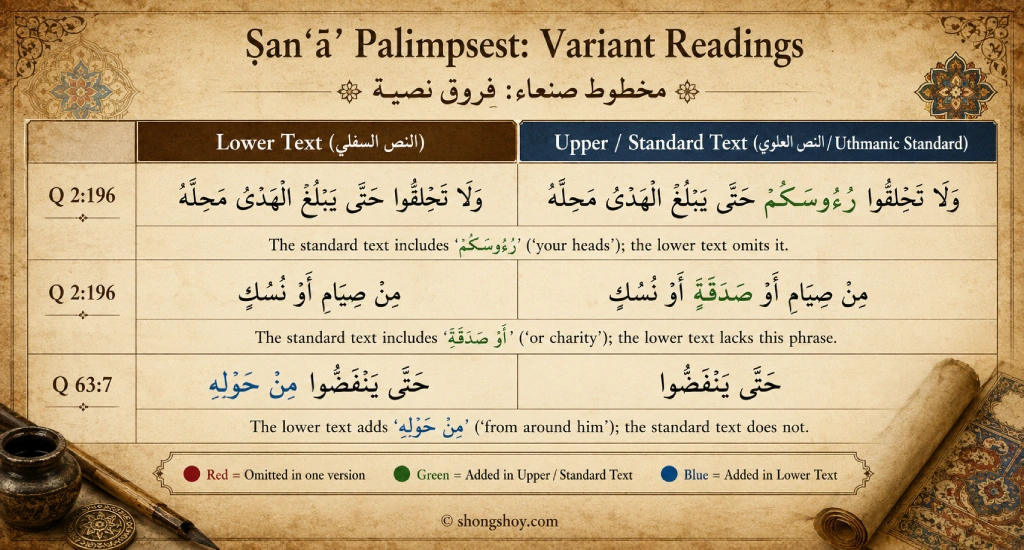
The first example is Surah al-Baqarah 2:196. The modern Uthmanic text reads: وَلَا تَحْلِقُوا رُءُوسَكُمْ حَتَّىٰ يَبْلُغَ الْهَدْيُ مَحِلَّهُ — “And do not shave your heads until the sacrificial animal reaches its destination.” The important word here is رُءُوسَكُمْ — “your heads.” But in Sadeghi and Goudarzi’s presentation, this word, رُءُوسَكُمْ, is absent from the C-1 or Sana lower text; that is, the text reads: “Do not shave until the sacrificial animal reaches its destination.” [13]
| Surah/ayah | Modern Uthmanic text | Bengali meaning | Sana C-1 lower text | Bengali meaning | Type of difference |
|---|---|---|---|---|---|
| 2:196 | وَلَا تَحْلِقُوا رُءُوسَكُمْ حَتَّىٰ يَبْلُغَ الْهَدْيُ مَحِلَّهُ | “Do not shave your heads until the sacrificial animal reaches its destination” | وَلَا تَحْلِقُوا حَتَّىٰ يَبْلُغَ الْهَدْيُ مَحِلَّهُ | “Do not shave until the sacrificial animal reaches its destination” | Word omission: رُءُوسَكُمْ is absent |
Apologetic sleight of hand will not work here. رُءُوسَكُمْ is not a diacritic, not a dot, and not decorative spelling. It is a complete word—“your heads.” The word is present in the modern text and absent from the Sana lower text. Yes, the practical meaning of the sentence does not change substantially, because “shave” already implies the head. But that is not the central question. The central question is whether the text is identical letter for letter. The answer is no. The absence of a complete word directly undermines the claim of “preservation letter for letter.” If someone claims that “not a single letter has changed,” and then a complete word is found to be missing, that claim is no longer a historical claim—it becomes faith-based sloganeering.
The second example is also in 2:196. The modern text reads: فَمَن كَانَ مِنكُم مَّرِيضًا — “But if any of you is ill.” But in the C-1 text, Sadeghi and Goudarzi show a reading of فَإِنْ كَانَ أَحَدٌ — a reading of the type “if someone is”; that is, فَمَن كَانَ has been replaced by فَإِنْ كَانَ أَحَدٌ. [13]
| Surah/ayah | Modern Uthmanic text | Bengali meaning | Sana C-1 lower text | Bengali meaning | Type of difference |
|---|---|---|---|---|---|
| 2:196 | فَمَن كَانَ مِنكُم مَّرِيضًا | “Whoever among you is ill” | فَإِنْ كَانَ أَحَدٌ مِنكُم مَّرِيضًا | “If anyone among you is ill” | Change in sentence structure/conditional form |
The two readings are close in meaning, but the wording is not the same. فَمَن كَانَ and فَإِنْ كَانَ أَحَدٌ are not the same letters, not the same words, and not the same syntax. Apologists will say here, “But the meaning is the same.” Yet “the meaning is broadly the same” does not prove that “the text is identical letter for letter.” Rather, this example shows that early Quranic transmission involved changes in wording or variant formulations while retaining semantic compatibility. That is a very natural feature of oral-written transmission, but it is not a sign of miraculous preservation of every letter.
The third example is again 2:196. The modern text reads: فَفِدْيَةٌ مِّن صِيَامٍ أَوْ صَدَقَةٍ أَوْ نُسُكٍ — “then compensate either by fasting, charity, or a sacrificial offering.” There are three alternatives here: صِيَامٍ — fasting, صَدَقَةٍ — charity, and نُسُكٍ — sacrifice/offering. But in Sadeghi and Goudarzi’s list for the C-1 lower text, the passage أَوْ صَدَقَةٍ — “or charity”—is absent; the reading there is: “fasting or sacrifice.” [13]
| Surah/ayah | Modern Uthmanic text | Bengali meaning | Sana C-1 lower text | Bengali meaning | Type of difference |
|---|---|---|---|---|---|
| 2:196 | مِن صِيَامٍ أَوْ صَدَقَةٍ أَوْ نُسُكٍ | “Fasting, or charity, or sacrifice” | مِن صِيَامٍ أَوْ نُسُكٍ | “Fasting or sacrifice” | Phrase omission: أَوْ صَدَقَةٍ is absent |
This example is even more important than the previous one, because it is not merely the omission of a redundant word; a legal alternative has been omitted. In the modern Quran, kaffārah/fidyah has three options—fasting, charity, or sacrifice. In the C-1 reading, that list is reduced to two. Someone may say, “The basic structure of the instruction is still there.” But that is once again an evasion. Three alternatives versus two alternatives is not a matter of spelling, orthography, or the vocalization of a qirāʾah. It is the absence of a complete phrase. For the claim of “preservation letter for letter,” this is directly devastating.
The fourth example is Surah al-Baqarah 2:201. The modern text contains the famous supplication: رَبَّنَا آتِنَا فِي الدُّنْيَا حَسَنَةً وَفِي الْآخِرَةِ حَسَنَةً — “Our Lord! Grant us the good of this world and the Hereafter.” But according to Sadeghi and Goudarzi’s presentation, the passage حَسَنَةً وَفِي الْآخِرَةِ حَسَنَةً has been replaced in the C-1 lower text by the abbreviated form وَالْآخِرَةِ; the meaning is: “Grant us our world and the Hereafter”—or, more literally, “this world and the Hereafter.” [14]
| Surah/ayah | Modern Uthmanic text | Bengali meaning | Sana C-1 lower text | Bengali meaning | Type of difference |
|---|---|---|---|---|---|
| 2:201 | رَبَّنَا آتِنَا فِي الدُّنْيَا حَسَنَةً وَفِي الْآخِرَةِ حَسَنَةً | “Our Lord, grant us the good of this world and the good of the Hereafter” | رَبَّنَا آتِنَا فِي الدُّنْيَا وَالْآخِرَةِ | “Our Lord, grant us this world and the Hereafter” | Phrase contraction/substitution |
This difference is important because the wording of a famous supplication has changed here. In the modern text, the word حَسَنَةً appears twice—the good of this world and the good of the Hereafter. The C-1 text lacks that lexical repetition. As a result, the sentence’s rhetoric, rhythm, and theological emphasis all change. If someone says, “No major doctrine has changed,” there is no objection to that statement. But to conflate “the doctrine has not changed” with “the wording has not changed” is deception in the name of argument. Here the word has changed, the phrase has changed, and the structure has changed. That is the point under discussion.
The fifth example is Surah al-Munafiqun 63:7. The modern text reads: لَا تُنفِقُوا عَلَىٰ مَنْ عِندَ رَسُولِ اللَّهِ حَتَّىٰ يَنفَضُّوا — “Do not spend ˹anything˺ on those ˹emigrants˺ with the Messenger of Allah so that they will break away ˹from him˺.” In the C-1 lower text, Sadeghi and Goudarzi show that يَنفَضُّوا is followed by the addition مِنْ حَوْلِهِ — “from around him.” The meaning therefore becomes: “so that they will break away from around him.” [15]
| Surah/ayah | Modern Uthmanic text | Bengali meaning | Sana C-1 lower text | Bengali meaning | Type of difference |
|---|---|---|---|---|---|
| 63:7 | حَتَّىٰ يَنفَضُّوا | “So that they will break away” | حَتَّىٰ يَنفَضُّوا مِنْ حَوْلِهِ | “So that they will break away from around him” | Phrase addition: مِنْ حَوْلِهِ added |
This is the complete opposite type of variant: in the previous examples, the C-1 text contained fewer words or phrases; here, the C-1 text contains an additional phrase. مِنْ حَوْلِهِ is not a dot and not a pronunciation difference; it consists of two complete words: مِنْ — “from,” and حَوْلِهِ — “around him.” This phrase is absent from the modern text. The question, then, is: which reading has been preserved “letter for letter”? The modern reading, in which the phrase is absent? Or C-1, in which the phrase is present? Apologists generally raise the shield of faith here instead of offering an argument: “Allah preserved it, so the modern reading is correct.” But that is not textual criticism; it is dogmatic assertion. In evidentiary terms, one can say that a variant existed at this point in the early Quranic textual tradition.
When these five examples are considered together, the matter becomes even clearer:
| Ayah | Type of variant | What changed | Impact on the preservation claim |
|---|---|---|---|
| 2:196 | Word omission | رُءُوسَكُمْ — “your heads” is absent | Absence of a complete word |
| 2:196 | Change in sentence structure | فَمَن كَانَ versus فَإِنْ كَانَ أَحَدٌ | The wording and syntax are not the same |
| 2:196 | Phrase omission | أَوْ صَدَقَةٍ — “or charity” is absent | The list of legal alternatives changes |
| 2:201 | Phrase contraction | حَسَنَةً وَفِي الْآخِرَةِ حَسَنَةً versus وَالْآخِرَةِ | The wording of the famous supplication changes |
| 63:7 | Phrase addition | مِنْ حَوْلِهِ — “from around him” added | C-1 contains an additional phrase beyond the modern text |
After these examples, saying that “there are no differences” is simply false. Saying that “all the differences are orthographic” is dishonest. Saying that “these fall within the qirāʾāt” is unsupported. Saying that “the meaning is broadly the same” is irrelevant to the claim under discussion. The claim standing before the evidence was that the Quran is unchanged letter for letter. Yet what we see here is that the ancient non-ʿUthmānic textual tradition contains omissions of words and phrases, additions of phrases, and changes in sentence structure compared with the modern Quran. Sadeghi and Goudarzi themselves say that C-1 contains all types of variants—additions, omissions, transpositions, and substitutions—and that many of these correspond to the normal features of genuine transmission [16].
One point must be emphasized here: the Sana lower text does not set up a “completely different book” against the modern Quran. But that is not necessary. Apologists often construct a strawman: “Show us, does Sana contain another religion? Another prophet? Another Allah?” This is a weak tactic. To establish whether a text has been preserved letter for letter, one does not need to show that the entire theology has changed. The absence of a complete word, the presence of an additional phrase, or the contraction of a phrase is sufficient. “Broadly the same religious message remains” is a limited claim of textual stability; “not a single letter has changed” is an absolute preservation claim. The Sana lower text leaves room for debate over the first claim, but it directly breaks the second.
Thus the conclusion at this stage is severe but fair: the Sana lower text proves that the modern printed Quran was not the only form of early Quranic transmission. The modern reading is the heir of the standard ʿUthmānic tradition; the C-1 lower text is evidence of another ancient textual stream outside that standard tradition. This evidence cannot be swallowed by saying that “the meaning is broadly the same,” because the subject of discussion is not the broad continuity of meaning; it is the precise preservation of letters, words, and phrases. And by that test, the claim of “preservation letter for letter” fails.
Surah-Order Discrepancy: The Canon Was Not Fixed; It Was Fixed in Place
The greatest challenge posed by the Sana lower text is not merely the difference in wording; an even deeper challenge concerns ترتيب السور—the order of the surahs, or the arrangement of the chapters. The modern Quran has a specific canonical order of surahs: Surah al-Fatihah 1, al-Baqarah 2, Āl ʿImrān 3, and so on, with all 114 surahs arranged in a fixed sequence. This order is regarded as so natural in Muslim society today that many people assume that the arrangement, too, was divinely fixed, unalterable, and universally accepted from the beginning. But the Sana lower text complicates this straightforward belief. Sadeghi and Goudarzi state clearly that Sana C-1 adopts a non-standard sūra order; in other words, its surah arrangement does not fully match the modern Uthmanic order. More importantly, they say that different Companion codices had different surah orders, indicating that the order of the surahs was not completely fixed during Muhammad’s lifetime; C-1 supports that proposition with material manuscript evidence [17].
A subtle but essential distinction must be understood here. The internal order of the verses and the overall order of the surahs are not the same thing. According to Sadeghi and Goudarzi’s analysis, the Uthmanic Quran, C-1, and the Companion codices generally preserve the same passages or groups of verses within each surah; in other words, the surahs had largely been formed already. The separate question is the order in which the surahs were to appear. They say that the surahs had largely been formed before Uthmanic standardization, but that variations existed in the order of the surahs. This conclusion is uncomfortable for apologists because it says two things at once: on the one hand, the Quran was not completely chaotic; on the other hand, the claim that today’s canonical order was the only order from the beginning does not hold [18].
| Arabic term | Bengali meaning | Importance in the discussion |
|---|---|---|
| ترتيب السور | Order/arrangement of the surahs | The arrangement of surahs 1–114 in the modern Quran |
| المصحف العثماني | Uthmanic mushaf/Uthmanic standard text | Today’s canonical Qur’an is essentially heir to this standard tradition |
| مصحف ابن مسعود | Ibn Masʿud’s mushaf | A Companion codex reported to have a surah order different from the Uthmanic order |
| مصحف أُبيّ بن كعب | Ubayy ibn Kaʿb’s mushaf | Another Companion codex also reported to have a different surah order |
| البسملة | “In the name of Allah, the Most Compassionate, the Most Merciful” | Discussed especially in connection with the transition between Surahs 8 and 9 |
| غير عثماني | Non-Uthmanic | A textual stream outside the Uthmanic standard text |
Sadeghi and Goudarzi identify a total of 11 surah transitions, or connections between surahs, in the surviving pages of the Sana lower text. Here, “transition” means which surah begins after one surah ends. Not all the transitions contradict the modern order; some correspond to it. But the important point is that the overall arrangement is not the standard ʿUthmānic order. They show that some sequences found in C-1 correspond to reports about Ibn Masʿud’s codex, some correspond to reports about Ubayy ibn Kaʿb’s codex, and some do not fully correspond to any reported order. Their conclusion is that C-1’s surah arrangement is closer to the reported orders of Ibn Masʿud and Ubayy ibn Kaʿb than to the Uthmanic order [19].
Several important transitions are presented simply below. The numbers here are the surah numbers in the modern Uthmanic order:
| Order found in C-1 lower text | Surah name | Expected position in modern Uthmani order | Comment |
|---|---|---|---|
| 11 → 8 → 9 → 19 | Hud → Anfal → Tawbah → Maryam | In the modern order, 8 → 9 is correct, but 12 follows 11, and 18 precedes 19 | Non-standard block overall |
| 12 → 18 | Yusuf → Kahf | In the modern order, 13 follows 12 | Does not match the Uthmani order |
| 15 → 25 | Hijr → Furqan | In the modern order, 16 follows 15 | Does not match the Uthmani order |
| 20 → 21 | Taha → Anbiya | Also 20 → 21 in the modern order | Matches the Uthmani order here |
| 34 → 13 | Saba → Ra‘d | In the modern order, 35 follows 34; 13 occurs much earlier | Clearly non-standard transition |
| 39 → 40 | Zumar → Ghafir | Also 39 → 40 in the modern order | Matches here |
| 63 → 62 → 89 → 90 | Munafiqun → Jumu‘ah → Fajr → Balad | In the modern order, 62 → 63 and 89 → 90 | The positions of 63 and 62 are reversed; later there is a jump to 89–90 |
One thing is clear from this table: C-1 is not a “one- or two-page booklet of selected supplications” whose discrepancy in surah order can be easily dismissed as insignificant. Sadeghi and Goudarzi themselves considered a possible objection from al-Aʿẓamī: if a small booklet contains a few selected surahs, then it cannot be called a non-standard Qur’an merely because it shows a non-standard transition. But they argue that this objection does not apply to the Sana’a lower text, because it extends across a large portion of the Qur’an, contains major surahs as well, its wording itself demonstrates its non-ʿUthmānic status, and its surah arrangement shows significant correspondence with the reported Companion codices [20].
The connection between surahs 8 and 9 is particularly important here. In the modern Qur’an, Surah Anfal—سورة الأنفال—is followed by Surah Tawbah—سورة التوبة—and the beginning of Surah Tawbah contains no البسملة. Islamic tradition offers various explanations for this: perhaps Tawbah is related to Anfal, or perhaps it is a separate surah in which the basmala was not included, and so on. In the Sana’a lower text too, 9 follows 8 and there is no basmala; here C-1 agrees with the Uthmani text and the reported order of Ubay ibn Ka‘b, but not with the reported order of Ibn Mas‘ud. Sadeghi and Goudarzi therefore say that it is difficult to claim that placing surah 9 after surah 8 was a new innovation of Uthman’s party; the Sana’a evidence adds nuance to this claim [21].
This point needs to be retained honestly in the article, because strong criticism does not mean a one-sided statement. The Sana’a lower text does not show that everything was chaotic. Rather, it shows that the early textual traditions agreed in some places and differed in others. The result is even stronger: the Qur’an was neither totally chaotic nor perfectly fixed. In other words, both extremes of apologetic argument are wrong. On the one hand, “everything was completely chaotic” is an exaggeration. On the other hand, “everything was preserved letter for letter, in the same order and in the same form” is religious propaganda, not history. The Sana’a lower text shows the historical reality in between: there was some textual stability, but there was also diversity before canonical standardization.
Now the question is: does the order of the surahs undermine the claim of “letter-for-letter preservation”? It certainly does, but not as simply as a difference in wording. Someone might say, “The surahs may be arranged earlier or later, but the words could still be the same.” This objection is partly true, but incomplete. The popular preservation claim generally presents not only isolated wording but the entire mushaf as a single divine arrangement. If the order of the surahs itself differs across textual traditions, then the order of the present mushaf cannot be described as the sole unchanged divine order from the beginning. One must then say: the internal structure of the surahs is broadly early, but the overall arrangement of the mushaf later acquired canonical authority. This conclusion is uncomfortable for theological propaganda, but consistent with the textual evidence.
There is another layer here: within the Sana’a lower text, the order of the verses is generally like that of the modern Qur’an, but there are exceptions as well. Sadeghi and Goudarzi note that Surah Taha 20:31 and 20:32 appear in reverse order in C-1; a similar transposition is also reported in literary sources concerning the codex of Ubay ibn Ka‘b. Again, Surah 9:85 is absent in C-1; they explain this possibly through parablepsis—a scribal error in which the eye sees similar endings and skips the intervening passage [18]. Here the apologists will say, “Look, the researchers themselves called it a scribal error.” But that does not save their position either. The existence of a scribal error itself proves that manuscript preservation was subject to a human process. Parablepsis should not occur in miraculous letter-for-letter preservation.
| Textual level | General condition | Exception/problem | Effect on the preservation claim |
|---|---|---|---|
| Verse groups within a surah | Broadly the same | 20:31–32 reversed; 9:85 absent | There are exceptions even in the internal text of the surah |
| Overall order of the surahs | Partially agrees with the modern order | C-1 follows a non-standard order | The canonical order was not the only early order |
| Connection between 8 and 9 | Agrees with the modern text | No basmala at the beginning of Tawbah | Not every feature is a discrepancy; there are also some early agreements |
| Relationship with Companion codices | In some cases C-1 is close to the reported order of Ibn Mas‘ud/Ubay | It does not fully agree with any one of them | Material evidence of early codical pluralism |
The most serious issue is that C-1’s surah order displays a relationship with the reported Companion codices. Previously, many could say regarding the differences in the mushafs of Ibn Mas‘ud or Ubay ibn Ka‘b that these were stories invented later, exegesis presented as the Qur’an, or imaginary polemical reports. The Sana’a lower text weakens that safe skepticism. Sadeghi and Goudarzi say that Sana’a 1 is direct documentary evidence for the reality of non-ʿUthmānic text types, which are generally called Companion codices [22]. In other words, the idea of different mushafs belonging to the Companions is not merely a literary legend; at least this kind of non-ʿUthmānic textual tradition really existed, and we now possess manuscript evidence for it.
Here the apologists’ statement that “there was only one Qur’an” does not correspond to reality. A more accurate historical formulation would be: in the early period, there were multiple forms of Qur’anic textual tradition; the Uthmani tradition later became the state-backed canonical standard; and the other textual traditions gradually became extinct, suppressed, obsolete, or unauthenticated. The Sana’a lower text is a living fossil of one of those lost textual traditions. It does not completely invalidate the modern Qur’an, but it removes the right to call the modern Qur’an “always the same, the only one, and preserved letter for letter.”
Thus, concerning the order of the surahs, the conclusion is this: the Sana’a lower text proves that the Qur’an’s canonical arrangement became fixed within history. Some of it is early, some of it differs across textual traditions, and after Uthmani standardization one order acquired authority. This process may be called “compilation,” “canon formation,” or “standardization”; but it cannot be called “the same divine book order from the first day until today.” A book whose text contains differences in wording, differences in phrases, verse-level exceptions, and non-standard patterns in the order of its surahs cannot be called letter-for-letter unaltered in the language of evidence; that is a marketable slogan of faith.
The Sana’a lower text and Uthmani standardization: not preservation, but selection and canon formation
The most important historical term in the discussion of the Sana’a lower text is توحيد النص — making the text uniform, that is, textual standardization. In Islamic propaganda, Uthman’s work is generally presented as “preservation of the Qur’an”; but in the neutral language of history, it was standardization—granting authority to one textual form and rendering the other textual forms ineffective. This distinction is extremely important. Saying “preservation” gives the impression that there was previously only one unchanged text and that Uthman merely distributed copies of it. But “standardization” makes it clear that textual differences existed earlier and that an official form was established to control those differences. Bukhari’s account itself shows that Hudhayfah ibn al-Yaman became alarmed when he saw the اختلاف — disagreement — in the Qur’an recitation of the Muslims of Syria and Iraq; Uthman then took the suhuf kept by Hafsa, had copies made, sent them to different provinces, and ordered all other Qur’anic materials—fragmentary manuscripts or whole copies—to be burned [23].
The Arabic terms need to be clarified here. جمع القرآن — collecting the Qur’an; نسخ المصاحف — copying the mushafs; المصحف الإمام — the authoritative model mushaf; إحراق المصاحف — burning other mushafs/Qur’anic materials; and التوحيد القياسي للنص — bringing the text to a single standard. There is no place within this process for the claim that “it was the same letter for letter.” If there truly had been a single, unchanged, identical text everywhere, Hudhayfah would not have feared اختلاف or textual conflict; there would have been no need for an instruction to follow the Qurayshi dialect; there would have been no need to send official copies to different provinces; and, most importantly, there would have been no need to order the burning of other Qur’anic materials. Fire is generally needed where differences must be neutralized.
| Arabic term | Bengali meaning | Historical significance |
|---|---|---|
| اختلاف القراءة | Variation in recitation/difference in reading | The fundamental reason for Hudhayfah’s concern |
| جمع القرآن | Collecting the Qur’an | Compilation from disparate materials and memorized recitation |
| نسخ المصاحف | Copying the mushafs | Creating official copies |
| المصحف الإمام | Model/main mushaf | The text that was granted authority |
| إحراق المصاحف | Burning mushafs or Qur’anic materials | Destroying/rendering alternative textual materials ineffective |
| توحيد النص | Textual standardization | Making one among multiple textual forms official |
The Sana’a lower text does not leave the historical model of Uthmani standardization dependent only on religious narrative; it provides material manuscript evidence of an early Qur’anic textual form outside the Uthmani standard text. The analysis by CSMC, University of Hamburg, is very brief yet frighteningly clear: the Sana’a palimpsest is a manuscript in which the erased first layer later became visible again; it is considered to date no more than a few decades after Muhammad’s death; and it bears witness to important changes in the process of Fixierung—that is, the fixing of the text of the Qur’an [24]. In simple Bengali terms, the Sana’a palimpsest shows that the Qur’anic text was not a solid, unchangeable block of stone from the very beginning; it became fixed through history.
The research of Sadeghi and Goudarzi delivers an even greater blow here. They describe the Sana’a lower text as one of the most important documents in the history of the Qur’an, because it is the only known extant copy of another textual tradition apart from the standard ʿUthmānic tradition—that is, a surviving material manuscript witness [25]. The weight of this statement needs to be understood. It does not say that the Sana’a lower text is a “badly spelled copy.” It says that the Sana’a lower text represents another textual tradition outside the standard Uthmani text family. Therefore, Uthmani standardization was not merely the distribution of a perfect text by photostat; rather, it was the process of giving an authoritative text an institutional victory among competing textual traditions.
A simple historical model emerges here:
Early Qur’anic textual environment
        ↓
Memorized recitation + disparate written materials + Companion codices
        ↓
Textual variation and regional disagreement
        ↓
Uthmani standardization
        ↓
Official copies sent to the provinces
        ↓
Alternative materials burned/rendered ineffective
        ↓
Canonical dominance of the Uthmani text type
        ↓
The primary textual tradition of the modern printed Qur’an
In this model, the word “preservation” may be used, but only in a limited sense: after Uthmani standardization, one text type was preserved. But the popular Islamic claim is much larger than this—the Qur’an today is exactly the words that came from Muhammad’s mouth, preserved letter for letter without the slightest change. The Sana’a lower text breaks down that larger claim. It shows that another Qur’anic textual tradition outside the Uthmani text type actually existed. The fact that one version of a scripture later became dominant does not prove that another version never existed. Rather, when evidence of a suppressed or marginal version is found alongside the existence of the dominant version, it becomes clear that the canonical text is a historical outcome.
Apologists generally say here that Uthman did not create a “new Qur’an”; he merely removed the chaos. This may be partly true, but it does not protect their claim. No one is saying that Uthman composed an entirely new scripture from nothing. That is not the question. The question is: did Uthman impose one official standard among multiple textual forms? Bukhari’s account says yes—he sent official copies and burned the other materials [23]. The Sana’a lower text says that early Qur’anic textual forms outside the Uthmani standard tradition actually existed [10]. When these two pieces of evidence are considered together, the picture is clear: the Uthmani project was canon formation—not merely harmless copy distribution.
The word مصحف is also important here. “Mushaf” means a bound/compiled written Qur’an. The Islamic literature itself contains accounts of various Companions’ mushafs in the early period—for example, مصحف ابن مسعود — Ibn Mas‘ud’s mushaf, and مصحف أُبيّ بن كعب — Ubay ibn Ka‘b’s mushaf. It is true that all of these claims are not equally verifiable and that all reports do not constitute the same degree of historical evidence. But the Sana’a lower text strengthens the possible reality underlying those literary reports. In the words of Sadeghi and Goudarzi, Sana’a 1 is direct documentary evidence for the reality of non-ʿUthmānic text types; in other words, it is no longer easy to dismiss discussions of Companion codices as mere stories [10].
There is another trap in apologetic language here: they say, “Uthman protected the Qur’an; he did not change it.” But what do you mean by “protected”? If it means that he established a particular textual form by giving it political and social authority, then that is historical standardization. If it means that he preserved every early textual form letter for letter, then it is directly false; the account of burning the other materials contradicts it. And if it means, “Allah himself selected the correct text, so Uthman’s standard is divine preservation,” then that is no longer history but a theological assertion. History requires evidence; theology is satisfied with faith. Confusing these two levels is the apologists’ central strategy.
The significance of the Sana’a lower text is therefore twofold. First, it shows that variations in Qur’anic wording and arrangement existed outside the Uthmani tradition. Second, it shows that the upper text written later returned to, or came close to, the Uthmani standard tradition. On the same parchment, these two layers are like a visible symbol of Qur’anic canon formation: early diversity below, standardized text above. This is “another Qur’an written over the Qur’an”—not merely a poetic phrase, but a stark reflection of textual history. The old text was erased, and a new standard text was put in its place. What stronger visual metaphor could there be?
A comparison can be made here. Suppose that several local drafts of a state law were in circulation. Later, the central government printed an official version, banned the old drafts, and ordered them destroyed. Several centuries later, the state version became prevalent everywhere. Could one then say, “The law had been letter-for-letter identical from the beginning”? No. One could say, “An official version became dominant in history.” The same principle applies to the Qur’an. A claim of sacredness does not change the rules of textual evidence.
The Sana lower text is dangerous for apologists because it breaks their convenient binary. They generally create two extremes: either the Qur’an is completely unchanged, or it is completely corrupted. Then they show that the Sana lower text is not an entirely different book; therefore, the Qur’an is unchanged. This is an entirely weak false dilemma. The reality is that a book can fail to be letter-for-letter unchanged without being completely destroyed. That is precisely what we see in the case of the Qur’an. The Sana lower text bears considerable resemblance to the modern Qur’an because it belongs to the same religious textual environment; but it also bears considerable difference because it is not the standard ʿUthmānic text type. This intermediate reality is the most destructive to apologetic slogans.
Therefore, presenting ʿUthmānic standardization as “miraculous preservation” is not the language of history; it is the language of religious propaganda. The language of history would be: there was variation in the early Qur’anic textual environment; political-religious authority established a standard text; other materials were suppressed or destroyed; and that official tradition later became dominant as the canonical Qur’an. The Sana lower text makes the lost side of this process visible again. Thus, it does not make the Qur’an “nonexistent”; rather, it reveals the actual human textual history of the Qur’an. And that is sufficient, because to kill the claim of “letter-for-letter preservation,” one does not need to overturn the entire book; it is enough to show that non-canonical readings existed before the canon.
How Different Is the Modern Qur’an from the Sana Lower Text: An Accurate Assessment, Not an Exaggeration
The Sana manuscript is most distorted in two opposite directions. One group exaggerates and says that Sana has supposedly proved the existence of a “completely different Qur’an.” The other, through apologetic restraint, says, “There is no difference at all; everything is merely spelling or pronunciation.” Both statements are wrong. The proper assessment is more nuanced, but also more damaging: the Sana lower text is so similar to the modern Qur’an that it must be regarded as part of the same Qur’anic textual world; but it is also different enough that the popular religious claims that it is “unchanged letter for letter,” “the same word for word,” and that “no change occurred across the ages” can no longer be called true. Sadeghi and Goudarzi identify the Sana lower text as the only known extant manuscript witness outside the standard ʿUthmānic textual tradition; that is, it is not a badly spelled copy of the modern Qur’anic standard text, but evidence of another ancient textual tradition [7].
Let us first turn to the question of numbers. “By what percentage does the Sana manuscript differ from the modern Qur’an?” This question sounds simple, but in reality it is framed incorrectly. The reason is that the Sana lower text is not a complete manuscript of the entire Qur’an; it is fragmentary, with some portions clear, some damaged, some only partially legible, and reconstructions that may differ among researchers. According to the Institute of Ismaili Studies, the Sana palimpsest contains 38 folios, in which two superimposed Qur’anic texts can be seen; the lower layer dates to the seventh century, while the upper layer was written later [6]. Therefore, no reliable, scientific, comprehensive figure such as “X percent different” can be given for comparison with the entire Qur’an. Anyone who confidently says “only 0.001%” or “50% different” is not presenting evidence; they are conducting propaganda.
Yet the importance of the differences does not diminish merely because there is no percentage. The nature of the claim must be understood here. If the claim were that “the modern Qur’an maintains broad continuity with the early Qur’anic tradition,” then the Sana lower text would not completely overturn that claim. Rather, the Sana lower text shows that a major structure of the Qur’anic text was already stable in the early period. But this is not the limited claim made in popular Islam. The claim is: not even a single letter has changed. Against this claim, one certain omission of a word is sufficient; one certain addition of a phrase is sufficient; one certain difference in surah order is sufficient. Therefore, the answer to “how much?” is: numerically, perhaps not very much overall; but considering the nature of the claim, it is sufficiently devastating.
The differences can be divided into four levels. The first level is orthographic variation—differences in spelling, alif, defective spelling, and forms such as scriptio plena/defectiva. These are comparatively weak evidence, because the conventions of ancient Arabic writing were themselves not yet fully standardized. The second level is minor grammatical variation—changes in pronouns, prepositions, prefixes, suffixes, tense, mood, voice, and so on. The third level is substantive textual variation—the addition or omission of words, the addition or omission of phrases, and changes in word formation. The fourth level is codical/structural variation—surah order, transitions, and exceptions in verse order. The Sana lower text does not contain only the first level; it also contains real examples of the second, third, and fourth levels. Sadeghi and Goudarzi analyze the variants in the Sana lower text under the categories of additions, omissions, transpositions, and substitutions [10].
| Level of difference | Example | Significance | Impact on the preservation claim |
|---|---|---|---|
| Spelling/orthography | Writing or not writing alif, spelling convention | Comparatively low | Not strong on its own |
| Grammar | Pronoun, preposition, suffix, verb form | Moderate | The wording is not identical |
| Word/phrase | Omission of a word, addition of a phrase, omission of a phrase | Strong | The claim that it is “the same word for word” collapses |
| Arrangement/structure | Surah order, exceptions in verse order | Extremely important | The claim that the canonical arrangement was singular from the beginning is weakened |
Keeping these four levels in mind makes the importance of the Sana lower text clear. This is not a manuscript in which only the letter forms are different. Rather, the Sana lower text contains substantive variants in comparison with the modern ʿUthmānic text. For example, in 2:196, the word رُءُوسَكُمْ—“your heads”—is absent; in the same verse, the phrase أَوْ صَدَقَةٍ—“or charity”—is absent; and in 63:7, the phrase مِنْ حَوْلِهِ—“from around him”—is present. These are not orthographic differences. They are differences in the actual wording [10].
The question “Has the meaning changed?” must be considered separately here. Many of the variants in the Sana lower text do not completely alter the central message of the modern text. For example, even if رُءُوسَكُمْ is omitted, the head can be understood from the context of shaving. But if أَوْ صَدَقَةٍ is omitted, the list of fidyah alternatives is narrowed—charity is removed from the three alternatives of fasting, charity, and sacrifice. Again, if مِنْ حَوْلِهِ is added, the sentence in 63:7 becomes more specific—from “dispersing” to “dispersing from around him.” Thus, not all variants carry equal weight, but it would also be dishonest to call them “meaningless scribal noise.” Some variants are nearly synonymous, some explanatory, and some have a slight effect on meaning, while others alter a legal list or the specificity of a sentence. This is the reality of textual transmission.
The context of Asma Hilali’s work is also important here. Hilali has offered a new interpretation by associating a portion of the Sana palimpsest with an early educational or transmission context. The Review of Qur’anic Research notes that 61 textual variants were identified in the portion analyzed in her edition in comparison with the Cairo edition [26]. But this is precisely where caution is necessary: Hilali’s analysis does not cover all the folios; Nicolai Sinai notes that Hilali edited a total of 9.5 folios, or 19 pages, of the lower text and left out some additional lower-layer material because she did not have access to it or because it was too damaged or illegible [27]. Consequently, the variant count depends on the researcher’s corpus, legibility, reconstruction policy, and definition of “variant.” Therefore, the figure of “61 variants” is important, but it cannot be turned into the final statistic for the entire Sana lower text or the entire Qur’an.
For this reason, the correct assessment should be layered. At the macro level—that is, the overall religious text, familiar surahs, Qur’anic language, and the general framework of God, Muhammad, the afterlife, law, and ethics—the Sana lower text belongs to the same tradition as the modern Qur’an. At the meso level—that is, surah order, the formulation of some passages, and phrase structure—there are significant differences. At the micro level—that is, words, phrases, pronouns, prepositions, and omissions/additions—there are multiple specific variants. These three levels must be understood together. Apologists show only the similarities at the macro level; overly critical voices sometimes magnify micro-level differences until the entire tradition becomes unrecognizable. Both are wrong. The correct conclusion is: the tradition is the same, but the text is not identical.
Overall religious framework:       considerable similarity
Surah and passage tradition:       partial similarity + important differences
Word/phrase level:                actual variants
canonical order:                  the ʿUthmānic order was not the only early order
final conclusion:                 the text tradition was stable, but not unchanged letter for letter
This assessment is what breaks the claim of “letter-for-letter preservation.” The claim itself has established the wrong standard of measurement. If a Muslim scholar says, “The standard ʿUthmānic text type is very ancient, and once it became canonical it demonstrated comparatively remarkable stability,” this could be a discussable, evidence-supported, strong claim. But the common claim made from the pulpit—that “today’s Qur’an is a photocopy of the Qur’an from Muhammad’s time, and not even one letter has changed”—does not withstand the Sana lower text. In the words of CSMC, the Sana palimpsest is a witness to an important event in the history of the final redaction or stabilization of the Qur’anic text [24]. If there was a “final redaction,” then there was a pre-final textual state before it; understanding this requires no elaborate philosophy.
The differences in the Sana lower text are therefore destructive not in their “quantity” but in their “type.” In quantity, they do not make the entire Qur’an unrecognizable. In type, however, they are incompatible with an absolute preservation claim. A book is either preserved letter for letter or it is not. The religious miracle claim cannot be saved by saying “almost letter for letter.” If the lower text contains omitted words, added phrases, changed syntax, and a different surah order, then the claim of being “letter for letter” is over. The claim that remains is: “After ʿUthmānic standardization, the dominant text became comparatively stable.” That is a historical claim; it is not the popular claim of miraculous preservation.
Another apologetic trap here is: “Manuscripts in human hands may contain errors, but the real Qur’an is preserved with Allah.” This statement is a way of fleeing the field of research. The issue is not whether some metaphysical tablet exists with Allah; the issue is whether the Qur’an circulated in human hands was historically preserved letter for letter. If variants exist in the ancient manuscript tradition, then there were letter-level changes in the human chain of textual transmission. Saying “it is correct in heaven” is not a historical rebuttal; it is unfalsifiable theology. In an evidence-based discussion, its value is zero.
The most precise one-sentence conclusion would be: the Sana lower text is not broadly separate from the modern Qur’an, but neither is it letter-for-letter identical to it. This is the essential point. It is dangerous for apologists because they generally operate on two extremes—either exactly the same or completely corrupted. Real history stands in the middle and says: variant transmission existed within the same tradition; later, a standard text became dominant. This reality does not prove that “there is no Qur’an”; but it does break the claim that “the Qur’an has never changed.”
Therefore, the straightforward answer to “how much difference is there?” is: limited in quantity, enormous in evidentiary value. The Sana lower text resembles the modern Qur’an so closely that there is no serious doubt about calling it a Qur’anic manuscript; but it contains enough variation that the claim that it is “the same letter for letter” is historically wrong. The importance of the differences lies not in their percentage but in their conflict with the nature of the claim. The removal of a single drop of ink would make the claim that “not even one drop has changed” false. In the Sana lower text, the evidence of variants exists not merely at the level of a dot, but at every level—words, phrases, syntax, and order.
The Main Fallacies of Apologists: Minimizing the Problem, Changing Definitions, and Fleeing the Evidence
After the Sana manuscript came to light, the response of Islamic apologists was generally not scholarly but defensive. They first claim that “the Qur’an has been preserved letter for letter”; then, when manuscript differences are shown, they change the language of the claim—“the meaning is actually the same,” “these are actually qira’at,” “these are actually spelling differences,” “this is actually a student’s notebook,” “Uthman actually preserved the correct reading.” In plain language, the name of this tactic is goalpost shifting—moving the goalposts of the claim. At first, the claim was لفظًا وحرفًا—preservation in wording and letter; after evidence appears, the claim falls back to “the meaning is broadly the same.” This intellectual retreat must be identified clearly. The Sana lower text of the Qur’an is not completely separate from the modern ʿUthmānic text—this is true; but it is also not identical to the modern text letter for letter—this is equally true. Apologists want to conceal the second truth.
First fallacy: “They are all spelling differences.” In Arabic, this is called اختلاف إملائي—an orthographic difference—or اختلاف الرسم—a difference in the writing of the rasm, or consonantal skeleton. Such differences genuinely exist in ancient Arabic manuscripts. But putting every difference in the Sana lower text into this basket is plainly wrong. The word رُءُوسَكُمْ—“your heads”—is present in the modern text but absent in C-1; أَوْ صَدَقَةٍ—“or charity”—is present in the modern text but absent in C-1; and مِنْ حَوْلِهِ—“from around him”—is present in C-1 but absent from the modern text. These are not spelling differences; they are حذف—omission, زيادة—addition, and اختلاف نصي—textual difference. Sadeghi and Goudarzi identify all these types of variants—additions, omissions, transpositions, and substitutions—in the Sana lower text; therefore, the claim that “everything is spelling” collapses factually [28].
Second fallacy: “These are differences among the qira’at.” قراءات—qira’at—means recognized reading methods or recitational variants. The qira’at tradition does indeed contain differences in some words, vowels, grammatical forms, or pronunciations. But the problem of the Sana lower text is not confined within the canonical qira’at. Sadeghi and Goudarzi present the Sana lower text as an independent textual tradition outside the standard ʿUthmānic textual tradition; Nicolai Sinai likewise describes the Sana lower text as the only known material witness to a recension different from the canonical recension [29]. Therefore, it cannot be swallowed up by calling it “a difference among recognized qira’at.” Qira’at are internal diversity within the canonical system; the Sana lower text is evidence of an earlier or external textual plurality.
Third fallacy: “But the meaning is the same.” This argument sounds reassuring, but it is actually unrelated to the claim under discussion. If the claim were that “the main theological ideas of the Qur’an belong broadly to the same tradition,” then the question of meaning would be relevant. But the claim was that “not a single letter has changed.” If رُءُوسَكُمْ is omitted, the head can still be understood—this is true; but the word has been omitted—this is also true. If أَوْ صَدَقَةٍ is omitted, the list of fidyah is narrowed to two alternatives—this is an even clearer difference in meaning. If مِنْ حَوْلِهِ is added, the sentence becomes more specific. Even if the meaning remains “broadly” the same, the text is not the same. If a student says in an examination, “Sir, I wrote the sentence from the book letter for letter,” and it is later found that several words were omitted, one phrase was added, and one sentence was shortened, he cannot escape by saying, “But the meaning is close.” The same principle applies to the Qur’an.
Fourth sophistry: “So Ṣanʿāʾ was merely a student’s notes or a school exercise.” This claim is essentially a popularized version of Asma Hilali’s thesis, which attempts to associate the Ṣanʿāʾ palimpsest with an elementary learning environment or school exercise. Raising such a hypothesis in research is not a crime; but apologists use it as though all the textual value of the Ṣanʿāʾ lower text had thereby been nullified. That is not the reality. Nicolai Sinai has offered a detailed critique of Hilali’s reading and broader thesis; Cellard’s codicological reconstruction has provided strong evidence for understanding the Ṣanʿāʾ palimpsest as a codex and as the work of professional scribes; Cellard’s codicological reconstruction has also offered important arguments for understanding the lower text as evidence of a distinct textual tradition and the manuscript as a codex; Sinai, too, has raised serious objections to Hilali’s school-exercise thesis [30]. Thus, calling it “a student’s notebook” is an apologetic shortcut; it is not a settled academic conclusion.
Fifth sophistry: “Even if it was not a student’s exercise, it was still a scribal mistake in a poor copy.” This argument, too, rests on a half-truth. Yes, scribal errors occur in manuscript transmission. Some omissions or transpositions in the Ṣanʿāʾ lower text can also be explained through scribal mechanisms, such as parablepsis—the eye seeing the same ending and skipping the intervening material. But the problem is that the Ṣanʿāʾ lower text is not merely a list of isolated errors. Sadeghi and Goudarzi have analyzed it as a distinct text type called C-1, and in their view it is evidence of a textual tradition outside the standard ʿUthmānic tradition [10]. One or two scribal mistakes would indeed have challenged the claim of letter-for-letter preservation; but here there is a much larger problem—the material existence of a non-ʿUthmānic textual tradition.
Sixth sophistry: “The upper text matches the modern Qur’an, so preservation is proven.” This is a strange argument. It is true that the upper text was written later and is close to the standard ʿUthmānic text; but the problem concerns the lower text. The fact that the lower non-standard text was erased on the same parchment and the upper standard text was written over it is itself visible evidence of canon formation. In its discussion, CSMC described this manuscript as a witness to an important event in the final redaction or stabilization of the Qur’anic text; the same discussion also mentioned the high value of parchment and the possible reason for erasing an old manuscript in order to write the official version [31]. In other words, the upper text’s being standard is not miraculous proof of preservation; rather, the movement from lower to upper is evidence of standardization.
Seventh sophistry: “Ṣanʿāʾ is fragmentary, so nothing can be proven from it.” This is false once again. It is true that a fragmentary manuscript cannot be used to determine the percentage of difference in the entire Qur’an. But it is false that a fragmentary manuscript cannot prove a textual variant. If a fragment definitely omits a word found in the modern reading, or contains an added phrase, then that specific textual difference is proven. A specific difference does not disappear merely because the entire book is not in our hands. According to the Institute of Ismaili Studies, the Ṣanʿāʾ palimpsest contains two layers of Qur’anic text on 38 leaves/folios; the lower text dates to the seventh century, and the upper text was written after the lower text had been erased [32]. This amount of material evidence alone is sufficient to put the claim of letter-for-letter identity to the test.
Eighth sophistry: “Carbon dating is of the parchment, not the text; therefore nothing can be said from Ṣanʿāʾ.” This statement is partly true but is used in a misleading way. Carbon dating does indeed date the parchment, not the ink. But manuscript dating never rests on carbon dating alone; it is assessed through palaeography, codicology, script style, material context, textual comparison, and all these factors taken together. Moreover, the importance of the Ṣanʿāʾ lower text does not lie only in the question of “exactly what year it was written”; its importance is that it shows a non-standard lower text within a very early Qur’anic manuscript tradition. In addition, IIS describes the lower text as dating to the seventh century, and Sadeghi–Goudarzi regard it as one of the most important witnesses in early Qur’anic textual history [33]. Therefore, although the statement “carbon dating is of the parchment” is true, it does not rescue the preservation claim.
Another subtle point should be stated honestly here. Sadeghi and Goudarzi do not claim that C-1 is everywhere “more original” or “more correct” than the modern ʿUthmānic text. Rather, their discussion allows for the possibility that the ʿUthmānic text type may in many cases be a good reproduction of a common source. But that does not weaken the central argument of this article in the slightest. The question at issue is not “which text type is the better reproduction”; the question is whether multiple text types existed in the early Qur’anic textual tradition, and whether the modern Qur’an is unchanged letter for letter. The existence of C-1 itself shows that the ʿUthmānic reading was not the only early form of the text; and the specific word and phrase differences show that the claim of “letter-for-letter preservation” does not hold up historically.
Ninth sophistry: “Uthman burned the incorrect readings and preserved the correct reading; therefore there is no problem.” This argument may work within theology, but not in history. The historical question is whether other textual materials existed. Bukhari’s account itself shows that Uthman ordered official copies to be sent out and other Qur’anic materials to be burned; in other words, alternative materials existed. The Ṣanʿāʾ lower text shows that an early Qur’anic form of the text outside the ʿUthmānic standard tradition did in fact exist. After that, saying “those were wrong and ours is right” is a faith claim, not textual proof. A victorious canon does not erase an earlier variant tradition from history merely by declaring itself correct.
Tenth sophistry: “Allah Himself preserved the Qur’an; therefore these variants are not the real Qur’an.” In an evidence-based discussion, this is not an argument; it is circular reasoning. The question is precisely whether the Qur’anic text in human hands has historically been preserved letter for letter. Answering, “It was preserved because Allah said it was preserved,” uses the same claim as its own proof. In Arabic, this may be called مصادرة على المطلوب—assuming in advance what must be proven. To reject a manuscript variant in manuscript studies, one must provide evidence concerning its lineage, dating, scribal profile, relation to other witnesses, and text type. Saying “Allah said so” may be sufficient for a believer, but in historical textual criticism its evidentiary value is zero.
Eleventh sophistry: “Does the existence of a difference mean that the Qur’an is corrupted?” Here the apologists deliberately construct a false dilemma. As though there were only two alternatives: either the Qur’an is unchanged letter for letter, or it is entirely corrupted and unrecognizable. Reality lies between these two. The Ṣanʿāʾ lower text does not show that the modern Qur’an is an entirely different scripture. Rather, it shows that early textual plurality existed within the same Qur’anic tradition, after which one standard text became dominant. This conclusion is not “complete corruption”; but neither is it “letter-for-letter preservation.” Apologists fear this middle reality because their preaching rests on exaggerated absolute claims.
Twelfth sophistry: “There are few Ṣanʿāʾ variants, so they are insignificant.” This argument does not understand the nature of the claim. If the claim were “95% or 99% is the same,” then the quantity of variants would be relevant. But the claim is “not even one letter has changed.” Against an absolute claim, one certain counterexample is enough. Just as one white crow is enough to refute the claim “all crows are black” in mathematics, one certain word difference is enough in textual criticism to refute the claim “all the letters are the same.” In Ṣanʿāʾ, there is not merely one; variants occur at multiple levels: wording, phrase, grammar, and sūra arrangement. So the matter cannot be erased by saying they are “few.”
When these sophistries are arranged together, the apologetic pattern becomes clear:
| Apologetic claim | Where the problem lies | Brief refutation |
|---|---|---|
| It is all spelling | It ignores word/phrase variants | رُءُوسَكُمْ, أَوْ صَدَقَةٍ, مِنْ حَوْلِهِ are not spelling |
| It is all qirāʾāt | It turns C-1 into canonical qirāʾāt | C-1 is outside the standard ʿUthmānic tradition |
| The meaning is the same | It changes the definition of the claim | The claim at issue is not meaning, but letter-for-letter identity |
| A student’s notebook | It turns a disputed thesis into a final conclusion | Sinai criticized it; Cellard offered a reconstruction supporting a codex/professional scribes |
| Scribal mistake | It turns a text type into an isolated error | C-1 is a witness to a distinct textual tradition |
| The upper text matches | It conceals the problem of the lower text | The upper text’s being standard is itself evidence of standardization |
| Fragmentary | It denies evidence for a specific variant | A definite variant can be proven even in a fragmentary manuscript |
| Parchment dating | It rejects textual evidence through dating nuance | Dating combines multiple methods; the lower text is an early witness |
| Uthman preserved the correct reading | It turns a faith claim into history | Alternative materials existed—that is the central question |
| Allah preserved it | Circular reasoning | Belief, not proof |
| Or is it completely corrupted? | False dilemma | A text can be stable without being identical |
| Few variants | It does not understand the nature of an absolute claim | One certain variant breaks the “letter-for-letter” claim |
Thus, an analysis of the apologists’ defense concerning the Ṣanʿāʾ manuscript shows that they do not confront the central problem. The central problem is this: the modern standard Qur’an and the Ṣanʿāʾ lower text are not identical letter for letter. To evade this simple truth, they bring in spelling, qirāʾāt, meaning, a student’s notebook, scribal mistake, and Allah’s metaphysical preservation, one after another. But however much smoke they create, it does not conceal the source of the fire: variants existed in the early Qur’anic manuscript tradition. A canonical standard later suppressed those variants. That is history. It can be called “miraculous preservation” only when the meaning of preservation is changed to mean “erasing a different reading and establishing one reading.”
Another apologetic strategy is to turn the seven aḥruf into a universal escape hatch. Whenever a word difference, phrase difference, difference in order, or difference in sentence appears in an ancient manuscript, it is said: “This may be part of the aḥruf or qirāʾāt”; and if it does not match the canonical qirāʾāt, it is then said: “Then it is a scribal error.” This two-option trap is plainly dishonest. For it deliberately excludes the third possibility: an early Qur’anic textual tradition outside the ʿUthmānic standard text did in fact exist. This is precisely where the importance of the Ṣanʿāʾ lower text lies. Declaring in advance that it is either “aḥruf” or “an error” is not research; it is writing the verdict before the evidence arrives. To call a variant aḥruf requires independent transmission evidence; to call a variant a scribal error requires demonstrating a palaeographic or textual mechanism. But “to save our theology, it must be aḥruf or an error” is not an argument; it is a self-protective strategy.
“Finding different manuscripts is normal”—this statement itself is an apologetic confession that cuts against its speaker. Yes, variants are normal in a human manuscript tradition. But then the Qur’an must also be evaluated according to the rules of human manuscript transmission. On the one hand, it is said that additions and omissions of words, differences in sentences, taqdīm-taʾkhīr, and substitutions are normal; on the other hand, it is said that the Qur’an is unchanged letter for letter—these two statements cannot both be true. If variants are normal, then absolute preservation is false. And if absolute preservation is true, then variants cannot be normal. Apologists are trying to obscure this fundamental contradiction with a cloud of confusion.
The final point is clear: the Ṣanʿāʾ lower text does not destroy the entire religious tradition of the Qur’an; but it brings about the death of the claim that it is “unchanged letter for letter.” Apologists confuse people by conflating these two statements. In the language of research: early Qur’anic text was relatively stable but not absolutely identical. Put in Bengali terms: the early Qur’anic textual tradition was broadly stable, but it was not identical letter for letter. The claim propagated with religious fervor as “unchanged” is confronted by the Ṣanʿāʾ manuscript, which says: no, history is not so simple.
Final Analysis and Conclusion
The importance of the Ṣanʿāʾ manuscript must be understood in the right way. It does not invalidate the existence of the Qur’an, turn the Qur’an into a completely unfamiliar book, or deny its relationship with the modern Qur’an. But this is precisely its strength: although the Ṣanʿāʾ lower text is related to the modern Qur’an, it is not identical to the modern Qur’an letter for letter. In other words, the very claim that apologists present as their strongest claim breaks down here. That the Qur’an came through the “same tradition” is one thing; that the Qur’an came “without a single letter changing” is an entirely different thing. The Ṣanʿāʾ palimpsest does not deny the first statement, but it destroys the second.
At the center of this entire discussion is a simple question: Is the modern printed Qur’an exactly the same text as the Qur’an of Muhammad’s time, letter for letter, word for word, and arrangement for arrangement? The answer of the Ṣanʿāʾ lower text is no. It contains omitted words, omitted phrases, added phrases, changes in sentence structure, differences in textual form, and discrepancies in sūra order. These cannot be passed off as spelling. They cannot be swallowed merely as pronunciation. They cannot be rescued by saying, “But the meaning is the same.” For the claim at issue is not overall continuity of meaning; the claim at issue is letter-for-letter identity. And for a claim of letter-for-letter identity, even a minor word difference is fatal. The omission of a single complete word makes the claim “not even one letter has changed” false.
The real problem with the apologists here is that they change the language of the claim. On the speaking platform they say, “The Qur’an has not changed in the slightest.” When variants are shown at the research table, they say, “Actually, the meaning is the same.” When word differences are shown again, they say, “These are qirāʾāt.” When a non-Uthmanic textual tradition outside the qirāʾāt is shown, they say, “It is a student’s notebook.” When the student’s-notebook theory appears weak, they say, “Even so, Uthman preserved the correct one.” Finally, when there is no evidence left, they say, “Allah Himself preserved it.” This ongoing flight itself proves that the central claim is not evidence-based; it is faith-based. When the evidence is convenient, they speak of manuscripts; when the evidence is inconvenient, they flee into theology.
The most ruthless aspect of the Ṣanʿāʾ palimpsest is its material character. It is not a disputed oral tradition, a polemical report written later, or an imagined story about a “lost Qur’an.” It is real parchment, real erased writing, real writing above it, a real lower text, and real textual differences. On the same page, one Qur’anic reading below and another Qur’anic reading in the upper layer bring the entire problem of the Qur’an’s textual history before our eyes. Early diversity below, standardization above. There could be no more direct symbol.
Therefore, the most accurate language concerning the preservation of the Qur’an is this: the modern Qur’an is the heir to an ancient, powerful, standardized ʿUthmānic textual tradition; but it cannot be proven that in the early period this alone was the universal text, identical letter for letter. Rather, the evidence shows that textual differences existed before or outside ʿUthmānic standardization. In later history, one form of the text became dominant by acquiring state, religious, and social authority. This dominance does not itself mean miraculous preservation; it is canon formation—the formation of a canon. What is called “preservation” in religious language is described much more precisely in the language of history as “selection, standardization, and the elimination of other textual forms.”
The conclusion of this article is therefore two-sided but clear. First, one should not use the Ṣanʿāʾ manuscript to say that today’s Qur’an is completely different, unrecognizable, or that the entire scripture has been changed. That would be a factually weak claim. Second, even after the evidence of the Ṣanʿāʾ manuscript, one cannot say that the Qur’an is unchanged letter for letter, word for word, and arrangement for arrangement. That is an even weaker, more ignorant, and more apologetic claim. The correct position is that there is significant stability in the Qur’an’s textual tradition, but no absolute identity. It is a “stable textual tradition,” but not “miraculous preservation of the letters.”
Those who say, “These differences are very small,” do not understand the nature of the claim. If the claim were “the Qur’an’s main message has remained broadly the same,” then an accounting of small and large differences would be necessary. But when the claim is “not even one letter has changed,” there is no such thing as a small difference. One omitted word, one added phrase, one contraction of a phrase, or one discrepancy in sūra order is sufficient. Against the claim of “letter for letter,” the evidence that “some letters, some words, and some phrases are different” is conclusive. If a lock claimed that it had never been opened, one clear cut mark on it would be enough; the entire door would not need to be broken down.
The problem with popular religious preaching about the Qur’an is that it sells people an impossibly simple history. As though revelation came down from heaven, was perfectly preserved orally and in writing, nobody ever made a mistake, no textual variation occurred, no selection occurred, no suppression occurred, no standardization occurred—only an absolute miraculous continuity from one letter to the next. But real history is not so innocent. Real history includes fear over the deaths of memorizers, collection from scattered materials, differences among the Companions’ codices, ʿUthmānic standardization, the order to burn other materials, and non-Uthmanic manuscript witnesses such as the Ṣanʿāʾ lower text. When all this evidence is considered together, the simple story of miraculous preservation does not hold.
The final point here is this: the Ṣanʿāʾ manuscript is not a “conspiracy” against the Qur’an; it is evidence against the apologetic myth constructed against the history of the Qur’an. One may place the Qur’an outside history and call it miraculously unchanged from the standpoint of faith; but one cannot say so from the standpoint of manuscripts, textual criticism, and material evidence. The Ṣanʿāʾ lower text has shown that the textual history of the Qur’an is human. It contains writing, erasure, rewriting, variants, and standardization. To conceal this human history and say “not even a single point has changed” is not an argument; it is religious propaganda.
Therefore, the final conclusion is clear: the Ṣanʿāʾ manuscript demonstrates continuity with the modern Qur’an, but not letter-for-letter identity. It shows that the Qur’an has come down through a broadly stable textual tradition, but the claims that it has been “exactly the same throughout the ages,” is “unchanged letter for letter,” and contains “no changes in any word, phrase, or arrangement” are false. The Ṣanʿāʾ lower text is an ancient, silent, but ruthless witness against that error. Once the fact that other textual forms existed before the reading later established as the only truth is acknowledged, the myth of the Qur’an’s miraculous preservation can no longer stand. The Qur’an is then no longer an unchangeable stone suspended in the sky; it becomes a human book shaped through history, whose canonical form was established through authority, selection, standardization, and the elimination of earlier textual variations.
References
- Hadiya Gurtmann, CSMC, University of Hamburg, “A Qur’an written over the Qur’an – why making the effort?” 1 2 3
- Behnam Sadeghi & Mohsen Goudarzi, “Ṣanʿāʾ 1 and the Origins of the Qurʾān”, Der Islam 87, 2012, Abstract ↩︎
- Sadeghi & Goudarzi, 2012, discussion of the ʿUthmānic text type and C-1 ↩︎
- CSMC, “A Qur’an written over the Qur’an – why making the effort?” ↩︎
- Sadeghi & Goudarzi, 2012, discussion of Companion codices and variants ↩︎
- Institute of Ismaili Studies, “Sana‘a Palimpsest and the Early Manuscripts of the Qur’an” 1 2
- Behnam Sadeghi & Mohsen Goudarzi, “Ṣanʿāʾ 1 and the Origins of the Qurʾān”, 2012 1 2
- Behnam Sadeghi & Uwe Bergmann, “The Codex of a Companion of the Prophet and the Qurʾān of the Prophet”, Arabica 57, 2010 ↩︎
- Sadeghi & Bergmann, 2010 ↩︎
- Sadeghi & Goudarzi, 2012 1 2 3 4 5 6 7 8 9
- Behnam Sadeghi & Mohsen Goudarzi, “Ṣanʿāʾ 1 and the Origins of the Qurʾān”, Der Islam 87, 2012 ↩︎
- Behnam Sadeghi & Mohsen Goudarzi, “Ṣanʿāʾ 1 and the Origins of the Qurʾān”, Der Islam 87, 2012, pp. 16–20 ↩︎
- Sadeghi & Goudarzi, 2012, Table 1, Q 2:196 1 2 3
- Sadeghi & Goudarzi, 2012, Table 1, Q 2:201 ↩︎
- Sadeghi & Goudarzi, 2012, Table 1, Q 63:7 ↩︎
- Sadeghi & Goudarzi, 2012, pp. 18–20 ↩︎
- Sadeghi & Goudarzi, “Ṣanʿāʾ 1 and the Origins of the Qurʾān”, discussion of sūra ordering, pp. 23–25 ↩︎
- Sadeghi & Goudarzi, 2012, pp. 22–23 1 2
- Sadeghi & Goudarzi, 2012, Table 2 and analysis ↩︎
- Sadeghi & Goudarzi, 2012, pp. 23–24 ↩︎
- Sadeghi & Goudarzi, 2012, pp. 24–25 ↩︎
- Sadeghi & Goudarzi, 2012, pp. 18–19 ↩︎
- Sahih al-Bukhari 4987 1 2
- CSMC, University of Hamburg, “A Qur’an written over the Qur’an – why making the effort?” 1 2
- Sadeghi & Goudarzi, “Ṣanʿāʾ 1 and the Origins of the Qurʾān” ↩︎
- Eléonore Cellard, Review of Asma Hilali, The Sanaa Palimpsest, Review of Qur’anic Research, 2019 ↩︎
- Nicolai Sinai, “Beyond the Cairo Edition”, JAOS, 2020 ↩︎
- Sadeghi & Goudarzi, “Ṣanʿāʾ 1 and the Origins of the Qurʾān”, 2012 ↩︎
- Nicolai Sinai, “Beyond the Cairo Edition: On the Study of Early Quranic Codices”, 2020 ↩︎
- Éléonore Cellard, “The Ṣanʿāʾ Palimpsest: Materializing the Codices”, 2021; Nicolai Sinai, 2020 ↩︎
- CSMC, University of Hamburg, “A Qur’an written over the Qur’an – why making the effort?”, 2023 ↩︎
- Institute of Ismaili Studies, “Sana‘a Palimpsest and the Early Manuscripts of the Qur’an”, 2018 ↩︎
- Institute of Ismaili Studies, 2018; Sadeghi & Goudarzi, 2012 ↩︎