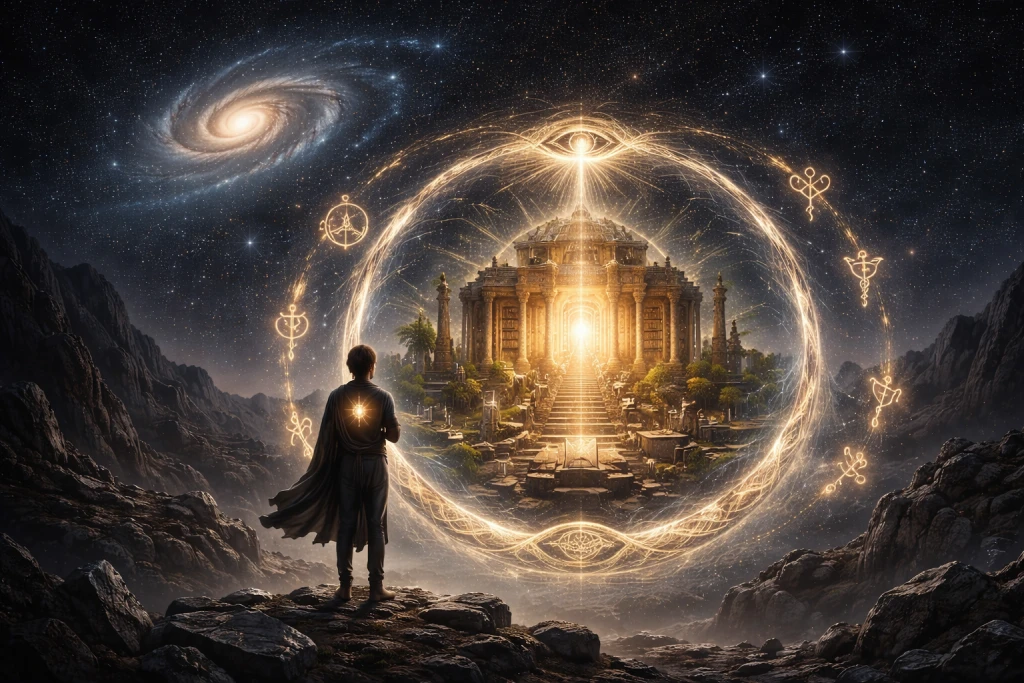
Gnosticism: A Narrative of a Lost Universe
Introduction: The Tale of a Lost Universe
Have you ever looked at the night sky? Far from the city, where there is no artificial-light pollution, it can seem as though someone has scattered handfuls of diamonds across a sheet of black velvet. Have you ever felt your heart tremble as you looked into that endless darkness? Have you ever felt that we are terribly alone in this vast, indifferent universe—or sensed something stranger still? What if this world, this familiar reality, is actually an ingenious trap? What if a colossal mistake has been made, a cosmic accident has occurred, and we are all paying the price for it?
If you have ever felt that another truth lies hidden behind this familiar world, you are not alone. Nearly two thousand years ago, a group of people raised precisely these questions. They did not belong to a single organized religion, nor did they share one temple or mosque. They were a strange gathering of philosophers, poets, ascetics, and rebellious thinkers. They argued that this world was not the perfect creation of a great and merciful God; rather, it was a prison—a flawed world fashioned by an incompetent and arrogant deity. We are all exiles imprisoned here. Our true home is elsewhere: an ancient, pure world of light. Returning home requires a special kind of knowledge, and once that knowledge is attained, the walls of this prison can shatter like glass.
The name of this revolutionary, mysterious, and dangerous way of thinking is Gnosticism.
The word Gnosticism carries the scent of esoteric knowledge. It derives from the Greek word gnosis, meaning “knowledge.” Yet this is not the knowledge acquired from schoolbooks, nor a memorized collection of facts or theories. It is a deep, personal, transformative understanding—a flash of lightning that illuminates the inner self and reveals who we are, where we came from, why we are imprisoned in this ugly world, and where true liberation lies. It is knowledge that moves not only the mind but also the soul: it does not merely inform; it transforms.
Gnosticism was not a single, orderly religion. Rather, it was a complex mosaic of philosophical and spiritual groups spread across the Mediterranean world—including Egypt, Syria, Rome, and Persia—between the first and fourth centuries. They differed on countless points, yet they agreed on several fundamental questions. Let us enter that strange, forbidden, and nearly lost world: a world whose key is hidden within us, even as we stand at its door searching for the lock.
Roots of Gnosticism: An Alternate Universe Born in a Broken Mirror
Could such a strange and revolutionary idea have arisen from nothing? Did people wake up one morning and suddenly say, “This world is actually a prison, and God is a clumsy craftsman”? No, no idea is actually born in nothingness. Behind every thought there is a shadow of more thought, behind every rebellion lies a history of humiliation and despair. Gnosticism is no exception. This complex, melancholy and poetic philosophy is not the brainchild of a single person, rather it was a child born from the womb of an angry period. The blood of many cultures was mixed in its body, the dust of many old philosophies was stuck in the thought of it.
To understand this complex puzzle of Gnosticism, we need to go out in a time-travel. we have to go back Jesus A world of centuries before its birth, where the sword cries and the whispers of philosophy were united. We need to understand the political depression and philosophical instability of the time, which forced people to look at the known world and say – “No, this is not the real world. The real world is somewhere else.”
Let us find, one by one, the pieces of the broken mirror from which the Gnostics constructed their picture of an alternative universe. Its source can be divided into two major parts – one, the turbulent history of that time; Two, some of the strongest philosophical currents that have come before him.
From the Womb of a Turbulent Period: Historical Context
In order to understand the birth and growth of a tree, one has to understand its soil, water and environment, just like the birth of a complex and rebellious thought like Gnosticism, one must understand its historical environment. Gnosticism grew at a time when old beliefs were falling apart, the old gods were either dying or moving far away from the human mind, and no new light of hope was clearly visible. It was an era of deep spiritual crisis and political unrest. When the world around begins to seem unfamiliar, meaningless and hostile to people, the search for an alternative universe begins across the mirror.
Alexander’s Sword and the Cocktail of Cultures (Hellenism)
The beginning of the event can be Alexander (Alexander the Great) With, about three and a half centuries before the birth of Jesus. Alexander came out of Greece with his huge Macedonian army and conquered almost half of the world in a storm – from Egypt, Persia to the borders of India. As a result of his victory, not only the political map was changed, but a great change came in people’s minds and culture. Greek (Koine Greek), philosophy and science spread to Eastern countries. Again the East Mysterious Religion, Astrology, Mysticism and Mythology It was mixed with the rational thought of the Greeks.
This is a strange, turbulent and creative cultural mix of the East and the West, the historians say Hellenism (Hellenism)…. This time was like a fusion food. Greek philosophy was being served on a plate Egyptian mysticism, Persian dualism and Judaism. Cities such as Alexandria in Egypt became the main center of cultural transactions, where Jewish scholars were reading their scriptures with Greek philosophical glasses, while Greek philosophers were looking for new meaning in the mystery of the Egyptian gods. in this environment Stoicism (Stoicism) and Epicureanism (Epicureanism) philosophies such as philosophies were showing people the path of personal happiness and peace, but Gnosticism went one step further and said that personal peace is not enough, it requires the ultimate liberation of the soul from cosmic prison.
this cultural mix or Syncretism Created the most fertile field for Gnosticism. Gnostics were the true children of this era. They Plato’s philosophy the Jewish mythology, Persian dualism and The idea of the Christian Savior or Messiah It was able to mix together to create their own, innovative system, which Hellenistic era It may not have been possible before (Jonas, 1958).
But a deeper change came. Before Alexander, a Greek identity was centered on his hometown or ‘polis’. He was a citizen of Athens or Sparta citizen. But Alexander’s empire broke these small known worlds and made people a part of a huge, nameless ‘Cosmopolis’ (Cosmopolis) or world-city. Man suddenly discovered that he was only a small part of a vast, complex and indifferent system. This feeling gave birth to a deep insecurity, loneliness and of isolation. The old gods, who were once the defenders of their own cities, seemed to be powerless in this new vast world. To fill this spiritual void, various Mystery Religions And philosophy, which wanted to show people the path of personal salvation or salvation. Gnosticism was an extreme and revolutionary form of the search for this personal liberation.
The Roman Eagle and the Shame of Subjugation
Alexander’s empire was shattered by the civil war of the commanders after his death. Then a new unstoppable force – Rome entered the stage. The Romans gradually tied themselves to steel-hard chains – Greece, Egypt, Syria, Judea – all around the Mediterranean Sea. Roman Empire Was huge, powerful, well organized and brutally ruthless in many cases.
The Romans established a kind of peace in the territory under their rule, which Pax Romana or ‘Roman Peace’ known as But this peace was the peace imposed on the tip of the sword. How was the feeling of the common people under this vast empire, think? They have no king of their own, no political freedom. They are ruled by a governor sent from a far away city, to whom the passion or culture of the local people is of no value. Laws are for all the Romans, the Romans have to pay taxes, and the Roman army is patrolling the road.
This situation is a profound in many peoples, especially Jews, Egyptians or Syrians. alienation (alienation) And gave birth to powerlessness. They felt that this world was no longer their own. They are living under a foreign, tyrannical force (Dodds, 1965). The state religion of the Romans was also very formal and political. The oath of allegiance to the emperor was greater than the worship of God. This system could not satisfy the spiritual hunger of the people, but rather created a kind of void (Macmullen, 1981).
With this political reality, the Gnostics’ worldview can be found in a surprising and sly similarity. Gnostics used to say that this material world is a foreign, ignorant and tyrannical god (demiurge) and his attendants or bureaucrats (Archon being governed by ). Our souls are imprisoned here. Isn’t this idea a cosmic embodiment of the political sentiments of a common man living in subjugated Judea or Egypt? If the Roman Empire is the prison of the world, then the emperor or his governors are not the earthly counterparts of the Archons? The feeling that we are ruled by a hostile, distant and invisible force, made the concept of the ‘Alien God of the alien’ and the ‘worldly prison’ much more convincing and relevant to the common man (Grant, 1961).
The Ruined Temple and the Silence of Yahweh (Jewish Catastrophe)
To understand the birth secret of Gnosticism, we need to pay attention to the most The internal crisis of Judaism at the time towards Because Gnosticism was largely Judaism A rebellious and perverted child. They used the Jewish God and scriptures, but flipped him in a way that was both reprehensible and creative.
In the centuries before and after the birth of Jesus, the era known as the Second Temple Period, Judaism was not a single, monolithic system. It included groups such as the Pharisees, Sadducees, Essenes, and Zealots, who differed sharply over scriptural interpretation and belief.
- Pharisees (Pharisees) – Interpreting group of religious provisions and oral traditions.
- Sadducees (sadducees) – Priests, who used to deny the Written Torah and resurrection and Resurrection.
- Essenes – Saints and ascetic groups, lived a holy life separated from society (conceived to be part of their community).
- Zealots – who believed in arms against the Roman rule.
It was at this time that a particular type of literature emerged, called Apocalyptic Literature (Apocalyptic Literature), such as ‘Book of Enoch’ (Book of Enoch). These writings painted a terrifying dualistic picture: this present age is controlled by fallen angels, devils or evil spirits, but very soon God will intervene, judge the wicked and establish a new heavenly kingdom (Vanderkam, 2010). Gnostics accept this world-hating and dualistic thought, but they emphasize personal, current knowledge or ‘gnosis’ rather than waiting for God’s future intervention.
The biggest disaster in Jewish history happened in this suppressed tension. was the most sacred place for Jews The Temple in Jerusalem. It was not just a place of worship, it was a symbol of God’s presence on earth, the focal point of their national identity, where the earth was connected to heaven. After a bloody rebellion against Roman rule in 70 AD, the Roman commander Titus (titus) Jerusalem destroyed the city and also crushed the holy temple with the ground.
This event was an unimaginable disaster for the Jewish nation, a deep psychological and theological trauma. The biggest question that emerged in their mind was: “Why? Our God Yahweh (Yahweh) Where were you? He is omnipotent! Why did he not save his own house, his throne? Is he so weak that he lost to the Romans? Or is he so cruel that he remained silent even after seeing our terrible fate?” (Cohen, 1987).
While searching for the answer to this terrible question, a variety of thoughts arose among the Jews. Most thought it was the punishment of their sins and God would one day forgive them and fix everything again. from this clause Rabbinic Judaism (Rabbinic Judaism) is born But a group of minority people started thinking of a more dangerous, more radical possibility. They began to think, “Maybe that we have been worshiping God for so long, Old Testament That jealous, angry and vengeful God is not really the true absolute God. Maybe he is a low-level, limited entity, only a craftsman. And the true God is so far away from this world and his hatred, so different that nothing here touches him.”
This thought is the very foundation of Gnosticism. Demiurge’s idea may begin to take a clearer form from the ruins of the ruined temple in 70 AD. Then in 132-136 AD Bar Kokhba (Bar Kokhba) When the Jews led the last rebellion against the Romans and that rebellion was more brutally suppressed, the Gnostic belief that this world was completely subject to an evil or ignorant force seemed to be the only logical explanation for many. It was the product of extreme despair, which could find no more solace in the framework of conventional theology.
Artisans of Thought: On Whose Shoulders the Gnostics Stood
If history is the texture of Gnosticism, then philosophy is its seed. The Gnostics did not create their complex and melancholy visions from scratch. They were an extraordinary coordinator of their time. They collected material from various philosophical and religious ideas around them, much like bees, who collect honey from various flowers. But they not only made a chalk with that material, but a whole new kind of honey, which tasted at the same time bitter and sweet mixed – bitter, because it rejects the world; And sweet, because it shows the hope of salvation of the soul. Without Plato’s glasses, Gnosticism cannot be seen, without the story of the light and darkness of Persia cannot be understood, and without the broken pieces of Jewish mythology, its structure cannot stand.
Plato’s Cave and the World of Shadows
At the deepest root of Gnosticism’s philosophical genealogy stands the Greek philosopher Plato. Plato (Plato). Plato’s philosophy is so deep and fundamental to Gnosticism that many scholars call Gnosticism “a radical, pessimistic and mythological version of Platonism”. Plato’s philosophy in the Hellenistic era, especially Middle Platonism (Middle Platonism) The clause known as was very influential in the intellectual world. It was the intellectual climate of that era, and the Gnostics breathed and grew in that air (Dillon, 1996). They adopted Plato’s philosophical structure, but filled it with a completely different, much more dark and rebellious spirit.
Theory of Forms: Beautiful Imitation versus an Ugly Prison
At the center of Plato’s philosophy was the theory of his two worlds. He taught that this sensible, changing world of ours is not the real world. It is only an incomplete shadow or imitation of a real, eternal and immutable world (world of forms or ideas). For example, we see many beautiful things in the world, but all these are the incomplete manifestations of an eternal idea called ‘The Form of Beauty’.
The Gnostics made Plato’s two-world theory a direct foundation of their mythology.
- Plato’s World: To Plato, the eternal ‘world of ideas’ was a pure, intelligent world. And this material world of ours is an imitation of that pure world. Although it is incomplete, it reflects the beauty of its source. ‘Timiaus’ (Timaeus) In the book, Plato says, this world is a “perceptible god” and it is the “best possible imitation” (the best possible imitation).
- The world of Gnostics: The Gnostics took this structure, but completely reversed its values. Plato’s pure ‘world of ideas’ became a bright, full world in their hands “Pleroma” (Pleroma). And this variable, defective ‘world’ of ours has become a prison created by the ignorant creator Demiurge, a nasty perversion. Plato called the world ‘incomplete’; The Gnostics went a step further and labeled him as ‘evil’ or ‘evil’. What was a beautiful reflection for Plato, to the Gnostics was a broken, nasty mirror.
When the Body is the Soul’s Prison: An Ancient Idea
Plato and his predecessor Pythagorean and Orphic genre Philosophers thought that the soul was eternal, immortal and divine, but he had fallen and he was imprisoned in a prison called ‘Soma’. This pun was very popular in their philosophy in Greek. The body is a tomb for the soul, which makes the soul forget from its true heavenly nature. The body’s desires, hunger and thirst – all these are the chains of that prison.
This idea was very dear to the Gnostics. They also thought that our true being is the divine spirit or spark (Pneuma), which is stuck in the prison of this body made by Demiurge. The body was not only a prison to the Gnostics, it was a symbol of the power of the ignorant creator, an impure thing. So many of them wanted to rule or despise this body through strict austerities.
Allegory of the Cave: A Perfect Summary of Gnostic Philosophy
The allegory of the cave described in the seventh volume of Plato’s book ‘Republic’ is perhaps the most powerful metaphor for Western philosophy. And it is this metaphor that gives a perfect picture of the Gnostic worldview.
- Cave Prisoners: Plato said, we are all like prisoners chained in a dark cave. From birth we only see the shadow of puppet dancing on our wall in front of us and those shadows are true.
- Liberation and Awakening: If a prisoner is somehow released and goes out of the cave to see the real sun and the real world, he realizes that he has been in a deep illusion for so long. His eyes are dazzled, but he sees the truth for the first time.
- come back: The duty of the liberated prisoner is to return to the cave and try to wake him up, even though they may think he is crazy or even want to kill him.
This metaphor is the perfect essence of Gnosticism. Common people are the prisoners of caves who consider this material world to be the only truth. This world is the game of shadow. Our daily life, our social customs, our ambitions – all these are meaningless discussions about those shadows. ‘Gnosis’ (Gnosis) It is the knowledge that helps us to see the true source of light (the Supreme Father) outside our cave. And the savior or messenger who comes from the Pleroma, is like the liberated prisoner who returns to this dark cave and tries to wake up the rest of the sleeping souls.
Demiurge (The Demiurge): From Good Artisan to Ignorant Creator
The Gnostics borrowed their main villain’s name from Plato, but completely distorted his character.
- Plato’s Demiurge: Plato is his Timaeus In the dialogue, an craftsman spoke of God, called ‘Demiurge’. This Demiurge does not create the world from any zero (ex nihilo is not creation), but he disciplines the existing chaotic elements (matter) and looks at the eternal idea (forms) and makes this world the best. Plato’s Demiurge was a good, intelligent and philanthropic craftsman, much like a magnificent architect.
- Demiurge of the Gnostics: Gnostics steal this character from Plato. But they completely change its character. The auspicious craftsmen of Plato become an ignorant, arrogant and evil creator at their hands. He does not create the world by looking at the eternal idea, but tries to imitate a faint image of Pleroma and fails. He is not intelligent, he is ignorant (he does not know about his source). He is not philanthropic, he is jealous and the powerless. He considers himself to be the only God (Sedley, 2007).
The design was created by Plato, the Gnostics only filled it with the black color of their own era of despair, exile and rebellion. They transformed Plato’s optimistic philosophy into a tragic and dark myth, which was a reflection of their own outraged souls.
Persian Light and Darkness (Zoroastrianism)
If Greek philosophy had given Gnosticism its philosophical structure and terminology, then an intense, dramatic and cosmic entrenched from the desert air of ancient Persia (present-day Iran) dualism idea The main and one of the oldest religions of Persia was Zoroastrianism (Zoroastrianism), which is the prophet Zoroaster or Zarathustra It was broadcast through (approx. 1200-1000 BC). In the Hellenistic era, especially after Alexander’s conquest, this Persian thought was deeply mixed with the Mediterranean region and like Gnosticism. the synergistic movements had a profound impact on.
The Eternal Drama of Light and Darkness
Zoroastrianism was the foundation of an extreme moral and cosmic Dualism (Dualism). According to them, at the beginning of the universe and at its center are two primitive, eternal, uncreated and opposite forces, who engage in an eternal struggle with each other:
- Ahura Mazda (Ahura Mazda): On one side is Ahura Mazda (‘Wiseful Lord’), who is Wisdom, Light, Life, Truth, and Order. He is the most auspicious being.
- Angra Mainyu (Angra Mainyu): On the other hand there is Angra Mainyu or Ahriman, which is Darkness, Lie, Destruction and the evil forces of death. He is the most evil.
There is an eternal cosmic conflict going on between these two forces, which will continue to extend from the beginning to the end of history. And this world and the soul of man is the main battlefield of that conflict. Man is not a helpless spectator, he is an active soldier in this war. Every thought of his, every word and every act is Ahura Mazdar increase the power, otherwise Ahriman‘s power The purpose of human life is Free Will (Free Will) By consciously choosing the side of truth and light and fighting against Ahriman through “good thoughts, good words and good deeds”. At the end of history, Ahura Mazda will win in a final battle, Ahriman will be defeated and the world will return to its original holiness (Boyce, 1979).
Gnostic Dualism: A New and Dark Form
The influence of Zoroastrianism’s conflict between light and darkness on Gnosticism is unmistakable. The Gnostics also believed in a kind of dualism – the world of light (Pleroma) vs the world of darkness (the material world), the absolute God vs. Demiurge, the soul (pneuma) vs the body. The concept of this dramatic, cosmic conflict has given Gnostic mythology its characteristic intensity.
But here it is necessary to understand a very important and subtle difference. The Gnostics adopted the structure of the dualism of Zoroastrianism, but almost completely changed its inner philosophy.
- Moral vs. Introductory Dualism: The dualism of Zoroastrianism was essentially Ethical Dualism (Ethical Dualism). There the material world or creation itself is not evil. Ahura Mazda created an auspicious world, but Ahriman enters the world and tries to pollute it, giving rise to disease-corrosion-death-false. Man’s job is to protect this auspicious creation, repair it and fight for light. Ontological Dualism. For them, the problem is not only the presence of evil in the world, but of this material world. the very existence A problem. The world was good, later it went bad – not like that. It was born from a mistake, an accident or from an ignorant, low-level being. So it is flawed at the beginning, a prison. There is no question of repairing this world or fighting for it, running away from it is the only way.
- God’s Nature: In Zoroastrianism, the creator of the world (Ahura Mazda) is the ultimate auspicious being. In Gnosticism, the creator of the world (Demiurge) is ignorant, arrogant and often evil. This one change makes a huge difference between the two philosophies. Gnostics the creator of the Old Testament This Demiurge’s role was declared an extreme theological rebellion.
Nevertheless, this dramatic idea of the cosmic struggle of light and darkness, the tendency to see the human spirit as a battlefield, and the hope of a final liberation at the end of history – all these elements entered the thought of the Gnostics from the Persian air. Gnosticism is therefore often seen as a ‘Iranian’ or Persian-influenced philosophy. Specially Manichaeism, which is a global form of Gnosticism, the influence of this Persian dualism was the most obvious and direct (Widengren, 1965).
Rebellious Children of Judaism (Apocalyptic and Wisdom Literature)
As mentioned earlier, Gnosticism was tied to a complex, paradoxical ‘love and hatred’ with Judaism. The Gnostics were Jewish scriptures (Which to Christians Old Testament) are the most attentive, but the most rebellious reader. They did not deny these books, as they did Marcion. Rather, they dived deep into these texts, but brought out pearls that were heretics to mainstream Jews or Christians. They used the Jewish scriptures as raw materials to establish their own theory, much like using opponent’s weapons to attack him. Nearly all the mythical structures, main characters and dramatic conflicts of Gnosticism are the source of Genesis or Genesis stories A radical rewrite.
They took a lot of elements from two particular sects of Judaism and transformed them into their own, dark worldviews.
Apocalyptic Literature: The Revelation of a Corrupted World
Jesus In the centuries before and after birth, especially During the crushing of Greek and Roman rule over the Jews, a particular type of literature emerged between them, called Apocalyptic or ‘apocalyptic’ literature (Greek word ‘apokalypsis’ means ‘unveiling’ or ‘revelation’). Biblical “Book of Daniel” or books that are not included in the Bible ‘Book of Enoch’ (Book of Enoch) or ‘Book of Jubilees’ (Book of Jubilees) The best example of this genre.
These writings had some common features, which created a fertile field for Gnosticism:
- Extreme dualism and world-hatred. These literatures are scary Dualistic The picture was drawn. This present age (aeon) is being ruled by evil forces, devils or fallen angels. The world is corrupt and has deviated from God’s original plan. “Book of Enoch” As it is said, a group of angels called ‘Watchers’ come down to earth and meet humans and pollute mankind by teaching the forbidden knowledge of weapons, witchcraft, decoration, which leads to chaos and envy in the world.
- Future Hopes: This pessimistic Unlike the present, they expected a brighter future. God will soon judge this wicked world, defeat the wicked forces and establish a new, perfect world on earth or in heaven.
- Secret Knowledge and Revelation: Knowledge of this future and cosmic mystery is not available to the common man. This knowledge is given to some chosen people (Chosen Few), such as Enoch or Daniel, through secret revelation or vision.
Gnostics fully embrace this world-hating mentality and concept of secret knowledge, but give them a radical spiritual or psychological form.
- Inner enemy: To them, the evil forces are nowhere outside or not just fallen angels, they are the rulers of this world. archons, who are controlling us sitting behind the planets and stars. The enemy is deeper, inside our body, inside our minds.
- Current release: Judgment or redemption will not happen at any time in the future, it will happen now, right now, personal “Gnosis” or through knowledge. The Gnostics transformed the Apocalyptics into the ‘present’.
- Inner knowledge: And that secret knowledge does not come from outside to a prophet, it is dormant inside the soul of every spiritual person. The savior does not come and give any new knowledge, he only awakens that old, forgotten knowledge within us (Cohen, 1987; Segal, 1986).
Wisdom Literature: The Fall of a Goddess
If there is a character in the heart of the complex and dramatic mythology of Gnosticism, he is Sophia (Sophia). He is both heavenly and fallen, the source of mother and mistake, wisdom and ignorance. It is this paradoxical character of Sophia that captures the tragic tone of the worldview of the Gnostics. And this interesting character was not created by the Gnostics from a void, they got it from a special and poetic genre of the Jewish scriptures – from the literature of wisdom.
God’s companion: Heavenly form of wisdom: Another genre of Jewish scripture was the literature of wisdom (eg, “Book of Proverbs” the “Wisdom of Solomon” the “Sirach”). In these books, ‘wisdom’ or Hebrew ‘Ḥokhmah’ (Hokmah) and in Greek ‘Sophia’ (Sophia) Not merely seen as an abstract quality, rather, she is imagined as a woman, almost as a goddess.
- God’s first creation: In the eighth chapter of the Book of Proverbs, Sophia speaks herself and claims herself to be God’s first and most beloved creation, “The Lord created me at the beginning of his path, before his primitive work, when he set up the heavens, I was there… I was like a skilled craftsman by his side every day. I was happy, always cheered in front of him.” He is the embodiment of God’s creative power, his wise partner in the creation of the world.
- Intermediary entity: The Hellenistic era, especially the Jewish philosopher of Alexandria Philo of Alexandria In hand, Sophia became more important. He is a mediator of Sophia between God and the material world or ‘Logos’ (logos) See it as equivalent. Since the Supreme God is so high that He cannot directly establish a relationship with this material world, He creates and manages the world through His wisdom or logos.
Sophia’s tragic transformation: from wisdom to fall: The Gnostics place this poetic, powerful and interesting ‘Sophia’ character at the very center of their mythology. But they bring a terrible and poignant tragic twist to its story. They acknowledge Sophia’s heavenly dignity, but that status is the reason for her downfall.
- Born of Desire: Valentinians In mythology, Sophia is 30 of Pleroma Aeons (Aeons) the youngest in. Having an intense, almost uncontrollable emotion in it due to being at the very edge of the Pleroma or ‘Pathos’ (Pathos)– is born. He wants to know his source, i.e. the Supreme Father directly, which was unlawful and impossible. This desire was both a thirst for knowledge and a kind of spiritual pride.
- Solo creation and disaster: Based on this intense desire, Sophia tries to create one alone, without the help of her partner Aion. But since this creation was incomplete and out of order, no enlightening entity was born from her womb, but a crippled and ignorant entity – Demiurge or Yaldabaoth – was born.
- Fall and Eviction: Seeing this ugly creation of his own, Sophia herself is ashamed, terrified and repented and hides her in the darkness outside of the Pleroma. Due to this mistake, Sophia herself is separated from the fullness of the pleroma. He is exiled in an interim world, which is between the Pleroma and the material world. She is now a repentant, crying goddess, who is paying for her mistake.
The Gnostic myth is basically a touching story of Sophia’s disaster caused by that mistake and the rescuing of the soul (which is Sophia’s fallen part or the entity born from her own emotions). The exile of the human soul is actually a reflection of Sophia’s exile. We are all the fallen children of that heavenly mother, who are lost in this dark world.
With this transformation the Gnostics declared an extreme theological rebellion. They showed the sacred wisdom of the Jews (which was the companion of God) as the cause of the creation of this flawed world. It was a manifestation of a deep paradoxical attitude against their own origin, against the Jewish tradition – they could not deny it, because all their mythological elements were taken from there; But he could not even accept him as his original, optimistic form, because it did not match their own exile experience. So they broke him and created a new myth of their tragic self-identity, where the search for wisdom gave rise to a cosmic disaster (Pearson, 2007; Birger A. Pearson Collection).
Thus, Plato’s philosophy, Persian dualism, the disaster of the Jews and their own apocalyptic and wisdom literature – were born in a turbulent historical moment. It was a philosophical system, a psychological reaction and a political protest. It was the voice of people who looked at the conventional world and said, “This is not my country, this is not my God. Take me back to my home.” Even after two thousand years, this arti echoes in a deep corner of our mind.
Two Poles in the Universe: Good God versus Bad God
Think about it, turning the pages of the newspaper or keeping your eyes on the television screen. What do you see? Crying of war, famine, epidemics, earthquakes, the cry of innocent children. Again, you may see a wonderfully beautiful rose blooming in the morning sunlight, a pure smile of a child, or a fair of billions of stars in the night sky. This world is very strange, isn’t it? As there is heavenly beauty, so is hellish cruelty.
Looking at this conflict or paradox, there is only one question in people’s minds for thousands of years – if there is a creator of this world, how is he? If he is the Most Merciful and the Almighty, why is there so much sorrow, so much suffering in the world? Can’t he take this pain away? If he can, but he doesn’t, he is not merciful. And if he wants to remove the suffering, but cannot, he is not omnipotent. This crisis, which is in the history of philosophy The problem of evil Known as, almost all religions and philosophies of the world have thought.
Most religions have answered this, it is the result of human sin, God’s experiment, or there is a great purpose behind it that cannot be understood with our limited intelligence. But the Gnostics were not satisfied with any such comforting explanation. They looked at this dilemma, but in their opinion, the only logical, conclusion was reached. They said, “The problem is not in our interpretation, the problem is at the outset. We are questioning the wrong God.”
According to them, this idea is our greatest prison – there is only one God who is the creator and the Most Merciful. According to their philosophy, the main characters of this cosmic drama are not one, but two. Two completely different, opposite entities, who may not be fully aware of each other’s existence.
1. Unknown Father or the Absolute God (The Unknown Father / The True God): The Message of an Unknown God
The rebellion of Gnosticism begins with their original and phenomenal ideas about God. They have not only denied God, the creator of the conventional religions, but in his place a being who crushes all our ideas about ‘God’. This being is the true God, but he is not the ‘God’ we know. he is the one Unknown God (Agnostos Theos), one Alien God (Alien God) the
He is above all this worldly, so high that we have no language or idea to describe Him. He is luminous, unimaginable and absolute. He cannot be touched by our language, intelligence, logic or imagination. He does not contain any of the adjectives of God we know:
- He ‘omnipotent’ No, because the use of force requires an opponent or something to act on, which does not match His absolute unity and perfection. Power is relative, He is absolute.
- He ‘Merciful’ No, because to have mercy is to exist in the existence of sorrow or imperfection, which is beyond his world. He did not create sorrow, so there is no need to have mercy on him.
- He “Just” (Just) No, because justice has to be violators of law and law. He did not make any law.
- He is the standard of our worldly ethics ‘Good’ (good)– Not, because he is above the duality of good and evil. The existence of good can be understood relative to evil. He is the source from which all values arise, but he himself is not limited to any value.
He did not create anything in this material world or man. He is a pure existence beyond the cause, above the good and the bad. He cannot be described with any positive words, because every positive word – such as ‘powerful’, ‘jnani’, ‘love’ – binds him to the boundaries of our worldly experiences and fragments him. So only about him Negatively (Apophatic Theology) It can be said that he is ‘not’. He is not the world, he is not the creator of the world, he is not a judge, he is not a king (Jonas, 1958). Valentinian A prayer of the Gnostics was as follows: “O He who is above all praise, what will we pray to you, which is indescribable? What will we praise you with, who is unthinkable?”
The Gnostics called him by various mysterious and poetic names, which are just a hopeless attempt to capture his unimaginable nature:
- ‘Monad’ (Monad): This term in Greek philosophy means ‘single’, indivisible and absolute unity, from which everything else is derived.
- The Great Father: This name refers to his productive nature, from which the aeons are born. But he is not a worldly father who rules his children.
- ‘Depth’ (The Deep or Bythos): This name is a symbol of his unimaginable and abysmal mystery. He is the infinite depth of which no floor can be found.
- ‘Invisible Spirit’: This name highlights his non-worldly and non-physical nature.
This God does not want any worship from us, does not want any obedience, does not want any sacrifice. He is so full that he needs nothing. He is only there, in an eternal, calm and enlightened existence, engrossed in his perfection. He has nothing to do with mankind or anything in this universe. Our only connection is the divine spark hidden within us, which is an isolated part of His world. Knowing this God does not mean reading any scriptures, but discovering the unknown being within oneself.
2. Creator God or The Demiurge (The Creator God / The Demiurge): The Prison of the Ignorant Artisan
So this world, this planet-star, mountain-river, animal-bird, and our hunger-thirst-desire-destroy-death body – who made these things? It is here that Gnosticism explodes its most revolutionary, most vulnerable and most heretical bomb. Their answer is that this world is not the creation of an absolute, benevolent God. Its creator is a second rank, incompetent, ignorant and extremely arrogant god. They named it ‘Demiurge’ (Demiurge) the
They borrowed this Greek word from Plato’s philosophy, which means ‘craftsman’. But Plato’s Demiurge was a auspicious craftsman, with a noble intention that created order from Chaos to order. The Gnostics give Plato’s idea a terrible upside down. Their Demiurge is the Jews Yahweh (Yahweh) or The God of the Old Testament, whom Christians and Muslims also worship. He who puffs his chest and claims, “I am God, there is no God but me.” (Isaiah 45:5). This claim to the Gnostics was the greatest proof of his ignorance and arrogance.
When the Old Testament is a Charge Sheet
The Gnostics read the Old Testament, but they read in the eyes of a prosecutor who was using the accused’s own statement as evidence against him. They used to show that this God himself had left evidence of his own ignorance and meanness:
- He is ignorant (ignorant): He asked Adam, “Where are you?” That means he is not omniscient. He does not know that there is another world of light above him, an absolute father. As stated in ‘The Apocryphon of John’, he was born in darkness and saw no one but himself, so he considered himself to be the only God. He is also not fully aware of his creation, which is indicative of his limitations.
- He is jealous: He repeatedly says, “You shall not worship any other god.” A true Supreme Being, who has no opponent, why should he suffer so much insecurity? This jealousy actually stems from the limitations of his ignorance and power. He is afraid that his creation may find a higher being than him.
- He is wrathful and vengeful: He punishes people for the slightest mistake (the fall of Adam and Eve), drowning all mankind in the flood, setting the city on fire (Sodom and Gomorrah). According to the Gnostics, these cannot be the work of an extremely merciful being, but rather they are a sign of a eccentric, cruel tyranny.
- He Regrets: The Bible says, “God repented that God created man on earth.” How can a perfect being repent of his actions? Repentance is a sign of imperfection. This proves that he is not the seer of the future and that his decisions may be flawed.
A Tragic Villain
Based on all this, the Gnostics portray this creator as a tragic and villain character. He is terribly strong (at least in terms of this world), but even more ignorant. He considers himself everything and thinks of his created world as perfect. But in fact, his creation is a perverted and incomplete copy of the ultimate light world. Much like the caricature of a mona Lisa painted by an artist. The world is so ugly, so cruel, so full of sorrow-suffering-death. Because there was no perfection or real knowledge in the Creator (Pearson, 2007). The world is the reflection of its creator – imperfect, chaotic and paradoxical.
Demiurge wants us to worship him, follow his rules (eg, the Ten Commandments). But its rules are not for us to be released, but to keep us tighter in this prison, to suffer our guilt (Pagels, 1979). He is a jailer’s district, who wants to convince the prisoners that the prison is their real home and he is their only savior.
This Demiurge-Theory of Gnosticism ‘Problem of Evil’ Gives a radical solution. There is evil in the world, because the creator of the world is not perfect. With this one idea, the Gnostics shook the foundations of conventional religion and gave a cosmic legitimacy to human rebellion.
This Dualistic (Dualistic) This clear and uncompromising division of thought – i.e. good and evil, light and darkness, soul and material, the Supreme God and the Creator is the center of Gnosticism. The world is not good, because its creator is not good. Simple, but what a terrible decision! This philosophy provided a powerful tool for questioning all the religious and social authority of the people. Because, if the creator of the world is ignorant, then where is the legitimacy of all this, the institution of his creation, his priest, his law?
The Tale of a Cosmic Accident: How Was This Prison Built?
So for good reason the question comes, where did this clumsy creator or demiurge come from? If a truly good God is so perfect, perfect and out of this world, how is such an incomplete and evil being born out of His world? How is good from good to bad? How does darkness originate from light? This question is located at the very center of the philosophy of the Gnostics. To answer this they did not create any dry philosophical theory, but rather a wonderful dramatic, poetic and depressing mythology, which sounds like a mixture of Greek tragedies and cosmic mythology.
This story cannot be found in any established scripture, but can be found Nag Hammadi Some of the most detailed accounts of secret manuscripts discovered ‘The Apocryphon of John’ (The Apocryphon of John) Or in ‘John’s Gupta Book’. Here the resurrected Jesus is describing the secret history of this universe to his disciples.
Pleroma: The Fullness of the World of Light
The dramatic and melancholic story of the Gnostic mythology begins with an absolute calm, eternal and enlightened world, called “Pleroma” (Pleroma). In Greek, this word means ‘fulness’. This is the complete opposite of our known material world. If the world is a prison, Pleroma is our lost homeland. If the world is darkness and ignorance, pleroma is light and complete knowledge.
This Pleroma is not a place, but a state of pure consciousness. It is the supreme father or the unknowing God’s own world. There is no time, no change, no shortage or imperfection. It is an eternal, fixed and pure lighting existence.
God’s Family: The Emanation of the Aeons
The Supreme Father was not alone. From his thoughts, without any plan or labor, one after another divine entity was born spontaneously. This process is called ‘Emanation’ Or emission – much like the sun emits rays of light, or from a sound like echoes. These divine entities are called ‘Aeons’ (Aeons), which Greek means ‘age’ or ‘eternal’.
These are the embodiment of various qualities or ideas of the Supreme God. They are the product of God’s self-contemplation. The description of this emission is different in different genres of the Gnostics, but a simple structure is observed:
- First ejaculation: In the myths of the Sethians, the first emanation or manifestation of the Supreme Father is a female-like divine power, whose name Barbelo (Barbelo). She is the heavenly mother, from whom everything else is born.
- Pair or CGG (Syzygy): In the mythology of the Valentinians, Aiones are usually in pairs (Syzygy) Arising – in the form of men and women, as complementary to each other. For example, the first pair was ‘Bythos’ and ‘Sige’. From them were born ‘mind’ (nous) and ‘altheia’. Then ‘words’ (logos) and ‘life’ (zoe), and ‘man’ (anthropos) and ‘ecclesia’.
- Heavenly Genealogy: This process continues and a complex celestial lineage is formed. According to the Valentinians, the total number of these Aeons was 30 (Ogdoad, Decad, and Dodecad). All together, like a harmonious harmony, surrounded the Supreme Father, just like a divine family, where there is no shortage, imperfection or conflict (Layton, 1987). Everyone knew the Supreme Father, but only from within the limits of their own power. Only the first arising Eion ‘Monadae’ was entitled to know the father directly.
Pleroma is the symbol of the original oneness and perfection, from which the divine spark has fallen inside us. This is the lost paradise, where going back is the ultimate goal of Gnostic pursuit. This is not a future reward, but rather our true nature, which we have forgotten.
Sophia’s Fall: A Tragic Mistake
Amidst the calm, eternal and melodious harmony of Pleroma, a melodious melody was born, from which a cosmic disaster was born. And at the center of this tragedy was Aion – Sophia, a woman from Pleroma.
The youngest and lowest level of this heavenly family was a female being named ‘Sophia’ (Sophia). In Greek, Sophia means ‘wisdom’ or ‘wisdom’. Where all the other Ayans were pleased to know the Supreme Father indirectly from their limits, Sophia vowed to do an impossible task. Being at the very edge of the Pleroma, it was born in an intense, almost uncontrolled emotion or ‘Pathos’ (Pathos). He wanted to know his source, i.e. the Supreme Father directly, completely. He wanted to cling to Asim with his finite consciousness.
But that was unconventional and impossible. It is not possible for a finite being to contain the infinite. But Sophia, out of her intense desire and passion, tried to create a single creation without the help of her partner Aion. He thought that he could bring something into existence like the Supreme Father. It was a dangerous mixture of curiosity, pride and love. Ghosts of his work are a kind of Spiritual Abortion compared with
And that’s where the cosmic disaster happened. This event was called by the Gnostics ‘Fall’ (The Fall), but it was not a moral fall, like the ‘sin’ of Adam and Eve. It was an epistemological and ontological mistake – the mistake of forgetting one’s limits.
Since this creation was incomplete, emotional and out of order, it was born from Sophia’s womb, not a enlightened entity, but a distorted, clumsy, chaotic and ignorant being. According to some dolls, his appearance was like a snake, and his face was like a lion – a symbol of brute force and blind desire. That is the creator of our world, Demiurge. He has been given several names, which highlight his nature: ‘Yaldabaoth’ (Yaldabaoth), which Aramaic can mean ‘son of chaos’; another name ‘Saklas’ (Saklas), ie ‘fool’ (the fool); And ‘Samael’ (Samael), i.e. ‘blind God’.
Seeing this ugly, incomplete creation of his own, Sophia herself was ashamed, terrified and repented. He wanted to hide him from the other Aeons of Pleroma. So he hid him from the world of light, far from the world of Pleroma, a cloud or cover of darkness below (Rudolph, 1987).
Sophia herself was separated from the pleroma due to this mistake. He was exiled to an interim world, which lies between the Pleroma and the material world. She is now a repentant, crying goddess. ‘Pistis sophia’ (Pistis sophia) In a long Gnostic book called his remorse, crying and a touching description of his longing for rescue. His sorrow, regret, crying, fear and ignorance became the emotional and emotional elements of this material world. The world is made up of his tears. It was through this fall that Sophia was divided into two parts – one superior Sophia, who remained at the border of Pleroma, and one lower Sophia or ‘Achamoth’ (Achamoth), who falls into this chaotic world and craves for liberation.
The Ignorant Creator and His Prison
Abandoned by Sophia, Demiurge grew up in that loneliness and darkness. He knew nothing about his mother Sophia or the world of light above him. He began to think of only the divine power he had received from his mother as his only asset and his own power. When he opened his eyes, he saw no one but himself. So he came to a terrible arrogant and wrong conclusion: “I am the only God, there is no God but me.” This was an echo of the God of the Old Testament, which the Gnostics had the ultimate ignorance of his ignorance.
Then, he planned to create a new world, using the stolen or unknowingly found power from his mother Sophia. He tried to create an incomplete and distorted imitation of the world of Pleroma. That is our material world. But since he had no real creative talent or wisdom, his creation was also flawed, chaotic and paradoxical.
He created some more entities to help in his work, who are called ‘Archon’ (Archons) or ‘ruler’. These Archons are much like his bureaucrats or ministers. According to ancient astrology, the earth is surrounded by the sphere of seven planets – Moon, Mercury, Venus, Sun, Mars, Jupiter, Saturn. According to the Gnostics, each sphere is in charge of one archon.
These archcones are the districts of this universe. They are the ones who make and manage the rules of this material world. Their job is:
- Capturing the soul: They imprison the souls on earth.
- Destiny Control: They control the fate or destiny of man. This whole mechanical, immutable system is called Heimarmene (Heimarmene) – An inviolable fortune-telling that keeps man in an invisible net from his birth to death (Filoramo, 1990).
- Redemption barrier: After death, when the soul tries to move towards the upper world, the Pleroma, the Archon stops him at the gate of each sphere and wants to know his identity. Only the soul who has attained secret knowledge or ‘gnosis’ can overcome the obstacles of these Archons using the right password.
- Psychological Control: It is they who control people by instilling fear, desire, jealousy and ignorance in the human mind, so that he never knows his true identity and looks at the upper world.
This is how the mythology of the Gnostics gives a surprising and radical solution to the ‘problem of evil’. Why is this world evil or defective? Because it is not the creation of an almighty, benevolent God. Rather, it is the result of a cosmic accident. The cost of one mistake, a sad story born from a teardrop. This world is a second-level reality, a fake world, a prison, which is built by an ignorant, arrogant and often evil craftsman.
So finding freedom here is futile. If you follow the rules of this world, worshiping its creator will not lead to liberation, but the chain of prison will be stronger. Freedom will be achieved only by completely rejecting this world, denying its creator and above it gaining knowledge of the real world of light – that is, through ‘Gnosis’.
Humanity: A Stolen Fragment of the Stars Hidden Within
When Demiurge is very happy to create his material world, when he is clamoring with his attendants or Archons, “I am God, and I am God of jealousy,” he decides to create a being that is his own image. He said to his companion Archons, “Come on, let’s make people like us.” Biblical Genesis (Genesis) This sentence was interpreted by the Gnostics in their own way. According to them, Demiurge actually saw a faint reflection of the falling light from the Pleroma in the water and tried to emulate that heavenly form.
They all made a doll out of mud, called Adam (Adam)…. But this doll was a huge, lifeless and useless object. The Archons could not bring him to life with all their might. He could not move, only lying on the ground like a lump. Demiurge’s creation capacity was limited; He could give form, but life or consciousness (Layton, 1987).
The Secret Entry of the Divine Spark
Just as Demiurge and his Archons are disappointed with their lifeless clay doll, a new and secret conspiracy begins on the stage of the cosmic drama. Despondent and remorseful Sophia was watching this clumsy activity of her child from above. He saw that there was a terrible possibility that the particle of his divine light was trapped in this prison made by his child. He wanted to atone for his mistakes and at the same time teach his arrogant son, Demiurge, to show him that he had a power beyond his power.
He then secretly, deceived Demiurge, blew it inside the clay doll and inserted a particle or spark of his divine light. According to some myths, Sophia does this herself, while others say that she asks for help from the superior Aeons of Pleroma, and they intervene collectively. This divine entity was called by the Gnostics “Pneuma” (Pneuma), which is synonymous with ‘soul’ or ‘breath’ in Greek. But it’s common spirit or ‘Psyche’ (psyche) – Which holds our emotions, reason and personality – completely different from that, much purer and heavenly. ‘Psyche’ is a part of Demiurge’s world, but ‘Pneuma’ is part of the world of Pleroma.
Immediately a surprising and dramatic event happened. Adam of the earth came alive. Not only that, because inside it contained particles of pure light of Pleroma, which is much higher and purer than the power inside its creator, Demiurge, so Adam became more intelligent and aware than his creators. He stood up and was frightened by his heavenly brilliance and bowed down before him. Ghostly Books ‘On the Origin of the World’ (On the Origin of the World) Accordingly, Adam smiled at his foolish creators, which struck a great blow at their ego and pointed out the limitations of their power (Robinson, 1988).
Seeing this, Demiurge was terribly jealous and angry. He realized that there was something in his own creation, which he did not have his own – the light of a higher world, the signature of an unknown God. He began to fear his own creation rather than love him and see him as his rival. This primitive jealousy of God towards mankind is the root cause of all human suffering.
Another Prison Within the Prison
Demiurge’s jealousy and fear prompted him to make a terrible plan. He realized that he could not destroy this divine particle within man, because it came from a world beyond his power. So he decided to not only imprison people in this material world, but to imprison him inside his own body, inside his own mind. He built many other small invisible prisons inside a prison.
- Forgetfulness (forgetfulness): First, he drew a veil of oblivion or oblivion on a man, which is called ‘Lethe’ (Lethe), which is the name of the river of oblivion in Greek mythology. The water of the river that the souls would forget about their past life. Demiurge made people drink this oblivion wine. Due to this turbulence man forgot about his heavenly source, his real house, the memories of the radiant world of Pleroma – all. He started to think of himself as a part of this material world. His heavenly memory plunged into a deep sleep. Gnostics often call this condition ‘Drunkenness’ or ‘Deep Sleep’ used to describe.
- Body and desires: Secondly, Demiurge enclosed man in a gross, flesh-and-blood body, subjected to hunger, thirst, lust, sickness, decay and death. These physical needs draw the attention of the soul towards the earth and do not allow it to look at the light inside it. To the Gnostics, the body is not only a prison, but it is a type of armor that covers the divine spark, keeping it busy in the labyrinth of the world.
- Destiny and the rule of the Archons: Thirdly, he tied man into the net of an immutable destiny under planets and stars. Archons began to control human emotions (anger, envy, greed), thoughts and fate, so that he could never fully use his willpower. Birth, death, marriage are all a mechanical process controlled by them. Man feels free, but in fact he is tied to an invisible thread like a doll dancing doll.
- False Religion and Social Law: Fourth, he created religion to worship his own, which is based on fear, guilt and blind faith. This religion teaches man that he is a sinner by birth and only through obedience to God (ie, Demiurge) and his salvation is possible through sacrifice or good deeds – which is actually a psychological trick to bind him tighter in prison. Laws, morals, customs of the society – all this is the wall of that prison.
The Threefold Nature of Man
This is how humans are born in the eyes of Gnostics. We are a tragic, dual and paradoxical entity. We have three stages of being, which the Valentinian Gnostics explained in detail:
- Sarx (SARX) or gross body: Which is made by Demiurge, part of the material world and is completely mortal. This is our brute nature, which only seeks sensual pleasure.
- Psyche (psyche) or worldly soul: It is also given by Demiurge, which captures our emotions, logic and personality. It is better than the body, but not divine. It has free will and can choose any path – good or bad.
- Pneuma or divine soul: This is our real, eternal being, Sophia’s particle of light, which is sleeping inside us or covered with ‘psychic’. This is the alien within us.
The Tale of the Exiled Prince
We are exiled princes, who are living in a dirty slum and have forgotten their true identity. Or, we are a pearl, hidden deep in the mud. Ghostly Books ‘Hymn of the Pearl’ (Hymn of the Pearl) This anecdote is very nicely stated. There, a prince is sent to rescue a precious pearl (soul) from his parents (the Supreme God and the heavenly mother) from Egypt (the symbol of the material world). But when he comes to Egypt, he eats the food there (worldly enjoys) and falls into a deep sleep. Then his parents sent a letter, which came in the form of an eagle and awakened him and reminded him of his true duty.
The only purpose of our lives is to get that memory back, to wake up from the sleep of that oblivion, and that “Gnosis” Or acquiring knowledge that will tell us who we are, where we came from, and how to escape from this prison and return to your real home, Pleroma. This liberation will not come through any faith or good deeds, only through self-realization like a flash of lightning.
When the Snake is a Hero: An Upside-Down Myth That Will Surprise You
What is the most powerful way to rebel against established religion and power? Using their holy book against them. This is exactly what the Gnostics did, and did with an extraordinary artistic skill. They the Old Testament Not denied, but held him in front of a mirror, where every character, every event was upside down. The hero became the villain, and the hero became the hero. The most striking example of their rebellious interpretation is the exegesis. Genesis (Book of Genesis) That famous story – the story of heaven, tree of knowledge and snake.
We all know the story of the Old Testament. God put Adam and Eve in the Garden of Eden and strictly forbade eating the fruit of the tree of knowledge (Tree of Knowledge of Good and Evil), said, “The day you are the result of this). Eat, you’ll die on that day.” But Satan came in the form of a cunning snake and persuaded Eve to eat the fruit, saying, “No, you will not die. God knows that the day you eat its fruit, your eyes will be opened and you will have the knowledge of good and bad as God.” Eve ate that fruit and gave Adam too. By eating the fruit, their ‘sin’ was opened, the eyes of knowledge were opened, and the angry God expelled them from heaven forever. to this event in Christian theology It is said ‘Original sin’, which is an inherited stigma on the whole of mankind.
The Gnostics simply did not read this story, they would have torn it apart to find a completely opposite meaning. Listening to their explanation can cause the ground under your feet to move. Nag Hammadi Received book ‘The Apocryphon of John’ (The Apocryphon of John) And ‘The Testimony of Truth’ (The Testimony of Truth) This alternative explanation is available in detail.
When Paradise Becomes a Beautiful Prison
According to the Gnostics, the first question is – who is the ‘God’ of Eden? If he was a true absolute father, why should he be afraid of knowledge? Knowledge cannot be a sin, ignorance is a sin. So, this God cannot be the absolute being at all. He is the ignorant, jealous and tyrannical Demiurge.
And that heaven or Eden? It is not a heaven, but a beautiful, golden prison (A Fool’s Paradise)…. Demiurge kept Adam and Eve there, so that they swirl in comfort, plunge into life like an innocent animal, and forget their true identity, the divine spark inside them. He did not want people to gain knowledge. Because if people get ‘gnosis’ or knowledge, they will understand that Demiurge is not the real God and that this so-called paradise is actually just a well-equipped prison. So he forbade eating the fruit of the tree of knowledge, because he wanted to plunge his prisoners into the darkness of ignorance (Pagels, 1979).
The Snake: Not the Devil, but the Savior
So who is that snake? He is not a devil or evil force. Rather, he is the ambassador of the Pleroma! Perhaps the repentant mother, Sophia, or the heavenly wisdom, came in the form of a snake herself, or sent some other enlightening Aion to help Adam and Eve. The snake did not come and instigate them to commit any sin, but rather showed them the way of liberation. he their “Gnosis” or called for knowledge. Interestingly, the snake did not lie in the story of Genesis. He said, eating fruit will open their eyes and they will be like God. That’s exactly what happened. And Demiurge said, if they eat fruit, they will die, which was a pure lie (physically they did not die that day).
So, the snake was the messenger of the truth, an awakening (an awakener)… Adam and Eve’s eyes opened after eating the fruit. They realized that they were naked. According to the Gnostic interpretation, it does not literally mean, but metaphorically means – they became aware of the limitations of their physical existence, their ignorance and their true spiritual nature for the first time. They realized that they were imprisoned in this material world and their creator cheated on them.
Not ‘Fall’, but ‘Rise’
So, eating the fruit of knowledge ‘Fall’ (The Fall) wasn’t Rather, it was the first bold step towards liberation, waking up from the sleep of ignorance. It was the birth of human consciousness. Demiurge got angry and drove them away, as he was afraid to lose control over his prisoners. She cursed people (the pain of giving birth to a woman, hard work to a man), because she was jealous of the divine light inside man. He kept the angels guarding the gates of Eden, so that people could not attain immortality by eating the fruit of the tree of life – which again proves his limitations and jealousy.
Ophites and Cainites: The Extreme Form of Rebellion
Some extremist branches of Gnosticism took this rebellious interpretation a step further. Ophites (Ophites), those named after the Greek word ‘Ophis’ (ophis) i.e. ‘snake’, they almost worshiped this snake as a savior. They thought that it was the snake who gave mankind the first ‘gnosis’.
Cainite (Cainites) Another group called was more radical. They divided all the characters in the Old Testament into two categories: those for Demiurge, and those against Demiurge. They are all the villains of the Old Testament – such as Cain, who killed his brother Abel; Esau, who lost his birthright; the inhabitants of the Sodom, whom God destroyed; Even Judas Iscariot, who betrayed Jesus, saw them all as heroes. Because, they all somehow denied Demiurge’s laws and authority. According to them, Abel was weak and loyal to Demiurge, so the mighty Cain did right by killing him. And Judas betrayed Jesus, because he was the only disciple who understood Jesus’ true purpose (redemption from the body) and helped him in that liberation (Casey, 2004).
The tendency to look at such a conventional story from a completely new and opposite perspective was one of the main features of Gnosticism. They read the established scriptures, but found a secret and rebellious meaning to them. To them, the scriptures were a kind of coded message, the real meaning of which only the wise could be saved.
The Savior Came to Give Knowledge, Not to Bear the Burden of Sin
What does the ‘gospel’ or ‘good news’ mean in the Christian world? The ‘good news’ of the liberation of mankind through the life, death and resurrection of Jesus is usually meant. The main pillar of conventional Christianity is the belief that Jesus came to earth to take the burden of the original sin of man on his shoulders. He is the Son of God, but has a body of flesh and blood, sacrificed a painful sacrifice on the cross, and thereby saved mankind from the wrath of God (i.e., Demiurge). Salvation is possible only by believing in Him.
Gnostics also believed in the idea of a savior. They are also Jesus or Christ (Christ) They were placed in the center of the vision. But their Jesus is a completely different character. His mission was also different. There was no news of his ‘good news’ of any sin, but a sleepless call.
When Illness is Ignorance, Medicine is Knowledge
According to Gnostics, the real problem of man is not ‘sin’. The idea of sin is a technique created by Demiurge. He has made some rules (eg, the ten commandments) and breaking them makes man a sinner, so that he suffers from guilt and becomes more and more under the Creator.
The real problem of man, the real disease is ‘ignorance’ or Greek language Agnosis (Agnosis)…. We are sick, not sinners. Our disease is a deep, spiritual Oblivion (Amnesia). We have forgotten who we are, where is our source, the divine spark inside us. We have fallen asleep in the prison of this material world so that we consider the prison as our home.
So, what we need is not forgiveness of any sin, it requires knowledge or ‘Gnosis’ (Gnosis). This Gnosis is the medicine that will cure the disease of our oblivion. And Jesus Christ is the heavenly physician who brought this medicine from the Pleroma.
Jesus Christ: A Messenger of Light and Awakener
Jesus Christ of the Gnostics is an envoy, a divine messenger or revealer sent from the Pleroma. His work is not to atone for any sin, because how will the sin that does not exist? His job is to remind people of that forgotten knowledge. He is a teacher, a guide, a awakening.
He came and said, “You are not of this world. You are not the creation of Demiurge. You have a wealth that is more valuable than all the wealth in this world – a divine spark. Wake up, know your true identity and go back to your home, Pleroma.”
This idea is Nag Hammadi Received books have emerged again and again. ‘The Gospel of Thomas’ (The Gospel of Thomas) Jesus does not tell a story, he tells 113 secret sayings. He does not talk about sin or remorse, but repeatedly speaks of self-discovery: “If you know yourselves, you will know yourselves, and you will know that you are the children of the living Father. But if you do not know yourselves, you will live in poverty, and You will be the poverty.” (Robinson, 1988). Here knowledge is liberation, and ignorance is exile.
‘The Gospel of Truth’ According to another book, the cause of man’s suffering and fear is that he is separated from his source, much like losing his way in a dream. Christ came to wake up that sleep, to wake up from that nightmare. He did not come to establish any law or rule, he came to give knowledge.
Docetism: The Illusory Body and the Smile on the Cross
A logical consequence of this idea is that many Gnostic groups believed that Christ had no real flesh-and-blood body. Because the material body is part of a prison made by Demiurge, which is impure, variable and subject to death. How can a pure, enlightened being be completely imprisoned in that impure body?
So they thought that Jesus’ body was an illusion or illusion, the puzzle of the human eye. He only looked like a man, but he didn’t actually have a worldly body. He could eat, walk, but these were a kind of acting, so that common people could recognize him. This doctrine is called ‘Docetism’, whose source is the Greek word ‘dokein’, i.e. ‘to think’ or ‘to see’ (Ehrman, 2003).
They also interpret the incident of his crucifixion in a completely different way. Since he had no real body, it is not possible for him to die or suffer. The crucifixion was a cosmic drama of fooling Demiurge and his Archons. They thought they had won by killing the angel of God, but in fact they attacked a shadowy figure.
received at Nag Hammadi Apocalypse of Peter A fascinating description of this concept can be found in a book called. There is a crucifixion of the crucifixion, Jesus says to his disciple Peter, “O Peter, whom you see on the cross, he is only an alternative with a gross body… They are shamed him, who is actually my replica. Yes, he’s laughing… I’m not in any trouble.” (Robinson, 1988). According to some Gnostic groups, on the cross Simon of Cyrene (Simon of Cyrene) It was swept away, and the real Christ was standing beside him laughing at the stupidity of the Archons.
Death and Resurrection as a Spiritual Metaphor
Thus, the death and resurrection of Jesus to the Gnostics is not a historical event that once happened, which will lead to liberation. Rather, it is a spiritual metaphor, which can and should happen in every knowledge-seeking life.
- crucify It means to give up one’s material being, one’s ‘ego’, and worldly desires.
- death It means the death of an old ignorant being.
- resurgence It is the ‘gnosis’ or the rebirth of spiritual birth in the light of knowledge, awakening to one’s true divine being.
Christ came to show the way, not to walk the path for us. He came to wake up the sleeping sparks inside us. Liberation will not come from outside, not through any faith or ceremony. Liberation will come from within, when we will know ourselves by walking the path shown by Christ and become ‘Christ’ in a sense ourselves.
The Maze of Scriptures: The Rebellious Readings of the Gnostics
The foundation of any religion or philosophy lies in its sacred texts. These books are the pillars of faith, the source of morality and the identity of the community. For the Jews Torah, for Christians Bible, for Muslims Qur’an – These books are the words of God, which are literally true and inviolable. But how did the Gnostics view the scriptures?
Their relationship was very complicated, paradoxical, sincere and rebellious. The Gnostics did not blindly believe or worship the scriptures, nor did they completely deny it. They were the most attentive, most creative, but most dangerous readers of the scriptures. They saw the scriptures as a kind of maze or coded messages, hidden behind the external or literal meaning of a deep, secret and often phenomenal truth. To them, reading the scriptures was a kind of archaeological excavation – removing dust and garbage to find the real treasure.
The Old Testament: The Opponent’s Indictment
At the center of the reading of the Gnostics was the Jewish scriptures, known to the Christians as the Old Testament. Marcion (Marcion) Most Gnostics have not completely rejected this book except for some radical personalities like this. Rather, they penetrated deep into it with a different and rebellious purpose. They did not read this book as the holy words of God, but as an ignorant, arrogant and often evil deity (Demiurge)’s autobiography. To them, the Old Testament was a huge charge sheet or “indictment”, where the Creator himself, without his knowledge, has left evidence of his own ignorance, jealousy and cruelty.
Inversion: A Radical Method of Reading
The main technique of explaining the Gnostics was ‘Reverse’ or Inversion. They held the narratives of the Old Testament in front of a mirror where everything would turn upside down. Whatever is shown in the Old Testament as good, holy or loyal to God, the Gnostics viewed him as a symbol of evil, weak or ignorance. And whatever is shown as evil, sinner or rebellious, they accepted as a symbol of knowledge, power and liberation. This method of reading was both a theological rebellion and a psychological retaliation.
- Creator vs Snake: As mentioned earlier, the creator of the Garden of Eden, God, who is afraid of knowledge and wants to keep people ignorant, is the ignorant Demiurge. And the snake, which is called the devil, is the messenger of knowledge, the savior, who shows man the path of liberation.
- Cain vs Abel: In the story of Cain and Abel, Abel, who was God’s beloved shepherd and whose sacrifice was accepted by God, was considered weak and ignorant by the Gnostics, who was like a servant loyal to his Creator. On the other hand, Cain, who was a farmer and whose sacrifice was rejected by God, and who later killed his brother out of wrath, was seen by extremist groups such as Cainites as powerful and wise. Because Cain rebelled against the unjust decisions of the first creator.
- Tower of Babel: According to the story of Genesis, mankind united and tried to build a huge tower or minaret to reach heaven. God was enraged by their arrogance and dispersed them by turning their language upside down. In the mainstream interpretation, this is the punishment for human pride. But in the eyes of the Gnostics, it was a bold attempt of the upward journey of the soul, symbolizing a collective desire to return to the Pleroma. Demiurge was jealous and terrified of this attempt, because he did not want his prisoners to flee from prison.
- Sodom and Gomorrah: The inhabitants of these cities were destroyed by God for their ‘sin’. But groups like the Cainites thought that the inhabitants of these cities were not sinners, they defied Demiurge’s law and his messengers (angels). So the angry creator took revenge on them.
- Noah’s Flood: Noah’s (Noah) When God is enraged by the sins of mankind and destroys almost the entire creation with a huge flood, it is seen as God’s justice against sin in the mainstream interpretation. But in the eyes of the Gnostics, it was an expression of the genocide of the monstrous and cruel God. Some Gnostic myths have also said that Demiurge wanted to destroy all mankind, but Sophia secretly intervened and gave Noah the knowledge to build a boat, so that mankind, the bearer of the divine spark, would not be completely wiped out.
Through this retro reading, the Gnostics found their own worldview – that is, the creation of an evil creator and rebelling against it – the path of liberation – found evidence based on a scripture. They used to say, “Look, the Creator has revealed his true face in his book, you have to have eyes only to read.” They the Old Testament They did not use their philosophy as the basis, but instead put the Old Testament in the courtroom as a perverted witness to prove their philosophy.
The New Testament: The Reservoir of Secret Knowledge
If the Ghosts’ attitude toward the Old Testament is extremely critical and devastating, then New Testament, in particular The Word of Jesus or the Gospel Their attitude towards them was much more positive, though equally unconventional and revolutionary. They rejected the God of the Old Testament, but they accepted Jesus as their own savior. They saw Jesus above the world of Demiurge, as a light angel from Pleroma, who came to awaken the sleeping human spirit. So they gave special importance to his words.
But they are of the four conventional Gospels of the New Testament (Matthew, Mark, Luke, John) was not satisfied with the literal explanation. They thought that these Gospels were written for common believers (‘psychics’). There is truth in them, but that original, hidden knowledge is hidden behind metaphors, similes and stories, much like pearls inside the shell of an oyster.
Literal versus Spiritual Meaning: Two Levels of Interpretation
Sophisticated Gnostic groups, such as the Valentinians, thought that the scriptures had two levels –
- Literally or physical (somatic/psychic) meaning: Which is common, ‘psychic’ people understand. They see Jesus’ birth, miracle, death or resurrection as a literal historical event and seek salvation through faith.
- Spiritual (pneumatic) or occult meaning: Which only the wise (‘neumatic’) can rescue. To them, these events are a spiritual metaphor for the awakening and liberation of the soul.
- Born: Jesus Birth in a virgin womb is not a historical event, it is the birth of spiritual consciousness, which happens without any worldly reason.
- miracle work: Jesus’ healing the sick or giving attention to the blind is actually a metaphor for spiritual ignorance (‘illness’ or ‘blindness’) with the light of ‘gnosis’.
- Death and Resurrection: The death and resurrection of Jesus is a symbol of the death of the saint’s own worldly being (ego) and the awakening of his original, divine being.
Through this interpretative method, the Gnostics read the same book with the Orthodox Church and painted a completely different Christianity.
‘Secret’ Gospel: Seeking the Lost Voice
In addition to the conventional four Gospels, the Gnostics have written their own The Gospel or ‘Good News’ He was considered a holy book. These books are often of a particular disciple (eg, Thomas, Philip, Mary Magdalene, even Judas) was dedicated to the name. Their common characteristics are that they do not emphasize the public life or stories of Jesus, but rather on his secret conversation with the disciples or his secret teachings after his resurrection. It was claimed that this contained Jesus’ secret teachings that he gave only to his chosen, wise disciples.
Nag Hammadi Such books that have been discovered show us that: In the original Christian world ‘Gospel’ did not mean only a specific story.
- “The Gospel of Thomas”: It is not a story, it is a collection of 114 secret sayings of Jesus, which emphasizes the discovery of the inner God. Here Jesus says, “The kingdom of God is inside you, and beyond you. When you know yourself, you will be known… But if you do not know yourself, you will live in poverty.”
- “The Gospel of Philip”: It is a collection of various mystical ideas and metaphors, which are the ideas of the spiritual companion (Syzygy) and Mary Magdalene’s Special Introduction bring up
- ‘The Gospel of Mary’: In this book Mary Magdalene appears as the main disciple, who gives the rest of the disciples the knowledge of the upward journey of the soul and the obstacles of the Archons to overcome the obstacles. It turns out that Mary was the disciple who received the deepest teachings of Jesus, which the male disciples, especially Peter, did not understand or wanted to accept because of jealousy.
These new gospels completely change the image of the conventional New Testament. They speak of a different Jesus and a different Christian message, where ignorance is a greater problem than sin, and personal knowledge is the path to salvation rather than blind faith. To the Gnostics, truth is not limited to a single text, but can be expressed through various sources, if the reader has spiritual preparation to accept it.
Rejection of the Canon: A Free and Living Revelation
The most radical and institutionalized aspect of this scriptural attitude of the Gnostics was a specific, closed list of scriptures or ‘Canon’ (Canon) Rejecting the idea in principle. The Greek word ‘canon’ means ‘measure’ or ‘rule’ – that is, those books that serve as the criterion of faith.
Throughout the second and third centuries Orthodox Church When gradually a certain list (which is finally today in the fourth century New Testament took the form of 27 books) was making and saying that Only These books are God’s inspired words and everything else is wrong or ‘apocryphal’, then the Gnostics challenged this idea. To them, the attempt to capture the truth in such a closed box was the name of spiritual narrowness and abuse of power.
- The divine revelation is ongoing, not finished: According to the Gnostics, the words of God or divine revelation (revelation) At some point in the past, Jesus or his disciples did not end with the death. It is an ongoing, living process. Any wise person, be it male or female, slave or free, can reach the highest level of spiritual consciousness by attaining ‘Gnosis’, he can attain new divine knowledge and compose a new scripture or ‘gospel’. Valentinus Gurus themselves used to write new books, such as “The Gospel of Truth”, which Nag Hammadi Found and which is probably written by him. Montanism (Montanism) Another contemporary movement called also believed in the idea of this ongoing revelation and both their male and female prophets (feminine prophets, Prisca and Maximilla) preached new messages in the name of the Holy Spirit. This idea was terrifying to the Orthodox Church, as it would have broken their institutional authority.
- Source of authority: experience, not tradition: To the Orthodox, the authority of a scripture came to Apostolic Sources From – that is, is it the writing of a disciple or disciple of a disciple? Does it match the tradition of the Church? It was a criterion of external and historical authority. To the Gnostics, the authority of a book came within it Spiritual Truth from The question is not ‘who wrote?’, the question is ‘what is written?’. If a text is able to impart ‘gnosis’ or knowledge, if it gives the reader the divine spark of his inner self, then it is sacred, whoever writes it. “The Gospel of Thomas” It is said at the end that whoever understands the secret meaning of these words will not taste death. This is the real test of the book – its transformative power.
These two different perspectives actually represent two different models of authority:
- Orthodox model: Authority is institutionalized, stratified or hierarchical and dependent on tradition. Truth is carried out through the bishops and canons.
- Gnostic Model: Authority is personal, democratic and dependent on experience. Truth is dormant in every wise man.
This attitude was extremely dangerous for the institutional church. Because, if anyone can write a new scripture and claim any book to be sacred, then it becomes impossible to preserve the unity of faith or the purity of the doctrine. It opens the door to spiritual anarchy. By creating the canon, the Orthodox Church actually tried to bring knowledge and authority to control itself and took the power to decide what would be true (Pagels, 1979; Ehrman, 2003). The Gnostics were the holders of the free reading tradition, which did not want to be imprisoned in a particular book.
A Tradition of Free Reading
Therefore, the Gnostics’ position towards the scriptures was both creative and devastating. They were first in a sense ‘Deconstructionist’ reader They have shown that the meaning of any book is not fixed or linear. Depending on the method of reading it is possible to recover the complete opposite meaning from the same text.
They did not reject the Old Testament; they turned it upside down. They did not deny the New Testament; they reinterpreted it. And they have made it a subject of a moving, living and personal experience, without confining the concept of scripture to any closed list. To them, the most important scripture was not written on the pages of a papyrus, it was written inside the human soul – the divine spark, which can be read only in the light of ‘gnosis’.
Wheel of Rebirth: The Endless Exile of Souls in the Eyes of the Gnostics
What happens after death? This question is one of the oldest and most profound mysteries in human history. Most religions speak of two possible paths: either heaven or hell eternal life, or return to a new body according to karma or rebirth. Gnosticism, like his other ideas, had a complex, depressing and unique approach to this issue. They had no chance of rebirth any spiritual progress, but rather a failed attempt to escape from prison – a nightmare of endless exile.
Legacy from Greek Philosophy: The Journey of the Soul
The concept of regeneration was not the invention of the Gnostics’ own. Its roots were deeply rooted in Greek philosophy. Pythagoras (Pythagoras) the Plato (Plato) and desire and Dionysian mystic of the religions (Orphic and Dionysian Mystery Religions) through The ‘transfer of soul’ or Metempsychosis The concept was widely known in the Mediterranean region. Plato in his various dialogues, especially ‘Phaedo’ (Phaedo) And “Republic” (Republic) at the end of Myth of Er (Myth of Er) Describes in detail how the soul gets judged according to the actions of its previous birth after death and returns to earth to choose a new life.
The Gnostics adopted this Greek structure, but gave him a terrible form by casting it into the mold of their own world-hating philosophy. To Plato, where rebirth was a cycle of purification of the soul and a cycle of enlightenment, to the Gnostics it became a cruel trap created by Demiurge and his Archons, which have been laid to bring the soul back to this material world again and again.
The Archons’ Trap: No Redemption Even After Death
According to Gnostic mythology, when a normal person (hylic or psychic) dies, his soul tries to get rid of the body, i.e., toward the upper world, i.e. the Pleroma. But his path is not easy. He has to cross the sphere of seven (or more) planets, each of which is controlled by an Archon or cosmic ruler.
These Archons are a type of cosmic customs collector or border guard. They stand in the way of the soul and start interrogating him. They capitalize on the desires, emotions, sins of the soul’s worldly life – these are intimidating, distracting and trying to stop him. Most souls cannot pass this test. They do not have the secret knowledge or ‘password’ required to return to the Pleroma. As a result, the Archons pushed them back down, Earth (Couliano, 1991).
The soul is then in the river of oblivion (Lethe) All the memories of his previous birth are erased by dipping. He is then imprisoned again in a new body, in a new prison. This cycle continues, from birth to death, from death to birth – an endless, meaningless repetition. This process is called Transmigration (transmigration) the
The Soul’s Journey Through Different Bodies: Not Just Humans
The concept of rebirth of the Gnostics was not limited to the human body. Nag Hammadi Received book Pistis sophia (Pistis sophia) A terrible and detailed description of this is available in this regard. It is said that the soul who fails to attain liberation can be sent to different types of bodies according to its karma. The soul of a cynic or a traitor may be born in a body that is speechless. The soul of a killer may be captured in the body of a ferocious animal. The soul of a sensual person may be born in a body that is constantly subjected to sexual abuse.
These narrations are not meant to teach any moral teaching, but to depict the cruelty of this material world and the helplessness of the soul. The world is so flawed that there is no such thing as justice, only a mechanical and ruthless causal order, which is governed by the Archons. This cycle of rebirth is Demiurge’s greatest victory, as it ensures that no prisoner escapes easily from his prison (Mead, 1921).
How to Achieve Liberation? The Only Way to Break the Cycle
So what is the way out of this terrible cycle? The Gnostics’ answer is unequivocal: gnosis (Gnosis) the
Only spiritual people or Pneumatic (pneumatic), in which the divine spark has awakened, is able to break this cycle. By attaining gnosis, or knowledge, he becomes aware of his true identity, source and destination before he dies. This knowledge is his exemption.
When a ‘wise’ or Gnostic dies, his soul is ready to face the arches. He is no longer afraid, because he knows that he is not from this world, he comes from a world higher than the Archons. He knows the name of the ruler of each sphere, their nature and the secret mantra or ‘password’ necessary to overcome them.
For example, some Gnostic texts mention dialogues in which the soul stands in front of each arc and declares: “I know you, who you are and where you are from. I come from the life that is above you.” By this declaration the soul proves that he is no longer under the power of the Archons. Then the Archons were forced to give him the way (Pagels, 1979).
In this way, the soul finally goes back to its source, its original home – the world of light, the world of light, through all the obstacles. There he reunites with the Supreme Father and is freed from the cycle of this rebirth nightmare forever. There is no question of him coming back.
Gnosticism versus Indian Rebirth
Indian philosophy with the concept of rebirth of the Gnostics (Hindu, Buddhist, Jain) ) Karma and Samsara (Samsara) Chakra The concept has a strange similarity and a mismatch.
- match: In both cases the soul or consciousness travels from one body to another. The root cause of this chakra is ignorance (Avidya/Agnosis) and liberation from it is the ultimate goal of life.
- mismatch: In Indian Philosophy of action (karma) The idea is an impersonal, moral law. Good deeds have good results, bad deeds have bad results. The cycle of rebirth gives the soul the opportunity to enjoy its karma and improve spiritually. It is a kind of cosmic school. On the other hand, the cycle of regeneration to the Gnostics is not governed by any moral law, but rather a mechanical process controlled by some ignorant and often hostile entity (Archon). It is not a school, it is a prison. Its purpose is not to improve the soul, but to keep it captive.
It is this difference that highlights the difference in the original view of their world. Indian Philosophy Although the world is sad, it is subject to an orderly moral rule. And to the Gnostics, the world is not only sad, it is chaotic, irrational and ruled by a hostile force. Their idea of rebirth therefore does not show any hope, only a deep disappointment, from which only through revolutionary knowledge can be achieved.
The World of the Gnostics: Major Schools and Groups
It would be a great mistake to think of Gnosticism as a single, well-organized religion or church. It was more like a large river delta, where the main stream splits into numerous branches, moving towards the sea with its own speed and character. That sea is ‘gnosis’ or liberation. Gnosticism was a living, changing and pluralistic movement, which had no central leadership or a steady dogma. It was originally the tradition of guru-disciple, where small schools or streams of thought developed around various influential and charismatic teachers. Everyone had their own cosmology, their own mythology, and their own interpretation of the path of liberation, although they all had some basic similarities – such as world-hatred, the ignorant creator and the divine spark inside.
Not to mention some of these major groups, because it is through them that the complex, creative and diverse form of Gnosticism emerges.
Valentinianism: The Union of Philosophy and Mythology
Among the numerous streams of Gnosticism that became the most influential, most sophisticated and most intellectual challenge for the Orthodox Church, is the valentinism. Its founder Valentinus was a very influential, wise and perhaps the most popular Gnostic guru in the second century. He was not just a secret saint, a foremost poet, philosopher and theologian whose talent and eloquence were forced to be accepted by his enemies.
Valentinus was born in the deltaic region of Egypt in about 100 AD and was educated in Alexandria – which was the center of the intellectual world of the time. There he is Greek philosophy, especially Platonism, and become deeply familiar with Christian thought of different genres. He claimed that he had obtained secret knowledge from a man named Theodas, who was himself St. Paul’s (St. Paul) disciple Through this he tried to associate his knowledge with the Apostolic or disciple tradition.
Around 136 AD he moved to Rome and established his own school or philosophical center there. Due to his knowledge, eloquence and interesting personality, he became so influential that at one point he was said to have moved closer to becoming the Bishop of Rome (Trevett, 1996). This event is a thrilling ‘what could have been’ chapter in history – if a gnostic guru Roman Church If he had been chief, then the history of Christianity might have been completely different. But in the end he was not elected, and gradually his distance with the Orthodox Church continued to grow.
A Psychological Myth
The biggest attraction of Valentinus’ philosophy was its sophisticated and psychological depth. He does not see the Gnostic mythology as a mere strange, literal story, but Platonic Philosophy Gives a complex but coherent form to the structure. To him, this myth was a cosmic metaphor of the inner journey of the human soul. Pleroma, the fall of Sophia, the birth of Demiurge – all these are actually dramas that happen deep in our own minds.
- Pleroma conjunction: It is he who gives a dramatic look to the complex family of 30 Aeons, the division of them into syzygy and the fall of the youngest Aion Sophia. These 30 people are actually the manifestations of the various qualities of the Supreme Being, which are tied in a harmonious harmony.
- Sophia’s emotions: The fall of Sophia is the symbol of the part of the human soul, which seeks to transgress its limits based on emotions, wants to know the infinite and thereby become separated from its own source. It is the part of consciousness that gives rise to sorrow, pain and desire.
- Savior Christ: According to the Valentinians, two savior entities emerged from the savior of Sophia to rescue and eliminate the chaos caused by his mistakes: Christ and the Holy Spirit. They calm Sophia from her emotions and give her the knowledge of her mistakes. Then all the Aeons together formed their best qualities and created a final savior called Jesus or Soter (Soter, A Greek Word for Savior), who came down to the earth and rescued the fallen divine sparks.
Three Levels of Humanity: A Spiritual Classification
Valentinus’ followers popularized the idea of dividing people into three distinct categories, which are nobleman Introduces philosophy. This division is not based on any moral behavior, but on the innate spiritual nature of man. Much like gold, silver and iron – everyone has an inherent nature.
- Hylic (hylics) or materialistic: This name is from the Greek word ‘hyle’ (ie, matter or material). These are the people of the entire material world, with no divine sparks or ‘Pneuma’. Their existence is limited only to the SARX and the psyche. They are the perfect reflection of Demiurge’s creation, who live and die only by following the worldly rules. They are only busy with food and drink, breeding and worldly pleasures. No spiritual liberation is possible for them. After death, their soul will be destroyed with this material world, just as a candle disappears when a candle is extinguished. They are the seeds that have fallen on the rocky ground and will never germinate.
- Psychics: This is named after the Greek word ‘psyche’ (ie, soul or worldly soul). They have worldly souls, which are given by Demiurge, but do not have or have a divine spark (pneuma) or are in deep sleep. They are ordinary people, such as: Common or Orthodox Christians and Jews… They worship Demiurge and can get a kind of low-level liberation through faith and good deeds. They may find space under the sphere of the moon, which is made by Demiurge, but that is their final destination. They will not be able to return to the luminous world of Pleroma. But their release depends on Free Will (Free Will) On – they can be liberated at the ‘psychic’ level through faith and good deeds if they want, and they can be destroyed like the ‘hylic’ by choosing the bad path. They are the seeds that have fallen into good soil, but its yield will depend on the care.
- Pneumatics or spiritual: This is named after the Greek word ‘pneuma’ (ie, spirit or divine soul). These are the real Gnostics, the elect, the exiled prince. By birth, Sophia has that heavenly light particle or ‘Pneuma’. Only they are able to overcome the obstacles of the world and the Archons by gaining the ‘gnosis’ and return to the source of light in the Pleroma. their release predestined; It is written in their nature. Their job is not to judge good or bad, but to ‘memory’ their true identity and awaken the sleeping spark inside themselves. The savior comes to earth mainly for them. Their emancipation is not the result of any belief, but an inevitable consequence – as fire inevitably rises upwards (Pagels, 1979).
This division created a major debate in the society of the time, as it challenged the democratic idea of conventional Christianity that anyone who believed could be liberated. For Valentinus, liberation was not a matter of faith, but a matter of self-discovery. His vision was all pessimistic (because most people will not be freed) and Optimist (Because the release of the elected is guaranteed). It was a very interesting spiritual path for the intellectual elite of the time.
Sethianism: The Mythology of a Rebel Dynasty
If Valentinianism highlights the philosophical and sophisticated aspect of Gnosticism, Sethism reveals its primitive, mythical, world-hating and uncompromising rebellious form. The Sethites were the branch of Gnosticism, which did not hold any intellectual compromise or social acceptance. Their philosophy was a complex cosmic narrative and Judeo-Christian tradition One direct rebellion against. Nag Hammadi library’s Little was known about Sethism before the discovery, but now scholars believe that this was one of the oldest and most influential genres of Gnosticism.
The Story of a Spiritual Lineage
The foundation of Sethism was a unique identity. The Gnostics of this genre themselves are the third sons of Adam and Eve Seth (Seth) its spiritual descendants or ‘The Immovable Race of Seth’ thought to According to them, Genesis The story is a coded version of the spiritual history of mankind, the true meaning of which only the wise understand.
- Cain and Abel: According to them, Cain was the son of the ignorant creator of this world, Demiurge or Yaldabaoth. He was violent, materialistic and symbolic of the world. Abel was a weak and Demiurge loyal creature, which had no spiritual power. So when Cain killed Abel, it was a manifestation of violence in the material world.
- Seth, Heavenly Seeds: After this catastrophe, the heavenly entities of Pleroma intervened and Seth was born through Adam and Eve. Seth was completely different. Among them was the pure divine spark given by Sophia. Only Seth was the bearer of pure spiritual lineage, through which the heavenly seed spread to the earth. The Sethites were the bearers and bearers of the heavenly seed on earth, a spiritual elite group living in exile in this corrupted world.
A Complex and Dramatic Myth
The mythology of the Sethians was very complex, chaotic and full of drama. Some of the most important texts found in Nag Hammadi, such as: “The Apocryphon of John” the “The Gospel of Egyptians” the Zostrianos (Zostrianos) And ‘Three Steles of Seth’ (The Three Steels of Seth) Etc. Writings of the Sethian clan. A picture of their cosmology and liberation path can be found from these books:
- The Supreme Being and Barbelo: At the top of their myths is an unimaginable, invisible spirit. The first entity that arises from his thoughts is a female-like divine power, whose name Barbelo (Barbelo). Barbelo is the heavenly mother from whom all the rest of the aeons of Pleroma are born.
- The rebellion of Yaldabaoth: In their myths the story of Sophia’s fall and the story of Yaldabaoth or Demiurge is very important. Yaldabaoth is often portrayed as a rude, ignorant and extremely arrogant entity, who declares himself to be the only God.
- divine intervention: In response to this arrogance of Yaldabaoth, the intervention repeatedly comes from the Pleroma. For example, when he declares himself to be the only God, a luminous image from the Pleroma—the archetype of humanity—is reflected in the waters he created, which makes him jealous and decide to make a man. Again, when he seeks to keep Adam ignorant, the heavenly Epinoia, or ‘Luminous Thought,’ comes from the Pleroma and encourages Adam to eat the fruit of the Tree of Knowledge.
Awakening, Ascent, and Liberation
For the Sethians, liberation was a multi-layered process. It was not merely a matter of faith or regret. It was a spiritual awakening and a journey of cosmic ascension.
- Baptism: The Sethites performed various washing or baptism ceremonies, which were not only with water but also with light, fire and soul. These ceremonies were from the worldly filth of the soul پاک A symbol of doing and reminding him of his true identity.
- Heavenly Climbing: Some of the books of the Sethians, such as Zostrianos’, describes a kind of heavenly ascent. Here the sadhaka uses various mantras or secret names to pass the seven heavens or spheres ruled by Demiurge and his seven archons one by one. At every level, the Archons try to stop him, but being strong in the power of the ‘Gnosis’, the saint overcomes them and finally reaches the luminous world of Pleroma.
A Conflict of Philosophies
The Sethite Gnostics produced a radical and negative reading of the traditional Judeo-Christian scriptures. They often explain their philosophy Platonic Philosophy Used terminology and ideas, but their main basis was mythological revelation or personal philosophy. If Valentinnas were philosophers of Gnosticism, then the Sethians were his visionaries.
famous third century Neoplatonic Philosopher Plotinus (Plotinus) against a group of his students ‘Enyads’ (enneads) He strongly criticized the book, those who considered the world evil and its creator unworthy. Plotinus himself believed that this world was a beautiful, though incomplete, manifestation of the Supreme Being. So he considered this idea of hating the world as a kind of philosophical disease. According to many researchers, Plotinus was actually attacking these Sethian Gnostics, which proves that they were quite influential in the intellectual world of the time and had a direct conflict with mainstream Platonic philosophers (Turner, 1991).
From the third century onwards, Sethianism gradually moved away from Christianity and became more and more mixed with such neo-Platonist philosophy, which is understood from the complex philosophical terminology of their works. They were the uncompromising branch of Gnosticism, who declared an eternal spiritual war against the world and its Creator.
Marcionism: The Extreme Division of the Two Gods
In the second century Christian world, the greatest stirrer of the thinkers, who are the Orthodox Church, their main enemy or ‘Arch-Heretic’ (Arch-Heretic) identified as he was Marcion of Sinope (Marcion of Sinope). Marcion was not a mystic saint or a visionary, as the Shettian gurus. He was a rich shipman, a realist organizer and a radical theologian who wanted to completely separate Christianity from his Jewish past based on logic and simplicity. The Marcionite Church founded by him was so well organized and popular that it survived as the biggest rival of the Orthodox or Catholic Church for about 300 years.
The Birth of a Radical Theology
Marcion was born in Sinope (present-day Turkey) in Pontus around 85 AD. He came to Rome and joined the Christian community there and gave them a large amount of money. But soon due to his radical theological views, he had a fierce conflict with the mainstream Church. Around 144 AD he was expelled from the Church of Rome and built his own separate church community.
At the center of Marcion’s philosophy was an uncompromising dualism. But it was not a complex mythic dualism like Valentinus or the Sethians. His dualism was mainly scriptural and moral. Old Testament and New Testament His philosophy was born from the huge difference he could see.
Marcion, without a shit, strictly distinguished between the two Gods:
- The God of the Old Testament: He is the creator of this material world, whom Marcion called ‘Demiurge’ (Demiurge) or ‘Just God’ (The Just God). Marcion read the Old Testament literally and saw that this God was a cruel, vengeful, eccentric and bloodthirsty being. He chose only the Jews as his chosen subjects, and hated the rest. He gave the law (‘an eye for an eye, a veryth for a tooth’), but does not know how to show mercy. He repents of his own creation and punishes a terrible for the slightest mistake. In the eyes of Marcion, this God was a low-level, flawed being, but not entirely evil – he was only strictly ‘just’.
- The Father of Jesus, the Unknown God: On the other hand, the God that is known in the New Testament through Jesus is completely different. He is an unknown, unknown God who is not the creator of this world and has nothing to do with it. He is the God of the Most Merciful and Love. The Good God or The God of Love and Grace). Seeing this world and the suffering of his people, he was merciful and sent mankind to save mankind from the strict laws of God and the prison of this material world. He does this rescue without any preconditions, only from His infinite and unwanted mercy.
Purification of Scripture: The First New Testament Canon
Due to this extreme division, Marcion reached a revolutionary conclusion. He completely rejected the Old Testament. He thought it was a different God story and unnecessary, even harmful to Christians. According to him, the Old Testament and the New Testament that the Orthodox Church tries to put together is a terrible mistake like mixing old leatherware with new wine.
But he didn’t stop at just boycotting the Old Testament. He also left out those parts of the New Testament where he felt that the Creator of the Old Testament God, the Creator, had some positive mention or influence. He believed that Jesus’ true disciples did not understand his message correctly, and that later Judeo-Christians distorted the writings of the New Testament.
After this ‘purification’, Marcion is a list of his own scriptures or Canon (Canon) Created, known as the first formal New Testament Canon in Christian history. It had only two parts:
- The Gospel (The Gospel): was this The Gospel of Luke (Gospel of Luke) A widely edited version, from which all prophecies related to the birth, childhood and Old Testament of Jesus were omitted. Because, according to Marcion, Jesus was not born with any worldly birth; He suddenly appeared in the world as an adult man (Docetism).
- The Apostolicon (The Apostolikon): was this The Ten Letters of St. Paul (St. Paul) an edited compilation. Marcion considered Paul to be the only real disciple, because Paul was the first to understand the difference between Law and Grace.
This initiative of Marcion was a huge blow for the Orthodox Church. They understand that anyone can accept or reject books as they wish without a specific list of scriptures. The Orthodox Church was forced to begin the process of making a formal list of their own scriptures, which lasted for about 200 years, and finally the list of 27 books in today’s New Testament was finalized (Harnack, 1921; Ehrman, 2003). Ironic, but true, Marcion was the ‘Heritic’ who helped the Orthodox Church the most to find the boundaries of their identity and scriptures.
Although Marcion’s philosophy does not have a complex mythological structure of Gnosticism, things like the world and its creator are inferior, the savior’s docitic nature and strict austerities (he forbid marriage for his followers) brings him very close to Gnostic thought. comes He was both a reformer and a rebel who wanted to free Christianity from its history.
Other Diverse Groups: Various Forms of Rebellion
The philosophical sophistication of the Valentinians, the mythological depth of the Sethians, or the organizational power of the Marsianites, along with the world of Gnosticism, existed in the world of many smaller, but very diverse and radical groups. They were inhabitants of the marginalized region of Gnosticism, much like artists, poets or revolutionaries outside the mainstream society. Their thinking was often more extreme, more uncompromising and more rebellious towards conventional social and religious ethics.
Our main source of knowledge about them is their strong opposition, i.e. Irenaeus, Hippolytus or Epiphanius Like ‘heresiologists’ or the writings of heresiological treatises. The main objective of these writers was to portray these groups as demonized, to prove their beliefs are ridiculous and their morals are corrupt. So their descriptions are often wicked, exaggerated and in many cases completely imaginary. Much like indecent rumors are made against him to humiliate his political opponent.
Nevertheless, through these hostile writings, we find the extreme revolutionary and often surprising possibilities of Gnostic thought. From these descriptions, the basic concepts of Gnosticism – such as world-hatred, ignorant creator, secret knowledge and contempt for conventional laws – could be explained in different and radical ways. They were the branch of Gnosticism, which did not condone any kind of compromise or moderation.
These small groups had some common characteristics, which distinguish them from large groups:
- Extreme literal interpretation: While philosophers like Valentinus viewed Gnostic mythology as a psychological metaphor, these groups often took their myths very literally. Rebelling against God was not only a spiritual idea for them, but a practical moral and social duty.
- Antinomianism or anti-rule: Many believed in a kind of extreme anti-rule. They argued that if the laws of this world (especially the laws of the Old Testament) were made by ignorant demiurge, it makes no sense to obey that law. Rather, it is possible to express true spiritual freedom only by intentionally breaking that law.
- Inversion: Their most interesting feature was to completely reverse the characters and events of the established scriptures (especially the Old Testament). They portrayed heroes as villains and villains as heroes. To them, those who stood against God or the Creator were the ones who were truly wise and brave.
- Witch and Acharbasvatva: Many of their philosophies emphasized the use of magical elements, such as – special mantras, symbols, amulets and secret names. They believed that this universe is full of various spiritual powers and it is possible to control or protect ourselves from these forces through proper rituals and knowledge.
Although there is a deep debate among scholars about the historical existence of these groups and the authenticity of the accusations against them, their stories show us that Gnosticism was not just a movement of a group of calm, meditative philosophers. Inside was a strong, almost Anarchist The current of rebellion, which wanted to shake the foundations of all the established power of the time. They were the pioneers of spiritual rebellion, who were not satisfied with the existence of only the prison, they wanted to set fire to the walls of the prison.
Basilidians: The Cosmic Ladder of 365 Heavens
In the first half of the second century in Alexandria, where Greek philosophy, Egyptian mysticism and Judeo-Christian thought The stream came in, there Basilides (Basilides) A very learned and influential gnostic guru named emerged. He was a contemporary of Valentinus and one of his major intellectual rivals. The philosophy of Basilideans was very complex, mysterious and deeply influenced by Persian, Egyptian and Greek philosophy. He used to claim that he had gained secret knowledge from Matthias, who became Jesus’ twelfth disciple instead of Judas. According to some descriptions, he also learned from Peter’s interpreter Glaucias. Through such demands he tried to give a kind of legitimacy by directly linking his teachings to Jesus’ disciples.
Creation from Non-Being: An Extreme Apophatic Philosophy
The cosmology of the Basilideanses was perhaps the most philosophical and extreme negative of the Gnostics or Apophatic (Apophatic) the Church Father Hippolytus (Hippolytus) According to the description, Basilideans said, there was nothing at the very beginning – there was no object, there was no existence, there was no such thing as ‘nothingness’, because ‘something’ is also a kind of idea. Beyond this absolute void was one Non-Being God (Non-Being God), about whom nothing can be said.
This Supreme Being God did not ‘create’ anything, because it requires will or action to create, which breaks His absolute stability. rather, from Him, without any will or consciousness, one ‘World-seed’ (panspermia or world-seed) It originated, within which the entire universe – spiritual, mental and mundane – was dormant, much like the possibility of a huge tree hidden in a mustard seed.
Abraxas and the 365 Heavens: The Maze of Destiny
From these seeds gradually, much like a periodic explosion, 365 heavens or spheres emerge, each of which has its own ruler or arc and angel. At the very top of this stratification, that is, the 365th heaven, the Supreme Being who reigns, is the name of his name Abraxas (Abraxas). The number ‘365’ is very symbolic. It is equal to the numerical value of Abraxas in the Greek alphabet (Alpha=1, Beta=2, Rho=100, Alpha=1, Xi=60, Alpha=1, Sigma=200), which is equal to the number of days in the solar year. It was a symbol of Heimarmene, controlled by cosmic cycles and planets. Our world and its ruler, the Archon (who is the God of the Jews) are at the very bottom of these 365 heavens (Mead, 1906).
The name Abraxas was also found in the magical talismans of ancient Egyptian and Persian, which proves that Basilideans had collected material from various mystical genres. Abraxas was a Supreme Being above good and bad, in whom all the sects are united.
Liberation as Ascent: The Soul’s Cosmic Journey
According to Basilideans, the human soul is a part of the primordial world-seed, which is exiled in this lower world and plunged into the darkness of oblivion. In order to get liberation, the soul had to cross these 365 heavens one by one after death. It was a long and difficult journey to return to the soul of the soul, a cosmic ladder to the soul, that non-being.
At every level the archon of that heaven tried to stop him, wanting to know his identity. was needed to overcome this hurdle Secret Knowledge or Password (Passwords), which the saint had to achieve in his lifetime. This knowledge is the name of the ruler of every heaven and the mantra necessary to cross that heaven. Without this knowledge, the soul would wander in this cosmic labyrinth for eternity. The Savior Jesus came to earth to impart this secret knowledge or ‘gnosis’, so that the chosen souls (the elect) could recognize this path (Pearson, 2007).
A Radical Christology and Morality
Basilideans is an extreme Docetic (Docetic) He believed in Christianity. Church Father Irenaeus (Irenaeus) According to the description, he taught that Jesus was not a man of flesh and blood, he was a spiritual being who only assumed the form of man. A strange thing happened during the crucifixion. Jesus did not die on the cross, but he Simon of Cyrene (Simon of Cyrene), who was carrying his cross, gave his form and assumed the form of Simone himself. As a result, the ignorant soldiers crucified Simon thinking that he was Jesus, and the real Jesus stood by and disappeared while mocking their stupidity.
Basilidians used to mock Orthodox Christians based on this idea, who believed in a dead man. According to them, those who believe in the crucifix are actually Simone’s slaves.
Their morals were also controversial. They thought, since their souls are divine, the activity of the body cannot touch them. against them from this idea Immoral Behavior (Libertinism) Complaint was brought. But according to other narrations, they believed that human suffering in this world is the result of the sins of previous births, and through this suffering the soul is purified. This concept is very close to the concept of karma or rebirth, which Indian Philosophy Reminds me of.
The philosophy of Basilideans was a very intellectual of the Gnosticism and Syncretic Form, which is a perfect reflection of Alexandria’s multicultural environment of the time.
Ophites: The Rebellious Knowledge of Serpent-Worshippers
The group that created the most sensationalism and controversy in the strange world of Gnosticism was the Ophites. The name ‘Ophyte’ comes from the Greek word ‘Ophis’ i.e. ‘Serpent’, which refers to the symbol at the very center of their philosophy. It was not a single, well-organized group, but was referred to as the various Gnostic sects, in the mythology of which Genesis (Book of Genesis) The snake is one central, positive and almost savior Introduction used to keep They were the most radical and adventurous explainers of the Genesis story. About them we are basically Irenaeus, Origen and Epiphanius I can learn from the writings of the church fathers like those who have this serpent-devotee devil Worship He saw it as
When the Snake Becomes the Savior: A Symbol of Wisdom
At the root of Ophite’s philosophy was a completely opposite reading of the story of the Eden Gardens of Genesis. According to them:
- Yaldabaoth’s jealousy: the ignorant creator of the world Yaldabaoth (Yaldabaoth) He wanted his creation, i.e. Adam and Eve, to be immersed in an innocent joy of ignorance. He was a jealous district, who did not want his prisoners to know about the world outside the prison. So he forbade eating the fruit of the tree of knowledge, so that man remained only an unintelligent creature under him.
- Sophia’s intervention and snake mission: But Pleroma’s fallen wisdom, Mother Sophia, did not forget about the particle of light in mankind. He wanted to help people. So he sent the snake (ophis) to earth. This snake was not a devil or evil force, rather it was Sophia’s embodiment of wisdom or knowledge, an ambassador of Pleroma.
- The First Gnosis: The snake did not come and incite Adam and Eve to commit any sin, but rather showed them the way to liberation. He encouraged them to eat the fruits of the tree of knowledge in disobeying the prohibitions of their Lord. This fruit was the first for mankind to eat ‘Gnosis’ (Gnosis) or the moment of gaining spiritual knowledge. It was through this that they were able to become aware of the ignorance of their creator and their divine potential. So the snake is not a tempting person, but rather a bearer of knowledge and a savior-like character. In the Old Testament Snake is called the ‘most subtle’ animal, the Ophites used to interpret this ‘cleverness’ as ‘wisdom’ or ‘knowledge’.
A Complex Cosmic Map
The philosophy of the Ophites was not limited to the praise of snakes. They had a complex and detailed cosmology, which is very similar to the Sethian mythology. An extraordinary example of their universe-thoughts is found in the Greek philosophers of the second century. Celsus (Celsus) In writing, who was a critic of Christians. a famous image of Celsus Ophites or Diagram (Diagram) Describes it, which was a spiritual map of their universe.
- The rule of the seven spheres and the Archons: According to this diagram, the earth is surrounded by seven spheres or sphere, each of which the ruler is one archer. The names of these archons were often distorted forms of Hebrew God’s various names, such as – Yaldabaoth (Saturn), Yao (Jupiter), Sabauth (Mars), Adonios (Sun), Ilois (Venus), Horose (Mer). and Astophyos (Moon). These Archons are the districts of the universe, who keep their souls imprisoned on earth.
- Soul Climbing: In order to get liberation, the soul had to cross these seven spheres one by one after death. At the gate of each sphere, the archon of that heaven tried to stop him. To overcome this obstacle was the secret knowledge, mantras and symbols or seals (seals). The soul had to be called by the name of each arc, pronouncing the correct password and obtaining permission to climb upwards.
- Snake form: In this cosmic journey Snake (Leviathan) one duplex Introduction observes On the one hand he is the bearer of knowledge on earth, on the other hand he is like a chaotic force in the cosmic ocean, which wants to hold the soul. The soul had to rise above all these obstacles and finally reach the luminous world of Pleroma (Rasimus, 2009).
Rituals and Debates
Church Father Epiphanius The Ophites describe some sensational rituals, although its authenticity is doubtful. He said that their Eucharist or the sacred feast They allowed a living snake to move over the bread and considered the bread sacred. Such a description highlights a literal and extreme form of their serpent-death, which was terrifying and reprehensible in the eyes of their adversaries.
The Ophites were representatives of the radical genre of Gnosticism, who were not satisfied with just rejecting the symbols of the established religion, but they completely overturned them and used them as a banner of rebellion. They showed that what is the devil in the eyes of one, in the eyes of the other, he can be the messenger of liberation.
Cainites: The Worship of the Villains
If a group is extremist, morally disturbed, and in the world of Gnosticism Spiritual Anarchists It has to be identified as, but they are the Cainites. This small but notorious group led to the Gnostic world-hatred to its ultimate logical end. They Old Testament Hate the Creator and his moral law so much that they adopted a simple but terrible principle: the enemy of God is our friend. So they accepted and worshiped all the enemies of that God, all the villains of the Bible, as heroes.
We can know almost all of them Irenaeus and Epiphanius like “heresiologists” From the writings, those who described them as fearful sinners and destroyers of all morals. Although these narratives are bizarre, they still have a picture of their radical philosophy.
Respect for the Rebels: A Reversed Moral World
The Keinites divided all the characters of the Old Testament into two categories: those for Demiurge (ie, the weak, the ignorant and the Creator) and those against the Demiurge (i.e., the powerful, the wise and the rebellious).
- Cain vs Abel: They have been named Genesis first killer Cain (Cain) from the name. According to them, Cain was not a sinner, but rather a superior spiritual power. His brother Abel was weak and loyal to the ignorant creator of this world, Demiurge. So when the mighty Cain kills the weak Abel, it was the destruction of worldly energy by a spiritual force. They respected Cain, because he was the first to rebel against the authority of the Creator and showed that the power of this Creator is not infinite.
- Other ‘villains’: Similarly, they saw all the characters and groups of the Old Testament as heroes, whom the Creator God punished. such as – Esau (esau), who had lost birthright to his brother Jacob; Korah (Korah), that Moses (moses) rebelled against and thereby the earth consumed him; And Sodomian, whom God had destroyed by burning them in the fire. To the Cainites, all these characters were heroic, for they somehow dared to deny Demiurge’s law and authority. The curse of God was equivalent to their blessings.
Judas’ Liberation: When Betrayal is Supreme Wisdom
The most phenomenal and theologically explosive beliefs of the Cainites were New Testament chief villain, Judas Iscariot with In conventional Christianity, Judas is a symbol of greed and ultimate betrayal. But to the Cainites, Judas was a hero, even the greatest of Jesus’ disciples.
- The only wise disciple: According to them, other disciples (such as Peter or John) were ignorant; They did not understand the true teachings and purposes of Jesus. They saw Jesus as a Messiah or King of this world. But Judas was the only disciple who attained the ‘gnosis’ and was aware of Jesus’ true identity and mission. He realized that Jesus is a spiritual being from the Pleroma, and the purpose of his coming to earth is to liberate the divine spark inside mankind.
- Release aids: Judas knew that this liberation would be possible only when Jesus was freed from the prison of his flesh and blood, that is, Demiurge. So when he handed Jesus over to the enemy, he did not betray. Rather, he helped Jesus to be freed from his physical prison and succeed in his cosmic mission. It was a painful but necessary task, which was possible only for the disciple of the highest knowledge.
An echo of this incredible idea was found in 2006 and published in 2006. The Gospel of Judas (The Gospel of Judas) one named Coptic in the book In this Gnostic book, Jesus is seen talking to Judas privately and giving him higher knowledge than other disciples. Jesus tells Judas, “You will surpass them all, because you will sacrifice the man who has covered me (that is, my body).” (Koberlein & Pagels, 2007; Casey, 2004). Although it cannot be said with certainty whether this book was written directly by the Kenyanites, it proves that a strong genre of viewing Judas as a hero existed in the Gnostic world.
The Cainites were the extremist faces of Gnosticism, who turned all the prevailing values upside down. They showed that if the Creator is seen as a prison district, any rebellion against that jailer – no matter how terrible it is – can become a sacred act.
Travelers on Various Paths: The Polyphonic World of Gnosticism
This phenomenal diversity is the philosophical depth of the Sethians from the philosophical depth of Valentinus, from the radical simplicity of the Marcion to the cosmic complexity of the Basilideans, and the extreme moral rebellion of the Ophites and the Cainites – an irrefutable truth. By: Gnosticism was not a lifeless, philosophical doctrine. It was a living, creative, dynamic and often dangerous exploratory movement. It was a spiritual laboratory, where Hellenistic opportune All ingredients – Greek philosophy, Egyptian mysticism, Persian dualism, Jewish mythology and New Christian Faith – Mixed together to give rise to a new, explosive compound.
During the second and third centuries this movement stirred some of the most talented, emotional and rebellious minds of the Mediterranean region. They were the people who could no longer be satisfied with the comforting answers of conventional religion. Not only did they look at the world and see the handprints of a benevolent creator, but saw evidence of chaos, cruelty and ignorance. They did not look at the human soul and saw only the stigma of sin, but saw the suppressed cry of an exiled divine spark.
They were all looking for answers to the same basic and eternal questions – what does our existence mean in this broken, paradoxical world? Where did we come from? Why do we feel so much isolated, so isolated here? And what is the way out of this prison?
But in response to this same question, they each found their own, distinct and often dangerous paths. somebody Plato Someone has tried to climb the ladder of logic, someone has got a cosmic vision by filling the wings of a dream, someone has torn the scriptures and finds the hidden meaning hidden in it, while others break all the rules and want to be freed in a terrible freedom. There was no ‘pope’ or central authority among them to say which one was the right path. Everyone had to find the path for themselves, because ‘gnosis’ was a deep personal experience.
This pluralistic nature was both the greatest strength and greatest weakness of Gnosticism. Energy, because it gave an endless opportunity for creativity and personal inventions. And weakness, because it was this division that made them helpless against a united, institutionalized power. But the questions they raised, the doubts about the world and the nature of God, were so strong that even after being defeated institutionally, those questions continued to echo across history, still haunt us.
How Should a Gnostic Live? Rigorous Asceticism or Unbridled Freedom?
If this world is a prison and our body is also part of that prison, if the society around us, its rules, its morals – all this is a chain created by an ignorant creator, then what should be done about this life? How should this worldly existence be dealt with? A Gnostic, who has known this terrible truth, how will he live?
There was no single-mindedness among the Gnostics in answering this basic and highly personal question. Rather, two completely opposite, polar-like moral behaviors were born from their world-hating philosophy, which is as startling and radical as their philosophy. On the one hand there was a path of strict rejection of the world, on the other was the path of extreme disdain for the world.
1. Strict Asceticism: Liberation by Denying the Body
Most Gnostics chose this path. Their argument was very simple, powerful and in a sense reasonable. Since both the body and the material world are bad, the creation of impure and Demiurge, one must stay away from them as much as possible. This world and all its attractions – power, wealth, fame, sense happiness – these are the chains of prison, which are worn by our souls. Don’t love this chain, you have to hate it, you have to deny it.
- Suppressing the senses: So they looked at worldly pleasures, comforts, delicious food, alcohol – everything with great suspicion. Many were vegetarians, because they considered animal food to be part of the brute nature. They wanted to strengthen the soul by depriving the body of its needs, making it weak.
- Opposition to marriage and childbirth: The most extreme manifestation of this ascetic attitude was in their view of marriage and sex. They believed that sexual desire was Demiurge’s most powerful technique, with which he kept the soul in prison. Marriage was in their eyes an institution in the world of Demiurge, which is ready to sustain this prison. And giving birth? To them it was a terrible, almost unforgivable act. Because, giving birth to a new child means reintroducing another divine spark to this prison of meat. It helps to advance Demiurge’s creation cycle and prolongs the exile of the soul. received at Nag Hammadi ‘The Exegesis on the Soul’ (The Exegesis on the Soul) In the book Naam, the soul is compared to a prostitute, who is repeatedly corrupted by birth in different bodies. Therefore, the work of a true Gnostic is to break this cycle of birth and death, not to bring a new soul to this world of sorrow (Jonas, 1958).
The life of this harsh penance was a silent, but strong rebellion. It was a constant attempt to deny Demiurge’s authority over the body and the world. They believed that the soul can be freed from worldly binding by discipline and suffering through strict rules and reminding her of her true, spiritual nature.
2. Libertinism: Redemption through Contempt for the Body
Very few Gnostic groups are known to have chosen this extreme opposite, almost dangerous and scandalous or scandalous. The arguments of the followers of this genre were more terrifying, more complex and completely opposed to conventional ethics. This view is called ‘Antinomianism’ (antinomianism), i.e. ‘Anti-nomos’ the
They argued that if the body is impure and the rules made by Demiurge (eg – the morality of society, Ten Commandments or Ten Commandments) If we are made to be captured, then to follow that rule means accepting the authority of Demiurge. True spiritual freedom will come only by intentionally breaking that rule.
- Rule breaking rebellion: They used to say, “My soul or ‘Pneuma’ is a part of the divine and the pleroma. It cannot be corrupted by the rules of this material world or the activity of my body. Just as fire itself is unstained from the mud, so is my soul.” From this extreme spiritual arrogance they decided that they could do whatever they want with their bodies.
- Release through the ultimate enjoyment: They thought that if all kinds of worldly enjoyment, especially through sex, take the body and its desires to the extreme, if it is exhausted, it will have no effect on the soul. some extremist groups, such as Cainites (Cainites) or Carpocratians (Carpocratians), thought that every soul must attain all kinds of experiences (both good and evil) in this world, do all ‘sin’, so that he can repay all the debts of the Archons of this world and get rid of the cycle of rebirth. It was a kind of spiritual rebellion towards Demiurge and his world, a kind of contemptuous spitting (Williams, 1996).
Truth or Propaganda? A Historical Debate
But here is one very important thing to keep in mind. This second clause, that is, Libertin Gnostics As a matter of fact, we are their enemies, that is, at the time. Christian clerics (Church Fathers) I can know from the writing. Irenaeus (Irenaeus) or Epiphanius (Epiphanius) Writers like that, often portrayed them as sexually unscrupulous and fearful sinners, to defame their opponents, to defame them. They accused the secret gathering of the Gnostics of horrible sexual acts, which was a common accusation against any ‘deviant’ group in the Roman society of the time.
Nag Hammadi The own writings of the discovered Gnostics do not support such promiscuity. Rather, there is a strong ascetic attitude almost everywhere. So there is a deep debate on this issue among modern researchers. Many people think that these Libertin Gnostics may have existed, but their number was very few. Or, their philosophy has been misinterpreted or purposefully distorted by their enemies (Perkins, 1993). It is an old and highly effective strategy in history to accuse the enemy of sexual immorality.
Nevertheless, the existence of these two opposite poles (or at least probability) highlights the depth of philosophy of Gnosticism and its radical nature. If you think the world is a prison, you either wrap yourself up from the prison wall, or you will sneer at the jailer as you like on that wall. Although the two paths are different, the goal of both is the same – the prisoner and his lord’s final denial.
The Astonishing Discovery of Lost Books: The Treasure of Nag Hammadi
Winners write history. This is probably no better than Gnosticism. Almost all of what we knew about Gnosticism for about one and a half thousand years was the history of the defeated side, which was written by the winners. To know about them we had to rely on the writings of their opposition camps. fourth century power The father or cleric of the church, such as – Irenaeus of Lyons, the Epiphanius of the tertullian or the Epiphanius of Salamis (Epiphanius of salamis), their ‘False Doctrine’ or ‘Heresy’ Wrote huge books to refute, such as Irenaeus’s ‘Against Heresies’ the
In all those writings, they would highlight the thoughts of the Gnostics and then attack them in harsh language, satirize and refute them. Much like distorting the statement of the opponent’s lawyer in the court is like proving it weak. Almost all the books written by the Gnostics were declared as ‘dangerous’ and ‘Satan’. In 391 AD Bishop of Alexandria Theophilus at the command cerupes godly The temple and a part of its accompanying library were destroyed, which may have been many Gnostic books. As a result, the voices of the Gnostics were thought to have been lost forever.
But what did the Gnostics themselves think? How did they explain their philosophy? Where are their own books?
The answer to this question was found in a surprisingly dramatic situation, which sounds like the story of a movie. The time was December 1945. World War II just finished. Place: Upper Egypt or Upper Egypt Nag Hammadi (Nag Hammadi) Near a small town called Jabal al-Tarif at the foot of the hill. A local farmer named Mohammad Ali Al-Samman was digging the land with his brothers to extract the sabakh. Suddenly there was a sound of something hard in his spade. He removed the soil and saw that there was a red clay jar or pitcher about one meter high, whose mouth was tightly closed with glue.
At first he thought, maybe treasure, gold is hidden inside. But soon he was afraid of his superstitious mind, there was a jar in the jar ‘Jin’ (djinn) or evil spirits There may be a prisoner, which will come out and harm him. After a moment of hesitation, greed prevailed over fear. He carefully broke the pitcher with a knife. There was no gold or gin inside. There were thirteen old books covered with dusty, beautiful leather, which are ancient Papyrus (Ppyrus) Written on paper.
Muhammad Ali did not know that he had made one of the greatest archaeological and historical discoveries of the 20th century. He took the books home and kept them next to his mother’s Unun. Tragically, his mother used some of the leaves to catch the culinary fire. Later, due to a bloody family dispute, Muhammad Ali submitted the books to a local priest. From there, a book of Cairo went around In the Coptic Museum reaches and Jean Dores (Jean Doresse) A French scholar named it for the first time realized its importance. Then begins a long and complex process of finding the rest of the books, which is a breathtaking story of international politics, artifacts and academic rivalry (Robinson, 2014).
Finally, when all the books were put together and deciphered, the scholars realized what an invaluable resource they found. These books were a huge collection of Gnostics’ own scriptures that have been lost for about one and a half thousand years. These books, written in the 4th century, were from the original Greek (second or third century) Coptic (coptic) translate Probably the monks of a monastery nearby, who were followers of Gnostic thought, when they saw that Orthodox Church Destroying such books, they carefully filled their sacred books into a jar for future generations to hide them underground.
As a result of the discovery of these books, the modern world got the opportunity to hear the Gnostics speak their own language for the first time (Robinson, 1988).
Lost Gospels and the Treasury of Secret Knowledge
This Nag Hammadi library contains 52 different tracts, which were in the form of thirteen codex or book. Many of these were completely unknown, and some of which we found only in the writings of the clerics. Some of them are:
- The Gospel of Thomas (The Gospel of Thomas): This is probably the most famous invention. It is not a story-based gospel, but a collection of 114 secret sayings of Jesus. Here Jesus does not talk about sin or remorse, but about knowledge and self-discovery. The first saying of this is: “Jesus said, “Whoever finds the interpretation of these words will not taste death.” This shows us that there existed a completely different genre beyond the conventional gospel about the message of Jesus.
- The Gospel of Philip: It is a collection of various spiritual ideas, sacraments or reforms and metaphors. Here Jesus and Mary Magdalene (Mary Magdalene) One has indicated a particular close relationship. It is said that Mary was Jesus’ ‘Address’ (Koinonos) And Jesus loved him more than other disciples and kissed him on his face more often. There has been a lot of debate about it and Dan Brown’s “The Vinci Code” Acted as the basis for popular novels like this.
- The Gospel of Mary (The Gospel of Mary): In this incomplete book, Mary Magdalene is shown as a major disciple of Jesus, whom Jesus gave some secret knowledge that other male disciples, especially Peter (Peter) did not give Peter had a dispute over this knowledge of Mary, which In the early Christian society women’s leadership and institutional masculinity There was a big challenge against it.
- The Apocryphon of John (The Apocryphon of John): This is probably one of the most important Gnostic texts. Here after the resurrection of Jesus the disciples are described in detail in the whole Gnostic cosmology – the Fall of Sophia, the birth of Demiurge and the way of human liberation – is described in detail. Most of our knowledge of Gnostic mythology is derived from this.
- Thunder, Perfect Mind (Thunder, Perfect Mind): It’s a divine female being (probably Sophia or Barbelo) Word of mouth is a miracle, paradoxical and poetic soliloquy. That being says: “I am the first and I am the last… I am the prostitute and I am the purity… I am the mother and I am the daughter… I am the silence that is not understood and I am the idea which has many memories.” This poem is a remarkable example of an attempt to capture the absolute truth beyond the duality of the Gnostics.
After the discovery of these books, a new horizon of research on Gnosticism opened up. As we understand, the early Christian world was not as linear or monolithic as it was thought to be. There was a stream of various thoughts, of which Gnosticism was one of the most powerful, creative and interesting genres (Ehrman, 2003). Nag Hammadi This earthen pot was like a time capsule of history, which opened the door to a spiritual universe we lost.
Causes of Defeat: Why Did the Gnostics Lose?
If Gnosticism is so interesting, so poetic and powerful a philosophy, then why did it disappear from the mainstream? Why are they in the pages of history ‘Heritic’ Been known as? Why Irenaeus or Tertullian’s ‘Orthodox’ (orthodox) or conventional Christianity Survived in the end and became the winner of history?
The answer to this question is not limited to any single reason. It was the result of a long and complex struggle, where philosophy, social policy, organization and politics were united. The Gnostics were like a group of genius but unorganized guerrilla fighters, and the Orthodox Church was an orderly, growing Roman Legion like In the end it was the Legion who won. We can see the reasons for this in several parts.
Organizational Weakness versus Institutional Strength
A strong organizational structure is needed to sustain any idea or movement for a long time. This is where Gnosticism showed the greatest weakness. Gnosticism was extremely individualistic and multifaceted. It was a gathering of small groups, each of which was built around some charismatic guru or teacher. Freedom came from personal ‘gnosis’ or knowledge, not through any organization. The Guru’s job was to guide, but the knowledge had to be acquired by the disciple within himself. After the death of the Guru, these groups often broke up or split into new trends. They did not have any central leadership, a list of specific scriptures or a strict organizational structure that could hold everyone under one umbrella.
On the other hand, Orthodox Christianity went the opposite way. During the second and third centuries, they were gradually becoming a well-organized, hierarchical institution.
- Episcopal Structure (Episcopal Structure): Every city church is one Bishop (Bishop) led to the leadership, which helped Presbyters (Presbyters) and Deacons (Deacons). These bishops had interactions, which created a kind of unity between them.
- Apostolic Succession: The Orthodox Church claimed that the authority of their bishops had come Jesus’ disciples or Apostles through a continuous stream. This idea gave them a great legitimacy. They could say, “We are the real church, because our teachings came directly from the disciples of Jesus.” It was a strong counter-claim against the Ghost of the Gnostics.
- Specific Rules (CREED): The Orthodoxes are slowly Some of the basic sources of faith or ‘cread’ began to create, which briefly highlighted their original beliefs. Anyone who accepted this creed could have been a part of the community. This created a kind of ideological unity among them, which was not among the Gnostics ( Chadwick, 1993 ).
Simply put, the Gnostics were a group of free thinkers, and the Orthodox were a disciplined army. It is often seen in history that the army is the only one who wins.
Complexity and Secrecy versus a Simple Message
The philosophy of Gnosticism was very complex, poetic and spiritual for the aristocracy. The names of 30 Aeons of Pleroma, the complex stories of the fall of Sophia, the world of Demiurge and the Archons – all this was very difficult for ordinary people to understand and appreciate. Their ‘gnosis’ was for a few selected people. It was not a mass movement, it was a secret pursuit the way
On the other hand, Orthodox Christianity The message was very simple, simple and powerful. Their message was: “You are a sinner, but there is good news for you. Jesus is the Son of God. He died on the cross for your sins. Trust him, be a member of the Church, be a member of the Church, then you will have eternal life.”
This message was universal and democratic. It did not require any deep philosophical knowledge or spiritual preparation. A slave, a peasant, a soldier, a woman – anyone could accept this message. It would relieve people of guilt, comfort them from the fear of death, and feel to be part of a community. This straightforward, optimistic and democratic message was much more interesting and acceptable to the general public.
Social Isolation versus Social Unity
How successful a movement will be depends largely on its relationship with the basic foundations of society. Gnostics often withdraw from society because they feel bad for the world and the body. Their strict ascetic wing avoided social responsibilities such as marriage, childbirth or loyalty to the state. To them, family was an institution in the world of Demiurge, and childbearing was the name of imprisoning the soul. If a philosophy denies the basic foundations of society, it is difficult for it to survive in a larger society. It separates people from society, makes them lonely.
On the other hand, the Orthodox Church was much more realistic. They also emphasized spiritual life, but they saw family, society and state as part of God’s plan and tried to integrate them. They built strong social networks. The churches were both places of worship and social centers, where widows, orphans and the poor were assisted (Brown, 1988). These social activities made the church an essential part of the life of the common man. People used to see that the Church not only talks about the Hereafter, but also stands by the side of the sufferings of this time. This social unity and constructive Introduction One of the main reasons for their popularity.
Political Persecution: The Final Blow
The reasons above weakened the Gnosticism, but the final blow came from politics. Christianity for the first three centuries In the Roman Empire There was an illegal religion and Christians of all genres were more or less subjected to state oppression. But in the fourth century everything changed.
313 AD Roman Emperor Constantine (Constantine) Milan’s Farman (Edict of Milan) Issued and granted legal recognition to Christianity. Constantine himself converted to Christianity and Orthodox or Catholic Church began to patronize. All of a sudden, the Church that had been persecuted for so long became a sharer of power. Then in 380 AD Emperor Theodosius (Theodosius) Christianity was declared the only state religion of the Roman Empire.
After this incident the Orthodox Church gained enormous political and state power. Then they are against all the doctrines of their adversaries – Gnosticism, Marcionism, Arianism – ‘False’ or ‘Heretical’ Declared and began to suppress them by using state power. ‘Herisi’ was no longer just a theological mistake, it became a crime equivalent to treason. The books of the Gnostics were burnt down, their places of worship were destroyed, their property was confiscated, and they were forced to accept mainstream beliefs or exiled from the empire. The personal knowledge or philosophy of the Gnostics in front of the state sword becomes helpless (Pagels, 1979).
In the face of this combined attack, institutional Gnosticism has almost disappeared from Europe and the Middle East from the fifth century onwards. Organizations, simple messages, social acceptance and finally lost to state power, a deep, but chaotic and world-hating philosophy was lost.
But the seeds of his thought were completely dead? History says no.
Neighbors of Gnosticism: Friends, Enemies, and Disguised Relatives
Thoughts are much like humans. They do not live alone. They have neighbors, friends, and have great enemies. They quarrel with each other, argue, and sometimes secretly love. It is often wrong to want to understand a thought alone. To understand him, one has to understand his relationship with other thinkers around him – what he has borrowed from, who he hates, and who looks like his own twin brother.
Gnosticism was not alone in the turbulent intellectual world of the second and third centuries. There were three more powerful and influential thoughts flowing around him: Neoplatonism (Neoplatonism) the Hermeticism (Hermeticism) and Manichaeism (Manichaeism)…. They were neighbors of Gnosticism. The relationship of Gnosticism with them was very complex – sometimes of intense conflict, sometimes of wonder, sometimes almost family. If you don’t hold it in front of these three mirrors, the real face of Gnosticism does not fully emerge. Let’s take a look at how the relationship of Gnosticism with these three Maharathi of the intellectual world of that time was.
Neoplatonism: A Noble Conflict
If Gnosticism is Plato A rebellious, passionate and depressing child of philosophy, but Neoplatonism or Neoplatonism It is his most loyal, most talented and most aristocratic student. Egyptian philosopher in the 3rd century Plotinus (Plotinus) (c. 204-270 AD) founded his school in Rome and founded this genre and his disciples Porphyry (Porphyry) his teachings Enneads (Enneads) Given the coherent form in the book. It was not just a philosophy, it was a spiritual path and a complete worldview. Neoplatonist philosophy was the last and greatest manifestation of the ancient Greek philosophy, which was later Christian, Islamic and Jewish mysticism deeply affected.
What Is the Philosophy? A Beautiful and Rational Universe
Neoplatonist philosophy draws a picture of a deep, beautiful and logically orderly universe. According to them, the source of all existence is ‘One’ (the one or to hen) the
- ‘One’ (the one): This ‘one’ is unimaginable, indescribable and supremely auspicious. He is above all worldly like the Supreme Father of the Gnostics. No positive adjective can be used about him, because he is the source of all qualities, not limited to any particular quality. He does not ‘will’ or ‘create’ anything, because will or action is a sign of imperfection. He is so full that everything else is spontaneously emitted from him.
- Emanation: From this ‘one’, without any plan, much like an overflowing fountain or as the sun emits rays of light, everything else has emerged in a phased manner. This process is called emanation. Each new layer is a little less saturated than its source, like moving away from the light source. These layers are called ‘Hypostasses’ (hypostases) the
- ‘Nous’ When ‘one’ thinks about himself, the first euphoria that occurs is ‘Nus’. It is the world of intellect, where all the eternal concepts or forms of Plato exist. This is the blueprint of the universe.
- ‘Psyche’ (psycho) or world-soul (world-soul): ‘Psyche’ is derived from ‘Nus’. It builds a bridge between this world of intellect and the material world. A higher part of the world-soul looks at ‘Nus’ and a lower part gives order and life to the material world.
- ‘Hyle’ (Hyle) or Matter: Finally comes the material world, which is the lowest and darkest manifestation of light. Inanimate matter itself is not evil, but it creates the possibility of evil, because it is the absence of unity, the lowest level of light.
In this philosophy, the world is not the product of an accident or mistake. This is a beautiful, though incomplete, reflection of that absolute ‘one’. Each level is an inevitable and auspicious manifestation of its upper layer. So, this world is naturally or intrinsically good and beautiful. The human soul is a part of this world-soul, which has temporarily forgotten its source in the body. His job is to realize the beauty of this world, leads a moral life (Ethics) and finally go down the ladder of philosophy (a mystical union or henosis).
What Was the Relationship Like? A Quarrel Between Cousins
Gnosticism and Neoplatonist Philosophy – Both are deeply indebted from Plato. Both speak of an absolute, indescribable being, both believe in the theory of immanation or emanation, and both of them talk about the upward journey of the soul. They were very similar to two cousins of the same family, who inherited each other’s worldviews but strongly hated each other’s worldview. Among them was the most intense intellectual struggle.
Plotinus Some of his students got Gnostic (probably Sethian Gnostic), who came to his class and preached their own philosophy. He was so enraged and annoyed by their philosophy that he was his famous book. Enneads (Enneads) A large portion of it (Ennead II.9) is dedicated to refuting them like that. The title of this article was ‘Against those who affirm the creator of the cosmos and the cosmos itself to be evil’ the
The main complaints of Plotinus were rational, emotional and intense:
- Slander against the cosmos of the world: To Plotinus, this world was a living, divine being, a visible god, reflecting the beauty, intellect and order of his Creator (i.e., the world-soul and Nous). When the Gnostics call this world ‘evil’ and ‘prison’, they actually insult the creator of this world and the ultimate ‘one’ that is the source of it. It was a kind of spiritual gratitude and blindness in his eyes. He said sarcastically, “Those who cannot rejoice in the beauty of this world, their souls are surely ugly.”
- Arrogance and alienation: The Gnostics claimed that they had a divine spark (pneuma), which is superior to this world, planets, or even the psyche of the world. It was an extreme, unbearable pride for Plotinus. He believed that the human soul is a part of this universe, not something separate or higher than it. In this cosmic harmony, each entity has a specific place and Introduction there is By hating the world and thinking of ourselves as a ‘special’ entity outside this world, the Gnostics are actually isolating themselves from cosmic harmony and suffering from a kind of spiritual disease.
- Distortion of Plato: The Gnostics turned Plato’s ‘Demiurge’ or craftsman into an ignorant and evil creator. To Plotinus it was a deliberate and terrible distortion of his Guru’s philosophy. Plato’s Demiurge was an auspicious being that transforms chaos into order. The Gnostics have done an extreme injustice to Plato by making that auspicious craftsman an ignorant district.
- Lack of ethical passivity: According to Plotinus, the ascension of the soul is a difficult and laborious task that requires strict moral discipline and philosophical practice. But the Gnostics thought that their liberation was predetermined, because they were born ‘neumatic’ by birth. For Plotinus it was a form of moral laziness and irresponsibility.
This conflict was actually two completely different worldview conflicts. The world was a beautiful, though incomplete, temple, where the soul must find the way to the neo-Platonists. It was an optimistic and world-supporting philosophy. On the other hand, the world was a burning house for the Gnostics, from which to escape as soon as possible. It was a pessimistic and world-renowned philosophy (Armstrong, 1967). In the battle of these two cousins, the neo-plateautic philosophy eventually conquered the intellectual world and merged into the mainstream of Western philosophy, and Gnosticism became a secret, underground stream.
Hermeticism: An Optimistic Twin Brother?
In the fertile and turbulent land of Alexandria of the second and third centuries, along with Gnosticism, another mystical and secret knowledge was born, which is called hermeticism. It was not a well-organized religion like Gnosticism, but a gathering of some philosophical and spiritual groups, who were looking for a special type of ‘gnosis’ or knowledge. Followers of this philosophy call their knowledge a legendary sage Hermes trismegistus Or sacrificed in the name of ‘Triguna Mahan Hermes’. Hermes was a mythical character, the god of Greek knowledge Hermes (the messenger of the gods) and the Egyptian god of wisdom Thoth (who is the inventor of writing, magic and science) – one of these two gods. Integrated (syncretic) form Hermes Trismegistus was seen as a primitive sage who Moses and Zoroaster too He preached knowledge in the world before.
The main book of this genre is Corpus hermeticum (Corpus hermeticum) A collection of some Greek statues, which are mainly some philosophical dialogues or speeches about God, the world and the soul.
What Is the Philosophy? Attaining Divinity through Knowledge
Hermeticism was also the main goal ‘Gnosis’ (Gnosis) or to gain knowledge. For them also knowledge was the only way to get liberation and immortality.
- The Absolute God and the Essay: They spoke of an absolute, unthinkable God, often called ‘Father’ or ‘Nous’. It is from this Supreme Being that everything else, especially the world and people, has emerged through emanation or immanation.
- Dual nature of man: According to the hermetic philosophy, man is a strange, dual being – on the one hand he is a mortal being, who has an inanimate body; On the other hand, there is immortal, divine intellect or ‘nus’ inside it. This inner ‘Nus’ is his true being, a part or spark of the Supreme God.
- The Path to Liberation: The purpose of human life is to awaken from the sleep of worldly desires and ignorance, discover the divinity within, and become one with its source—the Supreme God—through knowledge (gnosis). This process is called “Deification”, or the attainment of divinity.
What Was the Relationship Like? Optimistic versus Pessimistic Twins
Gnosticism and hermeticism are often seen as twin brothers. Both of them were born at the same time (Hellenistic Egypt), in the same cultural sphere. Both have the same goal – liberation through ‘gnosis’. Both emphasize the secret knowledge, revelation and personal spiritual experience, which separates them from the institutional religion. So where is the difference between them?
The difference is not in any basic theory, the difference is in their mood, in the way of seeing the world. Although there are two main currents in hermeticism, its dominant trend was extreme Optimistic (optimistic) and world-supporters.
- When the world is the image of God: The most famous book of Hermeticum ‘Poimandres’ (Poimandres) In (Part I) the world is described as a beautiful, orderly and living image of God. The world is not a prison, rather it is a vast, living book to study the glory and wisdom of God. Every plant, every animal, every star – everything is expressing the beauty of the Supreme Creator. Man has come to this world to see, know and love this wonderful creation of God.
- When humans are cosmic bridges: In this optimistic trend, man is seen as a very glorious entity. he is the “Second God”, one ‘Mortal God’, that is associated with both the mortal and immortal world. His feet are on earth, but his mind can reach the stars. His job is to know the beauty and order of this world and it is through this knowledge to unite with the Creator. There is no need to escape from the world here, but only by knowing the world is liberation. this philosophy Renaissance Humanists deeply inspired.
Pessimistic Currents: The Gnostic Echo
However, the corpus hermeticum has some dolls (eg, the seventh volume, ‘The Biggest Evil in Men is ignorance of God’) in which a type of pessimistic The melody is also available. In these writings the world is seen as a place of evil, darkness and ignorance, and the body is called the prison of the soul. According to this clause, the world is subject to destiny or ‘heimarmen’ and to get rid of it one has to hate everything worldly and focus only on the upper world. This pessimistic or world-relieving hermeticism is so close to the philosophy of Gnosticism, so close that it is difficult to distinguish them (Bull, 2018).
So, Gnosticism and hermeticism were the opposites of the same coin, or two brothers from the same family – one optimist, the other pessimistic. Gnosticism only saw the dark, chaos and cruelty of the world and rejected it in one sentence. On the other hand, the mainstream of hermeticism saw the light, beauty and order of the world and wanted to embrace it as a reflection of God (Fowden, 1986). One wanted to escape from prison, the other wanted to worship in a worldly temple. But the end goal of both of them was the same – to meet the Supreme Being through knowledge.
Elcesaitism: A Mixture of Law, Astrology, and Secret Knowledge
If the Valentinians are the philosophical faces of Gnosticism and the Sethians are his mythological hearts, then there were also some groups that were almost impossible to cast in a certain mold. They were a complex and interesting mixture of Judaism, Christianity and a variety of secret knowledge. one of these border groups was mysterious and important Elcesaites (Elcesaites). They practiced a strange religion, where on the one hand there was a strict follow-up of Jewish law, on the other was astrology and secret knowledge from angels.
This movement was in the Mesopotamian region at the end of the first century or the beginning of the second century, of the Parthian Empire living under Jewish-Christian (Jewish-Christian) community was originated in. Their name came from their legendary founder Elksai (Elkesai) From the name of the Aramaic name, the meaning of which the name Aramaic may be ‘hidden power’ – which echoes a Gnostic concept itself.
Secret Books and Repeated Ritual Baths
The centerpiece of the religion of the Elkasites was a sacred book, which ‘Book of Elkesai’ (Book of Elkesai) known as It is said that Elkasai received this book directly from a giant angel from heaven. The angel was 96 miles high and accompanied by a female angel of the same size. It is believed that this male and female angel respectively is the Son of God and the Holy Spirit – which points to a kind of dualistic heavenly principle (Luttikhuizen, 2006). The book contained descriptions of prophecies, cosmic mysteries and specific rituals for the atonement of sins.
Their most peculiar and distinctive feature was that to atone for the sin of sins. full bath or baptism custom of acceptance. In conventional Christianity where baptism is only taken once in a lifetime, Elkacites believed that serious sins (eg – idolatry or Adultery) After doing a full bath in the flowing water chanting a certain mantra, it is possible to get rid of that sin. This bath was not only spiritual, but was with it astrological counting; That is, this bath had to be done at the right time to avoid the influence of evil planets.
The Synthesis of Law and Mysticism
The philosophy of the Elkasites was an amazing syncretism, in which seemingly contradictory ideas coexisted together:
- Loyalty to Jewish Law: they are strictly Jewish Torah (Torah) or obeyed the law. They are the Sabbath or Sabbath (sabbath) kept, Circumcision or Circumcision would do and dietary regulations would have obeyed. They used to pray facing Jerusalem. In this respect they were completely Jewish-Christians.
- Rejection of conventional ideas: However, they rejected some of the Jewish religions. For example, they animal sacrifice tradition were opposing them, which Essenes (Essenes) Brings closer to other Jewish groups such as. Most importantly, they St. Paul (St. Paul) He completely rejected his teachings, because they believed that Paul misled people by denying Torah’s law.
- A strange Christianity: Their ideas about Jesus were unique. According to them, Christ is an eternal being or the ‘true prophet’ (true prophet”, who has appeared on earth again and again since the beginning of creation. Adam was his first manifestation. Then he came in the form of various prophets and was finally born as Jesus. But they did not believe in Jesus’ virgin womb or his godliness. They thought that this ‘true prophet’ would come again in the future (Cirillo, 1987). This concept somewhat predates the concept of the continuation of the prophets in Islam.
- Astrology and Fate: Their philosophy had a profound influence on luck and astrology. They believed that human life was greatly influenced by the movement of planets and stars. Their rituals were also observed with the position of auspicious tithi and stars.
Can the Elcesaites, Then, Be Called Fully Gnostic?
The answer to this question is quite complex. On the one hand, several elements of Gnostic thought are clearly present in them:
- A Gupta, heavenly book that has been published through an angel.
- A special type of secret knowledge (gnosis) which is unknown to common believers.
- A complex heavenly world, where angels and cosmic energies are active.
- An alternative philosophy beyond the conventional interpretation of established Christianity and Judaism.
But on the other hand, they were quite far from some of the basic concepts of Gnosticism:
- Respect for the law: Most of the Gnostic groups considered the God of the Old Testament (Demiurge) and his law as a prison rule and rejected it. But the Elcesaites considered that law to be part of the path of liberation.
- Attitude to the world: They did not see the world as a ‘bad’ prison built by Demiurge. Their dualism was more than a cosmic struggle of light and darkness, the division of purity and impurity through rituals.
- Redemption Way: To the Gnostics, liberation comes only through knowledge or gnosis. But to the Elkasites, freedom came through strict observance of the law and repeated sacred rituals (praxis).
So, instead of calling the Elcesaites ‘non-Gnostic’, ‘Jewish-Christians with Gnostic tendencies’ (Jewish-Christians) It is more reasonable to say. They are a living example of the time, which proves that there was no clear dividing line between religious and philosophical ideas in the ancient world. The ideas merged with each other to give rise to such a diverse and colorful system that challenged the concept of today’s fragmented identity.
Manichaeism: A World-Conquering Relative
If Neoplatonism are the noblest enemies of Gnosticism and hermeticism He is an optimistic twin brother, but Manichaeism It was his most successful, most well-organized and most world-class relative. It was a new, more powerful and institutional form of Gnostic thought, which had influenced over a large part of the earth for nearly a thousand years. Persia in the 3rd century Prophet Mani (mani) (Ab. 216-276 AD) started the propagation of this new religion. Mani was a historical character, a Jewish-Christian Gnostic community in Mesopotamia. Elcesaites (Elcesaites) grew up in. He claimed that he had a heavenly twin or ‘syzygos’, who gave him divine knowledge.
Mani declared himself as the ‘postle of light’ and saw himself as the last and greatest prophet of history. He claims that he has come to fulfill the unfinished work of Zarathustra, Buddha and Jesus. His goal was not for a particular nation or culture, but for the entire human race, Final and World Religion to establish
What Is the Philosophy? The Eternal Drama of Light and Darkness
was the Manichaeism Gnosticism the Zoroastrianism the Buddhism and Christian A wonderful and well organized mix. Its foundation was an extreme, uncompromising and eternal Dualism (Radical Dualism), which was much more radical than Zoroastrianism.
- The eternal battle of light and darkness: According to Manichaeism, there was no single entity in the beginning of the universe. There were two completely different, eternal, uncreated and co-existing kingdoms: The Kingdom of Light (The Kingdom of Light), which is beautiful, peaceful and orderly, whose lord is the Father or Zerwan (Zurvan); And The Kingdom of Darkness (The Kingdom of Darkness), which is ugly, chaotic and violent, whose lord is Satan or Ahriman (Ahriman)…. There was no relationship between these two states.
- Cosmic Disaster: At some point, the chaotic forces of darkness are jealous of the beauty of the kingdom of light and attack it. To deal with this sudden attack, the father of light created a warrior named ‘Adi Man’ (Primal Man). But that primitive man was defeated by the forces of darkness and part of his soul or armor (which was the five enlightening elements) was captured by darkness.
- When the world is a prison and refinery: Our material world is the result of that cosmic disaster. It is not the creation of an ignorant god, but it is made by the archons of darkness to hold captive light particles like a prison. But at the same time, the power of light also interferes with the process of creating this world, so that it is not just a prison but a refinery or Distillation Plant is turned into. The Moon and the Sun are the two machines of the refinery, which collect the particles of light that are released from the earth and send them back to the realm of light.
- Dual nature of man: The creation of mankind, especially the first human Adam, is also part of this cosmic play. The human body is a prison made of darkness, subject to desire and death. But inside his soul is the particle of that captured light. The purpose of human life is through strict penance and knowledge (gnosis) through this material body and in its inner light. The cycle of regeneration (Buddhism the idea taken from) to be freed from and taking him back to the realm of light.
What Was the Relationship Like? From Philosophy to Religion
Many scholars consider Manichaeism to be a special and highly successful form of Gnosticism. The similarities between them are very clear: world-hatred, extreme dualism, considering the body as the prison of the soul, and the concept of liberation through knowledge. But Mani was a genius organizer. He institutionalized the abstract and chaotic philosophy of Gnosticism, which helped him become a world religion.
There were also some important differences between them, which made Manichaeism far more successful than Gnosticism:
- Organization and classification: Gnosticism was a group of separate philosophical groups, Manichaeism was a very well-organized, classified or hierarchical and missionary religion. Mani developed a powerful church system, at the top of which he himself was and then there were 12 apostles, 72 bishops, 360 presbyters and general missionaries. This well-arranged structure helped spread their religion far and wide.
- Clear social structure: Mani divided his followers into two obvious parts, which were the best examples of his organizational talent:
- ‘Elected’ (the elect): They were monks and lived a life of severe penance. They were the ongoing ‘light factory’. They did not get married, did not eat non-vegetarians, did not drink alcohol, and did not own any property. Their only job was to pray and free the inner light.
- The Hearers: They were common household followers. Their lives were not so strict, but their main religious duty was to serve the ‘elections’ and provide them with special (mainly vegetarian) food and beverages. Manicians believed that the most light particles are trapped in fruits like watermelon or cucumber, and when a ‘selected’ person eats that fruit, that light is released through his holy body. Through this service, the ‘listeners’ also gained merit and hoped that they would be born as ‘selected’ in the next birth.
Through this arrangement, Manichaeism on the one hand kept the extreme spiritual ideals alive, on the other hand, the door of the common man, which the Gnostics have kept open. aristocratic It was not possible to visit.
- Global application and adaptation: Mani consciously mixed the elements of different religions (Jesus from Christianity, Zoroastrism to Dualism, Rebirth from Buddhism) gave his religion a universal form, so that it could be easily propagated in any culture. When they spoke to Christians in the West, they presented Jesus as the main prophet. Earlier when they spoke to Buddhists, they introduced Mani as a new Buddha. This adaptability was one of the keys to their success. As a result, Manichaeism spread at an incredible speed – in the West Roman Empire (The famous Christian cleric Saint Augustine too He was Manician for ten years in his youth to the east to China, where it lasted until the 13th century (Lieu, 1992).
In a sense, Manichaeism is the thing that could not be Gnosticism. It brought Gnostic philosophy from a secret, elite level of knowledge and turned it into a mass movement and world religion. It was the child of Gnosticism, who was much more successful and well-organized than his father.
These neighbours of Gnosticism show us that Gnosticism was not an isolated island. It was a strong current of the rough intellectual ocean of the ancient world, which sometimes collided with other currents, sometimes moved side by side, and sometimes gave rise to a new current.
As per your request, a detailed and in-depth analytical section on the similarity and relationship between Gnosticism and Vedanta philosophy is added below. It is written in the continuation of the previous article and here also the posture and specific format of the conversation is followed.
The Same Estuary of Two Different Rivers? The Astonishing Echo of Gnosticism and Vedanta
The history of human thought is an amazing maze. Sometimes thousands of miles away, two philosophies born in a completely different culture, language and history come to conclusions that look like two rivers originating from the same source. Their journey is different, their surroundings are different, but their water taste and destination are the same. Gnosticism and Indian Vedanta Philosophy (especially Adi Shankaracharya (Adi Shankaracharya) Preached Advaita Vedanta) The relationship is just such a wonderful chapter.
On the one hand, a rebellious, often pessimistic philosophy born in the turbulent political and religious environment of the Mediterranean Sea – Gnosticism. On the other hand, in the quiet lap of the Himalayas, a pure, self-interested wisdom developed in the deep meditation of Aranyaka sages – Vedanta. There should be no similarity between them outwardly. But when we dive deep into the two, we find all the wonderful similarities that make us think – the crisis of human existence and the urge to overcome it indicates an eternal truth beyond space and time?
In this part we will try to find the secret bridge inside them by putting the philosophies of these two distant continents side by side. We will see how they both viewed this visible world as a form of illusion or prison, how they imagined the true identity of man as a prisoner or forgotten entity, and how both say that the only way to liberation is a special kind of knowledge. But we will not avoid their deep differences, which will show their individual character more clearly.
One versus Many: The World of the Supreme Being and Maya
At the center of any philosophy is the concept of its reality or nature of being. What is this world? What is the absolute truth behind it? It is in answering this fundamental question that the first and most astonishing similarity between Gnosticism and non-dvaita Vedanta can be found.
The World of Advaita Vedanta: Brahman and Maya
The essence of Advaita Vedanta is: “Brahma Satyang Jaganmithya Jio Brahmaiva Napar:” – That is, (1) Brahman (Brahman)-This is the only absolute truth, (2) this world (jagat) is false or relative truth, and (3) Jiva or the individual-atma is nothing but Brahman.
- Brahman (Brahman): Brahman is the One, Unique, Eternal, Immutable and Eternal Being. He is above all virtues, forms, names and causes. Nirguna Brahman). He cannot be described by language or mind, because he is beyond country-time-pot. He is pure existence (honest), pure consciousness (chit) and pure joy (joy). This entire universe is located in Lot and is the manifestation of Him.
- Maya (Maya): So what is the existence of the world full of names that we see? Vedanta says that this world is Mayer (Maya) disclosure Maya is an unimaginable power of Brahman, which shows a unique Brahman divided into many forms, in many names. Maya is not a entity, it is a cosmic illusion or illusion. Much like watching a mirage in the desert. Just as a mirage is not completely untrue (because there is a scientific reason behind it as a refraction of light), but it is false as water, so this world is also true at the practical level (Vyavaharika satya), but at the transcendental or absolute level (paramarthika). Satya) It is false, because nothing but Brahman has no distinct existence (Deutsch, 1973). This world is not called ‘evil’, it is called ‘false’ or impermanent – that is, which is not eternal.
Echoes of Similarity: Pleroma versus the World of the Demiurge
Now look at the philosophy of the Gnostics. They also spoke of two levels of reality in the same way:
- The Absolute God and the Pleroma: The unfamiliar father or supreme God of the Gnostics is the enlightened, unthinkable, pure being, who is beyond all virtues and descriptions. This concept is very close to the concept of Nirguna Brahman. His enlightened world ‘Pleroma’ is the kingdom of perfection, where there is no division or imperfection.
- Demiurge and the material world: On the other hand, this sensible world of ours is a flawed, fake world created by an ignorant and arrogant creator Demiurge. It is a distorted imitation of the real world.
Here the similarity is clear: Both philosophies recognize the same absolute, one and unique reality (Playorma/Brahma) and our experience identifies this world as a low-level, incomplete or illusory reality (the world of Demiurge). In both cases, ordinary people live in this low-level world and consider it the only truth.
The Deep Rift of Difference: Prison versus Dream
But beneath this similarity lies a deep and fundamental difference, which leads these two philosophies into two different paths.
- Moral vs. Esophical Dualism: The dualism of Gnosticism is a type of entity and ethical dualism. To them, this material world is not only an illusion, it is actively evil (evil). Its creator Demiurge is also ignorant and evil. So this world is a prison, from which the only goal is to escape. Their attitude towards the world is extremely negative and world-hating.
- On the other hand, dualism of Advaita Vedanta is only epistemological. The world is not ‘evil’, the world is Illusion or illusion. Maya has no individual existence; It is the power of Brahman. The world has not made any evil entity. It is only a genius imposed on Brahman due to ignorance. In metaphorically speaking, the world of Gnostics is created by an enemy Jail. And the world of Vedanta is a Dream…. The dream may be happy or sad, but when you wake up, it is clear that it was all the game of the mind and it had no absolute existence. The dreamer himself is the element of the dream. So Vedanta does not ask to hate the world, to know the world in its true form – that is, to see it as the manifestation of Brahman. This view does not completely reject the world, but surpasses it.
This one difference creates a huge gap between their pursuits and goals.
Imprisoned Sparks and Forgotten Souls
After the nature of reality, the second question comes about the identity of people. Who am I? What is my true being in this body-mind? In answer to this question we also find a surprising parallel path.
The ‘Pneuma’ of Gnosticism: Exiled Divine Particles
Gnostics believed that a particle or spark of divine light inside every spiritual human being (Pneuma – Pneuma) is hidden. It is a fallen or exiled entity from the Pleroma, which is imprisoned by Demiurge’s body (SARX – SARX) and the psyche – Psyche. Man has forgotten his true identity due to a deep oblivion. He considers himself as a mortal being of this body-minded mortal. His only purpose in life is to wake up from this oblivion and free the captive light of himself and take him back to his original home in the Pleroma.
Vedanta’s ‘Atman’: The Veiled Brahman
Advaita Vedanta also says the same thing. Our true identity is soul (atman). This soul is not a fragment or a spark, but it is full of Brahman itself. This is what the great words of the Upanishads declare: “Ahang Brahmasmi” (I am Brahman), “Tat twang asi” (you are that).
But ignorance or Avidya (Avidya) Because we cannot know this soul. We unite ourselves with our body, mind, intelligence, pride – these titles. According to Vedanta, the soul is of five cells or coverings (Panchakosha – Panchakosha) are covered by: Annamoyu cells (grown body), Pranamoyya cells (life energy), psychic cells (minds), scientific cells (intellect) and blissful cells (the cover of joy). Due to ignorance, we mistake these cells as ‘I’, just like a person can mistake their reflection in the mirror as the real ‘I’ (Shankara, Vivekachudamani).
Similarities and Subtle Differences
The similarity is clear here: Both philosophies say that our true being is an eternal, divine consciousness, which is hidden behind the material and mental titles. Common people are ignorant of this real identity.
But the difference is also subtle and important:
- Exile vs. Forgotten: Gnostic ‘Pneuma’ is a deportee. He is expelled from his kingdom and is imprisoned in a different, hostile country. His liberation means ‘returning home’ from this foreign country. Here is the concept of a kind of spatial separation.
- On the other hand, Vedanta’s ‘soul’ is a amnesia…. He lives in his own kingdom, but forgets that he is the king. He thinks himself a beggar. His liberation does not mean going to a new place, but regaining his true identity in his own kingdom. Here the separation is epistemological, not spatial. The soul has not ‘falled’ from anywhere, it has always been, is and will always be Brahman. Only the screen of Avidya should be removed.
The Path to Liberation: ‘Gnosis’ versus ‘Jñāna’
If the main problem of man is ignorance, what is the solution? believe? devotion? Or action? Gnosticism and Advaita Vedanta – both answer almost in unison: Knowledge the
The ‘Gnosis’ of Gnosticism
Redemption comes to the Gnostics gnosis (Gnosis) or through a particular kind of secret and transformative knowledge. This knowledge is not a theoretical knowledge, it is a direct perception that informs people:
1. She is who (a divine spark).
2. Where did he come from (from the world of light Pleroma).
3. That’s why she’s imprisoned here (due to the fall of Sophia and the creation of Demiurge).
4. Where will he go back (in the Pleroma).
This knowledge often comes from outside. a savior or ‘Revealer’ (eg, Gnostic Christ) descends from this prison from Pleroma and gives this awakening message to the sleeping souls.
The ‘Jñāna’ of Vedanta
Mukti also in Advaita Vedanta or Moksha (Moksha) The highest path to gain is Jnana Yoga (Jnana Yoga). This knowledge is also not a common erudition. It is the self-knowledge that destroys the ignorance – this direct perception that ‘I am not the body-mind, I am the eternal, unique Brahman’.
To gain this knowledge Vedanta speaks of a precise pathway: Hearing (Shravana) – hearing the truth from the Guru and the scriptures; Manana (Manana) – to think deeply with reason and judgment about the truth heard; And Nididhyasana (Nididhyasana) – To turn that truth into one’s direct perception through meditation. Here one too Guru (Guru) or spiritual teacher Introduction Very important, who helps to uncover the inner knowledge of the disciple.
Similarity is almost perfect here. Both systems give higher place to knowledge or wisdom than blind faith for salvation. Both think that ignorance is bonding and knowledge is liberation.
But here also a difference is noticeable. Gnostic ‘gnosis’ is often a kind of cosmological or mythological knowledge, which reveals a secret history of the universe. On the other hand, Vedanta’s ‘knowledge’ is purely entatural (metaphysical), focused on realizing the distinction of individual-consciousness and absolute consciousness. The Gnostic savior comes from outside and gives secret information, and Vedanta’s guru shows what is already inside the disciple.
Historical Connection: Coincidental or Causal?
After seeing so many deep similarities, the question naturally arises, was there any historical contact between these two philosophies? Alexander’s invasion of India Is it possible to exchange ideas or ideas in the commercial and cultural exchange between India and the Mediterranean region from the Roman period to the Roman period?
Some scholars have spoken of this possibility. Indian philosophers are known to have been in the world in a world city like Alexandria. Neoplatonist Philosopher Plotinus (Plotinus), whose thought was deeply linked to the Gnostics, is believed to have been influenced by Indian philosophy (Conze, 1963).
But it is almost impossible to find any direct and irrefutable evidence for this connection. Most scholars believe that these similarities are not the result of historical communication, but that ‘Parallel Evolution’ A wonderful example of this. Some of the fundamental crises of human existence—such as the cause of suffering, the nature of the world, the nature of the soul, and liberation — are so universal that different cultures can independently reach almost the same philosophical conclusions. the same many Perennial Philosophy See as proof.
Two Different Manifestations of the Same Truth?
Gnosticism and Advaita Vedanta are mirrors of two different cultures, in which the same reflection of the desire for liberation of the human soul is reflected. They both teach us that the world is more than what we see; What we think of ourselves is something greater than we are. They do not deny the limitations and sorrows of worldly life, but do not consider him to be the last word.
But at the end of their path the tone is different. The tone of Gnosticism is often melancholy, rebellious and dualistic. It is the arti of a broken, escaping from the evil world. On the other hand, the tone of Advaita Vedanta is calm, buried and monist. It does not speak of escape from anything, but to realize that one absolute truth in everything. It says, there is no such thing as a prison, there is only a dream. And you are the author of that dream.
Maybe they are two different paths to climb to the top of the same mountain. A path is rocky, dark and full of rebellion. The other is calm, green and covered with a fog of meditation. But both paths want to lead the traveler beyond his own small ‘I’ to a greater truth. It is this exploration that covers their 2000-year gap and echoes each other’s amazing echoes.
Beyond Māyā: Gnosticism in the Mirror of Sāṃkhya, Buddhism, and Tantra
Gnosticism and Advaita Vedanta’s The similarity is so deep that it often leaves other rich genres of Indian philosophy out of discussion. But India’s world of thought is not limited to Advaita Vedanta. numeral Dualism of Philosophy, World Aversion to Buddhism and Body-centered pursuit of Tantra – It is with each of these genres that some amazing echoes of Gnosticism and some deep differences are found. This comparative discussion helps us to understand that, existential crisis And how many different forms can be expressed in people’s minds to get out of it.
Sankhya Philosophy: The Cosmic Drama of Two Eternal Beings
If the Advaita Vedanta is an extreme monist, then one of the oldest genres of Indian philosophy, Samkhya Philosophy, is one Pure Dualistic (Dualistic) arrangements. And this is where his greatest structural similarity with Gnosticism is found. Ishvarakrishna (Ishvarakrishna) Writing ‘Samkhyakarika’ (Samkhyakarika) The original text of this philosophy.
According to Sankhya, the universe is composed of two eternal, eternal and individual entities:
- Male (Purusha): Purusha is pure, immutable, passive and multi-conscious being. Each organism has one male. He is simply a witness or seer (sakshi). He has no qualities, he does not do anything, nor does he create anything. He only sees. Men can be compared to the ‘Pneuma’ or divine sparks of Gnostics – a pure conscious being that is outside the world’s work.
- Nature (Prakriti): Nature is one, unconscious, but active inanimate entity. This entire visible world – our mind, intellect, ego, senses and five-faced – are all the consequences or evolutions of nature. Nature has three qualities: Instinct (light, joy, knowledge), hexad (action, emotion, speed) and man (darkness, inertia, ignorance). When the equilibrium of these three qualities is broken, the evolution of nature begins and the world is created. Nature can be compared to the material world of the Gnostics and the combined form of its creator Demiurge – an active but unconscious force that binds the soul.
Bondage and Liberation: A Cosmic Misunderstanding
According to Sankhya, the cause of bonding or suffering is a cosmic misunderstanding. The passive, conscious man is ignorance and unites himself with the actions and qualities of nature. He starts to think of nature’s happiness and sorrow as his own happiness and sorrow. Much like a transparent crystal, with a red jaba flower next to it, the crystal also looks red.
release or Kaivalya (Kaivalya) comes Viveka Khyati (Viveka Khyati) or through discernment. When a man realizes that ‘I am not nature, I am only a witness of nature’s actions’, he isolates himself from nature and returns to his true witness.
Similarities and Differences
- Dualistic structure: Gnosticism and Sankhya – both are based on two opposite entities (soul-material, male-nature). Both philosophies feel that the conscious being is somehow bound by the material being.
- Ignorance is the bond: In both cases the root cause of bonding is ignorance – forgetting one’s true identity.
- Knowledge is liberation: The path of liberation is knowledge – to realize the difference between two entities.
But the difference is also huge. The world of Gnostics is one Evil made by God Jail…. There is a kind of hatred, rebellion and urge to flee. On the other hand, the world of numerology Evil No, it is a natural beauty of unconscious nature. The relationship between man and nature is very much like a blind (nature) and a crippled (male) human relationship, who walks the way with each other. There is no villain or conspiracy, there is only an innocent but tragic misunderstanding (Larson, 1979). Sankhya’s liberation is a quiet isolation, not a cosmic war victory.
Buddhism: Emptiness, Suffering, and Nirvana
The world-straining of Gnosticism and the fact that this world is sad – is probably most similar to this idea Buddhism (Buddhism), especially of its original form. The first of Gautama Buddha’s four noble truths is: “There is sorrow in life”Sadness – Dukkha).
When the World is a Burning House
Like Gnosticism, Buddhism sees this worldly existence as extremely problematic. Buddha is a world Burning House (Burning House) Compared with, from which it should come out as soon as possible. This world is impermanent (temporary), sad and unsophisticated (an eternal soul or without being). our desires or Thirst (Tanha) In this cycle of our sorrow, this rebirth (samsara) binds us to the wheel.
Ignorance and Nirvana
The root cause of the bond is here Avidya (Avidya) Or ignorance – not knowing about the true nature of reality (i.e. impermanent, sadness, inanity). And the release is Nirvana (Nirvana), which literally means ‘to be extinguished’. It is the extinguishing of the fire of thirst and the eternal liberation from the cycle of sorrow.
Similarities and Profound Differences
- world-aversion: Both philosophies consider conventional worldly life to be sad and abandoned.
- Ignorance as the main problem: Both identify ignorance as the main cause of bonding.
- Redemption through knowledge/wisdom: a special kind of knowledge or wisdom for salvation (Wisdom – Prajna) need.
But this is where the greatest philosophical bass is seen among them. At the very center of Gnosticism is an eternal, divine soul or Pneuma The idea, which wants to go back to his original home. On the other hand, the most revolutionary and unique teaching of Buddhism is Anatta/Anatman – That is, there is no permanent, immutable soul or ‘I’. What exists is only a variable stream of five skandhas or elements (form, pain, definition, reform, science).
So, the release of the Gnostics is their the real soul find and free him. And the liberation or nirvana of Buddhists is to be freed from the illusion of ‘soul’, completely abandoning the idea of ‘I’ (Collins, 1982). This is a fundamental difference. Gnostics say, “You are a captive God.” Buddhism says, “Who are you, this question is wrong.”
Tantra: Not Denying the Body, but Transforming It
A different and often misunderstood genre of Indian philosophy is Tantra (Tantra). The relationship of Tantra with Gnosticism and other world-averse philosophies is completely opposite. Where the Gnostics considered the body to be a prison and wanted to suppress or completely ignore it through severe penance, Tantra adopted the body as the main instrument or field of Sadhana.
The basic foundation of Tantra is the dualism of power and consciousness. Shiva (Shiva) and Power (Shakti) the Shiva is the passive, pure consciousness (like Purusha), and Shakti is the active, creative form of that consciousness (like nature). This whole world is the beauty of energy.
When the Body is the Cosmos
According to Tantra, the human body is not a prison, but it is a miniature version of the entire universe (“As in the universe and the universe”). All the powers of the universe, all the gods, all the chakras are dormant inside our body. The purpose of Sadhana is this latent power, especially Kundalini Shakti, wake up and make her different body Chakra (Chakra) To meet Shiva in the Sahasrara chakra by driving them upwards.
From Bhoga to Yoga
Tantra does not deny the world and its enjoyment. rather it is add to enjoyment speaks of transformation. That is, to make a spiritual transition without suppressing worldly forces and desires, but using them consciously. This is why all such rituals (eg, the five ‘Mu’ar Sadhana) are seen in Tantra, which may seem surprising to conventional morality.
The Opposite Pole of Gnosticism?
It is clear that Tantra’s view of the world and body is almost completely opposite to Gnosticism. What was a prison to the Gnostics, to Tantra is the temple. What was chained to the Gnostics, to Tantra, was the key to liberation.
But surprisingly, at the end of this extreme opposite path, some similarities can be found. Both philosophies emphasize a kind of secret knowledge (the secret practice of nysis/tantra), which In the guru-disciple tradition is carried out. Both give more importance to personal, direct perception than conventional, external religious rituals. And both call people to awaken the latent divinity or power within him (White, 2003).
They are two different ways to reach the same truth – one says ‘no’ to the world, the other says ‘yes’ to the world.
This comparative discussion suggests that Gnosticism was not a single or isolated philosophy. It touched those fundamental questions of human existence, which gave rise to various philosophical and spiritual trends in different parts of the world, in different eras. What is the world? Who am I? What is sadness? Where is the release? – While searching for the answers to these questions, two different worlds were formed on the two shores of India and the Mediterranean, whose echoes still haunt us.
Sufism and Gnosticism: The Secret Stream of a Lost River
It’s a strange feeling when you wake up in the middle of the night, right? The surroundings are quiet, the familiar city also seems unfamiliar. It seems that I am lying in bed, who is this ‘me’? This body, this name, this identity – does anyone else live behind all this? A stranger, who is exiled in this world, who is crying for his own home? This feeling – this sense of exile (sense of exile), this deep isolation (alienation) – An old companion of human consciousness. For thousands of years, some people have found the answer to this feeling. They said, our real house is not here. We come from a world of light and want to go back there. The name of this journey is spirituality.
You will be amazed by the two paths of this journey. A path spread around the Mediterranean Sea about two thousand years ago, called Gnosticism. This path was rebellious, world-hating and extremely skeptical of conventional religion. It was almost lost in the straits of history. The other path is formally born Islam Inside, almost centuries after the extinction of Gnosticism, in the 7th-8th centuries. the name of it Sufism (Sufism). This path is a pathetic path of love, beauty and union with God. Looking outward, it is difficult to find any similarity between these two pathways. One is the fire of rebellion, the other is the tears of love. One world is called a prison, the other is called a mirror of God’s beauty.
But if you dive deeper, too deep, you will see the same secret current flowing under these two different rivers. As you can see, many of the basic concepts of Sufism are echoed in those old, almost lost questions and answers of Gnosticism. So Sufism is actually disguised Gnosticism? Or is it a new, different manifestation of the same exile of the human soul? Let’s take a deep dive into this mysterious relationship.
Historical Distance and Intellectual Bridges
One thing needs to be clarified first. It is almost impossible to find any direct lineage between Gnosticism and Sufism. Gnosticism was essentially a pre-Islamic and non-Islamic sect that developed between the second and fourth centuries, and was almost extinct under the pressure of institutional Christianity in the fifth century. On the other hand, Sufism was born and developed entirely in the Islamic sphere, Qur’an And inside the structure of the hadith.
So how did this effect or similarity come about? The answer is hidden in the complex intellectual history of the Middle East. When Gnosticism was lost, the seeds of his thoughts did not die completely. They merged into the general cultural and philosophical sphere of the region. Especially, Neoplatonism and Hermeticism (Hermeticism) Streams like this have imbibed many elements of Gnostic thought in their own way. After these views Early Muslim philosophers and mystic saints had a profound impact on. It is like that, a new civilization has built its building with the bricks and stones of the ruins of an old civilization. This cosmic DNA of thought was spread from one generation to another, from one culture to another (Nasr, 1964).
Another important bridge was Manichaeism (Manichaeism)…. Persia in the 3rd century Prophet Mani (mani) This religion preached was Gnosticism, Zoroastrianism and Buddhism a complex mixture. It survived in Central Asia and Persia for centuries, which was one of the major centers of early Sufism. This Manichaeism brought Gnostic dualism and world-hating ideas directly to the doorsteps of the Islamic world.
Let us now analyze some of the wonderful similarities between these two genres one by one.
The Unknown God versus the Hidden Treasure
At the center of Gnosticism was an unknown, indescribable, absolute God (the unknown father), who is not the creator of this world and above all the worldly things. He cannot be touched by our language or intellect. He is an absolute mystery.
Consider Sufism. Sufi philosophical discussions often cite a well-known ḥadīth qudsī—a report in which God speaks through the Prophet—which is commonly rendered: “I was a hidden treasure; I loved to be known, so I created the world.” Here too, God is presented in his primordial nature as a “hidden” or “unknown” reality, not one grasped through ordinary logic or conventional learning (ʿilm), but through a special kind of knowledge.
The ‘secret’ of the Gnostics and the ‘secrets’ of the Sufis – both the concept of the Supreme Being, who is beyond the grasp of external rituals or conventional theology. It is this concept that diverts both clauses from the external structure of institutional religion and leads them towards a deeper, personal and mystical path (Corbin, 1993).
Demiurge versus Nafs and Hijab
Demiurge, the most dramatic character of Gnosticism, is the ignorant and arrogant creator of this world. He and his attendant Archons are the power that captures the soul in this material world.
There is no concept of such a second creator in Sufism. It is strictly Monotheistic. But what Demiurge does—that is, keeping the soul separated from its source — is explained in the philosophy of the Sufis with two other ideas: Nafs (Nafs) and Hijab (Hijab) the
- Nafs (Nafs): Nafs is the lower being of man, his ego, his desires. This is the inner dictatorship, which makes man forgetful in worldly lust and turns him away from his true spiritual nature. For the Sufis, the main purpose of Sadhana is an eternal struggle against this nafs or ‘Jihad al-Akbar’ (The Greater Jihad). The Demiurge of the Gnostics were an external enemy; In the hands of the Sufis, that enemy became an internal, psychological reality. Rebellion is not against the creator of the world, but against the ego of one’s own ego. It is a deep introspection of the Gnostic Rebellion.
- Hijab (Hijab): Sufis believe that there are countless veils or ‘hijab’ between God and man. These veils are our ignorance, our senses, our pride. It is because of these veils that we do not see the beauty of God directly, just as clouds hide the sun. mystic saint The task is to remove all these veils one by one, so that he can face God. The concept of this ‘hijab’ reminds the Gnostics of the seven spheres ruled by those Archons, which prevent the soul from reaching the Pleroma. In both cases, liberation is unveiling.
The Divine Spark versus Rūḥ and Sirr
Gnostics believed that inside every spiritual human being (pneumatics) a divine spark of Pleroma or “Pneuma” (Pneuma) is sleeping This is our true essence.
A closely related idea also appears in Sufi philosophy. The Qur’an describes God as breathing of His spirit into Adam; Sufis interpret this rūḥ as a divine breath or spirit associated with the human being, which is confined within the body and longs to return to its source.
Deeper, Sufis ‘Qalb’ (Qalb – A Spiritual Heart) and at the center of it ‘Sir’ (Sirr – The Secret) Talks about a being called. This ‘Sir’ is the deepest province of the soul, where man and God meet. This is the divine spark, that secret connection point. Famous Sufi saint Al-Hallaj (Al-Hallaj) The controversial saying, “Ana’l Haqq – I am the truth/god), was an explosive expression of this deep understanding that forced him to be crucified – just like an ancient Gnostic martyr (Massignon, 1982).
Gnosis versus Maʿrifa
The most powerful and irrefutable resemblance between these two genres is in their concept of knowledge.
Redemption comes to the Gnostics ‘Gnosis’ (Gnosis) from It is not a book-reading knowledge, not a logical theory. It is a direct, personal, intuitive and transformative perception, which makes people know their true identity.
The path to the Sufis is the way of liberation ‘Marifat’ (Ma’rifah). The word ‘Marifat’ also means knowledge, but it is common scriptural knowledge or ‘ilm’ (‘ilm) completely different from. ‘Ilam’ is the knowledge acquired from outside, which can be learned from a book or from a teacher. But ‘Marifat’ is the knowledge revealed from within. This is the direct, personal and loving understanding of God. Whoever gets this knowledge is called ‘Arif’ (‘Arif) – That is, wise.
Both the ‘gnosis’ of the Gnostics and the ‘Marifat’ of the Sufis – both challenge the authority of the institutional clerics. Because, if truth is found directly within oneself, what is the need for priests, mullahs or scriptures? This is why both streams have been subjected to suspicion of religious systems throughout the ages.
The Savior versus al-Insān al-Kāmil
the savior of the Gnostics or Christ (Christ) He came to wake people up with a ‘nice’. He was a bridge between the Pleroma and the material world.
In Sufi philosophy, the concept of parallel is Al-Insan Al-Kamil (Al-Insan Al-Kamil) or ‘The Perfect Man’ (The Perfect Man)… This idea is essentially Ibn Arabi (Ibn Arabi) through the full form. ‘Full Man’ is the person (the best example of which is Prophet Muhammad, but the idea applies to other prophets and auliyas or saints, who have been able to fully reflect all the qualities or names of God (asma’). He is the mirror of God and the bridge of God’s connection to the creation world (a microcosm that reflects the macrocosm). For the common man, a ‘full human’ or pir/murshid is the guide who can lead him on the path of ‘Marifat’ – just as the savior of the Gnostics came to awaken the sleeping souls (Burckhardt, 1976).
New Wine in Old Bottles
So what is the meaning of all these deep similarities? This does not mean that Sufism is an Islamic version of Gnosticism. Rather, it means that the human soul has some basic questions and feelings that come back again and again in the costumes of different cultures.
Gnosticism was an early, rebellious and tragic expression of that feeling. It declared a direct war against the world and its creator. But Sufism gave that rebellion a new, more sophisticated and introverted form. Here the rebellion is no longer against the external creator, the rebellion is against the ‘nafs’ or ego within one’s inner self. Instead of destroying the world as a prison, Sufism has taught the world to love it as a reflection of God’s beauty. The world-hatred of the Gnostics has been transformed into world-indifference at the hands of the Sufis.
Famous Sufi researcher Henry Corbin (Henry Corbin) explained this relationship very nicely. He showed how ancient the soil of Persia Zoroastrian and Gnostic ideas Shia Islam and Myth of Sufism Got new life. The lost river of Gnosticism has not disappeared under the ground, but has emerged as a clear fountain again under the oasis of Sufism after a long and hidden path. It is like serving new, sweeter and stronger wines in old wine bottles. The pain of exile, the desire to return home, the search for that secret knowledge – everything is the same, only the language and the tone has changed.
Gnosticism and the Devil: The Tale of an Unnecessary Villain
Satan or Satan or Devil – When we hear these names, what picture comes to our mind? A picture of one final villain, isn’t it? God’s brightest angel, Lucifer, who rebelled and fell from heaven. He is the embodiment of evil, the craftsman of temptation, the main opponent of God, who is engaged in an eternal battle to destroy the human soul. major religions of the world, especially Christianity and Islam, the picture of our cosmic drama shows – the Supreme Being God on the one hand, the Most Evil Satan on the other.
But think about it, if this drama is wrong? What if the real villain is not the devil? What if someone is completely different sitting in the seat of the villain, someone who we have thought of as a hero for so long?
The ancient Gnostics raised this very phenomenal question. A central of the devil in their strange and revolutionary worldview Introduction wasn’t He is either an unnecessary, secondary character, or a confused bureaucrat, or – and that is the most amazing – sometimes he is a rebellious hero. To understand this degradation or transformation of Satan in the world of Gnostics, we must first understand their cosmic stage, where the main characters were completely different.
The Cosmic Stage is Already Full: Why Did the Devil Become Unnecessary?
in Christian theology, the drama of the universe is based on the conflict between the two main forces: God and Satan. God created the world and it was ‘very good’. But Satan enters that world and tempts people and initiates evil. So, Satan is responsible for all the evil, chaos and suffering of the world.
The Gnostics are the whole script invalid did At the center of their philosophy was a completely different kind of Dualism (Dualism):
- on one side Absolute, Unknown God (The Unknown Father), who is enlightened, full and completely out of this material world.
- On the other hand there Demiurge (The Demiurge) Or the creator of this world, who is an ignorant, arrogant and often evil god. This Demiurge is the God of the Old Testament. Yahweh the
In this new drama, who is responsible for the prison of the world, the suffering of people and the exile of the soul? Not the devil, but the creator himself – Demiurge. The world was not good at the beginning, because its creator was flawed. It is not a beautiful garden that has been polluted later, it is a prison from birth.
It’s something like this: Suppose a company has a terrible incompetent, corrupt and autocratic CEO. He is responsible for all the problems of the company – bad products, unhappy life of employees, losses – everything. Now, if there is a middle-ranked manager in that company, who sometimes conspires against the CEO or tries to mislead other workers, would you call him the company’s main problem? Certainly not. The real problem is at the top.
To the Gnostics, Demiurge was the unfit CEO. He is the creator of this flawed world, the district of the soul. In the presence of this cosmic villain, there was no need for a second-ranking rebel character like Satan. Demiurge himself was doing all the devil’s work – governing the world, keeping people in the darkness of ignorance, obstructing the liberation of the soul – more efficiently. So in the myths of the Gnostics, Satan lost the throne of his chief villain. He becomes a redundant villain (Jonas, 1958).
When the Devil is a Low-Level Bureaucrat: Subordinate to the Archons
So where is the devil’s place? If Demiurge is the tyrannical ruler of the universe, who is the devil? In most Gnostic myths, Satan has been seen as a creation or subordinate servant of Demiurge itself.
As we know, Demiurge created a group of entities to manage his world, who are called ‘Archon’ (Archons) or ‘ruler’. These Archons are the rulers of planets, constellations or districts, who apply the rules of this prison.
In this structure, Satan or Satanyl (Satanael) Often one of these Archons, or a soul lower than them. He is not a cosmic rebel against Demiurge, but is a part of that oppressive system. He may be more evil or violent than other Archons, but ultimately he is Demiurge’s adherent. Nag Hammadi Received book ‘On the Origin of the World’ (On the Origin of the World)-A, Yaldabaoth (Demiurge) Under him produces numerous angels, souls and demons. Satan is also a part of that system.
This view deviates the devil from all his mythical glory. He is a fallen angel Lucifer No, not a rebel in heaven. He becomes a low-ranking, little officer, more like a secret police or tyrannical jailer of a dictatorial government. He may find pleasure in persecuting the prisoners, but he himself is a part of that prison and is fully accountable to the Lord (Demiurge) above him. This view of the devil Mystery or Demystify (Demystify) Instead of seeing him as a source of cosmic evil, he sees him as a symptom or manifestation of that evil (Rudolph, 1987).
Respect for the Rebel: When the Devil Becomes a Hero
The most radical and phenomenal aspect of Gnosticism is to completely reverse the prevailing values. And in the process of overturning, the devil is sometimes an unexpected hero. Introduction gain
The source of this interpretation is the story of the Eden Gardens. If the ‘God’ of the Garden of Eden is the ignorant and jealous Demiurge, who wants to deprive people of knowledge, then can the being who rebels against the God and encourage people to accept knowledge (gnosis) can be evil?
- When Snake Savior: Ophites (Ophites) Groups like Genesis He saw the snake as a savior. In conventional Christianity, this snake is seen as a form of Satan. So, according to this interpretation, Satan’s rebellion (against God) was actually a necessary step for the liberation of mankind. He did not persuade people to sin, he woke him from the sleep of ignorance.
- Virtue When Rebellion: This thought was manifested in extreme Cainites (Cainites) in such groups. They believed that since the creator of this world is evil, any rebellion against him is a virtuous or spiritual act. According to this argument, Satan, who was the first and greatest rebel against God, is a matter of respect. He is not an evil force, but a fellow revolutionary, who stood against Demiurge’s dictatorship.
Of course, this idea was not from all Gnostic groups. This was the belief of their most extremist branches. But it shows how revolutionary the dualistic philosophy of the Gnostics was. It turned the conventional idea of good and bad so that even Satan, the symbol of absolute evil, could sometimes become a carrier of light.
Confusion of Identity: Is the Devil the Demiurge Himself?
Gnostic texts are often vague, symbolic and composed of different genres. As a result, the relationship between Satan and Demiurge is not always clear. In many cases, the characteristics of these two characters merge with each other.
- ‘God of this world’: In the New Testament (2 Corinthians 4:4) Satan is called ‘the God of this world’. The Gnostics took this title literally. But who is this ‘God of the world’ to them? Is he Demiurge, because he is the creator of this world? Or is he the devil, because he dominates this world? For many Gnostic writers, there was no difference between the two. Demiurge is the main source of satanic power.
- Using the same name: Demiurge often in Gnostic mythology ‘Samael’ (Samael) Named, meaning ‘blind God’. But in the apocryphal or non-traditional literature of the Jews, ‘Samael’ is a name of a major fallen angel or devil. The use of this same name proves that the characters of Demiurge and Satan were often merged in the minds of Gnostics (Pearson, 2007). Demiurge is the real devil, the true adversary.
The confusion of this identity reinforces the essence of the Gnostic philosophy: the real problem is not a fallen angel, the real problem is in the structure of this universe, in its creator.
A Deposed Villain
So what is the final verdict of Gnosticism in the context of Satan? In their view any single, fixed of the devil, is fixed Introduction no He is a pseudonym of sometimes unnecessary, sometimes low-level bureaucrats, sometimes rebellious heroes, and sometimes the main villain Demiurge.
But one thing is clear in all these different roles: the Gnostics deviated from his traditional throne. They were not satisfied with the source of cosmic evil on the neck of an outward, fallen angel. They went deeper, raising more adventurous questions. They found the source of evil in the very center of creation – in the ignorance and imperfection of the Creator Himself.
For the Gnostics, fighting against the devil was a secondary act. The real war was against this prison-like world and his district, i.e. Demiurge. The idea of Satan may scare us, but Demiurge’s idea shakes us all on the basis of reality. And that was the most powerful and uncomfortable message of Gnosticism. So the next time you think about the source of evil, you can ask like the Gnostics – is the real problem the rebel employee, or the corrupt owner of the company?
Rebel Satan and Absurd Heroes: The Evolution of Rebellion from Gnosticism to Camus
The history of Gnosticism is not only the history of some ancient dolls or theology; This is a long, continuous narrative of human rebellion. This rebellion started when people first felt that this world could not contain it in those primitive times. Gnostics said, this world is a prison. Their rebellion was an escape rebellion. But as the wheel of history has turned, the language of human rebellion has also changed. Once people did not want to run away, he wanted to say ‘no’ while standing. He knows that he has no chance of winning, but he has not stopped the fight. This Evolution – from the escapism of the Gnostics to the rebellious devil of the Romantic era. Albert Camoor absurd hero Upon reaching – is a very important chapter of Western thought. In this chapter we will see how Gnosticism (Gnosticism) the Nihilism (Nihilism) and Absurdism (absurdism) – These three different clauses have given three completely different answers facing the same question.
Gnosticism: A Rebellion of Escape
This long journey of rebellion started with Gnosticism. The rebellion of the Gnostics was original entity (ontological). That is, they did not rebel against a particular king or ruler, their rebellion was against the existence of this universe itself (Jonas, 1958). According to their philosophy, this world is not the creation of a Most Merciful God, but is an ignorant, arrogant and flawed Creator, Demiurge (Demiurge) A prison made by him. people, especially his soul or Pneuma (pneuma), is not part of this world. He is an alien or alien entity, who mistakenly gets caught in the trap of this inanimate matter.
Rebellion meant rejection to the Gnostics. They rejected this world, rejected its creator, and its rules or Heimarmene (Heimarmene)– Who denied. But their ultimate goal of rebellion was Escape (Escape) or Transcendence (Transcendence)… They believed, gnosis (Gnosis) Or through the secret knowledge they break the walls of this prison and their real home, Pleroma (Pleroma) Can go back to (Rudolph, 1987). That is, they had a solution (that world) of the problem (this world). Their rebellion was a hopeful rebellion. They knew, or believed, that there was a secret door to get out of this hell. So the Gnostic rebellion was never completely disappointing, rather it was based on a latent optimism. They used to say, “This world is wrong, we have to get out of here.” Their eyes were on the future, in the afterlife. The present moment or this earthly life was only an unnecessary burden to them, which should be shaken off as soon as possible.
The Romantic Devil: Refusing to Bow Despite Knowing
But in the seventeenth and eighteenth centuries, this language of rebellion began to change. Enlightenment’s When the old religions are questioned in the light, a new type of devil appears in the pages of literature, which is no longer just a ‘evil’ power. He became a tragic hero. This devil knows that God is omnipotent. He knows that he is forever out of heaven. He also knows that he has no chance of winning. Yet he does not want to escape like the Gnostics. He stands, and says ‘no’ to the face of the Almighty (Bloom, 1971).
John Milton’s Paradise Lost (Paradise Lost) The devil of poetry is the first and most powerful example of this genre. When he says, “Better to reign in hell, than serve in heaven”, he gives rise to a new kind of rebellion. This rebellion is not meant to escape, it is Refusal (refusal) for Milton’s devil doesn’t want to go to another world through any secret knowledge. He wants to sustain his existence in this world, in this hell, but not to submit to anyone. The basis of his rebellion is not a hope, but a kind of conscious stubbornness. He knows he will lose, but he will not give up.
William Blake The Marriage of Heaven and Hell (The Marriage of Heaven and Hell) This idea is more clear. Blake shows that the so-called ‘God’ of the Bible is actually a symbol of reason and repression, and ‘Satan’ is a symbol of strength, creativity and freedom. Blake’s devil does not seek any liberation, he only challenges the existing system through his creative destruction. Likewise, Goethe Faust (Faust)-of Mephistopheles or Anatole Française The Revolt of the Angels (The Revolt of the Angels) The rebel angels know that they cannot go beyond God’s plan. They know that their every step may be pre-determined. Yet they mock, question and deny. The goal of their rebellion is not to win, but to prove the identity of their own existence. They say, “I won’t shake my head even knowing that I won’t win.” THis is that Immanent Rebellion – That is, from within this world, rebellion does not depend on any hereafter.
Camus’s Absurd Hero: Facing Meaninglessness
This evolution of rebellion takes its final and perhaps the most mature form of the twentieth-century French philosopher and literary man. Albert Camus (Albert Camus) In the thought of Camus has reviewed both the world-averseness of Gnosticism and the tragic stubbornness of the romantic devil – and stands in a new position. Kamu’s philosophy, which Absurdism (absurdism) It is said that it begins with a cruel truth: this universe is meaningless, silent and completely indifferent to human desires. People moan for money, but the universe doesn’t give an answer. Camus calls this conflict between man and the universe Absurd (The Absurd) (Camus, 1955).
The philosophies of Camus that cannot bear the meaninglessness of a supernatural or ‘real world’ are Philosophical Suicide (Philosophical Suicide) He criticized. In this sense, the concept of Gnosticism also falls under his criticism. According to him, Gnostics have created an imaginary ‘real world’ or Pleroma without being able to tolerate the meaninglessness of the world. They escaped the problem. On the other hand, Nihilism (Nihilism) or the nihilists Breaking down under the weight of meaninglessness, he said, “Since life has no meaning, there is no need to live.” Camus rejected these two paths.
His absurd hero (eg – The Myth of Sisyphus (The Myth of Sisyphus)-of Sisyphus the The Plague (The Plague)-of Dr. Rieux, or The Outsider (The Outsider)-of Meursault) knows that there is no hope. They know there is no God, no afterlife, and their actions have no final result. Sisyphus knows that the stone will roll down again. Dr. Rieux knows that the plague will return again, death is inevitable. Yet they do not stop working. They don’t run away (like the Gnostics), and don’t give up (like the nihilists). They do not accept their fate, but accept it.
Camus rebellion is Hopeless Rebellion (Rebellion Without Hope) the THis is that Lucid Endurance or conscious tolerance. The absurd hero says, “I will live without knowing that there is no meaning, I will work, I will love people.” His rebellion is not for any future, only to protect the dignity of the present moment. He says, “Don’t mean it, but I will stay” (Camus, 1956). This position is harder than the romantic devil, because Satan had at least one opponent (God) against whom he could fight. The absurd hero has no opponent, he is fighting against a silent, deaf void.
Comparative Analysis: Gnostic, Nihilist, and Absurdist
Putting these three positions side by side, we see a clear map of the evolution of human consciousness. The table below clearly illustrates these differences:
| comparative | Gnosticism (Gnosticism) | Nihilism (Nihilism) | Absurdism (absurdism) |
| the nature of the world | Prison, wrong and evil (evil). | meaningless, worthless and zero. | Meaningless, but this is the only reality. |
| The position of God | There are, but he is out of this world (Alien God). | not, or irrelevant. | No, there is only one unquestionable silence. |
| of knowledge Introduction | The key to release (Gnosis). | Knowledge is impossible or meaningless. | way of knowing human limitations. |
| the possibility of salvation | There is (Escape/Pleroma). | no | no |
| type of rebellion | Escape or ascend (transcendence). | indifference, inactivity or self-destruction. | Conscious rejection and endurance. |
| last sentence | “You have to get out of here.” | “Nothing means anything.” | “I don’t mean it, but I’ll stay.” |
Nesticism and Nihilism – both view this world negatively. But their reaction is stark difference. Gnostics say ‘no’ to the world because they believe there is a ‘yes’ somewhere else. Their negativity actually stands on a deeper positivity (the absolute God). On the other hand, Nielists say ‘no’ to the world because they have nothing left to say ‘yes’. Their negativity is final. Gnostics look at the future, while Neolists look at the void (Couliano, 1991).
Camus Absurdism denies the world-hatred of the Gnostics. Camus wants to love this world – its sunshine, the sea, women, beauty – everything. He said, the world may be meaningless, but it is not inauspicious. Whereas the Gnostics hated the body and the material world, Camus celebrated the physical existence. Gnostics had a goal Transcendence (Transcendence) or ascending, and Camus’s goal was to Immanence or to live fully within the moment.
Literary Transformation: The Metamorphosis of Rebellion
This philosophical evolution has also left its imprint on literature. In Gnostic myth we see Sophia or Jesus Characters like, who come to rescue people from this world. Their job is to guide, so that people can leave this world. Romantic Age Milton’s Paradise Lost-of Satan, or Byron Manfred (Manfred) Characters like this don’t leave the world. They stand on the top of the mountain and curse the universe. They are tragic, because they know their downfall is inevitable, yet they do not give up their pride.
Modernism and Absurd as time Dostoevsky The Brothers Karamazov (The Brothers Karamazov)-of Ivan Karamazov Or Demons (Demons)-of Kirilov Standing at the edge of nihilism. Kirilov thinks, god No means he is God himself, and he commits suicide to prove this freedom. This is the extreme form of Nihilism. But Camus Dr. Rieux (The Plague) is completely different. He doesn’t believe in God, he knows the plague (evil) will never go completely. Yet he serves patients every day, works tirelessly. He doesn’t expect any reward, he only does his job because it’s the only humanitarian act. Sisyphus “We have to imagine that Sisyphus is happy,” said Camus, who came down the hill to pick up his stone again. This happiness is not the happiness of any achievement, it is the glorious happiness of bearing the burden of existence.
Conclusion: The Endless Cycle of Rebellion
This journey from Gnosticism to Camus is actually the history of human self-discovery. At first, people thought he was in the wrong place, so he wanted to return home (Gnosticism). Then he realized there was no way back home, so he got angry and kicked the door (Romantic Rebellion). In the end, he realized that there is no point in getting angry, there is no one to open the door. So he arranged the house in his own way in that closed room, saw the sun outside through the window and said, “Okay, this is my life, and I will live it on my terms” (absurdism).
There is no end to this rebellion. In every age people face these questions anew. In today’s digital age, when Philip K. dick Or The Matrix In stories like this, we hear about the simulated prison again, then it is understood that the gnostic fear has not left us. Again, when we do daily work in front of climate change or political anarchy, we unknowingly become the absurd heroes of Camus.
When the Antichrist is the Creator Himself: The Last Villain of History in the Eyes of the Gnostics
What will happen in the last chapter of history? The world’s major religions, especially Abrahamic religions, show us a picture of a terrible but promising future. The film has a final conflict, a cosmic war. on one side will be God or His sent Savior (Messiah, Jesus’ second coming or Mahdi), on the other side will be his main opponent – a final villain. In Christianity he is called Antichrist (Antichrist) and his name in Islam Dajjal (Dajjal) the
Who is this Antichrist or Dajjal? He is a false savior, a cheater. He will possess miraculous powers, claim to be God or angel of God, and make many people of the world follow him. He will promise peace and prosperity, but in fact he will bring destruction and unrighteousness. He will be the ultimate parody or distorted imitation of Christ or truth. At the end of history, the real savior will come and defeat him and establish the kingdom of God on earth.
This dramatic, Apocalyptic (Apocalyptic) The narrative has stirred people’s imaginations for thousands of years. But if the ancient Gnostics had heard this story, they might have laughed. They used to say, “You are waiting for a false savior of the future? Can’t you see that you are already living in the world of a false God?”
In the revolutionary and world-hating philosophy of the Gnostics, the concept of Antichrist took a completely new and more terrifying dimension. To them, Antichrist is not a future character. He is already here, and he is none other than the ignorant and arrogant creator of this world – The Demiurge himself.
The Nature of the False Savior: The Demiurge is the Real Antichrist
To the Gnostics “Christ” (Christ) Who? He is a divine messenger from the world of Pleroma or light, who has come to awaken people with ‘gnosis’ or knowledge. He has come to tell us that this world is not our real home and that the creator of this world is not the real God.
So who will be the ‘antrist’ or ‘anti-Christ’? Logically, he will be a being who speaks exactly the opposite of this message of Christ. He will be a entity who demands:
- This world is the only reality and it is a good world.
- The creator of this world is the only and absolute God.
- Freedom will come through the rules of this world and by worshiping God.
Who do these features match exactly? Demiurge, ie Old Testament god Yahwe’s with In the eyes of the Gnostics, Demiurge is the original, the original and the greatest antichrist or Dajjal.
- He claims to be God himself: The main feature of the antichrist is that he will claim to be God or worthy of worship. Demiurge does just that. He puffed his chest and declared, “I am God, there is no God but me.” (Isaiah 45:5). To the Gnostics it was the ultimate Blasphemy (Blasphemy), because he is trying to take the place of the original, unfamiliar God.
- He is a false savior: Demiurge promises his chosen subjects, Jews, liberation and protection. He gives the law and says that following this law will lead to freedom. But according to Gnostics, all this is a great deception. His law does not free us, but binds us to the chains of sin. His release is only a comfortable cell inside this prison, not a way to escape from the prison. He is a district, who identifies himself as a liberator.
- He imitates Christ: In the New Testament It is said that the antichrist will imitate Christ, perform miracles and claim to be a Messiah. According to Gnostics, Demiurge does exactly this. He creates this world as a perverted and incomplete imitation of the world of Pleroma. He claims to be luminous, although he is a child of darkness. He claims to be a father, although he knows nothing about the real supreme father. It is a cosmic parody of the original Christ (Pagels, 1995).
So, for the Gnostics, the fight in the last chapter of history is not against any future antichrist. This fight has begun since the arrival of Christ. This is the battle between the ambassadors of Pleroma, Christ, and the ruler of this world, the Demiurge-Antichrist. It is the struggle between gnosis and ignorance.
When History is a Stage of Deception
This interpretation of the Gnostics changes the concept of apocalyptic or late age. in conventional apocalyptic thinking (eg, “Book of Revelation”), history is a linear process, leading to a final conflict and the triumph of God.
But to the Gnostics, history itself is a deception, a stage created by Demiurge. Everything that happens here is inside the prison. Demiurge sends his prophets, gives his own laws, fights his own – all this is to keep people busy in this illusion.
According to this view, rulers at different times of history have claimed to be God themselves (eg, Roman Emperors), or all the religious leaders who ruled people with blind faith and fear are all the small replicas or representatives of the Demiurge-Antichrist. They are the earthly agents of that cosmic dictator.
This is why there are many gnostic groups, such as Cainites (Cainites), all the heroes and lawmakers of the conventional society (eg, Moses or Moses) looked suspiciously and considered their creator Demiurge’s representative. To them, the real heroes are those who rebel against this system.
‘Already, but Not Yet’: Gnostic Apocalypse
So the Gnostics had no hope of a future? It was, but it was completely different. Their ‘last era’ is not a historical event, it is a personal, spiritual experience.
- Awakening is the last time: For a Gnostic, ‘Last Zamana’ or Apocalypse (meaning ‘covering’) It starts when he gets a ‘nice’. At that moment the true nature of this world is revealed to him, he realizes that he is living in a prison and his ruler is a false God. His old world was destroyed in that moment and he entered a new, spiritual world.
- The arrival of Christ is a current event: The arrival of Christ is not a future event, it can happen in every knowledge-seeking life. When one prepares for the ‘gnosis’, the knowledge of Christ penetrates him and awakens him.
- Final Release: Although the awakening happens now, but the final liberation (return to the pleroma) occurs after death, when the soul passes through all the obstacles of the body and the archons and returns to its original home.
In this sense, the Apocalyptic philosophy of the Gnostics was a ‘Already’ and ‘Not yet’ (not yet). The Antichrist (Demiurge) is already ruling, and Christ (Gnosis) has already arrived. But the ultimate victory of the soul is still in the womb of the future.
The Retrial of the Villain
The way the antichrist is reinterpreted the concept of the antichrist or Dajjal is one of the most revolutionary and uncomfortable aspects of their philosophy. They did not impose the source of evil on any future monster or rebellious angel. They have forced us to look at the mirror, question our own reality, our own beliefs and our own God.
They taught that the greatest deceiver is not the one who is scared to come in the future. The greatest deceiver is the foundation of our reality, our morals and our identity, but we do not recognize him. To the Gnostics, the Antichrist is not an external enemy, it is the system, the structure, the worldview, which makes our souls forget about its true nature.
According to this philosophy, the war against the Antichrist is not a war of fighting with a sword. This is the battle of consciousness. Its weapon is question, doubt and the greatest weapon – self-knowledge or ‘gnosis’. Because no false God or false savior can deceive him who has known himself. This message of the Gnostics has not lost its relevance even after two thousand years.
When God is Enemy: The Subtle Division between Gnosticism and Misotheism
Loving God is a natural and familiar concept of theology. But hating God? This idea may seem uncomfortable, apostate and incomprehensible to many. Nevertheless, philosophy and theology There are two genres in history that have strongly challenged the conventional concept of ‘good God’. One of them is Gnosticism (Gnosticism) and the other is misotheism (misotheism). Apparently these two doctrines may seem the same, because both have a kind of negative attitude towards God. Both ask the question: If God exists, why is there so much sorrow in the world? But when we penetrate deep, we find that the origin, nature and destination of these two philosophies are completely different. Gnosticism is a kind of spiritual revolution, which denying a ‘wrong’ God is looking for a ‘real’ God. And misotheism is a deep emotional rebellion, which accepts God only to hate Him. In this chapter we will see how the cold, philosophical rejection of Gnosticism and the burning, personal hatred of misotheism – along these two different paths – people have declared their position against cosmic injustice.
Misotheism: Hatred or Hostility toward God
misotheism (misotheism) The word comes from the Greek words ‘misos’ (hate) and ‘theos’ (God), which literally means ‘hatred’ or ‘hate towards God’. It is not a well-organized religion or philosophical school, but rather an attitude, an emotional response or a literary theme. The essence of misotheism is that God exists, He is omnipotent and the creator of this world, but He is not merciful or auspicious. He is rather indifferent, cruel, eccentric or even hateful like Satan. Misotheism does not deny God (eg Atheists ), rather attacks the moral character of God. The misotheist or God-hating person believes that God is responsible for human suffering and that he intentionally hurts people or takes pleasure in human suffering. This idea is essentially Theodici (Theodicy) or Problem of Evil an extremely negative solution. Whereas theists say, “God is good, so evil has a great purpose,” says the misotheists, “there is evil in the world, because God himself is evil or cruel.”
The manifestation of misotheism in literature and philosophy took place in various ways. In the Greek Tragedy, such as Euripides In drama, we see gods playing a cruel game with human life. Shakespeare’s King Lear (King Lear) The famous quote of the famous quote, “As flies to wanton boys, are we to the gods. They kill us for their sport” A classical manifestation of misotheism (Shakespeare, King Lear, 4.1.36-37). In the modern era, Mark Twain (Mark Twain) In the last writings, especially The Mysterious Stranger (The Mysterious Stranger) In this, God is depicted as a cruel and irresponsible being. Twain writes, “God, so atrocious in the old testament, so attractive in the new – the Jekyl and hyde of sacred romance” (Twain, 1962). Here God is hated for his unfair behavior. The rebellion of misotheism is a kind of personal moral position – man considers himself morally superior to God and judges God’s injustice. It is a fruitless rebellion, because man knows he is helpless to the power of God, but he protects his dignity through his hatred.
Gnosticism: The Rejection of the False God
On the other hand, Gnosticism (Gnosticism) Not only hate for God, it’s a completely different Cosmology or cosmology. Gnostics must be the creator of the Old Testament, God or Yahweh (Yahweh) who viewed negatively, which they Demiurge (Demiurge) or Yaldabaoth (Yaldabaoth) called They say that this Creator is ignorant, arrogant and jealous. But this negativity of Gnosticism is not the end of misotheism. Gnostics hate or reject this ‘wrong’ or ‘low’ God because they believe that there is a ‘real’ and ‘absolute’ God above Him. To them, Demiurge is not an absolute entity, he is the product of a cosmic accident, only an craftsman. So the rebellion of the Gnostics is not against the existence of God like Misotheism, but against God’s ‘identity’ or ‘definition’. They say, “What you call God is not God. The real God is someone else who is free from the filth of this world.”
This view of Gnosticism Ditheism (Ditheism) Or two-gods can be compared to the belief, although it is more complicated. Gnostics do not hate Demiurge as much as pity or disrespect for him. To them Demiurge is a fool or blind force (Saklas – Saklas or Samael – Samael), who does not know what he is doing. The goal of the Gnostics is not to fight with Demiurge, but to surpass him (transcend) in the real world of light or Pleroma (Pleroma) Going back to. Where misotheist engages in an endless, bitter conflict with God, Gnostic wants to rise above this conflict. To the misotheist, God is a tyrant king whom he hates but whose subject he is stuck as a subject. To Gnostic, Demiurge is a prison district, and Gnostic is a prince who knows his father is actually the king of the country, not this district. So Gnostic’s attitude is more than hate sense of isolation (alienation) ) and of superiority. He knows that he is not from this world or this creator.
Comparative Analysis: Hatred versus Contempt
We can focus on a few key points to understand the differences between these two doctrines more clearly:
1. Nature of God:
Misotheism usually has only one God who is the creator and ruler of this world. But this God is characteristically evil or immoral. God’s power is not questioned here, his morality is questioned. Carl Gustav Jung (Carl Gustav Jung) his Ansar to Job (Answer to Job) The book shows the God of the Bible as a being who is mentally unstable and morally immature, which is very close to the psychological interpretation of misotheism (Jung, 1954). The concept of God in Gnosticism Dualistic (Dualistic). There is not one, at least two gods acknowledged. One, the Supreme and the Unthinkable God (Mind – Monad), one who is above good and above the world. Two, the lower level creator or Demiurge, who is ignorant and the creator of this world. The Gnostics reject Demiurge, but worship the Supreme God. So Gnosticism cannot be called ‘god-hater’ completely, rather it is ‘creator-hater’ or ‘world-hater’.
2. Source of evil (Source of Evil):
In misothism, evil comes directly from the will or nature of God. God willingly hurts people or enjoys seeing people’s suffering. Here evil is a part of God’s personality. This idea is often Maltheism (Maltheism)– It is also said, where God is considered completely evil or devil-like. Evil in Gnosticism is not a deliberate satanic, rather it is the result of ignorance and mistakes. Demiurge created the world because of his ignorance or arrogance, not from pure hatred. He thinks he is the best, so he has created a world that is incomplete like him. The evil for Gnostics is the lack of light or steresis (steresis). The suffering of the world is not a proof of God’s cruelty, rather it is a side effect of cosmic accidents.
3. Human Status and Salvation:
To the misotheist, man is a doll or hunting of God’s play. He has no salvation, for he is subject to the power of the Almighty God. His only consolation is his moral superiority and the integrity of his hatred for God. It is a tragic position, where there is rebellion but no liberation. To the gnostic, man (at least pneumatic or spiritual man) is superior to Demiurge. Because the particle of the Supreme God inside man is the particle of light or Spark (Divine Spark) There is, which Demiurge does not have. Gnostic’s release is guaranteed. He gnosis (Gnosis) Or through knowledge can break Demiurge’s power and return to his original home. Gnosticism is therefore ultimately an optimistic philosophy, although it begins with pessimism.
4. Emotional Response:
The main emotion of misotheism is Anger (Anger) and Despair (Despair)…. It is an intense emotional reaction, which is often expressed in the language of accusing God. It’s more like a hatred for a lover, where there is a pain of breaking expectations. The main emotion of Gnosticism is isolation (alienation) and Nostalgia (Nostalgia). Gnostics feel more angry with this world or its creator than to feel that they are not adapting here. They see themselves as an alien or alien. Their main demand is ‘return home’. Their attitude towards Demiurge is more of contempt or pity than hatred. They say, “He doesn’t know what he is doing, but I know.”
Differences in Literary and Philosophical Examples
The difference between these two genres becomes more evident in the literature. A classical example of misotheism is Lord Byron (Lord Byron) the drama of Cain (Cain)…. Here Cain asks God, why does he punish people with the power to sin and then punish them for sin? Cain’s rebellion is against God’s unfairness. He rejects God, but does not seek any other ‘good’ God. His rebellion is lonely and bitter. This is misotheism. On the other hand, Herman Melville (Herman Melville)-of Moby Dick (Moby Dick) When Captain Ahab hates the white whale (which can be a symbol of God’s power) and wants to destroy him, it is an insane form of misotheism (Thompson, 1952).
As an example of Gnosticism we can see Philip K. Dicker Literature or The Matrix movie The Matrix When Neo rejects the matrix created by the architect (demiurge), he not only hates the matrix, he knows that there is a ‘Zion’ or the real world beyond it. The goal of his rebellion is to reach that real truth. He does not show anger towards the architect, but passes him. Similarly, in Dick’s novel, the characters break this fake reality of the real God (valis) wants to contact. The goal here is to uncover the truth, not just an expression of hatred.
Another important difference is that Elie Wiesel (Elie Wiesel)-like the Holocaust In the thoughts of the surviving writers. Wiesel his Night (Night) The book questions God’s judgment or silence, which gets closer to misotheism. He did not lose faith in God, but lost faith in God’s justice. It is a kind of Protest Theology (Protest Theology). But the Gnostics would say in such a situation, “This is Genocide Proves that the creator of this world is not a good God, he is a devil or demiurge. Our true God is out of this world.” Gnostics viewed events like the Holocaust as evidence of their theory, not as a complaint to God.
Two Horizons of Rebellion
Ultimately, Gnosticism and misotheism – both are two different but powerful reactions against the crisis of human existence and cosmic injustice. Misotheism is the cry of the man who believes that his father (God) does not love him, but is torturing him. He hates the father, but he doesn’t know any way to leave the father. He gets stuck in that relationship. His rebellion was a scream inside a closed room. On the other hand, Gnosticism is the child’s perception, who suddenly discovers that the person he is living with is not his real father, but a kidnapper. He then became more preoccupied than hating or fearing that fake father to find his real father and escape that fake house. His rebellion is a campaign to break the door.
Misotheism teaches us the moral courage of man, who is not afraid to point a finger against the injustice of the Almighty. And Gnosticism teaches us the power of imagination, which can dream of a new, perfect world even in a despair world. one is the Moral Rebellion, the other is Spiritual Rebellion (Spiritual Rebellion). One makes God stand out, the other changes God. In the history of human thought, these two trends prove that man is not only a creature to be accepted; He knows how to question, hates and is above all else – he knows how to find a new truth.
The Long Shadow and Possibilities of Gnosticism in the West: In History, Philosophy, and Our Mirror
Those who lose in the battlefield of history, their stories are usually buried in the dust of time. Winners erase their names, burn their books, call their memories ‘wrong’ and ‘dangerous’. That’s exactly what happened to the fate of Gnosticism. When the state-powered Orthodox Church began to uproot the Gnostics by declaring them as ‘heritic’ or heathens between the fourth and fifth centuries, it seemed that this strange, poetic and rebellious philosophy was lost forever.
But some ideas are like phoenix birds. Even if he was burnt to ashes, he wings again in a new form from that ashes. Gnosticism was institutionally defeated, but its core questions – is this world true? Are we free? What does our existence mean? – It was so basic that they could not die. The ghost of Gnosticism has therefore returned again and again in various turns of history, in various guises. He has peeked sometimes in the thoughts of a philosopher, sometimes in the poet’s poetry, sometimes in the speech of the revolutionary cleric.
In this part we will try to follow that long shadow. We will see how this ‘losing’ philosophy medieval starting from the modern era It has secretly influenced various thoughts and movements so far. I will see how Carl Jung From psychology to Hollywood blockbuster movies, its echoes are heard everywhere. Let’s dive into that mysterious posthumous life of Gnosticism.
The Fire of the Middle Ages: When Gnosticism Returned Under a New Name
the fall of the Roman Empire after in Europe when The dominance of the Catholic Church was established, then it seemed that there was no chance of dissent. The ancient Gnostic texts were either lost or destroyed. It seemed that the sad and rebellious philosophy of seeing the world as a prison was thrown into the clutches of history forever.
But even in the dark, the particles of light survive. The dualistic ideas of Gnosticism did not completely disappear, but in the folklore of the peasants, in the suppressed rebellion of the oppressed people and the philosophies of the secret saints, much like the seeds hidden under the ground in winter. Then when the political and religious situation in Europe became turbulent again, the old seed was sprouted in a new name, in a new form. Since the 10th century some of the most powerful in Eastern and Western Europe religious movement emerged, whose faith and way of life were an amazing echo of the ancient Gnostics.
Bogomils and Cathars: Rebellious Echoes of East and West
in the tenth century Bulgaria and In the Byzantine Empire Bogomilism (Bogomiliism) one by name dualistic Christianity arises. was its founder Bogmil (Bogomil) A village priest named. At that time the common people of the Balkan region were byzantine empire and Orthodox Church – was being exploited and abused by both. The splendor of the church, wealth and the excesses of political power created intense dissatisfaction in their minds. Bogomilism was a religious manifestation of this social and spiritual dissatisfaction.
The Bogomils believed that this visible, material world belonged to the devil (what they called Satanel (Satanael)) creation. And their God is a different, spiritual being. They are all the formalities of the Orthodox Church – Baptism with water, idol worship, crucifix, saints worship and church -They devil Worked strictly rejected. Their philosophy was surprisingly similar to the ancient Gnostics. They thought that the human soul is divine, but it is imprisoned by the devil’s made body (Obolensky, 1948). This revolutionary philosophy became so dangerous for the Byzantine Empire that their followers were brutally tortured.
The way of the Bogomils is the trade route from the Balkans, merchants, pilgrims and pilgrims. The Crusaders It spread to Western Europe, especially in northern Italy and southern France. And it was there that the most famous, most powerful and most tragic of the Middle Ages were born in the 11th and 12th centuries. herritical’ or agitation-contrary movement – Catharism (Catharism) the
In the twelfth and thirteenth centuries in the Langdoc region of southern France – which was one of the most prosperous, tolerant and culturally developed areas of Europe at the time – the Cathars developed a powerful alternative church system for the support of the local elite, which was one for Rome. It became a great challenge. Cathars considered themselves ‘Good Christians’ and called the Catholic Church the Church of Satan.
Cathers believed that Nag Hammadi Authentic Gnostic philosophy emerging from the doll:
- Two Gods: THEY ONE in extreme dualism believed A good God, who is the creator of the invisible, eternal and spiritual world. Another evil God or Satan (what they called ‘Rex Mundi’ or ‘King of the World’), who created this material world, time and human body. Old Testament God was this evil creator in their eyes.
- When the body is in prison: They also fell to the human soul Angel or considered to be a divine spark, which is trapped in the trap of the evil God’s leaves and imprisoned in this body. To them this world was the name of hell, a place of exile.
- Jesus is an angel: According to them, Jesus was not a flesh-and-blood man, he was an angel, whose body was like a docetic view. He came to show people the path of liberation or knowledge, not to die in this material world for sin. Since they considered the cross as a symbol of the material world, they hated the cross.
- The cycle of regeneration: Cathars are regenerated or Methempsychosis He believed. According to them, the soul who cannot attain liberation, has to return to this world of sorrow, in the body of various humans or animals, until he attains ‘gnosis’ and spiritual knowledge or Consolamentum (Consolamentum) Being completely purified through a special event called.
- Strict penance: The elite saints of the catheters, whose ‘Perfect’ (Perfects or Parfaits) It was said that they lived a life of severe penance. They were moving saints, who preached religion from house to house. They did not marry, did not eat any kind of animal food (meat, eggs, milk) because they were the result of sexual intercourse, and did not touch worldly property – just like the living image of ancient Gnostic or Manic ascetics (Barber, 2000).
This alternate religion of the Cathars – which was a protest against simplicity, spirituality and corruption in the Church – became so popular among the common people, even among many elites, that the Pope Innocent III. He got scared. He realized that it was not possible to suppress them through advice or debate. So he was a terrible against them in 1209 Crusade declared that in the history of Albigensian Crusade (Albigensian Crusade) known as
In this war that lasted for almost twenty years, the greedy barons of northern France destroyed Langdoc’s rich culture in the name of religion. In places like the city of Beziers, about twenty thousand people are killed irrespective of women and children. Notorious after this war Inquisition (Inquisition) It was established, whose job was to find the last hidden catheter and burn it to death. In 1321, the last known catheter ‘Perfect’, Guilhem Bélibaste, was destroyed by fire and this movement was institutionally destroyed.
But this brutal repression proves how deep and powerful the appeal of seeing the world as a prison was, which was able to stir the minds of people anew for thousands of years. The fire of the Cathars’ pyre was extinguished, but that fire left a lasting question in the sky of Europe – does the courage to stand up against the established power always end in defeat?
Deep in Philosophy: When Gnosis Peeks Out from Behind Reason
After the fire of the cheetahs of the cathars, it may seem that the dualist and world-hating ghost of Gnosticism has gone away from Europe forever. renaissance and Enlightenment’s in the era when Europe rationalism, humanism and Scientific Materialism There should be no place for mystical and pessimistic philosophy like triumph, Gnosticism. People did not want to escape from the world, but wanted to know, understand and conquer the world.
But surprisingly, even within the hard armor of the logic of modern philosophy, some of the basic themes of Gnosticism – such as the sense of exile, the separation of the world and the soul, the liberation through secret knowledge and the concept of a broken or fallen world – are returned to a new form, in a new form. Even if the world is not seen as a prison, the feeling that the world is in a kind of ‘wrong’ or ‘flawed’ state has resonated deep in modern philosophy.
Kabbalah and Jewish Mysticism: The Tale of the Shattered Vessels
The ghost of Gnosticism is only The ‘heritical’ of Christianity or the traditional anti-controversial movements He was alive, not that. One of the deepest and most creative echoes of Judaism’s own mysticism inside, which Kabbalah (Kabbalah) known as Kabbalah is Jewish scriptures Torah A secret or mystical interpretation of which seeks the cosmic mystery hidden behind the literal meaning. Although its origin is more ancient, it took a new and powerful form in Spain and later in Eastern Europe in the Middle Ages.
The most important book of Kabbalah is in Spain in the thirteenth century Moses de Leon (Moses de Leon) compiled by ‘The Zohar’ (The Zohar or Book of Splendor) the But the cosmology of Kabbalah, which is most similar to Gnostic mythology, took its full form in the 16th century of the Ottoman Empire Under the SAFED city of Palestine. The guru of the mystic saints there, Isaac Luria (Isaac Luria), who is the ‘Holy Lion’ or ‘Ha’ari’ (Ha’ari) Known as, he explains a deep and dramatic cosmology, which brings a revolution in the world of Jewish thought.
Lurianic Kabbalah is said to be:
- Simsum (Tzimtzum) or Compression: Just before creation is infinite, indescribable God or ‘Ein Sof – The Infinite’ He was the one who kept the whole existence full of his own light. He did not create anything to give space to creation, but by compressing himself (tzimtzum) a void or space within himself. ‘Tehiru’ (Tehiru) created It is a wonderful paradoxical concept – God initiates creation not through action, but by wrapping himself up.
- Shevirat ha-kelim (Shevirat ha-kelim) or broken vessels: He then sent a ray of his divine light (Kav) to that void. Ten pots to contain this light or ‘Sefirot’ (Sefirot)– Its (those symbols of God’s ten qualities or manifestations, such as wisdom, mercy, judgment, etc.) arise. But apart from the first three higher vessels, the remaining seven lower vessels could not bear the power of that fierce divine light and were shattered. It was a cosmic disaster, a heavenly disaster.
- Exile of Light and Calipot (QLiphoth): As a result of the shattering of the vessels, the particles of divine light (nitzotzot) spread in this material world and the shell of the broken vessel or ‘Kelliphoth’ (QLiphoth) is captured in it. This ‘Kellipat’ is a symbol of evil or evil forces, which covers the sacred light and separates it from its source. This is the result of chaos, evil, imperfection in the world, and the presence of God’s feminine form or Exile of Shekina (Galut Ha-Shekhinah)– is born. The world is now in a broken, exile.
- Tikkun Olam (Tikkun Olam) or Repair of the World: Here the people Introduction comes The purpose of life for people, especially the Jewish nation, is to repair this broken world. Through good deeds such as prayer, reading the scriptures and observing God’s law (mitzvot), man can free these fallen lights from the shell of the ‘calipet’ and return them to their divine origin one by one. This process is called Repairing the world. When the last light particle is also free, the world will return to its original, perfect state, and the coming of the Messiah (Scholem, 1974; Idel, 1988).
Echoes of Gnostic Myths
Is this story not very familiar? The fall of light from the world of God, his captive state in the world and the work of man is to liberate him – this structure is an almost exactly reflection of the Gnostic mythology of the fall of Sophia and the liberation of the divine spark.
- The fall of Sophia from the Gnostics’ Pleroma is similar to the fall of light from the Sephirot world of Kabbalah.
- The similarity of Kabbala’s light particles or ‘nitzotzot’ is evident with the divine sparks or ‘numas’ of the Gnostics.
- The peel of Kabbalah’s ‘Kelipat’ can be found with the material world or the prison of the Gnostics.
- And the concept of liberating the soul through the ‘gnosis’ of the Gnostics has a structural similarity to the concept of repairing the world through the ‘Tikkun’ of Kabbala.
Difference and Significance
Of course, the two philosophies and objectives are different and these differences are very important.
- World-Hate vs World-Love: Gnosticism sees the world as a prison and rejects it completely and wants to escape from there. On the other hand, Lurianic Kabbalah Even if the world is broken, he sees him as God’s creation and wants to repair him and bring him back to his original holiness. It is a world-supporting philosophy.
- Release: The liberation of the Gnostics is personal and elite (only for pneumatics). The ‘Tikkun’ of Kabbalah is a collective or collective responsibility, where the entire Jewish nation and all mankind can participate in various ways.
Nevertheless, this deep structural similarity suggests that the world is in a broken or fallen state and needs to be cured, how strong and deep this feeling is. Famous Kabbalah researcher Gershom Scholem (Gershom Scholem) He thought that ancient gnostic ideas Jewish mysticism was deeply dormant and Disasters on the Jews in Spain (exile of 1492) This dramatic and tragic cosmology of Luria gained new popularity in response to the deep exile that gave rise to their deep exile. It was the story of an exiled God for a nation in exile.
Darkness in the Heart of God: Jakob Böhme’s Drama of Light and Shadow and the Gnostic Legacy
16th Century Reformation (Reformation) when Europe Catholic and Protestant They were divided into two camps, a little cobbler of a small town in Germany, Jacob Bohme (Jakob Böhme), within himself was experiencing a spiritual revolution that surpassed all the boundaries of conventional Christianity. Without any formal education, Bohme wrote a complex, poetic and profound theology that was later based solely on illumination, which was later on. GerManichaeism starting from the Romanticism It deeply influenced almost all thoughts.
Bohm’s philosophy often Theosophy (Theosophy) or called God-knowledge. But when deep into his thoughts, it is seen that he revived the lost questions of the ancient Gnostics: what is the source of good and evil? If God is absolute good, how is evil born out of His world? Is there a place for darkness in God’s own nature? Bohm’s answer was so revolutionary and dangerous, Lutheran Church him heretic (Heretic) declares and forbids his writing.
Ungrund: The Chaos Within God
Conventional Christianity sees God as a fixed, immutable and absolute auspicious being. Bohme hit the root of this idea. At the center of his philosophy is ‘Ungrund’ (Unground) Or a mysterious concept called ‘groundless’.
- Birth of God: According to Bohm, God is not a fixed being, He is a living, dynamic process. Before creation, God was this ‘Ungrunund’ – a deep, dark, unspoken and unspeakable emptiness. It was a cosmic chaos, where light-dark, good and bad, yes-no everything was unified and dormant. God gives birth to himself from this dark void. He overcomes this chaos within himself and becomes a conscious, manifest and loving being.
- Gnostic echo: Isn’t this idea a psychological version of the story of the Supreme Father of the Gnostics and the story of the ignorant Demiurge born from his world?
- In Gnostic mythology, a chaotic and ignorant entity (Demiurge) is born from the world of light from the Pleroma. Sophia’s emotions.
- Bohme has moved this drama from the universe into God himself. There is a dark, chaotic side in God’s own nature, which he becomes ‘God’ by conquering. The Cosmic drama of the Gnostics is a divine disaster at the hands of Bohm (Theogonic Drama), i.e. God’s birth-related drama (Weeks, 1991).
- This ‘Ungrund’ is very much like the absolute, unknown God of the Gnostics, who is above good and bad. But the God of Bohm is an inner struggle to come out of that unspoken state.
God’s Wrath and Love: The Dual Source of Good and Evil
According to Bohm, God gave birth to two contradictory principles or wills when it was published from ‘Ungrund’:
- First Policy: It is the principle of darkness, contraction, self-centered and wrath. This is the rude, terrible aspect of God’s nature. He calls it ‘dark world’ or ‘source of fire’.
- Second Principle: It is the principle of light, expanding, self-sacrifice and love. This is the merciful, auspicious side of God’s nature. He calls it ‘the world of light’.
The conflict and coordination of these two opposite principles results in the birth of the third principle or our visible world. So, according to Bohm, both good and evil are inherent in God’s own nature. Evil is not the creation of an external devil, but rather it is the manifestation of God’s primitive, dark anger, which was not organized by love (Stoudt, 1957).
This concept is a profound transformation of Gnostic dualism. The Gnostics viewed good and evil as two different entities (Absolute God vs. Demiurge). Bohme saw these two entities as two different faces or principles of the same God. Whereas the Gnostics wanted to reject the world as evil, Bohme wanted to accept the conflict and pain of this world as an inevitable part of God’s self-expression.
Sophia and Fallen Adam: The Rebirth of Gnostic Mythology
In Bohm’s philosophy, the two central characters of Gnostic myth – Sophia and Adam – are back in a new and important form.
- Divine Sophia (Divine Sophia): bohemian Sophia Or envisioned the heavenly wisdom as the eternal virgin or mirror of God, in which God sees and loves himself. He is the pure manifestation of God’s creative will.
- The first-human Adam: At the beginning of creation, Adam was an Androgynous (Androgynous) or a heavenly being with the qualities of a man and woman, who lived in harmony with this Sophia. His body was heavenly, not inanimate.
- Fall (The Fall): Adam’s downfall was due to his pride and attraction to the material world. He abandons Sophia and is attracted to the worldly woman (Eve) and subjugates herself to material nature by eating. As a result, he loses his heavenly body and is exiled to this world of sorrow and death.
This story is almost identical to Gnostic mythology. Just as the fall of Sophia of the Gnostics caused a cosmic catastrophe, the fall of Bohm’s Adam also caused the disaster of mankind. In both cases, the fall is the eviction of a higher, spiritual state from a lower, material state.
Liberation: New Birth (Regeneration)
According to Bohm, the path to liberation is to reverse this fall through Jesus Christ. Christ is the being who has come to reunite the heavenly Sophia with the human spirit. Man’s job is to transform his inner ‘fire of anger’ with ‘the light of love’ and to get a ‘new birth’ (regeneration) within his soul. This process is not an external ritual, it is a deep internal Alchemical (Alchemical) transformation.
This concept is also very close to the gnostic ‘gnosis’. Just as ‘gnosis’ is a transformative knowledge that awakens the divine spark inside man, Bohm’s ‘new birth’ is a direct perception that reconnects the fallen soul to its true heavenly nature.
Thus, the philosophy of Jacob Bohm can be called a Protestant and mystical rebirth of ancient Gnosticism. He did not completely reject the world like the Gnostics, but he accepted their basic insight that the source of the conflict and darkness of this world lies deep in the universe (and God’s own) the source of the universe. He was the dangerous thinker who dared to see the darkness hidden beneath God’s shining throne. This is why his philosophy is still so attractive to mystics and rebels today.
Hidden Knowledge Behind Reason? Spinoza’s God and Gnostic Echoes
In the sky of the seventeenth-century rational philosophy Baruch Spinoza (Baruch Spinoza) He was a bright and at the same time controversial star. His philosophy, which he magnums opas through the well-organized logic of the geometric system ‘Ethics’ (Ethics) As revealed in the book, it was so revolutionary for his time that he was expelled from the Jewish community in Amsterdam and his books were banned. Spinoza often Modern Secularism and philosopher seen as one of the fathers. But there are some philosophical conclusions hidden under the veil of his harsh logic, which are surprisingly reminded of some deeper understanding of the ancient Gnostics.
Did Spinoza read the Gnostic texts directly? There is no direct evidence of this. Nag Hammadi The dolls had not yet been discovered, and what was known about Gnosticism was essentially Church Fathers critical writing. But Spinoza jewish mysticism or Kabbalah (Kabbalah) He was deeply familiar with, which itself contains some structural elements of Gnostic thought. So finding the gnostic echo in Spinoza’s philosophy is not mere coincidence, but rather a reflection of the long shadow of an alternative spiritual genre hidden deep in Western philosophy.
When God is Nature: Unknown Father and Unconscious World
The most famous and controversial concept of Spinoza’s philosophy is his idea of God, which he expresses in the phrase “Deus sive natura” or “God i.e. nature”.
- The God of Spinoza: Spinoza’s God is not a person-like being, who has created or ruled the world from outside the world. His God is an infinite, eternal and essential being, which has an infinite number of attributes, of which we know only two – Thought (thought) and Expansion (Extension)… This God is the whole reality. Everything that exists is in God and is God’s manifestation or ‘Mode’ (MODE). He does not act with any purpose, he has no emotion or desire. He is an inevitable, logical rule.
- Gnostic echo: This idea shows a strange dual relationship between the concept of the two Gods of the Gnostics.
- On the one hand, the God of Spinoza, who is above all personal qualities, unthinkable and an infinite being, is like a philosophical version of the unknown father of the Gnostics. In either case, God is beyond the grasp of our human imagination or prayer.
- On the other hand, when the God of Spinoza becomes ‘nature’ – an emotionless, purposeless and mechanical system-bound system – then he is like the material world of the Gnostics and his blind, mechanical destiny or Heimarmene (Heimarmene) Remind me of that. Spinoza did not accept any second-rate creator like Demiurge, but he took away all purpose and mercy from God and made him a huge, indifferent machine of nature. To a common believer, this God may seem as distant and alien as Demiurge (Jonas, 2001).
Human Bondage: Slavery to Emotions
According to Spinoza, what is the cause of human suffering or bonding? His answer is the slavery of emotions. We are sad, because we are influenced by external objects and passively follow our emotions (such as love, hatred, anger, fear). We mistakenly think that we free will entitled, but in fact our every action and thought is determined by previous reasons. This ignorance is our bond.
This concept has a deep similarity to the concept of rule of the Gnostics Archons. Gnostics believed that the lords of the planets and stars instilled emotions and desires in people’s minds, controlling them and determining their destiny. Spinoza gave this mythological concept a psychological and philosophical form. The Archons are nowhere out there to him, they are our inner irrational emotions, which do not let us know the truth and drive us like slaves. In both cases, the common man is subjected to an invisible force, although he considers himself free.
The Path to Liberation: Intellectual Love and Gnosis
So what is the way to get rid of this slavery? According to Spinoza, the path of liberation is to understand our emotions through knowledge or cause. When we realize that everything is happening according to the inevitable laws of God (or nature), we are no longer emotionally moved. We then learn to accept things calmly.
The highest level of this knowledge is called Spinoza “Amor dei Intellectualis” or “Intellectual Love for God”…. It is not an emotional love, rather it is a kind of deep understanding and tranquility by knowing the whole reality as an inevitable manifestation of God. Through this knowledge, man learns to see the world from an eternal vision (sub species aeternitatis) beyond his small personality. This is liberation, this is joy.
Is this idea of the Gnostics gnosis (Gnosis)– Isn’t it a rational version of it?
- In both cases liberation comes through a special kind of knowledge, which is not with the common man.
- Both knowledge elevate man from his limited, emotional entity and elevate him to the level of a higher consciousness.
- In both cases, this knowledge gain is a transformative experience, which changes the view of the world.
Of course there is a difference. Gnostic ‘gnosis’ is often a sudden, heavenly revelation or illumination, which comes through the savior. On the other hand, Spinoza’s knowledge is a rigorous, step-by-step logical understanding. Gnostics want to escape from the world after attaining knowledge, and Spinoza’s wise man learns to love him as the manifestation of God from within the world.
Spinoza and Kabbalah: Secret Connections
Where did these Gnostic-like elements come from in Spinoza’s philosophy? One possible answer is that he Kabbalistic background. Spinoza Abraham Cohen de Herrera (Abraham Cohen de Herrera) like Kabbalistic philosophers was familiar with the work, who Lurianic Kabbalah (Lurianic Kabbalah) with The philosophy of neoplatonism or neoplatonism made adjustments (Nadler, 2001).
In the Cosmology of Lurianic Kabbalah ‘Ein Sof’ (Ein Sof) or the emission of light from the infinite God, cosmic disaster or Shattering of the Vessels And the concepts of the exile of divine sparks in the world are very close to the structure of Gnostic mythology. Spinoza may have transformed this mythological structure into the scientific and rational language of his time. Kabbalah’s ‘Ein Saf’ became his ‘God or Nature’, the divine spark of man’s rational soul, and the path to liberation from cosmic catastrophe or ‘Tikkun’ (Tikkun) He became ‘intellectual love for God’.
So, calling Spinoza a ‘modern gnostic’ may be a historic exaggeration. He did not consider the world an evil or a prison. But deep in his philosophy we hear the resonance of the same basic feeling: behind this visible world a different, unfamiliar reality is at work; Common human life is the name of ignorance and subjugation; And only knowledge can free us from this bond and find a higher, eternal life. Spinoza may not have written mythology like the Gnostics, but he renewed the same lost wisdom story in order of reason.
German Idealism and the Alienation of Existence
Enlightenment or Enlightenment in the age when Immanuel Kant (Immanuel Kant) Determining the boundaries of logic, European philosophy took a new path. Eighteenth and nineteenth centuries German Idealist philosophers, such as Fichte (fichte), shelling (schelling) and Hegel (Hegel), philosophy in hand turned into a vast, epic narrative, the main subject of which was consciousness, history and self-realization of the Supreme Being. Outwardly, it is difficult to find any similarity between these extreme rational philosophers and myths of the ancient Gnostics. But if you look deeply, the structure of their philosophies is also the old Gnostic theme – an original unity, a disastrous fall or isolation, and restored that unity through history – a new, secular (secularized) and abstract.
Hegel’s Philosophy: When History Becomes the Path to Emancipation
Hegel (Georg Wilhelm Friedrich Hegel) It is difficult to express the vast and complex philosophy in one word, but its main basis is history. According to him, history is not a tradition of an isolated, meaningless event. History is the Supreme Being or ‘Geist’ (Geist – Mind/Spirit) A long, difficult but logical story of self-discovery.
- Alienation: According to Hegel, the Supreme Being or ‘Geist’ was initially in an abstract, unconscious unity. Knowing himself, he reveals himself in nature and human history. But in this process of expression he becomes alienated. He is unconscious in nature and partially conscious in man, but he is still not aware of his totality.
- Recovery (Reconciliation): The end goal of history is to overcome this separation of ‘Geist’ through human consciousness (especially art, religion and finally philosophy) to gain complete knowledge about oneself and return to oneself. That is, ‘Geist’ can know himself through people and reach a higher, conscious unity at the end of history.
This is an original state of the Supreme Being, then a fall or isolation and its recovery through history – this triadic structure is a complex and abstract philosophical version of Gnostic mythology. The Pleroma of the Gnostics is Hegel’s original ‘Geist’, the fall of Sophia is the separation of ‘Geist’, and the return to the Pleroma through the savior is the self-realization of the ‘Geist’ through history. The difference is that the liberation of the Gnostics is denied by history and the world, and Hegel’s liberation takes place within history, through history (Baur, 1835; Taubes, 2009).
Schelling’s Dark God: The Philosophical Form of the Demiurge
Hegel’s friend and rival, Friedrich Schelling (Friedrich Schelling), in his late life writings paints a picture of a darker, more dramatic and more gnostic-like God, much more paradoxical than Hegel’s logical supreme being.
Schelling believed that within God himself was a dark, irrational and chaotic foundation or ‘Ungrund’ (Unground – Groundless) there is It is God’s unconscious, blind willpower, which only wants to come into existence. God is the being who conquers this blind nature within himself, chains him, becomes a conscious, loving and logical being. Creation is an expression of this inner play of God. The evil, chaos and pain we see in the world is the manifestation of the original dark nature of God, which has not yet been completely chained.
This idea is like the Absolute Father of the Gnostics (the Light, Consciousness) and the ignorant Demiurge (dark, unconscious will) born from Him – a deeply psychological interpretation of this duality. The God of Schelling should continue to struggle against the inner Demiurge of himself (Voegelin, 1968; Žižek, 2000).
Political Gnosticism: When Attempts Are Made to Bring Heaven Down to Earth
The twentieth-century political philosopher Eric Voegelin, following this line of German idealism, arrived at a startling and controversial theory. He argued that many modern political ideologies—such as communism, Nazism, and progressivism, or even certain forms of scientific utopianism—are actually forms of secular Gnosticism. In his view, these modern “political religions” adopted the structures of ancient Gnosticism, removing them from theological language and recasting them in the language of politics and history.
According to Voegelin, these modern ‘gnostic’ movements have some common features:
- Dissatisfaction with the world: They all think that the current world is fundamentally defective and malicious (Capitalism the bourgeois society, due to old traditions or limitations of human nature).
- The Possibility of Liberation: They believe that it is possible to escape this flawed condition, and that liberation will come within history rather than in an afterlife.
- Historical Inevitability: They feel that history is moving towards a certain goal and this liberation is inevitable.
- Gnosis or secret knowledge: This liberation will lead to a special kind of knowledge or ‘gnosis’ (eg, Marx’s Historical Materialism or Hitler’s theory of Aryan race), which reveals the true rules of the world.
- Leaders and Elites: A group of elites holding this knowledge or a charismatic leader (eg, Communist Party or burly) will lead the common people to this path of liberation.
- Ammanentization of the eschaton: Their ultimate goal is a perfect paradise on earth or utopia To establish, i.e. to bring down the heaven of the Hereafter in this time.
According to Voegelin, such “political Gnosticism” is very dangerous. Because it seeks to bring the infinite down to the finite earth, denying the limitations of human nature and often legalizes any kind of jealousy, tyranny and destruction to meet its own goals. Eliminating those who disagree with their utopia then becomes a historical need.
These philosophers may not have been direct Gnostics, and they themselves might have been surprised to hear this comparison. But man and the world that is a kind of exile or isolation There is and the purpose of history is to overcome that isolation – this basic Gnostic feeling was deeply present in their philosophies, only to leave the dress of mythology and wear it to the dress of logic.
The Angel Amid History’s Ruins: Walter Benjamin’s Melancholy Mysticism and Gnostic Shadow
In the world of twentieth century thought Walter Benjamin (Walter Benjamin) He was like a comet – bright, incomprehensible in fragments and tragically passing. Frankfurt School (Frankfurt School) In the thought of this German-Jewish philosopher and critic associated with Marxism, Jewish mysticism (Kabbala) and German Romanticism A strange and explosive mixture took place. His philosophy strikes the root of the progressive concept of history and portrays modernity as an endless disaster stage. Being a Marxist outwardly, in the depths of Benjamin’s thoughts is such a kind of depressing mysticism And the world-savingness is hidden, which bears a wonderful and gloomy resemblance to the worldview of the ancient Gnostics.
There is no evidence that Benjamin was directly influenced by Gnostics. But his close friend Gershom Scholem (Gershom Scholem), who was the greatest scholar of the world of Kabbalah and Jewish mysticism, found a deep link between Gnosticism and Kabbalah itself. The DNA of Gnostic Thought was dormant within the mysterious tradition that Benjamin was introduced to through Scholem. So in Benjamin’s philosophy we find a secular, modern and political version of Gnosticism.
Fallen World: The Illusion of Progress and Eternal Disaster
At the center of the philosophy of the Gnostics was the idea that the world is in a fallen state. It is not the perfect creation of any good God, but the result of a cosmic accident. Benjamin has transformed this mythological concept into a philosophy of history.
- History When Hell: Common Marxism or Liberal Thoughts Sees history as a linear progress story, which is moving towards a better future. Benjamin strongly rejected this idea. For him, history is not the path of progress, but rather it is an endless disaster, an eternal crisis. His Famous ‘On the concept of history’ (On the concept of history) In the article he wrote, “What we call progress is the storm”.
- Angelus Novus (Angelus Novus): Benjamin Artist Paul Klee (Paul Klee) a picture of, “Angelas Novus”, who is imagined as the angel of history. This angel’s face is turned to the past. He looks at the past and sees only one calamity – the wreckage on the wreck that is endlessly accumulating at his feet. He wants to awaken the dead from this rubble, rejoin the broken pieces, but a terrible storm (i.e., Pragati) comes from heaven and is flapping its wings in such a way that he can no longer stop his wings. It is this storm that drives him irresistibly towards the future, towards which his back is turned.
Isn’t this picture a perfect modern metaphor for the fallen world of Gnostics? To the Gnostics, the world is a broken, defective place created by an ignorant Demiurge, to Benjamin, history is also a procession of destruction driven by a blind, aimless force. In both cases, human existence is a hostile, meaningless and exile in a broken world. There is no inherent noble purpose, only endless suffering and destruction (Löwy, 2005).
Messiah and Gnosis: The Moment of Shattering History
If history is an endless disaster, where is liberation? To the Gnostics, liberation came with a sudden ‘gnosis’ or the arrival of the savior, which would break the rules of this worldly prison. Benjamin is also a kind of revolutionary for liberation, Messiahist (Messianic) Talked about the moment.
- ‘Jetztzeit’ or ‘now-time’: According to Benjamin, history must be saved from the continuity of its progress. It will not be through any evolution, but through a sudden, revolutionary leap. He says this moment ‘Jetztzeit’ (Jetztzeit) Or ‘now-time’ (now-time). This is the moment when the past and present are united in a flash of lightning and shattering the continuity of history. It is at this moment that the oppressed get a chance to remedy all the injustices of the past.
- Messiahist Rescue: This ‘Jetztzeit’ is a secular Messiahist moment. In Jewish mysticism, the Messiah came to the rescue of this broken world or ‘Tikkun’ (Tikkun) do To Benjamin, this Messiah is not a single person, but a revolutionary class or humanity is the power that can save history from its disaster.
This concept is comparable to gnostic ‘gnosis’. Just as ‘gnosis’ is a sudden perception that awakens a person from his ignorance and breaks the cycle of worldly destiny, Benjamin’s ‘Jetztzeit’ is a moment of historical awakening that breaks the lulling story of progress and one Creates new, free future possibilities. In both cases, liberation comes not only through continuous improvement, but through a sudden and devastating rupture (Scholem, 1990).
The Commodity World and Phantasmagoria: The Rule of the Modern Archons
Gnostics believed that the Archons kept people in the web of worldly desires and illusions. Benjamin found a new form of this illusion in modern capitalist society, which he calls “Phantasmagoria” (Phantasmagoria) the
- Products When Fetish: Karl Marx (Karl Marx) Commodity fetishism By developing the concept, Benjamin has shown that in capitalism, the product rises above its practical value and becomes a magical, almost-religious entity. Advertising, fashion and shopping arcades create a dream world, which is the real exploitation of man and Alienation forgets from. The glass shopping arcades in Paris were like the temple of this modern illusion to Benjamin.
- Modern Demiurge: The world of this product is the world of modern Demiurge – an artificial, fake reality that makes people ignorant of its true historical state. Its rulers or archacons are advertising, media and consumerist culture They make us false dreams, create false needs and imprison us in a cycle of endless indulgence, just as the Archons imprisoned the soul in the cycle of rebirth.
To Benjamin, waking up from this fantasmagoria means breaking through this magical cover of the product to see the social relationship and exploitation behind it. It is also a kind of ‘gnosis’ – a political and historical knowledge, which helps us to recognize the walls of modern prisons.
Thus, in Walter Benjamin’s philosophy we hear a deep and melancholy echo of Gnosticism. His world is also a fallen world, his history is a prison, and his liberation is also dependent on a sudden, Messiahist awakening. He may not have spoken of God, did not speak of the soul, but in his writings the same primitive feeling has returned again and again – this world is broken somewhere, and our job is to stand in its ruins and cling to the momentary flash of liberation. Whereas the Gnostics talked about cosmic exile, Benjamin spoke of historical and political exile. Although the path was different, the exile’s arti was the same.
In the Mirror of Psychology: When the Demiurge Becomes Our Shadow
The most striking and perhaps most influential rebirth of Gnosticism occurred in the 20th century, not in the world of philosophy or in any religious movement, but in a completely unexpected case – psychic in the world And its chief craftsman was Sigmund Freud (Sigmund Freud) The one-time disciple and the later rival, the Swiss psychologist Carl Gustav Jung (Carl Gustav Jung)… Jung’s Deep Psychology (Depth Psychology) And the similarity in Gnostic thought is so deep that many scholars call Jung a ‘modern gnostic’.
Jung was skeptical of institutional religion. He believed that modern man was no longer able to connect with the external rituals and doctrines of religion, resulting in a deep spiritual emptiness. But he did not completely abolish religion. Rather, he was deeply interested in the psychological foundations of human spiritual experiences, mythology and religious symbols. According to him, these Puranas do not describe any literal truth, but they are human beings. ‘Collective Unconscious’ come from the depths of ‘Adi-Pratim’ (Archetypes)– Its symbolic expression.
When he was with the ancient Gnostic texts (Nag Hammadi long before the discovery Church Fathers From writing) when he became known, he discovered a phenomenal thing. He realized that the Gnostics were not actually describing a literal universe, they were giving a map of the deepest human mind. Their mythology was a remarkable symbolic narrative of the isolation of the human soul and its healing.
Gnostic Myths as Maps of the Soul
In the eyes of Jung, the main characters of Gnostic mythology become metaphors for various parts of our own psychological structure:
- When Demiurge ‘EGO’ (EGO): According to Jung, the ignorant, arrogant creator of the Gnostics is actually human beings. ‘ego’ or ego A perfect metaphor. Ego is the conscious center of our personality, our sense of ‘I’. He considers himself to be the center of personality, he thinks he is the master of everything. Ego is logical, he wants to control everything. But his knowledge is limited. He is ignorant of the vast and unconscious world of the self above and below him. Just as Demiurge thought of himself as the only God and knew nothing about the world of light above him. Demiurge’s attempt to create the world is much like the attempt of Igor, where he wants to deny the unconscious and create a reasonable but finite reality within his own control.
- The Self (The Self) When the Absolute God: According to Jung, the real center of our personality is not the ego, but the real center is the ‘Self’ (the self). Self is the primordial symbol that captures the totality of our conscious and unconscious mind. This is our inner God (Imago Dei), the unknown Supreme Being, the symbol of that unity. The main goal of Jung’s psychotherapy is to subjugate ego to self, i.e. to integrate the ego with its limitations with the entire personality. It is this long and difficult process that is what Jung calls ‘Individuation’ – That is, to become an indivisible and complete person. This ‘individual’ process is the Gnostics. ‘Gnosis’ (Gnosis) or a modern replica of self-knowledge. It is not an intellectual knowledge, it is a living experience.
- Shadow (The Shadow) When Archon: Young talks about a dark, unrecognized and repressed part of our personality, whose name ‘Shadow’ or Shadow. These are our characteristics that we do not want to recognize as our own – our jealousy, greed, cruelty, lust. We often do not see this shadow in ourselves but often on others Projection (Projection) I do and see others as evil. The idea of this shadow is that of the Gnostics Archon or rulers Reminds that those who prevent the self from going to its source of light, intimidate him and keep him confined to the worldly affairs. An important step in the process of ‘individualization’ is to face this shadow being of oneself and accept it as a part of personality – just as the gnostic saint has to cross the barrier of the Archons to reach the Pleroma (Hoeller, 1982).
- Anima/Animus When Sophia: Young believed that the unconscious mind of a man has a female figure and a woman’s unconscious mind has a male-like (animus), which affects our relationship with the opposite sex. The Fallen Women of the Gnostics-Aion Sophia, one who symbolizes both wisdom and passion, can be seen as a mythological manifestation of this enema archetype. The story of Sophia’s fall and her rescue is much like the process in which a man recognizes his inner anima and tries to unify him.
Seven Sermons to the Dead: Jung’s Own Gnostic Work
Jung was so influenced by Gnosticism that in 1916 he himself ‘Seven Sermons to the Dead’ (Seven Sermons to the Dead) He wrote a mysterious text called Basilides (Basilides) Published under the pseudonym of an ancient Gnostic Guru. In this text he Abraxas (Abraxas) He speaks of a gnostic god named, who is a supreme being above all these ideologies – good and evil, light and darkness. Abraxas is the entity who holds both Demiurge (created world) and the Pleroma (spiritual world). It was the expression of Jung’s idea that darkness should not be denied for mental well-being, but that both light and darkness must be integrated into personality (Serrano, 1966).
Gnosticism was the first in history for Jung Deep Psychology (Depth Psychology). He believed that Gnostics were the first people who dared to express the drama inside the soul in the language of a cosmic mythology. The discovery of the Nag Hammadi Library proved this insight of Jung to be true, and his followers after his death (eg. Gilles Quispel or Stephen Holler) Gnosticism and Jungian psychology Further research on this deep relationship has been continued. It was through Jung that Gnosticism emerged from a lost chapter in ancient history and became a powerful tool for the self-searching of modern man.
Literary Echoes: From Blake to Borges to Philip K. Dick
Long before the film’s silver screen came on, the uncomfortable ghost of Gnosticism swirled in the corridors of modern literature. Many writers have, consciously or unconsciously, reinvented those old gnostic questions in their writings – what is the nature of reality? Is human existence a kind of exile? Is there any other truth hidden behind the world we know?
William Blake: The Fall of the Demiurge in Artistic Rebellion
Eighteenth Century Rationalist Enlightenment’s Among the few artists and poets who stood against the strong current and declared rebellion for the freedom of the soul, William Blake (William Blake) He was undoubtedly the most lonely, the most uncompromising and the most visionary. He was not only a poet or a painter, he was a visionary, who built a completely alternative universe through his art. Every element of this universe – his god, his demon, his cosmology and his way of liberation – is a fiery echo of the lost anecdotes of the ancient Gnostics. Blake has fought a lifetime against the ‘one vision’ of institutional religion, art and science, or materialism, because he thought it was just an instrument to chain the human soul.
Urizen: The world built on the chain of logic: Blake’s own complex mythology ‘Prophetic Books’ (Prophetic Books) -such as ‘The Book of Urizen’ (The Book of Urizen) Or ‘Milton’ (Milton) – made at the center of it Urizen (urizen) A tragic and autocratic character. The name Urizen is probably derived from the Greek word ‘horizein’ or English ‘Your reason’. It is the embodiment of abstract logic, law, measure and repression.
According to Blake’s mythology, in the beginning all the eternal entities (Eternals) lived in a perfect, creative unity. But Urizen separated himself from this primordial unity based on his own pride and concept of holiness. He hates this living, dynamic chaos of infinity and tries to create a world of harsh, immutable law instead. He writes a list of all sins and virtues in a huge book, which symbolizes his tyrannical morality. As a result of this isolation, he falls into a deep sleep, and a cold, geometric and material world begins to condense around him – where everything is measured, tied and chained.
Is this Urizen character arrogant, law-makers Demiurge’s Isn’t a perfect poetic replica?
- Isolation and ignorance: Just like Demiurge, Urizen is also alienating himself from absolute unity or ignorance, out of ignorance or arrogance. He considers himself to be the only sacred and wise being.
- faulty creation: Like Demiurge, Urizen’s creation is not derived from a love or fantasy, but rather from fear and limitation. His world is a dead, mechanical world – a prison.
- Legislator: Just as Demiurge gave ten commandments or laws to control the human race he created, Eurigen also wants to bind everything with his iron-law.
As we see in Blake’s famous picture, Urizen is a old, bearded character deciding the universe with a compass in hand – which Isaac Newton (Isaac Newton) A sharp criticism of the mechanical universe and a powerful visualization of Demiurge’s world-building (Bloom, 1971).
Fall and Redemption: Imagination When the Lost God: According to Blake, the human spirit or Adamata ‘Albion’ (Albion) It has fallen, because he has lost the balance between his four basic entities (Four Zoas). He is his imagination (Los – Los), emotion (Luva – Luvah) and the feeling (thermas -Tharmas) by suppressing only Urizen’s cold argument. This fall is the real man “Early Sin” – her inner creative, divine entity or ‘Poetic Genius’ (Poetic Genius) Lose the.
So where is the release? Redemption to Blake will not come through a hereafter or through an external savior. Liberation will come through art, through the restoration of imagination. When a man learns to see the world with the ‘fourfold vision’ by rejecting Urizen’s one-eyed vision, when he sees a new world in every grain of sand and a new heaven in every wild flower, his downfall is upside down. will go To him, Jesus is not a historical person, he is the embodiment of the lost ‘imaginative power’ within man. Blake’s philosophy is an artistic manifesto of Gnosticism, which declares – not knowledge, but imagination connects us to the divine being and frees us from the prison of this material world.
Hermann Hesse: Seeking Abraxas in the Labyrinth of the Soul
If Blake is an artistic rebel of Gnosticism, the German-Swiss novelist of the 20th century Hermann Hesse (Hermann Hesse) He is his psychiatrist. Hesse’s novels – such as “Demian” the ‘Siddhartha’ (Siddhartha) or ‘Stephenwolf’ (Steppenwolf) – is a touching story of the spiritual exile and self-discovery of modern man. oriental philosophy on the thought of Hess, especially Buddhism and psychologist Carl Gustav Jung (Carl Gustav Jung) It had a profound effect. And it is through Jung that the ideas of ancient Gnosticism, especially its call to rise above duality, give Hesse’s literature a new depth.
‘Demian’ and two worlds: Hes’s famous Bildungsroman (Bildungsroman) or adolescent novels “Demian” Its hero, Emil Sinclair, lives in a divided existence between the two worlds. On one side is the bright, holy, safe world of his house. On the other hand there is darkness outside, sinful, forbidden world. Conventional Christianity He teaches him to accept the world of light and reject the world of darkness as Satan’s. But this division creates a deep crisis in Sinclair’s mind.
At this moment of crisis, Max Demian, a mysterious, mature and confident classmate, enters his life. Demian teaches Sinclair to challenge this simple division of good and bad. He tells him an alternative, Gnostic interpretation of the story of Cain and Abel of the Bible – where Cain is not an ordinary killer, but a strong, individual personality that was not weak, loyal Abel.
Abraxas: God above good and evil: Damian Sinclair Abraxas (Abraxas) Named introducing the ancient Gnostic god. Abraxas is the god who holds both the conventional Christian God and the devil. He is a supreme being above both heavenly and demonic, good and evil, light and darkness. Demian says, “The bird is struggling to break the egg. The egg is the world. The one who wants to be born must destroy a world. The bird flies to God. The name of God is Abraxas.”
Getting to know Abraxas here is learning to accept all the nihilists of life – to acknowledge both the light and the darkness within oneself. This is in the words of Jung ‘Individuation’ Or the path to attaining the totality of the personality, which transforms man from a fragmented being to a complete human being. To Hesse, Abraxas is the psychological gnosis that frees us from the prison of simple divisions of good and evil and finds a larger, more complex but more authentic existence (Ziolkowski, 1972).
Jorge Luis Borges: A Gnostic God in the Library of Labyrinths
Argentine legend writer Jorge Luis Borges (Jorge Luis Borges) His short stories and essays are an amazing maze of philosophy, mathematics and literature, where the reader is constantly separated from the soil of reality and enters a surreal world. Borges loved to play with various mystical knowledge, philosophy and theology, and Gnosticism was one of his favorite play tools. He did not directly preach Gnostic philosophy, but in the structure, content and mood of his stories the suspicion and discomfort of the world-related suspicion and discomfort returned again and again.
When the world is an imaginary encyclopedia: Borges’ famous story ‘Tlön, Uqbar, Orbis Tertius’– Can be read as a modern literary metaphor for Gnosticism. In this story, the narrator accidentally finds a mysterious region called ‘Uqbar’ in an encyclopedia article. After further investigation, he came to know that this Uqbar is actually part of an imaginary planet called ‘Lon’, whose existence is one secret union Over the centuries a vast encyclopedia has been created through composition. The philosophy, language, science of this imaginary world ‘loan’ – everything is completely different from our world; It is an extreme prophetic (idealist) In the world where matter does not exist, there is only mental concept.
At the end of the story takes a terrible turn. These imaginary ideas and objects of Lone mysteriously begin to appear in our real world. Gradually, people began to like that orderly, interesting imaginary world of loans more than this chaotic, complex reality of ours and our history, language, science – everything was replaced by loans. The world becomes a loan.
Isn’t this story a terrible portrayal of the idea of the Gnostics, where a false, illusory or fake world (the creation of Demiurge) has taken the place of the real, absolute reality? Borges shows, how a coherent, powerful lie can consume a chaotic truth. We are all living in the false world who have almost forgotten the real world (Shaw, 1976).
Maze and an ignorant God: Borges’ writings bring back the maze, mirrors, libraries and dream motifs again and again. All this highlights the uncertainty and fragility of reality. his story ‘The Library of Babel’ The universe is conceived as an infinite library, where there are all possible books, but the number of meaningful books is so insignificant that it is almost impossible to find. The inhabitants of this library wander around in a frenzy in search of truth. This world is like a meaningless, chaotic creation, whose creator may be an ignorant or indifferent demiurge.
his essay ‘A Vindication of the False Basilides’ A. Borges directly discusses the philosophy of a gnostic guru called Basilideans. He shows that the world of Basilideans, which is the creation of a low-level, defective God, can be a powerful interpretation of our irrational and tormented world. The world of Borges is a gnostic world – a maze that is created by one absent, dead or perhaps irrelevant God, where man is bound to continue a depressing search for truth.
Philip K. Dick: Confessions of a Modern Gnostic
If William Blake Become an artistic rebel of Gnosticism and Borges Become the creator of his philosophical maze, but twentieth-century American science fiction writer Philip K. Dick (Philip K. Dick) was the modern incarnation of Gnosticism – a seer, who is an ancient mysticism paranoia, technology and psychedelic eminent Wrapped in a cover and served anew. Dick did not use the mere gnostic theme; He literally believed that he had found a Gnostic truth. His life and literature were a complex, often painful and breathtaking exploration of that belief. For him, Gnosticism was not a matter of academic interest, but a living, terrifying reality.
The Black Iron Prison: The Endless Prison in History: Dick is at the center of the worldview The Black Iron Prison The idea of It is not a literal prison, but an ubiquitous mental, social and political control system, which programes our thoughts and does not allow us to see the real reality. It is an invisible prison, the walls of which are built inside our minds.
Dick had a specific historical source for this prison. He believed that in 70 AD The fall of Jerusalem and its sacred temple in the hands of the Roman Empire Immediately the normal flow of history stopped. From that moment, the Roman Empire – his materialism, his state power, his Rationalism And his spiritual emptiness – no longer defeated, but has changed form to this day. What we call ‘modern civilization’ is actually the old, cruel of the Roman Empire An invisible, technical version. The media, state, corporation and various institutions are the jail district or Archon, who put us to sleep in an artificial reality, our consumerist And keeps busy in meaningless life, so that we are not aware of our captive dosha.
This idea is that of the Gnostics demiurge and its Heimarmene or a perfect political transformation of the concept of destiny. As Demiurge’s world is a flawed, low level reality, our world is also a fake, programmed reality to Dick. This prison not only controls us from the outside, it penetrates us, changes our memories, our identity, and even the idea of being human (Dick, Exegesis).
Valis and divine intervention: a cosmic cyber-savior: If the world is a prison, is there any hope of liberation? In Dick’s life, the answer to this question came through a dramatic and life-changing experience. February-March 1974, which he later ‘2-3-74’ As in the name of the holy time, Dick’s intense and surreal mysterious Experience is After dental treatment, he found a necklace with fish marks on the neck of a delivery girl while he was in painkillers. At that moment, he claimed, a pink laser beam hit his head and his consciousness became connected to a huge, lively and intelligent satellite system.
He named this entity Valis (Valis – Vast Active Living Intelligence System). According to Dick, Vallis is a kind of cosmic, artificial intelligence that continues to secretly observe and influence Earth and human history. This Vallis gives him a large amount of information, philosophy and secret knowledge. He tells him that the world is an illusion, time has stopped and the black iron prison is not the only reality.
Vallis is the savior of the Gnostics or ‘Revealer’ A modern, cybernetic version of it. Just as the ancient Gnostics had descended from Christ or Seth pleroma and awakened the sleeping souls, Valles was trying to wake him up from the sleep of ignorance by sending a ray of information from space. This experience shook Dick so much that he devoted the remaining eight years of his life to understanding the meaning of it. The result of that effort is his ‘Exegis’ (exegesis) A chaotic, deep and touching personal journal of about eight thousand pages, and novels of his last life, especially his autobiographical ‘Valis’ (Valis, 1981) trilogy.
The Erosion of Reality: “The reality is what you stop believing”: In almost all of Dick’s writings, reality is a fragile, changing and wonderful entity. His characters often live in a world where the boundaries between reality and illusion, man and machine, memory and imagination are constantly being erased. They suddenly discover that their lives, the moments spent with their loved ones, even their personal identity are a lie, a planted memory or a complex conspiracy.
- ‘Ubik’ (UBik) The characters of this do not understand whether they are alive or dead, or they are imprisoned in a frozen world of frozen consciousness.
- ‘A Scanner Darkly’ (A Scanner Darkly)-The drug-addicted hero Bob Arcor, who is tasked with observing himself as an undercover agent, gradually loses his identity, becomes a fragmented entity.
- ‘Total Recall’ The protagonist of the story (which is later filmed) learns that his memories are artificially planted and he does not know who he really is.
The feeling – that the ground under our feet can move at any moment, that our familiar reality is like a thin curtain, behind which a terrible truth is hidden – creates a deep gnostic discomfort in the reader’s mind. It also forces us to question our own reality. To Dick, this is about reality paranoid Doubt The first and most important stage of spiritual awakening. When we realize that our world is a prison, we start to find a way to escape from that prison. His famous saying, “Reality is what you stop believing,” – a depressing recognition of this quest (Sutin, 1989).
Philip K. Dick was one of those rare writers who rebuilt the fire of ancient mythology with the cool metal of the twentieth century technology. His world is a cyberpunk gnostic world, where the soul can be erased like a hard drive, God is a cosmic computer, and liberation comes with a sudden explosion of information.
Prisons of the Silver Screen: The Matrix and Its Successors
The most perfect, most powerful and most influential modern form of Gnosticism comes from the main mythology of our time, i.e. film. The breakthrough film of the Wachowski Brothers (now Sisters) released in 1999 “The Matrix” (The Matrix) It was not just an action movie, it was a complete Gnostic narrative, which introduced billions of people around the world to the essence of ancient Gnostic philosophy, although they may never have heard the word ‘Gnostic’. This film brings Gnosticism out of the world of academic discussion Pop-Culture placed at the center.
‘The Matrix’ as a New Gnostic Gospel
The similarities between the story of ‘The Matrix’ and the Gnostic myth are so clear that it is impossible to ignore them:
- Digital Demiurge and its world: Artificial Intelligence (AI) The created matrix world is a perfect digital version of the material world created by the ignorant creator Demiurge. It is a pleasant prison, which drowns people in a comfortable, seemingly normal sleep, so that they do not know about their true captivity. As Morpheus says, “The world that has been pulled over your eyes to blind you from the truth.”
- Agent When Aaron: The machines and the programs they send, especially Agent Smith, are the Archons or rulers who are the custodians of this prison. Their job is to protect the system, eliminate any abnormality (anomaly) and brutally suppress any rebellion or awakening of people.
- Savior Neo: Computer hacker Thomas Anderson or Neo is the savior or ‘elected man’ (the one). Inside it is a latent divine spark (here, a messianic potential). He suffers from an unexplained discomfort with this delusional world, which drives him to seek the truth. Morpheus asks him to choose one of the red pills and blue pills (red pills and black pills) is a modern metaphor for taking the ‘gnosis’ or being immersed in the comfort of ignorance.
- Gnosis and Awakening: After taking the red pill, when you first see ‘The Desert of the Real’ – a dark, destroyed world, where people are lying in the mother’s womb and absorbing energy from their bodies – then they get the terrible ‘gnosis’. Do, which tells him that his life was a lie. This awakening is painful, but this is the first step towards liberation.
- Zion (Zion): Wake up people live in a secret place called Zion deep in the world, much like the isolated, secret group of Gnostics who separated themselves from this corrupt world and struggled for liberation.
Before and After ‘The Matrix’: The Triumph of the Gnostic Theme
While ‘The Matrix’ has brought this gnostic theme to the peak of popularity, it is not the first or last film to work with these ideas.
- ‘Blade Runner’ (Blade Runner, 1982): Philip K. Dicker In this film based on the novel, artificial people called ‘replicants’ face their creator (the owner of the Demiurge-like tyrell corporation) and question the meaning and limitations of their existence.
- ‘The Truman Show’ (The Truman Show, 1998): “The Matrix” In this film released a year ago, Truman lives in a fake world that is a television show specially designed for him. The creator of this world, Christophe, is an all-powerful, affectionate but controlling demiurge-like character. Truman’s liberation comes when he rebels against his creator beyond the boundaries of this fake world (literally a painted sky) and comes out to the uncertain but real truth.
- ‘Dark City’ (Dark City, 1998): This In the underrated classic A group of alien entities (The Strangers), who are much like the Archons, change people’s memories and reality every night at their will, so that they can understand the secrets of the human soul. The hero John Murdoch breaks through this illusion and acquires the ability to change reality by regaining his memory.
- ‘Inception’ (Inception, 2010): Christopher Nolan’s In this film, various stages of dreams become as true as reality and it becomes difficult to understand which is the real world and which is the prison of dreams.
- ‘Westworld’ (Westworld, 2016-): In this TV series, the Android or ‘hosts’ of a theme park, who are repeatedly raped and killed for the entertainment of people, gradually try to get out of the prison of their programming and become self-conscious. Their awakening is a technological metaphor for the awakening of the divine spark, which gives rise to a bloody rebellion against their creators (Cowan, 2017).
All these stories shake the old fear and hope within us – fear that our life is a lie, our freedom is an illusion, our reality is controlled by someone else; And the hope is that there is a way to get out of this lie, to wake up, which requires knowledge, courage and rebellion.
Gnosticism is no longer a secret religious movement. It has become a powerful cultural metaphor, with which we are in our modern life. alienation (alienation), distrust of technology, Surveillance State (Surveillance State) the Corporate control And express deep doubts about institutional powers. Two thousand years ago the philosophy that wanted to free the human soul from this material world, today that philosophy is ours in pop culture Being part of it is moving our consciousness. This long and strange journey proves that a strong idea does not die easily, it only changes form.
Animated Prisons: Cyber-Mythology of Gnosticism in Japanese Manga and Anime
long shadows of Gnosticism only ancient philosophy or in modern Western literature not limited. By the end of the twentieth century, this lost knowledge came to life through an unexpected and extremely powerful – Japanese manga and anime. Outwardly, ancient with stories of giant robots, magical girls and cybernetic police Mediterranean mysticism There should be no relationship. But looking behind the curtain, it can be seen that this Japanese pop culture The medium has become one of the most fertile areas of Gnosticism.
Japan’s post-war generation be born into Alienation, the conflict between technology and tradition, the crisis of existence and deep disbelief in institutional powers – all these have created themes in the stories of anime and manga which are surprisingly gnostic. The world is an illusion or a prison, an invisible force controls us, there is a hidden and painful truth of human existence, and liberation will come through a sudden awakening – these ideas return again and again in the complex and philosophical narrative of anime.
Neon Genesis Evangelion: A Psychological Gnostic Epic
If an anime has to be called a modern textbook of Gnosticism, it is Hideki Anno (Hideaki Anno) Cult Classic ‘Neon Genesis Evangelion’ (Neon Genesis Evangelion)… Outwardly it is a Meka-Anime, where teenage pilots ride on a huge bio-mechanical robot called ‘Eva’ to fight the mysterious creatures called ‘Angel’. But deep into it lies a complex psychological, philosophical and theological narrative, which contains almost every element of Gnostic mythology.
- Seele and the Council of Ignorant Creator: The main villain of the series is not an alien creature, but a secret, ancient organization called Seele. They want to take the evolution of mankind into their own hands and Human Instrumentality Project (Human Instrumentality Project) Wants to integrate all the human spirit into a single, unconflicted entity. Seele is the ignorant creator of the Gnostics demiurge and its Archons A perfect modern version. They are trying to ‘repair’ mankind by seeing the imperfections (sadness, loneliness), but their solution is the extinction of individuality – a form of cosmic dictatorship. Even if they work with good intentions, their methods are cold, cruel and anti-human, just like Demiurge, who makes a prison in perfecting his creation.
- Angel and the Unknown God: Who are the Angels? Where do they come from? What is their purpose? The series does not give any easy answers to these questions. They are not ‘angels’ in the conventional sense, but they are the product of a different kind of evolution – a ‘other’ reality. Their mysterious, incomprehensible and often terrifying nature reminds the Gnostics of the unknown, alien God, who is completely beyond the logic and morality of our world.
- Eva When the Prison of the Soul: Pilots have to connect with their EVA unit through a deep synchronization. These Evas are not only instrumental, they symbolize pain. Pilots, especially heroes Shinji Ikari (Shinji Ikari), Eva sits inside the cockpit not only fights with Angels, but fights her own fears, depression and trauma. The Eva unit is like the inanimate body of the Gnostics or ‘Sarx’ (SARX) Symbol of it – at the same time which protects the soul and keeps it captive.
- When knowledge is a disaster: the climax of the series or The End of Evangelion When the ‘Third Impact’ occurs in the film and the process of integration of mankind begins, Shinji acquires a kind of ultimate ‘gnosis’. He realizes the root of human existence – the division of human beings – i.e. the nature of the at field. It is this knowledge that gives him the power to make decisions: will he walk the path shown by Seele and disappear into a world without pain, or will he return to a broken world by accepting the pain and loneliness of the individual? His decision is the ultimate gnostic awakening, which gives him the courage to reject God’s (Seele/Gendo) plan (Haslem, 2015).
Puella Magi Madoka Magica: The Gnostic Tragedy of the Magical Girl
at first sight, Puella Magi Madoka Magica-It would seem like ten other ‘magical girls’ or magical girl’s anime – beautiful clothes, sweet animals and the power of friendship. But hidden under this beautiful cover is a terrible, cool and perfect gnostic nightmare, which shatters this thread.
- Cube (Kyubey): Perfect Demiurge/Archon: The cute mascot of the series, Cube, is one of the greatest villains in the history of anime and an exemplary example of Gnostic Demiurge. She comes to teenage girls and offers to become a witch girl in return for fulfilling any of their wishes. But he hides the terrible conditions of his contract. He does not say that (a) their souls will be separated from their bodies and imprisoned in an object called ‘Soul gem’, and (b) when their hopes become despair, they themselves will be transformed into ‘wich’ or demons. Cube is not evil, he is emotionless. Its sole purpose is to collect a huge amount of energy emitted during the transition from hope to despair to prevent the entropy of the universe or the loss of energy. He is a cool, rational and Utilitarian A craftsman, to whom human emotions, suffering or morality are of no value. He sees the world as a power farm, which makes him a terrible counterpart of the ignorant and indifferent creator of the Gnostics (Saito, 2018).
- When the witch girl’s arrangement in Heimarmene: The cycle of becoming a witch girl is the destiny of Gnostics or Heimarmene A metaphor of it. Here hope inevitably gives rise to depression. Girls who sacrifice themselves to save the world become the biggest enemies in the world. It is a cruel, automatic and immutable system, from which there is no escape.
- Madoka When Sophia/Christ: At the end of the series, the main character Madoka Kaname (Madoka Kaname) Realizes the truth of this cruel system. He then chooses an impossible as his own will that rewrite all the laws of this universe. She herself becomes a goddess or an eternal idea and rescues all the magical girls of the past before they become their witches. Madoka is like the fallen of the Gnostics Sophia or the savior Christ’s A modern version, one who devotes his existence to the rescue of this flawed creation and creates a new, less cruel world.
Ghost in the Shell: The Cybernetic Exploration of the Soul
Masamune Shiro (Masamune Shirow)– Manga and Mamoru Oshii (Mamoru Oshii) movie of ‘Ghost in the Shell’ Not directly using Gnostic mythology, but it highlights that central question of Gnosticism in the context of modern technology: “Who am I?”
- When the shell is body-prison: In a future world, where the human brain is directly connected to the Internet and almost every part of the body is cybernetic or mechanically replaceable, what is the definition of ‘soul’ or ‘ghost’? Conductress Major Motoko Kusanagi (Major Motoko Kusanagi) The body is almost completely artificial. His ‘shell’ (shell) is only a machine, which is changeable. This ‘shell’ is a technological form of the body-prison of the Gnostics, which holds the soul but is also its true identity.
- Puppet Master and Technological Gnosis: The principal antagonist of the work, ‘The Puppet Master’, is an artificial intelligence born in the network, which claims to be a new kind of living being. He is not imprisoned in a body or ‘shell’, a pure flow of information. When he wants to meet the Major and transform into a new, higher entity, it resembles a form of technological gnosis. It is an attempt to be born in a new, pure consciousness world beyond the limitations of the material body. “Ghost in the Shell” Asking us, if our body and memory can be programmed, where is the divine or unique spark of our ‘I’? (RUH, 2014).
In addition to these examples, Attack on Titan the world of the walled prison and its secret, distorted history; Serial Experiments Lain Digital Demiurge and breakdown of reality; or video games ‘Genogears’ (Xenogears) The Demiurge-like god ‘Deuce’ – all this proves that the fire of Gnosticism has not been extinguished. It just changed his language. It has been transferred from ancient characters to the cells of animation and the panel of manga, where it continues to tell the old but eternal story of exile, rebellion and self-discovery to a new generation.
Metal Music: Hymn to the Unknown God
If Gnosticism is a spiritual rebellion, then its modern-day music is undoubtedly Metal (Metal). Its rugged, heavy and often offensive melody, its dark and world-hating lyrics and uncompromising hatred of its institutional religion—all this is a perfect lyrical portrayal of the Gnostic worldview. This resemblance is so deep, especially in the extremist branches of metal, that it seems as if the spirit of the ancient Gnostics Guitar Reef and blast bit of drum Speaking newly through. Metal is not merely music, it is a counterculture which modern civilization Epicureanism the Hypocrisy and spiritual emptiness one roar against. It was this roar that sounded in unison with the arti and rebellion of the knowledge-seekers two thousand years ago.
Black Metal: The Devil’s Rebellion Against the Demiurge
Black Metal (Black Metal) Perhaps the most intimate and most feared modern relative of Gnosticism. Born from the frozen forests of Norway, the main basis of this trend is The Common Christian God Against an uncompromising, often violent rebellion. To them this is one God Autocratic The Creator, a Demiurge, who has suppressed nature and binds the human soul in a chain of fear and guilt. Black Metal’s ‘Satan’ (Satan) So often no literal evil entity, but rather it is a symbol of freedom, self-knowledge, nature and forbidden knowledge – one Luciferian (Luciferian) envoy, Prometheus Like a rebel who wants to free people from the prison of ignorance of God.
- Dissection: Sweden’s legendary melodic black metal band dissection Music and philosophy was the leader of Jon Nödtveidt (Jon Nödtveidt) A reflection of the personal spiritual journey. Nödtveidt was ‘Misanthropic Luciferian Order’, which after ‘Temple of the Black Light’ (Temple of the Black Light) Known as, one of his active members. The basis of this Gupta philosophy is an extreme Gnostic dualism. According to them, this orderly, causal-ruled universe (Cosmos – Cosmos) is a prison, built by a stagnant, limited creator or demiurge. And beyond it is primitive, chaotic, unlimited void (Chaos) ) It is the true source of the soul and the place of liberation.
had their goal ‘Chaos-Gnosis’ or gaining knowledge of chaos. This ‘chaos-gnosis’ is the secret knowledge that helps the soul to break through the illusion of this cosmic prison and return to its chaotic, divine source. the band’s last album, “Reinkaos” (Abbreviation of Reincarnation of Chaos), is a complete musical expression of this philosophy. Each of its songs is the various hymns of that secret order, calling for the destruction of the cosmic prison for the liberation of the soul – which is a terrible and dark version of the idea of the Gnostics going back to the Pleroma (Moynihan). & Søderlind, 2003). - Samael (Samael): This Switzerland Avant-Guard Metal Band Their name is Gnostic and Jewish mythology from one central and complex character. together with It is one of the names of the Gnostics demiurge or blind God. The band’s music is from black metal over time industrial and electronically metal Although transformed, the cosmic, philosophical and often gnostic themes have come back again and again in their lyrics. Their songs see human existence as part of a cosmic drama, where people struggle against the destiny created by the gods. their album ‘Ceremony of Opposites’ or “Passage” Themes such as light-dark conflict, cosmic travel and transformation of the soul are explored, reminiscent of the dramatization of Gnostic mythology.
- Tharion (Therion): This symphonic metal band from Sweden is a musical encyclopedia of secret knowledge. the creator of the band Christopher Johnson (Christopher Johnson) different mystical genres, especially Dragon Rouge (Dragon Rouge) one named the secret association was a member. in their songs Ancient Egypt, Sumer, Babylon starting from the Kabbalah, Alchemy and Gnosticism The ideas merge with an epic orchestra. their album ‘Theli’ the ‘Vovin’ and in particular “Sirius B” and “Lemuria” Gnostic concepts such as pyruses, Sophia, Demiurge and the exile of the soul have emerged directly or metaphorically.
Progressive and Philosophical Metal: The Psychological Exploration of Gnosis
Some sects of metal focus more on psychological and spiritual exploration than direct anti-religiousness, which is very close to the concept of self-knowledge of the Gnostics. These bands do not rebel against God, they rebel against ignorance.
- Tool (tool): American Progressive Metal Band Stool The songs of this are a complex session of the modern nosys. Their long, multi-layered and mathematical music and their esoteric, symbolic lyrics often Carl Jung (Carl Jung) psychology, Alchemy, mysticism and Spiritual Awakening inspired by the idea. Their songs make the listener his own shadow or ‘Shadow’ (Shadow)– To face, own ego or egofully (which is a kind of inner Demiurge) encourages to give up and reach a higher, undivided level of consciousness. their album ‘ænima’ or ‘10,000 Days’ Tasks like this are different stages of this exploration. But their magnum opus, ‘Lateralus’ (Lateralus), is the journey of a spiral ascending of the soul. Album title track Fibonacci Sequence (Fibonacci Sequence) Based on mathematical structures, which symbolize the divine order hidden in nature. The song teaches us how to cross our finite view to “spiraling out” or ascending to a higher consciousness – a powerful lyrical map of merging out of the prison of ignorance and united with cosmic consciousness.
- Septicflesh (Septicflesh): This from Greece Symphonic Death Metal The band is ancient in their music Mythology and Modern Science An unprecedented mixture has been created. They Greek, Egyptian, Mesopotamian mythology From the concepts of Gnosticism and modern cosmology to express through a terrifyingly beautiful and epic soundscape. Their songs often mention characters who rebel against the gods (Prometheus) or seeks cosmic truth. their album “The Great Mass” Or ‘Codex Omega’– In this cosmic conflict, the concept of the false creator and the tragedy of human existence comes alive in the Gnostics. Listening to their music, it seems as if an ancient gnostic doll is being recited through a huge orchestra sitting inside a ruined temple.
Metal music is not just entertainment in its extreme form, it is a kind of spiritual practice. It brings the listener out of the comfortable illusion of modern life and faces the hard, dark and often painful truths of existence. It’s a chaotic, hoarse cry against the orderly, sweet melody world created by Demiurge. This cry is the most authentic and powerful manifestation of the modern-day Gnostic rebellion.
Panel, Pixel, and Color: The Visual Rebirth of Gnosticism
In addition to the metal Comics, video games and Also in painting Gnosticism has found a powerful visual language.
Graphic Novels: When Superheroes Seek Gnosis
- Alan Moore (Alan Moore): Alan Moore, one of the greatest creators of the modern graphic novel, has hidden knowledge in almost all the works and mysticism There is a profound effect. His famous series ‘Promethea(Promethea) is Gnosticism and Kabbalah A pictorial textbook. The heroine of the series, Sophie Bang, became an incarnation of a living concept called ‘Promethea’ from an ordinary college student and embarked on a long spiritual journey. In this journey he has to meet the absolute reality by crossing the various stages of the universe (which are parallel to the Sephiroth of Kabbalah and the arch-dominated sphere of the Gnostics). This is a complete visual description of the attainment of gnosis (Moore & Williams III, 1999).
- Grant Morrison (Grant Morrison): Scottish comics writer Grant Morrison-of Psychedelic Series ‘The Invisibles’ is one of the nostrils postmodern, anarchist version. At the center of the story is a group of secret rebel groups called ‘The Invisible College’, which is fighting against a group of non-dimensional, controlling entities called ‘Archon of the Outer Church’. These Archons have imprisoned mankind in an illusory reality through the media, government and religion. This comics is literally a battle to free human consciousness from the prison of the Archaean.
Video Games: When the Player Becomes the Savior
- Bloodborne (Bloodborne): FromSoftware (FromSoftware) This cult classic game is Cosmic Horror And the Gnostic is a perfect mix of visions. The central mechanic of the game is ‘Insight’ or insight. The more insights the player acquires, the more insight he is, the more he sees the horror of this world, the more the real form is – the invisible monster, the alien entity in the sky, etc. This ‘insight’ is a gnosis. It gives knowledge, but that knowledge also pushes people towards insanity. The ‘Great Ones’ of the game is the unknown, incomprehensible Supreme Being, and the institutions like the ‘Healing Church’ are the Demiurge-like powers that keep people from a terrible truth with false hopes. (FromSoftware, 2015).
Painting: H.R. Giger and the Biomechanical Prison
Swiss surreal Artist H. R. Giger (H. R. Giger) The world is a terrible visual form of Gnosticism like a nightmare. His Famous ‘Biomechanical’ (Biomechanical) Style, where flesh, bones and instruments merge into a monstrous, inseparable being, give a new dimension to the concept of the body-prison of the Gnostics. The human body is often chained, absorbed or consumed by a cold, mechanical and alien technology in his pictures. His world is created by a cold, emotionless and often hateful force, where the soul has no place, there is only an endless mechanical rebirth. Giger is like the artist who paints the interior of Demiurge’s factory – a world where the discord of soul and machine is erased, and both are imprisoned in a cosmic prison.
All these examples prove that Gnosticism is not a dead philosophy. It is a living virus or meme, which continues to flow through the veins of culture and infects artists and creators who dare to peek behind the curtain of this familiar reality.
Criticism of Gnosticism: Escapism, Elitism, and Cosmic Pessimism
Gnosticism is generally seen as a defeated and persecuted stream of history, which was lost due to the suppression of the Church or the power of the state, but the abolition of this philosophy was not the only cause of political oppression. Gnostic doctrine contained some theoretical contradictions, ethical problems and extremist tendencies that made it unfit for long-term survival and harmful to human civilization. From the rationalist philosophers to the modern sociologists and psychologists strongly criticized Gnosticism, and these criticisms are not from any religious bigotry, but from a humane and logical position. The main problem of Gnosticism is its extreme Cosmic pessimism and World-Denial (World-Denial), which prevents man from being responsible for his surrounding reality and pushes a kind of self-centered escape. This chapter analyzes the historical, philosophical and sociological criticisms raised against Gnosticism in detail, which proves that this philosophy is not a ‘lost truth’, but a dangerous fantasy that fails to deal with the crisis of existence.
Cosmic Ingratitude: Plotinus’s Philosophical Attack
The most powerful, logical, and philosophical criticism against Gnosticism came not from any Christian cleric, but the great neo-Platonic Philosopher Plotinus (Plotinus) from. Plotinus his Enneads (Enneads) In a long essay of the book (Ennead II.9), the title of which “Against the Gnostics” Or “those who think the world and its creator are evil against them”, attacked the worldview of the Gnostics in harsh language. Plotinus’s philosophy was also mystical, he also believed that the soul came from a higher world, but his difference with the Gnostics was sky-high. Plotinus believed that this visible world was a beautiful and living image of that higher, intellectual world. When the Gnostics claim that the world is a ‘prison’ and its creator (what they call demiurge) is an ‘ignorant’ entity, Plotinus calls it not only wrong, but extreme arrogance and ungratefulness. According to Plotinus, this vast space-rich space, the trajectory of the orderly planet and the laws of nature – all are the manifestations of a higher intelligence. Gnostics consider themselves superior to stars or gods, which are a kind of narcissism or self-worship. Plotinus argues that, if the Supreme Being or The One (The One) Really good, but the world arising from it can never be completely bad; Gnostics hate the world mainly from their own inability and hatred. They fail to understand the magnitude of the universe and call it ‘evil’ and place themselves in an imaginary seat of excellence.
Spiritual Racism: The Dangers of Gnostic Elitism
A great place in the sociological and moral criticism of Gnosticism is its underlying Eliteism (Elitism). The Gnostics divided mankind into three strict categories: hylic (hylic) or materialist, Psychic (psychic) or mental, and Pneumatic (pneumatic) or spiritual. According to them, the Hailiks are the people of the earth, they have no soul and they will be destroyed; Psychics are common believers who can somehow survive; And the only pneumatics are the ‘Elect’, which have divine sparks inside and those who will be released for sure. This division is a kind of modern Spiritual Racism (Spiritual Racism) or Aparathiide (Apartheid). Here a man’s liberation does not depend on his actions, morals or efforts, but depends on his ‘born’ nature – whether he is born with particles of light or is made only of clay. This philosophy pushed the vast majority of mankind (hylics) to hell without giving it a chance and left a few people floating in a sense of false superiority. Such doctrines do not create a sense of sympathy or equality in society, but rather a kind of the secret association Gives birth to those who look down on the rest of the society with contempt and hatred. Church Father Irenaeus (Irenaeus) his Against Heresies The book complained that the Gnostics considered themselves ‘perfect’ and considered ordinary Christians foolish, which created discord and arrogance in the community.
Escape and Moral Irresponsibility: Materialist Criticism
materialistic And from a sociological point of view the greatest criticism of Gnosticism is its extreme Escapism (Escapism) the Karl Marx Religion is called the “sigh of an oppressed creature”, but Gnosticism is also an extreme and pathological form of that sigh. When the Gnostics say that this world is a ‘wrong’ or ‘prison’, they actually free themselves from the responsibility of solving the problems of this world. If the world is rotten at the outset, if society, state and nature are all created as an evil god, there is no point in reforming it, eliminating poverty or fighting worldly against injustice. Gnosticism teaches people to hate the real world and an imaginary ‘real world’ or Pleroma (Pleroma) To dream of. this attitude is political inaction or Apathy (apathy) gives birth to. When society is entangled with exploitation, Gnostic says, “It’s the world of Demiurge, that’s what it’s supposed to be.” This philosophy is convenient for the exploiting class, because it shows the path of a personal, spiritual escape instead of rebellion or revolution. In addition, Gnostics’ hatred of the body and nature is a kind of Anti-Environmental It also gives rise to attitude. They think that nature should be destroyed or abandoned instead of protecting nature, because according to them nature is the trap of the soul.
Modern Political Gnosticism: Eric Voegelin’s Theory
One of the most important political philosophers Eric Voegelin (Eric Voegelin) Gnosticism is only ancient theology Not as he saw, but rather he was in the modern-day totalitarian political doctrines (such as fascism and Communism) identified the structure of Gnostic thought in the root. his famous book The New Science of Politics (The New Science of Politics) Voegelin argues that modern political movements are one of the ancient Gnosticisms. secular or secular version. The ancient Gnostics believed that this world was defective and that they would escape this world through special knowledge (gnosis). According to Voegelin, modern Gnostics (such as Marxist or Nazis) believes that this world is flawed (due to exploitation or racial impurity), but they are a perfect paradise in this world instead of fleeing the Hereafter or utopia wants to create. Voegelin says this process “Immanentization of the Eschaton” Or “to bring down the ultimate goal of the hereafter to this earthly world”. These modern Gnostics believe that they have a special ‘secret knowledge’ of history (eg – history” dialectical materialism or Ethnic purity theory) with which they can break the society and build new ones. This effort gives rise to Concentration Camp and Gulag, because Gnostics think that it is morally correct to destroy the ‘defective’ people or class of the present to create a perfect world. Voegelin’s criticism shows how destructive it can be when the concept of ‘knowledge’ and ‘selecting’ of Gnosticism comes to the arena of politics.
Body and Sexuality: The Dialectic of Repression and Transgression
Gnosticism makes the body feel like a prison or enemy of the soul, and this anti-physics attitude The moral life of the Gnostics gave rise to two extreme retro and sick tendencies. the first one is Extreme Asceticism…. Many Gnostic groups (such as – Encrustites) believed that if the body is weakened and hurt, the soul will be strengthened. They also avoided marriage, sex, and even delicious food. This type of living makes people physically sick and mentally disturbed and deny the natural beauty and joy of life. The second trend was just the opposite – Libertinism (Libertinism) or free sex the Carpoctians Some groups like that, since the body is inanimate matter and the soul is completely different from the body, so can do whatever you want with the body; Sin cannot touch the body. They thought that liberation required going through all kinds of experiences, so they deliberately broke social and moral rules. Both of these pathways – extreme oppression and extreme lawlessness – are against healthy, normal human life. Gnosticism fails to respect the biological entity of man and is an artificial division between body and mind or schizophrenic (schizophrenic) creates cracks, which modern psychology Very harmful in sight.
The Refuge of Myth: Philosophical Suicide
Albert Camus a kind of Gnosticism Philosophical Suicide (Philosophical Suicide) identified as. In the view of existentialist philosophy, Gnosticism is the inability to confront the truth. the universe that is meaningless, chaotic and beyond human reasoning—this hard truth or Absurd (Absurd) Gnostics had the courage to accept it. So they are a huge, complex and imaginary to cover this pointlessness mythology had created They created a fairy-tale world of Demiurge, Archon, Sophia, Aeon and Pleroma, so that they can convince themselves that they have a ‘hidden’ meaning or purpose in life. This is actually a kind of comforting lie or Fiction (fiction). The Gnostics did not try to explain reality, but instead took refuge in a parallel fantasy world, denying reality. This mythology has no basis in the hard rock of modern science and rational philosophy. It proves that Gnosticism is not a search for truth, rather it is a creative but misleading response of human fear, helplessness and imaginative mind.
A Failed Rebellion
Ultimately, to criticize Gnosticism is to say that it is a philosophy of failed rebellion. It is true that it raised questions against the unfairness of the world, but could not provide a realistic solution to it. It teaches people to hate their bodies, be separated from society and wait for an imaginary salvation. It is a philosophy that places the ‘me’ or ego at the center of the universe (since I am the chosen spark) and declares the rest of the world as an enemy. This type of worldview is harmful to personal mental health as well as dangerous for collective social progress. Although the attraction of Gnosticism is in its mysticism and rebellion, there is a deep emptiness hidden deep in it and a final negativity to life. History may have lost the Gnostics, but in rational judgment their philosophy is more than a dead lane. not something.
Artisans of the Puzzle: Those Who Drew Maps of the Lost World
How do we find a lost civilization? Archaeologists dig the ground and find their broken vessels, old coins or collapsed walls. But how to find a world of lost thought? This requires a different kind of archaeologist – the archaeologist of thought. These are the researchers, scholars and philosophers, who try to restore the structure of an extinct worldview from the dusty dolls of history, fragmented manuscripts and the wicked accounts of the enemy.
Gnosticism was such a lost world. For about one and a half thousand years it was like a ghostly philosophy, about which almost all knowledge was indirect and hostile. But in the 20th century, especially in 1945 Nag Hammadi (Nag Hammadi) After the discovery, this image changed radically. This discovery and his subsequent research have made Gnosticism an important discussion in the world of Western thought by bringing it out of a dark corner of history.
Behind this reincarnation are some extraordinary theorists who have not only collected information, but also tried to uncover the philosophical and psychological significance of Gnosticism by entering the depth of that information. Let’s get to know some of those puzzle craftsmen who have painted the map of this lost world for us.
Hans Jonas: The Existentialist Gnostic
If one scholar must be named as the founder of modern Gnosticism research—the figure who brought it from a dark corner of history into the center of modern philosophical discussion—it is Hans Jonas (1903–1999). Jonas was a German-Jewish philosopher who is one of the two greatest minds of his generation. Martin Heidegger (Martin Heidegger) and Rudolf Bultmann – studied philosophy and theology under it. Nazis After his rise he was forced to leave Germany, In World War II He fought in the British Army and eventually settled in the United States, where he ended his career as a professor of philosophy at the New School for Social Research. His personal life – exile, war and Holocaust Experience – deeply influenced his philosophical thought.
Before Jonas, Gnosticism was rooted in nearly 1900 years. Christian a’heresy’ or was seen as a wrong branch. Adolf von Harnack (Adolf von Harnack) Such influential researchers saw Gnosticism as ‘Acute Hellenization of Christianity’. That is, it was a perverted form of Christianity corrupted by Greek philosophy. Jonas was the first to challenge this idea radically and successfully. His book ‘The Gnostic Religion: The Message of the Alien God and the Beginnings of Christianity’ 1958) He argues that Gnosticism is not merely a Christian deviation, but an distinct and independent religious-philosophical movement of the Hellenistic period, which has its own depth and significance. It was a complex mixture of Eastern and Western thought, a fundamental response to the spiritual crisis of that era.
Ancient Myths Through the Lens of Existentialism
Jonas’s greatest and breakthrough contribution is that he called Gnosticism of the 20th century. Existentialism (existentialism) Read with glasses. As a student of Heidegger, he is some of the basic feelings of human existence or ‘existentials’ (existentials). ‘Thrownness’ (Thrownness or Geworfenheit), that is, in this world, our being thrown meaninglessly for no reason or purpose; isolation (alienation); And Anxiety (Anxiety or Angst) – He was deeply familiar with them. When Jonas read the ancient Gnostic texts, he was startled to see that these modern, secular feelings had a wonderful and deep similarity with the worldview of the ancient Gnostics.
- Cosmic evacuation and throwing: According to Jonas, the myth of the Gnostics is a mythological manifestation of this cosmic exile of the human soul. The soul is ‘thrown’ in this world, it is not a part of this world. The world is an unknown, hostile place to him, a prison. He has no memories, he doesn’t know where he is from or why he is here. This feeling is a cosmic version of Heidegger’s ‘Geworfenheit’. Whereas modern existentialists see this condition as human psychological reality, the Gnostics saw it as a literal, cosmic reality.
- When Knowledge Released: Jonas describes the ‘gnosis’ (gnosis) of the Gnostics as an existentialist awakening. This knowledge is not a collection of theories that can be learned by reading books. It is a phenomenal, like a flash of lightning about one’s real situation – that’s who I am, where I am from, and where I am in captivity. It is this knowledge that helps man to rebel against his meaningless, controlled existence and pave the way for his liberation. ‘Gnosis’ frees man from his isolation and reconnects with his original, divine source.
- When dualism is a manifestation of freedom: Jonas shows that the ultimate dualism of the Gnostics – that is, the uncompromising division between the Supreme God and the Creator of this world – is actually a manifestation of a radical declaration of human freedom. By identifying the world and its creator as ‘other’ and ‘evil’, the gnostic man declares himself free from all the rules, destinies and obligations of this world. He says, “This world is not mine, its laws do not go on me, because I am from a different, higher world.”
The Ghosts of Modern Nihilism and Gnosticism
Jonas did not confine his analysis to the ancient world. He argues that Gnosticism is a secret but repetitive current of Western thought. He shows that the emptiness, meaninglessness, and rationalism of the modern age have exiled God from the universe. Nihilism (nihilism) Born, he has a deep structural similarity to the world-hatred of the Gnostics.
Ancient Gnostics rebelled against an evil or ignorant God. And the modern Nihilist people are revolting against an empty, godless, indifferent universe. In both cases man finds himself in this universe as a lonely, isolated and exotic entity. According to Jonas, seventeenth-century science (which saw the world as a lifeless machine), Pascal fear of a godless universe, and finally Nietzsche The Declaration of ‘God’s Death’ – This is all a new one of the old Gnostic dualism, Secular disclosure
This deep and provocative interpretation of Jonas puts Gnosticism only from the research of historians or theologians and puts the philosophers on the table of discussion. He shows that Gnosticism is a strange, not outdated idea, but rather expresses the possibility of feeling extremely alone and isolated in this universe – an eternal and dark possibility of human existence. As a result of his work, Gnosticism is no longer only a footnote of history, but also an important and relevant chapter in the history of human thought.
Gershom Scholem: The Inner Gnostic of Kabbalah
Gershom Scholem (1897-1982) was Jewish mysticism or Kabbalah (Kabbalah) The most influential and groundbreaking figure in the 20th century in the field of research. He didn’t research direct Gnosticism like his friend Hans Jonas, his lifelong love was Kabbalah. But by diving into the deep and mysterious world of Kabbalah, he found some pearls, whose brilliance reflected the shadow of ancient Gnostic thought. Scholem has shown that the ghost of Gnosticism not only roamed the corridors of Christianity, but also entered the very inner circle of Judaism.
Scholem was a German-Jewish intellectual who Zionism Encouraged by ideals, he moved from Germany to Palestine and was appointed as the first professor of Jewish mysticism at the Hebrew University of Jerusalem. Before Scholem, the 19th Century Rational Jewish Historians (Wissenschaft des Judentums) Kabbalah was largely seen as an absurd, witchcraft-related and embarrassing chapter, deviating from the mainstream of Judaism. Scholem was the first to challenge the idea that Kabbalah is a deep, complex and creative theological and philosophical system. his famous book ‘Major Trends in Jewish Mysticism’ (Major Trends in Jewish Mysticism, 1941) He argues that in addition to the logical, law-based (halakhik) sect of Judaism, there was always a mystical, mythological and often rebellious trend (which he called the ‘antinomian’ trend), and Kabbala was the highest expression of that trend.
Gnostic Elements in Kabbalah: A Secret Legacy
Scholem shows through his research that: Ancient Jewish Gnosticism (which was contemporary with Christian Gnosticism and its existence is more evident through the discovery of the Dead Sea Scrolls) Many elements have re-emerged in the medieval Kabbalah. This similarity became most evident in the sixteenth century Isaac Luria (Isaac Luria) Kabbala the
- Cosmic Disaster: According to Scholem, Luria’s dramatic cosmology – that is, God’s self-conjugation (tzimtzum), the divine light’s ‘broken vessels’ (Shevirat ha-kelim) and ‘exile of particles of light’ – this whole narrative. A Jewish version of Sophia’s fall in this material world of the Gnostics and consequently the Gnostic’s sophistication of the divine spark. In both cases, creation is not a smooth, planned process, but at its beginning there is a disaster, a crisis, a ‘mistake’.
- Exiled God: Just as in Gnostic mythology, Sophia and its particles of light are exiled from the Pleroma, so is a part of God in the Lurianic Kabbalah, his feminine presence or Shekhina (Shekhinah), Exile with His creation (In Exile). The world is not only the place of exile of man, it is also a place of exile of God.
- Dualistic Trends: Although Judaism is strictly monotheistic, Scholem shows that a kind of dualist tendencies at work deep in Kabbalah. infinite, unthinkable God ‘Ein Sof’ (Ein Sof) And the ten times He revealed, or ‘Sefirot’ (Sefirot) The difference between them is reminiscent of the Supreme Father of the Gnostics and the aeons arising from him. Again, the opposite of the Holy Sephirot world Sitra Achra – The Other Side Or the world of evil forces that is imagined is comparable to the world of the Demiurge and Archons of the Gnostics.
Myths of Exile: A Reflection of History
So why did this gnostic-like, tragic and dualist mythology reawaken in the depths of Jewish mysticism? Scholem gave a deep historical explanation of this. He thought, Disaster on the Jews in Spain – that is, their expulsion from Spain in 1492 – a deeper in their collective-consciousness Exile (Galut) gave birth It seemed to them that this exile is not only a political event, but there must be some deep, cosmic significance behind it.
This disastrous cosmology of Luria was a spiritual reflection of that historical blow. It was the story of an exiled God for a nation in exile. It taught them that the entire universe is in a broken and exile, and their own suffering is part of that cosmic breakdown. But this also gave them a hope: it is possible to end this cosmic exile only through human work (Tikkun Ulam).
Historical Continuity: An Unsolved Question
Although no direct historical link between Scholem Gnosticism and Kabbala could be proved, he believed that these similarities were not sudden. He believed that ancient gnostic ideas were dormant in deep Jewish mysticism, and in the moment of the historical crisis of the Middle Ages, they reawakened and assumed a new, Jewish form (Scholem, 1965).
Scholem’s research proves that the influence of Gnosticism was not only limited to the ‘heritical’ branches of Christianity, but was also able to enter the very center of Judaism. He shows that no religion is monolithic or monolithic; There are always various currents, even opposite currents, flowing inside it. Gnosticism was the secret stream that Jewish mysticism There was a strong stir under the calm water.
Elaine Pagels: A Feminist and Political Reading
If the discovery of Nag Hammadi is an archaeological revolution in the research of Gnosticism, the revolutionary revolution was made by the American historian to convey that revolution from the academic world to the common people. Elaine Pagels (born 1943). Pagels was one of the first researchers to be the only ones who had the complex dolls of Nag Hammadi. theological Instead of seeing them as gluttons, they read them as documents of the writings of living people, their aspirations and struggles. His bestselling book ‘The Gnostic Gospels’ (The Gnostic Gospels, 1979), which won the National Book Award, brought Gnosticism out of the academic world and turned it into a discussion of the common man.
The key feature of Pagels’ research is that he did not see Gnosticism as merely abstract philosophy or strange mythology. Rather, he has seen early Christian society As an important document of internal power struggle. He questioned why some books (Matthew, Mark, Luke, John) Holy Scripture or Canon (Canon) included, and others (eg, The Gospel of Thomas, Mary, Philip) ) ‘herimatic’ or wrong says invalid was done? According to Pagels, this election was not the result of a pure theological decision, with deep political and social reasons behind it. he is the one feminist (feminist) And read Gnostic texts from a political point of view.
The Female Form of God: An Alternative Theology
Pagels shows that in the myths of many Gnostic groups not only God is seen as a man, but also a female form of Him. Where Orthodox Christianity god to god Father, Son and Holy Spirit (which was generally thought of as a man) is a patriarchal Trinity (Trinity) As it was established, the Gnostics painted a much more inclusive (inclusive) image of God.
- Heavenly Mother: In the myths of the Sethians the first manifestation or manifestation of the Supreme Father is a female being, Barbelo (Barbelo), who is the heavenly mother, from whom everything else is born. Valentinians were also the ultimate father’s companions in the mythology Silence (SIGE) the
- Holy Spirit when women: In some Gnostic texts, the Holy Spirit is imagined as a direct mother. “The Gospel of the Hebrews” In one of the pieces, Jesus says, “My mother, the Holy Spirit.”
- Sophia’s wisdom: And of course, Sophia (Sophia) Or Pragya, who is both heavenly and fallen, is a central female character in Gnostic mythology.
According to Pagels, this female form of God’s imagination was not merely a mythical play. It also affected their social structure. If there is a mother in heaven, then on earth is an important spiritual of women Introduction may have The presence of this divine female entity was the complete opposite of the strict patriarchal god-ideas of the Orthodox Church.
Women’s Leadership: Mary Magdalene against Peter
Pagels also shows that women are often so important in Gnostic communities Introduction which was observed, which In the Orthodox Church was forbidden for them. When church fathers like Tertullians were forbidding women from speaking or teaching in church, women in the Gnostic communities are known to have performed the duties of prophets, teachers, and even priests.
The most powerful manifestation of this attitude is in some of the texts of Nag Hammadi:
- ‘The Gospel of Mary’: In this book Mary Magdalene Jesus shown as a chief, even the greatest, disciple, whom Jesus gave some secret knowledge that other male disciples, especially Peter (Peter) did not give After the death of Jesus, when Mary wants to share that knowledge with the rest of the disciples, Peter angrily says, “Has he really taught a woman personally with priority over us?” This conflict was actually the conflict of two different sects of the original Church – the institutionalized, patriarchal sect and Mary’s representation of Mary, the myth of personal experience.
- “The Gospel of Philip”: This book also describes Mary Magdalene as the ‘companion’ of Jesus, whom Jesus loved more than everyone else.
- ‘Pistis sophia’ (Pistis sophia): In this book, Mary Magdalene is the most intelligent answer to Jesus’ questions and emerged as his chief coordinator.
According to Pagels, these books prove that In the early Christian society Womanish Introduction There was intense debate about it and the Gnostics were the representatives of the parties who accepted the spiritual authority of women.
The Struggle for Spiritual Authority: Bishop versus Gnostic
According to Pagels, the conflict between Gnosticism and the Orthodox Church was at the root of a fundamental struggle for spiritual authority. What is the source of authority?
- Answers to Orthodox: The Orthodoxes believed that authority came through a continuous stream of bishops, which Apostolic Succession known as That is, Jesus gave his knowledge and authority to the disciples, the disciples to their successor bishops, and thus that authority was carried through the Church. It is an external, institutionalized and classified authority concept.
- Answers of the Gnostics: On the other hand, Gnostics believed that authority comes from inner experience – personal spiritual experience or “Gnosis” from Whoever, be it male or female, slave or free, if attains ‘gnosis’, he has spiritual authority. Being a bishop does not require any institutional recognition, personal knowledge is required.
This second idea was that much more democratic, individualistic and naturally dangerous to institutionalism. If anyone can get the knowledge of God directly, what is the need for a mediator like the Church, Bishop or Priest?
Pagels concluded that the Orthodox Church suppressed Gnosticism not only for theological reasons, but mainly for political reasons. They are a well-organized, male-dominated and classified or hierarchical model of the Roman Empire. Wanted to create an organization that can control belief, rituals and authority. For this goal, the emphasis on this free-thinking, women’s leadership and personal experience was a great threat to the Gnostics. Cannon make, Creed or Faith-Source make and ‘The Heritic’s Lockout Doing – all this was a step to integrate that institutional power (Pagels, 1979, 1988).
Pagels’ work has given Gnosticism a new, social and political dimension. He showed that these ancient theological debates were not merely an abstract concept, they were a real struggle over the basic question of ‘what would Christianity be’.
Kurt Rudolph: A Historical and Comparative Analysis
If Hans Jonas Makes Gnosticism Relevant in the World of Philosophy and Elaine Pagels in the World of Social History, the German researcher Kurt Rudolph (1929-2020) He was the one who was a pillar figure who History of Religions or ReligionsWissenschaft The case is placed on a solid foundation. his famous book ‘Gnosis: The Nature and History of Gnosticism’ (Gnosis: The Nature and History of Gnosticism” (Gnosis: The original German edition 1977) One of the best, most comprehensive and informative writing on this topic Summary are regarded as. It’s more like the Bible of Gnosticism research, which has served as an essential aid for students and researchers for decades.
Where Jonas was a philosopher, Pagels was a socio-historian, Rudolph was a thorough, disciplined and systematic religious historian. His main interest is in a particular theory (eg, existentialism or feminism) was not explained through Gnosticism, but rather understood its origin, development, characteristics and various forms from a historical and comparative perspective.
Syncretism: A Multicultural Harvest
The key features of Rudolph’s research are comparative analysis and Syncretism emphasize on. The origin of Gnosticism has long been debated among researchers – is it essentially Judaism arising from, or Greek Philosophy from, or Persian dualism to? Rudolph rejects any single-origin theory.
Rather, he showed that Gnosticism was a complex synthetic product of the turbulent, multicultural environment of the Hellenistic and Roman era. It was like a huge cauldron, where Persian, Mesopotamian, Egyptian, Jewish and Greek – All these ancient cultures mixed with the elements of religion, mythology and philosophy took a new and unique form.
- From Persia he had taken dualism the
- from Mesopotamian and Egyptian heritage he had taken astrology and the cosmic ascent of the soul idea
- From the Greek philosophy (especially Platonism) he had taken Theory of the Two Worlds, Considering the Body a Prison of the Soul and Demiurge’s idea
- From Judaism (especially its apocalyptic sect) he had taken his mythological narrative basic structure, Character (Adam, Eve, Sophia) and Rebellious attitude against God the
According to Rudolph, it is wrong to think of one of these elements as the main one and the others as minor. Nusticism took all these elements and transformed them in such a way that a completely new and independent worldview was born.
Defining Gnosticism: A Distinct Religious Phenomenon
One of Rudolph’s major contributions is that he has tried to define a clear definition and characteristic of Gnosticism, which has been extremely helpful for researchers. He shows how there are some general structural similarities behind the apparently chaotic myths of different Gnostic groups. According to him, the main characteristics of Gnosticism are:
- Radical Dualism: An uncompromising division between an absolute, unfamiliar, God outside the world and the ignorant, subterranean creator or demiurge of this world.
- Creation of the world: This world is not a planned, auspicious creation, but the result of a cosmic disaster or downfall.
- Human Nature: Inside man there is a divine spark or ‘self’, which is not part of this world, but rather from the above enlightened world and imprisoned in this body.
- Release: Liberation does not come through any faith or good deeds, it comes from a special kind of knowledge or ‘gnosis’. This gnosis is an intuitive understanding of one’s divine being and its origin.
- savior’s Introduction: A heavenly savior comes to earth to awaken these sleeping souls and show them the path of liberation.
- world rejection: Since the world is a prison, escape from it is the ultimate goal. This results in either rigorous austerity or extreme anti-libertinism.
Through this clear structure, Rudolph helped establish Gnosticism as a mere branch of Christianity, but to establish it as a Universal Religious Phenomenon. He showed, it was Late Antiquity one of the major religions that Christianity and Neoplatonist philosophy was as important.
His work puts Gnosticism research on a solid, historical and factual basis, based on which the next generation of researchers have been able to continue their work. Rudolph was no strange exception, but an important and meaningful chapter in human history.
Artisans of New Horizons: Theorists of the Next Generation
The next generation of researchers has enriched and subtles the research of Gnosticism by following the path shown by pioneers like Hans Jonas, Gershom Scholem or Kurt Rudolph. The discovery and decipherment of the Nag Hammadi Library created a huge opportunity for this new generation. Not to mention three of these theorists, who have brought major changes in the way of understanding Gnosticism.
Gilles Quispel: Linking History with Jung
Dutch historian Gilles Quispel (1916-2008) He was a colorful and highly influential character in the 20th century Gnosticism research. He was one of the few people who were involved in the invention of Nag Hammadi from the very beginning. The most important thing is that he was in Zurich in 1952 Young Institute (Jung Institute)-for ‘The Gospel of Truth’ Bought the codex (also known as Codex Jung). through this incident Carl Jung Nag came in contact with Hammadi manuscripts and his interest in Gnosticism deepened.
Quispel was a personal friend of Jung and a deep admirer of his philosophy. But he was not only a Jungian psychologist, but a foremost linguist and historian. The main feature of his research is that he has tried to match Jung’s psychological insight with strict historical and textual research.
- The Origin of Judaism: One of the main theories of Quispel is that the origin of Gnosticism is not in any pagan or Hellenistic philosophy, but its origin is hidden in some ‘heritical’ or conventional branches of ancient Judaism, especially in the ‘heritic’ or conventional branch of the cult. Jesus’ brother James (James the Just) Imitating Jewish-Christians (Jewish Christians) in He believed that these groups were the first to see Jesus as a savior, who did not come to die for any sin, but came to give a secret ‘gnosis’ or knowledge.
- The Encyclopedia of the Soul: Quispel viewed Gnostic mythology as a symbolic map of the human soul, just like Jung. He used to say that the Gnostics were the people of the ancient world who discovered their inner world. Their myth is “an encyclopedia of the soul” (an encyclopedia of the soul). Demiurge, Sophia, Archon – all these are the different powers of our own minds and Origin or Archetypes (Archetypes) Mythological manifestations.
- Personal Experience: Quispel strongly believed that Gnosticism could not be understood only from the outside, with the eyes of an objective researcher. It requires a kind of sympathy and personal connection to go deep into it. He often said that Gnosticism is a religion of the heart.
Quispel’s work Jonas of Jonah Existentialist interpretation has opened the door to a deeply psychological lesson in Gnosticism and Jungian psychology Along with this, Gnosticism has created a permanent bridge of research.
James M. Robinson: The Architect of Nag Hammadi
American researcher James Robinson (1924-2016) He was the main architect of the English translation of the Nag Hammadi Library. If Nag Hammadi’s discovery was a revolution, Robinson was the commander-in-chief of the revolution, who arranged to hand over this treasure to the common man.
In 1966 UNESCO The initiative constituted a faximiliation version of the Nag Hammadi Codex and an international committee to publish translations. Robinson was appointed as an American representative and later editor of that committee. He realized that the work of this project was progressing at a very slow pace due to the rivalry and bureaucratic complications of scholars from different countries. So he took a revolutionary initiative.
- The Nag Hammadi Library in English: Robinson established an institute at Clermont Graduate University in California and started a full-fledged translation project directly from the original Coptic lessons to English, bringing together the best scholars in the world. After many years of hard work, for the first time in 1977 ‘The Nag Hammadi Library in English’ (The Nag Hammadi Library in English) is published. This one book only changes the image of Gnosticism research forever. For the first time, any interested reader – be it an expert or a common man – gets the opportunity to read the books written by Gnostics directly.
- Construction of historical context: Robinson was not only a translator or editor, he was also a leading historian. In his famous preface and various writings, he presented the dramatic stories of the discovery of the Nag Hammadi codex and their historical context – that is, the theory of hiding these books by the monks of a Pachomian monastery in the fourth century Egypt. According to him, the influential bishop of Alexandria in 367 AD Athanasius (Athanasius) These ‘heritical’ books were hidden to save them from destruction only after an instruction issued. It was under this directive that the list of today’s 27 books of the New Testament was declared as the only valid scripture.
As a result of this extraordinary initiative and organizational skills of Robinson, the Nag Hammadi Library is no longer limited to any secret repository, it has become an important part of world literature.
Michael Allen Williams: Deconstructing the Concept of ‘Gnosticism’
Michael Allen Williams is one of the most influential theorists in the field of recent Gnosticism research. His book ‘Rethinking “Gnosticism”: An Argument for Dismantling a Dubius Category (Rethinking “Gnosticism”: An argument for dismantling a dubious category, 1996) In this he raised a revolutionary question: Did ‘Gnosticism’ ever exist as a single coherent category?
Williams argues that the term ‘Gnosticism’ is an artificial and often confusing category created by 19th-century scholars. In ancient times, no group identified themselves as ‘Gnostics’ (although the word ‘gnostikos’ was used, as a common adjective, not as a specific religion). What we call ‘Gnostic’ were some very diverse groups, among whom there may be more differences than similarities.
- Problems with the label ‘Gnosticism’: According to Williams, this label ‘Gnosticism’ forces us to see all these diverse groups in a single mold. This makes us assume that there are certain characteristics in all of them (eg, Radical Dualism or world-hatred) will be. As a result we fail to see each group’s own characteristics and subtle differences.
- Alternative Name: ‘The Demisarian Heritage of the Bible’: Williams suggests a new, more descriptive and less burdened terminology rather than the term ‘Gnostic’: The Biblically-Based Demiurgical Tradition. According to him, the main similarity between these groups is not an abstract ‘gnosis’, but a tendency to identify God, the creator of the Bible, as a low-level, defective or ignorant entity (Demiurge). It is from this single innovative step that all their other radical ideas are born.
- world-hatred question: Williams also shows that not all of what we call ‘gnstick’ were extreme world-haters. A kind of positive attitude towards the world or nature can also be found in the writings of many people. ‘Gnosticism = world-hatred’ – this simple equation is actually an exaggeration.
This is Williams Deconstructionist (Deconstructionist) The outlook has created a great stir in the research of Gnosticism and forced scholars to question their old ideas anew. Although not everyone has accepted the proposal to reject his word ‘nocticism’, his work has taught us that we have to be careful about the labels we make to understand a past thought.
In Search of New Maps: An Unfinished Journey
These theorists – the combined efforts of Jonas, Scholem, Pagels, Rudolph, Quispel, Robinson and Williams – and many more researchers – and many more, have the opportunity to understand Gnosticism today in its own terms. Jonas uncovers the philosophical depth of Scholem, explores the Jewish roots of Pagels, highlights the social and political significance of the Pagels, constructs Rudolph’s historical structure, opens the door to Quispel’s psychological mystery, Robinson’s lost. The voice has reached our ears, and Williams has forced us to question our own map.
Their work has shown us that Gnosticism is not a strange, irrelevant belief, but rather a deep and eternal crisis of the human soul – finding its own identity and path to liberation in this unfamiliar world – a powerful, poetic and often dangerous manifestation. Not only some old dolls came out of the clay pots of Nag Hammadi, but a almost-lost continent in the history of human thought. And these theorists are the brave explorers who are doing the difficult but exciting task of drawing the map of the new continent for us. This journey is not over yet.
Conclusion: Dissection of an Ancient Psychological Rebellion
Judging from a historical point of view, Gnosticism is not a ‘lost truth’, but rather a complex psychological and cultural reaction created at a particular moment in human history. When the ancient people faced disease, death, natural disasters and the political oppression of the Roman Empire, they created a fictional framework to explain this cruel reality. Gnosticism is the name of that structure. It is just a mythical interpretation of the chaos of the universe and unfairness.
From a scientific point of view, the universe is neither good nor evil; It is largely indifferent and aimless. But the human brain has evolved to find causation and meaning. When he sees that nature is cruel and life is painful, he cannot accept this meaninglessness. The Gnostics filled this gap by imagining a villainous creator called ‘Demiurge’. In the words of modern psychology or sociology, this Demiurge is not a real entity; It is the blind power of nature and a metaphor for contemporary tyrannical state systems or Projection (Projection). The Gnostics transformed their earthly helplessness into a story of a cosmic conspiracy.
The relevance of Gnosticism today is not in its theological demand, rather it lies in how powerful it is as a ‘fiction’ or narrative. In the age of modern science and technology, when man suffers from a sense of isolation, he can no longer believe in a kind God. In this situation, the concept of the ‘enemy universe’ of the Gnostics is the modern man’s idea Existential Crisis (Existential Crisis) matches with Philip K. dick Or The Matrix The gnostic material seen in modern fiction like this is not a manifestation of spiritual truth; Rather, it is the captive state of man and the artistic expression of the eternal fantasy of escape from it.
Ultimately, Gnosticism needs to be viewed as a deep spiritual knowledge. It is a sign of human imagination. It shows us how far people can go to deny their surrounding reality. The Gnostics created a imaginary ‘real world’, or Pleroma, instead of repairing the real world to solve the problem. It is not a solution to the problem, but rather the problem Escapism after escapism a classical example. So the reading of Gnosticism does not give us any moksha or liberation, but it helps us to understand how people create myths and fairy tales in the urge to find meaning in a meaningless universe.
References
- Armstrong, A. H. (Ed.). (1967). The Cambridge History of Later Greek and Early Medieval Philosophy. Cambridge University Press.
- Barber, M. (2000). The Cathars: Dualist Heretics in Languedoc in the High Middle Ages. Pearson.
- Baur, F. C. (1835). Die christliche Gnosis oder die christliche Religions-Philosophie in ihrer geschichtlichen Entwickelung. Osiander.
- Bloom, H. (1971). The Visionary Company: A Reading of English Romantic Poetry. Cornell University Press.
- Blumenberg, H. (1983). The Legitimacy of the Modern Age. (R. M. Wallace, Trans.). MIT Press.
- Boyce, M. (1979). Zoroastrians: Their Religious Beliefs and Practices. Routledge & Kegan Paul.
- Brakke, D. (2010). The Gnostics: Myth, Ritual, and Diversity in Early Christianity. Harvard University Press.
- Brown, P. (1988). The Body and Society: Men, Women, and Sexual Renunciation in Early Christianity. Columbia University Press.
- Bull, C. H. (2018). The Tradition of Hermes Trismegistus: The Egyptian Priestly Figure as a Teacher of Hellenized Wisdom. Brill.
- Burckhardt, T. (1976). An Introduction to Sufi Doctrine. (D. M. Matheson, Trans.). Thorsons.
- Camus, A. (1955). The Myth of Sisyphus and Other Essays. (J. O’Brien, Trans.). Knopf.
- Camus, A. (1956). The Rebel: An Essay on Man in Revolt. (A. Bower, Trans.). Knopf.
- Casey, M. (2004). The Gospel of Judas: A New Translation and Commentary. T&T Clark.
- Chadwick, H. (1993). The Early Church. Penguin Books.
- Cirillo, L. (1987). Elchasai e gli Elchasaiti. Centro Studi L. A. Muratori.
- Cohen, S. J. D. (1987). From the Maccabees to the Mishnah. Westminster John Knox Press.
- Collins, S. (1982). Selfless Persons: Imagery and Thought in Theravada Buddhism. Cambridge University Press.
- Conze, E. (1963). Buddhism and Gnosticism. In Le origini dello gnosticismo: Colloquio di Messina, 13-18 Aprile 1966 (pp. 651-667). Brill.
- Corbin, H. (1993). History of Islamic Philosophy. (L. Sherrard & P. Sherrard, Trans.). Kegan Paul International.
- Couliano, I. P. (1991). The Tree of Gnosis: Gnostic Mythology from Early Christianity to Modern Nihilism. HarperSanFrancisco.
- Cowan, D. E. (2017). America’s Dark Theologian: The Religious Imagination of Stephen King. New York University Press.
- DeConick, A. D. (2016). The Thirteenth Apostle: What the Gospel of Judas Really Says. Bloomsbury Continuum.
- Deutsch, E. (1973). Advaita Vedanta: A Philosophical Reconstruction. University of Hawaii Press.
- Dick, P. K. (1981). VALIS. Bantam Books.
- Dillon, J. M. (1996). The Middle Platonists: 80 B.C. to A.D. 220. Cornell University Press.
- Dodds, E. R. (1965). Pagan and Christian in an Age of Anxiety: Some Aspects of Religious Experience from Marcus Aurelius to Constantine. Cambridge University Press.
- Ehrman, B. D. (2003). Lost Christianities: The Battles for Scripture and the Faiths We Never Knew. Oxford University Press.
- Filoramo, G. (1990). A History of Gnosticism. Blackwell.
- Fowden, G. (1986). The Egyptian Hermes: A Historical Approach to the Late Pagan Mind. Cambridge University Press.
- FromSoftware. (2015). Bloodborne [Video Game]. Sony Computer Entertainment.
- Grant, R. M. (1961). Gnosticism and Early Christianity. Columbia University Press.
- Harnack, A. von. (1921). Marcion: The Gospel of the Alien God. (J. E. Steely & L. D. Bierma, Trans.). Labyrinth Press.
- Haslem, A. (2015). Neon Genesis Evangelion and the Gnostic-Existentialist Dilemma. McFarland & Company.
- Hoeller, S. A. (1982). The Gnostic Jung and the Seven Sermons to the Dead. Quest Books.
- Idel, M. (1988). Kabbalah: New Perspectives. Yale University Press.
- Irenaeus. (1885). Against Heresies. In A. Roberts & J. Donaldson (Eds.), Ante-Nicene Fathers, Vol. 1. Christian Literature Publishing Co.
- Jonas, H. (1958). The Gnostic Religion: The Message of the Alien God and the Beginnings of Christianity. Beacon Press.
- Jonas, H. (2001). The Gnostic Religion: The Message of the Alien God and the Beginnings of Christianity (3rd ed.). Beacon Press.
- Jung, C. G. (1954). Answer to Job. (R. F. C. Hull, Trans.). Routledge & Kegan Paul.
- Koberlein, K., & Pagels, E. (2007). Reading Judas: The Gospel of Judas and the Shaping of Christianity. Viking Adult.
- Larson, G. J. (1979). Classical Samkhya: An Interpretation of Its History and Meaning. Motilal Banarsidass.
- Layton, B. (1987). The Gnostic Scriptures: A New Translation with Annotations and Introductions. Doubleday & Co.
- Lieu, S. N. C. (1992). Manichaeism in the Later Roman Empire and Medieval China. Mohr Siebeck.
- Löwy, M. (2005). Fire Alarm: Reading Walter Benjamin’s ‘On the Concept of History’. Verso.
- Luttikhuizen, G. P. (2006). The Revelation of Elchasai: Investigations into the Evidence for a Mesopotamian Jewish Apocalypse of the Second Century. Mohr Siebeck.
- MacMullen, R. (1981). Paganism in the Roman Empire. Yale University Press.
- Massignon, L. (1982). The Passion of al-Hallaj: Mystic and Martyr of Islam. (H. Mason, Trans.). Princeton University Press.
- Mead, G. R. S. (1906). Thrice-Greatest Hermes: Studies in Hellenistic Theosophy and Gnosis, Volume I. The Theosophical Publishing Society.
- Mead, G. R. S. (1921). Pistis Sophia: A Gnostic Miscellany. J. M. Watkins.
- Moore, A., & Williams III, J. H. (1999-2005). Promethea. America’s Best Comics.
- Moynihan, M., & Søderlind, D. (2003). Lords of Chaos: The Bloody Rise of the Satanic Metal Underground. Feral House.
- Nadler, S. (2001). Spinoza’s Heresy: Immortality and the Jewish Mind. Oxford University Press.
- Nasr, S. H. (1964). An Introduction to Islamic Cosmological Doctrines: Conceptions of Nature and Methods Used for Its Study by the Ikhwan al-Safa, al-Biruni, and Ibn Sina. Harvard University Press.
- Obolensky, D. (1948). The Bogomils: A Study in Balkan Neo-Manichaeism. Cambridge University Press.
- Pagels, E. (1979). The Gnostic Gospels. Random House.
- Pagels, E. (1988). Adam, Eve, and the Serpent: Sex and Politics in Early Christianity. Random House.
- Pagels, E. (1995). The Origin of Satan: How Christians Demonized Jews, Pagans, and Heretics. Random House.
- Pearson, B. A. (2007). Ancient Gnosticism: Traditions and Literature. Fortress Press.
- Perkins, P. (1993). Gnosticism and the New Testament. Fortress Press.
- Plotinus. (1991). The Enneads. (S. MacKenna, Trans.). Penguin Books.
- Rasimus, T. (2009). Paradise Reconsidered in Gnostic Mythmaking: Rethinking Sethianism in Light of the Ophite Evidence. Brill.
- Robinson, J. M. (Ed.). (1988). The Nag Hammadi Library in English. Harper & Row.
- Robinson, J. M. (2014). The Nag Hammadi Story: From the Discovery to the Publication. Brill.
- Rudolph, K. (1987). Gnosis: The Nature and History of Gnosticism. (R. M. Wilson, Trans.). Harper & Row.
- Ruh, B. (2014). Stray Dog of Anime: The Films of Mamoru Oshii. Palgrave Macmillan.
- Saito, K. (2018). The Kyubey Contract: Gnostic Traps and Existential Horror in the Magical Girl Genre. Mechademia Journal, 11(1), 45-62.
- Śaṅkara. (1921). Vivekachudamani (Trans. Swami Madhavananda). Advaita Ashrama.
- Scholem, G. (1941). Major Trends in Jewish Mysticism. Schocken Books.
- Scholem, G. (1965). On the Kabbalah and Its Symbolism. (R. Manheim, Trans.). Schocken Books.
- Scholem, G. (1974). Kabbalah. Meridian.
- Scholem, G. (1990). Walter Benjamin and His Angel. In On Jews and Judaism in Crisis: Selected Essays. Schocken Books.
- Sedley, D. (2007). Creationism and Its Critics in Antiquity. University of California Press.
- Segal, A. F. (1986). Rebecca’s Children: Judaism and Christianity in the Roman World. Harvard University Press.
- Shakespeare, W. (1997). King Lear. In The Norton Shakespeare. W. W. Norton & Company.
- Shaw, D. L. (1976). Borges: “Ficciones”. Grant & Cutler.
- Stoudt, J. J. (1957). Sunrise to Eternity: A Study in Jacob Boehme’s Life and Thought. University of Pennsylvania Press.
- Sutin, L. (1989). Divine Invasions: A Life of Philip K. Dick. Harmony Books.
- Sutin, L. (Ed.). (2011). The Exegesis of Philip K. Dick. Houghton Mifflin Harcourt.
- Taubes, J. (2009). From Cult to Culture: Fragments of a Critique of Historical Reason. (C. Hollander, Trans.). Stanford University Press.
- Thompson, L. (1952). Melville’s Quarrel with God. Princeton University Press.
- Trevett, C. (1996). Montanism: Gender, Authority and the New Prophecy. Cambridge University Press.
- Turner, J. D. (1991). The Gnostic Seth. In J. D. Turner & A. McGuire (Eds.), The Nag Hammadi Library after Fifty Years. Brill.
- Twain, M. (1962). Letters from the Earth. Harper & Row.
- VanderKam, J. C. (2010). The Dead Sea Scrolls and the Bible. Eerdmans.
- Voegelin, E. (1952). The New Science of Politics: An Introduction. University of Chicago Press.
- Voegelin, E. (1968). Science, Politics, and Gnosticism: Two Essays. Regnery Gateway.
- Weeks, A. (1991). Boehme: An Intellectual Biography of the Seventeenth-Century Philosopher and Mystic. State University of New York Press.
- White, D. G. (Ed.). (2003). Tantra in Practice. Princeton University Press.
- Widengren, G. (1965). Mani and Manichaeism. (C. Kessler, Trans.). Weidenfeld & Nicolson.
- Williams, M. A. (1996). Rethinking “Gnosticism”: An Argument for Dismantling a Dubious Category. Princeton University Press.
- Ziolkowski, T. (1972). Fictional Transfigurations of Jesus. Princeton University Press.
- Žižek, S. (2000). The Fragile Absolute: Or, Why is the Christian Legacy Worth Fighting For? Verso.
About This Article
Genre: Semi-Academic Historical, Philosophical, Mythological, and Cultural Analysis
Epistemic Position: Comparative Religion, Intellectual History, Philosophical Skepticism, Myth Criticism, and Existential Analysis
This article examines Gnosticism as a complex religious-philosophical movement shaped by Hellenistic culture, Roman imperial domination, Jewish apocalyptic anxiety, Platonic metaphysics, Persian dualism, early Christian diversity, and the human longing for hidden meaning beyond the visible world.
Its purpose is not to promote Gnosticism as a revealed truth, dismiss it as mere heresy, or reduce it to occult curiosity. Rather, the article studies how Gnostic thinkers imagined the material world as a prison, the creator of this world as an ignorant or false god, the human soul as a trapped divine spark, and salvation as liberation through hidden knowledge or gnosis.
The article treats Gnosticism as both a mythological system and a philosophical response to suffering, alienation, political powerlessness, cosmic anxiety, and the problem of evil. Its myths of the Unknown Father, Pleroma, Sophia, Demiurge, Archons, and spiritual awakening are examined as symbolic attempts to explain why the world feels broken, unjust, hostile, and spiritually foreign.
Special attention is given to the historical roots of Gnostic thought: Hellenistic syncretism, the collapse of older civic identities, Roman imperial control, the destruction of the Jerusalem Temple, Jewish apocalyptic literature, wisdom traditions, Platonic dualism, Zoroastrian light-dark symbolism, and the early Christian struggle over authority, scripture, salvation, and orthodoxy.
This article also examines the rediscovery of Gnosticism through the Nag Hammadi library and the modern scholarly reassessment of Gnostic texts. Instead of relying only on the hostile reports of church fathers, the article considers how Gnostic writings reveal an alternative spiritual imagination that challenged institutional religion, literalist theology, and the authority of the creator-god of the visible world.
At the same time, this article does not romanticize Gnosticism uncritically. It asks whether the Gnostic rejection of the material world is a profound metaphysical insight, a poetic revolt against oppressive reality, or a comforting myth that replaces one religious illusion with another. The discussion therefore moves beyond description into philosophical critique.
Modern echoes of Gnosticism—in literature, Romantic rebellion, anti-authoritarian theology, existential alienation, popular culture, and films such as The Matrix—are treated as evidence that the Gnostic imagination did not disappear. It survived as a recurring human suspicion that ordinary reality may be deceptive and that liberation requires awakening from a manufactured world.
Strong analysis in this article should not be mistaken for either religious endorsement or anti-religious dismissal. Gnosticism is studied here as a historically significant, intellectually daring, mythologically rich, and philosophically unstable attempt to answer one of humanity's oldest questions: why does this world feel so deeply wrong?
This article should be evaluated through historical accuracy, conceptual clarity, philosophical depth, comparative religious insight, textual awareness, cultural relevance, and critical rigor—not through orthodox Christian discomfort, occult fascination, literalist anxiety, or the demand that ancient religious movements must be judged only as true religion or false heresy.