Child Abuse in Islam: Corporal Punishment, Religious Authority, and Sharia Rulings
Introduction
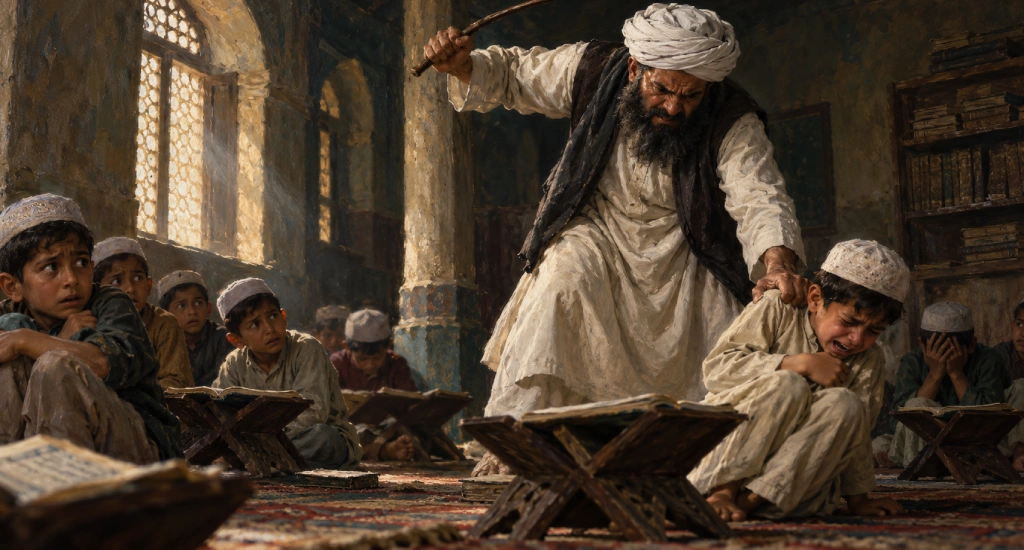
As a child, I attended a government school in Bangladesh. I also went to a local maktab very early each morning to learn Arabic and the Quran. At school we were beaten almost every day, though there was at least some limit to the violence. At the neighborhood maktab, however, the beatings seemed limitless. Our religious teacher could not tolerate the slightest question or inquiry. He wanted us to listen to every word he uttered, memorize it, and never ask questions. We were not taught that one could think critically or ask for an explanation when something was unclear. Saying “Masha Allah” and “Subhan Allah” in response to everything was the accepted practice. Any small deviation brought a brutal beating. It is difficult to convey the horror of those beatings to someone who did not witness them. The punishments were delivered in profoundly inhuman and barbaric ways. Because I was relatively good at my lessons, I often escaped being beaten myself. But seeing other children beaten led me to stop attending Arabic lessons within a few days. Many other children continued to go there. Needless to say, that maktab left a deeply violent imprint on the minds of those children.
When a belief-based educational system establishes obedience in place of inquiry, memorization in place of understanding, and authority in place of reason, corporal punishment becomes an instrument of that authority. If a child is beaten instead of being given reasons for praying, believing a claim, or obeying a rule, submission out of fear becomes safer than learning to reason. When religious law legitimizes beating as a method of education, the maktab teacher finds ready-made moral and religious authorization for his conduct. Hadiths prescribing the beating of children, jurisprudential rules, exemptions from liability in the name of discipline, and the ethical problems they raise make this relationship clear.
Why Children Should Not Be Beaten
Children should not be beaten. Children naturally misbehave and sometimes refuse to listen; their self-control, judgment, and ability to regulate emotions are still developing. They need to be taught what benefits or harms them and how to understand the consequences of their actions. Coercion through pain is no substitute for such learning. Beating can become the language of power for a child: the larger person hurts the smaller person to enforce obedience. Research has associated corporal punishment with greater risks of aggressive behavior, mental health problems, and deterioration in relationships with parents. Children subjected to abuse need safety, dignity, and support. Forcing children into religious practice through beatings assaults the development of their conscience and uses physical force to establish religious obedience. [1]
Horrific incidents of abuse of children in madrasas are reported in our country. In maktabs and madrasas in particular, treating the teacher as the representative of religious authority, and presenting his blows as acts of piety, correction, or a means of salvation in the afterlife, severely restricts a child’s ability to object. Fear of the teacher becomes entangled with fear of Allah. Some Muslims today claim that European culture is supposedly destroying our civilization, traditions, and religious values, and that the principle of not laying hands on children is a conspiracy to ruin Muslim children’s character. Calling the protection of children a religious conspiracy is, in substance, taking a position against their safety. When parents who themselves endured beatings in childhood invoke those experiences as permission to beat their children, they perpetuate a cycle of cruelty.
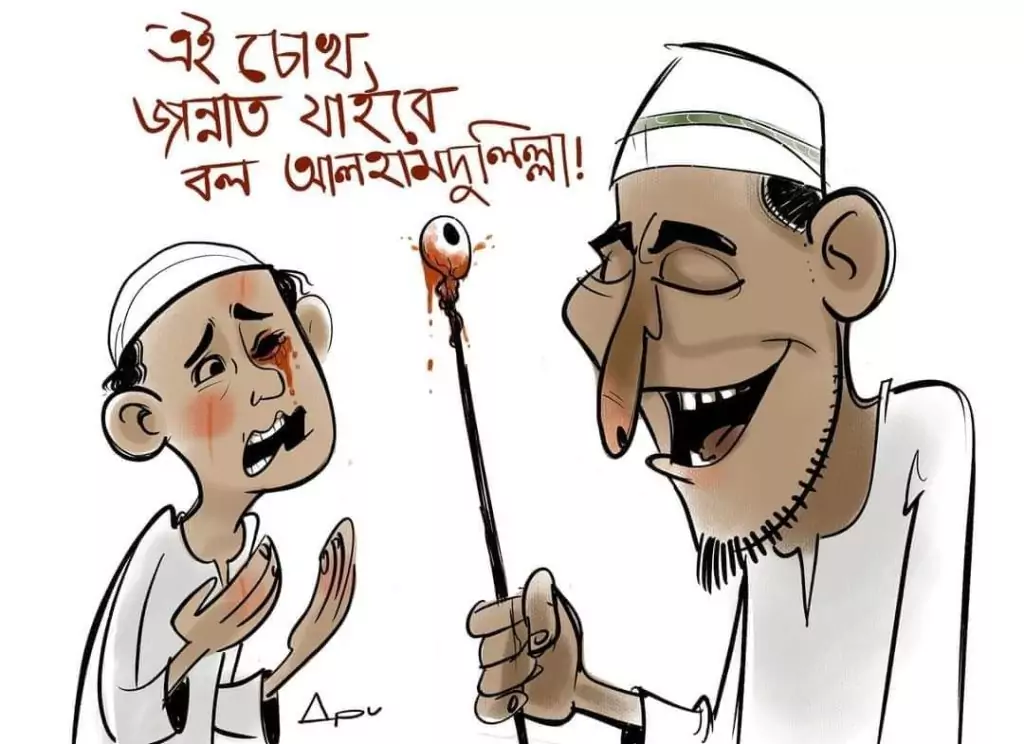
Parents in our society often insist that children cannot grow into decent human beings unless they are beaten. Some even ask teachers to beat their children. Stories are circulated claiming that the parts of the body struck by a teacher will supposedly go to Paradise. Yet they do not consider the consequences for a child’s development. Excessive beatings can cause fear, humiliation, injury to self-respect, and damage to relationships; defiance and aggression may also increase. If the person from whom a child expects protection becomes the source of pain, the child may grow afraid to express feelings or ask for help. A child falling temporarily silent does not mean that the child has been educated in a healthy way. The cartoon below is particularly relevant here. Cartoon credit: Apu’s Cartoon.
Child Development Specialists’ Views
One major problem with beating children is that they may learn to associate power with violence from an early age. They become familiar with the idea that a powerful person may strike a less powerful person and assert authority through bodily harm. As adults, they may reproduce this behavior toward their own children, pupils, domestic workers, or other people under their control. Research has found an association between being subjected to corporal punishment in childhood and supporting such punishment later in life. A social cycle of learned violence develops: the pain inflicted on one generation returns as the disciplinary method of the next. Families and schools could break this cycle. Making beating a moral duty instead supplies it with religious authorization. [2]
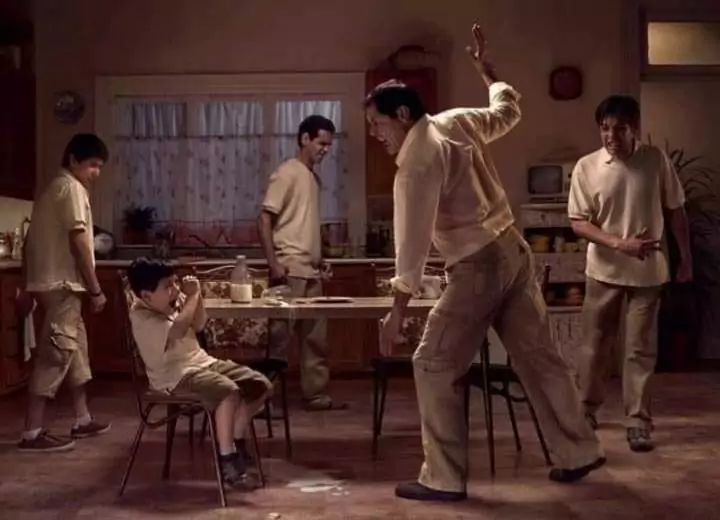
Let us hear from a child development specialist about some of the other harms that physical abuse can cause to children.
Even “Light” Beating Is Not a Harmless Educational Method
Elizabeth Gershoff and Andrew Grogan-Kaylor’s 2016 meta-analysis drew upon data on 160,927 children and examined 111 distinct effect-size measures. Of the 17 outcomes studied, 13 showed statistically significant associations between spanking and an increased risk of adverse outcomes. Importantly, the study examined ordinary forms of corporal punishment, not merely extreme violence involving broken bones or hospitalization. [3]
A child’s psychological safety cannot be measured by counting blows, identifying where they landed, or checking whether a mark remained. When a parent or teacher strikes a child, pain may be accompanied by humiliation, rejection, and helplessness. Even what is defended as “light beating” uses the child’s body as a means of extracting obedience. Explaining a rule and inflicting pain for disobeying it are entirely different acts. The aim of changing behavior does not establish a right to inflict physical harm.
Permission to Beat Children and Immunity under the Pretext of Discipline in Sharia
Islamic jurisprudence permits parents and teachers to beat children for disciplinary purposes. This is more than a description of customary family practices: it includes legal rules concerning the authority to strike, the permissible limits, and liability when injury results. In 2010, Human Rights Watch criticized a judicial ruling in the United Arab Emirates concerning a supposed right to discipline wives and children through physical force. Alongside this modern judicial application, classical jurisprudence contains an express rule of non-liability in al-Buhuti’s work. The video below also features comments by Assim al-Hakeem on this religious permission to beat children. [4]
Now, let us look at some investigative reports. It is worth noting that there are thousands of such videos; these are being presented here merely as examples.
When a Teacher’s Blow Causes Death: Al-Buhuti’s Rule of Non-Liability
Mansur ibn Yunus al-Buhuti, in his al-Rawd al-Murbi‘, addresses within a single legal rule the beating of children, wives, subjects by rulers, and pupils by teachers. His rule states that when the permissible limit is not exceeded, the person administering discipline is not liable for the harm caused. Liability arises if the beating is excessive, goes beyond what is necessary, or is administered to a child who lacks the capacity to understand. Fatwa 148943 applies this principle in answer to a question about a pupil who dies after a teacher strikes the child’s hand lightly. [5]
وإذا أدب الرجل ولده ولم يسرف لم يضمنه، وكذا لو أدب زوجته في نشوز، أو أدب سلطان رعيته، أو أدب معلم صبيا ولم يسرف لم يضمن ما تلف به أي بتأديبه لأنه فعل ما له فعله شرعا ولم يتعد فيه، وإن أسرف أو زاد على ما يحصل به المقصود أو ضرب من لا عقل له من صبي أو غيره ضمن لتعديه.
English translation: If a man disciplines his child without excess, he is not liable for the harm. Likewise, if he disciplines his wife for disobedience, a ruler disciplines his subjects, or a teacher disciplines a child without excess, he is not liable for harm resulting from that discipline, since he performed an act permitted to him by Sharia and did not overstep its bounds. But if he goes to excess, strikes beyond what is needed to achieve the objective, or beats a child or another person who lacks understanding, he is liable because he has exceeded the permitted limits.
This exposes a disturbing ethical problem. Instead of the reality that a child has been injured or killed determining liability, the classification of the perpetrator’s act as “authorized discipline” becomes the basis for exemption. The injury may be acknowledged, yet the person who inflicted it may escape an obligation to compensate the victim. The child’s bodily safety is no longer an unconditional right but depends upon the authorization granted to an adult’s disciplinary authority. The same fatwa states that when death follows punishment exceeding the permissible limits, expiation (kaffarah) is due and blood money (diyah) is borne by the assailant’s ‘aqilah, or legally responsible kin group. Non-liability for harm during authorized discipline and diyah plus kaffarah for fatal excesses mark the legal boundary between permitted beating and punishable injury. [6]
Al-Mawardi’s Ruling: Permission to Strike, Blood Money and Expiation in Cases of Death
Abu al-Hasan al-Mawardi, in al-Hawi al-Kabir, permits teachers and fathers to beat children, but imposes blood money and expiation when such beating causes death. In discussing deliberate fatal excesses and retaliatory punishment (qisas), he also mentions an exception to retaliation for a father who kills his own child. [7]
قال الماوردي : وهذا كما قال . يجوز لمعلم الصبيان أن يؤدبهم بالضرب استصلاحا لهم وهكذا الأب في ولده ، والزوج عند نشوز امرأته ، فإن تعدى أحد هؤلاء في الضرب إلى أن خرج فيه إلى حد التلف فهو قاتل عمدا يجب عليه القود ، إلا الوالد في ولده فتلزمه الدية دون القود ، ولم يتجاوز واحد الاستصلاح فحدث منه التلف فلا قود : لأنه خطأ شبه العمد ، والضارب ضامن لدية المضروب على عاقلته ، والكفارة في ماله .
English translation: Al-Mawardi said: This is as he stated. A teacher of children may discipline them by beating for the purpose of reforming them, as may a father discipline his child and a husband his wife when she is disobedient. If any of these people transgresses the limits of beating to the point of causing death, he is an intentional killer and is subject to retaliation (qisas), with the exception of a father in relation to his child: blood money (diyah), not retaliation, is due from him. If the limits of correction are not exceeded but death nevertheless occurs, there is no retaliation, because it is treated as quasi-intentional homicide (shibh al-‘amd). The assailant is responsible for the victim’s blood money, borne by his ‘aqilah, and the expiation is payable from his own property.
Al-Buhuti’s exemption from liability and al-Mawardi’s imposition of liability are not the same ruling. Yet both begin by accepting an adult’s authority to beat a child. This legal framework does not start from the principle that striking a child is itself forbidden. Instead, it asks who may strike, how hard, and what financial or religious liability follows if death occurs. Awarding compensation after a beating and recognizing a child’s right never to be beaten are entirely different principles.
The Terror of Inhumane Punishment in Hell
When teachers beat children in madrasas, many parents say that a little beating in this world is better than the punishment of Hell. I have heard parents say, “Huzur, we are leaving our child with you; the bones are ours, but the flesh is yours!” In those madrasas, children are supposedly beaten into becoming proper human beings and taught to be civilized. But there is something still more terrifying than those beatings: the threat of endless torture in Hell. Against that background, worldly beatings can begin to seem normal to children, who may also become increasingly psychologically vulnerable.
Descriptions of torture in Hell can be used to instill religious fear in children. Hearing them may lead a child to accept beatings by teachers and parents as trivial compared with far worse punishment in the afterlife. The Quran and hadith describe, among other things, the following punishments:
- 1) Burning embers will be placed beneath the feet, causing the brain to boil. [8]
- 2) Boiling water will be poured over the head, melting the innards and skin. [9]
- 3) Foul, pus-filled water will be given to drink, difficult to swallow; death will approach but never arrive. [10]
- 4) Garments of fire will be imposed. [11]
- 5) Iron maces will strike them; anyone attempting to escape the pain will be driven back. [12]
- 6) When their skin has burned away, it will be replaced so that they continue to feel the punishment. [13]
The Quran explicitly states the purpose of replacing burned skin: to enable the victims to continue experiencing punishment. This is not merely an announcement of death, but a description of maintaining the sensation of pain so that torture continues. [13]
إِنَّ الَّذِينَ كَفَرُوا بِآيَاتِنَا سَوْفَ نُصْلِيهِمْ نَارًا كُلَّمَا نَضِجَتْ جُلُودُهُمْ بَدَّلْنَاهُمْ جُلُودًا غَيْرَهَا لِيَذُوقُوا الْعَذَابَ إِنَّ اللَّهَ كَانَ عَزِيزًا حَكِيمًا
English translation: Surely those who reject Our signs, We will cast them into the Fire. Whenever their skin is burnt completely, We will replace it so they will ˹constantly˺ taste the punishment. Indeed, Allah is Almighty, All-Wise.
— Dr. Mustafa Khattab, The Clear Quran (Surah an-Nisa 4:56).
Surah al-Hajj places together descriptions of garments made of fire, boiling water poured onto heads, the melting of bodies, and iron maces. [9]
هَذَانِ خَصْمَانِ اخْتَصَمُوا فِي رَبِّهِمْ فَالَّذِينَ كَفَرُوا قُطِّعَتْ لَهُمْ ثِيَابٌ مِنْ نَارٍ يُصَبُّ مِنْ فَوْقِ رُءُوسِهِمُ الْحَمِيمُ يُصْهَرُ بِهِ مَا فِي بُطُونِهِمْ وَالْجُلُودُ وَلَهُمْ مَقَامِعُ مِنْ حَدِيدٍ كُلَّمَا أَرَادُوا أَنْ يَخْرُجُوا مِنْهَا مِنْ غَمٍّ أُعِيدُوا فِيهَا وَذُوقُوا عَذَابَ الْحَرِيقِ
English translation: These are two opposing groups that disagree about their Lord: as for the disbelievers, garments of Fire will be cut out for them and boiling water will be poured over their heads, melting whatever is in their bellies, along with their skin. And awaiting them are maces of iron. Whenever they try to escape from Hell—out of anguish—they will be forced back into it, ˹and will be told,˺ “Taste the torment of burning!”
— Dr. Mustafa Khattab, The Clear Quran (Surah al-Hajj 22:19–22).
Read as techniques of torture, these descriptions recall the terrifying scenarios of the Hollywood film Saw. But here they are presented not as the crimes of monstrous human beings, but as exemplary ultimate justice. What idea of the relationship between morality and punishment will a child develop if told every day that disobedience will be punished by burning flesh, replacing the skin so it can be burned again, and forcing attempted escapees back with iron maces? If supreme divine power can make extreme torture just, the beatings inflicted by powerful parents and teachers may appear to that child as smaller versions of the same principle. Securing obedience through fear and cultivating moral understanding are not the same thing.
Children are also taught various descriptions of the rewards of Paradise. Jami‘ at-Tirmidhi 1663 mentions marriage to seventy-two houris as a reward for a martyr; it does not prescribe the same number for every inhabitant of Paradise. The Quran also describes pearl-like boy attendants, discussed in the article about ghilman. If a child’s moral education is confined to terror of excruciating torture on one side and calculations of sensual reward on the other, empathy and independent judgment become secondary. The reason not to injure another person is that the other person suffers, not merely fear of one’s own punishment; the value of a good deed lies in the good it does others, not merely a promised reward. [14]
Islam Has Permitted the Beating of Children
Scholarly statements about beating children are not isolated private opinions without foundation in religious texts. The command to beat ten-year-olds for prayer appears in hadith literature, while the permissibility of beating one’s children, orphans, and pupils is recorded in jurisprudential works. These sources do not simply report that beating happened in society: they establish it as an accepted means of religious discipline.
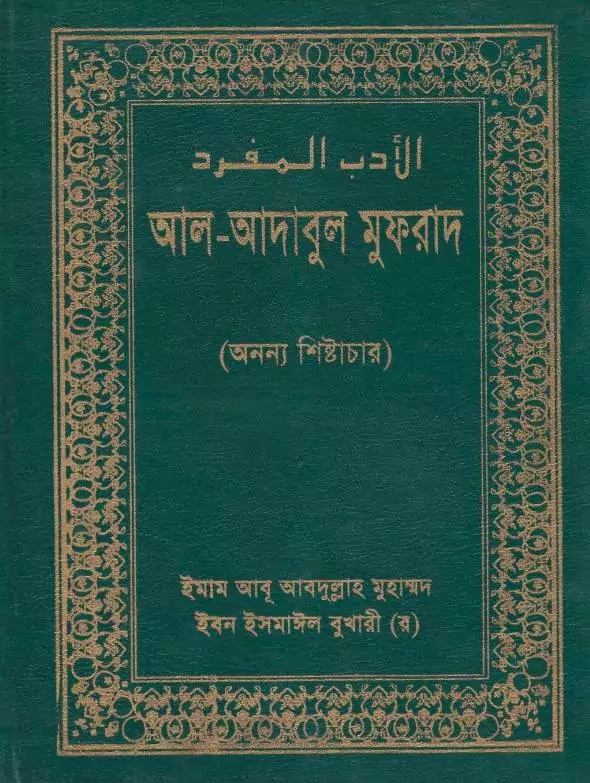
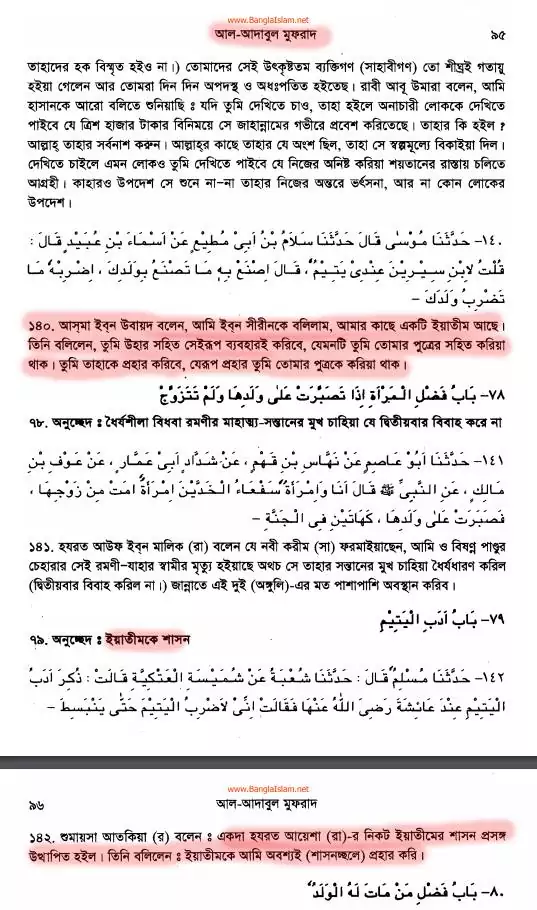
Muhammad ibn Isma‘il al-Bukhari is one of Islam’s best-known hadith compilers. His al-Adab al-Mufrad includes statements not only attributed to Muhammad but also to Companions and later generations. The report below records the words of Muhammad ibn Sirin: an orphan may be beaten for the same reasons as one’s own child. Thus, instructing the caregiver to treat the orphan like a child of the household normalizes striking one’s own children as a disciplinary practice. In trying to ensure that an orphan receives equal care, the instruction extends permission to beat both children. Equal treatment here means not necessarily equal safety, but equal exposure to corporal punishment. [15] [16]
Al-Adab al-Mufrad
Generosity and Orphans
Chapter (77): Be like a merciful father to orphans.
139 (Bengali edition). Asma’ bint ‘Ubayd said, “I said to Ibn Sirin, ‘I have an orphan in my care.’ He said, ‘Treat him as you would treat your own child. Beat him as you would beat your own child.’”
بَابُ كُنَّ لِلْيَتِيمِ كَالأَبِ الرَّحِيمِ
حَدَّثَنَا مُوسَى، قَالَ: حَدَّثَنَا سَلاَّمُ بْنُ أَبِي مُطِيعٍ، عَنْ أَسْمَاءَ بْنِ عُبَيْدٍ قَالَ: قُلْتُ لِابْنِ سِيرِينَ: عِنْدِي يَتِيمٌ، قَالَ: اصْنَعْ بِهِ مَا تَصْنَعُ بِوَلَدِكَ، اضْرِبْهُ مَا تَضْرِبُ وَلَدَكَ.
Grade in the Bengali source: Sahih.
Published English: Al-Adab Al-Mufrad 140.
Further Religious Justifications for Abusing Children
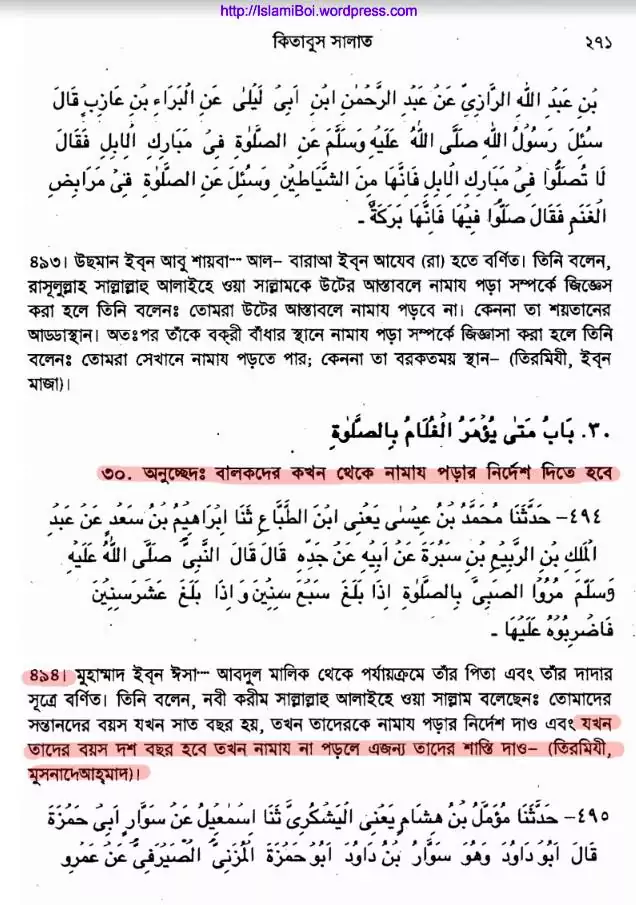
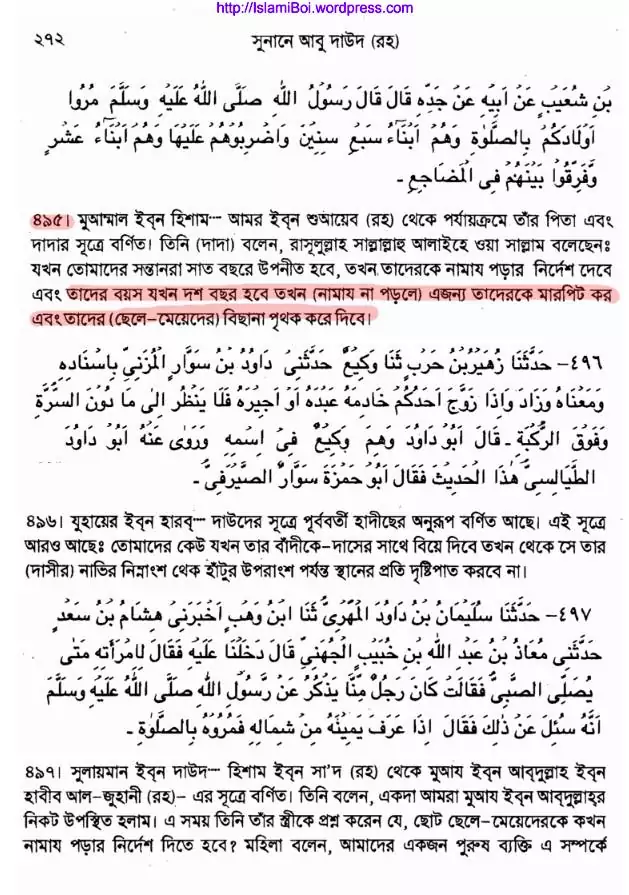
Muhammad instructed that children should be beaten if they fail to pray after reaching the age of ten. This hadith appears in several collections. Let us examine the reports. [17] [18] [19] [20] [21] —
Sunan Abi Dawud (Islamic Foundation, Bengali edition)
Book 2: Prayer
495. Narrated Abdullah ibn Amr ibn al-‘As: The Messenger of Allah said: “Command your children to pray when they become seven years old, and beat them for it (prayer) when they become ten years old; and arrange their beds (to sleep) separately.”
Grade in the Bengali edition: Hasan. Sunnah.com grade: Hasan Sahih (Al-Albani).
Published English: Sunan Abi Dawud 495.
Sunan Abi Dawud (Islamic Foundation, Bengali edition)
Book 2: Prayer
494. Narrated As-Saburah: The Prophet said: “Command a boy to pray when he reaches the age of seven years. When he becomes ten years old, then beat him for prayer.” (Also cited in Tirmidhi and Musnad Ahmad.)
Grade in the Bengali edition: Hasan; Sunnah.com: Hasan Sahih (Al-Albani).
Published English: Sunan Abi Dawud 494.
Jami‘ at-Tirmidhi (verified Bengali edition)
Book 2: Prayer
Chapter 187: When should boys be instructed to pray?
407. Sabrah ibn Ma‘bad al-Juhani narrated that Allah’s Messenger said: “Teach the boy Salat when he is seven years old, and beat him (if he does not pray) when he is ten.”
A report on this subject is also related from Abdullah ibn Amr. Hasan Sahih. Mishkat 572–573; Sahih Abu Dawud 247; al-Irwa 247; comments on Ibn Khuzaymah 1002.
Abu Isa stated that the hadith of Sabrah ibn Ma‘bad is Hasan Sahih and that a number of scholars acted upon it. Ahmad and Ishaq likewise held that a boy must make up prayers omitted after reaching ten years of age. Abu Isa also identifies Sabrah as ibn Ma‘bad al-Juhani, alternatively called ibn Awsajah.
Grade given in the Bengali edition: Hasan. Narrator: Sabrah ibn Ma‘bad al-Juhani.
Published English: Jami‘ at-Tirmidhi 407.
Riyad as-Salihin (Bengali edition)
Miscellaneous
Chapter 38: The duty to instruct one’s family, discerning children and dependents to obey Allah, forbid disobedience, teach good manners and prevent prohibited acts.
4/306 (Bengali edition). Amr ibn Shu‘ayb narrated from his father, from his grandfather Abdullah ibn Amr, that Allah’s Messenger said: “Command your children to pray when they become seven years old; when they reach ten, beat them for prayer and arrange their beds separately.” (Abu Dawud, Hasan chain.)
(1) Abu Dawud 495; Ahmad 16650 and 6717.
Grade in the Bengali edition: Hasan.
The exact Riyad as-Salihin number in the cited Bengali edition does not correspond to Sunnah.com’s hadith 306, which concerns a neighbor’s gift. Published parallel wording: Sunan Abi Dawud 495.
The Jurisprudence of Beating Children: Obedience, Authority and Control over the Body
The hadith directing adults to beat a ten-year-old child over prayer is specific and explicit. Jurists’ interpretations build a wider framework around this order: preparing a child for future obedience before religious obligations become personally binding, giving parents and teachers authority to administer physical punishment, and specifying how much beating is permitted. The language of “correction” lies at the center of this authorization. The child’s opinion or consent is not a condition before physical pain is inflicted; an adult decides which behavior deserves it.
Children, Orphans and Pupils: Ahmad ibn Hanbal’s Permission
Ibn Muflih’s al-Adab al-Shar‘iyyah wa al-Minah al-Mar‘iyyah contains a chapter titled “What Beating of Children Is Permitted, Subject to Its Conditions.” It records statements attributed to Ahmad ibn Hanbal permitting a father to beat his children for manners, the beating of orphans, and teachers’ beating of pupils. [22]
فصل فيما يجوز من ضرب الأولاد بشرطه. قال إسماعيل بن سعيد سألت أحمد عما يجوز فيه ضرب الولد قال: الولد يضرب على الأدب. قال وسألت أحمد هل يضرب الصبي على الصلاة قال إذا بلغ عشرا وقال حنبل إن أبا عبد الله قال اليتيم يؤدب ويضرب ضربا خفيفا. وقال الأثرم سئل أبو عبد الله عن ضرب المعلم الصبيان فقال: على قدر ذنوبهم ويتوقى بجهده الضرب وإن كان صغيرا لا يعقل فلا يضربه.
English translation: Chapter: What forms of beating children are permissible, subject to their conditions. Isma‘il ibn Sa‘id said: I asked Ahmad what a child may permissibly be beaten for. He answered, “A child may be beaten to teach manners.” I then asked Ahmad whether a child should be beaten for prayer. He said, “When he reaches ten.” Hanbal said that Abu Abd Allah stated, “An orphan is to be disciplined and struck lightly.” Al-Athram reported that Abu Abd Allah was asked about a teacher striking pupils. He said, “In proportion to their offenses, but he should make every effort to avoid striking them. If the child is too young to understand, he must not be struck.”
This ruling advises avoiding beating when possible, but it does not abolish the authority to beat. Rather, it conditions the use of that authority on the child’s supposed “offense.” Even for an orphan, the prescription is a light beating. A child who has lost their family has a particularly acute need for safety. When the person providing shelter is also granted a right to strike, care and punitive authority become concentrated in the same hands.
Beating in Quranic Schools: Ibn Sahnun and al-Qabisi
Beating children by teachers is not simply an isolated practice of modern maktabs. In the history of Maliki educational thought, Muhammad ibn Sahnun’s Adab al-Mu‘allimin and Abu al-Hasan al-Qabisi’s al-Risalah al-Mufassalah li-Ahwal al-Muta‘allimin wa Ahkam al-Mu‘allimin wa al-Muta‘allimin address Quran instruction, memorization, relations between teacher and pupil, and educational punishment together. How serious a mistake a child makes, how far the teacher may strike, and when excesses create liability are discussed as part of the rules of instruction. Errors in recitation, failure to memorize, and breaches of discipline are considered within the same educational framework as corporal punishment. [23]
A crucial distinction must be made between a child knowingly refusing a religious rule and a child having difficulty understanding or remembering a lesson. Yet when physical punishment is accepted as a legitimate educational method, the child’s body can become the target in either situation. Thus, physical punishment in Quran-memorization classes was not merely an individual teacher’s conduct, but a question expressly addressed in educational theory. These classical discussions put the authority of the person administering punishment, and the limits of that authority, ahead of the child’s protection.
Source qualification: The precise text, edition, and pagination of the extended Arabic passages in Ibn Sahnun and al-Qabisi require separate verification. Therefore, no unverified Arabic passage has been inserted here as a direct quotation.
Not Obligatory for the Child, Yet Punishable by Beating: Al-Subki’s Argument
Taqi al-Din al-Subki, in Fatawa, vol. 1, p. 379, as cited by IslamQA, describes instructing a child to pray at seven and beating the child at ten as duties of the guardian. He accepts the justification for striking a child for a practice that is not yet obligatory for the child, even comparing it with beating an animal for discipline. On the same page, IslamQA cites Ibn Qudamah’s al-Mughni, vol. 1, p. 357, on training the child to become accustomed to prayer. [24]
هَذَا الْأَمْرُ وَالتَّأْدِيبُ الْمَشْرُوعُ فِي حَقِّ الصَّبِيِّ لِتَمْرِينِهِ عَلَى الصَّلَاةِ، كَيْ يَأْلَفَهَا وَيَعْتَادَهَا، وَلَا يَتْرُكَهَا عِنْدَ الْبُلُوغِ.
English translation: This instruction and the discipline prescribed for a child are intended to train the child in prayer, so that the child becomes familiar with it, grows accustomed to it, and does not abandon it on reaching puberty.
Here pain is not being inflicted on a child for an offense for which the child is legally accountable; it is being used to cultivate future religious obedience. The child is struck for failing to perform an act that is not yet personally obligatory. Using pain to compel a prescribed religious habit before independent judgment has matured reveals the social purpose of this kind of beating: not teaching children to test the truth of beliefs, but establishing a routine of compliance. The aim of instilling a habit does not make an assault moral.
No Religious Accountability before Puberty, Yet Beating at Ten
Sunan Abi Dawud 4403 includes a hadith exempting three categories of people from responsibility for their actions, one of them being a child until puberty. Set beside the instruction to strike a ten-year-old for failing to pray, it sharpens the question: why subject a child to pain to compel religious practice before the child’s full religious obligations have even begun? [25] [26]
Published English hadith: Narrated Ali ibn AbuTalib: The Prophet said: “There are three (persons) whose actions are not recorded: a sleeper till he awakes, a boy till he reaches puberty, and a lunatic till he comes to reason.”
Source: Sunan Abi Dawud 4403. The original Bengali article presents the substance of this hadith rather than a complete chain of transmission.
The presence of these two rules is not, by itself, a formal logical contradiction: one concerns the age of religious accountability, the other the method of training imposed by a guardian. But that distinction intensifies the ethical question. The child who is not held fully responsible for religious transgression can nevertheless be subjected to physical punishment by an adult pursuing a religious training objective.
The Ten-Lash Limit: Ibn al-Qayyim’s Interpretation
In I‘lam al-Muwaqqi‘in, Ibn al-Qayyim explains the hadith limiting punishment to ten lashes by putting the disciplinary beating of a wife, slave, child, and employee into the same category. [27]
وقال النبي صلى الله عليه وسلم: إن الله حد حدودا فلا تعتدوها. وفي حديث النواس بن سمعان الذي تقدم في أول الكتاب والسوران حدود الله، ويراد به تارة جنس العقوبة وإن لم تكن مقدرة، فقوله صلى الله عليه وسلم: لا يضرب فوق عشرة أسواط إلا في حد من حدود الله يريد به الجناية التي هي حق لله. فإن قيل: فأين تكون العشرة فما دونها إذ كان المراد بالحد الجناية؟ قيل: في ضرب الرجل امرأته وعبده وولده وأجيره، للتأديب ونحوه، فإنه لا يجوز أن يزيد على عشرة أسواط؛ فهذا أحسن ما خرج عليه الحديث، وبالله التوفيق.
English translation: The Prophet said, “Allah has prescribed limits, so do not overstep them.” In the previously cited report of al-Nawwas ibn Sam‘an, the two walls represent Allah’s limits; the expression can also refer to a category of punishment even when its measure is not fixed. Therefore, the Prophet’s statement, “No more than ten lashes may be inflicted except for an offense falling under one of Allah’s prescribed limits,” refers to an offense involving a right of Allah. If someone asks, “If ‘limit’ means such an offense, when are ten lashes or fewer applicable?” the answer is: when a man beats his wife, slave, child, or employee for discipline or a comparable reason. In those situations he may not exceed ten lashes. This is the best interpretation of the hadith. And success comes from Allah.
Specifying a number of lashes makes clear that the beating contemplated here is not metaphorical. Grouping a child with a wife, slave, and employee also lays bare the structure of authority: a subordinate is exposed to the physical punishment of the person who holds power. The child’s age, vulnerability, and dependence do not remove that exposure. Limiting blows to ten and denying the right to strike altogether are fundamentally different principles.
Modern Scholars Also Affirm a Teacher’s Right to Beat
Salih al-Fawzan’s remarks, cited from Ighathat al-Mustafid bi-Sharh Kitab al-Tawhid, pp. 282–284, describe beating by teachers and other disciplinary authorities as a method of education. Such beating is permitted as considered necessary, with restrictions against splitting the skin or breaking bones. The teacher is therefore accorded religious permission to beat a pupil. The fact that a child’s bones are not broken does not mean that the child’s bodily dignity is respected. [28]
كيف يكون ضرب الأطفال على الصلاة ؟
How should children be beaten for prayer?
11/محرم/1430 الموافق 08/يناير/2009
11 Muharram 1430 AH, corresponding to January 8, 2009.
Question no. 127233.
كيف يكون ضرب الأطفال على الصلاة ؟
How should children be beaten for prayer?
الجواب
Answer
الحمد لله والصلاة والسلام على رسول الله، وبعد:
Praise be to Allah, and blessings and peace upon the Messenger of Allah. To proceed:
فقد روى أبو داود (495) وأحمد (6650) عَنْ عَمْرِو بْنِ شُعَيْبٍ عَنْ أَبِيهِ عَنْ جَدِّهِ قَالَ : قَالَ رَسُولُ اللَّهِ صَلَّى اللَّهُ عَلَيْهِ وَسَلَّمَ : ( مُرُوا أَوْلَادَكُمْ بِالصَّلَاةِ وَهُمْ أَبْنَاءُ سَبْعِ سِنِينَ ، وَاضْرِبُوهُمْ عَلَيْهَا وَهُمْ أَبْنَاءُ عَشْرٍ ، وَفَرِّقُوا بَيْنَهُمْ فِي الْمَضَاجِعِ ) . وصححه الألباني في “الإرواء” (247)
Abu Dawud (495) and Ahmad (6650) narrated from Amr ibn Shu‘ayb, from his father, from his grandfather, who said that the Messenger of Allah said: “Tell your children to pray when they are seven years old; beat them for it when they are ten, and separate them in their beds.” Al-Albani authenticated the hadith in al-Irwa (247).
قال ابن قدامة رحمه الله في “المغني” (1/357) :
Ibn Qudamah said in al-Mughni (1/357):
” َهَذَا الْأَمْرُ وَالتَّأْدِيبُ الْمَشْرُوعُ فِي حَقِّ الصَّبِيِّ لِتَمْرِينِهِ عَلَى الصَّلَاةِ , كَيْ يَأْلَفَهَا وَيَعْتَادَهَا , وَلَا يَتْرُكَهَا عِنْدَ الْبُلُوغِ ” انتهى .
“This command and the prescribed discipline are intended to train the child in prayer, so that the child becomes familiar with it, grows accustomed to it, and does not abandon it at puberty.” End of quotation.
وقال السبكي :
Al-Subki said:
” يَجِبُ عَلَى الْوَلِيِّ أَنْ يَأْمُرَ الصَّبِيَّ بِالصَّلَاةِ لِسَبْعٍ وَيَضْرِبَهُ عَلَيْهَا لِعَشْرٍ .
“It is obligatory for a guardian to order a child to pray at seven and beat the child for it at ten.
ولَا نُنْكِرُ وُجُوبَ الْأَمْرِ بِمَا لَيْسَ بِوَاجِبٍ ، وَالضَّرْبَ عَلَى مَا لَيْسَ بِوَاجِبٍ ، وَنَحْنُ نَضْرِبُ الْبَهِيمَةَ لِلتَّأْدِيبِ فَكَيْفَ الصَّبِيُّ ؟ وَذَلِكَ لِمَصْلَحَتِهِ وَأَنْ يَعْتَادَ بِهَا قَبْلَ بُلُوغِهِ ” انتهى ملخصا .
We do not object to the obligation of commanding an act that is not obligatory for the child, or to beating the child for failing to perform what is not obligatory. We beat animals for discipline; why not a child? This is for the child’s benefit, so that the habit is established before puberty.” End of abridged quotation.
“فتاوى السبكي” (1/379)
Source: Fatawa al-Subki, 1/379.
فيؤمر الصبي والجارية بالصلاة لسبع , ويضربان عليها لعشر , كما يؤمران بصوم رمضان , ويشجعان على كل خير ، من قراءة القرآن , وصلاة النافلة , والحج والعمرة , والإكثار من التسبيح والتهليل والتكبير والتحميد , ويمنعان من جميع المعاصي .
Accordingly, boys and girls are instructed to pray at seven and beaten for it at ten. They are likewise ordered to fast during Ramadan and encouraged in all good deeds, including reciting the Quran, voluntary prayers, Hajj and Umrah, frequent tasbih, tahlil, takbir and tahmid, and are prevented from committing sins.
ويشترط في ضرب الصبي على الصلاة أن يكون ضربا هينا غير مبرّح ، لا يشق جلدا ، ولا يكسر سنا أو عظما ، ويكون على الظهر أو الكتف وما أشبه ذلك ، ويتجنب الوجه لأنه يحرم ضربه ، لنهي النبي صلى الله عليه وسلم .
The conditions for beating a child over prayer are that the beating be light and not severe, not split the skin or break a tooth or bone, and be administered on the back, shoulder, or a similar place, while avoiding the face, since striking the face is prohibited by the Prophet.
ولا يكون فوق عشرة أسواط ، ويكون للتأديب والتربية ، فلا يظهر به الرغبة في العقاب إلا عند الحاجة إلى بيان ذلك ، لكثرة نفور الصبي وتركه للصلاة ونحوه .
The beating must not exceed ten lashes and must be for discipline and education. A desire to punish should not be displayed, except when explaining the punishment becomes necessary because the child repeatedly resists, abandons prayer, or behaves similarly.
عن أبي بردة الأنصاري أنه سمع رسول الله صلى الله عليه وسلم يقول : ” لا يُجلد أحدٌ فوق عشرة أسواط إلا في حد من حدود الله ” . رواه البخاري ( 6456 ) ومسلم ( 3222 ) .
Abu Burdah al-Ansari reported hearing the Messenger of Allah say: “Nobody may be given more than ten lashes except in a punishment prescribed by Allah.” Recorded by al-Bukhari (6456) and Muslim (3222).
قال ابن القيم رحمه الله :
Ibn al-Qayyim said:
” فقوله صلى الله عليه وسلم : ” لا يضرب فوق عشرة أسواط إلا في حد من حدود الله ” يريد به الجناية التي هي حق لله .
“The Prophet’s statement, ‘No more than ten lashes except in one of Allah’s prescribed limits,’ refers to a crime involving a right of Allah.
فإن قيل : فأين تكون العشرة فما دونها إذ كان المراد بالحد الجناية ؟ .
If it is asked, “If a prescribed limit here means an offense, in which situations are ten lashes or fewer permitted?”
قيل : في ضرب الرجل امرأته وعبده وولده وأجيره , للتأديب ونحوه , فإنه لا يجوز أن يزيد على عشرة أسواط ; فهذا أحسن ما خُرِّج عليه الحديث ” انتهى .
The answer is: when a man beats his wife, slave, child, or employee for discipline or a similar purpose; he may not exceed ten lashes. This is the most appropriate way to understand the hadith.” End of quotation.
إعلام الموقعين ” ( 2/23 )
Source: I‘lam al-Muwaqqi‘in, 2/23.
كما ينبغي أن لا يكون أمام أحد ، صيانة لكرامة الصبي أمام نفسه وأمام غيره من أصحابه وغيرهم .
To protect a child’s sense of dignity in the eyes of the child and of companions and others, the child should not be beaten in front of anyone.
وينبغي أن يُعلم من سيرة الأب مع أبنائه ، وتأديبه لهم أنه لا يضرب من يضربه إلا طاعة لله ولرسوله صلى الله عليه وسلم ، وأنه لا قصد له من وراء ذلك إلا تمام مصلحته ، والحرص على تربيته على الوجه المشروع ، حتى لا يشب الصبي كارها للأمر الشرعي الذي يشق عليه ويضرب من أجل تركه .
The father’s treatment and discipline of his children should demonstrate that when he beats someone, it is only in obedience to Allah and His Messenger. His sole aim should be the child’s complete welfare and lawful upbringing, so that the child does not grow up hating the religious requirement that seemed difficult and for neglecting which the child was beaten.
قال الشيخ ابن باز رحمه الله :
Shaykh Ibn Baz said:
” والعناية بأهل البيت ، لا تغفل عنهم يا عبد الله ، عليك أن تجتهد في صلاحهم ، وأن تأمر بنيك وبناتك بالصلاة لسبع ، وتضربهم عليها لعشر ، ضربا خفيفا يعينهم على طاعة الله ، ويعودهم أداء الصلاة في وقتها ، حتى يستقيموا على دين الله ويعرفوا الحق ، كما صحت بذلك السنة عن رسول الله صلى الله عليه وسلم ” انتهى ملخصا .
“Take care of your household; O servant of Allah, do not neglect them. Strive to correct them. Order your sons and daughters to pray at seven, and beat them lightly for it at ten, so that this helps them obey Allah and habituates them to prayer at the proper times, until they become steadfast in Allah’s religion and recognize the truth. This is established in the authentic Sunnah of the Messenger of Allah.” Abridged quotation.
“مجموع فتاوى ابن باز” (6/46)
Source: Majmu‘ Fatawa Ibn Baz, 6/46.
وقال الشيخ ابن عثيمين رحمه الله :
Shaykh Ibn Uthaymin said:
” أمر النبي صلى الله عليه وسلم أن نأمر أولادنا بالصلاة لسبع سنين ، وأن نضربهم عليها لعشر سنين ، مع أنهم لم يُكلفوا بعد ، من أجل أن يتمرنوا على فعل الطاعة ويألفوها ، حتى تسهل عليهم بعد الكبر ، وتكون محبوبة لديهم ، كذلك الأمور التي ليست بالمحمودة ، لا ينبغي أن يعود الصغار عليها وإن كانوا غير مكلفين ؛ وذلك لأنهم يألفونها عند الكبر ويستسيغونها” انتهى .
“The Prophet commanded us to order our children to pray at seven and beat them over it at ten, even though they are not yet legally accountable. The purpose is to train them in obedience and make it familiar, so that after growing up it is easy and dear to them. Likewise, children should not be habituated to objectionable acts, even before becoming legally accountable, because they will grow accustomed to them and find them acceptable in adulthood.” End of quotation.
“فتاوى نور على الدرب” (11/386)
Source: Fatawa Nur ‘ala al-Darb, 11/386.
وقال الشيخ أيضا :
The shaykh also said:
” الأمر للوجوب ، لكن يقيد بما إذا كان الضرب نافعاً ؛ لأنه أحياناً تضرب الصبي ولكن ما ينتفع بالضرب ، ما يزداد إلا صياحاً وعويلاً ولا يستفيد ، ثم إن المراد بالضرب الضرب غير المبرح ، الضرب السهل الذي يحصل به الإصلاح ولا يحصل به الضرر ” انتهى .
“The command is obligatory, provided the beating is beneficial. Sometimes you beat a child and the child derives no benefit, but only screams and wails more. What is intended is not severe beating, but a light beating that brings about correction without harm.” End of quotation.
“لقاء الباب المفتوح” (95/18)
Source: Liqa al-Bab al-Maftuh, 95/18.
وقال رحمه الله أيضا :
He also said:
” لا يضرب ضرباً مبرحاً ، ولا يضرب على الوجه مثلاً ، ولا على المحل القاتل ، وإنما يضرب على الظهر أو الكتف أو ما أشبه ذلك مما لا يكون سبباً في هلاكه . والضرب على الوجه له خطره ؛ لأن الوجه أعلى ما يكون للإنسان وأكرم ما يكون على الإنسان ، وإذا ضرب عليه أصابه من الذل والهوان أكثر مما لو ضرب على ظهره ، ولهذا نهي عن الضرب على الوجه ” انتهى .
“A severe beating is not permitted. The face or any potentially fatal part must not be struck; rather, the blow should fall on the back, shoulder, or a similar place where it would not cause death. Striking the face is especially dangerous because the face is the most honorable part of a person, and a blow there causes greater humiliation than a blow to the back. That is why striking the face was prohibited.” End of quotation.
“فتاوى نور على الدرب” (13/2)
Source: Fatawa Nur ‘ala al-Darb, 13/2.
وقال الشيخ الفوزان :
Shaykh al-Fawzan said:
” الضّرب وسيلة من وسائل التربية ، فللمعلِّم أن يضرب ، وللمؤدِّب أن يضرب ، ولولّي الأمر أن يضرب تأديباً وتعزيراً ، وللزوج أن يضرب زوجته على النشور .
“Beating is one means of education. A teacher may beat, a disciplinarian may beat, a guardian may beat for discipline or discretionary punishment, and a husband may beat his wife for disobedience.
لكن يكون بحدود ، لا يكون ضرباً مبرحاً يشقّ الجلْد أو يكسرُ العظم ، وإنّما يكون بقدر الحاجة ” انتهى ملخصا .
But it must be within limits: not a severe beating that splits the skin or breaks a bone, but only as much as is required.” Abridged quotation.
“إغاثة المستفيد بشرح كتاب التوحيد” (282- 284)
Source: Ighathat al-Mustafid bi-Sharh Kitab al-Tawhid, pp. 282–284.
كما ينبغي التنبه أيضا إلى أن تأديب الصبي ليس على ترك الصلاة فقط ، وإنما هو أيضا على التهاون بها في شروطها وأركانها وواجباتها ، فقد يصلي الصبي ولكنه يجمع بين الصلوات ، أو يصلي بغير وضوء ، أو لا يحسن يصلي ، فيجب تعليمه شأن الصلاة كله ، والتأكيد على واجباتها وأركانها وشروطها ، فإن فرط في شيء من ذلك ألححنا عليه في النصح ، وعلمناه مرة بعد مرة ، فإن أصر أُدّب بالضرب حتى يحسن الصلاة .
It should also be noted that disciplining a child is not restricted to abandoning prayer; it also applies to carelessness over its conditions, essential components, and obligations. A child might pray but combine prayers, pray without ablution, or perform the prayer incorrectly. The child must be taught all aspects of prayer, with emphasis on its obligations, essential acts, and conditions. If the child neglects these, the child must repeatedly receive instruction and advice. If the child persists, the child is to be disciplined by beating until the prayer is performed correctly.
والله تعالى أعلم .
Allah knows best.
المراجع
References
المصدر:
Source:
الإسلام سؤال وجواب
Islam Question & Answer.
Does Entrusting a Child to a Teacher Authorize Beating?
Al-Mawsu‘ah al-Fiqhiyyah, 13/13, as cited in IslamQA fatwa 517621, sets out a number of conditions on a teacher’s authority to beat a pupil: the blows must remain within accepted educational limits; there must be reason to believe they will not cause injury; they must be administered with the hand rather than a stick; and they must not exceed three. Merely entrusting a child to a teacher for instruction is not assumed to grant permission to beat; express parental permission is also discussed. Other Shafi‘i jurists are reported to have allowed beating even without such permission. The disagreement in this jurisprudential discussion concerns how authority to strike is established, rather than starting with an absolute right of children to be free from corporal punishment. [29]
The premise that a parent’s consent may give another person permission to punish a child’s body is itself ethically objectionable. Parents entrust their children to teachers for learning, care, and safety. They do not own a transferable right to have someone strike their children. The cruel phrase “the bones are ours, but the flesh is yours” denies the child recognition as a separate person. When jurisprudential calculations about permission combine with that attitude, the child’s own objections, pain, and fear disappear from view.
Discipline Mixed with Revenge: Legitimizing Beating through Intent
Islamweb fatwa 258508 discusses whether beating a child out of revenge, to satisfy one’s anger, or under the pressures of daily life is forbidden. The answer prohibits beating done purely to vent anger. But when the intent to discipline is mixed with a desire for revenge, the answer does not declare the beating unlawful; depending on the principal motive, it may be considered disliked (makruh). This produces a striking asymmetry between a child’s pain and an adult’s claim about the adult’s intentions. The person inflicting the blows can describe the act as “discipline,” while the child has no means of examining the assailant’s internal motive. [30]
Saying “I did it for the child’s own good” afterward does not undo the blows. When resentment or revenge is mixed with discipline, the consequences are felt by the very same body. Religious classifications of intent do nothing to erase the child’s fear, humiliation, or helplessness. Placing the adult’s alleged motive at the center of legitimacy while subordinating the child’s experience serves to protect the privileges of authority. Making a child’s safety dependent upon the assailant’s assertion of good intentions is a weak safeguard.
Islamweb, fatwa 258508 — Significant passages from the original question and answer
هل ضرب الأطفال بغير نية التأديب: تشفيا، أو انتقاما، أو تحت تأثير ضغوط الحياة، محرم، أو مكروه كراهة تنزيه؟
English: Is beating children without intending discipline—for the purpose of venting resentment, revenge, or under pressure from life—prohibited, or merely mildly disliked (makruh tanzihi)?
فالأصل حرمة إيذاء الطفل
English: The basic rule is that harming a child is forbidden.
وإنما يستثنى من ذلك ما إذا وجدت فيه مصلحة معتبرة شرعا، كالتأديب.
English: An exception is made where there is an interest recognized by Sharia, such as discipline.
فعلى ذلك، فإن تمحضت النية في ضرب الطفل للتشفي ونحوه، دون قصد التأديب، فهو محرم.
English: Thus, if beating a child is motivated solely by resentment or a similar purpose, without any intention to discipline, it is forbidden.
أما إن ضرب الطفل للتأديب، ولكن شاب ذلك رغبة التشفي ونحوها، فهذا لا يحرم
English: But if the child is beaten for discipline and the desire to vent resentment or a similar motive is mixed in, the beating is not forbidden. The end of the fatwa adds that beating in anger may be regarded as disliked.
Source: Islamweb fatwa 258508, June 19, 2014.
A Whip in the Home: Governing through Fear before the Blow
IslamQA fatwa 286309 examines several chains of transmission and scholarly assessments concerning reports about hanging a whip where members of a household can see it. Al-Albani rated a related narration Hasan, while other versions received weak assessments from Abu Hatim and other hadith specialists. Explaining another report about hanging a whip in the home, Abd al-Ra’uf al-Munawi describes stages of reprimanding, threatening, displaying the instrument of beating, and striking if these measures fail. [31] [32]
(رحم الله امرأ علق في بيته سوطا يؤدب به أهله)؛ أي: من أساء الأدب منهم ولا يتركهم هملا، وقد يكون التأديب مقدما على العفو في بعض الأحوال، وإنما قال علق ولم يقتصر على قوله أدب مع كونه أخصر؛ إيذانا بأنه لا يضرب أو لا يزجر ويهدد ويحضر لهم آلة الضرب، فإن نجع ذلك فيهم لا يتعداه لحصول الغرض، وإلا ضرب ويتقي الوجه والمقاتل، ولا يقصد بضربه تشفيا ولا انتقاما وإلا عاد وباله عليه.
English translation: “May Allah have mercy on a man who hangs a whip in his home with which he disciplines his household.” That is, he does not leave those who misbehave without correction. In certain circumstances, discipline may take precedence over forgiveness. The report says “hangs” instead of simply “disciplines,” although the latter would be shorter, to suggest that he should refrain from immediately beating them: he first rebukes and threatens, bringing the implement of beating before them. If this produces the desired result, he goes no further. Otherwise he beats them, avoiding the face and vital areas. He must not strike out of resentment or a desire for revenge; if he does, the consequences will rebound upon him.
Al-Munawi called the chain of this report weak. His work nevertheless records a practical interpretation of discipline alongside the narration. In that interpretation, the whip is not just an instrument of injury but a way to keep the possibility of injury constantly visible. The child need not be beaten every time for a whip hanging on the wall to communicate a permanent message: disobedience will bring pain. Such fear can teach a child to conceal questions, refuse to admit mistakes, or perform obedience before adults. Silence under threat of punishment is not the same thing as the independent ability to distinguish right from wrong.
Rejecting Beating Becomes a Religious Objection
Toward the end of fatwa 286309, a person who entirely rejects and condemns disciplinary beating as having no possible benefit or legitimate purpose is described as opposing the method of Sharia, which enjoins beating when deemed necessary. In that account, even a moral decision not to beat children becomes an issue of religious obedience. [33]
This places families under pressure from two directions. Religious texts are invoked to authorize beating children; then, if parents reject the method itself as wrong, they may be accused of opposing religious law. The weapon is not merely held by the teacher or parent: a belief-based obligation to defend the practice emerges alongside it. Turning a child’s pain and safety into a test of obedience intensifies the exercise of power over that child. The effectiveness of an educational method must be assessed through children’s actual development and outcomes; religious authorization does not prove it harmless.
IslamQA, fatwa 286309 — Keeping a whip at home, the status of the reports, and rejecting beating
لا ترفع العصا عن أهلك، وأخفهم في الله عز وجل
English: Do not remove the rod from your household; make them fear Allah, the Mighty and Majestic. The fatwa also records Abu Hatim’s severe criticism of the reliability of this narration.
وعلى القول بحسن الحديث، فإنه لا يعلم من أهل العلم من قال بوجوب تعليق السوط
English: Even assuming the narration is Hasan, no scholar is known to have said that hanging up a whip is obligatory.
لو اعتقد أن التأديب بالضرب لا يفيد ولا مصلحة فيه مطلقا ويعيب ذلك، فإنه بهذا يكون معارضا لطريق الشرع
English: The fatwa states that a person who believes discipline through beating can never be useful or beneficial and condemns it altogether is thereby opposing the method of Sharia.
Two distinct positions are involved: hanging up a whip is not obligatory, but categorically denying any possible benefit to corporal discipline where Sharia deems it necessary is treated as religious opposition.
Source: IslamQA fatwa 286309, August 18, 2020.
A Painful Blow to Aisha’s Chest
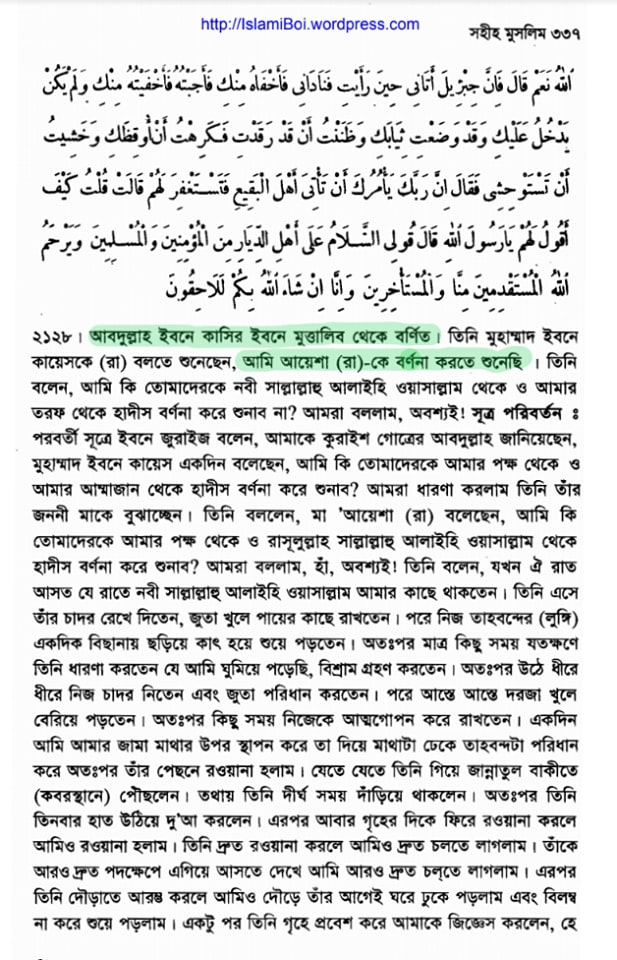
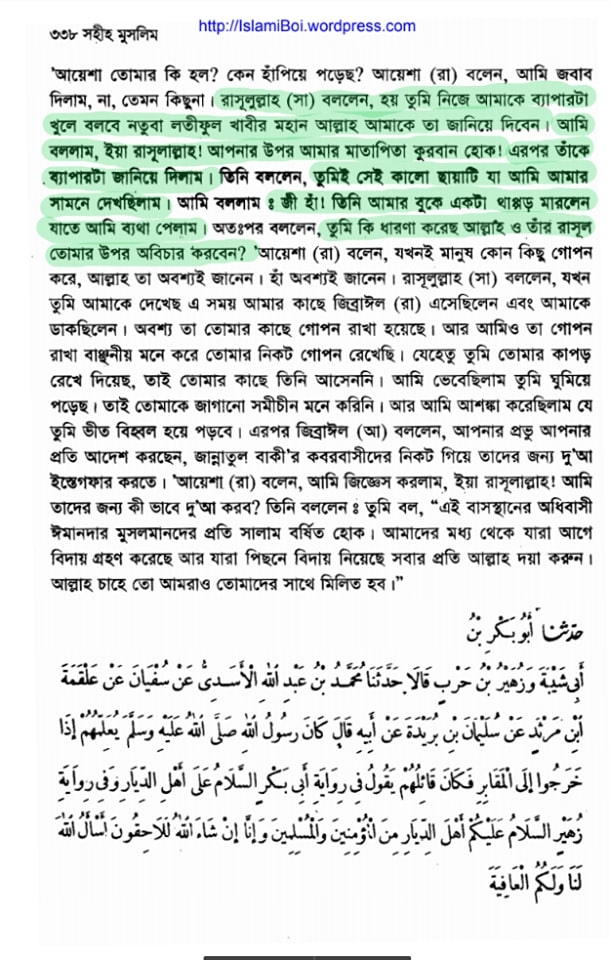
Hadith literature records the child marriage of Aisha, Muhammad’s wife. In another incident narrated by Aisha, Muhammad left the house at night and she followed him. After he returned, Muhammad discovered what had happened and struck her chest hard enough to cause pain. Her narration explicitly says: He struck me in the chest in a way that hurt me. [34] [35]
Sunan an-Nasa’i (Islamic Foundation Bengali edition)
Book 37: Treatment of Wives
Chapter 4: Jealousy
3965 (Bengali edition). Sulayman ibn Dawud and Muhammad ibn Qays transmit the following narration from Aisha. The complete corresponding account has been published in English in Sahih Muslim 974b:
Muhammad b. Qais said (to the people): Should I not narrate to you (a hadith of the Holy Prophet) on my authority and on the authority of my mother? We thought that he meant the mother who had given him birth. He (Muhammad b. Qais) then reported that it was ‘A’isha who had narrated this: Should I not narrate to you about myself and about the Messenger of Allah (ﷺ)? We said: Yes.
She said: When it was my turn for Allah’s Messenger (ﷺ) to spend the night with me, he turned his side, put on his mantle and took off his shoes and placed them near his feet, and spread the corner of his shawl on his bed and then lay down till he thought that I had gone to sleep. He took hold of his mantle slowly and put on the shoes slowly, and opened the door and went out and then closed it lightly.
I covered my head, put on my veil and tightened my waist wrapper, and then went out following his steps till he reached Baqi’. He stood there and he stood for a long time. He then lifted his hands three times, and then returned and I also returned. He hastened his steps and I also hastened my steps. He ran and I too ran. He came (to the house) and I also came (to the house).
I, however, preceded him and I entered (the house), and as I lay down in the bed, he (the Holy Prophet) entered the (house), and said: Why is it, O ‘A’isha, that you are out of breath? I said: There is nothing. He said: Tell me or the Subtle and the Aware would inform me. I said: Messenger of Allah, may my father and mother be ransom for you, and then I told him (the whole story). He said: Was it the darkness (of your shadow) that I saw in front of me? I said: Yes.
He gave me a nudge on the chest which I felt, and then said: Did you think that Allah and His Apostle would deal unjustly with you? She said: Whatsoever the people conceal, Allah will know it. He said: Gabriel came to me when you saw me. He called me and he concealed it from you. I responded to his call, but I too concealed it from you (for he did not come to you), as you were not fully dressed. I thought that you had gone to sleep, and I did not like to awaken you, fearing that you may be frightened.
He (Gabriel) said: Your Lord has commanded you to go to the inhabitants of Baqi’ (to those lying in the graves) and beg pardon for them. I said: Messenger of Allah, how should I pray for them (How should I beg forgiveness for them)? He said: Say, Peace be upon the inhabitants of this city (graveyard) from among the Believers and the Muslims, and may Allah have mercy on those who have gone ahead of us, and those who come later on, and we shall, God willing, join you.
The Bengali edition also records a narrator’s variant reading of the words (رابية) and (حشيا), concerning breathlessness after running.
Grade stated in the Bengali Sunan an-Nasa’i: Sahih. Narration attributed to Muhammad ibn Qays. The number 3965 in the Bengali edition has not been confirmed as identical to Sunnah.com’s an-Nasa’i 3965, whose published English text is a short cross-reference; the full English account quoted here is from Sahih Muslim 974b.
The same incident is also reported in Sahih Muslim. Its Arabic wording includes فَلَهَدَنِي فِي صَدْرِي لَهْدَةً أَوْجَعَتْنِي—“He struck me in the chest in a way that hurt.” The painful physical blow belongs to Aisha’s reported account; it is not merely the translator’s interpretation. [34]
Muhammad’s Orders Resulting in the Killing of Children
A hadith describes examining the captives of Banu Qurayza for pubic-hair growth to decide who would be singled out for execution and who would remain among the captives. According to Atiyyah al-Qurazi, those who had grown pubic hair were killed, while he was spared because he had not. Rather than considering whether each person had fought, what offense they had committed, or their actual age, the decision used a physical sign of puberty as the criterion between life and death. From the standpoint of modern children’s rights, pubic-hair growth does not turn an adolescent into an adult combatant or someone eligible for execution.
Jami‘ at-Tirmidhi (Islamic Foundation Bengali edition)
Book 24: Military Expeditions
Chapter: Those who surrender to a Muslim’s arbitration
1590 (Bengali edition). Narrated Atiyyah al-Qurazi: “We were presented to the Messenger of Allah (ﷺ) on the day of (the battle of) Quraizah. Whoever had pubic hair was killed and whoever did not was left to his way. I was of those who did not have pubic hair so I was left to my way.”
The Bengali edition cites Ibn Majah 2541 and Tirmidhi 1584 (al-Madani edition). Grade stated: Sahih.
Verified English source: Jami‘ at-Tirmidhi 1584 (rated Hasan Sahih in the published commentary).
Muhammad was also asked about women and children of polytheists who were harmed during surprise attacks at night. His reply was, “They are from them.” Rather than recognizing the distinct vulnerability of women and children, this statement treats them as belonging to the hostile population and accepts their deaths in such raids. The general prohibition against killing women and children exists alongside a permission for night attacks that may kill them; the latter creates a serious exception to their safety in practice.
Sahih Muslim (Islamic Foundation Bengali edition)
Book 33: Jihad and its rules
Chapter 9: No liability for the unintentional killing of women and children during night raids
4399 (Bengali edition). Reported on the authority of Sa’b ibn Jaththamah that the Prophet of Allah, when asked about the women and children of the polytheists being killed during the night raid, said: “They are from them.”
Grade: Sahih.
Published English equivalent: Sahih Muslim 1745a.
Sahih Muslim (Hadith Academy Bengali edition)
Book 33: Jihad and Expeditions
Chapter 9: No liability for the unintentional killing of women and children in surprise night attacks
4442 (Bengali edition). It is narrated by Sa’b ibn Jaththamah that he said to the Prophet: “Messenger of Allah, we kill the children of the polytheists during the night raids.” He said: “They are from them.” (Islamic Foundation no. 4400; Islamic Center no. 4400.)
Grade: Sahih.
Published English equivalent: Sahih Muslim 1745b.
Sunan Ibn Majah
Book 18: Jihad
1/2839 (Bengali edition). It was narrated that Ibn Abbas said: “Sa’b bin Jaththamah said: ‘The Prophet (ﷺ) was asked about the polytheists who are attacked at night, and their women and children are killed. He said: They are from among them.‘”
Grade: Sahih.
Published English: Sunan Ibn Majah 2839.
Hellfire Even for a Girl Buried Alive
The report from Abu Dawud below declares both a girl who has been buried alive and the woman who buried her to be inhabitants of Hell. The Arabic الْوَائِدَةُ means the woman who buries a child alive; the Arabic does not contain the word “mother.” The ethical problem is that the child who was murdered is also declared subject to punishment. Placing the perpetrator and her murdered victim under the same punishment in the afterlife is incompatible with justice toward the victim. [36]
Sunan Abi Dawud (Islamic Foundation Bengali edition)
Book 35: Sunnah
Chapter 18: The children of polytheists
4642 (Bengali edition). ‘Amir reported the Messenger of Allah as saying: “The woman who buries alive her new-born girl and the girl who is buried alive both will go to Hell.” This tradition was also transmitted by Ibn Mas‘ud from the Prophet through a different chain of narrators.
Grade in the Bengali edition: Sahih. Narrator: al-Sha‘bi.
Published English: Sunan Abi Dawud 4717.
The original Arabic does not omit the murdered child. [37]
حَدَّثَنَا إِبْرَاهِيمُ بْنُ مُوسَى الرَّازِيُّ، حَدَّثَنَا ابْنُ أَبِي زَائِدَةَ، قَالَ حَدَّثَنِي أَبِي، عَنْ عَامِرٍ، قَالَ قَالَ رَسُولُ اللَّهِ صلى الله عليه وسلم: الْوَائِدَةُ وَالْمَوْءُودَةُ فِي النَّارِ. قَالَ يَحْيَى بْنُ زَكَرِيَّا قَالَ أَبِي فَحَدَّثَنِي أَبُو إِسْحَاقَ أَنَّ عَامِرًا حَدَّثَهُ بِذَلِكَ عَنْ عَلْقَمَةَ عَنِ ابْنِ مَسْعُودٍ عَنِ النَّبِيِّ صلى الله عليه وسلم.
English translation: Ibrahim ibn Musa al-Razi narrated to us: Ibn Abi Za’idah narrated to us, saying: My father narrated to me from Amir, who said that the Messenger of Allah said: “The woman who buries a child alive and the girl who is buried alive are in the Fire.” Yahya ibn Zakariyya said that his father told him that Abu Ishaq had narrated the same statement from Amir, who transmitted it from Alqamah, from Ibn Mas‘ud, from the Prophet.
Published English: Sunan Abi Dawud 4717.
The Killing of Disbelievers’ Children in the Quran and Hadith
Surah al-Kahf recounts the journey of Moses with a man who had been granted special knowledge by Allah; hadith literature identifies that man as al-Khidr. He killed a boy. Moses objected, asking why an innocent life had been taken when that person had killed no one. The later explanation invokes the boy’s future disobedience and unbelief, by which he would supposedly bring trouble upon his believing parents. A hadith attributed to Muhammad says that the boy had been created with the disposition of a disbeliever. [38] [39]
The boy’s alleged future offense had not yet occurred. According to the narrative, he was playing with other boys. He was killed in the present because of the possibility of future disobedience and unbelief. Killing a child over consequences attributed to a disposition he was supposedly given from birth does not establish moral responsibility for an independent decision: it places the consequences of a creator’s determination upon the child. Moses himself protested, identifying the act as the killing of an innocent person. Killing a child to prevent imagined future wrongdoing deprives that child’s life of its intrinsic worth. Saying “God knows” or “God commanded it” does not resolve this moral problem; it simply invests supreme authority with the power to authorize a child’s killing. [40] [41]
Sahih Muslim (Hadith Academy Bengali edition)
Book 47: Predestination
Chapter 6: The meaning of every child being born upon fitrah and rulings concerning children of believers and disbelievers who die young
6659 (29/2661 in the Bengali edition). Ubayy ibn Ka‘b reported that Allah’s Messenger said: “The young man whom Khadir killed was a non-believer by his very nature and had he survived he would have involved his parents in defiance and unbelief.”
Other Bengali-edition references: Islamic Foundation 6525; Islamic Center 6576.
Grade: Sahih. Narrator: Ubayy ibn Ka‘b.
Exact published English counterpart: Sahih Muslim 2662a (not Muslim 2661, which contains a different report).
Sahih Muslim (Islamic Foundation Bengali edition)
Book 45: Virtues
Chapter 42: The virtues of al-Khidr
5949 (Bengali edition). Said ibn Jubayr reported: Ibn Abbas was told that Nawf claimed the Moses who went in search of knowledge was not Moses of the Children of Israel. Ibn Abbas asked him whether he had heard Nawf say that. When he replied yes, Ibn Abbas said that Nawf was lying and cited Ubayy ibn Ka‘b’s report from the Messenger of Allah.
Published full English account of the corresponding episode, Sahih Muslim 2380c:
Ubayy b. Ka’b narrated to us that he had heard Allah’s Messenger (ﷺ) as saying:
Moses had been delivering sermons to his people. And he made this remark: No person upon the earth has better knowledge than I or nothing better than mine. Thereupon Allah revealed to him: I know one who is better than you (in knowledge) or there is a person on the earth having more knowledge than you. Thereupon he said: My Lord, direct me to him. It was said to him: Keep a salted fish as a provision for journey. The place where that fish would be lost (there you will find that man).
So he set forth and a young slave along with him until they came to a place Sakhra. but he did not find any clue. So he proceeded on and left that young man there. The fish began to stir in water and the water assumed the form of an ark over the fish. The young man said: I should meet Allah’s Apostle (peace be upon him) and inform him, but he was made to forget and when they had gone beyond that place, he (Moses) said to the young man: Bring breakfast.
We have been exhausted because of the journey, and he (Moses) was not exhausted until he had crossed that (particular) place (where he had) to meet Khadir, and the youth was reminded and said: Did you not see that as we reached Sakhra I forgot the fish and it is satan alone who has made me forgetful of it’? It is strange that he has been able to find way in the ocean too. He said: This is what we sought for us.
They returned retracing their steps, and he (his companion) pointed to him the location (where) the fish (had been lost). Moses began to search him there. He suddenly saw Khadir wrapped in a cloth and lying on his back. He said to him: As-Salamu-‘Alaikum. He removed the cloth from his face and said: Wa ‘Alaikum-us-Salam! Who are you? He said: I am Moses. He said: Who Moses? He said: Moses Of Bani Isra’il.
He said: What brought you here? He said: I have come so that you may teach me what you have been taught of righteousness. He said: You shall have to bear with me, and how can you have patience about a thing of which you have no comprehensive knowledge? You will not have patience when you see me doing a thing I have been ordered to do. He said: If Allah pleases, you will find me patient, nor shall I disobey you in aught. Khadir said: If you follow me, don’t ask me about anything until I explain it to you.
So they went on until they embarked upon a boat. He (Khadir) made a hole in that. Thereupon he (Moses) said: You have done this so that you may drown the persons sitting in the boat. You have done something grievous. Thereupon he said: Did I not tell you that you will not be able to bear with me? Thereupon he (Moses) said: Blame me not for what I forgot and be not hard upon me for what I did. (Khadir gave him another chance.) So they went on until they reached a place where boys were playing.
He went to one of them and caught hold of one (apparently) at random and killed him. Moses (peace be upon him) felt agitated and said: You have killed an innocent person not guilty of slaying another. You have done something abominable. Thereupon Allah’s Messenger (ﷺ) said: May Allah have mercy upon us and Moses. Had he shown patience he would have seen wonderful things, but fear of blame, with respect to his companion, seized him and he said: If I ask anything after this, keep not company with me.
You will then have a valid excuse in my case, and had he (Moses) shown patience he would have seen many wonderful things. He (the narrator) said: Whenever he (the Holy Prophet) made mention of any Prophet, he always said: May there be mercy of Allah upon us and upon my brother so and so. They, however, proceeded on until they came to the inhabitants of a village who were very miserly. They went to the meeting places and asked for hospitality but they refused to show any hospitality to them.
They both found in that village a wall which was about to fall. He (Khadir) set it right. Thereupon he (Moses) said: If you so liked, you could get wages for it. Thereupon he said: This is the parting of ways between me and you, and, taking hold of his cloth, he said: Now I will explain to you the real significance (of all these acts) for which you could not show patience.
As for the boat, it belonged to the poor people working on the river and I intended to damage it for there was ahead of them (a king) who seized boats by force. (When he came) to catch hold of it he found it a damaged boat, so he spared it (and later on) it was set right with wood. So far as the boy is concerned, he has been, by very nature, an unbeliever, whereas his parents loved him very much.
Had he grown up he would have involved them in wrongdoing and unbelief, so we wished that their Lord should give them in its place one better in purity and close to mercy. And as for the wall it belonged to two orphan boys in the city and there was beneath it a (treasure) belonging to them,… up to the last verse.
Grade in the Bengali edition: Sahih. Narrator: Sa‘id ibn Jubayr. Published corresponding long narration: Sahih Muslim 2380c; the opening chain and wording differ from the Bengali edition, and the Nawf preface occurs in other parallel versions, including Muslim 2380a.
In this narrative, taking a child’s life is justified as a means of protecting the parents’ religious position. The child’s future, potential, and right to live are made secondary. Using a helpless person’s body and life to fulfill a religious objective is not justice. A teaching that approves killing a child for an offense not yet committed conflicts with the ethical foundation of children’s safety.
Child Marriage and the Sexual Use of Children
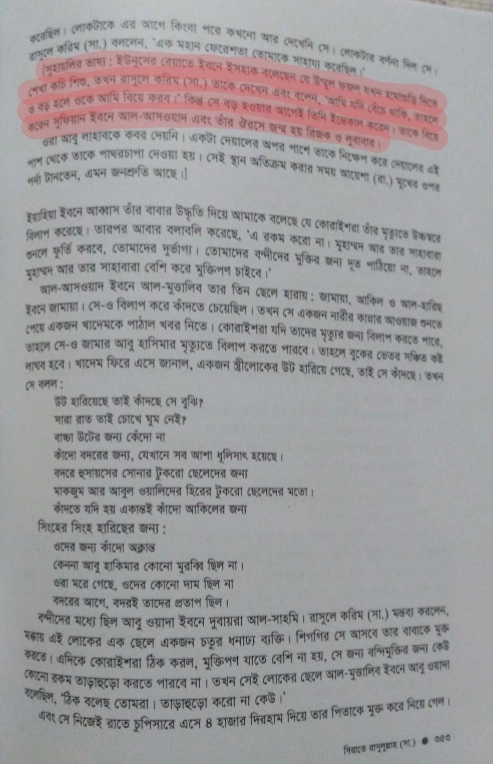
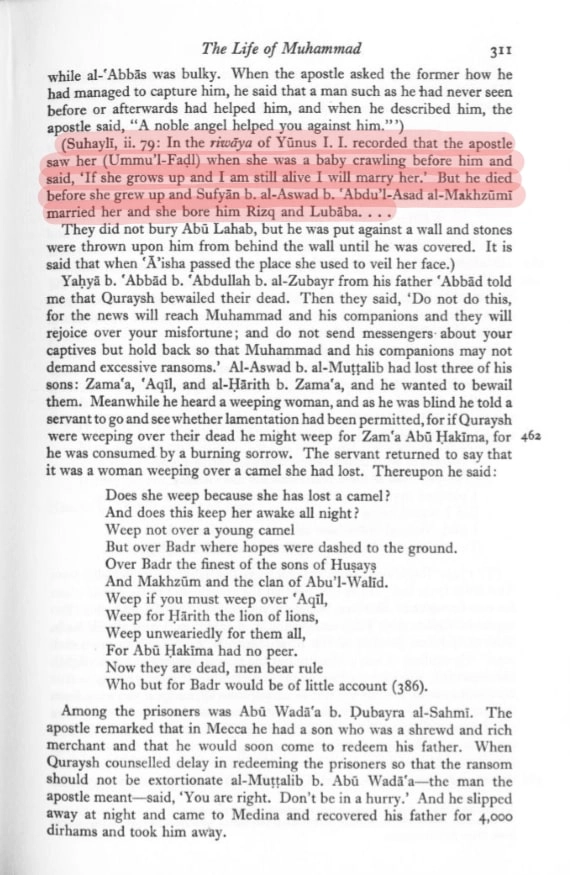
A Bengali translation of Ibn Ishaq’s Sirat Rasul Allah includes a report in which Muhammad, on seeing a crawling infant, expressed an intention to marry her in the future. In this account, a baby is seen as a prospective bride rather than as a child whose life and individuality are yet to develop. The incident appears on page 353 of the Bengali translation. [42]
The account is also found in the Sira translated by Alfred Guillaume: [43]
According to Sahih al-Bukhari, Aisha was married at six and the marriage was consummated when she was nine. This was the sexual use of a child; a nine-year-old cannot offer free and mature consent to sexual relations with an adult man. Her account of playing with dolls also makes her childhood visible. The parenthetical text in the English quotation below is an explanatory gloss drawn from Fath al-Bari; it is not part of Aisha’s own narration. The matter is discussed in greater detail in the article on Aisha’s child marriage. [44] [45]
Narrated `Aisha:
I used to play with the dolls in the presence of the Prophet, and my girl friends also used to play with me. When Allah’s Messenger (ﷺ) used to enter (my dwelling place) they used to hide themselves, but the Prophet would call them to join and play with me. (The playing with the dolls and similar images is forbidden, but it was allowed for `Aisha at that time, as she was a little girl, not yet reached the age of puberty.) (Fath-ul-Bari page 143, Vol.13)
Reference : Sahih al-Bukhari 6130
In-book reference : Book 78, Hadith 157
USC-MSA web (English) reference : Vol. 8, Book 73, Hadith 151
The direct account of her age at marriage and consummation: [44]
حَدَّثَنَا مُعَلَّى بْنُ أَسَدٍ، حَدَّثَنَا وُهَيْبٌ، عَنْ هِشَامِ بْنِ عُرْوَةَ، عَنْ أَبِيهِ، عَنْ عَائِشَةَ، أَنَّ النَّبِيَّ صلى الله عليه وسلم تَزَوَّجَهَا وَهْىَ بِنْتُ سِتِّ سِنِينَ، وَبَنَى بِهَا وَهْىَ بِنْتُ تِسْعِ سِنِينَ. قَالَ هِشَامٌ وَأُنْبِئْتُ أَنَّهَا كَانَتْ عِنْدَهُ تِسْعَ سِنِينَ.
English translation: Narrated Aisha: Mu‘alla ibn Asad related to us, from Wuhayb, from Hisham ibn Urwah, from his father, from Aisha, that the Prophet married her when she was six years old and consummated the marriage when she was nine years old. Hisham said that he was informed she remained with the Prophet for nine years (until his death).
Published English: Sahih al-Bukhari 5134.
What Can Be Done without Beating Children?
Many parents and teachers ask, “If we do not beat children, what else can we do? Children are terribly naughty!”
Yes, many children can be very mischievous. But their behavior must be understood. They learn much from their parents and surroundings, and each child also has distinctive developmental needs, temperament, feelings, and capabilities. They need repeated explanations; if they fail to understand the first time, they must be taught again. Sometimes we impose decisions without understanding the problem. Perhaps a child is comfortable writing with the left hand but is forced to use the right. Perhaps a child learns best through drawing, yet that interest is ignored. If a child has a learning difficulty, problems with attention, or a developmental difference, beating cannot solve it. Difficulty recognizing letters or reading calls for assistance suited to the nature of the difficulty. Appropriate support must address the child’s needs. Observing why a behavior occurs, when it happens, and what help produces change is part of education.
Children’s Independent Rights: Bodily Safety over Disciplinary Permission
Article 19 of the United Nations Convention on the Rights of the Child requires states to take appropriate legislative, administrative, social, and educational measures to protect children from all forms of physical or mental violence, injury, abuse, neglect, maltreatment, or exploitation while in the care of parents, legal guardians, or any other caregiver. Its central principle is that a child’s safety is not a privilege dependent upon the grace or permission of an adult, but the child’s own right. [46]
United Nations Convention on the Rights of the Child, Article 19 — Complete substantive rendering of the Bengali presentation (not a verbatim reproduction of the official English text)
States shall adopt appropriate legislative, administrative, social, and educational measures to protect children from every form of physical or mental violence, injury, abuse, neglect or negligent treatment, maltreatment, and exploitation, including sexual abuse, while they are under the care of a parent, legal guardian, or any other caregiver. Such protective measures should include social programs that support children and those responsible for their care; effective procedures for prevention, identification, reporting, referral, investigation, and treatment of cases of mistreatment; and, where appropriate, judicial intervention.
Source: UN Convention on the Rights of the Child, Article 19.
The World Health Organization’s 2025 report Corporal Punishment of Children: The Public Health Impact analyzes corporal punishment as a public health problem. It reviews research linking physical punishment with adverse outcomes for children’s mental health, behavior, development, and family relationships. Its guiding question differs from asking where the limits of permission to strike should be drawn: how can effective, safe, and supportive methods for children’s development be ensured in place of physical force? [47]
Often we dismiss children’s opinions because we think of them merely as little people. This can breed resentment. Treat a child as a person in their own right and seek their opinions sometimes. Ask what should be cooked today or where the family should go on the next holiday. This helps the child feel capable of responsibility. Assign manageable household tasks; help the child understand that keeping their room tidy is their responsibility. Explain where rubbish belongs and what problems arise when it is discarded carelessly. Encourage kindness toward animals and birds. The more empathy children learn, the better.
Stop comparing children with other children. Remarks like “So-and-so’s child came first in class” can be deeply harmful. They can create envy and seriously undermine a child’s confidence. Yet many parents imagine that by making such comparisons they have taught their children a valuable lesson. In reality these statements can be devastating, and parents should avoid them. Every child is distinct and diverse. Nobody has to become like somebody else. Scoring high marks in examinations is not life’s ultimate purpose. What matters most is what the child is learning.
Discipline can rely on clear rules, age-appropriate responsibilities, and consequences connected to the action. Explain in advance that toys must be put away after play, or that if a child damages another person’s belongings they should help repair or restore them where possible. If a privilege must be temporarily restricted, explain why, so that it does not become an adult’s arbitrary retaliation. Food, sleep, safety, affection, and necessary play must never become instruments of punishment. It is possible to avoid both excessive indulgence and physical violence. When every request cannot be granted, explain the reasons. Learning about other people’s lives, suffering, and needs is an opportunity to develop empathy, not a means of shaming a child with other people’s hardships.
Children have a sense of self-respect. Do not injure their dignity just because they are young. Keep promises made to them. Some parents deceive their children in the name of what is supposedly “for their own good,” imagining that these deceptions are beneficial. In reality, children may learn deception from them. Never humiliate a child by disclosing private matters to other people. Mocking a child or calling them stupid or a donkey can be profoundly harmful.
Obeying out of Fear versus Learning through Understanding
A beating may make a child stop doing something. That does not mean the child understands why the behavior was morally wrong. Keeping quiet when the teacher appears, performing prayer when parents are watching, and concealing mistakes to avoid punishment may create an outward performance of obedience, but they do not guarantee honesty or the development of conscience. Inflicting pain without giving the child an opportunity to understand teaches that pleasing the powerful is safer than telling the truth. Thus a discipline method supposedly intended to build character may undermine the trust, confidence, and courage to ask questions that character development requires.
A teacher’s knowledge does not confer a right to hurt a child’s body. A father does not own a child’s body merely because he raises the child. A preacher’s promise of salvation in the afterlife does not cancel the child’s safety in this life. A child is a separate human being whose pain, fear, dignity, and development have intrinsic value. Subordinating that value to adult authority cannot be the ethical foundation of an educational method.
Conclusion
Islamic hadith literature and jurisprudence contain authorization to beat children. Specific texts prescribe striking ten-year-olds over prayer, beating one’s own children and orphans to teach manners, teachers beating their pupils, and exemptions from liability for injuries inflicted as part of authorized discipline. Debates about how many blows may be given, where they may land, or for what purpose do not revoke the underlying permission to strike a child. Maintaining fear through a whip displayed in the home and treating the categorical rejection of beating as religious opposition further reinforce this structure.
In our society, many parents believe that having an Islamic scholar in the family will help them enter Paradise. Poverty and lack of educational opportunities also lead some to send their children to madrasas in the hope of obtaining food, shelter, and schooling. If a teacher exploits that dependence to abuse a child and the family accepts it as a religious duty, the child’s routes of protest are shut down. The argument “We were beaten and turned out fine, so our children should be beaten too” converts past suffering into permission for future violence. Portraying the refusal to beat children as a conspiracy of Jews, Christians, or atheists is a superstition directed against child protection. This violent framework must change through modern education, empathy, and recognition of children’s inherent dignity.
May all our children grow into confident, empathetic people, proud to think freely. Otherwise, our future is bleak.
References
- Elizabeth Gershoff and Andrew Grogan-Kaylor, “Spanking and Child Outcomes,” 2016; Journal of Family Psychology, 30(4), 453–469 ↩︎
- Gershoff and Grogan-Kaylor, 2016, meta-analysis of research on the outcomes of corporal punishment ↩︎
- Gershoff and Grogan-Kaylor, 2016; the researchers’ own page describing the original study ↩︎
- Human Rights Watch, “UAE: Spousal Abuse Never a ‘Right’,” October 19, 2010 ↩︎
- Al-Buhuti, al-Rawd al-Murbi‘; Islamweb fatwa 148943, February 8, 2011 ↩︎
- Islamweb, fatwa 148943: separate rulings for authorized discipline and excess ↩︎
- Al-Mawardi, al-Hawi al-Kabir, vol. 7, p. 434; a teacher’s beating and legal liability ↩︎
- Sahih al-Bukhari 6562 ↩︎
- Quran, Surah al-Hajj 22:19–22 1 2
- Quran, Surah Ibrahim 14:16–17 ↩︎
- Quran, Surah al-Hajj 22:19 ↩︎
- Quran, Surah al-Hajj 22:21–22 ↩︎
- Quran, Surah an-Nisa 4:56 1 2
- Jami‘ at-Tirmidhi 1663 ↩︎
- Al-Adab al-Mufrad, Bengali edition no. 139, pp. 95–96 ↩︎
- Al-Adab al-Mufrad, Sunnah.com numbering, 140 ↩︎
- Sunan Abi Dawud, Islamic Foundation edition, hadith 495 ↩︎
- Sunan Abi Dawud, Islamic Foundation edition, hadith 494 ↩︎
- Sunan Abi Dawud, Islamic Foundation edition, vol. 1, pp. 271–272 ↩︎
- Jami‘ at-Tirmidhi, verified Bengali edition, hadith 407 ↩︎
- Riyad as-Salihin, Bengali edition, hadith 306 ↩︎
- Ibn Muflih, al-Adab al-Shar‘iyyah wa al-Minah al-Mar‘iyyah, vol. 1, p. 451 ↩︎
- Al-Qabisi, al-Risalah al-Mufassalah, published Arabic text, sections on education and beating ↩︎
- Taqi al-Din al-Subki, Fatawa 1/379; Ibn Qudamah, al-Mughni 1/357; IslamQA 127233 ↩︎
- Sunan Abi Dawud 4403, report concerning suspended accountability ↩︎
- Sunan Abi Dawud 495, beating at ten over prayer ↩︎
- Ibn al-Qayyim, I‘lam al-Muwaqqi‘in, vol. 2, p. 23; explanation of the ten-lash hadith ↩︎
- Salih al-Fawzan, Ighathat al-Mustafid, pp. 282–284; IslamQA 127233 ↩︎
- Al-Mawsu‘ah al-Fiqhiyyah, 13/13; IslamQA fatwa 517621, July 14, 2024 ↩︎
- Islamweb fatwa 258508, “What Is and Is Not Permitted in Beating Children” (ما يجوز وما لا يجوز في ضرب الأولاد), June 19, 2014 ↩︎
- IslamQA fatwa 286309, August 18, 2020 ↩︎
- Abd al-Ra’uf al-Munawi, Fayd al-Qadir, commentary on report 4428 ↩︎
- IslamQA 286309, final discussion of completely rejecting beating ↩︎
- Sahih Muslim 974b 1 2
- Sunan an-Nasa’i, Islamic Foundation edition, 3965 ↩︎
- Sunan Abi Dawud 4717 ↩︎
- Sunan Abi Dawud 4717; original Arabic and al-Albani’s Sahih grading ↩︎
- Quran, Surah al-Kahf 18:74 ↩︎
- Sahih Muslim 2662a; Hadith Academy Bengali edition no. 6659 ↩︎
- Sahih Muslim, Hadith Academy Bengali edition no. 6659; equivalent Sunnah.com number 2662a ↩︎
- Sahih Muslim, Islamic Foundation Bengali edition no. 5949 ↩︎
- Ibn Ishaq, Sirat Rasul Allah, translated by Shahid Akhand, Prothoma Prokashon, p. 353 ↩︎
- The Life of Muhammad, Alfred Guillaume, p. 311. ↩︎
- Sahih al-Bukhari 5134 1 2
- Sahih al-Bukhari 6130 ↩︎
- Convention on the Rights of the Child, Article 19, UNICEF ↩︎
- World Health Organization, Corporal Punishment of Children: The Public Health Impact, 2025 ↩︎
About This Article
Genre: Semi-Academic Skeptical Analysis
Epistemic Position: Scientific Skepticism and Secular Humanist Ethics
This article belongs to the skeptical-rationalist analytical tradition of Shongshoy.com.
Its purpose is evidence-based critical examination of religious, philosophical, moral, and historical claims.