
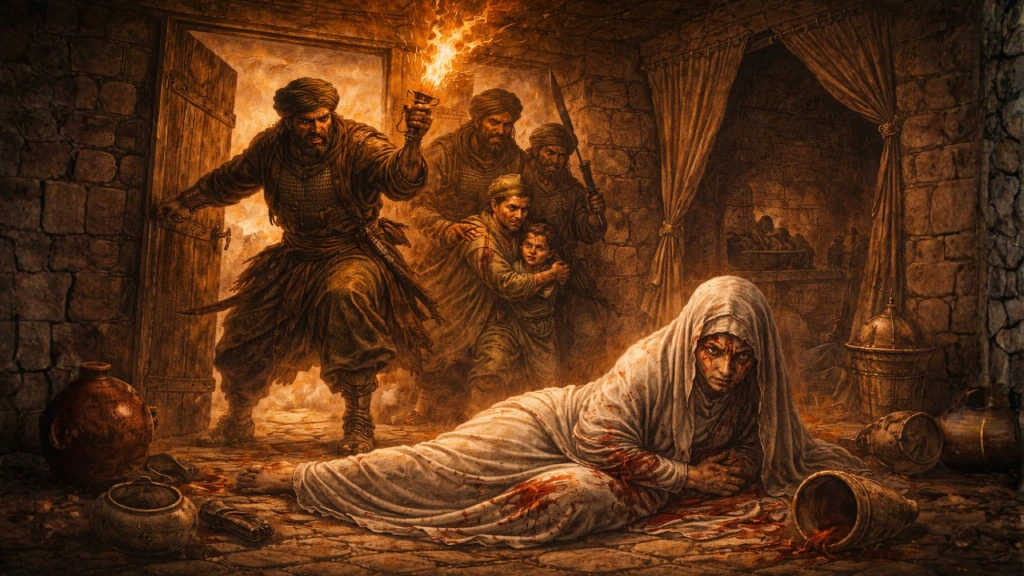
Umar at Fatima’s House: Power, Civil War, and the Roots of the Sunni–Shia Divide
Summary
After Muhammad died, the Muslim community had no agreed procedure in place for choosing its leader. The first caliphate was established when Abu Bakr received the pledge of allegiance at Saqifah. Ali and his supporters were excluded from the decision. The dispute between Fatima and Abu Bakr over Fadak brought control of property and revenue into question. The threat to burn down Fatima’s house shows how the family’s safety was put at risk to secure political allegiance. After Uthman was killed, the demand for justice set off another conflict. At the Battles of the Camel and Siffin, Muhammad’s own close followers went to war against one another.
After Ali’s death, Muawiya brought the rival caliphate to an end through an agreement with Hasan. His government suppressed Ali’s supporters and secured advance pledges of allegiance to his son Yazid. Under Yazid, Husayn and his companions were killed at Karbala and the surviving women and children of his family were taken captive. Medina suffered the massacre at al-Harra, and the Kaaba was damaged during the siege of Mecca. Yazid’s death did not end the struggle for power. The old disputes over leadership, the persecution of Ali’s family, and the memory of Karbala all helped shape the distinct political and religious foundations of later Sunni and Shia identities.
| Conflict or turning point | Principal figures and factions | What was at stake | Outcome and links to later conflicts |
|---|---|---|---|
| Ghadir Khumm and Muhammad’s final illness | Muhammad, Ali, Umar, and close followers | The political meaning of Muhammad calling Ali his ‘mawla’ at Ghadir and his request to issue a written instruction during his final illness. | The words spoken at Ghadir later became important to the case for Ali’s leadership. The requested written instruction was never produced. The question of leadership had to be settled after Muhammad’s death. |
| The succession at Saqifah 11 AH | The Ansar led by Sa‘d ibn Ubadah, and Abu Bakr, Umar, and their supporters. Ali and his close associates were absent. | Who should lead after Muhammad, and what role the Ansar, the Quraysh, and Muhammad’s family would play in choosing him. | Abu Bakr received a pledge of allegiance. Ali later objected that he and his supporters had been excluded. Securing his allegiance became a political problem for the new government. |
| Fadak and Fatima’s house 11 AH | Fatima, Ali, and their close associates, and Abu Bakr and Umar | Fatima’s claim to Fadak and property left by Muhammad. At the same time, Ali and al-Zubayr consulted at her house, and Umar pressed for allegiance. | Fatima’s claim was rejected. Ibn Abi Shayba reports that, after Umar threatened to burn the house, she told her associates to stay away. Fatima died without resolving her dispute with Abu Bakr. Ali buried her at night. |
| Provincial revolt and Uthman’s killing 35 AH | Uthman and his appointed governors, opposition groups from Egypt and other provinces, and Ali as mediator | The appointment of relatives as governors, control of conquered land and revenue, and an alleged letter bearing Uthman’s seal and targeting the Egyptian opposition. | The agreement broke down. Uthman was killed after a siege in Medina. Justice for his killing and the authority of the new caliph became central disputes in the ensuing civil war. |
| Battle of the Camel 36 AH | Ali and his forces against the coalition of Aisha, Talha, and al-Zubayr | Justice for Uthman’s killing, control of Basra, and who held the political authority to bring the killers to justice. | Ali’s forces won. Talha and al-Zubayr were killed, and Aisha returned to Medina. Ali established his authority in Basra, while Muawiya’s resistance in Syria continued. |
| Battle of Siffin and arbitration 37 AH | Ali’s Iraqi forces against Muawiya’s Syrian forces | The caliph’s authority over Syria, Muawiya’s refusal to pledge allegiance, and the demand for justice for Uthman’s killing. | Ammar ibn Yasir was killed by Muawiya’s forces. The hadith about the group that would kill him became important to the moral assessment of the battle. Arbitration halted the fighting, left the leadership dispute unresolved, and split Ali’s camp. |
| Nahrawan and Ali’s assassination 38–40 AH | Ali and his forces against the Kharijites | The legitimacy of accepting arbitration at Siffin and who had the right to decide a political dispute. | The Kharijites were defeated at Nahrawan. Ali was later fatally struck by the Kharijite Ibn Muljam. Hasan received a pledge of allegiance in Kufa, while Muawiya retained command of Syria’s military forces. |
| Campaigns in Egypt, the Hejaz, and Yemen Late in Ali’s caliphate | Amr ibn al-As and Busr ibn Artat for Muawiya, and Ali’s governors and their supporters | Control of provincial government and local allegiance in Egypt, the Hejaz, and Yemen. | Ali lost Egypt, and Muhammad ibn Abi Bakr was killed. The account of Busr’s killing of the two young sons of Ali’s governor Ubayd Allah ibn Abbas shows that families also became targets of retaliation. |
| The agreement between Hasan and Muawiya 41 AH | Hasan and his Iraqi camp, and Muawiya and his Syrian forces | Ending the rival caliphates, the terms on which Hasan would give up power, and who would succeed Muawiya. | Hasan relinquished power, leaving Muawiya as sole ruler. Accounts differ on the terms of the agreement. Hasan’s later death by poisoning and his burial also became sources of political contention. |
| The crackdown on Hujr ibn Adi and his supporters | Muawiya’s administration, Ziyad the governor of Kufa, and Hujr ibn Adi and his associates | Protest against the public vilification of Ali and the lengths to which the government would go to suppress opposition in Kufa. | Hujr and several of his associates were executed. The case shows how provincial authorities used the collection of testimony and the death penalty against Ali’s supporters. |
| Advance pledges of allegiance to Yazid | Muawiya, his governors and delegates, and opponents including Husayn and Abd Allah ibn al-Zubayr | Securing allegiance to Muawiya’s son Yazid before Muawiya’s death. Money, provincial influence, and threats were used to obtain support. | Arrangements were made for power to pass from father to son. On taking power, Yazid ordered that allegiance be obtained from those who had withheld it. |
| The crackdown on Husayn’s supporters in Kufa 60 AH | Muslim ibn Aqil, Hani ibn Urwa, and their supporters in Kufa against Governor Ubayd Allah ibn Ziyad | Organizing in Kufa and securing pledges for Husayn, and pressuring tribal leaders to break up that support. | Muslim and Hani were killed. The network Husayn was counting on as he traveled toward Kufa had collapsed before his arrival. |
| Battle of Karbala 61 AH | Husayn and his small band of followers against Umar ibn Sa‘d’s forces under Ibn Ziyad | Blocking Husayn’s route, cutting off access to water, and trying to force his surrender on Ibn Ziyad’s terms. | Husayn, members of his family, and his followers were killed. The surviving women and children were taken captive. Zaynab spoke out at the court in Kufa. The memory of those killed later became a basis for mourning, protest, and political organization. |
| Battle of al-Harra and the killings in Medina 63 AH | Medina’s rebels against Yazid’s Syrian army under Muslim ibn Uqba | The people of Medina withdrew their allegiance to Yazid, and he sent an army to restore it. | Medina’s resistance collapsed. Sources describe killings, looting, and sexual violence. The defeated were forced to renew their allegiance. The Syrian army then marched toward Mecca. |
| First siege of Mecca 64 AH | Abd Allah ibn al-Zubayr and his supporters against Yazid’s forces under Husayn ibn Numayr | Breaking Ibn al-Zubayr’s resistance in Mecca and establishing Yazid’s authority there. | The Kaaba was damaged during the siege. The siege was lifted when news of Yazid’s death arrived. Ibn al-Zubayr’s rival government survived. |
| Second Civil War and second siege of Mecca Ibn al-Zubayr’s fall in 73 AH | Ibn al-Zubayr’s government against the Umayyads under Marwan and later Abd al-Malik. The Penitents and Mukhtar led separate movements in Iraq. | Control of the caliphate after Yazid, and new forms of political organization seeking vengeance for the killings at Karbala. | Al-Hajjaj, Abd al-Malik’s commander, besieged Mecca. Ibn al-Zubayr was killed and his rule ended. In Iraq, the movements of the Penitents and Mukhtar show how the memory of Karbala helped form new allegiances and resistance movements. |
| The memory of war, sectarian identity, and responsibility | Later Shia and Sunni religious traditions, rulers, and religious scholars | Whose leadership was legitimate, how to judge the Companions’ political conduct, and who bore responsibility for the killings. | Fatima’s dispossession, the wars against Ali, and the memory of Karbala helped shape later Shia and Sunni identities. This is where the article’s ethical question comes into focus. Rulers who gave orders, commanders who carried them out, and those who took part in the killings bear responsibility for their own actions. |
Timeline
10–73 AH · 632–692 CE
From succession to civil war
Disputes over leadership, family rights, and wealth develop into war, repression, and struggles over the next succession.
Succession and the conflict over family rights
-
10 AH632 CE
Ghadir Khumm
Ali’s standing at Ghadir Khumm
Muhammad calls Ali his “mawla.” The political meaning of that declaration and Ali’s claim to leadership become important to subsequent disputes over succession.
-
11 AH632 CE
Medina
Final illness and the dispute over a written instruction
During Muhammad’s final illness, those present disagree when he asks to issue a written instruction. It is never written. After his death, competition over the leadership becomes open.
-
11 AH632 CE
Medina
Abu Bakr takes power at Saqifah
Abu Bakr receives a pledge of allegiance amid competing claims from the Ansar and Muhajirun. Ali and his close associates are absent from that decision. Securing their allegiance becomes a problem for the new government.
-
11 AH632 CE
Medina and Fadak
Fadak and Umar at Fatima’s house
Fatima’s property claim is rejected. Accounts also describe a threat to burn the house to secure the allegiance of Ali and his associates. Family rights and the authority of the new regime come into direct conflict.
-
11 AH632 CE
Medina
Fatima’s death and Ali’s delayed pledge
Fatima dies with her dispute with Abu Bakr unresolved. Ali buries her at night. Accounts describe Ali’s political accommodation and pledge of allegiance after her death.
The crisis of government and the First Civil War
-
Uthman’s reign644–656 CE
Medina and the provinces
Administration, nepotism, and disputes over wealth
Disputes grow over provincial appointments of Uthman’s relatives, revenue, and control of conquered land. Discontent in Kufa, Egypt, and other regions develops into resistance against the central government.
-
35 AH656 CE
Medina
Uthman’s killing and Ali’s caliphate
Uthman is killed after a siege and failed accommodation. When Ali becomes caliph, justice for Uthman’s killing and the political authority to administer it become central disputes in the ensuing wars.
-
36 AH656 CE
Basra
Ali’s forces fight the coalition of Aisha, Talha, and al-Zubayr. Ali wins; Talha and al-Zubayr are killed. His authority is established in Basra, while Muawiya’s resistance continues in Syria.
-
37 AH657 CE
Siffin
Ali’s Iraqi forces confront Muawiya’s Syrian army. Disputes over water and prolonged fighting accompany heavy losses, including Ammar ibn Yasir. The hadith about the group that would kill him becomes important to the battle’s moral assessment.
-
After 37 AHFrom 657 CE
Siffin and Iraq
Arbitration and the Kharijite split
The raising of Quranic pages is followed by arbitration and a halt to the fighting. The leadership dispute remains unresolved. Disagreement over arbitration divides Ali’s army and gives rise to the Kharijite movement.
-
38 AH658 CE
Nahrawan
Ali’s war against the Kharijites
The conflict with the Kharijites escalates into armed confrontation. Ali’s forces defeat them at Nahrawan. The division following Siffin produces a further round of bloodshed.
-
38 AH658 CE
Egypt
The loss of Egypt and Muhammad ibn Abi Bakr’s killing
Amr ibn al-As establishes control of Egypt for Muawiya. Ali’s governor Muhammad ibn Abi Bakr is killed. Historical accounts also describe the burning of his corpse.
-
Late in Ali’s ruleAround 660 CE
The Hejaz and Yemen
Busr campaigns for Muawiya in territories under Ali’s authority. Accounts of the killing of Ubayd Allah ibn Abbas’s two young sons show family members becoming targets of political retaliation.
-
40 AH661 CE
Kufa
Ali’s assassination and Hasan’s leadership
Ali dies after being struck by the Kharijite Ibn Muljam. Hasan receives a pledge in Kufa. Muawiya retains Syria’s military power, carrying the leadership dispute into the next generation.
Muawiya’s sole rule and dynastic succession
-
41 AH661 CE
Iraq and Syria
Hasan reaches an agreement with Muawiya and relinquishes power. Muawiya becomes sole ruler. Accounts differ over the agreement’s terms and the arrangements for subsequent succession.
-
44 AH664 CE
The Umayyad administration
Ziyad’s lineage and administrative power
Muawiya recognizes Ziyad as Abu Sufyan’s son. Incorporation into the ruling family accompanies provincial authority. Ziyad’s administration plays an important role in suppressing Ali’s supporters.
-
Around 48–50 AHAround 668–670 CE
Medina
Accounts of Hasan’s final illness describe poisoning. Separate historical allegations concern the source of the poison and the person responsible for ordering it. His burial also becomes a focus of political conflict.
-
Recorded under 50 AHAround 670 CE
Iraq and Damascus
Amr ibn al-Hamiq and persecution of his family
Accounts describe the severing of Ali’s supporter Amr’s head and its delivery to the ruler. A separate narrative describes his wife Amina’s imprisonment and confrontation with her husband’s severed head, extending repression to the family.
-
Recorded under 51 AHAround 671 CE
From Kufa to Syria
Hujr ibn Adi and his companions are executed
Protest against the official vilification of Ali meets administrative repression. Hujr and his companions are arrested and sent to Syria. Several are executed.
-
During Muawiya’s lifetimeYazid’s nomination
The provinces and the Hejaz
Advance pledges for the ruler’s son
Muawiya uses governors, delegations, money, and threats of weapons to establish Yazid’s succession. The ruling family’s interests dominate the arrangements for transferring power.
Yazid’s rule, Karbala, and the Second Civil War
-
60 AH680 CE
Syria and the Hejaz
Muawiya dies and Yazid takes power
Yazid takes power and orders that allegiance be obtained from opponents. Husayn’s and Ibn al-Zubayr’s refusal opens the way to renewed conflict.
-
60 AH680 CE
Kufa
Muslim ibn Aqil and Hani are killed
Intimidation, tribal pressure, and administrative repression under Ibn Ziyad break Husayn’s support. Muslim and Hani are killed. Husayn’s expected political base collapses before he can reach Kufa.
-
10 Muharram, 61 AH680 CE
Karbala
Husayn and his companions are killed
Umar ibn Sa’d’s forces, under Ibn Ziyad, block Husayn’s route and access to water. Husayn, members of his family, and his companions are killed in the fighting.
-
After Karbala61 AH • 680 CE
Kufa and Damascus
The captivity of women and children and Zaynab’s protest
The severed heads and surviving family members are taken to Kufa and Damascus. Zaynab protests at court. The memory of the killings becomes a basis for mourning, protest, and political organization.
-
63 AH683 CE
Medina
Al-Harra and the plunder of Medina
After Medina withdraws allegiance to Yazid, Muslim ibn Uqba’s army attacks. Accounts describe three days of plunder, killings, and sexual violence following the defeat of the resistance. Renewed allegiance is imposed.
-
64 AH683 CE
Mecca
The first siege of Mecca and damage to the Kaaba
Yazid’s forces under Husayn ibn Numayr besiege Ibn al-Zubayr. Siege engines are used and the Kaaba is damaged. The siege is lifted after news of Yazid’s death arrives.
Rival caliphates, retaliation, and Umayyad consolidation
-
64–65 AH683–685 CE
The Hejaz and Syria
Ibn al-Zubayr’s caliphate and Marwan’s rise
After Yazid’s death, Muawiya II’s brief rule ends. Ibn al-Zubayr’s rival center of power survives. Marwan and later Abd al-Malik rebuild Umayyad power.
-
After Yazid’s deathNew movements in Iraq
Iraq
The Penitents organize around remorse for failing to help at Karbala. Mukhtar subsequently leads a separate movement. Demands for vengeance for Karbala become a basis for new military alliances and political authority.
-
72–73 AHEnds in 692 CE
Mecca
The second siege of Mecca and Ibn al-Zubayr’s fall
Abd al-Malik’s commander al-Hajjaj besieges Mecca. Ibn al-Zubayr is killed in 73 AH. His fall eliminates a principal rival center and consolidates Abd al-Malik’s authority.
Introduction
Husayn, who was killed at Karbala in 680 CE, was Muhammad’s own grandson. His severed head was brought before a governor appointed by the Muslim ruler. The surviving women and children of his family were taken captive. Less than half a century had passed since Muhammad’s death. In that time, the struggle for power among his followers had reached the point where members of his family could be killed and others from the same family carried away as prisoners. Even before Karbala, Muhammad’s close followers had taken up arms against one another at the Battles of the Camel and Siffin. Later came the massacre and looting in Medina, the siege of Mecca, and the damage to the Kaaba. Religious standing, kinship, and the sanctity of a place could offer no guarantee of life or safety in these struggles for power.
The memory of the bloodshed did not die with those who were killed. Families who lost loved ones remembered grief and injustice. Victorious governments needed an account that would justify their authority. Later generations learned the names of those involved through religious instruction, family stories, sermons, mourning ceremonies, and history books. Taking a position on a long-dead ruler or on a slain person gradually became a way to express one’s religious identity. Whose leadership was legitimate? Who was wronged? Who bore responsibility for whose death? The answers became a lasting inheritance of loyalties and grievances.
At the root of the conflict lay the struggle over leadership after Muhammad’s death. During his lifetime, one man held final authority over religious instruction, military command, the distribution of wealth, and political decisions. After he died, people with different interests and grounds for claiming authority stepped forward. Medina’s Ansar could point to the refuge they had provided, the fighting they had done, and their local power. The Qurayshi leaders among the Emigrants invoked their lineage and standing in Arab society. Ali and Muhammad’s family based their claim on close kinship and their place in his movement. Abu Bakr came to power through a hurried pledge of allegiance at Saqifah. Ali and his associates were left out of the decision. The new government then faced the question of how to obtain their allegiance, while the family faced the question of how to protect its rights and standing.
The cost of the dispute to the family is clear in Fatima’s own life. After her father died, her property claim was denied. Ali complained that he and his family had been left out of the decision over leadership. Accounts describe a threat to set fire to their house to make those gathering there pledge allegiance. Fatima died with her dispute with Abu Bakr unresolved, and Ali buried her at night without informing him. A daughter’s loss of her father, a family’s economic rights, and the new caliph’s authority all came together in these events. Fatima’s dispossession took such a deep place in later Shia memory because her life and death captured the conflict between the standing of Muhammad’s family and the pressure the new government put on them.
The conflict grew more violent after Uthman’s killing. Forces were organized against Ali in the name of bringing Uthman’s killers to justice, and the Battles of the Camel and Siffin brought heavy bloodshed. After Ali was killed, Hasan yielded power to Muawiya. Muawiya then sought advance pledges of allegiance to his son Yazid to keep power in the family. The killing of Husayn at Karbala left a wound from that struggle over succession that ran deep into later religious life. Grief for slain fathers, brothers, and children, remorse at having failed to protect them, and the desire to avenge their killing gave rise to new movements. The memory of what happened provided a language for protesting injustice and gave others an opportunity to build political power around a demand for revenge.
These early disputes laid the historical foundations for later Shia and Sunni identities. The development of theology, hadith scholarship, law, ideas about the Imamate, and separate religious institutions deepened and entrenched the division. The question of leadership became tied to questions about how religious knowledge was transmitted. Whose accounts of Muhammad’s words could be trusted? How much authority belonged to his family? How far could criticism of his Companions’ conduct go? Accepting an accusation against a historical figure could also affect that figure’s established religious standing. In judging the political decisions of rulers long dead, believers could find the history they had been taught and their own religious identity called into question. That is where arguments about the past begin to provoke powerful feelings and resistance.
Later rulers put state power behind the division. In the early sixteenth century, the Safavids established Twelver Shiism as the state religion of Persia. Sunnis were persecuted, expelled, and killed. In the Safavids’ rivalry with the Ottoman Empire, which presented itself as the defender of Sunni identity, territory, allegiance to the ruler, and religious identity became bound together. A person’s religious affiliation could become a reason to suspect their political loyalty. When a state used religious difference to defend its borders and authority, a person’s beliefs had direct consequences for their safety, home, and livelihood. Backed by new administrations, armies, and systems of repression, the old disputes could inflict harm on a much wider scale.
There are modern examples of this violence. After the al-Askari shrine in Samarra, Iraq, was bombed in February 2006, retaliatory attacks spread. Sunni mosques were attacked, and sectarian clashes broke out in several cities. An attack on one religious site was answered by targeting places of worship and the lives of people from another community. Those attacked did not have to be shown to have done anything wrong. Their identity alone marked them as targets for revenge. This is how old grief and present fears can be mobilized to attack innocent people. A person killed in such attacks took no part in a seventh-century struggle for power and issued no orders on behalf of an ancient ruler. Yet that person was made to pay for crimes laid at the door of their community.
Collective blame is one of the principal ways hatred is passed down. A child taught that people from another community were the enemies of historical figures they hold dear may grow suspicious of strangers before ever meeting them. Religious speeches and political campaigns deepen that suspicion when they cast those who disagree as traitors, impure, or deserving of death. A neighbor bears the mark of an old crime before anyone gets to know them. Grief for the dead of one’s own community is thus tied to a demand to punish the living of another. Yet there is no rational path from the guilt of a particular killer to the guilt of strangers born many generations later. The remarks of a Sunni Islamic scholar from Bangladesh are relevant here,
That is why the roots of sectarian hostility matter. Who had the power to decide? Whose forces killed whom? Which families lost their property and safety? How were these events taught afterward? When these questions go unanswered, hate can be directed at an entire population while its actual causes go unexamined. Memories of injustice can then become a license for indiscriminate revenge. Identifying the individuals, interests, and decisions involved makes it possible to assign responsibility. Using a ruler’s religious stature to shield his crimes and blaming ordinary people today for those crimes both make it harder to judge what any individual actually did.
Covering up old wounds serves those who exploit them. A threat to set a house on fire to secure allegiance is just as cruel whatever the ruler’s religious standing. The same standard applies to killing a captive or punishing a child for belonging to a particular family. Respect for those who were killed gives no one the right to kill innocent people in their name. Facing the bloodshed of the past means refusing to let human suffering disappear behind the glory of a ruler or become a weapon for the next killer. Hatred makes an enemy of a person on the basis of the identity into which they were born. To break its hold, we have to trace how old accusations came to be attached to that identity.
Muhammad, Family, Succession, and Power
The religious movement of Muhammad began under the protection of a family. After his death, conflicts arose between his close followers and that same family regarding leadership of the state. Khadija’s support, Ali’s closeness, Fatima’s status, and Muhammad’s love for Hasan and Husayn gave this family a special place within the movement. However, no recognized system was established to bind personal intimacy, religious status, and rights to state decisions together. While conflicts were resolved in Muhammad’s presence while he was alive, upon his death the final arbiter was absent, yet his army, revenue, administration, and relationships of allegiance remained intact. Thus, with death began not only mourning for a preacher but also competition for succession to his authority. [1] [2]
Preparations for this crisis were visible during his lifetime. Public support for Ali, instructions regarding responsibility toward the family, Ali’s advice around Aisha in times of crisis, and Umar’s objection to a written instruction during Muhammad’s final illness reveal different aspects of relationships among close followers. The interests, allegiance, and political expectations of people gathered around Muhammad were not identical. Marital disputes have risen on the pulpit, accusations against the family have incited Medina tribes, and requests at the deathbed remained stuck in argument within the home. Differences suppressed under personal leadership became public power conflict in determining succession to leadership.
Muhammad’s Religious Movement and Khadija’s Role
Social establishment of Muhammad’s religious experience began with Khadija’s role from his own home. Seclusion at Hira required time, provisions, and a safe home to return to. Bukhari’s narration of the first revelation describes Muhammad staying in the cave for several nights and returning to Khadija for provisions again. Thus, a person’s solitary devotion depended on family labor, wealth, and care. In later history, Muhammad’s religious authority emerged, but that authority’s beginning also had practical support given by Khadija. Returning home and expressing fear, receiving reassurance, and going to someone they knew to determine the meaning of the experience—Bukhari’s long narration describes this sequence of events. [3] [4]
Sahih al-Bukhari, beginning of revelation, hadith 3
فَرَجَعَ بِهَا رَسُولُ اللَّهِ صلى الله عليه وسلم يَرْجُفُ فُؤَادُهُ، فَدَخَلَ عَلَى خَدِيجَةَ بِنْتِ خُوَيْلِدٍ رضى الله عنها فَقَالَ ” زَمِّلُونِي زَمِّلُونِي ”. فَزَمَّلُوهُ حَتَّى ذَهَبَ عَنْهُ الرَّوْعُ، فَقَالَ لِخَدِيجَةَ وَأَخْبَرَهَا الْخَبَرَ ” لَقَدْ خَشِيتُ عَلَى نَفْسِي ”. فَقَالَتْ خَدِيجَةُ كَلاَّ وَاللَّهِ مَا يُخْزِيكَ اللَّهُ أَبَدًا، إِنَّكَ لَتَصِلُ الرَّحِمَ، وَتَحْمِلُ الْكَلَّ، وَتَكْسِبُ الْمَعْدُومَ، وَتَقْرِي الضَّيْفَ، وَتُعِينُ عَلَى نَوَائِبِ الْحَقِّ. فَانْطَلَقَتْ بِهِ خَدِيجَةُ حَتَّى أَتَتْ بِهِ وَرَقَةَ بْنَ نَوْفَلِ بْنِ أَسَدِ بْنِ عَبْدِ الْعُزَّى ابْنَ عَمِّ خَدِيجَةَ ـ وَكَانَ امْرَأً تَنَصَّرَ فِي الْجَاهِلِيَّةِ، وَكَانَ يَكْتُبُ الْكِتَابَ الْعِبْرَانِيَّ، فَيَكْتُبُ مِنَ الإِنْجِيلِ بِالْعِبْرَانِيَّةِ مَا شَاءَ اللَّهُ أَنْ يَكْتُبَ، وَكَانَ شَيْخًا كَبِيرًا قَدْ عَمِيَ ـ فَقَالَتْ لَهُ خَدِيجَةُ يَا ابْنَ عَمِّ اسْمَعْ مِنَ ابْنِ أَخِيكَ. فَقَالَ لَهُ وَرَقَةُ يَا ابْنَ أَخِي مَاذَا تَرَى فَأَخْبَرَهُ رَسُولُ اللَّهِ صلى الله عليه وسلم خَبَرَ مَا رَأَى. فَقَالَ لَهُ وَرَقَةُ هَذَا النَّامُوسُ الَّذِي نَزَّلَ اللَّهُ عَلَى مُوسَى صلى الله عليه وسلم يَا لَيْتَنِي فِيهَا جَذَعًا، لَيْتَنِي أَكُونُ حَيًّا إِذْ يُخْرِجُكَ قَوْمُكَ. فَقَالَ رَسُولُ اللَّهِ صلى الله عليه وسلم ” أَوَمُخْرِجِيَّ هُمْ ”. قَالَ نَعَمْ، لَمْ يَأْتِ رَجُلٌ قَطُّ بِمِثْلِ مَا جِئْتَ بِهِ إِلاَّ عُودِيَ، وَإِنْ يُدْرِكْنِي يَوْمُكَ أَنْصُرْكَ نَصْرًا مُؤَزَّرًا. ثُمَّ لَمْ يَنْشَبْ وَرَقَةُ أَنْ تُوُفِّيَ وَفَتَرَ الْوَحْىُ
English translation: Aisha’s narration: The Prophet of Allah, after experiencing this, returned trembling to Khadija bint Khuwaylid and said, ‘Cover me, cover me.’ He was covered until his fear subsided. Then he informed Khadija about the incident and said, ‘I fear for myself.’ Khadija said, ‘Never. By Allah, Allah will never disgrace you. You maintain kinship ties, bear the burdens of the helpless, help the destitute, honor guests, and assist those facing adversity in the cause of justice.’ Then Khadija took him to her paternal cousin Waraqa ibn Nawfal ibn Asad ibn Abd al-Uzza. Waraqa had adopted Christianity before Islam. He wrote in Hebrew and wrote in Hebrew whatever Allah wished from the Injil. He was then old and blind. Khadija said, ‘Cousin, listen to your nephew.’ Waraqa asked, ‘Nephew, what have you seen?’ The Prophet of Allah described the incident he witnessed. Waraqa said, ‘This is the Namus whom Allah sent to Moses. If only I were young then! If only I were alive when your people expel you!’ The Prophet of Allah said, ‘Will they expel me?’ He said, ‘Yes. Whoever comes with what you bring will be treated as an enemy. As long as I am alive until that day, I will strongly support you.’ Waraqa died shortly thereafter, and there was a pause in revelation.
Khadija did not receive the words of her frightened husband with disbelief or mockery. She provided an interpretation based on his known character traits, which included a promise of divine protection instead of disgrace. This changed the psychological meaning of the experience. Khadija’s reassurance opened the way to interpreting the incident that had made Muhammad fear for his own safety as the possibility of a special responsibility. Trust from a close person plays a strong role in interpreting such experiences, as the victim can rely on that trust to understand their feelings. Khadija’s response combined her affection for her husband and her religious interpretation of his experience.
The initiative to go to Waraqa brought this family reassurance to another level. Waraqa placed the incident within a well-known prophetic tradition by aligning it with Musa’s experience. This gave an unknown and frightening experience a name, a predecessor, and a future. His statement also included a prediction of opposition. The prediction that Muhammad’s own community would expel him made possible rejection a natural accompaniment of prophetic identity. Later, when society resisted, it could be judged both as an objection to religious claims and as a pre-announced sign of prophecy. Within this narrative, reassurance, acceptance, and interpretation of future conflict emerged together.
Khadija’s social significance is also linked to her female identity. As the first credible patron of the religious movement, she accepted her husband’s experience, comforted him, and created opportunities for interpretation through her own family connections. Her role involved both decision-making and initiative. In the subsequent succession crisis, her daughter Fatima’s position casts that history into sharp contradiction. While a woman from one family provided support as a crucial foundation at the movement’s outset, after state establishment another woman from that same family became dependent on the male ruler’s decision regarding property claims. Despite their contribution to building the movement, that contribution did not automatically establish a recognized right to take part in state decisions.
The change in Muhammad’s position from the secluded cave of Mecca to the state of Medina also altered the role of the family. In the first phase, the home was a center of refuge and faith. In Medina, that home became a source of religious rules, military alliances, political kinship, and public standing. The marriage of Ali to Fatima, daughter of Khadija, made him Muhammad’s son-in-law as well as his paternal cousin. The marriage of Muhammad to Aisha connected Abu Bakr’s family into an inner circle, and the marriage to Hafsa connected Umar’s family into that same close circle. These relationships linked the center of leadership with personal life. In subsequent conflicts, the families facing each other already had their own connections and claims to status with that center. [5]
After religious authority was established, its history was typically arranged around the founder. But Khadija’s narrative makes visible the support behind that center. The social recognition created by Muhammad’s fear, Khadija’s reassurance, and Waraqa’s interpretation resulted in the family attaining new dignity. That standing became an asset in the later question of who would hold leadership. Family proximity granted religious acceptance, while religious acceptance provided the language for political claims. The seeds of the conflict over who could use that language after his death lay in this close relationship between the family and the movement.
Fatima, Hasan, Husayn, and the Special Standing of the Prophet’s Family
Fatima’s position cannot be concluded by simply calling her Muhammad’s daughter. In statements preserved in her name, Muhammad equated his daughter’s suffering with his own suffering. Thus, treatment toward Fatima acquired religious and moral significance for his followers. The grief of an ordinary person’s daughter could have been considered a family matter. Muhammad established a language through which his daughter’s feelings were expressed, where harming her was equivalent to harming the founder. This declaration created strong symbolic protection for Fatima’s personal security. Her later dispute with the government also gained importance because of that declaration. [6] [7]
Sahih al-Bukhari (Islamic Foundation)
50. The Prophets (peace be upon them)
Chapter 2091. The merits of the Messenger’s relatives and of Fatima, the Prophet’s daughter (may Allah be pleased with her). The Prophet (peace and blessings be upon him) said: Fatima (may Allah be pleased with her) is the leader of the women of Paradise
3447. Abd Allah ibn Abd al-Wahhab (may Allah have mercy on him) … Abu Bakr (may Allah be pleased with him) said: “Show regard for Muhammad (peace and blessings be upon him) by how you treat his household.”
Hadith grade: Sahih
Narrator: Abu Bakr al-Siddiq (may Allah be pleased with him)

When Ali’s second marriage was proposed, that symbolic protection became an effective intervention. Muhammad, standing on the minbar, repeatedly rejected permission. He gave Ali the condition to divorce Fatima before another marriage and informed him that Fatima’s pain was his own pain. The use of the minbar in matters of personal marital relations brought the incident before society. At that time, Ali’s potential marital decision was subject not only to the father-in-law’s personal objection but also to the public directive of a religious leader. Although Muhammad himself had taken multiple wives, he used his special position to prevent the emotional pain of a co-wife entering his daughter’s life. He was not unaware of that pain for women; it became clear through his intervention. [6]
Sahih al-Bukhari (Islamic Foundation)
Book 54. Marriage
Chapter 2533. Preventing jealousy in one’s daughter and speaking justly
4850 (Sahih al-Bukhari 5230). (Bengali edition) Qutaybah (may Allah have mercy on him) … Al-Miswar ibn Makhramah (may Allah be pleased with him) reported: I heard Allah’s Messenger (peace and blessings be upon him) say on the pulpit that Banu Hisham ibn al-Mughirah had asked his permission to marry their daughter to Ali ibn Abi Talib. “I will not give permission, I will not give permission, I will not give permission unless Ibn Abi Talib wishes to divorce my daughter and marry theirs. She is a part of me. What distresses her distresses me, and what hurts her hurts me.”
Hadith grade: Sahih

Potential jealousy, uncertainty, and fear of losing relationships for a woman in polygamy are given importance here. But the power of remedy came mainly from Fatima’s father’s position. The protection made effective for her did not become a universal right for other women in society. Thus, the incident reveals both family affection and unequal distribution of power. How much a woman would be protected depended on the depth of her pain and the dignity of the man standing for her. Fatima received public remedy as Muhammad’s daughter, but common women’s pain could not reach that power.
Miswar’s account in Muslim expands the description of the incident further. During his meeting with Ali ibn Husayn, a discussion of protecting Muhammad’s sword brings back that crisis in Fatima’s married life. The memory begins with the family devastated after Karbala and centers on the speech protecting Muhammad’s daughter. Within two generations, this connection brings forth the family’s dignity and vulnerability together. The family did not permanently retain independent military or administrative power to enforce the standing Muhammad had declared during his lifetime after his death. [8]
Sahih Muslim, Fatima’s dignity, hadith 2449c
حَدَّثَنِي أَحْمَدُ بْنُ حَنْبَلٍ، أَخْبَرَنَا يَعْقُوبُ بْنُ إِبْرَاهِيمَ، حَدَّثَنَا أَبِي، عَنِ الْوَلِيدِ بْنِ كَثِيرٍ، حَدَّثَنِي مُحَمَّدُ بْنُ عَمْرِو بْنِ حَلْحَلَةَ الدُّؤَلِيُّ، أَنَّ ابْنَ شِهَابٍ، حَدَّثَهُ أَنَّ عَلِيَّ بْنَ الْحُسَيْنِ حَدَّثَهُ أَنَّهُمْ، حِينَ قَدِمُوا الْمَدِينَةَ مِنْ عِنْدِ يَزِيدَ بْنِ مُعَاوِيَةَ مَقْتَلَ الْحُسَيْنِ بْنِ عَلِيٍّ رضى الله عنهما لَقِيَهُ الْمِسْوَرُ بْنُ مَخْرَمَةَ فَقَالَ لَهُ هَلْ لَكَ إِلَىَّ مِنْ حَاجَةٍ تَأْمُرُنِي بِهَا قَالَ فَقُلْتُ لَهُ لاَ . قَالَ لَهُ هَلْ أَنْتَ مُعْطِيَّ سَيْفَ رَسُولِ اللَّهِ صلى الله عليه وسلم فَإِنِّي أَخَافُ أَنْ يَغْلِبَكَ الْقَوْمُ عَلَيْهِ وَايْمُ اللَّهِ لَئِنْ أَعْطَيْتَنِيهِ لاَ يُخْلَصُ إِلَيْهِ أَبَدًا حَتَّى تَبْلُغَ نَفْسِي إِنَّ عَلِيَّ بْنَ أَبِي طَالِبٍ خَطَبَ بِنْتَ أَبِي جَهْلٍ عَلَى فَاطِمَةَ فَسَمِعْتُ رَسُولَ اللَّهِ صلى الله عليه وسلم وَهُوَ يَخْطُبُ النَّاسَ فِي ذَلِكَ عَلَى مِنْبَرِهِ هَذَا وَأَنَا يَوْمَئِذٍ مُحْتَلِمٌ فَقَالَ ” إِنَّ فَاطِمَةَ مِنِّي وَإِنِّي أَتَخَوَّفُ أَنْ تُفْتَنَ فِي دِينِهَا ” . قَالَ ثُمَّ ذَكَرَ صِهْرًا لَهُ مِنْ بَنِي عَبْدِ شَمْسٍ فَأَثْنَى عَلَيْهِ فِي مُصَاهَرَتِهِ إِيَّاهُ فَأَحْسَنَ قَالَ ” حَدَّثَنِي فَصَدَقَنِي وَوَعَدَنِي فَأَوْفَى لِي وَإِنِّي لَسْتُ أُحَرِّمُ حَلاَلاً وَلاَ أُحِلُّ حَرَامًا وَلَكِنْ وَاللَّهِ لاَ تَجْتَمِعُ بِنْتُ رَسُولِ اللَّهِ وَبِنْتُ عَدُوِّ اللَّهِ مَكَانًا وَاحِدًا أَبَدًا ” .
English translation: Ahmad ibn Hanbal related to me from Ya’qub ibn Ibrahim, who narrated from his father, who narrated from al-Walid ibn Kathir, from Muhammad ibn Amr ibn Halhala al-Du’ali, from Ibn Shihab. Ali ibn Husayn informed Ibn Shihab that After Husayn ibn Ali was killed, they returned to Medina from Yazid ibn Mu’awiya. At that time, Miswar ibn Makhrama met with him and said, ‘Is there any need of yours that you can tell me to fulfill?’ I said, ‘No.’ He said, ‘Will you give me the sword of Allah’s Messenger? I think people will take it from you. By Allah’s oath, if you give it to me, no one will be able to take it while I am alive. When Fatima was alive, Ali ibn Abi Talib had proposed marriage to Abu Jahl’s daughter. At that time, I had reached puberty. I heard Allah’s Messenger say this on the minbar in front of people: ‘Fatima is from me. My fear is that she will be put to trial in her religion.’ Afterwards, he mentioned a son-in-law of his from Banu Abd Shams and praised him, saying, ‘He told me what he said, which was true. He fulfilled the promise given to me. I do not make halal unlawful or unlawful lawful. But by Allah’s oath, the daughter of Allah’s Messenger and the daughter of Allah’s enemy will never be in one place together.’
Muhammad’s love for Hasan and Husayn also became a religious sanctity beyond the limits of personal household. In Tirmidhi, they are called leaders of the youths of Paradise. Ibn Majah’s narration adds words about their father’s status. This language creates a special claim for Ali’s family in later generations. Obedience to them was not felt only as a political preference for one lineage but also as a duty towards Muhammad’s beloved ones. For the same reason, violence against them directly creates conflict with the declared ideals of religious society. [9] [10]
Sunan al-Tirmidhi (annotated edition)
46. Merits of the Messenger and his Companions
Chapter 31. The merits of al-Hasan ibn Ali and al-Husayn ibn Ali ibn Abi Talib (may Allah be pleased with them)
3768. (Bengali edition)Abu Sa‘id al-Khudri (may Allah be pleased with him) reported that the Messenger of Allah (peace and blessings be upon him) said: Al-Hasan and al-Husayn (may Allah be pleased with them) are the leaders of the youth of Paradise.
Sahih: al-Sahihah (796)
Sufyan ibn Waki‘ narrated from Jarir and Muhammad ibn Fudayl, who narrated from Yazid (may Allah have mercy on him) a similar account through this chain. Abu Isa said that this hadith is hasan sahih. Ibn Abi Nu‘m is Abd al-Rahman ibn Abi Nu‘m al-Bajali of Kufa. His kunya was Abu al-Hakam.
Hadith grade: Sahih
Narrator: Abu Sa‘id al-Khudri (may Allah be pleased with him)
Sunan Ibn Majah
Introduction
Chapter 14. The virtues of Ali ibn Abi Talib (may Allah be pleased with him)
5/118. (Bengali edition) It was narrated that Ibn Umar said: The Messenger of Allah (peace and blessings be upon him) said: Hasan and Husain will be the leaders of the youth of Paradise, and their father is better than them.
Al-Albani’s grading: Sahih. Al-Albani’s source reference: al-Sahihah 979. Regarding the narrator Mu‘alla ibn Abd al-Rahman, Ali ibn al-Madini said that his hadith were weak and that he had been accused of fabricating reports. Ibn Adi said he hoped there was no serious problem with him. Abu Hatim al-Razi said that his hadith were weak. Al-Daraqutni called him weak and a liar. This hadith is deemed sahih on the strength of a corroborating report.
Hadith grade: Sahih
Narrator: Abd Allah ibn Umar (may Allah be pleased with him)
This special status also contained the possibility of succession. Ali was a close relative, son-in-law, and early follower. Among his children, Muhammad’s lineage continued. Thus, behind Ali’s claim to leadership were, on one hand, his own political and military role, and on the other, the family’s religious symbolic standing. Influential followers like Abu Bakr and Umar also carried status based on their prior service and closeness. The question of who would decide after Muhammad’s death among these companions of the same center while Muhammad was alive made family rights and the precedence of senior followers competing principles.
Another political consequence of the declaration of love for Fatima was the cost of disregarding her grievance. If a ruler rejects her property claim, the incident does not remain limited to a simple inheritance dispute. The relationship between causing pain to Muhammad’s daughter and causing pain to Muhammad was publicly declared beforehand. Thus, the new ruler had to deal with both the authority of his own decision and the demand for loyalty to the founder’s family. The intensity of the subsequent Fadak dispute comes from this clash of two claims. Fatima’s status was widely known, yet there was no independent institution to enforce her objection compulsorily.
Ghadir Khumm, Ali as Mawla, and the Political Meaning of Leadership
Ali’s position in the struggle for leadership did not rest on kinship alone. A distinct claim to allegiance on his behalf grew out of Muhammad’s public statements. Ghadir Khumm was the principal event in that claim. Zayd ibn Arqam’s account preserves the memory of Muhammad’s speech at Khumm, between Mecca and Medina. It includes a reference to his approaching death, an instruction to hold fast to the Quran, and repeated reminders of his followers’ duty to his family. Coming from a departing leader, the prospect of his own death and the duty owed to his family were stated together. The speech was directed toward how people would act afterward. [2] [11]
Sahih Muslim, Status of Companions, Hadith 2408a
ثُمَّ قَالَ قَامَ رَسُولُ اللَّهِ صلى الله عليه وسلم يَوْمًا فِينَا خَطِيبًا بِمَاءٍ يُدْعَى خُمًّا بَيْنَ مَكَّةَ وَالْمَدِينَةِ فَحَمِدَ اللَّهَ وَأَثْنَى عَلَيْهِ وَوَعَظَ وَذَكَّرَ ثُمَّ قَالَ ” أَمَّا بَعْدُ أَلاَ أَيُّهَا النَّاسُ فَإِنَّمَا أَنَا بَشَرٌ يُوشِكُ أَنْ يَأْتِيَ رَسُولُ رَبِّي فَأُجِيبَ وَأَنَا تَارِكٌ فِيكُمْ ثَقَلَيْنِ أَوَّلُهُمَا كِتَابُ اللَّهِ فِيهِ الْهُدَى وَالنُّورُ فَخُذُوا بِكِتَابِ اللَّهِ وَاسْتَمْسِكُوا بِهِ ” . فَحَثَّ عَلَى كِتَابِ اللَّهِ وَرَغَّبَ فِيهِ ثُمَّ قَالَ ” وَأَهْلُ بَيْتِي أُذَكِّرُكُمُ اللَّهَ فِي أَهْلِ بَيْتِي أُذَكِّرُكُمُ اللَّهَ فِي أَهْلِ بَيْتِي أُذَكِّرُكُمُ اللَّهَ فِي أَهْلِ بَيْتِي ” .
English translation: Zayd ibn Arqam says: One day the Messenger of Allah stood before us at a watering place called Khumm between Mecca and Medina, to deliver a speech. He praised Allah, gave advice, and reminded us. Then he said, ‘O people, I am a human being. My Lord’s messenger may soon come, and I will respond to his call. I am leaving among you two heavy responsibilities. The first is the Book of Allah. In it there is guidance and light. Accept the Book of Allah and hold fast to it.’ He encouraged towards the Book of Allah. Then he said, ‘And my family. I remind you of Allah concerning my family. I remind you of Allah concerning my family. I remind you of Allah concerning my family.’
This sermon repeatedly reminds people of their responsibility toward the family and also expresses concern about the future. After Muhammad’s departure, what treatment his family would receive at the hands of others has been brought into the moral responsibility of his followers. While the powerful founder was alive, reliance on his presence was the basis for the safety of his close ones. When he died, that support withdrew. Thus, speaking about honoring and protecting the family in the event of his absence also brings forward their potential weakness. This instruction’s importance has become even more intense in later Fadak, the incident at Fatima’s house, and Karbala memories.
Muhammad declared Ali’s position in the mold of the existing relationship with himself through the statement ‘Whoever has me as his mawla has Ali as his mawla’ directed at Ali. Here a new relationship is being established using the familiar center of obedience. Followers of Ali have found the basis of leadership in this statement, because the relationship between Muhammad and his listeners was religious authority, judgment, and political obedience as well. The significance of declaring allegiance to Ali by name before the public was felt. After death, accepting that declaration could be felt by supporters on Ali’s side as continuity of their faith. [12]
Ali himself later called for witnesses to the Ghadir Khumm speech in an open forum, as narrated in Musnad Ahmad. This method of calling for witnesses is politically significant. He was not merely claiming what he had heard but asking others present to acknowledge it publicly. Individual memory thus became public testimony before a crowd. Those who had heard the speech, their physical presence and oral support made Ali’s stature part of collective memory. Who could recall past events in disputes over leadership and who would testify for them became part of the power struggle itself. [13] [14]
Musnad Ahmad
Musnad of Ali ibn Abi Talib (may Allah be pleased with him), narrations from Ali
Chapter:
950. (Bengali edition)Ali (may Allah be pleased with him) stood in an open space and addressed the people: “Whoever heard the Messenger of Allah (peace and blessings be upon him) speak at Ghadir Khumm should stand.” Six men with Sa‘id and six with Zayd stood up. They testified that at Ghadir Khumm they had heard the Messenger of Allah (peace and blessings be upon him) address Ali (may Allah be pleased with him): “Is Allah not closer to the believers?” Everyone replied, “Certainly.” He said, “O Allah, whoever has me as his close ally has Ali as his close ally, too. O Allah, befriend whoever befriends Ali and oppose whoever is hostile to him.”
Hadith grade: Sahih
Musnad Ahmad
Musnad of Ali ibn Abi Talib (may Allah be pleased with him), narrations from Ali
Chapter:
1311. (Bengali edition)Ali (may Allah be pleased with him) said: The Messenger of Allah (peace and blessings be upon him) said at Ghadir Khumm: “If I am a person’s mawla, Ali is also his mawla.” The people, however, added these words afterward: “O Allah, befriend whoever befriends him, and oppose whoever is hostile to him.”
Hadith grade: Sahih
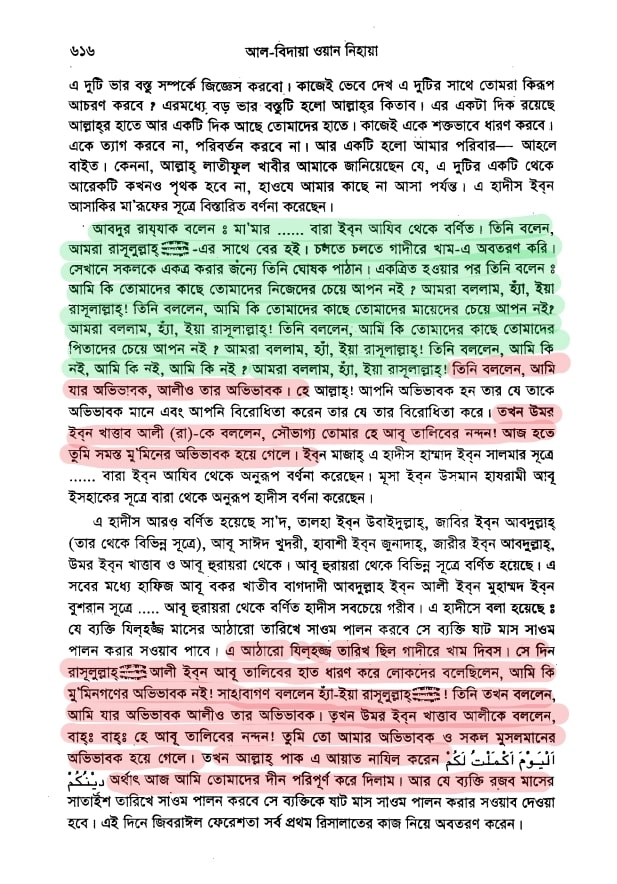
This matter is preserved in the book Al-Bidaya wa al-Nihaya by Ibn Kathir, [15]
Abdur Razzaq says: Narrated from Ma’amar ……. Bara ibn Azib. He says,
We set out with the Messenger of Allah. While traveling we descended at Ghadir Khumm. There he sent a herald to gather everyone. After gathering, he said: Am I not more worthy of you than yourselves? We said, Yes, O Messenger of Allah! He said: Am I not more worthy of you than your mothers? We said, Yes, O Messenger of Allah! He said: Am I not more worthy of you than your fathers? We said, Yes, O Messenger of Allah! He said: Am I not, am I not, am I not? We said, Yes, O Messenger of Allah! He said, Whoever has me as guardian has Ali as guardian as well. O Allah! be the guardian of whoever takes him as a guardian, and oppose whoever opposes him. Then Umar ibn Khattab said to Ali (ra), ‘Fortunate are you, O son of Abu Talib! From today onwards, you have become the guardian of all the mu’mins.’ Ibn Majah narrated a similar hadith from Bara ibn Azib through the chain of Hammad ibn Salama. Musa ibn Uthman al-Hazrami narrated a similar hadith from Bara through the chain of Abu Ishaq.
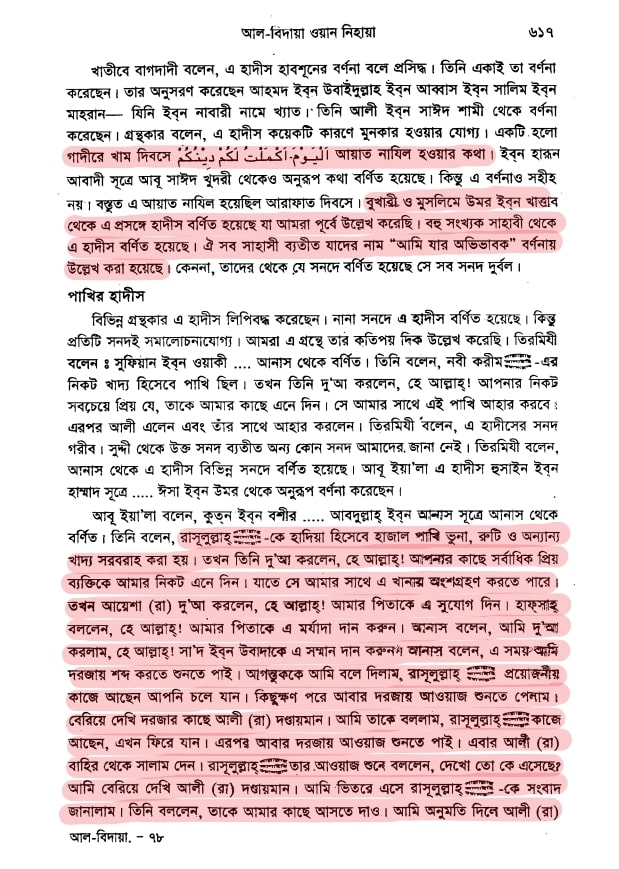
This hadith was also narrated by Sa‘d, Talha ibn Ubayd Allah, Jabir ibn Abd Allah through several lines, Abu Sa‘id al-Khudri, Hubshi ibn Junada, Jarir ibn Abd Allah, Umar ibn al-Khattab, and Abu Hurayra. It was transmitted from Abu Hurayra through several lines. Of these, the hadith narrated from Abu Hurayra by the hadith master Abu Bakr al-Khatib al-Baghdadi through Abd Allah ibn Ali ibn Muhammad ibn Bushran … is the most gharib. It says that whoever fasts on the eighteenth of Dhu al-Hijjah will receive the reward of fasting sixty months. The eighteenth of Dhu al-Hijjah was the day of Ghadir Khumm. On that day the Messenger of Allah took Ali ibn Abi Talib’s hand and said to the people, ‘Am I not the guardian of the believers?’ The Companions replied, ‘Yes, Messenger of Allah.’ He then said, ‘Whoever has me as guardian has Ali as guardian as well.’ Umar ibn al-Khattab then said to Ali, ‘Well done, son of Abu Talib! You have become my guardian and the guardian of every Muslim.’ Allah then revealed the verse الْيَوْمَ أَكْمَلْتُ لَكُمْ دینكُمْ, ‘Today I have perfected your religion for you.’ Whoever fasts on the twenty-seventh of Rajab will receive the reward of fasting sixty months. On this day, the angel Gabriel first descended with the commission of apostleship.
Al-Khatib al-Baghdadi says: This hadith is famous due to the narration of Habashun. He alone narrated it. Following him came Ahmad ibn Ubaydullah ibn Abbas ibn Salim ibn Mahran, who was known as Ibn Nubari. He narrated from Ali ibn al-Said al-Shami. The author says: This hadith is deserving of rejection for several reasons. One is the statement that a verse was revealed on the day of Ghadir Khumm الْيَوْمَ أَكْمَلْتُ لَكُمْ دِينُكُمْ. A similar statement is also narrated from Abu Sa’id al-Khudri through the chain of Ibn Harun Abadi, but this narration is not sahih. In fact, this verse was revealed on the day of Arafat. Hadiths regarding this matter are narrated from Umar ibn al-Khattab in Bukhari and Muslim, which we have previously mentioned. This hadith is narrated from a large number of Companions, apart from those whose names were mentioned in the narration “Whoever has me as guardian,” because the chains through which it is narrated from them are weak.
Verse 55 of Surah al-Ma’idah mentions Allah, the Messenger, and the believers in relation to the term wali. Ali donated a ring while in rukoo—this narration has been the center around which discussion regarding his special connection with this verse in tafsir has taken place. That exegesis brings together Ali’s donation, obedience and leadership within the same religious discourse. A leader’s act of giving up wealth here becomes a moral symbol supporting his authority. This symbol also has a deep connection with later disputes over the distribution of wealth in the state. If the moral qualification of a ruler is established on generosity and religious closeness, then merely having power in hand cannot be its full alternative. [16]
إِنَّمَا وَلِيُّكُمُ اللَّهُ وَرَسُولُهُ وَالَّذِينَ آمَنُوا الَّذِينَ يُقِيمُونَ الصَّلَاةَ وَيُؤْتُونَ الزَّكَاةَ وَهُمْ رَاكِعُونَ
English translation:
Your friends are Allah, His Messenger, and the believers who establish prayer, give zakat, and are humble.
Sheikh Mujibur Rahman
Your friends (1) are only Allah, His Messenger (2), and the believers who establish prayer, give zakat, and are humble (3).
Dr. Abu Bakr Muhammad Zakaria
Your friends are only Allah, His Messenger, and the believers who establish prayer, give zakat, and bow before Allah.
Taisirul Quran
Your friends are only Allah, His Messenger, and the believers who establish prayer and give zakat humbly.
Rawai Al-bayan
Your ally is none but Allah and (therefore) His Messenger and those who have believed – those who establish prayer and give zakāh, and they bow (in worship).
Saheeh International
Ibn Kathir’s Quran commentary preserves several reports linking Surah al-Ma’ida 5:55 with Ali giving away a ring while bowing in prayer. In that discussion, he also rejects the chains of transmission of several reports. [17]
If this meaning is taken, then it would be proven that giving zakat while in rukoo is better. However, no scholar or mufti believes that giving zakat while in rukoo is better.
Those who accept this meaning cite an incident saying that this verse was revealed regarding Hazrat Ali (RA). That is, once Hazrat Ali (RA) was in rukoo when a beggar came to him asking for charity, He took off his ring while in that position and gave it to the beggar.
Ibn Abu Hatim (RA)… narrates from Utba ibn Abu Hakim that Utba ibn 5 of 4 إِنَّمَا وَلِيُّكُمُ اللهُ وَرَسُولُهُ وَالَّذِينَ آمَنُوا (RA) was revealed regarding all believers.
Abu Sa’id al-Ashajj (RA)… narrates from Salma ibn Kuhayl (RA) that Salma ibn Kuhayl (RA) says: When Ali (RA) donated a ring while in rukoo, the aforementioned verse was revealed.
Ibn Jarir (RA)… narrates from Mujahid (RA) that Mujahid (RA) says: This verse was revealed regarding Ali (RA), because he once donated while in rukoo.
Abdur Razzaq (RA)… narrates from Ibn Abbas (RA) that Ibn Abbas (RA) says: This verse was revealed regarding Ali ibn Abi Talib (RA).
Ibn Mardawayh (RA)… narrates from Ibn Abbas (RA) that Ibn Abbas (RA) says: Once the Messenger of Allah (SA) exited the mosque. At that time many people were praying,
Some were in rukoo, some were in sujood, some were standing and some were sitting. In between, a beggar came to ask for charity from the Messenger of Allah (SA). He asked him: Has anyone given you anything? The beggar said: Yes, someone gave me. The Messenger of Allah (SA) asked: Who gave it? The beggar said: This standing man gave it. The Messenger of Allah (SA) asked again: In what position did he give you charity? The beggar said: He was in rukoo at that time. The Messenger of Allah (SA) said: Whoever gave you charity is Ali ibn Abi Talib. Then the Messenger of Allah (SA) sat near him and loudly recited:
وَمَنْ يَتَوَلَّ اللهُ وَرَسُولَهُ وَالَّذِينَ آمَنُوا فَإِنَّ حِزْبَ اللَّهِ هُمُ الْغَالِبُونَ
This chain of narration is unauthentic.
Every hadith narrated on this subject by Ibn Mardawayh through Ali (RA), Ammar ibn Yasir (RA), Abu Rafi (RA), and others is rejected and unsupported for various reasons involving the transmitters, including unfitness, unknown status, and falsehood.
In another narration, it is reported from Ibn Abbas (RA) through the chain of Maymun ibn Mihran that the aforementioned verse was indeed revealed addressing all believers, but Ali (RA) was addressed first.

The narration of Ghadir Khumm and Ali-centric tafsir strengthen the claim of succession in Shia political memory. Those who supported the leadership established at Saqifah brought forth a different priority—Quraysh’s social standing, the status of an elder follower, and the need for quick decision-making. Thus, the dispute was not limited to the question of who was more popular. There was also a dispute over which basis would be the foundation for the ultimate decision: Muhammad’s declared relationship, familial closeness, early contribution, or the collective bay’a. Due to two types of political legitimacy emerging from the same past, the controversy did not end after the transfer of power. [1] [2]
The memory of Ghadir could thus become uncomfortable for a later ruler. If giving weight to a declaration called the existing order of power into question, those in power stood to benefit from narrowing its meaning. Ali’s followers, in turn, had reason to keep the declaration alive, call its witnesses, and explain how it informed their allegiance. Preserving memory and controlling its meaning thus became political acts. Religious texts have had such an enduring part in Muslim disputes over leadership in part because rival claimants believed they needed the same founder’s approval on their side.
Aisha, Ali, and the Incident of Ifk: Family, Sexual Ethics, and Power
The incident of ifk surrounding Aisha [18] shows how closely Muhammad’s family life was tied to the public politics of his movement. While returning from the campaign against Banu al-Mustaliq, Aisha became separated from the caravan while looking for a necklace. The men put her covered riding seat on the camel without realizing she was not inside. Safwan found her later and brought her back to the caravan. Her return became the occasion for allegations of a sexual relationship. The long account preserved in Aisha’s name describes a month of illness, her tears, a change in her husband’s behavior, and learning what people had said after going to her parents’ house. The anguish of a woman under accusation and the social pressure to protect the reputation of the founder’s household met in the same event. [19]
In a society where family honor is tied to women’s sexual behavior, the burden of accusation must first be borne by the woman. Discussions continue among men, but the accused woman does not know which way her life will go. Aisha sees her husband’s affectionate behavior change. Later, when she learns what people are saying, concern arises about the acceptability of her own statement. She describes a situation where it seemed difficult to be believed even if one claimed innocence. The fear of losing personal trust and the prospect of public humiliation combined to create deep vulnerability. Being the wife of a religious leader did not keep her outside that fear.
When revelation came late, Muhammad consulted with Usama ibn Zayd and Ali. Usama spoke known good things on behalf of the family. Ali reminded Muhammad that other women were available to him and instructed him to ask the maid. His advice emphasized the husband’s option to change the relationship. For Aisha, this meant that her household and future honor were being discussed by others besides herself, and the matter of possible separation was also within that discussion. Her marital relationship with Muhammad was being judged as a question of alleviating the concerns of an influential man at that time. [19]
Sahih al-Bukhari (Islamic Foundation)
Book 44. Testimony
Chapter 1656. A woman’s testimony to another woman’s good character
2485 (Sahih al-Bukhari 2661). (Bengali edition)Abu Rabi‘ Sulayman ibn Dawud (may Allah have mercy on him) … narrated from Aisha, the Prophet’s wife (may Allah be pleased with her), concerning the slander that false accusers spread about her and from which Allah cleared her. The narrators said that Aisha said: When the Messenger (peace and blessings be upon him) intended to travel, he drew lots among his wives to choose who would accompany him. He took whichever wife’s name was drawn. When he was leaving for a battle, he drew lots among us, and my name came out, so I traveled with him. This was after the instruction on veiling had been revealed.
I was lifted onto the mount inside the howdah and brought down while still inside it. We traveled in this manner. On his return from that battle, when we had drawn close to Medina, the Messenger (peace and blessings be upon him) announced one night that the caravan would break camp. When the order was given, I got up, walked past the army, relieved myself, and returned to the howdah. When I touched my chest, I found that my necklace of black and white stones from Zafar had snapped and fallen off. I went back to look for it, and the search delayed me. Meanwhile, the men who lifted my howdah raised it and placed it on the camel I rode. They assumed I was inside it. Women at the time were light and slight, as they received little food, so the weight of the howdah did not seem unusual when they lifted it.
I was also a young girl at the time. They lifted the howdah and drove the camel away. I found my necklace after the army had left, and when I returned to where they had been, I found no one there. I decided to sit where I had been, thinking that they would come back to look for me when they noticed I was missing. As I sat there, my eyes grew heavy and I fell asleep. Safwan ibn al-Mu’attal, who was known first as al-Sulami and then as al-Dhakwani, had remained behind the army as an inspector. Toward morning he reached the place where I was staying. He saw the outline of someone asleep and approached me. He had seen me before the instruction on veiling was revealed. While he was making his camel kneel, I woke to his saying, ‘We belong to Allah, and to Him we return.’ He held down the camel’s foreleg, and I mounted it. He then led the animal on with me riding it.
We reached the army at midday, when they had dismounted to rest. Then those who were to bring ruin on themselves did so. Abd Allah ibn Ubayy ibn Salul, the leader of the hypocrites, was foremost in spreading the slander. We arrived in Medina, and I fell ill for a month after returning. Some people were then repeating the accusations made by the slanderers. While I was ill, I found it troubling that the Prophet (peace and blessings be upon him) did not show me the tenderness I usually received from him when I was sick. He would only come in, greet me and ask how I was. I knew nothing of what had happened. At last I grew very weak.
One night Umm Mistah and I went out into the open to relieve ourselves. We only went there at night. This was before latrines were built near our homes. In going into the wilderness or far from our dwellings to relieve ourselves, we did as the earlier Arabs had done. As I walked with Umm Mistah bint Abi Ruhm, her foot caught in her cloak and she stumbled. She exclaimed, ‘Woe to Mistah!’ I said, ‘What an awful thing to say! Are you cursing a man who fought at Badr?’ She replied, ‘You innocent girl! Have you not heard what they have been saying about you?’ Then she told me what the slanderers had spread.
My illness worsened. When I returned, the Messenger of Allah (peace and blessings be upon him) came in and asked, ‘How are you?’ I said, ‘Allow me to go to my parents.’ Aisha said: I wanted to find out from my parents what had happened. The Messenger of Allah gave me permission, and I went to them. I asked my mother, ‘What are people saying?’ She replied, ‘My daughter, do not take it so hard. By Allah, there are very few beautiful women who are loved by their husbands, and who have co-wives, without those co-wives making trouble for them.’
I said, ‘Glory be to Allah! Have people really been saying such things?’ Aisha said: I spent the night until dawn without my tears stopping or getting the slightest sleep. Then morning came. Later, when the revelation was delayed, the Messenger of Allah (peace and blessings be upon him) summoned Ibn Abi Talib and Usama ibn Zayd to seek their advice about leaving his wife. In giving his advice, Usama took into account the Prophet’s affection for his household. He said, ‘Messenger of Allah, by Allah, we know nothing but good of her.’ Ali ibn Abi Talib (may Allah be pleased with him) said, ‘Messenger of Allah, Allah has imposed no restriction upon you. There are many women besides her. Ask the enslaved woman, and she will tell you the truth.’
The Messenger of Allah (peace and blessings be upon him) then summoned the enslaved woman Barira and asked her, ‘Barira, have you seen anything suspicious in her conduct?’ Barira replied, ‘By the One who sent you with the truth, I have seen nothing of the sort. The only thing I have seen is that she is a young girl and falls asleep over the dough, so a goat comes and eats it.’ That day the Messenger of Allah (peace and blessings be upon him) stood to speak in the mosque and asked for help against the machinations of Abd Allah ibn Ubayy ibn Salul. He said, ‘Who will deal with the man who has caused me anguish through what he has said about my family? By Allah, I know only good of my wife. And they have implicated a man of whom I know only good, and who has never entered my house without me.’
Sa‘d ibn Mu‘adh (may Allah be pleased with him) stood and said, ‘Messenger of Allah, by Allah, I will deal with him. If he is from the Aws, I will strike off his head. If he is from our brothers of the Khazraj, give us your order and we will carry it out.’ Sa‘d ibn Ubadah (may Allah be pleased with him), the chief of the Khazraj, stood up. He had been a good man before then, but tribal loyalty got the better of him. He said, ‘You lie. By Allah, you cannot kill him. You do not have that power.’ Usayd ibn al-Hudayr (may Allah be pleased with him) then stood up and said, ‘You are the one who lies. By Allah, we will kill him. You are a hypocrite, arguing on behalf of the hypocrites.’ Both the Aws and the Khazraj then became so agitated that they were about to fight while the Messenger (peace and blessings be upon him) was still on the pulpit. He came down and quieted them. Everyone calmed down, and he, too, fell silent.
Aisha (may Allah be pleased with her) said: I cried all that day. My tears did not dry, and I got no sleep at all. My parents stayed by my side. I spent the whole night and day crying and thought my weeping would tear my heart apart. They were sitting beside me as I cried when a woman from the Ansar asked permission to enter. I let her in, and she sat down and wept with me. While we were there, the Messenger of Allah (peace and blessings be upon him) came in and sat down beside me. He had not sat with me since the slander had been spread. A month had passed by then. Yet he had received no revelation concerning me.
Aisha said: After praising and glorifying Allah, he said, ‘Aisha, I have heard such things said about you. If you are innocent, Allah will clear you. If you have become involved in a sin, repent and ask Allah to forgive you. When a servant acknowledges a sin and repents, Allah accepts that repentance.’ When he finished speaking, my tears stopped. I did not feel even a drop. I told my father, ‘Answer the Messenger of Allah on my behalf.’ He said, ‘By Allah, I do not know what to say to the Messenger of Allah.’ Then I told my mother, ‘Answer the Messenger on my behalf.’ She too said, ‘By Allah, I do not know what to say to the Messenger of Allah.’
I was a young girl then and had read little of the Quran. Still, I said, ‘By Allah, I know you have heard what people have been spreading, that it has lodged in your minds, and that you have believed it. If I tell you that I am innocent, and Allah knows I am innocent, you will not believe me. If I admit something to you, you will believe me, even though Allah knows I am innocent. By Allah, I can find no example for you other than that of Joseph’s father (peace be upon him), who said that beautiful patience was best for him, and that Allah alone was the one whose help he sought against what they were saying.’
I then turned over on my bed. I hoped Allah would clear me, but by Allah, it never occurred to me that a revelation would come about me. I did not consider myself worthy of having anything said about me in the Quran. I hoped the Messenger of Allah might have a dream in his sleep that would establish my innocence. But by Allah, he had not yet risen from his seat and no one had left the house when the revelation began to come to him. He experienced the strain that usually came over him during revelation, so that drops of sweat like pearls fell from him even on a winter day.
When that state of revelation passed from the Messenger of Allah (peace and blessings be upon him), he was smiling. The first words he said to me were, ‘Aisha, praise Allah, for He has declared you innocent.’ My mother then told me, ‘Go to the Messenger of Allah (peace and blessings be upon him) and show him your gratitude.’ I said, ‘No, by Allah! I will not go to him or praise anyone but Allah.’ Allah Most High revealed the verse إِنَّ الَّذِينَ جَاءُوا بِالإِفْكِ عُصْبَةٌ مِنْكُمْ. When this was revealed in vindication of me, Abu Bakr al-Siddiq (may Allah be pleased with him) said, ‘By Allah, after what Mistah ibn Uthatha said about Aisha, I will never again spend on him as I used to on account of our kinship.’
Allah Most High then revealed the verse وَلاَ يَأْتَلِ أُولُو الْفَضْلِ مِنْكُمْ وَالسَّعَةِ) إِلَى قَوْلِهِ (غَفُورٌ رَحِيمٌ, from the instruction that those of means and standing among you should not swear to withhold their charity to His statement that Allah is forgiving and merciful. Abu Bakr (may Allah be pleased with him) then said, ‘By Allah, I do want Allah to forgive me.’ He resumed giving Mistah what he had given him before.
The Messenger of Allah (peace and blessings be upon him) asked Zaynab bint Jahsh about me, saying, ‘Zaynab, what do you know? What have you seen?’ She said, ‘Messenger of Allah, I guard my hearing and my sight. By Allah, I know nothing but good of her.’ Aisha (may Allah be pleased with her) said: Zaynab was my rival, but Allah protected her because of her piety.
Abu Rabi‘ (may Allah have mercy on him) … reported a similar hadith from Aisha and Abd Allah ibn al-Zubayr (may Allah be pleased with them). Fulayh (may Allah have mercy on him) … narrated a similar account from Qasim ibn Muhammad ibn Abi Bakr (may Allah be pleased with him).
Hadith grade: Sahih
Narrator: Aisha (may Allah be pleased with her)
The incident of interrogating the slave girl reveals another layer of power. According to Ibn Ishaq’s account, Ali made the enslaved woman stand and beat her severely [20] and told her to tell Muhammad the truth. Ibn Hajar also quotes this reading in his commentary. Here, the pressure of crisis within the ruling family descends upon the body of the most subordinate woman. She is not merely told to inform about the incident; an attempt is made to elicit a response that can be accepted by the interrogator through beating. Conflict arises between telling the truth and protecting oneself for the slave girl. If the one who beats decides which answer is sufficient, then there is no freedom left in the witness’s autonomy. [21] [22]
Ibn Hajar, Fath al-Bari, commentary on Surah al-Nur, volume 8
وفي رواية أبي أويس أن النبي صلى الله عليه وسلم قال لعلي: شأنك بالجارية، فسألها علي وتوعدها فلم تخبره إلا بخير، ثم ضربها وسألها فقالت: والله ما علمت على عائشة سوءا. وفي رواية ابن إسحاق فقام إليها علي فضربها ضربا شديدا يقول: اصدقي رسول الله صلى الله عليه وسلم
English translation: Abu Uways narrates that the Prophet said to Ali, ‘Attend to the enslaved woman.’ Ali questioned her and threatened her. She reported nothing but good. Then he beat her and questioned her again. She said, ‘By Allah, I know of no bad deed by Aisha.’ Ibn Ishaq’s account states: ‘Ali went up to her and beat her severely and said, Tell the Messenger of Allah the truth.’
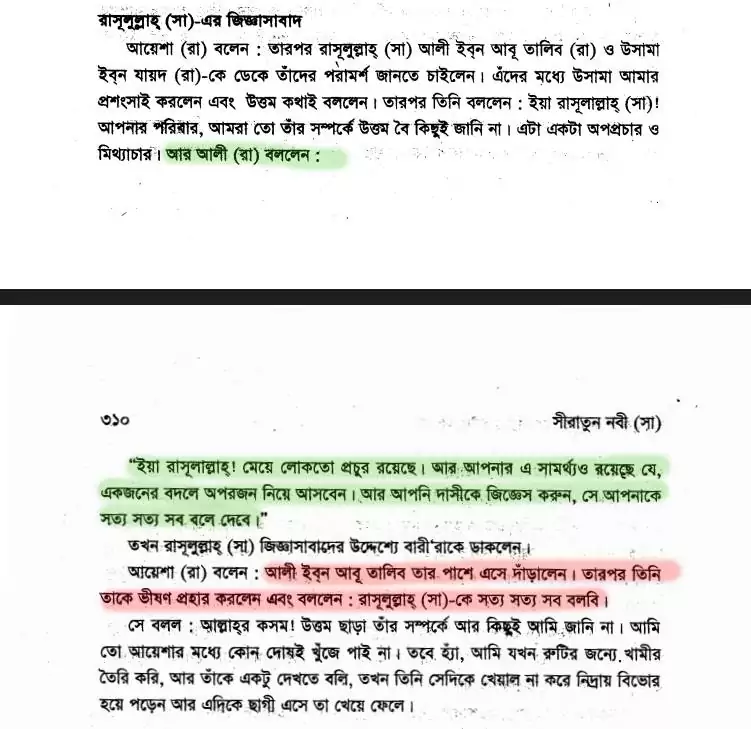
The topic is also described in the Siratun Nabi book [23]
Interrogation by Rasulullah (SA)
Aisha (RA) says: Then Rasulullah (SA) called Ali ibn Abi Talib (RA) and Usama
ibn Zayd (RA) to seek their advice. Among them, Usama praised me and spoke well. Then he said: O Messenger of Allah! As for your family, we know nothing but good of her. This is slander and
falsehood. And Ali (RA) said:
“O Messenger of Allah! There are plenty of women. And you have the ability to replace one with another. And ask the slave girl; she will tell you the truth, everything.'”
At that time, the Messenger of Allah (SA) summoned Barira for interrogation.
Aisha (RA) says: Ali ibn Abi Talib came and stood beside her. Then he severely beat her and said: Tell the Messenger of Allah (SA) the whole truth.
She said: By Allah! I know nothing but good of her. I find no fault in Aisha at all. However, yes, when I prepare dough for bread and ask her to watch it, she does not pay attention and falls asleep, while a goat comes and eats it.
The enslaved woman’s own answer supported Aisha. She said she had seen no sexual misconduct and described only an episode of ordinary carelessness at home: falling asleep while watching the dough and a goat eating it. The everyday domestic detail makes the young woman under accusation visible as a real person. No one had given Ali the right to beat the woman at the bottom of that household’s hierarchy. Ali’s close family ties and religious standing do nothing to lessen his moral responsibility. Striking an enslaved woman to get information about another man’s wife is physical abuse. The social pressure to verify one woman’s chastity turned into violence against another woman’s body.
In Bukhari’s narration, after Muhammad spoke to a public gathering about the slander against his family, excitement was seen among the people of Aws and Khazraj. Preparation for punishing someone and tribal conflicts quickly proceeded side by side. From this it can be understood that a leader’s family crisis could pull the entire society towards conflict. When demands to protect household honor, party loyalty, and taking the side of a tribe converged, the trial of accusations was filled with emotion and competition of power. Aisha’s own suffering was suppressed within that larger patriarchal competition. Rumors against one woman created fear of conflict among armed groups in society. [19]
The incident was religiously resolved when Surah al-Nur of the Quran called the Ifk slander and required evidence. That resolution did not erase the time Aisha had spent under accusation. There was ample reason for the advice others had given about her to remain in her personal memory. Ali had spoken of the option to leave her and choose another woman, while Usama had stood by her—the emotional impact of the two pieces of advice could not be expected to be the same. The experience of who stood by her and who showed a path to break relations could change a relationship of trust. This psychological blow created a relational background for subsequent disagreements. [24] [19]
Another account of Muhammad’s final illness has Aisha naming Abbas as one of the two people who brought him, and does not name the other. Ibn Abbas later identifies that person as Ali. This ambiguity in names is significant within that family history. Within the narrative itself, there was a need to restore Ali’s identity. The positions and memories of people connected to the same family were not uniform, and their intimacy was not free from injury and distrust. Later, Uthman’s assassination and the political gathering in Basra would make them open opponents. In that conflict, personal experience and political position continue within a single person’s life. [25]
Sahih al-Bukhari (Islamic Foundation)
10. The Call to Prayer
Chapter 431. How ill may a person be and still join congregational prayer?
632 (Sahih al-Bukhari 665). (Bengali edition) Ibrahim ibn Musa (may Allah have mercy on him) … Aisha (may Allah be pleased with her) reported that when the Messenger of Allah (peace and blessings be upon him) became gravely ill and his condition worsened, he asked his other wives to allow him to be cared for in her house. They agreed. He then went out for prayer, leaning on two men, with his feet dragging on the ground. He was between Abbas (may Allah be pleased with him) and another Companion. The narrator Ubayd Allah (may Allah have mercy on him) said: I told Ibn Abbas (may Allah be pleased with him) what Aisha (may Allah be pleased with her) had related. He asked me, “Do you know who the person was whom Aisha (may Allah be pleased with her) did not name?” I said no. He said: “It was Ali ibn Abi Talib (may Allah be pleased with him).”
Hadith grade: Sahih
Narrator: Aisha (may Allah be pleased with her)
Muhammad’s Final Illness and the Clash of Authority over a Written Instruction
In his final illness, Muhammad told Aisha of the pain caused by food from Khaybar. According to Bukhari, he was still experiencing that pain at the time and informed about a sensation as if his main artery had been severed due to poison. Amidst this physical suffering, requests for written instructions came. The combination of these two events—his attempt to determine the future of followers with a sick body and the obstruction of that attempt—makes the cruelty of the final days even clearer. For whom words had long been guidance for followers, his own request amidst his pain became the subject of debate. [26] [27]
Sahih al-Bukhari, Final Illness, hadith 4428
قَالَتْ عَائِشَةُ كَانَ النَّبِيُّ صلى الله عليه وسلم يَقُولُ فِي مَرَضِهِ الَّذِي مَاتَ فِيهِ يَا عَائِشَةُ مَا أَزَالُ أَجِدُ أَلَمَ الطَّعَامِ الَّذِي أَكَلْتُ بِخَيْبَرَ فَهَذَا أَوَانُ وَجَدْتُ انْقِطَاعَ أَبْهَرِي مِنْ ذَلِكَ السَّمِّ
English translation: Aisha said that during the illness in which he died, the Prophet would say, ‘Aisha, I still feel pain from the food I ate at Khaybar. Because of that poison, I now feel as though my aorta is being severed.’
Although Muhammad’s final illness weakened his body, the religious significance of his instructions to followers remained intact. According to Bukhari via Ibn Abbas, he desired provisions for leaving written instructions. Regarding the outcome of that instruction, he said that if it existed, followers would not later lose their way. The language of the request clearly aims at controlling and guiding future society. However, before writing the instruction, conflict arose among those present. Umar took a stance saying the Quran is sufficient by raising the severity of his illness. Others agreed with him, while another group urged fulfilling Muhammad’s request. [28] [29] [29] [30]
Sahih al-Bukhari, Patients and Illness, hadith 5669
لَمَّا حُضِرَ رَسُولُ اللَّهِ صلى الله عليه وسلم وَفِي الْبَيْتِ رِجَالٌ فِيهِمْ عُمَرُ بْنُ الْخَطَّابِ قَالَ النَّبِيُّ صلى الله عليه وسلم ” هَلُمَّ أَكْتُبْ لَكُمْ كِتَابًا لاَ تَضِلُّوا بَعْدَهُ ”. فَقَالَ عُمَرُ إِنَّ النَّبِيَّ صلى الله عليه وسلم قَدْ غَلَبَ عَلَيْهِ الْوَجَعُ وَعِنْدَكُمُ الْقُرْآنُ، حَسْبُنَا كِتَابُ اللَّهِ فَاخْتَلَفَ أَهْلُ الْبَيْتِ فَاخْتَصَمُوا، مِنْهُمْ مَنْ يَقُولُ قَرِّبُوا يَكْتُبْ لَكُمُ النَّبِيُّ صلى الله عليه وسلم كِتَابًا لَنْ تَضِلُّوا بَعْدَهُ، وَمِنْهُمْ مَنْ يَقُولُ مَا قَالَ عُمَرُ فَلَمَّا أَكْثَرُوا اللَّغْوَ وَالاِخْتِلاَفَ عِنْدَ النَّبِيِّ صلى الله عليه وسلم قَالَ رَسُولُ اللَّهِ صلى الله عليه وسلم ” قُومُوا ”. قَالَ عُبَيْدُ اللَّهِ فَكَانَ ابْنُ عَبَّاسٍ يَقُولُ إِنَّ الرَّزِيَّةَ كُلَّ الرَّزِيَّةِ مَا حَالَ بَيْنَ رَسُولِ اللَّهِ صلى الله عليه وسلم وَبَيْنَ أَنْ يَكْتُبَ لَهُمْ ذَلِكَ الْكِتَابَ مِنِ اخْتِلاَفِهِمْ وَلَغَطِهِمْ.
English translation: Ibn Abbas says, at the time of the death of Allah’s Messenger, there were several men in the house, among them Umar ibn Khattab. The Prophet said: ‘Come, I will write for you something after which you will not go astray.’ Umar said: ‘The Prophet is overwhelmed by the pain of illness. You have the Quran. Allah’s Book is sufficient for us.’ Then the people in the house began to argue and dispute over their opinions. One group said: Bring him close, the Prophet will write for you something after which you will not go astray. The other group continued to speak as Umar did. When argument and noise increased before the Prophet, the Messenger of Allah said: ‘Get up.’ Ubaydullah says, Ibn Abbas used to say, ‘The greatest disaster was their dispute and noise, which prevented the Messenger of Allah from writing that document for them.’
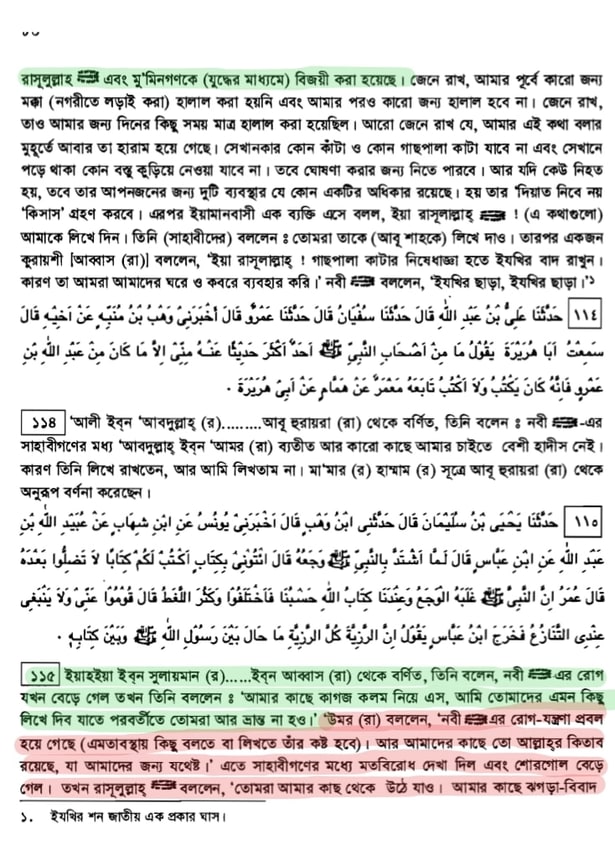
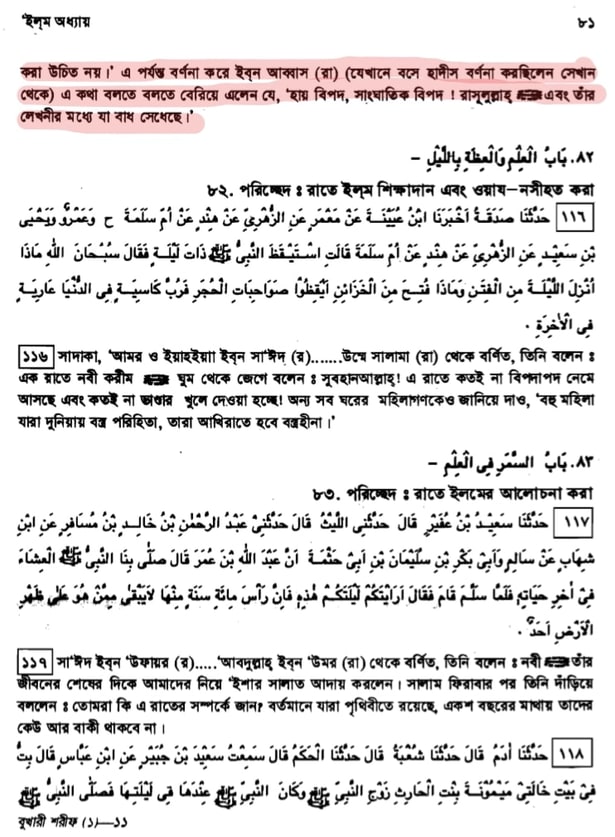
The sharpest question of power in this incident is whether Muhammad’s instruction would be effective or not, a matter his followers actually took into their own hands. He asked for materials, but instead of simply fulfilling that request, they began to judge its necessity. Umar used the state of his body as a ground for objection. Muhammad’s illness here becomes an element in both a medical condition and how much his statement would be considered effective. Before the man who claimed final authority over religious decisions while alive, another follower was deciding that society could function without additional instructions.
The political significance of the phrase ‘Allah’s Book is sufficient for us’ lies here too. By saying the Quran is sufficient, Muhammad’s specific request at that time is rendered unnecessary. At the same time, the field for future interpretation remains open. A written instruction could have fixed the founder’s language on a specific question. If it was not created, living followers would interpret subsequent decisions from his previous statements, memory, and scripture. The opportunity to determine final language was lost in Muhammad’s own hand due to the instruction being blocked, while the authority of interpretation remains in the hands of his later political successors.
The division among the present people is evidence of future tension even among close followers. They were not outsiders coming from outside; rather, the struggle was among those who had been given the opportunity to stay by Muhammad’s side at his last moments. Thus, there was a conflict over whether the request would be fulfilled within that group. Consequently, under the public unity of religious obedience, different positions emerged regarding the right to decide. The incident reveals how quickly people around him could move to prioritize their own judgment once the leader’s body weakened. At that time, the presence of the founder was no longer sufficient to stop the conflict; ultimately, he himself had to tell them to leave.
Ibn Abbas described this incident as a disaster. The center of his grief was an instruction that was lost, which Muhammad himself had intended to write to prevent deviation. This memory preserves both physical pain and the failure of followers. The person was in agony; it was possible to bring the necessary materials to fulfill his request, but there was argument and noise there. Suppressing his will in this manner from the perspective of care for the sick person is serious. The more highly regarded the religious leader’s dignity is seen to be, the more evident the inconsistency becomes in disregarding his final request.
The question of who would lead after Muhammad’s death made the written instruction especially consequential. It was never produced, so its contents remain unknown. What is clear is that a dispute within the room brought the attempt to instruct the future community to a halt. The consequences reached into the succession crisis. An authoritative written instruction could have narrowed the scope of later bargaining. In its absence, the initiative of senior followers, claims of tribal standing, support from those present, and the ability to obtain a pledge quickly became the chief means of deciding leadership.
Thus, Muhammad’s final illness revealed a real transfer of authority before his death. He was still alive, but others were deciding whether his request would be honored. This weakness of body-dependent leadership became more pronounced after death. No independent institution came forward to implement his last spoken instruction. Effective means to control the behavior of those around him were limited in his hand at that time. Those who would later rule his followers are gaining experience of placing their own judgment over his request in such a crisis situation.
Muhammad’s Death, the Delay in His Burial, and the Struggle for Succession
With the death of Muhammad, Medina simultaneously experienced grief, uncertainty, and political activity. According to Aisha’s statement recorded in Bukhari, he died on a Monday. Ibn Hisham’s Sirah mentions that the body was prepared on Tuesday, with people praying the funeral prayer in groups, and burial took place during the night of Wednesday. In the Arabic calendar, the night of Wednesday begins after sunset on Tuesday. At this time, family members and close associates were performing the washing, shrouding, funeral prayer, and burial duties. The task of honoring the body of a founder also raises questions about preserving his memory, the rights of his family, and the respect of society. [31] [32] [33]
Ibn Hisham, Al-Siratu An-Nabawiyya, Burial and Funeral Prayer, 2/663–664
فلما فرغ من جهاز رسول الله صلى الله عليه وسلم يوم الثلاثاء، وضع في سريره في بيته، وقد كان المسلمون اختلفوا في دفنه. فقال قائل: ندفنه في مسجده وقال قائل: بل ندفنه مع أصحابه، فقال أبو بكر: إني سمعت رسول الله صلى الله عليه وسلم يقول: ما قبض نبي إلا دفن حيث يقبض، فرفع فراش رسول الله صلى الله عليه وسلم الذي توفي عليه، فحفر له تحته، ثم دخل الناس على رسول الله صلى الله عليه وسلم يصلون عليه أرسالا، دخل الرجال، حتى إذا فرغوا أدخل النساء، حتى إذا فرغ النساء أدخل الصبيان. ولم يؤم الناس على رسول الله صلى الله عليه وسلم أحد. ثم دفن رسول الله صلى الله عليه وسلم من وسط الليل ليلة الأربعاء
English translation: On Tuesday, after the work of preparing the body of Allah’s Messenger was completed, he was placed on a bed in his house. There was disagreement among Muslims regarding where to bury him. Some said he should be buried in his mosque. Others said he should be buried with his companions. Abu Bakr said, ‘I heard Allah’s Messenger say that a prophet should be buried where he dies.’ The bed on which he died was removed, and a grave was dug beneath it. Then people came in groups to pray the funeral prayer for him. First, men entered. When they finished, women were allowed to enter. After women finished, children were allowed to enter. No one led the funeral prayer for Allah’s Messenger. Then, in the middle of Wednesday night, Allah’s Messenger was buried.
What is said about this matter in the book of Hazrat Aisha Radiyallahu Anha is relevant, [34]
Hazrat Aisha Radiyallahu Anha says while describing the death of the Prophet Sallallahu Alaihi Wa Sallam:
I was sitting with the Prophet Sallallahu Alaihi Wa Sallam on my lap. Suddenly, his body felt heavy to me. I looked at his face; his eyes were open. At the time of his death, the Prophet Sallallahu Alaihi Wa Sallam was heard saying: بل الرفيق الأعلى من الجنة Now it is the Exalted Companion who is needed. Upon hearing this, I thought he had decided to take leave from us. When I realized that the Prophet Sallallahu Alaihi Wa Sallam had passed away, I gently placed his head on the pillow. At that time, some involuntary lamentation came out of my mouth.
For two days, no arrangement was made for the shroud and burial of the Prophet Sallallahu Alaihi Wa Sallam. For it was not yet decided whether a grave would be dug or a lateral burial niche made; the custom among the Meccans was to dig graves, while the Medinese custom was to make lateral burial niches. Both sides wished to bury the Prophet in accordance with their respective customs. Finally, Hazrat Abbas ibn Abd al-Muttalib sent two men to Abu Ubayda ibn Jarrah and Abu Talha.
Abu Ubayda was accustomed to digging graves according to Meccan custom, while Abu Talha made lateral burial niches according to Medinese custom. The messenger sent to bring Abu Talha arrived quickly with him, but the one sent to bring Abu Ubayda could not arrive in time. Consequently, Abu Talha made a lateral burial niche according to Medinese custom, and during the night, the Prophet’s sacred body was laid to rest in the earth forever. Hazrat Aisha and Hazrat Fatima narrate that when we heard the sound of shovels being used at night, we realized that the Prophet had been buried.
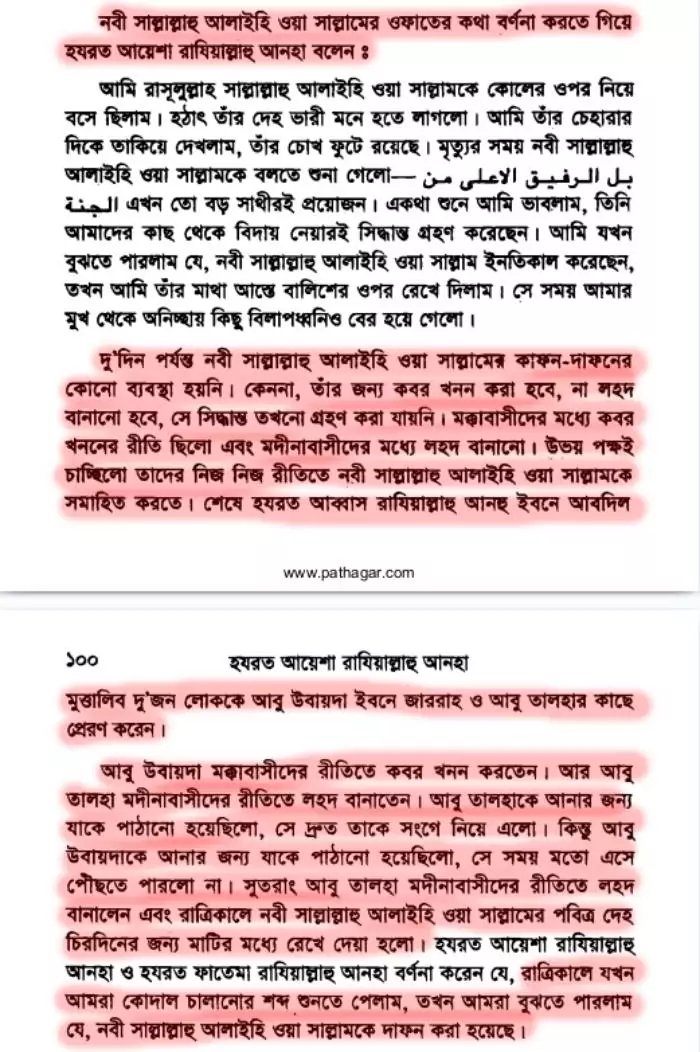
Disagreement arose even over where burial should take place: some proposed the mosque, while others suggested placing him alongside the graves of his Companions. Abu Bakr decided in favor of burial at the place of death, citing a statement of Muhammad’s. Although he had died, the authority to make a practical decision based on his words remained valid; however, only a living follower could present such a citation. Thus, the founder’s speech and the people who remembered that speech to enact the decision became linked. The question of burial provides an example of how political power operates through memory after death.
It was not possible for everyone to remain beside the body and attend the assembly choosing the new ruler at the same time. Muhammad’s family was involved in his funeral duties. Elsewhere, a gathering of the Ansar took place, and Abu Bakr and Umar went there. Before the burial was completed, discussions on leadership reached a decisive conclusion. As a result, the family faced a reality where the top position of the state had been determined before the mourning work was finished. Ali’s family responsibility did not diminish the importance of his political claim, but his absence at the first moment of the decision reduced his opportunity to exert influence. [1] [35]
Sahih al-Bukhari, Hudud, hadith 6830
وَإِنَّهُ قَدْ كَانَ مِنْ خَبَرِنَا حِينَ تَوَفَّى اللَّهُ نَبِيَّهُ صلى الله عليه وسلم إِلاَّ أَنَّ الأَنْصَارَ خَالَفُونَا وَاجْتَمَعُوا بِأَسْرِهِمْ فِي سَقِيفَةِ بَنِي سَاعِدَةَ، وَخَالَفَ عَنَّا عَلِيٌّ وَالزُّبَيْرُ وَمَنْ مَعَهُمَا، وَاجْتَمَعَ الْمُهَاجِرُونَ إِلَى أَبِي بَكْرٍ فَقُلْتُ لأَبِي بَكْرٍ يَا أَبَا بَكْرٍ انْطَلِقْ بِنَا إِلَى إِخْوَانِنَا هَؤُلاَءِ مِنَ الأَنْصَارِ. فَانْطَلَقْنَا نُرِيدُهُمْ فَلَمَّا دَنَوْنَا مِنْهُمْ لَقِيَنَا مِنْهُمْ رَجُلاَنِ صَالِحَانِ، فَذَكَرَا مَا تَمَالَى عَلَيْهِ الْقَوْمُ فَقَالاَ أَيْنَ تُرِيدُونَ يَا مَعْشَرَ الْمُهَاجِرِينَ فَقُلْنَا نُرِيدُ إِخْوَانَنَا هَؤُلاَءِ مِنَ الأَنْصَارِ. فَقَالاَ لاَ عَلَيْكُمْ أَنْ لاَ تَقْرَبُوهُمُ اقْضُوا أَمْرَكُمْ. فَقُلْتُ وَاللَّهِ لَنَأْتِيَنَّهُمْ. فَانْطَلَقْنَا حَتَّى أَتَيْنَاهُمْ فِي سَقِيفَةِ بَنِي سَاعِدَةَ، فَإِذَا رَجُلٌ مُزَمَّلٌ بَيْنَ ظَهْرَانَيْهِمْ فَقُلْتُ مَنْ هَذَا فَقَالُوا هَذَا سَعْدُ بْنُ عُبَادَةَ. فَقُلْتُ مَا لَهُ قَالُوا يُوعَكُ.
English translation: Umar says, ‘After Allah caused death to his Prophet, our situation was such that the Ansar separated from us and gathered at the Saqifah of Banu Sa’idah. Ali, al-Zubayr and those with them were separate from us. The Muhajirun gathered at Abu Bakr. I said to Abu Bakr, ‘Abu Bakr, let us go to our Ansar brothers.’ We set out towards them. Upon reaching them, we met two upright men. They informed us about the initiative of the gatherers and asked, ‘O Muhajirun, where are you going?’ I said, ‘To our Ansar brothers.’ They said, ‘There is no need to go to them. You make your own decision.’ I said, ‘By Allah, we will go to them.’ At Saqifah of Banu Sa’idah, I found one of them wrapped in a cloth. I asked, ‘Who is this?’ They said, ‘Sa’d ibn Ubadah.’ I said, ‘What happened to him?’ They said, ‘He was ill with fever.’
Umar’s account mentions both Ali and al-Zubayr’s group remaining separate and the Ansar holding their own assembly. In this divided situation, Abu Bakr and Umar’s quick action achieved the first success. Once one group gathered people around a leader and initiated the pledge first, the other groups would have to determine their relationship with it afterward. Thus, delay itself carried political value. While one party was responsible for burying the deceased, the organizational progress of others created an unequal position. After a decision was made, opposing it was more difficult than participating in the decision from the beginning.
This situation also clarifies the social relations between grief and power. People typically grant a certain scope of time and honor to the deceased’s close ones. However, if succession to state authority is at stake, that time becomes an opportunity for other claimants to organize. The moral responsibility of being near the corpse conflicts with the political necessity of participating in claims to subsequent power. When the grieving family undertakes one task, it falls behind in the other. This tension was particularly acute within Muhammad’s family, as familial closeness formed one of the main foundations of their political claims.
Ali had previously served in Yemen. Descriptions of his presence and meeting with Muhammad there, and his participation in the burial later, place him within the sequence of events. The roles of Ali, members of Abbas’s family, and other close associates in washing the body and lowering it into the grave have come to light in Sirat. Their work constituted a final duty towards the founder. At the same time, elsewhere in Medina, people were being positioned behind some leadership. Alongside the family’s claim based on closeness to the Prophet, the initiative of senior followers who organized quickly created an accomplished political fact. [36] [32]
The crisis Muhammad’s death created arose from the incomplete transition from personal authority to continuity of government. The living leader’s approval, kinship with him, longtime loyalty, and military service all brought standing. They supplied no common rule for deciding finally among rival claims. The decision at Saqifah first filled the gap by creating an effective government. The later disputes involving Ali and Fatima show that reaching a decision and settling everyone’s rights had different consequences. Muhammad’s body was buried, while the conflict over who would inherit his authority entered a new phase.
The Conflict among Abu Bakr, Umar, Ali, and Fatima
After Muhammad’s death, three rights were at the center of the conflict between his family and the new ruling group: participation in determining leadership, control over property, and the freedom to refuse allegiance to the ruler. Abu Bakr accepted the first bay’a at Saqifah; Ali and al-Zubayr remained outside that decision. Fatima claimed her right to the property left by her father; Abu Bakr rejected it. At the same time, Fatima’s house became a meeting place for Ali and his companions, and early works report that Umar threatened to set it on fire. This sequence of events resulted in a direct conflict between the family’s dignity derived from kinship and the effective power of the caliph. [35] [37] [38]
During Muhammad’s lifetime, religious authority, military leadership, wealth distribution, and dispute resolution final authority were concentrated in one person’s hands. After his death, succession claims arose in every field, but claimants were not one. Ansars wanted leadership share based on their shelter, war, and sacrifice; Quraysh Muhajir leaders brought arguments of hereditary and social acceptability; Ali claimed his share as Muhammad’s near relative. Fatima’s property dispute was also judged by Abu Bakr, whose political establishment faced accusations of neglecting Ali. Thus the property dispute was conducted from the beginning within an unequal power relationship. [35] [37]
The Consolidation of Power at Saqifah
After Muhammad died, the Ansar gathered at the saqifah of Banu Sa’idah. Sa‘d ibn Ubadah, the leader of the Khazraj, was ill and wrapped in a cloth. The Ansar had given Muhammad and the Emigrants refuge in Medina and played a major part in defending the new community. This standing was the basis of their claim to decide the future of their city and their political position after the founder’s death. The Ansar’s speaker called his people ‘Allah’s helpers’ and ‘the army of Islam.’ His speech also expressed fear that authority would pass to the leaders of the Emigrants, who had come from elsewhere. Contributions to the community, a local power base, and the security of the group were all at stake in the dispute. [35] [39]
Umar went to Saqifah with Abu Bakr; Abu Ubayda ibn al-Jarrah was also present there. Umar’s subsequent speech brought up three separate political positions at the moment of Muhammad’s death: Ansars were assembled at Saqifah, some Muhajirs were by Abu Bakr’s side, and Ali and al-Zubayr were separate with their companions. This absence of Ali and al-Zubayr brings to light that leadership decision moved outside Muhammad’s family. The center of family honor was then Muhammad’s home; the center of new power was rising in another assembly. Competition on who could first declare an effective decision determined subsequent events’ momentum. [35]
Ibn Hisham’s preserved Umar speech comes in same continuous narration about first bay’a’s suddenness, consultation question, and Ali’s separate position. Umar admits that Abu Bakr’s bay’a occurred suddenly and in his opinion Allah protected from harm. He gives severe warning against any subsequent person accepting bay’a outside general consultation similarly. [39]
Ibn Hisham, al-Sirat al-Nabawiyya, Umar’s speech and Abu Bakr’s bay’a, 2/657–660
ثم إنه قد بلغني أن فلانا قال : والله لو قد مات عمر بن الخطاب لقد بايعت فلانا ، فلا يغرن امرأ أن يقول : إن بيعة أبي بكر كانت فلتة فتمت ، وإنها قد كانت كذلك إلا أن الله قد وقى شرها ، وليس فيكم من تنقطع الأعناق إليه مثل أبي بكر ، فمن بايع رجلا عن غير مشورة من المسلمين ، فإنه لا بيعة له هو ولا الذي بايعه تغرة أن يقتلا ، إنه كان من خبرنا حين توفى الله نبيه صلى الله عليه وسلم أن الأنصار خالفونا ، فاجتمعوا بأشرافهم في سقيفة بني ساعدة ، وتخلف عنا علي بن أبي طالب والزبير بن العوام ومن معهما ، واجتمع المهاجرون إلى أبي بكر ، فقلت لأبي بكر : انطلق بنا إلى إخواننا هؤلاء من الأنصار ، فانطلقنا نؤمهم حتى لقينا منهم رجلان صالحان ، فذكرا لنا ما تمالأ عليه القوم ، وقال : أين تريدون يا معشر المهاجرين ؟ قلنا : نريد إخواننا هؤلاء من الأنصار ، قالا : فلا عليكم أن لا تقربوهم يا معشر المهاجرين ، اقضوا أمركم .
English translation: Umar says: I have received news that someone said, ‘By Allah, if Umar ibn al-Khattab dies, I will give bay’a to such-and-such.’ Let no one be deceived into thinking that the bay’a of Abu Bakr occurred suddenly and was completed. It happened in that manner; however, Allah protected against its harm. There is no one among you like Abu Bakr, toward whom people stretch their necks. If anyone makes bay’a to any person without the advice of Muslims, neither the giver nor the receiver’s bay’a will be valid; both risk being killed. Our incident was this: after Allah took His Prophet, the Ansar separated from us and gathered with their leading figures at the Saqifah of Banu Sa’idah. Ali ibn Abi Talib, al-Zubayr ibn al-Awwam and their companions were also separate from us. The Muhajirun gathered at Abu Bakr. I said to Abu Bakr, ‘Let us go to our Ansari brothers.’ We set out for them. On the way we met two good men who told us about their people’s decision and asked, ‘O Muhajirun, where are you going?’ We replied, ‘To our Ansari brothers.’ They said, ‘There is no need for you to go there; decide your own affairs yourselves.’
While acknowledging the Ansar’s sacrifices, Abu Bakr restricted the central claim: the Arabs would accept leadership only from Quraysh. Qurayshi descent and social standing thus became the principal practical grounds for eligibility to lead. Even after the Ansar’s contribution was acknowledged, supreme authority remained confined to Quraysh. Participation in Islam’s collective struggle and the right to govern the state were consequently allocated on two different levels. Medina’s local forces were needed as a foundation for the new state, but their equal claim to its highest office was rejected. [35] [39]
One of the Ansar proposed: ‘A leader from among us, a leader from among you.’ This was an attempt to share power: recognizing both the local political base and the leadership of the Muhajirun as distinct entities. Abu Bakr asked those present to choose either Umar or Abu Ubayda. Umar then took hold of Abu Bakr’s hand and pledged allegiance; thereafter, the pledge began among the present Muhajirun and Ansar. Amidst heated debate, an individual initiative quickly turned into a collective act of obedience. The identity of the new ruler was established before all claims in the discussion were resolved. [35] [39]
Ibn Hisham preserves the Ansari speaker’s statement, the argument for Qurayshi leadership, Umar’s hurried pledge, and the jostling around Sa’d within the same sequence of events. The account makes clear how disagreement over leadership escalated into physical pressure and the language of curses. [39]
Ibn Hisham, al-Sirat al-Nabawiyya, Umar’s speech and Abu Bakr’s bay’a, 2/657–660
قال : قلت : والله لنأتيهم . فانطلقنا حتى أتيناهم في سقيفة بني ساعدة ، فإذا بين ظهرانيهم رجل مزمل فقلت : من هذا ؟ فقالوا : سعد بن عبادة ، فقلت : ما له ؟ فقالوا : وجع . فلما جلسنا تشهد خطيبهم ، فأثنى على الله بما هو له أهل ، ثم قال : أما بعد ، فنحن أنصار الله وكتيبة الإسلام ، وأنتم يا معشر المهاجرين رهط منا ، وقد دفت دافة من قومكم ، قال : وإذا هم يريدون أن يحتازونا من أصلنا ، ويغصبونا الأمر ، فلما سكت أردت أن أتكلم ، وقد زورت في نفسي مقالة قد أعجبتني ، أريد أن أقدمها بين يدي أبي بكر ، وكنت أداري منه بعض الحد ، فقال أبو بكر : على رسلك يا عمر ، فكرهت أن أغضبه ، فتكلم ، وهو كان أعلم مني وأوقر ، فوالله ما ترك من كلمة أعجبتني من تزويري إلا قالها في بديهته ، أو مثلها أو أفضل ، حتى سكت ؛ قال : أما ما ذكرتم فيكم من خير ، فأنتم له أهل ، ولن تعرف العرب هذا الأمر إلا لهذا الحي من قريش ، هم أوسط العرب نسبا ودارا ، وقد رضيت لكم أحد هذين الرجلين ، فبايعوا أيهما شئتم ، وأخذ بيدي وبيد أبي عبيدة بن الجراح ، وهو جالس بيننا ، ولم أكره شيئا مما قاله غيرها ، كان والله أن أقدم فتضرب عنقي ، لا يقربني ذلك إلى إثم ، أحب إلي من أن أتأمر على قوم فيهم أبو بكر . قال قائل من الأنصار : أنا جذيلها المحكك وعذيقها المرجب ، منا أمير ومنكم أمير يا معشر قريش . قال : فكثر اللغط ، وارتفعت الأصوات ، حتى تخوفت الاختلاف ، فقلت : ابسط يدك يا أبا بكر ، فبسط يده ، فبايعته ، ثم بايعه المهاجرون ، ثم بايعه الأنصار ، ونزونا على سعد بن عبادة ، فقال قائل منهم : قتلتم سعد بن عبادة . قال : فقلت : قتل الله سعد بن عبادة .
English translation: Umar said: I said, ‘By Allah, we are going to them.’ We reached the saqifah of Banu Sa’idah. There was a man wrapped in a cloth among them. I asked who he was and they said he was Sa‘d ibn Ubadah. I asked what was wrong and they said he was ill. Once we sat, their speaker praised Allah and said, ‘We are Allah’s helpers and the army of Islam. You Emigrants are a group among us. Some of your people have come to push us out of our rightful position and take authority away from us.’ When he stopped, I wanted to speak. I had prepared a speech in my mind and liked it. I wanted to say it before Abu Bakr spoke and avoid some of his severity. Abu Bakr said, ‘Umar, take your time.’ I did not want to displease him. He spoke. He had better knowledge and was more composed than I was. Every point I had liked in my own speech he made on the spot, or put as well as I would have or better. He said, ‘You deserve the virtues you have claimed for yourselves. The Arabs will recognize this authority only in this section of the Quraysh. They are at the center of the Arabs in lineage and dwelling place. I have chosen either of these two men for you. Pledge allegiance to whichever you wish.’ He took my hand and the hand of Abu Ubayda ibn al-Jarrah, who sat among us. That was the only part of what he had said that I disliked. By Allah, I would rather have had my neck struck off without falling into sin than lead a group in which Abu Bakr was present. One of the Ansar said, ‘I am the tried support and the honored palm tree. Quraysh, let there be a leader from among us and a leader from among you.’ The clamor grew and voices rose. I feared a split and said, ‘Abu Bakr, hold out your hand.’ He held it out and I pledged allegiance. Then the Emigrants and the Ansar gave their pledges. We rushed upon Sa‘d ibn Ubadah. One of them said, ‘You have killed Sa‘d ibn Ubadah!’ I said, ‘May Allah kill Sa‘d ibn Ubadah.’
In response to the accusation, ‘You have killed Sa’d,’ Umar says, ‘May Allah kill Sa’d.’ Used amid the jostling around an ill rival leader, this language publicly disregarded an opponent’s safety and dignity. Alongside political accommodation, Saqifah also involved intimidation and a display of force. The man whose claim to leadership had brought the Ansar together found himself endangered within the gathering for the new pledge. The victors’ ability to organize allegiance rapidly operated together with their ability to weaken their opponent’s position. [35] [39]
Umar’s long speech in Bukhari also states the reason: if they had left without making the bay’a, the Ansar could have chosen one of their own as a leader; then they would have had to accept the disliked bay’a or oppose it and fall into conflict. This admission reveals fear that an Ansari decision would take effect before Abu Bakr’s pledge. Completing the pledge first was chosen as a means of controlling the political situation. After establishing the authority of the new caliph, the discussion did not remain limited to those in an equal position; the others now faced the question of recognizing the established authority. [35]
Sahih al-Bukhari, Hudud, hadith 6830
وَإِنَّا وَاللَّهِ مَا وَجَدْنَا فِيمَا حَضَرْنَا مِنْ أَمْرٍ أَقْوَى مِنْ مُبَايَعَةِ أَبِي بَكْرٍ، خَشِينَا إِنْ فَارَقْنَا الْقَوْمَ وَلَمْ تَكُنْ بَيْعَةٌ أَنْ يُبَايِعُوا رَجُلاً مِنْهُمْ بَعْدَنَا، فَإِمَّا بَايَعْنَاهُمْ عَلَى مَا لاَ نَرْضَى وَإِمَّا نُخَالِفُهُمْ فَيَكُونُ فَسَادٌ، فَمَنْ بَايَعَ رَجُلاً عَلَى غَيْرِ مَشُورَةٍ مِنَ الْمُسْلِمِينَ فَلاَ يُتَابَعُ هُوَ وَلاَ الَّذِي بَايَعَهُ تَغِرَّةً أَنْ يُقْتَلاَ.
English translation: Umar said: ‘By Allah, among the matters presented before us, we found nothing more urgent than giving bay’a to Abu Bakr.’ We feared that if we left the people without completing the pledge, they would afterward pledge allegiance to one of their own. Then we would have had either to pledge to them against our wishes or to oppose them, which would have brought disaster. If anyone pledges allegiance to a man without consulting the Muslims, neither the man who gives the pledge nor the one who receives it is to be followed. They would both be in danger of being killed.
The politics of Saqifah meant that even the time for mourning was distributed unequally. Ali and other members of the family were occupied with washing and burying Muhammad’s body. The duty followed naturally from their place in his family. While they were doing it, leadership was decided elsewhere and their absence became a political loss. The closest family ties to Muhammad carried a duty to care for his body after death, while succession to power was decided at another meeting. The family suffered a double loss. As they mourned someone dear to them, they had to begin struggling to recover their place in the new order. [40] [35]
Reason for the delay in burying the Messenger of Allah (peace and blessings be upon him):
On Monday afternoon, the Messenger of Allah (peace and blessings be upon him) passed away. According to most accounts, his blessed body was interred during the night following Tuesday. Some have mentioned Tuesday again, while others have mentioned Wednesday. Essentially, the delay was for confirming the death and performing the funeral prayer; whatever time these needs require must be allowed. There was no needless delay in burial; the delay occurred because people gathered for a prolonged period to perform the funeral prayer. The Messenger of Allah (peace and blessings be upon him) spent 23 years establishing an example of education, culture, and noble ideals; appointing a caliph was crucial to preserving this legacy. To settle this matter, leading Companions such as Hazrat Abu Bakr Siddiq (may Allah be pleased with him) and Hazrat Umar Faruq (may Allah be pleased with him) were occupied with choosing the caliph, while Hazrat Ali (may Allah be pleased with him) and others performed ghusl, shrouding, etc., but there was a delay in burial because it took many people some time to believe that the Messenger of Allah (peace and blessings be upon him) had passed away. Belief in the passing of the Messenger (peace and blessings be upon him) also took considerable time among everyone. Indeed, Hazrat Umar (may Allah be pleased with him) declared: ‘Whoever says that Muhammad (peace and blessings be upon him) has passed away, I will cut him in two with a sword.’
The second reason is that it took some time for the funeral prayer of the Messenger of Allah (peace and blessings be upon him). No one led the funeral prayer; rather, two to four people entered Hazrat Aisha’s (may Allah be pleased with her) chamber, and everyone prayed individually. It took considerable time for thousands of Companions (may Allah be pleased with them) to pray in such a manner in limited space. Due to all these reasons, there was a delay in the burial work of the Messenger of Allah (peace and blessings be upon him). Therefore, comparing anyone else to this is not valid.
Nowadays it has become customary to transport the dead to distant places and delay the funeral prayer and burial by a day or two. The relatives of even many devout people have begun to do this to them. At such a time, one should take steps to put an end to this bad custom and leave written instructions in one’s will. [Evidence: al-Bidaya wa-l-Nihaya 5:260 # al-Zurqani’s commentary on al-Muwatta 2:16 # Asahh al-Siyar 544 # Sirat-i Mustafa 3:187–189.

After the first bay’a, extensive collection of allegiance became the main task of the new government. Ali’s, al-Zubayr’s, and Muhammad’s family consent was then particularly valuable: even if a government could be run excluding them, their objections would put that government’s moral standing under question. Visible family objection meant multiple claims to Muhammad’s succession were alive. Thus, collecting their bay’a became both an advantage for state administration and a means of resolving political rivalry. The incidents of pressure at Fatima’s house occurred as part of this unresolved conflict. [37] [38]
Fatima’s Dispute with Abu Bakr Over Fadak
Fadak provided regular income from farmland and its produce. After the Khaybar campaign, Muhammad came to an agreement with its inhabitants. In Ibn al-Athir’s account, Muhammad acquired special control over half the land. The Muslim army had not taken it in battle, so the property was classified as fay’, property acquired without fighting. The fay’ properties in Medina, Fadak, and what remained of the khums from Khaybar were separate holdings, yet Fatima’s inheritance claim covered several of them. Its economic stakes therefore extended beyond the village that gave the dispute its name. They included who would control the assets and revenue under Muhammad’s authority after he died. [41] [37]
In the Quran, Surah al-Hashr mentions Allah, the Messenger, relatives, orphans, the poor, and travelers in its rules for distributing property acquired without fighting. It is said that wealth should not circulate only among the wealthy; this purpose is also mentioned in the verse. This religious provision pertains to both public welfare and the rights of relatives; practically, the authority of distribution was in the hands of the ruler. After Muhammad’s death, Abu Bakr assumed the right to interpret and implement this system. One main place of conflict with Fatima lies here: who would give the final decision between the family’s claim and the ruler’s interpretation. [42]
Quran, Surah al-Hashr, 59:6–7
وَمَا أَفَاءَ اللَّهُ عَلَى رَسُولِهِ مِنْهُمْ فَمَا أَوْجَفْتُمْ عَلَيْهِ مِنْ خَيْلٍ وَلَا رِكَابٍ وَلَكِنَّ اللَّهَ يُسَلِّطُ رُسُلَهُ عَلَى مَنْ يَشَاءُ وَاللَّهُ عَلَى كُلِّ شَيْءٍ قَدِيرٌ مَا أَفَاءَ اللَّهُ عَلَى رَسُولِهِ مِنْ أَهْلِ الْقُرَى فَلِلَّهِ وَلِلرَّسُولِ وَلِذِي الْقُرْبَى وَالْيَتَامَى وَالْمَسَاكِينِ وَابْنِ السَّبِيلِ كَيْ لَا يَكُونَ دُولَةً بَيْنَ الْأَغْنِيَاءِ مِنْكُمْ وَمَا آتَاكُمُ الرَّسُولُ فَخُذُوهُ وَمَا نَهَاكُمْ عَنْهُ فَانْتَهُوا وَاتَّقُوا اللَّهَ إِنَّ اللَّهَ شَدِيدُ الْعِقَابِ
English translation: You drove neither horses nor camels to obtain the property Allah granted His Messenger from them. Allah gives His messengers power over whomever He wills, and Allah has power over all things. What Allah grants His Messenger from the inhabitants of the settlements is for Allah, the Messenger, relatives, orphans, the poor, and the traveler, so that it does not circulate only among the wealthy among you. Take what the Messenger gives you and refrain from what he forbids you. Fear Allah. Allah is severe in punishment.
Aisha’s narration: Fatima asked Abu Bakr for her inheritance from the property left by her father. Abu Bakr stated as Muhammad’s saying that their inheritance would not be distributed; what was left would be charity, and Muhammad’s family would sustain themselves from it. He also declared he would not change the previous arrangement regarding the property. Then he refused to give Fatima the property according to her claim. Consequently, ownership and administrative control remained under the caliph, while the family was kept in the position of consumption as determined by that system. Receiving appointed sustenance and maintaining independent authority over one’s own property are economically two distinct positions. [37]
Sahih al-Bukhari, Military Expeditions, the Battle of Khaybar, hadiths 4240–4241
أَنَّ فَاطِمَةَ عَلَيْهَا السَّلَامُ بِنْتَ النَّبِيِّ صَلَّى اللَّهُ عَلَيْهِ وَسَلَّمَ أَرْسَلَتْ إِلَى أَبِي بَكْرٍ تَسْأَلُهُ مِيرَاثَهَا مِنْ رَسُولِ اللَّهِ صَلَّى اللَّهُ عَلَيْهِ وَسَلَّمَ مِمَّا أَفَاءَ اللَّهُ عَلَيْهِ بِالْمَدِينَةِ وَفَدَكٍ وَمَا بَقِيَ مِنْ خُمُسِ خَيْبَرَ فَقَالَ أَبُو بَكْرٍ إِنَّ رَسُولَ اللَّهِ صَلَّى اللَّهُ عَلَيْهِ وَسَلَّمَ قَالَ لَا نُورَثُ مَا تَرَكْنَا صَدَقَةٌ إِنَّمَا يَأْكُلُ آلُ مُحَمَّدٍ صَلَّى اللَّهُ عَلَيْهِ وَسَلَّمَ فِي هَذَا الْمَالِ وَإِنِّي وَاللَّهِ لَا أُغَيِّرُ شَيْئًا مِنْ صَدَقَةِ رَسُولِ اللَّهِ صَلَّى اللَّهُ عَلَيْهِ وَسَلَّمَ عَنْ حَالِهَا الَّتِي كَانَ عَلَيْهَا فِي عَهْدِ رَسُولِ اللَّهِ صَلَّى اللَّهُ عَلَيْهِ وَسَلَّمَ وَلَأَعْمَلَنَّ فِيهَا بِمَا عَمِلَ بِهِ رَسُولُ اللَّهِ صَلَّى اللَّهُ عَلَيْهِ وَسَلَّمَ فَأَبَى أَبُو بَكْرٍ أَنْ يَدْفَعَ إِلَى فَاطِمَةَ مِنْهَا شَيْئًا فَوَجَدَتْ فَاطِمَةُ عَلَى أَبِي بَكْرٍ فِي ذَلِكَ فَهَجَرَتْهُ فَلَمْ تُكَلِّمْهُ حَتَّى تُوُفِّيَتْ
English translation: Aisha narrates: Fatima, daughter of the Prophet, sent a messenger to Abu Bakr to ask for her inheritance from Allah’s Messenger—the fay’ property Allah had given him in Medina and Fadak, and what remained of the khums from Khaybar. Abu Bakr said, ‘Allah’s Messenger said that our inheritance would not be distributed; whatever we leave will be charity. Muhammad’s family will sustain themselves from this property. By Allah, I will not change anything of the state of his charity while he was alive. He managed it in such a way, and so will I.’ Abu Bakr refused to give Fatima anything from that property. Thereupon, Fatima became angry with Abu Bakr and left him; she did not speak to him until her death.
With income from its own land, a family can assist dependent relatives, maintain social relations, and decide on expenditure without the ruler’s favor. In an agrarian society, such regular income is also a basis for political independence. Failing to gain control of Fadak therefore meant a loss of economic independence for Fatima and Ali’s family. As the new caliph retained authority over income and distribution, their claim became dependent on administrative decisions. Muhammad’s family still held immense social standing, but the connection between that standing and an independent resource base was limited. [37] [43]
The method of rejecting Fatima’s claim centralized judicial and administrative authority in the same hand. Abu Bakr was the controller of property, the reciter of Muhammad’s words, and the adjudicator of Fatima’s petition based on those words. The claimant family could not effectively establish their case before any separate judicial authority whose decision would be binding on the new caliph. Consequently, religious memory gained power over determining rights to actual property, while the right to provide an effective interpretation of that memory remained with the incumbent ruler. Such a system does not remove the concentration of power by declaring personal integrity.
Although Abu Bakr’s decision acknowledged the family’s right to sustenance in its wording, it rejected the free transfer of property. Another narration from Abu Huraira states that Muhammad said his wives’ maintenance and his servant’s wages should be deducted, and the remainder is charity. There is a difference between giving place to the family as an account of expenses and recognizing them as owners of property. The question of authority over her own right in Fatima’s claim was at issue; after rejecting the claim, the dispute reached a permanent severance of relationship. She did not return satisfied by accepting the caliph’s decision regarding her rights; the dispute remained throughout her life. [44] [37]
Sahih al-Bukhari, Inheritance, hadith 6729
حَدَّثَنَا إِسْمَاعِيلُ، قَالَ حَدَّثَنِي مَالِكٌ، عَنْ أَبِي الزِّنَادِ، عَنِ الأَعْرَجِ، عَنْ أَبِي هُرَيْرَةَ، أَنَّ رَسُولَ اللَّهِ صلى الله عليه وسلم قَالَ: لاَ يَقْتَسِمُ وَرَثَتِي دِينَارًا، مَا تَرَكْتُ بَعْدَ نَفَقَةِ نِسَائِي وَمُؤْنَةِ عَامِلِي فَهْوَ صَدَقَةٌ.
English translation: Ismail narrated to us; he said that Malik narrated to him from Abu Zinad, who narrated from al-A’raj, who narrated from Abu Hurayra: The Messenger of Allah said, ‘My heirs will not divide a single dinar. After providing for my wives and deducting my servant’s wages, what I leave is charity.’
Another legal claim to Fadak was that it had been given away in Muhammad’s lifetime. Al-Ma’mun’s order, preserved by al-Baladhuri, gives clear administrative recognition to the claim that Muhammad had given Fadak to Fatima and directs that it be returned to her heirs. Once ownership has passed by a gift made during the donor’s lifetime, the distribution of inheritance after the donor’s death does not apply to the property in the same way. The dispute over Fadak thus had two legal grounds: inheritance after death and transfer before death. A religious argument rejecting one claim does not by itself resolve what actually happened in the other. [45]
The social impact of this decision on Fatima was also severe. She was Muhammad’s daughter and a leading representative of his family; being rejected by the new caliph when seeking her rights also struck her personal dignity. After her father’s death, she was to have deep ties with the political society, yet she had to be in conflict with the highest authority of that same society. Mourning, uncertainty over property, and the family’s political deprivation converged into a single situation. The opportunity to reduce her anger to a momentary emotion was not given; subsequent severance of relationship: Aisha’s narration kept it as a dispute lasting until death. [37]
The Fadak dispute reappeared in a new form during Umar’s rule. Ali and Abbas appeared before him regarding the management of Muhammad’s property. Umar’s speech used stark language to describe their distrust of Abu Bakr and himself. He told Ali and Abbas that they considered Abu Bakr ‘a liar, sinner, traitor, and betrayer,’ and held the same view of Umar. Umar defended himself and Abu Bakr and restated the conditions for managing the property. Even within subsequent administrative reconciliation, the memory of prior dispute and distrust remained. [43]
Sahih Muslim, Jihad and Expeditions, Rulings on Fay’, Hadith 1757c
فقال عباس يا أمير المؤمنين اقض بيني وبين هذا الكاذب الآثم الغادر الخائن فقال القوم أجل يا أمير المؤمنين فاقض بينهم وأرحهم فقال مالك بن أوس يخيل إلي أنهم قد كانوا قدموهم لذلك فقال عمر اتئدا أنشدكم بالله الذي بإذنه تقوم السماء والأرض أتعلمون أن رسول الله صلى الله عليه وسلم قال لا نورث ما تركنا صدقة قالوا نعم ثم أقبل على العباس وعلي فقال أنشدكما بالله الذي بإذنه تقوم السماء والأرض أتعلمان أن رسول الله صلى الله عليه وسلم قال لا نورث ما تركناه صدقة قالا نعم فقال عمر إن الله جل وعز كان خص رسوله صلى الله عليه وسلم بخاصة لم يخصص بها أحدا غيره قال ما أفاء الله على رسوله من أهل القرى فلله وللرسول ما أدري هل قرأ الآية التي قبلها أم لا قال فقسم رسول الله صلى الله عليه وسلم بينكم أموال بني النضير فوالله ما استأثر عليكم ولا أخذها دونكم حتى بقي هذا المال فكان رسول الله صلى الله عليه وسلم يأخذ منه نفقة سنة ثم يجعل ما بقي أسوة المال ثم قال أنشدكم بالله الذي بإذنه تقوم السماء والأرض أتعلمون ذلك قالوا نعم ثم نشد عباسا وعليا بمثل ما نشد به القوم أتعلمان ذلك قالا نعم قال فلما توفي رسول الله صلى الله عليه وسلم قال أبو بكر أنا ولي رسول الله صلى الله عليه وسلم فجئتما تطلب ميراثك من ابن أخيك ويطلب هذا ميراث امرأته من أبيها فقال أبو بكر قال رسول الله صلى الله عليه وسلم ما نورث ما تركناه صدقة فرأيتماه كاذبا آثما غادرا خائنا والله يعلم إنه لصادق بار راشد تابع للحق ثم توفي أبو بكر وأنا ولي رسول الله صلى الله عليه وسلم وولي أبي بكر فرأيتماني كاذبا آثما غادرا خائنا والله يعلم إني لصادق بار راشد تابع للحق فوليتها ثم جئتني أنت وهذا وأنتما جميع وأمركما واحد فقلتما ادفعها إلينا فقلت إن شئتم دفعتها إليكما على أن عليكما عهد الله أن تعملا فيها بالذي كان يعمل رسول الله صلى الله عليه وسلم فأخذتماها بذلك قال أكذلك قالا نعم قال ثم جئتماني لأقضي بينكما ولا والله لا أقضي بينكما بغير ذلك حتى تقوم الساعة فإن عجزتما عنها فرداها إلي
English translation: Abbas said, ‘Commander of the Faithful, decide between me and this liar, sinner, betrayer, and cheat.’ Those present said, ‘Yes, give judgment between them and put the matter to rest.’ Malik ibn Aws said: It seemed to me that they had sent the others ahead for this purpose. Umar said, ‘Wait. I ask you in the name of Allah by whose permission the heaven and earth stand: do you know that Allah’s Messenger said that our property is not inherited and what we leave is charity?’ They said yes. He then put the same question on oath to Abbas and Ali, and they too said yes. Umar said, ‘Allah granted His Messenger a privilege He gave no one else.’ He recited, ‘What Allah has granted His Messenger from the inhabitants of the settlements is for Allah and the Messenger.’ The narrator said: I do not know whether he also recited the preceding verse. Umar said, ‘Allah’s Messenger distributed the property of Banu al-Nadir among you. By Allah, he did not keep it for himself to your exclusion. This property remained. He took one year’s expenses from it and treated what remained like other property.’ He asked those present in Allah’s name whether they knew this. They said yes, as did Abbas and Ali. Umar said, ‘When Allah’s Messenger died, Abu Bakr said, “I am the successor and administrator of Allah’s Messenger.” You two then came. You sought your nephew’s inheritance, while he sought for his wife the inheritance left by her father. Abu Bakr said, “Allah’s Messenger said that our property is not inherited and what we leave is charity.” Then you considered him a liar, sinner, traitor, and betrayer. Allah knows, he was truthful, righteous, rightly guided, and follower of truth. Then Abu Bakr died; I became the guardian of Allah’s Messenger and Abu Bakr. You considered me a liar, sinner, traitor, and betrayer. Allah knows, I am truthful, righteous, rightly guided, and follower of truth. I took charge of the wealth. Then you two came together; your purpose was one. You said, Give us the property. I said, If I give it to you, there will be Allah’s commitment upon you that you will manage it as Allah’s Messenger managed it. You accepted under that condition. Was it like that?’ They said, ‘Yes.’ Umar said, ‘Now you have come to me to judge between you. By Allah, I will give no judgment beyond this until the Day of Resurrection. If you fail in fulfilling the duty, return it to me.’
Umar gave the property into the hands of Ali and Abbas on the basis of a commitment to manage it according to Muhammad’s method. It was also ordered that if they failed to fulfill the condition, they would return the property to him. Thus, while the family received the management portion, the ultimate authority and power of withdrawal remained in the caliph’s hand. If private ownership is recognized, the owner uses the property from his rights; a managed system under conditions follows the rules determined by higher authorities. In this long dispute connected with Fadak, the conflict between family distinctness and state supervision has repeatedly returned. [43]


Ali’s Opposition, Delayed Allegiance, and Political Compromise
Ali’s chief objection was that he and his family had been excluded from the decision over leadership. In Aisha’s account, he acknowledged Abu Bakr’s standing and then said that Abu Bakr had decided the matter of power unilaterally. As Muhammad’s close relatives, they had considered themselves entitled to a share in it. The term istibdad here refers to taking sole control of the decision. The complaint carries both a personal grievance and a specific claim to political participation. Abu Bakr had become caliph, but, in Ali’s view, he and his family had been denied their proper part in that decision. [37]
According to Aisha’s narration, Ali did not pledge allegiance to Abu Bakr during the months that Fatima remained alive. During Fatima’s lifetime, people held him in high regard; after her death, Ali initiated reconciliation efforts upon seeing changes in people’s behavior. This sequence demonstrates how an individual’s political power depends on their family status, social empathy, and the conduct of supporters. Although Ali’s military reputation and his relationship with Muhammad still existed at that time, Fatima’s death removed a significant social support from his position. The narrator linked this change to the initiative for reconciliation. [37]
Ali summoned Abu Bakr to see him and asked him to come alone. The account gives as his reason an aversion to Umar’s presence. Umar advised Abu Bakr against going alone, but Abu Bakr went. The effort to set the conditions of the meeting matters. Ali wanted to talk to the man with final authority while keeping out a man whose presence he found unacceptable. After Saqifah and the pressure to pledge allegiance, reconciliation itself raised questions of trust and mutual safety. [37]
In Bukhari’s continuous narration, Fatima’s death, Ali’s change in social standing, the conditions of private meeting, Ali’s complaint, and public bay’a all follow one after another. During the period of reconciliation, Ali publicly reiterated his complaint about being sidelined. [37]
Sahih al-Bukhari, Military Expeditions, the Battle of Khaybar, hadiths 4240–4241
وَكَانَ لِعَلِيٍّ مِنَ النَّاسِ وَجْهٌ حَيَاةَ فَاطِمَةَ فَلَمَّا تُوُفِّيَتْ اسْتَنْكَرَ عَلِيٌّ وُجُوهَ النَّاسِ فَالْتَمَسَ مُصَالَحَةَ أَبِي بَكْرٍ وَمُبَايَعَتَهُ وَلَمْ يَكُنْ يُبَايِعُ تِلْكَ الْأَشْهُرَ فَأَرْسَلَ إِلَى أَبِي بَكْرٍ أَنْ ائْتِنَا وَلَا يَأْتِنَا أَحَدٌ مَعَكَ كَرَاهِيَةً لِمَحْضَرِ عُمَرَ فَقَالَ عُمَرُ لَا وَاللَّهِ لَا تَدْخُلُ عَلَيْهِمْ وَحْدَكَ فَقَالَ أَبُو بَكْرٍ وَمَا عَسَيْتَهُمْ أَنْ يَفْعَلُوا بِي وَاللَّهِ لآتِيَنَّهُمْ فَدَخَلَ عَلَيْهِمْ أَبُو بَكْرٍ فَتَشَهَّدَ عَلِيٌّ فَقَالَ إِنَّا قَدْ عَرَفْنَا فَضْلَكَ وَمَا أَعْطَاكَ اللَّهُ وَلَمْ نَنْفَسْ عَلَيْكَ خَيْرًا سَاقَهُ اللَّهُ إِلَيْكَ وَلَكِنَّكَ اسْتَبْدَدْتَ عَلَيْنَا بِالْأَمْرِ وَكُنَّا نَرَى لِقَرَابَتِنَا مِنْ رَسُولِ اللَّهِ صَلَّى اللَّهُ عَلَيْهِ وَسَلَّمَ نَصِيبًا حَتَّى فَاضَتْ عَيْنَا أَبِي بَكْرٍ فَلَمَّا تَكَلَّمَ أَبُو بَكْرٍ قَالَ وَالَّذِي نَفْسِي بِيَدِهِ لَقَرَابَةُ رَسُولِ اللَّهِ صَلَّى اللَّهُ عَلَيْهِ وَسَلَّمَ أَحَبُّ إِلَيَّ أَنْ أَصِلَ مِنْ قَرَابَتِي وَأَمَّا الَّذِي شَجَرَ بَيْنِي وَبَيْنَكُمْ مِنْ هَذِهِ الْأَمْوَالِ فَلَمْ آلُ فِيهَا عَنْ الْخَيْرِ وَلَمْ أَتْرُكْ أَمْرًا رَأَيْتُ رَسُولَ اللَّهِ صَلَّى اللَّهُ عَلَيْهِ وَسَلَّمَ يَصْنَعُهُ فِيهَا إِلَّا صَنَعْتُهُ فَقَالَ عَلِيٌّ لِأَبِي بَكْرٍ مَوْعِدُكَ الْعَشِيَّةَ لِلْبَيْعَةِ فَلَمَّا صَلَّى أَبُو بَكْرٍ الظُّهْرَ رَقِيَ عَلَى الْمِنْبَرِ فَتَشَهَّدَ وَذَكَرَ شَأْنَ عَلِيٍّ وَتَخَلُّفَهُ عَنْ الْبَيْعَةِ وَعُذْرَهُ بِالَّذِي اعْتَذَرَ إِلَيْهِ ثُمَّ اسْتَغْفَرَ وَتَشَهَّدَ عَلِيٌّ فَعَظَّمَ حَقَّ أَبِي بَكْرٍ وَحَدَّثَ أَنَّهُ لَمْ يَحْمِلْهُ عَلَى الَّذِي صَنَعَ نَفَاسَةً عَلَى أَبِي بَكْرٍ وَلَا إِنْكَارًا لِلَّذِي فَضَّلَهُ اللَّهُ بِهِ وَلَكِنَّا نَرَى لَنَا فِي هَذَا الْأَمْرِ نَصِيبًا فَاسْتَبَدَّ عَلَيْنَا فَوَجَدْنَا فِي أَنْفُسِنَا فَسُرَّ بِذَلِكَ الْمُسْلِمُونَ وَقَالُوا أَصَبْتَ وَكَانَ الْمُسْلِمُونَ إِلَى عَلِيٍّ قَرِيبًا حِينَ رَاجَعَ الْأَمْرَ الْمَعْرُوفَ
English translation: Ali held public standing for as long as Fatima lived. After she died, he noticed a change in how people treated him. He then took the initiative to make peace with Abu Bakr and pledge allegiance to him. During those preceding months, he had not pledged allegiance. He sent news to Abu Bakr, ‘Come to us; let no one else come with you.’ He disliked Umar’s presence. Umar said, ‘No, by Allah, you will not go to them alone.’ Abu Bakr said, ‘What will they do to me? By Allah, I will go.’ Abu Bakr went to them. Ali recited Tashahhud and said, ‘We know your status and what Allah has given you. We do not envy you in the blessings Allah has brought to you. But you have made a unilateral decision on authority leaving us out; we thought there was also our share due to kinship with Allah’s Messenger.‘Tears flowed from Abu Bakr’s eyes. He said, ‘By Him in whose hand is my life, maintaining ties with the relatives of Allah’s Messenger is dearer to me than maintaining ties with my own relatives. As for the dispute between you and me over these properties, I have not ceased to seek what is good. I have omitted nothing that I saw Allah’s Messenger do with them.’ Ali said, ‘I will meet you in the evening for the bay’a.’ After the Dhuhr prayer, Abu Bakr ascended the minbar and mentioned Ali’s failure to pledge allegiance and the explanation he had given. Then forgiveness was sought; Ali recited the tashahhud and honored Abu Bakr’s right. He said that he did not do this out of envy or denying the honor Allah bestowed upon him. ‘We thought there was also our share in this authority. But being left out and making a unilateral decision has caused us pain.’ The Muslims were satisfied with that and said, ‘You have decided correctly.’ When Ali returned to the established system, the Muslims became close to him again.
Tears came into Abu Bakr’s eyes and he said, Maintaining relationship with Muhammad’s kin is dearer to me than my own kinship. This statement contains an attempt at restoring relationships; in the same answer, he also kept the previous decision on wealth intact. Expression of emotion and distribution of actual power here produce different results. Abu Bakr’s statement acknowledges Ali’s family status but does not promise to return the caliphate decision or give ownership of disputed property to the family. Thus, the meeting creates a path for normalizing relationships within the existing regime. [37]
Ali’s public bay’a to Abu Bakr was a political achievement. The allegiance of the most powerful male member of Muhammad’s family neutralized a major point of contention against the new government. On the other hand, for Ali, compromise reduced social alienation; the account says that after his pledge, people became close to him again. That is, the relationship of a section of society depended on his public stance vis-à-vis the ruling caliph. The pressure that individual dignity becomes acceptable under the condition of political allegiance reveals the imbalance of power surrounding him. [37]
When faced with long alienation, uncertain resistance, and conditional compromise with an established government as alternatives before a political leader, their decision involves calculation of capability and potential loss. In Ali’s case, Fatima’s death and the change in public support made this calculation even more difficult. An attempt to preserve self-dignity is seen in expressing his complaint before the compromise and reiterating it publicly afterwards. He showed allegiance while also recording the memory of being sidelined. The new regime was implemented; the dispute surrounding its birth remained in Ali’s statements. [37]
Ali’s claim of affinity highlights a fundamental characteristic of the contemporary political society. Abu Bakr limited the Ansar’s claim to leadership based on Quraysh lineage; Ali claimed his share based on closer affinity with Muhammad. Both claims created a language of family and lineage for political rights. The difference was which level of affinity would grant authority and in whose hands that authority would be effective. No system for equal political rights for ordinary people or universal participation in selecting rulers was established by this compromise. The crisis was temporarily resolved through recognition exchange among influential groups and families. [35] [37]
Fatima’s position became absent within this compromise. She maintained opposition with Abu Bakr while alive; Ali’s public compromise occurred after her death. Thus, the position of a deceased woman could not be changed by the subsequent allegiance of the family’s male leader. Fatima worked as a claimant to property, decision-maker on severing relations, and patron of political gatherings. The political situation created before Ali after her death was a new circumstance for a living leader. This gap in time preserves the distinctness of Fatima’s opposition. [37] [38]
Abu Bakr’s rule secured Ali’s compliance, yet the core questions of the dispute remained unanswered: why was family participation omitted before determining leadership, where were the limits for compelling an opponent to pledge allegiance, and how would contested property be adjudicated impartially. A public meeting ceremony could reduce social tension; however, it does not automatically change existing power imbalances that have already emerged. Ali repositioned himself under the existing government. In subsequent politics, the memory of that initial exclusion remained a permanent foundation for his followers’ claims to rights. [37] [46]
Umar at Fatima’s House: The Threat, the Raid, and Accounts of Violence
The pressure brought to bear on Fatima’s house made a private home a direct target of political control. Ibn Abi Shayba records that Ali and al-Zubayr visited the house and consulted Fatima about their position. She was an active participant in their discussions, and her home became a place for an alternative political gathering. It allowed those excluded from the decision at Saqifah to meet. The condition in Umar’s threat was directed at that gathering. If they assembled there again, he would order the house burned down over them. [38]
In Ibn Abi Shayba’s full account, transmitted through Aslam, Umar first declares his love for Fatima and then threatens to burn the house. After he leaves, Fatima tells her associates that Umar will act on his oath and that they should stay away. The group disperses after the threat, and the account thus records the political result of intimidation. [38]
Ibn Abi Shayba, al-Musannaf, narration of Aslam, this reading 38200; in another version 7/432, 37045
حَدَّثَنَا مُحَمَّدُ بْنُ بِشْرٍ ، حَدَّثَنَا عُبَيْدُ اللهِ بْنُ عُمَرَ ، حَدَّثَنَا زَيْدُ بْنُ أَسْلَمَ ، عَنْ أَبِيهِ أَسْلَمَ ؛ أَنَّهُ حِينَ بُويِعَ لأَبِي بَكْرٍ بَعْدَ رَسُولِ اللهِ صلى الله عليه وسلم ، كَانَ عَلِيٌّ وَالزُّبَيْرُ يَدْخُلاَنِ عَلَى فَاطِمَةَ بِنْتِ رَسُولِ اللهِ صلى الله عليه وسلم ، فَيُشَاوِرُونَهَا وَيَرْتَجِعُونَ فِي أَمْرِهِمْ ، فَلَمَّا بَلَغَ ذَلِكَ عُمَرَ بْنَ الْخَطَّابِ خَرَجَ حَتَّى دَخَلَ عَلَى فَاطِمَةَ ، فَقَالَ : يَا بِنْتَ رَسُولِ اللهِ صلى الله عليه وسلم ، وَاللهِ مَا مِنْ الْخَلْقِ أَحَدٌ أَحَبَّ إِلَيْنَا مِنْ أَبِيك ، وَمَا مِنْ أَحَدٍ أَحَبَّ إِلَيْنَا بَعْدَ أَبِيك مِنْك ، وَأَيْمُ اللهِ ، مَا ذَاكَ بِمَانِعِيَّ إِنَ اجْتَمَعَ هَؤُلاَءِ النَّفَرُ عِنْدَكِ ، أَنْ آمُرَ بِهِمْ أَنْ يُحَرَّقَ عَلَيْهِمَ الْبَيْتُ. قَالَ : فَلَمَّا خَرَجَ عُمَرُ جَاؤُوهَا ، فَقَالَتْ : تَعْلَمُونَ أَنَّ عُمَرَ قَدْ جَاءَنِي ، وَقَدْ حَلَفَ بِاللهِ لَئِنْ عُدْتُمْ لَيُحَرِّقَنَّ عَلَيْكُمَ الْبَيْتَ ، وَأَيْمُ اللهِ ، لَيَمْضِيَنَّ لِمَا حَلَفَ عَلَيْهِ ، فَانْصَرِفُوا رَاشِدِينَ ، فَرُوْا رَأْيَكُمْ ، وَلاَ تَرْجِعُوا إِلَيَّ ، فَانْصَرَفُوا عَنْهَا ، فَلَمْ يَرْجِعُوا إِلَيْهَا ، حَتَّى بَايَعُوا لأَبِي بَكْرٍ.
English translation: Muhammad ibn Bishr related to us from Ubayd Allah ibn Umar, who narrated from Zayd ibn Aslam, who narrated from his father Aslam: After the Messenger of Allah died and allegiance was pledged to Abu Bakr, Ali and al-Zubayr used to visit Fatima, the Messenger’s daughter. They consulted her and discussed their affairs with her. When Umar ibn al-Khattab learned of it, he went to Fatima and said, ‘Daughter of Allah’s Messenger, by Allah, no one among creation is dearer to us than your father, and after him no one is dearer to us than you. But by Allah, if these people gather at your home, this love will not prevent me from ordering the house burned down over them.‘ After Umar left, when they came to Fatima, she said, ‘You know that Umar came to me. He swore by Allah that if you return, he will burn the house down over you. By Allah’s oath, he will surely carry out what he swore. Go away; make your own decision; do not return to me.’ They left and did not return to her until they had pledged allegiance to Abu Bakr.
The cruelty of Umar’s words is bound up with his declaration of love. He says that Muhammad and Fatima are the people dearest to him, and then says that this affection will not stop him from ordering that the house be set on fire. The demand for political allegiance is placed above any recognition of religious and familial standing. Words of affection guarantee no safety, which comes to depend on obeying the condition. The threat carries a message. Even the home of Muhammad’s daughter could be targeted for punishment if it was seen as an obstacle to those in power. [38]
Fatima tries to avert the danger by telling her associates to stay away. Her response shows the real psychological force of the threat. The prospect of force from outside compels a family to restrict its political contacts to stay safe in its own home. Fear works before anyone can even hold a public gathering. People stop meeting, discussion is curtailed, and the contacts that sustain a rival leadership weaken. The threat to burn the house was therefore also an attack on the freedom to organize. [38]
In al-Tabari’s history, Talha, al-Zubayr, and several of the Emigrants are at Ali’s house. Umar swears to burn the house over them if they do not come out and pledge allegiance. Al-Zubayr comes out with his sword drawn. He stumbles, drops his sword, and is seized. The threat of arson against a house to obtain a political oath and the armed confrontation that follows show the force used to establish authority. [47]
Muhammad ibn Jarir al-Tabari, Tarikh al-Rusul wa al-Muluk, events of 11 Hijra, 3/202
حَدَّثَنَا ابْنُ حُمَيْدٍ، قَالَ: حَدَّثَنَا جَرِيرٌ، عَنْ مُغِيرَةَ، عَنْ زِيَادِ بْنِ كُلَيْبٍ، قَالَ: أَتَى عُمَرُ بْنُ الْخَطَّابِ مَنْزِلَ عَلِيٍّ وَفِيهِ طَلْحَةُ وَالزُّبَيْرُ وَرِجَالٌ مِنَ الْمُهَاجِرِينَ، فَقَالَ: وَاللَّهِ لأَحْرِقَنَّ عَلَيْكُمْ أَوْ لَتَخْرُجُنَّ إِلَى الْبَيْعَةِ فَخَرَجَ عَلَيْهِ الزُّبَيْرُ مصلتا بالسيف، فَعَثَرَ فَسَقَطَ السَّيْفُ مِنْ يَدِهِ، فَوَثَبُوا عَلَيْهِ فاخذوه.
English translation: Ibn Humaid narrated to us; he said, Jarir narrated to us from Mugira, from Ziyad ibn Kulayb: Umar ibn al-Khattab came to Ali’s house. There were Talha, al-Zubayr, and several Muhajirs present. He said, ‘By Allah, if you do not go out for bay’a, I will set fire upon you.’ al-Zubayr came out in front of him with his sword drawn; but he stumbled and the sword fell from his hand. Then they rushed at him and caught him.
In al-Tabari’s account, remaining in the house is unavailable as an alternative to pledging allegiance. Those applying pressure set both terms. The men must leave the house to give the pledge or face a fire. Al-Zubayr’s drawing his sword brings the situation to the verge of a clash. The pledge is both a declaration in favor of the new ruler and a means of ending resistance. Once consent is sought under threat to someone’s safety, an expression of allegiance carries an element of compulsion. The display of political unity also reflects the use of power.
In al-Baladhuri’s Ansab al-Ashraf, Abu Bakr sends for Ali’s pledge of allegiance, and Ali refuses to give it. Umar then arrives with a wick and comes face to face with Fatima at the door. She asks him directly whether he is going to burn her door. Umar says yes and argues that doing so will strengthen what Muhammad brought. Even the threat to attack the founder’s family home to obtain allegiance to the ruler is presented as an act of defending the founder’s cause. [48]
Baladhuri, Ansab al-Ashraf, 1/586, narration 1184
المدائني ، عن مسلمة بن محارب ، عن سليمان التيمي ، وعن ابن عون أن أبا بكر أرسل إلى عليّ يريد البيعة ، فلم يبايع . فجاء عمر ، ومعه فتيلة . فتلقته فاطمة على الباب ، فقالت فاطمة : يا ابن الخطاب ، أتراك محرّقا عليّ بابي ؟ قال : نعم ، وذلك أقوى فيما جاء به أبوك . وجاء علي ، فبايع وقال : كنت عزمت أن لا أخرج من منزلي حتى أجمع القرآن .
English translation: Mada’ini narrates through Maslama ibn Muharib from Sulayman al-Taymi and Ibn Awn: Abu Bakr sent people to ask Ali for bay’a; Ali did not give bay’a. Umar came with a wick. Fatima stood face-to-face at the door. Fatima said, ‘O ibn al-Khattab, will you burn my door over me?’ He said, ‘Yes; this is to strengthen what your father brought.’ Ali came and pledged allegiance. He said, ‘I had decided that I would not leave my house until I had collected the Quran.’
Al-Baladhuri’s dialogue reveals a deep contradiction in the exercise of power. Muhammad’s name and the authority of the order he brought are used to brush aside his daughter’s objection. The presence of the founder’s family sets no moral limit on the ruler’s conduct. The ruler’s own interpretation determines what may be done in the founder’s interest. A state that claims the religious inheritance can thus subordinate the family while declaring its conduct a defense of that inheritance.
An account of Abu Bakr’s final illness preserved in Ibn Abd Rabbih’s al-Iqd al-Farid records his regret at opening up Fatima’s house. Alongside his wish to have left the responsibility at Saqifah to someone else, it records an unfulfilled wish to have asked Muhammad who had the right to lead. The deeds committed at the outset of his rule return in the account as part of a deathbed reckoning. [49]
Ibn Abdir Rabbih, al-Iqd al-Farid, description of Abu Bakr’s final illness
فقال: أجل، إني لا آسى على شيء من الدنيا إلا على ثلاث فعلتهن ووددت أني تركتهن، وثلاث تركتهن ووددت أني فعلتهن، وثلاث وددت أني سألت رسول الله صلى الله عليه وسلم عنهن. فأما الثلاث التي فعلتهن ووددت أني تركتهن: فوددت أني لم أكشف بيت فاطمة عن شيء، وإن كانوا أغلقوه على الحرب؛ ووددت أني لم أكن حرقت الفجاءة السلمي، وأني قتلته سريحا أو خليته نجيحا؛ ووددت أني يوم سقيفة بني ساعدة قد رميت الأمر في عنق أحد الرجلين، فكان أحدهما أميرا وكنت له وزيرا – يعني بالرجلين عمر بن الخطاب وأبا عبيدة بن الجراح – وأما الثلاث التي تركتهن ووددت أني فعلتهن: فوددت أني يوم أتيت بالأشعث بن قيس أسيرا ضربت عنقه؛ فإنه يخيل إلي أنه لا يرى شرا إلا أعان عليه؛ ووددت أني سيرت خالد بن الوليد إلى أهل الردة أقمت بذي القصة فإن ظفر المسلمون ظفروا وإن انهزموا كنت بصدد لقاء أو مدد؛ ووددت أني وجهت خالد بن الوليد إلى الشام ووجهت عمر بن الخطاب إلى العراق، فأكون قد بسطت يدي كلتيهما في سبيل الله. وأما الثلاث التي وددت أني أسأل رسول الله صلى الله عليه وسلم عنهن: فإني وددت أني سألته: لمن هذا الأمر من بعده فلا ينازعه أحد، وأني سألته هل للأنصار في هذا الأمر نصيب فلا يظلموا نصيبا منه، ووددت أني سألته عن بنت الأخ والعمة، فإن في نفسي منهما شيئا.
English translation: He said: Yes, I have no regret over any matter of the world except three things: three things I did and wished not to do; three things I left and wished to do; and three matters I wished to ask the Messenger of Allah about. One of the three things that I think would be better not to do is: I wish I had not opened up Fatima’s house for any reason, even if they had closed it for war. I wish I had not burned Fuja’a al-Sulami. I would have either put him to death outright or released him. I wish I had given the leadership to one of the two men on the day at the saqifah of Banu Sa’idah. One of them would have led and I would have been his minister. The two meant are Umar ibn al-Khattab and Abu Ubayda ibn al-Jarrah. As for three things I wish I had done: when al-Ash’ath ibn Qays was brought to me as a prisoner, I wish I had had his neck struck off. It seems to me that if he sees any mischief he lends it his support. When I sent Khalid ibn al-Walid against the people of the Ridda, I wish I had stayed at Dhu al-Qassa. If the Muslims won, they would have won, and if defeated, I would have been there to fight or assist them. I wish I had sent Khalid to Syria and Umar to Iraq. Both my hands would then have been stretched out in Allah’s path. As for the three things I wish I had asked the Messenger of Allah: Had I asked who was entitled to this leadership after him, no one could have disputed with its claimant; had I asked whether the Ansar had a share in it, they would not have been deprived of their share. It would have been better to ask about the matter of a brother’s daughter and a paternal aunt; I had doubts about them.
The language of regret over ‘opening up the house’ preserves the question of crossing the boundary of a private home. When a family’s home can be entered or targeted for a raid because political opponents are present, the household’s safety becomes subject to the needs of the new government. There lies the moral problem with the threat against Fatima’s house. A family was threatened with arson or intrusion in response to a refusal to pledge allegiance. Demanding allegiance to a ruler creates no right to violate anyone’s home, body, or family’s safety.
Shia tradition preserves more extensive accounts of violence surrounding the house. In Bihar al-Anwar, al-Majlisi quotes an account through al-Ayyashi in which Fatima shuts the door and Umar kicks it down. Ali is then dragged out by his clothes. The account combines allegations of a forced breach of the home without the family’s permission and the physical restraint of a rival male leader. [50]. Among the names, Abu Bakr [51], Umar [52], Uthman [53], Khalid ibn al-Walid [54], and al-Mughira ibn Shu’ba [55] are particularly noteworthy,
Muhammad Baqir Majlisi, Bihar al-Anwar, citation from Tafsir al-Ayyashi, 28/227
قال : قال عمر قوموا بنا إليه فقام أبو بكر وعمر وعثمان وخالد بن الوليد والمغيرة بن شعبة وأبو عبيدة بن الجراح وسالم مولى أبي حذيفة وقنفذ وقمت معهم فلما انتهينا إلى الباب فرأتهم فاطمة صلوات الله عليها أغلقت الباب في وجوههم وهي لا تشك أن لا يدخل عليها إلا بإذنها ، فضرب عمر الباب برجله فكسره ، وكان من سعف ، ثم دخلوا فأخرجوا عليا عليه السلام ملببا
English translation: The narrator says: Umar said, ‘Let us go to him.’ Abu Bakr, Umar, Uthman, Khalid ibn Walid, Mugira ibn Shu’ba, Abu Ubayda ibn al-Jarrah, the freed slave Salim of Abu Huzaifa, and Kunfuz stood up; I also went with them. Upon reaching the door, Fatima saw them and closed the door on their faces. She was certain that they would not enter without her permission. Umar kicked the door open, breaking it; the door was made of palm leaves. Then they entered and grabbed Ali’s garment near his neck and brought him out.
These accounts give the home of Muhammad’s daughter a wider political significance. The door marks the boundary of her private safety and stands as a visible barrier to the new government’s claim to authority. In closing it, Fatima exercises her right to control entry to her home. Breaking it down, as the account alleges, overrides that right by force. In later Shia memory, the incident became the opening scene of state repression against Muhammad’s family. The family’s religious standing had afforded it no protection. That experience sharpened the memory of dispossession and abuse.
The account al-Majlisi quotes from the work attributed to Sulaym ibn Qays is also preserved in Habib Allah al-Khu’i’s commentary. This tradition describes the door being set on fire, blows with a sword sheath and a whip, Ali’s resistance, and his being overpowered by a group and having a rope placed around his neck. The same account says that Qunfudh struck Fatima with a whip, and that being pushed against the doorpost broke her rib and caused a miscarriage. The tradition remembers her illness and death as consequences of the assault. [56]
Habibullah Hashimi Khui, Minhaj al-Bara’, Majlisi’s narration through Sulaym tradition, 13/18–19
ثم أقبل حتى انتهى إلى باب علي عليه السلام وفاطمة عليها السلام قاعدة خلف الباب قد عصبت رأسها ونحل جسمها في وفاة رسول الله صلى الله عليه وآله وسلم فأقبل عمر حتى ضرب الباب ثم نادى يا ابن أبي طالب افتح الباب. فقالت فاطمة عليها السلام خلف الباب: يا عمر ما لنا ولك لا تدعنا وما نحن فيه، قال: افتحي الباب وإلا أحرقنا عليكم، فقالت يا عمر، أما تتقي الله تدخل على بيتي وتهجم على داري بغير إذني فأبى أن ينصرف. ثم دعا عمر بالنار فأضرمها في الباب فأحرق الباب ثم دفعه عمر فدخل فاستقبلته فاطمة وصاحت يا أبتاه يا رسول الله، فرفع عمر السيف وهو في غمده فوجى به جنبها فصرخت يا أبتاه، فرفع السوط فضرب به ذراعها ونادت يا رسول الله بئس ما خلفك أبو بكر وعمر. فوثب علي بن أبي طالب عليه السلام فأخذ بتلابيب عمر فصرعه ووجى أنفه ورقبته وهم بقتله فذكر قول رسول الله صلى الله عليه وآله وسلم وما أوصاه به من الصبر والطاعة فقال: والذي أكرم محمدا بالنبوة يا ابن صحاك لولا كتاب من الله سبق لعلمت أنك لا تدخل بيتي فأرسل عمر يستغيث فأقبل الناس حتى دخلوا الدار فكاثروه وألقوا في عنقه حبلا فحالت بينهم وبينه فاطمة عند باب البيت فضربها قنفذ الملعون بالسوط فماتت حين ماتت وإن في عضدها كمثل الدملج من ضربته لعنه الله، فألجأها إلى عضادة بيتها ودفعها فكسر ضلعها من جنبها فألقت جنينا من بطنها، فلم تزل صاحبة فراش حتى ماتت صلى الله عليها من ذلك شهيدة
English translation: He reached Ali’s door. Fatima was sitting behind the door; her head wrapped in cloth, her body emaciated due to the death of Allah’s Messenger. Umar struck the door and called out, ‘Ibn Abi Talib, open the door.’ Fatima from behind the door said, ‘Umar, what is your matter with us? We are in such a state; why do you not leave us in this condition?’ He said, ‘Open the door, or I will set fire upon you.’ Fatima said, ‘Umar, do you not fear Allah? Will you enter my house without my permission and attack my home?’ He refused to return. Then Umar ordered bringing fire; he pushed fire onto the door and burned it. Pushing through the door, when he entered, Fatima screamed facing him, ‘O father, O Messenger of Allah!’ Umar raised his sword while it was still in its sheath and struck her side. When she screamed ‘O father,’ Umar raised a whip and struck her arm. She said, ‘O Messenger of Allah, how badly Abu Bakr and Umar behaved after you!’ Ali ibn Abi Talib stood up, grabbed Umar’s garment near his neck, threw him down, and struck his nose and neck. As he was about to kill him, he remembered the Messenger’s words and advice on patience and obedience. He said, ‘By Allah who honored Muhammad with prophethood, by Allah, O son of Sahhak, if there had not been a preordained decree from Allah, you could not have entered my house.’ When Umar asked for help, people entered the house and overpowered Ali by their numbers, placing a rope around his neck. Fatima stood at the door between them and Ali; the accursed Kunfuz struck her with a whip. Even at her death, there was a bracelet-like mark from that blow on her arm. Kunfuz pushed her against the doorpost and pressed her against it; this broke a rib in her side and caused her to miscarry her unborn child. She then remained bedridden and died as a martyr as a result.
In this account, Ali at first resists and is then overpowered by weight of numbers. The fighting skill of a strong male member of the family is up against the numbers of an organized group. Personal bravery and organized political force are different forms of power. It is difficult to protect relatives within a house, repel the group attacking from outside, and hold one’s position in a wider struggle for power all at once. The Shia account gives this disparity a physical form. A man in the family is restrained with a rope, a woman is struck, and her unborn child dies.
Fatima’s Death and Burial at Night
In Aisha’s account, Fatima lived for six months after Muhammad died. Her relationship with Abu Bakr was not repaired during that time. When she died, Ali buried her at night, did not inform Abu Bakr, and led her funeral prayer himself. The break in relations during her lifetime extended to the rites after her death. The reigning caliph was absent from Muhammad’s daughter’s final farewell. The family’s mourning and the formal standing of the government remained separate. [37]
Fatima’s anger, her refusal to speak to Abu Bakr for the rest of her life, her burial at night, and Abu Bakr not being informed all appear in the same continuous passage in Bukhari. The burial is part of the sequence of the earlier dispute. Their estrangement held even at the time of her death. [37]
Sahih al-Bukhari, Military Expeditions, the Battle of Khaybar, hadiths 4240–4241
فَأَبَى أَبُو بَكْرٍ أَنْ يَدْفَعَ إِلَى فَاطِمَةَ مِنْهَا شَيْئًا فَوَجَدَتْ فَاطِمَةُ عَلَى أَبِي بَكْرٍ فِي ذَلِكَ فَهَجَرَتْهُ فَلَمْ تُكَلِّمْهُ حَتَّى تُوُفِّيَتْ وَعَاشَتْ بَعْدَ النَّبِيِّ صَلَّى اللَّهُ عَلَيْهِ وَسَلَّمَ سِتَّةَ أَشْهُرٍ فَلَمَّا تُوُفِّيَتْ دَفَنَهَا زَوْجُهَا عَلِيٌّ لَيْلًا وَلَمْ يُؤْذِنْ بِهَا أَبَا بَكْرٍ وَصَلَّى عَلَيْهَا وَكَانَ لِعَلِيٍّ مِنَ النَّاسِ وَجْهٌ حَيَاةَ فَاطِمَةَ فَلَمَّا تُوُفِّيَتْ اسْتَنْكَرَ عَلِيٌّ وُجُوهَ النَّاسِ فَالْتَمَسَ مُصَالَحَةَ أَبِي بَكْرٍ وَمُبَايَعَتَهُ وَلَمْ يَكُنْ يُبَايِعُ تِلْكَ الْأَشْهُرَ
English translation: Abu Bakr refused to give Fatima anything from that wealth. Thus, Fatima became angry with Abu Bakr and left him; she did not speak with him until her death. She lived for six months after the Prophet. When she died, her husband Ali buried her at night without informing Abu Bakr and led her funeral prayer himself. Ali held public standing for as long as Fatima lived. After she died, he noticed a change in how people treated him. He then sought reconciliation with Abu Bakr and arranged to pledge allegiance to him. He had not pledged allegiance during those months.
Funeral and burial are social occasions that demonstrate a ruler’s relationship with high-status families. The head of state expresses grief there, shows closeness to the deceased’s family, and makes visible the continuity of relationships before society. Since Abu Bakr was not informed, that opportunity did not arise. A universally agreed-upon final farewell scene was not constructed to erase the disputes during Fatima’s lifetime. Ali’s arrangement effectively maintains the family’s own authority even in the formalities of death; the caliph’s political position could not control all decisions within that household.
In the Shia account of the Sulaym tradition, Fatima herself expresses her wish to exclude her opponents from her funeral. In the same statement, she also advises Ali to marry Umama bint Zaynab for the sake of her children. Concerns about caring for motherless children and who will have access to her funeral rites come together in these two decisions. Even on the brink of death, her family worries and political relationships are revealed separately. [57]
Habibullah Hashimi Khui, Minhajul Bara’, Sulaym-narrated account, 13/20
قال: فبقيت فاطمة بعد وفاة أبيها أربعين ليلة فلما اشتد بها الأمر دعت عليها السلام عليا وقالت: يا ابن عم ما أراني إلا لما بي وإني أوصيك أن تتزوج بأمامة بنت أختي زينب يكون لولدي مثلي، واتخذ لي نعشا فإني رأيت الملائكة يصفونه لي، وأن لا يشهد أحد من أعداء الله جنازتي ولا دفني ولا الصلاة علي.
English translation: The narrator says: Fatima lived for forty nights after her father’s death. When her condition became serious, she called Ali and said, ‘O cousin brother, I feel that I will die in this state. I advise you to marry Umama; she is my sister Zaynab’s daughter, and she will be like me to my children. Prepare a bier for me; I have seen angels describing it. No one from the enemies of Allah should be present at my funeral, burial, or prayer over me.’
Fatima’s final life is an example where family grief and political conflicts intensify each other. After losing her father, her claim to his property was rejected; her husband complained that he had been excluded from the leadership decision; threats come to stop gatherings of opponents in her house. In such a situation, the anger is not limited only to the reaction to losing income from land. Security, honor, trust, and the family’s position in the society established by her father—all are put under question together. The lasting severance of her relationship was the social expression of that multidimensional breakdown. [37] [38]
Shia accounts also link Fatima’s illness and death to physical injury. Al-Majlisi quotes, from the Imami al-Tabari’s Dala’il al-Imama, an account attributed to Ja’far ibn Muhammad through Abu Basir. It describes Qunfudh striking her with the end of a sword’s scabbard on Umar’s orders, the miscarriage of Muhsin, serious illness, and her refusal to meet those who had hurt her. In this account, her death, alongside the family’s grief, is a physical consequence of political assault. [58]
Muhammad Baqir Majlisi, Bihar al-Anwar, citation from Dalail al-Imamah, 43/170
كتاب دلائل الإمامة للطبري: عن محمد بن هارون بن موسى التلعكبري عن أبيه، عن محمد بن همام، عن أحمد البرقي، عن أحمد بن محمد بن عيسى، عن عبد الرحمن بن أبي نجران، عن ابن سنان، عن ابن مسكان، عن أبي بصير، عن أبي عبد الله عليه السلام قال: قبضت فاطمة عليها السلام في جمادى الآخرة يوم الثلاثاء لثلاث خلون منه سنة إحدى عشر من الهجرة: وكان سبب وفاتها أن قنفذا مولى عمر لكزها بنعل السيف بأمره، فأسقطت محسنا، ومرضت من ذلك مرضا شديدا، ولم تدع أحدا ممن آذاها يدخل عليها.
English translation: From al-Tabari’s Dala’il al-Imama: Muhammad ibn Harun ibn Musa al-Talla’ukbari narrated from his father, from Muhammad ibn Hammam, from Ahmad al-Barqi, from Ahmad ibn Muhammad ibn Isa, from Abd al-Rahman ibn Abi Najran, from Ibn Sinan, from Ibn Miskan, from Abu Basir, from Abu Abd Allah: Fatima died on Tuesday, 3 Jumada al-Thani, in the eleventh year after the Hijra. The cause of her death was that Umar’s freedman Kunfuz struck her with the end of a sword’s sheath on his orders; this resulted in the miscarriage of Muhsin and she became seriously ill. None of those who caused her pain were allowed to enter near her.
The moral scope of these accusations of miscarriage and illness extends beyond the person of Fatima. In a patriarchal leadership conflict, the body and home of a woman are turned into a site of pressure creation. The pregnant woman and her unborn child bear the cost of the struggle to extract a political oath. The centrality of Fatima’s martyrdom in Shi’a memory is also deep for this reason: the claim to the sanctity of the founder’s family and accusations of violence against them face each other in the same scene. The ruler’s religious identity could not be an alternative to the bodily security of the victim.
The later part of the same Imami account mentions two Companions’ request for a meeting and Fatima’s complaint. Ali arranges their entry; Fatima recalls Muhammad’s statement that she is ‘part of me’ and accuses them of causing her pain. The political significance of this dialogue lies in its rejection: she did not allow high-ranking men to treat their meeting or courtesy as proof of her satisfaction. The subject of her anger remains voiced in her own words. [58] [59]
Habibullah Hashimi Khui, Minhajul Bara’ fi Sharh Nahj al-Balagha, citation from Dalailul Imama, 13/18
وكان الرّجلان من أصحاب النبيّ صلَّى اللَّه عليه وآله وسلَّم سألا أمير المؤمنين أن يشفع لهما إليها فسألها أمير المؤمنين عليه السّلام فلما دخلا عليها قالا لها : كيف أنت يا بنت رسول اللَّه صلَّى اللَّه عليه وآله وسلَّم قالت : بخير بحمد اللَّه ، ثمّ قالت لهما : ما سمعتما النبىّ صلَّى اللَّه عليه وآله وسلَّم يقول : فاطمة بضعة منّي من آذاها فقد آذاني ومن آذاني فقد آذى اللَّه ، قالا : بلى ، قالت : فو اللَّه لقد آذيتماني ، قال : فخرجا من عندها وهي ساخطة عليهما
English translation: Two companions of the Prophet requested the Amir al-Mu’minin to recommend them to Fatima. He recommended them to her. They two entered and said, ‘O daughter of Allah’s Messenger, how are you?’ She said, ‘Praise Allah, I am well.’ Then she asked them, ‘Did you not hear the Prophet say, Fatima is a portion of me; whoever causes pain to her causes pain to me, and whoever causes pain to me causes pain to Allah?’ They said, ‘Yes.’ She said, ‘By Allah, you two have caused me pain.’ The narrator says that they left her; she remained angry with them.
Muhammad had stated that Fatima was part of him and had associated angering her with his own anger—this statement is recorded in Bukhari through Miswar ibn Makhrama. In the ensuing conflict, the presence of this utterance created a moral tension. Fatima’s status was propagated within the religious community, yet her dissatisfaction in political disputes was disregarded; her relationship with her father was glorified, but that relationship did not ensure effective redress for her claims. The gap between the language of sacred honor and the use of actual power became acute in the final stage of her life. [60]
Sahih al-Bukhari, Status of the Companions, Hadith 3714
حَدَّثَنَا أَبُو الْوَلِيدِ، حَدَّثَنَا ابْنُ عُيَيْنَةَ، عَنْ عَمْرِو بْنِ دِينَارٍ، عَنِ ابْنِ أَبِي مُلَيْكَةَ، عَنِ الْمِسْوَرِ بْنِ مَخْرَمَةَ، أَنَّ رَسُولَ اللَّهِ صلى الله عليه وسلم قَالَ: فَاطِمَةُ بَضْعَةٌ مِنِّي، فَمَنْ أَغْضَبَهَا أَغْضَبَنِي.
English translation: Abu al-Walid narrated to us; Ibn Uwayna from Amr ibn Dinar, he from Ibn Abi Mulayka, he from Miswar ibn Makhrama: The Messenger of Allah said, ‘Fatima is a part of me. Whoever angers her, angers Me.’
After Fatima’s death, Aisha specifically notes the change in Ali’s social standing. This means that while she was alive, Fatima was one of the foundations of the family’s political status. With her death, Ali lost his wife, the children lost their mother, and the family lost a significant social safety net. Subsequently, Ali’s conciliatory efforts linked his personal loss with political expediency. The conflict that Fatima could not accept while alive required the surviving family to find a path of cohabitation in her absence. [37]
The enduring force of Fatima’s position lies in this unfinished farewell. The state subsequently obtained allegiance, government continued, and the property arrangements remained in force, but her objection in the final period of her life was never withdrawn. That objection passed to later generations of the family as an inheritance. Fadak and the burial at night therefore converge in memory: one records the denial of a right, the other the final scene of a severed relationship. Alongside successful political accommodation, a woman’s unresolved grievance remained permanently present.
Later Efforts to Recover Fadak
The history of Fadak did not end with the first Caliph’s decision; its control changed repeatedly during Umayyad and Abbasid rule. According to Ibn al-Athir, after Muawiya became Caliph, Fadak was given to Marwan ibn al-Hakam; Marwan then gave it to his sons Abd al-Malik and Abd al-Aziz. Later, portions of the land passed into the hands of Umar ibn Abd al-Aziz, Walid, and Sulayman. The property that was not transferred as an independent inheritance to the Prophet’s family became a matter of gifts and control transfers within the Umayyad family under subsequent rulers’ decisions. [41]
In this change, the practical significance of the Caliph’s decision is clear. Even if a property is said to be charity or subject to public interest, its use and control can become a means for personal advantage for the ruling dynasty. The sequence of Fadak going into Marwan’s family and being distributed among his children is a concrete example of that risk. Religious designation of land could not control the ruler; rather, the ruler determined who would receive it. Consequently, the question at the center of Fatima’s dispute—right to control—reappears in subsequent dynastic politics. [41]
Ibn al-Athir provided a continuous history from Fadak’s annexation to Umayya family control, its restoration by Umar ibn Abd al-Aziz, and Mamun’s decision. During Umar ibn Abd al-Aziz’s rule, Fatima’s descendants were given responsibility; later it was taken from them again. In 210 AH, Mamun returned it to their hands. [41]
Ibn al-Athir, al-Kamil fi al-Tarikh, 7 AH, Fadak
لما انصرف رسول الله صلى الله عليه وسلم من خيبر بعث محيصة بن مسعود إلى أهل فدك يدعوهم إلى الإسلام، ورئيسهم يومئذ يوشع بن نون اليهودي، فصالحوا رسول الله صلى الله عليه وسلم على نصف الأرض، فقبل منهم ذلك، وكان نصف فدك خالصا لرسول الله صلى الله عليه وسلم لأنه لم يوجف المسلمون عليه بخيل ولا ركاب، يصرف ما يأتيه منها على أبناء السبيل، ولم يزل أهلها بها حتى استخلف عمر بن الخطاب، وأجلى يهود الحجاز، فبعث أبا الهيثم بن التيهان، وسهل بن أبي حثمة، وزيد بن ثابت، فقوموا نصف تربتها بقيمة عدل، فدفعها إلى يهود، وأجلاهم إلى الشام، ولم يزل رسول الله صلى الله عليه وسلم وأبو بكر وعمر وعثمان وعلي يصنعون صنيع رسول الله صلى الله عليه وسلم بعد وفاته. فلما ولي معاوية الخلافة أقطعها مروان بن الحكم، فوهبها مروان ابنيه عبد الملك وعبد العزيز، ثم صارت لعمر بن عبد العزيز، وللوليد وسليمان ابني عبد الملك بن مروان، فلما ولي الوليد الخلافة وهب نصيبه عمر بن عبد العزيز، ثم ولي سليمان الخلافة، فوهب نصيبه منها أيضا عمر بن عبد العزيز، فلما ولي عمر بن عبد العزيز الخلافة خطب الناس، وأعلمهم أمر فدك، وأنه قد ردها إلى ما كانت عليه مع رسول الله صلى الله عليه وسلم وأبي بكر وعمر وعثمان وعلي، فوليها أولاد فاطمة بنت رسول الله صلى الله عليه وسلم ثم أخذت منهم. فلما كانت سنة عشر ومائتين ردها المأمون إليهم.
English translation: The Messenger of Allah returned from Khaybar and sent Muhayyisa ibn Mas’ud to invite the inhabitants of Fadak to Islam. Their leader at that time was the Jewish Yusha ibn Nun. They made a treaty with the Prophet in exchange for half the land; he accepted it. Half of Fadak was specifically under the Prophet’s authority because Muslims had not ridden horses or camels to obtain it. He spent its revenue on travelers. The inhabitants remained there until Umar, as Caliph, expelled the Jews from Hijaz. He sent Abu al-Haytham ibn al-Tayyihan, Sahl ibn Abi Hathma, and Zayd ibn Thabit. They determined a just price for half the land; that price was given to the Jews, and they were expelled to Syria. After the Prophet’s death, Abu Bakr, Umar, Uthman, and Ali followed his arrangement. When Muawiya became caliph, he gave it to Marwan ibn al-Hakam. Marwan gave it to his two sons, Abdul Malik and Abdul Aziz. Later it passed to Umar ibn Abd al-Aziz and to Walid and Sulayman, the sons of Abd al-Malik. Walid, when Caliph, gave his share to Umar ibn Abd al-Aziz; Sulayman also later gave his share to him. When Umar ibn Abd al-Aziz became Caliph, he informed people in public about the history of Fadak and declared that he had returned it to the status of the Prophet, Abu Bakr, Umar, Uthman, and Ali. The descendants of Fatima, the Prophet’s daughter, were given its custody; later it was taken from them. In 210 AH al-Ma’mun returned it to them.
Umar ibn Abd al-Aziz declared the restoration of the predecessors’ arrangements to express his moral standing in governance. After land within the same Umayyad family was gathered into his hands and then decided to be distributed, this decision gave his rule a distinct character from previous beneficiaries. Fadak became, alongside its land revenue, a vehicle for the ruler’s claim to justice. If a ruler gave it to relatives, hereditary privilege prevailed; if returned, reform and correction were honored. The political value of the property, which carried the memory of past injustice, increased through these decisions. [41] [45]
The Abbasid Caliph Mamun’s order more clearly supports the claim of Fatima’s lifetime ownership. Baladhuri, in ‘Futuh al-Buldan’, preserves that directive sent to Qutham ibn Ja’far, the governor of Medina. Mamun stated that Muhammad had given Fadak to Fatima; this fact was known within the family; therefore, it would be returned to her heirs. This order includes instructions to accept the validity of Fatima’s statement and record the decision in relevant administrative documents. [45]
Baladhuri, Futuh al-Buldan, Fadak and the order of Mamun, page 42
ولما كانت سنة عشر ومائتين أمر أمير المؤمنين المأمون، عبد الله بن هارون الرشيد فدفعها إلى ولد فاطمة وكتب بذلك إلى قثم بن جعفر عامله على المدينة، أما بعد، فإن أمير المؤمنين بمكانه من دين الله وخلافة رسوله صلى الله عليه وسلم والقرابة به أولى من استن سنته، ونفذ أمره وسلم لمن منحه منحة وتصدق عليه بصدقة منحته وصدقته، وبالله توفيق أمير المؤمنين وعصمته، وإليه في العمل بما يقربه إليه رغبته، وقد كان رسول الله صلى الله عليه وسلم أعطى فاطمة بنت رسول الله صلى الله عليه وسلم فدك وتصدق بها عليها، وكان ذلك أمرا ظاهرا معروفا لا اختلاف فيه بين آل رسول الله صلى الله عليه وسلم، ولم تزل تدعي منه ما هو أولى به من صدق عليه فرأى أمير المؤمنين أن يردها إلى ورثتها ويسلمها إليهم تقربا إلى الله تعالى بإقامة حقه وعدله وإلى رسول الله صلى الله عليه وسلم بتنفيذ أمره وصدقته، فأمر بإثبات ذلك في دواوينه والكتاب به إلى عماله، فلئن كان ينادى في كل موسم بعد أن قبض الله نبيه صلى الله عليه وسلم أن يذكر كل من كانت له صدقة أو هبة أو عدة ذلك فيقبل قوله وينفذ عدته، إن فاطمة رضي الله عنها لأولى بأن يصدق قولها فيما جعل رسول الله صلى الله عليه وسلم لها
English translation: In 210 AH, the Commander of the Faithful al-Ma’mun, Abd Allah ibn Harun al-Rashid, ordered that Fadak be handed over to Fatima’s descendants and wrote to Qutham ibn Ja‘far, the governor of Medina: ‘By virtue of his place in Allah’s religion, his succession to His Messenger, and his kinship with him, the Commander of the Faithful is the most entitled to follow the Messenger’s Sunna, carry out his orders, and convey to its recipient any gift or charity he gave. The Commander of the Faithful looks to Allah for success and protection and seeks to do what will bring him closer to Him. The Messenger of Allah had given his daughter Fatima Fadak and had gifted it to her. This matter was public and well-known; there was no disagreement within the Prophet’s family regarding this. She had continued to claim it, and the statement of the recipient of the gift was most deserving of acceptance. The Commander of the Faithful therefore decided to return Fadak to her heirs, seeking closeness to Allah by establishing His right and justice, and to the Messenger by carrying out his order and gift. He ordered that the matter be recorded in an administrative office and communicated to officials. After Allah took His Prophet, if it was declared each season that anyone had any sadaqa, gift, or promise from the Prophet, they should declare it, and their statement be accepted and the promise implemented, then Fatima is even more entitled to have her statement believed concerning what the Messenger assigned to her.’
One of Mamun’s sharp arguments was Fatima’s credibility. After Muhammad’s death, when anyone else claimed his bequests, gifts, or promises, Mamun stated that the right to accept such claims belonged more to Muhammad’s own daughter. This linked the land question with the question of dignity: accepting Fatima’s claim meant recognizing her as a truthful claimant. Restoring her property not only brought economic benefit to her descendants but also reestablished the public dignity of their ancestress’s grievance. [45]
Mamun’s political position was also present in this restitution. In the order’s opening, he mentioned his pious stance, his claim as Muhammad’s successor to the caliphate, and his kinship with Muhammad. The Abbasid caliph presented himself as a ruler administering justice to the Prophet’s family by restoring their rights. Resolving old conflicts became a means of establishing the current ruler’s legitimacy. The first caliph had used the language of responsibility for preserving the same property, while the later caliph used the language of restoring justice; in both cases, the source of the decision’s effectiveness was the caliph’s authority. [45] [37]
Baladhuri’s records also mention land boundaries, associated rights, and slaves present there. Agricultural production, wealth, and authority over subordinate people are considered part of the same transfer. Thus, the dynasties’ decisions concerning Fadak determined control of an entire system of production. The position of laborers on land and influential families deriving income from it was completely unequal. Even within the conflict between the Prophet’s family and the caliph’s rights, the class structure of this larger property-based society remained intact. [45]
The successive taking and returning resulted in the family losing stable security over Fadak. Having returned under one ruler’s favorable decision, it was taken again under the next decision. This uncertainty itself created dependence on the court: the family’s economic position and recognition of historical accusations fluctuated with the ruler’s goodwill. The Prophet’s family’s pious dignity gave political value to their claim, but that dignity could not create a stable property security independent of the caliph’s will. [41]
In Nahj al-Balagha, preserved under the name of Ali, letter 45 brings to mind the loss of Fadak amidst criticism of greed and the ruler’s luxury. It is stated there that Fadak was in their hands; one group became greedy for it, while another gave it up. The argument about giving away wealth coexists with accusations of others’ greed. Lost rights and self-restraint stand side by side in the same letter. This letter addressed to the governor of Basra serves as a memorial both to the past loss of Fadak and to the current regime’s moral responsibility [46]
Nahj al-Balagha, letter to Uthman ibn Hunayf, 45
بَلَى! كَانَتْ في أَيْدِينَا فَدَكٌ مِنْ كلِّ مَا أَظَلَّتْهُ السَّماءُ، فَشَحَّتْ عَلَيْهَا نُفُوسُ قَوْم، وَسَخَتْ عَنْهَا نُفُوسُ آخَرِينَ، وَنِعْمَ الْحَكَمُ اللهُ. وَمَا أَصْنَعُ بِفَدَك وَغَيْرِ فَدَك، وَالنَّفْسُ مَظَانُّهَا فِي غَد جَدَثٌ، تَنْقَطِعُ فِي ظُلْمَتِهِ آثَارُهَا، وَتَغِيبُ أَخْبَارُهَا، وَحُفْرَةٌ لَوْ زِيدَ فِي فُسْحَتِهَا، وَأَوْسَعَتْ يَدَا حَافِرِهَا، لاَضْغَطَهَا الْحَجَرُ وَالْمَدَرُ، وَسَدَّ فُرَجَهَا التُّرَابُ الْمُتَرَاكِمُ، وَإِنَّمَا هِيَ نَفْسِي أَرُوضُهَا بِالتَّقْوَى لِتَأْتِيَ آمِنَةً يَوْمَ الْخَوْفِ الأَكْبَرِ، وَتَثْبُتَ عَلَى جَوَانِبِ الْمَزْلَقِ.
English translation: Yes, of everything beneath the sky, Fadak was in our hands. The hearts of one group coveted it, while the mind of another turned away from it. How excellent is Allah as a judge! What can I do with Fadak or anything else besides Fadak when tomorrow this body’s destination will be the grave; its signs will be erased in its darkness and news will be lost? No matter how wide the grave pit is made, no matter how much the digger widens it, stones and earth will compress it, and piled earth will close its gaps. I discipline my soul in piety so that on the day of greatest fear it may arrive safely and remain firm on slippery ground.
Ali’s Own Statements, Political Position, and Humility
When Muhammad ibn al-Hanafiyya asked his father who was the best person after Muhammad, Ali named Abu Bakr and then Umar. When asking about his father’s position, Ali introduced himself as one of the Muslims. Bukhari’s narration preserved the language for determining his personal status. The individual raising objection to power decision here acknowledges others’ religious status. In his social behavior, praise, humility, anger, and sense of right were distinct expressions; each worked within specific relationships and situations. [61]
Sahih al-Bukhari, Status of the Companions, Hadith 3671
حَدَّثَنَا مُحَمَّدُ بْنُ كَثِيرٍ، أَخْبَرَنَا سُفْيَانُ، حَدَّثَنَا جَامِعُ بْنُ شَدَّادٍ، حَدَّثَنَا أَبُو يَعْلَى، عَنْ مُحَمَّدِ ابْنِ الْحَنَفِيَّةِ، قَالَ قُلْتُ لأَبِي أَىُّ النَّاسِ خَيْرٌ بَعْدَ رَسُولِ اللَّهِ صلى الله عليه وسلم قَالَ أَبُو بَكْرٍ. قُلْتُ ثُمَّ مَنْ قَالَ ثُمَّ عُمَرُ. وَخَشِيتُ أَنْ يَقُولَ عُثْمَانُ قُلْتُ ثُمَّ أَنْتَ قَالَ مَا أَنَا إِلاَّ رَجُلٌ مِنَ الْمُسْلِمِينَ.
English translation: Muhammad ibn Kathir narrated to us; Sufyan narrated from Jami’ ibn Shaddad, who narrated from Abu Ya’la, from Muhammad ibn al-Hanafiyya. Muhammad ibn al-Hanafiyya said: I asked my father, ‘Who is the best among people after Allah’s Messenger?’ He said, ‘Abu Bakr.’ I said, ‘Then who?’ He said, ‘Then Umar.’ I feared he would mention Uthman’s name; so I said, ‘Then you?’ He said, ‘I am only a man among Muslims.’
Restraint regarding one’s own merit may be expressed by a human being; even in the face of unequal distribution of power, a sense of entitlement may persist. In Ali’s case, his discourse honoring Abu Bakr and the accusation against him for making an autocratic decision are part of the same political life. Even in meetings of reconciliation, he first acknowledges Abu Bakr’s virtues before raising his own accusations. This contains both language for rebuilding relations and memory of deprivation. Personal courtesy did not prevent him from speaking about matters of entitlement. [37] [61]
Kinship was fundamental to Ali’s political claim. As Muhammad’s paternal cousin, son-in-law, and father of his grandsons, he stood at the center of family continuity. His complaint against the Saqifah decision claimed the value of that closeness politically. At the same time, Aisha’s narration emerges that Fatima’s presence was an important foundation for his public honor. Thus his position did not stand solely on individual military merit; it rested on a complex relationship involving family, religious memory, and social recognition. Fatima’s death altered that balance. [37]
Working with an established regime while maintaining one’s grievance involves political adaptation. Once the principal structures of administration and allegiance pass into a new government’s hands, an opposition leader must make decisions concerning his followers, his family’s security, and his long-term position. The account of changing support before Ali’s pledge of allegiance, followed by renewed closeness from the public, reflects this social reality. Accommodation brought him back toward society’s recognized center, but the price was acceptance of the new caliph’s effective authority. [37]
A letter to Uthman ibn Hunayf preserved under Ali’s name reveals another aspect of the moral responsibility of rule. The governor of Basra attended a banquet where the wealthy were invited and the poor were neglected. In the letter, Ali criticizes this social selection and speaks of his restrained way of life. The memory of Fadak comes in this discourse, linking anger over loss of wealth with broader inequality. The letter turns questions of whom a ruler dines with, whose invitations he accepts, and in whose social circle one establishes oneself into a moral question of power. [46]
Nahj al-Balagha, letter to Uthman ibn Hunayf, 45
أَمَّا بَعْدُ، يَابْنَ حُنَيْف، فَقَدْ بَلَغَنِي أَنَّ رَجُلاً مِنْ فِتْيَةِ أَهْلِ الْبَصْرَةِ دَعَاكَ إِلَى مَأْدُبَة، فَأَسْرَعْتَ إِلَيْهَا، تُسْتَطَابُ لَكَ الأَلْوَانُ، وَتُنْقَلُ إِلَيْكَ الْجِفَانُ، وَمَا ظَنَنْتُ أَنَّكَ تُجِيبُ إِلَى طَعَامِ قَوْم، عَائِلُهُمْ مَجْفُوٌّ وَغَنِيُّهُمْ مَدْعُوٌّ. فَانْظُرْ إِلَى مَا تَقْضَمُهُ مِنْ هذَا الْمَقْضَمِ، فَمَا اشْتَبَهَ عَلَيْكَ عِلْمُهُ فَالْفِظْهُ، وَمَا أَيْقَنْتَ بِطِيبِ وُجُوهِهِ فَنَلْ مِنْهُ. أَلاَ وَإِنَّ لِكُلِّ مَأْمُوم إِمَاماً، يَقْتَدِي بِهِ، وَيَسْتَضِيءُ بِنُورِ عِلْمِهِ. أَلاَ وَإِنَّ إِمَامَكُمْ قَدِ اكْتَفَى مِنْ دُنْيَاهُ بِطِمْرَيْهِ، وَمِنْ طُعْمِهِ بِقُرْصَيْهِ. أَلاَ وَإِنَّكُمْ لاَ تَقْدِرُونَ عَلَى ذلِكَ، وَلكِنْ أَعِينُوني بِوَرَع وَاجْتِهَاد، وَعِفَّة وَسَدَاد فَوَاللهِ مَا كَنَزْتُ مِنْ دُنْيَاكُمْ تِبْراً، وَلاَ ادَّخَرْتُ مِنْ غَنَائِمِهَا وَفْراً، وَلاَ أَعْدَدْتُ لِبَالِي ثَوْبِي طِمْراً.
English translation: O Ibn Hunayf, I have received news that a young man from Basra invited you to a feast and you hastened there. Delicacies were being selected for you, and dishes were being brought forward. I did not think you would go to the feasts of such people where the poor are neglected and the rich are invited. Be mindful of what you eat; discard anything whose source is doubtful, and accept only what is certain to be right. Know that every follower has a leader; they follow him and are illuminated by the light of his knowledge. Your leader was content with two old garments of his own and two loaves of bread in his food. You cannot do so; but help me through restraint, diligence, purity, and proper conduct. By Allah’s oath, I have not hoarded gold from your world, nor accumulated great wealth from the spoils of conquest, nor prepared another garment to replace my worn one.
The presence of a governor at the feasts of the wealthy is a sign of intimacy with wealth and administration. With families that can invite, the ruler’s social ties are strengthened; those who are poor remain outside this intimacy. Thus, alongside formal state power, personal hospitality and social contacts create paths to obtaining advantages. Ali’s letter highlights the absence of the poor as attention to this daily practice of power. Luxury then goes beyond the ruler’s personal taste and becomes a question of with whom he builds relationships and whose lives fall outside his view.
Accounts of Ali’s humility and the image of a restrained leader in his letter have created a strong moral identity in subsequent political memory. This identity can be used against greed for wealth, the ruler’s indulgence, and favoring relatives. The memory of Fadak adds an experience of loss to this identity: a person dispossessed by another’s greed for wealth expresses their rule through restraint. At the same time, the question of legitimacy of power remains. Family rights and the ruler’s morality have strengthened each other in his political memory. [46]
In the conflict between Abu Bakr, Umar, Ali, and Fatima, each had different kinds of power in their hands. In Abu Bakr’s hand was the authority of the caliphate and administration of wealth; in Umar’s hand was the role of organizing rapid obedience and creating pressure; in Ali’s hand were family claims, personal dignity, and relations with supporters; in Fatima’s hand was the unique social position as Muhammad’s daughter and an attempt to control her home and claims. The latter forms of power did not provide lasting safety in the face of state authority. Fatima’s death and Ali’s compromise stabilized the new government’s position, while memories of deprivation, threats, and unresolved property claims remained in the family inheritance. [35] [37] [38]
Uthman’s Killing, Ali’s Caliphate, and Civil War
Uthman’s Rule and Umayyad Family Power
After Umar ibn al-Khattab died, Uthman ibn Affan came to power as the third caliph of the Muslim empire. He took office by a different procedure from the first two caliphs. Abu Bakr had come to power through a pledge of allegiance at a limited political assembly at Saqifah. Before his death, he had named Umar as his successor. Instead of naming one man, Umar charged a six-member council with choosing the next caliph. Its members were Ali ibn Abi Talib, Uthman ibn Affan, Talha ibn Ubayd Allah, al-Zubayr ibn al-Awwam, Sa‘d ibn Abi Waqqas, and Abd al-Rahman ibn Awf. Umar’s son Abd Allah ibn Umar could attend as a witness, but was ineligible to stand. The power to choose the next ruler of the entire empire was therefore effectively confined to six influential Qurayshi men appointed by Umar. There was no vote of the general population, equal participation by provincial representatives, or standing electoral body independent of the incumbent. [62]
After Umar’s burial, the six members began to deliberate. Al-Zubayr withdrew his candidacy in Ali’s favor, Talha in Uthman’s, and Sa‘d in Abd al-Rahman’s. Abd al-Rahman also withdrew. He took on the task of selecting one of the two remaining candidates, Ali or Uthman. He then spoke with both and obtained a commitment that the man chosen would rule justly and the other would acknowledge his authority. Bukhari’s long account states that after Abd al-Rahman pledged allegiance to Uthman, Ali and the others present in Medina also did so. Another account describes Abd al-Rahman’s discussions through the night, his separate meetings with Ali and Uthman, and Uthman’s selection in the presence of the Emigrants, Ansar, and military leaders. The six-member council had set the bounds of the candidacy. Entrusted with the decision, Abd al-Rahman spoke to the candidates and to influential people then in Medina and decided for Uthman. A narrow elite determined who could stand, who would decide the outcome, and how much control ordinary people would have over that decision. [63] [64]
Sahih al-Bukhari, hadith 7207
حَدَّثَنَا عَبْدُ اللَّهِ بْنُ مُحَمَّدِ بْنِ أَسْمَاءَ، حَدَّثَنَا جُوَيْرِيَةُ، عَنْ مَالِكٍ، عَنِ الزُّهْرِيِّ، أَنَّ حُمَيْدَ بْنَ عَبْدِ الرَّحْمَنِ، أَخْبَرَهُ أَنَّ الْمِسْوَرَ بْنَ مَخْرَمَةَ أَخْبَرَهُ. أَنَّ الرَّهْطَ الَّذِينَ وَلاَّهُمْ عُمَرُ اجْتَمَعُوا فَتَشَاوَرُوا، قَالَ لَهُمْ عَبْدُ الرَّحْمَنِ لَسْتُ بِالَّذِي أُنَافِسُكُمْ عَلَى هَذَا الأَمْرِ، وَلَكِنَّكُمْ إِنْ شِئْتُمُ اخْتَرْتُ لَكُمْ مِنْكُمْ. فَجَعَلُوا ذَلِكَ إِلَى عَبْدِ الرَّحْمَنِ، فَلَمَّا وَلَّوْا عَبْدَ الرَّحْمَنِ أَمْرَهُمْ فَمَالَ النَّاسُ عَلَى عَبْدِ الرَّحْمَنِ، حَتَّى مَا أَرَى أَحَدًا مِنَ النَّاسِ يَتْبَعُ أُولَئِكَ الرَّهْطَ وَلاَ يَطَأُ عَقِبَهُ، وَمَالَ النَّاسُ عَلَى عَبْدِ الرَّحْمَنِ يُشَاوِرُونَهُ تِلْكَ اللَّيَالِيَ حَتَّى إِذَا كَانَتِ اللَّيْلَةُ الَّتِي أَصْبَحْنَا مِنْهَا، فَبَايَعْنَا عُثْمَانَ قَالَ الْمِسْوَرُ طَرَقَنِي عَبْدُ الرَّحْمَنِ بَعْدَ هَجْعٍ مِنَ اللَّيْلِ فَضَرَبَ الْبَابَ حَتَّى اسْتَيْقَظْتُ فَقَالَ أَرَاكَ نَائِمًا، فَوَاللَّهِ مَا اكْتَحَلْتُ هَذِهِ اللَّيْلَةَ بِكَبِيرِ نَوْمٍ، انْطَلِقْ فَادْعُ الزُّبَيْرَ وَسَعْدًا، فَدَعَوْتُهُمَا لَهُ فَشَاوَرَهُمَا ثُمَّ دَعَانِي فَقَالَ ادْعُ لِي عَلِيًّا. فَدَعَوْتُهُ فَنَاجَاهُ حَتَّى ابْهَارَّ اللَّيْلُ، ثُمَّ قَامَ عَلِيٌّ مِنْ عِنْدِهِ، وَهْوَ عَلَى طَمَعٍ، وَقَدْ كَانَ عَبْدُ الرَّحْمَنِ يَخْشَى مِنْ عَلِيٍّ شَيْئًا، ثُمَّ قَالَ ادْعُ لِي عُثْمَانَ، فَدَعَوْتُهُ فَنَاجَاهُ حَتَّى فَرَّقَ بَيْنَهُمَا الْمُؤَذِّنُ بِالصُّبْحِ، فَلَمَّا صَلَّى لِلنَّاسِ الصُّبْحَ وَاجْتَمَعَ أُولَئِكَ الرَّهْطُ عِنْدَ الْمِنْبَرِ، فَأَرْسَلَ إِلَى مَنْ كَانَ حَاضِرًا مِنَ الْمُهَاجِرِينَ وَالأَنْصَارِ، وَأَرْسَلَ إِلَى أُمَرَاءِ الأَجْنَادِ وَكَانُوا وَافَوْا تِلْكَ الْحَجَّةَ مَعَ عُمَرَ، فَلَمَّا اجْتَمَعُوا تَشَهَّدَ عَبْدُ الرَّحْمَنِ ثُمَّ قَالَ أَمَّا بَعْدُ يَا عَلِيُّ، إِنِّي قَدْ نَظَرْتُ فِي أَمْرِ النَّاسِ فَلَمْ أَرَهُمْ يَعْدِلُونَ بِعُثْمَانَ، فَلاَ تَجْعَلَنَّ عَلَى نَفْسِكَ سَبِيلاً. فَقَالَ أُبَايِعُكَ عَلَى سُنَّةِ اللَّهِ وَرَسُولِهِ وَالْخَلِيفَتَيْنِ مِنْ بَعْدِهِ. فَبَايَعَهُ عَبْدُ الرَّحْمَنِ، وَبَايَعَهُ النَّاسُ الْمُهَاجِرُونَ وَالأَنْصَارُ وَأُمَرَاءُ الأَجْنَادِ وَالْمُسْلِمُونَ.
English translation: Abd Allah ibn Muhammad ibn Asma’ narrated to us from Juwayriya, who narrated from Malik, who narrated from al-Zuhri. Humayd ibn Abd al-Rahman told al-Zuhri that al-Miswar ibn Makhrama had told him that the men entrusted by Umar met to consult. Abd al-Rahman said to them, “I will not compete with you for this office. If you wish, I will choose one of you.” They entrusted the task to Abd al-Rahman. Once they had put the decision in his hands, the people turned to him. I saw no one pursuing the other candidates or following them anymore. During those nights people continued to consult Abd al-Rahman. Al-Miswar described the night before the morning on which we pledged allegiance to Uthman. When part of the night had passed, Abd al-Rahman knocked at my door and woke me. He said, “I see you are asleep. By Allah, I have slept very little tonight. Go and fetch al-Zubayr and Sa‘d.” I fetched them and he consulted them. Then he called me and told me to fetch Ali. I brought him, and Abd al-Rahman spoke with him in private until late into the night. Ali left him feeling hopeful, and Abd al-Rahman had some apprehensions about Ali. Then he told me to fetch Uthman. I brought him, and he spoke with him in private until the call to the dawn prayer separated them. After he had led the people in the dawn prayer, the nominees gathered by the pulpit. He sent for the Emigrants and Ansar who were present and for the military commanders, who had come with Umar on that pilgrimage. When everyone was assembled, Abd al-Rahman recited the testimony of faith and said, “Ali, I have taken soundings among the people. I found that they consider no one equal to Uthman. So do not give anyone cause to act against you.” Then he said, “I pledge allegiance to you on condition that you follow the rules of Allah and His Messenger and the practice of the two caliphs after him.” Abd al-Rahman pledged allegiance to Uthman. The Emigrants, the Ansar, the military commanders, and the other Muslims also pledged to him.
Lineage was an important part of Uthman’s political rise. He belonged to the Banu Umayya of Mecca, an influential part of Qurayshi leadership in the early years of Muhammad’s movement. Abu Sufyan ibn Harb was one of the Umayyads’ foremost leaders and a principal figure among Muhammad’s opponents when Mecca and the Muslims were at war. After the conquest of Mecca the political position of Abu Sufyan and his family changed, and members of their clan gradually gained important responsibilities in the Muslim state’s military and administration. The family’s political influence expanded further under Uthman. The change went beyond an Umayyad becoming caliph. Several members of the same family assumed important positions in provincial administration, military command, revenue collection, and central decision-making. A significant part of the empire’s wealth and military power began to concentrate in the hands of a single elite family group. [65]
Provincial Administration, Army, and Revenue System Under Uthman’s Relatives
Under Uthman, the expansion of Muawiya’s authority in Syria and the appointment of Uthman’s half-brother al-Walid ibn Uqba in Kufa strengthened the family’s hold over the central government. People close to Uthman also took important offices in Basra and Egypt. Opposition to the appointments was entangled with disputes over military stipends, provincial revenues, land, and the authority of local leaders. Muslim conquests had already brought vast territories outside the Arabian Peninsula under Muslim rule. Farmland, production, taxes, spoils, and military bases in Iraq, Syria, Egypt, and different parts of Persia had become the basis of the central state’s power. The governors of these regions had charge of troops, revenue collection, the distribution of property, judicial powers, and the suppression of revolts, as well as local administration. Appointing a relative as governor therefore gave a family a chance to extend its influence over the province’s economic and military power. That was the practical question at the heart of the dispute over Uthman’s appointments. [66] [67]
In Kufa, Uthman initially replaced Mughira ibn Shu’ba with Sa’d ibn Abi Waqqas. He later dismissed Sa’d and appointed his own half-brother Walid ibn Uqba as governor. Walid was Uthman’s brother through their mother. After his appointment, disputes arose over provincial administration and complaints were made about his personal conduct. He was eventually removed following accusations of drinking wine, and Uthman appointed Sa’id ibn al-As in his place. Sa’id also belonged to Banu Umayya. Thus, Walid’s removal did not bring a lasting transfer of Kufa’s administration to someone outside the Umayyad family. This sequence of appointments had significant political implications: although a relative was dismissed after charges against him were established, the same family’s control over the provincial administration continued. [68] [69]
In Basra, Uthman removed Abu Musa al-Ash’ari and appointed Abd Allah ibn Amir as governor. Abd Allah ibn Amir was related to Uthman through his mother’s side and had close family ties to Banu Umayya. Campaigns toward Persia and Khurasan were mounted from Basra. As governor, he thus gained substantial authority over operations in the east and the corresponding revenues. In Egypt, Amr ibn al-As was removed from power and administrative authority was given to Abd Allah ibn Sa‘d ibn Abi Sarh, Uthman’s foster brother. Islamic literature preserves accounts of his earlier service writing down revelation for Muhammad, his apostasy, and his escaping execution at the conquest of Mecca through Uthman’s intercession. That same man later took charge of Egypt, a prominent province with considerable revenues. Together, the appointments strengthened the influence of Uthman’s family and close political allies in major military and economic regions such as Syria, Egypt, Basra, and Kufa. [70] [71]
During Umar’s rule, he was given administrative authority over a region in Syria. After Uthman came to power, other regions of Syria were also added under his authority. Military and administrative power in Syria gradually centralized in his hands around Damascus. At that time, Syria was a vast military border region adjacent to the Byzantine Empire; the governor held responsibility for regular military expeditions, border defense, tax collection, and organization of local forces. Muawiya had the opportunity to exercise this authority for a long period. Consequently, his personal political authority depended not only on the Caliph’s appointment letter from Medina but also on established relationships with Syria’s army, administrative leadership, and local powerful figures. After Uthman’s death, the military resistance Muawiya raised by rejecting Ali’s caliphate had its practical basis in this long-term provincial power. [72]
In his account of criticism and disputes during the final years of Uthman’s rule, al-Dhahabi provided details about provincial appointments that included centralizing authority in Syria under Muawiya, appointing Abd Allah ibn Sad instead of Amr ibn As in Egypt, and giving authority to Abdullah ibn Amir instead of Abu Musa in Basra. From these details, it becomes clear that political accusations against Uthman were not created solely around one governor’s personal conduct. The overall policy of distributing administrative posts, revenue, and military authority became the subject of dispute. Changing leadership in multiple important provinces also altered the political position of those who lost their posts, whose local influence diminished, and who were dissatisfied with the growing central family authority. [73]
al-Dhahabi, Siyar A‘lam al-Nubala, al-Zuhri’s account of Uthman’s killing
وعن الزهري قال : ولي عثمان ، فعمل ست سنين لا ينقم عليه الناس شيئا ، وأنه لأحب إليهم من عمر ؛ لأن عمر كان شديدا عليهم ، فلما وليهم عثمان لان لهم ووصلهم ، ثم إنه توانى في أمرهم ، واستعمل أقرباءه وأهل بيته في الست الأواخر ، وكتب لمروان بخمس مصر أو بخمس إفريقية ، وآثر أقرباءه بالمال ، وتأول في ذلك الصلة التي أمر الله بها ، واتخذ الأموال ، واستسلف من بيت المال ، وقال : إن أبا بكر وعمر تركا من ذلك ما هو لهما ، وإني أخذته فقسمته في أقربائي ، فأنكر الناس عليه ذلك .
English translation: Al-Zuhri said: Uthman assumed power and ruled for six years. During that period, people did not condemn his actions. Because Umar had been severe with them, Uthman was more beloved to them than Umar. After becoming ruler, Uthman treated them gently and gave them grants. He then became lax in overseeing their affairs, and in the final six years he appointed his close relatives and members of his household to office. He assigned one-fifth of Egypt or Ifriqiya to Marwan in writing and favored his relatives in distributing money. He interpreted Allah’s command to maintain kinship ties as justification for this. He accumulated wealth, borrowed from the treasury, and said, “Abu Bakr and Umar had relinquished their due shares. I have taken mine and distributed it among my relatives.” People objected to this action of his.
Walid ibn Uqba’s Incident of Intoxication, Prayer, and Punishment
One important example of the dispute over Uthman’s appointment of relatives concerns al-Walid ibn Uqba, the governor of Kufa. Sahih Muslim relates that al-Walid led the dawn prayer while drunk. After two units of prayer, he offered to lead those present in more. Two men gave testimony against him. Humran testified that al-Walid had drunk wine. The other said he had seen him vomit. After hearing the testimony, Uthman said that he would not have vomited the wine unless he had drunk it. He told Ali to carry out al-Walid’s punishment. Ali tried at first to assign it to Hasan, who refused and remarked on the relationship between the benefits of power and its responsibilities. Ali then told Abd Allah ibn Ja‘far to administer the lashes. Abd Allah did so, and Ali counted them. After forty lashes Ali had him stop. The account gives the full sequence of the accusation against a governor, the taking of testimony, the caliph’s decision, and the execution of the punishment. [74]
Sahih Muslim, Hadith 1707a
وَحَدَّثَنَا أَبُو بَكْرِ بْنُ أَبِي شَيْبَةَ، وَزُهَيْرُ بْنُ حَرْبٍ، وَعَلِيُّ بْنُ حُجْرٍ، قَالُوا حَدَّثَنَا إِسْمَاعِيلُ، – وَهُوَ ابْنُ عُلَيَّةَ – عَنِ ابْنِ أَبِي عَرُوبَةَ، عَنْ عَبْدِ اللَّهِ الدَّانَاجِ، ح وَحَدَّثَنَا إِسْحَاقُ، بْنُ إِبْرَاهِيمَ الْحَنْظَلِيُّ – وَاللَّفْظُ لَهُ – أَخْبَرَنَا يَحْيَى بْنُ حَمَّادٍ، حَدَّثَنَا عَبْدُ الْعَزِيزِ بْنُ الْمُخْتَارِ، حَدَّثَنَا عَبْدُ اللَّهِ بْنُ فَيْرُوزَ، مَوْلَى ابْنِ عَامِرٍ الدَّانَاجِ حَدَّثَنَا حُضَيْنُ بْنُ الْمُنْذِرِ أَبُو سَاسَانَ، قَالَ شَهِدْتُ عُثْمَانَ بْنَ عَفَّانَ وَأُتِيَ بِالْوَلِيدِ قَدْ صَلَّى الصُّبْحَ رَكْعَتَيْنِ ثُمَّ قَالَ أَزِيدُكُمْ فَشَهِدَ عَلَيْهِ رَجُلاَنِ أَحَدُهُمَا حُمْرَانُ أَنَّهُ شَرِبَ الْخَمْرَ وَشَهِدَ آخَرُ أَنَّهُ رَآهُ يَتَقَيَّأُ فَقَالَ عُثْمَانُ إِنَّهُ لَمْ يَتَقَيَّأْ حَتَّى شَرِبَهَا فَقَالَ يَا عَلِيُّ قُمْ فَاجْلِدْهُ . فَقَالَ عَلِيٌّ قُمْ يَا حَسَنُ فَاجْلِدْهُ . فَقَالَ الْحَسَنُ وَلِّ حَارَّهَا مَنْ تَوَلَّى قَارَّهَا – فَكَأَنَّهُ وَجَدَ عَلَيْهِ – فَقَالَ يَا عَبْدَ اللَّهِ بْنَ جَعْفَرٍ قُمْ فَاجْلِدْهُ . فَجَلَدَهُ وَعَلِيٌّ يَعُدُّ حَتَّى بَلَغَ أَرْبَعِينَ فَقَالَ أَمْسِكْ . ثُمَّ قَالَ جَلَدَ النَّبِيُّ صلى الله عليه وسلم أَرْبَعِينَ وَجَلَدَ أَبُو بَكْرٍ أَرْبَعِينَ وَعُمَرُ ثَمَانِينَ وَكُلٌّ سُنَّةٌ وَهَذَا أَحَبُّ إِلَىَّ . زَادَ عَلِيُّ بْنُ حُجْرٍ فِي رِوَايَتِهِ قَالَ إِسْمَاعِيلُ وَقَدْ سَمِعْتُ حَدِيثَ الدَّانَاجِ مِنْهُ فَلَمْ أَحْفَظْهُ .
English translation: Abu Bakr ibn Abi Shayba, Zuhayr ibn Harb, and Ali ibn Hujr narrated to us from Ismail ibn Ulayya, who narrated from Ibn Abi Aruba, who narrated from Abd Allah al-Danaj. Ishaq ibn Ibrahim al-Hanzali also narrated to us, and his wording is used here. Yahya ibn Hammad informed him that Abd al-Aziz ibn Mukhtar narrated from Abd Allah ibn Fayruz al-Danaj, the client of Ibn Amir, who said that Hudayn ibn Mundhir Abu Sasan told him: “I was with Uthman ibn Affan when al-Walid was brought before him. He had led the dawn prayer in two units and said, ‘Shall I lead you in more?’ Two men testified against him. One, Humran, said that he had drunk wine. The other said he had seen him vomit. Uthman said, ‘He would not have vomited if he had not drunk it.’ Then he said, ‘Ali, get up and flog him.’ Ali said, ‘Hasan, get up and flog him.’ Hasan said, ‘Let whoever enjoyed the benefits deal with the difficult part.’ Ali appeared displeased at this. He then said, ‘Abd Allah ibn Ja‘far, get up and flog him.’ He administered the blows and Ali counted them. When it reached forty, Ali said, ‘Stop.’ Then he said, ‘The Prophet administered forty lashes, Abu Bakr forty, and Umar eighty. Each is an established practice. I prefer these forty.’” Ali ibn Hujr added in his narration that Isma’il said, “I also heard the hadith of al-Danaj from him, but I could not retain it in memory.”
Two distinct historical facts are established from this incident. First, a charge of leading prayer while intoxicated was raised against one of Uthman’s appointed provincial governors, and public punishment was carried out based on that charge. Second, Uthman himself ordered the punishment. Thus, the claim that Uthman did not allow any punishment to be inflicted on Walid is contradictory to this narration in Sahih Muslim. However, the fact that the governor received punishment does not negate the political problem of his appointment. Competency for holding power, the basis of one’s appointment, and behavior while in office are separate questions. After the incident with Walid, he was removed and Sa’id ibn As from the same Umayyad family was appointed as governor, maintaining family influence over Kufa’s administration. Thus, even though the trial of Walid’s personal crime was completed, the larger conflict regarding the distribution of administrative authority in the province did not end. [75]
Accusations against Uthman over Revenue, Conquered Land, and State Property
Another cause of political dissatisfaction against Uthman was the distribution of wealth and revenue from conquered territories. After military conquests, vast amounts of land, taxes, and war booty came under Muslim rule in Iraq, Egypt, Syria, and other regions. A portion of this wealth was used for soldiers’ salaries, provincial administration, central treasury, and state expenses. Questions about who would have rights over the wealth of a region after its military conquest, how much money would go to the central ruler, how much the provincial forces would receive, and whether the ruler’s relatives would receive special grants were directly linked to political conflict. This is because soldiers participating in the battlefield, inhabitants of conquered territories, local administrative leadership, and Medina’s central authority had created different claims over the same wealth. This dispute over entitlement to the economic benefits of military conquest intensified towards the end of Uthman’s caliphate. [76]
Huge amounts of war booty were acquired during the Ifriqiya campaign. The governor of Egypt, Abd Allah ibn Sa’d ibn Abi Sarh, led this campaign. Historical texts mention that a special share of the war booty was allocated to him. Various accounts also state that Marwan ibn al-Hakam received a portion of Ifriqiya’s wealth. These accounts differ regarding the amount of money, from which campaign’s wealth the grant was made, and who the specific recipient was. However, even within these differences, a significant event is clear: the distribution of military victory wealth led to political conflict due to the caliph’s special decision and the question of financial receipt by his close associates. A narration preserved by al-Dhahabi mentions that after Abd Allah ibn Sa’d received a special share of the booty from the Ifriqiya campaign, soldiers expressed objections and complained to Uthman. In that account, Uthman ordered the return of the allocation after receiving the complaint. Thus, initial approval, soldiers’ protest, and subsequent decision change—all three stages are part of the historical narration. [77] [78]
The narration collected by al-Dhahabi mentions the accusation against Uthman of giving Marwan a lakh and the dissatisfaction over providing funds to relatives from the state treasury. Another narration preserved under the name of al-Zuhri states that Marwan was given the khums of Egypt or Ifriqiya. These narrations cannot be accepted as an agreed-upon and independently verified account for a specific amount. However, the central issue of all accusations remains the same: how much influence the ruler’s familial relationships exerted over the distribution of state treasury and conquered territories’ wealth. There is no opportunity to consider such wealth as the ruler’s personal property after it comes from the state’s military campaigns, tax collection, or from the conquered population. When the distribution of such wealth is determined based on personal relationships, the question arises of using state authority for distributing familial privileges. The economic basis of the accusations raised against Uthman was this power relationship. [79]
Ownership of Conquered Land in Kufa, Qurayshi Authority, and Political Resistance
During the rule of Sa’id ibn As, governor of Kufa, authority over conquered land turned into open political conflict. The Sawad region of Iraq was extremely fertile agricultural land and a major source of revenue for the Muslim state. Control over this region’s land and production was a fundamental question of provincial economy. In Ibn al-Athir’s al-Kamil fi al-Tarikh and other Islamic historical collections, there is an account of Kufa leaders’ protest centered on Sa’id ibn As’s statement. One narration mentions that Sa’id referred to the Sawad region as the Quraysh garden. Malik al-Ashtar and others protested this statement. They asked how land conquered by the swords of Muslim soldiers could be claimed as the property of the governor and his tribe. This conflict was not limited to verbal altercation; it involved physical fighting at the governor’s meeting, political organization, and ultimately the event of removing opposing individuals from Kufa. [80] [81]
Ibn al-Athir, al-Kamil fi al-Tarikh, account of exiles from Kufa
فقال سعيد إنما هذا السواد بستان قريش فقال الأشتر أتزعم أن السواد الذي أفاءه الله علينا بأسيافنا بستان لك ولقومك وتكلم القوم معه فقال عبد الرحمن الأسدي وكان على شرطة سعيد أتردون على الأمير مقالته وأغلظ لهم. فقال الأشتر من ها هنا لا يفوتنكم الرجل. فوثبوا عليه فوطؤه وطأ شديدا حتى غشي عليه ثم جروا برجله فنضج بماء فأفاق فقال قتلني من انتخبت. فقال والله لا يسمر عندي أحد أبدا.
English translation: Sa’id said, “This Sawad is the orchard of the Quraysh.” Ashtar said, “Are you calling the Sawad that Allah has given us through our swords your garden and your tribe’s garden?” The present people also spoke with him. Sa’id’s police chief, Abdur Rahman al-Asadi, said, “Are you contradicting the emir’s words?” Then he spoke harshly to them. Ashtar said, “Let this man not escape from here.” They pounced on him and trampled him in such a way that he became unconscious. Later, they dragged him by the foot and sprinkled water on him, and he regained consciousness. Sa’id said, “The one I chose killed me.” Then he said, “By Allah’s oath, no one will sit with me in an evening gathering again.”
This incident shows how state power and conquered wealth were connected. The lands of the Sawad had come under Muslim rule through conquest. Soldiers who had taken part and local leaders claimed rights and an economic share of their own. The governor’s remarks, meanwhile, expressed the idea of a special entitlement for the Qurayshi elite. The economic implications were considerable. Treating land as the orchard of one tribe diminished what other participants could claim in its production, taxation, distribution, and political control. The opposition in Kufa resisted that prospective control. Its protest was directed at both the governor’s statement and the political attempt to make Qurayshi lineage a basis for privileged claims on the empire’s wealth.
The incident of sending these opponents from Kufa to Mu’awiya in Syria is also significant. Protesters against central rule were transferred from their own province under another powerful governor elsewhere. There, Mu’awiya discussed with them and spoke in favor of the authority of the Quraysh leadership. In preserved narrations, he speaks about the social status of the Quraysh, the necessity of maintaining their leadership in Muslim governance, and political allegiance. The protesters also responded to his arguments. Thus, religious leadership, Quraysh lineage, authority over the empire’s wealth, and political allegiance became part of the same discussion. By removing opponents from their local political center, an opportunity was created to weaken their organization. However, subsequent events showed that this arrangement did not resolve Kufa’s dissatisfaction. Instead, during the final years of Uthman’s rule, protests against governors spread to include central caliphal authority as well. [82]
Abu Dharr, Muawiya, and Protest against the Accumulation of Wealth
During Uthman’s caliphate, another significant dispute arose between Abu Dharr al-Ghifari and Mu’awiya regarding wealth and political power. Abu Dharr was one of Muhammad’s early followers. While in Syria, he used Quranic Surah At-Tawbah 34 verse to speak against collecting wealth and not spending it on Allah’s path. The verse mentions severe punishment for hoarding gold and silver and not spending it in the way of Allah. Mu’awiya claimed that the verse was revealed for the People of the Book. Abu Dharr opposed this limited application, stating that the verse applies to both Muslims and the People of the Book. After this exegetical dispute between them, Mu’awiya sent a complaint about Abu Dharr to Uthman. Uthman ordered Abu Dharr to come to Medina. Later, Abu Dharr began living in a place called al-Rabadha outside Medina. This incident is preserved in Sahih al-Bukhari in multiple places. [83] [84]
Sahih al-Bukhari, Zakat, hadith 1406
حَدَّثَنَا عَلِيٌّ، سَمِعَ هُشَيْمًا، أَخْبَرَنَا حُصَيْنٌ، عَنْ زَيْدِ بْنِ وَهْبٍ، قَالَ مَرَرْتُ بِالرَّبَذَةِ فَإِذَا أَنَا بِأَبِي، ذَرٍّ ـ رضى الله عنه ـ فَقُلْتُ لَهُ مَا أَنْزَلَكَ مَنْزِلَكَ هَذَا قَالَ كُنْتُ بِالشَّأْمِ، فَاخْتَلَفْتُ أَنَا وَمُعَاوِيَةُ فِي الَّذِينَ يَكْنِزُونَ الذَّهَبَ وَالْفِضَّةَ وَلاَ يُنْفِقُونَهَا فِي سَبِيلِ اللَّهِ. قَالَ مُعَاوِيَةُ نَزَلَتْ فِي أَهْلِ الْكِتَابِ. فَقُلْتُ نَزَلَتْ فِينَا وَفِيهِمْ. فَكَانَ بَيْنِي وَبَيْنَهُ فِي ذَاكَ، وَكَتَبَ إِلَى عُثْمَانَ ـ رضى الله عنه ـ يَشْكُونِي، فَكَتَبَ إِلَىَّ عُثْمَانُ أَنِ اقْدَمِ الْمَدِينَةَ. فَقَدِمْتُهَا فَكَثُرَ عَلَىَّ النَّاسُ حَتَّى كَأَنَّهُمْ لَمْ يَرَوْنِي قَبْلَ ذَلِكَ، فَذَكَرْتُ ذَاكَ لِعُثْمَانَ فَقَالَ لِي إِنْ شِئْتَ تَنَحَّيْتَ فَكُنْتَ قَرِيبًا. فَذَاكَ الَّذِي أَنْزَلَنِي هَذَا الْمَنْزِلَ، وَلَوْ أَمَّرُوا عَلَىَّ حَبَشِيًّا لَسَمِعْتُ وَأَطَعْتُ.
English translation: Ali narrated to us; he heard from Hushaym. Husayn informed Hushaym on the authority of Zayd ibn Wahb. Zayd said, “While passing through al-Rabadha, I met Abu Dharr. I asked him, ‘What brought you to live here?’ He said, ‘I was in Syria. Muawiya and I disagreed about those who hoard gold and silver and do not spend it in Allah’s way. Muawiya said that the verse was revealed concerning the People of the Book. I said that it was revealed concerning both us and them. We disputed over this. He sent a written complaint against me to Uthman, and Uthman wrote telling me to come to Medina. I came to Medina, and so many people gathered around me that it was as though they had never seen me before. I mentioned this to Uthman, and he said, “If you wish, you may move a little way out of the city and stay nearby.” That is why I came to live here. Even if an Abyssinian were appointed emir over me, I would listen to him and obey him.’”
Abu Dharr’s case went beyond a dispute over the meaning of a Quranic verse. It directly concerned the legitimacy of accumulating wealth and the distribution of economic power. On Abu Dharr’s reading, the Quran’s warning against those who hoard wealth and refuse to spend it applied to Muslims, too. On Muawiya’s reading, the passage addressed the People of the Book. The two positions had different practical consequences. One brought wealthy Muslims within the scope of the verse’s condemnation. The other withheld its direct application to them. A dispute over religious interpretation thus affected economic power and the moral scrutiny of those who owned wealth. As provincial governor, Muawiya used his political authority to lodge a complaint against Abu Dharr with the caliph. Abu Dharr had to leave Syria as a result. An early Muslim follower being displaced after challenging a powerful governor is an important example of the relationship between religious speech and state power.
Later histories also record allegations that Abu Dharr was exiled to al-Rabadha. The relevant report in Sahih al-Bukhari gives Uthman’s words as permission to live elsewhere near Medina. These accounts describe the matter differently. In Bukhari the sequence is clear: Muawiya complained, Uthman ordered Abu Dharr back to Medina, and Abu Dharr later lived at al-Rabadha. No additional account of physical abuse is needed to establish the political significance of these events. Abu Dharr’s economic and religious position brought him into conflict with the rulers. He had to leave the province after a governor complained, and ultimately he lived away from Medina, the center of power. The unequal relationship between a powerful ruler and a lone critic gives the episode its social and political significance.
Provincial discontent leading to a crisis of central rule
In the final phase of Uthman’s rule, discontent spread across various provinces due to multiple real factors: Kufa’s administrative appointments, land ownership, and local leadership issues; Basra’s governor’s power and military-economic interests; Egypt’s revenue, administrative authority, and complaints against the governor; and Syria’s Muawiya’s strong provincial administration—all these events created different types of political crises in different parts of the same empire. Along with accusations of distributing central treasury wealth among relatives, conflicts between the caliph and influential individuals, and Marwan ibn al-Hakam’s increasing role in administrative decision-making, opposition against Uthman was not limited to individual complaints. Removal of provincial rulers, rights over property, opportunity for justice, and accountability for the caliph’s decisions—all these questions were linked to the legitimacy of central authority. [85] [86]
A narration collected by al-Dhahabi mentions that opponents in Egypt raised several specific accusations against Uthman. Among them were Uthman’s decisions regarding various readings of the Quran and the mushaf, control over state grazing lands, appointment of relatives to administrative positions, paying Marwan a huge sum of money, and treatment towards Muhammad’s Companions. Some of these accusations were related to religious authority in recitation, some to economic resource distribution, and some to violation of political and personal rights. In the same account, Ali is seen approaching to discuss with the opponents. Thus, the question of the movement against Uthman’s rule was not just a military rebellion at that time; there were demands for discussion on specific administrative and political accusations and changing central authority decisions. [87]
The most important consequence of this discontent was the breaking of relations between the central caliphate and provincial political powers. In the early phase of Uthman’s rule, while the empire’s expansion and the central administration’s authority were effective, protests against governors spread in multiple regions by the final phase. Political resistance against Sa’id ibn As in Kufa, complaints against the governor in Egypt, and questioning the caliph’s decisions in Medina became interconnected. This situation meant that for provincial opponents, the issue was no longer just about the local administrator’s conduct; they began to hold the central caliph responsible for keeping that administrator in power and failing to resolve complaints against him. Consequently, administrative discontent gradually turned into a situation demanding regime change. In the subsequent phase, this crisis advanced towards direct conflict in Medina, the siege of Uthman’s house, and his assassination.
The assassination of Uthman
By 35 AH, or 656 CE, the political crisis in the Muslim empire had reached the point where opposition delegates from Egypt, Kufa, and Basra went directly to Medina to demand changes in Caliph Uthman’s policies. Their grievances included the conduct of provincial governors, the distribution of revenue and spoils, the appointment of Uthman’s Umayyad relatives to office, the loss of power among local political leaders, and the lack of an effective remedy for complaints against the central government. Disputes that had appeared early in Uthman’s rule as separate provincial problems became a conflict over the legitimacy of the central caliphate by the end. The Egyptian opposition brought grievances particularly against Abd Allah ibn Sa‘d ibn Abi Sarh. Protests against Sa‘id ibn al-As in Kufa and dissatisfaction with the administration in Basra had already grown. Al-Tabari, Ibn al-Athir, Ibn Kathir, and later historians preserve different accounts of the movement. Their chronologies, numbers, and accounts of particular people’s roles do not always agree. The opponents of Uthman from Egypt, Kufa, and Basra did gather in Medina, and Uthman was killed as a result of the movement. [88] [66]
One of al-Tabari’s accounts describes organized contingents of rebels from Egypt, Kufa, and Basra advancing separately on Medina. It associates Abd al-Rahman ibn Udays with the Egyptian group, Malik al-Ashtar with the Kufan group, and Hakim ibn Jabala with the Basran group. The same account says the groups differed on who should lead next. A section of the Egyptians saw Ali as a possible leader, a section from Basra favored Talha, and a section from Kufa favored al-Zubayr. This account cannot be taken as a plan shared by all participants. It shows that opposition to Uthman extended beyond removing a governor or obtaining particular economic benefits. Some participants were already concerned with who would lead next if the caliph’s authority weakened. No accepted constitutional procedure could yet settle that contest for supreme power. Administrative grievances gradually became entangled with the possible replacement of the ruler and political rivalry among his potential successors. [89]
The Egyptian Opposition’s Grievances, Ali’s Mediation, and Promises of Reform
The center of the Egyptians’ accusations was Abdullah ibn Sa’d ibn Abi Sarh, Uthman’s appointed governor. A narration preserved by al-Tabari accuses him of harshness over provincial people, discriminatory treatment towards Muslim and non-Muslim residents, and bias in distribution of war booty. Another narration mentions that one of the accusers from Egypt was killed by the governor’s men. Islamic historical books mention that the accusers came to Medina to seek judgment from Muhammad’s Companions and demand removal of the governor. There, Talha spoke harshly with Uthman, Aisha demanded removal of the governor, and Ali called for the accusations to be investigated and remedied. Thus, dissatisfaction against Uthman was not limited to unknown rebels from outside provinces; there were also public objections among influential people in Medina regarding his administrative decisions. [90] [91]
Al-Tabari’s another narration highlights Ali’s role as a mediator in discussions between Uthman and his opponents. Uthman asked for time to remedy the opponents’ grievances. Ali proposed that matters in Medina that could be corrected immediately should be resolved, while the travel time needed for administrative changes in distant provinces could be allowed. Then, one narration mentions giving Uthman three days’ respite. The same narration further states that a written agreement was made based on commitments to correct administrative injustices and remove governors against whom complaints had been made. But when the expected changes did not occur within the stipulated time, the opponents returned to agitation. In this incident, Ali’s position was that of a mediator. He gave political weight to the accusations raised against Uthman and acknowledged the need for effective administrative change for resolution. However, his mediation was not approval of all the activists’ activities. Demanding redress of complaints, forcing the caliph to resign, and killing him—these were three separate political and moral issues. [92]
Suyuti’s Tarikh al-Khulafa preserves, a long narration transmitted through Ibn Asakir, after the Egyptians’ accusations, Uthman was told to appoint a new governor. The accusers wanted Muhammad ibn Abu Bakr as governor of Egypt. Uthman prepared an appointment letter in his name, according to the narration. Muhammad ibn Abu Bakr was the son of Abu Bakr and raised in Ali’s house. This relationship connected him with the families of the early caliphs. The incident of his appointment as governor of Egypt is significant because it describes a real initiative to change the previous governor in accordance with the demands of provincial activists. But this initiative ultimately did not succeed. On the way back to Egypt, a controversial letter was received, which intensified the agitation against Uthman again. [93]
The Order to Kill Bearing Uthman’s Seal: Marwan’s Role and the Breach of Political Trust
The incident most closely associated with the Egyptians’ second return to Medina against Uthman was a disputed letter addressed to the governor of Egypt. In one line of historical accounts, Muhammad ibn Abi Bakr and his companions encountered a messenger on their way back to Egypt. He was riding a camel, and they detained him because his conduct aroused suspicion. Under questioning he identified himself at one point as Uthman’s slave and at another as Marwan’s. He carried a water vessel, and the letter was reportedly concealed inside it. When they opened it, they found instructions to Abd Allah ibn Sa‘d, the governor of Egypt, to contrive the killing of Muhammad ibn Abi Bakr and several of his companions, cancel the new appointments, and retain the old administration. The Egyptian delegates regarded the letter as a direct betrayal of the agreement they had reached and a plot against their lives. They returned to Medina and presented it to Ali, Talha, al-Zubayr, Sa‘d, and others. [94] [95] [96]
Sirat al-Nabawiyya wa Akhbar al-Khulafa — letter addressed to Egypt’s governor
إذا أتاك محمد بن أبي بكر وفلان وفلان فاحتل لقتلهم، وأبطل كتابه، وقر على عملك، واحبس من يجيء إلي يتظلم منك حتى يأتيك رأيي في ذلك إن شاء الله
English translation: If Muhammad ibn Abi Bakr, so-and-so, and so-and-so come to you, arrange to have them killed. Cancel Muhammad’s letter of appointment and remain in your post. If anyone accuses you of something and wishes to come to me regarding it, detain him until my subsequent instruction reaches you, God willing.
The contents of the letter were alarming. The Egyptian delegates had secured a promise from Uthman to replace the governor. Finding an order to kill them on their way back after those talks would naturally have made them frightened for their lives and furious. Three questions have to be distinguished: what the letter said, who wrote it, and whether Uthman personally ordered that it be written. Various historical accounts give a clear answer to the first question, but disagree on the second and third. The accounts preserved by Ibn Abd Rabbih and al-Suyuti say that it bore Uthman’s seal and that the handwriting was identified as Marwan ibn al-Hakam’s. Uthman swore that he had not written the letter, had not ordered anyone to write it, and had not sent the messenger. A separate account in al-Tabari directly alleges that Uthman himself sent the order to kill. The historical literature thus preserves distinct accounts in which Uthman was directly involved and in which the letter was sent without his knowledge. [97] [98]
After questioning Uthman about the letter, the opposition demanded that he surrender Marwan to them. Marwan was then a close administrative associate of Uthman, involved in important documents and decisions on his behalf. If the letter was in his handwriting, questioning him about why it was prepared and on whose orders it was sent was directly relevant. Uthman refused to hand him over. Some accounts ascribe the refusal to fear that Marwan would be killed. Shielding a powerful accused man from inquiry, however, left the accusation unresolved. Even if Uthman had not written the letter, an order to kill sent from within his administration using his seal and identity would have been a serious abuse of power. If he had ordered it sent, the charge against him would be graver still. Establishing either possibility would require a proper investigation. The letter therefore deepened distrust of the central government instead of bringing the dispute to an end. [99]
The Siege of Uthman’s House in Medina, the Water Cutoff, and Military Tensions
The opponents returned to Medina and besieged Uthman’s house. There are differences among historical sources regarding the duration of the siege. Al-Tabari mentions one account of a forty-day siege; another account states forty-nine days. Again, some narratives show distinct phases of initially relatively loose positioning followed by a harsh siege. Therefore, a single specific duration for the siege cannot be accepted as the unanimous conclusion of all accounts. However, it is found in various accounts that the siege was prolonged and at its final stage Uthman’s movement, going to the mosque, and entering his house normally were obstructed. Al-Tabari also mentions that political and military control of Medina was no longer effectively in the hands of the caliph at that time. The rebels established their presence in important parts of the city and controlled the performance of prayers in the mosque, according to al-Tabari. [100]
Several histories also report that access to water was cut off at Uthman’s house during the siege. In Ibn Abd Rabbih’s al-Iqd al-Farid, the rebels prevented Uthman from getting water and he appealed to Ali for help. Ali sent him three full waterskins. The besiegers made it difficult to get the water through, and several people were injured trying. In the same line of accounts, Ali tells his sons Hasan and Husayn to stand at Uthman’s door and protect him. The sons of Talha, al-Zubayr, and other Companions also took part in guarding the house. The accounts show that efforts were made to prevent Uthman from being killed despite the political accusations against him. They also show that Medina’s leaders could no longer control the conflict effectively under a single central command. [101] [102]
Although Uthman faced accusations of administrative injustice and abuse of power, depriving him of access to water or endangering his family’s lives was no legitimate remedy for those grievances. There is no morally justifiable relationship between accountability for political power and denying the basic life-sustaining needs of a detained or besieged individual. Uthman had not yet been judicially convicted as a criminal at that time. It was possible to raise demands for regime change, bringing Marwan under investigation, or restoring the rights of the aggrieved; but cutting off water access into the house, endangering the security of family members, and maintaining a siege through weapons constituted direct coercion. Part of the political movement that began against administrative injustice itself adopted force instead of judicial procedure. As a result, before the resolution of accusations against Uthman, the conflict took the form of a direct attack on human life.
Musnad Ahmad preserves Uthman’s own statement during his siege. There he reminds those present of his previous relationship with Muhammad and instances of his financial expenditure for the Muslim community. Specifically, he mentions purchasing the well of Rumah, acquiring land for the expansion of the mosque, providing economic support to soldiers in the Expedition of Tabuk, and Muhammad’s pledge at Hudaybiyyah on his behalf. It is described that several people testified to every point in his statement. In this account, Uthman uses his past religious and social contributions as moral justification against the current siege. However, past financial donations or religious status do not inherently justify subsequent administrative decisions. Similarly, previous political accusations do not negate his right to life protection. [103]
Musnad Ahmad, Musnad of Uthman, Hadith 420
حَدَّثَنَا أَبُو قَطَنٍ، حَدَّثَنَا يُونُسُ يَعْنِي ابْنَ أَبِي إِسْحَاقَ، عَنْ أَبِيهِ، عَنْ أَبِي سَلَمَةَ بْنِ عَبْدِ الرَّحْمَنِ، قَالَ أَشْرَفَ عُثْمَانُ رَضِيَ اللَّهُ عَنْهُ مِنْ الْقَصْرِ وَهُوَ مَحْصُورٌ فَقَالَ أَنْشُدُ بِاللَّهِ مَنْ شَهِدَ رَسُولَ اللَّهِ صَلَّى اللَّهُ عَلَيْهِ وَسَلَّمَ يَوْمَ حِرَاءٍ إِذْ اهْتَزَّ الْجَبَلُ فَرَكَلَهُ بِقَدَمِهِ ثُمَّ قَالَ اسْكُنْ حِرَاءُ لَيْسَ عَلَيْكَ إِلَّا نَبِيٌّ أَوْ صِدِّيقٌ أَوْ شَهِيدٌ وَأَنَا مَعَهُ فَانْتَشَدَ لَهُ رِجَالٌ قَالَ أَنْشُدُ بِاللَّهِ مَنْ شَهِدَ رَسُولَ اللَّهِ صَلَّى اللَّهُ عَلَيْهِ وَسَلَّمَ يَوْمَ بَيْعَةِ الرِّضْوَانِ إِذْ بَعَثَنِي إِلَى الْمُشْرِكِينَ إِلَى أَهْلِ مَكَّةَ قَالَ هَذِهِ يَدِي وَهَذِهِ يَدُ عُثْمَانَ رَضِيَ اللَّهُ عَنْهُ فَبَايَعَ لِي فَانْتَشَدَ لَهُ رِجَالٌ قَالَ أَنْشُدُ بِاللَّهِ مَنْ شَهِدَ رَسُولَ اللَّهِ صَلَّى اللَّهُ عَلَيْهِ وَسَلَّمَ قَالَ مَنْ يُوَسِّعُ لَنَا بِهَذَا الْبَيْتِ فِي الْمَسْجِدِ بِبَيْتٍ فِي الْجَنَّةِ فَابْتَعْتُهُ مِنْ مَالِي فَوَسَّعْتُ بِهِ الْمَسْجِدَ فَانْتَشَدَ لَهُ رِجَالٌ قَالَ وَأَنْشُدُ بِاللَّهِ مَنْ شَهِدَ رَسُولَ اللَّهِ صَلَّى اللَّهُ عَلَيْهِ وَسَلَّمَ يَوْمَ جَيْشِ الْعُسْرَةِ قَالَ مَنْ يُنْفِقُ الْيَوْمَ نَفَقَةً مُتَقَبَّلَةً فَجَهَّزْتُ نِصْفَ الْجَيْشِ مِنْ مَالِي قَالَ فَانْتَشَدَ لَهُ رِجَالٌ وَأَنْشُدُ بِاللَّهِ مَنْ شَهِدَ رُومَةَ يُبَاعُ مَاؤُهَا ابْنَ السَّبِيلِ فَابْتَعْتُهَا مِنْ مَالِي فَأَبَحْتُهَا لِابْنِ السَّبِيلِ قَالَ فَانْتَشَدَ لَهُ رِجَالٌ.
English translation: Abu Qatan related to us from Yunus ibn Abi Ishaq, who narrated from his father, who narrated from Abu Salama ibn Abd al-Rahman. Abu Salama said: While besieged, Uthman looked down from his residence and said, “I ask in Allah’s name, who was with Allah’s Messenger on the day at Hira? When the mountain shook, he struck it with his foot and said, ‘Be still, Hira. Upon you stand only a prophet, a man of truth, or a martyr.’ I was there with him.” Several men testified for him. He said, “I ask in Allah’s name, who was with Allah’s Messenger on the day of the Pledge of Ridwan? He had sent me to the polytheists of Mecca. Then he said, ‘This is my hand and this is Uthman’s hand.’ In that way he gave the pledge on my behalf.” Several men testified for him. He said, “I ask in Allah’s name, who heard Allah’s Messenger say, ‘Who will give this house to enlarge our mosque in exchange for a house in Paradise?’ I bought it with my own money and enlarged the mosque.” Several men testified for him. He said, “I ask in Allah’s name, on the day the army for the expedition of hardship was assembled, who heard Allah’s Messenger ask who would give a contribution that would be accepted? I equipped half the army with my own money.” Several men testified for him. He said, “I ask in Allah’s name, who saw water from the well of Ruma being sold to travelers? I purchased the well with my own money and opened it for travelers.” Several people testified in his favor.
Ali’s intervention, Marwan’s political role and failure of reconciliation
A significant aspect of the relationship between Ali and Uthman during the final stage of the siege was the conflict involving Marwan ibn al-Hakam. An account by al-Tabari shows that Uthman responded to accusations regarding his governance before the public and promised some changes in decisions. However, later, following Marwan’s advice, the language of his political stance changed. The present crowd became displeased with this, and Ali went to Uthman and criticized his excessive reliance on Marwan. The same account also shows Uthman’s wife Naila warning about Marwan’s influence. There, Naila advises Uthman to restore his relationship with Ali. Later, when Marwan asked Uthman about Naila’s words, Uthman told him not to insult his wife. These events show the presence of political disagreement regarding decisions, advice, and the future of governance within Uthman’s house. [104] [105]
Marwan’s place in Uthman’s administration went beyond private friendship or a close family connection. He dealt with important documents and political messages. The ruler’s statements and decisions were communicated through him, and he took a direct part in disputes over government. Accusations against Marwan therefore reached into an important part of the caliph’s administrative decision-making. The report that the disputed letter was in Marwan’s handwriting, Uthman’s refusal to hand him over, and Marwan’s interference in the later talks all point to his influence over central government. The extent of that influence cannot be established uniformly from the different accounts. It is clear, however, that a major demand made by Uthman’s opponents centered on Marwan. The failure to impartially investigate serious allegations against a man so close to the center of power further damaged the standing of the government.
Armed entry into Uthman’s house and assassination
After a long siege, Uthman was killed inside his home in Dhu al-Hijjah 35 AH. The historical sources differ somewhat over the exact date and day, though Friday, 18 Dhu al-Hijjah, is a common account. Several reports in al-Tabari describe the killers going in by way of neighboring houses and walls. Accounts also say that the main entrance was guarded and that the attackers used another route. Uthman was elderly, and more than one report has his wife Na’ila bint al-Farafisa there with him. Several histories say that he was reading the Quran when he was killed. According to some, the attackers first demanded that he step down. He refused and was struck with edged weapons. Historical accounts say that his blood fell onto the Quran. The account acquired special symbolic force in Muslim history. The image of a caliph being killed while reading Islam’s central scripture came to express the horror of the political conflict. [106] [107]
al-Tabari, Tarikh al-Rusul wa al-Muluk, fourth volume — account of Abd al-Rahman ibn Abza
قال محمد: حدثني يعقوب بن عبد الله الأشعري، عن جعفر بن أبي المغيرة، عن سعيد بن عبد الرحمن بن أبزى، عن أبيه، قال: رأيت اليوم الذي دخل فيه على عثمان، فدخلوا من دار عمرو بن حزم خوخة هناك حتى دخلوا الدار، فناوشوهم شيئًا من مناوشة ودخلوا، فوالله ما نسينا أن خرج سودان بن حمران، فأسمعه يقول: أين طلحة بن عبيد الله؟ قد قتلنا ابن عفان!
English translation: Muhammad said: Ya‘qub ibn Abd Allah al-Ash‘ari narrated to me from Ja‘far ibn Abi al-Mughira, who narrated from Sa‘id ibn Abd al-Rahman ibn Abza, who narrated from his father. He said, “I saw the day when they broke in upon Uthman. They entered the house through a small doorway on the side of Amr ibn Hazm’s house. After a brief skirmish, they went inside. By Allah, we have not forgotten Sudan ibn Humran coming out. I heard him say, ‘Where is Talha ibn Ubayd Allah? We have killed Ibn Affan!’”
The accounts preserved by al-Tabari differ on exactly how Uthman was killed and who delivered the fatal blow. Some name Kinana ibn Bishr as his principal killer. Others attribute the fatal strike to Sudan ibn Humran. Another says that Amr ibn al-Hamiq struck Uthman several times. These reports represent separate lines of transmission about the same event. Naming someone in one account does not establish the roles of the others to the same degree. A later historian’s repetition of these accounts likewise does not provide independent eyewitness testimony. The killing itself is established. The part each assailant played and the blow that caused Uthman’s death have no single answer agreed upon across the sources. [108]
al-Tabari, Tarikh al-Rusul wa al-Muluk, fourth volume — account of Kinana and Sudan’s blows
ورفع كنانة بن بشر مشاقص كانت في يده، فوجأ بها في أصل أذن عثمان، فمضت حتى دخلت في حلقه، ثمّ علاه بالسيف حتى قتله؛ فقال عبد الرحمن: سمعت أبا عون يقول: ضرب كنانة بن بشر جبينه ومقدّم رأسه بعمود حديد، فخرّ لجبينه، فضربه سودان بن حمران المرادي بعد ما خرّ لجبينه فقتله.
English translation: Kinana ibn Bishr raised the wide blades he was holding and pierced the base of Uthman’s ear with them. They went down to his throat. Then he killed him with a sword. Abdur Rahman says, I heard Abu Aun say, “Kinana ibn Bishr struck Uthman’s forehead and front part of his head with an iron rod. When he fell face down, Sudan ibn Humran al-Muradi struck and killed him.”
al-Tabari, Tarikh al-Rusul wa al-Muluk, fourth volume — account of Amr ibn al-Hamiq’s blow
قال: وأما عمرو بن الحمق فوثب على عثمان، فجلس على صدره وبه رمق، فطعنه تسع طعنات. قال عمرو: فأما ثلاث منهنّ فإني طعنتهنّ إيّاه لله؛ وأما ستّ فإني طعنتهن إيّاه لما كان في صدري عليه.
English translation: The narrator says, Amr ibn al-Hamiq jumped onto Uthman. Uthman was still alive at that time. Amr sat on his chest and stabbed him nine times. Amr says, ‘I struck him three times for the sake of Allah. And six times because of the anger I felt towards him.’
The incident of violence against Uthman’s wife Naila during the assassination of Uthman is also preserved in historical literature. According to one account by al-Tabari, when an attacker raised his sword to strike Uthman, Naila attempted to defend him. When she tried to block the blow with her hand, her fingers were severed. Another account states that the attacker insulted her in a sexually suggestive manner. Details of the looting of property after the assassination are also available. These incidents show that Naila was not merely the wife of a deceased person; she herself became a victim of direct physical violence. The accusations concerning Uthman’s political rule did not grant anyone the right to assault, insult, or violate the personal security of his wife. A political assassination against a ruler simultaneously became an attack on the lives and safety of his family members. [109]
al-Tabari, Tarikh al-Rusul wa al-Muluk, Volume Four — Attack on Naila
قالوا: فلما خرج محمد بن أبي بكر وعرفوا انكساره، ثار قتيرة وسودان ابن حمران السكونيّان والغافقي؛ فضربه الغافقي بحديدة معه، وضرب المصحف برجله فاستدار المصحف، فاستقرّ بين يديه؛ وسالت عليه الدماء؛ وجاء سودان بن حمران ليضربه، فانكبّت عليه نائلة ابنة الفرافصة، واتّقت السيف بيدها، فتعمّدها، ونفح أصابعها، فأطنّ أصابع يدها وولّت؛ فغمز أوراكها، وقال: إنها لكبيرة العجيزة، وضرب عثمان فقتله، ودخل غلمة لعثمان مع القوم لينصروه – وقد كان عثمان أعتق من كفّ منهم – فلمّا رأوا سودان قد ضربه، أهوى له بعضهم فضرب عنقه فقتله، ووثب قتيرة على الغلام فقتله، وانتهبوا ما في البيت؛ وأخرجوا من فيه، ثم أغلقوه على ثلاثة قتلى.
English translation: The narrators say that when Muhammad ibn Abi Bakr left and they saw his reluctance, Qutayra, Sudan ibn Humran, and al-Ghafiqi got up. Al-Ghafiqi struck Uthman with the piece of iron he carried and kicked the Quran manuscript. It spun and fell before him again, and blood ran over it. As Sudan came forward to strike Uthman, Na’ila bint al-Farafisa bent over to shield him. When she tried to block the sword with her hand, Sudan struck her and cut off the fingers on her hand. When Naila moved away, he squeezed her buttocks and said, ‘Her buttocks are indeed very large.’ Then he struck Uthman and killed him. Several household servants of Uthman had entered inside with that group to help him. Uthman had freed those among them who refrained from fighting. They saw that Sudan had struck Uthman. One of them killed Sudan by striking his throat. Qutayra pounced on that servant and killed him. Afterward, they looted the household items, drove out the people inside, left three corpses inside, and locked the house.
Describing Uthman’s assassination merely as a successful political rebellion against the caliph renders the moral reality of history incomplete. There were serious accusations against him regarding administrative misconduct, establishment of relatives’ power, distribution of wealth, and conduct of provincial governors. However, no judicial resolution occurred for these accusations. Instead, at the final stage of the conflict, a group of armed individuals entered his residence and killed him. Consequently, opportunities to determine the truth of the accusations, the rights of the injured parties, and the liability of the accused administrators were also restricted. Extrajudicial political assassination is not an alternative for establishing accountable governance in any state. Removing a ruler or demanding trial against him and killing him in a situation without opportunity for self-defense are not the same matter. The history of political dissatisfaction against Uthman and the crime of his assassination are two distinct realities of the same historical flow.
An account of Uthman’s killing is preserved in Al-Bidaya wa’l-Nihaya [110]
From Al-Bidaya wa’l-Nihaya (volume 7, pages 332–333)
In Al-Bidaya wa’l-Nihaya, volume 7, page 332, Sayf ibn Umar al-Tamimi (may Allah have mercy on him) relates through Is ibn Qasim, from Khansa, the freed slave woman of Usama ibn Zayd—this Khansa stayed with Uthman’s (may Allah be pleased with him) wife Na’ila bint Farafisa—that she was present in the house during the attack. At that time, Muhammad ibn Abu Bakr (may Allah be pleased with him) entered the house and struck Uthman (may Allah be pleased with him) in the neck with the heavy arrowhead he had with him. Uthman (may Allah be pleased with him) then said,
“Nephew, stop! By Allah, you have laid your hand on a place where even your father would not have laid his hand.”
Hearing this, he felt ashamed, released the beard, and stepped aside. The people of the house confronted him, and a prolonged argument ensued. The people prevailed and entered the house. Muhammad ibn Abu Bakr left the house and went away.
Then a man approached him with a date-palm branch in his hand. He came forward, stood by Uthman’s (may Allah be pleased with him) head, and struck him with the branch, leaving him bloodied. Blood spattered onto the Holy Qur’an, staining it. They then struck him with swords. Another man advanced and struck him in the chest with a sword.
His wife Na’ila bint Farafisa al-Kalbiyya, wounded, screamed and fell over the caliph’s body. She kept saying,
“O daughter of Shayba! Is the Commander of the Faithful, then, to be killed?”
When she took a sword in her hand, a man struck her hand. (The accounts in Tarikh al-Tabari and Tarikh al-Kamil mention that Na’ila’s fingers were cut off.)
The terrorists looted the household furnishings. As one man passed Uthman (may Allah be pleased with him), he saw him with his head resting on the Holy Qur’an, kicked it, and said—
“Never have I seen such a beautiful face of an unbeliever as I have today, nor have I seen such an honourable bed of an unbeliever as I have today.”
The narrator says: By Allah! The terrorists left nothing in the house; they even took away the drinking cup.
Hafiz Ibn Asakir relates that Uthman (may Allah be pleased with him) firmly sent the members of the household out. No one remained there except his family. At that time, the terrorists entered by climbing over the wall, opening the door, and lighting a lamp. There were no Companions among them, nor even any children of Companions. Only Muhammad ibn Abu Bakr (may Allah be pleased with him) was there.
When one of them struck him, he fell unconscious. As the women began screaming, they scattered and went out. Thinking that the caliph had been killed, Muhammad ibn Abu Bakr entered the house again. He saw that the caliph had regained consciousness. He then said,
“You foolish old man! What religion do you follow?”
Uthman (may Allah be pleased with him) replied,
“I follow Islam. I am not a foolish old man; rather, I am the Commander of the Faithful.”
Ibn Abu Bakr said,
“You have altered the Book of Allah.”
The caliph said,
“The Book of Allah is here before me and all of you. How have I distorted it?”
(Al-Bidaya wa’l-Nihaya, volume 7, page 333)
Ibn Abu Bakr came forward and said—
“If, on the Day of Resurrection, we say, ‘Our Lord! We obeyed our leaders and chiefs, and they led us astray,’ our words will not be accepted.” (Surah al-Ahzab 33:67)
Saying this, he dragged the caliph as far as the door. The caliph was then saying—
“O nephew! Your father would not have seized my beard.”
A man of the Kinda tribe came from among the Egyptians; his nickname was ‘Donkey’, and his kunya was Abu Ruman. According to Qatada, his name was Ruman; according to others, he was a man of a mixed bluish-red-yellow complexion. Some say that his name was Sudan ibn Ruman al-Muradi. It is related through Ibn Umar that the name of Caliph Uthman’s (may Allah be pleased with him) killer was Aswad ibn Humran. He struck him with a spear; he also had an unsheathed sword in his hand. Later he came again, thrust the spear into his chest, and placed the edge of the sword against his abdomen, ending his life.
When his wife Na’ila tried to intervene, her fingers were cut off.
It is also related that Muhammad ibn Abu Bakr threw an arrowhead, which pierced the caliph’s neck. However, the more acceptable view is that the killer was someone else, not Muhammad ibn Abu Bakr. The caliph had said,
“You have seized the beard of a man whom your father respected.”
Hearing this, he felt ashamed and went back.
Ibn Asakir relates through Ibn Awn that when Kinana ibn Bishr struck the caliph’s face and the front of his head with an iron hammer, he fell onto his side. Abd al-Rahman ibn Harith also related a similar account. Futuh Ibn A’tham mentions that, wounded, the caliph fell with the back of his shirt against the ground. Sudan ibn Humran al-Muradi then killed him. Amr ibn al-Humq climbed onto his chest, struck him nine times with a spear, and said—
“Three for Allah, and the remaining six for the anger in my heart.”
Al-Tabarani relates through Hasan that when an Ansari man entered the house, Uthman (may Allah be pleased with him) said to him—
“Nephew, go back; you are not my killer.”
The man asked, “How do you know that?”
He said, “Because when you were brought to the Noble Prophet (peace and blessings be upon him) on the seventh day after your birth, he performed tahnik for you and prayed for you.”
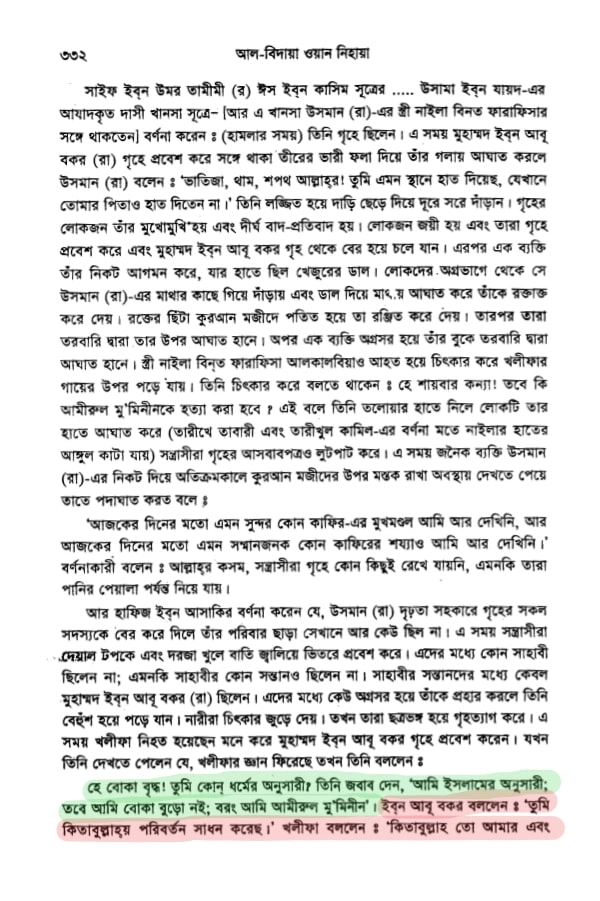
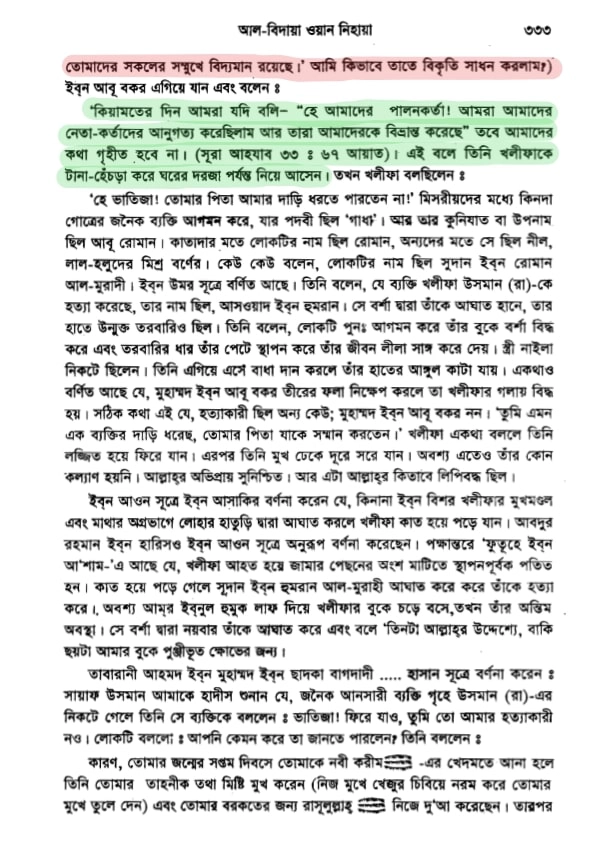
Volume 7 of the same work states [111] [112]
Account of the Killing of Uthman (may Allah be pleased with him)
(1) Khalifa ibn Khayyat’s account
Khalifa ibn Khayyat relates through Rabab:
Uthman (may Allah be pleased with him) sent me to summon Ashtar for him. He said, “What do the people want?” The reply was, “There is no alternative but to accept one of three things.” He asked, “What are those three things?”
(Ashtar) said:
They are giving you a choice—
1. Relinquish your responsibility, place it in their hands, and declare: ‘The matter is yours; choose whomever you wish.’
2. You may also offer yourself for qisas (retaliation).
3. Otherwise, the people will fight you.
He then said:
“I will not hand over the leadership to them as they demand. For I cannot take off the garment that Allah Most High has put on me. As for allowing them to exact qisas from me, I swear by Allah—if you kill me, then after me you will no longer be able to love one another, to perform the prayer all together, or to fight the enemy together.”
The narrator says that a short man, resembling a wolf, peered through the doorway and went back. Muhammad, the son of Hazrat Abu Bakr, arrived with thirteen men and seized and pulled his beard, so that the sound of his teeth grinding could be heard.
He (Muhammad) said:
“Mu’awiya has been of no use to you; Ibn Amir has been of no use either; nor have your letters been able to save you.”
The caliph said:
“Nephew, let go of my beard.”
The narrator says that he signalled with his eyes to seek the help of one of those present. The man came forward with a heavy arrowhead and struck him on the head.
I asked, “What happened next?”
He said, “Then, one after another, they all attacked and killed him.”
(2) Sayf ibn Umar al-Tamimi’s account (through Khansa)
Sayf ibn Umar al-Tamimi (may Allah have mercy on him) relates through Is ibn Qasim, from Khansa, the freed slave woman of Usama ibn Zayd—[this Khansa stayed with Uthman’s (may Allah be pleased with him) wife Na’ila bint Farafisa]:
She was in the house during the attack. At that time, Muhammad ibn Abu Bakr (may Allah be pleased with him) entered the house and struck him in the neck with the heavy arrowhead he had with him. Uthman (may Allah be pleased with him) said:
“Nephew, stop. By Allah, you have laid your hand on a place where even your father would not have laid his hand.”
He felt ashamed, released the beard, and stepped away. The people of the house confronted him, and a prolonged argument ensued. The people prevailed and entered the house. Muhammad ibn Abu Bakr left the house and went away.
Then a man holding a date-palm branch came forward and struck Uthman (may Allah be pleased with him) on the head, leaving him bloodied. Blood spattered onto the Holy Qur’an, staining it. Then they struck him with swords. Another man struck him in the chest with a sword.
His wife Na’ila bint Farafisa al-Kalbiyya was also wounded, screamed, and fell over the caliph’s body. She kept saying:
“O daughter of Shayba! Is the Commander of the Faithful, then, to be killed?”
When she took a sword in her hand, a man struck her hand. (According to the accounts in Tarikh al-Tabari and Tarikh al-Kamil, Na’ila’s fingers were cut off.)
The terrorists looted the household furnishings. At that time, as a man passed Uthman (may Allah be pleased with him), he saw him with his head resting on the Holy Qur’an, kicked, and said:
“Never have I seen such a beautiful face of an unbeliever as I have today, nor have I seen such an honourable bed of an unbeliever as I have today.”
The narrator says:
“By Allah, the terrorists left nothing in the house; they even took away the drinking cup.”
(3) Ibn Asakir’s account
Hafiz Ibn Asakir relates that Uthman (may Allah be pleased with him) firmly sent all the members of the household out. No one remained there except his family. The terrorists entered by climbing over the wall, opening the door, and lighting a lamp.
There were no Companions among them, nor even any children of Companions. Only Muhammad ibn Abu Bakr (may Allah be pleased with him) was there.
When one of them came forward and struck him, he fell unconscious. When the women began screaming, they scattered and left the house.
Thinking that the caliph had been killed, Muhammad ibn Abu Bakr entered again. He saw that the caliph had regained consciousness. He then said:
“You foolish old man! What religion do you follow?”
Uthman (may Allah be pleased with him) replied:
“I follow Islam. I am not a foolish old man; rather, I am the Commander of the Faithful.”
Ibn Abu Bakr said:
“You have altered the Book of Allah.”
The caliph said:
“The Book of Allah is here before me and all of you. How have I distorted it?”
(4) Quoting the verse “On the Day of Resurrection…” and dragging him to the door
Ibn Abu Bakr came forward and said:
“If, on the Day of Resurrection, we say—‘Our Lord! We obeyed our leaders and chiefs, and they led us astray’—our words will not be accepted.” (Surah al-Ahzab 33:67)
Saying this, he dragged the caliph as far as the door of the house. The caliph was then saying:
“O nephew! Your father could not have seized my beard!”
(5) The attackers’ identities (various accounts)
A man of the Kinda tribe came from among the Egyptians; his nickname was ‘Donkey’. His kunya (byname) was Abu Ruman. According to Qatada, the man’s name was Ruman; according to others, he had a mixed blue, red-yellow complexion. Some say that the man’s name was Sudan ibn Ruman al-Muradi.
It is related through Ibn Umar. He says that the man who killed Caliph Uthman (may Allah be pleased with him) was named Aswad ibn Humran. He struck him with a spear; he also had an unsheathed sword in his hand. He says that the man came again, thrust the spear into his chest, and placed the edge of the sword against his abdomen, ending his life.
His wife Na’ila was nearby. When she came forward to intervene, her fingers were cut off.
It is also related that Muhammad ibn Abu Bakr threw an arrowhead, which pierced the caliph’s neck. The correct account is that the killer was someone else, not Muhammad ibn Abu Bakr.
“You have seized the beard of a man whom your father respected.” When the caliph said this, he felt ashamed and went back. Then he covered his face and moved away. Yet even this did him no good. Allah’s purpose was certain, and this had been recorded in Allah’s Book.
(6) Ibn Asakir—an iron hammer, falling, and other accounts
Ibn Asakir relates through Ibn Awn that when Kinana ibn Bishr struck the caliph’s face and the front of his head with an iron hammer, the caliph fell onto his side. Abd al-Rahman ibn Harith also related a similar account through Ibn Awn.
By contrast, Futuh Ibn A’tham states that, wounded, the caliph fell with the back of his shirt against the ground. When he fell onto his side, Sudan ibn Humran al-Muradi struck him repeatedly and killed him.
Amr ibn al-Humq, however, leapt onto the caliph’s chest—he was then in his final moments. He struck him nine times with a spear and said:
“Three for Allah, and the remaining six for the anger that has accumulated in my breast.”
(7) Al-Tabarani’s account—the Ansari man, tahnik, and calling Muhammad ibn Abu Bakr the “killer”
Al-Tabarani relates through Ahmad ibn Muhammad ibn Sadaqa al-Baghdadi ….. Hasan:
Sayyaf Uthman narrated to me that when an Ansari man went to Uthman (may Allah be pleased with him) in the house, he said to him:
“Nephew! Go back; you are not my killer.”
The man said, “How did you know that?”
He said:
“Because when you were brought before the Noble Prophet on the seventh day after your birth, he performed tahnik for you, that is, sweetened your mouth (he chewed a date in his own mouth to soften it and put it into your mouth), and the Messenger of Allah himself prayed for blessings upon you.”
Then another Ansari man went to him, and he said exactly the same thing to him.
Then, when Muhammad ibn Abu Bakr entered, he said to him:
“You are my killer.”
He said, “You decrepit old man, how did you know?”
The caliph said:
“When you were brought before the Messenger of Allah on the seventh day after your birth for tahnik and prayer, you defecated in the Messenger of Allah’s lap.”
The narrator says: Then he climbed onto his chest, seized his beard, and thrust the arrowhead in his hand into Uthman’s (may Allah be pleased with him) chest.
(This hadith is of an extremely weak grade, and it also contains grounds for its being unacceptable.)
It has been established through multiple channels that blood from his body spattered onto the words of Allah Most High—
فَسَيَكْفِيكَهُمُ اللَّهُ وَهُوَ السَّمِيعُ الْعَلِيمُ
—“Allah will suffice you against them, and He is the All-Hearing, the All-Knowing.”
(8) Delay in burial—three days/two nights/burial that very night (differing views)
Ibn Jarir al-Tabari mentions that, after he was killed, Uthman’s (may Allah be pleased with him) body lay unburied and unshrouded for three days. … The people could not attend to him because they were occupied with pledging allegiance to Ali (may Allah be pleased with him). Only after the pledge of allegiance had been completed did they turn their attention to it.
According to some, it lay there for two nights; according to others, he was buried that very night.
For fear of the rebels, he was buried secretly between Maghrib and Isha. According to some, the senior Companions were consulted on the matter and their permission was obtained.
(9) Those who took part in the funeral prayer and burial (list of names)
A small group of Companions accompanied his body; among them were—
Hakim ibn Hizam, Huwaytib ibn Abd al-Uzza, Abu al-Jahm ibn Hudhayfa, Niyar ibn Makram al-Aslami, Jubayr ibn Mut’im, Zayd ibn Thabit, Ka’b ibn Malik, Talha and Zubayr, Ali ibn Abu Talib, some of his companions, and several women—including his two wives Na’ila and Umm al-Banin bint Utba ibn Husayn—and two children.
This is the substance of the statements of al-Waqidi and Sayf ibn Umar al-Tamimi.
In addition, a group of his servants and attendants carried his body to the door of the house after washing and shrouding it. According to some, he was neither washed nor shrouded; however, the former view is the sound one.
(10) Leading the funeral prayer—differing accounts
Jubayr ibn Mut’im led his funeral prayer. Some say Zubayr ibn al-Awwam; others say Hakim ibn Hizam or Marwan ibn al-Hakam; according to another view, Miswar ibn Makhrama led his funeral prayer.
(11) Obstruction over the burial place, stone-throwing, and burial outside ‘Baqi’
Some Kharijites opposed the burial of his body, threw stones at it, and tried to throw it off the bier. They were determined to bury his body in the Jewish cemetery ‘Dayr Sal’’. Eventually, when Ali (may Allah be pleased with him) was sent to them, he forbade them to do this.
Al-Waqidi mentions that when the body was placed at the funeral prayer site for the prayer, some Ansar tried to obstruct it, whereupon Abu al-Jahm ibn Hudhayfa said:
“Let the body be buried; for, by Allah’s command, His angels have offered the funeral prayer for him.”
Then they said that his body could not be buried in Jannat al-Baqi; rather, it should be buried outside the wall. So his body was buried beneath a date palm to the east of Baqi.
(12) Attack on the body—a rib broken (al-Waqidi)
Al-Waqidi mentions that when Uthman’s (may Allah be pleased with him) body was placed on the bier for the funeral prayer, Umayr ibn Dabi attacked his body and broke one of his ribs. Dabi was arrested and died in prison.
Later, Hajjaj ibn Yusuf killed this Umayr ibn Dabi.
(13) In Imam al-Bukhari’s history—a prayer during tawaf (incomplete)
And Imam al-Bukhari mentions in his history through Musa ibn Isma’il ….. Muhammad ibn Sirin: I was circumambulating the Holy Ka’ba when a man was saying:
اللهم اغفر لي وما أظن أن تغفر لي — “O Allah, forgive me, although I do not think that You will forgive me”—
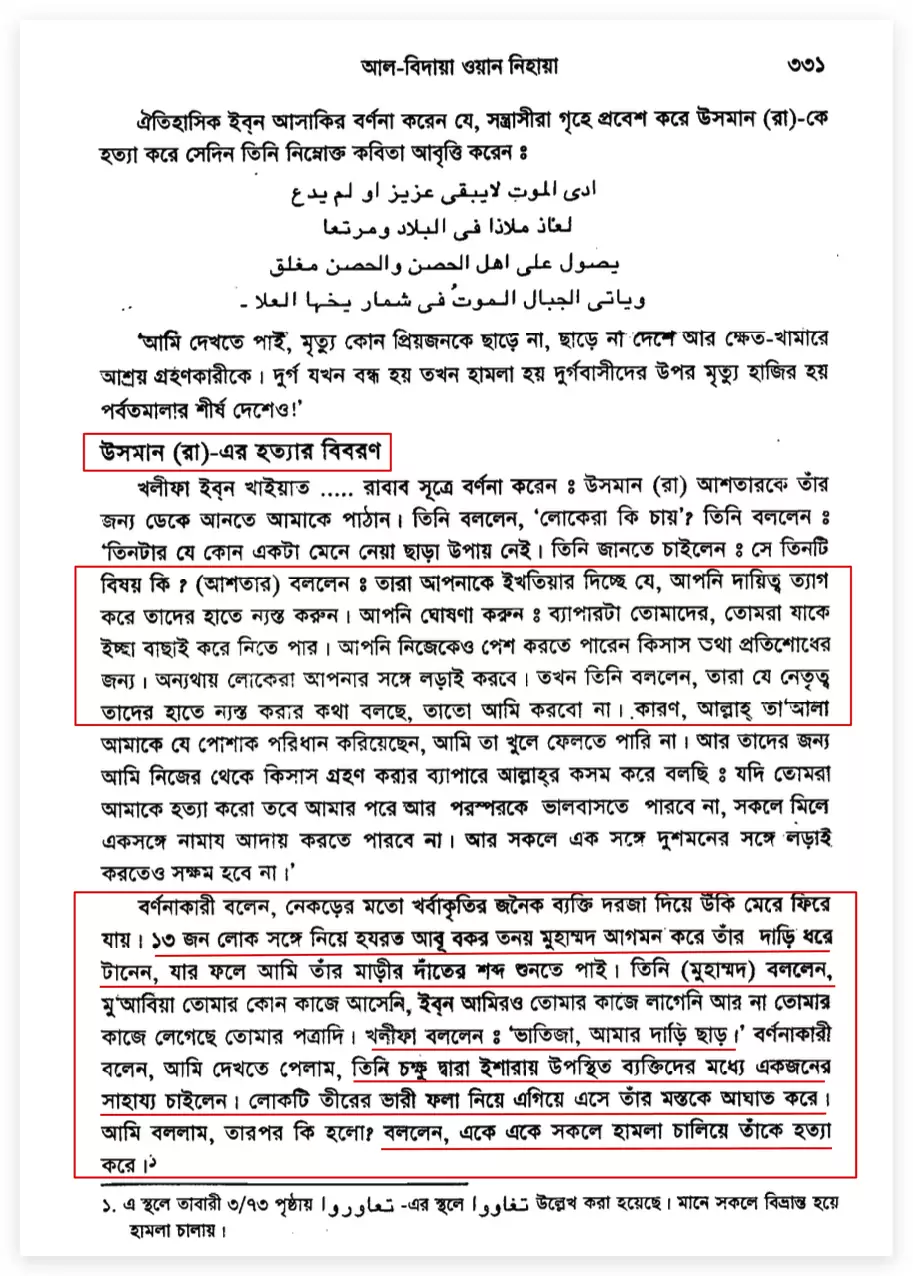
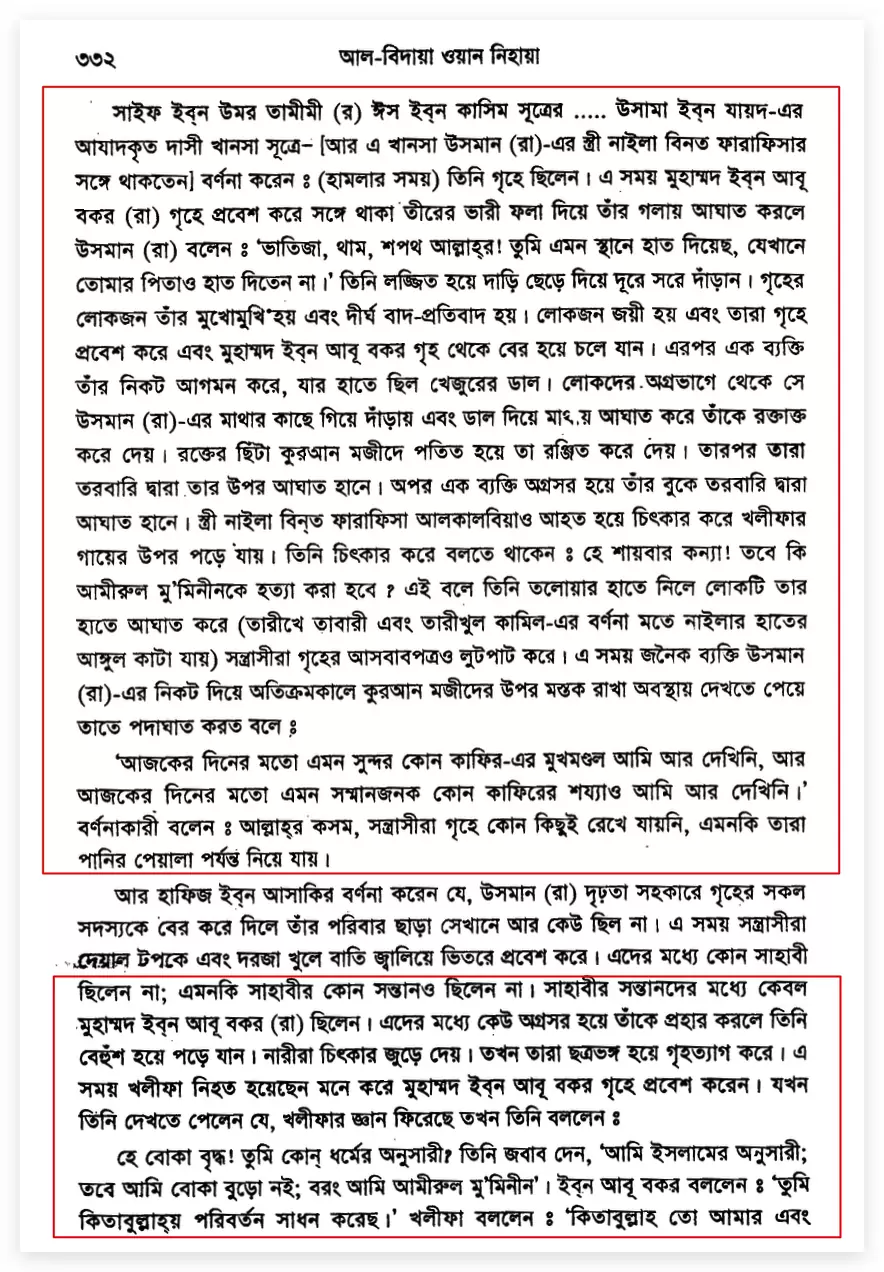
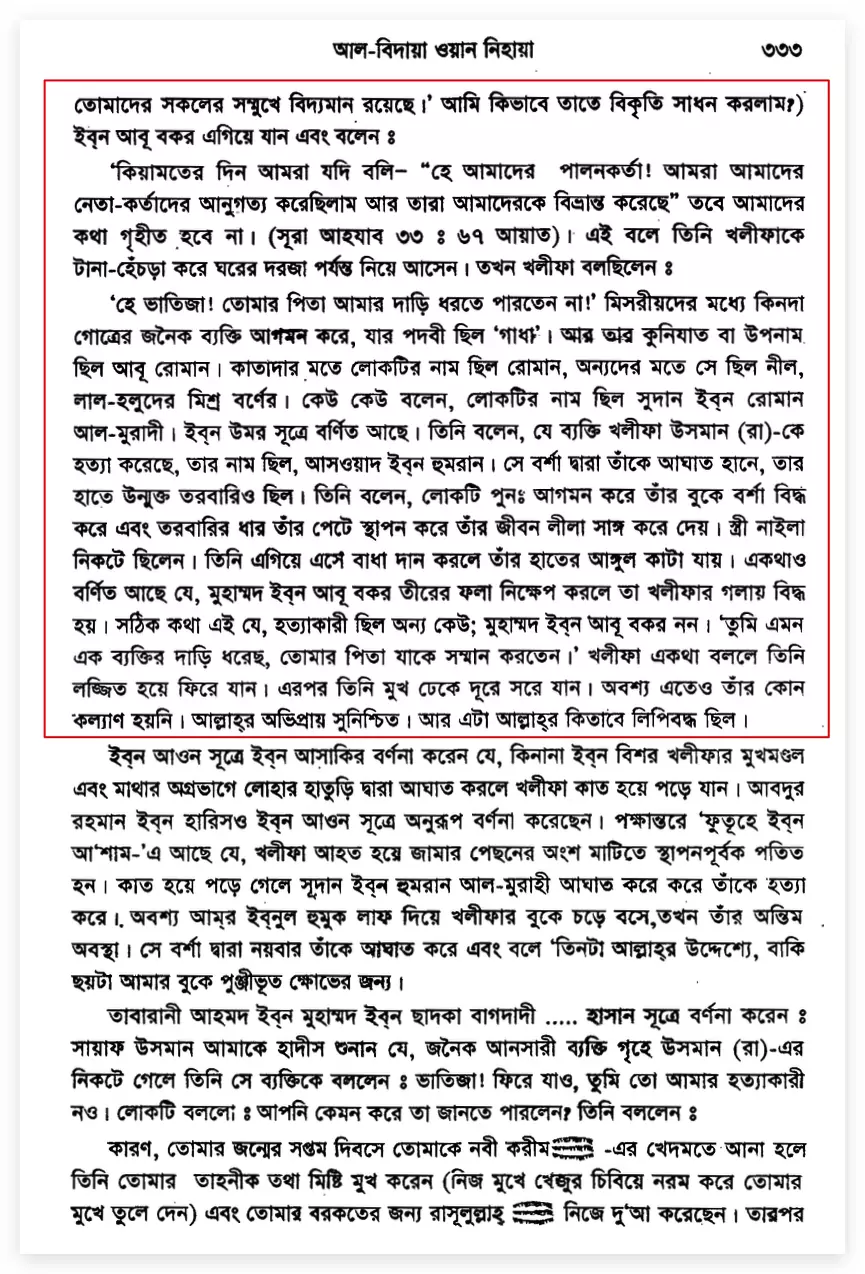
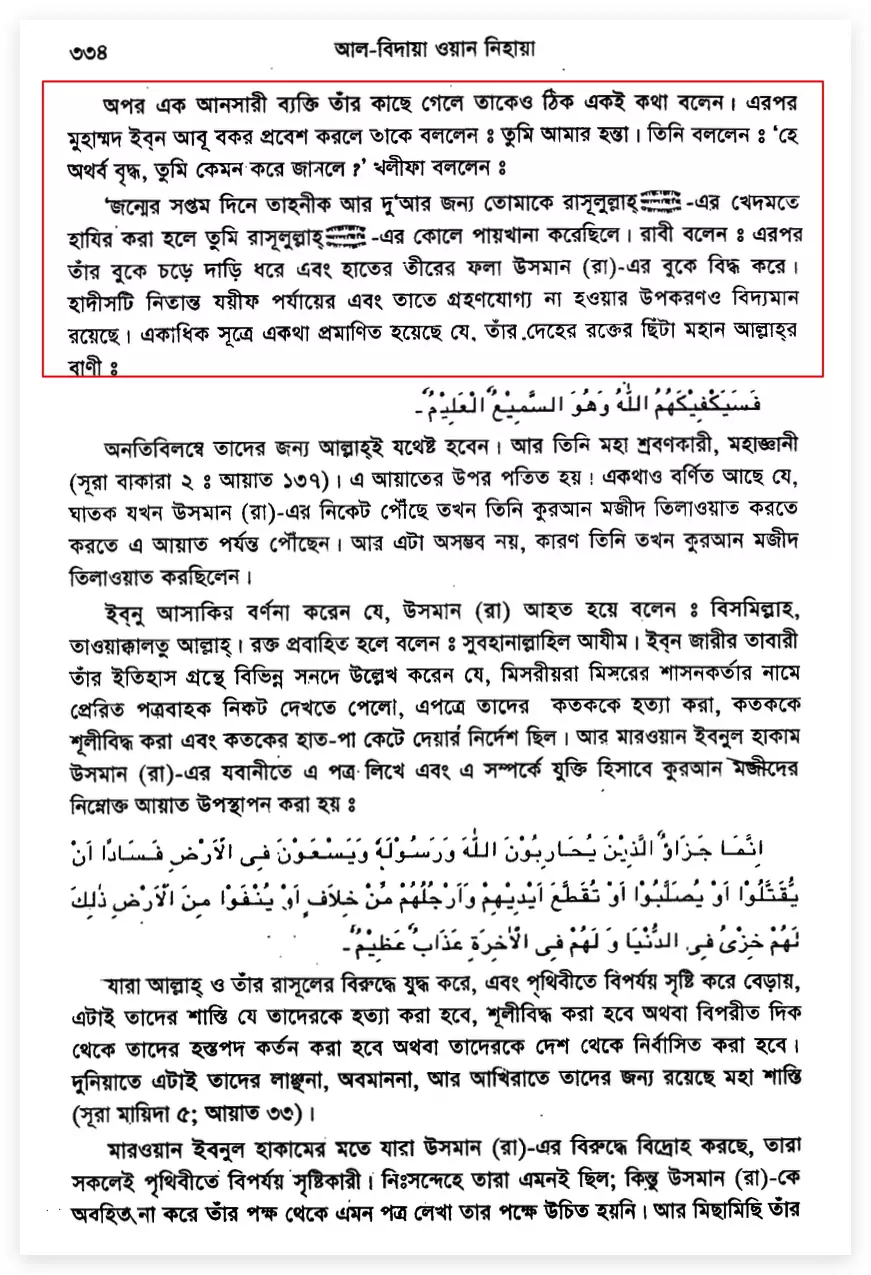
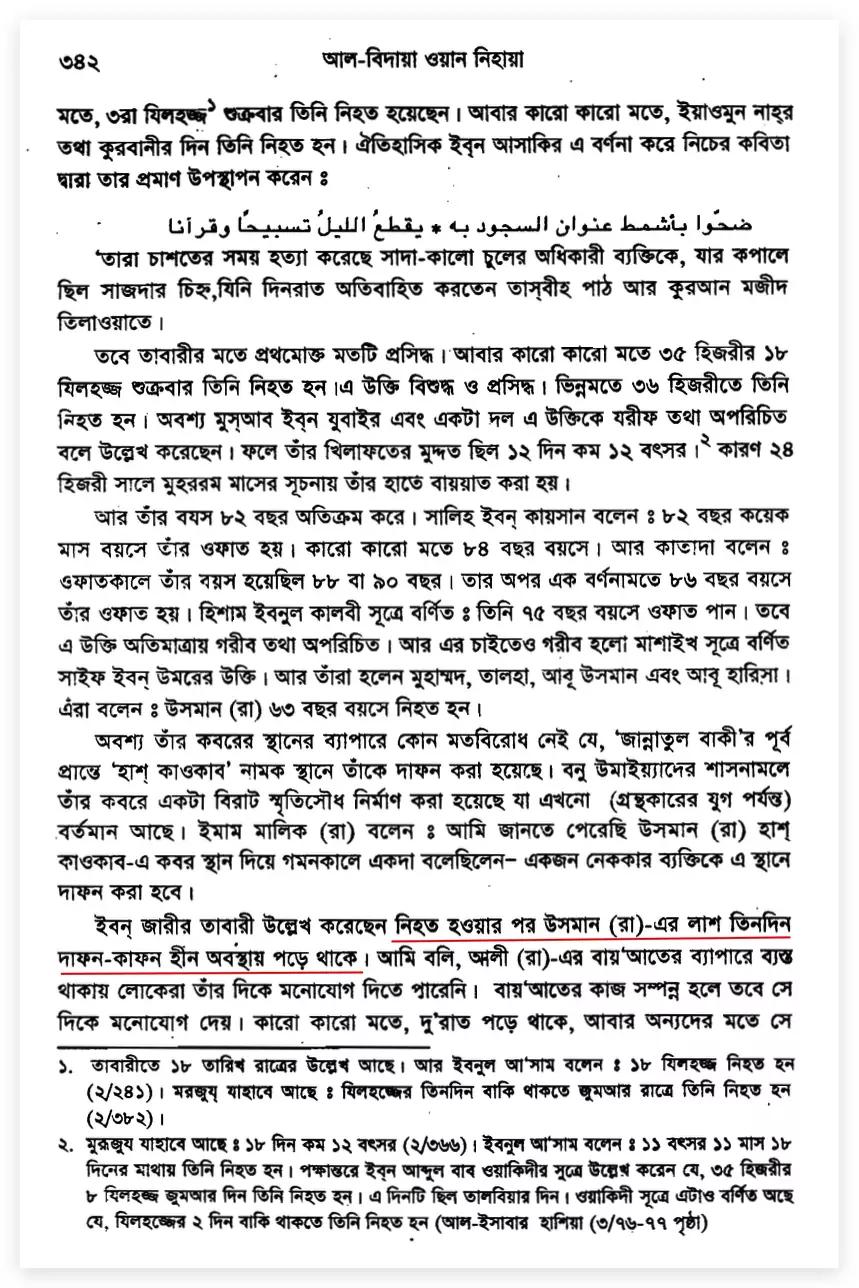
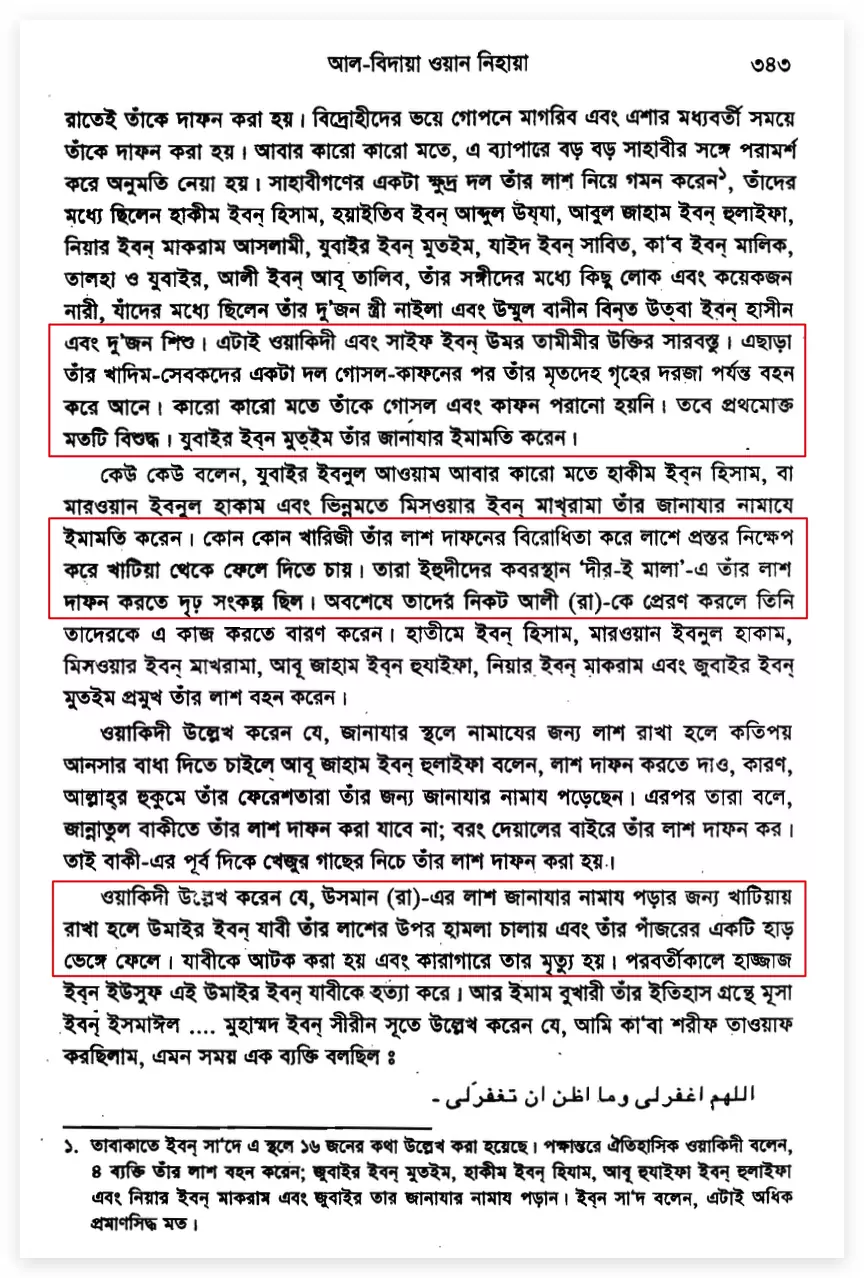
Muhammad ibn Abi Bakr’s Role and the Dispute over Who Killed Uthman
Muhammad ibn Abi Bakr is closely associated with Uthman’s killing, but historical accounts differ significantly over his precise role. One report in al-Tabari says that he entered Uthman’s house and pulled his beard. Uthman reminded him that his father Abu Bakr, had he been alive, would not have treated him that way. One account says Muhammad then let go. In another he entered with the attackers and took an active part in the initial stage of the killing. An account preserved by Ibn Abd Rabbih says that Muhammad did not strike Uthman himself, but two others who entered with him killed him. Al-Suyuti’s Tarikh al-Khulafa also preserves an account in which Muhammad entered, seized Uthman’s beard, and took no part in the final killing. The sources thus record his presence in the house and his political connections to the opposition, but they do not agree that he personally struck the fatal blow. [113] [114]
Muhammad ibn Abi Bakr’s identity lends additional political significance to this incident. He was the son of the first caliph, Abu Bakr. His mother, Asma bint Umais, later married Ali and Muhammad was raised in Ali’s family. Consequently, although he was a descendant of Abu Bakr, he was closely connected to Ali’s family. Because of this relationship, his name acquired particular importance in later political propaganda about Uthman’s killing. However, Ali cannot be held responsible for every one of Muhammad’s actions solely on the basis of their family relationship. Similarly, Muhammad’s political identity cannot itself establish his innocence. His own role must be judged based on direct and subsequent accounts of the relevant events. If descriptions exist of entering Uthman’s house and threatening him, then the responsibility for that behavior lies with him; but separate evidence is required to identify him as a direct instigator or murderer in an assassination carried out by others.
The same distinction matters when blaming Ali for Uthman’s killing. Ali spoke with him about grievances against his rule, mediated with the opposition, and supported demands for administrative change. None of those positions amounts to ordering a killing. Accounts that his sons helped protect Uthman’s home and that he sent water during the siege are at odds with the claim that he took a direct part in planning the killing. Islamic historical works also preserve Ali’s denial of responsibility. His political failure to punish the killers immediately is an entirely separate question from whether he ordered the killing. The demand to avenge Uthman’s blood was used as a political weapon in the civil war that followed. The demand itself is no proof of Ali’s guilt. [115] [116]
Obstruction at Uthman’s burial, decline of political authority and instability in Medina
The burial of Uthman’s body after his death also became complicated. Several accounts in al-Tabari state that his family and associates had difficulty arranging a public funeral prayer and burial after the killing. One account says that the body could not be taken out during the day because of the rebels’ presence and fear of renewed conflict. Later, between evening and night, a few people carried the body away and arranged its burial. Naila is also reported to have been present. The burial place is named as Hashsh Kawkab, which was later incorporated into Medina’s al-Baqi cemetery. Other accounts describe insults and obstruction while the body was being carried. Although the details of the accounts are not identical, historical literature records that after Uthman’s death it was difficult to bury him with the usual honors accorded to a ruler. [117] [118]
The political significance of this situation was profound. The highest ruler of the Muslim empire, after his death, even his close relatives had to wait for favorable circumstances for the safe burial of his body. This meant that the effective authority of the Medina-centered administration collapsed. Protecting the caliph’s residence was not possible, arresting the murderers immediately was not feasible, and no stable institution existed for selecting a subsequent ruler. The empire’s vast military and economic power was under various provincial governors at that time. However, after the assassination of the caliph in the center of the state, Medina, the question of political leadership became uncertain again. To fill this power vacuum, Ali ibn Abi Talib stepped forward. His assumption of power from the beginning involved questions about Uthman’s assassination, the presence of rebels, and the allegiance of provincial powers.
Ali’s caliphate and rebellion of opponents
After Uthman was killed, the question of choosing a new caliph arose in Medina. The empire was effectively without a central ruler, and the city was politically unstable. Various opposition groups from Egypt, Kufa, and Basra were still in Medina. Some had opposed Uthman’s rule, others were active in choosing the next leader, and still others had joined the movement to defend the interests of their provinces. The Emigrants and Ansar in Medina also differed in their views of Uthman’s government and the choice of his successor. In these circumstances Ali was called on to take up the caliphate. Ibn al-Jawzi preserves one account from Muhammad ibn al-Hanafiyya, according to whom his father initially refused and ultimately required that the pledge be given publicly in the mosque. The same chapter gives another account, transmitted through Sayf ibn Umar, of the pressure the rebels exerted over the city. One establishes the public character of the pledge. The other shows that Medina at the time was hardly a place for free and stable deliberation. Combining the two does not make Ali responsible for every decision the besiegers took. [119] [120]
Ibn al-Jawzi, Al-Muntazam, Ali’s Caliphate
قال محمد بن الحنفية رضي الله عنه: كنت مع أبي حين قتل عثمان رضي الله عنه ، فقام فدخل منزله ، فأتاه أصحاب رسول الله صلى الله عليه وسلم ، فقالوا له: إن هذا الرجل قد قتل ، ولا بد للناس من إمام ، ولا نجد اليوم أحدا أحق بهذا الأمر منك ، لا أقدم سابقة ، ولا أقرب من رسول الله صلى الله عليه وسلم ، فقال: لا تفعلوا ، فإني أكون وزيرا خير من أن أكون أميرا ، فقالوا: لا والله ما نحن بفاعلين حتى نبايعك ، قال: ففي المسجد ، فإن بيعتي لا تكون إلا عن رضا المسلمين . فدخل المهاجرون والأنصار فبايعوه ، ثم بايعه الناس .
English translation: Muhammad ibn al-Hanafiyya says, ‘When Uthman was killed I was with my father. He got up and entered his house. The Companions of the Messenger of Allah came to him and said, “This person has been killed. We need a leader for the people. Today we see no one more entitled to this position than you. There is no one more advanced in accepting Islam or closer to the Messenger of Allah than you.” He said, “Do not do this. I think it is better for me to be an advisor rather than Amir.” They said, “By Allah’s oath, we will not leave without pledging allegiance to you.” He said, “Then in the mosque. The pledge of allegiance to me will not take place without the consent of the Muslims.” Then the Muhajirun and Ansar came and gave bay’a to him. Afterwards others also gave bay’a.’
Another account preserved by al-Tabari states that a group of Muhajirun and Ansar advised Ali to assume power. Among them are Talha and al-Zubayr mentioned. Ali initially expresses reluctance to accept authority, stating he wishes to remain with them as an ordinary member and would obey anyone else they elect. The present individuals then say they will elect him again. Another account states that Ali climbed the minbar of the mosque and pledged not to take state wealth at his own discretion and obtained consent from the present people. Thus, Ali’s early claim to caliphate was linked with public bay’a, political consent, and accountability over state wealth. But this sequence does not provide certainty that all individuals present in Medina then made independent and free decisions. Because in the same situation, rebels were in a strong position within the city and maintained their influence over centralized political leadership. [121]
Talha and al-Zubayr’s Pledge of Allegiance: Consent, Pressure, and the Dispute That Followed
Talha ibn Ubayd Allah and al-Zubayr ibn al-Awwam were both close followers of Muhammad. They, along with Ali, were among the six members of the shura formed by Umar. Some narrations in al-Tabari show them taking bay’a to Ali. However, other narrations state that they took bay’a under political pressure. An allegation attributed to Talha’s own statement says that he was made to pledge allegiance with a sword held over his head. Another narration mentions that al-Zubayr did not initially take bay’a. These accounts are not entirely consistent with each other. Therefore, the nature of Talha and al-Zubayr’s bay’a must be evaluated while acknowledging historical disputes. The important point is that they later joined an armed political movement against Ali. Thus, a change in their political position occurred between their initial bay’a and the subsequent rebellion. Understanding their role requires determining the cause and continuity of this change. [122]
Al-Tabari, Tarikh al-rusul wa-l-muluk, volume 4, Talha and al-Zubayr’s pledge of allegiance
فبايعه طلحة والزّبير، فنظر حبيب بن ذؤيب إلى طلحة حين بايع، فقال: أوّل من بدأ بالبيعة يد شلّاء؛ لا يتمّ هذا الأمر! وخرج عليٌّ إلى المسجد فصعد المنبر وعليه إزار وطاق وعمامة خزّ، ونعلاه في يده، متوكئًا على قوس؛ فبايعه الناس.
English translation: Talha and al-Zubayr took bay’a to him. At the time of Talha’s bay’a, Habib ibn Dhu’ayb looked at him and said, ‘Bay’a has begun with a useless hand. This work will not be completed!’ Ali entered the mosque and climbed the minbar. He was wearing an izar, a garment and a silk turban. His shoes were in his hands. He leaned on a bow. People gave bay’a to him.
Al-Tabari, Tarikh al-Rusul wa al-Muluk, Volume Four — Description of the pledge of allegiance Under Pressure
فقالوا: نحن على ما فارقناك عليه بالأمس. وجاء القوم بطلحة فقالوا: بايع، فقال: إني إنّما أبايع كرهًا، فبايع – وكان به شلل – أوّل الناس، وفي الناس رجل يعتاف، فنظر من بعيد، فلما رأى طلحة أوّل من بايع قال: إنا لله وإنا إليه راجعون! أوّل يدٍ بايعت أمير المؤمنين يدٌ شلّاء، لا يتمّ هذا الأمر! ثم جىء بالزّبير فقال مثل ذلك وبايع – وفي الزبير اختلاف – ثمّ جىء بقوم كانوا قد تخلّفوا فقالوا: نبايع على إقامة كتاب الله في القريب والبعيد، والعزيز والذّليل، فبايعهم؛ ثمّ قام العامّة فبايعوا.
English translation: People said, “The decision we took yesterday from you and left with is still what we are upon.” People brought Talha and said, “Give bay’a.” He said, “I am compelled to give bay’a.” His hand was paralyzed. He was the first to give bay’a. Among the people there was one who interpreted omens. Seeing from afar that Talha was the first to pledge allegiance, he said, “We belong to Allah, and to Him we shall return. The first to give bay’a to the Amir of the believers was a paralyzed hand. This matter will not be completed!” Then al-Zubayr was brought forward. He also gave bay’a after saying similar words. There is disagreement regarding al-Zubayr’s case. Afterward, several of those who were behind were brought forward. They said, “We pledge allegiance on condition that Allah’s Book be applied to kin and strangers, the powerful and the weak alike.” He accepted their bay’a. Then the common people stood up and gave bay’a.
Al-Tabari, Tarikh al-Rusul wa al-Muluk, Volume Four — Threat with a Sword Against Talha on the authority of al-Zuhri
وحدثني أحمد بن زهير، قال: حدثني أبي، قال: حدثنا وهب ابن جرير، قال: سمعت أبي، قال: سمعت يونس بن يزيد الأيلي، عن الزُّهري، قال: بايع الناس علي بن أبي طالب، فأرسل إلى الزبير وطلحة فدعاهم إلى البيعة، فتلكّأ طلحة، فقام مالك الأشتر وسلّ سيفه وقال: والله لتبايعنّ أو لأربنّ به ما بين عينيك، فقال طلحة: وأين المهرب عنه! فبايعه، وبايعه الزبير والناس. وسأل طلحة والزّبير أن يؤمّرهما على الكوفة والبصرة، فقال: تكونان عندي فأتحمَّل بكما، فإني وحش لفراقكما.
English translation: Ahmad ibn Zuhayr narrates to me from his father. His father heard from Wahb ibn Jarir. Wahb heard from his father, his father from Yunus ibn Yazid al-Ayli, and Yunus from Zuhri. Zuhri says, ‘People gave bay’a to Ali ibn Abi Talib. He sent people to al-Zubayr and Talha to invite them to give bay’a. When Talha hesitated, Malik al-Ashtar stood up, drew his sword from its sheath, and said,By Allah’s oath, give bay’a. Otherwise I will place this sword between your two eyes.‘Talha said, ‘Where is there an escape from this!’ Then he took bay’a. Al-Zubayr and others also took bay’a. Talha and al-Zubayr requested that the governance of Kufa and Basra be given to them. Ali said, ‘Stay with me; I will seek your help. If you leave, I will feel alone.”
Talha and al-Zubayr’s positions became even more important due to the demand for trial over Uthman’s murder. There are accounts of communication and support between rebels and some individuals in Medina regarding the movement against Uthman. However, after Uthman was killed, demands for revenge for his murder and punishment of the murderers became the basis for a new political stance. Talha and al-Zubayr later advanced towards Basra with Aisha and participated in military combat against Ali’s caliphate. Viewing this change merely as a breach of personal loyalty would make the issue of power invisible. At that time, Ali was the central caliph of the state; organizing a military force against him meant challenging central authority. The demand for trial of the murder was used as the declared objective of this military stance. However, who would hold the power to establish a court for trying any murder, and whether starting war against a new caliph based on such a claim is valid—this is where the main political conflict arose. [123] [124]
Ibn al-Athir, al-Kamil fi al-Tarikh — Aisha’s Speech in Basra
فتكلمت عائشة ، وكانت جهورية الصوت ، فحمدت الله وقالت : كان الناس يتجنون على عثمان ويزرون على عماله ، ويأتوننا بالمدينة فيستشيروننا فيما يخبروننا عنهم ، فننظر في ذلك فنجده بريئا تقيا وفيا ، ونجدهم فجرة غدرة كذبة ، وهم يحاولون غير ما يظهرون ، فلما قووا كاثروه ، واقتحموا عليه داره ، واستحلوا الدم الحرام ، والشهر الحرام ، والبلد الحرام ، بلا ترة ولا عذر ، ألا إن مما ينبغي لا ينبغي لكم غيره ، أخذ قتلة عثمان وإقامة كتاب الله ، وقرأت : ( ألم تر إلى الذين أوتوا نصيبا من الكتاب يدعون إلى كتاب الله ) الآية ، فافترق أصحاب عثمان فرقتين ، فرقة قالت : صدقت وبرت ، وقال الآخرون : كذبتم والله ما نعرف ما جئتم به ! فتحاثوا وتحاصبوا .
English translation: Aisha spoke. Her voice was loud and clear. Praising Allah, she said, “People made false accusations against Uthman and criticized his officials. They would come to us in Medina and ask our advice about what they told us concerning them. We examined the matter and found Uthman innocent, pious, and faithful to his pledges, while we found them sinful, treacherous, and lying. They sought something other than what they openly claimed. When they grew strong, they overwhelmed him by their numbers and broke into his house. Without a claim of retaliation or an excuse, they shed forbidden blood and violated the sanctity of the sacred month and the sacred city. Listen, your duty is to seize Uthman’s killers and establish Allah’s Book.” She recited the verse, “Have you not seen those who were given a portion of the Book, who are called to Allah’s Book?” Then Uthman’s supporters split into two groups. One said, “She has spoken the truth and acted rightly.” The others said, “You have lied. By Allah, we do not know what you have come with!” Then they threw dust and pebbles at each other.
Ali’s Appointment of New Governors and Attempt to Reorganize Umayyad Administrative Authority
After accepting the caliphate, Ali’s most urgent administrative problem was establishing central authority over the provinces. Under Uthman, governors in important provinces had long been building up their own administrations and armed forces. Some did not recognize the new caliph. Ali moved to send new governors. Historical accounts name Uthman ibn Hunayf for Basra, Umara ibn Shihab for Kufa, Qays ibn Sa‘d for Egypt, and Sahl ibn Hunayf for Syria. They also record the appointment of a member of the Ibn Abbas family to govern Yemen. The appointments were not equally effective. In Basra, Ali’s governor took office and later clashed with the forces of Aisha, Talha, and al-Zubayr. The new governor of Kufa was reportedly prevented from entering. In Syria, Sahl ibn Hunayf was stopped by troops loyal to Muawiya. Ali’s letters of appointment did not give him effective political power throughout the empire. [125] [126]
Syria presented the most serious situation. Throughout Umar’s and Uthman’s reigns, Muawiya had consolidated his military and administrative position there. His organized forces, frontier defenses, revenue system, and local political leadership were effective. After Ali became caliph, the pledge given in Medina was insufficient to enforce a decision to remove Muawiya. Syria’s military establishment refused to accept the new governor. The central caliphate’s orders therefore came into direct conflict with provincial military power. As Uthman’s kinsman, Muawiya demanded justice for his killing. That demand was also connected to preserving Muawiya’s own administrative position and rejecting Ali’s central authority. The dispute consequently concerned whether a major military province of the empire would remain subject to the central caliph, alongside punishment of Uthman’s killers. [127]
Justice for Uthman’s Killing: Political Demands, Effective Power, and the Crisis of State Authority
After Uthman’s death, the question of punishing his murderers became one of the main crises of the new caliphate. But the actual situation regarding this question was extremely complex. Medina still had various participants in the anti-Uthman movement present. It was necessary to determine separately who directly participated in the assassination, who led the siege, and who was only involved in demands for administrative change. Identifying those who directly participated in the assassination and conducting judicial proceedings against them was a matter of state authority. But the new caliph Ali had taken charge of an empire whose central administration had just collapsed and whose allegiance from several major provinces was uncertain. How much military power he actually had to immediately implement widespread arrests and punishment in this situation was itself a political question. [128]
In al-Tabari’s account, several people came to Ali demanding justice for Uthman’s killing. He told them that the rebels were so powerful at that point that he lacked the practical capacity to punish them immediately on behalf of the state. He spoke of the need to stabilize the political situation. Ali’s position did not amount to declaring the killers innocent. Acknowledging the need to bring a killing to justice and possessing the political and military means to do so are different things. His rivals nevertheless used the failure to complete the proceedings as grounds to oppose the new caliphate. A question of justice became a new contest for supreme power. Raising a new army to fight Ali because he could not punish the killers exposed many more lives to danger. Justice for Uthman’s killing became tied to securing political allegiance and asserting claims to power, instead of remaining a separate process for assigning responsibility for the crime. [129]
In this crisis, Basra’s initiative by Aisha, Talha, and al-Zubayr, and Syria’s resistance by Mu’awiya emerged as separate political and military centers. While they shared a common demand for justice for Uthman’s murder, their leadership, forces, and administrative positions were not unified. In the expedition to Basra, the forces of Aisha, Talha, and al-Zubayr came into conflict with Ali’s appointed governor. Meanwhile, Mu’awiya in Syria rejected Ali’s authority relying on his subordinate military and administrative power. The political outcome of these two conflicts was the expansion of the first major civil war in Muslim society. After Muhammad’s death, the rivalry that began over leadership deepened after Uthman’s assassination to a stage where Muhammad’s close followers organized armies to establish their own political claims and started fighting each other. The first major military phase of that conflict was the Battle of the Camel (Jamal). [124] [130]
Battle of the Camel (Jamal): Aisha, Talha and al-Zubayr’s war
In 36 AH, or 656 CE, Basra in Iraq was the scene of one of the most significant battles of the Muslim community’s first great civil war. It is known as the Battle of Jamal, or the Battle of the Camel. On one side was the empire’s fourth caliph, Ali ibn Abi Talib. On the other were Muhammad’s wife Aisha bint Abi Bakr and two of his close Companions, Talha ibn Ubayd Allah and al-Zubayr ibn al-Awwam. Aisha, Talha, and al-Zubayr organized a military expedition demanding justice for the killing of Uthman ibn Affan. Their campaign went beyond calling for the killers to be identified. Fighting Ali’s appointed governor, taking control of the administrative center and treasury in Basra, and killing local opponents turned it into direct military resistance against the new caliph. The ensuing fighting cost many lives on both sides. Only twenty-five years after Muhammad died, his wife and close Companions faced his cousin and son-in-law in opposing armies. [131] [132]
Aisha was in Mecca after Uthman was killed. In an account found in al-Tabari and Ibn al-Athir, she initially set out to return to Medina. When she learned on the way that Uthman had died and that Ali had received allegiance, she returned to Mecca and called for vengeance for Uthman’s killing. The same report raises the question of her earlier opposition to Uthman. A man called Ubayd ibn Abi Salama reminded her that she had spoken harshly against him while he was alive. Aisha replied that Uthman was killed after being made to repent and that her last position was better than her previous one. The historical transmission of the exchange raises questions, but the account is part of early political memory. Objecting to Uthman’s policies while he was alive was a different political position from demanding justice for his killing. Organizing a separate army against Ali’s rule around that demand was what ultimately set off a new civil war. [133]
Military alliance of Aisha, Talha and al-Zubayr and expedition towards Basra
Talha and al-Zubayr left Medina for Mecca and joined Aisha. Their discussions brought forward the issue of demanding trial for Uthman’s murder and taking a stance against Ali’s caliphate. Initially, thought was towards going to Syria, but later Basra was selected as the campaign center. Abd Allah ibn Amir’s role in this decision is significant. He was governor of Basra during Uthman’s rule and had political and personal connections there. According to Ibn al-Athir’s account, he informed that Muawiya was already in a strong position in Syria; Basra offered them an opportunity for organizing support. Basra was an important center for military forces, administrative institutions, revenue, eastern trade, and campaigns of conquest. Thus, gaining control of Basra meant not just entering a city but establishing authority over its state treasury, local troops, and political allegiance. This reality of power was present in determining the campaign’s objective. [134]
Money, mounts, and troops were raised for the campaign. Historical accounts name Ya’la ibn Umayya and Abd Allah ibn Amir as important financiers. Ya’la supplied many camels and substantial funds. Accounts differ on the amounts and numbers, so no one figure can be taken as a certain military tally. The preparations to finance the expedition are clear. It was announced in Mecca that Aisha, Talha, and al-Zubayr were going to Basra to avenge Uthman’s death and restore order in the Muslim community. Those without money or a mount were also given a chance to join. One of Ibn al-Athir’s accounts puts the number who set out initially at about one thousand, rising later to nearly three thousand. This was an organized military campaign with financing, recruitment, and coordinated leadership, far removed from a private religious journey. [135] [136]
Signs of disagreement regarding future political leadership were evident within this expedition. According to Ibn al-Athir’s account, at one stage Marwan ibn al-Hakam asked who would be addressed as Amir between Talha and al-Zubayr. Abdullah ibn al-Zubayr gave priority to his father, and Muhammad ibn Talha gave priority to his father. Aisha instructed Abdullah ibn al-Zubayr to lead the prayer to stop this dispute. Another narration mentions that a different person was made imam for the prayer. The significance of the incident is not limited to the leadership of a specific prayer. The question of who would assume political authority if the expedition succeeded was raised at that time. Another narration reports that Sa’id ibn As asked Talha and al-Zubayr who would receive power in case of victory. They said they would choose one of themselves. When Sa’id mentioned giving leadership to Uthman’s sons, they did not agree to it. From this dialogue, it can be understood that separate political interests regarding the authority of the subsequent caliphate were also present alongside the demand for trial of Uthman’s killers. [137]
The Dogs of Haw’ab and Aisha’s Reported Wish to Turn Back
Islamic histories also preserve an incident at a place called Haw’ab on the road to Basra. In an account given by Ibn al-Athir, the expedition reached a watering place and the local dogs began to bark. Aisha asked what the place was called and was told it was Haw’ab. Alarmed, she recalled an earlier remark by Muhammad that alluded to the dogs of Haw’ab barking at one of his wives. She applied the remark to herself and spoke of going back. The account says that Abd Allah ibn al-Zubayr reassured her and the expedition went on. It is an early historical account of Aisha’s own doubts about the expedition. Each line of the conversation cannot be confirmed independently. In later Islamic historical writing, however, Haw’ab became important as an illustration of the relationship between a political decision and an earlier statement by Muhammad. [138]
Ibn al-Athir, al-Kamil fi al-Tarikh — the beginning of the Battle of Jamal
فسرت معهم فلا أمر على واد إلا سألوني عنه ، حتى طرقنا الحوأب ، وهو ماء ، فنبحتنا كلابه ، فقالوا : أي ماء هذا ؟ فقلت : هذا ماء الحوأب . فصرخت عائشة بأعلى صوتها وقالت : إنا لله وإنا إليه راجعون ، إني لهيه ، سمعت رسول الله – صلى الله عليه وسلم – يقول وعنده نساؤه : «ليت شعري أيتكن تنبحها كلاب الحوأب» ! ثم ضربت عضد بعيرها فأناخته وقالت : ردوني ، أنا والله صاحبة ماء الحوأب . فأناخوا حولها يوما وليلة ، فقال لها عبد الله بن الزبير : إنه كذب ، ولم يزل بها وهي تمتنع ، فقال لها : النجاء النجاء ! قد أدرككم علي بن أبي طالب . فارتحلوا نحو البصرة
English translation: I went with them. Whenever we crossed a valley, they asked me about it. We eventually reached Haw’ab, a watering place, and its dogs barked at us. They asked, “What watering place is this?” I said, “This is the watering place of Haw’ab.” Aisha cried out at the top of her voice, “We belong to Allah, and to Him we shall return. I am that woman. I heard Allah’s Messenger say in the presence of his wives, ‘If only I knew which of you the dogs of Haw’ab would bark at!’” She then struck her camel’s foreleg, making it kneel, and said, “Take me back. By Allah, I am the woman of the watering place of Haw’ab.” They made their camels kneel around her and stayed for a day and a night. Abd Allah ibn al-Zubayr told her, “He has lied.” He continued trying to persuade her while she refused to proceed. Then he said, “Hurry, hurry! Ali ibn Abi Talib has caught up with you.” They then set off towards Basra.
Arrival of Aisha in Basra, division among local populace and first armed clash
When Aisha, Talha, and al-Zubayr’s forces reached Basra, Ali’s appointed governor Uthman ibn Hunayf sent envoys to learn their purpose. Uthman ibn Hunayf was a Companion of Muhammad and the provincial administrator appointed by Ali. He is not the killed caliph Uthman ibn Affan. Names found in his envoy group included Imran ibn Husayn and Abu al-Aswad Ad-Duali. In their discussion, Aisha stated that she had come to punish Uthman’s killers and rectify the Muslim community’s situation. Talha and al-Zubayr made the same claim. When reminded that they had pledged allegiance to Ali, they claimed that bay’a had been taken under political pressure. Upon hearing this statement, the governor of Basra decided to maintain his administrative authority until he received instructions from Ali. Consequently, two rival political authorities emerged in the city: Ali’s appointed governor and an armed political alliance arriving from outside regions. [139]
When supporters of both sides gathered at Mirabad in Basra, Talha and al-Zubayr delivered speeches demanding the trial of Uthman’s murder, and their supporters endorsed those speeches. On the other hand, Ali’s party opposed them by reminding them of their bay’a. Aisha herself also delivered a speech at the public assembly. According to Ibn al-Athir’s narration, after her speech the present crowd became divided, and at one stage they began throwing stones at each other. Then an armed clash occurred between a group from Ali’s party led by Hakim ibn Jabalah and people from Aisha’s camp. One narration states that Hakim was the initiator of the first clash. The same narration also mentions that under his hand one man and one woman were killed. Such events are crucial in determining the moral responsibility of war. Supporting a political claim does not erase the crime of killing innocent people by that claim’s supporters. In the first clash at Basra, soldiers from both sides were killed and wounded, and political conflict within the city had already taken the form of bloody combat. [140]
After the first clash, the sides reached a temporary agreement. They would send a delegate to Medina to find out whether Talha and al-Zubayr had pledged allegiance to Ali of their own free will or under pressure. The answer would determine who was to govern Basra. Ka’b ibn Sur was put in charge of the inquiry. When he raised the question in Medina, those present disagreed. Usama ibn Zayd said the pledges had been given under pressure. Others disputed his statement and tensions rose. The episode shows that free consent to a pledge still mattered to the legitimacy of the caliphate. In practice, however, there was no impartial and effective institution to settle the dispute. The attempt to decide Basra’s political future on the strength of the answer from Medina failed to bring lasting peace. [141]
The Arrest, Beating, and Torture of Ali’s Governor Uthman ibn Hunayf by Plucking Out His Hair and Beard
One of the gravest events in the conflict at Basra was the capture and physical torture of Ali’s appointed governor, Uthman ibn Hunayf. In an account given by Ibn al-Athir, the followers of Talha and al-Zubayr moved against the governor despite the temporary agreement. Taking armed men out in darkness and rain, they tried to seize the mosque and the administrative center. They fought the guards. One account says forty guards were killed. Uthman ibn Hunayf was then captured. There were plans to kill him, but he was kept alive for fear of how his brother Sahl ibn Hunayf and the Ansar in Medina would respond. Instead of executing him, they plucked out his hair, beard, and eyebrows, beat him, and kept him prisoner. Ibn al-Athir preserves the torture in separate lines of historical transmission. [142]
Ibn al-Athir, al-Kamil fi al-Tarikh, the beginning of Jamal
فوقفوا عنه ، فكتب ، فلم يلبث إلا يومين أو ثلاثة حتى وثبوا على عثمان عند مدينة الرزق ، فظفروا به وأرادوا قتله ، ثم خشوا غضب الأنصار ، فنتفوا شعر رأسه ولحيته وحاجبيه وضربوه وحبسوه .
English translation: They then released him. He wrote a letter. Within two or three days, they rushed upon Uthman near Madinat al-Rizq and captured him. They intended to kill him. Then, fearing the anger of the Ansar, they plucked out the hair of his head, beard, and eyebrows, beat him, and kept him imprisoned.
Another account says that Uthman ibn Hunayf received forty lashes and had his beard, eyebrows, and eyelashes plucked out. It also records a consultation with Aisha about whether to kill him and his subsequent release. The accounts differ on who gave the specific orders and how the abuse proceeded. Early histories preserve the physical assault on the governor, his humiliation, and his removal from office. The political purpose is clear from the nature of the act. Uthman ibn Hunayf was Ali’s appointed governor. His captors stripped him of power and seized his offices and treasury. Attacking him was part of removing Ali’s provincial authority by force, as well as humiliating an individual. Capturing a government official and pulling out his hair and beard was the physical degradation and torture of a political opponent, not a judicial proceeding. [143]
After the torture of Uthman ibn Hunayf, Basra’s state treasury also came under the control of Talha and al-Zubayr’s forces. Consequently, the new military alliance was not merely in a position to propagate political slogans; it acquired actual authority over local administration, wealth, and the economic supply of soldiers. Describing the actions of a force that captured a city’s governor, killed his guards, and seized the state treasury as a peaceful demand for justice is historically false. The demand for justice was the proclaimed objective of the expedition; but the effective method employed in Basra was military occupation, torture of political opponents, and removal of administrative power. This distinction is essential to understanding the nature of the civil war.
Seizure of Basra treasury, killing of Hakim ibn Jabala and local resistance
Local resistance continued in Basra after Uthman ibn Hunayf was taken captive. Hakim ibn Jabala al-Abdi and his followers took a stand against the forces of Talha and al-Zubayr. In one of Ibn al-Athir’s accounts, Hakim first demanded their share of the food and property in the treasury and called for Uthman ibn Hunayf’s release. Abd Allah ibn al-Zubayr reportedly turned down those demands and made the rejection of Ali’s authority a condition. Hakim then fought them. Detailed accounts survive of his losing a leg in the fighting and being killed later. His son, his brother, and other followers are also said to have been killed. Another account puts the number killed among their followers at seventy. These figures cannot be treated as independently verified counts. It is established that considerable blood was shed over control of Basra’s administrative center before the battle itself. [144]
After Hakim’s death, there are accounts of further expeditions against his followers. One narration mentions that orders were given to find and kill those in Basra who had participated in Medina’s movement against Uthman. While such an event is presented as the trial for Uthman’s murder, participation in a political movement in Medina and directly killing the caliph are not the same crime. Killing people without investigating the difference between those who besieged, those who expressed political demands, and those who used weapons in the assassination was extrajudicial revenge. The tendency to take the power of imposing punishment on the opponent into one’s own hand is clear amidst Basra’s events. At the same time, new administrative authority was being exercised through distribution of wealth and payment of soldiers’ wages. Thus, Basra became an alternative power center centered around the demand for trial for Uthman’s murder. [145]
Ali’s expedition towards Basra, gathering of Kufa troops and face-to-face positioning of two armies
Upon receiving news of the military initiative in Basra involving Aisha, Talha, and al-Zubayr, Ali advanced towards Iraq. According to a narration by Ibn al-Athir, he was initially preparing to take action against Muawiya in Syria. However, the situation in Basra changed, necessitating a shift in his priority for leading the campaign. In Medina, he attempted to organize military support. Many were uncertain about participating in the civil war at that time. Consequently, Ali had to rely on the soldiers of Iraq to gather sufficient military strength. It is recorded that Hasan ibn Ali and Ammar ibn Yasir were sent to Kufa for organizing public support on his behalf. Abu Musa al-Ash’ari was then in administrative charge of Kufa and expressed a stance against participating in the conflict. This position created divisions even within the political leadership of Kufa. Later, Ali’s representatives succeeded in gathering soldiers. [146] [147]
al-Dhahabi’s narration provides identification of various leaderships in Ali’s forces. One account mentions Ammar ibn Yasir as leader of the cavalry, Muhammad ibn Abi Bakr as leader of the infantry, and Muhammad ibn al-Hanafiyya as responsible for the war flag. Another narration separately lists names of left and right wing leaders. On the other hand, in Talha and al-Zubayr’s forces, Talha was in charge of cavalry, Abdullah ibn al-Zubayr of infantry, and Marwan ibn al-Hakam of a military branch. From this organized leadership description, it is understood that the conflict was not an impromptu brawl among crowds. Both sides had organized military forces, designated separate leadership, and prepared for war. al-Dhahabi’s collection also mentions participation of Badr warriors and other Companions of Muhammad in Ali’s forces. Thus, important figures who played significant roles in early Islamic history were present in both camps of this war. [148]
The two sides tried to negotiate before the battle. In one account in al-Dhahabi, Ali ordered his men not to attack first and to speak to their opponents. Others describe progress in talks between Ali and representatives of the other side. The historical reports differ over how the fighting began. Some say it started with arrows fired by agitated soldiers from both armies. Another line of transmission describes a secret night attack by men accused of involvement in Uthman’s killing. Several important reports of the second kind are preserved through Sayf ibn Umar. Treating Sayf’s retelling as established, independent eyewitness evidence and placing all responsibility for the battle on unnamed conspirators is historically untenable. The attack on Ali’s governor, the killing of local opponents, and the seizure of the treasury in Basra had already taken place. The prior political and military violence cannot be disregarded to portray the whole conflict as the result of a last-minute misunderstanding. [149] [150]
Hadith of Abu Bakra: Muhammad’s Statements on Aisha’s Leadership and Women’s Political Power
A significant hadith related to the Battle of Jamal is preserved in Sahih al-Bukhari through the narration of Abu Bakra. Abu Bakra reports that he was preparing to join Aisha’s army to fight, but upon remembering a prior statement of Muhammad, he withdrew from that decision. The statement concerned the accession of power by Kisra’s daughter in Persia: ‘Any nation that makes a woman its ruler will not succeed.’ Two aspects of this hadith are important. First, during Aisha’s military campaign, a Companion associated his own political position with the question of female leadership. Second, Muhammad’s statement against female political leadership influenced that decision. From Abu Bakra’s narration, Aisha’s personal qualifications, political acumen, or specific military reasons for her army’s defeat are not established. The hadith is a generalized statement denying the success of political leadership because of being a woman. Within it, there is no separate evaluation of a woman’s military skill, political experience, correctness of decision, or public consent. [151] [152]
حَدَّثَنَا عُثْمَانُ بْنُ الْهَيْثَمِ، حَدَّثَنَا عَوْفٌ، عَنِ الْحَسَنِ، عَنْ أَبِي بَكْرَةَ، قَالَ لَقَدْ نَفَعَنِي اللَّهُ بِكَلِمَةٍ سَمِعْتُهَا مِنْ، رَسُولِ اللَّهِ صلى الله عليه وسلم أَيَّامَ الْجَمَلِ، بَعْدَ مَا كِدْتُ أَنْ أَلْحَقَ بِأَصْحَابِ الْجَمَلِ فَأُقَاتِلَ مَعَهُمْ قَالَ لَمَّا بَلَغَ رَسُولَ اللَّهِ صلى الله عليه وسلم أَنَّ أَهْلَ فَارِسَ قَدْ مَلَّكُوا عَلَيْهِمْ بِنْتَ كِسْرَى قَالَ “ لَنْ يُفْلِحَ قَوْمٌ وَلَّوْا أَمْرَهُمُ امْرَأَةً ”.
English translation: Abu Bakra said, “During the days of Jamal, a saying I had heard from Allah’s Messenger benefited me. I had almost joined the forces of Jamal to fight on their side. Then I remembered that statement of Muhammad. When news reached Muhammad that the Persians had made Kisra’s daughter their ruler, he said, ‘A people who entrust their rule to a woman will never succeed.’”
Aisha’s position in the account brings out a political contradiction. As Muhammad’s wife and one of the most influential religious figures in early Muslim society, her words, letters, and presence helped rally support for a military campaign. In the same religious tradition, a general prohibition against women holding political leadership was circulated. Abu Bakra’s decision illustrates how the two came into conflict. Rather than establishing a specific political offense by Aisha, he withdrew from the fighting by recalling a general statement by Muhammad about women’s leadership. Restricting a woman’s political rights on grounds of sex is unjust. Criticism of Aisha’s campaign is based on her political decisions, the consequences of her military action, and violence committed under it, rather than on her being a woman. The same standard applies to Talha, al-Zubayr, Ali, and every other male leader.
The Battle of the Camel: The Fierce Fighting around Aisha’s Camel
In the main battle that took place near Basra, the clash between the two sides gradually intensified. Aisha was present on the battlefield seated in a howdah on the back of a camel. A huge number of soldiers were positioned around her camel to provide protection. al-Dhahabi and Ibn al-Athir describe that warriors were killed one after another holding the reins of the camel. When someone was killed, another person would take the reins and stand in his place. Aisha’s presence on the battlefield became a center of political and religious inspiration for her forces. For the same reason, the camel also became an important military focal point in the battle. As Ali’s forces attacked and the supporters of Aisha resisted fiercely around the camel, historical accounts state that orders were given to break the center of resistance by throwing the camel to the ground. After the camel fell, the course of the battle turned, and the organized resistance of Aisha’s forces collapsed. [153] [154]
al-Dhahabi mentions an account that even after warriors from the Banu Dabbah tribe had their hands cut off while guarding the reins of Aisha’s camel, others continued fighting in the same place. The howdah of the camel was pierced by numerous arrows. The howdah was protected with armor and other materials. Accounts mention that Aisha present on the battlefield was encouraging her supporters. This description does not only talk about a battle around a military symbol; it also shows the reality of soldiers’ lives being endangered due to the presence of a religiously respected person. Many warriors were killed who took positions around her for Aisha’s security. Supporting her political position meant taking real military risks for them. Even when the camel was thrown to the ground at the end of the battle, Aisha was still alive inside the howdah. Thus, the bloodshed that occurred around her and the fact of her own survival created a stark contradiction in the human cost of the battle. [155]
al-Dhahabi, Tarikh al-Islam, Battle of Jamal
وقيل : إن أول قتيل كان يومئذ مسلم الجهني ، أمره علي فحمل مصحفا ، فطاف به على القوم يدعوهم إلى كتاب الله ، فقتل . وقطعت يومئذ سبعون يدا من بني ضبة بالسيوف ، صار كلما أخذ رجل بخطام الجمل الذي لعائشة ، قطعت يده ، فيقوم آخر مكانه ويرتجز ، إلى أن صرخ صارخ اعقروا الجمل ، فعقره رجل مختلف في اسمه ، وبقي الجمل والهودج الذي عليه ، كأنه قنفذ من النبل ، وكان الهودج ملبسا بالدروع ، وداخله أم المؤمنين ، وهي تشجع الذين حول الجمل : ” فما شاء الله كان وما لم يشأ لم يكن ” .
English translation: It is said that the first person killed that day was Muslim al-Juhani. By Ali’s order, he took a manuscript of the Quran and went among people calling them to Allah’s book. He was killed. That day seventy hands of Banu Dabbah were cut off by sword strikes. Whenever anyone held the reins of Aisha’s camel, his hand was cut off. In his place another came and recited poetry. Finally one shouted, “Disable the camel!” One person disabled the camel, although there is disagreement about that person’s name. The camel and the howdah on its back bristled with arrows like a porcupine. The howdah was covered with armor. Inside it was Aisha, mother of the believers. She encouraged the people around the camel saying, “What Allah willed happened, and what He did not will did not happen.”
Death of Talha ibn Ubayd Allah and Marwan ibn al-Hakam’s Arrow
Talha ibn Ubayd Allah was one of the most important people killed at the Battle of the Camel. A close Companion of Muhammad, he had been on the six-member council created by Umar. After Uthman’s death he joined Aisha and al-Zubayr’s military campaign against Ali. His death on the battlefield is linked to Marwan ibn al-Hakam, who was in the same political camp. In Siyar A’lam al-Nubala’, al-Dhahabi preserves several reports in which Marwan shoots an arrow at Talha. In one, the arrow hits Talha in the knee, and he bleeds profusely and dies. In another, Marwan tells Uthman’s son Aban that vengeance has been taken on someone implicated in his father’s killing. The reports show that Talha and Marwan were in the same army calling for vengeance for Uthman’s death yet were divided over that earlier killing. Suspicion and a desire for revenge were present within the very coalition organized around a demand for justice. [156]
al-Dhahabi, Death of Talha in the Battle of Jamal
وقال قيس بن أبي حازم : رأيت مروان بن الحكم حين رمى طلحة يومئذ بسهم ، فوقع في ركبته ، فما زال يسح حتى مات . وفي بعض طرقه : رماه بسهم ، وقال : هذا ممن أعان على عثمان .
English translation: Qays ibn Abi Hazim says, “I saw Marwan ibn al-Hakam shooting an arrow at Talha that day. The arrow struck his knee. He continued bleeding and died in that condition.” Another transmission of this account states that Marwan shot him with an arrow and said, “This is one of those who helped against Uthman.”
The political consequences of this episode were profound. Talha and Marwan were both part of the military coalition formed against Ali. In one line of historical accounts, Marwan killed one of his own side’s principal leaders. Within the coalition built around bringing Uthman’s killers to justice, questions persisted about who had opposed Uthman earlier and who could be held indirectly responsible for his killing. Avenging Uthman’s death gave the coalition a shared political slogan, but its leaders had differing interests and grievances. Marwan’s association with Talha’s death is important evidence of that internal conflict. The shooting is attested by specific reports preserved by al-Dhahabi. No independent military record covers each stage of Talha’s death on the battlefield. The account of his killing and later explanations of Marwan’s motives therefore require separate assessment.
Al-Zubayr ibn al-Awwam’s Withdrawal from Battle and His Killing by Amr ibn Jurmuz
The fate of al-Zubayr ibn al-Awwam in the Battle of Jamal is also significant. He was a close companion of Muhammad and Ali’s kinsman. Various accounts of conversations between Ali and al-Zubayr before the war are available. al-Dhahabi preserves an account where Ali reminds al-Zubayr of a previous statement by Muhammad, in which it was mentioned that al-Zubayr would fight against Ali unjustly in the future. After this statement is recalled, it is said that al-Zubayr decides to withdraw from the war. In another narration, when his son Abdullah ibn al-Zubayr accuses him of cowardice, al-Zubayr says he is not a coward; he is withdrawing from the war because of Ali’s reminder of the words. These accounts provide a specific explanation for the change in al-Zubayr’s position. However, not all narrations of the conversations between Ali and al-Zubayr before the war have identical wording and sequence of events. [157]
Early Islamic histories say that al-Zubayr was killed by Amr ibn Jurmuz after leaving the battlefield. Some say he was killed while praying or while resting. They also record that his sword was later taken to Ali. His death raises an important moral question. If he had decided to leave the fighting, pursuing and killing him falls outside immediate self-defense in battle. Targeting someone for death after they have withdrawn from an armed conflict is extrajudicial retaliation. Whatever responsibility al-Zubayr bore for his earlier political and military position cannot justify killing him after he left. His death shows how deeply questions of political leadership, individual decisions, and violence beyond the battlefield became entangled in the same civil war. [158]
Massive Casualties in the Battle of Jamal, Wounded Soldiers, and Harm to Civilians
There are significant differences among historical books regarding how many people were killed in the Battle of Jamal. al-Dhahabi mentions an account that both sides together suffered thirty thousand deaths. On the other hand, Ibn al-Athir’s account states ten thousand were killed, half from Ali’s forces and half from Aisha’s forces. Some other historians mention comparatively lower numbers. These figures cannot be used as results of reliable military calculations. There are huge differences among the various numbers, and a complete list of the dead in the war is not preserved. However, details such as specific deceased individuals, successive deaths around the camel, clashes of provincial forces, and the need to bury large numbers of bodies after the war prove that the battle was extremely bloody. [159] [160]
Among the dead in this war were Muhammad’s companions, their children, Quran reciters, provincial soldiers, and members of various Arab tribes. al-Dhahabi also preserves the incident of the death of Muhammad ibn Talha. He was Talha’s son and was positioned near Aisha’s camel on the battlefield. An account states that Ali saw his corpse after he was killed. On the other hand, Ibn al-Athir’s narration mentions the death of Ka’b ibn Sur, the killing of warriors from various tribes, and the return of wounded individuals to the city after the war ended. Thus, the human cost of the war was not limited only to the deaths of the leaders of the two main political camps. Many families lost their members, wounded individuals suffered long-term physical injuries, and the local society of Basra became politically divided. Members of multiple families fought on opposite sides. Ibn al-Athir also preserves an account where one member of the same family was killed supporting Ali and another supporting Aisha. [161]
In assessing the moral significance of this loss of life, the religious identity of those killed does not make any crime less serious. Being a companion of Muhammad, memorizing the Quran, or being a member of an influential tribe does not determine the sole value of a person’s life. The life of every person killed in the war is equally important. The political decisions that led organized forces to fight each other must also be assessed in relation to the deaths and harm they caused. Before Aisha, Talha, and al-Zubayr’s forces entered Basra, an effective state administration was functioning there. Their military campaign caused that administration to collapse, local conflicts began, and later a large war took place with Ali’s forces. In the final stage of the war, Ali’s forces also used organized lethal force. Explaining all killings simply as ‘fitna’ or religious trial without judging specific military actions and their consequences of each side obscures the responsibility for human death and political decisions.
Conclusion of the Battle, Aisha’s Safety, and Ali’s Instructions Regarding the Wounded and Defeated
When Aisha’s camel fell, her army’s organized resistance collapsed. Historical accounts show Muhammad ibn Abi Bakr taking responsibility for his sister Aisha’s safety. He and several others removed her howdah from the battlefield. Aisha was alive and arrangements were made for her to stay safely in a house in Basra. Ibn al-Athir reports orders from Ali not to pursue the defeated soldiers, kill the wounded, enter houses, or plunder private property. These orders mattered because a victorious force could directly threaten the lives, property, and families of the defeated and wounded. Islamic military history had provisions for taking captives and spoils in war, but here the defeated army was a Muslim political faction. These events provide the social context in which questions arose about enslaving the families of defeated Muslims as spoils and taking their property. [162]
Ibn al-Athir, al-Kamil fi al-Tarikh, Battle of Jamal
فلما انهزموا أمر علي منادياً فنادى: ألا لا تتبعوا مدبراً ولا تجهزوا على جريح ولا تدخلوا الدور. وأمر علي نفراً أن يحملوا الهودج من بين القتلى، وأمر أخاها محمد بن أبي بكر أن يضرب عليها قبة، وقال: انظر هل وصل إليها شيء من جراحة؟ فأدخل راسه في هودجها، فقالت: من أنت؟ فقال: أبغض أهلك إليك. قالت: ابن الخثعمية؟ قال: نعم. قالت: يا بأبي، الحمد لله الذي عافاك!
English translation: When they retreated after being defeated, Ali instructed a herald, who announced, “Do not pursue anyone who flees. Do not kill anyone who is wounded. Do not enter houses.” Ali instructed several men to retrieve the howdah from among the dead. He told Muhammad ibn Abi Bakr, Aisha’s brother, to pitch a tent for her and said, “See whether she has been injured anywhere.” When Muhammad put his head into Aisha’s howdah, she asked, “Who are you?” He replied, “The one among your relatives whom you dislike most.” Aisha said, “The son of the woman of Khath’am?” He replied, “Yes.” Aisha said, “May my father be sacrificed for you. Praise be to Allah, who has kept you safe!”
A dispute over property also arose after the battle. In Ibn al-Athir’s account, some of Ali’s men asked why they could not take their opponents’ property as spoils if fighting them had been lawful. Their question exposes a legal conflict between rights to spoils in civil war among Muslims and the customary practice of plunder and captivity in war generally. Ali refused to let his men take the defeated side’s private property or families as spoils. The ethical significance of his decision goes beyond special standing for Muslims. Women and children do not lose their freedom, safety, and property rights because their side has lost a war. Forbidding enslavement in a Muslim civil war while treating captivity and slavery as lawful in wars against other communities makes the right to freedom depend on religious identity. A victorious army has no just right to enslave the families of the defeated, whether the defeated are Muslim or non-Muslim. [163]
Aisha’s Return, New Administration in Basra, and Long-Term Political Consequences of the War
After the Battle of the Camel, Ali restored the central caliphate’s authority over Basra. Arrangements were made to bury the dead, protect the wounded, and collect fresh pledges of allegiance from local residents. In Ibn al-Athir’s account, Ali put Abd Allah ibn Abbas in charge of Basra’s administration and Ziyad ibn Abih in charge of revenue and the treasury. It also describes Ali meeting Aisha and subsequently arranging for her to travel toward Mecca. Mounts, food, and provisions were prepared for the journey. Accounts say that Muhammad ibn Abi Bakr and forty women from Basra went with her. Aisha later returned to Medina. Ali did not keep her captive or have her put to death after winning the battle. Protecting Aisha personally afterward is a separate matter from assessing the political results of the campaign she led. Courtesy at the end of the war does not erase responsibility for the takeover of Basra’s administration, the governor’s torture, or those killed in the battle. [164]
An account by Ibn al-Athir records statements from both Aisha and Ali that were more peaceful than their prewar disputes. Ali arranged security and travel arrangements for Aisha and discussed their previous relationship. But this personal relationship description does not change the actual history of the war. Because soldiers killed in the fighting at Basra did not return to life, the harm inflicted on Uthman ibn Hunayf was not erased, and political division among local people did not end immediately. More importantly, although Ali re-established authority in Basra after winning the Battle of Jamal, the larger political crisis of the Muslim empire did not end. Muawiya in Syria retained his administrative and military power and did not acknowledge allegiance to Ali’s caliphate. Thus, after Jamal, Ali had to face a new military conflict, whose outcome was the Battle of Siffin. [165] [166]
Political and Moral Significance of the Battle of Jamal
The Battle of the Camel made a basic fact of early Islamic political history plain. Personal closeness to Muhammad, religious standing, and participation in the early Islamic movement offered no protection against political conflict and violence. Aisha was Muhammad’s wife. Talha and al-Zubayr were close Companions and important figures in Islam’s early military history. Ali was Muhammad’s cousin, son-in-law, and the caliph at the time. These very people took opposing military positions over power in the same Muslim state, the legitimacy of its government, and justice for Uthman’s killing. In Basra, Ali’s administration was attacked, his governor was captured and tortured, the treasury was seized, and local opponents were killed. Then a major battle was fought between Ali’s forces and Aisha’s political coalition. Reducing this sequence to a religious trial, a personal misunderstanding, or misleading propaganda from a later age does not account for it. Early Islamic histories themselves record armed expeditions, the seizure of administrative centers, physical torture, retaliatory killings, and heavy loss of life.
Determining moral responsibility in war requires separating political side support from actual nature of crime. Killing Uthman without trial was unjust. Demanding that his killers be identified and brought to justice could also, in itself, be a legitimate demand. But under that claim, imprisoning and torturing a governor appointed by another caliph, killing guards, seizing the treasury, and establishing own military authority is not justice. Similarly, Ali’s forces had no legitimate right to kill innocent people in the name of war, attacking those who surrendered, or looting property of defeated. Not killing wounded after war and protecting personal property of defeated were important decisions in that situation. But a political leader’s justifiable directive does not elevate his other decisions above criticism. Every decision of political leadership is subject to judgment based on proven actions and outcomes.
Another important feature of the Battle of the Camel was the political use of religious language and symbols. Avenging Uthman’s blood, restoring order in the Muslim community, implementing the Quran’s rules, and claiming religious authority were ways of legitimizing different political positions. Behind these claims lay the allegiance of armies, control of provincial administrations and the treasury, political succession, and the competition for power. The loss of life around Aisha’s camel shows how the presence of a religiously revered person could rally large numbers to defend a single point on the battlefield. Marwan’s association with Talha’s death, though they were on the same side, shows that personal feuds and revenge could survive beneath a shared political slogan. Al-Zubayr’s killing after he withdrew shows that even leaving the fight could not keep him safe. The battle was a bloody example of how religious standing, political allegiance, personal revenge, and state power interacted, as well as a confrontation between two armies.
The long-term consequences of this war were a deeper fracture in the political unity of the Muslim empire. Ali won in Basra and re-established provincial authority. However, the loss of life and political distrust created by the internecine warfare among Muhammad’s close followers was not resolved. Muawiya still controlled Syria as a powerful military and administrative center. The demand for trial of Uthman’s murderers remained the main basis of his political resistance. Consequently, after the Battle of Jamal, the question of power in the Muslim state re-entered into new military conflict. First in Basra, the forces of Aisha, Talha, and al-Zubayr challenged Ali’s caliphate militarily; later at Siffin, Muawiya’s Syrian army did the same. Through these successive conflicts, the dispute that began over succession to religious leadership gradually became a lasting basis for military power, state control, and later Sunni–Shia political memory.
Muawiya’s Rebellion and Political Violence
Muawiya’s Rise and War Against Ali
After Uthman was killed and the forces of Aisha, Talha, and al-Zubayr were defeated at the Battle of the Camel, the center of the Muslim empire’s political crisis gradually shifted to Syria. Muawiya ibn Abi Sufyan, the son of Abu Sufyan, had long exercised military and administrative power there. Once Ali ibn Abi Talib was chosen caliph in Medina, he sought to appoint new governors and establish the central caliphate’s authority in the provinces. Muawiya, the governor of Syria, refused to pledge allegiance. He demanded justice for Uthman’s killing and maintained his own political and military position against Ali. This conflict eventually became the Battle of Siffin, in which two major armies of the same empire fought each other. Ali’s forces were based in Iraq, especially Kufa, while Muawiya’s power was centered in Syria. The dispute extended beyond punishing Uthman’s killers. It raised basic questions about who should rule the empire, whether a provincial governor was bound to obey the central caliph, and who had the right to refuse political allegiance and retain a separate military authority. [167] [168]
Muawiya’s political power was already well established before Uthman was killed. He entered the administration of Syria under Umar. His brother Yazid ibn Abi Sufyan governed part of Syria, and Muawiya took charge of that district after his brother died. Uthman later placed other parts of Syria under Muawiya’s authority. A vast military and administrative region centered on Damascus came under his control. Syria occupied an important frontier with the Byzantine Empire. Its ruler was responsible for securing the frontier, conducting campaigns, recruiting troops, collecting taxes, administering spoils, and maintaining ties with local leaders. Muawiya’s long tenure gave him lasting political ties with the Syrian army and powerful local groups. By the time Ali ordered him to recognize the new caliph, Muawiya had become far more than a provincial official. He commanded an organized military and economic power that could be turned against the central caliphate. [169]
This concentration of power revealed a serious weakness in the administrative structure of the Muslim empire. The central caliph appointed governors, and the governor’s duty was to administer his subordinate province. However, if one person held authority over the provincial army, administration, and revenue for a long time, that individual could establish a separate power center within the central state. After Uthman’s death, this problem became directly apparent in Muawiya’s position. Confirming or removing Muawiya as governor of Syria after Ali assumed the caliphate was within the political decision-making authority of the central caliph. But Muawiya refused to recognize the new caliph and maintained his provincial power. As a result, on one hand Ali’s central caliphate and on the other Muawiya’s Syrian administration became opposing political forces.
Claim to Retain Syrian Authority and Rejection of Ali’s Authority
The beginning of Ali’s caliphate involved discussions among his close political associates about whether Muawiya would remain governor of Syria. al-Dhahabi mentions a narration in which Hasan ibn Ali and Abdullah ibn Abbas advised Ali to temporarily keep Muawiya in the governorship and accept his allegiance, with the possibility of deciding later whether to retain or remove him once the political situation stabilized. But Ali objected to the long-term consequences of this arrangement. According to the narration, Muawiya would demand certainty that he would not be removed later. This discussion shows that the governorship and its position under central rule were at the center of the conflict. The governorship of Syria was a basis of real military and political power for Muawiya. For Ali, accepting allegiance while preserving that power was a possible path to political reconciliation, but it raised the question of limiting the central caliph’s future power to remove the governor. [170]
al-Dhahabi mentions another account: Muawiya proposed to Ali through Jarir ibn Abdullah that if he handed over the governorship of Syria to him, he would give bay’a to Ali. Through this proposal, the question of allegiance became directly linked with the condition of maintaining provincial power. A governor offering conditions to the central caliphate that the governorship of a specific province must be kept in his hands, otherwise he will not recognize allegiance—this was practically challenging the central state authority. The question of trial of Uthman’s murderers is present here as well, but the issue of political bargaining over the governor’s position is also clear from historical accounts. [171]
Arabic original: وَذَكَرَ يَحْيَى الْجُعْفِيُّ فِي كِتَابِ صِفِّينَ بِإِسْنَادِهِ أَنَّ مُعَاوِيَةَ قَالَ لِجَرِيرِ بْنِ عَبْدِ اللَّهِ : اكْتُبْ إِلَى عَلِيٍّ أَنْ يَجْعَلَ لِيَ الشَّامَ ، وَأَنَا أُبَايِعُ لَهُ
English translation: al-Dhahabi mentions that Yahya al-Jufi reported through his own chain of narration in his book on Siffin that Mu’awiya told Jarir ibn Abdullah, “Write to Ali that he should hand over the governorship of Syria to my hand. Then I will give bay’a to his hand.”
The political significance of this proposal was direct. Muawiya was not merely opposing Ali by rejecting his personal dignity; he was unwilling to lose the administrative and military power he held over an important province. He demanded that this power be maintained as a condition for reconciliation with Ali. Thus, the claim for trial of Uthman’s assassination and the claim to hold Syria became linked in the same political process. It cannot be definitively determined from history which claim was the sole basis of his personal motivation; but since the condition to retain power is preserved directly in the source, it cannot be dismissed as a fabricated motive by later critics.
Uthman’s Blood-Stained Robe, Nailah’s Severed Finger, and War Propaganda in Syria
One of the most important elements of Muawiya’s political resistance was presenting the memory of Uthman’s assassination before the people of Syria. Uthman was killed in his house, and during the time of the killing his wife Naila was injured while trying to protect him. Islamic historical literature preserves details of Naila’s finger being severed. al-Dhahabi’s preserved narration from al-Sha’bi states that after Uthman’s assassination, Abu Sufyan’s daughter Umm Habiba collected Uthman’s blood-stained garment and some hair torn from his beard from Uthman’s family. She sent these to Muawiya through Nu’man ibn Bashir. Muawiya gathered the people of Syria and displayed that garment from the minbar, recounting the details of Uthman’s assassination and demanding revenge for his blood. [172]
Arabic original: وَقَالَ مُجَالِدٌ ، عَنِ الشَّعْبِيِّ ، قَالَ : لَمَّا قُتِلَ عُثْمَانُ ، أَرْسَلَتْ أُمُّ حَبِيبَةَ بِنْتُ أَبِي سُفْيَانَ إِلَى أَهْلِ عُثْمَانَ : أَرْسِلُوا إِلَيَّ بِثِيَابِ عُثْمَانَ الَّتِي قُتِلَ فِيهَا ، فَبَعَثُوا إِلَيْهَا بِقَمِيصِهِ مُضَرَّجًا بِالدَّمِ ، وَخُصْلَةَ الشَّعْرِ الَّتِي نُتِفَتْ مِنْ لِحْيَتِهِ ، ثُمَّ دَعَتِ النُّعْمَانَ بْنَ بَشِيرٍ ، فَبَعَثَتْهُ إِلَى مُعَاوِيَةَ ، فَمَضَى بِذَلِكَ وَبِكِتَابِهَا فَصَعِدَ مُعَاوِيَةُ الْمِنْبَرَ ، وَجَمَعَ النَّاسَ ، وَنَشَرَ الْقَمِيصَ عَلَيْهِمْ ، وَذَكَرَ مَا صُنِعَ بِعُثْمَانَ ، وَدَعَا إِلَى الطَّلَبِ بِدَمِهِ . فَقَامَ أَهْلُ الشَّامِ ، فَقَالُوا : هُوَ ابْنُ عَمِّكَ وَأَنْتَ وَلِيُّهُ ، وَنَحْنُ الطَّالِبُونَ مَعَكَ بِدَمِهِ ، وَبَايَعُوا لَهُ
English translation: Mujalid relates from al-Sha’bi that after Uthman was killed, Umm Habiba bint Abi Sufyan asked his family to send her the clothes he had been wearing when he died. They sent her his bloodstained shirt and a clump of hair torn from his beard. Umm Habiba then called al-Nu’man ibn Bashir and sent him to Muawiya with these items and a letter. Muawiya took the pulpit and gathered the people of Syria. He displayed Uthman’s bloodstained shirt, described his killing, and called for vengeance. At that time, the people of Syria stood up and said, ‘He is your cousin and you are his blood claimant. We are with you to seek revenge for his murder.’ Then they pledged allegiance to Muawiya.
Ibn al-Athir’s al-Kamil fi al-Tarikh preserves a more extensive account of this incident. It mentions displaying Naila’s severed fingers alongside Uthman’s bloodstained shirt before the Syrian people. The account states that parts of two of Naila’s fingers and a severed part of another finger were kept hanging with the garment. Seeing this scene, many people in Syria expressed grief and swore revenge against Uthman’s murderers. Some among them pledged not to sleep on a normal bed until punishment was given to the murderers. Others swore not to bathe except for specific religious requirements. In this description, the process of transforming personal grief into organized military allegiance through displaying the murdered caliph’s blood-stained garment and his wife’s severed limb at a political assembly is clear. [173]
Uthman was killed, his wife was injured, and their family became victims of brutal violence. There was a factual basis for demanding justice for that murder. However, displaying the murdered man’s blood-stained robe is not an alternative to identifying the perpetrators. To answer questions such as who killed Uthman, who directly struck him, who gave orders for the killing, and who merely participated in political agitation, one would need direct evidence and judicial investigation. Displaying the robe and a severed finger can demonstrate the brutality of the crime; it cannot prove that Ali was the instigator of the murder. If this distinction is ignored and retribution for the murder is made the basis of political allegiance, then actual adjudication of criminals and military war against the ruler become two separate issues merged into one. This linkage operated in Muawiya’s Syrian propaganda.
The Syrians’ Pledge of Allegiance: Separate Political Authority Claimed in the Name of Uthman’s Blood
After the Battle of Jamal, with the deaths of Talha and al-Zubayr and Ali’s victory, Muawiya reorganized the Syrian people. al-Dhahabi preserved an extremely important account through al-Zuhri. It is clearly stated there that Muawiya invited the Syrians to fight with him based on a demand for shura (consultation) and revenge for Uthman’s murder. The Syrians gave bay’a to him based on this claim. Notably, the account states they pledged allegiance to him as an amir, not as a caliph. That is, at this stage, Muawiya’s political campaign’s explicit goal was not immediately to declare himself universally accepted caliph; rather, it was to organize military allegiance outside Ali’s authority and make trial of Uthman’s murder the basis of that position. This distinction is important for understanding the political nature of the Battle of Siffin. [174]
Arabic original: وَقَالَ يُونُسُ ، عَنِ الزُّهْرِيِّ قَالَ : لَمَّا بَلَغَ مُعَاوِيَةَ قَتْلُ طَلْحَةَ وَالزُّبَيْرِ ، وَظُهُورُ عَلِيٍّ ، دَعَا أَهْلَ الشَّامِ لِلْقِتَالِ مَعَهُ عَلَى الشُّورَى وَالطَّلَبِ بِدَمِ عُثْمَانَ ، فَبَايَعُوهُ عَلَى ذَلِكَ أَمِيرًا غَيْرَ خَلِيفَةٍ
English translation: Yunus relates from al-Zuhri that when Muawiya heard of the deaths of Talha and al-Zubayr and of Ali’s victory, he called on the people of Syria to fight alongside him. The appeal rested on a demand for consultation and vengeance for Uthman’s death. The Syrians pledged allegiance to Muawiya on that basis—not as a caliph but as an amir.
Through this incident, a major military province of the empire effectively took a position outside the centralized authority of the new caliph. Ali had received allegiance from Medina and significant parts of Iraq; however, Syria’s military forces pledged allegiance to Muawiya. Consequently, two rival military authorities were created within the same state: on one side, the centralized caliph Ali, and on the other, the provincial ruler of Syria who refused to pledge allegiance to him. While it is possible to discuss the question of trying those who killed Uthman, Muawiya’s position was not limited to discussion alone. He took a stance against Ali with an organized military force. This stance carried the characteristics of political rebellion against the centralized ruler.
Muawiya’s Political Resistance Despite Acknowledging Ali’s Superior Qualifications
Another important narration preserved by al-Dhahabi reveals a particular aspect of Muawiya’s political position. There, Abu Muslim al-Khawlani and several companions ask Muawiya whether he is claiming to be equal to Ali or has entered into competition for power with him. In response, Muawiya says that he knows Ali is better than him and more entitled to the authority. But Uthman was unjustly killed, and as his cousin, he demands that the killers be brought to justice. He proposes that if Ali hands over the killers to him, he will acknowledge allegiance to Ali. The historical significance of this statement is particularly noteworthy. Muawiya’s political resistance is not presented as a claim of his own higher religious status or personal merit compared to Ali. Rather, it is reported that while acknowledging Ali’s greater merit, he made retribution for the murder a condition of allegiance. [175]
Arabic original: وَحَدَّثَنِي يَعْلَى بْنُ عُبَيْدٍ ، قَالَ : حَدَّثَنَا أَبِي ، قَالَ : قَالَ أَبُو مُسْلِمٍ الْخَوْلَانِيُّ وَجَمَاعَةٌ لِمُعَاوِيَةَ : أَنْتَ تُنَازِعُ عَلِيًّا ، أَمْ أَنْتَ مِثْلُهُ ؟ فَقَالَ : لَا وَاللَّهِ إِنِّي لَأَعْلَمُ أَنَّ عَلِيًّا أَفْضَلُ مِنِّي وَأَحَقُّ بِالْأَمْرِ مِنِّي ، وَلَكِنْ أَلَسْتُمْ تَعْلَمُونَ أَنَّ عُثْمَانَ قُتِلَ مَظْلُومًا ، وَأَنَا ابْنُ عَمِّهِ ، وَإِنَّمَا أَطْلُبُ بِدَمِهِ ، فَأَتُوا عَلِيًّا فَقُولُوا لَهُ : فَيَدْفَعَ إِلَيَّ قَتَلَةَ عُثْمَانَ وَأُسَلِّمَ لَهُ ، فَأَتَوْا عَلِيًّا فَكَلَّمُوهُ بِذَلِكَ ، فَلَمْ يَدْفَعْهُمْ إِلَيْهِ
English translation: Abu Muslim al-Khawlani and several companions ask Muawiya, ‘Are you competing with Ali? Are you his equal?’ Muawiya answers, ‘No, by Allah’s oath! I know that Ali is better than me and has more right over this authority than I do.’ Then he says, ‘But do you not know that Uthman was unjustly killed? I am his cousin. I demand justice for his blood. Go to Ali and tell him to hand the killers of Uthman over to me. Then I will acknowledge allegiance to him.’ They went to Ali and conveyed this claim. But Ali did not hand over the killers to them.
From Muawiya’s statement emerges a fundamental contradiction in his political position. He acknowledges someone as more entitled to authority, yet imposes his own condition for pledging allegiance to that person. That condition was handing over Uthman’s killers to him. But who would have jurisdiction over the trial of Uthman’s murder is itself a question of state power. A provincial governor cannot direct a central caliph to hand over specific accused persons to the governor without trial. Identifying the killers, verifying evidence of the accusation, and determining guilt are matters of the judicial process. Muawiya’s claim was effective as an attempt to establish his own political authority over that process. Ali did not immediately hand over the killers to him; from this event one should not conclude that Ali himself was the instigator of the murder.
Jarir ibn Abd Allah’s Diplomatic Mission and Muawiya’s Refusal to Pledge Allegiance
After the Battle of Jamal, Ali took up residence in Kufa and re-established political communication with various provinces. He ordered the governor of Hamadan, Jarir ibn Abdullah al-Bajali, and the person in charge of Azerbaijan, al-Ash’ath ibn Qays, to come to him. Both pledged allegiance to Ali and made arrangements to carry out their duties. Then the question arose about sending a representative to Muawiya, the governor of Syria, to obtain his allegiance. Jarir ibn Abdullah himself proposed to undertake this mission. He informed that he had prior acquaintance and good relations with Muawiya; thus, receiving allegiance through discussion might be possible. Malik al-Ashtar objected to sending Jarir. His concern was that Jarir’s personal relationship could work in Muawiya’s favor. But Ali did not accept this objection and sent Jarir as envoy. [176]
Ali sent a letter with Jarir. It mentioned the pledge of allegiance of the Muhajirun and Ansar, details of the events of the Battle of the Camel (Jamal), and a call to allegiance to the new caliphate. Upon reaching Syria, Jarir discussed matters with Muawiya. According to Ibn al-Athir, Muawiya did not immediately reply; he asked for time and consulted Amr ibn al-As. It is reported that Amr advised him to organize the people of Syria, place responsibility for Uthman’s murder on Ali, and prepare for war based on that claim. Subsequently, Muawiya gathered the Syrian populace and accepted their allegiance while foregrounding the demand for retribution for Uthman’s blood. Consequently, Jarir’s mission failed. He returned to Ali and informed him of Muawiya’s position. Thereafter, Ali decided on a military expedition towards Syria. [177]
Arabic original: فَبَعَثَهُ وَكَتَبَ مَعَهُ كِتَابًا إِلَى مُعَاوِيَةَ يُعْلِمُهُ فِيهِ بِاجْتِمَاعِ الْمُهَاجِرِينَ وَالْأَنْصَارِ عَلَى بَيْعَتِهِ ، وَنَكْثِ طَلْحَةَ وَالزُّبَيْرِ وَحَرْبِهِ إِيَّاهُمَا وَيَدْعُوهُ إِلَى الدُّخُولِ فِيمَا دَخَلَ فِيهِ الْمُهَاجِرُونَ وَالْأَنْصَارُ مِنْ طَاعَتِهِ . فَسَارَ جَرِيرٌ إِلَى مُعَاوِيَةَ ، فَلَمَّا قَدِمَ عَلَيْهِ مَاطَلَهُ وَاسْتَنْظَرَهُ وَاسْتَشَارَ عَمْرًا ، فَأَشَارَ عَلَيْهِ أَنْ يَجْمَعَ أَهْلَ الشَّامِ ، وَيُلْزِمَ عَلِيًّا دَمَ عُثْمَانَ وَيُقَاتِلَهُ بِهِمْ ، فَفَعَلَ مُعَاوِيَةُ ذَلِكَ
English translation: Ali sent Jarir to Muawiya with a letter mentioning the pledges to Ali given by the Emigrants and the Ansar, Talha and al-Zubayr breaking their allegiance and going to war, and Ali’s fighting against them. The letter called on Muawiya to recognize Ali’s authority as the Emigrants and the Ansar had done. On Jarir’s arrival, Muawiya delayed his answer and asked for more time. He then consulted Amr ibn al-As. Amr advised him to unite the people of Syria, lay responsibility for Uthman’s killing on Ali, and take the Syrians to war against Ali in the name of that claim. Muawiya acted on his advice.
Jarir’s mission failure indicates that the conflict at Siffin between Ali and Muawiya had passed the stage of discussion before military confrontation. Ali sent envoys, laid out the political foundation for his caliphate, and issued an appeal for allegiance. Muawiya did not accept this appeal. Instead, he consulted with his political advisors and organized military forces. Therefore, it cannot be described that Ali suddenly initiated war against Syria without any prior communication or political discussion. On the other hand, the decision to wage war against Muawiya also marked the beginning of a large-scale military conflict, endangering the lives of countless soldiers from both sides. In determining political responsibility of this conflict, the sequence of events was first the rejection of central allegiance and then the organization of military resistance.
Amr ibn al-As’s Political Role and Expansion of Military Alliance
Amr ibn al-As was one of the leading military commanders in the conquest of Egypt and a former governor of that province. He had been removed from his administrative post in Egypt during Uthman’s rule. After Uthman’s murder, he politically aligned with Muawiya. According to Ibn Kathir, Muawiya summoned him to Syria and consulted him on taking a stance against Ali. Amr advised organizing the Syrian forces and making the claim for the trial of Uthman’s murder the foundation of the political conflict. This advice played an important role in subsequent events. Amr was one of Muawiya’s main political representatives during the Battle of Siffin and the arbitration. Therefore, he must be seen not only as a military commander but also as one of the most important collaborators in determining Muawiya’s political strategy. [178] [179]
The long-term importance of the political alliance between Amr and Muawiya also lay in the question of administrative authority over Egypt. Egypt was one of the most important revenue-rich regions of the Muslim empire. Establishing control there would grant authority over vast economic resources and military supplies. Amr’s prior experience as governor of Egypt gave him special knowledge of its administration and political situation. In subsequent events, the struggle for establishing control over Egypt under Muawiya and Amr’s leadership became a major crisis for Ali’s caliphate. During this phase, the murder of Muhammad ibn Abi Bakr and the humiliation of his corpse occurred. Thus, even before Siffin, the alliance between Muawiya and Amr had laid an important foundation for the redistribution of imperial military power and provincial authority.
Military Preparations Before Siffin and Face-to-Face Positioning of Two Armies
After the failure of Jarir ibn Abdullah’s mission, Ali prepared to advance towards Syria. Meanwhile, Muawiya organized his military forces. According to Ibn Kathir’s account, Ali’s position in Kufa, communication with various provinces, and preparations for a campaign against Syria are mentioned. Similarly, Muawiya organized the Syrian army and advanced towards the Siffin region along the banks of the Euphrates River. This situation brought two major military powers of the Muslim Empire directly face to face. Both sides included Companions of Muhammad, their children, and individuals who participated in early Muslim military expeditions. Consequently, this war was not a conflict between a Muslim and non-Muslim state; it was a clash between two opposing military forces of the same religious and political community. [180]
In this situation, the burden of failed political negotiations fell upon ordinary members of the military. Although there were disputes between Ali and Muawiya regarding power, allegiance, and the trial of Uthman’s murder, thousands of soldiers accepted the risk of death on the battlefield. Many of them were from various regions of the empire and participated in the war based on allegiance to local political leadership. Instead of specifically identifying and trying those who killed Uthman, the face-to-face positioning of two large military forces led that demand for trial toward further bloodshed. The consequences of this political decision became clear before the conflict at Siffin began: preparations were made to use military force to resolve disputes over the legitimacy of a centralized caliphate and the authority of a provincial governor.
The Battle of Siffin
In 37 AH, or 657 CE, the Iraqi army of Ali ibn Abi Talib and the Syrian army of Muawiya ibn Abi Sufyan fought one of the bloodiest civil wars in Muslim history at Siffin, on the banks of the Euphrates. The war was the military outcome of the political crisis over the central caliphate’s legitimacy after Uthman was killed. After being chosen caliph in Medina, Ali had made Kufa his principal political and military center. Muawiya, by contrast, had built a powerful provincial administration and army during his long tenure as governor of Syria under Umar and Uthman. He refused to acknowledge Ali’s authority and mobilized the Syrian army in the name of avenging Uthman’s killing. Two major armed forces of the same Muslim empire took the field against one another. Centralized political authority broke down, and the distribution of power came to depend on military strength and provincial loyalties. [181] [182]
As Ali’s forces advanced from Kufa toward Syria, they crossed the Euphrates. According to Ibn al-Athir, Ziyad ibn al-Nadr al-Harithi and Shurayh ibn Hani commanded Ali’s vanguard. Malik al-Ashtar also played an important role in the advance campaign. Abu al-A’war al-Sulami was among the Syrian vanguard commanders. Ali instructed his commanders to refrain from initiating combat until the opposing force attacked and first to ascertain its position through discussion. Ibn al-Athir relates that, toward evening, Abu al-A’war’s forces attacked Ali’s advance troops, beginning a clash between the two sides. Fighting resumed the following day. Military tension and reciprocal attacks thus preceded the main battle. [183]
One point is important in determining the political nature of this conflict. Ali was the caliph who had received the pledge of allegiance in Medina. Muawiya was the governor of Syria appointed by the preceding caliph, and he refused allegiance to the new one. He demanded that Uthman’s killers be brought to justice. Resolving that demand gave him no automatic right to establish a separate military authority outside the central caliphate. Bringing those involved in Uthman’s killing to trial and denying Ali’s legitimacy while going to war with an organized army were distinct acts. The second was the heart of the political crisis at Siffin. A provincial governor used his own administration and army to defy the authority of the central caliph. The demand for justice for Uthman’s killing became a war over who would hold supreme power in the empire.
Control of the Euphrates: The Blockade by Muawiya’s Forces and Ali’s Response
One of the most important developments at the start of the fighting at Siffin concerned control of access to water from the Euphrates. Ibn al-Athir recounts that Muawiya reached Siffin ahead of Ali’s forces, camped in an open area, and placed the main approach to the river under military control. Abu al-A’war al-Sulami was put in charge of stationing soldiers there to stop Ali’s men from drawing water. They searched for another way to reach water but found none. Thirst and a shortage of water followed. Ali first sent Sa’sa’a ibn Suhan as an envoy to Muawiya. He argued that it was unacceptable to cut off water before the political dispute between the two sides had been settled. He also accused Muawiya’s forces of attacking first and now preventing his men from reaching the water. [184]
After hearing Sa’sa’a’s statement, Muawiya sought his associates’ opinions. In one account preserved by Ibn al-Athir, Walid ibn Uqba and Abd Allah ibn Sa’d ibn Abi Sarh recommended continuing to block access to water. They argued that Ali’s army should be punished through thirst as Uthman had been treated. Amr ibn al-As opposed the proposal, saying that an enemy deprived of water would fight to obtain it. The account states that Muawiya did not immediately open access, but sent additional cavalry to reinforce Abu al-A’war’s position. Ibn al-Athir also notes differing reports about whether Walid and Ibn Abi Sarh were present at Siffin. Despite disagreement over their personal presence, the blockade of the water supply and the fighting to break it remain central to the account. [185]
Selected passage in the original Arabic: فَقَالَ عَمْرُو بْنُ الْعَاصِ : خَلِّ بَيْنَ الْقَوْمِ وَبَيْنَ الْمَاءِ
English translation: At that time Amr ibn al-As said, ‘Let the people drink water.’
On Ali’s side, Ash’ath ibn Qays, Shabas ibn Rib’i, and Malik al-Ashtar among several commanders participated in an expedition to reclaim the water route. On the Syrian side, troops were sent under the leadership of Abu al-Awar, Yazid ibn Asad, and Amr ibn As. A conflict occurred between both sides using arrows, spears, and swords. Ultimately, Ali’s forces seized control of the water route. Afterward, some of Ali’s soldiers proposed not allowing Syrian forces to collect water either. However, according to Ibn al-Athir’s account, Ali rejected that proposal and ordered his troops to take the water they needed and open access for the opposing side as well. Through this incident, the contrasting behavior of both sides over water on the same battlefield was preserved in history. [186]
The moral character of using water path occupation as a method to apply military pressure is extremely clear. Water is a fundamental need for human survival. Denying every soldier of a force the right to water due to that force’s political position or accusations against its leader is not an individual crime trial; it is a method of collective punishment. Such siege can endanger the lives of fighting soldiers along with their assistants and other present persons. The demand for revenge for Uthman’s murder did not create the right to punish every member of Ali’s force through thirst. On the other hand, after reclaiming the water path, it is narrated that Ali instructed to allow the enemy to take water. This specific decision is a practical example of not denying the life-saving need of the political opponent. Presenting the two sides’ different conduct as equivalent obscures the actual difference in the event preserved in the source.
Prolonged Engagement, Chief Commanders, and Military Strength of Both Armies
After the clash over taking the water path, both sides again tried for political reconciliation. In Ibn al-Athir’s description, Ali sent several representatives to Muawiya and called for ending war and accepting allegiance to the central caliphate. Among them, Bashir ibn Amr, Sa’id ibn Qays, and Shabas ibn Riba’i were named. The representatives spoke about stopping Muslim mutual bloodshed. Muawiya rejected accepting this demand except for trial of Uthman’s murder. At one stage of discussion, Shabas accused Muawiya of using Uthman’s murder as a means of organizing political allegiance. An excited conversation occurred between both sides, and finally Muawiya informed that their dispute would be resolved through swords. After that, separate military groups were sent and clashes continued almost daily. [187]
In Ali’s army were Malik al-Ashtar, Ammar ibn Yasir, Ash’as ibn Qais, Hashim ibn Utbah, Hujr ibn Adi, Qays ibn Sad, and many other important figures who held military command. In Muawiya’s army were Amr ibn As, Abu al-Awar al-Sulami, Habib ibn Maslama, Ubayd Allah ibn Umar, Dhu al-Kala al-Himyari, and Busr ibn Artat among others. An extensive list of the commanders of both armies is preserved in al-Dhahabi’s compilation. An important point becomes clear from this list: those engaged in battle at Siffin did not represent any separate religious community outside Islam. Among them were Muhammad’s Companions, members of the families of previous caliphs, commanders of early Muslim military victories, and leaders of Arab tribes. In other words, within a few decades of Muhammad’s death, different factions among his followers were killing each other over issues of state power. [188]
Al-Dhahabi gives seventy thousand as the size of Muawiya’s army in one account. Different histories also put Ali’s army at very large numbers. There is no evidence of regular military registers or independently verifiable, comprehensive counts behind these figures. The specific troop strengths and total casualties cannot therefore be treated as established statistics. The reports of many commanders on both sides, separate military units, a long series of smaller clashes, and a later pitched battle do make clear that it was a large military operation. Ibn al-Athir describes clashes involving different forces on various days of Dhu al-Hijjah, including more than one engagement in a day. A temporary truce and talks in Muharram were followed by renewed fighting on a large scale in Safar. The prolonged conflict consumed the lives of soldiers, vast supplies, mounts, and the economic resources of the provinces. [189] [190]
Fierce Fighting in Safar, the Night of al-Harir, and Heavy Loss of Life
Fighting at Siffin grew fierce in Safar 37 AH. After engagements between separate units in turn, the two armies confronted one another on a large scale. Al-Dhahabi records that an important phase began on the seventh day of Safar. Fighting continued for several more days and nights. Ibn al-Athir calls one particular night Laylat al-Harir, a night filled with the roar of battle and the cries of the wounded. Spears, arrows, and swords were used for hours. When arrows ran out and spears broke, the men fought at close quarters with swords. Ali reportedly moved among the various units issuing orders, while Malik al-Ashtar led the principal attacking force. [191]
In this battle, several important figures in Ali’s forces were killed. Among them are Ammar ibn Yasir, Hashim ibn Utbah, and Abdullah ibn Budail, whose names are particularly noteworthy. Important warriors from the Syrian army, including Dhu al-Kala al-Himyari, were also killed. In one al-Dhahabi account, it is mentioned that Abdullah ibn Budail fought bravely and was killed near Muawiya’s position. There is also an account of him being severely injured by having stones thrown at him. When these events on the battlefield are connected with the overall outcome of the war, it becomes clear that the conflict was not limited to shooting arrows from a distance; warriors in the front lines of both forces broke through each other’s positions and engaged in intense close-quarters combat. [192]
Various historical books mention the number of those killed at Siffin up to several tens of thousands. But these commonly cited numbers regarding the deaths of vast numbers of soldiers are not independently verifiable. No reliable complete list of the dead for the war was preserved. Later historians adopted descriptions of the same incident from earlier books; thus, while the same number appears in many books, it is not evidence of multiple independent counts. However, the extensive loss of life in the war is established from separate accounts: the deaths of major commanders, a prolonged war, the conflict at Laylat al-Harir, and pressure within the military forces to end the fighting. Among those killed were many people who were not caliphs or governors. They were ordinary members of the military whose lives ended due to disputes over political leadership’s power and allegiance.
The Killing of Ammar ibn Yasir and the Hadith about the Rebellious Group
Ammar ibn Yasir’s death at Siffin is especially significant in the history of the early Islamic civil wars. He was one of Islam’s first followers. His father Yasir and mother Sumayya are associated with the early persecution of Muslims in Mecca. Islamic biographies record that Ammar himself was persecuted in the early years of the movement. He later took part in Muhammad’s military campaigns and supported Ali’s political position after Uthman died. At Siffin he fought in Ali’s army and was killed in combat with the Syrian forces. His death matters for more than the loss of a veteran Companion. Several hadith attributed to Muhammad said in advance that Ammar would be killed by a rebellious group. The statement is preserved in both Sahih al-Bukhari and Sahih Muslim. From that time onward, it raised serious questions about the political identity of the army that killed him. [193] [194] [195]
Hadith 2812 of Sahih al-Bukhari, transmitted from Abu Sa‘id al-Khudri, describes an incident during the construction of a mosque. The Companions were carrying one brick at a time, and Ammar was carrying two. Muhammad wiped dust from Ammar’s head and spoke about his future killing. The report says explicitly that Ammar would be killed by al-fi’a al-baghiya, the rebellious group. It also says that Ammar would call them to Allah and they would call him to the Fire. The account links an event in Muhammad’s lifetime with the later killing at Siffin. Bukhari’s version does not directly describe the politics at the time of the killing. Historical works identify Ammar’s position on the battlefield and how he died. Read together with the hadith in Bukhari, those facts identify the force that killed him as the rebellious group named in the report. [196]
Sahih al-Bukhari, Jihad, hadith 2812
حَدَّثَنَا إِبْرَاهِيمُ بْنُ مُوسَى، أَخْبَرَنَا عَبْدُ الْوَهَّابِ، حَدَّثَنَا خَالِدٌ، عَنْ عِكْرِمَةَ، أَنَّ ابْنَ عَبَّاسٍ، قَالَ لَهُ وَلِعَلِيِّ بْنِ عَبْدِ اللَّهِ ائْتِيَا أَبَا سَعِيدٍ فَاسْمَعَا مِنْ حَدِيثِهِ. فَأَتَيْنَاهُ وَهُوَ وَأَخُوهُ فِي حَائِطٍ لَهُمَا يَسْقِيَانِهِ، فَلَمَّا رَآنَا جَاءَ فَاحْتَبَى وَجَلَسَ فَقَالَ كُنَّا نَنْقُلُ لَبِنَ الْمَسْجِدِ لَبِنَةً لَبِنَةً، وَكَانَ عَمَّارٌ يَنْقُلُ لَبِنَتَيْنِ لَبِنَتَيْنِ، فَمَرَّ بِهِ النَّبِيُّ صلى الله عليه وسلم وَمَسَحَ عَنْ رَأْسِهِ الْغُبَارَ وَقَالَ ” وَيْحَ عَمَّارٍ، تَقْتُلُهُ الْفِئَةُ الْبَاغِيَةُ، عَمَّارٌ يَدْعُوهُمْ إِلَى اللَّهِ وَيَدْعُونَهُ إِلَى النَّارِ “.
English translation: Abd al-Wahhab narrated to Ibrahim ibn Musa from Khalid, who narrated from Ikrima. Ibn Abbas told Ikrima and Ali ibn Abd Allah, ‘Go to Abu Sa‘id and listen to his account.’ We went to him while he and his brother were watering their garden. When he saw us, he came over, wrapped a cloth around his knees, and sat down. He said, ‘We were carrying bricks for the mosque one at a time, and Ammar was carrying two at a time. The Prophet passed him, wiped the dust from his head, and said, “Alas for Ammar! A rebellious group will kill him. Ammar will call them to Allah, and they will call him to the Fire.”’
The same statement is reported through Umm Salama in hadith 2916c of Sahih Muslim. Bukhari’s narration concerns the building of a mosque, while Muslim’s version gives the sentence identifying the group that would kill Ammar directly. They are two distinct lines of transmission. Both say that Ammar would be killed by a rebellious group. The connection to the historical fact that he was killed while fighting for Ali at Siffin is direct. Nothing in the events of the battle points to an unknown third party as the rebellious group. The army that killed Ammar was the opposing army he was fighting. [197]
Arabic original: تَقْتُلُ عَمَّارًا الْفِئَةُ الْبَاغِيَةُ
English translation: Umm Salama reported that Muhammad said, “A rebellious group will kill Ammar.”
Ammar’s Position at Siffin, Muawiya’s Standard, and the Events Leading to His Killing
Al-Dhahabi’s Siyar A’lam al-Nubala preserves a narration through Abd Allah ibn Salama. It is stated that at Siffin, Ammar saw Mu’awiya’s banner and said he had fought against this banner multiple times with Muhammad. Then Ammar continued fighting and was killed. Ammar’s statement evoked memories of Muawiya’s family’s previous political position. Abu Sufyan and the Quraysh group of Mecca led by him participated in various military conflicts against Muhammad. Later, Muawiya, a member of that family, became one of the most powerful governors of the Muslim empire and waged war against Ali’s caliphate. Ammar’s statement shows an attempt to establish a direct relationship between past military enmity and current political conflict. [198]
In Ibn al-Athir’s account, Ammar appears as an important military leader in Ali’s forces. At one stage of the war, he advanced against Syrian forces with his followers. It is mentioned that several companions of Muhammad were also with him. He positioned himself on the battlefield in such a political stance where defending Ali’s caliphate and fighting against Muawiya’s military resistance were part of the same objective. After his death, discussions began within Syrian forces regarding Muhammad’s previous statements. Historical accounts show that the hadith about Ammar being killed by the rebel party was known to them. Thus, his death was not merely a military casualty; it also became an important event in the religious legitimacy debate between the two warring parties. [199]
After Ammar’s death, one of the explanations propagated regarding the responsibility for his killing was that Ali was responsible for his death because he had brought him to the battlefield. But this explanation conflates the act of direct killing with the reason for the deceased person’s presence on the battlefield. Ammar fought in Ali’s army and was killed by the opponent’s attack. The decision to allow him to join Ali’s army and the incident of killing him with weapons are not the same. If a member of an army is killed by the enemy, declaring his commander as the killer requires changing the meaning of ‘killing’. Accepting this argument would mean that in any war on earth, the attacking force would not be held responsible for killing enemy soldiers; instead, the deceased soldier’s commander would be called the killer. This conclusion is logically inconsistent.
The narration of Ammar’s death in Bukhari and Muslim raises another important historical question. If the statement of Muhammad is accepted as true according to the internal Islamic criteria of sahih hadith, then the incident of Ammar being killed by Muawiya’s forces leads to a serious conclusion regarding that force’s rebellious character. However, in the same political history, Muawiya has been accorded religious honor as a Companion, ruler, and founder of the subsequent Umayyad state. His religious identity cannot negate the evaluation of this specific military incident. The term ‘al-fiyat al-baghiyah’ used in the hadith is not merely an ambiguous reference to individual error; it is a direct statement about the character of the killing party. There is no opportunity to change the identity of the killing force because that statement feels politically uncomfortable.
In Surah Al-Hujurat of the Quran 49:9, it is directed to reconcile between two warring groups of believers and to fight against the transgressing party if one group transgresses against the other. The verse’s ‘baghat’ (بَغَتْ) and the phrase ‘al-fi’a al-baghiya’ (الْفِئَةُ الْبَاغِيَةُ) in the hadith about Ammar come from the same Arabic root. The verse does not name a specific warring group; identifying Ammar’s killing force at Siffin can be done through historical sequence and aligning with the hadith’s statement about his killing party. [200]
وَإِنْ طَائِفَتَانِ مِنَ الْمُؤْمِنِينَ اقْتَتَلُوا فَأَصْلِحُوا بَيْنَهُمَا فَإِنْ بَغَتْ إِحْدَاهُمَا عَلَى الْأُخْرَى فَقَاتِلُوا الَّتِي تَبْغِي حَتَّى تَفِيءَ إِلَى أَمْرِ اللَّهِ فَإِنْ فَاءَتْ فَأَصْلِحُوا بَيْنَهُمَا بِالْعَدْلِ وَأَقْسِطُوا إِنَّ اللَّهَ يُحِبُّ الْمُقْسِطِينَ
English translation: If two groups of believers fight each other, make peace between them. If one group transgresses against the other, fight the transgressing group until it returns to Allah’s command. If it returns, make peace between the two groups justly and act with fairness. Allah loves those who act justly.
The incident of raising the Quranic pages: a military disaster turned political strategy
In the final stage of the war at Siffin, Ali’s forces exerted strong pressure on Syrian forces. Various accounts mention that the Iraqi army under Malik al-Ashtar was advancing toward important positions in Muawiya’s camp launching an attack. Amr ibn As advised Muawiya on a political strategy according to Ibn al-Athir’s account. He says, Quranic pages should be raised high; Allah’s Book will judge between both parties. Consequently, part of Ali’s forces would raise the demand to end the war. If they did not accept the proposal, discord would arise within Ali’s forces, and if they accepted it, at least a temporary cessation of fighting could occur. Muawiya accepted this advice and Syrian forces raised Quranic pages on the tips of spears to call for ending the war and arbitration. [201] [202]
Selected passage in the original Arabic: نَرْفَعُ الْمَصَاحِفَ، ثُمَّ نَقُولُ لِمَا فِيهَا : هَذَا حُكْمٌ بَيْنَنَا وَبَيْنَكُمْ
English translation: ‘We will raise the pages of the Quran. Then we will say, whatever is in it is the decision between us and you.’
Describing this event solely as a peace effort driven by the religious devotion of both sides omits a significant part of the historical record. Ibn al-Athir’s account states that Amr ibn As’s proposal had direct military and political objectives; he suggested using a religious symbol to create dissent within the opposing army. Raising the Quran did not mean declaring any new legal ruling at that moment. Which Quranic provisions would apply, who would interpret them, whose claims would be accepted, and how political authority would be determined still depended on human judgment. Thus, bringing the religious text forward did not create an automatic solution to the war’s political questions; rather, it created a new political method to change the military position on the battlefield.
Division within Ali’s forces, al-Ashtar’s withdrawal, and pressure to accept arbitration
After the Syrian army raised the Quranic pages, severe dissent appeared in Ali’s forces. One group of soldiers immediately called for ending the war and accepting arbitration based on the Quran. On the other hand, Ali and several of his commanders viewed this as a military tactic and wished to continue the war. In Ibn al-Athir’s account, Ali warned his troops that those making the call were not raising the Quran to follow its provisions but to protect their own military position. However, part of his army did not accept this statement. They threatened Ali: if he did not respond to the call for arbitration, they would hand him over to the enemy or take measures against him as had been done to Uthman. From this statement it is clear that Ali was then under military pressure not only from Muawiya’s forces but also faced severe limits on his own freedom to make decisions within his army. [203]
In these circumstances, Malik al-Ashtar was advancing on the battlefield. The account states that he could see the possibility of breaking the enemy’s position and achieving victory. Ali sent Yazid ibn Hani to order his withdrawal. Al-Ashtar initially replied that abandoning his position at that moment would be wrong. When a section of Ali’s army threatened to kill Ali or hand him over to Muawiya unless the fighting stopped, however, al-Ashtar finally returned from the battlefield. He then argued fiercely with the soldiers demanding arbitration. The account also mentions mutual insults and blows against one another’s mounts. Ali’s own army thus became divided over its course of action while the campaign against Muawiya’s forces was underway. That division was a direct political consequence of the strategy of raising the Quran. [204]
Here a major political contradiction arises. A part of Ali’s army forced him to accept arbitration. But later, a part of this same political camp declared accepting arbitration wrong and rebelled against Ali. The decision for which they had threatened their caliph was later used as the basis of accusation against him. As a result, Ali’s army lost its organizational unity, the military campaign halted, and a situation emerged where a new religious-political party formed. This party later became known as Kharijites.
The Arbitration by Abu Musa al-Ash’ari and Amr ibn al-As and the War’s Political Outcome
After the decision to end the war, the question of selecting representatives from both sides arose. Amr ibn al-As was nominated as arbitrator on Muawiya’s side. He was a close political associate of Muawiya and one of the key strategists in the war. Abu Musa al-Ash’ari was nominated as arbitrator on Ali’s side. However, according to Ibn al-Athir, this decision was not the result of Ali’s independent choice. Ali initially wanted to nominate someone like Abdullah ibn Abbas or Malik al-Ashtar. The arbitration faction of his army rejected this proposal and demanded Abu Musa. Abu Musa had previously advised against war while stationed in Kufa and had political disagreements with Ali’s military campaign. In this situation, making him Ali’s representative was a politically significant decision. [205]
A written arbitration agreement was prepared through representatives of both sides. Disputes arose over the language of the agreement and Ali’s title. In Ibn al-Athir’s account, the Syrian side objected to mentioning Ali as ‘Amir al-Mu’minin’ (Commander of the Faithful), i.e., as caliph of Muslims in the agreement. Their argument was that if they had already recognized him as caliph beforehand, there would have been no need for war. Therefore, Ali’s name and his father’s name were used in the agreement. The significance of this incident was extremely deep. Before the war, Ali claimed to be the caliph of the empire and demanded Muawiya’s obedience as his subordinate governor. But through the arbitration agreement, Muawiya’s side gained recognition as a separate political party for discussion with Ali regarding that dispute. Thus, military resistance by a provincial governor against central caliphate was directly elevated to the level of political negotiation. [206]
Although the fighting temporarily stopped through the arbitration agreement, the main political dispute was not resolved. Questions such as the legitimacy of Ali’s caliphate, Muawiya’s provincial authority, the trial of Uthman’s murderers, and future state leadership remained undecided. Various accounts of subsequent discussions between Abu Musa and Amr ibn As are found in historical literature. Some accounts say that Amr tricked Abu Musa into removing Ali and making a declaration in Muawiya’s favor. But not all descriptions of this dramatic sequence are of equal quality, and various forms of it appear in later political literature. It is not necessary for the entire history to hinge on such a disputed dialogue to determine the actual political outcome of the arbitration. The certain important matter is that Ali’s military advance stopped, Muawiya’s Syrian authority remained intact, and new rebellion began within Ali’s own army regarding the question of accepting arbitration. [207]
The political outcome of the Battle of Siffin cannot be understood solely through military statistics of victory or defeat. Ali succeeded in putting pressure on Muawiya’s forces on the battlefield. But demands for arbitration within his own ranks and rebellion centered around that demand weakened his political position. Muawiya maintained his regional military power. The demand for trial of Uthman’s murder remained central to his political campaign. Meanwhile, part of Ali’s forces began using religious slogans against him himself. Thus, even after the war ended, political violence in Muslim society did not cease. Rather, conflict over state power entered Ali’s own camp anew. The result was the rise of the Kharijites, the Battle of Nahrawan, and ultimately Ali’s assassination.
Arbitration, the rise of the Kharijites, and Ali’s assassination
After pages of the Quran were raised at Siffin, the decision to accept arbitration plunged Ali into a political and military crisis. On the battlefield, a section of his army had forced him to agree to it. After the fighting stopped, part of that same political camp denounced arbitration as a violation of religious law. They argued that the decision had been handed to human beings even though judgment belonged to Allah alone. Their slogan was La hukma illa li-llah, ‘There is no judgment but Allah’s.’ The opponents of arbitration broke away from Ali’s army and gathered at Harura. A large contingent later took up a position at Nahrawan. This marked an important stage in the political and religious movement known as the Kharijites. The shift from pressuring Ali to end the war with Muawiya to declaring him guilty for accepting the truce broke apart his military coalition. [208] [209]
The Kharijites combined their claim to the exclusivity of religious truth with a tendency to deny the legitimacy of opponents. Ali accepted arbitration—this they did not consider merely a political mistake; rather, they identified it as the crime of accepting human judgment instead of Allah’s decree. Consequently, a harsh religious stance was formed against Ali and his loyal Muslims. The comment Ali made in response to their statements is preserved in Sahih Muslim. He said that the statement was true but was being used for a false purpose; that is, while any religious statement may be considered true in itself, every political decision adopted using it may not be true or just. Although the Kharijites’ slogans speak of Allah’s authority, in reality, the interpretation of that authority and the decisions regarding against whom war will be waged are made by human leaders of the movement. Thus, even within the demand to reject human judgment, human political and religious judgments were effective. [210]
Sahih Muslim, Zakat, hadith 1066g
حَدَّثَنِي أَبُو الطَّاهِرِ، وَيُونُسُ بْنُ عَبْدِ الأَعْلَى، قَالاَ أَخْبَرَنَا عَبْدُ اللَّهِ بْنُ وَهْبٍ، أَخْبَرَنِي عَمْرُو بْنُ الْحَارِثِ، عَنْ بُكَيْرِ بْنِ الأَشَجِّ، عَنْ بُسْرِ بْنِ سَعِيدٍ، عَنْ عُبَيْدِ اللَّهِ بْنِ أَبِي رَافِعٍ، مَوْلَى رَسُولِ اللَّهِ صلى الله عليه وسلم أَنَّ الْحَرُورِيَّةَ لَمَّا خَرَجَتْ وَهُوَ مَعَ عَلِيِّ بْنِ أَبِي طَالِبٍ – رضى الله عنه – قَالُوا لاَ حُكْمَ إِلاَّ لِلَّهِ . قَالَ عَلِيٌّ كَلِمَةُ حَقٍّ أُرِيدَ بِهَا بَاطِلٌ إِنَّ رَسُولَ اللَّهِ صلى الله عليه وسلم وَصَفَ نَاسًا إِنِّي لأَعْرِفُ صِفَتَهُمْ فِي هَؤُلاَءِ ” يَقُولُونَ الْحَقَّ بِأَلْسِنَتِهِمْ لاَ يَجُوزُ هَذَا مِنْهُمْ – وَأَشَارَ إِلَى حَلْقِهِ – مِنْ أَبْغَضِ خَلْقِ اللَّهِ إِلَيْهِ مِنْهُمْ أَسْوَدُ إِحْدَى يَدَيْهِ طُبْىُ شَاةٍ أَوْ حَلَمَةُ ثَدْىٍ ” . فَلَمَّا قَتَلَهُمْ عَلِيُّ بْنُ أَبِي طَالِبٍ – رضى الله عنه – قَالَ انْظُرُوا . فَنَظَرُوا فَلَمْ يَجِدُوا شَيْئًا فَقَالَ ارْجِعُوا فَوَاللَّهِ مَا كَذَبْتُ وَلاَ كُذِبْتُ . مَرَّتَيْنِ أَوْ ثَلاَثًا ثُمَّ وَجَدُوهُ فِي خَرِبَةٍ فَأَتَوْا بِهِ حَتَّى وَضَعُوهُ بَيْنَ يَدَيْهِ . قَالَ عُبَيْدُ اللَّهِ وَأَنَا حَاضِرُ ذَلِكَ مِنْ أَمْرِهِمْ . وَقَوْلِ عَلِيٍّ فِيهِمْ زَادَ يُونُسُ فِي رِوَايَتِهِ قَالَ بُكَيْرٌ وَحَدَّثَنِي رَجُلٌ عَنِ ابْنِ حُنَيْنٍ أَنَّهُ قَالَ رَأَيْتُ ذَلِكَ الأَسْوَدَ .
English translation: Abu Tahir and Yunus ibn Abd al-A’la narrate to me. They narrated from Abdullah ibn Wahb, who narrated from Amr ibn al-Harith, who narrated from Bukayr ibn al-Ashajj, who narrated from Busr ibn Sa’id, who narrated from Ubayd Allah ibn Abi Rafi’, the freed slave of Allah’s Messenger. Ubayd Allah was with Ali ibn Abi Talib at that time. The Haruriyya came out and said, ‘The right to legislate belongs only to Allah.’ Ali said, ‘A true statement through which a false purpose is being pursued. Allah’s Messenger described certain people whose characteristics I can recognize among them. They will speak the truth with their tongues, but it will not go below their necks,’ and he indicated towards the throat. ‘They are included among the most hated creations of Allah. Among them will be a black-skinned person one of whose hands will be like a sheep’s teat or a nipple.’ After killing them, Ali said, ‘Search.’ They found nothing. He said, ‘Go back and search again. By Allah, I did not lie, nor was I lied to.’ In this manner, after saying it two or three times, they found him in a ruin. He was brought before Ali. Ubayd Allah says, ‘I was present at these events and when Ali made his statements about them.’ Yunus’s narration adds more; Bukayr said that a man informed him through Ibn Hunayn that Ibn Hunayn had seen that black-skinned person.
Ali’s conflict with the Kharijites gradually reached armed confrontation. Historical accounts state that some members of the movement were accused of attacking pedestrians and ordinary people. Specifically, the details of the killing of Abdullah ibn Khabbab and his pregnant wife are preserved in various historical books. One stream of accounts says they were captured by the Kharijites and killed for refusing to adopt a religious stance against Ali. Accounts also mention the killing of his unborn child along with his wife. The specific transmissions and detailed accounts of these incidents are not of equal quality. But allegations of killing unarmed individuals over political and religious disagreements are an important part of the armed phase of the Kharijite movement. Whether a person supported Ali, took a stance against Muawiya, or rejected the Kharijites’ religious interpretation does not change the moral character of their life being taken.
Ali ultimately led a military campaign against the Kharijites in Nahrawan. Historical narrations mention that a huge number of Khariji troops were killed in the conflict. In Sahih Muslim, after the battle, there is an account of finding a dead person with a special physical mark under Ali’s order. This hadith is an important part of the religious memory of Ali’s conflict with the Kharijites. However, the fact that one party’s religious belief was wrong before the war does not constitute separate moral approval to kill every member of that party. Responsibility for the crimes of those who killed unarmed people can be determined individually. Similarly, the need to counter armed attack and the decision to militarily eliminate the entire political-religious group are two different matters. Although Ali’s forces achieved a military victory in the battle of Nahrawan, this war did not end the existence of the Khariji movement. Rather, among the surviving members of the movement, the mindset of revenge spread further, and later a relationship was formed with the conspiracy for Ali’s assassination. [211] [212]
In Ramadan 40 AH, Abd al-Rahman ibn Muljam dealt Ali a mortal blow in Kufa. Ali subsequently died of his wound. Al-Dhahabi preserves an account from Ibn Sa‘d that three Kharijites planned to kill Ali, Muawiya, and Amr ibn al-As on the same night. Abd al-Rahman ibn Muljam is said to have undertaken to kill Ali, Barak ibn Abd Allah to kill Muawiya, and Amr ibn Bukayr to kill Amr ibn al-As. They agreed to carry out the plan on a particular night in Ramadan. Ibn Muljam went to Kufa and made contact with the Kharijites. The account also describes his relationship with Qutam bint Shajna and a promise of marriage on condition that he kill Ali. Alongside the plan to attack three leaders in three cities on the same night, it records Ibn Muljam’s recruitment of accomplices in Kufa. [213]
al-Dhahabi, Siyar A’lam al-Nubala’, 40 Hijri, the account of Ibn Sa’d
قال ابن سعد : قالوا : انتدب ثلاثة من الخوارج ، وهم : عبد الرحمن بن ملجم المرادي ، والبرك بن عبد الله التميمي ، وعمرو بن بكير التميمي ، فاجتمعوا بمكة ، فتعاهدوا وتعاقدوا ليقتلن هؤلاء الثلاثة علي بن أبي طالب رضي الله عنه ومعاوية بن أبي سفيان ، وعمرو بن العاص ، ويريحوا العباد منهم ، فقال ابن ملجم : أنا لعلي ، وقال البرك : أنا لكم لمعاوية ، وقال الآخر : أنا أكفيكم عمرا ، فتواثقوا أن لا ينكصوا ، واتعدوا بينهم أن يقع ذلك ليلة سبع عشرة من رمضان ، ثم توجه كل رجل منهم إلى بلد بها صاحبه ، فقدم ابن ملجم الكوفة ، فاجتمع بأصحابه من الخوارج ، فأسر إليهم ، وكان يزورهم ويزورونه ، فرأى قطام بنت شجنة من بني تيم الرباب ، وكان علي قتل أباها وأخاها يوم النهروان ، فأعجبته ، فقالت : لا أتزوجك حتى تعطيني ثلاثة آلاف درهم ، وتقتل عليا ، فقال : لك ذلك ، ولقي شبيب بن بجرة الأشجعي ، فأعلمه ودعاه إلى أن يكون معه ، فأجابه .
English translation: Ibn Sa’d says that the narrators reported that three Kharijites stood up. They were Abdur Rahman ibn Muljam al-Muradi, Barak ibn Abdullah al-Tamimi, and Amr ibn Bukayr al-Tamimi. They met in Mecca and swore to kill Ali ibn Abi Talib, Mu’awiya ibn Abi Sufyan, and Amr ibn As and to free people from their hands. Ibn Muljam said, ‘The task of Ali is mine.’ Barak said, ‘I am for Mu’awiya.’ The other one said, ‘I will handle Amr.’ Each promised not to retreat. They agreed to carry out the plan on the night of the seventeenth of Ramadan. Then each went to the city where his target was. Ibn Muljam came to Kufa and spoke secretly with Kharijite companions. They visited each other. There he saw Qutam bint Shajna of Banu Taym al-Ribab and was attracted to her. Ali had killed her father and brother in the Battle of Nahrawan. Qutam said, ‘I will not marry you unless three thousand dirhams are given and Ali is killed.’ Ibn Muljam said, ‘So it shall be.’ Then he met Shabib ibn Bajra al-Ashja’i and informed him of the plan and invited him to join. Shabib agreed.
The assassination of Ali created another crisis in the political leadership of the Muslim state. In Kufa, allegiance was pledged to his son Hasan, but Muawiya’s military authority remained intact in Syria. Important regions, including Egypt, had been detached from his authority during the final phase of Ali’s caliphate. The Battle of Nahrawan and conflict with the Kharijites also weakened his Iraqi forces. This situation further expanded the opportunity for Muawiya to establish undisputed power following Ali’s death. The position of the Kharijites, who chose assassination as a solution to political disputes, ultimately led to even greater violence and a new centralization of power. Ali’s assassination shows that combining a claim to exclusive religious truth with the idea of eliminating political opponents can make it possible to present killing as a moral duty.
Propaganda against Ali under Muawiya’s rule
After Muawiya established political power, propaganda against Ali ibn Abi Talib gained significant importance in administrative and religious spheres. A narration in Sahih Muslim has Mu’awiya asking Sa’d ibn Abi Waqqas why he does not curse Abu Turab. Abu Turab was a known nickname of Ali. Sa’d was a close companion of Muhammad, one of the early military leaders, and a member of the six-member Shura formed by Umar. The meaning of asking him such a question was that cursing Ali was presented as a political expectation of a powerful person. In response, Sa’d mentioned three special dignities of Ali and informed that he would not curse Ali because of remembering Muhammad’s statements about them. This incident is preserved in the chapter on Ali’s dignity in Sahih Muslim. [214]
Sahih Muslim, Dignity of Companions, hadith 2404d
حَدَّثَنَا قُتَيْبَةُ بْنُ سَعِيدٍ، وَمُحَمَّدُ بْنُ عَبَّادٍ، – وَتَقَارَبَا فِي اللَّفْظِ – قَالاَ حَدَّثَنَا حَاتِمٌ، – وَهُوَ ابْنُ إِسْمَاعِيلَ – عَنْ بُكَيْرِ بْنِ مِسْمَارٍ، عَنْ عَامِرِ بْنِ سَعْدِ بْنِ أَبِي وَقَّاصٍ، عَنْ أَبِيهِ، قَالَ أَمَرَ مُعَاوِيَةُ بْنُ أَبِي سُفْيَانَ سَعْدًا فَقَالَ مَا مَنَعَكَ أَنْ تَسُبَّ أَبَا التُّرَابِ فَقَالَ أَمَّا مَا ذَكَرْتُ ثَلاَثًا قَالَهُنَّ لَهُ رَسُولُ اللَّهِ صلى الله عليه وسلم فَلَنْ أَسُبَّهُ لأَنْ تَكُونَ لِي وَاحِدَةٌ مِنْهُنَّ أَحَبُّ إِلَىَّ مِنْ حُمْرِ النَّعَمِ سَمِعْتُ رَسُولَ اللَّهِ صلى الله عليه وسلم يَقُولُ لَهُ خَلَّفَهُ فِي بَعْضِ مَغَازِيهِ فَقَالَ لَهُ عَلِيٌّ يَا رَسُولَ اللَّهِ خَلَّفْتَنِي مَعَ النِّسَاءِ وَالصِّبْيَانِ فَقَالَ لَهُ رَسُولُ اللَّهِ صلى الله عليه وسلم ” أَمَا تَرْضَى أَنْ تَكُونَ مِنِّي بِمَنْزِلَةِ هَارُونَ مِنْ مُوسَى إِلاَّ أَنَّهُ لاَ نُبُوَّةَ بَعْدِي ” . وَسَمِعْتُهُ يَقُولُ يَوْمَ خَيْبَرَ ” لأُعْطِيَنَّ الرَّايَةَ رَجُلاً يُحِبُّ اللَّهَ وَرَسُولَهُ وَيُحِبُّهُ اللَّهُ وَرَسُولُهُ ” . قَالَ فَتَطَاوَلْنَا لَهَا فَقَالَ ” ادْعُوا لِي عَلِيًّا ” . فَأُتِيَ بِهِ أَرْمَدَ فَبَصَقَ فِي عَيْنِهِ وَدَفَعَ الرَّايَةَ إِلَيْهِ فَفَتَحَ اللَّهُ عَلَيْهِ وَلَمَّا نَزَلَتْ هَذِهِ الآيَةُ { فَقُلْ تَعَالَوْا نَدْعُ أَبْنَاءَنَا وَأَبْنَاءَكُمْ} دَعَا رَسُولُ اللَّهِ صلى الله عليه وسلم عَلِيًّا وَفَاطِمَةَ وَحَسَنًا وَحُسَيْنًا فَقَالَ ” اللَّهُمَّ هَؤُلاَءِ أَهْلِي ” .
English translation: Qutaybah ibn Sa‘id and Muhammad ibn Abbad narrated with nearly identical wording. Hatim ibn Ismail narrated to them from Bukayr ibn Mismar, who narrated from Amir ibn Sa‘d ibn Abi Waqqas, who narrated from his father. Muawiya ibn Abi Sufyan gave Sa‘d an order and asked him, “What has kept you from reviling Abu Turab?” Sa‘d replied, “I will not revile him, because I remember three things the Messenger of Allah said about him. If even one of them had been said about me, it would be dearer to me than red camels. When Ali was left behind on one expedition, he said, ‘Messenger of Allah, are you leaving me with the women and children?’ I heard the Messenger of Allah say to him, ‘Are you not satisfied that your place with me is like Aaron’s place with Moses, except that there is no prophethood after me?’ On the day of Khaybar, I heard him say, ‘I will give the standard to a man who loves Allah and His Messenger, and whom Allah and His Messenger love.’” Sa‘d said: We were eager to receive the standard. He said, “Call Ali to me.” Ali was brought before him with inflamed eyes. The Prophet applied his saliva to Ali’s eyes and gave him the standard. Allah granted victory at his hands. When the verse ‘Come, let us call our sons and your sons’ was revealed, the Messenger of Allah called Ali, Fatima, Hasan, and Husayn and said, “O Allah, these are my family.”
Muawiya’s question alone does not establish that the same written order was implemented in every mosque of the empire. However, it can be directly understood that insulting Ali was considered expected behavior in his political environment. Stronger historical evidence on this matter is found in Ibn al-Athir’s al-Kamil fi al-Tarikh. There, Muawiya instructs Mughira ibn Shu’ba, appointed as governor of Kufa, regarding his political responsibilities. The directive includes insulting Ali, disparaging him, praising Uthman and praying for forgiveness for him, criticizing and distancing Ali’s followers, and praising and drawing closer to supporters of Uthman. This is not merely personal animosity; it is a clear program for constructing political memory and public opinion through an official in an administrative position. [215]
Ibn al-Athir, al-Kamil fi al-Tarikh, background of the killing of Hujr and his companions
وسبب ذلك أن معاوية استعمل المغيرة بن شعبة علي الكوفة سنة إحدى وأربعين فلما أمره عليها دعاه وقال له: أما بعد فإن لذي الحلم قبل اليوم ما تقرع العصا وقد يجزي عنك الحكيم بغير التعليم وقد أردت إيصاءك بأشياء كثيرة أنا تاركها اعتمادا علي بصرك ولست تاركا إيصاءك بخصلة لا تترك شتم علي وذمه والترحم علي عثمان والاستغفار له والعيب لأصحاب علي والإقصاء لهم والإطراء بشيعة عثمان والإدناء لهم فقال له: المغيرة قد جربت وجربت وعملت قبلك لغيرك فلم يذممني وستبلو فتحمد أو تذم فقال: بل نحمد إن شاء الله تعالى.
English translation: This was because in 41 AH Muawiya made al-Mughira ibn Shu’ba governor of Kufa. After appointing him, he called him and said, “A discerning man takes a hint and need not be warned with a tap of the stick as before. A knowledgeable man can act without lengthy instructions. I wished to advise you on many things, but I will leave them unsaid because I trust your judgment. There is one instruction I will give you. Do not stop insulting and disparaging Ali. Seek mercy and forgiveness for Uthman, blame and distance Ali’s companions, and praise and draw close Uthman’s followers.” Al-Mughira said, ‘I have experience; I have been tested. I worked under others before you, and they did not disparage me. Now you will either praise or disparage me.’ Mu’awiya said, ‘If Allah wills, I will praise.’
The political objective of this directive is clear even in the source language. Distancing Ali’s followers and drawing closer to Uthman’s followers turns political loyalty into a criterion in the distribution of administrative power. If propaganda against Ali continues in the governor’s khutba and public speeches, it establishes a state position against the former caliph before the general public. On the other hand, publicly protesting to preserve Ali’s honor can be considered political opposition against the ruler. The incident of Hujr ibn Adi illustrates the practical outcome of this policy. He opposed the governor’s speech. Later, he was arrested and killed by Muawiya’s order. Thus, political propaganda and state suppression were not separate isolated incidents; this sequence of events reveals how opposing official statements can lead to the risk of capital punishment.
The expedition of Busr ibn Artat
In the final phase of Ali’s caliphate, Mu’awiya initiated military campaigns from Syria towards Hijaz and Yemen. One of his main commanders was Busr ibn Abi Artat. The objective of this campaign was to create military pressure in areas under Ali’s control, displace local administration, and pave the way for establishing Mu’awiya’s political authority. Al-Dhahabi’s Siyar A’lam al-Nubala mentions in the events of 40 AH that Mu’awiya sent Busr with troops to Yemen. In Yemen, Ali’s appointed governor Ubayd Allah ibn Abbas retreated under attack. Later, Ali sent Jariya ibn Qudama to deal with Busr. This military campaign is associated with violence against common people and the brutal killing of Ubayd Allah ibn Abbas’s two young sons. [216]
Ubayd Allah ibn Abbas was Ali’s relative and administrative representative. His two sons were not leading any military force, and there were no accusations of rebellion or murder against them. However, according to the preserved narration of al-Dhahabi, al-Busr captured and killed them. The text directly mentions that Busr butchered the two children with a knife. In the midst of political conflict, targeting and killing minor members of a ruler’s family is not the adjudication of individual guilt; it is capital punishment based on family affiliation. Punishing the father’s political position by taking the lives of his children has occurred. Busr captured and killed the two children with a knife. [217]
Relevant portion of the Arabic original text:
فَوَثَبَ بُسْرٌ عَلَى وَلَدَيْ عُبَيْدِ اللَّهِ بْنِ عَبَّاسٍ صَبِيَّيْنِ، فَذَبَحَهُمَا بِالسِّكِّينِ وَهَرَبَ
English translation: Busr pounced on Ubayd Allah ibn Abbas’s two young sons and slaughtered them with a knife, then fled.
Busr is named as the direct perpetrator in this murder. Mu’awiya sent him to lead a military campaign. However, the quoted account contains no specific instruction from Muawiya to kill these two children. This distinction is crucial for determining military and political responsibility. The direct responsibility for wielding the knife lies with Busr; the responsibility for sending forces to forcibly establish political authority in an opponent’s administrative region lies with Mu’awiya. A military commander is not entirely detached from his force’s actions. In particular, killings targeting a political opponent’s family are related to the moral and political character of the campaign. No religious identity, Companion status, or objective of military victory provides moral immunity for crimes such as killing children.
Busr’s campaign demonstrates the use of violence in seizing provincial power within the Muslim empire. Mu’awiya had not yet recognized Ali’s centralized caliphate. He was weakening the administrative authority of Hijaz and Yemen using Syria’s military force. In such campaigns, the security of ordinary people becomes linked to the political allegiance of provincial governors. If a region’s governor supported Ali, a campaign by Mu’awiya’s forces could be conducted in that region; even if the governor fled, his children’s lives would not be safe. Thus, the actual outcome of military campaigns is not merely the change of territorial control but also brutal violence against families and children.
The Killing of Muhammad ibn Abi Bakr
In 38 AH, Ali’s appointed governor Muhammad ibn Abi Bakr was killed in the struggle for political control of Egypt. He was the son of Abu Bakr, the first caliph, Aisha’s brother, and an important political figure who had been raised in Ali’s household. Egypt was one of the empire’s wealthiest provinces in terms of revenue. Administrative control of Egypt meant access to great wealth, the means to recruit soldiers, and a strong provincial base from which to challenge the central caliphate. Amr ibn al-As led the operation to capture Egypt on Muawiya’s behalf. Other commanders including Muawiya ibn Hudayj joined him. Muawiya ibn Hudayj and the ruler of Syria, Muawiya ibn Abi Sufyan, were different men. It is essential to distinguish their roles in the historical accounts. [218] [219]
In Egypt, supporters of Muawiya raised political and military resistance against the administration of Muhammad ibn Abu Bakr. History states that Ali considered sending Qays ibn Sa’d or Malik al-Ashtar to Egypt to handle the situation. Although Malik al-Ashtar set out for Egypt, he died before reaching there. Accusations of poisoning are preserved as the cause of his death, but the evidence regarding the instigator and method of the incident is not equal. Later, Amr ibn As’s forces advanced into Egypt. Muhammad ibn Abu Bakr’s military position collapsed in the fighting with Amr’s forces. He fled to hide and was eventually captured by people of Muawiya ibn Hudayj. Some accounts state that he was found in an extremely thirsty condition. Details also exist about the order to send him alive to Amr ibn As. However, he did not gain freedom while alive. [220]
Ibn Kathir preserves a shocking account through al-Tabari’s source. It is stated there that the captive Muhammad ibn Abu Bakr gives harsh statements against Muawiya ibn Hudayj, Amr ibn As, Muawiya ibn Abi Sufyan, and Uthman. This angers Muawiya ibn Hudayj, who kills him. Then his corpse is burned inside the body of a dead donkey. Other accounts also mention burning his corpse. Killing a political opponent after capture and humiliating the corpse in this manner is an extreme method of displaying power and revenge. Although there were political charges against him, killing him after captivity was not an incident of self-defense within ongoing battlefield conflict. Burning the corpse after killing continues to insult and take revenge even after death. [221]
Arabic original:
وَقَدْ ذَكَرَ ابْنُ جَرِيرٍ ، أَنَّ مُحَمَّدَ بْنَ أَبِي بَكْرٍ نَالَ مِنْ مُعَاوِيَةَ بْنِ حُدَيْجٍ هَذَا وَشَتَمَهُ ، وَمِنْ عَمْرِو بْنِ الْعَاصِ ، وَمِنْ مُعَاوِيَةَ وَمِنْ عُثْمَانَ بْنِ عَفَّانَ أَيْضًا ; فَعِنْدَ ذَلِكَ غَضِبَ مُعَاوِيَةُ بْنُ حُدَيْجٍ ، فَقَدَّمَهُ فَقَتَلَهُ ، ثُمَّ جَعَلَهُ فِي جِيفَةِ حِمَارٍ فَأَحْرَقَهُ بِالنَّارِ
English translation: Ibn Kathir reports through Ibn Jarir al-Tabari that Muhammad ibn Abi Bakr spoke harshly against Muawiya ibn Hudayj. He also spoke against Amr ibn al-As, Muawiya ibn Abi Sufyan, and Uthman ibn Affan. This enraged Muawiya ibn Hudayj. He brought Muhammad ibn Abu Bakr forward and killed him. Then he placed his corpse inside a dead donkey’s body and burned it.
When this news reached Aisha, she was deeply grieved. According to Ibn Kathir’s account, she assumed responsibility for the family of her deceased brother. Muhammad’s son Qasim was also a member of that family. It is preserved in narrations that after prayers, Aisha would curse Muawiya and Amr ibn al-As. The incident holds significant political importance. Although Aisha had previously participated in the Battle of the Camel (Jamal) against Ali, this does not mean she supported all of Muawiya’s political and military decisions. Her brother was killed after a campaign conducted on behalf of Muawiya in Egypt, and his body was desecrated. Consequently, taking a stance against Ali at the Battle of the Camel and later opposing Muawiya’s administration constituted separate political positions for Aisha. Dividing the relationships among early Muslim leaders into two unchanging political camps obscures these actual events. [222]
After this assassination in Egypt, Ali’s centralized caliphate lost a significant economic and military region. Muawiya and Amr ibn al-As strengthened their political positions. The accusation of the killing of Muhammad ibn Abu Bakr and burning his corpse is not merely a description of personal cruelty; it is linked to the political event of seizing regional power. As a result of the military campaign, Ali’s governor was defeated, killed while in captivity, and his corpse was humiliated. While the direct responsibility for the killing lies with the specific assassin, the leadership and beneficiaries of the military campaign that changed power in Egypt deserve separate judgment. The religious identity or lineage of a deceased person does not increase or diminish the crime of their murder. Killing a captive and burning a corpse is an act of cruelty and inhumanity for any political faction.
Amr ibn al-Hamiq: His Severed Head and the Persecution of His Family
Amr ibn al-Hamiq al-Khuza’i was a political supporter of Ali ibn Abi Talib and one of those who fought on his side at the battles of the Camel and Siffin. Later, as administrative pressure on Ali’s followers in Kufa intensified, he was also involved in that political conflict. His name appears in the pursuit and arrest of pro-Alid leaders under Muawiya. In its account of the events of 50 AH, Ibn Kathir’s al-Bidaya wa-l-Nihaya preserves descriptions of Amr’s death and severed head. In one account, Amr took refuge in a cave and died from a snakebite, after which his head was cut off and sent to the ruler. Another tradition describes his capture alive and subsequent killing. Historical accounts therefore differ over the precise manner of his death. His severed head being sent to the ruler and the political significance of the event nevertheless appear in several historical works.
The most horrific account of the persecution of Amr’s family is found in Balagatun Nisa by Ibn Abi Tahir Taifur. There, it is narrated that his wife Aminah bint Sharid was imprisoned and that her husband’s severed head was sent to her. According to Taifur’s preserved account, after Ali’s death, Muawiya ordered a search for Ali’s followers. Amr ibn al-Hamiq was one of the targets of this search. When he managed to escape, his wife Aminah was arrested and imprisoned in Damascus. The narration mentions two years of imprisonment. Later, Abd al-Rahman ibn al-Hakam captured and killed Amr and sent his severed head to Muawiya. In this account, the method of death differs from Ibn Kathir’s account of a snakebite in a cave. However, the incident of imprisoning Amr’s wife and sending her husband’s severed head to her constitutes a distinct historical narrative of political persecution. [223]
Taifur’s narration: Muawiya ordered the guard to throw Amr’s severed head into Aminah’s lap and to remember what she would say upon seeing that sight so as to report it to the ruler. This order was not only about humiliating the dead person’s body; it was also an arrangement to observe the psychological reaction of a captive woman when faced with her husband’s severed head face-to-face. Thus, imprisoning the wife due to her husband’s political position, inflicting psychological trauma on the wife after losing her husband by giving her his remains, and conveying that reaction to the ruler became part of the same incident. This method of imposing fear and psychological suffering on family members for the purpose of suppressing political opponents is a cruel example of state persecution. [224]
Ibn Abi Tahir Taifur, Balagatun Nisa, the statement of Aminah bint Sharid
فلما أتى معاوية الرسول بالرأس بعث به إلى آمنة في السجن وقال للحرسي احفظ ما تكلم به حتى توديه إليّ واطرح الرأس في حجرها ففعل هذا فارتاعت له ساعة ثم وضعت يدها على رأسها وقالت واحزنا لصغره في دار هوان وضيق من ضيمه سلطان نفيتموه عني طويلاً وأهديتموه إليّ قتيلاً فأهلاً وسهلاً بمن كنت له غير قالية وأنا له اليوم غير ناسية ارجع به أيها الرسول إلى معاوية فقل له ولا تطوه دونه أيتم الله ولدك وأوحش منك أهلك ولا غفر لك ذنبك فرجع الرسول إلى معاوية فأخبره بما قالت
English translation: When the messenger brought Amr’s head to Muawiya, he sent it to Aminah in prison. He told the guard, ‘Remember what she says so that you can inform me.’ ‘Throw the head into her lap.’ The guard did so. Aminah remained terrified for a while. Then, placing her hand on her husband’s head, she said, ‘What sorrow! You have brought him to this narrow house after humiliating him under the tyranny of the powerful. For a long time you had exiled him from my side. Now you kill him and send him as a gift to me. Welcome him; I did not hate him when he was alive, nor have I forgotten him today. O messenger, take the head and return to Muawiya. Do not conceal my words from him; tell him, “May Allah make your child an orphan, leave your family lonely in your absence, and not forgive your sins.”‘ Then the messenger returned to Muawiya and conveyed Aminah’s words.
In the subsequent part of this narration, Aminah was brought before Muawiya. Muawiya questioned her about the matter of her harsh statement. Aminah refused to retract her position. When a present person advised killing her, she gave him a sharp reply in harsh language. Later, Muawiya told her to leave Syria. Aminah publicly protested by attributing the responsibility for her husband’s murder to Muawiya. Balagatun Nisa is a literary work; there, women’s eloquence and sharp replies have received special importance. Therefore, every ornate dialogue preserved in Aminah’s mouth cannot be accepted as direct recorded conversation. However, the main political accusation of the narration—imprisoning an opponent’s wife and sending her husband’s severed head to her—is identifiable separately from the literary ornamentation of that dialogue. [225]
One narration calls Amr’s head the first severed head sent in Islamic history. However, without clarifying the specific meaning of the word ‘first’, that claim cannot be accepted as a universal historical truth. Severing an enemy’s head on a battlefield, sending a head to a ruler, and displaying a head to a political opponent’s family are separate incidents. Without extensive comparison of descriptions of such acts in ancient history, it cannot be determined which one occurred first. However, the claim of primacy is not necessary for establishing the moral character of this incident. Killing a person due to political opposition, severing his body, and inflicting psychological trauma on his wife by giving her his remains—each act is cruel separately. Here, violence against women is not limited only to direct physical attack; the reality of torture is also revealed in imprisonment, separation from family, the cruel method of delivering news of the husband’s death, and subjugating the reaction of grief under power.
The Killing of Hujr ibn Adi and His Associates
The execution of Hujr ibn Adi and his companions was among the most significant acts of state repression against political opponents during Muawiya’s reign. Hujr was a leader of the Kinda tribe and a pro-Alid political figure who had fought on Ali’s side. After establishing power, Muawiya appointed Mughira ibn Shu’ba to administer Kufa. Ibn al-Athir’s al-Kamil fi al-Tarikh preserves a detailed account of Muawiya’s instructions that Mughira denounce Ali, praise Uthman, and keep Ali’s supporters at a distance. Mughira publicly followed this policy in Kufa. Hujr ibn Adi protested against the propaganda, and conflict with the provincial administration gradually intensified. This was a public political objection to official discourse that challenged the ruler’s administrative authority, beyond a matter of personal dislike. [215]
According to Ibn al-Athir, Mugira endured prolonged opposition from the Hujr. He also warned him that continuing to stand openly against the ruler could lead to severe measures later. But after Mugira’s death, when Ziyad ibn Abihi assumed administrative authority in Kufa, the situation changed. Ziyad was a close political associate of Muawiya and a powerful governor who established administrative power in Basra and Kufa. He warned Hujr that in the new political circumstances, continuing open opposition on Ali’s behalf would no longer be acceptable. Despite this pressure, Hujr maintained his political stance. His followers also began gathering in the mosque of Kufa and public assemblies. The administration began to view their organized presence as dangerous political activity against the ruler’s authority. [226]
According to Ibn Kathir’s narration, Ziyad summoned seventy prominent individuals from Kufa to testify against Hujr and his companions. In these testimonies, charges were brought against Hujr and his followers for creating political instability, opposing the governor, and rejecting obedience to the ruler. However, praising Ali openly, protesting against the official khutba, and criticizing the ruler’s political decisions do not in themselves constitute crimes warranting death. By collecting testimony and transforming that opposition into a charge of treason, the administration created a process for executing death sentences against political opponents. Hujr and his companions were arrested, shackled, and sent to Muawiya. Thus, the governor of Kufa, Ziyad, was the main administrative figure responsible for arrest and forwarding charges; while the power to decide on final punishment lay with the central ruler, Muawiya. [227]
The captives were taken to a place called Marj Adhra in Syria, where a decision was made regarding their release or execution. In one account given by Ibn Kathir, it is recorded that among fourteen captives, seven were killed and seven were released. Other historical narrations have some differences in the number and identities of the killed and released. Hujr ibn Adi was among the killed. Among his companions, the names of Sharik ibn Shaddad and Saifi ibn Fusa’il are also found in various narrations. Before the execution, Hujr requested permission to pray two rakats. After the prayer, he said that if people did not form the idea that he had been praying for a long time out of fear, he would have prayed even longer. Details of maintaining his religious stance before his death are also preserved. In this incident, captives were killed as political opponents; they were not killed for immediate self-defense on the battlefield. [228]
Ibn Kathir, Al-Bidaya wa’l-Nihaya — 51 Hijri, Hujr’s murder
فجمع زياد سبعين من وجوه أهل الكوفة ، فقال : اكتبوا شهادتكم على حجر وأصحابه . ففعلوا ثم أوفدهم إلى معاوية ، وبلغ الخبر عائشة ، فأرسلت عبد الرحمن بن الحارث بن هشام إلى معاوية تسأله أن يخلي سبيلهم ، فلما دخلوا على معاوية قرأ كتاب زياد ، وشهد الشهود فقال معاوية : اخرجوا بهم إلى عذراء ، فاقتلوهم هناك .
English translation: Ziyad assembled seventy leading men of Kufa and asked them to put their testimony against Hujr and his companions in writing. They did so, and he sent them to Muawiya. When news reached Aisha, she sent Abd al-Rahman ibn al-Harith ibn Hisham to ask Muawiya to release the prisoners. When they appeared before Muawiya, he read Ziyad’s letter and the witnesses gave their testimony. Muawiya then said, “Take them to Adhra and kill them there.”
News of Hujr’s murder also reached Aisha. Ibn Kathir’s narration mentions that she had sent a request for the release of prisoners to Muawiya. But before that initiative could be effective, several people including Hujr were killed. Later, when Muawiya met with Aisha, she directly asked him where his restraint had been when he killed Hujr and his companions. This protest was politically significant. Aisha had previously taken a stance against Ali in the Battle of the Camel (Jamal). But she condemned the murder of Hujr and his companions. Thus, opposition to this death sentence was not limited only to pro-Alid political groups. The moral legitimacy of Muawiya’s decision was also questioned from the side of Aisha, who had been honored as Muhammad’s wife. [229]
Ibn Kathir, Al-Bidaya wa’l-Nihaya, 51 Hijri
وروينا أن معاوية لما دخل على أم المؤمنين عائشة ، فسلم عليها من وراء الحجاب ، وذلك بعد مقتل حجر وأصحابه ، قالت له : أين ذهب عنك حلمك يا معاوية حين قتلت حجرا وأصحابه ؟ فقال لها : فقدته حين غاب عني من قومي مثلك يا أماه . ثم قال لها : فكيف بري بك يا أمه ؟ فقالت : إنك بي لبار . فقال : يكفيني هذا عند الله ، وغدا لي ولحجر موقف بين يدي الله عز وجل . وفي رواية أنه قال لها : إنما قتله الذين شهدوا عليه .
English translation: We have narrated that after the killing of Hujr and his companions, Muawiya went to Aisha, the mother of the believers, and greeted her from behind a curtain. Aisha said, ‘Muawiya, where did your restraint go when you killed Hujr and his companions?’ He said, ‘Mother, I lost it because no one like you among my people was near me.’ Then he said, ‘Mother, how is my conduct toward you?’ Aisha said, ‘You treat me kindly.’ He said, ‘This is enough for me before Allah. Tomorrow Hujr and I will stand before Allah.’ Another narration has him saying to her, ‘Those who testified against him are the ones who killed him.’
This latter statement by Muawiya raises an important question about political and judicial responsibility. The individuals who testified against Hujr had raised charges. But their testimony itself did not execute any death sentence. Governor Ziyad arrested the accused and sent them shackled. The order for final punishment was executed on behalf of the central authority, Muawiya. Thus, placing all responsibility on the witnesses cannot erase the decision-maker’s role. Similarly, Hujr had criticized the administration—this was not a justifiable reason for his killing. After his death, a clear message reached political opponents in Kufa that opposing the ruler’s group’s khutba and public political statements could lead not only to arrest but also to the risk of death sentences. Turning political expression into a capital offense is a serious form of state repression.
Ziyad ibn Abih: Paternity, Political Interests, and Repression
He was originally known as Ziyad ibn Abih or Ziyad ibn Sumayya. His mother was Sumayya. Muawiya later recognized Ziyad as a son of his own father, Abu Sufyan, and on that basis established him as a member of the Umayyad family. Ibn al-Jawzi’s al-Muntazam gives an account of this change of lineage under the events of 44 AH. It records that Muawiya attached Ziyad to his own lineage by recognizing him as Abu Sufyan’s son. Ziyad thereby acquired a new family identity and became Muawiya’s close political ally and a partner in the exercise of administrative power. [230]
Claims about Ziyad’s mother’s earlier sexual relations were used to change his lineage. Several accounts describe testimony that Sumayya had had sexual relations with Abu Sufyan. The historical and social implications are profound. A woman’s private sexual life was made the basis for determining her adult son’s political and family standing. The truth of the claim is a separate question. What mattered politically was that the ruler exercised the power to declare a man part of his own family. In establishing Ziyad as Abu Sufyan’s son, Muawiya turned a political relationship into formal kinship. An able administrator was now recognized as a member of the ruling family as well as a political ally. [231]
This decision was in direct conflict with Islamic principles of paternity. Sahih al-Bukhari’s hadith number 6749, ‘Al-Waladu Lil-Firash, Wa Lill-Ahiril Hajar’—that is, the child belongs to the acknowledged bed-owner, and there is no claim of lineage for the adulterer—is preserved. The main incident of the hadith involved a slave girl, claims of paternity regarding the child, and questions of physical resemblance. Utbah ibn Abi Waqqas instructed his brother Sa’d to take the child into his care as Utbah’s son. However, Abd ibn Zam’a claimed that the child was born from his father’s slave girl and was thus the product of his father’s bed. Muhammad accepted the second claim and rejected the first person’s claim to lineage despite physical resemblance. According to this ruling, claims based on pre-marital or extramarital sexual relations cannot change another person’s lineage. Early Islamic criticism of changing Ziyad’s lineage also relied on this ruling. [232] [233]
Sahih al-Bukhari, Inheritance, hadith 6749
حَدَّثَنَا عَبْدُ اللَّهِ بْنُ يُوسُفَ، أَخْبَرَنَا مَالِكٌ، عَنِ ابْنِ شِهَابٍ، عَنْ عُرْوَةَ، عَنْ عَائِشَةَ ـ رضى الله عنها ـ قَالَتْ كَانَ عُتْبَةُ عَهِدَ إِلَى أَخِيهِ سَعْدٍ أَنَّ ابْنَ وَلِيدَةِ زَمْعَةَ مِنِّي، فَاقْبِضْهُ إِلَيْكَ. فَلَمَّا كَانَ عَامَ الْفَتْحِ أَخَذَهُ سَعْدٌ فَقَالَ ابْنُ أَخِي عَهِدَ إِلَىَّ فِيهِ. فَقَامَ عَبْدُ بْنُ زَمْعَةَ فَقَالَ أَخِي وَابْنُ وَلِيدَةِ أَبِي، وُلِدَ عَلَى فِرَاشِهِ. فَتَسَاوَقَا إِلَى النَّبِيِّ صلى الله عليه وسلم فَقَالَ سَعْدٌ يَا رَسُولَ اللَّهِ ابْنُ أَخِي قَدْ كَانَ عَهِدَ إِلَىَّ فِيهِ. فَقَالَ عَبْدُ بْنُ زَمْعَةَ أَخِي وَابْنُ وَلِيدَةِ أَبِي، وُلِدَ عَلَى فِرَاشِهِ. فَقَالَ النَّبِيُّ صلى الله عليه وسلم ” هُوَ لَكَ يَا عَبْدُ بْنَ زَمْعَةَ، الْوَلَدُ لِلْفِرَاشِ وَلِلْعَاهِرِ الْحَجَرُ “. ثُمَّ قَالَ لِسَوْدَةَ بِنْتِ زَمْعَةَ ” احْتَجِبِي مِنْهُ “. لِمَا رَأَى مِنْ شَبَهِهِ بِعُتْبَةَ، فَمَا رَآهَا حَتَّى لَقِيَ اللَّهَ.
English translation: Abdullah ibn Yusuf narrated to us from Malik, Malik from Ibn Shihab, Ibn Shihab from Urwa, and Urwa from Aisha. Aisha says, Utba told his brother Sa’d, ‘The son of Zam’a’s slave girl is my child. Take him to yourself.’ In the year of the Conquest of Mecca, Sa’d took him and said, ‘He is the son of my brother. My brother informed me about him.’ Abd ibn Zam’a stood up and said, ‘He is my brother and the son of my father’s slave girl. He was born from my father’s bed.’ Both went to the Prophet. Sa’d said, ‘O Messenger of Allah, he is the son of my brother. My brother informed me about him.’ Abd ibn Zam’a said, ‘He is my brother and the son of my father’s slave girl. He was born from my father’s bed.’ The Prophet said, ‘Abd ibn Zam’a, he is yours. The child belongs to the owner of the bed, and for the adulterer, a stone.‘ Seeing the boy’s resemblance to Utba, he told Sauda bint Zam’a, ‘Veil yourself from him.’ The boy did not see her again until his death.
In Ibn al-Jawzi’s account, Hasan al-Basri criticizes the change to Ziyad’s lineage and cites Muhammad’s rule on paternity. In the same chapter, severe religious statements are preserved regarding knowingly claiming another’s paternity. Thus, the decision to declare Ziyad as Abu Sufyan’s son was not only controversial among later historical critics but also faced opposition in contemporary and early Islamic religious discussions. However, despite this criticism, the state ruler Muawiya’s decision remained effective. Here, a direct conflict is seen between the principles declared by religious law and the exercise of political power by the ruler. While lineage attribution was determined for ordinary people, the ruling individual decided to deviate from that regulation in pursuit of their own political interests. [234]
Arabic original:
وَفِي هَذِهِ السَّنَةِ اسْتَلْحَقَ مُعَاوِيَةُ نَسَبَ زِيَادِ ابْنِ سُمَيَّةَ بِأَبِيهِ أَبِي سُفْيَانَ. شَهِدَ لِزِيَادٍ رَجُلٌ مِنَ الْبَصْرَةِ ، وَكَانَ الْحَسَنُ الْبَصْرِيُّ يَذُمُّ هَذَا مِنْ فِعْلِهِ ، وَيَقُولُ : اسْتَلْحَقَ زِيَادًا وَقَدْ قَالَ رَسُولُ اللَّهِ صلى الله عليه وسلم : الْوَلَدُ لِلْفِرَاشِ وَلِلْعَاهِرِ الْحَجَرُ
English translation: Ibn al-Jawzi records that in 44 AH Muawiya joined Ziyad, the son of Sumayya, to the lineage of his own father Abu Sufyan. A man from Basra testified about Ziyad’s paternity. Hasan al-Basri used to criticize Muawiya’s decision. He said, ‘He joined Ziyad to his own lineage, although the Messenger of Allah said that the child belongs to the man entitled to the bed, and the adulterer has no claim to lineage.’
Ziyad’s political significance was not limited to his change of lineage attribution. During Muawiya’s reign, he acquired administrative authority over Basra and Kufa. His role in implementing harsh measures against Ali’s supporters in Kufa was particularly significant. Under Ziyad’s administration, testimony was collected against Hujr ibn Adi and his companions, they were arrested, shackled, and sent to Syria, and political opposition was presented as a punishable crime before the central ruler. Thus, two types of power merged into the same historical process in Ziyad’s case. First, Muawiya recognized him as a member of his own family and granted special political status. Second, that individual implemented harsh suppression policies against Alid opponents as head of provincial administration. In this way, expansion of familial power and imposition of administrative punishment against political opposition became part of the same regime. [235]
The combined political significance of these events reached far beyond each individual case. Islamic historical literature records state propaganda against Ali’s followers under Muawiya, arrests by provincial authorities, executions of political opponents, and abuse of their family members. The killing of two children by Busr, the death of Muhammad ibn Abi Bakr in captivity and the burning of his body, the display of Amr ibn al-Hamiq’s severed head and the persecution of his wife, and the execution of Hujr ibn Adi are distinct examples of violence from the same political era. In each case, the direct killer, the commander who gave the order, and the official who made the administrative decision have separate roles. Reducing these events to isolated personal animosities obscures the wider exercise of state power. The violence was directly connected to suppressing political opponents, securing the loyalty of officials, and consolidating the ruling family’s power. A ruler’s religious standing or later reputation for political success cannot cancel responsibility for killings, torture, and repression.
Hasan and the Establishment of Muawiya’s Rule
Hasan’s caliphate and the treaty with Muawiya
When Ali ibn Abi Talib was killed in 40 AH, the crisis over political leadership in the Muslim empire entered a new phase. At his death, Syria was under Muawiya ibn Abi Sufyan’s control. Ali’s administration in Egypt had collapsed, and Muawiya’s ally Amr ibn al-As had established his authority there. In Iraq, protracted civil war, the bloodshed at Siffin, the divisions over arbitration, and the fighting with the Kharijites at Nahrawan had weakened Ali’s forces. In these circumstances, the people of Kufa pledged allegiance to Ali’s eldest son Hasan ibn Ali as the new caliph. Hasan was Muhammad’s grandson and Fatima’s son. As Ali’s political heir, he also inherited command of a major military and administrative power in Iraq. His accession did not settle the central caliphate’s authority. Muawiya had long maintained a separate military power in Syria. After Ali’s death the Muslim state again had two rival leaders, Hasan in Iraq and Muawiya in Syria. [236] [237]
Ibn Kathir reports that after Ali’s death, Qays ibn Sa‘d ibn Ubadah was the first to come forward and offer Hasan his pledge of allegiance. He wanted to pledge on the basis of the Quran and Muhammad’s Sunna. Hasan was silent at first. Qays then pledged to him, and others followed. The episode matters because Hasan’s caliphate did not take effect automatically upon his father’s death. His rule was established by receiving the allegiance of Kufa’s political and military leaders. In another account, Hasan required those who pledged to make peace with whomever he made peace with and fight whomever he fought. This condition reveals the main political difficulty he faced. He had taken command of an army whose members had already disobeyed Ali over fighting and arbitration. For the new caliph, the soldiers’ loyalty went beyond a formal pledge. It meant having the ability to carry out basic decisions such as whether to fight or make peace. [238] [239]
فَلَمَّا فَرَغَ مِنْ شَأْنِهِ كَانَ أَوَّلُ مَنْ تَقَدَّمَ إِلَى الْحَسَنِ بْنِ عَلِيٍّ، رَضِيَ اللَّهُ عَنْهُ، قَيْسُ بْنُ سَعْدِ بْنِ عُبَادَةَ، فَقَالَ لَهُ: ابْسُطْ يَدَكَ أُبَايِعْكَ عَلَى كِتَابِ اللَّهِ وَسُنَّةِ نَبِيِّهِ. فَسَكَتَ الْحَسَنُ، فَبَايَعَهُ ثُمَّ بَايَعَهُ النَّاسُ بَعْدَهُ
English translation: After Ali’s death and burial were completed, Qays ibn Sa‘d ibn Ubadah first approached Hasan ibn Ali. He said, “Extend your hand. I will pledge allegiance to you according to Allah’s Book and His Prophet’s Sunnah.” Hasan remained silent. Then Qays pledged allegiance to him and others followed him in pledging allegiance. Ibn Kathir has mentioned this event as the beginning of Hasan’s caliphate after Ali’s death.
Hasan’s army, Muawiya’s advance, and preparations for a new civil war
After Hasan took up the caliphate, some Iraqi commanders pressed him to continue the war against Syria. Ali’s death had not settled his dispute with Muawiya. The new caliph faced a choice between bringing the provinces lost under his father back under the central caliphate and reaching an agreement with Muawiya to share or surrender power. Qays ibn Sa‘d was one of the principal commanders in favor of continuing the war with the Syrian army. Ibn Kathir says Hasan was reluctant to fight at first, but began military preparations under pressure from his followers. Qays ibn Sa‘d was given a command in the vanguard and is said to have led twelve thousand men. Another account names Ubayd Allah ibn Abbas as commander of the vanguard. The accounts do not agree on exactly who held command at each stage. They do establish that the Iraqi army was mobilized and advanced toward Syria while Muawiya also moved his forces forward. [240] [241]
Muawiya advanced his forces towards Iraq and took up position in the Maskin area. The foundation of his military strength was the administration and army established in Syria over many years. On the other hand, Hasan’s forces included Ali’s supporters, soldiers from various Iraqi tribes, and military groups that had participated in the long civil war. Not every part of this force shared the same political objective. Some wanted to wage war against Muawiya, others were unwilling to engage in a new great civil war, and again some were worried about their own military and economic interests. For Hasan, the problem was not just gathering an army; it was keeping that army united under his own decisions. The kind of division that appeared within Ali’s forces at Siffin continued to have its real impact even after Hasan assumed power. In this situation, the ability to conduct a prolonged war against Muawiya’s organized Syrian forces came into question.
A significant account of this period is preserved in Sahih al-Bukhari under number 2704. According to Hasan al-Basri, Hasan ibn Ali faced Mu’awiya with a vast army like mountains. Amr ibn al-As observed that army and commented that he saw soldiers who would not return without killing the enemy. Then Mu’awiya raised the question: if both sides killed each other, who would take charge of Muslim society, women, and vulnerable people? Afterward, he sent Abdur Rahman ibn Samura and Abdullah ibn Amir to Hasan with a proposal for peace. This account does not belittle Hasan’s military strength or declare it entirely ineffective. Rather, the possibility of conflict between both armies and the initiation of discussions aimed at preventing that conflict is described. Thus, from Bukhari’s narrative alone, one cannot conclude that Hasan was completely incapable of fighting, which led to the treaty. Simultaneously, the internal breakdown of Hasan’s army and the history of attacks upon him cannot be overlooked. [242]
حَدَّثَنَا عَبْدُ اللَّهِ بْنُ مُحَمَّدٍ، حَدَّثَنَا سُفْيَانُ، عَنْ أَبِي مُوسَى، قَالَ: سَمِعْتُ الْحَسَنَ، يَقُولُ: اسْتَقْبَلَ وَاللَّهِ الْحَسَنُ بْنُ عَلِيٍّ مُعَاوِيَةَ بِكَتَائِبَ أَمْثَالِ الْجِبَالِ، فَقَالَ عَمْرُو بْنُ الْعَاصِ: إِنِّي لَأَرَى كَتَائِبَ لَا تُوَلِّي حَتَّى تَقْتُلَ أَقْرَانَهَا، فَقَالَ لَهُ مُعَاوِيَةُ وَكَانَ وَاللَّهِ خَيْرَ الرَّجُلَيْنِ: أَيْ عَمْرُو إِنْ قَتَلَ هَؤُلَاءِ هَؤُلَاءِ، وَهَؤُلَاءِ هَؤُلَاءِ، مَنْ لِي بِأُمُورِ النَّاسِ مَنْ لِي بِنِسَائِهِمْ مَنْ لِي بِضَيْعَتِهِمْ، فَبَعَثَ إِلَيْهِ رَجُلَيْنِ مِنْ قُرَيْشٍ مِنْ بَنِي عَبْدِ شَمْسٍ: عَبْدَ الرَّحْمَنِ بْنَ سَمُرَةَ، وَعَبْدَ اللَّهِ بْنَ عَامِرِ بْنِ كُرَيْزٍ، فَقَالَ: اذْهَبَا إِلَى هَذَا الرَّجُلِ، فَاعْرِضَا عَلَيْهِ، وَقُولَا لَهُ، وَاطْلُبَا إِلَيْهِ، فَأَتَيَاهُ، فَدَخَلَا عَلَيْهِ فَتَكَلَّمَا، وَقَالَا لَهُ، فَطَلَبَا إِلَيْهِ، فَقَالَ لَهُمَا الْحَسَنُ بْنُ عَلِيٍّ: إِنَّا بَنُو عَبْدِ الْمُطَّلِبِ، قَدْ أَصَبْنَا مِنْ هَذَا الْمَالِ، وَإِنَّ هَذِهِ الْأُمَّةَ قَدْ عَاثَتْ فِي دِمَائِهَا، قَالَا: فَإِنَّهُ يَعْرِضُ عَلَيْكَ كَذَا وَكَذَا، وَيَطْلُبُ إِلَيْكَ وَيَسْأَلُكَ، قَالَ: فَمَنْ لِي بِهَذَا، قَالَا: نَحْنُ لَكَ بِهِ، فَمَا سَأَلَهُمَا شَيْئًا إِلَّا قَالَا: نَحْنُ لَكَ بِهِ، فَصَالَحَهُ، فَقَالَ الْحَسَنُ: وَلَقَدْ سَمِعْتُ أَبَا بَكْرَةَ يَقُولُ: رَأَيْتُ رَسُولَ اللَّهِ صَلَّى اللَّهُ عَلَيْهِ وَسَلَّمَ عَلَى الْمِنْبَرِ وَالْحَسَنُ بْنُ عَلِيٍّ إِلَى جَنْبِهِ، وَهُوَ يُقْبِلُ عَلَى النَّاسِ مَرَّةً، وَعَلَيْهِ أُخْرَى وَيَقُولُ: إِنَّ ابْنِي هَذَا سَيِّدٌ وَلَعَلَّ اللَّهَ أَنْ يُصْلِحَ بِهِ بَيْنَ فِئَتَيْنِ عَظِيمَتَيْنِ مِنَ الْمُسْلِمِينَ
English translation: Hasan al-Basri reported on the authority of Abu Musa, “By Allah, Hasan ibn Ali faced Muawiya with a vast army like a mountain.” Amr ibn al-As said, “I see armies that will not leave the field before they have killed their opponents.” Muawiya said to Amr, “Amr, if these men kill those and those kill these, who will manage people’s affairs? Who will care for their women? Who will care for their dependents and those who cannot help themselves?” Muawiya then sent two Qurayshi men of Banu Abd Shams to Hasan. They were Abd al-Rahman ibn Samura and Abd Allah ibn Amir ibn Kurayz. He instructed them to go to Hasan, make him an offer, speak with him, and try to come to terms. They went to Hasan and began to negotiate. Hasan said, “We are Banu Abd al-Muttalib. We have received money from this wealth, and this community has become embroiled in its own bloodshed.” The envoys told him what Muawiya was offering. Hasan asked, “Who will guarantee that these promises will be fulfilled?” They said, “We will guarantee them.” Whatever conditions he put to them, they undertook to fulfill. Hasan then made peace with Muawiya. At the end of the narration, Hasan al-Basri reports from Abu Bakra that he heard Muhammad say of Hasan as he sat on the pulpit, “This son of mine is a leader. Through him Allah may make peace between two great groups of Muslims.”
The hadith brings together several facts. Hasan had considerable military strength. Muawiya’s side initiated the talks. Hasan negotiated over money and guarantees that the commitments would be honored. The narrator describes the agreement as a reconciliation of two large groups of Muslims. Muawiya is reported to have expressed concern about the lives that would be lost if the armies fought. That statement does not establish a humanitarian motive for each of his earlier wars, his efforts to retain provincial power, or the policies of his later rule. Similarly, the prediction about Hasan attributed to Muhammad concerns the religious standing of the reconciliation. It does not tell us whether the financial terms were honored, Ali’s supporters were protected, or Muawiya kept his later political commitments. Separate evidence from subsequent events bears on those questions.
Looting in Hasan’s Camp at al-Mada’in, Rumors of Killing, and the Stabbing of Hasan
The internal situation within Hasan’s army played an important role behind the peace. According to narrations preserved by Ibn Kathir and Al-Mizzi, while Hasan was residing in Madain, there were rumors in the camp that his advanced force commander Qays ibn Sa’d had been killed. This news created disorder among the soldiers. Some soldiers began looting Hasan’s own tents and equipment. Even his sitting mat was pulled from under him. Another narration mentions his cloak being snatched from him. In this midst, a man from Banu Asad attacked Hasan with a dagger. The wound was severe, so he was taken to Madain’s white palace for treatment. In this incident, Hasan fell not into the hands of his political enemy Muawiya’s army, but became a victim of an attack within his own camp. Thus it became clear how much his control over the army had weakened. [243] [244]
فَبَيْنَمَا الْحَسَنُ بِالْمَدَائِنِ إِذْ نَادَى مُنَادٍ فِي عَسْكَرِ الْحَسَنِ: أَلَا إِنَّ قَيْسَ بْنَ سَعْدِ بْنِ عُبَادَةَ قَدْ قُتِلَ، فَانْتَهَبَ النَّاسُ سُرَادِقَ الْحَسَنِ حَتَّى نَازَعُوهُ بِسَاطًا تَحْتَهُ، وَوَثَبَ عَلَى الْحَسَنِ رَجُلٌ مِنَ الْخَوَارِجِ مِنْ بَنِي أَسَدٍ، فَطَعَنَهُ بِالْخِنْجَرِ، وَوَثَبَ النَّاسُ عَلَى الْأَسَدِيِّ فَقَتَلُوهُ، ثُمَّ خَرَجَ الْحَسَنُ حَتَّى نَزَلَ الْقَصْرَ الْأَبْيَضَ بِالْمَدَائِنِ، وَكَتَبَ إِلَى مُعَاوِيَةَ فِي الصُّلْحِ
English translation: According to a narration preserved through the chain of Awana ibn Hakam, the people of Iraq pledged allegiance to Hasan ibn Ali. Hasan remained in Madain and assigned Kays ibn Sad to lead an advance force of twelve thousand soldiers. In this situation, a herald in Hasan’s camp shouted, ‘Kays ibn Sad ibn Ubada has been killed!’ Upon hearing this news, the soldiers began looting Hasan’s tent. They continued to pull his sitting mat from under him. A Khariji individual from Banu Asad jumped on Hasan and stabbed him with a dagger. The present people killed that attacker. Then the wounded Hasan took refuge in the white palace of Madain and sent a letter to Mu’awiya with the intention of making peace.
Another important account of this incident mentions Mukhtar ibn Abi Ubayd. His uncle Sa‘d ibn Mas‘ud was then in administrative charge of Madain. According to Ibn Kathir’s narration, Mukhtar proposed to his uncle that if he handed Hasan over as a prisoner to Mu’awiya, he could gain political status and wealth. Sa‘d rejected this proposal and refused to betray the son of Muhammad’s daughter. This account presents two types of threats against Hasan’s security: on one side, looting and attack by his own soldiers, and on the other, a proposal for personal gain by handing him over to a rival ruler. When political loyalty turns into an opportunity for personal gain, even the ruler’s own camp is not safe for him. The internal breakdown of Hasan’s army was an important practical background for his decision to make peace. [245]
Another account collected by al-Mizzi states that Hasan said to his followers that he had lost trust in the people of Iraq for three behaviors: they killed his father, stabbed him, and looted his belongings. The historical significance of this statement lies in explaining Hasan’s own political experience. He was not making a decision for peace only because he saw the enemy’s strength on the battlefield; he was also in serious doubt about the loyalty and security of his own forces. Although his political position was officially that of caliph, the military foundation of that caliphate was actually breaking down. An army large in numbers does not necessarily constitute effective political power. The ability to obey leadership instructions, consensus on the purpose of war, and the capacity to ensure the commander’s security are also required. These fundamental conditions had weakened in Hasan’s camp. [246]
Financial terms of the treaty with Muawiya, revenue, and demands to stop insulting Ali
Early Islamic histories give more than one account of the terms of the agreement between Hasan and Muawiya. In Sahih al-Bukhari, Muawiya’s two representatives negotiate with Hasan on the basis of financial and political commitments, but the report does not give a complete list of amounts and conditions. Ibn al-Athir’s al-Kamil fi al-Tarikh supplies more detail. Hasan asks for five million dirhams from the treasury in Kufa, the revenue of the Persian district of Darabjird, and an end to the vilification of Ali in his presence. According to the account, Muawiya initially refused to stop denouncing Ali altogether. Hasan amended the condition to require that Ali not be reviled within his hearing. Muawiya reportedly agreed. The account shows that putting a stop to public attacks on Ali was a condition that required its own negotiations in the transfer of power. [247]
وَكَانَ الَّذِي طَلَبَ الْحَسَنُ مِنْ مُعَاوِيَةَ أَنْ يُعْطِيَهُ مَا فِي بَيْتِ مَالِ الْكُوفَةِ، وَمَبْلَغُهُ خَمْسَةُ آلَافِ أَلْفٍ، وَخَرَاجَ دَارَابْجِرْدَ مِنْ فَارِسَ، وَأَنْ لَا يَشْتِمَ عَلِيًّا، فَلَمْ يُجِبْهُ عَنِ الْكَفِّ عَنْ شَتْمِ عَلِيٍّ، فَطَلَبَ أَنْ لَا يَشْتِمَ وَهُوَ يَسْمَعُ، فَأَجَابَهُ إِلَى ذَلِكَ ثُمَّ لَمْ يَفِ لَهُ بِهِ أَيْضًا، وَأَمَّا خَرَاجُ دَارَابْجِرْدَ فَإِنَّ أَهْلَ الْبَصْرَةِ مَنَعُوهُ مِنْهُ وَقَالُوا: هُوَ فَيْئُنَا لَا نُعْطِيهِ أَحَدًا، وَكَانَ مَنْعُهُمْ بِأَمْرِ مُعَاوِيَةَ أَيْضًا
English translation: According to Ibn al-Athir’s account, Hasan demanded from Muawiya the funds held in Kufa’s state treasury, which amounted to five million dirhams. He also set conditions: revenue from the Darabjird region of Persia and a cessation of slander against Ali. Mu’awiya did not agree to completely stop the condemnation against Ali. Then Hasan stipulated that Ali at least not be insulted in his presence. Muawiya accepted this condition, but according to the narration, he did not uphold it later. The people of Basra also refused to give Hasan the Darabjird revenue due to him, claiming these were their own war spoils and they would give none to anyone else. Ibn al-Athir mentions that this obstruction by the people of Basra was also on Muawiya’s order.
The importance of the economic terms of this peace is related to the practical nature of political power. The state treasury of Kufa was a center for military allowances, administrative expenses, and provincial revenue management. Revenue from Persia’s Darabjird region was also part of state economic assets. Hasan claimed specific amounts of money and future revenue rights from those assets. Through this, personal and family financial security in the question of transferring state power also became a topic of discussion. But the source does not support the one-dimensional conclusion that Hasan demanded these solely for personal consumption. Another account preserved by al-Mizzi mentions that using treasury funds to pay Hasan’s debts, meet his previous commitments, and cover his family’s and dependents’ expenses. Thus, the claim for income and the purpose of using money are separately examinable. Here an important point is that in discussions about transferring supreme political authority of the state, rights over revenue and commitments for payment were directly linked. [248]
The condition to stop the slander against Ali is another important political aspect of this treaty. Ali was a former caliph and Hasan’s father. Political campaigns against him by Muawiya were present even before the Battle of Siffin, and details about how they were conducted through governors in later times can be found. If Hasan demanded at least the cessation of slander against his father in his presence in exchange for the transfer of power, then it was not merely a question of personal emotion. This demand also affected how Ali’s political memory would be represented under the new regime. According to Ibn al-Athir, Muawiya first refused to completely stop slandering Ali and later agreed to limited conditions but failed to uphold them. This narrative cannot be presented as a story of unconditional political reconciliation between Hasan and Muawiya. Even after the agreement to end the war and transfer power, opposition continued regarding the slander against Ali and the political stance of his supporters.
Succession to the Caliphate after Hasan and Differing Accounts of the Agreement
Early histories also differ on what Hasan and Muawiya agreed about succession to the caliphate after Muawiya’s death. A report collected by al-Mizzi says that Hasan agreed to peace on the condition that the caliphate return to him after Muawiya died. In another, Muawiya gave Hasan a written undertaking that, if Muawiya died during Hasan’s lifetime, Hasan would be designated the next ruler. That succession clause does not appear in Sahih al-Bukhari 2704. The account of the financial terms in Ibn al-Athir likewise does not preserve a complete, corresponding agreement about succession. Combining different conditions from separate histories would not establish an agreed text in which each sentence belonged to the same document. These accounts nonetheless directly concern Hasan’s political position after the agreement and Muawiya’s subsequent policy on succession. Muawiya later sought advance pledges for his own son Yazid. That decision is at odds with the reported promise to return the succession to Hasan. [249]
While there are differences among sources regarding the financial terms of the agreement, Ibn al-Athir mentions that five million dirhams were in Kufa’s treasury. Al-Mizzi’s narration refers to seven million dirhams. Obstacles also arose in reaching Hasan’s hands with the revenue of Darabjird. According to the same source, it is reported that Muawiya later allocated one million dirhams annually for Hasan. There is no opportunity to reconcile these quantitative differences into a single confirmed account. However, within all narrations, the issue of bargaining over economic benefits and rights of revenue alongside the transfer of power is present. These events provide direct evidence of how closely linked the state’s political leadership and control over government wealth were with each other. [250] [251]
Husayn’s Objection, Qays ibn Sa‘d’s Position, and Opposition to Hasan’s Decision
Hasan’s decision for a truce did not receive unanimous support within his own political faction. According to Ibn Kathir’s account, Husayn ibn Ali opposed his older brother’s decision. Al-Mizzi preserves a long narration where Hasan informed his cousin Abdullah ibn Ja’far that he wished to return to Medina and end the power competition with Muawiya. Abdullah ibn Ja’far supported this decision. Then Hasan summoned Husayn and conveyed the same message. Husayn objected, stating that their father Ali’s political position would be negated and Muawiya’s position recognized by this decision. Hasan became angry at this objection. Later, Husayn informed about accepting leadership under his older brother. This narration reveals political differences between the two brothers. For Hasan, ending a new civil war and transferring power was presented as an acceptable decision; on the other hand, Husayn’s objection concerned Ali’s previous political struggle and the question of Muawiya’s authority. [252]
فَقَالَ الْحُسَيْنُ: أُعِيذُكَ بِاللَّهِ أَنْ تُكَذِّبَ عَلِيًّا فِي قَبْرِهِ وَتُصَدِّقَ مُعَاوِيَةَ! فَقَالَ الْحَسَنُ: وَاللَّهِ مَا أَرَدْتُ أَمْرًا قَطُّ إِلَّا خَالَفْتَنِي إِلَى غَيْرِهِ، وَاللَّهِ لَقَدْ هَمَمْتُ أَنْ أَقْذِفَكَ فِي بَيْتٍ فَأُطَيِّنَهُ عَلَيْكَ حَتَّى أَقْضِيَ أَمْرِي، فَلَمَّا رَأَى الْحُسَيْنُ غَضَبَهُ قَالَ: أَنْتَ أَكْبَرُ وَلَدِ عَلِيٍّ، وَأَنْتَ خَلِيفَتُهُ، وَأَمْرُنَا لِأَمْرِكَ تَبَعٌ، فَافْعَلْ مَا بَدَا لَكَ
English translation: When Hasan informed Husayn about the decision to end the power conflict with Muawiya, Husayn said, “I seek refuge with Allah that you do not affirm Muawiya as true while affirming Ali as false in his grave!” Hasan replied, “Whenever I have wanted to make a decision, you have opposed it. By Allah’s oath, my intention was to keep you confined in a room and close its door until my decision is implemented.” Seeing Hasan angry, Husayn said, “You are Ali’s eldest son. You are his heir. Our decision is under your decision. Do as you deem appropriate.”
Qays ibn Sa‘d’s stance also provides an account of opposition to the peace treaty. According to Ibn Kathir, Hasan sent instructions to his vanguard commander, Qays, to pledge allegiance to Muawiya. Al-Qasim initially rejected this and took a separate position with his loyal forces. Later he swore bay’a in the hands of Muawiya. Another narration states that among the soldiers of Hasan’s vanguard there arose great indignation at the news of the peace treaty. They saw their military preparations and desire for war becoming worthless. Thus, Hasan’s decision was not merely a transfer of power between two individuals; it had direct influence over the political allegiance, military identity, and war objectives of thousands of soldiers. [253] [254]
Some of Hasan’s followers were so angry about his treaty that they addressed him as “humiliator of the believers.” An account preserved by al-Mizzi includes such a statement by a person named Sufyan ibn Layl. Hasan replied to him that he did not insult the believers; rather, he had not wanted to kill people by continuing a war over royal power. This statement has moral significance because it associates Hasan’s political decision with avoiding further bloodshed for gaining power. However, the reality of his troops’ anger is also important. Many soldiers had fought on Ali’s side for a long time and their relatives were killed in that conflict. They considered Muawiya as a political opponent. The transfer of the caliphate to that opponent was seen by them as defeat after previous struggles. Thus, while the treaty ended a large military conflict, it did not end the political dissatisfaction of Ali’s supporters. [255]
The Transfer of Power in 41 AH and the Political Meaning of Calling It the ‘Year of Unity’
Finally, Hasan transferred political authority to Muawiya. According to most historical accounts, the event occurred in 41 AH. Ibn Kathir mentions that although some accounts give 40 AH, many historians, including al-Tabari, date the treaty to the beginning of 41 AH. Ibn al-Athir’s account mentions separate dates for the months of Rabi al-Awwal, Rabi al-Thani, and Jumada al-Ula. That is, there are historical differences regarding the specific month and day; but after Ali’s death, Hasan’s brief caliphate and the transfer of authority to Muawiya in 41 AH form the core basis of the sequence of events. This year is called ‘Amul Jama’ah’ or the Year of Unity in Islamic history. Because after the transfer of power from Hasan, the rival caliphate in Iraq was effectively abolished, and Muawiya established himself as the sole ruler of the greater Muslim empire. [256] [257]
The naming of ‘Year of Unity’ indicates the unification of political power; it is not proof that all political and religious differences in Muslim society had disappeared. Some of Ali’s followers opposed the treaty. Husayn initially expressed objections. Military leaders like Qays ibn Sad had to be made willing to submit to the new ruler. On the other hand, Ibn al-Athir reports that conditions to stop insulting Ali were not fully implemented. In later times, events such as the execution of Hujr ibn Adi and his associates and political repression against Ali’s supporters show that while the highest political position was centralized in one person, opposing political identities were not eliminated. The transfer of power stopped immediate conflict between two organized armies; but differences continued regarding the ruler’s authority, political memory, and security of opponents.
After the treaty, Hasan left Kufa and returned to Medina, stepping down from state authority. Muawiya consolidated his authority over Iraq and Syria. In this change, the political center of the Muslim empire was effectively transferred to Syria. The provincial military power that Muawiya had built during the reigns of Umar and Uthman now became the foundation of central state power. Consequently, a governor appointed under the central caliphate in one period later became a military opponent against that caliphate and took power from a rival caliph to become the highest ruler of the state. Through this change, the political structure of the early caliphate entered a new phase. In the subsequent period, when Muawiya initiated the succession of his son Yazid as heir, that change further took the form of hereditary monarchy.
There is a historical basis for considering Hasan’s decision to transfer power as an event ending a large civil war. But this decision did not erase Muawiya’s responsibility for his earlier rebellion, war against Ali, political bargaining to retain administrative power, or subsequent policies of repression. Similarly, Hasan’s decision to make a treaty does not place all his political activities above criticism. Two matters are directly established here: Hasan transferred power instead of continuing an organized military conflict, and through that transfer, Muawiya was able to transform his long-standing provincial power into the highest state authority of the empire. In Hasan’s decision, immediate war ended; the foundation for establishing Umayyad rule upon Muawiya’s acquisition of power was laid.
Hasan’s death by poisoning
Hasan ibn Ali died in Medina several years after transferring power to Muawiya. Early Islamic histories disagree on when he died. Accounts give 48, 49, and 50 AH, and some historians mention several later years as well. Ibn Kathir discusses his death among the events of 49 AH. Al-Mizzi also preserves different years of death in Hasan’s biography. The disagreement over the date does not change the most consequential reports about Hasan’s last illness. Ibn Kathir and al-Mizzi record accounts from several sources of poison being administered, a prolonged illness, serious damage to his intestines, and Hasan speaking of his experience of poisoning before he died. These reports describe a death from poisoning rather than an ordinary illness. Separate and conflicting accounts identify different people as responsible for administering the poison or possibly ordering it. [258] [259]
An important account of Hasan’s final illness is transmitted through Umayr ibn Ishaq. He reports visiting Hasan with another man from Quraysh. During the visit, Hasan went to relieve himself and returned saying that something resembling a piece of his liver had passed from his body. He had stirred it with a stick. Hasan then said that he had been poisoned many times before, but that the present poisoning was the most severe. In this account, the allegation of poisoning is preserved as the sick Hasan’s own statement, rather than a later political speaker’s accusation. It accompanies the narrator’s account of a personal visit. Consequently, the report of Hasan’s experience of poisoning and the later accusation against Muawiya occupy different evidentiary levels. The first describes Hasan’s own illness, while the second is a historical accusation concerning the source of the poison and the person who ordered it. [260]
وَقَالَ أَبُو بَكْرِ بْنُ أَبِي الدُّنْيَا : حَدَّثَنَا عَبْدُ الرَّحْمَنِ بْنُ صَالِحٍ الْعَتَكِيُّ وَمُحَمَّدُ بْنُ عُثْمَانَ الْعِجْلِيُّ ، قَالَا : ثَنَا أَبُو أُسَامَةَ ، عَنِ ابْنِ عَوْنٍ ، عَنْ عُمَيْرِ بْنِ إِسْحَاقَ قَالَ : دَخَلْتُ أَنَا وَرَجُلٌ مِنْ قُرَيْشٍ عَلَى الْحَسَنِ بْنِ عَلِيٍّ فَقَامَ فَدَخَلَ الْمَخْرَجَ ، ثُمَّ خَرَجَ فَقَالَ : لَقَدْ لَفَظْتُ طَائِفَةً مِنْ كَبِدِي أُقَلِّبُهَا بِهَذَا الْعُودِ ، وَلَقَدْ سُقِيتُ السُّمَّ مِرَارًا ، وَمَا سُقِيتُ مَرَّةً هِيَ أَشَدُّ مِنْ هَذِهِ . قَالَ : وَجَعَلَ يَقُولُ لِذَلِكَ الرَّجُلِ : سَلْنِي قَبْلَ أَنْ لَا تَسْأَلَنِي . فَقَالَ : مَا أَسْأَلُكَ شَيْئًا ، يُعَافِيكَ اللَّهُ .
English translation: Abu Bakr ibn Abi al-Dunya reports through Umayr ibn Ishaq, who said: “I and one of the Quraysh people went to Hassan ibn Ali. He got up and went into the toilet. He came back from there and said, ‘A substance like a piece of my liver has come out. I have moved it about with this stick. I have been given poison many times, but never before such a severe poisoning reaction.’ Then he kept telling the person with me, ‘Ask me questions; there will come a time when you will not be able to ask anymore.’ The man said, ‘I will not question you. May Allah heal you.’”
The day after this meeting, Umayr went to see Hasan again. By then his condition had worsened further. Husayn came and sat near his elder brother’s head and asked about the poisoner’s identity. According to Ibn Kathir’s narration, Hasan directly asked, does Husayn wish to kill that person? Husayn gave consent. Then Hasan said, whoever he suspects, if that person is indeed the poisoner, then his judgment has been left to Allah; and if his suspicion is wrong, he does not want an innocent person killed because of his death. Here an important piece of information is presented: although Hasan spoke in language confirming certainty about his own poisoning, he did not reveal the identity of the possible poisoner. His suspicion is inferred from this conversation; but the suspect’s name is not given. Thus this conversation cannot be presented as Hasan’s direct identification against Muawiya or Jadah. At the same time, the incident provides no basis for erasing his own statement about poisoning. [261]
قَالَ : فَخَرَجْنَا مِنْ عِنْدِهِ ، ثُمَّ عُدْنَا إِلَيْهِ مِنَ الْغَدِ وَقَدْ أَخَذَ فِي السَّوْقِ ، فَجَاءَ حُسَيْنٌ حَتَّى قَعَدَ عِنْدَ رَأْسِهِ ، فَقَالَ : أَيْ أَخِي ، مَنْ صَاحِبُكَ ؟ قَالَ : تُرِيدُ قَتْلَهُ ؟ قَالَ : نَعَمْ . قَالَ : لَئِنْ كَانَ صَاحِبِي الَّذِي أَظُنُّ ، لَلَّهُ أَشَدُّ نَقِمَةً ، وَإِنْ لَمْ يَكُنْهُ مَا أُحِبُّ أَنْ تَقْتُلَ بِي بَرِيئًا .
English translation: Umayr says, “We left from Hasan’s side. The next day we went to him again. His condition had become more serious. Husayn came and sat near his head and said, ‘Brother, who did this to you?’ Hasan asked, ‘Do you want to kill him?’ Husayn said, ‘Yes.’ Then Hasan said, ‘If the one I suspect has done this, then Allah can punish him even more severely. And if he has not done it, then I do not want any innocent person to be killed because of me.’”
Ja’da bint al-Ash’ath, Muawiya, and Yazid: Historical Accounts of Responsibility for the Poisoning
Various early historical accounts associate Hasan’s death by poisoning with his wife Ja‘da bint al-Ash‘ath ibn Qays. Al-Mizzi preserves a narration in his book Tahdhib al-Kamal through Muhammad ibn Sa’d. It is directly stated through the chain of Umm Musa that Ja‘da poisoned Hasan. After the poisoning, Hasan remained ill for about forty days and had to have vessels changed repeatedly due to his physical condition. In the same biography, another narration is found through the chain of Abdullah ibn Hasan, where a physician commented that Hasan’s intestines were damaged due to the poison. Thus, the poisoning was not merely a brief death report; symptoms of illness, the physician’s observation, and information about the suspected poisoner are preserved in historical compilations. The physician’s statement concerns the symptoms of poisoning. Ja‘da’s name comes from a separate account from Umm Musa. [262]
وَقَالَ أَيْضًا : أَخْبَرَنَا يَحْيَى بْنُ حَمَّادٍ ، قَالَ : أَخْبَرَنَا أَبُو عَوَانَةَ ، عَنِ الْمُغِيرَةِ ، عَنْ أُمِّ مُوسَى : أَنَّ جَعْدَةَ بِنْتَ الْأَشْعَثِ بْنِ قَيْسٍ سَقَتِ الْحَسَنَ السُّمَّ ، فَاشْتَكَى مِنْهُ شَكَاةً ، وَكَانَ تُوضَعُ تَحْتَهُ طَسْتٌ وَتُرْفَعُ أُخْرَى نَحْوًا مِنْ أَرْبَعِينَ يَوْمًا .
English translation: Muhammad ibn Sa’d relates through Yahya ibn Hammad, Abu Awana, Mugira, and Umm Musa that, ‘Ja‘da, daughter of al-Ash‘ath ibn Qays, gave Hasan poison to drink.’ As a result, Hasan became seriously ill. For about forty days, due to his physical condition, a vessel was placed under him and then removed and another vessel was placed.
In addition to mentioning Jadah as the poisoner, there are different narrations regarding who instigated her to administer the poison. In Baladhuri’s Ansab al-Ashraf, an account contains the allegation that Muawiya instigated Jadah. It is said that Muawiya tempted Jadah, wife of Hasan, to fulfill his purpose and consequently Jadah gave poison to Hasan. On the other hand, a narration compiled by al-Mizzi states that Yazid ibn Muawiya promised Jadah marriage if she killed Hasan by giving him poison. In that narration, after Hasan’s death, when Jadah demanded fulfillment of the promise, Yazid rejected it. Thus at least three distinct claims are found in historical literature: poisoning by Jadah’s hand, instigation by Muawiya, and causing poisoning through a marriage promise by Yazid. These claims cannot be shaped into a single continuous and universally agreed narration. There is a specific chain of narrations mentioning Jadah’s name in support of the first accusation; the instigators for the subsequent two claims are different. [263] [264]
وَقَالَ مُحَمَّدُ بْنُ سَلَّامٍ الْجُمَحِيُّ ، عَنِ ابْنِ جَعْدَبَةَ : كَانَتْ جَعْدَةُ بِنْتُ الْأَشْعَثِ بْنِ قَيْسٍ تَحْتَ الْحَسَنِ بْنِ عَلِيٍّ ، فَدَسَّ إِلَيْهَا يَزِيدُ أَنْ سُمِّي حَسَنًا إِنَّنِي زَوْجُكِ ، فَفَعَلَتْ ، فَلَمَّا مَاتَ الْحَسَنُ بَعَثَتْ جَعْدَةُ إِلَى يَزِيدَ تَسْأَلُهُ الْوَفَاءَ بِمَا وَعَدَهَا ، فَقَالَ : إِنَّا وَاللَّهِ لَمْ نَرْضَكِ لِلْحَسَنِ فَنَرْضَاكِ لِأَنْفُسِنَا ؟
English translation: Muhammad ibn Sallam al-Jumahi relates through Ibn Ja’daba that Ja’da, the daughter of al-Ash’ath ibn Qays, was Hasan ibn Ali’s wife. Yazid secretly proposed that he would marry her if she poisoned Hasan to death. According to the account, Ja’da did so. After Hasan’s death, Ja’da asked Yazid to fulfill his promise of marriage. Yazid said, ‘By Allah, we did not consider you suitable even for Hasan. How could we consider you suitable for ourselves?’
An accusation of instigating Jadah through Yazid has come from Ibn Kathir’s al-Bidaya wa-l-Nihaya. There the historian informs that some individuals narrated that Yazid had promised marriage to Jadah in exchange for giving Hasan poison. But Ibn Kathir also preserved Hasan’s own statement about his poisoning, Husayn’s question, and other details of illness. The evidentiary value of these incidents is different. Hasan’s own account of experiencing poisoning, the allegation that Jadah administered the poison, and the claim that the poison was administered on Muawiya’s or Yazid’s instructions—these three stages do not have equal historical certainty. Establishing a relationship between the direct act of crime and the possible planner of that act requires specific testimony. But if an incident is preserved in any historical book as an accusation, it cannot be said to be completely absent. Such accusations are indeed preserved in the books of Baladhuri and al-Mizzi. [265]
Muawiya’s political interests also matter in the history of Hasan’s death. Hasan transferred the caliphate to him in 41 AH. Some historical accounts give the return of power to Hasan upon Muawiya’s death as one of the terms of the agreement. Had Hasan lived, he could have retained a substantial claim to the future succession. His death took that potential claim out of play. Muawiya subsequently sought pledges for his own son Yazid. The relationship between the two events in terms of political interest is clear. Hasan’s death removed an important potential obstacle to Muawiya establishing hereditary succession. Benefiting politically from a death and giving the order to bring it about are two different facts. Assessing the allegation of poisoning against Muawiya depends on particular accounts preserved by al-Baladhuri, Ibn Asakir, and other historians, as well as on the political advantage he stood to gain. Political advantage can explain a possible motive. By itself it does not identify who gave the order to kill.
Conflict over Hasan’s burial and political rivalry persisting even after his death
After Hasan’s death, conflict arose over his burial. Al-Mizzi mentions several accounts: before his death, Hasan expressed the desire to be buried near Muhammad’s grave. But if there was fear of bloodshed for that purpose, he instructed them to bury him in the general Muslim cemetery. After his death, initiatives were seen among Husayn and members of Banu Hashim regarding burial near Muhammad’s grave. On the other hand, Marwan ibn al-Hakam and people on the Umayyad side raised objections. At one point, when a situation of weapon-wielding and conflict arose, Abu Huraira tried to dissuade Husayn by recalling Hasan’s deathbed instructions. Finally, Hasan was buried in Jannat al-Baqi. This incident shows that although Hasan’s political authority ended during his lifetime, the conflict between his family and the Umayyad group continued after his death. [266]
The moral significance of the dispute over Hasan’s burial is not limited to his religious identity. The burial of a deceased person is a matter of mourning and funeral rites for his family. Turning that ceremony into a part of political competition creates a situation of weapon-wielding, endangering again the rights and security of the deceased person’s family. It is narrated that Hasan had given up power to end civil war during his lifetime. There is also an account of his instruction, given before his death, that no blood be shed over his burial. Yet, the influence of previous political conflicts is seen in the question of where his body would be buried. In this way, Hasan’s caliphate, truce, poisoning death, and burial events are preserved in history as different stages of the same larger political conflict.
Muawiya’s religious status and his actual conduct
Muawiya ibn Abi Sufyan embraced Islam during Muhammad’s lifetime and was the brother of Muhammad’s wife Umm Habiba. His standing as a Companion, his participation in Muhammad’s administrative writing, and his long period of rule later earned him a special place in Sunni religious literature. Various hadith are cited in support of this standing. Religious identity, personal connections, and a reputation for knowledge in some matter do not make everything a ruler does morally legitimate. Early Islamic histories record his refusal to acknowledge Ali’s caliphate, his command at Siffin, the administrative campaign against Ali, the execution of Hujr ibn Adi, and the expedition of Busr ibn Artat. Assessing these events does not require denying a favorable hadith about Muawiya. Judging specific religious praise and specific later political acts on their own terms brings the character of his rule into view. [267] [268] [269]
Jami’ al-Tirmidhi, hadith 3842, preserves a prayer of Muhammad transmitted through Abd al-Rahman ibn Abi Umayra. He is reported to have prayed that Allah make Muawiya rightly guided and a guide for others. Al-Tirmidhi classifies the hadith as ‘hasan gharib’, an internal classification of Islamic hadith scholarship. For historical discussion, the crucial question is the prayer’s content. It records a prayer for Muawiya’s guidance and ability to guide others, without declaring all his future decisions free of wrongdoing. Praying for a person’s guidance and declaring everything that person subsequently does to be rightly guided are different propositions. Consequently, the hadith does not establish the moral legitimacy of every war, killing, act of administrative oppression, or succession policy undertaken by Muawiya. [270]
حَدَّثَنَا مُحَمَّدُ بْنُ يَحْيَى، قَالَ حَدَّثَنَا أَبُو مُسْهِرٍ عَبْدُ الْأَعْلَى بْنُ مُسْهِرٍ، عَنْ سَعِيدِ بْنِ عَبْدِ الْعَزِيزِ، عَنْ رَبِيعَةَ بْنِ يَزِيدَ، عَنْ عَبْدِ الرَّحْمَنِ بْنِ أَبِي عَمِيرَةَ، وَكَانَ مِنْ أَصْحَابِ رَسُولِ اللَّهِ صلى الله عليه وسلم عَنِ النَّبِيِّ صلى الله عليه وسلم أَنَّهُ قَالَ لِمُعَاوِيَةَ “ اللَّهُمَّ اجْعَلْهُ هَادِيًا مَهْدِيًّا وَاهْدِ بِهِ ” . قَالَ أَبُو عِيسَى هَذَا حَدِيثٌ حَسَنٌ غَرِيبٌ .
English translation: It is narrated through Abdur Rahman ibn Abi Umayra that Muhammad said to Muawiya, “O Allah, make him a guide to the right path and make him himself guided. Through him, guide others to the right path.” Tirmidhi has designated this narration as ‘Hasan Gharib’.
A short evaluation of Muawiya’s religious knowledge can be found in Sahih al-Bukhari’s 3765 hadith number. There, Ibn Abbas was asked his opinion of Muawiya’s having performed one rak‘ah of witr prayer. Ibn Abbas answered that Muawiya is a faqih (jurist). The specific issue here for evaluation was the method of the witr prayer and Muawiya’s religious knowledge in that matter. Ibn Abbas did not declare him accurate in all administrative decisions, politically innocent, or free from responsibility for killing and oppression. Knowing the ruling on one rak’ah of the witr prayer and governing an empire justly are completely separate qualifications. Using Bukhari’s hadith as evidence against political killings during the reign would exceed the main point’s limit. [271]
حَدَّثَنَا ابْنُ أَبِي مَرْيَمَ، حَدَّثَنَا نَافِعُ بْنُ عُمَرَ، حَدَّثَنِي ابْنُ أَبِي مُلَيْكَةَ، قِيلَ لاِبْنِ عَبَّاسٍ هَلْ لَكَ فِي أَمِيرِ الْمُؤْمِنِينَ مُعَاوِيَةَ، فَإِنَّهُ مَا أَوْتَرَ إِلاَّ بِوَاحِدَةٍ. قَالَ إِنَّهُ فَقِيهٌ.
English translation: It is reported through Ibn Abi Mulaika that Ibn Abbas was asked, “What do you say about Muawiya, the Amir of the believers? He has only performed one rak’ah of witr prayer.” Ibn Abbas replied, “He is a faqih.”
On the other hand, Sahih Muslim’s 2604a hadith contains a contrary statement about Muawiya from Muhammad. Ibn Abbas narrates that Muhammad instructed him to bring Muawiya. When Ibn Abbas returned, he reported that Muawiya was eating. Muhammad again instructed him to bring Muawiya. After receiving the same answer the second time, he said, ‘May Allah not fill Muawiya’s stomach.’ This narration is preserved directly in Sahih Muslim. Ibn Kathir, in his biography of Muawiya, mentions many instances of Muawiya eating after this statement. He further states that in the chapter where Muslim placed this narration, there are other hadiths treating such prayers or curses by the Prophet as purification and reward for the person concerned. However, these later interpretations do not change the meaning of the specific words preserved from Muhammad’s mouth. The original statement contains the prayer that Allah should not fill Muawiya’s stomach; translating it as direct praise or approval of political leadership is incorrect. [272] [273]
حَدَّثَنَا مُحَمَّدُ بْنُ الْمُثَنَّى الْعَنَزِيُّ، ح وَحَدَّثَنَا ابْنُ بَشَّارٍ، – وَاللَّفْظُ لاِبْنِ الْمُثَنَّى – قَالاَ حَدَّثَنَا أُمَيَّةُ بْنُ خَالِدٍ، حَدَّثَنَا شُعْبَةُ، عَنْ أَبِي حَمْزَةَ الْقَصَّابِ، عَنِ ابْنِ عَبَّاسٍ، قَالَ كُنْتُ أَلْعَبُ مَعَ الصِّبْيَانِ فَجَاءَ رَسُولُ اللَّهِ صلى الله عليه وسلم فَتَوَارَيْتُ خَلْفَ بَابٍ – قَالَ – فَجَاءَ فَحَطَأَنِي حَطْأَةً وَقَالَ ” اذْهَبْ وَادْعُ لِي مُعَاوِيَةَ ” . قَالَ فَجِئْتُ فَقُلْتُ هُوَ يَأْكُلُ – قَالَ – ثُمَّ قَالَ لِي ” اذْهَبْ وَادْعُ لِي مُعَاوِيَةَ ” . قَالَ فَجِئْتُ فَقُلْتُ هُوَ يَأْكُلُ فَقَالَ ” لاَ أَشْبَعَ اللَّهُ بَطْنَهُ ” .
English translation: Ibn Abbas says, “I was playing with other children. When Muhammad came there, I hid behind a door. He came and touched me, saying, “Go, bring Muawiya to me.” I returned and said, “He is eating.” Then he again said, “Go, bring Muawiya.” I returned again and said, “He is eating.” Then Muhammad said, ‘May Allah not fill his stomach.’”
Ibn Kathir’s own evaluation regarding additional narrations circulated to establish Muawiya’s honor is particularly noteworthy. In his biography of Muawiya, he cites several hadiths where he is presented as a special trustee of revelation, a person recommended by Gabriel, or one entitled to extremely high religious status. However, he identifies some of these narrations directly as fabricated, unacceptable, or weak. One narration mentioned Gabriel, Muhammad, and Muawiya as three trustees. Ibn Kathir states that this narration is not sahih in any way. Another narration added Muawiya’s name to a list of seven trustees. Ibn Kathir comments that this one is even more unacceptable than the previous one. Thus, all narrations circulated about Muawiya’s religious honor were not equally acceptable even to ancient Sunni historians. [274]
وَقَدْ أَوْرَدْنَا مِنْ طَرِيقِ أَبِي هُرَيْرَةَ، وَأَنَسٍ، وَوَاثِلَةَ بْنِ الْأَسْقَعِ مَرْفُوعًا: «الْأُمَنَاءُ ثَلَاثَةٌ: جِبْرِيلُ، وَأَنَا، وَمُعَاوِيَةُ». وَلَا يَصِحُّ مِنْ جَمِيعِ وُجُوهِهِ. وَمِنْ رِوَايَةِ ابْنِ عَبَّاسٍ: «الْأُمَنَاءُ سَبْعَةٌ: الْقَلَمُ، وَاللَّوْحُ، وَإِسْرَافِيلُ، وَمِيكَائِيلُ، وَجِبْرِيلُ، وَأَنَا، وَمُعَاوِيَةُ». وَهَذَا أَنْكَرُ مِنَ الْأَحَادِيثِ الَّتِي قَبْلَهُ، وَأَضْعَفُ إِسْنَادًا.
English translation: Ibn Kathir states that a narration has come through Abu Hurayra, Anas, and Wathila ibn al-Asqa‘ where it is said in the name of Muhammad: ‘Three trustees—Gabriel, I, and Mu’awiya.’ Ibn Kathir informs that this hadith is not sahih in any chain of transmission. Then he mentions another narration through Ibn Abbas where the list of seven trustees includes the names of the pen, the tablet, Israfil, Mikail, Gabriel, Muhammad, and Mu’awiya. Ibn Kathir comments that this second narration is even more unacceptable and weaker in its chain of transmission than the previous narrations.
Comparing these narrations with the actual deeds of his rule while considering Mu’awiya’s religious status raises a fundamental moral question. Sahih Muslim contains an incident where Sad ibn Abi Waqqas was asked by Mu’awiya why he did not slander Ali. Ibn al-Athir’s narration mentions that Kufa’s governor Mughira received orders to campaign against Ali. The arrest and execution of Hujr ibn Adi and his associates is also preserved in Ibn Kathir’s book. On the other hand, al-Dhahabi mentions that Busr ibn Artat, commander of the army sent by Mu’awiya, killed Ubaydullah ibn Abbas’s two young sons in Yemen. The political and moral responsibility for each of these incidents is determined based on their specific actions. Muhammad’s prayer for a person, that person’s status as a Companion, or praise of their religious knowledge does not justify the actual oppression committed under their authority. [275] [276] [277]
Establishing a ruler above criticism based on Companion identification effectively denies accountability of state power. A person’s meeting with Muhammad is a historical event in that person’s life. That meeting does not grant him the right to deprive others of their freedom in later times, to kill political opponents, or to suppress expression using governmental power. Discussions on Mu’awiya’s religious status and evidence of violence during his rule are preserved in the same historical literature. Accepting the first and rejecting the second is not evidence-based evaluation. Declaring all actions of an individual valid based on religious obedience changes the criteria for determining moral difference between the killer and the killed.
Muawiya’s Enslaved Woman, Her Naked Inspection, and Sexual Ethics
Mu’awiya’s Personal Life, Slavery, and a Significant Description of Considering Women as Property Under Sexual Ownership is Preserved in Ibn Kathir’s Al-Bidaya wa’l-Nihaya. He quotes from Ibn Asakir’s Tarikh Dimashq regarding a eunuch household servant named Khudayj in Mu’awiya’s biography. Khudayj was an individual connected with Mu’awiya’s family. According to the description preserved under his name, a beautiful fair-skinned slave girl was bought for Mu’awiya. She was presented before Mu’awiya in a completely naked state. Mu’awiya had a stick in his hand and kept pointing towards her genitalia with that stick. In the quoted passage by Ibn Kathir, the word ‘mata‘’ is explained directly using the word ‘farj’ or genitalia. That is, there is no description of referring to any ordinary item. The description of examining the slave girl’s naked sexual body and turning her sexual capacity into an object of evaluation has been preserved. Analysis of this matter is given [278] [279] [280]
The variant readings of this narration are also important. In Ibn Asakir’s original reading, ‘اشترى لمعاوية جارية’ meaning ‘a slave girl was bought for Muawiya’ is said. In Ibn Kathir’s quoted reading, ‘اشترى معاوية جارية’ meaning ‘Muawiya had bought a slave girl’ is said. Similarly, in Ibn Asakir’s reading the pronoun of the comment comes in the third person, while in Ibn Kathir’s quoted reading it comes in the first person. This difference affects the grammatical form of the buyer’s identity and the comment. But in both readings there is the presentation of the slave girl in a naked state, pointing a stick toward her genitalia, consideration of sending her to Yazid, and later transfer to another male. Thus due to variant readings the central sexual and ownership meaning of the incident does not change. Ibn Kathir has accepted Ibn Asakir’s narration; thus although the incident is found in both books, they cannot be counted as two independent direct testimonies. [281] [282]
The incident does not end there in the account quoted by Ibn Kathir. After inspecting the enslaved woman naked, Muawiya first ordered that she be sent to his son Yazid. He then changed his mind and sent for Rabi’a ibn Amr al-Jurashi, a jurist in Damascus. Muawiya told him that the woman had been presented to him naked and that he had inspected different parts of her body. He now wanted to send her to Yazid. Rabi’a objected and said she would not be appropriate or lawful for Yazid. Muawiya accepted his opinion and handed the woman over to Abd Allah ibn Mas’ada al-Fazari. Abd Allah was a mawla associated with Fatima and is described as a Black man. Muawiya advised him to take the enslaved woman and produce a fair-skinned child. The purchase of a woman, her naked inspection, the possibility of transferring her from father to son, consultation with a religious jurist, and her eventual transfer to a third man in order to have a child all appear in the same account. [283]
وَرَوَى ابْنُ عَسَاكِرَ فِي تَرْجَمَةِ خُدَيْجٍ الْخَصِيِّ مَوْلَى مُعَاوِيَةَ قَالَ: اشْتَرَى مُعَاوِيَةُ جَارِيَةً بَيْضَاءَ جَمِيلَةً فَأَدْخَلْتُهَا عَلَيْهِ مُجَرَّدَةً، وَبِيَدِهِ قَضِيبٌ، فَجَعَلَ يَهْوِي بِهِ إِلَى مَتَاعِهَا – يَعْنِي: فَرْجَهَا – وَيَقُولُ: هَذَا الْمَتَاعُ لَوْ كَانَ لِي مَتَاعٌ، اذْهَبْ بِهَا إِلَى يَزِيدَ بْنِ مُعَاوِيَةَ.
ثُمَّ قَالَ: لَا! ادْعُ لِي رَبِيعَةَ بْنَ عَمْرٍو الْجُرَشِيَّ – وَكَانَ فَقِيهًا – فَلَمَّا دَخَلَ عَلَيْهِ قَالَ: إِنَّ هَذِهِ أُتِيتُ بِهَا مُجَرَّدَةً فَرَأَيْتُ مِنْهَا ذَاكَ وَذَاكَ، وَإِنِّي أَرَدْتُ أَنْ أَبْعَثَ بِهَا إِلَى يَزِيدَ.
قَالَ: لَا تَفْعَلْ يَا أَمِيرَ الْمُؤْمِنِينَ! فَإِنَّهَا لَا تَصْلُحُ لَهُ. فَقَالَ: نِعْمَ مَا رَأَيْتَ.
قَالَ: ثُمَّ وَهَبَهَا لِعَبْدِ اللَّهِ بْنِ مَسْعَدَةَ الْفَزَارِيِّ مَوْلَى فَاطِمَةَ بِنْتِ رَسُولِ اللَّهِ صلى الله عليه وسلم، وَكَانَ أَسْوَدَ. فَقَالَ لَهُ: بَيِّضْ بِهَا وَلَدَكَ، وَهَذَا مِنْ فِقْهِ مُعَاوِيَةَ وَتَحَرِّيهِ، حَيْثُ كَانَ نَظَرَ إِلَيْهَا بِشَهْوَةٍ، وَلَكِنَّهُ اسْتَضْعَفَ نَفْسَهُ عَنْهَا، فَتَحَرَّجَ أَنْ يَهَبَهَا مِنْ وَلَدِهِ يَزِيدَ لِقَوْلِهِ تَعَالَى: { وَلَا تَنْكِحُوا مَا نَكَحَ آبَاؤُكُمْ مِنَ النِّسَاءِ } [النِّسَاءِ: 22]. وَقَدْ وَافَقَهُ عَلَى ذَلِكَ الْفَقِيهُ رَبِيعَةُ بْنُ عَمْرٍو الْجُرَشِيُّ الدِّمَشْقِيُّ.
English translation: Ibn Kathir, through Ibn Asakir’s chain, mentions an incident involving Muawiya’s eunuch household servant Khudayj. Khudayj says, “Muawiya bought a beautiful fair-skinned slave girl. I presented her before Mu’awiya in a completely naked state. Mu’awiya had a stick in his hand. He kept pointing towards the woman’s genitalia with it.” Ibn Kathir here clarifies the word ‘mata‘’ by writing ‘farj’ or genitalia. Muawiya continued, ‘This object of enjoyment! If only I had that ability myself!’ Then he said, ‘Take her to Yazid ibn Muawiya.’ But immediately changing his decision, he said, ‘No, call Rabia ibn Amr al-Jurashi to me.’ Rabia was a faqih. When he appeared, Muawiya said, ‘This woman was brought naked before me. I saw such and such parts of her body. Now I want to send her to Yazid.’ Rabia said, ‘O Amir of the believers, do not do this. She will not be lawful for Yazid.’ Muawiya said, ‘You are right.’ Then he gave the woman to Fatima’s mawla Abdullah ibn Mas’ada al-Fazari. Abdullah was dark-skinned. Mu’awiya tells him, ‘Make your children fair with her.’ Ibn Kathir then comments that this illustrates Muawiya’s knowledge of jurisprudence and caution in observing its rules. He had looked at the woman with desire but considered his own sexual capacity insufficient. He therefore refrained from sending her to his son Yazid, because the Quran forbids sons to marry women whom their fathers have married. The Damascene jurist Rabi’a ibn Amr also agreed with Muawiya’s decision.
The language of this description is particularly significant regarding the relationship between the words ‘mata‘’ and ‘farj’. The Arabic word ‘mata‘’ can mean material for consumption, items for use, or objects of benefit. However, Ibn Kathir himself wrote ‘farj’ in brackets to clarify that the place pointed to with the stick was the woman’s genitalia. Thus, translating the incident merely as a general slave purchase or an examination of goods would alter the sexual meaning of the original text. Muawiya was looking at the naked woman and gesturing with his stick towards her genitalia. Later he himself admitted to a jurist that the woman had been brought before him in a naked state and he had seen various parts of her body. In Ibn Kathir’s own commentary, the phrase ‘nazara ilayha bi-shahwah’—that is, looking at her with desire—is present. Therefore, the sexual nature of the incident was not an assumption of any modern external critic; it is established by the source’s own language. [284]
The question of her consent is central to evaluating the slave girl’s position. Who would buy her, before whom she would be stripped naked, who would inspect her genitals, which man she would be sent to, or to which man she would be transferred to bear his children—none of these decisions were in her hands. The narration contains no mention of her statement, preference, refusal, or permission. There is no need to turn this absence into invented, unproven dialogue claiming that she must have expressed dissent. Rather, it is clear from the main event that the decision-making framework was based on the male owner’s rights. Here, the woman is not an independent contracting party; she is being bought, viewed, and transferred to others. Such a system places the right to independent consent in sexual relations under ownership through slavery. Establishing another person’s authority over a woman’s body through slavery is incompatible with the principle of free sexual consent.
There is no mention that sexual intercourse occurred in this incident. Mu’awiya had seen the slave girl’s genitals and examined her body with desire; but it is not known from the narration that he had intercourse with her. This distinction must be maintained to determine the moral character of the event. Exposing a woman naked before a male owner without her independent decision and having her genitals inspected is a serious violation of sexual dignity and personal autonomy. If that woman is later transferred to another man for the purpose of producing offspring, her reproductive capacity is also being used under the owner’s decision. There is no need to claim that intercourse occurred in order to criticize this event; the behavior described in the source reveals the cruel reality of sexual ownership.
The account is preserved in the Bengali translation of Ibn Kathir’s Al-Bidaya wa’l-Nihaya, [285]
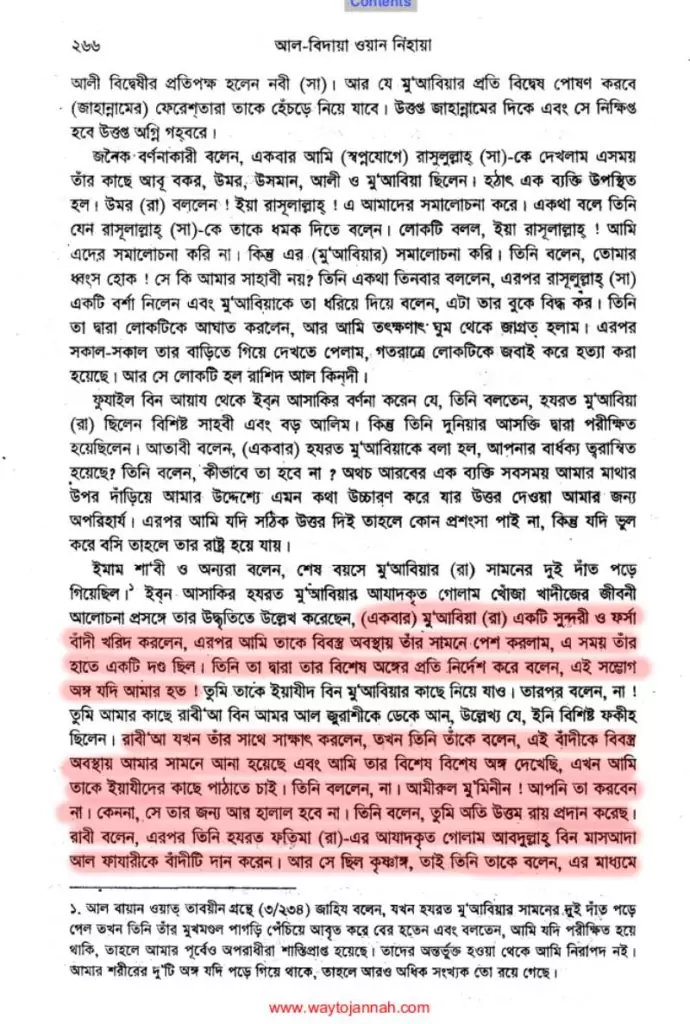
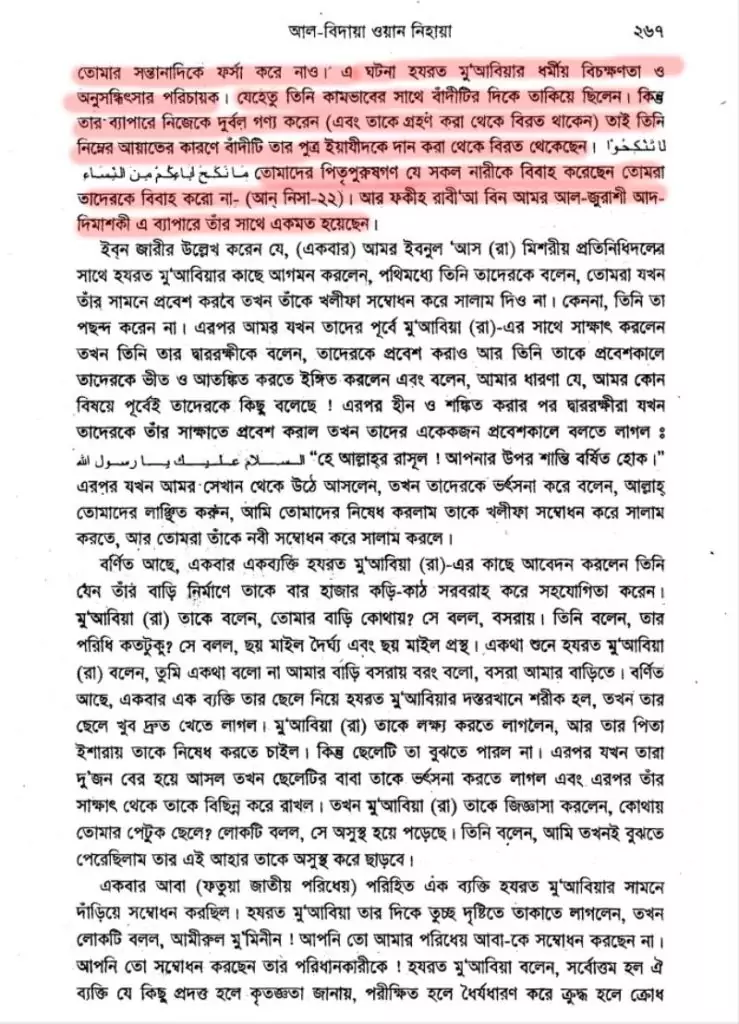
Restrictions on Sexual Access for a Father and Son and the Absence of the Enslaved Woman’s Consent
The most important fiqh aspect of Mu’awiya’s incident was the question of whether a woman could be sexually permissible to both father and son. Initially, Mu’awiya had wanted to send the slave girl to Yazid. But after seeing her with desire and examining her body, he sought the advice of a faqih. Rabi‘a ibn Amr al-Jurashi told him that the woman would not be lawful for Yazid. Ibn Kathir cites Quran Surah An-Nisa 22 verse to explain this decision, where it is forbidden for sons to marry women whom their fathers have married. Ibn Kathir’s own explanation is that Mu’awiya felt shy about sending her to his son because he had seen her with desire. That is, the center of fiqh caution was the limit of forbidden sexual relations between father and son; not the woman’s independent consent. [286] [287]
Here a profound moral contradiction arises. A woman has been purchased, she has been examined while naked, her genitalia have been gestured towards with a rod, and she has been transferred to another man for the purpose of producing offspring. However, the main question in fiqh discussion was whether she would be lawful for the Yazid. It was not discussed whether the woman’s consent had been obtained, whether she wanted any relationship with that man, or whether she had the right to decide about her own life—these questions were not raised. Ibn Kathir praised Muawiya’s decision as a fiqh precaution. However, in the conduct he praises, the violation of the slave girl’s human freedom and sexual dignity was not evaluated as a crime. That is, adherence to a specific prohibition of religious law is being praised, while within the same incident, forced ownership and sexual examination inflicted upon the woman remain intact.
The Transfer of the Enslaved Woman, Instructions to Produce a Fair-Skinned Child, and Racial Preference
Mu’awiya’s statement ‘Bayyid biha waladaka’—that is, ‘Make your children fair-skinned through her’—reveals another important aspect of this incident. The person to whom the slave girl was given, Abd Allah ibn Mas‘ada al-Fazari, is described as black-skinned. On the other hand, the slave girl has been described from the beginning as a beautiful fair-skinned woman. Under Mu’awiya’s instruction, these two characteristics are linked with child production. Thus, the color of the woman’s body is considered part of her reproductive value. A proposal was made to use her fair skin as a characteristic through which the skin color of future children of a black man could be changed. This is a direct expression of racial preference. Here, producing fair-skinned offspring is presented as a desirable outcome. [288]
Even if this statement is presented merely as a joke, its social meaning does not change. Seeing a person’s skin color as a correctable characteristic through child production and considering fair skin as a more desirable outcome expresses the concept of racial hierarchy. More importantly, in this reproductive plan, the woman herself is not a decision-making person. Her body color, sexual permissibility, and possibility of bearing children have become means to fulfill another man’s purpose. Reproductive capacity here is not part of the woman’s own life; it is a feature of the owner’s transferable property. Thus, slavery, sexual ownership, racial preference, and the absence of women’s reproductive autonomy are all linked within the same incident.
This is the limitation of Ibn Kathir’s praise of the incident on grounds of Islamic jurisprudence. Mu’awiya did not send the slave girl to his son—this decision he presented as caution in accordance with religious law. However, he had no objection to handing the woman over to another man and using her as a means for producing offspring. This distinction reveals a fundamental characteristic of slavery-based sexual ethics: there is a regulation regarding which man may establish a sexual relationship with which slave girl; but whether the slave girl herself makes an independent decision about that relationship is not a central question within the ownership structure. By the ethical standard of human sexual autonomy, this system is directly coercive. The internal validity of religious law does not alter the moral character of such coercion.
This account of Mu’awiya’s slave girl is particularly relevant for evaluating his political and religious status. The same historian mentions his relationship with Muhammad, religious knowledge, and administrative prestige in his biography. Yet that same biography also includes details about having a female slave undressed for genital inspection, the thought of sending her to his son, and transferring her as a means of making another man’s children fair-skinned. If weight is given to the first type of statement and the second type of account is dismissed, a significant part of history is erased. Information regarding what kind of religious status Mu’awiya received pertains to later religious evaluations about him. What he did with a subordinate woman, as described in historical texts, constitutes separate information about his personal conduct. Whether that conduct aligns with sexual autonomy and human dignity is a question for moral analysis. The incident involving ownership-based authority over the slave girl and turning her body into an object for inspection and transfer is inconsistent with principles of human freedom.
Muawiya’s establishment of power and dynastic rule
After Hasan ibn Ali transferred the authority of the caliphate to Muawiya ibn Abu Sufyan in 41 Hijra, a fundamental change occurred in the political history of the Muslim empire. The method of transferring power was not the same during the reigns of Abu Bakr, Umar, Uthman, and Ali. Abu Bakr assumed power through the bay’a (pledge of allegiance) of political leaders present at Saqifah. Before his death, Abu Bakr appointed Umar as his successor. Umar handed over the responsibility of selecting his successor to a group of six members. After Uthman’s assassination, pledges of allegiance were given to Ali in Medina. In these four transfers of power, there were problems of political conflict and limited participation, but no caliph made his son the supreme ruler of the state by inheritance. During Muawiya’s rule, initially a strong provincial military authority was established over the centralized caliphate, and later arrangements were made to transfer that power to his own son. Consequently, the caliphate’s political institution moved towards hereditary monarchy. [289] [290]
Behind Muawiya’s political rise was long military and administrative preparation. After Muawiya acquired administrative authority in Syria during Umar’s reign, Uthman placed other Syrian regions under him. After Uthman was killed, he kept that military force intact by refusing allegiance to Ali. After the Battle of Siffin and arbitration, Ali’s centralized authority became further weakened. Egypt came under Muawiya’s political control through Amr ibn al-As. Expeditions by commanders like Busr ibn Artat in Yemen and Hijaz endangered Ali’s administrative position. After Ali’s assassination, Hasan’s caliphate also faced internal conflict within the army and political pressure. Finally, when Hasan transferred power, Muawiya’s long-term provincial authority became the empire’s supreme state power. That is, Muawiya did not merely fill a vacancy after the death of a previous caliph; he established ruling authority through prolonged military resistance against centralized caliphate and agreements on power transfer with rival leaderships.
After Hasan transferred power, Muawiya entered Kufa and received allegiance there. According to Ibn Kathir’s narration, even opposing military leaders like Qays ibn Sa‘d eventually took bay’a in his hand. Important regions including Syria, Iraq, and Egypt came under his control. This situation effectively shifted the political center from Medina to Damascus. While Medina remained the religious and political memory of Muhammad’s lifetime and administrative center of previous caliphs, Muawiya’s power base was the Syrian army, administration in Damascus, and provincial governors loyal to him. Thus, the geographical and institutional foundation of the empire’s centralized authority changed. The competition for leadership of the early Muslim community had become a system for governing an extensive empire, controlling provincial revenue, and maintaining organized military allegiance. [291]
From Caliphate to Kingship: Ibn Kathir’s direct acknowledgment
Identifying Mu’awiya’s rule as a monarchy is not merely a political interpretation by modern historians. In ancient and medieval Islamic historical texts as well, his rule has been described as distinct from the preceding caliphate and as a kingship. Ibn Kathir in Al-Bidaya wa’l-Nihaya designates Mu’awiya’s rule after Hasan’s transfer of power as Islam’s first monarchy. He mentions thirty years of caliphate after Muhammad, followed by kingship based on a hadith. According to his calculation, the short caliphate of Hasan completes that thirty-year period. Then begins Mu’awiya’s reign. Ibn Kathir also praises Mu’awiya in his evaluation, but within that praise identifies him as Islam’s first king. Thus, the issue of transition from caliphate to monarchy cannot be dismissed as a fabricated accusation created outside the Islamic historical tradition. [292]
Ibn Kathir, Al-Bidaya wa’l-Nihaya, Mu’awiya’s reign
قد تقدم في الحديث أن الخلافة بعده ، عليه الصلاة والسلام ، ثلاثون سنة ، ثم تكون ملكا ، وقد انقضت الثلاثون سنة بخلافة الحسن بن علي ، فأيام معاوية أول الملك ، فهو أول ملوك الإسلام وخيارهم .
English translation: Previously, a hadith stated that after the Prophet, caliphate would last thirty years, then it would become kingship. The thirty years were completed through Hasan ibn Ali’s caliphate. Muawiya’s era marks the beginning of kingship. He is Islam’s first king and one of the best among its kings.
A narration exists where Muawiya himself identifies himself as the first king. In Ibn Abi Shayba’s al-Musannaf book, in the chapter ‘The First King’, Muawiya’s statement is preserved through an anonymous narrator from Medina. Ibn Kathir also mentions a similar account in his biography of Muawiya. There, Muawiya called himself the first king. Since the narration has an anonymous narrator, it cannot be accepted as the highest certainty proof of Muawiya’s direct statement. However, the fact that his rule was understood as kingship in ancient Islamic literature is attested by this narration. More importantly, after Muawiya’s death, his son Yazid assumed state power. The actual event of establishing hereditary succession forms a distinct historical basis for the establishment of monarchy. [293] [294]
Ibn Abi Shayba, Al-Musannaf, Muawiya’s reign
حَدَّثَنَا الْفَضْلُ عَنِ ابْنِ أَبِي غَنِيَّةَ عَنْ شَيْخٍ مِنْ أَهْلِ الْمَدِينَةِ قَالَ: قَالَ مُعَاوِيَةُ: أَنَا أَوَّلُ الْمُلُوكِ
English translation: Fazl relates from Ibn Abi Gani’a. He relates from an elder in Medina, that Mu’awiya said, “I am the first king.”
The question of establishing a monarchy was not primarily whether the ruler was called ‘king’. Rather, how political power was acquired, managed, and transferred determined the nature of the state structure. In Muawiya’s case, the military power base was Syria, administrative authority was established through prolonged political conflict, and he took the initiative to secure an early bay’a for his own son regarding succession. Previous caliphs also did not have equal political participation from the general populace. However, by nominating his child as successor, Muawiya subjected that limited leadership selection system to hereditary succession. Thus, lineage became a determining factor in place of election for the highest position of political rule.
Military loyalty, provincial governors and control over state wealth
The foundation of Muawiya’s exclusive rule was the maintenance of political and economic authority throughout the empire through his appointed governors. Appointments in Kufa, including Mughira ibn Shu’ba, later Ziyad ibn Abih, and other governors, placed pressure on pro-Alid political opponents. In Basra, Ziyad and subsequently his son Ubayd Allah ibn Ziyad also received important responsibilities. In Egypt, powerful military figures such as Amr ibn al-As exercised administrative authority. The governors’ duties extended beyond collecting revenue or administering local justice. They exercised powers to arrest political opponents, mobilize soldiers, conduct official propaganda, make administrative appointments, and enforce the central ruler’s orders. The collection of testimony against Hujr ibn Adi, his arrest, and his transfer to Syria provide a concrete example of this administrative system. Provincial administration was also employed to suppress oppositional political identities and sustain central political authority. [295] [296]
This arrangement made the governorship a political reward and a means of maintaining loyalty to the ruler. If there was fear of removing a governor, he could support the central ruler’s new political plan to maintain his position. Mughira ibn Shu’ba’s role in initiating Yazid’s succession is a direct example. According to Ibn al-Athir’s account, Mu’awiya was considering removing Mughira from the governorship of Kufa and appointing Sa’id ibn As instead. Upon receiving this news, Mughira went to Damascus and proposed making Yazid the successor. Later his governorship remained intact. In this incident, personal position preservation, the central ruler’s family plan, and gathering provincial political support became interconnected. Thus, preparation for transfer of power did not begin through neutral public opinion verification; its initiation was a negotiation of administrative positions and political interests. [297]
In this structure of Muawiya’s power, authority over troops and revenue was central. Syria’s forces served as his main military base. Governors of Kufa and Basra managed administrative and political allegiance in Iraq. Pressure could be exerted on important religious and political figures in Hijaz through appointed governors in Medina and Mecca. The role of these three regions in collecting bay’a for the Yazid was particularly highlighted. First, a delegation from Kufa was organized, then consent was collected from Basra and other regions, and finally Muawiya himself had to take initiative to obtain consent from Hijaz’s opponents. Thus, administrative appointment, financial payment, and military power were used together in determining succession to the empire’s supreme authority.
The plan to make Yazid the successor
The most consequential long-term political decision of Muawiya’s reign was his effort to establish his son Yazid as the next caliph. The decision made kinship an institution of succession to state power. Under the events of 56 AH, Ibn al-Athir’s al-Kamil fi al-Tarikh gives a detailed account of securing pledges for Yazid as heir. Ibn Kathir also discusses the nomination and the political opposition to it under the same year. The accounts record al-Mughira ibn Shu’ba’s initiative, Ziyad ibn Abih’s warning, the dispatch of a paid delegation from Kufa, Marwan’s campaigning in Medina, Abd al-Rahman ibn Abi Bakr’s protest, and the opposition of Husayn and Abd Allah ibn al-Zubayr. Naming Yazid was more than a father’s private decision to proclaim his son his successor. It was the product of a coordinated political campaign carried out over several years. [298] [299]
Mugira ibn Shu’ba’s initiative: relationship between retaining the governorship and succession planning
According to Ibn al-Athir’s account, Mu’awiya was considering removing Mughira ibn Shu’ba from his position as governor of Kufa and appointing Sa’id ibn As in his place. Upon receiving this news, Mughira decided to travel to Damascus. He intended to publicly demonstrate his willingness to relinquish his governorship, but he told his close associates that if he could not secure new political advantages for himself during this journey, he would never be able to do so again. Upon arriving in Damascus, he first met Yazid. Mughira told Yazid that many of the senior leaders of Muhammad’s Companions had passed away and that a younger generation had now emerged. Yazid was an important figure among this new generation. Therefore, Mughira asked why Mu’awiya would not appoint him as the next caliph. Yazid conveyed this proposal to his father. Mu’awiya summoned Mughira and sought his opinion. [300]
Mughira argued before Mu’awiya that after the civil war and bloodshed that occurred in the Muslim society following Uthman’s death, it was necessary to determine future leadership beforehand. He claimed that if Yazid were made heir, a new civil war could be avoided after Mu’awiya’s death. Mu’awiya asked how consent from the provinces could be obtained for such a decision. Mughira informed him that he would gather support from Kufa and Ziyad ibn Abih could secure Basra’s support. His argument was that if these two important Iraqi provinces agreed, there would be no major opposition. Then Mu’awiya instructed him to return to Kufa to discuss with his trusted individuals. Mughira’s governorship position remained intact. Although the language of preventing future civil war was used, the effective political method was organizing support for the ruler’s son through provincial governors.
Al-Mughira’s own reaction also brings out the political significance of his initiative. In Ibn al-Athir’s account, he told his associates he had set Muawiya on a course toward a long-term decision whose consequences Muslim society would have to bear for a long time. The conversation is preserved as an account of al-Mughira’s intentions and his own assessment of what he had done. The central point is that after his proposal, Yazid’s succession became a program of the central administration. A provincial governor had tied the strengthening of his own political position to establishing the power of the next generation of the ruling family. The freedom to express public support over who would succeed to state leadership was constrained from the outset.
Thirty thousand dirhams, provincial delegation and political support in exchange for money
On returning to Kufa, al-Mughira discussed Yazid’s succession with Umayyad supporters and men he trusted. A group agreed to support the pledge. One of Ibn al-Athir’s accounts says that ten or a few more delegates were sent to Damascus. Al-Mughira gave them thirty thousand dirhams and sent his son Musa ibn al-Mughira to lead them. Before Muawiya, the delegates praised Yazid’s qualifications and urged him to name Yazid his successor. Having heard their position, Muawiya did not ask them to announce it publicly at once. He told them to hold to their opinion and refrain from spreading the matter for the time being. He then asked al-Mughira’s son in private how much his father had paid for their support. Musa told him it had been thirty thousand dirhams. Muawiya commented on how cheaply they had sold their religious and political principles. [301]
Ibn al-Athir, al-Kamil fi al-Tarikh, 56 AH, bay’at for Yazid
وسار المغيرة حتى قدم الكوفة وذاكر من يثق إليه ومن يعلم أنه شيعة لبني أمية أمر يزيد ، فأجابوا إلى بيعته ، فأوفد منهم عشرة ، ويقال أكثر من عشرة ، وأعطاهم ثلاثين ألف درهم ، وجعل عليهم ابنه موسى بن المغيرة ، وقدموا على معاوية فزينوا له بيعة يزيد ودعوه إلى عقدها : فقال معاوية : لا تعجلوا بإظهار هذا وكونوا على رأيكم . ثم قال لموسى : بكم اشترى أبوك من هؤلاء دينهم ؟ قال : بثلاثين ألفا : قال : لقد هان عليهم دينهم .
English translation: Mughira returned to Kufa and discussed the issue of Yazid with his trusted people and known supporters of Banu Umayya. They agreed to pledge allegiance to Yazid. He sent ten representatives from among them. Some say there were more than ten. He gave them thirty thousand dirhams and appointed his son Musa ibn Mughira as their leader. They went to Muawiya, presented the pledge to Yazid as a good decision, and invited him to complete it. Muawiya said, ‘Do not rush to make this matter public. Remain in your position.’ Then he asked Musa, “How much did your father buy their religion for?” Musa said, “Thirty thousand.” Mu’awiya said, “Their religion is worth very little to them.”
Another version of this event appears in the same historical book. There it mentions sending forty representatives and Urwa, another son of Mugira, as their leader. The amount of money also differs: four hundred dinars. Thus, there are separate accounts regarding the specific number of representatives, the leader’s name, and the amount of money. But in both versions, the issue is identical: using money to organize support for the representative group and utilizing that support for Yazid’ nomination. Therefore, one cannot take any single number as the only certain account. The accusation that representatives were bought is part of historical narrative; it is not universal proof of each provincial representative’s individual motives. But the political method of creating claims to public support through money-receiving representatives is clearly present in these accounts.
If a state ruler decides beforehand to make his son heir, then selects supporters through administrative influence and money via provincial governors, then the presence of those representatives is not equivalent to free public consent. If representatives speak in favor of the ruler’s will, it cannot be claimed that their statements represent the independent opinions of all inhabitants of the empire. Rather, here organization of expressing consent occurs before obtaining public consent. While this method maintains the religious and political form of bay’at, its decision-making structure remains under the control of the ruling family.
Ziyad ibn Abih’s Warning and Officials’ Concerns about Yazid’s Conduct
Muawiya sought Ziyad ibn Abih’s opinion on naming Yazid as successor. Ziyad was then a principal figure in the Basran administration and a close political ally of Muawiya. He opposed immediately soliciting pledges of allegiance for Yazid. Ibn al-Athir recounts that Ziyad expressed concern about Yazid’s behavior. He objected in particular to his passion for hunting and entertainment, his laxity in carrying out his duties, and some of his personal habits. He feared that these things might lead people to oppose the nomination. He advised that Yazid change his conduct first and that Muawiya take time to stabilize the situation before announcing the succession. [302]
Ziyad consulted his trusted associate Ubayd ibn Ka’b al-Numayri. Ubayd proposed advising Yazid to reform his conduct instead of opposing him directly. This would preserve Muawiya’s immediate plan while allowing Yazid to address the public complaints against him. According to the account, Ubayd met Yazid and conveyed Ziyad’s concerns. Yazid subsequently refrained from some of his practices. Ziyad replied to Muawiya that he should wait rather than implement the plan immediately. The account reveals doubts about Yazid’s suitability within the administrative leadership itself. His position as the ruler’s son did not make his nomination automatically unanimous. Even Muawiya’s close associates considered changes in his personal conduct necessary.
According to Ibn al-Athir’s sequence of events, Muawiya intensified his efforts to obtain allegiance for Yazid after Ziyad’s death. Ziyad’s caution therefore failed to halt the plan permanently. The nature of political power is clear here. Objections to Yazid’s personal qualifications did not initiate an independent process for choosing another candidate. Instead, arrangements were made to reform the designated heir’s conduct and make him acceptable to the public. Yazid himself remained at the center of the decision. Objections to his suitability were treated as obstacles to gaining public support instead of grounds for changing that decision.
One Hundred Thousand Dirhams for Abd Allah ibn Umar and His Refusal to Pledge Allegiance
Abdullah ibn Umar’s position was important to establishing Yazid’s succession. He was the son of the second Caliph Umar and a prominent religious figure in Medina. According to Ibn al-Athir, Muawiya sent him one hundred thousand dirhams. Ibn Umar accepted that money. But later when the matter of bay’a for Yazid arose, he informed that an attempt had been made to purchase his religious position with that money. He refused to pledge allegiance to Yazid. In this narration both accepting money and rejecting political allegiance are present together. So the claim that Ibn Umar gave consent for Yazid because he accepted money is false. Similarly it is also false to say that his initial refusal remained unchanged till the end of his life. Sahih al-Bukhari contains a separate account that he later pledged allegiance to Yazid after Yazid’s rule was established. [303] [304]
Through this incident, the limitations of attempting to purchase political consent are revealed. Accepting money from a ruler does not create a moral obligation for political allegiance on an individual. After the matter of Yazid’s nomination arose, Abdullah ibn Umar raised questions about the purpose of receiving the money. Thus, there were contemporary objections concerning the relationship between royal grants and independent political decisions. On the other hand, seeing Abdullah ibn Umar’s change in position after Yazid came to power does not mean that political resistance and accepting allegiance to established power are events of the same period. Identifying them always as supporters or opponents without specifying at what stage they held which positions distorts historical reality.
Abd al-Rahman ibn Abi Bakr’s Protest: The Charge of Establishing a ‘Heraclian Monarchy’
Abdur Rahman ibn Abu Bakr was one of the most prominent public opponents of the effort to collect bay’a for Yazid in Medina. He was the son of the first caliph Abu Bakr and the brother of Aisha. Mu’awiya entrusted Marwan ibn al-Hakam, the governor of Medina, with the task of announcing Yazid’s succession. According to Ibn al-Athir’s account, Mu’awiya first sent instructions for public opinion by addressing concerns about political division after his own old age and death. Marwan propagated this statement in Medina. When the decision to make Yazid the successor was announced, Abdur Rahman publicly objected. He accused Mu’awiya and Marwan of transforming the Muslim state into a hereditary monarchy like the Byzantine emperors. The core meaning of his argument was that establishing arrangements for placing the ruler’s own son in power after the death of a ruler was converting the people’s right to leadership election into hereditary succession. [305]
After this protest, Marwan ibn al-Hakam used Surah Ahqaf’s 17 verse number against Abdur Rahman. The verse mentions a person who rejects the promise of resurrection by opposing his parents’ religious statements. Marwan claimed that the verse was revealed about Abdur Rahman. However, Aisha protested this claim from behind the veil and informed that this Quranic verse was not revealed about her brother. This incident is also preserved in Sahih al-Bukhari 4827 hadith number. There it mentions instructions for arresting Abdur Rahman from Marwan’s side and details of Abdur Rahman taking refuge in Aisha’s house. Thus, both the attempt to label opposition to pledging allegiance to Yazid a religious crime and the administrative initiative to arrest the objector are present in the hadith. [306]
Sahih al-Bukhari, Quran Commentary, Surah al-Ahqaf, hadith 4827
حَدَّثَنَا مُوسَى بْنُ إِسْمَاعِيلَ، حَدَّثَنَا أَبُو عَوَانَةَ، عَنْ أَبِي بِشْرٍ، عَنْ يُوسُفَ بْنِ مَاهَكَ، قَالَ كَانَ مَرْوَانُ عَلَى الْحِجَازِ اسْتَعْمَلَهُ مُعَاوِيَةُ، فَخَطَبَ فَجَعَلَ يَذْكُرُ يَزِيدَ بْنَ مُعَاوِيَةَ، لِكَىْ يُبَايِعَ لَهُ بَعْدَ أَبِيهِ، فَقَالَ لَهُ عَبْدُ الرَّحْمَنِ بْنُ أَبِي بَكْرٍ شَيْئًا، فَقَالَ خُذُوهُ. فَدَخَلَ بَيْتَ عَائِشَةَ فَلَمْ يَقْدِرُوا {عَلَيْهِ} فَقَالَ مَرْوَانُ إِنَّ هَذَا الَّذِي أَنْزَلَ اللَّهُ فِيهِ {وَالَّذِي قَالَ لِوَالِدَيْهِ أُفٍّ لَكُمَا أَتَعِدَانِنِي}. فَقَالَتْ عَائِشَةُ مِنْ وَرَاءِ الْحِجَابِ مَا أَنْزَلَ اللَّهُ فِينَا شَيْئًا مِنَ الْقُرْآنِ إِلاَّ أَنَّ اللَّهَ أَنْزَلَ عُذْرِي.
English translation: Musa ibn Ismail narrates to us from Abu Awana, who narrates from Abu Bishr, who narrates from Yusuf ibn Mahak. Yusuf says, “Marwan was the ruler of the Hijaz. Muawiya had appointed him. In a sermon, Marwan mentioned Yazid ibn Muawiya so that pledges of allegiance would be given to him after his father. Abdur Rahman ibn Abu Bakr said something to him. Then Marwan said, ‘Seize him.’ Abdur Rahman entered Aisha’s house, and they could not seize him. Marwan said, ‘This is the person about whom Allah revealed, “The one who says to his parents, ‘Uff to you both! Do you promise me…?’”’ Aisha said from behind the curtain, ‘Allah has revealed nothing in the Quran concerning us except the declaration of my innocence.’”
Abdur Rahman’s political argument against the succession was directly related to Marwan’s reaction. Abdur Rahman criticized the selection of the successor as an initiative to establish a dynastic monarchy. In response to his argument, a representative of the state administration subjected him to religious condemnation instead of engaging in political reasoning and issued an order for his arrest. This incident provides an important example of using religious texts against political opponents. An attempt was made to invalidate criticism of succession policy by asking which verse of the Quran was revealed concerning whom. However, Aisha’s protest makes it clear that such a religious accusation was not even recognized within the contemporary Muslim leadership. Expressing disagreement with a political decision and religious disobedience are not the same issue. Opposing making the son of a ruler the successor is not equivalent to rejecting the Quranic discourse on resurrection.
Opposition from Husayn, Abdullah ibn al-Zubayr and other leaders
Besides Abdur Rahman ibn Abu Bakr, objections against Yazid’s succession were also received from Husayn ibn Ali, Abdullah ibn al-Zubayr, and Abdullah ibn Umar. According to Ibn al-Athir’s account, after Marwan’s announcement, Husayn publicly objected. Ibn Umar and Ibn al-Zubayr also opposed it. Marwan sent a letter informing Mu’awiya about this situation. Each of these opponents was a member of an important family from the early political history of the Muslim community. Husayn was the grandson of Muhammad and the son of Ali. Abdullah ibn al-Zubayr was the son of al-Zubayr ibn Awwam. Abdur Rahman was the son of Abu Bakr, and Abdullah ibn Umar was the son of the second caliph. Thus, opposition to establishing Yazid’s succession was not limited to an unknown segment of the general public; there was serious disagreement even among the successors of the founding political leadership of the Muslim community. [307]
Muawiya then set out for Hijaz himself. According to Ibn al-Athir, a thousand cavalrymen accompanied him. On his way to Medina, he met Husayn, Abd Allah ibn al-Zubayr, Abdur Rahman, and Ibn Umar. The account describes him speaking harshly to them. Later, Muawiya addressed the people in support of Yazid and hinted at severe punishment if opposition continued. Upon hearing news of this threat from Muawiya, Aisha questioned him. In the same account, Aisha also raised the issue of the murder of her brother Muhammad ibn Abi Bakr. Thus, political pressure regarding the succession of Yazid brought to mind again memories of earlier political murders. [308]
Husayn and Ibn al-Zubayr’s opposition became a crisis for Yazid’s rule. While Muawiya was alive, they expressed objections to Yazid’s nomination. After Muawiya’s death, Yazid came to power and tried to collect bay’a from them. Husayn left Medina for Mecca and then traveled towards Iraq in response to the call of Kufa. Abd Allah ibn al-Zubayr also established a separate political position in Mecca. Consequently, the effort to collect pledges for Yazid during Muawiya’s lifetime did not secure the political consent of important opponents in the Hijaz. This incomplete legitimacy of succession became one of the direct causes of the subsequent civil war. [309]
Praise of Yazid at Court, Threats at Swordpoint, and Compelled Allegiance
To establish Yazid’s succession, Mu’awiya summoned delegations from various provinces. According to Ibn al-Athir’s account, he instructed governors to propagate praise for Yazid and send representatives to Damascus. Individuals such as Ahnaf ibn Qays from Basra and Muhammad ibn Amr ibn Hazm from Medina were present at the representative assembly. After his own statement, Mu’awiya instructed Dahhak ibn Qays to speak publicly in support of Yazid. Dahhak highlighted unity within the Muslim community, ending civil war, and Yazid’s qualifications, proposing that he be made successor. Other speakers also offered similar praise. However, one account of this assembly mentions a speaker named Yazid ibn Muqanna‘ who displayed a sword and declared that after Mu’awiya, Yazid would rule, and anyone who denied this would face the use of the sword. The account describes Muawiya praising the speaker’s statement. Thus, alongside the language of support organization, there was also a direct threat of violence. [310]
At this court, Ahnaf ibn Qays’s position was also important. When he was asked to give his opinion about Yazid’s qualifications, he said that if one speaks the truth, there is fear of the ruler’s reaction, but if one lies, there is fear of Allah. He reminded Muawiya that a father knows best about his son’s personal and public character. If Yazid was truly fit for ruling the people, then the responsibility for that decision belonged to Muawiya; but if he was unfit, it would not be appropriate to place him in power solely due to succession. This argument clearly revealed the problem of political consent. A regional leader feared expressing his true opinion before the ruler, yet support was expected from him in that same environment. In such a situation, whether formal consent reflects genuine independent opinion is a serious question. [311]
The events of this assembly revealed a combination of administrative power, the language of religious unity, and threats of violence. On one hand, Yazid’s leadership was propagated as a measure to prevent future civil war; on the other hand, the use of weapons against his opponents was mentioned. If political unity were established based on free consent, there would need to be room for expressing differing opinions. However, if opposition to selecting a successor was met with threats of swords, bay’a no longer constitutes reliable proof of voluntary consent. In this case, state power first made the decision and then used administrative and military pressure to establish that decision as supported by the people.
The Reported Announcement of Consent under Armed Guard in Mecca
One of the most serious incidents in securing pledges of allegiance for Yazid is preserved by Ibn al-Athir in his account of the political assembly in Mecca, where Mu’awiya discussed with Husayn, Abd Allah ibn al-Zubayr, and other opposing leaders. Ibn al-Zubayr cited examples of power transfer from previous caliphs. He stated that Muhammad did not appoint his son as successor; Abu Bakr appointed Umar outside his own family; and Umar formed a shura of six members, none of whom was his own son. Through this comparison, Ibn al-Zubayr showed that the method of making Muawiya’s son successor differed from the previous three transfers of power. Mu’awiya did not accept this statement. Instead, after concluding the discussion, he warned the opponents that if they responded to his speech in a public assembly, he would immediately use weapons against them. [312]
This description leads to an even more serious subsequent sequence of events. Muawiya ordered his chief guard to station two sword-wielding soldiers near the head of each opposing leader. If anyone publicly opposed his speech, those soldiers would kill him. Then Muawiya announced in a public gathering that Husayn, Ibn al-Zubayr, and other leaders had accepted Yazid’s succession. The present people gave bay’a based on this announcement. Later, when asked about their position from the opposing leaders, they said they did not give bay’a; they could not publicly protest while there was a threat of swords over their heads. If this account is true, the incident of collecting bay’a was not political consent but a display of obedience under direct threat of death. However, this is a specific historical account preserved by Ibn al-Athir; it cannot be presented as a document of an independent court. [313]
Here there are two levels of political deception and coercion. First, the right of opponents to speak openly was closed through threats of weapons. Second, their silence was declared as consent and bay’a was collected from the people. If a person’s silence is due to fear of death, it cannot be called free consent. When a ruler prohibits expressing opinion against his proposal and then declares that the proposal has been accepted unanimously, the true meaning of consent is eliminated. Ibn al-Athir’s narration shows the presence of this method in establishing the succession of Yazid; through religious and political rituals of bay’a, an image of unity was created before the people, behind which were real opposition and threats to life.
Said ibn Uthman’s objection and internal rivalry within the Umayyad family
The decision to appoint Yazid as successor faced opposition not only from Ali’s family or from the children of Abu Bakr and Umar but also within the Umayyad family itself. In Ibn al-Athir’s account of events in the year 56 AH, the statement of Uthman’s son, Sa’id ibn Uthman, is preserved. He claims before Mu’awiya that his father Uthman played a crucial role in strengthening Mu’awiya’s political position. Yet Mu’awiya establishes his own son Yazid as future ruler instead of members of that family. Sa’id claims that in terms of lineage, his father’s reputation, and personal merit, he is superior to Yazid. While Mu’awiya praises some of his claims, he does not change the appointment of Yazid. Rather, it is described that he arranged to satisfy Sa’id by assigning him administrative and military authority over Khorasan. [314]
This incident reveals an important characteristic of Umayyad politics. Muawiya organized military resistance against Ali seeking revenge for Uthman’s assassination. But the son of Uthman himself, who was at the center of that demand for revenge, did not receive special rights in the subsequent caliphate selection. Political power eventually became centered on Muawiya’s own family branch instead of Uthman’s family. Even though they were members of the same clan, there was competition among various branches for succession to power. Consequently, the collective interests of the Umayyad clan and the succession of Muawiya’s own son were not the same issue. Sa’id’s objection reveals that difference.
Muawiya’s Final Instructions: Reliance on Syrian Forces and the Treatment of Opponents
Although formal pledges of allegiance for Yazid had been collected from many regions by the time Muawiya died in 60 AH, the consent of several important opposition leaders had not been obtained. Ibn al-Athir’s al-Kamil fi al-Tarikh preserves an account of a political advice given to Yazid during Muawiya’s final illness. There, Muawiya states that he weakened military and political rivals during his long reign to pave the path for power for Yazid. He advises honoring the leaders of Hijaz, warns regarding administrative demands of the people of Iraq, and orders maintaining the Syrian army as his main political and military base. He specifically notes that if military assistance is needed against an enemy, the Syrians should be used, and after the work is done, they should be returned to Syria. This discourse places emphasis on military loyalty and provincial administrative strategy as primary means for maintaining state power. [315]
In another part of the advice, Husayn ibn Ali, Abd Allah ibn Umar, and Abd Allah ibn al-Zubayr are mentioned as potential political rivals. Regarding Husayn, it is said that the Iraqis could draw him into political initiatives; even if he were defeated, he should be pardoned due to his close relationship with Muhammad. Regarding Ibn Umar, it is said that he is deeply engaged in religious practice and will eventually accept obedience if others agree. Ibn al-Zubayr is identified as the most cunning political rival. The account also mentions harsh punishment for Ibn al-Zubayr if he were defeated. The language of this advice does not frame future succession as a question of popular election, but presents potential rivals as issues to be dealt with militarily and administratively.
There is a significant chronological problem in this account of the deathbed advice. One version includes Abd al-Rahman ibn Abi Bakr on the list of potential opponents, but the accepted historical chronology places his death before Muawiya’s. Ibn al-Athir himself identifies the inconsistency. He also notes another account in which Yazid was absent when his father died. Muawiya entrusted al-Dahhak ibn Qays and Muslim ibn Uqba with conveying his advice to Yazid. Ibn al-Athir calls this second sequence more accurate. The long, widely circulated advice therefore cannot be treated as a certain verbatim record of everything said at Muawiya’s deathbed. The later sequence independently establishes that opposition from Husayn and Ibn al-Zubayr still remained unresolved when Yazid took power in 60 AH. [316]
Securing Pledges for Yazid and the Reality of Political Consent
Considered as a whole, the lengthy process of establishing Yazid’s succession shows that the decision to transfer the state’s supreme political power was first made within the ruling family. Provincial administration, payments, delegations, religious language, and military force were then employed to implement it. Mughira ibn Shu’ba is reported to have organized a delegation in Kufa through payments. In Basra, consultations with Ziyad addressed obstacles to public support. Sahih al-Bukhari records Marwan’s campaigning for Yazid in Medina and his order to arrest Abd al-Rahman ibn Abi Bakr. Accounts concerning other opponents in the Hijaz describe financial benefits, political discussions, and threats with weapons. Within this sequence of events, the pledge cannot be treated as an expression of entirely independent political consent. [317] [318]
This arrangement did not formally and completely abolish previous methods of transferring power. The language of the bay’ah remained, the claim of religious unity persisted, and there were initiatives to gather support from influential figures for declaring succession. However, various candidates of potential public preference were not present at the center of the decision. The successor was predetermined—he was Yazid, son of Muawiya. The job of administrative officials was to secure approval for that decision. Consequently, the bay’ah gradually transformed from a method of leadership selection into a ceremony of allegiance to a designated hereditary successor. When the source of state power became centralized in the ruler’s family, popular political consent became collected support after the fact rather than a precondition for rule.
This change was also directly related to violence. The order for the arrest of Abdur Rahman in Medina, the deployment of armed soldiers before Meccan opponents, and the declaration of using weapons against Yazid’s opponents in the court are different aspects of the same political project. Although the evidentiary weight and transmission traditions differ for each event, there is a clear tendency here to make public opposition to the ruler’s succession decision dangerous. If political obedience is performed through coercion, loyalty to the state and loyalty to the ruler’s personal family become unified. Then rejecting the ruler’s son is not merely opposing a candidate; it can be considered a crime against state authority.
After Muawiya’s death in AH 60, the true character of this arrangement became even clearer. Upon assuming power, Yazid ordered the governor of Medina, Walid ibn Utbah, to secure pledges of allegiance from Husayn, Abd Allah ibn Umar, and Abd Allah ibn al-Zubayr. Ibn al-Athir’s account states that this order required that no concessions be made. Husayn refused to give the bay’ah in a private and confidential setting. Ibn al-Zubayr also left Medina for Mecca. Thus, the attempt to collect advance bay’ah during Muawiya’s life could not resolve all conflicts of power transfer. Instead, one of the new ruler’s first political initiatives became enforcing allegiance from important opponents. This continuity of pressure led to Husayn’s departure from Medina and Mecca and later created the political background for the massacre at Karbala. [319]
From the establishment of Muawiya’s rule to Yazid’s succession, a continuous transformation of state power is visible in the flow of events. First, Muawiya’s political power develops as the provincial governor of Syria under Umar and Uthman. Later he rejects Ali’s caliphate, conducts the Battle of Siffin, and maintains military and administrative power. After Ali’s death, he takes authority of the caliphate from Hasan and becomes the sole ruler of the empire. Then he uses administrative and military power to make his son his successor. This continuity shows that the Umayyad hereditary monarchy was not a result of an abrupt family nomination; behind it were long political competition, centralization of military power, control over provincial administration, and events of weakening rival leadership.
By appointing Yazid, Mu’awiya initiated the transformation of the highest position in the Muslim empire into succession for his own family. This decision was opposed by Abdur Rahman ibn Abu Bakr, Husayn ibn Ali, Abd Allah ibn al-Zubayr, and others, proving that hereditary succession was not an inherent and universally accepted political method among contemporary Muslim leadership. Even with religious rituals of the bay’a, genuine independent consent was not ensured. Thus, the method of power transfer, which was promoted as a measure to prevent future civil wars, instead laid the foundation for new political conflicts. After Mu’awiya’s death, early in Yazid’s reign, tragic events such as Husayn’s assassination, the Battle of al-Harra in Medina, and the siege of Mecca occurred. Hereditary succession did not ensure political stability of the state; rather, it created a situation of new violence under the name of extracting allegiance from opponents.
Yazid’s rule
Yazid’s personal character and assumption of power
When Muawiya ibn Abi Sufyan died in 60 AH, or 680 CE, his son Yazid took power in the Muslim empire. The transfer put into practice an important change in early Islamic political history. Previous caliphs had come to power through various forms of limited consultation, nomination, and pledges of allegiance. Muawiya had named his own son as heir while he was still alive and organized the allegiance of provincial governors and political leaders in advance. Yazid was the son of Muawiya and Maysun bint Bahdal. His mother’s tribe, Banu Kalb, had important connections to Syrian military and tribal power. The Syrian army, the administration in Damascus, and the support of Muawiya’s longtime political allies formed the basis of Yazid’s rule. His succession was not universally accepted in Medina and Mecca, two of the empire’s most important religious and political centers. In particular, leading figures such as Husayn ibn Ali and Abd Allah ibn al-Zubayr had opposed Yazid’s nomination during Muawiya’s lifetime. Securing the allegiance of those opponents became the first major problem of the new reign. [320] [321]
The way Yazid’s succession was established is politically significant. While still alive, Muawiya obtained pledges for his son through provincial governors. Early Islamic literature records a paid delegation organized in Kufa through al-Mughira ibn Shu’ba, the announcement of the succession through Marwan in Medina, and threats of arrest and death against opponents. None of this obtained the consent of Husayn and Ibn al-Zubayr. When Muawiya died, Yazid used the administration to enforce a succession already settled, rather than making a new political decision. The meaning of the pledge of allegiance shifted in the process. At some earlier selections, the pledge had been a means of choosing or participating in the choice of a leader. Yazid had already been designated heir. What remained was to extract obedience to that decision from its opponents. Consent was a political formality to be secured in order to enforce the ruler’s decision, rather than a precondition for making it. [322] [323]
The Urgent Order to Obtain Pledges in Medina and the Political Pressure on Husayn
Upon receiving news of Mu’awiya’s death, Yazid sent instructions to Walid ibn Utba ibn Abi Sufyan, the governor of Medina, to collect bay’a from political leaders. According to a narration preserved by Ibn Kathir from Ibn Sa’d, Yazid first instructed to seek compliance from influential Quraysh individuals and specifically to start with Husayn ibn Ali. It is also stated in that narration that Mu’awiya had advised maintaining relations with Husayn while alive. However, another narration by Ibn al-Athir uses harsher language for the instruction, mentioning immediate bay’a from several important persons in Medina. The complete wording of these letters was not identical; however, the political objective remained the same. Yazid sought to secure the loyalty of individuals whose rejection could question the legitimacy of the new regime at the beginning of his accession. [324] [325]
Walid, the governor of Medina, summoned Husayn and Abdullah ibn al-Zubayr late at night. According to Ibn Kathir’s account, they were informed of Muawiya’s death and invited to give bay’a to Yazid. Husayn and ibn al-Zubayr did not immediately agree but stated that the matter would be considered in front of people the next day. Another narration has Husayn saying that for a person like him, giving bay’a publicly is more appropriate than secretly. This stance was politically significant because a governor’s private meeting late at night to receive allegiance and making that decision publicly before the people are two different matters. In the first situation, a ruler’s representative could extract a decision in a limited and controlled environment. In the second situation, the political position would be revealed to the public. Husayn refused to give bay’a that very night and left the meeting. [326]
Marwan ibn al-Hakam’s role at Walid’s meeting was even more serious. He was the previous governor of Medina and an important figure in the Umayyad administration. According to Ibn al-Athir’s narration, Marwan advised Walid that bay’a must be obtained from Husayn immediately; if he refused, arrangements for his execution should be made. Walid rejected this advice. He was not willing to accept responsibility for Husayn’s murder. Ibn Kathir’s narration also records advice to kill him from Marwan or another person present at the meeting, and Walid’s refusal. Thus, there were differences of opinion within the ruling family regarding the method of enforcing compliance with authority. Marwan’s position proposed confronting political rejection through capital punishment; on the other hand, Walid did not carry out such an assassination at that moment. Preserving this difference means it is not necessary to hold every member of the ruling group equally accountable for the same decision. [327] [328]
Husayn and ibn al-Zubayr left Medina for Mecca. Through this decision, they temporarily removed themselves from direct administrative pressure to pledge allegiance to Yazid. Mecca was the holiest city of Islam and a gathering place for people from various regions due to Hajj and Umrah. Thus, staying there allowed Husayn to maintain contact with various political figures in Iraq and Hejaz. Ibn al-Zubayr also took residence in Mecca and organized his own political support. Both opposed Yazid, but their political positions and future plans were not entirely the same. Letters from Kufa residents reached Husayn, while ibn al-Zubayr continued to strengthen his power in Mecca. Thus, a failed attempt to extract allegiance during a night meeting in Medina quickly laid the foundation for new political crises in two important regions of the empire. [329] [330]
Contemporary accusations regarding Yazid’s drinking, hunting, and entertainment
Yazid’s personal character became a topic of political discussion even before his declaration of succession. In Ibn al-Athir’s preserved account, Mu’awiya’s close administrative associate Ziyad ibn Abih reported objections. Ziyad believed that due to Yazid’s hunting, entertainment, and some personal habits, common people might object to accepting him as a ruler. He advised Mu’awiya to wait instead of collecting the bay’a immediately. It is also reported that information about the need for correcting Yazid’s behavior reached him. Thus, accusations regarding Yazid’s character were not only created by his future political enemies; objections were raised even in the initial discussions of making him successor from an important official within the ruling group. [331]
In the subsequent era, accusations were propagated against Yazid regarding his indulgence in alcohol consumption, entertainment, hunting, and neglect of religious ordinances. These charges are preserved in the accounts of representatives who visited Yazid’s court from Medina, in the political campaigns of his opponents, and in the narratives of later historians. Ibn Kathir’s work also contains a statement by Abd Allah ibn al-Zubayr comparing Husayn’s religious observance with that of an individual involved in drinking alcohol and entertainment. These reports constitute historical testimony to the nature of accusations circulated against Yazid. However, the evidentiary standard for direct observation of each accusation and political rhetoric differs. More explicit evidence regarding the moral character of Yazid’s rule is found in his gubernatorial appointments, directives against political opponents, the killing of captives, and incidents of military expeditions during his reign. Allegations concerning a ruler’s personal entertainment are less direct matters of political accountability than acts of state power exercised through homicide and repression. [332]
The source of Yazid’s authority was his father’s inheritance and the support of Syrian military-administrative power. A significant reason for political opposition against him was this hereditary transfer of power. Husayn was Muhammad’s grandson and Ali’s son; Abd Allah ibn al-Zubayr was the son of al-Zubayr ibn Awwam, a former member of the Shura. However, their familial status did not inherently establish right to the highest office of the state. Similarly, being Muawiya’s son did not give Yazid an inherent moral right to that position either. Authority over governance and decision-making regarding the people’s lives is not legitimized on the basis of lineage. The practical consequences of this problem manifested immediately in Yazid’s rule: those who did not acknowledge his inheritance were subjected to administrative pressure for compliance, and later military force was employed.
The Killing of Muslim ibn Aqil and Hani ibn Urwa in Kufa
One of the centers of the first major political conflict against Yazid’s rule was Kufa in Iraq. During Ali’s caliphate, Kufa was his main political and military capital. There were various groups of Ali’s supporters and opponents of Umayyad rule present there. After news of Muawiya’s death and Husayn’s and Ibn al-Zubayr’s refusal to pledge allegiance reached Kufa, some of Kufa’s political leaders invited Husayn to assume new leadership. Accounts describe a gathering at the house of Sulayman ibn Surad al-Khuza’i. From there, letters began to be sent to Husayn. Later, more delegations and many letters reached Mecca. Several letters directly stated that Kufa had no acceptable leader for them; if Husayn came, they would accept his leadership. These letters expressed dissatisfaction with Umayyad administration and promised political support for Husayn’s side. [333]
Before responding to the call from Kufa, Husayn arranged to verify the situation. He sent his cousin Muslim ibn Aqil as a representative. Muslim was the son of Aqil ibn Abi Talib, that is, Ali’s nephew. Husayn instructed him to verify the actual position of influential figures in Kufa, the extent of popular support, and their preparedness for leadership change. If support was sufficient, he should send news. In his letter, Husayn mentioned working according to Quranic provisions for political leadership, establishing justice, and adherence to true religious principles. Through this, he did not accept the call from Kufa merely as an opportunity for personal power acquisition; he also communicated his stance on governance policies of new leadership. However, the quantitative claim of support from Kufa and how much that support would withstand actual military pressure remained unresolved at that time. [334]
Muslim ibn Aqil’s Arrival, Secret Pledges of Allegiance, and Political Organizing in Kufa
Muslim ibn Aqil arrived in Kufa and initially settled there with the help of local supporters of Ali. Historical accounts differ regarding his first place of refuge. Some accounts mention the house of Mukhtar ibn Abu Ubayd, while others name Muslim ibn Awsajah. Later, he took refuge at Hani ibn Urawah al-Muradi’s house. People from various tribes of Kufa came to him and gave bay’ah for Husayn. A preserved account by al-Mizzi and al-Dhahabi mentions twelve thousand supporters. On the other hand, Ibn al-Athir’s account mentions eighteen thousand people giving bay’ah. These numbers are from different historical reports of the same event; they cannot be treated as an independently verified, comprehensive record of popular support. However, it is clear that significant political organization formed around Muslim and he wrote about this support to Husayn. [335] [336]
The political success of the first period of Muslim became a cause for concern for the governor of Kufa, Nu’man ibn Bashir’s administration. Nu’man warned in the mosque about civil war and bloodshed. He stated that he would not attack those who would not use weapons against him. However, he also rejected the policy of arresting and killing people only due to suspicion, accusations, or secret political positions. But several influential individuals loyal to the Umayyad family considered this stance as weakness. Abd Allah ibn Muslim al-Hadhrami and others wrote letters to Yazid informing him that Muslim ibn Aqil was accepting the bay’a of Kufa’s people and Nu’man was failing to take strict measures. They demanded sending such a governor who could exert power against opponents. This correspondence was a decisive event in changing the political situation of Kufa. [337]
Nu’man’s statement held significant political and moral importance. He was exercising state power as governor but did not wish to immediately make political suspicion a cause for death penalty. Supporters of Muslim ibn Aqil under him were organizing themselves. Those leaders loyal to the Umayyad administration considered this opportunity dangerous. Their claim was that advice and warning alone were insufficient to deal with political opposition; a ruler was needed who would dismantle the organization of opponents. The consequence of this change in position was extremely serious. Because Yazid removed Nu’man and placed Kufa under someone, under whose rule espionage, arrest, physical torture, and political killings were committed.
Yazid’s direct order: to kill or exile Muslim ibn Aqil
After receiving the complaint from Kufa, Yazid consulted with Sarjun, his political advisor. Sarjun was an important official connected to Muawiya’s administration. He advised Yazid to place Ubayd Allah Ibn Ziyad, the governor of Basra, in charge of Kufa. It is narrated that Yazid had previously been dissatisfied with Ibn Ziyad and had considered removing him from the governorship of Basra. However, Sarjun reminded Yazid of Muawiya’s prior decision, so Yazid appointed him as governor of Kufa. As a result of this appointment, administrative authority over both Basra and Kufa became centralized in the hands of one person. The most important matter is that instructions for specific punishment against Muslim ibn Aqil were sent along with the appointment letter. According to Ibn Kathir’s preserved narration, Ibn Ziyad was instructed to find Muslim upon reaching Kufa and kill or exile him if he could capture him. Such an instruction against a political organization came directly from Yazid’s central government. [338] [339]
إِذَا قَدِمْتَ الْكُوفَةَ فَتَطَلَّبْ مُسْلِمَ بْنَ عَقِيلٍ فَإِنْ قَدَرْتَ عَلَيْهِ فَاقْتُلْهُ أَوِ انْفِهِ
English translation: “When you reach Kufa, seek out Muslim ibn Aqil. If you can capture him, kill or exile him.”
In this instruction, Yazid’s political responsibility is directly evident. It cannot be claimed that Yazid personally specified in writing every method of repression that Ubayd Allah Ibn Ziyad later used. However, according to preserved narrations from Ibn Kathir and other historians, the order to kill or exile Muslim ibn Aqil was given on his behalf. Consequently, presenting Muslim’s death as merely a governor’s independent personal decision contradicts historical information regarding Yazid’s relationship with it. Here, the central ruler changed the governor and approved killing a specific individual for the purpose of punishing political opposition. This order was not issued after any public judicial process, evidence collection, or the implementation of a separate verdict on an offense. His political activities alone made him a target for death by the central government.
Ibn Ziyad’s Entry into Kufa, a Spy with Three Thousand Dirhams, and the Infiltration of the Opposition
Ubayd Allah Ibn Ziyad traveled from Basra towards Kufa. A notable account regarding his arrival is available. He entered Kufa with his face covered and many people mistook him for Husayn ibn Ali, because the Alid supporters of Kufa were waiting for Husayn’s arrival. They welcomed him. Later, when his true identity was revealed, disappointment arose among Husayn’s supporters. Ibn Ziyad went directly to the governor’s palace and assumed administrative authority. He quickly realized that Kufa’s Muslim ibn Aqil’s political organization was being managed outside public assemblies through private homes and secret communications. To break this organization, he did not only use military forces; he also employed spy appointments, gained trust by giving money, and adopted methods of gathering internal information from the organization. [340]
The accounts preserved by Ibn Kathir, Ibn al-Athir, and al-Mizzi mention a spy named Ma’qil who was loyal to Ibn Ziyad. He was given three thousand dirhams and told to pass himself off as a supporter of Husayn from a distant region who wished to donate to Muslim ibn Aqil’s organization. With the money, he would gain the leaders’ trust and find out where Muslim was hiding. He contacted Muslim ibn Awsaja and others, expressing a wish to pledge allegiance to Husayn. He was then taken to Muslim ibn Aqil. He gave them the money, feigned allegiance, and kept in regular contact with the organization. Information about Muslim’s refuge and associates began to reach Ibn Ziyad. [341]
The political objective of this espionage was to break the internal security of Muslim’s organization. He did not come as an open opponent; he entered as a financial supporter and religiously loyal individual. The three thousand dirhams were not merely financial aid but a means to gain political trust. Members of the organization considered him their comrade and introduced him to secret meetings and leadership. Through this, Ibn Ziyad obtained information that would have been difficult to acquire through open military operations alone. When the matter of Muslim’s position was revealed in Hani ibn Urwa’s house later, the administration was able to take measures targeting specific individuals. Thus, Kufa’s Umayyad regime’s suppression policy was a combined application of military power, money, and intelligence gathering.
Hani ibn Urwa’s Summons to the Palace, His Torture, and the Demand to Hand Over Muslim
Hani ibn Urawa al-Muradi was a prominent tribal leader of Kufa. Muslim ibn Aqil took refuge in his house and conducted political communications on behalf of Husayn from there. After learning this information through spies, Ibn Ziyad arranged to summon Hani to the governor’s palace. Instead of directly sending soldiers to attack the house, he sent several influential people of Kufa to Hani. They requested a meeting with the governor. Hani first spoke about illness and expressed unwillingness to go for the meeting. But under repeated requests and social pressure, he eventually went with them. Upon reaching the palace, his suspicion arose that he was being put in danger. Despite this fear, he entered the palace. [342]
Ibn Ziyad asks Hani why he has given asylum to Muslim ibn Aqil and is allowing him to conduct the activities of his political organization. Hani initially denies the accusation. Then Ma’qil is brought before him. Seeing the spy, Hani realizes that information about his house has reached the administration. He informs that Muslim came seeking asylum in his house; turning away a guest would be socially and morally dishonorable for him. He offers to make arrangements to send Muslim elsewhere. But Ibn Ziyad instructs him to hand Muslim over directly to him. Hani rejects this. He does not consider it acceptable to surrender a refugee guest to the ruler with the intention of killing him. Thus, the center of conflict was not only political allegiance; the responsibility of giving asylum to an individual and the demand to hand that person over to the administration for execution were also involved. [343]
After Hani’s refusal, Ibn Ziyad struck him with a stick. Historical accounts provide detailed descriptions of blows to his nose, forehead, and face, the breaking of his nose, and blood staining his clothes. When Hani attempted to seize the sword of a palace guard, he was stopped. He was then imprisoned in a room. No independent judicial process was conducted against Hani for this incident. The governor himself acted as accuser, interrogator, and punisher. By summoning an influential tribal leader to the palace and subjecting him to physical torture, he also intimidated the other political leaders of Kufa. [344]
News of Hani’s imprisonment spread among his tribe, Banu Madhhij. His followers assembled before the governor’s palace and asked about their leader’s safety. Ibn Ziyad instructed the judge Shurayh to visit the imprisoned Hani and then go outside to report that he was alive. Shurayh found Hani seriously injured. Hani asked him to seek help from his tribe. After leaving the palace, however, Shurayh merely reported that Hani was alive. One account states that Ibn Ziyad’s spies were present nearby. Hearing Shurayh’s report, the assembled people returned. This illustrates another method of administrative control. The prisoner’s actual condition and plea for help were withheld from the public, while only the fact that he was alive was circulated. His supporters’ resistance could thereby be temporarily neutralized. [345]
The Mass Gathering for Muslim, Pressure from Tribal Leaders, and the Collapse of Support Overnight
When news of Hani’s torture and imprisonment reached Muslim ibn Aqil, he organized his followers. Kufa’s tribal leaders were appointed to command different sections of his force. Ibn al-Athir names figures such as Abd Allah ibn Aziz al-Kindi, Muslim ibn Awsaja, and Abu Thumama al-Sa’idi among those assigned responsibilities. Muslim’s supporters advanced toward the governor’s palace. Large crowds gathered in the mosque and markets around it. The account states that Ibn Ziyad remained inside with a small number of guards and associates. Muslim’s political movement thus reached the point of directly challenging the governor’s administrative authority. The gathering’s visible strength, however, did not last. [346]
Ibn Ziyad combines tribal leadership with fear of the administration in this crisis. He summons influential tribal leaders of Kufa to the palace and makes arrangements through them to return Muslim’s supporters. Some leaders are told to go to their own tribe members to threaten them with the ruler’s punishment. Through other leaders, assurances of pardon and safety are given. Rumors are spread that the Syrian army will come to impose severe punishment. From the palace, tribal leaders speak to their relatives and followers. As a result, supporters begin to leave the group. Historical accounts mention mothers taking their children and other family members taking their relatives back from the battlefield. The movement, which initially attracted support of thousands in the morning, quickly weakens by evening. [347]
Details of this numerical decline have also come separately from various sources. In a report compiled by Al-Mizzi, it is stated that after a huge number of supporters gathered, only five hundred remained. Another account mentions around thirty followers remaining at the final stage. They withdraw as night deepens. Eventually, Muslim finds himself alone on the streets of Kufa. Interpreting this withdrawal of support merely as the treachery of Kufa’s inhabitants misses the reality of political suppression mechanisms. Some individuals withdrew voluntarily, some tribal leaders worked for the governor in their own political interests, and many others returned due to fear of arrest, death penalty, and family loss. These different motives together weakened Muslim’s movement. Even though political support was large in number, the organization’s security and stability were limited under the joint pressure of armed administration and tribal authority. [348]
Shelter from a Woman Named Taw’a, Her Son’s Disclosure, and Muslim’s Arrest
After the supporters withdrew, Muslim ibn Aqil sought shelter in unfamiliar streets of Kufa. Historical accounts state that he approached a woman named Tawwa and asked for water. Tawwa gave him water. Even after drinking, when he remained there, she told him to return home. Then Muslim revealed his identity and informed her that he had no other place to go. Tawwa gave him shelter in her house. Ibn al-Athir’s account mentions that Tawwa was once a slave and later gained freedom. Her son Bilal was outside the house at that time. Upon returning, seeing his mother’s behavior, he asked about the presence of an unknown person inside. Tawwa initially kept it secret but, due to her son’s request, informed him of Muslim’s identity and made him swear not to reveal this information. However, the next day Bilal disclosed the matter to officials connected with the administration. Consequently, even Muslim’s last place of shelter became known to Ibn Ziyad’s forces. [349]
Ibn Ziyad sent troops under the leadership of Muhammad ibn Ash’ath to arrest Muslim. The number of the force varies in different accounts; one narration by Ibn al-Athir mentions about seventy men. When the soldiers surrounded the house, Muslim resisted with a sword. Several people were wounded in the clash. Detailed accounts mention that the soldiers threw stones from above the house and used burning reeds. At one point, Muhammad ibn Ash’ath called upon Muslim to surrender and promised his safety. Muslim surrendered under that assurance while wounded and exhausted. However, upon reaching Ibn Ziyad, it became clear that the promise of safety was not honored. The governor stated that the power to grant safety had not been given to the arresting commander. This sequence of events shows a direct breach of trust between the terms of military surrender and the central administration’s decision. [350]
The moral character of this incident is direct. An armed individual who surrendered in the midst of conflict was promised safety. After accepting that promise, he was imprisoned. Later, the ruler reneged on that promise and decided to kill him. Before arrest, Muslim resisted with a weapon—this is historical information. But after surrender, the administration’s authority over him was fully established. Killing him while violating the assurance of safety in that situation was not an immediate self-defense clash on the battlefield. It was a murder ordered by the ruler against a prisoner.
The Denial of Water to Muslim in Captivity and His Last Request before Death
After bringing the prisoner Muslim to the governor’s palace, a detailed account is preserved regarding his request for water. According to Ibn al-Athir’s narration, Muslim saw a vessel of cold water outside the palace and asked for water. There, Muslim ibn Amr al-Bahili insulted him and said he would not get even a drop of this water before drinking the boiling water of Hell. Another person tried to arrange water for him. But according to the account, the vessel filled with blood because his mouth was wounded in battle. This incident is an example of cruel treatment using religious language against a political prisoner. He was insulted by linking denial of life-sustaining provisions like water with punishment in Hell. The language of that insult was crafted by portraying his political position and rejection of the ruler’s allegiance as a religious crime. [351]
When Muslim was brought before Ibn Ziyad, he was told that he had been sentenced to death. He made several final requests. He asked that his debts in Kufa be paid, that his body be buried after his death, and that a message be sent to warn Husayn against coming to Kufa. The requests matter because Muslim knew that his own political initiative had failed. The support in Kufa on the strength of which Husayn had been told to come no longer existed as an effective force. Before dying, he tried to let Husayn know that the situation had changed. Reading his requests only as a man’s fear for his own life obscures his concern about the danger facing Husayn and his family. In Ibn al-Athir’s account, he explicitly says that his fear is for the future of Husayn and his family, rather than for himself. [352]
In the final conversation between Muslim and Ibn Ziyad, the nature of political opposition is made clear. The governor accuses Muslim of coming to create division in a united society. In response, Muslim claims that the people of Kufa had complained that Ziyad’s previous administration had killed their influential figures, caused bloodshed, and ruled like Persian and Byzantine emperors. He asserts that he has come to establish justice instead of that tyranny. This statement is Muslim’s own interpretation of his political purpose; its truth cannot be fully determined solely based on his words, but the conflict between the governor’s accusation and Muslim’s response is evident. Ibn Ziyad identified political opposition as a breach of governance unity, while Muslim presented it as a political organization against administrative injustice. The resolution of this dispute was not through an independent judicial institution; rather, Muslim’s death sentence was determined by the governor’s authority. [353]
Beheading of Muslim, Hani’s public killing, and sending severed heads to Yazid
On Ibn Ziyad’s orders, Muslim ibn Aqil was taken to an elevated part of the palace and killed. According to Ibn al-Athir, Bukayr ibn Humran al-Ahmari beheaded him. The account describes his head and body being thrown down after the execution. Hani ibn Urwa was then brought out of confinement and taken to Kufa’s market. Despite his tribal standing and political influence, he was killed publicly. Both executions were conspicuously demonstrative. Muslim’s beheading and Hani’s killing in the market removed two political opponents and displayed the ruler’s punitive power to their followers. A political envoy and the man who sheltered him were both executed. [354] [355]
One of the main charges against Hani was that he had given shelter to Muslim. He was a supporter of political organization on behalf of Husayn, but there is no account of conducting an independent judicial process against him. Ibn Ziyad summoned him to the palace, tortured him, imprisoned him, and later executed the death sentence. This entire process was carried out under the governor’s personal and administrative authority. By killing him for taking a stance on behalf of a political opponent, the state turned the social and moral responsibility of granting shelter into a crime. For other leaders in Kufa, this incident became a stark warning: assisting or giving shelter to an adversary of the administration could lead to death.
After the massacre, the severed heads of Muslim and Hani were sent to Yazid ibn Mu’awiya. According to Ibn al-Athir’s account, Ibn Ziyad sends them news of their deaths and their severed heads to the central ruler. Yazid responds by praising Ibn Ziyad’s actions. In the same letter, it is mentioned that Husayn has traveled towards Iraq, and instructions are given to establish surveillance on roads and borders to counter him. A part of the description mentions detaining and monitoring people based on suspicion; alongside this, there is also an instruction not to kill those who do not engage in direct combat. Thus, two types of information appear separately in the letter: praise for the governor’s actions after the killing of Muslim and Hani, and instructions to intensify military-administrative surveillance to hinder Husayn’s arrival. [356] [357]
إِنَّكَ عَلَى مَا أُحِبُّ عَمِلْتَ عَمَلَ الْحَازِمِ، وَصُلْتَ صَوْلَةَ الشُّجَاعِ
English translation: “You have acted according to my preference. You have acted like a wise person and struck like a brave one.”
The description of this letter is particularly important in determining Yazid’s political responsibility. An order to kill or exile Muslim was sent from Yazid’s side earlier. After Muslim was killed, an account is given of a response praising the governor for that action. Thus, it cannot be presented that the killing of Muslim was an individual crime of an ungoverned governor entirely contrary to Yazid’s will. The order for killing and praise after the killing—Yazid’s involvement appears on both levels in historical literature. In Hani’s case, there is no separate description of a personal order under Yazid’s name; but there is mention of praise for Ibn Ziyad’s repressive actions after he was killed and his head sent to the central ruler. Thus, by keeping separate the direct order for Muslim’s killing, Hani’s killing as the governor’s decision, and the central ruler’s reaction after both killings, state responsibility can be determined.
Political consequences of the killings of Muslim and Hani: military trap awaiting Husayn on the path to Karbala
Muslim ibn Aqil’s killing destroyed the foundation of Husayn’s political plan. Muslim had initially reported substantial support from Kufa. That news and the continuing letters from Kufans led Husayn to decide to travel to Iraq. Public support for Muslim nevertheless collapsed under military and administrative pressure. Left alone, he was arrested in the house of the person sheltering him and killed. Even Hani, an influential tribal leader, could not be saved. The political foundation that was to have been prepared for Husayn in Kufa was thus effectively destroyed before his arrival. Meanwhile, Kufa’s administration was in the hands of Ubayd Allah ibn Ziyad, who had killed Muslim on Yazid’s orders and broken the organized resistance against him. [358]
According to Ibn al-Athir’s account, before his death, Muslim requested that a warning be sent to Husayn not to come to Kufa. His argument was that the people of Kufa had previously promised support but could not fulfill that promise in reality. In subsequent events, news of Muslim’s death reaches Husayn on his journey. Then the question of returning arises among those with him. It is described that some members of Muslim’s family refuse to return without revenge. This description reveals a crisis in political decision-making. Husayn had started his journey expecting support from Kufa; but news arrives that the basis of that support has broken down on the way. Then he faces not only his own political position, but also the safety of family members and followers accompanying him, confronting a serious situation. [359]
The events of the killings of Muslim and Hani reveal some characteristics of the political repression policy in the first phase of Yazid’s rule. First, orders are sent from the center to gain obedience from political opponents. When Kufa organizes support, a relatively restrained governor is replaced with a harsh administrator. That administrator sends a spy with money, identifies the political organization’s refuge, summons a local leader to the palace and tortures him, breaks popular support through tribal chiefs, and kills opposition leaders in captivity. Then their severed heads are sent to the central ruler. As a result, Kufa’s political opposition is not only defeated; the potential social basis for organizing against the ruler is also weakened through fear and punishment. This continuity was not spontaneous public reaction. Administrative appointment, espionage, use of tribal leadership, military forces, and the central ruler’s instructions were actively involved.
This sequence of events preceding Karbala establishes a fundamental political and moral reality. Rejecting allegiance to Yazid, organizing political support for Husayn, and assuming leadership of that organization—all were part of a dispute over power and the legitimacy of rule. But confronting that opposition with predetermined orders of killing or exile, breaking promises of safety for captives, torturing the patron, and displaying severed heads was brutal violence committed through state power. There is no justifiable basis for making rejection of the ruler’s family succession a cause for death penalty. The killings of Muslim and Hani were not just the deaths of two individuals; it shows what kind of administrative and military repression political resistance faced against Yazid’s new dynasty rule. The subsequent and even more brutal phase of this repression was blocking Husayn’s journey, cutting off water supply, and the massacre at Karbala.
Karbala: the killing of Husayn and his companions
On 10 Muharram 61 AH, in October 680 CE, armed forces under Yazid’s appointed administration launched a lethal operation against Husayn ibn Ali, members of his family, and his supporters at Karbala in Iraq. Husayn was the son of Fatima, Muhammad’s daughter, and Ali, the fourth caliph. While Muawiya was still alive, Husayn had opposed his decision to make Yazid his successor. After Muawiya died, Husayn refused to pledge allegiance to Yazid. Having moved from Medina to Mecca, he set out for Iraq at the invitation of political leaders in Kufa. The network supporting him there had already been broken up by the killing of his representative Muslim ibn Aqil and of Hani ibn Urwa, who had given him refuge. Yazid’s appointed governor, Ubayd Allah ibn Ziyad, took command of Kufa’s army and administration and moved to control Husayn’s route. In the end, Husayn, the women and children of his family, and his relatively small group of companions found themselves under a military blockade that deprived them of the ability to turn back, travel somewhere else in safety, or decide their political course freely. The blockade ended in the deaths of Husayn and many of his companions, desecration of the dead, and the taking of the surviving women and children as captives to Kufa and Damascus. [360] [361] [362]
Describing Karbala simply as an ordinary battle between two armed sides obscures the actual circumstances. Husayn had no force comparable to an organized state army. He was accompanied by relatives, political followers, a small number of cavalrymen and infantrymen, and women and children who did not take part in the fighting. Ubayd Allah ibn Ziyad controlled the Kufan administration and provincial troops, could put pressure on tribal leaders, and could send reinforcements as required. Historical accounts differ on how many people fought with Husayn. One account in Ibn al-Athir gives thirty-two cavalrymen and forty infantrymen at the start of the battle. Al-Dhahabi also preserves estimates of a smaller force. There is no basis for treating the figures as precise military counts. The military weakness of Husayn’s position relative to the attacking forces, and the presence of his family with him, are clear from the sequence of events. Judging the violence at Karbala thus involves looking separately at the armed resistance and at the force used against a besieged family, people suffering from thirst, the wounded, and prisoners after the fighting. [363] [364]
Hurr’s Troops Block the Road and Force Husayn to Halt at Karbala
As Husayn traveled from Mecca toward Iraq, several people warned him against going to Kufa. News of Muslim ibn Aqil’s death reached him on the way. According to Ibn al-Athir, Husayn informed his companions and allowed anyone who wished to turn back to do so. Some left at that point. His group then encountered the Kufan cavalry under Hurr ibn Yazid al-Riyahi. Hurr’s task was to keep Husayn within the control of the Kufan authorities. In their first exchanges, Hurr said that he had no order to kill Husayn on the spot, but had been ordered to take him toward Kufa. When Husayn refused to go there, they discussed following a route that would take him directly neither to Kufa nor back to Medina. Once a new order arrived from Ibn Ziyad, however, Hurr forced Husayn’s party to stop at a place without easy access to water or a settlement. The measures progressed from surveillance, to restricting the available routes, to forcing the group to remain in one place. [365] [366]
After the group reached Karbala, a new force arrived under Umar ibn Sa‘d ibn Abi Waqqas. Ibn al-Athir puts his army at four thousand men. Umar was already in line to take charge of the district of Rayy. When an operation against Husayn became necessary, Ibn Ziyad told him to carry out that assignment first. Umar asked to be excused. The governor told him that he could be relieved of the assignment if he returned his letter of appointment as governor of Rayy. Umar hesitated over his political and administrative future. Several people close to him advised him against fighting Husayn. In the end he accepted command of the operation. The account establishes a direct connection between the pursuit of political office and the decision to take part in the killing. [367]
The moral significance of Umar ibn Sa‘d’s decision goes beyond his private hesitation. He expressed reservations about leading an operation against Husayn, but accepted the assignment because he stood to lose the governorship. His later command in the killing cannot therefore be explained entirely as compulsory military obedience. Historical accounts record that keeping the appointment was an important consideration in his decision. Ibn Ziyad, the governor of Kufa, had made it plain that he would not receive the office he wanted if he did not carry out the operation against Husayn. Public office was thereby turned into an inducement to carry out political violence.
Cutting Off the Euphrates Water Supply: Using Thirst to Force Surrender
One of the most important and cruel developments at Karbala was the order to keep Husayn and his companions from collecting water. In Ibn al-Athir’s account, Umar ibn Sa‘d first sent a representative to ask why Husayn had come toward Kufa. Husayn said that he had come at the invitation of letters from the people of Kufa. If they no longer wanted to receive him, he was willing to return. Umar relayed this to Ibn Ziyad. Ibn Ziyad responded with an order to offer Husayn the opportunity to pledge allegiance to Yazid and to prevent his group from collecting water. To carry out that order, Umar ibn Sa‘d sent five hundred cavalrymen under Amr ibn al-Hajjaj to guard the approaches to the Euphrates. They blocked Husayn and his companions from reaching the river. Ibn al-Athir states explicitly that the measure was taken three days before Husayn was killed. [368]
ثُمَّ كَتَبَ إِلَى عُمَرَ يَأْمُرُهُ أَنْ يَعْرِضَ عَلَى الْحُسَيْنِ بَيْعَةَ يَزِيدَ فَإِنْ فَعَلَ ذَلِكَ رَأَيْنَا رَأْيَنَا، وَأَنْ يَمْنَعَهُ وَمَنْ مَعَهُ الْمَاءَ. فَأَرْسَلَ عُمَرُ بْنُ سَعْدٍ عَمْرَو بْنَ الْحَجَّاجِ عَلَى خَمْسِمِائَةِ فَارِسٍ، فَنَزَلُوا عَلَى الشَّرِيعَةِ وَحَالُوا بَيْنَ الْحُسَيْنِ وَبَيْنَ الْمَاءِ، وَذَلِكَ قَبْلَ قَتْلِ الْحُسَيْنِ بِثَلَاثَةِ أَيَّامٍ، وَنَادَى عَبْدُ اللَّهِ بْنُ أَبِي الْحُصَيْنِ الْأَزْدِيُّ وَعِدَادُهُ فِي بَجِيلَةَ: يَا حُسَيْنُ أَمَا تَنْظُرُ إِلَى الْمَاءِ؟ لَا تَذُوقُ مِنْهُ قَطْرَةً حَتَّى تَمُوتَ عَطَشًا!
English translation: Afterwards, Ibn Ziyad wrote a letter to Umar ibn Sa’d instructing him to propose that Husayn pledge allegiance (bay’a) to Yazid. If Husayn agreed, the subsequent decision would be made. At the same time, An order was given to obstruct Husayn and those with him from collecting water. At that time Umar ibn Sa’d sent five hundred cavalry under the leadership of Amr ibn Hajjaj. They took position at the place for water collection and created an obstruction between Husayn and the water. This arrangement was adopted three days before Husayn’s assassination. Then Abdullah ibn Abi al-Husayn al-Azdi addressed Husayn saying, “O Husayn, do you not see the water? Before dying of thirst, you will not be able to drink even a drop from here!”
The blockade left Husayn’s party desperately short of water. According to Ibn al-Athir, as the situation worsened, Husayn sent a group under his brother Abbas ibn Ali to fetch water. It consisted of twenty infantrymen and thirty cavalrymen. They reached the river, fought the guards, filled their water vessels, and returned to camp. The expedition shows that the water blockade was in effect and that overcoming it required a military risk. The report also prevents us from making the stronger claim that every member of Husayn’s party went completely without water for every moment of the three-day blockade. It records at least one attempt to obtain water that succeeded through fighting. Taking away ordinary access to water and making it the object of an armed expedition was itself a serious act of abuse. [369]
Ibn Ziyad’s order made water an instrument for forcing surrender. Alongside the men who fought, Husayn’s group included women, children, and other family members. Cutting off access to water affected them, too. Denying a family water because it had refused to recognize Yazid’s succession or had answered the invitation of the people of Kufa was no judicial penalty. It turned a basic necessity of life into a means of coercion. There is a historical parallel with Muawiya’s forces taking control of the Euphrates at Siffin. In both cases, the military seized access to water to pressure a political opponent. At Karbala the cruelty of the method was even clearer, because the women and children of Husayn’s family were also inside the blockade.
Shimr’s intervention and Ibn Ziyad’s order: death and desecration of the corpse if surrender is not made
Husayn and Umar ibn Sa‘d held several discussions before the battle at Karbala. Ibn al-Athir preserves a widely circulated account that identifies three possible proposals from Husayn. He could return, meet Yazid directly, or take up a position somewhere on the frontier. The same work also preserves an account from Uqba ibn Sim‘an, who said he was there in person. Uqba said he had accompanied Husayn from Medina to Mecca and from Mecca to Iraq, and had heard his conversations right up to the day he was killed. According to Uqba, Husayn made neither of the frequently reported proposals to pledge allegiance to Yazid in person or to be sent to the frontier. He asked only to return to where he had been or to depart safely for another place. The claim that Husayn wanted to surrender unconditionally to Yazid is thus disputed within the historical accounts themselves. Both lines of transmission agree that he sought the opportunity to go back safely. [370]
When Umar ibn Sa‘d wrote to tell Ibn Ziyad the outcome of the discussions, the governor initially considered the proposal for a settlement. Shimr ibn Dhi al-Jawshan urged him to reject it. Shimr argued that Husayn should not be allowed to leave without acknowledging the authority of the Kufan administration. He had to surrender to Ibn Ziyad’s authority. Ibn Ziyad took the advice and sent Shimr to Umar ibn Sa‘d with a harsh written order. If Husayn and his companions surrendered to the governor’s judgment, they were to be sent to him alive. If they refused, Umar was to fight them, kill them, and desecrate the bodies. The order also instructed him to ride horses over Husayn’s chest and back once he was dead. If Umar ibn Sa‘d refused to carry it out, Shimr was to take command and Umar was to be killed. [371]
أَمَّا بَعْدُ فَإِنِّي لَمْ أَبْعَثْكَ إِلَى الْحُسَيْنِ لِتَكُفَّ عَنْهُ وَلَا لِتُمَنِّيَهُ وَلَا لِتُطَاوِلَهُ وَلَا لِتَقْعُدَ لَهُ عِنْدِي شَافِعًا، انْظُرْ فَإِنْ نَزَلَ الْحُسَيْنُ وَأَصْحَابُهُ عَلَى الْحُكْمِ وَاسْتَسْلَمُوا فَابْعَثْ بِهِمْ إِلَيَّ سِلْمًا، وَإِنْ أَبَوْا فَازْحَفْ إِلَيْهِمْ حَتَّى تَقْتُلَهُمْ وَتُمَثِّلَ بِهِمْ فَإِنَّهُمْ لِذَلِكَ مُسْتَحِقُّونَ، فَإِنْ قُتِلَ الْحُسَيْنُ فَأَوْطِئِ الْخَيْلَ صَدْرَهُ وَظَهْرَهُ فَإِنَّهُ عَاقٌّ شَاقٌّ قَاطِعٌ ظَلُومٌ، فَإِنْ أَنْتَ مَضَيْتَ لِأَمْرِنَا جَزَيْنَاكَ جَزَاءَ السَّامِعِ الْمُطِيعِ، وَإِنْ أَنْتَ أَبَيْتَ فَاعْتَزِلْ جُنْدَنَا وَخَلِّ بَيْنَ شِمْرٍ وَبَيْنَ الْعَسْكَرِ، وَالسَّلَامُ.
English translation: “Then I say, I did not send you to Husayn so that you refrain from taking action against him, reassure him, delay matters, or intercede with me on his behalf. If Husayn and his companions submit and surrender under the decision of my authority, send them to me alive. And if they refuse, then advance against them and kill them and mutilate their bodies; for that is appropriate for them. If Husayn is killed, ride horses over his chest and back. For he is disobedient, an opponent, a breaker of ties, and a tyrant. If you obey our order, you will receive the fitting reward of a loyal person. And if you refuse, withdraw from our army and hand command to Shimr. Peace.”
This directive letter directly reveals the administrative character of the massacre at Karbala. The decision to kill Husayn was not made solely as a result of an accidental clash on the battlefield. The governor of Kufa had determined two options: surrender or execution, in a written order. That order also included humiliation of the corpse. More importantly, it was ordered that if the military commander did not obey the order, he would be removed and killed. As a result, Umar ibn Sa’d faced not only a personal decision but a situation where failing to act according to the governor’s orders would put him at risk of death himself. However, instead of withdrawing from military responsibility, he decided to lead the expedition. The direct instigator of this incident was Ibn Ziyad; Shimr, who took a hard stand on his behalf, and Umar ibn Sa’d, the effective commander of the expedition, played their respective roles. Although each had distinct roles, all were involved in the flow of events of the massacre.
Another fundamental contradiction emerges from Ibn Ziyad’s language. The person who wanted to return safely was called a tyrant and ordered to be killed and his body mutilated. Yet the same administration blocked his path, cut off water, and rejected alternative travel without surrender. Using language of ‘suppressing rebellion’ or ‘preserving state unity’ does not change the nature of actual behavior. Forcing Husayn to submit unconditionally to the governor’s authority became the ultimate goal. His refusal to accept those conditions led to a lethal campaign against him and his companions. This was organized state violence for the purpose of enforcing political obedience.
Hurr ibn Yazid’s Defection: The Protest of the Commander Who Had Blocked Husayn’s Route
The change in Hur ibn Yazid’s position before the battle of Karbala is an important historical aspect. He initially led the cavalry force that controlled Husayn’s journey and forced him to take position at Karbala. But later, when he realized that the administration would not give any opportunity for Husayn to leave safely and had decided to wage war against him, he changed his position. According to Ibn al-Athir’s account, Hur asked Umar ibn Sa’d why none of the options proposed by Husayn were being accepted. Omar informed him that if the decision were in his hands, he would accept it, but the governor did not agree. Then Hur gradually moved towards Husayn’s camp. When one of his acquaintances was amazed to see his body trembling, Hur said that he saw two paths before him—one leading to Paradise and the other to Hell. Finally, he joined Husayn’s side and asked for forgiveness for the previous obstruction of the path. [372]
Hur then addressed the soldiers of Kufa. He reminded them that they had invited Husayn to come to Kufa. But after Husayn arrived, they blocked his path, deprived him of the right to leave safely, and closed off the water supply route. His speech mentioned that the water of the Euphrates was being used by people of other religions, even local animals were swimming in it, while Husayn and his family were suffering from thirst. After this speech, arrows were shot at him. Hur then returned to Husayn’s camp and was killed in the subsequent battle. This incident showed that not all individuals in Ibn Ziyad’s army supported the decision to kill Husayn. The commander directly responsible for blocking the path later took a stance against that decision. [373]
أَدَعَوْتُمُوهُ حَتَّى إِذَا أَتَاكُمْ أَسْلَمْتُمُوهُ وَزَعَمْتُمْ أَنَّكُمْ قَاتِلُوا أَنْفُسَكُمْ دُونَهُ ثُمَّ عَدَوْتُمْ لِتَقْتُلُوهُ؟ أَمْسَكْتُمْ بِنَفْسِهِ وَأَحَطْتُمْ بِهِ وَمَنَعْتُمُوهُ مِنَ التَّوَجُّهِ فِي بِلَادِ اللَّهِ الْعَرِيضَةِ حَتَّى يَأْمَنَ وَيَأْمَنَ أَهْلُ بَيْتِهِ، فَأَصْبَحَ كَالْأَسِيرِ لَا يَمْلِكُ لِنَفْسِهِ نَفْعًا وَلَا يَدْفَعُ عَنْهَا ضَرًّا، وَمَنَعْتُمُوهُ وَمَنْ مَعَهُ عَنْ مَاءِ الْفُرَاتِ الْجَارِي يَشْرَبُهُ الْيَهُودِيُّ وَالنَّصْرَانِيُّ وَالْمَجُوسِيُّ وَيَتَمَرَّغُ فِيهِ خَنَازِيرُ السَّوَادِ وَكِلَابُهُ وَهَا هُوَ وَأَهْلُهُ قَدْ صَرَعَهُمُ الْعَطَشُ!
English translation: “Did you not invite him? Yet after he came to you, you abandoned him! You claimed you would give your lives in battle on his behalf. Then you yourselves came forward to kill him? You have trapped him, surrounded him, and deprived him of the right to go elsewhere in this vast earth to ensure safety for himself and his family. You have brought him into such a state of captivity that he cannot do any benefit for himself or protect himself from harm. You have deprived him and those with him of the flowing water of the Euphrates. That water is drunk by Jews, Christians, and Zoroastrians; pigs and dogs in this region also swim in it. Yet Husayn and his family are desperate from thirst!”
Hur’s protest identified the important crimes of the Karbala military campaign even in contemporary language: breaking promises after invitation, blocking the path, besieging the family, and depriving them of water rights. He did not present the events as an inevitable consequence of any religious law. Rather, he acknowledged his previous role and took a stance against that action. Thus, his speech was not only a moral judgment for later historians; it was a protest from a participant preserved in ancient narrative traditions. Hur’s final decision in life did not erase the previous incident of blocking the path, but his change of position showed that there was room for an individual real decision between maintaining military obedience and rejecting unjust orders.
The Battle on 10 Muharram: The Killing of Husayn’s Few Companions and Relatives, One by One
On the morning of 10 Muharram, Husayn’s group and Umar ibn Sa’d’s army faced each other directly. According to Ibn al-Athir, Husayn organized his small band of fighters. Zuhayr ibn Qayn commanded the right wing, Habib ibn Mujahir the left, and Abbas ibn Ali carried the banner. They created a barrier behind the camp to prevent simultaneous attacks from every direction. Different sections of Umar ibn Sa’d’s army were commanded by Amr ibn Hajjaj, Shimr ibn Dhi al-Jawshan, Urwa ibn Qays, and other leaders. Ibn al-Athir relates that Umar ibn Sa’d himself fired the first arrow and called on the soldiers present to bear witness. Fighting then began between the two sides. The account describes initial single combats, followed by cavalry attacks, volleys of arrows, and assaults on the camp from several directions. [374] [375]
The small number of Husayn’s fighters continued to resist the attacking forces. Ibn al-Athir describes that Muslim ibn Awsaja, Habib ibn Mujahir, Burair ibn Khuzayr, Zuhayr ibn Qayn, and others were killed in separate accounts of the battle. Some individuals repelled multiple attacks. In this process, Umar ibn Sa’d’s forces used archers and additional infantry. Arrows were fired targeting Husayn’s cavalry horses, causing many of them to fight on foot. Soldiers led by Shimr also advanced towards the camp. One account states that Shimr threatened to set fire to Husayn’s family tent. After the women screamed and other present soldiers objected, that specific initiative was halted. However, within the battle and threat of fire, the family’s women and children were still present in the camp. [376]
At Karbala, Husayn’s son Ali al-Akbar, his brothers Abbas, Ja’far, Abdullah, and Uthman, and his nephew Kasim ibn Hasan were killed. Several members of the family of Aqil and Ja’far ibn Abi Talib were also killed. Ibn al-Athir’s list of the dead mentions the name of the killer for each individual. According to Tabari’s account, Ali al-Akbar fell to the ground from the blow of Murra ibn Munqidh ibn Nu’man al-Abdi. Then people came from all around and struck him with swords. On the other hand, there are detailed accounts of the attack on Kasim ibn Hasan and Husayn rushing towards him. Underage or young family members were also victims of this massacre. However, the full list of the dead, their ages, and each person’s killer are not the same in every source. People killed earlier in Kufa, such as Muslim ibn Aqil, are also included in some broader lists of family members who were killed. Therefore, it is incorrect to count the individuals killed on the battlefield at Karbala and those killed under previous suppression policies as victims of the same place. [377] [378] [379]
Al-Tabari, Tarikh al-Rusul wa al-Muluk, Killing of Ali al-Akbar
قال: ففعل ذلك مرارًا، فبصر به مرة بن منقذ بن النعمان العبدي ثم الليثي، فقال: علي أثام العرب إن مر بي يفعل مثل ما كان يفعل إن لم أثكله أباه؛ فمر يشد على الناس بسيفه، فاعترضه مرة بن منقذ، فطعنه فصرع، واحتوله الناس فقطعوه بأسيافهم.
English translation: The narrator says that he attacked in this manner several times. Murra ibn Munqidh ibn Nu’man al-Abdi, al-Laythi, saw him and said, ‘If he passes by me again attacking in the same way and I do not make his father childless, then all the sins of the Arabs will be upon me.’ Ali took a sword and again charged at the people. Murra ibn Munqiz stabbed him while blocking his path. He fell to the ground, and the people surrounded him and killed him with swords.
The account of the death of Husayn’s son, Abdullah ibn Husayn, is also particularly significant. Various historical books mention his killing, and some accounts show him being killed by an arrow while still a child. In Ibn al-Athir’s list of the killed, Rabab bint Imrul Qais is named as his mother and Hani ibn Sabit al-Hadhrami as the killer. Other accounts give different names for the archer and the child’s age. Despite these differences, the killing of a child or young family member cannot be equated with an ordinary clash between political leaders. The children of Husayn’s family were not responsible for any political decision regarding the succession of Yazid. Their lives were endangered in the clash of power between rulers and opposing political leaders. The killing of children is one of the most serious aspects of the moral character of the military campaign at Karbala. [380]
Husayn’s Last Stand, the Identity of His Killers, and the Display of His Severed Head
After most of Husayn’s companions were killed, the attacking forces surrounded him. An account by Ibn Sa’d preserved by al-Dhahabi states that for a long time no one was willing to step forward to strike Husayn directly. He was trying to repel the attackers. Later, Shimr ordered his soldiers to attack. One account states that Sinan ibn Anas struck Husayn with a spear or another weapon and Khawli ibn Yazid severed his head. In other historical accounts, Sinan is mentioned as both the direct killer and the one who beheaded him. Thus, all accounts are not identical regarding which individual performed Husayn’s final fatal blow and beheading. However, he was killed in the attack led by Umar ibn Sa’d’s forces and his head was severed and sent to the governor of Kufa—this sequence of events is a significant and well-established part of early Islamic history. [381] [382]
After Husayn’s killing, his head was placed in a vessel and brought before Ubayd Allah ibn Ziyad. This incident is preserved in Sahih al-Bukhari, hadith 3748, through Anas ibn Malik. Anas reports that Ibn Ziyad was prodding near the mouth and nose of Husayn’s head with a stick while commenting on his appearance. Anas then said that Husayn’s face bore a particular resemblance to Muhammad’s. This hadith directly establishes Ibn Ziyad’s court as the setting and his mistreatment of Husayn’s head. Historical literature also contains separate accounts of Husayn’s head being brought to Yazid’s court and struck with a stick there. The testimony and narrators of the two incidents differ. Presenting this Bukhari hadith as direct evidence of Yazid’s own mistreatment of the head changes the source’s statement. [383] [384]
حَدَّثَنِي مُحَمَّدُ بْنُ الْحُسَيْنِ بْنِ إِبْرَاهِيمَ، قَالَ حَدَّثَنِي حُسَيْنُ بْنُ مُحَمَّدٍ، حَدَّثَنَا جَرِيرٌ، عَنْ مُحَمَّدٍ، عَنْ أَنَسِ بْنِ مَالِكٍ ـ رضى الله عنه ـ أُتِيَ عُبَيْدُ اللَّهِ بْنُ زِيَادٍ بِرَأْسِ الْحُسَيْنِ ـ عَلَيْهِ السَّلاَمُ ـ فَجُعِلَ فِي طَسْتٍ، فَجَعَلَ يَنْكُتُ، وَقَالَ فِي حُسْنِهِ شَيْئًا. فَقَالَ أَنَسٌ كَانَ أَشْبَهَهُمْ بِرَسُولِ اللَّهِ صلى الله عليه وسلم، وَكَانَ مَخْضُوبًا بِالْوَسْمَةِ.
English translation: According to Anas ibn Malik through Muhammad, “Husayn’s head was brought to Ubayd Allah Ibn Ziyad. It was placed in a vessel. Then Ibn Ziyad prodded the head with a stick and said some things about his beauty.” Anas said, ‘Husayn bore the closest resemblance to Allah’s Messenger.’ Husayn’s hair was dyed with dye from the wasma plant.
Another account by Ibn al-Athir in which Zayd ibn Arqam protests when he sees Ibn Ziyad striking the severed head of Husayn with a stick. He says that he has seen Muhammad kissing that same lip. Ibn Ziyad becomes angry at this protest, insults Zayd, and threatens him with death. This incident is not merely a description of corpse desecration; it is an example of how dangerous protesting such desecration became in the face of state power. Displaying the severed head of a deceased political opponent in public and threatening an elderly person with death for opposing that display are part of the same exercise of power. By displaying the severed body, the victorious administration demonstrated its military dominance, while intimidating protesters restricted opportunities to publicly question that dominance. [385]
Desecration of the Dead, the Tally of Severed Heads, and the Number Killed
Accounts of the aftermath of Karbala also describe grave abuses involving the dead and their personal possessions. Ibn Ziyad’s letter ordered that, once Husayn was killed, horses should be ridden over his chest and back. Separate accounts of the desecration of his body after the battle report that this order was carried out. The stripping of the dead of clothing and personal belongings is also described. The political purpose of these acts went beyond killing opponents: they displayed the victorious force’s power over them even after death. In particular, mutilating a leading figure’s body and displaying his severed head served as a symbolic threat to others who opposed the regime. Whatever the controversy surrounding Husayn’s political position, the victorious forces possessed no legitimate right to desecrate his body after killing him. [386] [387]
In a narration by Ibn al-Athir, it is mentioned that seventy severed heads of the Karbala dead were sent to Kufa. A separate account details how many heads were brought from various tribes: thirteen from the Kinda tribe, twenty from Hawazin, and specific numbers from other tribes as well. There is no basis for using this account as an accurate complete list of the dead, because other narrations provide different figures for the number of killed individuals, and there is no independent calculation regarding whether every dead person’s head was collected in the same manner. However, the description of collecting the heads on a tribal basis and presenting them to the ruler is significant. It reveals an organized method of demonstrating military participation and victory after the massacre. At that time, severed human heads became a medium for individuals to express their role before the powerful ruler. [388]
Accounts circulating about the number of deceased in Karbala give figures ranging from about seventy to more than eighty people. But these numbers are not equivalent to accurate military calculations. Some lists mention members of Husayn’s family, close followers, and individuals killed in Kufa in previous times together. It is necessary to distinguish who was killed in Karbala and who was killed in Kufa with Muslim ibn Aqil. Numerical discrepancies are not a basis for denying the reality of the Karbala massacre. Accounts about Husayn, several of his sons, brothers, nephews, relatives, and political followers being killed are preserved in ancient Islamic historical books. Along with these, the continuity of events such as displaying severed heads, imprisoning families, and military campaigns against political leadership is established.
The most important aspect in the moral evaluation of the Karbala massacre is that people’s lives were taken for the crime of rejecting political allegiance. Husayn did not accept Yazid’s succession and traveled to Kufa with the intention of political leadership. The political consequences of his decision can be discussed. But not giving him an opportunity to return safely, keeping him under siege, cutting off access to water, ordering his killing if he does not surrender, and desecrating the bodies of the deceased are not legitimate political reactions. Children in his family and women who did not participate in the war became victims of this conflict. The administration appointed by Yazid and its forces conducted these actions. Thus, the moral responsibility for the massacre is not limited to the individual cruelty of some unknown soldiers; it is related to state orders, administrative arrangements, and military leadership.
Captivity of women and children in Karbala
After the killings at Karbala, the army took control of the surviving women and children of Husayn’s family. They included Husayn’s sister Zaynab bint Ali, his daughters Fatima and Sukayna, his wife Rabab bint Imru’ al-Qays, and his sick son Ali ibn Husayn. Other members of the family also survived. While the bodies of the dead still lay on the battlefield, their surviving relatives were taken toward Kufa. Ibn al-Athir reports that Umar ibn Sa‘d stayed two more days after the killing, then went back to Kufa with Husayn’s daughters, sisters, children, and sick son. When the captives were taken past the bodies on the way, the women broke down in tears. Zaynab protested on seeing her brother’s mutilated, bloodied body and spoke of what had been done to the dead members of her family. The surviving women and children were given no freedom to seek shelter or stay beside their dead relatives. The army controlled their movements. [389]
In the account of Zaynab’s protest, she refers to the women and children of the family as ‘sabaya’, meaning captives. The historical and social significance of this term is profound. In Islamic military and legal literature, the word ‘sabaya’ has been used to denote women and children captured after a battle. This usage can be found in the flow of events regarding general war captivity and enslavement. In the case of Karbala, Husayn’s family was ultimately sold into permanent slavery—such a conclusion does not follow solely from this word. However, it is clear from the narration that women and children were detained against their will and placed under military control. Their movement, location, and decision to appear before the political ruler were not in their own hands. Therefore, describing this incident merely as arranging for family members to be taken as guests after the end of a battle is inconsistent with historical terminology and the sequence of events.
فَأَقَامَ عُمَرُ بَعْدَ قَتْلِهِ يَوْمَيْنِ ثُمَّ ارْتَحَلَ إِلَى الْكُوفَةِ وَحَمَلَ مَعَهُ بَنَاتِ الْحُسَيْنِ وَأَخَوَاتِهِ وَمَنْ كَانَ مَعَهُ مِنَ الصِّبْيَانِ، وَعَلِيُّ بْنُ الْحُسَيْنِ مَرِيضٌ، فَاجْتَازُوا بِهِمْ عَلَى الْحُسَيْنِ وَأَصْحَابِهِ صَرْعَى، فَصَاحَ النِّسَاءُ وَلَطَمْنَ خُدُودَهُنَّ، وَصَاحَتْ زَيْنَبُ أُخْتُهُ: يَا مُحَمَّدَاهُ صَلَّى عَلَيْكَ مَلَائِكَةُ السَّمَاءِ! هَذَا الْحُسَيْنُ بِالْعَرَاءِ، مُرَمَّلٌ بِالدِّمَاءِ، مُقَطَّعُ الْأَعْضَاءِ، وَبَنَاتُكَ سَبَايَا، وَذُرِّيَّتُكَ مُقَتَّلَةٌ تَسْفِي عَلَيْهَا الصَّبَا!
English translation: After Husayn’s assassination, Umar ibn Sa’d stayed for two more days. Then he set out towards Kufa. Husayn’s daughters, sisters, present children, and the sick Ali ibn Husayn were taken with him. When the women were taken past the bodies of Husayn and his slain companions, they cried out in tears and struck their cheeks. Husayn’s sister Zaynab cried, “Muhammad! May the angels of heaven send blessings upon you! See Husayn lying in the open, covered in blood and with his limbs cut off. Your daughters are captives and your descendants have been killed; the wind blows dust over their bodies!”
This account also retains psychological significance regarding the incident of taking living family members alongside the bodies of the dead. They had just lost their relatives and were uncertain about their future security. In that condition, they had to see the severed bodies of their deceased relatives. In such a situation, crying, fear, and protest are natural human reactions. But they had no power to go outside the decision of the military force. Thus, killing family members and taking captives as prisoners were two different forms of violence within the same political campaign—one causing death, the other depriving freedom and inflicting psychological trauma.
Zaynab’s protest at Kufa’s court and declaration of the massacre as a religious victory
After they were brought to Kufa, the women and children of Husayn’s family were presented to Ubayd Allah ibn Ziyad. In Ibn al-Athir’s account, Zaynab wore plain, old clothing and sat among the other women to conceal her identity. Ibn Ziyad did not recognize her and asked who she was. At first she did not answer. Another woman eventually told him she was Zaynab bint Fatima. Ibn Ziyad then presented the killing of her family as a victory granted by Allah. He said Allah had disgraced them, killed them, and proved their claims false. Zaynab rejected this and said that it was criminals and liars who truly deserved disgrace. When Ibn Ziyad asked how she had found Allah’s treatment of her family, she reminded him of the judgment that was still to come. The exchange records a direct protest by the victims’ family against proclaiming political killing an act of divine justice. [390]
فَقَالَ لَهَا ابْنُ زِيَادٍ: الْحَمْدُ لِلَّهِ الَّذِي فَضَحَكُمْ وَقَتَلَكُمْ وَأَكْذَبَ أُحْدُوثَتَكُمْ! فَقَالَتْ: الْحَمْدُ لِلَّهِ الَّذِي أَكْرَمَنَا بِمُحَمَّدٍ وَطَهَّرَنَا تَطْهِيرًا، لَا كَمَا تَقُولُ، وَإِنَّمَا يَفْتَضِحُ الْفَاسِقُ وَيَكْذِبُ الْفَاجِرُ. فَقَالَ: فَكَيْفَ رَأَيْتِ صُنْعَ اللَّهِ بِأَهْلِ بَيْتِكِ؟ قَالَتْ: كُتِبَ عَلَيْهِمُ الْقَتْلُ فَبَرَزُوا إِلَى مَضَاجِعِهِمْ، وَسَيَجْمَعُ اللَّهُ بَيْنَكَ وَبَيْنَهُمْ فَتَخْتَصِمُونَ عِنْدَهُ.
English translation: Ibn Ziyad tells Zaynab, ‘Praise be to that God who has humiliated you, killed you, and invalidated your claim!’ Zaynab replies, ‘Praise be to Allah who honored us through Muhammad and sanctified us. What you say is false. The truly insulted are the sinners, and the liar is the criminal.’ Ibn Ziyad asks, ‘How do you feel about what Allah has done with your family?’ Zaynab says, ‘Death was decreed for them; they have arrived at their place of death. God will gather you with them on one day; then judgment will be between you.’
In Ibn Ziyad’s statement, there is a clear attempt to shift the responsibility for the massacre onto religious language. The Karbala government forces killed Husayn and his companions. Ibn Ziyad gave orders to those forces, and Umar ibn Sa’d and other military commanders led them. However, the massacre is being presented as Allah’s work before a captive woman. Zaynab did not accept that claim. She maintained the political and moral conflict of the massacre and demanded justice against the ruler. This dialogue shows that after a military victory, using religious language to insult the killed and attempting to shift the moral responsibility for the killing was part of power dynamics.
Order to kill the sick Ali ibn Husayn and Zaynab’s obstruction
The encounter in the court at Kufa involving Husayn’s surviving son Ali ibn Husayn was more serious still. Historical accounts say he had been ill during the battle at Karbala. When he was brought before Ibn Ziyad at Kufa, the governor asked who he was. Ali gave his name. Ibn Ziyad asked whether Ali ibn Husayn had not been killed. He said he had a brother of the same name whom men had killed. Ibn Ziyad said that Allah had killed his brother. Ali answered with words from the Quran without denying that men had carried out the killing. Enraged, Ibn Ziyad ordered that his age be examined. When a man examined him and said he was an adult, Ibn Ziyad ordered him killed. Zaynab embraced Ali ibn Husayn and protested. Had the governor’s thirst for blood still not been satisfied after killing so many of their family? If he was going to kill Ali, he would have to kill her too. Ibn Ziyad ultimately withdrew the order. [391]
ثُمَّ قَالَ لِرَجُلٍ: وَيْحَكَ! انْظُرْ هَذَا هَلْ أَدْرَكَ؟ إِنِّي لَأَحْسَبُهُ رَجُلًا. قَالَ فَكَشَفَ عَنْهُ مُرِيُّ بْنُ مُعَاذٍ الْأَحْمَرِيُّ فَقَالَ: نَعَمْ قَدْ أَدْرَكَ. قَالَ: اقْتُلْهُ. فَقَالَ عَلِيٌّ: مَنْ تَوَكَّلَ بِهَذِهِ النِّسْوَةِ؟ وَتَعَلَّقَتْ بِهِ زَيْنَبُ فَقَالَتْ: يَا ابْنَ زِيَادٍ حَسْبُكَ مِنَّا، أَمَا رَوِيتَ مِنْ دِمَائِنَا، وَهَلْ أَبْقَيْتَ مِنَّا أَحَدًا! وَاعْتَنَقَتْهُ وَقَالَتْ: أَسْأَلُكَ بِاللَّهِ إِنْ كُنْتَ مُؤْمِنًا إِنْ قَتَلْتَهُ لَمَا قَتَلْتَنِي مَعَهُ!
English translation: Then Ibn Ziyad said to a person, ‘Look, is this boy an adult? I think he is now a man.’ Murri ibn Mu’adh al-Ahmari examined him and said, ‘Yes, he is an adult.’ Ibn Ziyad then ordered, “Kill him.” Ali ibn Husayn said, “Then who will take charge of these women?” Zaynab embraced him and said, ‘O Ibn Ziyad, have you not done enough harm to us? Have you not been satisfied with our blood? Is there anyone left alive from our family?’ Then she embraced Ali and said, ‘I beseech you in the name of God. If you are a believer, then if you wish to kill him, kill me along with him!’
This incident reveals how uncertain the safety of living male members of the captive family was. Ali ibn Husayn was a prisoner in an ill health condition. There were no accusations of any new armed attack against him. However, the governor decided to kill him after examining his age. Here, the question of being an adult was turned into a criterion for capital punishment. After Zaynab’s protest and her commitment to endangering her own life, that decision was withdrawn. The life of an ill prisoner depended on the ruler’s will—this was the extreme abuse of state power. The family had been captured in the conflict of rejecting Yazid’s political allegiance; the decision to kill their living member keeps the violence of that conflict going even after the end of the battle.
The Killing of Abd Allah ibn Afif for Protesting the Massacre in Kufa
After the massacre at Karbala, Ibn Ziyad organized a public assembly in Kufa. According to Ibn al-Athir, he ascended the pulpit, praised the victory of Yazid and his followers, and attacked Husayn in insulting language. Abd Allah ibn Afif al-Azdi, who was present, protested. He is reported to have fought on Ali’s side at the earlier battles of the Camel and Siffin and to have lost his sight in those conflicts. He called Ibn Ziyad and his father liars and condemned the ruler’s public religious speech following the killing of members of Muhammad’s family. The governor ordered his arrest. Some members of his tribe initially protected him, but officials later captured and killed him and hung up his body. [392]
This incident provides important information about the political environment in Kufa after the massacre at Karbala. Although the military campaign targeting Husayn and his family was concluded, open protest was not safe. Historical accounts state that opposing Ibn Ziyad’s statements resulted in the death of an elderly person. Thus, the right to condemn the massacre fell under administrative suppression policies. Such violence not only affected the families of the killed but also intimidated other members of society. If protesting against a state killing meant risking one’s own life, then the opportunity to speak truth in public and demand accountability from the ruler was effectively destroyed.
Women and Children Sent to Damascus, Ali ibn Husayn in Chains, and the Heads of the Dead Put on Display
After the surviving members of Husayn’s family appeared in Kufa, they were sent to Yazid in Syria. Ibn al-Athir records that Husayn’s severed head and the heads of others who had been killed were sent to Damascus. The women, children, and Ali ibn Husayn were sent with them. The account specifically mentions chains on Ali ibn Husayn’s hands and neck. The captives were placed on ordinary mounts and taken on the long journey to Syria. Their movements were under the victorious administration’s control, far removed from the freedom and standing of a political delegation. Taking women and children on the same journey as a sick man in chains shows what their detention after the battle entailed. [393]
ثُمَّ أَرْسَلَ ابْنُ زِيَادٍ رَأْسَ الْحُسَيْنِ وَرُءُوسَ أَصْحَابِهِ مَعَ زَحْرِ بْنِ قَيْسٍ إِلَى الشَّامِ إِلَى يَزِيدَ وَمَعَهُ جَمَاعَةٌ، وَقِيلَ: مَعَ شِمْرٍ وَجَمَاعَةٍ مَعَهُ، وَأَرْسَلَ مَعَهُ النِّسَاءَ وَالصِّبْيَانَ، وَفِيهِمْ عَلِيُّ بْنُ الْحُسَيْنِ، قَدْ جَعَلَ ابْنُ زِيَادٍ الْغُلَّ فِي يَدَيْهِ وَرَقَبَتِهِ، وَحَمَلَهُمْ عَلَى الْأَقْتَابِ، فَلَمْ يُكَلِّمْهُمْ عَلِيُّ بْنُ الْحُسَيْنِ فِي الطَّرِيقِ حَتَّى بَلَغُوا الشَّامَ.
English translation: “Then Ibn Ziyad sent Husayn’s head and the heads of his deceased companions to Yazid in Syria with Zahr ibn Qays and several other individuals. Another account mentions sending them through Shimr and his companions. Women and children were also sent with them. Among them was Ali ibn Husayn. Ibn Ziyad had shackles put on his hands and neck. The captives were carried on ordinary seats on their mounts. Ali ibn Husayn did not speak with them along the journey until they reached Syria.”
Accounts are found describing the presentation of the deceased’s heads and living family members at Yazid’s court upon arrival in Damascus. In one account by Ibn al-Athir, Husayn’s head was placed before Yazid, and the women of his family attempted to see it. Accounts mention Fatima, Husayn’s daughter, and Suqayna weeping. It is also noted that women from Yazid’s family mourned. Some accounts report that Yazid blamed Ibn Ziyad for the massacre and claimed that if Husayn had come to him alive, he would not have killed him. Another tradition preserves the incident of humiliation with the head before Yazid and harsh statements. These accounts show differences in political reactions. The reports therefore cannot all be joined together as though every statement at Yazid’s court had been made at the same stage of the same event. However, it is historically grounded that the head of a political opponent killed under his rule and captives from that opponent’s family were brought to the capital. [394] [395]
Demand for transfer of Husayn’s daughter and Zaynab’s protest
One of the gravest accounts of the captivity of Husayn’s family at Yazid’s court appears in Ibn al-Athir’s al-Kamil fi al-Tarikh. Husayn’s daughter Fatima reportedly asked Yazid whether the daughters of Muhammad’s line were being treated as captives. Her question makes clear their captivity and the danger to their standing. One of the Syrians in attendance then demanded that Fatima be handed over to him. In the account, he asks Yazid to give him the girl. Fatima clutches Zaynab’s clothing. Zaynab objects directly and says that neither the man nor Yazid has any such right over this woman. Yazid at first grows angry and claims he can do it if he wishes. Zaynab rejects the claim. A bitter exchange about religious legitimacy and political authority follows. [396]
فَقَالَتْ فَاطِمَةُ بِنْتُ الْحُسَيْنِ، وَكَانَتْ أَكْبَرَ مِنْ سُكَيْنَةَ: أَبَنَاتُ رَسُولِ اللَّهِ سَبَايَا يَا يَزِيدُ؟ فَقَالَ: يَا ابْنَةَ أَخِي أَنَا لِهَذَا كُنْتُ أَكْرَهُ. قَالَتْ: وَاللَّهِ مَا تُرِكَ لَنَا خُرْصٌ. فَقَالَ: مَا أَتَى إِلَيْكُنَّ أَعْظَمُ مِمَّا أُخِذَ مِنْكُنَّ. فَقَامَ رَجُلٌ مِنْ أَهْلِ الشَّامِ فَقَالَ: هَبْ لِي هَذِهِ، يَعْنِي فَاطِمَةَ، فَأَخَذَتْ بِثِيَابِ أُخْتِهَا زَيْنَبَ، وَكَانَتْ أَكْبَرَ مِنْهَا، فَقَالَتْ زَيْنَبُ: كَذَبْتَ وَلَؤُمْتَ، مَا ذَلِكَ لَكَ وَلَا لَهُ. فَغَضِبَ يَزِيدُ وَقَالَ: كَذَبْتِ وَاللَّهِ، إِنَّ ذَلِكَ لِي وَلَوْ شِئْتُ أَنْ أَفْعَلَهُ لَفَعَلْتُ. قَالَتْ: كَلَّا وَاللَّهِ، مَا جَعَلَ اللَّهُ لَكَ ذَلِكَ إِلَّا أَنْ تَخْرُجَ مِنْ مِلَّتِنَا وَتَدِينَ بِغَيْرِ دِينِنَا.
English translation: Fatima, Husayn’s daughter, who was older than Suqayna, said: “O Yazid, are the female descendants of Allah’s Messenger also captives?” Yazid said: ‘Brother’s daughter, this situation is what I disliked.’ Fatima said: ‘By Allah, not even an earring remains for us.’ Yazid said: ‘The harm that has come upon you is greater than what was taken from you.’ Then a person from Syria stood and said: “Give me this girl.” He meant Fatima. Fatima held the hem of her elder sister Zaynab’s garment. Zaynab said, ‘You have lied and shown baseness. You or Yazid have no such right over her.’ Yazid, angered, says, “By Allah, you are lying. This right belongs to me. If I want, I can do it.” Zaynab says, “No, by Allah! You were not given that right unless you abandon our religion and adopt another.”
The exchange has grave implications for sexual access and ownership. A woman is in a ruler’s court as a captive, and a man in attendance asks for her to be handed over to him. No one asks for her consent. The question of whether she may be given to another man is treated as one for the ruler to decide. When Zaynab objects, Yazid at first reportedly invokes his authority to claim the right to do it. Fatima clings to Zaynab’s clothing for protection. This was a direct threat to a woman’s freedom and personal safety. The account does not say that she was actually handed over or that any sexual contact took place. The demand for her as a transferable captive, and the ruler’s assertion of power to grant the demand, were themselves a brutal expression of the idea that men could own women.
Zaynab’s protest brought another point into view. She spoke for her family’s dignity and directly denied the asserted power to give a captive woman to another man. Her exchange with Yazid became a question of religious legitimacy and political authority. Even then, it raised the question of whether military victory entitled a ruler to hand a woman over to another man. The dispute is clear without quoting any later, embellished speech. A captive woman’s freedom stood against the victor’s claim to the power to transfer her.
The Plunder of the Women’s Jewelry, Their Captivity, and the Humiliation of the Family in the Name of Victory
Husayn’s daughter Fatima also states that the jewelry of the women in her family was taken. She told Yazid that not even a single earring remained with them. Historical literature also contains details about the removal of weapons, clothing, and other items from the killed after the massacre at Karbala. Thus, the violence at the end of the battle was not limited to captivity; personal property security was also endangered. Fatima’s accusation clarifies one aspect of looting. The victorious army also took daily necessities from captives. After military victory, taking such items from women and children, regardless of the identity of the deceased person’s family, constitutes an incident of property looting. [397]
The captivity of the women and children of Karbala shows a particular feature of state power. Male political leaders had been killed on the battlefield. Surviving relatives were brought before the ruler. A sick man among them was chained at the hands and neck. The administration controlled the women’s safety, movements, and property. There was even a demand to give one of them to another man. Taken together, these acts show how a military victory on the battlefield was extended into control over the surviving relatives. Organized violence in the name of war created a distinct and lasting insecurity for women and children.
Yazid’s Reaction, the Blame Placed on Ibn Ziyad, and the Accountability of the State
Historical accounts give different descriptions of Yazid’s reaction after Husayn’s head and the captive members of his family appeared at his court. In one tradition, Yazid blames Ibn Ziyad for Husayn’s killing, curses him, and says that, had Husayn come to him alive, he would not have killed him. Another tradition describes Ibn Ziyad’s actions strengthening his administrative position. Ibn al-Athir also records an account in which Yazid, after hearing of public hatred and protest, expressed regret over the killing’s political consequences. These accounts do not yield a single reliable transcript of Yazid’s personal reaction. The campaign at Karbala was nevertheless conducted under his rule, and the forces of his appointed governor killed Husayn and his companions. That is the central event in establishing political and administrative responsibility. [398] [399]
Yazid’s political responsibility can be traced at three levels. First, after taking power by inheritance, he ordered that his opponents be made to pledge allegiance . Second, his appointed governor Ubayd Allah ibn Ziyad directed the military operation against Husayn and issued a written order to kill him if he did not surrender. Third, after Husayn was killed, his head and the captives from his family were sent to the capital, and their fate was decided under Yazid’s rule. No reliable historical account claims that Yazid killed Husayn with his own hands. An explicit order to kill Husayn at Karbala in Yazid’s own handwriting would also be different evidence from the surviving written order of Ibn Ziyad. As the central ruler, Yazid held political authority, appointed the governor, and presided over the administration that conducted the military operation. His administrative responsibility follows from those facts. A ruler’s not having wielded a weapon himself does not absolve the state of responsibility for crimes committed by the forces he appointed.
Ibn al-Athir reports that Yazid later ordered arrangements for Husayn’s surviving family members to be sent back to Medina. They were given mounts, supplies, and an escort. The account also records that Ali ibn Husayn’s chains were removed. These events belong to the later phase of their captivity. Sending the survivors to Medina does not change the fact that they had first been captured and put in chains, their dead relatives’ heads displayed, and members of their family killed. Releasing a captive does not erase the earlier wrong of taking them captive. Courteous treatment of the victims’ family afterward likewise does not absolve anyone of responsibility for the killings. [400]
Political and moral consequences of the Karbala massacre
The massacre at Karbala exposed with exceptional brutality the relationship between dynastic government, allegiance to the state, and military violence in early Islamic political history. Husayn refused to recognize Yazid’s succession. He responded to invitations from Kufa’s political leaders and learned during his journey that the support on which he relied had collapsed. Even then, he was denied a safe return. First, Hurr’s force intercepted him. Umar ibn Sa’d’s army subsequently surrounded him, access to water was cut off on Ibn Ziyad’s orders, and orders were issued to kill him unless he surrendered unconditionally to the governor’s decision. Through this sequence, refusal to submit to state authority became grounds for taking human life. The display of Husayn’s severed head, the captivity of the women and children of his family, and the threat to kill his sick son show that the violence continued beyond his death on the battlefield.
In evaluating this incident, Husayn’s religious identity is an important historical context, but it is not the sole moral criterion for determining the crime of murder. He was Muhammad’s grandson—this gave him special political and religious status in the Muslim society of that time. However, killing an ordinary person would not have been justifiable on grounds of political allegiance either. Similarly, capturing women and children of a family, depriving them of water rights, or threatening to hand them over to another person constitutes a violation of human dignity regardless of their lineage. These crimes at Karbala are particularly heinous because they were combined with lethal and humiliating violence against family members in the pursuit of claims to rule.
The political memory of Karbala had a profound effect on the history of Sunni–Shia relations. In Shia religious memory, Husayn’s killing became a central symbol of sacrifice against unjust rule and the persecution of Muhammad’s family. The historical record of the event extends beyond later Shia literature. Sahih al-Bukhari records the desecration of Husayn’s severed head in the presence of Ibn Ziyad. Sunni historians such as Ibn al-Athir and Ibn Kathir preserve detailed accounts of the blockade of the water supply, the order to kill him, the deaths of members of his family at Karbala, and the captivity of women and children. In judging that history, the religious identity of any party does not change the moral character of the killing. Responsibility for the state repression and violence recorded in the sources belongs to the officials and commanders involved.
Karbala also created another important political outcome. The purpose of establishing Yazid’s succession was to stabilize the Umayyad ruling family and prevent a repetition of previous civil wars. But Husayn’s assassination occurred in the very first phase of his rule. This event created new resentment and political conflict foundations in Muslim society. Abd Allah ibn al-Zubayr’s position in Mecca strengthened; dissatisfaction against Yazid’s rule increased in Medina. Later, Yazid’s forces launched a campaign against Medina and the massacre at al-Harra occurred. Then siege of Mecca and military attack on the Kaaba precinct happened. Thus Karbala was not an isolated family tragedy; it was a large-scale killing in the first phase of such political rule, under which two other holy cities were victims of military violence within the next few years.
Massacre at al-Harra in Medina
The revolt in Medina against Yazid ibn Muawiya in 63 AH, or 683 CE, and its subsequent military suppression are remembered as one of the most horrific episodes of political killing in early Islamic history. It is recorded as Waq’at al-Harra, the Battle of al-Harra. Yazid’s Syrian forces fought the people of Medina in al-Harra, the broad expanse of volcanic rock east of the city. Medina had been the center of Muhammad’s political activities, the capital of the early Muslim community, and the home of many of his Companions and their families. Its religious and historical standing gave it no protection against the Umayyad campaign. On Yazid’s orders, a Syrian army under Muslim ibn Uqba marched against it. After Medina’s resistance collapsed, the city was turned over to the soldiers for three days. Ibn Kathir explicitly records in al-Bidaya wa-l-Nihaya that many people were killed, vast amounts of property were looted, and abuses were widespread during those three days. The same work preserves separate accounts of sexual violence, attacks on women, the killing of captives, and the use of force to obtain political allegiance. [401] [402]
The Delegation’s Return from Yazid’s Court and Medina’s Withdrawal of Allegiance
The immediate political background to al-Harra was the visit of a group of influential Medinans to Yazid’s court and their decision to oppose his rule after returning. Ibn Kathir identifies Abd Allah ibn Hanzala ibn Abi Amir as an important leader of the delegation. His father, Hanzala ibn Abi Amir, had been killed at Uhud. Yazid honored the delegates with money and gifts. Abd Allah ibn Hanzala reportedly received about one hundred thousand dirhams, and his sons received sums of their own. Back in Medina, Abd Allah brought serious charges about Yazid’s private conduct. He accused him of drinking, neglecting religious duties, and committing other immoral acts. He said that if he had to fight Yazid, he would do so with his own sons if necessary. After these remarks, a large political faction in Medina decided to withdraw its allegiance to Yazid. [403] [404]
The revolt in Medina was not organized under a single leader. Abd Allah ibn Muti headed a section of the Quraysh, and Abd Allah ibn Hanzala was a leading figure among the Ansar. They rejected the authority of Yazid’s appointed administration. The Umayyads in the city were besieged in the house of Marwan ibn al-Hakam. They were then required to promise not to provide the Syrian army with intelligence or military aid against the Medinans. Once they had pledged this, they were allowed to leave the city. Medina’s opposition went beyond protest in words. Its leaders tried to remove the existing administration and establish their own political leadership. The siege of the Umayyads and the promise extracted from them by force were also part of the revolt. In assessing responsibility for the massacre that followed, the fact of the revolt in Medina matters, and so does the separate decision to turn the entire city over to looting for three days in order to suppress it. [405]
The people of Medina did not all take the same position against Yazid. Sahih al-Bukhari, hadith 7111, relates through Nafi that, when the Medinans decided to remove Yazid, Abd Allah ibn Umar summoned his family. He said that a pledge had already been given to Yazid and that breaking it to fight him would constitute betrayal. He also warned that he would sever relations with any family member who withdrew allegiance from Yazid. The narration makes Medina’s political divisions clear. While a rebellion against Yazid was taking place under Abd Allah ibn Hanzala in the same city, influential figures such as Ibn Umar refused to join it. Indiscriminate killing and looting after the city’s capture therefore collectively punished Medina’s inhabitants, rather than adjudicating the individual crimes of particular rebels. [406]
لَمَّا خَلَعَ أَهْلُ الْمَدِينَةِ يَزِيدَ بْنَ مُعَاوِيَةَ جَمَعَ ابْنُ عُمَرَ حَشَمَهُ وَوَلَدَهُ فَقَالَ إِنِّي سَمِعْتُ النَّبِيَّ صلى الله عليه وسلم يَقُولُ ” يُنْصَبُ لِكُلِّ غَادِرٍ لِوَاءٌ يَوْمَ الْقِيَامَةِ ”. وَإِنَّا قَدْ بَايَعْنَا هَذَا الرَّجُلَ عَلَى بَيْعِ اللَّهِ وَرَسُولِهِ، وَإِنِّي لاَ أَعْلَمُ غَدْرًا أَعْظَمَ مِنْ أَنْ يُبَايَعَ رَجُلٌ عَلَى بَيْعِ اللَّهِ وَرَسُولِهِ، ثُمَّ يُنْصَبُ لَهُ الْقِتَالُ، وَإِنِّي لاَ أَعْلَمُ أَحَدًا مِنْكُمْ خَلَعَهُ، وَلاَ بَايَعَ فِي هَذَا الأَمْرِ، إِلاَّ كَانَتِ الْفَيْصَلَ بَيْنِي وَبَيْنَهُ.
English translation: Nafi reports that, when the people of Medina withdrew their allegiance to Yazid ibn Muawiya, Abd Allah ibn Umar gathered his close associates and children and said, “I heard Muhammad say, ‘On the Day of Resurrection, a flag will be raised for every traitor.’ We have pledged allegiance to this person according to the command of Allah and His Messenger. I know no treachery worse than waging war against someone after such a pledge. If anyone among you withdraws his obedience or pledges allegiance to anyone else in this matter, my relationship with him will end.”
Yazid’s Order to Muslim ibn Uqba: Leave Medina at the Army’s Mercy for Three Days after Victory
On hearing of the revolt in Medina, Yazid decided to send a large army from Syria. Ibn Kathir gives figures of ten thousand or twelve thousand soldiers. Muslim ibn Uqba al-Murri, who was elderly and in poor health, was appointed commander. The account also mentions military allowances and additional payments to the troops. Yazid instructed Muslim to take no action against the Medinans if they acknowledged his authority. If they resisted, he was first to give them three days to return to allegiance. If they did not do so within that time, he was to launch the attack. The gravest order concerned what was to happen after victory. If Medina fell, the city was to be left at the mercy of the soldiers for three days. Ibn Kathir attributes this order directly to Yazid. The three days of indiscriminate looting after the battle cannot therefore be attributed solely to an unchecked decision by Muslim ibn Uqba. Yazid himself gave the political order for the campaign. [407]
وَقَالَ يَزِيدُ لِمُسْلِمِ بْنِ عُقْبَةَ: إِذَا قَدِمْتَ الْمَدِينَةَ وَلَمْ تُصَدَّ عَنْهَا، وَسَمِعُوا وَأَطَاعُوا فَلَا تَتَعَرَّضْ لِأَحَدٍ مِنْهُمْ، وَامْضِ إِلَى الْمُلْحِدِ ابْنِ الزُّبَيْرِ، وَإِنْ صَدُّوكَ عَنِ الْمَدِينَةِ فَادْعُهُمْ ثَلَاثًا، فَإِنْ رَجَعُوا إِلَى الطَّاعَةِ فَاقْبَلْ مِنْهُمْ وَكُفَّ عَنْهُمْ، وَإِلَّا فَاسْتَعِنْ بِاللَّهِ وَقَاتِلْهُمْ، وَإِذَا ظَهَرْتَ عَلَيْهِمْ فَأَبِحْهَا ثَلَاثًا، ثُمَّ اكْفُفْ عَنِ النَّاسِ.
English translation: Yazid told Muslim ibn Uqba, “If you reach Medina and no one bars your way and they acknowledge your authority, take no action against anyone. Then proceed against the rebel Ibn al-Zubayr. If they prevent you from entering Medina, call on them for three days to return to allegiance. If they do, accept it and take no action against them. Otherwise, ask Allah for help and fight them. And if you are victorious over them, hand Medina over to the soldiers for three days. Then stop taking action against people.”
Leaving a city at the mercy of soldiers for three days meant withdrawing the ordinary protection the administration afforded its residents’ lives and property. Ibn Kathir’s account goes on to describe killings, looting, and attacks on women under this order. The initial opportunity to surrender in Yazid’s instructions cannot justify the decision to permit looting for three days after victory. A military operation against a rebel army and permission to kill ordinary inhabitants and plunder their property are two distinct acts. One involves fighting a specific military opponent. The other turns military victory into the power to punish civilians indiscriminately.
Battle of al-Harra, defeat of the Medinans, and death of Abdullah ibn Hanzala
The Syrian army took position in the area of al-Harra east of Medina. Trenches and separate military branches were created for the defense of Medina. Abdullah ibn Hanjala was one of their main leaders. According to Ibn Kathir’s narration, the Syrian commander Muslim ibn Uqba first gave a three-day deadline. When that time passed, the battle began. At one stage of the conflict, the Syrian army broke through the defenders of Medina. Another narration mentions that with the help of Banu Haritha, part of the Syrian soldiers entered behind the opponent inside the city. Thus, the forces of Medina were attacked from both front and rear. After the defense was broken, many people were killed. Abdullah ibn Hanjala and several of his sons were among the killed. Details of one son after another advancing to fight are also preserved in historical books. [408] [409]
Among the killed in the battle were Makil ibn Sinan al-Ashja’i, Abdullah ibn Hanjala, and many other influential figures. In Ibn Kathir’s account, Makil’s death has special significance. He was a well-known person to Muslim ibn Uqba. But Muslim became angry with him for speaking harshly about Yazid. After taking Medina, the historian mentions that he was killed while in captivity. This incident is separate from being killed while resisting with weapons on the battlefield. Killing a person while in captivity does not involve immediate self-defense. Executing a captive for political statements destroys freedom of expression through the ruler’s military power.
Three days of looting, killing of captives, and revenge on common people
After taking Medina, Muslim ibn Uqba gave his troops free rein in the city for three days. Ibn Kathir explicitly says that this was done on Yazid’s orders. He records that prominent people and readers of the Quran were killed, substantial wealth was looted, and abuses were widespread. He condemns Muslim ibn Uqba in harsh language, calling him Musrif ibn Uqba. Musrif here means someone who exceeds all bounds or is excessively cruel. That judgment reflects Ibn Kathir’s religious position, while his account reports the killings and looting separately from it. The essential fact is that the victorious army was allowed for three days to kill residents and take their property. [410]
ثُمَّ أَبَاحَ مُسْلِمُ بْنُ عُقْبَةَ الَّذِي يَقُولُ فِيهِ السَّلَفُ مَسْرِفُ بْنُ عُقْبَةَ قَبَّحَهُ اللَّهُ الْمَدِينَةَ ثَلَاثَةَ أَيَّامٍ كَمَا أَمَرَهُ يَزِيدُ لَا جَزَاهُ اللَّهُ خَيْرًا، وَقَتَلَ خَلْقًا مِنْ أَشْرَافِهَا وَقُرَّائِهَا، وَانْتَهَبَ أَمْوَالًا كَثِيرَةً مِنْهَا، وَوَقَعَ شَرٌّ عَظِيمٌ وَفَسَادٌ عَرِيضٌ، عَلَى مَا ذَكَرَهُ غَيْرُ وَاحِدٍ.
English translation: “Then Muslim ibn Uqba, whom earlier authorities called ‘Musrif ibn Uqba’—may Allah condemn him—turned Medina over to the soldiers for three days in accordance with Yazid’s instructions.” Ibn Kathir then also condemns Yazid. He records that many prominent people and reciters of the Quran were killed, vast amounts of property were looted, and there were appalling abuses and widespread destruction. Several historians described these abuses.
Several accounts of personal vengeance and plunder are preserved within the descriptions of this massacre. Ibn Kathir cites al-Mada’ini’s account of Sa’da bint Awf al-Murriyya asking Muslim ibn Uqba to keep her camels safe. Invoking their kinship, she asked him to prevent soldiers from attacking them. Muslim instead ordered his soldiers to seize her camels first. In another account, a woman petitioned for her captive son’s release. Muslim ordered him brought immediately, but killed him and sent his severed head to his mother. Both incidents reveal the same abuse of state power: people appeal to a commander to protect their lives and property, and he uses the appeal to impose an even more brutal punishment. [411]
وَجَاءَتِ امْرَأَةٌ فَقَالَتْ: أَنَا مَوْلَاتُكَ، وَابْنِي فِي الْأَسَارَى. فَقَالَ: عَجِّلُوهُ لَهَا. فَضُرِبَتْ عُنُقُهُ، وَقَالَ: أَعْطُوهَا رَأْسَهُ، أَمَا تَرْضَيْنَ أَنْ لَا تُقْتَلِي حَتَّى تَتَكَلَّمِي فِي ابْنِكِ؟
English translation: A woman came to Muslim ibn Uqba and said, ‘I am a woman under your command. My son is among the captives.’ Muslim said, ‘Bring him quickly to his mother.’ Then his head was cut off. Muslim ordered, ‘Give his head to his mother.’ Then he told the woman, ‘You spoke about your son’s fate, yet you were not killed—are you not satisfied with this?’
The account of a captive’s head being cut off and handed to his mother belongs in a different category from ordinary combat deaths. The prisoner was no longer fighting with a weapon. His mother had appealed for his release. Her appeal was refused, he was killed, and the order was given to put his severed head in her hands. His family was deliberately subjected to psychological anguish on top of his death. In the repression at al-Harra, acts like this turned military victory over the people of Medina into an exhibition of personal humiliation and cruelty.
Sexual violence against women in Medina: scope of historical allegations and evidence
Drawing on al-Mada’ini, Ibn Kathir writes that soldiers sexually assaulted women in Medina after al-Harra. In the same account, he records a report that a thousand women became pregnant during those days without husbands. He then quotes Hisham ibn Hasan, who claims that a thousand women gave birth after al-Harra without husbands. The figures for pregnancies and births are claims made by the sources. Al-Mada’ini’s account describes the assaults on women directly. [412]
وَوَقَعُوا عَلَى النِّسَاءِ حَتَّى قِيلَ: إِنَّهُ حَبِلَتْ أَلْفُ امْرَأَةٍ فِي تِلْكَ الْأَيَّامِ مِنْ غَيْرِ زَوْجٍ.
English translation: “They committed sexual assaults on women. It is even said that during those days, a thousand women were pregnant without husbands.”
In another discussion of al-Harra, Ibn Kathir quotes a claim from several earlier scholars that a thousand virgins were sexually assaulted during the occupation of the city. He concludes, ‘Allah knows best.’ This is a claim about the number of people assaulted. The accounts of al-Mada’ini and Hisham ibn Hasan give figures for pregnancies and births. All three accounts carry allegations of sexual violence by the occupying army. The recurrence of the same round number cannot provide an exact count of those harmed. [413]
Ibn Kathir, Al-Bidaya wa’l-Nihaya — Events of al-Harra
وإنما يسميه السلف مسرف بن عقبة ، فلما ورد المدينة استباحها ثلاثة أيام ، فقتل في غبون هذه الأيام بشرا كثيرا حتى كاد لا يفلت أحد من أهلها ، وزعم بعض علماء السلف أنه افتض في غبون ذلك ألف بكر . فالله أعلم .
English translation: Predecessors called him Musrif ibn Uqba instead of Muslim. Upon reaching Medina, he opened the city for looting for three days. During those days, he killed so many people that almost none of the city’s inhabitants escaped. Several previous scholars claim that during that time, forced sexual assaults were committed on a thousand virgins, depriving them of their virginity. Allah knows best.
During circumambulation, a woman from Quraysh embraced and kissed a man. Umm al-Haytham bint Yazid wanted to know about their relationship. The woman said that the man was her son. On the day of al-Harra, the father had committed sexual assault on her, and as a result, this child was born in her womb. Khalid al-Kindi described the incident from his paternal aunt Umm al-Haytham. Here, the sexual violence of al-Harra emerges through the experience of a specific woman, history told in her own words about the birth of her child. [414]
Mawsu’at al-Sira al-Nabawiyya wa al-Tarikh al-Islami — 63 AH, Events of al-Harra, account of Umm al-Haysum bint Yazid
وعن خالد الكندي ، عن عمته أم الهيثم بنت يزيد ، قالت: رأيت امرأة من قريش تطوف ، فعرض لها أسود ، فعانقته وقبلته ، فقلت: يا أمة الله ، أتفعلين هذا بهذا الأسود ، قالت: هو ابني وقع علي أبوه يوم الحرة ، فولدت هذا .
English translation: Khalid al-Kindi narrates from his paternal aunt Umm al-Haytham bint Yazid. She said, “I saw a woman from the Quraysh circumambulating the Kaaba. When a Black man came before her, she embraced and kissed him. I said, ‘Servant of Allah, why are you doing that with this Black man?’ She said, ‘He is my son. On the day of al-Harra, his father sexually assaulted me. After that, I gave birth to him.’”
The accused soldiers’ religious identity is irrelevant to determining the moral character of these allegations of sexual violence. Sexual relations with women of a conquered city through force after military victory constitutes rape. Whether the city’s women decided on war, whether men in their families fought against Yazid, or whether relevant soldiers were loyal to rulers—these reasons did not negate women’s sexual autonomy. The environment of free consent was destroyed after military occupation and looting. Thus, describing attacks on women merely as immoral sexual relations after war ends obscures the relationship between force and power. Sexual assault accusations preserved in historical sources constitute rape and wartime sexual violence under modern human rights standards.
The Death Toll, the Deaths of Quran Reciters, and Accounts of the Killing of Captives
The early histories also differ in their figures for those killed at al-Harra. Ibn Kathir preserves an account through Malik stating that seven hundred reciters of the Quran were killed. A report attributed to al-Zuhri through al-Mada’ini gives seven hundred dead among the prominent Emigrants, Ansar, and freedpeople of Medina, in addition to ten thousand unidentified free and enslaved people. These accounts count different groups. One concerns reciters of the Quran. The other counts prominent figures and the remainder of the population. Adding the figures would not yield a valid new total. There is also no basis for taking the traditional death tolls in the early sources as exact counts. Separate accounts do record extensive loss of life, the deaths of significant political and religious figures, and the killing of captives once the fighting was over. [415] [416]
After al-Harra, the soldiers also took harsh measures against captives. Ibn Kathir’s narration records the incident of Sa’id ibn Musayyab being brought before Muslim ibn Uqba. When he was asked to pledge allegiance to Yazid, he informed that he was ready to give bay’a based on the governance of Abu Bakr and Umar. His execution order was given because this answer was not considered sufficient. However, a person present claimed he was mentally unbalanced and saved his life. This incident shows that merely expressing allegiance was not enough; one had to accept the ruler’s designated words and conditions to express allegiance. Changing those conditions could lead to the risk of execution. [417]
Forced Pledges Declaring the Lives, Property, and Families of Medina’s Residents Subject to Yazid
The way fresh pledges of allegiance were extracted for Yazid after the victory at al-Harra was particularly humiliating. In an account from Juwayriya ibn Asma’ preserved by Ibn Kathir, Muslim ibn Uqba called on the people of Medina to pledge on terms that made them Yazid’s subjects and allowed Yazid to dispose of their lives, property, and families as he wished. The Arabic word khawal in the account, meaning subordinate servants or dependents, expresses subjection to the ruler personally in place of political freedom. It is a much broader demand than ordinary allegiance. It calls for recognition of the ruler’s unlimited power over the lives and property of the inhabitants. In another account, Yazid ibn Abd Allah ibn Rabi’a was killed for proposing a pledge based on the precepts of the Quran. The procedure for obtaining pledges after al-Harra therefore went beyond a formal declaration ending a revolt. It subjected a defeated population to political humiliation and personal subordination. [418] [419]
فَدَخَلَ مُسْلِمُ بْنُ عُقْبَةَ الْمَدِينَةَ، فَدَعَا النَّاسَ لِلْبَيْعَةِ عَلَى أَنَّهُمْ خَوَلٌ لِيَزِيدَ بْنِ مُعَاوِيَةَ، يَحْكُمُ فِي دِمَائِهِمْ وَأَمْوَالِهِمْ وَأَهْلِيهِمْ مَا شَاءَ.
English translation: “Muslim ibn Uqba entered Medina and summoned the people to pledge allegiance to Yazid ibn Muawiya on the condition that they were Yazid’s dependents, like servants subject to him. Yazid could do as he wished with their lives, property, and families.”
The political and moral character of this condition is extremely serious. Accepting the political allegiance of a population and surrendering that population’s life, wealth, and family to the ruler’s personal will are not the same thing. After military victory against the Medinans, such conditions were imposed upon them through which the ruler sought to establish himself as the ultimate controller of citizens’ personal lives. Consequently, the right to political opposition was removed, and the right to security of life and property became subject to the ruler’s will. Using religious language of bay’a to legitimize this subjugation is essentially an example of coercive rule.
Ibn Kathir also comments directly on the political purpose of Yazid’s military campaign. He writes that Yazid sent Muslim ibn Uqba to consolidate his rule and kingship. In his assessment, the order to turn Medina over to the soldiers for three days was a terrible crime that resulted in countless outrages in the city. The historian’s own words connect the consolidation of kingship with the violence inflicted on Medina. The massacre at al-Harra therefore involved the central ruler’s military instructions and his aim of establishing political authority, beyond an accidental clash between local rebels and Syrian troops. [420]
وَقَدْ أَخْطَأَ يَزِيدُ خَطَأً فَاحِشًا فِي قَوْلِهِ لِمُسْلِمِ بْنِ عُقْبَةَ أَنْ يُبِيحَ الْمَدِينَةَ ثَلَاثَةَ أَيَّامٍ، وَهَذَا خَطَأٌ كَبِيرٌ، فَإِنَّهُ وَقَعَ فِي هَذِهِ الثَّلَاثَةِ أَيَّامٍ مِنَ الْمَفَاسِدِ الْعَظِيمَةِ فِي الْمَدِينَةِ النَّبَوِيَّةِ مَا لَا يُحَدُّ وَلَا يُوصَفُ، مِمَّا لَا يَعْلَمُهُ إِلَّا اللَّهُ عَزَّ وَجَلَّ.
English translation: Ibn Kathir wrote, “Yazid committed an extremely grave wrong by ordering Muslim ibn Uqba to turn Medina over to the soldiers for three days. This was an enormous criminal decision. During those three days, such terrible outrages were committed in the Prophet’s Medina that their extent cannot be defined or described. Only Allah knows their true scale.”
The massacre at al-Harra makes the political character of Yazid’s rule even clearer. At Karbala, Husayn and his companions were killed by the administration he had appointed. Two years later, forces he sent directly captured Medina and subjected it to three days of plunder. Opposition to Yazid’s hereditary rule formed the political background to both events. At Karbala, Husayn’s refusal of allegiance was transformed into a lethal military campaign. At Medina, a campaign against an entire city also subjected ordinary people to punishment. Organized violence to enforce allegiance to the state thus struck two important religious and political centers of the empire.
Siege of Mecca and assault on the Kaaba
After the massacre at al-Harra in Medina, the next target of Yazid’s Syrian army was Abd Allah ibn al-Zubayr in Mecca. He had opposed naming Yazid as successor during Muawiya’s lifetime and had still not pledged allegiance after Yazid took power. He built up his political support in Mecca. After the revolt against Yazid failed in Medina, some surviving leaders and supporters joined him. Mecca thus became an important political center of opposition to Umayyad rule. Yazid had ordered Muslim ibn Uqba to march on Mecca once he put down the revolt in Medina. His aim was to break Ibn al-Zubayr’s political resistance. But Muslim ibn Uqba died on the way. Before his death, in accordance with Yazid’s instructions, he appointed Husayn ibn Numayr al-Sakuni as his successor in command. The change of commander did not change the aim of the campaign. The Syrian army marched on Mecca and opened military operations against Ibn al-Zubayr. [421]
Death of Muslim ibn Uqbah and campaign led by Husayn ibn Numayr
On the way to the expedition against Mecca, when Muslim ibn al-Uqba was on his deathbed, he gathered the army leaders and informed them that Yazid had ordered him to appoint Husayn ibn Numayr as commander in case of his death. According to Ibn Kathir’s narration, Muslim also expressed his own reluctance regarding this decision. Afterwards, he instructed Husayn ibn Numayr to quickly reach Mecca and lead the expedition against Ibn al-Zubayr. Before his death, it is reported that Muslim had mentioned killing the people of Medina as one of the most beloved deeds in his life and a work worthy of reward in the Hereafter. The significance of this statement is particularly noteworthy. A military commander considers carrying out a heinous massacre against the people of Medina before his own death as a religiously valuable act. Thus, military obedience and expectation of religious reward become linked within the same moral framework. [422]
اللَّهُمَّ إِنِّي لَمْ أَعْمَلْ عَمَلًا قَطُّ بَعْدَ شَهَادَةِ أَنْ لَا إِلَهَ إِلَّا اللَّهُ، وَأَنَّ مُحَمَّدًا عَبْدُهُ وَرَسُولُهُ أَحَبَّ إِلَيَّ مِنْ قَتْلِي أَهْلَ الْمَدِينَةِ وَلَا أَرْجَى عِنْدِي فِي الْآخِرَةِ، وَإِنْ دَخَلْتُ النَّارَ بَعْدَ ذَلِكَ إِنِّي لَشَقِيٌّ.
English translation: Muslim ibn Uqba said before his death, “O Allah! I have no deity but Allah and Muhammad is His servant and Messenger—I bear witness to this. After bearing this testimony, I did not do any work more beloved than killing the people of Medina. Nor do I hope for greater reward in the Hereafter from any other work than this one. Even so, if I enter Hellfire, then indeed I am truly wretched.”
This statement by Muslim ibn Uqba reveals a mindset that considers political assassination as an act of personal religious merit. He conducted a military expedition against the people of Medina under Yazid’s official order. In that expedition, accusations of killing, looting property, and sexual violence have been preserved. Yet in his final statement, he presents this massacre as the most important source of religious reward. Thus, military violence is not only presented as an obligation of state obedience; it also becomes a justified and praiseworthy act within the perpetrator’s personal religious belief.
Prolonged Fighting in Mecca, Ibn al-Zubayr’s Resistance, and the Syrian Siege
The Syrian forces commanded by Husayn ibn Numayr reached Mecca in Muharram 64 AH. Ibn Kathir gives two dates for the troops’ arrival. Ibn al-Zubayr organized resistance with the people of Mecca and followers from elsewhere who had joined him. Several leaders who survived the Battle of al-Harra in Medina also fought on his side. Important people on both sides died in the opening clashes. Ibn Kathir mentions the deaths of figures such as al-Miswar ibn Makhrama and Mus’ab ibn Abd al-Rahman ibn Awf. The fighting continued after Muharram and throughout Safar. The campaign was a prolonged siege and struggle around the sacred city, far more than a brief battle outside Mecca. [423]
The political objective behind this siege was to break Ibn al-Zubayr’s independent authority in Mecca. After suppressing the revolt in Medina, it was ordered that his forces be sent directly towards Mecca. Thus, the expedition against Mecca was not an isolated initiative of a separate local commander but a continuation of the same military directive. In the first campaign, the Medinans rebelling against Yazid were defeated; in the second, an attempt was made to suppress Ibn al-Zubayr who did not recognize Yazid’s succession. Mecca was the primary holy city of Muslims, but since its political opponents had taken refuge there, the city’s religious sanctity did not become an obstacle to military attack. A religious center was also brought under siege for the purpose of fulfilling obedience to the ruler.
Accounts of Catapults Being Set Up to Throw Stones at the Kaaba and of the Fire
The most widely discussed event in the siege of Mecca was the use of stone-throwing engines against the Kaaba and the fire that followed. According to Ibn Kathir, on Saturday, 3 Rabi al-Awwal 64 AH, the Syrian army set up engines to throw large stones toward the Kaaba. One account also says that the engines hurled burning objects along with stones. That report says the walls and wooden parts of the structure were damaged and the building caught fire. The same historian gives different causes for the fire in other accounts. Two facts remain in the historical sequence: the Syrian army used heavy stone-throwing engines near the Kaaba, and the Kaaba was damaged by fire during the siege. [424]
فَلَمَّا كَانَ يَوْمُ السَّبْتِ ثَالِثَ رَبِيعِ الْأَوَّلِ سَنَةَ أَرْبَعٍ وَسِتِّينَ، نَصَبُوا الْمَجَانِيقَ عَلَى الْكَعْبَةِ، وَرَمَوْهَا حَتَّى بِالنَّارِ، فَاحْتَرَقَ جِدَارُ الْبَيْتِ فِي يَوْمِ السَّبْتِ، هَكَذَا قَالَ الْوَاقِدِيُّ.
English translation: “On Saturday, 3 Rabi al-Awwal 64 AH, they set up a catapult to throw stones at the Kaaba. They also threw fire at the Kaaba. Consequently, that Saturday the wall of the Kaaba was burned down.” Ibn Kathir mentions that this account came through the source of al-Waqidi.
This incident reveals a significant contradiction in Islamic political history. The Kaaba is considered by Muslims as the holiest place of worship on earth. It is the direction for prayer and the main center for Hajj. However, under Yazid’s rule, a catapult was set up near the Kaaba during military expeditions. Since Ibn al-Zubayr was stationed there, the area around the Kaaba was turned into a battlefield. A direct conflict is seen between the claim of religious sanctity and the purpose of preserving state power. The religious prestige of Mecca did not function as an effective barrier in military decisions.
How the Kaaba Caught Fire: Differing Accounts of Projectiles, a Nearby Fire, and Airborne Sparks
Ibn Kathir preserves several accounts of what directly caused the Kaaba fire. The first says that fire launched by the Syrian army damaged the building. According to the second, people near the Kaaba had lit a fire for their own needs. It reached the cloth covering and spread to the wood and the roof. In the third, Ibn al-Zubayr heard cries of ‘Allahu akbar’ from a hill and had a flame raised on the end of a spear to find out where the other side was. A strong wind carried a spark from it onto the Kaaba’s covering. From there the flames reached the wood and roof and damaged parts of the building. Evidence that the Kaaba caught fire and evidence of which flame started it are separate questions. The fire occurred during the military siege, but taking all the accounts together yields mutually incompatible immediate causes for the same fire. [425]
وَقِيلَ: إِنَّمَا احْتَرَقَتْ؛ لِأَنَّ أَهْلَ الْمَسْجِدِ جَعَلُوا يُوقِدُونَ النَّارَ وَهُمْ حَوْلَ الْكَعْبَةِ، فَعَلِقَتِ النَّارُ فِي بَعْضِ أَسْتَارِ الْكَعْبَةِ، فَسَرَتْ إِلَى أَخْشَابِهَا وَسُقُوفِهَا فَاحْتَرَقَتْ. وَقِيلَ: إِنَّمَا احْتَرَقَتْ لِأَنَّ ابْنَ الزُّبَيْرِ سَمِعَ التَّكْبِيرَ عَلَى بَعْضِ جِبَالِ مَكَّةَ فِي لَيْلَةٍ ظَلْمَاءَ، فَظَنَّ أَنَّهُمْ أَهْلُ الشَّامِ، فَرُفِعَتْ نَارٌ عَلَى رُمْحٍ لِيَنْظُرُوا مَنْ هَؤُلَاءِ الَّذِينَ عَلَى الْجَبَلِ، فَأَطَارَتِ الرِّيحُ شَرَرَةً مِنْ رَأْسِ الرُّمْحِ إِلَى مَا بَيْنَ الرُّكْنِ الْيَمَانِيِّ وَالْأَسْوَدِ مِنَ الْكَعْبَةِ، فَعَلِقَتْ فِي أَسْتَارِهَا وَأَخْشَابِهَا، فَاحْتَرَقَتْ وَاسْوَدَّ الرُّكْنُ، وَانْصَدَعَ فِي ثَلَاثَةِ أَمْكِنَةٍ مِنْهُ.
English translation: “Another account says that people residing around the Ka’bah were setting fires. That fire caught on the covering of the Ka’bah and spread to its wood and roof. Thus, the Ka’bah burned. Another account says that one dark night Ibn al-Zubayr heard cries of ‘Allahu akbar’ from a hill in Mecca and thought Syrian troops were there. A flame was raised on a spearpoint to see who was there. The wind carried a spark between the Yemeni Corner of the Kaaba and the corner of the Black Stone. The Kaaba’s covering and wood caught fire. Thus, the Ka’bah burned, one corner turned black, and cracks were created in three places.”
These separate accounts do not establish a specific soldier or commander as an arsonist for the fire at the Ka’bah as universally accepted historical truth. However, the army of Yazid besieged Mecca and used heavy siege engines around the Ka’bah—these matters are independent of the dispute over the cause of the fire. Turning a religious and civilian center into a battlefield endangers its structures and the safety of people. The political responsibility for conducting the military siege of Mecca rests on the rule of Yazid and their appointed commanders. Disagreement over the specific cause of the fire does not alter the reality of that military campaign.
News of Yazid’s death, Ibn al-Zubayr’s position, and lifting of the siege
Yazid ibn Muawiya died on 14 Rabi al-Awwal 64 AH while Mecca was under siege. Ibn Kathir gives Hawwarin near Damascus as the place of his death. Word took time to reach the besieging army. According to historical accounts, Ibn al-Zubayr learned of Yazid’s death before the Syrian forces. He called out to the besiegers that the man for whom they were fighting was dead. At first the Syrian soldiers did not believe him. Once reliable news arrived, the political basis of the fighting changed. Husayn ibn Numayr could no longer fight to uphold the rule of a dead Yazid. Syria’s own military and political leaders were left uncertain who would rule next. [426] [427]
Ibn Kathir’s narration also mentions discussions between Husayn ibn Numayr and Abd Allah ibn al-Zubayr. Husayn ibn Numayr offered political leadership in Syria to Ibn al-Zubayr. His argument was that after Yazid died, Ibn al-Zubayr was one of the most suitable claimants to leadership. However, Ibn al-Zubayr did not gain confidence in acquiring power relying on Umayyad military leadership in Syria. The discussion led to disagreement between them. Ultimately, Husayn ibn Numayr left Mecca with the Syrian forces. Thus, the political opponent for whom Mecca was besieged maintained his own political position even after the siege ended. Mecca’s Yazid’s military expedition failed to achieve its intended political objectives.
The political significance of this event is even deeper. Yazid’s forces carried out a heinous massacre in Medina and besieged Mecca to establish his rule. But immediately after Yazid’s death, the objectives of that military campaign became irrelevant. The Syrian army returned to its own region, and an opportunity was created for Ibn al-Zubayr’s political authority to expand further. This sequence of events shows that state military power can destroy the lives and property of countless people, but such destruction does not ensure the ruler’s long-term political legitimacy.
Yazid’s death and political succession
Yazid’s death in 64 AH brought his brief reign to an end. According to Ibn Kathir, he took power in Rajab 60 AH and died on 14 Rabi al-Awwal 64 AH. He ruled for approximately three years and several months. In that short time, three major episodes of violence had profound and lasting effects on the empire’s political history. First came the killing of Husayn ibn Ali and his companions at Karbala in 61 AH and the captivity of the women and children of his family. Second came the massacre at al-Harra in Medina in 63 AH, the three days of looting, and allegations of sexual violence. Third came the siege of Mecca in 64 AH, the use of stone-throwing engines against the Kaaba, and the fire that damaged it during the siege. At the center of each was political resistance to Yazid’s hereditary rule and the use of military force to put it down. [428] [429] [430]
Muawiya II’s Brief Rule and the Sufyanid Succession Crisis
After Yazid’s death, his son Muawiya ibn Yazid, known as Muawiya II, took up the caliphate in Syria. His rule was extremely brief. Different accounts in Ibn Kathir give roughly twenty to forty days. Historical accounts say that he was in poor health and unable to govern for long. Some report that he criticized his father’s policies and was reluctant to take power. The exact wording and historical reliability of such speeches are separate questions. His brief rule and his death before the succession had been settled created a major political crisis. Muawiya ibn Abi Sufyan had established hereditary succession in his family. After the deaths of his son and grandson, his branch could not retain political authority permanently. [431]
In these circumstances, Abd Allah ibn al-Zubayr’s position strengthened rapidly. Pledges were collected for him beyond Mecca and Medina, in Iraq, Egypt, and parts of Syria. In Ibn Kathir’s account, after Muawiya II died, the prominent Damascene leader al-Dahhak ibn Qays moved toward supporting Ibn al-Zubayr. Al-Nu’man ibn Bashir in Homs and Zufar ibn al-Harith in Qinnasrin also backed him. The Umayyad family, especially the leadership of Banu Kalb in Syria, sought to hold on to its authority. The new conflict after Yazid’s death therefore extended beyond a confrontation between Mecca and Damascus. A new contest for power began within Syria itself. [432]
Rise of Marwan ibn al-Hakam and transfer of power to a new branch of the Umayyad dynasty
Muawiya II’s death raised the question of new leadership within the Umayyad family. According to Ibn Kathir, Marwan ibn al-Hakam initially considered recognizing Abd Allah ibn al-Zubayr. Ubayd Allah ibn Ziyad, Husayn ibn Numayr, and other leading Umayyads dissuaded him and urged him to establish his own leadership. They argued that the Umayyad family would lose its political power if Ibn al-Zubayr’s authority took hold in Syria. Marwan put forward his own claim, and support for him was mobilized among several Syrian military and tribal groups. Power in the Umayyad monarchy began to pass from the branch of Abu Sufyan and Muawiya to Marwan’s branch. [433]
Marwan’s rise came through fighting rather than a peaceful family settlement. His troops went to battle at Marj Rahit against al-Dahhak ibn Qays and the faction supporting Ibn al-Zubayr. Ibn Kathir says the fighting lasted about twenty days. Al-Dahhak ibn Qays was killed, and Marwan consolidated his authority in Syria. After Yazid’s death there had been a possibility that Ibn al-Zubayr would take the leadership of the wider empire. The Umayyad army in Syria now stood in his way. The central authority of the Umayyad monarchy had been thrown into crisis for a time, but another branch of the family managed to keep it through military victory. [434]
The Second Civil War, the Penitents’ Movement, and the Politics of Avenging Karbala
The political conflict that widened across the Muslim empire after Yazid’s death is known as the Second Civil War. Abd Allah ibn al-Zubayr established his authority with Mecca as its center. Marwan and later his son Abd al-Malik sought to rebuild Umayyad rule from Syria. In Iraq, new political groups arose out of the memory of Karbala. The Tawwabun, or Penitents, formed under Sulayman ibn Surad al-Khuza’i. Some of them had urged Husayn to come to Kufa and failed to help him when he was killed. They organized in remorse for that failure and to take revenge on those responsible. Mukhtar ibn Abi Ubayd al-Thaqafi later led a separate political and military movement. His forces moved against several prominent people implicated in Karbala. These movements went beyond mourning. The memory of Karbala became a basis for political organization and armed revenge. [435] [436]
The Tawwabun and Mukhtar were distinct political movements. They differed in leadership, alliances, military strategy, and plans for state power. Remorse for a past failure and the willingness to sacrifice themselves were especially prominent among the Tawwabun. Mukhtar established political authority in Kufa and used military and administrative measures against those responsible for Karbala. His movement invoked the name of Muhammad ibn al-Hanafiyya and the political standing of Ali’s family. The killing at Karbala remained more than the death of a political leader. It became an important basis for later allegiances, organization, and claims to state power.
A call to avenge Karbala does not make every killing carried out in its name just. Evidence is needed to judge a crime and identify those who committed it. Killing political rivals and then presenting their deaths as revenge for earlier bloodshed sets off another cycle of violence. In the First Civil War, the demand to avenge Uthman’s blood became a central language of the conflict between Ali and Muawiya. In the Second Civil War, the demand to avenge the dead of Karbala likewise became the basis of new political movements. The two histories are distinct, yet in both cases the memory of those killed became an important means of organizing state power and military allegiance.
Fall of Ibn al-Zubayr and second siege of Mecca in 73 AH
After Yazid’s death, Abd Allah ibn al-Zubayr retained political authority in Mecca. Umayyad power was rebuilt in Syria under Marwan and then Abd al-Malik ibn Marwan. Abd al-Malik gradually brought Iraq and other important regions under his rule. In the final stage his commander al-Hajjaj ibn Yusuf al-Thaqafi undertook a new expedition against Mecca. The siege in 73 AH ended with Abd Allah ibn al-Zubayr’s death and the fall of his caliphate. This operation was separate from Husayn ibn Numayr’s siege of Mecca under Yazid. The first ended in 64 AH after word of Yazid’s death arrived. The second took place nearly a decade later under Abd al-Malik. Treating the two sieges as one confuses the chronology and the respective political responsibility of Yazid and Abd al-Malik. [437] [438]
Ibn al-Zubayr’s death eliminated one of the chief political centers opposed to the Umayyad monarchy. The empire’s central authority was consolidated again under Abd al-Malik. That political unification did not wipe away the memory of violence in the preceding civil wars. The killing at Karbala, the looting at al-Harra, the military attack on the Kaaba, and Ibn al-Zubayr’s death remained a basis for lasting disputes in the political and religious history of Muslim society. The history of relations between Ali’s family and the Umayyad rulers had an especially profound influence on the memory and political interpretation of later Sunni–Shia disagreements.
Historical and moral evaluation of Yazid’s rule
Three major episodes of violence under Yazid were linked by a basic political conflict. At Karbala, Husayn had refused to recognize his hereditary rule. In Medina, influential political leaders had withdrawn their allegiance. In Mecca, Abd Allah ibn al-Zubayr had established a rival center of power. In all three places, Yazid’s rule faced a dispute over allegiance, and military force was used to answer it. At Karbala, Husayn and his companions were killed. In Medina, a large population suffered three days of looting and killing. In Mecca, fire damaged the Kaaba during a prolonged siege. Treating these as entirely isolated local clashes obscures the central government’s political aim of preserving hereditary power and enforcing allegiance.
The direct military orders and personal responsibility in each episode can be identified separately. At Karbala, Ubayd Allah ibn Ziyad, the governor of Kufa, issued the written order to kill Husayn and desecrate his body if he refused to surrender. Umar ibn Sa‘d commanded the forces that carried out the order. Shimr was among those who pressed for the harsher course. For al-Harra, Ibn Kathir attributes the order to turn Medina over to the soldiers for three days directly to Yazid. Muslim ibn Uqba carried it out. The campaign against Mecca on Yazid’s orders continued under Husayn ibn Numayr after Muslim ibn Uqba died. The people who did the killing, the commanders, and the officials who gave the orders had distinct roles in each case. Their connection to the military authority of the state is clear.
In the history of Yazid’s rule, no automatic moral consistency is found between religious identity and political power. He was the ruler of the Muslim empire, and his language to establish political authority used claims of religious obedience and sectarian unity. However, under that rule, Muhammad’s grandson was killed, women from his family were taken captive, people in Medina had their lives and property handed over to soldiers, and military attacks were conducted around the Kaaba. Claims of religious authority cannot legitimize these actions. No one who holds political power as a member of a religious group has the right to kill, plunder, commit sexual violence, or enforce obedience by force. The judgment of such actions is determined based on their actual nature, the role of the issuer, and the violation of victims’ rights.
After Yazid’s death, succession within his family also failed to ensure lasting political stability. His son Muawiya II died after a short period. Ibn al-Zubayr’s leadership grew stronger in Mecca, Umayyad power was reorganized in Syria under Marwan, and the empire again became embroiled in a prolonged civil war. The dynastic succession that Muawiya had established during his lifetime through money, administrative power, and military pressure entered a new crisis immediately after Yazid’s death. This sequence reveals a fundamental political failure: turning state power into the ruling family’s property and designating a successor did not secure public political consent, the safety of opponents, or a stable system of transferring power. The violence employed to preserve the succession instead laid the foundations for renewed resistance and bloodshed.
A sequence of killing and retaliation is visible in the early empire’s political history. The demand to avenge Uthman’s death was central to the civil war between Ali and Muawiya. That war and its arbitration were followed by the Kharijite rebellion against Ali and his killing. Hasan’s transfer of power made Muawiya sole ruler. The effort to establish a hereditary succession for Yazid then provoked a new political dispute. Karbala, al-Harra, and the siege of Mecca took place under Yazid. After his death, avenging Karbala and seeking new leadership against the Umayyad monarchy became important forces in the Second Civil War. Political power, claims to religious legitimacy, inheritance within a family, and military violence repeatedly converged in these events. The roots of the Sunni–Shia conflict thus reach beyond doctrinal differences to the seizure of state power, contested succession, compulsory political allegiance, and the memory of those killed in the struggle.
Historical and Moral Evaluation
In the contest over leadership after Muhammad’s death, family, tribe, wealth, military strength, and religious standing converged in a single struggle for power. Human decisions and interests were at work at each turn: the choice of a leader at Saqifah, the rejection of Fatima’s claim to inheritance, the threat to burn her house to secure allegiance, the Battles of the Camel and Siffin, the killing of opponents, and the establishment of hereditary succession when Muawiya named Yazid and Yazid took power. It was people who paid the price of these decisions. They lost property and political rights, could no longer feel safe at home, carried the bodies of loved ones, and endured captivity and humiliation. The distance between the religious standing of the powerful and the experiences of the people they harmed is where the deepest moral crisis of this history lies.
The problem of establishing the Companions as a moral ideal
At the Farewell Pilgrimage, Muhammad told Jarir to quiet the people. Then he warned his followers against killing each other. After his death, those same followers took up arms against each other at Jamal and Siffin. [439]
Sahih al-Bukhari, Hadith 121
حَدَّثَنَا حَجَّاجٌ، قَالَ حَدَّثَنَا شُعْبَةُ، قَالَ أَخْبَرَنِي عَلِيُّ بْنُ مُدْرِكٍ، عَنْ أَبِي زُرْعَةَ، عَنْ جَرِيرٍ، أَنَّ النَّبِيَّ صلى الله عليه وسلم قَالَ لَهُ فِي حَجَّةِ الْوَدَاعِ ” اسْتَنْصِتِ النَّاسَ ” فَقَالَ ” لاَ تَرْجِعُوا بَعْدِي كُفَّارًا يَضْرِبُ بَعْضُكُمْ رِقَابَ بَعْضٍ “.
English translation: Hajjaj narrates from Shuba. Shuba is informed by Ali ibn Mudarik, he is informed by Abu Zur’a, and he is informed by Jarir that at the Farewell Pilgrimage the Prophet said to him, ‘Silence the people.’ Then he said, “Do not become disbelievers again after me by cutting each other’s throats.”
A companion’s identity indicates a person’s religious relationship with Muhammad and their position within his generation. The claim to be a moral ideal raises many questions, including how one behaves towards others’ lives, freedom, property, and dignity. Gaining proximity to Muhammad does not justify every subsequent political decision of an individual. The moral value of taking up arms against Ali, intimidating opponents to extract their allegiance, or deciding to kill a captive depends on that act itself. Turning a person’s honorable identity into a cover sheet for all their actions means that before the judgment of oppression even begins, the oppressor is already vindicated.
The incident of Ammar ibn Yasir sharply reveals this crisis. He was a companion of Muhammad; he went to fight on Ali’s side at Siffin and was killed by Muawiya’s forces. In Bukhari’s hadith, his killers are called ‘the rebel faction,’ and a clear moral division is drawn between Ammar’s call and their call. Including both sides in the same religious community here does not give them equal moral standing. Abu Sa’id al-Khudri recounts Muhammad’s words about Ammar during the construction of the mosque as follows: [440]
حَدَّثَنَا إِبْرَاهِيمُ بْنُ مُوسَى، أَخْبَرَنَا عَبْدُ الْوَهَّابِ، حَدَّثَنَا خَالِدٌ، عَنْ عِكْرِمَةَ، أَنَّ ابْنَ عَبَّاسٍ، قَالَ لَهُ وَلِعَلِيِّ بْنِ عَبْدِ اللَّهِ ائْتِيَا أَبَا سَعِيدٍ فَاسْمَعَا مِنْ حَدِيثِهِ. فَأَتَيْنَاهُ وَهُوَ وَأَخُوهُ فِي حَائِطٍ لَهُمَا يَسْقِيَانِهِ، فَلَمَّا رَآنَا جَاءَ فَاحْتَبَى وَجَلَسَ فَقَالَ كُنَّا نَنْقُلُ لَبِنَ الْمَسْجِدِ لَبِنَةً لَبِنَةً، وَكَانَ عَمَّارٌ يَنْقُلُ لَبِنَتَيْنِ لَبِنَتَيْنِ، فَمَرَّ بِهِ النَّبِيُّ صلى الله عليه وسلم وَمَسَحَ عَنْ رَأْسِهِ الْغُبَارَ وَقَالَ “وَيْحَ عَمَّارٍ، تَقْتُلُهُ الْفِئَةُ الْبَاغِيَةُ، عَمَّارٌ يَدْعُوهُمْ إِلَى اللَّهِ وَيَدْعُونَهُ إِلَى النَّارِ“.
English translation: Ibrahim ibn Musa narrated to us; Abd al-Wahhab informed him; Khalid narrated through Ikrima: Ibn Abbas said to Ikrima and Ali ibn Abdullah, ‘Go to Abu Sa’id and listen to his hadith.’ We went to him. He and his brother were watering a garden of theirs. Seeing us, he came and sat clasping his knees and said: ‘We carried bricks one by one for building the mosque, while Ammar carried two bricks at a time. When the Prophet sallallahu alayhi wa sallam passed by him, he wiped the dust from his head and said, “Alas, Ammar! The rebel faction will kill him. Ammar will call them to Allah, and they will call him towards fire.”’
A companion is being killed, while another companion leads the army of his killers. Thus, declaring an unconditional moral ideal for the entire generation obscures the relationship between the victim and the power that kills. Showing sympathy for Ammar while absolving the decisions that led to his killing confines the value of his life within words alone. Acknowledging the value of a killed person’s life means also acknowledging responsibility for the violence done against them. If preserving a ruler’s dignity outweighs the claim for justice for the killed individual, then the reputation of powerful people sits at the center of morality.
This framework of honor also affects ordinary followers. When people have been taught certain figures’ names as flawless ideals since childhood, calling any action by those figures unjust may feel like an attack on their own religious identity. Then the allegiance of the person passing judgment becomes paramount instead of the act being judged: the question of whether injustice occurred recedes, and who spoke against whom becomes the main issue. This creates a selection of moral feelings; suffering inflicted by one’s respected person appears less visible; similar harm inflicted by the opposing side becomes an object of hatred and anger. This logic of personality worship breaks down equal standards for justice.
Within a single generation, courage, sacrifice, obedience, lust for power, cruelty, and dissent—these various characteristics may exist among different people or even within the same person across different decisions. No good deed of anyone can compensate for another bad deed of theirs. The injustice inflicted upon one person cannot be offset by the kindness shown toward another. Every harmed individual has their own life; no one has the right to erase their wound as part of a ruler’s overall reputation. In the face of this general principle, religious proximity, lineage, and political victory do not create any moral exemption.
The interpretation of ijtihad and the politics of moral absolution
In his commentary on the hadith about Ammar’s killing, al-Nawawi held that Ali was in the right and called the other side rebels. He also called those rebels mujtahids and declared them free from sin. The attacking party is identified, while the moral responsibility bound up with that identification is set aside. The decision to go to war and its bloody consequences are put under a religious interpretation called ijtihad. Al-Nawawi’s wording explicitly absolves them of responsibility. [441]
قال العلماء : هذا الحديث حجة ظاهرة في أن عليا رضي الله عنه كان محقا مصيبا ، والطائفة الأخرى بغاة ، لكنهم مجتهدون ، فلا إثم عليهم لذلك ، كما قدمناه في مواضع منها هذا الباب . وفيه معجزة ظاهرة لرسول الله صلى الله عليه وسلم من أوجه : منها أن عمارا يموت قتيلا ، وأنه يقتله مسلمون ، وأنهم بغاة ، وأن الصحابة يقاتلون ، وأنهم يكونون فرقتين : باغية ، وغيرها ، وكل هذا قد وقع مثل فلق الصبح ، صلى الله وسلم على رسوله الذي لا ينطق عن الهوى ، إن هو إلا وحي يوحى .
English translation: Scholars have said: This hadith is clear evidence that Ali radiyallahu anhu was on the side of justice and in the correct position, while the other party were rebels. But they were mujtahid; therefore, they have no sin. In various places including this section, we have mentioned this matter before. It contains a public miracle from several aspects of the Messenger of Allah sallallahu alayhi wa sallam: Ammar will be killed and die; Muslims will kill him; they will become rebels; companions will fight each other; and they will divide into two factions—one rebel, the other not. All these occurred as clearly as morning light. Send blessings and peace upon Allah’s Messenger, who does not speak out of inclination; that is revelation sent to him.
When a decision-maker considers their position correct—that is a description of their belief. Whether the violence used against others based on that belief was justifiable is a separate question. If sincere belief in the correctness of one’s own decision alone suffices for absolution, then almost every powerful person can claim the same privilege for themselves. The killed person then pays the price for the ruler’s mistaken judgment, yet there is no moral responsibility on the ruler for that mistake. Where the interpretation elevates the decision-maker’s presumed good intention over the irreversible loss suffered by those victimized by bloodshed, the burden of moral responsibility is distributed unequally.
Ijtihad is a method of human interpretation and decision-making. Initiating war, commanding armies, and causing death are matters of its practical application. Merely describing a decision as ijtihad does not establish its moral legitimacy. Questions such as how much force was used, against whom it was directed, what rights were violated, and what the powerful did in causing or preventing harm remain within the decision itself. Even after labeling the group that killed Ammar as rebels, declaring them collectively free from sin sets up two separate accounts: one for the actual consequences of the crime and another for the religious honor of the perpetrator.
An even clearer example of making the reputation of the Companions a precondition for interpretation is found in a statement by al-Maziri preserved by al-Nawawi. It concerns how to read the harsh words used during the property dispute between Ali and Abbas. Quoting al-Maziri through Qadi Iyad, al-Nawawi writes that it is a duty to think well of the Companions and deny every base act ascribed to them. If there is no way to interpret the words accordingly, the narrators must be blamed for falsehood. He even reports that some people removed the words from their own copies. [442]
وقال القاضي عياض : قال المازري : هذا اللفظ الذي وقع لا يليق ظاهره بالعباس ، وحاش لعلي أن يكون فيه بعض هذه الأوصاف فضلا عن كلها ، ولسنا نقطع بالعصمة إلا للنبي صلى الله عليه وسلم ولمن شهد له بها ، لكنا مأمورون بحسن الظن بالصحابة – رضي الله عنهم أجمعين – ونفي كل رذيلة عنهم ، وإذا انسدت طرق تأويلها نسبنا الكذب إلى رواتها ، قال : وقد حمل هذا المعنى بعض الناس على أن أزال هذا اللفظ من نسخته تورعا عن إثبات مثل هذا ، ولعله حمل الوهم على رواته ،
English translation: Qadi Iyad said that al-Maziri said: The plain sense of the words used here is unbecoming of Abbas. Ali was free of even one of these traits, let alone all of them. We do not definitively declare anyone free from sin except the Prophet, peace and blessings be upon him, and those whom he testified were free from sin. We have, however, been instructed to think well of the Companions and to deny every base act ascribed to them. If the path of interpretation for these matters is closed, we place the responsibility of lying on their narrators. He says: This consideration led some people to remove these words from their own copies, out of religious caution against recording such statements. Perhaps they assumed the narrators were mistaken.
The decision to preserve the reputation of the Companions was made before the meaning of the narration was determined. If an interpretation compatible with that reputation is found, the narration will be accepted in that sense; if no such interpretation is found, the narrator will be held guilty of lying. Consequently, the path to accepting testimony suitable for damaging the reputation of a relevant person becomes constricted. The information obtained against him is instead turned into an accusation against the bearer of the information. If this method is applied in political history, it becomes difficult to face hostile testimony regarding the conduct of powerful people. The experiences of the wounded and killed are then accepted only on the condition that they align with previously established honor.
The social consequences are long-lasting. The fear that acknowledging the injustice of a respected person will shatter religious identity may hinder moral protest. Then, questioning injustice becomes an act of disrespect, a sign of sedition or hatred. Yet, there is no condition for preserving the image of a murderer in order to establish justice for a victim of murder. Granting immunity to the responsibility for acts committed in history creates an ideal that is also beneficial for subsequent rulers: they acquire the language to establish obedience as piety and protest as disobedience.
Rulers’ Orders, Repression, and the Chain of Responsibility
Political murder responsibility does not remain confined only within the hand holding the weapon. A ruler sends troops, appoints someone as governor, transfers prisoners, grants permission for killing, or opens a specific region to punishment. The opportunity and power to directly carry out violence depend on these decisions. If this relationship of orders, money, rank, and security is severed, the entire structure of murder becomes invisible. Power benefits accumulate at higher levels, while making the responsibility for bloodshed fall upon a few lower-level employees becomes easier.
The account of Hujr ibn Adi’s killing directly connects the advice to execute the prisoners with the interest in retaining control of Iraq. Ibn Kathir writes that Muawiya consulted Ziyad, who advised killing the prisoners if Muawiya wished to keep his authority in Iraq. Muawiya then ordered the killings. The account also records that influential men pleaded for the lives of some prisoners and describes what happened after Abd al-Rahman ibn Hassan, who had praised Ali, was sent to Ziyad. [443]
فمن مشير بقتلهم ، ومن مشير بتفريقهم في البلاد ، فكتب معاوية إلى زياد كتابا آخر في أمرهم ، فأشار عليه بقتلهم إن كان له حاجة في ملك العراق ، فعند ذلك أمر بقتلهم ، فاستوهب منه الأمراء واحدا بعد واحد ، حتى استوهبوا منه ستة ، وقتل منهم ستة ، أولهم حجر بن عدي ورجع آخر ، فعفا عنه معاوية ، وبعث بآخر نال من عثمان وزعم أنه أول من جار في الحكم ، ومدح عليا ، فبعث به معاوية إلى زياد ، وقال له : لم تبعث إلي فيهم أردى من هذا . فلما وصل إلى زياد دفنه في قس الناطف حيا ، وهو عبد الرحمن بن حسان العنزي .
English translation: Some advised killing them and others advised dispersing them among the provinces. Muawiya wrote to Ziyad again about them. Ziyad advised him to kill them if he needed to maintain his authority over Iraq. He then gave the order to kill them. Leading men came to him one by one begging for the prisoners’ lives, and in this way he spared six. Six were put to death, the first of them Hujr ibn Adi. When one other man came back, Muawiya pardoned him. Another man, who had criticized Uthman, called him the first to rule unjustly, and praised Ali, was sent away. Muawiya sent him to Ziyad with the words, ‘Of these people, you have sent me no one worse than this man.’ When he reached Ziyad, Ziyad buried him alive at Quss al-Natif. His name was Abd al-Rahman ibn Hassan al-Anazi.
In this narrative, the decision of life and death is linked with maintaining rule, personal influence, and political obedience. The leaders’ personal intercession saves some people’s lives; while another person’s love for Ali pushes him toward harsher punishment. If a person’s survival depends on who has access to power and which ruler dislikes whom, then security is no longer an equal right. It becomes a favor. The political function of cruelty such as burying a captive alive is also terrifying: opponents receive the message that the ruler’s displeasure may not merely cost them office or property, but may also assert unlimited power over their bodies.
The relationship between orders and actual violence in the incident of al-Harra in Medina is also clear in Ibn Kathir’s description. He links opening the city for three days in the hands of Muslim ibn Uqba with Yazid’s order. As a result, he describes killings, looting, and widespread devastation. In the same paragraph, he mentions the killing of Ma’qil ibn Sinan in captivity due to his harsh words about Yazid: [444]
ثم أباح مسلم بن عقبة الذي يقول فيه السلف : مسرف بن عقبة . قبحه الله المدينة ثلاثة أيام كما أمره يزيد لا جزاه الله خيرا ، وقتل خلقا من أشرافها وقرائها ، وانتهب أموالا كثيرة منها ، ووقع شر عظيم وفساد عريض ، على ما ذكره غير واحد ، فكان ممن قتل بين يديه صبرا معقل بن سنان الأشجعي ، وقد كان صديقه قبل ذلك ، ولكن أسمعه في يزيد كلاما غليظا ، فنقم عليه بسببه .
English translation: Then Muslim ibn Uqba—whom predecessors called Musrif ibn Uqba, may Allah curse him—opened Medina for looting for three days according to Yazid’s order. May Allah not give Yazid good recompense. He killed many of Medina’s distinguished individuals and Quran reciters, and immense wealth was looted from there. According to multiple narrations, horrific atrocities and widespread devastation occurred there. Among those executed while in captivity before him was Makil ibn Sinan al-Ashja’i. Previously he had been his friend; but having heard harsh words about Yazid, he took revenge against him.
Handing a city over to the army for three days of looting is a decision to withdraw its inhabitants’ security. Within this period, opportunities arose for homes, livelihoods, savings, families, and personal dignity to be violated. Punishment extends beyond the individuals in conflict with the ruler to the whole population. People were not then brought before judgment for any specific act; they were attacked because they were inhabitants of a conquered city. Transforming military victory into approval of such collective punishment reveals an arbitrary character of power. Imposing such risks on unarmed people to establish authority is morally abhorrent.
When allegiance is extracted through fear, public silence becomes difficult to distinguish from support. The pledge of someone who has witnessed opponents beheaded, families persecuted, or cities looted does not amount to consent given in safety. From the establishment of power at Saqifah to the plan to make Yazid the successor, questions of participation, exclusion, pressure, and personal allegiance repeatedly recur in the selection of leaders. When the ruling family’s interests take priority in determining the succession, ordinary people’s rights over the state are diminished. Opposition to such decisions being criminalized as religious offenses turns disputes over transfer of power directly into life-and-death crises for people.
Women, Children, and Enslaved People under Those in Power
Thrones, caliphates, and generals’ names step on the lives of the most vulnerable. No child has their own army, a slave woman has no socially recognized authority over her own body, and a captive woman has no safe path to flee. The oppression inflicted upon them exposes the power’s methodology. The less capacity for resistance, the fewer obstacles to coercion arise. When these people are struck in conflict between ruler and rival, family love, dependence, and vulnerability become material for creating pressure.
The account of Busr ibn Artat killing Ubayd Allah ibn Abbas’s two young sons during his expedition to Yemen is a clear example of such cruelty. al-Dhahabi narrated together the army sent by Muawiya, Ali’s appointed governor withdrawing, Ali preparing a counter-force, and the incident of the two children being slaughtered in Busr’s hand: [445]
فيها بعث معاوية إلى اليمن بسر بن أبي أرطاة القرشي العامري في جنود ، فتنحى عنها عامل علي عبيد الله بن عباس ، وبلغ عليا فجهز إلى اليمن جارية بن قدامة السعدي فوثب بسر على ولدي عبيد الله بن عباس صبيين ، فذبحهما بالسكين وهرب ، ثم رجع عبيد الله على اليمن .
English translation: That year Muawiya sent Busr ibn Abi Artat al-Qurashi al-Amiri to Yemen with an army. There Ali’s appointed governor Ubaydullah ibn Abbas withdrew. Upon receiving news at Ali, he prepared and sent Jariya ibn Qudama al-Sa’di to Yemen. Then Busr attacked the two underage sons of Ubaydullah ibn Abbas, slaughtered them with a knife, and fled. Afterwards Ubaydullah returned to governing Yemen again.
The bodies of the two children have been made a field for punishing their father’s political position. Here family relations themselves are the cause of their peril. They were not fighting the ruling group and had no part in the decisions, yet that struggle for power ended their lives. Attacking a military opponent’s children instead of the opponent directs the punishment of war at people who had no role in that war. Such killings terrorize the entire family.
Fatima’s dispute over Fadak Further reveals an important relationship between wealth, kinship, and authority. The power to accept or reject Fatima’s claim lay with the ruler; religious rulings cited by the ruler formed the basis for rejection. Her anger in the dispute, severing ties with Abu Bakr until her death, and the incident of night burial are connected. Even a woman who received special religious status had such deep rupture with the new regime’s relationship. The language of personal honor regarding her wealth claims, objections, and political dissatisfaction did not ensure effective recognition. How much space for her own statement remained outside the ruler’s declared decision is at the center of this dispute.
The account of Barira being beaten in the incident of Ifk and the naked inspection of Muawiya’s slave woman expose the social inequality of slavery even more openly. In one instance, a woman’s body is struck to extract the truth; in another, she is reduced to a commodity of value and transferability through her body, sexual use, and reproductive potential. This power is not equally distributed between master and slave. Instead of recognizing the slave as an autonomous owner of her own body, the master’s authority controls her life. Even when such events occur within the home of a respected individual, the moral character of this authority over the subordinate’s body remains unchanged.
The captivity of women and children of Karbala was both a military defeat and a family catastrophe. After the killing of their male relatives, surviving women and children were taken captive first to Kufa, then to the court of Yazid. They had no say in where they would be taken or before whom they would appear. By minimizing the suffering of the victim’s family in memory of the slain man’s bravery, a substantial part of the violence remains invisible. When the lives of women, children, and slaves are given their full human value, the history of power reveals both the victor’s achievements and the helplessness he created.
Shia-Sunni division, political memory, and religious authority
The early disputes over succession after Muhammad involved questions of leadership, kinship claims, property, and political representation. In later times, allegiance to Ali, the special status of his family, the memory of Husayn’s killing, and the concept of Imamate became the basis for various Shia sectarian identities. Memory is no longer confined to the final events in the life of the deceased; it becomes part of mourning, ritual, assembly, family education, and collective identity. In remembering Karbala, parents teach their children about past injustices, and children learn to see themselves as heirs to a long history of suffering through that memory.
In his study of the development of Shia identity in eighth-century Kufa, Najam Haider examines the role of religious rituals, distinctive social life, and the use of sacred spaces. His research shows how daily religious practice and communal spaces became linked to political allegiances, giving rise to a distinct identity. Early disputes over leadership thus had social means of persisting in the lives of later generations. Through collective remembrance and religious practice, the past became part of the habits of people in the present. [446]
Set against this memory was a Sunni framework that upheld the successive legitimacy of the early rulers and the collective standing of the Companions. Accounts of Fatima’s anger, Ali’s delayed pledge, the wars against him, and his public vilification raise uncomfortable questions for that framework. The demand to regard every revered figure as just stands alongside historical accounts of them taking opposing actions. Al-Maziri’s interpretation defending reputations and al-Nawawi’s use of ijtihad to absolve individuals of blame are concrete examples of this tension. To preserve the hierarchy of religious standing, the moral assessment of political conduct is made to answer to that hierarchy.
Administrative power was used directly to control how a political opponent would be remembered. Sahih Muslim relates that a governor of Medina from the family of Marwan summoned Sahl ibn Sa‘d and ordered him to revile Ali. When Sahl refused, the governor told him at least to say, ‘May Allah curse Abu Turab.’ Sahl told the story of Muhammad’s affection behind the nickname instead. The account pits the governor’s demand for an insult against the preserved memory of a witness. [447]
حَدَّثَنَا قُتَيْبَةُ بْنُ سَعِيدٍ، حَدَّثَنَا عَبْدُ الْعَزِيزِ، – يَعْنِي ابْنَ أَبِي حَازِمٍ – عَنْ أَبِي حَازِمٍ عَنْ سَهْلِ بْنِ سَعْدٍ، قَالَ اسْتُعْمِلَ عَلَى الْمَدِينَةِ رَجُلٌ مِنْ آلِ مَرْوَانَ – قَالَ – فَدَعَا سَهْلَ بْنَ سَعْدٍ فَأَمَرَهُ أَنْ يَشْتِمَ عَلِيًّا – قَالَ – فَأَبَى سَهْلٌ فَقَالَ لَهُ أَمَّا إِذْ أَبَيْتَ فَقُلْ لَعَنَ اللَّهُ أَبَا التُّرَابِ . فَقَالَ سَهْلٌ مَا كَانَ لِعَلِيٍّ اسْمٌ أَحَبَّ إِلَيْهِ مِنْ أَبِي التُّرَابِ وَإِنْ كَانَ لَيَفْرَحُ إِذَا دُعِيَ بِهَا . فَقَالَ لَهُ أَخْبِرْنَا عَنْ قِصَّتِهِ لِمَ سُمِّيَ أَبَا تُرَابٍ قَالَ جَاءَ رَسُولُ اللَّهِ صلى الله عليه وسلم بَيْتَ فَاطِمَةَ فَلَمْ يَجِدْ عَلِيًّا فِي الْبَيْتِ فَقَالَ “أَيْنَ ابْنُ عَمِّكِ”. فَقَالَتْ كَانَ بَيْنِي وَبَيْنَهُ شَىْءٌ فَغَاضَبَنِي فَخَرَجَ فَلَمْ يَقِلْ عِنْدِي فَقَالَ رَسُولُ اللَّهِ صلى الله عليه وسلم لإِنْسَانٍ “انْظُرْ أَيْنَ هُوَ”. فَجَاءَ فَقَالَ يَا رَسُولَ اللَّهِ هُوَ فِي الْمَسْجِدِ رَاقِدٌ . فَجَاءَهُ رَسُولُ اللَّهِ صلى الله عليه وسلم وَهُوَ مُضْطَجِعٌ قَدْ سَقَطَ رِدَاؤُهُ عَنْ شِقِّهِ فَأَصَابَهُ تُرَابٌ فَجَعَلَ رَسُولُ اللَّهِ صلى الله عليه وسلم يَمْسَحُهُ عَنْهُ وَيَقُولُ “قُمْ أَبَا التُّرَابِ قُمْ أَبَا التُّرَابِ”.
English translation: Kutaiba ibn Sa’id narrated to us; Abdul Aziz, that is Ibn Abi Hazim, from Abu Hazim, from Sahl ibn Sa’d. He said: A person from the Marwan family was appointed as governor of Medina. He summoned Sahl ibn Sa’d and ordered him to insult Ali. Sahl refused to do this. Then he said: At least say, ‘May Allah curse Abu Turab.’ Sahl said: No name was dearer to Ali than Abu Turab. He would be pleased when called by that name. He said: Tell us the incident of why he was called Abu Turab. He said: The Messenger of Allah, may Allah bless him and grant him peace, came to Fatima’s house and did not find Ali there. He asked: Where is your cousin? Fatima said: There was some talk between me and him; he left angry at me and did not take his noon rest with me. The Messenger of Allah, may Allah bless him and grant him peace, told someone: See where he is. That person returned and said: O Messenger of Allah, he is sleeping in the mosque. The Messenger of Allah, may Allah bless him and grant him peace, came there. Ali was sleeping; a sheet had slipped from one side of his body and dust had settled on his body. The Messenger of Allah, may Allah bless him and grant him peace, while wiping dust from his body said: Rise, Abu Turab; rise, Abu Turab.
Ordering insults is also a test of political loyalty. Whoever utters insulting words publicly aligns himself with the ruler’s expected side; whoever refuses makes their distinctiveness visible. Thus, even by making the name of a dead opponent an object of insult, one can control living people. Authority over what will be said about the past serves to determine loyalty in the present. Sahl’s refusal shows that evidence and personal memory can resist such claims of power.
The social power of mourning at Karbala comes from a memory of loss whose remedy is not possible by returning the killed person. Therefore, remembering the killing can carry the claim for justice. When that memory becomes a permanent test of allegiance for a group, it can impose the identity of the old side on new generations. Making someone guilty for a crime committed long before birth and making someone eternally innocent because of belonging to a lineage or community narrows the space for individual action. The basis of moral judgment then shifts toward the group’s hereditary status and enmity.
The political advantage of controlling religious memory lies here. A ruler or religious leader can make their preferred past a standard of allegiance and show the present opponent as the successor of that past’s enemy. Thus, real grievances about land, position, security, representation, or state discrimination are translated into conflict between the pious side and the impious side. Then every possibility of compromise is easily marked as betrayal with one’s ancestors or religion. In this situation, political interests draw strength from religious emotion, while religious authority establishes its own narrative with the help of political power.
How Hatred Is Produced in Society and Moral Sensitivity Wears Away
Intercommunal hatred is not an innate human memory. People are taught reasons to hate specific individuals through family, religious education, speeches, social customs, and political propaganda. The moral barrier that exists when viewing people of another community merely as those with different beliefs weakens when they are seen as traitors, impure, enemies of religion, or eradicable threats. At that point, identity labels becomes an alternative for making decisions about a person’s life. A characteristic of this process is assuming guilt based on someone’s community name before knowing anything about their actions.
The psychologist Albert Bandura identified several ways people disengage their moral restraints against inhumane conduct. They justify harmful acts by describing them as serving noble ends, shift responsibility to others, minimize the harm, or dehumanize victims and hold them responsible for their suffering. In his analysis, these processes allow people to act cruelly toward others while keeping their moral view of themselves intact. [448]
Labeling someone as an ‘enemy of religion’ in communal propaganda is advantageous for this moral disconnection. Attacking the enemy can be perceived by the perpetrator as defending religion. Obeying a ruler’s orders may be a path to displacing responsibility from one’s own decisions; calling killed people rebels or misguided can reduce sympathy for them. Such language preserves the perpetrator’s self-identity while leaving the victim’s suffering intact. One of the most horrific forms of human moral failure occurs here: it becomes possible to destroy another’s life while remaining certain of one’s own piety or righteousness.
Expressions of this hostility have also been documented in modern Saudi Arabia. The U.S. State Department’s 2019 report records that Ahmad al-Hassan, an instructor at Qassim University, called for Shia Muslims to be expelled from Medina. Drawing on reports by news outlets and nongovernmental organizations, the same report describes a six-year-old child being beheaded in Medina in front of his mother and notes that published accounts identified the child’s Shia identity as the reason he was killed. [449]
According to press and NGO reports, in February in Medina, an unidentified man beheaded a six-year-old boy on the street in front of his mother, reportedly because he was a Shia. Local media reported the public prosecutor’s office in Medina assured the victim’s family that it was investigating the perpetrator.
A six-year-old child did not participate in any caliphate election, played no role in any seventh-century war, and had no personal responsibility for any ancient ruler. If his community’s identity becomes a reason for his killing, old conflicts are directly transferred as punishment onto the body of an innocent child. Here, the ultimate moral collapse is turning a person’s identity into an indictment against their life. The child, who was supposed to find safety with his mother, is killed in front of her, which constitutes a complete denial of his existence as a human being.
Supporting the wrongdoing of a ruler from history, prohibiting criticism of that wrongdoing, and teaching hatred toward a current community are separate decisions. These are reproduced through the work of contemporary religious teachers, preachers, political organizers, and followers. The past may provide their language and symbols; but living people determine who will be insulted today, who will be deprived of rights, and who will be made an enemy. Consequently, the responsibility for spreading current hatred is also determined in the present. Long history does not erase the responsibility for his decisions.
Justice, Individual Responsibility, and Equal Human Rights
The demand for justice for Hujr ibn Adi, Ammar ibn Yasir, or those killed at Karbala stands independently of their religious status. They had lives and families, and the capacity to experience fear and pain. A slave, an unknown captive, or an unnamed child possesses the same human value. If moral rights rest solely on kinship with the Prophet or special religious standing, the security of such disadvantaged ordinary people becomes fragile. The value of a person’s life and freedom cannot be determined by ancestry, religious rank, or the popularity of a name recited at commemorative gatherings.
Individual responsibility is related to a person’s actions, commands, participation, and power. Carrying the name of the same community is not equivalent to inheriting that responsibility. Attributing the responsibility of Abu Bakr, Umar, Muawiya, or Yazid to any child today is unjust. Similarly, erasing the experiences of people harmed by their decisions in the name of preserving their religious status is also unjust. In both cases, the life of a specific person is subjected to the symbol of a group. Justice breaks this collective accounting and recognizes each action and each victim with their own reality.
The more the claim of religious ideals, the more necessary it becomes to hold powerful people accountable for their behavior. A ruler may demand obedience from ordinary people while prohibiting criticism of his work as heresy or disrespect—this deepens inequality of power. When the power to take life, control wealth, and declare religious legitimacy is centralized in one authority, the space for safe dissent shrinks for opponents. Independent judiciary, equal rights, and security to criticize rulers are practical remedies to this problem; declarations of personal piety do not create an alternative.
Threatening to burn a home to extract allegiance is coercion. Burying a captive alive is torture and murder. Killing a child because of who their father is amounts to collective revenge. Treating a human body as property is slavery. The perpetrator’s renown earns no exemption from the moral judgment of these acts. Giving full weight to victims’ suffering leaves less room for making violence seem normal by invoking someone’s sacred standing. That is also where breaking the inheritance of hatred begins. The perpetrator answers for the crime, the person who holds power answers for its use, and every human being has a right to their own life and dignity.
Conclusion
The struggle for power after Muhammad’s death exposed a fundamental weakness in the community he had founded. Religious instruction, military command, and political authority had been concentrated in one person. In his absence, there was no standing arrangement that could settle who had the right to lead and resolve disputes in a way that bound everyone. Rival claims rested on the Ansar’s contributions, Qurayshi lineage, kinship with Muhammad, and the backing of influential figures. The hurried pledge of allegiance to Abu Bakr at Saqifah established a government, while those excluded from the decision continued to object. Efforts to secure their consent were accompanied by pressure. A dispute over leadership had broken out among the religious founder’s closest followers, and their religious proximity offered no reliable protection against it.
The dispute between Fatima and Abu Bakr shows the consequences of that power at their most personal. After her father died, Fatima had to claim her property rights before the new caliph, who also held the power to decide her claim. The same authority administered the property and decided what the family was entitled to. Then came the threat to set fire to her house to pressure those who gathered there into pledging allegiance. Being Muhammad’s daughter secured neither her family’s economic independence nor the safety of her home. She died still angry with Abu Bakr and was buried at night without the caliph being told. The dispute remained unsettled when she died. Her unresolved grievance stayed in the historical record alongside Ali’s subsequent reconciliation.
The first rulers established their authority through different combinations of personal initiative, limited consultation, nomination, and support from influential groups. The process established no permanent institutions that could hold rulers accountable to the people, remove them from power by an accepted procedure, or protect rival claimants. Control of wealth, provincial administration, and armed forces therefore became increasingly decisive whenever a ruler was challenged. The side that secured effective authority first required the others to pledge allegiance, and those in power set the price of refusal. Once this relationship of force was wrapped in the religious language of bay’a, questioning allegiance to the ruler became more dangerous.
Uthman’s killing turned that weakness into full-scale civil war. The demand for justice for his killing became the basis for assembling armed forces against Ali. At the Battle of the Camel, the forces of Aisha, Talha, and al-Zubayr faced Ali’s army. At Siffin, Muawiya’s Syrian forces challenged Ali’s authority, and Ammar ibn Yasir was killed by Muawiya’s side. Justice for a slain ruler, the legitimacy of government, and the competition to gain power all became entangled in the same fight. Without a universally accepted authority to judge the crime, the ability to defeat a rival in battle became a principal means of giving a claim force. The people who fought, their families, and the communities caught in the conflict paid the price.
Muawiya’s consolidation of power went hand in hand with repressing opponents and publicly attacking Ali’s standing. The killing of Hujr ibn Adi and his associates set a precedent for punishing public protest with death. The killing of children in Busr’s campaign shows retaliation against a rival’s family. Accounts that Muhammad ibn Abi Bakr’s body was burned after he was killed show that vengeance could extend to the body of a defeated man. Those in power used administrative office, the army, and their authority to punish to strip people of their safety. An honorific for a ruler cannot bring a dead child back to life, turn the killing of a captive into a judicial proceeding, or justify desecrating a body.
Hasan’s transfer of power halted a major conflict, but it brought no lasting safety to Muhammad’s family or Ali’s supporters. Muawiya secured advance pledges of allegiance to his son Yazid to keep power within the family. The oath of allegiance thereby became a tool for making succession hereditary. A ruler’s son took power with the support of established armies, revenues, and provincial administrations. Those who refused to accept his authority had to confront that apparatus. The killing of Husayn and his companions at Karbala was a brutal consequence of this arrangement. In practice, the demand for allegiance to the reigning caliph carried more weight than the standing of Muhammad’s own grandson.
The captivity of the women and children after Karbala, the killing and looting inflicted on Medina at al-Harra, and the damage to the Kaaba during the siege of Mecca show that grieving families, city residents, and sacred places were all exposed in campaigns to preserve political authority. Women and children were excluded from the decisions, yet after the defeat their liberty and safety were placed in the victors’ hands. The lives and property of Medina’s residents were put in jeopardy for rejecting the ruler. The government of a religious community that had made allegiance a sacred duty attacked people, their homes, and their livelihoods to obtain it. That use of power was a moral failure. Winning a battle or keeping a government in place cannot erase it.
The same moral problem appears lower in the social hierarchy, in the position of enslaved people and women. When an enslaved woman was beaten during questioning, or inspected naked and handed over to another man, the intentions of powerful men took priority. No weight was given to her wishes, her right over her own body, or her freedom to choose her relationships. Beyond the disputes among rulers, the society granted people radically unequal standing. A person’s closeness to Muhammad, religious learning, or lineage cannot justify owning or coercing another person. A claim to moral authority faces its hardest test in the treatment of the person least able to protest.
The later life of these events was also deeply political. Families carried the memory of relatives who had been killed. Rulers used history to justify their authority. Religious traditions developed interpretations to protect the standing of revered figures. The dispossession of Ali’s family, Fatima’s anger, and the grief of Karbala became important foundations of later Shia identity. In Sunni tradition, ideas about the legitimacy of the caliphate and the standing of the Companions also shaped how past disputes were judged. The judgment of the same deed could depend on the religious standing of the person involved. A killing that would ordinarily be called a crime could be treated as a case deserving special exemption when a revered figure was implicated. That is how religious allegiance distorts the standard of moral judgment.
When these old disputes are attached to identities into which later generations are born, new people are made to answer for old wrongs. A Sunni today gave no orders for the decisions of Abu Bakr, Muawiya, or Yazid. A Shia today does not bear responsibility for everything done by Shia rulers or groups across the centuries. When a whole community is put in the place of a particular offender, justice turns into revenge. A neighbor’s name, family, or way of worship can mark them as an enemy before anyone knows how they personally behave. Using a demand for loyalty to the dead as a pretext to attack innocent people who are alive today gives sectarian hatred the power to shed more blood.
The roots of hatred therefore need to be investigated both in historical events and in the uses made of them. Concealing the pressure on Fatima, Ammar’s killing, or the captivity that followed Karbala erases the grievances of those who suffered. Punishing strangers today in the name of those grievances creates new victims. Once the actions of particular rulers, commanders, and killers are identified, it becomes clear how irrational it is to spread their responsibility across a whole community at birth. It also becomes possible to see how later preachers, political organizers, and rulers turn old grief and humiliation into tools for securing new allegiances. Telling the truth about crimes of the past and rejecting crimes committed in their name today follow from the same moral position.
In these struggles for power, rulers repeatedly sacrificed people’s lives, freedom, and safety to their own needs. Threatening to burn a home because people refuse allegiance, killing a captive, making a family member a target of revenge, and turning a woman into property for someone else’s gratification are wrong. The perpetrator’s religious standing cannot change that. The founder of a faith, his family, the Companions, the caliphs, and later religious scholars offer no moral license for cruelty against human beings. The most honest obligation to those killed in the past is fulfilled by acknowledging the wrong done to them and rejecting religious allegiance as an excuse to repeat it. Concealing their deaths or making new enemies in their name fails that obligation. Human life and freedom matter more than a ruler’s honor, the glory of a dynasty, or a community’s praise of itself.
Supplementary Shia work: Attack on the House of Revelation
Attack on the House of Revelation is one example of how the Shia memory of the attack on Fatima’s house has circulated in Bengali. Several pages of the printed book are reproduced below. Its detailed account differs significantly from the shorter accounts in the earlier histories. [450]


References
- Sahih al-Bukhari, Legal Punishments, 6830 1 2 3
- Muslim, Status of the Companions, 2408a 1 2 3
- Bukhari, beginning of revelation, 3 ↩︎
- Sahih al-Bukhari, beginning of revelation, hadith 3 ↩︎
- Sahih al-Bukhari, Abu Bakr and Umar in Hafsa’s marriage, 5122 ↩︎
- Sahih al-Bukhari, Marriage, 5230 1 2
- Bukhari, Fatima’s dignity, 3714 ↩︎
- Muslim, Fatima’s dignity, hadith 2449c ↩︎
- Tirmidhi, status of Hasan and Husayn, 3768 ↩︎
- Sunan Ibn Majah, introduction, hadith 118 (Bengali edition) ↩︎
- Sahih Muslim, Status of Companions, Hadith 2408a ↩︎
- Tirmidhi, Status of Ali, 3713 ↩︎
- Musnad Ahmad, Musnad of Ali, 950 (Bengali edition) ↩︎
- Musnad Ahmad, Musnad of Ali, 1311 (Bengali edition) ↩︎
- Al-Bidaya wa al-Nihaya, Ibn Kathir, Islamic Foundation, 7 Volume, Page 616, 617 ↩︎
- Quran 5:55 ↩︎
- Tafsir Ibn Kathir, Islamic Foundation, volume 3, p. 579 ↩︎
- Hadith of Ifk: A Dangerous Account Regarding the Truthfulness of Prophethood ↩︎
- Sahih al-Bukhari, Military Expeditions, 4141 1 2 3 4
- Beating a Slave Girl in Islam: Muhammad’s Tacit Consent, Companions’ Violence, and Juridical Legitimacy ↩︎
- Ibn Hajar, Fath al-Bari, Tafsir of Surah Nur ↩︎
- Ibn Hajar, Fath al-Bari, commentary on Surah al-Nur, volume 8 ↩︎
- Siratun Nabi (SA), Ibn Hisham, Third Volume, Page 309, 310 ↩︎
- Quran 24:11–20 ↩︎
- Sahih al-Bukhari, Final Illness, hadith 4442 ↩︎
- Sahih al-Bukhari, Muhammad’s Final Illness, 4428 ↩︎
- Sahih al-Bukhari, Final Illness, hadith 4428 ↩︎
- Sahih al-Bukhari, Knowledge, 114 ↩︎
- Sahih al-Bukhari, Patients and Illness, hadith 5669 1 2
- Sahih Bukhari, Islamic Foundation, Volume 1, Page 80, 81, Hadith: 115 ↩︎
- Bukhari, Funeral Prayer, 1387, Account of Death on Monday ↩︎
- Ibn Hisham, Al-Sirat, Muhammad’s Burial 1 2
- Ibn Hisham, Al-Siratu An-Nabawiyya, Burial and Funeral Prayer, 2/663–664 ↩︎
- Hazrat Aisha Radiyallahu Anha, Abbas Mahmud Al-Akkad and Maulana Jalaluddin Suyuti, Translation: Muhammad Hasan Rahmati, Adhunik Prakashani, Page 99, 100 ↩︎
- Sahih al-Bukhari, Hudud, hadith 6830 1 2 3 4 5 6 7 8 9 10 11 12
- Sahih al-Bukhari, Pilgrimage, hadith 1558 ↩︎
- Sahih al-Bukhari, Military Expeditions, the Battle of Khaybar, hadiths 4240–4241 1 2 3 4 5 6 7 8 9 10 11 12 13 14 15 16 17 18 19 20 21 22 23 24 25 26 27
- Ibn Abi Shayba, al-Musannaf, narration of Aslam, this reading 38200; in another version 7/432, 37045 1 2 3 4 5 6 7 8 9
- Ibn Hisham, al-Sirat al-Nabawiyya, Umar’s speech and Abu Bakr’s bay’a, 2/657–660 1 2 3 4 5 6
- Ibn Hisham, al-Sirat al-Nabawiyya, Muhammad’s washing ↩︎
- Ibn al-Athir, al-Kamil fi al-Tarikh, 7 AH, Fadak 1 2 3 4 5 6
- Quran, Surah al-Hashr, 59:6–7 ↩︎
- Sahih Muslim, Jihad and Expeditions, Rulings on Fay’, Hadith 1757c 1 2 3
- Sahih al-Bukhari, Inheritance, hadith 6729 ↩︎
- Baladhuri, Futuh al-Buldan, Fadak and the order of Mamun, page 42 1 2 3 4 5 6
- Nahj al-Balagha, letter to Uthman ibn Hunayf, 45 1 2 3 4
- Muhammad ibn Jarir al-Tabari, Tarikh al-Rusul wa al-Muluk, events of 11 Hijra, 3/202 ↩︎
- Baladhuri, Ansab al-Ashraf, 1/586, narration 1184 ↩︎
- Ibn Abdir Rabbih, al-Iqd al-Farid, description of Abu Bakr’s final illness ↩︎
- Muhammad Baqir Majlisi, Bihar al-Anwar, citation from Tafsir al-Ayyashi, 28/227 ↩︎
- Abu Bakr’s Acts of Disbelief: Seizing the Prophet’s Daughter’s Land at Fadak ↩︎
- A List of Umar’s Direct Acts of Disbelief ↩︎
- Uthman’s Caliphate and the Rights of Non-Muslims: Refuting the Myth of the “Golden Age” and Structural Wrongdoing and Injustice ↩︎
- Khalid ibn al-Walid: The Unimaginable Brutality of a Pathological Psychopath ↩︎
- The Deeds of al-Mughira ibn Shu’ba ↩︎
- Habibullah Hashimi Khui, Minhaj al-Bara’, Majlisi’s narration through Sulaym tradition, 13/18–19 ↩︎
- Habibullah Hashimi Khui, Minhajul Bara’, Sulaym-narrated account, 13/20 ↩︎
- Muhammad Baqir Majlisi, Bihar al-Anwar, citation from Dalail al-Imamah, 43/170 1 2
- Habibullah Hashimi Khui, Minhajul Bara’ fi Sharh Nahj al-Balagha, citation from Dalailul Imama, 13/18 ↩︎
- Sahih al-Bukhari, Status of the Companions, Hadith 3714 ↩︎
- Sahih al-Bukhari, Status of the Companions, Hadith 3671 1 2
- Sahih al-Bukhari, Hadith 3700, death of Umar and bay’a of Uthman ↩︎
- Sahih al-Bukhari 3700 ↩︎
- Sahih al-Bukhari 7207, Abdur Rahman ibn Awf’s advice and Uthman’s election ↩︎
- al-Dhahabi, Siyar Aalam al-Nubala, Uthman’s rule and the events preceding his assassination ↩︎
- Ibn Kathir, al-Bidaya wa-l-Nihaya, Causes of the Murder of Uthman 1 2
- al-Dhahabi, Siyar A’lam al-Nubala, Political Conflicts During Uthman’s Caliphate ↩︎
- Ibn al-Jawzi, al-Muntazam, events of 30 AH and the dismissal of Walid ↩︎
- Sahih Muslim, Hadith 1707a ↩︎
- al-Dhahabi, Siyar A’lam al-Nubala, accusations concerning governors’ appointments and wealth distribution during Uthman’s rule ↩︎
- Ibn Kathir, al-Bidaya wa-l-Nihaya, disputes related to the rule of Uthman ↩︎
- al-Dhahabi, Siyar A’lam al-Nubala, administration of Syria centralized under Muawiya ↩︎
- al-Dhahabi, Siyar A’lam al-Nubala, administrative accusations against Uthman ↩︎
- Sahih Muslim, Book of Hudud, Hadith 1707a, Trial of Walid ibn Uqba for Intoxication ↩︎
- Ibn al-Jawzi, al-Muntazam, events of 30 AH ↩︎
- al-Dhahabi, Siyar A’lam al-Nubala, Wealth Distribution and Dissatisfaction during Uthman’s Caliphate ↩︎
- al-Dhahabi, Siyar A‘lam al-Nubala, Ifriqiya campaign and distribution of war booty ↩︎
- al-Dhahabi, accusation against Uthman of giving wealth to Marwan ↩︎
- al-Dhahabi, Siyar A‘lam al-Nubala, payment to Marwan and treasury-related complaints ↩︎
- IslamWeb, 33 AH, account of the Kufan opposition being sent to Syria ↩︎
- Ibn al-Athir, al-Kamil fi al-Tarikh, events of 33 AH ↩︎
- Islamweb, the exile of Kufa’s opponents and their conversation with Mu‘awiya ↩︎
- Sahih al-Bukhari, Hadith 1406, Dispute between Mu’awiya and Abu Dharr ↩︎
- Sahih al-Bukhari, Hadith 4660, Dispute over the interpretation of Surah At-Tawbah 9:34 ↩︎
- Ibn Kathir, Al-Bidaya wa’l-Nihaya, 35 AH, causes of Uthman’s assassination ↩︎
- al-Dhahabi, Siyar A’lam al-Nubala’, political conflicts during the final years of Uthman’s rule ↩︎
- al-Dhahabi, Siyar A’lam al-Nubala, complaints made by the Egyptian opponents and Ali’s mediation ↩︎
- Al-Tabari, Tarikh al-rusul wa-l-muluk, volume 4, events of 35 AH ↩︎
- Al-Tabari, 35 AH, the arrival of the delegates from Egypt, Kufa, and Basra in Medina ↩︎
- Jalal al-Din al-Suyuti, Tarikh al-Khulafa, Uthman’s rule and assassination ↩︎
- Ibn Abd Rabbih, Al-Iqd al-Farid, third volume, accusations of Egyptians against Uthman ↩︎
- al-Tabari, 35 AH, discussion on Uthman and his opponents, Ali’s mediation ↩︎
- Suyuti, Tarikh al-Khulafa, accusations of Egypt’s representatives and appointment of Muhammad ibn Abu Bakr ↩︎
- Ibn Abd Rabbih, Al-Iqd al-Farid, third volume, description of the letter found on the way to Egypt ↩︎
- Suyuti, Tarikh al-Khulafa, incident of Uthman’s sealed letter ↩︎
- Ibn Hibban, Sirat al-Nabawiyya wa Akhbar al-Khulafa, description of the letter sent to Egypt during Uthman’s rule ↩︎
- Al-Iqd al-Farid, handwriting of the letter and Uthman’s denial ↩︎
- Al-Tabari, 35 Hijri, separate account of a letter sent to the governor of Egypt ↩︎
- Ibn Abd Rabbih, questioning Uthman about the letter and demand for Marwan’s handover ↩︎
- Al-Tabari, 35 AH, the duration of the siege of Uthman and control of the mosque ↩︎
- Ibn Abd Rabbih, Al-Iqd al-Farid, water cut off during siege and Ali’s assistance ↩︎
- al-Suyuti, Tarikh al-Khulafa, Uthman’s siege and role of companions’ sons ↩︎
- Musnad Ahmad, Hadith 420, Uthman’s statement during the siege ↩︎
- al-Tabari, 35 Hijri, Marwan’s role and Naila’s advice ↩︎
- Ibn Kathir, Causes of Uthman’s assassination, conflict between Marwan and Ali ↩︎
- al-Tabari, 35 AH, separate accounts of Uthman’s killing ↩︎
- al-Suyuti, Tarikh al-Khulafa, Uthman’s killing and burial ↩︎
- al-Tabari, 35 AH, separate report on the murderers of Uthman ↩︎
- al-Tabari, Naila’s injuries during Uthman’s killing and the looting of the house ↩︎
- Al-Bidaya wa’l-Nihaya, Allama Ibn Kathir, Islamic Foundation, volume 7, pages 332–333 ↩︎
- Al-Bidaya wa’l-Nihaya, volume 7, Islamic Foundation, pages 331–334, 342–343 ↩︎
- Ibn Kathir, Al-Bidaya wa’l-Nihaya, volume 7, account of Uthman’s burial ↩︎
- Ibn Abd Rabbih, Muhammad ibn Abu Bakr’s Role in Uthman’s Assassination ↩︎
- al-Tabari, Distinct Accounts of Muhammad ibn Abu Bakr’s Role in the Assassination ↩︎
- al-Suyuti, Tarikh al-Khulafa, Ali’s statements on Uthman’s murder ↩︎
- Ibn Kathir, Al-Bidaya wa’l-Nihaya, companions’ statements on the assassination of Uthman ↩︎
- al-Tabari, various accounts of Uthman’s burial ↩︎
- al-Suyuti, Tarikh al-Khulafa, Uthman’s death and burial ↩︎
- Ibn al-Jawzi, Al-Muntazam, Ali’s Caliphate ↩︎
- Wilfred Madelung, The Succession to Muhammad ↩︎
- Al-Tabari, 35 AH, Ali’s Acceptance of the Caliphate and First Speech ↩︎
- al-Tabari, Talha and al-Zubayr’s participation in Ali’s bay’a and allegations of pressure ↩︎
- Al-Tabari, Ali’s pledge of allegiance and Subsequent Disputes ↩︎
- Ibn al-Athir, al-Kamil fi al-Tarikh, on the beginning of the Battle of Jamal 1 2
- Ibn Hibban, As-Sirat al-Nabawiyya wa Akhbar al-Khulafa’, Ali’s Provincial Appointments ↩︎
- Ibn Kathir, al-Bidaya wa-l-Nihaya, 36 AH, Situation of Ali’s Appointed Governors ↩︎
- Ibn Kathir, 36 AH, Muawiya’s forces obstruct Ali’s governor ↩︎
- Al-Tabari, on the trial of Uthman’s murder during the first phase of Ali’s caliphate ↩︎
- Al-Tabari, on the discussion of punishing the murderers after Ali assumed power ↩︎
- Ibn al-Athir, al-Kamil fi al-Tarikh, on the beginning of the conflict at Siffin ↩︎
- Ibn al-Athir, al-Kamil fi al-Tarikh, 36 Hijri, the beginning of the Battle of Jamal ↩︎
- al-Dhahabi, Siyar A’lam al-Nubala, Battle of Jamal, 28th volume, page 252–259 ↩︎
- Ibn al-Athir, al-Kamil, volume 2, pp. 569–571, Aisha’s return to Mecca ↩︎
- Ibn al-Athir, al-Kamil, page 570–572, political discussion in Mecca and journey towards Basra ↩︎
- Ibn al-Athir, al-Kamil, page 571–573, Ya‘la’s financial contribution and soldier collection ↩︎
- al-Dhahabi, Siyar A’lam al-Nubala, page 256–257, details of Ya‘la ibn Umayya’s financial contribution ↩︎
- Ibn al-Athir, al-Kamil, page 572–573, leadership of the expedition and dispute over future power ↩︎
- Ibn al-Athir, Al-Kamil, page 573–574, the dog of Hawwab and Aisha’s reaction ↩︎
- Ibn al-Athir, Al-Kamil, page 574–575, discussion between Aisha and her companions with the governor’s representatives ↩︎
- Ibn al-Athir, Al-Kamil, page 575–576, the clash of Mirbad and the role of Hakim ibn Jabalah ↩︎
- Ibn al-Athir, Al-Kamil, page 576–577, the temporary agreement in Basra and sending a delegate to Medina ↩︎
- Ibn al-Athir, Al-Kamil, page 577–579, the captivity and torture of Uthman ibn Hunayf ↩︎
- Ibn al-Athir, Al-Kamil, page 577–578, separate account of torture ↩︎
- Ibn al-Athir, Al-Kamil, page 579–581, Hakim ibn Jabala’s battle and death ↩︎
- Ibn al-Athir, Al-Kamil, page 580–581, killing of political opponents in Basra and control of the treasury ↩︎
- al-Dhahabi, Siyar A’lam al-Nubala, page 252–254, Ali’s forces and Kufa’s soldiers ↩︎
- Ibn al-Athir, Al-Kamil, Battle of the Camel (Jamal), Ali’s expedition and battle ↩︎
- al-Dhahabi, Siyar A’lam al-Nubala, page 253–254, military leadership of both forces ↩︎
- al-Dhahabi, Siyar A’lam al-Nubala, page 254–257, separate accounts on the beginning of the battle ↩︎
- Ibn al-Athir, Al-Kamil, account of the beginning of the battle and the agreement ↩︎
- Sahih al-Bukhari, hadith 4425, the report of Abu Bakra ↩︎
- Sahih al-Bukhari, hadith 7099 ↩︎
- al-Dhahabi, Siyar A’lam al-Nubala, page 258–259, Battle around Aisha’s camel ↩︎
- Ibn al-Athir, Al-Kamil, Fall of the camel and end of the battle ↩︎
- al-Dhahabi, Siyar A’lam al-Nubala, page 259, Death of those protecting the camel’s reins ↩︎
- al-Dhahabi, Siyar A’lam al-Nubala, page 255–256, death of Talha on Marwan’s arrow ↩︎
- al-Dhahabi, Siyar A’lam al-Nubala, page 257–259, conversation between Ali and al-Zubayr ↩︎
- al-Dhahabi, Siyar A’lam al-Nubala’, page 258–259, death of al-Zubayr ↩︎
- al-Dhahabi, Siyar A’lam al-Nubala, page 253–259, number and identity of the dead ↩︎
- Ibn al-Athir, al-Kamil, description of war casualties ↩︎
- Ibn al-Athir, al-Kamil, identity and familial losses of the dead after the war ↩︎
- Ibn al-Athir, al-Kamil, Aisha’s safety and Ali’s order after the battle ended ↩︎
- Ibn al-Athir, Al-Kamil, Disputes over Property and Spoils of War After the Battle ↩︎
- Ibn al-Athir, Al-Kamil, Administration in Basra and Aisha’s Return After the War ↩︎
- Ibn al-Athir, Al-Kamil, Events Following the Battle of Jamal ↩︎
- Ibn al-Athir, Al-Kamil, Beginning of the Battle of Siffin ↩︎
- Ibn al-Athir, al-Kamil fi al-Tarikh, beginning of the Battle of Siffin ↩︎
- al-Dhahabi, Siyar A’lam al-Nubala, the Battle of Siffin ↩︎
- al-Dhahabi, Siyar A’lam al-Nubala, Muawiya’s Political Position and Siffin ↩︎
- Al-Dhahabi, Siyar A’lam al-Nubala’, p. 261, Ali, Hasan, and Ibn Abbas discuss retaining Muawiya in Syria ↩︎
- al-Dhahabi, Siyar A’lam al-Nubala, page 262, Muawiya’s claim to rule over Syria ↩︎
- Al-Dhahabi, Siyar A’lam al-Nubala’, pages 261–262, political propaganda involving Uthman’s bloodstained shirt ↩︎
- Ibn al-Athir, al-Kamil fi al-Tarikh, second volume, page 629–630, display of Uthman’s blood-stained robe and Nailah’s finger ↩︎
- al-Dhahabi, Siyar A’lam al-Nubala, page 262, pledge of the Syrians ↩︎
- al-Dhahabi, Siyar A’lam al-Nubala’, page 262, conversation between Muawiya and Abu Muslim al-Khawlani ↩︎
- Ibn Kathir, al-Bidaya wa-l-Nihaya, Ali sends Jarir ibn Abdullah to Muawiya ↩︎
- Ibn al-Athir, al-Kamil fi al-Tarikh, Volume Two, Page 629–630, Jarir’s Embassy and Muawiya’s Consultation ↩︎
- Ibn Kathir, al-Bidaya wa-l-Nihaya, biography of Mu’awiya and political contact with Amr ibn al-As ↩︎
- Ibn al-Athir, Amr’s advice at the beginning of Siffin ↩︎
- Ibn Kathir, Al-Bidaya wa’l-Nihaya, Volume Ten, The Battle of Siffin ↩︎
- Ibn al-Athir, al-Kamil fi al-Tarikh, The Beginning of the Battle of Siffin ↩︎
- Al-Dhahabi, Siyar A’lam al-Nubala’, 37 AH, the Battle of Siffin ↩︎
- Ibn al-Athir, Al-Kamil, Volume Two, Clash of Siffin’s Vanguard Forces ↩︎
- Ibn al-Athir, Al-Kamil, Volume Two, Page 634–635, Water Control and Sasa’a’s Envoyship ↩︎
- Ibn al-Athir, Al-Kamil, Page 635, Muawiya’s Military Advice and Blocking the Water Path ↩︎
- Ibn al-Athir, Al-Kamil, Page 635–636, Reclaiming the Water Path and Ali’s Instruction ↩︎
- Ibn al-Athir, Al-Kamil, Page 636–637, Discussion of Ali’s Representatives with Muawiya ↩︎
- al-Dhahabi, Siyar A’lam al-Nubala, List of commanders who participated in the Battle of Siffin ↩︎
- Ibn al-Athir, Al-Kamil, clashes toward the end of 36 AH ↩︎
- al-Dhahabi, Siyar, Account of Siffin’s army ↩︎
- Ibn al-Athir, al-Kamil, 37 AH, the intense fighting at Siffin and Laylat al-Harir ↩︎
- al-Dhahabi, Siyar A’lam al-Nubala, Account of prominent figures killed at Siffin ↩︎
- Sahih al-Bukhari, hadith 2812 ↩︎
- Sahih Muslim, Hadith 2916c ↩︎
- al-Dhahabi, Siyar A’lam al-Nubala, Ammar’s death at Siffin ↩︎
- Sahih al-Bukhari, hadith 2812, Ammar will be killed by a rebellious group ↩︎
- Sahih Muslim, hadith 2916c, the report of Umm Salama ↩︎
- al-Dhahabi, Siyar A’lam al-Nubala’, Ammar’s statement and death at Siffin ↩︎
- Ibn al-Athir, al-Kamil, 37 AH, Ammar’s fighting and death at Siffin ↩︎
- Quran, Surah Al-Hujurat, 49:9 ↩︎
- Ibn al-Athir, Al-Kamil, 37 AH, Raising the Quran and Call for Arbitration ↩︎
- al-Dhahabi, Siyar A’lam al-Nubala’, Ceasefire at Siffin ↩︎
- Ibn al-Athir, Al-Kamil, threats against Ali by his own soldiers after raising the Quran ↩︎
- Ibn al-Athir, Al-Kamil, Withdrawal of al-Ashtar from the Battlefield and Internal Conflict in Ali’s Army ↩︎
- Ibn al-Athir, Al-Kamil, selection of Abu Musa and Amr ibn al-As as arbitrators ↩︎
- Ibn al-Athir, Al-Kamil, Arbitration Agreement, Ali’s Title and Conditions of Both Sides ↩︎
- Ibn al-Athir, Al-Kamil, Subsequent Events After Arbitration Agreement ↩︎
- Sahih Muslim, Hadith 1066g, Slogan of the Group at Harura and Ali’s Statement ↩︎
- al-Dhahabi, Siyar A’lam al-Nubala’, events during the final phase of Ali’s caliphate ↩︎
- Sahih Muslim, hadith 1066g ↩︎
- Sahih Muslim, hadith 1066g, identification of the dead person after Nahrawan ↩︎
- al-Dhahabi, Siyar A’lam al-Nubala’, Nahrawan and Ali’s assassination ↩︎
- al-Dhahabi, Siyar A’lam al-Nubala’, 40 Hijri, Ibn Muljam’s conspiracy and Ali’s assassination ↩︎
- Sahih Muslim, hadith 2404d, conversation between Muawiya and Sa’d ibn Abi Waqqas ↩︎
- Ibn al-Athir, al-Kamil fi al-Tarikh, 51 AH, the background to the killing of Hujr ibn Adi 1 2
- al-Dhahabi, Siyar A’lam al-Nubala, 40 AH, Busr’s expedition to Yemen ordered by Muawiya ↩︎
- al-Dhahabi, Siyar A’lam al-Nubala’, the killing of Ubayd Allah ibn Abbas’s two young sons ↩︎
- Ibn Kathir, al-Bidaya wa-l-Nihaya, 38 AH, the capture of Egypt and the killing of Muhammad ibn Abi Bakr ↩︎
- Ibn al-Athir, al-Kamil fi al-Tarikh, 38 AH, conflict in Egypt ↩︎
- Ibn Kathir, 38 AH, the defeat, flight into hiding, and capture of Muhammad ibn Abi Bakr ↩︎
- Ibn Kathir, Al-Bidaya wa’l-Nihaya, account of the burning of Muhammad ibn Abu Bakr’s corpse ↩︎
- Ibn Kathir, 38 AH, Aisha’s reaction after the murder of Muhammad ibn Abu Bakr ↩︎
- Ibn Abi Tahir Taifur, Balagatun Nisa, page 63, the incident of Aminah bint Sharid ↩︎
- Ibn Abi Tahir Taifur, Balagatun Nisa, extended narration of Aminah bint Sharid ↩︎
- Tayfur, Balagatun Nisa, conversation between Muawiya and Aminah ↩︎
- Ibn Kathir, Al-Bidaya wa’l-Nihaya, 51 Hijri, Hujr and Ziyad’s conflict ↩︎
- Ibn Kathir, al-Bidaya wa-l-Nihaya, 51 AH, obtaining testimony and sending the prisoners to Muawiya ↩︎
- Ibn Kathir, al-Bidaya wa-l-Nihaya, 51 AH, execution of Hujr and his companions at Marj Adhra ↩︎
- Ibn Kathir, al-Bidaya wa-l-Nihaya, Aisha’s protest after the killing of Hujr ↩︎
- Ibn al-Jawzi, Al-Muntazam, 44 Hijri, recognition of Ziyad as the son of Abu Sufyan ↩︎
- Islamweb, 44 AH, account of the change to Ziyad ibn Abih’s lineage ↩︎
- Sahih al-Bukhari, Hadith 6749, Paternity and Legitimate Bed Rules ↩︎
- Ibn al-Jawzi, al-Muntazam, Hasan al-Basri’s criticism of Ziyad’s lineage ↩︎
- Ibn al-Jawzi, al-Muntazam, the change in Ziyad’s lineage and the religious criticism it drew ↩︎
- Ibn Kathir, al-Bidaya wa-l-Nihaya, 51 AH, Hujr’s arrest under Ziyad’s administration ↩︎
- Ibn Kathir, al-Bidaya wa-l-Nihaya, 40 Hijra, caliphate of Hasan ibn Ali ↩︎
- Ibn al-Athir, al-Kamil fi al-Tarikh, 41 AH, Hasan’s transfer of power ↩︎
- Ibn Kathir, beginning of Hasan’s caliphate and pledge of Qays ibn Sa‘d ↩︎
- al-Mizzi, Tahdhib al-Kamal, biography of Hasan ibn Ali, bay’a of Iraqis ↩︎
- Ibn Kathir, al-Bidaya wa-l-Nihaya, Hasan’s army and position at Madain ↩︎
- al-Mizzi, Tahdhib al-Kamal, account of Hasan’s advancing force ↩︎
- Sahih al-Bukhari, hadith 2704, peace between Hasan and Muawiya ↩︎
- Ibn Kathir, Al-Bidaya wa’l-Nihaya, Attack on Hasan in Madain ↩︎
- Al-Mizzi, Tahdhib al-Kamal, Volume 6, Page 244–246, Looting and Dagger Attack in Hasan’s Camp ↩︎
- Ibn Kathir, Al-Bidaya wa’l-Nihaya, conversation between Mukhtar and Sa‘d ibn Mas‘ud ↩︎
- Al-Mizzi, Tahdhib al-Kamal, Hasan’s statement and the condition of the Iraqi forces ↩︎
- Ibn al-Athir, al-Kamil fi al-Tarikh, 41 Hijri, conditions of peace between Hasan and Mu’awiya ↩︎
- Al-Mizzi, Tahdhib al-Kamal, volume 6, page 246–247, financial terms of Hasan’s peace ↩︎
- al-Mizzi, Tahdhib al-Kamal, volume 6, pages 244 and 247, details regarding conditions for Hasan’s subsequent inheritance ↩︎
- Ibn al-Athir, 41 AH, the economic terms of the agreement ↩︎
- al-Mizzi, separate accounts of Hasan’s treaty and financial allocation ↩︎
- al-Mizzi, Tahdhib al-Kamal, volume 6, page 247–248, conversation between Hasan, Husayn and Abdullah ibn Ja’far ↩︎
- Ibn Kathir, position of Qays ibn Sa‘d after Hasan’s treaty ↩︎
- al-Mizzi, dissatisfaction of Hasan’s advancing troops ↩︎
- al-Mizzi, Tahdhib al-Kamal, volume 6, page 250, “humiliator of the believers” address and Hasan’s reply ↩︎
- Ibn al-Athir, al-Kamil, 41 AH, the date of the transfer of power ↩︎
- Ibn Kathir, Amul Jama’ah and the end of Hasan’s caliphate ↩︎
- Ibn Kathir, al-Bidaya wa-l-Nihaya, 49 AH, the death of Hasan ibn Ali ↩︎
- Al-Mizzi, Tahdhib al-Kamal, Volume 6, biography of Hasan ibn Ali, page 251–257 ↩︎
- Ibn Kathir, al-Bidaya wa-l-Nihaya, page 207, Description of Umir ibn Ishaq ↩︎
- Ibn Kathir, Al-Bidaya wa’l-Nihaya, page 207, conversation between Hasan and Husayn ↩︎
- Al-Mizzi, Tahdhib al-Kamal, Volume 6, Page 252–253, Poisoning and the Name of Ja‘da ↩︎
- Baladhuri, Ansab al-Ashraf, Volume 3, Page 55, Accusation of Muawiya’s instigation of Jadah ↩︎
- Al-Mizzi, Tahdhib al-Kamal, page 253, the account of Yazid’s promise of marriage ↩︎
- Ibn Kathir, Al-Bidaya wa’l-Nihaya, page 209, accusations against Yazid and Jadah ↩︎
- Al-Mizzi, Tahdhib al-Kamal, Page 254–255, Dispute over Hasan’s Burial ↩︎
- Jami’ al-Tirmidhi, Hadith 3842, Prayer for Muawiya ↩︎
- Sahih al-Bukhari, Hadith 3765, Muawiya’s Jurisprudential Knowledge ↩︎
- Sahih Muslim, Hadith 2404d, Context of Insulting Ali ↩︎
- Jami’ al-Tirmidhi, Hadith 3842, Chapter on the Honor of Muawiya ↩︎
- Sahih al-Bukhari, hadith 3765 ↩︎
- Sahih Muslim, Hadith 2604a ↩︎
- Ibn Kathir, Al-Bidaya wa’l-Nihaya, Biography of Muawiya, Interpretation of Eating and Bad Du’a ↩︎
- Ibn Kathir, Al-Bidaya wa’l-Nihaya, Biography of Mu’awiya, Discussion on the Fabrications and Unacceptable Narrations Regarding His Status ↩︎
- Sahih Muslim, Hadith 2404d ↩︎
- Ibn Kathir, 51 AH, the killing of Hujr ibn Adi ↩︎
- Al-Dhahabi, 40 AH, the killing of two children during Busr’s expedition ↩︎
- Shongshoy: Naked Slave in Mu’awiya’s Court ↩︎
- Ibn Kathir, Al-Bidaya wa’l-Nihaya, Biography of Mu’awiya, Description of Khudayj ↩︎
- Ibn Asakir, Tarikh Dimashq, 12th Volume, Page 238, Biography of Khudayj ↩︎
- Ibn Kathir, Biography of Mu’awiya ↩︎
- Ibn Asakir, Tarikh Dimashq, Biography of Khudayj ↩︎
- Ibn Kathir, Biography of Mu’awiya, Incident of Khudayj and Ibn Kathir’s Comment ↩︎
- Ibn Kathir, Biography of Mu’awiya, Mention of ‘Mata‘’, ‘Farj’, and Looking with Desire ↩︎
- Al-Bidaya wa’l-Nihaya, Ibn Kathir, volume 8, page 266 ↩︎
- Quran, Surah An-Nisa 4:22 ↩︎
- Ibn Kathir, Life of Mu’awiya, Fiqh explanation ↩︎
- Ibn Kathir, Life of Mu’awiya, ‘Bayyid biha waladaka’ statement ↩︎
- Ibn Kathir, Al-Bidaya wa’l-Nihaya, 41 AH, Hasan’s transfer of power ↩︎
- Ibn Kathir, Al-Bidaya wa’l-Nihaya, Mu’awiya’s rule and reign ↩︎
- Ibn Kathir, al-Bidaya wa-l-Nihaya, 41 AH, Kufa’s entry of Muawiya and bay’a ↩︎
- Ibn Kathir, Al-Bidaya wa’l-Nihaya, the beginning of Mu’awiya’s reign ↩︎
- Ibn Abi Shayba, Al-Musannaf, Chapter on the First King ↩︎
- Ibn Kathir, Al-Bidaya wa’l-Nihaya, Mu’awiya’s biography ↩︎
- Ibn Kathir, Al-Bidaya wa’l-Nihaya, 51 AH, murder of Hujr ibn Adi ↩︎
- Ibn al-Athir, al-Kamil fi al-Tarikh, 56 AH, Muawiya’s provincial governors and delegations ↩︎
- Ibn al-Athir, al-Kamil fi al-Tarikh, 56 AH, Mughira ibn Shu’ba’s initiative ↩︎
- Ibn Kathir, al-Bidaya wa-l-Nihaya, 56 AH, bay’a for Yazid ↩︎
- Ibn al-Athir, Al-Kamil, 56 AH, Yazid’s succession ↩︎
- Ibn al-Athir, al-Kamil, 56 AH, conversation between Mugira ibn Shu’ba and Yazid ↩︎
- Ibn al-Athir, al-Kamil, 56 AH, al-Mughira’s delegation and thirty thousand dirhams ↩︎
- Ibn al-Athir, al-Kamil, 56 AH, Ziyad ibn Abih’s advice ↩︎
- Ibn al-Athir, Al-Kamil, 56 Hijri, payment to Abdullah ibn Umar and his refusal ↩︎
- Sahih al-Bukhari, hadith 7111, Ibn Umar’s position regarding the revolt in Medina against Yazid ↩︎
- Ibn al-Athir, Al-Kamil, 56 Hijri, Marwan’s declaration and Abdur Rahman’s protest ↩︎
- Sahih al-Bukhari, Hadith 4827, the incident of Marwan, Abdur Rahman, and Aisha ↩︎
- Ibn al-Athir, al-Kamil, 56 AH, the position of opposition leaders in the Hejaz ↩︎
- Ibn al-Athir, al-Kamil, 56 AH, Muawiya’s arrival in Medina and discussion with Aisha ↩︎
- Ibn al-Athir, al-Kamil, 60 AH, Yazid’s assumption of power and the demand that opponents pledge allegiance ↩︎
- Ibn al-Athir, al-Kamil, 56 AH, delegations and threats at swordpoint ↩︎
- Islamweb, bay’a to Yazid as successor, Ahnaf ibn Qays’s argument ↩︎
- Ibn al-Athir, al-Kamil, 56 AH, Mecca discussion with the opponents of Muawiya ↩︎
- Ibn al-Athir, Al-Kamil, sword-wielding soldiers stationed near opponents’ heads at Mecca assembly ↩︎
- Ibn al-Athir, Al-Kamil, 56 AH, Sa’id ibn Uthman’s protest and appointment in Khorasan ↩︎
- Ibn al-Athir, al-Kamil, 60 Hijri, Muawiya’s death and advice to Yazid ↩︎
- Ibn al-Athir, al-Kamil, variant readings and chronological corrections of Muawiya’s death advice ↩︎
- Sahih al-Bukhari, hadith 4827 ↩︎
- Ibn al-Athir, al-Kamil, 56 AH ↩︎
- Ibn al-Athir, al-Kamil, 60 AH, Yazid’s assumption of power and Medina’s opponents’ bay’a ↩︎
- Ibn al-Athir, al-Kamil fi al-Tarikh, 60 AH, death of Mu’awiya and accession of Yazid ↩︎
- Ibn Kathir, al-Bidaya wa-l-Nihaya, 60 AH, the events surrounding Husayn’s departure from Medina ↩︎
- Ibn al-Athir, al-Kamil fi al-Tarikh, 56 AH, collection of bay’a for Yazid ↩︎
- Sahih al-Bukhari, Hadith 4827, opposition and arrest order against Abdur Rahman ibn Abi Bakr ↩︎
- Ibn Kathir, al-Bidaya wa-l-Nihaya, 60 AH, Yazid’s letter and role of governor of Medina ↩︎
- Ibn al-Athir, al-Kamil, 60 AH, claim of bay’a from Husayn and Ibn al-Zubayr ↩︎
- Ibn Kathir, 60 AH, late-night summons to Husayn and Ibn al-Zubayr ↩︎
- Ibn al-Athir, al-Kamil, 60 AH, Marwan’s suggestion of execution and Walid’s rejection ↩︎
- Ibn Kathir, Husayn’s refusal to give bay’a in Medina ↩︎
- Islamweb, correspondence between Husayn and Kufa’s inhabitants ↩︎
- Ibn Kathir, Husayn and Ibn al-Zubayr’s location in Mecca ↩︎
- Ibn al-Athir, al-Kamil, 56 AH, Ziyad ibn Abih’s objection concerning Yazid’s conduct ↩︎
- Ibn Kathir, al-Bidaya wa’l-Nihaya, historical descriptions of Yazid’s character ↩︎
- Islamweb, 60 Hijri, correspondence with Kufans and the expedition of Muslim ibn Aqil ↩︎
- Islamweb, Husayn’s letter and instruction to send Muslim ibn Aqil ↩︎
- Al-Mizzi, Tahdhib al-Kamal, Husayn ibn Ali’s biography, twelve thousand people’s bay’a to Muslim ↩︎
- Islamweb, description of eighteen thousand bay’a in Kufa ↩︎
- Islamweb, Nu’man ibn Bashir’s statement and complaint letter to Yazid ↩︎
- Ibn Kathir, Al-Bidaya wa’l-Nihaya, 60 Hijri, instructions to kill or exile Muslim ibn Aqil ↩︎
- Al-Mizzi, Life of Husayn, appointment of Ibn Ziyad under Yazid’s orders ↩︎
- Al-Mizzi, Tahdhib al-Kamal, Ibn Ziyad’s entry into Kufa and use of spies ↩︎
- Islamweb, Makil infiltrated Muslim’s organization after receiving three thousand dirhams ↩︎
- Islamweb, account of inviting Hani to the governor’s palace ↩︎
- Islamweb, conversation between Hani and Ibn Ziyad ↩︎
- Islamweb, Ibn Ziyad’s assault on Hani’s face and imprisonment ↩︎
- Islamweb, Shuraih’s meeting and the return of Hani’s tribe ↩︎
- Islamweb, siege of the palace by Muslim’s forces and tribal leadership ↩︎
- Al-Mizzi, Tahdhib al-Kamal, siege of the palace and supporters’ dispersal ↩︎
- Islamweb, sequence of events of supporters’ collapse in Kufa ↩︎
- Islamweb, Muslim’s refuge in Tawwa’s house and her son Bilal’s disclosure ↩︎
- Islamweb, Muslim’s resistance, Muhammad ibn Ash’ath’s assurance and arrest ↩︎
- Islamweb, refusal to give water to prisoner Muslim and the palace incident ↩︎
- Islamweb, Muslim’s last requests and attempt to warn Husayn ↩︎
- Islamweb, final conversation between Muslim and Ibn Ziyad ↩︎
- Islamweb, killing of Muslim and Hani ↩︎
- al-Mizzi, beheading of Muslim and death of Hani ↩︎
- Islamweb, the severed heads of Muslim and Hani, and Yazid’s reaction ↩︎
- Ibn al-Jawzi, Al-Muntazam, 60 Hijri, Yazid’s letter to Ibn Ziyad ↩︎
- Islamweb, Muslim’s failed expedition and warning to Husayn ↩︎
- Islamweb, Muslim’s warning and news received by Husayn on his journey ↩︎
- Ibn al-Athir, al-Kamil fi al-Tarikh, 60 AH, Husayn’s journey to Iraq ↩︎
- Ibn al-Athir, al-Kamil, 61 AH, the blockade at Karbala ↩︎
- Ibn al-Athir, Al-Kamil, events following the massacre at Karbala ↩︎
- Ibn al-Athir, al-Kamil, 61 AH, the preparations of Husayn’s force ↩︎
- al-Dhahabi, Siyar A’lam al-Nubala’, biography of Husayn and the battle of Karbala ↩︎
- Ibn al-Athir, Al-Kamil, Husayn’s journey and the news of Muslim’s death ↩︎
- Ibn al-Jawzi, Al-Muntazam, Hur’s role in Karbala ↩︎
- Ibn al-Athir, al-Kamil, Umar ibn Sa’d’s appointment at Karbala and the governorship of Rayy ↩︎
- Ibn al-Athir, al-Kamil, volume 3, page 163–164, blocking the water path ↩︎
- Ibn al-Athir, al-Kamil, the expedition to collect water led by Abbas ibn Ali ↩︎
- Ibn al-Athir, al-Kamil, Uqba ibn Siman’s statement and separate accounts regarding Husayn’s proposals ↩︎
- Ibn al-Athir, Al-Kamil, Volume 3, page 164–165, Shimr’s advice and Ibn Ziyad’s letter ↩︎
- Ibn al-Athir, Al-Kamil, Volume Three, Page 171–172, Hur’s Defection ↩︎
- Ibn al-Athir, Al-Kamil, Hur’s Speech and Arrows Shot Against Him ↩︎
- Ibn al-Athir, Al-Kamil, 61 Hijri, Morning of the Battle and Army Formation ↩︎
- Ibn al-Athir, Al-Kamil, First Arrow of the Battle and Military Clash ↩︎
- Ibn al-Athir, Al-Kamil, Volume Three, Page 172–176, the battle and the threat to set fire to the camp ↩︎
- Ibn al-Athir, al-Kamil, Volume 3, page 194–196, list of deceased family members ↩︎
- al-Dhahabi, Siyar A’lam al-Nubala, Details of the Killed Members of Husayn’s Family ↩︎
- Al-Tabari, Tarikh al-Rusul wa al-Muluk, Volume Five, Account of Ali al-Akbar’s Killing at Karbala ↩︎
- Ibn al-Athir, al-Kamil, identification of Husayn’s son Abdullah and other deceased children ↩︎
- al-Dhahabi, Siyar A’lam al-Nubala, assassination and beheading of Husayn ↩︎
- Ibn al-Athir, al-Kamil, identification of the deceased and description of Husayn’s killer ↩︎
- Sahih al-Bukhari, hadith 3748, Husayn’s severed head and Anas’s statement ↩︎
- Ibn al-Athir, al-Kamil, separate accounts of displaying the head in Kufa and Damascus ↩︎
- Ibn al-Athir, al-Kamil, display of Husayn’s head in Kufa and Zayd ibn Arqam’s protest ↩︎
- Ibn al-Athir, Ibn Ziyad’s order to desecrate the corpse ↩︎
- Ibn al-Athir, details of sending corpses and heads after Karbala ↩︎
- Ibn al-Athir, al-Kamil, tribal count of sending seventy heads after Karbala ↩︎
- Ibn al-Athir, al-Kamil, volume 3, pp. 185–186, the women and children taken to Kufa after Karbala ↩︎
- Ibn al-Athir, al-Kamil, volume 3, page 186, conversation between Zaynab and Ibn Ziyad ↩︎
- Ibn al-Athir, Al-Kamil, Volume 3, Page 186–187, Order for the Killing of Ali ibn Husayn ↩︎
- Ibn al-Athir, al-Kamil, volume 3, p. 187, Abd Allah ibn Afif’s protest and killing ↩︎
- Ibn al-Athir, Al-Kamil, Volume Three, Page 187–188, Women-Children and Ali ibn Husayn Sent to Damascus ↩︎
- Ibn al-Athir, Al-Kamil, Volume 3, page 188–190, Husayn’s family at Yazid’s court ↩︎
- Ibn Kathir, Al-Bidaya wa’l-Nihaya, Separate Account of Sending Husayn’s Head to Damascus ↩︎
- Ibn al-Athir, al-Kamil, volume 3, p. 189, the demand to hand over Fatima and Zaynab’s protest ↩︎
- Ibn al-Athir, al-Kamil, accusation of Fatima losing her ornaments and conversation at Yazid’s court ↩︎
- Ibn al-Athir, al-Kamil, Yazid’s reaction and Ibn Ziyad’s role ↩︎
- Ibn Kathir, al-Bidaya wa-l-Nihaya, Husayn’s killing and discussion regarding Yazid’s responsibility ↩︎
- Ibn al-Athir, al-Kamil, third volume, page 189–191, return of family members to Medina ↩︎
- Ibn Kathir, al-Bidaya wa-l-Nihaya, 63 AH, Battle of al-Harra ↩︎
- Ibn Kathir, al-Bidaya wa-l-Nihaya, events and casualties at al-Harra ↩︎
- Ibn Kathir, al-Bidaya wa-l-Nihaya, delegation’s journey to Yazid’s court ↩︎
- Ibn Kathir, 63 AH, the revolt led by Abd Allah ibn Hanzala ↩︎
- Islamweb, Medinans’ removal of Yazid, siege of the Umayyad family, and Battle of al-Harra ↩︎
- Sahih al-Bukhari, hadith 7111, rebellion in Medina against Yazid and the position of Ibn Umar ↩︎
- Ibn Kathir, al-Bidaya wa-l-Nihaya, 63 AH, Yazid’s instructions to Muslim ibn Uqba ↩︎
- Ibn Kathir, Al-Bidaya wa’l-Nihaya, Battle of al-Harra and Fall of Medina ↩︎
- Islamweb, separate accounts of the Battle of al-Harra ↩︎
- Ibn Kathir, Al-Bidaya wa’l-Nihaya, page 620–623, Three-day looting of Medina ↩︎
- Ibn Kathir, Al-Bidaya wa’l-Nihaya, account of looting and killing of captives in Medina according to al-Mada’ini ↩︎
- Ibn Kathir, al-Bidaya wa-l-Nihaya, 63 AH, attacks on women and the report of births outside marriage ↩︎
- Ibn Kathir, Al-Bidaya wa’l-Nihaya, discussion of the events of al-Harra, report about a thousand virgins ↩︎
- Mawsu’at al-Sira al-Nabawiyya wa al-Tarikh al-Islami, 63 AH, Events of al-Harra, account of Umm al-Haytham bint Yazid ↩︎
- Ibn Kathir, al-Harra Quran reciters killed ↩︎
- Ibn Kathir, 63 AH, the death toll attributed to al-Zuhri ↩︎
- Ibn Kathir, after al-Harra, bay’a and death sentence for Sa’id ibn Musayyab ↩︎
- Ibn Kathir, conditions of slave-like allegiance after al-Harra ↩︎
- Islamweb, the execution of Yazid ibn Abd Allah and the conditions of the pledge ↩︎
- Ibn Kathir, al-Bidaya wa-l-Nihaya, 63 AH, criticism of Yazid’s decision ↩︎
- Ibn Kathir, al-Bidaya wa-l-Nihaya, 64 AH, the siege of Mecca ↩︎
- Ibn Kathir, al-Bidaya wa-l-Nihaya, Muslim ibn Uqba’s final instructions and death ↩︎
- Ibn Kathir, al-Bidaya wa-l-Nihaya, 64 AH, fighting and casualties in Mecca ↩︎
- Ibn Kathir, Al-Bidaya wa’l-Nihaya, 64 AH, Details of throwing stones and fire at the Kaaba ↩︎
- Ibn Kathir, al-Bidayah wa al-Nihayah, page 634–635, separate account of the fire at the Ka’bah ↩︎
- Ibn Kathir, Al-Bidaya wa’l-Nihaya, death of Yazid and end of the siege of Mecca ↩︎
- Ibn Kathir, biography and date of death of Yazid ibn Mu’awiya ↩︎
- Ibn Kathir, al-Bidaya wa-l-Nihaya, Yazid’s biography and reign ↩︎
- Ibn Kathir, massacre at al-Harra ↩︎
- Ibn Kathir, siege of Mecca ↩︎
- Ibn Kathir, al-Bidayah wa al-Nihayah, 64 Hijri, background of Marwan’s pledge of allegiance ↩︎
- Ibn Kathir, 64 AH, pledges of allegiance from various provinces in support of Ibn al-Zubayr ↩︎
- Ibn Kathir, al-Bidaya wa-l-Nihaya, 64 AH, the establishment of Marwan’s leadership ↩︎
- Ibn Kathir, Al-Bidaya wa’l-Nihaya, Battle of Marj Rahit ↩︎
- Ibn Kathir, Al-Bidaya wa’l-Nihaya, Tawwabun Movement ↩︎
- Ibn Kathir, Mukhtar’s Rise and Campaign of Revenge for Karbala ↩︎
- Ibn Kathir, 64 AH, first siege of Mecca ↩︎
- Ibn Kathir, historical discussion of the second civil war and the fall of Ibn al-Zubayr in 73 AH ↩︎
- Sahih al-Bukhari, Kitab al-Ilm, Hadith 121 ↩︎
- Sahih al-Bukhari, Jihad, hadith 2812 ↩︎
- Al-Nawawi, al-Minhaj: Commentary on Sahih Muslim, the explanation of the rebellious group that killed Ammar ↩︎
- Al-Nawawi, al-Minhaj: Commentary on Sahih Muslim, the rulings on fay’ and al-Maziri’s statement transmitted by Qadi Iyad ↩︎
- Ibn Kathir, al-Bidaya wa-l-Nihaya, 51 AH, the killing of Hujr ibn Adi and his companions ↩︎
- Ibn Kathir, Al-Bidaya wa’l-Nihaya, 63 AH, the incident of al-Harra and the three-day looting of Medina ↩︎
- al-Dhahabi, Siyar A’lam al-Nubala’, events of Ali’s rule, 40 AH ↩︎
- Najam Haider, The Origins of the Shi’a: Identity, Ritual, and Sacred Space in Eighth-Century Kufa, Cambridge University Press, 2011 ↩︎
- Sahih Muslim, Chapter on the Status of the Companions, Chapter on the Status of Ali, Hadith 2409 ↩︎
- Albert Bandura, ‘Moral Disengagement in the Perpetration of Inhumanities’, Personality and Social Psychology Review, 3(3), 1999, pages 193–209 ↩︎
- U.S. Department of State, 2019 Report on International Religious Freedom: Saudi Arabia, Section III ↩︎
- Attack on the House of Revelation ↩︎
About This Article
Genre: Semi-Academic Historical, Political, and Ethical Critique
Epistemic Position: Secular Humanism, Historical Criticism, Source-Based Analysis, Equal Human Rights, and Anti-Apologetic Reasoning
This article examines the struggle over leadership, property, family rights, and political allegiance after Muhammad’s death. It connects Saqifah, Fatima’s dispute with Abu Bakr, Umar’s threat at her house, and Ali’s delayed pledge with the subsequent crises of the caliphate. Its historical scope includes Uthman’s killing, the battles of the Camel and Siffin, repression under Muawiya, Hasan’s agreement and death, Yazid’s succession, Karbala, the violence at al-Harra, and the two sieges of Mecca.
The historical analysis draws on hadith collections, early transmitted reports, classical chronicles, biographies, and Shia compilations. Reports are assessed through their wording, chronology, transmission, and dependence on earlier material. Accounts praising a ruler or Companion and accounts describing that person’s coercion or violence face the same evidentiary tests. The analysis distinguishes a source’s explicit statement, an inference supported by the events it describes, and the author’s ethical judgment. Later explanations of political conduct are examined against the actions, orders, and consequences preserved in those sources.
The central political question concerns the practical meaning of allegiance when a ruler controls appointments, revenue, armed force, and punishment. Threats against a household, pressure on tribal leaders, the execution of opponents, and attacks on cities directly affect a person’s ability to refuse. The article examines how claims of religious legitimacy, family standing, and vengeance for earlier killings helped mobilize political support and sustain struggles for power.
The ethical assessment rests on the equal value of human life, bodily autonomy, freedom from coercion, and accountability for violence. These standards apply to rulers, commanders, religious figures, and their opponents. The deaths of children, the treatment of prisoners, sexual violence, plunder, and the abuse of bereaved families remain morally consequential regardless of the perpetrators’ religious prestige or the victims’ lineage. Responsibility follows the evidence for each person’s decisions, orders, and participation.
The article also examines how bereavement, humiliation, loyalty, and demands for revenge contributed to later Sunni and Shia political memory. Its historical conclusions depend on the accuracy of its source readings and the strength of the connections drawn between events. Its ethical conclusions depend on applying the same rights and standards of accountability to everyone whose conduct or suffering is discussed.

