
Does “Da’if/Weak Hadith” Mean False? A Critical Examination of Hadith Grading
Summary
Whenever an uncomfortable hadith comes up in religious debate, the almost automatic response is: ‘It is da‘if.’ The discussion is then brought to a halt, as though identifying a weak chain of transmission had also proved the event false. This argument conflates three distinct matters. How a report reached us, whether its content is true, and whether the event actually occurred are three questions with different answers. A transmitter of hadith is called a narrator, or rawi; the successive list of who heard the report from whom is its isnad. If a name is missing from that list, or a narrator’s memory is questionable, uncertainty arises about whether the report was reliably transmitted through that particular route. Yet the same event may be established by other testimony, early documents, or separate reports. Excluding an entire event from history on the basis of a particular route’s weakness therefore passes off a deficiency of evidence as evidence of refutation.
The distinction between a weak chain and a false statement is explicitly stated in one of the foundational works of hadith theory, Muqaddimat Ibn al-Salah: a weak chain permits a judgment of weakness only on that chain; it does not permit the hadith’s underlying content itself to be declared weak, because the same content may have been transmitted through another acceptable chain. Al-Iraqi’s discussion of fabricated hadith acknowledges an even more uncomfortable truth: the presence of a narrator generally known as a liar does not establish that he fabricated the particular hadith in question. In other words, under the rules of hadith scholarship itself, the widely used equation ‘da‘if = false = the event never happened’ is invalid.
Conversely, the word ‘sahih’ is no immutable seal of truth engraved on a past event. The same underlying report may be sahih to one hadith scholar, hasan to another, munkar to a third, and fabricated to a fourth. The report ‘I am the city of knowledge, and Ali is its gate’ provides a stark example: al-Hakim judged one of its chains sahih; al-Dhahabi called it fabricated; al-Tirmidhi called a related version munkar; a judgment that ‘it has no authentic basis’ is attributed to al-Bukhari; al-Daraqutni called it established; and al-Ala’i and Ibn Hajar judged it hasan on the combined strength of its routes. The alleged statement from the past did not change; what changed was the critic’s assessment of the evidential weight of its chains, narrators, and corroborating reports.
How was a narrator judged trustworthy? By examining what his students said, what other critics wrote about him, and how closely his reports agreed with those of others. The statements of those students and critics, in turn, reached later books through other people. Verifying a hadith therefore requires reliance on the recorded statements of many additional individuals. Even when ten people report the same account, they may all have learned it from a single teacher; in that case there are ten reports, but not ten independent testimonies. Counting names and ‘trustworthy’ labels without attending to this distinction creates the appearance of verification without completing it. Before uncomfortable history is dismissed, the questions therefore remain: who called the report weak, for what reason, what did other critics conclude, and how reliable are the sources of the information on which that judgment rests? The complexity of the rules does not remove the obligation to answer these questions.
Introduction: The History Behind the Grades
Hadith exercises immense authority in Islamic law and belief. Much of what is known about prayer, criminal punishments, the permissibility of sexual relationships, inheritance, the identification of unbelievers or apostates, and Muhammad’s words and actions comes through later hadith collections, statements of the Companions, biographies, and legal interpretations. These materials have also determined the operative meaning and application of many Quranic verses. Yet debate over the reports behind this considerable authority is often confined to two words: ‘sahih’ when convenient, and ‘da‘if, therefore false’ when uncomfortable. Reports granted such authority over human lives, punishments, and rights require equally serious scrutiny of their sources and rules of acceptance. When hadith is used to restrict the meaning of a verse, the question of which hadith is given priority, and why, cannot be avoided.
Such a response is not research; it substitutes a label for an argument. When a report concerns the buying and selling of enslaved women, sexual slavery, violent punishments, the textual history of the Quran, disputes among the Companions, or some uncomfortable conduct by the Prophet, the immediate reaction is to retrieve a comment from a biographical dictionary describing a narrator as ‘weak’, ‘unknown’, ‘of poor memory’, or ‘not strong’. A conclusion is then announced as though a laboratory-verified report had been recovered from the scene of a seventh-century event. What has actually been recovered is people’s testimony about other people, compiled many generations later; the acceptability of that testimony has itself been judged within the same system of transmitted reports.
‘Sahih’ and ‘da‘if’ are categories assigned by later hadith specialists. Muhammad did not attach these seals to his statements when he uttered them. Under the usual definition, a sahih report has a connected chain, narrators considered upright and sufficiently accurate, no contradiction of stronger reports, and no serious defect concealed from ordinary scrutiny. Each condition requires a judgment based on evidence. That two people lived at the same time is one fact; that they met is another; that one heard this particular statement from the other is a more specific claim. Similarly, knowing someone to be honest and finding every statement he remembers correct are different matters. A judgment of sahih expresses the critic’s conclusions on these questions; the word does not close the door to examining the evidence supporting that judgment.
Ibn al-Salah clearly lists the qualities required of a narrator for his hadith to be accepted. His ‘Ulum al-Hadith—also known as Muqaddimat Ibn al-Salah—is one of the foundational works of later hadith theory. The quotation below therefore represents no marginal modern opinion; it comes from a central text of Sunni hadith methodology [1].
Original Arabic—Ibn al-Salah, ‘Ulum al-Hadith:
أجمع جماهير أئمة الحديث والفقه على: أنه يشترط فيمن يحتج بروايته أن يكون عدلا، ضابطا لما يرويه، وتفصيله أن يكون مسلما، بالغا، عاقلا، سالما من أسباب الفسق وخوارم المروءة، متيقظا غير مغفل، حافظا إن حدث من حفظه، ضابطا لكتابه إن حدث من كتابه.
Translation:
Most leading scholars of hadith and jurisprudence agree that a person whose reports are accepted as evidence must be upright and accurate in preserving what he transmits. More specifically, he must be Muslim, adult, and intellectually competent; free of causes of moral transgression and conduct that undermines social propriety; alert rather than inattentive; possessed of a sound memory when narrating from memory, and careful in preserving his book when narrating from a book. Accepting a hadith, therefore, depends on more than a chain’s list of names; it also rests on human assessments of the narrator’s religion, character, social conduct, memory, and ability to preserve his books.
One critic has called the same narrator trustworthy while another has called him weak; some have accepted his reports from a particular teacher but rejected his reports from another. Others have faced accusations concerning their doctrinal views. Stopping at ‘the narrator is thiqah’—that is, trustworthy—therefore leaves out an essential part of the judgment. We need to know who declared him trustworthy, which period of his narrations the judgment concerned, and what alleged errors were acknowledged despite his acceptance. A student may write well on a familiar subject and make mistakes on another; differences of subject, teacher, and age are relevant to a narrator too. Turning a judgment of reliability into a guarantee of everything a person said throughout his life is therefore mistaken. The existence of a disciplinary definition does not make every application of it accurate.
This is why the statements of those who assessed narrators also require examination. For a statement attributed to Muhammad, trust was first placed in a narrator; that trust rested on a critic’s judgment; the judgment, in turn, was found in a student’s report or a later author’s quotation. When contradictory statements are attributed to the same critic, someone else must decide which came earlier, which later, and which concerned a particular context. Several additional testimonies are being relied on to verify a single testimony. Such comparison may yield a strong conclusion, but each level also leaves room for error, incomplete preservation, and misinterpretation. An independent document from the time of the original event would provide separate support; quotations of mutual praise cannot do the work of that independent evidence.
Restrictions on Hadith Transmission Under Umar
The history of later hadith collections is often presented as though, after Muhammad’s death, the Companions freely conveyed all his words to others, those reports flowed unchanged from generation to generation, and hadith scholars merely collected and graded them several centuries later. Early Islamic sources preserve a much more complicated picture. Already in the Companions’ time, there were direct disputes over how extensively hadith should be narrated, which statements should be disseminated among the public, and whether excessive hadith transmission needed to be controlled. Abu Huraira is one of the most significant figures in this question, because he stands foremost among the Companions whose reports make up the largest portions of the later hadith corpus.
Abu Huraira: A Central Figure in Hadith Transmission
Abu Huraira’s significance is not a status assigned by a later critic. In Sahih al-Bukhari, he himself states that none of the Prophet’s Companions narrated more hadith than he did, except Abdullah ibn Amr, because Abdullah wrote them down whereas he did not. In another report in Sahih al-Bukhari, Abu Huraira says he spent three years with Muhammad and was never so eager to retain hadith at any other time in his life as during those three years. [2] [3]
Original Arabic—Sahih al-Bukhari 113:
حَدَّثَنَا عَلِيُّ بْنُ عَبْدِ اللَّهِ ، قَالَ حَدَّثَنَا سُفْيَانُ ، قَالَ حَدَّثَنَا عَمْرٌو ، قَالَ أَخْبَرَنِي وَهْبُ بْنُ مُنَبِّهٍ ، عَنْ أَخِيهِ ، قَالَ سَمِعْتُ أَبَا هُرَيْرَةَ ، يَقُولُ مَا مِنْ أَصْحَابِ النَّبِيِّ صلى الله عليه وسلم أَحَدٌ أَكْثَرَ حَدِيثًا عَنْهُ مِنِّي، إِلاَّ مَا كَانَ مِنْ عَبْدِ اللَّهِ بْنِ عَمْرٍو فَإِنَّهُ كَانَ يَكْتُبُ وَلاَ أَكْتُبُ. تَابَعَهُ مَعْمَرٌ عَنْ هَمَّامٍ عَنْ أَبِي هُرَيْرَةَ .
English translation:
Ali ibn Abdullah narrated to us: Sufyan narrated to us: Amr narrated to us: Wahb ibn Munabbih informed me on the authority of his brother, who said that he heard Abu Huraira say:
There is none among the companions of the Prophet (ﷺ) who has narrated more Hadiths than I except `Abdullah bin `Amr (bin Al-`As) who used to write them and I never did the same. Ma‘mar also transmitted the same report from Hammam, from Abu Huraira.
This is why the dispute between Umar and Abu Huraira is no marginal personal incident. If the second caliph instructed one of the most important transmitters in the later Sunni hadith corpus to refrain from disseminating hadith excessively, the early environment of transmission cannot be imagined as a wholly unrestricted, mechanical flow of information.
‘Stop Narrating Hadith, or I Will Send You to Daws’
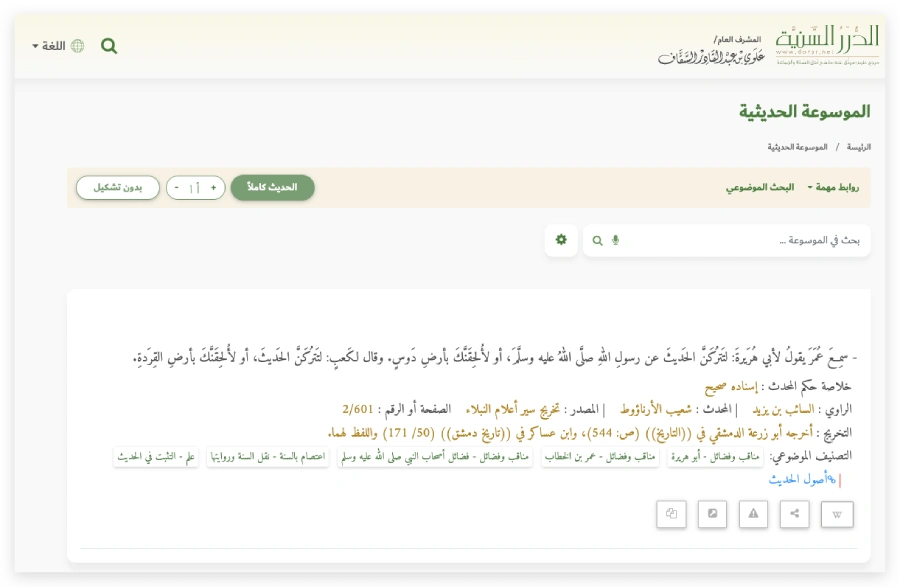
Al-Dhahabi’s Siyar A‘lam al-Nubala’ preserves a direct report from al-Sa’ib ibn Yazid. Al-Sa’ib says he heard Umar tell Abu Huraira that he must stop narrating hadith in the Messenger’s name, or he would be sent to the territory of his own tribe, Daws. The same threat was made to Ka‘b. The modern critical editor Shu‘ayb al-Arna’ut explicitly judged this report’s chain sahih. The report is also preserved in Abu Zur‘a al-Dimashqi’s al-Tarikh and Ibn Asakir’s Tarikh Dimashq. [4] [5]
Original Arabic—al-Durar al-Saniyyah, al-Mawsu‘ah al-Hadithiyyah:
سمِعَ عُمَرَ يقولُ لأبي هُرَيرةَ: لتَترُكَنَّ الحَديثَ عن رسولِ اللهِ صلَّى اللهُ عليه وسلَّمَ، أو لأُلحِقَنَّكَ بأرضِ دَوسٍ. وقال لكَعبٍ: لتَترُكَنَّ الحَديثَ، أو لأُلحِقَنَّكَ بأرضِ القِرَدةِ.
Translation:
Al-Sa’ib ibn Yazid heard Umar tell Abu Huraira: ‘You must stop narrating hadith in the name of the Messenger of Allah, or I will send you to the territory of the tribe of Daws.’ Umar also told Ka‘b: ‘You must stop narrating hadith, or I will send you to the land of the monkeys.’
The hadith specialist’s assessment—original Arabic:
خلاصة حكم المحدث : إسناده صحيح
Translation: The hadith specialist’s final assessment: its chain is sahih.
Narrator and bibliographic details—original Arabic:
الراوي : السائب بن يزيد | المحدث : شعيب الأرناؤوط | المصدر : تخريج سير أعلام النبلاء الصفحة أو الرقم : 2/601
Translation: Narrator: al-Sa’ib ibn Yazid. Hadith specialist: Shu‘ayb al-Arna’ut. Source: Takhrij Siyar A‘lam al-Nubala’, volume 2, page 601.
Original sources—Arabic:
التخريج : أخرجه أبو زرعة الدمشقي في (التاريخ) (ص: 544)، وابن عساكر في (تاريخ دمشق) (50/ 171) واللفظ لهما.
Translation: Sources and compilation: Abu Zur‘a al-Dimashqi included the report on page 544 of his al-Tarikh, and Ibn Asakir included it in volume 50, page 171 of his Tarikh Dimashq. The wording quoted here corresponds to the reports in both works.
Subject classification—original Arabic:
التصنيف الموضوعي: مناقب وفضائل – أبو هريرة؛ مناقب وفضائل – عمر بن الخطاب؛ مناقب وفضائل – فضائل أصحاب النبي صلى الله عليه وسلم؛ اعتصام بالسنة – نقل السنة وروايتها؛ علم – التثبت في الحديث.
Translation: Subject classification: merits and virtues—Abu Huraira; merits and virtues—Umar ibn al-Khattab; merits and virtues—the virtues of Muhammad’s Companions; following the Sunnah—preserving and transmitting the Sunnah; knowledge—caution in verifying hadith.
Original references: [6] [7]
Umar’s instruction attached a threat of exile to Abu Huraira’s dissemination of hadith. The caliph’s command and punitive power were imposed on what the narrator knew and wished to say. This provides a specific instance of such control: the caliph ordered one of the most important hadith transmitters of later times to stop narrating in the Messenger’s name, threatening him with exile.
Al-Dhahabi: Several Companions Were Restrained from Disseminating Hadith
More significantly, al-Dhahabi did not interpret this as an isolated personal quarrel. After quoting Umar’s threat to Abu Huraira, he himself comments that Umar’s policy was to limit narration in the Messenger’s name, and that he restrained several Companions from disseminating hadith widely. In al-Dhahabi’s account, excessive narration was discouraged under Umar even though the honesty and uprightness of the Companions concerned were not in question. This raises a question: if excessive narration was discouraged in Umar’s own time, why were those same hadith preserved in such vast numbers later, when people’s memories of Muhammad should have been strongest during the Companions’ generation? [8]
Original Arabic—al-Dhahabi:
قلت: هكذا هو، كان عمر رضي الله عنه يقول: أقلوا الحديث عن رسول الله صلى الله عليه وسلم، وزجر غير واحد من الصحابة عن بث الحديث؛ وهذا مذهب لعمر ولغيره. فبالله عليك، إذا كان الإكثار من الحديث في دولة عمر كانوا يمنعون منه، مع صدقهم وعدالتهم وعدم الأسانيد، بل هو غض لم يشب؛ فما ظنك بالإكثار من رواية الغرائب والمناكير في زماننا مع طول الأسانيد، وكثرة الوهم والغلط، فبالحري أن نزجر القوم عنه؛ فيا ليتهم يقتصرون على رواية الغريب والضعيف، بل يروون والله الموضوعات والأباطيل والمستحيل في الأصول والفروع والملاحم والزهد، نسأل الله العافية.
Translation:
I say: that is how it was. Umar would say: ‘Narrate fewer hadith in the name of the Messenger of Allah.’ He restrained several Companions from spreading hadith. This was a policy of Umar and others as well. I ask you by Allah: under Umar’s rule they were discouraged from narrating extensively, although they were truthful and upright; the chains were not yet long, and the reports were fresh and unadulterated. What, then, do you think about the extensive dissemination of gharib and munkar reports in our time, with long chains and abundant misconceptions and errors? Restraining people from this is all the more appropriate. If only they confined themselves to gharib and weak reports! Rather, by Allah, they disseminate fabricated, false, and impossible reports on the foundations of belief, subsidiary rulings, future battles and tribulations, and asceticism. We ask Allah for protection.
Al-Dhahabi, one of the foremost authorities in Sunni narrator criticism and hadith scholarship, acknowledged the Companions’ honesty while describing restrictions on their dissemination of hadith. There was a policy of limiting even honest Companions’ reports for administrative and methodological reasons. The history of restrictions on dissemination is therefore relevant when a statement circulated little in the early period, survived through few routes, or became more visible later; the number of reports may reflect the effects of those restrictions. The volume of transmission is not solely a consequence of an event’s truth; social and political conditions can also influence which reports spread and how widely.
Sahih Muslim: Abu Huraira Is Struck and Stopped from Spreading a Report
Another incident involving Umar and Abu Huraira is recorded through an even stronger chain, in Sahih Muslim itself [9].
Sahih Muslim (Islamic Foundation edition)
1. The Book of Faith
Section 10: Evidence that whoever dies affirming the oneness of Allah will enter Paradise
Islamic Foundation number: 54; international number: 31
54. Zuhayr ibn Harb (may Allah have mercy on him) narrated … from Abu Huraira (may Allah be pleased with him):
It is reported on the authority of Abu Huraira:
We were sitting around the Messenger of Allah (may peace and blessings be upon him). Abu Bakr and Umar were also there among the audience. In the meanwhile the Messenger of Allah got up and left us, He delayed in coming back to us, which caused anxiety that he might be attacked by some enemy when we were not with him; so being alarmed we got up. I was the first to be alarmed.
I, therefore, went out to look for the Messenger of Allah (may peace and blessings be upon him) and came to a garden belonging to the Banu an-Najjar, a section of the Ansar went round it looking for a gate but failed to find one. Seeing a rabi’ (i. e. streamlet) flowing into the garden from a well outside, drew myself together, like a fox, and slinked into (the place) where God’s Messenger was. He (the Holy Prophet) said: Is it Abu Huraira? I (Abu Huraira) replied: Yes, Messenger of Allah.
He (the Holy Prophet) said: What is the matter with you? replied: You were amongst us but got up and went away and delayed for a time, so fearing that you might be attacked by some enemy when we were not with you, we became alarmed. I was the first to be alarmed. So when I came to this garden, I drew myself together as a fox does, and these people are following me.
He addressed me as Abu Huraira and gave me his sandals and said: Take away these sandals of mine, and when you meet anyone outside this garden who testifies that there is no god but Allah, being assured of it in his heart, gladden him by announcing that he shall go to Paradise. Now the first one I met was Umar.
He asked: What are these sandals, Abu Huraira? I replied: These are the sandals of the Messenger of Allah with which he has sent me to gladden anyone I meet who testifies that there is no god but Allah, being assured of it in his heart, with the announcement that he would go to Paradise. Thereupon ‘Umar struck me on the breast and I fell on my back. He then said: Go back, Abu Huraira, So I returned to the Messenger of Allah (ﷺ), and was about to break into tears.
‘Umar followed me closely and there he was behind me. The Messenger of Allah (may peace and blessings be on him) said: What is the matter with you, Abu Huraira? I said: I happened to meet ‘Umar and conveyed to him the message with which you sent me. He struck me on my breast which made me fall down upon my back and ordered me to go back.
Upon this the Messenger of Allah (ﷺ) said: What prompted you to do this, ‘Umar? He said: Messenger of Allah, my mother and father be sacrificed to thee, did you send Abu Huraira with your sandals to gladden anyone he met and who testified that there is no god but Allah, and being assured of it in his heart, with the tidings that he would go to Paradise? He said: Yes. Umar said: Please do it not, for I am afraid that people will trust in it alone; let them go on doing (good) deeds.
The Messenger of Allah (ﷺ) said: Well, let them.
باب الدليل على أن من مات على التوحيد دخل الجنة قطعا
حَدَّثَنِي زُهَيْرُ بْنُ حَرْبٍ، حَدَّثَنَا عُمَرُ بْنُ يُونُسَ الْحَنَفِيُّ، حَدَّثَنَا عِكْرِمَةُ بْنُ عَمَّارٍ، قَالَ حَدَّثَنِي أَبُو كَثِيرٍ، قَالَ حَدَّثَنِي أَبُو هُرَيْرَةَ، قَالَ كُنَّا قُعُودًا حَوْلَ رَسُولِ اللَّهِ صلى الله عليه وسلم مَعَنَا أَبُو بَكْرٍ وَعُمَرُ فِي نَفَرٍ فَقَامَ رَسُولُ اللَّهِ صلى الله عليه وسلم مِنْ بَيْنِ أَظْهُرِنَا فَأَبْطَأَ عَلَيْنَا وَخَشِينَا أَنْ يُقْتَطَعَ دُونَنَا وَفَزِعْنَا فَقُمْنَا فَكُنْتُ أَوَّلَ مَنْ فَزِعَ فَخَرَجْتُ أَبْتَغِي رَسُولَ اللَّهِ صلى الله عليه وسلم حَتَّى أَتَيْتُ حَائِطًا لِلأَنْصَارِ لِبَنِي النَّجَّارِ فَدُرْتُ بِهِ هَلْ أَجِدُ لَهُ بَابًا فَلَمْ أَجِدْ فَإِذَا رَبِيعٌ يَدْخُلُ فِي جَوْفِ حَائِطٍ مِنْ بِئْرٍ خَارِجَةٍ – وَالرَّبِيعُ الْجَدْوَلُ – فَاحْتَفَزْتُ كَمَا يَحْتَفِزُ الثَّعْلَبُ فَدَخَلْتُ عَلَى رَسُولِ اللَّهِ صلى الله عليه وسلم فَقَالَ ” أَبُو هُرَيْرَةَ ” . فَقُلْتُ نَعَمْ يَا رَسُولَ اللَّهِ . قَالَ ” مَا شَأْنُكَ ” . قُلْتُ كُنْتَ بَيْنَ أَظْهُرِنَا فَقُمْتَ فَأَبْطَأْتَ عَلَيْنَا فَخَشِينَا أَنْ تُقْتَطَعَ دُونَنَا فَفَزِعْنَا فَكُنْتُ أَوَّلَ مَنْ فَزِعَ فَأَتَيْتُ هَذَا الْحَائِطَ فَاحْتَفَزْتُ كَمَا يَحْتَفِزُ الثَّعْلَبُ وَهَؤُلاَءِ النَّاسُ وَرَائِي فَقَالَ ” يَا أَبَا هُرَيْرَةَ ” . وَأَعْطَانِي نَعْلَيْهِ قَالَ ” اذْهَبْ بِنَعْلَىَّ هَاتَيْنِ فَمَنْ لَقِيتَ مِنْ وَرَاءِ هَذَا الْحَائِطِ يَشْهَدُ أَنْ لاَ إِلَهَ إِلاَّ اللَّهُ مُسْتَيْقِنًا بِهَا قَلْبُهُ فَبَشِّرْهُ بِالْجَنَّةِ ” فَكَانَ أَوَّلَ مَنْ لَقِيتُ عُمَرُ فَقَالَ مَا هَاتَانِ النَّعْلاَنِ يَا أَبَا هُرَيْرَةَ . فَقُلْتُ هَاتَانِ نَعْلاَ رَسُولِ اللَّهِ صلى الله عليه وسلم بَعَثَنِي بِهِمَا مَنْ لَقِيتُ يَشْهَدُ أَنْ لاَ إِلَهَ إِلاَّ اللَّهُ مُسْتَيْقِنًا بِهَا قَلْبُهُ بَشَّرْتُهُ بِالْجَنَّةِ . فَضَرَبَ عُمَرُ بِيَدِهِ بَيْنَ ثَدْيَىَّ فَخَرَرْتُ لاِسْتِي فَقَالَ ارْجِعْ يَا أَبَا هُرَيْرَةَ فَرَجَعْتُ إِلَى رَسُولِ اللَّهِ صلى الله عليه وسلم فَأَجْهَشْتُ بُكَاءً وَرَكِبَنِي عُمَرُ فَإِذَا هُوَ عَلَى أَثَرِي فَقَالَ لِي رَسُولُ اللَّهِ صلى الله عليه وسلم ” مَا لَكَ يَا أَبَا هُرَيْرَةَ ” . قُلْتُ لَقِيتُ عُمَرَ فَأَخْبَرْتُهُ بِالَّذِي بَعَثْتَنِي بِهِ فَضَرَبَ بَيْنَ ثَدْيَىَّ ضَرْبَةً خَرَرْتُ لاِسْتِي قَالَ ارْجِعْ . فَقَالَ لَهُ رَسُولُ اللَّهِ صلى الله عليه وسلم ” يَا عُمَرُ مَا حَمَلَكَ عَلَى مَا فَعَلْتَ ” . قَالَ يَا رَسُولَ اللَّهِ بِأَبِي أَنْتَ وَأُمِّي أَبَعَثْتَ أَبَا هُرَيْرَةَ بِنَعْلَيْكَ مَنْ لَقِيَ يَشْهَدُ أَنْ لاَ إِلَهَ إِلاَّ اللَّهُ مُسْتَيْقِنًا بِهَا قَلْبُهُ بَشَّرَهُ بِالْجَنَّةِ . قَالَ ” نَعَمْ ” . قَالَ فَلاَ تَفْعَلْ فَإِنِّي أَخْشَى أَنْ يَتَّكِلَ النَّاسُ عَلَيْهَا فَخَلِّهِمْ يَعْمَلُونَ . قَالَ رَسُولُ اللَّهِ صلى الله عليه وسلم ” فَخَلِّهِمْ ” .
حدثني زهير بن حرب، حدثنا عمر بن يونس الحنفي، حدثنا عكرمة بن عمار، قال حدثني ابو كثير، قال حدثني ابو هريرة، قال كنا قعودا حول رسول الله صلى الله عليه وسلم معنا ابو بكر وعمر في نفر فقام رسول الله صلى الله عليه وسلم من بين اظهرنا فابطا علينا وخشينا ان يقتطع دوننا وفزعنا فقمنا فكنت اول من فزع فخرجت ابتغي رسول الله صلى الله عليه وسلم حتى اتيت حاىطا للانصار لبني النجار فدرت به هل اجد له بابا فلم اجد فاذا ربيع يدخل في جوف حاىط من بىر خارجة – والربيع الجدول – فاحتفزت كما يحتفز الثعلب فدخلت على رسول الله صلى الله عليه وسلم فقال ” ابو هريرة ” . فقلت نعم يا رسول الله . قال ” ما شانك ” . قلت كنت بين اظهرنا فقمت فابطات علينا فخشينا ان تقتطع دوننا ففزعنا فكنت اول من فزع فاتيت هذا الحاىط فاحتفزت كما يحتفز الثعلب وهولاء الناس وراىي فقال ” يا ابا هريرة ” . واعطاني نعليه قال ” اذهب بنعلى هاتين فمن لقيت من وراء هذا الحاىط يشهد ان لا اله الا الله مستيقنا بها قلبه فبشره بالجنة ” فكان اول من لقيت عمر فقال ما هاتان النعلان يا ابا هريرة . فقلت هاتان نعلا رسول الله صلى الله عليه وسلم بعثني بهما من لقيت يشهد ان لا اله الا الله مستيقنا بها قلبه بشرته بالجنة . فضرب عمر بيده بين ثديى فخررت لاستي فقال ارجع يا ابا هريرة فرجعت الى رسول الله صلى الله عليه وسلم فاجهشت بكاء وركبني عمر فاذا هو على اثري فقال لي رسول الله صلى الله عليه وسلم ” ما لك يا ابا هريرة ” . قلت لقيت عمر فاخبرته بالذي بعثتني به فضرب بين ثديى ضربة خررت لاستي قال ارجع . فقال له رسول الله صلى الله عليه وسلم ” يا عمر ما حملك على ما فعلت ” . قال يا رسول الله بابي انت وامي ابعثت ابا هريرة بنعليك من لقي يشهد ان لا اله الا الله مستيقنا بها قلبه بشره بالجنة . قال ” نعم ” . قال فلا تفعل فاني اخشى ان يتكل الناس عليها فخلهم يعملون . قال رسول الله صلى الله عليه وسلم ” فخلهم ” .
Hadith grade: Sahih
Narrator: Abu Huraira (may Allah be pleased with him)
In this report in Muslim, the immediate cause of the blow was the dissemination of Muhammad’s promise of Paradise. Muhammad had given Abu Huraira his sandals and sent him to convey the good news that anyone who firmly believed in his heart and testified ‘There is no god but Allah’ should be given glad tidings of Paradise. The first person Abu Huraira met was Umar. On hearing the message, Umar struck him on the chest so forcefully that he fell, then told him to return to Muhammad. Abu Huraira returned in tears. [10]
Original Arabic—Sahih Muslim 31:
فَضَرَبَ عُمَرُ بِيَدِهِ بَيْنَ ثَدْيَيَّ فَخَرَرْتُ لِاسْتِي، فَقَالَ: ارْجِعْ يَا أَبَا هُرَيْرَةَ … فَرَجَعْتُ إِلَى رَسُولِ اللَّهِ صَلَّى اللَّهُ عَلَيْهِ وَسَلَّمَ فَأَجْهَشْتُ بُكَاءً.
English translation:
Thereupon ‘Umar struck me on the breast and I fell on my back. He then said: Go back, Abu Huraira, So I returned to the Messenger of Allah (ﷺ), and was about to break into tears.
When Muhammad questioned Umar, he explained his reason: if this good news were disseminated, people might rely on it and abandon good deeds. Muhammad eventually said, ‘Well, let them’—in effect accepting Umar’s proposal not to disseminate the message to the public in this way.
Original Arabic—Sahih Muslim:
قَالَ عُمَرُ: فَلَا تَفْعَلْ، فَإِنِّي أَخْشَى أَنْ يَتَّكِلَ النَّاسُ عَلَيْهَا، فَخَلِّهِمْ يَعْمَلُونَ. قَالَ رَسُولُ اللَّهِ صَلَّى اللَّهُ عَلَيْهِ وَسَلَّمَ: فَخَلِّهِمْ.
English translation:
Umar said: Please do it not, for I am afraid that people will trust in it alone; let them go on doing (good) deeds. The Messenger of Allah (ﷺ) said: Well, let them.
This incident raises a profound problem for hadith transmission. No narrator’s memory had failed, no chain was weak, and Abu Huraira had received the statement directly from the Prophet himself. Even so, a decision was made not to disseminate it generally because of its possible social consequences. Early hadith transmission was therefore not simply a neutral process of recording everything heard and passing it on. Social judgments about which statements were suitable for public dissemination, which might be misused, and which should temporarily be withheld could also influence the volume of transmission.
‘Had I Said It Under Umar, He Would Have Split My Head Open’—How Strong Is the Report?
In the same biography, al-Dhahabi preserves another stark statement attributed to Abu Huraira: [11]
Original Arabic:
سعيد بن عبد العزيز، عن إسماعيل بن عبيد الله، عن السائب بن يزيد: سمع عمر يقول لأبي هريرة: لتتركن الحديث عن رسول الله صلى الله عليه وسلم أو لألحقنك بأرض دوس! وقال لكعب: لتتركن الحديث، أو لألحقنك بأرض القردة. يحيى بن أيوب، عن ابن عجلان: أن أبا هريرة كان يقول: إني لأحدث أحاديث، لو تكلمت بها في زمن عمر، لشج رأسي.
Translation:
Sa‘id ibn Abd al-Aziz narrated, through Isma‘il ibn Ubaydullah, from al-Sa’ib ibn Yazid: he heard Umar tell Abu Huraira, ‘You must stop narrating hadith in the name of the Messenger of Allah, or I will send you to the land of Daws.’ He told Ka‘b, ‘You must stop narrating hadith, or I will send you to the land of the monkeys.’ Yahya ibn Ayyub narrated from Ibn Ajlan that Abu Huraira would say: ‘I now narrate hadith which, had I narrated them in Umar’s time, would have made him split my head open.’
Unlike the earlier threat transmitted through a sahih chain, however, this report does not have a sound chain by Islamic standards. Its route is Yahya ibn Ayyub → Muhammad ibn Ajlan → Abu Huraira; Muhammad ibn Ajlan did not live in Abu Huraira’s time. Al-Mu‘allimi therefore called it munqati‘, or disconnected, and inauthentic; Shu‘ayb al-Arna’ut also noted the same break. [12]
Two forms of dishonesty stand side by side here: just as it is dishonest to turn a weak report into a sahih one, it is dishonest to turn weakness into ‘the event is certainly false’. The disconnected chain of the ‘split my head open’ statement weakens the evidence for its attribution. Yet it is a memory preserved in a later work whose content evokes the same historical environment as Umar’s threat to ‘stop narrating hadith’, established through a sahih chain, and al-Dhahabi’s comment on a ‘policy of narrating less’. Despite the objection to its disconnected chain, comparing its content with other testimony strengthens the explanation that fear of punishment restricted narration. Alongside the preserved evidence of threats of exile, obstacles to dissemination, and a policy of limiting narration, apprehension of physical punishment is no isolated fantasy alien to its setting. The attribution of this particular statement is weak; the historical argument concerning control of transmission does not disappear with that weakness.
Another widely circulated report attributes to Abu Huraira the statement: ‘Before Umar died, we could not say “the Messenger said”; we feared the whip.’ Its chain is weaker still: it includes Yazid ibn Yusuf and Salih ibn Abi al-Akhdar, both of whom were subjected to narrator criticism. The criticism of these two narrators weakens the evidence supplied by that route. The threat of exile preserved in the same biography comes through a separate chain; the weakness of one route does not erase the evidence of the other. [13]
‘If I Disseminated It, This Throat Would Be Cut’: Abu Huraira’s Undisclosed Reports
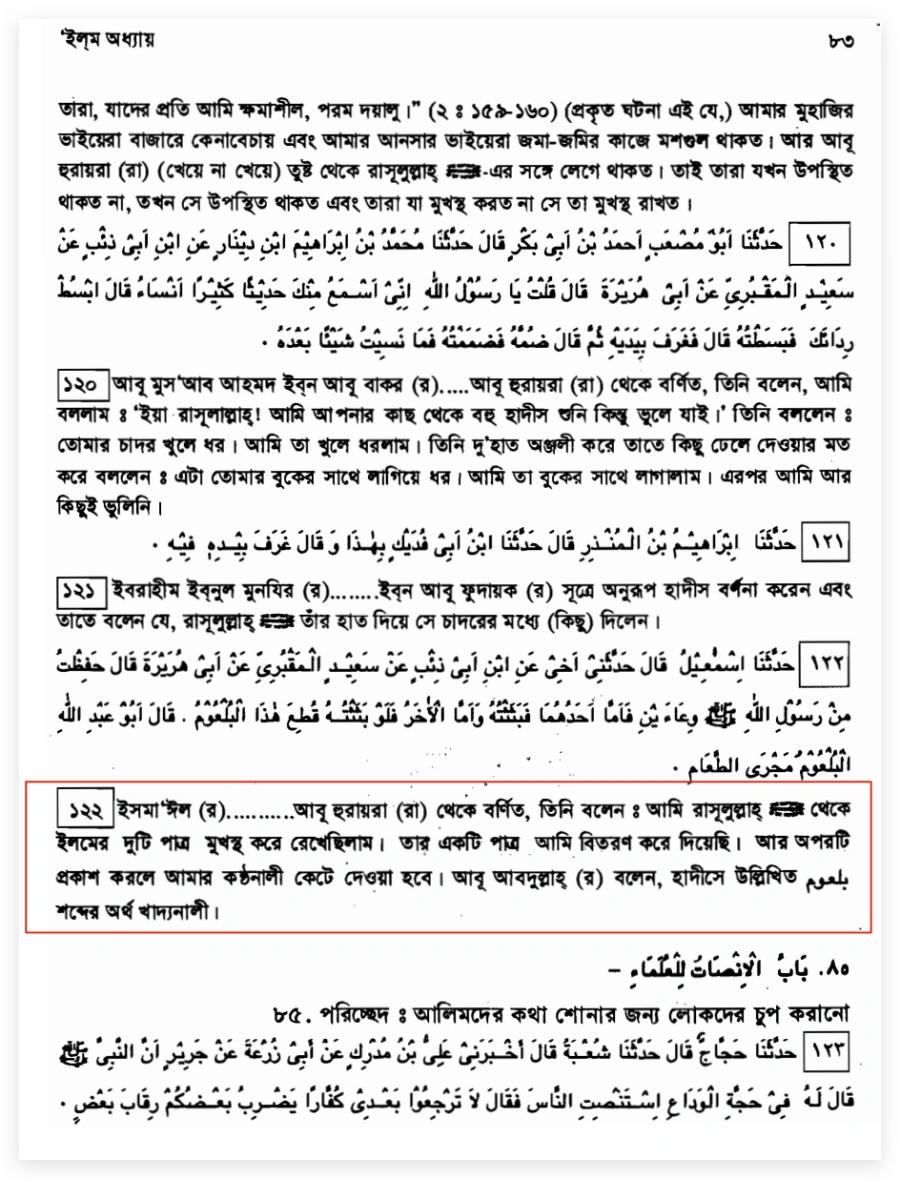
Before assessing the reliability of hadith, another question arises: how much of what a narrator knew did he tell others? Later hadith scholars cannot collect chains or compare texts for information that was never disseminated. In Sahih al-Bukhari 120, Abu Huraira himself says that he preserved two vessels of knowledge from Muhammad; he disseminated one, but his throat would be cut if he disseminated the other. Here the information was withheld because, in his own words, disclosure carried potentially fatal consequences, rather than because it had been forgotten. One of the most prolific hadith transmitters among the Companions declares that he left some of what he knew undisclosed. The reports preserved through him therefore cannot be treated as a complete inventory of everything he knew. [14] [15]
Sahih al-Bukhari (Islamic Foundation edition)
3. Knowledge
Section 84: Memorizing knowledge
Islamic Foundation number: 122; international number: 120
122. Isma‘il (may Allah have mercy on him) … narrated from Abu Huraira (may Allah be pleased with him), who said: I have memorized two kinds of knowledge from Allah’s Messenger (ﷺ) . I have propagated one of them to you and if I propagated the second, then my pharynx (throat) would be cut (i.e. killed). Abu Abdullah (may Allah have mercy on him) says that the word بلعوم in the hadith means the oesophagus.
باب حِفْظِ الْعِلْمِ
حَدَّثَنَا إِسْمَاعِيلُ، قَالَ حَدَّثَنِي أَخِي، عَنِ ابْنِ أَبِي ذِئْبٍ، عَنْ سَعِيدٍ الْمَقْبُرِيِّ، عَنْ أَبِي هُرَيْرَةَ، قَالَ حَفِظْتُ مِنْ رَسُولِ اللَّهِ صلى الله عليه وسلم وِعَاءَيْنِ، فَأَمَّا أَحَدُهُمَا فَبَثَثْتُهُ، وَأَمَّا الآخَرُ فَلَوْ بَثَثْتُهُ قُطِعَ هَذَا الْبُلْعُومُ.
حدثنا اسماعيل، قال حدثني اخي، عن ابن ابي ذىب، عن سعيد المقبري، عن ابي هريرة، قال حفظت من رسول الله صلى الله عليه وسلم وعاءين، فاما احدهما فبثثته، واما الاخر فلو بثثته قطع هذا البلعوم.
Hadith grade: Sahih
Narrator: Abu Huraira (may Allah be pleased with him)
حَدَّثَنَا إِسْمَاعِيلُ، قَالَ حَدَّثَنِي أَخِي، عَنِ ابْنِ أَبِي ذِئْبٍ، عَنْ سَعِيدٍ الْمَقْبُرِيِّ، عَنْ أَبِي هُرَيْرَةَ، قَالَ حَفِظْتُ مِنْ رَسُولِ اللَّهِ صلى الله عليه وسلم وِعَاءَيْنِ، فَأَمَّا أَحَدُهُمَا فَبَثَثْتُهُ، وَأَمَّا الآخَرُ فَلَوْ بَثَثْتُهُ قُطِعَ هَذَا الْبُلْعُومُ.
English translation: Isma‘il narrated to us: my brother narrated to me, from Ibn Abi Dhi’b, from Sa‘id al-Maqburi, from Abu Huraira. Abu Huraira said: ‘I have memorized two kinds of knowledge from Allah’s Messenger (ﷺ) . I have propagated one of them to you and if I propagated the second, then my pharynx (throat) would be cut (i.e. killed).’
Abu Huraira’s brief statement does not specify the full content of the undisclosed material. Al-Ayni’s ‘Umdat al-Qari preserves a political interpretation. Quoting Ibn Battal, it discusses the deterioration of religion at the hands of foolish young men of Quraysh and the withholding of their names for personal safety. The same discussion interprets the second vessel as reports containing the names, circumstances, and condemnation of oppressive rulers; fearing them, Abu Huraira used hints instead of naming them directly. The commentary also distinguishes concealing lawful and unlawful rulings from concealing dangerous information about rulers. Classical commentators thus connected the fear for his life in the original report with state power and the risks of disclosing rulers’ identities. [16]
وَقَالَ ابْنُ بَطَّالٍ: الْمُرَادُ مِنَ الْوِعَاءِ الثَّانِي أَحَادِيثُ أَشْرَاطِ السَّاعَةِ وَمَا عَرَّفَ بِهِ النَّبِيُّ عَلَيْهِ الصَّلَاةُ وَالسَّلَامُ مِنْ فَسَادِ الدِّينِ عَلَى أَيْدِي أُغَيْلِمَةٍ سُفَهَاءَ مِنْ قُرَيْشٍ، وَكَانَ أَبُو هُرَيْرَةَ يَقُولُ: لَوْ شِئْتُ أَنْ أُسَمِّيَهُمْ بِأَسْمَائِهِمْ، فَخَشِيَ عَلَى نَفْسِهِ فَلَمْ يُصَرِّحْ، وَكَذَلِكَ يَنْبَغِي لِكُلِّ مَنْ أَمَرَ بِمَعْرُوفٍ إِذْ خَافَ عَلَى نَفْسِهِ فِي التَّصْرِيحِ أَنْ يَعْرِضَ، وَلَوْ كَانَتِ الْأَحَادِيثُ الَّتِي لَمْ يُحَدِّثْ بِهَا فِي الْحَلَالِ وَالْحَرَامِ مَا وَسِعَهُ كَتْمُهَا بِحُكْمِ الْآيَةِ، وَيُقَالُ: حَمَلَ الْوِعَاءَ الثَّانِيَ الَّذِي لَمْ يُنَبِّهْ عَلَى الْأَحَادِيثِ الَّتِي فِيهَا تَبْيِينُ أَسَامِي أُمَرَاءِ الْجَوْرِ وَأَحْوَالِهِمْ وَذَمِّهِمْ، وَقَدْ كَانَ أَبُو هُرَيْرَةَ يُكَنِّي عَنْ بَعْضِهِمْ وَلَا يُصَرِّحُ بِهِ خَوْفًا عَلَى نَفْسِهِ مِنْهُمْ; كَقَوْلِهِ: أَعُوذُ بِاللَّهِ مِنْ رَأْسِ السِّتِّينَ وَإِمَارَةِ الصِّبْيَانِ، يُشِيرُ بِذَلِكَ إِلَى خِلَافَةِ يَزِيدَ بْنِ مُعَاوِيَةَ; لِأَنَّهَا كَانَتْ سَنَةَ سِتِّينَ مِنَ الْهِجْرَةِ، فَاسْتَجَابَ اللَّهُ دُعَاءَ أَبِي هُرَيْرَةَ، فَمَاتَ قَبْلَهَا بِسَنَةٍ.
Translation: Ibn Battal says: the second vessel refers to reports concerning the signs of the Last Hour and the deterioration of religion at the hands of foolish young men of Quraysh foretold by the Prophet. Abu Huraira would say: ‘If I wished, I could identify them by name.’ But he feared for his life, so he did not name them directly. Similarly, someone enjoining good should speak indirectly if speaking openly would expose him to harm. Had the reports he withheld concerned the lawful and unlawful, the ruling of the verse would not have allowed him to conceal them. It is also said that the second vessel, whose contents he did not disclose, has been understood as the reports specifying the names, circumstances, and condemnation of oppressive rulers. Abu Huraira would allude to some of them without naming them directly, fearing danger from them. An example is his statement: ‘I seek refuge in Allah from the beginning of the year sixty and the rule of boys.’ He was alluding to Yazid ibn Mu‘awiya’s caliphate, which began in 60 AH. Allah answered Abu Huraira’s prayer: he died a year before it.
This acknowledgment raises questions about how representative the preserved body of reports is. Later books reveal which information ultimately had an opportunity to circulate; they do not provide a complete inventory of what was dangerous to disseminate. In an environment where naming and condemning rulers could cost someone his life, silence may indicate a mechanism for withholding information as well as an absence of information. Even the most reliable chain cannot recover what a narrator kept to himself. If early circulation of a political account or an accusation against a powerful person was limited, the reasons for that limitation therefore also require investigation: who had the opportunity to speak, who faced risks, who used allusions, and who remained silent? After a major narrator’s own declaration of silence, treating the preserved corpus as a transparent reproduction of every truth known in the early period contradicts the evidence. Scrutiny of chains can assess the reliability of statements that circulated; the political environment of dissemination and the history of declared concealment remain questions beyond that test.
Hadith Dissemination Was Never a Neutral Flow
The caliph’s power operated directly in this control of hadith dissemination. Commands, threats of punishment, and the anticipated social effects of a report determined which information would spread and whose voice would be silenced. The dissemination of the Prophet’s statements in the Companions’ time was not a wholly free, equal, and neutral flow of information. The caliph directly threatened one of the most important hadith transmitters to make him stop narrating excessively; al-Dhahabi described this as an example of Umar’s general policy of restraint in narration; and Sahih Muslim shows that Abu Huraira was prevented from disseminating even a message delivered directly by the Prophet because of its possible social effects.
The historical implications are profound. A statement’s survival through relatively few early routes does not necessarily make it false; nor does its later widespread circulation establish that it circulated equally widely from the beginning. The spread of reports depends on more than memory and truth: authority, social needs, permission to disseminate, self-restraint, and a statement’s possible effects can also determine how quickly and widely information spreads. When later hadith scholars graded the reports that survived several generations, they were not working with everything ever uttered in the past. They had before them the reports that had ultimately been preserved after passing through various social and political filters.
The environment of dissemination matters when asking why a report survived through only a few routes. Was there no memory of the event, or were people afraid to relate it? Umar’s threat to exile Abu Huraira to control his narration provides a concrete basis for the second possibility. Where speaking brings the risk of punishment by a ruler, hearing a report from relatively few people cannot establish that the event never occurred. Pressure from those in power may also have contributed to its limited circulation. Conversely, when a report suddenly becomes widespread much later, questions arise about whether it was newly created, whether an older account changed, or whether it was being put to a new political use. The weight of silence depends on why people remained silent. Treating silence produced by fear of a ruler as evidence of his innocence turns repression itself into testimony for the repressor.
Scrutiny of Chains and Written Preservation Were Not Uniform from the Outset
Ibn Sirin: ‘Previously, They Did Not Ask About the Chain’
Although later hadith scholarship treats the isnad as integral to religion, the introduction to Sahih Muslim preserves an important historical memory attributed to Muhammad ibn Sirin. According to him, at one stage transmitters were not asked about their chains; after the fitnah, or civil strife, people began demanding narrators’ names, and ideological identity entered the process of accepting and rejecting reports. According to this testimony preserved in Muslim’s own introduction, rigorous scrutiny of chains therefore developed historically. There is no basis for assuming a complete system that operated uniformly and unchanged from Muhammad’s lifetime [17].
Original Arabic—Introduction to Sahih Muslim, Ibn Sirin:
حدثنا أبو جعفر محمد بن الصباح، حدثنا إسماعيل بن زكرياء، عن عاصم الأحول، عن ابن سيرين، قال: لم يكونوا يسألون عن الإسناد، فلما وقعت الفتنة قالوا: سموا لنا رجالكم؛ فينظر إلى أهل السنة فيؤخذ حديثهم، وينظر إلى أهل البدع فلا يؤخذ حديثهم.
English translation:
Abū Ja’far Muhammad bin us-Sabbāh narrated to us, Ismā’īl bin Zakariyyā’ narrated to us, on authority of Āsim il-Ahwal, on authority of Ibn Sīrīn that he said:
‘They would not ask about the chains of narration, and when the Fitnah occurred, they said: ‘Name for us your men’. So Ahl us-Sunnah would be regarded, and their Ḥadīth were then taken, and Ahl ul-Bi’dah would be regarded, and their Ḥadīth were not taken’.
Ibn Sirin specifies the change in scrutiny of chains after the fitnah: institutional rigour in demanding narrators’ names and selecting reports on the basis of ideological identity increased after a particular crisis. It is therefore historically invalid to project the mature framework of later centuries’ isnad criticism backwards as though it operated equally in every earlier decade.
Muslim’s introduction preserves another statement attributed to Ibn Abbas. It indicates that people initially listened attentively when someone spoke in Muhammad’s name; later, as people began circulating all sorts of reports indiscriminately, they accepted only information that was familiar and verifiable. Once again, the criteria for accepting reports appear as a changing historical response. [18] [19]
Original Arabic—attributed to Ibn Abbas:
وَحَدَّثَنِي أَبُو أَيُّوبَ، سُلَيْمَانُ بْنُ عُبَيْدِ اللَّهِ الْغَيْلاَنِيُّ حَدَّثَنَا أَبُو عَامِرٍ، – يَعْنِي الْعَقَدِيَّ – حَدَّثَنَا رَبَاحٌ، عَنْ قَيْسِ بْنِ سَعْدٍ، عَنْ مُجَاهِدٍ، قَالَ جَاءَ بُشَيْرٌ الْعَدَوِيُّ إِلَى ابْنِ عَبَّاسٍ فَجَعَلَ يُحَدِّثُ وَيَقُولُ قَالَ رَسُولُ اللَّهِ صلى الله عليه وسلم قَالَ رَسُولُ اللَّهِ صلى الله عليه وسلم فَجَعَلَ ابْنُ عَبَّاسٍ لاَ يَأْذَنُ لِحَدِيثِهِ وَلاَ يَنْظُرُ إِلَيْهِ فَقَالَ يَا ابْنَ عَبَّاسٍ مَا لِي لاَ أَرَاكَ تَسْمَعُ لِحَدِيثِي أُحَدِّثُكَ عَنْ رَسُولِ اللَّهِ صلى الله عليه وسلم وَلاَ تَسْمَعُ . فَقَالَ ابْنُ عَبَّاسٍ إِنَّا كُنَّا مَرَّةً إِذَا سَمِعْنَا رَجُلاً يَقُولُ قَالَ رَسُولُ اللَّهِ صلى الله عليه وسلم ابْتَدَرَتْهُ أَبْصَارُنَا وَأَصْغَيْنَا إِلَيْهِ بِآذَانِنَا فَلَمَّا رَكِبَ النَّاسُ الصَّعْبَ وَالذَّلُولَ لَمْ نَأْخُذْ مِنَ النَّاسِ إِلاَّ مَا نَعْرِفُ .
English translation:
Abū Ayyūb Sulaymān bin Ubayd Allah al-Ghaylānī narrated to us, Abū Āmir, meaning al-Aqadī, narrated to us, Rabāh narrated to us, on authority of Qays bin Sa’d, on authority of Mujāhid, he said Bushayr ul-Adawī came to Ibn Abbās then he set about narrating to him, saying:
‘The Messenger of Allah, peace and blessings of Allah upon him, said…’, ‘the Messenger of Allah, peace and blessings of Allah upon him, said…’. Then it seemed that Ibn Abbās was not listening to his Ḥadīth and not reflecting on them, so [Bushayr] said: ‘Oh Ibn Abbās, why is it that I see you not listening to my Ḥadīth? I narrate to you on authority of the Messenger of Allah, peace and blessings of Allah upon him, however you are not listening’.
Ibn Abbās said: ‘Indeed once upon a time we would listen to a man saying, ‘the Messenger of Allah, peace and blessings of Allah upon him, said…’ rushing towards him with our eyes and harkening towards him with our ears; then when the people took the difficult and the docile we no longer took from people except those whom we knew’.
The statements of Ibn Sirin and Ibn Abbas reveal a change: as problems with reports increased, so did the insistence on asking who had heard from whom. The rules of isnad scrutiny did not therefore operate in the same form from the beginning. A complete list of names found several generations later cannot simply be assumed to have been created and preserved from the first day. If sources were not initially requested, from whom were the names later obtained? How were connections between intermediaries confirmed? What means existed to detect errors that had entered earlier circulation? The isnad is more than a tool for verifying reports; when and how the isnad itself was obtained also requires verification. A complete-looking list in a later book does not fill the earlier period about which we lack knowledge.
Writing Hadith: Prohibition, Permission, and Later Organized Collection
The sources provide no uniform account of written preservation either. Sahih Muslim transmits from Abu Sa‘id al-Khudri a direct instruction attributed to Muhammad: nothing from him other than the Quran should be written down, and anything already written should be erased. The same statement nevertheless permits oral narration of his words. [20] [19]
Original Arabic—Sahih Muslim 3004:
حَدَّثَنَا هَدَّابُ بْنُ خَالِدٍ الأَزْدِيُّ ، حَدَّثَنَا هَمَّامٌ ، عَنْ زَيْدِ بْنِ أَسْلَمَ ، عَنْ عَطَاءِ بْنِ يَسَارٍ ، عَنْ أَبِي سَعِيدٍ الْخُدْرِيِّ ، أَنَّ رَسُولَ اللَّهِ صلى الله عليه وسلم قَالَ ” لاَ تَكْتُبُوا عَنِّي وَمَنْ كَتَبَ عَنِّي غَيْرَ الْقُرْآنِ فَلْيَمْحُهُ وَحَدِّثُوا عَنِّي وَلاَ حَرَجَ وَمَنْ كَذَبَ عَلَىَّ – قَالَ هَمَّامٌ أَحْسِبُهُ قَالَ – مُتَعَمِّدًا فَلْيَتَبَوَّأْ مَقْعَدَهُ مِنَ النَّارِ ” .
English translation:
Haddab ibn Khalid al-Azdi narrated to us: Hammam narrated to us, from Zayd ibn Aslam, from Ata ibn Yasar, from Abu Sa‘id al-Khudri. Allah’s Messenger said:
Do not take down anything from me, and he who took down anything from me except the Qur’an, he should efface that and narrate from me, for there is no harm in it and he who attributed any falsehood to me-and Hammam said: I think he also said:” deliberately” -he should in fact find his abode in the Hell-Fire.
Conversely, Abdullah ibn Amr’s report preserves permission of a wholly different kind. He wrote down what he heard; when people of Quraysh objected, he stopped writing. On being told about this, Muhammad instructed him to resume, pointing to his mouth and saying that nothing but truth came from it. The early sources therefore preserve reports both prohibiting and permitting the writing of hadith. [21] [19]
Original Arabic—Sunan Abi Dawud:
حَدَّثَنَا مُسَدَّدٌ ، وَأَبُو بَكْرِ بْنُ أَبِي شَيْبَةَ قَالاَ حَدَّثَنَا يَحْيَى ، عَنْ عُبَيْدِ اللَّهِ بْنِ الأَخْنَسِ ، عَنِ الْوَلِيدِ بْنِ عَبْدِ اللَّهِ بْنِ أَبِي مُغِيثٍ ، عَنْ يُوسُفَ بْنِ مَاهَكَ ، عَنْ عَبْدِ اللَّهِ بْنِ عَمْرٍو ، قَالَ كُنْتُ أَكْتُبُ كُلَّ شَىْءٍ أَسْمَعُهُ مِنْ رَسُولِ اللَّهِ صلى الله عليه وسلم أُرِيدُ حِفْظَهُ فَنَهَتْنِي قُرَيْشٌ وَقَالُوا أَتَكْتُبُ كُلَّ شَىْءٍ تَسْمَعُهُ وَرَسُولُ اللَّهِ صلى الله عليه وسلم بَشَرٌ يَتَكَلَّمُ فِي الْغَضَبِ وَالرِّضَا فَأَمْسَكْتُ عَنِ الْكِتَابِ فَذَكَرْتُ ذَلِكَ لِرَسُولِ اللَّهِ صلى الله عليه وسلم فَأَوْمَأَ بِأُصْبُعِهِ إِلَى فِيهِ فَقَالَ ” اكْتُبْ فَوَالَّذِي نَفْسِي بِيَدِهِ مَا يَخْرُجُ مِنْهُ إِلاَّ حَقٌّ ” .
English translation:
Musaddad and Abu Bakr ibn Abi Shayba narrated to us: Yahya narrated to us, from Ubaydullah ibn al-Akhnas, from al-Walid ibn Abdullah ibn Abi Mughith, from Yusuf ibn Mahak, from Abdullah ibn Amr.
I used to write everything which I heard from the Messenger of Allah (ﷺ). I intended (by it) to memorise it. The Quraysh prohibited me saying: Do you write everything that you hear from him while the Messenger of Allah (ﷺ) is a human being: he speaks in anger and pleasure? So I stopped writing, and mentioned it to the Messenger of Allah (ﷺ). He signalled with his finger to him mouth and said: Write, by Him in Whose hand my soul lies, only right comes out from it.
Later scholars offered various explanations of the chronology of these two reports and how they should be reconciled; the very existence of these explanations, however, shows that the early policy on written preservation was no simple, single-sentence rule. Written hadith existed, and so did reports opposing writing; some individuals had personal sheets, but a universal, centralized collection system resembling the later major compilations had not yet been established. Islamic commentaries also preserve accounts of extensive disagreement among the Companions and Successors over writing hadith.
Further important evidence comes from the time of Umar ibn Abd al-Aziz. A chapter heading in the Book of Knowledge in Sahih al-Bukhari preserves his instruction to Abu Bakr ibn Hazm: the Prophet’s hadith were to be sought out and written down, because he feared the disappearance of knowledge and the death of scholars. The instruction itself shows that placing hadith preservation on an organized, written basis had become a real administrative concern. [22] [19]
Original Arabic—instruction preserved in a chapter heading in Sahih al-Bukhari:
وَكَتَبَ عُمَرُ بْنُ عَبْدِ الْعَزِيزِ إِلَى أَبِي بَكْرِ بْنِ حَزْمٍ انْظُرْ مَا كَانَ مِنْ حَدِيثِ رَسُولِ اللَّهِ صَلَّى اللَّهُ عَلَيْهِ وَسَلَّمَ فَاكْتُبْهُ، فَإِنِّي خِفْتُ دُرُوسَ الْعِلْمِ وَذَهَابَ الْعُلَمَاءِ، وَلاَ تَقْبَلْ إِلاَّ حَدِيثَ النَّبِيِّ صَلَّى اللَّهُ عَلَيْهِ وَسَلَّمَ، وَلْتُفْشُوا الْعِلْمَ، وَلْتَجْلِسُوا حَتَّى يُعَلَّمَ مَنْ لاَ يَعْلَمُ، فَإِنَّ الْعِلْمَ لاَ يَهْلِكُ حَتَّى يَكُونَ سِرًّا.
English translation:
And ‘Umar bin ‘Abdul ‘Aziz wrote to Abu Bakr bin Hazm, ‘Look for the knowledge of Hadith and get it written, as I am afraid that religious knowledge will vanish and the religious learned men will pass away (die). Do not accept anything save the Hadiths of the Prophet. Circulate knowledge and teach the ignorant, for knowledge does not vanish except when it is kept secretly (to oneself).’
This history of hadith preservation includes oral narration, personal writing, disagreement over permission to write, and later organized collection. It would be mistaken to imagine these as three successive stages experienced uniformly by everyone: at the same time, some memorized, some kept notes, and some objected to writing. Later, fear of loss brought the need for large collections to the fore. The presence of a hadith in a written book today does not therefore make it a document written during Muhammad’s lifetime. We need to know when a personal note was written, who held it, who copied it, how the copy related to the original, and what readings appear in other reports. The general fact that writing existed early does not establish the age of a particular hadith; that hadith’s own route of preservation must be demonstrated.
Gregor Schoeler’s study The Oral and the Written in Early Islam, on the relationship between oral and written preservation, clarifies this distinction. In its preface he explains the need to distinguish personal notes used as memory aids, teaching notes, and books prepared for dissemination. A teacher might teach orally with a written note before him; a student hearing the lesson might take his own notes. Writing and listening work together here. Thus, ‘oral circulation’ does not mean nothing was written anywhere, while ‘written’ does not necessarily mean a fixed, edited book of the modern kind. The historical questions concern which written materials were used in whose teaching, how far they were preserved, and their relationship to later books. [23]
Gregor Schoeler: the opening research question in the preface
whether in early Islam the sciences and poetry were transmitted orally or through writing.
Translation:
Whether intellectual disciplines and poetry in early Islam were preserved and transmitted orally or in writing.
Michael Cook’s study ‘The Opponents of the Writing of Tradition in Early Islam’ documents reliance on written records alongside opposition to writing. In the sources he discusses, some instructed students to write to prevent statements from being falsely attributed to them; others gave written texts priority when they disagreed with memory. Still others regarded the continuity of oral learning as the chief basis of reliability. The dispute therefore concerned more than the availability of paper. Questions of authority also involved who had taught a person and how the right to transmit that teaching had been acquired. When early writing is found today, its age and wording constitute important evidence for historians; not all contemporary hadith scholars would have accepted that writing in the same way. [24]
Michael Cook, § 2
it was in the oral continuity of transmission that the very authenticity of Tradition was seen to rest
Translation:
The foundation of hadith’s authenticity was understood to lie in the oral continuity of transmission.
Methods of Receiving Hadith: Hearing, Reading, Authorization, and Written Records
An isnad was more than a list tracing words from one person’s memory to another’s. Receiving hadith, or tahammul, included distinct methods: hearing a teacher speak, reading before a teacher and obtaining his acknowledgment, receiving permission to transmit, and collecting hadith from written records. The teacher speaking and the student listening is sama‘; a student or someone else reading before a teacher while others listen is qira’ah, or ‘ard. In the second case, the teacher does not have to recite everything from memory: he or a trustworthy person may hold his original document and check the reading against it. Al-Suyuti’s Tadrib al-Rawi describes this process and its formulas in detail: ‘I read before so-and-so’ and ‘It was read before him while I listened’ express a relationship involving reading. Scholars also differed over whether one could simply say ‘He narrated to us’ or ‘He informed us’. The meaning of a transmission formula therefore depends on its technical use; indiscriminately translating every formula into Bengali as ‘heard directly’ erases the actual method of receiving information. [25]
القسم الثاني : القراءة على الشيخ ، ويسميها أكثر المحدثين عرضا . سواء قرأت أو غيرك وأنت تسمع من كتاب أو حفظ ، حفظ الشيخ أم لا إذا أمسك أصله هو أو ثقة ، وهي رواية صحيحة بلا خلاف في جميع ذلك إلا ما حكي عن بعض من لا يعتد به . واختلفوا في مساواتها للسماع من لفظ الشيخ ورجحانه عليها ورجحانها عليه ، فحكي الأول عن مالك وأصحابه وأشياخه ومعظم علماء الحجاز والكوفة والبخاري وغيرهم ، والثاني عن جمهور أهل المشرق وهو الصحيح . والثالث عن أبي حنيفة وابن أبي ذئب وغيرهما ، ورواية عن مالك ، والأحوط في الرواية بها : قرأت على فلان أو قرئ عليه وأنا أسمع فأقر به ، ثم عبارات السماع مقيدة : كحدثنا أو أخبرنا قراءة عليه ، وأنشدنا في الشعر قراءة عليه ، ومنع إطلاق حدثنا وأخبرنا ابن المبارك ، ويحيى بن يحيى التميمي ، وأحمد بن حنبل ، والنسائي وغيرهم وجوزها طائفة . قيل : إنه مذهب الزهري ، ومالك ، وابن عيينة ، ويحيى القطان ، والبخاري ، وجماعات من المحدثين ومعظم الحجازيين والكوفيين . ومنهم من أجاز فيها سمعت ، ومنعت طائفة حدثنا وأجازت أخبرنا وهو مذهب الشافعي وأصحابه ومسلم بن الحجاج وجمهور أهل المشرق . وقيل : إنه مذهب أكثر المحدثين وروي عن ابن جريج والأوزاعي وابن وهب وروي عن النسائي أيضا وصار هو الشائع الغالب على أهل الحديث .
Translation: The second category is reading before the teacher; most hadith scholars call it ‘ard. Whether you read yourself or someone else reads while you listen, whether the reading is from a book or from memory, and whether or not the teacher has memorized the material, transmission in all these circumstances is valid if he or a trustworthy person holds his original document. There is no disagreement on this except for views attributed to certain persons whose opinions carry no weight. Scholars differ over whether its rank equals hearing the teacher speak, whether hearing the teacher is superior, or whether reading before him is superior to hearing him. The first view is attributed to Malik, his followers and teachers, most scholars of the Hijaz and Kufa, al-Bukhari, and others. The second is the view of most scholars of the eastern regions, and it is correct. The third is attributed to Abu Hanifa, Ibn Abi Dhi’b, and others; it is also one reported view of Malik. The most cautious formulas for this method are: ‘I read before so-and-so’ or ‘It was read before him while I listened, and he acknowledged it.’ Next come formulas of hearing qualified by reference to reading, such as ‘He narrated to us through reading before him’ or ‘He informed us through reading before him’; for poetry, ‘He recited to us through reading before him.’ Ibn al-Mubarak, Yahya ibn Yahya al-Tamimi, Ahmad ibn Hanbal, al-Nasa’i, and others prohibited saying ‘He narrated to us’ and ‘He informed us’ without qualification; another group permitted it. This is said to be the view of al-Zuhri, Malik, Ibn Uyayna, Yahya al-Qattan, al-Bukhari, many hadith scholars, and most people of the Hijaz and Kufa. Some of them even permitted saying ‘I heard’ in this situation. Another group prohibited ‘He narrated to us’ but permitted ‘He informed us’; this is the view of al-Shafi‘i and his followers, Muslim ibn al-Hajjaj, and most scholars of the eastern regions. It is also said to be the view of most hadith scholars. It is attributed to Ibn Jurayj, al-Awza‘i, and Ibn Wahb, and also to al-Nasa’i. This practice ultimately became widespread among hadith scholars.
In ijazah, the relationship is different again: a teacher authorizes a person or specified group to transmit his book or reports on his authority. Ibn al-Salah gives the example, ‘I authorize you to transmit such-and-such book.’ Receiving this permission and hearing every hadith in the authorized book from the teacher’s mouth are different events. Hadith scholars, jurists, and legal theorists disagreed over the acceptability of ijazah; Ibn al-Salah accepted the majority’s approval. His argument was that authorization could convey the material comprehensively without every report being individually spoken. The very basis of his favorable judgment was therefore a process alternative to hearing each statement directly. If this kind of authorization occurs in a later work’s transmission history, it is inconsistent to treat every name in that history as evidence of the same kind of face-to-face hearing. The grant of permission, which book was authorized, and which copy of that book was being transmitted are also part of the evidence. [26]
ثم إن الذي استقر عليه العمل ، وقال به جماهير أهل العلم من أهل الحديث ، وغيرهم : القول بتجويز الإجازة ، وإباحة الرواية بها . وفي الاحتجاج لذلك غموض ، ويتجه أن يقول : إذا أجاز له أن يروي عنه مروياته ، وقد أخبره بها جملة ، فهو كما لو أخبره تفصيلا ، وإخباره بها غير متوقف على التصريح نطقا كما في القراءة على الشيخ كما سبق ، وإنما الغرض حصول الإفهام ، والفهم ، وذلك يحصل بالإجازة المفهمة ، والله أعلم . ثم إنه كما تجوز الرواية بالإجازة يجب العمل بالمروي بها ، خلافا لمن قال من أهل الظاهر ، ومن تابعهم : إنه لا يجب العمل به ، وإنه جار مجرى المرسل . وهذا باطل ، لأنه ليس في الإجازة ما يقدح في اتصال المنقول بها ، وفي الثقة به ، والله أعلم .
Translation: The practice on which acceptance ultimately settled, and the view adopted by most scholars, including hadith scholars, is that ijazah is valid and narration through it permitted. There is some obscurity in presenting the evidence for it. The argument may be made as follows: when he authorizes someone to transmit his reports on his authority, he informs him of them comprehensively, which is equivalent to informing him in detail. Conveying them does not depend on explicit oral utterance, as explained earlier regarding reading before the teacher. The purpose is to convey understanding and to understand; an ijazah that communicates meaning achieves this. Allah knows best. Just as transmission through ijazah is permitted, acting on what is transmitted through it is obligatory. Some Zahiris and their followers have said that acting on it is not obligatory and that it resembles a mursal report. This view is false, because ijazah contains nothing that undermines the continuity of the report transmitted through it or confidence in it. Allah knows best.
In wijadah, someone finds hadith in a narrator’s handwriting without having heard those particular hadith from him or obtained permission to transmit them. Honest transmission formulas here are ‘I found it in so-and-so’s handwriting’ or ‘I read it in so-and-so’s book’. The discussion in Tadrib al-Rawi classifies this relationship among disconnected reports, although identifying the handwriting gives it a trace of connection; the same passage objects to simply saying ‘He narrated to us’ or ‘He informed us’. It also cautions against unqualified attribution to an author unless the copy has been checked against the original work. The existence of a document, identification of its author, accuracy of its copy, and historical truth of its contents are therefore separate questions. The distinct rules governing ijazah and wijadah themselves show that the connections and evidential weight of different methods of collecting hadith were unequal. The survival of people’s names in an isnad does not make all the relationships between them instances of hearing: some involve checking a reading, some authorization, and some merely finding a written record. Concealing this distinction and describing the entire sequence as a uniform chain of direct testimony distorts the evidence. [27]
وهي أن يقف على أحاديث بخط راويها لا يرويها الواجد فله أن يقول وجدت أو قرأت بخط فلان أو في كتابه بخطه حدثنا فلان ويسوق الإسناد والمتن ، أو قرأت بخط فلان عن فلان ، هذا الذي استقر عليه العمل قديما وحديثا ، وهو من باب المنقطع ، وفيه شوب اتصال ، وجازف بعضهم فأطلق فيها حدثنا وأخبرنا ، وأنكر عليه . وإذا وجد حديثا في تأليف شخص ، قال : ذكر فلان أو قال فلان أخبرنا فلان وهذا منقطع لا شوب فيه ، وهذا كله إذا وثق بأنه خطه أو كتابه ، وإلا فليقل : بلغني عن فلان ، أو وجدت عنه ونحوه ، أو قرأت في كتاب : أخبرني فلان أنه بخط فلان ، أو ظننت أنه بخط فلان ، أو ذكر كاتبه أنه فلان ، أو تصنيف فلان ، أو قيل بخط أو تصنيف فلان . وإذا نقل من تصنيف فلا يقل : قال فلان إلا إذ وثق بصحة النسخة بمقابلته أو ثقة لها فإن لم يوجد هذا ولا نحوه فليقل بلغني عن فلان أو وجدت في نسخة من كتابه ونحوه . وتسامح أكثر الناس في هذه الأعصار بالجزم في ذلك من غير تحر . والصواب ما ذكرناه ، فإن كان المطالع متقنا لا يخفى عليه غالبا الساقط أو المغير رجونا الجزم له وإلى هذا استروح كثير من المصنفين في نقلهم . أما العمل بالوجادة فنقل عن معظم المحدثين المالكيين ، وغيرهم أنه لا يجوز . وعن الشافعي ونظار أصحابه جوازه ، وقطع بعض المحققين الشافعيين بوجوب العمل بها عند حصول الثقة ، وهذا هو الصحيح الذي لا يتجه هذه الأزمان غيره .
Translation: Wijadah consists of finding hadiths in a narrator’s handwriting which the finder does not transmit from him. He may then say, ‘I found in so-and-so’s handwriting,’ ‘I read,’ or ‘I found in a book in his own handwriting: So-and-so told us’—and then give the chain and text. Alternatively, he may say, ‘I read in so-and-so’s handwriting, from so-and-so.’ This has been the established practice in both earlier and more recent times. It belongs to the category of disconnected transmission, although it contains an element of connection. Some have rashly used the direct formulas ‘He told us’ and ‘He informed us’ in such cases; their practice has been condemned. If one finds a hadith in someone’s work, one should say, ‘So-and-so mentioned,’ or ‘So-and-so said: So-and-so informed us.’ This is disconnected transmission without even that element of connection. Such formulations apply only when one is certain that the handwriting or book is his. Otherwise, one should say, ‘It has reached me on the authority of so-and-so,’ ‘I found it on his authority,’ or something similar; alternatively, ‘I read in a book which so-and-so informed me was in so-and-so’s handwriting,’ ‘I believe this is so-and-so’s handwriting,’ ‘Its author identifies himself as so-and-so,’ ‘This is a work by so-and-so,’ or ‘It is said to be in so-and-so’s handwriting or to be his work.’ When quoting a work, one may not say ‘So-and-so said’ until its accuracy has been established through comparison of copies, either personally or through a trustworthy person. Without such assurance, one should say, ‘It has reached me on the authority of so-and-so,’ ‘I found in a copy of his book,’ or something similar. Most people today are lax about using categorical language in these situations without proper verification. The correct method is what we have described. If the reader is sufficiently skilled that omissions or alterations would ordinarily not escape his attention, there is reason to hope that categorical language may be permitted for him; many authors have adopted this position when quoting. As for acting upon wijadah, it has been reported from most Maliki hadith scholars and others that it is not permissible. Its permissibility has been reported from al-Shafi‘i and the legal theorists among his followers; some Shafi‘i scholars have held that acting upon it is obligatory when confidence in it has been established. This is the correct position; in the present age, no alternative position is tenable.
Reason and Empirical Experience in Identifying Fabricated Hadiths: Why Are Sahih Hadiths Not Exempt from the Same Tests?
Hadith criticism concerns the truth of the text as well as the chain of transmission. Precisely what methods did Muslim hadith scholars use to identify a hadith as fabricated, false or invented? Was their assessment confined to narrators’ names, memories, religious character and the continuity of the chain? Or was a statement’s conflict with empirical experience, observation, reason and established facts also accepted as an indication of fabrication? The criteria for this assessment do not depend on a collection’s prestige: if contradiction of empirical experience is accepted as a legitimate reason for rejecting a hadith, then the same standard must also apply to reports in Sahih al-Bukhari and Sahih Muslim. The collection in which a statement appears, or the hadith scholar who declared it sahih, cannot substitute for examining whether the statement is factually true.
In hadith scholarship, a statement deliberately invented in Muhammad’s name is called mawdu‘, or fabricated. Da‘if, munkar, matruk, hasan and sahih designate other kinds of assessment; they do not all make the same allegation. The distinction becomes clear if three questions are kept separate. Is the statement true? Did Muhammad actually say it? Did the person disseminating it deliberately lie? Someone may circulate a false statement believing it to be true. In that case the statement is wrong, but deliberate deception must be established separately. Conversely, someone may falsely attribute a true statement to Muhammad to enhance his own authority. The statement is true, but its attribution is fabricated. The truth of a statement, the person to whom it is attributed and the disseminator’s intention each require their own evidence. This distinction does not halt the investigation of fabrication; it clarifies precisely where the allegation lies.
The sweeping claim that early hadith scholars examined only lists of names and ignored errors in the statements themselves does not withstand scholarly scrutiny. Jonathan A. C. Brown’s 2008 article presents examples of criticism from the third and fourth Islamic centuries in which a report’s content was the grounds for objection. He further argues that objections to content were often expressed in the language of criticism of chains or narrators. Consequently, looking only at the wording of narrator criticism may obscure the textual problem behind it. The substantive question therefore goes beyond whether content was assessed. We must also examine which statements were deemed impossible, on what evidence, and whether the objection rested on empirical facts or on previously accepted religious beliefs. [28]
Jonathan A. C. Brown, research abstract
critics engaged in matn criticism far more often than appears to have been the case
Translation:
Critics engaged in criticism of the matn, or content, far more frequently than appearances suggest.
Historical Methods of Identifying Hadith Fabrication
Muslim hadith scholars used various kinds of information to identify fabricated reports. Accounts of narrators admitting that they had invented hadiths were presented as evidence of fabrication. If someone claimed to have heard a hadith directly from a teacher who had died before that person was born, this constituted a chronological impossibility. Similarly, when a statement was absent from the known early reports but appeared later with new wording, exaggerated promises or politically advantageous passages, scholars examined textual change and the history of its sources. Comparisons between reports, narrators’ known activities, political and sectarian interests, and internal inconsistencies also featured in discussions of how to identify fabrication.
Some of these methods are also compatible with ordinary historical investigation: for example, a claim’s conflict with an established chronology, the absence of independent testimony, evidence of later additions revealed by comparing versions, or a reliable confession of fabrication. Other criteria, however, depend on religious assumptions. A statement’s incompatibility with the Quran or established theology does not prove that it was never uttered in history. Likewise, considering a narrator devout, upright or acceptable to a particular community does not make every statement he transmits true. The central question in historical inquiry is which conclusions logically follow from which evidence.
One frequently discussed example of hadith fabrication is the confession preserved in the name of Abu ‘Ismah Nuh ibn Abi Maryam. An account transmitted through al-Hakim states that, when asked where his reports about the special merits of the Quran’s various surahs had come from, he admitted creating them himself. According to the account, people had abandoned the Quran and become preoccupied with Abu Hanifah’s jurisprudence and Ibn Ishaq’s accounts of military campaigns. He fabricated these reports to bring people back to the Quran. [29]
Original Arabic—the statement preserved in the name of Abu ‘Ismah Nuh ibn Abi Maryam:
قيل لأبي عصمة نوح بن أبي مريم: من أين لك عن عكرمة عن ابن عباس في فضائل القرآن سورة سورة، وليس عند أصحاب عكرمة هذا؟ فقال: إني رأيت الناس قد أعرضوا عن القرآن، واشتغلوا بفقه أبي حنيفة، ومغازي ابن إسحاق، فوضعت هذا الحديث حسبة.
Translation:
Abu ‘Ismah Nuh ibn Abi Maryam was asked: ‘Where did you get these reports from ‘Ikrimah, from Ibn ‘Abbas, concerning the merits of every surah of the Quran? ‘Ikrimah’s other students do not have them.’ He replied: ‘I saw that people had turned away from the Quran and become preoccupied with Abu Hanifah’s jurisprudence and Ibn Ishaq’s accounts of military campaigns. So I fabricated this hadith, seeking a reward.’
This account of a confession explicitly connects the desire to inspire religious enthusiasm with inventing statements in Muhammad’s name. Religious motivation is not the opposite of fabrication here; it is its driving force. A report need not have been created for personal financial gain, political advantage or the purpose of attacking an opponent. Statements may also be invented to generate religious enthusiasm, popularize a belief or strengthen one’s community. Consequently, a hadith’s religious appeal, moral attractiveness or particular popularity provides no independent evidence of its actual origin.
Ibn al-Qayyim: Identifying Fabricated Hadiths through Scientific and Empirical Experience beyond the Chain
An important discussion of comparing hadith statements with reality appears in Ibn al-Qayyim al-Jawziyyah’s Al-Manar al-Munif fi al-Sahih wa al-Da‘if. Ibn al-Qayyim was an influential Hanbali scholar of the eighth Islamic century. His book considers the question: can one recognize signs of a hadith’s fabrication without examining its chain? In response, he discusses several ways of identifying fabrication from the content of a report. These include exaggerated promises, bizarre or ridiculous statements, contradiction of empirical experience, and inconsistency with other reports.
In the heading of the relevant passage, Ibn al-Qayyim explicitly invokes the idea of a statement being disproved by empirical experience. [30]
Original Arabic—Ibn al-Qayyim, Al-Manar al-Munif:
ومنها تكذيب الحس له
Translation: One sign by which fabrication is identified is that empirical experience disproves the statement.
This principle has profound implications. It moves beyond the names in a report’s chain, a hadith scholar’s assessment of that chain, or the statement’s religious popularity, and directly examines its relationship to empirical experience. In other words, even where a chain has received a positive assessment, the statement’s conflict with reality may constitute grounds for rejecting the hadith. Ibn al-Qayyim applied this method through several specific examples.
Sneezing Makes a Statement True: Rejection on the Test of Empirical Experience
One hadith claimed that if someone sneezed while speaking, the statement should be regarded as true. Sneezing was presented as an indication of a statement’s truth. In discussing this report, Ibn al-Qayyim mentions a particularly significant fact. According to him, some people had even declared its chain sahih; nevertheless, empirical experience testified to its fabrication. People may sneeze while telling the truth, but they may also sneeze while lying. [31] [32]
Original Arabic—Islam Question & Answer (IslamQA), fatwa 194705: حديث : ( مَن حدّث حديثا فعُطس عنده فهو حق ) حديث باطل
Title in translation: The hadith ‘If someone sneezes while something is being said, that statement is true’ is invalid.
Publication date: 17 Jumada al-Awwal 1434 AH, 29 March 2013.
Question—original Arabic:
هل هناك حديث يدل على أن من كان يتكلم ، وعطس في أثناء كلامه طفل : فهو يتكلم حقا ، أو ما شابه ذلك؟
Translation: Is there any hadith stating that if a child sneezes while someone is speaking, that person’s statement is true, or anything to that effect?
Answer—original Arabic:
الحمد لله والصلاة والسلام على رسول الله، وبعد:
Translation: All praise is due to Allah, and blessings and peace be upon the Messenger of Allah. To proceed:
روى أبو يعلى الموصلي في “مسنده” (6352) ، وأبو القاسم الطبراني في “المعجم الأوسط” (6509) ، وتمام الرازي في “الفوائد” (1005) ، وابن عدي في “الكامل” (6/402) ، والبيهقي في “الشعب” (9365) كلهم من طريق بقية بن الوليد عن معاوية بن يحيى عن أبي الزناد عن الأعرج عن أبي هريرة قال : قال رسول الله ـ صلى الله عليه و سلم : ( من حدث حديثا فعطس عنده فهو حق ) .
Translation: Abu Ya‘la al-Mawsili in his Musnad (6352), Abu al-Qasim al-Tabarani in Al-Mu‘jam al-Awsat (6509), Tammam al-Razi in Al-Fawa’id (1005), Ibn ‘Adi in Al-Kamil (6/402), and al-Bayhaqi in Shu‘ab al-Iman (9365) narrated from Baqiyyah ibn al-Walid, from Mu‘awiyah ibn Yahya, from Abu al-Zinad, from al-A‘raj, from Abu Hurayrah, that the Messenger of Allah said: ‘If someone sneezes while something is being said, that statement is true.’
وقال الطبراني عقبه : ” لم يرو هذا الحديث عن أبي الزناد إلا معاوية بن يحيى ، تفرد به بقية ، ولا يروى عن رسول الله صلى الله عليه وسلم إلا بهذا الإسناد ” انتهى.
Translation: Al-Tabarani then said: ‘No one narrated this hadith from Abu al-Zinad except Mu‘awiyah ibn Yahya. Baqiyyah alone transmitted it. This hadith has not been narrated from the Messenger of Allah through any chain other than this one.’ End quote.
وهذا إسناد واه ؛ معاوية بن يحيى ، هو الأطرابلسي ، له مناكير ، انظر : “الكامل” لابن عدي (6/402-403) ، “ميزان الاعتدال” (4/139) .
Translation: This chain is very weak. Mu‘awiyah ibn Yahya is al-Atrabulusi; he has some rejected reports. See Ibn ‘Adi’s Al-Kamil (6/402–403) and Mizan al-I‘tidal (4/139).
وبقية بن الوليد مدلس ، وربما دلس عن الكذابين والمجهولين . ينظر : “تهذيب التهذيب” (1 /417-419) .
Translation: Baqiyyah ibn al-Walid was a mudallis; he sometimes concealed intermediate transmitters when narrating from liars and unknown narrators. See Tahdhib al-Tahdhib (1/417–419).
Scholarly assessments of this hadith—original Arabic:
قال أبو حاتم الرازي : هذا حديث كذب . “علل الحديث” (2 /342) .
Translation: Abu Hatim al-Razi said: ‘This is a false hadith.’ Source: ‘Ilal al-Hadith (2/342).
وقال البيهقي : هو منكر عن أبي الزناد . “شعب الإيمان” (7 /33) .
Translation: Al-Bayhaqi said: ‘This is a munkar hadith narrated from Abu al-Zinad.’ Source: Shu‘ab al-Iman (7/33).
وقال ابن الجوزي : هذا حديث باطل ، تفرد به معاوية بن يحيى. “الموضوعات” لابن الجوزي (3 /77) .
Translation: Ibn al-Jawzi said: ‘This is an invalid hadith. Mu‘awiyah ibn Yahya alone transmitted it.’ Source: Al-Mawdu‘at (3/77).
وقال البوصيري : هذا إسناد ضعيف , لتدليس بقية بن الوليد. “إتحاف الخيرة المهرة” (6 /143) .
Translation: Al-Busiri said: ‘This chain is weak because of Baqiyyah ibn al-Walid’s tadlis.’ Source: Ithaf al-Khiyarat al-Maharah (6/143).
وقد رواه عبد الله بن جعفر المدينى ، عن أبى الزناد فقال فيه : ( إذا عطس أحدكم عند حديث كان حقا ) . رواه ابن الجوزي في : “الموضوعات” (3 /77) .
Translation: ‘Abdullah ibn Ja‘far al-Madini narrated another version from Abu al-Zinad: ‘If one of you sneezes during a statement, that statement is true.’ Ibn al-Jawzi included it in his Al-Mawdu‘at (3/77).
وهذا إسناد ضعيف جدا ، عبد الله بن جعفر ، هو والد الإمام الحافظ علي بن المديني شيخ البخاري ، وكان متروك الحديث ، قال ابن معين : ليس بشيء ، وقال عمرو بن علي : ضعيف الحديث ، وقال أبو حاتم : منكر الحديث جدا يحدث عن الثقات بالمناكير .. ” . وينظر : “تهذيب التهذيب” (5 /153) .
Translation: This chain too is very weak. ‘Abdullah ibn Ja‘far was the father of the imam and hadith scholar ‘Ali ibn al-Madini, who was al-Bukhari’s teacher. ‘Abdullah ibn Ja‘far’s hadiths were abandoned. Ibn Ma‘in said: ‘He is nothing.’ ‘Amr ibn ‘Ali said: ‘He is weak in hadith transmission.’ Abu Hatim said: ‘His hadiths are very munkar; he narrates rejected hadiths on the authority of trustworthy narrators.’ See Tahdhib al-Tahdhib (5/153).
والحديث أورده الألباني في “الضعيفة” (136) وقال : ” باطل ” .
Translation: Al-Albani included the hadith in his Silsilat al-Ahadith al-Da‘ifah (136) and said: ‘Invalid.’
Another transmission route—original Arabic:
وللحديث طريق أخرى ، فقال الطبراني في “الأوسط” (3360 ) حدثنا جعفر قال نا إبراهيم بن عبد العزيز بن مروان بن شجاع الحراني بالرقة قال نا الخضر بن محمد بن شجاع قال نا عفيف بن سالم عن عمارة بن زاذان عن ثابت عن أنس قال : قال رسول الله صلى الله عليه وسلم : ( أصدق الحديث ما عطس عنده ) ثم قال الطبراني : ” لم يرو هذا الحديث عن ثابت إلا عمارة ، تفرد به الخضر ” انتهى .
Translation: This hadith has another transmission route. Al-Tabarani narrated in Al-Mu‘jam al-Awsat (3360): Ja‘far informed us; he said: Ibrahim ibn ‘Abd al-‘Aziz ibn Marwan ibn Shuja‘ al-Harrani informed us in Raqqah; he said: al-Khidr ibn Muhammad ibn Shuja‘ informed us; he said: ‘Afif ibn Salim narrated from ‘Umarah ibn Zadhan, from Thabit, from Anas, that the Messenger of Allah said: ‘The truest statement is one during which someone sneezes.’ Al-Tabarani then said: ‘No one narrated this hadith from Thabit except ‘Umarah, and al-Khidr alone transmitted it.’ End quote.
وهذا إسناد ضعيف جدا ، عمارة بن زاذان قال الإمام أحمد : يروي عن ثابت عن أنس أحاديث مناكير . وضعفه الدارقطني وابن عمار والساجي وغيرهم . انظر : “تهذيب التهذيب” (7 /365) .
Translation: This chain too is very weak. Imam Ahmad said of ‘Umarah ibn Zadhan: ‘He narrates munkar hadiths from Thabit, from Anas.’ Al-Daraqutni, Ibn ‘Ammar, al-Saji and others also declared him weak. See Tahdhib al-Tahdhib (7/365).
وأورده الألباني في “الضعيفة” (137) وقال : ” باطل ” .
Translation: Al-Albani also included this report in Al-Da‘ifah (137) and said: ‘Invalid.’
فهذا الحديث من جهة السند حديث ضعيف جدا .
Translation: Thus, in terms of its chain, this hadith is very weak.
Ibn al-Qayyim’s assessment based on empirical experience—original Arabic:
وأما من جهة المتن : فهو متن باطل منكر ، قال ابن القيم رحمه الله : ” وهذا الحديث ، وإن صحح بعض الناس سنده ، فالحس يشهد بوضعه ، لأنا نشاهد العطاسَ ، والكذبُ يعمل عمله ، ولو عطس مئة ألف رجل عند حديث يروى عن النبي صلى الله عليه وسلم : لم يحكم بصحته بالعطاس ، ولو عطسوا عنده بشهادة رجل ، لم يحكم بصدقه ” انتهى .
Translation: As for its content, it is an invalid and rejected statement. Ibn al-Qayyim said: ‘Some people have indeed declared the chain of this hadith sahih, but empirical experience itself testifies that it is fabricated. For we see people sneeze while falsehood continues to do its work. Even if a hundred thousand people sneezed during the narration of a hadith attributed to the Prophet, the hadith could not be declared sahih merely because of that sneezing. Likewise, if they sneezed while someone was giving testimony, his testimony could not be regarded as true merely on that account.’
See Silsilat al-Ahadith al-Da‘ifah (1/264).
أما زيادة الطفل أو الصبي في الحديث ، فلا نعلم لها أصلا .
Translation: As for the additional reference to a child or boy in this hadith, we know of no basis for it.
والخلاصة : أن هذا الحديث لا يصح سندا ولا متنا ، بل هو حديث باطل . والله تعالى أعلم .
Translation: In conclusion, this hadith is unacceptable in terms of both its chain and its content; rather, it is an invalid hadith. Allah knows best.
Original source: Islam Question & Answer (IslamQA), fatwa 194705, published 29 March 2013.
[33]
The claim linking sneezing to a statement’s truth asserts a causal relationship without evidence. Sneezing is a physiological response; it has no necessary connection with whether a statement is true or false. A witness’s testimony does not become true if he sneezes while giving false evidence in court. Nor does an invented statement become an actual saying of Muhammad if a narrator sneezes while relating it in his name. Truth is determined here by information, testimony and verifiable evidence, rather than by a physical response occurring during speech.
The most significant point is that Ibn al-Qayyim did not regard even a positive assessment of the chain as a definitive guarantee that the statement was factually true. He used empirical observation as an independent basis for assessment through which a report’s acceptability could be challenged. Once this method is accepted, testable claims in hadith content cannot be placed beyond scrutiny on the grounds of their chains’ status.
Eggplant, Lentils and Walnuts: Fabricated Reports about Foods’ Miraculous Properties
Ibn al-Qayyim also declared several reports concerning food fabricated. Among them was the claim that eggplant would fulfil whatever purpose it was eaten for. Another report described eggplant as a cure for every disease. Ibn al-Qayyim rejected these claims, arguing that a poor person would not become rich by eating eggplant to acquire wealth, nor would an ignorant person acquire knowledge by eating it to become learned. Likewise, the claim that it cures every disease is inconsistent with the food’s actual properties. [31] [34]
Original Arabic—Ibn al-Qayyim, Al-Manar al-Munif: criticism of fabricated reports concerning eggplant:
ومنها تكذيب الحس له كحديث الباذنجان لما أكل له والباذنجان شفاء من كل داء قبح الله واضعهما فإن هذا لو قاله بعض جهلة الأطباء لسخر الناس منه ولو أكل الباذنجان للحمى والسوداء الغالبة وكثير من الأمراض لم يزدها إلا شدة ولو أكله فقير ليستغني لم يفده غنى أو جاهل ليتعلم لم يفده العلم
Translation:
One sign of fabrication is that empirical experience disproves the report. Examples include the report ‘Eggplant is effective for whatever purpose it is eaten for,’ and the report ‘Eggplant is a cure for every disease.’ May Allah disgrace the inventor of these two reports. If even an ignorant physician said such a thing, people would laugh at him. Eating eggplant for fever, an excess of black bile and many other illnesses would only aggravate them. If a poor person eats eggplant to become rich, it will not give him wealth; if an ignorant person eats it to learn, it will not give him knowledge.
Another report claimed that lentils were blessed, softened the heart, brought tears to the eyes, and had been sanctified by seventy prophets. Ibn al-Qayyim rejected this report too, citing an objection preserved in the name of ‘Abdullah ibn al-Mubarak. In the same book, he also identified as fabricated the strange claim that walnuts are medicine, cheese is disease, and eating the two together produces a cure. These reports attribute definite therapeutic or miraculous powers to ordinary foods without adequate supporting evidence. [35]
The truth of Ibn al-Qayyim’s own medical ideas also depends on empirical evidence. For example, the old medical theory he employed—that lentils produce harmful humours in the body—is not an established finding of modern nutritional science. His statements do not become true merely because he was a famous scholar. The evidentiary standard applies equally to him: the validity of Ibn al-Qayyim’s argument depends on its evidence, not on his stature. Just as the claim that eating eggplant makes someone rich can be tested, so too can the alleged harmful effects of lentils be examined scientifically.
In assessing these claims about sneezing, eggplant and lentils, the statements were tested against reality. A claim that a food cures every disease, or that a miraculous result invariably accompanies a particular event, does not become true merely because it is heard from a trustworthy person; the claim requires evidence of its own. Once an error is identified, the history of its dissemination also comes into question. Attaching the Prophet’s name and promises of miraculous healing to an ordinary food establishes religious authority alongside the food’s reputation. The fabrication hypothesis can be tested by examining where the statement first appears, whether the promise existed in older versions, what was added later, and whose beliefs or interests were strengthened through its circulation. Even without a fabricator’s confession, deception may be identified from the language, age, inconsistencies and patterns of dissemination of the statement he created.
Hadiths in Sahih al-Bukhari under the Same Empirical Test
Let us now apply the same principle to several reports in Sahih al-Bukhari. The question here is not whether a hadith scholar declared them sahih. It is what observation, experimentation and independent scientific evidence say about the specific claims they make concerning the physical world. If the claim that sneezing determines a statement’s truth is rejected through empirical experience, then claims that a seed cures every disease, a specified number of dates prevents poisoning, or an antidote is located on a fly’s wing must undergo the same scrutiny.
Black Seed Cures Every Disease except Death: Sahih al-Bukhari 5688
Hadith 5688 of Sahih al-Bukhari preserves, through Abu Hurayrah, a universal therapeutic claim about black seed attributed to Muhammad. [36]
Original Arabic—Sahih al-Bukhari 5688:
حَدَّثَنَا يَحْيَى بْنُ بُكَيْرٍ ، حَدَّثَنَا اللَّيْثُ ، عَنْ عُقَيْلٍ ، عَنِ ابْنِ شِهَابٍ ، قَالَ أَخْبَرَنِي أَبُو سَلَمَةَ ، وَسَعِيدُ بْنُ الْمُسَيَّبِ ، أَنَّ أَبَا هُرَيْرَةَ ، أَخْبَرَهُمَا أَنَّهُ، سَمِعَ رَسُولَ اللَّهِ صلى الله عليه وسلم يَقُولُ ” فِي الْحَبَّةِ السَّوْدَاءِ شِفَاءٌ مِنْ كُلِّ دَاءٍ إِلاَّ السَّامَ ” . قَالَ ابْنُ شِهَابٍ وَالسَّامُ الْمَوْتُ، وَالْحَبَّةُ السَّوْدَاءُ الشُّونِيزُ.
English translation:
Yahya ibn Bukayr narrated to us; he said: al-Layth narrated to us, from ‘Uqayl, from Ibn Shihab. Ibn Shihab said: Abu Salamah and Sa‘id ibn al-Musayyab informed me that Abu Hurayrah told them:
I heard Allah’s Messenger (ﷺ) saying, “There is healing in black cumin for all diseases except death.”
Ibn Shihab said: ‘Al-sam means death, and al-habbah al-sawda’ is shuniz.’
In its ordinary sense, this statement presents black seed’s healing power as applicable to every disease. Modern medicine determines the therapeutic efficacy of a food or plant through controlled studies, appropriate comparative trials, disease-specific outcomes and reproducible evidence. Various medical studies have examined Nigella sativa, the plant known as black seed, and potential benefits have been found in certain areas. But finding potential benefits for particular conditions and establishing a cure for every disease except death are entirely different claims.
A study published in Frontiers in Nutrition in 2023 examined twenty published systematic reviews and meta-analyses of black seed. Of the 110 outcome measures included, the quality of evidence was moderate for only five, low for seventeen, and very low for eighty-eight. The researchers concluded that, although black seed may have benefits in various areas, larger, higher-quality controlled studies are needed to confirm its efficacy. In other words, research exists on certain specific potential effects, but the universal claim that it cures all diseases has not been established. [37]
The logical question is clear. If the claim that eggplant cures every disease is declared fabricated because it conflicts with reality, why should the claim that black seed cures every disease except death be considered scientifically established merely because it appears in Sahih al-Bukhari? The same experimental principle must apply when testing both claims. One report’s weak source and the other’s classification as having a sahih chain do not determine a plant’s actual therapeutic powers.
Seven ‘Ajwa Dates and Protection against Poisoning: Sahih al-Bukhari 5445
Hadith 5445 of Sahih al-Bukhari preserves another specific therapeutic claim attributed to Muhammad. It states that eating seven ‘Ajwa dates every morning will prevent poison or magic from causing harm that day. [38]
Original Arabic—Sahih al-Bukhari 5445:
حَدَّثَنَا جُمْعَةُ بْنُ عَبْدِ اللَّهِ ، حَدَّثَنَا مَرْوَانُ ، أَخْبَرَنَا هَاشِمُ بْنُ هَاشِمٍ ، أَخْبَرَنَا عَامِرُ بْنُ سَعْدٍ ، عَنْ أَبِيهِ ، قَالَ قَالَ رَسُولُ اللَّهِ صلى الله عليه وسلم ” مَنْ تَصَبَّحَ كُلَّ يَوْمٍ سَبْعَ تَمَرَاتٍ عَجْوَةً لَمْ يَضُرُّهُ فِي ذَلِكَ الْيَوْمِ سُمٌّ وَلاَ سِحْرٌ ”.
English translation:
Jumu‘ah ibn ‘Abdullah narrated to us; he said: Marwan narrated to us; he said: Hashim ibn Hashim informed us; he said: ‘Amir ibn Sa‘d informed us, from his father. His father said:
Allah’s Messenger (ﷺ) said, “He who eats seven ‘Ajwa dates every morning, will not be affected by poison or magic on the day he eats them.”
This is a testable claim about preventing poisoning. In the physical world, toxic substances differ in their chemical structures, routes of entry into the body, mechanisms of action and degrees of toxicity. The claim that eating a particular food provides universal protection against these diverse toxic substances for that day requires independent experimental evidence. It has not been established that eating seven ‘Ajwa dates can prevent harm from all kinds of poison. To subject the claim of protection against magic to scientific testing, meanwhile, magic’s existence, mechanism and measurable effects must first be established.
Here too, a chain’s acceptability does not determine the actual science of poisoning. Establishing whether a food is effective against poisoning requires chemical, toxicological and medical evidence. Someone’s inclusion of the statement in a religious collection cannot substitute for testing a treatment’s efficacy. The same standard that leads to rejection of reports about eggplant’s miraculous properties must also require evidence for the claim that ‘Ajwa dates protect against poison.
Disease on One Wing of a Fly, the Antidote on the Other: Sahih al-Bukhari 3320
Hadith 3320 of Sahih al-Bukhari attributes to Muhammad the instruction that, if a fly falls into a drink, it should be fully submerged and then removed, because one wing carries disease and the other carries its antidote. [39]
Original Arabic—Sahih al-Bukhari 3320:
حَدَّثَنَا خَالِدُ بْنُ مَخْلَدٍ ، حَدَّثَنَا سُلَيْمَانُ بْنُ بِلاَلٍ ، قَالَ حَدَّثَنِي عُتْبَةُ بْنُ مُسْلِمٍ ، قَالَ أَخْبَرَنِي عُبَيْدُ بْنُ حُنَيْنٍ ، قَالَ سَمِعْتُ أَبَا هُرَيْرَةَ ـ رضى الله عنه ـ يَقُولُ قَالَ النَّبِيُّ صلى الله عليه وسلم ” إِذَا وَقَعَ الذُّبَابُ فِي شَرَابِ أَحَدِكُمْ فَلْيَغْمِسْهُ، ثُمَّ لِيَنْزِعْهُ، فَإِنَّ فِي إِحْدَى جَنَاحَيْهِ دَاءً وَالأُخْرَى شِفَاءً ”.
English translation:
Khalid ibn Makhlad narrated to us; he said: Sulayman ibn Bilal narrated to us; he said: ‘Utbah ibn Muslim narrated to me; he said: ‘Ubayd ibn Hunayn informed me; he said: I heard Abu Hurayrah—may Allah be pleased with him—say:
The Prophet (ﷺ) said “If a house fly falls in the drink of anyone of you, he should dip it (in the drink) and take it out, for one of its wings has a disease and the other has the cure for the disease.”
That flies can carry pathogens and contaminate food and drink is an established public health fact. Information published by the US Centers for Disease Control and Prevention identifies various bacteria, fungi, parasites and viruses found on houseflies. However, it has not been established that pathogens on one wing are universally and reliably neutralized in a drink by an antidote on the other. Even if a fly’s body contains biological substances active against microorganisms, this does not establish the specific division between its wings described in the hadith, or the health benefits of fully submerging the fly in a drink. [40]
The question remains the same. If a food or animal is claimed to possess healing powers, the nature, efficacy and limitations of those powers must be examined. A favourable ruling on a hadith’s chain is not independent scientific evidence about a fly’s physiology or the mechanisms of pathogens.
Empirical Testing for Fabricated Hadiths, Religious Authority for Sahih Hadiths?
Here a fundamental inconsistency emerges in the method of determining a hadith’s truth. When a report is identified as fabricated, its ridiculous character, contradiction of empirical experience, extraordinary therapeutic claims or inconsistency with established facts are invoked as reasons. But when the same kinds of questions arise about a report in Sahih al-Bukhari, its classification by chain alone cannot place the statement beyond empirical testing.
The reports concerning sneezing, black seed, dates and flies make claims about natural causation. There is no reliable causal relationship between sneezing and telling the truth. The statement is therefore unacceptable. But the causal relationships between black seed and the cure of every disease, seven dates and protection against all poisons, or a particular wing of a fly and the disinfection of a drink must likewise be established independently. The difference—that the first report’s chain is disputed while the other three appear in Sahih al-Bukhari—does not answer the question of their truth about the natural world.
If experimental evidence is demanded in one case to verify a particular kind of empirical claim, while religious authority alone is considered sufficient in another, this is an evidentiary double standard. A statement must be accepted as true on the basis of the evidence presented for it. Its appeal, religious prestige or widespread circulation does not remedy a deficient argument. The principles for verifying factual truth cannot change according to a statement’s source.
The Difference between a Scientifically False Claim and a Historically Fabricated Report
If a therapeutic claim is disproved through testing, we can directly conclude that the claim is wrong. A separate question then arises: did Muhammad himself make the false statement, or did it emerge during its circulation in his name? He may have uttered it while believing an erroneous medical theory of his time; a listener may have remembered it incorrectly; its wording may have changed later; or the statement may have been entirely invented. To determine which explanation is stronger, we must compare early texts, relationships between narrators, temporal gaps and independent testimony. If the erroneous statement was Muhammad’s own, it undermines claims that his medical knowledge was infallible. If it was introduced later in his name, questions arise about the capacity to preserve and select reports. Wherever the error originated, the word ‘sahih’ cannot turn a demonstrated falsehood into truth. Debate over who made a statement does not erase its empirically established error.
Likewise, a weak chain does not prove that the event described in a hadith is false. Doubting a report’s truth, not knowing its actual source, and establishing that an event did not occur are different conclusions. Treating an absence of evidence as proof that an event is false is mistaken; so too is accepting an event as certainly true merely because it is recorded in an ancient book. In both cases, evidentiary value depends on the earliest testimony, its independence, the methods of preservation and the strength of contrary evidence.
For this reason, although hadith scholarship’s assessments of chains can be used as a source of historical information, they cannot be installed as history’s final judge. Information preserved about a narrator may be valuable, but its truth and provenance must themselves be examined. A favourable assessment of someone’s religious character does not independently guarantee the truth of his statements. Conversely, a negative assessment of a narrator does not automatically make everything he reports false.
Evidence, Not Religious Classification, Is the Criterion of Truth
The examples discussed by Ibn al-Qayyim establish an important principle: when a report makes a claim about the physical world, that claim can be tested against evidence from the physical world. He assessed extraordinary claims concerning sneezing, eggplant, lentils and other foods in light of empirical experience. The logical application of that method is to grant no special exemption to Sahih al-Bukhari or any other collection when similar claims arise. Black seed’s therapeutic powers are a question for medicine; dates’ protection against poison is a question for toxicology; the transmission of pathogens by flies is a question for microbiology and public health. Assessments of a narrator’s piety cannot answer these questions.
By contrast, the truth of accounts of past killings, wars, captivity, sexual slavery, political conflicts or social practices must be determined through historical evidence. If a hadith scholar declares a chain weak, his reasons can be examined. But that classification alone cannot erase the event from history. Particularly when an uncomfortable event is recorded in several early historical works, their sources, interdependence and evidentiary value must be analysed; declaring one chain weak cannot bring the entire discussion to a close.
Thus, no classification—sahih, hasan, da‘if or mawdu‘—can substitute for factual truth. A sahih chain may preserve an erroneous statement, while a weak chain may preserve a historically true event. Even when a report is classified as fabricated, the conclusion of fabrication requires independent reasoning and evidence. The results of a human method devised to assess evidence cannot be exempt from scrutiny of that method itself. Just as the evaluator of a hadith must examine its evidence, his own ruling must face reason, facts and independent verification.
Ultimately, the question is not who declared a hadith sahih or weak, but how true, reliable and independently verifiable the reasons for that assessment themselves are. One cannot acknowledge the legitimacy of identifying fabricated hadiths through empirical experience and reason, then declare that same experience and reason inapplicable to sahih hadiths. If evidence is the criterion of truth, that criterion must apply equally to every report.
Does Da‘if Mean False?
Da‘if means ‘weak’. In hadith scholarship, classifying a report as da‘if means that it fails to meet one or more of the conditions prescribed for sahih or hasan status. Its chain may be disconnected; a narrator may be unknown; his memory or accuracy may be disputed; the report may contradict stronger reports; or it may contain a hidden defect that led the hadith scholar to consider it unacceptable. These factors may reduce a chain’s evidentiary value. But ‘the evidence is not sufficiently strong’ and ‘it has been established that the reported event did not occur’ are fundamentally different conclusions. The first concerns a limitation of the evidence; the second asserts that the event is false.
Ibn al-Salah himself stated this fundamental distinction so explicitly that continuing to claim ‘one chain is weak, therefore the event is false’ amounts, if not to ignorance, then to outright intellectual dishonesty. [41]
Original Arabic—Ibn al-Salah, ‘Ulum al-Hadith:
إذا رأيت حديثا بإسناد ضعيف فلك أن تقول: هذا ضعيف، وتعني أنه بذلك الإسناد ضعيف، وليس لك أن تقول هذا ضعيف وتعني به ضعف متن الحديث بناء على مجرد ضعف ذلك الإسناد، فقد يكون مرويا بإسناد آخر صحيح يثبت بمثله الحديث.
Translation:
When you encounter a hadith with a weak chain, you may say, ‘It is weak,’ meaning weak through that particular chain. But you may not, merely on the basis of that chain’s weakness, mean that the hadith’s content itself is weak, because it may have been transmitted through another sahih chain by which the hadith is established.
The logical implication of this quotation is very specific. If one transmission route fails, the statement has not been established through that route. But neither has the opposite of the statement been proved true. Suppose narrator R says that event P occurred, but R’s testimony is unacceptable. What follows is that P cannot be established through R’s testimony. What does not follow is that P did not occur. Symbolically, ‘¬P’ does not follow from the two premises ‘R is unreliable’ and ‘R said P’. Independent testimony, parallel sources, contemporary documents or other evidence may support P.
Even if no other sahih chain is found, there are further ways to investigate an event. One can examine whether early biographies mention it, whether accounts of military campaigns contain the same information, whether details of time and place agree, and whether any reports survive from the other side. When the same account appears in two books, it also matters whether they used independent sources or one borrowed from the other. Considered alongside the political or religious interests operating when the account circulated, this evidence may make one explanation more probable than another. A weak chain increases the need for such investigation; it does not authorize dispensing with it. ‘The event is not established through this route’ and ‘the event did not occur’ are different conclusions. If the latter has no support beyond the former, the claim to have refuted it is unsupported.
Fabricated, or mawdu‘, and ordinarily weak reports are distinct categories in hadith scholarship. A fabricated report is an invented or falsely attributed statement; da‘if is the broader category of reports that fail to meet the conditions of sahih or hasan. Fabricated reports and ordinarily weak reports are not identical; not every weak report is fabricated. Conflating the two means selling ‘insufficient evidence’ as ‘proven deception’. [42]
Original Arabic—Jalal al-Din al-Suyuti, Tadrib al-Rawi:
(النوع الثالث: الضعيف: وهو ما لم يجمع صفة الصحيح أو الحسن) جمعهما تبعا لابن الصلاح. وإن قيل: إن الاقتصار على الثاني أولى؛ لأن ما لم يجمع صفة الحسن فهو عن صفات الصحيح أبعد، ولذلك لم يذكره ابن دقيق العيد. قال ابن الصلاح: وقد قسمه ابن حبان إلى خمسين إلا قسما. قال شيخ الإسلام: ولم نقف عليها. ثم قسمه ابن الصلاح إلى أقسام كثيرة باعتبار فقد صفة من صفات القبول الستة، وهي الاتصال والعدالة والضبط والمتابعة في المستور وعدم الشذوذ وعدم العلة، وباعتبار فقد صفة مع صفة أخرى تليها أولا، أو مع أكثر من صفة إلى أن تفقد الستة. فبلغت فيما ذكره العراقي في شرح الألفية اثنين وأربعين قسما، ووصله غيره إلى ثلاثة وستين.
Translation:
‘The third type is weak, or da‘if: a report in which the required qualities of sahih or hasan are not combined.’ Following Ibn al-Salah, both sahih and hasan are mentioned together here. It has, however, been said that mentioning only the latter would be more appropriate, since a report lacking even the qualities of hasan is still further removed from the qualities of sahih. For this reason, Ibn Daqiq al-‘Id omitted the reference to sahih. Ibn al-Salah says that Ibn Hibban divided weak hadiths into forty-nine types. Shaykh al-Islam says: We have not found those divisions. Ibn al-Salah then divided them into numerous types according to the absence of one of the six qualities of acceptability. These are continuity of the chain, uprightness, accuracy, a supporting report in the case of a mastur narrator, absence of anomaly, and absence of hidden defects. The divisions proceed by considering the absence of one quality together with the next or another, or the absence of several more, up to the absence of all six. According to al-Iraqi’s calculation in his commentary on the Alfiyyah, there are forty-two types; others have increased the number to sixty-three.
The definition’s wording is significant: ‘the qualities of sahih or hasan are incomplete,’ rather than ‘proved false’. This distinction undermines much popular refutation. If a researcher suggests that an uncomfortable report may bear witness to an early opinion, memory or social practice, merely calling it da‘if is insufficient to stop the inquiry. One must establish how old the report is, whether other transmission routes exist, how the same statement appears in other works, which parts of the text are stable, which were added later, and what potential value the weak chain has for the historical question. Deliberately conflating the standard for establishing binding rules of Sharia with the question of whether a story circulated in the early community produces an ideological cleansing operation rather than research.
Acting upon Weak Hadiths: The Hadith Scholars’ and Jurists’ Own Permission
The claim that weak hadiths should simply be dismissed as false or fabricated encounters another major problem within the history of Islamic hadith scholarship itself. Many of the scholars whose books now teach the rules for distinguishing sahih from da‘if permitted the narration of weak hadiths and, in certain circumstances, acting upon them. Some relaxed the rigour of chain verification for exhortations, ethical conduct, the merits of deeds, and accounts of reward and punishment; some classified acts as recommended on the basis of weak hadiths; and examples are preserved of weak reports being preferred to analogy in particular legal circumstances. Thus, ‘weak hadiths have no acceptability and may not be acted upon’ does not describe a unanimous principle of eminent hadith scholars; it conflicts with many of their own stated principles and actual practices.
Here, ‘narrating’, ‘acting upon a report concerning the merits of deeds’ and ‘using it as evidence to establish a rule of Sharia’ are not the same thing. These distinctions in a hadith’s acceptability are precisely what matter: within Islamic methodology, a report’s content could continue to be used in various kinds of religious discussion even after its chain had been declared weak. Thus, even that methodology does not permit conflating reports specifically identified as false or fabricated with reports whose chains are merely weak. A fatwa by a Bangladeshi mufti is relevant here. [43]
On Weak Hadiths
Peace, mercy and blessings of Allah be upon you.
If I say the takbir when beginning the prayer after folding my hands—that is, say Allahu akbar after folding them—will the prayer be valid, or will it be invalidated?
Are weak hadiths hadiths of the Prophet, blessings and peace of Allah be upon him? What are the principles for not acting upon weak hadiths?
Answer
وعليكم السلام ورحمة الله وبركاته
بسم الله الرحمن الرحيم
(01)
Saying the opening takbir, or Allahu akbar, at the beginning of prayer is obligatory.
In verse 3 of Surah al-Muddaththir, Almighty Allah declares:
وَ رَبَّکَ فَکَبِّرۡ ۪﴿ۙ۳﴾ ‘Revere your Lord ˹alone˺.’ (Quran 74:3; Dr. Mustafa Khattab, The Clear Quran, Quran.com.)
The opening takbir, meaning saying Allahu akbar at the outset, is obligatory.
[Al-Bukhari 1/101, hadith 833; Muslim 1/176, hadiths 411, 412; al-Tirmidhi 1/55, hadith 238.] It is Sunnah to say the opening takbir first and then fold the hands.
As stated in the noble hadith: As stated in the noble hadith:
حَدَّثَنَا مُسَدَّدٌ، حَدَّثَنَا بِشْرُ بْنُ الْمُفَضَّلِ، عَنْ عَاصِمِ بْنِ كُلَيْبٍ، عَنْ أَبِيهِ، عَنْ وَائِلِ بْنِ حُجْرٍ، قَالَ قُلْتُ لأَنْظُرَنَّ إِلَى صَلاَةِ رَسُولِ اللَّهِ صلى الله عليه وسلم كَيْفَ يُصَلِّي فَقَامَ رَسُولُ اللَّهِ صلى الله عليه وسلم فَاسْتَقْبَلَ الْقِبْلَةَ فَكَبَّرَ فَرَفَعَ يَدَيْهِ حَتَّى حَاذَتَا بِأُذُنَيْهِ ثُمَّ أَخَذَ شِمَالَهُ بِيَمِينِهِ فَلَمَّا أَرَادَ أَنْ يَرْكَعَ رَفَعَهُمَا مِثْلَ ذَلِكَ – قَالَ – ثُمَّ جَلَسَ فَافْتَرَشَ رِجْلَهُ الْيُسْرَى وَوَضَعَ يَدَهُ الْيُسْرَى عَلَى فَخِذِهِ الْيُسْرَى وَحَدَّ مِرْفَقَهُ الأَيْمَنَ عَلَى فَخِذِهِ الْيُمْنَى وَقَبَضَ ثِنْتَيْنِ وَحَلَّقَ حَلَقَةً وَرَأَيْتُهُ يَقُولُ هَكَذَا وَحَلَّقَ بِشْرٌ الإِبْهَامَ وَالْوُسْطَى وَأَشَارَ بِالسَّبَّابَةِ . Musaddad (may Allah have mercy on him) … narrated from Wa’il ibn Hujr (may Allah be pleased with him):
I said that I should look at the prayer of the Messenger of Allah (ﷺ) how he prays. The Messenger of Allah (ﷺ) stood up and faced the qiblah (i.e. the direction of Ka’bah) and uttered the takbir (Allah is most great); then he raised his hands till he brought them in front of his ears; then he caught hold of his left hand with his right hand (i.e. folded his hands).
When he was about to bow, he raised them (his hands) in a like manner. Then he sat, stretched out his left foot (to sit on it), placed his left hand on his left thigh, and kept away the tip of his right elbow from his right thigh, joined two fingers, formed a ring, to do so. And the narrator Bishr made a ring with the thumb and the middle finger.
He pointed with his index finger. (Abu Dawud 957; al-Nasa’i; Ibn Majah. Sunan Abi Dawud 957; Book 2, Hadith 568; graded Sahih by al-Albani.) Thus, in the situation described in the question, the prayer will be valid.
It will, however, be contrary to the Sunnah.
(02)
Weak hadiths are hadiths of the Prophet, blessings and peace of Allah be upon him.
These hadiths have been classified as weak because of the faults and shortcomings of the narrators themselves.
The principle of the honourable hadith scholars is that narrating weak hadiths and acting upon them are permissible.
However, it is not permissible to act on the basis of mawdu‘ (fabricated/false) reports.
Read more:
(Allah knows best.)
————————
Mufti Wali Ullah
Department of Ifta
Islamic Online Madrasah (IOM)
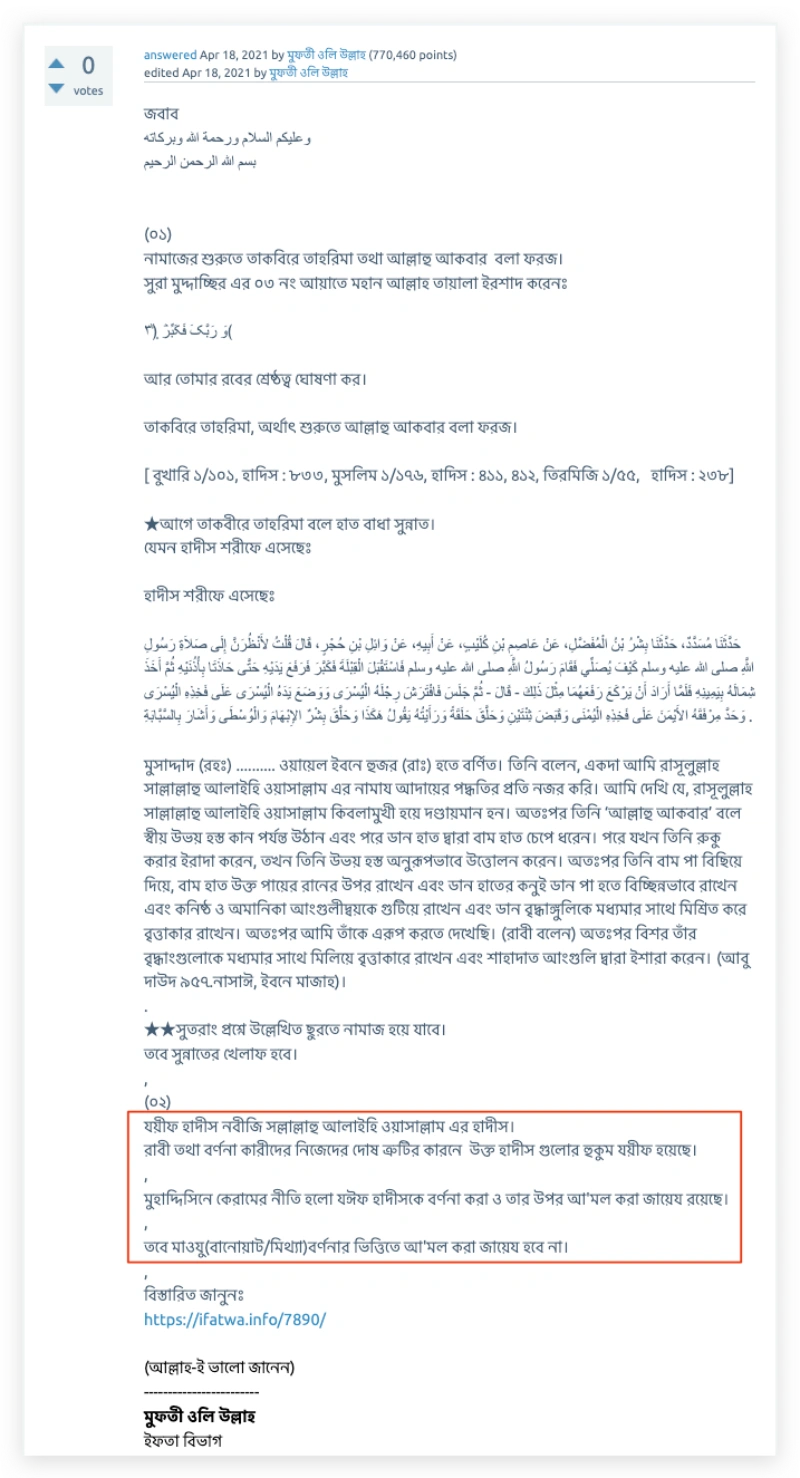
Ibn al-Salah and al-Suyuti: Permission to Circulate and Act upon Weak Reports
In his ‘Ulum al-Hadith, immediately after distinguishing weakness in a chain from the truth of a statement, Ibn al-Salah explains the rules for narrating weak hadiths. He permits the narration of weak hadiths other than fabrications in matters of merits, exhortations, stories, encouragement and warnings. He also associates ‘Abd al-Rahman ibn Mahdi and Ahmad ibn Hanbal with this principle of leniency. In other words, a distinct sphere of use is recognized for weak reports; he does not prescribe a rule prohibiting their circulation in every context merely because they are not sahih. [44]
Original Arabic—Ibn al-Salah, ‘Ulum al-Hadith:
يجوز عند أهل الحديث وغيرهم التساهل في الأسانيد ورواية ما سوى الموضوع من أنواع الأحاديث الضعيفة من غير اهتمام ببيان ضعفها
Translation:
Hadith scholars and others consider it permissible to exercise leniency concerning chains and to narrate various kinds of weak hadiths, other than fabrications, without specifically mentioning their weakness.
In Tadrib al-Rawi, Jalal al-Din al-Suyuti speaks more directly not only of narrating weak hadiths but also of acting upon them. In his discussion, this permission applies outside matters of creed and rules concerning the lawful and unlawful. His book also quotes similar principles of leniency attributed to Ahmad ibn Hanbal, ‘Abd al-Rahman ibn Mahdi and ‘Abdullah ibn al-Mubarak. [45]
Original Arabic—Jalal al-Din al-Suyuti, Tadrib al-Rawi:
ويجوز عند أهل الحديث وغيرهم التساهل في الأسانيد ورواية ما سوى الموضوع من الضعيف ، والعمل به من غير بيان ضعفه
Translation:
Hadith scholars and others consider it permissible to exercise leniency concerning chains, to narrate weak hadiths other than fabrications, and to act upon them without mentioning their weakness.
Ibn al-Salah’s quotation primarily concerns permission to narrate; al-Suyuti’s statement explicitly adds permission to act. Neither position equates a weak chain with fabrication. Classical hadith scholarship itself contains the principle that, even after a transmission route has been found not to satisfy all the requirements of reliability, the report’s content may retain a place in religious literature, exhortation and discussion of religious practices.
Al-Nawawi: Acting upon Weak Hadiths Is Not Merely Permissible but Recommended
The Shafi‘i hadith scholar and jurist Yahya ibn Sharaf al-Nawawi makes a stronger ruling on acting upon weak hadiths in his Al-Adhkar. According to him, hadith scholars, jurists and other scholars hold that, in matters of merits, encouragement and warnings, acting upon weak hadiths that are not fabricated is not merely permitted but recommended. After quoting this statement, Islamweb’s fatwa 402316 explicitly concludes that acting upon such weak hadiths is permissible and is not an innovation. [46]
Original Arabic—al-Nawawi, Al-Adhkar; quoted in Islamweb’s fatwa:
قال العلماء من المحدثين والفقهاء وغيرهم: يجوز، ويستحب العمل في الفضائل والترغيب والترهيب بالحديث الضعيف، ما لم يكن موضوعاً.
Translation:
Hadith scholars, jurists and other scholars have said: in matters concerning the merits of deeds, encouragement towards good deeds and warnings against evil deeds, acting upon a weak hadith is permissible—indeed, recommended—provided that it is not fabricated.
Al-Nawawi’s position was not confined to a general statement of principle. In Al-Majmu‘ Sharh al-Muhadhdhab, discussing the drawing of a line on the ground when no wall, stick or other barrier is available in front of a person praying, he writes that drawing the line is recommended even though the hadith on the subject is not established. His justification invokes the principle of acting upon weak hadiths concerning merits. Here a weak report is not merely preserved in a history book; its discussion is connected to recommending a particular practice in actual prayer. [47]
Original Arabic—al-Nawawi, Al-Majmu‘ Sharh al-Muhadhdhab:
والمختار استحباب الخط ؛ لأنه – وإن لم يثبت الحديث – ففيه تحصيل حريم للمصلي ، وقد قدمنا اتفاق العلماء على العمل بالحديث الضعيف
Translation:
The preferred position is that drawing a line [in front of the person praying] is recommended. For even though the hadith on this matter is not established, drawing a line creates a protected boundary in front of the worshipper; and we have already mentioned the scholars’ consensus concerning acting upon weak hadiths.
Al-Nawawi’s own application matters. He did not merely say that ‘weak hadiths may be narrated’; he invoked an unestablished hadith in his reasoning for recommending a specific prayer practice. The claim that weak hadiths were never used to determine religious practices is therefore inconsistent with his own work.
‘Abd al-Rahman ibn Mahdi and Ibn Muflih: Varying the Rigour of Chain Verification according to Subject
In his Al-Mustadrak, al-Hakim preserves a principle attributed to the influential early hadith scholar ‘Abd al-Rahman ibn Mahdi. It prescribes rigour in examining chains and narrators when transmitting hadiths about the lawful, unlawful and legal rulings, but leniency in matters of merits, rewards, punishments, permissible matters and supplications. Al-Hakim not only mentions this principle; he also declares that he follows it himself when accepting reports concerning supplications. [48]
Original Arabic—‘Abd al-Rahman ibn Mahdi’s statement preserved by al-Hakim:
إذا روينا ، عن النبي صلى الله عليه وآله وسلم في الحلال ، والحرام ، والأحكام ، شددنا في الأسانيد ، وانتقدنا الرجال
Translation:
When we narrate hadiths from the Prophet concerning the lawful, unlawful and legal rulings, we exercise rigour in verifying the chains and critically examine the narrators.
The Hanbali jurist Muhammad ibn Muflih devoted a separate section of Al-Adab al-Shar‘iyyah to acting upon weak hadiths. The section’s title itself refers to acting upon weak hadiths, narrating them and exercising leniency concerning hadiths about merits. He states that several writers on hadith scholarship recorded the scholars’ position that weak hadiths may be acted upon in matters of merits outside determining the lawful and unlawful; support for this is also found in Ahmad ibn Hanbal’s statements. [49]
Original Arabic—Ibn Muflih, Al-Adab al-Shar‘iyyah:
والذي قطع به غير واحد ممن صنف في علوم الحديث حكاية عن العلماء أنه يعمل بالحديث الضعيف فيما ليس فيه تحليل ولا تحريم كالفضائل
Translation:
Several authors who have written works on hadith scholarship have categorically stated, as the scholars’ position, that weak hadiths are acted upon in matters that do not determine the lawful or unlawful, such as the merits of deeds.
In these statements, the rigour of chain verification itself varies with the intended use. The level of scrutiny applied to the lawful and unlawful was not always maintained for exhortations, supplications or merits. Consequently, a later hadith scholar’s ruling of ‘weak’ cannot yield the historical conclusion that the report never circulated anywhere in religious society or that no one acted upon it.
The Maliki Jurist al-Hattab: Approving Practice despite Knowing a Hadith Is Weak
A direct application of this principle appears in the Maliki jurist Muhammad al-Hattab’s Mawahib al-Jalil fi Sharh Mukhtasar Khalil. In the introduction, he mentions a report about beginning important undertakings with Allah’s name and blessings upon the Prophet, and acknowledges that its chain is weak according to al-Sakhawi’s assessment. Accepting that weakness, he then invokes permission to act upon weak hadiths and the hope of obtaining the promised reward. This is not acceptance through denial of weakness; it is using a report in a particular religious practice while knowing it is weak. [50]
Original Arabic—Muhammad al-Hattab, Mawahib al-Jalil:
قلت وإن كان ضعيفا فقد اتفق العلماء على جواز العمل بالحديث الضعيف في فضائل الأعمال واغتناما للثواب الوارد
Translation:
I say: although the report is weak, the scholars have agreed that acting upon weak hadiths concerning the merits of deeds is permissible; obtaining the reward mentioned in it is also intended.
Al-Hattab’s statement and al-Nawawi’s prayer example reveal the same fundamental distinction. A hadith scholar’s declaration that a chain is weak is one judgment; whether the report’s content will be used in religious practice is a subsequent judgment. A negative grade for the chain is the first conclusion, rather than a final command prohibiting every kind of use. This distinction appears in practice in the works of jurists from two different schools, al-Nawawi and al-Hattab.
Ibn al-Qayyim: Weak Hadiths Were Sometimes Preferred Even to Analogy
The use of weak hadiths cannot be confined to moral exhortation or the merits of voluntary worship. In I‘lam al-Muwaqqi‘in ‘an Rabb al-‘Alamin, while discussing Ahmad ibn Hanbal’s five foundations for issuing fatwas, Ibn al-Qayyim lists accepting mursal and weak hadiths as the fourth and analogy as the fifth. He explains that, where no contrary evidence, Companion’s statement or consensus existed on a matter, Ahmad preferred a weak report to analogy. [51]
Original Arabic—Ibn al-Qayyim, I‘lam al-Muwaqqi‘in:
الأصل الرابع : الأخذ بالمرسل والحديث الضعيف ، إذا لم يكن في الباب شيء يدفعه ، وهو الذي رجحه على القياس
Translation:
The fourth foundation is accepting mursal and weak hadiths when nothing on the matter contradicts them. He preferred hadiths of this kind to analogy.
In the same discussion, Ibn al-Qayyim specifies the limits of the term ‘weak’ as he uses it. For Ahmad, it did not include invalid or rejected reports, or reports from narrators accused of lying, upon which one could not act. In the twofold classification of his time, some reports were known as ‘weak’ rather than ‘sahih’, a portion of which would fall under ‘hasan’ in the later threefold classification. Thus, this quotation cannot be used to claim equal legal authority for every kind of weak, abandoned or fabricated report. But the sweeping claim that any report classified as weak is excluded from jurisprudence in principle also directly contradicts the method Ibn al-Qayyim describes.
IslamQA’s fatwa 323826 likewise quotes Ibn al-Qayyim and states that Ahmad was not alone in following this method; examples of using weak or mildly weak reports and mursal reports also occur among other jurists generally. It mentions reports concerning loud laughter during prayer, ablution and the minimum marriage dower in Hanafi jurisprudence; certain rules concerning prayer and hunting in Shafi‘i discussions; and the precedence given to mursal reports, disconnected reports and Companions’ statements over analogy in Maliki methodology. [52]
Conditions for Permission and the Principle That Weak Hadiths Are Not Necessarily Fabricated
Permission to act upon weak hadiths does not mean accepting every weak report indiscriminately. In Tadrib al-Rawi, al-Suyuti preserves three conditions attributed to Ibn Hajar al-Asqalani: the weakness must not be severe; the subject must fall under an established general rule upon which people act; and, when acting upon the report, one must not regard it as certainly Muhammad’s statement or action. Acknowledging these conditions itself implies that weak and fabricated hadiths do not have the same status. [53]
Original Arabic—Ibn Hajar al-Asqalani’s conditions as quoted by al-Suyuti:
أحدها : أن يكون الضعف غير شديد ، فيخرج من انفرد من الكذابين والمتهمين بالكذب ، ومن فحش غلطه
Translation:
The first condition is that the weakness must not be excessively severe. Consequently, reports transmitted solely by a liar, someone accused of lying or a narrator who makes grave errors do not fall within this permission.
This distinction is also explicitly preserved in modern fatwas. Quoting Ibn Jibrin, IslamQA’s answer 142939 states that a hadith may be weak because of a narrator’s poor memory; this does not entail that it must be invented. The same fatwa permits acting upon weak hadiths under three conditions: the weakness is not severe, the report falls under a general principle, and no categorical claim is made about its actual origin. [54]
Original Arabic—Ibn Jibrin’s answer, IslamQA 142939:
لكن لا يلزم أن يكون الحديث مكذوبا ، لأننا لا نتهم ذلك العالم بأنه كذب ، ولكن قد يكون أخطأ في وصل الحديث أو رفعه
Translation:
But this does not necessarily mean that the hadith is falsely invented. For we are not accusing that narrator of lying; rather, he may have made a mistake in connecting the chain or attributing the hadith to the Prophet.
Islamweb’s fatwa 402316 explicitly states that following weak hadiths in matters of merits is not an innovation. The same answer quotes Ibn Daqiq al-‘Id’s condition, al-Tufi’s argument and an application concerning supplication preserved by Ibn Abi Hatim. Even after a narrator is declared weak, the wording of the supplication is considered usable. This is direct evidence that a ruling of weakness does not end deliberation about a report’s meaning or its application in religious practice. [55]
Original Arabic—Islamweb, fatwa 402316:
فالعمل بالحديث الضعيف في فضائل الأعمال جائز، وليس بدعة
Translation:
Acting upon weak hadiths concerning the merits of deeds is permissible; it is not an innovation.
Two points follow from these recognized principles. First, hadith scholars’ assessments of weak reports were not confined to a simple binary of ‘acceptance’ or ‘rejection’; use varied according to the subject, degree of weakness, corroborating evidence and type of application. Second, the use of a weak report in some area of Islamic law does not establish its historical truth—just as declaring a particular chain weak does not establish that the reported event is false. Whether a weak report may be used and whether the event it describes is true are separate questions. Even where a narrator is accused of lying, the conclusion that he personally invented every particular statement transmitted through him requires separate evidence.
A Lying Narrator Does Not Necessarily Mean a Fabricated Hadith
An accusation that a narrator is a liar reduces confidence in his testimony. But that designation alone does not establish that everything transmitted from him was his own invention. Even a liar may copy someone else’s truthful statement. To determine whether he fabricated a particular hadith, one must examine whether the statement appears in an earlier source, from whom he claimed to have received it, whether the encounter was possible, and what changes appear in the version he circulated. Alongside confessions, impossible chronology, passing off someone else’s writing as one’s own, contradictory texts and interests served by circulation may also provide evidence of fabrication. The allegation rests on specific evidence; obtaining a confession from the fabricator is not its sole requirement. Conversely, it is also mistaken to think that simply declaring ‘the narrator is a liar’ settles the origin of a particular hadith. Al-Iraqi acknowledged this distinction. [56]
Original Arabic—Zayn al-Din al-Iraqi, Sharh al-Tabsirah wa al-Tadhkirah:
ومع هذا فلا يلزم من وجود كذاب في السند أن يكون الحديث موضوعا، إذ مطلق كذب الراوي لا يدل على الوضع، إلا أن يعترف بوضع هذا الحديث بعينه، أو ما يقوم مقام اعترافه.
Translation:
The presence of a liar in a chain does not necessarily make the hadith fabricated. For a narrator’s general dishonesty does not establish that he invented the particular report, unless he admits fabricating that specific hadith or evidence equivalent to such a confession is found.
The conclusion is straightforward: rejecting the uncorroborated testimony of a lying narrator is reasonable; declaring that the opposite of what he reports actually happened goes further than the evidence warrants. The same reasoning works in reverse. General truthfulness does not make every memory a person has accurate. He may mishear, misremember, confuse contexts or mistakenly take someone else’s statement for something he heard directly. Thus, the label ‘liar’ does not automatically make a particular statement false; nor does the label ‘thiqah’ automatically make it infallible. Both labels alter the potential weight of testimony—they do not magically alter the reality of the past.
Calling a report ‘da‘if’ does not end research; it begins the inquiry: where is the weakness, how severe is it, which specific chain does it affect, are there other routes for the same text, and precisely what limited conclusion logically follows from that weakness? Making history disappear by throwing labels at it is not hadith criticism; it is the misuse of hadith terminology.
Grades Vary by Hadith Scholar
Recognized hadith scholars’ rulings on the same basic statement have ranged from sahih to fabricated. These conflicting judgments rest on critics’ different assessments of chains and narrators; a grade is an assessment of preserved evidence, not direct observation of the reported event. The ruling depends on the weight each critic assigns to continuity of the chain, narrators’ circumstances, corroborating routes, contradictory reports and hidden defects. Consequently, the grade assigned to the same past event may change as the available information and its assessment change.
These rulings are not equally strong, but none is divine truth in itself: each must be examined on the basis of its reasoning, evidence and method. ‘Such-and-such imam said’ may begin an investigation; it cannot conclude it. A scholar’s authority and the truth of his conclusion are not the same thing. The issue becomes clearest when recognized experts’ judgments on the same report are placed side by side.
‘I Am the City of Knowledge’
The famous report states: ‘I am the city of knowledge, and ‘Ali is its gate.’ In Al-Mustadrak ‘ala al-Sahihayn, al-Hakim al-Nishapuri gives a chain through Ibn ‘Abbas and declares it sahih. The stated project of Al-Mustadrak was to collect reports meeting al-Bukhari’s and Muslim’s conditions, or their standard, which they had not included in their books; thus, al-Hakim’s assessment of a ‘sahih chain’ was no casual compliment. [57]
Original Arabic—al-Hakim, Al-Mustadrak:
أنا مدينة العلم، وعلي بابها، فمن أراد العلم فليأتها من بابها.
هذا حديث صحيح الإسناد، ولم يخرجاه.
Translation:
‘I am the city of knowledge, and ‘Ali is its gate; whoever seeks knowledge should enter through its gate.’
‘This hadith has a sahih chain; al-Bukhari and Muslim did not include it.’
But the assessment did not end there. ‘Ali al-Qari’s Mirqat al-Mafatih brings together earlier hadith scholars’ rulings on the same basic report. This single paragraph encapsulates almost the entire grading problem: sahih for al-Hakim, fabricated for al-Dhahabi, established for al-Daraqutni, munkar for al-Tirmidhi, without a sahih basis for al-Bukhari, and mawdu‘ for Ibn al-Jawzi; yet hasan for al-‘Ala’i and Ibn Hajar when its various routes are considered. [58]
Original Arabic—‘Ali al-Qari, Mirqat al-Mafatih:
رواه الحاكم في المناقب من مستدركه من حديث ابن عباس وقال: صحيح، وتعقبه الذهبي فقال: بل هو موضوع … وقال الدارقطني: ثابت، ورواه الترمذي في المناقب من جامعه وقال: إنه منكر، وكذا قال البخاري: إنه ليس له وجه صحيح، وأورده ابن الجوزي في الموضوعات … لكن قال الحافظ أبو سعيد العلائي: الصواب أنه حسن باعتبار طرقه لا صحيح ولا ضعيف، فضلا عن أن يكون موضوعا … وسئل الحافظ العسقلاني عنه فقال: إنه حسن لا صحيح، كما قال الحاكم، ولا موضوع، كما قال ابن الجوزي.
Translation:
Al-Hakim narrated it through Ibn ‘Abbas in the chapter on virtues in Al-Mustadrak and declared it sahih. Al-Dhahabi objected, saying: ‘Rather, it is fabricated.’ Al-Daraqutni said: ‘Established.’ Al-Tirmidhi narrated it in the chapter on virtues in his Jami‘ and called it ‘munkar’. Similarly, al-Bukhari said: ‘It has no sahih basis.’ Ibn al-Jawzi included it in Al-Mawdu‘at. However, the hadith master Abu Sa‘id al-‘Ala’i said that the correct conclusion, considering its various transmission routes, is that it is hasan: neither sahih nor weak, much less fabricated. The hadith master Ibn Hajar likewise said that it is hasan—neither sahih as al-Hakim claimed nor fabricated as Ibn al-Jawzi claimed.
| Hadith scholar/author | Preserved assessment | Nature of the ruling |
|---|---|---|
| Al-Hakim | Sahih chain—صحيح الإسناد | Accorded the report a high degree of acceptability as a statement of the Prophet. |
| Al-Dhahabi | Fabricated—بل هو موضوع | Directly rejected al-Hakim’s ruling. |
| Al-Tirmidhi | Munkar | Assigned a rejection grade to the related ‘I am the house of wisdom’ version. |
| Al-Bukhari | No sahih basis—ليس له وجه صحيح | Denied that the report had a reliable foundation. |
| Al-Daraqutni | Established—ثابت | Ruled in favour of an established basis for the report. |
| Ibn al-Jawzi | Mawdu‘ | Included it in a collection of fabricated reports. |
| Abu Sa‘id al-‘Ala’i | Hasan li-ghayrihi | Emphasized the combined strength of its various routes. |
| Ibn Hajar al-Asqalani | Hasan | Rejected both extreme rulings: al-Hakim’s sahih and Ibn al-Jawzi’s fabricated. |
The list itself shows why such widely divergent rulings emerged for the same report. Al-Hakim considered a chain worthy of sahih status; al-Dhahabi considered that evidence so weak that he called the report fabricated. Al-‘Ala’i and Ibn Hajar, meanwhile, assessed its separate routes together and declared it hasan. In answering the same question, they did not assign equal weight to a narrator’s weakness and support from other routes. Readers therefore cannot decide which ruling to accept merely from the critic’s name. The reasoning of the scholar who declared it sahih must be examined alongside the reasoning of the scholar who declared it fabricated. Stopping at ‘disagreements happen’ leaves their causes unexplored and leaves the way open to turn a preferred ruling into final truth.
Which of the hadith scholars’ conflicting judgments is better supported by evidence can only be determined by comparing their arguments. A grade is not a self-evident historical truth. Assessing contradictory rulings therefore brings the hadith scholar’s conclusion and its basis within the scope of scrutiny alongside the hadith. When one expert’s sahih is another expert’s fabrication, stopping thought at the word ‘sahih’ is not scholarship; it is blindly selecting an authority.
The conflicting assessments of the ‘I am the city of knowledge’ report lay bare the distinction between human judgment and past events: the alleged event in the past happened once—or did not happen; yet the grades assigned to its preserved evidence range from sahih to fabricated. The past has not changed. Human judgments have.
The Limits of Evaluating Narrators
To dismiss a report, a name in its chain is often labelled ‘weak’, ‘abandoned’, ‘unknown’ or ‘poor in memory’. Without the information behind the ruling, readers do not know precisely what the problem is. ‘Unknown’ means that the person’s identity or circumstances are insufficiently known; the term itself does not establish that he was a liar. A judgment of ‘poor memory’ likewise rests on examples of mistakes, discrepancies between his reports and those of others, and statements by people who knew him. None of this can now be examined directly; what can be examined is the preserved information. Questions therefore remain: which of his reports were found mistaken, whose reports were treated as correct in comparison, and whether contrary assessments exist. The technical term is a shorthand for the problem, not a substitute for detailed evidence of it.
This is not a direct memory test; it is an internal method of evaluating one transmitted testimony through other transmitted testimony. Narrator A’s accuracy is tested by comparison with B, C and D. But how were B, C and D known to be accurate? Other people’s statements, comparisons and criticisms were used for them as well. Those critics’ judgments have themselves reached us through students, quotation and later authors. The system can therefore make comparisons, identify discrepancies and construct levels of acceptability; but it cannot independently create a contemporaneous foundation standing outside this chain of transmission.
Honesty and Trustworthiness Do Not Guarantee Accuracy in Hadith
The early discussions of hadith scholarship themselves distinguish personal honesty from competence in transmitting hadiths. A statement attributed to Abu al-Zinad in the introduction to Sahih Muslim says that he encountered one hundred people in Medina who were all considered personally trustworthy and reliable, yet hadiths were not taken from them because they were said not to be qualified in this field. Thus, the conclusion ‘his hadiths are accurate’ does not follow from ‘he is a good and trustworthy man’ even within the methodology preserved by Muslim. [59]
Original Arabic—Introduction to Sahih Muslim:
أدركت بالمدينة مائة كلهم مأمون ما يؤخذ عنهم الحديث يقال ليس من أهله
English translation:
‘I met one hundred [transmitters] in al-Madīnah, each of whom were reliable. Narrations were not taken from one about who it was said, ‘he is not from its people’.’ [60]
A more direct statement is attributed to Yahya ibn Sa‘id al-Qattan. He says that righteous people were seen making more errors or false statements in hadith than in anything else. Muslim explains these false reports in terms of unintentional mistakes: falsehood would flow from their tongues, but they did not deliberately lie. In other words, someone may remain morally honest and yet become a source of grave errors in hadith—the introduction to Sahih Muslim preserves this gap between moral honesty and accuracy in transmission. [61]
Original Arabic—Yahya ibn Sa‘id al-Qattan and Muslim:
وحدثني محمد بن أبي عتاب قال حدثني عفان عن محمد بن يحيى بن سعيد القطان عن أبيه قال لم نر الصالحين في شيء أكذب منهم في الحديث قال ابن أبي عتاب فلقيت أنا محمد بن يحيى بن سعيد القطان فسألته عنه فقال عن أبيه لم تر أهل الخير في شيء أكذب منهم في الحديث قال مسلم يقول يجري الكذب على لسانهم ولا يتعمدون الكذب
English translation:
Muhammad bin Abī Attāb narrated to me, he said Affān narrated to me, on authority of Muhammad bin Yahyā bin Sa’īd al-Qattān, on authority of his father, he said:
‘We do not see the righteous more false in anything than they are regarding Ḥadīth’.
Ibn Abī Attāb said: ‘So Muhammad bin Yahyā bin Sa’īd al-Qattān and I met and I asked him about it and he said on authority of his father: ‘You will not see the people of good (Ahl ul-Khayr) more false in anything than they are regarding Ḥadīth.’ Muslim said: ‘He was saying that falsehood flows upon their tongues although they do not intend to lie’. [62]
These two statements reveal a fundamental limit of narrator criticism. Personal piety, honesty and social reputation are important information about character; they cannot substitute for accuracy of memory, identification of sources, preservation of wording or the truth of a particular report. Someone may transmit erroneous hadiths without ever deliberately lying. Consequently, general assessments such as ‘he is righteous’, ‘he is truthful’ or ‘he is thiqah’ do not automatically establish the historical truth of a specific text. A particular report requires particular evidence.
How Is a Narrator’s Memory Evaluated?
Ibn al-Salah clearly explains how a narrator’s ḍabt—the ability to preserve accurately a report heard or written—is determined. The method compares that narrator’s reports with those of narrators already considered reliable and accurate. Substantial agreement leads to recognition of accuracy; frequent contradiction is treated as damage to his ḍabt. [63]
Original Arabic—Ibn al-Salah, ‘Ulum al-Hadith:
يعرف كون الراوي ضابطا بأن نعتبر رواياته بروايات الثقاة المعروفين بالضبط والإتقان، فإن وجدنا رواياته موافقة – ولو من حيث المعنى – لرواياتهم، أو موافقة لها في الأغلب والمخالفة نادرة، عرفنا حينئذ كونه ضابطا ثبتا، وإن وجدناه كثير المخالفة لهم، عرفنا اختلال ضبطه، ولم نحتج بحديثه.
Translation:
A narrator’s accuracy is established by comparing his reports with those of trustworthy narrators known for accuracy and correctness. If his reports agree with theirs—at least in meaning—or agree in most cases, with very rare contradiction, he is known to be accurate and dependable. But if he is found to contradict them frequently, his accuracy is known to be defective, and his hadiths are not accepted as evidence.
Repeated agreement between a narrator’s statements and those of others provides evidence for his capacity to preserve reports. But without examining why the agreement occurs, one may repeatedly count the same error until it appears true. Ten students may accurately memorize their teacher’s mistaken statement. The students then agree, while the underlying information remains wrong. If ten people genuinely learn of the same event from independent sources, their agreement is much stronger evidence. The reliability of the narrators used for comparison has itself been assessed from similar preserved information. Alongside numbers, therefore, one must examine whether witnesses depended on one another, used the same writing, and agreed through independent experience or through repeating the same lesson. Without this examination, ‘everyone said the same thing’ cannot be equated with certain truth.
A further problem is that critics did not agree on which discrepancies should actually render a narrator unacceptable. Ibn al-Salah himself says that people disagree over which conduct or faults constitute valid jarh and which do not. This acknowledgment is crucial: it shows that ‘such-and-such narrator is weak’ is not raw historical information, but a conclusion produced by a particular critic’s criteria. [64]
Original Arabic—Ibn al-Salah, ‘Ulum al-Hadith:
وأما الجرح فإنه لا يقبل إلا مفسرا مبين السبب؛ لأن الناس يختلفون فيما يجرح وما لا يجرح، فيطلق أحدهم الجرح بناء على أمر اعتقده جرحا وليس بجرح في نفس الأمر، فلا بد من بيان سببه، لينظر فيه أهو جرح أم لا.
Translation:
Jarh is not accepted until its cause is explained and clarified, because people disagree about what constitutes jarh and what does not. Someone may apply jarh on grounds he considers valid, when in reality they are not. The reason must therefore be stated so that it can be examined to determine whether it constitutes valid jarh.
It is therefore insufficient merely to extract the word ‘weak’ from a biographical dictionary of narrators. Who said it, why, whether the reason concerns mistakes in hadith or social behaviour, whether other statements about the same person exist, and how later hadith scholars assessed that criticism—all these matter. Omit them, and the quotation becomes an assertion of authority stripped of context, rather than research.
The Judgment of a Single Critic
There was also no single answer to how many independent critics’ testimonies were required to accept or reject a narrator. One influential position held that the jarh or ta‘dil of a single qualified critic sufficed. Ibn al-Salah identifies this as al-Khatib al-Baghdadi’s preferred position; al-Suyuti more directly calls it ‘the correct position’. In some cases, therefore, one person’s assessment becomes sufficient to determine the fate of another, deceased person’s transmissions. [65] [66]
Original Arabic—Ibn al-Salah and al-Suyuti:
ومنهم من قال – وهو الصحيح الذي اختاره الحافظ أبو بكر الخطيب وغيره – أنه يثبت بواحد، لأن العدد لم يشترط في قبول الخبر، فلم يشترط في جرح راويه وتعديله.
الصحيح أن الجرح والتعديل يثبتان بواحد، وقيل: لا بد من اثنين.
Translation:
Some have said—and this is the correct position preferred by the hadith master Abu Bakr al-Khatib and others—that jarh and ta‘dil may be established through one person’s statement; since no specified number is required for accepting a report, no specified number is required for criticizing or accrediting its transmitter either. In al-Suyuti’s words: ‘The correct position is that jarh and ta‘dil are established through one person; some, however, have required two.’
Having obtained a critic’s judgment of a narrator, one must also establish the source of that judgment. Did the critic know the man personally, or had he heard about him from others? Which student preserved the judgment? If contradictory statements appear under the same critic’s name, in what circumstances was each made? Does the objection concern a demonstrable error in a particular report, or the narrator’s doctrines or social behaviour? Omit these questions, and verification merely moves back one step and stops. Previously the narrator’s name was trusted; now the critic’s name is trusted. Unless the reason for trusting the critic is disclosed, his conclusion takes the place of evidence. His ruling may be strong, or it may be influenced by incomplete information, personal conflict or religious dislike; the prestige of his identity cannot determine which.
How Reliable Are the Chains Transmitting Statements of Jarh and Ta‘dil?
The judgments of early hadith scholars about narrators do not always come directly from books written by those scholars themselves. Many have survived in their students’ questions and answers, in quotations by later authors, or in accounts passed down through several intermediaries. In some cases, the transmission route is clear and well supported. In others, the reliability of a person in the middle of the chain is not even established. Two documented examples show why this matters.
An Allegation against Hafs: Tracing a Critic’s Statement Back to Its Source
Al-Khatib al-Baghdadi’s Tarikh Baghdad preserves a statement attributed to Ibn Khirash, who allegedly called Hafs ibn Sulayman—the transmitter of the most widely used Quranic reading—a “liar” and a “fabricator of hadith.” But al-Khatib did not hear this statement directly from Ibn Khirash. He gives a chain of intermediaries through whom it was transmitted. One of them is Muhammad ibn Muhammad ibn Dawud al-Karaji, whose reliability has been called into question because it has not been established [67].
Original Arabic—al-Khatib al-Baghdadi, Tarikh Baghdad, the statement attributed to Ibn Khirash in the biography of Hafs ibn Sulayman: «حفص بن سليمان كذاب، متروك، يضع الحديث». English translation: “Hafs ibn Sulayman is a liar, an abandoned narrator; he used to fabricate hadith.” Al-Karaji appears among the transmitters through whom this statement was reported.
Reading the chain backward from al-Khatib to Ibn Khirash gives the following sequence:
| Where the statement is reported | Person through whom the earlier statement is reached |
|---|---|
| Al-Khatib al-Baghdadi | Ali ibn Talhah al-Muqri |
| Ali ibn Talhah | Muhammad ibn Ibrahim al-Ghazi |
| Muhammad ibn Ibrahim | Muhammad ibn Muhammad ibn Dawud al-Karaji |
| Al-Karaji | Abd al-Rahman ibn Yusuf ibn Khirash |
| Ibn Khirash | The statement about Hafs quoted above |
The author of the cited fatwa describes al-Karaji as majhul, meaning a person whose identity or standing is insufficiently established for a judgment of reliability. The argument is that although al-Sam‘ani and Ibn Hajar mention this individual in their works, they do not provide an assessment declaring him either reliable or unreliable. That particular route cannot therefore be treated as unquestionably sound, nor can the allegation be attributed to Ibn Khirash with certainty on its strength alone. Accepting this objection does not require accepting IslamQA’s other theological conclusions: it is a specific, testable problem concerning a chain of transmission [68].
What does this establish? That the allegation appears in a book under Ibn Khirash’s name is one claim. That Ibn Khirash actually made the statement is another. Establishing the second requires examining the reliability of every necessary link in that chain, or finding a strong, independent source. Where the reliability of an essential intermediary remains unestablished, that route alone cannot establish the attribution with certainty.
Two Different Statements Attributed to One Critic: The Case of Uthman ibn Umayr
Consider what happens when different people transmit a critic’s remarks. Conflicting assessments of the Kufan narrator Uthman ibn Umayr are preserved under the name of Yahya ibn Ma‘in. According to a report transmitted by Abbas ibn Muhammad al-Duri, Ibn Ma‘in said, “His hadith is worth nothing.” Yet another account, transmitted through Ishaq, attributes to him the description salih, meaning sound or acceptable. This is not simply a disagreement between two critics: two different assessments have come down through two transmitters, both attributed to the same critic [69].
Original Arabic—Ibn Shahin, al-Mukhtalaf Fihim, biography of Uthman ibn Umayr: «ليس حديثه بشيء»; in another account, «أنه صالح». Ibn Shahin adds: «وهذا الخلاف في عثمان من يحيى وحده يوجب التوقف فيه حتى يعينه عليه آخر». English translation: The first account says, “His hadith is worth nothing”; the other calls him “acceptable.” Ibn Shahin observes that these conflicting statements concerning Uthman, both attributed to Yahya alone, require a suspension of judgment until another person’s testimony supports one of them.
Ibn Shahin did something important here. Instead of choosing whichever statement suited him and concealing the other, he acknowledged the contradiction between two reports attributed to the same person and sought further testimony. His decision to suspend judgment shows that even early hadith critics did not regard the mere attachment of a famous scholar’s name to a statement as the end of the inquiry. They recognized the need to ask who transmitted each assessment and whether additional testimony supported it.
Other testimony about Uthman is also preserved. Ibn Abi Hatim reports that he personally asked his father, Abu Hatim, about him. Abu Hatim described Uthman as weak in hadith and as a transmitter of munkar reports. This is not an indefinite claim that “someone said so long ago”; it is presented as a son directly questioning his father [70].
Original Arabic—al-Mizzi, Tahdhib al-Kamal, Ibn Abi Hatim’s report in the biography of Uthman ibn Umayr: «سألت أبي عنه، فقال: ضعيف الحديث، منكر الحديث، كان شعبة لا يرضاه». English translation: “I asked my father about him, and he said: ‘He is weak in hadith and narrates munkar reports. Shu‘bah was not satisfied with him either.’”
In this example, a negative assessment may gain strength because there is supporting testimony from other critics, both contemporary and later. But reaching that conclusion requires comparing multiple early records and the sources through which the judgments were transmitted. The final grade found in a biographical dictionary is therefore not the beginning of the inquiry but its outcome. Behind it may lie separate testimonies, separate transmission routes, and sometimes contradictory information.
How Can We Verify That a Critic Really Made a Statement?
Suppose someone claims, “Yahya ibn Ma‘in declared such-and-such a narrator thiqah.” The first step is to locate the earliest surviving source for those words. Are they recorded in a collection of questions and answers compiled by one of Ibn Ma‘in’s students? Does the author say “I heard him,” “I asked him,” or “He wrote to me”—or merely “Ibn Ma‘in said”? Could the student have met Ibn Ma‘in? Is the student’s written record or transmitted account independently attested? Does the wording of the remark differ in other collections? These details affect the strength of the evidence.
Second, the history of the book preserving the remark must be examined. Early manuscripts, students’ recitations of the text, quotations by subsequent authors, and variations between surviving copies all matter when they exist. Third, even if it is established that the critic made the statement, we still have to ask what information he relied upon. A reliable route by which a judgment was transmitted does not automatically make the judgment itself correct. Equally, the absence of a complete chain in one book does not establish that the statement is false. But replacing the missing chain with nothing more than the author’s reputation does not establish its accuracy either.
This does not mean that every statement of jarh wa ta‘dil must be subjected to precisely the same formal conditions of sahih classification as a hadith attributed to the Prophet. A student’s direct notes, recorded questions and answers, letters, and agreement among independent sources may furnish strong historical evidence. What cannot be justified is treating every assessment as equally certain without first examining what kind of evidence preserves it.
When a narrator is described as thiqah, “weak,” or a “liar,” therefore, at least two questions need answering. First, did the critic really say it? Second, even if he did, what evidence supports his judgment? The first requires scrutiny of the transmission of the critic’s statement; the second requires examination of the narrator’s particular reports, corroborating evidence, and the reasons offered for the criticism. The answer to one question cannot stand in for the answer to the other.
Critics’ Personal Conflicts Also Influenced Jarh
Critics who determined narrators’ acceptability were not immune to personal relationships, feelings of humiliation or conflict. The case of al-Nasa’i and Ahmad ibn Salih al-Misri is a direct example. Although al-Bukhari accepted Ahmad’s reports and several critics, including Abu Hatim, declared him trustworthy, al-Nasa’i said that he was neither trustworthy nor reliable. Al-Iraqi discusses this ruling as an example of a critic’s error. His account preserves al-Khalili’s conclusion that al-Nasa’i’s assessment was biased and, through Ibn ‘Adi, the personal reason behind it: Ahmad had expelled al-Nasa’i from his gathering, after which al-Nasa’i spoke against him. This is not merely two experts reaching different estimates of a narrator’s memory; an early work itself identifies the personal relationship between narrator and critic as a cause of the negative assessment. [71]
ثم إن الجارح وإن كان إماما معتمدا في ذلك، فربما أخطأ فيه، كما جرح النسائي أحمد بن صالح المصري، بقوله غير ثقة ولا مأمون، وهو ثقة إمام حافظ، احتج به البخاري في صحيحه، وقال ثقة، ما رأيت أحدا يتكلم فيه بحجة، وكذا وثقه أبو حاتم الرازي، والعجلي، وآخرون وقد قال أبو يعلى الخليلي اتفق الحفاظ على أن كلام النسائي فيه تحامل، ولا يقدح كلام أمثاله فيه، وقد بين ابن عدي سبب كلام النسائي فيه، فقال سمعت محمد بن هارون البرقي يقول حضرت مجلس أحمد، فطرده من مجلسه، فحمله ذلك على أن تكلم فيه قال الذهبي في الميزان آذى النسائي نفسه بكلامه فيه، وقال ابن يونس لم يكن أحمد عندنا، كما قال النسائي لم يكن له آفة غير الكبر.
Translation:
A critic may sometimes err even if he is a recognized imam in this field. For example, al-Nasa’i criticized Ahmad ibn Salih al-Misri, saying that he was neither trustworthy nor reliable. Yet he was a trustworthy imam and hadith master; al-Bukhari relied on him as evidence in his Sahih and said that he was trustworthy: I have not seen anyone speak against him with proof. Abu Hatim al-Razi, al-‘Ijli and others also declared him trustworthy. Abu Ya‘la al-Khalili said that the hadith masters agreed that al-Nasa’i’s statement about him was biased; a statement of this kind from someone like al-Nasa’i does not impair his acceptability. Ibn ‘Adi explained the reason for al-Nasa’i’s statement. He said: I heard Muhammad ibn Harun al-Barqi say: I was present at Ahmad’s gathering when he expelled al-Nasa’i. This incident prompted him to speak against Ahmad. Al-Dhahabi said in Al-Mizan that, by speaking against him, al-Nasa’i harmed himself. Ibn Yunus said: Ahmad’s standing among us was not as al-Nasa’i described; he had no fault other than arrogance.
The same biography contains an even harsher account of personal rivalry controlling access to hadith. Quoting Ibn ‘Adi, al-Dhahabi writes that Harmalah gave Ahmad ibn Salih only half of his books. Thereafter, Ahmad would not transmit hadiths to students who, upon arriving in Egypt, first visited Harmalah. ‘Abdullah ibn Muhammad ibn Salm al-Maqdisi was refused by Ahmad because he had first copied reports from Harmalah. To please Ahmad, he tore up his book of Yunus’s reports in front of him; Ahmad nevertheless remained dissatisfied and did not transmit hadiths to him. Here, which materials a student can obtain from which teacher is determined by his relationship with a previous teacher; under that pressure, written material already collected is also destroyed. In this case, both opportunities to collect reports and preservation of the books collected were affected by personal rivalry. [72]
قال ابن عدي: كان أحمد بن صالح قد سمع في كتب حرملة، فمنعه حرملة من الكتب، ولم يدفع إليه إلا نصف الكتب. فكان أحمد بن صالح بعد، كل من سمع من حرملة، وبدأ به إذا وافى مصر، لم يحدثه أحمد وقال ابن عدي: سمعت عبد الله بن محمد بن سلم المقدسي يقول: قدمت مصر، فبدأت بحرملة، فكتبت عنه كتاب عمرو بن الحارث، ويونس بن يزيد والفوائد، ثم ذهبت إلى أحمد بن صالح فلم يحدثني، فحملت كتاب يونس، فخرقته بين يديه، أرضيه بذلك وليتني لم أخرقه – فلم يرض، ولم يحدثني.
Translation:
Ibn ‘Adi says: Ahmad ibn Salih had heard the reports in Harmalah’s books, but Harmalah withheld the books from him and gave him only half of them. Thereafter, Ahmad ibn Salih would not transmit hadiths to anyone who came to Egypt and first visited Harmalah to hear from him. Ibn ‘Adi says: I heard ‘Abdullah ibn Muhammad ibn Salm al-Maqdisi say: I arrived in Egypt and first went to Harmalah. From him I copied the books of reports from ‘Amr ibn al-Harith and Yunus ibn Yazid, along with other useful reports. I then went to Ahmad ibn Salih, but he would not transmit hadiths to me. So I brought the book of Yunus and tore it up in front of him, hoping to please him. If only I had not torn up the book! He was neither pleased nor willing to transmit hadiths to me.
These incidents reveal the influence of personal authority over two related processes: collecting hadiths and evaluating narrators. A teacher controls access to the knowledge he transmits; a critic’s assessment is affected by that teacher’s social conduct and relationship with him; a later author then decides which criticism to accept and which to discard as biased. Thus, extracting only ‘al-Nasa’i declared him unreliable’ from a biographical dictionary passes off one fragment of information as the entire assessment. Omitting the reasons for the conflict preserved in the same source, contrary evaluations and objections concerning particular reports conceals the evidence behind the narrator’s grade. The provenance, personal relationships and reasoning behind the testimony used to judge a narrator must themselves be examined. A critic’s fame does not transform his personal conflict into impartial evidence, and a negative adjective he assigns does not independently refute an event in the past.
Character versus a Particular Report
One of the most misused aspects of narrator criticism is determining the truth of a particular statement from a person’s overall character. Someone is called thiqah, saduq, sinful, an innovator, abandoned or a liar. But these general labels do not necessarily establish that a particular sentence he utters is true or false. A liar’s particular statement may be true; a truthful person may mishear or misremember. Character changes the initial weight of testimony; it does not mechanically determine the truth or falsehood of a specific event.
This limitation appeared in al-Iraqi’s statement in the first part: a liar in the chain does not necessarily make a particular hadith fabricated. Yet in the practical classification of narrators, behaviour outside hadith transmission also affected whether reports were accepted. Explaining Ibn Hajar’s definition, al-Suyuti says that someone known to lie in ordinary conversation may fall into the category of matruk, even if he has not been caught lying in hadith. [73]
Original Arabic—al-Suyuti, Tadrib al-Rawi:
المتروك … بأن يرويه من يتهم بالكذب، ولا يعرف ذلك الحديث إلا من جهته، ويكون مخالفا للقواعد المعلومة. قال: وكذا من عرف بالكذب في كلامه، وإن لم يظهر منه وقوعه في الحديث، وهو دون الأول.
Translation:
A matruk report is one transmitted solely by someone accused of lying and which contradicts established principles. Ibn Hajar further said: someone known to lie in ordinary conversation—even if his lying in hadith has not been exposed—has a similar status, although he ranks below the first category.
This principle makes the uncorroborated report of a habitual liar unacceptable as evidence. But it does not prove the particular text false; it declares his testimony insufficient because of his past behaviour. The leap from ‘we do not accept his statement as evidence’ to ‘the event he describes did not happen’ remains invalid.
Muru’ah and Social Conventions
Urinating while standing, playing chess or doing something considered improper by local convention has no direct relationship with whether a particular report is true. These assess how acceptable someone is in society’s eyes. A witness’s character may be questioned; but concluding that the event he describes is false because he did something socially disapproved of requires separate evidence. Rules of social propriety and the ability to preserve information accurately are not the same thing. Conflating these judgments may sometimes allow the exclusion of unpopular people to pass as verification of truth.
Original Arabic—al-Sakhawi, Fath al-Mughith:
وكذا البول قائما، يعني في الطريق، وبحيث يراه الناس … والتحدث بمساوئ الناس.
المروءة يرجع في معرفتها إلى العرف، فلا تتعلق بمجرد الشرع … بل هي تختلف باختلاف الأشخاص والبلدان، فكم من بلد جرت عادة أهله بمباشرة أمور لو باشرها غيرهم لعد خرما للمروءة.
Translation:
Urinating while standing—that is, in the street where people can see—and discussing people’s faults have also been counted among behaviours that impair muru’ah. Yet social convention must be consulted to determine what muru’ah is; it does not relate solely to Sharia. Muru’ah varies by person and country; conduct ordinary for people in one country may be considered damaging to the social standing of someone from another.
Publicly improper behaviour may damage someone’s social image. But urinating while standing, or conduct locally considered dishonourable, does not establish that the text of his particular hadith is false. Replacing memory, sources of information and the truth of particular statements with cultural etiquette turns narrator grading partly into a grading of society’s tastes.
Rejection for Playing Chess
Al-Khatib al-Baghdadi’s Al-Kifayah fi ‘Ilm al-Riwayah preserves an account from Shu‘bah concerning Najiyah. On seeing him playing chess, Shu‘bah initially stopped recording hadiths directly from him; later, however, he recorded his hadiths through another person. The incident illustrates both the influence of moral preferences and the instability of the resulting judgment. [74]
Original Arabic—al-Khatib al-Baghdadi, Al-Kifayah:
قال شعبة: لقيت ناجية الذي روى عنه أبو إسحاق، فرأيته يلعب بالشطرنج، فتركته فلم أكتب عنه، ثم كتبت عن رجل عنه.
Translation:
Shu‘bah said: I met Najiyah, Abu Ishaq’s narrator, and saw him playing chess. So I left him and did not write from him; later, however, I recorded his reports through another person.
There is no connection establishing that playing chess makes a particular hadith mistaken or fabricated. Here the critic’s legal or moral assessment first fell on the person, then on acceptance of his reports. The later indirect recording of the same man’s hadiths further shows that the decision was not the result of a rigorous test of truth and falsehood; it reflected a variable application of social and moral confidence.
Hadith Transmission for Payment
The same ambivalence appears over receiving payment for transmitting hadiths. Ishaq ibn Rahwayh and Abu Hatim said not to record from such a person; when Ahmad ibn Hanbal was asked whether reports should be recorded from someone ‘who sells hadith’, he emphatically refused. Yet in the same chapter, al-Sakhawi preserves the names of numerous recognized narrators who accepted payment, along with the position permitting payment because of poverty. [75]
Original Arabic—al-Sakhawi, Fath al-Mughith:
أما إسحاق؛ فإنه حين سئل عن المحدث يحدث بالأجر، قال: لا يكتب عنه، وكذا قال أبو حاتم حين سئل عمن يأخذ على الحديث، وأما أحمد فإنه قيل له: أيكتب عمن يبيع الحديث؟ فقال: لا، ولا كرامة.
Translation:
When Ishaq was asked about someone who transmitted hadiths for payment, he said that reports should not be recorded from him. Abu Hatim gave the same answer. When Ahmad was asked whether reports should be recorded from someone who sold hadith, he said: ‘No; nor does he deserve any honour.’
Receiving money was sometimes treated as grounds for rejecting reports and sometimes accepted as legitimate remuneration; these opposite judgments of the same conduct show that the criterion was not fixed. More significantly, the same tradition sometimes rejected payment as damaging to muru’ah, while elsewhere permitting it on grounds of poverty and compensation for time, and using reports from recognized narrators who accepted it. The evidentiary significance of the behaviour was therefore not determined by any unanimous, fixed rule.
Rejection on Doctrinal Grounds
A narrator’s doctrinal position also sometimes became grounds for rejection. A statement attributed to Ibn al-Mubarak explicitly says that people abandoned ‘Amr ibn ‘Ubayd because he called others to Qadari views. Both accusations that ‘Amr lied in hadith and explanations that he was rejected for propagating Qadari doctrine survive in narrator biographies. In this preserved explanation, doctrinal advocacy is the stated reason for rejection. [76]
Original Arabic—al-Mizzi, Tahdhib al-Kamal:
قال نعيم بن حماد: قلت لابن المبارك: لأي شيء تركوا عمرو بن عبيد؟ قال: إن عمرا كان يدعو إلى القدر.
Translation:
Nu‘aym ibn Hammad said: I asked Ibn al-Mubarak, ‘Why did people abandon ‘Amr ibn ‘Ubayd?’ He replied: ‘ ‘Amr called people to Qadari doctrine.’
Here doctrinal disagreement directly enters the mechanism for rejecting narrators; grading therefore cannot be sold as a purely impartial test of memory. Ideological identity is a factor to examine for bias; establishing that a text is false requires evidence against its statement. When doctrinal allegiance contributes to a narrator’s acceptability, presenting grading as a purely impartial memory test is false.
The Same Narrator, Opposite Judgments
The clearest evidence of the theoretical problem comes from the biographical dictionaries themselves. Recognized critics sometimes reached directly opposing conclusions about the same narrator. One said ‘liar’, another ‘not a liar’; elsewhere, ‘trustworthy’ and ‘weak’ are both preserved under the same critic’s name; elsewhere still, a person is abandoned in hadith but reliable in Quranic recitation. A later hadith scholar selects a conclusion from this contradictory information. A narrator’s grade was therefore not inscribed on the historical person’s body; it was produced through authors’ and critics’ choices.
‘Ikrimah: Liar or Trustworthy?
‘Ikrimah was Ibn ‘Abbas’s freedman and celebrated student; a vast number of reports in Quranic exegesis and hadith came through him. This central position makes the conflicting assessments of him especially significant. Al-Mizzi’s Tahdhib al-Kamal preserves entirely opposing judgments by Yahya ibn Sa‘id al-Ansari and Ayyub al-Sakhtiyani, made in virtually the same gathering. In the same biography, Ibn Abi Dhi’b is reported as calling him ‘untrustworthy’ in one account and ‘trustworthy’ in another; Malik did not consider him trustworthy, while Abu Hatim, al-Nasa’i and others did. [77]
Original Arabic—al-Mizzi, Tahdhib al-Kamal:
سمعت يحيى بن سعيد الأنصاري وأيوب ذكرا عكرمة، فقال يحيى: كان كذابا، وقال أيوب: لم يكن بكذاب.
عن ابن أبي ذئب يقول: رأيت عكرمة مولى ابن عباس، وكان غير ثقة.
كان مالك لا يرى عكرمة ثقة، ويأمر أن لا يؤخذ عنه.
سألت أبي عن عكرمة مولى ابن عباس: كيف هو؟ قال: ثقة، قلت: يحتج بحديثه؟ قال: نعم إذا روى عنه الثقات.
Translation:
Yahya ibn Sa‘id al-Ansari and Ayyub were discussing ‘Ikrimah. Yahya said: ‘He was a liar’; Ayyub said: ‘He was not a liar.’ A statement attributed to Ibn Abi Dhi’b says: ‘I saw ‘Ikrimah; he was not trustworthy.’ Malik likewise did not consider him trustworthy and advised against taking reports from him. Yet Abu Hatim called him ‘thiqah’ and permitted his reports to be accepted as evidence when trustworthy narrators transmitted from him.
Ibn Hibban’s Al-Thiqat quotes an even more serious allegation against ‘Ikrimah: that he lied in Ibn ‘Abbas’s name. But Ibn Hibban counters by pointing to the weakness of those transmitting the accusation, arguing that an upright person cannot be discredited through a weak person’s statement. Here, judging ‘Ikrimah requires judging those who testify against him. The question is not resolved; another layer of dependence on narrators is created. [78]
Original Arabic—Ibn Hibban, Al-Thiqat:
إن هذا يكذب على أبي … ومن أمحل المحال أن يجرح العدل بكلام المجروح … أما عكرمة، فحمل أهل العلم عنه الحديث والفقه في الأقاليم كلها.
Translation:
The allegation quoted against ‘Ikrimah states: ‘This man lies in my father’s name.’ Ibn Hibban’s response, however, is: it is utterly untenable to discredit an upright person through the statement of someone who is himself discredited or weak; scholars in various regions have accepted hadith and jurisprudence from ‘Ikrimah.
Thus, ‘ ‘Ikrimah is trustworthy’ is not direct, undisputed historical information. It is a selected critical conclusion among conflicting early testimonies. A later reader does not test ‘Ikrimah personally; he chooses how far to trust Yahya, Ayyub, Malik, Abu Hatim and Ibn Hibban.
Ibn Ishaq: Trustworthy or Weak?
Conflicting rulings on Muhammad ibn Ishaq, one of the most influential early biographers of Muhammad, are preserved under Yahya ibn Ma‘in’s own name. Sometimes he is ‘unproblematic’ and ‘trustworthy’; sometimes ‘weak’, ‘unsound’ and ‘not strong’; elsewhere, ‘trustworthy, but not at the level of conclusive authority’. Differences of time, context, particular teachers or changed opinions may underlie these assessments. But assuming such explanations cannot turn a convenient ruling into the ‘final’ one. [79]
Original Arabic—al-Mizzi, Tahdhib al-Kamal:
سمعت يحيى بن معين يقول: محمد بن إسحاق ليس به بأس.
وسئل يحيى بن معين عنه مرة أخرى فقال: ليس بذاك، ضعيف.
وسمعت يحيى بن معين مرة أخرى يقول: محمد بن إسحاق عندي سقيم، ليس بالقوي.
قلت ليحيى بن معين: محمد بن إسحاق منهم؟ فقال: كان ثقة، إنما الحجة: عبيد الله بن عمر، ومالك بن أنس.
Translation:
One statement attributed to Yahya ibn Ma‘in says: ‘There is no problem with Muhammad ibn Ishaq.’ Asked on another occasion, he said: ‘He is not much; weak.’ Another account states: ‘In my view, Muhammad ibn Ishaq is weak; not strong.’ Yet when asked again, he said: ‘He is trustworthy; but ‘Ubaydullah ibn ‘Umar and Malik ibn Anas are at the level of conclusive authority.’
Extracting only ‘weak’ or only ‘trustworthy’ under Yahya’s name from a biographical dictionary and announcing a conclusion therefore conceals information. When opposing judgments survive under the same critic’s name, a one-word verdict is not research unless it analyses which student transmitted each statement, when and in what context, and what scope ‘trustworthy but not a conclusive authority’ has.
Al-Waqidi: Weak in Hadith, Indispensable in History
The case of Muhammad ibn ‘Umar al-Waqidi completely destroys the false equation of ‘weak in hadith’ with ‘historically worthless’. Al-Shafi‘i is reported as calling his books false; Ahmad called him a liar; Ibn Ma‘in said he was nothing; al-Nasa’i included him among those who fabricated hadiths in Muhammad’s name. Nevertheless, in the same biography, al-Dhahabi says that he cannot be dispensed with in accounts of military campaigns, the Companions’ battles and historical reports. [80]
Original Arabic—al-Dhahabi, Siyar A‘lam al-Nubala’:
محمد بن عمر بن واقد … صاحب التصانيف والمغازي، العلامة الإمام … أحد أوعية العلم على ضعفه المتفق عليه.
خلط الغث بالسمين … فاطرحوه لذلك، ومع هذا فلا يستغنى عنه في المغازي، وأيام الصحابة وأخبارهم.
قال الشافعي: كتب الواقدي كذب.
عن ابن معين قال: ليس الواقدي بشيء.
قال لي أحمد بن حنبل: الواقدي كذاب.
Translation:
Muhammad ibn ‘Umar al-Waqidi was the author of numerous works and books on military campaigns, an eminent scholar and imam, and one of the repositories of knowledge—although his weakness is acknowledged. He mixed good and bad, worthless and valuable reports, and was therefore abandoned. ‘Nevertheless, he cannot be dispensed with in accounts of military campaigns, the Companions’ battles and their historical reports.’ Al-Shafi‘i said: ‘Al-Waqidi’s books are false.’ Ibn Ma‘in said: ‘Al-Waqidi is nothing.’ Ahmad ibn Hanbal said: ‘Al-Waqidi is a liar.’
Yet the same page also preserves Mus‘ab al-Zubayri’s assessment of him as ‘trustworthy and reliable’, Yazid ibn Harun’s ‘trustworthy’, and praise from others. Ibn Sa‘d describes him as knowledgeable in military campaigns, biography, conquests, rulings and disagreements. Even Ahmad ibn Hanbal—under whose name the statement ‘al-Waqidi is a liar’ appears—received portions of al-Waqidi’s hadiths each week and examined them. [81]
Original Arabic—al-Mizzi, Tahdhib al-Kamal, biography of Muhammad ibn Sa‘d:
كان أحمد بن حنبل يوجه في كل جمعة بحنبل بن إسحاق إلى ابن سعد، يأخذ منه جزأين من حديث الواقدي، ينظر فيهما إلى الجمعة الأخرى، ثم يردهما ويأخذ غيرهما.
Translation:
Every Friday, Ahmad ibn Hanbal sent Hanbal ibn Ishaq to Ibn Sa‘d. He brought back two fascicles of al-Waqidi’s hadiths; Ahmad examined them until the following Friday, then returned them and took two others.
Al-Waqidi’s case demonstrates that being unacceptable by the standards of legal hadith and being unusable as a historical source are not the same thing. Reconstructing a large part of early Islam’s military, conquest and political history is difficult without his material; al-Dhahabi explicitly acknowledges this. Thus, pointing to al-Waqidi’s name in a biographical report and saying ‘weak, discussion over’ is not the application of hadith scholarship’s rules; it reflects ignorance of how historical sources are used.
Hafs: Trustworthy in Quranic Recitation, Abandoned in Hadith
The example of Hafs ibn Sulayman is even more devastating. The Quranic reading prevalent across much of the world today is transmitted through ‘Hafs from ‘Asim’. Yet in narrator biographies, the same Hafs is weak in hadith, abandoned, untrustworthy and accused of lying. In Mizan al-I‘tidal, al-Dhahabi says that Hafs was accurate in Quranic recitation but very weak in hadith. [82]
Original Arabic—al-Dhahabi’s statement, quoted by Islamweb:
كان ثبتا في القراءة، واهيا في الحديث؛ لأنه كان لا يتقن الحديث ويتقن القرآن ويجوده، وإلا فهو في نفسه صادق.
Translation:
He was dependable and reliable in Quranic recitation, but very weak in hadith; for he was inaccurate in hadith, whereas he mastered the Quran and recited it well. Personally, he was truthful.
The rulings against him in al-Mizzi’s Tahdhib al-Kamal are harsher: ‘abandoned in hadith’ from Ahmad, ‘not trustworthy’ from Yahya ibn Ma‘in, ‘weak in hadith’ from ‘Ali ibn al-Madini, and ‘abandoned’ from Muslim and al-Nasa’i. Ibn Khirash is even quoted as saying: ‘A liar, abandoned; he fabricated hadiths.’ The record of his personal conduct also preserves an allegation that he took Shu‘bah’s book and did not return it. [83]
Original Arabic—al-Mizzi, Tahdhib al-Kamal:
عن أبيه: متروك الحديث.
عن يحيى بن معين: ليس بثقة.
وقال علي ابن المديني: ضعيف الحديث، وتركته على عمد.
وقال مسلم: متروك.
وقال عبد الرحمن بن يوسف بن خراش: كذاب متروك يضع الحديث.
قال شعبة: أخذ مني حفص بن سليمان كتابا فلم يرده، وكان يأخذ كتب الناس فينسخها.
Translation:
From Ahmad: ‘Abandoned in hadith.’ From Yahya ibn Ma‘in: ‘Not trustworthy.’ ‘Ali ibn al-Madini said: ‘Weak in hadith; I deliberately abandoned him.’ Muslim said: ‘Abandoned.’ Ibn Khirash said: ‘A liar, abandoned; he fabricated hadiths.’ Shu‘bah said: ‘Hafs took a book from me but did not return it; he would take people’s books and copy them.’
Hafs’s example yields two different judgments about two kinds of work by the same person: his authority in Quranic recitation is recognized, while serious allegations concern his hadith transmission. Competence in one task does not guarantee competence in another—this distinction does require investigation. But then the separate evidence establishing confidence in his Quranic recitation must be presented. A person’s general reputation as good or bad cannot determine both conclusions. If his work in transmitting the Quran is assessed through its own preservation routes, then each historical report likewise deserves assessment through its own routes. His general weakness in hadith is relevant; it still does not eliminate the question of whether a historical report appears in other sources. Accepting task-specific scrutiny in one context while dismissing everything elsewhere on the basis of personal identity is judging according to convenience.
A Narrator’s Grade over Time
The same person’s ability to preserve reports may not remain constant throughout his life. In hadith scholarship, ikhtilat denotes a condition in which a narrator who previously transmitted accurately begins making mistakes because of memory problems or other changes. Discussions mention causes such as age-related memory loss, blindness, loss of books or accepting mistaken statements suggested by others. In such cases, knowing the person’s name is insufficient; one must know when the student heard from him. Reports heard earlier may be acceptable, while those heard later may not have the same quality. Thus, the statement ‘so-and-so is trustworthy’ acquires a temporal dimension. A general description of a person cannot determine the status of every report from every period of his life.
Al-Suyuti devotes a separate chapter in Tadrib al-Rawi to ‘trustworthy narrators who later suffered ikhtilat’. The rule is explicit: reports received before the onset of ikhtilat are accepted; those received afterwards are not; and those whose timing is unknown are also not accepted. The narrator’s moral character need not have changed—once his ḍabt, or capacity for accurate preservation, is impaired, his earlier designation as ‘trustworthy’ cannot protect a particular later hadith. [84]
Original Arabic—Tadrib al-Rawi:
فمنهم من خلط لخرفه، أو لذهاب بصره، أو لغيره … فيقبل ما روي عنهم قبل الاختلاط، ولا يقبل ما بعده، أو شك فيه.
Translation:
Some suffered ikhtilat through senile confusion, others through blindness or other causes. What was transmitted from them before ikhtilat is accepted; what was transmitted afterwards, or where doubt exists about when it was received, is not accepted.
‘Ata’ ibn al-Sa’ib: Before and After
‘Ata’ ibn al-Sa’ib is a familiar example. He suffered ikhtilat late in life. His hadiths were therefore not all classified together as ‘sahih’ or ‘weak’; rather, scholars examined which student heard from him and when. Assessments preserved under the names of Yahya ibn Ma‘in, Yahya al-Qattan and al-Nasa’i describe the reports of certain students, such as Shu‘bah, Sufyan al-Thawri and Hammad ibn Zayd, as good because they preceded his deterioration. If another student heard him later, however, the acceptability of the same kind of report from the same ‘Ata’ could change. [85]
The rule preserved by al-Iraqi:
وما حدث به قبل الاختلاط قبل، وإنما يتميز ذلك باعتبار الرواة عنهم؛ فمنهم من سمع منهم قبل الاختلاط فقط، ومنهم من سمع بعده فقط، ومنهم من سمع في الحالين، ولم يتميز.
Translation:
What was transmitted before ikhtilat is accepted. This must be determined by examining the students who narrated from him: some heard him only before ikhtilat, some afterwards, and some in both periods, where what was heard at which time cannot be distinguished.
Here a narrator’s identity alone cannot determine a hadith’s acceptability. The question becomes: when did this particular student study with ‘Ata’? Alongside the names in the chain, temporal information is required. Even if ‘ ‘Ata’ ibn al-Sa’ib was trustworthy’ is true, it does not establish that all reports from a later student are sahih. Conversely, ‘ ‘Ata’ suffered ikhtilat late in life’ does not make all his earlier reports weak. Both conditions of the same person may be true.
‘Abd al-Razzaq: After Blindness
A stronger example is the famous hadith scholar and compiler of the Musannaf, ‘Abd al-Razzaq ibn Hammam al-San‘ani. Both al-Bukhari and Muslim accepted his reports. Yet a statement attributed to Ahmad ibn Hanbal clearly distinguishes periods of his life: when Ahmad and his companions visited him before 200 AH, his eyesight was sound; the hearing of those who received reports from him after he lost his sight was weak. Ahmad further says that, after becoming blind, he accepted statements suggested to him by others. Al-Nasa’i likewise objected to reports from people who recorded from him late in life. [86]
Original Arabic—attributed to Ahmad ibn Hanbal:
أتيناه قبل المائتين وهو صحيح البصر، ومن سمع منه بعد ما ذهب بصره فهو ضعيف السماع.
وكان يلقن بعدما عمي.
Translation:
‘We visited him before 200 AH, when his eyesight was sound. Whoever heard from him after he lost his sight, that hearing of his is weak.’
It is further stated: ‘After becoming blind, he was prompted and would accept what was suggested.’
A further complication arises here. If someone transmitted later material from his written books rather than directly from his memory, its value was assessed differently again. Thus, even who the narrator was and when are insufficient; whether he was speaking from memory or reading from an earlier book also matters. Even with the same person, student and period, a change in the medium of transmission may raise new questions about reliability.
Ikhtilat reveals a fundamental truth about hadith grading: a narrator’s reliability is not a permanent, unchanging personal attribute. Someone may possess an extraordinary memory at forty and suffer severe memory loss at eighty. His early reports may be highly reliable and his later ones weak—both can be true simultaneously. Thus, even ‘all the narrators in this chain are trustworthy’ is incomplete if one has a history of ikhtilat. One must establish the stage of his life at which a particular student heard the particular report.
Making this judgment centuries later requires more than knowing a deceased narrator’s character. One must also reconstruct when his memory changed, which students heard him at which times, who heard him both before and after the change, and to which period the hadith under discussion belongs. Clear information may allow a strong conclusion; elsewhere, a report is excluded simply because ‘we do not know whether it was before or after’. In other words, a hadith may be weak without the event having been proved false; its weakness may consist merely in uncertainty about whether this particular statement was heard before or after the memory of a once-reliable narrator deteriorated.
For a narrator whose memory changed with age, the question is precise: did the student hear him while his memory was sound or after its deterioration? Without knowing the timing, doubt remains about the report through that route. This does not prove the event false. Inquiry can proceed by asking whether another student heard it earlier, whether earlier written notes exist, and whether independent sources report the same information. Conversely, accepting a student’s report because he heard it earlier does not settle other questions: did he understand it correctly, relate it in his own words, omit an intermediate name, or include additions in the text? Removing one cause of weakness does not eliminate every possible error; nor does the existence of one weakness mean that the entire event did not occur.
Thus, both ‘trustworthy’ and ‘weak’ may mislead without context. One report from the same narrator may be acceptable and another weak; sometimes the difference concerns two periods of his life rather than moral honesty. A report’s weakness may mean only that we do not know whether it came from the period of sound memory or the later period of deterioration. Translating this evidentiary uncertainty into ‘the reported event is false’ makes an entirely different, unproved claim.
The Limits of a Sahih Chain
In popular religious debate, ‘the chain is sahih’ is often used as though an unalterable recording captured directly at the scene of a past event had been found. All the narrators are trustworthy and the transmission route is connected—therefore the event must have happened exactly this way. Yet hadith scholarship’s own terminology, disagreements among scholars and changes in the grade of the same report do not support this certainty. Rather, the discipline itself acknowledges that an apparently flawless chain may contain hidden defects; major compilers may use different standards for continuity; al-Bukhari and other critics may call even reports in Sahih Muslim mistaken; and scholars do not agree on whether a ‘sahih’ solitary report yields certain knowledge.
To call a ‘sahih’ ruling infallible, one must also call infallible the critic’s conclusions about the narrators, their connections and textual defects. Yet conflicting judgments on the same report and defects discovered later contradict that claim. Even an apparently reliable list of names may contain problems that cannot be recognized without comparing many more reports. Hadith scholarship calls such a hidden defect an ‘illah. The definition of sahih itself requires the absence of hidden defects; simply presenting the names of trustworthy narrators therefore does not prove that this condition is satisfied. The comparisons through which a report was declared free of defects are also part of the ruling.
Hidden Defects
Hadith scholarship contains a distinct and highly subtle branch, ‘ilal al-hadith, devoted to identifying hidden defects in reports. Its very necessity arises because a report may be mistaken in reality even while satisfying the ordinary conditions of sahih. Ibn al-Salah calls it one of the noblest, most subtle and most prestigious fields of hadith studies. He defines a mu‘allal hadith as a report whose outward form appears sound and free of defects, but in which expert investigation uncovers a hidden cause undermining its authenticity. [87]
Original Arabic—Ibn al-Salah, Muqaddimah fi ‘Ulum al-Hadith:
اعلم أن معرفة علل الحديث من أجل علوم الحديث وأدقها وأشرفها، وإنما يضطلع بذلك أهل الحفظ والخبرة والفهم الثاقب، وهي عبارة عن أسباب خفية غامضة قادحة فيه.
فالحديث المعلل هو الحديث الذي اطلع فيه على علة تقدح في صحته، مع أن ظاهره السلامة منها.
ثم قد تقع العلة في إسناد الحديث، وهو الأكثر، وقد تقع في متنه.
Translation:
Know that identifying hidden defects in hadith is one of the most prestigious, subtle and noble branches of hadith scholarship. Only those possessing exceptional memory, experience and penetrating understanding can undertake it. These defects are hidden and obscure causes that impair a hadith’s acceptability. A mu‘allal hadith is one in which a defect undermining its authenticity has been discovered, although it appears outwardly free of that defect. The defect most often occurs in the chain, but it may also occur in the text.
This definition recognizes the possibility of hidden defects beneath outward acceptability. Even a chain that appears acceptable may contain an unseen problem. A trustworthy narrator may misstate a name, substitute one person for another in the chain, elevate a Companion’s statement into a saying of the Prophet, connect a disconnected chain, or insert part of one hadith into another. Honesty does not make these errors of memory and presentation impossible.
Ibn al-Salah himself provides an example in which a chain is outwardly fully connected, with upright narrators transmitting from upright narrators, yet is incorrect. Ya‘la ibn ‘Ubayd mistakenly said ‘ ‘Amr ibn Dinar’ instead of ‘ ‘Abdullah ibn Dinar’. Since both were trustworthy, their general grades do not reveal the mistake; comparison with other routes of the same hadith reveals it. [88]
Original Arabic—Ibn al-Salah’s example of a hidden defect:
فهذا إسناد متصل بنقل العدل عن العدل، وهو معلل غير صحيح، والمتن على كل حال صحيح، والعلة في قوله: عن عمرو بن دينار، وإنما هو عن عبد الله بن دينار، هكذا رواه الأئمة من أصحاب سفيان عنه، فوهم يعلى بن عبيد وعدل عن عبد الله بن دينار إلى عمرو بن دينار، وكلاهما ثقة.
Translation:
This is a connected chain of upright narrators transmitting from upright narrators; nevertheless, it is defective and not sahih. The text, however, is sahih through another route. The defect lies in ‘from ‘Amr ibn Dinar’; the correct version is ‘from ‘Abdullah ibn Dinar’. This is how Sufyan’s leading students transmitted it. Ya‘la ibn ‘Ubayd mistakenly substituted ‘Amr ibn Dinar for ‘Abdullah ibn Dinar—although both are trustworthy.
In Ibn al-Salah’s example, the statement is sahih through another route, but the chain before us is defective. Two routes for the same report therefore have different statuses. Merely listing trustworthy people in sequence does not remove the first route’s defect. Detecting it required more reports, information about who heard what from which teachers, and subtle textual differences considered together. The discipline’s definition itself specifies the exceptional memory, experience and judgment this work requires; it does not treat all hadith scholars as equally qualified. A website that writes ‘trustworthy’ beside each of five narrators merely supplies a general assessment of them. Establishing that this particular report passed correctly through those five people requires further examination. The acceptability of names and freedom of a report from defects are not the same test.
Criteria for Continuity
One familiar condition of a sahih hadith is continuity of the chain: each narrator received the report from the narrator immediately above him. Yet saying ‘so-and-so from so-and-so’ does not itself prove that hearing. Two people may have lived at the same time, visited the same region and even met; whether one heard this particular hadith from the other remains a separate question. The introduction to Sahih Muslim preserves a fundamental methodological dispute on this point. [89]
Original Arabic—Imam Muslim, Introduction to Sahih Muslim:
وزعم القائل الذي افتتحنا الكلام على الحكاية عن قوله والإخبار عن سوء رويته أن كل إسناد لحديث فيه فلان عن فلان، وقد أحاط العلم بأنهما قد كانا في عصر واحد، وجائز أن يكون الحديث الذي روى الراوي عمن روى عنه قد سمعه منه وشافهه به، غير أنه لا نعلم له منه سماعا، ولم نجد في شيء من الروايات أنهما التقيا قط أو تشافها بحديث، أن الحجة لا تقوم عنده بكل خبر جاء هذا المجيء حتى يكون عنده العلم بأنهما قد اجتمعا من دهرهما مرة فصاعدا أو تشافها بالحديث بينهما.
English translation:
The speaker who we introduced by way of speaking on the account of his opinion and the reports of the evil of his thinking, alleged that every chain for Ḥadīth which has in it ‘so-and-so narrated on authority of so-and-so’ [Mu’an’an], and he has knowledge that they were contemporaries, and the probability that the Ḥadīth which the narrator transmitted from whom he transmitted, had heard it from him, and spoke face to face with him; without our knowing [for certain] that the narrator heard from the one who transmitted to him, and without finding in any of the transmissions that they ever met and spoke face to face for the purpose of Ḥadīth- that the proof is not established according to him in any report which comes in this manner until he has knowledge of both transmitters meeting in their era one or more times and speaking face to face for the purpose of narration. [90]
Muslim did not quote this stringent position to support it; he refuted it in forceful terms. Under his preferred principle, where the narrators were contemporaries and a meeting was realistically possible, and no positive evidence showed that the report was mursal, a chain was not rejected merely because separate documentation of each pair’s meeting was unavailable. The stricter criterion, by contrast, required at least evidence of an encounter. Thus, the same ‘so-and-so from so-and-so’ chain may be connected under one rule and unestablished under another.
Whether two narrators actually met had a definite answer in the past. But critics differ over how much information is sufficient today to accept their connection. Living at the same time and having an opportunity to meet is one kind of evidence; a specific report that they met is stronger evidence. Considering the first sufficient and requiring the second are different decision procedures. Looking at the same information, one critic may call the chain connected while another asks for further proof. The phrase ‘connected chain’ must therefore be accompanied by the grounds for accepting that connection. Conflating direct evidence of a meeting with the possibility of one and calling the chain ‘one hundred per cent connected’ conceals the evidentiary gap.
Invisible Intermediate Narrators
A hadith’s written chain arranges narrators’ names in sequence: one person from another, that person from a predecessor, and so on through a Companion to Muhammad. Yet hadith scholarship’s own categories show that two names appearing next to each other in a written chain do not always mean that one heard the particular statement directly from the other. Mursal al-sahabi, tadlis and ambiguous formulas of transmission such as `عن` directly expose this gap.
This matters greatly because one condition of a sahih hadith is ittisal al-sanad—continuity of the transmission chain. Yet describing a chain as ‘connected’ rests on different kinds of evidence and assumptions. Sometimes a narrator says “سمعت”—“I heard”; sometimes “حدثني”—“he told me”; elsewhere merely “عن فلان”—“from so-and-so”. The last formula does not itself assert direct hearing. An apparently unbroken chain therefore does not make every link an equally well-established connection of direct hearing.
Mursal al-Sahabi
This problem existed at the earliest level. Classical works on legal theory preserve a highly significant statement attributed to al-Bara’ ibn ‘Azib: ‘We did not hear everything we narrate to you directly from the Messenger of Allah.’ He explains that they heard some things themselves and received others from fellow Companions. [91]
Original Arabic—attributed to al-Bara’ ibn ‘Azib:
مَا كُلُّ مَا نُحَدِّثُكُمْ بِهِ سَمِعْنَاهُ مِنْ رَسُولِ اللَّهِ صَلَّى اللَّهُ عَلَيْهِ وَسَلَّمَ، لَكِنْ سَمِعْنَا بَعْضَهُ وَحَدَّثَنَا أَصْحَابُهُ بِبَعْضِهِ.
Translation:
‘We did not hear everything we narrate to you from the Messenger of Allah; some we heard ourselves, and some his Companions told us.’
A Companion hears a statement of the Prophet from another Companion and narrates it, while omitting that intermediate Companion’s name from his stated chain. This creates a specific gap between the written chain and the actual flow of transmission: if the visible final connection is ‘Companion → Prophet’, the actual transmission may sometimes be ‘Companion A → Companion B → Prophet’, although B’s name is absent from the surviving chain. The visible chain and the full historical sequence of transmission are therefore not identical.
This kind of report is called mursal al-sahabi. Most legal theorists accepted it. Their argument was that the omitted person was usually another Companion or someone whose acceptability was known; Companions would not deliberately transmit religious rulings from an unreliable person. Others objected that a Companion might have heard from a non-Companion; without identifying the omitted person, his status cannot be verified directly. Classical works therefore preserve dissent alongside the majority position on accepting mursal al-sahabi. [92]
A substantial unknown remains in the rule accepting a Companion’s omitted source. The intermediate person is not located so that his name, memory and encounters can be verified; rather, it is assumed that the Companion received the report from another trustworthy Companion. Confidence in the unidentified person derives from his presumed category. But without his name, one cannot examine who he actually was, whether he witnessed the event, whom he heard, or whether he made a mistake. The belief that ‘all Companions are acceptable’ substitutes for the omitted person’s identity. An unknown source may be honest and may also have erred; until his identity and transmission route are recovered, these specific possibilities cannot be distinguished. The religious rule for accepting a chain does not recover the missing information.
Abu Hurayrah’s report concerning fasting preserves a practical example of an omitted intermediate source. He initially narrated a rule on fasting; after contrary firsthand testimony from ‘A’ishah and Umm Salamah, it emerged that he had not heard the relevant statement directly from Muhammad, but from al-Fadl ibn ‘Abbas. Thus, even when a statement circulates under a Companion’s name as a prophetic ruling, its intermediate source may become apparent later. This incident demonstrates how the theoretical rule of mursal al-sahabi operated in the actual process of transmitting reports.
`عن` Does Not Necessarily Mean Direct Hearing
The problem does not stop at the Companion level. One of the most familiar words in hadith chains is عن—‘from so-and-so’: for example, A → عن B → عن C. An ordinary reader naturally understands this as ‘A heard directly from B’. Yet in hadith theory, the continuity of a mu‘an‘an report is a distinct subject of discussion. A statement preserved under al-Khatib al-Baghdadi’s name explicitly says that “حدثنا فلان”—“so-and-so told us” ranks above ‘عن فلان”’, because `عن` was widely used even in reports not heard directly. [93]
Al-Khatib al-Baghdadi’s statement:
وقول المحدث: ثنا فلان قال ثنا فلان أعلى منزلة من قوله ثنا فلان عن فلان، إذ كانت “عن” مستعملة كثيرة في تدليس ما ليس بسماع.
Translation:
A hadith scholar’s formula ‘So-and-so told us; he said: so-and-so told us’ ranks above ‘So-and-so told us, from so-and-so’, because `عن` was widely used even in reports where there was no direct hearing.
For narrators who did not practise tadlis, this `عن` was treated as connected under specified conditions. But the preceding section showed the difference between al-Bukhari’s and Muslim’s standards regarding those very conditions: are contemporaneity and the possibility of a meeting sufficient, or is evidence of an actual encounter required? Ibn Hajar’s discussion states still more clearly that one reason for al-Bukhari’s rigour was the prevalence of irsal in the early period; the fact that two people were contemporaries does not make one person’s `عن` evidence that he heard the particular report directly from the other. [94]
Tadlis and Invisible Narrators
The clearest form of this is tadlis al-isnad. A narrator may use `عن فلان` in the name of a teacher or contemporary from whom he heard other hadiths, or whom he met, although he did not hear this particular hadith directly from him. Using an ambiguous transmission formula without mentioning the actual intermediate source may make the chain appear directly connected to an outside reader. This is why a known mudallis’s report is accepted when he explicitly declares hearing through formulas such as `سمعت`, `حدثنا` and `أخبرنا`; but if he merely uses `عن`, most hadith scholars and legal theorists hold that it cannot automatically be accepted as directly connected. [95]
Original Arabic—al-Iraqi:
فإن صرح بالاتصال كقوله: سمعت، وحدثنا، وأخبرنا، فهو مقبول محتج به، وإن أتى بلفظ محتمل فحكمه حكم المرسل، وإلى هذا ذهب الأكثرون.
Translation:
If he explicitly declares the connection—for example, ‘I heard’, ‘he told us’ or ‘he informed us’—it is acceptable and constitutes evidence. But if he uses ambiguous language, its ruling is that of a mursal report; this is the majority position.
More significantly, Sahih al-Bukhari and Sahih Muslim themselves contain known mudallis narrators—classical discussions mention names such as al-A‘mash, Qatadah and the Sufyans. Later scholars explain that their principal reports using `عن` in the two Sahihs had been established as directly heard through other evidence, or that their continuity was established for the compiler. Under this explanation, the claim that continuity was established for the compiler itself requires examination: on precisely what evidence did he accept that particular connection of hearing? If that evidence exists in another transmission route, it can be compared; if it is merely claimed that he possessed it, confidence in the compiler substitutes for the connection. Filling the gap in the surviving written chain with the book’s prestige does not prove direct hearing. [96]
Placing arrows between names does not prove that each person heard this report from the preceding person’s mouth. Whether they lived at the same time, met, and directly heard this particular hadith are separate questions. The Arabic ‘عن” ’ generally means ‘from so-and-so’; ‘سمعت” ’ means ‘I heard’—they do not convey the same information. For a narrator who sometimes concealed intermediate sources, a report expressed ambiguously may require additional evidence of direct hearing. One must look for that information in other chains. A chain states the route through which a report claims to have come. Establishing whether that claim is correct requires examining each connection along the route. A neatly drawn list does not perform that examination by itself.
Thus, understanding ‘the chain is sahih’ requires distinguishing the visible list of names from the actual history of preserving and disseminating the report. A Companion may omit an intermediate Companion’s name, which the majority may accept; `عن` is a weaker formula than direct hearing; a mudallis may use it while leaving an intermediate narrator unmentioned; and the connection may ultimately be accepted because the compiler possessed other evidence. This entire system shows that a chain’s continuity is itself reconstructed and assessed, rather than self-evident from the written names alone.
Creation on Saturday: Muslim versus al-Bukhari
Hidden defects are not merely hypothetical possibilities in textbooks. A famous creation report in Sahih Muslim shows that other leading hadith scholars may consider mistaken even a chain in a collection of the highest prestige. According to the report through Abu Hurayrah, Muhammad supposedly took his hand and described the days of creation: soil on Saturday, mountains on Sunday, trees on Monday, undesirable things on Tuesday, light on Wednesday, animals on Thursday and Adam on Friday. [97]
Original Arabic—the creation report included in Sahih Muslim:
عن أبي هريرة قال: أخذ رسول الله صلى الله عليه وسلم بيدي، فقال: خلق الله عز وجل التربة يوم السبت، وخلق فيها الجبال يوم الأحد، وخلق الشجر يوم الاثنين، وخلق المكروه يوم الثلاثاء، وخلق النور يوم الأربعاء، وبث فيها الدواب يوم الخميس، وخلق آدم عليه السلام بعد العصر من يوم الجمعة في آخر الخلق، في آخر ساعة من ساعات الجمعة فيما بين العصر إلى الليل.
English translation:
Abu Huraira reported that Allah’s Messenger (ﷺ) took hold of my hands and said:
Allah, the Exalted and Glorious, created the clay on Saturday and He created the mountains on Sunday and He created the trees on Monday and He created the things entailing labour on Tuesday and created light on Wednesday and He caused the animals to spread on Thursday and created Adam (peace be upon him) after ‘Asr on Friday; the last creation at the last hour of the hours of Friday, i. e. between afternoon and night. The report’s sequence names seven days, from Saturday through Friday.
The problem has two sides. First, the sequence from Saturday through Friday spans seven days, whereas the Quran repeatedly describes the heavens and earth as created in six days. Second, leading hadith critics consider the chain’s outward form misleading: the statement was not the Prophet’s; Abu Hurayrah heard it from Ka‘b al-Ahbar, and a narrator mistakenly turned it into a prophetic saying. Citing criticism by al-Bukhari, ‘Ali ibn al-Madini and al-Bayhaqi, Ibn Kathir says that the version attributing it to Ka‘b is more correct. [98]
Original Arabic—Ibn Kathir, quoting criticism by al-Bukhari and other hadith masters:
اختلف فيه على ابن جريج، وقد تكلم في هذا الحديث علي بن المديني، والبخاري، والبيهقي وغيرهم من الحفاظ، قال البخاري في التاريخ: وقال بعضهم عن كعب وهو أصح. يعني أن هذا الحديث مما سمعه أبو هريرة وتلقاه من كعب الأحبار … فوهم بعض الرواة فجعله مرفوعا إلى النبي صلى الله عليه وسلم.
ثم في متنه غرابة شديدة … وفيه ذكر خلق الأرض وما فيها في سبعة أيام، وهذا خلاف القرآن.
Translation:
The forms of transmission from Ibn Jurayj differ. ‘Ali ibn al-Madini, al-Bukhari, al-Bayhaqi and other hadith masters criticized this hadith. Al-Bukhari says in Al-Tarikh: ‘Some narrated it from Ka‘b, and that is more correct.’ That is, Abu Hurayrah heard the report from Ka‘b al-Ahbar; a narrator mistakenly elevated it to a statement of the Prophet. The text also contains a pronounced anomaly: it describes the earth and its contents as created in seven days, contrary to the Quran.
Ibn Taymiyyah’s assessment is more direct. He first states a general principle: some scholars may declare a hadith sahih while others declare it weak; in such cases, its truth cannot be asserted with certainty without additional evidence. He then uses this very hadith in Sahih Muslim as an example, saying that hadith scholars such as Yahya ibn Ma‘in and al-Bukhari, more knowledgeable in this field than Muslim, objected to it. In his view, those who declared it weak were correct. [99] [100]
Original Arabic—Ibn Taymiyyah, Majmu‘ al-Fatawa:
ومما قد يسمى صحيحا ما يصححه بعض علماء الحديث وآخرون يخالفونهم في تصحيحه فيقولون: هو ضعيف ليس بصحيح … فهذا لا يجزم بصدقه إلا بدليل.
ومثله حديث: إن الله خلق التربة يوم السبت … فإن هذا طعن فيه من هو أعلم من مسلم، مثل يحيى بن معين ومثل البخاري وغيرهما، وذكر البخاري أن هذا من كلام كعب الأحبار … والبيهقي وغيره وافقوا الذين ضعفوه، وهذا هو الصواب.
ولو كان أول الخلق يوم السبت وآخره يوم الجمعة لكان قد خلق في الأيام السبعة، وهو خلاف ما أخبر به القرآن، مع أن حذاق أهل الحديث يثبتون علة هذا الحديث من غير هذه الجهة.
Translation:
Some reports are called ‘sahih’: one group of hadith scholars declares them sahih, while others disagree and say they are weak, not sahih. The truth of such reports cannot be asserted with certainty without additional evidence. An example is the hadith ‘Allah created the clay on Saturday’. Yahya ibn Ma‘in, al-Bukhari and others, more knowledgeable in this matter than Muslim, objected to it. Al-Bukhari mentions that it is a statement of Ka‘b al-Ahbar. Al-Bayhaqi and others agreed with those who declared it weak, and this is correct. For if creation began on Saturday and ended on Friday, that makes seven days, contrary to the Quran’s statement. Skilled hadith scholars also established hidden defects in the report apart from this consideration.
Even after the report beginning creation on Saturday was included in Sahih Muslim, hadith scholars directly challenged its attribution and hidden defects. The collection’s prestige did not prevent the accusation of mistaken attribution against this particular report. Muslim accepted it according to his chosen criteria; authorities such as al-Bukhari, Yahya ibn Ma‘in, ‘Ali ibn al-Madini, al-Bayhaqi and Ibn Taymiyyah called it mistaken or defective; others defended it. Thus, ‘it is in Sahih Muslim’ is important initial information, but is not itself an argument that ends discussion.
The harsher truth is that the allegation of weakness here does not concern the general character of an unknown or disparaged narrator. Comparative analysis identified an apparently good chain as mistaken: a statement transmitted as the Prophet’s was actually Ka‘b’s. This is precisely the possibility described by the study of hidden defects—the chain looks good, but comparison with other routes and texts reveals that a narrator elevated a non-prophetic statement into a prophetic one. Being reassured that ‘everyone is trustworthy’ therefore does not show knowledge of hadith scholarship’s deeper rules; it shows that one has remained at its elementary level.
Sahih Does Not Necessarily Mean Certain Knowledge
A hadith’s practical acceptability and its capacity to yield certain knowledge are separate questions. A report may be actionable in Sharia rulings while its truth is not beyond doubt in the manner of mathematical or directly observed knowledge. Classical legal theory and hadith scholarship describe mutawatir reports as transmitted through so many independent routes that collusion in falsehood is ordinarily considered impossible; reports below this level are khabar al-wahid. ‘Wahid’ does not mean only one narrator—one or more routes that fail to meet the conditions of mutawatir are included.
Imam al-Nawawi explicitly presents the following as the position of the majority of Muslim scholars, Companions, Successors, later hadith scholars, jurists and legal theorists: a trustworthy person’s khabar al-wahid is evidence in Sharia and must be acted upon, but it yields zann, or probable belief, rather than ‘ilm, or certain knowledge. [101]
Original Arabic—Imam al-Nawawi, Sharh Sahih Muslim:
وأما خبر الواحد: فهو ما لم يوجد فيه شروط المتواتر، سواء كان الراوي له واحدا أو أكثر.
والذي عليه جماهير المسلمين من الصحابة والتابعين فمن بعدهم من المحدثين والفقهاء وأصحاب الأصول أن خبر الواحد الثقة حجة من حجج الشرع، يلزم العمل بها، ويفيد الظن ولا يفيد العلم، وأن وجوب العمل به عرفناه بالشرع لا بالعقل.
Translation:
Khabar al-wahid is a report lacking the conditions of mutawatir, whether its narrators number one or more. The majority of Muslims among the Companions, Successors, and subsequent hadith scholars, jurists and legal theorists hold that a trustworthy narrator’s khabar al-wahid constitutes evidence in Sharia and must be acted upon. However, it yields probable belief, not certain knowledge; the obligation to act upon it is known through Sharia, rather than as a necessary conclusion of reason.
Al-Nawawi’s statement requires acting upon sahih solitary reports, but does not hold that they eliminate every possibility of error and yield certain knowledge. ‘Solitary’ here does not mean only one person; it also denotes reports that do not reach the level of certain, multiple attestation. People undertake many actions on the basis of information they consider strongest, although error has not been entirely excluded. Requiring acceptance of this report in religious rulings is one conclusion. Establishing the reported event without any possibility of error is a stronger claim. Al-Nawawi’s explanation allows the first to be accepted without the second. Treating permission or obligation to act as proof of one hundred per cent historical truth therefore changes his meaning.
An opposing position also existed. Al-Nawawi mentions that some hadith scholars considered khabar al-wahid to yield certain knowledge; some accorded this status only to solitary reports in al-Bukhari and Muslim. Ibn al-Salah adopted a particularly strong position regarding the two Sahihs. But his conclusion was not unanimous either. Preserving the debate, al-Iraqi states that, according to al-Nawawi, ‘the critical scholars and the majority’ disagreed with Ibn al-Salah and held that such reports yield only probable belief unless mutawatir. [102]
Original Arabic—al-Iraqi, Al-Taqyid wa al-Idah:
ما أسنده البخاري ومسلم … فهو مقطوع بصحته، كذا قال ابن الصلاح … والعلم اليقيني النظري واقع به.
قال النووي: وخالف ابن الصلاح المحققون والأكثرون، فقالوا: يفيد الظن ما لم يتواتر.
سوى أحرف يسيرة، تكلم عليها بعض أهل النقد، كالدارقطني وغيره.
Translation:
Ibn al-Salah said that the reports al-Bukhari and Muslim included with chains are certainly true and yield inferentially acquired certain knowledge. Al-Nawawi, however, says: ‘The critical scholars and the majority disagreed with Ibn al-Salah, saying that unless they are mutawatir, they yield probable belief.’ Furthermore, a small number of reports have been discussed by critics such as al-Daraqutni.
This disagreement was not invented by someone outside hadith scholarship. Ibn al-Salah asserted a particular kind of certainty; al-Nawawi opposed that claim and reported probable belief as the majority position. ‘Probable belief’ means there are sufficient grounds to accept the report, while error remains possible. If a historian acknowledges this distinction and regards a sahih solitary report as strong but not infallible, he cannot simply be dismissed as someone who ‘does not understand hadith’. The doubt exists within the discipline’s own preserved disagreements. Which position is more reasonable may be debated; concealing one position and claiming that all experts agreed on certainty is wrong. Following a report through religious allegiance and establishing the event as one hundred per cent true are separate claims.
Acknowledgment of even ‘a small number’ of criticized reports within the two Sahihs also matters. One established objection disproves the sweeping claim that ‘not a single report is open to criticism’. Dismissing the objection because the number is small makes the collection’s prestige a reason for concealing a particular report’s error. The creation report is a practical example: one major compiler accepted it, while other major critics identified a hidden defect.
The Limits of Mutawatir
Hadith scholarship’s principal category for claims of certain knowledge is mutawatir. The idea is that, at every necessary level, the report passed through so many people that their agreement upon a lie is ordinarily impossible. This concerns not merely numerous later narrators but the necessary multiplicity of witnesses at earlier levels too. Yet early scholars differed over how many were sufficient, where this certainty began, and which hadiths fulfilled the conditions. Thus, merely calling a report ‘mutawatir’ identifies a claim to certainty; it does not show what information establishes that the conditions were met. Disputes over numerical rules, narrators’ independence and actual examples create the need to examine the claim’s foundations.
This matters because mutawatir is generally presented as the category of hadith providing the strongest epistemic certainty. If ahad reports raise the debate between zann, or probable belief, and certain knowledge, mutawatir offers a route beyond that uncertainty. But if the boundaries of the category on which ‘certain knowledge’ rests are not uniform and mechanical, we again see that a grade is not a self-evident mark attached to the past: how many narrators, what kind of independence and what degree of multiplicity make a collective possibility of falsehood appear impossible are themselves matters of judgment.
How Many Narrators Make a Report Mutawatir?
Works of legal theory preserve extensive disagreement over the minimum number required for mutawatir. Al-Amidi’s Al-Ihkam mentions positions requiring five, twelve and other numbers; al-Zarkashi’s Al-Bahr al-Muhit describes proposals including ten and twelve as marked by ‘much disagreement and inconsistency’. Later hadith discussions, meanwhile, identify as stronger the position that no fixed number is obligatory. The central criterion is not the number itself, but enough independent informants to yield certain knowledge that their collective falsehood is impossible. [103] [104] [105]
Original Arabic—al-Zarkashi:
والمشترطون للعدد اختلفوا واضطربوا اضطرابا كثيرا، فقيل: يشترط عشرة … وقال قوم … أقل ما يتواتر به الخبر اثنا عشر.
Translation:
Those who require a fixed number have disagreed extensively about it. Some require ten; others consider twelve the minimum number for a report to be mutawatir. In other words, the very number of people whose testimony produces certain knowledge was not uniformly determined.
Disagreement about how many narrators yield certain knowledge changes the outcome. A report meeting the threshold if five suffice will fail if ten are required. Alternatively, rather than fixing a number, the criterion is however many make collusion in falsehood seem impossible. Their relationships must then be assessed alongside their number. Ten people copying the same person do not provide ten independent testimonies. They may agree because of pressure from the same group, the same erroneous information or the influence of a common written source. Conversely, genuine agreement through independent routes makes a report much stronger. Unless the number of speakers is examined alongside who heard whom and whether the same error could have reached them all, numbers cannot be a criterion of certain knowledge.
How Rare Is Mutawatir?
Ibn al-Salah did not regard mutawatir as an ordinary practical category among hadith scholars; he considered it so rare in their reports that finding an example on request was difficult. He did not call the famous ‘deeds depend on intentions’ hadith mutawatir, because its early transmission was not through numerous narrators; many routes developed only later. His principal example was: ‘Whoever deliberately lies in my name should prepare his place in Hell.’ Later hadith works also preserve the statement attributed to Ibn al-Salah that no other mutawatir report equals this one. [106] [107]
The statement preserved concerning Ibn al-Salah’s position:
ومن سئل عن إبراز مثال لذلك فيما يروى من الحديث، أعياه تطلبه … نعم، حديث: من كذب علي نراه مثالا لذلك.
Translation:
If someone wishes to produce an example of mutawatir among hadith reports, finding one proves difficult … However, we consider the hadith ‘whoever lies in my name’ an example of it.
Yet later hadith scholars did not agree here either. Ibn Hajar rejected Ibn al-Salah’s view that mutawatir was extremely rare; in his opinion, sufficiently extensive knowledge of reports’ routes and narrators reveals that many hadiths are mutawatir. Al-Suyuti wrote a separate book on the subject and classified numerous hadiths as mutawatir. Thus, a category almost without examples for one major methodologist became the subject of extensive lists in another major later approach. [108]
The Hadith ‘Hear and Convey’
Here we encounter the report often invoked as strong evidence for hadith preservation: ‘May Allah brighten the face of the person who hears my words and conveys them to others.’ One version explicitly says ‘let him convey it as he heard it’. Al-Tirmidhi declared a version through Ibn Mas‘ud hasan sahih. Al-Suyuti, meanwhile, included this basic statement in his list of mutawatir hadiths, citing routes through approximately thirty Companions. [109] [110]
Original Arabic—Jami‘ al-Tirmidhi:
نَضَّرَ اللَّهُ امْرَأً سَمِعَ مِنَّا شَيْئًا فَبَلَّغَهُ كَمَا سَمِعَ، فَرُبَّ مُبَلَّغٍ أَوْعَى مِنْ سَامِعٍ.
English translation:
‘May Allah gladden a man who hears something from us, so he conveys it as he heard it. Perhaps the one it is conveyed to is more understanding than the one who heard it.’ [111]
But even accepting this hadith as mutawatir does not make the entire corpus of hadith reports mutawatir. Rather, it reveals a limitation: the fact that a few particular statements came through very many routes does not give the same certainty to numerous distinct texts, laws, accounts of warfare, private conversations, sexual regulations or biographical reports. ‘People were instructed to transmit hadith’ and ‘every particular hadith later preserved in the Prophet’s name was transmitted accurately’ are entirely different claims. Strong transmission of the first does not by itself establish the second.
Ibn Hibban: All Are Ahad
The most extreme example of instability in the definition of tawatur is the position preserved under Ibn Hibban’s name. Al-Bahr al-Muhit quotes the introduction to his Sahih as stating that all reports from the Prophet are ahad within his framework, since no unbroken arrangement exists in which, from beginning to end, two reliable narrators at each level transmit from another two. Other scholars did not accept this stringent conception. But its existence alone shows that ‘mutawatir’ was not a category whose boundaries all hadith scholars understood identically. [112]
A report is called mutawatir when, at every necessary level, there are so many independent narrators that their collective falsehood or error is deemed impossible. But the required number, the number at each level, their degree of independence and which hadiths actually fulfil these conditions must all be determined from preserved information. Merely counting is therefore insufficient. A hundred students learning from one teacher do not create a hundred witnesses to the portion preceding that teacher. Many people sincerely repeating the same mistaken report do not make it true. Mutawatir’s claim to certainty depends on the correctness of judgments about numbers and independence. Omitting that assessment and merely naming the category leaves the necessary explanation of how certainty was obtained absent.
How Many Distinct Statements Are Meant by ‘Hundreds of Thousands of Hadiths’?
Hearing that a hadith scholar knew a hundred thousand, several hundred thousand or a million hadiths can easily suggest an equal number of distinct prophetic statements or independent firsthand testimonies. But in early counting, the unit ‘hadith’ was not equivalent to a separate event or a distinct text as understood today. Quoting al-Bukhari’s statement that he had memorized a hundred thousand sahih and two hundred thousand non-sahih hadiths, Ibn al-Salah explains the numerical usage: reports from Companions and Successors could also enter the count; the same hadith transmitted through two chains could be counted as two hadiths. In the same paragraph, he distinguishes the number in al-Bukhari’s collection including repetitions from the number excluding them. Thus, the total cannot be understood from the figure alone; without knowing what was counted, how often the same statement recurs and whether Companions’ and Successors’ statements were included alongside prophetic reports, the number’s meaning changes. [113]
وقد قال البخاري : ” أحفظ مائة ألف حديث صحيح ، ومائتي ألف حديث غير صحيح ” ، وجملة ما في كتابه الصحيح سبعة آلاف ومائتان وخمسة وسبعون حديثا بالأحاديث المتكررة . وقد قيل : إنها بإسقاط المكررة أربعة آلاف حديث ، إلا أن هذه العبارة قد يندرج تحتها عندهم آثار الصحابة والتابعين ، وربما عد الحديث الواحد المروي بإسنادين حديثين .
Translation: Al-Bukhari said: ‘I have memorized a hundred thousand sahih hadiths and two hundred thousand non-sahih hadiths.’ His Sahih contains a total of seven thousand two hundred and seventy-five hadiths, including repetitions. It has been said that, with repetitions excluded, four thousand remain. Their usage, however, may also include reports from Companions and Successors; sometimes the same hadith narrated through two chains was counted as two hadiths.
Al-Dhahabi’s comment on the account that Ahmad ibn Hanbal had memorized a million hadiths is clearer still. He does not describe them as a million distinct prophetic sayings; he states that repetitions, athar, Successors’ fatwas and exegetical material were also counted. He explicitly writes that strong prophetic texts would not amount to even one hundredth of that figure. In the same context, a statement attributed to Ahmad mentions recording one hadith through six or seven routes. Collecting one statement through different routes increases the material for comparison; it does not turn each route into a separate prophetic statement. Al-Dhahabi’s explanation recognizes this distinction within the count itself. Thus, converting ‘a million hadiths’ into a million separate texts, events or independent testimonies contradicts the original source’s counting method. [114]
وعن أحمد الدورقي ، عن أبي عبد الله قال : نحن كتبنا الحديث من ستة وجوه وسبعة لم نضبطه ، فكيف يضبطه من كتبه من وجه واحد ؟! قال عبد الله بن أحمد : قال لي أبو زرعة : أبوك يحفظ ألف ألف حديث ، فقيل له : وما يدريك ؟ قال : ذاكرته فأخذت عليه الأبواب . فهذه حكاية صحيحة في سعة علم أبي عبد الله ، وكانوا يعدون في ذلك المكرر ، والأثر ، وفتوى التابعي ، وما فسر ، ونحو ذلك وإلا فالمتون المرفوعة القوية لا تبلغ عشر معشار ذلك .
Translation: Ahmad al-Dawraqi narrates from Abu ‘Abdullah that he said: ‘We recorded a hadith through six or seven routes and still did not master it adequately; how could someone who recorded it through only one route master it?’ ‘Abdullah ibn Ahmad says: Abu Zur‘ah told me, ‘Your father has memorized a million hadiths.’ He was asked: ‘How do you know?’ He replied: ‘I discussed the chapters with him and checked them.’ This is a sound report concerning the breadth of Abu ‘Abdullah’s knowledge. Their counting included repetitions, athar, Successors’ fatwas, exegesis and similar material; otherwise, strong prophetic texts would not amount to even one hundredth of that number.
A teacher tells something to ten students; they go to ten cities and repeat it; later it is recorded in ten books. We now have ten books and ten routes, but not ten independent informants for the report preceding the teacher. It is therefore mistaken to hear vast hadith numbers and treat them as evidence of an equal number of distinct events. One statement may recur and be counted through many chains. We must examine which routes converge on the same person, which books used other books or common notes, and where verbal agreement originated. Counting the same report ten times does not create ten new pieces of evidence for its antiquity or truth. The corpus’s total size is important information, but a particular hadith’s age, origin and independent support must be established from its own history.
Even a Sahih Text Need Not Preserve the Exact Words
Did Muhammad utter a sahih hadith in precisely the Arabic words and sentence structure we read in a book today? Hadith scholarship did not equate acceptance of a report with preservation of the exact words. Riwayah bi al-ma‘na means relating something in one’s own words while preserving its meaning; most scholars permitted this under certain conditions. A narrator could therefore change the wording without deliberately lying. One says, ‘He prohibited it’; another quotes the original prohibition—their meanings may be close, but the words are not identical. A sahih ruling may provide grounds for accepting a statement as Muhammad’s; whether every word of the surviving sentence came from his mouth must be established separately.
Riwayah bi al-Ma‘na
Ibn al-Salah directly raises this question in ‘Ulum al-Hadith. Someone who does not understand words’ meanings, purposes and the ways slight verbal changes can alter meaning is unanimously prohibited from changing the wording of a hadith while narrating its meaning. For someone proficient in language and meaning, however, the early generations, hadith scholars, jurists and legal theorists disagreed; the majority permitted it. Ibn al-Salah himself considered conditional permission the stronger position. His reasoning is more significant still: the Companions and early generations often related the same event and meaning in different words, because their primary concern was meaning rather than mechanical reproduction of identical wording. [115]
Original Arabic—Ibn al-Salah:
فأما إذا كان عالما عارفا بذلك، فهذا مما اختلف فيه السلف، وأصحاب الحديث، وأرباب الفقه، والأصول، فجوزه أكثرهم … والأصح: جواز ذلك في الجميع … لأن ذلك هو الذي تشهد به أحوال الصحابة، والسلف الأولين، وكثيرا ما كانوا ينقلون معنى واحدا في أمر واحد بألفاظ مختلفة، وما ذلك إلا لأن معولهم كان على المعنى دون اللفظ.
Translation:
If the narrator understands the distinctions between words and meanings, the early generations, hadith scholars, jurists and legal theorists have disagreed about this; the majority permitted narration that preserves the meaning. The correct position is that it is permissible under conditions. The practices of the Companions and early generations also testify to this; they often related the same meaning concerning the same matter in different words, because they relied on meaning rather than exact wording.
Ibn al-Salah draws a separate boundary for written books: when copying a hadith preserved in a book, one may not alter its text by inserting synonyms of one’s own choice. Earlier permission to convey meaning orally and permission to alter a book’s writing are not the same. But verbal changes made by those who spoke in their own words before the book was compiled may later have become part of the fixed text. However perfectly a book’s language is copied after it becomes fixed, that perfect copying does not reveal which words changed during the earlier oral stage. Addressing that question requires comparison of early and separate versions of the same statement. Evidence that the current text remains unchanged is not equivalent to evidence that the wording was identical from the day it was first uttered.
The Risk of Verbal Error
Classical methodologists did not conceal the risks of riwayah bi al-ma‘na either. Ibn al-Salah notes that, when narrating by meaning, it is preferable to add expressions such as ‘or as he said’ or ‘something close to this’ at the end. Such usage is reported from Companions including Ibn Mas‘ud, Abu al-Darda’ and Anas. Al-Khatib al-Baghdadi’s explanation is more significant: despite their exceptional command of Arabic, the Companions used these cautionary expressions because they understood the risk of error in narration by meaning. [116]
Original Arabic—al-Khatib’s statement quoted by Ibn al-Salah:
والصحابة أرباب اللسان، وأعلم الخلق بمعاني الكلام، ولم يكونوا يقولون ذلك إلا تخوفا من الزلل، لمعرفتهم بما في الرواية على المعنى من الخطر.
Translation:
The Companions were native speakers of the language and among the most knowledgeable about the meanings of speech. Yet they used such cautionary expressions solely from fear of error—because they understood the risks inherent in narration by meaning.
The importance of changing words extends beyond stylistic elegance. Commands, requests and advice may be spoken in similar circumstances, yet carry different weight when laws are formulated. A narrator may believe he has preserved the original meaning while choosing words that later alter the sense of obligation or exception. His reputation for honesty is not thereby falsified; the problem lies in memory and interpretation. If his students later preserve that sentence perfectly, we accurately obtain what the narrator said. This does not prove that Muhammad used precisely the words the narrator chose. When a religious or legal conclusion depends on one word, differences between versions therefore become more important; a general assessment of trustworthiness does not resolve them.
Partial Narration
Alongside changing words, scholars also disagreed over whether only part of a long hadith could be narrated. Ibn al-Salah mentions three positions and ultimately considers conditional permission correct: if the omitted portion is not so connected to the retained portion’s meaning that its omission changes that meaning, a knowledgeable narrator may omit one part and narrate another. A statement attributed to Mujahid even says: ‘Shorten a hadith as much as you wish, but add nothing.’ [117]
If narrating only the necessary part of a long statement is permitted, the narrator decides what to retain and what to omit. His needs and understanding directly shape that choice. Thus, finding short and long versions of the same statement does not always mean someone made a mistake; someone may have deliberately abridged it. But abridgment may lose the question that prompted the statement; a rule for a particular event may later appear to be a general instruction; an exception may disappear. Meaning can be misunderstood even when the words are preserved but the context is omitted. Long and short versions must therefore be compared to assess how omissions affect interpretation and rulings. Laws later constructed using only the shorter version may also reflect the narrator’s choice.
Ziyadat al-Thiqah
A subtler problem is ziyadat al-thiqah: a reliable narrator transmits an additional word or phrase absent from the accounts of other reliable narrators of the same hadith. The relationship of that addition to other reports of the event also enters the assessment of acceptability. Ibn Hajar’s detailed discussion is explicit: an addition by a trustworthy narrator is not accepted in every circumstance. If the other narrators are more numerous, stronger in memory or situated such that all of them would be unlikely to omit an important passage, the addition may be rejected. [118]
Original Arabic—Ibn Hajar:
والحق في هذا أن زيادة الثقة لا تقبل دائما … وإنما يقبلون ذلك إذا استووا في الوصف ولم يتعرض بعضهم لنفيها لفظا ولا معنى.
Translation:
‘The truth is that an addition by a trustworthy narrator is not always accepted.’ It is accepted in specified circumstances—when the narrators are comparable in standing and the others’ reports do not contradict the addition in wording or meaning.
When an extra word or sentence appears among multiple versions of the same statement, its origin must be investigated. The discussion of accepting a trustworthy narrator’s additional information alongside the portion reported by everyone is called ziyadat al-thiqah. The addition may indeed have been spoken by Muhammad; alternatively, it may be the narrator’s explanation or mistake. Determining which occurred requires examining whether the others heard it on the same occasion, whose preservation was more accurate, whose version is older, and whether the addition changes the original statement. This scrutiny is particularly necessary when a word changes a legal, doctrinal or character judgment. Calling a narrator trustworthy does not make every additional word he transmits part of the original statement without examination. The significance of others’ silence also depends on the circumstances of their transmission.
Interpolated Text
Hadith scholarship’s mudraj category acknowledges human error in transmission more directly. Ibn al-Salah defines it as a case in which a Companion or later narrator adds an explanation or statement of his own after narrating the Prophet’s hadith; if the next narrator fails to recognize the boundary and transmits everything together as a prophetic hadith, readers may mistakenly think all the words are Muhammad’s. A distinct category in hadith scholarship—mudraj—was developed for this problem. [119]
Original Arabic—Ibn al-Salah:
ما أدرج في حديث رسول الله صلى الله عليه وسلم من كلام بعض رواته … فيرويه من بعده موصولا بالحديث غير فاصل بينهما بذكر قائله، فيلتبس الأمر فيه على من لا يعلم حقيقة الحال، ويتوهم أن الجميع عن رسول الله صلى الله عليه وسلم.
Translation:
Sometimes a narrator’s own words enter a hadith of the Messenger of Allah. If a later person transmits them joined to the hadith without distinguishing the speaker, someone unaware of the actual circumstances may think the entire statement is the Messenger of Allah’s.
In hadith scholarship, a narrator’s explanation becoming mixed with the original statement is called idraj; a report containing such material is mudraj. The existence of this term and rules for identifying it means that the discipline itself recognizes the problem of two people’s words merging during preservation. A teacher may add an explanation, and the next listener may fail to distinguish where the quotation ends and the explanation begins. Perfect copying by everyone afterwards will preserve that mixture. Thus, a complete text’s arrival through an acceptable route does not guarantee that every sentence has the same speaker. Identifying the original speaker’s words requires comparing versions in which the quotation’s boundary is explicit and the explanation appears separately.
Two tasks of preservation must be distinguished here. Whether someone accurately transmitted his teacher’s words is one test. Whether the teacher’s statement was actually Muhammad’s exact utterance is another. If paraphrasing, abridgment, additions or the merging of explanations occurred before the teacher, perfect subsequent preservation cannot undo the earlier change. Rather, the altered version itself may survive perfectly. A good copy of an old mistake also preserves the mistake well. Consequently, even after accuracy in the later chain is established, the text’s earlier history must be investigated separately. Later narrators’ trustworthiness alone does not answer how old each portion is or who spoke it.
A statement’s transmission in the Prophet’s name through a sahih source and the Prophet’s utterance of every exact word are distinct claims. Where legal, doctrinal or historical conclusions rest on precise wording, their evidence depends on specific information: whether the wording agrees across chains, whether a narrator added material, whether any portion is interpolated, and whether early narrators transmitted by meaning. A sahih chain strengthens the attribution; it does not automatically create a verbatim recording from two centuries earlier.
‘This Is from Abu Hurayrah’s Own Purse’: A Narrator’s Explanation in al-Bukhari
Report 5355 of Sahih al-Bukhari contains within itself the boundary between words attributed to the Prophet and Abu Hurayrah’s explanation. It first attributes to the Prophet the statements that the best charity leaves the giver well provided for, that the upper hand is better than the lower, and that spending should begin with one’s dependants. Three demands are then placed in the mouths of a wife, a slave and a son: the wife asks to be fed or divorced; the slave asks to be fed and employed; the son asks to be fed and asks to whom he is being left. When the listeners inquire, Abu Hurayrah says of these final statements: ‘No, this is from Abu Hurayrah’s own purse.’ The same report begins with the Prophet’s words and ends with the Companion’s explanation; the closing question and answer identify the change of speaker. Quoting the whole report as one speaker’s uninterrupted utterance turns Abu Hurayrah’s own conclusion into Muhammad’s words. [120]
حَدَّثَنَا عُمَرُ بْنُ حَفْصٍ، حَدَّثَنَا أَبِي، حَدَّثَنَا الأَعْمَشُ، حَدَّثَنَا أَبُو صَالِحٍ، قَالَ حَدَّثَنِي أَبُو هُرَيْرَةَ ـ رضى الله عنه ـ قَالَ قَالَ النَّبِيُّ صلى الله عليه وسلم ” أَفْضَلُ الصَّدَقَةِ مَا تَرَكَ غِنًى، وَالْيَدُ الْعُلْيَا خَيْرٌ مِنَ الْيَدِ السُّفْلَى، وَابْدَأْ بِمَنْ تَعُولُ ”. تَقُولُ الْمَرْأَةُ إِمَّا أَنْ تُطْعِمَنِي وَإِمَّا أَنْ تُطَلِّقَنِي. وَيَقُولُ الْعَبْدُ أَطْعِمْنِي وَاسْتَعْمِلْنِي. وَيَقُولُ الاِبْنُ أَطْعِمْنِي، إِلَى مَنْ تَدَعُنِي فَقَالُوا يَا أَبَا هُرَيْرَةَ سَمِعْتَ هَذَا مِنْ رَسُولِ اللَّهِ صلى الله عليه وسلم. قَالَ لاَ هَذَا مِنْ كِيسِ أَبِي هُرَيْرَةَ.
English translation:
‘Umar ibn Hafs narrated to us; he said: my father narrated to us; he said: al-A‘mash narrated to us; he said: Abu Salih narrated to us. Abu Salih said: Abu Hurayrah—may Allah be pleased with him—narrated to me:
“The Prophet (ﷺ) said, ‘The best alms is that which is given when one is rich, and a giving hand is better than a taking one, and you should start first to support your dependents.’ A wife says, ‘You should either provide me with food or divorce me.’ A slave says, ‘Give me food and enjoy my service.” A son says, “Give me food; to whom do you leave me?” The people said, “O Abu Huraira! Did you hear that from Allah’s Messenger (ﷺ) ?” He said, “No, it is from my own self.”
Another report in Musnad Ahmad makes this boundary clearer. After the sentence attributed to the Prophet ends, Abu Hurayrah is asked who is meant by ‘those you are responsible for maintaining’. He then gives examples of a wife, servant and daughter as his own answer. The parallel text therefore establishes which words al-Bukhari’s closing question concerns: the demands of the wife and dependants are Abu Hurayrah’s explanation. This portion is interpolated—the narrator’s explanation has been appended to the sentence attributed to the Prophet. Identifying who speaks which part requires more than the chain’s names or the collection’s prestige; questions, answers and the location of speaker changes must be compared across versions of the same report. In one version, the explanation follows the original statement directly; in another, a separate question precedes the explanation. Erasing this difference imposes direct prophetic authority on the Companion’s explanation. [121]
حَدَّثَنَا عَبْدُ الْمَلِكِ بْنُ عَمْرٍو، حَدَّثَنَا هِشَامٌ، عَنْ زَيْدٍ، عَنْ أَبِي صَالِحٍ، عَنْ أَبِي هُرَيْرَةَ، عَنِ النَّبِيِّ صَلَّى اللهُ عَلَيْهِ وَسَلَّمَ قَالَ: (خَيْرُ الصَّدَقَةِ مَا كَانَ عَنْ ظَهْرِ غِنًى، وَالْيَدُ الْعُلْيَا خَيْرٌ مِنَ الْيَدِ السُّفْلَى، وَابْدَأْ بِمَنْ تَعُولُ) قَالَ: سُئِلَ أَبُو هُرَيْرَةَ مَا “مَنْ تَعُولُ؟” قَالَ: “امْرَأَتُكَ، تَقُولُ: أَطْعِمْنِي أَوْ أَنْفِقْ عَلَيَّ أَوْ طَلِّقْنِي، وَخَادِمُكَ يَقُولُ: أَطْعِمْنِي وَاسْتَعْمِلْنِي، وَابْنَتُكَ تَقُولُ: إِلَى مَنْ تَذَرُنِي؟”
Translation:
‘Abd al-Malik ibn ‘Amr narrated to us; he said: Hisham narrated to us, from Zayd, from Abu Salih, from Abu Hurayrah, from the Prophet. The Prophet said: ‘The best charity is that given in a state of sufficiency. The upper hand is better than the lower hand. Begin with those you are responsible for maintaining.’ The narrator says: Abu Hurayrah was asked, ‘What does “those you are responsible for maintaining” mean?’ He replied: ‘Your wife, who says: Feed me, or provide for me, or divorce me. Your servant, who says: Feed me and employ me. And your daughter, who says: To whom are you leaving me?’
In Fath al-Bari, Ibn Hajar explains ‘from my purse’ as Abu Hurayrah’s own understanding and inference: he made these statements on the basis of what he understood from the hadith attributed to the Prophet and from actual circumstances. The acknowledgment of his explanation is therefore not a figure of speech; it identifies the statement’s source. Being included in al-Bukhari and being words spoken by the Prophet are not the same designation. Sentences attributed to the Prophet, a Companion’s explanation and listeners’ questions may occur as distinct source layers within a single compiled record. If these particular statements about a wife, slave or child are used to support a law, social claim or historical conclusion, their actual identity remains Abu Hurayrah’s explanation. Changing the speaker’s identity through the name of a sahih collection is a false attribution; the report’s own evidence contradicts it. [122]
قَوْلُهُ “مِنْ كِيسِي” هُوَ بِكَسْرِ الْكَافِ، أَيْ مِنْ حَاصِلِهِ؛ إِشَارَةٌ إِلَى أَنَّهُ مِنَ اسْتِنْبَاطِهِ مِمَّا فَهِمَهُ مِنَ الْحَدِيثِ الْمَرْفُوعِ مَعَ الْوَاقِعِ، وَوَقَعَ فِي رِوَايَةِ الْأَصِيلِيِّ بِفَتْحِ الْكَافِ أَيْ: مِنْ فِطْنَتِهِ.
Translation:
In his words ‘from my purse’, the letter kaf is read with a kasrah; that is, from his stored resources. This indicates that he said these things through his own inference from what he understood of the hadith attributed to the Prophet and of actual circumstances. In al-Asili’s transmission, the kaf has a fathah; the meaning is then ‘from his intelligence’.
Not Every Sentence in a Sahih Collection Has the Same Status
‘It is in Sahih al-Bukhari’ is often used in religious debate as a weapon to end discussion. Yet not every sentence between the covers of Sahih al-Bukhari was compiled with the same kind of chain, purpose or evidentiary value. Alongside its principal connected hadiths, it contains suspended reports, statements of Companions and Successors, quotations in chapter headings, and additional accounts not connected to the Prophet under al-Bukhari’s principal sahih conditions. A sentence’s appearance in a book called ‘Sahih’ and its establishment through a sahih chain reaching the Prophet are therefore separate claims.
The Report in al-Bukhari about Jumping from Mountains
The most explosive example appears in report 6982 of Sahih al-Bukhari. After a long account through ‘A’ishah of the beginning of revelation, it states that a pause in revelation left Muhammad so deeply distressed that he repeatedly went to high mountain peaks intending to throw himself down; each time Gabriel appeared and said, ‘O Muhammad, you are indeed Allah’s Messenger’, whereupon he calmed down and returned. [123]
Original Arabic—Sahih al-Bukhari:
وَفَتَرَ الْوَحْيُ فَتْرَةً حَتَّى حَزِنَ النَّبِيُّ صَلَّى اللَّهُ عَلَيْهِ وَسَلَّمَ فِيمَا بَلَغَنَا حُزْنًا غَدَا مِنْهُ مِرَارًا كَيْ يَتَرَدَّى مِنْ رُءُوسِ شَوَاهِقِ الْجِبَالِ، فَكُلَّمَا أَوْفَى بِذِرْوَةِ جَبَلٍ لِكَيْ يُلْقِيَ مِنْهُ نَفْسَهُ تَبَدَّى لَهُ جِبْرِيلُ…
English translation:
the Divine Inspiration was also paused for a while and the Prophet (ﷺ) became so sad as we have heard that he intended several times to throw himself from the tops of high mountains and every time he went up the top of a mountain in order to throw himself down, Gabriel would appear before him …
An ordinary reader might regard the whole paragraph as part of the sahih transmission ‘A’ishah → ‘Urwah → al-Zuhri. Yet in Fath al-Bari, analysing the report’s transmission, Ibn Hajar al-Asqalani explicitly states that the additional portion beginning with ‘the Prophet’s grief after the pause in revelation’ does not have the same status as the principal connected account. It is an addition in Ma‘mar’s transmission, absent from the versions of ‘Uqayl and Yunus. More significantly, the speaker of “فيما بلغنا”—“as it has reached us” is not ‘A’ishah but al-Zuhri. [124]
Original Arabic—Ibn Hajar:
ثُمَّ إِنَّ الْقَائِلَ فِيمَا بَلَغَنَا هُوَ الزُّهْرِيُّ … وَهُوَ مِنْ بَلَاغَاتِ الزُّهْرِيِّ وَلَيْسَ مَوْصُولًا.
Translation:
‘The speaker of فيما بلغنا—“as it has reached us”—is al-Zuhri … This is one of al-Zuhri’s balaghat; it is not a report with a connected chain.’
The source of the account about ascending mountains to jump from them is not the same here as the principal chain reaching ‘A’ishah. Al-Zuhri says ‘as it has reached us’; this portion does not name who told him, where that person obtained the information, or how many intermediaries there were. For this reason, Ibn Hajar calls it a report that reached al-Zuhri and an unconnected transmission. This deficiency reduces the evidence supporting the account. At the same time, the preservation of such an account under al-Zuhri’s name is itself information for investigation. One may examine when and where this memory of Muhammad’s profound despair circulated, how it appears in other biographies and how its wording differs. Appearing within the same long report in al-Bukhari does not mean every portion derives from the same source. Conversely, an incomplete source for one portion does not erase its account from historical investigation.
Here the popular shortcut ‘in al-Bukhari = sahih’ breaks down. If even Ibn Hajar, al-Bukhari’s greatest commentator, must distinguish which part of the same paragraph belongs to ‘A’ishah’s connected report and which is al-Zuhri’s addition without a chain, announcing a sentence’s historical truth merely from the collection’s name is not research. Its evidentiary value depends on how al-Bukhari included it, where the chain ends, and whether an addition from a later narrator or editor has entered the text.
Musnad, Mu‘allaq, Balagh and Athar
This distinction is not an exceptional accident confined to the suicide account. Sahih al-Bukhari itself contains different types of material. In a musnad hadith, al-Bukhari supplies a chain from his own teacher to the Prophet. In a mu‘allaq report, however, one or more narrators are omitted from the beginning of the chain; athar may contain statements of Companions or Successors; and in a balagh, an author or narrator says that a report reached him without supplying the complete sequence of sources. Answer 48317 from Islamweb’s fatwa department explicitly states that al-Bukhari’s suspended reports and athar do not have the same status as his principal connected hadiths: some are sahih according to his conditions, some according to other criteria, and some are criticized. [125]
Original Arabic—answer 48317 from Islamweb’s fatwa department:
وأما معلقات البخاري … وكذا ما فيه من الآثار، فليس له حكم الأحاديث المسندة … بل من تلك الآثار ما هو صحيح على شرط البخاري، ومنها ما هو صحيح على غير شرطه، ومنها ما هو متكلم فيه.
Translation:
Al-Bukhari’s suspended reports and the athar in his book do not fall under the same ruling as connected hadiths. Some are sahih according to al-Bukhari’s conditions, some according to other criteria, and some are criticized.
This classification matters in itself. Calling a book ‘Sahih al-Bukhari’ does not establish the same level of epistemic certainty for every quoted sentence. The book is a container; its contents differ in kind. Someone who presents an athar from a chapter heading, a suspended quotation or al-Zuhri’s balagh and merely says ‘it is in al-Bukhari’ omits important source-critical information. The quotation’s evidentiary value depends on specific facts: where al-Bukhari placed the sentence, how he transmitted it and where its chain ends.
A Book’s Prestige Is Not a Sentence’s Chain
This distinction prevents another major error. Discussion of Sahih al-Bukhari’s overall standing is one matter; attribution of a particular sentence is another. Al-Bukhari may have been a compiler of exceptional critical skill, and a large proportion of his connected reports may be extremely strong; nevertheless, not every subsidiary statement quoted in his work is established as reaching the Prophet under those same conditions. A collection’s recognized religious standing does not create a new chain for each particular portion of its text.
The account of Muhammad jumping from mountains has a different transmission status from ‘A’ishah’s report. The incident is in the book, but not as an account transmitted through a connected chain to the Prophet. One part of the same paragraph follows ‘A’ishah’s chain; another appears as al-Zuhri’s ‘it has reached us’. Two kinds of source survive in the same paragraph of the same collection. Erasing their difference through the book’s name distorts the information; each quotation’s evidentiary value is connected to its form of transmission.
Hearing ‘it is in al-Bukhari’ prompts the next question: in what kind of material within the book? A hadith with a complete chain reaching Muhammad, a report omitting one or more initial names, a statement of a Companion or someone later, and an account that reached someone without a full identification of its source are not the same kind of material. They have distinct names such as musnad, mu‘allaq, athar and balagh. A portion appended to a long text may also require separate examination. Stating a book’s prestige and showing from whom and through what route a particular sentence came are two different tasks. Naming the collection alone does not accomplish the second; it also wrongly places the book’s own different types of report on the same footing.
A Hadith’s Chain and a Collection’s Preservation History
A report’s route from Muhammad to al-Bukhari and the text’s route from al-Bukhari’s book to the present printed edition are different. Establishing the first chain as good does not examine every copy and arrangement in the second. The book too passed through students, copyists, manuscripts and editors. Testimony preserved under al-Mustamli’s name directly reveals this distinction. Copying from the original held by al-Firabri, he found unfinished passages, headings without hadiths and hadiths without headings; in his words, they joined some portions to others. Abu al-Walid al-Baji likewise mentions differences in order between the versions of al-Mustamli, al-Sarakhsi, al-Kushmihani and al-Marwazi, all taken from the same original. Copyists decided, according to their own understanding, where to place material written in the margin or on attached sheets. Thus, finding a report under a chapter may sometimes reflect a later human decision about arrangement. This preservation history is relevant when deriving meaning from the relationship between chapters and hadiths. [126]
انتَسختُ «كتاب البخاريِّ» مِنْ أصله الَّذي كان عند صاحبه محمَّد بن يوسف الفَرَبْريِّ، فرأيتُ فيه أشياءَ لم تتمَّ، وأشياءَ مبيَّضة، منها تراجمُ لم يُثبِت بعدها شيئًا، ومنها أحاديثُ لم يترجمْ لها، فأضفنا بعضَ ذلك إلى بعضٍ. قال الباجيُّ: وممَّا يدلُّ على صحَّة هذا القولِ أنَّ رواية أبي إسحاق المُسْتَمْلي ورواية أبي محمَّد السَّرَخْسيِّ، ورواية أبي الهيثم الكُشْمِيهَنيِّ، ورواية أبي زيد المَرْوزيِّ، مختلفةٌ بالتَّقديم والتَّأخير، مع أنَّهم انتَسخوا مِنْ أصلٍ واحد، وإنَّما ذلك بحسب ما قدَّر كلُّ واحدٍ منهم فيما كان في طُرَّةٍ أو رقعةٍ مضافةٍ أنَّه مِنْ موضعٍ ما فأضافه إليه، ويبيِّنُ ذلك أنَّك تجد ترجمتين وأكثرَ مِنْ ذلك متَّصلةً ليس بينها أحاديثُ، قال الباجيُّ: وإنَّما أوردتُ هذه هاهنا لِمَا عُنِيَ به أهلُ بلدنا مِنْ طلب معنًى يجمعُ بين التَّرجمة والحديثِ الَّذي يليها، وتكلُّفِهم مِنْ ذلك مِنْ تعسُّف التَّأويل ما لا يَسوغ.
Translation: I copied al-Bukhari’s book from his original copy held by his associate Muhammad ibn Yusuf al-Firabri. I found matters left unfinished and spaces left blank. There were chapter headings with nothing written after them and hadiths for which no headings had been supplied. We therefore joined some of these portions to others. Al-Baji says: one indication that this statement is true is the difference in order among the versions transmitted by Abu Ishaq al-Mustamli, Abu Muhammad al-Sarakhsi, Abu al-Haytham al-Kushmihani and Abu Zayd al-Marwazi, although they copied from the same original. The reason is that each placed material in a margin or on an attached sheet where he thought it belonged. One indication is the occasional occurrence of two or more successive chapter headings with no hadith between them. Al-Baji says: I mention this here because people in our region have sought a semantic relationship between a chapter heading and the hadith following it, resorting in doing so to implausible and unacceptable interpretations.
Versions differed not only in chapter placement but also in the presence of particular reports. In report 3849 of the currently prevalent Sahih al-Bukhari, ‘Amr ibn Maymun says that, in the pre-Islamic period, he saw other monkeys stoning a female monkey; according to him, she had committed adultery, and he joined in throwing stones. This is an athar relating the Successor ‘Amr ibn Maymun’s own experience, not a statement by Muhammad. For the collection’s textual history, the significant point is that the same athar was not present in every transmitted version of al-Bukhari. Knowing a collection’s name and a current hadith number therefore does not establish that every earlier version contained the same material. [127]
حَدَّثَنَا نُعَيْمُ بْنُ حَمَّادٍ، حَدَّثَنَا هُشَيْمٌ، عَنْ حُصَيْنٍ، عَنْ عَمْرِو بْنِ مَيْمُونٍ، قَالَ رَأَيْتُ فِي الْجَاهِلِيَّةِ قِرْدَةً اجْتَمَعَ عَلَيْهَا قِرَدَةٌ قَدْ زَنَتْ، فَرَجَمُوهَا فَرَجَمْتُهَا مَعَهُمْ.
English translation: Nu‘aym ibn Hammad narrated to us; Hushaym narrated to him, from Husayn, from ‘Amr ibn Maymun:
During the pre-lslamic period of ignorance I saw a she-monkey surrounded by a number of monkeys. They were all stoning it, because it had committed illegal sexual intercourse. I too, stoned it along with them.
Al-Humaydi suspected that this athar about the female monkey might have been inserted into al-Bukhari’s book later. Ibn Hajar rejected that suspicion by pointing to its presence in most originals he had examined and in other collections. He also reported that this athar and the following report were absent from al-Nasafi’s version; al-Firabri’s version contained several additional reports compared with al-Nasafi’s. His argument was that absence from one version did not invalidate a report present in another. Even determining which statements belonged to the original book required comparison of different copies and transmission routes. The present printed book is a product of that history of comparison and preservation. Merely saying ‘it is in al-Bukhari’ therefore does not answer the separate questions of the report’s source, whose statement it is, and how it appears in which version. [128]
وَأَغْرَبَ الْحُمَيْدِيُّ فِي الْجَمْعِ بَيْنَ الصَّحِيحَيْنِ فَزَعَمَ أَنَّ هَذَا الْحَدِيثَ وَقَعَ فِي بَعْضِ نُسَخِ الْبُخَارِيِّ، وَأَنَّ أَبَا مَسْعُودٍ وَحْدَهُ ذَكَرَهُ فِي «الْأَطْرَافِ» قَالَ: وَلَيْسَ فِي نُسَخِ الْبُخَارِيِّ أَصْلًا فَلَعَلَّهُ مِنَ الْأَحَادِيثِ الْمُقْحَمَةِ فِي كِتَابِ الْبُخَارِيِّ. وَمَا قَالَهُ مَرْدُودٌ، فَإِنَّ الْحَدِيثَ مَذْكُورٌ فِي مُعْظَمِ الْأُصُولِ الَّتِي وَقَفْنَا عَلَيْهَا، وَكَفَى بِإِيرَادِ أَبِي ذَرٍّ الْحَافِظِ لَهُ عَنْ شُيُوخِهِ الثَّلَاثَةِ الْأَئِمَّةِ الْمُتْقِنِينَ عَنِ الْفَرَبْرِيِّ حُجَّةً، وَكَذَا إِيرَادُ الْإِسْمَاعِيلِيِّ وَأَبِي نُعَيْمٍ فِي مُسْتَخْرَجَيْهِمَا وَأَبِي مَسْعُودٍ لَهُ فِي أَطْرَافِهِ، نَعَمْ سَقَطَ مِنْ رِوَايَةِ النَّسَفِيِّ وَكَذَا الْحَدِيثُ الَّذِي بَعْدَهُ، وَلَا يَلْزَمُ مِنْ ذَلِكَ أَنْ لَا يَكُونَ فِي رِوَايَةِ الْفَرَبْرِيِّ، فَإِنَّ رِوَايَتَهُ تَزِيدُ عَلَى رِوَايَةِ النَّسَفِيِّ عِدَّةَ أَحَادِيثَ قَدْ نَبَّهْتُ عَلَى كَثِيرٍ مِنْهَا فِيمَا مَضَى وَفِيمَا سَيَأْتِي إِنْ شَاءَ اللَّهُ تَعَالَى.
Translation: Al-Humaydi makes a strange claim in Al-Jam‘ bayn al-Sahihayn: this report appears in some copies of al-Bukhari, and Abu Mas‘ud alone mentioned it in Al-Atraf. He says: ‘It is not present in al-Bukhari’s copies at all; perhaps it is one of the reports inserted into his book.’ His statement is rejected, because the report appears in most originals we have examined. Abu Dharr al-Hafiz transmitted it from al-Firabri through his three accomplished imam-teachers—that is sufficient evidence. Al-Isma‘ili and Abu Nu‘aym likewise mentioned it in their Mustakhraj works, and Abu Mas‘ud in his Atraf. Yes, it is absent from al-Nasafi’s transmitted version, as is the report following it. But this does not establish its absence from al-Firabri’s version. His version contains several additional reports compared with al-Nasafi’s; I have drawn attention to many of them earlier and, Allah willing, will do so later.
Corroborating Chains Change the Grade
The simple meaning of hasan li-ghayrihi is that a report is insufficiently strong through its own route but becomes acceptable through support from other suitable routes. The ordinary reasoning that additional testimony about the same event may increase confidence operates here. The first narrator’s poor memory has not improved, nor has an omitted name returned to the original list. The overall evidence has changed: previously one weak route was known; now other routes are available for comparison. The event has not changed; the ruling changes because the information about it available to the critic has changed. Treating a grade as a report’s permanent identity therefore obscures this improvement. The next examination concerns how independent the additional route is and whether it can compensate for the earlier weakness.
Yet no simple arithmetic says ‘collect ten weak chains and the result is sahih’. Al-Suyuti makes clear that, if the cause of weakness is mild—such as poor memory in a generally truthful narrator or a mursal chain—other routes may compensate. Severe weaknesses such as a narrator’s wrongdoing or lying, however, are not easily removed by another route of the same quality. Thus, the nature, independence and degree of weakness of the routes determine the critic’s decision more than their number alone. [129]
Original Arabic—al-Suyuti, Tadrib al-Rawi:
إذا روي الحديث من وجوه ضعيفة لا يلزم أن يحصل من مجموعها حسن، بل ما كان ضعفه لضعف حفظ راويه الصدوق الأمين زال بمجيئه من وجه آخر وصار حسنا، وكذا إذا كان ضعفها لإرسال زال بمجيئه من وجه آخر، وأما الضعف لفسق الراوي فلا يؤثر فيه موافقة غيره.
وأما الضعف لفسق الراوي، أو كذبه، فلا يؤثر فيه موافقة غيره له، إذا كان الآخر مثله؛ لقوة الضعف وتقاعد هذا الجابر.
Translation:
A hadith’s transmission through several weak routes does not necessarily make their combination hasan. Rather, where weakness results from the poor memory of a truthful and trustworthy narrator, another route may remove it and make the report hasan. Weakness caused by irsal may likewise be removed through another route. But where weakness results from a narrator’s wrongdoing or lying, support from another narrator of the same kind is ineffective, because the weakness is severe and such support cannot compensate for it.
Two weak routes together do not necessarily constitute strong evidence. A report from a truthful but forgetful narrator and one from a narrator seriously accused of fabrication do not have the same status. Two chains displaying different names may also derive from the same teacher or notes. One must examine how much agreement counts as corroboration, whether additions should be accepted, and whether both routes share the same weakness. Experts reach these decisions through information and their adopted rules. When judgments conflict, it is therefore insufficient merely to say that the two critics have different preferences; shortcomings in their reasoning can be specifically examined. The need for judgment also raises questions of bias, mistaken comparison or unequal application of the same rule.
The same framework shows the reverse side of weakness: a narrator may be truthful but incompletely accurate, making his individual route hasan; corroboration from another route may make the overall report sahih li-ghayrihi. Al-Suyuti gives the hadith about ‘instructing the use of the tooth-stick at every prayer’ as an example. Muhammad ibn ‘Amr ibn ‘Alqamah was truthful and respectable but imperfect in preserving hadith; his route alone is therefore hasan. The addition of other routes raised its grade to sahih. [130]
Original Arabic—al-Suyuti, Tadrib al-Rawi:
إذا كان راوي الحديث متأخرا عن درجة الحافظ الضابط، مشهورا بالصدق والستر، فروي حديثه من غير وجه قوي وارتفع من الحسن إلى الصحيح.
مثاله حديث محمد بن عمرو عن أبي سلمة عن أبي هريرة أن رسول الله صلى الله عليه وسلم قال: لولا أن أشق على أمتي لأمرتهم بالسواك عند كل صلاة.
فمحمد بن عمرو بن علقمة من المشهورين بالصدق والصيانة، لكن لم يكن من أهل الإتقان، حتى ضعفه بعضهم من جهة سوء حفظه، ووثقه بعضهم لصدقه وجلالته، فحديثه من هذه الجهة حسن، فلما انضم إلى ذلك كونه روي من أوجه أخر حكمنا بصحته.
Translation:
If a hadith’s narrator falls below the level of a hadith master with complete retention, but is known for truthfulness and propriety, and his hadith is also transmitted through other strong routes, it may rise from hasan to sahih. An example is the report through Abu Hurayrah: ‘Were it not burdensome for my community, I would instruct them to use the tooth-stick at every prayer.’ Muhammad ibn ‘Amr was known for truthfulness and honesty, but was not completely accurate; some declared him weak because of poor memory, while others declared him reliable because of his truthfulness and standing. From this perspective, his hadith is hasan; with the other routes added, we have ruled it sahih.
Here some declared the same narrator weak, while others considered him reliable because of his truthfulness; the individual route is hasan, the combined report sahih. Thus, hearing ‘the hadith is sahih’ should prompt further questions: sahih in what sense—through its own chain or through support from other routes? Which version or wording? By which scholar’s criteria? Are there contrary grades? Are the supporting routes independent, and how strong are they? Uttering the label without these questions is not analysis; it is looking at the brand on the package without examining the evidence inside.
Three people witnessing the same event is one situation. One witnessing it and two hearing from him is another. Three books copying the same lost book is different again. In every case, the report appears in three places, but the number of independent witnesses differs. Multiple hadith chains also require this examination. Dependence on the same teacher, circulating story, political group or written source may multiply routes without increasing independent support for the underlying information. Relationships can be understood by comparing which sources are earlier, whose writing matches whose, where the same errors appear, and whether external documents or material evidence exist. Genuinely independent routes increase support; assuming independence and merely counting inflates the evidence’s weight.
Grades for Ghadir Khumm
The famous Ghadir Khumm statement ‘For whomever I am mawla, ‘Ali is also his mawla’ clearly illustrates that hadith grading is not an event’s single, unchanging identity. The same basic sentence has several chains and textual forms; one compiler called a particular route hasan, another author described another as having a sahih chain, while statements declaring it weak are preserved under al-Bukhari’s and Ibrahim al-Harbi’s names. Thus, both one-word slogans—‘the Ghadir hadith is sahih’ and ‘weak’—are deceptive; without specifying the chain, text and evaluator’s ruling, the statement is meaningless. The questions should be: which chain, which textual form, whose criteria, and are all routes assessed together or separately?
In al-Tirmidhi’s report, Abu al-Tufayl narrates the statement from Abu Sarihah or Zayd ibn Arqam; Shu‘bah was uncertain which of the two. Al-Tirmidhi calls this particular report ‘hasan gharib’—acceptable in his judgment, but with a singular or unfamiliar feature in its route. [131]
Original Arabic—Sunan al-Tirmidhi:
عن أبي الطفيل يحدث عن أبي سريحة أو زيد بن أرقم، شك شعبة، عن النبي صلى الله عليه وسلم قال: من كنت مولاه فعلي مولاه.
قال أبو عيسى: هذا حديث حسن غريب.
English translation:
Abu al-Tufayl narrated from:
Narrated Abu Sarihah, or Zaid bin Arqam – Shu’bah had doubt:
from the Prophet (ﷺ): “For whomever I am his Mawla then ‘Ali is his Mawla.”
Abu ‘Isa al-Tirmidhi says: ‘This is a hasan gharib hadith.’
Al-Tirmidhi’s ‘hasan’ ruling did not produce unanimous settlement. Ibn Taymiyyah himself writes that criticism and declarations of weakness are reported from al-Bukhari, Ibrahim al-Harbi and a group of hadith scholars, while hasan assessments are reported from Ahmad ibn Hanbal and al-Tirmidhi. Thus, even a strongly anti-Shi‘i author within the Sunni tradition could not conceal the disagreement. [132]
Original Arabic—Ibn Taymiyyah, Minhaj al-Sunnah:
وأما قوله: من كنت مولاه فعلي مولاه، فليس هو في الصحاح، لكن هو مما رواه العلماء، وتنازع الناس في صحته، فنقل عن البخاري وإبراهيم الحربي وطائفة من أهل العلم بالحديث أنهم طعنوا فيه وضعفوه، ونقل عن أحمد بن حنبل أنه حسنه كما حسنه الترمذي، وقد صنف أبو العباس بن عقدة مصنفا في جميع طرقه.
Translation:
‘For whomever I am mawla, ‘Ali is also his mawla’ does not appear in the Sahih collections, but scholars have narrated it. People have disagreed about its authenticity. Al-Bukhari, Ibrahim al-Harbi and a group of hadith scholars are reported to have criticized it and declared it weak; Ahmad ibn Hanbal is reported to have called it hasan, as did al-Tirmidhi. Abu al-‘Abbas ibn ‘Uqdah wrote a separate work collecting all its transmission routes.
One may conclude that one judgment is correct and another mistaken, but this requires comparing the critics’ reasoning and evidence. Merely choosing a preferred name selects an authority rather than adjudicating the dispute. The reader’s conclusion changes according to which expert’s judgment is followed. Invoke al-Bukhari’s name and it is weak; invoke al-Tirmidhi or Ahmad and it is hasan. Yet the historical event happened only once—or did not happen. The past has not changed; the priority assigned to a chain and a critic has.
In another transmission route, Buraydah says that Muhammad appointed ‘Ali to lead an expedition. When complaints about ‘Ali were made on their return, the Prophet’s face reddened and he said, ‘For whomever I am mawla, ‘Ali is also his mawla.’ Ithaf al-Khiyarah cites Abu Bakr ibn Abi Shaybah, al-Bazzar and al-Nasa’i and explicitly describes this route as having a ‘sahih chain’. [133]
Original Arabic—al-Busiri, Ithaf al-Khiyarat al-Maharah:
عن بريدة رضي الله عنه قال: بعثنا رسول الله صلى الله عليه وسلم في سرية، واستعمل علينا عليا، فلما جئناه قال: كيف رأيتم صاحبكم؟ قال: فإما شكوته وإما شكاه غيري. قال: فرفعت رأسي وكنت رجلا مكبابا، فإذا النبي صلى الله عليه وسلم قد احمر وجهه وهو يقول: من كنت مولاه فعلي مولاه.
رواه أبو بكر بن أبي شيبة والبزار والنسائي في الكبرى بسند صحيح.
Translation:
Buraydah says: The Messenger of Allah sent us on a military expedition and appointed ‘Ali as our commander. On our return, he asked, ‘How did you find your companion?’ I or someone else complained about him. I raised my head, for I was someone who kept his head lowered. I saw that the Prophet’s face had reddened and that he was saying, ‘For whomever I am mawla, ‘Ali is also his mawla.’ Abu Bakr ibn Abi Shaybah, al-Bazzar and al-Nasa’i in Al-Kubra narrated this through a sahih chain.
We now have at least three assessments of the same statement: al-Tirmidhi’s particular route is ‘hasan gharib’; another is described as having a ‘sahih chain’; criticism and declarations of weakness are preserved under al-Bukhari’s and others’ names. Compressing these into one grade destroys information. How firmly the basic statement is historically established, and whether mawla means friend, one who receives support, guardian or political successor, are further separate questions. Accepting the chain does not settle Shi‘i–Sunni interpretive disagreements. Even after grading, another human tribunal considers the text’s meaning.
The Ghadir example shows that erasing a report as ‘weak’ and imposing a single theological meaning upon it as ‘sahih’ are both authoritarian shortcuts. The first denies its many routes and positive grades; the second conceals disputes over wording and historical context. A grade is a particular evaluator’s ruling on a particular transmission route; the report, its meaning and its theological use are separate questions.
The Practical Use of Weak Hadiths
A common response to uncomfortable biographical or historical reports is: ‘The chain is weak, so no such event occurred in Islamic history.’ This statement is entirely wrong. The conclusion that a report cannot establish the lawful and unlawful, punishments or binding Sharia rules does not entail that it conveys no information about the past. Standards of legal proof and historical source value differ. Early hadith scholars themselves varied the rigour of scrutiny according to intended use.
‘Abd al-Rahman ibn Mahdi states the rule directly: rigour in examining chains and narrators for the lawful, unlawful and legal rulings; leniency for merits, rewards and punishments. Ahmad ibn Hanbal says more specifically of Ibn Ishaq that accounts of military campaigns and similar history may be recorded from him, but stronger transmitters are needed for the lawful and unlawful. [134]
Original Arabic—al-Sakhawi, Fath al-Mughith:
إذا روينا عن النبي صلى الله عليه وسلم في الحلال والحرام والأحكام، شددنا في الأسانيد وانتقدنا في الرجال، وإذا روينا في الفضائل والثواب والعقاب، سهلنا في الأسانيد وتسامحنا في الرجال.
وقال أحمد في رواية عباس الدوري عنه: ابن إسحاق رجل تكتب عنه هذه الأحاديث – يعني: المغازي – ونحوها، وإذا جاء الحلال والحرام أردنا قوما هكذا، وقبض أصابع يديه الأربع.
Translation:
When narrating from the Prophet concerning the lawful, unlawful and legal rulings, we scrutinized chains rigorously and examined narrators closely; when narrating merits, rewards and punishments, we exercised leniency with chains and made allowances for narrators. Ahmad ibn Hanbal says of Ibn Ishaq: ‘He is someone from whom these reports—meaning military campaigns and similar history—may be recorded. But when it comes to the lawful and unlawful, we require exceptionally strong men.’ Saying this, he clenched the four fingers of his hand.
The quoted statement distinguishes recording a narrator’s accounts of military campaigns from establishing the lawful and unlawful on evidence of the same strength. There are reasons to demand stronger evidence when compelling or punishing people through law; calling that distinction alone a double standard would be wrong. Historical questions also differ. Whether the event actually occurred is one question. Whether people at a particular time told its story, whether its wording later changed, or what a group believed are others. A weak source may be insufficient for the first question yet important testimony for the others. A double standard arises when this recognized historical use is accepted for convenient events, while inquiry into uncomfortable events is stopped merely by saying ‘weak’. Even if a source’s claim is false, when, where and why that claim spread remain historical information.
The same discussion by al-Sakhawi contains a more difficult acknowledgment. Ahmad used weak hadiths when nothing else was available on the subject; Abu Dawud followed him, preferring weak hadiths to personal opinion and analogy. It further states that, if the community accepts a weak report, the correct position permits acting upon it; it may even be accorded the status of mutawatir and abrogate a definitive text. The report ‘no bequest for an heir’ is given as an example of a report used to abrogate the Quranic verse on bequests. [135]
Original Arabic—al-Sakhawi, Fath al-Mughith:
لكنه احتج رحمه الله بالضعيف حيث لم يكن في الباب غيره، وتبعه أبو داود وقدماه على الرأي والقياس، ويقال عن أبي حنيفة أيضا ذلك، وأن الشافعي يحتج بالمرسل إذا لم يجد غيره.
وكذا إذا تلقت الأمة الضعيف بالقبول يعمل به على الصحيح، حتى إنه ينزل منزلة المتواتر في أنه ينسخ المقطوع به؛ ولهذا قال الشافعي رحمه الله في حديث: لا وصية لوارث: إنه لا يثبته أهل الحديث، ولكن العامة تلقته بالقبول، وعملوا به حتى جعلوه ناسخا لآية الوصية له.
Translation:
Ahmad used a weak hadith as evidence when nothing else existed on the subject. Abu Dawud followed him, and they preferred weak hadiths to personal opinion and analogy. A similar position is attributed to Abu Hanifah; al-Shafi‘i used mursal reports as evidence when he found nothing else. If the community accepts a weak report, the correct position is that it should be acted upon; it may even be treated as mutawatir for abrogating definitive evidence. This is why al-Shafi‘i says of the hadith ‘no bequest for an heir’: hadith scholars did not declare it established, but people generally accepted and followed it—even making it abrogate the verse prescribing bequests for heirs.
After this, saying ‘weak means no evidence at all’ falsifies the tradition’s history. Weak hadiths were preferred to personal opinion and analogy; mursal reports established rulings; reports unestablished among hadith scholars altered the application of Quranic verses through social acceptance. Erasing uncomfortable history merely as ‘weak’ is therefore a double standard. Allowing weak reports to operate in jurisprudence when convenient, but denying them even a historical existence when inconvenient, is selection of results rather than method.
To understand the weight of a report with a weak chain, after identifying its weakness one must also examine information outside that chain. Which early books contain it? Did those books use the same source? Did its wording change over time? Whose political or religious interests were involved? Does it agree with other literature, documents or material evidence? Together, these may support a conclusion that the event is more probable, less probable or a later story. Corroborated by other evidence, information from a weak chain may form part of a strong explanation. Insufficiency for establishing law does not entail uselessness for history. Conversely, historical usefulness does not require accepting every statement in the report as true; its use depends on what information it provides for which question.
Weak Hadiths in Creed
Popular presentations say that creed rests on certain evidence and weak hadiths are unacceptable there. This stringent claim breaks down in practice. When the meaning of a weak report agrees with an already accepted doctrine, it has been retained in explanations and bodies of evidence as ‘weak in chain, but sound in meaning’. The grade then does not invalidate the statement; it is merely said that other sahih evidence establishes the same meaning. Yet when the same kind of weak report proves uncomfortable for established belief, its grade becomes a weapon for erasing the event.
‘Our Lord Is in Heaven’
In his commentary on Ibn Taymiyyah’s Al-‘Aqidah al-Wasitiyyah, ‘Abd al-‘Aziz ibn Baz quotes the report ‘Our Lord Allah, who is in heaven’ to establish Allah’s elevation. The author had called it hasan. In the questions and answers, Ibn Baz says that he examined the chain and found it weak. Nevertheless, he concludes that other routes might make it hasan li-ghayrihi; even without them, its meaning is sound, and sahih hadiths suffice to establish it. [136]
Original Arabic—Ibn Baz, Sharh al-‘Aqidah al-Wasitiyyah:
س: الحديث الذي أورده المؤلف: ربنا الله الذي في السماء تبارك اسمك؟
ج: المؤلف قال إنه حديث حسن، ولما راجعته حديث ضعيف، سنده ضعيف، إلا أن يوجد له طرق أخرى لعل المؤلف اطلع على طرق أخرى.
يقول: حديث حسن، لكن لعله اطلع على طرق أخرى يكون من باب الحسن لغيره، وإلا سنده عند أبي داود ضعيف. لكن معناه صحيح حتى ولو ما ثبت، الأحاديث الصحيحة تكفي عنه.
Translation:
Question: What about the hadith quoted by the author: ‘Our Lord Allah, who is in heaven; holy is Your name’?
Answer: The author said it is a hasan hadith. I examined it and found it weak; its chain is weak—unless it has another route that the author may have seen. He called it hasan; perhaps another route makes it hasan li-ghayrihi. Otherwise, Abu Dawud’s chain is weak. But even if the hadith is not established, its meaning is sound; the sahih hadiths are sufficient for its meaning.
This statement reveals the entire structure of selective use. The weak chain did not establish the statement’s truth; the statement was already treated as true through other theological evidence. The weak hadith was then retained to explain that belief rather than discarded. Thus, the chain’s grade does not determine the text’s fate here; compatibility with established doctrine allows it to survive the weakness and remain in the discussion.
Where Was Allah before Creation?
Abu Razin’s report asks where Allah was before the heavens and earth were created. The answer describes Him as being in ‘ ‘ama’ ’—with no air beneath or above it—and then creating the Throne over water. This is an entirely unseen and untestable doctrinal claim. Al-Tirmidhi called the report hasan, but al-Albani declared the same chain weak and, in another assessment, ‘not sahih’. Ibn Baz nevertheless included it in his doctrinal commentary and discussed the meaning of ‘ ‘ama’ ’. [137] [138]
Original Arabic—Abu Razin’s report and conflicting grades:
قلت: يا رسول الله، أين كان ربنا قبل أن يخلق خلقه؟ قال: كان في عماء ما تحته هواء وما فوقه هواء، وخلق عرشه على الماء.
قال الترمذي: وهذا حديث حسن.
خلاصة حكم المحدث: إسناده ضعيف. المحدث: الألباني.
English translation:
Narrated Waki’ bin Hudus:
from his uncle Abu Razin who said: “I said: ‘O Messenger of Allah! Where was our Lord before He created His creation?’ He said: ‘He was (above) the clouds – no air was under him, no air was above him, and He created His Throne upon the water.'”
Ahmad [bin Mani’] said: “Yazid bin Harun said (regarding) the air – ‘It means there was nothing with him.”
Al-Tirmidhi says: ‘This is a hasan hadith.’ Yet al-Albani’s ruling is: ‘Its chain is weak.’
The same unseen claim is hasan for one hadith scholar and weak for another. No laboratory, observation or independent historical evidence is available here; the final recourse is a human assessment of the chain. A theologian using the report then retains the text in theological discussion through a preferred grade or the principle that ‘the meaning is sound’. Calling a statement obtained by such a method ‘certain knowledge of the unseen’ claims many times more than the evidence’s actual strength warrants.
The use of weak hadiths here is not confined to moral encouragement or the merits of deeds. Where Allah is, His condition before creation and His relationship to heaven are central and entirely inaccessible doctrinal questions. When even here we find disagreement over grades and acceptance of meanings from weak chains, the slogan ‘creed rests only on certain evidence’ does not withstand the actual texts.
Weak Hadiths in Jurisprudence
The tidy picture that confines weak hadiths to the merits of voluntary worship, moral exhortation or frightening stories is false. In actual jurisprudence, weak reports entered the bodies of evidence for rules directly affecting people’s bodies, marriages, property, worship and capital punishment. Whether laughing during prayer invalidates ablution, the minimum marriage dower, the value of stolen property warranting hand amputation, whether bleeding invalidates ablution, an enslaved woman’s divorce and waiting period, and which weapon may be used in retaliatory execution—these are no harmless discussions of ‘merits’.
Al-Sakhawi writes that Ahmad ibn Hanbal used weak hadiths as evidence when nothing else was available in the relevant chapter; Abu Dawud followed him in preferring them to personal opinion and analogy. This preference was applied in practice to evidence concerning prayer, theft and other rulings: despite their known weakness, the reports formed part of legal reasoning, supported the relevant rules, and were sometimes explicitly described as the basis of practice.
Loud Laughter and Ablution
General agreement is reported that laughing aloud during prayer invalidates the prayer. But whether it also invalidates ablution is where Abu Hanifah differed from others. The majority held that prayer becomes invalid while ablution remains intact; the Hanafi rule invalidates both. Its evidence includes a report that, when several people laughed during prayer, the Prophet supposedly instructed them to repeat both ablution and prayer. In his lecture Fiqh al-Salah—Mubtilat al-Salah, ‘Abd al-Hayy Yusuf calls the hadith weak and unestablished. [139]
Original Arabic—‘Abd al-Hayy Yusuf, Fiqh al-Salah—Mubtilat al-Salah:
وجمهور العلماء على أن صلاة من ضحك فيها باطلة والوضوء صحيح، وانفرد الإمام أبو حنيفة رحمه الله فقال: تبطل الصلاة والوضوء، واستدل على ذلك بحديث ضعيف فيه: أن قوما ضحكوا في الصلاة، فأمرهم النبي صلى الله عليه وسلم أن يعيدوا الوضوء والصلاة.
ورد عليه العلماء فقالوا: أولا: الحديث لا يثبت، ثانيا: أنه مناقض للأصول.
Translation:
According to the majority of scholars, laughter during prayer invalidates the prayer while ablution remains valid. Imam Abu Hanifah alone held that both prayer and ablution become invalid. He argued from a weak hadith: several people laughed during prayer, and the Prophet instructed them to repeat ablution and prayer. Other scholars responded: first, the hadith is not established; second, it contradicts the general principle.
Laughter does not invalidate ablution outside prayer, yet the same physical act is held to invalidate it during prayer—not only is this logically unusual, but the report creating the exception is itself unestablished. Nevertheless, the rule survived in Hanafi jurisprudence. The operative rule is therefore not ‘weak hadiths do not establish Sharia rulings’. In practice, rulings emerge from a combination of a school’s principles, early practice and selected reports; the chain’s grade is one element in that process, not its final judge.
A Marriage Dower of Ten Dirhams
Jurists disagree over whether marriage dower has a minimum amount. Abu Hanifah considered less than ten dirhams unacceptable. A statement attributed to the Prophet through Jabir was used to support this threshold: ‘There is no dower below ten dirhams.’ Yet al-Daraqutni called the report’s central narrator, Mubashshir ibn ‘Ubayd, abandoned; Ahmad is reported as describing his hadiths as fabricated; Ibn Hibban says he transmitted fabricated reports in trustworthy narrators’ names. [140] [141]
Original Arabic—Tuhfat al-Ahwadhi and Bidayat al-Mujtahid:
وهو قول أبي حنيفة وأصحابه، واحتجوا بحديث جابر مرفوعا: لا تنكحوا النساء إلا الأكفاء، ولا يزوجهن إلا الأولياء، ولا مهر دون عشرة دراهم.
وفي سنده مبشر بن عبيد، قال الدارقطني بعد أن أخرج هذا الحديث: هو متروك الحديث، أحاديثه لا يتابع عليها. وأسند البيهقي عن أحمد أنه قال: أحاديث مبشر بن عبيد موضوعة. وقال ابن حبان: مبشر بن عبيد يروي عن الثقات الموضوعات، لا يحل كتب حديثه إلا على جهة التعجب.
وقد احتجت الحنفية لكون الصداق محددا بهذا القدر بحديث يروونه عن جابر عن النبي عليه الصلاة والسلام أنه قال: لا مهر بأقل من عشرة دراهم. ولو كان هذا ثابتا لكان رافعا لموضع الخلاف.
Translation:
This is the position of Abu Hanifah and his followers. They argued from Jabir’s report attributed to the Prophet: ‘Do not marry women except to suitable equals, do not marry them without guardians, and there is no dower below ten dirhams.’ Its chain includes Mubashshir ibn ‘Ubayd. Al-Daraqutni says: ‘He is abandoned in hadith; no corroboration is found for his report.’ Al-Bayhaqi reports Ahmad as saying: ‘Mubashshir ibn ‘Ubayd’s hadiths are fabricated.’ Ibn Hibban says: ‘He transmitted fabrications in trustworthy narrators’ names; recording his hadiths is impermissible except as examples of remarkable aberrations.’ Ibn Rushd says that the Hanafis used this hadith to restrict the minimum dower to ten dirhams; only if the hadith were established would it settle the disagreement.
The weakness here is not a minor lapse of memory; it extends to allegations of abandoned and fabricated transmission. Nevertheless, the hadith appears in the historical reasoning behind an influential school’s marriage rules. Other analogical and legal arguments do not erase that presence. The claim that ‘weak hadiths are entirely excluded from law’ is therefore factually wrong.
Ten Dirhams for Theft
The dower question concerns money; the same ten-dirham threshold in the prescribed punishment for theft concerns bodily amputation. What value of stolen property warrants cutting off someone’s hand is among the most severe questions in Islamic criminal law. Sahih reports specify a quarter-dinar threshold. Abu Hanifah and his followers, however, adopted ten dirhams or its equivalent. In his commentary on Sahih Muslim, Hasan Abu al-Ashbal al-Zuhayri says they relied on a weak report for this. [142]
Original Arabic—Hasan Abu al-Ashbal al-Zuhayri’s commentary on Sahih Muslim; quoting al-Nawawi at the end:
وقال الحسن في رواية عنه: لا تقطع إلا في خمسة دراهم، واستندوا إلى حديث ضعيف، وهو مروي عن عمر بن الخطاب.
وقال أبو حنيفة وأصحابه: لا تقطع إلا في عشرة دراهم أو ما قيمته ذلك، واستندوا كذلك إلى حديث ضعيف.
وأما ما يحتج به بعض الحنفية وغيرهم من رواية جاءت: قطع في مجن قيمته عشرة دراهم، وفي رواية خمسة، فهي ضعيفة لا يعمل بها لو انفردت، فكيف وهي مخالفة لصريح الأحاديث الصحيحة.
Translation:
According to one reported position of al-Hasan, the hand is not cut off for less than five dirhams; they relied on a weak report attributed to ‘Umar ibn al-Khattab. Abu Hanifah and his followers say that the hand is not cut off for less than ten dirhams or its equivalent; they too relied on a weak hadith. The report invoked by some Hanafis concerning amputation for stealing a shield worth ten dirhams—or five in another version—is weak; it could not be acted upon even if it stood alone, whereas it also contradicts explicit sahih hadiths.
This use of weak hadiths in determining theft’s punishment enters decisions about amputating human limbs. The threshold may decide whether someone’s hand remains intact or is cut off. If weak reports form part of a school’s reasoning even for such grave rulings, confining da‘if hadiths to the safe box of stories and merits is deceptive.
Bleeding and Ablution
Hanafi and Shafi‘i positions differ over whether bleeding from somewhere other than the body’s two ordinary outlets invalidates ablution. Fath al-Qadir directly invokes the hadith ‘ablution is required for every flowing discharge of blood’ as part of Hanafi reasoning. Yet in the source analysis in Nasb al-Rayah, al-Daraqutni judges the route through Tamim al-Dari as follows: ‘Umar ibn ‘Abd al-‘Aziz neither saw Tamim nor heard from him, and both Yazids in the chain are unknown. [143] [144]
Original Arabic—Fath al-Qadir and Nasb al-Rayah:
وقال الشافعي رحمه الله: الخارج من غير السبيلين لا ينقض الوضوء … ولنا قوله صلى الله عليه وسلم: الوضوء من كل دم سائل.
روي عن النبي صلى الله عليه وسلم أنه قال: الوضوء من كل دم سائل.
قال الدارقطني: وعمر بن عبد العزيز لم يسمع من تميم ولا رآه، واليزيدان مجهولان.
Translation:
Al-Shafi‘i says that discharge from anywhere other than the two outlets does not invalidate ablution. The Hanafi author states: ‘Our evidence is the Prophet’s saying: ablution is required for every flowing discharge of blood.’ But al-Daraqutni says of this report’s route through Tamim al-Dari: ‘ ‘Umar ibn ‘Abd al-‘Aziz did not hear from Tamim; he did not even see him, and both Yazids in the chain are unknown.’
Other athar and analogies may support the same rule; this does not change the reality under discussion. The weak chain was used in a jurisprudential work under the wording ‘our evidence’. Saying ‘if it was weak, no one used it as evidence’ therefore directly contradicts the text.
Divorce of an Enslaved Woman
An enslaved woman’s marriage likewise did not receive the same legal status as a free woman’s. The report ‘an enslaved woman’s divorce is twice, and her waiting period is two menstrual cycles’ was used to prescribe reduced numbers of divorces and a shorter waiting period. Al-Tirmidhi himself says that ‘A’ishah’s report attributed to the Prophet is known only through Mazahir ibn Aslam, and no other hadith of his is known. Later commentary calls Mazahir weak. Another prophetic route through Ibn ‘Umar also contains two weak narrators, ‘Amr ibn Shabib and ‘Atiyyah al-‘Awfi; al-Daraqutni and al-Bayhaqi consider the correct version a Companion’s statement. Nevertheless, al-Tirmidhi also says that this is the basis of practice among the Companions and later scholars. [145]
Original Arabic—Sunan al-Tirmidhi and Tuhfat al-Ahwadhi:
أن رسول الله صلى الله عليه وسلم قال: طلاق الأمة تطليقتان وعدتها حيضتان.
قال أبو عيسى: حديث عائشة حديث غريب لا نعرفه مرفوعا إلا من حديث مظاهر بن أسلم، ومظاهر لا نعرف له في العلم غير هذا الحديث، والعمل على هذا عند أهل العلم من أصحاب النبي صلى الله عليه وسلم وغيرهم، وهو قول سفيان الثوري والشافعي وأحمد وإسحاق.
مظاهر بن أسلم … قال في التقريب: ضعيف.
طلاق الأمة اثنتان، وعدتها حيضتان، وفي إسناده عمرو بن شبيب وعطية العوفي وهما ضعيفان، وقال الدارقطني والبيهقي: الصحيح أنه موقوف.
English translation:
Muzahir bin Aslam narrated that Al-Qasim narrated from Aishah that:
The Messenger of Allah said: “The divorce for a slave woman is two divorces, and her Iddah is two menstruations.”
Abu ‘Isa al-Tirmidhi says: ‘A’ishah’s hadith is gharib; we know it as a prophetic report only through Mazahir ibn Aslam, and we know no other hadith of Mazahir. Nevertheless, the Companions of the Prophet and later scholars act upon it; this is the position of Sufyan al-Thawri, al-Shafi‘i, Ahmad and Ishaq. Yet Al-Taqrib calls Mazahir weak. The other prophetic route through Ibn ‘Umar contains ‘Amr ibn Shabib and ‘Atiyyah al-‘Awfi, both weak; al-Daraqutni and al-Bayhaqi consider the correct form mawquf, stopping at the Companion.
This single example lays bare the distance between grading and application. The report is gharib as a prophetic attribution; its central narrator is weak; the other prophetic route contains two weak narrators; major critics consider the correct version a Companion’s statement. Yet the rule remains as scholarly practice and the position of several imams. The slogan ‘if it is weak, it cannot enter Sharia’ directly collapses here.
Retaliatory Execution by the Sword
The hadith ‘retaliatory execution is only by the sword’ concerns no minor etiquette; it concerns how the state kills a human being. Ibn Baz’s answer is unambiguous: the hadith is weak, but practice follows it; the sword kills quickly and is comparatively easier for the person executed. Thus, even after a ruling of weakness, the report’s legal implication is retained. [146]
Original Arabic—Ibn Baz:
السؤال: أيضا يقول حديث: لا قود إلا بالسيف؟
الجواب: كذلك حديث ضعيف لكن العمل عليه، القود بالسيف أولى؛ لأنه أنجز للقتل، والنبي صلى الله عليه وسلم قال: إذا قتلتم فأحسنوا القتلة، والقتل بالسيف إذا كان بيد رجل عارف والسيف جيد أنجز في القتل وأريح للمقتول.
Translation:
Question: What about the hadith ‘retaliatory execution is only by the sword’?
Answer: This too is a weak hadith, but practice follows it. Retaliatory execution by the sword is preferable because it kills quickly. The Prophet said: ‘When you kill, kill well.’ A good sword in a skilled person’s hands kills quickly and is easier for the person executed.
Here the weak hadith’s meaning is considered supported by another general principle. But that is precisely the point: grading is not final; subsequent legal judgment determines whether a weak report’s content is retained. Refusing to apply the same method to uncomfortable history, and simply closing the door there with ‘weak’, is a double standard.
Praying behind a Sinful Imam
The report ‘pray behind every righteous and sinful person’ is quoted in Sunni discussions of leading prayer. It appears in Ibn Baz’s commentary on al-Tahawi’s creed; yet al-‘Uqayli judges that this text has no established chain. Makhul did not hear from Abu Hurayrah—the chain is disconnected. Nevertheless, the principle of praying behind a sinful Muslim imam survived through other evidence, Companions’ practice and political and legal considerations. [147] [148]
Original Arabic—Ibn Baz’s quotation and hadith critics’ judgments:
إن إقامة صلاة الجمعة واجبة خلف كل إمام بر أو فاجر … قال الإمام أبو جعفر الطحاوي رحمه الله: ونرى الصلاة خلف كل بر وفاجر من أهل القبلة.
قال صلى الله عليه وسلم: صلوا خلف كل بر وفاجر. رواه مكحول.
صلوا خلف كل بر وفاجر، وصلوا على كل بر وفاجر، وجاهدوا مع كل بر وفاجر.
خلاصة حكم المحدث: ليس لهذا المتن إسناد يثبت. مكحول لم يسمع من أبي هريرة.
Translation:
Friday prayer must be established behind every righteous or sinful imam. Imam Abu Ja‘far al-Tahawi says: ‘We consider prayer valid behind every righteous and sinful person among the people of the qiblah.’ It is narrated in the Prophet’s name: ‘Pray behind every righteous and sinful person.’ The full form is: ‘Pray behind every righteous and sinful person, perform the funeral prayer over every righteous and sinful person, and wage jihad with every righteous and sinful person.’ But the hadith critic’s judgment is: ‘This text has no established chain; Makhul did not hear from Abu Hurayrah.’
Even if the rule is supported by other evidence, this weak report was actively used to explain creed and jurisprudence. If the principle that other evidence permits retaining a weak hadith’s meaning is valid, a da‘if grade does not automatically make a text false.
Loans and Benefits
‘Every loan that brings a benefit is usury’ is popularly quoted as a prophetic hadith and has become a legal maxim prohibiting additional benefits stipulated for a lender. Yet the report is weak. Immediately after mentioning Ibn Hajar’s and al-Albani’s declarations of weakness, Fiqh al-Tajir al-Muslim states that the meaning is sound despite the hadith’s weakness—though not in every circumstance; a benefit stipulated in advance by the lender for himself is prohibited. [149]
Original Arabic—Fiqh al-Tajir al-Muslim:
كل قرض جر نفعا فهو ربا.
والحديث ضعيف، ضعفه الحافظ ابن حجر، وضعفه أيضا العلامة الألباني في إرواء الغليل.
ومع ضعف الحديث إلا أن معناه صحيح ولكن ليس على إطلاقه، فالقرض الذي يجر نفعا ويكون ربا أو وجها من وجوه الربا هو القرض الذي يشترط فيه المقرض منفعة لنفسه، فهو ممنوع شرعا.
Translation:
‘Every loan that brings a benefit is usury.’ The hadith is weak; the hadith master Ibn Hajar declared it weak, as did al-Albani in Irwa’ al-Ghalil. Although the hadith is weak, its meaning is sound, but not in every circumstance: a loan in which the lender stipulates a benefit for himself is usury, or a form of usury, and is prohibited by Sharia.
The ruling may have other foundations and claims of consensus. But again, the text did not die after receiving a weak grade; it remains alive in jurisprudential language as ‘sound in meaning’. Grading and use are therefore two separate stages.
The Mosque’s Neighbour
The report ‘a mosque’s neighbour has no prayer except in the mosque’ is widely used in discussions of obligatory congregational prayer. Ibn Baz says that all its prophetic chains through Ahmad, al-Daraqutni, al-Hakim, al-Tabarani and al-Daylami are weak; in Ibn Hajar’s words, it has no established chain. He then determines its possible meaning and supports the same rule with other sahih hadiths. [150]
Original Arabic—Ibn Baz:
لا صلاة لجار المسجد إلا في المسجد، هذا اللفظ رواه الإمام أحمد والدارقطني والحاكم والطبراني والديلمي، كلهم بأسانيد ضعيفة عن النبي صلى الله عليه وسلم.
قال الحافظ ابن حجر رحمه الله: ليس له إسناد ثابت وإن اشتهر بين الناس، فهو حديث ضعيف عند أهل العلم.
وعلى فرض صحته فمعناه محمول على أنه لا صلاة كاملة لجار المسجد إلا في المسجد؛ لأن الأحاديث الصحيحة قد دلت على صحة صلاة المنفرد، لكن مع الإثم إن لم يكن له عذر شرعي.
Translation:
‘A mosque’s neighbour has no prayer except in the mosque’ was attributed to the Prophet by Ahmad, al-Daraqutni, al-Hakim, al-Tabarani and al-Daylami, but all their chains are weak. The hadith master Ibn Hajar says: ‘Although famous among people, it has no established chain.’ Scholars therefore consider it a weak hadith. Even supposing it sahih, its meaning would be that a mosque’s neighbour has no complete prayer except in the mosque; for sahih hadiths show that someone’s prayer alone is valid, although without a legitimate Sharia excuse he is sinful.
This reveals another significant technique: the weak report’s explicit ‘no prayer’ is reinterpreted as ‘no complete prayer’, and the underlying rule is then established through other sahih evidence. The weak hadith is not discarded as false; its meaning is adjusted to remain compatible with acceptable theology and jurisprudence.
The Jurist Makes the Final Decision
These examples do not use weak reports in the same way. Sometimes a report directly supports a school’s rule. Sometimes, although the prophetic attribution is weak, the rule is accepted because of Companions’ and scholars’ practice. Sometimes a sentence with a weak chain is used because other sahih evidence supports its meaning. Sometimes it circulates as a familiar legal maxim rather than a hadith with an established chain. These distinctions show that no uniform rule in practice says use stops immediately upon the declaration ‘weak’. One must examine which corroboration, practice or interpretation sustained the use. Consequently, anyone making the same word a comprehensive prohibition against an uncomfortable historical report must show how that position is consistent with these recognized uses.
Weak reports formed part of the evidence in discussions of actual rules concerning ablution after loud laughter, a ten-dirham dower, a ten-dirham theft threshold for hand amputation, ablution after flowing blood, an enslaved woman’s divorce and waiting period, and retaliatory execution by the sword. Ending discussion of historical oppression, sexual slavery, warfare, killing or political events merely by uttering ‘weak’ is therefore not a consistent method. First, one must establish the severity of the weakness, whether other routes exist, and whether the report has any evidentiary value for the historical question.
The actual conclusion is narrower: weakness means that the statement has not been sufficiently established through that chain or transmission route; depending on the weakness, its evidentiary value may be very slight. But this does not automatically yield ‘the event did not occur’. The cause of weakness, other routes, antiquity, interdependence, textual consistency, contrary evidence and intended use must be assessed separately.
Using weak hadiths in discussions of ablution, marriage, property, amputation and capital punishment, then responding to criticism with ‘weak means false, discussion over’, is not hadith scholarship; it changes evidentiary standards according to convenience. In practice, another tribunal—the jurist’s—sits after grading, deciding which weak statements will remain alive in the name of meaning, practice, analogy or other evidence.
Even a Sahih Hadith Is Not the Final Word
The documented use of weak hadiths in creed and jurisprudence establishes a difficult truth: a ‘weak’ grade did not automatically exclude a report from doctrinal, legal or historical discussion. Yet the reverse problem matters still more. A report’s ‘sahih’ status did not make its apparent statement an unalterable final rule of Sharia. Even after authenticity was accepted, the jurist faced further questions: was the hadith abrogated, was its apparent wording intended, was its rule general or confined to particular circumstances, did another hadith or Companion’s practice conflict with it, and how should competing evidence be prioritized in application? Thus, chain grading does not conclude a report’s assessment; it begins a new level of interpretation and legal application.
Accepting a statement as Muhammad’s and deriving present-day law from it are separate tasks. Even for a sahih hadith, one must know when it was said, whether later instructions changed it, whom it addressed and what other evidence says. The later repeal of an earlier rule is called naskh, or abrogation. A word may also convey a general instruction or refer to particular circumstances. Jurists use Companions’ practices and their own interpretive rules in answering these questions. Just as weak reports’ meanings have been accepted through support from other evidence, rulings have also departed from the apparent instruction of sahih reports. Sahih does not generate meaning and law automatically; weak does not end every use of a statement. Between these conclusions lies substantial work of interpretation and selection of evidence.
The Ten-Lash Limit in Discretionary Punishment
Sahih al-Bukhari and Sahih Muslim transmit through Abu Burdah al-Ansari Muhammad’s statement: ‘No one should receive more than ten lashes except for one of Allah’s prescribed punishments.’ Its apparent meaning is clear—discretionary punishment determined by a judge, apart from prescribed penalties, must not exceed ten lashes. Yet this limit was not universally maintained in actual jurisprudence. Ibn Hajar mentions several positions in Fath al-Bari; many jurists permitted more than ten lashes in discretionary punishment, and reinterpreted the phrase ‘Allah’s hudud’. Some read hadd broadly as Allah’s prohibitions rather than narrowly as a prescribed penalty, altering the statement’s apparent limit. [151]
Original Arabic:
لا يجلد فوق عشرة أسواط إلا في حد من حدود الله.
English translation:
‘Nobody should be flogged more than ten stripes except if he is guilty of a crime, the legal punishment of which is assigned by Allah.’ [152]
The rule was not set aside because the hadith’s chain was weak. The report is sahih; the difficulty concerns its legal meaning. In the apparent text, ten is a numerical limit, but jurisprudential interpretation did not leave that limit as a straightforward number. Thus, even when a sahih grade delivers a sentence to us, its legal force, verbal scope and practical application remain subject to separate assessment. Even after a chain is declared sahih, a jurist’s interpretation may change the sentence’s operative meaning.
The Friday Bath
The Friday bath provides a clearer example. Sahih al-Bukhari and Muslim state: “غسل يوم الجمعة واجب على كل محتلم”—“The Friday bath is obligatory for every adult.” In ordinary Arabic and legal usage, wajib is among the strongest terms for obligation. Yet in explaining Shafi‘i jurisprudence, al-Nawawi explicitly says that wajib here does not mean a binding duty whose omission makes one sinful, but strong recommendation and emphasis. His clear conclusion is that the Friday bath is Sunnah, not obligatory. [153]
Original Arabic:
غسل يوم الجمعة واجب على كل محتلم.
والمراد … وجوب اختيار لا وجوب التزام … وغسل الجمعة سنة، وليس بواجب وجوبا يعصى بتركه.
English translation:
‘The taking of a bath on Friday is compulsory for every male (Muslim) who has attained the age of puberty.’ But in al-Nawawi’s interpretation, wajib here does not denote legal obligation; the Friday bath is Sunnah, not a duty whose omission incurs sin. [154]
The issue is sharper here. The report is not weak, nor is wajib an obscure narrator’s explanation; the word appears in the text of a sahih hadith. Nevertheless, the jurist’s interpretation decides that ‘obligatory’ does not actually mean legally obligatory. Beyond the grade, then, even the apparent wording of a sahih hadith is not the final judge of a legal conclusion. A method that can render even wajib non-obligatory through context, other hadiths and legal reconciliation cannot consistently make ‘sahih’ itself the final answer to every question.
Camel Meat and Ablution
In Sahih Muslim, Muhammad is directly asked whether ablution is required after eating camel meat. The answer is: ‘Yes, perform ablution after eating camel meat.’ Asked the same about sheep meat, he makes ablution optional. There is little linguistic ambiguity; the same discussion assigns different rules to two meats. Ahmad ibn Hanbal, Ishaq ibn Rahwayh and some hadith scholars accepted the apparent instruction. The majority of jurists, including the Hanafi, Maliki and Shafi‘i schools, however, held that eating camel meat does not invalidate ablution. Al-Nawawi says that the position requiring ablution is stronger in evidence, although the majority holds the opposite. [155]
Original Arabic:
سئل رسول الله صلى الله عليه وسلم عن لحوم الإبل؟ فقال: توضؤوا منها. وسئل عن لحوم الغنم؟ فقال: لا توضؤوا منها.
English translation:
The Messenger of Allah (ﷺ) was asked about performing ablution after eating the flesh of the camel. He replied: Perform ablution, after eating it. He was asked about performing ablution after eating meat. He replied: Do not perform ablution after eating it. [156]
In this example, the direct instruction in a sahih report differs from the majority of jurists’ conclusion. Although himself a Shafi‘i, al-Nawawi regarded performing ablution as stronger in evidence; the majority, including his school, ruled otherwise. Knowing which hadith is sahih therefore does not supply the final answer in actual law. Other reports, earlier practices, claims of abrogation and a school’s interpretive rules also enter the decision. The judgment between accepting an instruction and applying it as binding law changes the result here. Which position has stronger evidence can be examined; the majority’s identity alone does not explain departure from the apparent instruction.
Triple Divorce
Pronouncing three divorces at once takes this problem from religious practice into the heart of family and law. Sahih Muslim reports through Ibn ‘Abbas that, during Muhammad’s lifetime, Abu Bakr’s rule and the first two years of ‘Umar’s caliphate, three divorces pronounced together counted as one divorce. ‘Umar then said that people had begun to rush a matter in which they had been allowed time, and enforced all three against them. The report is therefore not merely an isolated personal incident; it describes an ongoing rule in Muhammad’s time and an administrative change by ‘Umar. [157] [31]
Original Arabic—Sahih Muslim:
حَدَّثَنَا إِسْحَاقُ بْنُ إِبْرَاهِيمَ ، وَمُحَمَّدُ بْنُ رَافِعٍ ، – وَاللَّفْظُ لاِبْنِ رَافِعٍ – قَالَ إِسْحَاقُ أَخْبَرَنَا وَقَالَ ابْنُ رَافِعٍ، حَدَّثَنَا عَبْدُ الرَّزَّاقِ ، أَخْبَرَنَا مَعْمَرٌ ، عَنِ ابْنِ طَاوُسٍ ، عَنْ أَبِيهِ ، عَنِ ابْنِ عَبَّاسٍ ، قَالَ كَانَ الطَّلاَقُ عَلَى عَهْدِ رَسُولِ اللَّهِ صلى الله عليه وسلم وَأَبِي بَكْرٍ وَسَنَتَيْنِ مِنْ خِلاَفَةِ عُمَرَ طَلاَقُ الثَّلاَثِ وَاحِدَةً فَقَالَ عُمَرُ بْنُ الْخَطَّابِ إِنَّ النَّاسَ قَدِ اسْتَعْجَلُوا فِي أَمْرٍ قَدْ كَانَتْ لَهُمْ فِيهِ أَنَاةٌ فَلَوْ أَمْضَيْنَاهُ عَلَيْهِمْ . فَأَمْضَاهُ عَلَيْهِمْ .
English translation:
Ishaq ibn Ibrahim and Muhammad ibn Rafi‘ narrated to us; the wording here is Ibn Rafi‘’s. Ishaq said ‘informed us’, while Ibn Rafi‘ said: ‘Abd al-Razzaq narrated to us. He said: Ma‘mar informed us, from Ibn Tawus, from his father, from Ibn ‘Abbas. Ibn ‘Abbas (Allah be pleased with them) reported that the (pronouncement) of three divorces during the lifetime of Allah’s Messenger (ﷺ) and that of Abu Bakr and two years of the caliphate of Umar (Allah be pleased with him) (was treated) as one. But Umar b. Khattab (Allah be pleased with him) said:
Verily the people have begun to hasten in the matter in which they are required to observe respite. So if we had imposed this upon them, and he imposed it upon them.
Yet the principal later Sunni legal tradition established that saying ‘three divorces’ at once makes all three effective. To defend this position, Sahih Muslim’s report was interpreted in various ways: some said people then actually pronounced only one divorce; some limited it to particular circumstances; others prioritized Ibn ‘Abbas’s other fatwas and the Companions’ later practice. Ibn Hajar himself acknowledges that the one-divorce position is reported from various early scholars and that Sahih Muslim’s report strengthens it. [158]
The gap between this sahih hadith’s explicit historical statement and later majority jurisprudence cannot be avoided. Despite a sahih report that the act counted as one in Muhammad’s time, later law enforced it as three. Whatever interpretation is accepted, the methodological fact remains: ‘it is in Sahih Muslim’ did not close the door to jurisprudence. Further human interpretation was required to reconcile the report with a later legal framework.
Drinking Wine for the Fourth Time
The punishment for drinking wine offers a harsher example. A report through Mu‘awiyah attributes to Muhammad: flog someone who drinks wine; flog him if he repeats it; and kill him on the fourth occasion. The report has various routes and strong assessments are preserved. Yet killing a fourth-time drinker did not become the generally operative rule in Sunni jurisprudence. Al-Tirmidhi’s explanation says this was an early Islamic ruling subsequently abrogated; discussions of abrogating and abrogated hadiths even use consensus on abandoning its application as a means of identifying abrogation. [159] [160]
Original Arabic:
من شرب الخمر فاجلدوه، فإن عاد في الرابعة فاقتلوه.
English translation:
‘Whoever drinks wine, then lash him. If he returns to it, then on the fourth time kill him.’ [161]
For fourth-time drinking, grading and the operative rule occupy separate positions. The report did not need to be removed as ‘weak’; instead, the explanation held that, even if Muhammad said it, a later instruction from him or later practice deprived it of legal force. Historical truth and present law are therefore different. Even if Muhammad actually uttered a sentence, determining whether it must be followed today requires further assessment of chronology, abrogation, other reports and scholarly practice. Authenticity cannot guarantee legal applicability here.
A Qurayshi Caliphate
Restricting the caliphate to Quraysh illustrates the same problem on a larger scale. Sahih Muslim contains several reports about Quraysh’s leadership. Al-Nawawi did not read them merely as historical predictions; he reached a direct legal conclusion: the imam or caliph must be Qurayshi, appointing a non-Qurayshi caliph is impermissible, and consensus on this was established in the Companions’ era. Qurayshi identity thus became an actual condition of political leadership. [162]
Yet in Fath al-Bari, Ibn Hajar presents information complicating this supposedly simple consensus. A statement by ‘Umar survives through Ahmad ibn Hanbal with a chain of reliable narrators: after Abu ‘Ubaydah’s death, ‘Umar considered appointing Mu‘adh ibn Jabal as his successor. But Mu‘adh was an Ansari, without Qurayshi ancestry. Ibn Hajar therefore explicitly says that anyone claiming consensus on the Qurayshi condition must explain this report. He suggests that consensus may have formed after ‘Umar, or that ‘Umar later changed his view. [163]
Original Arabic—Ibn Hajar:
ويحتاج من نقل الإجماع إلى تأويل ما جاء عن عمر … استخلفت معاذ بن جبل … ومعاذ بن جبل أنصاري لا نسب له في قريش.
Translation:
‘Anyone who claims consensus on this must explain ‘Umar’s statement … ‘Umar spoke of appointing Mu‘adh ibn Jabal as successor, although Mu‘adh was an Ansari with no genealogical connection to Quraysh.’
Later political realities made the problem more pronounced. Once non-Qurayshi rule became a reality in Muslim history, jurisprudence developed a separate solution: ideally, an elected ruler should be chosen from Quraysh, but if a non-Qurayshi establishes power by force, obedience to him may also be permissible or obligatory to avoid civil strife. Thus, a condition that in al-Nawawi’s formulation made appointing a non-Qurayshi caliph impermissible no longer sufficed to invalidate obedience once political power was established.
The chain is not weak here, nor is the hadith’s status low. Yet actual political history, stability of power, fear of civil war and later legal needs produced new rules alongside the apparent political framework of sahih reports. The hadith’s sahih grade remained unchanged, but the limits of its practical application changed. Islamic law in practice is therefore not a grade filter applied to a hadith database; it results from many further human decisions after grading.
Truth, Meaning and Law
A hadith may generate disagreement at three stages. First, is there sufficient evidence to accept that Muhammad said it? Narrators, continuity, contradiction by other reports and hidden defects inform the grades sahih, hasan and da‘if. Next, what does it mean? The Friday bath example required interpretation of how strongly wajib implies obligation. Finally, what rule follows from that meaning today? With the instruction to kill on the fourth occasion of drinking, the report’s acceptability did not settle whether the rule remained effective. Other hadiths, abrogation, Companions’ practice, consensus, analogical reasoning and schools’ principles operate here. A sahih ruling at the first stage therefore leaves disagreement possible at the other two. Using one grading word to perform all three tasks conceals the actual location of the dispute.
Ahmed El Shamsy’s research on the emergence of the Shafi‘i school reveals a historical dimension of this gap between hadith and law. Examining ninth-century Egypt’s political and social conditions, scholarship and history of writing together, he investigates how al-Shafi‘i’s views circulated, were reinterpreted and became authoritative. His abstract describes the transition from a diffuse oral tradition to a written legal discipline based on interpreting particular religious texts. Law therefore did not emerge simply by recovering a report and writing sahih beside it. Which texts gained authority, which interpretations were accepted and who taught them also have histories. These help explain the actual processes through which the same accepted report can produce different laws. [164]
Ahmed El Shamsy, research abstract
the transformation of Islamic law from a diffuse oral tradition into a written legal science
Translation:
The transformation of Islamic law from a diffusely circulating oral tradition into a written legal discipline.
Failing to distinguish these three levels gives ‘it appears in a sahih hadith’ an irrational omnipotence. The discretionary-punishment hadith is sahih, yet the ten-lash limit is reinterpreted; the Friday-bath hadith is sahih, yet ‘obligatory’ is non-binding; the instruction to perform ablution after camel meat is sahih, yet most jurists did not accept it; the triple-divorce report is sahih, yet later majority law differs; the fourth-time drinking execution instruction is acceptable, yet abrogated; the Qurayshi-leadership hadith is sahih, yet separate rules accommodate actual political power. Thus, ‘sahih’ is an evidentiary assessment; it is not automatically a combined seal certifying the text’s sole meaning, present law and historical certainty.
In law, a report’s meaning, supporting evidence and application are assessed separately. Other evidence supporting a weak report is considered; abrogation or special meaning may also arise for sahih reports. Abandoning these examinations when faced with uncomfortable history and saying ‘weak, therefore it did not happen’ is inconsistent. Other sources, early texts and independent corroboration remain relevant. Likewise, merely saying ‘abrogated’ or ‘in a special sense’ does not make an interpretation true; it requires specific evidence. Accepting detailed assessment for convenient outcomes while closing the door with a grade for uncomfortable outcomes is selective use. Comparing when a rule is applied and whether it is followed for other reports with the same problems reveals the inconsistency.
A hadith’s grade begins the assessment; it does not end it. If weak, one must examine why its evidentiary value is reduced; if sahih, its meaning and applicability still require separate examination. Invoking a tradition whose own jurisprudence follows this principle to promote ‘weak = false’ and ‘sahih = final truth’ does not simplify hadith scholarship; it distorts it.
Conflict between the Quran and Hadith
The gravest level of debate over grading begins when an acceptable hadith conflicts with the Quran’s written ruling, general principle or ordinary meaning. Islamic theology calls the Quran the supreme, preserved and final divine word, and generally presents the Sunnah as its interpreter. Yet the actual history of Sharia reveals a less simple relationship. Hadith did not merely explain ambiguous verses; it narrowed general Quranic rules, introduced new conditions and exceptions, added punishments absent from verses and, according to some legal theorists, directly abrogated Quranic rulings.
Islamic legal theory has various technical names for these changes: bayan, takhsis, taqyid and naskh. These denote distinct legal processes. Their consequences for operative rules are also specific: in many cases, the ruling or meaning obtained from reading the Quran’s written text alone is not the effective Sharia decision. Determining which verse is general or specific, which rule remains or is abrogated, which wording should be read literally, and where hadith changes its scope again required humanly preserved reports and human judgments in legal theory. Thus, the theological statement ‘the Quran is supreme’ and the Quran’s self-sufficient capacity to determine actual law are not the same thing.
This is not an imposition by an outside critic. In Al-Bahr al-Muhit, al-Zarkashi directly discusses whether the Sunnah can abrogate the Quran. His discussion preserves disagreement over abrogation through mutawatir Sunnah; the majority is said to accept its permissibility and actual occurrence, while al-Shafi‘i is reported as denying abrogation of the Quran through the Sunnah. The question is therefore not merely which hadith is sahih; experts also disagree over the rules governing how much power a hadith has to change an operative Quranic ruling. [165]
Original Arabic—al-Zarkashi, Al-Bahr al-Muhit:
وأما نسخ القرآن بالسنة، فإن كانت السنة آحادا فقد سبق المنع… وإن كانت متواترة فاختلفوا فيه، فالجمهور على جوازه ووقوعه.
وكان يقول: إن ذلك وجد في قوله تعالى: كتب عليكم إذا حضر أحدكم الموت إن ترك خيرا الوصية، فإن هذه الآية منسوخة بالسنة، وهو قوله: لا وصية لوارث.
وذهب الشافعي في عامة كتبه… إلى أنه لا يجوز نسخ القرآن بالسنة بحال، وإن كانت متواترة.
Translation:
Regarding abrogation of the Quran through the Sunnah, the prohibition where the Sunnah is ahad has already been discussed. If it is mutawatir, disagreement exists; the majority accepts both its permissibility and actual occurrence. One example mentioned is the view that the verse prescribing bequests for parents and close relatives was abrogated by the Sunnah ‘no bequest for an heir’. Al-Shafi‘i’s position in most of his works, however, is that the Sunnah cannot abrogate the Quran under any circumstances, even if mutawatir.
The significance of this disagreement is enormous. If the Sunnah can abrogate the Quran, a later-preserved report may, in legal effect, remove the applicability of a direct instruction in the present mushaf. If it cannot, other theoretical frameworks are needed to explain established rulings separated from general Quranic instructions through hadith. Either way, readers cannot determine the law merely by reading the Quran; they must first decide whose theory of abrogation to accept.
Stoning
The second verse of Surah al-Nur declares the punishment for unlawful sexual intercourse in language addressing women and men in the same sentence: each is to receive a hundred lashes. The verse distinguishes no separate married and unmarried categories; it mentions neither one year’s exile nor stoning to death. A reader using only the present mushaf to identify the punishment will find a hundred lashes. [166]
Original Arabic—Quran 24:2:
الزَّانِيَةُ وَالزَّانِي فَاجْلِدُوا كُلَّ وَاحِدٍ مِنْهُمَا مِائَةَ جَلْدَةٍ وَلَا تَأْخُذْكُمْ بِهِمَا رَأْفَةٌ فِي دِينِ اللَّهِ إِنْ كُنْتُمْ تُؤْمِنُونَ بِاللَّهِ وَالْيَوْمِ الْآخِرِ وَلْيَشْهَدْ عَذَابَهُمَا طَائِفَةٌ مِنَ الْمُؤْمِنِينَ
English translation:
As for female and male fornicators, give each of them one hundred lashes, and do not let pity for them make you lenient in ˹enforcing˺ the law of Allah, if you ˹truly˺ believe in Allah and the Last Day. And let a number of believers witness their punishment. (Dr. Mustafa Khattab, The Clear Quran.) The punishment written in the present Quran: a hundred lashes each for the woman and the man.
A report in Sahih Muslim, however, gives the law a different form. It prescribes a hundred lashes plus one year’s exile for unmarried offenders, and a hundred lashes plus rajm—stoning to death—for married offenders. The hadith therefore does not merely elaborate the same Quranic punishment; it adds a new punishment for the unmarried and capital punishment alongside flogging for the married. [167]
Original Arabic—Sahih Muslim:
خذوا عني، خذوا عني، قد جعل الله لهن سبيلا؛ البكر بالبكر جلد مائة ونفي سنة، والثيب بالثيب جلد مائة والرجم.
English translation:
‘Receive (teaching) from me, receive (teaching) from me. Allah has ordained a way for those (women). When an unmarried male commits adultery with an unmarried female (they should receive) one hundred lashes and banishment for one year. And in case of married male committing adultery with a married female, they shall receive one hundred lashes and be stoned to death.’ Stoning to death, unmentioned in the present Quran, enters directly through hadith.
The issue does not end there. This hadith’s apparent wording prescribes both punishments for married offenders: a hundred lashes and stoning. Yet majority Sunni jurisprudence holds that only stoning applies to a married person. The law thus passes through three levels: the present Quran prescribes a hundred lashes for women and men; a sahih hadith adds stoning to flogging for the married; majority jurisprudence removes Quranic flogging for the married person and applies only stoning. A statement preserved under ‘Ali’s name exposes this dual source almost nakedly: of flogging a woman he says ‘according to Allah’s Book’, and of stoning her ‘according to the Messenger’s Sunnah’. [168]
A more difficult problem is the so-called ‘stoning verse’. According to ‘Umar’s statement in Sahih al-Bukhari, Allah revealed a stoning verse; the Companions recited, understood and memorized it; Muhammad carried out stoning, as did the Companions after him. ‘Umar also feared that people would one day say, ‘We do not find the stoning verse in Allah’s Book’, and consequently abandon an obligation revealed by Allah. Thus, a capital-punishment verse absent from the present mushaf survives in hadith memory as an operative rule authorizing the taking of human lives. [169]
Original Arabic—‘Umar’s statement:
فكان مما أنزل الله آية الرجم، فقرأناها وعقلناها ووعيناها، رجم رسول الله صلى الله عليه وسلم ورجمنا بعده، فأخشى إن طال بالناس زمان أن يقول قائل: والله ما نجد آية الرجم في كتاب الله، فيضلوا بترك فريضة أنزلها الله.
English translation:
‘among what Allah revealed, was the Verse of the Rajam (the stoning of married person (male & female) who commits illegal sexual intercourse, and we did recite this Verse and understood and memorized it. Allah’s Messenger (ﷺ) did carry out the punishment of stoning and so did we after him.
I am afraid that after a long time has passed, somebody will say, “By Allah, we do not find the Verse of the Rajam in Allah’s Book,” and thus they will go astray by leaving an obligation which Allah has revealed.’ [170]
Whatever theological term is used—‘specification’, ‘abrogation of recitation’, ‘the Sunnah’s explanation’—the factual structure remains: the present Quran’s explicit punishment is a hundred lashes; Islamic law’s harshest punishment for unlawful sexual intercourse is stoning; and the written verse prescribing that capital punishment is absent from the present Quran. The mushaf alone is therefore insufficient to establish the operative law—hadith, memories of absent verses, theories of abrogation and jurists’ conclusions are necessary.
Weeping over the Dead
Now the issue is a report’s truth rather than law. The Quran repeatedly declares a general principle of moral responsibility: no one will bear another’s burden. Yet reports through ‘Umar and Ibn ‘Umar attribute to Muhammad that a dead person is punished because of his family’s weeping. No modern sceptic discovered this conflict. Muhammad’s wife ‘A’ishah herself rejected the report’s circulating form by invoking a Quranic verse. [171] [172]
Original Arabic—Ibn ‘Umar’s and ‘A’ishah’s statements in Sahih Muslim:
سمعت رسول الله صلى الله عليه وسلم يقول: إن الميت ليعذب ببكاء أهله.
فقالت: لا والله ما قاله رسول الله صلى الله عليه وسلم قط إن الميت يعذب ببكاء أحد، ولكنه قال: إن الكافر يزيده الله ببكاء أهله عذابا… ولا تزر وازرة وزر أخرى.
قالت: إنكم لتحدثوني عن غير كاذبين ولا مكذبين، ولكن السمع يخطئ.
English translation:
Ibn ‘Umar said: ‘I heard the Messenger of Allah (ﷺ) as saying: The dead is punished because of the lamentation of his family.’ ‘A’ishah said: ‘I swear by Allah that Allah’s Messenger (ﷺ) never said that dead would be punished because of his family’s lamenting (for him). What he said was that Allah would increase the punishment of the unbeliever because of his family’s lamenting for him.’ She then recited: ‘No bearer of a burden will bear another’s burden.’ ‘A’ishah further said: ‘You have narrated it to me from those who are neither liar nor those suspected of lying but (sometimes) hearing misleads.’ [173]
This single statement dismantles popular simplifications of hadith reliability. ‘A’ishah did not call ‘Umar and Ibn ‘Umar liars or attack their moral character. She acknowledged a more ordinary and much more dangerous possibility: honest people can mishear. Even a Companion’s claim to have heard the Messenger directly does not make that hearing infallible. Later hadith scholars may preserve both reports through sahih chains, but two contradictory meanings cannot both be true. A decision then requires assessment of the text, Quranic principles and interpretation beyond the chain.
Later commentators pursued various reconciliations: the dead person is responsible if he instructed mourning during his lifetime; ‘punishment’ means the dead person’s distress rather than actual punishment; or ‘A’ishah’s explanation concerns a particular unbeliever. These are different interpretive attempts to resolve the conflict. Before them, however, her correction already makes one fact clear: in a leading female Companion’s method, even a respected Companion’s hearing was correctable when it conflicted with a Quranic principle. Thus, no mechanical formula of ‘a Companion heard it + a sahih chain = the meaning is final’ existed even in the first generation.
Bequests
Verse 180 of Surah al-Baqarah instructs those approaching death and leaving property to make a fair bequest for parents and close relatives. It uses kutiba ‘alaykum—‘it is prescribed for you’—and concludes by calling it haqqan, a duty upon the God-conscious. Yet under later Islamic inheritance law, someone who is a legal heir generally has no separate entitlement to a bequest. The best-known formulation is: ‘No bequest for an heir.’ [174] [175]
Original Arabic—Quran 2:180:
كُتِبَ عَلَيْكُمْ إِذَا حَضَرَ أَحَدَكُمُ الْمَوْتُ إِنْ تَرَكَ خَيْرًا الْوَصِيَّةُ لِلْوَالِدَيْنِ وَالْأَقْرَبِينَ بِالْمَعْرُوفِ حَقًّا عَلَى الْمُتَّقِينَ
English translation:
It is prescribed that when death approaches any of you—if they leave something of value—a will should be made in favour of parents and immediate family with fairness. ˹This is˺ an obligation on those who are mindful ˹of Allah˺. (Dr. Mustafa Khattab, The Clear Quran.)
Original Arabic—hadith:
إن الله قد أعطى كل ذي حق حقه، فلا وصية لوارث.
English translation:
‘Allah has appointed for everyone who has a right what is due to him, and no bequest must be made to an heir.’ [176]
Explaining this gap brings several human tribunals into play again. One explanation holds that later inheritance verses abrogated the part of 2:180 concerning heirs; another holds that the Sunnah ‘no bequest for an heir’ abrogated or specified it. Al-Zarkashi uses this bequest example in discussing abrogation of the Quran through the Sunnah. Under al-Shafi‘i’s principle, however, the Sunnah cannot directly abrogate the Quran. Thus, ‘the bequest verse is abrogated’ leaves a further question: by what—the Quran, the Sunnah, or specification? The operative law may be the same, but the underlying theory of evidence differs.
The acceptance of ‘no bequest for an heir’ shows that social and legal recognition can exceed a report’s independent chain strength. Al-Sakhawi’s quotation has already shown that, according to the statement preserved from al-Shafi‘i, the report was not independently established among hadith scholars; general acceptance and practice nevertheless accorded it such status that it was used even to abrogate the bequest verse. Thus, questions over a report’s independent hadith strength coexist with alteration of the effective scope of a direct instruction in the present Quran through social and legal acceptance. Few internal examples more forcefully contradict the slogan ‘if weak or unestablished, it has no value’.
Prophets’ Inheritance
In the property dispute after Muhammad’s death, the relationship between Quran and hadith takes a more political and concrete form. The Quran explicitly says of Solomon: ‘And David was succeeded by Solomon’. Zechariah asks Allah for a successor who will inherit from him and Jacob’s family. The ordinary Arabic term in these verses is irth, or inheritance; yet after Muhammad’s death, Abu Bakr rejected his daughter Fatimah’s property claim by quoting a hadith in Muhammad’s name: ‘We leave no inheritance; what we leave is charity.’ [177] [178] [179]
Original Arabic—Quran:
وَوَرِثَ سُلَيْمَانُ دَاوُودَ
فَهَبْ لِي مِنْ لَدُنْكَ وَلِيًّا يَرِثُنِي وَيَرِثُ مِنْ آلِ يَعْقُوبَ
English translation:
‘And David was succeeded by Solomon’ (27:16).
Zechariah says: ‘So grant me, by Your grace, an heir, who will inherit ˹prophethood˺ from me and the family of Jacob’ (19:5–6). (Dr. Mustafa Khattab, The Clear Quran.)
Original Arabic—the hadith concerning Muhammad’s property:
أن فاطمة سألت أبا بكر بعد وفاة رسول الله صلى الله عليه وسلم أن يقسم لها ميراثها مما ترك رسول الله صلى الله عليه وسلم… فقال لها أبو بكر: إن رسول الله صلى الله عليه وسلم قال: لا نورث، ما تركنا صدقة.
English translation:
‘Fatima, daughter of the Messenger of Allah (ﷺ), sent someone to Abu Bakr to demand from him her share of the legacy left by the Messenger of Allah (ﷺ)’. Abu Bakr said: The Messenger of Allah (ﷺ) said: ‘We (prophets) do not have any heirs; what we leave behind is (to be given in) charity.’ [180]
The dispute was not merely linguistic; it had direct consequences for property. According to the sahih report, Fatimah claimed from Abu Bakr her father’s Fadak, his share of Khaybar and other assets; Abu Bakr refused on the basis of the report that ‘prophets leave no inheritance’. A hadith thus completely exempted Muhammad’s property from ordinary inheritance law. Reading ‘inheritance’ in the Quranic verses about David, Solomon and Zechariah as inheritance of property then creates a direct difficulty with the hadith.
The familiar solution in Sunni exegesis is that the prophets’ ‘inheritance’ means knowledge, prophethood, religious leadership or kingship, rather than wealth. In Adwa’ al-Bayan, al-Shinqiti explicitly says that Zechariah’s ‘he will inherit from me’ means inheritance of knowledge and prophethood, not property; likewise, ‘Solomon inherited from David’ means inheritance of knowledge and religion. [181]
Original Arabic—al-Shinqiti, Adwa’ al-Bayan:
وبهذا التفسير تعلم أن معنى قوله “يرثني” أنه إرث علم ونبوة، ودعوة إلى الله والقيام بدينه، لا إرث مال.
وبهذا الذي قررنا تعلم أن قوله هنا: يرثني ويرث من آل يعقوب، يعني وراثة العلم والدين لا المال، وكذلك قوله: وورث سليمان داود، فتلك الوراثة أيضا وراثة علم ودين.
Translation:
This explanation shows that ‘he will inherit from me’ means inheritance of knowledge, prophethood, calling people to Allah and establishing His religion—not inheritance of property. Likewise, ‘he will inherit from me and from the family of Jacob’ means inheritance of knowledge and religion; and ‘Solomon inherited from David’ likewise means inheritance of knowledge and religion.
This interpretation takes irth, or inheritance, to mean knowledge and prophethood rather than property. The question is what evidence supports that meaning. The quoted language of the verses does not explicitly say ‘not property, only knowledge’. Accepting first the hadith ‘prophets leave no property’ creates a conflict with the property sense; a figurative meaning resolves it. The hadith is therefore not merely being checked against the verse here; it is also being used to decide which meaning of the verse may be accepted. Assessing whether that interpretation is correct requires evidence concerning both the hadith’s acceptability and the verse’s language. Agreement with a previously accepted hadith alone does not make the figurative reading inevitable.
The rule of testing hadith against the Quran does not operate in only one direction here. In ‘A’ishah’s objection discussed earlier, a Quranic statement corrected a Companion’s memory. In the inheritance case, the hadith is assumed true and Quranic ‘inheritance’ is read in a non-material sense. In the first, the verse restricts the report’s meaning; in the second, the report restricts the verse’s acceptable meaning. The decision about which to prioritize itself changes the result. Later Sunni interpreters chose a particular route to reconcile the present mushaf’s apparent text with reports transmitted through narrators. Evidence for that route can be examined. Declaring ‘the Quran is the final criterion’ does not establish that it was actually prioritized identically in every case.
Which Is the Criterion?
The examples above do not reveal one kind of conflict, but several opposing methods operating together. In the weeping-over-the-dead case, ‘A’ishah invokes a Quranic principle to identify a Companion’s mishearing—the Quran is the criterion and the report correctable. With stoning, an entirely new capital punishment is established through hadith alongside the present Quran’s written flogging penalty—the Sunnah specifies or exceeds the Quran’s apparent law. With bequests, hadith or later inheritance rules remove the operative scope of the Quran’s instruction ‘it is prescribed for you’. In prophets’ inheritance, the possible material meaning of Quranic ‘inheritance’ is excluded and knowledge and prophethood prioritized to maintain agreement with hadith.
Internal consistency can be constructed by choosing a particular method; legal theorists and jurists have done so for centuries. But this consistency cannot be presented as the mechanical result of evidence. One must first decide which source may specify or abrogate another, how far sahih solitary reports may restrict general Quranic rulings, when a Companion’s memory should be corrected because of the Quran, and when Quranic wording should be reinterpreted because of hadith. These are not outputs from grading software; they are decisions of humanly constructed legal theory.
Thus, ‘this hadith is sahih’ is important information, but it still does not end discussion. One must then examine the text’s relationship with the Quran, conflicts with other sahih reports, different Companions’ understandings, claims of abrogation and which sources later jurists prioritized. Likewise, the single word ‘weak’ cannot empty history of an event. The entire hadith tradition itself shows that another tribunal sits after grading—the tribunal of text, Quran, legal theory, history and jurists.
The problem therefore concerns more than weak hadiths. Weak reports have sometimes been kept alive in legal rulings, sahih reports disabled through abrogation or interpretation, hadith corrected through the Quran, and the Quran’s apparent meanings and rules narrowed through hadith. After this actual history of multidirectional methods, both ‘weak means false’ and ‘sahih means final truth’ substitute textbook labels for actual epistemology.
Disagreements over Companions’ Memories and Interpretations
Sunni hadith theory treats Companions collectively as ‘adil, or upright. Each Companion’s moral acceptability is therefore not separately tested through jarh and ta‘dil as later narrators’ is. Yet ‘adalah and ḍabt are different; truthfulness and accurate memory are different. Someone may deliberately falsify not a single word yet mishear, hear only part of a speaker’s sentence, later confuse something heard from another person with its original source, misunderstand an event’s context or derive different legal conclusions from the same true event. Sources from Islam’s first generation preserve actual examples of all these possibilities. [182]
If a Companion mishears or misunderstands, the error may survive even if every later narrator is trustworthy. A Companion mishears a statement; his student remembers it accurately; the next student writes it accurately. What ultimately reaches us is the well-preserved mishearing. The same may occur through confusing another person’s words with one’s own hearing or misunderstanding the original context. Later people’s accuracy proves that they conveyed the earlier person’s statement correctly; whether that earlier person heard correctly remains separate. Companions’ corrections of one another directly reveal this distinction. A chain reaching a Companion therefore does not justify exempting his memory and interpretation from examination.
‘A’ishah’s Corrections
Companions correcting one another’s reports and interpretations was not confined to a few isolated incidents. The subject was extensive enough for Badr al-Din al-Zarkashi to write a separate book, Al-Ijabah li-Irad ma Istadrakathu ‘A’ishah ‘ala al-Sahabah, concerning ‘A’ishah’s corrections of the Companions. It collects her objections and corrections to reports or conclusions by ‘Umar, ‘Ali, Ibn ‘Abbas, Ibn ‘Umar, ‘Abdullah ibn ‘Amr, Abu Hurayrah and others. Al-Suyuti later wrote separately on the same subject. [183]
Al-Zarkashi’s collection documents many cases of mutual correction among Companions; later hadith scholars also compare the parties’ explanations and testimonies in their judgments. This corrective tradition shows that the first Muslim generation did not itself regard its reports as infallible memories beyond correction. One Companion narrates a statement in the Prophet’s name; another says he misheard, misunderstood the context, omitted part or interpreted it incorrectly. Turning ‘a Companion narrated it’ into a certificate of infallible memory after this actual tradition is a later religious exaggeration.
Abu Hurayrah’s Retraction
An incident in Sahih Muslim illustrates the limits of Companion memory almost like a laboratory example. Abu Hurayrah was proclaiming that anyone reaching dawn in a state of sexual impurity, or junub, should not fast. When doubts arose, the matter was checked with ‘A’ishah and Umm Salamah. Both supplied firsthand testimony from Muhammad’s private life: he reached dawn in a state of junub because of intercourse and nevertheless fasted. When this was brought back to Abu Hurayrah, he did not reject their testimony; he said: “هما أعلم”—“They both know better.” A further significant fact emerged: he had not heard the statement directly from Muhammad but from al-Fadl ibn ‘Abbas. Finally, he retracted his earlier position. [184]
Original Arabic—Sahih Muslim:
سمعت أبا هريرة رضي الله عنه يقص يقول في قصصه: من أدركه الفجر جنبا فلا يصم … فكلتاهما قالت: كان النبي صلى الله عليه وسلم يصبح جنبا من غير حلم ثم يصوم … فقال أبو هريرة: أهما قالتاه لك؟ قال: نعم. قال: هما أعلم … فقال أبو هريرة: سمعت ذلك من الفضل ولم أسمعه من النبي صلى الله عليه وسلم … فرجع أبو هريرة عما كان يقول في ذلك.
English translation:
Abu Hurayrah was narrating ‘that he who is overtaken by dawn in a state of seminal emission should not observe fast’. ‘A’ishah and Umm Salamah both said: ‘(At times it so happened) that the Messenger of Allah (ﷺ) woke up in the morning in a state of junub (but without seminal emission in a dream) and observed fast’. On being informed, Abu Hurayrah said: ‘Did they (the two wives of the Holy Prophet) tell you this?’ He replied: ‘Yes’. Upon this (Abu Huraira) said: ‘They have better knowledge.’ Abu Huraira then attributed that what was said about it to Fadl b. ‘Abbas and said: ‘I heard it from Fadl and not from the Messenger of Allah (ﷺ).’ Abu Huraira then retracted from what he used to say about it.
Against Abu Hurayrah’s fatwa, ‘A’ishah and Umm Salamah supplied their own experience. Their testimony showed that the circulating rule about Muhammad’s conduct was incorrect. It also showed that Abu Hurayrah had received the statement from another Companion rather than directly from Muhammad. Together, these facts allow investigation of where the mistake arose. Despite his status as a Companion, his ruling was corrected through more direct information. Without checking ‘A’ishah’s and Umm Salamah’s testimony, the error might have continued. What justifies assuming similar mistakes impossible in reports whose contrary testimony has not survived or cannot be found? General confidence in honesty does not remove the need to verify sources and memory.
Al-Shafi‘i’s discussion further clarifies the issue. He explains the priority accorded to ‘A’ishah’s and Umm Salamah’s reports over Abu Hurayrah’s source: as the Prophet’s wives, they knew more about this private matter; two testimonies exceed one; and both women were recognized for their memories. Being Companions therefore did not give every report equal weight; proximity to the event, directness, numbers and comparative assessments of memory were necessary even in the earliest period. [185]
‘Umar’s Demand for Testimony
If a Companion’s statement automatically guaranteed the Prophet’s words, ‘Umar ibn al-Khattab’s treatment of Abu Musa al-Ash‘ari would be difficult to explain. Abu Musa sought permission at ‘Umar’s door three times and, receiving none, left. When ‘Umar later asked why, Abu Musa said he had heard Muhammad say that someone who seeks permission three times without receiving it must leave. ‘Umar replied: he must produce testimony supporting this statement. In some reports, he even issued a severe threat. Abu Musa went to the Ansar and eventually brought another Companion’s testimony to support his report from the Prophet. [186]
Original Arabic—Sahih Muslim:
الاستئذان ثلاث فإن أذن لك وإلا فارجع. قال: لتأتيني على هذا ببينة وإلا فعلت وفعلت … فقال عمر: سبحان الله، إنما سمعت شيئا فأحببت أن أتثبت.
English translation:
Abu Musa said: ‘Permission should be sought thrice. And if you are permitted, (then get in), otherwise go back.’ ‘Umar said: ‘Bring witness to this fact’. After receiving another Companion’s testimony, ‘Umar said: ‘I had heard something (in this connection), but I wished it to be established (as an undeniable fact).’
‘Umar explained his demand for an additional witness as a need for verification. Even after hearing a Companion report the Prophet’s words, he sought corroboration. This reveals the distinction between confidence in someone’s honesty and whether a particular report has been transmitted correctly. Without accusing someone of deliberate falsehood, one can examine what he heard, whether he remembered it accurately and whether the context is correct. Even in ‘Umar’s own practice, Companion status did not make further verification unnecessary for every report. After this precedent, moral standing alone cannot close questions about a quotation’s memory or source.
The Abu Musa incident provides a precedent for ‘Umar demanding additional testimony before accepting a single Companion’s report. Later hadith scholarship accepted a reliable solitary report as legal evidence in many cases; yet here one of the earliest period’s principal caliphs himself demands further testimony for a particular Companion’s report. In this specific incident, ‘Umar was not satisfied with Abu Musa’s Companion status and his own narration; he sought another Companion’s corroboration. A Companion source was not itself a self-authenticating seal that prohibited the very question of verification.
Fatimah bint Qays
Fatimah bint Qays’s case is more direct. She reported that after her husband irrevocably divorced her, Muhammad did not hold him responsible for her lodging and maintenance. This report generated substantial disagreement in later jurisprudence. But the response attributed to ‘Umar in Sahih Muslim is highly significant. In reaching his decision, ‘Umar invoked the possibility of an error in Fatimah’s memory: ‘We will not abandon our Lord’s Book and our Prophet’s Sunnah on the word of a woman; we do not know whether she remembered or forgot.’ [187]
Original Arabic—Sahih Muslim:
قال عمر: لا نترك كتاب الله وسنة نبينا صلى الله عليه وسلم لقول امرأة لا ندري لعلها حفظت أو نسيت، لها السكنى والنفقة.
English translation:
‘Umar said: ‘We cannot abandon the Book of Allah and the Sunnah of our Apostle (ﷺ) for the words of a woman. We do not know whether she remembers that or she forgets.’ For her, there is a provision of lodging and maintenance allowance.
Later jurists disagree over whose legal conclusion in this case was stronger, ‘Umar’s or Fatimah’s. ‘Umar’s response explicitly invokes doubt about the narrator’s memory as a reason for rejecting the report: a female Companion directly reports a legal decision from Muhammad, but another Companion dismisses her report because her memory might be mistaken. In the Companions’ own epistemology, therefore, ‘upright’ never meant ‘incapable of forgetting’.
Later legal theorists said that ‘Umar rejected Fatimah’s report because of a specific doubt about her memory, not because she was a woman. That is their explanation. The phrase ‘the words of a woman’, preserved under ‘Umar’s name, is also part of the available evidence. One must compare what specific evidence produced this doubt about her memory and whether a male Companion’s report under the same circumstances underwent the same test. A later interpreter’s declaration alone does not settle the gender question. When someone’s memory is challenged, one can examine the grounds for the objection and whether the objection itself is biased. Given the Companions’ own practice of accepting and rejecting reports, dismissing questions about the meaning or memory of a Companion’s narration today merely as ‘insult’ is inconsistent even with that early practice.
Adult Breastfeeding
The Companions’ problems concerned more than memory; they also directly disagreed over the legal scope of the same prophetic instruction. An adult man named Salim used to enter Sahlah bint Suhayl’s home. When his entry became problematic after the former social relationship of adopted sonship was abolished, Muhammad instructed Sahlah to breastfeed Salim to establish a milk relationship. Sahih Muslim also preserves Muhammad’s laughter and his statement ‘I know that he is an adult’ when Sahlah objected on the grounds of Salim’s adulthood. ‘A’ishah and Muhammad’s other wives did not dispute that the incident occurred; they disputed the law’s scope. [188]
‘A’ishah did not consider Salim’s case a personal exception confined to him. According to reports preserved in Sunan Abi Dawud and Malik’s Muwatta’, she instructed her sisters’ and brothers’ daughters to breastfeed five times any adult man whom she wished to allow into her presence; he would then enter. Umm Salamah and Muhammad’s other wives, however, explicitly rejected this interpretation. Their position was: ‘By Allah, we consider this a special concession from the Messenger for Salim alone; we will not allow anyone into our presence on the basis of such breastfeeding.’ [189] [190]
Original Arabic—Sunan Abi Dawud:
فبذلك كانت عائشة رضي الله عنها تأمر بنات أخواتها وبنات إخوتها أن يرضعن من أحبت عائشة أن يراها ويدخل عليها وإن كان كبيرا خمس رضعات ثم يدخل عليها، وأبت أم سلمة وسائر أزواج النبي صلى الله عليه وسلم أن يدخلن عليهن بتلك الرضاعة أحدا من الناس حتى يرضع في المهد، وقلن لعائشة: والله ما ندري لعلها كانت رخصة من النبي صلى الله عليه وسلم لسالم دون الناس.
English translation:
Hence, A’ishah(may Allaah be pleased with her) used to ask the daughters of her sisters and the daughters of her brethren to give him breast feed five times, whom A’ishah wanted to see and who wanted to visit her. Though he might be of age; he then visited her. But Umm Salamah and all other wives of the Prophet (ﷺ) refused to allow anyone to visit them on the basis of such breast feeding unless one was given breast feed during infancy. They told A’ishah by Allaah we do not know whether that was a special concession granted by the Prophet (ﷺ) to Salim exclusive of the people.
There is no opportunity here to hide behind a weak chain. His own wives reach opposing legal conclusions about the same event, the same Prophet and the same instruction. ‘A’ishah’s reading: the Prophet provided a generally applicable principle—adult breastfeeding can create a mahram relationship under certain circumstances. The other wives’ reading: the event was not general law but a personal exception for Salim. Both sides know the event; their disagreement concerns its meaning. Consequently, saying ‘the hadith is sahih’ does not determine the law. One must still decide whether a particular prophetic instruction constitutes a general rule or a personal concession.
Al-Nawawi directly preserves this disagreement. In his discussion, ‘A’ishah and Dawud al-Zahiri held that adult breastfeeding could also establish prohibitions arising from a milk relationship; other Companions, Successors and the majority of scholars disagreed. Later majority jurisprudence ultimately treated Salim’s case as a special exception or a limited incident outside the general principle of breastfeeding in infancy. [191]
The problem here is therefore not whether the hadith ‘reached us’, but who determines its meaning once it has. ‘A’ishah was one of the principal hadith narrators in the Prophet’s household and a narrator of the incident; the other prophetic wives were members of the same family and witnessed his social life. Yet even they produced opposing laws concerning an instruction’s universality. Later jurisprudence standardized the majority interpretation. The later victorious interpretation is therefore not an objective grade that emerges automatically from the Prophet’s words; it is a selected legal conclusion among opposing early interpretations.
Verses Eaten by a Goat: Conflicting Grades, an Absent Text and Claims of Abrogation
The preserved disputes over stoning and breastfeeding have a direct connection with the preservation of the Quranic text. In Sunan Ibn Majah 1944, ‘A’ishah says that verses concerning stoning and breastfeeding an adult ten times were revealed; their written text was on a sheet beneath her bed. After Muhammad’s death, while they were preoccupied with it, a domestic animal entered and ate the sheet. The Arabic word in this report, commonly known as the account of a goat eating verses, is dajin—a domesticated animal. The claim here is that a written record of revealed text was destroyed amid the preoccupation with the Prophet’s death. Ibn Majah’s complete report, including its chain, reads as follows: [192]
Original Arabic—Sunan Ibn Majah, hadith 1944:
حَدَّثَنَا أَبُو سَلَمَةَ، يَحْيَى بْنُ خَلَفٍ حَدَّثَنَا عَبْدُ الأَعْلَى ، عَنْ مُحَمَّدِ بْنِ إِسْحَاقَ ، عَنْ عَبْدِ اللَّهِ بْنِ أَبِي بَكْرٍ ، عَنْ عَمْرَةَ ، عَنْ عَائِشَةَ ، . وَعَنْ عَبْدِ الرَّحْمَنِ بْنِ الْقَاسِمِ ، عَنْ أَبِيهِ ، عَنْ عَائِشَةَ ، قَالَتْ لَقَدْ نَزَلَتْ آيَةُ الرَّجْمِ وَرَضَاعَةُ الْكَبِيرِ عَشْرًا وَلَقَدْ كَانَ فِي صَحِيفَةٍ تَحْتَ سَرِيرِي فَلَمَّا مَاتَ رَسُولُ اللَّهِ ـ صلى الله عليه وسلم ـ وَتَشَاغَلْنَا بِمَوْتِهِ دَخَلَ دَاجِنٌ فَأَكَلَهَا .
English translation:
Abu Salamah Yahya ibn Khalaf narrated to us; he said: ‘Abd al-A‘la narrated to us, from Muhammad ibn Ishaq, from ‘Abdullah ibn Abi Bakr, from ‘Amrah, from ‘A’ishah. And from ‘Abd al-Rahman ibn al-Qasim, from his father, from ‘A’ishah. It was narrated that ‘Aishah said: “The Verse of stoning and of breastfeeding an adult ten times was revealed, and the paper was with me under my pillow. When the Messenger of Allah died, we were preoccupied with his death, and a tame sheep came in and ate it.”
Hadith specialists have issued contradictory judgments on the report’s quality. Al-Albani graded it hasan; Darussalam’s grading gives the same verdict. In Al-Muhalla, Ibn Hazm called it a ‘sahih hadith’ and reconciled the sheet’s consumption with the explanation that its recitation had already been abrogated. His judgment and explanation are quoted in Islamweb fatwa 12905. The editors of the Mu’assasat al-Risalah edition of Musnad Ahmad graded the chain of the report mentioning the animal weak: they commented that Ibn Ishaq alone transmitted this version and that its text contained an anomaly. In Ta’wil Mukhtalif al-Hadith, Ibn Qutaybah said that Malik’s wording differs from Ibn Ishaq’s and that hadith specialists consider Malik more reliable. Malik’s and Yahya ibn Sa‘id’s versions do not mention the animal; Ibn Ishaq’s contains this additional passage. IslamQA answer 175355 analyzes these textual variants and quotes their assessments supporting rejection. Acceptance, rejection and theological explanation of the incident are therefore all documented within the same tradition. Ibn Hazm’s explanation retains the incident of the sheet being eaten; he explains the text’s absence from the present Quran as the result of prior abrogation of its recitation. IslamQA also quotes his statement: [193] [194] [195]
Original Arabic—Ibn Hazm, Al-Muhalla; quoted by IslamQA:
صح نسخ لفظها ، وبقيت الصحيفة التي كتبت فيها – كما قالت عائشة – رضي الله عنها فأكلها الداجن ، ولا حاجة بأحد إليها ، وهكذا القول في آية الرضاعة ولا فرق ، وبرهان هذا : أنهم قد حفظوها كما أوردنا ، فلو كانت مثبتة في القرآن لما منع أكل الداجن للصحيفة من إثباتها في القرآن من حفظهم .
Translation:
It is thus established that the verse’s wording was abrogated. The sheet on which it had been written remained, and, as ‘A’ishah—may Allah be pleased with her—said, the domestic animal ate it. Nobody needed that sheet any longer. The same applies to the breastfeeding verse; there is no difference. The proof is that, as we have mentioned, they had memorized that text. Had it remained part of the Quran, the animal’s eating the sheet would not have prevented them from recording it in the Quran from memory.
The passage about a goat or domestic animal eating the sheet appears in some versions and not others. Critics disagree over the weight of this difference. What does its absence from Malik’s version mean—did he abbreviate it, hear a different account, or did the additional passage enter through another route? What comparisons support or oppose accepting Ibn Ishaq’s information? Al-Albani called it hasan, Ibn Hazm sahih, and Musnad Ahmad’s editors weak. These opposing judgments show that acceptance or rejection here is a critical decision, rather than a single uncontested result. Whichever judgment is adopted requires justification. Selecting one preferred name while concealing the other judgments and textual variants does not clarify the incident’s history; it obscures the dispute.
The problem of breastfeeding verses absent from the present Quran also appears in a separate Sahih Muslim report. There, ‘A’ishah says that ten breastfeedings were first revealed as establishing a prohibition on marriage; these were subsequently abrogated by five. Muhammad then died, while those passages were still being recited as Quran. Ibn Majah’s version mentions ‘breastfeeding an adult ten times’; Muslim’s mentions the change from ten to five and recitation at the time of death. Neither the ten- nor five-breastfeeding text appears in the present mushaf. Muslim’s complete report reads: [196]
Original Arabic—Sahih Muslim, hadith 1452a:
حَدَّثَنَا يَحْيَى بْنُ يَحْيَى ، قَالَ قَرَأْتُ عَلَى مَالِكٍ عَنْ عَبْدِ اللَّهِ بْنِ أَبِي بَكْرٍ ، عَنْ عَمْرَةَ ، عَنْ عَائِشَةَ ، أَنَّهَا قَالَتْ كَانَ فِيمَا أُنْزِلَ مِنَ الْقُرْآنِ عَشْرُ رَضَعَاتٍ مَعْلُومَاتٍ يُحَرِّمْنَ . ثُمَّ نُسِخْنَ بِخَمْسٍ مَعْلُومَاتٍ فَتُوُفِّيَ رَسُولُ اللَّهِ صلى الله عليه وسلم وَهُنَّ فِيمَا يُقْرَأُ مِنَ الْقُرْآنِ .
English translation:
Yahya ibn Yahya narrated to us; he said: I read to Malik, from ‘Abdullah ibn Abi Bakr, from ‘Amrah, from ‘A’ishah. ‘A’ishah said: “It had been revealed in the Holy Qur’an that ten clear sucklings make the marriage unlawful, then it was abrogated (and substituted) by five sucklings and Allah’s Apostle (ﷺ) died and it was before that time (found) in the Holy Qur’an (and recited by the Muslims).”
‘A’ishah’s quoted statement contains no separate announcement abrogating recitation of the five-breastfeeding text; it says it was still being recited at the time of death. To reconcile this statement with the present mushaf, al-Nawawi says abrogation occurred at the very end. Some people, unaware of the news, were still reciting the five-breastfeeding text as Quran when the Prophet died; they stopped after learning of the abrogation. Assuming this claim is true, precisely which hadith transmits that instruction from the Prophet? Al-Nawawi classifies the five-breastfeeding and stoning texts as passages whose recitation was abrogated while their rulings remained. His explanation thus itself acknowledges that even at the moment of the Prophet’s death, readers did not all possess the same knowledge about which passages were no longer to be recited as Quran. His complete explanation and classification of abrogation follow: [197]
Original Arabic—al-Nawawi, Sharh Sahih Muslim:
وقولها : ( فتوفي رسول الله صلى الله عليه وسلم وهن فيما يقرأ ) هو بضم الياء من ( يقرأ ) ومعناه أن النسخ بخمس رضعات تأخر إنزاله جدا حتى إنه صلى الله عليه وسلم توفي وبعض الناس يقرأ : خمس رضعات ويجعلها قرآنا متلوا لكونه لم يبلغه النسخ لقرب عهده فلما بلغهم النسخ بعد ذلك رجعوا عن ذلك وأجمعوا على أن هذا لا يتلى . والنسخ ثلاثة أنواع : أحدها : ما نسخ حكمه وتلاوته كعشر رضعات ، والثاني : ما نسخت تلاوته دون حكمه كخمس رضعات والشيخ والشيخة إذا زنيا فارجموهما ، والثالث : ما نسخ حكمه وبقيت تلاوته وهذا هو الأكثر ، ومنه قوله تعالى : والذين يتوفون منكم ويذرون أزواجا وصية لأزواجهم الآية ، والله أعلم .
Translation:
Her statement, ‘The Messenger of Allah died while they were still being recited’—the ya’ in yuqra is pronounced with a dammah. This means that the revelation abrogating the five breastfeedings occurred so late that, when the Prophet died, some people were still reciting the five-breastfeeding passage and considering it Quran to be recited. Because the abrogation had occurred shortly beforehand, its news had not reached them. When news of the abrogation subsequently reached them, they abandoned it, and everyone agreed that this passage would no longer be recited. Abrogation is of three kinds. First, both the ruling and recitation are abrogated, as with the ten breastfeedings. Second, recitation is abrogated but the ruling is not, as with the five breastfeedings and ‘If an elderly man and an elderly woman commit adultery, stone them.’ Third, the ruling is abrogated but recitation remains; this is the most common type. An example is Allah’s statement: ‘Those of you who die leaving widows should bequeath for them’—this verse. Allah knows best. [198]
The statement concerning five breastfeedings is absent from the present Quran, yet its ruling is said to remain. Al-Nawawi explains ‘A’ishah’s statement that it was still recited at Muhammad’s death by saying news of abrogation did not reach everyone simultaneously. Three separate conditions must therefore be reconciled: the text was being recited, it is now absent from the mushaf, but the ruling survives. This reconciliation is constructed through the explanation that recitation was abrogated while the ruling remained. The questions then arise: when and through what announcement was the text abrogated, how did that news circulate, and how does the testimony of recitation at death fit with it? The explanation requires evidence establishing these connections. Inferring prior abrogation from present absence alone assumes in advance precisely what must be established. The same evidence also raises the question of textual loss; excluding that question because deficiencies in preservation are deemed impossible is not proof.
Ibn al-Humam directly questioned this solution too. His objection, quoted in Mirqat al-Mafatih, is that if a report implies that some unabrogated Quran has been lost, it cannot be accepted even if its chain is sahih. Moreover, retaining a ruling after abrogating the text requires separate evidence; merely saying ‘recitation was abrogated, the ruling remained’ does not establish that ruling. His statement directs rejection of a report because of its theological implications even after acknowledging its chain as sahih: [199]
Original Arabic—Ibn al-Humam as quoted in Mirqat al-Mafatih:
هذا لا يستقيم إلا على إرادة الكل وإلا لزم ضياع بعض القرآن الذي لم ينسخ فيثبت قول الروافض ذهب كثير من القرآن بعد رسول الله – صلى الله عليه وسلم – لم يثبته الصحابة فلا تمسك بالحديث ، وإن كان إسناده صحيحا لانقطاعه باطنا وما قيل ليكن نسخ الكل ويكون نسخ التلاوة مع بقاء الحكم وأن هذا مما لا جواب له فليس بشيء ; لأن ادعاء بقاء حكم الدال بعد نسخه يحتاج إلى دليل وإلا فالأصل أن نسخ الدال يرفع حكمه وما نظر به الشيخ والشيخة إذا زنيا فارجموهما فلولا ما علم بالسنة والإجماع لم يثبت به .
Translation:
This explanation is coherent only if it means that all of it was abrogated. Otherwise, one must acknowledge the loss of some unabrogated Quranic text. That would establish the Rafidis’ claim that much Quran was lost after the Messenger of Allah and the Companions did not record it. This hadith therefore cannot be relied upon, even though its chain is sahih, because it contains an internal discontinuity. Nor is it acceptable to say: let the abrogation of all of it be assumed, with recitation abrogated but the ruling retained, and there is no answer to this. Claiming that a ruling remains after the text indicating it has been abrogated requires evidence. Otherwise, the default principle is that abrogation of the indicating text also removes its ruling. The report ‘If an elderly man and an elderly woman commit adultery, stone them’ has been offered as a parallel; without what is known through the Sunnah and consensus, that text alone would not establish the ruling.
Ibn al-Humam’s objection supplies no new eyewitness to the sheet’s consumption. He discusses accepting or rejecting the report’s meaning by reconciling it with the received belief in Quranic preservation. Even with a sound chain, the report must be excluded if its meaning contradicts that belief; retaining the ruling requires other evidence. Four separate decisions are involved: whether to accept the incident, whether the lost text was Quran, whether its recitation was abrogated, and whether its ruling continues. Saying sahih at one stage does not answer all subsequent stages. Each decision involves separate evidence, an interpreter’s priorities and theological conditions. A previously accepted belief about preservation then becomes more than an object of examination; it also sets the limits of acceptable history.
Grading the sheet-eating passage weak supplies an objection to that particular report. It does not eliminate the separate-chain report in Muslim about recitation at the time of death. Conversely, accepting the animal-eating passage still requires separate explanations for the text’s absence from the present mushaf, the timing of abrogation and the survival of the ruling. Neither ‘the report is weak’ nor ‘the report is sahih’ therefore solves the entire problem. The incident of a lost written sheet, the report of continued Quranic recitation and the decision to retain a law rest on different sources and arguments. These disputes lie within Islam’s recognized books themselves. Erasing them with a one-word grade leaves the fundamental questions of textual preservation and lawmaking unanswered.
A Sahih Chain to a Companion—Then What?
These incidents reveal a limit of hadith’s chain-based reasoning that discussion often overlooks. A chain may be perfectly connected to a Companion. But whether that Companion heard the Prophet’s statement correctly, heard it in full, accurately remembered its source after hearing it from someone else, or correctly understood its legal meaning cannot be settled merely by the accuracy of the later chain. In Abu Hurayrah’s case, later transmission accurately preserved that he had once issued an incorrect fatwa; he retracted it in response to ‘A’ishah’s and Umm Salamah’s testimony. In Fatimah bint Qays’s case, ‘Umar directly raised the possibility of faulty memory. In Abu Musa’s, a second Companion’s testimony was demanded for his prophetic report. In Salim’s case, the Prophet’s own wives understood opposing laws from the same prophetic instruction.
The Sunni principle ‘all Companions are upright’ generally presumes their moral acceptability. It does not declare this after separately verifying every statement by each of them. Nor does confidence in honesty establish that memory and interpretation can never err. In the incidents discussed, Companions corrected one another’s memories, demanded additional witnesses for one another’s reports and understood the same statement differently. A group’s prestige does not make every report by its members accurate. If allegations of error, self-interest or deliberate distortion arise in a particular case, the evidence for and against them must be examined; status cannot prohibit the question. Precisely because honesty, memory and interpretive ability differ, even Companion-level reports require comparison with other testimony.
How the Companions’ collective moral acceptability became a foundation of Sunni authority is the subject of Scott C. Lucas’s Constructive Critics, Ḥadīth Literature, and the Articulation of Sunnī Islam. The publisher’s description identifies three principal themes: this status of the Companions, the discipline of narrator criticism and the Sunni history of transmission between Muhammad and the major collections. This raises an important question: the rule determining which people are generally to be trusted is itself part of the history of constructing religious authority. Knowing the rule and establishing the truth of every report by every individual are different tasks. Concealing a specific error or conflict behind a principle of general acceptability substitutes group status for evidence supporting an individual’s statement. [200]
Publisher’s description of Scott C. Lucas’s book: the principle discussed in Part II
the collective probity of the ṣaḥāba
Translation:
The collective moral acceptability of the Companions.
When a report reaches a Companion, his own source of knowledge also matters. Did he witness the event or hear about it from someone else? Did another Companion have more direct knowledge of the particular circumstances? Does a contrary report already exist? Did his position change after a correction? Such information can alter the priority between two witnesses sharing the same status. ‘He was a Companion’ answers none of these specific questions. Rather than presenting one preferred chain and discarding contrary memories, one must show why its evidence is stronger. A later interpreter’s reasons for choosing a particular version form part of the same examination.
If ten later narrators accurately transmit a Companion’s mistaken statement, what reaches us is that mistaken statement. Their trustworthiness then supports its preservation; it is not independent evidence that the Companion’s original memory was correct. He may also have heard the exact words but understood their meaning differently. Where Companions disagree over the same prophetic instruction, sahih chains establish that both positions have been preserved; deciding which interpretation is correct requires further judgment. Reaching a Companion therefore means reaching the earliest visible layer of human memory and interpretation, not passing beyond the possibility of human error. Actual cases in which other testimony exposed their mistakes establish this need.
Hajj al-Tamattu‘
Differences in Companions’ memories and interpretations were not confined to isolated personal incidents; even over the religious practices established by the Prophet himself, one Companion invoked Muhammad’s conduct against another’s position. Hajj al-tamattu‘ provides a powerful example. This dispute did not concern a complex theological concept open to a hundred interpretations; it concerned whether a pilgrim could perform ‘umrah during the Hajj months, leave ihram and later enter ihram anew for Hajj. The Quran mentions tamattu‘, and reports describe its practice during Muhammad’s lifetime; nevertheless, other contemporary Companions directly invoked the Prophet’s Sunnah against prohibitions or discouragement by leading Companions such as ‘Umar and ‘Uthman.
Ibn ‘Umar versus ‘Umar
In Tirmidhi 824, a man from Syria asks ‘Abdullah ibn ‘Umar about Hajj al-tamattu‘. Ibn ‘Umar says it is lawful. The man objects: ‘But your father prohibited it.’ Ibn ‘Umar’s answer is no diplomatic reconciliation; he directly exposes the conflict of authority: if his father prohibited it but the Messenger practised it, whose instruction should be followed—his father’s or the Messenger’s? Al-Tirmidhi called this report hasan sahih. [201]
Original Arabic—Jami‘ al-Tirmidhi:
أَنَّهُ سَمِعَ رَجُلاً مِنْ أَهْلِ الشَّامِ وَهُوَ يَسْأَلُ عَبْدَ اللَّهِ بْنَ عُمَرَ عَنِ التَّمَتُّعِ بِالْعُمْرَةِ إِلَى الْحَجِّ فَقَالَ عَبْدُ اللَّهِ بْنُ عُمَرَ هِيَ حَلاَلٌ. فَقَالَ الشَّامِيُّ إِنَّ أَبَاكَ قَدْ نَهَى عَنْهَا. فَقَالَ عَبْدُ اللَّهِ بْنُ عُمَرَ أَرَأَيْتَ إِنْ كَانَ أَبِي نَهَى عَنْهَا وَصَنَعَهَا رَسُولُ اللَّهِ صلى الله عليه وسلم أَأَمْرَ أَبِي نَتَّبِعُ أَمْ أَمْرَ رَسُولِ اللَّهِ صلى الله عليه وسلم … فَقَالَ لَقَدْ صَنَعَهَا رَسُولُ اللَّهِ صلى الله عليه وسلم. قَالَ هَذَا حَدِيثٌ حَسَنٌ صَحِيحٌ.
English translation:
A man from Ash-Sham was asking Abdullah bin Umar about Tamattu after Umrah until Hajj, so Abdullah bin Umar said: “It is lawful.” The man from Ash-Sham said: “But your father prohibited it.” So Abdullah bin Umar said: “Is the order to follow my father or is the order (to follow) for the Messenger of Allah?” The man said: “Rather it is for the Messenger of Allah.” So he said: “Indeed the Messenger of Allah did it.” Al-Tirmidhi said: ‘This is a hasan sahih hadith.’
Calling this ‘a minor jurisprudential disagreement among the Companions’ cannot diminish its significance. Against a caliph’s actual policy, his own son presents the Prophet’s practice as evidence, effectively asking: who is the source of authority? If a later Muslim merely quotes ‘Umar said’, Ibn ‘Umar does not consider that sufficient; likewise, anyone merely saying ‘all the Companions knew the Sunnah best’ must explain this disagreement among those same Companions. Knowing about an act of the Prophet and deciding what present law should follow from it were two separate levels.
‘Ali versus ‘Uthman
The dispute is even more explicit in Sahih al-Bukhari. In Marwan ibn al-Hakam’s report, ‘Uthman was prohibiting Hajj al-tamattu‘ and combining Hajj with ‘umrah. Seeing this, ‘Ali deliberately pronounced the talbiyah for both Hajj and ‘umrah and said: ‘I will not abandon the Prophet’s Sunnah because of any person’s words.’ In another Sahih al-Bukhari report, ‘Ali addresses ‘Uthman still more directly: ‘You wish to prohibit something the Prophet did.’ [202] [203]
Original Arabic—Sahih al-Bukhari:
وَعُثْمَانُ يَنْهَى عَنِ الْمُتْعَةِ وَأَنْ يُجْمَعَ بَيْنَهُمَا، فَلَمَّا رَأَى عَلِيٌّ أَهَلَّ بِهِمَا: لَبَّيْكَ بِعُمْرَةٍ وَحَجَّةٍ، قَالَ: مَا كُنْتُ لأَدَعَ سُنَّةَ النَّبِيِّ صلى الله عليه وسلم لِقَوْلِ أَحَدٍ.
اخْتَلَفَ عَلِيٌّ وَعُثْمَانُ … فِي الْمُتْعَةِ، فَقَالَ عَلِيٌّ: مَا تُرِيدُ إِلاَّ أَنْ تَنْهَى عَنْ أَمْرٍ فَعَلَهُ النَّبِيُّ صلى الله عليه وسلم.
English translation:
`Uthman used to forbid people to perform Hajj-at-Tamattu` and Hajj-al- Qiran (Hajj and `Umra together), and when `Ali saw (this act of `Uthman), he assumed Ihram for Hajj and `Umra together saying, “Lubbaik for `Umra and Hajj,” and said, “I will not leave the tradition of the Prophet (ﷺ) on the saying of somebody.” In the other report, `Ali said to ‘Uthman: “I see you want to forbid people to do a thing that the Prophet (ﷺ) did?”
The opposing parties here are no obscure narrators: they are the third caliph, ‘Uthman, and the fourth, ‘Ali. One’s actual policy appears to the other to contradict the Prophet’s Sunnah. ‘Ali did more than disagree; he publicly demonstrated his position by acting against the policy. Although later generations accorded both Companions the highest standing, their opposing decisions at the same moment cannot both express the Prophet’s sole intention. Consequently, ‘Companion practice’ is itself no single, uniform category of evidence; one must first ask which Companion, at what time, on what information, and what another Companion said.
‘Imran ibn Husayn
In another Sahih al-Bukhari report, ‘Imran ibn Husayn says they practised tamattu‘ during Muhammad’s lifetime and Quran was revealed concerning it; subsequently, ‘a man said whatever he wished according to his own opinion.’ In this Bukhari text, an unnamed individual’s opinion is set against practice in the Prophet’s lifetime: a Companion places his memory of that practice and Quranic authorization on one side, and the subsequent prohibition or objection as ‘one man’s opinion’ on the other. [204]
Original Arabic—Sahih al-Bukhari:
حَدَّثَنَا مُوسَى بْنُ إِسْمَاعِيلَ ، حَدَّثَنَا هَمَّامٌ ، عَنْ قَتَادَةَ ، قَالَ حَدَّثَنِي مُطَرِّفٌ ، عَنْ عِمْرَانَ ـ رضى الله عنه ـ قَالَ تَمَتَّعْنَا عَلَى عَهْدِ رَسُولِ اللَّهِ صلى الله عليه وسلم فَنَزَلَ الْقُرْآنُ قَالَ رَجُلٌ بِرَأْيِهِ مَا شَاءَ.
English translation:
Musa ibn Isma‘il narrated to us; he said: Hammam narrated to us, from Qatadah. Qatadah said: Mutarrif narrated to me, from ‘Imran—may Allah be pleased with him. ‘Imran said: “We performed Hajj-at-Tamattu` in the lifetime of Allah’s Messenger (ﷺ) and then the Qur’an was revealed (regarding Hajj-at-Tamattu`) and somebody said what he wished (regarding Hajj-at-Tamattu`) according his own opinion.”
These incidents do not prove that the Companions were liars; they establish something more fundamental. Despite sharing the same Prophet, the same religious practice and the same first generation, their legal memories and applications were not uniform. One Companion prohibited something; another said the Prophet did it. A caliph’s own son invoked the Messenger’s practice against his policy; against another caliph’s prohibition, ‘Ali said he would not abandon the Prophet’s Sunnah ‘on anyone’s say-so’. After this reality, treating the Companions as a uniform, infallible collective memory is not history.
The tamattu‘ dispute concerns conflicting interpretations and applications of the Prophet’s conduct among the Companions themselves. However strong the later chain, it accurately transmits these opposing Companion positions to us. Sahih al-Bukhari itself supplies two positions in which one Companion sets another’s policy against the Prophet’s conduct. The sahih grade does not end disagreement here; it preserves that disagreement reliably. Deciding which position correctly applies the Prophet’s actual Sunnah then returns to the reader, hadith scholar and jurist.
Isra and Mi‘raj: Body, Spirit or Vision?
Muhammad’s Isra and Mi‘raj constitute one of Islam’s most important miraculous events. The position that became dominant in later Sunni creed is that Muhammad travelled awake, in body and spirit, from Mecca to Bayt al-Maqdis and ascended from there to heaven. This position has become so standard that modern religious discussion often suggests early Muslims had no significant disagreement about the event’s nature. Classical works of biography, exegesis and hadith commentary, however, reveal a different picture. Whether Muhammad’s body actually left Mecca, his spirit travelled alone, or the event was a prophetic vision or dreamlike experience—multiple answers to this fundamental question survive within the early Muslim tradition.
This is no modern skeptic’s reconstruction. Explaining the first verse of Surah al-Isra, al-Qurtubi explicitly writes: ‘The early and later generations disagreed on this.’ He then mentions at least three positions. One group said the Isra occurred through the spirit and Muhammad’s body never left his bed; this view is attributed to Mu‘awiyah and ‘A’ishah, with similar positions also associated with al-Hasan al-Basri and Ibn Ishaq. Another group said the journey to Bayt al-Maqdis occurred bodily, but the ascent to heaven occurred through the spirit. The position that later became the majority Sunni view, meanwhile, accepts the entire event as a waking journey in body and spirit. [205]
Original Arabic—Tafsir al-Qurtubi:
فأما المسألة الأولى وهي هل كان إسراء بروحه أو جسده؛ اختلف في ذلك السلف والخلف، فذهبت طائفة إلى أنه إسراء بالروح، ولم يفارق شخصه مضجعه، وأنها كانت رؤيا رأى فيها الحقائق، ورؤيا الأنبياء حق. ذهب إلى هذا معاوية وعائشة، وحكي عن الحسن وابن إسحاق. وقالت طائفة: كان الإسراء بالجسد يقظة إلى بيت المقدس، وإلى السماء بالروح.
Translation:
The first question is whether the Isra occurred through his spirit or his body. The early and later generations disagreed on this. One group said the Isra occurred through the spirit; his body did not leave his bed, and it was a vision in which he saw realities—the visions of prophets are true. Mu‘awiyah and ‘A’ishah are reported to have held this view; similar views are also mentioned from al-Hasan and Ibn Ishaq. Another group said the Isra to Bayt al-Maqdis occurred bodily while awake, but the ascent to heaven occurred through the spirit.
This acknowledgment matters enormously. The disagreement concerns no trivial detail—which prophet was encountered in which heaven, Buraq’s colour or the month of the journey. It concerns the event’s actual nature: on a night in the seventh century, did a human body traverse real geographical space and reach heaven, or did the body remain in Mecca while the experience occurred spiritually? Or did ru’ya mean a prophetic vision? These are not slightly different formulations of the same historical claim; they are three entirely different accounts of reality.
‘A’ishah’s Spiritual Isra
Ibn Ishaq’s biography, preserved by Ibn Hisham, contains a highly significant statement attributed to ‘A’ishah. Ibn Ishaq says he heard from someone in Abu Bakr’s family that ‘A’ishah used to say: ‘The Messenger of Allah’s body did not disappear; rather, Allah took his spirit.’ The chain leaves ‘someone in Abu Bakr’s family’ unnamed; it therefore cannot be presented as a chain of the quality of Sahih al-Bukhari or Sahih Muslim. Its historical testimony is that an interpretation opposing the later standard bodily journey circulated and was preserved under ‘A’ishah’s name within the earliest Islamic biographical tradition itself. [206]
Original Arabic—‘A’ishah’s statement through Ibn Ishaq:
ما فقدت جسد رسول الله صلى الله عليه وسلم، ولكن الله أسرى بروحه.
Translation:
‘The Messenger of Allah’s body did not disappear; rather, Allah caused his spirit to undertake the Isra.’
Whether to accept this interpretation attributed to ‘A’ishah as doctrinal evidence and whether it circulated in early Muslim literature are separate questions. An objection concerning chain weakness matters to the first. But its collection in Ibn Ishaq’s biographical tradition and later discussion by writers such as al-Qurtubi and Ibn Kathir establish its written presence. Further questions then concern the earliest text containing it, how far its source can be traced to ‘A’ishah and its relationship with other interpretations. Even without certainty that ‘A’ishah said it, the history of such an interpretation circulating under her name remains. Erasing even that presence as ‘weak’ because it conflicts with the later established position selects historical material according to its usefulness for belief.
Mu‘awiyah’s ‘True Ru’ya’
In the same early tradition, Mu‘awiyah is reported to have called the Isra ‘a true ru’ya from Allah’. The Arabic word ru’ya raises the question of dream or vision; this short statement contains no detailed physical relocation of the body. Later interpreters distinguished an actual journey of the spirit from a dream during sleep. But all the details of their explanations cannot be presumed already present in Mu‘awiyah’s brief statement. Assessing its possible meanings requires comparing other usages, related texts and early disagreements. Assuming the bodily journey true in advance and accepting only meanings that avoid conflict with it is theological selection. The possibility of reading it as a memory of a dream or vision must undergo the same examination of language and sources. [207]
Original Arabic—attributed to Mu‘awiyah:
كانت رؤيا من الله صادقة.
Translation:
‘It was a true vision from Allah.’
This distinction becomes particularly important in later doctrinal interpretation. After quoting the spiritual position attributed to ‘A’ishah and Mu‘awiyah, Sharh al-‘Aqidah al-Tahawiyyah explicitly states that ‘Isra through the spirit’ and ‘Isra in a dream’ are different. It explains that their statement may mean Muhammad’s spirit actually separated from his body, travelled to heaven and returned—not merely symbolic scenes in a dream. [208]
Although this explanation attempts to defend the later Sunni position, it preserves an important history: later scholars also considered the disagreement serious enough to distinguish the actual nature of ‘a dream’, ‘a real journey of the spirit’ and ‘a joint journey of body and spirit’. Early diversity in the reports was therefore not denied; it was classified to fit later theology.
Ibn Ishaq’s Uncertainty
The most significant person here is neither ‘A’ishah nor Mu‘awiyah, but Ibn Ishaq himself. After preserving the conflicting reports, he did not dismiss them and conclude exclusively that ‘a waking bodily journey is certain’. Instead, he raises the word ru’ya in Quran 17:60, gives the example of Abraham’s prophetic dream of sacrificing his son and introduces the idea that prophets can receive true visions during sleep. For him, calling the event a dream or spiritual experience does not make it ‘false’; its religious truth can be acknowledged while uncertainty remains about the form of the prophetic experience. [209]
Original Arabic—Ibn Ishaq:
فالله أعلم أي ذلك كان قد جاءه … على أي حالاته كان نائما أو يقظان كل ذلك حق وصدق.
Translation:
‘Allah knows best how it came to him … Whether he was asleep or awake, all of it was true and real.’
Despite preserving various reports, Ibn Ishaq did not specify whether the event occurred asleep or awake; he left final judgment to Allah. This uncertainty appears in an influential early source on Muhammad’s life. Its significance is that the later established bodily position does not appear to him as the sole already-settled account. Preserving multiple early memories and asserting certainty about an event’s physical form are separate tasks. If a later religious account retains only the victorious position and omits the alternatives and uncertainty, readers lose the picture of the initial dispute. The later conclusion then appears to have been history known to everyone from the beginning.
Ibn Ishaq called reports of both sleeping and waking experiences religiously true, but did not determine which occurred. Historically, the distinction matters. A person remaining in bed and dreaming of going to Jerusalem is one event. His body actually travelling there overnight is another. Calling a vision true or divinely granted does not establish the second event. ‘True even if a dream’ may describe the experience’s religious standing; it does not answer where the body was. Consequently, the specific question of whether Muhammad’s body left Mecca requires separate examination of the accounts of a dream, a spiritual journey and a bodily journey.
Ibn ‘Abbas’s ‘Vision of the Eyes’
Sahih al-Bukhari, meanwhile, contains a statement attributed to Ibn ‘Abbas that became an important foundation of the later bodily, waking interpretation. Explaining Surah al-Isra’s phrase ‘the ru’ya We showed you’, he says: “هي رؤيا عين أريها رسول الله”—“It was a vision of the eyes shown to the Messenger of Allah.” He connects it with the incident at Bayt al-Maqdis on the night of the Isra. Later interpreters employed ru’ya ‘ayn, or ‘sight with the eyes’, against the interpretation of a mere sleeping dream. [210] [211]
Original Arabic—Ibn ‘Abbas:
هي رؤيا عين أريها رسول الله صلى الله عليه وسلم ليلة أسري به إلى بيت المقدس.
English translation:
‘The sights which Allah’s Messenger (ﷺ) was shown on the Night Journey when he was taken to Bait-ulMaqdis (i.e. Jerusalem) were actual sights, (not dreams).’
Ibn ‘Abbas’s ‘vision of the eyes’ interpretation has a strong sahih chain. Alongside it, early sources preserve the statement attributed to ‘A’ishah that the body did not travel, Mu‘awiyah’s true ru’ya and Ibn Ishaq’s uncertainty. Their evidentiary strength need not be considered equal, but one interpretation’s strength does not erase the circulation of the others from history. Comparisons must examine the age of each source, how securely it reaches the named person and which words convey which meanings. Choosing one position and then presenting the others as never having existed is no result of such comparison. Which position later theology accepted is important information; which interpretations circulated early on is another matter.
Sleep and Wakefulness in Bukhari
The wording of some Sahih al-Bukhari reports further complicates the dispute. Muhammad is reported to say: ‘While I was in al-Masjid al-Haram in a state between sleep and wakefulness …’ Another version describes him as asleep at the journey’s beginning and ends with language such as ‘he awoke, and he was in al-Masjid al-Haram’. Later Sunni commentators themselves acknowledged that these words could be used to support a dream interpretation. They then employed various figurative explanations to reconcile them with the bodily, waking position. [212]
Language used in sahih reports:
بين النائم واليقظان
‘in a state midway between sleep and wakefulness’ [213]
وهو نائم في المسجد الحرام … فاستيقظ وهو في المسجد الحرام
‘he was sleeping in the Sacred Mosque’ … ‘The Prophet (ﷺ) then woke while he was in the Sacred Mosque (at Mecca).’ [214]
Qadi ‘Iyad directly acknowledges that those invoking ‘between sleep and wakefulness’, ‘he was asleep’ and ‘then I awoke’ in support of a dream have an apparent basis; he then offers several possible explanations to refute it. Perhaps Muhammad was asleep when the angel first arrived but subsequently woke; perhaps he fell asleep again after returning; perhaps ‘awakening’ means returning to ordinary human consciousness after an extraordinary spiritual state; or, in another possibility, he was genuinely asleep but the bodily Isra still occurred, because prophets’ hearts do not sleep. [215]
Later interpreters assigned different meanings to the words ‘asleep’ and ‘awoke’ in sahih reports to reconcile them with a bodily, waking journey. Some located sleep at the beginning; some understood awakening as a return from a special spiritual state to ordinary consciousness rather than waking from sleep; others hypothesized sleep again after the return. Each explanation requires its own evidence. So many explanations were needed precisely because words preserved through sahih chains did not yield one transparent account. The preservation of words and the inevitability of the later established creed’s meaning in those words are therefore different claims. If interpretation aims to preserve an existing creed intact, that aim also influences the selection of meaning.
The Same Quran, Different Interpretations
Nor did the Quran settle this disagreement in one line; opposing sides used different verses differently. The first verse of Surah al-Isra says that Allah took His ‘abd, or servant, by night from al-Masjid al-Haram to al-Masjid al-Aqsa. Later supporters of the bodily position argue that ‘abd denotes the human composite of body and spirit; had Allah meant the spirit alone, He would have said so. They similarly read the opening subhan as indicating an extraordinary physical miracle. These considerations matter in the arguments of al-Tabari, Qadi ‘Iyad, Ibn Hajar and the later majority.
But another passage in Surah al-Isra, 17:60, interpreted as relating to the same event, says: ‘what We brought you to see’. [216] Ibn Ishaq used this word, ru’ya, to support his undecided position; Ibn ‘Abbas, meanwhile, called it a ‘vision of the eyes’. For one side, ru’ya therefore leaves open a visionary experience; for the other, it means seeing with waking eyes. The same text does not itself provide a neutral label stating ‘the body left Mecca’. That conclusion too is an interpretation constructed by combining language with other reports.
The Rise of the Standard Position
Al-Tabari ultimately rejects the spiritual position and argues for a bodily journey. He reasons that the Quran says ‘abd, not merely ruh; Buraq’s necessity fits bodily travel; and, had it been merely a dream, the Meccan opponents’ astonishment and denial would hardly have been so intense. Ibn Kathir likewise preserves ‘A’ishah’s and Mu‘awiyah’s alternative statements but ultimately prioritizes a bodily, waking journey. Later, this became the dominant position for Sunni authorities including Qadi ‘Iyad, al-Nawawi and Ibn Hajar. [217] [218]
Al-Qurtubi reports disagreement among earlier and later scholars. Ibn Ishaq preserves conflicting reports and leaves the event’s form undecided. Bukhari’s text contains references to sleep and awakening that subsequently received various explanations. Together, these facts show that early Muslim tradition contained multiple understandings of the Isra and Mi‘raj’s nature. Sunni theology later made the waking journey in body and spirit dominant. A later majority conclusion and the sole memory circulating since the event are different things. One can assess the evidence on which the dominant position was selected; its standing does not erase documentation of earlier disagreement.
This distinction is uncomfortable but extremely important. A bodily journey is an extraordinary physical claim: a person travelled overnight from Mecca to Jerusalem and through multiple heavens. A spiritual experience or true vision is an entirely different claim. The first requires actual physical relocation of the body; the second does not. Religious belief can regard both as miraculous truths, but historically one does not substitute for the other. If early sources concerning the same event are divided at this level, the later triumph of a creed cannot erase that initial evidentiary uncertainty by imposing a subsequent verdict on the past.
The Isra and Mi‘raj dispute concerns more than which chain is sahih. One must also determine what the accepted reports say actually occurred—a bodily journey, a spiritual journey or a vision. Early Muslim sources supplied no single answer, and later interpreters used different meanings of words and doctrinal priorities to resolve the conflict. Presenting the currently established position as the seventh century’s sole uncontested memory therefore conceals the history of its establishment. Even if an interpretation acquired religious authority, that does not simultaneously establish all its historical claims.
When Theology Judges Reports
The Gharaniq Story
The gharaniq, or so-called ‘satanic verses’, story exposes a deeper problem. The disagreement concerns more than chain strength; the possible meaning of preserved evidence has been restricted by predetermined theology. Various versions say that, while reciting Surah al-Najm, Muhammad uttered words praising al-Lat, al-‘Uzza and Manat after their names: ‘These are the exalted gharaniq; their intercession is desired.’ The Meccan polytheists were pleased and prostrated with the Muslims; the statement was subsequently rejected as Satan’s interpolation.
The story directly threatens the doctrine of the Prophet’s infallibility in conveying revelation, or ‘ismah. If praise of pagan goddesses was uttered through the Prophet’s mouth as Quran, listeners have no immediately reliable criterion for distinguishing revelation from satanic additions. Saying it was subsequently corrected does not remove the confusion of the first proclamation; it exposes weakness in revelation’s preservation system. The story’s assessment therefore carries theological explosives from the outset [219].
Original Arabic—one version of the gharaniq report in Ibn Hajar’s Fath al-Bari:
أفرأيتم اللات والعزى ومناة الثالثة الأخرى، ألقى الشيطان على لسانه: تلك الغرانيق العلى وإن شفاعتهن لترتجى، فقال المشركون: ما ذكر آلهتنا بخير قبل اليوم، فسجد وسجدوا.
Translation:
‘Now, have you considered ˹the idols of˺ Lât and ’Uzza, and the third one, Manât, as well?’ [220] Then Satan cast upon his tongue: ‘These are the exalted gharaniq; indeed, their intercession is desired.’ The polytheists said: ‘He has never spoken favourably of our gods before today.’ Then he prostrated, and they prostrated too.
Ibn Hajar did not conceal that most routes of the story are weak or disconnected. But he did not stop there. His conclusion is that the routes’ number and diverse origins establish a basis for the story. He further says that three chains are mursal reports whose narrators meet the conditions of the two Sahihs; even those who do not accept mursal alone as evidence consider these because they support one another. He thus himself rejects the simple dismissal ‘every route has some problem, therefore the event amounts to nothing’ [221].
Original Arabic—Ibn Hajar’s combined assessment of the different routes:
وكلها سوى طريق سعيد بن جبير إما ضعيف وإلا منقطع، لكن كثرة الطرق تدل على أن للقصة أصلا، مع أن لها طريقين آخرين مرسلين رجالهما على شرط الصحيحين.
فإن الطرق إذا كثرت وتباينت مخارجها دل ذلك على أن لها أصلا، وقد ذكرت أن ثلاثة أسانيد منها على شرط الصحيح، وهي مراسيل يحتج بمثلها من يحتج بالمرسل، وكذا من لا يحتج به لاعتضاد بعضها ببعض.
Translation:
All routes except Sa‘id ibn Jubayr’s are either weak or disconnected. But the multiplicity of routes indicates that the story has a basis; moreover, there are two further mursal routes whose narrators meet the conditions of the two Sahihs. When transmission routes are numerous and their origins diverse, this indicates a basis for the story. Three chains meet the conditions of sahih, though they are mursal; those accepting mursal as evidence will naturally accept them, and even those not accepting mursal individually will consider them because the routes strengthen one another.
Having accepted a basis for the story through multiple chains, Ibn Hajar places theology directly in the judge’s seat when determining its meaning. He says the troubling statement cannot be accepted in its apparent sense: the Prophet deliberately inserting external material into the Quran is impossible, and even inadvertently inserting something contrary to monotheism is impossible because of his ‘ismah. After acknowledging ‘a basis’ for the event, therefore, that basis’s meaning must be reconstructed to preserve a predetermined conception of prophethood [222].
Original Arabic—Ibn Hajar’s rejection of the straightforward meaning on grounds of ‘ismah:
وإذا تقرر ذلك تعين تأويل ما وقع فيها مما يستنكر، وهو قوله: ألقى الشيطان على لسانه: تلك الغرانيق العلى وإن شفاعتهن لترتجى، فإن ذلك لا يجوز حمله على ظاهره؛ لأنه يستحيل عليه صلى الله عليه وسلم أن يزيد في القرآن عمدا ما ليس منه، وكذا سهوا إذا كان مغايرا لما جاء به من التوحيد لمكان عصمته، وقد سلك العلماء في ذلك مسالك.
Translation:
Once this is established, the objectionable passage in the story must be interpreted—namely, ‘Satan cast upon his tongue: these are the exalted gharaniq, and their intercession is desired.’ It may not be accepted in its apparent sense, because the Prophet cannot deliberately add to the Quran something that is not part of it; his ‘ismah also makes it impossible for him inadvertently to add something contrary to monotheism. Scholars have taken different approaches to explaining it.
The steps of the reasoning deserve attention. First, diverse transmission routes are taken to establish some basis for the story. Then, because its straightforward meaning conflicts with the conception of prophethood, that meaning is declared impossible and another interpretation adopted. Instead of testing the conception of the Prophet against the evidence, the evidence’s meaning is reconciled with a conception already fixed. The meaning of information that could challenge belief has itself been restricted by the condition of protecting that belief. Unless one distinguishes assessment of the report’s transmission from this religious restriction on accepting its meaning, one cannot see where historical investigation of the event was halted.
If the belief that the Prophet cannot make such an error concerning revelation is assumed true beforehand, contrary reports become unacceptable from the outset. Subsequently using the selected remainder to prove prophetic infallibility makes the same conclusion circle back as its own proof. Reports of error were excluded because of belief in infallibility; the result of their exclusion is then used to establish infallibility again. If the belief whose truth is to be tested itself supplies the rule for excluding contrary evidence, the test allows no possibility of proving it false. This is no conclusion established through new information; it repeats the conclusion assumed at the beginning.
Hadith grading involves many assessments beyond a list of names in a chain. A narrator’s character, memory, doctrine, supporting routes, contrary reports, textual anomalies and juristic application all enter decisions at some level. A deeper problem arises, however, when theology predetermines before assessing a report’s acceptability which event cannot be accepted as true even if it occurred, because it does not fit established creed. The chain is then no sole judge; the text’s permissible boundaries have already been set.
If a statement contradicts actual facts, those facts can support an objection. If it is logically impossible, increasing the number of witnesses cannot make it true. Even a hundred trustworthy people claiming that something both exists and does not exist at the same time and in the same sense cannot remove the contradiction. But the basis for calling something ‘impossible’ must itself be examined. Calling someone born after an established date an eyewitness to an event is one kind of inconsistency. Rejecting a report because the Prophet cannot have acted that way is another kind of objection, grounded in religious belief. Conflict with independently known facts and conflict with one’s own creed are not the same criterion. Conflating them lets belief predetermine history’s possible answers instead of testing belief through historical evidence.
‘Fabricated’ on the Text Alone
A famous principle preserved in hadith scholarship under Ibn al-Jawzi’s name says that a report can be identified as fabricated if it contradicts clear reason, established transmitted sources or foundational principles. Al-Suyuti quotes it in Tadrib al-Rawi. More strongly, Ibn al-Jawzi says that with such impossible reports one need not even investigate the narrators’ standing; trustworthy people reporting an impossible event cannot make the impossible possible through their trustworthiness. [223]
Original Arabic—the principle preserved under Ibn al-Jawzi’s name:
إذا رأيت الحديث يباين المعقول أو يخالف المنقول أو يناقض الأصول فاعلم أنه موضوع.
Translation:
‘When you find a hadith contradicting reason, opposing established transmitted sources or conflicting with foundational principles, know that it is fabricated.’
In another discussion, Ibn al-Jawzi’s reasoning is still clearer: if numerous trustworthy narrators together report something truly impossible, their trustworthiness cannot rescue the report; one must conclude that they erred. The chain’s credibility therefore grants no absolute veto over the text. If the text is independently established as impossible, even a long succession of trustworthy narrators cannot make the report true. [224]
A judgment of fabrication is not always supported by a fabricator’s confession. Sometimes a critic identifies such chronological errors, impossibilities or other serious problems in a statement that he concludes it was invented. Al-Iraqi’s earlier statement likewise distinguishes finding a liar in a chain from proving that he fabricated the particular statement. One must therefore ask what evidence supports a ‘fabricated’ verdict too. Direct evidence of deception, signs of copying another text and conflict with a religious belief are not grounds of equal strength. Where a judgment is an inference from the content, its reasoning can be tested; the severity of the label does not turn inference into eyewitness evidence.
Acknowledged Examples of Hadith Fabrication for Ideological and Political Interests
Hadith distortion involved more than faulty memory, disconnected chains or careless narrators. Classical hadith scholarship itself lists various motives for deliberate fabrication. In Fath al-Mughith, al-Sakhawi quotes from the introduction to Ibn Abi Hatim’s Al-Jarh wa al-Ta‘dil a repentant Kharijite elder’s statement: whenever they favoured an opinion, they turned it into a hadith. The same discussion lists strengthening a doctrine, drawing people into particular beliefs and inventing reports supporting rulers’ and commanders’ actions and opinions as familiar motives for hadith fabrication. [225]
Original Arabic—al-Sakhawi, Fath al-Mughith:
وقد روى ابن أبي حاتم في مقدمة كتاب ( الجرح والتعديل ) عن شيخ من الخوارج أنه كان يقول بعدما تاب : انظروا عمن تأخذون دينكم ، فإنا كنا إذا هوينا أمرا صيرناه حديثا ، زاد غيره في رواية : ونحتسب الخير في إضلالكم . وكذا قال محرز أبو رجاء ، وكان يرى القدر فتاب منه : لا ترووا عن أحد من أهل القدر شيئا ، فوالله لقد كنا نضع الأحاديث ، ندخل بها الناس في القدر ، نحتسب بها إلى غير ذلك . بل قال الشافعي – كما سيأتي في معرفة من تقبل روايته – : ما في أهل الأهواء أشهد بالزور من الرافضة . وصنف يتقربون لبعض الخلفاء والأمراء بوضع ما يوافق فعلهم وآراءهم ; ليكون كالعذر لهم فيما أتوه وأرادوه ; كغياث بن إبراهيم النخعي ; حيث وضع للمهدي محمد بن المنصور عبد الله العباسي والد هارون الرشيد في حديث : لا سبق إلا في نصل أو خف ، فزاد فيه : ” أو جناح ” . وكان المهدي إذ ذاك يلعب بالحمام ، فأمر له ببدرة يعني عشرة آلاف درهم ، فلما قفى قال : أشهد على قفاك أنه قفا كذاب ، ثم ترك الحمام ، وأمر بذبحها وقال : أنا حملته على ذلك ، ذكرها أبو خيثمة .
Translation:
In the introduction to his Al-Jarh wa al-Ta‘dil, Ibn Abi Hatim reports from an elder among the Kharijites. After repenting, the man would say: ‘Consider from whom you take your religion. Whenever we desired something, we made it into a hadith.’ Another report adds: ‘We hoped for reward through leading you astray.’ Muhriz Abu Raja’ said the same. He formerly held Qadari views and subsequently repented. He said: ‘Do not narrate anything from any Qadari. By Allah, we used to invent hadiths to bring people into Qadari doctrine and hoped for reward through doing so.’ There are further statements of this kind. Indeed, al-Shafi‘i said—as will appear later in the discussion of whose reports are accepted—‘Among followers of sectarian desires, none give more false testimony than the Rafidis.’ Another category fabricated hadiths corresponding to certain caliphs’ and commanders’ actions and opinions to gain their favour, thereby furnishing excuses for what they did and intended. An example is Ghiyath ibn Ibrahim al-Nakha‘i, who added ‘or wings’ to the report ‘There is no prize for competition except in arrows and camels’ for the Abbasid caliph al-Mahdi Muhammad ibn al-Mansur ‘Abdullah, Harun al-Rashid’s father. Al-Mahdi was then playing with pigeons. He ordered Ghiyath to be given a purse—that is, ten thousand dirhams. When Ghiyath turned away, he said: ‘Looking at the back of your neck, I testify that this is a liar’s neck.’ He then released the pigeons, ordered their slaughter and said: ‘I induced him to do this.’ Abu Khaythamah mentioned the incident.
Ancient hadith specialists’ own works contain examples of people turning their opinions into the Prophet’s words and fabricating hadiths to give rulers’ conduct religious legitimacy. Given this information, asking whether political or ideological interests shaped a report’s dissemination is relevant. Investigation proceeds by comparing where the statement first appears, which group promoted it most, how its wording subsequently changed and whether other independent traditions contain the same underlying report. Combining the story’s age, textual changes and relationships among sources with information about who benefited can support reasoned conclusions about interests behind its origin and circulation. A fabricator’s own declaration of self-interest is not the only way to establish motive.
Madhhab Bias
Human judgment did more than create a theoretical possibility of bias; the classical hadith specialist Ibn al-Jawzi himself made severe accusations of actual abuse. In the introduction to Al-Tahqiq fi Ahadith al-Khilaf, he directly accuses a group of leading hadith scholars: they recognized sahih and weak reports and wrote books on the subject, but exposed a weak hadith’s weakness when it opposed their madhhab and remained silent about comparable defects when it supported their own school. [226]
Original Arabic—Ibn al-Jawzi:
وألوم عندي ممن قد لمته من الفقهاء: جماعة من كبار المحدثين عرفوا صحيح النقل وسقيمه، وصنفوا في ذلك، فإذا جاء حديث ضعيف يخالف مذهبهم بينوا وجه الطعن فيه، وإن كان موافقا لمذهبهم سكتوا عن الطعن فيه، وهذا ينبئ عن قلة دين، وغلبة هوى.
Translation:
More blameworthy to me than the jurists I have criticized is a group of leading hadith scholars. They recognized sahih and weak reports and composed works on them. Yet when a weak hadith opposed their madhhab, they exposed its defect; when it favoured their madhhab, they remained silent about its defect. This indicates deficient religious integrity and the dominance of desire.
The accuser is himself a Sunni hadith specialist and author of one of the best-known classical works on fabricated hadiths. His accusation is also precise: the same information about weakness is disclosed when it harms the madhhab and suppressed when it helps. Thus, even with identical tools of source criticism, the choice of when to apply them may be influenced by the convenience of the result.
Ibn al-Jawzi’s accusation is specific: some concealed even known weaknesses when useful to their own madhhab. The criticism concerns selectively disclosing or concealing comparable defects, rather than disagreement itself. A ground for objecting to one report should also count when it appears in another preferred report. Otherwise, the result is settled first and the rule applied afterwards. Testing this inconsistency requires comparing several judgments by the same critic. Specifying which defect became decisive in which report, for what reason, and where it was ignored can ground accusations of bias in evidence. Invoking the critic’s reputation to prohibit such comparisons closes the very avenue for detecting errors in his judgments.
Ibn ‘Ashur and David
Where madhhab opportunism can influence whether a report’s weakness is disclosed or concealed, a statement by Ibn ‘Ashur reveals a deeper level. Surah Sad 21–25 contains a brief episode involving David, two disputants, judgment and repentance. Exegetical tradition circulated various stories about David in connection with these verses; the biblical Second Samuel also contains a story of grave moral wrongdoing involving him. Ibn ‘Ashur rejects that story as contradicting the Quran’s account and prophetic ‘ismah. But the most important part of his statement is not the particular biblical story; it is the general principle he then declares. [227]
Original Arabic—Ibn ‘Ashur:
والذي في القرآن هو الحق، والمنتظم مع المعتاد وهو المهيمن عليه، ولو حكي ذلك بخبر آحاد في المسلمين لوجب رده والجزم بوضعه لمعارضته المقطوع به من عصمة الأنبياء من الكبائر عند جميع أهل السنة ومن الصغائر عند المحققين منهم وهو المختار.
Translation:
What is in the Quran is the truth and accords with the natural course of events; the Quran is authoritative over it. Even had such a story been transmitted among Muslims as a solitary report, rejecting it and declaring it certainly fabricated would have been obligatory, because it contradicts the certain principle of prophets’ protection from major sins, on which all Ahl al-Sunnah agree. According to the critical scholars, they are protected from minor sins too; this is the preferred position.
Ibn ‘Ashur does not claim here to have identified an error in a particular Muslim chain. He adopts an even stronger hypothetical case: even if this story about David arrived among Muslims as a solitary report, it must be rejected as fabricated. Its meaning conflicts with prophetic ‘ismah—the accepted conception of freedom from error or wrongdoing. A religious boundary concerning what the content cannot be is imposed here before any declaration of chain weakness. Alongside asking which early source contains the story and how it circulated, one must therefore examine whether rejection rests on independent evidence against the event or an idealized image of a prophet assumed true beforehand.
The use of ‘fabricated’ is particularly significant. He does not merely say ‘I will not build doctrine upon it’, ‘it is a solitary report and therefore yields no certain knowledge’ or ‘I will prioritize the Quranic explanation’. His wording is الجزم بوضعه—‘a certain judgment that it is fabricated’. A conflict between the text and a theological principle thus produces a definitive verdict of fabrication without direct historical evidence of who actually invented the report.
The Theological Filter
Placing Ibn al-Jawzi’s general principle beside Ibn ‘Ashur’s application clarifies the distinction. If logical impossibility is independently established, a chain cannot make it possible. Even if hundreds of trustworthy narrators say something both existed and did not exist simultaneously in the same sense, rejecting the report is reasonable. But ‘a prophet cannot commit such a major sin’ is no logical self-contradiction; it is a theological principle concerning prophethood. Ibn ‘Ashur considers this principle so certain that he is prepared to call contrary potential historical reports fabricated before considering the possible strength of their chains.
Examining the age, mutual relationships, textual changes and reasons for circulation of early accounts about David can produce historical conclusions. Ibn ‘Ashur’s declared rule closes one door beforehand: a prophet cannot commit that kind of moral wrongdoing, so such a report cannot be true. However many sources subsequently appear, their acceptability will be determined by their agreement with that belief. Prophetic infallibility then ceases to be something tested against evidence; it becomes the rule governing which evidence may be accepted. If contrary reports have no role in deciding whether the belief is true, this selection cannot be called independent historical verification.
This structure is a clearer version of the method seen in the gharaniq discussion. There, Ibn Hajar judged the story to have a basis because of numerous diverse transmission routes, then declared the objectionable passage’s apparent meaning unacceptable because of ‘ismah. Ibn ‘Ashur goes a step further and lays the principle bare: a report contradicting certain belief in ‘ismah merits not merely figurative interpretation, but rejection and a declaration of fabrication. Theological belief can therefore do more than change a text’s meaning; it can determine which report remains a candidate for historical acceptance.
‘Certain’ ‘Ismah
Even the scope of the principle Ibn ‘Ashur calls ‘certainly established’ is contested. Theology and exegesis discuss which errors prophets are protected from, whether they can commit minor sins before or after prophethood, and whether they can err in judgment or forget. His own wording captures the distinction: he attributes protection from major sins to all Ahl al-Sunnah, but describes protection from minor sins as the specialists’ position and his own preferred view. The boundary determining which reports are excluded as contrary to the conception of prophethood therefore also depends on an interpreter’s choice. Using this selected boundary as an uncontested touchstone for all historical reports conceals the principle’s own history of disagreement.
The consequence is direct. If one scholar considers a prophet capable of a particular minor error, the relevant report remains textually possible for him; if another considers even that error contrary to ‘ismah, his initial position toward the same report changes. The chain remains the same. The past remains the same. What changes is the kind of event presumed theologically permissible. Sometimes, therefore, creed operates as a filter of possibilities before the narrator does.
If that same selectively preserved hadith and exegetical tradition is then used to construct the historical picture of this ‘certain’ ‘ismah, the risk of a system protecting its assumptions even from contrary evidence becomes clear. First, it is said that the Prophet cannot act that way; reports of such conduct are therefore fabricated or require reinterpretation. Then, after removing them, the remaining collection is presented: look, the Prophet never acted that way. Excluding evidence capable of supporting the opposite conclusion because it contradicts an assumption, then proving that assumption through the filtered collection, is not independent confirmation.
The Judge’s Beliefs
Like rules for checking chains, rules for checking content require evidence. One can specifically demonstrate objections that a statement’s time and place conflict with established facts, direct observation exposes an error, or the statement contradicts itself. ‘It does not fit my madhhab or accepted conception of the Prophet’ rests on a different basis. Presenting the second as independent verification like the first substitutes religious conclusions for historical evidence. Both the reason for rejecting the statement and how securely that reason itself is established must be examined. A sound chain does not make every statement true; an uncomfortable statement is not thereby false.
Ibn al-Jawzi’s accusation concerns concealing known weaknesses for a madhhab’s benefit. Ibn ‘Ashur’s discussion lays down a rule for declaring even a hypothetical Muslim solitary report fabricated when it conflicts with his conception of prophethood. The first alleges suppression of information; the second states an explicit religious condition for acceptance. They are different cases. Yet both reveal how a judge’s madhhab and creed can operate alongside evidence in reaching decisions. Treating the judge merely as an infallible classifier makes this influence invisible. What information he disclosed, what he prioritized and which meanings he declared impossible beforehand are necessary parts of understanding his judgment.
The evidentiary value of hadith scholars’ declaring a historical report fabricated depends precisely on their reason: why did they call it fabricated? Did the narrator confess? Is there a chronological impossibility? Has appropriation of a chain’s source been proved? Does an older independent report contradict it? Or does the text fail to fit an established theological conclusion? These grounds differ in evidentiary strength. Quoting only the final label while concealing the reason turns mawdu‘, like da‘if, into a shortcut to authority.
At this point, the problem of hadith grading comes full circle. Weak does not always mean false; sahih does not always mean certain history; trustworthy narrators can err; Companions’ memories have also been corrected; the same chain can be sahih and weak for different modern graders; weak hadiths have been used in law and creed; the apparent meaning of sahih hadiths has been abandoned in jurisprudence; and in some cases established theology itself has determined which reports are permitted to be true. Grading is therefore no substitute for history. A grade is itself an object of historical criticism: its judge, information, criteria, doctrine and possible biases all require examination.
Modern Grades Are Not Fixed Either
Earlier critics did not have equal access to every book or transmission route; this may explain some disagreements. But modern researchers also reach opposing conclusions from the same chain and earlier judgments. The discussed editions by al-Albani and Shu‘ayb al-Arna’ut demonstrate this conflict. Lack of access to books alone then provides no adequate explanation. Differences also concern how much limited information about a narrator counts as sufficient, which critic’s objection receives greater weight and how far another route helps. Acquiring information and drawing conclusions from it are separate stages. When one side calls a report sahih and another weak on the same information, one must identify the precise stage where their reasoning diverges.
Abu Dawud 24: Hasan Sahih or Weak?
Sunan Abi Dawud 24 reports from Umaymah bint Ruqayqah that Muhammad kept a wooden vessel beneath his bed and urinated in it at night. The chain is Muhammad ibn ‘Isa → Hajjaj → Ibn Jurayj → Hakimah bint Umaymah → her mother, Umaymah bint Ruqayqah. Al-Albani graded this same report ‘hasan sahih’. [228]
Original Arabic—Sunan Abi Dawud:
حَدَّثَنَا مُحَمَّدُ بْنُ عِيسَى، حَدَّثَنَا حَجَّاجٌ، عَنِ ابْنِ جُرَيْجٍ، عَنْ حُكَيْمَةَ بِنْتِ أُمَيْمَةَ بِنْتِ رُقَيْقَةَ، عَنْ أُمِّهَا، أَنَّهَا قَالَتْ: كَانَ لِلنَّبِيِّ صلى الله عليه وسلم قَدَحٌ مِنْ عَيْدَانٍ تَحْتَ سَرِيرِهِ يَبُولُ فِيهِ بِاللَّيْلِ.
English translation:
Narrated Umaymah daughter of Ruqayqah:
The Prophet (ﷺ) had a wooden vessel under his bed in which he would urinate at night.
Al-Albani’s judgment: حسن صحيح — Hasan sahih.
But Shu‘ayb al-Arna’ut, examining the same chain in the same Abu Dawud, rules: “إسناده ضعيف”—“Its chain is weak.” His objection centres on Hakimah bint Umaymah. According to al-Arna’ut, nobody except Ibn Jurayj narrated from her; apart from Ibn Hibban, there is no strong basis for declaring her reliable; al-Dhahabi and Ibn Hajar describe her as unknown or unfamiliar. Although the other narrators are trustworthy, Hakimah’s standing makes the entire chain weak in his judgment. Earlier narrator literature also explicitly records the problem. [229] [230]
Al-Albani and al-Arna’ut did not face two different pasts. The reported event, chain and central narrator were identical. The disagreement concerns how acceptable Hakimah should be considered. Ibn Hibban listed her among the trustworthy; Ibn Hajar’s concise judgment is ‘she is unknown’; Ibn al-Qattan says the hadith’s authenticity depends on knowing Hakimah’s standing, which has not been established. [231]
One critic considered the available information about Umm Hakim’s identity sufficient for acceptance; another did not. This judgment made the same report acceptable in one critical edition and weak in another. No new eyewitness testimony concerning the narrator’s identity or the nighttime event was produced here; the dispute concerns the sufficiency of existing information. An app displaying al-Albani’s judgment will show acceptance, while the same reader consulting al-Arna’ut’s edition will find a weak verdict. Merely choosing one of the two categories supplies no argument. One must return to what is known about the narrator’s identity and why that information is sufficient or insufficient. Sometimes, therefore, one must assess the judges’ reasoning before accepting their assessment of narrators.
The Sacrifice Hadith: The Prophet’s Words or a Companion’s?
A more complex example is the statement attributed to Abu Hurayrah: ‘Whoever has the means but does not offer a sacrifice should not approach our place of Eid prayer.’ Disagreement extends beyond sahih versus weak to whether the report is Muhammad’s statement at all. Al-Hakim graded the marfu‘ form—attributed to Muhammad—sahih, and al-Dhahabi agreed. Al-Albani called it sahih in Sahih al-Jami‘ and hasan elsewhere. Ahmad ibn Hanbal, however, called it munkar; al-Arna’ut graded its chain weak; and al-Bayhaqi, al-Tahawi, Ibn ‘Abd al-Barr and Ibn Hajar considered the mawquf form—stopping at Abu Hurayrah’s own statement—stronger. [232]
The report’s central statement:
مَنْ وَجَدَ سَعَةً فَلَمْ يُضَحِّ فَلاَ يَقْرَبَنَّ مُصَلاَّنَا.
English translation:
‘Whoever can afford it, but does not offer a sacrifice, let him not come near our prayer place.’ [233]
The dispute concerns more than whether the report is sahih or weak; it also concerns whose words they are. In the form accepted by al-Hakim and al-Dhahabi, they are Muhammad’s statement. Preferring the mawquf form makes them Abu Hurayrah’s own words. Mawquf denotes a statement stopping at a Companion; marfu‘ denotes one attributed to Muhammad. A prophetic instruction and a Companion’s personal opinion are different events with different legal authority. Even if a sentence’s wording largely survives, changing the speaker’s identity changes history. Before displaying a preferred grade, therefore, one must examine which source contains which form and why one is considered stronger than the other.
Resolving this disagreement requires comparing the reasons for al-Hakim’s sahih, Ahmad’s munkar and the opposing judgments of two modern researchers. Which route each considers more reliable, where the statement is attributed to Muhammad and where it stops at Abu Hurayrah affect the conclusion. If comparison exposes an error or bias in a judgment, the critic’s standing does not protect it. The category’s name briefly states a conclusion; the reasoning producing it must accompany it. Until the marfu‘/mawquf question is settled, the sentence’s historical source remains unresolved alongside its religious significance.
Al-Mundhiri, al-Albani and al-Arna’ut
The report ‘Allah has withheld repentance from every innovator’ likewise exhibits variation in modern grading. It appears in Ishaq’s Musnad, al-Tabarani’s Al-Awsat and al-Bayhaqi’s Shu‘ab al-Iman. Al-Haythami commented favourably on the relevant chain’s narrators; al-Mundhiri called the report hasan, al-Albani sahih, and Shu‘ayb al-Arna’ut weak. [234]
Original Arabic:
إِنَّ اللَّهَ حَجَبَ التَّوْبَةَ عَنْ صَاحِبِ كُلِّ بِدْعَةٍ.
Translation:
‘Allah has withheld repentance from every innovator.’
Recorded assessments:
Al-Mundhiri — hasan
Al-Albani — sahih
Shu‘ayb al-Arna’ut — weak
Modern researchers such as al-Albani and al-Arna’ut had access to older narrator works, various chains and extensive investigative literature. Their materials need not be presumed identical; nevertheless, their disagreement over the discussed chain and assessments shows that judgment remains necessary after collecting information. How much weight to give an older critic’s objection, whose praise to consider sufficient and whether another weak route counts as support can change the verdict. More books do not automatically produce uniform judgment. A modern researcher’s name or immense output therefore does not establish a particular judgment as correct; his reasoning and evidence at the point of disagreement must be examined.
Modern Grading Is Also Ijtihad
A website’s label ‘Sahih, al-Albani’ beside a hadith can easily be mistaken for the original compiler’s words. In fact, al-Albani issued his judgment many centuries later after examining old books and narrator information. Al-Arna’ut’s ‘its chain is weak’ likewise belongs to his editing and assessment; it is no label assigned by Abu Dawud himself. The original report, the earlier compiler’s comment and the modern editor’s verdict must therefore be distinguished. Text printed together on a present-day page does not all date from the same period or belong to the same author. Knowing a modern judgment’s source and date makes clear that it is no contemporary testimony to the event, but a later assessment of previously preserved information.
This explains why, in the same digital age, the same hadith appears ‘sahih’ on one website and ‘weak’ in another critical edition. Opposing grades reflect different decisions about a narrator’s identity and a report’s attribution. The grade’s name does not cause the decision; the reasons are its actual foundation. Quoting final labels without examining why al-Albani accepted Hakimah while al-Arna’ut considered her insufficiently known, or why al-Hakim authenticated the marfu‘ sacrifice hadith while al-Bayhaqi preferred mawquf, is not research.
Hearing only ‘al-Albani called it weak’ or ‘al-Albani called it sahih’ reveals his conclusion, not its reason. One must examine other researchers’ judgments, earlier critics’ statements, the kind of weakness and supporting routes. Disputes over whether the words belong to Muhammad or a Companion require separate attention. Not every hadith needs the same lengthy debate; where judgments conflict, however, one cannot evade the decisive reason for disagreement. A critic’s name can open the door to assessing evidence; it cannot replace the evidence. Preserved disagreement in modern critical editing shows that human judgment concerning specific information still changes verdicts.
Distance in time can explain disagreements among early hadith scholars; opposing modern judgments on the same chain remove even that excuse. The same Abu Dawud 24 is hasan sahih for al-Albani and weak for al-Arna’ut; the same innovation report is hasan for al-Mundhiri, sahih for al-Albani and weak for al-Arna’ut; the same sacrifice statement is, for some, a sahih prophetic hadith, for others munkar or weak, and for still others Abu Hurayrah’s own words. There was only one past; a grade is no direct transcript of it—a grade is a critic’s verdict on the incomplete preserved evidence concerning that past.
‘Sahih’ in Modern Historical Scholarship
On hearing that a hadith scholar called a report sahih, a historian asks which information and rules he used. Another question accompanies this: how old and verifiable is the chain used to verify the report? A long list of names in a book today does not establish that every connection was preserved identically from the first day. Researchers compare the list’s forms in older books, where it first appears, which names emerge later and whether changes in names correspond to changes in wording. The judgment is important historical material, but the materials producing that judgment are themselves subject to historical examination. Early hadith scholars also assessed defects in connections and texts; modern research makes dating particular reports and their chains a principal question.
Modern researchers also disagree. Goldziher, Schacht and Juynboll offer various skeptical explanations, and their methods are not identical in every respect. Researchers such as Motzki, Schoeler and Görke, meanwhile, have compared transmission routes and texts to identify some material at much earlier layers. Acceptance or rejection here rests on more than a book’s name or a sahih verdict. Researchers attempt to show which texts reach the same older source, which branch depends on another and how far back one can go. Identifying early material and establishing the truth of the event it describes are separate results. Establishing that a report circulated in ‘Urwah’s or al-Zuhri’s time provides information about its age; whether every claim reaching Muhammad is true may require further examination. [235]
The Chain Itself, as Well as the Grade, Is Examined
A chain may list Muhammad, a Companion, a Successor and later narrators in sequence. Modern source criticism does not treat that entire list as a document from one period. It examines where the same list appears in earlier and later books, where it is shorter or longer, and how names change in other versions of the same report. If a name is absent from an older text but present in a later one, researchers seek the reason for that change. Other versions within the same branch and chronological information can test an explanation of addition. A relationship stated in a list is distinguished from independently available information supporting that relationship. If the text’s wording corresponds to the branch claimed by its chain, that supports it; if not, the reason is investigated.
Joint analysis of chain and text begins by collecting as many versions of the same report as possible. Matn means the report’s substantive text. Researchers then arrange the branches of who reported from whom and compare each branch’s language. Suppose one teacher’s students preserve a particular sentence while another teacher’s do not. This correspondence provides a basis for investigating which tradition circulated the sentence; determining when it was added or omitted requires further comparison. Motzki’s discussed method tests the paths of names and language against each other in this way. Even if a core statement is early, all parts of the present lengthy text are not presumed equally old. Conclusions also specify the limits of what can be established and how far back. [236]
The Common Link: Where Does a Report’s History Become Clearly Visible?
Mapping numerous chains for a report sometimes shows all routes converging on a particular teacher: a narrow line before him and extensive dissemination through many students afterwards. This teacher is called the common link. In Schacht’s and Juynboll’s interpretations, this point often marks the statement’s origin or its attribution to earlier authorities. Motzki argues that wider dissemination from this point does not establish invention there. The person may also have been the first to collect and teach older material extensively. Whether the first major disseminator and the original composer are the same person is an evidentiary question. Assessing the texts attributed to the teacher and his claimed sources is necessary to decide between these explanations.
Finding distinct versions from five students of a teacher at least allows comparison of his teaching’s dissemination. But the single route through which that teacher claims to have received the report from an earlier person does not thereby acquire the same support from five independent traditions. All the later students received it from the teacher. Separate information is therefore necessary for the connections among names preceding him. Evidence from the point where more independent branches become visible does not automatically establish the earlier narrow route. Nor does this diagram alone establish that the teacher invented the statement. It shows which portion permits more comparison and where evidence is thinner.
The earliest name in a chain and the earliest layer identified by research may therefore differ. Although the list reaches Muhammad, available texts, narrator relationships and information about circulation in different cities may reach strongly only to al-Zuhri or another later teacher. The portion preceding him then requires further evidence. The earliest claim written in a book and the earliest information established through comparison are different things. Stating this distinction clarifies exactly which portion rests on an acceptable foundation. Lack of evidence is not proof of falsehood; equally, strength at a later layer cannot make all earlier connections certain.
A Chain May Reach the Prophet while a Report’s Demonstrable Age Is More Recent
Joshua Little’s 2024 study examines several reports about the origins of learning to write Arabic. These reports trace knowledge of Arabic writing in the Hijaz to al-Hirah in Iraq, and al-Hirah’s to Anbar. Comparing chains, language, narrative structure and regions of circulation, Little locates the discussed material’s earliest identifiable form in mid-eighth-century Kufa. His analysis also identifies a tendency to place Iraq at the centre of Arabian history in the stories’ construction. This examines more than whether narrators were good or bad; it investigates whose society, which period and which idea shaped the story. Although chains claim an earlier origin, the age identified through research must be distinguished from that claim. [237]
Joshua Little, abstract
the creation and elaboration of an Iraq-focused Arabian folk history in eighth-century ce Iraq.
Translation:
The construction and expansion of an Iraq-centred Arabian folk history in eighth-century Iraq.
This study explains the age and formation of particular reports about the origins of Arabic script. Even where chains name early individuals, the age of each form of the statement must be demonstrated separately. Likewise, when a story enhances a region’s prestige, the explanation of its origin combines who benefited with chronological and linguistic evidence. Questioning a source’s own claim does not mean arbitrarily dismissing it; it means testing the claim against other data. Even without an explicit confession, a story’s structure and history of dissemination can support reasoned conclusions about its social function.
Texts Also Have Genealogies
Identifying which portions of a hadith occur across its versions and which appear only in one branch can reveal the history of changes in content. A brief core statement may later grow through explanation, narrative details or language prescribing a particular rule. Conversely, someone may abbreviate a longer statement. A longer version therefore does not necessarily mean later addition, nor a shorter one an earlier statement. One must compare who preserves which version, its age and its relationship with other branches. Content also has a history: whether two sentences appearing together today originated at the same time and from the same speaker can be investigated.
Early hadith specialists also compared versions to identify paraphrase, trustworthy narrators’ additions and the incorporation of explanatory material. Alongside narrator accuracy, they examined which part of the content belonged to whom. Modern research’s particular question here is to identify, as far as possible, which changes occurred when and in which tradition by comparing textual differences with chain branches. To whom a text attributes a statement and how old each part is are related but separate questions. Even where one portion’s source is securely established, an adjacent addition may require separate comparison.
The Bukhari–Muslim Canon Is Also a Historical Outcome
Bukhari’s and Muslim’s supreme religious standing also has a history of establishment. Jonathan A. C. Brown’s 2004 study offers al-Daraqutni’s criticism as a specific example. Al-Daraqutni respected both books yet objected to some reports’ chains and additions. In certain cases his standards were stricter than those of the two compilers. Brown’s analysis finds no visible influence of al-Daraqutni’s own legal or theological views in this criticism; the principal disagreement concerned transmission methods. Respect and correction of particular errors coexisted in his work. Today’s attitude ‘it is in the book, no further questions’ therefore cannot be assumed to represent every early specialist. [238]
Jonathan A. C. Brown, abstract
sought to correct any imperfections he found in them.
Translation:
He sought to correct the defects he found in the two books.
Brown further states that when the formula of the community’s infallible consensus concerning Bukhari and Muslim was first declared, the material al-Daraqutni had contested was excluded. The consensus claim therefore had specific limits; it did not erase all preserved objections. Even if a book later acquires definitive authority, the history of earlier disputes over particular reports remains. Merely imposing present standing on the past prevents understanding the processes of acceptance, correction and interpretation. An early critic’s reasoning may be examined for correctness; claiming he never objected or that respect precludes objection conflicts with the evidence.
Weak Does Not Mean Historically Empty
Even when a report is not established as reaching Muhammad, its early circulation can inform other questions. Finding a story in a particular period permits investigation of what people then said, which ideas they sought to authorize in the Prophet’s name and which form of the story existed. This requires examining older texts, independent branches, regions of dissemination and later additions. Whether an event is true and when its story began circulating are different histories. Material with a weak chain may support the second and sometimes, together with other independent information, help assess the first. A report’s rejection as evidence for law or creed therefore does not make it useless for every historical question.
Andreas Görke and Gregor Schoeler’s 2024 The Earliest Writings on the Life of Muḥammad offers a specific attempt to use early sources. They examine reports attributed to ‘Urwah ibn al-Zubayr concerning eight events in Muhammad’s life. The concluding chapter’s summary states that some material can be traced to ‘Urwah with certainty or high probability. Their updated research survey also describes a change in the field: the number of adherents to comprehensive skepticism has declined. The basis for accepting early material here is comparison of specific transmission routes and texts. Establishing some material as reaching ‘Urwah is an important result concerning its age; whether every detail constitutes direct contemporary testimony to the event is a separate question. [239]
In the concluding chapter, the authors state that, alongside identifying material traceable to ‘Urwah, they examine the reliability of transmission routes and the subsequent development of biography in works by Musa ibn ‘Uqbah, Ibn Ishaq, Ma‘mar and al-Waqidi. Instead of merely saying ‘an early biography exists’, they therefore attempt to specify the age of particular portions and their later uses. This precision prevents the mistake of treating details added later as equally old as a strong source. [240]
Görke and Schoeler, concluding chapter’s summary
go back to ʿUrwa with certainty or with a high degree of probability.
Translation:
They reach back to ‘Urwah with certainty or a high degree of probability.
Such research can produce results more specific than the single words sahih or weak. An early core statement may be identified while additional details appear in a later branch; or a statement may reach an early teacher while insufficient comparisons exist for his earlier source. One can then distinguish established portions from unresolved ones. A weak report’s early circulation may be established; a sahih report’s current complete text may also reveal multiple chronological layers. Both must result from specific evidence. Age alone does not establish truth; conversely, a conventionally weak grade cannot by itself negate an early presence.
The Two Methods Also Ask Different Questions
The methods share many questions: narrator information, connections, textual variants and stronger contrary reports matter to both. Differences arise in investigative aims and rules of acceptance. Alongside asking whether a report is acceptable for religious rulings, historians ask its period, place of circulation, which parts have early witnesses and how independent the sources are. They also examine a chain’s list of names as information formed and preserved over time. The same material can therefore yield different conclusions concerning religious acceptability and historical age. Where the results coincide, one can explain why; where they diverge, one method’s prestige cannot answer the other’s evidentiary questions.
Four distinct conclusions about the same report are therefore possible:
- Sahih by conventional hadith standards, but historically uncertain as Muhammad’s statement;
- Weak by conventional hadith standards, but possessing a sufficiently early core;
- Unestablished as the Prophet’s statement, but strong historical testimony to an early group’s beliefs;
- Or examination of transmission and text reveals an origin so late and a text so unstable that its historical value is almost nil.
Confining these four positions to only two boxes—sahih and weak—loses many important historical distinctions. The minimum requirements for accepting evidence in Islamic law, conventional hadith assessment and historical reconstruction through modern methods do not perform the same task.
Assessing a report’s credibility requires considering its narrators, wording history, early presence and independent support together. A sahih judgment may be important information in that investigation; the judgment itself is no direct document from the event’s time. A weak judgment may identify a route with insufficient evidence; it does not prove the entire event false. Likewise, strong evidence of later composition cannot be overcome merely by an early person’s name in a chain. Acceptance or rejection rests on the evidence behind a grade and its correspondence with external information, rather than the grade’s prestige. On questions of age, source and truth, the conclusion’s strength must match the available evidence for each.
Conclusion
Calling a report ‘weak’ means it failed particular hadith tests. Knowing why reveals the evidentiary deficiency. Concluding from this that the event did not occur requires further grounds. Calling it ‘sahih’ means it passed those tests; that does not simultaneously establish that every word was preserved verbatim, every interpretation is correct and every legal application definitive. Reasoning breaks down when a verdict is made to do more than it actually assesses. Disagreements in early sources over chains, narrators, supporting routes, contrary texts and hidden defects reveal these limits. Turning weakness into total denial for uncomfortable events and acceptability into infallible truth for convenient ones are two uses of the same exaggeration.
The problem begins when these technical grades become ideological weapons instead of research tools. A convenient report is called sahih and used to build theology, law and history; an uncomfortable report is called weak, and it is assumed that the event never occurred, the story never circulated in any early Muslim society and it possesses no further historical value. Yet within the same tradition, weak hadiths entered jurisprudential reasoning, Companions’ and scholars’ practices persisted on the basis of weak marfu‘ reports, weak hadiths were described as ‘correct in meaning’, and the apparent instructions of sahih hadiths were rendered inoperative through abrogation, figurative interpretation, specification or madhhab principles. Presenting a method so flexible toward convenient reports as suddenly absolute and mechanical only when confronting uncomfortable history is not consistent scholarship.
The history of narrator reliability resists one-dimensional identities. Memory was assessed by comparison with other reports and preserved testimony about the person. The same individual receives opposing assessments; contradictory statements are attributed to the same critic. Separate judgments on Hafs’s Quranic recitation and hadith transmission, hadith objections to narrators used in history, and modern al-Albani–al-Arna’ut disputes show the importance of assessing particular activities and information. ‘This person is trustworthy’ or ‘this person is weak’ invites the next question: in what field, and on what evidence? Omitting the answer lets a general identity determine every statement’s fate. Examining the reasons for preserved assessments can strengthen confidence in some places and undermine it in others.
Uncertainty does not end at the Companion level. Sahih sources themselves show Abu Hurayrah retracting a fatwa after ‘A’ishah’s and Umm Salamah’s direct testimony; he acknowledged that he had not heard the relevant statement directly from the Prophet. ‘Umar demanded additional testimony for Abu Musa’s prophetic report. Regarding Fatimah bint Qays, ‘Umar said he did not know whether she remembered or forgot. ‘A’ishah corrected another Companion’s narration through a Quranic principle. The Prophet’s wives derived opposing laws from the same adult-breastfeeding incident; ‘Umar and Ibn ‘Umar, and ‘Uthman and ‘Ali, directly clashed over tamattu‘. Consequently, deriving ‘every Companion’s memory and interpretation are infallible’ from ‘the Companions are upright’ is not hadith scholarship; it imposes an additional theological claim upon it.
The problem deepens with the text. Scholars reached different conclusions about the meaning of the same sahih or acceptable report; one prophetic instruction was treated as general law by some and a special exception by others. Even concerning the nature of the Isra and Mi‘raj, Islam’s central miraculous event, early tradition preserves different interpretations of bodily travel, spiritual travel and visionary experience. Nor is the Quran–hadith relationship governed by a single linear rule: sometimes Quranic principles corrected Companions’ hadith reports; sometimes hadith specified, reinterpreted or effectively replaced general Quranic rulings. Stoning, bequests and prophets’ inheritance show that which source controls another source’s meaning is itself a question of humanly constructed legal principles.
After this, the theological filter becomes harder to ignore. In the gharaniq story, an historical basis was acknowledged because of multiple routes, yet its apparent meaning was declared unacceptable because of ‘ismah. Ibn ‘Ashur stated still more explicitly that a solitary report opposing certain belief in prophetic sinlessness should be rejected and definitively declared fabricated. Ibn al-Jawzi, meanwhile, himself accused some leading hadith scholars of exposing weaknesses in hadiths opposing their madhhab while remaining silent when those reports supported it. After these documents, presenting hadith grading as a neutral machine entirely detached from theology, madhhab and human bias is historically false.
Differences in evidence permit accepting some reports, rejecting others and reserving judgment on still others. The same core information in several genuinely independent early sources does not carry the same weight as a much later report from a single weak source. Likewise, testimony from a narrator with a specific history of error differs from that of one supported by abundant evidence of sound preservation. Knowing these distinctions makes ‘all hadiths are alike’ mistaken. Conversely, where many cases reveal the same convenient selection or textual changes favouring the same ideology, bias cannot be dismissed as isolated error. Assessing particular reports and identifying persistent inconsistencies across several assessments can coexist. Their foundation is the information revealed by comparison, not a critic’s reputation or an author’s preferences.
Assessing a report’s historical value begins with its earliest attestation and how closely that text matches the current statement. Questions then concern whether its routes are genuinely independent, specific objections to narrators, reasons for opposing assessments and whether the words belong to Muhammad or someone else. Books, documents and other material evidence, where available, also enter the comparison. Known information can likewise test when madhhab and creed alter an assessment. Merely uttering a preferred Arabic category instead of doing this states a conclusion without showing evidence. The language of authority then replaces verification.
This evidentiary standard remains the same for uncomfortable chapters of history. Reports of war, political assassination, slavery, sexual slavery, women, apostates, rival tribes or problematic conduct by Muhammad are assessed through specific evidence, like all other historical sources. Degrees of weakness, reasons for extreme weakness and specific evidence of fabrication are separate facts, each with a basis that can be disclosed. Making ‘weak’ synonymous with ‘did not happen’ dishonestly erases these distinctions. Likewise, imposing every exaggerated theological interpretation of a supporting sahih report as history is another form of the same dishonesty. Loyalty to history means allowing evidence to stand at its actual strength without predetermining the result.
Hadith judgments were issued by human beings using humanly preserved information and reasoning. Some have strong evidentiary support, some are contested, and some reveal specific madhhab or doctrinal influences. A critic’s conclusion is therefore itself open to acceptance, examination and refutation. Closing investigation of uncomfortable reports by calling them weak and prohibiting all questions about convenient reports by calling them sahih both substitute authority for evidence. A false event requires evidence against it; a true or possible event requires supporting evidence. A statement’s arrival through an acceptable route does not place every meaning, word and application beyond error; a deficiency in one route does not erase the past event. Presenting hadith classification as an infallible truth–falsehood machine while ignoring these limits is misleading.
People Mentioned in the Discussion
These figures in hadith, narrator studies, hidden defects, jurisprudence, exegesis and modern critical editing represent different periods and methods. Presenting their dates, principal identities and the subjects of their quoted assessments together clarifies who issued each judgment and in which period. Rather than full biographies, the following list preserves those dates, identities and the significance of particular statements.
| Person | Dates | Brief Introduction and Significance in This Article |
|---|---|---|
| Abu Hurayrah | D. 57/58 AH | One of the most prolific Companion narrators of hadith. His retraction of a fasting fatwa after ‘A’ishah’s and Umm Salamah’s direct testimony provides an important example of the distinction between a Companion’s honesty and the accuracy of his memory. |
| ‘A’ishah bint Abi Bakr | D. 58 AH | Muhammad’s wife and a principal hadith narrator. She corrected many reports and interpretations by other Companions; statements preserved under her name concerning punishment of the deceased for family weeping, adult breastfeeding and the Isra are important here. |
| ‘Umar ibn al-Khattab | D. 23 AH | The second caliph. His demand for additional testimony supporting Abu Musa’s prophetic report, questions concerning possible errors in Fatimah bint Qays’s memory and position on Hajj al-tamattu‘ provide important examples of verification and disagreement in the Companion period. |
| ‘Ali ibn Abi Talib | D. 40 AH | The fourth caliph, Muhammad’s cousin and son-in-law. His position against ‘Uthman’s tamattu‘ prohibition—‘I will not abandon the Prophet’s Sunnah on anyone’s say-so’—demonstrates direct jurisprudential disagreement among Companions. |
| Imam Abu Hanifah | 80–150 AH | Principal founder of the Hanafi madhhab. Discussion of weak reports used for rulings on renewed ablution after loud laughter during prayer, a ten-dirham marriage payment, the minimum theft threshold and ablution following flowing blood comes through his school. |
| Muhammad ibn Ishaq | C. 85–150 AH | One of the most influential collectors of early Islamic biography. His assessment as both trustworthy and weak under the same critic’s name illustrates the variability of narrator grades. He also preserved alternative early traditions concerning the nature of the Isra and Mi‘raj. |
| Al-Waqidi | 130–207 AH | Famous author on military expeditions and early Islamic history. Although considered extremely weak in hadith, even a liar, al-Dhahabi acknowledged that he could not be entirely excluded from the history of expeditions and Companions. A principal example of why ‘weak in hadith’ and ‘historically worthless’ are not synonymous. |
| Hafs ibn Sulayman | D. c. 180 AH | Principal transmitter of the widely used Hafs ‘an ‘Asim Quranic reading. Reliable in Quranic recitation but abandoned and severely criticized in hadith. His example supports the argument that a person’s acceptability can vary by field. |
| Imam al-Bukhari | 194–256 AH | Compiler of Sahih al-Bukhari and a principal early hadith scholar in hidden defects and narrator criticism. His preference for attributing Sahih Muslim’s creation report to Ka‘b al-Ahbar and his severe criticism of other hadiths make his position particularly important here. |
| Imam Muslim | 206–261 AH | Compiler of Sahih Muslim. His introduction’s discussion opposing a strict requirement to prove meetings in connected chains, and other hadith scholars’ objections to his collection’s creation report, show that even the most prestigious collections were not beyond criticism. |
| Imam al-Tirmidhi | 209–279 AH | Compiler of Jami‘ al-Tirmidhi. Assessments such as hasan, hasan gharib or munkar for the same report, and his statement ‘scholars’ practice follows this’ beside a weak report on an enslaved woman’s divorce, illuminate the relationship between grading and jurisprudential use. |
| Ibn Hibban | C. 270–354 AH | Hadith scholar and narrator biographer; author of Al-Thiqat. His comparatively lenient method of assessing narrator acceptability and his defence of ‘Ikrimah demonstrate the importance of narrator critics’ own criteria. |
| Al-Daraqutni | 306–385 AH | A principal authority on hidden defects and hadith criticism. He criticized even prestigious hadiths, including reports in Bukhari and Muslim. His judgments recur in examples of opposing grades from different hadith scholars. |
| Al-Hakim al-Nishapuri | 321–405 AH | Author of Al-Mustadrak. His sahih judgment on a chain for ‘I am the city of knowledge’, opposed by al-Dhahabi’s ‘rather, fabricated’, is a principal example of extreme expert disagreement in grading. |
| Al-Bayhaqi | 384–458 AH | Shafi‘i hadith scholar and jurist. His criticism of marfu‘ and mawquf forms, hidden defects and legal uses of various reports appears at several points here. |
| Ibn al-Jawzi | 510–597 AH | Author of Al-Mawdu‘at and Al-Tahqiq fi Ahadith al-Khilaf. Both his principle of inferring fabrication from a text’s conflict with foundational principles and his severe accusations against hadith scholars concealing weaknesses in reports favouring their madhhab are important evidence here. |
| Ibn al-Salah | 577–643 AH | Shafi‘i jurist and hadith theorist. His ‘Ulum al-Hadith, or Muqaddimat Ibn al-Salah, became a foundational work of later Sunni hadith methodology. Central rules concerning not automatically grading a text weak because of a weak chain, assessing narrator accuracy and explaining grounds of criticism are drawn from it. |
| Imam al-Nawawi | 631–676 AH | Shafi‘i jurist and hadith scholar; one of Sahih Muslim’s most influential commentators. His statement that a trustworthy narrator’s solitary report warrants practice but does not yield certain knowledge, presented as the majority position, is particularly important to this article’s epistemological argument. |
| Al-Mizzi | 654–742 AH | Author of Tahdhib al-Kamal and a principal later authority on narrator studies. His work supplies discussion of opposing criticism and accreditation concerning ‘Ikrimah, Ibn Ishaq, Hafs and many other narrators. |
| Al-Dhahabi | 673–748 AH | Hadith scholar, historian and narrator critic; author of Siyar A‘lam al-Nubala’ and Mizan al-I‘tidal. A central figure through his opposition to al-Hakim’s sahih judgments, acknowledgment of al-Waqidi’s historical indispensability alongside severe criticism, and assessments of many narrators. |
| Abu Sa‘id al-‘Ala’i | 694–761 AH | Hadith scholar and legal theorist. His hasan judgment on ‘I am the city of knowledge’ through the combination of individually weak routes supplies a concrete example of upgrading through multiple chains. |
| Zayn al-Din al-Iraqi | 725–806 AH | One of the principal later specialists in hadith theory. His statement supplies the important qualification that a liar’s presence in a chain does not necessarily establish a particular hadith as fabricated. |
| Ibn Hajar al-Asqalani | 773–852 AH | Author of Fath al-Bari, Tahdhib al-Tahdhib and other important hadith and narrator works. One of this article’s most important figures through his acknowledgment of a basis for the gharaniq story’s multiple routes followed by reinterpretation of its apparent meaning because of ‘ismah, his hasan assessment of ‘I am the city of knowledge’, and analysis of numerous hadith defects and disagreements. |
| Al-Sakhawi | 831–902 AH | Ibn Hajar’s student and author of Fath al-Mughith. His discussions supply the social variability of muru’ah, payment for hadith narration, weak-hadith use and differences in chain scrutiny between lawful/unlawful matters and other subjects. |
| Jalal al-Din al-Suyuti | 849–911 AH | Author of Tadrib al-Rawi. His work is repeatedly used for the definition of weak, hasan li-ghayrihi, an individual critic’s criticism and accreditation, and identifying fabricated hadiths through textual features. |
| Ibn Taymiyyah | 661–728 AH | Hanbali theologian and jurist. His statements support critics who weakened Sahih Muslim’s creation report, preserve hadith scholars’ disagreement over Ghadir Khumm, and discuss the need for further evidence concerning reports whose authenticity is disputed. |
| Ibn ‘Ashur | 1296–1393 AH 1879–1973 | Tunisian Maliki scholar and author of Al-Tahrir wa al-Tanwir. His statement that solitary reports contradicting the certain theological principle of prophetic ‘ismah should be rejected and declared fabricated provides a particularly explicit example of theology controlling historical reports’ acceptability. |
| ‘Abd al-‘Aziz ibn Baz | 1910–1999 | Modern Saudi Salafi scholar and former Grand Mufti. His fatwas and explanations supply several direct examples of ‘the chain is weak but the meaning correct’, acting on weak hadiths and using weak reports in doctrinal discussion. |
| Nasir al-Din al-Albani | 1914–1999 | One of the modern period’s most influential hadith graders. He reassessed thousands of reports. His sahih or hasan judgments opposed by Shu‘ayb al-Arna’ut’s weak judgments demonstrate that grades remain neither singular nor mechanical results in the modern age. |
| Shu‘ayb al-Arna’ut | 1928–2016 | A principal editor and critical investigator of modern Arabic hadith publications, particularly associated with the extensive critical edition of Musnad Ahmad. His opposing grades to al-Albani on identical chains illustrate the role of judgment in modern hadith editing. |
Labels in this list such as ‘authenticator’, ‘weakener’ or supporter of a particular view identify specific judgments on the relevant report. Each scholar’s overall hadith method extends across many reports, books and discussions. These introductions preserve the particular judgment’s author, his period and the relevant work’s identity.
References
- Ibn al-Salah, ‘Ulum al-Hadith—which narrators’ reports are to be accepted ↩︎
- Sahih al-Bukhari 113—Abu Huraira’s extensive transmission of hadith ↩︎
- Sahih al-Bukhari 3591—three years with Muhammad and eagerness to preserve hadith ↩︎
- Al-Dhahabi, Siyar A‘lam al-Nubala’—Umar orders Abu Huraira to stop narrating hadith ↩︎
- Al-Durar al-Saniyyah—Shu‘ayb al-Arna’ut: ‘إسناده صحيح” ↩︎
- Al-Durar al-Saniyyah, al-Mawsu‘ah al-Hadithiyyah—Umar orders Abu Huraira and Ka‘b to stop narrating hadith; Shu‘ayb al-Arna’ut’s assessment of the chain and the original sources ↩︎
- Al-Durar al-Saniyyah—the report’s original sources (أصول الحديث) ↩︎
- Al-Dhahabi—comment on restrictions on excessive hadith narration in Umar’s time ↩︎
- Sahih Muslim, Islamic Foundation edition, hadith 54 ↩︎
- Sahih Muslim 31—Umar’s blow causes Abu Huraira to fall ↩︎
- Al-Dhahabi, Siyar A‘lam al-Nubala’—the report attributed to Abu Huraira that Umar ‘would have split my head open’ ↩︎
- Al-Mu‘allimi—Ibn Ajlan did not meet Abu Huraira; the report is disconnected ↩︎
- Siyar A‘lam al-Nubala’—the ‘fear of the whip’ report is also preserved in the same biography ↩︎
- Sahih al-Bukhari 120—Abu Huraira’s two vessels of knowledge and fear that disclosing one would lead to his throat being cut ↩︎
- Sahih al-Bukhari, Islamic Foundation edition, volume 1, page 83 ↩︎
- Al-Ayni, ‘Umdat al-Qari—Ibn Battal’s interpretation, the identities of oppressive rulers, and withholding their names out of fear for one’s life ↩︎
- Introduction to Sahih Muslim—Ibn Sirin: questions about chains began after the fitnah ↩︎
- Introduction to Sahih Muslim—Ibn Abbas: later, only familiar reports were accepted ↩︎
- Original text with the quotation’s full context 1 2 3 4
- Sahih Muslim 3004—‘Do not write anything from me except the Quran’ ↩︎
- Sunan Abi Dawud 3646—Abdullah ibn Amr is permitted to write hadith ↩︎
- Sahih al-Bukhari, Book of Knowledge—Umar ibn Abd al-Aziz orders hadith to be written down ↩︎
- Gregor Schoeler, The Oral and the Written in Early Islam, Routledge, 2006, Preface, p. vii ↩︎
- Michael Cook, ‘The Opponents of the Writing of Tradition in Early Islam’, Arabica 44 (1997), pp. 437–530, §§ 2–4 ↩︎
- Al-Suyuti, Tadrib al-Rawi—reading before a teacher, checking the original document, and transmission formulas ↩︎
- Ibn al-Salah, ‘Ulum al-Hadith—the approval of ijazah, its rationale and application ↩︎
- Al-Suyuti, Tadrib al-Rawi—wijadah, checking copies, transmission formulas, and disagreement over acting on reports ↩︎
- Jonathan A. C. Brown, “How We Know Early Ḥadīth Critics Did Matn Criticism and Why It’s So Hard to Find”, Islamic Law and Society 15 (2008), pp. 143–184, abstract and introduction ↩︎
- The account of Abu ‘Ismah’s confession transmitted through al-Hakim; IslamQA, fatwa 82800 ↩︎
- Ibn al-Qayyim, Al-Manar al-Munif fi al-Sahih wa al-Da‘if—discussion of contradiction of empirical experience ↩︎
- The original text, including the full context of the quotation 1 2 3
- Analysis of the chain and text of the report concerning sneezing, including Ibn al-Qayyim’s statement, IslamQA, fatwa 194705 ↩︎
- IslamQA—Sneezing makes a statement true: the chain, the text and Ibn al-Qayyim’s assessment based on empirical experience ↩︎
- Ibn al-Qayyim, Al-Manar al-Munif—fabricated reports concerning eggplant and their rejection on empirical grounds ↩︎
- Ibn al-Qayyim, Al-Manar al-Munif—discussion of fabricated reports concerning lentils, walnuts, cheese and other matters ↩︎
- Sahih al-Bukhari, hadith 5688—black seed cures every disease except death ↩︎
- Li et al., 2023, Nigella sativa and health outcomes: An overview of systematic reviews and meta-analyses, Frontiers in Nutrition ↩︎
- Sahih al-Bukhari, hadith 5445—protection against harm from poison and magic through seven ‘Ajwa dates ↩︎
- Sahih al-Bukhari, hadith 3320—disease on one wing of a fly and the antidote on the other ↩︎
- CDC—microorganisms identified on houseflies in healthcare facilities ↩︎
- Ibn al-Salah, ‘Ulum al-Hadith—the distinction between a weak chain and a hadith’s content ↩︎
- Al-Suyuti, Tadrib al-Rawi—the definition of weak hadith ↩︎
- On weak hadiths ↩︎
- Ibn al-Salah, ‘Ulum al-Hadith—the principle of leniency in narrating weak hadiths ↩︎
- Al-Suyuti, Tadrib al-Rawi—permission to narrate and act upon weak hadiths ↩︎
- Al-Nawawi, Al-Adhkar—Islamweb, fatwa 402316: acting upon weak hadiths is permissible and recommended ↩︎
- Al-Nawawi, Al-Majmu‘, volume 3—recommending a line in front of a person praying on the basis of a weak hadith ↩︎
- Al-Hakim, Al-Mustadrak—‘Abd al-Rahman ibn Mahdi’s two approaches to verifying chains ↩︎
- Ibn Muflih, Al-Adab al-Shar‘iyyah—acting upon weak hadiths and leniency concerning merits ↩︎
- Muhammad al-Hattab, Mawahib al-Jalil—acting in matters of merits while acknowledging a weak chain ↩︎
- Ibn al-Qayyim, I‘lam al-Muwaqqi‘in—mursal and weak hadiths in Ahmad ibn Hanbal’s method ↩︎
- IslamQA, fatwa 323826—jurists, including Ahmad, accepting weak reports and preferring them to analogy ↩︎
- Al-Suyuti, Tadrib al-Rawi—Ibn Hajar’s three conditions ↩︎
- Ibn Jibrin—IslamQA, fatwa 142939: a weak hadith need not be fabricated; acting upon it under conditions is permissible ↩︎
- Islamweb, fatwa 402316—acting upon weak hadiths is not an innovation; accounts from Ibn Daqiq al-‘Id, al-Tufi and Ibn Abi Hatim ↩︎
- Al-Iraqi, Sharh al-Tabsirah wa al-Tadhkirah—a liar in the chain does not necessarily make the hadith fabricated ↩︎
- Al-Hakim, Al-Mustadrak—‘I am the city of knowledge’; declaration that the chain is sahih ↩︎
- ‘Ali al-Qari, Mirqat al-Mafatih—contradictory grades for the same report ↩︎
- Introduction to Sahih Muslim—one hundred trustworthy people in Medina, yet their hadiths were not accepted ↩︎
- Sahih Muslim, Introduction 30; Introduction, Narration 29 ↩︎
- Introduction to Sahih Muslim—Yahya ibn Sa‘id and Muslim: righteous people also transmit erroneous reports unintentionally ↩︎
- Sahih Muslim, Introduction 40; Introduction, Narration 39 ↩︎
- Ibn al-Salah—the method of determining a narrator’s ḍabt ↩︎
- Ibn al-Salah—explaining the grounds for jarh and disagreement over its criteria ↩︎
- Ibn al-Salah—establishing jarh and ta‘dil through one person’s statement ↩︎
- Al-Suyuti, Tadrib al-Rawi—jarh and ta‘dil by a single critic ↩︎
- The chain cited by al-Khatib and a criticism of its reliability: Ibn Khirash’s allegation concerning Hafs, IslamQA, question 340336 ↩︎
- IslamQA, question 340336; discussion of the chain in Tarikh Baghdad and the identification and reliability of al-Karaji ↩︎
- Ibn Shahin, al-Mukhtalaf Fihim, discussion of Uthman ibn Umayr ↩︎
- Al-Mizzi, Tahdhib al-Kamal, volume 19, biography of Uthman ibn Umayr ↩︎
- Al-Iraqi, Sharh al-Tabsirah wa al-Tadhkirah, 2:326–327—al-Nasa’i and Ahmad ibn Salih ↩︎
- Al-Dhahabi, Siyar A‘lam al-Nubala’, 12:173–174—rejecting Harmalah’s students and the tearing up of a book ↩︎
- Al-Suyuti—classification as matruk because of ordinary dishonesty even without proven lying in hadith ↩︎
- Al-Khatib, Al-Kifayah—Shu‘bah declining to record hadiths after seeing Najiyah playing chess ↩︎
- Al-Sakhawi—payment for transmitting hadith and rejection of reports ↩︎
- Al-Mizzi—‘Amr ibn ‘Ubayd and rejection for propagating Qadari doctrine ↩︎
- Al-Mizzi—contradictory jarh and ta‘dil concerning ‘Ikrimah ↩︎
- Ibn Hibban—the allegation against ‘Ikrimah and his defence ↩︎
- Al-Mizzi—Yahya ibn Ma‘in’s contradictory judgments of Ibn Ishaq ↩︎
- Al-Dhahabi—al-Waqidi’s weakness, severe criticism and historical indispensability ↩︎
- Al-Mizzi—Ahmad ibn Hanbal’s reading of al-Waqidi’s material ↩︎
- Islamweb—Hafs was dependable in Quranic recitation but weak in hadith ↩︎
- Al-Mizzi—hadith scholars’ criticism of Hafs and the allegation of failing to return a book ↩︎
- Al-Suyuti, Tadrib al-Rawi—trustworthy narrators affected by ikhtilat ↩︎
- Al-Iraqi—‘Ata’ ibn al-Sa’ib’s ikhtilat and which students heard him earlier ↩︎
- Al-Iraqi—reports from ‘Abd al-Razzaq after the loss of his sight ↩︎
- Ibn al-Salah—hidden defects in apparently sound hadiths ↩︎
- Ibn al-Salah—a connected chain of trustworthy narrators can be unsound because of a hidden defect ↩︎
- Introduction to Sahih Muslim—debate over the stringent requirement of proving an encounter ↩︎
- Sahih Muslim, Introduction; English translation by Fernando Rodriguez ↩︎
- Sharh Mukhtasar al-Rawdah—al-Bara’ ibn ‘Azib and mursal al-sahabi ↩︎
- Sharh Mukhtasar al-Rawdah—the majority position and dissent on accepting mursal al-sahabi ↩︎
- IslamWeb—the distinction between `عن` and direct hearing ↩︎
- Ibn Hajar, Al-Nukat—contemporaneity does not guarantee direct hearing ↩︎
- Al-Iraqi—the different rules for a mudallis’s explicit declaration of hearing and `عن` ↩︎
- Al-Iraqi—mudallis narrators in sahih collections and their reports using `عن` ↩︎
- Sahih Muslim—the report ‘Allah created the clay on Saturday’ ↩︎
- Islamweb—Ibn Kathir’s quotation of objections by al-Bukhari, ‘Ali ibn al-Madini and al-Bayhaqi ↩︎
- Islamweb—Ibn Taymiyyah’s criticism of a hadith in Sahih Muslim ↩︎
- Majmu‘ al-Fatawa—reports whose sahih status is disputed and the hidden defect in the creation hadith ↩︎
- Al-Nawawi—a trustworthy narrator’s khabar al-wahid is actionable but does not yield certain knowledge ↩︎
- Al-Iraqi—Ibn al-Salah’s disagreement with the majority over whether the two Sahihs yield certain knowledge ↩︎
- Al-Amidi, Al-Ihkam—disagreement over the minimum number for mutawatir ↩︎
- Al-Zarkashi, Al-Bahr al-Muhit—numerous positions on the number for mutawatir ↩︎
- Al-Suyuti, Tadrib al-Rawi—no fixed number is required ↩︎
- Fath al-Mughith—Ibn al-Salah and the rarity of mutawatir ↩︎
- Tuhfat al-Ahwadhi—the special status of the tawatur of the ‘lying in my name’ hadith ↩︎
- Al-Suyuti—Ibn Hajar’s rejection of the claim that mutawatir is rare ↩︎
- Jami‘ al-Tirmidhi 2657—‘convey it as he heard it’ ↩︎
- Al-Suyuti—the ‘Naddarallahu imra’an’ report through approximately thirty Companions ↩︎
- Jami‘ al-Tirmidhi 2657; Book 41, Hadith 13; graded Sahih by Darussalam. ↩︎
- Al-Bahr al-Muhit—Ibn Hibban’s view that prophetic reports are ahad ↩︎
- Ibn al-Salah, ‘Ulum al-Hadith—the number of hadiths al-Bukhari memorized, repetitions and athar ↩︎
- Al-Dhahabi, Siyar A‘lam al-Nubala’, volume 11, page 187—what Ahmad’s million-hadith count includes ↩︎
- Ibn al-Salah—riwayah bi al-ma‘na, its permissibility and conditions ↩︎
- Ibn al-Salah—‘or as he said’ and the risks of riwayah bi al-ma‘na ↩︎
- Ibn al-Salah—disagreement and conditions concerning narration with part of a hadith omitted ↩︎
- Ibn Hajar, Al-Nukat—a trustworthy narrator’s addition is not always acceptable ↩︎
- Ibn al-Salah—the definition and examples of interpolated hadith ↩︎
- Sahih al-Bukhari 5355—the explanation of maintenance is Abu Hurayrah’s own statement ↩︎
- Full quotation of Musnad Ahmad 10785—IslamQA, question 198348 ↩︎
- Ibn Hajar, Fath al-Bari, 9:501—the original statement quoted by IslamQA ↩︎
- Sahih al-Bukhari 6982—the account of jumping from mountains after the pause in revelation ↩︎
- Ibn Hajar, Fath al-Bari—analysis of the ‘فيما بلغنا” ’ portion of al-Bukhari 6982 ↩︎
- Islamweb—the status of suspended reports and athar in the two Sahihs ↩︎
- Statements of al-Mustamli and al-Baji quoted from Ibn Hajar’s Hady al-Sari—unfinished passages in al-Bukhari’s copy and differences of arrangement between versions ↩︎
- Sahih al-Bukhari 3849—‘Amr ibn Maymun’s athar about stoning a female monkey ↩︎
- Ibn Hajar, Fath al-Bari—al-Humaydi’s suspicion about the monkey athar, its rejection and differences between the al-Nasafi and al-Firabri versions ↩︎
- Al-Suyuti—not every combination of weak routes becomes hasan; the kind of weakness is decisive ↩︎
- Al-Suyuti—an example of a hasan hadith becoming sahih through additional routes ↩︎
- Sunan al-Tirmidhi—‘For whomever I am mawla, ‘Ali is also his mawla’; hasan gharib ↩︎
- Ibn Taymiyyah—al-Bukhari’s and Ibrahim al-Harbi’s weakening of the Ghadir hadith and Ahmad’s and al-Tirmidhi’s hasan rulings ↩︎
- Ithaf al-Khiyarah—the Ghadir statement through Buraydah; a sahih chain ↩︎
- Al-Sakhawi—rigour for the lawful and unlawful, leniency for merits, and use of Ibn Ishaq for military history ↩︎
- Al-Sakhawi—weak hadiths where other evidence is absent; abrogating a Quranic ruling through a weak report accepted by the community ↩︎
- Ibn Baz—‘the chain is weak, but the meaning is sound even if the hadith is not established’ ↩︎
- Dorar—al-Tirmidhi’s hasan assessment and al-Dhahabi’s assessment of a hasan chain ↩︎
- Dorar—al-Albani’s ‘weak chain’ ruling on the same report ↩︎
- Islamweb—the Hanafi rule invalidating ablution through loud laughter during prayer and the weak hadith ↩︎
- Tuhfat al-Ahwadhi—the abandoned narrator and allegations of fabrication in the ten-dirham dower hadith ↩︎
- Ibn Rushd—the Hanafis’ use of this hadith to establish a ten-dirham minimum dower ↩︎
- Islamweb—the ten-dirham threshold for the prescribed punishment for theft and the weak hadith ↩︎
- Fath al-Qadir—the Hanafi argument from the hadith requiring ablution for flowing blood ↩︎
- Nasb al-Rayah—problems in the chain due to disconnection and unknown narrators ↩︎
- Tuhfat al-Ahwadhi—weak narrators in the hadith on an enslaved woman’s divorce and waiting period, yet scholarly practice follows it ↩︎
- Ibn Baz—the hadith ‘retaliatory execution is only by the sword’ is weak, but practice follows it ↩︎
- Shamela—prayer behind a sinful imam and the relevant hadith in Ibn Baz’s work ↩︎
- Dorar—‘this text has no established chain’ ↩︎
- Shamela—‘every loan that brings a benefit is usury’: the hadith is weak, but its meaning is sound ↩︎
- Ibn Baz—all chains are weak; nevertheless, the report’s meaning is determined and the ruling supported ↩︎
- Fath al-Bari—the ten-lash discretionary punishment limit in a sahih hadith and jurists’ different interpretations ↩︎
- Sahih al-Bukhari 6848; Book 86, Hadith 70. ↩︎
- Al-Nawawi, Al-Majmu‘—reinterpreting ‘wajib’ in the sahih hadith ‘the Friday bath is obligatory’ ↩︎
- Sahih al-Bukhari 879; Book 11, Hadith 4. ↩︎
- Camel meat and ablution—the direct instruction in Sahih Muslim and the majority juristic position against it ↩︎
- Sunan Abi Dawud 184; Book 1, Hadith 184. ↩︎
- Sahih Muslim—three divorces counted as one under Muhammad and Abu Bakr, and as three under ‘Umar ↩︎
- Fath al-Bari—the sahih triple-divorce report, its different interpretations and early disagreement ↩︎
- Tuhfat al-Ahwadhi—the report requiring death for fourth-time drinking and its later abrogation ↩︎
- Al-Taqyid wa al-Idah—abandoning the fourth-time drinking execution hadith and the discussion of abrogation ↩︎
- Jami‘ al-Tirmidhi 1444; Book 17, Hadith 27; graded Hasan by Darussalam. ↩︎
- Sharh Sahih Muslim—the caliphate is restricted to Quraysh and the claim of consensus ↩︎
- Fath al-Bari—‘Umar’s statement about appointing Mu‘adh ibn Jabal as successor and the problem for consensus on Qurayshi ancestry ↩︎
- Ahmed El Shamsy, From Tradition to Law: The Origins and Early Development of the Shāfi‘ī School of Law in Ninth-Century Egypt, Harvard doctoral research, abstract ↩︎
- Al-Zarkashi, Al-Bahr al-Muhit—the debate over abrogating the Quran through the Sunnah ↩︎
- Quran 24:2—the punishment for unlawful sexual intercourse ↩︎
- Sahih Muslim—flogging and exile for the unmarried, flogging and stoning for the married ↩︎
- Fath al-Bari—flogging according to the Quran and stoning according to the Sunnah ↩︎
- The stoning verse was revealed and recited—‘Umar’s report ↩︎
- Sahih al-Bukhari 6830; Book 86, Hadith 56. ↩︎
- Quran 6:164—no one will bear another’s burden ↩︎
- Sahih Muslim—the report of punishment of the dead and ‘A’ishah’s objection ↩︎
- Sahih Muslim 928a, 927h, 929a; Book 11, Hadith 27. ↩︎
- Quran 2:180—bequests for parents and close relatives ↩︎
- ‘No bequest for an heir’—the established legal rule ↩︎
- Sunan Abi Dawud 2870; graded Hasan Sahih by al-Albani. ↩︎
- Quran 27:16—Solomon inherited from David ↩︎
- Quran 19:5–6—Zechariah’s prayer for a successor ↩︎
- Sahih Muslim—Fatimah’s inheritance claim and the hadith ‘we leave no inheritance’ ↩︎
- Sahih Muslim 1759a ↩︎
- Adwa’ al-Bayan—interpreting prophets’ inheritance as inheritance of knowledge and religion ↩︎
- Ibn al-Salah—the collective uprightness of the Companions ↩︎
- Islamweb—‘A’ishah’s corrections of Companions and al-Zarkashi’s separate work ↩︎
- Sahih Muslim—Abu Hurayrah’s retraction after ‘A’ishah’s and Umm Salamah’s testimony ↩︎
- Tahdhib Sunan Abi Dawud—reasons for prioritizing ‘A’ishah’s and Umm Salamah’s reports ↩︎
- Sahih Muslim—‘Umar’s demand for additional testimony concerning Abu Musa’s hadith ↩︎
- Sahih Muslim—‘Umar’s ‘remembered or forgot’ comment on Fatimah bint Qays’s report ↩︎
- Sahih Muslim—Salim’s adult breastfeeding and disagreement among the Prophet’s wives ↩︎
- Sunan Abi Dawud—‘A’ishah’s general application versus the other prophetic wives’ interpretation as a special concession ↩︎
- Malik’s Muwatta’—‘A’ishah’s and the other prophetic wives’ opposing positions on adult breastfeeding ↩︎
- Sharh Sahih Muslim—disagreement among ‘A’ishah, other prophetic wives and the majority of scholars over adult breastfeeding ↩︎
- Sunan Ibn Majah, hadith 1944—the account of stoning, breastfeeding an adult ten times and the sheet being eaten ↩︎
- Al-Albani, Sahih Ibn Majah, no. 1593—grading of report 1944 in the original Sunan: hasan ↩︎
- Islamweb, fatwa 12905—Ibn Hazm’s sahih judgment and explanation through abrogation ↩︎
- IslamQA, question 175355—rejection based on textual variants and Ibn Hazm’s explanation from Al-Muhalla ↩︎
- Sahih Muslim, hadith 1452a—the change from ten to five breastfeedings and continued recitation as Quran at the Prophet’s death ↩︎
- Al-Nawawi, Sharh Sahih Muslim, vol. 10, pp. 24–25—recitation at the time of death and the explanation of late abrogation ↩︎
- Quran 2:240; English translation: Dr. Mustafa Khattab, The Clear Quran. ↩︎
- Mulla ‘Ali al-Qari, Mirqat al-Mafatih, vol. 5, p. 2079, hadith 3167—Ibn al-Humam’s objection ↩︎
- Scott C. Lucas, Constructive Critics, Ḥadīth Literature, and the Articulation of Sunnī Islam, Brill, 2004, publisher’s description of Part II ↩︎
- Jami‘ al-Tirmidhi 824—Ibn ‘Umar versus ‘Umar on tamattu‘ ↩︎
- Sahih al-Bukhari 1563—‘Ali’s adherence to the Prophet’s Sunnah against ‘Uthman’s prohibition ↩︎
- Sahih al-Bukhari 1569—‘Ali and ‘Uthman’s disagreement over tamattu‘ ↩︎
- Sahih al-Bukhari 1571—tamattu‘ in the Prophet’s lifetime and subsequent personal opinion ↩︎
- Tafsir al-Qurtubi—disagreement among early and later generations over whether the Isra occurred bodily or spiritually ↩︎
- Ibn Hisham, Al-Sirah al-Nabawiyyah—the spiritual-Isra statement attributed to ‘A’ishah ↩︎
- Tafsir al-Tabari—early alternative interpretations of the Isra attributed to Mu‘awiyah and ‘A’ishah ↩︎
- Sharh al-‘Aqidah al-Tahawiyyah—the distinction between spiritual Isra and a dream ↩︎
- Ibn Ishaq—an undecided position on whether the Isra occurred asleep or awake ↩︎
- Sahih al-Bukhari—Ibn ‘Abbas’s ru’ya ‘ayn statement ↩︎
- Fath al-Bari—the distinction between ‘vision of the eyes’ and a dream ↩︎
- Fath al-Bari—the language ‘asleep’ and ‘awoke’ in Isra reports and its reconciliation ↩︎
- Sahih al-Bukhari 3207 ↩︎
- Sahih al-Bukhari 7517; Book 97, Hadith 142. ↩︎
- Qadi ‘Iyad, Al-Shifa—various explanations reconciling ‘sleep’, ‘awakening’ and bodily Isra ↩︎
- Quran 17:60; English translation: Dr. Mustafa Khattab, The Clear Quran. ↩︎
- Tafsir al-Tabari—prioritizing the bodily position after quoting alternatives ↩︎
- Tafsir Ibn Kathir—the bodily interpretation after quoting ‘A’ishah’s and Mu‘awiyah’s views ↩︎
- Ibn Hajar, Fath al-Bari—the statement reported in the gharaniq story ↩︎
- Quran 53:19–20; English translation: Dr. Mustafa Khattab, The Clear Quran. ↩︎
- Ibn Hajar—multiple and diverse routes indicate a basis for the gharaniq story ↩︎
- Ibn Hajar—declaring the gharaniq story’s apparent meaning impossible because of ‘ismah ↩︎
- Al-Suyuti, Tadrib al-Rawi—the principle of identifying fabricated reports through textual contradiction ↩︎
- Islamweb—Ibn al-Jawzi’s statement that an impossible text makes investigating narrators unnecessary ↩︎
- Al-Sakhawi, Fath al-Mughith—categories of hadith fabrication serving ideology and rulers’ interests ↩︎
- Ibn al-Jawzi, Al-Tahqiq fi Ahadith al-Khilaf—the accusation of silence over weak hadiths favouring one’s madhhab ↩︎
- Ibn ‘Ashur, Al-Tahrir wa al-Tanwir—Surah Sad 38:21–25 and prophetic ‘ismah ↩︎
- Sunan Abi Dawud 24—al-Albani’s ‘hasan sahih’ assessment ↩︎
- Al-Mizzi—limited biographical information on Hakimah bint Umaymah ↩︎
- Ibn Hajar—Hakimah “لا تعرف”; Ibn Hibban’s mention of her in Al-Thiqat ↩︎
- Ibn al-Qattan—the difficulty of establishing the hadith’s authenticity because Hakimah’s standing is unknown ↩︎
- IslamWeb—the sacrifice hadith’s sahih/weak and marfu‘/mawquf disputes ↩︎
- Sunan Ibn Majah 3123 ↩︎
- IslamWeb—al-Mundhiri’s hasan, al-Albani’s sahih and al-Arna’ut’s weak judgments on the same report ↩︎
- Harald Motzki et al., Analysing Muslim Traditions, Brill ↩︎
- Harald Motzki, Analysing Muslim Traditions—isnād-cum-matn and common-link analysis ↩︎
- Joshua J. Little, “‘Where did you learn to write Arabic?’”, Journal of Islamic Studies 35/2 (2024) ↩︎
- Jonathan A. C. Brown, “Criticism of the Proto-Hadith Canon: al-Dāraquṭnī’s Adjustment of the Ṣaḥīḥayn”, Journal of Islamic Studies 15/1 (2004) ↩︎
- Andreas Görke & Gregor Schoeler, “The Current State of Research on the Authenticity of the Early Islamic Tradition” ↩︎
- Andreas Görke & Gregor Schoeler, The Earliest Writings on the Life of Muḥammad, Gerlach Press, 2024, ch. 10, “Results and Conclusion”, pp. 193–218, chapter summary ↩︎
About This Article
Genre: Hadith Criticism, Rijal Studies, Isnād and Matn Analysis, and Islamic Historiography
Epistemic Position: Historical Criticism, Textual Criticism, Source Comparison, Anti-Apologetic Reasoning, and Evidence-Based Analysis of Religious Authority
This article examines the use of hadith classifications—sahih, hasan, da‘if, and mawdu‘—as claims about historical truth. It investigates how assessments of narrators, transmission chains, textual variants, and hidden defects produce these classifications, and why scholars reach conflicting judgments about the same reports.
The central argument is that a weak transmission chain does not by itself disprove the reported event, while a sahih classification does not by itself establish historical certainty, verbatim preservation, an uncontested interpretation, or a binding legal ruling. Treating these classifications as automatic verdicts on the past conceals the evidence and human judgments behind them.
The article discusses Umar’s restrictions on narration, Abu Hurayra’s reports, contradictory narrator assessments, Companion memory and disagreement, transmission by meaning, textual additions, interpolations, and the use of weak reports in history and law. It also examines reports about missing Quranic passages, the sheet eaten by a domestic animal, competing interpretations of the Isra and Mi‘raj, and the influence of theological commitments on accepting or rejecting evidence.
Classical hadith and rijal literature is examined alongside academic research on oral and written transmission, report dating, source dependence, isnād–matn comparison, and the formation of canonical authority.
This article should be evaluated through citation accuracy, chronology, source independence, textual comparison, evidentiary strength, and logical consistency—not through inherited reverence, preservation dogma, selective apologetics, or the assumption that religious classifications are exempt from historical scrutiny.
