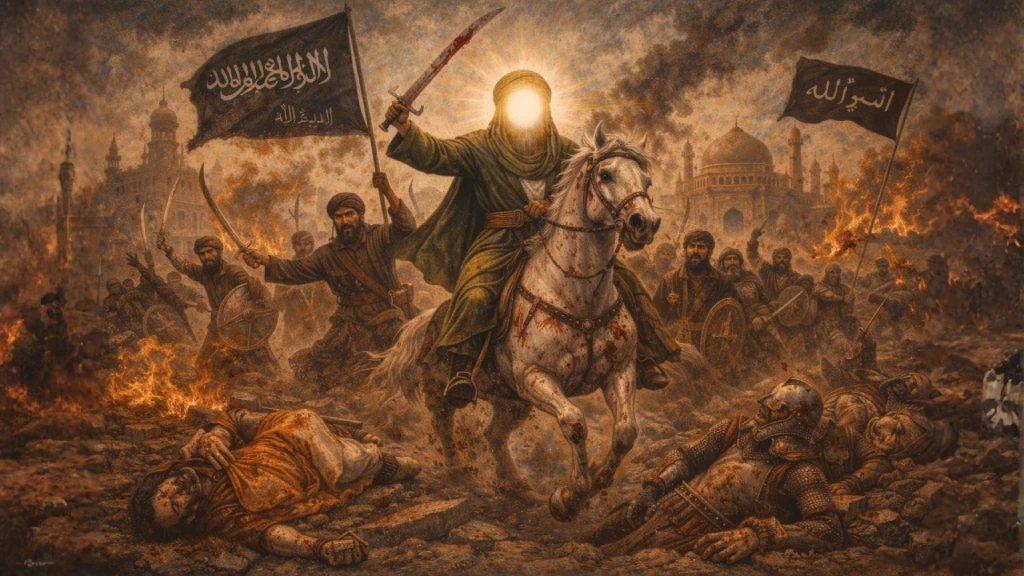
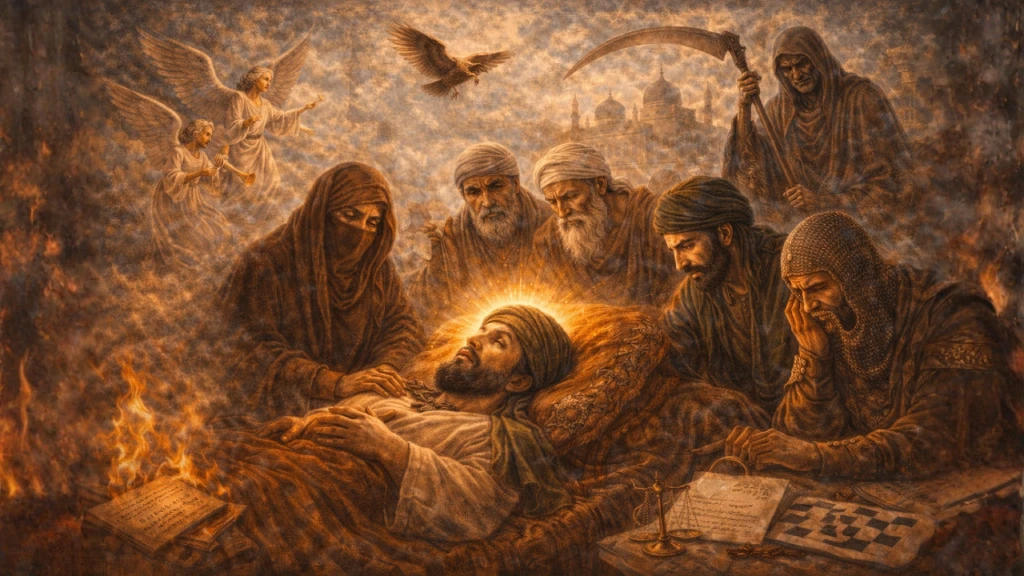
The tragic death of Prophet Muhammad
Introduction
According to Islamic sources, sira, hadith, and early historical accounts themselves, the founder of Islam, Prophet Muhammad, while establishing Islam in Mecca, Medina, and different parts of Arabia, built a political-religious empire through warfare, killing, slavery, plunder, and the seizure of war booty. He turned countless people into male and female slaves, seized their land, property, and settlements; beyond killing prisoners of war and enslaving captives, the moral charges against him are extensive. Even after the husbands, brothers, fathers, and men of the tribes of non-Muslim women had been killed or defeated, he treated those women as war booty and claimed sexual rights over those female slaves, and encouraged the companions to do the same. His jihad campaigns left many people without homes, land, relatives, or freedom; standing on mountains of relatives’ corpses and the ruins of non-Muslim places of worship, the Prophet of Islam built his Islamic empire. After a life built on killing, dispossession, slavery, sexual domination, and war, his own death was also unusually agonizing. According to hadith and sira reports, he died amid prolonged suffering from poisoning, fear of death, physical agony, and domestic conflict. This article discusses how Prophet Muhammad’s death occurred, how that death was related to the poison of Khaybar, and what kinds of questions these events raise about the Islamic claim of prophethood, miraculous protection, and the idea of Allah’s most beloved servant. Readers should verify the cited hadith, sira, tafsir, and historical sources; they should evaluate them critically and rationally. That is what is expected.
Death Agony and the Death of Unbelievers in the Words of Islamic Scholars
Before going into the main discussion, it is important to listen to the statements of a few well-known Bangladeshi scholars. In Islamic discourse, the death of an unbeliever is generally portrayed as terrible, humiliating, and agonizing. Believers are taught that a painful death is a sign of Allah’s displeasure, sin, kufr, or unbelief. But the problem is that, according to Islamic sources, Prophet Muhammad’s own death too was extremely agonizing. Therefore these statements by scholars need to be heard first; the central question of this article is what follows when the same standard is applied to the Prophet’s own death.
Now let us listen to another speaker. Notice how religious explanations are constructed around the pain of death, faith, Allah’s satisfaction, and the Prophet’s death. Although these explanations are used in one way for ordinary people, attempts are suddenly made to give them a different meaning when it comes to Prophet Muhammad. This is where the double standard begins.
Now let us listen to Matiur Rahman Madani. The discussion here about the Prophet’s death agony is important; because within the same religious framework, an unbeliever’s painful death is presented as Allah’s punishment, while the Prophet’s painful death is glorified. The same phenomenon is given two different explanations; logically, that is untenable.
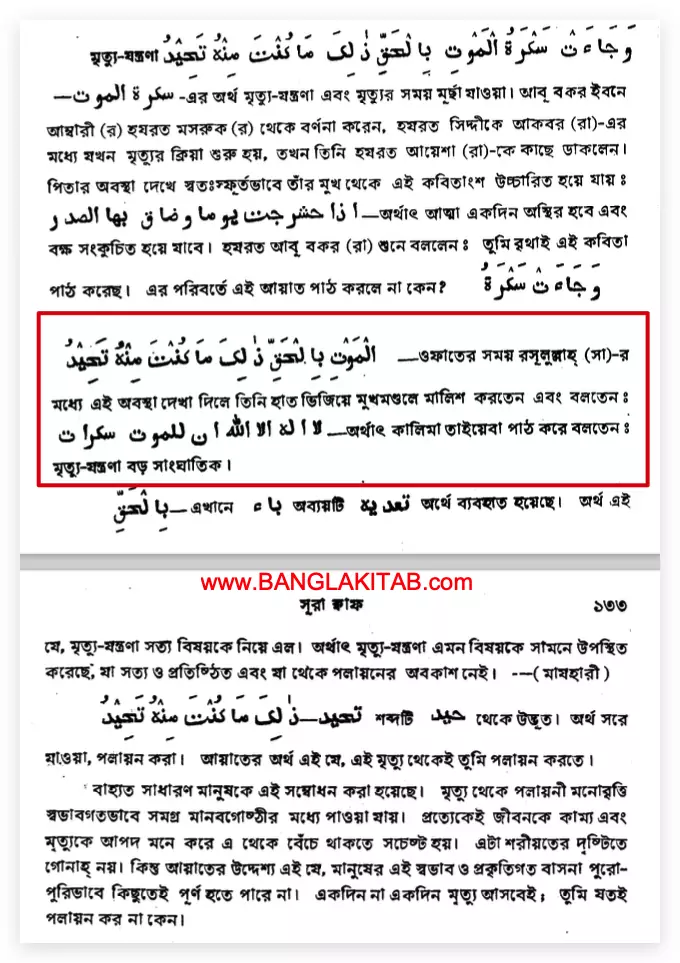
Now let us examine a relevant passage from an Islamic tafsir. If a painful death, death agony, or terrible end is used in Islamic discussion as a sign of sin, kufr, faithlessness, or Allah’s displeasure, then Prophet Muhammad’s own agonizing death cannot be exempted from the same analysis. It is logically inconsistent to argue that everything becomes exceptional in the Prophet’s case while the same phenomenon is treated as Allah’s punishment for ordinary people. [1] –
الْمَوْتِ بِالْحَقِّ ذَلِكَ مَا كُنْتَ مِنْهُ تَحِيدُ
-When this condition appeared in the Messenger of Allah (peace be upon him) at the time of death, he would wet his hand, wipe his face, and say: لا اله الا الله أن للموت سكرات – that is, after reciting the kalimah tayyibah, he would say: death agony is very severe.
The Prophet Sought Guards out of Fear for His Life
A sahih hadith itself reports that despite the claim of complete faith and trust in Allah, and despite the claim that powerful angels such as Jibril and thousands more angelic forces were there to help him, Prophet Muhammad would spend the night awake in fear of enemy attack. He needed a guard because he feared that someone might come and kill him. The matter is important; because the very man who claimed to be Allah’s sent messenger, assisted by angels and miraculously protected, still needed a human guard at night. This contradiction between claims of miraculous protection and the reality of human fear is difficult to reconcile. [2]
Reference : Sahih al-Bukhari 2885
In-book reference : Book 56, Hadith 100
USC-MSA web (English) reference : Vol. 4, Book 52, Hadith 136
Narrated `Aisha:
The Prophet (ﷺ) was vigilant one night and when he reached Medina, he said, “Would that a pious man from my companions guard me tonight!” Suddenly we heard the clatter of arms. He said, “Who is that? ” He (The new comer) replied, ” I am Sa`d bin Abi Waqqas and have come to guard you.” So, the Prophet (ﷺ) slept (that night).
Arabic : حَدَّثَنَا إِسْمَاعِيلُ بْنُ خَلِيلٍ، أَخْبَرَنَا عَلِيُّ بْنُ مُسْهِرٍ، أَخْبَرَنَا يَحْيَى بْنُ سَعِيدٍ، أَخْبَرَنَا عَبْدُ اللَّهِ بْنُ عَامِرِ بْنِ رَبِيعَةَ، قَالَ سَمِعْتُ عَائِشَةَ ـ رضى الله عنها ـ تَقُولُ كَانَ النَّبِيُّ صلى الله عليه وسلم سَهِرَ فَلَمَّا قَدِمَ الْمَدِينَةَ قَالَ ” لَيْتَ رَجُلاً مِنْ أَصْحَابِي صَالِحًا يَحْرُسُنِي اللَّيْلَةَ ”. إِذْ سَمِعْنَا صَوْتَ سِلاَحٍ فَقَالَ ” مَنْ هَذَا ”. فَقَالَ أَنَا سَعْدُ بْنُ أَبِي وَقَّاصٍ، جِئْتُ لأَحْرُسَكَ. وَنَامَ النَّبِيُّ صلى الله عليه وسلم.
The sequence described in this hadith is clear: before the guard came, the Prophet could not sleep; after the guard came, he slept. In other words, real security came from the armed guard of a companion, not from angelic forces or miraculous protection. The Prophet for whom Allah supposedly sent help from the heavens ultimately depended, even for his sleep at night, on a human guard. This shows a sharp contrast between the miraculous claim of prophethood and real human fear.
The Poisoned Sheep at Khaybar
Because one Jewish tribe after another had been expelled from their homelands, their property seized, and brutal military campaigns carried out against several Jewish tribes, intense resentment toward Prophet Muhammad had built up among the Jewish tribes. Especially according to conventional Islamic sira accounts, the killing of hundreds of men of the Banu Qurayza tribe in a single day was, for them, a cause of terrible massacre, humiliation, and revenge. But because they had become weak in numbers and military power, they were no longer capable of direct resistance. After the Khaybar campaign, a Jewish woman named Zaynab bint al-Harith served Prophet Muhammad poisoned mutton. Prophet Muhammad also put some of that meat in his mouth; evidence for this will be given in the following documents. But when the companion Bishr ibn al-Bara died and poisoning was suspected, the Prophet spat out the morsel in his mouth and asked the Jewish woman whether she had mixed poison into the food. The woman’s answer was a brutal test of the claim to prophethood: “If you are truly a prophet, this poison will not be able to harm you. And if you are only an attacking, powerful man, then I have freed people from your grasp.” This answer makes the incident more than a simple assassination attempt; it was the revenge of a woman bereaved of family and relatives, and at the same time a practical test against Muhammad’s claim to prophethood. If he were a true prophet, why would poison work? And if the poison worked, where does the claim of miraculous protection stand?
Let us read this matter from Ibn Ishaq’s famous sira work- [3]
The rest of the story of Khaybar
The stored treasure of Banu al-Nadir was under the custody of Kinana ibn al-Rabi. When he was brought to the Messenger (peace be upon him), he denied it, saying that he did not know where those things were. A Jew came to the Messenger (peace be upon him) and informed him [in al-Tabari’s wording: he was brought] that he had seen Kinana go every morning to a particular place among the ruins. The Messenger (peace be upon him) said to Kinana, “Do you know that if we find proof that all the treasure is with you, you will be killed?”
He said that he knew.
The Messenger (peace be upon him) ordered that the ruins be dug up to obtain the treasure. Some property was found. When the Messenger (peace be upon him) asked him where the remaining treasure was, he refused to say. The Messenger (peace be upon him) ordered al-Zubayr ibn al-Awwam, “Punish him until he brings out what he has.”
Zubayr placed flint and steel on his chest and lit a fire on it. In this condition his end approached. Then the Messenger (peace be upon him) handed him over to Muhammad ibn Maslamah. Muhammad ibn Maslamah beheaded him in revenge for the killing of his brother.
*The Messenger (peace be upon him) besieged the people of Khaybar in two fortresses named al-Watih and al-Sulalim. Then they could no longer withstand it and requested the Messenger (peace be upon him) that if he spared their lives, they would leave. The Messenger (peace be upon him) let them go. Meanwhile, apart from these two fortresses, the Messenger (peace be upon him) took possession of all their other properties: al-Shaqq, Nata, al-Katiba, and all their remaining fortresses. When the people of Fadak learned all the details, they too sent word that if they were not killed, they would leave and hand over all their property to the Messenger (peace be upon him). The Messenger (peace be upon him) agreed. Muhayyisa ibn Mas’ud, the brother of Banu Harithah, mediated in this matter. Under all these conditions, the people of Khaybar surrendered and requested the Messenger (peace be upon him) that if they were allowed to work on their land, they would take half of the produce and give the remaining half to the Messenger (peace be upon him). They said, “We know more than you about the land, and we are better farmers.” The Messenger (peace be upon him) agreed on this condition: “Whenever I wish to expel you, I will expel you.” The same arrangement was made with the people of Fadak. Thus Khaybar became war-won property of the Muslims. And Fadak became the personal property of the Messenger (peace be upon him), because no horse or camel had to go there against it. While the Messenger (peace be upon him) was resting, Zaynab, daughter of al-Harith and wife of Sallam ibn Mishkam, roasted a sheep for him. Before that she asked and learned that the Messenger (peace be upon him) liked to eat the shoulder portion of the sheep. She mixed poison into all the meat, especially into the shoulder portion. Then she served it on the plate of the Messenger (peace be upon him). The Messenger (peace be upon him) took a piece of meat from the shoulder and chewed it but did not swallow it. Bishr ibn al-Bara was with him. He swallowed a piece. The Messenger (peace be upon him) threw out the meat from his mouth and said, “It seems poison has been mixed into this bone.” When he summoned the girl and asked her, she confessed everything. When asked why she had done such a thing, she said, “You know very well what harm you have done to my people. I thought that if he is a king, the trouble will be ended; and if he is a prophet, he will know.”
Hearing this, the Messenger (peace be upon him) released her. Bishr died from the poisoning.
After Khaybar, the Messenger (peace be upon him) besieged Wadi al-Qura for several nights. Then he set out on the road to Medina.
Salim, the freed slave of Abdullah ibn Muti, and through him Thawr ibn Zayd, told me on the authority of Abu Hurayra (may Allah be pleased with him): When we reached Wadi al-Qura from Khaybar, the sun was setting. With the Messenger (peace be upon him) was Rifa ibn Zayd, a slave given by the Dubaybi tribe. He was unloading the saddle from the Messenger’s camel when an arrow came from somewhere and struck his body, and he died from it. When we congratulated him for gaining Paradise, the Messenger (peace be upon him) said, “He will not go to Paradise. The cloak is now burning him in Hell. On the day of Khaybar he had stolen it from the Muslims’ war booty.” One of his companions came and said, “But I had taken two sandal straps.” He said, “Two such straps of fire will be cut for you.”
A person whom I do not doubt told me on the authority of Abdullah ibn Mughaffal al-Muzani, “I was carrying a bag of fat from the war booty of Khaybar on my shoulder. On the way, people seized me and said, this will be divided among the Muslims.” I said, I will not allow that. The Messenger (peace be upon him) saw this tugging and said, “Oh, leave him.” They released me. I went to my companions and distributed it among everyone.
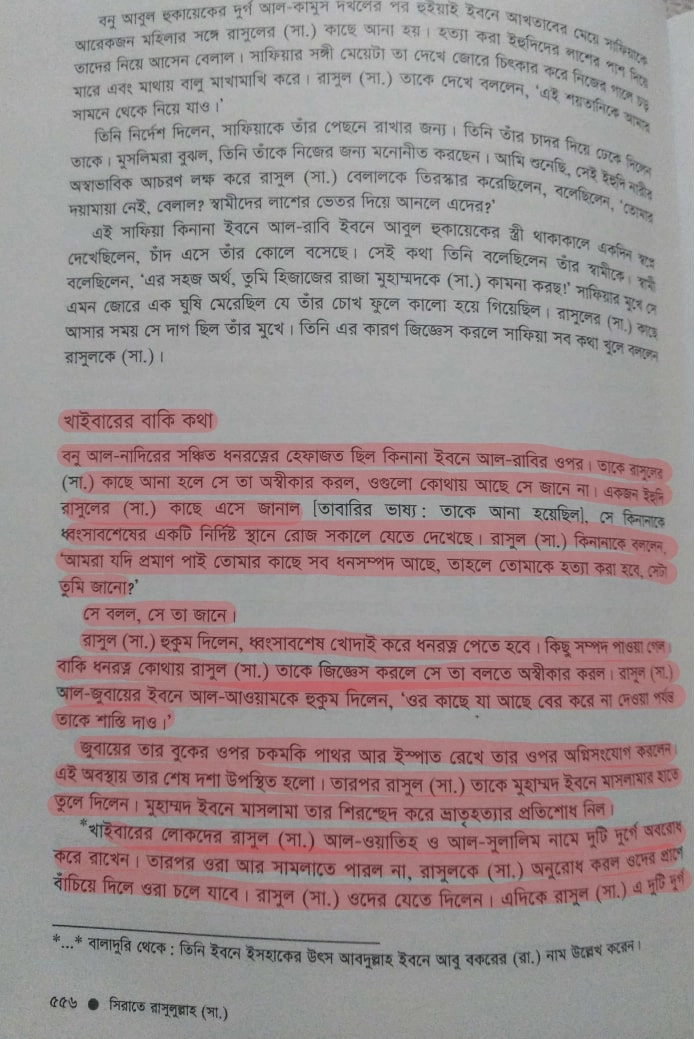
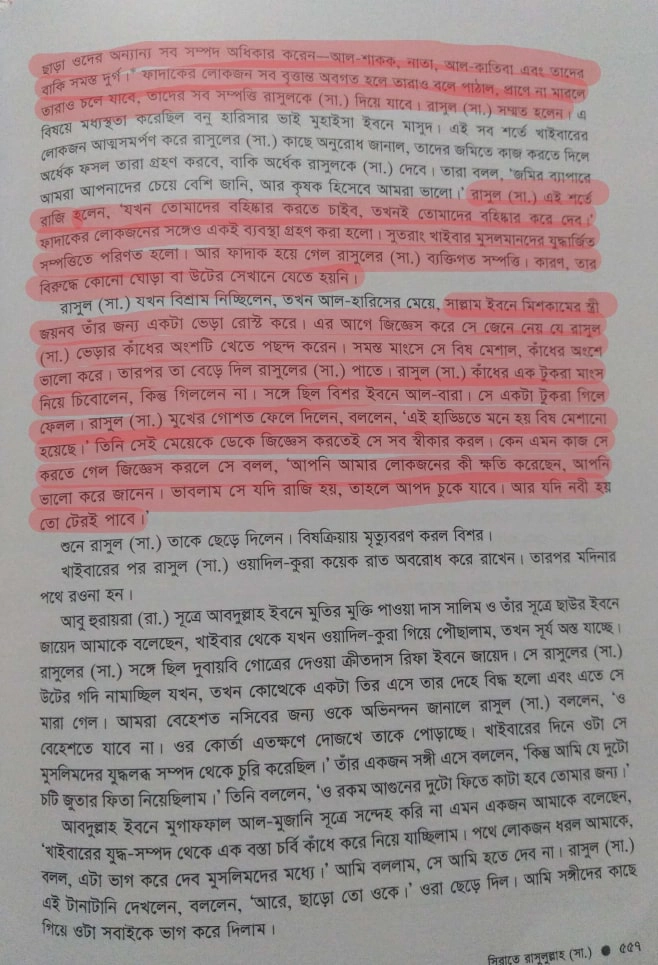
This event is also found in volume 8, page 124 of al-Tabari [4].
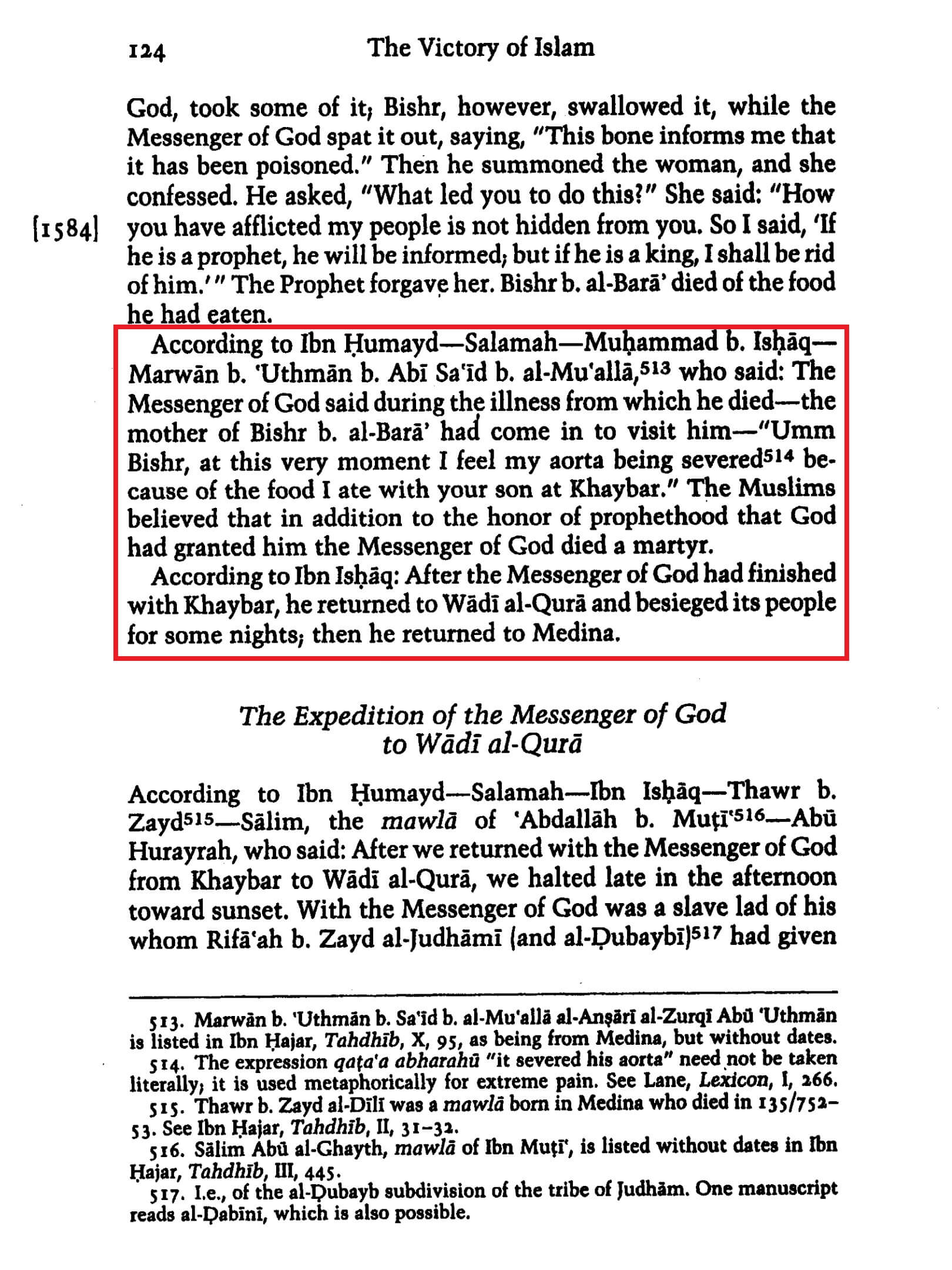
Physical Signs of Poisoning in the Prophet
The most important question here is whether the poisoned meat given by the Jewish woman caused any harm to Prophet Muhammad’s body. Because the Jewish woman had said very clearly that if Muhammad truly was a prophet, that poison would not be able to harm him. In other words, the incident was not merely an assassination attempt; in one sense it was a practical test against Muhammad’s claim to prophethood. Now the question is: did the poison actually affect Muhammad physically? From hadith itself we learn that the poison physically harmed Muhammad and that he continued to suffer from its effects until his death. [5],
Reference : Sunan Abi Dawud 4512
In-book reference : Book 41, Hadith 19
English translation : Book 40, Hadith 4497
Narrated Abu Hurairah:
The Messenger of Allah (ﷺ) would accept a present, but would not accept alms (sadaqah). And Wahb bin Baqiyyah narrated to us, elsewhere, from Khalid, from Muhammad ibn Amr said on the authority of AbuSalamah, and he did not mention the name of Abu Hurairah: The Messenger of Allah (ﷺ) used to accept presents but not alms (sadaqah).
This version adds: So a Jewess presented him at Khaybar with a roasted sheep which she had poisoned. The Messenger of Allah (ﷺ) ate of it and the people also ate.
He then said: Take away your hands (from the food), for it has informed me that it is poisoned. Bishr ibn al-Bara’ ibn Ma’rur al-Ansari died.
So he (the Prophet) sent for the Jewess (and said to her): What motivated you to do the work you have done?
She said: If you were a prophet, it would not harm you; but if you were a king, I should rid the people of you. The Messenger of Allah (ﷺ) then ordered regarding her and she was killed. He then said about the pain of which he died: I continued to feel pain from the morsel which I had eaten at Khaybar. This is the time when it has cut off my aorta.
Arabic : حَدَّثَنَا وَهْبُ بْنُ بَقِيَّةَ، عَنْ خَالِدٍ، عَنْ مُحَمَّدِ بْنِ عَمْرٍو، عَنْ أَبِي سَلَمَةَ، عَنْ أَبِي هُرَيْرَةَ، قَالَ كَانَ رَسُولُ اللَّهِ صلى الله عليه وسلم يَقْبَلُ الْهَدِيَّةَ وَلاَ يَأْكُلُ الصَّدَقَةَ . وَحَدَّثَنَا وَهْبُ بْنُ بَقِيَّةَ فِي مَوْضِعٍ آخَرَ عَنْ خَالِدٍ عَنْ مُحَمَّدِ بْنِ عَمْرٍو عَنْ أَبِي سَلَمَةَ وَلَمْ يَذْكُرْ أَبَا هُرَيْرَةَ قَالَ كَانَ رَسُولُ اللَّهِ صلى الله عليه وسلم يَقْبَلُ الْهَدِيَّةَ وَلاَ يَأْكُلُ الصَّدَقَةَ . زَادَ فَأَهْدَتْ لَهُ يَهُودِيَّةٌ بِخَيْبَرَ شَاةً مَصْلِيَّةً سَمَّتْهَا فَأَكَلَ رَسُولُ اللَّهِ صلى الله عليه وسلم مِنْهَا وَأَكَلَ الْقَوْمُ فَقَالَ ” ارْفَعُوا أَيْدِيَكُمْ فَإِنَّهَا أَخْبَرَتْنِي أَنَّهَا مَسْمُومَةٌ ” . فَمَاتَ بِشْرُ بْنُ الْبَرَاءِ بْنِ مَعْرُورٍ الأَنْصَارِيُّ فَأَرْسَلَ إِلَى الْيَهُودِيَّةِ ” مَا حَمَلَكِ عَلَى الَّذِي صَنَعْتِ ” . قَالَتْ إِنْ كُنْتَ نَبِيًّا لَمْ يَضُرَّكَ الَّذِي صَنَعْتُ وَإِنْ كُنْتَ مَلِكًا أَرَحْتُ النَّاسَ مِنْكَ . فَأَمَرَ بِهَا رَسُولُ اللَّهِ صلى الله عليه وسلم فَقُتِلَتْ ثُمَّ قَالَ فِي وَجَعِهِ الَّذِي مَاتَ فِيهِ ” مَا زِلْتُ أَجِدُ مِنَ الأَكْلَةِ الَّتِي أَكَلْتُ بِخَيْبَرَ فَهَذَا أَوَانُ قَطَعَتْ أَبْهَرِي ” .
Grade: Hasan Sahih (Al-Albani)
That Prophet Muhammad had put some part of the poisoned meat into his mouth, that it had entered his body, and that it had physically harmed him, is proven by another sahih hadith. Visible symptoms of poisoning appeared in his body. According to a sahih hadith of a famous companion, Anas reported that he continued to see the effects of the poison on the Prophet’s uvula and palate. In other words, the poison was not simply tasted and spat out; its effect remained in the Prophet’s body, and it was visible. [6] –
Reference : Sahih Muslim 2190a
In-book reference : Book 39, Hadith 59
USC-MSA web (English) reference : Book 26, Hadith 5430
Anas reported that a Jewess came to Allah’s Messenger (ﷺ) with poisoned mutton and he took of that what had been brought to him (Allah’s Messenger). (When the effect of this poison were felt by him) he called for her and asked her about that, whereupon she said:
I had determined to kill you. Thereupon he said: Allah will never give you the power to do it. He (the narrator) said that they (the Companion’s of the Holy Prophet) said: Should we not kill her? Thereupon he said: No. He (Anas) said: I felt (the affects of this poison) on the uvula of Allah’s Messenger.
Arabic : حَدَّثَنَا يَحْيَى بْنُ حَبِيبٍ الْحَارِثِيُّ، حَدَّثَنَا خَالِدُ بْنُ الْحَارِثِ، حَدَّثَنَا شُعْبَةُ، عَنْ هِشَامِ، بْنِ زَيْدٍ عَنْ أَنَسٍ، أَنَّ امْرَأَةً، يَهُودِيَّةً أَتَتْ رَسُولَ اللَّهِ صلى الله عليه وسلم بِشَاةٍ مَسْمُومَةٍ فَأَكَلَ مِنْهَا فَجِيءَ بِهَا إِلَى رَسُولِ اللَّهِ صلى الله عليه وسلم فَسَأَلَهَا عَنْ ذَلِكَ فَقَالَتْ أَرَدْتُ لأَقْتُلَكَ . قَالَ ” مَا كَانَ اللَّهُ لِيُسَلِّطَكِ عَلَى ذَاكِ ” . قَالَ أَوْ قَالَ ” عَلَىَّ ” . قَالَ قَالُوا أَلاَ نَقْتُلُهَا قَالَ ” لاَ ” . قَالَ فَمَا زِلْتُ أَعْرِفُهَا فِي لَهَوَاتِ رَسُولِ اللَّهِ صلى الله عليه وسلم .
The hadith is found in Sahih Muslim [7]
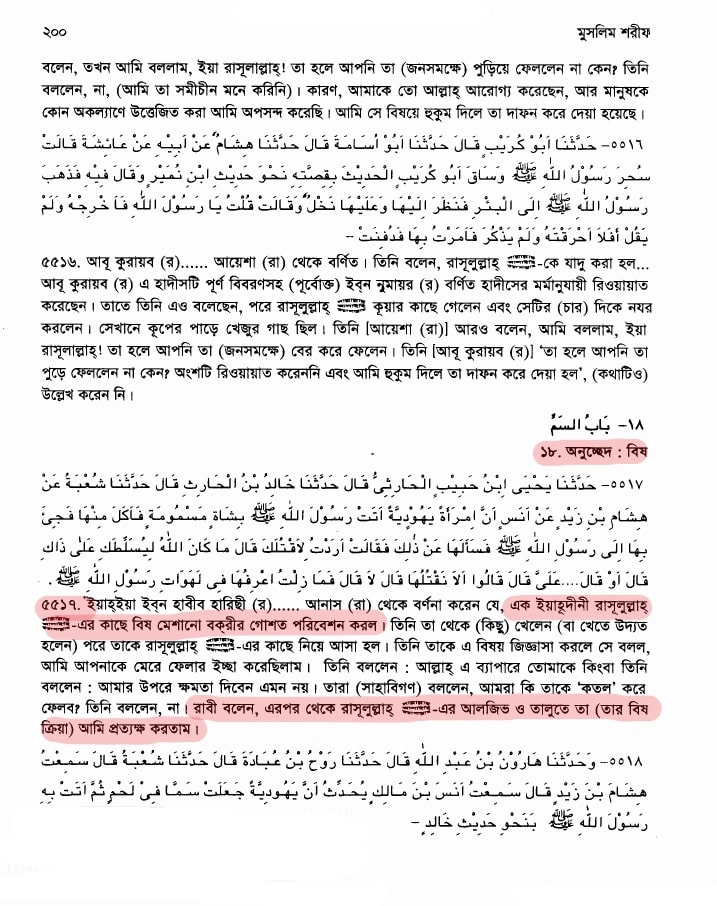
You will find this same hadith in Sunan Abu Dawud as well [8] –
Reference : Sunan Abi Dawud 4508
In-book reference : Book 41, Hadith 15
English translation : Book 40, Hadith 4493
Narrated Anas bin Malik:
A Jewess brought a poisoned sheep to the Messenger of Allah (ﷺ), and he ate of it. She was then brought to the Messenger of Allah (ﷺ) who asked her about it. She said: I intended to kill you. He said: Allah will not give you control over it ; or he said : over me. They (the Companions) said: Should we not kill her ? He said: No. He (Anas) said: I always found it in the uvula of the Messenger of Allah (ﷺ)
Arabic : حَدَّثَنَا يَحْيَى بْنُ حَبِيبِ بْنِ عَرَبِيٍّ، حَدَّثَنَا خَالِدُ بْنُ الْحَارِثِ، حَدَّثَنَا شُعْبَةُ، عَنْ هِشَامِ بْنِ زَيْدٍ، عَنْ أَنَسِ بْنِ مَالِكٍ، أَنَّ امْرَأَةً، يَهُودِيَّةً أَتَتْ رَسُولَ اللَّهِ صلى الله عليه وسلم بِشَاةٍ مَسْمُومَةٍ فَأَكَلَ مِنْهَا فَجِيءَ بِهَا إِلَى رَسُولِ اللَّهِ صلى الله عليه وسلم فَسَأَلَهَا عَنْ ذَلِكَ فَقَالَتْ أَرَدْتُ لأَقْتُلَكَ . فَقَالَ ” مَا كَانَ اللَّهُ لِيُسَلِّطَكِ عَلَى ذَلِكَ ” . أَوْ قَالَ ” عَلَىَّ ” . قَالَ فَقَالُوا أَلاَ نَقْتُلُهَا قَالَ ” لاَ ” . فَمَا زِلْتُ أَعْرِفُهَا فِي لَهَوَاتِ رَسُولِ اللَّهِ صلى الله عليه وسلم .
Grade: Sahih (Al-Albani)
It should be noted that the Jewish woman had directly challenged the Prophet: if he truly was a prophet, the poison would not be able to harm him. Therefore the event was not only an assassination attempt; it was a cruel practical test against the claim of prophethood. She was not killed at first; later reports say she was killed for the death of Bishr ibn al-Bara. Thus the question remains: if this event was Allah’s plan to give the Prophet “the rank of martyrdom,” then where was the woman’s crime?
The hadith is found in [9]
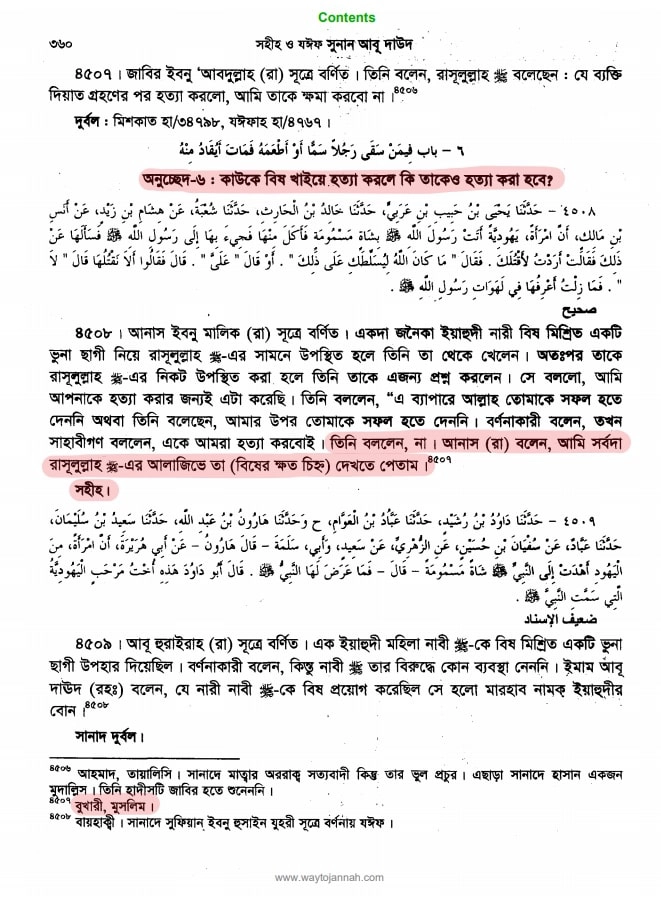
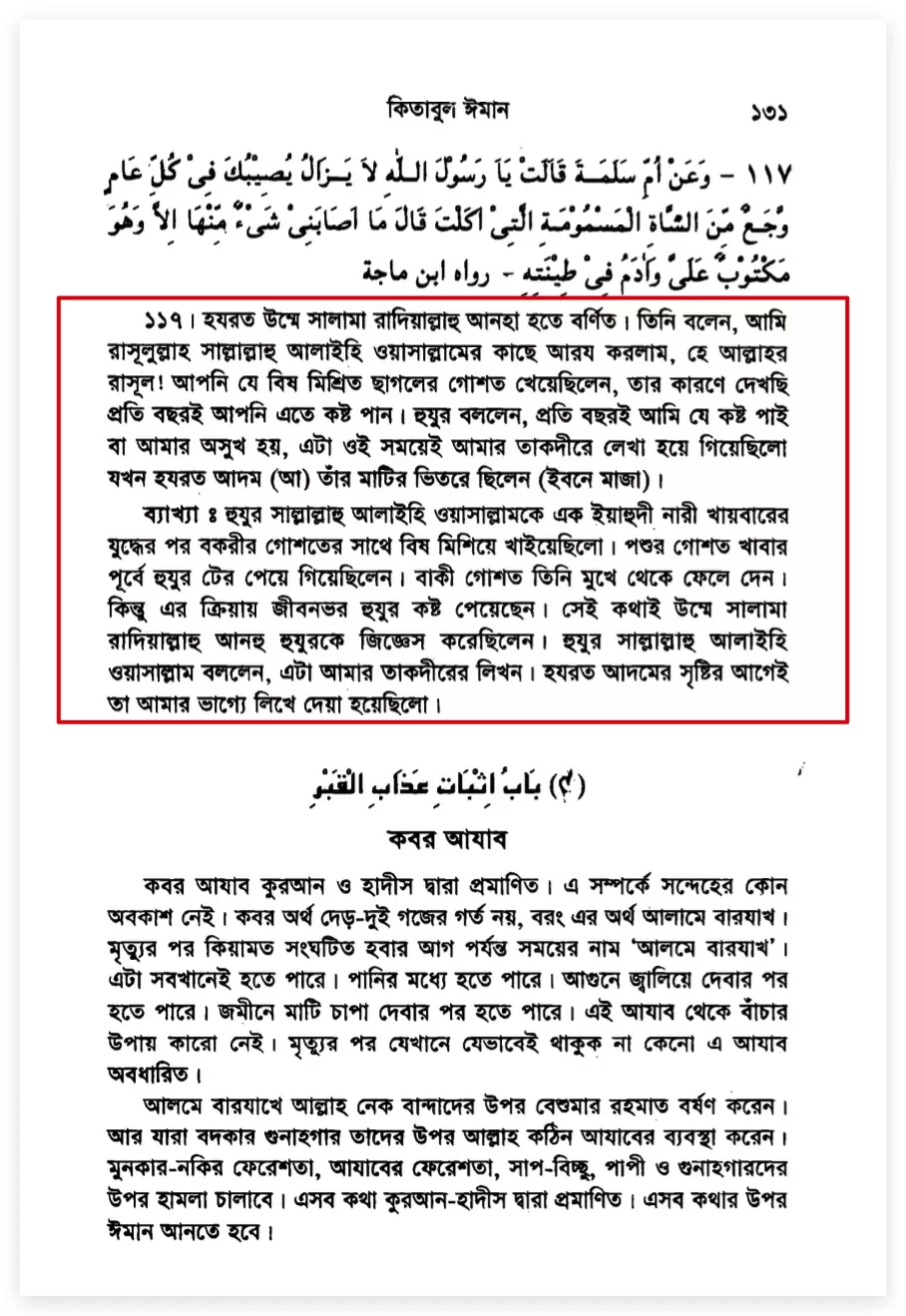
Now let us read a hadith and its explanation from Mishkat Sharif, [10]
Failed Spiritual Treatment for the Poisoning
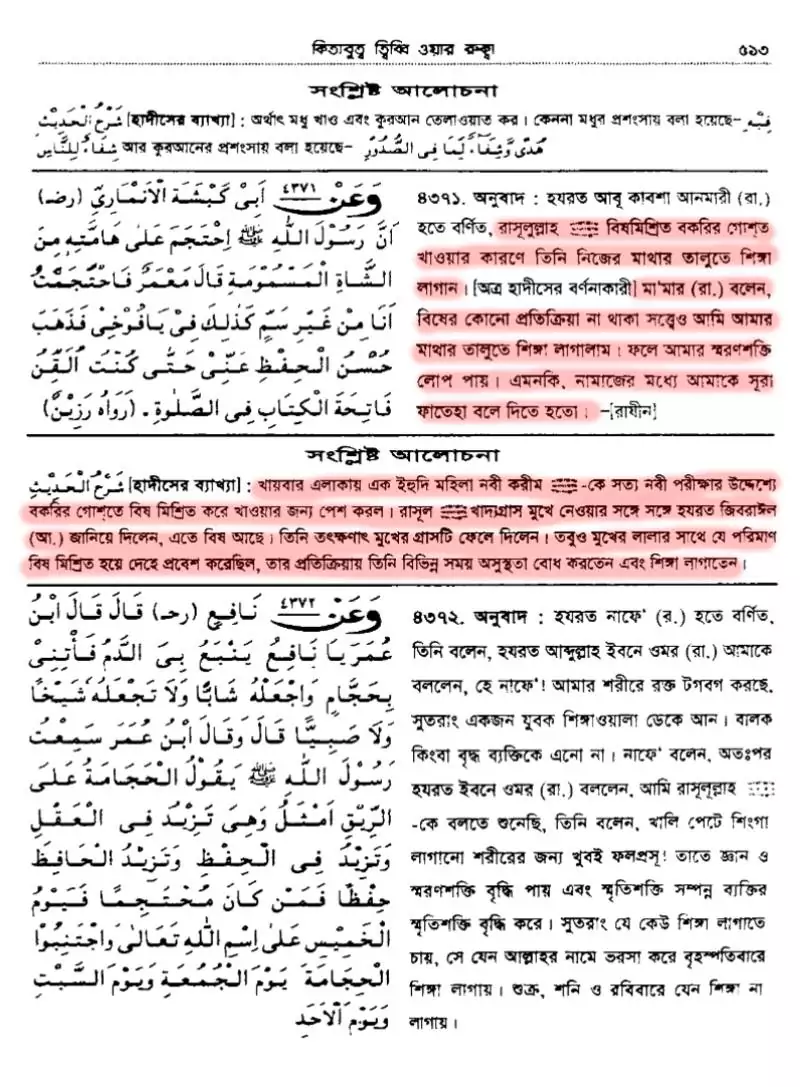
Even though Prophet Muhammad claimed to be the messenger of Almighty Allah, the creator of this vast universe, and the most important figure among all angels, jinn, and human beings, neither Allah nor any angelic or jinn force warned him about the poisoned mutton at Khaybar. The matter is highly suspicious. Muhammad was supposedly the closest friend of the creator of such a vast universe, a prophet at whose gesture the moon supposedly split in two, to whom limitless miracles are attributed, and whose rank is held to exceed that of humans, angels, and jinn; if Allah or the angels had warned him just a little earlier, he could have been spared an agonizing death from poisoning. Afterwards, Prophet Muhammad made repeated attempts to recover, but without success. Poison does not distinguish between prophet, messenger, or ordinary human being; it simply follows its natural effects. The hadith below is proof of that [11] –
Reference : Sahih al-Bukhari 5735
In-book reference : Book 76, Hadith 50
USC-MSA web (English) reference : Vol. 7, Book 71, Hadith 631
Narrated `Aisha:
During the Prophet’s fatal illness, he used to recite the Mu’auwidhat (Surat An-Nas and Surat Al- Falaq) and then blow his breath over his body. When his illness was aggravated, I used to recite those two Suras and blow my breath over him and make him rub his body with his own hand for its blessings.” (Ma`mar asked Az-Zuhri: How did the Prophet (ﷺ) use to blow? Az-Zuhri said: He used to blow on his hands and then passed them over his face.)
Arabic : حَدَّثَنِي إِبْرَاهِيمُ بْنُ مُوسَى، أَخْبَرَنَا هِشَامٌ، عَنْ مَعْمَرٍ، عَنِ الزُّهْرِيِّ، عَنْ عُرْوَةَ، عَنْ عَائِشَةَ ـ رضى الله عنها ـ أَنَّ النَّبِيَّ صلى الله عليه وسلم كَانَ يَنْفُثُ عَلَى نَفْسِهِ فِي الْمَرَضِ الَّذِي مَاتَ فِيهِ بِالْمُعَوِّذَاتِ، فَلَمَّا ثَقُلَ كُنْتُ أَنْفِثُ عَلَيْهِ بِهِنَّ، وَأَمْسَحُ بِيَدِ نَفْسِهِ لِبَرَكَتِهَا. فَسَأَلْتُ الزُّهْرِيَّ كَيْفَ يَنْفِثُ قَالَ كَانَ يَنْفِثُ عَلَى يَدَيْهِ، ثُمَّ يَمْسَحُ بِهِمَا وَجْهَهُ.
Now let us read a hadith and its explanation from Anwarul Mishkat Sharh Mishkat al-Masabih, [12]
Prophet Muhammad’s Tragic Death
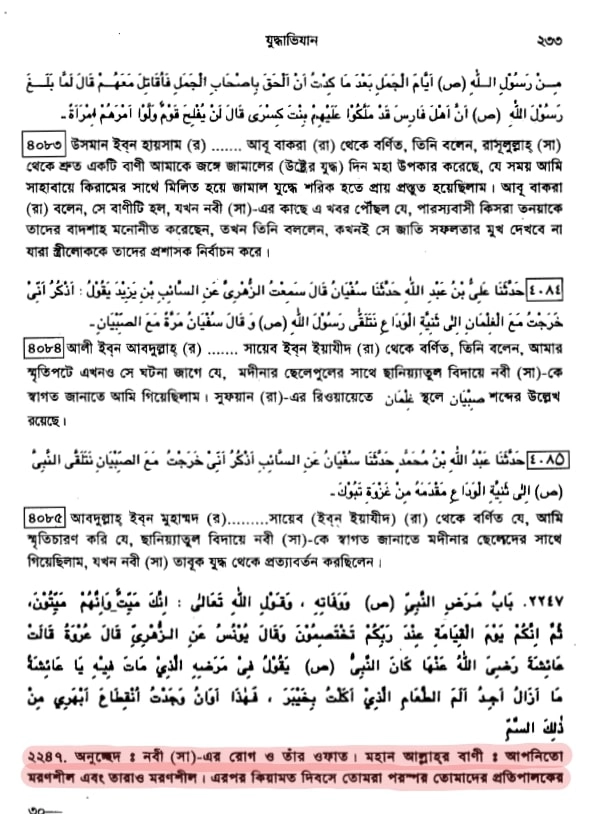
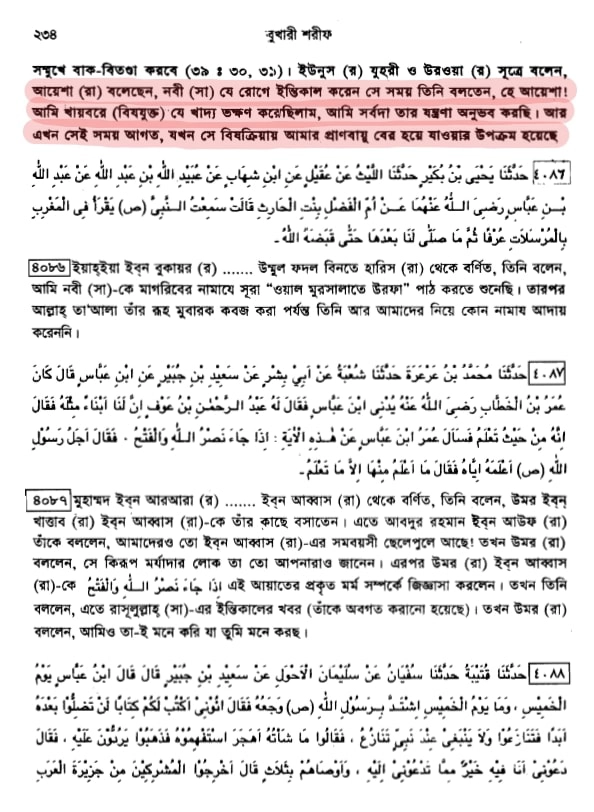
Now let us see how Prophet Muhammad, the supposedly most beloved human being and most beloved messenger of Almighty Allah, the creator of the universe, died [13]
Reference : Sahih al-Bukhari 4428
In-book reference : Book 64, Hadith 450
USC-MSA web (English) reference : Vol. 5, Book 59, Hadith 713
Narrated `Aisha:
The Prophet (ﷺ) in his ailment in which he died, used to say, “O `Aisha! I still feel the pain caused by the food I ate at Khaibar, and at this time, I feel as if my aorta is being cut from that poison.”
Arabic : وَقَالَ يُونُسُ عَنِ الزُّهْرِيِّ، قَالَ عُرْوَةُ قَالَتْ عَائِشَةُ ـ رضى الله عنها ـ كَانَ النَّبِيُّ صلى الله عليه وسلم يَقُولُ فِي مَرَضِهِ الَّذِي مَاتَ فِيهِ “ يَا عَائِشَةُ مَا أَزَالُ أَجِدُ أَلَمَ الطَّعَامِ الَّذِي أَكَلْتُ بِخَيْبَرَ، فَهَذَا أَوَانُ وَجَدْتُ انْقِطَاعَ أَبْهَرِي مِنْ ذَلِكَ السَّمِّ ”.
The hadith is found in Sahih al-Bukhari [14]
Aisha, the Prophet’s young wife, also reports that Muhammad’s death was terribly painful. [15]
Reference : Sahih al-Bukhari 5646
In-book reference : Book 75, Hadith 6
USC-MSA web (English) reference : Vol. 7, Book 70, Hadith 549
Narrated Aisha:
I never saw anybody suffering so much from sickness as Allah’s Messenger (ﷺ).
Arabic : حَدَّثَنَا قَبِيصَةُ، حَدَّثَنَا سُفْيَانُ، عَنِ الأَعْمَشِ،. حَدَّثَنِي بِشْرُ بْنُ مُحَمَّدٍ، أَخْبَرَنَا عَبْدُ اللَّهُ، أَخْبَرَنَا شُعْبَةُ، عَنِ الأَعْمَشِ، عَنْ أَبِي وَائِلٍ، عَنْ مَسْرُوقٍ، عَنْ عَائِشَةَ ـ رضى الله عنها ـ قَالَتْ مَا رَأَيْتُ أَحَدًا أَشَدَّ عَلَيْهِ الْوَجَعُ مِنْ رَسُولِ اللَّهِ صلى الله عليه وسلم.
Prophet Muhammad’s daughter Fatima was also distressed by witnessing his death agony. From this hadith it can be understood how intensely the Prophet suffered at his death [16]-
Reference : Sunan Ibn Majah 1629
In-book reference : Book 6, Hadith 197
English translation : Vol. 1, Book 6, Hadith 1629
It was narrated that Anas bin Malik said:
“When the Messenger of Allah (ﷺ) suffered the agonies of death that he suffered, Fatimah said: ‘O my father, what a severe agony!’ The Messenger of Allah (ﷺ) said: ‘Your father will suffer no more agony after this day. There has come to your father that which no one can avoid, the death that everyone will encounter until the Day of Resurrection.'”
Arabic : حَدَّثَنَا نَصْرُ بْنُ عَلِيٍّ، حَدَّثَنَا عَبْدُ اللَّهِ بْنُ الزُّبَيْرِ أَبُو الزُّبَيْرِ، حَدَّثَنَا ثَابِتٌ الْبُنَانِيُّ، عَنْ أَنَسِ بْنِ مَالِكٍ، قَالَ لَمَّا وَجَدَ رَسُولُ اللَّهِ ـ صلى الله عليه وسلم ـ مِنْ كَرْبِ الْمَوْتِ مَا وَجَدَ قَالَتْ فَاطِمَةُ وَاكَرْبَ أَبَتَاهْ . فَقَالَ رَسُولُ اللَّهِ ـ صلى الله عليه وسلم ـ “ لاَ كَرْبَ عَلَى أَبِيكِ بَعْدَ الْيَوْمِ إِنَّهُ قَدْ حَضَرَ مِنْ أَبِيكِ مَا لَيْسَ بِتَارِكٍ مِنْهُ أَحَدًا الْمُوَافَاةُ يَوْمَ الْقِيَامَةِ ” .
Grade: Sahih (Darussalam)
The hadith is found in Sunan Ibn Majah Sharif [17]
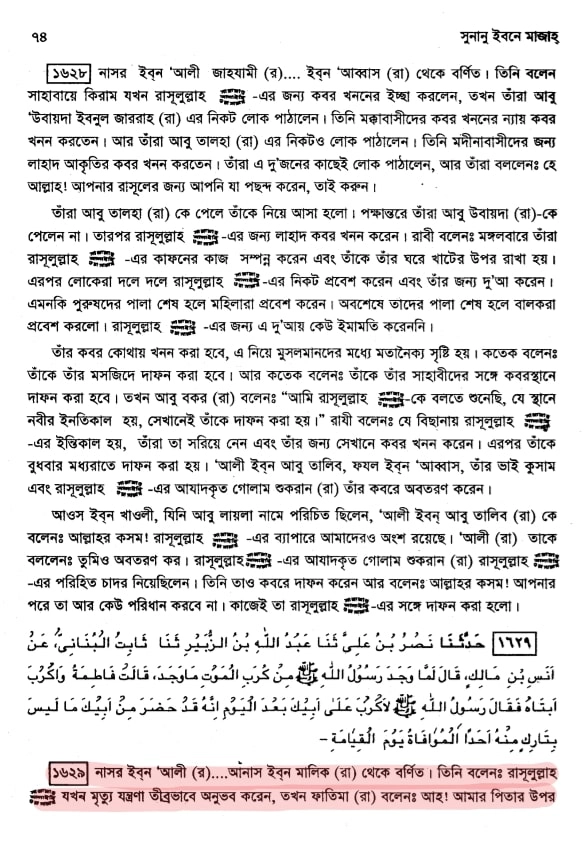
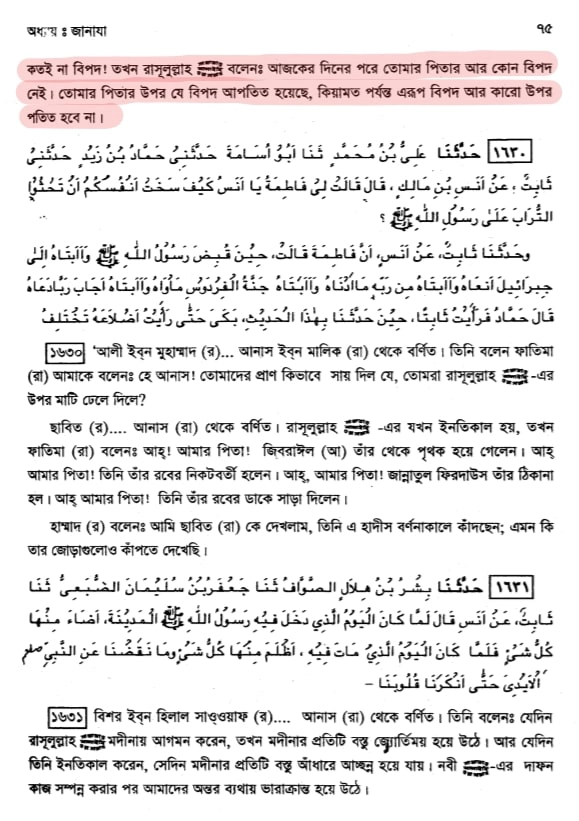
The Prophet’s beloved wife Aisha also said that the Prophet’s death agony was terrible. After witnessing the severity of his death, Aisha said she never again envied anyone who died easily [18]
Reference : Jami` at-Tirmidhi 979
In-book reference : Book 10, Hadith 15
English translation : Vol. 2, Book 5, Hadith 979
Aishah narrated:
“I was not envious of anyone whose death was easy after I saw the severity the death of the Messenger of Allah.”
Arabic : حَدَّثَنَا الْحَسَنُ بْنُ الصَّبَّاحِ الْبَغْدَادِيُّ، حَدَّثَنَا مُبَشِّرُ بْنُ إِسْمَاعِيلَ الْحَلَبِيُّ، عَنْ عَبْدِ الرَّحْمَنِ بْنِ الْعَلاَءِ، عَنْ أَبِيهِ، عَنِ ابْنِ عُمَرَ، عَنْ عَائِشَةَ، قَالَتْ مَا أَغْبِطُ أَحَدًا بِهَوْنِ مَوْتٍ بَعْدَ الَّذِي رَأَيْتُ مِنْ شِدَّةِ مَوْتِ رَسُولِ اللَّهِ صلى الله عليه وسلم . قَالَ سَأَلْتُ أَبَا زُرْعَةَ عَنْ هَذَا الْحَدِيثِ وَقُلْتُ لَهُ مَنْ عَبْدُ الرَّحْمَنِ بْنُ الْعَلاَءِ فَقَالَ هُوَ ابْنُ الْعَلاَءِ بْنِ اللَّجْلاَجِ . وَإِنَّمَا عَرَّفَهُ مِنْ هَذَا الْوَجْهِ .
The hadith is found in Tirmidhi Sharif [19]
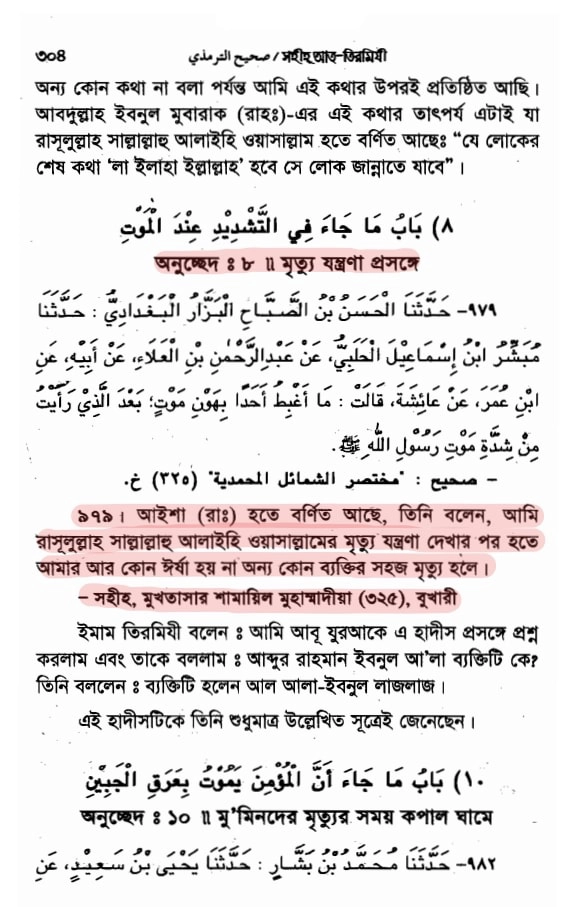
Needless to say, from these hadiths it is clearly understood that Muhammad’s death was many times more agonizing than the death of any ordinary person. Let us read another hadith from Sunan Nasai Sharif [20]-
Reference : Sunan an-Nasa’i 1830
In-book reference : Book 21, Hadith 13
English translation : Vol. 3, Book 21, Hadith 1831
It was narrated that ‘Aishah said:
“The Messenger of Allah died while he was between my chest and my chin, and I never disliked the agony of death for anyone after I saw the Messenger of Allah. “
Arabic : أَخْبَرَنَا عَمْرُو بْنُ مَنْصُورٍ، قَالَ حَدَّثَنَا عَبْدُ اللَّهِ بْنُ يُوسُفَ، قَالَ حَدَّثَنِي اللَّيْثُ، قَالَ حَدَّثَنِي ابْنُ الْهَادِ، عَنْ عَبْدِ الرَّحْمَنِ بْنِ الْقَاسِمِ، عَنْ أَبِيهِ، عَنْ عَائِشَةَ، قَالَتْ مَاتَ رَسُولُ اللَّهِ صلى الله عليه وسلم وَإِنَّهُ لَبَيْنَ حَاقِنَتِي وَذَاقِنَتِي فَلاَ أَكْرَهُ شِدَّةَ الْمَوْتِ لأَحَدٍ أَبَدًا بَعْدَ مَا رَأَيْتُ رَسُولَ اللَّهِ صلى الله عليه وسلم .
The Prophet on the Agonies of Death
While suffering the agonies of death, Prophet Muhammad himself said that death has its agonies. Let us listen to a sermon and then read the relevant hadith, [21] –
Reference : Sahih al-Bukhari 4449
In-book reference : Book 64, Hadith 469
USC-MSA web (English) reference : Vol. 5, Book 59, Hadith 730
Narrated Aisha:
It was one of the favors of Allah towards me that Allah’s Messenger (ﷺ) expired in my house on the day of my turn while he was leaning against my chest and Allah made my saliva mix with his saliva at his death. `Abdur-Rahman entered upon me with a Siwak in his hand and I was supporting (the back of) Allah’s Messenger (ﷺ) (against my chest ). I saw the Prophet (ﷺ) looking at it (i.e. Siwak) and I knew that he loved the Siwak, so I said ( to him ), “Shall I take it for you ? ” He nodded in agreement. So I took it and it was too stiff for him to use, so I said, “Shall I soften it for you ?” He nodded his approval. So I softened it and he cleaned his teeth with it. In front of him there was a jug or a tin, (The sub-narrator, `Umar is in doubt as to which was right) containing water. He started dipping his hand in the water and rubbing his face with it, he said, “None has the right to be worshipped except Allah. Death has its agonies.” He then lifted his hands (towards the sky) and started saying, “With the highest companion,” till he expired and his hand dropped down.
Arabic : حَدَّثَنِي مُحَمَّدُ بْنُ عُبَيْدٍ، حَدَّثَنَا عِيسَى بْنُ يُونُسَ، عَنْ عُمَرَ بْنِ سَعِيدٍ، قَالَ أَخْبَرَنِي ابْنُ أَبِي مُلَيْكَةَ، أَنَّ أَبَا عَمْرٍو، ذَكْوَانَ مَوْلَى عَائِشَةَ أَخْبَرَهُ أَنَّ عَائِشَةَ كَانَتْ تَقُولُ إِنَّ مِنْ نِعَمِ اللَّهِ عَلَىَّ أَنَّ رَسُولَ اللَّهِ صلى الله عليه وسلم تُوُفِّيَ فِي بَيْتِي وَفِي يَوْمِي، وَبَيْنَ سَحْرِي وَنَحْرِي، وَأَنَّ اللَّهَ جَمَعَ بَيْنَ رِيقِي وَرِيقِهِ عِنْدَ مَوْتِهِ، دَخَلَ عَلَىَّ عَبْدُ الرَّحْمَنِ وَبِيَدِهِ السِّوَاكُ وَأَنَا مُسْنِدَةٌ رَسُولَ اللَّهِ صلى الله عليه وسلم فَرَأَيْتُهُ يَنْظُرُ إِلَيْهِ، وَعَرَفْتُ أَنَّهُ يُحِبُّ السِّوَاكَ فَقُلْتُ آخُذُهُ لَكَ فَأَشَارَ بِرَأْسِهِ أَنْ نَعَمْ، فَتَنَاوَلْتُهُ فَاشْتَدَّ عَلَيْهِ وَقُلْتُ أُلَيِّنُهُ لَكَ فَأَشَارَ بِرَأْسِهِ أَنْ نَعَمْ، فَلَيَّنْتُهُ، وَبَيْنَ يَدَيْهِ رَكْوَةٌ ـ أَوْ عُلْبَةٌ يَشُكُّ عُمَرُ ـ فِيهَا مَاءٌ، فَجَعَلَ يُدْخِلُ يَدَيْهِ فِي الْمَاءِ فَيَمْسَحُ بِهِمَا وَجْهَهُ يَقُولُ ” لاَ إِلَهَ إِلاَّ اللَّهُ، إِنَّ لِلْمَوْتِ سَكَرَاتٍ ”. ثُمَّ نَصَبَ يَدَهُ فَجَعَلَ يَقُولُ ” فِي الرَّفِيقِ الأَعْلَى ” . حَتَّى قُبِضَ وَمَالَتْ يَدُهُ.
Now let us read an account from Imam al-Ghazali’s famous work Ihya Ulum al-Din [22]
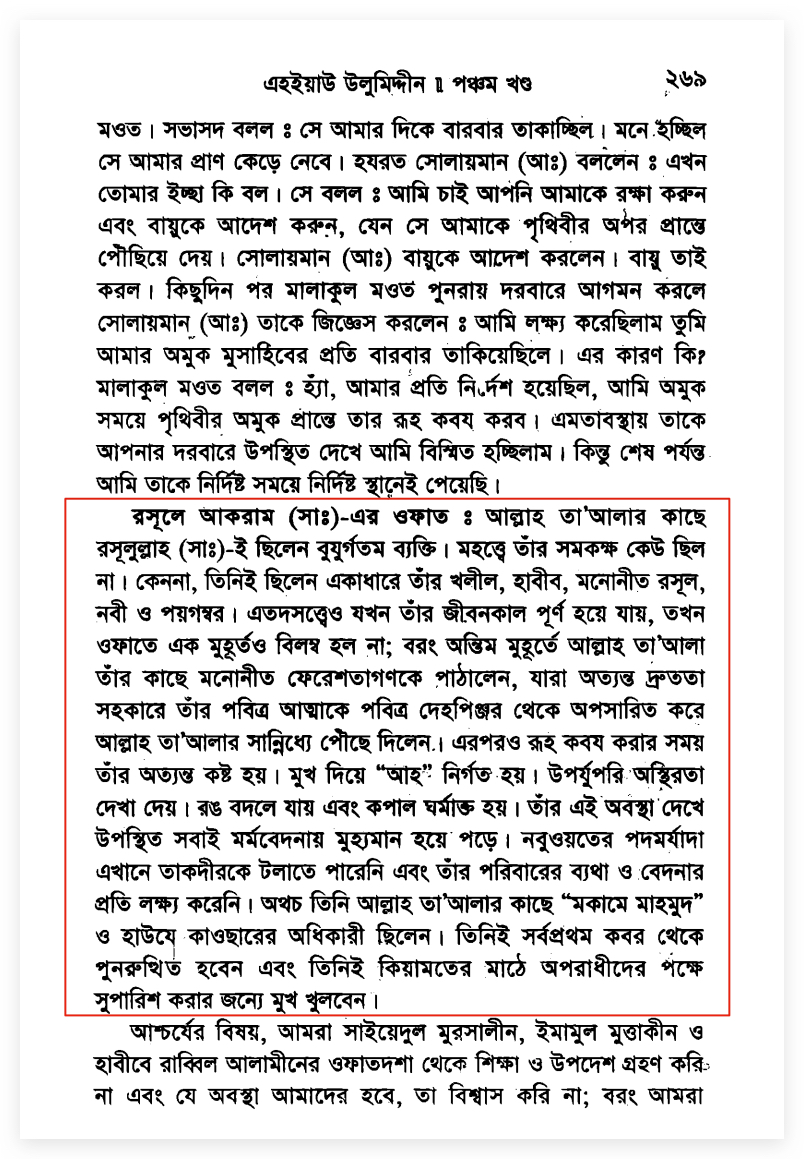
Death Four Years After Poisoning?
A question may naturally arise: can Muhammad’s death four years after consuming poison be counted as death by poisoning? We have already shown that Muhammad’s uvula showed lasting signs of poisoning. Now let us look at a BBC news report, [23] –
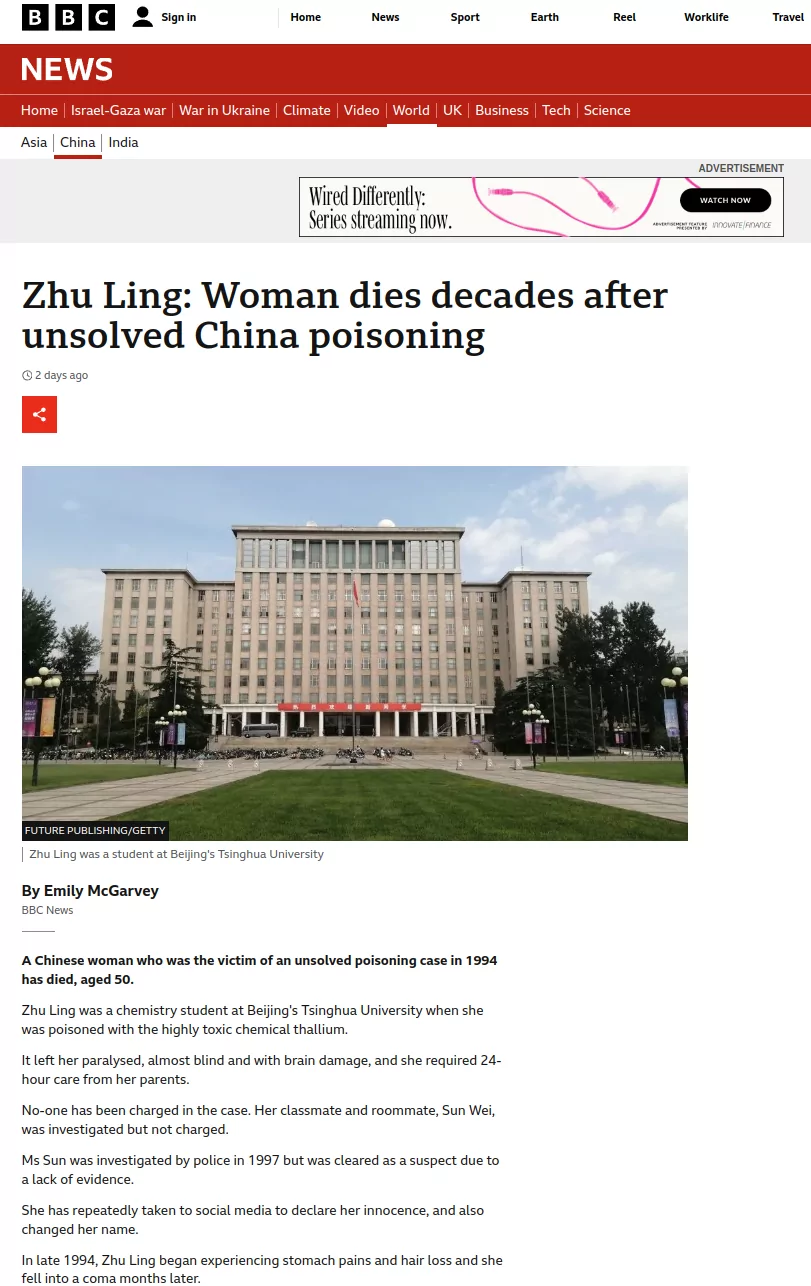
Let us read some more such news reports, [24] [25] [26]
The Full Account
Now let us examine the full account in one place. This account is found in Tafsir Mazhari, where the account is actually given in great detail [27] –
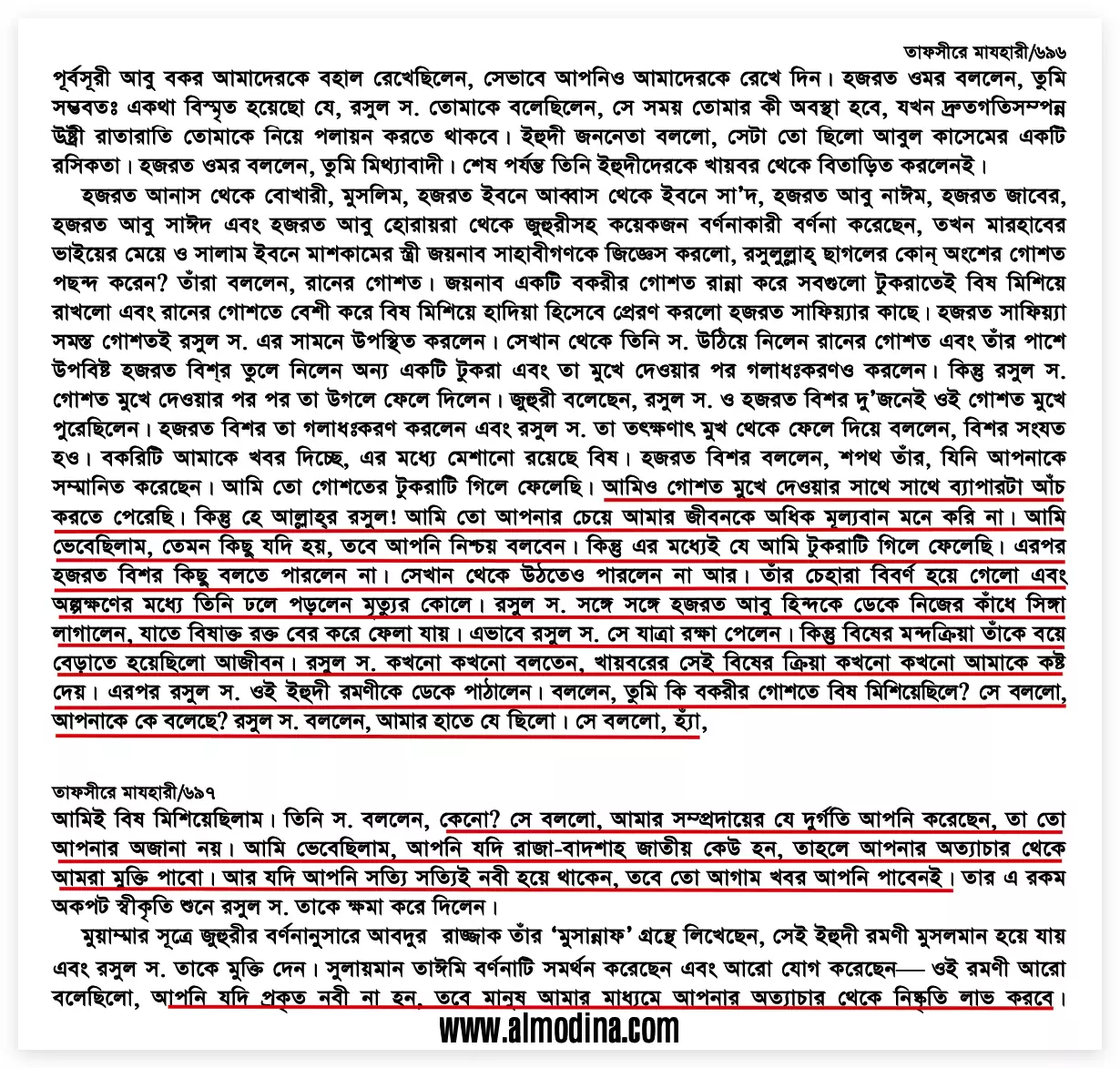
Reasonable Grounds for Suspicion
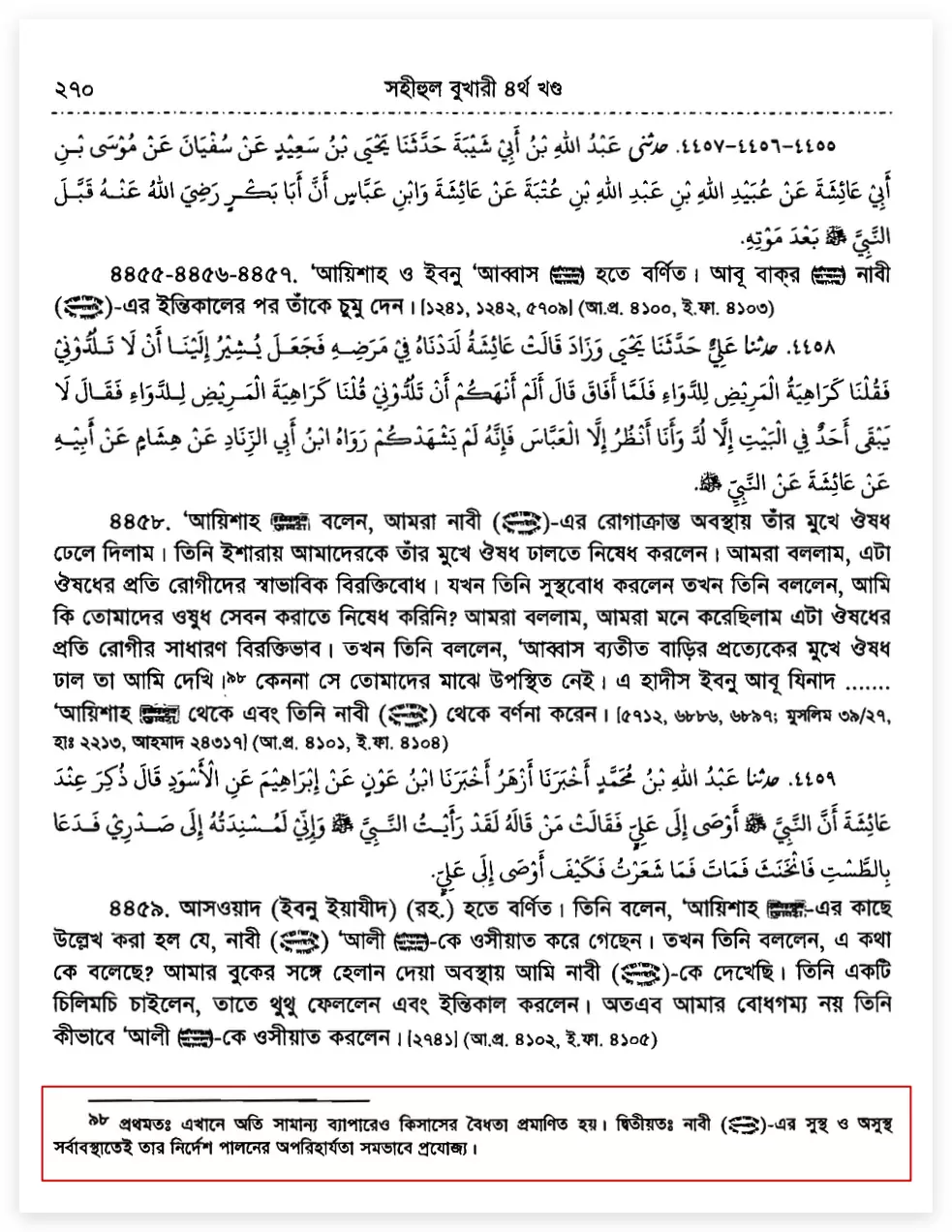
Taken together, the events surrounding Prophet Muhammad’s death raise several reasonable questions. One of those questions is: why was Ali sent to Yemen at that time? Did Umar harbor jealousy toward Ali? Why was Muhammad taken to Aisha’s room, when he was not supposed to be staying in Aisha’s room that day? References for these matters will be given later. I draw your attention to a few events that happened in Aisha’s room shortly before the Prophet’s death. Read the hadith below, where it is seen that despite Muhammad’s strong objection, Aisha poured some medicine into the mouth of Muhammad as he lay on his deathbed. But according to Islamic creed, whether sick or healthy, obeying the Prophet’s command in all circumstances is obligatory for every Muslim. Even so, why did Aisha pour medicine into Muhammad’s mouth? What medicine was it? [28] [29] [30] [31] –
Reference : Sahih Muslim 2213
In-book reference : Book 39, Hadith 115
USC-MSA web (English) reference : Book 26, Hadith 5486
Chapter: It Is Disliked To Administer Medicine In The Side Of The Mouth Forcibly
‘A’isha reported:
we (intended to pour) medicine in the mouth of Allah’s Messenger (ﷺ) in his illness, but he pointed out (with the gesture of his hand) that it should not be poured into the mouth against his will. We said: (It was perhaps due to the natural) aversion of the patient against medicine. When he recovered, he said: Medicine should be poured into the mouth of every one of you except Ibn ‘Abbas, for he was not present amongst you.
Arabic : حَدَّثَنِي مُحَمَّدُ بْنُ حَاتِمٍ، حَدَّثَنَا يَحْيَى بْنُ سَعِيدٍ، عَنْ سُفْيَانَ، حَدَّثَنِي مُوسَى بْنُ أَبِي، عَائِشَةَ عَنْ عُبَيْدِ اللَّهِ بْنِ عَبْدِ اللَّهِ، عَنْ عَائِشَةَ، قَالَتْ لَدَدْنَا رَسُولَ اللَّهِ صلى الله عليه وسلم فِي مَرَضِهِ فَأَشَارَ أَنْ لاَ تَلُدُّونِي . فَقُلْنَا كَرَاهِيَةُ الْمَرِيضِ لِلدَّوَاءِ . فَلَمَّا أَفَاقَ قَالَ ” لاَ يَبْقَى أَحَدٌ مِنْكُمْ إِلاَّ لُدَّ غَيْرُ الْعَبَّاسِ فَإِنَّهُ لَمْ يَشْهَدْكُمْ ” .
Reference : Sahih al-Bukhari 4458
In-book reference : Book 64, Hadith 474
USC-MSA web (English) reference : Vol. 5, Book 59, Hadith 735
Chapter: The sickness of the Prophet (saws) and his death
Narrated `Aisha:
We poured medicine in one side of the Prophet’s mouth during his illness and he started pointing to us, meaning to say, “Don’t pour medicine in my mouth.” We said, “(He says so) because a patient dislikes medicines.” When he improved and felt a little better, he said, “Didn’t I forbid you to pour medicine in my mouth ?” We said, ” ( We thought it was because of) the dislike, patients have for medicines. He said, “Let everyone present in the house be given medicine by pouring it in his mouth while I am looking at him, except `Abbas as he has not witnessed you (doing the same to me).
Arabic : حَدَّثَنَا عَلِيٌّ، حَدَّثَنَا يَحْيَى، وَزَادَ، قَالَتْ عَائِشَةُ لَدَدْنَاهُ فِي مَرَضِهِ فَجَعَلَ يُشِيرُ إِلَيْنَا أَنْ لاَ تَلُدُّونِي فَقُلْنَا كَرَاهِيَةُ الْمَرِيضِ لِلدَّوَاءِ. فَلَمَّا أَفَاقَ قَالَ ” أَلَمْ أَنْهَكُمْ أَنْ تَلُدُّونِي ”. قُلْنَا كَرَاهِيَةَ الْمَرِيضِ لِلدَّوَاءِ. فَقَالَ ” لاَ يَبْقَى أَحَدٌ فِي الْبَيْتِ إِلاَّ لُدَّ ـ وَأَنَا أَنْظُرُ ـ إِلاَّ الْعَبَّاسَ، فَإِنَّهُ لَمْ يَشْهَدْكُمْ ” . رَوَاهُ ابْنُ أَبِي الزِّنَادِ عَنْ هِشَامٍ عَنْ أَبِيهِ عَنْ عَائِشَةَ عَنِ النَّبِيِّ صلى الله عليه وسلم.
Reference : Sahih al-Bukhari 5709-5712
In-book reference : Book 76, Hadith 29
USC-MSA web (English) reference : Vol. 7, Book 71, Hadith 610
Chapter: Al-Ladud (the medicine which is poured or inserted into one side of a patient’s mouth)
Narrated Ibn `Abbas and `Aisha:
Abu Bakr kissed (the forehead of) the Prophet (ﷺ) when he was dead. `Aisha added: We put medicine in one side of his mouth but he started waving us not to insert the medicine into his mouth. We said, “He dislikes the medicine as a patient usually does.” But when he came to his senses he said, “Did I not forbid you to put medicine (by force) in the side of my mouth?” We said, “We thought it was just because a patient usually dislikes medicine.” He said, “None of those who are in the house but will be forced to take medicine in the side of his mouth while I am watching, except Al-`Abbas, for he had not witnessed your deed.”
Arabic : حَدَّثَنَا عَلِيُّ بْنُ عَبْدِ اللَّهِ، حَدَّثَنَا يَحْيَى بْنُ سَعِيدٍ، حَدَّثَنَا سُفْيَانُ، قَالَ حَدَّثَنِي مُوسَى بْنُ أَبِي عَائِشَةَ، عَنْ عُبَيْدِ اللَّهِ بْنِ عَبْدِ اللَّهِ، عَنِ ابْنِ عَبَّاسٍ، وَعَائِشَةَ، أَنَّ أَبَا بَكْرٍ ـ رضى الله عنه ـ قَبَّلَ النَّبِيَّ صلى الله عليه وسلم وَهْوَ مَيِّتٌ. قَالَ وَقَالَتْ عَائِشَةُ لَدَدْنَاهُ فِي مَرَضِهِ، فَجَعَلَ يُشِيرُ إِلَيْنَا، أَنْ لاَ تَلُدُّونِي. فَقُلْنَا كَرَاهِيَةُ الْمَرِيضِ لِلدَّوَاءِ. فَلَمَّا أَفَاقَ قَالَ ” أَلَمْ أَنْهَكُمْ أَنْ تَلُدُّونِي ”. قُلْنَا كَرَاهِيَةَ الْمَرِيضِ لِلدَّوَاءِ. فَقَالَ ” لاَ يَبْقَى فِي الْبَيْتِ أَحَدٌ إِلاَّ لُدَّ ـ وَأَنَا أَنْظُرُ ـ إِلاَّ الْعَبَّاسَ فَإِنَّهُ لَمْ يَشْهَدْكُمْ ”.
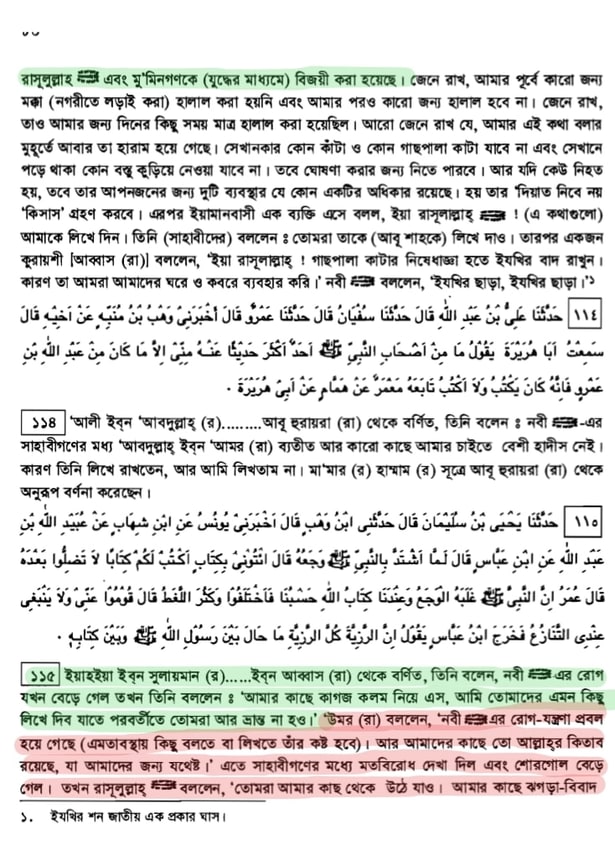
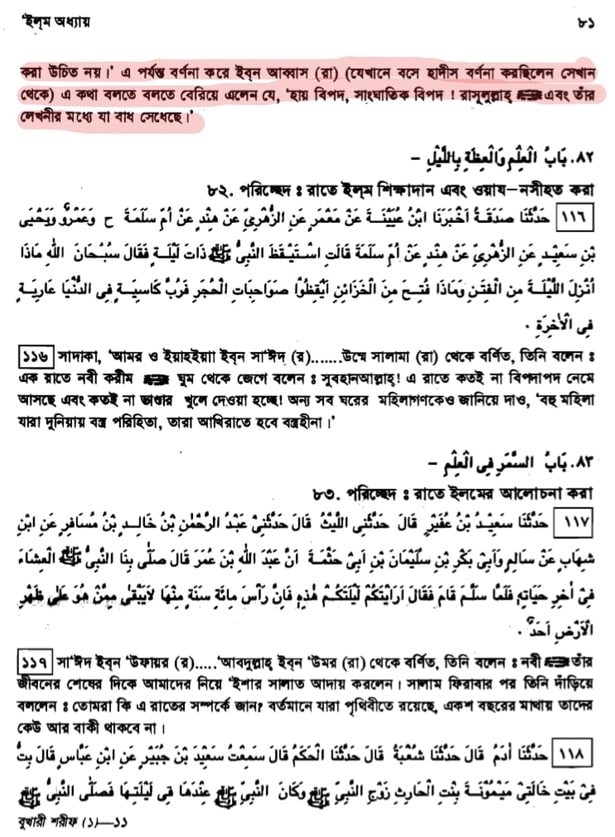
Another important matter is that just before death, Prophet Muhammad asked for a paper in order to write down some urgent matters. But on Umar’s instruction, paper and pen were not given to Prophet Muhammad at that time. According to established Islamic creed, if Prophet Muhammad’s command is to be obeyed in all circumstances, what are we to make of such defiance by Umar? There was intense dissatisfaction among the companions over this as well. The dispute nearly descended into a physical altercation. What did Muhammad want to say at the last moment while lying on his deathbed? That was never known [32] [33] –
Reference : Sahih al-Bukhari 114
In-book reference : Book 3, Hadith 56
USC-MSA web (English) reference : Vol. 1, Book 3, Hadith 114
Narrated ‘Ubaidullah bin `Abdullah:
Ibn `Abbas said, “When the ailment of the Prophet (ﷺ) became worse, he said, ‘Bring for me (writing) paper and I will write for you a statement after which you will not go astray.’ But `Umar said, ‘The Prophet is seriously ill, and we have got Allah’s Book with us and that is sufficient for us.’ But the companions of the Prophet (ﷺ) differed about this and there was a hue and cry. On that the Prophet (ﷺ) said to them, ‘Go away (and leave me alone). It is not right that you should quarrel in front of me.” Ibn `Abbas came out saying, “It was most unfortunate (a great disaster) that Allah’s Messenger (ﷺ) was prevented from writing that statement for them because of their disagreement and noise. (Note: It is apparent from this Hadith that Ibn `Abbas had witnessed the event and came out saying this statement. The truth is not so, for Ibn `Abbas used to say this statement on narrating the Hadith and he had not witnessed the event personally. See Fath Al-Bari Vol. 1, p.220 footnote.) (See Hadith No. 228, Vol. 4).
Arabic : حَدَّثَنَا يَحْيَى بْنُ سُلَيْمَانَ، قَالَ حَدَّثَنِي ابْنُ وَهْبٍ، قَالَ أَخْبَرَنِي يُونُسُ، عَنِ ابْنِ شِهَابٍ، عَنْ عُبَيْدِ اللَّهِ بْنِ عَبْدِ اللَّهِ، عَنِ ابْنِ عَبَّاسٍ، قَالَ لَمَّا اشْتَدَّ بِالنَّبِيِّ صلى الله عليه وسلم وَجَعُهُ قَالَ ” ائْتُونِي بِكِتَابٍ أَكْتُبُ لَكُمْ كِتَابًا لاَ تَضِلُّوا بَعْدَهُ ”. قَالَ عُمَرُ إِنَّ النَّبِيَّ صلى الله عليه وسلم غَلَبَهُ الْوَجَعُ وَعِنْدَنَا كِتَابُ اللَّهِ حَسْبُنَا فَاخْتَلَفُوا وَكَثُرَ اللَّغَطُ. قَالَ ” قُومُوا عَنِّي، وَلاَ يَنْبَغِي عِنْدِي التَّنَازُعُ ”. فَخَرَجَ ابْنُ عَبَّاسٍ يَقُولُ إِنَّ الرَّزِيَّةَ كُلَّ الرَّزِيَّةِ مَا حَالَ بَيْنَ رَسُولِ اللَّهِ صلى الله عليه وسلم وَبَيْنَ كِتَابِهِ.
Taking the Prophet to Aisha’s Room
From sahih hadith it is known that while extremely ill and completely unable to move, Prophet Muhammad was dragged to Aisha’s room. Patients are generally not moved in such a state of illness, but because it was Aisha’s turn, two companions took him almost with his feet dragging to Aisha’s room. When we read the hadith, we can see that Hafsa, Umar’s daughter, was probably present at that place as well [34] –
Reference : Sahih al-Bukhari 4442
In-book reference : Book 64, Hadith 463
USC-MSA web (English) reference : Vol. 5, Book 59, Hadith 727
Narrated Aisha:
(the wife of the Prophet) “When the ailment of Allah’s Messenger (ﷺ) became aggravated, he requested his wives to permit him to be (treated) nursed in my house, and they gave him permission. He came out (to my house), walking between two men with his feet dragging on the ground, between `Abbas bin `Abdul–Muttalib and another man” ‘Ubaidullah said, “I told `Abdullah of what `Aisha had said, `Abdullah bin `Abbas said to me, ‘Do you know who is the other man whom `Aisha did not name?’ I said, ‘No.’ Ibn `Abbas said, ‘It was `Ali bin Abu Talib.” `Aisha, the wife of the Prophet (ﷺ) used to narrate saying, “When Allah’s Messenger (ﷺ) entered my house and his disease became aggravated, he said, ” Pour on me the water of seven water skins, the mouths of which have not been untied, so that I may give advice to the people.’ So we let him sit in a big basin belonging to Hafsa, the wife of the Prophet (ﷺ) and then started to pour water on him from these water skins till he started pointing to us with his hands intending to say, ‘You have done your job.” `Aisha added, “Then he went out to the people and led them in prayer and preached to them.”
Arabic : حَدَّثَنَا سَعِيدُ بْنُ عُفَيْرٍ، قَالَ حَدَّثَنِي اللَّيْثُ، قَالَ حَدَّثَنِي عُقَيْلٌ، عَنِ ابْنِ شِهَابٍ، قَالَ أَخْبَرَنِي عُبَيْدُ اللَّهِ بْنُ عَبْدِ اللَّهِ بْنِ عُتْبَةَ بْنِ مَسْعُودٍ، أَنَّ عَائِشَةَ، زَوْجَ النَّبِيِّ صلى الله عليه وسلم قَالَتْ لَمَّا ثَقُلَ رَسُولُ اللَّهِ صلى الله عليه وسلم وَاشْتَدَّ بِهِ وَجَعُهُ اسْتَأْذَنَ أَزْوَاجَهُ أَنْ يُمَرَّضَ فِي بَيْتِي، فَأَذِنَّ لَهُ، فَخَرَجَ وَهْوَ بَيْنَ الرَّجُلَيْنِ تَخُطُّ رِجْلاَهُ فِي الأَرْضِ، بَيْنَ عَبَّاسِ بْنِ عَبْدِ الْمُطَّلِبِ وَبَيْنَ رَجُلٍ آخَرَ. قَالَ عُبَيْدُ اللَّهِ فَأَخْبَرْتُ عَبْدَ اللَّهِ بِالَّذِي قَالَتْ عَائِشَةُ، فَقَالَ لِي عَبْدُ اللَّهِ بْنُ عَبَّاسٍ هَلْ تَدْرِي مَنِ الرَّجُلُ الآخَرُ الَّذِي لَمْ تُسَمِّ عَائِشَةُ قَالَ قُلْتُ لاَ. قَالَ ابْنُ عَبَّاسٍ هُوَ عَلِيٌّ. وَكَانَتْ عَائِشَةُ زَوْجُ النَّبِيِّ صلى الله عليه وسلم تُحَدِّثُ أَنَّ رَسُولَ اللَّهِ صلى الله عليه وسلم لَمَّا دَخَلَ بَيْتِي وَاشْتَدَّ بِهِ وَجَعُهُ قَالَ ” هَرِيقُوا عَلَىَّ مِنْ سَبْعِ قِرَبٍ لَمْ تُحْلَلْ أَوْكِيَتُهُنَّ لَعَلِّي أَعْهَدُ إِلَى النَّاسِ ” . فَأَجْلَسْنَاهُ فِي مِخْضَبٍ لِحَفْصَةَ زَوْجِ النَّبِيِّ صلى الله عليه وسلم، ثُمَّ طَفِقْنَا نَصُبُّ عَلَيْهِ مِنْ تِلْكَ الْقِرَبِ، حَتَّى طَفِقَ يُشِيرُ إِلَيْنَا بِيَدِهِ أَنْ قَدْ فَعَلْتُنَّ قَالَتْ ثُمَّ خَرَجَ إِلَى النَّاسِ فَصَلَّى لَهُمْ وَخَطَبَهُمْ.
The Conflict Between Ali and Aisha
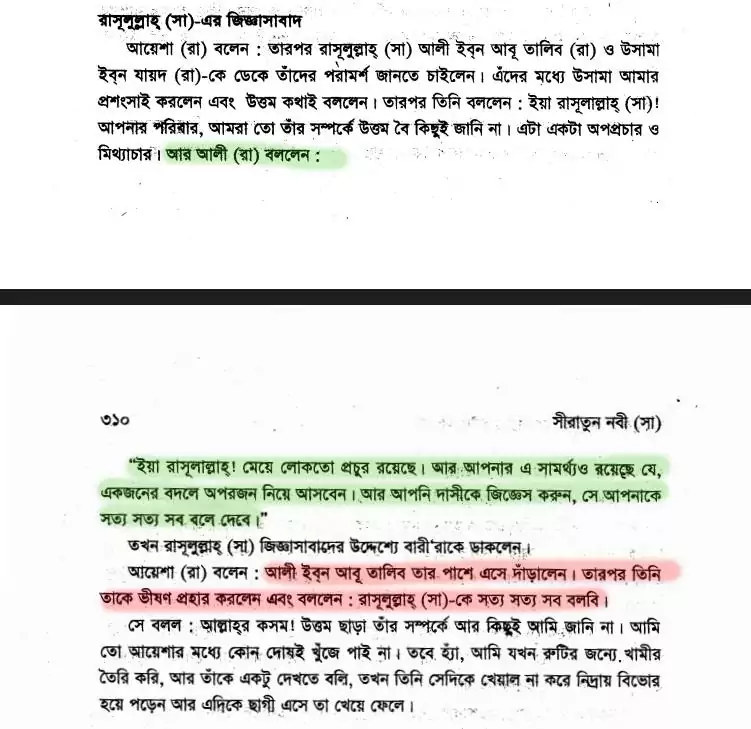
After Muhammad’s death, there was a major war between Aisha and Ali, known as the Battle of the Camel or Jang-e-Jamal. That war will be discussed in detail later. For now, it is enough to know that the relationship between Aisha and Ali was deeply strained. To understand the background, consider the following incidents. For details, you may read this article [35]. Rather than reproduce the long hadiths in full, only the relevant portions are quoted here. When Aisha was accused of adultery, Hazrat Ali advised the Prophet to divorce Aisha and take another wife [36] –
Reference : Sahih al-Bukhari 7369
In-book reference : Book 96, Hadith 96
USC-MSA web (English) reference : Vol. 9, Book 92, Hadith 462
Narrated `Aisha:
After the slanderers had given a forged statement against her, Allah’s Messenger (ﷺ) called `Ali bin Abi Talib and Usama bin Zaid when the Divine Inspiration was delayed. He wanted to ask them and consult them about the question of divorcing me. Usama gave his evidence that was based on what he knew about my innocence, but `Ali said, “Allah has not put restrictions on you and there are many women other than her. Furthermore you may ask the slave girl who will tell you the truth.” So the Prophet (ﷺ) asked Barira (my salve girl), “Have you seen anything that may arouse your suspicion?” She replied, “I have not seen anything more than that she is a little girl who sleeps, leaving the dough of her family (unguarded) that the domestic goats come and eat it.” Then the Prophet (ﷺ) stood on the pulpit and said, “O Muslims! Who will help me against the man who has harmed me by slandering my wife? By Allah, I know nothing about my family except good.” The narrator added: Then the Prophet (ﷺ) mentioned the innocence of `Aisha.
Arabic : حَدَّثَنَا الأُوَيْسِيُّ، حَدَّثَنَا إِبْرَاهِيمُ، عَنْ صَالِحٍ، عَنِ ابْنِ شِهَابٍ، حَدَّثَنِي عُرْوَةُ، وَابْنُ الْمُسَيَّبِ، وَعَلْقَمَةُ بْنُ وَقَّاصٍ، وَعُبَيْدُ اللَّهِ، عَنْ عَائِشَةَ ـ رضى الله عنها ـ حِينَ قَالَ لَهَا أَهْلُ الإِفْكِ قَالَتْ وَدَعَا رَسُولُ اللَّهِ صلى الله عليه وسلم عَلِيَّ بْنَ أَبِي طَالِبٍ وَأُسَامَةَ بْنَ زَيْدٍ حِينَ اسْتَلْبَثَ الْوَحْىُ يَسْأَلُهُمَا، وَهْوَ يَسْتَشِيرُهُمَا فِي فِرَاقِ أَهْلِهِ، فَأَمَّا أُسَامَةُ فَأَشَارَ بِالَّذِي يَعْلَمُ مِنْ بَرَاءَةِ أَهْلِهِ، وَأَمَّا عَلِيٌّ فَقَالَ لَمْ يُضَيِّقِ اللَّهُ عَلَيْكَ، وَالنِّسَاءُ سِوَاهَا كَثِيرٌ، وَسَلِ الْجَارِيَةَ تَصْدُقْكَ. فَقَالَ ” هَلْ رَأَيْتِ مِنْ شَىْءٍ يَرِيبُكِ ”. قَالَتْ مَا رَأَيْتُ أَمْرًا أَكْثَرَ مِنْ أَنَّهَا جَارِيَةٌ حَدِيثَةُ السِّنِّ تَنَامُ عَنْ عَجِينِ أَهْلِهَا فَتَأْتِي الدَّاجِنُ فَتَأْكُلُهُ. فَقَامَ عَلَى الْمِنْبَرِ فَقَالَ ” يَا مَعْشَرَ الْمُسْلِمِينَ مَنْ يَعْذِرُنِي مِنْ رَجُلٍ بَلَغَنِي أَذَاهُ فِي أَهْلِي، وَاللَّهِ مَا عَلِمْتُ عَلَى أَهْلِي إِلاَّ خَيْرًا ”. فَذَكَرَ بَرَاءَةَ عَائِشَةَ. وَقَالَ أَبُو أُسَامَةَ عَنْ هِشَامٍ .
At the same time, from Ibn Hisham’s Siratun Nabi it is known that Ali also caught one of Aisha’s female slaves and beat her severely in order to extract the truth of Aisha’s alleged extramarital affair [37] –
Aisha’s resentment toward Ali was so strong that later in life she would not even mention him by name. This can be understood from the hadith below. Notice as you read: Aisha narrates that two people dragged the ill Muhammad in. One of them was Ibn Abbas, and the other, in Aisha’s words, was another companion. That means she did not pronounce that companion’s name. Ibn Abbas later identifies the unnamed companion as Hazrat Ali [38] –
Reference : Sahih al-Bukhari 665
In-book reference : Book 10, Hadith 59
USC-MSA web (English) reference : Vol. 1, Book 11, Hadith 634
Narrated `Aisha:
“When the Prophet (ﷺ) became seriously ill and his disease became aggravated he asked for permission from his wives to be nursed in my house and he was allowed. He came out with the help of two men and his legs were dragging on the ground. He was between Al-`Abbas and another man.” ‘Ubaidullah said, “I told Ibn `Abbas what `Aisha had narrated and he said, ‘Do you know who was the (second) man whose name `Aisha did not mention'” I said, ‘No.’ Ibn `Abbas said, ‘He was `Ali Ibn Abi Talib.’ “
Arabic : حَدَّثَنَا إِبْرَاهِيمُ بْنُ مُوسَى، قَالَ أَخْبَرَنَا هِشَامُ بْنُ يُوسُفَ، عَنْ مَعْمَرٍ، عَنِ الزُّهْرِيِّ، قَالَ أَخْبَرَنِي عُبَيْدُ اللَّهِ بْنُ عَبْدِ اللَّهِ، قَالَ قَالَتْ عَائِشَةُ لَمَّا ثَقُلَ النَّبِيُّ صلى الله عليه وسلم وَاشْتَدَّ وَجَعُهُ اسْتَأْذَنَ أَزْوَاجَهُ أَنْ يُمَرَّضَ فِي بَيْتِي فَأَذِنَّ لَهُ، فَخَرَجَ بَيْنَ رَجُلَيْنِ تَخُطُّ رِجْلاَهُ الأَرْضَ، وَكَانَ بَيْنَ الْعَبَّاسِ وَرَجُلٍ آخَرَ. قَالَ عُبَيْدُ اللَّهِ فَذَكَرْتُ ذَلِكَ لاِبْنِ عَبَّاسٍ مَا قَالَتْ عَائِشَةُ فَقَالَ لِي وَهَلْ تَدْرِي مَنِ الرَّجُلُ الَّذِي لَمْ تُسَمِّ عَائِشَةُ قُلْتُ لاَ. قَالَ هُوَ عَلِيُّ بْنُ أَبِي طَالِبٍ.
Umar’s Jealousy of Ali
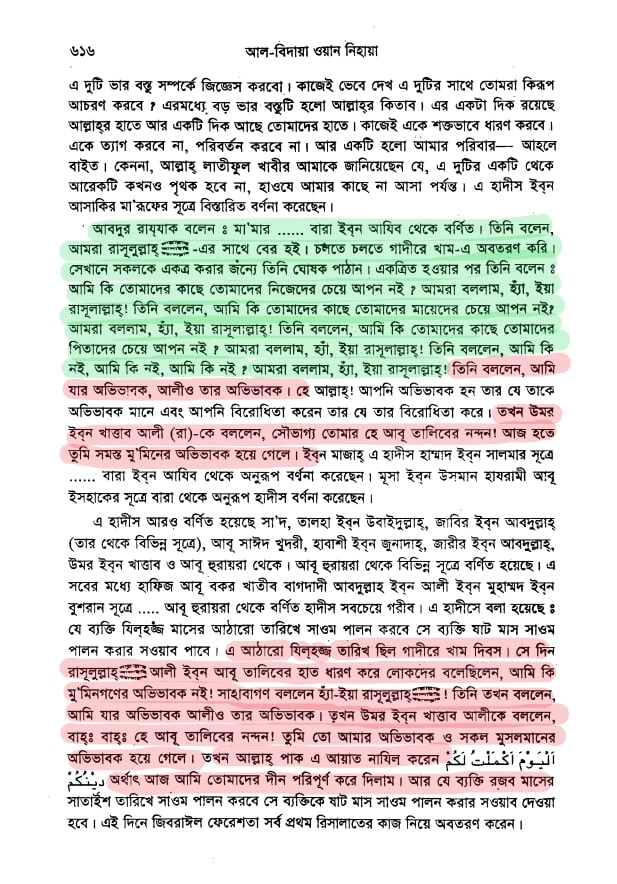
Now let us read more on this matter from al-Bidaya wa’l-Nihaya [39]. Notice the way Umar congratulates Ali in response to the Prophet’s praise of him. It is important to remember that, later, at the time of Muhammad’s death, this same Umar was the one who prevented paper from being brought. It is also noteworthy that immediately after the statement about Ali, the Quranic verse declaring Islam complete was revealed.
Abd al-Razzaq said: Ma’mar narrated from Bara ibn Azib. He said: We set out with the Messenger of Allah. As we travelled, we stopped at Ghadir Khumm. There he sent an announcer to gather everyone. After they had assembled, he said: Am I not closer to you than your own selves? We said: Yes, O Messenger of Allah! He said: Am I not closer to you than your mothers? We said: Yes, O Messenger of Allah! He said: Am I not closer to you than your fathers? We said: Yes, O Messenger of Allah! He said: Am I not, am I not, am I not? We said: Yes, O Messenger of Allah! He said: Whoever has me as his guardian, Ali is also his guardian. O Allah! Be the guardian of whoever accepts him as guardian, and oppose whoever opposes him. Then Umar ibn al-Khattab said to Ali (may Allah be pleased with him): Congratulations to you, O son of Abu Talib! From today you have become the guardian of every believer. Ibn Majah narrated this hadith similarly through Hammad ibn Salamah from Bara ibn Azib. Musa ibn Uthman al-Hadrami narrated a similar hadith from Bara through Abu Ishaq.
This hadith has also been narrated from Sa’d, Talha ibn Ubaydullah, Jabir ibn Abdullah (through various chains from him), Abu Sa’id al-Khudri, Habashi ibn Junadah, Jarir ibn Abdullah, Umar ibn al-Khattab, and Abu Hurayra. It has been narrated through various chains from Abu Hurayra. Among these, the hadith narrated by Hafiz Abu Bakr Khatib Baghdadi through Abdullah ibn Ali ibn Muhammad ibn Bushran … from Abu Hurayra is the strangest. In this hadith it is said: Whoever fasts on the eighteenth of Dhu’l-Hijjah will receive the reward of fasting for sixty months. This eighteenth of Dhu’l-Hijjah was the day of Ghadir Khumm. On that day the Messenger of Allah held the hand of Ali ibn Abi Talib and said to the people: Am I not the guardian of the believers? The companions said: Yes, O Messenger of Allah! He then said: Whoever has me as his guardian, Ali is also his guardian. Then Umar ibn al-Khattab said to Ali: Bravo, bravo, O son of Abu Talib! You have become my guardian and the guardian of every Muslim. Then Allah revealed this verse: الْيَوْمَ أَكْمَلْتُ لَكُمْ دینكُمْ, meaning: Today I have perfected your religion for you. And whoever fasts on the twenty-seventh of Rajab will be given the reward of fasting for sixty months. On that day the angel Jibril first descended with the work of risalah.
Khatib Baghdadi said: This hadith is known as the narration of Habshun. He alone narrated it. He was followed by Ahmad ibn Ubaydullah ibn Abbas ibn Salim ibn Mahran, known as Ibn Nabari, who narrated it from Ali ibn Sa’id al-Shami. The author says: This hadith is worthy of being called munkar for several reasons. One is the claim that the verse الْيَوْمَ أَكْمَلْتُ لَكُمْ دِينُكُمْ was revealed on the day of Ghadir Khumm. A similar report has also been narrated from Abu Sa’id al-Khudri through Ibn Harun Abadi. But this report too is not sahih. In fact, this verse was revealed on the Day of Arafat. A hadith on this matter has been narrated from Umar ibn al-Khattab in Bukhari and Muslim, which we have mentioned earlier. This hadith has been narrated from many companions, apart from those whose names have been mentioned in the narration “Whoever has me as his guardian,” because the chains through which it has been narrated from them are weak.
The hadith of the bird
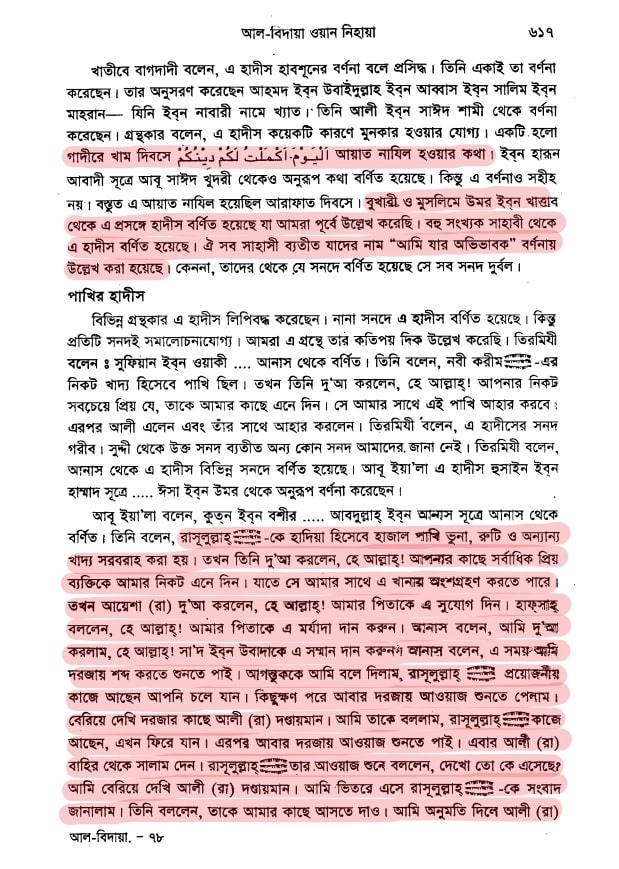
Different authors have recorded this hadith. This hadith has been narrated through many chains. But every chain is open to criticism. We have mentioned some aspects of it in this book. Tirmidhi said: Sufyan ibn Waki … from Anas, who said: There was a bird as food with the Noble Prophet. Then he prayed: O Allah! Bring to me the one who is most beloved to You. He will eat this bird with me. Then Ali came and ate with him. Tirmidhi said: The chain of this hadith is gharib. We know of no chain from Suddi other than this chain. Tirmidhi said: This hadith has been narrated from Anas through various chains. Abu Ya’la narrated a similar report through Husayn ibn Hammad … from Isa ibn Umar.
Abu Ya’la said: Qutun ibn Bashir narrated from Abdullah ibn Anas from Anas. He said: A roasted hajat bird, bread, and other food were presented as a gift to the Messenger of Allah. Then he prayed: O Allah! Bring to me the person most beloved to You, so that he may share this food with me. Then Aisha (may Allah be pleased with her) prayed: O Allah! Give my father this opportunity. Hafsa said: O Allah! Grant my father this honor. Anas said: I prayed: O Allah! Grant this honor to Sa’d ibn Ubada. Anas said: At that time I heard a sound at the door. I told the visitor: The Messenger of Allah is occupied with necessary work; please go back. After some time I again heard a sound at the door. I went out and saw Ali (may Allah be pleased with him) standing at the door. I told him: The Messenger of Allah is occupied; go back now. Then again I heard a sound at the door. This time Ali (may Allah be pleased with him) gave salam from outside. The Messenger of Allah heard his voice and said: See who has come? I went out and saw Ali (may Allah be pleased with him) standing. I came inside and informed the Messenger of Allah. He said: Allow him to come to me. When I gave permission, Ali (may Allah be pleased with him)
Aisha’s Resentment Toward the Prophet
Most strikingly, even on such a painful deathbed, the Prophet’s beloved wife Aisha did not refrain from mocking Prophet Muhammad’s supposedly exemplary character. From the Prophet’s sira we learn that even on the deathbed Aisha said to the Prophet that if Aisha had died before the Prophet, the Prophet would have buried Aisha and then brought another wife into Aisha’s own room. That is, Aisha knew and understood the Prophet’s character very well [40] .
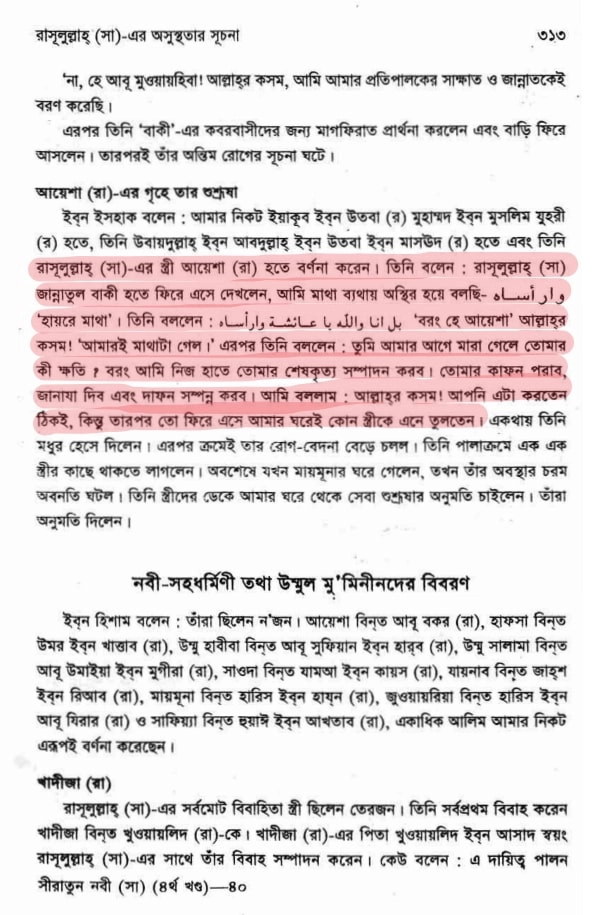
The account appears even more clearly in Sahih al-Bukhari [41] –
Reference : Sahih al-Bukhari 5666
In-book reference : Book 75, Hadith 26
USC-MSA web (English) reference : Vol. 7, Book 70, Hadith 570
Narrated Al-Qasim bin Muhammad:
`Aisha, (complaining of headache) said, “Oh, my head”! Allah’s Messenger (ﷺ) said, “I wish that had happened while I was still living, for then I would ask Allah’s Forgiveness for you and invoke Allah for you.” Aisha said, “Wa thuklayah! By Allah, I think you want me to die; and If this should happen, you would spend the last part of the day sleeping with one of your wives!” The Prophet (ﷺ) said, “Nay, I should say, ‘Oh my head!’ I felt like sending for Abu Bakr and his son, and appoint him as my successor lest some people claimed something or some others wished something, but then I said (to myself), ‘Allah would not allow it to be otherwise, and the Muslims would prevent it to be otherwise”.
Arabic : حَدَّثَنَا يَحْيَى بْنُ يَحْيَى أَبُو زَكَرِيَّاءَ، أَخْبَرَنَا سُلَيْمَانُ بْنُ بِلاَلٍ، عَنْ يَحْيَى بْنِ سَعِيدٍ، قَالَ سَمِعْتُ الْقَاسِمَ بْنَ مُحَمَّدٍ، قَالَ قَالَتْ عَائِشَةُ وَارَأْسَاهْ. فَقَالَ رَسُولُ اللَّهِ صلى الله عليه وسلم ” ذَاكِ لَوْ كَانَ وَأَنَا حَىٌّ، فَأَسْتَغْفِرُ لَكِ وَأَدْعُو لَكِ ”. فَقَالَتْ عَائِشَةُ وَاثُكْلِيَاهْ، وَاللَّهِ إِنِّي لأَظُنُّكَ تُحِبُّ مَوْتِي، وَلَوْ كَانَ ذَاكَ لَظَلِلْتَ آخِرَ يَوْمِكَ مُعَرِّسًا بِبَعْضِ أَزْوَاجِكَ. فَقَالَ النَّبِيُّ صلى الله عليه وسلم ” بَلْ أَنَا وَارَأْسَاهْ لَقَدْ هَمَمْتُ أَوْ أَرَدْتُ أَنْ أُرْسِلَ إِلَى أَبِي بَكْرٍ وَابْنِهِ، وَأَعْهَدَ أَنْ يَقُولَ الْقَائِلُونَ أَوْ يَتَمَنَّى الْمُتَمَنُّونَ، ثُمَّ قُلْتُ يَأْبَى اللَّهُ وَيَدْفَعُ الْمُؤْمِنُونَ، أَوْ يَدْفَعُ اللَّهُ وَيَأْبَى الْمُؤْمِنُونَ ”.
The Rebellion of Hafsa and Aisha
From many sources it is known that, over sexual relations with a sex slave named Maria the Copt, the domestic conflict among Hafsa, Aisha, and Prophet Muhammad took such a serious form that the Prophet planned to divorce all his wives at once and bring in new wives. Because the episode is lengthy, it is covered in a separate article [42]. For now, let us simply note that the relationship among the Prophet, Aisha, and Hafsa was not good. Aisha and Hafsa were, in effect, trapped in their marriages to the Prophet. This caused them considerable distress. The linked article sets out the evidence in detail.
Death by Poisoning, or the Consolation of “Martyrdom”?
Many believers nowadays try to cover up this cruel death of Prophet Muhammad after eating poisoned food given by a persecuted Jewish woman who had lost family and relatives. They claim that Allah supposedly caused this event in order to give the Prophet a martyr’s death. But this explanation is self-defeating. If Allah chose this path of poisoning in order to give the Prophet special rank, then where was the crime of that Jewish woman? Why was she killed for the death of the Prophet’s companion Bishr ibn al-Bara? Allah caused the event, the Prophet received honor, but the woman received the death penalty: what moral logic is left in that account? If poisoning was Allah’s planned “martyrdom arrangement,” then was Bishr’s death a planned side effect from Allah? And if the woman was a criminal, how can the incident be called a special honor given by Allah? At the same time it must be said that this claim does not withstand scrutiny. Because the Quran itself says that if any misfortune befalls the Prophet, the Prophet’s own deeds are responsible, not Allah. [43]
Quran reference : Surah An-Nisa, 4:79
Arabic : مَّآ أَصَابَكَ مِنْ حَسَنَةٍۢ فَمِنَ ٱللَّهِ ۖ وَمَآ أَصَابَكَ مِن سَيِّئَةٍۢ فَمِن نَّفْسِكَ ۚ وَأَرْسَلْنَـٰكَ لِلنَّاسِ رَسُولًۭا ۚ وَكَفَىٰ بِٱللَّهِ شَهِيدًۭا ٧٩
Translation — Saheeh International : What comes to you of good is from Allāh, but what comes to you of evil, [O man], is from yourself. And We have sent you, [O Muḥammad], to the people as a messenger, and sufficient is Allāh as Witness.
Translation — Dr. Mustafa Khattab, the Clear Quran : Whatever good befalls you is from Allah and whatever evil befalls you is from yourself. We have sent you ˹O Prophet˺ as a messenger to ˹all˺ people. And Allah is sufficient as a Witness.
Now let us read another verse of the Quran. The Quran also states [44],
Quran reference : Surah Al-Haqqah, 69:43-47
Arabic : تَنزِيلٌۭ مِّن رَّبِّ ٱلْعَـٰلَمِينَ ٤٣
وَلَوْ تَقَوَّلَ عَلَيْنَا بَعْضَ ٱلْأَقَاوِيلِ ٤٤
لَأَخَذْنَا مِنْهُ بِٱلْيَمِينِ ٤٥
ثُمَّ لَقَطَعْنَا مِنْهُ ٱلْوَتِينَ ٤٦
فَمَا مِنكُم مِّنْ أَحَدٍ عَنْهُ حَـٰجِزِينَ ٤٧
Translation — Dr. Mustafa Khattab, the Clear Quran : ˹It is˺ a revelation from the Lord of all worlds.
Had the Messenger made up something in Our Name,
We would have certainly seized him by his right hand,
then severed his aorta,
and none of you could have shielded him ˹from Us˺!
Translation — Saheeh International : [It is] a revelation from the Lord of the worlds.
And if he [i.e., Muḥammad] had made up about Us some [false] sayings,
We would have seized him by the right hand;
Then We would have cut from him the aorta.
And there is no one of you who could prevent [Us] from him.
Now let us look at those hadiths [45]-
Reference : Sunan Abi Dawud 4513
In-book reference : Book 41, Hadith 20
English translation : Book 40, Hadith 4499
Narrated Ibn Ka’b b. Malik:
On the authority of his father: Umm Mubashshir said to the Prophet (ﷺ) during the sickness of which he died: What do you think about your illness, Messenger of Allah (ﷺ)? I do not think about the illness of my son except the poisoned sheep of which he had eaten with you at Khaybar. The Prophet (ﷺ) said: And I do not think about my illness except that. This is the time when it cut off my aorta.
Abu Dawud said: Sometime ‘Abd al-Razzaq transmitted this tradition, omitting the link of the Companion, from Ma’mar, from al-Zuhri, from the Prophet (ﷺ), and sometimes he transmitted it from al-Zuhri from ‘Abd al-Rahman b. Ka’b b. Malik, ‘Abd al-Rahman mentioned that Ma’mar sometimes transmitted the tradition in a mursal form (omitting the link of the Companion), and they recorded it. And all this is correct with us.
‘Abd al-Razzaq said: When Ibn al-Mubarak came to Ma’mar, he transmitted the traditions in a musnad form (with a perfect chain) which he transmitted as mauquf traditions (statements of the Companions and not of the Prophet).
Arabic : حَدَّثَنَا مَخْلَدُ بْنُ خَالِدٍ، حَدَّثَنَا عَبْدُ الرَّزَّاقِ، حَدَّثَنَا مَعْمَرٌ، عَنِ الزُّهْرِيِّ، عَنِ ابْنِ كَعْبِ بْنِ مَالِكٍ، عَنْ أَبِيهِ، أَنَّ أُمَّ مُبَشِّرٍ، قَالَتْ لِلنَّبِيِّ صلى الله عليه وسلم فِي مَرَضِهِ الَّذِي مَاتَ فِيهِ مَا يُتَّهَمُ بِكَ يَا رَسُولَ اللَّهِ فَإِنِّي لاَ أَتَّهِمُ بِابْنِي شَيْئًا إِلاَّ الشَّاةَ الْمَسْمُومَةَ الَّتِي أَكَلَ مَعَكَ بِخَيْبَرَ . وَقَالَ النَّبِيُّ صلى الله عليه وسلم ” وَأَنَا لاَ أَتَّهِمُ بِنَفْسِي إِلاَّ ذَلِكَ فَهَذَا أَوَانُ قَطَعَتْ أَبْهَرِي ” . قَالَ أَبُو دَاوُدَ وَرُبَّمَا حَدَّثَ عَبْدُ الرَّزَّاقِ بِهَذَا الْحَدِيثِ مُرْسَلاً عَنْ مَعْمَرٍ عَنِ الزُّهْرِيِّ عَنِ النَّبِيِّ صلى الله عليه وسلم وَرُبَّمَا حَدَّثَ بِهِ عَنِ الزُّهْرِيِّ عَنْ عَبْدِ الرَّحْمَنِ بْنِ كَعْبِ بْنِ مَالِكٍ وَذَكَرَ عَبْدُ الرَّزَّاقِ أَنَّ مَعْمَرًا كَانَ يُحَدِّثُهُمْ بِالْحَدِيثِ مَرَّةً مُرْسَلاً فَيَكْتُبُونَهُ وَيُحَدِّثُهُمْ مَرَّةً بِهِ فَيُسْنِدُهُ فَيَكْتُبُونَهُ وَكُلٌّ صَحِيحٌ عِنْدَنَا قَالَ عَبْدُ الرَّزَّاقِ فَلَمَّا قَدِمَ ابْنُ الْمُبَارَكِ عَلَى مَعْمَرٍ أَسْنَدَ لَهُ مَعْمَرٌ أَحَادِيثَ كَانَ يُوقِفُهَا .
Grade: Sahih in chain (Al-Albani)
Several other hadiths state that Prophet Muhammad felt as though his aorta were being severed [46]
Reference : Sunan Abi Dawud 4512
In-book reference : Book 41, Hadith 19
English translation : Book 40, Hadith 4497
Narrated Abu Hurairah:
The Messenger of Allah (ﷺ) would accept a present, but would not accept alms (sadaqah). And Wahb bin Baqiyyah narrated to us, elsewhere, from Khalid, from Muhammad ibn Amr said on the authority of AbuSalamah, and he did not mention the name of Abu Hurairah: The Messenger of Allah (ﷺ) used to accept presents but not alms (sadaqah).
This version adds: So a Jewess presented him at Khaybar with a roasted sheep which she had poisoned. The Messenger of Allah (ﷺ) ate of it and the people also ate.
He then said: Take away your hands (from the food), for it has informed me that it is poisoned. Bishr ibn al-Bara’ ibn Ma’rur al-Ansari died.
So he (the Prophet) sent for the Jewess (and said to her): What motivated you to do the work you have done?
She said: If you were a prophet, it would not harm you; but if you were a king, I should rid the people of you. The Messenger of Allah (ﷺ) then ordered regarding her and she was killed. He then said about the pain of which he died: I continued to feel pain from the morsel which I had eaten at Khaybar. This is the time when it has cut off my aorta.
Arabic : حَدَّثَنَا وَهْبُ بْنُ بَقِيَّةَ، عَنْ خَالِدٍ، عَنْ مُحَمَّدِ بْنِ عَمْرٍو، عَنْ أَبِي سَلَمَةَ، عَنْ أَبِي هُرَيْرَةَ، قَالَ كَانَ رَسُولُ اللَّهِ صلى الله عليه وسلم يَقْبَلُ الْهَدِيَّةَ وَلاَ يَأْكُلُ الصَّدَقَةَ . وَحَدَّثَنَا وَهْبُ بْنُ بَقِيَّةَ فِي مَوْضِعٍ آخَرَ عَنْ خَالِدٍ عَنْ مُحَمَّدِ بْنِ عَمْرٍو عَنْ أَبِي سَلَمَةَ وَلَمْ يَذْكُرْ أَبَا هُرَيْرَةَ قَالَ كَانَ رَسُولُ اللَّهِ صلى الله عليه وسلم يَقْبَلُ الْهَدِيَّةَ وَلاَ يَأْكُلُ الصَّدَقَةَ . زَادَ فَأَهْدَتْ لَهُ يَهُودِيَّةٌ بِخَيْبَرَ شَاةً مَصْلِيَّةً سَمَّتْهَا فَأَكَلَ رَسُولُ اللَّهِ صلى الله عليه وسلم مِنْهَا وَأَكَلَ الْقَوْمُ فَقَالَ ” ارْفَعُوا أَيْدِيَكُمْ فَإِنَّهَا أَخْبَرَتْنِي أَنَّهَا مَسْمُومَةٌ ” . فَمَاتَ بِشْرُ بْنُ الْبَرَاءِ بْنِ مَعْرُورٍ الأَنْصَارِيُّ فَأَرْسَلَ إِلَى الْيَهُودِيَّةِ ” مَا حَمَلَكِ عَلَى الَّذِي صَنَعْتِ ” . قَالَتْ إِنْ كُنْتَ نَبِيًّا لَمْ يَضُرَّكَ الَّذِي صَنَعْتُ وَإِنْ كُنْتَ مَلِكًا أَرَحْتُ النَّاسَ مِنْكَ . فَأَمَرَ بِهَا رَسُولُ اللَّهِ صلى الله عليه وسلم فَقُتِلَتْ ثُمَّ قَالَ فِي وَجَعِهِ الَّذِي مَاتَ فِيهِ ” مَا زِلْتُ أَجِدُ مِنَ الأَكْلَةِ الَّتِي أَكَلْتُ بِخَيْبَرَ فَهَذَا أَوَانُ قَطَعَتْ أَبْهَرِي ” .
Grade: Hasan Sahih (Al-Albani)
Conclusion
The available evidence does not permit a definitive conclusion as to whether as part of some planned power politics involving Aisha, Hafsa, Umar, and Abu Bakr, Prophet Muhammad was given poison or another harmful substance under the guise of medicine on his deathbed. However, the incident of forcibly pouring medicine into the Prophet’s mouth while ignoring his clear objection on the deathbed, Umar’s obstruction when paper and pen were asked for in the final moments, the Aisha-Ali conflict, the domestic rebellion of Hafsa and Aisha, the taking away of control over booty and inheritance from the Prophet’s family [47] and the later Muslim struggle for power, taken together, provide reasonable grounds for suspicion. In the history of power, inheritance, wealth, and imperial politics, such suspicion is not unusual. The later killings of Ali, Hasan, and Husayn also show that after the Prophet’s death, Muslim power politics quickly turned into bloody conflict. Therefore it is difficult to accept the deathbed medicine-pouring incident as an entirely innocent family medical treatment; at minimum, it warrants historical suspicion. But it should be treated not as a proven conclusion, but as a suspicion grounded in the documentary record.
But one thing can be firmly said from the Islamic sources themselves: the poison of Khaybar did affect Prophet Muhammad physically. The marks of poisoning could be seen on his uvula and palate; in his final illness he felt the pain of the poisoned food of Khaybar; and he explicitly linked the sensation of his aorta being severed to that poison. In other words, the claim that the poison of that Jewish woman of Khaybar was effective is not an anti-Islamic invention imposed from outside the tradition; it is strongly grounded in the hadith literature itself. Prophet Muhammad’s death was agonizing and prolonged. I leave it to the reader to judge the terrible questions that this death raises about prophethood, miraculous protection, the idea of Allah’s most beloved servant, and the Quranic imagery of the “severed aorta.”
References
- Tafsir Ma’ariful Qur’an, Hazrat Maulana Mufti Shafi, translation: Muhiuddin Khan, Islamic Foundation Bangladesh, vol. 4, pp. 132, 133 ↩︎
- Sahih al-Bukhari, Tawheed Publications, Hadith: 2885 ↩︎
- Sirat Rasulullah (peace be upon him), translated by Shaheed Akhand, Prathama Prakashani, pp. 556, 557 ↩︎
- The History of al-Tabari, Vol. 8, page: 124 ↩︎
- Sunan ad-Darimi (HadithBD), Hadith: 68; matching Sunnah.com report used below: Sunan Abi Dawud 4512 ↩︎
- Sahih Muslim (Islamic Foundation), Hadith: 5517; matching Sunnah.com report: Sahih Muslim 2190a ↩︎
- Sahih Muslim, Imam Muslim ibn al-Hajjaj ibn Muslim al-Qushayri, Islamic Foundation, fifth volume, p. 200 ↩︎
- Sunan Abi Dawud (Tahqiq edition), Hadith: 4508; Sunnah.com: Sunan Abi Dawud 4508 ↩︎
- Sunan Abu Dawud, tahqiq by Allamah Muhammad Nasiruddin al-Albani, publisher: Md. Zillur Rahman Jilani, 5th volume, p. 360 ↩︎
- Mishkat al-Masabih (Mishkat Sharif), Modern Publications, first volume, p. 131 ↩︎
- Sahih al-Bukhari, Tawheed Publications, Hadith: 5735; Sunnah.com: Sahih al-Bukhari 5735 ↩︎
- Anwarul Mishkat Sharh Mishkat al-Masabih, fifth volume, Islamia Kutubkhana Publications, p. 513 ↩︎
- Sahih al-Bukhari, Islamic Foundation, Hadith: 4094; matching Sunnah.com report: Sahih al-Bukhari 4428 ↩︎
- Sahih al-Bukhari, Islamic Foundation, seventh volume, pp. 233-234, section 2247 ↩︎
- Sahih al-Bukhari, Islamic Foundation number: 5243, international number: 5646 ↩︎
- Sunan Ibn Majah, Tawheed Publication, Hadith: 1629; Sunnah.com: Sunan Ibn Majah 1629 ↩︎
- Sunan Ibn Majah, Islamic Foundation Bangladesh, second volume, pp. 74-75, Hadith: 1629 ↩︎
- Sunan al-Tirmidhi, Islamic Foundation, Hadith: 981; matching Sunnah.com report: Jami` at-Tirmidhi 979 ↩︎
- Sahih at-Tirmidhi, Husain al-Madani Publications, tahqiq by Allamah Muhammad Nasiruddin al-Albani, second volume, p. 304, Hadith: 979 ↩︎
- Sunan an-Nasa’i, Islamic Foundation, Hadith: 1833; matching Sunnah.com text appears under Sunan an-Nasa’i 1830 ↩︎
- Sahih al-Bukhari, Tawheed Publication, Hadith: 4449 ↩︎
- Ihya Ulum al-Din, Imam al-Ghazali, fifth volume, p. 269 ↩︎
- Zhu Ling: Woman dies decades after unsolved China poisoning ↩︎
- Christiaan Bezuidenhout drank rat poison when he was 2 years .. ↩︎
- Experts found Chilean poet Neruda was poisoned, nephew says ↩︎
- Best Friend of Woman Who Died of Suspected Methanol Poisoning in Laos Describes Her Final Days: ‘Gasping for Air’ ↩︎
- Tafsir Mazhari, tenth volume, p. 696 ↩︎
- Sahih Muslim, Islamic Foundation, Hadith: 5573 ↩︎
- Sahih al-Bukhari, Tawheed Publication, Hadith: 4458 ↩︎
- Sahih al-Bukhari, Tawheed Publication, 4th volume, p. 270 ↩︎
- Al-Lu’lu’ wal-Marjan, Hadith: 1427 ↩︎
- Sahih al-Bukhari, Islamic Foundation, Hadith: 115 ↩︎
- Sahih al-Bukhari, Islamic Foundation, first volume, pp. 80, 81, Hadith: 115 ↩︎
- Sahih al-Bukhari, Islamic Foundation, Hadith: 4098 ↩︎
- Umar at Fatima’s House – The Beginning of the Shia-Sunni War ↩︎
- Sahih al-Bukhari, Islamic Foundation, Hadith: 2485; matching Sunnah.com report: Sahih al-Bukhari 7369 ↩︎
- Siratun Nabi (peace be upon him), Ibn Hisham, third volume, pp. 309, 310 ↩︎
- Sahih al-Bukhari, Islamic Foundation, Hadith: 632 ↩︎
- Al-Bidaya wa’l-Nihaya, Ibn Kathir, Islamic Foundation, 7th volume, pp. 616, 617 ↩︎
- Siratun Nabi, Ibn Hisham, Islamic Foundation Bangladesh, translated under the supervision of the editorial board, fourth volume, p. 313 ↩︎
- Sahih al-Bukhari, Islamic Foundation, Hadith: 5264; matching Sunnah.com report: Sahih al-Bukhari 5666 ↩︎
- Behind the Prophet’s Threat to Divorce His Wives ↩︎
- Al-Quran, Surah an-Nisa, verse 79 ↩︎
- Al-Quran, Surah al-Haqqah: 43-47 ↩︎
- Sunan Abi Dawud (Tahqiq edition), Hadith: 4513; Sunnah.com: Sunan Abi Dawud 4513 ↩︎
- Sunan Abi Dawud (Tahqiq edition), Hadith: 4512; Sunnah.com: Sunan Abi Dawud 4512 ↩︎
- Umar at Fatima’s House – The Beginning of an Endless War ↩︎
About This Article
Genre: Prophet Muhammad Death Analysis, Khaybar Poisoning Review, Hadith-Based Historical Critique, Islamic Prophethood Claim Assessment, Deathbed Politics Analysis, and Miracle-Protection Critique
Epistemic Position: Secular Humanism, Source Criticism, Historical Skepticism, Hadith Criticism, Rationalist Analysis, Anti-Apologetic Reasoning, and Power-Politics-Aware Religious Critique
This article examines the death of Prophet Muhammad through Islamic sira, hadith, tafsir, and historical reports, focusing on the poisoned sheep at Khaybar, the long-term physical effects of poisoning, the Prophet's final illness, and the political tensions surrounding his deathbed.
The central argument is that Islamic sources themselves preserve reports that the poison of Khaybar physically affected Muhammad, left visible signs, caused lasting pain, and was explicitly connected by him to the sensation of his aorta being severed during his final illness.
The article also discusses Muhammad's fear for his life and use of guards, the poisoning by Zaynab bint al-Harith, Bishr ibn al-Bara's death, Ibn Ishaq, al-Tabari, Sahih al-Bukhari, Sahih Muslim, Sunan Abi Dawud, the marks of poison on the uvula and palate, failed spiritual treatment through the Mu'awwidhat, the agony of death, the medicine-pouring incident, the request for paper and pen, Umar's obstruction, Aisha, Hafsa, Abu Bakr, Ali, the dispute over inheritance and power, the later killings of Ali, Hasan and Husayn, and the Quranic imagery of the severed aorta.
This article should be evaluated through hadith evidence, sira literature, early Islamic historiography, source criticism, political context, medical plausibility, and logical consistency—not through devotional immunity, martyrdom-based consolation, selective apologetics, post-hoc miracle claims, clerical double standards, or the demand that painful evidence from Islamic sources be exempted from rational scrutiny when it concerns Muhammad himself.