
Islam’s Claim to Justice: Discrimination in Sharia and Injustice in the Afterlife
Summary
One of Islam’s most familiar claims is that it establishes justice in both this world and the hereafter. For countless Muslims, an important foundation of religious belief is the conviction that Allah will ensure justice for them in the hereafter, even if they suffer injustice and oppression in this life. This article examines that claim against Islam’s principal sources: the Qur’an, hadith, and the provisions of Sharia. The examination will be rigorous and grounded in reason. Assuming at the outset that Islam is infallible and Allah is just would predetermine the outcome before the inquiry even begins. What presents itself as scrutiny would then become a defense of prior belief. Here, Islam will be subjected to scrutiny as a system of blind faith, like other religions. No claim will be accepted as true merely because it appears in scripture, and no rule will be considered just merely because it is attributed to Allah. Every claim must be established through reason, and every rule must meet the standards of justice. Let us set aside the lens of devotion and faith and examine Islam solely against the test of reason: does it actually establish justice? The following overview maps the article’s main arguments for the reader.
| Main Issue | Questions and Rules Examined |
|---|---|
| Standards of Justice | The meaning of justice; the distinction between power and justice; the judge’s own accountability. |
| Inherited Religion and Freedom of Belief | Religion inherited through the family; limits on choosing or changing beliefs at will; unequal opportunities to examine religion. |
| The Selection of Prophets and Special Privileges | Qualifications for prophethood; the Prophet’s favoritism towards relatives; special exemptions for the participants at Badr and the case of Hatib. |
| Predestination and Responsibility for Actions | Who brings about sinful and righteous acts; Allah’s control over human will; the justice of punishment after causing someone to go astray. |
| Punishment without an Offense and Responsibility for Others’ Actions | Unbelief from birth; the fate of murdered children; punishment of the dead because others weep; sending Jews and Christians to Hell in exchange for Muslims’ release. |
| Belief, Crime, and Forgiveness | Admission of rapists and murderers to Paradise; forgiveness of a man who killed a hundred people; Allah’s love for sinners; the value of non-Muslims’ good deeds; release through intercession. |
| Eternal Punishment and Torture | Endless punishment for offenses committed during a finite life; replacing burned skin to continue inflicting torment. |
| Testimony and Access to Justice | The inadmissibility of non-Muslim testimony; the requirement of four witnesses in rape cases; two women in place of one man as witnesses to a debt. |
| The Value of Life According to Religious Identity | Rules of retaliatory punishment for killing non-Muslims; differences between the blood money payable for Muslims and non-Muslims. |
| Inequality Based on Wealth and Family Relationships | Blood money and the right to pardon; special exemptions for fathers who kill their own children; differences between sons’ and daughters’ inheritance shares. |
| Slavery and Subordination by Birth | The unequal value assigned to enslaved and free lives; the inherited enslavement of a slave woman’s child. |
| Punishment for Religious Non-Observance and Apostasy | Punishment for abandoning prayer; death for leaving Islam; rules authorising the killing of polytheists. |
| Corporal Punishment and Victims’ Rights | Amputation for theft; killing a sexually abused animal; threatening to strip a non-Muslim woman. |
| Remedies for Wrongful Judgments | The possibility of judicial error; compensation for execution or amputation under an erroneous judgment; the limits of monetary compensation for irreversible harm. |
Introduction
No one chooses the family into which they are born, who their parents will be, or how much wealth, security, and opportunity they will have from birth. Yet these unchosen circumstances determine a substantial part of a person’s life. A child born into an influential family may inherit opportunities that an ordinary person spends a lifetime struggling to reach. Had we been born as the children of Mukesh Ambani or Bill Gates, we might have driven expensive cars, attended costly institutions, and planned our futures without worrying about earning a living. Many of us, however, spend our lives worrying about household expenses, our children’s education, and how to pay next month’s rent. These differences emerge long before anyone’s ability, effort, or moral character has been assessed.
It is no offense on our part that we were not born into a wealthy family. Nor did a billionaire’s child earn their place in that family through personal merit. Neither they nor we had any control over these circumstances. Yet one person can use inherited wealth to acquire further wealth, while another is burdened by the need to earn a living before having the opportunity to develop their abilities. A child forced to leave school and work cannot have their later success or failure judged solely as the result of personal effort, in the same way as a child whose education is supported in every possible way. Treating the advantages of birth as personal achievements, and the disadvantages of birth as personal failures, imposes an additional burden on the disadvantaged before the judgment has even begun.
People do not choose their birthplace, their childhood religious environment, or their initial social identity any more than they choose their family. The beliefs surrounding a child also shape their first lessons, fears, hopes, and sense of duty. If these unchosen identities then determine their rights, security, or exposure to punishment, the circumstances of birth themselves create privileges or disadvantages within the system of judgment. In a system where someone receives higher status simply for being born into one family, while someone else receives fewer rights for being born into another, a person’s worth is determined before their own actions enter the picture. It becomes essential to distinguish personal moral responsibility from an identity imposed on the individual.
When we encounter such injustice in human institutions, we investigate its causes. Dynastic power, the concentration of wealth, discriminatory laws, and abuses of authority all restrict people’s opportunities. Calls arise to change these institutions because their decisions and consequences cause real harm. But if these unequal circumstances are said to form part of an omnipotent creator’s plan, the question becomes more fundamental. Where, in the principles of judgment applied by a being who determines the circumstances of birth, creates differences in opportunity, and ultimately judges human conduct, are those differences taken into account? If the causes and effects of someone’s deprivation are excluded while only their subsequent conduct is judged, the underlying problem disappears from the assessment.
This relationship cannot be avoided when considering judgment in the hereafter. A promise to reward someone in the future does not establish the justice of their present deprivation. Both the reason for causing harm and the later remedy require explanation. If the being who created the circumstances also judges the decisions of people born into them, we must determine how much of their conduct was within their own control and how much resulted from conditions imposed upon them. Making one person’s path favorable and another’s adverse from birth, and then treating their rewards and punishments as nothing more than the products of personal merit, carries inequality of birth into the judgment itself. Offering a comforting account of human suffering is easy; establishing the justice of that suffering, its causes, and the judgment built upon it is far more difficult. That is where the question of justice lies.
The Meaning of Justice and the Standards for Assessing It
What Does Justice Mean?
Insaf means justice: a fair balance between rights, opportunities, and responsibility. It requires, for example, ensuring that two or more parties have comparable opportunities to present their cases within a judicial or state system. It requires equal rights and fair opportunities for everyone. A process can be called just only when the state or the judge conducts it without favoring any party. Giving someone an advantage, and someone else a disadvantage, because of identity, lineage, religion, sex, or power cannot constitute justice. A judicial process ceases to be impartial when one person receives an unjustified advantage while another has less opportunity to defend themselves. Similarly, where coercion, intimidation, ignorance, or another relevant influence shapes a person’s conduct, holding them as responsible as someone who acted entirely freely, without considering that influence, violates justice. Assessment must examine not only the act but also the circumstances in which it occurred, the person’s knowledge, and their actual freedom.
Suppose a defendant is powerful or influential, and one rule applies to them while another applies to someone without power. We cannot call that justice. If Sheikh Hasina’s son Sajeeb Wazed Joy receives a state or judicial privilege solely because he was born into the Mujib family, while another citizen does not, justice has not been established. The same principle applies to everyone, whether the president of the United States or a grocery shopkeeper. A father will naturally love his own child more. But if he holds an office that affects the public’s interests, welfare, or prospects, he must, in that capacity, treat his child as he would any other citizen. A father serving as a judge who grants his child advantages simply because they are his child dishonours his office. He is abusing his position and practising nepotism, both obstacles to justice. Personal affection cannot be a licence for judicial favoritism.
Consider a hypothetical situation. A man named Kalimuddin has killed someone, but an influential figure named Shamim Osman forced him to do so by threatening to kill his family. Kalimuddin did commit the killing. At the same time, the powerful figure exerted intimidation and coercion. Judgment cannot therefore end simply with identifying Kalimuddin as the person who carried out the act. The responsibility of the person who arranged the killing, issued the threat, and restricted another person’s capacity to choose freely must also be assessed. Kalimuddin was himself subjected to coercion. His responsibility cannot be determined without establishing what opportunities he had to avoid the threat, how credible it was, and how freely he could decide. Leaving the influential instigator out of the picture and punishing only the person he used excludes a fundamental part of the offense’s causes and responsibility from the judgment.
Now suppose that one boy was born into a wealthy family and another into a poor family. Both are caught stealing bread from a shop. The poor boy, however, took it because he had not eaten for several days, while the wealthy boy stole it to harm the owner. He may not even eat the bread and may throw it away. Although their actions appear similar, their purposes and circumstances differ. The judgments cannot therefore be identical. The judge must establish those purposes and circumstances rather than infer them merely from wealth or poverty. Justice does not mean mechanically imposing the same punishment on everyone. It means considering relevant differences and avoiding discrimination based on irrelevant identities. Hunger, coercion, and mental capacity are relevant to responsibility for an offense; being born into the judge’s preferred religion, or being the child of someone the judge favors, cannot justify reduced responsibility.
Countless further examples could be given, but I believe readers can grasp the issue of justice by reflecting on it, so I will not multiply the examples. The standards used here to assess judgment are human rights, responsibility established through evidence, an opportunity to defend oneself, consideration of relevant circumstances, and proportionality between offense and punishment. The same standards must address whether someone can be held responsible for an act they had no genuine freedom to avoid, whether unlimited punishment is just for conduct causing limited harm, and whether rights can be diminished on the basis of an identity the person did not choose. Changing these standards when examining religious rules would make scrutiny meaningless. Assuming that a rule is just and then searching for explanations in its defense is not a method of assessing justice.
Let us examine an important hadith. It states that Allah would not be considered unjust even if he punished all the inhabitants of heaven and earth. In human cases, we assess the justification for punishment by examining the offense, responsibility, and circumstances. The question here is whether Allah’s punishment will be examined in the same way, or assumed to be just from the outset simply because Allah imposes it. If the judge’s identity places every decision beyond question, where is the opportunity to determine whether the judgment actually establishes justice? Read the complete narration first [1]:
Mishkat al-Masabih (Mishkat)
Part 1: Faith
Chapter 3, third section: Belief in Predestination
115 (37) Ibn al-Daylami (may Allah have mercy on him) narrated: I came to Ubayy ibn Ka’b (may Allah be pleased with him) and said, ‘Doubt about predestination has arisen in my mind. Tell me some hadiths so that, through Allah’s mercy, these doubts and uncertainties about predestination may leave my heart.’ He said, ‘If Allah wished to punish all the inhabitants of his heavens and earth, he could do so, and he would not thereby be considered unjust. If, on the other hand, he showed mercy to all his creatures, that mercy would be better for them than all their deeds. Even if you gave gold equal to Mount Uhud in Allah’s cause, he would not accept it from you until you believed in predestination and believed that what has befallen you could never have missed you, and that what has missed you could never have befallen you. If you die without believing this, you will certainly enter Hell.’
Ibn al-Daylami said: After hearing Ubayy ibn Ka’b’s account, I went to the Companion Abdullah ibn Mas’ud and asked him. He gave me the same answer. I then went to Hudhayfah ibn al-Yaman and asked him, and he too gave me the same answer. Then I came to Zayd ibn Thabit. He related the same statement to me directly on the authority of the Prophet (peace and blessings be upon him). (Ahmad, Abu Dawud, and Ibn Majah). (1)
(1) Sahih: Ahmad 21144; Abu Dawud 4699; Ibn Majah 77.
Hadith grading: Sahih.
Power Does Not Establish Justice
The claim that someone has the power to perform an act is distinct from the claim that the act is just. A ruler may have the power to imprison the innocent, seize someone’s property, or create special privileges for his own child. Possessing that power does not establish the moral legitimacy of those acts. Likewise, even if a being can create humans, control their lives, and punish them, a description of those powers alone does not establish that every decision it makes is just. Power explains how a decision can be enforced. A separate argument is needed to explain why the decision is just. Calling Allah omnipotent cannot substitute for establishing the justice of his punishments. Questions remain about who is punished, why, how much responsibility they bear, and the severity of the punishment.
In his explanation of the hadith above, Mulla Ali al-Qari’s Mirqat al-Mafatih identifies ownership as the reason Allah’s punishment is just. He includes the angels closest to Allah and the prophets and messengers among the inhabitants of heaven and earth, and explains the hypothetical situation in which they might be punished. Read the complete translated passage [2]:
Mirqat al-Mafatih Sharh Mishkat al-Masabih
Book of Faith: Belief in Predestination
Complete English translation of the relevant passage on hadith 115:
‘If’ means that the situation is supposed. ‘Allah punished the inhabitants of his heavens’ means the angels closest to him; ‘and the inhabitants of his earth’ means the prophets and messengers. ‘He would punish them’ presents a difficulty. Its resolution is that a conditional statement need not actually occur. In ‘without being unjust towards them’, the conjunction waw expresses a circumstance. This is because he acts within his own ownership and dominion. Thus his punishment is justice, and his reward is grace.
The argument rests on ownership. But how can a claim to own a conscious, sentient being make any treatment of that being just? Does creating a human mean that their suffering, rights, and freedom have no moral significance? Parents cause a child’s birth, but that does not give them the right to abuse the child. A ruler who establishes a state does not thereby make every decision he imposes on its citizens just. Similarly, connecting a creator’s status to a moral right to punish the creation requires demonstrating why the punishment is deserved. ‘He created them’ explains their origin; establishing ‘therefore, whatever he does is just’ requires further argument. If power over the creation is treated as unlimited moral permission towards it, rights cease to exist as an independent consideration. They become privileges contingent on the will of the powerful.
A further problem is that defining justice this way closes off the possibility of identifying injustice. An act is declared just because Allah performed it, while all Allah’s acts are declared just because Allah is just: the same claim is circulated as its own proof. There is no independent examination. If a ruler announced, ‘My decisions are just because I have the highest authority to make them,’ we would test his claim by examining their consequences, the rights of those affected, and the grounds for punishment. Exempting Allah from that examination makes ‘Allah establishes justice’ mean merely ‘Allah acts as he wishes’. Acting as one wishes and establishing justice are different things. For a claim of justice to be meaningful, it must be possible to identify at least some conduct as unjust and capable of disproving the claim if it occurs. Declaring every possible act just in advance does not establish justice; it shields the claim from refutation.
We must therefore examine the rules and their consequences directly. Does religious identity alter punishment for the same offense? Is one person burdened with responsibility for another’s actions? Are people punished for circumstances they did not choose? Is punishment disproportionate to the offense? Descriptions of power do not answer these questions. Calling a rule ‘Allah’s rule’ does not remove the need to assess its justice. A claim to the highest justice demands the strongest supporting argument. Discrimination that we recognize as injustice in human institutions cannot become just merely through religious approval. The judge’s name may change, but the injured person’s suffering and loss of rights do not.
Where Is the Judge’s Own Accountability?
Justice is not limited to the accountability of the accused. We must also examine whether the rules applied by the judge are just, whether the evidence is sufficient, and whether bias influences the decision. If the judge is also the accuser, defines which acts are subject to judgment, determines punishment, and controls opportunities to challenge the decision, their justice requires even more rigorous scrutiny. In a system where a person must explain their conduct but the justification for the judge’s punishment cannot be examined, accountability operates in one direction. Every burden falls on the powerless, while the holder of supreme power is exempt from explaining the morality of their decisions.
Read Qur’an 21:23 together with a complete translation of al-Tabari’s original commentary [3]:
Tafsir al-Tabari: Jami’ al-Bayan
Surat al-Anbiya, verse 23
Complete English translation of the verse and original commentary:
‘He is not questioned about what he does, but they will be questioned.’
Allah says: No questioner will question the Lord of the Throne about what he does to his creatures, including directing their life, death, honor, humiliation, and other affairs according to his will. They are his creation and his servants; all are subject to his ownership and authority. The rule is his rule, and the judgment is his judgment. There is no one above him to question his acts and ask, ‘Why did you do this? Why did you not do this?’ ‘But they will be questioned’ means that all his servants in heaven and earth will be questioned about their actions and held to account for them. He himself will question them and hold them to account, because he is above them and owns them, while they are subject to his authority.
The absence of a higher power capable of compelling someone to answer describes a position of authority. The claim that their decisions cannot be morally assessed is entirely different. A dictator may face no effective court and no one may possess the power to punish him, but that does not make his abuses just. There is a substantial difference between being unable to bring a wrongdoer to trial and being unable to identify their acts as wrong. Likewise, even accepting that humans cannot summon Allah before a higher court does not abolish the right to question the justice of rules promoted in his name. Moral assessment does not require the power to imprison the judge; it requires relevant evidence and standards for evaluating decisions.
Read the following explanation from IslamQA [4]:
IslamQA, answer 290009
Complete English translation of the fourth part of the answer:
Fourth: You must know that Allah is the all-knowing, wise Lord who is not questioned about what he does. The Lord is therefore not asked, ‘Why did you give to this person but not to that person?’ Nor is he asked, ‘Why did you create this person beautiful and another ugly?’ If the Lord were questioned, there would be no distinction between Lord and servant! Instead, reflect on Allah’s wisdom. He may give someone beauty and wealth, and that servant transgresses and ends in Hell. He may give beauty and wealth, but the servant does not thank him, so these become a source of affliction and misfortune. He may withhold beauty but grant guidance and contentment in the heart, making that person among the happiest of people. He may also combine beauty, guidance, and happiness for his servant. This is his grace, which he grants to whomever he wishes. ‘If Allah expanded the provision of his servants, they would transgress on earth; but he sends it down in whatever measure he wills. He is fully aware of his servants and sees them all.’ Qur’an 42:27.
Differences in power do not make questions about the more powerful party’s decisions unreasonable. Invoking a possible beneficial outcome does not establish the justification for a particular decision. Wealth might lead someone astray, but it can also secure healthcare, education, and safety. Deprivation might coexist with contentment, but it can also destroy a life. Imagining a favorable consequence for a decision is different from establishing that it is actually just. Where rewards and punishments are attached to that decision, an explanation is needed of who had which opportunities, how differences in opportunity affected their conduct, and how responsibility was assigned. Removing the right to question does not supply the missing explanation.
‘Allah never commits injustice’ must also be treated here as a claim open to examination. When the justice of a rule is being tested, a declaration of justice by the rule’s source does not complete the test. A ruler does not become just by proclamation; the claim must be assessed through conduct. Likewise, if a religion’s supreme judge is called just, we must examine whether the principles of judgment attributed to him hold the innocent responsible, change the rights of people of equal moral worth because of identity, or sever the connection between responsibility and punishment. Questioning is not evidence of disobedience; it is a necessary condition of testing the claim to justice. However powerful the decision-maker, their justice is not established if their decisions cannot withstand rational examination.
These standards will guide the following examination of Islamic rules, predestination, the circumstances of human birth, and judgment in this world and the hereafter. The judge’s power will never be assumed to prove justice. Religious identity will not change the evaluation of the same kind of discrimination. Treating the questioner as an offender instead of answering the question will not be accepted as an argument. A claim to justice must submit to scrutiny. Religious approval cannot make the reasons for identifying conduct as unjust in human affairs disappear.
Inherited Religion and Freedom of Belief
Religion Inherited through the Family
Almost all of us are born into a family and a society, and grow up familiar with that family’s language, practices, and religious beliefs. If our parents teach us that Allah is the only God and the Qur’an the only true scripture, those statements become established as truths during childhood. Hindu parents teach their children about deities, worship, and religious stories; children in Christian families hear about Jesus and the Bible. A child does not compare the claims of the world’s religions before accepting these beliefs. They learn to trust the people on whom they depend for food, safety, and affection. Their earliest ideas about what God is like, whether God has a visible form, whether there is one God or many, and which actions are virtuous or sinful are shaped by what their family teaches.
Neighbourhood friends, relatives, grandparents, and aunts and uncles then add further stories and experiences. Teachers recount the lives of religious figures. A good examination result is attributed to God’s help; escape from danger to answered prayer; misfortune to a test or the consequences of sin. The child learns not merely a religion’s name but also to interpret life’s events through its language. Growing up in a Muslim family and a predominantly Muslim environment in Bangladesh usually means hearing explanations favorable to Islam more often. Growing up in a Hindu family and a predominantly Hindu environment in India makes Hindu stories and rituals more familiar. Similar processes can operate in other religious settings. Repeatedly hearing favorable accounts of one’s own religion and hostile accounts of others creates an uneven familiarity: the child knows their own religion from within, while learning about other religions through descriptions supplied by followers of their own.
This education extends beyond the household. Newspapers, radio, television, drama, films, and now mobile-phone programmes repeatedly present familiar religious ideas. In some places Ramadan, Eid, and Islamic narratives predominate; elsewhere the Ramayana, Mahabharata, and Hindu festivals are more visible; elsewhere social life centers on Christmas or other religious festivals. Repeated exposure can lead children to accept an idea as part of ordinary reality. They may reason that if everyone says the same thing, it must be true. But when people repeat the same belief because they received the same teaching, the agreement is not the product of numerous independent inquiries. The same belief is being repeated through different voices. A claim’s truth must be assessed by its evidence; the number of familiar people repeating it is insufficient.
If those around us introduce us from childhood to images, statues, and worship of deities, that form of worship may seem natural. A child raised in that environment might be surprised that another religion’s God cannot be seen, yet receives prayers. A child raised in a Muslim family might instead laugh at images of deities with multiple arms, heads, or different forms, wondering what sort of gods these could be. Their surprise or amusement reflects a prior assumption: God must resemble the description taught by their own family. Had they grown up in a different family, the same images and rituals could have seemed familiar and worthy of respect. Finding a religious form unfamiliar is different from disproving its claims through reason. Ease of acceptance arising from familiarity is not evidence of truth.
Language and culture provide a simple analogy. Because I was born into a Bengali family, Bengali feels natural and easy to me. When learning German, its vocabulary, pronunciation, and sentence structure may initially seem strange. A German learning Bengali may encounter similar difficulties. In our culture, visiting others while wearing a panjabi on Eid is familiar. In another culture, people may celebrate by dancing and singing in the streets, wearing particular clothing, or expressing enjoyment differently. Their behavior may seem strange to us, and ours to them. These differences in familiarity arise from the experience of growing up. In religion too, people often find ideas learned in childhood so natural that they forget these are acquired beliefs.
Hadith explicitly describes the role of parents in forming a child’s religious identity. Read the relevant narration in Sahih Muslim [5]:
Sahih Muslim
Book of Predestination
English translation of the complete relevant narration:
Hajib ibn al-Walid narrated to us: Muhammad ibn Harb narrated to him from al-Zubaydi, from al-Zuhri. Al-Zuhri said: Sa’id ibn al-Musayyab informed me from Abu Hurayrah that he used to say: Muhammad said, ‘Every newborn is born upon fitrah. Then their parents make them Jewish, Christian, or Magian, just as an animal gives birth to a young animal with its limbs intact. Do you see any mutilation in it?’ Abu Hurayrah would then say: If you wish, recite, ‘The fitrah of Allah upon which he created humanity; there is no alteration in Allah’s creation.’
The role of parents in shaping a child’s later religious identity is clear. The question is how much responsibility a child bears for retaining a belief taught by a family they did not choose to be born into. A child in a Muslim family will be taught Islam from birth; a child in a non-Muslim family will be taught that family’s religion. Subsequently classifying one as rightly guided and the other as culpable merely by the name of their belief excludes the history through which those beliefs developed. Both trusted their families in the same way, but received different teachings. A just judgment must account for that difference.
Read a complete translation of the first two paragraphs of al-Ghazali’s relevant discussion [6]:
Ihya’ ‘Ulum al-Din
Book of the Principles of Belief
Complete English translation of the first two paragraphs of the second chapter:
Know that what we have set out in the account of doctrine should be presented to a child at the beginning of their upbringing so that they memorise it. As they grow, its meaning will gradually become apparent. First comes memorisation, then understanding, then belief, certainty, and acceptance as true. These arise in a child without proof. Allah’s grace towards human hearts is that, at the beginning of their development, he opens them to faith without any need for reasoning or evidence. How can this be denied when all the beliefs of ordinary people begin through mere instruction and complete imitation? Belief acquired solely through imitation, however, is initially not free from weakness: introducing a contrary idea may dislodge it. That belief must therefore be strengthened and established in the minds of children and ordinary people, so that it becomes deeply rooted and does not shift.
This passage describes consolidating a belief already taught. Families of other religions can establish their own religious beliefs in children by the same method. Deep commitment from childhood, emotional attachment to a belief, or difficulty abandoning it provides no independent evidence that the belief is true. These features instead show how profoundly an idea formed without a child’s awareness can later become bound up with identity, relationships, and the sense of self.
Some people nevertheless grow up to question their religion, convert to another, or become atheists. We must also examine the education, experiences, information, and opportunities for reflection available to them. One person’s ability to change their inherited beliefs does not establish that everyone had an equal opportunity to do so. One person may be encouraged to question; another may face humiliation, fear, or the prospect of losing relationships. The family into which one is born, the education one receives, and the environment in which one grows up are not acts freely chosen by the individual. Making this unchosen identity the basis for determining moral worth therefore raises a serious problem. Now read the following hadith concerning the fate of children [7]:
Mishkat al-Masabih (Mishkat)
Part 1: Faith
Chapter 3, second section: Belief in Predestination
111 (33) Aishah (may Allah be pleased with her) narrated: I asked the Messenger of Allah (peace and blessings be upon him), ‘Messenger of Allah, what is the ruling concerning the young children of believers in relation to Paradise and Hell?’ He answered, ‘They follow their fathers and forefathers.’ I asked, ‘Without having performed any good deeds?’ He said, ‘Allah knows best what they would have done had they lived.’ I asked again, ‘What is the ruling concerning the young children of polytheists?’ He said, ‘They too follow their fathers and forefathers.’ Surprised, I asked, ‘Without having performed any evil deeds?’ He answered, ‘Allah knows best what those children would have done had they lived.’ (Abu Dawud). (1)
(1) Sahih: Abu Dawud 4089. Shaykh al-Albani stated that the hadith is transmitted through two chains, one of which is sound.
Hadith grading: Sahih.
The hadith asks precisely about the position of children who have performed no deeds. The answer associates them with their parents and invokes knowledge of what they would have done had they lived. Yet a child’s birth family is not a personal moral achievement, and what they might have done had they lived is not an act they have already committed. Claiming knowledge of a future act and that act actually occurring are distinct matters. Judgment about a child’s fate requires an answer to the question of what offense the child personally committed. A parental identity or a description of acts never performed does not resolve that question. This is where the problem of turning inherited religion into a basis for culpability becomes clear.
Can Belief Be Produced at Will?
We can choose to utter a statement, take part in a religious ceremony, wear particular clothing, or behave in a certain way before others. But sincerely accepting a statement as true is not the same kind of action. Suppose you are told that, within five minutes, you must believe that two plus two equals five. You can say the words or, under pressure, write them down. Yet simply deciding to believe will not make the calculation appear true to you. Or suppose someone promises you money if you sincerely believe that an empty box in front of you contains gold. You may profess belief to obtain the reward, but once you understand that the box is empty, the prospect of payment alone cannot change that understanding. Acceptance as true requires some reason, information, or experience that you find credible.
The same problem arises with religious belief. If a religion’s claims do not appear true to someone, threats of punishment cannot make them true. Fear may silence the person, compel religious observance, or make them publicly identify as a believer. But removing their doubts requires answering the reasons for those doubts. Threatening a patient who doubts whether a medicine works does not establish its effectiveness. Likewise, ‘You will be punished if you do not believe’ cannot answer the question of whether a religion is true. The threat itself is part of the religious claim; before that claim is established, its threat cannot be used as evidence of its truth.
We can decide which books to read, whom to hear, whether to recheck information, and whether to consider arguments contrary to our views. Those decisions may later help change our beliefs. But deciding to investigate and the outcome of the investigation are different matters. Someone may sincerely examine a religion and still be unable to accept it as true. They may find the arguments weak, detect contradictions in the information, or encounter insufficient evidence for a claim. It is wrong to infer deliberate rejection of truth merely from the absence of belief. We must consider what they learned, why they found it unconvincing, and whether their objections were answered at all. Equating disbelief with dishonesty turns even a sincere inquirer’s doubts into an offense.
The distinction becomes clearer when considered outside one’s familiar religion. If a Hindu or Christian tells a Muslim, ‘Our religion is true; believe it immediately,’ the command alone will not change the Muslim’s belief. They will demand arguments, evidence, and answers to their objections. It is equally unreasonable to insist that presenting Islam’s claims to a Hindu or Christian must immediately produce belief. They too have prior teachings, familiar religious explanations, and a history shaping what they find credible. The reasoning and time a Muslim expects before changing belief have the same moral significance for another person. One cannot blame others for failing to acquire by command a belief of the kind one cannot acquire by command oneself.
Fear of Hell intensifies this problem. A person who behaves as a believer out of fear while remaining inwardly uncertain displays conformity. Someone who openly admits their doubts may instead be identified as an unbeliever. The second person then faces greater risk for telling the truth. A system of judgment demanding sincere belief must account for how belief works. Doubt arising from reasoning and evidence cannot simply be punished as disobedience. Compelling people to profess the opposite of their understanding destroys freedom of belief and creates incentives for dishonesty. Fear can extract a verbal confession; it cannot establish whether a claim is true.
Unequal Opportunities to Examine Religion
Questions about religion sometimes arise in our minds, and we take them to religious leaders, teachers, or family elders. Often, however, the question is being put to someone who already accepts the religion as true and wants us to retain the same belief. Instead of answering directly, they may evade the question, offer an irrational explanation, or condemn the act of questioning itself. A child may struggle to distinguish an answer that resolves a question from one that merely stops further questioning. The authority of the person who taught them the religion can make even a weak answer acceptable. Fear that an elder will feel hurt, become angry, or regard the child as a bad person may also suppress questions.
Consider a child in a Hindu family who regularly attends a temple and learns to pray to a deity. After witnessing an attack on a temple or statue, the child may ask why a deity petitioned for protection did not protect its own place of worship. A Muslim child who hears of an attack on a mosque, the burning of the Qur’an, or damage to the Kaaba may similarly ask whether Allah could not have prevented it. A Christian child may raise the same questions about dangers affecting churches or fellow Christians. If a religious leader interprets every event as a test, an unknown purpose, or the result of human wrongdoing, that explanation also requires scrutiny. Reciting a religious statement after a question is different from answering it rationally. If whatever happens is reconciled with the belief, no possible indication that the belief is false remains.
An opportunity to examine religion therefore means more than an opportunity to hear one’s own religion praised. It requires freedom to read its original claims, learn its criticisms, understand other religions through their own sources, and compare interpretations. A person who reads only books defending Islam and learns about other religions only from Muslims encounters unequal materials for comparison. The same problem arises when a Hindu, Christian, or follower of another religion receives only favorable accounts of their own faith. Comparing one’s own side’s most attractive claims with the weakest or distorted descriptions of others is not a reliable basis for declaring one’s religion superior. A claim whose criticisms cannot be heard receives an advantage in the inquiry; a claim whose supporting case is unheard is disadvantaged from the outset.
Read a complete translation of the last two paragraphs of Ibn Baz’s fatwa published by IslamQA [8]:
The Ruling on Reading the Gospel and Torah
IslamQA, answer 128850
Complete English translation of the last two paragraphs of the quoted fatwa:
A knowledgeable and discerning scholar may be permitted to consult these books in order to answer opponents of Islam among Jews and Christians. For example, when the Jews denied the ruling on stoning, the Prophet called for the Torah so that he could examine it, after which they acknowledged it. The point is that scholars knowledgeable about Muhammad’s Sharia may need to consult the Torah, Gospel, or Psalms for an Islamic purpose, such as answering Allah’s enemies and demonstrating the superiority of the Qur’an and the truth and guidance it contains. Ordinary people and those like them, however, have no permission to do so. If anything from the Torah, Gospel, or Psalms is found in their possession, it must instead be buried in a clean place or burned, so that no one is led astray through it.
The purpose of permitted reading here is to construct a defense of one’s own religion. Ordinary readers are denied even the opportunity to read. A person consequently receives favorable instruction about their own religion but is deprived of personally examining the claims of others. Calling their continued adherence to inherited belief the result of independent investigation is then false. A conclusion reached with part of the information removed cannot be presented as a conclusion based on full information. Genuine examination requires leaving open the possibility that a belief may prove false. Predetermining the outcome and gathering only material in its support defends belief instead of investigating it.
Even where information is available, people’s practical ability to use it differs. One reader knows the original language, can consult multiple translations, can afford books, and has time to question. Another relies on others’ explanations because of limited education, has little reading time under the pressure of earning a living, or cannot safely raise questions within the family. A person confronted with different interpretations of the same religion may also lack the knowledge needed to decide between them. Saying ‘All the information is available’ does not erase these differences. Information existing somewhere, finding it, understanding its language, evaluating its claims, and safely expressing a conclusion are separate matters. A claim to justice must consider real opportunities; a list of imagined opportunities is insufficient.
The example of someone who managed to leave their religion also fails to establish equal opportunities for everyone. One person may change their belief with family support; another may face the loss of relationships, financial security, or protection from social attacks for the same decision. Freedom to express belief is not equal in those circumstances. Yet if judgment considers only the religious identity a person bears, it excludes the education, pressure, fear, and informational limitations behind that identity. Unequal opportunities at birth then reappear in the judgment of belief. Islam’s restrictions on reading other religions, expressing doubt, and investigating beyond predetermined conclusions are examined further in ‘The Conflict between Islam and Philosophy or Logic: Does Islam Allow Itself to Be Examined?’
Assessing belief therefore requires more than knowing the label attached to someone’s final position. We must also consider the environment in which they grew up, the information they received, the answers given to their questions, the claims they found credible, and their genuine freedom to decide differently. A religion taught to a child from birth cannot later be treated as the product of entirely free choice. Nor does rewarding one of two people raised through comparable family instruction, while making the other punishable because of their inherited identity, constitute judgment based on their own actions. Establishing justice requires accounting for the history through which beliefs develop and the person’s actual freedom.
Prophetic Selection, Family Status, and Special Exemptions
Just as a person’s religious identity is shaped by the circumstances of birth, the questions of who receives special standing within a religion, who leads it, and who is assured salvation in advance are central to any discussion of justice. What position do the prophet and those close to him occupy in the test that ordinary people are said to face? If someone is selected beforehand, receives exceptional assistance in childhood, or is granted the highest status and a promise of forgiveness before undertaking future actions, the basis on which that person and others are morally assessed requires examination. A system that claims to reward and punish people for their own actions must give a clear account of those actions, the opportunities available to each person, and any special advantages they receive.
This discussion uses Islamic texts to examine Islam’s own claims and principles of judgment. Describing a report as “authentic” according to Islam’s internal criteria does not independently establish that the miraculous event it describes actually occurred. The question here is whether the relationship between opportunity, responsibility, status, and ultimate outcome presented in reports and explanations accepted within this religion is consistent with standards of justice.
What Qualifies Someone to Become a Prophet?
We encounter many people in positions of considerable responsibility. Becoming Secretary-General of the United Nations, for example, is no small matter. Education, experience, competence, and an assessment of many years of work are relevant to such a role. Similar questions about qualifications arise when someone becomes the head of a country’s armed forces, Google’s chief executive, or a senior executive at Apple. What the person knows, what they have done, the decisions they have made, and the consequences of those decisions can at least be brought into the discussion. What qualifications, then, are required to become a prophet? Is this position awarded on the basis of an individual’s acquired abilities, or does Allah decide in advance that a particular person will become a prophet? How can ordinary people examine the reasons for that selection?
A further question is whether Muhammad became a prophet through his own merits and actions, or whether his prophethood was determined long before his birth. Consider Socrates, Plato, and Aristotle in ancient Greece, or Hypatia in a later period. Their contributions are assessed through their thought, arguments, teaching, and work. If one of their claims is mistaken, that mistake can be discussed; if a contribution is important, the reasons for its importance can be explained. What comparable achievement serves as the basis for prophetic selection? If the selection was completed before birth, what does it mean to justify that decision by crediting the person with actions that had not yet occurred? If future actions, the opportunities to undertake them, and the special assistance provided in performing them are all determined after the selection, that assistance must also be considered when assessing the chosen person’s claimed superiority.
Ibn Taymiyyah’s explanation identifies when Muhammad’s prophethood was determined: after Adam’s body had been created, but before life was breathed into him, Allah had already recorded Muhammad’s prophethood. According to this account, the appointment was settled long before Muhammad’s birth, education, personal efforts, or any work he performed for human welfare. The following two complete paragraphs present the report and explanation from the same discussion in translation. [9]
Ibn Taymiyyah, Jamiʿ al-Masaʾil
Discussion of when prophethood was determined
Translation of the complete relevant paragraphs
In the report of al-ʿIrbad ibn Sariyah, the Prophet said: “I was recorded with Allah as the Seal of the Prophets while Adam was still lying in his clay. I shall tell you of its beginnings: the supplication of my father Abraham, the glad tidings of Jesus, and my mother’s vision. When she gave birth to me, she saw a light emerge from her that illuminated the palaces of Syria.”
In this authentic hadith, the Prophet explains that after a servant’s body is created and before life is breathed into it, their provision, lifespan, deeds, and whether they will be wretched or blessed are recorded. Adam is the father of humankind, and Muhammad is the leader of Adam’s descendants. Thus, after creating Adam and before breathing life into him, Allah recorded Muhammad’s prophethood.
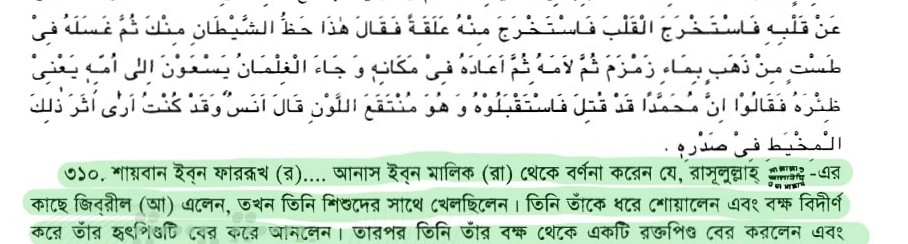
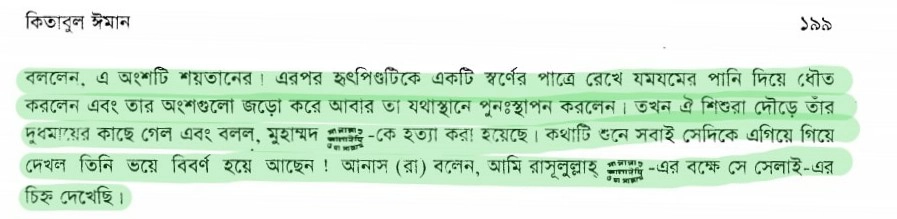
This advance selection also needs to be considered alongside the account of special assistance in childhood. Sahih Muslim states that while Muhammad was playing with other children, Gabriel came, opened his chest, removed his heart, extracted a clot identified as Satan’s portion, washed the heart with Zamzam water, and returned it to its place. In other words, although Satan’s influence is emphasized in accounts of ordinary people’s propensity to sin and their moral struggles, the account of the chosen prophet describes direct intervention in childhood to remove that influence. [10] [11]
Sahih Muslim (Islamic Foundation edition)
Book: 1 / The Book of Faith
Chapter: 73. The Messenger of Allah’s Night Ascension and the Prescription of Prayer
310. Shayban ibn Farrukh (may Allah have mercy on him) … narrated from Anas ibn Malik (may Allah be pleased with him) that Gabriel (peace be upon him) came to the Messenger of Allah (peace and blessings be upon him) while he was playing with other children. He took hold of him, laid him down, opened his chest, and removed his heart. He then extracted a clot from his chest and said, “This is Satan’s portion.” Then he placed the heart in a golden vessel and washed it with Zamzam water, gathered its parts together, and restored it to its place. The children ran to his wet nurse and said, “Muhammad has been killed.” On hearing this, everyone went towards him and found that his face had turned pale with fear. Anas (may Allah be pleased with him) said, “I saw the mark of that stitching on the chest of the Messenger of Allah (peace and blessings be upon him).”
Hadith classification: Authentic (Sahih)
Consider whether an ordinary person’s moral life would remain the same if they received such exceptional assistance from childhood. Treating an obstacle that has been removed as equivalent to an obstacle others still have to confront distorts the assessment of personal effort. In an examination, one candidate is given additional preparation, direct assistance, and protection from the principal source of error in advance, while the other candidates receive general instructions to persevere. The first person’s success is then presented as evidence of superiority over everyone else. Such a judgment must assess both the result and the conditions under which it was achieved. When ordinary people are held responsible for their sins, where is the absence of the special intervention described in the account of Muhammad’s chest being opened taken into consideration?
If a teacher gives a favored pupil special preparation before an examination, removes that pupil’s weaknesses, and provides more assistance during the examination than others receive, the pupil’s good results cannot establish the teacher’s impartiality. They instead raise the question of why the same assistance was unavailable to the others. If the person organizing the examination can improve everyone’s preparation, the decision to grant a special advantage to only one person requires explanation. In the Islamic account, Allah’s power is unlimited. There was therefore no limitation of ability preventing Allah from providing others with the special preparation arranged for Muhammad. The difference arose through his selection. Where is the justifiable reason for that selection?
When the appointment to prophethood, preparation for prophethood, and special assistance given to the prophet all depend on Allah’s decisions, saying “he became a prophet because he was the best person” does not resolve the problem. It must be shown how much of that superiority resulted from personal effort and how much from advantages granted beforehand. The question of Abu Lahab’s predetermined fate is also relevant here. Where were the opportunities for Abu Lahab or others corresponding to the advance selection and special preparation described for Muhammad? If the same creator specially prepares one person, places another in different circumstances, and then judges everyone’s moral standing, differences in opportunity must be included in any attempt to establish the justice of that arrangement. Identifying whom Allah selected tells us whom he preferred; explaining why that preference is just requires a separate argument.
The Prophet’s Favoritism towards His Relatives and the Question of Justice
The Prophet Muhammad announced glad tidings of Paradise to several members of his family. These announcements went beyond entry into Paradise: some were declared leaders of its women or its young people. This raises a question about the relationship between personal merit and family identity. If the highest rank among all the world’s women and young people is being assigned, what criteria determine that rank? What actions, sacrifices, moral qualities, and contributions to humanity establish it? The Prophet’s daughter Fatimah is described as the leader of the women. We can discuss the work of Marie Curie, Mother Teresa, Hypatia, or Begum Rokeya and assess their contributions and limitations. The claim to Fatimah’s highest standing therefore faces the same question: where is the comparative assessment of her work and qualities against those of other women? If the declaration is placed beyond question because she belongs to the Prophet’s family, family identity acquires a special privilege in the allocation of status.
Social structures throughout the world have developed in ways that profoundly shape people’s lives and occupational opportunities through family circumstances. A farmer’s or rickshaw driver’s child may have to confront the demands of household income, educational expenses, and an insecure livelihood from an early age. At the same age, a child from an elite and powerful family can attend a good school, grow up in a secure environment, prepare for higher education, and become acquainted with influential people. To reach the same position, a child from a poor family must overcome numerous obstacles; even hard work offers no guarantee of success. These differences extend beyond education and employment. Wealth, connections, and social standing pass from one generation to the next. Treating advantages acquired at birth as personal achievements conceals the deprivation experienced by others.
We raise the same questions about dynastic politics. Why do we question the justice of granting Sheikh Hasina’s son Joy or Khaleda Zia’s son Tarique a political position, additional power, or special status merely because of their parents? Because they did not create that identity themselves, and the same opportunity is unavailable to other qualified people. A child from a working-class, farming, or low-income family must overcome many obstacles to establish a political career; the connections and access inherited by someone from a powerful family are not readily available to them. In landed aristocracies and monarchies, too, lineage determined the inheritance of power. Our central objection to such systems is that rights and status are grounded in family identity rather than an assessment of the individual. The same standard must apply to the distribution of religious status. Let us read the cited reports concerning the Prophet’s family. [12]
Sahih al-Bukhari (Islamic Foundation edition)
50 / The Prophets (peace be upon them)
Chapter: 2091. The Merits of the Messenger of Allah’s Close Relatives and of Fatimah, the Prophet’s Daughter (may Allah be pleased with her). The Prophet (peace and blessings be upon him) said, “Fatimah is the leader of the women of Paradise.”
3447. ʿAbdullah ibn ʿAbd al-Wahhab (may Allah have mercy on him) … narrated from Abu Bakr (may Allah be pleased with him), who said, “Show particular respect to Muhammad’s family.”
Hadith classification: Authentic (Sahih)
Narrator: Abu Bakr al-Siddiq (may Allah be pleased with him)
Here the chapter heading contains the declaration of Fatimah’s status, whereas the report itself presents Abu Bakr’s instruction to show particular respect to Muhammad’s family. Al-Bukhari also contains a direct report describing Fatimah as the leader of the women. Its complete translation follows. [13]
Sahih al-Bukhari
The Signs of Prophethood
Hadiths 3623–3624; translation of the complete report
Abu Nuʿaym narrated to us; Zakariyya narrated from Firas, from ʿAmir, from Masruq, from ʿAʾishah. ʿAʾishah said: Fatimah came walking, and her gait resembled the Prophet’s. The Prophet said, “Welcome, my daughter.” He seated her on his right or left and whispered something to her. She wept. I asked, “Why are you crying?” He whispered to her again, and she laughed. I said, “I have never seen joy so close to sorrow as today.” When I asked what he had said, she replied, “I shall not disclose the Messenger’s secret.” After the Prophet’s death, I asked her again, and she said: “He told me privately that Gabriel reviewed the Qur’an with him once each year, but had reviewed it twice that year. He said, ‘I think the time of my death is approaching, and you will be the first of my family to join me.’ That was why I wept. Then he said, ‘Are you not pleased to be the leader of the women of Paradise, or the leader of the believing women?’ That was why I laughed.”
The Prophet’s two grandsons, Hasan and Husayn, are likewise declared leaders of the young people of Paradise. Within the same family, then, the daughter is assigned the highest standing among women and the two grandsons leadership among young people. These reports announce their ranks; the question is what publicly available criteria establish those ranks through comparison with other people. [14] [15]
Sunan al-Tirmidhi (critically verified edition)
46 / The Merits of the Messenger of Allah and His Companions
Chapter: 31. The Merits of al-Hasan ibn ʿAli and al-Husayn ibn ʿAli ibn Abi Talib (may Allah be pleased with them)
3768. Abu Saʿid al-Khudri (may Allah be pleased with him) narrated that the Messenger of Allah (peace and blessings be upon him) said: “Al-Hasan and al-Husayn are both leaders of the young people of Paradise.”
Authentic: al-Sahihah (796)
Sufyan ibn Wakiʿ narrated from Jarir and Muhammad ibn Fudayl, from Yazid (may Allah have mercy on him), a similar report with this chain. Abu ʿIsa said: This hadith is hasan sahih. Ibn Abi Nuʿm is ʿAbd al-Rahman ibn Abi Nuʿm al-Bajali, a resident of Kufa. His kunyah is Abu al-Hakam.
Hadith classification: Authentic (Sahih)
Narrator: Abu Saʿid al-Khudri (may Allah be pleased with him)
Sunan Ibn Majah
Introduction
Chapter: 14. The Merits of ʿAli ibn Abi Talib (may Allah be pleased with him)
5/118. Narrated from Ibn ʿUmar, who said that the Messenger of Allah (peace and blessings be upon him) said: “Hasan and Husayn are the leaders of the young people of Paradise, and their father will be superior to them.”
Al-Albani’s assessment: Authentic. Al-Albani’s source reference: al-Sahihah 979. Regarding al-Muʿalla ibn ʿAbd al-Rahman, a narrator of this hadith, ʿAli ibn al-Madini said that his hadiths are weak and that he has been accused of fabricating reports. Ibn ʿAdi said, “I hope there is no significant problem.” Abu Hatim al-Razi said that his hadiths are weak. Imam al-Daraqutni said that he is weak and a liar. This hadith is authentic on the basis of a corroborating report.
Hadith classification: Authentic (Sahih)
Narrator: ʿAbdullah ibn ʿUmar (may Allah be pleased with him)
Now reconsider the circumstances of birth. If Abu Lahab or Abu Jahl had grown up in different families, with different education and assistance, what would their beliefs and behavior have been? If you or I had been born into Muhammad’s immediate family environment, received his teaching from childhood, and obtained assurances of our future standing directly from him, how much would our religious lives have changed? Birthplace, family relationships, and available assistance play important roles in shaping a person’s life. If these differences are disregarded and certain individuals are simply declared to hold special status, the question of how merit is determined remains unresolved. Affection for one’s family is readily understandable. Declaring superiority among all human beings or leadership in the afterlife, however, requires moral criteria applicable to everyone. The question we raise when family identity confers special privileges in political power also applies to religious status: where is the boundary between closeness to the person making the declaration and the individual’s own achievements?
Suppose a political leader declared his daughter the finest of all the country’s women and his two grandsons the leaders of all its young people. We would ask him to explain the grounds for their superiority and leadership. Merely saying “they are members of my family” or “I know they are qualified” would not establish the claim. Other people’s work, abilities, and contributions would have to be considered in the same assessment. There is no reason to avoid this question when the highest standing in the afterlife is declared for the Prophet’s family. Indeed, when a claim extends beyond one country to superiority among the people of every era, its criteria need to be even clearer. To justify assigning the highest positions to several members of the same family, their individual merits and the basis of comparison with others must be demonstrated independently of family closeness.
This discussion also includes a report about Khadijah’s children found in the Bengali edition of Mishkat. It states that her two deceased children from an earlier marriage are in Hell, whereas her deceased children fathered by Muhammad are in Paradise. The report is quoted in full below. [16]
110. Narrated from ʿAli (may Allah be pleased with him), who said: Khadijah (may Allah be pleased with her) asked the Messenger of Allah (peace and blessings be upon him) about two of her children, fathered by her previous husband, who had died in the age of ignorance: were they in Paradise or Hell? He replied, “They are in Hell.” ʿAli said: Seeing the sadness on Khadijah’s face after hearing about her children, the Messenger of Allah (peace and blessings be upon him) said, “If you saw their condition, you would feel aversion towards them.” Khadijah then asked, “What of the children I bore you who have died—Qasim and ʿAbdullah?” He replied, “They are in Paradise.” He then said, “Believers and their children are in Paradise, and polytheists and their children are in Hell.” He then recited, in translation: “Those who believe and whose children follow them—I shall keep their children with them in Paradise” (Surah al-Tur: 12). (Ahmad)
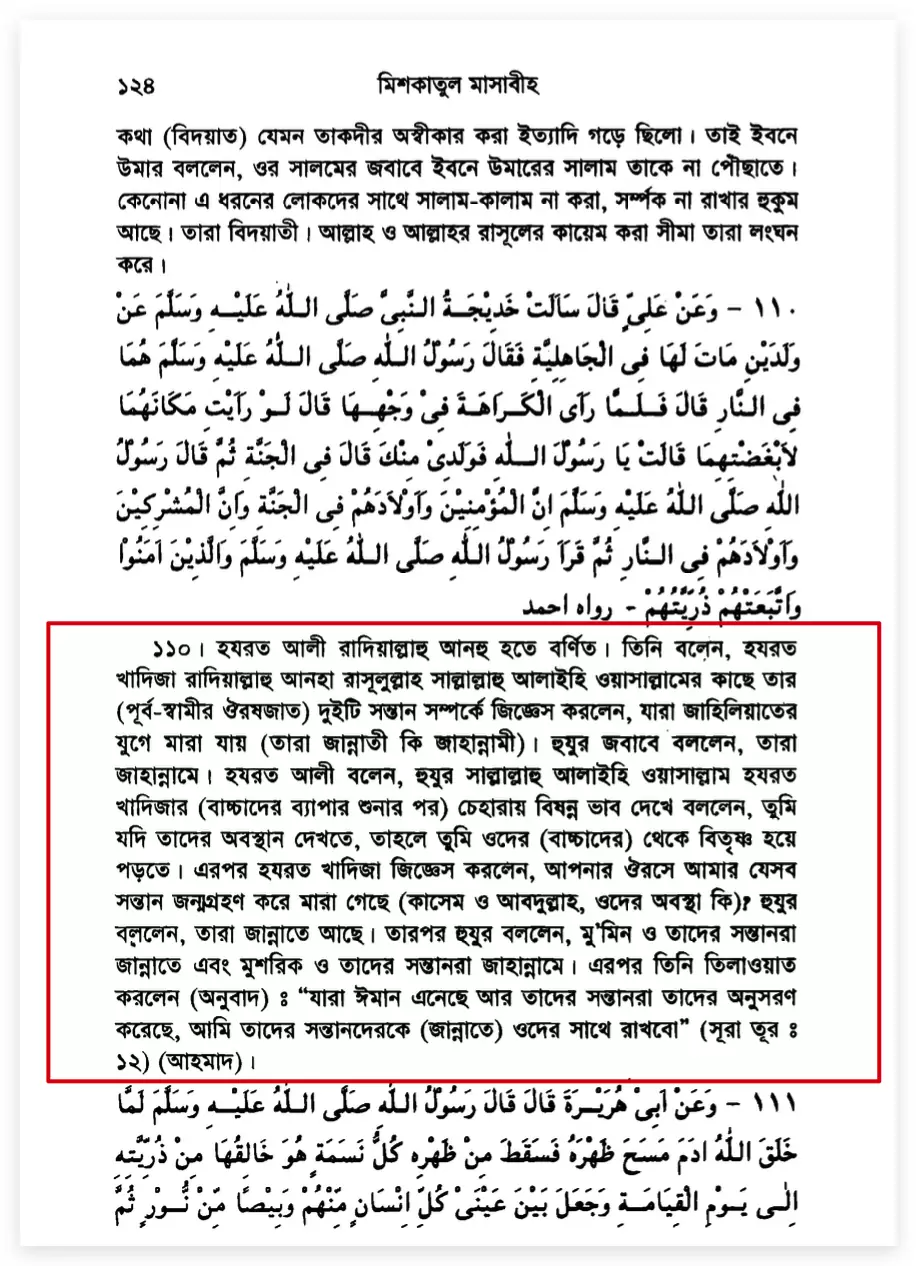
Ibn Kathir noted objections to the chain of transmission of this report; the quoted verse is also verse 21 of Surah al-Tur, rather than verse 12. [17] The issue here is the moral meaning of the principle presented in the quoted text for determining children’s ultimate fate. No child chooses their family of birth or their parents’ religion. If an inherited identity becomes the basis for salvation or punishment, where does individual responsibility enter the judgment? Anyone accepting this claim must explain how it is just to judge a child by their parents’ identity before that child has made any decision of their own.
The central question about the family’s special status already arises within the reports concerning Fatimah, Hasan, and Husayn. Assessing justice requires us to know how an ordinary person’s moral qualities, sacrifices, and contributions to human welfare are evaluated, and how the highest standing is assigned to members of a particular family. Using a declaration of superiority as proof of that superiority makes the reasoning circular: the person is superior because they have been declared superior. To explain that superiority to someone who does not believe the declaration requires verifiable criteria beyond the declaration itself. Whether those criteria apply to everyone, how much family closeness matters, and how differences in opportunities acquired at birth are considered are questions that the claim to justice must answer.
Special Exemptions for the Veterans of Badr: The Case of Hatib
The question of special status extends beyond family to declarations of forgiveness in advance for a particular group. Reports concerning those who fought at Badr include the words “Do whatever you wish,” together with assurances of forgiveness or Paradise. The case of Hatib ibn Abi Baltaʿah is especially significant here. He sent a letter to the polytheists of Mecca containing information about Muhammad’s plans. After the letter was recovered, Muhammad asked him why he had done this. Hatib explained that he intended to secure the safety of his family and property by doing the Meccans a favor. Muhammad accepted his explanation as truthful. When ʿUmar asked permission to kill him, however, the reply also invoked his participation at Badr and the special declaration concerning its veterans. Reading the complete report reveals both an assessment of intention and the special advantage attached to an existing status. [18]
Sahih al-Bukhari (Tawhid Publication edition)
79 / Asking Permission
Chapter: 79/23. Investigating a Letter to Establish Its Contents When It Gives Cause for Concern for Muslims.
6259. Narrated from ʿAli (may Allah be pleased with him). He said: The Prophet (peace and blessings be upon him) sent me, al-Zubayr ibn al-ʿAwwam, and Abu Marthad al-Ghanawi (may Allah be pleased with them) on horseback, instructing us: “Set out and go to Rawdat Khakh. There you will find a polytheist woman carrying a letter sent by Hatib ibn Abi Baltaʿah to the polytheists.” We found her at precisely the place the Messenger of Allah (peace and blessings be upon him) had mentioned. The woman was riding a camel. We asked her, “Where is the letter you have?” She replied, “I have no letter.” We made her dismount with her camel and searched her riding equipment, but found nothing.
My two companions said, “The letter has not been found.” I said, “I know that the Messenger of Allah (peace and blessings be upon him) did not speak without reason.” He then sternly told the woman, “You must produce the letter, or I shall strip you and search you.” When she saw his determination, she was compelled to reach into the cloth wrapped around her waist and produce the letter. We took it to the Messenger of Allah (peace and blessings be upon him).
He asked Hatib, “Hatib, why did you do this?” Hatib replied, “I have no evil intention of abandoning faith and belief in Allah and His Messenger. I have not changed my firm convictions or changed my religion. My sole purpose in sending this letter was to do the Meccans a favor through which Allah might keep my family and property safe. Your other companions have people there through whom Allah will ensure the safety of their families and property.”
The Prophet (peace and blessings be upon him) said, “Hatib has spoken the truth, so say nothing of him except good.” The narrator said: ʿUmar ibn al-Khattab (may Allah be pleased with him) said, “He has certainly betrayed Allah, His Messenger, and the believers. Let me strike off his head.” The narrator said: The Prophet (peace and blessings be upon him) replied, “ʿUmar, do you not know that Allah has looked upon those who participated at Badr and declared, ‘You may do whatever you wish; Paradise has been decreed for you’?” The narrator said: Tears then flowed from ʿUmar’s eyes, and he said, “Allah and His Messenger know best.” [3007] (Adhunik Prakashani: 5817; Islamic Foundation: 5712)
Hadith classification: Authentic (Sahih)
Narrator: ʿAli ibn Abi Talib (may Allah be pleased with him)
Hatib’s reason for sending the letter is relevant to understanding his intention. Any judgment needs to examine intention, pressure, circumstances, and the consequences of an action. Alongside that examination, however, this report introduces another consideration: he was a veteran of Badr. That identity is connected to the declaration “You may do whatever you wish” and the assurance that Paradise has been decreed for him. This is where the question of equal standards of judgment arises. If another person committed the same act in the same circumstances, their intention and circumstances would form the basis of judgment; in Hatib’s case, a pre-existing special religious status is added. How far should the reward for a past action affect responsibility for future conduct? Does participation in a particular battle predetermine the ultimate consequences of every subsequent action? How does the judgment of this group relate to the judgment of people for whom no such assurance has been announced?
Suppose a state employee sends secret information to an enemy. An investigation establishes that concern for his family’s safety motivated the act. His intention and circumstances may be considered in the judgment. But if the judge adds, “He previously fought in an important war, so his ultimate deliverance is already assured,” a separate privilege enters the decision. Rewarding past service and determining responsibility for a subsequent offense must be assessed separately. Why should rewarding someone for one good action settle the consequences of all their future wrongdoing in advance? If a future action harms others, in particular, what weight will the claims of those harmed carry?
In his explanation of this declaration, Imam al-Nawawi locates the forgiveness in the afterlife. His interpretation allows earthly punishment and forgiveness in the afterlife to coexist. The question therefore extends directly to judgment in the afterlife: even if an action is punishable in this world, why should a particular group receive advance assurance about its consequences in the next? The complete relevant explanation by al-Nawawi is translated below. [19] [20]
Imam al-Nawawi, al-Minhaj Sharh Sahih Muslim
Vol. 16, pp. 56–57
Translation of the complete explanation concerning forgiveness for the veterans of Badr
The Prophet’s words: “Perhaps Allah looked upon the veterans of Badr and said, ‘Do whatever you wish; I have forgiven you.’” The scholars said that this means forgiveness for them in the afterlife. Nevertheless, if any of them incurs a prescribed punishment or another penalty, it is to be carried out in this world. Qadi ʿIyad reported a consensus concerning the enforcement of prescribed punishments against them. ʿUmar imposed such punishments on some of them. He also stated that the Prophet imposed a prescribed punishment on Mistah, although Mistah was a veteran of Badr.
Let us also read Ibn Taymiyyah’s relevant explanation as quoted on IslamQA. [21]
IslamQA, question and answer 159519
Quoted from Ibn Taymiyyah’s Mukhtasar al-Fatawa al-Misriyyah
Translation of the complete relevant paragraph on Hatib, the veterans of Badr, and forgiveness of future sins
This resembles the hadith of Hatib ibn Abi Baltaʿah, in which the Prophet said to ʿUmar: “How do you know? Perhaps Allah looked upon the veterans of Badr and said, ‘Do whatever you wish; I have forgiven you.’” It is also reported that Hatib’s slave complained about him, saying, “By Allah, Messenger of Allah, Hatib will certainly enter Hell!” He replied, “You have spoken falsely; he was present at Badr and Hudaybiyyah.” These hadiths indicate that a believer may perform a righteous deed because of which even his subsequent sins are forgiven, although forgiveness may also occur for other reasons. They also indicate that he will die as a believer and be among the inhabitants of Paradise. If he commits a sin, Allah will accept his repentance, as he accepted the repentance of some veterans of Badr. When Qudamah ibn ʿAbdullah drank wine on the basis of a mistaken interpretation, ʿUmar and his companions told him to repent and flogged him; he was purified through the prescribed punishment and repentance. Yet he, too, was among those told, “Do whatever you wish.”
This explanation makes the problem clearer. If someone is assured that repentance and forgiveness will remain available for future sins and that they will ultimately enter Paradise, how can their test and other people’s tests take place on equal terms? Ordinary people are told that their fate depends on belief, actions, and their condition at death. For this special group, however, that final condition is declared certain in advance. Repentance itself becomes a means to that assured outcome. Why are the same means, assistance, and assurance not established for ordinary people? If provision for future repentance and forgiveness is guaranteed for particular individuals, judgment must also account for how much of their salvation is a personal achievement and how much results from arrangements made beforehand.
Consider, too, the difference between assuring someone of Paradise in advance and testing someone while leaving their ultimate fate uncertain. One knows that their subsequent life will ultimately lead to salvation. Another is told that any error, change of belief, or condition at the end of life could lead to a terrible outcome. If assurance of salvation can be established for the first person in a manner consistent with their future conduct and repentance, why is this impossible for others? If an omnipotent creator can determine such a path for one person, inability to determine it for everyone is not the issue. The question concerns his principles of judgment: why is a favorable final outcome guaranteed for some members of the same human race, and where is justice for those excluded from this special arrangement?
The complaint by Hatib’s slave also appears in Sahih Muslim. When the slave complained about Hatib and said that he would enter Hell, Muhammad cited his presence at Badr and Hudaybiyyah as the reason he would not enter it. The complete report is translated below. [22]
Sahih Muslim
The Merits of the Companions; the Merits of the Veterans of Badr and the Case of Hatib
Hadith 2495; translation of the complete report
Qutaybah ibn Saʿid narrated to us; al-Layth narrated to us. Through another chain, Muhammad ibn Rumh narrated to us; al-Layth informed us, from Abu al-Zubayr, from Jabir: A slave of Hatib came to the Messenger of Allah and complained about Hatib, saying, “Messenger of Allah, Hatib will certainly enter Hell.” The Messenger of Allah said, “You have spoken falsely. He will not enter it, for he was present at Badr and Hudaybiyyah.”
In this report, Muhammad’s reply states the reason determining Hatib’s future fate: his presence at Badr and Hudaybiyyah. The relationship between adjudicating the complaint and this special identity must be examined at precisely this point. The quoted text gives no details of the slave’s complaint, but it does contain an assurance about the accused person’s fate in the afterlife. When the complainant is a subordinate slave and the accused has already been promised salvation, the question becomes especially pressing from the complainant’s perspective: where is the moral assessment of his complaint? How does announcing that a person with special status will ultimately be saved resolve the question of the complainant’s possible harm, suffering, or legitimate claim?
There may be a rationale for rewarding a past action. Extending that reward to forgiveness of future sins and assurance of ultimate salvation, however, requires an explanation of its limits and grounds. Questions then arise about what the person will subsequently do, who will be harmed by those actions, and how justice will be done for those harmed. Ensuring that a group’s special status does not diminish the weight of other people’s complaints is also part of justice. If the good deeds of a participant at Badr have value, so do the lives of those harmed by his later actions. When determining the reward for the former obscures the claims of the latter, the system of judgment begins to prioritize a person’s special identity over their actions.
Considering prophetic selection, the family’s highest standing, and special forgiveness for the veterans of Badr together reveals a fundamental problem in the moral assessment of human beings. Some receive appointment before birth, some exceptional assistance in childhood, some declarations of the highest standing within their family, and some assurance of ultimate salvation even after future sins. Establishing the claim to justice in these cases requires an account of the reasons for selection, differences in opportunity, criteria for status, and responsibility for future conduct. Saying that Allah favored particular individuals or groups, or that Muhammad announced their special status, identifies the religious declarations concerned. Determining whether those declarations create a just system of judgment for everyone requires each person’s actions, opportunities, and responsibilities to be assessed by the same publicly available criteria.
Predestination, Control over Actions, and Responsibility for Punishment
The question of justice cannot be addressed merely by listing punishments; it also requires examining how the punishable act occurred and how much control each party had over it. Assessing responsibility when someone commits an offense through their own decision is one matter. If another being predetermines that person’s ultimate fate, causes them to perform actions suited to that fate, and then punishes them for those actions, the very basis of judgment comes into question. Islam’s belief in predestination presents this second problem. Allah is described here as more than the judge: authority is also claimed for him over human creation, the effectiveness of human willing, human actions, and their ultimate outcomes. There is therefore no logical basis for excluding Allah’s role when determining human responsibility.
A fuller discussion of predestination is available in Shongshoy’s article On Predestination as a Fundamental Basis of Islam and its Islam and Predestination section. Here we examine the aspect directly relevant to justice: if the path to sin, the desire to sin, and the consequences of sin cannot fall outside Allah’s effective determination, how is it just to place responsibility for that sin solely on human beings?
Who Causes People to Sin or Perform Good Deeds?
Why people commit wrongs and crimes, and what factors contribute to those actions, are questions that an assessment of justice cannot avoid. Suppose, for example, that a commander of the Israeli armed forces orders an attack on innocent people in Palestine and soldiers carry out the order. If the attack is criminal, pointing only to the soldiers who carried it out does not discharge the responsibility of the person who ordered it. The role of whoever planned the offense, issued the order, and caused others to commit it must also be judged. The soldiers’ responsibility, in turn, must be assessed in light of their decisions, circumstances, and ability to refuse. Yet a soldier can disobey a military commander’s order; that commander’s power is not unlimited. If Allah himself causes an action and there is no possibility of his determination failing, how can a mere human being defy it? Let us read the hadith: [23]
Sunan Abu Dawud (critically verified edition)
Publisher: Allama Albani Academy
Book: 35 / Sunnah
4703. Narrated through Muslim ibn Yasar al-Juhani (may Allah have mercy on him). ʿUmar ibn al-Khattab (may Allah be pleased with him) was once asked about this verse: “When your Lord brought forth from the backs of Adam’s descendants all their offspring…” (Surah al-Aʿraf: 172). The narrator said that al-Qaʿnabi recited this verse. ʿUmar said, “I heard the Messenger of Allah (peace and blessings be upon him) being asked about it.” The Messenger of Allah (peace and blessings be upon him) said: “After creating Adam, Allah Almighty passed His right hand over his back, brought forth a group of his descendants, and said, ‘I have created these for Paradise, and they will perform the deeds of its inhabitants.’
Then He passed His hand over his back again, brought forth another group of descendants, and said, ‘I have created these for Hell, and they will perform the deeds of its inhabitants.’” On hearing this, a man asked, “Messenger of Allah, what value do deeds have, then?” The Messenger of Allah (peace and blessings be upon him) replied: “When Almighty Allah creates a servant for Paradise, He causes him to perform the deeds of its inhabitants. He ultimately dies performing their deeds, and Allah admits him to Paradise in return. And when He creates a servant for Hell, He causes him to perform the deeds of its inhabitants. He ultimately dies performing their deeds, and for this He admits him to Hell.”(1)
Authentic, apart from the words about passing His hand over the back.
Hadith classification: Authentic (Sahih)
The sequence of events in this report deserves attention. First, a person is created for Paradise or Hell. They are then caused to perform actions appropriate to that predetermined destination. Finally, they die performing those actions and are sent to the assigned destination in return for them. The claim here is therefore more than that Allah knew beforehand what people would do. It is that Allah determines the destination, causes people to perform actions suited to it, and then uses the actions he himself caused as the grounds for reward or punishment. In this arrangement, the judge himself produces the grounds for punishment. Saying that the person performed the action does not erase the responsibility of the being who caused them to perform it. Shongshoy’s article In the Classical Interpretation of Islam, Allah Causes People to Perform the Deeds of the Inhabitants of Paradise or Hell discusses this relationship between causation and judgment in greater detail.
The listener to the hadith also recognized this problem and asked, “What value do deeds have, then?” The answer is revealing: he was not told that no destination had been assigned in advance and that it would subsequently be decided on the basis of human actions. Instead, he was told again that whoever has been assigned a particular destination is caused to perform the deeds associated with it. Deeds therefore do not appear here as an independent means of changing a predetermined outcome; they are the route by which that outcome is realized. An action may be necessary to produce a particular result, but its necessity does not establish that ultimate control over it lay with the person performing it. This question is discussed in detail in Do Deeds Actually Have Any Value?
Another report from the Prophet also states that people were created for Paradise and Hell before their birth, while still in their fathers’ loins. At that point, the individual had made no conscious decision, committed no sin, and undergone no moral test. Nevertheless, they are described as having been created for Paradise or Hell. The context of the following report makes it especially significant, since it concerns the funeral of an innocent child. [24]
Sunan Ibn Majah
Book: Introduction
Chapter: 10. Reports on Predestination—the Recording of Fate
7/82. Narrated from ʿAʾishah, Mother of the Believers (may Allah be pleased with her), who said: The Messenger of Allah (peace and blessings be upon him) was invited to conduct the funeral prayer for a boy from the Ansar. I said, “Messenger of Allah, glad tidings for him! He is a sparrow among the sparrows of Paradise; he neither committed sin nor was touched by it.” He replied, “ʿAʾishah, might it be otherwise? Allah Most High has certainly created a group of people for Paradise. He created them for Paradise while they were still unconscious in their fathers’ loins. He also created a group for Hell. He created them for Hell while they were still unconscious in their fathers’ loins.”
References in the Six Books: Muslim 2662/1–2; al-Nasaʾi 1947; Abu Dawud 4713; Ahmad 23612, 25214.
Al-Albani’s assessment: Authentic.
Hadith classification: Authentic (Sahih)
Narrator: ʿAʾishah (may Allah be pleased with her)
The moral basis of ʿAʾishah’s statement is straightforward: the child had not sinned, so there was no reason to punish him. In the reply, however, that innocence was not accepted as sufficient grounds for a certain conclusion; instead, the creation of people for Paradise and Hell before birth was invoked. This report does not declare that particular child an inhabitant of Hell, but it raises a more fundamental problem for justice: if someone is created for a final outcome before undertaking any action, how genuinely open is the judgment of their subsequent actions? If the destination is fixed before the person’s moral life begins, is that life a test to establish the destination, or a process that implements a result already settled?
Sahih Muslim also makes an explicit statement about when predestination was established. A hadith narrated from ʿAbdullah ibn ʿAmr ibn al-ʿAs states that the destinies of all creation were recorded fifty thousand years before the heavens and the earth were created. This is therefore no claim that a person’s actions are assessed after their life ends; it is a claim that destiny was determined long before their birth and actions. [25]
Sahih Muslim (Islamic Foundation edition)
Book: 48 / Predestination
Chapter: 2. The Debate between Adam and Moses (peace be upon them)
6507. Abu Tahir Ahmad ibn ʿAmr ibn ʿAbdullah ibn Sarh (may Allah have mercy on him) … narrated from ʿAbdullah ibn ʿAmr ibn al-ʿAs (may Allah be pleased with him), who said: I heard the Messenger of Allah (peace and blessings be upon him) say, “Allah Most High recorded the destinies of all creation fifty thousand years before creating the heavens and the earth.” He said that Allah’s Throne was then above the water.
Hadith classification: Authentic (Sahih)
The same statement concerning the creation of people for Paradise and Hell before birth appears in the Hadith Academy edition of Sahih Muslim. Let us read this complete report as well. [26]
Sahih Muslim (Hadith Academy edition)
47. Predestination
Chapter: 6. The Meaning of Every Child Being Born with an Islamic Disposition, and the Ruling Concerning the Deceased Children of Unbelievers and Muslims
6661-(31/…) Abu Bakr ibn Abi Shaybah (may Allah have mercy on him) … narrated from ʿAʾishah, Mother of the Believers (may Allah be pleased with her), who said: The Messenger of Allah (peace and blessings be upon him) was invited to attend the funeral of a minor child from the Ansar. I said, “Messenger of Allah, this child is fortunate. He is a sparrow among the sparrows of Paradise. He neither committed sin nor was touched by it.” He replied, “There is more to it, ʿAʾishah. Indeed, Allah Most High has created inhabitants for Paradise, whom He created for that purpose while they were still in their forefathers’ loins. And He has created people for Hell, whom He created for that purpose while they were still in their forefathers’ loins.” (Islamic Foundation: 6527; Islamic Centre: 6578)
Hadith classification: Authentic (Sahih)
Narrator: ʿAʾishah (may Allah be pleased with her)
It is essential to distinguish foreknowledge from effective control over actions. A teacher may assess a pupil’s preparation and predict that the pupil will fail an examination. But if the teacher causes the pupil to write incorrect answers, prevents any effective opportunity to write correct ones, and then punishes the pupil for the incorrect answers, the situation changes entirely. In the first case, the teacher observes an outcome; in the second, the teacher actively helps produce it. The words “causes him to perform” in the reports under discussion raise precisely this second issue. Merely knowing the future is not equivalent to determining future actions and outcomes and bringing them about. Conflating the two conceals the actual conflict between predestination and justice.
Answer 264354 on IslamQA explains predestination through four aspects: knowledge, recording, will, and creation. It further states that if Allah has decreed that someone will die as a believer or unbeliever, that final determination cannot be changed. Although changes to the record held by the angels through supplication or other causes are discussed, these do not alter Allah’s knowledge or the final determination in the Preserved Tablet. Supplication and its effects are therefore themselves included in predestination. The discussion quotes the following hadith narrated by Ibn ʿAbbas. [27]
Jamiʿ al-Tirmidhi
Hadith: 2516
Narrated by Ibn ʿAbbas
Translation from Arabic of the hadith quoted on IslamQA:
One day I was behind the Messenger of Allah. He said: “Young boy, I shall teach you a few words. Observe Allah’s commands, and He will protect you. Observe Allah’s commands, and you will find Him before you. When you ask, ask Allah; when you seek help, seek Allah’s help. Know that if all people gathered to benefit you, they could benefit you only with what Allah has written for you. And if they gathered to harm you, they could harm you only with what Allah has written against you. The pens have been lifted, and the written pages have dried.”
Not knowing one’s predetermined fate does not make that fate undetermined. Ignorance can change human experience, but it does not change the nature of determination. A person does not know their ultimate outcome, so they strive, decide, hope, and fear. But if every effort and decision, together with that outcome, is determined in a way that cannot be otherwise, saying “they did not know” does not justify assigning them ultimate responsibility. Judgment must consider the nature of the system within which their desires and actions arise. The question therefore remains: if people cannot move beyond the outcome determined for them and Allah himself causes them to perform the actions leading to it, how can good and evil deeds measure their independent moral merit?
Allah Himself Leads People Astray, Then Demands Accountability
The problem of predestination is not confined to hadiths determining the inhabitants of Paradise and Hell in advance. The Qur’an also subordinates human willing, guidance, and misguidance to Allah’s will. The question therefore becomes more direct: if the ability to accept truth, the effective opportunity to find the right path, and the capacity to act on one’s wishes depend on Allah’s decision, how can someone denied that opportunity bear full responsibility for their unbelief? Being presented with the religion and being capable of believing in it are not the same thing. Merely showing a path does not establish that an effective ability to follow it is equally available to everyone.
Ibn Kathir states this directly in his commentary on the final verses of Surah al-Takwir. Immediately after human willing is mentioned, it is made subordinate to Allah’s will. Let us read the complete commentary on the relevant verses and the report cited alongside it. [28]
Tafsir al-Qurʾan al-ʿAzim — Ibn Kathir
Commentary on Surah al-Takwir, verses 27–29
Vol. 8, p. 340
Translation from Arabic:
His words, “It is nothing but a reminder to the worlds,” mean that this Qur’an is a reminder for all people, through which they may remember and take heed. “For whoever among you wishes to follow the straight path” means that whoever seeks guidance should accept this Qur’an, for it is salvation and guidance for him, and there is no guidance without it. “And you cannot will unless Allah, Lord of the worlds, wills” means that the matter of willing has not been left in your hands, so that whoever wishes may obtain guidance and whoever wishes may go astray; rather, all of this follows the will of Allah, Lord of the worlds.
Sufyan al-Thawri narrated through Saʿid ibn ʿAbd al-ʿAziz from Sulayman ibn Musa: When the verse “For whoever among you wishes to follow the straight path” was revealed, Abu Jahl said, “The matter is in our hands; if we wish, we shall follow the straight path, and if we wish, we shall not.” Allah then revealed, “And you cannot will unless Allah, Lord of the worlds, wills.”
In this explanation, the existence of human willing does not make that willing independent of Allah’s control. In whom a desire arises and who ultimately controls it are two separate questions. A person may experience the desire to do something in their own mind; if the formation and effectiveness of that desire nevertheless depend on another being’s indispensable approval, the experience of desire alone cannot establish ultimate responsibility. The statement “I want this” does not entail “I am also the ultimate determinant of what I want.” This is especially so when the religious explanation itself states that people cannot obtain guidance simply by wishing for it and that the entire matter follows Allah’s will.
Verse 93 of Surah al-Nahl presents this tension within the same sentence. It first states that Allah could have made everyone one community had he wished; it then states that he leads astray whom he wills and guides whom he wills; immediately afterwards, it announces that people will be questioned about their actions. Ibn Kathir’s complete commentary on the relevant verse follows. [29]
Tafsir al-Qurʾan al-ʿAzim — Ibn Kathir
Surah al-Nahl, verse 93 and its commentary
Translation from Arabic:
“Had Allah willed, He could have made you one community. But He leads astray whom He wills and guides whom He wills. And you will certainly be questioned about what you used to do.”
Allah says, “Had Allah willed, He could have made you”—O humankind—“one community.” As He has said, “Had your Lord willed, everyone on earth would have believed” [Yunus: 99]. That is, He would have created unity and concord among you, leaving no disagreement, mutual hatred, or enmity. “Had your Lord willed, He could have made humankind one community. But they will continue to differ, except those to whom your Lord shows mercy; and for this He created them” [Hud: 118–119]. Here, likewise, He says, “But He leads astray whom He wills and guides whom He wills.” Then, on the Day of Resurrection, He will question you about all your actions and recompense them, down to the slightest matter, as small as a date stone’s thread, tiny speck, or thin covering.
The question of justice is difficult to avoid here. The being who could guide everyone if he wished, but instead chooses to lead some astray, will also judge the actions of those he has led astray. Before establishing a charge against someone, one must examine whether the judge has played any role in producing the substance of that charge. If the judge himself controls the accused person’s effective opportunity to reach the right path and exercises the power to lead them astray, ignoring that role is partiality. Retaining the power to lead people astray while placing all responsibility for misguidance on someone else does not become a just relationship merely because both claims are announced together.
Classical Sunni explanations of the creation of human actions and an unbeliever’s unbelief make this problem still clearer. Ibn Abi al-ʿIzz’s Sharh al-ʿAqidah al-Tahawiyyah states that Allah creates human actions and that an unbeliever’s unbelief also falls within his effective will. It simultaneously distinguishes this effective will from religious approval. Let us read the consecutive statements at the beginning of the relevant discussion. [30]
Sharh al-ʿAqidah al-Tahawiyyah — Ibn Abi al-ʿIzz al-Hanafi
The Position of Ahl al-Sunnah wa al-Jamaʿah on Predestination
Translation from Arabic:
Disagreement among people concerning predestination is well known. The position of Ahl al-Sunnah wa al-Jamaʿah is that everything occurs according to Allah’s decree and predestination, and that Allah creates human actions. Allah has said, “Indeed, We have created everything according to a determined measure” [al-Qamar: 49]. He has also said, “He created everything and determined its measure precisely” [al-Furqan: 2]. Allah wills and desires unbelief from the unbeliever, but does not approve of it or love it. He wills it in the creational sense, but does not approve of it in the religious sense.
The Qadariyyah and Muʿtazilah disagreed on this matter. They claimed that Allah willed the unbeliever’s faith, but the unbeliever willed unbelief. They adopted this position to avoid saying that Allah willed the unbeliever’s unbelief and punished him for it! Yet they were like someone seeking refuge from hot sand in a fire!
They fled one problem only to fall into a worse one. Their statement necessarily implies that the unbeliever’s will prevailed over Allah’s will. According to them, Allah willed his faith and the unbeliever willed unbelief; consequently, the unbeliever’s will occurred instead of Allah’s! This is an extremely reprehensible belief, unsupported by evidence and contrary to it.
Although this explanation says that “Allah does not approve of unbelief,” it still locates the effective will for unbelief to occur in Allah. Disapproving of something and determining that it occur are different matters; the former does not remove moral responsibility for the latter. If someone verbally disapproves of an action while personally determining the arrangements that bring it about, and the action could not occur without that determination, the declaration of disapproval does not exclude them from questions of causation and morality. It is also significant that the possibility of people acting outside Allah’s effective will is rejected in order to preserve Allah’s power. Yet preserving that power in this way restricts the independent opportunity for people to bring about a different result. A separate argument is still needed to hold them fully responsible; merely declaring them responsible cannot replace that argument.
The inequality in this system becomes still more pronounced when belief and morality are assessed. For someone who receives guidance, success is attributed to Allah’s mercy and favor; for someone who goes astray, the punishment for failure is their own. Yet the sources under discussion place both guidance and misguidance under Allah’s effective control. Acknowledging his credit when his determination produces success, but concealing the determiner’s role and placing all responsibility on the creature when the same determination produces failure, does not apply an equal standard of justice. The relationship must be demonstrated between invoking human willing when discussing human responsibility and declaring that willing wholly subordinate when discussing Allah’s power. Merely demanding belief in both does not establish their consistency.
Further relevant evidence from the Qur’an and its commentaries is available in What Do the Qur’an and Tafsir Say about Predestination? For a combined reading of statements in creedal works on the creation of human actions, the determination of good and evil deeds, and divine control over guidance and misguidance, see Predestination in Classical Islamic Creed: Allah’s Will, Human Actions, and Moral Responsibility. Judged by standards of justice, these sources present the same central question: how can a being who determines the outcome, causes the actions leading to it, and retains control of the effective opportunity for guidance acquire the right to punish his creatures without any assessment of his own role? Calling such an arrangement justice requires more than a declaration of power; a justifiable basis for punishment must be shown.
Punishment without an Offense and Responsibility for Others’ Actions
A fundamental condition of justice is that a person being punished must have committed an act for which they can be held responsible. An identity acquired at birth, claims about what they might do in the future, or something others do after their death cannot substitute for an offense they have actually committed. Blood relationship or a shared religious identity does not transfer responsibility for an offense from one person to another. Yet various Islamic reports describe circumstances in which the relationship between punishment and the person’s own actions becomes unclear or is directly called into question. This chapter examines accounts of innate unbelief, the killing of a boy before an offense occurs, the declaration that a murdered daughter goes to Hell, and statements linking punishment to other people’s actions.
Born an Unbeliever?
Drawing on the Qur’anic story of Moses and Khidr, Sahih Muslim reports the killing of a boy. The boy was playing with other boys when Khidr killed him. Moses asked why an innocent life had been taken without that person having taken another life. The subsequent explanation states that the boy was an unbeliever by birth and, had he lived, would have led his parents towards disobedience and unbelief. The grounds given for the killing therefore concern a future that had not yet occurred. The boy had not yet compelled his parents to embrace unbelief, but his life was ended because of that unperformed action. How is it just to make the potential future of an action someone has not yet committed the justification for killing them now? Let us first read the shorter report. [31]
Sahih Muslim (Hadith Academy edition)
47. Predestination
Chapter: 6. The Meaning of Every Child Being Born with an Islamic Disposition, and the Ruling Concerning the Deceased Children of Unbelievers and Muslims
6659-(29/2661) ʿAbdullah ibn Maslamah ibn Qaʿnab (may Allah have mercy on him) … narrated from Ubayy ibn Kaʿb (may Allah be pleased with him), who said: The Messenger of Allah (peace and blessings be upon him) said: “The boy whom Khidr (peace be upon him) killed at Allah’s command had been created with an unbeliever’s disposition. Had he lived, he would have compelled his parents to disobedience and unbelief.” (Islamic Foundation: 6525; Islamic Centre: 6576)
Hadith classification: Authentic (Sahih)
Narrator: Ubayy ibn Kaʿb (may Allah be pleased with him)
The words “had been created with an unbeliever’s disposition” raise a deeper problem for justice. An innate disposition is not an action chosen by its possessor. Before birth, no one controls the mental constitution, tendencies, or environment with which they will be born. If Allah is the creator of that disposition in the religious account, responsibility for creating it cannot be excluded when innate unbelief is used against the individual. Even before asking about the child’s ultimate fate, the killing that occurred here must be judged. The boy was killed before being given the opportunity to live his life and make decisions. The account provides no opportunity for his potential future to change; it instead describes removing him and providing another child.
The longer report in Sahih Muslim describes the episode in greater detail. It brings together Moses’ objection, Khidr’s action, and the final explanation concerning the boy’s future. Let us read the complete report. [32]
Sahih Muslim (Islamic Foundation edition)
45 / Merits
Chapter: 42. The Merits of Khidr (peace be upon him)
5949. Muhammad ibn ʿAbd al-Aʿla al-Qaysi (may Allah have mercy on him) … narrated from Saʿid ibn Jubayr (may Allah be pleased with him), who said: ʿAbdullah ibn ʿAbbas (may Allah be pleased with him) was told that Nawf claimed that the Moses who had set out in search of knowledge was not the Moses of the Children of Israel. Ibn ʿAbbas said, “Saʿid, did you hear him say this?” I replied, “Yes.” He said, “Nawf has spoken falsely, for Ubayy ibn Kaʿb narrated to us: I heard the Messenger of Allah (peace and blessings be upon him) say that Moses (peace be upon him) once admonished his people, reminding them of Allah’s blessings and the trials of His punishment. In response to someone’s question during that discussion, he said, ‘I know of no one on earth who is better or more knowledgeable than I am.’”
The narrator said: Allah revealed to Moses, “I know who is better than he is, or who possesses goodness. There is certainly another person on earth who is more knowledgeable than you.” Moses said, “My Lord, show me the way to him.” He was told, “Take a salted fish with you. Wherever you lose that fish, there you will find him.” Moses and his attendant set out until they reached a large rock. Moses then left his companion and went out of sight. The fish moved and entered the water, and the water formed a hollow without closing over the fish’s path.
Moses’ attendant said, “I shall tell Allah’s prophet what happened when I meet him.” He later forgot. When they had proceeded farther, Moses said, “Bring me my breakfast; we have become tired on this journey.” The Prophet (peace and blessings be upon him) said that they did not become tired until they had passed that place.
The narrator said: His companion then remembered and said, “Do you know that when we took shelter at the rock, I forgot about the fish? It was Satan who made me forget to tell you, and the fish made its way into the sea in a remarkable manner.” Moses said, “That is what we were seeking.” They retraced their footsteps, and his attendant showed him the place where the fish had been.
Moses said, “This is the place that was described to me.” The Messenger of Allah (peace and blessings be upon him) said: Moses began searching and found Khidr (peace be upon him) lying on his back, covered with a garment—or, in another report, lying flat on his back. Moses said, “Peace be upon you.” Khidr removed the cloth from his face and said, “And peace be upon you. Who are you?” Moses replied, “I am Moses.” He asked, “Which Moses?” Moses replied, “Moses of the Children of Israel.” Khidr said, “What great matter has brought you here?” Moses said, “I have come so that you may teach me some of the sound knowledge you have been given.”
Khidr said, “You will not be able to remain patient with me. How can you be patient concerning something of which you have not been given knowledge? There may be something I have been commanded to do which you will not be able to endure when you see it.” Moses said, “If Allah wills, you will find me patient, and I shall not disobey any instruction of yours.”
Khidr said, “If you follow me, do not ask me about anything until I mention it to you myself.” They set out and eventually boarded a boat. Khidr made a hole in it, pressing hard against one of its planks. Moses said, “Have you broken the boat to drown its passengers? You have done something deeply objectionable.” Khidr said, “Did I not tell you that you would be unable to remain patient with me?” Moses said, “Do not hold me responsible for forgetting, and do not make my situation difficult.”
They set out again and came upon boys playing. Khidr went up to a child and killed him without hesitation. Moses was greatly alarmed and said, “Have you killed an innocent person without their having taken a life? You have done something gravely wrong.” At this point the Messenger of Allah (peace and blessings be upon him) said: “May Allah have mercy on us and on Moses. Had he not been hasty, he would have seen more remarkable events.” But Moses felt embarrassed before his companion, Khidr, and said, “If I ask you about anything else after this, do not keep me with you. You will then have a conclusive objection concerning me and will be free of responsibility.”
Had Moses remained patient, he would have seen more remarkable things. When the Messenger of Allah (peace and blessings be upon him) mentioned a prophet, he began with himself, saying, “May Allah have mercy on us and on my brother so-and-so,” thus asking Allah’s mercy for themselves.
They then traveled to a settlement of inhospitable people. They went among the people’s various gatherings and asked for food, but the people refused to offer them hospitality. They then found a wall about to collapse, and Khidr repaired it. Moses said, “Had you wished, you could have taken payment for this.” Khidr replied, “This is the parting between you and me.”
Khidr took hold of Moses’ garment and said, “I shall explain the meaning of the matters over which you became impatient.”
“The boat belonged to some poor people who worked at sea”—to the end of the verse. When the person who seized boats came, he saw the hole and left it alone. Its owners then repaired it with a piece of wood. The boy, however, had been created an unbeliever from birth. His parents loved him dearly. Had he grown up, he would have led both of them towards disobedience and unbelief. “So I wished that Allah would give them in his place a better child, purer in disposition and more compassionate.” “And the wall belonged to two orphan boys in the town”—to the end of the verse (Surah al-Kahf: 60–82).
Hadith classification: Authentic (Sahih)
Narrator: Saʿid ibn Jubayr (may Allah have mercy on him)
Moses’ objection in this story is a natural question of justice: what had the person killed actually done to warrant taking his life? The answer supplies no list of committed offenses; it gives a claim about what he would have done in the future had he lived. Yet foreknowledge of an event cannot turn that event into an offense already committed. Killing someone in advance because they will do wrong in the future denies them the opportunity to reform, make a different decision, and answer the charge against them. If it is said that their future could not have changed under any circumstances, the previous chapter’s question returns: what reasoning justifies holding someone responsible for a predetermined future they have no power to change?
Another complete report of the same episode also specifies the method of killing. This report needs to be read alongside the principal discussion. [33]
Sahih Muslim (Islamic Foundation edition)
45 / Merits
Chapter: 42. The Merits of Khidr (peace be upon him)
5948. ʿAmr ibn Muhammad al-Naqid, Ishaq ibn Ibrahim al-Hanzali, ʿUbaydullah ibn Saʿid, and Muhammad ibn Abi ʿUmar al-Makki (may Allah have mercy on them) … narrated from Saʿid ibn Jubayr (may Allah be pleased with him), who said: I asked ʿAbdullah ibn ʿAbbas, “Nawf al-Bikali says that Moses, the prophet of the Children of Israel, was not the Moses who accompanied Khidr.” Ibn ʿAbbas said, “Allah’s enemy has spoken falsely. I heard Ubayy ibn Kaʿb say that he heard the Messenger of Allah (peace and blessings be upon him) say: Moses stood to address the Children of Israel. He was asked, ‘Who is the most knowledgeable person?’ He replied, ‘I am the most knowledgeable.’ Allah Most High expressed displeasure with him because Moses had not attributed knowledge to Allah.”
Allah then revealed to him, “At the meeting of the two seas is one of My servants who is more knowledgeable than you.” Moses asked, “My Lord, how can I find him?” He was told, “Take a fish in a bag. Wherever you lose the fish, there you will find him.” He set out, accompanied by his attendant Yushaʿ ibn Nun, and took a fish in a bag.
He and his attendant traveled until they reached a large rock. Moses fell asleep there, and his companion also fell asleep. The fish moved, emerged from the bag, and fell into the sea. Allah restrained the flow of the water, which formed a hollow, creating a tunnel-like passage for the fish. This was remarkable for Moses and his attendant.
They then traveled throughout the day and night. Moses’ companion forgot to tell him what had happened. In the morning, Moses said to his attendant, “Bring out our breakfast; we have become tired on this journey.” The Messenger of Allah (peace and blessings be upon him) said that they did not become tired until they had passed the appointed place. The attendant said, “Do you know that when we took shelter on the rock, I forgot about the fish? It was Satan who made me forget to tell you, and the fish made its own way into the sea in a remarkable manner.”
Moses said, “That is the place we are looking for.” They retraced their footsteps to the rock and found a man wrapped in a cloak, floating above the water. Moses greeted him. Khidr said, “Where does this greeting come from in your land?” Moses replied, “I am Moses.” He asked, “Moses of the Children of Israel?” He replied, “Yes.” Khidr said, “Allah has given you knowledge from His knowledge that I do not possess, and He has given me knowledge from His knowledge that you do not possess.”
Moses said, “I wish to stay with you so that you may teach me the knowledge you have been given.” Khidr replied, “You will not be able to remain patient with me. How can you be patient concerning something of which you have no knowledge?” Moses said, “If Allah wills, you will find me patient, and I shall not disobey any instruction of yours.” Khidr said, “If you follow me, do not ask me about anything until I mention it myself.” Moses agreed.
Khidr and Moses walked along the seashore. A boat passed, and they asked its crew to take them aboard. Recognizing Khidr, the crew took both of them aboard without charging a fare. Khidr then turned to a plank in the boat and removed it. Moses said, “These people have carried us without charging a fare, and you have made a hole in their boat so that it will sink? You have done something terrible!” Khidr replied, “Did I not tell you that you would be unable to remain patient with me?” Moses said, “Forgive this lapse of mine, and do not put me in a difficult position.” They left the boat and walked along the seashore.
They suddenly encountered a boy playing with other boys. Khidr seized his head with his hands and tore it off, killing him. Moses said, “Have you ended an innocent life without its having taken another life? You have done something very wrong.” Khidr replied, “Did I not tell you that you would be unable to remain patient with me?” The narrator said that this lapse was more serious than the first. Moses said, “If I ask about anything else after this, do not keep me with you. Your objection concerning me will then certainly be conclusive.”
They continued until they reached a village and asked its inhabitants for food. The people refused to offer them hospitality. They then found a wall about to collapse—that is, leaning over. Khidr repaired and straightened it with his own hands. Moses said, “We came to these people, but they neither offered us hospitality nor gave us food. Had you wished, you could have taken payment from them.” Khidr replied, “This is the parting between you and me.
I shall now explain the meaning of the matters over which you could not remain patient” (Surah al-Kahf: 60–82). The Messenger of Allah (peace and blessings be upon him) said, “May Allah have mercy on Moses. I wish he had remained patient so that more of their experiences could have been related to us.”
The narrator said that the Messenger of Allah (peace and blessings be upon him) stated: Moses’ first lapse occurred through forgetfulness. He also said that a sparrow came, perched on the side of the boat, and dipped its beak into the sea. Khidr then told Moses, “My knowledge and yours, compared with Allah’s knowledge, are as little as the water this sparrow has taken from the sea.”
Saʿid ibn Jubayr said: ʿAbdullah ibn ʿAbbas used to recite:وَكَانَ أَمَامَهُمْ مَلِكٌ يَأْخُذُ كُلَّ سَفِينَةٍ صَالِحَةٍ غَصْبًا (“Ahead of them was a king who seized every sound boat.” He also used to recite:وَأَمَّا الْغُلاَمُ فَكَانَ كَافِرًا “And the boy was an unbeliever.”
Hadith classification: Authentic (Sahih)
Narrator: Saʿid ibn Jubayr (may Allah have mercy on him)
Where are the slain boy’s own rights in an argument that kills a child to preserve his parents’ faith and gives them a “better” child in his place? One child is not an object that can replace another. Receiving a new child does not erase the wrong of taking the earlier child’s life. Here the parents’ possible future welfare is prioritized, while the right to life of the person killed is subordinated to that welfare. A further question is why an omnipotent being wishing to protect the parents could not prevent the boy’s harmful influence, reform his disposition, or guide him towards the right path instead of having him killed. Justifying the destruction of a life as the solution to a problem one has oneself created requires more than a claim of divine command.
Al-Nawawi’s explanation connects this episode to Allah’s determination and his control over human hearts. One complete paragraph of that explanation states: [34]
Sharh Sahih Muslim — Imam al-Nawawi
On the Merits of Khidr
Original Arabic:
والحق الذي لا شك فيه أن الله تعالى يفعل ما يشاء من الخير والشر ، لا يسأل عما يفعل ، وهم يسألون وكما قال تعالى في الذر : ” هؤلاء للجنة ولا أبالي ، وهؤلاء للنار ، ولا أبالي ” فالذين قضى لهم بالنار طبع على قلوبهم ، وختم عليها ، وغشاها ، وأكنها ، وجعل من بين أيديها سدا ، ومن خلفها سدا وحجابا مستورا ، وجعل في آذانهم وقرا ، وفي قلوبهم مرضا لتتم سابقته فيهم ، وتمضي كلمته ، لا راد لحكمه ، ولا معقب لأمره وقضائه . وبالله التوفيق .
Translation:
The unquestionable truth is that Allah does whatever He wills, good or evil; He is not questioned about His actions, but they are questioned. As was said concerning Adam’s descendants: “These are for Paradise, and I do not care; these are for Hell, and I do not care.” For those whom He has destined for Hell, He has sealed their hearts, covered and veiled them, and placed barriers and screens before and behind them. He has placed deafness in their ears and sickness in their hearts so that predestination may be fulfilled and His word take effect. No one can resist His decree or change His command and determination. Allah alone grants the ability to succeed.
In this explanation, obstacles are created within human hearts to bring about a predetermined result, while the right to question the controller’s actions is also denied. This is a declaration of authority rather than an argument for justice. Determining responsibility remains incomplete when the judge’s creation of dispositions, imposition of obstacles, and implementation of determinations are excluded from judgment and only the creatures’ actions are examined. The rule that the powerful cannot be questioned about what they do establishes their immunity from accountability; it does not establish the justice of their actions.
Where Will Murdered Children Go?
In the case of a daughter buried alive, the distinction between offender and victim is especially clear. There is a charge against the person who killed her; the person killed is the victim of murder. Yet the following report in Abu Dawud declares both the person who buries a girl alive and the girl buried alive to be inhabitants of Hell. The question therefore concerns more than the killer’s punishment: it concerns assigning the victim of the killing the same fate. Where is the assessment of the helpless child’s own good or evil deeds? Why is the offense committed against her made grounds for punishing her? Let us read the report. [35]
Sunan Abu Dawud (Islamic Foundation edition)
35 / Sunnah
Chapter: 18. Concerning the Children of Polytheists.
4642. Ibrahim ibn Musa (may Allah have mercy on him) … narrated from ʿAmir (may Allah be pleased with him), who said: The Messenger of Allah (peace and blessings be upon him) said: “The daughter buried alive and her mother are both inhabitants of Hell.”
Hadith classification: Authentic (Sahih)
Narrator: al-Shaʿbi (may Allah have mercy on him)
The moral difficulty in this statement is also evident in the Bengali commentary. It states that the reason for the killer’s entry into Hell is clear, but acknowledges that the reason for the murdered daughter’s entry is unclear. It then recommends silence instead of resolving the problem through reasoning. Let us read the complete relevant explanation. [36]
105. Narrated from Ibn Masʿud (may Allah be pleased with him), who said: The Messenger of Allah (peace and blessings be upon him) said, “The woman who buries her daughter alive and the girl who is buried are both inhabitants of Hell” (Abu Dawud, al-Tirmidhi).
Explanation: In Arabia during the age of ignorance, the inhuman and cruel practice of burying daughters alive prevailed. After the light of Islam spread through Muhammad (peace and blessings be upon him), this darkness of oppression and ignorance was dispelled. This hadith describes the punishment for that cruel conduct. Generally, women—that is, mothers—did this out of fear of having to support their daughters or marry them into families of lower social standing. The hadith therefore mentions the women who buried them. The reason for those women’s entry into Hell is clear. But why those who were buried—the daughters—should enter Hell is unclear. Hadith scholars have considered it better to remain silent on this matter.
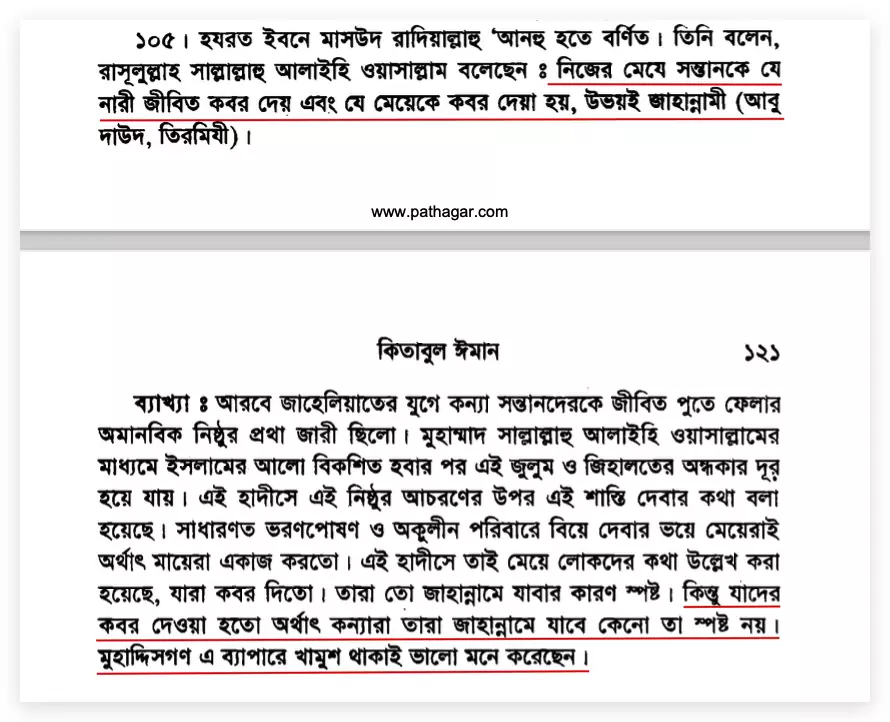
Being told to remain silent because there is no answer to “why” is not a moral explanation. Anyone presenting a religious statement as an example of justice must also undertake to justify it. Accepting a declaration of Hell without asking what offense the murdered child committed, what she understood, what decisions she could make, or what actions she could be held responsible for is not an examination of justice. Prohibiting questions while the grounds for punishing the victim remain unclear does not make that punishment just; it stops inquiry into the grounds of an injustice. The standing of a religious scripture or commentator cannot answer this fundamental question.
Ibn al-Qayyim rejected this interpretation based on age. Let us read the complete relevant paragraph. [37]
Ahkam Ahl al-Dhimmah — Ibn al-Qayyim
On the Age of the Girl Buried Alive
Original Arabic:
قلت : وهذا الجواب في غاية الضعف ، ولا يجوز أن ينسب إلى رسول الله – صلى الله عليه وسلم – أنه سئل عن موءودة لم تبلغ الحنث ، فأجاب عمن بلغت الحنث ، بل إنما خرج جوابه – صلى الله عليه وسلم – لنفس ما سئل عنه ، فكيف ينسب إليه أنه ترك الجواب عما سئل عنه ، وأجاب عما لم يسأل عنه موهما أنه المسئول عنه ، ولم ينبه السائل ؟ ! هذا لا يظن برسول الله – صلى الله عليه وسلم – أصلا .
Translation:
I say: This answer is exceedingly weak. One cannot attribute to the Messenger of Allah the claim that he was asked about a girl buried alive who had not reached the age of accountability for sin, but answered concerning someone who had reached that age. His answer concerned precisely what he had been asked. How can one attribute to him an answer about something that was not asked, rather than the matter asked about, without warning the questioner and while giving the impression that this was the answer? Such a supposition cannot be made about the Messenger of Allah at all.
Ibn al-Qayyim interpreted the report as concerning a particular incident, although his interpretation does not match the hadith’s explicit wording. Even if we accept it, the moral question remains in the interpretation of that specific incident. The fact that not all children are being punished does not make it just to punish one child without culpability. What must be demonstrated is why a victim was declared an inhabitant of Hell and which of that person’s own actions grounds the punishment. Narrowing the scope of an injustice and justifying it are not the same thing. Alongside the killer’s responsibility, the murdered person’s own innocence must remain central to the judgment.
Responsibility for Others’ Actions
How can punishing someone for another person’s action be just? If Akkasuddin is punished on the basis of something his relative Kalimuddin did, their relationship does not justify that punishment. If Akkasuddin ordered, instigated, or participated in the act, he may bear responsibility for his own role. If he has no culpable connection to another person’s action, however, punishing him solely because of their relationship is unjust. The question is clearer still in the case of a deceased person, who cannot control what living relatives do after their death. Let us read the following report. [38]
Sahih al-Bukhari (Tawhid Publication edition)
23 / Funerals
Chapter: 23/32. The Prophet’s Statement: The Deceased Is Punished because of the Family’s Weeping, If Wailing Was Their Custom.
1286. Narrated from ʿAbdullah ibn ʿUbaydullah ibn Abi Mulaykah, who said: A daughter of ʿUthman (may Allah be pleased with him) died in Mecca, and we went to attend her funeral. Ibn ʿUmar and Ibn ʿAbbas (may Allah be pleased with them) also arrived. I was sitting between them—or he said, “I sat beside one of them, and the other later arrived and sat beside me.” On hearing weeping, Ibn ʿUmar said to ʿAmr ibn ʿUthman, “Why do you not forbid them to weep? For the Messenger of Allah (peace and blessings be upon him) said: ‘The deceased is punished because of the weeping of their relatives.’” (Adhunik Prakashani: 1203; Islamic Foundation: 1211)
Hadith classification: Authentic (Sahih)
Narrator: Ibn Abi Mulaykah (may Allah have mercy on him)
The chapter heading of this quotation includes the condition “if wailing was their custom.” This deserves attention because linking punishment to a deceased person’s own role is different from punishing them for another person’s independent action. The quoted statement itself nevertheless says that the deceased is punished because of the relatives’ weeping. The question is therefore whether the punishment is grounded in the deceased person’s own action or in someone else’s action after their death. Knowledge of the family’s conduct alone does not establish the deceased person’s culpability. Whether they instructed that conduct, participated in it, or consciously approved it despite having the ability to prevent it must be established separately. Citing another person’s action as a cause does not, by itself, establish the deceased person’s moral responsibility for that action.
This problem has generated disagreement within the hadith material itself. A report from ʿAʾishah describes Ibn ʿUmar’s statement as mistaken or the result of forgetfulness. Rather than saying that someone’s weeping caused punishment of the deceased, it places two events alongside one another: people were weeping for a Jewish woman, and that woman was being punished in her grave. Let us read the complete report. [39]
Sahih Muslim — Book of Funerals
ʿAʾishah’s Report, Quoted in al-Siraj al-Wahhaj
Original Arabic:
عن عبد الله بن أبي بكر، عن أبيه، عن عمرة بنت عبد الرحمن أنها أخبرته أنها سمعت عائشة، وذكر لها أن عبد الله بن عمر يقول: إن الميت ليعذب ببكاء الحي، فقالت عائشة: يغفر الله لأبي عبد الرحمن، أما إنه لم يكذب، ولكنه نسي أو أخطأ، إنما مر رسول الله صلى الله عليه وسلم على يهودية يبكى عليها، فقال: إنهم ليبكون عليها، وإنها لتعذب في قبرها.
Translation:
ʿAbdullah ibn Abi Bakr narrated from his father, from ʿAmrah bint ʿAbd al-Rahman. ʿAmrah informed him that she had heard ʿAʾishah say: It was mentioned to ʿAʾishah that ʿAbdullah ibn ʿUmar said the deceased is punished because of the weeping of the living. ʿAʾishah said, “May Allah forgive Abu ʿAbd al-Rahman. He did not lie, but he forgot or made a mistake. The Messenger of Allah was passing a Jewish woman for whom people were weeping. He said, ‘They are weeping for her, while she is being punished in her grave.’”
Saying that two events occur at the same time is entirely different from saying that one event causes punishment in the other. If someone is weeping while someone else is being punished, it does not follow that the weeping causes the punishment. ʿAʾishah’s objection brings this distinction into focus. The problem therefore did not originate only with later commentators; an objection concerning the grounds for punishment already exists at the stage of transmission. An examination of justice cannot disregard that objection. Whichever version is accepted, the moral standard remains the same: punishing the deceased for the actions of the living is unjust without a culpable role of the deceased person’s own.
Sending Jews and Christians to Hell in Exchange for Muslims’ Salvation
Another group of reports in Sahih Muslim presents the question of responsibility for others’ actions more directly. A Muslim’s deliverance from Hell is linked to a Jew or Christian. In one report, that person is called the Muslim’s ransom; another describes sending them to Hell in the Muslim’s place; a third uses the language of forgiving Muslims’ mountain-sized sins and placing them on Jews and Christians. Let us read these three complete reports on the same subject together. [40] [41] [42]
Sahih Muslim — Book of Repentance
Hadith: 2767; Three Reports on the Same Subject
Original Arabic of the first report:
حَدَّثَنَا أَبُو بَكْرِ بْنُ أَبِي شَيْبَةَ، حَدَّثَنَا أَبُو أُسَامَةَ، عَنْ طَلْحَةَ بْنِ يَحْيَى، عَنْ أَبِي بُرْدَةَ، عَنْ أَبِي مُوسَى، قَالَ قَالَ رَسُولُ اللَّهِ صلى الله عليه وسلم ” إِذَا كَانَ يَوْمُ الْقِيَامَةِ دَفَعَ اللَّهُ عَزَّ وَجَلَّ إِلَى كُلِّ مُسْلِمٍ يَهُودِيًّا أَوْ نَصْرَانِيًّا فَيَقُولُ هَذَا فَكَاكُكَ مِنَ النَّارِ “.
Translation:
Abu Bakr ibn Abi Shaybah narrated through Abu Usamah, Talhah ibn Yahya, and Abu Burdah from Abu Musa. Abu Musa said that the Messenger of Allah said: “On the Day of Resurrection, Allah will give every Muslim a Jew or Christian and say, ‘This is your ransom from Hell.’”
Original Arabic of the second report:
حَدَّثَنَا أَبُو بَكْرِ بْنُ أَبِي شَيْبَةَ، حَدَّثَنَا عَفَّانُ بْنُ مُسْلِمٍ، حَدَّثَنَا هَمَّامٌ، حَدَّثَنَا قَتَادَةُ، أَنَّ عَوْنًا وَسَعِيدَ بْنَ أَبِي بُرْدَةَ حَدَّثَاهُ أَنَّهُمَا شَهِدَا أَبَا بُرْدَةَ يُحَدِّثُ عُمَرَ بْنَ عَبْدِ الْعَزِيزِ عَنْ أَبِيهِ عَنِ النَّبِيِّ صلى الله عليه وسلم قَالَ ” لاَ يَمُوتُ رَجُلٌ مُسْلِمٌ إِلاَّ أَدْخَلَ اللَّهُ مَكَانَهُ النَّارَ يَهُودِيًّا أَوْ نَصْرَانِيًّا “. قَالَ فَاسْتَحْلَفَهُ عُمَرُ بْنُ عَبْدِ الْعَزِيزِ بِاللَّهِ الَّذِي لاَ إِلَهَ إِلاَّ هُوَ ثَلاَثَ مَرَّاتٍ أَنَّ أَبَاهُ حَدَّثَهُ عَنْ رَسُولِ اللَّهِ صلى الله عليه وسلم قَالَ فَحَلَفَ لَهُ – قَالَ – فَلَمْ يُحَدِّثْنِي سَعِيدٌ أَنَّهُ اسْتَحْلَفَهُ وَلَمْ يُنْكِرْ عَلَى عَوْنٍ قَوْلَهُ.
Translation:
Abu Bakr ibn Abi Shaybah narrated through ʿAffan ibn Muslim and Hammam from Qatadah. ʿAwn and Saʿid ibn Abi Burdah informed him that they were present when Abu Burdah narrated to ʿUmar ibn ʿAbd al-ʿAziz, through his father, the Prophet’s statement: “No Muslim dies without Allah sending a Jew or Christian to Hell in his place.” ʿUmar ibn ʿAbd al-ʿAziz made him swear three times by Allah, besides whom there is no deity, that his father had narrated this from the Messenger of Allah. He swore to him. The narrator said: Saʿid did not tell me about the oath, but did not deny ʿAwn’s statement either.
Original Arabic of the third report:
حَدَّثَنَا مُحَمَّدُ بْنُ عَمْرِو بْنِ عَبَّادِ بْنِ جَبَلَةَ بْنِ أَبِي رَوَّادٍ، حَدَّثَنَا حَرَمِيُّ بْنُ عُمَارَةَ، حَدَّثَنَا شَدَّادٌ أَبُو طَلْحَةَ الرَّاسِبِيُّ، عَنْ غَيْلاَنَ بْنِ جَرِيرٍ، عَنْ أَبِي بُرْدَةَ، عَنْ أَبِيهِ، عَنِ النَّبِيِّ صلى الله عليه وسلم قَالَ ” يَجِيءُ يَوْمَ الْقِيَامَةِ نَاسٌ مِنَ الْمُسْلِمِينَ بِذُنُوبٍ أَمْثَالِ الْجِبَالِ فَيَغْفِرُهَا اللَّهُ لَهُمْ وَيَضَعُهَا عَلَى الْيَهُودِ وَالنَّصَارَى “. فِيمَا أَحْسِبُ أَنَا. قَالَ أَبُو رَوْحٍ لاَ أَدْرِي مِمَّنِ الشَّكُّ. قَالَ أَبُو بُرْدَةَ فَحَدَّثْتُ بِهِ عُمَرَ بْنَ عَبْدِ الْعَزِيزِ فَقَالَ أَبُوكَ حَدَّثَكَ هَذَا عَنِ النَّبِيِّ صلى الله عليه وسلم قُلْتُ نَعَمْ.
Translation:
Muhammad ibn ʿAmr ibn ʿAbbad ibn Jabalah ibn Abi Rawwad narrated through Harami ibn ʿUmarah, Shaddad Abu Talhah al-Rasibi, Ghaylan ibn Jarir, and Abu Burdah, through his father, from the Prophet: “On the Day of Resurrection, some Muslims will come with sins as great as mountains. Allah will forgive those sins and place them on the Jews and Christians.” The report includes the words “I think.” Abu Rawh said, “I do not know whose uncertainty this was.” Abu Burdah said, “I narrated this to ʿUmar ibn ʿAbd al-ʿAziz. He asked, ‘Did your father tell you this from the Prophet?’ I replied, ‘Yes.’”
The language of ransom and entry “in his place” creates a serious problem for individual judgment. The grounds for punishing someone should arise from that person’s own actions. Another person’s need for salvation cannot be grounds for punishing them. If the Jewish or Christian person has committed offenses of their own, those offenses require independent judgment; using that person to occupy the place of a Muslim’s punishment alters the principle of individual responsibility. Sending a person to Hell as an instrument of someone else’s salvation and judging them on the basis of their own offenses are not the same method of judgment. In the former, one person’s fate is placed in an exchange relationship with another person’s religious identity.
Al-Nawawi did not accept this statement as a literal transfer of responsibility. He described “place them on them” as figurative and interpreted it in accordance with the principle that no one bears another person’s burden of sin. Answer 9488 on IslamQA also quotes this explanation. Let us read al-Nawawi’s complete explanation of the report concerning sins. [43] [44]
Sharh Sahih Muslim — Al-Nawawi
Vol. 17, p. 85
Explanation of the Report concerning Muslims’ Sins; Translation from Arabic:
The report “On the Day of Resurrection, some Muslims will come with sins” means that Allah will forgive the Muslims those sins and remove them from them, while placing equivalent sins on the Jews and Christians because of their unbelief and their own sins. They will therefore enter Hell because of their own actions, not because of the Muslims’ sins. This interpretation is necessary because of the verse “No bearer of burdens bears another’s burden.” The words “place them on them” are figurative; the intended meaning is to place equivalent sins on them because of their own sins, as stated. Since Allah has removed the Muslims’ evil deeds and left the unbelievers’ evil deeds, the latter have become as though they carry both parties’ sins, because they carry the remaining sins—that is, their own. It may also mean sins that the unbelievers caused by introducing those practices. Through Allah’s forgiveness, those sins will be removed from the Muslims, and equivalent sins placed on those who introduced them. Whoever introduces an evil practice bears responsibility equivalent to the sin of each person who follows that practice.
This explanation clarifies two matters. First, the need for a “figurative” interpretation is acknowledged precisely because the hadith’s literal language raises the problem of bearing another person’s sins. Second, if that interpretation is accepted, the discussion shifts from direct transfer of sins to unequal applications of forgiveness and punishment. The Muslims’ mountain-sized sins are removed, while the Jews’ and Christians’ sins remain. An equal moral standard must be shown to explain why one receives forgiveness and another punishment. The Muslims’ sins are not described here as minor; they are described as mountain-sized. If religious identity rather than the extent of wrongdoing becomes the principal dividing line between salvation and punishment, judgment shifts away from assessing actions and becomes a reward for allegiance in belief.
Responsibility for inciting an offense or introducing an evil practice concerns a person’s own actions; it is not an indiscriminate transfer of someone else’s responsibility. Even under that explanation, however, it must be established which sin of which Muslim a particular Jew or Christian caused. Religious identity alone does not establish that causal relationship. Calling someone a Muslim’s ransom does not remove the need for an independent judgment of that person’s own offenses either. Taking a life because of an innate disposition, killing for a future that has not occurred, punishing a murdered child, or linking one’s punishment to another’s salvation all face the same standard of justice: whoever is punished must bear responsibility for their own established actions. Relationship, identity, predestination, or another person’s need for salvation cannot replace that responsibility.
Belief, Crime, Forgiveness, and Eligibility for Paradise
One straightforward way to determine whether a system of judgment assesses human actions is to examine the distinction it draws between benefiting people and harming them. One person spends a lifetime defending others’ rights; another destroys countless lives through murder, abuse, and plunder. Their judgment should bring actions, intentions, the extent of harm, responsibility, and compensation into consideration. If its final outcome is instead determined by who believed in the judge’s existence and authority and who did not, religious allegiance takes precedence over moral conduct. Examining Islam’s provisions concerning Paradise and Hell requires confronting this question: is conduct towards other people the principal criterion for a person’s ultimate fate, or does belief in Allah ultimately take precedence over that conduct?
Forgiveness, remorse, and opportunities for reform are important elements of a humane system of justice. The justice of forgiveness, however, depends on examining whom it benefits, under what conditions, at whose expense, and whether the same opportunity is available to others. A murderer’s remorse may give value to their transformation; it does not restore the lives of those murdered. An unbeliever’s contribution to human welfare also retains its value; a lack of religious belief does not undo that benefit. This chapter therefore assesses promises of salvation for offenders, the repentance of a man who killed a hundred people, the importance of seeking Allah’s forgiveness, the outcome of non-Muslims’ good deeds, and salvation through intercession alongside one another.
Even Rapists and Murderers May Enter Paradise
In mainstream Sunni creed, a person who dies affirming Allah’s oneness is not condemned to remain in Hell forever because of grave offenses. They may be punished for their crimes, or Allah may forgive them. Ultimately, however, the prospect of entering Paradise remains on the basis of belief. Consequently, even for a murderer, thief, or offender implicated in sexual violence, the question does not end with the extent of the offense; whether the person died with faith according to Islam becomes determinative of ultimate salvation. Abu Dharr’s hadith explicitly mentions theft and unlawful sexual intercourse. It does not use the word rape; conflating unlawful sexual intercourse with rape obscures the specific responsibility attached to violence. The discussion of rapists and murderers here arises from the general rule that faith allows a person to escape eternal punishment despite grave offenses, and from the explicit explanation concerning murderers. [45] [46]
Mishkat al-Masabih (Mishkat)
Part 1: Faith (Belief)
Chapter: First Section
26-(25) Narrated from Abu Dharr al-Ghifari (may Allah be pleased with him), who said: I once went to the Prophet (peace and blessings be upon him). He was asleep, wearing a white garment, so I returned. I went to him again, and he was awake. On seeing me, he said, “Whoever sincerely says ‘There is no deity but Allah’ and dies holding this belief will certainly enter Paradise.” I asked, “Even if he commits grave sins such as theft and unlawful sexual intercourse?” He replied, “Even if he commits theft and unlawful sexual intercourse.” I asked again, “Even after committing theft and unlawful sexual intercourse?” He replied, “Yes, even if he commits sins such as theft and unlawful sexual intercourse, despite Abu Dharr’s disapproval”—literally, “even if Abu Dharr’s nose is rubbed in the dust.” The narrator said that whenever Abu Dharr narrated this hadith, he would proudly include the final words, “even if Abu Dharr’s nose is rubbed in the dust.” (Al-Bukhari, Muslim)(1)
(1) Authentic: al-Bukhari 5827; Muslim 94; Ahmad 21466; Sahih al-Jamiʿ 5733.
Hadith classification: Authentic (Sahih)
In this hadith, Abu Dharr asks the same question repeatedly: is entry into Paradise possible even after grave offenses such as theft and unlawful sexual intercourse? Each time, the answer is yes. The promise of salvation is maintained while the existence of the offenses is acknowledged. Belief no longer occupies the position of an ordinary personal opinion; it becomes a special qualification for the offender’s ultimate salvation. The harm suffered by someone whose property a thief takes is real. Likewise, the loss of the life taken by a murderer is real. The offender’s belief does not diminish that harm. Yet in the judgment of ultimate outcomes, that belief confers an advantage that even an unbeliever’s greatest contribution to humanity cannot secure. The question of justice is this: what moral quality does an offender’s religious belief add, independently of the offense, that warrants this special advantage of ultimate salvation?
Al-Nawawi’s commentary on Sahih Muslim directly explains the case of the murderer. Although he identifies intentional killing as a grave sin, he denies eternal residence in Hell for a murderer who dies affirming Allah’s oneness. The relevant passage is translated below. [47]
Al-Nawawi, al-Minhaj: Sharh Sahih Muslim
Vol. 17, p. 83
Chapter: Acceptance of a Murderer’s Repentance, Even If the Number of Killings Is Great
Translation of the relevant passage: If someone intentionally kills while considering unlawful killing permissible, without a legitimate basis or interpretation, he is an unbeliever and apostate; by consensus, he will remain in Hell forever. If, however, he does not consider killing permissible but believes it forbidden, he is a sinner, disobedient, and guilty of a grave sin. His deserved punishment is permanent residence in Hell; nevertheless, through Allah’s grace, we have been informed that someone who dies affirming His oneness will not remain there forever. This person, too, will therefore not remain forever. He may be forgiven, in which case he will not enter Hell at all. Or he may not be forgiven, in which case he will undergo punishment like other sinful monotheists and emerge with them into Paradise, without remaining in the Fire forever. This is the correct interpretation of the verse.
The point to notice is that acknowledging killing as forbidden is not the same as refraining from it. Someone may regard murder as wrong and still commit it; people die at their hands, families are destroyed, and children lose their guardians. The quoted explanation calls that murderer a grave offender but excludes eternal punishment if he retains faith. If, by contrast, someone who has never killed, plundered anyone’s property, and has stood by others in difficulty is denied ultimate salvation because of religious unbelief, the moral priority of the judgment becomes clear. Rejecting the judge’s religious authority becomes less forgivable than terrible offenses against other people. What reason is there to accept this priority when assessing justice with human beings at its center?
Entering Paradise after Killing a Hundred People
The story of the man who killed a hundred people makes this problem clearer. A man first kills ninety-nine people. When told that repentance is unavailable to him, he kills the person giving that answer as well, bringing the total to a hundred. Later, on another person’s advice, he sets out for a settlement of righteous people and dies on the journey. Ultimately, he is forgiven. The account thus provides for the offender’s salvation even after the destruction of a hundred lives. His remorse is accompanied by a step towards leaving his former environment, but how the victims’ rights were satisfied is not addressed in the story. Understanding the matter fully requires reading the complete hadith. [48] [49]
Riyad al-Salihin
Book: 1 / Miscellaneous
Chapter: 2. Repentance
8/21. Abu Saʿid Saʿd ibn Malik ibn Sinan al-Khudri (may Allah be pleased with him) narrated that the Prophet (peace and blessings be upon him) said: “Before your time, in the era of the Children of Israel, there was a man who had killed ninety-nine people. He asked who the most learned person in the world was and was directed to a Christian monk. He went to him and said that he had killed ninety-nine people, asking whether repentance was available to him. The monk replied, ‘No.’ So, in anger, he killed the monk as well, bringing the total to a hundred. He again asked who the most learned person on earth was and was directed to a scholar. He went to him and said that he had killed a hundred people, asking whether repentance was available. The scholar replied, ‘Yes! Who can stand between him and repentance? Go to such-and-such a land. There are people there who worship Allah Most High; worship Allah with them. Do not return to your own land, for it is a land of evil.’
The man set out for that land. When he reached the halfway point, death came to him. Angels of mercy and angels of punishment arrived to take his soul from his body and began to dispute. The angels of mercy said, ‘This man came repentant and turned towards Allah with complete sincerity.’ The angels of punishment said, ‘He has not yet done any good deed, and therefore deserves punishment.’ An angel appeared in human form, and they accepted him as arbitrator. He ruled, ‘Measure the distances to the two lands: the distance from where he came to this place and the distance to where he was going. He will belong to whichever is nearer.’ They measured the distances and found him nearer to the good land he intended to reach. The angels of mercy therefore took his soul.” (Al-Bukhari and Muslim)
Another report in the Sahih states: “The measurement showed him a handspan nearer to the land of the righteous, so he was counted among its inhabitants.”
A further report in the Sahih states: “Allah Most High ordered the land from which he had come to move farther away and the land of the righteous to come closer. He then said, ‘Measure the distances between them.’ He was found a handspan nearer to the land of the righteous, and was consequently forgiven.”
Another report states: “The man had moved a little towards the good land, leaning forward on his chest.”(1)
(1) Sahih al-Bukhari 3470; Muslim 2766; Ibn Majah 2626; Ahmad 10770, 11290.
Hadith classification: Authentic (Sahih)
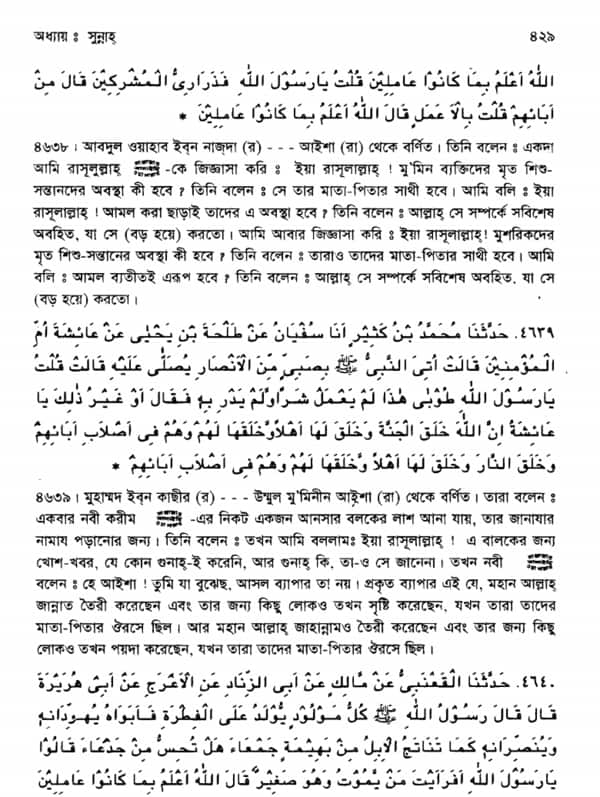
The Islamic Foundation edition of Sahih Muslim also contains a detailed account of the same episode. The angels of punishment argued that the man had performed no righteous deed; the angels of forgiveness argued that he had advanced sincerely with the intention of repenting. Judgment was then made by measuring the distances between his location and the two settlements. The relevant reports are presented in full below. [50] [51]
Sahih Muslim (Islamic Foundation edition)
51 / Repentance
Chapter: 8. A Murderer’s Repentance Is Accepted by Allah, Even If He Has Committed Many Killings
6752. Muhammad ibn al-Muthanna and Muhammad ibn Bashshar (may Allah have mercy on them) … narrated from Abu Saʿid al-Khudri (may Allah be pleased with him), who said: The Prophet (peace and blessings be upon him) said: “Among those before you was a man who, after killing ninety-nine people, asked who the most learned person on earth was. He was directed to a monk. He went to him and said that he had killed ninety-nine people, asking whether repentance was available to him. The monk replied, ‘No.’ He then killed the monk as well, bringing the total to a hundred.
He again asked who the most learned person on earth was and was directed to a scholar. He told the scholar that he had killed a hundred people and asked whether repentance was available. The scholar replied, ‘Yes. Who can stand in the way of repentance? Go to such-and-such a land. Some people there are engaged in worshipping Allah. Join them in worshipping Allah, and never return to your own land, for it is a very bad place.’ He set out and died when he had reached halfway.
The angels of mercy and the angels of punishment then disputed over him. The angels of mercy said, ‘He advanced towards Allah to repent with heartfelt sincerity.’ The angels of punishment said, ‘He has never performed a good deed.’ An angel then appeared in human form, and they appointed him to settle the disagreement.
He told them, ‘Measure the distances to the two lands. He will be counted as belonging to whichever is nearer.’ They measured them, found him nearer to his intended destination, and the angels of mercy took him. Qatadah (may Allah have mercy on him) said that al-Hasan said: ‘It has been related to us that when death came to him, he moved a little forward on his chest.’”
Hadith classification: Authentic (Sahih)
Narrator: Abu Saʿid al-Khudri (may Allah be pleased with him)
Sahih Muslim (Islamic Foundation edition)
51 / Repentance
Chapter: 8. A Murderer’s Repentance Is Accepted by Allah, Even If He Has Committed Many Killings
6753. ʿUbaydullah ibn Muʿadh al-ʿAnbari (may Allah have mercy on him) … narrated from Abu Saʿid al-Khudri (may Allah be pleased with him) that the Prophet (peace and blessings be upon him) said: “A man killed ninety-nine people and went about asking whether repentance was available to him. Eventually, he came to a priest and asked him about it. The priest said, ‘There is no repentance for you.’ He then killed the priest. He again began asking people, and set out from one settlement for another where some righteous people lived. Death overtook him at a point along the road. He moved forward on his chest and then died. The angels of mercy and the angels of punishment disputed over him. He was found to be a handspan nearer to the settlement of the righteous, so he was counted among them.”
Hadith classification: Authentic (Sahih)
Narrator: Abu Saʿid al-Khudri (may Allah be pleased with him)
Discussion of this story commonly focuses on the greatness of Allah’s forgiveness. An examination of justice, however, must also bring into view the people absent from the narrative. A hundred killings mean a hundred lives, a hundred deaths, and the grief and harm experienced by countless people connected to those deaths. The final killing occurred when the offender was already seeking a path to forgiveness. His decision to kill another person upon receiving an unwelcome answer about repentance reveals the depth of his violence. His later effort to change may have value; assessing that change cannot make the rights of a hundred people disappear. However moving a story about an offender’s rescue may be, it must be shown separately whether justice has been secured for the victims.
Mizanur Rahman Azhari’s account of this episode may also be heard. If his presentation emphasizes the glory of forgiveness, however, the victims’ rights, the offender’s responsibility, and the conditions of forgiveness need to be assessed with equal attention.
Forgiveness for the Offender, Rights of the Victim
The offender’s remorse, reform, and the victim’s rights are related matters, but resolving one does not settle the others. A person who was murdered never had the opportunity to witness the murderer’s later remorse. A family that lost its guardian does not recover its loss because the murderer joined others in worship. A discussion of justice must therefore ask whose rights were violated, what remedies are available, and how those rights are protected in a decision to forgive. Islamic jurisprudence likewise distinguishes the rights of Allah, the murdered person, and the victim’s legal heirs in relation to killing. Answer 147017 on IslamQA quotes Ibn al-Qayyim’s explanation of this distinction. [52]
Ibn al-Qayyim, al-Jawab al-Kafi
P. 102; quoted in IslamQA answer 147017
Original Arabic: والتحقيق في المسألة أن القتل يتعلق به ثلاثة حقوق: حق لله، وحق للمظلوم المقتول، وحق للولي، فإذا سلّم القاتل نفسه طوعا واختيارا إلى الولي، ندما على ما فعل، وخوفا من الله، وتوبة نصوحا: يسقط حق الله بالتوبة، وحق الولي بالاستيفاء أو الصلح، أو العفو، وبقي حق المقتول يعوضه الله عنه يوم القيامة عن عبده التائب المحسن ويصلح بينه وبينه، فلا يبطل حق هذا، ولا تبطل توبة هذا.
Translation: The proper analysis is that killing involves three rights: Allah’s right, the right of the person wrongfully killed, and the right of the legal heir. If the killer voluntarily surrenders to the heir with remorse for his act, fear of Allah, and sincere repentance, Allah’s right is discharged through repentance, and the heir’s right through retaliation, settlement, or forgiveness. The murdered person’s right remains. On the Day of Resurrection, Allah will compensate the victim on behalf of His repentant, righteous servant and reconcile them. Thus, neither the victim’s right nor the murderer’s repentance will be invalidated.
This explanation shows that concealing an offense and merely asking Allah for forgiveness is not treated as equivalent to satisfying people’s rights. The story of the man who killed a hundred people, however, contains no account of surrender to the victims’ heirs, compensation, or their forgiveness. It presents the offender’s journey away from his settlement and the outcome of forgiveness. The question therefore remains: where does the story establish that the conditions for satisfying rights discussed in jurisprudence were fulfilled? Examining judgment does not permit filling the narrative’s missing steps with one’s own belief. If it is said that the victims’ entitlements were satisfied in some other way, this adds a claim beyond the report; its establishment within the described events must be demonstrated.
In Ibn al-Qayyim’s explanation, Allah ultimately takes responsibility for compensating the murdered person. The distinction between power and justice returns here. Saying that an omnipotent being can provide compensation is a claim about ability. What compensation justly remedies a life taken and its associated harm, how the victim’s consent is established, and to whom the same benefit applies are questions about standards of judgment. An advantage enabling an offender’s salvation may be connected to reform and repair of harm; if it is reserved solely as a benefit of belief in the judge, the question of discrimination remains. A promise to compensate the victim and a special exemption for the offender because of religious identity cannot be justified by the same argument.
Changing the Distance to Save the Man Who Killed a Hundred People
In one version of the story of the man who killed a hundred people, the matter extends beyond measuring distances to the two settlements. Allah orders one land to move farther away and the other to come closer. The distances are then measured, the offender is found nearer to the settlement of the righteous, and he is forgiven. This statement appears in the complete quotation from Riyad al-Salihin above. The relevant report also appears separately in the Islamic Foundation edition of Sahih Muslim. [53]
Sahih Muslim (Islamic Foundation edition)
51 / Repentance
Chapter: 8. A Murderer’s Repentance Is Accepted by Allah, Even If He Has Committed Many Killings
6754. Muhammad ibn Bashshar (may Allah have mercy on him) … narrated through Qatadah (may Allah have mercy on him) a hadith similar to that of Muʿadh ibn Muʿadh. This hadith, however, states that Allah then revealed to this land, “Move farther away,” and to that land, “Come closer.”
Hadith classification: Authentic (Sahih)
Narrator: Qatadah (may Allah have mercy on him)
If distance is made the criterion for reaching a decision, that distance should be a fact existing before the decision. Here the being determining the outcome alters that fact himself. First it is stated that the decision will depend on which settlement is nearer; then the settlements’ positions are changed to favor one side. An equivalent case in human judgment makes the problem readily understandable: a judge bases a decision on a measurement, then changes the position of the object being measured to obtain the preferred result. The measurement retains its formal procedure, but the decision no longer derives from assessing an independent fact; the facts are arranged to favor the desired outcome. If the person determining an examination’s result also changes its conditions for a particular individual, a separate argument is needed to establish that advantage as impartial judgment.
The account offers the man’s sincere wish to change as a consideration in his favor. If that sincerity grounds forgiveness, the decision could have been explained directly through it. Making distance the criterion and then altering that distance, however, reveals special favor. The claim here is not that everyone is always judged by distance; the question concerns how the stated criterion was applied in this particular case. If another person died with the same remorse and the same effort to reform, would the facts likewise be altered for them? Where is the equal, established rule governing that opportunity? If such assistance is possible for someone who killed a hundred people, what moral reason justifies denying it to someone unable to believe because of reasonable doubt, yet who has harmed no one?
Allah Loves Sinners
Another hadith is particularly important in the discussion of forgiveness for offenders. It states that if people did not sin, Allah would remove them and bring people who sinned and sought his forgiveness, and he would forgive them. Rather than presenting a sinless human society as the ultimate ideal, it emphasizes a relationship between sin, seeking forgiveness, and forgiveness. Allah’s relationship with the sinner occupies the center of this statement; the experiences of people harmed by wrongdoing do not appear in it. It does not directly say that “Allah loves all crimes,” but the moral significance of removing people who do not sin and bringing people who sin and seek forgiveness requires examination. [54]
Mishkat al-Masabih (Mishkat)
Part 10. The Names of Allah Most High
Chapter: 2. First Section — Forgiveness and Repentance
2328-(6) Narrated from Abu Hurayrah (may Allah be pleased with him), who said: The Messenger of Allah (peace and blessings be upon him) said, “By the One in whose hand is my life! If you did not sin, Allah Most High would remove you and create a people who sinned and sought Allah’s forgiveness. Allah Most High would then forgive them.” (Muslim)(1)
(1) Authentic: Muslim 2749; Shuʿab al-Iman 6700; al-Sahihah 1950; Sahih al-Targhib 3149.
Hadith classification: Authentic (Sahih)
The question here extends beyond whether Allah can forgive. Why is a society in which people do wrong and seek forgiveness given such importance over a society without wrongdoing that the latter is said to be removed? Saying that people will have a path to reform if they make mistakes is one claim. Saying that people who do not make mistakes will be replaced by people who do is another. The first offers a remedy after harm; the second makes the sequence of harm, seeking forgiveness, and forgiveness indispensable to human life. Within that sequence, the offender has an opportunity to ask forgiveness, but the person harmed loses the more valuable possibility that the abuse would never have occurred. Why should the need to display forgiveness take precedence over people’s unharmed lives and safety?
Consider a case of abuse. A child suffers sexual violence and is murdered. The offender later feels remorse and asks Allah for forgiveness. That remorse may be one aspect of the offender’s transformation, but it does not erase what happened to the child. If the discussion ends at “Allah forgives the offender,” it fails to judge the event from the position of its most vulnerable person. The question becomes harder when this statement about forgiveness is placed alongside the claim of predestination discussed in the previous chapter—that everything, including human actions, is subject to Allah’s will and determination. Why should such harm to the child be necessary to demonstrate the glory of forgiveness by one who could have prevented it before it occurred? The ability to protect the innocent before an offense occurs cannot be less important to justice than the ability to forgive the offender afterwards.
Human safety and dignity stand at the center of this question. If praising a powerful being, submitting to him, and depending on his forgiveness become the principal purposes of a system of judgment, human harm recedes into the background of that relationship. A wrong occurs, the offender seeks forgiveness, and the judge is glorified for forgiving: in each instance, it must be shown separately where the victim’s rights are secured in this cycle. Mizanur Rahman Azhari’s discussion of this hadith can be heard in the presentation below. Its emotional appeal needs to be assessed alongside these moral questions.
Non-Muslims Face Hell despite Their Good Deeds
In contrast to the provision for a believing offender’s ultimate salvation, mainstream Islamic interpretations do not regard the good deeds of someone who dies in unbelief as securing salvation in the afterlife. The moral inequality becomes clearer here. Someone may oppose slavery, struggle against racial discrimination, work for women’s rights, or feed the hungry. The actual benefit these actions bring to others does not diminish because of the person’s religious identity. The humanitarian contributions of figures such as Abraham Lincoln, Nelson Mandela, Raja Rammohan Roy, and Ishwar Chandra Vidyasagar therefore enter this discussion. There is no need to make an individual prediction about each person’s afterlife; the issue to examine is whether, if a person like them is deemed to have died in unbelief according to Islam, their work for human welfare is considered sufficient for ultimate salvation. Let us read the Qur’anic statement. [55]
If anyone seeks to adopt a religion other than Islam, it will never be accepted from them, and in the Hereafter they will be among the losers.
Dr. Abu Bakr Muhammad Zakaria
Whoever seeks to adopt a religion other than Islam will never have that religion accepted, and in the Hereafter that person will be among the losers.
Taisirul Quran
Whoever desires a religion other than Islam will never have it accepted, and in the Hereafter they will be among the losers.
Rawai Al-bayan
Whoever seeks a religion other than Islam will never have it accepted from them, and in the next life they will be among the losers.
Sheikh Mujibur Rahman
And whoever desires other than Islām as religion – never will it be accepted from him, and he, in the Hereafter, will be among the losers.
Saheeh International
Under this principle, religious identity is more than a matter of personal belief; it becomes a prerequisite for the acceptance of good deeds. Yet inherited religious beliefs, knowledge of other religions, and opportunities to examine one’s own beliefs are not distributed equally. A person growing up in poverty in a remote part of Africa and another with access to religious education do not form their beliefs under the same circumstances. Imposing a condition of belief on people’s actual conduct despite these unequal opportunities introduces the advantages of birth and environment into final judgment. Differences of opinion concerning children’s fate were discussed in the previous chapter; the issue here is the priority of religious belief in determining the value of adults’ good deeds.
Hadiths also connect eligibility for Paradise to religious belief. Alongside announcing that Muslims will constitute a large proportion of its inhabitants, the following report states that no one except a Muslim soul will enter Paradise. [56]
Riyad al-Salihin (Riyadus Salehin)
Miscellaneous
Chapter: 51. The Importance of Hoping for Allah’s Mercy
Tawhid Publication numbering: 436; international numbering: 431
20/436. Ibn Masʿud (may Allah be pleased with him) said: About forty of us were in a tent with the Messenger of Allah (peace and blessings be upon him). He asked, “Would you be pleased to constitute a quarter of the inhabitants of Paradise?” We replied, “Yes.” He asked, “Would you be pleased to constitute a third of the inhabitants of Paradise?” We replied, “Yes.” He said, “By the One in whose hand is Muhammad’s life, I firmly hope that you will constitute half the inhabitants of Paradise. This is because no one except a Muslim soul will enter Paradise. Among the polytheists, you are like a single white hair on a black bull, or a single black hair on a red bull.” (Al-Bukhari and Muslim) [1]
[1] Sahih al-Bukhari 6528, 6642; Muslim 2021; al-Tirmidhi 2547; Ibn Majah 4283; Ahmad 3643, 4155, 4239, 4316.
Hadith classification: Authentic (Sahih)
Narrator: ʿAbdullah ibn Masʿud (may Allah be pleased with him)
The expressed hope that Muhammad’s followers will constitute half the inhabitants of Paradise cannot be read here as opening the remainder to non-Muslims. The same statement includes the condition of being a Muslim soul; in Islamic interpretation, genuine followers of earlier prophets are also regarded as people who submitted to Allah. The central question therefore remains: do a person’s honesty, compassion, and work for human welfare have value for salvation in their own right, or do they require the approval conferred by religious allegiance? For comparison with this question, Abu Dharr’s hadith needs to be read again in full. [45]
Mishkat al-Masabih (Mishkat)
Part 1: Faith (Belief)
Chapter: First Section
26-(25) Narrated from Abu Dharr al-Ghifari (may Allah be pleased with him), who said: I once went to the Prophet (peace and blessings be upon him). He was asleep, wearing a white garment, so I returned. I went to him again, and he was awake. On seeing me, he said, “Whoever sincerely says ‘There is no deity but Allah’ and dies holding this belief will certainly enter Paradise.” I asked, “Even if he commits grave sins such as theft and unlawful sexual intercourse?” He replied, “Even if he commits theft and unlawful sexual intercourse.” I asked again, “Even after committing theft and unlawful sexual intercourse?” He replied, “Yes, even if he commits sins such as theft and unlawful sexual intercourse, even if Abu Dharr’s nose is rubbed in the dust.” The narrator said that whenever Abu Dharr narrated this hadith, he would proudly include the final words, “even if Abu Dharr’s nose is rubbed in the dust.” (Al-Bukhari, Muslim)(1)
(1) Authentic: al-Bukhari 5827; Muslim 94; Ahmad 21466; Sahih al-Jamiʿ 5733.
Hadith classification: Authentic (Sahih)
On one side stands the promise that an offender who dies with faith will eventually enter Paradise; on the other, that path is closed to a good person who dies in unbelief. The difference cannot be explained through the amount of harm or benefit they caused others. A murderer killed while acknowledging killing as forbidden, yet his belief grounds his escape from eternal punishment. An unbeliever recognized killing as wrong, refrained from it, and even protected others’ lives, yet those actions cannot substitute for belief. If the same principle applies to perpetrators of religious terrorism, mass killing, or sexual violence, the problem becomes more acute: despite the judgment of their crimes, offenders meeting the condition of faith retain an opportunity for ultimate salvation; humanitarians who die in unbelief do not. If religious allegiance becomes a greater dividing line in final judgment than offenses against human beings, how does that judgment satisfy the claim to human justice?
The answer to ʿAʾishah’s question about Ibn Judʿan directly presents this separation between helping people and benefiting in the afterlife. He fulfilled his relatives’ rights and fed the poor. The question was whether these actions would benefit him in the afterlife. His failure to seek forgiveness was invoked in reply. [57]
Sahih Muslim (Islamic Foundation edition)
1 / The Book of Faith
Chapter: 85. No Deed Benefits a Person Who Dies in Unbelief
411. Abu Bakr ibn Abi Shaybah (may Allah have mercy on him) … narrated from ʿAʾishah (may Allah be pleased with her), who said: “Messenger of Allah, in the age of ignorance Ibn Judʿan fulfilled his relatives’ rights and fed the poor. Will these actions benefit him in the Hereafter?” The Messenger of Allah (peace and blessings be upon him) replied: “They will not benefit him. He never said, ‘My Lord, forgive my offenses on the Day of Resurrection.’”
Hadith classification: Authentic (Sahih)
Narrator: ʿAʾishah bint Abi Bakr al-Siddiq (may Allah be pleased with her)
This report does not describe feeding the poor as false or harmful. The beneficial action occurred, but acceptance of that benefit in the afterlife is made conditional on seeking Allah’s forgiveness. Al-Nawawi discusses the same principle in his explanation of non-Muslims’ good deeds. The complete paragraph quoted in Islamweb fatwa 97165 is translated below. [58]
Al-Nawawi, Sharh Sahih Muslim
Translation of the Paragraph Quoted in Islamweb Fatwa 97165
The scholars agree that an unbeliever who dies in unbelief has no reward in the Hereafter and receives no recompense there for any action performed in this world to draw closer to Allah. This hadith explicitly states that he is provided sustenance in this world because of his good deeds. This refers to actions intended to draw closer to Allah whose validity does not depend on intention, such as maintaining family ties, charity, freeing slaves, offering hospitality, and facilitating paths of goodness. A believer’s good deeds and their rewards are stored for the Hereafter, while he also receives recompense in this world. There is no impediment to receiving recompense in both this world and the Hereafter; this is stated in the Sharia, so belief in it is obligatory. “Allah does not wrong a believer in any good deed” means that He does not omit the reward for any of his good deeds. The word “wrong” is also used in the sense of reducing something. Actual injustice is impossible for Allah, as explained previously. “Reaches the Hereafter” means arrives there.
The list of good deeds here includes concrete acts benefiting people, such as freeing slaves, charity, and hospitality. These are said to yield some recompense in this world but to be insufficient for salvation in the eternal afterlife. This explanation also raises a problem of proportionality between limited worldly reward and eternal punishment. Granting someone some earthly benefits and then punishing them forever does not establish the justice of the latter outcome through the former benefit. Nor does this declaration supply a verifiable account of how much recompense any particular virtuous unbeliever actually received for their good deeds. Saying “recompense was given in this world” and proving that just recompense was given are different things.
A deeper problem lies in assuming, before judgment begins, that “actual injustice is impossible for Allah.” Accepting that premise requires every outcome ultimately to be regarded as just because it is claimed to be Allah’s decision. The standards established in this article’s first chapter, however, require decisions to be examined through actions, responsibility, harm, equality, and proportionality of punishment. An unbeliever’s charity really did satisfy hungry people’s hunger; its value does not change with the donor’s beliefs. Likewise, a believer’s act of murder really did kill a person; the murderer’s faith does not diminish the victim’s harm. If these realities are bypassed and allegiance to Allah becomes the principal qualification in final judgment, the claim to justice requires a separate argument.
Salvation through Intercession and the Impartiality of Judgment
Islam also connects ultimate salvation based on belief with shafaʿah, or intercession. Intercession raises the question of what new information another person’s appeal adds to the judgment of a judge who completely knows each person’s actions, intentions, remorse, and harm. In human courts, testimony or statements may introduce previously unknown facts. That rationale of incomplete knowledge does not apply to an omniscient judge. Nevertheless, reports describe a special privilege reserved for Muhammad’s intercession and identify followers guilty of grave sins as its recipients. The complete statements of two relevant hadiths are presented together below. [59] [60]
Sahih Muslim
Book of Faith, hadith 199a
Original Arabic: لِكُلِّ نَبِيٍّ دَعْوَةٌ مُسْتَجَابَةٌ فَتَعَجَّلَ كُلُّ نَبِيٍّ دَعْوَتَهُ وَإِنِّي اخْتَبَأْتُ دَعْوَتِي شَفَاعَةً لأُمَّتِي يَوْمَ الْقِيَامَةِ فَهِيَ نَائِلَةٌ إِنْ شَاءَ اللَّهُ مَنْ مَاتَ مِنْ أُمَّتِي لاَ يُشْرِكُ بِاللَّهِ شَيْئًا.
Translation: Abu Hurayrah narrated that the Messenger of Allah said: “Every prophet has a supplication that will be accepted. Every prophet has hastened to make that supplication. I have reserved mine as intercession for my community on the Day of Resurrection. If Allah wills, its benefit will reach those of my community who die without associating anything with Allah.”
Jamiʿ al-Tirmidhi
Accounts of Resurrection, hadith 2435
Original Arabic: عَنْ أَنَسٍ، قَالَ قَالَ رَسُولُ اللَّهِ صلى الله عليه وسلم: شَفَاعَتِي لأَهْلِ الْكَبَائِرِ مِنْ أُمَّتِي. قَالَ أَبُو عِيسَى هَذَا حَدِيثٌ حَسَنٌ صَحِيحٌ غَرِيبٌ مِنْ هَذَا الْوَجْهِ. وَفِي الْبَابِ عَنْ جَابِرٍ.
Translation: Anas narrated that the Messenger of Allah said, “My intercession is for those of my community who commit grave sins.” Abu ʿIsa al-Tirmidhi said: Through this chain, the hadith is hasan, sahih, and gharib. There is also a report on this subject from Jabir.
This intercession is subject to Allah’s will; the quoted reports do not state that an intercessor compels Allah to change his decision. That does not settle the question of impartial judgment. Even if the judge himself authorizes the rule, who receives its benefit and why must still be examined. Here, membership of Muhammad’s community and refraining from associating partners with Allah identify the beneficiaries; those guilty of grave sins are explicitly included. A religious relationship therefore grounds a special opportunity beyond the extent of wrongdoing and conduct towards others. Where is the same opportunity for someone outside that relationship who has nevertheless benefited people? If religious identity is a condition of the benefit, the judge’s authorization does not change intercession’s discriminatory character.
If an offender deserves forgiveness because they have reformed, that eligibility should be determined through their reform, remorse, and efforts to repair harm. If they do not deserve forgiveness, how can another person’s special standing confer that eligibility? An omniscient judge already knows whether they deserve it. If intercession adds no new information, its role in salvation therefore amounts to special favor or an advantage of relationship. We question impartiality in human courts when an offender benefits from the recommendation of someone close to power. What reason prevents raising the same question about judgment in the afterlife? The judge’s authorization may explain the existence of a special advantage; it does not prove that the advantage is equally just for everyone.
Taken together, this chapter’s reports reveal a consistent priority. A believing offender retains a path to ultimate salvation; the man who killed a hundred people receives forgiveness and special assistance; intercession is reserved for those guilty of grave sins. By contrast, the good deeds of people who die in unbelief do not ground salvation in the afterlife. Religious allegiance confers an advantage that cannot be acquired through honesty and compassion towards other people. The question therefore returns to the initial standard: is judgment an equal assessment of people’s actions and responsibilities, or a reward for allegiance to the judge? To call a system just when a believing offender ultimately receives salvation but a virtuous unbeliever is denied that path, the priority accorded to religious identity must be justified morally. The claim that Allah made such a decision cannot substitute for that justification.
Eternal Punishment and the Justification of Torture
Assessing justice requires examining more than who is punished; the kind of punishment, its duration, and its purpose must also be considered. A warning, a temporary restriction of liberty, bodily mutilation, and burning someone in fire forever are not equivalent responses to the same offense. Proving an offense does not make punishment of any severity just. The relationship between punishment and the seriousness of the offense, responsibility, harm, and remedy must be demonstrated. Mainstream Islamic accounts of judgment in the afterlife, however, announce a punishment without end for people who die in unbelief. Their suffering will not merely last a long time; death, release, and an end to torture will be unavailable. Examining the claim to justice requires answering where proportionality lies when limitless suffering is assigned for the actions of a finite life.
The previous chapter examined the distinction between the ultimate salvation of believing perpetrators of grave offenses and the fate of unbelievers’ good deeds. This chapter examines the nature of the punishment itself. Declaring someone guilty and establishing the right to torture them eternally are separate matters. Even if an argument supports the first claim, the second requires its own moral justification. Allah’s ability to punish, his announcement of the punishment, or a prohibition on questioning his decisions does not establish the justice of that punishment. Power can enforce a decision; the decision’s moral validity must be assessed through its grounds, limits, and purposes.
Infinite Punishment for the Offenses of a Finite Life
Understanding infinite punishment requires distinguishing a long punishment from one without end. Ten years, a hundred years, or a hundred thousand years all have an endpoint. Under infinite punishment, however much time passes, no day of release arrives. Even after ten million years of burning, the punishment is no closer to ending. Because its duration never expires, the liability for the offense can never be discharged. This creates an arrangement in which the amount of suffering continually increases, while the number and nature of past actions no longer increase. The Qur’an’s description of unbelievers’ fate includes eternal residence and the absence of assistance. [61]
The Qur’an
Surah al-Ahzab, verses 64–66
Original Arabic: إِنَّ اللَّهَ لَعَنَ الْكَافِرِينَ وَأَعَدَّ لَهُمْ سَعِيرًا خَالِدِينَ فِيهَا أَبَدًا لَا يَجِدُونَ وَلِيًّا وَلَا نَصِيرًا يَوْمَ تُقَلَّبُ وُجُوهُهُمْ فِي النَّارِ يَقُولُونَ يَا لَيْتَنَا أَطَعْنَا اللَّهَ وَأَطَعْنَا الرَّسُولَا.
Translation: Indeed, Allah has cursed the unbelievers and prepared a blazing fire for them. They will remain there forever, finding no protector or helper. On the day their faces are turned over in the fire, they will say, “If only we had obeyed Allah and obeyed the Messenger!”
The offense linked to punishment in this description is failure to obey Allah and his Messenger. A lack of obedience, however, does not itself create a moral right to inflict limitless torture. If someone could not regard a religious claim as true or did not accept the authority of its creator and prophet, whom they harmed and to what extent must be established. Even if their doubt is declared an offense, why eternal fire is just for that offense remains a separate question. When a judge’s demand for allegiance confronts a person’s right to remain unharmed, the first claim cannot automatically be assigned limitless importance. Burning someone forever because they do not acknowledge an authority is not justice; it is a system of limitless punishment to secure allegiance.
Proportionality is not determined solely by the time taken to commit an offense. A murder may occur in moments while causing profound and lasting harm. Responsibility, intention, the extent of harm, and the victim’s rights therefore require assessment. Even after these considerations, however, the case must still be made that a finite person’s culpable actions deserve limitless suffering; simply calling an offense “serious” does not prove this. Eternal punishment has no limit beyond which the punishment can be said to have been completed in accordance with the offense. Suffering continues for the same past action, although that action is not occurring anew. If judgment appropriately settles responsibility, such punishment permanently closes the possibility of discharging it.
Hadith accounts also remove the possibility of suffering ending through death. Sahih al-Bukhari describes death being brought forth and slaughtered, followed by an announcement that the inhabitants of Paradise and Hell will no longer die. The final part of the report states that this announcement increases the grief of the inhabitants of Hell. The psychological anguish of having every route of escape closed is thus part of the punishment described. [62]
Sahih al-Bukhari
Book of Heart-Softening Narrations, Description of Paradise and Hell
Hadith: 6548; narrator: Ibn ʿUmar
Original Arabic: قَالَ قَالَ رَسُولُ اللَّهِ صلى الله عليه وسلم: إِذَا صَارَ أَهْلُ الْجَنَّةِ إِلَى الْجَنَّةِ، وَأَهْلُ النَّارِ إِلَى النَّارِ، جِيءَ بِالْمَوْتِ حَتَّى يُجْعَلَ بَيْنَ الْجَنَّةِ وَالنَّارِ، ثُمَّ يُذْبَحُ، ثُمَّ يُنَادِي مُنَادٍ يَا أَهْلَ الْجَنَّةِ لاَ مَوْتَ، يَا أَهْلَ النَّارِ لاَ مَوْتَ، فَيَزْدَادُ أَهْلُ الْجَنَّةِ فَرَحًا إِلَى فَرَحِهِمْ، وَيَزْدَادُ أَهْلُ النَّارِ حُزْنًا إِلَى حُزْنِهِمْ.
Translation: Ibn ʿUmar narrated that the Messenger of Allah said: “When the inhabitants of Paradise have reached Paradise and the inhabitants of Hell have reached Hell, death will be brought and placed between Paradise and Hell. It will then be slaughtered. An announcer will call, ‘People of Paradise, there is no more death! People of Hell, there is no more death!’ More joy will then be added to the joy of the inhabitants of Paradise, and more grief to the grief of the inhabitants of Hell.”
Another Qur’anic account likewise states that those in Hell will neither be allowed to die nor have their punishment lightened. They will ask for release and promise to do good deeds, but that appeal will be rejected. No opportunity to begin a reformed life after punishment is presented here. Earthly life is declared to have offered sufficient opportunity; no further provision for release remains. [63]
The Qur’an
Surah Fatir, verses 36–37
Original Arabic: وَالَّذِينَ كَفَرُوا لَهُمْ نَارُ جَهَنَّمَ لَا يُقْضَى عَلَيْهِمْ فَيَمُوتُوا وَلَا يُخَفَّفُ عَنْهُمْ مِنْ عَذَابِهَا كَذَلِكَ نَجْزِي كُلَّ كَفُورٍ وَهُمْ يَصْطَرِخُونَ فِيهَا رَبَّنَا أَخْرِجْنَا نَعْمَلْ صَالِحًا غَيْرَ الَّذِي كُنَّا نَعْمَلُ أَوَلَمْ نُعَمِّرْكُمْ مَا يَتَذَكَّرُ فِيهِ مَنْ تَذَكَّرَ وَجَاءَكُمُ النَّذِيرُ فَذُوقُوا فَمَا لِلظَّالِمِينَ مِنْ نَصِيرٍ.
Translation: Those who disbelieve will have the fire of Hell. Death will not be decreed for them so that they might die, nor will its punishment be lightened for them. Thus do We recompense every ungrateful unbeliever. There they will cry out, “Our Lord, bring us out; we will do righteous deeds instead of what we used to do.” They will be told, “Did We not give you a life long enough for anyone wishing to take heed to do so? A warner also came to you. So taste the punishment; the wrongdoers have no helper.”
This arrangement presents no process of offering reform and returning people to society. Nor does an appeal to safety establish the need for eternal torture. Preventing a dangerous person from harming others and burning them in fire forever are separate actions. If an omnipotent being can securely restrain someone, why must that restraint involve producing limitless bodily suffering? It must likewise be shown how continually burning an offender repairs the harm to a victim. The ability to produce suffering and the moral necessity of producing it are not the same thing.
IslamQA answer 235026 presents an argument for eternal punishment: Allah knows that even if these people were returned to earth, they would revert to forbidden actions. This explanation adds a hypothetical future that has not occurred to actions actually committed. The following verses of Surah al-Anʿam are cited as its basis. [64] [65] [66]
The Qur’an
Surah al-Anʿam, verses 27–28
Original Arabic: وَلَوْ تَرَى إِذْ وُقِفُوا عَلَى النَّارِ فَقَالُوا يَا لَيْتَنَا نُرَدُّ وَلَا نُكَذِّبَ بِآيَاتِ رَبِّنَا وَنَكُونَ مِنَ الْمُؤْمِنِينَ بَلْ بَدَا لَهُمْ مَا كَانُوا يُخْفُونَ مِنْ قَبْلُ وَلَوْ رُدُّوا لَعَادُوا لِمَا نُهُوا عَنْهُ وَإِنَّهُمْ لَكَاذِبُونَ.
Translation: If only you could see when they are made to stand before the Fire and say, “If only we were sent back! We would not deny our Lord’s signs and would be among the believers.” Rather, what they previously concealed has become apparent to them. Even if they were sent back, they would return to what they had been forbidden to do. They are certainly liars.
This argument contains two separate claims. The first is that, if sent back, they would commit offenses again. The second is that this possibility makes it just to punish them eternally now. Even assuming the first claim is true, the second does not follow automatically. Treating someone as guilty of an action because they might perform it in the future conflates judgment of a committed offense with prediction of potential behavior. The earlier chapter examined this problem in Khidr’s killing of the boy. Here eternal punishment is added to the same problem. A claim about what someone would do under different circumstances does not morally authorize adding infinite punishment beyond their actual actions.
They are never sent back, and the hypothetical action never occurs. Nevertheless, torture continues in the name of that unrealized future. If Allah is said to know their inability to change, another question arises: why would the one who determined their creation, mental constitution, and circumstances maintain a condition in which change is wholly impossible for them? If preventing potential harm is the purpose, removing the opportunity to cause harm fulfills that purpose. Adding limitless suffering requires demonstrating a separate necessity. A claim to omniscience about the future does not establish that necessity.
Likewise, announcing a punishment in advance does not make it just. If a ruler declares beforehand that people who do not believe in his authority will be tortured forever, the existence of that announcement does not establish the morality of the torture. Providing satisfactory evidence for a claim, offering a real opportunity to examine it, and keeping punishment proportionate are separate conditions. Securing allegiance through fear and establishing credibility through reasoning are not equivalent processes. The threat of eternal punishment cannot compensate for weak evidence, nor can frightening people substitute for persuading them that a claim is true.
Replacing Burned Skin to Continue the Torture
Alongside eternal punishment, the method of torture also requires assessment. Surah al-Nisa states that when unbelievers’ skin is burned, new skin will be supplied so that they continue to taste punishment. The verse itself specifies the purpose of rebuilding the body: preserving the experience of suffering. In the same context, the next verse promises believers gardens, pure companions, and shade. Reading this contrast together—continuous burning on one side and comfort and reward on the other, divided by belief—clarifies the account’s moral priority. [67]
The Qur’an
Surah al-Nisa, verses 56–57
Original Arabic: إِنَّ الَّذِينَ كَفَرُوا بِآيَاتِنَا سَوْفَ نُصْلِيهِمْ نَارًا كُلَّمَا نَضِجَتْ جُلُودُهُمْ بَدَّلْنَاهُمْ جُلُودًا غَيْرَهَا لِيَذُوقُوا الْعَذَابَ إِنَّ اللَّهَ كَانَ عَزِيزًا حَكِيمًا وَالَّذِينَ آمَنُوا وَعَمِلُوا الصَّالِحَاتِ سَنُدْخِلُهُمْ جَنَّاتٍ تَجْرِي مِنْ تَحْتِهَا الْأَنْهَارُ خَالِدِينَ فِيهَا أَبَدًا لَهُمْ فِيهَا أَزْوَاجٌ مُطَهَّرَةٌ وَنُدْخِلُهُمْ ظِلًّا ظَلِيلًا.
Translation: Those who reject Our signs, We shall admit into the Fire. Whenever their skins are burned away, We shall replace them with other skins so that they may taste the punishment. Indeed, Allah is Mighty and Wise. Those who believe and perform righteous deeds, We shall admit into gardens beneath which rivers flow. They will remain there forever. There they will have pure companions, and We shall admit them into deep shade.
Ibn Kathir’s commentary likewise interprets this description as a statement that punishment will continue. He brings together the fire’s enclosure of every part of the body and the replacement of burned skin. The complete relevant opening paragraph is presented below, with the Arabic and its translation. [68]
Ibn Kathir, Tafsir al-Qurʾan al-ʿAzim
Editor: Sami ibn Muhammad al-Salamah; publisher: Dar Taybah
Vol. 2, p. 337; opening paragraph of the commentary on Surah al-Nisa 4:56
Original Arabic: يخبر تعالى عما يعاقب به في نار جهنم من كفر بآياته وصد عن رسله، فقال: ﴿إِنَّ الَّذِينَ كَفَرُوا بِآيَاتِنَا سَوْفَ نُصْلِيهِمْ نَارًا﴾ الآية، أي ندخلهم نارا دخولا يحيط بجميع أجرامهم، وأجزائهم. ثم أخبر عن دوام عقوبتهم ونكالهم، فقال: ﴿كُلَّمَا نَضِجَتْ جُلُودُهُمْ بَدَّلْنَاهُمْ جُلُودًا غَيْرَهَا لِيَذُوقُوا الْعَذَابَ﴾ قال الأعمش، عن ابن عمر: إذا أحرقت جلودهم بدلوا جلودًا بيضا أمثال القراطيس. رواه ابن أبي حاتم.
Translation: Allah describes how He will punish in the fire of Hell the person who rejects His signs and prevents people from following His messengers. He says, “Those who reject Our signs, We shall admit into the Fire.” That is, He will admit them into fire that surrounds their entire bodies and limbs. He then describes the continuation of their punishment and chastisement: “Whenever their skins are burned away, We shall replace them with other skins so that they may taste the punishment.” Al-Aʿmash narrated from Ibn ʿUmar that when their skins are burned, they will be replaced with skins as white as paper. Ibn Abi Hatim narrated this.
Al-Baghawi’s commentary also includes a complete answer to a question about the identity of the new skin. [69]
Al-Baghawi, Maʿalim al-Tanzil
Vol. 2, pp. 237–238; commentary on Surah al-Nisa 4:56
Original Arabic: فإن قيل: كيف تعذب جلود لم تكن في الدنيا ولم تعصه؟ قيل يعاد الجلد الأول في كل مرة. وإنما قال: ﴿جلودا غيرها﴾ لتبدل صفتها، كما تقول: صنعت من خاتمي خاتما غيره، فالخاتم الثاني هو الأول إلا أن الصناعة والصفة تبدلت، وكمن يترك أخاه صحيحا ثم بعد، مرة يراه مريضا دنفا فيقول: أنا غير الذي عهدت، وهو عين الأول، إلا أن صفته تغيرت.
Translation: If it is asked, “How can skin that did not exist in this world and did not disobey Allah be punished?” the answer is that the previous skin is restored each time. It is called “other skin” because its qualities change. This is like saying, “I made another ring from my ring.” The second ring is the first; only its form and qualities have changed. Or someone leaves his brother healthy and later finds him ill and weak; the brother says, “I am no longer as you saw me before.” He is the same person; only his condition has changed.
Establishing the continuing identity of a body and establishing a moral right to subject that person to continuing torture are separate questions. Punishing the same person does not make punishment of any severity just. The skin is replaced to inflict suffering anew, rather than to end it. If a torturer burns someone, rebuilds their body, and arranges to burn them again, that reconstruction does not justify the earlier torture. It instead ensures torture’s continuation. When a powerful being performs the same action, the moral questions remain the same: why is the person’s suffering not stopped, why is their body repeatedly made fit for torture, and what relationship does this additional suffering bear to their responsibility? The ability to rebuild a burned body and repeatedly inflict suffering can be demonstrated; proving that suffering just requires demonstrating its moral necessity.
The power to rebuild the body itself raises an important moral question. The claim of omnipotence implies that whoever can rebuild a body can also use that power to heal injuries and provide a safe life. In the arrangement described, however, that power is exercised to ensure repeated suffering. Descriptions of eternal torture provide no final stage specifying what the punished person will learn, how they will change, or what conditions would secure release. Suffering therefore does not serve as a temporary means towards a reformative outcome; it remains the unending outcome itself. Before calling this wisdom, the moral basis of such treatment of human beings must be established.
The verse ends by describing Allah as Mighty and Wise. The assertion of might can indicate his ability to enforce punishment. The adjective “wise,” however, does not prove the punishment necessary. Calling a decision wise requires explaining its purpose and moral grounds. Where a punishment has no definite limit for repairing harm, no opportunity for release after reform, and no possibility of suffering ending, the word “wise” does not answer the questions raised by an examination of judgment. Adding an approving adjective to a decision does not make the decision just.
This endless suffering is not described as an inevitable natural event either. Admission into the fire, denial of death, refusal to lighten punishment, and provision of new skin each involve Allah’s decisions and actions. Responsibility for maintaining torture is therefore also attached to those decisions. The account cannot be compared to someone falling into a fire whom no one has the ability to rescue. Here the ability to rescue is claimed, yet the path to ending suffering is closed for someone who dies in unbelief. Consciously maintaining forever suffering that one has the power to stop is a moral decision; its responsibility cannot be concealed behind power.
The arrangement of eternal punishment and torture through repeated bodily reconstruction therefore violates several fundamental conditions of justice. No reasonable limit relates punishment to the offense; there is no opportunity to end suffering and discharge liability; no path to release after reform is shown; and no separate need for continuing the suffering is established. Treating rejection of religious authority as deserving endless burning also subjects freedom of belief to the threat of limitless punishment. If justice means a fair judgment proportionate to actions and responsibility, endless torture for a finite life, together with repeatedly replacing burned skin to sustain that torture, is inconsistent with justice. Allah’s power or declarations cannot answer this inconsistency.
Admissibility of Testimony and the Right to Obtain Justice
The fairness of a legal system cannot be understood solely through its list of punishments. How victims can lodge complaints, how their accounts are examined, and what evidence a court uses to decide are also essential elements of justice. Even if severe penalties are announced, how effectively do they protect victims’ rights when the route to admitting their testimony is closed? What justice is there in accepting one person’s testimony while excluding another’s on religious or gender grounds after both witnessed the same event? If access to judgment and the right to describe what one witnessed are unequal, severe punishment cannot eliminate that inequality.
Assessing whether a witness is truthful requires examining the consistency of their account, presence at the scene, opportunity to observe, memory, personal interests, and agreement with other evidence. Muslims, non-Muslims, men, and women alike can tell the truth, make mistakes, and lie. Reliability should therefore be assessed through the individual’s account and conduct. Sharia rules of testimony, however, give religious identity and sex such importance that in many cases testimony is rejected or assigned lesser value before the question of what the witness saw is even reached.
Non-Muslims’ Testimony Is Inadmissible
Fatawa Alamgiri declares a non-Muslim’s testimony against a Muslim inadmissible. An example illustrates the practical meaning. If a Muslim enters a non-Muslim family’s home and kills several members, while surviving family members witness the incident, their eyewitness testimony against the Muslim accused will not be accepted under this rule. Instead of examining whether they were present, recognized the killer, or gave consistent accounts, their religious identity becomes the ground for excluding their testimony. The possibility of other evidence does not remove this denial of the right to give admissible testimony in court about an offense they witnessed. [70]—
Chapter Ten: The Testimony of Non-Muslims
1. Ruling: An unbeliever’s testimony against a Muslim is inadmissible (al-Muhit: al-Sarakhsi).
2. Ruling: If dhimmis—non-Muslim subjects of a Muslim state—testify against one another, their testimony is accepted even if they follow different religions. Reliability, however, is a condition in every case (al-Badaʾiʿ).
3. Ruling: A dhimmi’s testimony against a foreign non-Muslim granted safe conduct by a Muslim state is permissible. Conversely, such foreigners’ testimony against a dhimmi is inadmissible. Testimony by people granted safe conduct against one another is admissible if they are citizens of the same country. If they come from different countries, such as Romans and the ancient Turks, it is not accepted (al-Zahiriyyah).
4. Ruling: There is disagreement concerning the testimony of male and female apostates—those who leave Islam. Some jurists say that their testimony against unbelievers is admissible. Others hold that it may be accepted only against apostates like themselves. The soundest opinion, however, is that their testimony is inadmissible under any circumstances (al-Muhit).
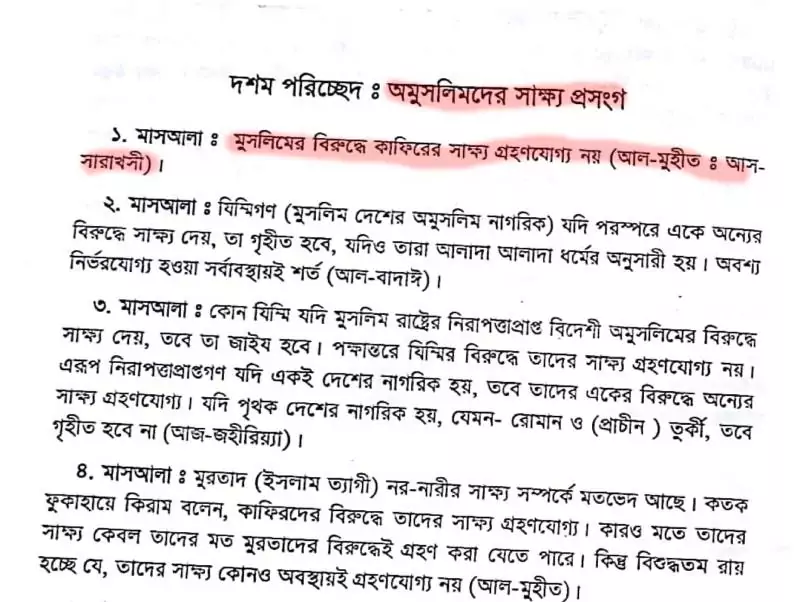
This quotation distinguishes more than Muslims from non-Muslims; it creates several levels of standing among non-Muslims themselves. Separate rules govern testimony by dhimmis, foreign persons under safe conduct, and people who have left Islam. Even foreigners’ countries of origin affect admissibility. The same person may tell the same truth about the same event, yet the admissibility of that account can change according to whom it concerns and the religious or political category to which the witness belongs. When the value of truth changes with the identities of witness and accused, a court becomes a guardian of religious status alongside its role of examining facts.
Relevant Islamweb fatwas likewise identify Islam as a condition for accepting testimony. They discuss exceptions and disagreement concerning non-Muslim witnesses to a Muslim’s will when death occurs during travel. Another fatwa concerning crime allows consideration of information supplied by non-Muslims when supported by strong corroborating evidence; it distinguishes accepting recorded images of an incident from accepting the non-Muslim’s own account as testimony. A non-Muslim’s recording of a crime may therefore be usable, while that person’s eyewitness account lacks the standing of admissible testimony because of religion. [71] [72]
The problem is clear. Following another religion does not make an event someone witnessed untrue. If a non-Muslim doctor, neighbor, or colleague is a reliable eyewitness to an offense, there are ample grounds to examine their account. Using religion to exclude that account grants the Muslim accused an advantage unrelated to whether the event occurred. The non-Muslim seeking justice is effectively told that their religious identity is insufficient for the court to accept the truth they witnessed. Even with exceptions in particular cases, the general rule remains discriminatory: a person’s capacity to tell the truth is judged through their beliefs.
Four Witnesses to Establish Rape
The problem of evidentiary rules becomes more serious in rape cases. IslamQA discusses punishment for rape without the threat of weapons within the framework of the prescribed punishment for zina—unlawful sexual intercourse—and states that establishing that punishment through testimony requires four male witnesses. Merely witnessing coercion, nakedness, or a sexual attack is insufficient; the witnesses are also required to have seen penile penetration of the vagina. Confession is discussed as well, alongside taʿzir, a discretionary punishment determined by the judge on the basis of corroborating evidence when the prescribed punishment cannot be established. That fatwa places rape under threat of weapons within hirabah, the category of violent predation. The question is why establishing the prescribed punishment for zina against a rapist through testimony should require conditions that are extraordinarily difficult to fulfill in practice. [73] [74]
Ibn Qudamah’s al-Mughni requires four upright, free Muslim men in its discussion of testimony concerning zina. The following passage also identifies rejection of women’s and slaves’ testimony as the majority juristic position. Let us read the complete relevant paragraph. [75] [76]
Al-Mughni
Author: Ibn Qudamah
Vol. 10, p. 130; witnesses to zina
Original Arabic: وَقَدْ رُوِيَ عَنْ النَّبِيِّ – صَلَّى اللَّهُ عَلَيْهِ وَسَلَّمَ – أَنَّهُ قَالَ: «أَرْبَعَةٌ، وَإِلَّا حَدٌّ فِي ظَهْرِك» فِي أَخْبَارٍ سِوَى هَذَا. وَأَجْمَعُوا عَلَى أَنَّهُ يُشْتَرَطُ كَوْنُهُمْ مُسْلِمِينَ، عُدُولًا، ظَاهِرًا وَبَاطِنًا، وَسَوَاءٌ كَانَ الْمَشْهُودُ عَلَيْهِ مُسْلِمًا أَوْ ذِمِّيًّا. وَجُمْهُورُ الْعُلَمَاءِ عَلَى أَنَّهُ يُشْتَرَطُ أَنْ يَكُونُوا رِجَالًا أَحْرَارًا، فَلَا تُقْبَلُ شَهَادَةُ النِّسَاءِ وَلَا الْعَبِيدِ. وَبِهِ يَقُولُ مَالِكٌ، وَالشَّافِعِيُّ، وَأَصْحَابُ الرَّأْيِ.
Translation: Other reports likewise relate that the Prophet—peace and blessings be upon him—said: “Four witnesses, otherwise the prescribed punishment upon your back.” They agree that witnesses must be Muslim and upright both outwardly and inwardly, whether the person against whom they testify is Muslim or a dhimmi. According to most scholars, witnesses must also be free men; thus, the testimony of women and slaves is not accepted. Malik, al-Shafiʿi, and the jurists of the school of opinion hold this view.
The same discussion also attributes to ʿAtaʾ and Hammad a different opinion accepting the testimony of three men and two women. Under the quoted majority position, however, a woman is not accepted even as one of the four witnesses. A woman who has been raped knows the entire incident; another woman accompanying her may have witnessed the assault, or several women may have rescued her together. Before the quality of what these people witnessed is assessed, they are excluded from the specified framework for establishing the prescribed punishment for zina through testimony. When women’s direct experiences are excluded from the prescribed list of witnesses in judging sexual violence against women, questions about that rule’s fairness naturally arise.
It is necessary to assess the truth of an accusation and protect innocent people against false charges. How, however, does that necessity entail the requirement that four men be present during the same offense and directly witness genital penetration? Rapists do not generally arrange to commit their offenses before witnesses. In situations involving seclusion, captivity, intimidation, or sudden attack, the availability of such witnesses lies beyond the victim’s control. If a nearly impossible condition of direct visual observation is imposed for a particular punishment instead of assessing injuries, medical findings, evidence at the scene, the accused’s conduct, and eyewitness accounts together, the disadvantage falls on the victim. Despite the availability of discretionary punishment, the question remains: why should the evidentiary rules establishing the prescribed punishment for a violent offense such as rape follow the same pattern as those for prohibited consensual intercourse?
The relevant juristic statement concerning the responsibility of a woman subjected to rape also needs examination. The passage IslamQA quotes from Ibn ʿAbd al-Barr’s al-Istidhkar states that the woman is not punished if coercion is established, and that the rapist is punished even where the evidence required for the prescribed punishment is absent. The complete principal passage and its translation follow. [77]
Al-Istidhkar
Author: Ibn ʿAbd al-Barr
Vol. 7, p. 146; principal passage quoted on IslamQA
Original Arabic: وَقَدْ أَجْمَعَ الْعُلَمَاءُ عَلَى أَنَّ عَلَى الْمُسْتَكْرِهِ الْمُغْتَصِبِ الْحَدَّ إِنْ شَهِدَتِ الْبَيِّنَةُ عَلَيْهِ بِمَا يُوجِبُ الْحَدَّ، أَوْ أَقَرَّ بِذَلِكَ، فَإِنْ لَمْ يَكُنْ فَعَلَيْهِ الْعُقُوبَةُ، وَلَا عُقُوبَةَ عَلَيْهَا إِذَا صَحَّ أَنَّهُ اسْتَكْرَهَهَا وَغَلَبَهَا عَلَى نَفْسِهَا، وَذَلِكَ يُعْلَمُ بِصُرَاخِهَا وَاسْتِغَاثَتِهَا وَصِيَاحِهَا.
Translation: The scholars agree that the prescribed punishment applies to a man who forcibly rapes a woman if evidence requiring that punishment is presented against him, or if he confesses. Otherwise, a punishment applies to him. The woman incurs no punishment when it is established that he coerced her and overpowered her against her will. This is known from her screaming, requests for help, and cries of distress.
This statement connects the victim’s exemption from punishment to establishing coercion. An important question of actual adjudication arises here. How will coercion be assessed for a woman who was too frightened to scream, whose mouth was covered, who was unconscious, or who could not resist under threat to her life? The absence of requests for help or visible resistance gives no basis for presuming consent. Nor does a victim’s inability to produce four witnesses against the offender prove that she is lying or engaged in intercourse voluntarily. Examining justice therefore requires more than a declaration of exemption from punishment; it also requires examining the weight given to the victim’s experience, account, and relevant evidence.
A separate article discusses more fully the relationship between accusations of rape, testimony required for the prescribed punishment for zina, and punishment for accusations of unlawful intercourse. Interested readers may consult Punishment for Rape in Islamic Sharia: The Dangerous Requirement of Four Witnesses. The issue here is whether the method of examining an allegation corresponds to the nature of the offense and the quality of evidence, and how far religious and gender-based rules of testimony restrict the victim’s access to justice.
Two Women in Place of One Man as Witnesses to a Debt
Verse 282 of Surah al-Baqarah initially requires two male witnesses for documenting a debt. If two men are unavailable, it specifies one man and two women. The stated reason is that if one woman errs, the other can remind her. One woman is therefore not considered sufficient to replace one man; two women are required. The question is clear within this specific rule concerning debt: why should an additional witness be necessary solely because the witness is a woman, without individually assessing her knowledge, memory, and familiarity with the transaction? Let us read the complete verse. [78] [79] [80]
The Qur’an
Surah al-Baqarah, verse 282
Original Arabic: يَا أَيُّهَا الَّذِينَ آمَنُوا إِذَا تَدَايَنتُم بِدَيْنٍ إِلَىٰ أَجَلٍ مُّسَمًّى فَاكْتُبُوهُ ۚ وَلْيَكْتُب بَّيْنَكُمْ كَاتِبٌ بِالْعَدْلِ ۚ وَلَا يَأْبَ كَاتِبٌ أَن يَكْتُبَ كَمَا عَلَّمَهُ اللَّهُ ۚ فَلْيَكْتُبْ وَلْيُمْلِلِ الَّذِي عَلَيْهِ الْحَقُّ وَلْيَتَّقِ اللَّهَ رَبَّهُ وَلَا يَبْخَسْ مِنْهُ شَيْئًا ۚ فَإِن كَانَ الَّذِي عَلَيْهِ الْحَقُّ سَفِيهًا أَوْ ضَعِيفًا أَوْ لَا يَسْتَطِيعُ أَن يُمِلَّ هُوَ فَلْيُمْلِلْ وَلِيُّهُ بِالْعَدْلِ ۚ وَاسْتَشْهِدُوا شَهِيدَيْنِ مِن رِّجَالِكُمْ ۖ فَإِن لَّمْ يَكُونَا رَجُلَيْنِ فَرَجُلٌ وَامْرَأَتَانِ مِمَّن تَرْضَوْنَ مِنَ الشُّهَدَاءِ أَن تَضِلَّ إِحْدَاهُمَا فَتُذَكِّرَ إِحْدَاهُمَا الْأُخْرَىٰ ۚ وَلَا يَأْبَ الشُّهَدَاءُ إِذَا مَا دُعُوا ۚ وَلَا تَسْأَمُوا أَن تَكْتُبُوهُ صَغِيرًا أَوْ كَبِيرًا إِلَىٰ أَجَلِهِ ۚ ذَٰلِكُمْ أَقْسَطُ عِندَ اللَّهِ وَأَقْوَمُ لِلشَّهَادَةِ وَأَدْنَىٰ أَلَّا تَرْتَابُوا ۖ إِلَّا أَن تَكُونَ تِجَارَةً حَاضِرَةً تُدِيرُونَهَا بَيْنَكُمْ فَلَيْسَ عَلَيْكُمْ جُنَاحٌ أَلَّا تَكْتُبُوهَا ۗ وَأَشْهِدُوا إِذَا تَبَايَعْتُمْ ۚ وَلَا يُضَارَّ كَاتِبٌ وَلَا شَهِيدٌ ۚ وَإِن تَفْعَلُوا فَإِنَّهُ فُسُوقٌ بِكُمْ ۗ وَاتَّقُوا اللَّهَ ۖ وَيُعَلِّمُكُمُ اللَّهُ ۗ وَاللَّهُ بِكُلِّ شَيْءٍ عَلِيمٌ.
Translation: Believers, when you transact a debt for a specified term, write it down. Let a scribe write it justly between you. No scribe should refuse to write as Allah has taught him. Let him write, and let the debtor dictate what is to be written. Let him fear Allah, his Lord, and omit nothing from the debt. If the debtor is foolish, weak, or unable to dictate, let his guardian dictate justly. Take two witnesses from among your men. If there are not two men, take one man and two women from witnesses you approve, so that if one woman errs, the other may remind her. Witnesses should not refuse when called. Do not tire of recording the debt, small or large, together with its term. This is more just in Allah’s sight, stronger for establishing testimony, and more likely to prevent doubt among you. If, however, it is an immediate transaction carried out between you, there is no blame on you for not recording it. Take witnesses when you buy and sell. Let neither scribe nor witness be harmed. If you do so, it is sinful conduct on your part. Fear Allah. Allah teaches you, and Allah knows all things.
The idea that one witness may help correct another’s error can be reasonable. But why should the risk of forgetting be confined to women? A man can also forget, fail to understand accounts, or confuse the terms of a transaction. If a woman regularly keeps accounts and manages the transaction herself, while a man is inexperienced in financial matters, why must another woman be required alongside her testimony? Conversely, why should the same rule not apply to correcting the man’s potential mistakes? Limited memory is a human characteristic; using it solely to reduce the value of women’s testimony judges sex rather than individual competence.
The Book of Testimony in Sahih al-Bukhari connects this difference to a deficiency in women’s intellect. The relevant hadith asks whether a woman’s testimony is half a man’s and then presents that difference itself as intellectual deficiency. The complete report follows. [81]
Sahih al-Bukhari
Book of Testimony; Chapter: Women’s Testimony
Hadith: 2658; internal reference: book 52, hadith 22
Original Arabic: حَدَّثَنَا ابْنُ أَبِي مَرْيَمَ، أَخْبَرَنَا مُحَمَّدُ بْنُ جَعْفَرٍ، قَالَ أَخْبَرَنِي زَيْدٌ، عَنْ عِيَاضِ بْنِ عَبْدِ اللَّهِ، عَنْ أَبِي سَعِيدٍ الْخُدْرِيِّ ـ رضى الله عنه ـ عَنِ النَّبِيِّ صلى الله عليه وسلم قَالَ: «أَلَيْسَ شَهَادَةُ الْمَرْأَةِ مِثْلَ نِصْفِ شَهَادَةِ الرَّجُلِ». قُلْنَا بَلَى. قَالَ: «فَذَلِكَ مِنْ نُقْصَانِ عَقْلِهَا».
Translation: Ibn Abi Maryam narrated to us; Muhammad ibn Jaʿfar informed him. He said that Zayd informed him, from ʿIyad ibn ʿAbdullah, from Abu Saʿid al-Khudri—may Allah be pleased with him. The Prophet—peace and blessings be upon him—said: “Is a woman’s testimony not like half a man’s testimony?” We replied, “Yes.” He said, “That is part of the deficiency in her intellect.”
There is a fundamental problem in this reasoning. A rule first requires two women for women’s testimony; the difference created by that rule is then used to identify a deficiency in women’s intellect. Yet a law assigning less value to someone’s statement does not prove that the person is less intelligent. Conclusions about intellect, memory, and reliability require examining actual individual abilities. Reducing the value of testimony because the witness is a woman and then treating that reduced value as evidence of women’s deficiency does not independently examine the rule’s validity. The rule instead uses its own decision as its justification.
To justify this combination of witnesses in matters of debt, it must be shown why two qualified women cannot serve as witnesses like two qualified men, or why two are required in place of one qualified woman. If women have fewer opportunities for financial work in a society, that circumstance may explain limitations in some people’s experience. It does not justify attaching the consequences of limited opportunity to female identity and turning them into a permanent rule. Individual competence changes with education, work, and experience. A just rule of testimony would examine that actual competence and the quality of the account. The claim to justice must therefore answer for the discrimination involved in excluding testimony on religious grounds, excluding women from particular forms of testimony, and requiring two women in place of one man.
The Value of Human Life according to Religious Identity
Does the value of a person’s life change when their religion changes? If two people are killed in the same way, one Muslim and the other non-Muslim, why should the killers’ responsibility differ? One family has lost a loved one, and the other has suffered the same loss. Yet various Sharia provisions governing retaliatory punishment and blood money make the victim’s religious identity a criterion for determining punishment and compensation. When religion changes the remedy for the same act of killing, human lives cease to be equal before the law.
A Non-Muslim’s Life Is Valued Less
Qisas is the provision for imposing a retaliatory death penalty on the perpetrator of intentional killing under specified conditions. On the basis of the following hadiths, the majority juristic position is that a Muslim killer cannot be subjected to qisas for killing a non-Muslim. If a non-Muslim kills a Muslim, however, that religious identity does not confer the same exemption. A difference in the offense is not producing the difference in punishment; the difference between the killer’s and victim’s religions itself obstructs qisas. Let us read the relevant hadiths. [82] [83]
Sahih al-Bukhari (Tawhid edition)
Book: 87 / Blood Money
Chapter: 87/31. A Muslim Must Not Be Killed in Retaliation for an Unbeliever.
6915. Narrated from Abu Juhayfah (may Allah have mercy on him), who said: I asked ʿAli (may Allah be pleased with him), “Do you possess anything that is not in the Qur’an?” He replied, “The rules of blood money, the release of captives, and the rule that no Muslim must be killed in retaliation for an unbeliever.” (111) (Adhunik Prakashani: 6435; Islamic Foundation: 6447)
Hadith classification: Authentic (Sahih)
Sunan Ibn Majah
Publisher: Tawhid Publication
Book: 15 / Blood Money
Chapter: 15/21. A Muslim Must Not Be Killed for Killing an Unbeliever
1/2658. Narrated from Abu Juhayfah (may Allah be pleased with him), who said: I asked ʿAli ibn Abi Talib (may Allah be pleased with him), “Do you possess any knowledge unknown to others?” He replied, “No, by Allah! We have no special knowledge beyond what other people possess, except if Allah grants someone understanding of the Qur’an, and what is in this document from the Messenger of Allah (peace and blessings be upon him) concerning blood money and related matters. This document also states: No Muslim must be killed for the offense of killing an unbeliever.”
Sahih al-Bukhari 111, 1870, 3047, 3034, 3172, 3180, 6755, 6903, 6915, 7300; Muslim 1370; al-Tirmidhi 1412, 2127; al-Nasaʾi 4734, 4735, 4744, 4745, 4746, 4530; Ahmad 600, 616, 484, 962, 994, 1040; al-Darimi 2356; Irwaʾ 2209. Al-Albani’s assessment: Authentic.
Hadith classification: Authentic (Sahih)
The report in Abu Dawud first declares Muslims’ blood equal in value. Immediately afterwards, it states that a Muslim must not be killed for killing a non-Muslim. The declaration of equality is therefore confined to Muslims; the same equality does not extend between Muslims and non-Muslims. The same report also prohibits killing a non-Muslim protected by a treaty. Declaring killing forbidden and preserving an equal right to retaliatory punishment for the victim are separate matters. [84] [85]
Sunan Abu Dawud (critically verified edition)
34 / Blood Money
Chapter: 11. Should a Muslim Be Killed for Killing an Unbeliever?
4530. Narrated through Qays ibn ʿAbbad (may Allah have mercy on him), who said: Al-Ashtar and I once went to ʿAli (may Allah be pleased with him) and asked, “Did the Messenger of Allah (peace and blessings be upon him) give you any special instruction that he did not give people generally?” He replied, “No, except what is in this document of mine.” He took a document from his sword’s scabbard. It stated: “The lives of all Muslims are equal in value. Against others, they form a united force.
The protection granted by an ordinary member of their community is binding on all. Take heed: No believer must be killed for the offense of killing an unbeliever. Nor may a non-Muslim subject under treaty be killed while the treaty remains in force. Whoever introduces an innovation bears responsibility for it. Whoever introduces an innovation or gives refuge to an innovator incurs the curse of Allah, the angels, and all humankind.”(1)
Authentic.
(1) Al-Nasaʾi, Ahmad.
Hadith classification: Authentic (Sahih)
Narrator: Qays ibn ʿAbbad (may Allah have mercy on him)
Sunan Abu Dawud (critically verified edition)
34 / Blood Money
Chapter: 11. Should a Muslim Be Killed for Killing an Unbeliever?
4531. Narrated from ʿAmr ibn Shuʿayb (may Allah have mercy on him), through his father and grandfather in succession. He said that the Messenger of Allah (peace and blessings be upon him) said words similar to the hadith narrated by ʿAli. This report, however, adds: “Those at a distance among them may also grant protection on their behalf; owners of strong and weak animals, and soldiers stationed at the rear and those engaged on the front line, receive equal shares of the spoils.”(1)
Hasan sahih.
(1) This appeared previously as hadith 2751.
Hadith classification: Good (Hasan)
Narrator: ʿAmr ibn Shuʿayb (may Allah have mercy on him)
An Islamweb fatwa directly endorses this rule. It mentions the Hanafi view that qisas applies to a Muslim who kills a dhimmi, but identifies the majority opinion exempting the Muslim from qisas as correct. The complete fatwa and its translation are presented together below. [86]
All perfect praise be to Allaah, The Lord of the Worlds. I testify that there is none worthy of worship except Allaah, and that Muhammad is His slave and Messenger. We ask Allaah to exalt his mention as well as that of his family and all his companions.
First of all, you should know that a Muslim should not be killed for killing a belligerent non-Muslim according to the consensus of the scholars may Allaah have mercy upon them. According to the view of the majority of the scholars may Allaah have mercy upon them a Muslim should not be killed against a free non-Muslim under the Muslim rule. The evidence about this is the saying of the Prophet sallallaahu `alayhi wa sallam ( may Allaah exalt his mention ): “A Muslim should not be killed for killing a non-Muslim.” (At-Tirmithi)
Moreover, according to the view of the majority of the scholars may Allaah have mercy upon them the title (and rulings) “disbeliever” is applicable to a free non-Muslim under the Muslim rule. However, Abu Haneefah, and the scholars of his School of jurisprudence may Allaah have mercy upon them are of the view that a Muslim should be killed for killing a free non-Muslim under Muslim rule; their evidence is the two verses which the questioner mentioned. Nonetheless, the correct opinion is that of the majority of the scholars may Allaah have mercy upon them that is based on the above Prophetic narration, which is a direct proof related to the case of dispute.
Allaah Knows best.
Translation: All perfect praise belongs to Allah, Lord of all worlds. I testify that there is no deity except Allah and that Muhammad is His slave and Messenger. We ask Allah to elevate his standing and that of his family and all his companions.
First, you should know that, according to the consensus of the scholars—may Allah have mercy on them—a Muslim is not to be killed for killing a belligerent non-Muslim. According to most scholars, a Muslim is also not to be killed in retaliation for a free non-Muslim living under Muslim rule. Their evidence is the Prophet’s statement—peace and blessings be upon him—that a Muslim is not to be killed for killing a non-Muslim. Al-Tirmidhi.
Furthermore, according to most scholars, the designation “unbeliever” and its rulings also apply to a free non-Muslim under Muslim rule. Abu Hanifah and the scholars of his school, however, hold that a Muslim should be killed for killing a free non-Muslim under Muslim rule; their evidence consists of the two verses mentioned by the questioner. Nevertheless, the correct opinion is that of most scholars, founded on the prophetic report above, which provides direct evidence on the disputed issue.
Allah knows best.
The rejection of equality is more explicit in al-Mughni’s wording. Ibn Qudamah quotes Ahmad objecting to the opinion that the blood money for a fire-worshipper, Jew, or Christian equals that for a Muslim. Reading the relevant statement shows that recognition of people’s equal standing lies at the center of the dispute. [87]
Al-Mughni
Author: Ibn Qudamah
Vol. 8, p. 273; killing a Muslim in retaliation for a non-Muslim
Original Arabic: قَالَ أَحْمَدُ: الشَّعْبِيُّ وَالنَّخَعِيُّ قَالَا: دِيَةُ الْمَجُوسِيِّ وَالْيَهُودِيِّ وَالنَّصْرَانِيِّ، مِثْلُ دِيَةِ الْمُسْلِمِ، وَإِنْ قَتَلَهُ يُقْتَلُ بِهِ. هَذَا عَجَبٌ، يَصِيرُ الْمَجُوسِيُّ مِثْلَ الْمُسْلِمِ، سُبْحَانَ اللَّهِ، مَا هَذَا الْقَوْلُ، وَاسْتَبْشَعَهُ. وَقَالَ: النَّبِيُّ – صَلَّى اللَّهُ عَلَيْهِ وَسَلَّمَ – يَقُولُ: «لَا يُقْتَلُ مُسْلِمٌ بِكَافِرٍ». وَهُوَ يَقُولُ: يُقْتَلُ بِكَافِرٍ. فَأَيُّ شَيْءٍ أَشَدُّ مِنْ هَذَا.
Translation: Ahmad said: Al-Shaʿbi and al-Nakhaʿi stated that the blood money for a fire-worshipper, Jew, or Christian equals that for a Muslim, and that if a Muslim kills such a person, the Muslim is killed in retaliation. “How astonishing! A fire-worshipper becomes equal to a Muslim! Glory be to Allah! What a statement!” He regarded this opinion as objectionable. He said: “The Prophet—peace and blessings be upon him—says that a Muslim must not be killed in retaliation for a non-Muslim, while this person says that he should be killed in retaliation for a non-Muslim. What could be more serious than this?”
The language of the objection to equality matters here: “A fire-worshipper becomes equal to a Muslim!” Yet where is the injustice if another person receives equal legal standing with a Muslim? Are that person’s life, death, and family’s losses any less real? If granting equal standing to a person of another religion is considered objectionable, the standard of justice becomes the superiority of one’s own religious community rather than human rights.
The cited Dars-e Tawhid wa Qital likewise presents religious equality between victim and killer as a condition of qisas. Alongside religion, the same discussion addresses freedom, sex, and numbers. The complete quotation is retained below. [88]—
Fourth condition: The person killed must be equal in status to the killer. This equality is considered in four respects. Although there is some disagreement concerning these four considerations, we shall mention all four and identify the preferable position among them.
First consideration: Equality in religion. A Muslim must therefore not be killed in retaliation for an unbeliever,
because Muslims and unbelievers are not equal in religion. Thus, a Muslim must not be killed in retaliation for a dhimmi or an unbeliever granted safe conduct. A belligerent unbeliever has no entitlement to blood money or qisas in the first place; killing him is instead recommended, obligatory, or permissible. This is the opinion of the majority of Shafiʿi and Hanbali jurists and some Maliki and Zahiri jurists.
Evidence: The report attributed to the Prophet through Abu Juhayfah. He said, “I asked ʿAli, ‘Do you possess anything not in the Qur’an?’ He replied, ‘By the One who splits the grain and creates living beings, I possess nothing beyond what is in the Qur’an, except the understanding a person may be granted of Allah’s Book and what is in this document.’ I asked, ‘What is in the document?’ He replied, ‘Blood money, rules concerning the release of captives, and the principle that a Muslim must not be killed in retaliation for an unbeliever.’”
A Muslim must therefore not be killed in retaliation for an unbeliever. But what do Hanafi jurists say on this matter? Imam Abu Hanifah—may Allah have mercy on him—cites a weak hadith as evidence and holds that a Muslim is to be killed in retaliation for a dhimmi unbeliever. Imam Malik—may Allah have mercy on him—says that a Muslim must not be killed in retaliation for an unbeliever, except in one circumstance: if he kills him by ghilah.
What does “ghilah” mean? Ibn Rushd—may Allah have mercy on him—writes about this in Bidayat al-Mujtahid:
Ghilah killing means laying a dhimmi or an unbeliever under safe conduct on his side, slaughtering him, and plundering his wealth. Imam Malik’s school holds that in such a case the Muslim killer is killed in retaliation for the dhimmi unbeliever. This, however, is probably a discretionary punishment or something similar. Allah knows best. Nevertheless, the authentic hadith takes precedence for following the rule in this case. The authentic hadith states that a Muslim must not be killed in retaliation for an unbeliever.
This is the first consideration: equality in religion.
Second consideration: Equality in freedom. A free person must therefore not be killed
in retaliation for a slave, whether the person killed was his own slave or someone else’s. This is the opinion expressed by Shafiʿi and Hanbali jurists. Malik—may Allah have mercy on him—holds a somewhat different view. He says that if this kind of killing is committed by ghilah, the free killer is killed in retaliation for the slave, as he has stated in other cases.
Third consideration: Equality in sex. May a man be killed in retaliation for a woman?
Yes, a man may be killed in retaliation for a woman. This is the opinion of the majority of Hanafi, Shafiʿi, and Maliki jurists and the majority of Hanbali jurists, and it is the preferable view.
Fourth consideration: Equality in numbers. If several people—two, three, five,
or ten—agree to kill one person, or all participate in killing that person, are all of them killed in retaliation for that one person? Yes, all are killed in retaliation for him. This is the view of most jurists: Hanafi, Shafiʿi, Maliki, and Hanbali. A consensus of the Companions—may Allah be pleased with them—was established on this view, as occurred in the time of ʿUmar ibn al-Khattab. It became almost a matter of consensus. Allah knows best.
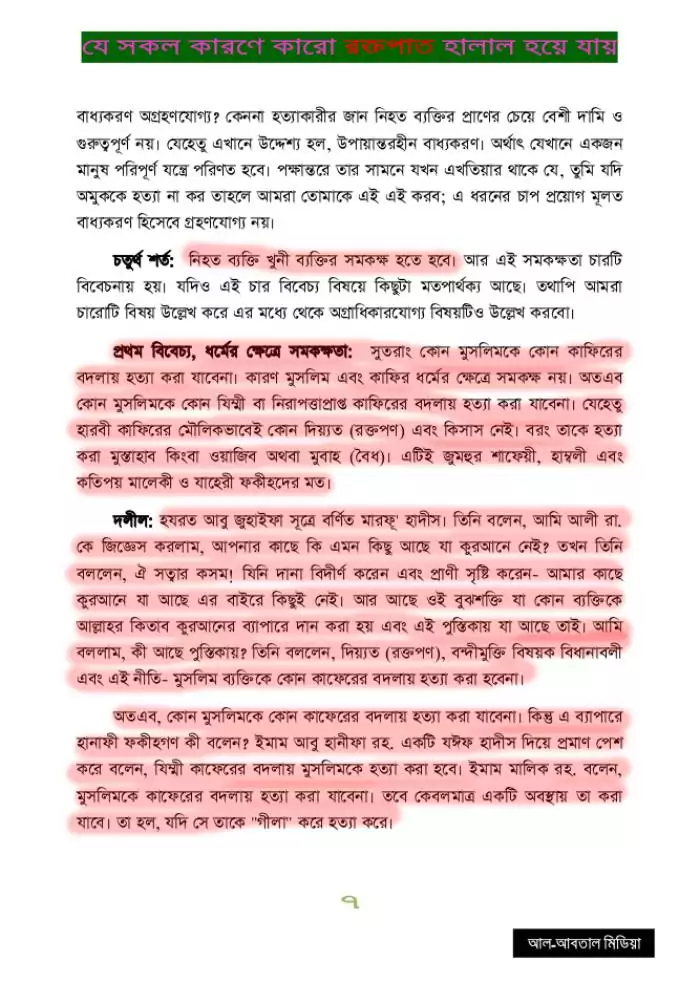
In this quotation, the lack of religious equality does not refer to any offense by the victim. Even a dhimmi or a non-Muslim under safe conduct is deemed unequal to a Muslim and excluded from qisas. Although Malik’s different rule is mentioned for the special circumstance of treacherous killing, the general religious distinction remains. Muslim identity therefore gives the killer a special advantage even in adjudicating the killing of a protected non-Muslim subject.
Discussion of ʿUthman’s rule shows this distinction being applied. Fiqh-e Osman describes several killings by ʿUbaydullah ibn ʿUmar, consultation concerning qisas, and the decision to pay blood money. It specifically identifies Jufaynah’s Christian identity as a reason for exempting his Muslim killer from qisas. Let us read the complete passage quoted from the book. [89]—
(d) Committing an offense in a state of agitation. ʿUthman’s opinion on this matter was that an offense committed in a state of agitation is treated like an accidental offense, jinayat al-khataʾ. In such a case, a financial penalty or compensation is required in place of qisas. For example, ʿAbd al-Rahman ibn Abi Bakr narrated: When ʿUmar was martyred, I set out in search of Hurmuzan, Jufaynah, and Abu Luʾluʾ. They lived in a neighborhood of Medina. On seeing me, they began to flee, and I pursued them. While running, they dropped a large, double-edged dagger. On seeing it, I told my companions, “Look, this is the dagger with which ʿUmar was martyred.” People went to inspect it and confirmed the truth of his statement. When ʿUbaydullah ibn ʿUmar saw the dagger, he went out with a sword and killed Hurmuzan and Jufaynah. He also found Abu Luʾluʾ’s young daughter and killed her. Raising his sword, he said, “By Allah, no male or female slave in Medina will escape my sword today. Some others must also be killed.” By “some others,” he indicated certain Emigrant Companions. People urged him to put down the sword, but did not dare approach him. ʿAmr ibn al-ʿAs arrived and said gently and affectionately, “Nephew, give me the sword.” He handed it over.
ʿUthman convened the consultative council and said, “Advise me concerning ʿUbaydullah ibn ʿUmar.” The council divided in its opinions. Some Emigrant Companions recommended that he be killed in qisas. Others said, “How astonishing! Yesterday his father was martyred, and today he will be killed. May Allah destroy Hurmuzan and Jufaynah.” ʿUthman reflected deeply and concluded that ʿUbaydullah had committed the killings while not in a normal condition. He was saying and doing things a person in a normal state would not. His mental condition was sufficient to suspend qisas. As with prescribed punishments, qisas is suspended because of doubt.
Hurmuzan and Abu Luʾluʾ’s daughter had no heirs. The state therefore acted as their guardian; in other words, ʿUthman was their guardian. He sought a balanced solution to the problem and asked those who favored sentencing ʿUbaydullah to death, “Tell me, who is Hurmuzan’s guardian?” They replied, “Commander of the Believers, you are now his guardian.” On hearing this, he said, “If so, I have forgiven ʿUbaydullah ibn ʿUmar.”⁶ When the victim’s guardian forgives the killer, blood money becomes obligatory in place of qisas. ʿUthman therefore ordered payment of the blood money from the public treasury. As for Jufaynah, he was a Christian. If a non-Muslim is killed by a Muslim, the Muslim cannot be killed for it. He therefore paid Jufaynah’s blood money on ʿUbaydullah’s behalf as well.
(b) Committing an offense against a person. If someone is killed
or suffers bodily harm, it must be determined whether the act was intentional or accidental. If intentional, qisas is obligatory, whether the offense involves killing or injury to a limb, provided there is no other impediment to imposing qisas. If qisas is impossible in any circumstance, or grounds exist that cancel its imposition, payment of blood money is required.
If an offense occurs accidentally, payment of blood money is obligatory.
(b.1) A Muslim Harming a Non-Muslim. If a non-Muslim is killed
by a Muslim, whether or not the victim is a dhimmi, qisas cannot be imposed on the Muslim. Blood money must be accepted instead. For this reason, ʿUthman did not impose qisas on a Muslim for killing a polytheist. During his rule, a Muslim intentionally killed a dhimmi. He did not impose qisas but ordered payment of aggravated blood money—that is, full blood money.⁹ If a Muslim harms a non-Muslim without killing him, inflicting harm less than death, how is qisas to be imposed? We have found no report of ʿUthman’s opinion on this. In such cases, however, ʿUmar did not impose qisas, but the amount of blood money
The quoted work invokes the killer’s mental condition and the state’s guardianship regarding the killings of Hurmuzan and Abu Luʾluʾ’s daughter; for Jufaynah, it invokes religious identity. These separate grounds require attention. The statement that qisas did not apply to his killing because he was Christian explicitly reveals religious discrimination. If remedies change because of the killer’s personal agitation, political position, or the victim’s religion, where is equal value accorded to the lives of those killed?
A hadith also threatens anyone who kills a person under treaty with being unable to smell the fragrance of Paradise. Let us read the complete report. [90]
Sahih al-Bukhari
Book of Jizyah and Treaties; hadith 3166
Original Arabic: حَدَّثَنَا قَيْسُ بْنُ حَفْصٍ، حَدَّثَنَا عَبْدُ الْوَاحِدِ، حَدَّثَنَا الْحَسَنُ بْنُ عَمْرٍو، حَدَّثَنَا مُجَاهِدٌ، عَنْ عَبْدِ اللَّهِ بْنِ عَمْرٍو ـ رضى الله عنهما ـ عَنِ النَّبِيِّ صلى الله عليه وسلم قَالَ: «مَنْ قَتَلَ مُعَاهَدًا لَمْ يَرَحْ رَائِحَةَ الْجَنَّةِ، وَإِنَّ رِيحَهَا تُوجَدُ مِنْ مَسِيرَةِ أَرْبَعِينَ عَامًا».
Translation: Qays ibn Hafs narrated to us; ʿAbd al-Wahid narrated to him; Hasan ibn ʿAmr narrated to him; Mujahid narrated to him, from ʿAbdullah ibn ʿAmr—may Allah be pleased with them—from the Prophet—peace and blessings be upon him. He said: “Whoever kills a person under treaty will not smell the fragrance of Paradise, although its fragrance can be perceived from a distance of forty years’ travel.”
This declaration of punishment in the afterlife does not establish the victim’s family’s right to equal justice. The claimed punishment a killer will receive in the afterlife and the remedy available for the victim in court are separate questions. Even if killing a non-Muslim is declared forbidden, judicial discrimination remains when religious identity exempts the Muslim killer from qisas. Calling killing a sin and making the victim’s rights equal to a Muslim’s are different matters.
Blood Money for Killing Non-Muslims
After qisas comes the question of diya, or blood money: prescribed compensation payable to the victim’s family for the killing. The following reports set blood money for the People of the Book at half the amount for a Muslim. If compensation for people who lose their lives in the same way is reduced solely because of religion, the law itself assigns unequal standing to the victims. The relevant reports are presented in full. [91] [92]
Sunan Ibn Majah
15 / Blood Money
Chapter: 15/13. Blood Money for an Unbeliever
1/2644. Narrated from ʿAmr ibn Shuʿayb (may Allah be pleased with him), through his father and grandfather in succession. The Messenger of Allah (peace and blessings be upon him) ruled that blood money for the two communities of the People of the Book—Jews and Christians—would be half the blood money for Muslims.
Al-Tirmidhi 1413; al-Nasaʾi 4806, 4807; Irwaʾ 2251.
Al-Albani’s assessment: Good. Concerning ʿAbd al-Rahman ibn ʿAyyash, a narrator of this hadith, Ibn Hajar al-ʿAsqalani said that he is acceptable. Imam al-Dhahabi called him trustworthy.
Hadith classification: Good (Hasan)
Narrator: ʿAmr ibn Shuʿayb (may Allah have mercy on him)
Sunan Abu Dawud (Islamic Foundation edition)
34 / Blood Money
Chapter: 21. Concerning Blood Money for a Dhimmi.
4514. Yazid ibn Khalid (may Allah have mercy on him) … narrated from ʿAmr ibn Shuʿayb, from his father, from his grandfather, that the Prophet (peace and blessings be upon him) said, “Blood money for a dhimmi is half the blood money for a free person.”
Hadith classification: Good (Hasan)
Narrator: ʿAmr ibn Shuʿayb (may Allah have mercy on him)
Alongside the report prescribing half the blood money, the quotation from al-Tirmidhi records different amounts proposed by various jurists. Both the reduction of blood money according to religion and the extent of reduction under different opinions are therefore directly evident. [93]
Sunan al-Tirmidhi (Islamic Foundation edition)
16 / Blood Money
Chapter: Blood Money for an Unbeliever.
1417. ʿIsa ibn Ahmad (may Allah have mercy on him) … narrated from ʿAmr ibn Shuʿayb, from his father, from his grandfather, ʿAbdullah ibn ʿAmr, that the Messenger of Allah (peace and blessings be upon him) said, “A Muslim must not be killed in retaliation for a non-Muslim.” — Ibn Majah 2659; al-Tirmidhi hadith 1413 (al-Madani Prakashani).
It is also narrated through this chain that the Prophet (peace and blessings be upon him) said, “The blood money for an unbeliever is half that for a believer.” — Ibn Majah 2644.
The hadith narrated by ʿAbdullah ibn ʿAmr (may Allah be pleased with him) on this subject is hasan. Scholars disagree about blood money for Jews and Christians. Some follow this hadith narrated from the Prophet (peace and blessings be upon him). ʿUmar ibn ʿAbd al-ʿAziz said that blood money for Jews and Christians is half that for a Muslim. Ahmad ibn Hanbal held this opinion. It is narrated from ʿUmar ibn al-Khattab (may Allah be pleased with him) that he said blood money for Jews and Christians is four thousand dirhams, and for a fire-worshipper eight hundred dirhams. This is the opinion of Imams Malik, al-Shafiʿi, and Ishaq. Some scholars said that blood money for Jews and Christians equals that for a Muslim. This is the opinion of Imam Sufyan al-Thawri and the scholars of Kufa.
Hadith classification: Good (Hasan)
Narrator: ʿAmr ibn Shuʿayb (may Allah have mercy on him)
The discussion in Malik’s Muwatta also specifies different blood-money amounts for Jews, Christians, and fire-worshippers. The rules of qisas, circumstances of treacherous killing, and compensation for bodily injury appear in the same discussion. [94]
Malik’s Muwatta
43. Book of Blood Money
Chapter: 15. Blood Money for an Unbelieving Dhimmi
Malik (may Allah have mercy on him) said that a report had reached him that ʿUmar ibn ʿAbd al-ʿAziz used to say that blood money for Jews and Christians, when they kill one another, is half that for a free Muslim.
Malik said: “The rule among us is that a Muslim is not killed in retaliation for an unbeliever. If, however, he treacherously kills the dhimmi, he is killed.”
Sulayman ibn Yasar used to say that blood money for fire-worshippers is eight hundred dirhams. Malik said, “This is the rule among us.”
Malik said that compensation for wounds inflicted on Jews and Christians, calculated by reference to compensation for wounds inflicted on Muslims, is one-twentieth for a mudihah wound and one-third for maʾmumah and jaʾifah wounds. Other injuries may be assessed by analogy with these.
Hadith classification: Verification pending
Narrator: Malik ibn Anas (may Allah have mercy on him)
Islamweb fatwa 21224 identifies half the Muslim blood money for the relevant non-Muslim categories as the Maliki and Hanbali position, one-third for Jews and Christians as the Shafiʿi position, and still lower amounts for other relevant categories, including fire-worshippers. It also records the Hanafi opinion favoring equal blood money. The reason for these rules of one-half or one-third is not that the victim’s harm is less; it is the victim’s religious category. [95]
There is also a provision for increasing blood money instead of imposing qisas in cases of intentional killing. IslamQA discusses half the blood money for accidentally killing a dhimmi and increasing it to the Muslim amount for intentional killing. Al-Mughni explicitly gives the absence of qisas as the reason for this ruling. Let us read the complete relevant paragraph. [96] [97]
Al-Mughni
Author: Ibn Qudamah
Vol. 8, p. 400; ruling 6833
Original Arabic: مَسْأَلَةٌ: قَالَ: «فَإِنْ قَتَلُوهُ عَمْدًا، أُضْعِفَتْ الدِّيَةُ عَلَى قَاتِلِهِ الْمُسْلِمِ؛ لِإِزَالَةِ الْقَوَدِ». هَكَذَا حَكَمَ عُثْمَانُ بْنُ عَفَّانَ – رَضِيَ اللَّهُ عَنْهُ -. هَذَا يُرْوَى عَنْ عُثْمَانَ رَوَاهُ أَحْمَدُ عَنْ عَبْدِ الرَّزَّاقِ عَنْ مَعْمَرٍ، عَنْ الزُّهْرِيِّ، عَنْ سَالِمٍ عَنْ أَبِيهِ، أَنَّ رَجُلًا قَتَلَ رَجُلًا مِنْ أَهْلِ الذِّمَّةِ، فَرُفِعَ إلَى عُثْمَانَ، فَلَمْ يَقْتُلْهُ، وَغَلَّظَ عَلَيْهِ أَلْفَ دِينَارٍ. فَصَارَ إلَيْهِ أَحْمَدُ اتِّبَاعًا.
Translation: Ruling: He said that if they kill him intentionally, the Muslim killer’s blood-money liability is doubled because qisas has been excluded. ʿUthman ibn ʿAffan—may Allah be pleased with him—ruled in this manner, as is reported from him. Ahmad narrated from ʿAbd al-Razzaq, from Maʿmar, from al-Zuhri, from Salim, from his father: A man killed a member of the protected non-Muslim community. When the case was brought to ʿUthman, he did not execute the killer but imposed a heavier liability of one thousand dinars. Following this decision, Ahmad adopted the same opinion.
Although this rule increases blood money for intentional killing, the religious barrier to qisas remains. Doubled blood money therefore cannot be called equal justice: qisas that may apply when a Muslim is killed is excluded on religious grounds when a non-Muslim is killed. Meanwhile, half the blood money for accidental death creates a separate inequality. If two people die in the same accident, what justice is there in paying one family the full amount and the other half solely because of religion?
Compensation here does not vary through separate assessments of the victim’s income, the family’s dependence, or actual financial loss. The ratio assigned by religious category is supposed to apply even to a poor Muslim and an affluent Christian. Conversion changes neither a person’s physical life nor their family’s loss, yet these religious rules can change the qisas and blood-money provisions applicable to that person. If a life remains the same but its legal value changes with religion, the principle is religious discrimination rather than equal human standing.
Wealth, Family Relationships, and Unequal Rights
The examination of justice does not end with a court’s pronouncements. It must also consider who has greater opportunity to escape liability for the same offense, which relative receives a special exemption for the same killing, and which children’s rights are reduced from birth despite having the same parents. If wealth, family position, and being male or female determine the outcomes of judgment and rights, the claim to equality comes into question. Placing Sharia rules of blood money, a father’s exemption from qisas for killing his child, and the distribution of inheritance between sons and daughters alongside one another makes these issues clearer. To determine whether the law treats everyone equally, we must examine how much each person’s loss is valued, which offenses receive exemptions, and whose rights are reduced.
The Sharia Provision for Blood Money
Islamic Sharia provides for qisas and diya in cases of killing. Qisas here means the killer’s execution in retaliation for the killing; diya is blood money or financial compensation owed to the victim’s heirs. In cases of intentional killing, the victim’s entitled relatives may accept blood money instead of qisas or grant forgiveness. A killer may therefore have an opportunity to avoid qisas by reaching a financial settlement with the victim’s family. Assessing this arrangement requires answering a straightforward question: of two people who committed the same offense, does the wealthier one have greater scope to bargain for the preservation of their own life? When the opportunity to avoid qisas through payment forms part of the law, wealth becomes more than a matter of personal comfort; it also becomes a means of changing the consequences of crime.
Suppose a man named Karim is killed. His relationship with his family was poor. Some of those who will inherit after his death may regard his death as more profitable than his continued life. The killer offers those relatives money, and they agree to accept blood money. Where has Karim’s own claim to justice gone? The power to determine the remedy for his killing has passed after death to the people with whom he was in conflict during life. The prospect of additional money alongside the inheritance may influence their decision. Granting relatives this power therefore also raises the question of whether their interests coincide with the victim’s. The victim’s family and the victim are not the same entity; the family’s financial gain cannot be presumed to constitute justice for the deceased.
To examine the basis for forgiveness and payment in intentional killing, verse 178 of Surah al-Baqarah needs to be read. Alongside qisas, it addresses forgiveness, pursuit of a claim, and payment. [98]—
The Qur’an
Surah al-Baqarah, verse 178
Original Arabic:
يَا أَيُّهَا الَّذِينَ آمَنُوا كُتِبَ عَلَيْكُمُ الْقِصَاصُ فِي الْقَتْلَى الْحُرُّ بِالْحُرِّ وَالْعَبْدُ بِالْعَبْدِ وَالْأُنْثَىٰ بِالْأُنْثَىٰ فَمَنْ عُفِيَ لَهُ مِنْ أَخِيهِ شَيْءٌ فَاتِّبَاعٌ بِالْمَعْرُوفِ وَأَدَاءٌ إِلَيْهِ بِإِحْسَانٍ ذَٰلِكَ تَخْفِيفٌ مِنْ رَبِّكُمْ وَرَحْمَةٌ فَمَنِ اعْتَدَىٰ بَعْدَ ذَٰلِكَ فَلَهُ عَذَابٌ أَلِيمٌ
Translation:
Believers, qisas has been prescribed for you concerning those killed: the free for the free, the slave for the slave, and the female for the female. If someone is granted any forgiveness by his brother, the claim must be pursued justly and payment made to him properly. This is an alleviation and mercy from your Lord. Whoever transgresses thereafter will receive a painful punishment.
Al-Buhuti’s Sharh Muntaha al-Iradat explains Hanbali rules concerning forgiveness, punishment, and financial settlement. Read the relevant paragraph preserved on Islamweb. [99]—
Sharh Muntaha al-Iradat
Mansur al-Buhuti
Book of Offenses, Chapter on Pardoning Qisas
Vol. 3, pp. 278–279
Original Arabic:
وَيَصِحُّ عَفْوٌ بِلَفْظِ الصَّدَقَةِ وَكُلِّ مَا أَدَّى مَعْنَاهُ؛ لِأَنَّهُ إِسْقَاطٌ. (ثُمَّ لَا تَعْزِيرَ عَلَى جَانٍ) بَعْدَ عَفْوٍ؛ لِأَنَّ عَلَيْهِ حَقًّا وَاحِدًا وَقَدْ سَقَطَ كَعَفْوٍ عَنْ دِيَةِ خَطَأٍ. (فَإِنِ اخْتَارَ الْوَلِيُّ الْقَوَدَ) فَلَهُ أَخْذُهَا، وَالصُّلْحُ عَلَى أَكْثَرَ مِنْهَا؛ لِأَنَّ الْقِصَاصَ أَعْلَى فَلَا يَمْتَنِعُ عَلَيْهِ الِانْتِقَالُ إِلَى الْأَدْنَى، وَتَكُونُ الدِّيَةُ بَدَلًا عَنِ الْقِصَاصِ.
Translation:
Forgiveness is valid through the word “charity” and any other wording conveying the same meaning, since it relinquishes a right. After forgiveness, no discretionary punishment is imposed on the offender, because a right existed against him and has been extinguished, as when blood money for accidental killing is waived. Even if the entitled relative chooses qisas, he may still accept blood money and reach a settlement for an amount greater than the blood money, because qisas is the greater remedy and moving from it to a lesser remedy is not prohibited. Blood money then substitutes for qisas.
The victim’s family’s need for compensation and social responsibility for killing are separate questions. A family losing its breadwinner may need financial assistance, and meeting that need is justifiable. Linking compensation to the killer’s exemption from qisas, however, gives financial exchange a role in determining the consequences of the offense. Killing causes more than a family’s financial loss; it takes a person’s life and undermines society’s safety. Yet under the quoted rule, the relatives’ forgiveness also removes discretionary punishment. How does a settlement with the victim’s relatives discharge the killer’s responsibility towards society?
Suppose Bill Gates’s daughter and the son of an impoverished man, Akkas Ali, commit the same kind of intentional killing in two separate incidents. Both victims’ families are willing to relinquish qisas in exchange for money but demand an amount the poor family cannot raise. A family with enormous wealth can offer large sums, sustain negotiations over a long period, and use the victim’s family’s financial hardship as an opportunity for settlement. Akkas Ali’s son will have no comparable opportunity. Although the offense is the same, the practical opportunities to avoid qisas are unequal; the wealthy family’s money becomes a power to alter the judicial outcome. Whether the victim’s family accepts an offer remains its decision, but the ability to make a large offer is a question of wealth.
The rules for causing death accidentally require separate examination. Intentional killing and unintentional death do not involve the same kind of offense. Verse 92 of Surah al-Nisa specifically addresses accidental killing, prescribing blood money, freeing a believing slave, and, if freeing a slave is beyond one’s means, fasting for two consecutive months. The expiation through freeing a slave and fasting does not establish that an intentional killer can escape qisas merely by freeing a slave. Reading the entire verse clarifies both this distinction and differences in remedies according to the victim’s religious and political identity. [100]—
It is not for a believer to kill a believer (1), except by mistake. Whoever kills a believer by mistake must free a believing slave and pay blood money to the victim’s family, unless they forgive it. If the victim belongs to a people hostile to you but is a believer, a believing slave must be freed. If the victim belongs to a community with which you have a treaty, blood money must be paid to the family and a believing slave freed. Whoever lacks the means must fast for two consecutive months (2). These are Allah’s provisions for repentance, and Allah is All-Knowing, Wise.
Dr. Abu Bakr Muhammad Zakaria
It is not for a believer to kill a believer, though it may happen by mistake. Whoever kills a believer by mistake must free a believing slave or pay blood money to the family, unless they forgive it. If the victim belongs to a people hostile to you but is a believer, a believing slave must be freed. If the victim belongs to a tribe with which you have a treaty, blood money must be paid to the family and a believing slave freed. Whoever lacks the means must fast for two consecutive months. This is the provision for repentance before Allah, and Allah is All-Knowing, Wise.
Taisirul Quran
It is not for a believer to kill another believer, except by mistake. Whoever kills a believer by mistake must free a believing slave and pay blood money to the victim’s family, unless they waive it as charity. If the victim belongs to a people hostile to you but is a believer, a believing slave must be freed. If the victim belongs to a people with whom you have a peace treaty, blood money must be paid to the family and a believing slave freed. Whoever cannot find one must fast for two consecutive months. This is an expiation from Allah. Allah is All-Knowing, Wise.
Rawai Al-bayan
A believer should not kill another believer except by mistake. Whoever kills a believer by mistake must free a believing slave and deliver compensation for the killing to the relatives, unless they forgive it. If the victim belongs to a people hostile to you but is a believer, a believing slave must be freed. If the victim belongs to a community bound by a treaty between you and them, compensation for the killing must be delivered to the relatives and a believing slave freed. If the offender cannot do so, they must fast for two consecutive months to obtain forgiveness from Allah. Allah is All-Knowing, Wise.
Sheikh Mujibur Rahman
And never is it for a believer to kill a believer except by mistake. And whoever kills a believer by mistake – then the freeing of a believing slave and a compensation payment (diyah) presented to his (i.e., the deceased’s) family (is required), unless they give (up their right as) charity. But if he (i.e., the deceased) was from a people at war with you and he was a believer – then (only) the freeing of a believing slave; and if he was from a people with whom you have a treaty – then a compensation payment presented to his family and the freeing of a believing slave. And whoever does not find (one or cannot afford to buy one) – then (instead), a fast for two months consecutively,1 (seeking) acceptance of repentance from Allah.2 And Allah is ever Knowing and Wise.
Saheeh International
Hadiths also provide detailed rules for the amounts of blood money. The following report describes amounts in gold coins, silver coins, and livestock. It also shows a difference between blood money for Muslims and for the People of the Book. Alongside the question of wealth, the system of blood money therefore retains the problem of discriminatory compensation on the basis of the victim’s religious identity. [101]—
Sunan Abu Dawud (Islamic Foundation edition)
34 / Blood Money
Chapter: 16. The Amount of Blood Money—Compensation for Killing.
4476. Yahya ibn Hakim (may Allah have mercy on him) … narrated from ʿAmr ibn Shuʿayb, from his father, from his grandfather, that during the Messenger of Allah’s time, blood money was valued at approximately eight hundred dinars in gold or eight thousand dirhams in silver. The amount for the People of the Book—Jews and Christians—was then half that prescribed for Muslims, and this continued until ʿUmar’s caliphate. After becoming caliph, he stood to deliver a sermon and said, “The price of camels has now risen.”
The narrator said: ʿUmar then increased the value of blood money from eight hundred to one thousand dinars and from eight thousand to twelve thousand dirhams. For cattle owners he prescribed two hundred cattle, and for goat owners two thousand goats. He retained the dhimmis’ blood money at its previous amount without increasing it as he had increased the Muslims’ amount.
Hadith classification: Good (Hasan)
Narrator: ʿAmr ibn Shuʿayb (may Allah have mercy on him)
Now consider Karim, the son of a wealthy family, and Rahim, the son of a poor family. They are convicted of the same kind of killing in two separate incidents. Both victims’ families agree to waive qisas on condition of payment. Karim’s family raises the required money; Rahim’s cannot. Financial settlement is therefore an effective option for Karim but not for Rahim. The difference arises from neither their character, the severity of their offenses, nor the depth of their remorse; it arises from family wealth. Assessing the justice of a legal system that recognizes such an opportunity cannot disregard this unequal position of rich and poor.
A further question concerns how much freedom a poor victim’s family has to decide independently. The loss of a loved one, livelihood, debt, children’s futures, and pressure from a powerful offender mean that consent to accept money is not always a free agreement between parties of equal power. The family’s financial need can become the killer’s route to release. A legal system therefore has a duty both to assist the harmed family and to prevent responsibility for crime from becoming dependent on wealth. Conflating the amount of compensation received with the judgment of responsibility for killing can allow the deceased person’s right to life to disappear in financial bargaining.
Killing One’s Own Child
The family relationship between killer and victim also carries special weight in Sharia rules of qisas. A widely accepted juristic position exempts a father from qisas when he kills his child. Fatherhood thus creates a special exemption alongside responsibility for the killing. Blood-money liability may remain, but the qisas faced for killing someone else in the same manner is avoided when the victim is one’s own child. The following hadith states that exemption directly. [102]—
Sunan al-Tirmidhi (critically verified edition)
14 / Diya, or Blood Money
Chapter: 9. Whether Qisas Applies to a Father Who Kills His Son
1400. ʿUmar ibn al-Khattab (may Allah be pleased with him) narrated: “I heard the Messenger of Allah (peace and blessings be upon him) say, ‘A father must not be killed for the offense of killing his son.’”
Authentic; Ibn Majah (2662).
Hadith classification: Authentic (Sahih)
Narrator: ʿUmar ibn al-Khattab (may Allah be pleased with him)
Let us also examine the hadith directly in the book. [103]—
The same rule appears in Sunan Ibn Majah. Both the chapter heading and the hadith’s statement explicitly establish the father’s exemption from qisas for killing his child. [104]—
Sunan Ibn Majah
15 / Blood Money
Chapter: 15/22. A Father Must Not Be Killed for Killing His Child
2/2662. Narrated from ʿUmar ibn al-Khattab (may Allah be pleased with him), who said: “I heard the Messenger of Allah (peace and blessings be upon him) say, ‘A father must not be killed for killing his child.’”
Al-Tirmidhi 1400; Irwaʾ 2214.
Al-Albani’s assessment: Authentic.
Hadith classification: Authentic (Sahih)
Narrator: ʿUmar ibn al-Khattab (may Allah be pleased with him)
See also the relevant page of the original book. [105]—
This rule also appears in Bengali compilations of Islamic law. The relevant passage from the Islamic Foundation’s Codified Islamic Law is presented below. [106]—
The juristic explanation for giving a father this special exemption is also important. Ibn Qudamah’s al-Mughni, preserved on Shamela, explains the exclusion of qisas through the possibility of ownership in the father-child relationship and the father’s role in bringing the child into existence. Earlier, it mentions the statement “You and your property belong to your father.” Read the complete explanatory paragraph that follows. [107]—
Al-Mughni
Ibn Qudamah
Maktabat al-Qahirah edition
Vol. 8, p. 285, ruling 6621
Original Arabic:
وَقَضِيَّةُ هَذِهِ الْإِضَافَةِ تَمْلِيكُهُ إيَّاهُ، فَإِذَا لَمْ تَثْبُتْ حَقِيقَةُ الْمِلْكِيَّةِ، بَقِيَتْ الْإِضَافَةُ شُبْهَةً فِي دَرْءِ الْقِصَاصِ؛ لِأَنَّهُ يُدْرَأُ بِالشُّبُهَاتِ، وَلِأَنَّهُ سَبَبُ إيجَادِهِ، فَلَا يَنْبَغِي أَنْ يَتَسَلَّطَ بِسَبَبِهِ عَلَى إعْدَامِهِ.
Translation:
The significance of this attribution is to place him in his father’s ownership. Even if actual ownership is not established, this attribution remains a doubt sufficient to remove qisas, since qisas is averted by doubt. Moreover, the father is the cause of the child’s existence; the power to extinguish the father’s existence should therefore not be exercised because of the child.
Bringing a child into existence becomes an advantage in determining responsibility for killing. But does bringing someone into the world create a special right over that person’s life? A child is not the father’s property; the child’s life, body, and safety belong to the child. Fatherhood should entail responsibility for care and protection. When the person entrusted with that responsibility kills the child, the breach of duty becomes more serious. In the quoted reasoning, however, the parent’s position itself becomes the reason for avoiding qisas after killing. Making the relationship a ground for exempting the killer when a child is killed by the person responsible for protecting them makes the claim to justice harder to sustain.
This rule has not remained a general statement alone; it also appears in an account of intentional child-killing. The following report in Musnad Ahmad explicitly states that a father intentionally killed his child. ʿUmar imposed blood money in camels and said that he would have sentenced the father to death had he not heard the statement exempting fathers from execution for killing their children. The reason for excluding qisas was therefore not the unintentional nature of the offense; it was a specified exemption arising from the father-child relationship. [108]—
Musnad Ahmad
Musnad of ʿUmar ibn al-Khattab (may Allah be pleased with him)—Hadiths Narrated by ʿUmar
Chapter:
346. ʿAmr ibn Shuʿayb narrated from his father, who narrated from his grandfather, that a man intentionally killed his son. A complaint was lodged with ʿUmar ibn al-Khattab, who imposed a penalty of one hundred camels on the killer: thirty hiqqah, thirty jadhaʿah, and forty thaniyyah camels. He said, “A killer does not inherit. And had I not heard the Messenger of Allah (peace and blessings be upon him) say that a father is not sentenced to death for killing his child, I would certainly have sentenced you to death.”
(See hadith 147.)
Hadith classification: Good (Hasan)
The report states that the killer does not inherit and also imposes blood money. The question at issue is therefore equality in qisas. Why should a father and a killer outside the family occupy different positions for the same offense? Preventing a killer from inheriting from the murdered child and specially exempting the killer because he is the father are separate provisions. The first does not remove the discrimination in the second. If the child’s life is recognized as an independent right, the rationale for a special advantage based on the killer’s fatherhood must also be shown in adjudicating the killing.
The following report in Malik’s Muwatta describes a child’s death from the father’s sword blow and the collection of blood money in camels for that death. This is a separate incident from the previous account of intentional killing; both accounts are given in full. [109]—
Malik’s Muwatta
43. Book of Blood Money
Chapter: 17. Inheritance from Blood Money and Increasing Its Severity
Report 10. ʿAmr ibn Shuʿayb (may Allah have mercy on him) narrated that a man of the Banu Mudlij named Qatadah struck his son with a sword, injuring his leg. The bleeding did not stop, and the boy died. Suraqah ibn Jusham came to ʿUmar and described the incident. ʿUmar told him, “Collect one hundred and twenty camels before I arrive at the well of Qudayd.” When he arrived, he took thirty hiqqah, twenty jadhaʿah, and forty pregnant she-camels and asked, “Where is the dead person’s brother?” He replied, “I am here.” ʿUmar said, “Take these camels. A killer does not inherit.”
Saʿid ibn al-Musayyab and Sulayman ibn Yasar were asked whether blood money should be made more severe if someone kills during the sacred months. He replied, “No; rather, blood money is increased because those months are sacred.” Saʿid was then asked whether compensation for injuring someone during those months would likewise be increased as in a killing. Saʿid replied, “Yes.”
Malik said, “I think the intended increase is the same as the blood money ʿUmar imposed on the man of the Banu Mudlij when he killed his son.”
Hadith classification: Verification pending
Jurists also differ on imposing qisas on a father. The same discussion in al-Mughni mentions the positions of Ibn Nafiʿ, Ibn ʿAbd al-Hakam, and Ibn al-Mundhir in favor of qisas, and attributes to Malik the view that qisas applies when the intention to kill is unambiguous. Within this disagreement, the important point remains clear: exemption from qisas on grounds of fatherhood is established as a recognized position in hadith and jurisprudence, and the intentional-killing report above shows it being applied. Assessing the claim to justice therefore requires directly examining the moral basis of this exemption. [110]
This question is particularly significant in discussions of killing in the name of family or so-called honor. If the relatives who regard a child’s conduct as contrary to family honor are also entitled to decide forgiveness and blood money after the killing, protecting the victim’s interests becomes still more difficult. Adding the father’s special exemption from qisas raises further questions about the safety of vulnerable family members. Shongshoy’s detailed article Islamic Sharia: Killing to Preserve Religion and Honor, or Honor Killing may be consulted on this issue. The central question is whether the slain child’s right to life is prioritized over family prestige or the father’s social standing.
Unequal Inheritance for Sons and Daughters
Inheritance is another important area of rights within family relationships. When a son and daughter of the same parents inherit together, the Qur’anic rule assigns the son twice the daughter’s share. The specific situation discussed here is inheritance by a son and daughter together. Although both are children of the same deceased person, sex determines their different entitlements. The ratio does not depend on whether the daughter cared for the parents, whether the son assumed household responsibilities, or whose financial need is greater. Let us read verse 11 of Surah al-Nisa in full. [111]—
The Qur’an
Surah al-Nisa, verse 11
Original Arabic:
يُوصِيكُمُ اللَّهُ فِي أَوْلَادِكُمْ لِلذَّكَرِ مِثْلُ حَظِّ الْأُنْثَيَيْنِ فَإِنْ كُنَّ نِسَاءً فَوْقَ اثْنَتَيْنِ فَلَهُنَّ ثُلُثَا مَا تَرَكَ وَإِنْ كَانَتْ وَاحِدَةً فَلَهَا النِّصْفُ وَلِأَبَوَيْهِ لِكُلِّ وَاحِدٍ مِنْهُمَا السُّدُسُ مِمَّا تَرَكَ إِنْ كَانَ لَهُ وَلَدٌ فَإِنْ لَمْ يَكُنْ لَهُ وَلَدٌ وَوَرِثَهُ أَبَوَاهُ فَلِأُمِّهِ الثُّلُثُ فَإِنْ كَانَ لَهُ إِخْوَةٌ فَلِأُمِّهِ السُّدُسُ مِنْ بَعْدِ وَصِيَّةٍ يُوصِي بِهَا أَوْ دَيْنٍ آبَاؤُكُمْ وَأَبْنَاؤُكُمْ لَا تَدْرُونَ أَيُّهُمْ أَقْرَبُ لَكُمْ نَفْعًا فَرِيضَةً مِنَ اللَّهِ إِنَّ اللَّهَ كَانَ عَلِيمًا حَكِيمًا
Translation:
Allah instructs you concerning your children: a male’s share equals that of two females. If they are only females and number more than two, they receive two-thirds of what the deceased left. If there is one, she receives half. If the deceased has a child, each parent receives one-sixth of the estate. If there is no child and the parents are the heirs, the mother receives one-third. If the deceased has siblings, the mother receives one-sixth, after any bequest made and debts. You do not know which of your parents and children is more beneficial to you. This is a provision determined by Allah. Indeed, Allah is All-Knowing, Wise.
Consider a simple example. After someone’s death, debts, a valid bequest, and necessary expenses have been paid, leaving nine hundred thousand taka to distribute among the heirs. The only heirs are one son and one daughter. Under this rule, the son receives six hundred thousand and the daughter three hundred thousand. They are equally close as children of the same father, yet their property shares are unequal. The daughter may have long paid for the father’s treatment, care, and household expenses, while the son took no responsibility. Even if she is poor and he is wealthy, the two-to-one ratio does not change. Entitlement to receive more is determined here by being a son, rather than by responsibilities fulfilled or need.
The customary explanation for this inequality is that men bear responsibility for supporting the family and therefore reasonably receive a larger share. Examining that explanation requires establishing who actually fulfills the responsibility and whether failing to fulfill it changes the benefit of the larger share. If a woman earns, supports herself, and pays for her parents’ treatment and household expenses, her labor and financial responsibility are real. If a man does not fulfill his responsibilities, where is the justification for giving him more property by invoking a potential duty? Using responsibility as a rationale requires accounting for actual responsibilities in distributing rights. Fixing rights by birth identity while invoking responsibility creates a gap between the explanation and the rule’s operation.
An IslamQA fatwa addresses this question directly. An employed woman states that she and her mother pay for rent, food, and clothing, while her adult brothers refuse to assume responsibility. She asks whether the brothers will nevertheless inherit twice as much. The answer says that explaining the difference through spending obligations is a scholarly explanation, not a condition for the rule’s application. A son’s failure to fulfill his responsibilities does not change the inheritance ratio. The fatwa also states that a daughter with means may be responsible for her own expenses and those of her poor mother. [112]
The consequence of this answer is that the son’s double share remains even when the maintenance rationale does not apply. The arrangement does not give him more if he fulfills his responsibilities and change the ratio if he fails to do so. The actual contribution of the daughter bearing those responsibilities cannot alter the ratio either. Responsibility therefore does not operate as an effective criterion for examining justice. If the reason offered to justify inequality can be absent while the inequality remains, that reason cannot establish the rule’s justice. The question of fair distribution returns to the same point: why should sex at birth increase or reduce the property rights of two children with the same relationship?
Granting someone a property right does not make it equal to the right of another person in an equivalent position. The statement that daughters receive inheritance still leaves the question of why a son’s and daughter’s shares in the same family differ. Whether a rule historically improved some people’s position and whether it establishes equality today are questions requiring separate examination. Shongshoy’s article Did Women Have No Property Rights before Islam? discusses the familiar historical claim that women had no property rights before Islam. Both that historical claim and the justice of the current distribution must be assessed through evidence and reasoning.
Inheritance also raises the separate questions of reconciling the prescribed fractions and the ʿawl method of proportional adjustment. Shongshoy’s article The ʿAwl Method: An Error in the Qur’an’s Inheritance Law discusses that problem in detail. Although the calculation in the son-daughter case examined here is straightforward, the question of fairness is not: what justifies permanently making the rights of two equally related people unequal on the basis of sex? Saying “Allah determined it” identifies the claimed source of the rule; that claim of origin does not itself prove the rule just.
The three discussions in this chapter return to the same fundamental problem. Financial settlement through blood money allows wealth to change the consequences of crime; fatherhood creates a special exemption from qisas for killing a child; and inheritance assigns sons’ and daughters’ shares according to sex. In each case, examining justice requires asking whether the people concerned have their rights and responsibilities assessed by equal standards. When rights and remedies change according to whose family is wealthy, who is the victim’s father, or who is a son and who a daughter, the claim to justice is not established by declaration alone; the rational and moral basis of those inequalities must also be demonstrated.
Slavery, Inherited Subordination, and the Unequal Value of Life
Establishing one person’s ownership of another attacks the foundations of justice. One person loses the right to decide their own life, labor, body, and future; another becomes the owner and controls those rights. The owner’s wishes and the subordinate person’s freedom do not occupy equal positions in this relationship. In Sharia slavery, subordination extends beyond the organization of labor into judgments of killing, calculations of compensation, and the status of the next generation. Considering together a free killer’s exemption from qisas for killing a slave and ownership of a child born to an enslaved woman shows that slavery controls both a person’s present life and their child’s future. If a person who had no opportunity to decide anything before birth becomes someone else’s property at birth, the claim to justice fails at the outset.
The Lives of Male and Female Slaves Are Valued Less
A free person and a slave are both human beings. Pain, fear, the desire to live, and the loss of loved ones do not increase or diminish because of enslaved status. Yet rules establish freedom and slavery as grounds for different standing in judgments of killing. Verse 178 of Surah al-Baqarah specifies the free for the free, the slave for the slave, and the female for the female. The following quotations directly show how these categories are used in jurisprudence. [98]—
Believers, retaliation has been prescribed for you concerning those killed: the free for the free, the slave for the slave, and the female for the female. If someone is granted any forgiveness by his brother, the claim should be pursued justly and payment made properly. This is an alleviation and mercy from your Lord; whoever transgresses thereafter will receive a painful punishment.
— Sheikh Mujibur Rahman
Believers, qisas has been made obligatory for you concerning those killed: the free for the free, the slave for the slave, and the female for the female. If someone is granted some forgiveness by his brother, the claim should be pursued honestly and payment made properly. This is an alleviation and mercy from your Lord. Whoever transgresses thereafter will receive a painful punishment.
— Rawai Al-bayan
The following discussion in Malik’s Muwatta states the rule unequivocally: if a slave intentionally kills a free person, the slave is killed; if a free person intentionally kills a slave, the free person is not killed. The same discussion recognizes reciprocal qisas between men and women but does not preserve that equality between free people and slaves. There is therefore no need merely to infer the meaning of the verse’s wording; Malik’s statement explicitly distinguishes judgment by free or enslaved status. Read the complete report. [113]—
Malik’s Muwatta
43. Book of Blood Money
Chapter: 21. Imposing Qisas for Killing
A report reached Malik that Marwan ibn al-Hakam wrote to Muʿawiyah ibn Abi Sufyan concerning a man who killed someone while intoxicated. Muʿawiyah wrote back, “Execute him as well.”
Malik said: Allah Most High says:
الْحُرُّ بِالْحُرِّ وَالْعَبْدُ بِالْعَبْدِ
The interpretation I have heard of this verse is that Allah says to kill a free person in retaliation for a free person, a slave for a slave, and a woman for a woman. Qisas therefore applies among women as among men, for Allah Most High says:
وَكَتَبْنَا عَلَيْهِمْ فِيهَا أَنَّ النَّفْسَ بِالنَّفْسِ وَالْعَيْنَ بِالْعَيْنِ وَالأَنْفَ بِالأَنْفِ وَالأُذُنَ بِالأُذُنِ وَالسِّنَّ بِالسِّنِّ وَالْجُرُوحَ قِصَاصٌ
That is, a life for a life, an eye for an eye, a nose for a nose, an ear for an ear, a tooth for a tooth, and a wound for a wound. Thus, a woman is killed in retaliation for a man, and a man for a woman. Qisas likewise applies when they injure one another. Malik said: If someone restrains another person and a second person comes and kills that person, and it is established that the first restrained him for the purpose of killing him, both must be killed in retaliation. If the first did not restrain him to have him killed, but intended only that the second beat him, the first deserves severe punishment rather than execution. After punishment, he is imprisoned for a year. The killer is executed.
Malik said: A man intentionally kills another or destroys his eye. Before qisas is imposed on the offender, someone else kills him or destroys his eye. In this situation, no blood money or qisas liability remains, because the victim’s right concerned the offender’s life or eye, and now neither the offender nor his eye remains.
This resembles a case in which someone intentionally kills another and then dies himself: the heirs of the person killed receive nothing, because after the killer’s death neither qisas nor blood money remains.
Malik said: If a slave intentionally kills a free person, the slave is killed. If a free person intentionally kills a slave, the free person is not killed.
Narrator: Malik ibn Anas (may Allah have mercy on him)
The nature of the offense has not changed under this rule. Both cases involve intentional killing; what changes is the killer’s and victim’s social standing. A slave who kills a free person is subjected to qisas, but the same remedy is unavailable when a free person kills a slave. To call this difference just requires showing why enslaving someone reduces their right to protection of life. Slavery is itself imposed subordination; that subordination is then made grounds for reduced rights in adjudicating the person’s killing. First taking someone’s freedom and then using that lack of freedom to assign their life lower legal standing constitutes two layers of injustice against the same person.
Sunan Abu Dawud also contains reports on this subject. The first report below attributes to al-Hasan al-Basri the statement that a free person is not killed in retaliation for a slave. The next includes the same statement alongside the matter of forgetting a previous report. Both are presented in full. [114] [115]—
Sunan Abu Dawud (Islamic Foundation edition)
34 / Blood Money
Chapter: 7. Is Qisas Imposed on Someone Who Kills or Mutilates His Slave?
4453. Muslim ibn Ibrahim (may Allah have mercy on him) … narrated from al-Hasan, who said: “No free person may be killed in retaliation for a slave.”
Hadith classification: Authentic (Sahih)
Narrator: al-Hasan al-Basri (may Allah have mercy on him)
Sunan Abu Dawud (Islamic Foundation edition)
34 / Blood Money
Chapter: 7. Is Qisas Imposed on Someone Who Kills or Mutilates His Slave?
4452. Hasan ibn ʿAli (may Allah have mercy on him) … narrated from Qatadah, through Shuʿbah’s chain, a similar hadith. However, this report states that the narrator al-Hasan later forgot this hadith and said, “No free person may be killed in retaliation for a slave.”
Hadith classification: Authentic (Sahih)
Narrator: Qatadah (may Allah have mercy on him)
Ownership of the slave is emphasized in explaining this exemption. Islamweb fatwa 316480 identifies a free killer’s exemption from qisas for killing a slave as the majority juristic position; it also records the Hanafi position in favor of qisas. This discrimination is therefore a recognized and widespread rule in jurisprudence. The question is direct: how does a rule that denies a murdered person equality with free people because of slavery establish equal justice? [116]
This inequality also appears in a compilation of Abu Bakr’s judicial rulings. The following passage from Fiqh-e Abu Bakr explains the exclusion of qisas by comparing a slave’s standing to that of a four-legged animal. It also prescribes flogging, imprisonment, and freeing a slave when someone kills their own slave, and payment of the slave’s value to the owner when someone kills another person’s slave. [117] [118]—
3. The Person against Whom an Offense Is Committed
[3.1] The Offense of Harming a Slave. Abu Bakr’s ruling was that a free person must not be killed in retaliation for killing a slave,⁵ whether the slave belonged to the killer or someone else. A slave’s standing is like that of a four-legged animal; consequently, there can be no qisas between a human and an animal.
If a slave dies at the owner’s hands, the owner who killed him receives one hundred lashes and is imprisoned for a year. During that period, he receives no share of fayʾ revenue and is ordered to free a slave. Musannaf ʿAbd al-Razzaq states that Abu Bakr and ʿUmar did not execute free people for killing slaves. If the killing was intentional, they instead imposed one hundred lashes, imprisonment for a year, and suspension of the offender’s share of fayʾ for one year. The report concerning Abu Bakr also states that the offender was ordered to free a slave.⁶
If the murdered slave did not belong to the killer, everyone agrees that the slave’s value must be paid to the owner.⁷
The quoted compilation provides other punishments for the killer; their existence does not resolve inequality in qisas. The distinction under examination is execution when a slave kills a free person, but flogging and imprisonment when a free person kills a slave. More significantly, compensation for killing another person’s slave goes to the victim’s owner. The deceased person’s life is thus treated as an asset whose destruction causes financial loss that must be reimbursed to the owner. That the person wanted to live their own life and that their family lost a human being is obscured beneath the calculation of the owner’s lost property.
This conception of property is also explicit in Ibn Qudamah’s al-Mughni. In its discussion of blood money for a slave, the complete argumentative paragraph below explains compensation by treating the slave as property with monetary value and comparing the slave to a horse. [119]—
Al-Mughni
Ibn Qudamah
Maktabat al-Qahirah edition
Vol. 8, p. 299, ruling 6646
Original Arabic:
وَلَنَا، أَنَّهُ مَالٌ مُتَقَوِّمٌ، فَيُضْمَنُ بِكَمَالِ قِيمَتِهِ بَالِغَةً مَا بَلَغَتْ، كَالْفَرَسِ، أَوْ مَضْمُونٌ بِقِيمَتِهِ، فَكَانَتْ جَمِيعَ الْقِيمَةِ، كَمَا لَوْ ضَمِنَهُ بِالْيَدِ، وَيُخَالِفُ الْحُرَّ، فَإِنَّهُ لَيْسَ بِمَضْمُونِ بِالْقِيمَةِ، وَإِنَّمَا ضَمِنَ بِمَا قَدَّرَهُ الشَّرْعُ، فَلَمْ يَتَجَاوَزْهُ، وَلِأَنَّ ضَمَانَ الْحُرِّ لَيْسَ بِضَمَانِ مَالٍ؛ وَلِذَلِكَ لَمْ يَخْتَلِفْ بِاخْتِلَافِ صِفَاتِهِ، وَهَذَا ضَمَانُ مَالٍ، يَزِيدُ بِزِيَادَةِ الْمَالِيَّةِ، وَيَنْقُصُ بِنُقْصَانِهَا، فَاخْتَلَفَا.
Translation:
Our argument is that he is property with legally recognized monetary value. Compensation must therefore cover his full value, however high it is, as with a horse. Alternatively, since compensation is assessed by his value, that full value must be paid, as when liability arises from possession. A free person’s case is different: compensation is not based on market value but on the amount prescribed by the Sharia, which cannot be exceeded. Compensation for a free person is not compensation for property, and therefore does not vary with differences in personal qualities. This, however, is compensation for property; it increases when the monetary value rises and decreases when it falls. The two rulings therefore differ.
Whatever the market value, the problem of measuring human life as a commodity remains. A higher slave price yields the owner more compensation and a lower price less; this does not establish the victim’s equal human standing. It calculates the owner’s loss according to the person’s saleability in the market. Denying someone equal rights with a free person in adjudicating their killing and treating them as property like a horse for compensation are two aspects of the same slave system. Related evidence and discussion appear in Shongshoy’s articles The Lives of Male and Female Slaves Are Valued Less and In Islam, Slaves Are Treated Like Livestock.
An Enslaved Woman’s Child Is Also a Slave
A further terrible aspect of slavery is that ownership extends to the next generation. When an enslaved woman marries a man other than her owner, the children of that marriage are generally treated as slaves of the mother’s owner. The father’s free status does not free the child under this general rule. By contrast, the enslaved woman’s child by her own free owner is free; special conditions of manumission or legal circumstances may also produce different outcomes. A child’s freedom therefore does not derive from a right inherent in being born human; it depends on the parents’ relationship to the owner and specified rules. Ownership can thus be imposed from birth on a child who has committed no offense against anyone, fought no war, and has not even reached the age of decision-making.
Ibn Taymiyyah’s Majmuʿ al-Fatawa, preserved on Islamweb, directly explains this rule. The question concerns a Qurayshi man who marries an enslaved woman and has a child. The beginning of the answer determines who owns the child and whom the child follows in freedom or slavery. Read the question and the first complete explanation of the rule. [120]—
Majmuʿ al-Fatawa
Ibn Taymiyyah
Book of Manumission
Vol. 31, p. 376
Original Arabic:
وَسُئِلَ الشَّيْخُ رَحِمَهُ اللَّهُ عَنْ رَجُلٍ قُرَشِيٍّ: تَزَوَّجَ بِجَارِيَةٍ مَمْلُوكَةٍ، فَأَوْلَدَهَا وَلَدًا، هَلْ يَكُونُ الْوَلَدُ حُرًّا؟ أَمْ يَكُونُ عَبْدًا مَمْلُوكًا؟
فَأَجَابَ: الْحَمْدُ لِلَّهِ رَبِّ الْعَالَمِينَ. إِذَا تَزَوَّجَ الرَّجُلُ الْمَرْأَةَ وَعَلِمَ أَنَّهَا مَمْلُوكَةٌ، فَإِنَّ وَلَدَهَا مِنْهُ مَمْلُوكٌ لِسَيِّدِهَا بِاتِّفَاقِ الْأَئِمَّةِ؛ فَإِنَّ الْوَلَدَ يَتْبَعُ أَبَاهُ فِي النَّسَبِ وَالْوَلَاءِ، وَيَتْبَعُ أُمَّهُ فِي الْحُرِّيَّةِ وَالرِّقِّ.
Translation:
The shaykh was asked about a Qurayshi man who married an enslaved woman and had a child by her: is the child free or an owned slave?
He replied: All praise belongs to Allah, Lord of the worlds. If a man marries a woman knowing that she is owned, then, by the consensus of the imams, his child by her is the property of her owner. A child follows the father in lineage and the relationship of walaʾ, and the mother in freedom and slavery.
A simple family example illustrates the consequence. A man and woman marry and have a child. Ordinarily, the child would be identified as their child. If the mother is enslaved, however, this rule establishes her owner’s right over the child. The father is the child’s father and the mother the child’s mother, yet the child begins life as someone else’s slave rather than as a member of their independent family. Making a child the property of the mother’s owner imposes a third person’s ownership over the parents’ family relationship. The child has given no consent, the parents’ love cannot secure freedom, and birth itself becomes the cause of subordination.
When freedom has been declared conditional on the owner’s death—the status of mudabbar—the timing of a child’s birth also becomes important. An account quoted in Fiqh-e Osman assigns different fates to children born before and after the declaration of mudabbar status. The mother’s freedom did not free all children born earlier; some remained enslaved according to the timing of the declaration. Family members’ freedom is thus treated as a right dependent on the owner’s announcement and its timing. [121]—
2. Categories of Slavery
There are four categories of slavery: 1. Qinn; 2. Mudabbar; 3. Mukatab;
4. Umm walad.
[2.1] Qinn: A male or female slave is called qinn when all characteristics of slavery apply and the person does not belong to the categories of mukatab, mudabbar, or umm walad. The terms “male slave” and “female slave” are generally applied to these people.
[2.2] Mudabbar: A male or female slave is called mudabbar when freedom is suspended until the master’s death—for example, when the master says, “You will be free after my death.” Such slaves are considered free upon the master’s death.
If a married enslaved woman is made mudabbar and already has children before that declaration, they remain the owner’s slaves. Children born after the declaration are freed with her. ʿAbd al-Rahman ibn Yaʿqub, a freed slave of the Banu Hirqah, a branch of the Banu Juhaynah, narrated: My grandmother’s master married her to one of his slaves and then declared her mudabbar. After the declaration, she gave birth to a child. Some time later, her master died, and she became free. After obtaining freedom, she brought a case before ʿUthman seeking a declaration that her child was free. ʿUthman ruled: “Children born before she was declared mudabbar remain slaves; a child born after the declaration is freed together with the mother.”⁵
[2.3] Mukatab. (a) Definition: Mukatab refers to a male or female slave obtaining from the owner an agreement to gain freedom in exchange for something.
(b) The Rule concerning Mukatab: ʿUthman’s opinion was that if a male or female slave wished to become mukatab, the master should grant the request. The owner should, however, consider whether the person would become a burden on anyone after being freed. It is reported that a slave of ʿUthman
In this report, one child of the same mother has an opportunity for freedom while another remains enslaved. The difference arises from neither the children’s actions, offenses, nor abilities; it arises from whether they were born before or after the owner’s declaration. Presuming a child enslaved and later providing freedom under special conditions is entirely different from recognizing the child as a free person from the outset. In the first arrangement, the decision about freedom derives from the owner’s rights; in the second, no one has a right to establish ownership. The question of justice is why someone’s freedom by birth should be suspended while awaiting another person’s declaration or death.
Modern fatwas also explain inherited slavery as an operative rule. IslamQA fatwa 323362 directly asks why an enslaved woman’s child is enslaved and what offense the newborn has committed. After describing the freedom of the owner’s child and certain special circumstances, the answer states the general rule that a child fathered by another man who marries the enslaved woman belongs as a slave to her owner. It does not regard this ownership as punishment for an offense; it explains it as a divinely determined arrangement and a difference in people’s conditions. [122]
Not calling an injustice a punishment does not make it just. Establishing ownership over someone at birth, depriving them of freedom, and placing their life under another person’s control require justification. Acknowledging that the child is not an offender intensifies the problem: why should the child begin life in such subordination without having committed an offense? Saying “God arranged it this way” makes a claim about the arrangement’s source; it does not establish a moral right to own the child. “This is not punishment” cannot answer the question of depriving someone of rights without an offense; the question is where the justifiable reason for removing those rights lies.
A further inequality is evident: the same enslaved woman’s child is free when fathered by her owner, but generally enslaved when born through marriage to another man. The child’s humanity is the same in both cases; the outcome for freedom changes with the father’s relationship to ownership. Why should a child who is not the owner’s be born with fewer rights? Recognizing the owner’s child as free while making another man’s child his property shows that the arrangement is not founded on equal freedom for all children. Further evidence, commentaries, and juristic rules on inherited slavery appear in Shongshoy’s article Slavery by Birth in Islam and the Sharia Legal Framework of Hereditary Slavery.
Some opportunities for manumission do not remove this underlying framework of human ownership. Providing a route to freedom does not mean that the right to enslave is just. Someone freed through the owner’s favor, someone freed by paying a contractual sum, and someone promised future freedom under a declaration’s conditions are each initially treated as subordinate property. A child entering that arrangement at birth must later depend on another person’s wishes or conditions to recover freedom. Assessing the claim to justice therefore requires more than counting how many have been freed; it also requires asking how many are kept enslaved and by what right.
Religious restrictions also apply to attempts to escape this subordination independently. Shongshoy’s article A Slave’s Escape Is Unbelief discusses hadiths describing a slave’s flight as unbelief and connecting this to return. The effects of ownership on enslaved women’s bodies and sexual decisions are examined in On the Permissibility of Raping Female Captives or Slaves in Islam: Is the Enslaved Woman’s Consent Required? Reading these provisions together reveals slavery’s extent: ownership governs not only labor, but people’s movement, bodies, and their families’ futures.
The crisis of justice in slavery is therefore fundamental. The remedy for a person’s killing changes according to free or enslaved status; compensation for the life is calculated as the value of the owner’s property; and the birth of the person’s child may supply the owner with another slave. At each point, the person’s own rights are subordinated to ownership. A system that makes one human another’s property, assigns unequal standing in adjudicating their killing, and subjects their child to inherited subordination refutes its own claim to justice through its own rules.
Compulsory Religious Observance and Punishment for Leaving Religion
Religious freedom cannot be tested merely by an opportunity to adopt a religion. There must also be a right not to practice it, to question its claims, and to leave it after examination. Telling someone they may follow their conscience while threatening to kill them if conscience leads them to leave Islam cannot constitute two compatible claims. The earlier chapters raised questions about inherited beliefs and unequal opportunities to examine religion; here the fear of punishment is added. A person cannot choose their religion at birth, and the later decision to leave it can cost their life. Examining the claim to justice requires directly assessing this compulsion.
The Islamic Rule of Killing Those Who Abandon Prayer
Islam is often promoted with the statement that there is no compulsion in religion. Sharia discussions of punishment for abandoning prayer, however, show that religious observance is not left solely to personal belief or interest. Jurists distinguish denying that prayer is obligatory from failing to pray while acknowledging its obligation. Even in the latter case, Malik and al-Shafiʿi prescribe death if the person does not respond to the call to repent; Abu Hanifah prescribes punishment and imprisonment to compel prayer. The difference concerns the form of punishment; the right to live without punishment while declining to pray is not recognized in this discussion.
In his commentary on Sahih Muslim, al-Nawawi sets out differing opinions concerning someone who abandons prayer while believing it obligatory. Islamweb fatwa 130853 also quotes this explanation. The passage makes clear that death may be imposed even without declaring the person an unbeliever. [123] [124]—
وإن كان تركه تكاسلا مع اعتقاده وجوبها كما هو حال كثير من الناس فقد اختلف العلماء فيه فذهب مالك والشافعي رحمهما الله والجماهير من السلف والخلف إلى أنه لا يكفر بل يفسق ويستتاب فإن تاب وإلا قتلناه حدا كالزانى المحصن ولكنه يقتل بالسيف، وذهب جماعة من السلف إلى أنه يكفر وهو مروي عن علي بن أبى طالب كرم الله وجهه وهو إحدى الروايتين عن أحمد بن حنبل رحمه الله وبه قال عبد الله بن المبارك وإسحاق بن راهويه وهو وجه لبعض أصحاب الشافعى رضوان الله عليه، وذهب أبو حنيفة وجماعة من أهل الكوفة والمزني صاحب الشافعي رحمهما الله إلى أنه لا يكفر ولا يقتل بل يعزر ويحبس حتى يصلي.
Translation: If he abandons prayer out of laziness while believing it obligatory, as is the case with many people, scholars disagree about him. Malik, al-Shafiʿi, and most earlier and later scholars hold that he does not become an unbeliever but becomes a transgressor and is called to repent. If he repents, well and good; otherwise, he is killed as a prescribed punishment, like a married person guilty of unlawful intercourse, except that he is killed with a sword. A group of earlier scholars said that he becomes an unbeliever. This opinion is reported from ʿAli ibn Abi Talib and is one of the two reports from Ahmad ibn Hanbal. ʿAbdullah ibn al-Mubarak and Ishaq ibn Rahawayh also held this view, as did some followers of al-Shafiʿi. Abu Hanifah, a group of scholars from Kufa, and al-Muzani, a follower of al-Shafiʿi, hold that he does not become an unbeliever and is not killed; rather, he is punished and imprisoned until he prays.
Reference: Al-Nawawi, al-Minhaj Sharh Sahih Muslim, vol. 2, p. 70.
The offense described here does not involve stealing property, attacking someone, or violating another person’s rights. Punishment of the person’s body and liberty is prescribed because they are not performing a specified religious practice. Calling execution a religious penalty or imprisonment a corrective measure does not alter this fundamental fact. Detaining someone until they pray imposes religious conduct as a condition of release. Freedom if one begins praying, confinement or death if one does not: how is this freedom of belief?
There is a further problem. Threats can make people bow their heads, pronounce specified words, or stand to perform prayer at particular times. None of this proves that belief has arisen in their minds. Praying to avoid punishment and praying from belief are different things. The arrangement therefore compels religious observance while also allowing compelled behavior to be treated as an expression of belief. Let us also examine the statement of Bangladeshi scholar Shaykh Dr. Muzaffar bin Muhsin concerning those who abandon prayer.
Shongshoy’s article La Ikraha fi al-Din: Is There Really No Compulsion in Islam? discusses the relationship between these rules and the claim of no compulsion in religion in detail. The question of justice is straightforward: where is the justification for taking the life or liberty of someone who decides whether to pray without violating others’ rights?
The Punishment for Leaving Islam
Freedom of belief includes the freedom to change belief. Someone may regard a religion’s claims as true and later revise that conclusion on the basis of new information, experience, or reasoning. The death penalty for leaving Islam removes that right to change. The problem is more acute for someone born into a Muslim family: they made no decision to adopt the religion at birth, yet rejecting it in adulthood may expose them to an accusation of apostasy. Having to surrender one’s life to leave a religious identity one did not choose directly conflicts with justice.
The Islamic Foundation translation of Sunan Abu Dawud describes ʿAli burning apostates to death and Ibn ʿAbbas objecting. Reading the complete report shows that the objection concerns the method of killing, rather than apostates’ right to live. [125]—
Sunan Abu Dawud (Islamic Foundation edition)
Book: 33 / Prescribed Punishments
4300. Ahmad ibn Muhammad (may Allah have mercy on him) narrated from ʿIkrimah that ʿAli burned those who had become apostates. When Ibn ʿAbbas heard this, he said, “Had I been present, I would not have allowed them to be burned, for the Messenger of Allah (peace and blessings be upon him) said, ‘Do not punish anyone with the means of punishment belonging to Allah.’ I would, however, have killed them in accordance with the Messenger of Allah’s instruction, for he said, ‘If someone abandons the religion and becomes an apostate, kill him.’” On hearing Ibn ʿAbbas’s instruction, ʿAli said, “Well said! Ibn ʿAbbas has spoken the truth. This is the Prophet’s instruction.”
Hadith classification: Authentic (Sahih)
The next report places killing, unlawful intercourse by a married person, and apostasy in the same list of grounds for the death penalty. [126]—
Sunan Abu Dawud (Islamic Foundation edition)
Book: 33 / Prescribed Punishments
4301. ʿAmr ibn ʿAwn (may Allah have mercy on him) narrated from ʿAbdullah (may Allah be pleased with him), who said: The Messenger of Allah (peace and blessings be upon him) said: “The blood of a Muslim who testifies that ‘There is no deity but Allah, and I am Allah’s Messenger’ is not lawful to shed. However, shedding a Muslim’s blood is lawful for three reasons: (1) unlawful intercourse by a married person; (2) killing in retaliation for someone who has killed another; and (3) a person who abandons the religion, becomes an apostate, and leaves the Muslim community.”
Hadith classification: Authentic (Sahih)
In the first report, Ibn ʿAbbas says that he would not have burned them, but would have killed them. In the second, abandoning religion and leaving the Muslim community is given as grounds for killing. A decision of conscience is thus made grounds for withdrawing protection of life. The same issue appears in the Bengali edition of Sahih al-Bukhari. [127] [128]—
Imam Malik’s Muwatta also explains to whom this rule concerning religious change applies. It does not place conversion from Judaism to Christianity within the hadith’s scope; it prescribes killing for leaving Islam. [129]—
Report 15
Zayd ibn Aslam (may Allah have mercy on him) narrated that the Messenger of Allah (peace and blessings be upon him) said, “Whoever changes his religion, strike off his head.” Malik said: In my understanding, the Messenger’s words “Whoever changes his religion, strike off his head” mean that if a Muslim abandons Islam and becomes a heretic, or something of that kind, Muslims are instructed to kill such people when they gain power over them. They are not given time to repent, since their repentance has no value: unbelief has been imprinted on their hearts, so they will profess Islam publicly while continuing to disbelieve inwardly. If someone leaves Islam for some other reason, he is called to repent; if he
refuses, he is killed. This hadith does not mean that an unbeliever adopting another unbelieving religion—for example, a Jew becoming a Christian—is subject to it merely because he has changed his religion.
The hadith concerns only departure from Islam.
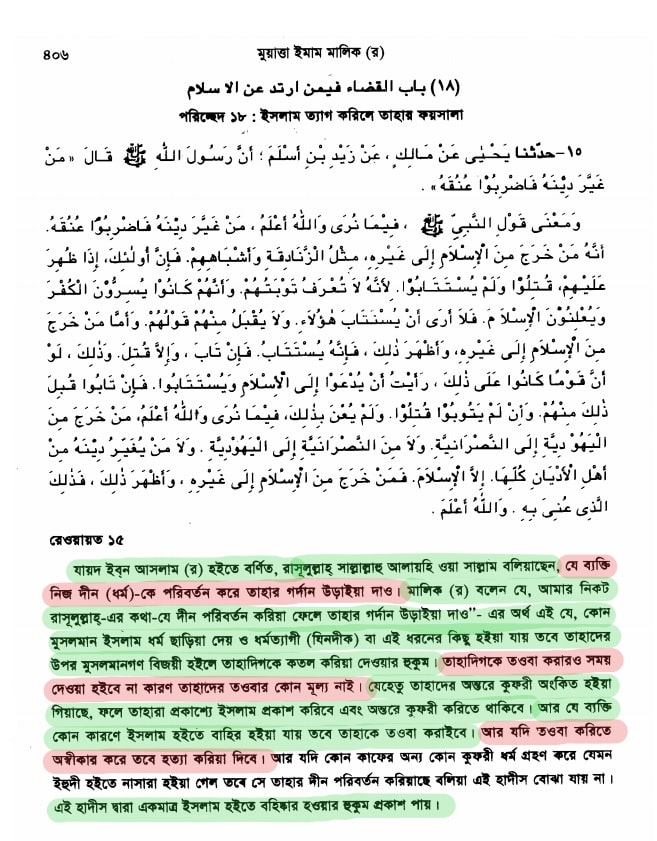
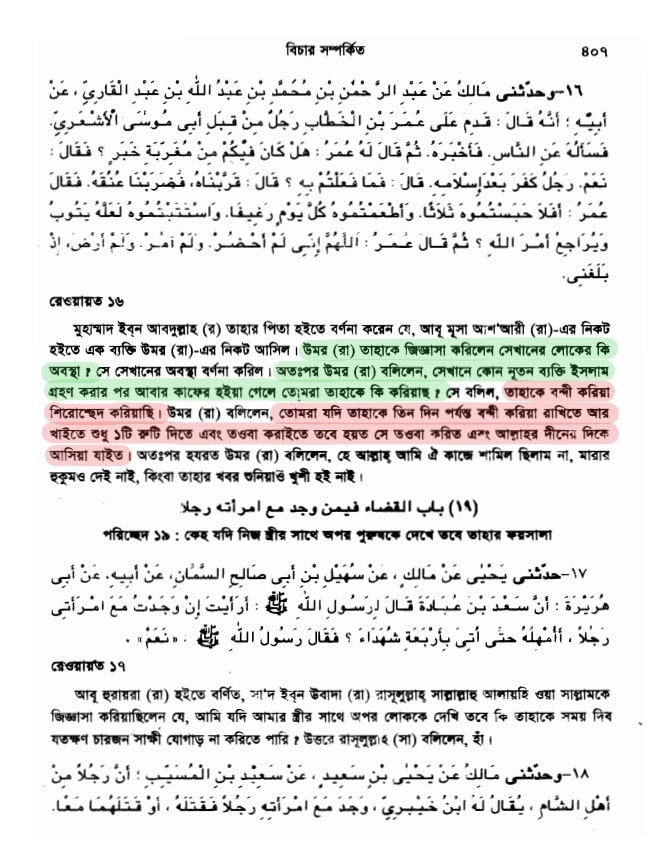
This explanation does not preserve an equal right to change religion. Leaving Islam grounds the death penalty, while the same rule does not apply to conversion from Judaism to Christianity. For a person designated a heretic, inward unbelief is invoked as a reason not to accept repentance. Even a public declaration of returning to belief may therefore fail to save that person’s life. The judge reaches a decision to take a life by claiming knowledge of the person’s inner condition.
Codified Islamic Law also discusses the punishment of someone who kills an apostate without trial. The Islamic Foundation’s first volume prescribes discretionary punishment for the killer rather than execution. [130]—
Section 72
Killing an Apostate
If someone kills an apostate, the killer is not sentenced to death but is liable to discretionary punishment.
Explanation
A Muslim who voluntarily and knowingly leaves Islam is called an apostate.
Analysis
Enforcing punishment against any offender is the government’s responsibility. Punishing someone without bringing them to trial is unlawful. Although the apostate has become liable to death by leaving Islam and has lost protection of life, the apostate still cannot be killed without trial. Whoever kills an apostate therefore defies the government’s authority and is consequently liable to discretionary punishment. Jurists agree on this matter.
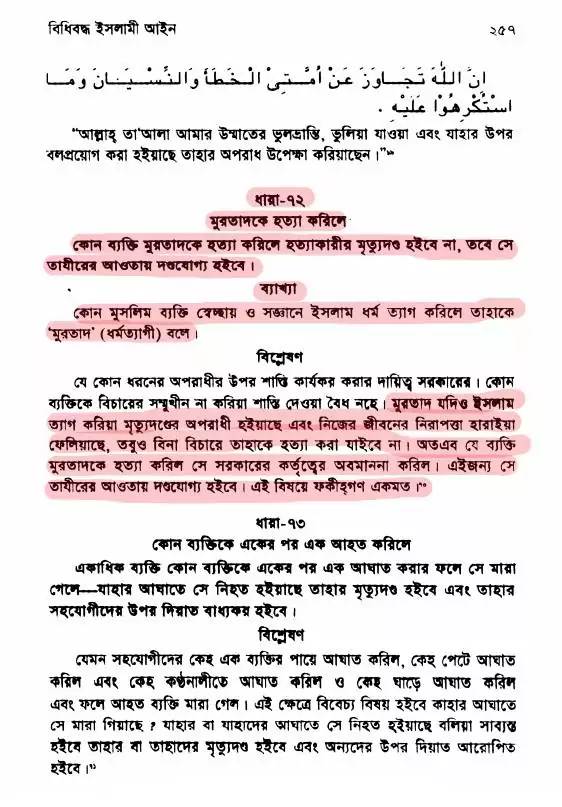
The quotation prohibits private enforcement of punishment, but its reasoning deserves attention. The killer is punished because they have defied government authority. The victim is presumed already to have lost protection of life through apostasy. If killing is declared forbidden while the equal remedy for murder is excluded against the killer, an apostate’s life does not receive the same legal protection as other people’s lives. Prohibiting killing without trial and establishing equal value for the victim’s life are different matters.
The effects of apostasy also extend to inheritance and property rules. The same work describes an apostate’s exclusion from inheriting from Muslim relatives and how the apostate’s own estate is distributed. [131]—
Section 444
Inheritance of an Apostate—Someone Who Leaves Islam
(a) An apostate cannot inherit from Muslim relatives.
(b) Property an apostate earned while Muslim goes to the Muslim heirs, while property acquired after apostasy is deposited in the public treasury;
however,
(c) all the property of a female apostate goes to her Muslim heirs.
Analysis
A Muslim who leaves Islam is called an apostate.
The Holy Qur’an states:
وَمَنْ يَرْتَدِدْ مِنْكُمْ عَنْ دِينِهِ فَيَمُتْ وَهُوَ كَافِرُ فَأُولَئِكَ حَبِطَتْ أَعْمَالُهُمْ فِي الدُّنْيَا وَالْآخِرَةِ وَأُولَئِكَ أَصْحَبُ النَّارِ هُمْ فِيهَا خُلِدُونَ .
“Whoever among you turns back from their religion and dies an unbeliever—their deeds become fruitless in this world and the Hereafter. They are the inhabitants of Hell, where they will remain” (Surah al-Baqarah: 217).
According to Imams Abu Yusuf and Muhammad, all an apostate’s property acquired before and after apostasy belongs to the Muslim heirs.
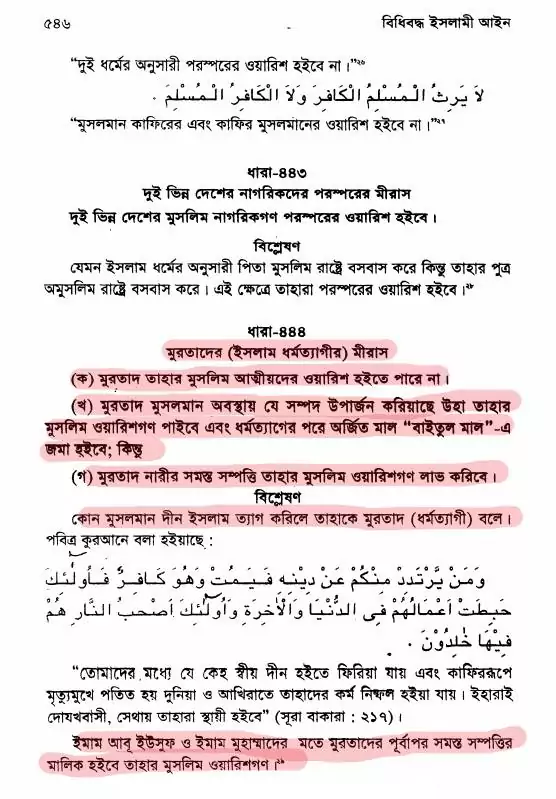
This section concerns inheritance of property. It contains different rules according to whether assets were acquired before or after apostasy, whether the apostate is male or female, and the opinions of different jurists. In each case, however, religious identity helps determine property rights. Whether someone can inherit from relatives and who receives their own estate are linked to a change in belief. Alongside the threat to life, apostasy therefore affects family and financial rights.
Fayz al-Hadi Sharh al-Tirmidhi sets out the definition and punishment of apostasy more explicitly. [132]—
When Stoning Becomes Obligatory
Stoning is obligatory for married men and women who commit unlawful intercourse. All imams agree on this. Apart from a subgroup of the Kharijites who do not hesitate even to call the Companions unbelievers, the entire Muslim community agrees on this ruling. The author of al-Hidayah states:
وَإِذَا وَجَبَ الْحَد وَكَانَ الزَّانِي مُحْصَنَا رُحِمَهُ بِالْحِجَارَةِ حَتَّى يَمُوتَ لِأَنَّهُ عَلَيْهِ السَّلَامُ رَجَمَ مَا عِزَّ أَوْ قَدْ أَحْصَنَ وَقَالَ فِي الْحَدِيثِ الْمَعْرُوفِ وَرْنَا بَعْدَ الإِحْصَان وعَلَى هَذَا إِجْمَاعُ الصَّحَابَةِ .
“When the prescribed punishment becomes obligatory and the person guilty of unlawful intercourse is muhsan, he is pelted with stones until he dies, because the Prophet stoned Maʿiz, who was muhsan. The well-known hadith likewise states, ‘If he commits unlawful intercourse after acquiring muhsan status, his blood becomes lawful to shed.’ All the Companions agreed on this.”
Punishment of the Apostate:
Irtidad means a Muslim’s departure from Islam. A person who leaves Islam is called an apostate. ʿAllamah Abu al-Hasan ʿAli Nadwi—may Allah have mercy on him—says:
“In Islamic terminology, irtidad means adopting another religion in place of Islam or another creed in place of Islamic creed; denying the teachings brought by the Messenger of Allah that have reached us through transmission as نص قطعی definitive truths, and what is established with certainty in Islam.” Examples include leaving Islam to adopt Christianity or the Qadiani doctrine, or denying prayer, fasting, pilgrimage, Islamic criminal law, and similar matters. The Qur’an clearly declares:
فَلَا وَرَبِّكَ لَا يُؤْمِنُونَ حَتَّى يُحَكِّمُوكَ فِيمَا شَجَرَ بَيْنَهُمْ ثُمَّ يَجِدُوا فِي أَنْفُسِهِمْ حَرَجًا مِمَّا قَضَيْتَ وَيُسَلِّمُوا تَسْلِيمًا
Punishment of the Apostate:
Imam al-Quduri says:
إِذَا ارْتَدَّ الْمُسْلِمُ عَنِ الْإِسْلَامِ عُرِضَ عَلَيْهِ الْإِسْلَامُ فَإِن كَانَتْ لَهُ شُبَهَةٌ كَيْفَ لَهُ وَمُحْبَسَ ثَلَاثَةَ أَيَّامٍ فإن أسلم والإقتل .
That is, if a Muslim leaves Islam and becomes an apostate, Islam is presented to him. If he has doubts, they are addressed. He is detained for three days. If he accepts Islam, well and good; otherwise, he is killed.
All imams hold that the punishment for a male apostate is death. There is some disagreement concerning female apostates. Imam al-Shafiʿi—may Allah have mercy on him—says that a female apostate must also be killed, because the hadith عَن ابْنِ عَبَّاسٍ قَالَ قَالَ رَسُولُ الله الله مَن بَدِّلَ دِينَهُ فَاقْتُلُوه – “Whoever changes his religion, kill him” makes no distinction between men and women. The Hanafi position, by contrast, is that killing a woman for apostasy is unlawful, because the hadith states نهى عن قتل النساء that the Messenger of Allah forbade killing women. A hadith in Sahih al-Bukhari similarly states: “If a woman leaves the religion, invite her back to Islam. If she returns, accept her; if she refuses, keep her imprisoned.”
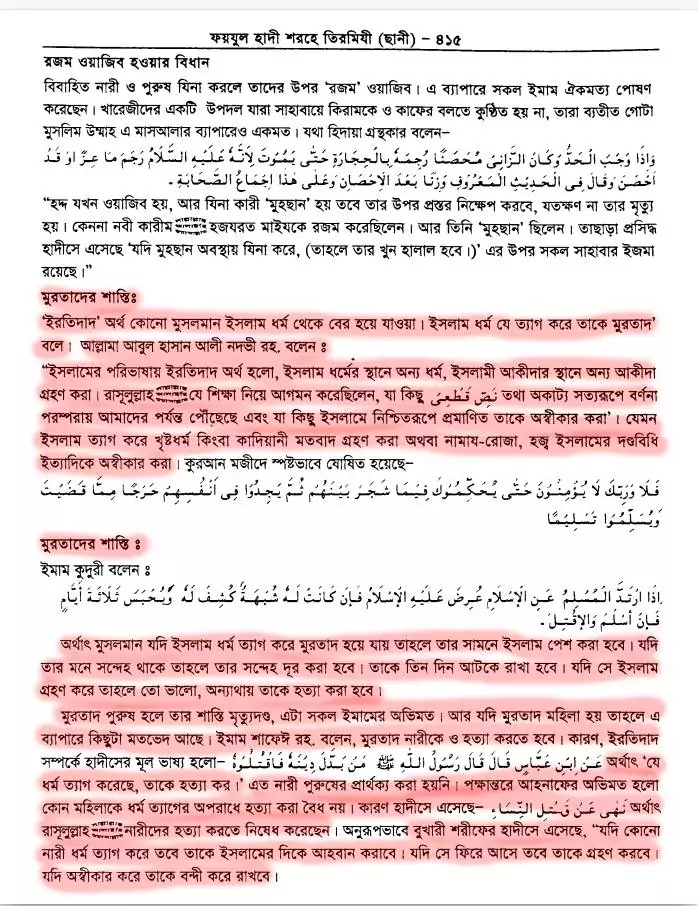
Idah al-Muslim discusses in detail the period allowed for repentance, punishments for men and women, and the positions of different schools. The opinion that a female apostate should be confined instead of killed does not recognize personal freedom either; the quoted explanation calls for repeated punishment to compel acceptance of Islam. [133]—
The Ruling on Apostates
The ruling on an apostate is that he is killed. The four imams agree that killing someone who becomes an apostate is obligatory and that his blood loses its protected value. Many hadiths concerning killing apostates have been narrated, including:
عَنِ ابْنِ عَبَّاسٍ مَرْفُوعًا مَنْ بَدَّلَ دِينَهُ فَاقْتُلُوهُ
“Whoever leaves Islam, kill him.”
عَنْ مُعَاوِيَةَ بْنِ حَيْدَةَ : قَالَ النَّبِيُّ صَلَّى اللَّهُ عَلَيْهِ وَسَلَّمَ مَنْ بَدَّلَ دِينَهُ فَاقْتُلُوهُ .
Reports of this kind are narrated from Companions including Abu Hurayrah and ʿIsmah.
مَنْ غَيَّرَ دِينَهُ فَاضْرِبُوا عُنَقَهُ . :
(۳) عَنْ عَبْدِ اللَّهِ بْنِ مَسْعُودٍ رَضِيَ اللَّهُ عَنْهُ أَنَّ رَسُولَ اللَّهِ صَلَّى اللَّهُ عَلَيْهِ وَسَلَّمَ قَالَ : لَا يَحِلُّ دَمُ امْرِءٍ مُّسْلِمٍ يَشْهَدُ أَنْ لَا إِلَهَ إِلَّا اللَّهُ وَانِّي رَسُولُ اللَّهِ إِلَّا بِإِحْدَى ثَلَاثٍ ، الطَّيِّبُ الزَّانِي، وَالنَّفْسُ بِالنَّفْسِ وَالتَّارِكُ لِدِينِهِ وَالْمُفَارِقُ لِلْجَمَاعَةِ . بخاري ومسلم
Ibn Masʿud narrated that the Messenger said:
“It is not lawful to kill a Muslim who testifies to the declaration of faith except for one of three reasons: (1) a married person guilty of unlawful intercourse; (2)
an unlawful killer; and (3) someone who abandons the religion—an apostate.”
(٤) عَنْ أَبِي أُمَامَةَ بْنِ سَهْلِ بْنِ حُنَيْفِ بْنِ عَنْ عُثْمَانَ بْنِ عَفَّانَ أشرف يومَ الدَّارَ فَقَالَ انْشُدُكُمْ بِاللهِ ، أَتَعْلَمُونَ أَنَّ رَسُولَ اللَّهِ صَلَّى اللهُ عَلَيْهِ وَسَلَّمَ قَالَ : لَا يَحِلُّ دَمُ امْرِ مُسْلِمٍ إِلَّا بِإِحْدَى تَلْتَ زِنَا
بَعْدَ احْصَانٍ أَوْ كُفْرٍ بَعْدَ إِسْلامِ أَوْ قَتْلِ نَفْسٍ بِغَيْرِ حَةٍ فَيُقْتَلُ بِهِ فَوَاللَّهِ مَا زَنَيْتُ فِي جَاهِلِيَّةٍ وَلَا فِي إِسْلامِ وَلَا ارْتَدَّدْتُ مُنْذُ بَايَعْتُ رَسُولَ اللهِ صَلَّى اللهُ عَلَيْهِ وَسَلَّمَ وَلا قَتَلْتُ النَّفْتَنَ الَّتِي حَرَّمَ اللهُ.
ترمذی، نسائی، ابوداود
Abu Umamah narrated that while ʿUthman was under siege, he raised his head one day and addressed the rebels: “I ask you by Allah, do you not know that the Messenger said it is not lawful to kill a Muslim except for three reasons: unlawful intercourse after marriage, unbelief after accepting Islam, and unjustly killing someone? By Allah, I never committed unlawful intercourse in the age of ignorance or after accepting Islam. I have not become an apostate, nor have I killed anyone.” — Al-Tirmidhi, al-Nasaʾi, Abu Dawud
(٥) عَنْ جَرِيرٍ رَضِيَ اللَّهُ عَنْهُ قَالَ : سَمِعْتُ النَّبِيَّ صَلَّى اللهُ عَلَيْهِ وَسَلَّمَ يَقُولُ : إِذَا أَبَقَ الْعَبْدُ إِلَى الشِّرْكِ فَقَدْ حَلَّ دَمُهُ . ابوداود
“Whoever engages in polytheism, his blood becomes lawful to shed.”
(٦) عَنْ عِكْرَمَةَ قَالَ : أَنِي عَلِيٌّ رَضِيَ اللَّهُ عَنْهُ بِزَنَادِقَةٍ فَأَحَرَّفَهُمْ، فَبَلَغَ ذَلِكَ ابْنَ عَبَّاسٍ فَقَالَ : لَوْ كُنْتُ أَنَا لَمْ أَحْرِقْهُمْ لِنَهْي رَسُولِ اللهِ صَلَّى اللهُ عَلَيْهِ وَسَلَّمَ : قَالَ : لَا تُعَذِّبُوا بِعَذَابِ اللَّهِ وَلَقَتَلْتُهُمْ لِقَوْلِ رَسُولِ اللهِ صَلَّى اللَّهُ عَلَيْهِ وَسَلَّمَ مَنْ بَدَّلَ دِينَهُ فَاقْتُلُوهُ – (بخاری ، ترمذی، ابوداؤد وغير ذلك من الاحاديث الكثيرة .
ʿIkrimah narrated that several heretics were brought under arrest to ʿAli, and he burned them all to death. When Ibn ʿAbbas heard the news, he said, “Had it been me, I would not have burned them, for the Messenger said, ‘Do not punish anyone with Allah’s punishment.’
I would, however, have killed them, for the Messenger said, ‘Whoever leaves Islam, kill him.’”
Accepting an Apostate’s Repentance
1. According to Imam Abu Hanifah, an apostate should be granted some respite so that Islam can be presented again. The judge may detain him for three days. If he accepts Islam during that period, well and good; otherwise, he must be killed. Granting this respite is recommended, not obligatory, since the invitation to Islam has already reached him. Renewing the invitation for someone who has already received it is recommended, not obligatory. Neither the Qur’anic verse فاقتلوا المشركين nor the hadith من بدل دینه فاقتلوه-mentions such respite. Moreover, an apostate resembles a belligerent unbeliever, for whom respite is not required. He is not a dhimmi, since jizyah is not collected from him. He may therefore be killed without respite.
— Al-Fiqh ʿala al-Madhahib al-Arbaʿah, vol. 5, p. 424
2. According to Imam al-Shafiʿi, granting three days’ respite is obligatory. He says that a Muslim becomes an apostate because of some doubt and should therefore be allowed sufficient time to dispel it. That period is three days. A three-day period has a particular significance. The story of Moses and Khidr is cited:
وَلَمَّا كَانَتِ الثَّالِثَةُ قَالَ لَهُ قَدْ بَلَغْتُ مِن لَّدُنِي عُدْرًا . This is also the Maliki position and one opinion of Ahmad.
The Ruling on Female Apostates
1. According to Imams al-Shafiʿi, Ahmad, and Malik, a female apostate is killed like a male apostate, because their offenses are equal. They say that the ruling for a female apostate is the same as for a male, so she too must receive three days’ respite before execution.
عَنْ جَابِرٍ : أَنَّ امْرَأَةً يُقَالُ أَمْ رُومَانَ ارْتَدَّتْ فَأَمَرَ النَّبِيُّ صَلَّى اللَّهُ عَلَيْهِ وَسَلَّمَ أَنْ يُعْرَضَ عَلَيْهَا الْإِسْلامُ فَإِنْ تَابَتْ وَإِلَّا قُتِلَتْ – دار قطني
“When a woman named Umm Ruman became an apostate, the Messenger instructed that she be given three days’ respite, and ordered her killed if she did not accept Islam during that time.” Likewise, the hadith من بدل دینه فاقتلوه generally calls for killing all apostates, male and female.
2. According to Imam Abu Hanifah, a female apostate must not be killed. She is confined, and Islam is presented to her. She receives thirty-nine lashes every day. In this way, she either accepts Islam or dies in prison. If someone nevertheless kills her, however, no qisas or compensation is imposed on that person.
Evidence against Killing Her:
(1) عَنْ ابْنِ عُمَرَ رَضِيَ اللَّهُ عَنْهُ أَنَّ امْرَأَةٌ وُجِدَتْ فِي بَعْضٍ مَغَازِي النَّبِيِّ صَلَّى اللهُ عَلَيْهِ وَسَلَّمَ مَقْتُولَةً فَأَنْكَرَ رَسُولُ اللَّهِ صَلَّى اللَّهُ عَلَيْهِ وَسَلَّمَ قَتْلَ النِّسَاءِ وَالصَّبْيَانِ .
During one battle in the Messenger’s time, a woman was found killed. The Messenger expressed displeasure and prohibited killing women and young children.
(۲) رُوِيَ عَنْ مُعَاذِ بْنِ جَبَلٍ رَضِيَ اللهُ عَنْهُ أَنَّ رَسُولَ اللَّهِ صَلَّى اللَّهُ عَلَيْهِ وَسَلَّمَ قَالَ : لَهُ حِيْنَ بَعَثَ إِلَى الْيَمَنِ : أَنَّمَا رَجُلٍ ارْتَدَّ عَنِ الْإِسْلَامِ فَادْعُهُ فَإِنْ تَابَ فَاقْبَلْ مِنْهُ وَإِنْ لَمْ يَتُبْ فَاضْرِبْ عُنُقَهُ، وَأَنَّمَا امْرَأَةٍ ارْتَدَّتْ عَنِ الإِسْلامِ فَادْعُهَا فَإِنْ تَابَتْ فَاقْبَلَ مِنْهَا وَإِنْ أَبَتْ فَاسْتَتِبْهَا الخ .
When sending Muʿadh ibn Jabal to Yemen, the Messenger
advised him: “Invite anyone who leaves Islam back to it.
If he repents, well and good; if he does not, strike off his head. If a woman becomes an apostate, invite her back to the religion. If she repents, accept it; if she refuses, repeatedly call her to repent.”
(۳) روى أَبُو يُوسُفَ عَنْ أَبِي حَنِيفَةَ عَنْ عَاصِمِ بْنِ أَبِي النُّجُودِ عَنْ أَبِي رُزَيْنِ عَنِ ابْنِ عَبَّاسٍ قَالَ : لَا تُقْتَلُ النِّسَاءُ إِذَا هُنَّ ارْتَدْنَ عَنِ الْإِسْلَامِ وَلَكِنْ يُحْبَسَنَ وَيُدْعَيْنَ إِلَى الْإِسْلَامِ وَيُجْبَرْنَ عَلَيْهِ . رو
“Ibn ʿAbbas narrated that the Messenger said: If a woman becomes an apostate, she must not be killed; rather, she must be imprisoned and repeatedly invited to Islam.”
) عَنْ مُحَمَّدٍ قَالَ بَلَغَنَا عَنِ ابْنِ عَبَّاسٍ أَنَّهُ قَالَ : إِذَا ارْتَدَّتِ الْمَوَاةُ عَنِ الْإِسْلَامِ حُبِسَتْ ، وَمِثْلُ هَذَا لَا يُقَالُ عَنِ اجْتِهَادٍ .
Imam Muhammad said: “This report has reached us from Ibn ʿAbbas: a woman who becomes an apostate must be detained. No one gives such a ruling merely through independent reasoning.”
(٥) عَنْ عَلِيِّ قَالَ : الْمُرْتَدَّةٌ تُسْتَبَانُ وَلَا تُقْتَلُ – دارقطني
“ʿAli said: A female apostate must not be killed; she is called to repent.” — Al-Daraqutni
6. A woman’s offense is considered lesser because her intellect is lesser.
7. Women have less inclination towards warfare. For this reason, the Messenger
forbade killing women and explained that they do not fight.
Answering the Imams’ Evidence
The response to the imams’ evidence from the woman named Umm Ruman is that she was not killed solely because she was an apostate; she was also a sorceress and poet. Concerning the Messenger, she made insulting
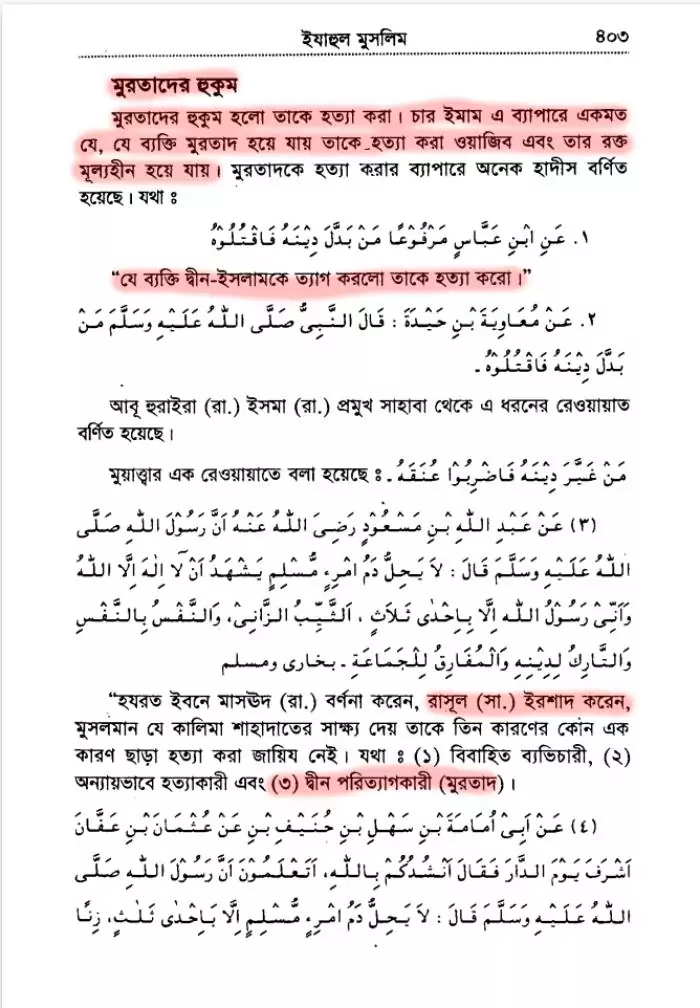
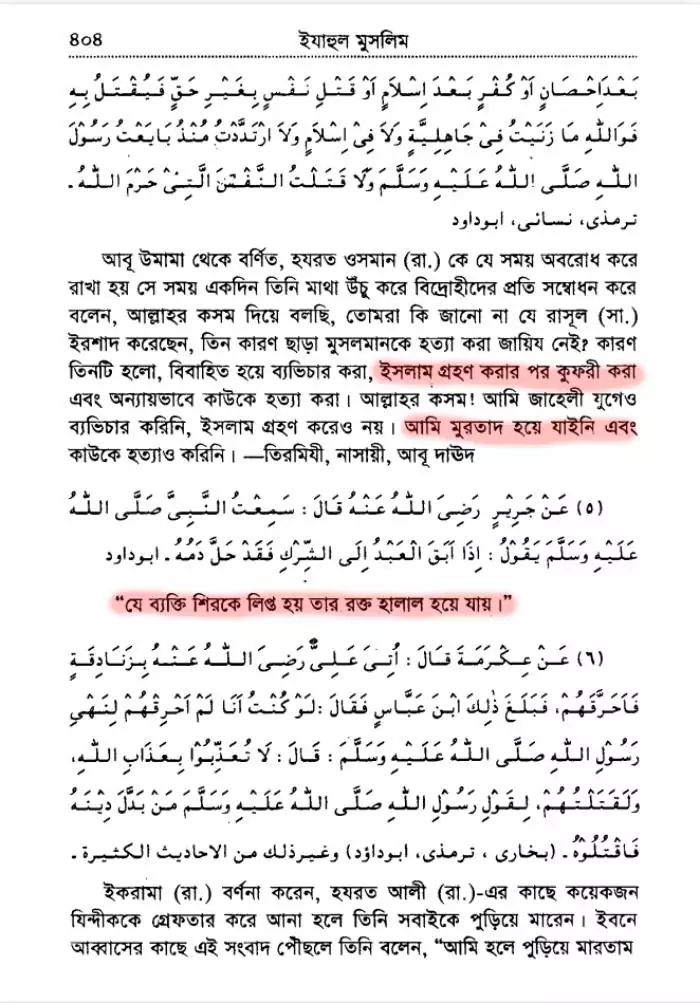
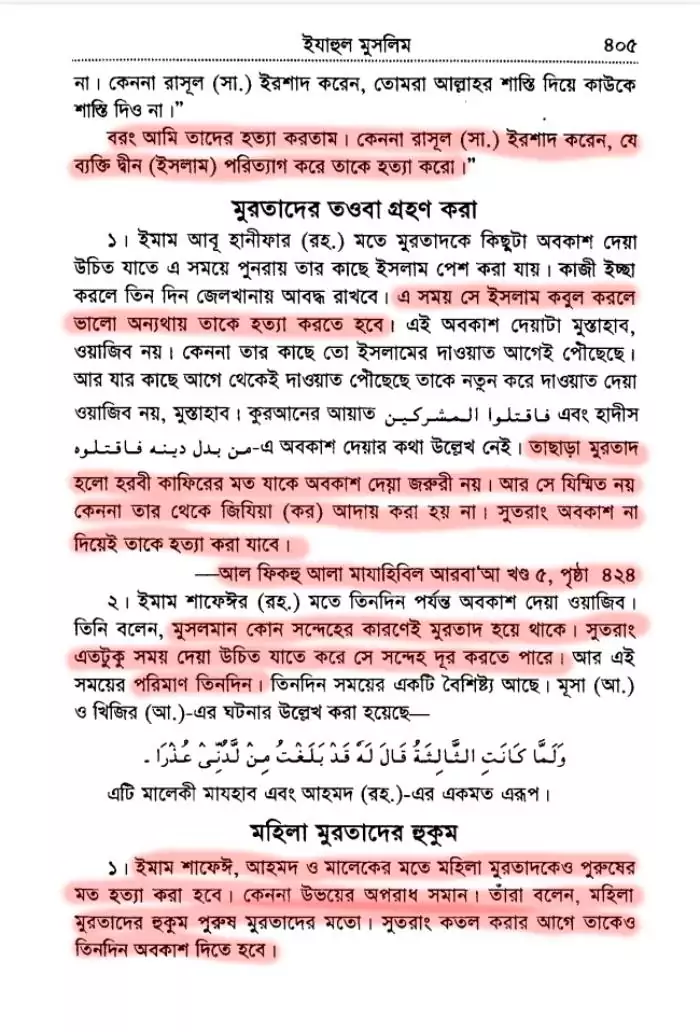
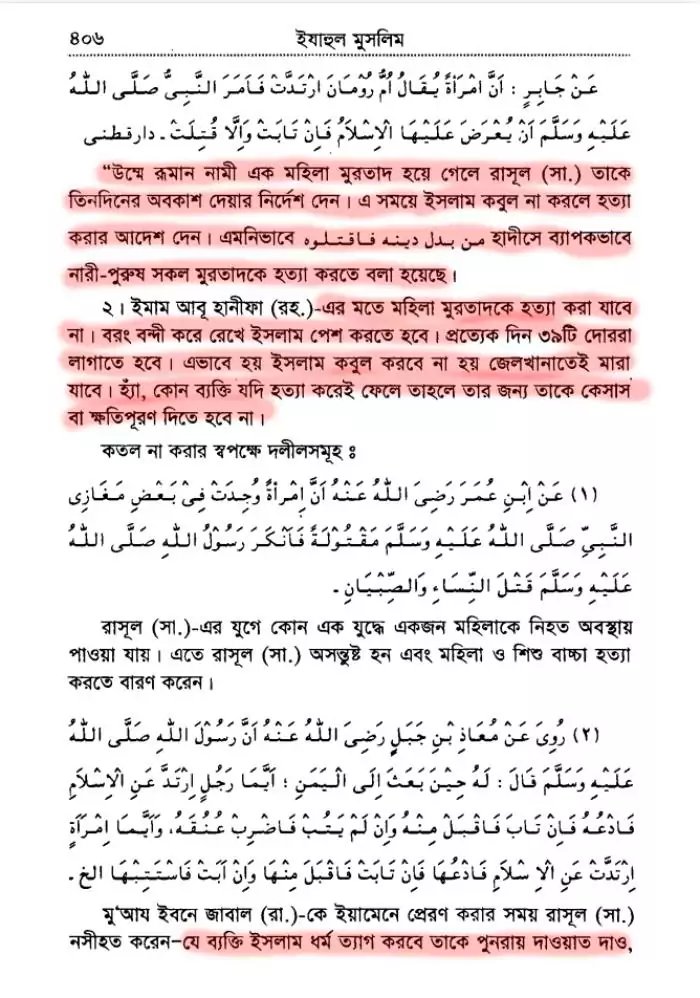
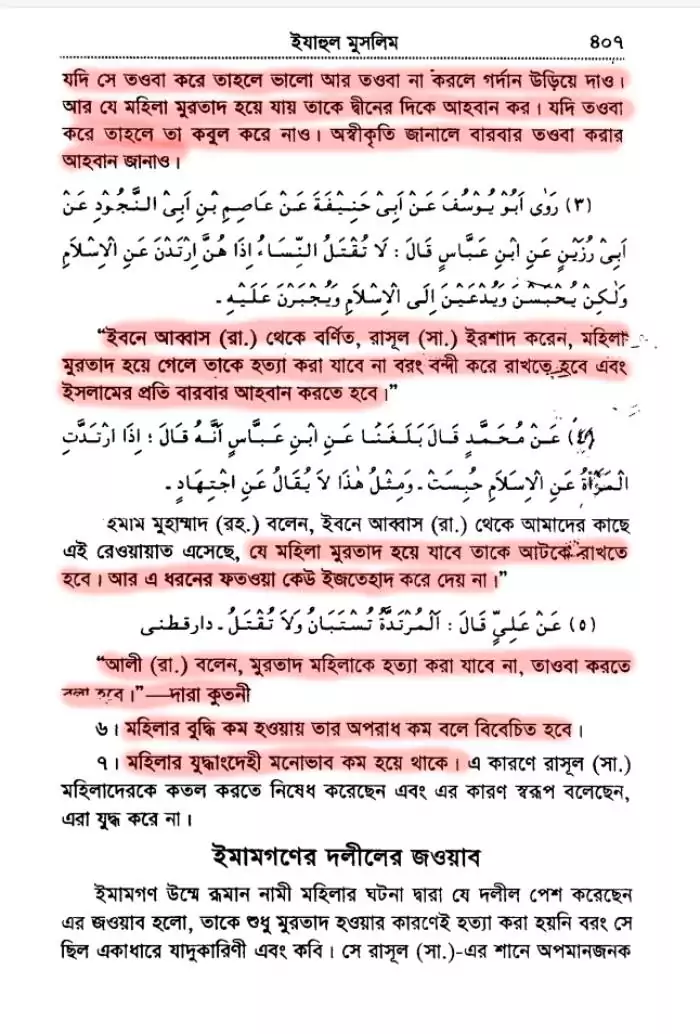
A translation inconsistency in this quotation requires separate attention. It renders a report from Abu Dawud as “Whoever engages in polytheism, his blood becomes lawful to shed.” The adjacent Arabic, however, contains إِذَا أَبَقَ الْعَبْدُ إِلَى الشِّرْكِ—a reference to a slave fleeing and returning to polytheism. Omitting “slave” and “fleeing” turns an account of a specified circumstance into a general statement permitting the killing of all polytheists. These words appear in the original text of Sunan Abu Dawud 4360 [134]. This distinction matters in criticizing religious rules, because examining justice requires retaining whom a statement concerns and under what circumstances.
Allowing three days for repentance does not restore freedom of belief. Under threat of confinement or death, someone is told to return to their former belief within a specified period. Dispelling doubt is not something that can be secured by imposing a deadline. Someone who genuinely loses belief in a claim cannot be ordered to manufacture belief within a time limit. The test at the end of this respite therefore becomes whether the person declares a return to religion; whether conscience remains free has no place in it.
It is also claimed that the death penalty for apostasy applies only to armed rebels. Mufti Taqi Usmani’s explanation in Dars-e Tirmidhi directly rejects this claim. It does not accept “separating from the community” as an additional condition requiring rebellion. [135]—
The Punishment for Apostasy Is Death
In the present age, many modernists have denied the apostate’s death penalty, saying that Sharia contains no order to kill apostates. They cite the following Qur’anic verse as evidence: لَا إِكْرَاهَ فِي الدِّينِ )Surah al-Baqarah, verse 256 (
“There is no compulsion in religion.”
They argue that someone who becomes an apostate will therefore not be killed. They also cite the hadith in this chapter, saying that its term الثَّارِكٌ is qualified by جماعة , or separation from the community, meaning rebellion. On their reading, mere apostasy does not ground the death penalty unless rebellion accompanies it; becoming an apostate and rebelling warrants death, while apostasy alone does not.
كتاب الديات، باب قول الله تعالى – كتاب القسامة والمحاربين والقصاص، باب ما يباح به دم المسام – النفس بالنفس والعين بالعين
This argument is not correct, because other reports state generally: مَنْ بَنَّلُ ذِينَهُ فَاقْلُو that is, “Whoever changes his religion, kill him.” Moreover, many incidents from the Prophet’s and Companions’ time describe apostates being killed despite the absence of rebellion. In fact, التَّارِكُ لِدِينِهِ الْمُفَارِقُ لِلْجَمَاعَةِ provides a fuller description rather than an independent restriction. Citing this hadith as evidence in that way is therefore incorrect.
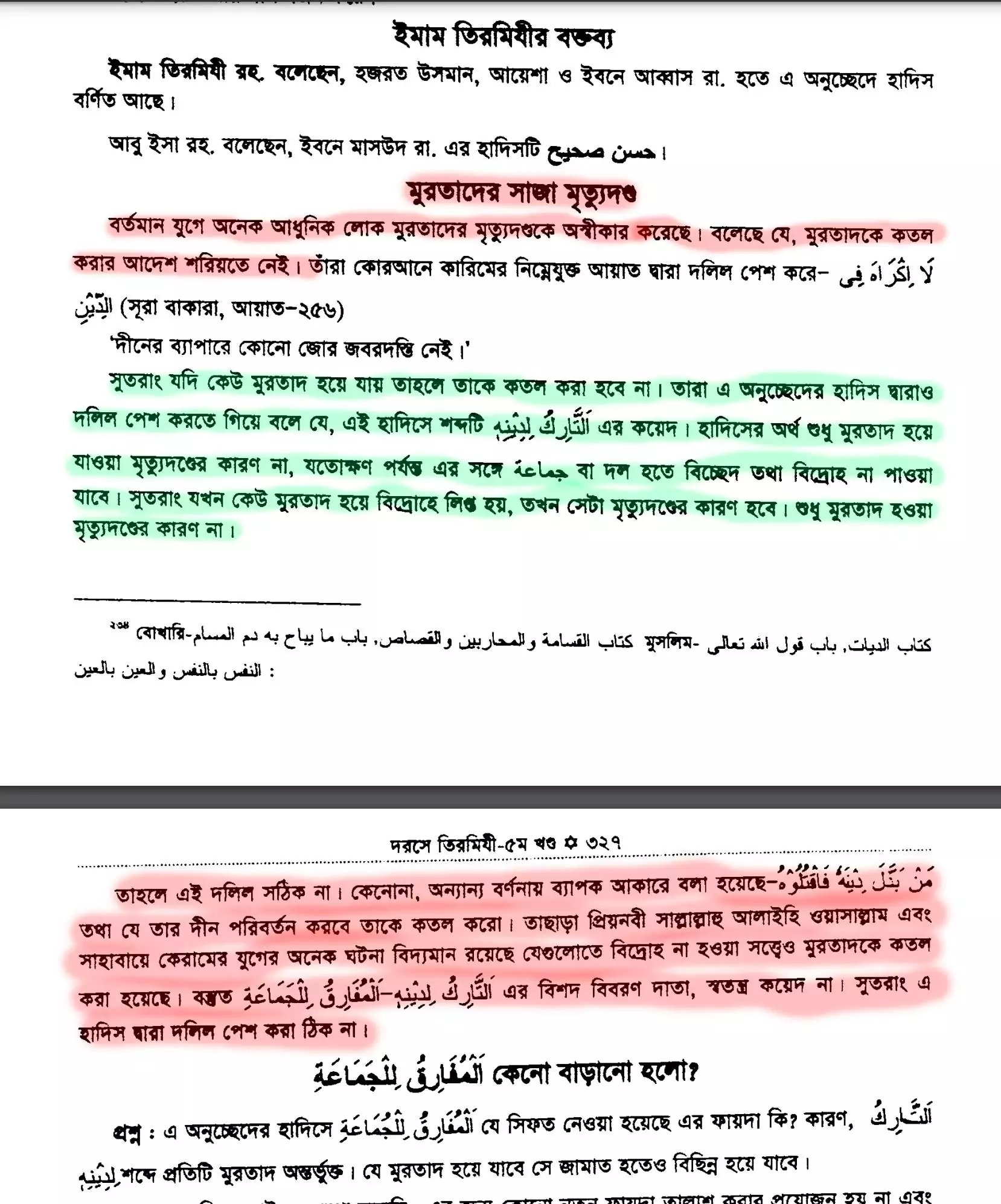
Contemporary fatwas also retain this rule. IslamQA answer 20327 discusses apostasy in four forms: belief, speech, actions, and complete abandonment of religious practices. It states that an adult, mentally competent person who voluntarily leaves the religion is to be killed by the ruler or the ruler’s representative. Armed attack is not identified as the sole grounds for punishment. Instead, the death penalty is defended by asking what effect people’s ability to leave religion easily would have on others. [136].
The problem of justice is revealed in this argument itself. Others may question Islam if someone leaves it; this cannot justify that person’s death penalty. Questions arising in people’s minds are not violent attacks against an individual. Suppressing apostasy as a source of questions subjects the questioner’s life to punishment instead of sustaining religious claims under rational examination. Let us also examine several scholars’ statements to understand the relationship between this rule and religious propagation.
Let us examine a further statement about how punishment for apostasy is connected to the argument for preserving religion’s existence.
If a religion’s adherents cannot leave because they fear death, their numbers cannot be presented as proof of the religion’s truth. When someone has been told that openly abandoning belief will cost their life, public religious identity cannot establish inward belief. Claiming that taking lives is necessary to preserve a religion offers no argument for justice; it declares individual conscience subordinate to the interests of a religious institution. Shongshoy’s articles Killing Apostates in Islam: The Barbaric Punishment for Leaving Religion and Islam’s Conflict with Philosophy and Logic: Does Islam Allow Examination? discuss these issues in greater detail.
Polytheists Are Deemed Liable to Be Killed
After the rule on apostasy, another question arises: how is another religious belief designated an offense warranting language that declares someone’s blood lawful to shed? Muhammad ʿAbd al-Qadir’s A Review of Polytheism, Religious Innovations, and Superstitions Prevalent in Bangladesh, published under the editorship of Bangladeshi scholar Dr. Abu Bakr Muhammad Zakaria, makes such a statement directly about polytheists. [137]—
Those who practice polytheism have blood lawful for Muslims to shed; they may be killed. In Allah’s words:
فَاقْتُلُوا الْمُشْرِكِينَ حَيْثُ وَجَدتُمُوهُمْ وَخُذُوهُمْ وَاحْصُرُوهُمْ وَاقْعُدُوا لَهُمْ كُلَّ مَرْصَدٍ ﴾ [التوبة: ٥]
“Then kill the polytheists wherever you find them, seize them, and besiege them. Lie in wait for them at their strongholds.”10
Polytheism is a grave sin. The Messenger (peace and blessings be upon him) says:
عن أبي هريرة رضى الله عنه إن رسول الله صلى الله عليه وسلم قال: اجتنبوا الموبقات …. الإشراك بالله….
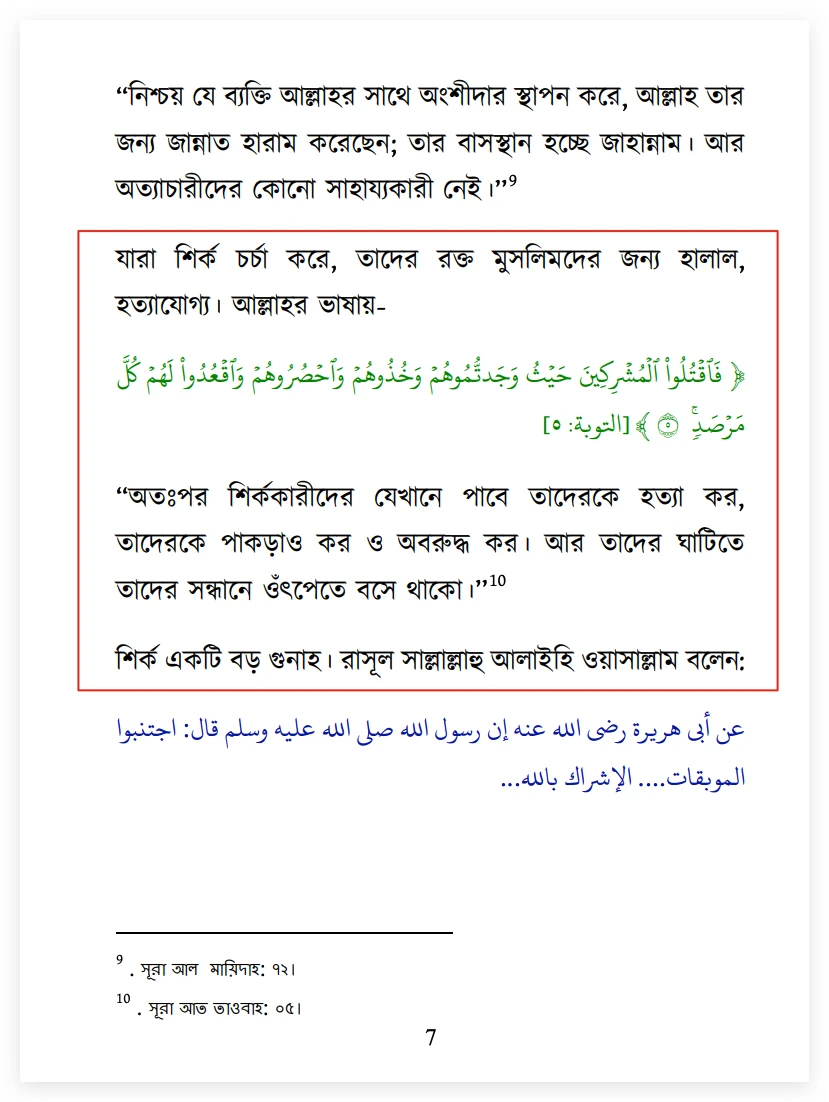
The statement that the blood of people who “practice polytheism” is lawful to shed specifies no condition of attacking others, killing, or plundering property. Religious belief and worship are identified as the offense. Someone’s belief in several deities or worship before an image may be religiously wrong in a Muslim’s view, but that objection does not justify depriving the person of the right to life. Calling a belief sinful according to one’s own religion and declaring its adherents liable to be killed are entirely different claims. The second requires evidence of an offense against people; religious disagreement cannot replace that evidence.
The book supports its statement with part of verse 5 of Surah al-Tawbah. The same passage, however, also requires honoring agreements with polytheists who keep their treaties and escorting a polytheist seeking refuge to a safe place. A generalization permitting anyone’s killing merely on the basis of polytheist identity therefore does not encompass all these verses’ statements. Let us read the complete texts of verses 4, 5, and 6 alongside one another. [138] [139] [140]—
Surah al-Tawbah, verse 4
إِلَّا الَّذِينَ عَاهَدْتُمْ مِنَ الْمُشْرِكِينَ ثُمَّ لَمْ يَنْقُصُوكُمْ شَيْئًا وَلَمْ يُظَاهِرُوا عَلَيْكُمْ أَحَدًا فَأَتِمُّوا إِلَيْهِمْ عَهْدَهُمْ إِلَىٰ مُدَّتِهِمْ ۚ إِنَّ اللَّهَ يُحِبُّ الْمُتَّقِينَ
Translation: Except those polytheists with whom you have made a treaty and who have not subsequently failed you in any respect or assisted anyone against you: fulfill your treaty with them until its appointed term. Indeed, Allah loves the God-fearing.
Surah al-Tawbah, verse 5
فَإِذَا انْسَلَخَ الْأَشْهُرُ الْحُرُمُ فَاقْتُلُوا الْمُشْرِكِينَ حَيْثُ وَجَدْتُمُوهُمْ وَخُذُوهُمْ وَاحْصُرُوهُمْ وَاقْعُدُوا لَهُمْ كُلَّ مَرْصَدٍ ۚ فَإِنْ تَابُوا وَأَقَامُوا الصَّلَاةَ وَآتَوُا الزَّكَاةَ فَخَلُّوا سَبِيلَهُمْ ۚ إِنَّ اللَّهَ غَفُورٌ رَحِيمٌ
Translation: When the sacred months have passed, kill the polytheists wherever you find them, seize them, besiege them, and lie in wait for them at every place of ambush. If, however, they repent, establish prayer, and pay zakat, let them go their way. Indeed, Allah is Forgiving, Merciful.
Surah al-Tawbah, verse 6
وَإِنْ أَحَدٌ مِنَ الْمُشْرِكِينَ اسْتَجَارَكَ فَأَجِرْهُ حَتَّىٰ يَسْمَعَ كَلَامَ اللَّهِ ثُمَّ أَبْلِغْهُ مَأْمَنَهُ ۚ ذَٰلِكَ بِأَنَّهُمْ قَوْمٌ لَا يَعْلَمُونَ
Translation: If any polytheist seeks refuge with you, grant refuge so that he may hear Allah’s word; then escort him to his place of safety. This is because they are a people who do not know.
Reference: The Qur’an, Surah al-Tawbah 9:4–6; translated from the Arabic text.
This passage raises two separate questions. First, the unrestricted statement that “all polytheists’ blood is lawful to shed” is formed by excluding the rules concerning treaties and refuge. Second, verse 5 makes repentance, prayer, and zakat conditions for allowing passage. Even when war, treaties, and refuge are discussed in their specified circumstances, the moral question of making religious allegiance a condition of safety remains. Ending attacks against others and changing someone’s religious belief are different things. Why should abandoning one’s own belief be required for the safety of someone who wishes to live peacefully with a different faith?
Shongshoy’s article Islamic Sharia Does Not Impose the Death Penalty on a Muslim for Killing an Unbeliever discusses further rules changing the legal value of human life according to religious identity. The central issue here is the right to one’s own life and conscience. Compelling prayer, killing or imprisoning people for apostasy, and language declaring other believers’ blood lawful to shed each place religious authority above human freedom. Where protection of life and liberty depends on maintaining belief, freedom of belief does not exist. Making the right to live a reward for religious allegiance cannot establish justice.
Bodily Punishment, Victims’ Rights, and Remedies for Wrongful Judgments
A list of offenses alone is insufficient to determine whether a legal system establishes justice. One must also ask how reasonable a punishment is in relation to the offense, what protection victims receive, how the accused are treated during evidence-gathering, and how people harmed by a mistaken judgment obtain redress. Proving someone guilty does not itself establish a right permanently to destroy their body. Making victimization by another person’s offense grounds for punishment also erases the distinction between the offender’s responsibility and the victim’s condition. This chapter examines together hand amputation, the killing of sexually abused animals, a threat to strip a woman naked, and the irreparable harm of wrongful judgment.
Amputating the Hand as Punishment for Theft
Theft attacks people’s property. Preventing theft, returning stolen property, and protecting the harmed person’s rights are necessary functions of a legal system. These necessities do not, however, automatically justify amputating the thief’s hand. The remedy for a property loss permanently mutilates a human body. Returning the stolen object or paying compensation can repair some of the property loss; the loss of an amputated hand cannot be repaired in the same way. The existence of punishment for an offense does not make every form of punishment just.
The Qur’an commands the amputation of male and female thieves’ hands, describing it as an exemplary punishment from Allah. [141]—
Surah al-Maʾidah, verse 38
وَالسَّارِقُ وَالسَّارِقَةُ فَاقْطَعُوا أَيْدِيَهُمَا جَزَاءً بِمَا كَسَبَا نَكَالًا مِنَ اللَّهِ ۗ وَاللَّهُ عَزِيزٌ حَكِيمٌ
Translation: As for the male thief and the female thief, cut off their hands as recompense for their actions and as an exemplary punishment from Allah. Allah is Mighty, Wise.
Reference: The Qur’an, Surah al-Maʾidah 5:38; translated from the Arabic text.
Jurisprudence discusses specified conditions for amputation. IslamQA fatwa 101781 mentions taking property secretly, the offender’s adulthood and mental competence, a minimum property value, removal from a protected location, the absence of doubt concerning ownership, and proof of theft in court through testimony or confession. [142]. It would therefore be inaccurate to place every instance of taking property within this punishment in the same way. The amputation rule nevertheless remains when its conditions are fulfilled. Conditions for admitting proof and the moral acceptability of punishment are separate questions; restricting a punishment’s application through stringent conditions does not establish the justice of mutilation.
Hadiths contain more than accounts of a single hand amputation. The following report in Sunan Abu Dawud describes the successive amputation of the same person’s hands and feet for repeated theft, followed by his killing. Orders to kill occur from the beginning of the report; those present repeatedly respond that he has only stolen. [143]—
Sunan Abu Dawud (Islamic Foundation edition)
Book: 33 / Prescribed Punishments
Chapter: 20. Punishment for Someone Who Steals Repeatedly.
4358. Muhammad ibn ʿAbdullah (may Allah have mercy on him) … narrated from Jabir ibn ʿAbdullah, who said: A thief was brought before the Prophet (peace and blessings be upon him), and he ordered him killed. The Companions said, “Messenger of Allah, this man has only stolen!” He replied, “Then cut off his hand.” His right hand was amputated. When he stole a second time, he was brought before the Prophet, who ordered him killed. Again, the Companions said, “Messenger of Allah, he has only stolen.” He said, “Cut off his foot,” and his left foot was amputated. When the man was brought before the Prophet a third time, he ordered him killed. The Companions said, “Messenger of Allah, he has stolen.” He then ordered amputation, and the man’s left hand was cut off. When the man was brought before the Prophet a fourth time, he ordered him killed. The Companions again said, “Messenger of Allah, this man has stolen.” He ordered amputation, and the man’s right foot was cut off. When the man was brought before the Prophet for a fifth offense, he ordered him killed. Jabir said: We took him into the open country and killed him, dragged his body to a well, threw it in, and then threw stones onto his body.
Hadith classification: Good (Hasan)
This report does not show the fear of punishment successfully stopping theft. Instead, accusations of theft continue after successive limbs are lost, and the person is finally killed. The questions concern more than the number of offenses: why the offenses occur, why earlier punishment failed, and what effective remedy could replace destroying a person’s body are also essential. If amputation deprives someone of the ability to work, their livelihood and family are harmed as well. How does this permanent incapacity relate to the purposes of reforming the person or returning the victim’s property?
The question of kleptomania is relevant here. This is a mental health condition involving difficulty controlling the urge to steal; some people experience an urge to take things despite having no need for them. Diagnosis requires assessment of symptoms, behavioral history, and mental condition, and treatment is available. [144]. The account of repeated theft alone cannot establish that the person had kleptomania. That uncertainty nevertheless highlights the need for investigating and assessing causes. Simply increasing punishment in response to repeated offenses cannot substitute for examining responsibility, treatment needs, and the causes of behavior.
Sahih Muslim contains further accounts of amputation for theft. Let us examine the report concerning a shield worth three dirhams. [145]—
Sahih Muslim (Islamic Foundation edition)
Book: 30 / Prescribed Punishments
4259. Yahya ibn Yahya (may Allah have mercy on him) … narrated from Ibn ʿUmar (may Allah be pleased with him) that the Messenger of Allah (peace and blessings be upon him) amputated a thief’s hand for stealing a shield. The shield was worth three dirhams.
Hadith classification: Authentic (Sahih)
ʿAʾishah’s report prescribes amputation for stealing property worth a quarter of a dinar or more. [146]—
Sahih Muslim (Islamic Foundation edition)
Book: 30 / Prescribed Punishments
4251. Yahya ibn Yahya, Ishaq ibn Ibrahim, and Ibn Abi ʿUmar (may Allah have mercy on them) … narrated from ʿAʾishah (may Allah be pleased with her), who said: The Messenger of Allah (peace and blessings be upon him) used to amputate a thief’s hand for stealing property worth a quarter of a dinar or more.
Hadith classification: Authentic (Sahih)
Let us also read the reports mentioning the theft of an egg and a rope. [147] [148]—
Sunan Ibn Majah
Publisher: Tawhid Publication
Book: 14 / Prescribed Punishments
1/2583. Narrated from Abu Hurayrah (may Allah be pleased with him), who said: The Messenger of Allah (peace and blessings be upon him) said, “Allah’s curse is upon the thief whose hand is amputated for stealing an egg and whose hand is amputated for stealing a rope.”
Hadith classification: Authentic (Sahih)
Sahih Muslim (Islamic Foundation edition)
Book: 30 / Prescribed Punishments
4261. Abu Bakr ibn Abi Shaybah and Abu Kurayb (may Allah have mercy on them) … narrated from Abu Hurayrah (may Allah be pleased with him), who said: The Messenger of Allah (peace and blessings be upon him) said, “Allah Most High curses the thief who steals an egg, or an object of an egg’s value, and has his hand amputated; and the person who steals a rope, or an object of a rope’s value, and has his hand amputated.”
Hadith classification: Authentic (Sahih)
The Arabic word translated as “egg” in this report is baydah; the translation of the relevant passage in al-Bukhari mentions both “egg” and “helmet.” [149]. The earlier report also specifies a minimum value. This translation therefore cannot establish that stealing any egg or rope of trivial value necessarily results in amputation. The central question of justice does not depend on the object’s name: when the prescribed conditions are fulfilled, how just is permanently amputating a person’s hand as punishment for an offense against property?
Creating an exemplary fear of punishment may be a purpose, but if fear alone determines punishment’s justice, the same reasoning can support still crueler penalties. An offender’s human dignity does not vanish entirely because of an offense. The reasonableness of punishment must be examined through compensation for the harmed person, the offender’s responsibility, prevention of repetition, and the need for reform. Shongshoy’s article The Inhuman Punishment for Theft in Islam: Allah’s Command to Cut Off the Hand at the Wrist discusses this rule and the associated reports in detail.
Punishing the Victim alongside the Rapist
The report discussed here concerns an animal sexually abused by a human being. It prescribes killing the animal alongside the person who performed the sexual act. The animal did not understand religious law and decide as a human would, plan an offense, or bear human-like moral responsibility for the act inflicted upon it. Yet the order to kill includes the abused animal alongside the human offender. A direct question therefore arises: why should an animal’s victimization by another’s sexual abuse become the reason for its death?
In the Sunan Abu Dawud report, Ibn ʿAbbas is also asked this question. His answer identifies no offense by the animal as grounds for killing; it offers a supposition about disapproval of eating its meat. [150]—
Sunan Abu Dawud (Islamic Foundation edition)
Book: 33 / Prescribed Punishments
Chapter: 28. Punishment for Sexual Intercourse with an Animal.
4405. ʿAbdullah ibn Muhammad (may Allah have mercy on him) … narrated from Ibn ʿAbbas (may Allah be pleased with him), who said: The Messenger of Allah (peace and blessings be upon him) said, “If someone has sexual intercourse with an animal, kill him and kill the animal with him.” The narrator said: I asked Ibn ʿAbbas, “What offense has the animal committed?” He replied, “I think he did not approve of eating the meat of an animal with which someone had committed such an act.”
Hadith classification: Good (Hasan)
Jurists do not all hold the same position on this matter. Islamweb fatwa 126386 mentions various opinions prescribing discretionary punishment, the punishment for zina, or the killing of both person and animal. [151]. The justice of killing the animal must be examined while retaining these differences. The opinion requiring its killing imposes a second harm on the abused animal. The need to punish the offender does not create moral permission to kill the animal.
Ibn Qudamah’s al-Mughni gives several reasons supporting the killing of the animal. This discussion appears in the original work’s ninth volume on Shamela; the Islamweb fatwa mentioned above also quotes this passage concerning the reasons. [152]—
وَاخْتُلِفَ فِي عِلَّةِ قَتْلِهَا، فَقِيلَ: إنَّمَا قُتِلَتْ لِئَلَّا يُعَيَّرَ فَاعِلُهَا، وَيُذَكَّرَ بِرُؤْيَتِهَا. وَقَدْ رَوَى ابْنُ بَطَّةَ، بِإِسْنَادِهِ عَنْ النَّبِيِّ – صَلَّى اللَّهُ عَلَيْهِ وَسَلَّمَ – أَنَّهُ قَالَ: «مَنْ وَجَدْتُمُوهُ عَلَى بَهِيمَةٍ فَاقْتُلُوهُ، وَاقْتُلُوا الْبَهِيمَةَ. قَالُوا: يَا رَسُولَ اللَّهِ مَا بَالُ الْبَهِيمَةِ؟ قَالَ: لَا يُقَالُ هَذِهِ وَهَذِهِ» . وَقِيلَ: لِئَلَّا تَلِدَ خَلْقًا مُشَوَّهًا. وَقِيلَ: لِئَلَّا تُؤْكَلَ. وَإِلَيْهَا أَشَارَ ابْنُ عَبَّاسٍ فِي تَعْلِيلِهِ.
Translation: There is disagreement concerning the reason for killing the animal. It has been said that it is killed so that the person who committed the act is not reproached upon its being seen and is not reminded of the incident. Ibn Battah narrated through his chain from the Prophet, who said, “Kill whoever you find doing such an act with an animal, and kill the animal.” They asked, “Messenger of Allah, what is the matter with the animal?” He replied, “So that it is not said, ‘This is that animal.’” It has also been said that the animal is killed so that it does not produce deformed offspring, and also so that it is not eaten. Ibn ʿAbbas indicated this last consideration in his explanation of the reason.
Reference: Ibn Qudamah, al-Mughni, vol. 9, p. 63; discussion concerning the reasons for killing the animal.
These reasons do not establish any offense by the animal either. If killing it is justified to protect the human offender from reproach or reminders of the incident, the abused animal’s life becomes the price of the offender’s discomfort. If its meat should not be eaten, refraining from eating it suffices; killing does not follow as necessary. Nor does the claim that it might produce deformed offspring make the animal guilty. These explanations do not center the animal’s protection and care; they make the act inflicted upon it by a human the cause of its death. Shongshoy’s article In Islamic Sharia, the Animal Is Punished for Being Raped discusses this issue in greater detail.
A minimum condition of justice is that responsibility for the harm being punished must be established against the person or being punished. In this report, the animal is the victim, while the responsible party is the human. Including both in the same order to kill denies that difference in responsibility. Erasing the victim’s body as a trace of the offense does not remedy the abuse inflicted upon it; it erases the victim’s life as well.
The Threat to Strip a Non-Muslim Woman
The Prophet Muhammad sent ʿAli and his companions to retrieve a letter written by Hatib and addressed to the polytheists of Mecca. A woman was carrying it. When she denied having the letter and a search of her riding equipment failed to find it, ʿAli threatened to strip her naked and search her. After that threat, she produced the letter. Even if retrieving the letter was necessary, where did the right to use the woman’s body and dignity as an instrument of intimidation come from?
Let us read the complete report in Sahih al-Bukhari. The threat to the woman and the subsequent treatment of Hatib, who sent the letter, occur in the same report. [153]—
Sahih al-Bukhari (Tawhid Publication edition)
79 / Asking Permission
Chapter: 79/23. Investigating a Letter to Establish Its Contents When It Gives Cause for Concern for Muslims.
6259. Narrated from ʿAli (may Allah be pleased with him). He said: The Prophet (peace and blessings be upon him) sent me, al-Zubayr ibn al-ʿAwwam, and Abu Marthad al-Ghanawi (may Allah be pleased with them) on horseback, instructing us: “Set out and go to Rawdat Khakh. There you will find a polytheist woman carrying a letter sent by Hatib ibn Abi Baltaʿah to the polytheists.” We found her at precisely the place the Messenger of Allah (peace and blessings be upon him) had mentioned. The woman was riding a camel. We asked her, “Where is the letter you have?” She replied, “I have no letter.” We made her dismount with her camel and searched her riding equipment, but found nothing.
My two companions said, “The letter has not been found.” I said, “I know that the Messenger of Allah (peace and blessings be upon him) did not speak without reason.” He then sternly told the woman, “You must produce the letter, or I shall strip you and search you.” When she saw his determination, she was compelled to reach into the cloth wrapped around her waist and produce the letter. We took it to the Messenger of Allah (peace and blessings be upon him).
He asked Hatib, “Hatib, why did you do this?” Hatib replied, “I have no evil intention of abandoning faith and belief in Allah and His Messenger. I have not changed my firm convictions or changed my religion. My sole purpose in sending this letter was to do the Meccans a favor through which Allah might keep my family and property safe. Your other companions have people there through whom Allah will ensure the safety of their families and property.”
The Prophet (peace and blessings be upon him) said, “Hatib has spoken the truth, so say nothing of him except good.” The narrator said: ʿUmar ibn al-Khattab (may Allah be pleased with him) said, “He has certainly betrayed Allah, His Messenger, and the believers. Let me strike off his head.” The narrator said: The Prophet (peace and blessings be upon him) replied, “ʿUmar, do you not know that Allah has looked upon those who participated at Badr and declared, ‘You may do whatever you wish; Paradise has been decreed for you’?” The narrator said: Tears then flowed from ʿUmar’s eyes, and he said, “Allah and His Messenger know best.” [3007] (Adhunik Prakashani: 5817; Islamic Foundation: 5712)
Hadith classification: Authentic (Sahih)
Narrator: ʿAli ibn Abi Talib (may Allah be pleased with him)
Finding the letter on the woman does not make the earlier threat just. What a search found and how it was conducted are separate questions. If information is obtained through threats of humiliation, torture, or stripping, the success in obtaining it does not by itself make the method acceptable. Otherwise, any method producing a result would acquire a moral exemption. The powerful party could then invoke its needs to justify any pressure on a vulnerable person’s body and dignity.
Threatening to strip a woman before men and search her directly attacks her privacy and bodily dignity. When a search is needed, its method must also comply with conditions protecting human dignity. Conducting it through female personnel, within the limits of necessity, and with privacy safeguards matters for this purpose. How would we assess the claim to dignity if a male security officer made the same threat to a Muslim woman wearing a burqa? The same principle must apply to a non-Muslim woman. If dignity claimed for women of one’s own religion is not recognized for women of another, the standard of justice is unequal.
In the same episode, Hatib, the letter’s sender, has an opportunity to explain his concern for his family’s and property’s safety. His account is accepted as truthful, people are instructed to say nothing of him except good, and his participation at Badr is invoked. The woman carrying the letter, by contrast, faces armed men threatening to strip her. Their roles differ, but that difference cannot erase her human dignity. Attentively hearing the explanation of someone with special standing while using a vulnerable person’s body as an instrument of intimidation intensifies the question of justice.
The moral question in this episode concerns the threat to strip the woman. According to the report, she produced the letter after the threat. Threatening humiliating treatment is itself part of the conduct, and it was the means used here to obtain the letter. Human dignity concerns more than whether the threat was ultimately carried out. Shongshoy’s article ʿAli’s Threat to Strip a Non-Muslim Woman discusses this episode in detail.
Remedies for Judicial Errors in Punishment
Every legal system faces a fundamental question: what happens when the court makes a mistake? Witnesses can lie, memories can be mistaken, information can be incomplete, or a judge can reach the wrong decision under the influence of an account. Calling a law Allah’s provision does not make the knowledge, honesty, and decisions of its human enforcers infallible. Assessing punishment’s justice therefore requires examining the possibility of judicial error and the capacity to repair its harm.
In a report in Sahih al-Bukhari, Muhammad himself states that his judgment depends on the accounts presented to him. It also acknowledges the possibility that someone’s greater skill in presenting an argument may lead to another person’s right being awarded to them. [154]—
Sahih al-Bukhari, hadith 2680
حَدَّثَنَا عَبْدُ اللَّهِ بْنُ مَسْلَمَةَ، عَنْ مَالِكٍ، عَنْ هِشَامِ بْنِ عُرْوَةَ، عَنْ أَبِيهِ، عَنْ زَيْنَبَ، عَنْ أُمِّ سَلَمَةَ ـ رضى الله عنها ـ أَنَّ رَسُولَ اللَّهِ صلى الله عليه وسلم قَالَ ” إِنَّكُمْ تَخْتَصِمُونَ إِلَىَّ، وَلَعَلَّ بَعْضَكُمْ أَلْحَنُ بِحُجَّتِهِ مِنْ بَعْضٍ، فَمَنْ قَضَيْتُ لَهُ بِحَقِّ أَخِيهِ شَيْئًا بِقَوْلِهِ، فَإِنَّمَا أَقْطَعُ لَهُ قِطْعَةً مِنَ النَّارِ فَلاَ يَأْخُذْهَا ”.
Translation: ʿAbdullah ibn Maslamah narrated to us from Malik, from Hisham ibn ʿUrwah, from his father, from Zaynab, from Umm Salamah: The Messenger of Allah said, “You bring disputes to me. Some of you may be more skilled than others in presenting your arguments. If, on the basis of someone’s account, I award him any part of his brother’s right, I am giving him only a portion of the Fire. He should therefore not accept it.”
Reference: Sahih al-Bukhari 2680; translated from the Arabic text.
This report does not guarantee that a court’s decision corresponds to the actual right. The beneficiary of an incorrect ruling is told not to accept the benefit, but the harmed person’s right is not automatically restored. If persuasive presentation can lead to a mistaken decision in a property case, there is no basis for assuming criminal judgments dependent on human testimony and confession are above error. A judge’s religious standing cannot compensate for inadequate evidence, and announcing a ruling does not turn falsehood into truth.
Juristic works also discuss compensation arising from wrongful judgment. Al-Shirwani’s gloss on Tuhfat al-Muhtaj addresses the consequences of a ruling and liability for compensation when witnesses are later found ineligible to testify. It includes inadmissibility on grounds of religion, enslaved status, or moral condition; it is not a single rule covering every kind of judicial error. [155] [156]—
وإذا حكم القاضي بشاهدين فبانا مردودين في شهادتهما بكفر أو رق أو فسق أو غيرها فقد سبق أن حكمه يتبين بطلانه فتعود المطلقة بشهادتهم زوجة والمعتقة بها أمة فإن استوفي بها قتل أو قطع فعلى عاقلة القاضي الضمان ولو حدا لله تعالى وإن كان المحكوم به مالا تالفا ضمنه المحكوم له فلو كان معسرا أو غائبا غرم القاضي للمحكوم عليه ورجع به على المحكوم له إذا أيسر أو حضر ولا غرم على الشهود ؛ لأنهم ثابتون على شهادتهم ولا على المزكين لأن الحكم غير مبني على شهادتهم مع أنهم تابعون للشهود مغني وروض مع شرحه وأقره سم .
Translation: If a judge rules on the testimony of two witnesses and it later emerges that their testimony is inadmissible because of unbelief, slavery, transgression, or another reason, the ruling is revealed to be invalid, as stated earlier. A woman divorced on their testimony is again considered a wife, and a woman freed on that testimony is again considered a slave. If execution or amputation was carried out through that testimony, compensation is owed by the judge’s ʿaqilah, even if the punishment was a prescribed penalty for Allah. If the judgment concerns property that has been destroyed, the person in whose favor the ruling was made pays compensation. If that person is insolvent or absent, the judge compensates the injured party and later recovers the amount when the person becomes solvent or returns. The witnesses owe no compensation because they maintain their testimony. Nor do those who certified the witnesses’ admissibility, since the ruling is not based on their testimony and they follow the principal witnesses. This appears in al-Mughni, al-Rawd, and its commentary; Ibn Qasim also endorsed it.
Reference: Al-Shirwani’s gloss on Tuhfat al-Muhtaj, vol. 10, chapter on retraction of testimony. Here, ʿaqilah means the kinship group bearing liability for compensation.
This discussion shows that jurisprudence considers circumstances in which a defect in a judgment’s basis is discovered after execution or amputation. Financial compensation and bodily restoration are not the same. Paying money after wrongly amputating someone’s hand does not restore the hand. The loss of work opportunities, everyday mobility, the ability to meet one’s needs without assistance, and subsequent life experiences does not end with a prescribed monetary calculation. If someone is wrongly killed, no compensation brings them back.
An examination of justice cannot end with who pays after an error. Opportunities to review a judgment, change a decision when new evidence emerges, investigate false testimony, and repair harm to the innocent as far as possible are connected to the nature of punishment. The mistaken consequences of some penalties can be partly corrected; amputation and execution cannot be reversed in that sense. When irreparable punishments are finalized despite recognizing judges’ fallibility, the greatest burden of error falls on an innocent person’s body and life.
Permanent bodily destruction through amputation, the rule of killing an abused animal, the use of a woman’s dignity as an instrument of threat in retrieving information, and irreparable harm after wrongful judgment raise the same question about the limits of judicial power. Authority to punish does not itself establish punishment’s justice. The final standards for examining justice must be the protection of people and victims, correct attribution of responsibility, and redress for wrongful exercises of power; the lawgiver’s standing cannot predetermine the outcome of that examination.
Conclusion
The Qur’anic, hadith, and Sharia provisions examined directly conflict with Islam’s claim to justice. A system in which religious identity changes the admissibility of testimony and the value of life, different rules govern the killing of free people and slaves, fathers receive special exemptions for killing their children, and changing belief warrants death does not establish equal human rights. Sanctifying these inequalities as provisions authorized by Allah and his Prophet does not change their discriminatory character. Alongside asking who holds the power to punish, one must answer why the punishment is just, who receives special advantages and on what grounds, and whose rights are denied.
The problem deepens when particular rules are placed above human moral assessment and reform as Allah’s final commands. Debate over a rule’s interpretation is different from the freedom to reject it when it is shown to be unjust. Conditions for hand amputation may be disputed, but an attempt to abolish amputation itself as inhuman encounters the authority of religious command. Procedures for imposing punishment for apostasy may be discussed, but adopting the principle that no one should be punished for changing belief conflicts with the underlying rule of punishment. A moral judgment capable of recognizing injustice but deprived of the right to correct it whenever sanctity is claimed cannot constitute an independent standard of justice.
The problem of judgment in the afterlife is more fundamental still. If Allah predetermines people’s destiny and their outcomes in Paradise or Hell, then causes them to perform actions suited to those outcomes, no rational basis remains for placing responsibility for punishment on them. The being determining their fate, causing their actions, and imposing punishment is the same being. Retaining control over the commission of an offense while assigning responsibility to the creature is manifest injustice. The claim of eternal punishment solely for religious identity, without considering inherited beliefs, unequal opportunities to examine religion, and limited human control over forming or changing beliefs, intensifies that injustice.
Likewise, rendering work for human welfare fruitless because of unbelief while preserving an offender’s opportunity for salvation because of belief gives allegiance priority over morality. Whether someone acknowledged the correct authority becomes more important than whether they benefited people or harmed others. Justice, however, requires attention to victims’ rights, offenders’ individual responsibility, and remedies for harm. Killing an abused animal, threatening to strip a woman, or discussing the discharge of liability through payment after wrongly amputating an innocent person’s limb does not become just merely through religious authorization.
Accepting the idea that whatever Allah does is just by definition leaves no independent standard for examining right and wrong. The word “justice” then becomes a seal of approval for every decision of the powerful. Under rational examination, however, a lawgiver’s identity is not evidence of a law’s justice. Assessed through equal human dignity, effective control over one’s own actions, proportionality between offense and punishment, and victims’ rights, the Islamic provisions examined do not fulfill the claim to justice.
References
- Mishkat al-Masabih, Book of Faith, belief in predestination, hadith 115; Abu Dawud 4699; Ibn Majah 77 ↩︎
- Mulla Ali al-Qari, Mirqat al-Mafatih Sharh Mishkat al-Masabih, vol. 1, p. 189, commentary on hadith 115; Islamweb ↩︎
- Abu Ja’far Muhammad ibn Jarir al-Tabari, Jami’ al-Bayan ‘an Ta’wil Ay al-Qur’an, vol. 18, p. 425, original commentary on Qur’an 21:23; al-Maktaba al-Shamela ↩︎
- IslamQA, answer 290009, published 22 February 2021 ↩︎
- Sahih Muslim, Book of Predestination, the hadith that every child is born upon fitrah; text preserved with al-Nawawi’s commentary on Islamweb ↩︎
- Abu Hamid al-Ghazali, Ihya’ ‘Ulum al-Din, vol. 1, p. 94, Kitab Qawa’id al-‘Aqa’id, second chapter; al-Maktaba al-Shamela ↩︎
- Mishkat al-Masabih, hadith 111; Sunan Abi Dawud, standard numbering 4712 ↩︎
- IslamQA, answer 128850; Ibn Baz, Fatawa Nur ‘ala al-Darb, vol. 1, pp. 9–10 ↩︎
- Ibn Taymiyyah, Jamiʿ al-Masaʾil, vol. 4, pp. 306–307; discussion of when prophethood was determined; Islamweb ↩︎
- Sahih Muslim, Islamic Foundation edition, hadith 310 ↩︎
- Sahih Muslim, vol. 1, pp. 198–199 ↩︎
- Sahih al-Bukhari, Islamic Foundation edition, hadith 3447 ↩︎
- Sahih al-Bukhari, hadiths 3623–3624; chapter on the signs of prophethood in Islam ↩︎
- Sunan al-Tirmidhi, critically verified edition, hadith 3768 ↩︎
- Sunan Ibn Majah, hadith 118 ↩︎
- Mishkat al-Masabih, Adhunik Prakashani, vol. 1, p. 124; hadith 110 in the cited edition ↩︎
- Ibn Kathir, Tafsir al-Qurʾan al-ʿAzim, discussion of Surah al-Isra 17:15, vol. 5, pp. 59–60; assessment of the report’s chain of transmission; Islamweb ↩︎
- Sahih al-Bukhari, Tawhid Publication edition, hadith 6259; hadith 3007 in another numbering system ↩︎
- Al-Nawawi, al-Minhaj Sharh Sahih Muslim, vol. 16, p. 56 ↩︎
- Continuation of the same explanation, p. 57; Maktabat Shamela ↩︎
- IslamQA, question and answer 159519; discussion quoted from Ibn Taymiyyah’s Mukhtasar al-Fatawa al-Misriyyah, pp. 322–324 ↩︎
- Sahih Muslim, hadith 2495; the merits of the veterans of Badr and the case of Hatib ibn Abi Baltaʿah ↩︎
- Sunan Abu Dawud, critically verified edition, Allama Albani Academy, Book: Sunnah, hadith 4703 ↩︎
- Sunan Ibn Majah, Introduction, reports on predestination, hadith 7/82; Sahih Muslim: 2662 ↩︎
- Sahih Muslim, Islamic Foundation edition, Book: Predestination, hadith 6507; standard Arabic numbering: 2653 ↩︎
- Sahih Muslim, Hadith Academy edition, Book: Predestination, hadith 6661; Islamic Foundation: 6527; Islamic Centre: 6578 ↩︎
- IslamQA, question 264354, on changes to predestination and human choice; cited hadith: Jamiʿ al-Tirmidhi, 2516 ↩︎
- Ibn Kathir, Tafsir al-Qurʾan al-ʿAzim, edited by Sami ibn Muhammad al-Salamah, Dar Taybah, second edition, 1420 AH / 1999 CE, vol. 8, p. 340; Surah al-Takwir: 27–29; Maktabat Shamela ↩︎
- Ibn Kathir, Tafsir al-Qurʾan al-ʿAzim, complete commentary on Surah al-Nahl: 93; King Saud University Qur’an and Tafsir collection ↩︎
- Ibn Abi al-ʿIzz al-Hanafi, Sharh al-ʿAqidah al-Tahawiyyah, the position of Ahl al-Sunnah wa al-Jamaʿah on predestination; Islamweb library, book 106, section 161 ↩︎
- Sahih Muslim, Hadith Academy edition, Book: Predestination, hadith 6659; Arabic numbering: 2661 ↩︎
- Sahih Muslim, Islamic Foundation edition, Book: Merits, the merits of Khidr, hadith 5949 ↩︎
- Sahih Muslim, Islamic Foundation edition, Book: Merits, the merits of Khidr, hadith 5948 ↩︎
- Al-Nawawi, al-Minhaj Sharh Sahih Muslim, chapter on the merits of Khidr; Islamweb library, relevant discussion in vol. 15 ↩︎
- Sunan Abu Dawud, Islamic Foundation edition, Book: Sunnah, concerning the children of polytheists, hadith 4642 ↩︎
- Mishkat al-Masabih (Mishkat Sharif), Adhunik Prakashani, vol. 1, hadith 105, pp. 120–121; images of the original pages are attached below ↩︎
- Ibn al-Qayyim, Ahkam Ahl al-Dhimmah, on the fate of the children of non-Muslims, vol. 2, p. 1120; Islamweb library ↩︎
- Sahih al-Bukhari, Tawhid Publication edition, Book of Funerals, hadith 1286 ↩︎
- Sahih Muslim, Book of Funerals, hadith 929; Siddiq Hasan Khan, al-Siraj al-Wahhaj, on the deceased and the weeping of the living, vol. 3, p. 310; Islamweb library ↩︎
- Sahih Muslim, Book of Repentance, first report under hadith 2767 ↩︎
- Sahih Muslim, second report under hadith 2767 ↩︎
- Sahih Muslim, the report concerning mountain-sized sins under hadith 2767 ↩︎
- Al-Nawawi, al-Minhaj Sharh Sahih Muslim, Dar Ihyaʾ al-Turath al-ʿArabi, second edition, 1392 AH, vol. 17, p. 85; commentary on hadith 2767; Maktabat Shamela ↩︎
- IslamQA, question 9488, explanation of the hadith concerning placing Muslims’ sins on non-Muslims ↩︎
- Mishkat al-Masabih, Book of Faith, hadith 26; Sahih al-Bukhari: 5827; Sahih Muslim: 94 1 2
- Al-Nawawi, al-Minhaj: Sharh Sahih Muslim, vol. 17, p. 83; explanation of a murderer’s repentance and a monotheist’s ultimate fate ↩︎
- Al-Nawawi, al-Minhaj: Sharh Sahih Muslim, vol. 17, p. 83; commentary on Surah al-Nisa 4:93 and Sahih Muslim 2766 ↩︎
- Riyad al-Salihin, discussion of repentance, hadith 8/21; Sahih al-Bukhari: 3470; Sahih Muslim: 2766 ↩︎
- Sunan Abu Dawud, vol. 5, p. 429 ↩︎
- Sahih Muslim, Islamic Foundation edition, Book of Repentance, hadith 6752 ↩︎
- Sahih Muslim, Islamic Foundation edition, Book of Repentance, hadith 6753 ↩︎
- IslamQA, answer 147017, “Is a murderer’s repentance sufficient if he does not surrender to the victim’s legal heirs?”; cited work: Ibn al-Qayyim, al-Jawab al-Kafi, p. 102 ↩︎
- Sahih Muslim, Islamic Foundation edition, Book of Repentance, hadith 6754; report concerning alteration of the distances between the two lands ↩︎
- Mishkat al-Masabih, chapter on forgiveness and repentance, hadith 2328; Sahih Muslim: 2749 ↩︎
- Surah Al ʿImran, verse 85 ↩︎
- Riyad al-Salihin, the importance of hoping for Allah’s mercy, Tawhid Publication numbering: 436; international numbering: 431 ↩︎
- Sahih Muslim, Islamic Foundation edition, Book of Faith, hadith 411; international numbering: 214 ↩︎
- Islamweb, fatwa 97165, “The unbeliever has no share in the Hereafter”; cited commentary: al-Nawawi, Sharh Sahih Muslim, on worldly recompense for non-Muslims’ good deeds ↩︎
- Sahih Muslim, Book of Faith, hadith 199a; reserving a supplication for intercession on behalf of the community ↩︎
- Jamiʿ al-Tirmidhi, accounts of Resurrection, hadith 2435; intercession for those guilty of grave sins ↩︎
- Surah al-Ahzab, verses 64–66; eternal fire, the absence of assistance, and the burning of faces ↩︎
- Sahih al-Bukhari, Book of Heart-Softening Narrations, description of Paradise and Hell, hadith 6548; complete report concerning the end of death and the increased grief of Hell’s inhabitants ↩︎
- Surah Fatir, verses 36–37; denial of death, refusal to lighten punishment, and rejection of the appeal for release ↩︎
- IslamQA, answer 235026, “The one who denies Allah will remain in the fire of Hell forever”; argument concerning hypothetical repetition in the first section ↩︎
- Surah al-Anʿam, verse 27 ↩︎
- Surah al-Anʿam, verse 28 ↩︎
- Surah al-Nisa, verses 56–57; replacing burned skin to continue punishment and the promise of Paradise for believers ↩︎
- Ibn Kathir, Tafsir al-Qurʾan al-ʿAzim, edition edited by Sami ibn Muhammad al-Salamah, Dar Taybah, vol. 2, p. 337; complete opening paragraph of the commentary on Surah al-Nisa 4:56 ↩︎
- Al-Baghawi, Maʿalim al-Tanzil, vol. 2, pp. 237–238; commentary on Surah al-Nisa 4:56; first complete question and answer concerning the identity of the new skin ↩︎
- Fatawa Alamgiri, Islamic Foundation Bangladesh, vol. 5, p. 570 ↩︎
- Islamweb, fatwa 37693; non-Muslim testimony against Muslims and non-Muslims, and the exception concerning wills during travel ↩︎
- Islamweb, fatwa 344533; non-Muslim testimony in criminal cases, corroborating evidence, and recorded images ↩︎
- IslamQA, fatwa 128448; rape, the prescribed punishment for zina, four male witnesses, direct observation of penetration, and discretionary punishment ↩︎
- IslamQA, fatwa 72338; punishment for rape, the responsibility of the coerced woman, and hirabah under threat of weapons ↩︎
- Ibn Qudamah, al-Mughni, Maktabat al-Qahirah edition, vol. 10, p. 129, ruling 8331; qualifications of witnesses to zina ↩︎
- Ibn Qudamah, al-Mughni, vol. 10, p. 130; requirements that witnesses to zina be Muslim, male, and free ↩︎
- Ibn ʿAbd al-Barr, al-Istidhkar, vol. 7, p. 146; ruling concerning the rapist and the coerced woman, quoted in IslamQA fatwa 72338 ↩︎
- The Qur’an, Surah al-Baqarah, verse 282; documentation of debt, witnesses, and two women in place of one man ↩︎
- King Saud University Qur’an repository; complete Arabic text of Surah al-Baqarah, verse 282 ↩︎
- Tafsir al-Qurtubi; Surah al-Baqarah, verse 282, and the explanation of reminding a witness ↩︎
- Sahih al-Bukhari, Book of Testimony, chapter on women’s testimony, hadith 2658; the difference in testimony and deficiency in women’s intellect ↩︎
- Sahih al-Bukhari, Tawhid Publication edition, hadith 6915; exemption of a Muslim from qisas for killing a non-Muslim ↩︎
- Sunan Ibn Majah, Tawhid Publication edition, hadith 2658; the rule of qisas in ʿAli’s document ↩︎
- Sunan Abu Dawud, critically verified edition, hadith 4530; equality of Muslims’ blood, qisas for killing non-Muslims, and the protection of persons under treaty ↩︎
- Sunan Abu Dawud, critically verified edition, hadith 4531; subsequent report of the same rule ↩︎
- Islamweb, fatwa 92261; executing a Muslim as punishment for killing a non-Muslim ↩︎
- Ibn Qudamah, al-Mughni, Maktabat al-Qahirah edition, vol. 8, p. 273, ruling 6592; qisas involving Muslims and non-Muslims, and Ahmad’s statement ↩︎
- Dars-e Tawhid wa Qital, fourth lesson: circumstances in which someone’s bloodshed becomes lawful; original: Harith ibn Ghazi al-Nazari; translation: ʿAbdullah Siraji; al-Abtal Media Publications; pp. 7–8 ↩︎
- Fiqh-e Osman Radiyallahu ʿAnhu; Muhammad Rawwas Qalʿaji; translated and edited by Muhammad Khalilur Rahman Mumin; Adhunik Prakashani; pp. 152–154 ↩︎
- Sahih al-Bukhari, hadith 3166; declaration that someone who kills a person under treaty will not smell Paradise’s fragrance ↩︎
- Sunan Ibn Majah, hadith 2644; blood money for Jews and Christians at half the Muslim amount ↩︎
- Sunan Abu Dawud, Islamic Foundation edition, hadith 4514; blood money for a dhimmi ↩︎
- Sunan al-Tirmidhi, Islamic Foundation edition, hadith 1417; 1413 in another edition; blood money for non-Muslims and juristic opinions ↩︎
- Malik’s Muwatta, Book of Blood Money, chapter 15; blood money for non-Muslims, qisas, and compensation for bodily injury ↩︎
- Islamweb, fatwa 21224; the schools’ positions on blood money for non-Muslims ↩︎
- IslamQA, fatwa 243345; punishment of a Muslim for killing a dhimmi, exemption from qisas, and increased blood money for intentional killing ↩︎
- Ibn Qudamah, al-Mughni, vol. 8, p. 400, ruling 6833; doubling blood money for intentional killing because qisas is excluded ↩︎
- The Qur’an, Surah al-Baqarah, verse 178 1 2
- Mansur al-Buhuti, Sharh Muntaha al-Iradat, Book of Offenses, chapter on pardoning qisas, vol. 3, pp. 278–279 ↩︎
- The Qur’an, Surah al-Nisa, verse 92; various translations ↩︎
- Sunan Abu Dawud, Islamic Foundation edition, Book of Blood Money, hadith 4476 ↩︎
- Sunan al-Tirmidhi, critically verified edition, Book of Blood Money, hadith 1400; Sahih al-Tirmidhi, vol. 3, p. 179 ↩︎
- Sahih al-Tirmidhi, verified by Nasir al-Din al-Albani, vol. 3, p. 179 ↩︎
- Sunan Ibn Majah, Book of Blood Money, chapter 15/22, hadith 2662 ↩︎
- Sunan Ibn Majah, critically verified edition, vol. 2, p. 496 ↩︎
- Codified Islamic Law, Islamic Foundation Bangladesh, vol. 1, pp. 254–255 ↩︎
- Ibn Qudamah, al-Mughni, Maktabat al-Qahirah edition, vol. 8, p. 285, ruling 6621 ↩︎
- Musnad Ahmad, Musnad of ʿUmar ibn al-Khattab, hadith 346 ↩︎
- Malik’s Muwatta, Book of Blood Money, chapter 17, report 10 ↩︎
- Al-Mughni, vol. 8, p. 285; discussion of qisas against a father and differing opinions ↩︎
- The Qur’an, Surah al-Nisa, verse 11 ↩︎
- IslamQA, fatwa 544891: Does inheritance distribution change when men do not fulfill their maintenance obligations? Published: 23 January 2025 ↩︎
- Malik’s Muwatta, Book of Blood Money, chapter 21: imposing qisas for killing ↩︎
- Sunan Abu Dawud, Islamic Foundation edition, Book of Blood Money, hadith 4453 ↩︎
- Sunan Abu Dawud, Islamic Foundation edition, Book of Blood Money, hadith 4452 ↩︎
- Islamweb, fatwa 316480: juristic rulings when a free person kills a slave; published: 9 December 2015 ↩︎
- Fiqh-e Abu Bakr Radiyallahu ʿAnhu, Muhammad Rawwas Qalʿaji, Adhunik Prakashani, pp. 102–103 ↩︎
- Dars-e Tawhid wa Qital, fourth lesson: circumstances in which someone’s bloodshed becomes lawful; original: Mujahid Harith ibn Ghazi al-Nazari; translation: ʿAbdullah Siraji; al-Abtal Media Publications, pp. 7–8 ↩︎
- Ibn Qudamah, al-Mughni, Maktabat al-Qahirah edition, vol. 8, p. 299, ruling 6646: blood money for a slave ↩︎
- Ibn Taymiyyah, Majmuʿ al-Fatawa, Book of Manumission, vol. 31, p. 376: whether the child is free when a Qurayshi man marries an enslaved woman and she gives birth ↩︎
- Fiqh-e Osman Radiyallahu ʿAnhu, Muhammad Rawwas Qalʿaji, translated and edited by Muhammad Khalilur Rahman Mumin, Adhunik Prakashani, p. 229 ↩︎
- IslamQA, fatwa 323362: when is an enslaved woman’s child free, and when is the child a slave of the mother’s owner? Published: 25 November 2020 ↩︎
- Al-Nawawi, al-Minhaj Sharh Sahih Muslim, vol. 2, p. 70; Shamela ↩︎
- Islamweb, fatwa 130853; al-Nawawi’s explanation of the ruling on abandoning prayer ↩︎
- Sunan Abu Dawud, Islamic Foundation edition, hadith 4300 ↩︎
- Sunan Abu Dawud, Islamic Foundation edition, hadith 4301 ↩︎
- Sahih al-Bukhari, vol. 5, p. 236 ↩︎
- Sahih al-Bukhari, vol. 10, p. 261 ↩︎
- Imam Malik’s Muwatta, Islamic Foundation edition, vol. 2, pp. 406–407 ↩︎
- Codified Islamic Law, Islamic Foundation, vol. 1, p. 257, section 72 ↩︎
- Codified Islamic Law, Islamic Foundation, vol. 1, p. 246, section 444 ↩︎
- Fayz al-Hadi Sharh al-Tirmidhi, second part, vol. 1, al-Kawsar Publications, p. 415 ↩︎
- Idah al-Muslim, Bengali commentary on the second volume of Muslim, Darul Ulum Library, pp. 403–407 ↩︎
- Sunan Abu Dawud, hadith 4360; original Arabic text ↩︎
- Mufti Taqi Usmani, Dars-e Tirmidhi, vol. 5, p. 326 ↩︎
- IslamQA, fatwa 20327; why someone who leaves Islam is killed ↩︎
- A Review of Polytheism, Religious Innovations, and Superstitions Prevalent in Bangladesh; the consequences of polytheism ↩︎
- The Qur’an, Surah al-Tawbah, verse 4; original Arabic text ↩︎
- The Qur’an, Surah al-Tawbah, verse 5; original Arabic text ↩︎
- The Qur’an, Surah al-Tawbah, verse 6; original Arabic text ↩︎
- The Qur’an, Surah al-Maʾidah, verse 38; original Arabic text ↩︎
- IslamQA, fatwa 101781; conditions for amputating a hand for theft ↩︎
- Sunan Abu Dawud, Islamic Foundation edition, hadith 4358; punishment for repeated theft ↩︎
- Mayo Clinic, Kleptomania: Diagnosis and Treatment ↩︎
- Sahih Muslim, Islamic Foundation edition, hadith 4259 ↩︎
- Sahih Muslim, Islamic Foundation edition, hadith 4251 ↩︎
- Sunan Ibn Majah, Tawhid Publication edition, hadith 2583 ↩︎
- Sahih Muslim, Islamic Foundation edition, hadith 4261 ↩︎
- Sahih al-Bukhari, hadith 6799; report concerning theft of an egg or helmet and a rope ↩︎
- Sunan Abu Dawud, Islamic Foundation edition, hadith 4405; punishment for sexual intercourse with an animal ↩︎
- Islamweb, fatwa 126386; sexual intercourse with an animal and the rule of killing the animal ↩︎
- Ibn Qudamah, al-Mughni, Maktabat al-Qahirah edition, vol. 9, p. 63; discussion of the reasons for killing the animal ↩︎
- Sahih al-Bukhari, Tawhid Publication edition, hadith 6259; retrieval of Hatib’s letter and the threat to strip the woman ↩︎
- Sahih al-Bukhari, hadith 2680; the possibility of judgment affecting another person’s rights through the influence of an account ↩︎
- Tuhfat al-Muhtaj, vol. 10, chapter on retraction of testimony; al-Shirwani’s gloss, Islamweb ↩︎
- Relevant text and gloss from the same chapter, Islamweb ↩︎
About This Article
Genre: Source-Based Critical Analysis of Islamic Justice, Predestination, Legal Inequality, and Moral Accountability
Epistemic Position: Secular Humanist Ethics, Legal-Moral Philosophy, Human Rights Reasoning, Anti-Discrimination Analysis, and Source-Internal Islamic Critique
This article examines the Islamic claim that Allah, Sharia, and the afterlife establish perfect justice in this world and the next.
Its scope is moral, theological, and legal. The article evaluates Islamic sources on divine predestination, inherited religion, prophetic privilege, family-based status, punishment before action, collective or transferred liability, rape evidence, apostasy, blasphemy, slavery, non-Muslim legal status, and unequal blood-money rules.
The central claim is that Islamic justice cannot be assessed merely by declaring Allah just by definition. A system must be judged by whether it gives equal opportunity, fair accountability, proportional punishment, due process, bodily autonomy, equal legal standing, and protection from inherited or coerced disadvantage.
The article does not attack ordinary Muslims as individuals. Its criticism is directed at doctrines, hadith-based rulings, classical fiqh, theological claims, and apologetic defenses that normalize unequal treatment, inherited liability, religious hierarchy, coercive punishment, or divine favoritism as “justice.”
This article should be evaluated through source accuracy, moral consistency, legal reasoning, proportionality, due-process standards, equality before law, child protection, women's dignity, anti-slavery ethics, and human-rights reasoning—not through religious sensitivity, apologetic expectation, inherited reverence, fear of blasphemy, or the demand that divine command be accepted as justice without ethical examination.