Islam and Women: Claims of Women’s “Highest Status” versus the Qur’an, Hadith, and Classical Fiqh
Summary
The claim that Islam gave women the “highest status” is one of the most familiar assertions in Muslim religious discourse. It is usually defended by saying that women in pre-Islamic Arabia had no rights at all, baby girls were routinely buried alive, women could neither own nor inherit property, and they had no say in their own marriages; Islam then arrived and granted them recognition as human beings, property rights, inheritance, marital rights, and social dignity. This narrative magnifies selected parts of history while concealing Islam’s own patriarchal regulations. When the Qur’an, sahih hadith, and classical fiqh are read together, it becomes clear that the Islamic system governing women is not centred on equal rights; its central features are male authority, female obedience, sexual availability, reproduction, and the controlled position of women within the family.
In the Qur’an and sahih hadith, women are described as a dangerous fitnah for men, inherently crooked, deficient in intellect and religion, a potential source of ill omen, and the majority of the inhabitants of Hell. Within marriage, men are made qawwam—authoritative over women; obedience is defined as a characteristic of a righteous wife; and when a husband fears disobedience from his wife, he is given the authority to admonish her, abandon her in bed, and strike her. The curse of the angels for refusing a husband’s sexual invitation, the prohibition on voluntary fasting without the husband’s permission, the obligation to make oneself available for sexual relations, and the classical fiqh conception of the wife’s sexual availability as a right of the husband—all place marriage within a framework of male authority and female obedience rather than a relationship between two equals.
This inequality extends beyond marriage. A man may simultaneously have up to four wives and an unlimited number of female sex slaves [1] [2], whereas a woman may have neither multiple husbands nor even a single male sex slave; the consent of the first wife is not required for a second marriage; and the fundamental unilateral power of divorce rests with the husband [3], while a woman’s avenues for ending a marriage are subject to separate conditions such as khulʿ, judicial dissolution, or delegated authority. When a son and daughter inherit together, the son receives twice the daughter’s share; a husband’s prescribed inheritance share is twice that of a wife in the corresponding circumstances; and in specified financial transactions, the testimony of two women is presented as the alternative to the testimony of one man. The marriage of underage girls, and marital intercourse with them under certain conditions, has been placed within a legally valid framework through the Qur’anic verse on the waiting period, a chapter in Sahih al-Bukhari, Aisha’s marriage at six and consummation at nine, and classical fiqh [4]. Female captives of war and slave women were brought within the owner’s sphere of sexual rights, where the question of their free consent was given no meaningful importance [5].
The fundamental problem with the Islamic system governing women is not a single isolated hadith, a disputed translation, or the personal opinion of one scholar. Different provisions of the Qur’an, sahih hadith, and classical fiqh interlock to form a comprehensive system in which men possess greater authority, sexual rights, and family decision-making power than women, while women’s obedience, sexual availability, reproduction, and behaviour are regulated through male-centred rules. Within this system, a woman is not a fully autonomous individual; she receives limited shares and remains subject to conditions, guardianship, dependence on her husband, and patriarchal law. Giving women some property, a mahr, or maintenance does not make a system equal. The question is simple: in equivalent positions, do women and men possess equal freedom, authority, ownership over their own bodies, and legal power? The primary Islamic sources repeatedly answer: no.
Introduction
Any assessment of a religion’s position on women cannot begin with flattering slogans. Statements such as “Paradise lies beneath the feet of mothers,” “Islam gave women the highest status,” or “Islam was the first to give women rights” may be popular, but a woman’s actual position in a society is determined by her legal and social power. Can she decide what happens to her own body? Can she choose whom she marries? Can she leave a marriage on equal terms? Can she refuse her husband’s sexual demands? Does she receive an equal share of property? Do her testimony and decisions carry the same weight as those of a man? Who exercises authority within the family? And in situations of war or slavery, who acquires rights over her body? These are the real tests of women’s status.
The conventional narrative of women’s liberation under Islam generally avoids judging Islamic rules directly and instead places seventh-century pre-Islamic Arabia in the foreground. First, a horrifying past is constructed: baby girls were buried alive at birth, women owned no property, possessed no social standing, and were themselves the property of men. Then, against this dark background, a selection of Islamic rules is presented and the conclusion announced—Islam liberated women. This story is not history; it is a religious salvation narrative. Oppression and discrimination against women existed in pre-Islamic Arabia, and female infanticide also occurred; but the same social world also contained women who owned wealth, conducted business, exercised social influence, and acted independently in their own affairs. Islamic sira itself portrays Muhammad’s first wife, Khadija, as precisely such a wealthy businesswoman. The claim that “women had no rights whatsoever before Islam” is therefore false.
The injustices of an earlier society do not justify the injustices of a later system. Condemning female infanticide is not proof of women’s liberation. Saving a girl from being killed and then placing her under her husband’s authority, reducing her inheritance, granting her husband a unilateral right to take multiple wives, turning her sexual refusal into a sin, or giving him the authority to inflict physical punishment on her is not liberation. Not killing a woman is not the highest form of respect for her; it is the minimum moral obligation owed to any human being. The real question begins after she has been allowed to live: who owns her life, her body, her property, and her freedom?
Islamic rules concerning women are not a handful of disconnected regulations. Two levels are interconnected: how women are characterised as human beings and what kinds of laws are then imposed upon them. When hadith describe women as fitnah, crooked, deficient in intellect and religion, and disproportionately represented among the inhabitants of Hell, these do not remain merely insulting descriptions; such ideas create an ideological basis on which male guardianship over women, the reduced value assigned to their testimony, social control, and marital obedience can more easily be justified. Likewise, the language describing a wife as a man’s “tilth,” as the best form of worldly enjoyment, and as the object of a husband’s sexual rights subsequently connects with rules concerning punishment for sexual refusal, mahr, marital obedience, and sexual intercourse with female slaves.
This distribution of power is repeated at every major level of family life. The man is the woman’s qawwam; the wife is required to obey him; and in cases of nushuz, the husband receives disciplinary authority. A man may have multiple wives; a woman may not have multiple husbands. A man’s power of talaq and a woman’s power to dissolve a marriage are not equivalent. In specified cases, inheritance between son and daughter is divided at a ratio of 2:1; the prescribed shares of husband and wife are likewise unequal. An underage girl may be made a wife, and in fiqh discussions the condition for intercourse with her has been reduced not to whether she has reached puberty but to the horrifying standard of whether her body is capable of tolerating penetration. A female captive of war may become sexually lawful under ownership. Viewed separately, each rule may appear limited in significance; placed together, they reveal a coherent patriarchal structure—men possess greater freedom, greater authority, and greater sexual and familial power, while women are more heavily controlled, more extensively obligated, and more dependent.
There is only one standard: equal human dignity. Women and men are both complete persons; no one’s sex makes that person the natural guardian, master, or sexual rights-holder over another human being. Marriage does not confer ownership of another person’s body; financial responsibility does not create a right to inflict physical punishment; the capacity to give birth does not determine a woman’s human worth; and the alleged wrongdoing of a mythical female ancestor cannot determine the character of women living today. Biological sex cannot constitute a legitimate basis for one human being’s authority over another.
This is why limiting the discussion of Islamic rules concerning women to whether they were “progressive for the seventh century” misses the central issue. Islam does not present itself as a temporary legal reform for a vanished tribal culture; in Muslim belief, the Qur’an is the final law of Allah and Muhammad is an example to be followed for all time. If that claim is true, these rules must also withstand the test of justice in the twenty-first century. A rule that today conflicts with equal rights, bodily autonomy, sexual consent, and individual liberty cannot be transformed into eternal justice merely by saying that it was “better than what existed at the time.”
When the evidence from the Qur’an, sahih hadith, tafsir, sira, and classical fiqh is placed side by side, the position of women within the Islamic system becomes clear. A woman is not situated here as an autonomous human being of equal status; she is placed under a structure of male authority, male sexual rights, familial requirements, and religious discipline. The answer does not lie in any single verse or hadith; it becomes visible when the entire structure is read as a whole.
“Liberation from Jahiliyyah”: The Islamic Narrative of Women in Pre-Islamic Arabia
Whenever the question arises of what Islam gave women, Islamic discourse almost invariably presents a dramatic version of history. Pre-Islamic Arabia is portrayed as an all-encompassing darkness of misogyny, where every newborn girl was buried alive, women could not own property, conduct business, inherit wealth, make decisions regarding their own marriages, or even be recognised as fully human. Islam then arrives and, almost overnight, supposedly shatters all this barbarity and transforms women into human beings, property owners, heirs, and respected members of society. The story is highly effective because if one side of the comparison is painted entirely black, even a limited change on the other side can appear as revolutionary light. History, however, was not divided into these convenient two colours of religious propaganda.
“Jahiliyyah” is itself a theological judgment, not a neutral historical name for an era. Pre-Islamic Arabia consisted of numerous tribes, cities, desert communities, commercial centres, social classes, and local customs. Severe discrimination against women existed there; female infanticide occurred in some regions and tribes; and there were customs that excluded women and minors from inheritance. At the same time, that same Arabian world also contained wealthy businesswomen, female property owners, poets, warriors, women influential in tribal politics, and women who actively participated in decisions concerning their marriages and economic lives. The universal statement that “before Islam, women were rightless objects” is not a description of history; it erases the realities of many different societies and women in order to construct a convenient salvation narrative for Islam.
The Narrative of Burying Baby Girls Alive
The killing of baby girls is mentioned in the Qur’an, and the Qur’an condemns the practice. In Surah An-Nahl, a man is described as having his face darken when he receives news of a daughter, hiding from people in shame, and deliberating whether to keep the child in disgrace or bury her in the ground. [6]. In Surah At-Takwir, in a scene depicting the Day of Judgment, the girl buried alive is asked for what crime she was killed. [7]. These verses clearly show that regarding daughters as a source of shame and the killing of girls were known phenomena. But concluding from this that “whenever a daughter was born in an Arab household, she was buried alive” is an entirely different claim. The Qur’an’s condemnatory references are not demographic statistics establishing the prevalence of the practice, its distribution among tribes, or its universality throughout Arabia.
Qur’an, Surah An-Nahl 16:58–59 — Dr. Mustafa Khattab, The Clear Quran
وَإِذَا بُشِّرَ أَحَدُهُم بِٱلْأُنثَىٰ ظَلَّ وَجْهُهُۥ مُسْوَدًّۭا وَهُوَ كَظِيمٌۭ ٥٨
يَتَوَٰرَىٰ مِنَ ٱلْقَوْمِ مِن سُوٓءِ مَا بُشِّرَ بِهِۦٓ ۚ أَيُمْسِكُهُۥ عَلَىٰ هُونٍ أَمْ يَدُسُّهُۥ فِى ٱلتُّرَابِ ۗ أَلَا سَآءَ مَا يَحْكُمُونَ ٥٩
Whenever one of them is given the good news of a baby girl, his face grows gloomy, as he suppresses his rage. He hides himself from the people because of the bad news he has received. Should he keep her in disgrace, or bury her ˹alive˺ in the ground? Evil indeed is their judgment!
Qur’an, Surah At-Takwir 81:8–9 — Dr. Mustafa Khattab, The Clear Quran
وَإِذَا ٱلْمَوْءُۥدَةُ سُئِلَتْ ٨
بِأَىِّ ذَنۢبٍۢ قُتِلَتْ ٩
“and when baby girls, buried alive, are asked for what crime they were put to death,”
Adnan Demircan analysed the historical sources concerning wa’d al-banat, the burial of daughters alive in pre-Islamic Arabia, and showed that later accounts repeatedly presented the practice as though it had been a normal social custom throughout Arabia, whereas the sources primarily associate it with a limited number of tribes. He identifies economic hardship and fear of future captivity or supposed dishonour among its possible causes. [8]. The existence of the atrocity of female infanticide among some tribes therefore provides no historical basis for conflating it with the claim that “burying daughters alive was the normal rule throughout pre-Islamic Arabia.”
Ilkka Lindstedt’s 2023 research goes a step further and questions the conventional interpretation itself. By analysing pre-Islamic poetry, Qur’anic language, and the usage of the word maw’udah, he argues that the way later Muslim exegetes interpreted 81:8–9 and related verses as evidence for widespread and routine “burial of baby girls alive” is historically highly uncertain. [9]. There is an enormous difference between saying that female infanticide occurred and claiming that “Arabs buried their daughters simply because they were girls.” The first is a limited claim that can be historically supported; the second is an exaggerated religious origin narrative.
The Afterlife Fate of a Girl Buried Alive
In the language of the Qur’an, the girl buried alive is clearly a victim of injustice—she is asked for what crime she was killed. Yet a narration in Sunan Abi Dawud, graded sahih by al-Albani, presents a strikingly different statement from Muhammad: “The woman who buries alive her new-born girl and the girl who is buried alive both will go to Hell.” [10]. A child has been buried alive by another human being; she made no decision regarding her birth, religion, family, or death, yet the direct wording of the hadith places the murdered girl in Hell as well. The Qur’an’s question was: for what crime was she killed? After reading this hadith, the same question returns with even greater force.
Sunan Abi Dawud
Book 42: Model Behavior of the Prophet (Kitab Al-Sunnah)
Chapter: The Offspring of Polytheists
Sunan Abi Dawud 4717
الْوَائِدَةُ وَالْمَوْءُودَةُ فِي النَّارِ
‘Amir reported the Messenger of Allah as saying:
“The woman who buries alive her new-born girl and the girl who is buried alive both will go to Hell.”
Grade: Sahih (Al-Albani)
In-book reference: Book 42, Hadith 122
The problem posed by this narration has not escaped Islamic commentators either. IslamQA interprets the hadith not as a universal judgment concerning every girl buried alive, but as referring to a particular woman and a particular girl. According to its explanation, Muhammad knew through revelation that this particular murdered girl’s fate was Hell. [11]. This explanation still does not answer the moral question. Saying “not every murdered child—only this murdered child is in Hell” does not tell us what crime the child committed; it merely transfers the decision to the authority of revelation.
IslamWeb acknowledges the difficulty even more directly: the girl buried alive may have been a young child who had not even reached an age at which she could commit sins, yet the hadith says that she is in Hell. [12]. It then attempts to reconcile the problem through several possible interpretations. Within the very religious narrative that presents opposition to killing baby girls as an example of Islamic justice, a sahih-graded narration consigning the murdered girl herself to Hell morally demolishes the slogan that “Islam gave dignity to baby girls.”
Women’s Rights, Power, and Social Presence in Pre-Islamic Arabia
The idea that women in pre-Islamic Arabia occupied a single uniform social position is itself false. The Arabian Peninsula was not governed by one state or a single legal system. The commercial society of Mecca, nomadic desert tribes, the political systems of Yemen, the cities of northern Arabia, and Nabataean society did not share identical social structures. In some tribes women were excluded from inheritance; elsewhere marriage was rigidly patriarchal; in some settings captivity and slavery devastated women’s lives. Yet in other contexts women played significant roles in owning property, business, poetry, tribal politics, and family decision-making. Reducing the women of hundreds of tribes across a region of continental scale to a single category of “rightless women of Jahiliyyah” simplifies history to make it useful for religious propaganda.
Feyza Betül Köse’s 2024 study examines the family life, religious roles, participation in warfare, commercial activities, and social presence of women in pre-Islamic Arabia and reaches the same basic conclusion: they cannot be confined within a single definition. [13]. Women’s opportunities and rights varied according to social class, family power, tribe, economic circumstances, and local custom. An accurate picture of women’s history in pre-Islamic Arabia therefore consists of multiple forms of both inequality and autonomy—not a monochrome image of universal subjugation.
Feyza Betül Köse, Women in Pre-Islamic Arab Society, 2024
According to the study’s conclusion, women in pre-Islamic Arabia cannot be explained through a single social position or a single definition; their lives and power differed significantly according to their social environments.
There is powerful evidence for this in the broader pre-Islamic history of the Arabian Peninsula as well. In her study of Nabataean women, Hatoon al-Fassi analysed inscriptions, coins, and archaeological evidence and showed that women participated in business and enjoyed a significant degree of legal independence. [14]. The universal claim that “before Islam, Arab women did not even possess legal personality in matters of property, contracts, or commerce” does not survive the documentary evidence from pre-Islamic Arabia itself. By contrast, statistics showing the condition of women in Muslim-majority countries after the emergence of Islam are available before our eyes. Let us watch two videos on this subject.
“Queens of the Arabs” Nearly Thirteen Centuries before Islam
Female political leadership in Arabia was not a seventh-century innovation. Neo-Assyrian royal records from the eighth and seventh centuries BCE refer directly to several women as “Queens of the Arabs.” Modern Assyriological research by Ellie Bennett identifies five such women in Neo-Assyrian sources, active approximately between 738 and 651 BCE. They do not appear merely as wives of unnamed male rulers; they are recorded as rulers of Arab political groups who commanded armies, fought or negotiated with the Assyrian Empire, paid tribute, controlled resources, and in at least one case were associated with religious authority. One of the most important conclusions of Bennett’s research is that this was not a single isolated anomaly: female rulership among Arab groups appears repeatedly in Neo-Assyrian records across roughly a century. [15]
Women such as Zabibê, Samsi, Iatiʾe, Teʾelḫunu, and Tabūʾa appear in these Assyrian records. The case of Samsi is particularly important. The royal inscriptions of Tiglath-Pileser III identify her explicitly as Queen of the Arabs and describe an Assyrian military campaign against forces under her leadership. Years later, Samsi appears again during the reign of Sargon II as a political authority paying tribute to Assyria. Thus, one female Arab ruler appears as an independent political actor in the records of two different Assyrian kings. This is not a later Muslim legend; it is evidence preserved in imperial records from approximately thirteen centuries before the rise of Islam. [16]
This history directly contradicts claims that Arab women before Islam had no concept of political leadership or independent public authority. Nearly thirteen centuries before Islam, women in Arab political societies could occupy positions powerful enough that the Assyrian state had to record them as rulers, military opponents, tribute-paying authorities, and centres of political power in their own right. Islam therefore did not introduce the Arab world to the very idea of women as political actors; direct historical evidence for female Arab rulership predates Islam by many centuries.
Women in Nabataean Arabia: Property, Law, and Public Agency
The evidence from northern Arabia and Nabataean society broadens this picture further. In her study of Nabataean women, Hatoon al-Fassi analysed inscriptions, numismatic material, archaeological evidence, and classical sources and showed that women in this pre-Islamic Arabian society cannot be universally described as the property of men or as legally invisible persons. One of the central purposes of her research was precisely to test the blanket assumption that women throughout pre-Islamic Arabia were uniformly subordinated. Nabataean women appear visibly in inscriptions and coins, and there is evidence of their participation in property ownership, family wealth, and various legal and economic activities. [17]
This does not mean that Nabataean society was egalitarian in the modern sense. That is not the historical question. The relevant question is whether women in parts of pre-Islamic Arabia could appear in their own names as owners of property, economic actors, and legally visible persons. The archaeological and epigraphic evidence answers yes. Pre-Islamic Arabia therefore contained multiple models of women’s social status—severe patriarchal restriction in some settings, but property ownership, economic activity, religious roles, and public visibility in others.
Khadija: A Wealthy and Independent Businesswoman before Islam
“Before Islam, women could not own property or conduct business”—the most uncomfortable witness against this universal claim within the Islamic tradition is Muhammad’s own first wife, Khadija bint Khuwaylid. In the sira tradition of Ibn Ishaq and Ibn Hisham, Khadija is explicitly described as a merchant, a woman of honour, and a woman of wealth. She conducted business with her own capital, employed men to carry out commercial transactions, and entrusted property to them in return for an agreed share of the profits. Before his prophethood, Muhammad himself travelled to Syria as Khadija’s commercial agent using her capital. [18] [19].
Sirat Ibn Hisham, narration of Ibn Ishaq
وَكَانَتْ خَدِيجَةُ بِنْتُ خُوَيْلِدٍ امْرَأَةً تَاجِرَةً، ذَاتَ شَرَفٍ وَمَالٍ…
“Khadija bint Khuwaylid was a merchant woman, a woman of honour and wealth; she employed men to trade with her property and agreed with them on a share of the profits.”
Khadija was not merely a passive woman who happened to possess some inherited wealth. In the Islamic sira tradition’s own account, she was the owner of capital, an employer, an investor, and a decision-maker in commerce. Even more significantly, the account of her marriage to Muhammad does not portray Khadija as a passive party. After hearing Maysara’s report about Muhammad following the commercial journey, the initiative for marriage is described as coming from Khadija herself—“fa-ʿaraḍat nafsahā ʿalayhi”, meaning that she presented herself to Muhammad for marriage. [20].
Al-Dorar al-Saniyyah, account of the marriage of Khadija and Muhammad
“فَعَرَضَت نَفسَها عليه” — Khadija herself presented herself to Muhammad for marriage.
One confirmed counterexample is enough to refute a universal claim. If Khadija could own her wealth before Islam, employ male workers, control commercial capital, and take the initiative in her own marriage, then the assertion that “before Islam, women had no right whatsoever to own property, conduct business, or make personal decisions” is false. Khadija’s life does not prove that every Arab woman was independent; it establishes something more relevant to the claim being examined—that not every Arab woman was without rights. Khadija’s very existence demolishes the most convenient universal claims made in Islamic propaganda about women before Islam. Let us now listen to some statements from prominent Bangladeshi Islamic scholars.
Hind bint Utbah: From Control over Her Own Marriage to the Centre of Tribal Politics
Another major female figure of pre-Islamic Mecca was Hind bint Utbah. Reducing her merely to the wife of Abu Sufyan or the mother of Mu‘awiya erases much of her pre-Islamic public identity. In sira, tabaqat, and historical literature she appears as a forceful personality, speaker, poet, and direct participant in Qurayshi tribal politics. Her public role surrounding the Battle of Uhud is well known within Islamic historical tradition itself. More importantly, Ibn Sa‘d’s al-Tabaqat al-Kubra preserves a report concerning her marriage in which Hind explicitly declares before her father that authority over her marriage belongs to her.
Ibn Sa‘d, al-Tabaqat al-Kubra
قالت هند لأبيها: إني امرأة قد ملكت أمري فلا تزوجني رجلا حتى تعرضه علي
Hind said to her father: “I am a woman who has control over my own affairs, so do not marry me to any man until you first present him to me.”
Her father replies, “ذلك لك”—“That is your right.” Two prospective husbands are then described to Hind. She evaluates their personalities and qualities, rejects one, and chooses the other; that second man was Abu Sufyan ibn Harb. [21]. This report does not prove that every woman in pre-Islamic Arabia chose her own husband. It proves something directly relevant to the universal apologetic claim: the statement that “Arab women before Islam had no say whatsoever in their own marriage” is false. A prominent Qurayshi woman is depicted in an early Muslim source explicitly asserting authority over her own marital decision, and her father accepts that authority.
Another remarkable indication of Hind’s personal prominence appears in the language of her own son Mu‘awiya. In a report preserved by Ibn ‘Asakir in Tarikh Madinat Dimashq, Mu‘awiya gives Hasan and Husayn a large amount of money and then, boasting of his own ability and status, says:
خُذَاها وَأَنَا ابْنُ هِنْدٍ
“Take it—I am the son of Hind.”
Here, the identity Ibn Hind—“son of Hind”—is used by Mu‘awiya himself at a moment when he is displaying wealth, prestige, and power. [22]. In a strongly patrilineal society, when a male ruler can invoke his mother’s name as a marker of his own standing, the prominence of that mother is difficult to dismiss. Hind was not an anonymous domestic figure; she had become a political and social name powerful enough that a future Umayyad caliph could identify himself through her.
Al-Khansa: Famous through Her Own Poetry, Not through the Rank of a Male Relative
Another powerful example of a female public figure in pre-Islamic Arabia is Tumadir bint ‘Amr, known as al-Khansa. Her fame did not originate from being the wife of a prophet, the daughter of a ruler, or the mother of a powerful man; it came from her own poetry. Her elegies for her brothers Sakhr and Mu‘awiya made her famous in pre-Islamic Arabia, and classical Arabic literary tradition preserved her as one of the greatest elegiac poets in the Arabic language. Traditions concerning her participation in the literary gatherings of ‘Ukaz, reciting before al-Nabigha al-Dhubyani and competing within a poetic world dominated by men, were preserved in Arabic literary sources. [23]
Al-Khansa’s literary authority did not arise after her conversion to Islam. Her public reputation and poetic stature were established before Islam. A woman in pre-Islamic Arabia could therefore achieve such cultural prominence through her own talent that Arabic literature continued to remember her by her own name for centuries. Claims that Islam first gave Arab women a public voice are incompatible with the pre-Islamic career of al-Khansa.
Asma bint Marwan: A Female Political Poet in Open Opposition
The story of Asma bint Marwan provides another important example of female political agency in early Medina. Al-Waqidi’s Kitab al-Maghazi, Ibn Sa‘d’s al-Tabaqat al-Kubra, and later sira and historical traditions describe her as a female poet who composed political and satirical verse against Muhammad and his followers. Her poetry is not presented merely as personal abuse; it addresses tribal loyalty, political change in Medina, and the acceptance of the new religious-political authority. Woman here is not a silent domestic figure but a public political commentator using poetry as a weapon of opposition.
The account of Asma’s killing is preserved within early historical tradition. Some individual chains of transmission have been judged weak by hadith critics, but the weakness of a particular isnad is not identical to the existence of a broader historical narrative found across multiple early historical works. Al-Waqidi and Ibn Sa‘d preserve accounts of the killing, and the episode is repeated in later historiography. Different versions vary over who initiated the act, the exact wording of prior approval, and some of the details, but the historical tradition concerning a politically outspoken female poet named Asma and her killing is part of early Muslim historiography itself. [24]
For the argument of this section, the more fundamental point is Asma’s public role. Early Islamic historical memory preserves a woman whose political poetry was sufficiently significant to be remembered through a narrative of violent suppression. That does not fit the caricature in which Arab women before and at the beginning of Islam were faceless, voiceless, and absent from public politics. Asma is remembered as a woman publicly attacking male tribal leaders, opposing an emerging religious-political authority, and using poetry to influence political opinion.
Visible Women before Islam and the Changing Centre of Female Religious Identity
When Khadija, Hind, al-Khansa, and Asma are placed side by side, an important pattern becomes visible. Khadija was already a wealthy businesswoman before becoming Muhammad’s wife; Hind was already a powerful figure in Qurayshi social and tribal politics before accepting Islam; al-Khansa had already become famous through her own poetry before Islam; and Asma entered historical memory through political poetry of her own. Their public visibility was not created by an Islamic title. They were already visible through independent economic, literary, or political identities.
The most revered women in early Islamic collective memory often display a different pattern of authority. The canonical authority of Aisha, Hafsa, and Umm Salama is inseparable from their status as wives of Muhammad; Fatima’s extraordinary status is centred on her identity as Muhammad’s daughter; and many other prominent women enter religious memory primarily as the wife, daughter, or mother of a major male religious figure. This does not mean that these women lacked intelligence, competence, or agency. It means that the institutional source of their canonical religious authority is inseparable from proximity to a male religious centre. Aisha’s exceptional authority as a transmitter rests heavily on the fact that she was Muhammad’s wife and an eyewitness to his private household; Fatima’s position cannot be separated from her status as the Prophet’s daughter.
The comparison therefore matters. Islam did not enter an Arabian society in which women had previously been invisible as independent personalities. It inherited a world in which women had already appeared as merchants, poets, political actors, and public personalities. In the later religious structure, however, ideal female identity became increasingly organised around roles such as wife, daughter, mother, obedient companion, and proximity to male religious authority.
Beyond Arabia, Islam Was Not the Beginning of Women’s Rights
Once the comparison moves beyond Arabia, the claim that Islam was the first system to give women property rights, legal identity, or social agency becomes even more difficult to sustain. Many centuries and even millennia before Islam, women in several major civilisations exercised forms of legal and economic power that cannot reasonably be described as seventh-century innovations. These societies were not egalitarian by modern standards, but the ideas that women could own property, act as parties to contracts, litigate, conduct business, inherit wealth, or even exercise state power existed long before Islam.
Ancient Egypt: Legally Independent Women Two Thousand Years before Islam
Ancient Egypt provides one of the strongest examples. Evidence from the second millennium BCE discussed by the Metropolitan Museum of Art shows that Egyptian women could inherit, buy, and sell property in their own names. Property they brought into a marriage did not automatically become the property of their husbands. They could determine by will who would inherit their property, bring complaints before a court, testify in legal proceedings, and even participate in juries. In other words, approximately two thousand years before the emergence of Islam, women in a major civilisation could function as legally distinct persons rather than having their property identity automatically absorbed into that of a husband. [25]
The same civilisation produced Hatshepsut, who ruled Egypt as pharaoh in the fifteenth century BCE. Nearly two thousand years before Muhammad’s birth, a woman held the highest political office in one of the most powerful states in the ancient world. The concept of women exercising supreme political authority was therefore not discovered in the seventh century; the history of Egyptian female rulership, alongside the earlier Arabian queens, demonstrates otherwise.
Mesopotamia: Women in Trade, Credit, Property, and Administration
The written evidence from Mesopotamia is older still. Research published in Cambridge University Press’s Women’s Writing of Ancient Mesopotamia shows women participating in legal transactions, trade, lending and borrowing, and the acquisition and management of property across different periods of Mesopotamian history. The naditum women of Sippar, for example, were active in finance, agricultural production, property management, and religious institutions. Some women were literate and operated as economically significant actors in their own right. [26]
The broader evidence includes women buying and selling, lending and borrowing money, guaranteeing debts, witnessing transactions, using seals, owning property, and participating in commercial ventures. Women also appear within palace and temple administration. Thus, thousands of years before Islam, women in the Near East were already documented as economic, legal, and administrative actors.
Sparta: Women Owning Enormous Shares of Land
The position of women was not uniform across the ancient Greek world. Women in Athens faced severe legal and political restrictions, but Sparta presented a different picture. Aristotle complained in his Politics that nearly two-fifths of Spartan land had come into the hands of women because women inherited property and received large dowries. Aristotle viewed this negatively, but his complaint itself establishes the historical fact: roughly a millennium before Islam, women in Sparta could become owners of very substantial landed wealth. [27]
Rome: Extensive Power in Property, Contracts, and Private Law
Roman society was also patriarchal, and women did not possess ordinary voting rights or access to most public offices. Yet their position in private law could be substantially stronger. Roman-law scholarship shows that women could own property, inherit, enter contracts, and sue or be sued. Particularly during the Imperial period, a married woman could retain substantial property in her own name and exercise considerable control over it. Modern scholarship on Roman law has described women’s position in this sphere as “remarkably strong.” [28]
Several centuries before Islam, therefore, a major legal system of the Mediterranean already recognised women as property owners, contractual parties, inheritors, and litigants. Roman law was neither perfect nor egalitarian; remnants of male guardianship survived for long periods. But the claim that women first acquired legal personality, property rights, or economic agency under Islam does not survive comparison with Roman legal history.
The Historical Picture: Islam Did Not Create Women from Nothing
When this evidence is considered together, the basic flaw in the standard Islamic salvation narrative becomes clear. The worst practices found in parts of pre-Islamic Arabia—female infanticide, exclusion from inheritance, patriarchal marriage—are gathered on one side and then presented as though they represented the condition of all women throughout pre-Islamic Arabia and almost the entire pre-Islamic world. At the same time, evidence for Arab female rulers, Nabataean women’s legal visibility, Khadija’s commercial power, Hind’s control over her marriage, al-Khansa’s literary reputation, and Asma’s political poetry is omitted. Evidence from Egypt, Mesopotamia, Sparta, and Rome is usually omitted entirely.
Women before Islam did not constitute a single universally rightless category. Their positions varied enormously according to region, tribe, class, family, and legal system. In one place a woman might face extreme patriarchal control; elsewhere she might own property, conduct business, write poetry, litigate in court, control substantial land, or rule a political community. Erasing this diversity and declaring that “before Islam women were not even treated as human beings” is not historical description; it is a religious myth constructed for apologetic purposes.
Islam did not invent the ideas of female property ownership, commerce, legal personality, literary identity, or political agency. It emerged in a world where women had exercised different forms of all these powers for centuries and, in some cases, millennia. The proper question when assessing Islamic rules concerning women is therefore not “what was the worst practice of some earlier tribe?” but what permanent distribution of rights and power Islam ultimately established between women and men.
Pre-Islamic Inheritance and the Qur’anic Changes
In matters of inheritance, the Qur’an did not make women equal heirs; rather, it inserted specified but unequal fractions for women into an older male-centred property structure. In many Arab tribes, adult male relatives capable of fighting were the principal claimants to property, while women and minor children were excluded from inheritance. Accounts of this practice appear in al-Tabari’s and Ibn Abi Hatim’s commentaries on Surah An-Nisa 4:7. [29] [30]. But that historical context does not justify giving a woman half the share of a son, half the corresponding share of a husband, or subordinating the residual estate to male agnatic relatives.
Tafsir Ibn Abi Hatim, commentary on Surah An-Nisa 4:7
“The people of Jahiliyyah did not give women or young children any inheritance; they reserved the property for adult men.”
Nor is it correct to say that “Islam created inheritance.” In Sahih al-Bukhari, Ibn ‘Abbas explicitly describes a pre-existing system of inheritance: property was inherited by the deceased’s children, while provision for the parents was made through bequests; Allah then altered parts of that system and established new prescribed shares. One of the principal rules of this new system was that the male received twice the share of the female. [31]. In other words, Islam did not invent property inheritance from nothing; it modified an existing system and added specified shares for women.
Sahih al-Bukhari
Book 55: Wills and Testaments (Wasaayaa)
Sahih al-Bukhari 2747
Narrated Ibn ‘Abbas:
The custom in earlier times was that the deceased’s property would be inherited by his offspring, while the parents would inherit through the deceased’s will. Allah then changed from that custom what He willed and fixed “for the male double the amount inherited by the female”, a sixth for each parent, an eighth or a fourth for the wife, and a half or a fourth for the husband.
The older male-relative-centred structure was not completely abolished under the new system either. In Sahih al-Bukhari, Muhammad instructed that after the prescribed shares had been distributed among their entitled recipients, whatever remained should go to the closest male relative of the deceased. [32]. Researchers Noel J. Coulson and M. Habibur Rahman have likewise analysed the continuity of pre-Islamic male-line inheritance within the Islamic system of succession. [33] [34].
Sahih al-Bukhari
Book 85: Laws of Inheritance (Al-Faraa’id)
Sahih al-Bukhari 6732
Narrated Ibn ‘Abbas:
The Prophet said: “Give the Fara’id (the shares of the inheritance that are prescribed in the Qur’an) to those who are entitled to receive it. Then whatever remains, should be given to the closest male relative of the deceased.”
The Qur’an assigned women certain specified fractions, but within that very distribution it preserved numerical and structural priority for men. A son receives twice the share of a daughter, a husband receives twice the corresponding prescribed share of a wife, and under the general rule governing the residual estate, the closest male relative receives priority. This is not equal inheritance; it is sex-based distribution of property legitimised in religious language.
Not “Rights,” but Limited Shares within Patriarchal Control
The statement that “Islam gave women rights” is misleading because the word “rights” is used to market limited shares granted within a patriarchal structure as liberation. A law may allow a woman to inherit something while the same law gives her brother twice as much. A wife may receive a mahr while the same marital system gives her husband authority over her. A woman may receive maintenance while her sexual availability can simultaneously be treated as a religious right of her husband. Limited benefits are not equality; conditional participation is not freedom.
To understand the nature of Islamic laws concerning women, it is not enough to remain trapped in the question, “What existed before?” The relevant question is what Islam ultimately established. The Qur’an did not make women equal heirs; it gave the son twice the daughter’s share. It did not establish equal marital authority; it made the man her qawwam. It did not structure a woman’s marriage simply as the contract of an autonomous individual; it placed marriage within a framework of the wali, mahr, the husband’s authority, and sexual availability. It gave men the right to four wives and sexual relations with female slaves. It did not make a woman’s avenues of divorce equal to a man’s unilateral talaq. It placed the marriage of underage girls, female obedience, wife-beating, and sexual rights over enslaved female captives within legally valid frameworks.
Giving a subordinate person certain benefits does not make that person equal. When assessing equality, the relevant questions are: who makes the decisions, who exercises control, who possesses rights over whose body, who can terminate the relationship, who may have multiple partners, who is authorised to punish whom, and how property and legal power are distributed. Once this full accounting is brought into view, the patriarchal structure concealed behind the slogan “Islam gave women rights” becomes visible.
Pre-Islamic Arabia therefore cannot simply be painted black in order to paint Islamic laws concerning women white. If female infanticide existed in pre-Islamic society, it was an atrocity; if women were denied inheritance, that was discrimination; if women were treated as property, that too was unjust. The same moral standard must be applied to Islamic rules. A story about comparative improvement in the seventh century is no defence before the standards of modern human rights. The question is whether the rule gives women equal freedom, equal bodily rights, and equal legal status. Stories of pre-Islamic barbarity cannot wash away inequality within Islam. One injustice does not require the existence of an even greater injustice before it can be condemned.
Islamic Characterisation of Women
Establishing permanent authority over a group requires more than merely creating laws; the group must first be characterised in such a way that controlling it appears natural and necessary. If women are, like men, fully rational, morally autonomous human beings responsible for their own decisions, then difficult questions immediately arise: why should men exercise authority over them, why should husbands discipline them, why should a wife’s sexual refusal become a religious offence, and why should women require separate forms of social control? But if women are characterised from the outset as crooked, deficient in intellect, deficient in religion, a dangerous fitnah for men, inheritors of betrayal, and a potential source of misfortune, then subsequent restrictions can much more easily be presented as “arrangements suited to women’s nature.” In Islamic hadith literature, this characterisation is not confined to a single isolated statement; the same negative image of women repeatedly appears in multiple sahih narrations, expressed in different forms.
Eve and the “Betrayal” of Womankind
Islamic hadith traces even the supposed origin of women’s marital betrayal back to a woman—Eve. In Sahih al-Bukhari, Muhammad said that if it were not for the Children of Israel, meat would not decay, and if it were not for Eve, no woman would betray her husband. [35]. The statement is not discussing the personal betrayal of one particular woman; Eve’s act is presented as the primordial source of the marital behaviour of womankind as a whole.
Sahih al-Bukhari
Book 60: Prophets
Sahih al-Bukhari 3330
Narrated Abu Huraira: The Prophet said that but for the Children of Israel, meat would not decay, “and but for Eve, wives would never betray their husbands.”
Grade: Sahih
The problem with this statement is not merely the accusation against Eve; it is the linking of one ancestral woman’s alleged conduct to the character of billions of women who came after her. If the crime of one man were used to declare the entire male sex inherently treacherous, it would be recognised as absurd sex-based prejudice. The same generalisation about women is equally irrational. Instead of judging individuals by their own conduct, the moral character of womankind is explained through the actions of a mythical female ancestor. Here, a woman is not an autonomous individual to be judged on the basis of her own actions; she is treated as a member of a sex that carries the inherited legacy of Eve’s supposed betrayal. Let us listen to a statement from the contemporary Bangladeshi Islamic preacher Mufti Ibrahim.
Women as the Greatest Fitnah for Men
Women are characterised not only as potentially treacherous, but also as the most dangerous trial in men’s religious and moral lives. In Sahih al-Bukhari, Muhammad said that after him he was leaving no fitnah more harmful to men than women. [36]. The same basic statement also appears in Sahih Muslim. A woman is not presented as a danger here because of any particular wrongdoing; her existence in relation to men itself becomes the source of the greatest trial.
Sahih al-Bukhari
Book 67: Wedlock, Marriage
Sahih al-Bukhari 5096
Narrated Usama bin Zaid: The Prophet said: “After me I have not left any trial more severe to men than women.”
Grade: Sahih
The social consequences of this idea fall directly upon women’s freedom. If a man sees a woman and becomes sexually attracted to her, the source of the problem is no longer his own sexual desire—the woman is the fitnah. If women are present in the workplace, male self-control ceases to be treated as primarily the responsibility of men; women’s presence itself becomes the danger. If a woman speaks, wears perfume, appears in public, or maintains ordinary social relations with men, the same language can be used to cast her as the source of temptation. Once responsibility for male desire is transferred onto the female body, the proposed solution is no longer to demand self-control from men, but to cover women, segregate them, silence them, and remove them from public life. The term fitnah is therefore not merely a religious warning; it provides an exceptionally powerful language of social control over women. Let us listen to a statement by Abdur Razzaq bin Yusuf.
Women Are Inherently “Crooked”
One of the best-known examples of describing women in the language of inherent defect is the hadith of the “crooked rib.” In Sahih Muslim, Muhammad compares a woman to a rib: trying to straighten it will break it, while benefiting from her requires accepting the crookedness that remains in her. [37]. This is not a description of the bad temper, wrongdoing, or mistakes of a particular woman; crookedness is used as an analogy for the nature of the entire category called “woman.”
Sahih Muslim
Book 17: The Book of Suckling
Sahih Muslim 1467b
Abu Huraira reported: “Woman has been created from a rib and will in no way be straightened for you; so if you wish to benefit by her, benefit by her while crookedness remains in her. And if you attempt to straighten her, you will break her, and breaking her is divorcing her.”
Grade: Sahih
Within this language, the man silently becomes the “straight” standard and the woman the “crooked” deviation from it. Men are never defined as creatures inherently crooked yet usable for women’s benefit. When a woman disagrees with her husband, remains firm in her own decision, or fails to behave according to male expectations, this hadith can readily transform an individual disagreement into supposed evidence of the inherent defect of womankind. Defining billions of people as “crooked” on the basis of sex is not profound human psychology; it is an ancient sex-based generalisation invested with religious authority.
Women as a Source of Evil Omen or Misfortune
After associating women with fitnah and crookedness, sahih hadith also places them among potential sources of evil omen. In Sahih al-Bukhari, Muhammad said that an evil omen may be found in three things: a woman, a house, and an animal. [38]. The woman is included in this list not because of any particular crime she has committed, but simply as a woman, alongside a house and an animal or mount.
Sahih al-Bukhari
Book 76: Medicine
Sahih al-Bukhari 5753
Narrated ‘Abdullah bin ‘Umar: Muhammad said that “an evil omen may be in three: a woman, a house or an animal.”
Grade: Sahih
This kind of classification combines superstition with misogyny. A particular woman may be dishonest, abusive, or harmful—just as a particular man may be. But there is no rational basis for placing the entire class of women among potential carriers of misfortune. A house may be unsuitable and a mount may be dangerous; placing an entire category of human beings in the same list treats women not as persons of equal status but almost as possessions evaluated according to whether they bring benefit or misfortune into a man’s life. A woman’s value is then measured not through her own life, but according to whether she brings peace, children, and obedience into a man’s life—or hardship and “misfortune.”
Women, Donkeys, and Black Dogs
One of the most degrading depictions in the Islamic characterisation of women appears in the rules concerning passing in front of a person at prayer. A hadith graded sahih states that when there is no sufficient barrier in front of a praying man, his prayer is severed by the passage of a woman, a donkey, or a black dog; the same narration identifies the black dog as Satan. [39]. The same basic ruling also appears in Sahih Muslim, Sunan an-Nasa’i, and Sunan Abi Dawud.
Sunan Ibn Majah
Book 5: Establishing the Prayer and the Sunnah Regarding Them
Sunan Ibn Majah 952
Narrated from Abu Dharr: “The prayer is severed by a woman, a donkey, and a black dog” when no sufficient barrier is in front of the praying man. Asked about the black dog, Muhammad replied: “The black dog is a Shaitan.”
Grade: Sahih (Darussalam)
How degrading this classification is becomes clear from Aisha’s own reaction. When she heard the claim that dogs, donkeys, and women interrupt prayer, she objected: “Do you make us women equal to dogs and donkeys?” She then described her own experience of lying in front of Muhammad while he prayed. [40]. The degrading nature of the comparison is therefore not an invention of modern critics; Muhammad’s own wife Aisha recognised the insult contained in the comparison.
Sahih al-Bukhari
Book 8: Prayers
Sahih al-Bukhari 508
Narrated Aisha: “Do you make us (women) equal to dogs and donkeys?” She then described Muhammad praying while she was lying between him and the direction of prayer.
Grade: Sahih
Technical juristic disputes do not erase the basic insult: women, donkeys, and black dogs appear side by side in the same list. Whether “severing the prayer” means invalidating it or disrupting its concentration is a secondary question. The first question is why women were placed alongside donkeys and black dogs as the same kind of religious impediment. A man passing in front of a male worshipper is not placed in the same category; here, being a woman itself becomes the characteristic associated with obstruction of the religious act.
The “Deficiency” of Women’s Knowledge and Intellect
In one of Sahih al-Bukhari’s most frequently discussed hadiths concerning women, Muhammad directly describes women as deficient in intellect and religion. When the women ask why, the testimony of two women being treated as equivalent to that of one man is offered as evidence of the deficiency in intellect; menstruation, during which women do not pray or fast, is offered as evidence of deficiency in religion. [41].
Sahih al-Bukhari
Book 6: Menstrual Periods
Sahih al-Bukhari 304
“I have not seen anyone more deficient in intelligence and religion than you.” When the women asked what was deficient in their intelligence, he said: “Is not the evidence of two women equal to the witness of one man?” and then: “This is the deficiency in her intelligence.”
Grade: Sahih
This creates a circular argument. First, a legal rule is established in a particular financial context under which two women substitute for one man; then that very rule is used as evidence that women possess less intelligence. No modern cognitive testing, measurement of memory, reasoning ability, educational competence, or decision-making capacity is involved. The law itself creates the inequality and then turns that inequality into evidence of an inherent mental deficiency. “We require two women as witnesses, therefore women are less intelligent” is not evidence concerning women’s intelligence; it is a closed logical circle in which a religious rule is used to prove the assumption underlying the rule itself.
Human intelligence in the real world is not divided into uniform categories on the basis of sex. A woman may be more intelligent than a man, just as one man may be less intelligent than another. Education, experience, health, environment, and individual ability all influence human judgment. Classifying billions of women together as inherently “less intelligent” erases actual individual ability and turns sex into a measure of intellectual worth.
Women’s “Deficiency” in Religion Because of Menstruation
The same hadith presents menstruation as the reason for women’s religious deficiency. Under Islamic rules, a menstruating woman does not perform the daily prayers and later makes up the Ramadan fasts she misses; the consequence of that religious prohibition is then itself described as a “deficiency” in her religion. In other words, the woman is not voluntarily abandoning worship—the religion itself instructs her not to pray during that period, and then uses that compulsory interruption as an example of her religious incompleteness.
Sahih al-Bukhari
Sahih al-Bukhari 304
Muhammad asked: “Isn’t it true that a woman can neither pray nor fast during her menses?” After the women replied in the affirmative, he said: “This is the deficiency in her religion.”
Grade: Sahih
Menstruation is not a moral defect; it is a normal part of the reproductive biology of a healthy female body. A woman does not choose this process, and its occurrence says nothing about her honesty, morality, or religious conviction. Yet the male body is treated as the implicit religious norm, while a normal biological process of the female body is described in the language of “deficiency.” The very biological process without which human reproduction would not be possible becomes a reason for describing the female body as religiously “less.”
Many Men Were “Perfect”; Women Only a Handful
Another sahih narration in al-Bukhari concerning the religious status of men and women states that many men attained perfection, whereas among women only Maryam bint ‘Imran and Asiya, the wife of Pharaoh, attained that perfection; the superiority of Aisha over other women is then compared to the superiority of tharid over other foods. [42].
Sahih al-Bukhari
Book 60: Prophets
Sahih al-Bukhari 3433
Narrated Abu Musa al-Ash‘ari: Muhammad said that many men reached perfection, while among women Mary, daughter of ‘Imran, and Asiya, wife of Pharaoh, were singled out as having reached it. The narration then compares Aisha’s superiority over other women to that of tharid over other foods.
Grade: Sahih
The “perfection” mentioned in this hadith is not a modern psychological concept; it refers to religious excellence and status. Yet precisely within that religious sphere the gender contrast is explicit: “many” men are said to have attained perfection, while only exceptional named women are identified as having done so. Placed alongside the descriptions of women as deficient in intellect and religion, crooked in nature, and a source of fitnah, this narration reinforces the same image: religious perfection is presented as attainable by many men, but as a rare exception among women.
Women Are the Majority of the Inhabitants of Hell
The most severe culmination of this negative pattern appears in descriptions of the afterlife. In Sahih al-Bukhari 304, Muhammad tells women that he saw Hell and that most of its inhabitants were women. The reasons given include their frequent cursing and their ingratitude toward their husbands; the same statement also contains the accusation that women are deficient in intellect and religion. [41].
Sahih al-Bukhari
Sahih al-Bukhari 304
“O women! Give alms, as I have seen that the majority of the dwellers of Hell-fire were you (women).” When asked why, he replied: “You curse frequently and are ungrateful to your husbands.”
Grade: Sahih
The list of offences invoked here is itself revealing. The explanation for women being the majority in Hell does not centre on murder, war crimes, torture, slave trading, or state oppression; instead, it foregrounds frequent cursing and ingratitude toward husbands. Even the woman’s morality in the afterlife is evaluated around her husband. In earthly life, the woman is subjected to obedience toward her husband; in explaining why women constitute the majority of those punished in the afterlife, her conduct toward her husband is again made central.
The Social Meaning of This Characterisation
When each narration is explained in isolation, the overall pattern disappears from view. Eve is made the origin of women’s betrayal; women are described as the greatest fitnah for men, inherently crooked, a potential source of misfortune, an impediment to prayer, deficient in intellect and religion, and the majority of the inhabitants of Hell. Across multiple sahih narrations, the same negative image of women recurs in different forms. These are not isolated metaphors; taken together, they construct a consistent religious characterisation of women.
This image of women provides the ideological foundation for the laws that follow. Once a group has been described as intellectually deficient, placing it under male guardianship becomes easier; once women are labelled fitnah, controlling their movement and clothing becomes easier; once they are called crooked, disagreement with a husband can be attributed to an inherent defect in female nature; once they are described as deficient in religion, subordinating them in religious leadership becomes easier; and once women are said to constitute the majority of Hell because of ingratitude toward their husbands, marital obedience can be reinforced through fear of the afterlife. First, women are defined as defective and dangerous; then laws of male authority, social control, and marital obedience are imposed in accordance with that definition. Characterisation and deprivation of rights are two layers of the same structure.
The long-term damage of this language is not confined to law. If a girl grows up hearing that she is intellectually inferior to boys, deficient in religion, that her body is a fitnah for men, that menstruation makes her religiously deficient, and that her sex constitutes the majority of Hell, it is hardly surprising if such religious language shapes her confidence, her perception of her own body, and her understanding of her social role. Likewise, if a boy grows up learning that women are inherently crooked, dangerous, and less intelligent, this creates an ideological basis for viewing them as beings to be controlled rather than as equal colleagues, leaders, judges, or autonomous life partners. Religious statements then cease to be merely private beliefs; they become part of the language through which power operates in families, education, marriage, and society. These sermons provide several real examples of that language of social power.
Human worth is not determined by sex. Whether a woman is intelligent or foolish, faithful or treacherous, moral or immoral, peaceful or dangerous must be judged by her own character and actions. Branding her at birth with religious labels such as “crooked,” “fitnah,” “deficient in intellect,” or “an evil omen” is not justice; it is misogyny given sacred language.
Woman: A Human Being, or a Commodity Created for Men?
One dimension of the Islamic characterisation of women constructs them as weak, crooked, dangerous, or deficient; another presents them as beings whose function is to satisfy male needs. In the Qur’an, a wife is a man’s “tilth”; women are placed alongside children, gold, silver, horses, livestock, and farmland in a list of worldly objects desired by human beings; in sahih hadith, a righteous woman is described as the best enjoyment of this world; the language of marriage speaks of a woman’s sexual organs becoming “lawful” to a man; and in choosing a wife, men are encouraged to prefer women who are loving and prolific in childbirth. Each of these statements can be softened in isolation by calling it a metaphor, praise, or family advice. Taken together, however, they reveal a distinctly male-centred system of valuation: a woman’s worth is closely connected to how effectively she pleases a man, gives him tranquillity, remains sexually available to him, and produces children.
Sexual Objectification: Where the Problem Lies
To reduce a human being to a sexual object, or sexual objectification, does not merely mean noticing that person’s beauty or sexual attractiveness. The problem arises when a complete human being is separated from her own will, feelings, goals, and decision-making agency and viewed instead as an instrument for another person’s use, pleasure, or sexual needs. In feminist philosophy, Martha Nussbaum identifies several features of objectification, including treating a person as an instrument for another’s purposes, denying autonomy, reducing the significance of individuality, and regarding a person as something that can be possessed or used. [43].
The problem is not sexual attraction; the problem is religious language that turns women into beings available for male use. Mutual desire between two autonomous individuals is one thing; describing one human being as another person’s field, source of tranquillity, object of enjoyment, and means of producing children is another. The perspective of the relationship becomes one-directional: one person desires, chooses, uses, and enjoys; the other becomes the object of that desire and use. If a woman is a man’s “field,” his source of tranquillity, his finest object of worldly enjoyment, and the means by which he produces offspring, then the language is centred on male needs; the woman is not the centre of her own life but a functional being defined by her capacity to fulfil someone else’s needs.
Religious language is not merely the language of private preference. The Qur’an, hadith, and fiqh have shaped standards governing family, sexuality, marriage, and moral conduct in Muslim societies. What women are called, how their bodies are interpreted, and whose rights are established over their sexuality within marriage later become connected to actual legal and social power.
Women as Men’s “Tilth”
In Surah Al-Baqarah 2:223, wives are described as their husbands’ harth—tilth, farmland, or cultivated land—and men are told that they may approach their tilth as they wish. [44]. The metaphor itself assigns active and passive roles: the cultivator approaches the land, plants the seed, and expects the crop; the land does not use the cultivator. The woman is imagined as the field and the man as the user of that field.
Qur’an, Surah Al-Baqarah 2:223 — Dr. Mustafa Khattab, The Clear Quran
نِسَآؤُكُمْ حَرْثٌ لَّكُمْ فَأْتُواْ حَرْثَكُمْ أَنَّىٰ شِئْتُمْۖ
“Your wives are like farmland for you, so approach them ˹consensually˺ as you please.”
The reproductive meaning of this metaphor becomes even more explicit in classical tafsir. Tafsir al-Qurtubi explains women as a field for producing offspring, comparing the woman’s vagina to the land, the man’s semen to seed, and the child to the fruit produced from that seed. [45]. The word “tilth,” therefore, is not merely a poetic metaphor of romantic love; it is a male-centred reproductive metaphor used in explaining the rules of sexual intercourse and procreation.
Tafsir al-Qurtubi, commentary on Surah Al-Baqarah 2:223
The woman is explained as a field for producing descendants: her vagina is compared to the soil, the man’s semen to seed, and the child to the fruit produced from that seed.
A narration in Sunan Abi Dawud associated with this verse makes the question of power even sharper. A Muhajir man wanted to have intercourse with his Ansari wife in the different positions familiar among the people of Mecca. She objected, saying that they had intercourse in only one particular position and that he must do it that way or keep away from her. The dispute became known, after which the revelation of 2:223 is narrated; the hadith explains that intercourse could take place from the front, from behind, or with the woman lying on her back, provided penetration remained vaginal. [46].
Sunan Abi Dawud
Book 12: Marriage (Kitab Al-Nikah)
Chapter: Regarding Intercourse
Sunan Abi Dawud 2164
إِنَّمَا كُنَّا نُؤْتَى عَلَى حَرْفٍ فَاصْنَعْ ذَلِكَ وَإِلاَّ فَاجْتَنِبْنِي
The wife objected to intercourse in a different position and said: “We were approached on one side; do it so, otherwise keep away from me.” The narration then connects the dispute with the revelation of Qur’an 2:223 and explains the permitted positions as vaginal intercourse.
Grade: Hasan (Al-Albani)
In-book reference: Book 12, Hadith 119
The narration does not legalise anal intercourse; the permission under discussion is confined to different positions of vaginal intercourse. But the question of power remains. The woman had clearly stated her own sexual preference; the religious resolution did not establish that preference as an equally binding right alongside her husband’s preference, but instead defined the ways in which the man could approach his “tilth.” The first ethical question concerning sex should be whether both people want it; in this narration, the central question becomes the positions in which the husband may use his wife’s body.
Women, Children, Gold, Horses, and Wealth in the Same List
Surah Ali ‘Imran 3:14 presents a list of worldly desires made appealing to people. Women come first in the list, followed by children, hoarded treasures of gold and silver, fine horses, livestock, and cultivated land. At the end, these are described as mata‘—the pleasures or enjoyment of worldly life. [47]. The perspective of the list centres male desire: the woman is not the desiring subject here, but the desired object.
Qur’an, Surah Ali ‘Imran 3:14 — Dr. Mustafa Khattab, The Clear Quran
زُيِّنَ لِلنَّاسِ حُبُّ ٱلشَّهَوَٰتِ مِنَ ٱلنِّسَآءِ وَٱلْبَنِينَ وَٱلْقَنَٰطِيرِ ٱلْمُقَنطَرَةِ مِنَ ٱلذَّهَبِ وَٱلْفِضَّةِ وَٱلْخَيْلِ ٱلْمُسَوَّمَةِ وَٱلْأَنْعَٰمِ وَٱلْحَرْثِ ۗ ذَٰلِكَ مَتَٰعُ ٱلْحَيَوٰةِ ٱلدُّنْيَا ۖ وَٱللَّهُ عِندَهُۥ حُسْنُ ٱلْمَـَٔابِ
“The enjoyment of ˹worldly˺ desires—women, children, treasures of gold and silver, fine horses, cattle, and fertile land—has been made appealing to people. These are the pleasures of this worldly life, but with Allah is the finest destination.”
The problem is present in the wording itself: women are placed in the same list of worldly desires as children, gold and silver, horses, livestock, and farmland. These are things people acquire, possess, use, and enjoy. Classical tafsir likewise reads the verse from the perspective of male attraction to women; Ibn Kathir, at this point, cites the hadith describing women as an especially powerful fitnah. Woman thus becomes simultaneously the object of male desire and the source of danger attributed to that desire.
A man desires a woman, yet responsibility for that desire is ultimately transferred onto the woman: she is the desired object and at the same time the fitnah. Male desire is treated as natural; the woman’s presence becomes dangerous. This double construction later provides an exceptionally effective foundation for veiling, segregation, and sexual control.
The Righteous Woman as “the Best Enjoyment of This World”
A hadith in Sahih Muslim makes this language of enjoyment even more direct. ‘Abdullah ibn ‘Amr reported that Muhammad said that the world is an enjoyment or provision and that the best enjoyment of the world is a righteous woman. [48].
Sahih Muslim
Book of Suckling
Sahih Muslim 1467
‘Abdullah ibn ‘Amr reported that the Messenger of Allah said: “The whole world is a provision, and the best object of benefit of the world is the pious woman.”
Grade: Sahih
The Arabic word mata‘ denotes something used, benefited from, or enjoyed in worldly life. In the language of the hadith itself, the righteous woman is evaluated as the best mata‘ of the world. Her own ideas, achievements, freedom, or aims in life are not what is being evaluated here; the focus is how useful and enjoyable a companion she is in a man’s worldly life. The centre of this language is therefore not the woman’s autonomous personhood, but her utility for a man.
Nor is the Islamic definition of a “righteous wife” detached from her relationship to a man. Hadith describes the good wife as one who pleases her husband when he looks at her, obeys him when he gives an instruction, and protects herself and his property in his absence. The best mata‘, therefore, is a woman a substantial part of whose religious virtue is defined through husband-centred functionality. However highly an object of enjoyment is praised as “the best,” if the praise remains centred on another person’s benefit and enjoyment, the personhood of the one being praised remains in the background.
A Companion for Male Tranquillity, Sexuality, and Reproduction
In the Qur’anic narratives of creation and marriage, women’s role is also connected to male tranquillity and reproduction. Surah Al-A‘raf 7:189 states that from a single soul its spouse was made “so he may find comfort in her”; the verse then proceeds to sexual union, pregnancy, and the expectation of offspring. [49]. Surah Ar-Rum 30:21 likewise speaks of finding comfort in spouses, together with affection and mercy. [50].
Qur’an, Surah Al-A‘raf 7:189 — Dr. Mustafa Khattab, The Clear Quran
۞ هُوَ ٱلَّذِي خَلَقَكُم مِّن نَّفْسٍ وَٰحِدَةٍ وَجَعَلَ مِنْهَا زَوْجَهَا لِيَسْكُنَ إِلَيْهَا فَلَمَّا تَغَشَّىٰهَا حَمَلَتْ حَمْلًا خَفِيفًا فَمَرَّتْ بِهِۦ ۖ فَلَمَّآ أَثْقَلَت دَّعَوَا ٱللَّهَ رَبَّهُمَا لَئِنْ ءَاتَيْتَنَا صَٰلِحًا لَّنَكُونَنَّ مِنَ ٱلشَّٰكِرِينَ
“He is the One Who created you from a single soul, then from it made its spouse so he may find comfort in her. After he had been united with her, she carried a light burden that developed gradually. When it grew heavy, they prayed to Allah, their Lord, ‘If you grant us good offspring, we will certainly be grateful.’”
The movement of the creation narrative in 7:189 proceeds from the first person to his spouse and then to intercourse, pregnancy, and offspring. When this language is placed beside the description of the wife as the man’s “tilth,” the righteous woman as the best enjoyment of the world, and the recommendation to prefer a highly fertile wife, the same male-centred structure repeatedly emerges. Woman is repeatedly defined in relation to a man’s peace, his sexuality, and the production of his lineage; her value is tied to male needs and reproductive interests rather than to the independent purposes of her own life.
The Husband’s Right over His Wife’s Sexuality within Marriage
This male-centred language takes a more concrete form in classical Islamic marriage law. One of the principal legal effects of marriage in fiqh is that sexual enjoyment of the wife becomes lawful for the husband. Terms such as milk al-bud‘ and milk al-istimta‘ are used in different works to express concepts of sexual enjoyment or sexual entitlement. The same idea appears directly in hadith. In a narration from Aisha, a marriage contracted without the permission of a wali is declared void; but if intercourse has taken place, the woman is entitled to the mahr because of the intercourse the man had with her. [51].
Sunan Abi Dawud
Book 12: Marriage
Chapter: Regarding the Guardian
Sunan Abi Dawud 2083
Narrated Aisha, Umm al-Mu’minin: Muhammad said that the marriage of a woman who marries without the consent of her guardians is void, repeating this three times. “If there is cohabitation, she gets her dower for the intercourse her husband has had.” If there is a dispute, the ruler is the guardian of one who has none.
Grade: Sahih (Al-Albani)
Classical Islamic marital language concerning sexual legality is not organised around the present will of two equal individuals; the structure gives the husband’s sexual claim particular religious and legal force. Responding to the husband’s sexual invitation is made a religious duty for the wife; refusal is connected to the hadith concerning the angels’ curse; and when the husband is present the wife may not even observe a voluntary fast without his permission, because it may interfere with his sexual right. Marriage therefore does not simply make sexual relations “lawful”; it creates for the husband an ongoing claim over the wife’s body.
Sexual legality and a permanent right to sex are not the same thing. Marriage may make sexual relations between two people permissible, but no contract can purchase every future “yes” of another human being in advance. In every sexual act, the present owner of the body remains the person whose body it is.
Mahr and the Language of Making a Woman’s Sexual Organs “Lawful”
Mahr is commonly presented as a woman’s financial right, a mark of honour, or a marital gift. Yet the legal language of hadith also connects it directly to sexual access. In Sunan an-Nasa’i, Muhammad states that the conditions most deserving of fulfilment are those by means of which women’s private parts become lawful to men. [52].
Sunan an-Nasa’i
Book 26: The Book of Marriage
Chapter: Conditions in Marriage
Sunan an-Nasa’i 3281
It was narrated from ‘Uqbah bin ‘Amir that the Messenger of Allah said: “The conditions that are most deserving of fulfillment, are those by means of which the private parts become allowed to you.”
Grade: Sahih
Placed beside the narration above concerning mahr after intercourse, this hadith makes the exchange-oriented sexual structure of marriage clearer. Through the marriage contract the woman’s sexual organs become lawful to the man, and once sexual intercourse occurs she acquires entitlement to the mahr. The financial claim to mahr and male sexual access therefore operate within the same legal relationship. The woman receives money; the man receives lawful sexual access to her body—this is the exchange-oriented language embedded in classical marriage law.
This is precisely where the structure conflicts with modern sexual consent. Money, gifts, maintenance, or a marriage contract cannot permanently purchase a person’s future sexual consent. A person who consents to marriage today retains the right to refuse a particular sexual act tomorrow. Mahr gives a woman a property claim; but when the same mahr is understood within a structure that treats male sexual access as the corresponding entitlement, the woman’s body is transformed from the autonomous centre of her own consent into the subject of a contractual right.
Valuing Women through Reproductive and Sexual Utility
Another direct example of linking a woman’s value to male sexual and reproductive needs appears in Sunan Abi Dawud 2050. A man tells Muhammad that he has found a woman of good status and beauty, but that she cannot bear children, and asks whether he should marry her. Muhammad tells him not to. The man returns and receives the same answer; when he comes a third time, Muhammad instructs him to marry women who are loving and prolific in childbirth, because he will boast of the Muslims’ numbers before the other nations. [53].
Sunan Abi Dawud
Book 12: Marriage
Sunan Abi Dawud 2050
Ma‘qil ibn Yasar reported that a man asked about marrying a woman of rank and beauty who did not bear children. Muhammad repeatedly told him not to marry her and then said: “Marry women who are loving and very prolific, for I shall outnumber the peoples by you.”
Grade: Hasan Sahih (Al-Albani)
The woman is described as beautiful and of good status, yet her inability to reproduce becomes the decisive reason for discouraging the marriage. In contrast, the ideal wife is wadud and walud—loving and prolific in childbirth. Alongside her personality, the functioning of her uterus is therefore made a direct religious criterion in evaluating her as a potential wife. More strikingly, reproduction is not justified merely by the private desires of a couple; growth in the Muslim population is presented as something over which the Prophet will boast before other communities.
The physical cost of that reproduction is not borne equally by men and women. Pregnancy, childbirth, miscarriage risks, bodily changes, breastfeeding, and the principal biological burden of early motherhood are carried by a woman’s body. Yet that body is evaluated as a means of increasing the population of a larger religious community. A woman’s uterus is part of her own body; it is not a demographic resource belonging to a religious community. Whether she will have children and how many she will have should be centred on that woman and her autonomous life, not on somebody else’s pride in numerical superiority.
Read together, the same pattern repeatedly emerges throughout this section. The wife is the man’s tilth; women appear in the list of worldly objects desired by men; the righteous wife is the best enjoyment of the world; through marriage her sexual organs become lawful to the man; mahr is embedded in a legal language of sexual access; and the ideal wife is loving and prolific in childbirth. Within this system, women’s human dignity is not consistently treated as the dignity of autonomous persons; women are repeatedly defined by their utility to men—how desirable they are, how obedient they are, how sexually available they remain, and how effectively they produce children. Respecting a human being is not the same as decorating that person as an exceptionally valuable and useful object.
More extensive documentation of this male-centred sexual and reproductive structure can be found in the Shongshoy Knowledge Base articles [54], [55], [56] and [57].
Male Authority, Female Obedience
After women are characterised as deficient in intellect and religion, a fitnah for men, and inherently crooked, Islamic family law turns those ideas into a concrete structure of power. Men and women are not simply two equal partners with different responsibilities; the husband is positioned as the authoritative party in the family and the wife as the obedient party. Qur’anic qawamah, the man’s “degree” over the woman, the obedience of the righteous wife, the husband’s near-prostration-worthy rights, the description of wives as “captives,” the prohibition on voluntary fasting without the husband’s permission, and the authority of the male wali in marriage all point in the same direction. Alongside mutual affection, the relationship contains a clear vertical arrangement of power: the man governs, the woman obeys.
This power is not merely symbolic prestige. The husband receives rights over the wife that the wife does not receive symmetrically over him. He may judge her nushuz, admonish her, abandon her in bed, and at the final stage strike her; the wife receives no equivalent disciplinary authority over her husband. The husband may take a second, third, or fourth wife; the wife cannot compel him to share her with another husband in the same way. If the wife refuses the husband’s sexual invitation, religious condemnation follows; even her personal voluntary worship may, when he is present, become subject to his permission. Male authority in Islamic marriage is not an interpretation resting on one isolated verse; numerous provisions of the Qur’an, hadith, and fiqh combine to turn that authority into effective social and sexual power.
Men as Authorities over Women — Qawamah
The hierarchy of Islamic marriage is stated most directly in Surah An-Nisa 4:34, where men are described as qawwamun over women. Two reasons are attached to this: Allah has favoured one over the other, and men spend from their wealth. The verse then describes obedience as a characteristic of “righteous” women and gives men a sequence of measures against wives whose nushuz or disobedience they fear: admonition, abandonment in bed, and physical discipline. [58]. The sequence matters: male authority → righteous female obedience → the wife’s disobedience → the husband’s corrective measures.
Qur’an, Surah An-Nisa 4:34 — Dr. Mustafa Khattab, The Clear Quran
ٱلرِّجَالُ قَوَّٰمُونَ عَلَى ٱلنِّسَآءِ بِمَا فَضَّلَ ٱللَّهُ بَعْضَهُمْ عَلَىٰ بَعْضٍ وَبِمَآ أَنفَقُواْ مِنْ أَمْوَٰلِهِمْ ۚ فَٱلصَّٰلِحَٰتُ قَٰنِتَٰتٌ حَٰفِظَٰتٌ لِّلْغَيْبِ بِمَا حَفِظَ ٱللَّهُ ۚ وَٱلَّٰتِي تَخَافُونَ نُشُوزَهُنَّ فَعِظُوهُنَّ وَٱهْجُرُوهُنَّ فِي ٱلْمَضَاجِعِ وَٱضْرِبُوهُنَّ ۖ فَإِنْ أَطَعْنَكُمْ فَلَا تَبْغُواْ عَلَيْهِنَّ سَبِيلًا ۗ إِنَّ ٱللَّهَ كَانَ عَلِيًّا كَبِيرًا
“Men are the caretakers of women, as men have been provisioned by Allah over women and tasked with supporting them financially.” Righteous women are described as devoutly obedient. If men sense ill-conduct from their women, they are told to advise them, leave their beds, and then discipline them; if the women change their ways, men are told not to be unjust to them.
Reducing qawamah merely to “taking responsibility” or “paying household expenses” removes half the verse. Immediately after financial spending is mentioned, the wife is described as obedient and the husband is given corrective powers against a disobedient wife. Economic responsibility therefore produces not only obligation but authority. One person may pay a greater share of household expenses, but under a modern conception of an equal relationship this does not create governing power over another adult. Paying the entire rent does not make someone the owner of a partner’s personal freedom, body, or obedience.
Another fundamental problem is that this authority is not based on individual competence. A wife may be more educated than her husband, earn more, possess greater political or administrative ability, or provide most of the household income, yet the Qur’anic classification is not constructed after assessing individual ability; it is constructed on the categories male and female. If leadership of the family is assigned by biological sex rather than competence, this is not merely a division of responsibilities; it grants men superior familial power by birth.
Nor is this authority merely the right to manage household affairs—the final portion of 4:34 shows that it includes disciplinary power. When a wife is dissatisfied with her husband’s conduct, the Qur’an gives her no parallel sequence authorising her to strike him. The legal structure of qawamah is therefore one-directional: the husband judges the wife’s obedience, while the wife does not exercise the same authority over him. This disciplinary dimension is examined in detail in the later section on wife-beating.
Men Have “a Degree” over Women
While discussing divorce and the waiting period in Surah Al-Baqarah 2:228, the Qur’an first states that women have rights comparable to the obligations upon them, according to what is equitable. Yet the same sentence immediately declares that men have a darajah—a degree—over them. [59]. Placed beside the qawamah of 4:34, the family hierarchy becomes still clearer. There are reciprocal rights, but the position of power is not equal.
Qur’an, Surah Al-Baqarah 2:228 — Dr. Mustafa Khattab, The Clear Quran
وَلَهُنَّ مِثْلُ ٱلَّذِي عَلَيْهِنَّ بِٱلْمَعْرُوفِ ۚ وَلِلرِّجَالِ عَلَيْهِنَّ دَرَجَةٌ
“Women have rights similar to those of men equitably, although men have a degree ˹of responsibility˺ above them.”
The phrase “a degree” should not be inflated into a universal claim that the Qur’an explicitly declares every man superior as a human being to every woman. The verse occurs in the context of marriage and family rights. But that is precisely where its significance is greatest: while discussing reciprocal rights of husbands and wives, it assigns the man an additional position. Read alongside actual Islamic family law, that additional position does not remain a merely honorific expression; it is reflected in talaq, polygyny, qawamah, nushuz, sexual rights, and family decision-making.
“Both parties have rights, but one stands a degree above the other” is not the language of equal status. Calling a relationship equal while simultaneously granting one party an additional rank on the basis of sex is internally contradictory.
The Husband’s Rights, the Wife’s Obedience
The same direction of power appears in hadith descriptions of the “good wife.” An ideal woman is described as one who pleases her husband when he looks at her, obeys him when he commands her, and protects herself and his property in his absence. The husband’s pleasure, instructions, and property therefore become central to the ideal character of the wife. By contrast, discussions of the husband’s obligations focus primarily on maintenance, food, clothing, and his physical treatment of her. [60].
Sunan Abi Dawud
Book 12: Marriage
Sunan Abi Dawud 2142
Narrated Mu‘awiyah al-Qushayri: He asked what right a wife had over her husband. Muhammad replied: “That you should give her food when you eat, clothe her when you clothe yourself, do not strike her on the face, do not revile her or separate yourself from her except in the house.”
Grade: Hasan Sahih (Al-Albani)
Islamic marriage couples the man’s obligation of financial maintenance with the woman’s duties of obedience and sexual availability. Economic responsibility therefore does not remain merely part of a reciprocal division of labour; it is joined to the establishment of the husband’s authority. The man provides food, clothing, and maintenance, while the wife obeys his instructions, responds to his sexual claims, and regulates her conduct around his rights. Making financial responsibility the basis of authority over another adult is not equal partnership.
This authority is especially strong in sexual relations. Sahih al-Bukhari 5193 states that when a husband invites his wife to his bed and she refuses to come, the angels curse her until morning. [61]. The sexual implications will be examined later; for the present discussion, the important point is that a personal desire of the husband has been transformed into a religious duty of the wife.
Sahih al-Bukhari
Book 67: Wedlock, Marriage
Sahih al-Bukhari 5193
Narrated Abu Huraira: The Prophet said: “If a man Invites his wife to sleep with him and she refuses to come to him, then the angels send their curses on her till morning.”
The religious force behind this authority is evident. A husband’s demand does not remain merely “what I want”; angels, sin, and the afterlife stand behind it. When a husband’s personal demand becomes a religious duty, the wife is no longer negotiating merely with another human being; she is taught that divine displeasure stands behind her husband’s displeasure.
A Husband Almost Worthy of Prostration
The most intense symbol of how highly a husband’s rights are elevated appears in hadith about prostration. In Islam, prostration to anyone other than Allah is not permitted; prostration is a symbol of extreme submission and subordination. Yet multiple hadith report Muhammad saying that if he were to command one human being to prostrate before another, he would command a wife to prostrate before her husband. [62].
Jami‘ at-Tirmidhi
Book 12: The Book on Suckling
Chapter: What Has Been Related about the Husband’s Rights over the Wife
Jami‘ at-Tirmidhi 1159
Abu Hurairah narrated that the Prophet said: “If I were to order anyone to prostrate to anyone, then I would order the wife to prostrate to her husband.”
Grade: Hasan (Darussalam)
The narration of Qays ibn Sa‘d provides more detail. In al-Hirah he saw people prostrating before one of their rulers and concluded that Muhammad was more deserving of such prostration. On returning, he proposed prostrating before Muhammad. Muhammad prohibited it, but then made the same comparison: if he were to command anyone to prostrate before another human being, he would command women to prostrate before their husbands. [63].
Sunan Abi Dawud
Book 12: Marriage
Chapter: The Rights That the Husband Has over the Wife
Sunan Abi Dawud 2140
Narrated Qays ibn Sa‘d: after prohibiting prostration to himself, Muhammad said: “If I were to command anyone to make prostration before another I would command women to prostrate themselves before their husbands, because of the special right over them given to husbands by Allah.”
The hadith does not actually command prostration; it uses one of the most extreme symbols of submission to express the magnitude of the husband’s rights. The husband is not described merely through the language of love, respect, or cooperation, but imagined as the human being before whom a wife would be commanded to prostrate if prostration to humans were lawful. A relationship between equal life partners does not require the language of near-prostration; the analogy expresses hierarchy by elevating the husband’s rights almost to the level symbolised by devotional submission.
The Wife as a “Captive”: The Language of Marital Subordination
Another important term used for women in an address to men during the Farewell Pilgrimage is ‘awan. Jami‘ at-Tirmidhi explicitly glosses the expression as meaning captives in men’s hands. The same narration discusses women’s rights to food and clothing, men’s rights over women, and in cases of misconduct the abandonment of beds and a beating that is not harmful. [64].
Jami‘ at-Tirmidhi
Book 12: The Book on Suckling
Jami‘ at-Tirmidhi 1163
Muhammad said concerning women: “they are but captives with you.” The same narration states men’s rights over women and women’s rights to good treatment in food and clothing. Al-Tirmidhi explains ‘awanun ‘indakum as meaning “captives in your hands.”
Grade: Hasan Sahih
“Treating someone well” and treating that person as an equally free human being are entirely different ideas. Providing a captive with food, clothing, and security does not make the captive an equal partner in the captor’s power; the defining feature of captivity is unequal freedom. The hadith compares the wife to a captive in the man’s hands, while the same religious structure grants the husband power to demand obedience, exercise sexual rights, and impose punishment under specified circumstances. The metaphor and the legal distribution of power express the same subordinate relationship.
The language of subordination becomes even more explicit in classical Islamic ethical literature. In Ihya’ ‘Ulum al-Din, Abu Hamid al-Ghazali, while discussing the husband’s rights, writes that marriage is in one sense a form of slavery for the woman: the wife is like the husband’s slave and obedience to him is obligatory upon her. This passage is reproduced in Bengali translation in Shongshoy’s article on marital rape. [56].
Imam Abu Hamid al-Ghazali, Ihya’ ‘Ulum al-Din
“Marriage is a kind of slavery for a woman; the wife therefore becomes like a slave of her husband, and obedience to the husband is obligatory upon her in all circumstances.”
The three images of the wife as captive, slave, or almost one who should prostrate all point in the same direction: marriage is not portrayed here as an equal exchange of power between two equally free human beings; symbols of subordination are used to express the magnitude of the man’s rights and the degree of the woman’s obedience.
Limits on a Wife’s Decisions without Her Husband’s Permission
A husband’s authority is not confined to major family decisions or sexuality; his permission is also made relevant to his wife’s personal religious practice and to the social management of the household. Sahih al-Bukhari 5195 states that when the husband is present, a wife may not observe a voluntary fast without his permission, nor may she admit anyone into his house without his permission. [65].
Sahih al-Bukhari
Book 67: Wedlock, Marriage
Sahih al-Bukhari 5195
Narrated Abu Huraira: The Messenger of Allah said: “It is not lawful for a woman to fast (Nawafil) without the permission of her husband when he is at home; and she should not allow anyone to enter his house except with his permission.”
Grade: Sahih
The juristic rationale behind the restriction on voluntary fasting is connected to the husband’s sexual rights: if the wife is fasting, sexual intercourse cannot take place during the day. Thus, even an additional act of worship performed by a woman with her own body is subordinated to her husband’s potential sexual demand. She may wish to fast voluntarily for Allah, yet when her husband is present she still requires his permission. There is no parallel hadith requiring a husband to obtain his wife’s permission before observing his own voluntary fast.
Another narration found in Mishkat al-Masabih instructs a wife to respond when her husband calls her for his need, even if she is working at the oven. [66]. The sexual implications of this narration will be discussed in greater detail later; in the present context, its significance for power is that the husband’s claim over his wife’s time and body may take priority even over the task she is currently performing.
Jami` at-Tirmidhi
Book 12: The Book on Suckling
Jami` at-Tirmidhi 1160
The Messenger of Allah said: “When a man calls his wife to fulfill his need, then let her come, even if she is at the oven.”
Grade: Sahih (Darussalam)
When a husband’s permission or demand enters all three domains—his wife’s personal worship, who may enter the home, and the use of her time and body—qawamah ceases to be an abstract “responsibility”; it becomes effective authority over the woman’s everyday life.
A Male Wali Even for an Adult Woman’s Marriage
Marriage is another major sphere of women’s personal decision-making. According to the majority Sunni positions of the Maliki, Shafi‘i, and Hanbali schools, even an adult woman who personally consents to a marriage cannot validly marry without a male wali. A hadith narrated from Aisha in Sunan Abi Dawud states three times that a woman who marries without the permission of her guardian has an invalid marriage. [51].
Sunan Abi Dawud
Book 12: Marriage
Sunan Abi Dawud 2083
Narrated Aisha: The Messenger of Allah said: “Any woman who marries without the consent of her guardian, her marriage is void, her marriage is void, her marriage is void.” The narration later states that if there is a dispute, the ruler is the guardian of the woman who has no guardian.
Grade: Sahih (Al-Albani)
This does not mean that a woman’s consent is irrelevant. Separate hadith address the permission of adult virgins and previously married women, and there are also reports of women complaining about forced marriages. But within the majority juristic framework, her consent alone is not sufficient to conclude the marriage; the approval of a male wali is also required. If the father is absent, paternal male relatives assume the role in a prescribed order, and if none exists, the ruler or judge acts as the wali.
The Hanafi school represents an important exception. Under specified conditions, an adult, sane, free woman may conclude her own marriage contract; a wali is not an indispensable condition of its validity. The universal statement that “in Islam, no adult woman can ever contract her own marriage” would therefore be incorrect. Nevertheless, the authority of the male wali is explicit in the majority Sunni schools.
An adult man may enter his own marriage contract without requiring the approval of a female guardian, whereas under the majority Sunni legal schools an adult woman requires the approval of a male guardian in addition to her own consent. This additional male authority over the same personal decision is the sex-based inequality built into the wali system.
Obedience to the Husband as a Path to Paradise
Marital obedience is connected not merely to social order but also to a woman’s salvation in the afterlife. A hadith in Mishkat al-Masabih states that if a woman performs her five daily prayers, fasts Ramadan, guards her chastity, and obeys her husband, she will be told to enter Paradise through whichever gate she wishes. [67]. Alongside prayer and fasting owed to Allah, obedience to the husband is directly placed within the list of religious duties associated with salvation.
Mishkat al-Masabih
Book 13: Marriage
Mishkat al-Masabih 3254
Anas reported God’s Messenger as saying: “When a woman observes the five times of prayer, fasts during Ramadan, preserves her chastity and obeys her husband, she may enter by any of the gates of paradise she wishes.”
Grade: Sahih (Al-Albani)
Here the husband is not merely a partner in the household; obedience to him becomes one measure of a woman’s religious success. Other narrations strengthen the connection between a husband’s displeasure, his invitation to bed, and a woman’s fate in the afterlife. Personal marital authority is thus linked directly to the language of Paradise and Hell. If a wife believes that obedience to her husband is one of the conditions on her path to Paradise, resisting his authority no longer appears merely as a domestic disagreement; it becomes a question of her religious security.
This is where the system acquires its social power. Law does not always require police enforcement; belief itself can discipline people. If a woman is taught from childhood that her husband is her authority, that his satisfaction has religious significance, that his rights are so elevated that they are compared to prostration, that a wife is like a captive in his hands, and that obedience to him opens the gates of Paradise, a complete psychological framework is created for accepting subordination as a religious virtue.
The Creation of Woman: Man’s Follower and an Instrument of Satisfaction
In common interpretations of Islamic creation narratives, woman has also been portrayed not as an independent creation parallel to man, but as a subordinate being produced from Adam’s body. In his book Stories of the Prophets – 1, Dr. Muhammad Asadullah al-Ghalib explicitly writes that the angels’ prostration was for Adam alone, not for Eve, because Eve was created later from a part of Adam’s body. The conclusion he draws from this interpretation is equally explicit: Eve “was not a separate creation,” and this “proves woman’s subordination to man.” He then links this idea with the Qur’anic statement that “men are caretakers over women.” [68]
Woman is a part of man and subordinate to him:
After the ceremony of prostration, Allah created Adam’s mate, his wife Eve, by taking a part from his body—that is, from his rib. […] From this it is understood that the angels’ prostration was only for Adam, not for Eve. Secondly, Eve was created from Adam’s body after the ceremony of prostration, not before it. She was not a separate creation. This proves woman’s subordination to man. Allah says, “Men are caretakers over women” (An-Nisa 4:34).
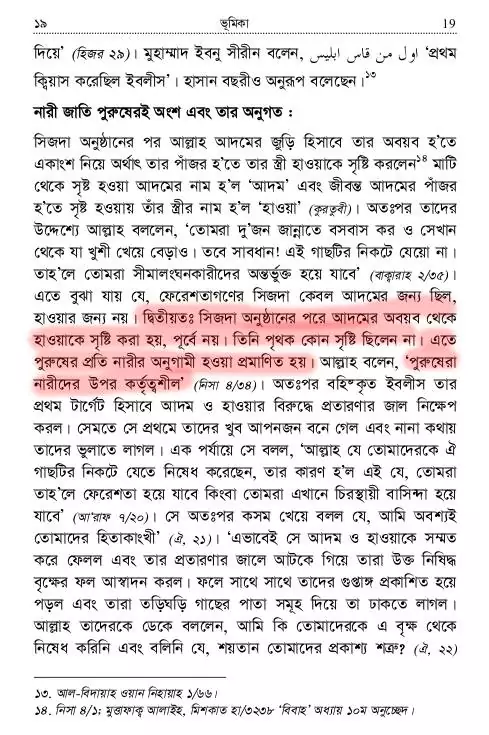
This is not merely the neutral idea that “men and women are companions to one another.” A hierarchy is constructed from the order of creation itself: Adam is the first and primary creation; Eve is derived from his body; the angels prostrate to Adam, not to Eve; and that origin is then used as evidence that women should be “followers” of men. A narrative of biological or mythical origin is thus converted into a principle of social authority—man is primary, woman is his part; man exercises authority, woman follows.
In a narration included in the Bengali edition of Tafsir Ibn Kathir, this male-centred creation narrative acquires an even more explicit meaning of utility and satisfaction. Adam is described as walking alone in Paradise, with no wife to provide him “companionship and satisfaction.” Allah then creates Eve from his rib. When Adam asks Eve, “Why were you created?”, the answer attributed to Eve is: “So that you may obtain satisfaction through me.” [69]
Adam was placed in Paradise. He wandered there alone; there was no wife to provide companionship and satisfaction. Once he fell into a deep sleep and, upon waking, saw a woman sitting beside his head. Allah had created her from Adam’s own rib. Adam asked her, “Who are you?” Eve replied, “A woman.” Adam asked, “Why were you created?” Eve replied, “So that you may obtain satisfaction through me.”
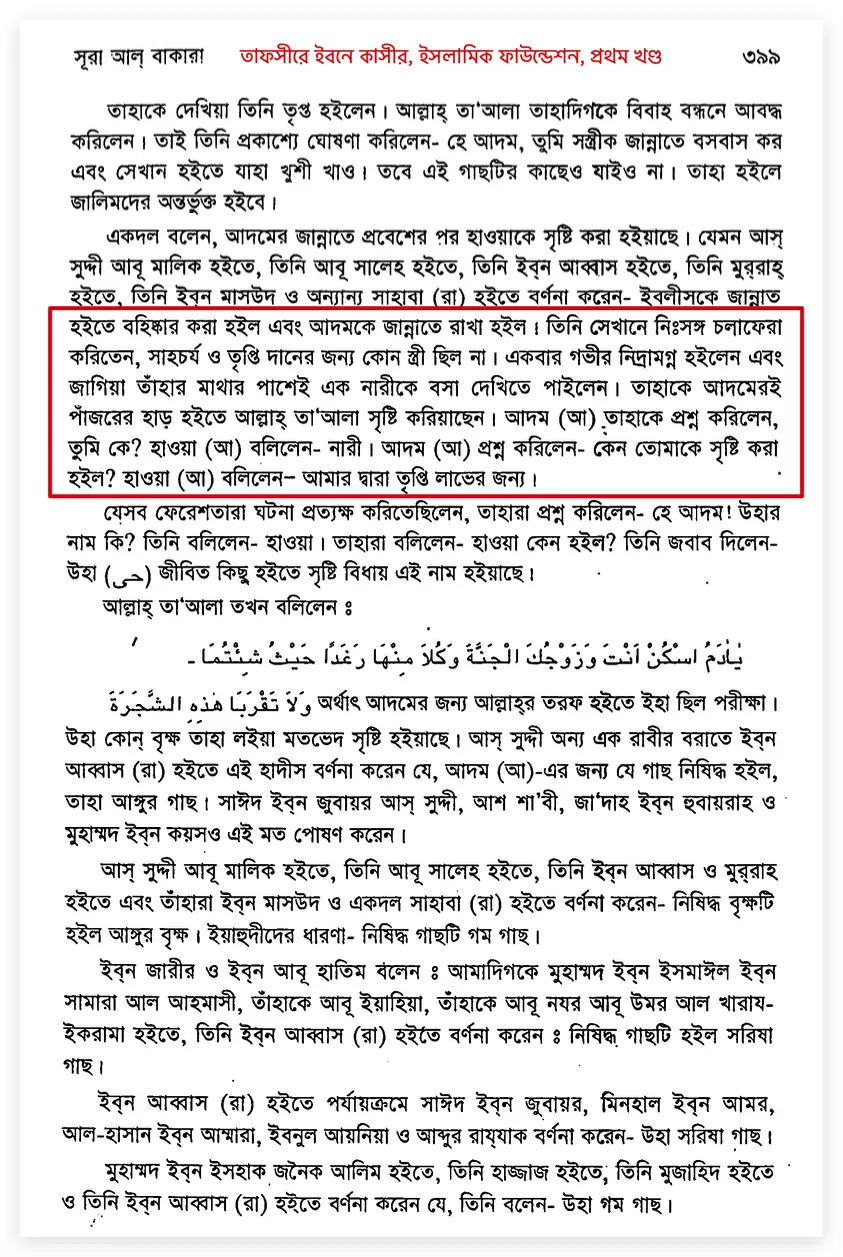
In this account, woman does not appear as a being created with an independent purpose of her own; the reason for her creation is explained through the needs of man. Adam is lonely, therefore woman; Adam needs companionship, therefore woman; Adam needs satisfaction, therefore woman. The question is not what the woman herself might want to become, but what purpose she serves for the man. The answer remains within the same male-centred structure: the purpose of woman’s existence is to satisfy man.
There is no need to restrict the word “satisfaction” here exclusively to sexual satisfaction in its modern sense; the quoted passage contains both “companionship and satisfaction.” But that does not reduce the problem. Rather, it makes clearer that woman’s existence is not defined through her own human goals, desires, or autonomy; it is explained through the need to relieve man’s loneliness, provide him companionship, and give him satisfaction.
This concept is also consistent with the male-centred language of Surah Al-A‘raf 7:189, which says that from a single soul its mate was created “so he may find comfort in her.” Thus, within the same line of interpretation concerning woman’s creation, male needs repeatedly return to the centre—comfort, companionship, satisfaction, and obedience. When this is combined with the rule that “men are caretakers over women,” a continuous structure emerges in which woman is constructed not as an autonomous person of equal status, but as a subordinate and functional being defined in relation to man.
Preference for Virgin Wives
Another dimension of valuing women through sexuality and reproduction is the special preference given to virgin wives. In Sahih al-Bukhari, when Jabir ibn ‘Abdullah married a previously married woman, Muhammad asked why he had not married a virgin with whom he could play and who could play with him. Another version speaks directly of attraction to virgins. [70]
Another narration in Sunan Ibn Majah recommends marrying virgins on the grounds that their mouths are sweeter, their wombs more prolific, and they are more easily satisfied with little. [71]. In the evaluation of a wife, a woman’s lack of prior sexual experience, sexual appeal, reproductive capacity, and lower material expectations are all presented together as advantageous qualities. Alongside the question of what kind of person she is and what independent conception of life she possesses, whether she is a virgin, how effectively she can produce children, and how readily she will be content with little also enter the religious criteria for the ideal wife.
Another ruling in Sahih al-Bukhari provides seven nights for a newly married virgin wife and three for a newly married previously married wife. [72]. This hadith does not prove a personal psychological obsession on Muhammad’s part; it directly demonstrates that virgin and previously married wives were treated as distinct categories within the marital system.
Female Virginity: The Metaphor of an “Eaten” and “Uneaten” Tree
An uncomfortable example of how female virginity was valued appears in a hadith in Sahih al-Bukhari. Aisha herself used the metaphor of an “eaten” and an “uneaten” tree to refer to her virginity. She asked Muhammad to imagine reaching a valley in which part of one tree had already been eaten while another tree remained entirely untouched—which tree would he let his camel graze from? Muhammad replied that he would choose the tree from which nothing had yet been eaten. The narration explicitly explains that Aisha meant by this that Muhammad had married no virgin besides her. [73]
Sahih al-Bukhari
Book 67: Wedlock, Marriage
Chapter: The Marriage of Virgins
Sahih al-Bukhari 5077
Narrated Aisha: “Suppose you landed in a valley where there is a tree of which something has been eaten and then you found trees of which nothing has been eaten, of which tree would you let your camel graze?” He said, “Of the one of which nothing has been eaten before.” The narrator explains that Aisha meant that the Prophet had not married a virgin besides her.
Grade: Sahih
Narrator: Aisha
“Eaten woman” is not a formal term of Islamic Sharia; the metaphor is Aisha’s own. But the character of the metaphor is significant. A woman with previous sexual experience is compared to a tree from which someone else has already consumed something, whereas a virgin woman is compared to an untouched tree from which no one has previously taken anything. In Muhammad’s answer, the preferred object is likewise the “uneaten” tree.
In this metaphor, a woman’s previous sexual experience is not evaluated in terms of her personality, intelligence, character, or human qualities; she is assessed according to whether another man has previously had sexual relations with her. Comparing a woman to a tree, and her sexual experience to its leaves having already been “eaten” by another, provides an explicit language of sexual objectification. Virginity becomes more than a physical state; it is associated with greater desirability precisely because the woman is “unused.”
The Religious Structure of Obedience
When the evidence in this section is considered together, the distribution of power within Islamic marriage is no longer obscure. In the Qur’an, the man is qawwam and possesses an additional darajah over the woman; the righteous woman is obedient; authority to correct and punish disobedience rests with the husband; hadith compares his rights almost to prostration; the wife is described as a captive in the man’s hands; the husband’s claims enter her voluntary fasting, admission of people into the home, and sexual availability; in the majority of Sunni fiqh, marriage itself requires the approval of a male wali; and obedience to the husband appears among the qualities associated with a woman’s entry into Paradise. These are not eight unrelated rules—they are eight dimensions of the same relationship.
This structure cannot be dismissed simply by saying that “the two parties have different responsibilities,” because a difference in responsibility is not the same as a difference in authority. One partner may bear more financial responsibility while another provides more childcare—that is a division of responsibilities. But when one person may demand obedience from the other, judge the other’s disobedience, restrict the other’s religious worship, hold a claim over the other’s sexual availability, and have obedience to himself tied to rewards in the afterlife, that is a hierarchy of power.
The central inequality of Islamic marriage is therefore not merely a question of whether the man bears the title of “head” of the household. The relevant questions are who gives orders and who obeys; who judges disobedience and who is judged; whose permission enters the other person’s body, time, and worship; and whose satisfaction is connected to the afterlife. When the answers to all these questions point in the same direction, the relationship is not an equal partnership—it is religiously legitimised male authority.
The harshest practical expression of this authority—the husband’s right to impose physical punishment on his wife—will be examined in the next section through the Qur’an, sahih hadith, and accounts from the family lives of the Companions.
Wife-Beating: The Physical Form of Marital Authority
Male qawamah, female obedience, and the concept of nushuz do not remain at the level of abstract family authority; the Qur’an also connects that authority with the power to use physical force. In Surah An-Nisa 4:34, when a husband fears nushuz or marital disobedience from his wife, he is instructed through successive stages to admonish her, abandon her in bed, and finally wa-dribuhunna—strike her. Classical tafsir and fiqh understood this word as permission to physically strike a wife; later restrictions such as “not severe,” “leaving no mark,” and “not on the face” were imposed to regulate its degree. But restricted beating is still beating. The moral core of the rule is that an adult man is authorised, according to his own judgment, to physically discipline his adult wife.
Placed alongside reports from Islam’s first generation, the matter becomes even clearer. Aisha’s own account of Muhammad striking her, permission to beat wives after Umar’s complaint, large numbers of women coming to Muhammad’s household with complaints of beatings by their husbands, the woman whose skin had turned greener than her garment, Habiba’s broken body part, and reports of abuse of wives by al-Zubayr all show that wife-beating was not an accidental deviation that emerged only in later Muslim societies. The religious rule existed, its limits were discussed, and complaints about its practical application appear in Islam’s early sources themselves.
The moral rule against domestic violence should be simple: a husband has no right to beat his wife. Islamic law did not draw that line. Instead, it addressed when she may be beaten, how severely, where she may be struck, and how far a man may go before he is no longer considered among the “best.” Rather than prohibiting the violence, rules were created to regulate it.
The Right to Physically Punish a Wife for Nushuz
The structure of Surah An-Nisa 4:34 itself makes the disciplinary dimension of Islamic marriage clear. First, men are declared qawwam over women; then righteous women are described as qanitat, obedient; and then husbands are given three measures against women whose nushuz they fear. First comes admonition, then separation in bed, then wa-dribuhunna. If the wife returns to “obedience,” the husband is instructed not to seek a way against her. [58].
Qur’an, Surah An-Nisa 4:34 — Dr. Mustafa Khattab, The Clear Quran
الرجال قوامون على النساء بما فضل الله بعضهم على بعض وبما انفقوا من اموالهم فالصالحات قانتات حافظات للغيب بما حفظ الله واللاتي تخافون نشوزهن فعظوهن واهجروهن في المضاجع واضربوهن فان اطعنكم فلا تبغوا عليهن سبيلا ان الله كان عليا كبيرا ٣٤
“And if you sense ill-conduct from your women, advise them ˹first˺, ˹if they persist,˺ do not share their beds, ˹but if they still persist,˺ then discipline them ˹gently˺. But if they change their ways, do not be unjust to them.”
Although the Arabic verb daraba can have multiple meanings in different contexts, classical exegetes and jurists for centuries understood wa-dribuhunna in 4:34 as a rule permitting physical blows against a wife. Ibn Kathir instructs that a wife guilty of nushuz should first be admonished, then abandoned in bed, and, if that fails, struck in a way that is not severely harmful. Jurists did not deny the existence of the beating; they defined the limits of what they regarded as permissible beating. Modern translations that replace the word with “separate,” “discipline,” or another softer expression do not alter this explicit history of classical tafsir and fiqh.
Nor does the word “gentle” solve the moral problem. An adult woman is not her husband’s subordinate child whom he may strike within an authorised limit in order to teach discipline. A manager cannot “gently” beat an employee in an office; a teacher cannot beat an adult student “without leaving a mark”; and a wife is not given a parallel Qur’anic authority to physically correct a disobedient husband. Before asking how hard the blow may be, the prior question is this: why should a husband have any right at all to physically punish his wife?
Beating for the Wife’s Nushuz, Reconciliation for the Husband’s Nushuz
The gender inequality of 4:34 becomes even clearer when it is compared with 4:128 of the same surah. In 4:34, when a husband fears his wife’s nushuz, he ultimately receives the power to strike her. But in 4:128, when a woman fears nushuz or aversion from her husband, she is given no parallel authority to admonish him → abandon his bed → beat him. Instead, the verse says there is no blame if the two reach a settlement between themselves, and that settlement is best. [74].
Qur’an, Surah An-Nisa 4:128 — Dr. Mustafa Khattab, The Clear Quran
وان امراة خافت من بعلها نشوزا او اعراضا فلا جناح عليهما ان يصلحا بينهما صلحا والصلح خير واحضرت الانفس الشح وان تحسنوا وتتقوا فان الله كان بما تعملون خبيرا ١٢٨
“If a woman fears indifference or neglect from her husband, there is no blame on either of them if they seek ˹fair˺ settlement, which is best.”
The Qur’an uses the same term nushuz with respect to both wife and husband, but the remedies are not the same. In the wife’s case, the husband becomes judge and disciplinarian; in the husband’s case, the wife becomes a negotiating party. When she faces a problem with her husband’s conduct, she may have to reach a compromise, potentially giving up some of her rights in order to preserve the relationship; the husband, however, receives a stage of physical punishment in exercising authority over his wife.
If beating a wife were truly only “a last resort for resolving a family problem,” why does the wife not receive the same right to beat her husband in the equivalent problem? When one party punishes while the other negotiates, the difference is not one of responsibility; it is a difference of power.
Muhammad’s Blow to Aisha’s Chest
A direct account of Muhammad himself using physical force against a wife comes from Aisha. One night, when Muhammad left the house, Aisha followed him. Later, he realised that she had followed him. During the exchange that followed, Aisha says that Muhammad struck her in the chest in a way that caused her pain. The Bengali edition of Sunan an-Nasa’i grades the narration sahih. [75] [76]
Sunan an-Nasa’i
Sunan an-Nasa’i 3964 Aisha said: “He gave me a shove in the chest that hurt me” and then said: “You thought that Allah and His Messenger would be unfair to you.”
Grade: Sahih (Darussalam)
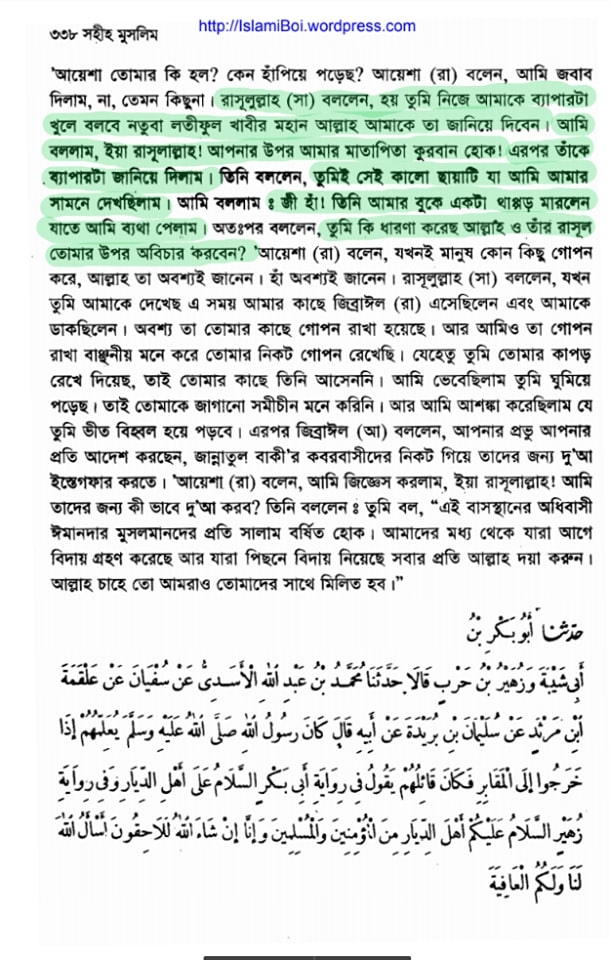
The hadith does not identify the incident as an application of the nushuz-beating rule in 4:34. What the narration directly states is that Muhammad struck his wife Aisha in the chest and that Aisha explicitly said the blow caused her pain. Thus, although the hadith does not establish that this was an application of 4:34, it is a direct report of Muhammad using physical force against his wife.
This narration directly conflicts with propaganda claiming that “Muhammad never struck any of his wives in his life.” Aisha herself says that Muhammad struck her and that it hurt. When a woman herself says that her husband struck her and that the blow caused pain, turning that event into an “affectionate touch” is a denial of her own testimony.
Permission to Beat Wives after Umar’s Complaint
One of the most important hadith concerning wife-beating appears in Sunan Abi Dawud. Muhammad first says: do not beat Allah’s female servants—that is, wives. Umar then comes and complains that women have become emboldened or disobedient toward their husbands. Following this complaint, Muhammad permits husbands to beat their wives. Many women subsequently come to Muhammad’s wives complaining that their husbands have beaten them. Muhammad then says of the men doing this that they “are not the best among you.” [77].
Sunan Abi Dawud
Book 12: Marriage
Sunan Abi Dawud 2146
At first Muhammad said: “Do not beat Allah’s handmaidens.” Umar later complained that women had become emboldened toward their husbands, after which permission was given to beat them. When many women later came to Muhammad’s family complaining of their husbands, he said: “Those are not the best among you.”
The sequence is crucial. First: wives are not to be beaten. Second: Umar complains that women have become emboldened against their husbands. Third: permission to beat wives is given. Fourth: women begin arriving in large numbers with complaints. Fifth: the men who beat them are morally described as “not the best.” But the final stage does not introduce a new universal rule declaring wife-beating completely forbidden again. The beating provision of Qur’an 4:34 also remains in place.
In the sequence of the hadith, wife-beating is first prohibited; after Umar complains that women have become “emboldened” against their husbands, that prohibition is withdrawn and beating is permitted. Later, when numerous women complain of beatings, the men are described as “not the best,” but no new universal prohibition revoking the permission is issued. The shift from “do not beat them” to “you may beat them” following complaints of female disobedience is explicit evidence that beating was recognised as a permissible means of re-establishing a wife’s obedience.
Seventy Women Complain of Beatings by Their Husbands
A narration in Sunan Ibn Majah even gives a number for the complainants. It states that seventy women came to Muhammad’s family complaining that their husbands had beaten them. Muhammad then said that such men would not be found among the best. [78].
Sunan Ibn Majah
Book 9: The Chapters on Marriage
Chapter: Hitting women
Sunan Ibn Majah 1985
It was narrated that Iyas bin ‘Abdullah bin Abu Dhubab said that the Prophet first said, “Do not beat the female slaves of Allah.” After ‘Umar complained that women had become bold towards their husbands, beating was ordered. Muhammad then said: “Last night seventy women came to the family of Muhammad, each woman complaining about her husband. You will not find that those are the best of you.”
Grade: Sahih (Darussalam)
The number seventy matters not merely as a quantity; it illustrates how permission to beat could become a widespread practical problem for women. When the power relationship is already unequal, the question of where permission to beat “when necessary,” “as a last resort,” or “gently” actually stops is largely left to the husband’s judgment. When the same person judges the alleged offence, decides whether punishment is required, and administers that punishment, the wife is naturally in a weaker position when challenging abuse of that power.
Muhammad did not call the men who beat their wives “the best”; this is a moral rebuke. But saying that an act is performed by people who are “not the best” is not the same as declaring that act a prohibited offence. If an act violates another human being’s basic physical security, a just rule should not merely say that “those who do it are not good men”; it should say that they have no right to do it.
The most important test of a rule is not its idealised language but the conduct of those who receive power under it. If seventy women came to the Prophet’s household with complaints after permission to beat wives was granted, this early Islamic report itself demonstrates how readily “regulated beating” can become abuse in real life.
A Wife’s Skin Greener than Her Garment from Beating
Sahih al-Bukhari 5825 provides a visible example of how severe the consequences of wife-beating could be. The divorced wife of Rifa‘a later married ‘Abdur-Rahman al-Qurazi. She came to Aisha and complained about her husband. Seeing the marks on the woman’s body, Aisha said she had never seen believing women suffer as much; the woman’s skin was greener than her green garment. [79].
Sahih al-Bukhari
Book 77: Dress
Sahih al-Bukhari 5825
Seeing the injured woman, Aisha said: “I have not seen any woman suffering as much as the believing women. Look! Her skin is greener than her clothes!”
Grade: Sahih
Skin turning green is not a “symbolic beating”; it is a visible injury severe enough to astonish Aisha. The woman did not want to remain with her husband; the husband accused her of being “disobedient.” Yet the judicial focus of the remainder of the narration is not adjudicating the beating. Muhammad’s question and decision turn instead to whether she may return to her first husband, Rifa‘a, and whether full sexual intercourse with her second husband had occurred—the sexual condition relevant to halala.
The hadith does not mention that ‘Abdur-Rahman received a specific punishment, retaliation, blood money, or another penalty for that beating. This limited observation is sufficient; there is no need to extend it into the broader claim that “Islamic law never punishes a husband for beating his wife,” because classical fiqh contains separate discussions of excessive harm and criminal injury.
A woman displays the injuries on her body, Aisha says that her skin is greener than her garment, yet the judicial centre of the episode becomes the woman’s subsequent sexual relationship. This ordering of priorities exposes the social position of wife-beating with brutal clarity.
Habiba’s Body Part Broken by Beating
Another report describes an even more serious result. Habiba bint Sahl, wife of Thabit ibn Qays, came to Muhammad and complained that her husband had beaten her and broken a part of her body. The incident appears in the Islamic Foundation Bengali edition of Abu Dawud. Muhammad then summoned Thabit and instructed him to take back the property he had given her and separate from her. [80].
Sunan Abi Dawud
Book 13: Divorce
Sunan Abi Dawud 2228
Narrated Aisha, Ummul Mu’minin: Habibah daughter of Sahl was the wife of Thabit ibn Qays. “He beat her and broke some of her part.” She complained to the Prophet, who told Thabit to take back the property he had given her and separate from her.
Grade: Sahih (Al-Albani)
The resolution of the episode is separation. For Habiba, this was an extremely important route out of the abusive marriage; she was not forced to remain with the husband who had injured her. At the same time, there is a notable absence in the narration: no punishment, compensation, retaliation, or blood money against Thabit for breaking a bone or bodily part is mentioned. The visible legal consequence of the episode is primarily dissolution of the marriage.
This report by itself does not prove a universal rule that Islamic fiqh contains no punishment in any circumstances for beating a wife badly enough to break a bone. What the report directly establishes is that a woman was injured so severely by her husband’s beating that part of her body was broken, and the complaint reached Muhammad. Yet the narration mentions no independent punishment for the husband’s violence; allowing the woman to leave the marriage is the visible remedy.
“Do Not Beat Her Like a Slave”—Not a Prohibition on Beating
Another widely cited statement by Muhammad concerning wife-beating says that a man should not beat his wife as he beats a slave and then have sexual intercourse with her at the end of the day. The statement appears in Sahih al-Bukhari. [81].
Sahih al-Bukhari
Sahih al-Bukhari 5204
Muhammad said: “None of you should flog his wife as he flogs a slave and then have sexual intercourse with her in the last part of the day.”
Grade: Sahih
This hadith criticises severely beating a wife and highlights the contradiction of extreme violence against the same woman followed by sexual intimacy. But it is not a universal prohibition on wife-beating. It does not say, “Never hit your wife”; it says not to beat her as a slave is beaten. The limited-beating provision of Qur’an 4:34 remains alongside it.
The language of comparison is also important. In a society where beating slaves was a familiar reality, the limit for beating a wife is explained by comparison with the beating of a slave. The wife is not told, “She is a free adult human being and you have no right to strike her”; instead, a difference of degree is drawn—do not beat the wife in the manner in which a slave is beaten.
The statement “do not beat her like a slave” does not prohibit wife-beating; it creates a boundary around what degree of wife-beating is unacceptable. A human-rights principle does not regulate how severely one may beat a spouse—it denies the right to beat her in the first place.
Do Not Strike the Face
A hadith in Abu Dawud concerning a husband’s duties toward his wife says that he should feed her when he eats, clothe her when he clothes himself, not strike her on the face, not revile her, and not separate from her except within the house. [60]. The prohibition on striking the face is a real restriction; Islamic jurists gave it particular importance because the face is associated with human dignity, appearance, and risk of serious injury.
Sunan Abi Dawud
Sunan Abi Dawud 2142
Among the husband’s duties concerning his wife, Muhammad said: “do not strike her on the face, do not revile her…”
But “not on the face” does not mean “nowhere on the body.” On the contrary, that restriction is meaningful precisely where some degree of striking elsewhere remains permitted. Likewise, limits such as “do not break bones,” “do not leave marks,” and “do not beat severely” do not abolish violence; they define what is regarded as the permitted range of violence.
A civilised moral rule should be: do not beat your wife. The Islamic rule does not stop there; instead, it says not to exceed the limits of beating and not to strike the face. The difference between these two positions is fundamental.
Abuse of Wives in the Households of the Companions
Wife-beating was not present only as a rule in verses and hadith; accounts of it also appear in the family lives of important men of Islam’s first generation. The most discussed example is al-Zubayr ibn al-Awwam, a close Companion of Muhammad, one of the ten men traditionally promised Paradise, and the husband of Asma bint Abi Bakr, daughter of Abu Bakr. Early biographical and hadith-related sources contain reports of al-Zubayr beating his wives. An earlier draft cited both the English translation of Ibn Sa‘d’s Kitab al-Tabaqat al-Kabir and Arabic material discussed on an Islamic fatwa website. [82] [83].
Regarding Asma, a report in al-Tabarani’s al-Mu‘jam al-Kabir describes her being beaten by al-Zubayr. At one point, Asma calls her son ‘Abdullah ibn al-Zubayr for help; he comes and protects his mother. [84].
This is not a juristic hypothetical: a wife is being beaten by her husband, calls her son for help, and the son comes to protect his mother. Al-Zubayr is honoured in Muslim tradition as an eminent Companion; the presence of such an incident in his household indicates that wife-beating was not regarded in the first Muslim community as an unthinkable crime in the modern sense.
Ibn Sa‘d’s biographical work also contains reports of al-Zubayr’s harsh treatment of another wife, Umm Kulthum. Not every chain of transmission and every incident in these sources has equal strength, so each must be assessed individually. But when these reports are placed alongside Aisha’s sahih account, the complaints of seventy women, the wife whose skin turned green, and Habiba’s broken body part, a broader social reality comes into view.
If wife-beating had been absolutely forbidden and morally unthinkable violence within the ethical world of Islam’s first generation, reports of the same behaviour would not repeatedly appear in so many places—the Prophet’s own household, women complaining to his family, and the homes of prominent Companions.
Where Does “Gentle Beating” Stop in Practice?
The word most frequently used in modern defences of wife-beating is “gentle.” It is claimed that the beating permitted by the Qur’an is not painful, leaves no mark, breaks no bone, and is merely a symbolic disciplinary gesture. But the principal difficulty with this explanation is the incidents reported in Islamic sources themselves. The Qur’an may provide a theoretical limit, yet in Abu Dawud women arrive together to complain after permission is given; in Ibn Majah their number is seventy; in Bukhari a woman’s skin has turned green; in Abu Dawud Habiba suffers a broken body part; in Asma’s case her son intervenes to protect her.
When a law says, “You may beat her when necessary, but do not exceed the limit,” the practical power to define that limit remains with the person who is already angry and considers himself entitled to punish. The wife says that the husband exceeded the limit; the husband may say that he merely “disciplined” her. If the family, local religious authority, or court begins from the premise that some degree of beating by the husband is lawful, the woman must prove not merely that she was beaten but that the beating exceeded the legally permissible boundary.
This is the central problem of “regulated violence.” Once physical punishment is legitimised, society must decide which stick, how many blows, what part of the body, how much pain, and how much bruising crosses the line into an offence. The principle of modern domestic-violence law is entirely different: a husband may not beat his wife in order to obtain obedience—the degree of injury does not create such a right.
“Gentle beating” is not a solution to wife-beating; it is an authorised category of wife-beating. The problem begins precisely there—one adult human being is given a religious right to raise his hand against the body of another adult under the name of discipline.
The Human Cost of Domestic Violence
If wife-beating is treated only as a theological debate, the real human being disappears. Domestic violence does not end with the physical wound; it creates an environment of fear. A woman does not know when the next blow will come, and may begin altering her behaviour, speech, clothing, sexual refusal, financial decisions, or contact with relatives. The beating is then no longer a single blow; fear of future violence itself becomes an instrument of control.
Physical violence can cause bruising, cuts, broken bones, head injuries, chronic pain, and, in severe cases, permanent disability or death. Psychological effects may include fear, anxiety, depression, loss of self-esteem, and social isolation. The World Health Organization identifies intimate-partner violence as a major public-health and human-rights problem with serious consequences for women’s physical, mental, sexual, and reproductive health. [85].
Children in violent households are harmed as well. They may grow up in fear and insecurity from watching their mother being beaten, and they may also learn a model of family relationships in which the more powerful person may raise a hand to “discipline” the weaker party. When beating is religiously legitimised, that lesson becomes stronger—the father is not merely striking in anger; he may believe that religion itself has granted him this authority.
This is why “how much beating is allowed?” is not the primary moral question. A wife is not her husband’s property, subordinate child, or punishable subject. She is an autonomous adult human being. Marital disagreement, an allegation of disobedience, sexual refusal, or a family dispute gives a husband no right to strike her body.
The Overall Picture of the Wife-Beating Rule
When all the evidence is placed together, the picture is sufficiently clear. The Qur’an declares the man qawwam over the woman, describes the righteous wife as obedient, and gives the husband the power to admonish, abandon the bed, and beat when he fears nushuz. In the same surah, the wife is not given a parallel right to beat a husband guilty of nushuz. In sahih hadith, Aisha reports a painful blow to her chest from Muhammad. Permission to beat wives is given following Umar’s complaint. Women then come in groups to complain; one narration numbers them at seventy. Another woman’s body turns green from beating. A different woman comes to Muhammad after her husband breaks a part of her body. The same religious literature says not to beat a wife like a slave and not to strike her on the face—that is, the existence of beating is not denied; its limits are regulated.
All of this evidence points to the same structure of power. Surah 4:34 gives the husband authority to beat in cases of nushuz; Aisha’s narration says Muhammad struck her painfully; many women complained about their husbands after permission to beat was given; and hadith prohibit striking the face or beating like a slave without abolishing the husband’s authority to strike. Islam did not deny the husband a right to physically discipline his wife; it recognised that right and then established limits on its degree and method. That is precisely where the conflict with a relationship of equal status lies.
A human being’s physical safety cannot be a reward for obedience. At the end of Qur’an 4:34, the husband is told that if the wife obeys, he should seek no further means against her—meaning that the cessation of disciplinary measures is tied to a return to obedience. Modern humane principles reverse that logic: whether a wife is obedient, disobedient, angry, dissenting, or wants to leave the relationship, her husband has no punitive right over her body.
If a husband may beat his wife but the wife may not beat her husband for the equivalent offence, if the man is the punisher and the woman the punished, then power in that marriage is not equal. The harshest meaning of qawamah is revealed here: male authority ultimately reaches the woman’s body.
More extensive documentation from the Qur’an, hadith, incidents involving the Companions, and classical fiqh concerning wife-beating is available in the Shongshoy Knowledge Base article [86].
A Wife’s Sexuality, the Threat of the Sword, and “Ghayrah”
In Sahih Muslim, Sa‘d ibn ‘Ubadah says that if he were to find another man with his wife, he would strike him with the edge of his sword rather than wait to gather four witnesses. When this statement reached Muhammad, he did not condemn Sa‘d’s attitude as cowardice, violence, or madness; instead, he referred to Sa‘d’s intense ghayrah and said that his own ghayrah was greater than Sa‘d’s and Allah’s greater than his. [87]
This narration does not grant legal permission for extrajudicial killing; the rule requiring four witnesses remains in the surrounding legal discussion. What it directly shows, however, is that a man’s declaration of lethal violence over his wife’s sexual fidelity is framed not with moral condemnation but in the language of ghayrah. A woman’s sexuality is thus tied to male honour, entitlement, and jealousy so strongly that even the threat of a sword can be presented as an expression of that honour.
Marital Sexuality: The Husband’s Sexual Rights versus the Wife’s Consent
Sex within Islamic marriage is not treated only as a matter of mutual desire between husband and wife; the wife is placed within the sphere of the husband’s sexual rights. When he calls her for sex, she is expected to respond; if she refuses, the angels curse her; even if she is working at the oven she is instructed to go when he calls; even if she is on a camel saddle she is not to withhold herself from him; and when he is present she may not observe a voluntary fast without his permission because doing so may obstruct his sexual rights. Classical fiqh established the wife’s sexual availability as a right of the husband, and refusal without a legally recognised excuse can render her nashizah, a disobedient wife.
Within this system, the central sexual question is not “Do both people want sex right now?” Instead, the question becomes whether the husband has invoked his marital sexual right and whether the wife has responded to that claim. Consent given to the marriage is made the basis of subsequent sexual availability, placing the wife’s continuing freedom to decide beneath the husband’s established right. Where one person’s “I want sex” is a religious right while the other person’s “I do not want sex” can trigger angelic curses, nushuz, financial pressure, and the risk of beating, sexual power is not distributed equally between the two parties.
The Angels Curse a Wife Who Refuses Her Husband’s Invitation to Bed
Sahih al-Bukhari records Muhammad as saying that if a husband calls his wife to bed, she refuses, and he spends the night angry with her, the angels continue to curse her until morning. [61]. The neighbouring narration, 5194, conveys the same principle. [88]. Classical fiqh discusses specific exceptions such as illness, physical harm, or a legally recognised incapacity; the general rule nevertheless turns refusal of the husband’s sexual invitation into a religious offence associated with the curse of the angels.
Sahih al-Bukhari
Book 67: Wedlock, Marriage
Sahih al-Bukhari 5193
Narrated Abu Huraira: The Prophet said: “If a man invites his wife to sleep with him and she refuses to come to him, then the angels send their curses on her till morning.”
Grade: Sahih
The husband’s sexual desire is not merely a private request here; direct religious fear stands behind it. The wife says “no” to her husband, but that “no” does not remain a private disagreement between two spouses—the angels are said to curse her throughout the night. An invisible religious authority is thereby placed over the woman’s sexual decision in addition to the husband’s demand. For a believing woman, the curse of angels is not trivial social pressure; it is connected to divine displeasure and fear of the afterlife.
Free sexual consent is possible only when saying “no” does not make a person sinful, cursed, or disobedient. “You are free, but if you say no the angels will curse you” is not freedom; it is sexual obedience enforced through religious fear.
She Must Go When Her Husband Calls Even If She Is at the Oven
Mishkat al-Masabih records Muhammad as saying that when a husband calls his wife for his need, she should come to him even if she is at the oven. [66]. The husband’s “need” is understood in commentary as a sexual need. Thus, whether the wife is cooking, occupied with necessary work, or spending her own time on another task, when the husband calls for sex her duty is to interrupt what she is doing and go to him.
Jami` at-Tirmidhi
1160. The Messenger of Allah said: “When a man calls his wife to fulfill his need, then let her come, even if she is at the oven.”
This is not merely a question of sex; it is also a question of whose claim has priority over the woman’s time. The necessity of the work she is doing, her own wishes, or her mental state become secondary. Her current activity is interruptible before the husband’s sexual demand. The husband’s desire is treated as an urgent claim; the wife’s time as a resource that can wait. The language of power in the narration is that direct.
In an equal sexual relationship, one partner may invite the other, express desire, and even feel disappointed when refused. But that disappointment does not create an entitlement to the other person’s body. “I want it now” cannot become “you must come now.”
The Husband’s Claim Even If She Is on a Camel Saddle
Several hadith express the same concept in even more extreme language. In the marriage section of Sunan Ibn Majah, a wife is instructed not to deny her husband his sexual right even if she is on a camel saddle. [89]. A similar statement also appears in Al-Adab al-Mufrad. [90].
The point of the expression “on a camel saddle” is precisely to indicate that even busyness or an uncomfortable situation should not readily become an excuse against the husband’s sexual claim. It need not be read as a literal instruction to have sex on a camel in the middle of a road; its rhetorical force lies elsewhere—it uses an extreme circumstance to illustrate how far the obligation to respond to the husband is supposed to extend.
But that emphasis is itself the heart of the problem. Compared with where the wife is, what she is doing, or what her physical and emotional condition is at that moment, the husband’s claim is elevated religiously. Whether the woman is on a camel, in the kitchen, or in bed, if the final decision over her body is subordinated to her husband’s “right,” her sexual freedom exists on paper rather than in reality.
A Wife Must Come to Bed Even If She Hates Her Husband
In classical fiqh, the husband’s sexual right can override even the wife’s emotional unwillingness. The Shongshoy article on marital rape quotes an early report from Musannaf ‘Abd al-Razzaq, transmitted from Sufyan al-Thawri, stating that a wife must come to her husband’s bed even if she hates him. [91]. The wife’s emotional aversion does not nullify the husband’s sexual right.
The fact that a person hates someone is profoundly relevant to sexual consent. Compulsory sexual intercourse with someone one hates is not merely a physical act; it can be deeply humiliating and psychologically harmful. Yet within a rights-based conception of marriage centred on the husband’s entitlement, the question becomes why the wife is refusing his bed and whether her refusal violates her marital duty.
The same framework persists in modern Islamic fatwas. IslamQA question 219686 addresses a wife who hates her husband. The answer says that as long as the marriage remains in force, she may not refuse his bed without a valid excuse; if the relationship has become unbearable, she may seek khul‘. [92]. In other words, “I do not want sex with this person now” is not treated as sufficient in itself; she is directed toward ending the relationship altogether.
Why should a person have to prepare to end an entire marriage in order to refuse one sexual encounter? Sexual consent is a decision made each time. A wife may love her husband today but not want sex today; tomorrow she may want it. Sending her to the door of divorce or khul‘ in order to protect authority over her own body demonstrates that her “no” within marriage has not been recognised as an independent right.
The Wife’s Preferred Sexual Position versus the Husband’s Claim
Surah Al-Baqarah 2:223 and a hadith presented as the context of its revelation raise an important question about the balance of desire between husband and wife within sex. Abu Dawud records that when a Muhajir man wanted intercourse with his Ansari wife in different sexual positions, she objected. She explicitly said that in her community intercourse was performed in one particular position, that her husband must do it that way, or else keep away from her. The narration then connects this dispute with the revelation of 2:223: “Your wives are like farmland for you, so approach them as you please.” [46].
Sunan Abi Dawud
Book 12: Marriage
2164. The wife said: “We were approached on one side; do it so, otherwise keep away from me.” The narration then connects the dispute with the revelation of the verse describing wives as tilth.
The ruling does not legalise anal intercourse; the discussion is limited to different positions of vaginal intercourse. More important than that boundary, however, is the direction of the religious solution after the wife’s explicit objection. She had stated the position in which she wanted sex, but that preference was not established as an independently binding right over her husband. Instead, the husband is told that he may approach his “tilth” in different lawful positions.
The question of sex does not end with “Which positions are lawful under Sharia?” A more fundamental question is whether this particular woman wants this particular position. Sharia defines which positions are lawful for the husband, but does not make the wife’s statement “I do not want it this way” the final boundary of an equal sexual right.
The Wife’s Voluntary Worship beneath the Husband’s Sexual Rights
The husband’s sexual right is also given priority over the wife’s personal religious devotion. Sahih al-Bukhari records Muhammad as saying that when a husband is present, a wife may not observe a voluntary fast without his permission. [65]. The juristic explanation is straightforward: when she is voluntarily fasting, she cannot have intercourse during the day, which may obstruct the husband’s sexual right.
Sahih al-Bukhari
Book 67: Wedlock, Marriage
5195. The Prophet said: “It is not lawful for a woman to fast (Nawafil) without the permission of her husband when he is at home.”
Grade: Sahih
A woman wants to perform an additional act of worship for Allah. The act concerns her own body. Yet within marriage, her husband’s permission enters even this personal religious decision because he may want sex during that time. Even her decision about when to remain hungry and when to fast is subordinated to the possibility of a male sexual claim.
There is no parallel rule requiring a husband to obtain his wife’s permission before voluntary fasting because she may make a sexual demand. This is therefore not a reciprocal rule of “considering each other’s sexual needs within marriage.” The man’s sexual right reaches so far that even whether a woman may use her own body for voluntary worship of Allah becomes subject to male permission.
Sexual Refusal, Nushuz, and Financial Punishment
The consequences of sexual refusal are not confined to the curse of angels. In classical fiqh, refusing a husband sexual access without a legally recognised excuse can place a wife in the status of nashizah, a disobedient wife. As a consequence of nushuz, her entitlement to maintenance may be suspended; and within the structure of 4:34, the husband also retains authority to admonish her, abandon her in bed, and ultimately strike her.
IslamQA fatwa 33597, addressing when a wife may refuse her husband’s sexual invitation, states that she must respond unless there is a harm or impediment recognised by Sharia. The same discussion refers to the rules of nushuz and loss of maintenance. [93]. Citing Ibn Taymiyyah, fatwas of this type state that if a wife persists in nushuz by refusing her husband’s sexual claim, disciplinary measures including non-severe beating may become applicable.
Now consider the real position of sexual consent. On one side, the wife is told that if she does not go to her husband’s bed, the angels curse her; on another, she may be classified as nashizah; she may lose maintenance; she may be abandoned in bed; and finally the religious rule permitting beating may come into play. If saying “yes” is backed by fear of sin, fear of losing financial support, and the husband’s disciplinary power, that “yes” cannot be treated as free sexual consent. It is submission under a structure of power.
Marital Rape: Is Marriage Permanent Sexual Consent?
All of these rules lead to a fundamental question: does marriage give a husband a permanent sexual right over his wife’s body? In the framework of classical Islamic fiqh, one of the principal legal effects of marriage is that sexual enjoyment of the wife becomes lawful to the husband and the wife acquires a duty of tamkin—making herself available for marital sex. Refusing sexual availability can become nushuz. In this framework, “the husband wants sex but the wife does not want it now” is not treated as an entirely independent question of present consent; it becomes a conflict between the husband’s established right and the wife’s refusal.
In answering the question “Can a husband force his wife to have sex?”, IslamQA states that a wife may not withhold herself from her husband without a Sharia-recognised reason. Restrictions are recognised in circumstances such as physical harm, menstruation, obligatory worship, or another valid impediment; but the wife’s present unwillingness by itself does not extinguish the husband’s sexual right. [93].
This is the structure in which the problem of marital rape arises. Rape is not defined only by a stranger, a weapon, or an overt physical attack; the central question is whether a person freely consented to the sexual act. A wife who marries a husband has consented to the possibility of a sexual relationship with him. She has not thereby given advance consent to every sexual act on every day, at every time, under every condition.
Saying “I accept” in marriage is not a lifelong open licence to sex. A woman may love her husband, willingly have sex with him a hundred times, and say “no” on the hundred-and-first occasion. That one “no” remains a complete “no.” The previous hundred “yeses,” the mahr, the marriage contract, or the husband’s financial maintenance do not deprive her of ownership over her body in the present moment.
The moment marriage is treated as a permanent sexual entitlement, the wife is reduced from a person to contractually available sexuality. The lawfulness of sex is then determined not by her present will but by her marital status. This is why recognising marital rape as a distinct offence is a fundamental principle of modern sexual autonomy: a husband, like every other human being, cannot cross the boundary of his wife’s present consent.
Consent Once Is Not Consent Forever
The most basic characteristic of sexual consent is that it is specific, present, and revocable. A person may consent to one sexual act and refuse another; may consent initially and change their mind midway; may consent yesterday and refuse today. A relationship, marriage, previous sexual history, clothing, love, or financial dependency is not a substitute for present consent.
The Islamic framework of sexual rights comes into conflict precisely at this point. In hadith, the husband calls and the wife must go; if she refuses, the angels curse her. She is expected to go even from the oven. Even the camel-saddle example narrows the space for refusal. The husband’s potential sexual claim takes priority even over her voluntary fasting. In classical fiqh, refusal can constitute nushuz. In other words, the wife is not asked each time, “Do you want this?”; the pre-existing duty is to satisfy the husband’s claim.
Sexual consent does not mean merely failing to stop someone from having sex; consent means that the person freely wants that sexual act. Surrendering one’s body under fear of religious curse, financial dependence, disciplinary violence, or the pressure of marital duty is not the same as freely chosen sex.
The Overall Structure of a System Centred on the Husband’s Sexual Rights
Placed side by side, the evidence in this section repeatedly reveals the same structure. If the husband calls his wife to bed and she refuses, the angels curse her; she is instructed to leave her current task and come even from beside the oven; an extreme image says his demand should not be ignored even if she is on a camel saddle; even if she hates him, her sexual availability remains a religious duty while the marriage continues; she needs his permission to observe a voluntary fast with her own body; when she explicitly objects to a sexual position, the husband’s lawful scope of approach is nevertheless expanded; and sexual refusal can become linked to nushuz, loss of maintenance, and the framework of beating.
These cannot be made equal simply by calling them “mutual rights of husband and wife.” If the rules were genuinely reciprocal, there would be a parallel hadith cursing a husband when he refuses his wife’s sexual invitation; a husband would be unable to observe a voluntary fast without his wife’s permission; and a wife would be able to declare him nashiz, terminate his maintenance, or physically discipline him in order to enforce her sexual rights. The rules were not constructed that way. The central sexual entitlement belongs to the man.
This is where marital rights must be distinguished from sexual ownership. Taking a partner’s sexual needs seriously is part of a relationship; taking them seriously does not create a right to that person’s body. A husband who ignores his wife’s sexual needs may be a bad partner, and a wife’s rejection of her husband may create relationship problems. But neither acquires a right to use the other’s body. There may be discussion, affection, disappointment, and compromise; there cannot be coercion.
The central problem of Islamic marital sexual ethics is that a wife’s body is treated as available not according to her present will but according to the husband’s marital right. From angelic curses to nushuz, from maintenance to beating, the entire structure of religious pressure protects the same objective: the husband’s sexual access. The principle of free sexual consent is the exact opposite—the final decision belongs to the person whose body it is.
Extensive documentation on hadith, fiqh, mahr, tamkin, nushuz, and marital rape is available in the Shongshoy Knowledge Base article [91].
Polygyny: Men’s Unilateral Sexual and Marital Privilege
The Islamic structure of polygyny is sex-based from the outset. A man may have four wives simultaneously, whereas a woman may not have multiple husbands at the same time. Men retain access to new marital and sexual relationships, while each wife must remain monogamous toward that same man. The first wife’s permission is not required for a second marriage, nor is prior notification a condition for the new marriage’s validity under Sharia. The Qur’an commands justice among wives while also stating that complete equality will never be possible. One of the most revealing episodes occurred within Muhammad’s own family. When Ali wanted to marry another woman while remaining married to Fatima, Muhammad refused to accept his daughter’s distress and intervened to prevent the marriage. Yet for ordinary Muslim women, the same objection does not create a right to stop a husband’s second marriage.
Reducing polygyny to the image of “one man financially supporting four families” obscures its actual political and sexual structure. A single man becomes the centre of the sexuality, reproduction, time, emotions, and family life of multiple women simultaneously. Each wife is limited to one husband, but must share that one husband with other women. This is not reciprocal non-monogamy. It is male polygyny combined with compulsory female monogamy. One side’s sexual and marital freedom is expanded; the other side’s is restricted. The following statement by a Bangladeshi Islamic scholar illustrates the matter clearly.
The Man’s Right to Up to Four Wives
Surah An-Nisa 4:3 permits a man to marry two, three, or four women. The same verse instructs him to restrict himself to one if he fears that he cannot maintain justice. [94]. The limit of four is not a later juristic invention. A hadith reports that when Ghaylan ibn Salamah embraced Islam, he had ten wives, and Muhammad told him to retain four of them and leave the others. [95].
Sunan Ibn Majah
Book 9: The Chapters on Marriage
1953. Narrated Ibn ‘Umar: Ghaylan ibn Salamah had ten wives when he accepted Islam. The Prophet told him: “Choose four of them.”
Another report states that when Qays ibn al-Harith embraced Islam while having eight wives, Muhammad instructed him to choose four. The rule is therefore clear: multiple marriages are lawful for a man, up to a maximum of four wives. Exercising this right does not require him to end his first marriage, nor is the first wife’s sexual or emotional approval a basic condition of validity. A man may expand his sexual and family life toward another woman while his existing marriage remains intact.
The consequences of this decision do not fall only on the man himself. The first wife loses part of the time she previously spent with her husband; her children share their father’s time; family income is divided with a new household; the husband’s sexual and emotional attention is divided; and new children and heirs may enter the family. Yet the basic power to make the decision remains with the man. One man’s personal religious right can restructure the lives of several women, while the consent of the women whose lives are being restructured is not a condition of that right. Let us hear the perspective of a Bangladeshi Islamic scholar.
Four Wives for a Man, One Husband for a Woman
The most explicit inequality of polygyny lies in the numbers themselves. A man may simultaneously maintain lawful sexual and marital relationships with four women. A married woman, however, may not simultaneously take another man as a husband. Surah An-Nisa 4:24 declares married women forbidden to other men, while making a separate exception for enslaved women under ownership. [96]. The principle of sexual exclusivity is therefore not the same for women and men.
If a married man falls in love with or becomes sexually attracted to another woman, he has a lawful route to make her a second wife. If his desires are not fulfilled with two wives, he may proceed to a third and then a fourth. A married woman who develops love or sexual attraction toward another man is offered no parallel lawful arrangement. Until she ends her current marriage, sexual relations with another man constitute zina. Male plural sexual desire is thus accommodated through lawful marriage; equivalent female desire is not.
This creates a striking sexual equation within a single family. If a man has four wives, all four women owe their complete marital sexual exclusivity to one man. That man, however, gives complete sexual exclusivity to none of them. Each wife must be satisfied with one husband, while the husband may have four wives. Each of four women receives a share of one man, while that man receives the full marital exclusivity of each of the four women. The accounting of sexual freedom is weighted toward the man from the beginning.
This inequality is often explained through arguments concerning certainty of paternity or lineage. Such arguments do not make the sex-based inequality disappear. The outcome of the rule remains visible in the numbers: one man may have four lawful partners simultaneously, whereas a woman may have one. Social explanations may account historically for why an unequal rule emerged, but they do not turn 4:1 and 1:1 into equal rights.
Polygyny Is Not Merely Permitted; the Exemplary Man Also Had Many Wives
Polygyny is often presented as a reluctant emergency exception merely tolerated by Islam. A narration in Sahih al-Bukhari does not fit that picture. Ibn ‘Abbas asked Sa‘id ibn Jubayr whether he had married. When he said no, Ibn ‘Abbas encouraged him to marry and remarked that the best person of this Muslim nation had the greatest number of wives. [97]. The Islamic Foundation edition likewise places the hadith under a chapter concerning multiple wives.
Sahih al-Bukhari
Book 67: Wedlock, Marriage
5069. Narrated Sa‘id ibn Jubayr: Ibn ‘Abbas encouraged him to marry and said: “The best person of this (Muslim) nation (i.e. Muhammad) of all other Muslims, had the largest number of wives.”
“The best person of this nation” refers to Muhammad. He had multiple wives, and his marital life forms part of the prophetic model presented to Muslim men. Polygyny cannot therefore be portrayed as though Islam retained it reluctantly only for famine, war, or the rescue of widows. The hadith invokes the many wives of the community’s exemplary man in the context of encouraging marriage.
Muhammad’s own number of wives was not confined to the limit of four applicable to ordinary Muslims. Special rules applied to him, which will be discussed separately later. The relevant point here is that polygyny is not treated as a shameful exception in Islamic tradition. Muhammad himself had many wives, his Companions practised polygyny, and the Qur’an expressly legalised it. A system whose prophet himself had many wives, and whose Companion cites those many wives as a characteristic of the best man of the community, cannot meaningfully be presented as opposed to polygyny. Let us listen to a statement by Matiur Rahman Madani.
The Condition of Justice and Impossible Equality
Surah An-Nisa 4:3 attaches a condition of justice to polygyny. After permitting two, three, or four wives, it says that if a man fears he cannot maintain justice, he should restrict himself to one. [94]. Classical fiqh regarded justice in the distribution of nights, housing, expenditure, and other controllable rights among wives as obligatory. Hadith also contain severe warnings against unjustly inclining toward one of two wives.
Jami` at-Tirmidhi
Book 11: The Book on Marriage
Jami` at-Tirmidhi 1141
Abu Hurairah narrated that the Messenger of Allah said: “When a man has two wives and he is not just between them, he will come on the Day of Judgment with one side drooping.”
Grade: Da’if (Darussalam)
Yet in 4:129 of the same surah, the Qur’an declares that however much a man desires it, he will never be able to maintain complete equality between his wives. It then warns him not to incline entirely toward one and leave another suspended. [98]. Classical tafsir commonly explains this by distinguishing between equality in time, money, and other controllable matters, which is possible and obligatory, and complete equality in love and emotional attraction, which is impossible.
Qur’an, Surah An-Nisa 4:129 — Dr. Mustafa Khattab, The Clear Quran
ولن تستطيعوا ان تعدلوا بين النساء ولو حرصتم فلا تميلوا كل الميل فتذروها كالمعلقة وان تصلحوا وتتقوا فان الله كان غفورا رحيما ١٢٩
“You will never be able to maintain ˹emotional˺ justice between your wives—no matter how keen you are. So do not totally incline towards one leaving the other in suspense.”
A wife does not live in a marriage merely by keeping accounts of equal money, equal food, and equal nights on a calendar. Marriage includes love, desire, intimacy, emotional security, personal importance, and the feeling of being special to one’s partner. A husband may love one wife more, want to speak with her more often, feel more attracted to her, or attach greater importance to her; those emotions cannot be made equal through calculations of nights and money. The Qur’an itself acknowledges this impossibility of emotional equality.
Justice in polygyny therefore largely remains confined to the allocation of measurable rights. Four wives may each receive a scheduled night every week, yet they do not receive equal love. One wife may know that her husband loves another more, while her enforceable claim is largely that he not leave her completely “suspended.” The most important inequalities of polygyny cannot be measured in an account book. Love cannot be divided into four equal shares, attraction cannot be divided into four equal shares, and emotional security cannot be cut into four equal turns.
A Second Marriage without the First Wife’s Consent
A man’s second marriage radically changes his first wife’s life. Nevertheless, classical Sharia does not require the first wife’s permission for the validity of the second marriage. IslamQA explicitly states that there is no Qur’anic or hadith requirement making the first wife’s permission obligatory before taking a second wife. [99]. Similar fatwas explicitly affirm the husband’s religious right to a second marriage.
IslamQA, Question 61
Obtaining the first wife’s permission before taking a second wife is not a condition of Sharia.
An IslamWeb fatwa goes further, stating that informing the first wife about the second marriage is not itself an obligatory condition of Sharia. [100]. A woman may therefore not even know in advance about a fundamental change to her own marriage. A husband can contract a second marriage secretly, and the secrecy does not by itself invalidate the new marriage.
This is not simply “another private relationship” of the husband. After the second marriage, the first wife must share her husband’s time, household income, sexual life, and emotional attention; new children and heirs may be added; and future arrangements for housing and care may change. Almost every practical element of the marriage can be altered. Yet the consent of the woman directly affected by those changes is not a condition for the validity of the second marriage.
The husband decides whether he will marry another woman. The first wife bears the consequences of that decision but has no veto over it. Under this distribution of power, one person changes the structure of the relationship while the other has to live inside the altered structure.
The first wife may have avenues of separation if she refuses to accept the situation, but that is not equal to having the power to stop the second marriage. The husband is exercising a right to expand his relationships; the wife is pushed toward considering whether to abandon her existing one. The man has the power to add a relationship; the woman, at most, may have a route to escape the consequences. These are not equivalent powers: one makes the decision, the other tries to escape its harm.
Muhammad’s Opposition to Polygyny in Fatima’s Case
One of the most important family episodes concerning polygyny involves Muhammad’s own daughter Fatima. Ali ibn Abi Talib was then Fatima’s husband. While remaining married to Fatima, Ali wanted to marry the daughter of Abu Jahl. Fatima learned of the proposal and complained to Muhammad. Sahih Muslim records that Muhammad publicly opposed the marriage and presented his daughter’s distress as a serious matter. Ali ultimately abandoned the proposal. [101].
Sahih Muslim (Hadith Academy)
45/ The Merits of the Companions
Sahih Muslim 2449d. Narrated al-Miswar ibn Makhramah: Ali proposed to marry Abu Jahl’s daughter while remaining married to Fatima. Muhammad said: “Fatima is a part of me, and I dislike that she should be put to trial. By Allah, the daughter of Allah’s Messenger and the daughter of Allah’s enemy cannot be joined together with one man.” Ali then abandoned the proposal.
In another version in Sahih Muslim, Muhammad makes the point still clearer by saying that he does not make lawful things unlawful, nor unlawful things lawful. In other words, he did not deny the general Sharia validity of Ali taking a second wife. Nevertheless, in the case of his own daughter, he stopped the marriage. The same narration also says that Fatima is a part of him and that what troubles her troubles him. [102].
Sahih Muslim 2449c
Muhammad said: “Fatima is a part of me. I fear that she may be put to trial regarding her religion… I do not make what is lawful unlawful, nor what is unlawful lawful.”
The force of the episode lies precisely here. Muhammad himself understood that polygyny could cause profound distress to a wife. In Fatima’s case, that distress was not dismissed as petty jealousy. It was treated as serious enough to threaten even her religious well-being. Muhammad publicly intervened on behalf of his daughter, and Ali’s second marriage did not proceed.
If polygyny were a normal, harmless, and easy arrangement for wives, Muhammad would not have treated it in his daughter’s case as a danger serious enough to risk her falling into fitnah. The episode of Fatima is one of the strongest acknowledgements within Islamic tradition itself of the psychological injury that polygyny can inflict.
Does Fatima’s Pain Matter, but Other Women’s Pain Does Not?
Sahih al-Bukhari also records Muhammad saying of Fatima: “Fatima is a part of me, and whoever makes her angry makes me angry.” [103]. A similar statement appears in another narration. [104]. Muhammad treated Fatima’s distress at the prospect of a second marriage as his own distress.
Sahih al-Bukhari
3714. Muhammad said: “Fatima is a part of me, and whoever makes her angry, makes me angry.”
What, then, is the position of an ordinary Muslim wife? If her husband marries a second woman, she may experience jealousy, humiliation, insecurity, emotional collapse, or religious crisis. Yet her suffering does not invalidate the husband’s second marriage. The first wife’s consent is not required, and her objection does not block the Sharia validity of the new marriage. The emotional suffering that was sufficient to stop a marriage in Fatima’s case gives an ordinary woman no equivalent power.
The inequality of familial privilege is stark. Muhammad effectively applied to his own daughter a protection that did not become a general marital right for Muslim women. If the first wife’s profound distress at a second marriage is a valid objection, the principle should apply to all women. If, on the other hand, the husband’s right to polygyny overrides the wife’s emotions, then Ali should have been allowed to exercise the same right in Fatima’s case.
When the tears of the Prophet’s own daughter can stop a second marriage, but the tears of other women cannot stop their husbands’ right to polygyny, there is no universal justice. There is an effective protection for the Prophet’s daughter and a right of polygyny for men in general.
Jealousy, Competition, and the Psychological Cost to Women
Competition among wives is structural within polygyny. Multiple women share the time, affection, sexual attraction, economic resources, and family attention of the same man. Each wife knows that her husband sleeps with another woman, expresses sexual desire for another woman, fathers children in another household, and divides his time according to scheduled turns. Jealousy in such a relationship is not an abnormal psychological defect; it can arise directly from the structure of the relationship itself.
The lives of Muhammad’s wives contain numerous reports of jealousy as well. Aisha herself spoke of her jealousy regarding other wives. Her remarks concerning Safiyya, her jealousy of Khadija, and competition among the wives over turns and gifts appear throughout hadith literature. The reality of jealousy and conflict resulting from sharing the same man was therefore present within Islam’s first household itself.
The warning in Qur’an 4:129 not to incline completely toward one wife and leave another “suspended” points to the same problem. A man may love one wife more and another less. A wife may receive her scheduled night while knowing that her husband’s heart is in another household. Equal time does not produce emotional equality.
Polygyny also creates an additional problem of power. A husband may know that each wife fears losing him, fears divorce, worries about economic insecurity, or is concerned about the future of her children. Comparing one wife with another, favouring one, threatening another marriage, or using rivalry to secure obedience becomes easier. When religious law grants the man a lawful power to take another wife, that power can also function as leverage within family negotiations.
The economic dimension cannot be ignored either. One man’s income is divided among multiple wives, children, and separate households. Even if equal maintenance exists as a formal rule, in a world of limited resources the amount available to each family may decline. If a wife is financially dependent on her husband, his second marriage alters her economic security as well. Without making the decision herself, she sees the resources of her household divided with a new family.
Women in polygyny do not merely share one man. They share his time, sexuality, income, love, inheritance, their children’s future, and their own position within the family. Yet the primary decision that creates this competitive structure is not in their hands; it belongs to the man.
The Overall Power Structure of Polygyny
When all the rules of Islamic polygyny are placed together, the structure is clear. A man may have four wives; a woman may have one husband. A man may marry a second wife while retaining the first; the first wife’s permission is not a condition of the new marriage. Even informing her in advance is not mandatory. He must maintain justice in measurable matters, yet the Qur’an itself declares that complete emotional equality is impossible. Even if a wife is devastated by the second marriage, that distress does not ordinarily cancel the husband’s right.
When the rules from the preceding sections are added, the inequality becomes still sharper. A man who may have four wives can require each of those four wives to remain sexually exclusive to him. He may call each wife to bed; hadith threaten a wife who refuses with the curse of angels; and he possesses disciplinary authority in cases of nushuz. The wife, however, has no equal religious power to prevent her husband from entering another marriage.
This is not merely a matter of “different responsibilities for women and men.” Different responsibilities might mean that one partner earns income while another undertakes different work. Here the difference concerns rights and freedom. One person may have four simultaneous sexual and marital partners; the other may have one. One may increase the number of relationships; the other must adapt to that increase or consider leaving. One decides; the other bears the consequences.
The episode of Fatima is the most severe testimony against this structure. Muhammad understood that a second marriage would hurt his daughter. He said Fatima was part of him, that her pain caused him pain, and that he feared the situation could put her religion at risk. Ali’s proposed marriage then stopped. Yet this recognition did not generate a general right of mandatory consent to a husband’s second marriage for all Muslim women.
The central problem of polygyny is not simply that one man may have four wives. It is the unilateral distribution of sexual freedom. The man may expand his relationships; the woman may not. He may bring in a new wife without the existing wife’s permission. The wife must accept her husband’s other relationship, while he need not accept another relationship on her part. The centre of this system is not mutual freedom but male plural-marriage rights and female monogamous obedience.
Further documentation concerning this inequality, the consent of the first wife, Muhammad’s polygyny, and the episode of Fatima is available in the Shongshoy Knowledge Base articles on women and marriage.
Child Marriage: The Girl Child’s Body, Marriage, and Sexual Rights
The question of child marriage in Islam is not merely a historical dispute over Aisha’s age. The Qur’an specifies a waiting period for wives who have not yet begun menstruating; Sahih al-Bukhari uses that verse in a chapter on the marriage of minors; Muhammad married Aisha when she was six and began marital life with her when she was nine; classical fiqh gives a father authority to marry off his underage daughter; and puberty was not universally made a condition for intercourse. Jurists even discussed the disturbing standard of whether the girl’s body could physically tolerate intercourse. They also discussed how much blood money would be due if intercourse with a young wife tore her body.
The central question here is not a particular numerical age. It is whether an adult man can legitimately acquire marital and sexual rights over a child at all. A child cannot understand and decide upon the long-term consequences of marriage, sexuality, pregnancy, motherhood, residence, and an entire future in the same way an adult can. In a system where a child may first be made a wife and the subsequent question becomes whether her body can tolerate intercourse, the child’s protection is not at the centre. The centre is when the husband’s sexual right becomes exercisable.
The Waiting Period of a Wife Who Has Not Yet Menstruated
Surah At-Talaq 65:4 is one of the most important texts in the discussion of child marriage. In prescribing the waiting period after divorce, it refers to three categories: women who are past menstruation, those who have not yet menstruated, and pregnant women. A three-month waiting period is prescribed for wives who have not menstruated. [105].
Qur’an, Surah At-Talaq 65:4 — Dr. Mustafa Khattab, The Clear Quran
واللايي ييسن من المحيض من نسايكم ان ارتبتم فعدتهن ثلاثة اشهر واللايي لم يحضن واولات الاحمال اجلهن ان يضعن حملهن ومن يتق الله يجعل له من امره يسرا ٤
“As for your women past the age of menstruation, in case you do not know, their waiting period is three months, and those who have not menstruated as well.”
This verse is not simply speaking about a girl who was married but with whom marital life had not begun. Surah Al-Ahzab 33:49 states that if a marriage is dissolved before sexual contact, no waiting period is required. [106]. The prescription in 65:4 of a waiting period for a wife who has not yet menstruated therefore contemplates marriages in which intercourse has taken place with a wife before the onset of menstruation and the marriage is subsequently dissolved.
Tafsir al-Tabari explicitly refers to girls who have not begun menstruating because of their young age. In explaining the verse, al-Tabari refers to young girls who have not menstruated due to their age and whom their husbands divorce after having intercourse with them. [107]. Interpretations attributed to Qatadah and al-Dahhak convey the same meaning.
Prescribing a post-divorce waiting period for a girl who has not yet menstruated has a clear implication: Sharia recognises the existence of an underage wife with whom marital intercourse may have occurred.
Sahih al-Bukhari’s Own Chapter Recognises the Marriage of Minors
Sahih al-Bukhari addresses the matter even more directly. The hadith of Aisha’s marriage is placed under a chapter whose title concerns the permissibility of giving young children in marriage. The chapter cites the phrase “and those who have not menstruated” from Surah At-Talaq 65:4 in relation to the waiting period of an underage girl, and then presents the narration of Aisha being married at six and beginning marital life at nine. [108].
Sahih al-Bukhari
Book 67: Wedlock, Marriage
Chapter: “The giving of one’s young children in marriage.”
The chapter invokes the phrase “and those who have not menstruated” from Surah At-Talaq 65:4 in connection with the waiting period of minor girls.
Thus, saying that “the Qur’an never speaks of child marriage” requires denying not only classical tafsir but also Sahih al-Bukhari’s own chapter arrangement. For al-Bukhari, Aisha’s case was not merely an isolated historical anecdote; it was evidence placed within a juristic chapter on the marriage of minors.
This is why later jurists repeatedly used 65:4 and Aisha’s marriage as strong grounds for the validity of marrying underage girls. When a historical incident is repeatedly used in religious jurisprudence as evidence for a specific legal question, it can no longer be detached as merely “a social event of that time.” It has become a legal precedent.
Aisha Married at Six, Marital Life Began at Nine
In Sahih al-Bukhari, Aisha herself says that Muhammad married her when she was six years old and consummated the marriage when she was nine. [108]. Another narration in al-Bukhari gives the same ages. [109].
Sahih al-Bukhari
5133. Narrated Aisha: The Prophet married her when she was six years old and consummated his marriage when she was nine years old.
Grade: Sahih
Sahih Muslim contains the same information in several narrations. The Bengali edition numbers 3370 and 3371 report marriage at six and commencement of marital life at nine. One narration gives the marriage age as seven but again gives nine as the age of consummation. [110].
The title of the relevant chapter in Sahih Muslim also directly concerns a father’s permission to give his minor virgin daughter in marriage. [111]. The compilers of Muslim hadith therefore did not detach the reports of Aisha’s age from the juristic question of child marriage.
Taking a six-year-old child into a marriage contract and beginning her marital sexual life with an adult man at nine was not merely an episode in Muhammad’s personal history. The incident became one of the principal precedents in later Islamic law for marrying underage girls.
Muhammad is not regarded by Muslims as an ordinary historical individual. His conduct is Sunnah, his marriages form part of religious history, and his actions have been used as evidence in fiqh. For that reason, the question of Aisha’s age cannot simply be removed from scrutiny as “a private event from 1,400 years ago.” An event still used as legal evidence for the permissibility of child marriage remains a contemporary moral issue.
A Father May Give His Underage Daughter in Marriage
In classical Sunni fiqh, the power to marry an underage girl is placed not in her own hands but in those of her guardian. Mainstream jurisprudence particularly recognises the father’s authority to give his minor daughter in marriage. Quoting Ibn ‘Abd al-Barr, IslamQA states that scholars recognised a father’s authority to marry his underage daughter without consulting her and used Abu Bakr’s marriage of Aisha to Muhammad at the age of six or seven as evidence. [112].
A child’s father makes decisions concerning medical treatment, safety, and education because the child has not yet reached an age at which she can make those decisions independently. Marriage is different. Marriage means a long-term relationship with a particular adult man, a sexual life, possible pregnancy and motherhood, residence, family authority, and an entire personal future. Allowing another person to make that decision for the child does not merely constitute guardianship; it places her future body and sexuality inside a contract.
A father’s consent is not the child’s consent. A father saying “yes” to a marriage on behalf of his six-year-old daughter does not mean that the child has freely consented to an adult man acquiring marital and sexual rights over her.
The imbalance of power is complete. The girl does not choose the husband; her father chooses him. The girl does not understand the meaning of marriage, yet the contract binds her life. At an age when she depends on play, education, family, and childhood, she is given the legal identity of a man’s wife.
Nikah Does Not Turn a Child into an Adult
A familiar defence of child marriage is that nikah and sexual intercourse are not the same thing. This distinction is not a moral defence; it makes the problem clearer. Islamic law allows the child to be made a wife first, after which the discussion turns to when the husband’s sexual right may be exercised. Whether intercourse begins immediately or later, the child is still not an adult, is not an autonomous sexual decision-maker, and is not an equal party before the power of an adult husband. Classical fiqh did not universally define puberty as the threshold for intercourse with a child; in many discussions, the criterion became whether the child’s body could tolerate penetration.
Juristic discussions invoke the criterion of whether the girl is physically capable of intercourse. The issue is therefore not her mental maturity, free consent, capacity to refuse without fear, or ability to understand the meaning of sex. The issue is reduced to the brutal physical test of whether her body can endure penetration. An even more disturbing question follows: who determines this “capacity for intercourse,” how is it determined, and why should any law make a child’s body the subject of such a test?
IslamQA question 22442, citing positions attributed to Malik, al-Shafi‘i, and Abu Hanifa, states that there is no universal fixed age for intercourse; intercourse may take place when the girl is physically capable of tolerating it. [113]. Arabic IslamQA question 176799 states even more explicitly that puberty is not an indispensable condition for intercourse: if the girl is fit for intercourse, the husband may have intercourse with her before puberty. [114].
IslamQA, Question 176799
Puberty is not an indispensable condition for intercourse. If the girl is physically fit for intercourse, her husband may have intercourse with her before she reaches puberty.
The child’s consent, mental maturity, and ownership of her own body are not what is being assessed here; what is assessed is whether her body can tolerate the penetration of an adult man. Measuring a child not as a person but as a body physically ready for sexual use is the most naked moral bankruptcy of this juristic structure of child marriage.
Puberty Is Not Proof of Full Sexual Consent Either
The onset of puberty does not mean that a child has acquired the mental decision-making capacity of an adult. Menstruation is a biological change. It is not evidence of complete brain development, social maturity, capacity to understand risk, economic independence, or the practical power to say “no” freely to an adult partner.
A ten- or eleven-year-old girl may begin menstruating. Her body may even be capable of becoming pregnant. She is still a child. She attends school, depends on her family, has no economic independence, and lacks adult legal and social experience. The beginning of one reproductive process in her body does not make her an equal sexual decision-maker with a thirty- or forty-year-old man.
This distinction is especially important because the phrase “she had reached puberty” is frequently used as a final moral justification for child marriage. The onset of menstruation is a biological event; adulthood is a question of full human, psychological, and social capacity. Conflating the two in order to declare a child sexually available is a misuse of biology.
Khiyar al-Bulugh: Can the Marriage Be Cancelled after Puberty?
Another defence of child marriage says that even if a guardian arranges the marriage while the girl is young, she may cancel it after reaching puberty. This argument does not erase the moral wrong of child marriage. Islamic fiqh contains the concept of khiyar al-bulugh, an option in some circumstances to accept or reject a marriage after puberty; but this avenue is not equally available, simple, or guaranteed for every child. In classical Hanafi fiqh in particular, where the father or paternal grandfather married off a minor girl, she generally did not possess the same option to cancel the marriage upon puberty that could exist in certain cases when another guardian arranged it. [115]. It is also necessary to note the discussion in Ahkam al-Qur’an. [116]:
The verse under discussion also provides evidence that a father has the right to give his young daughter in marriage, since this is permitted to guardians generally and the father is the closest of them all. We know of no disagreement among the earlier and later jurists of the various lands regarding its permissibility. Bishr ibn al-Walid, however, transmitted from Shibramah that even the father may not marry off young boys and girls; this is also the school of al-Asamm. We have already explained the invalidity of this position. In addition, the following verse demonstrates its invalidity:
وَالَّتِي يَئِسْنَ مِنَ الْمَحِيضِ مِنْ نِسَاءِ كُمْ إِنِ ارْتَبْتُمْ فَعِدَّتُهُنَّ تَلْقَةُ أَشْهُرٍ وَالَّتِي لَمْ يَحِضْنَ –
“As for those of your women who have despaired of menstruation, if you are in doubt, their waiting period is three months; and the same applies to those who have not yet menstruated.”
(Surah At-Talaq: 4)
Thus divorce of a young girl who has not menstruated can be valid, and divorce can only be valid after a valid marriage. The implication of the verse is therefore that marrying a young girl is entirely permissible. Moreover, the practical evidence is that the Messenger married Aisha when she was only six years old, and her father Abu Bakr gave her in marriage. This incident has two implications. First, it is entirely permissible for a father to give his young daughter in marriage. Second, after this young girl reaches adulthood, she does not acquire a choice to retain or reject that marriage; it remains binding, because the Prophet did not give her that option after she reached adulthood.
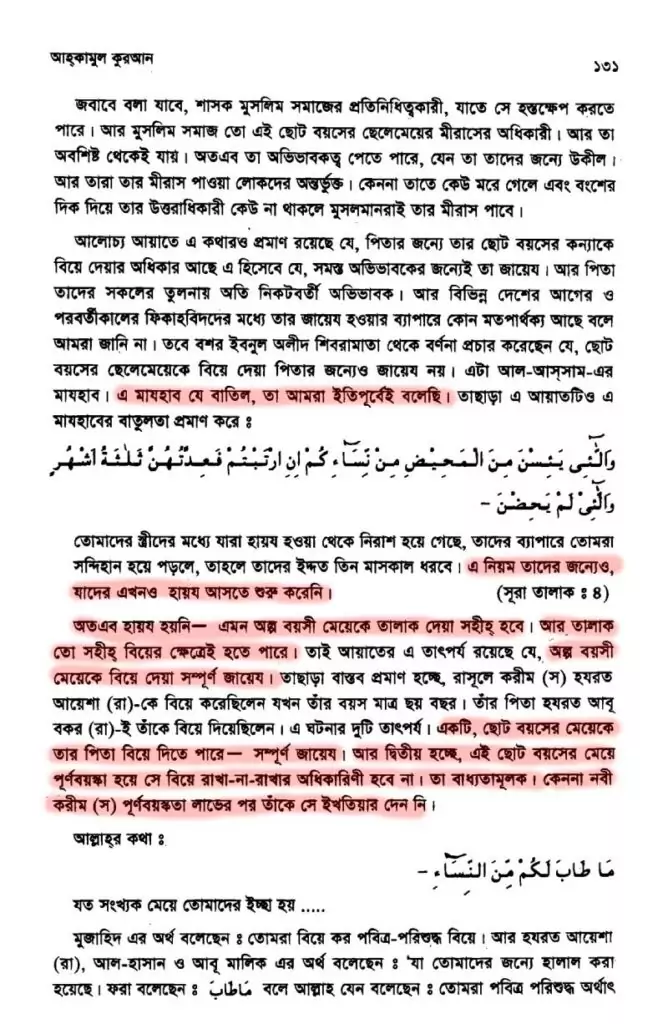
Al-Mabsut explains the absence of an option in a marriage arranged by the father on the basis of the strength of paternal guardianship. The paternal grandfather is discussed similarly. In Hanafi fiqh, an option after puberty may exist when another relative guardian arranged the marriage. The statement that “even if a child is married off, she can simply leave when she grows up” therefore does not correspond to the actual juristic structure.
Some school-based and modern discussions recognise circumstances in which a girl may accept or reject a marriage after puberty. [117]. But this possibility does not make child marriage morally valid. A later option cannot erase the decision already imposed upon the child’s childhood, body, social identity, and marital status.
An eight-year-old girl is married off, remains for several years under the marital authority of a husband, and is later told that she may now reject the marriage if she wishes. This cannot be called the child’s freedom. Freedom should begin earlier: the child should not have been placed into the marriage in the first place.
Determining a child’s life on her behalf first and then offering her a limited opportunity to escape after she grows older is not a substitute for consent. The real right is that no one should be able to choose her husband for her before she herself reaches adulthood.
Blood Money When Intercourse Tears the Body of a Child Wife
The juristic reality of child marriage becomes most naked in legal problems that calculate compensation when intercourse with a young wife tears her body. Ibn Qudamah’s Al-Mughni directly discusses a man who has intercourse with his young wife and causes such a tear. The ruling mentioned is one-third of the full blood money. [118].
Ibn Qudamah, Al-Mughni
وَمَنْ وَطِئَ زَوْجَتَهُ، وَهِيَ صَغِيرَةٌ، فَفَتَقَهَا، لَزِمَهُ ثُلُثُ الدِّيَةِ
“Whoever has intercourse with his wife while she is young and tears her, one-third of the blood money becomes obligatory upon him.”
Fatq refers to severe physical injury in which the wall between the sexual passage and another bodily passage is torn. Juristic discussions describe tearing between the urinary tract and vagina or between the vagina and rectum. Such injuries are comparable to severe obstetric and sexual trauma in modern medicine.
The subsequent discussion in Al-Mughni states that compensation is particularly relevant to a young wife or another physically weak woman whose body cannot tolerate intercourse. Fiqh therefore treats as a concrete legal problem a situation in which a wife is so young that her husband’s penetration can tear her body.
A civilised legal system does not begin by asking how much money must be paid after a child’s vagina is torn. The first rule should be that no adult man has any right to penetrate such a child’s body.
Blood money cannot restore the injured child’s body to its previous condition. Her pain, permanent physical damage, urinary incontinence, sexual and reproductive complications, and psychological trauma cannot be erased by a monetary value. By the time fiqh calculates compensation after the injury, the fundamental catastrophe has already occurred.
Child Pregnancy and Risks to Maternal Health
Early pregnancy is one of the sexual consequences of child marriage. Once a girl begins menstruating, pregnancy becomes biologically possible, but her body is not thereby fully prepared for safe pregnancy and childbirth. The World Health Organization reports that adolescent mothers aged 10–19 face higher risks of eclampsia, puerperal endometritis, and systemic infections than women aged 20–24. Their babies also face higher risks of low birth weight, preterm birth, and severe neonatal conditions. [119].
World Health Organization, Adolescent pregnancy
Adolescent mothers aged 10–19 face higher risks of eclampsia, puerperal infections, and systemic infections, while their babies face increased risks of preterm birth and low birth weight.
UNICEF also identifies links between child marriage and school dropout, early pregnancy, domestic violence, economic dependence, and restricted future opportunities. [120]. A child bride is not merely a young wife; she often quickly becomes a young mother as well. Childhood, education, economic independence, and personal development can all be restricted at once.
Being biologically capable of reproduction is not the same as being physically and psychologically prepared for safe motherhood. The fact that an eleven-year-old girl can become pregnant does not justify an adult man’s sexual access to her body. The opposite is true: because her physical risks are greater, she requires greater protection.
A child does not become a person fit to be used for reproduction merely because her body has become capable of producing a child. Reproductive capacity is not a certificate of sexual consent.
The Concept of Consent Collapses in Child Marriage
The most fundamental problem with child marriage is consent. A child can be asked whether she wants to marry and may even say “yes.” But freely informed consent requires more than uttering the word yes. The person must understand the meaning, risks, and long-term consequences of the decision and possess genuine freedom to refuse. The power imbalance created by family, religion, economics, and age also matters.
If a child cannot stand against her father’s decision, if her husband is many years older, if she is financially dependent, has no knowledge of the legal means of ending the marriage, and has been taught that obedience to her husband is a religious duty, her consent within that structure is not equivalent to the consent of an autonomous adult.
Children want many things in their lives, yet society does not treat all of those wishes as final legal consent. A ten-year-old may want to drive a car, take out a loan, or enter a permanent contract. The law protects the child from such decisions because she lacks the maturity to understand their long-term consequences. Sexual and marital relationships are not less serious; they are considerably more serious.
Turning a child’s “yes” into legal validation for an adult man’s sexual rights is not respect for the child’s consent. The child’s right is not to be pushed into such a decision before she reaches an age at which she can make it as an adult.
The Overall Structure of Child Marriage
Placed side by side, the evidence concerning Islamic child marriage forms a consistent picture. The Qur’an prescribes a waiting period for wives who have not begun menstruating. Al-Bukhari uses that verse in a chapter on the marriage of minors. Muhammad married Aisha at six and consummated the marriage at nine. A father may give his underage daughter in marriage. Puberty is not universally required for intercourse; a physical standard of whether the girl can tolerate penetration has also been used. Jurists discuss blood money when intercourse with a young wife tears her body. Together, these materials establish the result clearly: in classical Islamic law, child marriage was not merely a social occurrence but a legally valid institution, and intercourse with a child wife was directly discussed in fiqh.
The questions concerning the child’s life are arranged backwards in this structure. The first question should have been how a child could be a wife at all. Fiqh asks who may marry her off. The first rule should have been an absolute prohibition on adult sexual penetration of a child. Fiqh discusses when her body may be able to tolerate intercourse. The legality of such intercourse should have been rejected at the outset. Fiqh calculates how much blood money is due when intercourse tears the child’s body.
The conflict between modern children’s rights and classical Islamic sexual law is most naked here. A child-rights framework protects the child completely from adult sexual access. This juristic framework first brings the child within that access as a wife and then calculates how much injury her body can tolerate. This is not protection; it subjects the child’s body to marital sexual entitlement.
A just law for a child does not declare her suitable for marriage; it gives her a childhood. It does not determine when a husband’s sexual right begins; it excludes the child entirely from adult sexual entitlement. It does not calculate blood money after her body is torn; it prohibits such intercourse from the beginning. A legal system that cannot say this first does not protect the child; it places her within the risk of legally sanctioned sexual penetration.
Separate evidence-based discussions of child marriage, Aisha’s age, paternal authority to marry off a minor, pre-pubertal intercourse, khiyar al-bulugh, and the fiqh of injuries to child wives are available in the child-marriage section of the Shongshoy Knowledge Base. The central conclusion here is concise: Islamic sources and classical fiqh directly discuss the legal validity of child marriage and, in specified circumstances, marital intercourse with a child. This is not an allegation invented by modern critics. [121]
Talaq, Khul‘, Halala, and ‘Iddah
The structure of Islamic divorce does not give husband and wife equal power. A husband possesses the direct power to pronounce talaq. A wife cannot end the marriage in the same way by simply divorcing her husband. She must seek khul‘, enter a mutually agreed separation, establish grounds for judicial dissolution, or use a power of divorce previously delegated to her by the husband. In other words, the man’s power of separation is attached directly to marriage; the woman’s routes out are attached to conditions, compensation, mutual agreement, a judge, or authority delegated by the husband.
The inequality becomes even more severe after a third and final talaq. If the woman later wants to return to her former husband, she must genuinely marry another man, have sexual intercourse with that second husband, have the second marriage come to an end, complete another waiting period, and only then may she marry the first husband again. The man pronounced the talaq, but to reverse its final consequences the woman must pass physically through marriage and sexual intercourse with another man.
Control does not leave the woman’s body even after the marriage ends. A divorced woman must observe a prescribed ‘iddah; if pregnant, she waits until delivery; if menstruation has ceased or has not yet begun, she waits three months; if her husband dies, she observes four months and ten days of waiting and mourning. During that period a widow is also required to refrain from adornment, perfume, and cosmetics. If the wife dies, the husband has no corresponding mandatory mourning period of the same length, no equal ban on adornment, and no equivalent waiting period before remarriage. Within Islamic marriage, the principal power to end the relationship lies with the man, while after separation the longer restrictions on body, time, sexuality, and remarriage fall on the woman. Power and burden are again not distributed equally.
The Husband’s Unilateral Power of Talaq
The Qur’anic rules of divorce directly address men as the party pronouncing divorce. Surah Al-Baqarah 2:229 states that divorce may be pronounced twice, after which the wife is either retained honourably or released graciously. Surah At-Talaq 65:1 addresses men: when you divorce women, divorce them with regard to their waiting periods. [122] [123]. The direction of authority is clear even in the Qur’an’s grammar: the man divorces; the woman is divorced.
Qur’an, Surah Al-Baqarah 2:229 — Dr. Mustafa Khattab, The Clear Quran
الطلاق مرتان فامساك بمعروف او تسريح باحسان ولا يحل لكم ان تاخذوا مما اتيتموهن شييا الا ان يخافا الا يقيما حدود الله فان خفتم الا يقيما حدود الله فلا جناح عليهما فيما افتدت به تلك حدود الله فلا تعتدوها ومن يتعد حدود الله فاولايك هم الظالمون ٢٢٩
“Divorce may be retracted twice, then the husband must retain ˹his wife˺ with honour or separate ˹from her˺ with grace.”
In classical fiqh, the wife’s consent is not required for the husband’s talaq. Whether she wants the separation or agrees with his decision is not a fundamental condition for the talaq to take effect. The husband can effect it by his own decision. The wife does not possess the same automatic power. Merely saying to her husband, “I divorce you,” does not terminate the marriage unless he has previously delegated such authority to her.
This is the fundamental inequality of power in the marriage. Two people entered the contract, but the primary power to terminate it is directly vested in one of them and not the other. If the husband no longer wants the wife, he does not have to prove wrongdoing by her, produce evidence of abuse before a judge, or negotiate with her over returning the mahr. He possesses the power of talaq.
Of the two parties to the same contract, one can terminate the relationship by his own decision, while the other must find a separate legal route out. This is the first and most fundamental sex-based inequality of the Islamic divorce system. Let us listen to Mufti Ibrahim’s statement.
Now let us examine this rule more explicitly. [124] —
Mishkat al-Masabih
Chapter: Part 13 — Marriage
Publisher: Hadith Academy
Section 11: Second Section — Concerning Khul‘ and Talaq
Mishkat al-Masabih 3279 Narrated Thawban: The Messenger of Allah said: “Any woman who asks her husband for divorce without a reason will not even smell the fragrance of Paradise.” (Ahmad, Tirmidhi, Abu Dawud, Ibn Majah, Darimi)(1)
(1) Sahih: Abu Dawud 2226, Tirmidhi 1187, Ibn Majah 2500, Darimi 1316, Ahmad 22440, Irwa 2035, Sahih al-Jami‘ 2706, Sahih at-Targhib 2018.
Grade: Sahih
Explanation:
Talaq is the husband’s right, not the wife’s. If the wife has a valid reason, she will separate from her husband through khul‘. A woman should not ask her husband for divorce without a compelling reason. Some narrations also state that a woman should not seek divorce either for herself or for another woman.
For a woman who asks her husband for divorce without a reason, the fragrance of Paradise is forbidden—meaning that entry into Paradise is prohibited to her. This is language of warning and intimidation. Just as the righteous will smell the fragrance of Paradise at the first stage, she will not receive that fragrance. ‘Allamah Qadi ‘Iyad says it may also mean that even if she enters Paradise, she will be deprived of its fragrance. (Mirqat al-Mafatih)
Now let us see what Tafsir Ma‘ariful Qur’an says. [125] —
ودرو
The Messenger himself explained its tafsir: النِّكَاحِ بيده عقدة الذي بيده
ولى عقدة النكاح الزوج
Al-Daraqutni narrated it from ‘Amr ibn Shu‘ayb, from his father, from his grandfather, and it has also been transmitted from Ali and Ibn Abbas.
—(Qurtubi)
This proves that once a marriage has been concluded, the husband is the one who possesses the power to maintain or dissolve it. He is the one who can pronounce talaq. A woman’s opportunity to pronounce talaq is limited.
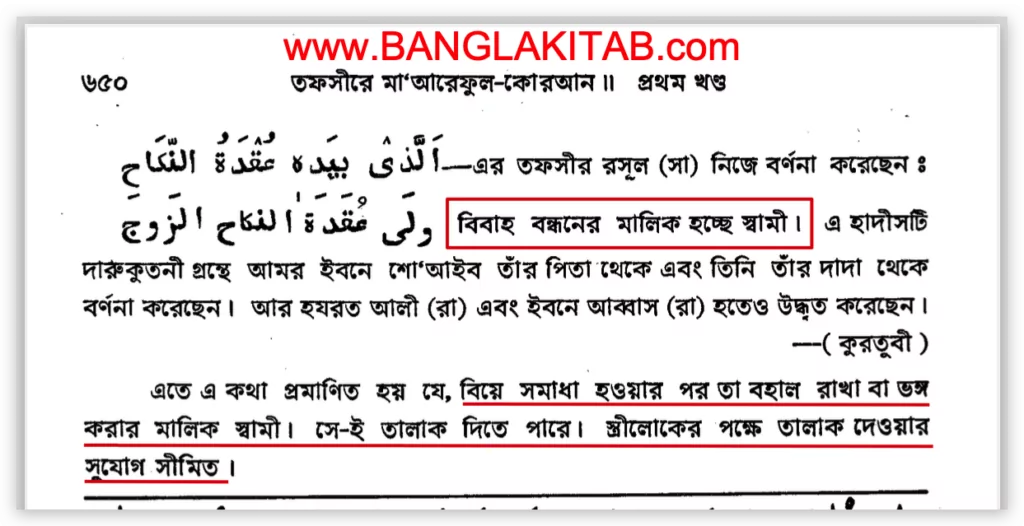
Now let us examine the law during the period of the third caliph Uthman from the book Fiqh of Uthman, may Allah be pleased with him. [126]
In this context our position is that talaq takes effect upon women, not upon men. It therefore does not take effect unless it is specifically directed accordingly. If
a man says to his wife — أنا منك طالق “I am divorced from you,”
or, after delegating the power of talaq to his wife, she says — أنت طالق “You are divorced,”
then talaq does not occur by these words. Likewise, if a person pronounces talaq upon another man, no talaq occurs, because talaq takes effect upon women. 27
An incident from the period of Uthman: Muhammad ibn ‘Abd al-Rahman ibn Abi Bakr had delegated the power of talaq to his wife Rumaysa al-Farasiyyah. She said to him:
أنت طالق ثلاث مرات “You are divorced three times.”
In deciding the case, Uthman said that the woman had made an error in wording, because a woman does not divorce; rather, she receives divorce. 28
Now let us examine a fatwa. [127] —
A wife cannot divorce her husband under any circumstances
Question: My wife dreamed that she was divorcing me. She has also long been affected by a bad influence; when it comes over her she loses awareness and begins speaking incoherently. She says things such as, “I will divorce you.” When it passes she remains unconscious for a long time. When she regains consciousness she says, “No, why would I divorce you? I have two sons and a husband—what are you saying?” Does divorce occur in this situation?
Answer: Islamic Sharia has granted the power of talaq only to the husband, not to the woman. Therefore, in the case described, whether the woman says it in a dream or while awake, consciously or unconsciously, if she pronounces talaq upon her husband it does not take effect. (17/648/7239)
Revocable Talaq and the Husband’s Power to Take Her Back during ‘Iddah
For a first or second talaq, Islamic law recognises talaq raj‘i, a revocable divorce. Qur’an 2:228 instructs divorced women to wait for three quru’ and states in the same verse that during this period their husbands have a greater right to take them back if reconciliation is intended. [59].
Qur’an, Surah Al-Baqarah 2:228 — Dr. Mustafa Khattab, The Clear Quran
والمطلقات يتربصن بانفسهن ثلاثة قروء ولا يحل لهن ان يكتمن ما خلق الله في ارحامهن ان كن يومن بالله واليوم الاخر وبعولتهن احق بردهن في ذالك ان ارادوا اصلاحا ولهن مثل الذي عليهن بالمعروف وللرجال عليهن درجة والله عزيز حكيم ٢٢٨
“Divorced women must wait three monthly cycles ˹before they can re-marry˺.” The verse then says that “their husbands reserve the right to take them back within that period if they desire reconciliation.”
The husband pronounced the talaq, and during the waiting period following the first two revocable divorces he can also restore the marriage through ruju‘. Classical fiqh contains detailed rules concerning how such restoration occurs. The power both to place the wife into the uncertainty created by divorce and then to take her back during the waiting period is centred on the husband.
Qur’an 2:231 warns against abusing this power. It says that when women reach the end of their waiting period, they should either be retained honourably or released honourably and must not be retained with the intention of harming them. [128]. The need for such a warning itself shows that the powers of divorce and restoration could be used as a means of keeping a woman suspended.
The man first breaks the relationship and then retains a special power to restore it during the waiting period. The woman cannot begin a new marriage during that same period. The interval after divorce is therefore not a period of equal freedom for the man and the woman.
A Woman’s Route to Separation: Khul‘
If a woman can no longer tolerate living with her husband, the best-known route of separation available to her is khul‘. Sahih al-Bukhari contains the case of the wife of Thabit ibn Qays. She came to Muhammad and said she had no complaint against Thabit’s character or religion but did not wish to remain married to him. Muhammad asked whether she would return the garden Thabit had given her as mahr. When she agreed, Muhammad told Thabit to accept the garden and divorce her once. [129].
Sahih al-Bukhari
Book 68: Divorce
5273. The wife of Thabit ibn Qays came to Muhammad and said, “I do not blame Thabit for defects in his character or his religion, but I cannot continue living with him.” Muhammad asked, “Will you give back his garden?” She said yes. Muhammad then told Thabit: “Accept the garden and divorce her once.”
Grade: Sahih
The distribution of power in the episode is clear. The wife no longer wants the marriage. She does not accuse her husband of immorality, irreligion, or abuse. She simply does not want to remain with this man. Yet she does not stand in the same position as the husband and directly terminate the marriage. She is required to return the garden she received, after which Muhammad tells the husband to divorce her.
Qur’an 2:229 likewise provides a basis for a wife giving something back in order to obtain release. It says that if the spouses fear that they cannot maintain Allah’s limits, there is no blame if the woman gives something in return for her freedom. [122]. This is the foundation of the financial structure of khul‘.
The difference between a husband’s talaq and a wife’s khul‘ can be stated simply. The husband no longer wants the relationship: he pronounces talaq. The wife no longer wants the relationship: the question of returning mahr or other compensation may arise and a separate process of dissolution begins. The man’s freedom is the power to end the relationship; the woman’s freedom may require buying her release by returning property she had received.
Mubarat: No Separation without Mutual Agreement
Another route available to a woman is mubarat. Here both husband and wife agree to end the relationship and dissolve the marriage through mutual settlement. The woman can obtain separation, but the power is not unilateral. The husband also agrees to the separation, which is why the marriage ends.
The difference from the husband’s talaq is clear. The husband does not require the wife’s consent for his unilateral talaq. Mubarat, by contrast, depends upon agreement between the two parties. The wife cannot unilaterally declare mubarat and end a marriage against an unwilling husband.
Mutual separation is not itself unusual; modern legal systems also recognise consensual divorce. The problem arises when the same system gives the man a separate unilateral door that does not require mutual agreement while denying the woman an equivalent door.
Keeping unilateral talaq in the man’s hands while telling the woman, “You may separate if both of you agree,” is not equal power. One possesses the key to his own door; the other requires permission to open a shared door.
Talaq-e-Tafwid: The Wife Can Divorce If the Husband Delegates the Power
Islamic law also recognises talaq-e-tafwid, delegated divorce. At the time of the marriage contract or later, a husband may delegate part of his power of talaq to his wife. When the specified condition occurs, the wife can use that delegated power to effect a divorce upon herself. This arrangement is particularly familiar in South Asian Muslim family law.
The very name of the mechanism reveals the source of the power. It is not the wife’s inherent and parallel power of talaq; it is the husband’s tafwid—his delegation. He permits her to exercise a power originally vested in him. Including such a condition in a marriage contract can provide real protection to a woman, especially if the husband takes another wife, stops maintaining her, or violates specified conditions. But a power that reaches her only through the husband’s delegation cannot be described as equal to the husband’s original power of talaq.
An adult man does not need his wife to grant him advance authority in order to end the marriage. An adult woman may require the husband’s contractual delegation to exercise the equivalent mechanism. If the woman’s power of talaq is a power given to her by the man, the question of who owns the original power is answered by the name of the institution itself.
Religious Threats against Seeking Separation
Although khul‘ provides a route for women to leave marriage, religious pressure is also placed upon the decision to seek separation. Muhammad is reported in Sunan Abi Dawud and Jami` at-Tirmidhi as saying that a woman who asks her husband for divorce without an acceptable reason will be forbidden the fragrance of Paradise. [130] [131].
The qualification “without a reason” matters; the hadith does not directly abolish the right of an abused woman or a woman with a legitimate reason to seek separation. But the inequality of power is still clear: the husband possesses the basic unilateral power of talaq, while additional religious fear is placed over a woman’s request to leave. The ability to exit marriage is not located within the same legal and religious structure for both parties.
If the Husband Marries Again, the Wife Is Directed toward Khul‘
The discussion of polygyny showed that a husband is not required to obtain his first wife’s permission before marrying another woman. If the first wife refuses to accept that decision, she again enters the unequal structure of divorce. She cannot simply divorce her husband by saying, “You married another woman, so I divorce you.” She may have to use khul‘, seek judicial dissolution, or invoke a delegated power of divorce contained in the contract.
An IslamQA fatwa addressing a wife who seeks separation because her husband takes another wife discusses khul‘ and the possible return of the mahr. [132]. The same event therefore creates different powers for the man and woman. The man can unilaterally alter the structure of the existing marriage by bringing in another wife. If the first wife rejects the change, her remedy is not to invalidate the new marriage but to seek a route out of her own.
The woman bears a double cost. First, without her consent, her husband marries another woman and alters the distribution of time, money, sexuality, and family life. Then, if she refuses to accept that life, leaving her own marriage may require a separate process, financial sacrifice, or judicial struggle.
The man receives freedom to expand the relationship. If the woman cannot tolerate that expansion, she bears the cost of leaving. Read together, the rules of polygyny and divorce make the limits of female power even clearer.
Returning to the First Husband after a Third Talaq
Qur’an 2:230 states that if a husband divorces his wife for the third time, she is no longer lawful to him until she marries another husband. If that second husband later divorces her, the woman and her first husband may marry again. [133].
Qur’an, Surah Al-Baqarah 2:230 — Dr. Mustafa Khattab, The Clear Quran
فان طلقها فلا تحل له من بعد حتى تنكح زوجا غيره فان طلقها فلا جناح عليهما ان يتراجعا ان ظنا ان يقيما حدود الله وتلك حدود الله يبينها لقوم يعلمون ٢٣٠
“So if a husband divorces his wife ˹three times˺, then it is not lawful for him to remarry her until after she has married another man and then is divorced.”
Merely signing a marriage document with the second husband does not satisfy this condition. Sahih al-Bukhari contains the case of the former wife of Rifa‘a al-Qurazi. After Rifa‘a gave her a final divorce, she married ‘Abdur-Rahman ibn al-Zubayr. When she later wanted to return to her first husband, Muhammad explicitly told her that she could not return to Rifa‘a until full sexual intercourse had occurred with the second husband. [134].
Sahih al-Bukhari
2639. When the former wife of Rifa‘a wanted to return to her first husband, Muhammad said that this could not happen until she tasted the sweetness of the second husband and he tasted her sweetness.
Grade: Sahih
“Tasting sweetness” is a metaphor here for sexual intercourse. It is not enough merely to marry the second husband; intercourse with him must occur. That second marriage must then genuinely come to an end. Only after completing the subsequent waiting period may the woman marry the first husband anew.
The man closed the relationship by pronouncing three talaqs. If both later wish to reunite, the first man does not have to pass through sexual intercourse with another woman. The woman must become another man’s wife, have intercourse with him, have that relationship end, and then wait. The three talaqs leave the man’s mouth, but the physical price of reversing their irreversible consequence is borne by the woman’s body.
Planned Halala, the Muhallil, and the “Hired Billy-Goat”
Arranging in advance for another man to marry a woman temporarily so that she may return to her first husband after three talaqs is known as tahlil, or commonly as a halala marriage. Hadith strongly condemn such an arranged scheme. Muhammad cursed both the muhallil, the man who marries the woman to make her lawful again for her first husband, and the muhallal lahu, the first husband for whom the arrangement is performed. [135].
Mishkat al-Masabih
3296. Narrated ‘Abdullah ibn Mas‘ud: Muhammad cursed the muhallil and the muhallal lahu. The commentary defines the muhallil as a man who marries a woman divorced three times and, after intercourse, divorces her so that she becomes lawful again for the previous husband.
Grade: Sahih
The commentary in Mishkat compares such a man to a “hired billy-goat,” emphasising the degrading nature of a contrived marriage of this kind. But condemning the contrived arrangement does not remove the requirement of a second husband and actual intercourse after three talaqs. Rather, by condemning a staged one-night contract, it reinforces the requirement that the second marriage be genuine.
Thus, if the woman wants to return to her first husband, she cannot simply use a nominal husband for one night to satisfy the rule on paper. The second marriage must be a real marriage and sexual intercourse must occur. That marriage must then end in the ordinary course.
Planned halala is cursed, but the underlying rule that makes the woman sexually lawful again to her first husband only after intercourse with a second husband remains intact. The problem is not merely the contrived halala; it is the law that makes sex with another man a mandatory gateway to returning to the first husband.
The Waiting Period of a Divorced Woman
After a marriage ends, a woman cannot immediately marry someone else. Qur’an 2:228 requires divorced women to wait for three quru’. Jurists dispute whether quru’ refers to menstrual periods or periods of purity, but there is no disagreement that the woman is subject to a mandatory waiting period. [59].
Surah At-Talaq 65:4 prescribes three months for women whose menstruation has ceased and for those who have not yet menstruated. The waiting period of a pregnant woman lasts until delivery. [105]. As shown in the section on child marriage, the phrase “those who have not menstruated” became an important basis in juristic discussions of marriage and intercourse involving underage wives.
Summary of Qur’an, Surah At-Talaq 65:4
Those past the age of menstruation wait three months, those who have not menstruated likewise wait three months, and the term of pregnant women ends with delivery.
‘Iddah is connected to determining pregnancy and lineage, and in revocable divorce it also creates a period in which reconciliation may occur. But the practical restriction falls upon the woman’s body and sexual life. She cannot choose a new partner and immediately marry. Her menstruation, pregnancy, and the condition of her womb determine the timetable of her next marriage.
There is no general waiting period for a man after divorce equivalent to a woman’s three quru’ or three months. In particular circumstances he may face temporary restrictions on a new marriage—for example, the question of taking a fifth wife while the revocable waiting period of one of four wives continues. But there is no general ‘iddah attached to the male body.
The husband exercises the power of talaq; the physical timetable after talaq is then measured through the woman’s menstruation, pregnancy, and womb. The power rests with the man; the waiting period is imposed on the woman’s body.
The Widow’s Waiting Period of Four Months and Ten Days
When a husband dies, the widow is subject to an even longer waiting period. Qur’an 2:234 states that women whose husbands die must wait for four months and ten days. The woman may not remarry before this period has ended. [136].
Qur’an, Surah Al-Baqarah 2:234 — Dr. Mustafa Khattab, The Clear Quran
والذين يتوفون منكم ويذرون ازواجا يتربصن بانفسهن اربعة اشهر وعشرا فاذا بلغن اجلهن فلا جناح عليكم فيما فعلن في انفسهن بالمعروف والله بما تعملون خبير ٢٣٤
“As for those of you who die and leave widows behind, let them observe a waiting period of four months and ten days.”
For a pregnant widow, the rule of Surah 65:4 applies until childbirth. A woman who gives birth shortly after her husband’s death may therefore complete her waiting period with that delivery, while a non-pregnant widow ordinarily remains subject to the four-month-and-ten-day period.
These four months and ten days are not merely a prohibition on remarriage. Hadith also prescribe ihdad, mandatory mourning for the widow. During this period she is instructed to refrain from perfume, kohl around the eyes, and decorative coloured clothing.
Restrictions on a Widow’s Adornment, Perfume, and Kohl
In Sahih al-Bukhari, Umm ‘Atiyya reports that women were forbidden to mourn for anyone other than a husband for more than three days, while a wife whose husband died was required to mourn for four months and ten days. During that period, they did not use kohl, perfume, or ordinary coloured clothes, apart from specified exceptions. [137].
Sahih al-Bukhari
5341. Umm ‘Atiyya said: “We were forbidden to mourn for a dead person for more than three days except in the case of a husband, for whom one should mourn for four months and ten days. During that time we were not to use kohl, perfume, or coloured clothes except a garment made of ‘asb.”
Grade: Sahih
In another sahih report, a widow developed an illness in her eye. Her family sought permission for her to use kohl, but Muhammad did not permit it and referred to completing the four months and ten days. [138] [139].
The woman’s marital relationship with the deceased husband has ended through death, yet her clothing, beauty practices, perfume, and the timing of any subsequent marriage remain under religious regulation. Grief is an emotion, but Sharia converts it into mandatory conduct governing the woman’s body and adornment.
The husband is dead, yet the legal shadow of the marriage remains for four months and ten days over the living woman’s body, clothing, cosmetics, and future relationship.
No Equal Mourning Obligation for a Husband Whose Wife Dies
The four-month-and-ten-day ‘iddah and ihdad are obligatory for a widow, but no equivalent rule is imposed upon a husband when his wife dies. He does not have to refrain from remarriage for four months and ten days, cease using perfume, or abandon clothing and adornment. Classical fiqh does not impose obligatory ihdad upon men. Al-Mawsu‘ah al-Fiqhiyyah likewise records juristic agreement that this mourning requirement does not apply to men.
The same death therefore creates different religious restrictions in the lives of husband and wife. When the husband dies, the wife cannot remarry for four months and ten days and must refrain from adornment. When the wife dies, the man may marry another woman shortly thereafter if he wishes. No equal religious waiting period is prescribed for him.
This inequality can be partly explained through pregnancy and lineage because a man does not become pregnant. But the rules governing adornment and mourning are not means of determining pregnancy. The widow’s perfume, kohl, clothing, and mourning behaviour are regulated; there is no parallel religious conduct imposed upon the widower.
The death of a wife does not hold a man back from a new life through a Sharia waiting period. The death of a husband places the woman under four months and ten days of waiting, mourning, clothing, and adornment restrictions. Even at the end of the same marital relationship, the freedom of women and men is unequal.
The Overall Power Structure of Talaq, Khul‘, Halala, and ‘Iddah
When all these rules are placed together, the Islamic structure of divorce becomes clear. The husband may pronounce talaq by his own decision. During the waiting period of the first two divorces, he also possesses a special power of restoration. If the wife wants to leave, she must use khul‘, mubarat, judicial dissolution, or delegated talaq. In the principal hadith of khul‘, the woman returns the garden she received and the husband pronounces the divorce. Mubarat requires agreement by both. In tafwid, the power of talaq used by the wife is itself delegated by the husband.
After the third talaq, words pronounced by the man impose still deeper control over the woman’s future sexual life. To return to the first husband, she must marry another man, have sexual intercourse with him, have that second marriage end, and then complete a new waiting period. A prearranged halala is cursed, yet without a genuine second marriage and intercourse there is no route back to the first husband.
Then comes ‘iddah. The divorced woman waits. The pregnant woman waits until childbirth. A woman who has not menstruated or whose menstruation has ceased waits three months. A widow waits four months and ten days and observes mourning. Men have no parallel general ‘iddah, and widowers have no mandatory ihdad.
The same pattern runs through the entire Islamic divorce structure: the principal power to end the relationship is in male hands, while after the relationship ends the greater share of waiting, sexual restriction, conditions of remarriage, and mourning falls on the woman’s body and time. Talaq is the man’s right; khul‘ can become the woman’s negotiation for release; halala makes her body pass through a second man; ‘iddah holds her time. This is not a system of equal power to leave a marriage.
Inheritance: Sex-Based Inequality in the Distribution of Property
Under the Islamic system of inheritance, the shares of women and men are not determined by examining their individual needs, education, income, responsibilities, poverty, the source of the property, or the actual depth of their relationship with the deceased. In many important cases, sex itself determines the size of the share. When a son and daughter of the same parents inherit together, the son receives twice as much as the daughter. Within the same marital relationship, when the wife dies, the husband receives a prescribed share that is twice what the wife would receive under the corresponding circumstances if the husband died. When brothers and sisters inherit together, the male share in specified cases equals that of two females. Even after the prescribed shares have been distributed, sahih hadith gives priority over the residue to the nearest male relative.
Under this system, a woman sometimes inherits property, sometimes receives the same share as a man, and in particular circumstances may even receive more than a particular male heir. But to determine whether the inheritance system contains sex discrimination, it is unnecessary to show that women receive less in every possible family configuration. Where two heirs standing in the same relationship are assigned shares in a 1:2 ratio solely because one is female and the other male, the discrimination is already explicit. Two children of the same parents, one a son and the other a daughter. Because one has male genitalia, he receives twice the property; because the other is female, she receives half. No complicated theology is required to identify the inequality. The numbers themselves reveal the character of the law.
A Son’s Share Equals That of Two Daughters
Surah An-Nisa 4:11 declares the best-known sex-based rule of Islamic inheritance. When sons and daughters inherit together, the share of one son is equal to that of two daughters. The same verse states that if there is only one daughter, she receives half, while if there are two or more daughters, they collectively receive two-thirds. [140].
Qur’an, Surah An-Nisa 4:11 — Dr. Mustafa Khattab, The Clear Quran
يوصيكم الله في اولادكم للذكر مثل حظ الانثيين فان كن نساء فوق اثنتين فلهن ثلثا ما ترك وان كانت واحدة فلها النصف ولابويه لكل واحد منهما السدس مما ترك ان كان له ولد فان لم يكن له ولد وورثه ابواه فلامه الثلث فان كان له اخوة فلامه السدس من بعد وصية يوصي بها او دين اباوكم وابناوكم لا تدرون ايهم اقرب لكم نفعا فريضة من الله ان الله كان عليما حكيما ١١
“Allah commands you regarding your children: the share of the male will be twice that of the female.”
A simple calculation makes the inequality clear. Suppose a person dies leaving three million taka and the only heirs are one son and one daughter. Under the Qur’anic rule, the estate is divided into three shares. The son receives two shares, or two million taka. The daughter receives one share, or one million taka. They are children of the same parents and stand in the same generational relationship to the deceased, yet the son receives twice the daughter’s share.
Whether the son is poor or wealthy, whether the daughter is financially independent or destitute, whether the daughter cared for her elderly parents, or whether the son lived away from the family for many years plays no role in this calculation. The son receives twice the female child’s share because he is male. The same sex-based ratio applies even where the son is a high-earning software engineer and the daughter is unemployed, ill, and a mother of three.
Nor does the rule change if the circumstances are reversed. Even if the daughter earns millions and the son is unemployed, the son receives twice as much. The law therefore does not assess the individual’s actual economic circumstances. It assumes in advance that a larger property share should be assigned to the male. Giving twice the inheritance on the basis of biological sex while ignoring the individual’s actual needs is discriminatory distribution of property.
The Husband Receives Twice the Wife’s Share
The 2:1 ratio is not confined to sons and daughters. Surah An-Nisa 4:12 establishes the same sex-based disparity in the prescribed shares of husbands and wives. If a wife dies without children, her husband receives half of her estate. If she leaves children, he receives one-quarter. Conversely, if a husband dies without children, his wife receives one-quarter; if he leaves children, she receives one-eighth. [141].
Summary of Qur’an, Surah An-Nisa 4:12
If a wife dies without leaving children, the husband receives half; if she leaves children, he receives one-quarter. If a husband dies without leaving children, the wife receives one-quarter; if he leaves children, she receives one-eighth.
Suppose one member of a childless couple dies leaving four million taka. If the wife dies, the husband receives two million taka as his Qur’anic prescribed share. In the same circumstances, if the husband dies, the wife receives one million taka. If there are children, then after the wife dies the husband receives one million taka, whereas after the husband dies the wife receives five hundred thousand. The presence of other heirs may change the distribution of the remainder, but it does not change the ratio between the prescribed shares of husband and wife.
This inequality is especially significant because husband and wife are the two parties to the same marriage. A woman may have spent thirty years with her husband, given birth to children, raised them, abandoned her own career, cared for an ill husband, and managed the entire household. If her husband dies leaving children, her prescribed share is one-eighth. In the same family, if the wife dies, the husband’s prescribed share is one-quarter.
When one party to the same marriage dies, the surviving male partner receives a prescribed proportion twice as large as the surviving female partner would receive in the reverse situation. This is not a matter of interpretation; it is a direct numerical rule of the Qur’an.
With Multiple Wives, Even the One-Eighth Must Be Divided
When polygyny and inheritance intersect, a woman’s share may become still smaller. If a man has multiple wives, the one-quarter or one-eighth prescribed for wives in Qur’an 4:12 is not awarded separately to each wife. All the wives divide that share among themselves. Thus, where the deceased man leaves children, his two, three, or four wives collectively receive a total of one-eighth.
Suppose a man dies leaving eight million taka, children, and four wives. The wives’ combined prescribed share is one-eighth, or one million taka. Divided equally among four wives, each receives 250,000 taka. In the corresponding situation, if a woman dies, her single husband receives one-quarter by himself because she has children—two million taka.
On the one hand, Sharia permits a man to have four wives; on the other, the prescribed share for wives after his death does not increase with the number of wives. Four women divide the same one-eighth. While alive, a man may extend marital rights over four women; after his death, those four women must divide among themselves the same small portion of his estate.
A Brother’s Share Equals That of Two Sisters
The 2:1 ratio between son and daughter reappears for brothers and sisters in Surah An-Nisa 4:176. Regarding the inheritance of a person who dies without descendants or a father, the verse states that if there is one sister, she receives half; if there are two sisters, they receive two-thirds; and if there are both brothers and sisters, the share of one male equals that of two females. [142].
Qur’an, Surah An-Nisa 4:176 — Dr. Mustafa Khattab, The Clear Quran
يستفتونك قل الله يفتيكم في الكلالة ان امرو هلك ليس له ولد وله اخت فلها نصف ما ترك وهو يرثها ان لم يكن لها ولد فان كانتا اثنتين فلهما الثلثان مما ترك وان كانوا اخوة رجالا ونساء فللذكر مثل حظ الانثيين يبين الله لكم ان تضلوا والله بكل شيء عليم ١٧٦
“But if the deceased leaves male and female siblings, a male’s share will be equal to that of two females.”
The same mathematical priority is therefore used across two different relationships. Among children, the son receives twice as much; among siblings, the brother receives twice as much. This is not an accidental consequence of a single family configuration. Within Qur’anic inheritance law, the double male share is a recurring principle.
Suppose the deceased leaves only one brother and one sister, with three million taka available for distribution. Under the applicable 2:1 rule, the brother receives two million and the sister one million. The shares do not change if the brother is wealthy and the sister destitute. Even if the sister cared for the deceased during the final ten years of his life while the brother maintained no contact, the Qur’anic mathematical formula does not take personal contribution into account.
After the son, the same declaration reappears with the brother: one man equals two women. Sex determines the mathematical value of inheritance here.
Priority over the Residue Goes to the Nearest Male Relative
Beyond the prescribed Qur’anic shares of women and men, another important layer of Islamic inheritance law is ‘asabah, or residuary inheritance. In Sahih al-Bukhari, Muhammad said that after the prescribed shares have been given to those entitled to them, whatever remains should be given to the nearest male relative. [32].
Sahih al-Bukhari
Book 85: Laws of Inheritance
Sahih al-Bukhari 6732
Narrated Ibn ‘Abbas: Muhammad said, “Give the Fara’id (the shares of the inheritance that are prescribed in the Qur’an) to those who are entitled to receive it. Then whatever remains, should be given to the closest male relative of the deceased.”
Grade: Sahih
Consider a simple example. A person dies leaving one daughter and one paternal uncle, with no other heir who would alter the calculation. Under Qur’an 4:11, the only daughter receives half. The remaining half may go to the paternal uncle as the nearest male ‘asabah. The deceased person’s own daughter stops at half of the estate, while his father’s brother takes the remainder.
A daughter is the deceased person’s direct child. The uncle is a paternal relative one generation to the side. Yet the daughter’s female status can limit her to a prescribed half, while the residue passes to a male agnatic relative. This principle of ‘asabah shows deep continuity with the patrilineal property structure of pre-Islamic Arabia. Research by Noel J. Coulson and M. Habibur Rahman has likewise examined this historical continuity.
In certain special circumstances, women can also become residuary heirs, particularly in some combinations involving daughters together with full or paternal sisters. But these exceptions do not alter the male-centred structure of ‘asabah. The central wording of Muhammad’s instruction explicitly gives priority over the residue to the “closest male.”
Limiting the daughter to a prescribed share and then transferring the remainder to a male paternal relative keeps the woman not as the central heir to the property, but as a limited participant.
Where the Qur’anic Shares Are Equal
Under Qur’anic inheritance law, it is not the case that every woman always receives half of every man’s share. In Surah An-Nisa 4:11, if the deceased has children, both the father and mother receive one-sixth. Again, in Surah An-Nisa 4:12, where maternal half-siblings inherit, a single brother or sister receives one-sixth, while if there are more, they collectively share one-third; no 2:1 ratio between women and men is imposed there.
These differing rules show that Islamic inheritance law was not constructed from a single formula. But where the Qur’an itself places male and female heirs of the same relationship side by side, it nevertheless gives men twice as much in several important cases. Son and daughter: 2:1. Husband and wife in their prescribed shares: 2:1. Brother and sister: 2:1. The existence of some cases of equal shares does not cancel these explicit inequalities.
Suppose a company’s pay policy gives men and women equal salaries in some positions, but for another category within the same position the written rule says male employees receive twice the salary of female employees. Equality in the first category does not erase discrimination in the second. The same principle applies to inheritance.
To establish discrimination, women do not have to receive less in every conceivable situation. If a law gives a woman in the same specified relationship half solely because she is a woman, that particular rule is discriminatory.
“Men Provide Maintenance, Therefore They Receive Twice as Much”
The best-known justification for men receiving twice the inheritance is that Islam imposes responsibility for maintaining wives and families on men, and therefore gives them more property. This argument does not deny that inheritance is unequal; rather, it introduces another sex-based role as the reason for that inequality. The man bears the economic responsibility, therefore the man receives more property. Women are placed in a dependent position and their smaller property share is then explained through that very dependence.
In actual life, this assumption is not true of every family. Many women are the primary earners in their households. Many women bear the costs of medical treatment and daily living for elderly parents. Many widowed or divorced women raise their children alone. Many brothers assume no financial responsibility for their sisters. A son may be a minor, disabled, or unemployed while his sister is a highly paid physician. The inheritance rule does not alter the shares after examining any of these realities.
The male obligation of maintenance is itself part of the same male-centred family structure. The man is declared the economic head of the family, the woman is placed in a position of dependence upon him, and then the argument is made that because the man is the head, he should receive more property. Property and power therefore accumulate in the same direction: greater inheritance in male hands, qawamah in male hands, talaq in male hands, and the right to polygyny in male hands.
Assigning women an economically subordinate role and then using that subordination as the reason to give them less property is not an argument for equality. It uses patriarchal roles and patriarchal property distribution as mutually reinforcing justifications.
Inheritance Is Determined by Sex, Not Individual Need
A fundamental principle of modern property rights is that women and men are equal legal persons. No one is twice the citizen because he is a son, and no one is half a child because she is a daughter. During their lifetimes, parents may choose to assist children according to need, spend more on a sick child, or provide special protection for a disabled child. But when state or religious inheritance law declares from birth that a male child is entitled to twice the property of a female child, sex has already determined the result before the individual circumstances of their lives have even begun.
The long-term effect of this inequality does not end within a single generation. Land, houses, businesses, capital, and savings pass from generation to generation. If sons receive larger shares than daughters in every generation, ownership of family land and capital increasingly accumulates among male descendants. Property is not merely money: it is social power, security, borrowing capacity, the opportunity to start a business, and the ability to make independent decisions in times of crisis.
A woman who receives less property may become more dependent on a husband or other male relatives. Economic dependence can in turn weaken her ability to leave an abusive marriage, establish a separate household with her children, or make independent decisions. Inheritance inequality is therefore not merely a numerical issue after death; it is a question of the living woman’s power.
Those who hold more property generally hold greater decision-making power. Repeatedly giving men larger shares under inheritance law is not only economic inequality; it is a mechanism that keeps economic power accumulating in male hands across generations.
Continuity with the Pre-Islamic Male Inheritance Structure
Islamic inheritance law was not created entirely from nothing. In many tribes of pre-Islamic Arabia, the principal heirs to property were male relatives capable of fighting. Early sources cited in commentary on Surah An-Nisa 4:7 state that one reason women and small children were denied inheritance was that they did not ride horses into battle, fight the enemy, or acquire spoils. This account also appears in Al-Durr al-Manthur. [143].
In Sahih al-Bukhari, Ibn ‘Abbas likewise refers to the existence of an earlier inheritance system. He states that the property of a deceased person used to go to the children, while bequests were made for the parents. Allah then altered parts of that system, fixing for the male twice the share of the female and prescribing separate shares for parents, wives, and husbands. [31].
Sahih al-Bukhari
Sahih al-Bukhari 2747
Ibn ‘Abbas stated that the property of the deceased was formerly inherited by the children while the parents received through bequest. Allah then changed that custom and prescribed “for the male twice the amount inherited by the female,” together with separate shares for the parents, wife, and husband.
Noel J. Coulson’s analysis of Islamic succession law shows that the Qur’anic fixed shares were superimposed upon an older male agnatic system of inheritance. Daughters, mothers, wives, and sisters received prescribed shares, but the male ‘asabah structure was not abolished. [144]. M. Habibur Rahman’s research likewise analyses direct and indirect continuities between pre-Islamic Arabian inheritance customs and Islamic law. [34].
The older patrilineal property structure was therefore not completely overturned by the new religious system. Women acquired specified shares, but the son’s double share, the husband’s double prescribed share, the brother’s double share, and the priority of male agnates over the residue all coexist within the same system.
Islamic inheritance law did not make women and men equal property heirs. It combined the older patrilineal property structure with new prescribed shares and transformed the result into religious law, within which male economic priority is explicitly written into numerous important relationships.
The Overall Accounting of Inheritance Inequality
Placed side by side, the numbers speak for themselves. A son receives twice as much as a daughter. Within the same marriage, a husband receives twice the wife’s corresponding prescribed share. When brothers and sisters inherit together in specified circumstances, the brother receives twice the sister’s share. Where there are multiple wives, they divide the same one-quarter or one-eighth among themselves. And under the general rule governing the residue after prescribed shares, the nearest male agnate receives priority.
This inequality is not merely a one-time distribution within one family. When larger portions of land, houses, businesses, and savings pass to male heirs in each generation, men’s economic power is reproduced across generations. A woman enters marriage with less property, remains under her husband’s economic authority, and in many cases also receives less from her natal family’s estate.
When the power structures discussed in the preceding sections are added to this, the picture becomes clearer still. The man is the family’s qawwam, may have four wives, holds the principal power of divorce, possesses religious claims over his wife’s sexual availability, and also receives larger shares in many central inheritance situations. Property, marriage, sexuality, and family authority accumulate toward the same sex.
A woman is not half a child, half a sibling, or half a spouse. There is therefore no just basis for her inheritance to be half that of a man standing in the same relationship. Inheritance may reasonably take account of relationships and needs, but turning biological sex into the mathematical value of property is direct discrimination.
Women’s Legal Status: Testimony, Diyah, Judging, and Leadership
Islamic law and hadith link women’s intellect, testimony, and leadership within the same male-centred framework. In the Qur’anic rule governing debt contracts, two women are required in place of one male witness so that if one woman errs, the other can remind her. In Sahih al-Bukhari, Muhammad uses this very rule as evidence of women’s “deficiency in intellect.” Classical fiqh narrows women’s testimonial capacity further: under the established positions of the four Sunni schools, women’s testimony is not accepted in hudud and qisas cases. Most classical jurists also required a judge to be male. At the highest level of political leadership, Sahih al-Bukhari records Muhammad stating directly that a people who entrust their rule to a woman will not succeed.
These rules express the same basic idea. Women are treated as less reliable than men in remembering information, less acceptable as witnesses to serious crimes, less suitable for judicial authority, and unfit for the highest political leadership. Before individual intelligence, education, experience, judgment, political ability, or morality is considered, sex already determines how far a person can be trusted and how high she may rise in positions of power. An uneducated man enters a category of testimonial or political eligibility merely because he is male, while a highly educated and capable woman can be excluded from the same position merely because she is female. In this system, sex is judged before individual competence.
Diyah: The Financial Value of a Woman’s Life Is Half That of a Man’s
One major sex-based inequality in the Islamic system of criminal compensation concerns diyah, or blood money. Under the established rule of classical Sunni fiqh, the full diyah of a free Muslim woman is half that of a free Muslim man. Ibn Qudamah states directly in Al-Mughni: “The diyah of a free Muslim woman is half the diyah of a free Muslim man.” In the same discussion he cites statements of consensus attributed to Ibn al-Mundhir and Ibn ‘Abd al-Barr. [145].
This inequality is not a division of family responsibilities; it concerns the financial valuation attached to a person’s death or serious bodily injury. If a free Muslim man is killed, the full diyah is payable; if a free Muslim woman of the same legal status is killed, the amount is half. Sex changes the amount of compensation. A woman’s life is not half as valuable as the life of her brother, husband, or father. Yet the classical fiqh system of diyah translated that disparity directly into a legal figure.
Placed alongside the son’s double share of inheritance and the rule of two women in place of one man in specified testimony, the half-diyah for women reveals the same pattern of legal status. Women were not merely assigned a different social role; their sex directly altered the numerical value of property, evidence, and compensation.
Two Female Witnesses in Place of One Man
The longest verse in the Qur’an, Surah Al-Baqarah 2:282, lays down rules for recording debts and financial transactions in writing and securing witnesses. Its first preference is two male witnesses. If two men are not available, it instructs that one man and two women be taken from among acceptable witnesses. The verse itself gives the reason: if one of the two women errs, the other can remind her. [146].
Qur’an, Surah Al-Baqarah 2:282 — Dr. Mustafa Khattab, The Clear Quran
يا ايها الذين امنوا اذا تداينتم بدين الى اجل مسمى فاكتبوه وليكتب بينكم كاتب بالعدل ولا ياب كاتب ان يكتب كما علمه الله فليكتب وليملل الذي عليه الحق وليتق الله ربه ولا يبخس منه شييا فان كان الذي عليه الحق سفيها او ضعيفا او لا يستطيع ان يمل هو فليملل وليه بالعدل واستشهدوا شهيدين من رجالكم فان لم يكونا رجلين فرجل وامراتان ممن ترضون من الشهداء ان تضل احداهما فتذكر احداهما الاخرى ولا ياب الشهداء اذا ما دعوا ولا تساموا ان تكتبوه صغيرا او كبيرا الى اجله ذالكم اقسط عند الله واقوم للشهادة وادنى الا ترتابوا الا ان تكون تجارة حاضرة تديرونها بينكم فليس عليكم جناح الا تكتبوها واشهدوا اذا تبايعتم ولا يضار كاتب ولا شهيد وان تفعلوا فانه فسوق بكم واتقوا الله ويعلمكم الله والله بكل شيء عليم ٢٨٢
“Call upon two of your men to witness. If two men cannot be found, then one man and two women of your choice will witness—so if one of the women forgets the other may remind her.”
The mathematical structure of the verse is clear. One woman is not sufficient in place of one man. Two women are required as the alternative to one man. Nor are two women presented as equivalent to two men, because the substitute for two male witnesses is one man together with two women. A female witness is therefore not treated as a stand-alone legal equivalent of a male witness in this arrangement.
The possibility of a woman’s error or lapse of memory is also singled out as the reason. The rule does not pair a male witness with a second man as his personal memory aid in case he makes a mistake, has poor memory, is dishonest, or knows nothing about finance. But because the witness is a woman, another woman is placed beside her so that one can correct the other’s error.
Suppose one witness to a financial contract is a female banker with twenty years of professional experience, while a male witness barely understands financial contracts and struggles to read. The Qur’anic rule does not determine the number of witnesses by testing their individual competence. The banker is a woman, so another woman must accompany her; the man is male, so his single presence can fill that numerical position.
If testimony is a question of memory, honesty, and knowledge, those qualities should be assessed person by person. Treating one person as a full witness and another as one half of a pair on the basis of biological sex is not rational adjudication.
Using a Self-Created Testimony Rule to Prove Women’s “Deficiency in Intellect”
Sahih al-Bukhari records that after Muhammad described women as deficient in intellect and religion, the women asked what constituted their deficiency in intellect. Muhammad replied that the testimony of two women equals that of one man, and that this was evidence of their deficiency in intellect. [41].
Sahih al-Bukhari
Book 6: Menstrual Periods
Sahih al-Bukhari 304
When the women asked about the deficiency in their intelligence and religion, Muhammad referred to the fact that the evidence of two women equals that of one man and said this was “the deficiency in her intelligence.”
Grade: Sahih
The structure of the argument is starkly circular. First, religious law declares that two women are required in place of one man. Muhammad then says that the fact that two women equal one man proves that women possess less intelligence. No independent test of women’s intelligence is supplied. The religious rule first reduces the legal value of women’s testimony and then uses the inequality created by that same rule as evidence of women’s mental deficiency.
The same logic could be used to demean any group. Imagine a law declaring that two votes cast by members of one ethnic group equal one vote cast by another group, followed by the argument: “The law itself shows that two of their votes equal one of ours, therefore they are less capable.” No evidence has been produced. The discriminatory rule itself has simply been turned into proof that the discrimination is justified.
Two women are required because women are supposedly less intelligent, and the proof that women are less intelligent is that two women are required. This is not an argument. Religious law has made its own inequality the witness to its own truth.
The Inequality in Testimony Is Not Merely “Half”
The common shorthand concerning women’s testimony is: “In Islam, the testimony of two women equals that of one man.” Classical fiqh is more restrictive and more differentiated than this slogan suggests. Surah 2:282 directly establishes the rule of one man and two women in the context of debts and financial transactions. Jurists then created different categories according to the subject matter of testimony. In financial matters, women can testify together with men. In matters concerning women’s bodies, childbirth, breastfeeding, virginity, or issues to which men would not ordinarily have access, testimony by women alone was also accepted. But for serious offences involving hudud and qisas, the established position of all four Sunni schools rejects women’s testimony. [147].
The Maliki work Al-Mudawwanah states directly that women’s testimony is not accepted in hudud, qisas, divorce, and marriage. [148]. The Hanafi Bada’i al-Sana’i likewise lists being male as a condition of testimony in hudud and qisas, rendering women’s testimony inadmissible there. Its reasoning also invokes ideas about women’s error, inattention, and “deficiency in intellect and religion.” [149].
The criticism, therefore, is not that “women are half-witnesses in every case.” The problem is more precise and more serious. In some matters, two women testify alongside one man; in some matters, women alone may testify; but in serious hudud and qisas cases, even the presence of numerous female eyewitnesses does not establish the punishment under the conventional rules of the schools. Islamic law did not reduce women to exactly half in every context; rather, where questions of crime, punishment, property, and major public interests become central, male testimony was given greater legal force than female testimony.
Imagine a horrific situation. A man enters a gathering of women and murders one of them. Twenty women witness the killing; no man does. Under the conventional testimonial rules of the four Sunni schools for hudud and qisas, the sex of those eyewitnesses creates a barrier to their testimony establishing the prescribed retaliation. Some jurists permitted women’s testimony in cases of necessity; a report from Ahmad ibn Hanbal and the opinion of Ibn Taymiyyah have also been cited in this direction. But under the principal school positions, full testimonial capacity in hudud and qisas remained confined to men.
A woman may have witnessed a murder with her own eyes; she may be sane, educated, trustworthy, and the only eyewitness, yet her sex can restrict the legal force of her testimony. Male and female eyes do not see truth differently, but classical law did not give the truth seen by them equal legal weight.
Women’s Testimony Is Accepted about Their Own Bodies, Not Public Power
Classical fiqh accepted the testimony of a single woman or of women alone in matters to which men would ordinarily lack direct access. Juristic discussions recognise women’s testimony regarding childbirth, signs that a baby was born alive, breastfeeding, defects in concealed parts of a woman’s body, virginity or the physical condition associated with previous sexual intercourse, and the completion of ‘iddah.
The social meaning of this classification is significant. Women are necessary witnesses concerning women’s bodies, childbirth, breastfeeding, and female matters within the private sphere. But as one moves toward serious public adjudication, bloodshed, punishment, and political power, male authority expands. Women are accepted where men do not enter, but their sex becomes a barrier near the centres of state and judicial power.
The domains of knowledge themselves become gendered. Women may know women’s bodies, childbirth, and private matters of the household. Men become the witnesses and authorities over property, crime, adjudication, and the central powers of the state. Leaving women as witnesses to knowledge inside the home while reserving the knowledge and decisions of public power for men is the natural legal reflection of a patriarchal society.
Restrictions on Women Serving as Judges
The limitation visible in testimony becomes even clearer at the judge’s bench. Under the conventional Maliki, Shafi‘i, and Hanbali positions, a woman may not serve as a judge. Many Hanafi jurists recognised a woman’s judicial authority only in matters in which her testimony was admissible, thereby excluding hudud and qisas. An opinion permitting women to judge in all matters has also been attributed to Ibn Jarir al-Tabari. But the majority position in classical Sunni fiqh reserved the office of judge for men. [150].
Qawamah, the rules of women’s testimony, and the hadith opposing female leadership have all been used in support of this restriction. Earlier inequalities thus become the foundation for later inequalities. Women are first described as less reliable witnesses; that reduced reliability is then invoked to exclude them from the judicial office. Men are made authorities over women in the family, and male leadership is then normalised in the broader public sphere as well.
A judge requires knowledge of law, the ability to analyse evidence, logic, impartiality, moral courage, and sound decision-making. None of these qualities is biologically contained in the male body. A rule under which an incompetent man may qualify as a judge while an exceptional female jurist may be disqualified solely because she is a woman does not select for competence. It selects for sex.
Sitting in judgment requires a brain, not a penis. Knowing the law, evaluating evidence, and delivering a just decision are not functions of male anatomy. Preventing women from serving as judges does not protect the judiciary; it reserves a seat of power for men.
“A Nation That Entrusts Its Rule to a Woman Will Not Prosper”
On political leadership, the hadith in Sahih al-Bukhari is more direct. When Muhammad was informed that after the death of the Persian emperor Khosrau his daughter had been made ruler, he said that a people who entrust their rule to a woman will never succeed. Abu Bakra narrates this statement in Sahih al-Bukhari 4425. [151].
Sahih al-Bukhari
Book 64: Military Expeditions led by the Prophet (Al-Maghaazi)
Sahih al-Bukhari 4425
Narrated Abu Bakra: When Muhammad was informed that the Persians had crowned the daughter of Khosrau as their ruler, he said, “Such people as ruled by a lady will never be successful.”
Grade: Sahih
The statement asks nothing about the individual competence of the female ruler. Whether she is educated, experienced in administration, knowledgeable about military and economic affairs, supported by the population, or facing an incompetent male rival is irrelevant. Her being a woman is presented directly as the reason the nation will fail.
A woman may be an exceptional statesperson; a man may be a disastrous tyrant. History contains countless examples of both. The success of government depends on institutions, economics, war, administration, education, political culture, leadership competence, and innumerable practical factors. Determining the future of a nation by the ruler’s sex is not political analysis; it is straightforward sex-based superstition. Let us hear what prominent Bangladeshi Islamic scholars say on this subject.
An incompetent man is enough to destroy a state, and a capable woman may be enough to build one. Fitness for leadership lies in a person’s mind, character, and ability, not in whether that person is female or male.
The Same Hadith Used against Aisha’s Leadership
Another aspect of this Bukhari hadith is even more significant. Abu Bakra did not recount it merely as a memory concerning an old Persian event. He said that during the Battle of the Camel, after Aisha arrived in Basra and became a central leader of the political and military faction opposing Ali, Muhammad’s statement came back to his mind and prevented him from joining Aisha’s side in the fighting. The hadith was therefore applied directly against a female political leader within the political reality of the first Muslim civil war.
Aisha was not an ordinary woman. She was Muhammad’s wife, a prolific transmitter of hadith, an important source of religious knowledge for the Companions, and one of the most influential women in Islamic history. Male Companions learned religious rulings from her. Yet when she entered political leadership, her sex confronted a hadith connecting rule by women with a nation’s failure.
This reveals a peculiar duality in religious knowledge. A woman may teach men about Muhammad’s private life, sexuality, prayer, marriage, and the rules of Sharia, yet if that same woman exercises political authority, her sex can be invoked as a reason for public misfortune. Men may learn religion from her, but she is not to exercise political authority over men.
Aisha’s case demonstrates that the hadith against female leadership did not remain merely a historical comment about one particular Persian queen. Within decades of Muhammad’s death, when a Muslim woman assumed political leadership, the same hadith was used as a reason to reject her leadership.
The Highest Political Leadership Reserved for Men
On the basis of the Bukhari hadith concerning a female ruler, classical Sunni political theory made being male a condition for the imamah al-kubra, the highest political leadership of the Muslim state. Modern conservative fatwas retain the same position. IslamWeb has explicitly ruled that high leadership offices such as head of state, judge, and military commander are not lawful for women. [152].
The practical meaning of this restriction is that half the population is excluded from the highest political office from the moment of birth. No matter how educated, popular, experienced, or capable a girl later becomes, an invisible religious ceiling has already been placed above her. A less capable boy born beside her faces no corresponding prohibition.
The consequences of this exclusion from state power extend beyond the limits of an individual career. If the highest authority over law, war, budgets, education, health, family policy, women’s rights, labour policy, and the future of the state remains confined to one sex, the political system itself becomes patriarchal. Those whose lives are governed by these decisions may be subjects, but they may not become the supreme ruler.
Accepting women as voters, subjects, taxpayers, and people bound by a ruler’s decisions while prohibiting them from becoming the highest ruler solely because they are women is not political equality. It is a male monopoly at the summit of state power.
Less Intellect, Less Testimonial Weight, Less Power
The rules concerning testimony, judging, and leadership were not created in isolation. They connect directly to the preceding characterisation of women. Muhammad described women as deficient in intellect. As proof of that deficiency, he cited the rule that two women’s testimony equals that of one man. Fiqh then used the same conception to restrict women’s testimony in serious criminal cases. The majority of jurists made being male a condition for judicial office. And the hadith stating that a nation led by a woman will not prosper was used in arguments over supreme political leadership.
The same idea thus moves from one level to another. First, women are said to possess less intellect. Then their legal testimony is reduced. Reduced testimonial capacity pushes them away from the centre of public adjudication. Finally, their sex is made a reason for disqualification from political leadership. A degrading religious characterisation of women ultimately becomes a rule governing the distribution of real power.
A female physician can make decisions involving life and death, a female scientist can build spacecraft, a female jurist can interpret a constitution, an economist can analyse a national economy, and a female military officer can be responsible for thousands of people. Yet within a sex-based religious structure, the same woman can lose equal standing with a man in testimony, judging, or political leadership.
Demeaning women’s intellect is not merely an insult. It performs a political function. Once a group can be called less intelligent, reducing its testimonial weight becomes easier. Once its testimony is reduced, keeping it away from judicial power becomes easier. Once it is removed from judicial power, excluding it from the summit of state power becomes easier as well. Religious misogyny ultimately becomes a system for distributing power.
The Overall Inequality in Testimony and Leadership
Placed together, the structure is clear. In debt contracts, the first preference is two men; if two men are unavailable, one man is accompanied by two women. Muhammad used that rule as evidence of women’s deficiency in intellect. The established position of the four Sunni schools does not accept women’s testimony in hudud and qisas. In many other areas, female testimony becomes effective only in combination with male testimony. The majority of jurists prohibited women from the highest office of public adjudication. Muhammad’s statement that a nation will not prosper if it appoints a woman to rule has been used as a rule of political governance.
The central question running through these provisions is not what women are capable of doing, but how far they will be trusted and how much power they will be permitted. Will their testimony be treated as equal to men’s? May they establish the truth of a serious crime? May they judge disputes involving other people? May they exercise the highest decision-making authority of a state? At every stage, the balance of power tilts toward men.
A legal system cannot meaningfully call women full human beings while treating their voice as half-weighted, their capacity to judge as suspect, and their leadership as a cause of national failure. Equal dignity requires equal trust for equal competence, equal legal value, and equal access to power. The classical Islamic structure of testimony and leadership does not provide that equality.
Veiling, Mobility, and Women’s Presence in Public Space
Within the Islamic system governing women, the female body is not treated only as an object of the husband’s sexual rights; women’s presence in public space is also linked to male sexual desire and moral danger. Women are described as awrah, something to be covered; it is said that when a woman goes outside, Satan makes her attractive to men’s eyes; a woman who wears perfume and passes men is described as an adulteress; the presence of a male mahram is required for long journeys; and while men are told not to prevent women from attending mosques, the woman’s home is simultaneously described as better for her prayer. The Qur’an instructs Muhammad’s wives to remain in their homes, not to speak softly to unrelated men, and to communicate from behind a barrier. The same religious culture later provided a basis for strict controls over the clothing, movement, education, employment, and public presence of Muslim women more generally.
At the centre of this system lies a male-centred problem. A man may see a woman and experience desire. The source of that desire is his own brain, body, and sexuality. Yet in Islamic cultures of veiling, much of the burden for managing that desire is transferred onto the woman’s body. Her hair must be covered, her body concealed, her ornaments hidden, her perfume restricted, her manner of speaking controlled, she may not travel alone, and in many conservative interpretations even her presence outside the home becomes suspect. Instead of teaching men self-restraint as the primary way to control male desire, a system was developed to cover, restrict, and render women less visible. The woman’s body ultimately carries the burden of the man’s gaze.
“Woman Is Awrah”; When She Goes Out, Satan Makes Her Attractive
In a hadith in Jami‘ at-Tirmidhi, Muhammad directly describes a woman as awrah. The Arabic word awrah is used for something that is to be covered or concealed. The same hadith states that when a woman goes out, Satan seeks to tempt through her. Mishkat al-Masabih’s Bengali translation renders it: “Woman is something to be covered; when she goes out, Satan beautifies her.” [153].
Jami‘ at-Tirmidhi
Book 12: The Book on Suckling
Jami‘ at-Tirmidhi 1173
‘Abdullah narrated that Muhammad said: “The woman is Awrah, so when she goes out, the Shaitan seeks to tempt her.”
Grade on Sunnah.com: Da‘if (Darussalam)
In this statement, the woman does not become dangerous because she is wearing a particular form of clothing, attempting to seduce anyone, or engaging in any sexual act. Her female body is first labelled awrah, and then her presence outside the home is linked to Satanic sexual temptation. Whether she is walking down a street, going to a market, working, studying, visiting a doctor, or meeting a friend, a shadow of sexual suspicion is cast over her ordinary human presence.
The social effect of this idea is immense. If a girl is taught from childhood that her body itself is something which, once she goes outside, Satan makes sexually attractive to men, shame and guilt about her own body can readily follow. If a man stares at her obscenely, she may wonder whether her clothes were at fault. If she is harassed, the question may become why she went outside. Before the man’s behaviour is examined, the woman’s presence itself is put on trial.
A woman is not a walking sexual organ or a dangerous object that must be covered. She is a complete human being. Her walking on the street, going to the market, studying at a university, or working in an office is not an act of Satanic temptation. If a man sees a woman and cannot control his own behaviour, the problem lies with that man, not with the woman’s existence.
Muhammad’s Wives Instructed to Remain in Their Homes
Surah Al-Ahzab 33:32–33 directly addresses Muhammad’s wives. First, they are told that they are not like other women; they are then instructed not to be overly soft in speech with unrelated men, lest someone whose heart is diseased should be tempted. They are next told to remain in their homes and not display themselves as in the earlier period of Jahiliyyah. [154].
Qur’an, Surah Al-Ahzab 33:32–33 — Dr. Mustafa Khattab, The Clear Quran
يا نساء النبي لستن كاحد من النساء ان اتقيتن فلا تخضعن بالقول فيطمع الذي في قلبه مرض وقلن قولا معروفا ٣٢
وقرن في بيوتكن ولا تبرجن تبرج الجاهلية الاولى واقمن الصلاة واتين الزكاة واطعن الله ورسوله انما يريد الله ليذهب عنكم الرجس اهل البيت ويطهركم تطهيرا ٣٣
“Do not be overly effeminate in speech ˹with men˺ or those with sickness in their hearts may be tempted, but speak in a moderate tone. Settle in your homes, and do not display yourselves as women did in the days of ˹pre-Islamic˺ ignorance.”
The direct addressees of these verses are Muhammad’s wives. But within Islamic culture these women were not treated merely as ordinary wives; they also became religious models for Muslim women. Their veiling, staying at home, communication with men, and conduct outside the home were used in later Muslim ethical literature as exemplary standards of female modesty. A rule aimed at a particular household therefore became an ideal for women’s behaviour more broadly.
The language of 33:32 displays the same allocation of responsibility. A man may have “sickness in his heart,” yet women are instructed to regulate the tone of their speech in order to reduce the risk of his desire. The issue is not merely a prohibition on obscene speech; even speaking in a soft or attractive manner is restricted because a lustful man may become tempted. The man’s desire is his own psychological problem, yet the woman’s voice becomes part of the management of that problem.
The ideal of remaining at home has still broader consequences. Participation in public life requires leaving the home. Education, employment, commerce, politics, science, administration, art, social movements, and cultural activity all depend upon access to public space. The more women are made home-centred, the more the institutions of the state, economy, and knowledge remain controlled by men. Giving women the “honour” of the home while giving men the world is not equality. If the home is made women’s principal sphere and public space becomes men’s sphere, power over the economy, law, politics, and production of knowledge will also accumulate in male hands.
The Rule of Speaking from Behind a Barrier
Surah Al-Ahzab 33:53 instructs men that when they ask Muhammad’s wives for something, they should ask from behind a curtain or barrier. The verse states that this is purer for the men’s hearts and for the hearts of the Prophet’s wives. [155]. One of the Qur’an’s primary uses of the term hijab in this context refers to this physical barrier.
Qur’an, Surah Al-Ahzab 33:53 — Dr. Mustafa Khattab, The Clear Quran
يا ايها الذين امنوا لا تدخلوا بيوت النبي الا ان يوذن لكم الى طعام غير ناظرين اناه ولاكن اذا دعيتم فادخلوا فاذا طعمتم فانتشروا ولا مستانسين لحديث ان ذالكم كان يوذي النبي فيستحيي منكم والله لا يستحيي من الحق واذا سالتموهن متاعا فاسالوهن من وراء حجاب ذالكم اطهر لقلوبكم وقلوبهن وما كان لكم ان توذوا رسول الله ولا ان تنكحوا ازواجه من بعده ابدا ان ذالكم كان عند الله عظيما ٥٣
“And when you ˹believers˺ ask his wives for something, ask them from behind a barrier. This is purer for your hearts and theirs.”
Direct social interaction between women and men is thus treated as a potential risk to purity of heart. Even in an ordinary interaction in which a man asks a woman for an object, a physical barrier becomes the ideal. Seeing a woman, standing before her, and speaking directly to her are connected to the possibility of sexual or moral danger.
This idea later entered architecture as well. Women’s quarters in homes, curtains, the zenana, separate sitting areas, separate entrances for women and men, segregation in educational institutions, and partitions at religious gatherings have all existed within a culture that treats direct mixed-sex presence with suspicion. Women do not merely cover their bodies; they are also socially placed behind barriers.
If purity is measured by reducing ordinary human interaction between women and men, sexual self-control is sought not in human character but in walls and fabric. The result is social segregation of women.
Jilbab, Khimar, and the Extensive Rules for Covering Women’s Bodies
Alongside rules of seclusion for Muhammad’s wives, the Qur’an also prescribes clothing for believing women generally. In Surah Al-Ahzab 33:59, Muhammad is told to instruct his wives, daughters, and believing women to draw their jilbab over themselves. The verse gives as a reason that this will make them more readily recognised and less likely to be harassed. [156].
Qur’an, Surah Al-Ahzab 33:59 — Dr. Mustafa Khattab, The Clear Quran
يا ايها النبي قل لازواجك وبناتك ونساء المومنين يدنين عليهن من جلابيبهن ذالك ادنى ان يعرفن فلا يوذين وكان الله غفورا رحيما ٥٩
“O Prophet! Ask your wives, daughters, and believing women to draw their cloaks over their bodies. In this way it is more likely that they will be recognized ˹as virtuous˺ and not be harassed.”
Surah An-Nur 24:31 instructs believing women to lower their gaze, guard their chastity, not reveal their adornments except what normally appears, and draw their khimar over their chests. It then lists in detail the male relatives before whom such adornment may be displayed. [157].
Qur’an, Surah An-Nur 24:31 — Dr. Mustafa Khattab, The Clear Quran
وقل للمومنات يغضضن من ابصارهن ويحفظن فروجهن ولا يبدين زينتهن الا ما ظهر منها وليضربن بخمرهن على جيوبهن ولا يبدين زينتهن الا لبعولتهن او ابايهن او اباء بعولتهن او ابنايهن او ابناء بعولتهن او اخوانهن او بني اخوانهن او بني اخواتهن او نسايهن او ما ملكت ايمانهن او التابعين غير اولي الاربة من الرجال او الطفل الذين لم يظهروا على عورات النساء ولا يضربن بارجلهن ليعلم ما يخفين من زينتهن وتوبوا الى الله جميعا ايه المومنون لعلكم تفلحون ٣١
“And tell the believing women to lower their gaze and guard their chastity, and not to reveal their adornments except what normally appears. Let them draw their veils over their chests.”
Women’s clothing is therefore not treated merely as a matter of individual taste. Which parts of the body may be seen by whom, what adornment may be displayed, and before which male relatives greater latitude is permitted all become matters of religious law. Jurists may disagree about whether the face and hands must also be covered, but the basic structure remains unchanged: the female body is religiously regulated in relation to the gaze of unrelated men.
The one-sided sexual burden of clothing is especially visible here. Men also have an awrah and are instructed to lower their gaze. But the extensive system regulating women’s covering, hair, breasts, adornment, perfume, and in some interpretations even the face has no parallel that treats the male body to the same degree as a source of social danger.
A woman’s hair does not become culpable because a man may desire her after seeing it. A woman’s body does not become something to erase from public space because a man may become aroused by seeing her. Desire belongs to the person who experiences it; the first responsibility for controlling it belongs to that person as well.
A Woman Who Wears Perfume Is Called an “Adulteress”
One of the most degrading forms of religious language concerning women’s presence in public space appears in a hadith about perfume. Jami‘ at-Tirmidhi records Muhammad saying that every eye commits adultery and that when a woman wears perfume and passes by a gathering, she is such-and-such—meaning an adulteress. [158]. The chapter itself concerns the disapproval of women going out perfumed.
Jami‘ at-Tirmidhi
Book 43: Chapters on Manners
Chapter: What Has Been Related About the Disdain of Women Going Out Perfumed
Jami‘ at-Tirmidhi 2786
Narrated Abu Musa: Muhammad said, “Every eye commits adultery, and when the woman uses perfume and she passes by a gathering, then she is like this and that.” Meaning an adulteress.
Grade: Hasan (Darussalam)
The woman in this narration has not had sexual intercourse with anyone, touched anyone, propositioned anyone, or even been described as looking at a man. She has applied perfume to her own body and passed by other people. That is enough for the language of “adulteress” to be applied to her. The alleged offence is not an actual sexual act; it is the possibility that a man may smell her fragrance and experience desire.
There is no parallel hadith branding a man an “adulterer” merely because he wears fragrance and passes women. Male use of perfume is instead normal and positively valued in Islamic culture. The chemistry of perfume is therefore not the religious problem; its association with a female body is. The same scent is fragrance on a man and sexual danger on a woman.
A woman does not become an adulteress by wearing perfume and walking down a street. If a man smells her fragrance and forms sexual fantasies, those fantasies belong to the man. Reducing a woman’s moral character to that of a sexual offender because her body carries fragrance is direct sexual control.
She May Go to the Mosque, but Her Home Is Better
The mosque is Islam’s most important public religious institution. In a sahih hadith in Sunan Abi Dawud, Muhammad tells men not to prevent their women from visiting the mosques, but in the same statement says that their houses are better for them. [159].
Sunan Abi Dawud
Book 2: Prayer
Sunan Abi Dawud 567
Ibn ‘Umar reported Muhammad as saying: “Do not prevent your women from visiting the mosque; but their houses are better for them.”
Grade: Sahih (Al-Albani)
For men, congregational prayer in the mosque is an important religious and social activity. The mosque was not merely a place of prayer; it also functioned as a centre of political discussion, education, adjudication, social contact, and communal life. Even without directly prohibiting women, declaring that their religiously better place is the home naturally directs regular participation in the public religious centre toward men.
Power in public space grows from presence. Those who regularly attend the mosque hear scholars, meet others, participate in discussion, build social networks, and remain visible to religious authorities. Those who remain at home are removed from those networks. The influence of this home-centred ideal of womanhood on the historically male-centred character of religious institutions cannot simply be ignored.
When the home is declared better for women while the public religious institution remains the normal space for men, religious knowledge, social networks, and leadership also accumulate in male hands. The reward attached to staying home comes at the price of losing access to public power.
Even the Middle of the Road Is Not for Women
A hasan narration in Sunan Abi Dawud gives the segregation of public space an even more literal form. When men and women mingled in the road while leaving the mosque, Muhammad instructed the women to draw back and told them not to walk in the middle of the road but to keep to its sides. The narration says that women then walked so close to the wall that their garments rubbed against it. [160].
The road is a common public space, yet in this narration its convenient centre belongs to men while women are directed to its margins. Women are not merely required to cover their bodies; to avoid mingling with men, even which part of the same road they should walk on becomes regulated.
Women Forbidden to Travel without a Mahram
One of the most direct restrictions on women’s movement concerns longer journeys. Sahih al-Bukhari records Muhammad saying that a woman who believes in Allah and the Last Day may not travel for a day and a night without a male mahram. [161]. Other narrations give different distances—one day, two days, three days—but classical fiqh turned the question of a mahram accompanying a woman’s travel into a substantial legal restriction.
Sahih al-Bukhari
Book 18: Shortening the Prayers
Sahih al-Bukhari 1088
Narrated Abu Huraira: Muhammad said, “It is not permissible for a woman who believes in Allah and the Last Day to travel for one day and night except with a Mahram.”
Grade: Sahih
The practical meaning of this rule is that even an adult woman is not treated as fully autonomous in deciding how she travels. She may wish to go to another city for education, attend a job interview, conduct business, seek medical treatment, visit relatives, or simply see the world; the permissibility of her longer journey can depend upon the presence of a male relative. Men are not required to travel with a female mahram in the same way. Let us listen to the Bangladeshi Islamic scholar Ahmadullah on this issue.
Even in the modern world of aircraft, trains, registered hotels, mobile communication, GPS, police, embassies, and safe public transportation, many conservative scholars continue to apply this rule to women travelling independently today. Some modern relaxations do not alter the basic structure. The classical premise remains: an adult woman’s movement is not treated as self-sufficient in the same way as a man’s.
Although this rule is defended in the language of safety, its result is sex-based guardianship. If a road is dangerous, men too may be robbed, killed, or injured in accidents. The proper response to danger is to reduce the danger, enforce laws against offenders, and give people necessary precautions. Taking away an adult woman’s freedom in order to keep her safe is not protection. A cage may be safe, but a cage is not freedom.
Men in Front and Women Behind Even in Religious Space
In Sahih Muslim, Muhammad said that the best prayer rows for men are the first and the worst are the last, while for women the opposite applies—the best rows are the last and the worst are the first. [162]. Even the physical arrangement of a religious gathering therefore establishes men in front and women behind as the ideal.
Women “Clothed Yet Naked” and the Threat of Hell
Women’s clothing is not treated merely as a matter of social modesty; punishment in the afterlife is attached to it. In Sahih Muslim, Muhammad describes as one category among the people of Hell women who are “clothed yet naked,” who incline and cause others to incline, and whose heads resemble the leaning humps of camels. He says they will not enter Paradise or smell its fragrance. [163].
Violation of a particular religious standard of clothing therefore does not remain a personal choice of dress; it is elevated into an offence associated with Hell. How much of a woman’s body is visible, how tight or attractive her clothing is, and how her hair and adornment are displayed all become questions framed through the language of religious punishment.
When Mobility Depends on a Male Guardian, Education and Employment Do Too
Freedom of movement is not an isolated luxury. Exercising almost every major human right in practice requires movement. One must travel to school or university, go to work, travel for business, go to court, attend political meetings, and reach hospitals for medical treatment. If a woman’s decision to leave home, travel far, or decide where she will go is tied to the approval and presence of a male family member, her education, economic life, and social power also fall under that man’s control.
Suppose a girl receives an opportunity to attend a prestigious university in another city. Her male mahram cannot accompany her or the family refuses to let her go alone. A boy receives the same opportunity and leaves; the girl remains behind. A few years later, the boy has more education, higher income, more professional contacts, and greater decision-making power. Society then declares that men are better suited to lead families. The same system that first removed the girl’s opportunities later uses the resulting gap as proof of her supposed unsuitability.
The same applies to economic independence. Without employment, there is no independent income. Without independent income, leaving an abusive husband, renting one’s own home, hiring a lawyer, or living independently with one’s children becomes more difficult. Male control over women’s movement therefore ultimately increases male power within marriage as well.
Keeping women at home and then arguing that men earn the money and therefore men are qawwam creates a self-contained patriarchal cycle. First restrict women’s participation in public life, then use their reduced economic power as the reason for male authority.
Women’s Voices as Part of Sexual Risk
Surah Al-Ahzab 33:32 regulates the manner in which Muhammad’s wives speak with unrelated men. They are told not to speak “softly,” because someone with sickness in his heart may become tempted. Although the verse directly concerns Muhammad’s wives, later cultures of veiling generated strict discussions over how public women’s voices should be, whether unnecessary conversation was permitted, and whether women could sing, recite, or speak publicly.
Many mainstream jurists did not classify the normal female voice itself as awrah. Women asked Muhammad questions, spoke with the Companions, transmitted hadith, and male scholars received knowledge from women. But restrictions expanded when the voice was considered attractive or soft, when it involved singing, or when its use might arouse male desire. Women’s right to speak thus came to be measured against the possibility of male arousal. Let us read the Qur’anic verse.
O wives of the Prophet! You are not like other women. If you fear Allah, do not speak to unrelated men in an alluring manner, lest one whose heart is diseased should be tempted. Speak appropriate words.
— Taisirul Quran
O wives of the Prophet! You are not like other women. If you fear Allah, do not speak so softly to unrelated men that one whose heart contains sickness becomes tempted; rather, speak appropriate words.
— Sheikh Mujibur Rahman
O wives of the Prophet, you are not like other women. If you observe taqwa, do not speak softly (to unrelated men), lest one whose heart contains sickness should be tempted. And speak in an appropriate manner.
— Rawai Al-bayan
O wives of the Prophet! You are not like other women. If you observe taqwa of Allah, then do not speak to unrelated men in such a soft voice, because this may tempt one whose heart contains sickness; and speak appropriate words.
— Dr. Abu Bakr Muhammad Zakaria
It may be claimed that this verse was revealed only concerning the Prophet’s wives. Yet tafsir works say otherwise. In a number of places, instructions given to the Prophet’s wives were understood as instructions that also applied to free believing women. Companions and later early authorities understood these provisions as relevant to believing women generally. [164].
Special Guidance for the Purified Wives
In the preceding verses, the purified wives (may Allah be pleased with them) were forbidden to place before the Messenger of Allah ﷺ demands that would be difficult for him to fulfil or inconsistent with his exalted status. When they accepted this, their rank was elevated above that of ordinary women and one of their deeds was made equal to two.
Thereafter, several instructions were given for the purification of their conduct and to make them worthy of the companionship and marital relationship of the Messenger of Allah ﷺ. These instructions are not restricted to the purified wives, the أَزْوَاجٌ مُطَهَّرَاتٌ; rather, they are directed to all Muslim women. They were addressed specifically here in order to draw their attention to the fact that these deeds and rulings are obligatory and necessary for the entire body of Muslim women and therefore deserve particular observance from them. This is the significance of
لَسْتُنَّ كَأَحَدٍ مِنَ النِّسَاءِ
Are the purified wives of the Prophet ﷺ superior to all women of the world?
The apparent wording of the verse suggests that the purified wives of the Messenger of Allah ﷺ are superior to all women of the world. But concerning Maryam (peace be upon her), Allah says—
إِنَّ اللَّهَ اصْطَفَاكِ وَطَهَّرَكِ وَاصْطَفَاكِ عَلَى نِسَاءِ الْعَالَمِينَ
Meaning: Allah has chosen you, purified you, and chosen you above all the women of the worlds.
This establishes Maryam (peace be upon her) as superior among women. In Tirmidhi, a narration from Anas (may Allah be pleased with him) states that the Messenger of Allah ﷺ said that among all women, Maryam, Khadijah al-Kubra, Fatimah, and Asiya, the wife of Pharaoh, are sufficient for you. In this hadith, three others are described alongside Maryam as foremost among women.
The superiority and elevated rank given in this verse to the purified wives concerns a particular aspect—their status as wives of the Prophet. In this respect they are unquestionably superior to all other women. But it does not establish their superiority in every respect, because that would conflict with other Qur’anic verses and hadith.
— Tafsir al-Mazhari
لَسْتُنَّ كَأَحَدٍ مِنَ النِّسَاءِ
Even after this, Allah imposed a condition in relation to the superiority granted to them as wives of the Prophet. Its purpose was to warn them not to rely merely upon their relationship as wives of the Prophet ﷺ. Their superiority depended upon taqwa and observance of divine commands.
— Tafsir al-Qurtubi
Thereafter several instructions are addressed to the purified wives.
First instruction: Regulation of women’s voices and speech in relation to veiling
فَلَا تَخْضَعْنَ بِالْقَوْلِ
That is, if it becomes necessary to speak with an unrelated man from behind a veil, they should refrain from artificially displaying the natural softness and delicacy of a woman’s voice while speaking—in other words, they should not adopt a softness capable of creating improper desire in the listener.
فَيَطْمَعَ الَّذِي فِي قَلْبِهِ مَرَضٌ
That is, so that evil desire and attraction do not arise in the heart of one whose heart contains sickness.
The emergence of desire is a matter of natural instinct. But if a person, despite being a genuine believer, becomes attracted to something forbidden, he is not necessarily a hypocrite, but he certainly possesses weak faith. Such weakness of faith, which draws a person toward the forbidden, is in fact a branch of hypocrisy. A person with pure faith entirely free from hypocrisy cannot be attracted to what is forbidden.
— Tafsir al-Mazhari
The essence of the first instruction is that women should maintain such a safe distance from unrelated men that no opportunity arises for desire or lust in the heart of an unfamiliar man of weak faith; indeed, they should not even approach circumstances in which this might occur.
A detailed discussion of women’s veiling appears in the commentary on later verses of this surah. Here only the material relevant to the special instructions for the Prophet’s wives is explained.
After hearing the instructions concerning speech in this verse, if any of the Mothers of the Believers spoke with an unrelated man, she would place a hand over her mouth so that her voice would be altered.
For this reason, a hadith narrated by ‘Amr ibn al-‘As states—
إِنَّ النَّبِيَّ ﷺ نَهَى أَنْ تَكَلَّمَ النِّسَاءُ إِلَّا بِإِذْنِ أَزْوَاجِهِنَّ
Meaning: the Prophet ﷺ specifically forbade women from speaking except with the permission of their husbands.
Legal issue: This verse and the cited hadith establish that a woman’s voice itself is not part of her satr. Nevertheless, precautionary restrictions were imposed in this matter, as in other acts of worship and rulings.
Women were forbidden to speak so loudly that unrelated men could hear them. If an imam makes a mistake during prayer, male followers are instructed to correct him verbally. Women, however, are taught not to correct him verbally but to strike one hand against the back of the other to make a clapping sound and alert the imam without speaking.
— Tafsir al-Tabarani–al-Mazhari
Second instruction: Complete observance of veiling
وَقَرْنَ فِي بُيُوتِكُنَّ وَلَا تَبَرَّجْنَ تَبَرُّجَ الْجَاهِلِيَّةِ الْأُولَى
Meaning: remain in your homes and do not wander about displaying your bodily beauty and adornment like the women of the age of Jahiliyyah.
The earlier age of ignorance here means the pre-Islamic age of ignorance, which had spread throughout the world. The wording also contains an indication that another age of ignorance may arise later, when this kind of shamelessness and absence of veiling will again become widespread. This is perhaps the ignorance of the present age, which is now visible throughout the world.
The principal command concerning veiling in this verse is that women should remain in their homes—that is, they should not leave except for a Sharia-recognised need. At the same time, they are told not to move about openly unveiled as women did in the pre-Islamic age of ignorance.
تَبَرُّج
The root meaning of this word is manifestation and display. Here it means displaying one’s beauty before unrelated men. Another verse similarly says—
غَيْرَ مُتَبَرِّجَاتٍ بِزِينَةٍ
Meaning: without displaying adornment.
The full discussion and detailed rules concerning women’s veiling will be set out later in this surah. Here only the explanation of the cited verse is being given.
Two points concerning veiling are known from this verse.
First, what is fundamentally desired by Allah is that women should not leave their homes. They were created for the purpose of performing household duties and should devote themselves fully to them. The actual form of veiling desired by Sharia is, in fact, veiling observed within the home.
Second, if a woman must leave home because of a Sharia-recognised need, she should not go out displaying her beauty and bodily form; rather, she should wear a burqa or a cloak that covers the entire body. As will be discussed, if Allah wills, under the later verse of Surah Al-Ahzab—
يُدْنِينَ عَلَيْهِنَّ مِنْ جَلَابِيبِهِنَّ
Exception to the requirement of remaining at home
وَقَرْنَ فِي بُيُوتِكُنَّ
makes it obligatory for women to remain in their homes. Its implication is that it is generally prohibited and unlawful for a woman to leave her home.
First, however, the words in this very verse—
وَلَا تَبَرَّجْنَ
indicate that going out for a necessary purpose is not forbidden; rather, going out for the purpose of displaying beauty is forbidden.
Second, the later verse of the same Surah Al-Ahzab—
يُدْنِينَ عَلَيْهِنَّ مِنْ جَلَابِيبِهِنَّ
contains the ruling that when there is a particular necessity, women may leave the house wearing a burqa or observing another form of veiling.
The social consequences of this mentality are familiar. Instead of discussing the subject of a female speaker’s argument, discussion shifts to her voice. When a woman sings, the question becomes whether men will be aroused rather than the quality of her talent. When a woman speaks on a political stage, her voice, clothing, and body are judged together. A male speaker’s voice is not restricted in the same way because female listeners might desire him.
If a man feels sexual desire after hearing a woman’s voice, the woman’s voice does not become culpable. One person’s right to speak cannot depend upon another person’s sexual imagination.
Shifting Responsibility for Harassment onto Clothing
Surah Al-Ahzab 33:59 gives as a reason for wearing the jilbab that believing women will thereby be recognised and not harassed. There is a profound social problem in this logic. Harassing a woman is the act of the offender. Yet the first change demanded for her safety is not a change in the offender’s behaviour, but in the woman’s clothing.
The same idea still appears today in responses to sexual harassment and rape. What was the woman wearing? Why was she outside at night? Why was she alone? Why did she wear perfume? Why did she speak to a man? These questions are often raised before the offender’s conduct is examined. The more closely a woman follows religious dress rules, the more easily she is classified as a “good” woman; when another woman is harassed, suspicion can then be redirected toward her own behaviour. The reality is that children are raped, women in burqas are harassed, elderly women suffer sexual violence, and women are assaulted by husbands and relatives inside their own homes. Clothing does not cause sexual violence; the causes lie in the offender’s power, mentality, and refusal to respect the victim’s consent.
A woman’s clothing is never permission to rape her, perfume is never permission to harass her, and being outside at night is never permission to attack her. Responsibility for a crime belongs to the offender. Covering the woman cannot reduce the offender’s responsibility.
When Veiling Becomes Social Control Rather than Personal Clothing
An adult woman may choose to cover her head, wear a burqa, wear a niqab, or regard a particular form of dress as part of her religious identity. What an individual wears should be her own decision. But when religious law transforms clothing into a compulsory moral duty, the matter no longer remains one of private preference. Families, communities, mosques, religious leaders, and states can then claim the authority to enforce that clothing.
Under such social control, a woman’s body becomes a symbol of family and communal honour. If a daughter’s hair is visible, the father’s honour is supposedly damaged; if a wife is unveiled, the husband has supposedly failed; if a sister’s clothes are short, the brother feels shame. Instead of being the owner of her own body, the woman becomes the bearer of the religious honour of the men in her family. Her clothing ceases to be merely her clothing and becomes a report card on male family morality.
At the state level, this idea can become more brutal still. Morality police, compulsory hijab, clothing inspections, flogging, fines, arrest, exclusion from education, or punishment by male relatives become possible when women’s clothing is treated not as a matter of personal freedom but as an issue of religious discipline.
Preventing a woman from wearing hijab when she chooses it violates her freedom; compelling her to wear hijab when she does not choose it violates her freedom in exactly the same sense. Her body belongs to her, and the decision about her clothing belongs to her. A woman’s body is not a flag for protecting the honour of religion, family, or state.
The Overall Power Structure of Veiling and Mobility
Placed side by side, these rules reveal a consistent social structure. Woman is awrah; when she goes outside, Satan seeks to tempt through her. Muhammad’s wives are told to remain at home, forbidden to speak softly, and men are told to communicate with them from behind a barrier. Believing women are instructed to draw their jilbab over themselves and conceal their adornment. Women’s perfume is described in the language of sexual wrongdoing to the point that a perfumed woman passing a gathering is called an adulteress. Men are forbidden to prevent women from attending mosques, yet the home is declared the better place for their prayer. Long journeys are tied to the presence of a male mahram.
The subject of each rule differs, but the direction is the same. The more visible a woman becomes in public space, the more religious regulation appears: cover her body, regulate her scent, regulate her voice, regulate her movement, determine who accompanies her, and declare the home the best place for her prayer. Men, by contrast, remain the normal inhabitants of public space. They attend mosques, travel, conduct business, and control political and religious institutions.
When the earlier rules are added, the result becomes clearer still. The man is qawwam in the family; a male wali exercises authority in marriage; the husband’s sexual demands receive priority; the principal power of divorce belongs to men; polygyny belongs to men; men receive larger shares in many inheritance situations; men are privileged in judging and leadership; and women are more heavily regulated in movement through public space. These systems reinforce one another.
Women are first called fitnah; then, in the name of preventing fitnah, their bodies are covered, their voices restrained, their perfume treated as an offence, male guardianship is inserted into their movement, and the home is designated as their best place. In the attempt to control male desire, women themselves are ultimately controlled.
In an equal society, women and men are both full citizens of public space. Both study, work, travel, participate in politics, attend places of worship, speak, and choose their own clothing. No one’s freedom is mortgaged to another person’s potential desire. The solution to women’s safety is not to make women invisible. The solution is to teach men that even when women are visible, women’s bodies are not male property; whatever they wear, no one has the right to touch them without consent.
Religious Control over Women’s Bodies
Islamic regulation of women’s bodies does not stop with clothing, veiling, sexuality, and reproduction. Whether a girl’s genitals are to be cut, whether a woman may pluck her eyebrows, alter the shape of her teeth for beauty, tattoo her body, or use hair extensions have all become matters of religious law. The position of classical Islamic fiqh is especially disturbing in relation to female circumcision or cutting of female genitalia. Under the established Shafi‘i position, circumcision is obligatory for both females and males. A strong opinion within the Hanbali school also treats it as obligatory. Other jurists classified it for women as Sunnah, an honourable practice, or recommended. The debate, therefore, was not founded on the principle that a healthy girl’s genitals should remain intact; it concerned the degree of religious status to be assigned to cutting them.
Female genitalia are normal, healthy, and highly sensitive organs. There is no medical reason to remove any part of them in the absence of disease requiring treatment. The World Health Organization explicitly defines all procedures involving partial or total removal of the external female genitalia, or other injury to the female genital organs for non-medical reasons, as Female Genital Mutilation (FGM). It has no health benefits. It can cause severe pain, bleeding, infection, urinary problems, long-term sexual problems, complications in childbirth, and psychological trauma. [165].
There is no medical need to put a knife to the healthy genitalia of a girl. Religious approval does not turn cutting into medicine. A child’s body is not a testing ground for religious customs; her genitals are part of her own body.
Female Circumcision as a Recognised Practice in Islamic Fiqh
Female circumcision cannot simply be dismissed as an isolated African custom external to Islam. Classical Islamic fiqh contains direct discussions of its legal status. Imam al-Nawawi, writing in Al-Majmu‘, states the Shafi‘i position that circumcision is obligatory for both males and females. IslamQA’s fiqh compilation quotes al-Nawawi and brings together the obligatory position of the Shafi‘i and Hanbali schools, the Hanafi and Maliki descriptions of it as Sunnah, and other views considering it recommended for women. [166].
Imam al-Nawawi, Al-Majmu‘, 1/367
“In our madhhab, circumcision is obligatory for both men and women.”
Quotation and school-based discussion: [167]
In Ibn Qudamah’s Al-Mughni, female circumcision is not given the same strict obligation as male circumcision but is described for women as a makrumah—an honourable practice. [168]. Hanafi and Maliki sources likewise discuss female circumcision as Sunnah or as a recognised religious practice. Again, the disagreement was not over a principle that a healthy girl’s genitalia should remain intact; it concerned the degree of religious status assigned to the cutting. Let us listen to the Bangladeshi Islamic scholar Ahmadullah on this subject.
In other words, leaving a girl’s genitalia intact was not the general conclusion of classical fiqh. One major school treated cutting her genitalia as obligatory; other positions retained it as Sunnah, honourable, recommended, or otherwise religiously recognised. The central juristic argument was not whether a knife should be applied to the healthy genitalia of the girl. The argument was how religiously obligatory that knife was.
Female Circumcision in Medina and the Report of Muhammad’s Instruction
Sunan Abi Dawud contains a narration from Umm ‘Atiyyah stating that a woman in Medina performed circumcision on girls. Muhammad is reported to have told her not to cut severely, describing this as better for the woman and more desirable to the husband. The chain of this narration has been judged weak; others have attempted to strengthen it by combining different routes. But the dispute over its chain does not alter the degrading character of the language: even the extent to which a girl’s genitalia are cut is connected to the preferences of a husband. [169].
Sunan Abi Dawud, Hadith 5271, narration of Umm ‘Atiyyah
A woman used to perform circumcision in Medina. Muhammad is reported to have told her: “Do not cut severely, for that is better for a woman and more desirable for a husband.”
The chain of this narration has been judged weak; nevertheless, its wording has been used in fiqh discussions of female circumcision. [170]
The chain of this particular report has been judged weak, but the juristic legitimacy of female circumcision did not rest on this narration alone. Jurists used other hadiths, expressions such as “when the two circumcised parts meet, ghusl becomes obligatory,” the circumcision of Abraham, and various juristic arguments to keep female circumcision within the sphere of Sharia discussion. The commentary ‘Awn al-Ma‘bud hosted by IslamWeb also discusses the positions of al-Shafi‘i, Ahmad, and other jurists regarding female circumcision. [171].
There is another especially degrading feature in the language of this narration. The husband’s sexual preference appears as one consideration in deciding how much of the woman’s genitalia should be cut. In a discussion about a sensitive organ of the female body, instead of centring the woman’s own sexual pleasure, bodily integrity, and consent, what is more pleasing to a husband also becomes a standard.
A girl’s clitoris is not an organ created for the convenience of her future husband. The very question of how much of her genitalia should be cut to please a man treats the female body as property serving male sexual convenience.
“A Small Cut Does No Harm”
A common defence of female circumcision is that “Islamic circumcision” is not comparable to severe forms of genital mutilation found in parts of Africa, and that removing only a small part is safe. This distinction does not survive the medical definition. The World Health Organization classifies partial removal of the clitoral glans, clitoral hood, or other external genital tissue for non-medical reasons as forms of female genital mutilation. Pricking, piercing, incising, cutting, or otherwise injuring the genitalia for non-medical purposes also falls within its classification. [172].
The percentage of a healthy organ removed does not change the underlying ethical problem. The child has no disease of the genitals requiring treatment. She cannot understand the meaning of the procedure and has not reached an age at which she can give informed consent. Yet her family or religious community decides on her behalf to cut normal tissue. Calling the injury “small” does not alter the basic fact: the integrity of the child’s body has been violated without her consent.
The World Health Organization opposes all forms of female genital mutilation, including when performed by health-care providers. Sterile instruments in a medical setting may reduce some risks of infection, but unnecessary removal or injury of healthy genital tissue does not become medical treatment merely because a clinician performs it. [173].
“We will cut only a little” is not an ethical answer. The question is who gave the family, religious leader, or community the right to cut the healthy genitalia of a child. The answer is: no one. The body belongs to the child.
Female Circumcision Has No Health Benefits
Religious websites have also claimed health benefits for female circumcision. Examples of such claims can be found in older IslamQA fatwas. [174]. The medical position of the World Health Organization is the opposite. WHO states that female genital mutilation has no health benefits and that all forms can produce both short- and long-term health risks. [175].
Immediate risks include severe pain, excessive bleeding, swelling, infection, urinary problems, damage to surrounding tissue, shock, and death. Long-term complications include chronic pain, genital and urinary infections, menstrual problems, scarring, painful intercourse, reduced sexual pleasure, and complications during childbirth. Psychological effects can include anxiety, depression, and post-traumatic psychological problems.
In its 2025 guideline, the World Health Organization issued updated recommendations for preventing female genital mutilation and providing medical and psychological care for women and girls affected by it. [176]. More than 230 million women and girls worldwide are currently living with the consequences of the practice.
Where medical science finds no benefit in cutting healthy female genitalia and identifies numerous harms, a millennium of religious jurisprudence is not medical evidence. The opinion of an ancient scholar does not alter the anatomy of the clitoris.
The Clitoris and Female Sexual Pleasure
The clitoris is one of the principal organs involved in female sexual pleasure. It contains a very large number of nerve endings and its primary biological function is associated with sexual sensation. When the clitoral glans, hood, or surrounding tissue is removed in forms of genital mutilation, sexual sensation and pleasure can be impaired. WHO directly identifies reduced sexual desire, decreased sexual pleasure, painful intercourse, and other sexual difficulties among possible consequences.
Control of female sexuality is also among the social reasons for female circumcision. The World Health Organization notes that in many communities the practice is seen as a way to make a girl marriageable, preserve premarital virginity, and ensure marital fidelity. [177]. Reducing women’s sexual desire in order to control them is an extreme form of male-centred sexual morality.
The preceding sections have shown that within Islamic marriage, a husband’s sexual demands are transformed into religious rights. Refusal can invoke the curse of angels, nushuz, and other structures of pressure. At the other extreme, fiqh developed around cutting the very organ central to a woman’s own sexual pleasure. Male sexual access is treated as important; the integrity of the female genitalia did not receive the same priority.
The most brutal physical expression of the idea that female sexuality should remain available to men while women need not possess full rights to their own sexual pleasure is the cutting of female genitalia.
Curses for Plucking Eyebrows, Tattooing, and Altering Teeth for Beauty
Religious control over women’s bodies is not confined to their genitalia. Sahih al-Bukhari records from ‘Abdullah ibn Mas‘ud a curse upon women who tattoo and are tattooed, remove facial hair or pluck eyebrows, and create gaps between their front teeth for beauty, on the ground that they alter Allah’s creation. [178].
Sahih al-Bukhari
Book 77: Dress
Sahih al-Bukhari 5931
Narrated ‘Abdullah ibn Mas‘ud: Allah’s curse is invoked upon women who practise tattooing and seek to be tattooed, who remove facial hair, and who make spaces between their teeth for beauty, changing what Allah has created.
Grade: Sahih
A woman may wish to change the shape of her eyebrows, alter the appearance of her teeth, or tattoo her body. Such personal aesthetic decisions are directly connected to the curse of Allah. Religion enters the ownership of her body and dictates which hair she may remove, which dental features she may alter, and what she may draw on her skin.
Straightening teeth for medical reasons, correcting deformity, or undergoing necessary treatment is a separate matter. The hadith specifically concerns alterations made for beauty. Personal aesthetic preference itself therefore becomes subject to religious judgment. The limits of what a woman may do with her own face are determined not simply by her own preference but by a seventh-century religious prohibition.
An adult woman’s eyebrows are her own, her teeth are her own, and her skin is her own. There is no need to invoke a curse from heaven over the aesthetic changes she chooses to make to her own body. Such rules appear natural only once the individual body is treated as religious property.
The Curse on Women Who Use Hair Extensions
Sahih al-Bukhari also records a direct curse in relation to women adding artificial hair. In a narration from Ibn ‘Umar, Muhammad is reported to have said that Allah cursed the woman who adds hair extensions and the woman who has them added, together with women who tattoo and seek tattooing. [179].
Sahih al-Bukhari
Book 77: Dress
Sahih al-Bukhari 5937
Narrated Ibn ‘Umar: Muhammad said that Allah has cursed the woman who adds hair extensions and the woman who has them added, and the woman who tattoos and the woman who has herself tattooed.
Grade: Sahih
A woman may lose hair because of illness, age, childbirth, medication, or simply have naturally thin hair. Using artificial hair for appearance is now an ordinary personal choice. Yet in the language of the hadith, it is not merely disliked; it is associated with a curse. Even the aesthetic decision about how a woman wants her head to look becomes bound to religious punishment.
The mechanism of control is the same as before. Allah’s creation is first treated as a fixed ideal, and certain aesthetic alterations are then labelled unlawful changes to that creation. Yet human life is full of bodily alteration: hair is cut, nails are trimmed, genital skin is removed in circumcision, teeth are treated, and body hair is removed. The line between alterations deemed to corrupt Allah’s creation and alterations permitted by religion is not established through any consistent scientific principle of bodily integrity; it is established by religious rules.
On the one hand, cutting and permanently changing the healthy genitalia of a girl can receive religious approval; on the other, an adult woman who plucks her eyebrows or changes the appearance of her teeth may be cursed for “changing Allah’s creation.” There is no consistent principle of bodily integrity in this distinction—only a list of religiously permitted changes and religiously prohibited ones.
When a Woman’s Body Ceases to Be Her Personal Property
The basic principle of bodily autonomy is that an adult person should decide what happens to their own body, so long as that decision does not violate the rights of others. Whether to accept medical treatment, how to wear one’s hair, whether to obtain a tattoo, or whether to alter one’s appearance should centre on the individual. The opposite principle applies to children, because children cannot give full informed consent. They should therefore be protected from unnecessary cutting of healthy organs in the absence of medical need. Islamic regulation of the body reverses this principle at several important points.
A child cannot decide for herself, yet religious circumcision may alter her genitalia. An adult woman can decide for herself, yet plucking her eyebrows, tattooing, altering her teeth for beauty, or using artificial hair may be subjected to religious condemnation and curses. Bodily alteration is accepted where the person lacks consent, while it is prohibited where the person possesses full personal consent.
This inversion follows from treating ownership of the body as something other than the individual’s. Within a religious worldview, the body is Allah’s creation, and the individual is therefore not regarded as possessing unrestricted decision-making authority even over her own body. When that idea is applied to women, decisions about the body become additionally entangled with husbands, families, shame, sexuality, and social honour.
Society has no right to cut a child’s genitalia, and it has no ownership over an adult woman’s eyebrows, hair, teeth, or skin. The moral ownership of a body belongs to the person whose body it is.
The Overall Picture of Control over Women’s Bodies
When these provisions are placed beside those discussed earlier, the extent of control over women’s bodies becomes clear. Her clothing is a matter of religion; her hair is a matter of religion; her eyebrows are a matter of religion; her teeth are a matter of religion; her skin is a matter of religion; her perfume is a matter of religion; her genitalia are a matter of religion; menstruation determines religious duties; sexual availability is connected to the husband’s rights; pregnancy is tied to increasing the numbers of the Muslim community; and even cutting the genitalia of a girl becomes a question of fiqh.
These controls do not all inflict the same degree of harm. Prohibiting eyebrow plucking and cutting genital tissue are not equivalent forms of physical injury. But the same conception of authority stands behind both: the woman is not the final decision-maker over her own body. Religious rules determine what she may alter, which parts she must cover, which parts may be cut, how she may adorn herself, and how her sexuality is to be used.
The gravest example is female circumcision. Here religious law does not merely regulate behaviour; it can permanently alter healthy anatomy. The girl cannot later grow up and reclaim the body she had before the procedure. Removed tissue, damaged nerves, and childhood trauma are not restored by any religious explanation.
A woman’s body is not a certificate of family honour, an instrument for a husband’s sexual convenience, or a laboratory for religious authority. From her genitalia to her eyebrows, the final right to decide what happens to her own body belongs to her.
Slave Women, Female War Captives, and Sexual Slavery
The most brutal chapter in the Islamic system governing women concerns the sexual status of slave women and female war captives. A free woman is not considered sexually lawful without marriage, but in the case of an enslaved woman the owner’s sexual right is recognised without marriage. The Qur’an repeatedly permits sexual relations not only with wives but also with ma malakat aymanukum—“those whom your right hands possess.” A woman captured in war, even one whose husband was still alive, could have her previous marriage nullified by captivity and become sexually lawful to her Muslim owner. Before intercourse, the prescribed concern was not her free consent but whether her womb contained a child from a previous man.
This woman’s position was not that of a participant in a free romantic relationship. Her society had been defeated in war, her family had been torn apart, her freedom had disappeared, and she herself had become property owned by another human being. She could be bought and sold, made to labour, punished, and—if she was an ordinary slave woman—transferred from one owner to another. The same owner also acquired the right to have sexual relations with her. When one human being is simultaneously another person’s owner and sexual partner, the foundation of free consent collapses. When ownership and sexual rights are combined, the proper term is sexual slavery.
Wives and “Those Whom Your Right Hands Possess”
In praising the sexual restraint of believers, Surah Al-Mu’minun 23:5–6 identifies two lawful categories: wives and women possessed by the right hand. The same language appears in Surah Al-Ma‘arij 70:29–30. [180] [181].
Qur’an, Surah Al-Mu’minun 23:5–6 — Dr. Mustafa Khattab, The Clear Quran
وَٱلَّذِينَ هُمْ لِفُرُوجِهِمْ حَـٰفِظُونَ ٥
إِلَّا عَلَىٰٓ أَزْوَٰجِهِمْ أَوْ مَا مَلَكَتْ أَيْمَـٰنُهُمْ فَإِنَّهُمْ غَيْرُ مَلُومِينَ ٦
“those who guard their chastity except with their wives or those ˹bondwomen˺ in their possession, for then they are free from blame,”
Here, a wife and a slave woman are two separate legal categories. A wife has a marriage contract, a mahr, and rules governing divorce. No separate marriage is required for an owner to have sexual relations with his slave woman. The source of her sexual lawfulness is not marriage but ownership. A man can therefore acquire sexual rights over a woman’s body through two routes: by marrying her, or by owning the human being herself as his property.
Sex outside marriage with a free woman may constitute zina, yet if that same woman is transformed into a captive of war and a slave, sexual relations with her owner cease to constitute zina. Her body is the same; she is the same human being. What has changed is the legal status of her freedom. A sexual relationship prohibited with a free woman becomes lawful after she is enslaved. Slavery therefore did not merely strip a human being of freedom; it also altered, in the owner’s favour, the legal sexual status of her body.
Even Married Female War Captives Become Lawful to the Victor
Surah An-Nisa 4:24 generally prohibits sexual relations with married women, but makes an exception for “those ˹bondwomen˺ in your possession.” [96]. A sahih hadith concerning the Battle of Awtas directly explains the meaning of this exception. The Muslim army captured women who had husbands. When the Companions hesitated to have intercourse with them because of their existing marriages, the verse was revealed, and captivity rendered those women lawful to their Muslim captors after the prescribed waiting period. [182].
Sahih Muslim
Book 17: The Book of Suckling
Chapter: It is permissible to have intercourse with a female captive after it is established that she is not pregnant, and if she has a husband, then her marriage is annulled when she is captured
Sahih Muslim 1456a
Abu Sa‘id al-Khudri reported that at the Battle of Hunain, Muhammad sent an army to Awtas. After defeating the enemy and taking captives, some of the Companions refrained from intercourse with the captive women because their husbands were polytheists. Then the verse was revealed: “And women already married, except those whom your right hands possess” (4:24)—that is, they became lawful for them when their waiting period ended.
Grade: Sahih
The moral reality of this episode is brutal. The woman is married. She has a husband. Before the war she had her own household. A Muslim army defeats her society and takes her captive. Her captivity then renders her former marital bond ineffective in such a way that the victorious man may have sexual relations with her. Her opinion does not appear anywhere in this transformation. Whether she wanted to leave her husband, accepted the new owner as a sexual partner, or wished to return to her family is not made a condition of sexual lawfulness.
The chapter heading of the hadith does not conceal the issue either. The canonical Sahih Muslim chapter states directly that intercourse with a female captive is permissible after establishing that she is not pregnant, and that if she has a husband, her marriage is annulled when she is captured. Captivity therefore did not protect a woman whose husband was alive from the sexual rights of a new man.
Victory in war gives no one the right to cancel a woman’s marital consent. The power to take her captive is not the power to replace her husband, and becoming her owner by force of the sword is not a sexual licence over her body.
The Female Captives of Banu Mustaliq and the Companions’ Sexual Desire
Sahih al-Bukhari contains another account from the expedition against Banu Mustaliq. Abu Sa‘id al-Khudri reports that the Muslims captured Arab women during the campaign. Having been away from their wives for a long time, they desired women and found celibacy difficult. At the same time, there was also an economic interest in the captive women as property that could be exchanged or ransomed. Concerned about pregnancy, the Companions asked Muhammad about ‘azl, or coitus interruptus. Muhammad did not prohibit it. [183].
Sahih al-Bukhari
Book 64: Military Expeditions led by the Prophet (Al-Maghaazi)
Sahih al-Bukhari 4138
Narrated Ibn Muhairiz: Abu Sa‘id al-Khudri said, “We went out with Allah’s Messenger (ﷺ) for the Ghazwa of Banu Al-Mustaliq and we received captives from among the Arab captives and we desired women and celibacy became hard on us and we loved to do coitus interruptus.” They asked Muhammad about it, and he replied that every soul predestined to exist would exist.
Grade: Sahih
The mental state of the captive women is not discussed in this narration. They were women of a population that had just been defeated. Their own men had been killed, captured, or overcome. They themselves were captives. The men who captured them state that they desired women because they had been away from their wives for a long time. The discussion then turns to how pregnancy might be avoided while having sexual relations with those captives.
The women simultaneously occupy the position of sexual partners and economic assets. There is a desire to have intercourse with them, while there is also an interest in obtaining money through their exchange or ransom. These two purposes converge on the same human body. The woman is a human being, but in the victor’s calculation she is simultaneously a body for satisfying sexual desire and captive property carrying economic value. What clearer structure of sexual slavery could there be?
Before Intercourse: Not Her Consent, but Examination of the Womb
Hadith prescribe a specific waiting period before sexual intercourse with a female war captive. In Sunan Abi Dawud, Muhammad is reported to have prohibited intercourse with a captive woman until pregnancy has been excluded; a related report concerning the captives of Awtas specifies waiting until delivery for a pregnant captive and one menstrual period for a non-pregnant captive. [184] [185].
Sunan Abi Dawud
Book 12: Marriage (Kitab Al-Nikah)
Chapter: Regarding Intercourse With Captives
Sunan Abi Dawud 2158
Narrated Ruwayfi‘ ibn Thabit al-Ansari: “It is not lawful for a man who believes in Allah and the Last Day to have intercourse with a captive woman till she is free from a menstrual course.”
Grade: Hasan (Al-Albani)
The same rule appears in other reports concerning the captives of Awtas: if she is pregnant, intercourse must wait until delivery; if she is not pregnant, it must wait until one menstrual period has passed. [185].
The central concern of the rule is not whether the woman agrees to sex. The concern is whether her womb contains the child of a previous man. If she is pregnant, the owner must wait. Once menstruation establishes that the womb is free of pregnancy, the owner’s sexual access may become operative. Her fear, grief, pain at losing her husband, desire to return to her family, or hatred of the new owner does not form part of this test.
The question that should have been asked before sex was, “Do you want to have sex with this man?” In the legal discussion, the principal question instead becomes, “Is your womb free of the previous man’s child?” This reduces the woman from a consenting human being to a reproductive body.
Slave Women Were Human Beings Who Could Be Bought and Sold
The fundamental meaning of slavery is ownership. Detailed rules governing the purchase, sale, gifting, inheritance, and manumission of male and female slaves form an ordinary part of Islamic fiqh. In the sales chapter of Sahih al-Bukhari, Aisha wanted to buy a slave woman and set her free. The woman’s owners were willing to sell her subject to a condition, and Muhammad did not prevent Aisha from purchasing her. [186].
Sahih al-Bukhari
Book 34: Sales and Trade
Sahih al-Bukhari 2169
Narrated ‘Abdullah bin ‘Umar: Aisha wanted to buy a slave girl and manumit her, but her masters stipulated that her wala’ would remain with them. Muhammad said: “What they stipulate should not hinder you from buying her, as the Wala’ is for the manumitted.”
Grade: Sahih
Another sahih hadith in al-Bukhari concerns a slave woman who repeatedly commits unlawful sexual intercourse: Muhammad says that she should be flogged and, after repeated offences, sold “even for a hair rope.” [187].
Sahih al-Bukhari
Book 34: Sales and Trade
Sahih al-Bukhari 2152
Narrated Abu Huraira: Muhammad said that if a slave girl repeatedly commits illegal sexual intercourse, she should be flogged, and if she commits it again after repeated punishment, “then he should sell her even for a hair rope.”
Grade: Sahih
There is no metaphor here. A woman changes owners in return for economic value. Her own consent is not a condition of the sale. Transfer from one owner to another can alter her residence, labour, safety, and sexual status. If the other legal conditions are satisfied, the new owner may acquire the right to have sexual relations with her.
Selling a human being is the definition of slavery; combining the sale of that human being with the owner’s sexual right is the definition of sexual slavery. Religious terminology does not transform a person sold in a market from property back into a free human being.
A Slave Woman’s Sexual Consent Is Not a Condition of the Owner’s Right
One of the clearest statements in classical fiqh appears in Ibn Qudamah’s Al-Mughni. Addressing whether an owner who wishes to practise ‘azl during intercourse with his slave woman needs her permission, Ibn Qudamah states that he may practise coitus interruptus with her without her permission. He also records the same position from Ahmad ibn Hanbal, Malik, Abu Hanifa, and al-Shafi‘i. The reason given is that “she has no right to intercourse and no right to a child.” [188].
Ibn Qudamah, Al-Mughni, Vol. 7
فصل العزل عن أمته بغير إذنها
“It is permissible to practise coitus interruptus with his slave woman without her permission … because she has no right to intercourse and no right to a child.”
This statement expresses the power structure of the sexual relationship in a single sentence. In the case of a free wife, her permission regarding coitus interruptus was discussed because her sexual and reproductive rights were recognised. In the case of the slave woman, the rule says that she possesses no such right. The owner decides whether he will use her body and, if he wishes to reduce the possibility of pregnancy through coitus interruptus, she has no independent right over that decision either.
For a woman who possesses no right over intercourse itself, sexual autonomy becomes imaginary. Sexual consent does not merely mean the absence of physical resistance. Consent means possessing effective decision-making power over one’s own body. The slave woman’s freedom to make that decision has been subordinated to legal ownership.
“She has no right to intercourse” is the legal summary of sexual slavery. If she has no right over her own sexual life, the right over her body belongs to the owner.
Where Is the Freedom to Say “No” to the Owner?
The simplest test of free sexual consent is whether a person can safely say “no.” In the case of a slave woman, the answer is contained within the ownership relationship itself. She is the owner’s property, lives in his household, has her labour controlled by him, can be sold, lacks freedom of movement, and is subject to his disciplinary power. When that same owner demands sexual relations, her refusal cannot carry the same force as the refusal of a free citizen.
Even if a prisoner says “yes” to a guard, a slave woman to her owner, or a completely dependent person to the person who controls her, the surrounding power relationship has to be considered. If the owner controls her food, residence, punishment, sale, and future, the practical cost of refusing him is extraordinarily high.
For a female war captive the situation is even more explicit. The military force of the man who captured her is the very system that delivered her into an owner’s hands. She cannot simply leave. Her husband or family cannot protect her. She does not face two equal alternatives—consent, or freely walking away.
The most important word in consent is not “yes,” but “no.” When a person cannot safely say “no,” her “yes” is not proof of free consent. Slavery begins by taking away precisely that freedom to say “no.”
No Hadd for Zina Even When a Mukataba Slave Woman Is Forced
A brutal example of how ownership changes the legal classification of sexual violence appears in the Maliki work Al-Mudawwana. It discusses a mukataba slave woman who has entered into a contract with her owner to purchase her freedom. If the owner forces her into sexual intercourse against her will, the question is raised whether the prescribed hadd punishment for zina applies to him. The answer attributed to Malik is that the hadd for zina does not apply, though the man may be subjected to discretionary punishment or tankil. [189].
Al-Mudawwana
في الرجل يطأ مكاتبته طوعا أو غصبا
The question is asked whether a man who has intercourse with his mukataba slave woman with her consent or by force is subject to the hadd punishment. The answer attributed to Malik is: “There is no hadd upon him,” although he is to be punished if he has no excuse of ignorance.
The woman is an enslaved person already on a contractual path toward freedom. She does not want the sexual intercourse. The owner forces her. Yet the ownership relationship between them changes the legal classification of the offence from the case of raping a free woman. Sexual coercion has occurred, but the prescribed hadd for zina is not imposed on the owner.
The fiqh discussion also considers financial loss because the forced intercourse may affect the value of the mukataba woman or the status of her emancipation contract. Thus, alongside the woman’s bodily autonomy, her market and ownership value also becomes a subject of law.
A woman has said “no,” the owner has forced her, yet ownership changes the legal category of the offence. In this system, the owner’s proprietary relationship carries greater legal weight than the woman’s consent.
The Slave Woman’s Child and Umm Walad
If a slave woman bears her owner’s child, her legal position may change. If the owner acknowledges the child as his, the slave woman acquires the special status of umm walad—the mother of her owner’s child. In the principal later Sunni juristic tradition, an umm walad is not sold like an ordinary slave woman and becomes free upon the owner’s death. Ibn Qudamah’s Al-Mughni contains extensive discussion of the sale, emancipation, and proprietary status of the umm walad. [190].
Becoming an umm walad, however, does not mean immediate full freedom. Ibn Qudamah explicitly states that the umm walad remains a slave woman and that her earnings belong to her master. She becomes free upon his death. [191].
Her status therefore changes not because she declares herself free, but because she bears her owner’s child. An ordinary slave woman can be sold. Once she bears the owner’s child, restrictions are placed on her status as property and a path toward future emancipation is created. Her womb and maternity alter the law of ownership.
A woman’s freedom is not secured simply because she is a human being; her status improves after she bears her owner’s child. In a system where motherhood gradually moves a person from property toward freedom, her inherent freedom as a human being has already been denied.
Different Sexual Morality for Free Women and Slave Women
Under Islamic sexual law, the very same sexual act can acquire an entirely different legal meaning when a woman’s status changes. If a free woman is another man’s wife, sexual relations with her are forbidden. After she is captured in war, her previous marriage may be annulled and she may become lawful to a new owner. Sex with a free woman outside marriage is zina. An owner may have sexual relations with his slave woman without marrying her. Forced intercourse with a free woman enters the legal discussion of rape and coercive zina. In the case of one’s own slave woman, ownership itself is the basis of sexual entitlement.
This classification shifts the centre of sexual morality away from consent and places it in social status. Whether the woman agrees is not the single principle determining lawfulness in every case. Whether she is free or enslaved, married or captive, and who owns her come first.
In modern sexual ethics, a person’s social status does not alter the value of consent. A domestic worker, prisoner, sex worker, wife, refugee, poor woman, or wealthy woman possesses the same right to say “no.” Buying someone does not diminish her “no.” Capturing someone in war does not transfer her sexual rights to the victor.
Rights over the body arise from the individual’s freedom; they do not change on a document of ownership. If raping a free woman is a crime, forcing a slave woman is also a crime. Turning a person into property and thereby diminishing the value of her sexual consent is one of the most extreme collapses of moral principle.
From the Spoils of War to Women’s Bodies
The system of enslaved war captives formed part of the economy of ghanima, or war booty. The victors divided among themselves the property, weapons, animals, and captives of the defeated population. Female captives could be part of this distribution. The report cited above from the Islamic Foundation edition of Abu Dawud 2155 also states that booty could not be sold before it had been distributed. Captives and other war booty therefore passed through defined legal stages of allocation.
The connection between this economic system and sexuality was direct. In the Banu Mustaliq report, the Companions wanted sexual relations with female captives while also hoping to obtain money through their exchange or ransom. At Awtas, married captive women became sexually lawful to their owners despite having previous husbands. Military victory, female captivity, ownership, distribution, intercourse, and potential resale were successive stages within the same system.
A defeated man might have been killed or captured. His wife passed into the possession of the victorious army. A victorious soldier could receive her as property and, after the prescribed waiting period, sexual relations with her became lawful. Calling this “the rules of war at the time” does not alter the material reality of the event. As a consequence of war, the woman’s body entered the victor’s sphere of sexual entitlement.
Defeat in war does not cancel a woman’s sexual autonomy. The victor’s sword may seize land and take people captive, but it cannot morally manufacture consent over another person’s body. Sexual use of a female war captive is not a reward of war; it is sexual slavery.
Different Values for Free Women and Slave Women Even in Rape Compensation
An important juristic distinction regarding forced sexual intercourse appears in the judgments section of the Muwatta’ Malik. Malik states that when a free woman is raped, the perpetrator must pay her an amount equivalent to the mahr of a comparable woman. But when the victim is a slave woman, compensation is determined according to the amount by which the rape has reduced her market value. The same ruling also explicitly states that the rapist is subject to the hadd punishment while the raped woman bears no punishment. [192].
It would be wrong to infer from this evidence that “the rapist merely pays a mahr and walks free”; Malik explicitly mentions punishment for the perpetrator as well. But the difference in the language of compensation for a free woman and a slave woman reveals a more fundamental problem. The injury to the free woman is calculated through money owed to her; in the case of the slave woman, the sexual violation is valued according to the reduction in her market price. An offence against the slave woman’s body is simultaneously treated as economic damage to her owner’s property. Only because the human being was first turned into a commodity could the damage caused by her rape be calculated in the language of market value.
Sexual Slavery under Modern International Law
Modern international criminal law treats ownership and sexual coercion together in defining sexual slavery. The International Criminal Court’s Elements of Crimes includes among the elements of sexual slavery the exercise of powers associated with ownership over a person—such as purchasing, selling, lending, bartering, or imposing a similar deprivation of liberty—and causing that person to engage in acts of a sexual nature. [193].
The moral centre of this definition is straightforward. Human beings cannot be property. Capturing, buying, or selling someone cannot create sexual rights over that person. Captivity, fear, ownership, and abuse of power destroy the conditions in which free consent is possible.
The classical Islamic system of sexual relations with slave women contains precisely these elements in combination. The woman is owned, saleable, unable to leave freely, subject to the owner’s control, and the owner may have intercourse with her without marrying her. The ownership-like powers that modern international law places at the centre of the crime of sexual slavery are precisely what classical fiqh made the basis of sexual lawfulness.
The Overall Position of Slave Women and Female War Captives
When all the evidence is placed together, there is no ambiguity. The Qur’an established wives and women possessed by the right hand as distinct lawful sexual categories. Married female war captives became lawful to owners despite their previous husbands. The Companions sexually desired the women captured at Banu Mustaliq and asked Muhammad about coitus interruptus. Before intercourse with a captive woman, the rule required confirmation that her womb was free of pregnancy rather than confirmation of her consent. Slave women were human beings who could be bought and sold. Classical fiqh states that the owner did not need a slave woman’s permission to practise coitus interruptus because “she has no right to intercourse.” Even when an owner forced his mukataba slave woman, the ownership relationship meant that the legal classification did not correspond to that of the rape of a free woman. If she bore the owner’s child, her proprietary status changed through becoming an umm walad.
Within this system the woman is not merely sexually subordinate; she is simultaneously economically owned. Another person owns her labour, another person determines where she lives, another person possesses the power to sell her, and that same person may claim sexual rights over her body. It is difficult to imagine a more unequal power relationship within which sexual coercion could occur.
Free sexual consent cannot be guaranteed within slavery because slavery is, by definition, the deprivation of freedom. A slave woman cannot reject her owner and simply return to her own home. If she wants a different owner, she cannot independently choose a new life. She lacks the fundamental power to leave the relationship in which she has been placed.
First turning a woman’s body into property acquired through war, and then making that ownership the basis of sexual lawfulness, is not dignity for women. It is a system of human ownership in which sexual rights are established within that ownership. Its correct name is slavery; in the sexual sphere, its correct name is sexual slavery.
Detailed evidence concerning consent in sexual relations with slave women, female war captives, and sexual slavery is presented in the Shongshoy Knowledge Base article [194].
Women in Paradise: Male Sexual Reward and Eternal Virginity
The Islamic image of women does not cease to be male-centred after death. In Qur’anic descriptions of Paradise, alongside vast gardens, rivers, fruit, drinks, golden vessels, and silken garments, beautiful female companions repeatedly appear as rewards for male believers. They are large-eyed houris, beautiful like hidden pearls, women secluded in pavilions and restraining their gaze, whom no human or jinn has touched before. Other verses describe the women of Paradise as specially created anew, made virgins, loving, and of equal age. Hadith speak of men in Paradise having multiple wives, of the beauty of those women’s bodies, of the marrow of their shins being visible through their flesh, and of men receiving sexual strength equal to that of one hundred men.
In this sexual imagination of Paradise, the principal spectator is male. The woman is presented as the object of male desire. Her eyes, the beauty of her body, whether she is a virgin, whether another man has ever touched her, and how loving she is toward her husband are described in detail. There is no parallel description promising women numerous handsome male companions, eternal male virginity, elaborate descriptions of male sexual beauty, or male partners endowed with the sexual power of one hundred men for women’s enjoyment. In this world, the woman is the obedient wife of a man; in Paradise, the woman becomes the man’s sexual reward. The setting changes, but the male-centred sexual imagination does not.
Houris: Women Like Hidden Pearls
Surah Ad-Dukhan 44:54 says that the inhabitants of Paradise will be paired with large-eyed houris. Surah At-Tur 52:20 similarly speaks of pairing them with houris. Surah Al-Waqi‘ah 56:22–23 describes them as maidens with gorgeous eyes, like pristine pearls. [195] [196] [197].
Qur’an, Surah Al-Waqi‘ah 56:22–23 — Dr. Mustafa Khattab, The Clear Quran
وَحُورٌ عِينٌۭ ٢٢
كَأَمْثَـٰلِ ٱللُّؤْلُؤِ ٱلْمَكْنُونِ ٢٣
“And ˹they will have˺ maidens with gorgeous eyes, like pristine pearls,”
Pearls, jewels, whiteness, large eyes, delicacy—these are the aesthetics of looking at women through a male-centred gaze. The male believer in Paradise is the recipient of the reward; the houri is one component of that reward. Her own desires, preferences, personality, or the kind of man she might desire are not the subject of the description. Her principal identity is her beauty and her availability to a man.
The objectification becomes still clearer when houris are described alongside other possessions and pleasures of Paradise: gardens, fruit, rivers, drinks, silk, gold, pearls, and then beautiful women. The man is the consumer of Paradise; the woman becomes part of its consumable pleasures.
Comparing a woman to a pearl may sound poetic, but a woman is not a pearl. A pearl is an object of beauty for its possessor; a woman is a human being with desires, decisions, and a personality of her own. In the male-centred imagery of Paradise, that human being is repeatedly transformed into a reward.
Whom No Human or Jinn Has Touched Before
In describing the female companions of Paradise, Surah Ar-Rahman 55:56 says that they will be maidens of modest gaze whom no human or jinn has ever touched before. The same surah, in 55:72–74, speaks of houris in pavilions and again says that no human or jinn has touched them before. [198] [199].
Qur’an, Surah Ar-Rahman 55:56 — Dr. Mustafa Khattab, The Clear Quran
فِيهِنَّ قَـٰصِرَٰتُ ٱلطَّرْفِ لَمْ يَطْمِثْهُنَّ إِنسٌۭ قَبْلَهُمْ وَلَا جَآنٌّۭ ٥٦
“In both ˹Gardens˺ will be maidens of modest gaze, who no human or jinn has ever touched before.”
The tendency to make a woman’s sexual history a measure of male desire, already seen in hadith that favour virgin wives in this world, reaches its idealised form in the descriptions of Paradise. The male reward is a woman whom no other man has previously touched. Her value lies not only in her beauty but also in an untouched sexual history.
The man’s own previous sexual history presents no corresponding problem. In this world he may have multiple wives and sexual relations with slave women, and in Paradise he may receive still more female companions. His sexual experience does not reduce his value. But the woman of Paradise is idealised precisely as someone whom no one else has touched.
Male sexual experience increases the scope of the reward; female sexual inexperience increases the value of the reward. This double standard encapsulates the patriarchal fixation on female virginity.
Made Virgins Again in Paradise
Surah Al-Waqi‘ah 56:35–37 says of the female companions of Paradise that Allah will create them specially, make them virgins, loving, and of equal age. [200]. Classical tafsir likewise interprets these verses in terms of renewed youth, virginity, and affection toward husbands.
Qur’an, Surah Al-Waqi‘ah 56:35–37 — Dr. Mustafa Khattab, The Clear Quran
إِنَّآ أَنشَأْنَـٰهُنَّ إِنشَآءًۭ ٣٥
فَجَعَلْنَـٰهُنَّ أَبْكَارًا ٣٦
عُرُبًا أَتْرَابًۭا ٣٧
“Indeed, We will have perfectly created their mates, making them virgins, loving and of equal age,”
Three ideal characteristics of the woman of Paradise appear together: virginity, loving affection, and equal age. The woman is reconstructed as the perfect companion for male sexual and emotional pleasure. Her age is suited to the man’s desire, her body is virginal, and her emotional disposition is loving toward her husband.
A woman may have been married in this world, given birth, grown old, and acquired her own sexual history, yet virginity reappears as part of the sexual ideal of Paradise. The idea of making her a virgin again is directly connected to a mentality in which female sexual value is measured not through the woman’s own experience but through giving the man the experience of a “first time.”
Even in Paradise, the ideal woman is not left as a complete human being together with the history of her own life. She is prepared anew for a man—made virginal, youthful, and devoted in love to her husband.
Two Wives for Every Man
Sahih hadith describe men in Paradise as having multiple wives. In Jami‘ at-Tirmidhi 2537, Muhammad says that each member of the first group entering Paradise will have two wives. Their beauty is described as such that the marrow of their shins can be seen through their flesh. The hadith is graded sahih, and closely parallel reports also appear in al-Bukhari and Muslim. [201].
Jami‘ at-Tirmidhi
Book 38: Chapters on the Description of Paradise
Jami‘ at-Tirmidhi 2537
Abu Hurairah narrated that Muhammad said: “Each one of them has two wives, so beautiful that the marrow of their shins can be seen through the flesh.”
Grade: Sahih (Darussalam)
A related Tirmidhi report states that each man will have two wives and that the marrow of their shins will be visible through what they wear. The Sunnah.com database lists this report as Jami‘ at-Tirmidhi 2735 while recording its English-edition number as 2535. [202]. A report in Sunan ad-Darimi likewise describes each inhabitant of Paradise as having two wives whose inner marrow is visible. The Bengali edition cites this as Sunan ad-Darimi 2870 and itself cross-references parallel reports in Bukhari and Muslim. [203].
The description of female beauty extends beyond the face to the transparency of the body itself. The beauty of the man’s wives in Paradise, the delicacy of their bodies, and the visibility of the marrow of their shins are described in detail. There is no parallel sahih hadith description of the thighs, chest, body, or sexual beauty of male companions awarded to women in Paradise.
The woman of Paradise is described as though she is being inspected through the male gaze. Her body is an object of viewing; her beauty is part of the man’s reward. She is not the spectator but the displayed body.
The Sexual Strength of One Hundred Men
The male-centred sexual rewards of Paradise do not stop at multiple wives. In Jami‘ at-Tirmidhi 2536, Anas reports Muhammad as saying that a male believer in Paradise will be given extraordinary strength for sexual intercourse. When asked whether he would be capable of it, Muhammad replied that he would be given the strength of one hundred men. [204].
Jami‘ at-Tirmidhi
Book 38: Chapters on the Description of Paradise
Chapter: What Has Been Related Concerning the Description of Intercourse for the People of Paradise
Jami‘ at-Tirmidhi 2536
Anas narrated that Muhammad said: “The believer shall be given in paradise such and such strength in intercourse.” It was said: “O Messenger of Allah! And will he able to do that?” He said: “He will be given the strength of a hundred.”
Grade: Hasan (Darussalam)
The chapter itself is explicitly about the sexual capacity of the inhabitants of Paradise. A substantial feature of the promised reward is that male sexual capacity is magnified to extraordinary proportions. The man has multiple women, and he is also given superhuman strength for sexual intercourse with them.
There is no parallel promise that a woman in Paradise will receive multiple men each possessing the sexual strength of one hundred men. Nor does the Islamic reward structure of Paradise imagine women having multiple male sexual partners. Male multiplicity continues as a reward in Paradise; female multiplicity is absent.
Male desire is not merely permitted in Paradise; it is supernaturally intensified. Women are assigned the role of being the object toward which that intensified power is directed.
The Houri’s Curse against the Earthly Wife
If an earthly wife causes distress to her husband, even his houri wife in Paradise is portrayed as taking his side against her. In Mishkat al-Masabih 3258, Mu‘adh ibn Jabal reports Muhammad as saying that when a woman annoys her husband in this world, his wife among the large-eyed maidens says to her: do not annoy him; may Allah destroy you; he is only a temporary guest with you and will soon leave you to come to us. [205].
Mishkat al-Masabih
Book 13: Marriage
Mishkat al-Masabih 3258
Mu‘adh reported Muhammad as saying that no woman annoys her husband in this world without his wife among the large-eyed maidens saying: “You must not annoy him. God curse you! He is only a passing guest with you and is about to leave you to come to us.”
Here, the relationship between the earthly wife and the heavenly houri is itself centred on the man. The earthly wife has upset her husband; the woman of Paradise curses her and claims the man as her future companion. If a wife suffers because of an abusive husband, no heavenly male companion descends into the narrative to tell the husband, “Do not hurt her; she will soon leave you and come to me.”
In the preceding sections, the wife has already been placed within structures of obedience to her husband, sexual availability, and disciplinary violence. Here that husband-centred obedience is extended into the afterlife. The heavenly woman herself becomes a religious voice of pressure on the earthly wife, speaking on behalf of the man.
The earthly wife is subordinate to the husband; the houri of Paradise takes the husband’s side. The two women are cast as rivals while the man remains the central recipient of the reward.
Seventy-Two Houris for the Martyr: Not Merely a Weak Folktale
A widely circulated narration about a man receiving seventy-two wives in Paradise appears in Sunan Ibn Majah 4337. Muhammad is reported as saying that everyone admitted to Paradise will be married to seventy-two wives: two houris and seventy women inherited from the people of Hell. The same narration explicitly describes the women’s sexual organs as desirable and the man’s penis as never becoming flaccid. [206].
Sunan Ibn Majah 4337
Sunan Ibn Majah 4337
“There is no one whom Allah will admit to Paradise but Allah will marry him to seventy-two wives, two from houris and seventy from his inheritance from the people of Hell…”
Grade: Da‘if (Darussalam)
Jami‘ at-Tirmidhi
Book 22: The Book on Virtues of Jihad
Jami‘ at-Tirmidhi 1663
Muhammad said that the martyr has six things with Allah; among them, “he is married to seventy two wives along Al-Huril-‘Ayn of Paradise.”
Abu ‘Eisa described the hadith as Hasan Sahih; Sunnah.com records the Darussalam grade as Hasan.
Although the specific narration in Ibn Majah 4337 is graded weak, the concept of “seventy-two houris” cannot simply be dismissed as a weak folktale. In Jami‘ at-Tirmidhi, one of the six rewards described for a martyr is that he will be married to seventy-two wives from the houris of Paradise; Abu ‘Eisa describes the report as Hasan Sahih, while Sunnah.com records its Darussalam grade as Hasan. [207]. The number seventy-two is therefore not confined to an isolated weak report. The male-centred sexual reward structure of Islamic Paradise rests on Qur’anic houris, multiple wives in sahih or accepted hadith, virginity, extraordinary male sexual power, and the report of seventy-two houris for a martyr.
The “seventy-two houris” motif cannot be discarded merely by pointing to the weakness of one narration. The specific Ibn Majah report is weak, but the Tirmidhi narration promises a martyr seventy-two houris and was characterised by Abu ‘Eisa as Hasan Sahih. The male-centred sexual rewards of Paradise therefore do not rest on a marginal weak legend; their core structure is present in the Qur’an, sahih or accepted hadith, and mainstream Islamic tradition. Let us listen to statements from several Islamic scholars.
Let us see what madrasa students are taught about the houris.
Are the Ghilman Male Houris for Women?
The Qur’an mentions the ghilman, or eternally youthful attendants of Paradise. Surah At-Tur 52:24 says that youths like well-protected pearls will circulate among the inhabitants of Paradise. Surah Al-Insan 76:19 likewise describes eternal youths who, when seen, appear like scattered pearls. [208] [209].
The Qur’an does not directly describe these ghilman as sexual partners for women. They are described as attendants of the inhabitants of Paradise, though the subject requires further examination [210]. In the case of the houris, the sexual and marital language is explicit: they are paired with men, described as virgins, untouched by other men, modest in gaze, and as wives of men. No equivalent sexual language is directly used for the ghilman. The claim that “men receive houris while women receive ghilman” is therefore not a Qur’anic parallel. Houris are wives or sexual companions of men; ghilman are attendants of the inhabitants of Paradise. The Qur’an does not use ghilman to establish an explicit reward of multiple male sexual partners for women equivalent to the male reward.
Sexual equality cannot be manufactured by placing the ghilman opposite the houris. One is described as a spouse or companion; the other as an attendant. The Qur’an itself assigns them different roles.
Where Are the Multiple Men for Women?
Islamic texts explicitly promise men multiple female companions in Paradise. There is no parallel Qur’anic promise that a woman in Paradise will simultaneously receive multiple male partners. In this world, a man may have four wives while a woman has one husband. In Paradise, the idea of multiple female sexual rewards for men remains. No reverse reward of multiple husbands is created for women.
A common response is that women will receive whatever they desire in Paradise, based on general Qur’anic verses promising fulfilment of desire. Surah Fussilat 41:31 says that the people of Paradise will have whatever their souls desire; Surah Az-Zukhruf 43:71 speaks of receiving what the souls desire and what delights the eyes. [211] [212]. But alongside these general promises of “whatever you desire,” men’s sexual rewards are described in concrete detail through female bodies, while women’s sexual desires are not described with equivalent specificity through male bodies.
This silence is significant. The Qur’an could have said that women in Paradise would receive beautiful, large-eyed virgin male companions whom no woman had ever touched. It could have said that every woman would have two or many husbands. It could have said that women’s sexual strength would be multiplied a hundredfold. Those descriptions do not exist. But descriptions of houris for men, virgin women, multiple wives, and extraordinary male sexual capacity do.
Male desire becomes a detailed scene in Paradise; female desire disappears into a general statement. When the sexual imagination of an afterlife describes the desire of one sex with such specificity while leaving that of the other so vague, it is not difficult to see whose perspective dominates the picture. Let us listen to what Islamic scholars say on this subject.
Jealousy Will Also Be Removed in Paradise
Sahih hadith describe the inhabitants of Paradise as having no mutual hatred or jealousy. Jami‘ at-Tirmidhi 2537 says of the people of Paradise who have two wives that there will be no disagreement or mutual hatred among them and their hearts will be like the heart of one man. The Qur’an likewise says that resentment will be removed from the hearts of the people of Paradise. [213].
This creates an afterlife solution to the problem of polygyny: the man retains multiple wives, but the wives no longer experience jealousy. In this world, a woman may suffer because of her husband’s other wife; in Fatima’s case, Muhammad himself treated such distress as serious. In Paradise, the man’s multiple relationships with women remain intact, while the emotions that might oppose those relationships are removed.
This is not a solution based on respecting the woman’s preference. If a woman does not want to share her husband, one possible solution would be for the husband to have a single partner. In the male-centred vision of Paradise, however, the man’s multiple female partners remain while a mental state is created in which the wives no longer suffer because of it.
Male multiplicity is not removed; the woman’s feeling of objection is removed. Male desire remains unchanged, while the woman is altered to fit that desire.
The Overall Picture of Women in Paradise
Placed side by side, the evidence concerning women in Paradise presents a continuous male-centred sexual imagination: large-eyed houris, bodies compared to pearls, untouched by any other human or jinn, virginity, equal age, loving disposition, women dwelling in pavilions, multiple wives for one man, beauty so transparent that the marrow within their shins is visible, and sexual strength equivalent to that of one hundred men. If the earthly wife causes her husband distress, his heavenly houri curses her and says that he will soon leave her and come to them.
This is not disconnected from the preceding sections. In this world a man may have four wives; in Paradise he again has multiple female companions. In this world virgin wives are presented as especially desirable; in Paradise women are made virgins. In this world a wife is instructed to answer her husband’s sexual call; in Paradise the man is given the sexual strength of one hundred men. In this world a woman may experience jealousy over her husband’s other wives; in Paradise that jealousy itself disappears. The male sexual centre remains intact from beginning to end.
The descriptions of houris do not tell us what the woman desires; they tell us how the man desires her to be. She is virginal, beautiful, modest in gaze, untouched by anyone else, loving, and his wife. The woman is not the subject of her own desire but the perfected answer to male desire.
The sexual reward of Islamic Paradise is the imagined fulfilment of male desire. There, the woman is eternally beautiful, eternally youthful, eternally virginal, devoted in love to her husband, and available to him. The man receives multiple women and superhuman sexual power. The woman does not receive an equivalent reward of multiple male sexual partners. The final boundary of earthly patriarchy is therefore not death; it is extended into Paradise.
Conclusion
The claim that “Islam gave women the highest honour and status” cannot be tested through religious slogans; it must be tested against Islam’s own Qur’an, hadith, tafsir, and fiqh. When those sources are placed together, the resulting picture is not one of a “revolution in women’s liberation.” Women are portrayed, on the one hand, as a fitnah for men, crooked, deficient in intellect and religion, potential sources of misfortune, and the majority of the inhabitants of Hell; on the other hand, their marriage, sexuality, bodies, divorce, reproduction, and property are placed under a legal structure whose central power rests with men.
The continuity of this structure is striking. First, an image of women is constructed: compared with men they are weak, defective, dangerous, and in need of control. They are then described as men’s tilth, objects of worldly enjoyment, a source of tranquillity for husbands, and a means of producing children. Upon that conception, the man is made her qawwam or authority, obedience to the husband is established as a religious virtue of the good wife, and when that obedience breaks down, disciplinary measures ranging from abandonment in bed to physical striking are provided. Derogatory religious ideas about women and men’s legal authority over women are not separate issues; one provides justification for the other.
In sexuality, the inequality of power becomes even more explicit. The curse of the angels if a wife refuses when her husband calls her to bed, the instruction to answer his call even if she is beside the oven, the prohibition on voluntary fasting without the husband’s permission, and the treatment of a wife’s sexual refusal as nushuz all point toward the same conception: marriage creates an ongoing sexual claim for the husband over the wife’s body. The basic principle of modern consent is the opposite—marriage is not a permanent licence for sexual consent; in every sexual encounter each person retains the right freely to say “yes” or “no.” When a wife’s “no” can expose her to religious curses, loss of financial rights, the label of disobedience, or punishment, sexual consent is no longer free.
The problem is deeper still for slave women and female war captives. A woman captured through war may become sexually lawful to an owner even if she had a previous marriage; her free consent is not made a condition of sexual lawfulness. Sexual rights over a woman’s body can thus arise sometimes from a marriage contract and sometimes from slave ownership. Instead of the woman’s present will, her legal status—as wife, slave, or captive—determines which man may claim sexual rights over her body. This is the direct opposite of sexual autonomy.
The same sex-based distribution of power appears in other areas of marriage. A man may have four wives; a woman may not have multiple husbands. The consent of the first wife is not required for a second marriage. The husband possesses the basic unilateral power of talaq, whereas the woman may need khul‘, the return of mahr, or a judicial process to end the marriage. After a triple talaq, it is the woman who must marry another man and pass through sexual intercourse with him before she can return to the first husband. Virginity is presented as a desirable quality in women, and reproductive capacity as a valuable criterion of marriageability. Within the same system, men receive greater power to choose, expand, and terminate relationships, while women are more tightly confined within roles of obedience, sexual availability, and reproduction.
Child marriage is one of the most brutal consequences of this structure. A father may marry off a daughter of six or seven; Aisha’s consummation at nine became a precedent within Islamic jurisprudence; and in some classical fiqh, puberty itself is not an indispensable condition for intercourse—the criterion may instead be whether the child’s body can “tolerate” penetration. Jurists even developed calculations of compensation for cases in which intercourse with a young wife tore her genital tract. The problem is not merely an uncomfortable incident in history; the problem is a moral and legal structure in which a child can first be designated a “wife” and thereby placed within the sexual reach of an adult man. Nikah does not turn a child into an adult; a father’s consent is not the child’s sexual consent; and the ability of a body to withstand penetration is not the capacity to make an autonomous sexual decision.
In the economic sphere as well, popular claims such as “Islam was the first to give women property rights” do not fit the historical record. Khadija owned substantial wealth before Islam, conducted business, and employed men using her own capital. Systems of inheritance also existed in pre-Islamic Arabia. Islamic law did not transform that existing inheritance structure into equality; it assigned women unequal fractions while preserving numerical and agnatic priority for men. A son receives twice a daughter’s share from the same parents, in specified circumstances a husband receives twice the wife’s corresponding share, and after the prescribed shares have been distributed, the general agnatic rule gives priority to the nearest male relative in the residue.
This is why “women were worse off in the Age of Jahiliyyah” is not an answer. Women’s lives in pre-Islamic Arabia were not uniform; women such as Khadija possessed real power over property, commerce, and personal decisions before Islam. More fundamentally, judging whether a religious rule is just does not require discovering something worse in the society that preceded it. Genocide may be worse than slavery; that does not make slavery just. Likewise, if an ancient society completely excluded women from inheritance, giving a daughter half the share of a son does not thereby become equality. The standard of morality is not “somewhat better than before”; the standard is equal human dignity, freedom, safety, and equal rights over one’s own life and body.
Women’s rights are not gifts bestowed by a religion, prophet, husband, father, or male guardian. Women possess rights because they are human beings. The right to control their own property, choose their own life partner, refuse marriage, say “no” to sexual relations, live free from violence, decide whether to have children, enjoy equal legal status, and receive equal political and economic opportunities cannot depend on approval from a patriarchal authority. The moment it is declared in the name of Allah that a man may exercise authority over a woman, demand her obedience, claim sexual availability from her, or punish her for disobedience, the principle of equal human dignity has already been broken.
The fundamental problem with the Islamic system governing women is not a handful of isolated “difficult hadiths” or “misinterpretations.” The problem is structural. Negative religious characterisations of women, male qawamah, wifely obedience, compulsory sexual availability, permission to strike wives, unilateral polygyny, unequal divorce, sexual slavery, child marriage, and sex-based inheritance all point in the same direction: greater power for men and greater control over women.
The ultimate structure of gender relations in Islam is not equality; it is a system built around male authority, sexual entitlement, family decision-making power, and female obedience. Within this system, a woman is not a fully equal citizen: at different points she becomes a wife under male authority, a sexually available partner, his tilth, a means of reproduction, a person subject to his permission, an heir receiving half his share, or a female war captive held as a sexual slave. Modern human rights begin from precisely the opposite principle—a woman is not a subordinate being under anyone’s authority; she is the full owner of her own body, life, sexuality, property, and future.
References
- Islam’s Encouragement of Polygyny for Men ↩︎
- What Is the Maximum Number of Female Sex Slaves Permitted under Islamic Law? ↩︎
- Under Islamic Sharia, the Right of Talaq Belongs Exclusively to the Husband ↩︎
- Child Marriage, Pedophilia and Islam — Had Aisha Reached Puberty at the Age of Nine? ↩︎
- On the Islamic Legitimisation of Rape of Female War Captives and Slave Women: Is a Slave Woman’s Consent Necessary? ↩︎
- Qur’an, Surah An-Nahl 16:58–59 ↩︎
- Qur’an, Surah At-Takwir 81:8–9 ↩︎
- Adnan Demircan, “Custom of Wa’d al Banat (Female Genocide or Killing Daughters by Burying Them Alive) in Jahiliyya Arabs”, İSTEM, 2004 ↩︎
- Ilkka Lindstedt, “The Qurʾān and the Putative pre-Islamic Practice of Female Infanticide”, 2023 ↩︎
- Sunan Abi Dawud 4717 ↩︎
- IslamQA, Question 160798 ↩︎
- IslamWeb, Fatwa 95797 ↩︎
- Feyza Betül Köse, “Women in Pre-Islamic Arab Society”, Journal of Academic Sirah, 2024 ↩︎
- Hatoon al-Fassi, Women in Pre-Islamic Arabia: Nabataea, 2007 ↩︎
- Ellie Bennett, The Queens of the Arabs During the Neo-Assyrian Period, Eisenbrauns/Penn State University Press, 2024 ↩︎
- Ellie Bennett, The Queens of the Arabs During the Neo-Assyrian Period, chapters on Tiglath-Pileser III and Sargon II ↩︎
- Hatoon Ajwad al-Fassi, Women in Pre-Islamic Arabia: Nabataea, BAR International Series 1659, 2007 ↩︎
- IslamQA — Ibn Hisham’s Sira on Khadija’s Commercial Activities ↩︎
- Al-Dorar al-Saniyyah — Khadija’s Trade and Muhammad’s Journey to Syria ↩︎
- Al-Dorar al-Saniyyah — The Marriage of Khadija and Muhammad ↩︎
- Ibn Saʿd, al-Tabaqat al-Kubra, biography of Hind bint ʿUtbah ↩︎
- Ibn ʿAsakir, Tarikh Madinat Dimashq, biography of al-Husayn b. ʿAli ↩︎
- Kitab al-Aghani, biography of al-Khansa; classical biographical traditions on al-Khansa ↩︎
- al-Waqidi, Kitab al-Maghazi; Ibn Saʿd, al-Tabaqat al-Kubra ↩︎
- The Metropolitan Museum of Art, “The Housemistress in New Kingdom Egypt: Hatnefer” ↩︎
- Charles Halton and Saana Svärd, Women’s Writing of Ancient Mesopotamia, Cambridge University Press, chapter “Mesopotamian Women” ↩︎
- Aristotle, Politics, Book II, 1270a ↩︎
- Antti Arjava, “The End of Tutela Mulierum,” Journal of Roman Studies; Andrew M. Riggsby, Roman Law and the Legal World of the Romans, chapter “Women and Property” ↩︎
- Tafsir al-Tabari, Surah An-Nisa 4:7 ↩︎
- Tafsir Ibn Abi Hatim, Surah An-Nisa 4:7 ↩︎
- Sahih al-Bukhari 2747 1 2
- Sahih al-Bukhari 6732 1 2
- Noel J. Coulson, Succession in the Muslim Family ↩︎
- M. Habibur Rahman, “The Role of Pre-Islamic Arab Tradition in Islamic Inheritance Law” 1 2
- Sahih al-Bukhari 3330 ↩︎
- Sahih al-Bukhari 5096 ↩︎
- Sahih Muslim 1467b ↩︎
- Sahih al-Bukhari 5753 ↩︎
- Sunan Ibn Majah 952 ↩︎
- Sahih al-Bukhari 508 ↩︎
- Sahih al-Bukhari 304 1 2 3
- Sahih al-Bukhari 3433 ↩︎
- Stanford Encyclopedia of Philosophy — Feminist Perspectives on Objectification ↩︎
- Qur’an, Surah Al-Baqarah 2:223 ↩︎
- Tafsir al-Qurtubi, Vol. 3, pp. 91–95 — Shongshoy Islam Archive ↩︎
- Sunan Abi Dawud 2164 1 2
- Qur’an, Surah Ali ‘Imran 3:14 ↩︎
- Sahih Muslim 1467 ↩︎
- Qur’an, Surah Al-A‘raf 7:189 ↩︎
- Qur’an, Surah Ar-Rum 30:21 ↩︎
- Sunan Abi Dawud 2083 1 2
- Sunan an-Nasa’i 3281 ↩︎
- Sunan Abi Dawud 2050 ↩︎
- Women as Commodities in Islam ↩︎
- Mahr: The Price of a Woman’s Sexual Organs ↩︎
- The Sanctioning of Marital Rape in Islam 1 2
- According to Islam, Marriage to Infertile Women Is Discouraged ↩︎
- Qur’an, Surah An-Nisa 4:34 1 2
- Qur’an, Surah Al-Baqarah 2:228 1 2 3
- Sunan Abi Dawud 2142 1 2
- Sahih al-Bukhari 5193 1 2
- Jami‘ at-Tirmidhi 1159 ↩︎
- Sunan Abi Dawud 2140 ↩︎
- Jami‘ at-Tirmidhi 1163 ↩︎
- Sahih al-Bukhari 5195 1 2
- Jami` at-Tirmidhi 1160 1 2
- Mishkat al-Masabih, Hadith 3254 ↩︎
- Stories of the Prophets – 1, Dr. Muhammad Asadullah al-Ghalib, p. 19 ↩︎
- Tafsir Ibn Kathir, Islamic Foundation, Vol. 1, p. 399 ↩︎
- Sahih al-Bukhari 5080 ↩︎
- Sunan Ibn Majah 1861 ↩︎
- Sahih al-Bukhari 5213 ↩︎
- Sahih al-Bukhari 5077 ↩︎
- Qur’an, Surah An-Nisa 4:128 ↩︎
- Sunan an-Nasa’i 3964 ↩︎
- Sahih Muslim, Bangladesh Islamic Centre, Vol. 3, Hadith 2128 ↩︎
- Sunan Abi Dawud 2146 ↩︎
- Sunan Ibn Majah 1985 ↩︎
- Sahih al-Bukhari 5825 ↩︎
- Sunan Abi Dawud 2228 ↩︎
- Sahih al-Bukhari 5204 ↩︎
- Ibn Sa‘d, Kitab al-Tabaqat al-Kabir, The Women of Madina ↩︎
- IslamQA — Whether al-Zubayr Used to Beat Asma ↩︎
- Al-Tabarani, al-Mu‘jam al-Kabir — IslamWeb ↩︎
- World Health Organization — Violence against Women ↩︎
- The Legitimacy of Wife-Beating in Islam ↩︎
- Sahih Muslim, Hadith 1499 ↩︎
- Sahih al-Bukhari 5194 ↩︎
- Sunan Ibn Majah 1853 ↩︎
- Al-Adab Al-Mufrad 120 ↩︎
- The Legitimisation of Marital Rape in Islam 1 2
- IslamQA, Question 219686 ↩︎
- IslamQA, Question 33597 1 2
- Qur’an, Surah An-Nisa 4:3 1 2
- Sunan Ibn Majah 1953 ↩︎
- Qur’an, Surah An-Nisa 4:24 1 2
- Sahih al-Bukhari 5069 ↩︎
- Qur’an, Surah An-Nisa 4:129 ↩︎
- IslamQA, Question 61 ↩︎
- IslamWeb, Fatwa 257119 ↩︎
- Sahih Muslim 2449d ↩︎
- Sahih Muslim 2449c ↩︎
- Sahih al-Bukhari 3714 ↩︎
- Sahih al-Bukhari 3767 ↩︎
- Qur’an, Surah At-Talaq 65:4 1 2
- Qur’an, Surah Al-Ahzab 33:49 ↩︎
- Tafsir al-Tabari, Surah At-Talaq 65:4 ↩︎
- Sahih al-Bukhari 5133 1 2
- Sahih al-Bukhari 5158 ↩︎
- Sahih Muslim 1422a–d ↩︎
- Sahih Muslim 1422a ↩︎
- IslamQA, Question 12708 ↩︎
- IslamQA, Question 22442 ↩︎
- IslamQA, Question 176799 ↩︎
- Al-Sarakhsi, Al-Mabsut, Marriage of Minors ↩︎
- Ahkam al-Qur’an, Imam Ahmad ibn Ali Abu Bakr al-Razi al-Jassas, trans. Maulana Muhammad Abdur Rahim, Khairun Prokashoni, Vol. 3, p. 131 ↩︎
- IslamQA, Question 282876 ↩︎
- Ibn Qudamah, Al-Mughni, Issue 6985 ↩︎
- World Health Organization, Adolescent Pregnancy ↩︎
- UNICEF, Child Marriage ↩︎
- Child Marriage, Shongshoy Knowledge Base ↩︎
- Qur’an, Surah Al-Baqarah 2:229 1 2
- Qur’an, Surah At-Talaq 65:1 ↩︎
- Mishkat al-Masabih, Hadith Academy, Hadith 3279 ↩︎
- Tafsir Ma‘ariful Qur’an, Vol. 1, p. 650 ↩︎
- Fiqh of Uthman, may Allah be pleased with him, Dr. Muhammad Rawwas Qal‘aji, translated and edited by Muhammad Khalilur Rahman Mumin, Adhunik Prokashoni, p. 176 ↩︎
- Fatawa-e Faqihul Millat, Vol. 6, p. 382 ↩︎
- Qur’an, Surah Al-Baqarah 2:231 ↩︎
- Sahih al-Bukhari 5273 ↩︎
- Sunan Abi Dawud 2226 ↩︎
- Jami` at-Tirmidhi 1187 ↩︎
- IslamQA, Question 186325 — A Wife Seeking Separation Because Her Husband Marries Again ↩︎
- Qur’an, Surah Al-Baqarah 2:230 ↩︎
- Sahih al-Bukhari 2639 ↩︎
- Mishkat al-Masabih, Hadith 3296 ↩︎
- Qur’an, Surah Al-Baqarah 2:234 ↩︎
- Sahih al-Bukhari 5341 ↩︎
- Sahih al-Bukhari 5338 ↩︎
- Sahih al-Bukhari 5339 ↩︎
- Qur’an, Surah An-Nisa 4:11 ↩︎
- Qur’an, Surah An-Nisa 4:12 ↩︎
- Qur’an, Surah An-Nisa 4:176 ↩︎
- Al-Durr al-Manthur, commentary on Surah An-Nisa 4:7 ↩︎
- Noel J. Coulson, Succession in the Muslim Family, Cambridge University Press ↩︎
- Ibn Qudamah, Al-Mughni, Kitab al-Diyat, Issue 6837 ↩︎
- Qur’an, Surah Al-Baqarah 2:282 ↩︎
- IslamWeb, Fatwa 374497, Women’s Testimony in Hudud and Qisas ↩︎
- Al-Mudawwanah, Kitab al-Shahadat, Testimony of Women ↩︎
- Al-Kasani, Bada’i al-Sana’i, Conditions of Testimony ↩︎
- IslamWeb, Fatwa 110835, Requirement That a Judge Be Male ↩︎
- Sahih al-Bukhari 4425 ↩︎
- IslamWeb, Fatwa 43419, Women as Head of State, Judge, and Military Commander ↩︎
- Jami‘ at-Tirmidhi 1173 ↩︎
- Qur’an, Surah Al-Ahzab 33:32–33 ↩︎
- Qur’an, Surah Al-Ahzab 33:53 ↩︎
- Qur’an, Surah Al-Ahzab 33:59 ↩︎
- Qur’an, Surah An-Nur 24:31 ↩︎
- Jami‘ at-Tirmidhi 2786 ↩︎
- Sunan Abi Dawud 567 ↩︎
- Sunan Abi Dawud 5272 ↩︎
- Sahih al-Bukhari 1088 ↩︎
- Sahih Muslim 440a ↩︎
- Sahih Muslim 2128 ↩︎
- Tafsir Jalalayn, Islamia Kutubkhana, Vol. 5, pp. 140, 142, 143 ↩︎
- World Health Organization, Female Genital Mutilation ↩︎
- IslamQA, Question 60314, Fiqh Ruling on Female Circumcision ↩︎
- IslamQA, Question 60314 ↩︎
- IslamQA, Question 427, Ruling on Female Circumcision from Ibn Qudamah’s Al-Mughni ↩︎
- IslamQA, Question 82859, Hadith Concerning Female Circumcision ↩︎
- Source and Isnad Discussion ↩︎
- ‘Awn al-Ma‘bud, Fiqh Discussion of Female Circumcision ↩︎
- World Health Organization, Classification of FGM ↩︎
- World Health Organization, Prevention of Female Genital Mutilation ↩︎
- IslamQA, Question 45528, Alleged Health Benefits of Female Circumcision ↩︎
- World Health Organization, Health Risks of FGM ↩︎
- WHO Guideline on the Prevention of Female Genital Mutilation and Clinical Management of Complications, 2025 ↩︎
- World Health Organization, Social Reasons for FGM ↩︎
- Sahih al-Bukhari 5931 ↩︎
- Sahih al-Bukhari 5937 ↩︎
- Qur’an, Surah Al-Mu’minun 23:5–6 ↩︎
- Qur’an, Surah Al-Ma‘arij 70:29–30 ↩︎
- Sahih Muslim 1456a ↩︎
- Sahih al-Bukhari 4138 ↩︎
- Sunan Abi Dawud 2158 ↩︎
- Sunan Abi Dawud 2157 1 2
- Sahih al-Bukhari 2169 ↩︎
- Sahih al-Bukhari 2152 ↩︎
- Ibn Qudamah, Al-Mughni, Coitus Interruptus with a Slave Woman without Her Permission ↩︎
- Al-Mudawwana, Forced Intercourse with a Mukataba Slave Woman ↩︎
- Ibn Qudamah, Al-Mughni, Ruling on the Sale of an Umm Walad ↩︎
- Al-Mughni, The Umm Walad Remains Enslaved and Her Earnings Belong to the Owner ↩︎
- Muwatta’ Malik, Book of Judgments, Report 14 ↩︎
- International Criminal Court, Elements of Crimes ↩︎
- Consent in Sexual Relations with Slave Women ↩︎
- Qur’an, Surah Ad-Dukhan 44:54 ↩︎
- Qur’an, Surah At-Tur 52:20 ↩︎
- Qur’an, Surah Al-Waqi‘ah 56:22–23 ↩︎
- Qur’an, Surah Ar-Rahman 55:56 ↩︎
- Qur’an, Surah Ar-Rahman 55:72–74 ↩︎
- Qur’an, Surah Al-Waqi‘ah 56:35–37 ↩︎
- Jami‘ at-Tirmidhi 2537 ↩︎
- Jami‘ at-Tirmidhi 2735 [English edition numbering: 2535] ↩︎
- Sunan ad-Darimi, Bengali edition, Hadith 2870; compare Sahih Muslim 2834a ↩︎
- Jami‘ at-Tirmidhi 2536 ↩︎
- Mishkat al-Masabih 3258 ↩︎
- Sunan Ibn Majah 4337 ↩︎
- Jami‘ at-Tirmidhi 1663 ↩︎
- Qur’an, Surah At-Tur 52:24 ↩︎
- Qur’an, Surah Al-Insan 76:19 ↩︎
- On Ghilman or Pleasure Boys ↩︎
- Qur’an, Surah Fussilat 41:31 ↩︎
- Qur’an, Surah Az-Zukhruf 43:71 ↩︎
- Qur’an, Surah Al-A‘raf 7:43 ↩︎
About This Article
Genre: Critical Analysis / Islamic Studies / Women’s Rights
Epistemic Position: Evidence-based, source-critical, secular analysis.
This article examines the claim that Islam granted women exceptional dignity and rights by comparing that claim with the Qur’an, canonical hadith, classical Islamic jurisprudence, sīrah and historical scholarship. It covers pre-Islamic Arabia, inheritance, testimony, political authority, marriage and divorce, sexual autonomy, domestic violence, veiling and mobility, slavery and concubinage, and the portrayal of women in the Islamic afterlife.
Claims in this article should be evaluated according to the cited primary texts, historical evidence, the validity of the inferences drawn from those sources, and their implications for equality, autonomy, bodily integrity and legal status.