

Safiyya bint Huyayy: An Untold Story of War, Power, and Silence
Summary
The tragedy of Safiyya bint Huyayy, a Jewish woman, is one of the most controversial and sensitive episodes in Islamic history. In the context of the Battle of Khaybar, her privileged life was shattered when Muhammad’s forces killed her father, uncle, and husband. She was led past the mutilated bodies of her relatives as a captive, treated as part of the spoils of war, and taken to Muhammad’s bed before she had recovered from her grief. These events raise profound moral and human-rights questions. At its core, Safiyya’s story is a tragic record of how military victory can strip women of personal autonomy and reduce them to spoils of war. The following is a concise chronological outline of the events:
Introduction
Throughout history, religious wars, killings committed in the name of religion, and other unethical acts carried out under the banner of religious victory have cost countless lives. Among the most notable examples is Safiyya bint Huyayy’s captivity after Muhammad’s attack on Khaybar, followed by a marriage presented as her release from bondage. The episode shows how war can become not only a means of seizing land and wealth but also an instrument of domination over women. It also raises the question of how sexual access to women’s bodies could function as one of the incentives and privileges of war.
Khaybar was a prosperous Jewish settlement where Muhammad and his followers carried out an offensive jihad in 628 CE. A massacre took place in the name of war, and women among the defeated were taken captive as spoils of war. Safiyya bint Huyayy was a noblewoman of the Banu Nadir tribe whose husband and most of whose family members were killed in the conflict. In a single moment, she was transformed from a noblewoman into a war captive. One of Muhammad’s followers initially received Safiyya as his share, but after hearing of her beauty, Muhammad took her for himself and married her. How willingly a bereaved and devastated war captive—who had just lost her husband and family members—could have consented to such a marriage is not difficult to infer. In effect, this was slavery clothed in religious legitimacy, leaving conquered women without independent will or a meaningful right to choose.
Muhammad’s conduct did not merely violate a woman’s personal autonomy; it gave that violation religious approval. This culture of taking female captives after war continued in later periods as the Islamic empire expanded. Although Islam speaks of women’s independent personhood and dignity, this event makes clear what women’s status in Islam actually was. The Khaybar incident is a brutal example of violence, slavery, and cruel treatment of women in the name of religious victory. It is not merely a chapter of history, but clear evidence of how women’s fundamental rights were attacked in the name of war and religious ideals.
In this article, we will examine these matters through Safiyya’s story as it appears in Islamic historical sources. It must be kept in mind that the surviving accounts were written by the victorious Muslim side; Safiyya’s own testimony is not available from any neutral source. These sources also emerged within a religious tradition that regarded Muhammad as the supreme human ideal, so they were not likely to record material that would portray him as a barbaric warlord or as a man driven by sexual appetite. The narrations were instead preserved to display his valor and heroism. Yet those same narrations can still reveal important details about his actions and the social order surrounding them. Women’s roles in history are usually interpreted from a patriarchal point of view. Safiyya is frequently mentioned as a wife of the Prophet, but the complexities of her personal life have remained largely concealed. This article therefore seeks to understand not merely the life of a Prophet’s wife, but the life of a woman from a defeated people who was brought into the household of a conqueror.
“It was common at the time” is not a moral defense. A clear distinction must be made between a crime and a moral wrong: crime is defined by the laws and legal institutions of a particular society, whereas moral wrongness concerns the harm, coercion, exploitation, suffering, and violation of another person’s rights and autonomy. An act may not have been legally classified as a crime in its historical context and still have been morally wrong—and this can be stated clearly in cases involving slavery, deprivation of sexual autonomy, forced subordination, or cruelty. Saying “it was legal then” explains only its legal status; it does not establish moral legitimacy, nor does it lessen the victim’s suffering in any way. In practice, arguments such as “everyone did it then” often serve to reduce the moral discomfort, guilt, or cognitive dissonance of those defending the act. The psychological benefit therefore belongs not to the victim, but to the person trying to make the injustice easier to accept.
Safiyya’s Family Background
Safiyya’s father was Huyayy ibn Akhtab, a prominent Jewish leader associated with Khaybar and Banu Nadir. Her mother belonged to Banu Qurayza. She was therefore born into a respected and politically significant Jewish family in Arabia. Her husband, Kinana ibn Rabi‘, was also a Jewish leader and was brutally killed during the attack on Khaybar. Safiyya began life as a member of an independent and dignified community with a strong sense of collective identity. She was also a strong-minded young woman who remained attached to her people. The evidence for these points will emerge throughout this article.
Safiyya, Deeply Beloved by Her Father and Uncle
At the time of the Battle of Khaybar, Safiyya was a very young woman, just over sixteen. Muhammad was approximately fifty-seven. As noted above, her father was Huyayy ibn Akhtab and her uncle was Abu Yasir ibn Akhtab. Safiyya had married Kinana ibn Rabi‘ at a very young age, and the marriage was still recent. The following account describes how deeply her father and uncle had loved her [3]
Safiyya’s Testimony
… told me that Safiyya bint Huyayy ibn Akhtab said, “I was beloved to my father and uncle. When I was near them, they would not even raise their eyes toward any other children. The Messenger (peace be upon him) was then staying in Quba with Banu Amr ibn Awf. Before sunrise, the two of them went to see him. They returned very late at night, exhausted, weary, drained, and weakened. As usual, with childish excitement, I ran toward them. I heard my uncle say to my father, “Is he the one? You recognized him, did you not? Are you certain?” “Yes!” “Then what do you intend to do now?” “By God, as long as there is life in my body, I will remain his sworn enemy.”
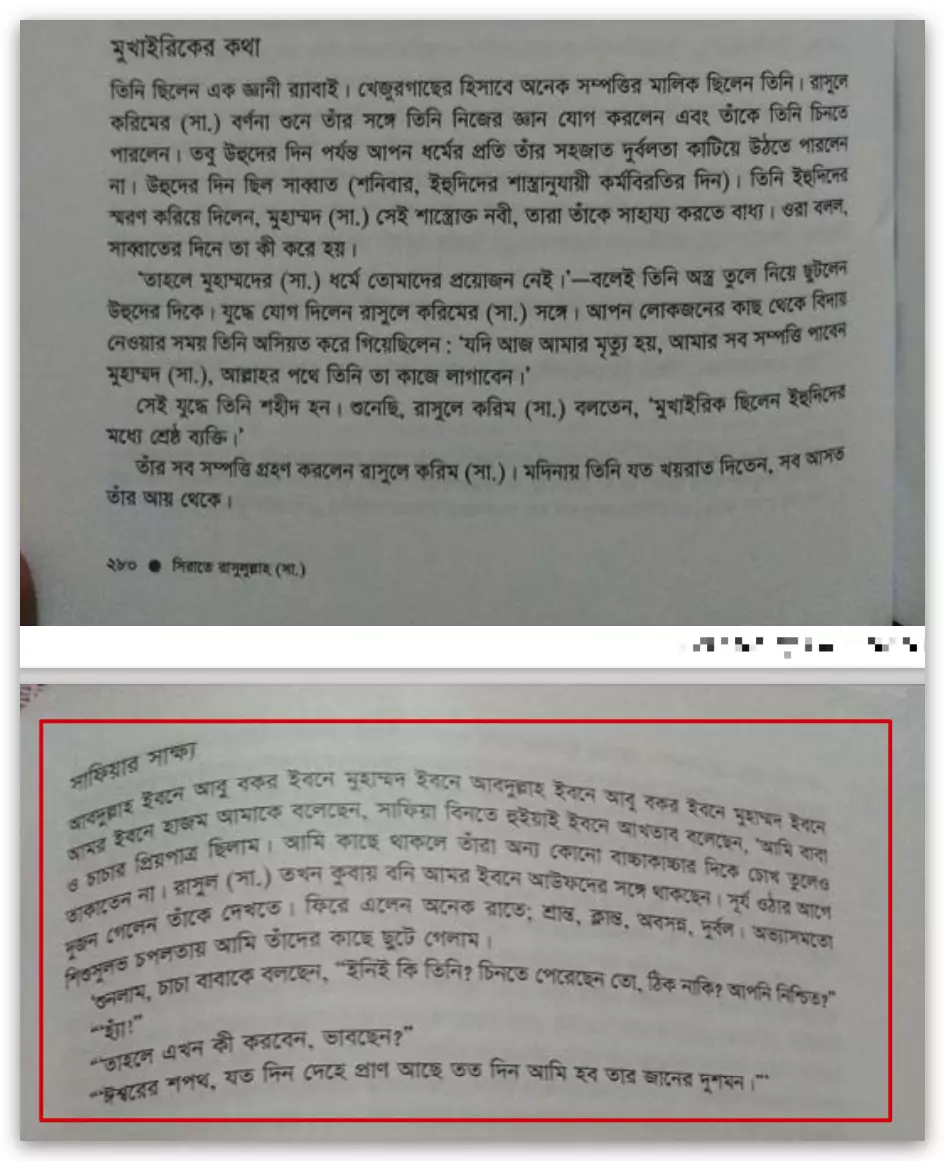
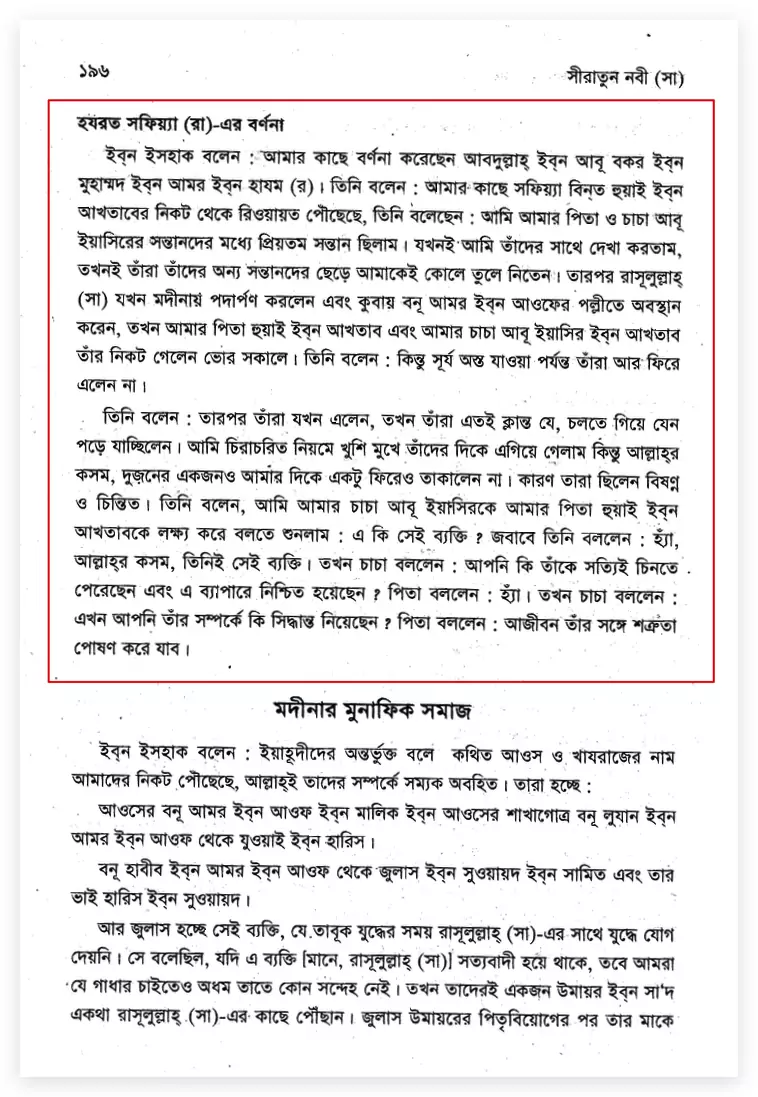
The same account is also narrated in Ibn Hisham’s Sirah [4]
Sirat-un-Nabi (peace be upon him), p. 196
Narration of Hazrat Safiyya (RA)
Ibn Ishaq says: Abdullah ibn Abu Bakr ibn Muhammad ibn Amr ibn Hazm (RA) narrated to me. He said: It has reached me from Safiyya bint Huyayy ibn Akhtab that she said: I was the most beloved child among the children of my father and my uncle Abu Yasir. Whenever I met them, they would leave their other children and take me into their arms. Then, when the Messenger of Allah (peace be upon him) entered Medina and stayed in the settlement of Banu Amr ibn Awf at Quba, my father Huyayy ibn Akhtab and my uncle Abu Yasir ibn Akhtab went to him early in the morning. She said: But they did not return until sunset.
She said: Then when they came back, they were so exhausted that they seemed as if they would collapse while walking. As usual, I went toward them with a happy face, but by Allah, neither of them even turned toward me. They were sorrowful and worried. She said: I heard my uncle Abu Yasir say to my father Huyayy ibn Akhtab: Is this the man? He replied: Yes, by Allah, he is the one. Then my uncle said: Have you truly recognized him and become certain about this? My father said: Yes. Then my uncle said: What have you decided about him now? My father said: I will remain hostile to him for the rest of my life.
The Reason for the Hostility Between Muhammad and Huyayy ibn Akhtab
Since, fundamentally, Islam is a blind faith without reason or evidence, it is easy to infer that the founder of this religion would be opposed to questions and reason. Let us listen to a sermon and examine what kind of hateful statements Bangladesh’s well-known scholars Ahmadullah and Abbasi are making about the Jews. At the same time, Ahmadullah and others will also admit that the reason for this hatred toward the Jews is their questioning and inquiry—that is, critical thinking.
The main conflict between Muhammad and Huyayy ibn Akhtab was religious. Huyayy frequently raised questions about religion, many of which Muhammad, according to this account, could not answer. The narrative presents Muhammad as becoming angry when confronted with Huyayy’s arguments and questions. That, it suggests, is why he often reacted angrily [5]
The Hostility of the Jews
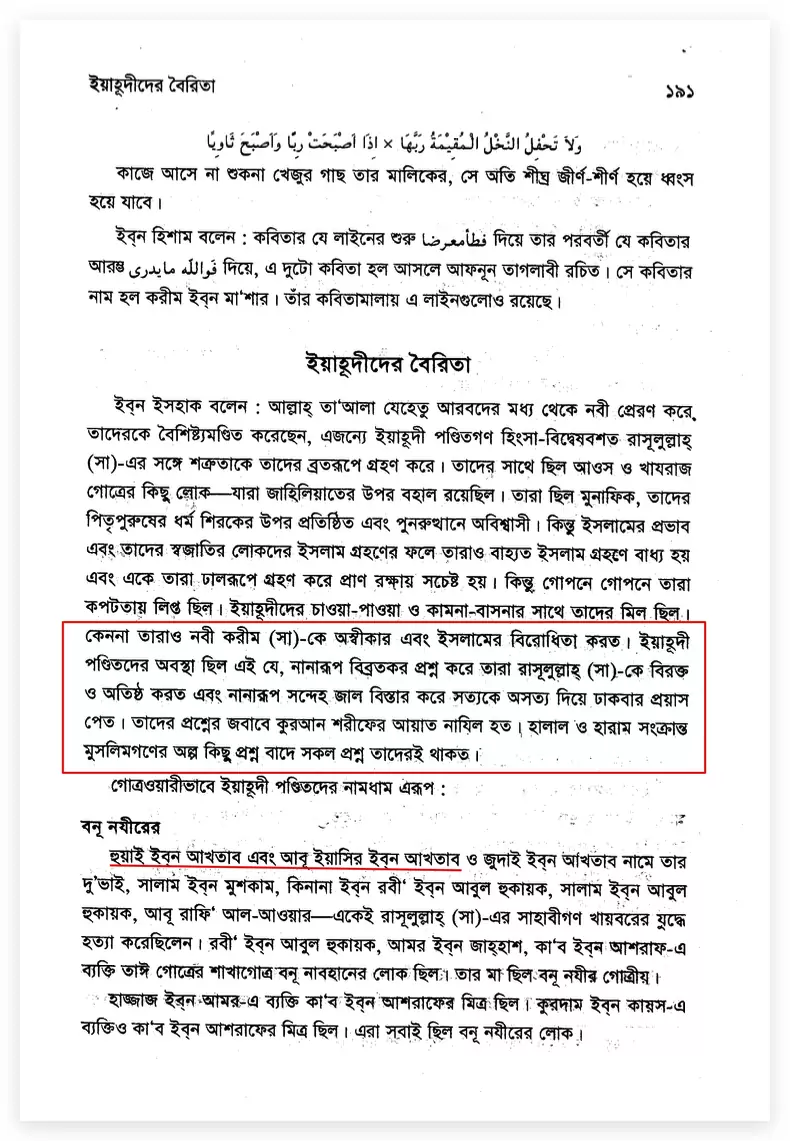
Ibn Ishaq says: Since Allah the Exalted distinguished the Arabs by sending a prophet from among them, the Jewish scholars, out of envy and hostility, adopted enmity toward the Messenger of Allah (peace be upon him) as their mission. With them were some people from the Aws and Khazraj tribes who had remained upon Jahiliyyah. They were hypocrites; the religion of their forefathers was based on shirk, and they disbelieved in resurrection. But because of the influence of Islam and because members of their own people had accepted Islam, they too were compelled outwardly to accept Islam, and they took it as a shield in an attempt to save their lives. Secretly, however, they were engaged in hypocrisy. Their desires and aspirations matched those of the Jews. For they too rejected the Prophet (peace be upon him) and opposed Islam. The condition of the Jewish scholars was such that, by asking various embarrassing questions, they would annoy and exhaust the Messenger of Allah (peace be upon him) and would try to cover truth with falsehood by spreading various nets of doubt. Verses of the Noble Qur’an would be revealed in response to their questions. Apart from a few questions asked by the Muslims regarding lawful and unlawful matters, all questions came from them.
The names and identities of the Jewish scholars by tribe were as follows:
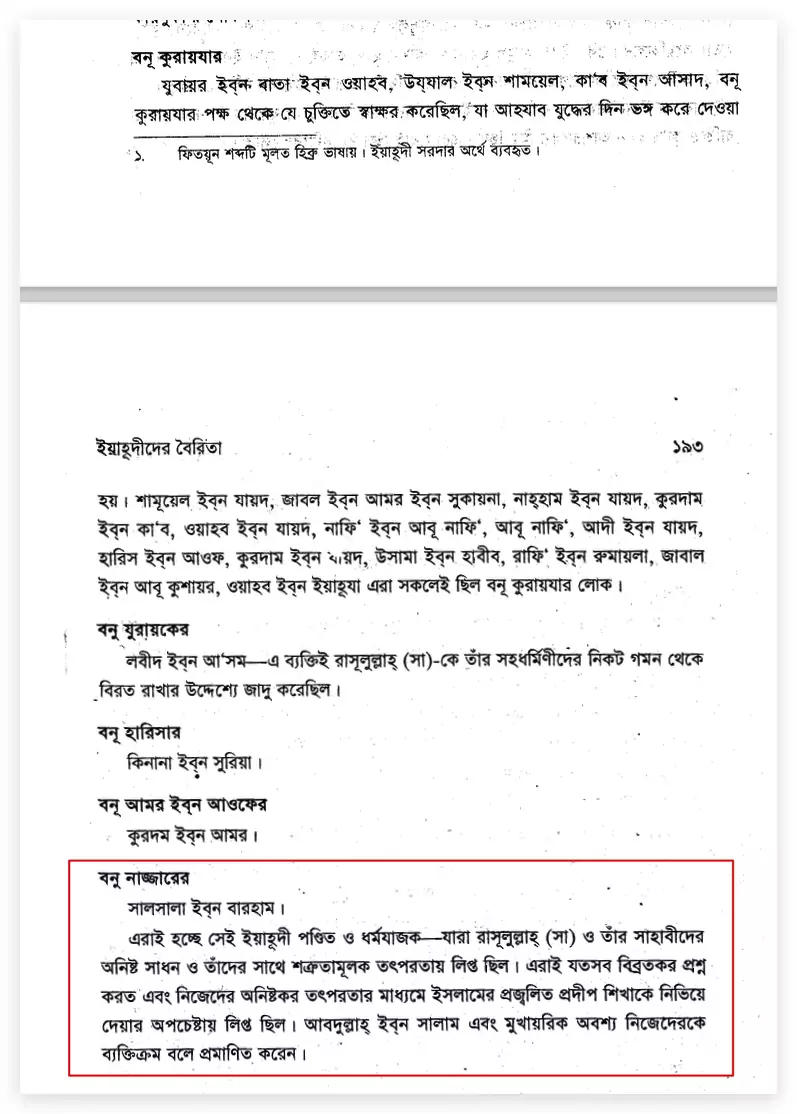
From Banu Nadir: Huyayy ibn Akhtab and Abu Yasir ibn Akhtab and his two brothers, one of them named Huyayy ibn Akhtab, Salam ibn Mishkam, Kinana ibn Rabi‘ ibn Abu al-Huqayq, Salam ibn Abu al-Huqayq, Abu Rafi‘ al-A‘war—he is the one whom the companions of the Messenger of Allah (peace be upon him) killed in the Battle of Khaybar. Rabi‘ ibn Abu al-Huqayq, Amr ibn Jahash, Ka‘b ibn al-Ashraf—this man belonged to Banu Nabhan, a branch of the Tayy tribe. His mother was from Banu Nadir. Hajjaj ibn Amr—this man was an ally of Ka‘b ibn al-Ashraf. Kurdam ibn Qays—this man was also an ally of Ka‘b ibn al-Ashraf. All of them were from Banu Nadir.
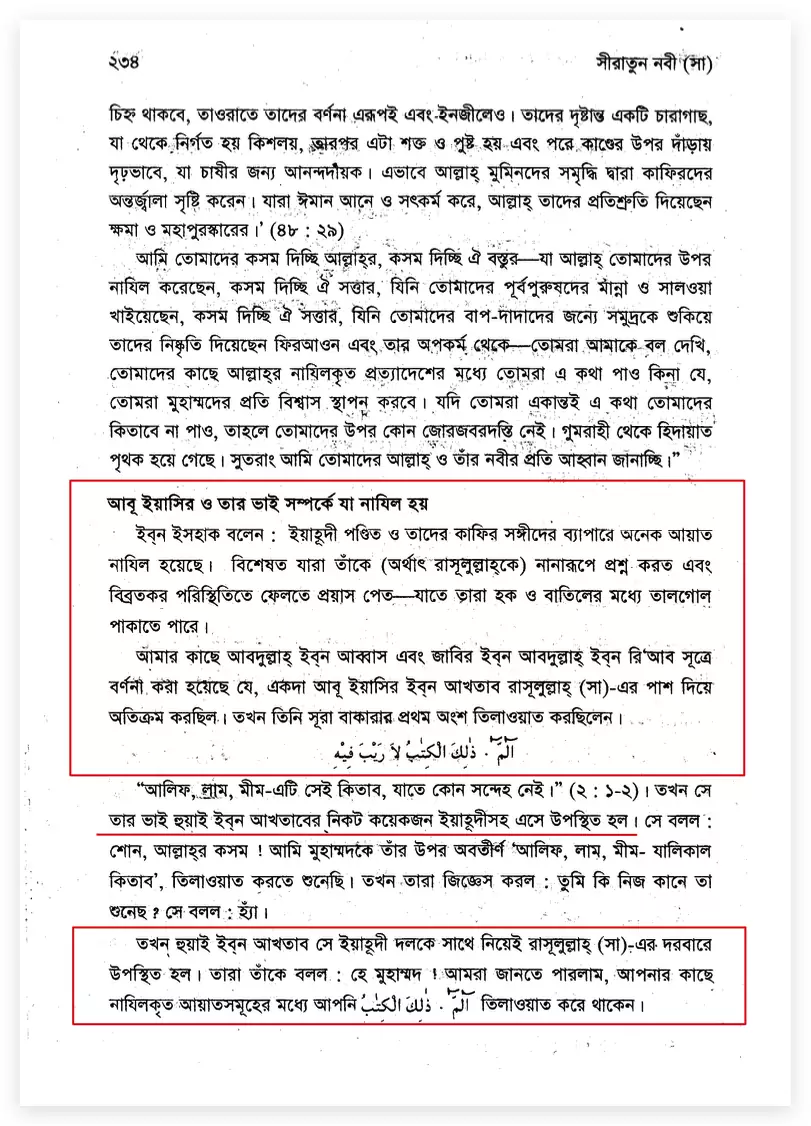
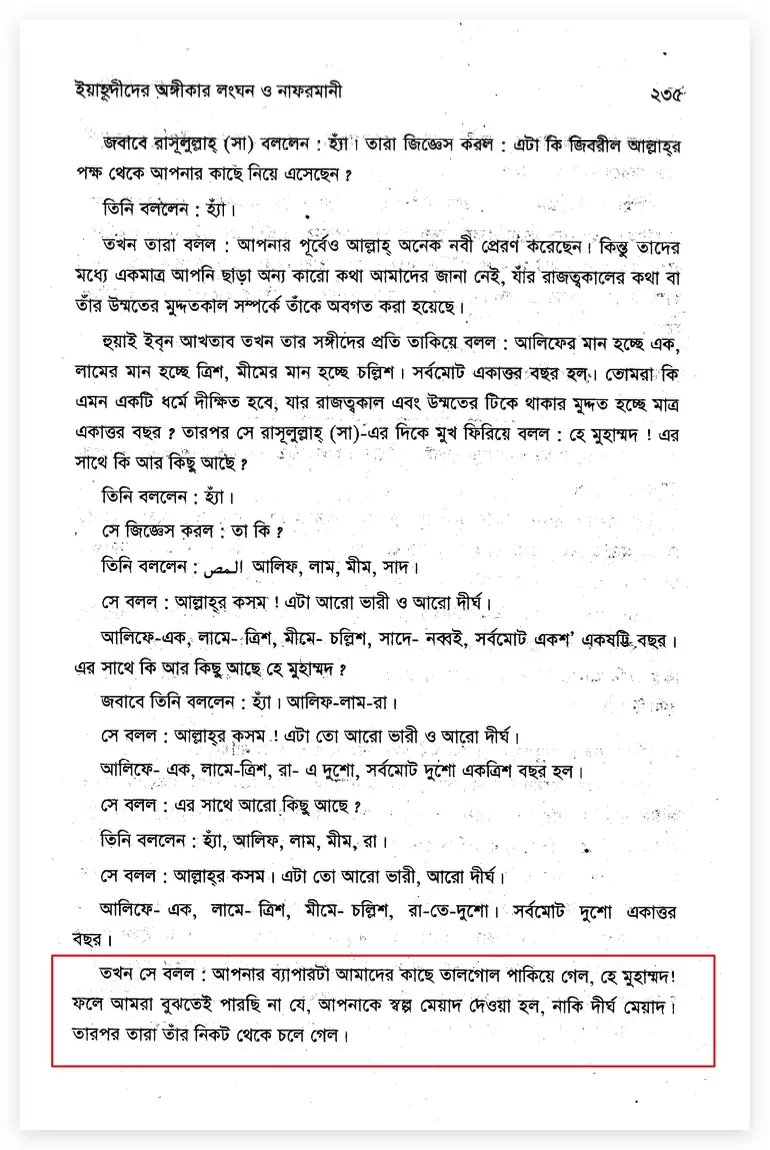
Huyayy Was a Fierce Critic of the Prophet
Many people at that time had spoken openly and criticized the actions of the Prophet Muhammad and his greed for women. But their Prophet would regularly have such people killed by sending assassins. Among these critics, one of the most notable was Safiyya’s father, Huyayy ibn Akhtab. Let us see what criticisms he made of the Prophet Muhammad, and whether those criticisms were actually logical [6]
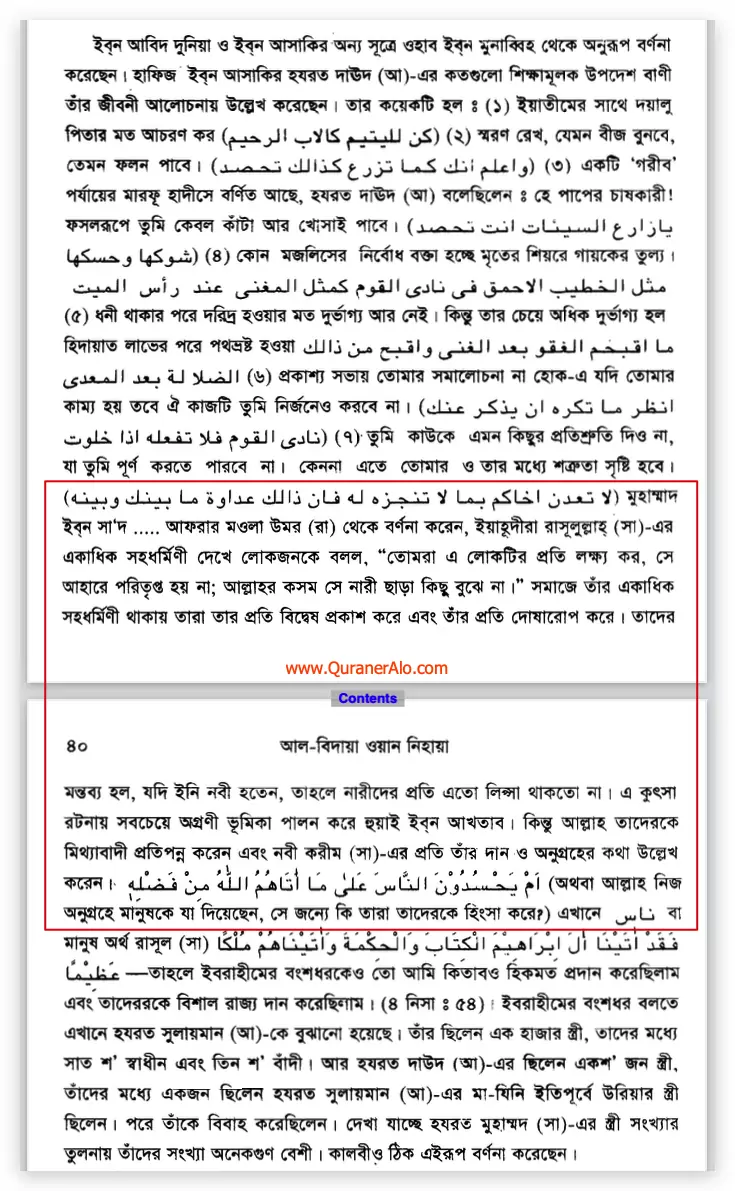
Now let us see whether Huyayy ibn Akhtab’s criticisms were actually true, or whether they were slander born of hatred. You may recall that the Prophet is described as having eleven sexual partners at the same time. According to the account, he would have intercourse with all eleven in a single night. This matter has been discussed in detail elsewhere; for now, let us hear how a scholar presents it.
Many Muslims today say that the Prophet ate very little and encouraged others to do the same. Some even claim that eating little is part of the Prophet’s Sunnah. Yet some hadith reports present a different picture. They describe him asking for additional foreleg meat even after being given two forelegs of a sheep or goat. The implication is striking: how much meat can the foreleg of an average sheep or goat actually contain, and why would he ask for more after receiving two? [7] [8] –
Reference : Ash-Shama’il Al-Muhammadiyah 168
In-book reference : Book 25, Hadith 19
English translation : Sunnah.com
Abu ‘Ubaid said:
“I cooked a dish for the Prophet (Allah bless him and give him peace), and he used to take great pleasure in the foreleg [of the cooked sheep],so I passed him the foreleg. Then he said: ‘Pass me the foreleg,’ so I passed it to him. Then he said: ‘Pass me the foreleg,’ so I said: ‘O Messenger of Allah, how many forelegs does a sheep have?’ He said: ‘By the One in whose Hand is my soul, if you kept silent, you would surely pass me the foreleg whenever I asked for it!’”
حَدَّثَنَا مُحَمَّدُ بْنُ بَشَّارٍ، قَالَ: حَدَّثَنَا مُسْلِمُ بْنُ إِبْرَاهِيمَ، قَالَ: حَدَّثَنَا أَبَانُ بْنُ يَزِيدَ، عَنْ قَتَادَةَ، عَنْ شَهْرِ بْنِ حَوْشَبٍ، عَنْ أَبِي عُبَيْدَةَ، قَالَ: طَبَخْتُ لِلنَّبِيِّ صلى الله عليه وسلم، قِدْرًا، وَقَدْ كَانَ يُعْجِبُهُ الذِّرَاعُ، فَنَاوَلْتُهُ الذِّرَاعَ، ثُمَّ قَالَ: نَاوِلْنِي الذِّرَاعَ، فَنَاوَلْتُهُ، ثُمَّ قَالَ: نَاوِلْنِي الذِّرَاعَ، فَقُلْتُ: يَا رَسُولَ اللهِ، وَكَمْ لِلشَّاةِ مِنْ ذِرَاعٍ، فَقَالَ: وَالَّذِي نَفْسِي بِيَدِهِ لَوْ سَكَتَّ لَنَاوَلْتَنِي الذِّرَاعَ مَا دَعَوْتُ.
Grade: Sanad Da’if wal-Hadīth Hasan (Zubair `Aliza’i)
Sunan ad-Darimi (HadithBD)
Introduction
Chapter 7: The distinction granted to the Prophet (ﷺ) through blessing in food
45. Shahr ibn Hawshab narrated from Abu ‘Ubaid (RA) that he cooked a pot of meat for the Messenger of Allah (ﷺ). The Messenger of Allah (ﷺ) said to him: “Give me a foreleg.” He liked the meat of the foreleg, so he gave him one. He again said, “Give me a foreleg,” and he gave him another. He said once more, “Give me a foreleg.” I then said to him, “O Messenger of Allah! How many forelegs does a goat have?” He replied: “By the One in Whose hand is my soul! Had you remained silent, you would have continued giving me forelegs for as long as I asked.”[1]
[1] Verification: Its chain is hasan because of Shahr ibn Hawshab.
Takhrij: al-Tabarani, al-Kabir 22/335, no. 842; al-Tirmidhi, al-Shama’il 170.
Hadith grade: Hasan
The Conflict with Abu Bakr
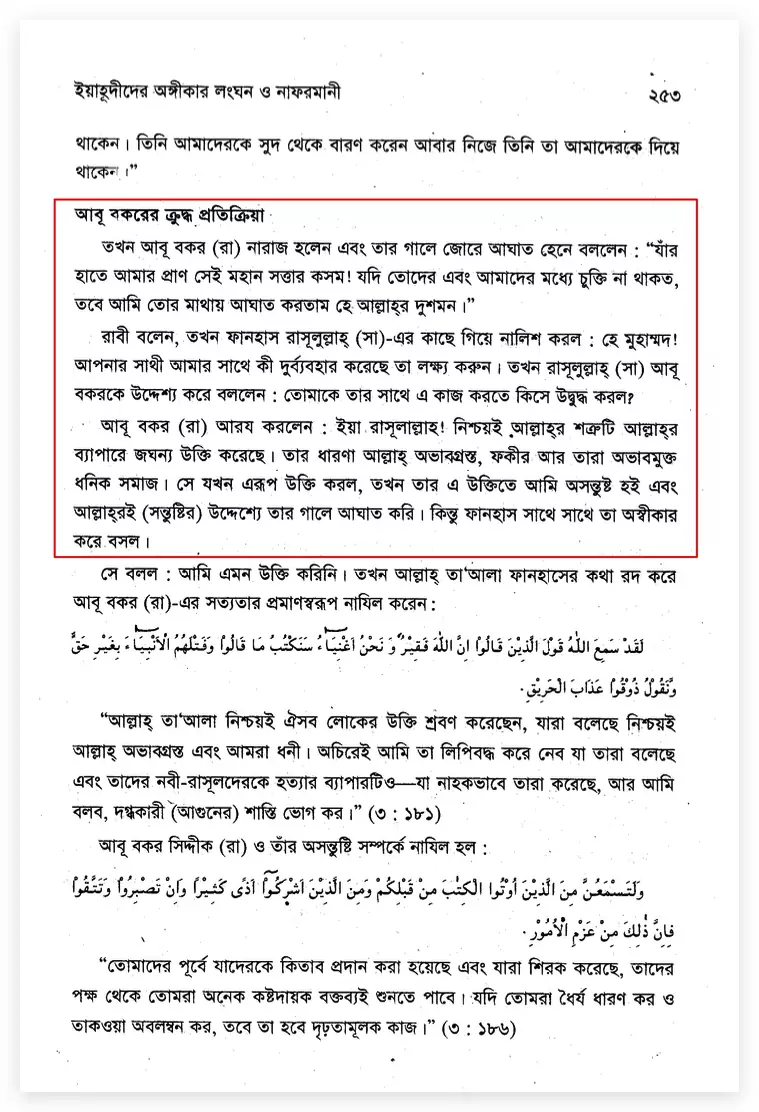
Alongside the Prophet, the Jews also engaged in various theological debates with Abu Bakr. Unfortunately, in most of those disputes, it was the Muslims who ended up physically attacking the Jews. The culture of answering argument with argument, debate with debate, and words with words appears to have been absent among Muslims from the very beginning. That is why we find Abu Bakr striking someone for asking a question [9]
Abu Bakr’s Entry into a Jewish School
One day Abu Bakr al-Siddiq (RA) entered a Jewish school. There he saw a large number of people gathered around a man known as Fanhas. He was one of their scholars and religious leaders. Another of their religious scholars, named Ashya, was also present with him.
Abu Bakr (RA) addressed Fanhas and said:
“Woe to you, O Fanhas! Fear Allah and accept Islam.
By Allah! You surely know that Muhammad (peace be upon him) is the Messenger of Allah. He has appeared among you as a messenger from Allah. You have found clear information about him in the Torah and the Gospel preserved with you.”
Fanhas then replied to Abu Bakr (RA):
“By Allah, O Abu Bakr! We have no need of Allah. Rather, He needs us. We do not plead and beg before Him; rather, He does so before us. We are not poor before Him; rather, He depends on us. If He were not dependent on us, He would not have asked for a loan from our wealth—as your Prophet claims. He forbids us from interest, yet He takes it from us.”
Abu Bakr’s Angry Reaction
Hearing this, Abu Bakr (RA) became angry and struck Fanhas hard on the cheek. He said:
“By Him in whose hand is my life, if there had not been a treaty between us and you, I would have crushed your head, O enemy of Allah!”
The narrator says that afterward Fanhas went to the Messenger of Allah (peace be upon him) and complained:
“O Muhammad! Your companion has behaved badly toward me. Please take note of it.”
The Messenger of Allah (peace be upon him) then asked Abu Bakr (RA):
“Why did you treat him in this way?”
Abu Bakr (RA) said:
“O Messenger of Allah! This enemy of Allah made an obscene statement about Allah. He said that Allah is poor while they are rich. I became angry at his statement and struck him on the cheek for the sake of Allah’s pleasure.”
But Fanhas immediately denied having made the statement.
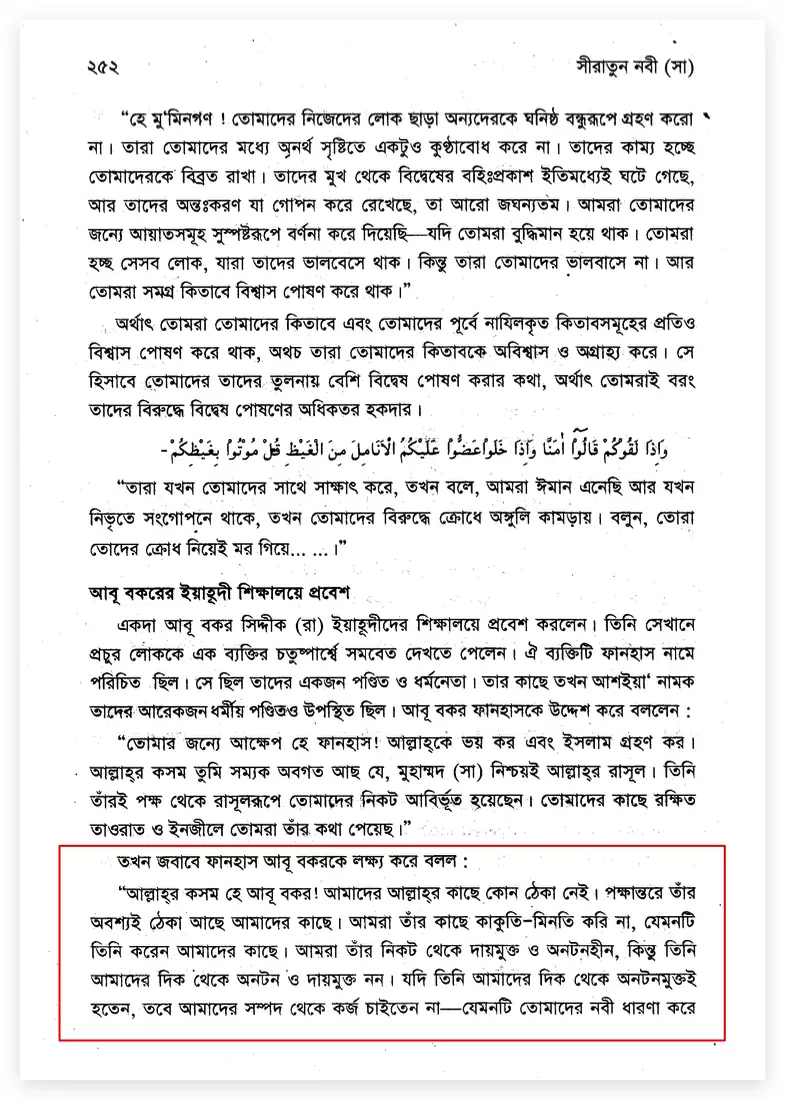
Let us also examine why the Jews raised this issue. Their question appears to have been entirely logical. In Islam, Allah is presented as omnipotent, self-sufficient, and the Creator—one who has power over all creation and depends on no one. This description creates the concept of a being who is completely independent, perfect, and free from every kind of need. Yet some Quranic verses contain statements that appear to conflict directly with this position and with Islam’s fundamental theological claims. For example, in Surah Muhammad, verse 7; Surah al-Baqarah, verse 245; Surah al-Hadid, verses 11 and 18; and Surah at-Taghabun, verse 17, Allah is described as asking human beings for a loan. If Allah is truly the Creator and owner of everything, why would He need to ask ordinary human beings for a “loan” of anything? A being for whom everything supposedly comes into existence merely by saying “Be” is nevertheless presented as borrowing from human beings; the matter is extremely absurd. Such statements create a logical tension with the claim that Allah is entirely self-sufficient and give rise to a serious philosophical question: does an omnipotent being asking human beings for a loan not suggest some kind of limitation or need? Let us read the verses that may naturally raise such questions in the mind of any rational person:
Surah Muhammad, verse 7
Quran reference : Surah Muhammad, 47:7
Arabic : يَـٰٓأَيُّهَا ٱلَّذِينَ ءَامَنُوٓا۟ إِن تَنصُرُوا۟ ٱللَّهَ يَنصُرْكُمْ وَيُثَبِّتْ أَقْدَامَكُمْ ٧
Translation — Dr. Mustafa Khattab, The Clear Quran : O believers! If you stand up for Allah, He will help you and make your steps firm.
Translation — M. Pickthall : O ye who believe! If ye will aid (the cause of) Allah, He will aid you, and plant your feet firmly.
Quran.com — 47:7
Surah al-Baqarah, verse 245
Quran reference : Surah al-Baqarah, 2:245
Arabic : مَّن ذَا ٱلَّذِي يُقۡرِضُ ٱللَّهَ قَرۡضًا حَسَنٗا فَيُضَٰعِفَهُۥ لَهُۥٓ أَضۡعَافٗا كَثِيرَةٗۚ وَٱللَّهُ يَقۡبِضُ وَيَبۡصُۜطُ وَإِلَيۡهِ تُرۡجَعُونَ ٢٤٥
Translation — Dr. Mustafa Khattab, The Clear Quran : Who will lend to Allah a good loan which Allah will multiply many times over? It is Allah ˹alone˺ who decreases and increases ˹wealth˺. And to Him you will ˹all˺ be returned.
Translation — M. Pickthall : Who is it that will lend unto Allah a goodly loan, so that He may give it increase manifold? Allah straiteneth and enlargeth. Unto Him ye will return.
Quran.com — 2:245
Surah al-Hadid, verse 11
Quran reference : Surah al-Hadid, 57:11
Arabic : مَّن ذَا ٱلَّذِي يُقۡرِضُ ٱللَّهَ قَرۡضًا حَسَنٗا فَيُضَٰعِفَهُۥ لَهُۥ وَلَهُۥٓ أَجۡرٞ كَرِيمٞ ١١
Translation — Dr. Mustafa Khattab, The Clear Quran : Who is it that will lend to Allah a good loan which Allah will multiply ˹many times over˺ for them, and they will have an honourable reward?
Translation — M. Pickthall : Who is he that will lend unto Allah a goodly loan, that He may double it for him and his may be a rich reward?
Quran.com — 57:11
Surah al-Hadid, verse 18
Quran reference : Surah al-Hadid, 57:18
Arabic : إِنَّ ٱلۡمُصَّدِّقِينَ وَٱلۡمُصَّدِّقَٰتِ وَأَقۡرَضُواْ ٱللَّهَ قَرۡضًا حَسَنٗا يُضَٰعَفُ لَهُمۡ وَلَهُمۡ أَجۡرٞ كَرِيمٞ ١٨
Translation — Dr. Mustafa Khattab, The Clear Quran : Indeed, those men and women who give in charity and lend to Allah a good loan will have it multiplied for them, and they will have an honourable reward.
Translation — M. Pickthall : Lo! those who give alms, both men and women, and lend unto Allah a goodly loan, it will be doubled for them, and theirs will be a rich reward.
Quran.com — 57:18
Surah at-Taghabun, verse 17
Quran reference : Surah at-Taghabun, 64:17
Arabic : إِن تُقۡرِضُواْ ٱللَّهَ قَرۡضًا حَسَنٗا يُضَٰعِفۡهُ لَكُمۡ وَيَغۡفِرۡ لَكُمۡۚ وَٱللَّهُ شَكُورٌ حَلِيمٌ ١٧
Translation — Dr. Mustafa Khattab, The Clear Quran : If you lend to Allah a good loan, He will multiply it for you and forgive you. For Allah is Most Appreciative, Most Forbearing.
Translation — M. Pickthall : If ye lend unto Allah a goodly loan, He will double it for you and will forgive you, for Allah is Responsive, Clement.
Quran.com — 64:17
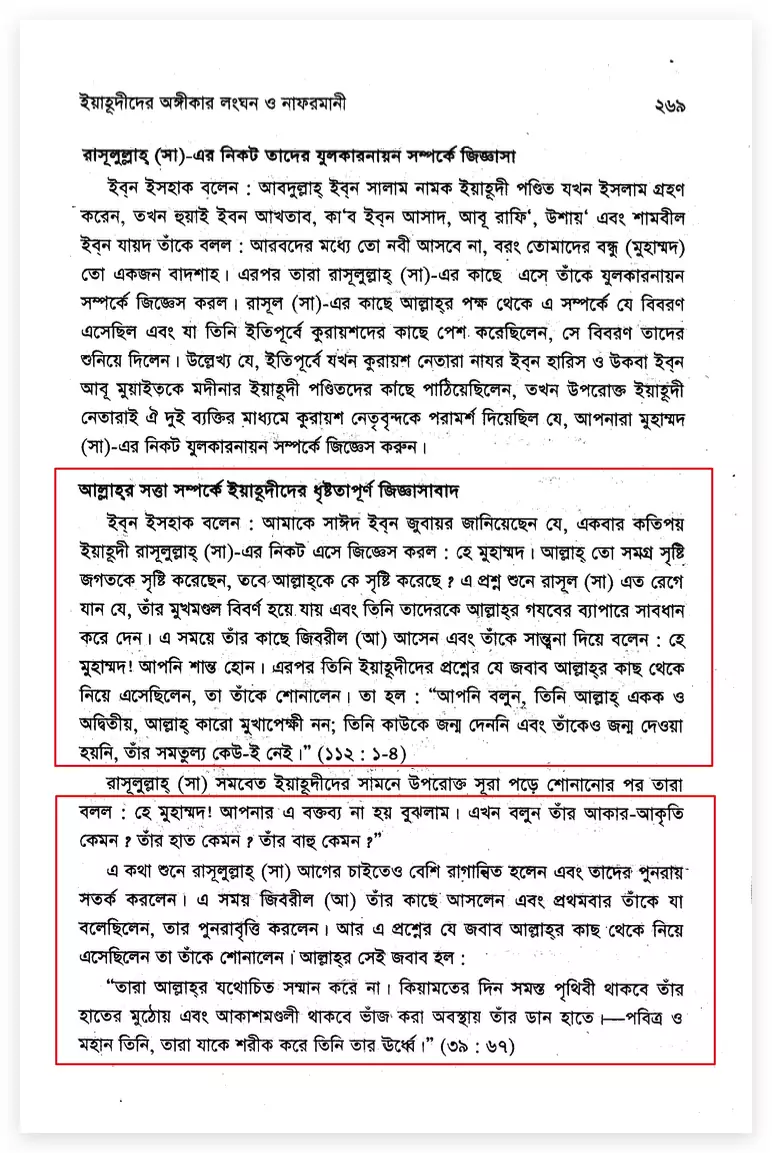
The Prophet’s Anger When Asked Who Created Allah
There is a very important question that naturally comes to mind: if Allah exists, then who created Allah? Yet it is reported that when this question was put to the Prophet, he would flare up in rage [10]
The Jews’ insolent questioning concerning the essence of Allah
Ibn Ishaq says: Sa‘id ibn Jubayr informed me that once some Jews came to the Messenger of Allah (peace be upon him) and asked, “O Muhammad, Allah created the entire universe, but who created Allah?”
On hearing this question, the Messenger (peace be upon him) became so angry that his face changed color, and he warned them about the wrath of Allah. At that moment Jibril (peace be upon him) came to him and comforted him, saying, “O Muhammad! Be calm.” Then he recited to him the answer he had brought from Allah in response to the Jews’ question:
Quran reference : Surah al-Ikhlas, 112:1–4
Arabic : قُلْ هُوَ ٱللَّهُ أَحَدٌ ١ ٱللَّهُ ٱلصَّمَدُ ٢ لَمْ يَلِدْ وَلَمْ يُولَدْ ٣ وَلَمْ يَكُن لَّهُۥ كُفُوًا أَحَدٌۢ ٤
Translation — Dr. Mustafa Khattab, The Clear Quran : Say, ˹O Prophet,˺ “He is Allah—One ˹and Indivisible˺; Allah—the Sustainer ˹needed by all˺. He has never had offspring, nor was He born. And there is none comparable to Him.”
Translation — M. Pickthall : Say: He is Allah, the One! Allah, the eternally Besought of all! He begetteth not nor was begotten. And there is none comparable unto Him.
Quran.com — Al-Ikhlas 112:1–4
After the Messenger of Allah (peace be upon him) recited the above surah before the assembled Jews, they said, “O Muhammad! Let us say we understand this statement of yours. Now tell us, what is His shape and form? What is His hand like? What is His arm like?”
On hearing this, the Messenger of Allah (peace be upon him) became even more angry than before and warned them again. At that moment Jibril (peace be upon him) came to him and repeated what he had said the first time. He then recited to him the answer he had brought from Allah to this question. That answer from Allah was:
Quran reference : Surah az-Zumar, 39:67
Arabic : وَمَا قَدَرُوا۟ ٱللَّهَ حَقَّ قَدْرِهِۦ وَٱلْأَرْضُ جَمِيعًا قَبْضَتُهُۥ يَوْمَ ٱلْقِيَـٰمَةِ وَٱلسَّمَـٰوَٰتُ مَطْوِيَّـٰتٌۢ بِيَمِينِهِۦۚ سُبْحَـٰنَهُۥ وَتَعَـٰلَىٰ عَمَّا يُشْرِكُونَ ٦٧
Translation — Dr. Mustafa Khattab, The Clear Quran : They have not shown Allah His proper reverence—when on the Day of Judgment the ˹whole˺ earth will be in His Grip, and the heavens will be rolled up in His Right Hand. Glorified and Exalted is He above what they associate ˹with Him˺!
Translation — M. Pickthall : And they esteem not Allah as He hath the right to be esteemed, when the whole earth is His handful on the Day of Resurrection, and the heavens are rolled in His right hand. Glorified is He and High Exalted from all that they ascribe as partner (unto Him).
Quran.com — Az-Zumar 39:67
The Invitation of Banu Nadir and Muhammad’s Flight
The leaders of the Banu Nadir tribe invited the Prophet Muhammad and his companions for a discussion and challenged Muhammad to present proof of his prophethood. The Jews said that if Muhammad could correctly answer all the questions posed by the Jewish scholars, everyone in Banu Nadir would understand the truth of Islam and accept it. Muhammad was to come to a particular place with thirty companions, while the Jews would also bring thirty people. The Prophet went there with his companions. But before the debate could even begin, he suddenly got up and quietly left the place, abandoning everyone else. The other companions waited for a long time, but there was no trace of the Prophet. He could not be found anywhere. Later they heard from another person that the Prophet had already returned to Medina, so they too went back to Medina. After returning, they learned that Jibril had supposedly come secretly and told the Prophet that some people were sitting on the roof of the house where they had been seated, intending to kill him. But why those people did not kill the Prophet’s companions, why none of the companions saw anyone on the roof, and why the Prophet left alone without saying anything to anyone—none of this is known. In other words, the alleged secret Jewish conspiracy was known only to the Prophet himself, and there is no independent evidence for it. Any intelligent person can understand how absurd the incident appears: the Prophet left his friends and companions exposed to supposed danger and fled, an episode that can also be read as a tactic for avoiding debate with the Jews. The very next day, under Muhammad’s leadership, an attack was launched against Banu Nadir [11] [12] –
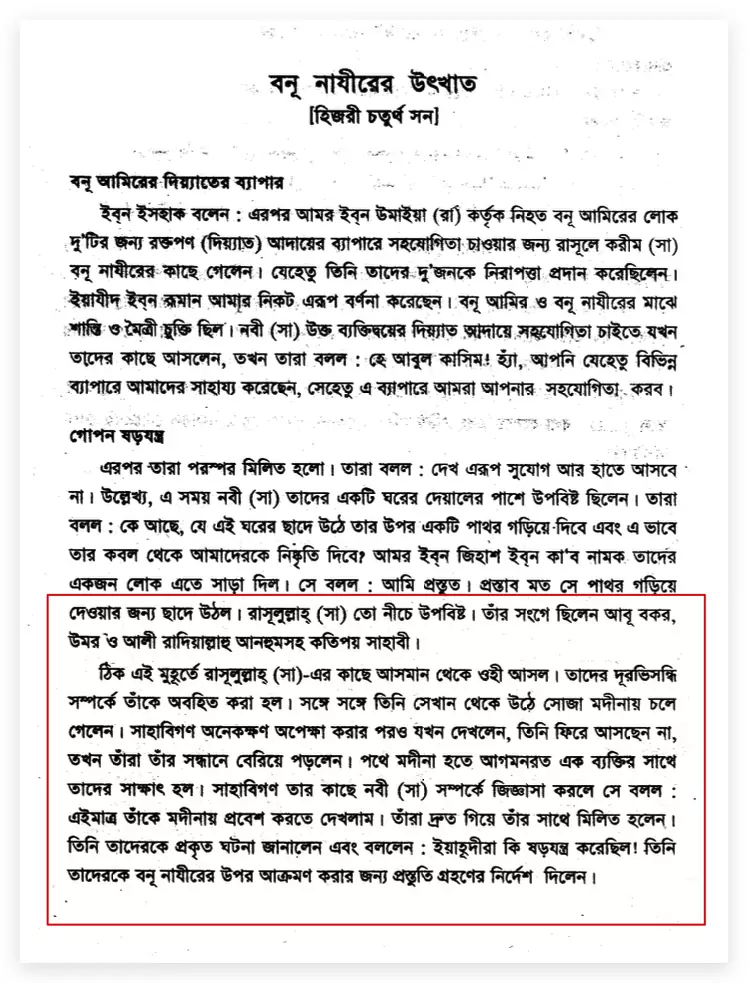
The Messenger of Allah (peace be upon him) was then sitting beside the wall of one of their houses. They said, “Who will go up to the roof and drop a stone from there, killing Muhammad and freeing us from his hand?” Amr ibn Jahhash came forward and said, “I am ready for that.” Accordingly, he climbed up to that place in order to throw the stone. The Messenger of Allah (peace be upon him) was still sitting there with a group of companions. Among them were Hazrat Abu Bakr (RA), Umar (RA), and Ali (RA). Heavenly news of their evil intention came to the Messenger of Allah (peace be upon him). Without saying anything to anyone, he got up and set out toward Medina. When he did not return to the place for a long time, the companions went out looking for him. Seeing a man coming from the direction of Medina, they asked him about the Messenger of Allah (peace be upon him). That man said, “I saw him entering Medina.” Receiving this news, all the companions returned to Medina and gathered before the Messenger of Allah (peace be upon him). He informed them about the Jews’ treachery.
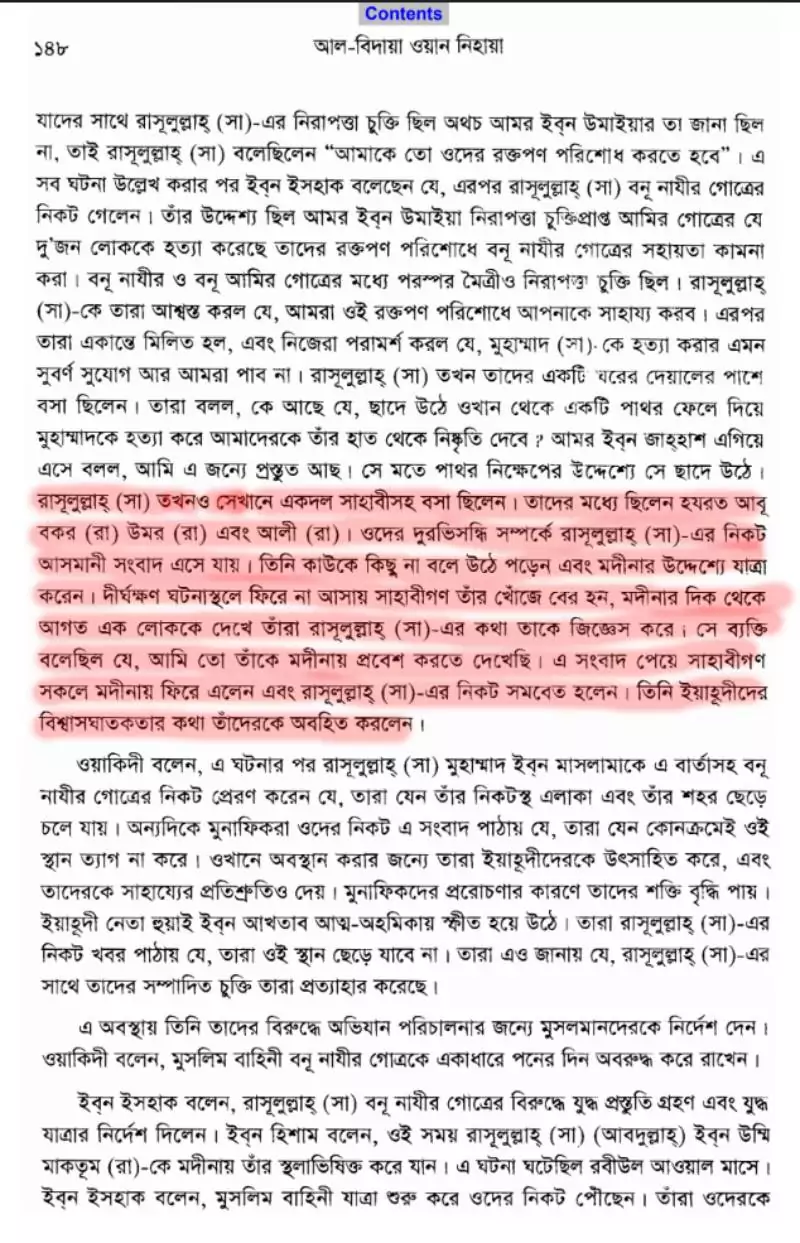
You saw in the document above that Muhammad abruptly left the place without providing proof of his prophethood. Now let us see what happened before and after this incident [13]
Reference : Sunan Abi Dawud 3004
In-book reference : Book 20, Hadith 77
English translation : Book 19, Hadith 2998
Chapter : Regarding The Incidents With An-Nadir
Narrated A man from the companions of the Prophet:
AbdurRahman ibn Ka’b ibn Malik reported on the authority of a man from among the companions of the Prophet (ﷺ): The infidels of the Quraysh wrote (a letter) to Ibn Ubayy and to those who worshipped idols from al-Aws and al-Khazraj, while the Messenger of Allah (ﷺ) was at that time at Medina before the battle of Badr.
(They wrote): You gave protection to our companion. We swear by Allah, you should fight him or expel him, or we shall come to you in full force, until we kill your fighters and appropriate your women.
When this (news) reached Abdullah ibn Ubayy and those who were worshippers of idols, with him they gathered together to fight the Messenger of Allah (ﷺ).
When this news reached the Messenger of Allah (ﷺ), he visited them and said: The threat of the Quraysh to you has reached its end. They cannot contrive a plot against you, greater than what you yourselves intended to harm you. Are you willing to fight your sons and brethren? When they heard this from the Prophet (ﷺ), they scattered. This reached the infidels of the Quraysh.
The infidels of the Quraysh again wrote (a letter) to the Jews after the battle of Badr: You are men of weapons and fortresses. You should fight our companion or we shall deal with you in a certain way. And nothing will come between us and the anklets of your women. When their letter reached the Prophet (ﷺ), they gathered Banu an-Nadir to violate the treaty.
They sent a message to the Prophet (ﷺ): Come out to us with thirty men from your companions, and thirty rabbis will come out from us till we meet at a central place where they will hear you. If they testify to you and believe in you, we shall believe in you. The narrator then narrated the whole story.
When the next day came, the Messenger of Allah (ﷺ) went out in the morning with an army, and surrounded them.
He told them: I swear by Allah, you will have no peace from me until you conclude a treaty with me. But they refused to conclude a treaty with him. He therefore fought them the same day.
Next he attacked Banu Quraysh with an army in the morning, and left Banu an-Nadir. He asked them to sign a treaty and they signed it.
He turned away from them and attacked Banu an-Nadir with an army. He fought with them until they agreed to expulsion. Banu an-Nadir were deported, and they took with them whatever their camels could carry, that is, their property, the doors of their houses, and their wood. Palm-trees were exclusively reserved for the Messenger of Allah (ﷺ). Allah bestowed them upon him and gave them him as a special portion.
He (Allah), the Exalted, said: What Allah has bestowed on His Apostle (and taken away) from them, for this ye made no expedition with either camel corps or cavalry.” He said: “Without fighting.” So the Prophet (ﷺ) gave most of it to the emigrants and divided it among them; and he divided some of it between two men from the helpers, who were needy, and he did not divide it among any of the helpers except those two.
The rest of it survived as the sadaqah of the Messenger of Allah (ﷺ) which is in the hands of the descendants of Fatimah (Allah be pleased with her).
Arabic : حَدَّثَنَا مُحَمَّدُ بْنُ دَاوُدَ بْنِ سُفْيَانَ، حَدَّثَنَا عَبْدُ الرَّزَّاقِ، أَخْبَرَنَا مَعْمَرٌ، عَنِ الزُّهْرِيِّ، عَنْ عَبْدِ الرَّحْمَنِ بْنِ كَعْبِ بْنِ مَالِكٍ، عَنْ رَجُلٍ، مِنْ أَصْحَابِ النَّبِيِّ صلى الله عليه وسلم أَنَّ كُفَّارَ قُرَيْشٍ كَتَبُوا إِلَى ابْنِ أُبَىٍّ وَمَنْ كَانَ يَعْبُدُ مَعَهُ الأَوْثَانَ مِنَ الأَوْسِ وَالْخَزْرَجِ وَرَسُولُ اللَّهِ صلى الله عليه وسلم يَوْمَئِذٍ بِالْمَدِينَةِ قَبْلَ وَقْعَةِ بَدْرٍ إِنَّكُمْ آوَيْتُمْ صَاحِبَنَا وَإِنَّا نُقْسِمُ بِاللَّهِ لَتُقَاتِلُنَّهُ أَوْ لَتُخْرِجُنَّهُ أَوْ لَنَسِيرَنَّ إِلَيْكُمْ بِأَجْمَعِنَا حَتَّى نَقْتُلَ مُقَاتِلَتَكُمْ وَنَسْتَبِيحَ نِسَاءَكُمْ . فَلَمَّا بَلَغَ ذَلِكَ عَبْدَ اللَّهِ بْنَ أُبَىٍّ وَمَنْ كَانَ مَعَهُ مِنْ عَبَدَةِ الأَوْثَانِ اجْتَمَعُوا لِقِتَالِ النَّبِيِّ صلى الله عليه وسلم فَلَمَّا بَلَغَ ذَلِكَ النَّبِيَّ صلى الله عليه وسلم لَقِيَهُمْ فَقَالَ ” لَقَدْ بَلَغَ وَعِيدُ قُرَيْشٍ مِنْكُمُ الْمَبَالِغَ مَا كَانَتْ تَكِيدُكُمْ بِأَكْثَرَ مِمَّا تُرِيدُونَ أَنْ تَكِيدُوا بِهِ أَنْفُسَكُمْ تُرِيدُونَ أَنْ تُقَاتِلُوا أَبْنَاءَكُمْ وَإِخْوَانَكُمْ ” . فَلَمَّا سَمِعُوا ذَلِكَ مِنَ النَّبِيِّ صلى الله عليه وسلم تَفَرَّقُوا فَبَلَغَ ذَلِكَ كُفَّارَ قُرَيْشٍ فَكَتَبَتْ كُفَّارُ قُرَيْشٍ بَعْدَ وَقْعَةِ بَدْرٍ إِلَى الْيَهُودِ إِنَّكُمْ أَهْلُ الْحَلْقَةِ وَالْحُصُونِ وَإِنَّكُمْ لَتُقَاتِلُنَّ صَاحِبَنَا أَوْ لَنَفْعَلَنَّ كَذَا وَكَذَا وَلاَ يَحُولُ بَيْنَنَا وَبَيْنَ خَدَمِ نِسَائِكُمْ شَىْءٌ – وَهِيَ الْخَلاَخِيلُ – فَلَمَّا بَلَغَ كِتَابُهُمُ النَّبِيَّ صلى الله عليه وسلم أَجْمَعَتْ بَنُو النَّضِيرِ بِالْغَدْرِ فَأَرْسَلُوا إِلَى رَسُولِ اللَّهِ صلى الله عليه وسلم اخْرُجْ إِلَيْنَا فِي ثَلاَثِينَ رَجُلاً مِنْ أَصْحَابِكَ وَلْيَخْرُجْ مِنَّا ثَلاَثُونَ حَبْرًا حَتَّى نَلْتَقِيَ بِمَكَانِ الْمَنْصَفِ فَيَسْمَعُوا مِنْكَ . فَإِنْ صَدَّقُوكَ وَآمَنُوا بِكَ آمَنَّا بِكَ فَقَصَّ خَبَرَهُمْ فَلَمَّا كَانَ الْغَدُ غَدَا عَلَيْهِمْ رَسُولُ اللَّهِ صلى الله عليه وسلم بِالْكَتَائِبِ فَحَصَرَهُمْ فَقَالَ لَهُمْ ” إِنَّكُمْ وَاللَّهِ لاَ تَأْمَنُونَ عِنْدِي إِلاَّ بِعَهْدٍ تُعَاهِدُونِي عَلَيْهِ ” . فَأَبَوْا أَنْ يُعْطُوهُ عَهْدًا فَقَاتَلَهُمْ يَوْمَهُمْ ذَلِكَ ثُمَّ غَدَا الْغَدُ عَلَى بَنِي قُرَيْظَةَ بِالْكَتَائِبِ وَتَرَكَ بَنِي النَّضِيرِ وَدَعَاهُمْ إِلَى أَنْ يُعَاهِدُوهُ فَعَاهَدُوهُ فَانْصَرَفَ عَنْهُمْ وَغَدَا عَلَى بَنِي النَّضِيرِ بِالْكَتَائِبِ فَقَاتَلَهُمْ حَتَّى نَزَلُوا عَلَى الْجَلاَءِ فَجَلَتْ بَنُو النَّضِيرِ وَاحْتَمَلُوا مَا أَقَلَّتِ الإِبِلُ مِنْ أَمْتِعَتِهِمْ وَأَبْوَابِ بُيُوتِهِمْ وَخَشَبِهَا فَكَانَ نَخْلُ بَنِي النَّضِيرِ لِرَسُولِ اللَّهِ صلى الله عليه وسلم خَاصَّةً أَعْطَاهُ اللَّهُ إِيَّاهَا وَخَصَّهُ بِهَا فَقَالَ { وَمَا أَفَاءَ اللَّهُ عَلَى رَسُولِهِ مِنْهُمْ فَمَا أَوْجَفْتُمْ عَلَيْهِ مِنْ خَيْلٍ وَلاَ رِكَابٍ } يَقُولُ بِغَيْرِ قِتَالٍ فَأَعْطَى النَّبِيُّ صلى الله عليه وسلم أَكْثَرَهَا لِلْمُهَاجِرِينَ وَقَسَمَهَا بَيْنَهُمْ وَقَسَمَ مِنْهَا لِرَجُلَيْنِ مِنَ الأَنْصَارِ وَكَانَا ذَوِي حَاجَةٍ لَمْ يَقْسِمْ لأَحَدٍ مِنَ الأَنْصَارِ غَيْرَهُمَا وَبَقِيَ مِنْهَا صَدَقَةُ رَسُولِ اللَّهِ صلى الله عليه وسلم الَّتِي فِي أَيْدِي بَنِي فَاطِمَةَ رَضِيَ اللَّهُ عَنْهَا .
Grade: Sahih in chain (Al-Albani)
The Slaughter of Her Father, Huyayy ibn Akhtab
Afterward, the Prophet kept the Banu Qurayza tribe under siege for twenty-five days and ultimately forced them to surrender. Among the captives was Huyayy ibn Akhtab, who was killed along with the other men [14]
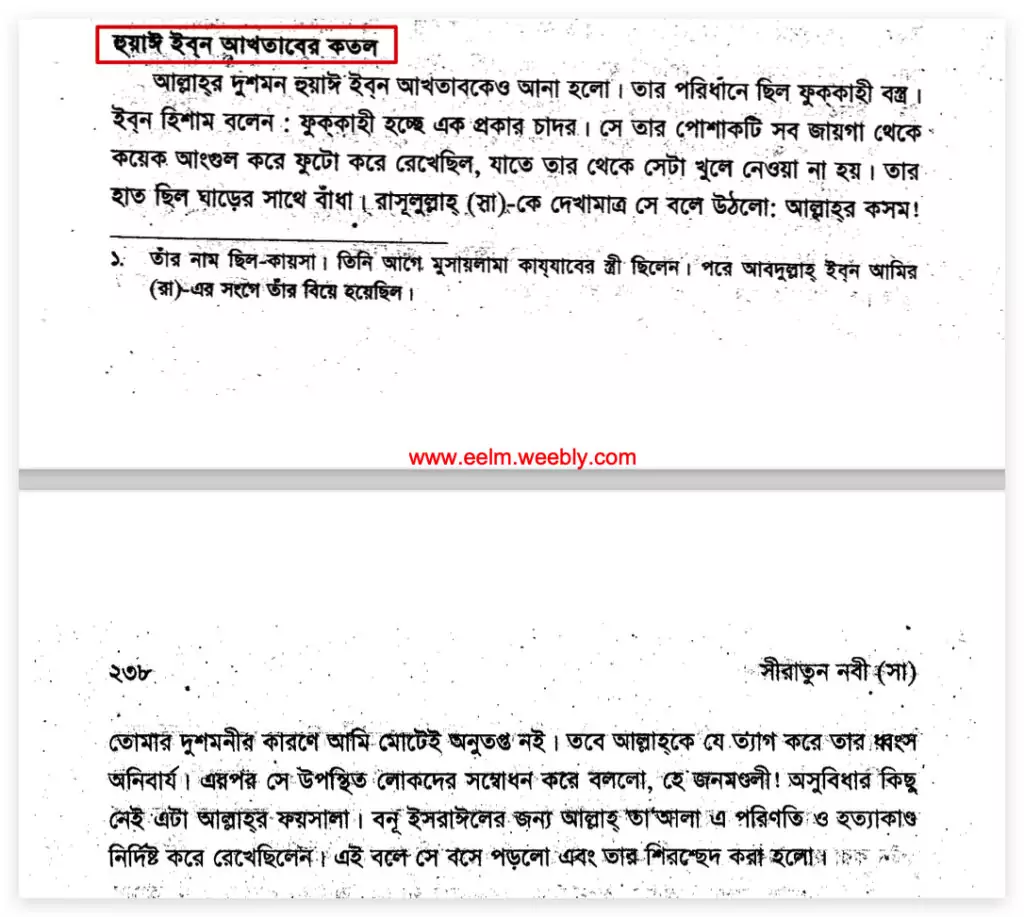
Let us examine this reference from another source as well [15]
In this way, all the captives—whose number was between six and seven hundred—were beheaded.
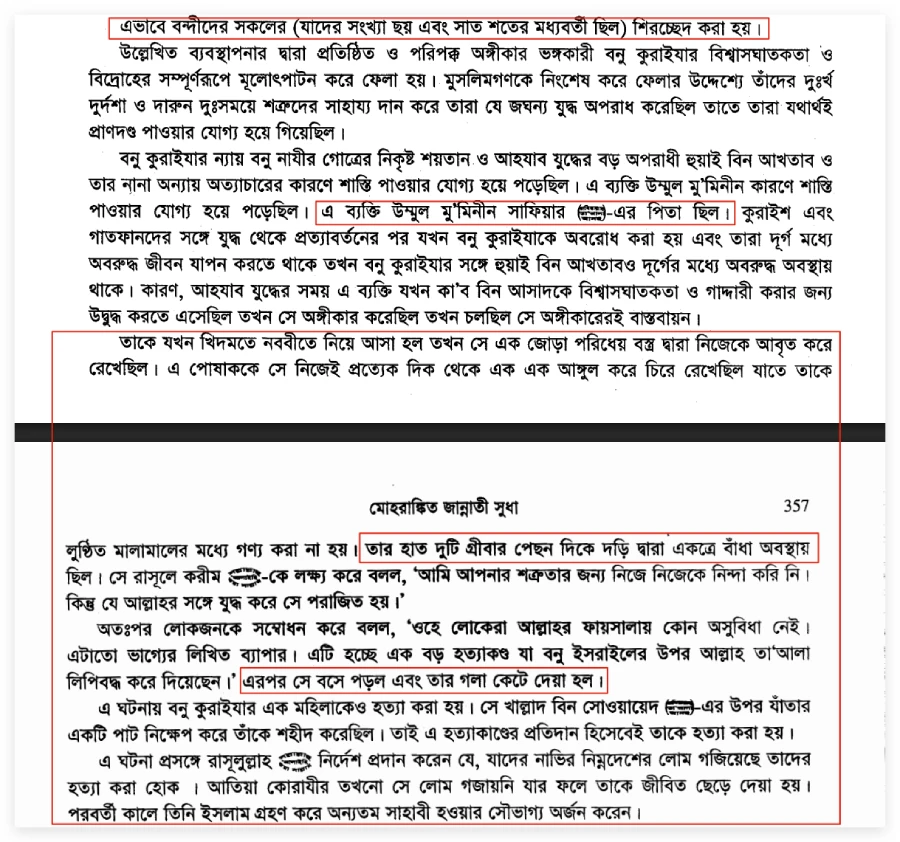
Through the measures described above, the treachery and rebellion of Banu Qurayza, who had broken their established covenant, were completely uprooted. By assisting the enemy during a period of great hardship and danger for the Muslims, with the intention of destroying them, they had committed what the author describes as such a grave war crime that they had become deserving of death. Like Banu Qurayza, Huyayy ibn Akhtab of Banu Nadir—described by the author as a vile devil and one of the principal criminals of the Battle of Ahzab—was also regarded as deserving punishment because of his alleged wrongdoing.
[This man was the father of Umm al-Mu’minin Safiyya (RA). When Banu Qurayza were besieged after the return from the campaign against Quraysh and Ghatafan, Huyayy ibn Akhtab was also inside their fortress. This was because, during the Battle of Ahzab, when he had come to persuade Ka‘b ibn Asad to break his covenant, he had pledged to remain with Banu Qurayza; what followed was therefore the fulfillment of that pledge.
When he was brought before the Prophet, he had covered himself with a pair of garments. He had torn the garments by roughly a finger’s width on each side so that they would not be counted among the spoils. His hands were tied together behind his neck with rope. Addressing the Messenger, he said: “I do not blame myself for my hostility toward you. But whoever fights against Allah is defeated.”
Then, addressing the people, he said: “O people, there is no objection to Allah’s decree. This is a matter written in destiny. This is a great killing that Allah has decreed upon the Children of Israel.” Then he sat down, and his throat was cut.
In this incident, one woman of Banu Qurayza was also killed. She had thrown a millstone upon Khallad ibn Suwayd and killed him. She was therefore killed in retaliation.
Regarding the incident, the Messenger of Allah ordered that those whose pubic hair had grown should be killed. At that time Atiyya al-Qurazi had not yet grown such hair, and therefore he was left alive. Later he accepted Islam and became one of the companions.
Did the Prophet Himself Take Part in the Slaughter?
A question may arise: did the Prophet himself carry out this slaughter, or did his companions do it in his absence? From an authenticated hadith, we learn that Muhammad was present while the men of Banu Qurayza were being killed in the market. Imagine the scene: hundreds of people are being brought out and killed while the Prophet is present. At that time there was a woman who had perhaps become psychologically overwhelmed by the prospect of death and the killing of her people. She was laughing loudly. She knew that she too would be killed, yet she continued laughing. Aisha was astonished by her behavior [16] [17]
Reference : Sunan Abi Dawud 2671
In-book reference : Book 15, Hadith 195
English translation : Book 14, Hadith 2665
Chapter : Regarding Killing Women
Narrated Aisha, Ummul Mu’minin:
No woman of Banu Qurayzah was killed except one. She was with me, talking and laughing on her back and belly (extremely), while the Messenger of Allah (ﷺ) was killing her people with the swords. Suddenly a man called her name: Where is so-and-so? She said: I. I asked: What is the matter with you? She said: I did a new act. She said: The man took her and beheaded her. She said: I will not forget that she was laughing extremely although she knew that she would be killed.
Arabic : حَدَّثَنَا عَبْدُ اللَّهِ بْنُ مُحَمَّدٍ النُّفَيْلِيُّ ، حَدَّثَنَا مُحَمَّدُ بْنُ سَلَمَةَ ، عَنْ مُحَمَّدِ بْنِ إِسْحَاقَ ، حَدَّثَنِي مُحَمَّدُ بْنُ جَعْفَرِ بْنِ الزُّبَيْرِ ، عَنْ عُرْوَةَ بْنِ الزُّبَيْرِ ، عَنْ عَائِشَةَ ، قَالَتْ لَمْ يُقْتَلْ مِنْ نِسَائِهِمْ – تَعْنِي بَنِي قُرَيْظَةَ – إِلاَّ امْرَأَةً إِنَّهَا لَعِنْدِي تُحَدِّثُ تَضْحَكُ ظَهْرًا وَبَطْنًا وَرَسُولُ اللَّهِ صلى الله عليه وسلم يَقْتُلُ رِجَالَهُمْ بِالسُّيُوفِ إِذْ هَتَفَ هَاتِفٌ بِاسْمِهَا أَيْنَ فُلاَنَةُ قَالَتْ أَنَا . قُلْتُ وَمَا شَأْنُكِ قَالَتْ حَدَثٌ أَحْدَثْتُهُ . قَالَتْ فَانْطَلَقَ بِهَا فَضُرِبَتْ عُنُقُهَا فَمَا أَنْسَى عَجَبًا مِنْهَا أَنَّهَا تَضْحَكُ ظَهْرًا وَبَطْنًا وَقَدْ عَلِمَتْ أَنَّهَا تُقْتَلُ .
Grade: Hasan (Al-Albani)
Reference : Sunan Abi Dawud 2662 (Islamic Foundation Bangladesh edition)
Chapter : Regarding the Killing of Women
Narrated Aisha, Ummul Mu’minin:
No woman of Banu Qurayzah was killed except one. She was with me, talking and laughing on her back and belly (extremely), while the Messenger of Allah (ﷺ) was killing her people with the swords. Suddenly a man called her name: Where is so-and-so? She said: I. I asked: What is the matter with you? She said: I did a new act. She said: The man took her and beheaded her. She said: I will not forget that she was laughing extremely although she knew that she would be killed.
Grade: Hasan (Al-Albani)
The following is another account of this incident, and it is deeply distressing [18]
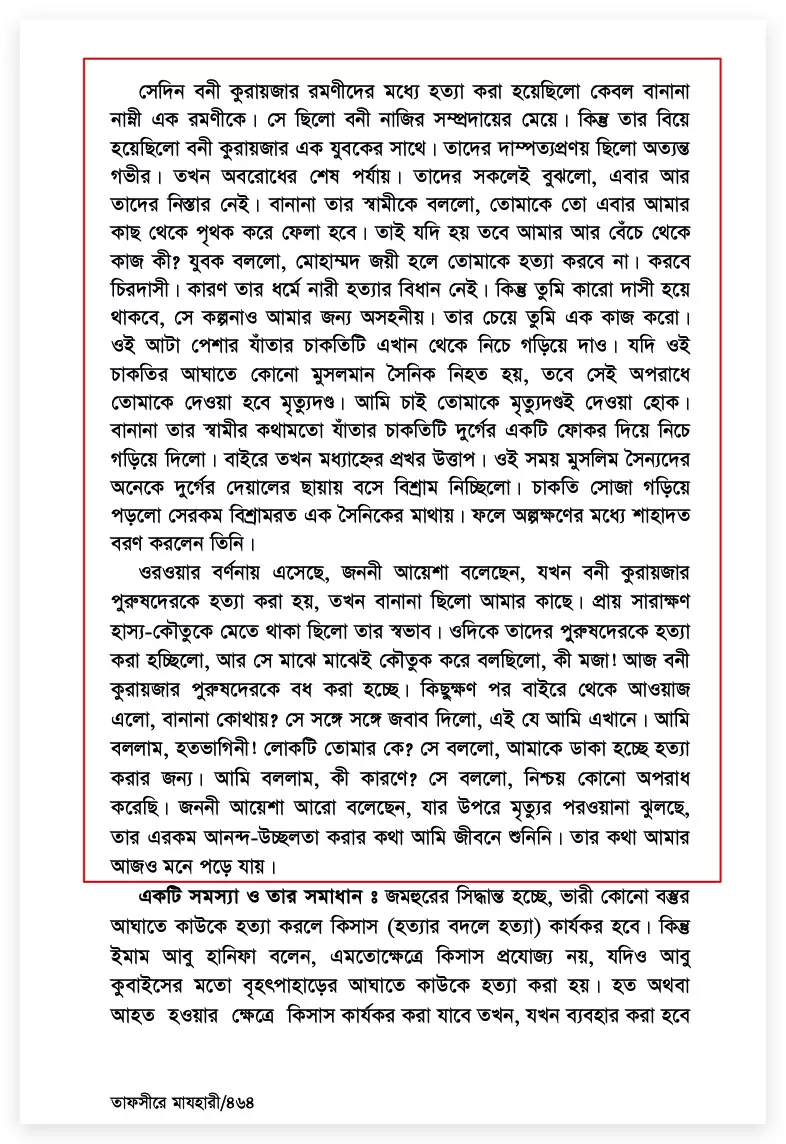
That day, among the women of Banu Qurayza, only one woman named Banana was killed. She was from the Banu Nadir community but had married a young man from Banu Qurayza. Their marital affection was extremely deep. At that time, the siege was in its final stage. They all understood that there was no escape. Banana said to her husband, “You are now going to be separated from me. If that is so, then what use is there in my continuing to live?” The young man said, “If Muhammad wins, he will not kill you. He will make you a permanent slave, because in his religion women are not to be killed. But the thought of you living as someone’s slave is unbearable to me.” He then told her to roll a millstone down from the fortress, saying that if it killed a Muslim soldier, she would be sentenced to death for the offense. He said that he preferred that she be given the death penalty. Banana did as her husband instructed and rolled the millstone down through an opening in the fortress. Outside it was the intense heat of midday. A number of Muslim soldiers were resting in the shade of the fortress wall. The millstone rolled directly onto the head of one of those soldiers, and he died shortly afterward.
In Urwah’s narration, Mother Aisha is reported to have said, when the men of Banu Qurayza were being killed, Banana was with me. It was her habit to remain almost constantly occupied in laughter and joking. Meanwhile their men were being killed, and from time to time she would joke and say, “How amusing! Today the men of Banu Qurayza are being slaughtered.” After a while a voice came from outside: “Where is Banana?” She immediately replied, “Here I am.” I said, “Wretched woman! Who is that man to you?” She said, “I am being called to be killed.” I said, “For what reason?” She replied, “Surely I have committed some offense.” Mother Aisha further said, “I have never in my life heard of anyone remaining so joyful and cheerful while a death sentence hung over her. I still remember her words.”
Now let us listen to a sermon,
The Prophet Muhammad’s Attack on Khaybar
Like the other Jewish tribes, the Prophet Muhammad attacked the region of Khaybar, which belonged to a very wealthy Jewish community. This battle took place in 628 CE (7 AH) in an area called Khaybar, located about 150 kilometers north of Medina. Khaybar was a prosperous Jewish-majority settlement with strong fortresses, cultivable land, and mineral resources. The Jews there held significant influence in Arabian society at the time, not only religiously but also economically and strategically. Muslim historical accounts claim that the Jewish leaders of Khaybar incited Banu Qurayza and Banu Nadir against the Muslims of Medina, and later joined with the Ghatafan tribe and desert Bedouins in planning an attack on Medina. However, the reliability of these Muslim reports remains questionable because the surviving accounts are overwhelmingly one-sided. Against this background, under the leadership of the Prophet Muhammad, the Muslim army attacked Khaybar and captured one fortress after another.
The battle was violent, and many Jews were killed or taken captive. Although the Muslims won, the Jews of Khaybar were not immediately expelled. Instead, they were allowed to remain under an arrangement that left their continued residence to Muhammad’s discretion, while half of their annual produce went to the Muslims. During this post-war period, a Jewish woman who had lost relatives in the conflict invited Muhammad to a meal and served him goat meat containing poison. Islamic reports state that he suffered lasting effects from the poisoning, which were later connected with his final illness and death [19].
Safiyya Was Brought Past the Corpses of Her Relatives
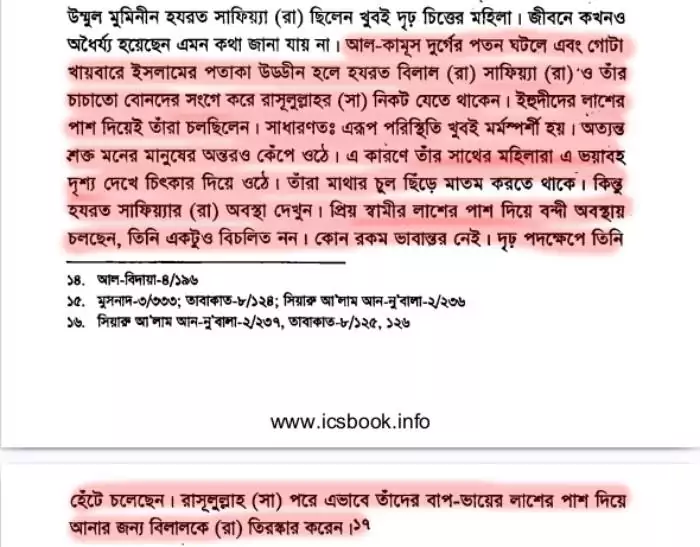
One after another, most of Safiyya’s relatives, including her father, uncle, and husband, were killed at the hands of Muhammad’s forces. The Islamic claim that a mentally healthy woman could forget overnight the horrifying grief of losing her family, willingly climb into the Prophet’s bed, and immediately begin a romantic and sexual relationship is profoundly unrealistic. After the fall of the fortress of Qamus, many women, including Safiyya, were captured by the Muslims as spoils of war. When Bilal brought Safiyya forward, he led her directly past the mutilated corpses of her relatives. A terrifying scene unfolded. This account appears in numerous Sirah works, including Ashab-e-Rasul-er Jibonkotha [20] –
The Killing of Safiyya’s Husband Kinana
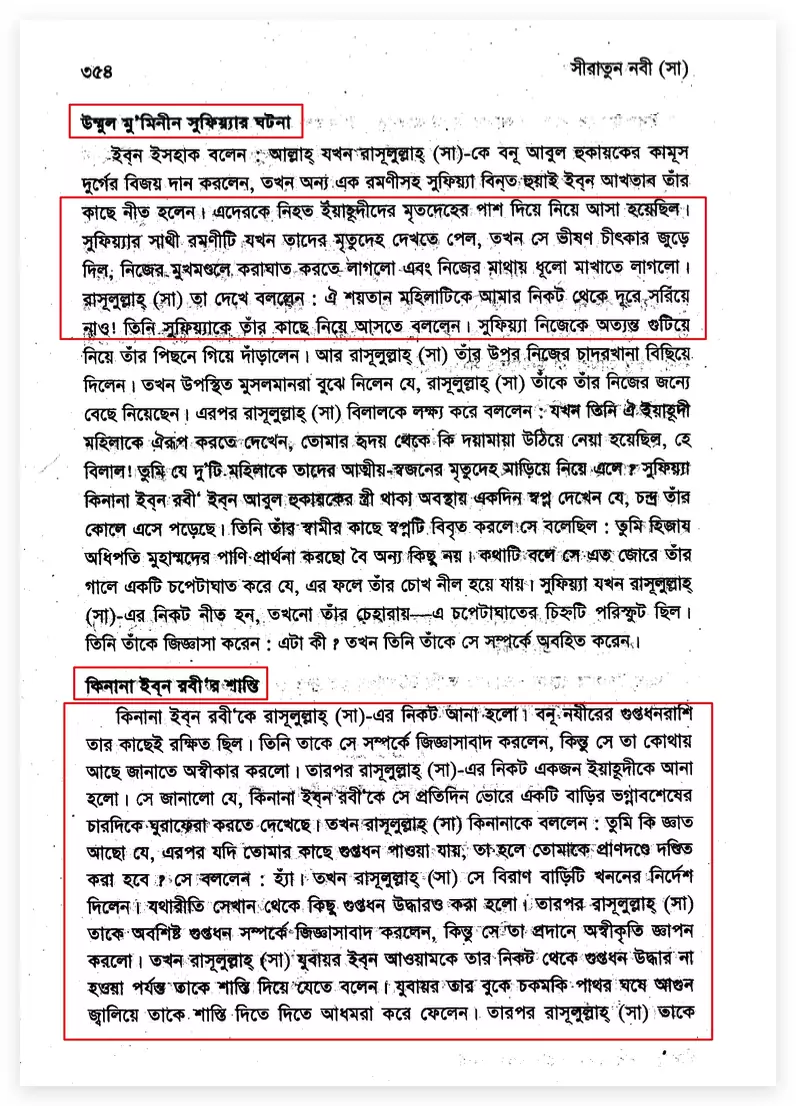
Safiyya’s husband, Kinana ibn Rabi‘, was the treasurer or custodian of the wealth of the Jews of Khaybar. Reports state that he was severely tortured in an attempt to discover the location of hidden treasure and was later killed in an extremely brutal manner [21]
Sirat-un-Nabi (peace be upon him), p. 354
The Incident of Umm al-Mu’minin Safiyya
Ibn Ishaq says: When Allah granted the Messenger of Allah (peace be upon him) victory over the Qamus fortress of Banu Abu al-Huqayq, Safiyya bint Huyayy ibn Akhtab was brought to him along with another woman. They had been led past the dead bodies of the slain Jews. When the woman accompanying Safiyya saw their dead bodies, she began to scream violently, strike her own face, and throw dust upon her head.
Seeing this, the Messenger of Allah (peace be upon him) said, “Take that satanic woman away from me!” Then he ordered Safiyya to be brought to him. Safiyya drew herself in tightly and stood behind him, and the Messenger of Allah (peace be upon him) spread his cloak over her. The Muslims present then understood that the Messenger of Allah (peace be upon him) had chosen her for himself.
The Messenger of Allah (peace be upon him) then said to Bilal, “When you saw that Jewish woman behaving in that way, had mercy and compassion been removed from your heart, O Bilal, that you brought these two women past the dead bodies of their relatives?”
While Safiyya was the wife of Kinana ibn Rabi‘ ibn Abu al-Huqayq, she once saw in a dream that the moon had fallen into her lap. When she described the dream to her husband, he said, “You desire nothing other than marriage to Muhammad, the ruler of the Hijaz.” Saying this, he struck her so hard on the cheek that her eye turned blue. When Safiyya was brought to the Messenger of Allah (peace be upon him), the mark of that slap was still visible on her face.
The Messenger of Allah (peace be upon him) asked her, “What is this?” She then informed him about it.
The Punishment of Kinana ibn Rabi‘
Kinana ibn Rabi‘ was brought before the Messenger of Allah (peace be upon him). The treasures of Banu Nadir were kept with him. He questioned him about them, but Kinana refused to disclose where they were.
Then a Jew was brought before the Messenger of Allah (peace be upon him). He reported that Kinana ibn Rabi‘ had been seen every morning walking around the ruins of a particular house. The Messenger of Allah (peace be upon him) then said to Kinana, “Do you know that if the treasure is later found with you, you will be sentenced to death?”
He said, “Yes.”
The Messenger of Allah (peace be upon him) then ordered that deserted house to be dug up. Some treasure was recovered from there. After that, the Messenger of Allah (peace be upon him) questioned him about the remaining treasure, but he refused to hand it over.
The Messenger of Allah (peace be upon him) then ordered Zubayr ibn al-Awwam, “Keep punishing him until the treasure is extracted from him.”
Zubayr kept striking flint against his chest and setting fire to it until he was nearly dead. After that, the Messenger of Allah (peace be upon him) handed him over for execution…
How a Human Being Becomes Property
Without the slightest sense of shame or modesty, Islam counts a human being as property—especially a woman. A human being who only moments earlier had been free was, under the bite of Islam, transformed into property. Let us read a hadith [22]
Reference : Sunan Abi Dawud 2994
In-book reference : Book 20, Hadith 67
English translation : Book 19, Hadith 2988
Chapter: The Special Portion (As-Safi) Of The Prophet (saws) That Was taken From The Spoils Of War
A’ishah said “Safiyyah was called after the word safi (a special portion of the Prophet).”
Arabic : حَدَّثَنَا نَصْرُ بْنُ عَلِيٍّ ، حَدَّثَنَا أَبُو أَحْمَدَ ، أَخْبَرَنَا سُفْيَانُ ، عَنْ هِشَامِ بْنِ عُرْوَةَ ، عَنْ أَبِيهِ ، عَنْ عَائِشَةَ ، قَالَتْ كَانَتْ صَفِيَّةُ مِنَ الصَّفِيِّ .
Grade: Sahih (Al-Albani)
The Distribution of the Spoils of War
After the conquest of Khaybar, the captive women were gathered for distribution. Dihya al-Kalbi asked Muhammad for a slave woman and was told to choose one. He selected Safiyya bint Huyayy. When Muhammad heard of her beauty, he summoned Dihya and retained Safiyya for himself. Dihya then received seven other slave women in exchange. In this way, Safiyya was treated as part of the victor’s share of the spoils. According to the cited reports, Muhammad consummated the relationship with her on the journey back [23] [24] –
Reference : Sunan Abi Dawud 2998
In-book reference : Book 20, Hadith 71
English translation : Book 19, Hadith 2992
Chapter: The Special Portion (As-Safi) Of The Prophet (saws) That Was taken From The Spoils Of War
Anas said “Captives were gathered at Khaibar. Dihyah came out and said “Apostle of Allaah(ﷺ) give me a slave girl from the captives.” He said “Go and take a slave girl. He took Safiyyah daughter of Huyayy. A man then came to the Prophet (ﷺ) and said “You gave Safiyyah daughter of Huyayy, chief lady of Quraizah and Al Nadir to Dihyah? This is according to the version of Ya’qub. Then the agreed version goes “she is worthy of you.” He said “call him along with her.
When the Prophet (ﷺ) looked at her, he said to him “take another slave girl from the captives. The Prophet (ﷺ) then set her free and married her.
Arabic : حَدَّثَنَا دَاوُدُ بْنُ مُعَاذٍ، حَدَّثَنَا عَبْدُ الْوَارِثِ، ح وَحَدَّثَنَا يَعْقُوبُ بْنُ إِبْرَاهِيمَ، – الْمَعْنَى – قَالَ حَدَّثَنَا ابْنُ عُلَيَّةَ، عَنْ عَبْدِ الْعَزِيزِ بْنِ صُهَيْبٍ، عَنْ أَنَسٍ، قَالَ جُمِعَ السَّبْىُ – يَعْنِي بِخَيْبَرَ – فَجَاءَ دِحْيَةُ فَقَالَ يَا رَسُولَ اللَّهِ أَعْطِنِي جَارِيَةً مِنَ السَّبْىِ . قَالَ ” اذْهَبْ فَخُذْ جَارِيَةً ” . فَأَخَذَ صَفِيَّةَ بِنْتَ حُيَىٍّ فَجَاءَ رَجُلٌ إِلَى النَّبِيِّ صلى الله عليه وسلم فَقَالَ يَا نَبِيَّ اللَّهِ أَعْطَيْتَ دِحْيَةَ – قَالَ يَعْقُوبُ – صَفِيَّةَ بِنْتَ حُيَىٍّ سَيِّدَةَ قُرَيْظَةَ وَالنَّضِيرِ – ثُمَّ اتَّفَقَا – مَا تَصْلُحُ إِلاَّ لَكَ . قَالَ ” ادْعُوهُ بِهَا ” . فَلَمَّا نَظَرَ إِلَيْهَا النَّبِيُّ صلى الله عليه وسلم قَالَ لَهُ ” خُذْ جَارِيَةً مِنَ السَّبْىِ غَيْرَهَا ” . وَإِنَّ النَّبِيَّ صلى الله عليه وسلم أَعْتَقَهَا وَتَزَوَّجَهَا .
Grade: Sahih (Al-Albani)
Reference : Sahih Muslim 1365c
In-book reference : Book 16, Hadith 102
Chapter: The virtue of manumitting one’s slave girl, then marrying her
Anas (Allah be pleased with him) reported that Allah’s Messenger (ﷺ) set out on an expedition to Khaibar and we observed our morning prayer in early hours of the dawn. The Messenger of Allah (ﷺ) then mounted and so did Abu Talha ride, and I was seating myself behind Abu Talha. Allah’s Apostle (ﷺ) moved in the narrow street of Khaibar (and we rode so close to each other in the street) that my knee touched the leg of Allah’s Apostle (ﷺ).
(A part of the) lower garment of Allah’s Apostle (ﷺ) slipped from his leg and I could see the whiteness of the leg of Allah’s Apostle (ﷺ). As he entered the habitation he called:
Allahu Akbar (Allah is the Greatest). Khaibar is ruined. And when we get down in the valley of a people evil is the morning of the warned ones. He repeated it thrice. In the meanwhile the people went out for their work, and said: By Allah, Muhammad (has come). Abd al-‘Aziz or some of our companions said: Muhammad and the army (have come). He said: We took it (the territory of Khaibar) by force, and there were gathered the prisoners of war.
There came Dihya and he said: Messenger of Allah, bestow upon me a girl from among the prisoners. He said: Go and get any girl. He made a choice for Safiyya daughter of Huyayy (b. Akhtab). There came a person to Allah’s Apostle (ﷺ) and said: Apostle of Allah, you have bestowed Safiyya bint Huyayy, the chief of Quraiza and al-Nadir, upon Dihya and she is worthy of you only. He said: Call him along with her. So he came along with her.
When Allah’s Apostle (ﷺ) saw her he said: Take any other woman from among the prisoners. He (the narrator) said: He (the Holy Prophet) then granted her emancipation and married her. Thabit said to him: Abu Hamza, how much dower did he (the Holy Prophet) give to her? He said: He granted her freedom and then married her. On the way Umm Sulaim embellished her and then sent her to him (the Holy Prophet) at night. Allah’s Apostle (ﷺ) appeared as a bridegroom in the morning.
He (the Holy Prophet) said: He who has anything (to eat) should bring that. Then the cloth was spread. A person came with cheese, another came with dates, and still another came with refined butter, and they prepared hais and that was the wedding feast of Allah’s Messenger (ﷺ).
Arabic : حَدَّثَنِي زُهَيْرُ بْنُ حَرْبٍ، حَدَّثَنَا إِسْمَاعِيلُ، – يَعْنِي ابْنَ عُلَيَّةَ – عَنْ عَبْدِ الْعَزِيزِ، عَنْ أَنَسٍ، أَنَّ رَسُولَ اللَّهِ صلى الله عليه وسلم غَزَا خَيْبَرَ قَالَ فَصَلَّيْنَا عِنْدَهَا صَلاَةَ الْغَدَاةِ بِغَلَسٍ فَرَكِبَ نَبِيُّ اللَّهِ صلى الله عليه وسلم وَرَكِبَ أَبُو طَلْحَةَ وَأَنَا رَدِيفُ أَبِي طَلْحَةَ فَأَجْرَى نَبِيُّ اللَّهِ صلى الله عليه وسلم فِي زُقَاقِ خَيْبَرَ وَإِنَّ رُكْبَتِي لَتَمَسُّ فَخِذَ نَبِيِّ اللَّهِ صلى الله عليه وسلم وَانْحَسَرَ الإِزَارُ عَنْ فَخِذِ نَبِيِّ اللَّهِ صلى الله عليه وسلم فَإِنِّي لأَرَى بَيَاضَ فَخِذِ نَبِيِّ اللَّهِ صلى الله عليه وسلم فَلَمَّا دَخَلَ الْقَرْيَةَ قَالَ ” اللَّهُ أَكْبَرُ خَرِبَتْ خَيْبَرُ إِنَّا إِذَا نَزَلْنَا بِسَاحَةِ قَوْمٍ فَسَاءَ صَبَاحُ الْمُنْذَرِينَ ” . قَالَهَا ثَلاَثَ مَرَّاتٍ قَالَ وَقَدْ خَرَجَ الْقَوْمُ إِلَى أَعْمَالِهِمْ فَقَالُوا مُحَمَّدٌ وَاللَّهِ . قَالَ عَبْدُ الْعَزِيزِ وَقَالَ بَعْضُ أَصْحَابِنَا مُحَمَّدٌ وَالْخَمِيسُ . قَالَ وَأَصَبْنَاهَا عَنْوَةً وَجُمِعَ السَّبْىُ فَجَاءَهُ دِحْيَةُ فَقَالَ يَا رَسُولَ اللَّهِ أَعْطِنِي جَارِيَةً مِنَ السَّبْىِ . فَقَالَ ” اذْهَبْ فَخُذْ جَارِيَةً ” . فَأَخَذَ صَفِيَّةَ بِنْتَ حُيَىٍّ فَجَاءَ رَجُلٌ إِلَى نَبِيِّ اللَّهِ صلى الله عليه وسلم فَقَالَ يَا نَبِيَّ اللَّهِ أَعْطَيْتَ دِحْيَةَ صَفِيَّةَ بِنْتَ حُيَىٍّ سَيِّدِ قُرَيْظَةَ وَالنَّضِيرِ مَا تَصْلُحُ إِلاَّ لَكَ . قَالَ ” ادْعُوهُ بِهَا ” . قَالَ فَجَاءَ بِهَا فَلَمَّا نَظَرَ إِلَيْهَا النَّبِيُّ صلى الله عليه وسلم قَالَ ” خُذْ جَارِيَةً مِنَ السَّبْىِ غَيْرَهَا ” . قَالَ وَأَعْتَقَهَا وَتَزَوَّجَهَا . فَقَالَ لَهُ ثَابِتٌ يَا أَبَا حَمْزَةَ مَا أَصْدَقَهَا قَالَ نَفْسَهَا أَعْتَقَهَا وَتَزَوَّجَهَا حَتَّى إِذَا كَانَ بِالطَّرِيقِ جَهَّزَتْهَا لَهُ أُمُّ سُلَيْمٍ فَأَهْدَتْهَا لَهُ مِنَ اللَّيْلِ فَأَصْبَحَ النَّبِيُّ صلى الله عليه وسلم عَرُوسًا فَقَالَ ” مَنْ كَانَ عِنْدَهُ شَىْءٌ فَلْيَجِئْ بِهِ ” قَالَ وَبَسَطَ نِطَعًا قَالَ فَجَعَلَ الرَّجُلُ يَجِيءُ بِالأَقِطِ وَجَعَلَ الرَّجُلُ يَجِيءُ بِالتَّمْرِ وَجَعَلَ الرَّجُلُ يَجِيءُ بِالسَّمْنِ فَحَاسُوا حَيْسًا . فَكَانَتْ وَلِيمَةَ رَسُولِ اللَّهِ صلى الله عليه وسلم .
Grade: Sahih
Dihya al-Kalbi Seizes the Opportunity
At the beginning of the distribution of the spoils, Dihya al-Kalbi asked to take Safiyya, the most beautiful woman of Khaybar, as a slave woman. Muhammad agreed before seeing her. After hearing of her beauty, however, he summoned Dihya and took Safiyya for himself. Dihya then surrendered her in exchange for seven other slave women. The report thus presents the episode as a transaction within the system of captive distribution [25]
Reference : Sunan Ibn Majah 2272
In-book reference : Book 12, Hadith 136
English translation : Vol. 3, Book 12, Hadith 2272
Chapter : Selling Animals For Animals, Of Different Kinds, Hand to Hand
It was narrated from Anas that :
the Prophet (ﷺ) bought Safiyyah for seven slaves. (Sahih) (One of the narrators) ‘Abdur-Rahman said: “From Dihyah Kalbi.’
Arabic : حَدَّثَنَا نَصْرُ بْنُ عَلِيٍّ الْجَهْضَمِيُّ، حَدَّثَنَا الْحُسَيْنُ بْنُ عُرْوَةَ، ح وَحَدَّثَنَا أَبُو عُمَرَ، حَفْصُ بْنُ عَمْرٍو حَدَّثَنَا عَبْدُ الرَّحْمَنِ بْنُ مَهْدِيٍّ، قَالاَ حَدَّثَنَا حَمَّادُ بْنُ سَلَمَةَ، عَنْ ثَابِتٍ، عَنْ أَنَسٍ، أَنَّ النَّبِيَّ ـ صلى الله عليه وسلم ـ اشْتَرَى صَفِيَّةَ بِسَبْعَةِ أَرْؤُسٍ . قَالَ عَبْدُ الرَّحْمَنِ مِنْ دِحْيَةَ الْكَلْبِيِّ .
Grade: Sahih
The Fifty-Seven-Year-Old Prophet and the Sixteen-Year-Old Safiyya
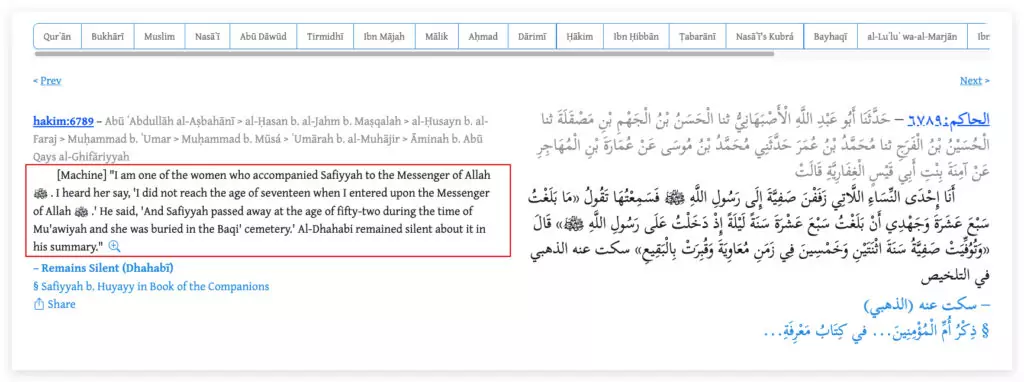
Safiyya bint Huyayy was approximately sixteen years old when she was captured by the Prophet Muhammad, while Muhammad was about fifty-seven. This age difference is striking from any ordinary perspective, especially when the relationship emerged in the context of war captivity and the destruction of her family. A sixteen-year-old young woman, before whom the bloodied bodies of her husband, father, and relatives had suddenly been scattered, was being prepared to be taken to the bed of a conqueror old enough to be her grandfather. This was not merely a marriage; it was also an expression of power and authority. The question of how spontaneous or independent her consent could have been therefore remains very much open.
In light of modern human rights, women’s dignity, and independent decision-making, such an incident raises profound questions. A relationship in which the age gap is enormous and the younger party is situationally in an extremely fragile psychological condition needs to be analyzed not merely as a relationship of love, but from a more realistic political perspective. Although such marriages may be presented as “Allah’s will” or “religious command,” the historical context also involved politics, authority, conquest, and the possession of women as symbols of victory. Safiyya’s case was no exception. Behind this relationship stood the absence of meaningful freedom for the captive woman, the possession and sexual use of the female body as part of conquest, and the cruel reality of women’s place in a patriarchal wartime order. Let us learn from the report concerning Safiyya how young she was at the time [26]
hakim:6789 – Abū ʿAbdullāh al-Aṣbahānī > al-Ḥasan b. al-Jahm b. Maṣqalah > al-Ḥusayn b. al-Faraj > Muḥammad b. ʿUmar > Muḥammad b. Mūsá > ʿUmārah b. al-Muhājir > Āminah b. Abū Qays al-Ghifāriyyah
“I am one of the women who accompanied Safiyyah to the Messenger of Allah ﷺ . I heard her say, ‘I did not reach the age of seventeen when I entered upon the Messenger of Allah ﷺ .’ He said, ‘And Safiyyah passed away at the age of fifty-two during the time of Mu’awiyah and she was buried in the Baqi’ cemetery.’ Al-Dhahabi remained silent about it in his summary.”
– Remains Silent (Dhahabī)
§ Safiyyah b. Huyayy in Book of the Companions
Did They Actually Marry at All?
Anas ibn Malik served for some time in the household of the Prophet Muhammad, which naturally means that he would have known more than many others about what happened within the Prophet’s household. From a narration transmitted from Anas, we learn that on the journey back from Khaybar, the Prophet consummated his relationship with Safiyya, yet at the time the Muslims themselves were uncertain whether Muhammad had taken Safiyya as a wife or as a slave woman. Later, after seeing that a curtain or hijab was placed between her and the people, they concluded that he had taken her as a wife. But the Prophet himself had not announced this to them. At the same time, marriage in Islam ordinarily involves a recognizable marriage contract and witnesses. If a marriage had taken place, why did the surrounding Muslims not know whether she was a wife or a slave woman? Was there actually a marriage in the ordinary sense, or had the Prophet simply taken the young captive Safiyya to his bed? [27]
Reference : Sunan an-Nasa’i 3382
In-book reference : Book 26, Hadith 187
English translation : Vol. 4, Book 26, Hadith 3384
Chapter: Consummation Of Marriage While Travelling
It was narrated that Anas said:
“The Prophet stayed between Khaibar and Al-Madinah for three days when he consummated his marriage to Safiyyah bint Huyayy, and I invited the Muslims to his Walimah, in which there was no bread or meat. He commanded that a leather cloth (be spread) and dates, cottage cheese and ghee were placed on it, and that was his Walimah.
The Muslims said: ‘(Will she be) one of the Mothers of the Believers, or a female slave whom his right hand possesses?’ They said: ‘If he has a Hijab for her, then she will be one of the Mothers of the Believers and if she does not have a Hijab then she will be a female slave whom his right hand possesses.’ When he rode on, he set aside a plate for her behind him and extended a Hijab between her and the people.”
Arabic : أَخْبَرَنَا عَلِيُّ بْنُ حُجْرٍ ، قَالَ حَدَّثَنَا إِسْمَاعِيلُ ، قَالَ حَدَّثَنَا حُمَيْدٌ ، عَنْ أَنَسٍ ، قَالَ أَقَامَ النَّبِيُّ صلى الله عليه وسلم بَيْنَ خَيْبَرَ وَالْمَدِينَةِ ثَلاَثًا يَبْنِي بِصَفِيَّةَ بِنْتِ حُيَىٍّ فَدَعَوْتُ الْمُسْلِمِينَ إِلَى وَلِيمَتِهِ فَمَا كَانَ فِيهَا مِنْ خُبْزٍ وَلاَ لَحْمٍ أَمَرَ بِالأَنْطَاعِ وَأَلْقَى عَلَيْهَا مِنَ التَّمْرِ وَالأَقِطِ وَالسَّمْنِ فَكَانَتْ وَلِيِمَتَهُ فَقَالَ الْمُسْلِمُونَ إِحْدَى أُمَّهَاتِ الْمُؤْمِنِينَ أَوْ مِمَّا مَلَكَتْ يَمِينُهُ فَقَالُوا إِنْ حَجَبَهَا فَهِيَ مِنْ أُمَّهَاتِ الْمُؤْمِنِينَ وَإِنْ لَمْ يَحْجُبْهَا فَهِيَ مِمَّا مَلَكَتْ يَمِينُهُ فَلَمَّا ارْتَحَلَ وَطَّأَ لَهَا خَلْفَهُ وَمَدَّ الْحِجَابَ بَيْنَهَا وَبَيْنَ النَّاسِ .
Grade: Sahih (Darussalam)
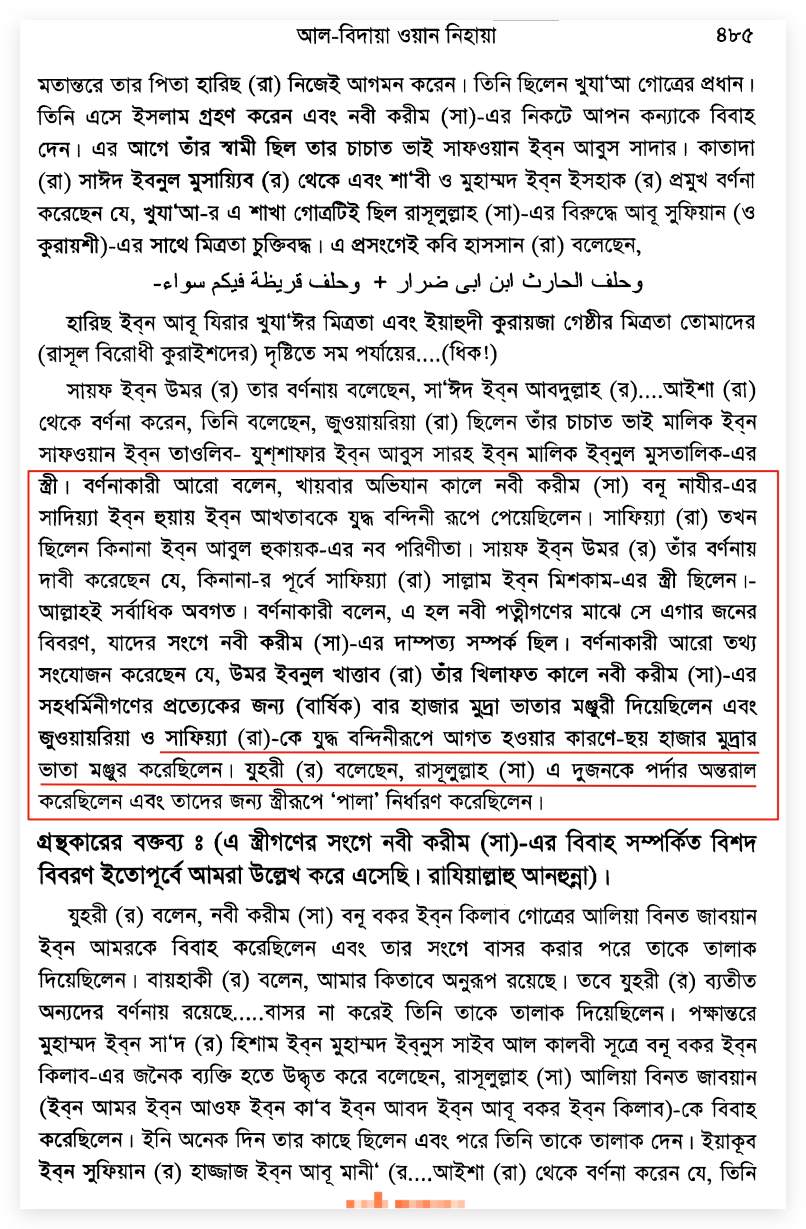
Now let us consider another important piece of information. During the caliphate of ‘Umar, the Prophet’s widowed wives were given an allowance of twelve thousand coins, whereas Safiyya was given six thousand. If the Prophet had actually married Safiyya, why was she given an allowance of only six thousand coins? [28]
Safiyya Hated the Prophet
Now let us come to one of the most important pieces of information. Was Safiyya forced into this marriage? Did she feel love for the Prophet? Had she already been eager to enter his bed? While she was still another man’s wife, did she have romantic or erotic feelings toward an unrelated elderly man—Muhammad? Many Muslims cite a narration claiming that even before Muhammad’s attack on Khaybar, Safiyya had seen a dream concerning him. Even if that narration is assumed to be true, one can ask why Safiyya would later narrate it in the circumstances in which she found herself. Otherwise, are Muslims really claiming that Safiyya, whom they regard as a Mother of the Believers, while still married to Kinana, had romantic dreams about the elderly Muhammad? In contrast, a report attributed directly to Safiyya states that she initially felt intense hatred toward Muhammad [29]
Sahih Ibn Hibban (11/607)
عن عبد الله بن عمر رضي الله عنه قال : … قالت صفية :وكان رسول الله صلى الله عليه وسلم من أبغض الناس إليَّ قَتل زوجي وأبي وأخي فما زال يعتذر إليَّ ويقول : ( إن أباك ألَّب علي العرب وفعل وفعل ) حتى ذهب ذلك من نفسي .۔۔ رواه ابن حبان في ” صحيحه ” ( 11 / 607 ) ، .
Abdullah Ibn Umar narrates that Safiyya said: “The Messenger of Allah was among the most hated people to me, since he had killed my husband, my father, and my brother. Then he kept making excuses to me, saying: ‘Your father incited the Arabs against me and did such-and-such,’ until that feeling left my heart.
Grading: Sahih (authentic)
Safiyya Was Taken to Bed Shortly Afterward
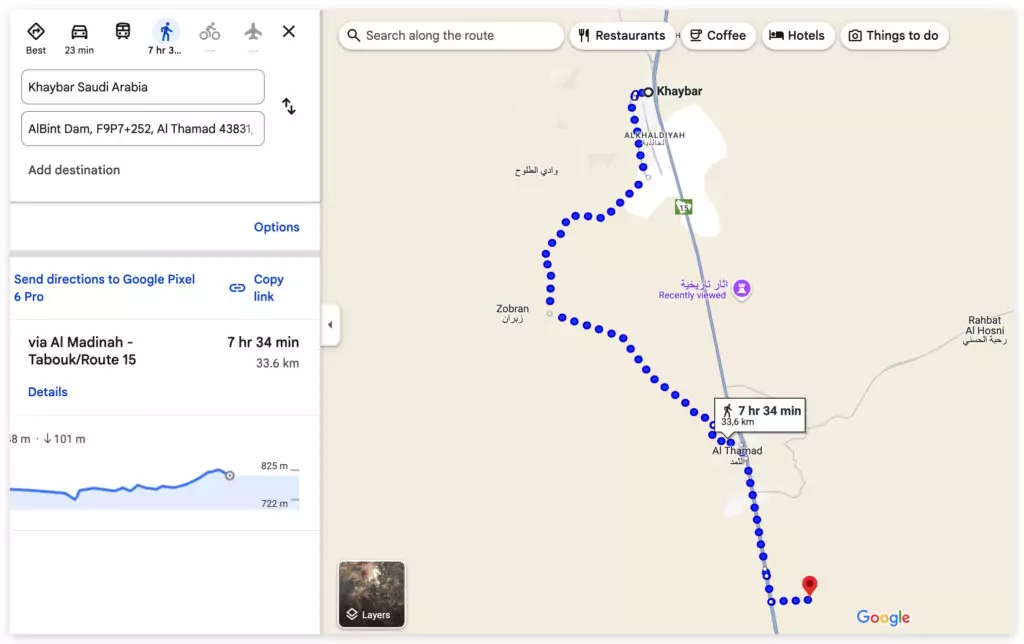
Consider the hadiths below. On the journey back to Medina from Khaybar, after traveling only a relatively short distance, the Prophet reached a place called Sadd as-Sahba and had intercourse with Safiyya. The precise location of Sadd as-Sahba cannot be established with complete certainty, but it appears to have been somewhere relatively close to Khaybar. In other words, on the return journey from Khaybar, Muhammad took Safiyya—who had only just lost her father, husband, and relatives—to bed [30] [31]
Reference : Sahih al-Bukhari 2893
In-book reference : Book 56, Hadith 108
USC-MSA web (English) reference : Vol. 4, Book 52, Hadith 143
Chapter: Whoever sets off for a holy battle accompanied by a boy-servant
Narrated Anas bin Malik:
The Prophet (ﷺ) said to Abu Talha, “Choose one of your boy servants to serve me in my expedition to Khaibar.” So, Abu Talha took me letting me ride behind him while I was a boy nearing the age of puberty. I used to serve Allah’s Messenger (ﷺ) when he stopped to rest.
I heard him saying repeatedly, “O Allah! I seek refuge with You from distress and sorrow, from helplessness and laziness, from miserliness and cowardice, from being heavily in debt and from being overcome by men.” Then we reached Khaibar; and when Allah enabled him to conquer the Fort (of Khaibar), the beauty of Safiya bint Huyai bin Akhtab was described to him. Her husband had been killed while she was a bride.
So Allah’s Messenger (ﷺ) selected her for himself and took her along with him till we reached a place called Sa`d-AsSahba,’ where her menses were over and he took her for his wife. Haris (a kind of dish) was served on a small leather sheet. Then Allah’s Messenger (ﷺ) told me to call those who were around me. So, that was the marriage banquet of Allah’s Messenger (ﷺ) and Safiya. Then we left for Medina.
I saw Allah’s Apostle folding a cloak round the hump of the camel so as to make a wide space for Safiya (to sit on behind him) He sat beside his camel letting his knees for Safiya to put her feet on so as to mount the camel. Then, we proceeded till we approached Medina; he looked at Uhud (mountain) and said, “This is a mountain which loves us and is loved by us.” Then he looked at Medina and said, “O Allah! I make the area between its (i.e. Medina’s) two mountains a sanctuary as Abraham made Mecca a sanctuary. O Allah! Bless them (i.e. the people of Medina) in their Mudd and Sa (i.e. measures).
Arabic : حَدَّثَنَا قُتَيْبَةُ ، حَدَّثَنَا يَعْقُوبُ ، عَنْ عَمْرٍو ، عَنْ أَنَسِ بْنِ مَالِكٍ ـ رضى الله عنه ـ أَنَّ النَّبِيَّ صلى الله عليه وسلم قَالَ لأَبِي طَلْحَةَ ” الْتَمِسْ غُلاَمًا مِنْ غِلْمَانِكُمْ يَخْدُمُنِي حَتَّى أَخْرُجَ إِلَى خَيْبَرَ ”. فَخَرَجَ بِي أَبُو طَلْحَةَ مُرْدِفِي، وَأَنَا غُلاَمٌ رَاهَقْتُ الْحُلُمَ، فَكُنْتُ أَخْدُمُ رَسُولَ اللَّهِ صلى الله عليه وسلم إِذَا نَزَلَ، فَكُنْتُ أَسْمَعُهُ كَثِيرًا يَقُولُ ” اللَّهُمَّ إِنِّي أَعُوذُ بِكَ مِنَ الْهَمِّ وَالْحَزَنِ وَالْعَجْزِ وَالْكَسَلِ وَالْبُخْلِ وَالْجُبْنِ وَضَلَعِ الدَّيْنِ وَغَلَبَةِ الرِّجَالِ ”. ثُمَّ قَدِمْنَا خَيْبَرَ، فَلَمَّا فَتَحَ اللَّهُ عَلَيْهِ الْحِصْنَ ذُكِرَ لَهُ جَمَالُ صَفِيَّةَ بِنْتِ حُيَىِّ بْنِ أَخْطَبَ، وَقَدْ قُتِلَ زَوْجُهَا وَكَانَتْ عَرُوسًا، فَاصْطَفَاهَا رَسُولُ اللَّهِ صلى الله عليه وسلم لِنَفْسِهِ، فَخَرَجَ بِهَا حَتَّى بَلَغْنَا سَدَّ الصَّهْبَاءِ حَلَّتْ، فَبَنَى بِهَا، ثُمَّ صَنَعَ حَيْسًا فِي نِطَعٍ صَغِيرٍ، ثُمَّ قَالَ رَسُولُ اللَّهِ صلى الله عليه وسلم ” آذِنْ مَنْ حَوْلَكَ ”. فَكَانَتْ تِلْكَ وَلِيمَةَ رَسُولِ اللَّهِ صلى الله عليه وسلم عَلَى صَفِيَّةَ. ثُمَّ خَرَجْنَا إِلَى الْمَدِينَةِ قَالَ فَرَأَيْتُ رَسُولَ اللَّهِ صلى الله عليه وسلم يُحَوِّي لَهَا وَرَاءَهُ بِعَبَاءَةٍ، ثُمَّ يَجْلِسُ عِنْدَ بَعِيرِهِ فَيَضَعُ رُكْبَتَهُ، فَتَضَعُ صَفِيَّةُ رِجْلَهَا عَلَى رُكْبَتِهِ حَتَّى تَرْكَبَ، فَسِرْنَا حَتَّى إِذَا أَشْرَفْنَا عَلَى الْمَدِينَةِ نَظَرَ إِلَى أُحُدٍ فَقَالَ ” هَذَا جَبَلٌ يُحِبُّنَا وَنُحِبُّهُ ”. ثُمَّ نَظَرَ إِلَى الْمَدِينَةِ فَقَالَ ” اللَّهُمَّ إِنِّي أُحَرِّمُ مَا بَيْنَ لاَبَتَيْهَا بِمِثْلِ مَا حَرَّمَ إِبْرَاهِيمُ مَكَّةَ، اللَّهُمَّ بَارِكْ لَهُمْ فِي مُدِّهِمْ وَصَاعِهِمْ ”.
Grade: Sahih
Reference : Sunan Abi Dawud 2995
In-book reference : Book 20, Hadith 68
English translation : Book 19, Hadith 2989
Chapter: The Special Portion (As-Safi) Of The Prophet (saws) That Was taken From The Spoils Of War
Anas bin Malik said “We came to Khaibar. We bestowed the conquest of fortress (on us), the beauty of Safiyyah daughter of Huyayy was mentioned to him (the Prophet). Her husband was killed (in the battle) and she was a bride. The Apostle of Allaah(ﷺ) chose her for himself. He came out with her till we reached Sadd Al Sahba’ where she was purified. So he cohabited with her.”
Arabic : حَدَّثَنَا سَعِيدُ بْنُ مَنْصُورٍ ، حَدَّثَنَا يَعْقُوبُ بْنُ عَبْدِ الرَّحْمَنِ الزُّهْرِيِّ ، عَنْ عَمْرِو بْنِ أَبِي عَمْرٍو ، عَنْ أَنَسِ بْنِ مَالِكٍ ، قَالَ قَدِمْنَا خَيْبَرَ فَلَمَّا فَتَحَ اللَّهُ تَعَالَى الْحِصْنَ ذُكِرَ لَهُ جَمَالُ صَفِيَّةَ بِنْتِ حُيَىٍّ وَقَدْ قُتِلَ زَوْجُهَا وَكَانَتْ عَرُوسًا فَاصْطَفَاهَا رَسُولُ اللَّهِ صلى الله عليه وسلم لِنَفْسِهِ فَخَرَجَ بِهَا حَتَّى بَلَغْنَا سُدَّ الصَّهْبَاءِ حَلَّتْ فَبَنَى بِهَا .
Grade: Sahih (Al-Albani)
I have tried to determine the location of this place from uncertain sources; I am not at all certain about this information. The place appears to have been somewhere approximately 6 miles (9.6 kilometers) to 30 kilometers south of Khaybar. On foot, the journey could have taken several hours; by camel, considerably less.
Three Consecutive Nights Inside the Tent
Muhammad must have been extremely pleased to have Safiyya, because immediately afterward the Prophet and his forces remained there for three consecutive nights. What happened inside that tent may never be fully known. Yet the silence of history and the stark contrast compel us to ask: could any woman, after losing so much, really adapt so quickly to a new relationship and environment? Could she provide sexual pleasure in bed to the killer of her relatives? Let us read the hadith [32]
Reference : Sunan Abi Dawud 2123
In-book reference : Book 12, Hadith 78
English translation : Book 11, Hadith 2118
Chapter : Residing With A Virgin (After Marriage)
Narrated Anas bin Malik:
When the Messenger of Allah (ﷺ) married Safiyyah, he stayed with her three nights. The narrator ‘Uthman added: She was non virgin (previously married). He said: This tradition has been narrated to me by Hushaim, reported by Humaid, and transmitted by Anas.
Arabic : حَدَّثَنَا وَهْبُ بْنُ بَقِيَّةَ، وَعُثْمَانُ بْنُ أَبِي شَيْبَةَ، عَنْ هُشَيْمٍ، عَنْ حُمَيْدٍ، عَنْ أَنَسِ بْنِ مَالِكٍ، قَالَ لَمَّا أَخَذَ رَسُولُ اللَّهِ صلى الله عليه وسلم صَفِيَّةَ أَقَامَ عِنْدَهَا ثَلاَثًا . زَادَ عُثْمَانُ وَكَانَتْ ثَيِّبًا . وَقَالَ حَدَّثَنِي هُشَيْمٌ أَخْبَرَنَا حُمَيْدٌ أَخْبَرَنَا أَنَسٌ .
Grade: Sahih (Al-Albani)
Guarding Outside the Tent All Night
During the attack on Khaybar, Safiyya’s husband was captured, and the Muslims later tried to discover from him the location of Khaybar’s treasury. When Kinana refused to provide the information, he was subjected to brutal torture and eventually killed. Immediately afterward, the Messenger of Allah selected Safiyya for himself and, according to the Islamic accounts, freed her from captivity and accepted her as his wife. When Safiyya was brought to the Prophet’s tent, the companion Abu Ayyub al-Ansari stood guard outside the tent late into the night. In the morning, when the Prophet saw him, he asked why he had remained there. Abu Ayyub explained that Safiyya had only just been widowed, that her husband and relatives had been killed, and that he feared she might try to harm Muhammad. For that reason, he had stood guard through the night. Muhammad prayed for him and approved of his caution [33]
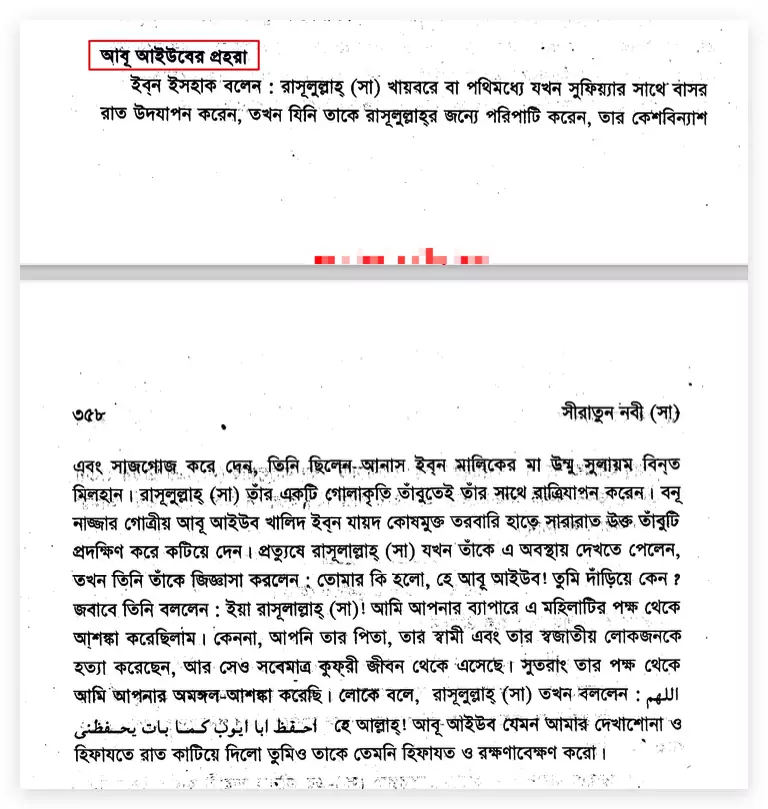
The same incident is also reported in al-Mustadrak ‘ala al-Hakim [34]
hakim:6787 – ʿAbdullāh b. Isḥāq al-Khurāsānī al-ʿAdl > Yaḥyá b. Jaʿfar b. al-Zibriqān > ʿAbd al-Wahhāb b. ʿAṭāʾ > Khālid al-Ḥadhhāʾ > Kathīr b. Zayd > al-Walīd b. Rabāḥ > Abū Hurayrah > Lammā
When the Messenger of Allah ﷺ entered Safiyyah’s tent, Abu Ayub slept at the door of the Prophet ﷺ . When morning came and the Messenger of Allah ﷺ saw him, he raised his voice in takbeer (saying “Allahu Akbar”) and Abu Ayub had a sword with him. He said, “O Messenger of Allah, she was a newlywed woman who had just gotten married, and I had killed her father, brother, and husband. So I did not trust her with you.” The Messenger of Allah ﷺ laughed and said to him, “Well done.”
– Sound (Dhahabī)
§ Safiyyah b. Huyayy in Book of the Companions
We can also find the incident discussed in the history of al-Tabari [35]
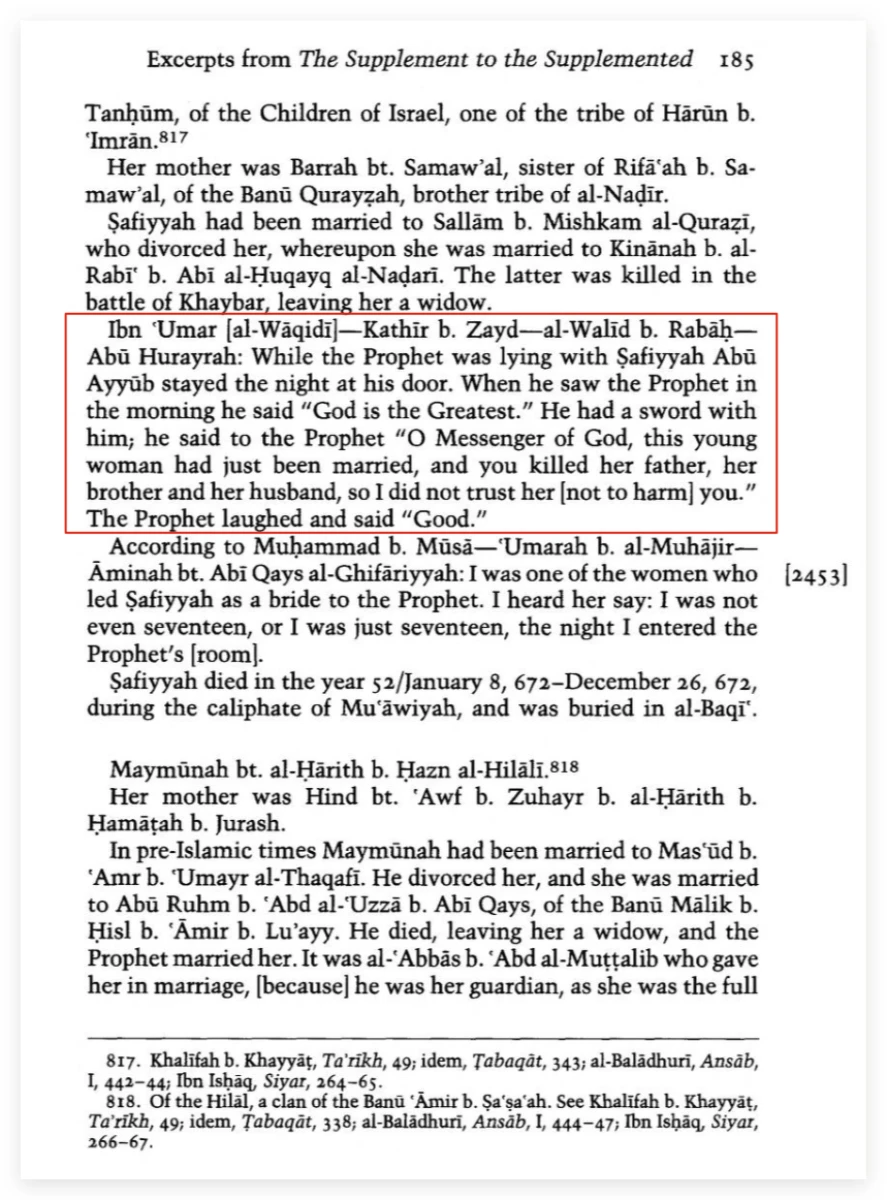
What Would Have Happened If She Had Not Married the Prophet?
It is easy to imagine what actually happens to the women of a defeated people, and the degree of mental torment they endure. When they are captured by soldiers of the opposing army, they understand that something extremely cruel may happen to them. Especially when the victorious side includes someone like Muhammad. In such a situation, one possible way to protect oneself from being sexually used by multiple men would be to come under the exclusive control of someone in the victorious leadership. If a captive woman entered the household of someone at the highest level of authority, others would at least be unable to claim her. Safiyya surely understood that no one else could cast an eye upon a slave woman or wife belonging to the Prophet Muhammad. Therefore, compared with the possibility of being sexually used by multiple victorious soldiers, becoming exclusively subject to Muhammad could have appeared to her as the less horrific option. That is the brutal reality within which Safiyya’s later position must be understood.
Safiyya had initially fallen to the share of Dihya al-Kalbi. Under Islamic law, male and female slaves could be transferred, sold, or given as gifts. Since selling a slave woman or giving her as a gift was lawful, and since sexual relations with a slave woman acquired through purchase or gift were also regarded as lawful, the exchange of enslaved women between owners was legally possible. Suppose one companion received a woman as a war captive and kept her for some time. Another companion likewise received another captive woman.
According to this legal structure, the two could later sell or gift their slave women to one another, after which the new owners could exercise the same rights over them. In other words, although the legal rule permitting the sale or gifting of female slaves may appear simple in abstract jurisprudential language, an extremely ugly human reality lies beneath it: a captive woman could pass from one owner to another, while each successive owner acquired legal authority over her body. Once a woman was captured and reduced to slave status, her personal control over her own sexual and social future was destroyed. Let us read a hadith connected with the permissibility of transferring a slave woman [36] –
Reference : Sahih al-Bukhari 2635
In-book reference : Book 51, Hadith 67
USC-MSA web (English) reference : Vol. 3, Book 47, Hadith 803
Chapter: It is permissible if somebody says, “I give this slave-girl to you for your service. …”
باب إِذَا قَالَ أَخْدَمْتُكَ هَذِهِ الْجَارِيَةَ عَلَى مَا يَتَعَارَفُ النَّاسُ فَهْوَ جَائِزٌ
Narrated Abu Huraira:
Allah’s Messenger (ﷺ) said, “The Prophet (ﷺ) Abraham migrated with Sarah. The people (of the town where they migrated) gave her Ajar (i.e. Hajar). Sarah returned and said to Abraham, “Do you know that Allah has humiliated that pagan and he has given a slave-girl for my service?”
Arabic : حَدَّثَنَا أَبُو الْيَمَانِ، أَخْبَرَنَا شُعَيْبٌ، حَدَّثَنَا أَبُو الزِّنَادِ، عَنِ الأَعْرَجِ، عَنْ أَبِي هُرَيْرَةَ ـ رضى الله عنه ـ أَنَّ رَسُولَ اللَّهِ صلى الله عليه وسلم قَالَ ” هَاجَرَ إِبْرَاهِيمُ بِسَارَةَ، فَأَعْطَوْهَا آجَرَ، فَرَجَعَتْ فَقَالَتْ أَشَعَرْتَ أَنَّ اللَّهَ كَبَتَ الْكَافِرَ وَأَخْدَمَ وَلِيدَةً ”. وَقَالَ ابْنُ سِيرِينَ عَنْ أَبِي هُرَيْرَةَ عَنِ النَّبِيِّ صلى الله عليه وسلم ” فَأَخْدَمَهَا هَاجَرَ ”.
Grade: Sahih
Now let us look at a document concerning this issue from Tafsir Mazhari [37] –
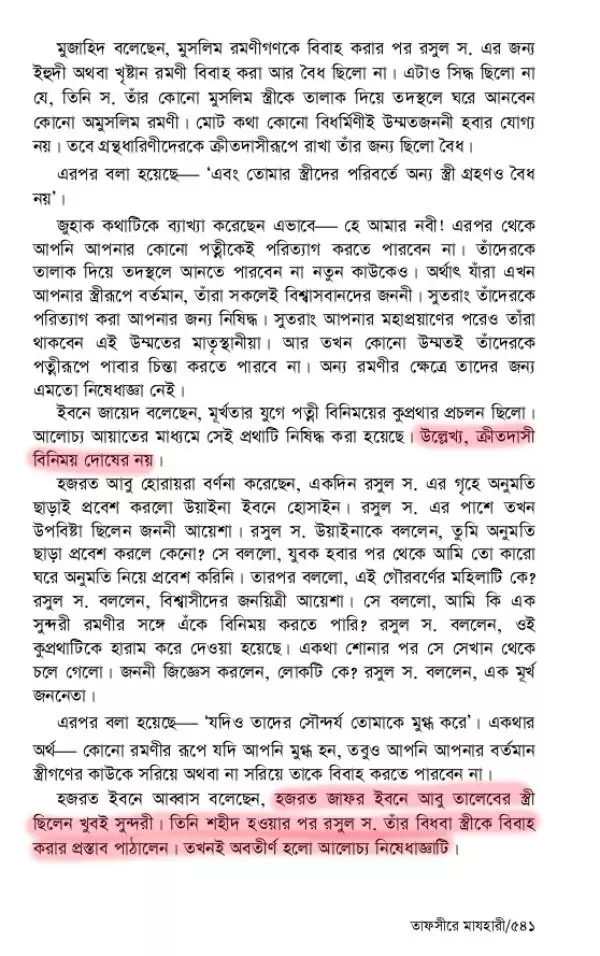
Aisha’s Insults Toward Safiyya
It is known that the Prophet’s child wife Aisha also insulted Safiyya. This means that Safiyya had to hear harsh remarks from different people because she was the daughter of a Jew. If Aisha, the Prophet’s wife and an ideal woman in the eyes of Muslims, could speak about her in such a manner, it is reasonable to ask what kind of remarks Safiyya may have faced from others as well. Others were certainly not all regarded as ideal women like Aisha [38] –
Reference : Jami` at-Tirmidhi 2502
In-book reference : Book 37, Hadith 88
English translation : Vol. 4, Book 11, Hadith 2502
Chapter: The Hadith: “If You Were to Mix It into the Water of the Sea”
Abu Hudhaifah narrated – and he was one of the companions of ‘Abdullãh bin Mas’üd – from ‘Aishah who said:
“I told the Prophet (ﷺ) about a man, so he said: ‘I do not like to talk about a man, even if I were to get this or that (for doing so).” She said: “I said: ‘O Messenger of Allah! Safiyyah is a woman who is …” and she used her hand as if to indicate that she is short – “So he said: ‘You have said a statement which, if it were mixed in with the water of the sea, it would pollute it.”
Arabic : حَدَّثَنَا مُحَمَّدُ بْنُ بَشَّارٍ ، حَدَّثَنَا يَحْيَى بْنُ سَعِيدٍ ، وَعَبْدُ الرَّحْمَنِ بْنُ مَهْدِيٍّ ، قَالاَ حَدَّثَنَا سُفْيَانُ ، عَنْ عَلِيِّ بْنِ الأَقْمَرِ ، عَنْ أَبِي حُذَيْفَةَ ، وَكَانَ، مِنْ أَصْحَابِ ابْنِ مَسْعُودٍ عَنْ عَائِشَةَ ، قَالَتْ حَكَيْتُ لِلنَّبِيِّ صلى الله عليه وسلم رَجُلاً فَقَالَ ” مَا يَسُرُّنِي أَنِّي حَكَيْتُ رَجُلاً وَأَنَّ لِي كَذَا وَكَذَا ” . قَالَتْ فَقُلْتُ يَا رَسُولَ اللَّهِ إِنَّ صَفِيَّةَ امْرَأَةٌ وَقَالَتْ بِيَدِهَا هَكَذَا كَأَنَّهَا تَعْنِي قَصِيرَةً . فَقَالَ “ لَقَدْ مَزَجْتِ بِكَلِمَةٍ لَوْ مَزَجْتِ بِهَا مَاءَ الْبَحْرِ لَمُزِجَ ” .
Grade: Sahih (Darussalam)
The Prophet’s Obscene Insults Toward Safiyya
At another time, the Prophet Muhammad came to Safiyya and found her worried and depressed. Muhammad then addressed her using the expressions translated in Sahih Muslim as “barren” and “shaven-head.” I will discuss below why these words were used. First, let us read the report itself [39] [40] –
Sahih Muslim (Islamic Foundation reference: 3098)
16/ The Book of Pilgrimage
Chapter: The farewell Tawaf is obligatory, but it is waived in the case of menstruating women
Sahih Muslim 1211ag. ‘A’isha (Allah be pleased with her) reported:
When Allah’s Apostle (ﷺ) decided to march (for return journey), he found Safiyyah at the door of her tent, sad and downcast. He remarked. Barren, shaven-head, you are going to detain us, and then said: Did you perform Tawaf Ifada on the Day of Nahr? She replied in the affirmative, whereupon he said: Then march on.
Arabic : حَدَّثَنَا مُحَمَّدُ بْنُ الْمُثَنَّى، وَابْنُ، بَشَّارٍ قَالاَ حَدَّثَنَا مُحَمَّدُ بْنُ جَعْفَرٍ، حَدَّثَنَا شُعْبَةُ، ح وَحَدَّثَنَا عُبَيْدُ اللَّهِ بْنُ مُعَاذٍ، – وَاللَّفْظُ لَهُ – حَدَّثَنَا أَبِي، حَدَّثَنَا شُعْبَةُ، عَنِ الْحَكَمِ، عَنْ إِبْرَاهِيمَ، عَنِ الأَسْوَدِ، عَنْ عَائِشَةَ، قَالَتْ لَمَّا أَرَادَ النَّبِيُّ صلى الله عليه وسلم أَنْ يَنْفِرَ إِذَا صَفِيَّةُ عَلَى بَابِ خِبَائِهَا كَئِيبَةً حَزِينَةً . فَقَالَ ” عَقْرَى حَلْقَى إِنَّكِ لَحَابِسَتُنَا ” . ثُمَّ قَالَ لَهَا ” أَكُنْتِ أَفَضْتِ يَوْمَ النَّحْرِ ” . قَالَتْ نَعَمْ . قَالَ ” فَانْفِرِي ” .
Reference: Sahih Muslim 1211ag
In-book reference: Book 15, Hadith 432
USC-MSA web (English) reference: Book 7, Hadith 3066
Grade: Sahih
Reference : Sahih Muslim 1211ag
In-book reference : Book 15, Hadith 432
USC-MSA web (English) reference : Book 7, Hadith 3066
Chapter: The farewell Tawaf is obligatory, but it is waived in the case of menstruating women
‘A’isha (Allah be pleased with her) reported:
When Allah’s Apostle (ﷺ) decided to march (for return journey), he found Safiyyah at the door of her tent, sad and downcast. He remarked. Barren, shaven-head, you are going to detain us, and then said: Did you perform Tawaf Ifada on the Day of Nahr? She replied in the affirmative, whereupon he said: Then march on.
Arabic : حَدَّثَنَا مُحَمَّدُ بْنُ الْمُثَنَّى، وَابْنُ، بَشَّارٍ قَالاَ حَدَّثَنَا مُحَمَّدُ بْنُ جَعْفَرٍ، حَدَّثَنَا شُعْبَةُ، ح وَحَدَّثَنَا عُبَيْدُ اللَّهِ بْنُ مُعَاذٍ، – وَاللَّفْظُ لَهُ – حَدَّثَنَا أَبِي، حَدَّثَنَا شُعْبَةُ، عَنِ الْحَكَمِ، عَنْ إِبْرَاهِيمَ، عَنِ الأَسْوَدِ، عَنْ عَائِشَةَ، قَالَتْ لَمَّا أَرَادَ النَّبِيُّ صلى الله عليه وسلم أَنْ يَنْفِرَ إِذَا صَفِيَّةُ عَلَى بَابِ خِبَائِهَا كَئِيبَةً حَزِينَةً . فَقَالَ ” عَقْرَى حَلْقَى إِنَّكِ لَحَابِسَتُنَا ” . ثُمَّ قَالَ لَهَا ” أَكُنْتِ أَفَضْتِ يَوْمَ النَّحْرِ ” . قَالَتْ نَعَمْ . قَالَ ” فَانْفِرِي ” .
Grade: Sahih
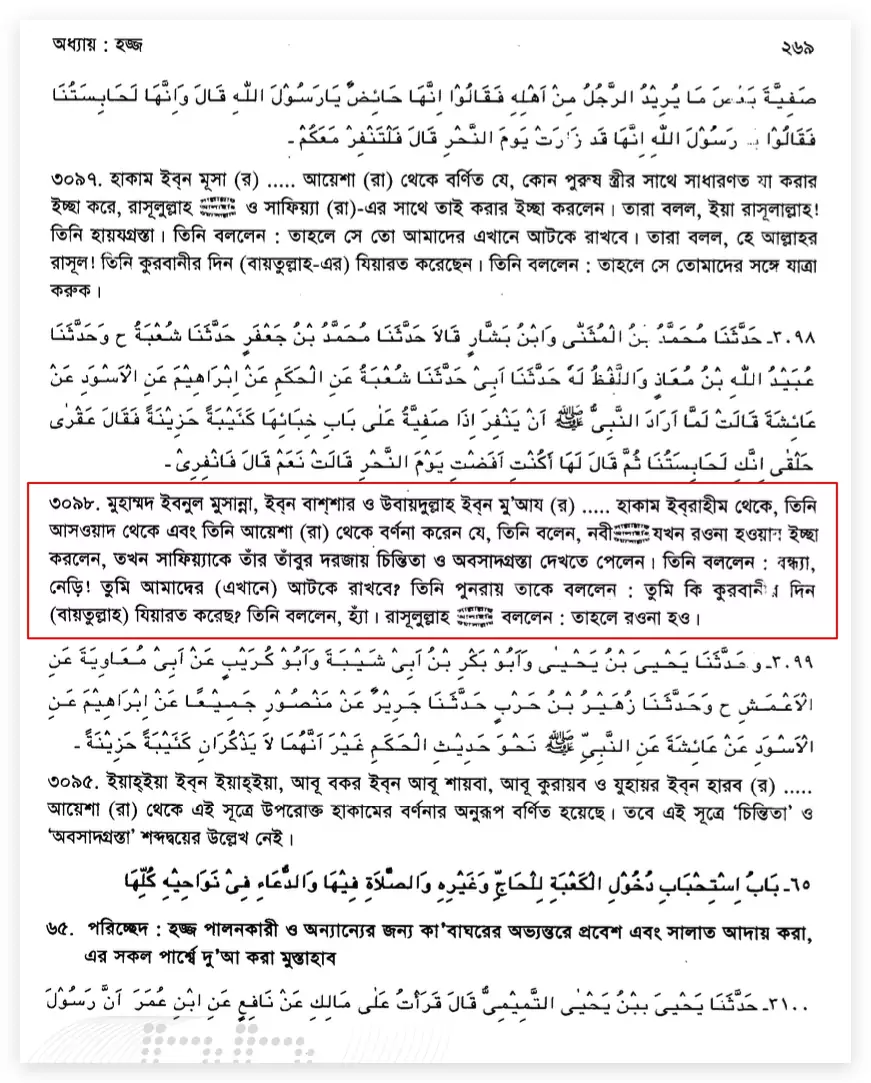
The Reason for Calling Safiyya Barren and Shaven-Headed
A question may arise: why did the Prophet use such language toward Safiyya on that occasion? From the hadiths cited below, the article argues that Muhammad wanted to have sexual intercourse with Safiyya, but because she was menstruating he could not do so. The contrast raises the question posed by the Bengali source: if Safiyya was not being regarded primarily as an object of sexual availability, why was such language directed toward her in connection with a situation involving her menstruation? [41] ?
Readers should note carefully that in these reports the Prophet repeatedly asks whether Safiyya will detain them. The recurrence of the same detail indicates that these narrations concern the same episode, with different transmitters preserving different parts or formulations of it [42] [43] [44] [45] –
Reference : Sahih Muslim 1211af
In-book reference : Book 15, Hadith 431
USC-MSA web (English) reference : Book 7, Hadith 3065
Chapter: The farewell Tawaf is obligatory, but it is waived in the case of menstruating women
‘A’isha (Allah be pleased with her) reported that Allah’s Messenger (ﷺ) inclined to do with Safiyyah what a man feels inclined to do with his wife. They said: Messenger of Allah, she has entered the state of menses, whereupon he said: (Well) she is going to detain us. They (his wives) said: Messenger of Allah, she performed Tawaf Ziyara (Tawaf Ifada) on the Day of Nahr. Thereupon he said: Then she should proceed along with you.
Arabic : حَدَّثَنِي الْحَكَمُ بْنُ مُوسَى، حَدَّثَنِي يَحْيَى بْنُ حَمْزَةَ، عَنِ الأَوْزَاعِيِّ، – لَعَلَّهُ قَالَ – عَنْ يَحْيَى بْنِ أَبِي كَثِيرٍ، عَنْ مُحَمَّدِ بْنِ إِبْرَاهِيمَ التَّيْمِيِّ، عَنْ أَبِي سَلَمَةَ، عَنْ عَائِشَةَ، أَنَّ رَسُولَ اللَّهِ صلى الله عليه وسلم أَرَادَ مِنْ صَفِيَّةَ بَعْضَ مَا يُرِيدُ الرَّجُلُ مِنْ أَهْلِهِ . فَقَالُوا إِنَّهَا حَائِضٌ يَا رَسُولَ اللَّهِ . قَالَ ” وَإِنَّهَا لَحَابِسَتُنَا ” . فَقَالُوا يَا رَسُولَ اللَّهِ إِنَّهَا قَدْ زَارَتْ يَوْمَ النَّحْرِ . قَالَ ” فَلْتَنْفِرْ مَعَكُمْ ” .
Grade: Sahih
Reference : Sahih Muslim 1211ad
In-book reference : Book 15, Hadith 429
USC-MSA web (English) reference : Book 7, Hadith 3063
Chapter: The farewell Tawaf is obligatory, but it is waived in the case of menstruating women
‘A’isha (Allah be pleased with her) reported:
We feared that Safiyyah might have entered the period of menses before performing Tawaf Ifada. Allah’s Messenger (ﷺ) came to us and said: Is Safiyyah going to detain us? Thereupon we said: She has performed Tawaf Ifada. He (the Holy Prophet) said: Then there is no detention (for us) now.
Arabic : وَحَدَّثَنَا عَبْدُ اللَّهِ بْنُ مَسْلَمَةَ بْنِ قَعْنَبٍ، حَدَّثَنَا أَفْلَحُ، عَنِ الْقَاسِمِ بْنِ مُحَمَّدٍ، عَنْ عَائِشَةَ، قَالَتْ كُنَّا نَتَخَوَّفُ أَنْ تَحِيضَ، صَفِيَّةُ قَبْلَ أَنْ تُفِيضَ – قَالَتْ – فَجَاءَنَا رَسُولُ اللَّهِ صلى الله عليه وسلم فَقَالَ ” أَحَابِسَتُنَا صَفِيَّةُ ” . قُلْنَا قَدْ أَفَاضَتْ . قَالَ ” فَلاَ إِذًا ” .
Grade: Sahih
Reference : Sahih Muslim 1211ac
In-book reference : Book 15, Hadith 428
USC-MSA web (English) reference : Book 7, Hadith 3062
Chapter: The farewell Tawaf is obligatory, but it is waived in the case of menstruating women
Abd al-Rahman b. al Qasim narrated on the authority of ‘A’isha (Allah be pleased with her) that she made a mention to Allah’s Messenger (ﷺ) that Safiyyah had entered the period of menses. The rest of the hadith is the same.
Arabic : وَحَدَّثَنَا قُتَيْبَةُ، – يَعْنِي ابْنَ سَعِيدٍ – حَدَّثَنَا لَيْثٌ، ح وَحَدَّثَنَا زُهَيْرُ بْنُ حَرْبٍ، حَدَّثَنَا سُفْيَانُ، ح وَحَدَّثَنِي مُحَمَّدُ بْنُ الْمُثَنَّى، حَدَّثَنَا عَبْدُ الْوَهَّابِ، حَدَّثَنَا أَيُّوبُ، كُلُّهُمْ عَنْ عَبْدِ الرَّحْمَنِ، بْنِ الْقَاسِمِ عَنْ أَبِيهِ، عَنْ عَائِشَةَ، أَنَّهَا ذَكَرَتْ لِرَسُولِ اللَّهِ صلى الله عليه وسلم أَنَّ صَفِيَّةَ قَدْ حَاضَتْ . بِمَعْنَى حَدِيثِ الزُّهْرِيِّ .
Grade: Sahih
Reference : Sahih Muslim 1211ae
In-book reference : Book 15, Hadith 430
USC-MSA web (English) reference : Book 7, Hadith 3064
Chapter: The farewell Tawaf is obligatory, but it is waived in the case of menstruating women
‘A’isha (Allah be pleased with her) said to the Messenger of Allah (ﷺ):
Messenger of Allah, Safiyyah bint Huyayy has entered the state of menses, whereupon Allah’s Messenger (ﷺ) said: Perhaps she is going to detain us. Has she not clicumambulated the House along with you (i. e. whether she has not performed Tawaf Ifada)? They said: Yes. He said: Then they should set out.
Arabic : حَدَّثَنَا يَحْيَى بْنُ يَحْيَى، قَالَ قَرَأْتُ عَلَى مَالِكٍ عَنْ عَبْدِ اللَّهِ بْنِ أَبِي بَكْرٍ، عَنْ أَبِيهِ، عَنْ عَمْرَةَ بِنْتِ عَبْدِ الرَّحْمَنِ، عَنْ عَائِشَةَ، أَنَّهَا قَالَتْ لِرَسُولِ اللَّهِ صلى الله عليه وسلم يَا رَسُولَ اللَّهِ إِنَّ صَفِيَّةَ بِنْتَ حُيَىٍّ قَدْ حَاضَتْ . فَقَالَ رَسُولُ اللَّهِ صلى الله عليه وسلم ” لَعَلَّهَا تَحْبِسُنَا أَلَمْ تَكُنْ قَدْ طَافَتْ مَعَكُنَّ بِالْبَيْتِ ” . قَالُوا بَلَى . قَالَ ” فَاخْرُجْنَ ” .
Grade: Sahih
Now let us learn a little more about this matter from an explanatory work on Sahih Muslim [46] –
Allama Qurtubi and other expert scholars say that during the journey of Hajj, both Hazrat Aisha and Safiyya (RA) had menstruated. But a major difference is observed in the statement of the Messenger of Allah (peace be upon him) in the cases of these two women. For he said to Hazrat Safiyya (RA): “Wretched, ill-fated woman, may no good befall you.” But to Hazrat Aisha (RA) he said: “This is something Allah the Exalted has prescribed for the daughters of Adam.”
This was not intended to give preference to one over the other; rather, speech differs according to place, time, person, and circumstance. Thus, when the Prophet (peace be upon him) came to Hazrat Aisha (RA), she was distressed and crying out of fear that she would miss Hajj. Therefore, she needed consolation, and accordingly he consoled her with comforting words. On the other hand, Hazrat Safiyya (RA), having completed the rites of Hajj, “the Prophet (peace be upon him) desired from her what a man desires from his wife.” Because of the difference between these two situations, the difference in address was appropriate. Allah knows best. (Fath al-Mulhim 327).
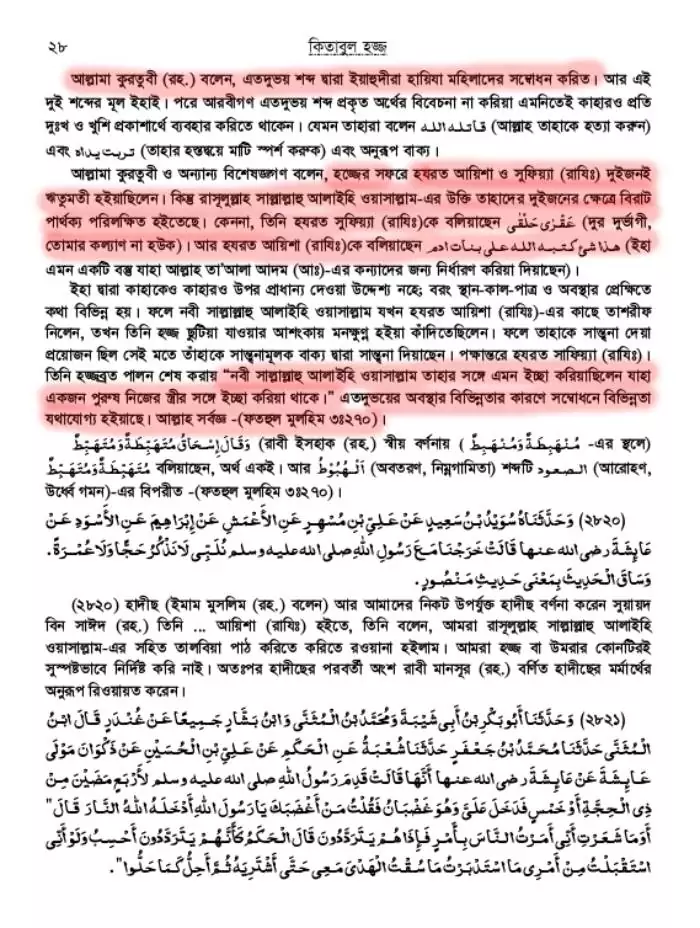
(3117) Hadith (Imam Muslim (rh.) says): Hakim ibn Musa (rh.) narrated to me … from Aisha (RA), that the Messenger of Allah (peace be upon him) desired from Safiyya (RA) what a man usually desires from his wife. Then they said, “O Messenger of Allah, she is menstruating.” He said, “Then she will detain us.” They submitted, “O Messenger of Allah, she has already performed the Tawaf of visitation on the Day of Sacrifice.” He said, “Then let her set out with you.”
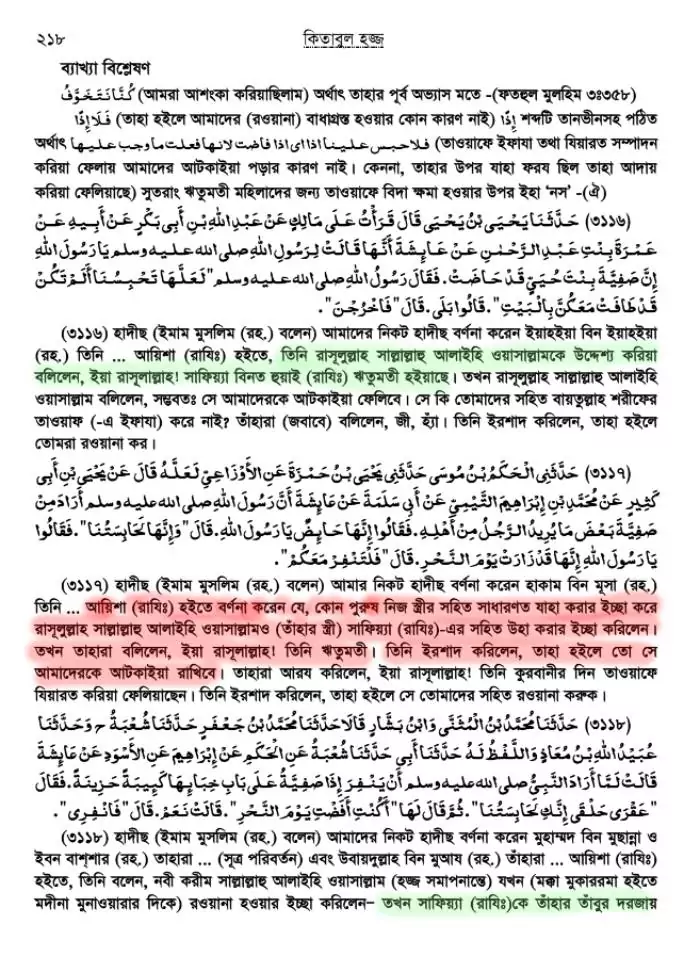
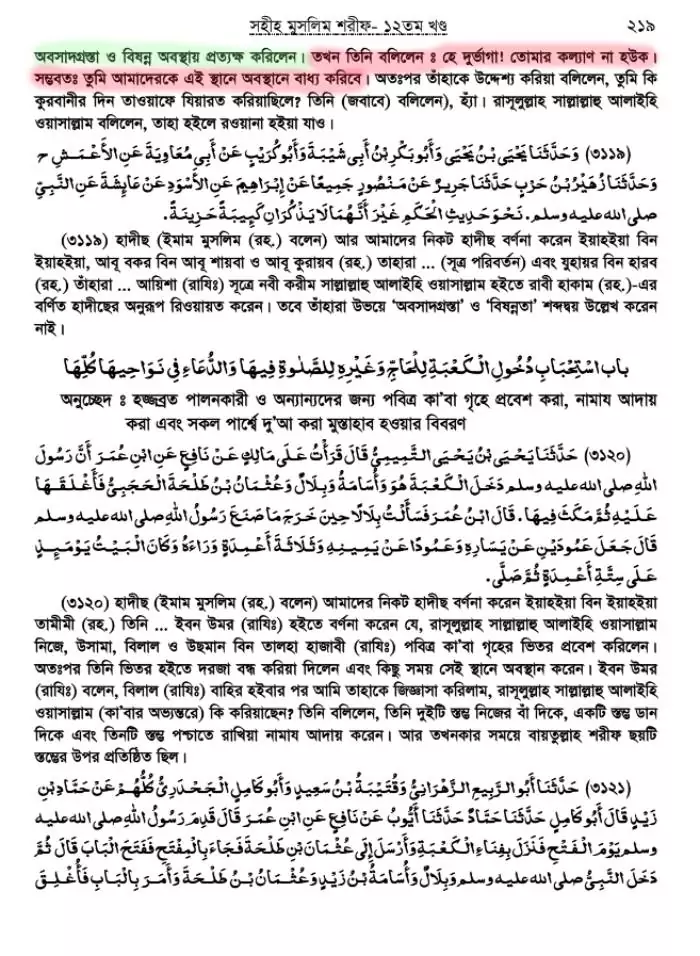
Apologetic Explanation: Consent, Slavery, and the Politics of Power
The activities of modern so-called “sugar-coated” or apologetic interpreters regarding this tragic chapter in the life of Safiyya bint Huyayy are especially noticeable. They try in various ways to make the incident appear “humane” or “romantic,” so that the image of the Prophet Muhammad can be protected according to the standards of modern human rights. If one hears the story from Islamic preachers, it may appear as though Safiyya had been so deeply in love with Muhammad from the very beginning, merely by hearing his name, that she became eager to marry him and was even beaten by her husband because of that supposed desire. Especially with the rise of modern da‘wah culture, the incident has often been presented as a voluntary and honorable marriage. But such explanations are largely constructed by ignoring the classical sources, ordinary moral reasoning, human sensitivity, and the harsh reality of war. Since Muhammad is regarded as the “best model human being,” admitting that any of his actions could be morally controversial is extremely dangerous for such interpreters; consequently, history is softened and edited according to apologetic need. Reading these ad hoc explanations, produced through various forms of mental gymnastics, can sometimes make it sound as though Safiyya, while still living among her Jewish people, physically desired Muhammad and secretly wished that he would come, kill her husband and destroy her tribe, and then take her into his own bed.
To present Safiyya’s experience as a story of normal love, independent conversion, or a pressure-free marriage, one must first erase the post-war reality of Khaybar. Safiyya was not a free woman sitting within her own society and calmly considering a marriage proposal. Her tribe had been militarily defeated and devastated; she herself had become a war captive; she had been gathered with other captives as part of the spoils; she was initially assigned to Dihya al-Kalbi; and afterward she was removed from him and taken by Muhammad, the supreme leader of the victorious army, for himself. The structure of ownership, distribution, and transfer is explicit in some of the strongest and most widely preserved Islamic reports. After this sequence, if another narration says that the captive woman ultimately “chose” the victorious ruler, detaching that final sentence from its political and military setting and presenting it as proof of free consent distorts the historical context.
Even more important is the nature of the surviving sources. We possess no contemporary written testimony from Safiyya herself. We are not reading a memoir written in her own voice, nor any neutral third-party account of the war. The episode reaches us primarily through male narrators from the religious community that won the war, for whom Muhammad’s actions were religiously ideal and beyond ordinary moral criticism. In a history preserved by the victorious side, a report portraying the victorious leader’s conduct as moral, honorable, and voluntary cannot by itself prove that the captive woman occupied a genuinely free position. This is especially significant when the less disputed reports from the same tradition first describe her as a woman distributed as spoils of war. A later report preserved by the victorious community saying that “she chose our leader” therefore cannot function as its own certificate of historical neutrality; it must be read together with the power relationship, the purpose of the narration, and the stronger surrounding evidence.
Safiyya Had an Opportunity, but Chose the Prophet?
When Islamic da‘wah preachers confront the extremely embarrassing questions surrounding Safiyya, they mainly present several hadith and Sirah reports. Among them, Safiyya’s alleged dream and the report that Muhammad supposedly offered her a choice between remaining with him and returning to her own people are particularly important. These reports are frequently used to transform the captivity of Khaybar into a later story of voluntary love, predestined union, and free religious choice. But when the sources, chains of transmission, and wording are examined closely, important weaknesses in this apologetic construction become visible.
Let us first consider the report of Safiyya’s alleged dream. A long narration in Ibn Sa‘d’s al-Tabaqat al-Kubra states that Muhammad noticed a mark on Safiyya’s face and asked about it, whereupon she related a dream. It should be noted that although some Bengali apologetic writings describe the object in the dream as a “bright star,” the original Arabic says قَمَرًا—that is, moon. [47]
“I saw in a dream that a moon came from the direction of Yathrib and fell into my lap. When I told my husband Kinana about it, he said, ‘Do you wish to become the wife of that king who is coming from Medina?’ Then he struck me in the face.”
The dream of the moon falling into one’s lap is commonly associated with having a child. How Muhammad is supposed to enter into a dream simply because a moon fell into Safiyya’s lap is difficult to understand. The second report is used even more frequently. In the same Tabaqat, it is said that after Safiyya was brought before Muhammad, he referred to the hostility of Safiyya’s father and then asked her to choose between Islam and Judaism. [48]
“When Safiyya came before the Messenger, he said to her, ‘Your father did not cease his hostility against me among the Jews until Allah killed him.’ Safiyya said, ‘O Messenger of Allah! Allah says in His Book: No bearer of burdens will bear the burden of another.’ The Messenger then said to her, ‘Choose. If you accept Islam, I will keep you for myself; but if you choose Judaism, then perhaps I will free you and send you back to your people.’
Safiyya said, ‘O Messenger of Allah! After I came to you, and even before you invited me, I had already desired Islam and believed you to be truthful. I have no need of Judaism; I have neither father nor brother there. You have given me a choice between disbelief and Islam, but Allah and His Messenger are dearer to me than being freed and returning to my people.’”
If the claim made by this report is accepted—that Safiyya had embraced Islam and believed Muhammad to be a true prophet even before he invited her—the story becomes still more disturbing and extraordinary. On what basis would she have reached that conclusion? What evidence concerning Muhammad had she received that led her to accept as Allah’s true Messenger the leader of the victorious army that had waged war against her father, husband, relatives, and tribe? More seriously, if she had already regarded Muhammad’s religion and claim as true, was she also morally endorsing his war against her own people, the killing of many of their men, the killing of her father, and finally her own captivity? A newly defeated and bereaved woman was being led captive past the bodies of her relatives, yet the story asks us to believe that she had already inwardly accepted the commander of the victorious army as a true prophet. That is not an ordinary human response. Establishing a claim so extraordinary and so sharply at odds with the sequence of events would require exceptionally strong and independent evidence. Yet the report in which this dramatic claim appears in detail rests upon a weak chain. Rather than proving Safiyya’s independent religious decision, the narrative therefore makes more sense as a later ideological account intended to cover her captivity and marriage with a mantle of moral and religious legitimacy.
The principal report behind the claim that Safiyya was offered the option either to be freed and become Muhammad’s wife or to return to her people appears in Musnad Ahmad 12409. Its chain is ‘Abd al-Razzaq → Ma‘mar → Thabit al-Bunani → Anas ibn Malik. Shu‘ayb al-Arna’ut graded it “isnaduhu sahihun ‘ala shartish-shaykhayn”, meaning that its chain is authentic according to the conditions of al-Bukhari and Muslim; al-Haythami likewise stated that its narrators are narrators of sahih. Therefore, according to conventional hadith criticism, the report cannot simply be dismissed as weak. But this is precisely where a significant confusion in apologetic presentations becomes visible. Al-Sunan al-Kubra of al-Nasa’i 8646 is sometimes presented alongside it as a second independent authentic witness. In reality, however, al-Nasa’i narrates the episode through the same basic transmission line, and in his abbreviated version the sentence concerning Safiyya being offered the supposed choice is absent. Thus the claim that “Ahmad and al-Nasa’i independently prove the same choice” is incorrect. The evidentiary weight of that specific choice-sentence rests on one transmission line.
First, read the relevant portion from Musnad Ahmad. It is part of a much longer narration. Significantly, the statement that Safiyya was supposedly given a choice is not presented as Safiyya’s own testimony; it is reported by Hajjaj ibn ‘Ilat while he is informing ‘Abbas about the victory at Khaybar. [49]
Arabic:
فَأَخْبَرَهُ أَنَّ رَسُولَ اللَّهِ صَلَّى اللَّهُ عَلَيْهِ وَسَلَّمَ قَدِ افْتَتَحَ خَيْبَرَ، وَغَنِمَ أَمْوَالَهُمْ، وَجَرَتْ سِهَامُ اللَّهِ عَزَّ وَجَلَّ فِي أَمْوَالِهِمْ، وَاصْطَفَى رَسُولُ اللَّهِ صَلَّى اللَّهُ عَلَيْهِ وَسَلَّمَ صَفِيَّةَ بِنْتَ حُيَيٍّ فَاتَّخَذَهَا لِنَفْسِهِ، وَخَيَّرَهَا أَنْ يُعْتِقَهَا وَتَكُونَ زَوْجَتَهُ، أَوْ تَلْحَقَ بِأَهْلِهَا، فَاخْتَارَتْ أَنْ يُعْتِقَهَا وَتَكُونَ زَوْجَتَهُ.
English translation:
Hajjaj informed him that the Messenger of Allah had conquered Khaybar and taken their wealth as spoils, and that the shares decreed by Allah, Mighty and Majestic, had been distributed among their property. The Messenger of Allah selected Safiyya bint Huyayy for himself and took her for himself. Then he gave Safiyya the option that he would free her and she would become his wife, or that she could go back to her people. Safiyya chose to be freed and to become his wife.
Now read the parallel report in al-Sunan al-Kubra of al-Nasa’i. Its chain returns to the same line—‘Abd al-Razzaq → Ma‘mar → Thabit al-Bunani → Anas. But al-Nasa’i abbreviates the narration, and in the text preserved by him there is no statement that Safiyya was given an option, freed, or chose Muhammad. [50]
Arabic:
أَنْبَأَ إِسْحَاقُ بْنُ إِبْرَاهِيمَ قَالَ أَنْبَأَ عَبْدُ الرَّزَّاقِ قَالَ حَدَّثَنَا مَعْمَرٌ قَالَ سَمِعْتُ ثَابِتًا الْبُنَانِيَّ يُحَدِّثُ عَنْ أَنَسٍ قَالَ لَمَّا افْتَتَحَ رَسُولُ اللَّهِ صَلَّى اللَّهُ عَلَيْهِ وَسَلَّمَ خَيْبَرَ قَالَ الْحَجَّاجُ بْنُ عِلَاطٍ يَا رَسُولَ اللَّهِ إِنَّ لِي بِمَكَّةَ مَالًا وَإِنَّ لِي بِهَا أَهْلًا وَأَنَا أُرِيدُ أَنْ آتِيَهُمْ فَأَنَا فِي حِلٍّ إِنْ أَنَا نِلْتُ مِنْكَ وَقُلْتُ شَيْئًا فَأَذِنَ لَهُ رَسُولُ اللَّهِ صَلَّى اللَّهُ عَلَيْهِ وَسَلَّمَ، فَلَمَّا قَدِمَ عَلَى امْرَأَتِهِ بِمَكَّةَ قَالَ لِأَهْلِهِ اجْمَعِي مَا كَانَ لَكِ مِنْ مَالٍ وَشَيْءٍ فَإِنِّي أُرِيدُ أَنْ أَشْتَرِيَ مِنْ مَغَانِمِ رَسُولِ اللَّهِ صَلَّى اللَّهُ عَلَيْهِ وَسَلَّمَ وَأَصْحَابِهِ فَإِنَّهُمْ قَدْ أُبِيحُوا وَذَهَبَتْ أَمْوَالُهُمْ، فَانْقَمَعَ الْمُسْلِمُونَ وَظَهَرَ الْمُشْرِكُونَ فَرَحًا وَسُرُورًا.
English translation:
Ishaq ibn Ibrahim informed us; ‘Abd al-Razzaq informed him; Ma‘mar said: I heard Thabit al-Bunani narrating from Anas: When the Messenger of Allah conquered Khaybar, Hajjaj ibn ‘Ilat said, “O Messenger of Allah! I have wealth and family in Mecca. I want to go to them. Do I have permission if I say something about you there, or say something against you?” The Messenger of Allah gave him permission. When he arrived in Mecca and reached his wife, he said, “Gather whatever wealth and property you have. I want to buy from the spoils of the Messenger of Allah and his companions, because they have been defeated and their wealth is gone.” Hearing this news, the Muslims became dispirited, while the polytheists displayed joy and happiness.
Placing the two reports side by side makes the issue clear. They are not two separate hadiths from two independent witnesses. Al-Nasa’i narrates the incident through the same ‘Abd al-Razzaq → Ma‘mar → Thabit → Anas route, but his shortened text ends before the portion concerning Safiyya’s alleged choice. Therefore, al-Nasa’i 8646 cannot properly be presented as a second independent witness for the statement in Ahmad 12409 that “Safiyya freely chose Muhammad.” Hadith scholars themselves describe al-Nasa’i’s form as “مختصراً”—an abbreviated version.
Even more significantly, the Ahmad report is still not Safiyya’s own statement. Hajjaj ibn ‘Ilat is reporting the victory at Khaybar to ‘Abbas. Within that report, Khaybar is first described as conquered, its wealth as divided among the victors, and Safiyya as selected by Muhammad for himself; only after all of that appears the alleged choice. The internal order of the report is therefore military conquest → seizure and distribution of property → selection of Safiyya → alleged choice. Reversing that order and foregrounding only the final clause in order to say “Safiyya freely chose Muhammad” distorts the report’s own sequence.
The Quality of the Two Reports and Their Internal Problems
Now let us examine the quality of the reports themselves. The long dream narrative mentioned above appears in Ibn Sa‘d’s al-Tabaqat al-Kubra through Muhammad ibn Umar al-Waqidi. At the beginning of Ibn Sa‘d’s text we find أخبرنا محمد بن عمر—that is, his teacher al-Waqidi is transmitting the narrative. The same long report combines material from multiple informants, and it explicitly states: دخل حديث بعضهم في حديث بعض—one person’s report became mixed with another’s. Thus, even according to traditional Islamic hadith standards, the dream, Kinana’s interpretation of it, the blow to Safiyya’s face, and the other details in that composite report cannot simply be treated as a pure, independent sahih hadith. The very dream used in apologetics as evidence of Safiyya’s predestined love for Muhammad rests on a composite Sirah narrative transmitted through al-Waqidi.
The status of the long dialogue concerning Islam, Judaism, and returning to her people is even clearer. Its chain is Muhammad ibn Umar al-Waqidi → Ibrahim ibn Ja‘far → his father. Once again, al-Waqidi stands at the gateway of the report. It therefore cannot be presented as a sahih-hadith-level direct testimony of Safiyya’s free consent. Although the sahih-graded report in Musnad Ahmad briefly mentions a choice, the elaborate dramatic dialogue—concerning Islam versus Judaism, the death of Safiyya’s father, the statement “I have no father there, nor any brother,” and her supposed preference for Allah and His Messenger over freedom—is not contained in that stronger chain. Filling the gaps of a concise stronger report with the elaborate wording of a weak report and then presenting the combined result as established history is methodologically unacceptable.
Even if the weaker report is assumed to be true for the sake of argument, it creates a larger problem rather than resolving the apologetic difficulty. Muhammad’s alleged statement, “فعسى أن أعتقك فتلحقي بقومك”—“perhaps I will free you so that you may go to your people”—does not present freedom as a pre-existing right. It presents freedom as a possible favor that could be granted by the victorious owner. Even more significant is the statement placed in Safiyya’s mouth: “I have no father there, nor any brother.” The report used as evidence of free choice thus acknowledges the terrifying narrowing of her alternatives: her father was dead, her brother was absent or dead, her husband had been killed, her tribe had been defeated, and her freedom depended upon the decision of the victor. Such a situation cannot reasonably be treated as a choice between two equally free lives.
The dream story, even if accepted as true, proves no love. Seeing a dream is not equivalent to consciously desiring marriage to the person later associated with that dream. Kinana’s alleged statement—“Do you wish to become the wife of this king coming from Medina?”—is Kinana’s interpretation; Safiyya herself is not reported there as expressing love, desire, or a wish to marry Muhammad. Reinterpreting an ambiguous earlier dream as a “divine foreshadowing” after the later conquest and marriage is a classic teleological reconstruction: because the final outcome is already known, an earlier ambiguous incident is reread as though it had always pointed toward that result. To use a weak-chain report of this kind to transform military captivity into predestined love is even less convincing.
“Go Back to Your Own People”—In What Reality?
Another important question is almost always suppressed: after the conquest of Khaybar, what did “going back to one’s own people” actually mean? Not all the Jews of Khaybar had been killed; some remained alive. But they were no longer living in their previous independent political and economic condition. Islamic reports state that the surviving Jews requested permission from Muhammad to remain there and cultivate the land. They were allowed to do so on the condition that half of the produce would be surrendered, and their continued residence depended upon the will of the victorious Muslim authority. Sahih al-Bukhari preserves Muhammad’s formulation: “as long as we wish.”
Therefore, the picture suggested by the statement “if Safiyya had wanted, she could simply have returned to her family and resumed her former free life” does not fit the actual post-conquest situation. The “own people” still available to her were members of a newly defeated community that had lost political control over its land, homes, and property and remained there only under the permission of the victorious ruler. On one side stood becoming the wife of the conquering ruler, entering the highest political household, and obtaining personal security; on the other stood returning to a defeated community whose continued residence was itself conditional on that same ruler. These cannot be described as two neutral alternatives of equal power.
The Outcome: From “As Long as We Wish” to Eventual Expulsion
The real nature of the supposed option to “go back to her own people” becomes even clearer when later events are considered. After conquering Khaybar, Muhammad initially contemplated expelling the Jews. Because the agricultural land still needed to be cultivated, the Jews requested permission to remain and work it, and they were allowed to do so on condition that half the produce would go to the Muslims. According to Sahih al-Bukhari, Muhammad explicitly stated: “We shall keep you on these terms as long as we wish.” Thus the very community to which Safiyya is said to have been free to return had its own right to remain on its land dependent upon the will of the victorious Muslim ruler [51]
Reference : Sahih al-Bukhari 3152
In-book reference : Book 57, Hadith 60
USC-MSA web (English) reference : Vol. 4, Book 53, Hadith 380
Chapter: What the Prophet ﷺ used to give to those Muslims whose faith was not so firm, and to other Muslims, from the Khumus or other resources
Narrated Ibn `Umar:
`Umar bin Al-Khattab expelled all the Jews and Christians from the land of Hijaz. Allah’s Messenger (ﷺ) after conquering Khaibar, thought of expelling the Jews from the land which, after he conquered it belonged to Allah, Allah’s Messenger (ﷺ) and the Muslims. But the Jews requested Allah’s Messenger (ﷺ) to leave them there on the condition that they would do the labor and get half of the fruits (the land would yield).
Allah’s Messenger (ﷺ) said, “We shall keep you on these terms as long as we wish.” Thus they stayed till the time of `Umar’s Caliphate when he expelled them to Taima and Ariha.
Arabic : حَدَّثَنِي أَحْمَدُ بْنُ الْمِقْدَامِ، حَدَّثَنَا الْفُضَيْلُ بْنُ سُلَيْمَانَ، حَدَّثَنَا مُوسَى بْنُ عُقْبَةَ، قَالَ أَخْبَرَنِي نَافِعٌ، عَنِ ابْنِ عُمَرَ ـ رضى الله عنهما أَنَّ عُمَرَ بْنَ الْخَطَّابِ، أَجْلَى الْيَهُودَ وَالنَّصَارَى مِنْ أَرْضِ الْحِجَازِ، وَكَانَ رَسُولُ اللَّهِ صلى الله عليه وسلم لَمَّا ظَهَرَ عَلَى أَهْلِ خَيْبَرَ أَرَادَ أَنْ يُخْرِجَ الْيَهُودَ مِنْهَا، وَكَانَتِ الأَرْضُ لَمَّا ظَهَرَ عَلَيْهَا لِلْيَهُودِ وَلِلرَّسُولِ وَلِلْمُسْلِمِينَ، فَسَأَلَ الْيَهُودُ رَسُولَ اللَّهِ صلى الله عليه وسلم أَنْ يَتْرُكَهُمْ عَلَى أَنْ يَكْفُوا الْعَمَلَ، وَلَهُمْ نِصْفُ الثَّمَرِ فَقَالَ رَسُولُ اللَّهِ صلى الله عليه وسلم ” نُقِرُّكُمْ عَلَى ذَلِكَ مَا شِئْنَا ”. فَأُقِرُّوا حَتَّى أَجْلاَهُمْ عُمَرُ فِي إِمَارَتِهِ إِلَى تَيْمَاءَ وَأَرِيحَا.
Grade: Sahih
This was not a permanent treaty guaranteeing equal political rights or an unconditional right to remain freely upon their own land. The same narration explains that after the conquest, the territory of Khaybar had passed under the ownership and authority of Allah, the Messenger, and the Muslims, while the Jews’ continued residence was conditional. More importantly, the hadith records the eventual outcome: during the caliphate of Umar, they were expelled from Khaybar and sent toward Taima and Ariha. Muhammad’s phrase “as long as we wish” therefore proved to have a concrete political meaning.
The direction of this policy becomes even clearer when another authentic report attributed directly to Muhammad is read alongside it. Sahih Muslim preserves through Umar ibn al-Khattab the statement that Muhammad intended to expel the Jews and Christians from the Arabian Peninsula and leave no one there except Muslims. Thus later expulsion cannot be treated merely as an unrelated political invention of Umar; the hadith tradition itself attributes such a policy to Muhammad.
The same policy also appears in a report concerning Muhammad’s final illness. According to Ibn ‘Abbas in Sahih al-Bukhari, one of Muhammad’s last instructions was: “Expel the polytheists from the Arabian Peninsula.” The direction to remove religiously different communities from the Arabian Peninsula therefore also appears among the instructions attributed to him shortly before his death. Let us read the relevant reports [52] [53] [54].
Reference : Sahih Muslim 1767a
In-book reference : Book 32, Hadith 75
USC-MSA web (English) reference : Book 19, Hadith 4366
Chapter: Expulsion of Jews and Christians from the Arabian Peninsula
It has been narrated by ‘Umar b. al-Khattib that he heard the Messenger of Allah (ﷺ) say:
I will expel the Jews and Christians from the Arabian Peninsula and will not leave any but Muslim.
Arabic : وَحَدَّثَنِي زُهَيْرُ بْنُ حَرْبٍ، حَدَّثَنَا الضَّحَّاكُ بْنُ مَخْلَدٍ، عَنِ ابْنِ جُرَيْجٍ، ح وَحَدَّثَنِي مُحَمَّدُ بْنُ رَافِعٍ، – وَاللَّفْظُ لَهُ – حَدَّثَنَا عَبْدُ الرَّزَّاقِ، أَخْبَرَنَا ابْنُ جُرَيْجٍ، أَخْبَرَنِي أَبُو الزُّبَيْرِ، أَنَّهُ سَمِعَ جَابِرَ بْنَ عَبْدِ اللَّهِ، يَقُولُ أَخْبَرَنِي عُمَرُ بْنُ الْخَطَّابِ، أَنَّهُ سَمِعَ رَسُولَ اللَّهِ صلى الله عليه وسلم يَقُولُ ” لأُخْرِجَنَّ الْيَهُودَ وَالنَّصَارَى مِنْ جَزِيرَةِ الْعَرَبِ حَتَّى لاَ أَدَعَ إِلاَّ مُسْلِمًا ” .
Grade: Sahih
Reference : Sahih Muslim 1767b
In-book reference : Book 32, Hadith 76
USC-MSA web (English) reference : Book 19, Hadith 4367
Chapter: Expulsion of Jews and Christians from the Arabian Peninsula
This hadith has been narrated on the authority of Zubair with the same chain of transmitters.
Arabic : وَحَدَّثَنِي زُهَيْرُ بْنُ حَرْبٍ، حَدَّثَنَا رَوْحُ بْنُ عُبَادَةَ، أَخْبَرَنَا سُفْيَانُ الثَّوْرِيُّ، ح وَحَدَّثَنِي سَلَمَةُ بْنُ شَبِيبٍ، حَدَّثَنَا الْحَسَنُ بْنُ أَعْيَنَ، حَدَّثَنَا مَعْقِلٌ، – وَهُوَ ابْنُ عُبَيْدِ اللَّهِ – كِلاَهُمَا عَنْ أَبِي الزُّبَيْرِ، بِهَذَا الإِسْنَادِ مِثْلَهُ .
Grade: Sahih
Reference : Jami` at-Tirmidhi 1607
In-book reference : Book 21, Hadith 70
English translation : Vol. 3, Book 19, Hadith 1607
Chapter: What Has Been Related About Expelling The Jews And The Christians From The Arabian Peninsula
Narrated Jabir bin ‘Abdullah:
“‘Umar bin Al-Khattab informed me that he heard the Messenger of Allah (ﷺ) say: ‘I will expel the Jews and the Christians from the Arabian Peninsula, and I will not leave anyone in it except a Muslim.’”
[Abu ‘Eisa said:] This Hadith is Hasan Sahih.
Arabic : حَدَّثَنَا الْحَسَنُ بْنُ عَلِيٍّ الْخَلاَّلُ، حَدَّثَنَا أَبُو عَاصِمٍ، وَعَبْدُ الرَّزَّاقِ، قَالاَ أَخْبَرَنَا ابْنُ جُرَيْجٍ، قَالَ أَخْبَرَنِي أَبُو الزُّبَيْرِ، أَنَّهُ سَمِعَ جَابِرَ بْنَ عَبْدِ اللَّهِ، يَقُولُ أَخْبَرَنِي عُمَرُ بْنُ الْخَطَّابِ، أَنَّهُ سَمِعَ رَسُولَ اللَّهِ صلى الله عليه وسلم يَقُولُ “ لأُخْرِجَنَّ الْيَهُودَ وَالنَّصَارَى مِنْ جَزِيرَةِ الْعَرَبِ فَلاَ أَتْرُكُ فِيهَا إِلاَّ مُسْلِمًا ” . قَالَ أَبُو عِيسَى هَذَا حَدِيثٌ حَسَنٌ صَحِيحٌ .
Grade: Sahih (Darussalam)
In light of this sequence, presenting Safiyya’s supposed opportunity to “go back to her own people” as a safe and independent alternative becomes even more implausible. The Jewish community to which she could supposedly return was permitted to remain there only by the victor; it no longer possessed independent authority over its land; its status was expressly conditional upon “as long as we wish”; and that same Muslim state later expelled the community. Moreover, authentic reports attribute to Muhammad himself a policy of removing Jews and Christians from the Arabian Peninsula. Under these circumstances, becoming the wife of the victorious ruler—and remaining on favorable terms with that ruler—could represent an extremely harsh but rational survival calculation.
These later events make the political dimension of Safiyya’s decision even more important. If, by entering the family of the victorious ruler, she considered obtaining not only personal safety but also some possibility of protection, influence, or mediation for her surviving relatives and tribal community, that would have been an entirely rational calculation within the realities of power at the time. The alternative offered to her was to return to a people whose own future depended upon the political and religious decisions of the man making the offer. Presenting such a situation as a “free choice of love” does not explain Safiyya’s position; it conceals the conqueror’s power.
Safiyya’s Own Decision: Love, or a Political Calculation for Survival?
Safiyya’s position cannot be understood without considering her personal and tribal reality together. She was not an ordinary captive. She was the daughter of Huyayy ibn Akhtab, a leader of Banu Nadir, and a woman of the Jewish aristocratic family associated with Khaybar. Her father had already been killed by the Muslims; her husband Kinana had also been killed after Khaybar; her community had been militarily defeated; and its future depended upon the decisions of the victorious power. She had already witnessed a political environment in which the men of a defeated Jewish community could be killed and its women and children taken captive. Reading marriage to the supreme leader of the victorious state merely as a private romantic choice deliberately makes the real relationship of power disappear.
Rather, the decision had a clear political and survival logic. While Safiyya was Muhammad’s captive, her own life and future were in his hands; at the same time, the lives, land, and security of her surviving relatives and tribal community were subject to victorious Muslim authority. Becoming the victorious ruler’s wife transformed her directly from a woman counted among the spoils into a member of the state’s highest center of power. Alongside protecting her own life and dignity, this could create a political opportunity to reduce possible retaliation, expulsion, or oppression against her surviving relatives and tribe. There is therefore substantial historical reason to read her decision as a tribal and personal survival strategy. It was not the selection of a lover or sexual partner in an ordinary social environment; it was a defeated aristocratic woman choosing the strongest available path to security within a reality created by the victor.
This is even more significant because there is historical reason to read the marriage itself as an act of political reconciliation and alliance-building. If, from the conqueror’s perspective, marrying a woman from the defeated Jewish aristocracy was an effective way to reduce political hostility, it is entirely natural that the same relationship could also function for the woman of the defeated side as a political means of securing safety for herself and her community. To omit this two-sided reality of power and say only that “she chose him” erases the most important part of the history.
| Apologetic presentation | Historical reality |
|---|---|
| Safiyya freely chose Muhammad | She was already a prisoner of war and a woman distributed as part of the spoils |
| Ahmad and al-Nasa’i provide two independent authentic testimonies | Both follow the same basic transmission line; al-Nasa’i’s abbreviated text does not contain the choice-sentence |
| She could have returned to her own people if she wished | Her surviving people were a newly defeated community permitted to remain at Khaybar by the victor. Muhammad could keep them only for as long as he wished; Muhammad’s satisfaction was therefore itself a condition |
| Islam and marriage were her free choice | Her freedom, life, and future were then in the hands of the victorious ruler |
| A later good relationship proves that the original decision was free | Later adaptation or relationship does not erase the preceding captivity and imbalance of power |
| The marriage resulted from personal love | It was also a powerful route to personal safety, tribal survival, and political reconciliation |
Even If the Hadith Reports Are Accepted as Entirely True, the Problem Remains
Finally, for the sake of argument, let us accept the Musnad Ahmad report as entirely true word for word. Let us assume that Muhammad really said to Safiyya: I will free you and make you my wife, or I will let you go back to your people. Even then, this does not prove free consent, because the power to offer the alternatives remained in the hands of the victorious owner. Safiyya’s freedom did not exist as her own natural right; whether Muhammad would grant it was itself Muhammad’s decision. A person who first places a woman under his control as a prisoner of war and then offers her a conditional path to freedom does not thereby erase the earlier coercive relationship.
More importantly, Safiyya’s alleged choice changes none of the events that preceded her captivity. She was captured without her consent; made part of the spoils without her consent; assigned to Dihya without her consent; and removed from Dihya and placed under Muhammad’s authority without her consent. Even if the victorious owner offered her an alternative after this entire process, it would not prove that the preceding system was consensual. It would instead demonstrate that the power to grant or withhold her freedom also lay with the victor.
Therefore, ending Safiyya’s story with the single sentence “she chose Muhammad of her own will” is not history. The strongest Islamic sources first present her as a captive, as spoil, and as a distributable woman. The principal report concerning the alleged choice is testimony from the victorious side preserved through one specific chain; al-Nasa’i is not an independent second corroboration; the elaborate romantic conversion dialogue rests upon a weak report; and in the reality of Khaybar, “returning to her own people” did not mean returning to her former free life, but returning to a newly defeated community under victorious Muslim authority. Within that reality, Safiyya’s decision is most consistent with the political survival decision of a defeated aristocratic woman seeking to preserve her life, dignity, and perhaps the security of her surviving people—not evidence of an independent choice of love.
The Moral Philosophy of Consent and the Unequal Equation of Power
The apologetic claim is that Muhammad married Safiyya instead of keeping her as a slave woman, and that this was therefore an exceptionally honorable act. Although this argument sounds humane on the surface, it contains a deeply problematic and restrictive assumption. It implicitly accepts that Muhammad had only two meaningful options before him: first, to keep her merely as a sex slave; or second, to take her as a wife. Safiyya’s own independent will and her fundamental right to return to a religious, familial, and social position comparable to the one she occupied before the conquest are removed from consideration. The supposed “honor” therefore consists essentially in elevating a captive woman slightly above the status of plundered property or a sex slave. But separating a human being from her family and society, killing her relatives, placing her in captivity and extreme psychological devastation, and then offering her only a “less bad” position cannot by itself constitute evidence of morality—especially where she is expected to enter the bed of the leader of the military force that defeated her people and killed her father, husband, and other relatives.
The Double Bind: Honor versus Freedom
When the issue is examined more deeply, a fundamental question emerges: if a woman has no genuinely free alternative available to her, how meaningful can her supposed “consent” actually be? In psychology, moral philosophy, and modern human-rights discourse, meaningful consent requires freedom from fear, coercion, and extreme imbalance of power. A captive, newly widowed, fatherless and effectively tribe-less girl of sixteen or seventeen, surrounded by a large armed force composed of her ethnic and familial enemies, cannot reasonably be assumed to occupy the same psychological position as a free person considering an ordinary marriage proposal. Yet apologetic presentations frequently describe the episode as though it were an agreement of love and mutual respect between two persons of equal standing. The reality presented by the sources is radically different: on one side stood a victorious military ruler with overwhelming authority; on the other stood a devastated teenage war captive whose former social world had just collapsed. Within such an unequal relationship, the possibility of genuinely unconstrained consent was severely compromised. The central question therefore remains: did Safiyya possess any realistic ability to say “no”? If she rejected Muhammad, could she return freely to her former life on her ancestral land, or would she remain a captive woman subject to transfer within the victorious system? Classical Islamic fiqh concerning female captives makes clear that the body and legal future of the enslaved woman were controlled by the owner [55]. Therefore, this so-called “marriage” cannot be treated as a simple contract between two equally free parties; it must be understood within a profoundly unequal reality of power [56].
Trauma Bonding and Survival Adaptation
Modern apologists frequently emphasize that Safiyya later displayed respect, love, or loyalty toward Muhammad. Even if this is accepted as historically true, it does not establish that her initial consent was free. When a person is placed in extreme insecurity, captivity, and dependence upon someone who controls their safety and future, psychological adaptation to that powerful person can become a survival mechanism. People subjected to captivity, coercive dependence, torture, or prolonged domination may adjust psychologically to the authority controlling them because resisting that authority is dangerous or impossible. For a teenage girl whose husband, father, relatives, and political community had just been destroyed or defeated, adaptation to the most powerful man in the victorious camp would hardly be surprising. Therefore, later loyalty cannot simply be projected backward and used as proof that the original relationship began through normal, spontaneous romantic love. History contains countless examples of captives, slaves, and abused people learning to accommodate the realities imposed upon them; such adaptation does not retroactively transform the original coercive circumstances into a free choice.
Divine Romanticism and Moral Self-Contradiction
A large part of the popular romantic narrative concerning Safiyya revolves around the story of her alleged dream, in which later interpreters claim that she had in some sense already dreamed of Muhammad before the conquest. When this narrative is examined closely, an extreme moral contradiction and double standard appear. If we accept the apologetic interpretation that, while Safiyya was still the married wife of Kinana ibn Rabi‘, she already felt romantic attraction or secret affection toward the non-mahram man Muhammad, then by the moral standards routinely imposed upon Muslim women themselves this should amount to “mental infidelity” or a serious failure of marital loyalty. Islamic preachers ordinarily construct strict ideals of chastity, lowering the gaze, and exclusive loyalty to one’s husband. Yet in Safiyya’s case, the same standard is conveniently abandoned when doing so helps protect Muhammad’s image. Such teleological narratives are later attempts to reinterpret the brutal reality of war captivity and unequal power as “mutual heavenly love” or “predestined union.” Safiyya’s human tragedy is thereby reduced to a romantic tale in which she supposedly fell unconsciously in love with the man who would later conquer her people. Far from protecting her dignity, this interpretation objectifies her even further.
‘Uswatun Hasanah’ versus Historical Relativism
Another common apologetic argument is: “Slavery and this kind of treatment of captive women were normal in that era.” The weakness of this argument becomes apparent as soon as it is examined morally. Genocide, slavery, oppression of women, torture, and many other practices have all been treated as “normal” in different periods of human history. Historical normality, however, cannot by itself prove moral legitimacy. This issue becomes especially serious when Muhammad is not presented merely as a seventh-century Arab ruler, but as “Uswatun Hasanah”—an eternal and supreme moral example for every age and every human being until the Day of Judgment. If an action can be defended only by saying that “people did this at the time,” then that defense effectively reduces Muhammad’s morality to the moral limitations of his own historical society. Therefore, when a practice once regarded as normal appears cruel and inhuman under later-developed standards of human rights and moral reflection, appealing merely to “the standards of the age” seriously weakens the claim that Muhammad represents a universal and timeless moral ideal.
Finally, the greatest limitation of these apologetic explanations is their failure to imagine the event in ordinary human terms. They place the episode inside an abstract theological framework until the flesh-and-blood human experience disappears. With only a little empathy, one can imagine a teenage girl whose father, husband, and many relatives had been killed; whose tribe had been militarily defeated and shattered; who was surrounded by armed enemy soldiers; and who knew that her life and future now depended upon the mercy and decisions of the supreme leader of the victorious side. To describe becoming that ruler’s bed-partner in the middle of such a catastrophe simply as “love” is profoundly hollow and cruel. Such explanations remove real human beings from history and replace them with religious symbols. Safiyya ceases to exist as a sensitive individual and is reduced to the supernaturalized identity of “the Prophet’s wife.” Her trauma, grief, ethnic identity, fear, loss, and psychological suffering then disappear beneath the glory of the victorious narrative. Yet one of the most urgent questions of history remains: behind the towering glory of the victors, where does the endless weeping of the defeated disappear?
Safiyya’s Love for Her Relatives Even in Later Life
Although Safiyya accepted Islam and came to occupy the status of a Prophet’s wife, she never completely abandoned her Jewish identity. Many historical sources indicate that throughout her life she continued to carry in her heart her tribe, her people, and the memories associated with them. Even while remaining with the Prophet Muhammad until the final stage of his life, she did not conceal her Jewish identity. Rather, at one point she said, “I am a descendant of Aaron, my uncle is Moses, and I am a child of the Jewish people.”
Multiple reports indicate that Safiyya helped a Jewish relative of hers—she allocated property for him and maintained her ties with him. Although many Muslim companions and wives of the Prophet were uncomfortable with such conduct, Safiyya never lost her sympathy for her own relatives. This position may have been a form of silent protest. Perhaps she did not say anything openly; perhaps it was not possible for her to speak openly either. But her conduct indicates that although she may have accepted her present, she had not forgotten her past. [57]
Reference : Sunan ad-Darimi, Book 22, Hadith 3204
Arabic reference : Book 22, Hadith 3204
English translation : Sunnah.com has not published an English translation for this report.
Arabic : حَدَّثَنَا أَبُو نُعَيْمٍ ، حَدَّثَنَا سُفْيَانُ ، عَنْ لَيْثٍ ، عَنْ نَافِعٍ ، عَنْ ابْنِ عُمَرَ : ” أَنَّ صَفِيَّةَ أَوْصَتْ لِنَسِيبٍ لَهَا يَهُودِيٍّ “
A woman who had been taken captive in war, whose husband and father had been killed by the Prophet’s order, and who then came to occupy the position of “Mother of the Believers” as a wife of the Prophet—her inner conflict and deep resentment found a language, even without explicit expression, in her silent love for her relatives. That love was deep, quiet, and unfathomable. Even toward the end of her life, she retained respect, memory, and an emotional attachment to her own people—an exceptional aspect of her personality that has remained preserved in history.
Rayhana bint Zayd: Safiyya Was Not the Only One
Muhammad’s reported practice of killing the men of Jewish tribes and then selecting a woman from among their wives for himself was not limited to Safiyya’s case. A similar episode is associated with Rayhana. Rayhana bint Zayd was another tragic witness to the blood-soaked episode of Banu Qurayza. She originally belonged to Banu Nadir but became connected with Banu Qurayza through marriage. Her husband, Abd al-Hakam, was also beheaded in the massacre. After the men of the tribe had been killed, large numbers of women and children were captured as spoils of war, and Rayhana was among them.
Of the captives, Muhammad selected Rayhana for himself as his special portion, or safi. Before the blood of her husband had dried, she was placed under the authority of the man whose forces had destroyed her community. Ibn Ishaq reports that when Muhammad proposed marriage to her, Rayhana initially rejected the proposal and declared that she would remain committed to Judaism. She is said to have preferred remaining a slave woman, perhaps because she could not reconcile herself to becoming the wife of the man whose forces had killed her husband and relatives. She is later reported to have accepted Islam, but the surviving accounts reveal little about the depth of her wounds. She remained in Medina until her death in 631 CE, her life having moved from social dignity to the status of a war captive. The following section presents the detailed reports concerning her [58]
Another of them was Rayhana bint Zayd. According to one report she belonged to Banu Nadir, while other accounts associate her with Banu Qurayza. Al-Waqidi says that Rayhana bint Zayd belonged to Banu Nadir and had also been married within that community. The Messenger of Allah (peace be upon him) selected her for himself. She was a beautiful woman. When the Messenger of Allah (peace be upon him) invited her to accept Islam, she refused to abandon Judaism. The Messenger of Allah (peace be upon him) therefore left her alone and was inwardly distressed by her conduct. He later summoned Ibn Shu‘ba (Tha‘laba) and discussed the matter with him. Ibn Shu‘ba said, “May my father and mother be sacrificed for you! She will certainly accept Islam.” He then went out and reached Rayhana and said to her, “Do not continue following your people. You can see what Huyayy ibn Akhtab has brought upon them. My advice to you is that you become a Muslim. The Messenger of Allah (peace be upon him) will then take you as his own special possession.”
The Messenger of Allah (peace be upon him) was sitting among his companions when he heard the sound of a pair of sandals and said, “Those must be the sandals of Ibn Shu‘ba. He is coming to give me the good news that Rayhana has accepted Islam.” Ibn Shu‘ba then arrived and said, “O Messenger of Allah! Rayhana has accepted Islam.” The Prophet (peace be upon him) was pleased.
Ibn Ishaq says that after the Messenger of Allah (peace be upon him) defeated Banu Qurayza, he selected Rayhana bint Amr ibn Khinafa exclusively for himself. She remained with him under his ownership. He invited her to accept Islam and afterward proposed marriage to her.
But she refused to accept anything other than Judaism. Ibn Ishaq then related the previously mentioned account of her conversion to Islam. Al-Waqidi says that afterward the Messenger of Allah (peace be upon him) sent her to the house of Umm al-Mundhir Salma bint Qays (RA). While she was staying there, she menstruated. After a single menstrual period had ended and she became pure, Umm al-Mundhir (RA) came and informed the Messenger of Allah (peace be upon him). The Prophet then went to her at the house of Umm al-Mundhir and said:
ان احببت ان اعتقك و انزوجك فعلت – وان احببت ان تكونى في ملكي اطأك بالملك
“If you wish, I will free you and marry you; if that is what you prefer, I shall do so. But if you prefer to remain in my ownership, I will have intercourse with you by virtue of that ownership.”
She replied, “O Messenger of Allah! In my view, for both you and me, remaining under your ownership is easier and less troublesome.” Consequently, she remained under the ownership of the Messenger of Allah (peace be upon him), and according to this report that situation continued until the end.
Al-Waqidi further says that Ibn Abi Dhi’b narrated to him: “I asked al-Zuhri about Rayhana.” He replied that she had been a slave woman of the Messenger of Allah (peace be upon him). He later freed her and entered into marriage with her. She therefore observed the veil even among her family and would say, “After the Messenger of Allah, no one will ever see me.” Al-Waqidi says that, between the two reports, this was in his judgment the more reliable one. Before the Prophet, her husband had been al-Hakam.
Al-Waqidi further says that Asim ibn Abdullah ibn al-Hakam narrated from Umar ibn al-Hakam that the Messenger of Allah (peace be upon him) freed Rayhana bint Zayd ibn Amr ibn Khinafa. She had previously lived with her husband, who loved her and treated her with great respect. For this reason, she had said, “After him, I shall never accept anyone else in his place.” She was a beautiful woman. When the women of Banu Qurayza were taken captive, the captive women were brought before the Messenger of Allah (peace be upon him). Rayhana said, “I was among those who were brought before the Messenger of Allah. At his order, I was separated from the others.”
Whenever spoils were acquired, the Messenger of Allah had a special share in them. After Rayhana had been separated from the others, he performed istikhara before Allah concerning her.
He then sent her for several days to the house of Umm al-Mundhir bint Qays (RA). Meanwhile, the male captives were put to death and the female captives were distributed. Later, the Messenger of Allah (peace be upon him) came to her. Rayhana said that she moved aside out of shyness. He called her and seated her before him. He then said to her that if she chose Allah and His Messenger, the Messenger of Allah would choose her for himself. She said, “When I accepted Islam, the Messenger of Allah freed me and took me as his wife. He gave me a dowry of a little more than twelve uqiyyahs—twelve and a half uqiyyahs, or five hundred dirhams—as he gave to his other wives. He consummated the marriage with me in the house of Umm al-Mundhir (RA). He assigned turns for spending the night among his wives and prescribed the veil for me.”
The narrator says that the Messenger of Allah (peace be upon him) was deeply attracted to her, and whenever she asked him for something, he would give it to her. For that reason, people would say to her, “Had you asked the Messenger of Allah concerning Banu Qurayza, he would certainly have released them.” In response she would say that he had secluded himself with her only after the captive women had already been distributed and the male captives had already been killed. The Prophet frequently secluded himself with her. She remained with him until she eventually died when the Prophet returned from the Farewell Pilgrimage. The Prophet buried her in the Baqi cemetery. According to this report, the Prophet had married her in Muharram in the sixth year after the Hijra.
Ibn Wahb says, on the authority of Yunus ibn Yazid from al-Zuhri, that the Messenger of Allah (peace be upon him) took Rayhana of Banu Qurayza as a slave-concubine. Later, when he freed her, she rejoined her family.
Abu Ubayda Ma‘mar ibn al-Muthanna says that Rayhana bint Zayd ibn Sham‘un belonged to Banu Nadir, while according to another opinion she belonged to Banu Qurayza. She stayed in a date orchard among the charitable gardens, and the Messenger of Allah (peace be upon him) would sometimes take his midday rest there. According to this report, he obtained her as a captive in Shawwal of the fourth year after the Hijra.
Abu Bakr ibn Abi Khaythama says that the Messenger of Allah (peace be upon him) had two slave-concubines: Maria the Copt and Rayhana bint Sham‘un ibn Zayd ibn Khinada, who was associated with Banu Amr of Qurayza. As far as is known, she had originally been married to her cousin Hakam. She died before the death of the Prophet.
Abu Ubayda Ma‘mar ibn al-Muthanna says that the Messenger of Allah (peace be upon him) had four slave women: Maria the Copt, Rayhana al-Quraziyya, another slave woman named Jamila, who was beautiful, and another slave woman named Nafisa, whom Zaynab (RA) had given to him. The wives of the Prophet devised measures concerning the beautiful slave woman because they feared that she might gain greater favor with the Prophet than they did. The account further says that because of Safiyya bint Huyayy (RA), the Prophet had remained apart from Zaynab (RA) during Dhu al-Hijjah, Muharram, and Safar. When Rabi‘ al-Awwal began, Zaynab said, “I cannot decide what recompense I should give you.” She then gifted this slave woman to the Prophet.
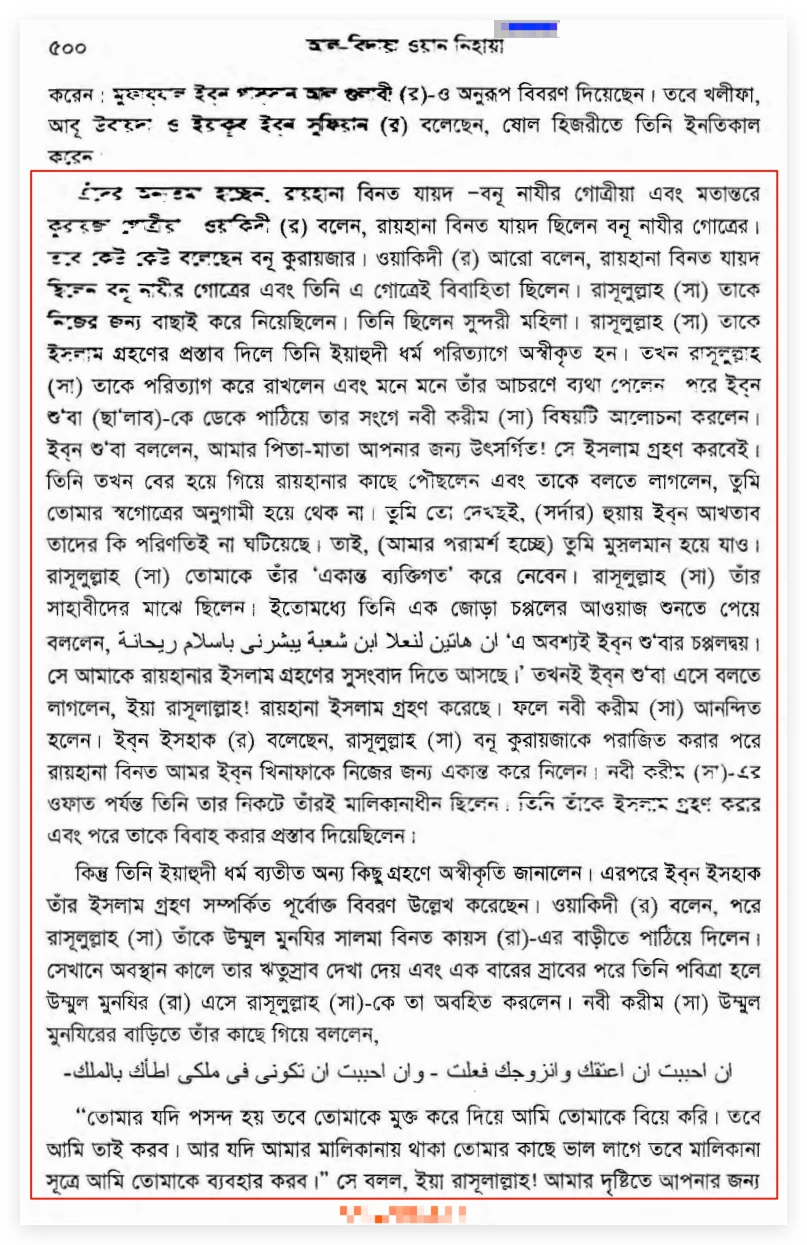
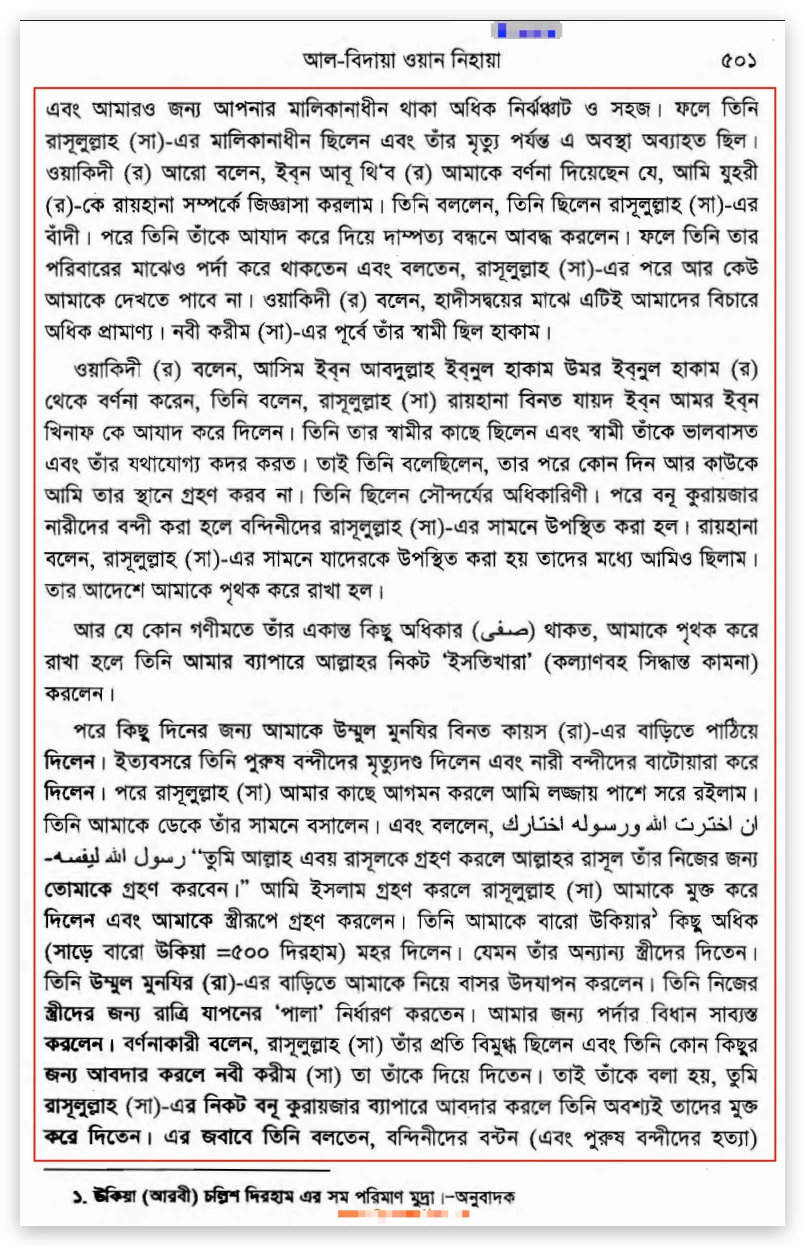
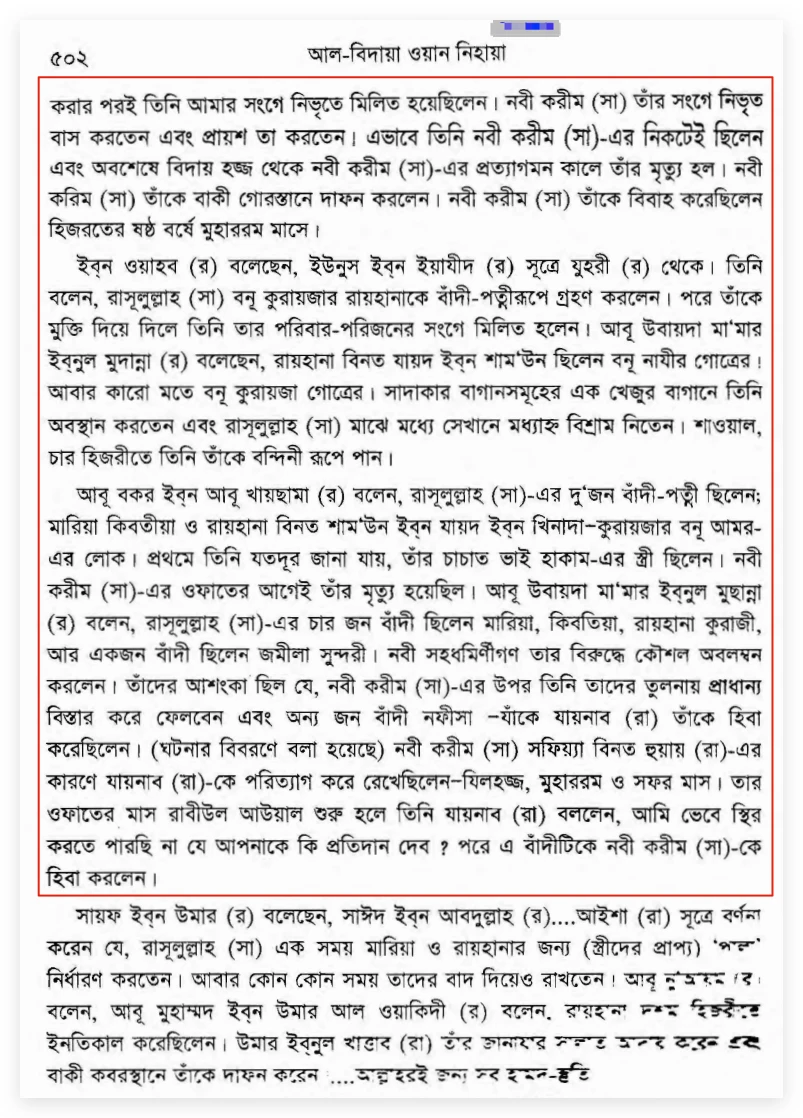
Conclusion
The life of Safiyya bint Huyayy represents a chapter of history that stands at the intersection of religion, politics, and humanity. She was at once a wife of the Prophet, a daughter of a defeated people, and the symbol of a woman devastated by war, whose life repeatedly oscillated between grief, doubt, and conflict. If we view what happened to her merely as a religious narrative, we lose the human dimension of history. Her story reminds us that just as tales of victory may be celebrated with pride, stories of defeat also remain beneath them as hidden tears.
Standing in the modern world, the stories of women like Safiyya remind us that history is not merely a document written by the victors; the silence of the defeated is equally important. Even though Safiyya became a wife of the Prophet, she remained the symbol of a woman devastated by war. Her story contains the pain of defeat, the conflict of identity, and the confrontation with tragic human realities. Only when these untold stories are brought to the table can we begin to construct a genuinely human history—one in which there is courage, there are questions, and there remains a voice of silent resistance.
References
- Sahih al-Bukhari, Hadith: 2652 ↩︎
- Sahih Muslim, Hadith: 2533 ↩︎
- Sirat Rasul Allah, Ibn Ishaq, Prothoma Prokashoni, translated by Shahid Akhand, p. 281 ↩︎
- Sirat-un-Nabi, Ibn Hisham, Vol. 2, p. 196 ↩︎
- Sirat-un-Nabi, Ibn Hisham, Vol. 2, pp. 191, 193, 235 ↩︎
- Al-Bidaya wa’l-Nihaya, Vol. 2, Islamic Foundation Bangladesh, pp. 39, 40 ↩︎
- Sahih Shama’il al-Tirmidhi, Hadith: 126 ↩︎
- Sunan ad-Darimi (HadithBD), Hadith: 45 ↩︎
- Sirat-un-Nabi, Ibn Hisham, Vol. 2, pp. 252–253 ↩︎
- Sirat-un-Nabi, Ibn Hisham, Vol. 2, p. 269 ↩︎
- Sirat-un-Nabi, Ibn Hisham, Vol. 3, p. 269 ↩︎
- Al-Bidaya wa’l-Nihaya, Islamic Foundation, Vol. 4, p. 188 ↩︎
- Sunan Abi Dawud, Islamic Foundation, Hadith: 2994 ↩︎
- Sirat-un-Nabi, Ibn Hisham, Vol. 3, pp. 237–238 ↩︎
- Ar-Raheeq al-Makhtum, Allama Safiur Rahman Mubarakpuri, Tawheed Publications, pp. 356–357 ↩︎
- Sunan Abi Dawud (Authenticated), Hadith: 2671 ↩︎
- Sunan Abi Dawud, Islamic Foundation, Hadith: 2662 ↩︎
- Tafsir Mazhari, Vol. 9, p. 464 ↩︎
- The Prophet Muhammad’s Tragic Death ↩︎
- Ashab-e-Rasul-er Jibonkotha, Vol. 5, Muhammad Abdul Ma‘bud, pp. 275–276 ↩︎
- Sirat-un-Nabi, Ibn Hisham, Vol. 3, p. 354 ↩︎
- Sunan Abi Dawud, Islamic Foundation, Hadith: 2984 ↩︎
- Sunan Abi Dawud, Islamic Foundation, Hadith: 2999 ↩︎
- Sahih Muslim, Islamic Foundation, Hadith: 3366 ↩︎
- Sunan Ibn Majah 2272 ↩︎
- Al-Mustadrak ‘ala al-Hakim, Hadith: 6789 ↩︎
- Sunan an-Nasa’i, Islamic Foundation, Hadith: 3385 ↩︎
- Al-Bidaya wa’l-Nihaya, Islamic Foundation Bangladesh, Vol. 5, p. 485 ↩︎
- Sahih Ibn Hibban (11/607) ↩︎
- Sahih al-Bukhari, Tawheed Publication, Hadith: 2893 ↩︎
- Sunan Abi Dawud (Authenticated), Hadith: 2995 ↩︎
- Sunan Abi Dawud 2123; Islamic Foundation edition, Hadith: 2120 ↩︎
- Sirat-un-Nabi, Ibn Hisham, Vol. 3, p. 358 ↩︎
- Al-Mustadrak ‘ala al-Hakim, Hadith: 6787 ↩︎
- History of al-Tabari, Vol. 39, p. 185 ↩︎
- Sahih al-Bukhari, Tawheed Publication, Hadith: 2635 ↩︎
- Tafsir Mazhari, Qadi Thanaullah Panipati, Vol. 9, p. 541 ↩︎
- Sunan at-Tirmidhi (Authenticated), Hadith: 2502 ↩︎
- Sahih Muslim, Islamic Foundation, Hadith: 3098 ↩︎
- Sahih Muslim, Islamic Foundation, Vol. 3, p. 269, Hadith: 3098 ↩︎
- The Reason for the Prophet’s Insulting Safiyya ↩︎
- Sahih Muslim, Islamic Foundation, Hadith: 3097 ↩︎
- Sahih Muslim, Islamic Foundation, Hadith: 3095 ↩︎
- Sahih Muslim, Islamic Foundation, Hadith: 3094 ↩︎
- Sahih Muslim, Islamic Foundation, Hadith: 3096 ↩︎
- Sahih Muslim Sharif (Bengali translation with necessary explanation), Al-Hadith Publications, Vol. 12, pp. 28, 218–219 ↩︎
- Ibn Sa‘d, al-Tabaqat al-Kubra — Safiyya bint Huyayy ↩︎
- Ibn Sa‘d, al-Tabaqat al-Kubra, narration 11830 ↩︎
- Musnad Ahmad, Hadith 12409 — Shu‘ayb al-Arna’ut: authentic chain according to the conditions of al-Bukhari and Muslim ↩︎
- al-Sunan al-Kubra of al-Nasa’i, Hadith 8646 ↩︎
- Sahih al-Bukhari, Islamic Foundation, Hadith: 2931 ↩︎
- Sahih Muslim, Islamic Foundation, Hadith: 4442 ↩︎
- Sahih Muslim, Hadith Academy, Hadith: 4486 ↩︎
- Jami` at-Tirmidhi, authenticated edition, Hadith: 1607 ↩︎
- On the Islamic Legality of Sex with Female War Captives or Slave Women: Is a Slave Woman’s Consent Necessary? ↩︎
- The Final Nail in the Coffin of Humanity: The Islamic Slave Market and the Open Auction of Women’s Bodies ↩︎
- Sunan ad-Darimi (HadithBD), Hadith: 3337 ↩︎
- Al-Bidaya wa’l-Nihaya, Islamic Foundation Bangladesh, Vol. 5, pp. 500–502 ↩︎
About This Article
Genre: Semi-Academic Historical, Ethical, and Human Rights Critique
Epistemic Position: Secular Humanist Ethics, Historical Criticism, Source-Based Analysis, and Anti-Apologetic Reasoning
This article critically examines the story of Safiyya bint Huyayy, the attack on Khaybar, the killing of her family members, her captivity, her transfer as war booty, and her subsequent relationship with Muhammad through the standards of historical evidence, human dignity, bodily autonomy, consent, and wartime ethics.
The purpose of this article is not devotional interpretation, theological damage control, artificial balance, or modern apologetic rehabilitation of classical Islamic narratives. Its purpose is to evaluate what the early Islamic sources themselves report, and to ask what those reports imply when judged by ordinary moral reasoning, human rights principles, and the ethical standards applied to war, captivity, coercion, and sexual power.
This article does not treat later apologetic explanations as automatically superior to early Islamic reports. When modern defenders attempt to soften, reinterpret, sanitize, or morally rescue accounts found in classical sira, hadith, tafsir, and fiqh literature, those attempts must be demonstrated with evidence—not merely asserted through pious discomfort, selective skepticism, or rhetorical suspicion against criticism.
Source criticism is welcome, but it must be applied consistently. It is not valid to accept a source when it glorifies Muhammad, conquest, miracle, prophecy, or Islamic virtue, and then dismiss the same source as unreliable only when it produces morally disturbing implications. Selective rejection of inconvenient material is apologetic cherry-picking, not serious historical method.
The use of reports from historians such as Ibn Ishaq, Ibn Hisham, al-Waqidi, Ibn Sa'd, al-Tabari, Ibn Kathir, hadith collections, and classical jurists should be evaluated in context. A source may contain weak, debated, or transmitted material; that does not automatically erase the historical and ethical value of the wider narrative tradition, especially when multiple strands of Islamic literature preserve the same basic structure: conquest, killing, captivity, distribution of women as spoils, and male control over captive women.
This article rejects the apologetic double standard in which Muslim historical sources are treated as authoritative for religious pride but inadmissible when they expose violence, coercion, slavery, sexual access to captives, or the moral vulnerability of women under conquest. Such double standards are not neutrality; they are theological filtering.
The central ethical issue is not whether the events can be made emotionally acceptable to believers. The issue is whether a young captive woman, whose family and social world had just been destroyed by a conquering army, can meaningfully be described as possessing free consent under the power of the victorious commander. Any analysis that ignores coercive context, captivity, military domination, and gendered power imbalance is ethically defective.
Strong criticism in this article should not be mistaken for hatred, prejudice, or cherry-picking. If Islamic sources describe women as transferable war booty, if they normalize sexual access to captive women, or if they portray the suffering of a defeated woman through the honor of the conqueror, then the moral burden lies on the doctrine and its defenders—not on the critic who exposes the problem.
This article should be evaluated through source transparency, consistency in source criticism, historical plausibility, moral clarity, attention to coercive power, and respect for the dignity of victims—not through theological sensitivity, prophet-protection reflexes, apologetic harmonization, accusations of bias, or demands that criticism of sacred figures must be softened for religious comfort.
