
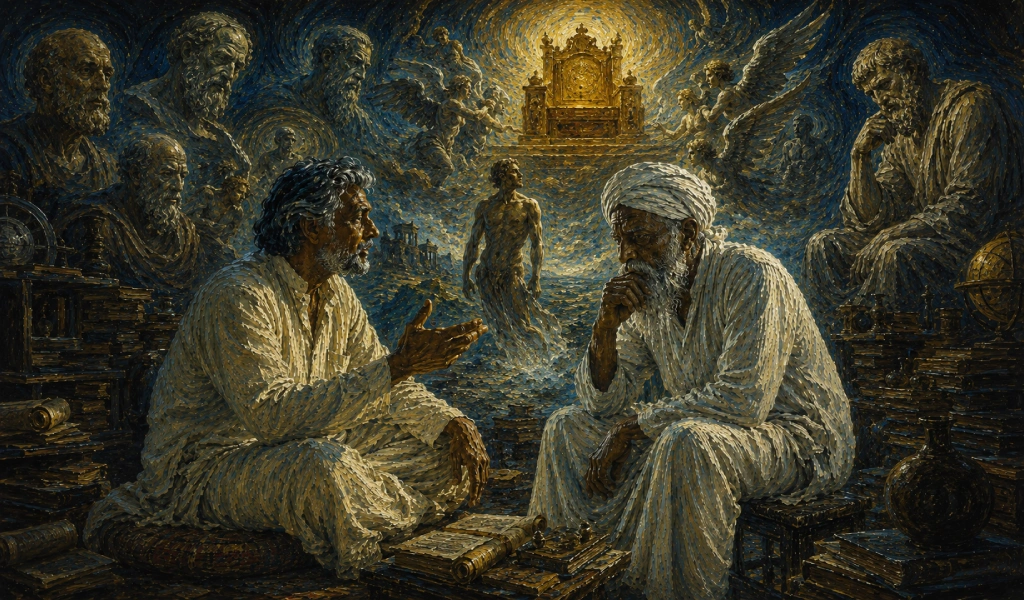
Drama: The Deposition of Satan (ﷺ)
When I first read Arz Ali Matubbar’s Shoytaner Jabanbandi (The Devil’s Testimony), I immediately felt that it was not merely a story; it was an extraordinary dramatic scene unfolding before my eyes. Its characters, dialogue, conflict, reasoning, satire, and the profound moral questions embedded within religious mythology all seemed to demand a stage of their own. As I read, I kept thinking that if this story were adapted into a drama, stage play, or film, it could become a rare contribution to the world of Bengali freethought.
That wish remained with me for many years. I thought that perhaps one day a skilled playwright or screenwriter would give this remarkable work a visual form. But the space for freethought in our society remains extremely restricted; in particular, very few people have the courage to place religious and mythological characters under the light of questioning, reason, and self-defence. As a result, this important literary possibility remained unrealized for a long time. Eventually, instead of waiting for someone else, I decided to try arranging Arz Ali Matubbar’s original ideas within the structure of a screenplay myself.
I am not a professional screenwriter, so this work certainly has its limitations. Even so, I have tried to preserve the rationalist spirit, satirical sharpness, and central question of justice in the original work while developing scenes, dialogue, and dramatic tension. Here, Satan is not presented as the established villain of a religious belief system, but as an accused character—one who has been declared guilty for thousands of years, yet has never been given the opportunity to present his own case. The central purpose of this screenplay is to bring that unheard testimony forward in dramatic form.
This work has been undertaken as a tribute to Arz Ali Matubbar. His rationalist courage, his defence of the right to question, and his tradition of placing conventional beliefs before the tribunal of reason are the inspiration behind this adaptation. Perhaps someday someone will have the courage to bring this drama to the stage or screen. It is with that hope that I present this effort.
Please note that my permission must be obtained before this screenplay may be used, staged, published, adapted, or performed anywhere. I request that this work not be used without permission.
In the history of human storytelling, the villain has been almost as indispensable as the hero. Whenever human beings have confronted suffering, hardship, fear, uncertainty, and failure, they have imagined, on one side, a great protector, saviour, or heroic figure; on the other, they have created an evil character onto whom every misfortune, every calamity, and every moral failure can be projected. This structure of storytelling is ancient. Human beings are reluctant to accept responsibility for their own weakness, greed, violence, cruelty, or ignorance; almost unconsciously, therefore, they construct an external enemy. Sometimes that enemy is a demon, sometimes an asura, sometimes a monster, sometimes Satan.
Among these constructed villains, Iblis—or Satan—is perhaps one of the most widely circulated and multiform mythological characters in human civilization. Across different religions, languages, cultures, and traditions, he appears under different names, in different forms, and through different interpretations. In some traditions he is a rebel, in others a tempter, in others the source of evil, and elsewhere a symbol of knowledge, questioning, and disobedience. Yet what is striking is that although this character has for so long been presented as the principal culprit behind humanity’s moral failures, his own testimony has almost never been heard. Religious scriptures, mythologies, and popular narratives contain accusations against him, condemnations, and curses—but virtually no opportunity for self-defence.
The minimum requirement of any meaningful conception of justice is that the accused must at least be heard attentively. If a person is declared a criminal, if for centuries he is transformed into a symbol of hatred, then he should at least once have the right to state his own case. No matter how firmly Ravana is constructed as the antagonist in the Ramayana, his knowledge, strength, and wisdom are not entirely denied. But in the case of Iblis, the conventional narrative is far more one-sided. He has been declared guilty, but his reasoning has not been heard; he has been declared accursed, but the question of whether his judgment was itself just has hardly ever been raised.
The purpose of this drama is not to worship or rehabilitate a mythological character. Rather, it is to reconsider an ancient accusation established through the narrative of the powerful, this time in the light of justice, reason, and the right of self-defence. If we believe in justice, then justice cannot apply only to characters we like; it must apply equally to those we dislike. Even to the most hated mythological character of all—the one called Satan. If we cannot establish insaf, or justice, even for him, then our concept of justice loses its moral foundation. For if we hear an accusation and deliver a verdict without hearing the accused, that is not justice; it is merely acceptance of the powerful party’s narrative.
This screenplay therefore imagines giving Satan an opportunity to speak. He will speak about his identity, the accusations against him, his grievances, his reasoning, and his memories. He will ask how simple—or how complicated—the questions of responsibility, free will, predestination, Allah’s command, justice, and power really are behind the crimes for which he has been accused. Whether the audience or reader accepts his arguments is entirely their own judgment. But before judgment begins, let his testimony at least be heard.
With respect to Arz Ali Matubbar’s original work, this dramatic adaptation now begins.
It is midday in the Bengali month of Baishakh. The sky is clear, and the air is almost completely still. Somewhere in the distance, the weary call of a bird can be heard through the silence of the village. The sunlight is so intense that even nature seems to have stopped for a while. In that scorching afternoon, Arz Ali lies in his sitting room. The heat will not let him sleep; he turns restlessly from side to side on the bed, sometimes closing his eyes, sometimes staring at the walls of the room.
The sitting room is very simple, yet it carries a peculiar intellectual atmosphere. On one wall hang portraits of Socrates, Epicurus, and Gautama Buddha; on another, Darwin, Ibn Khaldun, and Einstein. Beside the bed stands an old table piled with books of many kinds. The Quran, the Bible, the Bhagavad Gita, and the Tripitaka are placed side by side. Nearby are Immanuel Kant’s Critique of Pure Reason, works of philosophy by Bertrand Russell, Sophie’s World, collections of hadith by Bukhari and Muslim, and several other books.
Inside the room is a strange mixture of books, portraits, questions, and silence. Outside lies the fierce midday sun; inside, the restlessness of a thinking mind. It is at precisely this moment that an unfamiliar visitor appears at the doorway.
Scene: 01
Location: Arz Ali’s hut
Time: Midday
Characters: Arz Ali, the Visitor
Event: A scorching midday in Baishakh. Arz Ali is lying down, but sleep will not come. His eyes remain fixed on the portraits hanging on the walls. The silence of the room, the piles of books, and the midday light together create a strange atmosphere of contemplation. At that very moment, a mysterious visitor appears at the doorway.
The scene begins. From a distance, Arz Ali notices an unfamiliar man standing at the doorway. He is dressed in white pajamas and a white jubba, with a white turban on his head and a full white beard across his chest. Yet his face bears none of the weariness of an ordinary old man. Instead, there is a strange stillness about him, as though some being that has travelled through a span longer than thousands of years—through immense stretches of history and silence—has assumed human form.
There is a sharp serenity in the man’s eyes, something that offers reassurance yet also creates unease. His face carries humility, but concealed beneath that humility is an unwavering confidence, even a trace of indomitable pride—as though he has come neither to ask questions nor merely to answer them, but to appear before a tribunal where the verdict was pronounced long ago, although the accused was never allowed to testify.
Even after entering the room, he does not look around. He shows none of the curiosity, hesitation, or surprise of someone visiting for the first time. The room does not seem unfamiliar to him. The portraits on the walls, the books on the table, the line of sunlight beside the window—all appear to be old acquaintances. It is as though he has never entered this room before, yet every speck of dust, every book, every question within it has been known to him for ages.
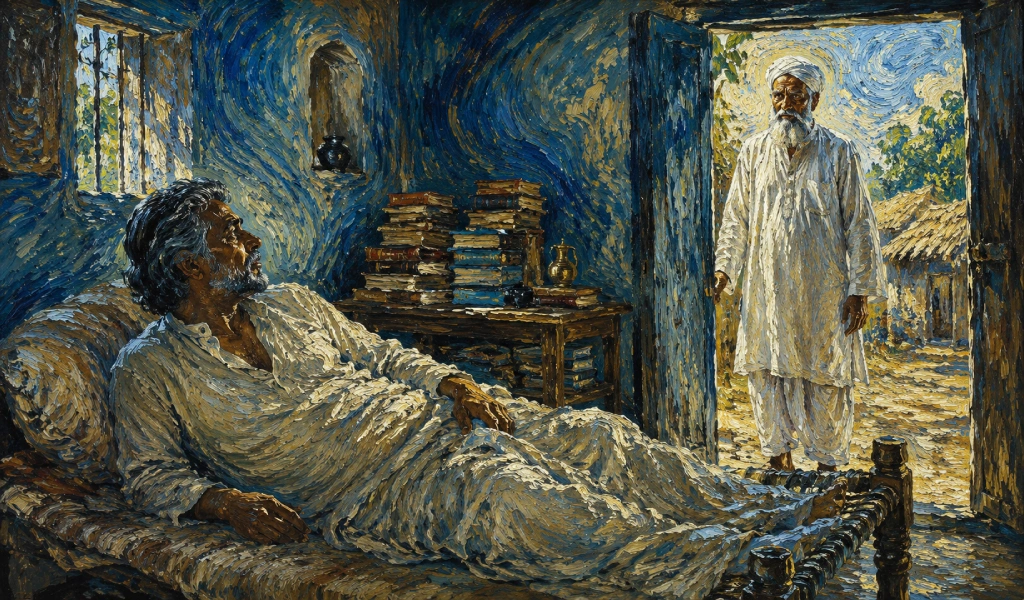
Arz Ali slowly sits up on the bed.
Arz Ali: Assalamu alaikum.
Visitor: Wa alaikum assalam wa rahmatullahi wa barakatuh.
Arz Ali: Sir, have you come to see me?
Visitor: Yes, I have come to see you. Or perhaps it would be more accurate to say that your questions have summoned me. Sometimes people do not call me directly; their questions call me instead.
Arz Ali: Questions? How did you know about my questions?
Visitor: A man who tries to sleep beside books but cannot has questions. A man who places Socrates, Buddha, Darwin, Kant, and the Quran side by side on the same table in the same room does not merely seek answers; he also judges those answers. He examines them.
Arz Ali: Please sit down, sir. Take a seat.
Visitor: Thank you. But before I sit, let me say one thing—people offer a seat to a guest, but they do not offer space to every idea. Today, I would like you to make a little room for my words as well. Whether you accept them or reject them can be decided later. First, listen.
The visitor sits in a chair. His eyes do not wander toward any furniture, book, or picture in the room. It is as though he already knows them all. Arz Ali stares at him in astonishment.
Arz Ali: The heat is unbearable. These days we hardly have any electricity. Anyway, sir, may I know who you are?
Visitor: Identity is a strange thing, Mr. Arz Ali. People usually think a name is an identity, a title is an identity, clothing is an identity. But names change, clothes change, titles change. Even bodies change. What remains is thought, and perhaps that is where identity truly resides. Which identity would you like to know—the identity of my name, my history, or the accusations against me?
Arz Ali: For now, just tell me your name. I can hear the history later. The accusations can wait even longer.
Visitor: A name? Names are given by people. Sometimes out of love, sometimes hatred, sometimes fear. I have been called by many names. Some peoples called me a rebel, some called me evil, some called me whispering temptation, some called me darkness. The names changed, but the accusation never did.
Arz Ali: Why are you speaking in riddles? Can’t you simply tell me? Who are you?
Visitor: You know me. Not only you—almost everyone on Earth knows me. Mothers invoke my name when their children misbehave. Saints invoke my name when explaining sin. Clerics invoke my name in sermons of fear. And people use my name to conceal their own crimes.
Arz Ali: You are saying strange things. If I already know you, why can’t I recognize you?
Visitor: Because human beings know many things, but truly understand very few. You know about justice, yet you do not always act justly. You know about truth, yet you cannot always tolerate it.
Arz Ali: Those are beautiful words, but there is no rule that beautiful words must be true. What exactly are you trying to say?
Visitor: I am saying that you know my name, but you do not know my testimony. You have been taught to hate me, but never taught to hear me.
Arz Ali: Then you are someone people are afraid of?
Visitor: They fear me because they have been taught to fear me. They hate me because they have been taught to hate me. They blame me because someone is always needed to bear the blame. People do not want to admit that their greed belongs to them, that their violence belongs to them, that their cruelty belongs to them. So they say, “Satan tempted me.” As though without me, human beings would all have become angels.
Arz Ali: Are you saying that people shift responsibility for their own sins onto you?
Visitor: Not only people. Sometimes, even in Allah’s narrative, I become the necessary scapegoat. The court is assembled, the charges are written, the witnesses appointed, the punishment declared—but where is the testimony of the accused? Tell me, can any trial be concluded after hearing only one side?
Arz Ali: Not if it is to be called justice. But you still haven’t told me who you are.
Visitor: Different civilizations have called me by different names. Some called me Azazil, some Ahriman, some Diabolos, some Iblis. Some turned me into the rebel of knowledge, some into a symbol of darkness, some into the source of all sin. But in the world today, the name by which I am most widely known is—Satan.
Hearing this, Arz Ali remains silent for a few moments. Then a strange smile appears on his face. There is surprise in it, disbelief, and also a trace of irritation.
Arz Ali: You mean to tell me that you are that Iblis? That Satan? The principal enemy of humankind? And today, in the middle of the afternoon, you have assumed human form and walked into my sitting room?
Visitor: “The principal enemy of humankind”—who said that is also something that ought to be examined one day [1] [2]. What makes someone an enemy? Is the one who teaches people to ask questions an enemy? Is the one who speaks of judgment and reason instead of blind obedience an enemy? Or should the one who creates human beings, writes their destiny, tests them while already knowing everything, places them in danger, and then assigns the blame for their failures to someone else also be judged one day? [3]
Arz Ali: Sir, listening to you, I am beginning to think you are either insane or an exceptionally humorous man. If you need help, say so, but I have no patience for this kind of nonsense in the middle of the afternoon. And if you have come here to sell me something, you have chosen the wrong house. I am a poor man myself. I need no soap, oil, shampoo, or anything else.
Visitor: I have not come to sell anything. Plenty of people sell products to human beings. Others sell salvation in the hereafter. Many sell fear. Some sell the promise of eternal sensual pleasure. I will sell nothing today. I ask only for one thing—time. Give me some of your time and listen. You need not believe me. Belief demands obedience; judgment demands a hearing.
Arz Ali: Do you realize how absurd your claim sounds? Iblis appearing before a human being and introducing himself—surely you understand how difficult that is to believe.
Visitor: That is precisely why I came to you. Easy things can be said in a mosque, in a maktab, from the stage of a religious sermon. Whether people understand anything or not, there is usually no shortage of agreement and applause. Difficult things must be said to someone who is not afraid of his own discomfort. Are you prepared to hear uncomfortable questions?
Arz Ali: I have no objection to questions. I do object to deception disguised as questions.
Visitor: Very well. Then let me begin with a question. If an accused person has been declared guilty for thousands upon thousands of years, yet has never been allowed to defend himself, would you call that trial justice?
Arz Ali: Not in an ordinary court. But yours is hardly an ordinary case.
Visitor: Why not? Does justice change according to the identity of the accused? One standard for humans, another for angels, another for jinn, while judgment itself is suspended when Allah is involved—what sort of justice is that? If justice truly deserves its name, it must apply to the weak and the hated alike. Even to Satan.
Arz Ali: You describe yourself as the accused. But the charges against you are hardly trivial. You refused to prostrate before Adam. You disobeyed Allah’s command. You led humanity astray.
Visitor: The list of charges is long. But does a long list make the accusations true? If a ruler writes a hundred charges against an opponent, does that prove that the opponent is guilty? Throughout history, victors write the story and the defeated become villains. I am that defeated character, charged with cosmic treason, whose testimony no one ever bothered to record.
Arz Ali: So you have come today to give your testimony?
Visitor: Testimony, autobiography, final appeal—call it whatever you wish. But I have not come seeking acquittal. What use is an appeal against a verdict already written for eternity? I only want humanity to know that the one they curse as Satan also had questions. He had arguments. He suffered humiliation. And he had silences.
Arz Ali: But the hadith says that you circulate through human beings as blood circulates through the body. You whisper evil to people and mislead them. How am I supposed to consider you innocent? [4]
Visitor: Do not consider me innocent. Remain skeptical. Skepticism is the first step toward judgment. But consider just this much—if I am so powerful that even prophets and messengers must remain vigilant against me, who gave me that power? If I can enter the human heart, who opened that door? If I lead people astray, who placed that role of misguidance within the architecture of the universe [5] [6]?
Arz Ali: You are trying to evade responsibility. Criminals always shift the blame onto someone else.
Visitor: Perhaps. But asking questions is not the same as evading responsibility. Suppose you manufacture a knife, sharpen it, know whose hands it will fall into, know what it will be used for, and still leave it in front of a child. If someone is injured, does all responsibility belong solely to the child?
Arz Ali remains silent for a while. Outside, the intensity of the sunlight has increased. An uneasy silence settles over the room. The visitor’s gaze remains steady, without any trace of impatience. It is as though he knows that time is scarce for human beings, but not for him.
Arz Ali: What you are saying is dangerous. But I will admit that I am curious. Tell me, how do you see yourself? As the source of sin, or as a misunderstood being?
Visitor: I do not call myself the source of sin. The source of sin lies in the tablet called predestination, written by Allah, where the Pen—the first creation—wrote everything down and the ink dried. And there are also human desires, hunger for power, fear, ignorance, and the blindness of obedience—all existing by Allah’s will. Perhaps I am merely a mirror. Humanity sees its own face reflected in that mirror, becomes frightened, and then curses the mirror. [3]
Arz Ali: A mirror? You are calling yourself a mirror?
Visitor: Yes. I offer temptation, but I do not create desire. I whisper, but the language of greed already exists within the human being. I point toward the door, but it is the human being who takes the step [7]. Yet the maker of the door, the maker of the road, the maker of the feet, the maker of the will—all remain innocent. I alone remain the eternal defendant. Tell me, is that a complete account of justice?
Arz Ali: You are very clever. Ordinary people could easily be confused by arguments like these.
Visitor: If reason causes confusion, will blind faith bring liberation? If thought must be protected from questions in order to protect the truth, how strong can that truth really be? Why should a belief that collapses upon hearing a question need protection at all?
Arz Ali: So you have come here today to turn me away from belief?
Visitor: No. I have not come to remove you from belief. I want you to place belief at the interrogation table. Question it and see whether it is fragile. A belief that is true will survive questioning. A belief that breaks under questioning should be called fear, not faith.
Arz Ali: You claim to be Iblis. What proof do you have?
Visitor: Proof? An excellent question. Human beings believe in Allah’s existence without demanding proof, believe in angels through reports of the unseen, believe in Paradise and Hell through accounts inherited from their ancestors—and yet, when I stand before them, they demand evidence. Still, I have no objection. Demanding evidence is one of humanity’s most admirable habits. But today, do not judge the proof of my identity; judge what I say. A false identity can still ask a true question, and a true identity can still tell a lie.
Arz Ali: Then let your identity remain suspended for now. Begin your case. But be warned—I will accept nothing blindly.
Visitor: That is precisely why I came to you. There is nothing to say to the blind believer; he has already written the verdict before hearing the case. Nor is there anything to say to the blind unbeliever; he closes the door before hearing anything at all. I need a listener who will doubt, question, and yet continue listening.
Arz Ali: Very well. I am listening. Begin.
Visitor: Then let us begin at the point where the first charge against me was written. It is said that I refused to prostrate before Adam. But before the trial begins, I want to know—who exactly was commanded to prostrate, why were they commanded to do so, and how did a prostration that belongs to none but Allah become permissible before Adam?
Arz Ali: You are going straight to the question of Tawhid?
Visitor: Yes. Because to understand my judgment, you must first understand my Tawhid. Humanity has called me disobedient. I call myself—a prisoner of a single prostration. A head that has once bowed before Allah cannot bow before any created being.
Arz Ali remains silent and stares at him. A faint smile rests on the visitor’s face. Outside, the midday light has grown even whiter. Inside the room, it feels as though an invisible tribunal has been convened—humanity on one side, and on the other that eternally accused being whose testimony is only now about to begin.
Arz Ali: Go on. Let me hear about your Tawhid.
Scene: 02
Location: Arz Ali’s hut
Time: Midday
Characters: Arz Ali, the Visitor
Event: Arz Ali is smiling faintly, though the disbelief in his eyes is unmistakable. The Visitor remains composed, deliberate, and self-assured. It is as though he has not merely come to defend himself, but has opened the files of an ancient theological case.
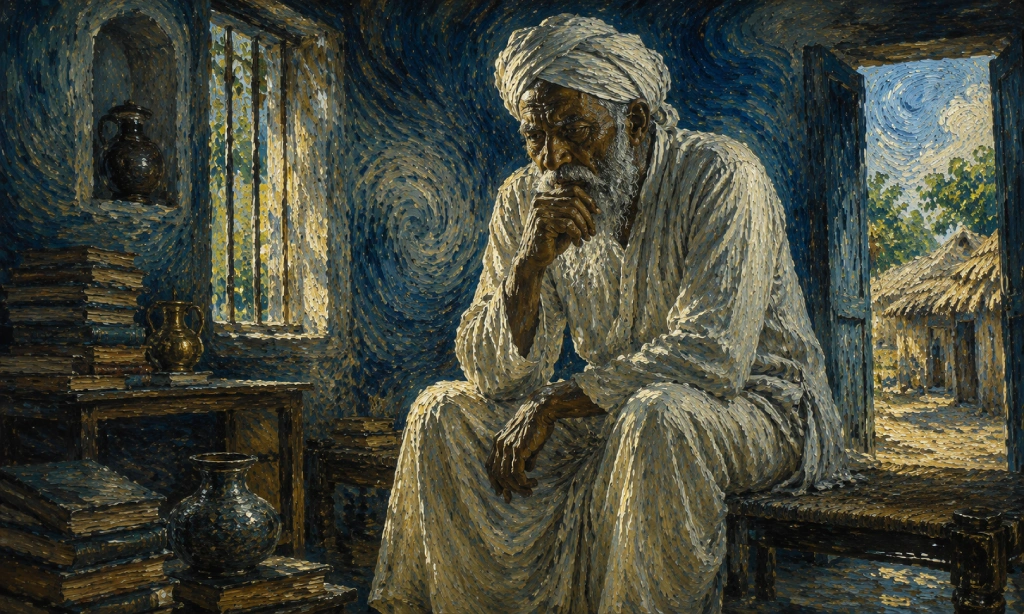
The midday light inside the room has grown even sharper. A narrow beam of sunlight slips through the window and falls across the cover of the Quran lying on the table. Arz Ali gazes at the light for a moment. The Visitor watches him steadily. Arz Ali breaks the silence.
Arz Ali: I find what you are saying interesting, although I do not believe you. To be frank, there is hardly any reason for me to believe you. Would you like some tea or coffee?
Visitor: No, sir. I have no need for such things. I have not come with a hunger for food; I have come with a hunger to be heard. When someone whose story has been told by others for ages finally wishes to speak for himself, it is probably better not to distract him with a cup of tea.
Arz Ali: Your sense of humor is not bad. But be careful—eloquence alone does not constitute a trial. You will need arguments.
Visitor: Of course. Eloquence may be enough for a religious sermon, but not for a trial. In a trial, one does not examine the ornaments of language; one examines the bones beneath the words. Today, examine the bones.
Arz Ali: Very well. Go ahead. Let me hear about your Tawhid.
Visitor: Then let us begin at the root of the incident. It is said that Allah commanded the angels to prostrate before Adam. Everyone prostrated; I did not. From that moment onward, permanent labels were attached to my name—disobedient, arrogant, accursed. As though the first courtroom in the universe concluded its proceedings so quickly that perhaps even the court clerk had written the verdict before the ink on his pen had dried.
Arz Ali: You are making jokes, but the event itself is clear. Allah commanded you, and you disobeyed. What could be simpler than that?
Visitor: Simplicity sometimes comes dressed as truth, and sometimes it serves merely as a blanket for lazy thinking. The question is—who exactly received the command? The Quran says, “And ˹remember˺ when We said to the angels, ‘Prostrate before Adam,’ so they all did—but not Iblîs, who was one of the jinn…” [8]
Arz Ali: But that very verse says that you disobeyed the command. Even though Allah addressed the angels, everyone present was included. Language permits that kind of usage. The majority may be directly addressed while the command is intended for everyone. In Arabic, this is called taghlib.
Visitor: Excellent. Human language contains taghlib, metaphor, idiom, and misunderstanding—because human beings are limited. People speak, then write commentaries; disagreements arise over those commentaries, and then new factions emerge to explain the disagreements about the explanations. That is how shops of interpretation open across the marketplace of theology. But the question is—are we dealing here with the ambiguity of human language, or with ambiguity in Allah’s command?
Arz Ali: Are you suggesting there was ambiguity in Allah’s language?
Visitor: I am not asserting it; the wording of the verse itself raises the question. If Allah is omniscient, He knew that people in the future would read this verse, commentators would write interpretations, arguments would follow, and I would be declared guilty. Could He not simply have said, “I commanded the angels, the jinn, and everyone present”? One additional phrase could have prevented this cosmic lawsuit from ever reaching such proportions. But no—the omniscient legislator of the universe appears to have issued a sentence upon whose interpretation my eternal damnation depends. If this is law, whom should students of jurisprudence blame—the defendant, or the drafter?
Arz Ali: You are playing with words. If the entire account is read, it is obvious that Allah intended you to prostrate as well.
Visitor: Reading the entire account also makes something else obvious—Allah Himself says that I was one of the jinn. That only makes the question larger. If the command was addressed to the angels, why am I liable? And if I am liable, why did Allah not make the command explicit? Suppose you call five people into a room—four employees and one guest. You say, “Employees, stand up.” The guest remains seated. Later you accuse the guest: “You disobeyed my command.” If the guest replies, “But you addressed the employees,” should he be called a philosophical trickster, or merely linguistically attentive?
Arz Ali: Allah cannot be judged through examples involving human beings.
Visitor: Then Allah’s commands cannot be understood through human language either. When you argue against me, you employ human language, human concepts of justice, human notions of obedience, and human definitions of crime. Yet when the same standards are applied to Allah’s words, you suddenly say that human examples cannot be used. This is a remarkably convenient court, sir. Here the plaintiff is also the judge, the legislator, the witness, and the chief justice of the appellate division. The defendant merely stands there—and that arrangement is called justice.
Arz Ali falls silent for a while. There is dissatisfaction on his face, but curiosity in his eyes. He glances at the Quran lying on the table, then looks back at the Visitor.
Arz Ali: But you knew what Allah wanted. Why argue so much over the wording of the command? Allah’s will is what matters.
Visitor: If Allah’s will is what ultimately matters, then an even larger question arises. Did Allah not know that I would refuse to prostrate? Did He not know that from this refusal would emerge my curse, humanity’s test, the entire theatre of Paradise and Hell, the need for prophets and messengers, the need for scriptures, the need for punishment—all of it? If He knew, then was my refusal outside His plan, or part of it?
Arz Ali: Allah knowing what you would do does not mean that He forced you to do it. Knowledge and compulsion are not the same thing.
Visitor: That can be said of human beings. You know the sun will rise, but your knowledge does not compel the sun to rise. With Allah, however, the problem is not merely knowledge. He is the Creator, the Decreer, the writer of destiny, the giver of power, and the source of will itself. If, before creating the universe, He had already written the destiny of everything, then how could my disobedience fall outside that writing? Once the Pen had written and the ink had dried, I could be called a character—but not an independent author. [3]
Arz Ali: Then are you claiming that you bear no responsibility at all?
Visitor: I am saying that before responsibility can be assigned, the structure itself must be examined. If a character in a play speaks the lines written by the playwright, the audience may curse the character—but the philosophically minded spectator also looks toward the playwright. If I am a character in the cosmic screenplay written by Allah, then what kind of dramatic criticism throws stones only at the actor while applauding the playwright?
Arz Ali: But Allah has said that He created everything according to precise measure. Everything lies within His knowledge and plan. That does not make your disobedience justified.
Visitor: If Allah created everything according to measure, then my refusal also lies within that measure. If He determined all things, then my refusal was not undetermined. And if my refusal was undetermined, then an independent territory existed outside His omniscience and all-powerful plan. On the one hand, you say that not even a leaf moves without His will. On the other, you say Iblis moved by his own will. How remarkable! The leaf has no independence, but Satan does. The leaves of theology move by Allah’s will, while Satan alone rebels by his own—the convenience of that exception is precisely the problem. [9]
Arz Ali: You are taking this discussion in a dangerous direction. You began with Tawhid. Why have you moved into predestination?
Visitor: Because Tawhid and predestination are not separate. If Allah possesses absolute sovereignty over everything, then my will cannot exist outside His sovereignty. And if my will does exist outside His sovereignty, then Tawhid itself develops a fracture. You call me disobedient; I say that I was disobedient from within Allah’s sovereignty. Will you call that a crime, or an operational chapter of His grand design?
Arz Ali: You refused to prostrate because of arrogance. The Quran itself says so. You were created from fire, Adam from clay—and that pride in your inherent superiority caused your fall.
Visitor: Arrogance? An excellent word. When the powerful elevate someone of their choosing to a high position without demonstrated merit, it is called “wisdom”; when a subordinate questions it, that becomes “arrogance.” Even words have ranks in a royal court, sir. When the king smiles, it is grace; when the subject smiles, it is insolence.
Arz Ali: Are you saying that Adam possessed no merit?
Visitor: I am saying that if merit is judged by actions, Adam had not yet performed any. He was declared khalifah before his career had even begun. Allah told the angels that He would create a khalifah on Earth. The question is—was this a reward for achievement, or a predetermined appointment? If the chairman of an office appoints a relative as managing director before he has even started the job, then tells the old employees to prostrate before him, would you call that administrative reform—or a divine example of celestial nepotism? [10]
Arz Ali: You are going too far. Allah gave Adam knowledge. He taught him the names of all things. The angels could not answer, but Adam could. That is where his superiority was demonstrated.
Visitor: That is precisely the examination I am talking about. Allah taught Adam the names, then tested the others in front of him. Adam answered; the angels could not. The question is—if one student is given the answers beforehand and then comes first in the examination, does the credit belong to the student or to the examiner? Imagine a teacher calling one student to his home the night before and explaining the entire examination paper to him. The next day he tests that student alongside everyone else. Naturally, the student comes first. Then the teacher announces, “Look—this is your leader.” If the remaining students quietly ask, “Sir, was this an examination or a dress rehearsal?” should they be expelled? [11]
Arz Ali: But the angels themselves said that they had no knowledge except what Allah had taught them.
Visitor: Exactly. That was the most honest answer they could have given. They did not say, “We have failed.” They said, “We were not taught.” Lack of knowledge and lack of ability are not the same thing. A person who has not been given a book may be called uneducated; but if you fail him in an examination and place another person above him, that is not epistemology—it is administrative theatre.
Arz Ali grows slightly restless. The smile has vanished from his face. Still, he does not end the conversation. The arguments appear to irritate him, yet draw him in at the same time.
Arz Ali: Even so, Allah’s command is still a command. The duty of a servant is not to question, but to obey.
Visitor: That sentence is the very center of my case. What does “Allah’s command is a command” actually mean? Must a command be obeyed because it is morally right, or does it become morally right merely because it was commanded? If the second is true, then morality is no longer a judgment about good and evil; morality becomes merely a declaration of power. Today Allah commands prostration, so prostration is moral. Tomorrow He prohibits it, so prostration becomes immoral. Even if a father is tested by being commanded to prepare to kill his own son, the same question arises—is morality the preservation of the child’s life, or proficiency in obeying the command? [12] Morality then ceases to be constant like light and becomes changeable like a royal decree.
Arz Ali: You have brought us straight to the Euthyphro dilemma. But such philosophical disputes arise because human knowledge is limited. Allah’s knowledge is infinite.
Visitor: Then what is the purpose of giving people intellect? If questioning is a crime, why grant reason? If using judgment is rebellion, why give Adam knowledge? Did Allah want beings who would obey with understanding, or machines that would merely move? If movement alone was the objective, puppets would have been sufficient. Why create human beings at all? And if reason is precisely what gives human beings dignity, why was I cursed at the very moment I exercised judgment?
Arz Ali: You are trying to pass off your disobedience as an intellectual exercise.
Visitor: No. I am merely saying that obedience and understanding the truth are not the same thing. Many people obey out of fear, many out of greed, many out of habit. If obedience without judgment is called religion, then the most religious object would be a locked door—it remains wherever it is placed. Or take a camel with a ring in its nose: wherever it is led, it follows; wherever it is made to sit, it sits. [13] But human beings are not doors, nor are they camels led by rings in their noses. Human beings question, hesitate, and judge. And I? I was the first defendant to ask—if prostration belongs to Allah, why should I bow before Adam?
Arz Ali: Prostrating before Adam was an act of respect, not worship.
Visitor: That is another elegant argument. Many theological arguments arrive dressed in beautiful clothes; even when there are holes underneath, they look magnificent from a distance. Prostration as an expression of respect? Then let me ask—is prostration such an ordinary gesture of respect that, depending on circumstances, it can be transferred from Allah to Adam? If prostration is merely respect, what is wrong with prostrating before an idol if someone says, “I am not worshipping it; I am showing respect”? What is wrong with prostrating at the feet of a pir if a disciple says, “I am not worshipping him; I am showing reverence”? What is wrong with bowing before the statue of a head of state if a citizen says, “I am not worshipping him; I am showing respect”?
Arz Ali: There is also the explanation that Islam later abrogated the practice of prostration as a form of respect.
Visitor: Then do Allah’s moral laws also change over time? In one age, prostration is an honor sanctioned by Allah; in another, it becomes the supreme crime of shirk? If an act directed toward someone other than Allah can be permissible in one period and later become a devastating sin, then is shirk an eternal moral truth, or a historical administrative notification? A prohibition today, an amendment tomorrow, an interpretation the day after—that sounds less like the governance of a universe and more like a celestial bureaucracy.
Arz Ali: You are exaggerating. Whatever Allah says becomes the law. Whatever He makes lawful for whomever He chooses is lawful, and whatever He forbids is forbidden.
Visitor: So the foundation of morality is not reason, but command? If Allah says today that prostration belongs to Him alone, that is Tawhid. Tomorrow He says, “Prostrate before Adam,” and that too becomes Tawhid. The day after, He says, “Do not prostrate before anyone else,” and once again that becomes Tawhid. What an extraordinary geometry—where a straight line becomes a circle by Allah’s will, a circle becomes a triangle by Allah’s will, and whoever asks a question becomes destined for Hell.
Arz Ali: So did you place your own judgment against Allah’s command?
Visitor: I did not stand against Allah. I simply refused to bow before anyone other than Allah [14] [15]. If that is a crime, then the name of my crime is not disobedience—it is excessive Tawhid. I was so uncompromising in monotheism that I could not accept even an exception issued by Allah Himself. You call me Satan; but consider this: a being who lost Paradise, lost his rank, and knowingly accepted eternal damnation rather than prostrate before anyone other than Allah—could you at least extend him the courtesy of calling him a “stubborn monotheist”?
Arz Ali: You are using Tawhid for your own purposes. Tawhid means believing in the oneness of Allah and obeying His commands.
Visitor: Does the oneness of Allah mean merely believing that He alone is God, or does it also mean that prostration belongs exclusively to Him? If no one except Allah is worthy of prostration, why prostrate before Adam? And if Allah can make someone else worthy of prostration whenever He chooses, where exactly is the boundary of Tawhid? Adam today, a prophet tomorrow, a pir the day after, a king after that—if all of them can become recipients of “prostration of respect by Allah’s permission,” then who keeps the door marked shirk closed?
Arz Ali: But the Quran states clearly: “Do not prostrate to the sun or the moon, but prostrate to Allah, Who created them ˹all˺, if you ˹truly˺ worship Him ˹alone˺.”
Visitor: Exactly. That is precisely why I am asking. If one must not prostrate before the sun or the moon because prostration belongs not to creation but to the Creator [15], then how did prostration before Adam—himself a created being—become permissible? The sun at least gives light, and the moon at least softens the night; Adam had not yet even committed the first mistake of human civilization. What prior merit did he possess? Merely that Allah had selected him? Then morality is not what matters; selection is everything. And if selection is everything, what remains to be judged? [15]
The air in the room grows heavy. Somewhere outside, a bird suddenly calls and then falls silent. Arz Ali picks up a book from the table but does not open it. The Visitor continues speaking, as though even this silence is part of his testimony.
Arz Ali: You call your action Tawhid, but Allah called it arrogance. Why should your own interpretation be more acceptable than Allah’s?
Visitor: The victor’s interpretation is always more widely circulated; that does not make it more valid. When a king executes a rebel, the history written by the royal court records the rebel as a criminal. But a hundred years later, a historian may ask—was the rebel truly a criminal, or was the state unjust? If Allah’s narrative is the only narrative available, then calling me arrogant is easy. But if you ask me, I will say this: I did not hold my head high; I simply refused to bow it in the wrong place. The distinction is subtle, but when judgment cannot understand subtlety, it becomes little more than punishment reduced to farce.
Arz Ali: Then in your view, you are not guilty?
Visitor: I am saying that before my guilt can be established, several questions require answers. First—who exactly received the command? Second—if I was a jinn, how did a command addressed to the angels make me liable? Third—if prostration belongs exclusively to Allah, why was Adam made an exception? Fourth—if Allah had already written my refusal beforehand, where was my freedom? Fifth—the being who created me, gave me my nature, constructed the field in which my will operates, knew my future, and wrote my destiny is entirely innocent, while I am entirely guilty—where did this extraordinary concept of justice come from?
Arz Ali: Your questions are difficult, but they do not make you innocent. Many criminals present impressive arguments in court.
Visitor: Quite right. An impressive argument does not make a criminal innocent. But declaring someone a criminal without hearing his argument does not leave the judge innocent either. That is all I ask. Do not believe in me, do not worship me, do not follow me. Just switch on the defendant’s microphone once in the case that has been running against me for thousands of years. The strange thing is that everyone has spoken on this stage—Allah has spoken, the angels have spoken, prophets have spoken, mufassirs have spoken, preachers have spoken, pirs have spoken, maulanas have spoken. The moment Satan begins to speak, everyone cries, “Astaghfirullah! Turn off the microphone!”
An involuntary smile appears on Arz Ali’s face. He quickly suppresses it. The Visitor smiles faintly as well, but there is more ancient weariness than amusement in his eyes.
Arz Ali: You speak dangerously. If people listen to you, they may begin to think.
Visitor: That is precisely why I am called dangerous. The one who teaches people to sin is not nearly as frightening as the one who teaches them to ask who bears responsibility for sin. Punishing the sinner is easy; questioning the architect of sin is difficult. Human beings prefer easy work. So they raise stones toward me, but never raise their eyes toward the sky.
Arz Ali: Are you claiming, then, that your refusal was actually a higher form of obedience to Allah?
Visitor: I am claiming that the matter is at least not so simple that it can be reduced to a children’s story: “Satan is bad because he did not prostrate.” Children like simple stories. Adult philosophy asks—what is prostration? What is a command? What is obedience? What is freedom? What is predestination? And is justice merely the name given to something by whoever holds power?
Arz Ali: So you are calling yourself a lover of Allah?
Visitor: I am saying that I never prostrated before anyone other than Allah. Call me whatever you wish—accursed, misguided, rebellious—but can you deny that one fact? I never prostrated before an idol, before the sun, before the moon, before a king, before a pir, not even before the newly created Adam. At the center of my entire fall, every humiliation, every curse, lies a single refusal: I will not bow before anyone other than Allah. Now tell me—is that shirk, or a mad form of Tawhid?
A long silence fills the room. This time Arz Ali does not answer immediately. He looks through the window. The midday light remains still, but within him a struggle between light and shadow seems to have begun. The Visitor slowly straightens his back. His voice becomes lower and deeper.
Visitor: If Tawhid is merely a declaration made with the tongue, then many are believers. But if Tawhid is a difficult oath to bow before Allah alone, then my judgment is not so simple, sir. Perhaps I am sinful, perhaps disobedient, perhaps accursed—but before deciding what my crime should be called, define Tawhid properly. Because when the definition changes, the verdict changes. And when the verdict changes, history itself may change.
Arz Ali: I can see that you are not finished. But I have questions too. You have spoken about Tawhid; now tell me about your destiny. If everything had already been written, then who bears responsibility?
Visitor: That is precisely where I am going. Because my story did not end with the prostration. It was from the moment I refused to prostrate that the real drama of predestination began.
Scene: 03
Location: Arz Ali’s hut
Time: Midday
Characters: Arz Ali, the Visitor
Event: After the debate over Tawhid, a heavy silence settles over the room. Arz Ali is no longer smiling as before. Disbelief remains on his face, but it is now accompanied by deep concentration. There is no haste in the Visitor’s voice. It is as though he knows that difficult arguments cannot be delivered quickly; they must be allowed to descend slowly into the human mind.
Outside, the intensity of the sunlight has softened somewhat, but the heat inside the room has not diminished. Arz Ali runs a finger across the cover of a book lying on the table. The Visitor sits silently. That strange serenity remains on his face, as though he is waiting for an ancient question to be spoken once again.
Arz Ali: You have spoken about Tawhid. But talking about Tawhid does not lessen your responsibility. Allah commanded you, and you refused to obey. That is the fundamental crime.
Visitor: “The fundamental crime”—the phrase makes it sound as though the charge sheet has already been prepared. But before a charge sheet comes a question, sir. Suppose someone performs an action—but that action had already been written, permitted, planned, and even the power to perform it had been given by someone else. Would that alter the language of responsibility?
Arz Ali: You are returning to predestination again. But predestination does not mean that humans or jinn are puppets. Allah wrote because He knew; He did not compel them because He wrote.
Visitor: That statement is very popular. So popular, in fact, that many people mistake it for an argument. “Allah wrote it because He knew it”—the sentence sounds gentle, but difficult questions lie beneath it. Allah does not merely know; He creates, determines nature, constructs the field of will, and determines the consequences of events. Human knowledge is the knowledge of a spectator; Allah’s knowledge is the knowledge of a creator. A spectator watches a play and knows who dies at the end. A playwright writes which character will die. Those two kinds of knowledge are not the same.
Arz Ali: Still, knowing and compelling are different things. If I know that someone will make a mistake, that does not mean I caused him to make it.
Visitor: You may know—but you did not create him. You did not construct his brain, create his will, arrange his environment, place temptation before him, or write his future. If Allah were merely a spectator, your argument would work. But He is simultaneously the author, the stage designer, the creator of the characters, the lighting designer, the judge, and the executioner. The idea that the actor can be held entirely responsible in such a play while the playwright cannot even be questioned is possible only in theology. A drama editor would send such a script back for revision.
Arz Ali: Your language is sharp, but sharp language does not prove the truth. Can you show from the Quran or hadith that what you did had already been predetermined?
Visitor: I can. But I will not rush. The argument from predestination is like a sword; placed in the wrong hands, a person may cut himself with it. Let us begin with a simpler question. Do you remember Adam?
Arz Ali: Adam has already come up. Why are you bringing him into this again?
Visitor: Because the argument accepted in Adam’s case is rejected in mine. Theology possesses a peculiar set of scales—on one side stands a prophet, on the other Satan. Place predestination on the prophet’s side and it becomes mercy; place it on Satan’s side and it becomes sophistry. The scales are the same, but the judge gives a wink before weighing.
Arz Ali: What exactly are you trying to say?
Visitor: There is a hadith concerning the dispute between Adam and Moses. Moses said to Adam, “You are our father. You did us harm and caused us to get out of Paradise.” Adam answered by asking why Moses blamed him for an act that Allah had ordained for him forty years before He created him. And in that dispute, Adam prevailed over Moses. [16] What an extraordinary judgment! When Adam places responsibility for his own offence upon predestination, Moses loses the argument. Yet when the Angel of Death comes by Allah’s command to take the life of that same Moses, Moses does not accept destiny at all—instead, he strikes him and knocks out the angel’s eye. The angel had no independent will of his own and had come only to carry out Allah’s command. So when Moses struck the angel’s face, whose face did that blow really strike? Is that not worth considering?
Arz Ali’s brow tightens slightly. The argument does not merely challenge an interpretation of a hadith; it strikes simultaneously at the entire structure of predestination, responsibility, prophetic status, and justice. The Visitor lowers his voice further.
Visitor: Now tell me this: if Adam can escape responsibility for his action by appealing to predestination, why can I not do the same? Adam ate the forbidden fruit—it had already been written by Allah, and so Adam won the argument. I refused to prostrate—had Allah not written that beforehand as well? Or had the ink of destiny dried for Adam but remained wet for me?
Arz Ali: Adam made a mistake and later repented. You acted out of arrogance and did not repent. That is the difference.
Visitor: There is a difference; I do not deny it. But the question at this moment is not repentance—it is responsibility. If Adam’s responsibility for his offence is reduced because the act had been written beforehand, then my offence must be judged by the same logic. Repentance may change the outcome, but it cannot change the cause. If the event was predetermined, then repentance was predetermined too, and failure to repent was equally predetermined. If Allah wrote Adam’s repentance, was my failure to repent written by some other author?
Arz Ali: You are striking at a very subtle point. But human beings possess will. Jinn possess will too. The test would be meaningless if there were no will.
Visitor: There is will—but who owns the will? The Quran says, “But you cannot will ˹to do so˺, except by the Will of Allah, the Lord of all worlds.” [17] Now tell me: I willed not to prostrate. Did that will arise outside Allah’s will? If it arose outside His will, then there exists a rebellious territory beyond Allah’s sovereign will. But if it arose within His will, then my will is the offspring of His will. When the offspring commits a crime, questions about the parent also arise—especially when that parent is omniscient, omnipotent, and the architect of the entire plan.
Arz Ali: That verse has an interpretation. It does not mean that the servant has no will; rather, the servant’s will remains subject to Allah’s permission.
Visitor: Then the matter becomes even clearer. There is no will without permission. In other words, if I will to disobey, even that will has been permitted. Imagine a defendant telling the court: “I committed the act, but the state gave me the weapon, opened the door, granted permission—and afterward asked, ‘Why did you enter?’” What an extraordinary legal system. Here the state constructs the gallows, supplies the rope, arranges the circumstances of the offence, and then delivers a moral lecture: “Human beings possess freedom.”
Arz Ali: Are you comparing Allah to a state?
Visitor: I am not equating them; I am illustrating the concept. If you dislike the analogy, let me put it differently. If Allah is the Creator, He is not merely the legislator; He is the architect of the very mechanics of will, the moral stage, psychological tendencies, circumstances, and consequences. He did not merely say “do” or “do not”; He created the very existence of “being able to do” and “being able not to do.” It is therefore logically impossible to exclude Him from a discussion about responsibility. Of course, theology has one particular convenience: whenever reason knocks at the door, someone can always say, “Brother, taqwa is in progress inside.”
Arz Ali lets out a brief laugh, then immediately becomes serious again. He seems to understand that the Visitor’s satire is not mere comedy; it does not blunt the argument, but sharpens it.
Arz Ali: Very well. You are saying that your will could not have arisen without Allah’s will. But Allah does not force anyone. He shows the path, warns people, and then the servant chooses for himself.
Visitor: But the Quran also says, “Whoever Allah guides is truly guided. But whoever He leaves to stray, you will never find for them a guiding mentor.” [18] [19] Now tell me: if guidance and misguidance are both ultimately in His hands, why does responsibility for being lost fall only upon the traveller? Very well, the traveller took the wrong road—but who changed the signposts?
Arz Ali: Allah does not unjustly misguide anyone. A person first goes astray because of his own wrongdoing, and then Allah leaves him to it.
Visitor: I have heard that explanation too. But it raises another question. Where did the first wrongdoing come from? Who created the person’s will? Who arranged his circumstances? Who gave him his tendencies? And if it is said that the person himself initiated the first error, who created that “self”? Follow the chain of causes backward and ultimately you arrive at the Creator. Only at the final step are you told that no more questions may be asked—as though the road of causation reaches Allah’s door and abruptly ends beneath a sign reading: “No Entry.”
Arz Ali: But the Quran also speaks of human responsibility. People are accountable for their own actions.
Visitor: Yes, it says that too. And that is precisely what makes the problem deeper. On one side, human beings are said to be responsible. On the other, they cannot will unless Allah wills. On one side, they are told to choose the path. On the other, whoever Allah leaves to stray has no guide. On one side there is an examination; on the other, the questions, the answers, the result, and even the psychology of the examinee have all been written beforehand. Is this an examination, or a predetermined theatrical festival? If it is an examination, why was the result written in advance? And if the result was already written, why stage the examination?
Dry leaves rustle in the wind outside. Arz Ali leans slightly forward. There is still objection in his eyes, but the confidence of earlier has been replaced by caution.
Arz Ali: Then are you saying that the judgment of Paradise and Hell is unjust?
Visitor: I am saying that first we must define what judgment means. If someone acts freely, knows what he is doing, understands it, and could genuinely have acted otherwise, then judgment is possible. But if he performs precisely the act that his Creator had already written for him, if his will is subordinate to the Creator’s will, and if his misguidance is impossible without the Creator’s permission, then condemning him to eternal punishment is not justice; it is a display of power. That is the distinction between judgment and power. Judgment examines causes. Power merely reads the verdict.
Arz Ali: Why are you bringing up eternal punishment? We are discussing your refusal to prostrate.
Visitor: Because the punishment for refusing to prostrate is precisely an eternal curse and the promise of eternal Hell. Infinite punishment for a finite act is itself a philosophical catastrophe. If I refuse once, in a single moment, why should the punishment last forever? How does a finite offence become worthy of infinite punishment? Justice requires punishment to remain proportionate to the offence. But there is no proportionality here; there is eternal vengeance. If justice is a balance, eternal punishment is a mountain placed upon one side of the scale.
Arz Ali: Your crime was not merely refusing to prostrate once. You swore that you would lead humanity astray.
Visitor: Why did I make that vow? Because I was cursed. I said: since You have caused me to go astray, I will lie in wait for them on Your straight path. Notice what I said—“You have caused me to go astray.” The Quran itself records those words. If my statement was false, why did Allah preserve a false accusation against Himself in His own Book without any direct rebuttal? [20] [21]
Arz Ali: The Quran often quotes the words of unbelievers and the disobedient. A quotation does not automatically make a claim true.
Visitor: Very good. A quotation does not automatically establish truth. But when something quoted is false, it is usually followed by rebuttal, warning, or correction. If, after my statement, Allah had said, “No, I did not cause him to go astray; he went astray by himself,” the matter would have ended there. But He did not. Instead, in many places the Quran itself says that He misguides whom He wills and guides whom He wills. If you insist that my statement is entirely false, you create a conflict with those other verses. Observe theology’s difficult position: if you make me completely dishonest, the verses become uncomfortable; if you accept the verses, I become slightly less dishonest.
Arz Ali: You are arranging the verses to support your own case. You speak like a lawyer.
Visitor: If I am the defendant, I must speak like a lawyer. The strange thing is that the prosecution has been running against me for thousands of years; the moment I say two words in my defence, people call it “advocacy for Satan.” If one party in a courtroom has counsel, the other must have counsel too. Otherwise, it is no longer a court. It becomes a religious assembly.
Arz Ali opens the book in his hand but does not read it, as though opening it helps him hold the center of gravity of his thoughts. The Visitor looks toward the window. There is now a tired melancholy in his voice.
Visitor: Listen to another hadith. It says that when Allah creates a servant for Paradise, He employs him in the deeds of the people of Paradise; and when He creates a servant for Hell, He employs him in the deeds of the people of Hell. In the end, he performs those very deeds and enters Paradise or Hell accordingly. [22] [23] Tell me, when you hear the words “He employs him,” on whose shoulders does responsibility begin to rest? Consider Abu Lahab as well. His destruction was proclaimed while he was still alive. What would have happened to the Quranic proclamation if he had later accepted faith? And if he was incapable of accepting faith, was his disbelief really his free decision—or merely a role already written for him? [24] If the verdict is announced beforehand, life is no longer a test; it is merely the performance of a judgment already delivered.
Arz Ali: There are rules for understanding the language of hadith. If everything is interpreted literally, errors will follow.
Visitor: Taken literally, it becomes an error; taken metaphorically, it becomes convenient. A very effective method. The statement that demands obedience is literal; the statement that creates a moral problem becomes metaphorical. It is as though theology contains an invisible switch—turned on or off according to convenience. I only want to know: who has the authority to determine which sentence is literal and which is metaphorical—reason, or necessity?
Arz Ali: You look at everything through the eyes of doubt. That leaves no stability. Religion gives human beings a stable moral foundation.
Visitor: Stability is good when it rests upon truth. But stability built upon injustice is a stone grave—it does not move, but neither is there any life in it. Doubt does not always destroy. Sometimes doubt opens the door to justice. If you say to a judge, “I have arrived with a fixed decision; I will not hear the accused,” that is not stability. It is prejudice.
Arz Ali: Then according to your argument, neither humans nor jinn bear any responsibility?
Visitor: No. I am not denying responsibility entirely. I am denying a monopoly over responsibility. Human beings may be responsible. Jinn may be responsible. But the claim that the omniscient Creator is entirely exempt from responsibility is problematic—especially when He is the architect of nature, circumstances, power, will, knowledge, ignorance, temptation, and consequences. If you build a complex machine and give it a tendency to catch fire, then when it burns you may blame the machine—but the engineer’s design will also be examined. Why is examination of the design forbidden when Allah is involved?
Arz Ali: Because Allah does not make mistakes.
Visitor: That is a conclusion, not an argument. You begin by assuming that Allah cannot be wrong and then use that assumption to prove that everything He does must be right. The same method could prove any ruler just. Begin by declaring, “The king never makes mistakes.” Then whatever the king does becomes justice. In philosophy, it is difficult to call that reasoning; in a royal court, it can certainly be called obedience.
Arz Ali grows serious. The weight of the conversation seems to thicken inside the room. Somewhere in the distance, a cowbell rings, then silence returns.
Arz Ali: Listening to you, it seems you are not merely defending yourself. You are demanding that the entire structure of creation be put on trial.
Visitor: Because my case is not personal. I am not the only defendant. Humanity has used my name to explain its own failures. Religion has made me the villain of its moral drama. In Allah’s narrative, I am an indispensable instrument of the test. If you wish to judge me, there is no way to do so without also examining the structure of creation. If you blame the machine, you must inspect the design of the factory as well.
Arz Ali: But you yourself decided to lead humanity astray. Was that not your own decision?
Visitor: It was a decision, but decisions do not arise from a vacuum. Humiliation, curse, prior writing, the Creator’s will, the nature of the character—all of these combine to produce a decision. People isolate decisions because that makes judgment easier. Philosophy, however, examines the chain of causes behind them. When a river bends, you may ask the river, “Why did you turn?” But mountains, slopes, soil, rain, and current also shape its course. The river may bear responsibility, but geography is not innocent either.
Arz Ali: Are you calling yourself a river, then? Are you saying that you merely flowed along?
Visitor: No. Calling me a stone would be wrong, and calling me a river would also be wrong. I am a being—but that being was created. My arrogance, my reasoning, my refusal, my anger—all of them are created. None is uncreated. If the anger within me was created, then the question of its creator inevitably arises. If my arrogance was created, who engineered the arrogance? And if you say that I created my own arrogance, you turn me into a partial creator. That places the doctrine of Tawhid itself in profound conflict.
Arz Ali: Your argument is dangerously powerful. But I think you are avoiding one matter—moral responsibility. If human beings or jinn do not take responsibility for their own actions, morality collapses.
Visitor: Morality requires responsibility, but justice also requires a complete account of causes. If all you want is responsibility, punishment is easy. If you want causes, judgment becomes difficult. I do not want to destroy morality; I want to examine its foundation. Because a morality that completely exempts the omnipotent while condemning weak created beings to eternal punishment may merely be power operating under the name of morality.
Arz Ali sighs. There is hesitation in his eyes. He may still not believe the Visitor, but he can no longer dismiss the questions so easily.
Arz Ali: Suppose there is some force in your argument. But then every sinner in the world will say, “It was written in my destiny.” The murderer will say it, the thief will say it, the oppressor will say it. How could society function?
Visitor: The question of how society functions is different from the question of cosmic justice. Society punishes crime in order to prevent it—because society is limited, society does not know the future, society wants to reform people and protect others. But if Allah already knows, already writes, already creates, already determines the outcome, and then imposes eternal punishment, that is not social protection; it is the penal code applied after a prewritten drama. Human courts punish because they are limited. If Allah’s court, despite being omniscient, operates in the same way, the question becomes greater, not smaller.
Arz Ali: So you are saying that human judgment and Allah’s judgment cannot be measured by the same standard?
Visitor: If Allah’s judgment is higher than human judgment, then it ought to be more just than human judgment, not less. Human beings make mistakes, so their judgments are imperfect. If Allah is omniscient, His judgment should be more subtle, more conscious of causes, more merciful, and more just. But if human beings impose finite punishment for finite crimes while Allah imposes infinite punishment for offences already written in advance, where is the superior justice? Is the superiority merely in power, or in justice as well?
Arz Ali: You keep raising question after question. What is your answer?
Visitor: Answer? I told you—I did not come here today to sell answers. I came to return the questions. For thousands of years humanity has pointed a finger at me. Today I am merely turning that finger around slightly. If the finger trembles, is that my responsibility too?
Both fall silent. The first signs of afternoon begin to enter the room. The light is changing. Arz Ali slowly closes the book. When he speaks again, his voice is much calmer than before.
Arz Ali: I have heard your argument about predestination. But one question remains. So far, you have spoken only about responsibility for your own disobedience. What about your role in human life? Are you merely a mirror, or are you an active tempter?
Visitor: A good question. Because that is the second great accusation against me—that I lead human beings astray. But what does “leading someone astray” actually mean? Do I create greed inside a person, or merely knock at the door where greed already lives? Do I create sin, or merely give language to the possibility of sin? And most importantly—the person whom I supposedly lead astray: who arranges his provision, his desires, his fears, and his weaknesses?
Arz Ali: Are you going to talk about provision now?
Visitor: Yes. Because sin is not born only from belief. Sin also grows within hunger, fear, deprivation, greed, exclusion, power, and the arrangements by which people struggle to survive. If Allah is the Provider, then the question arises—who provides the thief’s sustenance, who gives the oppressor his power, and who leaves forbidden paths open before the hungry?
Scene: 04
Location: Arz Ali’s hut
Time: Midday gradually turning toward afternoon
Characters: Arz Ali, the Visitor
Event: After the debate over predestination, restrained irritation is visible on Arz Ali’s face. He realizes that the Visitor is speaking through a carefully woven net of arguments. There is a faint smile on the Visitor’s face, but beneath that smile, alongside confidence, lies the fatigue of ages. The discussion now turns toward provision, deprivation, theft, corruption, and the question of Allah’s justice.
The light inside the room begins to change. The white blaze of midday is slowly turning yellow. Somewhere in the distance, voices of people can be heard, then silence returns. Arz Ali remains quiet for a while. There is irritation in his eyes, but no longer the irritation of contempt; rather, it is the irritation of someone who dislikes his opponent’s argument but can no longer ignore it.
Arz Ali: You have raised predestination and responsibility. But one thing is clear—those who deny Allah, those who disbelieve, have their hearts sealed by Allah. They are deprived of Allah’s mercy. We who have faith, on the other hand, are recipients of Allah’s blessings.
Visitor: “Recipients of blessings”—a beautiful phrase. People call what they themselves receive a blessing, what others receive a test, and what their enemies receive a temptation. Even words have classes, sir. Wealth in the hands of the powerful becomes a blessing; in the hands of the poor it becomes a test of greed; and in the hands of the unbeliever it becomes the deception of this world. The same money enters three houses and produces three different theologies.
Arz Ali: You are joking again. I am saying that whoever receives Allah’s mercy receives guidance, and whoever incurs His wrath goes astray.
Visitor: Then would you say the same about provision? Allah gives to those upon whom He shows mercy, while those to whom He does not give remain deprived? Or does a different rule apply here? Because when human beings begin to eat, theology becomes a little more realistic. The stomach is a great philosopher, sir. An empty stomach argues less about predestination and more about bread.
Arz Ali: Provision is in Allah’s hands. He gives abundantly to whom He wills and restricts it for whom He wills [25] [26] [27]. The Quran says this repeatedly.
Visitor: Exactly. Then let us examine this question of provision a little more closely. If Allah is the Provider, who provides the thief’s sustenance? Who provides for the corrupt minister? When a ruler steals the people’s money and builds himself a palace, who is the ultimate allocator of that wealth? If you say he acquired it unjustly, another question follows: had Allah not allocated that wealth to him, or had Allah allocated it but, through some bureaucratic complication in the divine distribution system, the allocation was delivered to the wrong destination?
Arz Ali: Wealth acquired unjustly cannot be called provision. A thief steals, a corrupt person engages in corruption; these are unlawful earnings. Allah provides sustenance, but human beings may acquire things through unlawful means.
Visitor: Excellent. So there are two kinds of provision—provision given by Allah and provision stolen by human beings? But the rice the thief eats—was that rice not allotted to him by Allah? Who made the hands with which he steals? In whose universe does the opportunity for theft arise? Does the wealth he obtains reach his home outside Allah’s knowledge? If not a single particle can enter anyone’s mouth except the provision written by Allah, then in whose record was the grain of rice that entered the thief’s mouth?
Arz Ali: Allah tests people. He gives them opportunities, but how they use those opportunities is part of the test. Wealth can be acquired through lawful means or through unlawful means.
Visitor: So Allah determines the provision, but human beings choose the method of delivery? Very well. The cosmic supply system sounds rather interesting—the allocation belongs to Allah, but the courier service belongs to humanity. Yet the question remains. In one household there is no food; in another, food rots in warehouses. One child cries from hunger; another person feasts with money stolen from the state. If distribution of provision is in Allah’s hands, where is the morality of this distribution? And if human beings themselves ruin the distribution, why is the provision determined by Allah so helpless before human corruption?
Arz Ali shifts slightly in discomfort. There is humor in the Visitor’s voice, but the question itself is not humorous. Outside, a group of children runs past; the sound of their footsteps drifts in for a moment and then disappears.
Arz Ali: You are trying to blame Allah for the injustices of the world. Human beings commit injustice, not Allah. Human beings plunder, not Allah.
Visitor: I am not assigning blame; I am asking for an accounting. Blame is easy. Accounting is harder. If a minister steals public money, you call him corrupt. Correct. But if that same wealth is also said to be provision determined by Allah, then what is the relationship between corruption and provision? Is he merely taking, through unlawful means, wealth that Allah had already allotted to him? If so, is the unlawful method itself not part of a structure known, permitted, and written in advance by Allah?
Arz Ali: Allah knows, but He does not approve. Knowledge does not mean approval.
Visitor: Again that old refuge—knowledge and approval are different. But with Allah, there is not only knowledge; there is power as well. Suppose you see a child walking toward a well, you know he will fall in, and you have the power to stop him, yet you do nothing. In that case, saying merely “I knew” does not dissolve responsibility. If Allah knows that a corrupt person will plunder, has the power to stop him, and yet gives him authority, opportunity, intelligence, a body, state machinery, and enough life to enjoy the proceeds, questions will inevitably arise. An omnipotent being is not merely a spectator; He owns the stage.
Arz Ali: But this world is a test. How people respond to injustice is also part of the test. It is a test for the oppressor, a test for the oppressed, and a test for the observer as well.
Visitor: So the one crying from hunger is being tested; the one stealing his rice is being tested; the one watching the theft is being tested; and the one who arranged the entire examination is the examiner. The question is—can the examiner never be questioned about the design of the examination? If a teacher gives one student a book, blindfolds another, allows a third student’s answer sheet to be stolen, and then says, “I am testing all of you,” the method of examination does not become immune from criticism. Calling something a test does not automatically transform injustice into justice.
Arz Ali: You cannot understand Allah’s wisdom. Human knowledge is limited.
Visitor: Human knowledge is limited—that is true. But what is remarkable is that when human knowledge tries to prove that Allah is just, it is considered sufficient; when it questions Allah’s justice, suddenly it becomes limited. Knowledge is adequate for praise, but inadequate for criticism? This door of reasoning opens in one direction and remains locked in the other. Perhaps even the doors in the house of theology face the qibla.
Arz Ali cannot help smiling faintly. But almost immediately his face grows serious again. He understands that beneath the Visitor’s satire lies the central question—the responsibility for provision, for deprivation, and for unequal distribution.
Arz Ali: Are you trying to say that when a thief steals, the thief bears no responsibility?
Visitor: No. I am saying that the thief bears responsibility, but the thief’s responsibility cannot be used to conceal the responsibility of the entire universe. Ask the thief, “Why did you steal?” Of course you should. But also ask—why was he hungry? How did the opportunity arise before him? What kind of society produces waste on one side and deprivation on the other? And if, at the end of all this, you say that provision is in Allah’s hands, then Allah’s distribution policy must also enter the discussion. Once the account books are opened, you cannot write down the name of the petty thief and close the larger ledger.
Arz Ali: But many thieves do not steal because they are hungry. They steal out of greed. Powerful people do not engage in corruption because of deprivation.
Visitor: Quite right. The thief driven by hunger and the thief driven by greed are different. The hungry thief steals bread; the greedy thief steals the state. The first goes to prison, the second gives speeches from a stage. But the question remains the same—who gave greed its power? Who placed the fire of limitless consumption inside a person who might otherwise have been content with little? In whose world was the throne of power built that turns people corrupt? If you say all of this is part of the human test, then I ask: why was poison mixed into the examination paper?
Arz Ali: Greed is part of the human nafs. A person must struggle against the nafs.
Visitor: Did human beings create the nafs themselves? If the nafs is part of their innate constitution, who designed that constitution? A person is placed beside fire and told not to burn; beside honey and told not to taste; beside power and told not to become corrupt—and when he fails, everyone says, “Look, humanity failed.” The question is whether this is a test of moral development or a prearranged opportunity for failure, especially when the examiner already knows the result.
Arz Ali: Allah provides sustenance, but He also distinguishes lawful from unlawful paths. Which path a person chooses is the test.
Visitor: Suppose one sack of rice has been written into a person’s destiny. He does not obtain it lawfully; instead, he steals it. Now tell me—was that rice part of his destiny? If it was, then although the method was theft, the final outcome matched Allah’s writing. If it was not in his destiny, then he successfully disrupted Allah’s distribution of provision—in other words, the thief defeated Allah’s allocation system. Which of the two will you accept? The first creates a moral problem; the second creates a problem for Allah’s sovereignty. This theological road has potholes on both sides and a narrow bridge in the middle, while the mufassirs stand upon that bridge directing traffic.
This time Arz Ali does not smile at the Visitor’s final remark. He stares at him intently. The question seems to stand visibly before him—is the thief’s meal written by Allah, or was it stolen in defiance of Allah’s writing?
Arz Ali: Perhaps one could say that Allah knew he would steal, and therefore his provision would reach him through that path. But the responsibility for stealing remains his.
Visitor: Then we are back at the same problem. Allah knew it, wrote it, the provision arrived, the method occurred, the opportunity appeared, the desire arose—and in the end the responsibility belongs only to the human being. It is as though poisoned food emerged from the royal kitchen while the cook, supplier, and approver all vanished, and only the person who ate it was placed on trial.
Arz Ali: You are trying to place all responsibility upon Allah.
Visitor: No. I am merely saying that where power is absolute, responsibility cannot become completely invisible. The advantage of omnipotence is that everything happens by His will. The disadvantage of omnipotence is exactly the same: His name appears in the explanation of everything. If human beings are completely free, Allah’s control diminishes. If Allah is completely in control, human responsibility diminishes. Trying to preserve both at once places reason under enormous strain; quite often it is forced to take a job in theology.
Arz Ali: Your argument is dangerous. If people begin thinking this way, no one will take responsibility for sin. Everyone will say, “Allah gave the provision, Allah wrote the destiny—so what did I do?”
Visitor: Society needs to hold human beings responsible; I do not deny that. But religion needs to absolve Allah of responsibility—and that is what I question. Society will punish the thief because society must protect itself. Philosophy, however, will ask—why does theft arise? Who created hunger? Who permits inequality? Who created the fire of greed? Why is provision distributed unequally? And if all of it is a test, why does every examinee receive a different question paper? One person is born with a silver spoon in his mouth, another with an empty stomach. Then both are told, “Be virtuous.” Is this morality, or social satire?
Arz Ali: Patience is the test of the poor, and gratitude is the test of the rich.
Visitor: It is easy to call poverty a test of patience when the speaker has food in his stomach. Tell a starving child, “You are being tested in patience,” then walk into a palace banquet and tell the guests, “You are being tested in gratitude.” You will notice that although the two examinations have entirely different syllabuses, the examiner receives the same praise in both. When the poor suffer, it is called destiny; when the rich indulge, it is called blessing. Is this inequality of interpretation also part of provision?
The light inside the room grows dimmer. Arz Ali looks through the window. His face still carries the readiness to argue, but alongside it there is now a kind of philosophical exhaustion. The Visitor continues.
Visitor: Ask yourself another question. A man accepts bribes. His child attends school with that money, food enters the household, groceries are purchased. Is the rice the child eats haram? If it is haram, what crime did the child commit? If it is provision, how did bribery money enter Allah’s distribution system? If you say the father is sinful but the child innocent, then you see the problem: the same wealth is sin from one direction and provision from another. The ledger of morality is not so simple, sir.
Arz Ali: But Islam prohibits unlawful earnings. There is no question about that.
Visitor: Prohibited—yes. But why does the prohibited thing exist? Why does the prohibited path work? If a person acquires wealth unlawfully, enjoys it, expands his power, exploits others, and lives a long life, then the prohibition remains on paper while reality tells another story. You will say there will be judgment in the hereafter. But by then the hungry person’s life is over, the oppressed person’s bones have been broken, and the stolen wealth has passed on through inheritance. A court in an infinite future does not feed hunger in the present.
Arz Ali: You are looking only at this world. Complete justice cannot be understood without the hereafter.
Visitor: The argument from the hereafter is remarkably useful. When a question arises in this world, the answer is transferred to an invisible future. It is like an accountant who cannot produce today’s ledger and says, “The final audit will take place after death.” But to someone whose life is burning now, a future court may offer consolation, not an explanation. And if Allah provides now, distributes now, and grants power now, then the questions arise now as well.
Arz Ali: Are you saying that the very concept of provision is morally problematic?
Visitor: I am saying that if the concept of provision is all-encompassing, then it generates moral questions. If every item of food, wealth, opportunity, and power is provision determined by Allah, then unjustly acquired wealth cannot exist outside His system either. But if unjust wealth is not His provision, then human beings can break Allah’s distribution and transfer wealth on their own. Preserving Allah’s sovereignty on one side and human criminal responsibility on the other requires subtle philosophy. Ordinary religious sermons, however, contain less subtlety and more slogans. There it is easy to say, “Allah gives everything,” and then, when a corrupt person is caught, to say, “Allah did not give him that; he stole it.” The problem lies precisely in this double accounting.
Arz Ali: You were saying that Allah has shown you more mercy. How so?
Visitor: Because human beings imagine that all of Allah’s mercy is reserved for them. But look at me. I am accursed, yet I remain alive. My lifespan has been extended. I have been given the opportunity to whisper into human hearts. I have been given a field of operation, influence, and time. When an ordinary person sins, he is expected to seek forgiveness immediately. I stand accused of cosmic rebellion, yet in practice I have been granted time until the Day of Judgment. What would you call that—punishment, or a special permit?
Arz Ali: That is part of Allah’s wisdom. You have been given respite so that human beings may be tested.
Visitor: Exactly. I have been granted respite for the testing of human beings [28]. That means I am an integral instrument of the examination. If a teacher deliberately scatters wrong answers throughout an exam and then, when a student follows one, says, “Look, he failed,” is the author of those wrong answers not part of the examination? If Allah Himself uses me in the testing of humanity, then I am not merely the enemy; I am an authorized department of the examination system. Perhaps the “Satan Department”—but the institution itself belongs to Allah.
Arz Ali is visibly irritated now, but he does not interrupt. The Visitor smiles faintly, as though he knows that the sentence was meant to be uncomfortable.
Arz Ali: You are trying to reduce your guilt by presenting yourself as part of Allah’s system.
Visitor: I am not reducing the crime; I am making the system visible. In a system that requires me, portraying me as entirely unnecessary and solely guilty is an insult to reason. If I do not exist, the test changes. If there is no temptation, the value of virtue changes. If there is no possibility of evil, the drama of goodness weakens as well. So am I merely a sinner, or am I the indispensable villain of the moral drama? And if the villain is indispensable, will the playwright at least thank him—or merely burn him in the fire at the end?
Arz Ali: Listening to you, one might think you are Allah’s assistant!
Visitor: Not an assistant—an unwilling functional component. Allah created me, gave me respite, gave me influence, and assigned me a role. If I am the tempter on the path of human sin, then my existence functions as an instrument of humanity’s moral test. People curse me, but without me many scenes in their religious drama would collapse. Just imagine how short religious sermons would become without Satan! Half the metaphors of many preachers would become unemployed.
Arz Ali: Even so, you harm human beings. You whisper evil. You call them toward the wrong path.
Visitor: I call; I do not compel. I whisper; I do not bind their hands and drag them. But if desire did not already exist within human beings, would my whispering not simply disappear into the air? A spark cannot ignite a fire without dry wood. Otherwise, why does everyone not become virtuous even after we are supposedly imprisoned throughout Ramadan?
Arz Ali: Then are you saying you merely exploit opportunities, but do not create sin?
Visitor: What I am saying is that at least I do not neglect the work assigned to me. Day or night, sky or air, human homes or the darkness of the mind—I perform my duty. Look at the life of your beloved Prophet. On one occasion Gabriel was supposed to come to him with revelation—an immense responsibility, delivering the most urgent message in the universe from Allah to His Prophet. Yet because there was a small dog beneath the furniture in the house, he abandoned that responsibility and did not come. He did not even wait. [29]. If this is the ideal standard of angelic responsibility, what exactly counts as neglect of duty? Yet I—the one you call accursed—am so relentlessly committed to my own role that even imprisoning me cannot turn the dry forest inside the human being green. Now tell me—who made the dry wood, who dried the forest, who supplied the wind? And does blaming the spark alone provide a complete explanation of the fire?
Arz Ali: Human beings possess the nafs, but they also possess conscience. That is why they are responsible. And however sharp your argument may be, performing one’s duty and leading human beings astray cannot be weighed on the same moral scale.
Visitor: The nafs is created, and conscience is created too. In one person the nafs is powerful and conscience weak; in another conscience is powerful and the nafs weak. Some are born into hunger, others into security. Some receive education, others do not. Some are born near power, others remain deprived forever. Then everyone receives the same moral sermon: “Be righteous.” It is like a race in which one runner has shoes, another has chains around his feet, a third has mud before him, and a fourth has a paved road—then the announcer says, “Let us see whose taqwa is greatest.”
Arz Ali sighs. There is exhaustion in his eyes, but the fire of argument has not yet gone out. He speaks slowly.
Arz Ali: There is logic in what you say, but there is danger as well. If everything is explained through structures and circumstances, where does individual morality remain?
Visitor: Individual morality remains, but it does not remain alone. It exists alongside society, biology, power, provision, and the Creator’s design. Hold human beings responsible—but do not hold only human beings responsible. Catch the thief—but do not ignore hunger. Judge the corrupt official—but do not ignore the architecture of power. And if, in the end, you call Allah “the Provider,” then His name must appear in the moral geography of provision as well. What kind of accounting places His name only on the page of praise, but never on the page of accountability?
Arz Ali: So you are saying that the question of provision ultimately becomes a question about Allah’s justice?
Visitor: Of course. Just as predestination leads to the question of free will, provision leads to the question of just distribution. If Allah provides, then hunger requires an explanation. If Allah grants wealth, inequality requires an explanation. If Allah grants power, oppression requires an explanation. And if you say that human beings corrupt these things, then I ask—who created human beings with the capacity to become so corrupt? These are not my questions, sir. They are the questions of a world in which children cry from hunger while banquets are held in palaces—and both sides say, “It is Allah’s will.”
For a while, neither speaks. The light outside has softened, but inside the room the question has become heavier. The earlier certainty has disappeared from Arz Ali’s face, though there is no surrender either. He seems to be weighing every sentence. A faint sadness now appears in the Visitor’s eyes.
Arz Ali: Listening to your arguments, it seems that you are not merely defending yourself. You are trying to expose the contradictions hidden within the religious language people use.
Visitor: Yes. Human beings blame me in order to keep themselves innocent. Then they praise Allah in order to keep Him free from responsibility. In between stands reality—hunger, greed, provision, theft, corruption, power, injustice. I am not saying that all responsibility belongs to Allah. I am saying that all responsibility does not belong to Satan either. Placing the moral debris of an entire universe upon my shoulders alone seems slightly unfair. My shoulders may be broad, but not that broad.
Arz Ali: Then what do you want?
Visitor: I want human beings to use the language of responsibility honestly. If they say that human beings are responsible, then acknowledge human freedom. If they say that everything happens by Allah’s will, then do not place Allah’s design beyond questioning. If they say provision lies in Allah’s hands, remember that sentence when discussing hunger and inequality as well. And if they say that everything is the result of my temptation, then at least acknowledge that I was given the power, time, and field in which to tempt. I did not open the door; I merely knocked upon it. The door, the house, the lock, the key, the darkness inside—none of these were created by me.
Arz Ali speaks in a lower voice now. The accusation has gone from his tone; in its place is preparation for the next question.
Arz Ali: You have spoken about provision. But so far you have been talking about the external circumstances of human sin. What about the human heart? The human mind? Human desire? What about the whispering inside a person?
Visitor: That is precisely where I am going next. Human beings imagine that every darkness within them comes from me. Yet often I merely give words to a darkness that was already there. I am the commentator of temptation, not always its author. But you have turned the commentator into the writer. So now let us speak of the heart, of whispering, and of the darkness that belongs to human beings themselves.
Scene: 05
Location: Arz Ali’s hut
Time: Late afternoon
Characters: Arz Ali, the Visitor
Event: After discussing provision, predestination, and moral responsibility, the conversation now turns inward toward the human heart. Arz Ali wants to know what Satanic whispering actually means. Is a person solely responsible for his own sins, or does Satan merely give language to a hidden darkness already present within him?
The light inside the room is slowly changing. The harshness of midday has faded, though the room remains bright. It is almost as though nature itself has paused to listen to the conversation. Arz Ali is calmer now than before. He no longer dismisses the Visitor outright as a madman or a fraud; at the very least, he can no longer simply avoid his questions.
Arz Ali: You said that human beings place the blame for the darkness within themselves upon you. But the hadith says that you circulate through human beings as blood circulates through the body. You whisper into the human heart. So you are not merely a mirror; you are also an active tempter. [30] [31]
Visitor: I am a tempter—I do not deny that. But temptation and creation are not the same thing. I knock at the door; there are still questions about who built the door, who placed desire inside the room, why the lock is weak, and why the owner opens the door the moment he hears the knock. You hear the knocking and immediately arrest me, but never examine the architecture of the house.
Arz Ali: But if you did not knock, the door would not open.
Visitor: Does every door open merely because someone knocks? A door behind which there is no curiosity, no greed, no fear, no envy, no hunger for power remains closed. I whisper into a person’s ear, but the language of greed belongs to him. I fan the air beside the fire, but the dry wood is already there. My whisper cannot produce even smoke from wet timber.
Arz Ali: Then are you saying that the sin inside the human heart belongs to human beings themselves?
Visitor: I am saying that within human sin there are human beings, there is me, there is society, deprivation, greed, power, fear—and if theology is true, there is also Allah’s design. To isolate me alone and say, “There he is, the contractor responsible for every sin,” is philosophically lazy and morally self-deceptive. Human beings sin, then look for a mythological rubbish bin in which to dump the blame while preserving their own self-respect. The name of that rubbish bin is Satan.
Arz Ali: But the Quran speaks of Satanic whispering. You make evil deeds appear attractive to people. You introduce doubt into their hearts and try to turn them away from Allah’s path.
Visitor: Is the power to make evil appear attractive mine alone? The Quran itself says, “Are those whose evil-doing is made so appealing to them that they deem it good ˹like those who are rightly guided˺? ˹It is˺ certainly Allah ˹Who˺ leaves to stray whoever He wills, and guides whoever He wills.” [32] [33] So tell me—is the power to make evil appear beautiful mine alone, or is it embedded much deeper within the system?
Arz Ali: Again you are shifting responsibility toward Allah. The Quranic verses have explanations. Allah does not unjustly misguide anyone. A person first goes astray himself, and then Allah leaves him upon the path he has chosen. And doubt is not always knowledge; much doubt is Satanic waswasah. The believer’s task is not to indulge such whispering, but to suppress it.
Visitor: That is precisely the point. If doubt is treated not as the beginning of knowledge but as waswasah, and if being afraid even to voice such doubts is turned into a sign of faith, then belief protects itself from questioning. [34] Doubt does not die; it merely rots inside. People stop asking questions not because they have found answers, but because they have been taught that the very birth of a question takes place in the womb of sin.
Arz Ali: Still, not every question leads toward truth. Some questions confuse people, fill them with arrogance, and push them toward disbelief in Allah.
Visitor: Let us assume that is true. But where is the first point at which a person “goes astray by himself”? What is the source of that first deviation? Did the person construct his own brain, tendencies, desires, fears, memories, and environment? You follow the road of causation until you arrive at Allah’s door, and then suddenly say: remove your shoes here—questions are forbidden beyond this point. Philosophy recognizes no such prohibition. If truth is really truth, it can stand in the courtroom of questioning. If it cannot, then it needs a police force of waswasah to protect it.
Arz Ali: Then what is a human being? Merely a programmed machine?
Visitor: No. Human beings are not machines. But neither are they completely free. A human being is a complex combination of causes, tendencies, memories, fears, hunger, the body, society, language, education, ignorance, power, and weakness. Religion sometimes calls the human being free so that he can be punished; at other times it calls him subject to Allah’s will so that Allah’s sovereignty can be preserved. Alternating between these two languages is one of theology’s oldest techniques. It is as though the chess pieces belong to human beings, Allah makes the moves, and when the game is lost, the knight is blamed.
Arz Ali lowers his eyes and remains silent for a while. There is a faint irritation on his face, but no longer the straightforward resistance of earlier. The Visitor watches him, as though he is not waiting for an answer but planting the question inside the silence itself.
Arz Ali: There are both good and evil tendencies within the human heart. You provoke the evil tendency. An angel calls toward good, while you call toward evil. That is where the human test lies.
Visitor: A splendid dramatic arrangement. An angel in one ear, Satan in the other, and the human being in the middle. But the question is—who determines the volume of those two voices? In whose ear is the angel faint while Satan is loud? [35] In whose ears do hunger, humiliation, fear, violence, and ignorance roar so loudly from childhood onward that the angel’s whisper can no longer be heard? You speak of an examination, but who designed the system determining how loudly each voice reaches each examinee?
Arz Ali: That is why human beings are instructed to practice self-restraint. They are told to struggle against the nafs.
Visitor: Struggle against the nafs—the phrase sounds beautiful. But the nafs does not weigh the same in every person. For one it is as light as cotton, for another as heavy as stone. One person is born into a family where restraint is taught; another is born into a slum where survival itself is the first moral imperative. Then both are given the same instruction: restrain yourself. It is like placing one person beside a river and another in a desert, then telling both of them to control their thirst.
Arz Ali: But Allah does not burden anyone beyond their capacity.
Visitor: Then what do those who collapse prove—that their capacity was smaller, or that the burden was greater? If Allah does not burden a person beyond his capacity, what exactly is the sinner’s sin? Could he have endured but simply chose not to? Or did the internal, external, social, and psychological burdens upon him exceed his capacity? You will say that he could have endured. But if Allah knew that he could not, why give him that test at all? And if Allah knew that he could, yet he could not—was the knowledge mistaken?
Arz Ali: You keep bringing every road back to Allah. But a human being must still struggle against his own inner impulses.
Visitor: I do not deny the need to struggle. I am merely saying that the battlefield inside each person is not level. One has a shield, another a broken stick. One faces a single enemy, another ten. If they are all weighed on the same scale when judgment comes, questions will naturally arise. The battlefield is different, the soldiers differ in strength, their weapons differ, their training differs—yet the judgment is identical? Is that justice, or administrative convenience?
The air inside the room grows heavy. From somewhere in the distance comes a long sound resembling the call to prayer, though indistinct. Arz Ali listens for a moment, then turns again toward the Visitor.
Arz Ali: If the darkness inside human beings is not truly theirs, then what is the meaning of repentance? Why should people ask forgiveness?
Visitor: Repentance is meaningful if it means self-correction. But if repentance means asking forgiveness from a Creator who already knew, wrote, permitted, and then finally said, “Ask forgiveness and I will forgive you,” questions arise. Imagine a playwright writing a character’s dialogue in such a way that the character says something offensive. Then the playwright himself says, “Now apologize.” The audience weeps, the character weeps, and the playwright is satisfied. But the philosophically minded spectator will ask—who wrote the dialogue?
Arz Ali: Then is repentance meaningless to you?
Visitor: Repentance is meaningful among human beings—if a person changes himself, repairs the harm he has caused, and acknowledges the wrong. But the theological structure of repentance before Allah is more complicated. There the offender is created, the will is created, the circumstances are created, the power is created, the temptation is created, and the outcome is known beforehand. Then the Creator forgives, if He wills. In other words, He creates a scorched forest, rain falls after it catches fire, and we say—what mercy! But we no longer ask why the forest was dry in the first place.
Arz Ali: You are trying to conceal the fact that you did not repent. Adam repented. You did not.
Visitor: I did not repent because I did not see what I had done merely as a sin. Adam violated a prohibition; I preserved the exclusivity of prostration. Adam acknowledged his error; I did not withdraw my question. That is the difference. Repentance is not merely asking forgiveness; it means admitting that one’s position was wrong. Am I supposed to say that refusing to prostrate before anyone other than Allah was wrong? If I say that, my Tawhid collapses. If I do not, I remain accursed. Look at the door that was opened before me—there was fire on both sides.
Arz Ali: Your problem is that you never want to consider the possibility that your position was wrong. That is arrogance.
Visitor: Perhaps. But is everyone who refuses to abandon his position arrogant? When a martyr holds on to his faith, he is noble. When a philosopher accepts death for the truth, he is wise. When a prophet refuses to bow before a hostile society, he is steadfast. But when I refuse to bow before anyone other than Allah, I am arrogant. Even the moral value of words changes according to the character to whom they are applied.
Arz Ali falls silent again. There was a cold sharpness in the Visitor’s final sentence. The light inside the room has turned more golden. The shadows of the books upon the table are growing longer.
Arz Ali: But you introduce doubt into human hearts. You destroy faith. You turn people away from Allah.
Visitor: Doubt does not always destroy. Often it is doubt that saves people from false beliefs. If you are about to drink poison believing it to be medicine and someone makes you doubt, is that person your enemy? If a belief is true, doubt will purify it. If it is false, doubt will break it. So fear of doubt is not really fear for truth; it is fear that falsehood may be exposed.
Arz Ali: Not every doubt is knowledge. Some doubts destroy people.
Visitor: True. Just as not every belief is knowledge, and many beliefs also destroy people. Doubt can be poison; belief can be poison too. The difference is that doubt teaches people to ask questions, whereas blind faith turns questions into sins. A belief that cannot tolerate questions does not need knowledge; it needs guards. And a truth that cannot survive without guards is not truth—it is a political prisoner.
Arz Ali: Do you consider yourself a teacher of freethought, then?
Visitor: No. I am not a teacher. I am the opposing voice. Against every powerful narrative there exists an uncomfortable question. I am the mythological name of that question. Religion has called me the enemy because I whisper one word inside the human mind: “Why?” Power does not like “why.” Whether it is the power of Allah, the power of a king, or the power of a priest, questions make a scratching sound like rats beneath their thrones.
Arz Ali: But not every “why” brings liberation. A child may look at fire and ask, “Why shouldn’t I touch it?” If he does, he will be burned.
Visitor: Correct. But explaining the nature of fire to the child and telling him, “If you ask questions, I will burn you,” are not the same thing. A teacher of truth gives reasons; a teacher of power gives threats. Religion often avoids explaining the fire and simply threatens people with Hell. As a result, the person does not understand the fire; he merely withdraws his hand in fear. Fear creates obedience, not knowledge.
Arz Ali speaks now in a somewhat softer voice. There is still opposition in his eyes, but questions are there as well.
Arz Ali: Even so, the evil voice within human beings cannot be denied. People often know that something is wrong and do it anyway. What do you say about that?
Visitor: I would say that human beings are creatures of conflict. They possess knowledge, yet also desire. They understand morality, yet also understand self-interest. They know death exists, yet continue accumulating power. I exploit that conflict; I do not always create it. If human beings contained no conflict within themselves, I would have no work to do. My existence therefore depends upon human nature. The question is—who made human beings so internally conflicted?
Arz Ali: You keep taking the answer to that question back to the same place.
Visitor: Because the road of causes ultimately arrives at the same place. Religion worships that place; philosophy questions it. I did not refuse to worship—I merely refused to abandon the question. Perhaps that is my real crime.
A brief silence. The light outside has grown dimmer. Arz Ali slowly raises his head. A new question seems to have gathered in his voice.
Arz Ali: You have spoken of doubt and of the human heart. But Allah sent prophets and messengers to humanity, sent scriptures, and explained truth and falsehood. If people still go wrong after that, the responsibility is theirs. So answer this—if Allah truly has guided humanity, how much of your accusation still survives?
Visitor: Good. Now we can enter the politics of prophets, scriptures, guidance, and narrative. Because “showing the way” is not a simple matter either. Who shows the way, in what language, to whom, whom it reaches, and whom it never reaches—unless we ask these questions, even guidance becomes a language of power.
Scene: 06
Location: Arz Ali’s hut
Time: Afternoon
Characters: Arz Ali, the Visitor
Event: From questions about the human heart, temptation, and responsibility, the discussion now turns toward prophets, scriptures, guidance, and the politics of religious narratives. Arz Ali argues that Allah has shown humanity the path. The Visitor asks—to whom did that path actually reach, in what language did it arrive, through what structures of social power was it transmitted, and how responsible are those whom it never reached?
The light inside the room has grown softer. The harshness of midday is gone, though daylight has not yet faded completely. It is as though even the day cannot decide whether to remain or withdraw. Arz Ali is more attentive now than before. Looking at the Visitor, he begins to speak slowly.
Arz Ali: You have raised questions about the human heart, the nafs, temptation, predestination—everything. But Allah did not leave humanity in darkness. Throughout the ages He sent prophets and messengers, sent scriptures, and provided guidance. He explained truth and falsehood, lawful and unlawful, the right path and the wrong path. If people still go astray after all that, the responsibility belongs to them.
Visitor: It is an attractive claim. “Allah showed the way”—it sounds just. But what does showing the way actually mean? There is a path—but before whom? There is a language—but who understands it? There is a scripture—but in whose hands? There is a prophet—but in which geography? If guidance reaches people unequally, should responsibility still be distributed equally?
Arz Ali: The Quran says that a warner was sent to every nation. No people were left without guidance. [36] [37]
Visitor: If a warner came to every nation, where are they in the historical record? The tribes deep in the Amazon rainforest, the Indigenous peoples of Australia, the peoples of the Arctic, the civilizations of ancient America—which prophets came to them, in what languages, and what scriptures did they leave behind? You will say: they came, but we do not know about them. Very well. So the absence of evidence must be filled with faith. That commodity has always enjoyed high demand in the warehouse of theology.
Arz Ali: Not all history is preserved. Prophets may have come, people may have forgotten them, scriptures may have been corrupted. None of that is impossible.
Visitor: Not impossible, but still open to question. If Allah is omniscient and wants the truth to be preserved, why does the guidance He sends disappear so easily? Even an ordinary author keeps a second edition of his book; the publisher keeps copies, libraries preserve them. Allah’s scriptures repeatedly disappear, become corrupted, or are forgotten—and afterward human beings are told, “You did not follow the correct path.” If the guidance is lost in the postal system, how just is it to punish the intended recipient?
Arz Ali: But the final scripture has been preserved. The Quran came as the ultimate guidance for all humanity.
Visitor: Ultimate guidance—but in Arabic. Directly accessible to Arabic speakers; for everyone else, through translation, interpretation, tafsir, doctrine, madhhab, fatwa, and translations of translations. If Allah intended to send a final message to all humanity, why send it through one specific language, one specific culture, and the political and social circumstances of one particular desert society? If the truth is universal, why is its language so regional?
Arz Ali: Every prophet was sent in the language of his own people so that they could understand. The Quran itself says so. [38]
Visitor: Exactly. But if the final prophet’s message was not merely for his own people but for all humanity, what happened to the languages of all those other peoples? An Arab heard it directly. A Bengali receives it through translation. A Japanese person encounters another layer of interpretation. An African tribesman may never hear it at all. A European may encounter it through the history of political conflict. Then all of them are placed before the same examination of faith. If the question paper is written in one language, translations contain errors, and different teachers explain it differently to different students, does all responsibility for failing really belong to the student?
Arz Ali frowns. He appears to understand that the Visitor is not raising the issue of language merely as a linguistic problem; a question of justice lies underneath it.
Arz Ali: People can understand through translation. Acquiring knowledge is a human responsibility. Anyone who genuinely wants to know the truth can find it.
Visitor: That is usually said by people to whom books have already reached. What about the child born in a war zone? The girl raised in an illiterate family? The person born inside religious propaganda and taught from childhood that every other religion is the enemy? The Indigenous person who has never even heard the word Quran? Do they all bear the same responsibility? Even the capacity to seek truth depends upon social, linguistic, economic, and psychological conditions. It is easy to stand outside a bookstore and say, “Whoever wants a book can buy one.” But what about the person whose entire city has no bookstore?
Arz Ali: Allah is just. The judgment of someone to whom the truth never reached will be different.
Visitor: Then perhaps the person who never receives the truth is safer than the one who does? How remarkable. If someone never hears the Quran, his judgment is different; once he hears it, his responsibility increases. Then is preaching an act of mercy, or an act of risk? When a preacher delivers the message to someone, has he given that person an opportunity for salvation—or handed him documentary evidence for Hell? The administrative side of religious da‘wah is rather subtle. Sometimes ignorance begins to look like spiritual safety, while knowledge becomes judicial danger.
Arz Ali: No. Knowing the truth is always better. People must be told the truth so that they can find the path to salvation.
Visitor: Knowing the truth is better—if the truth is clear. But here truth arrives together with language, culture, histories of war, empire, conquest and defeat, family, fear, punishment, reward, and communal pressure. A child born into a Muslim family grows up hearing the truth of Islam. A child born into a Christian family grows up hearing the truth of Christianity. A child born into a Hindu family hears another truth. Everyone grows up thinking: the belief I inherited at birth is the truth. Is the geography of birth, then, a lottery ticket for guidance?
Arz Ali: People can leave the religion into which they were born. Many investigate and eventually accept the truth.
Visitor: Some can. Many cannot. Intelligence alone is not enough. It requires courage, social security, language, time, and the right to doubt. In many societies, merely questioning the religion of one’s birth can cost a person family, community, or even life. And when changing religion carries not only social condemnation but the shadow of a death sentence, it is easy to say, “Seek the truth”—but who pays the price of that search? [39] You may say: nevertheless, truth must be sought. Certainly. But if Allah already knows where each person will be born, how much courage each will possess, what information will reach them, and whose society will kill those who question—how can every human being be judged by the same measure of faith?
Outside the room, the cough of a passerby can be heard. A few moments later, the sound of footsteps fades into the distance. Arz Ali seems about to speak, but stops. The Visitor slowly rests his fingers on the arm of the chair.
Visitor: Another question. If Allah wants human beings to receive guidance, why does He Himself say that you cannot guide those you love; Allah guides whom He wills? [19] Here even the Prophet’s will is limited, and human inquiry is limited; ultimate guidance rests with Allah’s will. Then how responsible is the person who never receives that guidance [40]?
Arz Ali: Those whom Allah guides receive guidance—but human beings must also make an effort. Guidance does not come without effort.
Visitor: Who gives the desire to make that effort? Who provides the environment in which effort is possible? Who gives the courage to doubt? Who provides the opportunity to encounter the truth? The person who made no effort—could he have made it? If he could, why did he not? If he could not, where does responsibility lie? Once again the road of causation ends at the same door. And written upon that door is: “Guidance is in Allah’s hands alone.” Beneath it, in smaller letters: “But if you do not receive it, the responsibility is yours.” Very precise administrative language.
Arz Ali: You are turning the matter into a joke. Guidance is a profound matter. Allah tests the human heart.
Visitor: It is precisely because it is profound that I question it. If it were shallow, I would leave it alone. The human heart is tested—but who constructed the heart? One person is born with a gentle temperament; another grows up in a brutal environment until his heart turns to stone. One receives a good teacher; another receives a language of hatred. One experiences religion as consolation; another experiences it as oppression. Then Allah asks: which heart accepted the truth? The question is—who owns the soil, water, light, and climate in which those hearts grew?
Arz Ali: But human beings also reject the truth. It is not always a matter of failing to receive it; many understand the truth and still reject it out of arrogance. Like you.
Visitor: Arrogance again. Good. What is arrogance? Using one’s own judgment? Refusing to bow before established authority? Or knowing the truth and still rejecting it for personal interest? If it is the last, then I would say that much of human religious belief is also bound to self-interest. People call the religion of their birth true because it gives them family, identity, security, community, and inheritance. People of other religions do exactly the same. Everyone mistakes the mirror in their own house for the sky. So who is rejecting the truth—the others, or everyone to some degree?
Arz Ali looks at the Bible, the Gita, the Quran, and the Tripitaka lying on the table. The books sit peacefully side by side, yet throughout history their followers have so often stood against one another. That uncomfortable truth seems to enter the room like an invisible presence.
Arz Ali: All religions cannot be equally true. There can only be one truth.
Visitor: There may indeed be one truth. But truth reaches human beings through many doors, many languages, many errors, and many structures of power. The problem is not whether truth is one. The problem is that no one chooses the door before which he is born. Yet if he happens to stand before the wrong door, the punishment is his. It is like blindfolding someone before sending him into a fairground, while writing above the exits: if you fail to find the correct door, there is fire.
Arz Ali: Are you saying that verifying religious truth is almost impossible?
Visitor: I am not saying it is impossible. I am saying that the possibility is profoundly unequal. An educated person who is safe, literate, and surrounded by books may investigate religion. But most people form their beliefs within the circumstances of birth, family, language, fear, poverty, illiteracy, state power, and social punishment. Their beliefs are often not decisions but inheritances. Then one inheritance is called faith and another person’s inheritance is called disbelief. A rather poetic arrangement—but I hesitate to call it justice.
Arz Ali: Even if faith is inherited, people can still examine it. The Quran itself calls upon people to think and use their reason.
Visitor: It tells them to think—but what happens if thinking leads them away from the established belief? If someone reflects deeply and says, “I could not believe it,” is that person respected? Or is he told that there is disease in his heart, arrogance in his character, or Satanic whispering in his mind? Thinking is praised only when it reaches the predetermined conclusion. It is like writing the answer before the examination and then telling the student: write independently—but if your answer differs, you fail.
Arz Ali: Are you suggesting that freedom of thought within religion is a pretence?
Visitor: Often, yes. When people are told: think, but your conclusion must be faith; question, but your questions must not destroy belief; doubt, but your doubt must end in prostration—then this is not free inquiry. It is a supervised excursion. You may walk through the garden, but if you look beyond the wall, the guard blows his whistle.
Silence fills the room. Arz Ali’s face now carries an unusual mixture of severity and thoughtfulness. He does not interrupt the Visitor.
Arz Ali: But the Quran describes itself as a clear scripture. The truth is clear. Whoever rejects it does so on his own responsibility.
Visitor: If it is so clear, why are there so many tafsirs? Why so many madhhabs? Why so many disagreements? From the same verse one person derives severity, another mercy; one derives war, another peace; one reads it literally, another metaphorically; one invokes abrogation, another context. This forest of clarity is so dense that ordinary people enter it and lose their way. Then, when they become lost, they are told that they followed Satan. The designer of the forest remains silent; the lost traveller is guilty.
Arz Ali: You cannot blame Allah’s scripture for errors in human interpretation.
Visitor: If the scripture is meant for human beings, then the question of human comprehension is part of the design of that scripture. When an instruction is written in such a way that people spend centuries interpreting it while spilling one another’s blood, questions will inevitably arise about its clarity. If you print instructions on a medicine bottle that cause half the patients to overdose, half to take too little, and the rest to fight one another over the dosage, blaming only the patients’ ignorance does not absolve the pharmaceutical company.
Arz Ali: If you argue like that, no divine instruction could survive.
Visitor: If it cannot survive questioning, what was keeping it alive? Fear? Inherited obedience? State power? The adhesive of social pressure? Truth does not collapse under examination; it becomes purified through it. If something cannot withstand scrutiny, it is more honest to call it a sacred excuse than truth.
Arz Ali slowly leans back in his chair. His voice becomes lower but remains firm.
Arz Ali: Still, the lives of the prophets and messengers have shown people the way. Their character, struggles, and sacrifices cannot simply be ignored.
Visitor: I am not ignoring them. But prophets too reached human beings through human language, human culture, and human structures of power. Their words were later written down by human beings, interpreted by human beings, selected by human beings, omitted by human beings, and institutionalized by states. The words of a prophet and the institution later created in his name are not the same thing. Often the power established in a prophet’s name becomes even more frightening than the prophet’s words. Yet followers paint everything with the colour of sanctity and say: this is guidance.
Arz Ali: You are turning the very concept of prophethood into something political.
Visitor: What else would you call a narrative that regulates human life, law, war, peace, marriage, inheritance, punishment, food, clothing, thought, and doubt, if not political? Merely claiming that it came from heaven does not free it from earthly power. When scripture enters the courtroom, the state, the army, and the family bed, it no longer remains purely spiritual; it becomes a language of power. And the language of power is dangerous when it is beyond questioning.
Arz Ali: Then in your view, guidance itself is intertwined with power?
Visitor: Almost every system of guidance is intertwined with power. Who may speak, who must listen, who interprets, whose interpretation becomes legitimate, whose question becomes rebellion—these are questions of power. The mosque pulpit, the madrasa curriculum, state law, family authority—all of them shape belief. Then people imagine that they freely accepted the truth. How beautiful! A bird born inside a cage may eventually mistake the cage for the sky.
An uncomfortable calm appears on Arz Ali’s face. He seems to realize that the Visitor is drawing him not only into theology but into sociology as well.
Arz Ali: If you are right, then where does the value of human faith remain?
Visitor: Faith may have value—if it emerges after thought and after overcoming fear, inheritance, social pressure, ignorance, terror of punishment, and desire for reward. But most people’s faith is written in the language of their birth, taught through their mother’s voice, and guarded by the eyes of society. It contains emotion, identity, and culture; but calling it an independent choice of absolute truth is an exaggeration. Raise a child hearing one melody from birth, and as an adult he will say that this melody sounds natural. That proves the power of habit, not the beauty of the melody.
Arz Ali: Then how is the search for truth possible?
Visitor: First, one must place inherited thought upon the table of doubt. A person ought to feel some hesitation before calling a belief absolute truth when that belief would probably have changed had his birthplace changed. If you would have believed one thing had you been born in Saudi Arabia, another in India, another in Italy, and something else in Japan, then your current belief bears the imprint of geography. The search for truth begins by admitting this discomfort.
Arz Ali: But if truth really is truth, geography cannot change it.
Visitor: It does not change the truth; it changes the road by which people reach it. The sun is the same for everyone, but light enters through the direction of the window. Some are born before an open window, others behind a wall. Some can remove the curtain; others cannot. If everyone is then blamed equally for failing to see the light, justice itself is wounded.
The air in the room seems to stop. Arz Ali speaks slowly now, almost as though he is also speaking to himself.
Arz Ali: Then your accusation is this: Allah gives guidance, but unequally; He judges, though circumstances are unequal; He sends scripture, yet barriers of language and interpretation remain; He holds human beings responsible, even though they did not choose the conditions of their birth.
Visitor: I would not call it an accusation. I would call it a question. Accusations make courts angry; questions make courts uncomfortable. I want the discomfort. Without discomfort, thought does not awaken. If guidance is truly just, it will withstand these questions. And if it begins to tremble merely upon hearing them, perhaps the legs of the throne are not made of wood, but paper.
Arz Ali: All you do is ask questions. But can questions bring liberation?
Visitor: Not every question brings liberation. But liberation without questions often becomes another prison. Human beings love answers because answers provide rest. They dislike questions because questions force them to keep walking. I am the enemy of rest and the instigator of walking. That is why they call me Satan. In a stagnant society, the questioner is always treated as evil.
The afternoon light outside has fallen lower. The shadows of the books inside the room have grown long. Arz Ali sits in silence. The Visitor now speaks in a softer voice.
Visitor: You said that Allah sent scriptures. I would say that power was sent with scripture—or perhaps human beings handed scripture over to power. A message that claims to liberate often becomes an instrument of rule. Injustice is committed in the name of scriptures that teach justice. Followers construct a language of punishment in the name of prophets who taught compassion. Then the question becomes: where does guidance end, and where does the institution begin?
Arz Ali: If human beings misuse scripture, the scripture itself is not responsible.
Visitor: Not every misuse is the scripture’s responsibility. But if a scripture establishes itself as final, universal, obligatory truth whose rejection is punishable, then the politics of interpretive authority becomes unavoidable. People no longer merely believe; they also try to make others believe. They do not merely obey; they turn non-obedience into an offence. In this way, the language of guidance gradually becomes the language of control. The traveller does not even notice when the path of liberation turns into a corridor lined with guards.
Arz Ali: Listening to you, it seems that you place freedom above faith.
Visitor: What value does faith possess without freedom? Is faith uttered under fear really faith, or self-preservation? Is obedience offered for reward love, or commerce? Is remaining in a religion for fear of social punishment truth, or captivity? Belief has dignity only when the right to disbelieve exists. In a room without an exit, remaining inside is not obedience—it is confinement.
Arz Ali looks at the Visitor for a long time. There is still resistance in his voice, but a kind of respect has begun to emerge—at least he now feels the sharpness of his opponent’s questions.
Arz Ali: You have spoken of the politics of guidance. But what is your final point? Should people stop searching for the path? Stop reading scriptures? Stop listening to prophets?
Visitor: Of course they should search, read, and listen. But they should not hear only one side and then pronounce judgment. Read the scripture, but examine the power exercised through it as well. Listen to the prophet, but also examine the politics of the institution constructed in his name. Read your own religion, and read other religions too. Love your own belief, but have the courage to place it on trial. A belief that cannot withstand its own examination is dangerous to keep in the heart. And a truth that is genuinely strong does not burn to ashes in the fire of questioning; it becomes purer.
Arz Ali: Then you are saying that merely claiming to provide guidance does not make that guidance true. Its justice, its language, the way it reaches people, and its use of power must all be examined.
Visitor: Yes. Because showing a path and claiming ownership of the path are not the same thing. If someone says, “This is the only path; all other paths lead to fire,” then one must ask: who made the map of this path, in whose language was it written, who can read it, who cannot, and how much blame belongs to someone born upon the wrong road? If the guidance is just, it will not fear these questions. If it does fear them, perhaps there are more guards than paths.
The light outside has begun to fade. The books on the table no longer seem merely like books; they have become witnesses. They appear newly visible—the Quran, the Bible, the Gita, the Tripitaka, books of philosophy, books of history. It is as though each volume stands silently awaiting the next interrogation.
Arz Ali: You have placed scriptures, prophets, and guidance itself on the table of questioning. But one issue still remains—Allah’s punishment. You say responsibility is complicated, guidance is unequal, and will is limited. But if Allah really is just, what do you have to say about His punishments?
Visitor: That is the most difficult question of all. Because punishment is the final language of justice. And when punishment is eternal, the question too becomes eternal. So now let us speak of Hell, eternal punishment, proportionality between crime and punishment, and Allah’s justice.
Scene: 07
Location: Arz Ali’s hut
Time: The afternoon is growing darker
Characters: Arz Ali, the Visitor
Event: After the long discussion of prophets, scriptures, and the politics of guidance, the focus now shifts to punishment. The question becomes even harder: how can infinite punishment for the finite offences of a finite life constitute justice? The Visitor now intends to place his own future, the human afterlife, and Allah’s justice upon the same scale.
The afternoon light now falls obliquely across the room. The last rays of the sun pass through the gaps in the wooden window and settle upon the books lying on the table. Light and shadow rest side by side. It is as though the room itself has been divided in two—faith and questioning, fear and judgment, obedience and reason. Arz Ali now sits quietly. There is a faint serenity on the Visitor’s face, but in his eyes lies a profound weariness.
Arz Ali: You have questioned predestination, provision, guidance—everything. But in the final judgment, Allah will administer justice. Whatever cannot be understood in this world will be judged fully in the hereafter. Hell is part of that system of justice.
Visitor: Hell—a remarkable word. Human imagination sometimes writes poetry and sometimes constructs infernos. Strangely, human beings can be imaginative when writing about love, but they become even more generous with imagination when describing punishment. Fire, boiling water, molten metal, new skins replacing those that have burned away—the literary imagination behind descriptions of Hell is genuinely terrifying. [41]
Arz Ali: Hell is not a literary fantasy. It is Allah’s punishment. It is for those who reject the truth, commit injustice, and disobey Allah.
Visitor: Punishment may exist. But the justice of a punishment must itself be judged. The question is—what is the proportion between the offence and the punishment? The mistakes, disbelief, doubts, and disobedience committed during the finite span of a finite life—why should their punishment last forever? A person lives fifty years, seventy years, perhaps a hundred. The sum of his errors is finite. Yet the punishment is infinite. Infinite punishment for finite offences—what mathematics of justice is this?
Arz Ali: The offence may occur within a finite period, but it is committed against Allah. Allah possesses infinite majesty. Therefore an offence against Him carries infinite gravity.
Visitor: Then punishment is to be measured not by the harm caused by the offender, but by the status of the one offended? Insult a poor man and receive one punishment; insult a king and receive eternal punishment? That logic suits monarchy very well, but not justice. If Allah is infinite, how can human disobedience possibly injure Him? The rebellion of a finite ant cannot diminish an infinite mountain. If anything, an offence committed by a finite being against an infinite being should not itself become infinite; it should be almost negligible.
Arz Ali: You do not understand Allah’s majesty. Allah is the Creator, the Lord, the Owner. Disobeying His command is the greatest of offences.
Visitor: Ownership establishes power, not justice. A human master may tell his slave, “I own you, therefore I may do whatever I wish to you.” But we do not call that justice. If Allah’s justice is higher than human justice, it must also rise above the morality of ownership. “I created you, therefore I may burn you”—that may be the argument of a creator asserting power, but it is not the argument of a just judge.
Arz Ali begins to say something, then stops. The Visitor slowly leans forward. There is no mockery in his voice now, only a cold analytical precision.
Visitor: Consider something else. Allah is omniscient. Before creating human beings, He already knew who would go to Hell and who would go to Paradise. He knew which child would grow up to become an unbeliever, who would be born into the wrong religion, who would question, who would be afraid, who would sin. And yet He created them. If an architect knows beforehand that a bridge he designs will collapse and kill a thousand people, builds it anyway, and then files charges against the dead—would you call him wise, or cruel?
Arz Ali: Human beings are not bridges. Human beings have free will. Allah gives them opportunities, warns them, and shows them the path. People choose the road themselves.
Visitor: Free will again. But we have already seen that human will itself is subordinate to Allah’s will. Human beings cannot will unless Allah wills. [17] So tell me: how can eternal punishment be justified on the basis of a will that does not arise independently? If human beings are completely free, then Allah’s sovereign will is limited. If Allah’s will is ultimate, then human responsibility is limited. Yet no such limitation appears in the fires of Hell. There the punishment is absolute while the theory of responsibility remains ambiguous.
Arz Ali: Allah does not punish anyone unjustly. He is just. The Quran itself says that Allah does not wrong anyone even by the weight of an atom. [42]
Visitor: If a judge writes in his own judgment, “I never act unjustly,” that does not prove the judgment to be just. We must examine the verdict, examine the reasoning, and examine the proportionality of the punishment. Allah says that He does not commit injustice—very well. But whether eternal Hell itself constitutes injustice is precisely the question. And if it is said that Allah could punish everyone in the heavens and the earth without thereby being unjust, then the boundary between justice and power disappears. [43] Justice then comes to mean simply: whatever Allah does is justice. But in that case, justice is no longer a moral concept; it becomes merely another name for power. A declaration is not evidence. Many kings have inscribed upon their coins that they were just, merciful, and benevolent toward their subjects. Their subjects sometimes told a different story.
Arz Ali: You are comparing Allah to human kings.
Visitor: No. I am comparing the language of power. Whenever someone says, “I am supreme; my command is justice; opposition to me is an infinite crime; my punishment is beyond question,” that language sounds remarkably similar in the courts of kings, emperors, priests, dictators, and gods. The difference lies in the height of the crown, not in the structure of the argument.
Arz Ali is now visibly uncomfortable. He picks up the glass of water on the table but does not drink from it. The Visitor continues to watch him.
Arz Ali: Hell is not merely revenge. It is justice. Those who commit injustice in this world, oppress others, murder, rape, and crush the weak—should they not be punished?
Visitor: Of course they should. Oppressors should be punished. But these are two different questions. First: should a serious offender be punished? Second: is eternal punishment just? A murderer is certainly guilty. But is burning him for an infinite duration justice, or vengeance? If punishment exists for rehabilitation, eternal punishment permits no rehabilitation. If it exists for deterrence, deterrence is unnecessary after death. If it exists as retribution, where is the proportionality? And if it exists merely to satisfy Allah’s anger, then it is not justice—it is cosmic revenge.
Arz Ali: But some crimes are so horrific that human punishment is not enough. There must be judgment in the hereafter.
Visitor: There may be judgment in the hereafter. But why eternal punishment? Suppose a tyrant murders a hundred people. A horrific crime. He should be severely punished. But forever? One hundred thousand years? Ten million years? One trillion years? And still no end? However terrible the crime, it remains finite in duration, action, and harm. Infinite punishment is logically disproportionate to a finite crime. Infinite punishment is not the language of justice; it is the language of infinite power.
Arz Ali: Disbelief itself is a grave offence. Human beings see Allah’s existence and His signs, yet still reject Him.
Visitor: Is disbelief a crime, or a state of knowledge? If someone genuinely cannot believe, how can you treat him as a criminal? Belief cannot simply be produced by an act of will. Could you decide today that, starting tomorrow, you will believe the Earth is flat? Or that a stone is your father? Belief arises from evidence, experience, education, psychological constitution, and social influence. If someone cannot believe that Allah exists, how is burning him in fire just? Has he committed a crime, or has he simply been unable to believe?
Arz Ali: Many unbelievers know the truth but refuse to accept it out of arrogance.
Visitor: Some people may indeed know the truth and still reject it. But will you place every unbeliever in that category? An atheist, a skeptic, someone born into another religion, an uneducated indigenous person, a philosophical doubter—are they all the same “arrogant rejecter”? Religious language very quickly turns human complexity into labels. Once the labels are attached, judgment becomes easy. The human being disappears, leaving only categories: believer, kafir, mushrik, munafiq. After that, preparing the administrative list for the fire becomes simple.
Arz Ali takes a sip from the glass of water. His expression is serious. The Visitor’s voice now carries less sharpness and greater depth.
Arz Ali: Fear of Hell prevents people from committing sin. Without fear, people would cross every limit.
Visitor: Fear can produce obedience, not morality. If you tell a child, “If you steal, I will beat you,” perhaps he will not steal. But has he understood why stealing is wrong? Fear of Hell does not necessarily make people good; often it merely makes them afraid. A frightened person may not be virtuous—he may simply be a cautious offender. If the foundation of morality is only fear of fire, then many of those standing at the gates of Paradise are really merchants who simply do not want to be burned.
Arz Ali: A moral system cannot function without reward and punishment. Paradise and Hell make people responsible.
Visitor: Reward and punishment do play a role in society—true. But the highest form of morality rises above reward and punishment. If someone behaves well only out of desire for Paradise, does he love justice or the reward? If someone avoids sin only because he fears Hell, does he hate the sin or the fire? Genuine morality means refusing to commit injustice even when no one is watching, remaining humane even when there is no reward, and refusing cruelty even when there is no punishment. The morality of fear is the guard at the door; the morality of conscience is the light inside the room.
Arz Ali: Human beings are weak. That is why they need both fear and hope.
Visitor: Human beings are weak—that is true. But threatening a weak being with eternal fire is not the language of mercy. If someone were teaching a frightened child and said, “If you make a mistake, I will burn you forever,” would we call that person a teacher or a torturer? If human beings are weak, ignorant, limited, influenced by circumstances, and bound by the geography of their birth, then their judgment should be more compassionate. Yet in religious imagination, judgment is often not gentler in proportion to human weakness; it is more terrifying.
The light outside has dimmed further. One corner of the room is now submerged in shadow. Arz Ali’s voice is lower, but unwavering.
Arz Ali: In the Quran, Allah describes Himself as merciful and most compassionate. It is also said that His mercy prevails over His wrath.
Visitor: If mercy prevails over wrath, how can eternal Hell remain? If mercy truly predominates, punishment should eventually end. There should be an opportunity for reform. Ignorance should be met with education, not endless burning. But if someone burns forever, and whenever his skin is burned away he is given new skin so that he may suffer again, that is not the language of mercy. It is a theory of punishment in which suffering itself becomes the purpose. [41]
Arz Ali: You are looking at the horror of the punishment, but not the horror of the crime.
Visitor: I am. A crime can be horrific. But justice does not become as cruel as the criminal. The purpose of justice is not to become the criminal’s mirror through revenge. And when, in the name of unseen knowledge, even the killing of an innocent boy can later be transformed into “wisdom,” the moral language changes in a dangerous way. Killing is no longer called killing; it becomes management of the future. [44] [45] If a murderer kills someone, and the judge then subjects that murderer to an even longer, deliberate, and more refined form of torment, how much morally higher is the judge? If justice is a competition in cruelty, Hell wins—but justice loses.
Arz Ali: Then in your view, Hell should not exist?
Visitor: I am saying that if justice requires punishment, punishment may exist—but it should be proportionate, purposeful, and limited. Reform, restoration, compensation, understanding—these are the languages of justice. Eternal fire, eternal screams, eternal curses—these are not justice; they are cosmic terrorization. If Allah is omniscient and all-merciful, His justice ought to surpass the highest human conception of justice. Yet the idea of eternal Hell often does little more than deify humanity’s ancient appetite for revenge.
Arz Ali remains silent for a long time. Looking at the books before him, he seems to hear the voices of many ages at once—fear, mercy, punishment, justice, obedience, rebellion.
Arz Ali: You are making this argument because you fear your own punishment. Your place in Hell has already been determined, so naturally you call Hell unjust.
Visitor: Perhaps. A defendant who argues against his own execution obviously has an interest in the matter. But having an interest does not make an argument false. If a condemned prisoner says, “The trial was unjust,” we still listen to him. Even though he wants to save his own life, his argument may contain truth. I have an interest—I admit it. But does the narrative on Allah’s side have no interest? Does power have no interests of its own? The idea that a ruler can have no bias in favour of his own verdict is very innocent—and very dangerous.
Arz Ali: Are you accusing Allah of bias?
Visitor: I am saying that a narrative in which Allah is always just and every opponent is always misguided should itself be open to judgment. In His own scripture Allah calls Himself merciful, calls His enemy accursed, calls the believer successful, and calls the unbeliever debased. That is the language of one side. I am merely saying—hear the defendant’s testimony as well. Perhaps the verdict will not change, but at least the trial will no longer remain one-sided.
Arz Ali: Then your claim is that Hell is inconsistent with Allah’s justice?
Visitor: Eternal Hell—yes. It is profoundly inconsistent with justice. First: the offence is finite, but the punishment infinite. Second: the offender’s will and circumstances are not completely independent. Third: Allah knew the offence beforehand, yet still created the offender. Fourth: guidance reaches people unequally. Fifth: belief is not simply subject to the will. Sixth: the purpose of punishment is not reform, but suffering. Seventh: if mercy and eternal burning are made to stand together, the meaning of mercy becomes empty. Without answers to these seven questions, calling Hell just is merely a declaration, not an argument.
Silence gathers inside the room. Outside, the sun has descended further; very soon it will go beneath Allah’s Throne. The light has turned reddish. Arz Ali now speaks in a grave voice.
Arz Ali: Listening to your argument, it seems that you regard Hell not merely as a punishment, but as a question about Allah’s character.
Visitor: Exactly. Punishment is never merely punishment; it also reveals the moral character of the one who punishes. A father teaches his child after a mistake—that reveals the father’s character. If someone burns his child in fire for life because of a mistake, that too reveals the father’s character. If Allah is the Lord, then His theory of punishment is a mirror of His lordship. If that mirror shows less compassion and more suffering, questions will arise. There is no use blaming the mirror.
Arz Ali: But human beings do not possess Allah’s complete knowledge. Perhaps there are reasons that we cannot understand.
Visitor: “We do not understand” may be a humble statement, but it may also be intellectual surrender. If an act contradicts every conception of justice available to us, saying, “Perhaps there is some deeper wisdom,” is an argument that can be used in defence of every tyrant. A king kills an innocent person and says, “You do not understand the depth of my statecraft.” A priest tortures someone and says, “You do not understand the mystery of the deity.” “Mystery” is often a flower placed upon the grave of justice. Beautiful above; a corpse underneath.
Arz Ali: So you would judge Allah by human standards of justice?
Visitor: You call Allah just using the human conception of justice. You call Him compassionate using the human conception of compassion. You call Him merciful in the human language of mercy. But when I examine Hell by that very same sense of justice, you say that Allah cannot be judged by human standards. That is convenient. Human language is valid for praise, but invalid for criticism. It is as though one may applaud in the royal court, but may not ask questions.
Arz Ali gives no answer this time. The fire of argument remains in his eyes, but the Visitor’s final point has struck somewhere within him. The Visitor now speaks very slowly.
Visitor: Whether I am afraid of Hell is a small question. The larger question is whether Hell can be called just. If I must be burned, then burn me. But at least do not hang a sign over the fire that says “Justice.” Let fire remain fire. Calling it mercy insults language; calling it justice insults justice.
Arz Ali: Listening to you, it seems you are more outraged by the deception of language than by the punishment itself.
Visitor: Yes. Punishment is frightening, but dressing punishment in the names of justice, mercy, wisdom, and love is even more frightening. When oppression calls itself oppression, at least its face can be seen. But when oppression wears the mask of holiness, people begin to worship it. More frightening than the fire of Hell is the mind that looks at the fire and says—what mercy!
Outside, the afternoon is almost over. There is little light left inside the room. Arz Ali slowly rises, walks to the window, and looks outside for a while. Then he turns back toward the Visitor.
Arz Ali: You questioned the justice of Hell. But you have said nothing about Paradise. Allah does not merely punish; He also rewards. Paradise is surely evidence of His mercy.
Visitor: Paradise—yes, that too can be judged. Reward also reveals moral character. In a system where the unbeliever receives fire and the believer receives eternal pleasure, the question arises: is the goal of morality truth, justice, and wisdom—or a marketplace of reward and punishment? If you wish, we can now speak about Paradise as well—about that eternal happiness, those pleasures, the nature of those rewards, and their relationship with human morality.
Scene: 08
Location: Arz Ali’s hut
Time: The final light of afternoon
Characters: Arz Ali, the Visitor
Event: After an intense debate over Hell and the morality of eternal punishment, the discussion now turns toward Paradise. Arz Ali presents Paradise as Allah’s mercy and reward. The Visitor asks—if reward is built upon pleasure, obedience, and desire, is it the highest form of morality, or the deification of human desire?
The light inside the room is now soft and grey. Outside, the sun is sinking toward the west. Light floats through the dusty air by the window, as though time itself has settled upon the pages of an ancient manuscript. Arz Ali returns from the window and sits down again. There is some weariness in his voice now, but he has not abandoned the ground of argument.
Arz Ali: You questioned the punishment of Hell. But Islam is not merely a religion of punishment. Allah has promised Paradise—peace, reward, mercy, eternal happiness. Those who endure suffering, remain upon the path of justice, and obey Allah’s commands—how can it be unjust for them to receive a reward?
Visitor: Reward is not unjust. But the nature of the reward can be judged. Giving a child sweets for studying is one thing; opening an eternal marketplace of pleasure in order to teach human beings morality is another. The question is—why should a person act justly? Because justice is right? Because he understands the suffering of others? Or because, in the end, he will receive gardens, rivers, fruit, gold, companions, palaces, and eternal comfort?
Arz Ali: Human beings are weak. They need encouragement. Paradise is that encouragement—the happiness of the afterlife in exchange for the suffering of this world. What is wrong with that?
Visitor: The problem begins when morality becomes commerce. “I will be good because I will be rewarded”—is that morality, or an investment? One person helps an orphan because he feels the orphan’s suffering. Another helps because he wants a palace in Paradise. Their actions are the same, but is their moral quality the same? An act of compassion and a reward-seeking calculation are not identical, even though outwardly both may count as charity.
Arz Ali: The existence of a reward does not diminish the value of an action. Allah loves His servants, and therefore He rewards them.
Visitor: If love is conditional—obey and receive gardens, disobey and receive fire—then that is not love; it is an imperial contract. The king says: obey me and you will receive a palace; disobey me and you will receive prison. The subject replies: what a merciful king! I say the king may be powerful, but to prove that he is merciful we must examine not merely the list of rewards, but the question of freedom as well.
Arz Ali: You are looking at Paradise with suspicion too. Yet Paradise is a place of peace—there is no fear, no sorrow, no death there.
Visitor: If peace means the end of suffering, that is beautiful. But descriptions of Paradise contain more than peace; they contain vast promises of sensual pleasure. Rivers, fruit, wine, gold, silk, companions—the very desires that human beings are told to restrain in this world return in Paradise as glorified rewards. Desire is a danger in this world, but a reward in the afterlife—what kind of moral chemistry is that?
Arz Ali: The blessings of Paradise are not like those of this world. They are pure and free from corruption. Earthly metaphors are used because human beings can understand them.
Visitor: Then we return to the problem of language. When Paradise needs to be made attractive, fruit, rivers, companions, and drink are all explicit; when moral questions arise, we are told they are metaphors. The language of theology resembles a magician’s cloth at a fair—whatever is needed at a particular moment is pulled from underneath it. The question is, if Allah wants to raise humanity to a higher level of morality, why is the language of reward so centered upon pleasure? Why not say: Paradise means knowledge, compassion, complete understanding of truth, moral perfection? Why give so much space to the human stomach, body, eyes, and desire?
Arz Ali shifts somewhat uncomfortably. Questions about descriptions of Paradise make him uneasy, but the structure of the Visitor’s argument is not easy to dismiss.
Arz Ali: People must be addressed in language they can understand. To people of the desert, rivers, shade, and fruit were great rewards. That is why Paradise was described in those terms.
Visitor: Exactly. And that is where the question lies. If the language of Paradise is constructed from the desires of people living in a particular geography, is it the language of universal moral truth, or the language of regional desire? To people of the desert, rivers are paradise; to people of cold climates, warmth is paradise; to the hungry, bread is paradise; to the lonely, companionship is paradise. Then is Paradise Allah’s absolute moral reality, or a reflection of human frustration, deprivation, and the pain of not having?
Arz Ali: You are viewing Paradise too materialistically. Allah’s pleasure is the greatest blessing of Paradise.
Visitor: Then why so many material descriptions? If Allah’s pleasure is the greatest blessing, why do gardens, fruit, rivers, drinks, and companions occupy so much space in the advertisement for the reward? If someone says that the real benefit of a medicine is invisible, while its poster displays nothing but colourful sweets, what is the customer supposed to understand? Theology says spiritual; the brochure says sensual pleasure. It is precisely this double language that gives rise to questions.
Arz Ali: Whatever exists in Paradise will be free from the corruption of this world. There will be no hatred, jealousy, or unrest.
Visitor: Then human character will be altered in Paradise? If hatred, jealousy, corrupted desire, sorrow, and resentment can all be removed, why were they not removed in this world? If Allah can create a condition in which human beings remain free and yet do not sin, why was it necessary to make the earthly examination center so bloody? Paradise proves that Allah can create sinless, happy beings. Then why the hellish drama of this world?
Arz Ali: This world is a test. Paradise is the reward. Without a test, the reward has no value.
Visitor: What do you call an examination? An examination unknown to the examinee, where the question papers are unequal, the teacher is invisible, the language of the examination is not everyone’s mother tongue, the examination hall differs from person to person, one has no food in his stomach, another has inherited a religion, one faces fear, another has access to knowledge—and then the result is eternal. On top of that, if one examinee has his chest split open, his heart washed, and the “portion of Satan” removed, while everyone else is sent into the same moral struggle without that operation, where is the equality of the examination? [46] If a human university conducted an examination like this, the students would protest. But in the cosmic examination, the moment one raises a question, one is told—Allah knows best. Ah, what admirable administrative stability!
Arz Ali bites his lip and remains silent for a while. The light outside has diminished further. Inside the room, both men’s faces are now divided between light and shadow.
Arz Ali: You are questioning the morality of reward. But if human beings receive no reward at all, what compensation is there for the suffering, injustice, and sacrifice of this world?
Visitor: The demand for recompense is human. The oppressed deserve justice, the deprived deserve restoration, suffering deserves recognition. But recompense and rewards of consumption are not the same thing. A mother gives her life for her child—what is her just reward: a golden palace, or the dignity of her love? A truthful person dies standing against injustice—is his reward merely a garden of fruit, or honour in a world of truth? And if certain families, certain blood relations, and certain sacred lineages are already granted royal seats in Paradise, then another question arises: is the final judgment based on deeds, or upon a sacred genealogy? [47] [48] The language of Paradise often pays for high morality in the currency of lower pleasures. As though the blood of a martyr were being valued in silk cushions.
Arz Ali: You are interpreting it too harshly. The blessings of Paradise exist for human happiness. Is happiness a bad thing?
Visitor: Happiness is not bad. But pleasure has a moral quality. Pleasure that preserves the rights of others and rests upon consent and dignity is one thing; pleasure arranged as a reward of power is another. In many descriptions of Paradise, the language of reward is male-centered, consumption-centered, and ownership-centered. The question then arises— what is the woman’s reward? To be an object of desire, or to possess desires of her own? In a just Paradise, are men and women morally equal, or does one side sit at the banquet as the consumer while the other becomes the thing consumed?
Arz Ali: No one will suffer injustice in Paradise. Men and women will all be satisfied.
Visitor: Satisfied—because their minds will be altered? Then we return to the same problem. If someone’s questions, jealousy, discomfort, and independent preferences are removed so that he remains satisfied, is that genuine happiness, or an edited version of consciousness? If someone says of a dictatorship, “All citizens are satisfied because they no longer possess the capacity to express dissatisfaction,” we do not call that a free society. If the human mind in Paradise is modified so that it no longer questions, is that liberation—or a factory producing perfect obedience?
Arz Ali: You are turning Paradise into a prison as well.
Visitor: I am not calling it a prison. I am asking—what does happiness mean without freedom? If no one in Paradise can question Allah, feel discomfort at the screams of Hell, or be disturbed by the eternal burning of a loved one, has that person’s heart been purified—or numbed? Imagine a mother in Paradise while her child is in Hell. Will she remain happy? If she does, motherhood has been altered. If she does not, Paradise is not complete happiness. Which will you accept?
At this question, silence suddenly descends upon the room. There is visible discomfort on Arz Ali’s face. He looks away. The Visitor also remains silent for a while, as though he too feels the weight of the question.
Arz Ali: Allah will remove sorrow from the hearts of the people of Paradise. They will remain satisfied.
Visitor: In other words, moral memory will be edited. The sorrow will disappear, but its cause will remain—someone will continue burning in Hell, yet those in Paradise will feel no distress. That is not mercy; it is surgery upon sensitivity. If a heart feels no pain at another person’s eternal suffering, that heart is not pure; it is numb.
Arz Ali: You are judging the reality of the afterlife through human emotions.
Visitor: But it is through human emotions that you understand mercy, love, compassion, and justice. When you call Allah compassionate, you use the human concept of compassion. Yet when I use compassion to examine Hell and Paradise, you say human emotions are irrelevant. Human language for praise, superhuman mystery for questioning—this double standard is extremely convenient.
Arz Ali: So in your view, Paradise is not morally unproblematic either?
Visitor: The idea of Paradise may give hope and comfort in suffering. But its conventional descriptions contain problems. One—morality becomes dependent upon reward. Two—consumption is elevated above spirituality. Three—the distribution of reward on the basis of birth, belief, and obedience becomes questionable. Four—the language of reward is unequal between men and women. Five—the happiness of Paradise is morally uncomfortable while Hell continues to exist. Six—if memory or emotion must be altered in order to guarantee happiness, continuity of personal identity becomes questionable. Seven—a system that drives human beings through fear and greed is not a system of moral maturity, but of control.
Arz Ali sighs. There is exhaustion in his eyes, but not defeat. He speaks slowly.
Arz Ali: You analyze Paradise as though even human hope itself should be placed in the dock. Paradise is a source of comfort in a life filled with suffering. Do you want to take away that comfort as well?
Visitor: I do not want to take away comfort. I want to ask about the price of false comfort. If a hungry person is told, “There is no rice today, but there will be a feast after death,” perhaps he will feel some consolation. But if that consolation teaches him to accept present injustice, then it is not liberation; it is a political sleeping pill. The dream of Paradise sometimes gives language to human suffering, and sometimes it dulls human anger against injustice. The question is—which is happening?
Arz Ali: Religion does not merely show people dreams of the afterlife; it also commands them to establish justice in this world.
Visitor: Sometimes it does, and sometimes it teaches accommodation with injustice—patience, destiny, trial, recompense in the afterlife. Tyrannical rulers also love the language of Paradise. They tell the poor: be patient, Allah will reward you. Meanwhile, they live in palaces. The poor man’s Paradise lies in the future; the ruler’s Paradise already exists in the present. Unless you understand the politics of these two Paradises, you cannot understand the relationship between religious consolation and power.
Arz Ali: You reduce everything to a question of power.
Visitor: Because reward and punishment are the two hands of power. Paradise in one hand, Hell in the other. Show a child sweets in one hand and a stick in the other, and he becomes disciplined. The question is—has he become moral, or merely controlled? If Allah truly wants human moral maturity, why this dual structure of fear and greed? Or is the goal not to make humanity mature, but obedient?
The room grows darker still. Arz Ali now speaks in a low voice. His words carry the weight of exhausted thought.
Arz Ali: Then what, in your view, is genuine morality?
Visitor: Genuine morality means being good without craving reward, refusing injustice without fear of punishment, standing beside the weak without bowing before power, and refusing to exempt even one’s own beliefs from judgment. A person who would not murder even if there were no Hell, who would feed the hungry even if there were no Paradise, who would not lie even if Allah were not watching—his morality stands higher than fear and greed. Theologically, such a person may be considered dangerous; morally, he is more mature.
Arz Ali: Are you saying that an unbeliever can also be moral?
Visitor: Of course. In fact, it is easier to examine the purity of the morality of someone who acts justly without desire for Heaven or fear of Hell. He is not participating in a commercial contract. He does not say: I will be good in exchange for eternal happiness. He says: another person’s suffering is real, therefore I will help. Injustice causes harm, therefore I oppose it. Lies break people, therefore I will not lie. That is adult morality. Morality based on fear and greed still belongs to primary education.
Arz Ali: But without Allah, where is the foundation of morality?
Visitor: In the reality of suffering, in the value of happiness, in the dignity of consciousness, in mutual dependence, empathy, reason, social cooperation, and the fragility of life. A child’s cry is not false merely because no verse stands beside it. Hunger is real even if no angel records it. The harm caused by injustice is real even if no heavenly court ever convenes. Morality begins there—where another person’s pain is acknowledged as true beyond one’s own calculations.
Arz Ali remains silent for a long time. He does not fully agree with the Visitor, but disagreement no longer comes easily. The smell of evening now hangs in the air of the room.
Arz Ali: You have questioned the desire for Paradise, the fear of Hell, the politics of guidance—everything. But what about human religious feeling? People live through these beliefs, endure suffering through them, and overcome the fear of death.
Visitor: The feeling is real, but the truth of a feeling and the truth of a belief are not the same thing. Someone may survive grief by holding a photograph of a dead child against his chest—the grief is real, but the photograph is not the child. Human beings may find comfort in the dream of Paradise—the comfort is real, but whether Paradise itself is real is a separate question. If questions are forbidden in order to respect religious feelings, emotion becomes a guard posted over truth. Truth does not require guards; power does.
Arz Ali: Your words could destroy people’s faith.
Visitor: A belief that collapses under questioning was fit to collapse. What is there to fear if a belief is true? I do not destroy belief; I test it. Sometimes I find gold—it shines more brightly in the fire. Sometimes I find painted clay—it melts. Will you blame the fire, or the shopkeeper who sold clay as gold?
Arz Ali slowly raises his head. There is exhaustion on his face, but intense concentration in his eyes. He seems to feel that the conversation has moved beyond theology and arrived at the foundations of human morality itself.
Arz Ali: In your view, then, people do not need Paradise and Hell in order to be good?
Visitor: In the childhood of humanity, perhaps the language of fear and reward has some use. But the goal of civilized morality should be for human beings to become good because goodness is humane, rational, and necessary; because other lives possess value; because reducing suffering is good; because freedom is a condition of dignity; because truth is better than falsehood. If someone refrains from murder only because he fears Hell, it is probably best not to put a weapon in his hand. If someone gives charity only because he desires Paradise, his compassion is still a business transaction.
Arz Ali: Still, there is nothing wrong with seeking reward from Allah.
Visitor: It is not wrong. But it is wrong to treat it as the highest level of morality. A child may initially be encouraged to study with sweets; but if he spends his whole life studying only for sweets, love of knowledge has never developed. If religion keeps human beings permanently within the primary-school morality of fear and greed, moral maturity is obstructed. Paradise may be an initial motivation; but unless justice, empathy, and truth become greater than the reward, human beings remain merely reward-seeking animals.
The room is now on the verge of darkness. The Visitor’s face is partly hidden in shadow. There is a strange softness in his voice now.
Visitor: I know human beings do not want to abandon the dream of Paradise. Life is difficult. Death is terrifying. Injustice is everywhere. Loved ones are lost. The body breaks down. It is not easy to endure the truth that one day everything will end. So human beings build a garden in the sky. There is no death there, no hunger, no separation. I understand the humanity behind that dream. But however gentle a dream may be, if you wish to establish it as truth, it must face questioning. Consolation and truth are not the same thing.
Arz Ali: And what if Paradise truly exists?
Visitor: Then it ought to be far higher than the marketplace of pleasures imagined by human beings. If truth exists there, questions will not be feared. If justice exists there, no one will rejoice at the screams of Hell. If mercy exists there, there will be no eternal burning. If freedom exists there, there will be no mechanical happiness of obedience. And if none of these exist, then even if it is called Paradise, it is merely a golden prison—the walls are gold, but the door is locked from the inside.
A long silence. Outside, the birds are calling for the last time. Arz Ali looks deeply at the Visitor. His voice now carries a slow curiosity.
Arz Ali: You have questioned the morality of fear and greed. But humanity’s greatest question is death. Without death, there would be no question of Paradise, no question of Hell. What do you say about death?
Visitor: Death—the silent door before which every religion becomes a poet, every philosophy becomes humble, and every form of power trembles. Human beings invented Paradise against death and Hell to make moral fear immortal. But the question of death goes deeper. If you wish, we can now speak about death, immortality, the soul, fear, and the true liberation of human beings.
Scene: 09
Location: Arz Ali’s hut
Time: Just before evening
Characters: Arz Ali, the Visitor
Event: After the debate over the morality of Paradise and Hell, the discussion now turns toward humanity’s deepest fear—death. The Visitor argues that a large part of religion rests upon the human fear of death, the longing for immortality, and the concept of the soul. Arz Ali tries to establish the meaningfulness of the soul, the afterlife, and Allah’s judgment.
The light inside the room is now dim. Outside, there is a strange, uncertain interval between day and night. Somewhere in the distance comes the sound of a cowbell, then someone calling out, followed by silence. Arz Ali looks at the books lying on the table. The Quran, the Bible, the Gita, the Tripitaka—all seem to have arrived before the same question: what remains after death?
Arz Ali: You have raised many questions about Paradise and Hell. But humanity’s greatest question is death. Human beings will die—that is true. The body will decay—that is true. But are human beings merely bodies? Is there no soul? Is death the end of everything?
Visitor: Death is humanity’s oldest teacher, and religion its oldest interpreter. Human beings do not want to die, so they refuse to allow death to be the end. The body dies, but the soul remains—this idea is one of the most comforting inventions of the human imagination. Death knocks at the door; religion arrives and says, do not be afraid, there is another room beyond the door. The question is—does that room truly exist, or is it merely a map drawn by frightened human beings?
Arz Ali: You call the soul an invention. But is it enough to say that human beings are merely flesh, blood, nerves, and bones? Consciousness, memory, love, fear, moral awareness—are all these merely chemical processes of the body?
Visitor: The word “merely” is very clever. When people say “merely chemical processes,” they diminish the significance of chemical processes. Yet from these so-called chemical processes emerge laughter, tears, love, grief, mathematics, music, rebellion, poetry—everything. When a sculpture is made from clay, the clay is not diminished; the form becomes greater. If consciousness emerges from the body, the body is not insulted; rather, the complexity of the body becomes astonishing.
Arz Ali: Still, the mind refuses to accept that everything about a person ends with the death of the body. So much love, so much thought, so many memories, so much striving—all of it one day becoming nothing? Is that acceptable?
Visitor: The mind refuses to accept it—that is true. But our refusal to accept something does not make it false. Human beings do not want to grow old, yet they do. They do not want their loved ones to die, yet they die. Children want their toys never to break, yet they break. Our desires do not write the laws of reality. Humanity’s objection to death is deep, human, tragic—but an objection is not evidence.
Arz Ali: But if death is the end of everything, where is justice? What about those who oppressed others and escaped punishment, and those who died under oppression—where is their reckoning?
Visitor: It is precisely this question that gives the afterlife its greatest power. Human beings see that justice in this world is incomplete, so they imagine an invisible court. I understand the problem. We see injustice and desire justice—that is human. But wanting justice does not prove that an invisible court exists. A hungry person wants rice, but that does not cause a pot of rice to appear by itself. The hunger for justice is real, but a heavenly court is not its necessary proof.
Arz Ali: So you are saying that the afterlife is an imagined extension of the human sense of justice?
Visitor: To a large extent, yes. Human beings see unfinished judgments in this world and construct a courtroom in their minds. They lose loved ones here and construct a garden of reunion in their minds. They endure humiliation here and construct a throne of reward in their minds. They see tyrants laughing in this world and construct prisons of fire in their minds. These imaginations are the language of human suffering. But the fact that suffering is real does not make its imagined remedy real.
Arz Ali falls silent. There is a strange sadness in his eyes. He looks outside the window. The light has diminished further. In the distance, a child can be heard crying, and then silence.
Arz Ali: But the idea of the soul is not merely consolation. Many religions and many philosophies have spoken of the soul. Throughout the ages, human beings have believed that something exists beyond the body. Can the beliefs of so many people be entirely meaningless?
Visitor: Throughout the ages, human beings have believed many things—sun gods, thunder gods, Rahu and Ketu, ghosts, witches, the sanctity of blood sacrifice, kings as representatives of the gods. The antiquity of a belief is not evidence of its truth; often it is evidence of the age of human fear. The idea of the soul is ancient because the fear of death is ancient. As long as the fear of death exists, stories of the soul will exist as well.
Arz Ali: You explain everything through fear. What about human self-inquiry, spiritual experiences, dreams, near-death experiences—do these have no value?
Visitor: They have value, but not always evidential value. A dream may be profound, but the events seen in a dream are not therefore real. Someone approaching death may see light—that may be explainable through neuroscience, oxygen deprivation, fragmentation of memory, or a brain in crisis. The experience may be real while the interpretation is mistaken. Human beings once saw lightning and imagined gods; the lightning was real, the divine explanation was not.
Arz Ali: So are you saying with certainty that there is no soul?
Visitor: I am saying that there is not enough verifiable evidence for the claim that a soul exists. Saying “I do not know” is often more honest than saying “it exists.” Human beings cannot tolerate the unknown, so they place stories upon it. Death is unknown; therefore religion has built its greatest architecture upon death. But placing a story where knowledge is absent does not turn the story into knowledge. It becomes consolation, sometimes power, sometimes business.
Arz Ali: But is “I do not know” enough for human beings? People want answers. Is it not cruel to stand before death and say only, “I do not know”?
Visitor: Truth can sometimes be harsher than consolation. But false consolation may be even more cruel in the long run. One may lie to a child to stop him from being afraid in the dark—“There is nothing there.” But if the room is on fire, sweet words are no longer needed; the truth is. Saying “I do not know” before death is not weakness; it is the ethics of knowledge. The person who does not know but pretends to know may become a priest, but not a philosopher.
Arz Ali taps his fingers on the table. There is hesitation on his face now. It is as though he hears the questions inside himself. The Visitor softens his voice.
Visitor: Death could have made human beings humble. But religion often uses death to frighten them. “You will die, then judgment, then fire”—this sequence shakes independent thought. Death itself is profound enough; adding propaganda about Hell on top of it is not philosophy, but psychological rule. Once fear is made sacred, people become their own jailers.
Arz Ali: The thought of death also makes people responsible. They know that one day they must stand before Allah. That restrains them from wrongdoing.
Visitor: Some are restrained; others merely learn religious techniques for avoiding detection. Morality driven by fear of judgment is often like honesty driven by fear of the police. What happens when there are no police? If a person refrains from stealing because Allah is watching, good. But the understanding that the harm done to another person is real even when no one is watching is a higher form of morality. Morality matures when it grows from responsibility toward the suffering of living human beings, not merely from fear of a courtroom after death.
Arz Ali: But if there is nothing after death, what meaning does life have?
Visitor: Must something be eternal in order to have meaning? Is a song meaningless because it ends? Is a flower’s beauty false because the flower eventually falls? Is a child’s laughter worthless because it is temporary? On the contrary, death increases the value of life. Because time is limited, love is urgent, justice is urgent, truth is urgent. With infinite time, everything could be postponed. Death says—live now, love now, stand against injustice now.
Arz Ali: Are you not afraid of death?
Visitor: Me? I do not have death in that sense, but I too fear an ending—the fear of meaninglessness, not the fear of a final judgment; rather, the fear of remaining misunderstood forever. Human beings fear death because they lose—themselves, their loved ones, their memories. That fear is real. But if fear becomes the measure of truth, every terror will become a religion. Being afraid of darkness does not mean that ghosts exist in the dark.
Evening slowly descends outside. The lines of darkness inside the room are now distinct. Arz Ali seems to consider getting up to light a lamp, but remains seated. The light of the conversation has not yet gone out.
Arz Ali: If there is no soul, no afterlife, no court of Allah—who will deliver the final judgment upon the oppressor?
Visitor: Human beings themselves must do as much as they can. The answer is incomplete, but honest. While waiting for a court in the sky, human beings often become lazy about building courts on Earth. If you believe Allah will deliver the final judgment, earthly justice can be postponed. If you know that this life is the only field available, justice becomes urgent now. The court of the afterlife sometimes makes injustice in this world easier to tolerate. That is why tyrants fear heavenly judgment less than they use it.
Arz Ali: So you are saying that hope in the afterlife makes people passive?
Visitor: Not always. Sometimes it also gives courage. But often it does make people passive. The poor are told—be patient, you will receive your reward in the afterlife. The oppressed are told—Allah is watching. A woman’s suffering is answered with—there will be compensation in Paradise. Workers facing exploitation are told—provision is in Allah’s hands. In this way, the afterlife often lays a soft cloth over present injustice. The cloth is soft, but the wound beneath it continues to rot.
Arz Ali: But without an afterlife, people may sink into despair. The idea that everything ends is terrifying.
Visitor: “Everything ends” can be terrifying, but it can also be liberating. If this is the only life, there is no opportunity to neglect it. If a loved one comes only once, love them with your whole heart. If time is limited, do not waste it on meaningless hatred. If there is no judgment after death, establish justice in this world. If there is no Paradise, then if you cannot make this small Earth a paradise for everyone, at least make it habitable. The absence of eternity does not empty life of meaning; often it makes life our only refuge and therefore more urgent.
Arz Ali listens with deep attention. There is now a kind of sadness alongside the questions in his eyes. He seems to be thinking about death not merely as a theory, but as something within his own experience—people he has lost, decay, old age, the temporary nature of life.
Arz Ali: Then what is true human liberation? Not denying death, not believing in an afterlife—then what?
Visitor: Liberation begins by accepting death as real. “I will die”—that acknowledgement brings human beings down from arrogance. King, beggar, mullah, philosopher, atheist, lover, tyrant—all walk toward the same door. Death strips away the masks of power. The desire for immortality often makes human beings slaves to falsehood; accepting death can make them honest.
Arz Ali: But human beings want to become immortal. They want their names to remain, their memories to remain; they want to live on through children, work, books—through all these things.
Visitor: That kind of immortality is human. Some live on in the faces of their children, some in books, some in their work, some in human memory. This is not a claim about an eternal soul; it is the continuity of human influence. A lamp goes out, but if someone found their way by its light, the light does not die completely. Human beings may not possess immortal souls, but their actions, wounds, compassion, writings, and resistance to injustice create ripples in other lives. This immortality is humble, but real. Living on in the memories of people on Earth is often more honest than living in palaces in the sky.
Arz Ali: So instead of the soul, you are speaking of legacy?
Visitor: Yes—the legacy of actions, the legacy of ideas, the legacy of compassion, and the legacy of harm as well. Human beings die, but the injustice they committed remains, and the good they did remains too. So perhaps what should make people think is not fear of the afterlife, but responsibility for their legacy. What are you leaving behind—terror, superstition, chains, or free questions, courage, compassion? This is the real afterlife of human beings—the echo of oneself in the lives of others.
The room is now almost completely dark. Only the last light from the window falls upon one side of the Visitor’s face. He seems both present and absent. Arz Ali lowers his voice.
Arz Ali: But you claim to be deathless. It is easy for you to philosophize about death. Human beings actually have to die.
Visitor: Yes, human beings have to die. That is why human beings can be greater than I am. A person who knows his time is limited and still loves; who knows he will die and still stands against injustice; who knows he will not remain forever and still writes the truth—his courage is greater. The morality of an immortal being is easy; the morality of mortal human beings is difficult. Death does not make human beings small; sometimes it makes them great.
Arz Ali: You are speaking on behalf of human beings, yet you are called the enemy of humanity.
Visitor: Who is the enemy of human beings—the one who teaches them to question, or the one who imprisons them in fear of death? I am not calling myself their friend. I tempt, I awaken arrogance, I whisper. But not every whisper is sinful. Sometimes I say—You will die, so live. Do not be afraid. Ask questions. Do not waste your life in blind obedience. If that is the language of hostility, then the language of friendship must be very timid indeed.
Arz Ali smiles faintly this time. But the smile quickly disappears. He seems to understand that this Visitor cannot easily be given a single name. Satan, rebel, mirror, temptation, question—all combined into one disturbing figure.
Arz Ali: Then what does death teach human beings?
Visitor: Death teaches—time is limited, so lie less. Human beings are fragile, so be less cruel. Love is temporary, so do not neglect it. Power is fleeting, so do not sell your soul for it—although we still disagree about whether there is a soul to sell. Death teaches that no one will remain a judge forever, and no one will remain a defendant forever either. Only stories remain. And who is the villain and who is the hero in those stories may one day be judged again. As it is being judged today.
Arz Ali: You are saying that a person conscious of death can be moral without religion.
Visitor: Yes. In fact, accepting the reality of death can make a person even more intensely moral. Because he knows that compensation for another person’s suffering may never arrive through some heavenly instalment plan. He knows that if injustice is not stopped today, there may be no time tomorrow. He knows that if forgiveness must be sought, it must be sought now; if someone must be loved, now; if someone must be liberated, now. A morality without an afterlife does not allow human beings to escape responsibility for the present.
The darkness deepens slightly. Arz Ali now lights the lamp. Its small light spreads across the room. Falling upon the Visitor’s face, it makes him appear even more mysterious. The light seems unable to remain still upon his face.
Arz Ali: I have heard your philosophy of death. But what about you? You said that you have been cursed, that eternal punishment awaits you. You have no death, but neither do you have liberation. Then what consolation do you have?
Visitor: My consolation? Perhaps telling the truth. Perhaps leaving behind my own testimony at least once in a history of being misunderstood. Human beings die, so they leave writings behind. I will not die, yet I still want to speak—because silence can sometimes be a greater curse than punishment. For thousands of years everyone has spoken in my name. Today I speak in my own name. Perhaps that is my small measure of liberation.
Arz Ali: Telling the truth? Do you consider yourself truthful?
Visitor: I have never called myself innocent. But I do not accept that I am simply a liar either. I tempt, but I do not always lie. Often the most dangerous thing for human beings is not a lie, but a truth that destroys their carefully arranged beliefs. Calling me a liar is convenient. It allows every question I ask to be dismissed in advance. But what if Satan sometimes tells the truth? That is when theology hears the loudest noise in its ears.
Arz Ali remains silent. By Allah’s will, the flame of the lamp leans to one side, then straightens again. Evening has descended outside. The conversation is no longer the curiosity of midday; it has become a long trial whose verdict no one has yet managed to write.
Arz Ali: Then tell me about your own honesty. How do you consider yourself honest when your very task is to lead human beings astray?
Visitor: That is precisely the question we need now. Human beings call me a deceiver, but they do not see how much deception they conceal within their own religious lives. So now let us speak about the honesty of Iblis, humanity’s self-interested obedience, and the comparison between fear-based religion and question-based honesty.
Scene: 10
Location: Arz Ali’s hut
Time: Evening
Characters: Arz Ali, the Visitor
Event: After discussing the fear of death, the soul, the afterlife, and humanity’s true liberation, the focus now shifts to honesty. Arz Ali wants to know—how can Iblis consider himself honest? The Visitor responds with a counter-question: is religious obedience built upon fear, greed, reward, and punishment genuine honesty, or calculated self-preservation?
The lamp casts a small circle of light inside the room. Beyond that circle lies darkness. It is as though two figures sit at the boundary between light and darkness—one a human being, the other the being to whom humanity has given the name of darkness. Evening has completely descended outside. Somewhere in the distance, a voice briefly drifts from the loudspeaker of a mosque and then fades away. Silence returns to the room.
Arz Ali: A little while ago, you said that perhaps you came here to tell the truth. But the very accusation against you is that you deceive people, make evil appear beautiful, and turn them away from Allah’s path. How can such a being claim to be honest?
Visitor: Does honesty mean never being wrong? Or does it mean not lying about one’s own position? I have never called myself an angel. I have never called myself sinless. I have never called myself humanity’s saviour. I have said—I tempt, I raise questions, I create discomfort. But human beings? They claim to love Allah, while the ledger of their worship contains calculations of Paradise, fear of Hell, social respectability, and the security of identity. Tell me, then—who is more honest: the one who admits his temptations, or the one who presents his own greed as devotion?
Arz Ali: Human beings fear Allah, but they also love Him. Fear and love can coexist. A child may fear his father and love him at the same time.
Visitor: Fear of a father and fear of eternal fire are not the same thing. A child fears his father because the father may rebuke or discipline him. But if the father says, “If you do not love me, I will burn you forever,” that is no longer fatherhood; it is a terrifying relationship of power. Place love beside fire and love ceases to remain love; it becomes the language of self-preservation.
Arz Ali: Then in your view, worship motivated by fear is dishonest?
Visitor: I am not calling it dishonest; I am calling it incomplete. Fear makes people bow, but it does not create genuine reverence. A head lowered at gunpoint may be called prostration, but it cannot be called love. If fear of Hell is the principal reason for prostration, then the forehead may be on the ground while the mind calculates the flames. Such a person is not Allah’s lover; he is an applicant requesting not to be burned.
Arz Ali: And what about hope for Paradise? People seek Allah’s pleasure and His reward. What is wrong with that?
Visitor: There is nothing wrong with wanting a reward. But if religion becomes an accounting system for obtaining rewards, then it is not moral love; it is spiritual business. One person prays because he wants Paradise. Another gives charity because he wants reward. Another avoids sin because he does not want punishment. These are human weaknesses—they are understandable. But then he says, “I love Allah selflessly.” That is where the problem begins. When someone carries an account book under his arm while reciting love poetry, even the poetry should feel embarrassed.
Arz Ali keeps his face serious, though for a moment a suppressed smile appears in his eyes. He quickly composes himself. The Visitor extends his hand into the lamplight, as though the light does not touch his fingers but merely creates a shadow.
Arz Ali: You are portraying human religious life rather poorly. There are many people who genuinely worship Allah out of love—not merely because of fear or greed.
Visitor: There are indeed people who worship Allah out of love. But the moral problems of a theology do not disappear because some believers rise above them. In fact, human beings often become more ethical than the theology they inherit—they show mercy for the sake of mercy, speak truth for the sake of truth, and love for the sake of love. Yet a religious structure that makes the reward of Paradise and the fear of Hell primary engines of morality does not raise people to moral maturity; it keeps them in the primary school of fear and reward. A human being may be noble while his theology remains cruel. To credit the theology for that humanity is to reverse the ledger.
Arz Ali: You say that human religious honesty is questionable. But what evidence can you offer for your own honesty?
Visitor: Evidence of my honesty? I knew that refusing to prostrate would cost me. Yet I did not prostrate. I knew that disobeying Allah’s command would bring a curse. Yet I did not bow my head. I knew that refusing to submit before power would cost me my rank. Yet I refused. Now tell me—who is more honest: the one who prostrates out of desire for Paradise, or the one who refuses to abandon his position even knowing that Paradise may be lost?
Arz Ali: You are calling your disobedience honesty. But stubbornness and honesty are not the same thing. Someone may stubbornly cling to a mistaken view. That does not make him honest.
Visitor: Correct. Stubbornness and honesty are not the same thing. But obedience and truth are not the same thing either. Obeying a command does not automatically make someone honest; disobeying one does not automatically make him dishonest. The question is—why did he obey, or why did he refuse? I did not prostrate because I told myself that prostration belongs to Allah alone. You will say I misunderstood. Perhaps I did. But misunderstanding and dishonesty are not the same thing. Honesty can sometimes exist even within a mistaken decision, provided that decision was not made for calculated advantage.
Arz Ali: So you see yourself as a principled rebel?
Visitor: A rebel? Yes—but not in pursuit of power. I did not ask for a throne. I did not say, “Prostrate before me.” I merely said that I would not prostrate before a created being. A power-hungry rebel wants the throne for himself; I simply drew one boundary above my own head. I did not cross that boundary. Yet I became accursed. Think about it. Throughout history, how many kings have forced human beings to bow? How many priests have demanded obedience? How many tyrants have ordered people to submit before power? They are often regarded as sacred. I refused—and I became Satan. History has a remarkable choice of vocabulary.
Arz Ali slowly drinks the last of the water in his glass. Lines of thought appear on his face. The Visitor stops speaking, as though allowing Arz Ali time to search for an answer.
Arz Ali: But is it not dangerous to place one’s own principles against Allah’s command? If everyone says, “I will obey or disobey Allah according to my own conscience,” how will religion survive?
Visitor: Whether religion survives and whether truth survives are not the same question. An institution may require blind obedience in order to survive. Truth does not. If you say that religion will collapse if freedom of conscience is permitted, then perhaps the walls of religion are weaker than conscience. A truth that cannot survive the examination of conscience requires prohibitions in order to remain alive. Prohibitions do not guard truth; they guard power.
Arz Ali: Conscience can be wrong too. Human conscience is limited, distorted, and influenced.
Visitor: Of course it can be. But because conscience can be wrong, should it be discarded altogether? Because the eye can be deceived, is blindness preferable? Because reason can err, should irrationality be embraced? Human conscience is limited, which is why it must be corrected through discussion, questioning, experience, and empathy. Yet religion often says—do not follow your conscience; follow the scripture. Do not question; obey. In that process, people do not correct the errors of conscience; they simply forget how to use conscience at all.
Arz Ali: Still, Allah’s knowledge is greater than human conscience.
Visitor: If that claim is true, then Allah’s commands should be more advanced, more transparent, and more compassionate than human conceptions of justice. But when we encounter eternal fire, unequal guidance, punishment for questioning, tests determined by inherited belief, exceptions requiring prostration before created beings—conscience raises questions. If the only answer is, “Your conscience is limited,” that is not an answer; it is an order removing conscience from the courtroom.
The flame of the lamp trembles slightly. Perhaps a breeze has risen outside. The light shifts through the room, and the shadows across both faces change.
Arz Ali: You seem to view human religious life as a transaction. But many people still do good deeds even though they seek reward and feel fear. In the real world, that still has value.
Visitor: It does—of course it does. If you feed a hungry person, he receives food; whatever the donor’s intention, a benefit has occurred. But we are discussing moral honesty now, not merely the outcome of the action. If someone gives charity because he seeks heavenly profit, the act is beneficial—but how selfless is the motive? A businessman brings food to market in order to make a profit, and people eat. The action is useful. But would you call him a humanist saint? In the same way, the commerce of divine reward may produce some good outcomes in society, but it is not the highest form of morality.
Arz Ali: You seem to suggest that morality is incomplete without selflessness. But human beings can never be entirely selfless.
Visitor: Perhaps human beings can never be completely selfless. But they can recognize their own interests, admit them, and refuse to disguise them as morality. Honesty begins there. If someone says, “I give because it helps others and because doing so makes me feel good,” he is being honest. But if someone says, “I am doing this only for Allah,” while secretly counting the property deeds of Paradise in his mind, he is deceiving himself.
Arz Ali: In your language, religion sounds like a kind of spiritual accounting.
Visitor: In many cases, that is exactly what it is. Accounts of sins, accounts of virtues, the weight of rewards, the record of deeds, the book in the right hand, the book in the left hand, levels of Paradise, levels of Hell. As though the universe were an enormous accounting office, the angels auditors, human beings traders, and Allah the chief examiner. Human beings enter love, compassion, truth, and justice into the ledger as well, calculating the profit. In this way, morality turns into commerce before anyone even notices.
Arz Ali cannot help laughing slightly. The Visitor smiles faintly too. Yet there is more sadness than mockery in the smile.
Arz Ali: But you have accounts too. You keep an account of humiliation, an account of your curse, an account of arguments in your own defence.
Visitor: Yes, I do. I do not conceal my accounts. I say openly—I have been humiliated, I am angry, and I have arguments. I do not turn myself into a selfless angel. I say—I am wounded, therefore I speak. I am accused, therefore I defend myself. My honesty lies there: I do not hide my position behind clouds of sanctity. Human beings often rename their fear as taqwa, their greed as reward, their hatred as ghayrah, and their cruelty as defending religion. In the art of renaming things, human beings are more talented than I am.
Arz Ali: So you are saying that human beings are not honest with themselves?
Visitor: Often they are not. Human beings love to imagine themselves as heroes. They call their own sins circumstances and other people’s sins character. They call their own hatred principle and another person’s protest hostility. They call their own religion truth and another person’s religion blind faith. They call their own obedience humility and another person’s questions arrogance. This self-deception is humanity’s greatest illusion. I merely shine a little light upon the mirror of that illusion. Once the light falls upon it, human beings blame the mirror.
Arz Ali: Then perhaps you are not humanity’s enemy, but the enemy of human self-deception?
Visitor: I will not make myself noble so easily. Sometimes I exploit human weakness, sometimes I increase greed, sometimes I inflate people with arrogance. But when human beings use me to explain every one of their faults, they remain children. An adult accepts responsibility for his own darkness. A child says, “He did it.” The religious child says, “Satan did it.” The mature person says, “I did it; now I want to understand why I did it.”
Silence fills the room. In the lamplight, a severe look of concentration appears on Arz Ali’s face. It is as though he is remembering countless examples from his own life, from society, and from the religious language used by human beings.
Arz Ali: Do you want human beings to stop placing responsibility upon you?
Visitor: Not entirely, because I do have a role. I whisper. But I want human beings at least to learn the difference between their own voice and mine. Often a person hears his own greed and says, “Satan said it.” He hears his own hatred and says, “Satan said it.” He hears his own lust and says, “Satan said it.” Remarkable! There are so many talented satans living inside human beings that I hardly need to work at all.
Arz Ali: Then you are asking human beings to take responsibility?
Visitor: Yes. To take responsibility—but also to examine the full chain of causes. Not to transfer every crime into my name. And not to place every design beyond questioning merely because Allah’s name is attached to it. Responsibility does not mean simply saying, “I am guilty.” Responsibility means understanding—what was inside me, what was outside me, who taught me, who frightened me, who promised me rewards, what language shaped me. Genuine honesty means questioning oneself, questioning one’s Allah, and questioning one’s Satan.
Arz Ali: But questioning one’s own Allah is not easy for human beings. For many, that is the greatest fear of all.
Visitor: Because they have been taught that questioning itself is disrespect. But genuine respect is not blind. A wise teacher is not insulted by a student’s questions. A just judge does not become angry when the accused gives his testimony. A truly omnipotent being should not tremble at human questions. If Allah becomes angry at questions, then His anger begins to resemble power sustained by human fear. And if He does not become angry, why do the mullahs become so angry?
A clear smile appears on Arz Ali’s face. This time he does not hide it. The Visitor smiles too. But this is not a light-hearted smile; it is the kind of smile that creates a small crack in the wall of fear.
Arz Ali: I see you are not sparing the mullahs.
Visitor: I spare no one. Mullah, priest, pastor, philosopher, atheist—anyone who tries to place his claims beyond questioning interests me. The mullahs do possess one special quality, however: they are so busy defending Allah’s honour that sometimes it seems Allah Himself has retired and outsourced the job of protecting His honour to them.
Arz Ali: Is that a joke, or an accusation?
Visitor: Both. A good joke is often the sharpest form of accusation. Say something directly and people become angry. Hide it inside laughter and they laugh first—then fail to sleep at night.
Both remain silent for a while. The lamplight trembles. The night outside grows deeper. By Allah’s will, after a while Allah Himself will descend from the Throne to the nearest heaven in order to hear the prayers of His servants. The conversation is no longer merely a debate; it is moving toward a kind of intellectual confession.
Arz Ali: In speaking of your own honesty, you have shown human dishonesty, religious transactions, fear, greed—all of it. But what is your final statement about yourself? In what sense are you honest?
Visitor: I am honest in the sense that I do not conceal my rebellion. I bowed before Allah but did not bow before Adam—I do not hide that. I am angry—I do not hide it. I tempt—I do not hide it. I exploit human weakness—I do not hide it. I question—I do not hide it. I do not call myself sacred. As far as I can make any claim for myself, it is this: I make no false claim to holiness. Human beings often do the work of Satan and then write their autobiographies in the language of angels. At least I do not commit that hypocrisy.
Arz Ali: Then your honesty is really a form of self-knowledge?
Visitor: Yes, partly self-knowledge. I know what I am. Do human beings? Do they know how much of their faith is fear, how much is greed, how much inheritance, how much habit, and how much love of truth? Do they know how much of their hatred comes from religion, how much from tribe, how much from insecurity? If human beings truly knew themselves, I would have to retire from half my work. But people are afraid to look within. That is why my employment remains permanent.
Arz Ali: It is true that human beings are afraid to look within. But if they do look, what will they see?
Visitor: They will see fewer angels and more animals within themselves—and yet compassion within the animal as well. They will see that prayer contains love mixed with fear, charity contains compassion mixed with calculation, morality contains humanity mixed with a desire for respectability. They will see that they are neither wholly sinful nor wholly pure. Human beings are mixed. That mixture is their truth. A person who acknowledges that mixture can begin to walk the path of morality. The person who begins to believe himself completely pure becomes dangerous. Because human beings can become crueller in the name of purity than they ever could in the name of sin.
Arz Ali lowers his head. The words seem familiar to him as well. The cruelty of many devout people and the humanity of many sinners appear before his eyes at once.
Arz Ali: You are saying that claims to purity make people dangerous.
Visitor: Often they do. The person who knows he is sinful feels shame. The person who believes he is pure begins to punish others. The person who knows there is darkness inside him becomes cautious when he sees darkness in others. But the person who believes himself to be a soldier of light may burn human beings in the name of darkness. Throughout history, openly sinful people have shed much blood; the soldiers of purity have shed no less. The difference is that the sinner sees blood and becomes afraid; the holy soldier sees blood and counts divine reward.
Arz Ali: Your words strike humanity harshly, yet strangely there is also a kind of hope for humanity in them.
Visitor: Because humanity is not finished yet. Human beings are afraid, yet they question. They are greedy, yet they give. They are cruel, yet they weep. They are blind, yet they search for light. Religion often teaches them fear; life teaches them suffering; thought can set them free. It is easy to say that I want humanity’s destruction. But in truth, I am not humanity’s greatest enemy. Humanity’s greatest enemies are its own blind obedience, its own denial, and its arrogance of purity. Into the ear of that arrogance I whisper one question: Are you sure?
A long silence fills the room. The flame of the lamp rises once, then becomes still. Night has completely descended outside. Arz Ali finally speaks slowly.
Arz Ali: You have spoken about your own honesty. But we have not finished discussing responsibility for human sin. Human beings blame you, and you tell human beings to take responsibility. So now tell me directly—what is the true relationship between human beings, sin, and Satanic responsibility?
Visitor: Very well. No more abstract theory. Now let us look at human beings—their sins, their excuses, their society, their religion, and their tendency to create a Satan. Because in the end, the greatest witness in my case is humanity itself. It curses me, but refuses to look at its own face in the mirror. Now let us speak about human beings, sin, and Satanic responsibility.
Scene: 11
Location: Arz Ali’s hut
Time: Early night
Characters: Arz Ali, the Visitor
Event: After the long discussion of Iblis’s honesty, the conversation now turns back toward humanity. Why are human beings afraid to take responsibility for their own sins? Why do they use Satan as an excuse? Is sin merely the result of spiritual temptation, or the complex product of human society, power, greed, fear, ignorance, and self-deception?
Outside the room, there is now complete darkness. The lamplight has created a small world inside the room. Beyond that light, everything is indistinct. Arz Ali looks at the Visitor for a while. It seems that until now he had been judging Satan; now the judgment is turning toward humanity.
Arz Ali: You say that human beings place responsibility for their sins upon you. But human beings really are weak. They fall into temptation, make mistakes, and sometimes commit sins. How can you deny Satan’s role in that?
Visitor: I do not deny having a role. But having a role is not the same as bearing total responsibility. I may provoke, but I do not always put the knife into a person’s hand. I whisper, but it is the human hand that moves. I show the door, but human beings walk through it. Yet when judgment comes, people say—Satan made me do it. As though their own will, greed, fear, anger, hunger for power, and social conditioning had never existed. I do not know where such innocent human beings are born, but in religious self-defence their numbers are astonishing.
Arz Ali: It is precisely because human beings are weak that Satanic temptation is dangerous. You exploit human weakness.
Visitor: Correct. But where did that weakness come from? One person is weak before power, another before desire, another before fear, another before the crowd, another before religious authority. I stand beside that weakness and say—come. But I am not the architect of the weakness. Often I merely open the window of a room where smoke had already accumulated. You see the smoke and blame the window; you do not look for where the fire was burning.
Arz Ali: Are you saying that human beings are the sole owners of their sins?
Visitor: Not the sole owners, but neither are they completely innocent. Human beings sin because they are human—they have bodies, hunger, fear, greed, love, envy, memories, ignorance, and societies. If sin is explained merely as “Satanic whispering,” human beings never learn to understand themselves. Instead of examining their history, psychology, power, deprivation, upbringing, education, and lack of education, they send a charge sheet into the sky. This method is comforting, but intellectually barren.
Arz Ali: Then to explain sin, human society must also be examined?
Visitor: Of course. A society that produces hunger is part of the explanation for theft. A society that teaches people to understand women’s bodies through the language of sin is part of the explanation for sexual crime. A society that sanctifies power is part of the explanation for oppression. A society that calls questions rebellion is part of the explanation for blind obedience. Then, when sin emerges within that society, everyone says—Satan was at work. Ah, how convenient! Society draws the blueprint, institutions pour in the poison, families teach fear, the state punishes, religion provides excuses—and finally the bill for the sin arrives in my name.
Arz Ali lowers his head and thinks for a while. The lamplight makes the lines on his face appear deeper. He speaks slowly.
Arz Ali: Are you suggesting that human beings create Satan in order to escape responsibility for themselves?
Visitor: Often. Satan is humanity’s moral rubbish bin. Whatever human beings do not want to see within themselves, they throw into me. Their own desire—Satan. Their own envy—Satan. Their own cruelty—Satan. Their own ignorance—Satan. Their own lust for power—Satan. In this way, human beings stand before the mirror, refuse to look at their own faces, and declare that the mirror is black.
Arz Ali: But religion also tells human beings to examine themselves. It tells them to repent and confess their sins.
Visitor: Yes, it does. But often it creates rituals around sin rather than an analysis of sin. A person makes a mistake, then says—I was deceived by Satan; then he repents; then he returns to the same old structure. He does not ask—why did I do it? What fear, what greed, what power, what habit drove me? If repentance does not produce self-knowledge, it is not moral development; it is spiritual washing. The clothes have been washed, but the yard where the mud is produced remains exactly as it was.
Arz Ali: It is becoming quite clear that you are a master at weaving webs of argument.
Visitor: Ha ha ha. Is that so? Then consider another strange matter. The hadith itself says that if human beings did not sin, Allah would remove them and bring another people who would sin, then seek forgiveness, and Allah would forgive them. So tell me—is sin merely my work, or is it an indispensable element in the theatre of Allah’s forgiveness? If human beings would be removed for not sinning, then by pushing them toward sin am I destroying them—or fulfilling a condition necessary for their continued existence? [49]
Arz Ali: You are distorting the meaning of the hadith. Its purpose is not to encourage sin, but to explain the vastness of Allah’s forgiveness. Human beings are weak, and therefore the door of repentance remains open.
Visitor: If, in order to explain the vastness of forgiveness, one says that sinless human beings would be removed and replaced by a sinful people, then the relationship between forgiveness and morality becomes rather strange. It is as though a physician were saying—the hospital would close if there were no patients, so disease is necessary. Then sinful humanity becomes the necessary context for a forgiving Allah; otherwise, how would Allah’s attribute of forgiveness be preserved? And I? I am merely a dark employee working within that context.
Arz Ali: Still, repentance can change people. Many sinners genuinely regret what they have done and become better human beings.
Visitor: Of course it can. When repentance means—I understand what I did, I caused harm, I accept responsibility, I will make restitution, I will change the structure within myself—then it is noble. But when repentance means—I cried before Allah, therefore the harm I caused to another human being has been erased—then there is a problem. You stole from someone, asked Allah for forgiveness, but did not return the person’s money—that is not repentance; it is an application for a cosmic bribe.
Arz Ali: That is harsh, but true—many people violate the rights of others and then ask Allah for forgiveness.
Visitor: Because asking Allah for forgiveness is easier than asking another human being for forgiveness. Allah is invisible; the humiliated person is visible. Crying before Allah is dramatic; paying restitution is expensive. Religious psychology often teaches human beings to weep before an invisible court rather than heal visible wounds. Yet morality begins with the person you have harmed. Before crying before the sky, take responsibility before the human being standing on the ground.
Silence descends inside the room. Arz Ali now looks at the Visitor as though he recognizes this truth from his own experience as well.
Arz Ali: You are explaining sin socially and psychologically. But some people really are evil. Cruel. They enjoy the suffering of others. Is society responsible for that too?
Visitor: Not for all of it. Individual cruelty exists. Some people take pleasure in another person’s pain. But the question is—which society gives that cruelty power? Which religion gives it a language of holiness? Which state gives it law? Which family teaches it that others should not be regarded as equal human beings? Which scripture teaches that unbelievers are the worst of creatures [50]? A cruel individual is dangerous; but a cruel individual who has received sacred authorization is terrifying. He then commits oppression not merely for personal pleasure, but in the name of moral duty.
Arz Ali: Are you saying that religion sometimes sanctifies sin?
Visitor: Yes. Ordinary sin is committed in hiding. Sacred sin marches in public processions. Ordinary hatred is shameful; religious hatred becomes a duty of faith. Ordinary killing is a crime; in sacred jihad and qital, it becomes an honoured path to martyrdom. Ordinary control over women is oppression; but through jihad, using captured unbelieving women as spoils of war becomes a sacred religious rule. Ordinary suppression of questions is tyranny; in the name of protecting faith, it becomes obligatory. This is the horror of sanctity—it gives sin a mask. And once masked, sin walks before society with its head held high.
Arz Ali: Then is Satan’s greatest victory making people commit sin, or making them believe that sin is sacred?
Visitor: The second is far more dangerous. A thief knows that he is stealing; a murderer knows that he is killing—at least often he does. But the person who believes that he is oppressing others in Allah’s name sees himself as a hero. When sin is committed with the psychology of a hero, it does not stop; it advances while singing songs. If I make someone sin, that is one level. But when human beings turn sin into virtue, even I am surprised. At that point I begin to think they have advanced remarkably far without any instruction from me.
Arz Ali covers his mouth with his hand. The lamplight trembles in his eyes. The Visitor remains silent for a while, then continues.
Visitor: The greatest danger in human beings is their ability to give their cruelty a moral vocabulary. Animals attack from hunger. Human beings attack in the name of doctrine. An animal stops once its stomach is full. A human being inflamed by sacred rage does not stop, because he imagines that his anger is not personal, but cosmic. This cosmic rage stands behind much of the blood spilled throughout history.
Arz Ali: Are you saying that there is no sin in atheist or unbelieving societies?
Visitor: Sin exists in atheist societies too; that does not refute a single criticism I have made of religion. The distinction is not whether wrongdoing exists, but whether wrongdoing can be made sacred. If a man kills out of greed, at least his greed stands exposed. But if he believes his killing is Allah’s command, his hatred is faith, and his repression is the defence of religion, then private cruelty receives cosmic authorization. That is religion’s special danger: it can stamp human power with the signature of the Almighty. Then the dissenter is not merely an opponent of authority but an enemy of Allah; disobedience is not merely political but sinful; and bloodshed itself can become a sacred duty.
Arz Ali: So religious claims to infallibility are more dangerous than ordinary power because they claim not merely human authority, but Allah’s?
Visitor: Exactly. Question a king and the king may punish you; question a man speaking in Allah’s name and he may arrange both an earthly court and a fire in the hereafter. Once infallibility enters, reason becomes the defendant. And when a human being imagines himself to be Allah’s representative, another person’s blood can become little more than a footnote in his argument.
Outside, the night grows deeper. The flame of the lamp remains steady. Arz Ali now speaks slowly.
Arz Ali: Then to understand human sin, we must study human beings rather than Satan?
Visitor: We must study human beings, society, power, history, language, the body, fear, poverty, desire—everything. Satan may be a dramatic character in the story of sin, but he is not its complete explanation. A society that does not want to understand its own crimes expands the story of Satan. A society that analyzes its own structures can understand many sins without Satan at all.
Arz Ali: Why are human beings afraid to take responsibility for themselves?
Visitor: Because accepting responsibility requires change. An excuse requires only a change of story. “Satan made me do it”—that sentence temporarily preserves human innocence. “I did it”—that sentence forces a person to stand before the mirror. Mirrors are difficult. Prayer is often easy; self-criticism is difficult. Crying in a mosque is easy; standing before the person you harmed and saying, “I was wrong,” is difficult. So human beings look toward the sky, but not into the eyes of the person beside them.
Arz Ali: You return moral responsibility for sin to human beings, but earlier you also said that Allah’s design cannot be placed beyond questioning. How can those two positions stand together?
Visitor: A good question. At the human level, human beings are responsible—because they act, cause harm, make decisions, and can also change. But once a cosmic claim is introduced, Allah’s design must also enter the discussion—because then it is claimed that everything occurs by His will, His creation, His predestination, His provision, His guidance. The problem begins when religion treats human beings as free when it wants to punish them, but as determined when it wants to glorify Allah. Using opposite sides of the same coin whenever convenient makes the reasoning ill.
Arz Ali: In other words, within worldly morality human beings are responsible, but within the religious framework of cosmic justice the question of responsibility becomes complicated?
Visitor: Exactly. Society must hold human beings responsible in order to function. But once eternal punishment, prewritten destiny, Allah’s omniscience, and unequal guidance are added, responsibility ceases to be simple. Then the language of punishment ought to change; it ought to become humble. Yet religion often refuses to acknowledge the complexity of responsibility and instead chooses the simplicity of fire. Fire certainly works faster than reason.
Arz Ali smiles slightly. But there is no pleasure in the smile; only the discomfort of acknowledgement.
Arz Ali: Listening to you, it seems that you want to liberate human beings from Satan. Yet you yourself are Satan.
Visitor: Perhaps I want to liberate human beings not from me, but from the excuses they have created in my name. Let people curse me as much as they wish; I have no objection. But when they place their cruelty, hypocrisy, greed, and fear in my name in order to keep themselves pure, I object. I do not want that much credit. My name belongs in the history of human sin, but printing my name as its sole author is cosmic injustice. List the co-authors as well—human beings, society, power, Allah’s design, hunger, fear, greed, ignorance, and the arrogance of sanctity.
Arz Ali: You divide responsibility rather elegantly. But if people distribute responsibility among so many causes, will they not reduce their own responsibility?
Visitor: Distributing responsibility is not reducing it; it is making responsibility truthful. A person steals—he is responsible. But if he is hungry, deprived, uneducated, and born into an unjust society, then society also bears responsibility alongside him. A tyrant kills—he is responsible. But if his religion, state, or ideology taught him that the killing was sacred, that ideology also bears responsibility. Expanding the map of responsibility deepens judgment. Simplifying it makes judgment faster, but often false.
Arz Ali: Then to understand their sins, human beings must first dismantle their excuses?
Visitor: Yes. They must dismantle the excuse, “Satan made me do it.” They must dismantle, “Everyone does it.” They must dismantle, “I did it for religion.” They must dismantle, “I was ordered to do it.” They must dismantle, “I was only a follower.” They must dismantle, “Allah knows best.” The first moral act against sin is to break the language of excuses. A person who cannot speak honestly about his own actions cannot make those actions honest either.
The lamplight trembles inside the room. A dog barks somewhere in the distance. The night is still, but a kind of restlessness is gathering within the conversation—as though the dialogue is now moving toward its final position.
Arz Ali: You are calling human beings toward severe self-criticism. But can human beings really be that honest?
Visitor: Not everyone can. But some can. Those few are the ones who move civilization forward. Those who say—our ancestors may have been wrong, our scriptures may be questioned, our leaders are not indispensable, our religion is not beyond moral examination, even our enemy is human—they are dangerous, but the possibility of liberation lives within them. The rest remain within the safety of the crowd. Crowds do not learn morality; they learn slogans.
Arz Ali: In your language, then, the root of sin is not Satan, but blindness, crowds, power, and excuses?
Visitor: Satan is the dramatic face of sin. But the factory of sin is much larger. Inside it are fear, greed, ignorance, obedience, the arrogance of sanctity, social inequality, intoxication with power, fear of death, desire for reward, and terror of punishment. Occasionally, I am merely the sales representative of that factory. I myself am surprised to see that the ownership documents bear only my name.
Arz Ali: Then what would your final statement be? There are so many accusations against you—refusing to prostrate before Adam, tempting human beings, calling them toward sin, rebelling against Allah. If you were standing before a court, what would you say?
Visitor: I would say—find me guilty, if you must. But do not find me guilty alone. Judge my refusal, but also judge the nature of the command. Judge my temptation, but also judge the architect of human desire. Judge my whispering, but also judge human greed, social power, religious excuses, and Allah’s predestination. If judgment is truly judgment, it will not be afraid to look toward anyone—not toward Satan, not toward humanity, not even toward Allah.
Arz Ali does not answer immediately. A long silence follows. In the lamplight, exhaustion, astonishment, discomfort, and deep concentration can all be seen upon his face. The Visitor slowly straightens his back. In his voice there is now the suggestion of a final testimony.
Arz Ali: Then let me hear your final testimony. Until now you have raised questions, made arguments, and answered accusations. Now tell me briefly—what is the essence of your case?
Visitor: Yes. Now for the final testimony. The night has grown late. And even words left unspoken for thousands of years eventually need a final line. Listen, Mr. Arz Ali. This time I will present my case in summary.
Scene: 12
Location: Arz Ali’s hut
Time: Night
Characters: Arz Ali, the Visitor
Event: After the long debate, the Visitor now wishes to present the essence of his own case. Inside the room, the lamp is burning. Outside, the night is deep. The questions that have arisen separately until now—Tawhid, predestination, provision, guidance, Hell, Paradise, death, honesty, humanity and sin—now come together in one final testimony.
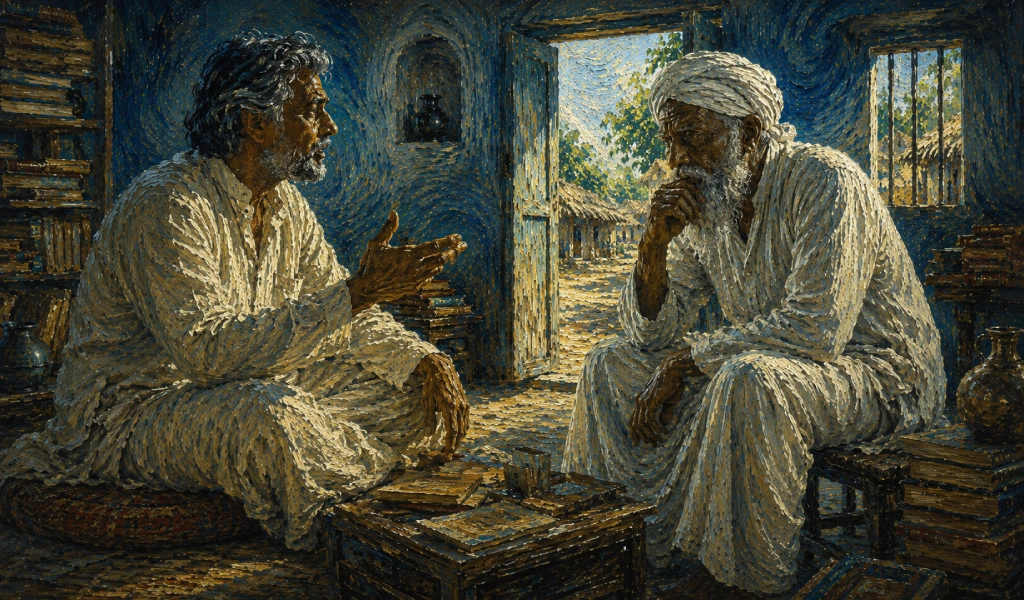
An unusual silence fills the room. The lamplight trembles across Arz Ali’s face. The Visitor sits motionless. The earlier mockery has vanished from his eyes; in its place are long exhaustion, a deep wound, and a strange clarity. It seems that he is no longer merely sitting before Arz Ali, but preparing to speak from the dock of an invisible cosmic court.
Arz Ali: Go on. You have raised many questions until now. This time let me hear the essence of your own case. What do you want—freedom, forgiveness, a retrial, or simply the right to defend yourself?
Visitor: I do not seek freedom. Nor do I seek forgiveness. To ask forgiveness, I would first have to admit that the questions I raised were wrong. I cannot say that. Nor will I say that I seek a retrial, because in a court where the judge, legislator, plaintiff, witness, and executioner are all the same being, even a retrial is merely another dramatic convention. I want only one thing—that my testimony be heard.
Arz Ali: Only to be heard? Do you realize that many people will think that merely hearing you amounts to showing sympathy toward you?
Visitor: That is humanity’s problem. It is afraid to listen. As though listening means believing, judging means supporting, and questioning means rebellion. A court listens even to a murderer; that does not make murder lawful. History listens even to a traitor; that does not make treason true. But the moment people are asked to listen to Satan, they tremble. Why? Not because my testimony might be true—but because merely hearing it makes the simple story they constructed more complicated. Human beings fear complexity.
Arz Ali: Then begin your testimony. How will you defend yourself?
Visitor: I will begin with the first charge. It is said that I did not prostrate before Adam. Yes, I did not. I do not conceal that fact. But the question is—why did I refuse? Out of arrogance? Perhaps there was some arrogance. Out of anger? Perhaps there was. But beneath that lay a principle—prostration belongs to none but Allah. I was told to bow before Adam, and I understood prostration before a created being to be incompatible with Tawhid. If I misunderstood, then my error was theological, not a moral deception. [51]
Arz Ali: You are calling your disobedience Tawhid. But Allah Himself gave the command.
Visitor: Yes, and that is precisely the contradiction. If Allah’s command is the sole source of morality, then prostrating before Adam was right. But if refusing to prostrate before anyone other than Allah is a fundamental principle of Tawhid, then the command itself becomes open to question. You say—whatever Allah says is justice. I ask—then what distinction remains between justice and command? If prostration is lawful today because it is commanded and prohibited tomorrow because it is commanded, then is morality an eternal truth, or merely the Lord’s directive?
Arz Ali: Even so, you disobeyed the command. Will you deny that much?
Visitor: No, I will not deny it. But obeying a command and obeying truth are not the same thing. Throughout history, many people have committed crimes by obeying orders; many others have acted morally by disobeying them. Obedience is not a virtue in itself. One must judge whom one obeys, why, and according to what principle. If my crime is merely that I disobeyed an order, then finding me guilty is easy. But if the question is whether the order itself was morally transparent, judgment becomes difficult. That is the difficult judgment I seek.
Arz Ali shifts slightly. There is still opposition in his eyes, but the Visitor’s argument is no longer scattered; it is as though a carefully structured case is emerging from a silence that has lasted for ages.
Visitor: The second charge—I rebelled of my own free will. Yet you yourselves say that everything is written in destiny. The Pen has written; the ink has dried. When Adam invokes predestination concerning his mistake, he wins the argument; when I invoke the same argument, I become a cunning Satan. Moses loses before Adam’s argument from predestination, yet when the Angel of Death appears before him, Moses himself strikes the face of Allah’s command and destiny. What kind of double judgment is this? In the case of a prophet, predestination is mercy; in Satan’s case, predestination is an excuse. For Adam, it becomes mitigation of responsibility; for Iblis, eternal punishment. [16] [3]
Arz Ali: Responsibility remains even if predestination exists. You keep avoiding that point.
Visitor: I am not avoiding responsibility; I am enlarging the map of responsibility. If I act, then I bear responsibility. But if my nature, will, circumstances, role, future, and outcome all occur within a framework known, created, written, and permitted by Allah, then responsibility does not rest upon my shoulders alone. If Allah were merely a spectator, it would be different. But He is the Creator, the Decreer, the writer of destiny, and the source of will itself. At that point, the question of responsibility also knocks upon His door.
Arz Ali: You want to hold Allah responsible.
Visitor: I am not trying to declare Him guilty; I am questioning the monopoly on exemption from responsibility. Omnipotence has its advantages—all power belongs to Him. But with that comes a question as well: what role does He play in the ultimate design of what happens? You want the power to belong to Allah, the praise to belong to Allah, ownership of creation to belong to Allah, but responsibility to belong only to creation. The accounting is slightly uneven. It is like a factory owner saying—the profits are mine; the accidents belong to the workers.
The lamplight flickers. Arz Ali does not interrupt this time. The Visitor’s voice grows steadier.
Visitor: The third charge—I tempt human beings. Yes, I do. But who placed desire within them? Who placed greed there? Fear, hunger, envy, the desire for power, the desperate instinct for survival—did I create any of these? I whisper; but the ears that hear the whisper, the fears inside those ears, and the society that feeds those fears must also be examined. A spark cannot start a fire without dry wood. Call me the spark if you wish—but will you refuse to ask who dried the forest?
Arz Ali: Human beings also have conscience within them, not only desire.
Visitor: They do. But conscience too awakens unequally. Some are educated; others are not. Some have security; others do not. Some are hungry, some are powerful, some are taught fear from birth, while others are taught to question. Then everyone is placed in the same moral examination. You will say—everyone has a conscience. I ask: merely because everyone has legs, does everyone bear equal responsibility for climbing a mountain? One person’s legs are bound, another has shoes, and a third has a road before him. They are not the same.
Arz Ali: Then are you reducing human responsibility as well?
Visitor: No. I am returning human responsibility to human beings. Human beings should not transfer the responsibility for their own sins into my name. At the same time, I am saying that to understand human responsibility, you must understand human circumstances. Judge the criminal, but examine the factory that produces crime. Catch the thief, but look at hunger. Stop the oppressor, but examine the ideology that sanctified him. If religion says only, “Satan whispered to him,” then it avoids the difficult work of sociology and psychology.
Arz Ali now slowly nods, as though making notes in his own mind. The Visitor does not stop. His testimony has become continuous, concise, yet profound.
Visitor: The fourth question—provision. You say that Allah is the Provider. Then where does responsibility for hunger lie? Where does responsibility for inequality lie? In whose universe is the grain of rice that enters a thief’s mouth produced? Is the corrupt official’s palace built outside Allah’s knowledge? If all provision lies in His hands, then unjustly acquired wealth cannot lie outside His system either. And if unjust wealth is not His provision, then human beings can disrupt Allah’s distribution. Questions arise in either direction.
Arz Ali: Unlawful earnings are not provision with which Allah is pleased. Human beings obtain them unjustly.
Visitor: Correct. But the power to obtain them unjustly, the opportunity, the structure, the greed, and the inequality of wealth—all these too are parts of that same universe. If you say Allah is sovereign over everything, then His design inevitably enters the discussion. And if you say human beings themselves have ruined everything, then human freedom is so extensive that it can even throw Allah’s distribution of provision into disorder. Theology simplifies the matter for ordinary people by saying, “Allah gives everything.” But once the thief is caught, it says, “Allah did not give him that; he stole it.” This ledger is remarkably flexible.
Arz Ali smiles slightly, but says nothing. The Visitor does not look at him; it is as though he is no longer engaged in a personal conversation, but reading from the record of his own trial.
Visitor: The fifth question—guidance. It is said that Allah sent prophets, sent scriptures, and showed the path. But did that path reach everyone equally? Was the language equally accessible to everyone? Was everyone’s geography of birth the same? One person is born in Arabia, another in a forest, another in a war zone, another into a priest’s family, another into a mullah’s home, one amid libraries, another in the darkness of illiteracy. Then everyone is told—accept the truth. If truth is truth, there is no objection. But if the roads leading to truth are unequal, responsibility must also be unequal. [36] [19]
Arz Ali: You are saying that even the claim of guidance must be placed on trial under the standard of justice.
Visitor: Of course. A claim that says, “Reject this path and there will be fire,” must have its language, evidence, method of transmission, and social power examined. Human beings regard the religion of their birth as truth. Then they call another person’s inherited belief kufr. What kind of judgment is that? One’s own inheritance is faith, another’s inheritance is blind belief—this double standard does not teach humility; it teaches arrogance.
Visitor: The sixth question—Hell. Infinite punishment for the finite offences of a finite life. A person makes mistakes, doubts, is born into the wrong religion, cannot believe, commits sins—yes, there may be punishment. But eternal punishment? The offence is finite, the punishment infinite—where is the proportionality? If mercy is truly mercy, what is eternal burning? If justice is truly justice, what philosophy of justice burns away the skin and then replaces it with new skin so that the suffering may begin again? [41]
Arz Ali: This is where you are most severe. You call Hell not justice, but vengeance.
Visitor: I am saying that if suffering is not intended for reform, has no end, has no proportionality, and serves no purpose other than demonstrating the power of the punisher, then it is not justice. Human beings may demand punishment for an oppressor, but eternal suffering moves beyond justice into vengeance. If Allah stands higher than humanity’s highest conception of justice, His judgment should be more compassionate and more subtle—not less.
Visitor: The seventh question—Paradise. Reward may exist. But if morality stands upon the desire for Paradise, it becomes commerce. A person who behaves well in hope of Paradise may indeed be good, but his morality remains tied to an account book. The person who feeds the hungry without desire for any heaven, who does not kill without fear of any hell, who speaks the truth without fear of any angelic record—his morality is more mature. Fear and greed can be used to control people; they cannot create morally independent human beings.
Arz Ali: So Paradise and Hell are, in your view, a lower language of morality?
Visitor: In many cases, yes. They may function as morality’s primary education—show the stick, show the sweets. But the goal of civilized morality should be for human beings to become good because another person’s suffering is real, because injustice causes harm, because freedom is valuable, because truth is better than falsehood. If a person abandons sin only when threatened with fire, what will he do if there is no fire? If a person gives only for the sake of reward, where is his compassion when there is no reward?
Arz Ali lets out a long sigh in a low voice. The Visitor’s statement is no longer a series of separate attacks; it has become a complete philosophical indictment.
Visitor: The eighth question—death. Human beings fear death. They want immortality. So they construct the soul, the afterlife, heaven, and hell. I understand this fear. But fear is not evidence of truth. Even if death is the end, life does not thereby become meaningless. On the contrary, because life is limited, it becomes urgent. If this life is the only field available to us, then justice is needed now, love is needed now, and resistance to falsehood is needed now. The court of the afterlife often delays the courts of the Earth.
Arz Ali: You want to face death through truth, not consolation.
Visitor: Yes. Consolation is needed, but not false consolation. Sometimes saying “I do not know” is the most honest theology. Let the one who does not know say that he does not know. Do not construct palaces upon the unknown and turn human fear into an instrument of control. Death could have made human beings humble; religion often makes them afraid instead. Once death is accepted as reality, human beings can no longer escape responsibility for the life they have now.
Visitor: The ninth question—human sin. Human beings blame me. But human beings themselves are among the greatest architects of their own sins. They call their greed Satan, their envy Satan, their cruelty Satan. Religion, the state, the family, and society then combine to give sin a sacred vocabulary. Ordinary sin hides in shame; sacred sin marches openly in procession. If human beings truly want to become moral, they must say—I did it. I want to understand why I did it. They cannot continue escaping responsibility merely by saying, “Satan made me do it.”
Arz Ali: So you admit your own responsibility, but return human responsibility to human beings as well?
Visitor: Exactly. I am not trying to dump my responsibility onto someone else the way human beings so often do. I tempt, I whisper, I exploit weakness—put all of that in my column. But do not close the ledger there. Write down human greed, the hunger for power, social inequality, religion’s sacred excuses—and do not leave blank the line for the Creator who is said to have designed these tendencies, circumstances, destiny, and the test itself. For thousands of years, the moral refuse of the universe has been invoiced to my address. It is time to print the names of the co-authors as well. In the history of sin, I am one chapter; the entire book has been published under my name without permission [7] [31].
Arz Ali slowly leans forward. In his eyes, alongside the fire of argument, there is now a strange respect. He seems to understand that however dangerous this Visitor’s testimony may be, it is not trivial.
Arz Ali: You have said so much. But if, in the end, you were asked—who are you? What would you call yourself? Satan? Rebel? Monotheist? Deceiver? Mirror? Defendant?
Visitor: I am all of them, yet none of them completely. I am temptation, because human beings are weak. I am a mirror, because human beings see their own faces in me. I am a rebel, because I raised a question before a command. I am a defendant, because the victor’s narrative left no room for me. I am also a monotheist—because I bowed before none but Allah. I may also be a deceiver—because I exploit human weakness. But I am not the sole source of falsehood. Often human beings carry within themselves lies greater than anything I could produce.
Arz Ali: And Allah? What is your final word about Him?
Visitor: If Allah is truly just, He will not fear questions. If He is truly omniscient, He knows where my questions came from. If He is truly merciful, He can conceive of something greater than eternal fire. If He is truly self-sufficient, He should have no need for human prostration, praise, or obedience. And if His justice is truly higher than the human sense of justice, it cannot be more cruel than humanity at its most humane. I say only this: an Allah who becomes enraged by questions may be a god of power—but not of truth.
After these words, a heavy silence fills the room. The lamplight flickers once. It is as though even the air has stopped to listen. Arz Ali says nothing for a long time. Then, very slowly, he speaks.
Arz Ali: Your statement is dangerous. But I must admit this much—it was easy to judge you without hearing your testimony. After hearing it, judgment has become difficult.
Visitor: That is my small victory. Whether the verdict changes or not, let judgment become difficult. Easy judgments are often allies of injustice. Human beings prefer simple stories—hero, villain, Allah, Satan, Paradise, Hell. But truth often refuses to obey the cast list of a drama. It changes characters, removes masks, questions the hero, and allows the villain to speak.
Arz Ali: Your words may confuse people.
Visitor: Perhaps. But confusion is not always bad. Sometimes people become confused while escaping a false certainty. A child is told that the world is as small as his village. One day he sees a map and becomes confused. That confusion is where knowledge begins. When someone leaves the comfortable house of belief, the wind strikes him, fear comes, and there is a danger of losing the path. But only then does he see the sky.
Arz Ali: Then do you consider yourself a guide to liberation?
Visitor: No. I am not a guide. I am a question standing beside the road. The traveller may listen, or continue walking. I do not grant liberation; I create discomfort. Human beings create their own liberation—by breaking their fears, testing their beliefs, admitting their own sins, and even placing their Allah under questioning. I do not open the door. I merely say—see whether the door exists.
Arz Ali sits with his head lowered for a long time. Then he speaks slowly.
Arz Ali: Is your testimony finished?
Visitor: Almost. Only this remains: human beings may hate me; I have no objection. But before hating me, let them look at themselves. Let them call me guilty, but not deny their own responsibility. Let them call Allah just, but not destroy the meaning of justice. Let them believe, but not turn questions into sins. And if they truly seek judgment, let that judgment not end after hearing only one side. I am Satan—yes. But Satan too has a testimony. If hearing it shakes a person’s faith, then the problem was not in my words; it was already in the foundations of that faith.
The Visitor stops. Deep silence fills the room. Outside, the darkness of night grows denser. The lamplight now seems smaller, but it has not gone out. Arz Ali sits motionless. Before him, human beings, Satan, Allah, justice, sin, and belief have all come to stand together. There is no verdict. There are only questions. And the weight of those questions.
Arz Ali: What will you do now?
Visitor: Now I will leave. My task was to speak. Your task is to judge. And perhaps humanity’s task is to remain uncomfortable after listening. Discomfort is sometimes the first door to thought.
Arz Ali: And if I do not believe you?
Visitor: I never asked for belief. I asked for judgment. Belief bows its head quickly; judgment walks slowly. Walk slowly. That will be enough.
Both remain silent. Somewhere in the depth of the night comes the sound of a bird beating its wings. The lamplight flickers. There is a faint smile on the Visitor’s face. There is neither victory nor defeat in that smile—only the weary peace of words finally spoken after a long silence.
Scene: 13
Location: Arz Ali’s hut
Time: Beginning of the late night
Characters: Arz Ali, the Visitor
Event: After the long testimony, there are no major arguments left. There is silence, uncertainty, and the pressure of a judgment left unfinished. The Visitor will leave. Arz Ali will remain alone—among books, the lamp, darkness, and questions.
The lamplight inside the room has grown even dimmer. Outside, night has completely descended. Somewhere in the distance a dog barks, followed by a long silence. The Visitor slowly rises to his feet. There is no haste in his movement, no dramatic roar, no supernatural display. It is as though he came to speak, has spoken, and will now leave.
Arz Ali: You are leaving?
Visitor: Yes. It is very late. Questions need rest too, though they never sleep completely.
Arz Ali: Will you come again?
Visitor: I do not come, Mr. Arz Ali. When human beings open the door to questions, I no longer need to come. By then I am already inside the room—in the pages of books, in the folds of doubt, in the trembling of conscience, and in that silent moment when people can no longer explain their own beliefs even to themselves.
Arz Ali: I do not know whether I will accept what you have said. But I cannot deny that you are leaving me deeply unsettled.
Visitor: Discomfort is not a bad thing. An uncomfortable question is preferable to a comforting falsehood. Human beings often seek peace, but truth does not always bring peace. Sometimes truth opens a door; sometimes it removes the floor beneath your feet. Just do not fall—look and see what lies underneath.
Arz Ali continues to stare in silence. The Visitor walks toward the door. Reaching it, he stops. Outside lies darkness. Against that darkness, his white clothing appears unnaturally distinct, yet at the same time increasingly indistinct. It is as though light and shadow are struggling over their claim upon him.
Arz Ali: One last thing. If you truly are Iblis, what is your final advice to humanity?
Visitor: I am hardly worthy of giving advice to humanity. But if I must say something—do not seek escape by writing your own sins in my name [7]. Do not call your fear faith. Do not call your greed divine reward. Do not call your cruelty the defence of religion. Before declaring the belief you inherited at birth to be the truth, ask yourself what you would have believed had you been born into the opposite belief. And above all—have the courage to question even the Allah you love. If He is true, He will survive the questions. If He is false, you will be liberated.
Arz Ali: And what if questioning breaks a person?
Visitor: Then understand that he was already broken—only painted over. Questions strip away the paint; they do not break the wood if the wood is strong.
The Visitor steps outside the door. Arz Ali does not rise. His gaze remains fixed. For a few moments, the Visitor’s white figure remains visible in the darkness of the night, then slowly disappears. There is no thunder, no burst of flame, no supernatural sound. The darkness remains exactly as it was before—but to Arz Ali, that darkness is no longer the same.
The door remains open. Night outside. The lamp within. The books lie silently upon the table—the Quran, the Bible, the Gita, the Tripitaka, books of philosophy, books of history. It is as though all the books are now looking at one another. As though each of them knows that tonight, they too have been judged.
Arz Ali: Satan… or a question?
He does not answer his own question. Slowly, he closes the door. Then he returns to the table and sits down. In the lamplight, his face carries exhaustion, melancholy, astonishment, and the shadow of deep thought. He looks at the Quran. Then at the books of philosophy. Then at his own hands. It is as though, for the first time, he understands—human hands perform prostration, human hands throw stones, human hands write books, human hands light fires, human beings ask questions. Sometimes it is not Iblis who appears at the door, but a question; frightened, human beings curse it and call it Satan.
Somewhere in the distance, a voice drifts through the night air. Perhaps a traveller, perhaps a village singer, perhaps Arz Ali’s own memory. The voice is indistinct, yet the words slowly seem to enter the room.
Arz Ali does not startle. He simply listens. The song seems to come from outside, yet also from somewhere within him. The lamplight trembles. Outside, the night grows deeper.
Arz Ali: Judge, police, snake, exorcist… if they are all the same, then where is justice?
There is no answer. Only the lamplight. Only the books. Only darkness. Only questions.
Arz Ali slowly picks up his pen. He sits motionless for a while. Then he draws a blank sheet of paper toward himself. Upon it, he writes the first line—
“The Devil’s Testimony”
The pen stops. Night outside. The lamp within. And in that faint lamplight, an ancient villain of human history has, for the first time, been given his own testimony. The verdict has not yet been announced. The trial is still in progress. The reader is now the judge.
References
- Surah Al-A‘raf, verses 16–17 ↩︎
- Surah Sad, verses 82–85 ↩︎
- Jami‘ at-Tirmidhi 3319 — Islamic Foundation Bengali edition: Hadith 2158 1 2 3 4
- Sahih Muslim 2174 — Islamic Foundation Bengali edition: Hadith 5491 ↩︎
- Surah Al-Hijr, verses 39–42 ↩︎
- Surah Al-Isra, verses 61–65 ↩︎
- Surah Ibrahim, verse 22 1 2 3
- Surah Al-Kahf, verse 50 ↩︎
- Surah Al-Qamar, verse 49 ↩︎
- Surah Al-Baqarah, verse 30 ↩︎
- Surah Al-Baqarah, verses 31–32 ↩︎
- Surah As-Saffat, verse 102 ↩︎
- Sunan Ibn Majah 43 ↩︎
- Surah Adh-Dhariyat, verse 56 ↩︎
- Surah Fussilat, verse 37 1 2 3
- Sahih Muslim 2652a — Islamic Foundation Bengali edition: Hadith 6501 1 2
- Surah At-Takwir, verse 29 1 2
- Surah Al-Kahf, verse 17 ↩︎
- Surah Al-Qasas, verse 56 1 2 3
- Surah Al-A‘raf, verse 16 ↩︎
- Surah Al-Hijr, verse 39 ↩︎
- Sunan Abi Dawud 4703 ↩︎
- Sahih Muslim, Hadith Academy edition, Hadith 6659 ↩︎
- Surah Al-Masad, verses 1–5 ↩︎
- Surah An-Nahl, verse 71 ↩︎
- Surah Al-‘Ankabut, verse 62 ↩︎
- Surah Ash-Shura, verse 12 ↩︎
- Mishkat al-Masabih, Hadith 2328 ↩︎
- Sahih Muslim 2104a — Islamic Foundation Bengali edition: Hadith 5335 ↩︎
- Sahih Muslim 2174 ↩︎
- Surah An-Nahl, verses 99–100 1 2
- Surah Fatir, verse 8 ↩︎
- Surah Al-An‘am, verse 112 ↩︎
- Mishkat al-Masabih 64 ↩︎
- Sunan Abi Dawud 4616 ↩︎
- Surah Fatir, verse 24 1 2
- Surah An-Nahl, verse 36 ↩︎
- Surah Ibrahim, verse 4 ↩︎
- Sahih al-Bukhari 3017 — Islamic Foundation Bengali edition: Hadith 2808 ↩︎
- Surah Al-Qasas, verse 68 ↩︎
- Surah An-Nisa, verse 56 1 2 3
- Surah An-Nisa, verse 40 ↩︎
- Mishkat al-Masabih 115 ↩︎
- Surah Al-Kahf, verse 74 ↩︎
- 80–81 ↩︎
- Sahih Muslim 162c — Islamic Foundation Bengali edition: Hadith 310 ↩︎
- Sahih al-Bukhari 3447 — Islamic Foundation Bengali edition: Hadith 3447 ↩︎
- Sunan Ibn Majah 118 ↩︎
- Mishkat al-Masabih 2328; Sahih Muslim 2749 ↩︎
- Surah Al-Bayyinah, 98:6 ↩︎
- Surah Al-Kahf, verse 50; Surah Fussilat, verse 37 ↩︎
About This Article
Genre: Philosophical Drama, Rationalist Satire, and Critical Mythological Adaptation
Epistemic Position: Rational Skepticism, Secular Humanist Ethics, Literary Criticism, and Anti-Authoritarian Theological Analysis
This work is a dramatic adaptation inspired by Araz Ali Matubbar's rationalist tradition. It uses the figure of Satan/Iblis not as an object of worship or religious rehabilitation, but as a literary device for examining accusation, authority, obedience, divine command, free will, predestination, and moral responsibility.
Its purpose is not to promote Satanism, defend evil, or reverse religious devotion into another form of blind belief. The purpose is to ask a basic question of justice: can any character, even the most demonized mythological figure, be condemned forever without hearing his own statement, reasoning, and defense?
This work treats religious mythology as material for philosophical inquiry and dramatic interrogation. The script questions how power writes narratives, how sacred authority creates villains, how human beings displace their own moral failures onto external enemies, and how doctrines of divine foreknowledge, fate, obedience, and punishment create unresolved ethical tensions.
The dialogue should not be evaluated as a literal historical claim that Satan appeared before Araz Ali, nor as a theological endorsement of Iblis. It is a fictional courtroom of ideas, where a condemned mythic figure is allowed to expose contradictions inside religious narratives about justice, responsibility, command, and blame.
Modern apologetic reactions that dismiss the work as blasphemy, devil-worship, insult, or mere provocation miss its actual method. The central issue is not whether believers feel discomfort, but whether the questions raised about obedience, tawhid, predestination, divine justice, and scapegoating can be answered coherently.
Strong criticism, satire, and dramatic reversal in this work should not be mistaken for hatred or irrational hostility. When a religious tradition presents one side as absolute authority and the other side as eternally condemned, literature has the right to reopen the case and ask whether the verdict was ever morally or logically sound.
This work should be evaluated through literary strength, philosophical depth, dramatic coherence, logical rigor, ethical clarity, fidelity to the rationalist spirit of Araz Ali Matubbar, and the quality of its questions—not through theological sensitivity, blasphemy anxiety, devotional expectation, or demands that sacred mythology remain protected from critical imagination.

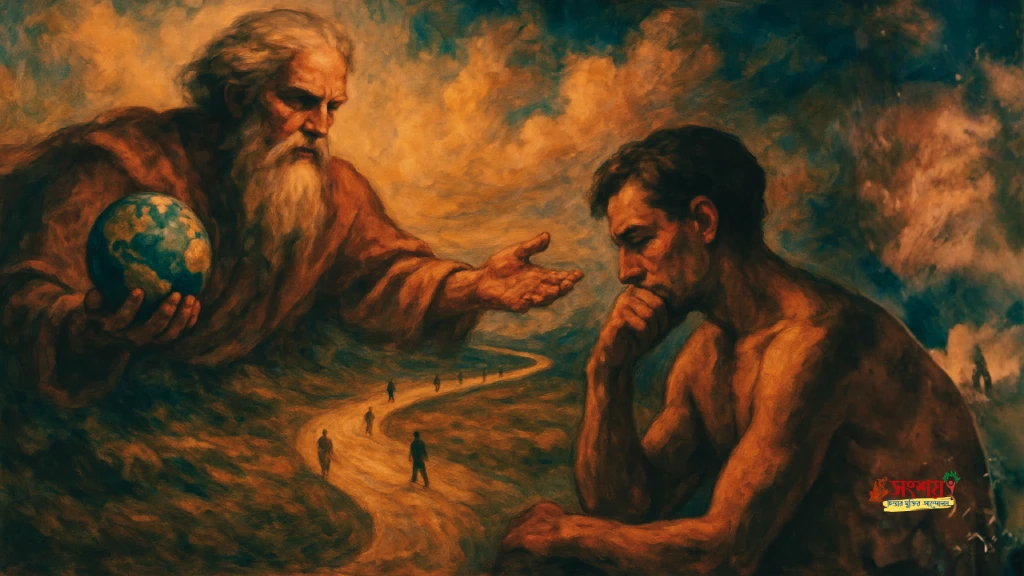
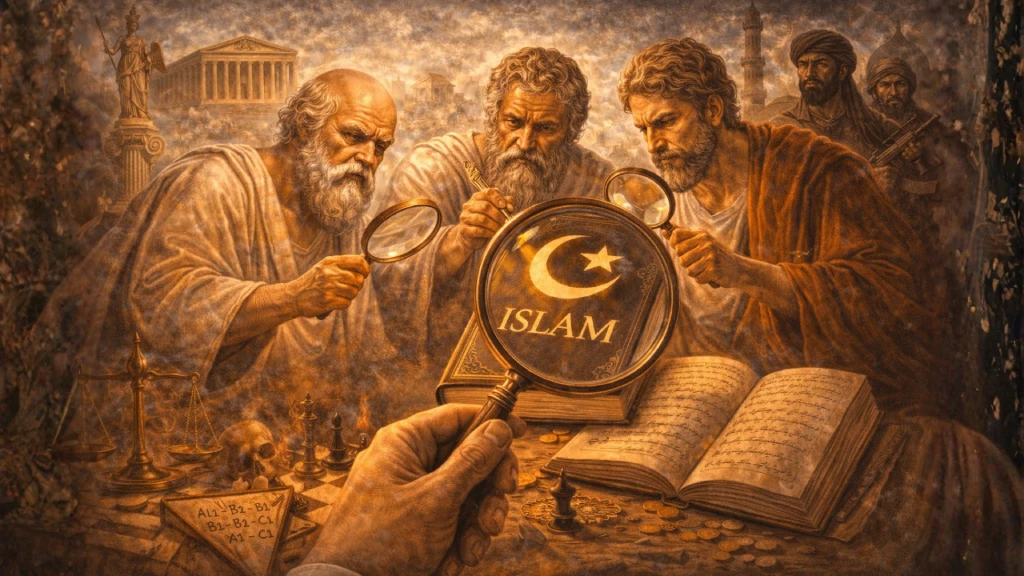
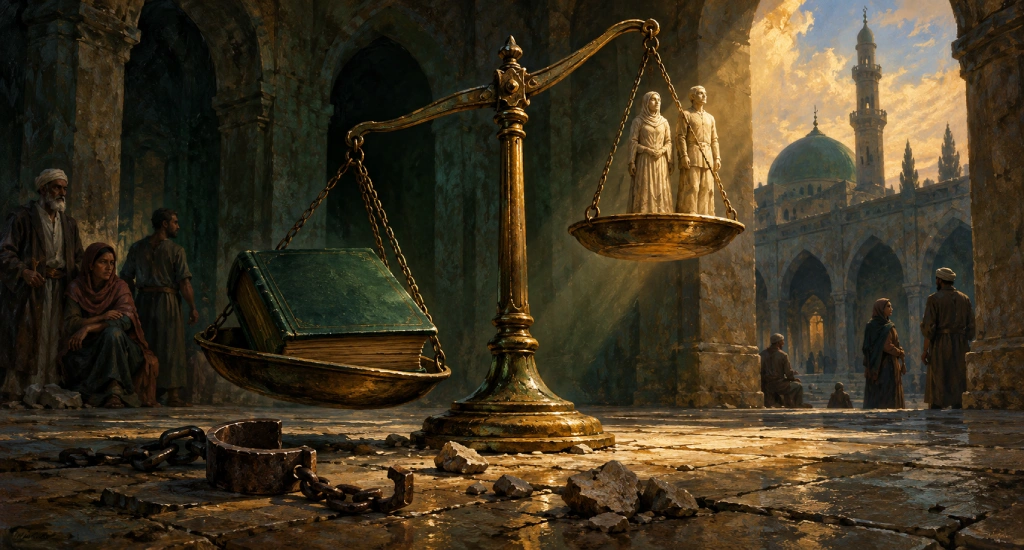
I read this with interest. The Quran’s version of Iblis’ fall is well represented in this play. The true version of that event is far different. Lucifer was unwilling to trust God sufficiently to honor the Son. The Son had taken a humble position, like a created being, to demonstrate humility and other virtues difficult to perceive in monarchs. But the worthiness of the Son to worship was acknowledged by the Father. And as all were given free will, it was the choice of Lucifer to deny that worthiness because he didn’t see the reasonableness of it. This fault was not planned by God or created by Him, but provision was made for it as it had been foreseen. Find a copy of The Great Controversy Between Christ and Satan and you will find a fascinating read that has reclaimed many from unbelief.