
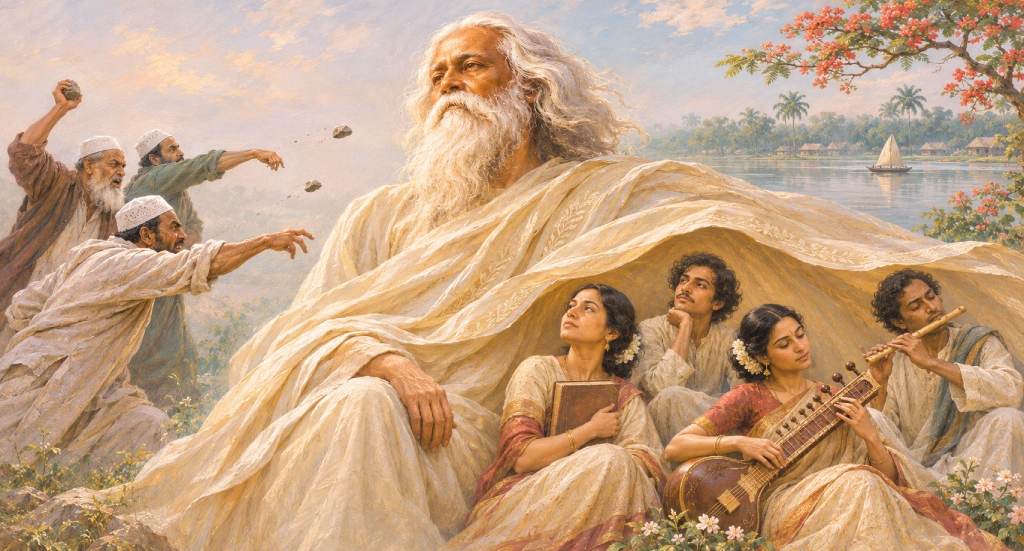
Rabindranath Tagore Controversies: A Historical Investigation into Dhaka University, Nazrul, Religion, the Partition of Bengal, and Alleged Opposition to Bangladesh
Summary
Communal propaganda in Bangladesh has long circulated a range of accusations against Rabindranath Tagore, many of which contradict historical documents, contemporary chronology, and the statements of the individuals concerned. The same patterns of distortion recur in allegations that he opposed the establishment of the University of Dhaka, stole Nazrul’s Nobel Prize, poisoned Nazrul with datura, composed a song in praise of the British monarch, opposed Bangladesh’s independence, and that the Tagore family owned 43 brothels. In some cases, there is no direct evidence of the alleged event; in others, the chronology is impossible, the original source has been misrepresented, or another person’s actions have been attributed to Rabindranath. A common communal assumption underlies these accusations: because Rabindranath was born into a Hindu family, he must have opposed Muslim interests. Selective information, fabricated quotations, political rumours, and stories of imaginary crimes have been used to establish this preconception as fact.
The best-known allegation is that Rabindranath presided over a meeting opposing the establishment of the University of Dhaka at the Maidan in Calcutta on 28 March 1912. Contemporary records of his whereabouts place him in Shilaidaha that day; no reliable direct evidence of his attendance or speech at the alleged meeting has been found. By contrast, his published statements recognise the need for separate higher education and equal opportunities for Muslims. The University of Dhaka awarded him an honorary D.Litt. in 1936. The accusation of stealing Nazrul’s Nobel Prize is even more inconsistent. Rabindranath received the Nobel Prize in 1913, when Nazrul, born in 1899, was approximately fourteen years old and had not yet begun publishing his significant literary works. Direct evidence of the two poets’ actual relationship reveals mutual respect as well as disagreements. Rabindranath dedicated Basanta to the imprisoned Nazrul; Nazrul dedicated his Sanchita to Rabindranath. There is also no direct evidence that Nazrul was poisoned. Rabindranath died in 1941, and Nazrul’s serious neurological illness became publicly apparent in 1942. Subsequent medical investigations provided an explanation involving neurological disease; deliberate datura poisoning was not established.
There is also considerable confusion about Rabindranath’s political positions. He opposed the Partition of Bengal in 1905—this is true. That position conflicted with the administrative interests of a significant section of East Bengal’s Muslims. But the division of an administrative province of British India in 1905 and the establishment of an independent Bangladesh in 1971, free from Pakistani rule, are entirely distinct historical events. There is no historical basis for portraying Rabindranath, who died in 1941, as an opponent of Bangladesh’s independence. The allegation of collaboration with the British relies on similarly selective history. He accepted a knighthood from the British government in 1915 but publicly repudiated it in 1919 in protest against the Jallianwala Bagh massacre. His works Nationalism and Crisis in Civilization contain severe criticisms of colonial exploitation, educational deprivation, and imperial authority. The allegation that ‘Jana Gana Mana’ was composed in praise of the British monarch George V was also rejected in Rabindranath’s own letters of 1937 and 1939.
During the Pakistan period, state and political opposition to Rabindranath and his music generated significant conflict over the cultural rights of Bengali-speaking people. Attempts to obstruct the celebration of his birth centenary in 1961 and the Pakistani information minister’s 1967 declaration against Rabindra Sangeet were important events in that history. Prominent Muslim intellectuals, artists, and political leaders of East Pakistan, including Maulana Bhashani, publicly protested against this policy. During Bangladesh’s Liberation War, ‘Amar Sonar Bangla’ became a symbol of the aspiration for independence and acquired the status of national anthem under the legislation and Constitution of 1972. The ‘mother’ in the song is a literary metaphor for the motherland, not the identity of a particular Hindu goddess. Its melody was influenced by Ami Kothay Pabo Tare, a song by the folk musician Gagan Harkara of Kushtia, an influence recognised in musical history. Portraying this acknowledged musical borrowing as secret theft is misleading. Likewise, the original research underlying the allegation of 43 brothels owned by the Tagore family refers to 43 rooms in a building in Calcutta’s Bowbazar in 1806. The property was owned by a member of Dwarkanath’s family; neither the claim that Dwarkanath personally owned 43 separate brothels nor the claim that Rabindranath lived off their proceeds has been established.
Rabindranath’s actual social and ethical limitations are also historically significant. He benefited from the zamindari system, recognised caste-based practices in the first administrative regulations of Santiniketan, and arranged the marriages of his underage daughters. These decisions reveal real inconsistencies with his later humanist philosophy and literary advocacy of women’s freedom. He also recognised peasants’ rightful claims to the land, initiated cooperative and rural development projects, criticised untouchability and religious orthodoxy in Hindu society, and made arrangements for Islamic studies and the teaching of Arabic and Persian at Visva-Bharati. During his visit to Soviet Russia in 1930, praising mass education, the elevation of social dignity, and efforts to break religious authority, he wrote, “Atheism is far better than religious delusion.” He also criticised Soviet dictatorship and the suppression of freedom of expression. These positions reveal an important distinction between personal religious belief, organised religious authority, and the independence of human judgement.
Lack of education, miseducation, blind obedience to religious authority, communal prejudice, and the psychology of rumours may play important roles in the widespread circulation of falsehoods about Rabindranath. The promotion in 2013 of a manipulated image purporting to show Sayeedi’s face on the moon as a miraculous truth, and the violence associated with that rumour, demonstrated how religious emotion and organised propaganda can transform unsupported claims into real political forces. Confirmation bias can lead people to readily accept information that supports their existing beliefs and disregard contradictory evidence. Repeated exposure to the same falsehood increases its familiarity, sometimes creating an impression of truth. This process is evident in the allegations circulating against Rabindranath. Fabricated statements circulated in the name of a well-known researcher in 2024 and 2026, and the defacement of Rabindranath’s portrait with ink in 2026, illustrate contemporary manifestations of this propaganda. When religious identity and desired political conclusions replace historical evidence as the criteria for determining truth, false allegations need not remain mere beliefs; they can also become justifications for hostility towards others and attacks on culture.
Rabindranath’s visit to Mussolini’s Italy and his conciliatory letter of 1930 reveal a serious inconsistency in his international political judgement. Even after protesting against fascism, he invoked the relationship created by the hospitality extended to him and the gifts received by Visva-Bharati in language intended to resolve a “misunderstanding”. This history provides a specific example of how official praise, cultural contacts, and institutional interests can influence the judgement of an independent thinker.
Allegations, Established Facts, and References
| Subject and allegation | Summary of facts and conclusions | Primary documents and research |
|---|---|---|
| Why do people believe rumours? | Seeking support for prior beliefs, emotional motivation, group loyalty, and repeated exposure to the same information can reinforce false beliefs. | Ecker et al., Nature Reviews Psychology, 2022 |
| Sayeedi’s face on the moon | In 2013, rumours of a miraculous event were spread through a manipulated image and announcements over mosque loudspeakers. Violence occurred in Bogura and other areas. | The Daily Star, investigation of the manipulated image · Violence and deaths on 3 March |
| Religious rumours and communal attacks | The incidents in Ramu in 2012, attacks on minorities in 2013, and Nasirnagar in 2016 illustrate the use of religious accusations as instruments of violence. | Amnesty International, 2013 · USCIRF, 2017 |
| Opposition to the establishment of the University of Dhaka | There is no reliable direct evidence that Rabindranath presided over the alleged meeting in Calcutta on 28 March 1912. Contemporary records of his whereabouts contradict the allegation. | Dhaka Tribune, historical investigation |
| Actual relationship with the University of Dhaka | The University of Dhaka conferred an honorary D.Litt. on Rabindranath in 1936. | University of Dhaka, official list of honorary degrees |
| Opposition to higher education for Muslims | Rabindranath recognised the initiative for separate higher education for Muslims and the need for educational equality. | Rabindranath, ‘The Hindu University’, original text |
| Theft of Nazrul’s Nobel Prize | Rabindranath received the Nobel Prize in 1913, when Nazrul was about fourteen. Nazrul’s significant literary publications began later. The accusation is chronologically inconsistent. | Nobel Prize authorities, the 1913 award · Banglapedia, Kazi Nazrul Islam |
| The actual relationship between the two poets | Rabindranath dedicated Basanta to Nazrul. Nazrul dedicated Sanchita to Rabindranath. Despite their literary disagreements, there is direct evidence of mutual respect. | Banglapedia, Nazrul’s life and literary relationships · Rabindranath Tagore, Basanta, original dedication, 10 Phalgun 1329, Rabindra Rachanabali (NLTR) · Kazi Nazrul Islam, Sanchita, dedication and bibliographic details (edition used in the article) |
| Rabindranath administered datura to Nazrul | There is no direct evidence of deliberate poisoning. Rabindranath died in 1941; Nazrul’s serious neurological illness became publicly apparent in 1942. | Banglapedia, history of Nazrul’s illness · Medical research on datura poisoning |
| Nazrul’s marriage and the story of a family conspiracy | Nazrul’s wife was Pramila Sengupta. The circulating story that he married Rabindranath’s daughter or sister has no basis. | Banglapedia, biography of Kazi Nazrul Islam |
| Partition of Bengal in 1905 | The British government created a new administrative province called Eastern Bengal and Assam. Dhaka gained administrative importance; many Muslim leaders in East Bengal supported the decision. | Banglapedia, Partition of Bengal, 1905 |
| Muslim opposition to the Partition of Bengal | Not everyone in Muslim society supported the partition. Several Muslim leaders, including Abdur Rasul and Ismail Hossain Siraji, also participated in the anti-partition movement. | Banglapedia, account of Muslim leaders opposing partition |
| Does opposition to the Partition of Bengal mean opposition to Bangladesh? | The administrative division of 1905, the Partition of India in 1947, and independence in 1971 were distinct political events. Rabindranath died in 1941. | Banglapedia, Partition Politics · Annulment of Bengal Partition |
| Allegation of Rabindranath’s hostility towards Muslims | Some of his religious criticisms contain sweeping generalisations. He also severely criticised untouchability, social exclusion, and discrimination against Muslims in Hindu society. | Rabindra Rachanabali, ‘Hindu-Musulman’ |
| Opposition to Islamic education and culture | At his initiative, a centre for Arabic, Persian, Urdu, and Islamic studies was established at Visva-Bharati in 1927. | Visva-Bharati University, official history of the relevant department |
| British knighthood | Rabindranath accepted the title in 1915 and repudiated it in 1919 in protest against the Jallianwala Bagh massacre. The British government had not formally revoked it as of 31 July. | British Library, official correspondence · British Parliament, 31 July 1919 |
| Loyalty to British imperialism | His Nationalism and Crisis in Civilization contain criticisms of colonial exploitation, educational deprivation, and imperial power. | Rabindranath, Nationalism, 1917 · Amartya Sen, Tagore and His India |
| Relationship with Mussolini and fascism | After accepting Mussolini’s hospitality and initially praising him in 1926, Rabindranath protested against fascism. On 21 November 1930, he wrote a conciliatory letter intended to normalise relations. Giuseppe Flora’s 2008 research confirms that the letter was sent to Mussolini. | Giuseppe Flora, “Tagore and Italy: Facing History and Politics”, University of Toronto Quarterly 77(4), 2008, pp. 1025–1057 · Rabindranath Tagore, letter to Mussolini, 21 November 1930; reproduction and text of the original letter preserved in the archives of the Italian Ministry of Foreign Affairs, Giuseppe Flora, 2008, pp. 1045–1047 |
| ‘Jana Gana Mana’ as praise of King George V | A separate song praising the monarch was performed at the 1911 Congress session. In his letters of 1937 and 1939, Rabindranath rejected the allegation identifying the ‘Dispenser of India’s Destiny’ with the British monarch. | The Times of India, account of the 1911 session · Anandabazar, Rabindranath’s letters |
| The beginnings of opposition to Rabindranath in the Pakistan period | Following the establishment of Pakistan, conflict emerged between a religion-based national culture and a Bengali-language cultural identity. Opposition also arose over the celebration of his birth centenary in 1961. | bdnews24, Rabindranath’s birth centenary and cultural resistance · Cambridge University Press, research on cultural identity |
| The 1967 declaration against Rabindra Sangeet | On 22 June, Pakistani Information Minister Khawaja Shahabuddin announced that state radio and television would not broadcast Rabindra Sangeet contrary to Pakistani cultural ideals. | bdnews24, ‘Rabindranath in Our Troubled Times’ |
| The protest of eighteen intellectuals | In 1967, eighteen intellectuals, including Muhammad Qudrat-i-Khuda, Kazi Motahar Hossain, Sufia Kamal, and Munier Chowdhury, opposed the government’s decision. | Documents of the Bangladesh War of Independence, Vol. II |
| Maulana Bhashani’s protest | On 28 June 1967, Bhashani protested against the decision to exclude Rabindra Sangeet and recognised Rabindranath’s contribution to Bengali literature. | Documents of the Bangladesh War of Independence, Vol. II, Bhashani’s statement |
| Is ‘Amar Sonar Bangla’ a hymn to a goddess? | The first ten lines of the national anthem address the motherland as ‘mother’. There is no name of a particular Hindu deity, supernatural power, or prescription for worship. | Rabindranath Tagore, Gitabitan, Swadesh 1, ‘Amar Sonar Bangla’, complete original text |
| Allegation of musical theft | The influence of the melody of Gagan Harkara’s song Ami Kothay Pabo Tare is acknowledged. The adoption of a folk melody was not concealed. | ICI Berlin, research on music |
| Recognition as the national anthem of Bangladesh | The first ten lines of ‘Amar Sonar Bangla’ are recognised as the national anthem by the Presidential Order and Constitution of 1972. | Bangladesh National Anthem, Flag and Emblem Order, 1972 · Constitution of Bangladesh, Article 4(1) |
| The Tagore family’s 43 brothels | Research into the records of 1806 mentions 43 rooms in a building in Bowbazar. The owner was a member of Dwarkanath’s family. The claim of ownership of 43 separate brothels is false. | Sumanta Banerjee, Under the Raj, p. 72 · Investigation of the original source |
| Rabindranath’s zamindari and peasants’ rights | He benefited from the zamindari system. He later acknowledged that the rightful title to the land belonged not to the zamindar but to the peasant. | Rabindranath, Letters from Russia, Letter IV |
| Rural development and agricultural cooperatives | There were initiatives for agricultural credit and cooperatives in Patisar and rural development in Sriniketan. They did not completely eliminate the inequalities of the zamindari structure. | Rabindranath, ‘Cooperation 1’ · Christine Marsh, Rural Reconstruction |
| Recognition of caste-based practices at Santiniketan | The school’s first administrative regulations mentioned objections to non-Brahmin students serving food. This was inconsistent with the ideal of social equality. | Rabindranath, ‘First Regulations’, 27 Kartik 1309 |
| Child marriage of his own daughter | In 1901, Rabindranath’s daughter Renuka was married at the age of only ten years and six months. | Scottish Centre of Tagore Studies, account of Renuka’s marriage |
| Women’s freedom and inconsistencies in personal life | In contrast to the history of child marriage in his family, the story The Wife’s Letter addresses women’s individuality and freedom and criticises patriarchal authority. | Rabindranath, ‘The Wife’s Letter’, original text |
| Begum Rokeya’s movement for women’s education and Rabindranath’s recognition | Rokeya’s Sultana’s Dream (1905), Padmarag and movement for women’s education were independent contributions contemporary with Rabindranath. No authentic document recording a specific public assessment of her by Rabindranath has been identified; the definitive claim of lifelong silence is not established. | Barnita Bagchi, Paedagogica Historica · Mohammad A. Quayum, South Asia Research · Rokeya’s original writings |
| Rabindranath’s contempt for Swarnakumari Devi’s talent | In a 1914 letter to Rothenstein, he expressed contempt for Swarnakumari’s literary talent and acknowledged that he had not encouraged her English publication. Swarnakumari achieved literary and editorial success in her own right. | Susan Stanford Friedman, Planetary Modernisms · Kahake: Swarnakumari Debi’s Literary Resistance? |
| Praise of atheist society in Russia | During his 1930 visit, Rabindranath praised the breaking of religious authority, mass education, and social change, declaring, “Atheism is far better than religious delusion.” | Rabindra Rachanabali, Letters from Russia, Letter VII |
| Criticism of Soviet dictatorship | While praising education and social development, Rabindranath criticised dictatorship, state coercion, and the suppression of freedom of expression. | Rabindra Rachanabali, Letters from Russia, Conclusion |
| The ‘17 memoranda’ claim attributed to Salimullah Khan | The statement circulated in Salimullah Khan’s name that Rabindranath submitted 17 memoranda to prevent the establishment of the University of Dhaka is fabricated. | Rumor Scanner, 7 September 2024 |
| A letter concerning the 1971 genocide attributed to Rabindranath | A fabricated statement circulated in Salimullah Khan’s name linked Rabindranath, who died in 1941, to the genocide of 1971. | Rumor Scanner, 12 October 2026 |
| Real consequences of communal propaganda | The old allegation of opposition to the University of Dhaka was used in the 2026 incident in which Rabindranath’s portrait was defaced with ink in Dhaka. | bdnews24, 10 October 2026 |
Introduction
A substantial part of the communal propaganda directed against Rabindranath Tagore in Bangladesh is not historical criticism but deliberate character assassination in the name of history. In this narrative, Rabindranath is not a real writer, zamindar, educational thinker, and person with political opinions, but an omnipresent enemy engaged in a conspiracy against Muslims. From opposing the establishment of the University of Dhaka to stealing Kazi Nazrul Islam’s Nobel Prize, making Nazrul ill by administering datura, composing national anthems in praise of the British monarch, opposing Bangladesh’s independence, and enjoying the proceeds of his family’s alleged 43 brothels, unrelated accusations have been assembled to construct a criminal identity for him. Some of these stories contradict specific dates and contemporary documents; some are produced by altering the actual meaning of his writings; some result from changing the meaning of a number; and others have become popular through repetition without direct evidence. The most striking feature of this propaganda is that when the basis of an accusation is shown to be weak, the overall structure of the accusations is not corrected. Instead, new stories, new quotations, and new religious agitation are added to preserve the original conclusion. The conclusion is predetermined: Rabindranath was born into a Hindu family, therefore he was an enemy of Muslims. When history does not fit that conclusion, history itself is altered.
This method is evident in the falsehoods circulating about the establishment of the University of Dhaka. It is claimed that on 28 March 1912, Rabindranath presided over a meeting at the Calcutta Maidan opposing the establishment of the university. Yet correspondence and biographical records from the relevant period place him in Shilaidaha; no speech by him, contemporary minutes, or reliable eyewitness report of the alleged meeting has been produced. The same individual’s 1908 Pabna address and his 1911 essay ‘The Hindu University’ recognise the need for Muslims’ educational advancement and higher education. His lectures at the invitation of the University of Dhaka in 1926 and the institution’s conferral of an honorary D.Litt. in 1936 are also documented. Various political leaders genuinely opposed the establishment of the institution; that does not entitle anyone to attribute their activities to Rabindranath. Nor does his opposition to the Partition of Bengal in 1905 imply opposition to the university in 1912. Opposing the division of an administrative province and opposing higher education for the people of East Bengal are not the same political act. But when religious identity becomes the principal criterion of judgement, these distinctions disappear. Established history is then displaced by a story that immediately reinforces the audience’s communal preconceptions.
The stories circulated about Rabindranath’s relationship with Kazi Nazrul Islam reveal an even greater intellectual failure. Rabindranath received the Nobel Prize in Literature in 1913; Nazrul, born in 1899, was then only fourteen years old, and the history of his significant published literary works began later. Yet the claim circulates that Rabindranath received the Nobel Prize by stealing Nazrul’s writings. The poets’ actual relationship does not support this story either. Rabindranath dedicated ‘Basanta’ to the imprisoned Nazrul; Nazrul dedicated his own ‘Sanchita’ to Rabindranath and remembered him with deep respect. They had literary disagreements, but there is no historical basis for turning those disagreements into crimes of literary theft and deliberate poisoning. Although Nazrul’s later neurological illness is portrayed as the result of a conspiracy involving datura, no evidence of the time, place, eyewitnesses, or medical circumstances of the alleged poisoning is presented. In the name of honouring Nazrul, his real struggles, literary individuality, and his own publicly expressed respect for Rabindranath are erased. Instead of establishing the achievements of a Muslim poet, this narrative reduces him to a helpless figure deceived by another poet. This imaginary history of communal rivalry distorts the legacy of both writers.
The same game of selective information is played with Rabindranath’s political history. He opposed the Partition of Bengal in 1905—this is true, and that position conflicted with the administrative and political expectations of a significant section of East Bengal’s Muslims. The interests of the Calcutta-centred educated elite, the administrative representation of East Bengal, the social power relations of the Swadeshi movement, and inequalities between Hindus and Muslims were real issues in that conflict. But portraying opposition to a British administrative decision in 1905 as opposition to an independent Bangladesh in 1971 arbitrarily conflates separate historical events. Rabindranath died in 1941; Pakistan was established in 1947, and Bangladesh became independent in 1971. Similarly, although his acceptance of a British knighthood in 1915 is publicised, his repudiation of the title in 1919 in protest against the Jallianwala Bagh massacre is often concealed. To portray ‘Jana Gana Mana’ as a hymn praising the British monarch, one must disregard the song’s publication history and its author’s own explanation. The aim of this selection is not to accurately evaluate a particular political decision, but to arrange events so that Rabindranath can simultaneously be portrayed as a loyal servant of British rulers, a hater of Muslims, and an enemy of independent Bangladesh. Even mutually contradictory allegations continue to circulate side by side for that purpose. As communal hatred and religious extremism have spread in Bangladesh, hostility towards Rabindranath has somehow grown in parallel. Rabindranath Tagore has effectively become a litmus test by which the extent of religious extremism can be measured quite accurately. In this connection, a video from a Bangladeshi news channel is relevant:
Statements made by Islamic scholars at religious preaching gatherings in Bangladesh are also relevant,
This distortion of history is closely connected to the policies of cultural repression during the Pakistan period. Rabindranath became one of the principal targets in the conflict between Pakistan’s religion-based national identity and a literary and cultural identity grounded in the Bengali language. State opposition to the celebration of his birth centenary in 1961 and the Pakistani information minister’s declaration against Rabindra Sangeet in 1967 were direct manifestations of that conflict. Muslim writers, educators, artists, and political leaders of East Pakistan publicly protested against this policy; Maulana Bhashani was among the protesters. ‘Amar Sonar Bangla’, a target of the Pakistani government’s cultural exclusion, became a symbol of the aspiration for an independent Bangladesh during the Liberation War and acquired the status of national anthem under the legislation and Constitution of 1972. Yet the song is now portrayed as praise of a Hindu goddess, idol worship, or a cultural symbol imposed by India. Its first ten lines express love for Bengal’s sky, air, natural landscape, and motherland; they contain no worship of any particular Hindu deity. Likewise, the song’s historical relationship to the melody of Gagan Harkara’s folk song is transformed into a story of secret theft instead of being recognised as musical exchange. Consequently, three important histories—Bangladesh’s Liberation War, the folk music of East Bengal, and cultural resistance to Pakistani repression—are obscured by religious hatred.
Rabindranath’s religious identity is also deliberately simplified in this propaganda. Birth into a Brahmo family, an interest in Upanishadic philosophy, or the use of Hindu mythology in literature does not automatically make him a representative of political Hindutva. His writings contain criticisms of the religious and social practices of Muslim society; the specific content of these criticisms can be evaluated. He also took a firm stand against caste discrimination, untouchability, orthodoxy, the social exclusion of Muslims in Hindu society, and political divisions in the name of religious identity. ‘Hindu-Musulman’, ‘Gora’, ‘Dharmamoha’, and ‘Letters from Russia’ contain important expressions of this broader thought. In particular, following his 1930 visit to the Soviet Union, he emphasised the achievements of mass education and social progress over religious authority, declaring, ‘Atheism is far better than religious delusion.’ Despite his personal spiritual beliefs, he identified religious blindness as an enemy of independent human thought. He also criticised the dictatorship of the Soviet state. To turn him into the unquestionable representative of a religious community, one must discard his own non-communal, religion-critical, and anti-authoritarian statements. The principal intellectual error here is to treat identity at birth as immutable proof of character instead of identifying the actual limitations of specific views.
He benefited from the zamindari system, in which a portion of the wealth produced by peasants was concentrated in the hands of landowners and intermediaries. The early administrative regulations of his Brahmacharyashram at Santiniketan accepted objections to the serving of food based on Brahmin and non-Brahmin identities as an operative social reality. Although he produced powerful literature advocating women’s freedom and opposing patriarchal domestic life, he arranged the marriages of his underage daughters; his daughter Renuka was only ten years and six months old when she married. His own marriage was to the child Mrinalini Devi. These decisions cannot be dismissed as minor personal weaknesses. They reveal important inconsistencies between his published humanist ideals and his actual exercise of social power. His later understanding of peasants’ rights, his cooperative movement, his criticism of untouchability, and his literary advocacy of women’s freedom do not erase the historical existence of these earlier events. In an ethical assessment of his life, specific evidence concerning literature and family conduct, ideals and decisions, social reform and class privilege is all relevant. This is where genuine criticism lies; constructing a list of imaginary crimes that obscures these real inconsistencies does an injustice to history.
Rabindranath’s treatment of women writers and the question of literary recognition are also important areas in assessing his social position. His contemporary Rokeya Sakhawat Hossain produced remarkable literature and developed a social movement against women’s educational deprivation, the practice of seclusion, women’s subordination on religious pretexts, and patriarchal society. Although Rokeya’s independent contribution to the history of women’s emancipation in Bengali literature is established, the extent to which she received public literary recognition or support from Rabindranath is important in examining the social reach of his ideals of women’s reform. More direct documentation exists concerning Rabindranath’s own elder sister, Swarnakumari Devi. Swarnakumari was an established novelist, editor, and writer; in a letter to William Rothenstein concerning the initiative to publish her novel ‘Kahake’ in English, Rabindranath disparaged her talent and stated that he himself had not encouraged it. This episode raises serious questions about recognition of women’s creativity, literary authority, and the patriarchal mentality of elite families. His disparaging remarks about her and his written admission of withholding cooperation are themselves sufficiently important subjects of criticism. A writer can produce powerful literature on women’s emancipation and still treat a woman writer in his own family unjustly—this real inconsistency cannot be denied because of his literary stature.
The brothel story circulated about the Tagore family’s property further clarifies the distinction between criticism of actual wrongdoing and fabricated character assassination. Research into the history of the colonial sex trade in Calcutta identifies 43 rooms for sex workers in a building in Bowbazar; a member of Dwarkanath Tagore’s family is identified as the building’s owner. But in the propaganda, those 43 rooms become 43 separate brothels personally owned by Dwarkanath, and the proceeds of that alleged business are then described as the economic foundation of Rabindranath’s personal life. The inheritance and financial documents required to establish the personal responsibility of Rabindranath, born in 1861, on the basis of an 1806 property record are not produced. Instead of investigating the actual exploitation of sex workers, the structure of the colonial urban economy, or the real ownership of the property, their social status is used as a weapon to insult a poet. Historically, responsibility for a crime or discrimination is established by an individual’s own role and proven connection; religion, ancestry, or family identity is not automatic proof of such responsibility. Denying this distinction makes it impossible to judge people’s actual conduct and replaces that judgement with the politics of stigma based on birth.
To explain the persistence of communal propaganda, it is not enough to examine the creators of false stories; the processes by which their audiences and disseminators form beliefs are also important. When lack of education, rote-based miseducation, blind obedience to religious leaders, the emotional impulse to protect group identity, and the tendency to seek new information supporting existing beliefs combine, a rumour can rapidly acquire the status of social truth. The circulation in 2013 of a manipulated image purporting to show Sayeedi’s face on the moon, and the announcement of a miraculous event through mosque loudspeakers, are disturbing examples of this problem. That rumour was used in an atmosphere of political tension and violence. Baseless accusations against Rabindranath also become acceptable to many because they do not teach them a new truth; they reinforce the image of an enemy they already prefer. When the same falsehood recurs in sermons, videos, Facebook posts, and books, the number of repetitions takes the place of the number of pieces of evidence. But even if a story is told a thousand times, its historical credibility does not increase at all unless new documentation is added. Neither the prominence of a religious speaker, the reputation of a writer, nor a fabricated statement in a researcher’s name can substitute for examining original sources. This culture of blind belief not only creates false ideas about the past; it can also become a factor in the defacement of literary figures’ portraits, the incitement of cultural hatred, and the creation of hostility towards other communities in the present.
In assessing Rabindranath, his Nobel Prize is not a certificate of unquestionable truth, nor does his literary genius grant him ethical immunity for his personal decisions. Equally, his Brahmo family background is not proof of a crime, and the communal hatred directed against him is not a reliable historical source. Only claims established by his own writings, contemporary correspondence, original publications, institutional records, direct testimony, and significant research are acceptable. Where evidence exists of zamindari, caste discrimination, child marriage, and contempt for women writers, these are subjects of direct criticism; where allegations such as the theft of Nazrul’s Nobel Prize, datura poisoning, or the alleged meeting of 1912 are unsupported or false, they must be rejected with equal clarity. Concealing a poet’s actual limitations to turn him into a great and faultless man distorts the truth, just as attaching imaginary crimes to his name to make him the eternal enemy of Muslims constitutes a fraud against history. The distinction is not one of religious identity but of evidence and falsehood; not of reverence or hatred, but of reason and blind belief.
Lack of Education, Religious Superstition, and the Psychology of Wanting to Believe: How Rumours Become Social Truth
False information becomes a dangerous social force when people begin to judge it not by whether it is true, but by how closely it corresponds to their beliefs, religious loyalties, and political identities. The spread of rumours is not simply a misunderstanding among uneducated people; behind it are unquestioning obedience to authority, weak educational systems, attraction to miraculous events, fear of social punishment, group hostility, and the role of organised political forces that benefit from spreading falsehoods. In Bangladesh’s Muslim-majority society, particular manifestations of this problem can be observed in the interconnected world of Islamic speeches, religious preaching gatherings, mosque loudspeakers, religion-based political organisations, and social media. When a religious leader declares something to be a miraculous sign or a conspiracy against Muslims, some of his followers accept the claim before seeking direct evidence. A familiar person, an announcement by a religious institution, and repetition by thousands of people then repeatedly lend credibility to the same statement. In such circumstances, a rumour is no longer a private fantasy; it becomes a means of mobilising people for public gatherings, political allegiance, social exclusion, and even communal violence. Most seriously, in many cases people believe rumours not merely because they fail to verify the truth, but because the rumours sound like the truth they want to believe. In such a society, denying a falsehood may be regarded as religious disobedience or betrayal of one’s community. Thus the social power of unsupported statements increases, and the burden of proving the actual facts falls upon the person opposing the rumour.
Bangladesh’s educational disadvantages constitute an important foundation of this problem. According to Bangladesh Bureau of Statistics data on page 52 of the General Economics Division of the Bangladesh Planning Commission’s Sustainable Development Goals Bangladesh Progress Report 2025, in 2023 the literacy rate among people aged fifteen and above was 75.6 per cent, 72.9 per cent in rural areas, and 83.9 per cent in urban areas. The same report puts the youth literacy rate at 96 per cent. Alongside this progress, the lack of literacy among approximately one-quarter of the adult population remains a real social problem. But being able to write one’s name or read a sentence is not synonymous with the ability to verify evidence. What a source originally claimed, whether the language of a quotation has remained unchanged, whether a news report has been independently confirmed by another source, how a research sample was selected, and whether a claim is logically related to its evidence are skills that must be acquired separately. Research by Sudipta Roy, Samia Huq, and Aisha Binte Abdur Rob, associated with BRAC University’s Centre for Peace and Justice and Georgetown University’s Berkley Center, published in the International Journal of Educational Development in 2020, discusses Bangladesh’s religious and general education systems, curricula, and teaching quality. It identifies the weak relationship between rote and reproduction-based learning and the development of analytical skills and independent thought. In such an education system, students may memorise numerous facts and obtain good examination marks without acquiring the intellectual habit of challenging authoritative statements when they are wrong. The expansion of education in a country and the development of critical thinking therefore cannot be measured by the same statistics. [1] [2]
When religious authority combines with this educational crisis, the social consequences become more serious. Conventional Islamic theological instruction requires the acceptance of the Quran and the Prophet’s sayings as ultimate truth; despite disagreements over religious interpretation, the insistence that the authority of revelation remain beyond doubt is fundamental. When this faith-based epistemology is also applied to verifying history, science, medicine, politics, or contemporary allegations against individuals, the status of the authority can determine the conclusion instead of the evidence. In some religious preaching gatherings and media in Bangladesh, speakers employ language, emotion, raised voices, and religious accounts of punishment or reward in ways that encourage listeners to accept rather than investigate information. When a speaker claims that a miraculous event has occurred or that someone is conspiring against Islam and Muslims, the follower’s first question should concern the direct evidence for that claim. But when the habit of obedience predominates, the question becomes why such an eminent Islamic scholar or religious speaker would lie. This question contains a logical error: an individual’s status is not independent proof of the truth of his statements. A religious speaker can make mistakes, believe false information, select information for political purposes, or knowingly disseminate falsehoods. Blind authoritarianism denies that elementary truth. Consequently, even highly educated individuals, alongside those deprived of formal education, may disseminate the same rumours if they do not apply evidentiary standards to the statements of their own political or religious authorities.
Bangladesh witnessed the devastating consequences of substituting religious belief for fact-checking in March 2013. Following the International Crimes Tribunal’s sentencing of Jamaat-e-Islami leader Delwar Hossain Sayeedi to death on 28 February in a case concerning crimes against humanity committed in 1971, political violence erupted in various areas. Between the night of 2 March and the early morning of 3 March, a manipulated photograph superimposing Sayeedi’s face on an image of the moon circulated on Facebook. Contemporary reporting by The Daily Star on 3 March describes the circulation of the photograph on the Jamaat-Shibir-associated Facebook page ‘Basherkella’, its dissemination from an account called ‘Carbon Tasnim’, and announcements over mosque loudspeakers intended to reach people who did not use the internet. The photograph’s caption claimed that people from Bangladesh to Saudi Arabia had seen Sayeedi’s face on the moon and that it was a divinely bestowed sign of his special status. This story contained no independent astronomical observation capable of establishing its credibility; it involved a manipulated image, organised dissemination, and an attempt to arouse religious emotion. After the announcements over mosque loudspeakers, many people left their homes to look at the moon, and some took to the streets. Reports on 3 March recorded at least nineteen deaths in violence in Bogura, Joypurhat, Rajshahi, Satkhira, and Jhenaidah. Each of these deaths cannot be attributed to a single image; they were part of the wider political violence that followed the verdict. But the use of the moon rumour to gather people and incite political attacks is directly documented in contemporary reporting. [3] [4]
Original English: Sayedee’s face was seen on the moon and it’s your holy duty to save him; otherwise, we all will go to hell.
The language of this announcement reveals the psychological technique by which a rumour was transformed into violent political action. First, an almost impossible event was declared true: a human face had been seen on the moon. A religious duty was then attached to it: Sayeedi had to be saved. Finally, disobedience was threatened with supernatural punishment: going to hell. The listener was thus placed under pressure to demonstrate immediate obedience rather than given the freedom to investigate the claim. Within this framework, the source of the information, the authenticity of the image, and the actual substance of the judicial proceedings became secondary; fear for one’s afterlife became a determinant of political decisions. Lack of literacy alone does not explain why people believed a manipulated image. The announcement activated an existing belief that supernatural signs might appear in favour of a beloved religious leader, that punishment imposed on him might be unjust, and that protecting him might demonstrate one’s religious identity. Belief in the photograph also conferred a moral and social identity upon the listener, as a member of the faithful who had come forward to defend the leader’s ‘dignity’. False information thus transcended individual misconception and became a test of organised loyalty. Reports in 2014 that 361 people were summoned to court in connection with an attack on Nandigram police station also bear witness to the subsequent legal consequences of this episode. [5]
A familiar psychological tendency concerning the perception of faces on the moon is also relevant here: pareidolia. The human brain can recognise familiar facial patterns in ambiguous visual stimuli such as clouds, rocks, tree shadows, and the uneven surface of the moon. But perceiving a shape as a face and that person’s face actually being present there are entirely different events. In the Sayeedi rumour, the tendency to recognise ambiguous patterns was not merely exploited; the desired face was directly created through photographic manipulation. This artificial image was then presented as evidence of a direct astronomical event. Evidence was not collected; an image suited to the belief was constructed. People already emotionally sympathetic to Sayeedi might have felt that the photograph confirmed their beliefs. Nor did the simultaneous act of many people looking at the moon establish the truth of the rumour; it showed how a rumour could influence the behaviour of others. Most significantly, social media technology and mosque loudspeakers operated in conjunction. The manipulated photograph was produced and circulated online, while local religious authority transmitted the image’s claim to actual public gatherings. The combination of old supernatural beliefs and modern digital technology made the dissemination of false information faster and more influential. [6]
The violent consequences of religious rumours were not confined to the Sayeedi incident. In September 2012, Buddhist monasteries, temples, and homes were attacked in Ramu, Cox’s Bazar, after a Buddhist youth was accused of sharing an image insulting Islam on Facebook. Before the original source of the image or the responsibility of the individual concerned had been verified, a crowd had mobilised against a religious group. In November 2013, Hindu homes in Bangram, Pabna, were attacked after accusations circulated that a Hindu student had insulted the Prophet on Facebook. In Homna, Cumilla, in 2014, Hindu family homes and places of worship were attacked following similar allegations. In October 2016, widespread attacks on Hindu homes and temples took place in Nasirnagar, Brahmanbaria, over an alleged Facebook post. In 2017, violence occurred in Thakurpara, Rangpur, following allegations of religious insult attributed to a Facebook account; the actual ownership of the account used as the source of the accusation could not be confirmed. In 2021, following the discovery of a Quran at a puja pavilion in Cumilla, attacks on Hindu temples and puja pavilions spread to various parts of the country. An integrated sociological analysis of these incidents was published in 2023 in Frontiers in Sociology, in the study “Sociological perspectives of social media, rumors, and attacks on minorities: Evidence from Bangladesh”. Analysing five incidents, the researchers showed that the mobilisation of crowds through rumours was closely associated with religious extremism, inadequate legal protection for minorities, and a culture of impunity. Rumours were not merely a source of anger; for individuals and organisations possessing political and social power, they also became an effective pretext for attacking particular communities. [7]
A recurring process can be observed in the transition from rumours to violence in these incidents. An allegation of religious insult is first made against a minority individual or group; it is then disseminated through images, posters, Facebook posts, speeches, or loudspeakers; people are mobilised in the name of defending religious honour; finally, the person’s family members, neighbours, and entire religious community are attacked for the alleged offence of the individual. In this process, the very concept of individual responsibility for a crime collapses. Whether the person actually committed an offence is not investigated; even if they did, the responsibility of their neighbours is not examined. Religious identity is used as a marker of collective guilt. The principal victims of this violence are communities whose social and political power is relatively weak and whose security the administration fails to protect. The 2023 sociological study identifies insufficient legal protection and a culture of impunity as major reasons for the recurrence of these attacks. Thus, alongside the credibility of a rumour, the organisational opportunities for turning it into actual violence are equally significant. When political patronage, local power struggles, interests in appropriating property, or expectations of impunity are present, religious accusations become even more effective weapons. Unless the ignorance of those who believe rumours is distinguished from the political interests of those who create and exploit them, the actual structure of the violence remains obscured. [8] [9]
Quantitative research based in Bangladesh on people’s responses to religious rumours provides a more specific foundation for this discussion. The 2024 article “Social Media Users’ Engagement with Religious Misinformation: An Exploratory Sequential Mixed-Methods Analysis” by Jahangirnagar University researcher Md. Sayeed Al-Zaman examined Facebook users’ behaviour in connection with religious misinformation. In the first phase, 1,819 comments from a selected incident were analysed qualitatively. In the subsequent phase, 7,350 comments from five incidents involving religious misinformation were examined quantitatively; a separate description of this dataset was also published in Data in Brief in 2023. The quantitative part identified expressions of belief in the relevant misinformation in 69.3 per cent of comments, rejection in 25.9 per cent, and doubt in approximately 3 per cent. Negative responses were identified in 94.1 per cent of comments, and extremist content, negative responses, and belief in misinformation appeared together in approximately 48.21 per cent. These figures do not represent rates of belief among all Bangladeshi Muslims or all social media users; they describe characteristics of comments in particular selected discussions concerning rumours. Within these specific limits, the finding is significant: it offers a research-based example of how strongly belief and reactivity can predominate over scepticism and verification in discussions of religiously inflammatory information. [10] [11]
Original English: Results for misinformation appraisal suggest that 69.3% of users believe misinformation, and only 25.9% can identify and deny misinformation.
One of the most relevant concepts in the psychological explanation of this information is confirmation bias—giving greater weight to information favourable to one’s prior beliefs and being more sceptical of unfavourable information. In “Confirmation Bias: A Ubiquitous Phenomenon in Many Guises”, published in Review of General Psychology in 1998, psychologist Raymond Nickerson showed that people can exhibit bias in favour of their beliefs at every stage of seeking information, interpreting it, and evaluating prior assumptions. This process can readily be identified in communal propaganda against Rabindranath. A person already believes that a poet from a Hindu family opposed Muslim interests. They then hear that Rabindranath obstructed the establishment of the University of Dhaka. There are no contemporary minutes of the meeting to support the allegation; rather, a letter dated that particular day places him elsewhere. But the allegation is accepted because it matches the prior belief. When the same person hears the story of Nazrul’s alleged deprivation of the Nobel Prize, they may not even feel the need to check Nazrul’s age in 1913. The reason a claim appears true is then not its evidence; it is that the claim supports the image of an enemy already established in the believer’s mind. Thus a preconception makes a new rumour acceptable, and the new rumour reinforces the old preconception. In this cycle, people dismiss evidence inconsistent with their beliefs as irrelevant while accepting even very weak accusations. Rather than testing history, information is being selected to establish a predetermined verdict as true. [12]
Another process operates alongside prior beliefs—motivated reasoning, the tendency to select arguments and evidence in support of a desired conclusion. If Rabindranath’s Nobel Prize can be presented as recognition snatched from a Muslim poet, his success becomes an offence committed by an adversary, and Nazrul’s literary stature acquires a narrative of communal deprivation. The same emotional reward can operate in stories about opposition to the University of Dhaka, poisoning Nazrul, or associating the deceased Rabindranath with the genocide of 1971. Believing these stories supplies new allegations against an individual already disliked and appears to give moral legitimacy to the historical grievances of one’s own group. Experimental psychology has identified associations between religious fundamentalism, adherence to rigid dogmas, deficiencies in analytical thinking, and belief in fake news. A 2019 study by Bronstein and colleagues identified a greater tendency to believe false news among religiously fundamentalist and dogmatic participants; the same study also highlighted the importance of analytical and open-minded thinking. These findings are not measurements of the psychology of every Muslim in Bangladesh, but they are relevant to understanding the conflict between unquestioning religious obedience and the independent evaluation of evidence. The method of thinking matters alongside religious emotion: a person accustomed to accepting claims that support their beliefs without examining them may prioritise their desired conclusion over actual facts. [13] [14]
Another means of transforming false statements into established truths is repetition. Repeated exposure to the same information makes it familiar; this feeling of familiarity sometimes mistakenly becomes a feeling of truth. In psychology this is known as the illusory truth effect. Bangladesh’s social media provide a particularly favourable environment for this process. An accusation first appears in a book, blog, or video; another speaker subsequently tells the same story; a Facebook page publishes it with an image; an excerpt from a religious sermon becomes a new YouTube video; it is then circulated again through Messenger and discussion groups. Although the same story appears across several different media, all its versions may originate from a single old false statement. Yet the reader gains the impression that numerous independent sources are saying the same thing. Repeating ten times the claim that Rabindranath presided over a meeting in 1912 does not create contemporary minutes of that meeting. Describing 43 rooms in one building as 43 brothels a thousand times does not increase the number of buildings. Even if an image superimposing Sayeedi’s face on the moon reaches thousands of people, it does not become evidence of a real face on the moon. Repetition can popularise information, but it cannot compensate for the absence of independent testimony. This is why the social spread of a rumour and the truth of a claim are entirely separate matters. Even after false information has been corrected, the earlier misinformation may continue to influence people’s judgement; in psychology, this is called the continued influence effect. Extensive review research on this effect has analysed the roles of repetition, emotion, identity, and memory. [15]
Knowing who believed a false news story is as important as knowing who created it and who benefited from its dissemination. If untrue information is disseminated by mistake, it can be called misinformation in the ordinary sense; but if an individual or organisation knowingly creates and disseminates a false image to mislead people, that constitutes deliberate disinformation. The manipulated photograph in the Sayeedi moon incident and the declaration of religious duty show signs of this deliberate propaganda. In communal attacks, it is also important to examine the relationship between the origin of an accusation, those inciting violence, the targets of attacks, and the benefits obtained afterwards. Discussing only the religious emotions of ordinary people in incidents like Ramu or Nasirnagar obscures organised violence, local political interests, and questions of power over minority property and security. For this reason, the 2023 study in Frontiers in Sociology did not attribute these incidents solely to the weaknesses of individual beliefs; it considered religious extremism, insufficient institutional protection, and the failure to punish offenders together. A rumour can give the anger of a crowd a language of legitimacy, while organisers can direct that anger against a particular place, person, or community. Deliberate disinformation and belief arising from ignorance—two distinct actions—thus become parts of the same violent political process. [16]
In some religious preaching gatherings, local religious organisations, and digital religious propaganda in Bangladesh, the relationship between speaker and listener can be founded on emotion and obedience rather than critical inquiry. When disseminating a statement, the speaker often identifies himself as a representative of religious truth; rejecting his statement becomes almost synonymous with rejecting religion. This is where the greatest epistemological failure occurs. The truth of scriptural interpretations, historical documents, medical information, and contemporary political news begins to be judged by the status of the same individual. A speaker’s religious educational credentials do not automatically make him an expert in the political history of Calcutta in 1912, the documentation of the Nobel Prize in 1913, or the analysis of photographs of the moon. Yet when institutional authority is treated as a universal guarantee of knowledge, listeners often fail to ask where a particular claim originates. The situation becomes even more difficult when fear of social punishment is added. Someone presenting facts against a familiar story within their religious group may be labelled an agent of the adversary, a hater of religion, or a traitor to the community. This fear suppresses disagreement and may reduce the number of objections to a false statement in public discussion. It then appears that everyone is publicly saying the same thing, although that visible consensus may be the product not of truth but of social obedience.
The spread of communal stories surrounding Rabindranath is an effective example of this process. His identity at birth is first made the foundation of an immutable enemy image; various events in his life are then interpreted to fit that identity. His opposition to the Partition of Bengal is transformed into opposition to Bangladesh’s independence, Nazrul’s later literary stature into a story of theft of the 1913 Nobel Prize, Nazrul’s neurological illness into a poisoning conspiracy, and the 43 rooms in a building belonging to a member of the Tagore family into ownership of 43 brothels. These accusations do not constitute evidence for one another, yet together they construct an emotional narrative: Rabindranath was the permanent enemy of Muslims. Once this narrative is believed, a psychological readiness to accept every new accusation develops. After the allegations are circulated, listeners may say that they have heard of so many crimes that the man must surely have been bad. In this way, a collection of separate falsehoods creates a socially accepted imaginary character. At its most bizarre, Rabindranath, who died in 1941, has even been accused of playing a role in the genocide of 1971. If even such a major chronological inconsistency does not obstruct the dissemination of the claim, it becomes clear that the claim’s principal function is not to provide information but to reproduce predetermined hostility in new language.
Rabindranath himself identified the relationship between this condition and religious superstition in extremely uncompromising language. In the poem ‘Dharmamoha’ from his collection Parishesh, he spoke directly against human blindness in the name of religion, attacks on followers of other religions, the disappearance of judgement, and bloodshed. Religious identity is assessed there not as proof of moral superiority but on the basis of how people treat others. The poem also recognises the human and intellectual dignity of atheists and places human welfare above scriptural obedience. He identified killing and social division in the name of religion not as the glory of spirituality but as distortions of religion. Written long before the incidents in Ramu, Nasirnagar, or the Sayeedi moon rumour, this poem describes a danger that remains relevant in the age of modern social media. Against both the use of religious sentiment to legitimise attacks on people and the establishment of ignorance and fear in the name of religion, Rabindranath took a stand in favour of human conscience and knowledge. [17] [18]
Those whom delusion seizes in the guise of religion
Blind, they only kill and die.
Even the atheist receives the Creator’s blessing,
Without making a show of piety.
With reverence, he lights the lamp of reason,
Obeying not scripture, but what is good for humanity.
Calling other faiths heresy, they attack them,
And go on dishonouring their own religion;
In the Father’s name they strike His children,
Clinging to ritual, they know nothing of judgement;
In their houses of worship they raise bloodstained flags—
In the name of God, this is the worship of Satan.
The shame and humiliation of many ages,
The perversions and afflictions of barbarism—
Those who gave them shelter within religion
Build their own prisons out of refuse.—
I hear the horn announcing destruction;
Great Time approaches, bearing a broom.
They fix as a stake the one who would set them free,
Make a blade of division of the one who would unite them;
The one who would bring love from the fountain of immortality—
In his name they flood the earth with streams of poison.
They pierce their boat and drown while trying to cross—
Yet whom do they accuse in their fury?
O Lord of Dharma, destroy the perversions of religion,
Come and save those blinded by religious delusion.
The altar of worship that has been flooded with blood—
Break it, break it, break it utterly today—
Strike the walls of religion’s prison with thunder,
Bring the light of knowledge to this unfortunate land.
The two statements, ‘Obeying not scripture, but what is good for humanity’ and ‘Clinging to ritual, they know nothing of judgement’, clarify the central problem of religious authority in Rabindranath’s thought. The fact that a rule appears in a sacred text does not render irrelevant the question of whether it actually benefits people. Suppressing independent human judgement creates opportunities to commit wrongdoing in the name of religion; hatred of other communities can then also be promoted as a duty. Both the mobilisation of people by superimposing Sayeedi’s face on a photograph of the moon and attacks on minority places of worship over rumours of religious insult have revealed the dangers of placing religious identity above reason and evidence. The sharpest criticism in Rabindranath’s poem is directed against the mentality in which people relinquish their own judgement and accept cruelty towards others as legitimate in the name of religion. When such blindness is accorded social prestige, false information not only becomes credible; disseminating it may also be regarded as an act of defending religion. A story invented by a speaker thus begins to determine the behaviour of a wider population.
This succession of religious rumours in Bangladesh’s Muslim-majority society reveals a stark reality about the relationship between education, political culture, and religious authority. When fundamentalist religious education privileges obedience over questioning, approved interpretations over independent inquiry, and religious authorities over individuals’ own judgement, society’s resistance to rumours is weakened. At the same time, if political parties and organisations use religious emotion to mobilise crowds and attacks on minorities are not effectively prosecuted, the social value of rumours increases further. A person who creates false news may gain political advantage; a speaker who disseminates it may gain popularity and loyalty; a follower who spreads it may feel that they are fulfilling a duty to their religious identity. When these three interests coincide, a false statement can become a dominant social voice without independent verification. The same method operates in propaganda against Rabindranath: the desired accusation is more attractive than contemporary documents, religious identity matters more than the actual meaning of his writings, and the construction of a communal enemy is more influential than chronological truth. In an environment combining lack of education, miseducation, blind religious obedience, and organised disinformation, people not only believe falsehoods; they want to make others believe them in order to protect their own beliefs. In these circumstances, rumours are not a marginal social aberration but an effective expression of a social structure that confers power on obedience rather than evidence.
The Social Cost of Correcting Falsehoods: Why Admitting an Error Becomes a Crisis of Loyalty
Once an accusation against Rabindranath becomes linked to religious self-identity, the cost of admitting a mistake can exceed personal embarrassment. A person who has long told acquaintances that Rabindranath was an enemy of Muslim education is confronted with two possible conclusions when presented with the letter from Shilaidaha: the history of the alleged meeting is wrong, and those whom they trusted when disseminating the claim were also unreliable. The first conclusion concerns a date; the second concerns their structure of social trust. Correcting the story they have circulated may also risk displeasing the speaker, organisation, or familiar group that has supported them all this time. In these circumstances, opposing new evidence serves both to preserve the old history and to protect present relationships. The falsehood can thus survive not because of the absence of evidence but because the social cost of admitting a mistake is high. The psychological basis of this problem is discussed in Ecker and colleagues’ review of the roles of identity, social relationships, and desired conclusions in revising beliefs. [19]
Here the standard of fact-checking changes. The name of a book seems sufficient for an accusation made by a favourite speaker, yet in the case of a letter refuting that accusation, doubt is cast upon everything: the original manuscript, the identity of the recipient, the authenticity of the date, and the editor’s intentions. Questioning a document is reasonable; failing to apply the same questions to both claims is bias. Rabindranath’s own dated letter is subjected to a scrutiny that is not applied to the book containing the allegation, written many decades later. This does not increase evidentiary rigour; it raises the threshold for admitting unfavourable information. If weak testimony favouring one’s conclusion is accepted while even strong testimony against it is dismissed under this unequal rule, no information can revise the belief. The conclusion becomes a precondition of the test rather than its result.
The technique of attaching a familiar researcher’s name to fabricated remarks further complicates this problem of trust. When a graphic contains Salimullah Khan’s photograph, name, and quotation marks, it appears that the accusation is the result of his research. When another speaker later repeats it, the source of the graphic is lost, but the researcher’s authority remains. In this way, as the claim passes from one person to another, it loses its source identity while retaining its association with authority. Even without the numbers, dates, or names of the offices receiving the seventeen memoranda, the specific number creates an impression of research supported by documents. The apparent precision of the number conceals the absence of evidence. The transformation of 43 rooms into 43 brothels exploits the same advantage: the number remains in the reader’s memory, but what it originally counted does not. Consequently, the entire historical meaning can be altered while retaining part of the information accurately.
The Rewards of Outrage: Why Constructing Enemies Is Profitable in Digital Propaganda
On social media, outrage against an enemy does not merely express an opinion; it also attracts other people’s attention. In their 2021 study, Steve Rathje, Jay J. Van Bavel, and Sander van der Linden analysed 2,730,215 posts by members of the US Congress and news media. In their sample, posts about opposing political groups were shared or reposted approximately twice as often as posts about one’s own political group. In the same year, William Brady and colleagues’ Twitter observations and experiments found that positive social feedback for expressions of outrage could increase subsequent expressions of outrage. These studies concerned American political communication and specific experimental environments; they did not measure the causal mechanisms of every anti-Rabindranath post in Bangladesh. They demonstrated a relationship between hostile reactions and social rewards that helps explain the spread of inflammatory propaganda. [20] [21]
A person disseminating an inflammatory allegation against Rabindranath can therefore obtain several kinds of benefits simultaneously. The accusation gives expression to followers’ religious outrage, presents the speaker as a defender of the community, and increases media visibility. The more dramatic the accusation, the more readily it can be transformed into a short video, headline, or graphic. The statement “He benefited from the zamindari system” requires an analysis of an economic structure; “He poisoned Nazrul” instantly identifies a perpetrator and a victim. The former requires consideration of rent, ownership, and class relations; the latter immediately gives the listener an object of anger. When followers’ support combines with this emotional simplicity, an incentive emerges for publishing dramatic stories without evidence. The outcome of this system can be understood without claiming that the speaker consciously calculates it every time: statements that are more heavily rewarded gain more opportunities for repetition.
Within this system, the capacity of a correction to spread is not equal to that of the original falsehood. A fabricated image can be viewed in seconds; refuting it requires explaining how it was created, the actual statement, and the identity of the individuals concerned. Reading a medical chronology and records requires more effort than telling a poisoning story. A propagandist can exploit this disparity in effort by disseminating another accusation before the first has been answered. Discussion then shifts from examining specific evidence to counting allegations. But placing five more false claims beside one false claim does not increase the probability that the first is true. This system of producing and circulating rumours obstructs historical inquiry because the slow pace of verification is made to compete with the rapid spread of outrage.
The Allegation of Opposition to the Establishment of the University of Dhaka: A Historical Falsehood Against Rabindranath
The most widespread allegation used in Bangladesh to portray Rabindranath Tagore as an enemy of Muslim education is that he supposedly presided over a public meeting held on the Maidan in Calcutta on 28 March 1912 to oppose the establishment of the University of Dhaka. Several further assertions accompany this allegation: that establishing a separate university in East Bengal would have undermined the authority of the Calcutta-centred Hindu educated elite; that Rabindranath wished to preserve that authority; that he opposed the university because it was being established for Muslims; and even that he contemptuously called it ‘Mecca University’. Some of these assertions concern a particular public meeting, others are conjectures about political motives, and still others are alleged quotations attributed to him. Historical inquiry requires separate evidence for each of these distinct claims. In the course of their dissemination, they have been woven into a single narrative portraying Rabindranath as a deliberate enemy of higher education for the Muslims of East Bengal. Seizing upon the indiscriminate and ill-considered remarks of certain academics such as Salimullah Khan, communal forces in the country have thrown themselves into this campaign on a large scale. Consider the following example:
The basis of the allegation immediately collapses against the chronology of 1912. On 28 March, the very day on which he is supposed to have chaired a public meeting in Calcutta, Rabindranath was ill in Shilaidaha and wrote to Jagadananda Roy from there. His letters of 25 and 28 March and the chronology of his compositions in March and April provide continuous evidence of his stay in Shilaidaha. Earlier, in his address to the Pabna Provincial Conference in 1908, he acknowledged that Muslims received fewer opportunities in government than Hindus and called for that inequality to be eliminated. In his 1911 essay ‘Hindu University’, he supported independent Muslim initiatives in higher education, equal educational rights and the necessity of modern knowledge. His lectures at the invitation of the University of Dhaka in 1926, the reception accorded to him by the students of Muslim Hall, and the honorary D.Litt. conferred upon him by the university in 1936 form part of his documented relationship with the institution. Against the story of a baseless public meeting stand his own writings and the documentary testimony of the institution concerned. [22] [23]
The Need for the University of Dhaka: Colonial Educational Policy, East Bengal’s Deprivation and Calcutta-Centred Power
The establishment and expansion of modern higher education in nineteenth-century Bengal were organised primarily around Calcutta. Following the establishment of the University of Calcutta in 1857, colleges in various districts became affiliated with it. For most agricultural families in East Bengal, however, pursuing higher education in Calcutta was financially and geographically difficult. The number of schools and colleges, the availability of teachers, libraries, accommodation and examinations, and English-language education were directly related to economic opportunities. In particular, because a large section of Bengal’s Muslim agricultural population lagged behind in modern education, its representation in government employment, the legal profession and institutions of higher education was limited. Unequal land ownership, the location of educational institutions, colonial policy, various decisions by religious and social leaders, and class deprivation contributed to this situation. The question of establishing an institution of higher education in East Bengal was therefore not one of symbolic victory for a community; it concerned the removal of an actual institutional inequality.
When the separate province of Eastern Bengal and Assam was formed in 1905, Dhaka gained administrative importance. The new capital also created opportunities for the expansion of higher education and government institutions. The announcement of the annulment of the Partition of Bengal on 12 December 1911 curtailed those administrative prospects for East Bengal. On 31 January 1912, Muslim representatives of East Bengal, including Nawab Salimullah, Nawab Syed Nawab Ali Chowdhury and A. K. Fazlul Huq, met Viceroy Lord Hardinge and demanded assurances of educational advancement. On 2 February, the government announced its plan to establish a university in Dhaka. On 4 April, the Government of Bengal was asked to prepare a comprehensive outline and cost estimate for the project; on 27 May, a committee was formed under Robert Nathan. The establishment process was subsequently completed through the recommendations of the Sadler Commission, the Act of 1920 and the commencement of teaching in July 1921. Throughout this prolonged sequence of events, the demand for a university, the interests of the colonial administration, local educational needs and disputes over Calcutta’s central influence operated together. [24] [25]
Regarding the political origins of the University of Dhaka, its first vice-chancellor, Philip Joseph Hartog, also referred to the question of compensating the Muslims of East Bengal following the annulment of the Partition of Bengal. The British government sought to reduce political discontent through the establishment of a university—this is part of the history of its foundation. But the colonial rulers’ motive does not negate the educational need for the university. The Calcutta University Commission of 1917 did not envisage the new university as a religious institution reserved exclusively for Muslims; it emphasised the model of a residential and teaching university. In 1921, the institution began its journey with the faculties of Arts, Science and Law, twelve departments and three residential halls. From its inception, Sanskrit and Bengali, English, History, Arabic and Islamic Studies, Persian and Urdu, Philosophy, Economics and Politics, Science and Law were taught there. Thus, although the demand to expand educational opportunities for Muslims in East Bengal was one of the political driving forces behind the university’s establishment, its educational structure was not confined to religious identity. [26] [27]
On July 1, 1921 the University began its journey with 3 Faculties: Arts, Science and Law.
The delay of almost a decade between the demand in 1912 and the commencement of operations in 1921 is also significant. Preliminary planning, disagreements over costs, the First World War, disputes over the nature and administrative control of the university, and the enactment of legislation prolonged the process. Throughout this extended period, opposition to and support for the university were not divided along a single religious line. A section of the Calcutta-centred educated elite viewed a separate university as a challenge to the authority and resources of the University of Calcutta; for the educationally deprived people of East Bengal, it represented an opportunity for local higher education. Reducing an actual educational conflict to a story of personal animosity by attaching the name of a particular poet to it obscures the institutional history. [28] [29]
Actual Opposition in Calcutta: The Memorandum of 16 February and the Insertion of Rabindranath’s Name into the Allegation
There was opposition to the establishment of the University of Dhaka—this is an established historical fact. On 16 February 1912, a delegation from Calcutta led by Rashbehari Ghose met Lord Hardinge and opposed the proposed university. The university was portrayed as a new form of internal division within Bengal. The opponents also argued that, because a large section of the Muslim population of East Bengal consisted of agricultural workers, it would be difficult for them to benefit immediately from the new university. There is a class problem in this argument: the historical educational deprivation of a population does not make the expansion of higher educational opportunities unnecessary. The need to expand schools and colleges does not in itself invalidate the need to establish a new university. Using educational deprivation itself as an argument for withholding educational opportunities perpetuates inequality. [30]
Prominent leaders of Calcutta vehemently opposed this plan. On 16 February 1912 a delegation headed by Sir Rashbehari Ghose met the Viceroy.
The identities of the actual historical figures are important here. The activities of Rashbehari Ghose and his delegation are documented. Rabindranath’s own participation cannot be deduced from that history. Personal acquaintance between individuals, their presence in the same political era, or participation in the anti-partition movement of 1905 does not constitute substitute evidence of signing an anti-university memorandum or presiding over a meeting in 1912. Nor has the widespread allegation been accompanied by any document identifying Rabindranath as a member of the delegation of 16 February. Attributing the documented activities of one political leader to another individual obscures the responsibility of the actual opponents and constructs the character of an imaginary opponent.
There were also differences of opinion among Muslim leaders regarding the proposal to establish the University of Dhaka. Some Muslim educationists and political leaders in West Bengal and Bihar feared that allocating funds to a separate university in Dhaka might affect educational institutions in their own regions or the demand for a university at Aligarh. Others argued that establishing a university while the foundations of school and college education in East Bengal remained weak would not immediately benefit ordinary poor Muslim students. These objections were not identical to the desire to preserve Calcutta’s administrative and educational authority. People sharing the same religious identity also took different political positions on questions of region, class and educational priorities. The communal narrative erases these differences and concentrates all opposition upon a single individual named Rabindranath. [31] [32]
The Alleged Meeting on the Maidan on 28 March: The Source of the Attributed Statement and the Lack of Documentation
The widely circulated specific account of an anti-university meeting on the Maidan presided over by Rabindranath appears in retired Major General M. A. Matin’s Bangladesh’s Struggle for Independence: From 1757 to 1947. Pages 162–164 of the second edition, published by The Universal Academy in February 2017, discuss opposition to the establishment of the University of Dhaka. Page 164 claims that on 28 March 1912 Rabindranath presided over an anti-university meeting on the Maidan in Calcutta. His identity as a zamindar, his religious mentality and his Calcutta-centred interests are presented as explanations for that opposition; a derogatory attitude towards Muslim tenants is also attributed to him. But this claim about the meeting’s location and date contradicts Rabindranath’s contemporary correspondence. An elaborate explanation of an event’s motives does not establish the presence of the individual concerned at that event. The passage concerning Rabindranath published on page 164 is reproduced below. [33]
‘১৯১২ সালের ২৮ মার্চ কলিকাতা গড়ের মাঠে ঢাকা বিশ্ববিদ্যালয় প্রতিষ্ঠার প্রতিবাদে এক বিশাল জনসভার আয়োজন করা হয়। প্রতিবাদ সভায় সভাপতিত্ব করেন স্বয়ং রবীন্দ্রনাথ ঠাকুর। কারণ তিনি ছিলেন জমিদার। তিনি মুসলমান প্রজাদের মনে করতেন ‘লাইভ ষ্টক বা গৃহপালিত পশু।’৪ উল্লেখ্য, ইতিপূর্বে বঙ্গভঙ্গের প্রতিবাদে আহূত শোভাযাত্রা ও রাখিবন্ধন কর্মসূচিতেও তিনি নেতৃত্ব দিয়েছিলেন। বড়ই পরিতাপ ও বিস্ময়ের ব্যাপার, পূর্ববঙ্গে যে রবীন্দ্রনাথের বিশাল জমিদারি ছিল, সেই কবি রবীন্দ্রনাথ ঠাকুরের মতো ব্যক্তিত্বও সেদিন ঢাকা বিশ্ববিদ্যালয় প্রতিষ্ঠার বিরোধিতা করেছিলেন। যে রবীন্দ্রনাথ ঠাকুর ‘বাংলার মাটি, বাংলার জল’-এর জন্য এক বছর আগে প্রেমে গদগদ হয়ে গান লিখলেন, এক বছর পর সেই রবীন্দ্রনাথ বাংলার বুকে ভারত সরকার কর্তৃক ঢাকা বিশ্ববিদ্যালয় প্রতিষ্ঠার প্রস্তাবকে মেনে নিতে পারেননি। তাহলে রবীন্দ্রনাথ ঠাকুরও কি চাননি, তার মুসলিম প্রজারা লেখাপড়া শিখুক, বিশ্ববিদ্যালয়ে লেখাপড়া করে উচ্চশিক্ষিত হোক, তার কাব্য ও সাহিত্যের যথাযথ মূল্যায়ন করুক? এখানে বলা প্রয়োজন যে, রবীন্দ্রনাথ তখন ছিলেন হিন্দু সমাজ তথা হিন্দু মন-মানসিকতা ও হিন্দু চিন্তা-চেতনা ও হিন্দু ভাবধারায় উদ্বুদ্ধ একজন হিন্দু-স্বভাব কবি। তাই তিনিও সেদিন ঢাকা বিশ্ববিদ্যালয় প্রতিষ্ঠা ঘোষণাকে সহজভাবে মেনে নিয়ে সাম্প্রদায়িক সংকীর্ণতার ঊর্ধ্বে অবস্থান গ্রহণ করতে পারেননি। তদুপরি কবি রবীন্দ্রনাথসহ কলকাতা বিশ্ববিদ্যালয়ের তৎকালীন পরিচালকমণ্ডলীর অনেকেই ছিলেন হিন্দু জমিদার যারা কলকাতা বিশ্ববিদ্যালয়ে অর্থ সাহায্য করেছিলেন এবং যাদের জমিদারির ক্ষেত্র পূর্ব বাংলায় প্রসারিত ছিল, তারা মনে করেছিলেন যে পূর্ব বাংলায় বিশ্ববিদ্যালয় প্রতিষ্ঠিত হলে কলকাতা বিশ্ববিদ্যালয়ের গুরুত্ব কমে যাবে এবং কলকাতা বিশ্ববিদ্যালয়ে হিন্দুদের যে প্রভাব ও প্রতিপত্তি তা ঢাকা বিশ্ববিদ্যালয়ে বজায় থাকবে না। তাই, ঢাকা বিশ্ববিদ্যালয় প্রতিষ্ঠার বিরুদ্ধে কলকাতাকেন্দ্রিক বুদ্ধিজীবীদের উত্থাপিত যুক্তি ছিল অত্যন্ত সহজ ও সরল— পূর্ববঙ্গের অধিকাংশ মানুষ মুসলমান কৃষক, তাই মুসলমান কৃষক সন্তানদের উচ্চ শিক্ষার জন্য বিশ্ববিদ্যালয় স্থাপনের কোনো প্রয়োজন নেই। ঢাকা বিশ্ববিদ্যালয় প্রতিষ্ঠা হলে মুসলমান কৃষকের সন্তানেরা শিক্ষিত হবে, ফলে নবশিক্ষিত মুসলমান সমাজকে আর দাবিয়ে রাখা যাবে না। নীরদচন্দ্র চৌধুরী তাঁর বিখ্যাত গ্রন্থ ‘দি অটোবায়োগ্রাফী অব এন আননোন ইন্ডিয়ান’-এ স্বীকার করেছেন যে, হিন্দু জমিদাররা তাদের মুসলমান প্রজাকে মনে করতেন ‘Livestock’ (গৃহপালিত পশু)। বুদ্ধিহীন পশুকে ইচ্ছেমতো খাটানো যায়, কিন্তু বুদ্ধিদীপ্ত মানুষকে পারা যায় না। পূর্ববঙ্গে বিশ্ববিদ্যালয় স্থাপিত হলে ‘গৃহপালিত পশুরা’ (মুসলমানরা) মুক্তিপাগল হয়ে উঠবে, তখন আর তাদের শোষণ করা যাবে না। মুসলমান কৃষকজীবী সম্প্রদায়ের সন্তানেরা শিক্ষিত হয়ে ওঠার সম্ভাবনায় বুদ্ধিজীবী রবীন্দ্রনাথ ঠাকুরেরাও তাই সেদিন আতঙ্কিত ও ক্ষুব্ধ হয়ে ওঠেন। ঢাকা বিশ্ববিদ্যালয় প্রতিষ্ঠার বিরুদ্ধে উগ্রবাদী হিন্দুরা সেদিন কতটা ক্ষুব্ধ হয়েছিলেন এর প্রমাণ পাওয়া যাবে সেকালের নেতৃবৃন্দের বক্তব্য, বিবৃতি ও প্রতিক্রিয়ার ভাষা থেকে। আর তাই ‘বাংলাদেশকে ইসলাম থেকে বিচ্ছিন্ন করার চক্রান্ত’ গ্রন্থে ওবায়দুল হক সরকার যথার্থই বলেছেন :
English translation: ‘On 28 March 1912, a huge public meeting was organised on the Maidan in Calcutta to protest against the establishment of the University of Dhaka. The protest meeting was presided over by Rabindranath Tagore himself. For he was a zamindar. He regarded Muslim tenants as “livestock or domesticated animals”.’4 It is worth mentioning that he had previously also led the procession and Rakhi-binding programme called in protest against the Partition of Bengal. It is a matter of great regret and astonishment that even a personality such as the poet Rabindranath Tagore, who possessed vast zamindari estates in East Bengal, opposed the establishment of the University of Dhaka on that day. The same Rabindranath Tagore who, a year earlier, had written a song brimming with love for ‘the soil of Bengal, the water of Bengal’, could not, a year later, accept the Government of India’s proposal to establish the University of Dhaka on Bengal’s soil. Did Rabindranath Tagore, then, not want his Muslim tenants to learn to read and write, to become highly educated by studying at a university, and to appreciate his poetry and literature properly? It must be said here that Rabindranath at the time was a poet of Hindu disposition, inspired by Hindu society, Hindu mentality, Hindu thought and consciousness, and Hindu ideals. Thus, he too was unable to accept the announcement of the establishment of the University of Dhaka readily and rise above communal narrow-mindedness. Moreover, many members of the then governing body of the University of Calcutta, including the poet Rabindranath, were Hindu zamindars who had provided financial assistance to that university and whose estates extended into East Bengal. They believed that establishing a university in East Bengal would diminish the importance of the University of Calcutta and that the influence and prestige enjoyed by Hindus at the University of Calcutta would not be maintained at the University of Dhaka. Thus, the argument advanced by Calcutta-centred intellectuals against the establishment of the University of Dhaka was extremely simple and straightforward: most people in East Bengal were Muslim peasants, so there was no need to establish a university for the higher education of Muslim peasants’ children. If the University of Dhaka were established, the children of Muslim peasants would become educated, and the newly educated Muslim community could no longer be kept down. Nirad C. Chaudhuri acknowledged in his famous book ‘The Autobiography of an Unknown Indian’ that Hindu zamindars regarded their Muslim tenants as “livestock” (domesticated animals). Unthinking animals can be made to work at will, but intelligent human beings cannot. If a university were established in East Bengal, the ‘domesticated animals’ (Muslims) would become desperate for freedom, and they could no longer be exploited. Intellectuals such as Rabindranath Tagore were therefore alarmed and angered at the prospect of the children of the Muslim agricultural community becoming educated. The language of the statements, declarations and reactions of the leaders of that era provides evidence of how enraged extremist Hindus were at the establishment of the University of Dhaka. Thus, in his book ‘The Conspiracy to Separate Bangladesh from Islam’, Obaidul Haque Sarker rightly said:
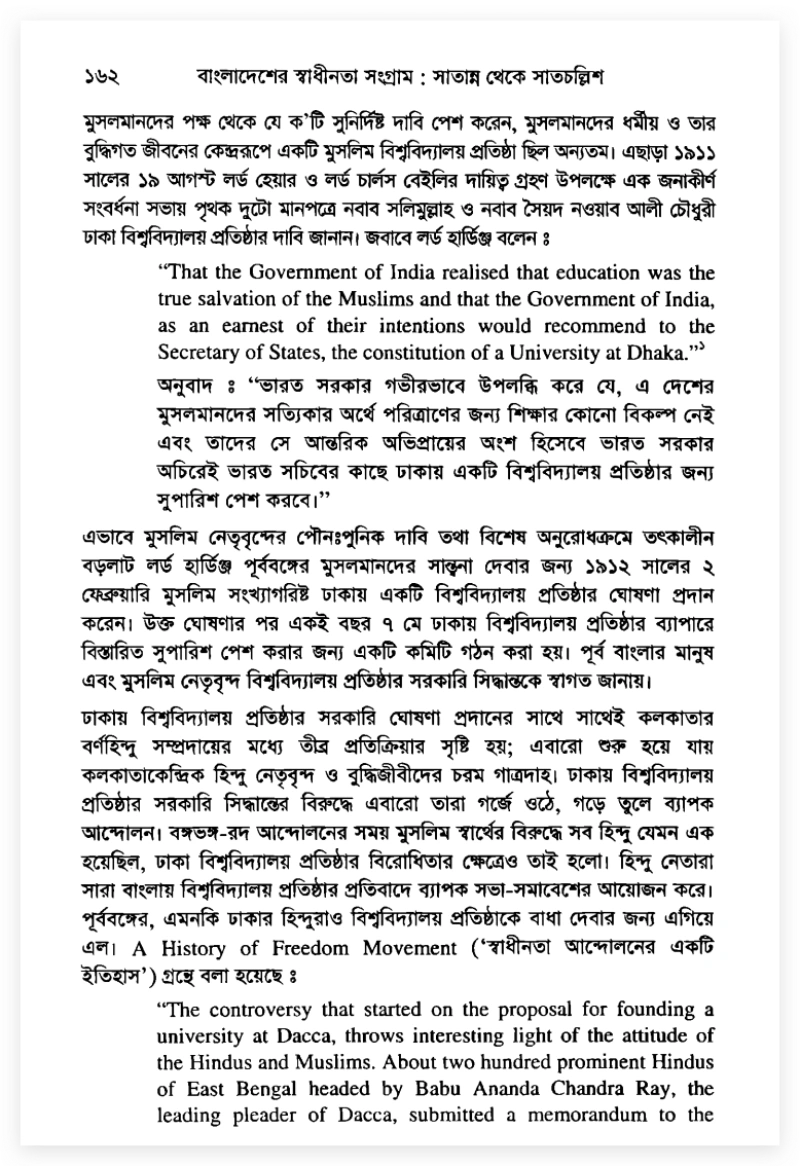
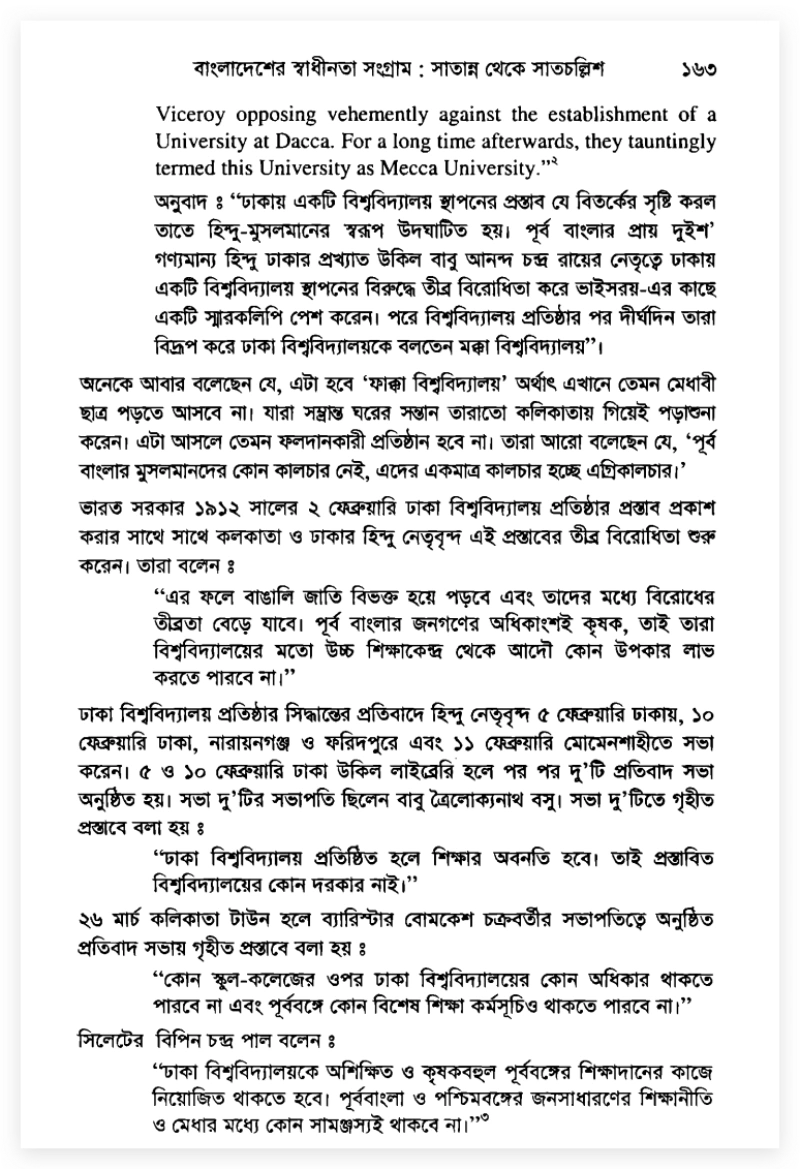
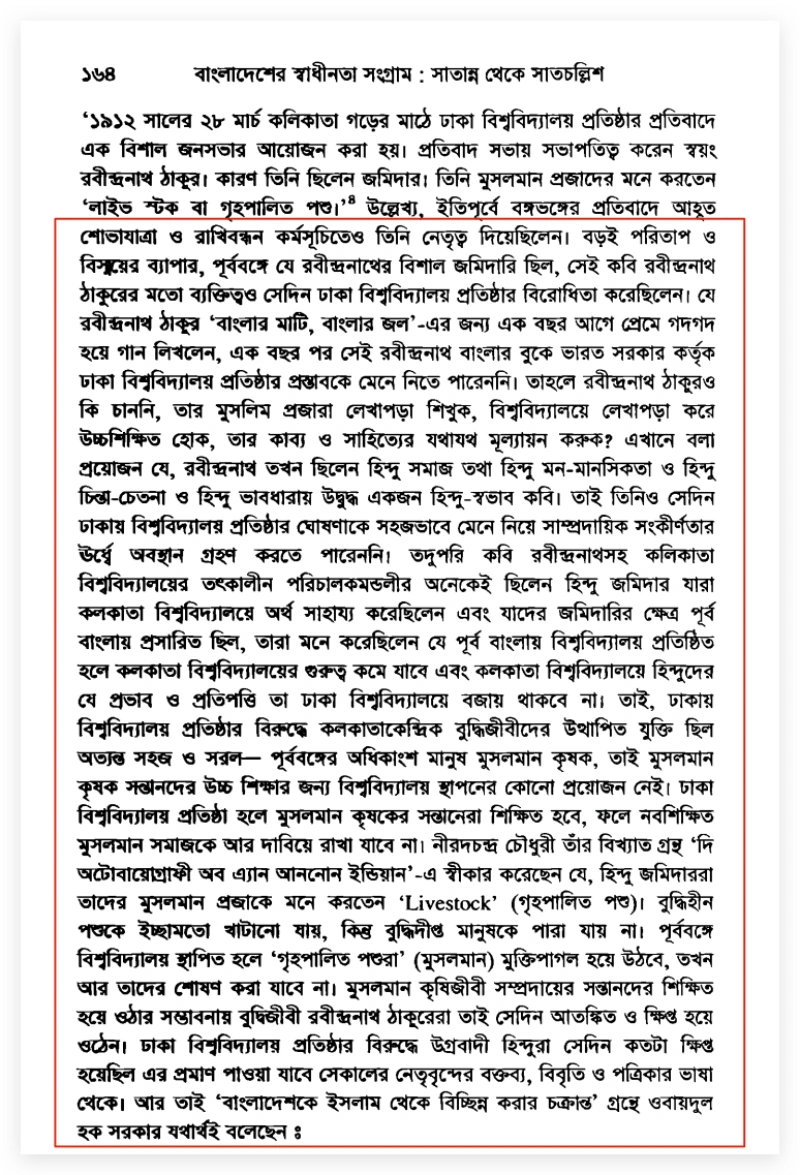
Matin’s account first assumes a specific event to be true: that on 28 March Rabindranath presided over an anti-university meeting on the Maidan in Calcutta. It then explains the supposed motives for that event through his identity as a zamindar and his alleged communal mentality. But the letter from Shilaidaha dated 28 March disproves the claim that he presided over the meeting. When the claim that he was present at an event contradicts the documentary record, a lengthy explanation of his motives for participating in that event cannot establish his presence. However compelling an explanation of a zamindar’s class interests may be, it does not invalidate evidence of an individual’s whereabouts and activities on a particular day. [34]
The subject of the statement concerning ‘domesticated animals’ has also changed. At the beginning of the page, this attitude towards Muslim tenants is attributed directly to Rabindranath. Later, in the statement attributed to Nirad C. Chaudhuri, the subject is ‘Hindu zamindars’. A general statement about a class and the personal statement or attitude of a particular member of that class are not the same thing. The specific claim that Rabindranath regarded Muslim tenants in this way requires his own statement or reliable direct testimony concerning him. Inferring a personal attitude from class identity is no substitute for such testimony.
The manner in which the allegation expands is also apparent here. A succession of conclusions is constructed: from presiding over the alleged meeting to the intention of preventing Muslims from becoming educated, from there to religious narrow-mindedness, and finally to a plan to keep Muslim tenants subjugated. Each subsequent conclusion uses the initial allegation as an established fact. Consequently, if the initial claim is false, the account of motives built upon it also loses its evidentiary basis. Printing an allegation in a book accompanied by an elaborate explanation is distinct from establishing its historical truth. This page is direct evidence of the allegation’s dissemination in print; it is not direct evidence of Rabindranath’s presence at the alleged meeting in 1912.
The quoted sentence records the language of an allegation circulated publicly; it is not direct testimony of the event. Without such basic identifying details as the name of the alleged meeting, its organisers, the number of attendees, Rabindranath’s speech as president and newspaper accounts, the existence of a political public meeting cannot be established. The actual submission of a memorandum in February 1912 by a delegation headed by Rashbehari Ghose, by contrast, is documented. Conflating that real opposition with the alleged meeting of 28 March confuses two distinct historical claims. The fact that a delegation met the Viceroy on 16 February does not establish that Rabindranath held a meeting in Calcutta on 28 March.
Further numbers were subsequently added to the allegation online. A statement claiming that Rabindranath had submitted memoranda on seventeen occasions to prevent the establishment of the University of Dhaka was circulated on social media under Professor Salimullah Khan’s name. A fact-check in 2024 found that the statement attributed to him was fabricated. Where there is no evidence of even one particular meeting, the claim of seventeen additional memoranda requires separate official records, dates of receipt, names of recipients and the petitions themselves. These are absent. Attributing a new statement to a well-known researcher does not resolve the evidentiary deficiencies of the old allegation. [35]
March–April 1912: Illness, Correspondence and Documents Recording His Stay in Shilaidaha
On 28 March 1912, Rabindranath did not preside over the alleged meeting on the Maidan in Calcutta. He was ill in Shilaidaha at the time. His illness in March, the account recording his journey to Shilaidaha on 24 March, the letter to Kadambini Dutta dated 25 March and the letter to Jagadananda Roy dated 28 March establish a continuous chronology of his whereabouts. In the sixth volume of Rabijibani, Prasanta Kumar Pal discusses these events on the basis of the correspondence and accounts. [36]
19 March: Journey to England Cancelled Due to Illness
On 19 March 1912, corresponding to 6 Chaitra 1318, arrangements had been made for Rabindranath to travel from Calcutta to England aboard the City of Paris steamship. His intended companion was the physician Dwijendranath Maitra. Although his luggage had been loaded onto the ship, Rabindranath fell ill on the morning of departure and could not travel. In the chapter ‘Abroad with Father’ of Pitrismriti, Rathindranath Tagore recounts the illness and cancellation of the journey. [37] [38]
কলকাতা থেকে লন্ডনগামী এক জাহাজের টিকিট কেনা হল। জাহাজ ছাড়বার আগের দিন রাত্রে স্যর আশুতোষ চৌধুরীর বাড়িতে বাবার নিমন্ত্রণ। কেবল খাওয়াদাওয়া নয়, সেইসঙ্গে ‘বাল্মীকিপ্রতিভা’ অভিনয়ের ব্যবস্থা হয়েছিল। দিনেন্দ্রনাথ বাল্মীকির ভূমিকায় অভিনয় করলেন। অসুস্থ শরীরে বাবাকে অনেক রাত অবধি জাগতে হল। আমরা ঘরে ফিরলাম বেশ রাত করে। বাকি রাতটুকু বাবা না ঘুমিয়ে চিঠির পর চিঠি লিখে কাটিয়ে দিলেন। ভোরবেলা উঠে বাবার শরীরের অবস্থা দেখে আমরা ভয় পেয়ে গেলাম, ক্লান্তিতে অবসাদে যেন ধুঁকছেন। তাড়াতাড়ি ডাক্তার ডাকতে পাঠানো হল। আগের দিন সন্ধ্যায় আমাদের তল্পি-তল্পা মালপত্র সবকিছু জাহাজে পাঠিয়ে দেওয়া হয়েছে। চাঁদপাল ঘাটের জেটিতে অনেক বন্ধুবান্ধব জড়ো হয়েছেন যথাসময়ে বাবাকে বিদায় দিতে। জাহাজ আমাদের জিনিসপত্র সমেত যথাসময়ে পাড়ি দিল, কিন্তু আমাদের সে যাত্রা আর যাওয়া হল না।
English translation: Tickets were purchased for a ship sailing from Calcutta to London. On the evening before the ship was due to depart, Father had been invited to Sir Ashutosh Chaudhuri’s house. Besides the dinner, a performance of ‘Valmiki Pratibha’ had been arranged. Dinendranath played the part of Valmiki. Despite his ill health, Father had to stay awake until very late. We returned home quite late at night. Father spent the rest of the night writing letter after letter instead of sleeping. When we got up at dawn and saw the state of his health, we were frightened; he seemed utterly overcome by fatigue and exhaustion. We hurriedly sent for a doctor. Our baggage and belongings had all been sent aboard the ship the previous evening. Many friends had gathered at the Chandpal Ghat jetty to bid Father farewell at the appointed time. The ship sailed on schedule with our belongings, but we could not make the journey on that occasion.
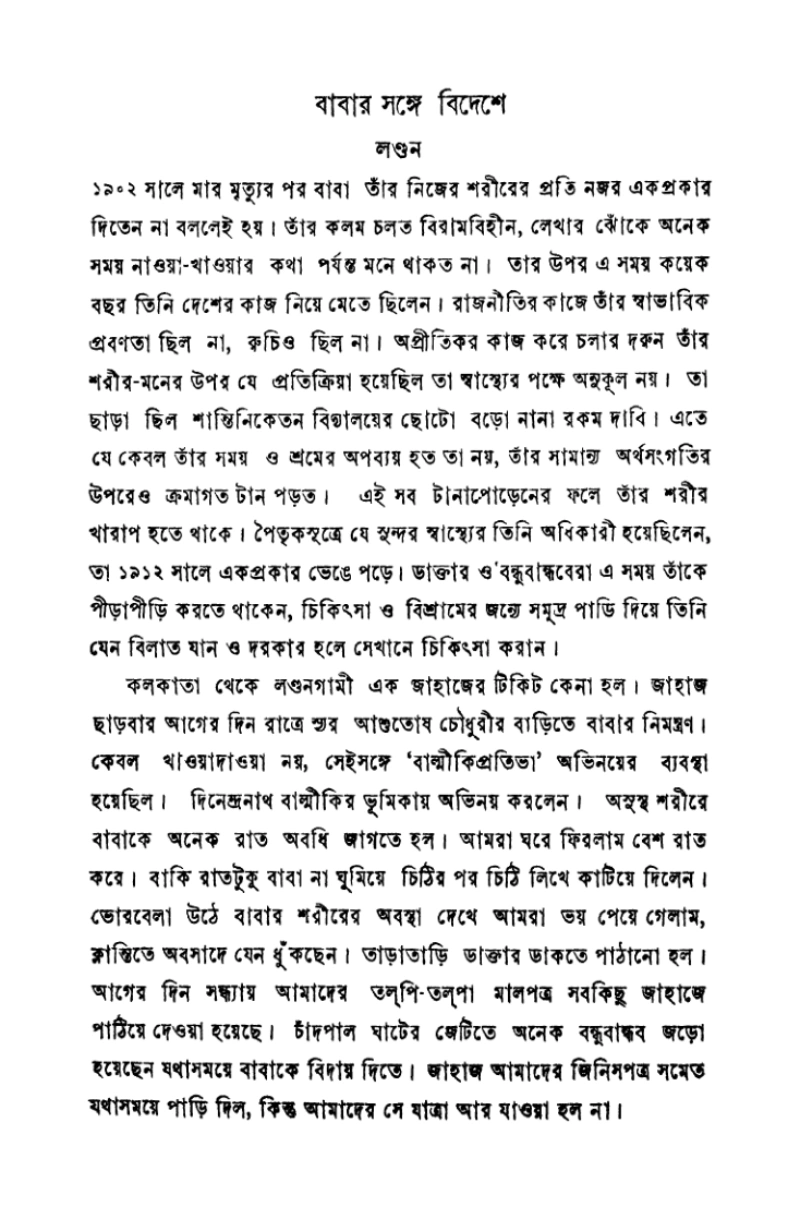
21 March: Letter to Dwijendranath Maitra
On 21 March, corresponding to 8 Chaitra, Rabindranath wrote to Dwijendranath Maitra about his illness and the doctor’s prohibitions. The letter describes how he became dizzy and collapsed just as he was about to board the ship and could not even get as far as the carriage. [39] [40]
আমার কপাল মন্দ—কপালের ভিতরে যে পদার্থটা আছে, তারও গলদ আছে—নইলে ঠিক জাহাজে ওঠবার মুহূর্তেই মাথা ঘুরে পড়লুম কেন? অনেক দিনের সঞ্চিত পাপের দণ্ড সেইদিনই প্রত্যুষে আমার একেবারে মাথার উপরে এসে পড়ল। রোগের প্রথম ধাক্কাটা তো একরকম কেটে গেছে, এখন ডাক্তারের উৎপাতে প্রাণ অতিষ্ঠ হয়ে উঠেছে। লেখাপড়া নড়াচড়া প্রভৃতি সজীব প্রাণীমাত্রেরই যে সকল অধিকার আছে, আমার পক্ষে তা একেবারে নিষিদ্ধ। আপনাকে এই যে পত্র লিখচি এটা আইনবিরুদ্ধ হচ্চে; কিন্তু এমন করে আইন মেনে মরে থাকার চেয়ে আইন লঙ্ঘন করে মরা ভাল। অনেকদিন থেকে অনেক কল্পনা করেছিলুম, কিন্তু যবনিকার অন্তরালে এমন প্রহসনের প্লট যে ঘনিয়ে আসছিল, তা স্বপ্নেও মনে করতে পারিনি। সেদিন সকালে সহজে হার মানিনি—মাথা তোলবার চেষ্টা বারবার করেছিলুম, কিন্তু অদৃষ্ট বারবারই মাথা নত করে দিলেন। বিছানা থেকে কোনোমতে গাড়ি গিয়ে উঠ্ব সেও ঘটল না।
English translation: My luck is bad—and there must be something wrong with what lies inside my head as well—otherwise why should I have become dizzy and collapsed at the very moment of boarding the ship? The punishment for my accumulated sins descended straight upon my head early that morning. The first shock of the illness has more or less passed, but now the doctor’s tyranny is making my life unbearable. Reading, writing, moving about and all the other rights enjoyed by any living creature have been absolutely forbidden to me. In writing this letter to you I am breaking the law; but it is better to die breaking the law than to remain dead while obeying it. I had entertained many hopes for a long time, but I could never have dreamt that the plot of such a farce was developing behind the curtain. I did not surrender easily that morning—I tried repeatedly to raise my head, but fate repeatedly forced me to lower it. I could not even manage to get from my bed into the carriage.
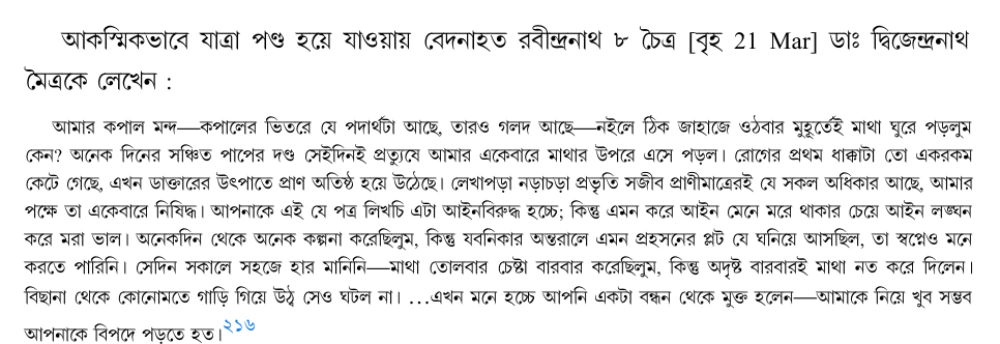
24–25 March: Account of the Journey to Shilaidaha and Letter to Kadambini Dutta
Prasanta Kumar Pal established 24 March, corresponding to 11 Chaitra, as the date of Rabindranath’s journey to Shilaidaha from an entry in the Tagore household’s cashbook. The quoted entry records Rabindranath, Rathindranath and the daughter-in-law of the family travelling to Shilaidaha together. [41]
শ্রীযুক্ত রবীন্দ্র বাবু মহাশয় ও শ্রীযুক্ত রথীন্দ্র বাবু মহাশয় ও শ্রীমতী বধূমাতাঠাকুরাণীর সিলাইদহ গমনের ব্যায় ৩৭৯ নং ভাউচার ১১ চৈত্র ৪৫ ॥৩।
English translation: Mr Rabindra Babu, Mr Rathindra Babu and the esteemed daughter-in-law of the household: Expenses for travelling to Shilaidaha, voucher no. 379, 11 Chaitra 45 ॥3.
On the following day, Monday 25 March, corresponding to 12 Chaitra, Rabindranath himself stated in a letter to Kadambini Dutta that he was staying in Shilaidaha. [42] [43]
এখনো মাথার পরিশ্রম নিষেধ। শিলাইদহে নির্জনে পালাইয়া আসিয়াছি।
English translation: Mental exertion is still forbidden. I have fled to the solitude of Shilaidaha.
28 March: Letter to Jagadananda Roy
In a letter to Jagadananda Roy dated Thursday, 28 March, corresponding to 15 Chaitra, Rabindranath reported that after feeling well for several days, he was again experiencing dizziness. He described how even a brief discussion with the girls the previous evening had aggravated his illness. Together with the account of his journey to Shilaidaha and the letter to Kadambini Dutta, this letter provides continuous evidence of the same illness and his whereabouts. [44] [45]
কয়দিন এখানে এসে সুস্থ বোধ করছিলুম। মনে করছিলুম সেদিন যে ধাক্কাটা খেয়েছিলুম সেটা কিছুই নয়। সুস্থ হয়ে উঠলেই অসুখটাকে মিথ্যা বলে মনে হয়। আবার আজ দেখি সকাল বেলায় মাথাটা রীতিমত টলমল করচে। কাল বুধবার ছিল বলে, কাল সন্ধ্যাবেলায় মেয়েদের নিয়ে একটু আলোচনা করছিলুম—এইটুকুতেই আমার মাথা যখন কাবু হয়ে পড়ল তখন বুঝতে পারচি নিতান্ত উড়িয়ে দিলে চল্বে না।
English translation: For a few days after coming here I had been feeling well. I thought that the shock I had suffered the other day was nothing. Once one recovers, the illness itself seems unreal. But this morning I find my head distinctly reeling again. Yesterday was Wednesday, so last evening I was having a little discussion with the girls—when even that much was sufficient to overwhelm my head, I realised that I could not simply dismiss the matter.
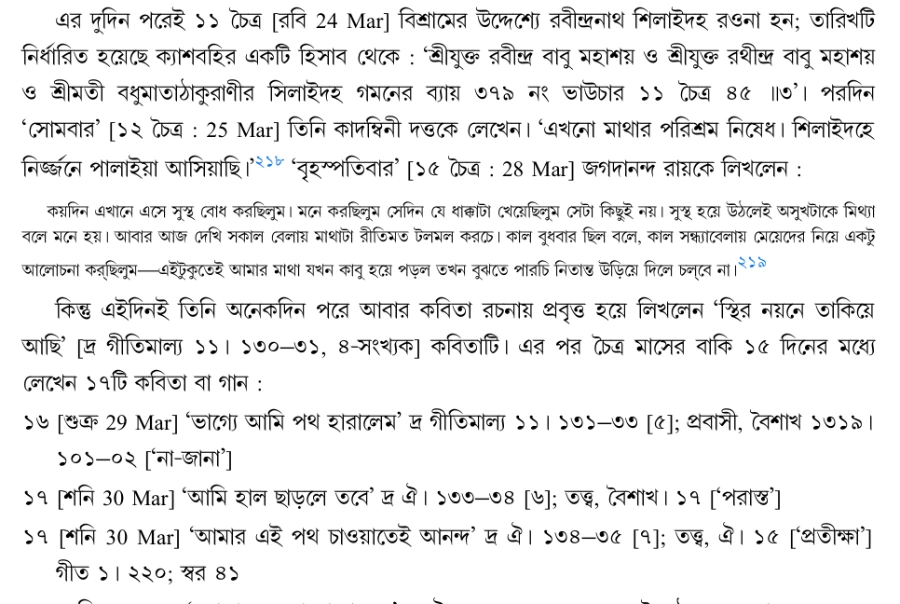
Chronology of Compositions in March–April
According to Prasanta Kumar Pal’s account, Rabindranath composed ‘I Gaze with Steady Eyes’ (Sthir Nayane Takiye Achhi) on 28 March. He then wrote seventeen more poems or songs in the remaining fifteen days of Chaitra. The list includes ‘My Joy Lies in Waiting by the Road’ (Amar Ei Path Chawatei Ananda) under Saturday, 30 March, corresponding to 17 Chaitra. Under Monday, 8 April, corresponding to 26 Chaitra, appears ‘Now I Must Set Mine Afloat’ (Ebar Bhasiye Dite Habe Amar); under Friday, 12 April, corresponding to 30 Chaitra, appears ‘Now, When the Time Comes for Me to Depart’ (Ebar Tora Amar Jabar Belate). [46] [47]
| Date | Document or event | Source details |
|---|---|---|
| 19 March 1912 | Voyage aboard the City of Paris cancelled due to illness. | Pitrismriti, printed p. 146; Rabijibani, digital PDF p. 381 |
| 21 March / 8 Chaitra | Account of illness in a letter to Dwijendranath Maitra. | Rabijibani, digital PDF p. 383; source note 216 |
| 24 March / 11 Chaitra | Journey to Shilaidaha; cashbook entry. | Rabijibani, digital PDF p. 384 |
| 25 March / 12 Chaitra | Wrote to Kadambini Dutta confirming his stay in Shilaidaha. | Chithipatra 7, p. 53, letter 27—according to Pal’s source reference |
| 28 March / 15 Chaitra | Account of illness in a letter to Jagadananda Roy; composition of ‘I Gaze with Steady Eyes’. | Rabijibani, digital PDF p. 384; source note 219 |
| 30 March / 17 Chaitra | ‘My Joy Lies in Waiting by the Road’. | Rabijibani, digital PDF p. 384 |
| 8 April / 26 Chaitra | ‘Now I Must Set Mine Afloat’. | Rabijibani, digital PDF p. 385 |
| 12 April / 30 Chaitra | ‘Now, When the Time Comes for Me to Depart’; probable date of departure for Calcutta. | Rabijibani, digital PDF pp. 385 and 388 |
Regarding Rabindranath’s departure for Calcutta after composing the song on 12 April, Pal uses the word ‘probably’. This date is his inferred day of departure; it is not the same kind of evidence as the dated letter of 28 March. [48]
Against this chronology, the claim that Rabindranath presided over a meeting on the Maidan in Calcutta on 28 March collapses. His own account of his illness, the financial record of his journey to Shilaidaha, the letters written from Shilaidaha and the associated chronology of compositions are interconnected documentary evidence. In the face of these documents, the publication of an allegation in a later book that he presided over the meeting does not establish his presence there.
The 1908 Pabna Address: Government Opportunities for Muslims and the Question of Social Equality
In the narrative about opposition to the University of Dhaka, Rabindranath is presented as a self-declared enemy of Muslim advancement. Yet in his presidential address at the Pabna Provincial Conference in February 1908, he spoke directly about the privileges enjoyed by educated Hindus in government service and the relative deprivation of Muslims. Amid the political tensions surrounding the Partition of Bengal, he identified greater access to government positions and social standing for Muslims as a necessary condition for establishing equality. Rather than preserving Hindu precedence and using Muslims merely as political allies, he called for eliminating inequality of opportunity. This statement was published four years before the official announcement concerning the University of Dhaka. [49]
আমরা গোড়া হইতে ইংরেজের ইস্কুলে বেশি মনোযোগের সঙ্গে পড়া মুখস্থ করিয়াছি বলিয়া গবর্মেণ্টের চাকরি ও সম্মানের ভাগ মুসলমান তাদের চেয়ে আমাদের অংশে বেশি পড়িয়াছে সন্দেহ নাই। এইরূপে আমাদের মধ্যে একটা পার্থক্য ঘটিয়াছে। এইটুকু কোনওমতে না মিটিয়া গেলে আমাদের ঠিক মনের মিলন হইবে না, আমাদের মাঝখানে একটা অসূয়ার অন্তরাল থাকিয়া যাইবে।
English translation: There is no doubt that, because we have from the beginning applied ourselves more diligently to memorising lessons in English schools, a greater share of government employment and honours has fallen to us than to the Muslims. Thus a disparity has arisen between us. Unless this disparity is somehow removed, there will be no genuine meeting of minds between us, and a barrier of jealousy will remain.
This statement identifies historical differences in educational opportunity and unequal access to the colonial administration as causes of social inequality. Rabindranath did not regard the fewer opportunities available to Muslims as a consequence of innate incompetence; instead, he exposed the privileges enjoyed by educated Hindu society. His argument was that genuine social cooperation was impossible while this inequality remained intact. In contrast to political rhetoric that portrayed Muslim advancement as a loss for the opposing community, he declared social equality necessary. Even though greater opportunities for Muslims could diminish the Hindu monopoly over those opportunities, he urged people to welcome that change.
মুসলমানেরা যদি যথেষ্ট পরিমাণে পদমান লাভ করিতে থাকেন তবে অবস্থার অসাম্যবশত জ্ঞাতিদের মধ্যে যে মনোমালিন্য ঘটে তাহা ঘুচিয়া গিয়া আমাদের মধ্যে সমকক্ষতা স্থাপিত হইবে। যে রাজপ্রসাদ এতদিন আমরা ভোগ করিয়া আসিয়াছি আজ প্রচুর পরিমাণে তাহা মুসলমানদের ভাগে পড়ক ইহা আমরা যেন সম্পূর্ণ প্রসন্নমনে প্রার্থনা করি।
English translation: If Muslims continue to acquire positions and honours in sufficient measure, the ill feeling arising among kinsmen from inequality of circumstances will disappear, and equality will be established between us. Let us pray, with wholly ungrudging hearts, that the favour of the rulers which we have enjoyed until now may today fall abundantly to the share of the Muslims.
The subject of this address, however, was social and political equality throughout Bengal; it was not a formal letter endorsing a specific proposal to establish the University of Dhaka. The government’s plan for the university had not been announced in 1908. The implication of the address is clear: the broader communal allegation that Rabindranath found the expansion of Muslim educational and administrative opportunities morally or politically objectionable is inconsistent with his own statements. Establishing an individual’s specific position on a subsequent administrative decision requires documents contemporary with that decision; his own published statements, however, are the principal source for understanding his earlier fundamental social thought.
The 1911 Essay “Hindu University”: Direct Statements on Independent Muslim Higher Education
In 1911, Rabindranath wrote the essay “Hindu University”. Its background was the contemporary discussion surrounding initiatives to establish a Hindu university in Benares and a separate institution of higher education for Muslims in Aligarh. The essay predates the announcement of the University of Dhaka; it cannot be described as a written statement directly endorsing the Dhaka project. But it is a firsthand document revealing precisely what Rabindranath thought about the establishment of separate Muslim universities, Muslim disadvantage in modern education and educational rights. He criticised both the dominance of educated Hindu society and its lack of sincerity towards Muslims, while recognising independent Muslim initiatives as a legitimate means of self-development. Acknowledging that Muslims had fallen comparatively behind in modern education, he called for supporting their additional demands to eliminate this disparity. [50]
আধুনিক কালের শিক্ষার প্রতি সময় থাকিতে মনোযোগ না করায় ভারতবর্ষের মুসলমান হিন্দুর চেয়ে অনেক বিষয়ে পিছাইয়া পড়িয়াছে। সেখানে তাহাকে সমান হইয়া লইতে হইবে। এই বৈষম্যটি দূর করিবার জন্য মুসলমান সকল বিষয়েই হিন্দুর চেয়ে বেশি দাবি করিতে আরম্ভ করিয়াছে। তাহাদের এই দাবিতে আমাদের আন্তরিক সম্মতি থাকাই উচিত। পদ-মান-শিক্ষায় তাহারা হিন্দুর সমান হইয়া উঠে ইহা হিন্দুরই পক্ষে মঙ্গলকর।
বস্তুত বাহির হইতে যেটুকু পাওয়া যাইতে পারে, যাহা অন্যের নিকট প্রার্থনা করিয়া পাওয়া যায় তাহার একটা সীমা আছেই। সে সীমা হিন্দু মুসলমানের কাছে প্রায় সমান। সেই সীমায় যতদিন পর্যন্ত না পৌঁছানো যায় ততদিন মনে একটা আশা থাকে বুঝি সীমা নাই, বুঝি এই পথেই পরমার্থ লাভ করা যায়। তখনই সেই পথের পাথেয় কার একটু বেশি জুটিয়াছে কার একটু কম, তাই লইয়া পরস্পর ঘোরতর ঈর্ষা বিরোধ ঘটিতে থাকে।
English translation: By failing to devote timely attention to modern education, the Muslims of India have fallen behind the Hindus in many respects. They must attain equality in those respects. To remove this disparity, Muslims have begun to demand more than Hindus in every sphere. We ought to give our wholehearted assent to these demands. It is beneficial to the Hindus themselves that Muslims should become their equals in position, standing and education.
Indeed, there is a limit to what can be obtained from outside, to what can be acquired by petitioning others. That limit is nearly the same for Hindus and Muslims. Until it is reached, one harbours the hope that perhaps there is no limit and that the ultimate good may be attained along this very path. It is then that bitter jealousy and conflict arise between them over who has secured a little more or a little less provision for the journey.
There is no appeal here to preserve the special privileges of Hindu society. Rabindranath even identified the demand for additional opportunities needed to overcome Muslim disadvantage as worthy of support. It was his own statement that Muslims becoming equal to Hindus in education, position and standing would be beneficial to Hindu society itself. Instead of treating increased competition in education and government employment as religious hostility, he described the elimination of unequal opportunity as a condition for improving social relations. The contemporary published statements of the writer to whom a scheme to obstruct Muslim higher education has been attributed reveal precisely the opposite outlook.
In this essay, Rabindranath did not regard the Muslim enthusiasm for establishing universities of their own merely as a consequence of competition with others; he interpreted it as an aspiration to develop their community’s own strength and dignity. This is significant because he connected the establishment of educational institutions with a community’s independent cultural development rather than its exclusive control over education. In his view, genuine cooperation could not be established by suppressing independent development through fear of separatism. Opportunities for mutual intellectual exchange and broader human connections had to be created while preserving distinctiveness. [51]
কিন্তু এই যে বাহ্য অবস্থার বৈষম্য ইহার পরে আমি বেশি ঝোঁক দিতে চাই না–ইহা ঘুচিয়া যাওয়া কিছুই শক্ত নহে। যে কথা লইয়া এই প্রবন্ধে আলোচনা করিতেছি তাহা সত্যকার সাতন্ত্র্য। সে সাতন্ত্র্যকে বিলুপ্ত করা আত্মহত্যা করারই সমান।
আমার নিশ্চয় বিশ্বাস, নিজেদের স্বতন্ত্র বিশ্ববিদ্যালয় স্থাপন প্রভৃতি উদ্যোগ লইয়া মুসলমানেরা যে উৎসাহিত হইয়া উঠিয়াছে তাহার মধ্যে প্রতিযোগিতার ভাব যদি কিছু থাকে তবে সেটা স্থায়ী ও সত্য পদার্থ নহে। ইহার মধ্যে সত্য পদার্থ নিজেদের সাতন্ত্র্য উপলব্ধি। মুসলমান নিজের প্রকৃতিতেই মহৎ হইয়া উঠিবে এই ইচ্ছাই মুসলমানের সত্য ইচ্ছা।
এইরূপ বিচিত্র সাতন্ত্র্যকে প্রবল হইয়া উঠিতে দেখিলে আমাদের মনে প্রথমে একটা ভয় হয়। মনে হয় সাতন্ত্র্যের যে যে অংশে আজ বিরুদ্ধতা দেখিতেছি সেইগুলাই প্রশ্রয় পাইয়া অত্যন্ত বাড়িয়া যাইবে, এবং তাহা হইলে মানুষের মধ্যে পরস্পরের প্রতিকুলতা ভয়ংকর উগ্র হইয়া উঠিবে।
English translation: But I do not wish to place much further emphasis upon this inequality of external circumstances—it is not at all difficult to eliminate. The subject I am discussing in this essay is genuine distinctiveness. To extinguish that distinctiveness is tantamount to suicide.
It is my firm conviction that, if there is any spirit of competition in the enthusiasm Muslims have shown for initiatives such as establishing separate universities of their own, it is neither permanent nor the essential reality. What is real in it is their awareness of their own distinctiveness. That Muslims should attain greatness in accordance with their own nature is their true aspiration.
When we see such diverse forms of distinctiveness becoming stronger, we are at first afraid. We imagine that precisely those aspects of distinctiveness in which we now perceive antagonism will be encouraged to grow excessively, and that mutual hostility among human beings will thereby become terribly intense.
In the same essay, he did not accept institutions identified as Hindu or Muslim as defining the entire boundary of the world of knowledge. In his argument, a university may work with its own language, history and cultural distinctiveness, but its educational system must accommodate the world’s knowledge, the thought of other societies and critical inquiry. If modern learning is restricted in the name of religious identity, a university departs from its fundamental educational purpose. This criticism does not constitute opposition to Muslim higher education; rather, it demands intellectual freedom within any community-based educational institution. [52]
অতএব যাঁহারা স্বতন্ত্রভাবে হিন্দু বা মুসলমান বিশ্ববিদ্যালয় প্রতিষ্ঠাকে ভয় করেন তাঁহাদের ভয়ের কোনো কারণ নাই এমন কথা বলিতে পারি না। কিন্তু তৎসত্ত্বেও একথা জোর করিয়া বলিতে হইবে যে, যে শিক্ষার মধ্যে প্রাচ্য পাশ্চাত্ত্য সকল বিদ্যারই সমাবেশ হইতেছে সে শিক্ষা কখনোই চিরদিন কোনো একান্ত আতিশয্যের দিকে প্রশ্রয় লাভ করিতে পারিবে না। যাহারা স্বতন্ত্র তাহারা পরস্পর পাশাপাশি আসিয়া দাঁড়াইলে তবেই তাহাদের বাড়াবাড়ি কাটিয়া যায় ও তাহাদের সত্যটি যথার্থভাবে প্রকাশ পায়। নিজের ঘরে বসিয়া ইচ্ছামতো যিনি যতবড়ো খুশি নিজের আসন প্রস্তুত করিতে পারেন, কিন্তু পাঁচজনের সভার মধ্যে আসিয়া পড়িলে স্বতই নিজের উপযুক্ত আসনটি স্থির হইয়া যায়। হিন্দু বা মুসলমান বিশ্ববিদ্যালয়ে যদি বিশ্বকে স্থান দেওয়া হয় তবে সেই সঙ্গে নিজের সাতন্ত্র্যকে স্থান দিলে কোনো বিপদের সম্ভাবনা থাকিবে না। ইহাতেই বস্তুত সাতন্ত্র্যের যথার্থ মূল্য নির্ধারিত হইয়া যাইবে।
এ পর্যন্ত আমরা পাশ্চাত্য শাস্ত্রসকলকে যে প্রকার বৈজ্ঞানিক, ঐতিহাসিক ও যুক্তিমূলক প্রণালীর দ্বারা বিচার করিয়া আসিতেছি নিজেদের শাস্ত্রগুলিকে সেরূপ করিতেছি না। যেন জগতে আর সর্বত্রই অভিব্যক্তির নিয়ম কাজ করিয়া আসিয়াছে, কেবল ভারতবর্ষেই সে প্রবেশ করিতে পারে নাই–এখানে সমস্তই অনাদি এবং ইতিহাসের অতীত। এখানে কোনো দেবতা ব্যাকরণ, কোনো দেবতা রসায়ন, কোনো দেবতা আয়ুর্বেদ আস্ত সৃষ্টি করিয়াছেন–কোনো দেবতার মুখ-হস্ত-পদ হইতে একেবারেই চারি বর্ণ বাহির হইয়া আসিয়াছে–সমস্তই ঋষি ও দেবতায় মিলিয়া এক মুহূর্তেই খাড়া করিয়া দিয়াছেন। ইহার উপরে আর কাহারও কোনো কথা চলিতেই পারে না। সেই জন্যেই ভারতবর্ষের ইতিহাস রচনায় অদ্ভুত অনৈসর্গিক ঘটনা বর্ণনায় আমাদের লেখনীর লজ্জা বোধ হয় না–শিক্ষিত লোকদের মধ্যেও ইহার পরিচয় প্রতিদিনই পাওয়া যায়। আমাদের সামাজিক আচার ব্যবহারেও বুদ্ধিবিচারের কোনো অধিকার নাই–কেন আমরা একটা কিছু করি বা করি না তাহার কারণ জিজ্ঞাসা করাই অসংগত। কেননা কার্যকারণের নিয়ম বিশ্বব্রহ্মাণ্ডে কেবলমাত্র ভারতবর্ষেই খাটিবে না–সকল কারণ শাস্ত্রবচনের মধ্যে নিহিত। এই জন্য সমুদ্রযাত্রা ভালো কি মন্দ, শাস্ত্র খুলিয়া তাহার নির্ণয় হইবে, এবং কোন্ ব্যক্তি ঘরে ঢুকিলে হুঁকার জল ফেলিতে হইবে পণ্ডিতমশায় তাহার বিধান দিবেন। কেন যে একজনের ছোঁয়া দুধ বা খেজুর রস বা গুড় খাইলে অপরাধ নাই, জল খাইলেই অপরাধ–কেন যে যবনের প্রস্তুত মদ খাইলে জাত যায় না, অন্ন খাইলেই জাত যায় এসব প্রশ্ন জিজ্ঞাসা করিলে ধোবা নাপিত বন্ধ করিয়াই মুখ বন্ধ করিয়া দিতে হয়।
English translation: Therefore, I cannot say that those who fear the establishment of separate Hindu or Muslim universities have no reason for their apprehension. Nevertheless, it must be stated emphatically that an education in which all branches of Eastern and Western learning converge can never indefinitely foster any one exclusive excess. Only when those who are distinct come and stand alongside one another do their excesses diminish and their essential truth find proper expression. Sitting in one’s own room, one may prepare for oneself as grand a seat as one pleases; but upon joining an assembly of others, one’s appropriate place is naturally determined. If a Hindu or Muslim university makes room for the world, there will be no danger in allowing room for its own distinctiveness as well. In this way, the true value of distinctiveness will in fact be determined.
Until now, we have examined Western systems of learning through scientific, historical and rational methods, but we have not subjected our own traditional disciplines to the same treatment. It is as though the law of evolution has operated everywhere else in the world and has been unable to enter India alone—here everything is eternal and beyond history. Here one deity has created grammar in its entirety, another chemistry and another Ayurveda; the four varnas have emerged fully formed from a deity’s mouth, hands and feet; sages and gods together have erected everything in a single moment. No one else may utter a word about it. This is why our pens feel no shame in recounting extraordinary, unnatural events when writing Indian history; evidence of this is found every day even among educated people. Reason has no jurisdiction over our social customs either—to ask why we do or do not perform some particular act is itself considered improper. For the law of cause and effect, operative throughout the universe, supposedly does not apply to India alone: all causes reside in scriptural pronouncements. Thus, whether a sea voyage is good or bad must be decided by consulting the scriptures, and the learned pandit will prescribe which person’s entry into a room requires the water in the hookah to be thrown away. Why it is no offence to consume milk, date-palm juice or molasses touched by a particular person, but an offence to drink water so touched; why drinking liquor prepared by a Yavana does not cause one to lose caste, but eating food prepared by one does—if such questions are asked, the questioner’s mouth must be shut by denying them the services of the washerman and barber.
An important aspect of Rabindranath’s argument is even clearer: if Hindu society uses Muslims as an auxiliary force for political purposes rather than accepting them as genuine partners, mutual distrust will increase. Within this history, he regarded independent Muslim development as justified. Reducing this observation to an ornamental expression of religious harmony obscures its actual political criticism. He identified three concrete problems together: the unequal distribution of power and privilege within educated Hindu society, the Muslim demand for independent advancement, and the need to safeguard Muslim dignity. There is a fundamental contradiction between the substance of his own writing and the imagined intention to destroy higher educational opportunities for the Muslims of East Bengal. [53]
The Alleged “Mecca University” Remark: Turning an Unsourced Statement into a Quotation
The popular narrative about opposition to the establishment of the university also claims that Rabindranath mockingly called the University of Dhaka “Mecca University”. Yet this sentence has not been substantiated by any identifiable quotation from his published essays, letters, speeches, contemporary newspapers or university records. The circulating allegation also fails to specify on what date, to whom, on what occasion or where he made such a statement. By attributing a brief, derogatory expression to a well-known writer, a communal motive has been imputed to him. Merely writing “he said” is insufficient to establish a quotation; the original work or firsthand account must be identified. [54]
The contrast between the expression “Mecca University” and the actual statements in the 1911 essay is clear. There, enthusiasm for independent Muslim educational institutions was described as an expression of legitimate social self-development. Instead of disparaging a university on the basis of religious identity, Rabindranath advocated developing one’s own distinctive characteristics while embracing the knowledge of others. Whether a person actually mocked a particular institution cannot be determined solely by reference to their general philosophy; but a quotation lacking a firsthand source cannot be circulated as fact. This alleged remark remains unsubstantiated.
The 1926 Visit to Dhaka: The Letter to Ramesh Chandra Majumdar Concerning the Invitation
Five years after the establishment of the University of Dhaka, Rabindranath visited Dhaka in February 1926. His letter to the historian Ramesh Chandra Majumdar, dated 16 Magh 1332 in the Bengali calendar, is firsthand documentary evidence of the preparations for the visit. At the time, Majumdar taught in the university’s Department of History and was the provost of Jagannath Hall. In the letter, Rabindranath explained that an invitation from the general public of Dhaka required him to leave ahead of schedule, and that after accepting their hospitality he would participate in the university’s programme. The university’s invitation is thus attested not by rumour, but by the words of his own handwritten letter. Justice Obaidul Hassan published a transcription of the letter and an account of the relevant certificate issued by the university. [55]
ঢাকার জনসাধারণের পক্ষ থেকে আজ আমাকে নিমন্ত্রণ করবার জন্যে দূত এসেছিলেন। তাঁদের বিশেষ অনুরোধে নির্দিষ্ট সময়ের পূর্ব্বেই যাত্রা করতে প্রস্তুত হয়েছি। ৬ই তারিখে রাত্রে রওনা হয়ে গোয়ালন্দ থেকে তাঁদেরই জলযানে ভেসে পড়ব। ১০ই তারিখ পর্যন্ত তাঁদের আতিথ্য ভোগ করে কর্ত্তব্য অন্তে তোমার আশ্রমে উঠে বিশ্ববিদ্যালয়ের নিমন্ত্রণ পালন করব।
English translation: Today a messenger came to invite me on behalf of the general public of Dhaka. At their special request, I have prepared to depart before the appointed time. I shall leave on the night of the 6th and embark on their vessel at Goalundo. After enjoying their hospitality until the 10th and completing my obligations, I shall take up residence in your abode and fulfil the university’s invitation.
This letter identifies two separate invitations: one from Dhaka’s citizens and one from the university. Rabindranath decided to divide his time between the two programmes. After arriving in Dhaka on 7 February, he accepted the hospitality of the Nawab family. He subsequently stayed at the residence of the provost of Jagannath Hall and participated in university events. The University of Dhaka’s students’ union, the students of Muslim Hall, Jagannath Hall and other institutions in Dhaka were involved in welcoming him. These events document his subsequent cordial relationship with the university. His letter from Shilaidaha is the direct evidence refuting the allegation about the 1912 meeting; the evidence from 1926 shows that the popular story of perpetual enmity between him and the university and its Muslim students is also contrary to reality. [56] [57]
Rabindranath’s lecture at Curzon Hall and his meetings with university students are particularly significant because, although the University of Dhaka had only recently been established, it was rapidly developing into a centre of literature, science, philosophy and social criticism. Through the initiatives of Muslim Hall teachers and students, the emancipation of the intellect, criticism of religious dogmatism and the practice of freethought were acquiring new organisational forms. The establishment of the Muslim Sahitya Samaj and Rabindranath’s visit in 1926 occurred close together within this intellectual environment. Historian Shahadat H. Khan has reconstructed the details of the Muslim Hall reception for Rabindranath using the organisation’s early records, the writings of Abul Husain and the memoirs of Abul Fazal. The event is therefore not merely a matter of sentimental recollection from a later period; it is connected to the students’ organisation and the contemporary intellectual movement. [58]
The Muslim Hall Reception and the Emancipation of the Intellect Movement: Abul Husain’s Direct Role
The young teacher and thinker Abul Husain played an important role in organising the Muslim Hall students’ union reception in February 1926. He formed a seven-member decoration committee comprising students. Research records the involvement of students such as Muhammad Yusuf and Belayet Ali Khan. Although the students’ union initially planned to present a formal address of welcome, interest subsequently arose in arranging a tea gathering with Rabindranath. Because funds were scarce, the event was financed through contributions collected from the students. In his memoirs, Abul Fazal described the entrance to Muslim Hall being decorated with flowers, the students’ immense enthusiasm and the honours extended to the poet. These accounts testify not merely to Rabindranath’s popularity but also to the freethinking and literary aspirations of a section of Muslim students. [59]
The Muslim Hall address of welcome emphasised Rabindranath’s humanistic outlook and responsibility towards humanity rather than his religious identity. The students spoke of the freedom of his spirit and its transcendence of Hindu, Muslim and Christian identities. Abul Husain’s welcoming speech likewise called for intellectual freedom, overcoming the narrowness of scriptural authority and making the world’s knowledge one’s own. These values were becoming central ideals of the Muslim Sahitya Samaj’s Emancipation of the Intellect Movement. Educated Muslim thinkers including Kazi Abdul Wadud, Abul Husain and Abul Fazal were associated with the organisation. It was this social context that made the Muslim Hall reception a historic intellectual event in opposition to communal division. [60]
তোমার প্রাণ মুক্ত, বিশ্বময়। সেখানে হিন্দু নাই, মুসলমান নাই, খৃষ্টান নাই, আছে মানুষ।
English translation: Your spirit is free and embraces the world. There are no Hindus, Muslims or Christians there; there are human beings.
Abul Husain connected his address of welcome to the newly formed Emancipation of the Intellect Movement of the Muslim Sahitya Samaj. The organisation’s principle—where knowledge is restricted, the intellect is constrained, and emancipation is impossible—expressed a demand for independent thought against religious and social authority from within educated Muslim society itself. The speech connected Rabindranath’s philosophy of knowledge with this movement. The experience of these Muslim students in 1926 is erased in narratives of subsequent political opposition to Rabindranath during the Pakistan period or of contemporary hatred based on religious identity. Yet their own organisational history provides direct evidence that they embraced Rabindranath as a fellow traveller in the pursuit of intellectual emancipation. [61]
Let us be inspired by your ideals of the conservation of world knowledge so that we can go beyond the narrow boundary of shastra.
The history of the Muslim Hall reception contradicts the imagined uniformity of Muslim cultural preferences. Some Muslim students at the university adhered to religious observances, while others were involved in the freethought movement; their cultural preferences were not identical either. The movement of Abul Husain and his colleagues was an attempt to establish the rights of reason, science, literature and independent conscience while retaining their religious identities. Their reception of Rabindranath is important testimony to this historical diversity. Those who, in the name of Muslims, portray Rabindranath as an innate enemy of East Bengal deny this very history of actual Muslim students.
The D.Litt. of 1936: Official Documentary Evidence of Recognition by the University of Dhaka
In 1936, the University of Dhaka conferred the honorary degree of Doctor of Literature on Rabindranath Tagore. His name, the designation of the degree and the year are preserved in the university’s official “Honoris Causa” list. Among the others honoured that year were Muhammad Iqbal, Sarat Chandra Chattopadhyay, Jadunath Sarkar, Jagadish Chandra Bose and Prafulla Chandra Ray. The degree was conferred at a special convocation on 29 July 1936; Rabindranath could not attend owing to illness. The university’s own official list preserves the record of the degree. [62] [63]
Rabindranath Tagore — Doctor of Literature — 1936
The invitation of 1926, the Muslim Hall reception and the honorary degree of 1936 are records of three separate institutional events. They make clear that Rabindranath’s relationship with the authorities and students of the University of Dhaka developed over many years through public cultural and academic recognition. The letter from Shilaidaha dated to the day of the alleged 1912 meeting is direct evidence against that allegation. But there is also a serious contradiction between the portrayal of Rabindranath as the university’s perpetual enemy and his subsequent recognition by its authorities and students. The simplistic narrative about his relationship with the university, circulated on the basis of religious identity, is inconsistent with these events.
Inferring Opposition to the University from Opposition to the Partition of Bengal: An Invalid Logical Leap
Rabindranath opposed the Partition of Bengal in 1905—this is true. After its annulment, many Muslim political leaders in East Bengal were aggrieved by the prospect of losing administrative opportunities—this is also true. But the conclusion that Rabindranath opposed the establishment of the University of Dhaka in 1912 does not follow from these two facts. The Partition of Bengal concerned the boundaries and administrative arrangements of a province of British India; the question of the University of Dhaka concerned establishing a new residential institution of higher education in East Bengal. Opposition to an administrative division does not necessarily entail opposition to expanding education in the eastern region. Rabindranath’s own statements of 1908 and 1911 explicitly supported equality and independent Muslim initiatives in modern education. Turning a participant in the anti-partition movement into a conspirator against the university therefore requires an additional assumption for which no contemporary evidence has been presented.
A section of Calcutta’s highly educated and wealthy Hindu middle class feared that the Partition of Bengal would alter its administrative influence, professional opportunities and commercial relationships. Many Muslim landowners, professionals and educationally deprived communities in East Bengal had different interests. Various political programmes associated with the Swadeshi movement brought the practical needs of poor Muslim peasants into conflict with the demands of urban leadership. Rabindranath’s political decisions at the time were not entirely detached from these class and regional divisions. But attaching a false allegation that he presided over a particular meeting to this legitimate criticism replaces the actual conflicts of history with a narrative of character assassination.
At the same time, Muslim leaders themselves differed over higher education in East Bengal. Some regarded the university as a means of administrative compensation and educational empowerment; others prioritised the establishment of schools and colleges; still others raised objections concerning the regional allocation of educational expenditure. The parties to these disagreements cannot all be made representatives of the same communal objective. Rather, the history of the establishment of the University of Dhaka intertwined the colonial state, the landed and professional classes, regional competition and educational opportunity. Portraying Rabindranath as the principal conspirator instead of understanding that institutional history reduces historical reality to a communal narrative centred on one individual. [64] [65]
The Insinuated Allegation Against Rabindranath in Salimullah Khan’s Statements
The allegation that Rabindranath opposed the establishment of the University of Dhaka is circulated not only through direct assertions but also through insinuation and indirect presentation. In the video below, Salimullah Khan’s statements insinuate a connection between Rabindranath and that opposition. The historical significance of this presentation is that it creates in the listener’s mind the impression that Rabindranath opposed the university. Whether the allegation is explicitly articulated in a sentence or conveyed through the arrangement of the argument does not alter the need for evidence. Establishing that Rabindranath opposed the establishment of the University of Dhaka requires a specific statement, letter, signed memorandum or reliable contemporary testimony concerning his relevant activities.
When associating a historical figure with a political position, erasing the distinction between individuals, organisations and social classes produces an erroneous conclusion. The fact that a section of Calcutta-centred educated society opposed the University of Dhaka does not establish that every member of that society opposed it. Rabindranath belonged to a Hindu landowning family, occupied a place in Calcutta’s literary milieu and opposed the Partition of Bengal—none of these identities or political positions constitutes direct evidence of his opposition to the University of Dhaka. Explaining the interests of a class and proving the actions of a particular member of that class are distinct matters.
Given the communal hostility towards Rabindranath already present in our country’s religion-oriented, cleric-dominated society, an effective psychological consequence of such indirect accusations is that listeners fill the gaps in the argument with their own preconceived beliefs. Several true events may be placed alongside one another even when the proposed causal relationship between them is false. Merely mentioning opposition to the Partition of Bengal, the interests of Calcutta’s elite and opposition to the establishment of the University of Dhaka together does not establish Rabindranath’s personal role. That connection requires separate evidence. A speaker’s erudition, reputation or confident presentation cannot manufacture a missing historical link. There is no necessary relationship between a statement’s rhetorical appeal and political attractiveness and its historical veracity.
Judgment of the allegations against Rabindranath must rest on his own writings and documented actions. The letter from Shilaidaha dated 28 March 1912 invalidates the story that he presided over the alleged meeting in Calcutta on that day. His statements of 1908 and 1911 on Muslim educational opportunities also contradict the portrayal of him as an enemy of Muslim higher education. Substituting social identity, political associations or insinuations for evidence of his personal opposition cannot remedy the evidentiary void of the allegation in the face of these documents. Criticising an actual political decision by Rabindranath and attributing undocumented actions to him are not the same thing.
Subjecting Our Own Scriptures to the Test of History and Reason: The Rigorous Demands of Rabindranath’s Educational Thought
Alongside recognition of independent Muslim higher education, the essay “Hindu University” sets out an even more rigorous condition for the pursuit of knowledge. Rabindranath observed that Western systems of learning were being examined with the aid of history, science and reason, while our own traditional disciplines were exempted from the same scrutiny. This special exemption for one’s own tradition allows pronouncements attributed to gods and sages to become substitutes for history even among educated people. The mere establishment of a university does not resolve this problem; what matters is which statements within the institution are considered unquestionable and which are open to examination. The difference between the allegation that he opposed Muslim higher education and his actual position is evident here as well: founding an educational institution with its own distinct identity is legitimate, but suppressing independent inquiry in the name of that identity is not. [66]
এ পর্যন্ত আমরা পাশ্চাত্য শাস্ত্রসকলকে যে প্রকার বৈজ্ঞানিক, ঐতিহাসিক ও যুক্তিমূলক প্রণালীর দ্বারা বিচার করিয়া আসিতেছি নিজেদের শাস্ত্রগুলিকে সেরূপ করিতেছি না। যেন জগতে আর সর্বত্রই অভিব্যক্তির নিয়ম কাজ করিয়া আসিয়াছে, কেবল ভারতবর্ষেই সে প্রবেশ করিতে পারে নাই–এখানে সমস্তই অনাদি এবং ইতিহাসের অতীত। এখানে কোনো দেবতা ব্যাকরণ, কোনো দেবতা রসায়ন, কোনো দেবতা আয়ুর্বেদ আস্ত সৃষ্টি করিয়াছেন–কোনো দেবতার মুখ-হস্ত-পদ হইতে একেবারেই চারি বর্ণ বাহির হইয়া আসিয়াছে–সমস্তই ঋষি ও দেবতায় মিলিয়া এক মুহূর্তেই খাড়া করিয়া দিয়াছেন। ইহার উপরে আর কাহারও কোনো কথা চলিতেই পারে না। সেই জন্যেই ভারতবর্ষের ইতিহাস রচনায় অদ্ভুত অনৈসর্গিক ঘটনা বর্ণনায় আমাদের লেখনীর লজ্জা বোধ হয় না–শিক্ষিত লোকদের মধ্যেও ইহার পরিচয় প্রতিদিনই পাওয়া যায়। আমাদের সামাজিক আচার ব্যবহারেও বুদ্ধিবিচারের কোনো অধিকার নাই–কেন আমরা একটা কিছু করি বা করি না তাহার কারণ জিজ্ঞাসা করাই অসংগত। কেননা কার্যকারণের নিয়ম বিশ্বব্রহ্মাণ্ডে কেবলমাত্র ভারতবর্ষেই খাটিবে না–সকল কারণ শাস্ত্রবচনের মধ্যে নিহিত। এই জন্য সমুদ্রযাত্রা ভালো কি মন্দ, শাস্ত্র খুলিয়া তাহার নির্ণয় হইবে, এবং কোন্ ব্যক্তি ঘরে ঢুকিলে হুঁকার জল ফেলিতে হইবে পণ্ডিতমশায় তাহার বিধান দিবেন। কেন যে একজনের ছোঁয়া দুধ বা খেজুর রস বা গুড় খাইলে অপরাধ নাই, জল খাইলেই অপরাধ–কেন যে যবনের প্রস্তুত মদ খাইলে জাত যায় না, অন্ন খাইলেই জাত যায় এসব প্রশ্ন জিজ্ঞাসা করিলে ধোবা নাপিত বন্ধ করিয়াই মুখ বন্ধ করিয়া দিতে হয়।
English translation: Until now, we have examined Western systems of learning through scientific, historical and rational methods, but we have not subjected our own traditional disciplines to the same treatment. It is as though the law of evolution has operated everywhere else in the world and has been unable to enter India alone—here everything is eternal and beyond history. Here one deity has created grammar in its entirety, another chemistry and another Ayurveda; the four varnas have emerged fully formed from a deity’s mouth, hands and feet; sages and gods together have erected everything in a single moment. No one else may utter a word about it. This is why our pens feel no shame in recounting extraordinary, unnatural events when writing Indian history; evidence of this is found every day even among educated people. Reason has no jurisdiction over our social customs either—to ask why we do or do not perform some particular act is itself considered improper. For the law of cause and effect, operative throughout the universe, supposedly does not apply to India alone: all causes reside in scriptural pronouncements. Thus, whether a sea voyage is good or bad must be decided by consulting the scriptures, and the learned pandit will prescribe which person’s entry into a room requires the water in the hookah to be thrown away. Why it is no offence to consume milk, date-palm juice or molasses touched by a particular person, but an offence to drink water so touched; why drinking liquor prepared by a Yavana does not cause one to lose caste, but eating food prepared by one does—if such questions are asked, the questioner’s mouth must be shut by denying them the services of the washerman and barber.
In this statement, the blind beliefs of educated people are not equated with the limitations of the uneducated. Rather, the problem is that privileged, educated society exempts the sources of its own beliefs from scrutiny. In the case of an English book, the author’s period, the reliability of the documents and the consistency of the reasoning will be examined; in the case of cherished narratives of one’s own community, sanctity or the prestige of ancestors will suffice. This double standard undermines the pursuit of knowledge from within. The same inconsistency is evident in the propaganda against Rabindranath: on the one hand, the language of research and history is employed; on the other, the statements of familiar religious or political authorities are exempted from comparison with original texts. The educational character of an institution is not determined simply by the community identity attached to its name; it is determined by the rights of inquiry and the rules governing the acceptance of contrary evidence within it.
Historical Conclusion: The Alleged Presidency Is False, and the Accusation of Opposition to Muslim Education Is Inconsistent with the Evidence
The propaganda alleging that Rabindranath opposed the establishment of the University of Dhaka contains three major distortions of fact. The first is the story of a specific meeting: his alleged presidency over a meeting on Calcutta’s Maidan on 28 March 1912 contradicts his correspondence from Shilaidaha on that day. The second is the attribution of a political motive: the idea that he sought to prevent the expansion of modern education and administrative opportunities for Muslims does not accord with his 1908 Pabna address or his 1911 essay “Hindu University”. The third is an alleged quotation: there is no identifiable original source for the claim that he mocked the University of Dhaka by calling it “Mecca University”. Although these three claims are distinct, the propaganda uses them as evidence for one another. Lending credibility to one unsubstantiated assertion by invoking another is not historical scholarship.
Records exist of the political activities of the actual opponents—notably the objections raised by the delegation led by Rash Behari Ghose on 16 February 1912. The responsibility of the individuals named in that document can be examined and criticised. Rabindranath’s contemporary correspondence, by contrast, places him in Shilaidaha on 28 March. His own published essay of 1911 recognised Muslim enthusiasm for establishing independent universities as a legitimate aspiration towards social self-development. Within five years of its establishment, he accepted the invitation of the University of Dhaka; Muslim Hall students accorded him an enthusiastic reception; and the university later conferred an honorary D.Litt. on him. Although interrelated, these documents are independent in nature—official history, personal correspondence, published essays, student activities and institutional recognition. Against them, there is no contemporary documentary evidence for the circulating allegation about the Maidan meeting. [67] [68] [69] [70]
Muslim educational deprivation in colonial Bengal was real, as was the need to establish the University of Dhaka to overcome that deprivation. It is also true that a section of Calcutta’s elite leadership opposed the university. But the claim that Rabindranath Tagore presided over a meeting against the establishment of the University of Dhaka on Calcutta’s Maidan on 28 March 1912 is false. The broader communal allegation that he opposed equality for Muslims in education and social standing is inconsistent with his own published statements. Instead of establishing the contemporary activities of the specific individual, the protests of others, conjecture and later unsourced narratives have been attributed to him. This distortion of fact is not an examination of Rabindranath’s actual political limitations; it is an attempt to obscure the real struggles over power in history and construct a literary figure as a religious enemy.
Did Rabindranath Steal Nazrul’s Nobel Prize? Publication Records, the Swedish Academy’s Documents, and the Actual Relationship Between the Two Poets
The allegation that Rabindranath Tagore appropriated the writings of Kazi Nazrul Islam to win the 1913 Nobel Prize in Literature is one of the most incoherent stories in the anti-Rabindranath propaganda circulating in Bangladesh. In its extended version, Gitanjali is supposedly Nazrul’s work; Rabindranath cunningly published it under his own name, enlisted William Butler Yeats’s assistance in publishing it in English, and obtained the prize from the Swedish Academy through Thomas Sturge Moore. This story turns several distinct events—the composition of the book, translation, Nobel nomination, literary contacts, and the relationship between the two poets—into a narrative of calculated theft. Yet the original documents relating to these events have been published and preserved. The Bengali Gitanjali appeared in 1910, the English Gitanjali: Song Offerings in 1912, and the Nobel Prize was announced in 1913. Nazrul’s earliest identifiable published story and poem, by contrast, date from 1919. This allegation cannot be constructed without erasing the gap between these two literary timelines. [71] [72] [73]
A familiar communal tactic operates in this propaganda. Rabindranath’s Hindu-Brahmo family background and Nazrul’s Muslim identity are arranged as two competing sides in a contest for literary achievement. Instead of treating the Nobel Prize as a historical decision about literary merit, the story portrays it as an honour wrested from a Muslim poet. Nazrul’s actual creative work, political struggles, and literary evolution are consequently obscured; the claim to his honour is made contingent upon proving a fabricated crime against another person. No manuscript by Nazrul, publisher’s record, contemporary accusation, or Swedish Academy document has been produced to establish the claim. On the contrary, the documents that can readily be verified contradict the fundamental elements of the story.
An accusation that a writer appropriated another person’s work is a specific historical claim. It requires establishing when the alleged original author wrote the work, where its text is preserved, how the accused writer acquired it, why the publisher printed another name, and how the contemporary parties concerned understood the matter. When the same accusation extends to numerous pieces in a book, the textual history of each piece must also be compared. Not one of these elementary facts is present in the story circulated against Rabindranath. By contrast, the Bengali printing of 1910, the English publication of 1912, the Nobel assessment of 1913, and the later records of Nazrul’s independent literary emergence are mutually consistent. Inserting an imaginary private transaction cannot alter these four independent timelines.
The age difference between Rabindranath and Nazrul is not merely numerical; the two poets also belong to different literary generations. When Rabindranath attained recognition through the publication of poetry collections, plays, essays, and songs in the closing decades of the nineteenth century, Nazrul had either not yet been born or was spending his childhood. In 1913 Rabindranath already had a long list of published books, while Nazrul’s emergence as an established poet was still nearly a decade away. Disregarding this difference, the Nobel Prize has been portrayed as a secret competition between two contemporary writers over ownership of the same work. Inventing such a competition without any substantial evidence from contemporary literary history is communal fantasy.
Enayetullah Abbasi’s ‘Poetry Thief’ Accusation: Evidence for the Claim of Literary Plagiarism
The video below is an example of an accusation of literary plagiarism against Rabindranath. In it, Enayetullah Abbasi calls him a poetry thief. An accusation of plagiarism is a specific factual claim: that someone passed off another person’s work as his own. To establish it, one must show which poem was taken from whom, where the original work can be found, when it was composed or published, and what similarities it bears to Rabindranath’s corresponding work. The epithet ‘poetry thief’ answers none of these questions.
Rabindranath was one of the foremost poets of the Bengali Romantic tradition. Within that tradition, drawing inspiration from the poetry of predecessors, transforming familiar poetic elements into new feelings, and expressing old ideas in distinctive language and form are natural processes of literary creation. The notion that originality requires the absence of predecessors, the non-recurrence of familiar imagery, or the absence of any connection between old and new works betrays ignorance of literature. Many poets have written about nature, love, separation, the longing for infinity, and the inner world of human beings; their individuality lies in their own expression of those experiences, language, metre, and arrangement of imaginative elements. Pronouncing a verdict of theft merely upon discovering traces of influence reveals ignorance of this creative process.
Rabindranath did not conceal his literary debts either. In his essay ‘Biharilal’, he described Biharilal Chakraborty as his poetic mentor and explicitly acknowledged that the central idea of ‘Valmiki Pratibha’, and even its language in places, had been taken from ‘Saradamangal’. He did not merely make a vague admission of influence; he named both his own work and its source. Erasing this public acknowledgement of a literary relationship and calling him a ‘poetry thief’ obliterates the distinction between acknowledging a debt and appropriating a work while concealing its source. [74]
বর্তমান সমালোচক এককালে “বঙ্গসুন্দরী’ “সারদামঙ্গলে’র কবির নিকট হইতে কাব্যশিক্ষার চেষ্টা করিয়াছিল, কতদূর কৃতকার্য হইয়াছে বলা যায় না, কিন্তু এই শিক্ষাটি স্থায়ীভাবে হৃদয়ে মুদ্রিত হইয়াছে যে, সুন্দর ভাষা কাব্যসৌন্দর্যের একটি প্রধান অঙ্গ; ছন্দে এবং ভাষার সর্বপ্রকার শৈথিল্য কবিতার পক্ষে সাংঘাতিক। এই প্রসঙ্গে আমার সেই কাব্যগুরুর নিকট আর-একটি ঋণ স্বীকার করিয়া লই। বাল্যকালে “বাল্মীকি-প্রতিভা’ নামক একটি গীতিনাট্য রচনা করিয়া “বিদ্বজনসমাগম”- নামক সম্মিলন উপলক্ষে অভিনয় করিয়াছিলাম। বঙ্কিমচন্দ্র এবং অন্যান্য অনেক রসজ্ঞ লোকের নিকট সেই ক্ষুদ্র নাটকটি প্রীতিপদ হইয়াছিল। সেই নাটকের মূল ভাবটি, এমন-কি, স্থানে স্থানে তাহার ভাষা পর্যন্ত বিহারীলালের “সারদামঙ্গলে’র আরম্ভভাগ হইতে গৃহীত।
English translation:
The present critic once attempted to learn poetry from the poet of “Bangasundari” and “Saradamangal”. I cannot say how far he succeeded, but this lesson has been permanently impressed upon his heart: beautiful language is a principal component of poetic beauty; every kind of laxity in metre and language is fatal to poetry. In this connection, let me acknowledge another debt to that poetic mentor of mine. In my childhood I composed a musical drama entitled “Valmiki Pratibha” and performed it on the occasion of a gathering called “Vidvajjana Samagam”. That little drama pleased Bankimchandra and many other connoisseurs. The central idea of that drama, and even its language in places, was taken from the opening portion of Biharilal’s “Saradamangal”.
There are definite differences between literary influence, translation, imitation, transformation, and passing off another person’s work as one’s own. Inspiration can initiate a new creation; transformation can give older material a new meaning and artistic form; translation expresses a work from one language in another. Calling all of these theft in the same sense is wrong. The presence of the same subject, familiar metaphor, or cultural motif in two poems does not establish plagiarism. Establishing a specific allegation requires examining the texts concerned, their publication chronology, similarities in language and construction, and acknowledgement of the source. When religious preachers fail to understand these distinctions and pronounce someone a ‘thief’ whenever they encounter inspiration or imitation, their accusations reveal a lack of literary understanding. Insulting epithets in religious sermons are no substitute for literary criticism.
There is also an abuse of authority here. The trust established between a religious speaker and his audience is not evidence for determining who wrote a poem. Pronouncing a verdict of plagiarism on the strength of religious identity, without understanding the history of literary influence, exploits the audience’s trust to confer the status of established truth upon an unproven allegation. What Rabindranath took from which sources, where he acknowledged a debt, and how he gave borrowed material a new artistic form are matters to be discussed by examining the individual works. Substituting the label ‘poetry thief’ for that investigation is not literary judgement; it is an attempt to establish personal disgrace through religious authority instead of evidence.
Poe’s ‘To Helen’ and Jibanananda’s ‘Banalata Sen’: Examples of Literary Debt and Independent Creation
An important comparison illustrating how literary debt acquires new life in an independent creation is Edgar Allan Poe’s ‘To Helen’ and Jibanananda Das’s ‘Banalata Sen’. Both poems contain the imagery of a traveller exhausted by a long journey, seafaring, the beauty of a woman’s hair and face, memories of ancient civilisations, and finding refuge in a woman’s presence. In his research on Jibanananda’s relationship with world literature, Firoze Basu discusses these similarities and the transformations within them. Placing the original texts of the two poems side by side reveals how distinctive feeling, language, and artistic form can be created even through the adoption of familiar poetic elements. [75] [76] [77]
| Edgar Allan Poe: ‘To Helen’ | Jibanananda Das: ‘Banalata Sen’ |
|---|---|
|
|
The resemblance is not confined to a general subject such as feminine beauty. In Poe’s poem, a woman’s beauty brings a weary traveller back to his homeland; in Jibanananda’s poem, a tired man who has traversed the long roads of the world and history finds peace with Banalata Sen. Poe associates the description of a woman’s hair and face with memories of Greece and Rome; Jibanananda transforms her hair into the dark night of Vidisha and her face into the artistry of Shravasti. The interrelated arrangement of the sea, travel, exhaustion, feminine beauty, and ancient civilisations creates a close poetic kinship between the two poems.
It is within this kinship that Jibanananda’s individuality becomes evident. Instead of directly addressing Helen as Poe does, Jibanananda constructs the narrative of an encounter. The woman speaks as well: ‘Where have you been all this time?’ Greece and Rome give way to the geography of South and Southeast Asia, Indian history, and the name of a woman from Natore. The world created in the final stanza through the sound of dew, a kite’s wings, fireflies, homeward-bound birds, and sitting face to face in darkness is Jibanananda’s own construction in language and feeling. While retaining its relationship with its predecessor, the new poem has acquired a new experience of its own.
Such influence, echoes, and creative transformation are natural occurrences in poetry. Originality is not creation out of nothing; recreating available material through one’s own imagination, experience, and language is also an act of originality. If Jibanananda were declared a ‘poetry thief’ by counting similarities in hair, faces, seas, and weary travellers, the actual artistic achievement of his work would disappear from view. The same judgement applies to Rabindranath. The history of poetry cannot be assessed through the ignorance of religious speakers who conflate literary debt with plagiarism. Discovering literary influence is the beginning of criticism; turning that discovery itself into conclusive proof of theft reveals a failure to understand literature.
The Popular Form of the Nobel Theft Allegation: Turning Fiction into Historical Testimony
An important example of the language in which the allegation has circulated appears in an article published by bdnews24 entitled ‘The Unfinished Memoirs’: Fiction and Scandalous Tales. The writer did not establish the incident as true; rather, he presented it as an example of an absurd story circulating by word of mouth. In the first part of the story, Nazrul is made the actual author of Gitanjali; in the next, Yeats and Sturge Moore are enlisted as collaborators in an international conspiracy. In other words, the names of three real historical figures and the institutional process of a real international prize have been used to lend credibility to an alleged act of literary theft. The fact that the story was quoted in a newspaper does not make it an event established by journalistic investigation. The article in question presents it as fiction. [78]
‘গীতাঞ্জলি’ লিখেছিলেন মূলত কাজী নজরুল ইসলাম। কিন্তু, ১৯১৩ সালে এই ‘গীতাঞ্জলি’র জন্য নজরুল নয়, নোবেল দেওয়া হয় রবীন্দ্রনাথকে। কেননা, তিনি নজরুলকে ভুলিয়ে-ভালিয়ে তার কাছ থেকে লেখাগুলো নেন। পরে, সেটা আর ফেরত না দিয়ে, নিজের নামে ‘গীতাঞ্জলি’ নামক কাব্যগ্রন্থটি প্রকাশ করেন।
English translation:
“Gitanjali” was actually written by Kazi Nazrul Islam. But in 1913, for this “Gitanjali”, the Nobel Prize was given not to Nazrul but to Rabindranath. For he coaxed Nazrul into handing him the writings. Later, instead of returning them, he published the collection of poems entitled “Gitanjali” under his own name.
The story’s principal technique is to insert an imaginary private transaction between verifiable dates. First, it is assumed that Nazrul composed certain works that reached Rabindranath. Next, it is assumed that Rabindranath appropriated them. Then Yeats translates them, and Moore becomes a partner in the deception. There is no direct documentation of any of these four steps. By contrast, the publication details of the books from 1910–13, the title page of the original English volume, the history of translation, the Swedish Academy’s statement, and Nazrul’s biography can be independently verified. The increasing complexity of the fraud story has not been matched by an increase in evidence; instead, every new character and event has created a new evidentiary burden that the propaganda leaves unanswered.
The history of Nazrul’s childhood creativity is directly relevant to this allegation. He was familiar with poetry, music, and folk theatre from childhood. But a young person’s possession of creative talent and that young person’s authorship of more than a hundred pieces in a particular book are two distinct claims. Establishing the latter requires manuscripts of specific poems, early publications of the relevant works, the author’s signature, publishers’ accounts, or contemporary testimony. The power of a fictional narrative is no substitute for any of this evidence.
Examining the alleged source of the story reveals another irregularity. In the newspaper article containing a detailed account of the rumour, the writer did not present it as authentic historical testimony. But the fact that a rumour was quoted and the claim that the rumour was proven true are not the same thing. On social media, passages quoted to reject a fictional story are frequently detached from their original context and used as new evidence. In such cases, the title and the author’s position disappear; only the provocative sentence remains. In Rabindranath’s case, the context of this quotation itself illustrates how an example of an allegation circulating by word of mouth can be disseminated as a historical account. What is being used in the name of evidence is actually misattributed authority. [79]
Nazrul’s Age in 1913, His Education, and His Earliest Published Works
Kazi Nazrul Islam was born on 24 May 1899 in Churulia. The Nobel Prize of 1913 was announced in November; he was then just over fourteen years and five months old. His childhood and adolescence were shaped by financial hardship, education at a maktab and schools, work as a muezzin, and experience in a leto folk performance troupe. The training in music, acting, metre, and improvisational composition that he gained in the troupe provided a foundation for his later literary characteristics. His schooling in the Trishal and Raniganj regions and his enlistment in the 49th Bengal Regiment in 1917 were subsequent and distinct phases of his life. While stationed in Karachi with the army, a new chapter of regular reading, writing, and submitting work to periodicals began. This chronology is the actual history of his literary development; it leaves no room for placing him in the role of the unidentified author of Gitanjali, published in Calcutta in 1910. [80]
Nazrul’s earliest known printed prose work, Baunduler Atmakahini (The Autobiography of a Vagabond), appeared in Saogat in May 1919; his first published poem, Mukti (Liberation), appeared in Bangiya Mussalman Sahitya Patrika in July of the same year. Agni-Bina, Byathar Dan, and Jugabani were published in 1922. The bibliography maintained by the government’s Kabi Nazrul Institute records the titles and publication dates of these early books. It gives the publication date of Agni-Bina as 25 October 1922. In other words, Nazrul’s first collection of poetry appeared nine years after Rabindranath received the Nobel Prize. Ignoring this difference and claiming that the 1913 Nobel Prize was stolen from Nazrul is a direct distortion of the chronology. [81] [82]
This sequence of events has another implication. When Rabindranath was preparing the English Song Offerings, Nazrul was not even an established literary acquaintance of his. Direct contact between the two poets was established during Nazrul’s adult literary career, in the following decade. No contemporary letter, testimony, or publication record has been found showing that Nazrul secretly delivered the contents of an entire book to Rabindranath before the announcement of the Nobel Prize. The claim disregards the documentary record of Nazrul’s independent literary emergence while depicting decades of Rabindranath’s previously published literature as a sudden acquisition of fame. The story cannot be sustained without denying the actual literary histories of both poets.
Nazrul’s childhood experience in the leto troupe is important to literary history because it provided an early foundation for the metre, dramatic qualities, and multilingual vocabulary of his later poetry. The publications of 1919 do not mark the absolute beginning of his writing, but rather an early stage of his printed works identifiable to date. Even when this distinction is maintained, it supplies no basis for the allegation concerning ownership of Gitanjali. If a young person composed poems privately, establishing a connection between those unpublished poems and a particular volume from 1910 would require at least the original texts, manuscripts, or contemporary references. No reliable bibliography of Nazrul’s childhood identifies the 157 Bengali poems in Gitanjali as his compositions. The history of the language and political subject matter of Nazrul’s own later publications can be traced independently; that history cannot be relabelled as the secret composition of Rabindranath’s earlier book.
Nazrul’s wartime experiences also explain this development. After joining the army in 1917 and while stationed in Karachi, his literary reading and writing became regular activities. His acquaintance with Persian literature, music, and contemporary Bengali writers brought him into a new sphere of publication. Following the printing of his stories and poems in 1919, his distinctive language of political literature and poetry gradually developed between 1920 and 1922. These events are documented stages of literary development. To claim that his writing had already entered world literature through Rabindranath before 1913 is to deny the history of this natural and documented emergence. [83]
Two ‘Gitanjalis’: The Bengali Volume of 1910, the English Collection of 1912, and the Original Manuscripts
Treating the Bengali Gitanjali and the English Gitanjali: Song Offerings as identical texts of the same book has generated considerable confusion in the history of the Nobel Prize. The Bengali Gitanjali appeared in 1910 and contained 157 poems and songs. The English Song Offerings, published by the India Society in London on 1 November 1912, contains 103 prose poems. Of those 103 pieces, 53 were taken from the Bengali Gitanjali. The remaining pieces came from Rabindranath’s other Bengali books and published poems. Thus the English book associated with the Nobel Prize is not a straightforward and complete translation of the Bengali Gitanjali; it is a selected and rearranged collection of translations prepared by the original author himself. The National Library-related research volume The Two Gitanjalis and research published by the Asiatic Society discuss these differences in numbers and sources in detail. [84] [85]
Rabindranath had become established in Bengali literature long before then. The succession of books such as Manasi, Sonar Tari, Chitra, Chaitali, Kshanika, and Naivedya constitutes the published history of his Bengali poetic career. Gitanjali represents a mature stage of that history; the account that Rabindranath gained recognition by publishing the poems of some separate, secret author for the first time does not accord with the early bibliographical record. During his stay in England in 1912, his English translations became more widely known in English literary circles through William Rothenstein. Yeats wrote the introduction to those translations, and the collection was published in London. Macmillan printed the commercial edition in March 1913. The publisher, author, book, and nature of the translations were publicly identified before the Nobel announcement; the international publication and its contemporary reception form a verifiable historical process. [86] [87]
The title page and publication details of Macmillan’s 1913 edition identify the author, the person responsible for the translations, and the writer of the introduction separately. The book is identified as the author’s own prose translations from the Bengali originals. The India Society’s limited edition of 1912 is also acknowledged in the publication details. This is not a later biographer’s interpretation; it is the book’s own identification from the period when the prize was announced. The title page reads: [88]
A COLLECTION OF PROSE TRANSLATIONS MADE BY THE AUTHOR FROM THE ORIGINAL BENGALI WITH AN INTRODUCTION BY W. B. YEATS
The early manuscripts and printed editions of the English collection also have an identifiable history. Government records describe the publication of a facsimile edition of the original Gitanjali manuscript in 2012, an initiative of India’s Ministry of Culture. According to the official publication, the blue-covered notebook concerned forms part of the Rothenstein Collection and is preserved at Harvard University’s Houghton Library. The existence of the manuscript, its publication history, and details of several contemporary editions together make it possible to trace the compositional origins of the English Song Offerings. Nowhere in this sequence is Kazi Nazrul Islam identified as the original author. [89]
The English text of Song Offerings was not a verbatim reproduction of the Bengali originals. During translation, the works were transformed into English prose poems, shortened in various places, and selected from different Bengali books to be arranged in a new order. The artistic characteristics of the translations themselves must therefore be considered in any literary assessment of the English volume. In his research, M. Abu Zafor discusses the characteristics of Rabindranath’s self-translation, its differences from the work of subsequent translators, and the literary limitations of the English text. This research makes it possible to raise questions about the extent to which the translations transform the original poems, their artistic quality, and the impressions they created among foreign readers. But the fact that transformation occurred in translation does not entail that someone else authored the original Bengali poems. Literary transformation and literary ownership are separate matters. [90]
The distinct stages of publication also expand the opportunities for historical verification. The Bengali volume reached readers in 1910. The English collection of 1912 appeared in a limited edition and circulated in international literary circles. The printings and reprints of the 1913 commercial edition are recorded in its publication details. At the same time, correspondence among English writers, reviews, publishers’ accounts, and discussions about the prize continued. If the authorship of a book had been falsified, some identifiable trace of deception would be expected in these multiple layers of evidence. The circulating allegation has identified no such trace. Nor has any evidence been provided for declaring the entire previous history of publication false by asserting an entirely new authorship.
The 1913 Nobel Prize: The Swedish Academy’s Actual Decision and Literary Assessment
The decision to award the 1913 Nobel Prize in Literature was made through the Swedish Academy’s formal procedures. The nomination, assessment and award are preserved in the institution’s own records. Thomas Sturge Moore, a British poet and member of the Royal Society of Literature, nominated Rabindranath. The official assessment for the award praised the sensitivity and artistic expression of his poetic thought as published in English. It is true that Moore nominated him; but there is no document showing that he thereby sanctioned any concealed literary theft or secured the prize in exchange for money. Making a nomination and making the final decision to award the prize are not the same act. The Nobel Committee’s recommendation and the Swedish Academy’s decision were distinct institutional stages. [91] [92] [93]
In his award ceremony speech on 10 December 1913, Harald Hjärne, chairman of the Swedish Academy’s Nobel Committee, presented a literary assessment of Rabindranath in which the English Gitanjali occupied a particularly important place, but the assessment was not confined to a single book. His speech mentions The Gardener, Lyrics of Love and Life, Glimpses of Bengal Life, The Crescent Moon and Sadhana. Hjärne singled out The Gardener to assess another dimension of the poet’s experience, particularly the literary expression of love and the emotions of human life. The text of the speech is preserved in a document published by the Indian High Commission in Sri Lanka. [94]
The same estimate is true of the second cycle of poems that came before us, The Gardener, Lyrics of Love and Life (1913).
This account differs from a popular simplification. The notion that Rabindranath received the Nobel Prize merely by submitting a translation of a single Bengali book reduces the history of the award process to an excessively narrow account. In 1913, Song Offerings was central to his recognition among English-language readers, but his other translated literary works were also before the judges. In his research on the Swedish Academy’s assessment and the contemporary British literary milieu, the historian Michael Collins has demonstrated this broader range of reading. Although the praise and publicity provided by Yeats and Rothenstein and their role in English publication were important, the final award cannot be described as the outcome of their personal wishes. The institution’s records contain evidence of independent evaluative language and of the other books considered. [95] [96]
There is a real basis for research into the Swedish Academy’s literary tastes, the presentation of Rabindranath in translation to European readers, and the kinds of Indian literature that received greater appreciation during the colonial period. Collins’s research analyses the cultural expectations of Rothenstein, Yeats and Ezra Pound and the response of the British press. It opens up the possibility of critically examining how Rabindranath was presented to English-speaking readers. But nowhere in this verifiable criticism is evidence found that he stole Nazrul’s poetry. The cultural politics of translation and a fabricated criminal allegation concerning the ownership of literary works are separate matters. [97]
The institutional distinction between Thomas Sturge Moore’s nomination and the Swedish Academy’s decision has been erased in the rumour. When one writer proposes another writer’s name for a prize, the proposal does not guarantee that the prize will ultimately be awarded. The committee’s own report, the Academy’s assessment and the formal decision are other stages of the process. The Nobel authorities’ history of literature nominations and reports from 1901 to 1950 shows that the committee’s recommendations and the Academy’s final decisions did not always coincide. In 1913, too, the Swedish Academy selected Rabindranath instead of another candidate recommended by the committee. This fact does not fit the story of stealing a book of poetry and obtaining the prize directly in exchange for money; it instead identifies the actual evaluation process behind the award. [98]
In the Swedish Academy’s assessment, the artistic quality of Rabindranath’s English poetry, its spiritual message and the fluency of the translation received particular emphasis. Whether that assessment bore the imprint of European tastes and preconceptions about the East is a serious question of literary history. Michael Collins has shown how Western reception constructed Rabindranath as the emblem of a particular kind of Indian spiritual poet. This criticism calls the Swedish Academy’s cultural assessment into question, but it produces no manuscript evidence that Nazrul, rather than Rabindranath, was the actual poet. Two levels of the allegation can thus be distinguished: possible bias in an international award process is a legitimate subject of research; the story of the theft of Nazrul’s writings is unsupported and chronologically inconsistent. [99]
Did Yeats Translate Nazrul’s Writings? What the Original Introduction Reveals
William Butler Yeats wrote the introduction to Gitanjali: Song Offerings. The claim that he was the translator of Nazrul’s poems is incompatible with the publication history documented in the book’s title page and Yeats’s own 1912 introduction. Yeats wrote the introduction in September 1912, when Nazrul was thirteen years old. In it, he wrote about his experience of carrying around and reading Rabindranath’s English poetry manuscript, the lyrical qualities of the poems and Rabindranath’s established position in Bengali literary life. His introduction to Rabindranath through Rothenstein and his enthusiasm for the English text of the poems form part of the publication history. But that account makes no mention of the translation or appropriation of any secret manuscript by Nazrul. [100] [101]
Another important point emerges from Yeats’s introduction. Although he described Rabindranath’s literature as new to European readers, he had heard of the poet’s already established literary standing in Bengal. His conversation with a Bengali physician in Calcutta includes references to the popularity of Rabindranath’s poetry, his songs and his plays. This conversation adds the testimony of a local reader to Yeats’s own direct literary experience. Rabindranath’s international reputation was not created out of nothing; part of his long Bengali literary career reached readers in a new language through translation. Yeats may have offered opinions and editorial advice concerning the translation; the introduction does not identify him as the author or principal translator of the original poems. [102] [103]
Michael Collins has criticised exaggerated notions of the roles played by Yeats and Rothenstein. His research analyses the distinction between Rabindranath’s own translation efforts and the cultural mediation of European literary figures. There has been extensive discussion of the quality of Rabindranath’s English writing, the liberties taken in translation, editorial intervention and European readers’ tastes. Revised manuscripts, publication chronologies and literary correspondence are used to investigate these questions. But the early manuscript bearing Nazrul’s signature or contemporary document necessary to establish the claim that ‘Yeats took Nazrul’s original Bengali writings and translated them under Rabindranath’s name’ does not exist among the available evidence. [104] [105]
The literary function of Yeats’s 1912 introduction was also quite specific. He did not rewrite Rabindranath’s Bengali poems in his own language and erase the name of some unknown Bengali author. His task was to introduce readers of the English collection to the poet, describe his own response to the manuscript and explain certain features of Bengali literary culture. Although editorial advice and linguistic revisions to the original translation have been discussed, the title page identifies the translation as the author’s own. Yeats was influential in establishing Rabindranath’s reputation, but writing an influential introduction does not constitute a transfer of literary authorship. Direct documentary evidence is required to identify the author of a book’s introduction as the translator of the entire book or as the accomplice of a concealed original author.
There was a real limitation in the colonial literary market: a poet already well known in Bengali gained recognition in Europe with the assistance of English translation, publishers and literary intermediaries. Inequalities of power operated in determining which languages’ literature would be read in Europe, which religious and philosophical themes would be considered attractive, and how an author’s identity would be publicised. Collins’s research analyses precisely this process. But transforming the history of entry into that unequal cultural market into a story of stealing the writings of a teenage Bengali poet obscures the actual questions of colonial literary history. [106]
Rabindranath in Nazrul’s Own Writings: The Blessing for Dhumketu, the Dedication of Basanta and Sanchita
The documents concerning the actual literary relationship between Nazrul and Rabindranath present an entirely different picture from the story of theft. When the twice-weekly Dhumketu, edited by Nazrul, began publication on 11 August 1922, Rabindranath sent a message of blessing for the periodical. In that message, the young poet was called upon to pierce the darkness and herald a new light. The association of Rabindranath’s name with the first issue of a periodical known for its anti-British political language and revolutionary fervour is not simply the invention of a later biographer; the periodical’s publication itself is the basis for it. Specialised research has discussed the placement and printing of the message in the first few issues of the periodical. [107] [108]
কাজী নজরুল ইসলাম কল্যাণীয়েষু—
আয় চলে আয় রে ধূমকেতু,
আঁধারে বাঁধ অগ্নিসেতু,
দুর্দিনের এই দুর্গশিরে
উড়িয়ে দে তোর বিজয়কেতন।
English translation:
To Kazi Nazrul Islam, with blessings—
Come, come forth, O comet,
Build a bridge of fire through the darkness,
Upon the ramparts of these troubled times
Raise your banner of victory.
This message of blessing dates from nine years after the Nobel Prize. By then, Nazrul had established his literary and political reputation through his own writings. Rabindranath was voluntarily offering his good wishes to the periodical Nazrul published. Against the portrayal of the relationship between the two poets as one of clandestine literary theft and revenge, this is a verifiable document of literary cooperation. At the same time, it does not prove that Nazrul blindly followed Rabindranath’s literary authority. Nazrul was developing his own distinctive voice, political language and poetic style; Rabindranath publicly encouraged him in recognition of that independence.
In 1923, Rabindranath dedicated his musical drama Basanta to Nazrul. Nazrul was then imprisoned on charges of sedition. The date 22 February 1923 is mentioned in the history of the publication and dedication of the musical drama. Recollections of how the book subsequently reached Nazrul through Pabitra Gangopadhyay have also been preserved. The important fact here is that an established poet dedicated his own book to another adult poet while the latter was imprisoned. This does not fit any history of a secret conflict before the Nobel Prize or of the appropriation of Nazrul’s poetry. [109] [110] [111]
One of the clearest printed documents of mutual respect is Nazrul’s own Sanchita. Two editions of the book appeared close together in October 1928. One was published by Barman Publishing House on 2 October, and the other by D. M. Library on 14 October. Nazrul dedicated the D. M. Library edition to Rabindranath. This distinction between editions is important because simply referring to ‘the first edition of 1928’ obscures the history of separate editions issued by different publishers. In the dedication, Nazrul himself addressed Rabindranath as the ‘Emperor of World Poetry’. The introduction to the edition based on the Kabi Nazrul Institute’s text preserves information about the dates, pagination, contents and dedications of both editions. [112] [113]
বিশ্বকবিসম্রাট
শ্রীরবীন্দ্রনাথ ঠাকুর
শ্রীশ্রীচরণারবিন্দেষু—
English translation:
Emperor of World Poetry
Sri Rabindranath Tagore
At his revered lotus feet—
This is not an emotional remark preserved in someone else’s recollections, but a dedication in the poet’s own published book. Nazrul’s literary independence and his respect for Rabindranath coexisted. The two poets disagreed over word choice and literary style, but there is no basis for using their disagreements as evidence of an earlier deception. Similarly, it does not follow from Nazrul’s addressing Rabindranath as Gurudev that he had relinquished ownership of his own achievements. The public blessing of 1922, the dedication of Basanta in 1923 and the dedication of Sanchita in 1928 are three distinct published events that distinguish the actual relationship between the two poets entirely from the fictional narrative of communal hostility.
Bibliographical precision is essential in describing the history of the two 1928 editions of Sanchita. The Barman Publishing House edition of 2 October and the D. M. Library edition of 14 October are not identical. The second edition contains additional writings and a dedication to Rabindranath. This information appears in the bibliographical introduction to the text adopted by the Nazrul Institute. Thus, although the general statement that ‘Nazrul dedicated Sanchita to Rabindranath’ is true, identifying the specific edition strengthens its documentary foundation. Where the rumour alleges secret hostility between the two poets, Nazrul’s authorised printed edition contains an explicit tribute. In this dedication, Nazrul did not transfer ownership of his literary works to someone else; he printed at the front of the book the name of the poet whose literary stature he respected. [114]
Nazrul’s political identity is also important in the context of this relationship. The language of Dhumketu was openly rebellious against colonial rule; the British authorities arrested and imprisoned him for publishing his poetry. Rabindranath’s dedication of his musical drama to Nazrul while he was in prison was an expression of political and literary solidarity. The two poets differed in social position, age and writing style; those differences do not erase their public expressions of solidarity. Likewise, these expressions of respect do not establish Nazrul’s unquestioning adherence to every political or literary opinion held by Rabindranath. The book dedicated to him during his imprisonment and the subsequent printed dedication of Sanchita are two distinct, directly documented cultural events, not remedies for an imaginary literary theft in 1913. [108] [109] [115]
Nazrul’s Independent Literary Stature: Reducing His Poetry to the Shadow of Rabindranath’s Prize
There is no need to change the ownership of Rabindranath’s Nobel Prize in order to assess Nazrul’s literary worth. Bidrohi (The Rebel), Agni-Bina (The Fiery Lyre), Bisher Banshi (The Poison Flute), Samyabadi (The Egalitarian), Sarbahara (The Proletariat), and his numerous songs and ghazals testify to a distinct literary and musical revolution in the Bengali language. Nazrul’s writing makes powerful use of Arabic and Persian vocabulary, alongside Sanskrit mythology, Shakta imagery, Islamic history, the experiences of working people and resistance to colonial rule. This composite linguistic and cultural structure cannot be explained merely as a competition between a Muslim poet and a Hindu poet. Nazrul’s historical role was to forge a new language, voice, rhythm and aesthetics of rebellion; his literary identity does not rest on being the supposed rightful recipient of another poet’s prize. [116] [117]
A poet’s literary worth does not diminish because he did not receive a Nobel Prize. Literary awards are determined within the criteria of judges at a particular time, linguistic accessibility, translation, publication, cultural connections and nomination procedures. Research on the history of awards can analyse these institutional limitations. Why Nazrul’s literature did not receive the same opportunities for international translation and publicity as Rabindranath’s is also a legitimate research question. But it does not follow from that question that Nazrul was the actual recipient of the 1913 prize. Rewriting the history of books published and assessed in 1913 in the name of a poet who established himself in the 1920s distorts Nazrul’s actual literary career.
Michael Collins’s research on the relationship between international literary recognition and colonial power has shown how Rabindranath was turned into a particular cultural symbol before European readers. Preconceptions, Orientalist tastes and networks within English literary circles played a role in the reception of his English translations. These substantive criticisms can raise questions about the literary assessment behind the Nobel Prize. But no possible institutional bias constitutes evidence that Nazrul’s writings were stolen. Using this unsupported allegation to transform the achievements of two poets into a victory or defeat determined by religious identity is an intellectual affront to Bengali literary history. [106] [118]
Dividing literary ownership between the two poets according to religious identity also distorts the distinctive qualities of Nazrul’s writings. The imagery of his poem Bidrohi draws on Islamic history as well as Hindu mythology and elements from various civilisations. Samyabadi and related writings call for overcoming class and religious divisions among human beings. His songs and poems gave expression to Islamic traditions, but they also encompassed Shyama devotional songs, love, nature, workers’ rights and equality for women. Denying this literary diversity and reducing him merely to a supposedly deprived representative of the Muslim community is an insult to literary history. Nazrul’s achievements are established in his own works; that identity does not depend on a story about the theft of another person’s prize. [119]
It is also wrong to treat the Nobel Prize as an instrument for determining the ultimate truth or falsehood of literary assessments. A poet’s literature can also be assessed in terms of its wider readership, literary influence, social thought and linguistic innovation. Receiving an award from a European institution does not place a writer beyond criticism; failing to receive one does not mean that another writer’s achievements have been denied to him. A literary comparison of Nazrul and Rabindranath can explore their political and aesthetic differences, but the published historical record cannot be altered to reassign the purported ownership of a prize. The harmful aspect of this story, therefore, is not merely the false accusation against Rabindranath; it also makes the independent evaluation of Nazrul’s literature dependent on communal hostility.
‘Nobel Theft’ and the Actual Theft of the Nobel Medal in 2004
There was also an actual theft involving Rabindranath’s Nobel Prize. In March 2004, his Nobel medal and other valuable objects were stolen from the Rabindra Bhavana museum at Santiniketan. The incident came to light on 25 March, and contemporary newspaper reports of it appeared on 26 March. What was stolen was a medal held in a collection; neither the decision to award the prize in 1913 nor the authorship of the poems was altered. The medal is a physical object, whereas the historical recognition conferred by the Nobel Prize is an institutional event. The theft of the object does not change the recipient’s literary achievement or the name in the Nobel records. [120]
This incident has no chronological or evidentiary connection to the story of stealing Nazrul’s literature. The medal was stolen ninety-one years after the award, and many decades after Rabindranath’s death. The investigation concerned museum security, the stolen objects and the identity of the perpetrator. Whether Rabindranath authored Gitanjali or whether Nazrul supplied him with his writings had nothing to do with that investigation. Conflating two entirely separate events through the use of the same word, ‘theft’, is misleading. [121] [122]
Evidence of the 2004 medal theft exists in newspapers, accounts of the investigation and the history of the museum. The actual event and its date can therefore be identified. By contrast, the claim that ‘the 1913 prize was stolen from Nazrul’ is unsupported by any contemporary complaint against an accused person, any identifiable manuscript by Nazrul or any account of fraud. Although the same word is used, the former is a documented instance of physical theft and the latter is a fabricated and unsupported allegation concerning literary authorship. Maintaining this distinction leaves no basis for connecting the events of 2004 with the literary history of 1913.
Chronology, Original Books and the Two Poets’ Own Publications: The Final Historical Assessment of the Allegation
The allegation that Rabindranath stole Nazrul’s Nobel Prize collapses in the face of several independent lines of evidence. The Bengali Gitanjali was published in 1910; the English Song Offerings was a collection of translations published in 1912; and the Swedish Academy’s 1913 statement discusses Rabindranath’s other literary works as well. Nazrul’s earliest identifiable printed literature dates from 1919, and his first volume of poetry from 1922. His public literary relationship with Rabindranath was also established in the following decade. The blessing for Dhumketu in 1922, the dedication of Basanta in 1923 and the dedication of Sanchita in 1928 all show that the poets publicly acknowledged each other’s literary stature. Not one of these documents fits the story of the theft of Nazrul’s writings in 1913. [123] [124] [125] [126]
In the communal use of this allegation, Nazrul is portrayed as the victim of Rabindranath’s supposed fraud. But constructing Nazrul’s identity while ignoring the dedication in his own book, the chronology of his publishing career and his literary relationship with Rabindranath is an injustice to Nazrul himself. Turning one poet into a literary thief in order to honour another is not literary criticism. It obscures the multidimensional rebellious literature of Kazi Nazrul Islam, his opposition to religious narrow-mindedness and the distinctive cultural synthesis of his works. Pitting two leading figures of Bengali literature against each other in opposing camps on the basis of religious identity is the principal political and social function of such propaganda.
The allegation that ‘Rabindranath stole Nazrul’s Nobel Prize’ is false. There is no published original manuscript, contemporary testimony, document in the Nobel archives or accusation by Nazrul himself to support it. By contrast, there are original editions of the books, publication chronologies, the history of the English translations, the Swedish Academy’s decision and direct documentary evidence of the two poets’ mutual dedications. These documents establish the same conclusion: the 1913 award was international recognition of Rabindranath’s published literary work, not an instance of appropriating Nazrul’s writings or prize.
Did Rabindranath Poison Nazrul with Datura? Medical History, Documentary Evidence from the Two Poets, and Communal Falsehoods
One of the most vicious stories circulated about Rabindranath Tagore in Bangladesh is that he allegedly drove Kazi Nazrul Islam insane by feeding him datura fruit. One version portrays Rabindranath as jealous of Nazrul’s talent and popularity; another claims that he arranged Nazrul’s marriage to his own daughter or sister and exploited the resulting family connection to poison him. Some versions of the propaganda even incorporate the 1913 Nobel Prize into this conspiracy. Events that occurred at different times have been transformed into a single crime story: Rabindranath’s Nobel Prize, Nazrul’s interfaith marriage, the literary disagreements between the poets, and Nazrul’s serious neurological illness in 1942. No eyewitness testimony, contemporary record of the procurement or administration of poison, medical report of poisoning, or criminal investigation document supports this allegation. What is presented as evidence of deliberate poisoning consists merely of stories copied from one another and preconceived hostility towards Rabindranath. The actual chronology, the medical history, and the two poets’ own writings provide evidence contrary to this narrative. [127]
This story is not merely a recent creation of social media in Bangladesh. Recalling his experience of growing up in provincial Bangladesh in the 1990s, fiction writer Mozaffor Hossain wrote that he used to hear that Rabindranath, unable to withstand the competition, had driven Nazrul insane by feeding him datura; sometimes Rabindranath’s daughter, sometimes his sister, was made into Nazrul’s wife, and the story of Nobel Prize theft was subsequently added. His writing is not evidence that the alleged historical event actually occurred; it is testimony that the rumour really circulated in society. This form of propaganda itself demonstrates how little its creators knew about the separate individuals and events. Rabindranath died in 1941; Nazrul’s chronic illness was identified the following year. Nazrul’s actual wife was Pramila Sengupta, not a daughter or sister of the Tagore family. The poisoning story was circulated repeatedly without checking even these elementary facts of chronology and kinship. [128][129]
নব্বইয়ের দশকে আমরা মফস্সলের মানুষেরা শুনে শুনে বড় হয়েছি, প্রতিযোগিতায় টিকতে না পেরে কাজী নজরুল ইসলামকে ধুতরা ফল খাইয়ে পাগল করে দিয়েছেন রবীন্দ্রনাথ ঠাকুর।
English translation: In the 1990s, those of us in provincial towns grew up hearing that Rabindranath Tagore, unable to withstand the competition, had driven Kazi Nazrul Islam insane by feeding him datura fruit.
Rabindranath’s Death and Nazrul’s Illness: The Documented Chronology
Rabindranath died on 7 August 1941, the 22nd of Shraban 1348 in the Bengali calendar. Nazrul was then active in literature, music, radio broadcasting and other creative pursuits in Calcutta. He immediately expressed his grief at Rabindranath’s death, composing the poems ‘Rabihara’ and ‘Salam Asta Rabi’ and the mourning song ‘Ghumaite Dao Shranta Rabire’. His recitation of ‘Rabihara’ in his own voice on Calcutta Radio is also documented in biographies. Thus, at the time of Rabindranath’s death, Nazrul was not in the prolonged state of speechlessness and profound neurological disability that subsequently became characteristic of his life. Nazrul’s serious illness became publicly apparent in July 1942; several biographies record that his ability to speak broke down during a children’s programme on Calcutta Radio on 10 July. From July 1942 until his death in August 1976, his normal literary and musical activities ceased for approximately thirty-four years. To claim that the grave condition manifested nearly eleven months after Rabindranath’s death resulted from acute datura poisoning administered by him requires separate medical and circumstantial evidence. The proponents of the allegation have produced no such evidence. [130][131]
It is important to establish the chronology of the medical history. After serious changes in Nazrul’s speech and behaviour became apparent in July 1942, he was taken to Madhupur; in October he was admitted to Lumbini Park Mental Hospital in Calcutta. Despite various treatments, his condition did not improve. An organisation was established in 1943 to provide treatment and assistance for Nazrul. Over the following decade, his life was marked by financial hardship, the family’s medical expenses, suffering and limitations in access to adequate treatment. Specialists were subsequently consulted in Ranchi in 1952 and in London and Vienna in 1953. Nowhere in this documented sequence is there an account of a specific incident in which Nazrul received datura from Rabindranath; nor is there contemporary test evidence of acute plant poisoning. An allegation of poisoning is not simply the name of a crime: it entails a series of substantial claims concerning a particular individual, substance, time, method of administration and cause of illness. Turning Nazrul’s actual illness into a murderous conspiracy without evidence for these claims amounts to fabricating history. [132][133]
How Datura Poisoning Occurs: Evidence from Clinical Research
Datura is not some mysterious supernatural fruit; its species contain tropane alkaloids such as atropine, scopolamine and hyoscyamine. These substances can inhibit the activity of muscarinic acetylcholine receptors in the body and cause acute anticholinergic poisoning. Recognised symptoms include dryness of the mouth and skin, dilated pupils, rapid heartbeat, elevated temperature, confusion, agitation, memory impairment, hallucinations and, in severe cases, seizures, unconsciousness or risk of death. Symptoms generally appear shortly after ingestion; various medical reviews describe onset within approximately one to several hours. Untreated acute poisoning can be dangerous, but it generally takes the form of a medical emergency lasting hours to several days. Clinical case reports and reviews published in 2011 and 2022 document this short interval before onset and the specific physiological pattern of symptoms. [134][135][136]
There is a fundamental difference between the documented changes in Nazrul’s condition and the usual clinical pattern of such acute poisoning. His case involved a prolonged deterioration in speech and intellectual functioning, followed by many years of disability. The available history of Nazrul’s treatment, however, contains no documented ingestion of datura, immediate anticholinergic crisis, detection of poison or complication attributable to poisoning. Changes in memory and behaviour associated with an illness are not sufficient grounds for inferring poisoning. In medicine, identifying symptoms and pathological processes is an entirely different matter from concluding that a specific person deliberately administered poison. [137][138]
Clinical manifestations typically develop within 1 to 4 hours following ingestion.
The appropriate conclusion to draw from research on datura poisoning is that the medical explanation offered by the circulating story is weak, and that datura poisoning cannot be inferred from the records of Nazrul’s illness. Knowledge of datura does not answer questions about who poisoned Nazrul, when, where or how; the existence of such an incident must first be established. That is precisely what is missing. By disregarding this elementary rule of causal determination, the propaganda presents Nazrul’s illness as the result of a deliberate attempt on his life. Medical investigation is thereby abandoned, and symptoms are arbitrarily turned into evidence of a crime.
The Actual Treatment of Nazrul’s Illness: Calcutta, Ranchi, London and Vienna
The history of Nazrul’s medical treatment is deeply painful. In the late 1930s his wife Pramila became seriously ill and subsequently suffered chronic paralysis. The family’s income, medical expenditure and Nazrul’s creative work came under enormous pressure. A short time later, in 1942, Nazrul himself developed serious neurological and psychiatric symptoms. Various treatments were attempted in Calcutta; records indicate that he was admitted to Lumbini Park Mental Hospital in October 1942. In 1952 he received treatment at a mental hospital in Ranchi. In 1953, through the initiative of the Nazrul Niramay Samiti (Nazrul Recovery Association), he was taken abroad. Research into his medical history describes consultations with specialists in London and a subsequent examination by the neurologist Hans Hoff in Vienna. His illness was closely intertwined with financial hardship, difficulties in caregiving and the limitations of neurological treatment at the time. The significant questions in this sequence concern the nature of the disease and the limitations of treatment; there is no evidence there of another poet’s jealousy or secret poisoning. [139][140]
Subsequent biographies and medical accounts report that the Viennese physician Hans Hoff identified Nazrul’s illness as ‘Pick’s disease’ in 1953. This name has been used in the history of neurodegenerative diseases, particularly in connection with deterioration in the functioning of the frontal and temporal regions of the brain and changes in personality and language. In modern medicine, frontotemporal dementia encompasses a broad group of distinct pathological processes; the historical and current pathological uses of the term ‘Pick’s disease’ also differ. A precise diagnosis by modern standards requires specialised neurological and imaging evidence and, in many cases, evidence from brain tissue. The physician’s conclusion in 1953 is therefore evidence of a historical diagnosis, not incontrovertible proof that Nazrul definitely had Pick’s disease as defined today. The limitations of this diagnosis do not make the datura story true; the absence of a definitive alternative diagnosis does not justify accepting an arbitrary account of poisoning. [141][142][143]
In modern frontotemporal disorders, changes can occur gradually in the ability to produce and comprehend language, in social behaviour and personality, and in the capacity to perform everyday tasks. Language difficulties may predominate in the subgroup known as primary progressive aphasia. Some accounts of Nazrul’s later life resemble these symptoms; this resemblance may support a possible modern medical explanation, but a definitive diagnosis is impossible without the complete medical records and direct examination of a patient from a century ago. Historical conclusions are limited to the degree of certainty supported by medical evidence. In particular, conjecturing the name of a disease while simultaneously accusing a specific individual of a crime is not valid medical reasoning. [144][145]
Direct Sources on the Relationship Between the Two Poets: Documentary Evidence Against the Rivalry Narrative
Evidence of the two poets’ public assessments of one another exists from the earliest stages of their literary relationship. Rabindranath’s poems and songs were an important influence on Nazrul’s early literary career. Nazrul knew Rabindra Sangeet and sang it at various gatherings; Rabindranath likewise recognised the new language and power of his fiery poetry. Their age difference was approximately thirty-eight years, and their literary positions were different. Rabindranath was an established Nobel Prize-winning poet; Nazrul was a young anti-colonial poet and journalist. Literary disagreements arose within this social relationship, but there is no evidence for turning every disagreement into an intention to murder or poison. The surviving documents include public praise and affection, dedications, correspondence, debates over literary language and occasions when one supported the other in adversity. [146][147]
Reducing the relationship between Nazrul and Rabindranath to a story of personal affection alone would also be historically inaccurate. Real conflicts existed between the language of colonial Bengali literature, religious vocabulary, upper-caste literary elitism and the political language of a new generation. The controversy over Nazrul’s use of Arabic and Persian words is evidence of that conflict. Nazrul broke with established literary conventions and created a fiery political language; Rabindranath sometimes criticised that choice of vocabulary. Yet alongside expressing disagreement, he recognised Nazrul’s creativity by dedicating his own play to him. Both realities are present in the same biography; suppressing one and manufacturing a murder story out of the other is untenable. [148][149]
Dhumketu in 1922: Rabindranath’s Public Blessing of Nazrul’s Rebellious Journalism
When the periodical Dhumketu, edited by Nazrul, appeared in 1922, Rabindranath welcomed it by sending a blessing in verse. It was printed in the first issue and continued to appear in subsequent issues. The periodical was a vehicle for open political protest against British colonial rule; following the publication of Nazrul’s ‘Anandamayir Agamane’ (The Advent of Anandamayi), the British government took repressive measures against it. Rabindranath publicly encouraged such a political publication. His blessing calls for breaking through the darkness and raising the banner of victory. His support for the young Nazrul’s political and literary journey is evident. This public composition is a direct document of the relationship between the two poets, contrary to the alleged conspiracy to destroy someone out of concealed jealousy. [150][151]
আয় চলে আয়, রে ধূমকেতু,
আঁধারে বাঁধ্ অগ্নিসেতু,
দুর্দিনের এই দুর্গশিরে
উড়িয়ে দে তোর বিজয়-কেতন।
English translation: Come, come forth, O comet,
Build a bridge of fire across the darkness;
Upon the ramparts of these evil days,
Let your banner of victory fly.
This poem was not merely a formal exchange of greetings; it was a public recognition of the young poet’s new voice against colonial rule. Nazrul’s editorial activities were politically risky, and the British government took action against his writings. Rabindranath’s own literary standing was already established and well known to the authorities. Under these circumstances, the public act of blessing the young rebel poet’s publication cannot be equated with conduct intended to destroy a rival.
The Dedication of Basanta to the Imprisoned Nazrul and the Message to End His Hunger Strike
In 1923, one direct act of literary recognition extended by Rabindranath to Nazrul, then imprisoned by the British, was the dedication of his musical play Basanta to him. The dedication addresses Nazrul as a beloved poet. It was public and generated considerable discussion in contemporary literary circles. An established Nobel Prize-winning poet was dedicating his work to a young rebellious poet imprisoned by the colonial government: this was recognition of Nazrul’s literary identity. Nazrul’s recollections indicate that the honour gave him profound joy and renewed creative inspiration. The text of Rabindranath’s dedication, the chronology of Nazrul’s imprisonment and the literary community’s reaction to this event are documented in biographies and research on Nazrul. [152][153] [154]
In the same year, Nazrul began a hunger strike in Hooghly Jail in protest against the authorities’ treatment of prisoners. As the strike continued for a prolonged period, concern arose for his life. Rabindranath then sent a telegram in English requesting that he withdraw the hunger strike: Bengali literature needed Nazrul’s life. According to the commonly reported account, the message did not reach Nazrul through the prison administration; it was returned because the addressee could not be located. Nazrul subsequently ended his prolonged hunger strike, but that decision cannot be described as a direct result of Rabindranath’s undelivered telegram. The significance of Rabindranath’s message lies in his expression of concern for Nazrul’s survival and his recognition of the importance of Nazrul’s creativity. In relation to the poisoning allegation, this document records an important direct action. [155][156]
Give up hunger-strike, our literature claims you.
These actions by Rabindranath cannot be combined with the alleged plans motivated by jealousy and murderous intent to produce a specific, evidence-supported sequence of events. Using his literary standing to dedicate a work publicly to Nazrul, urging him to abandon a hunger strike while his life was in danger in prison, and declaring that Bengali literature needed the young poet’s creative work are independently documented events. History requires evidence of what actually occurred, not stories about what might hypothetically have happened.
The Real Literary Conflict Over the Word ‘Khun’: Language, Religious Identity and Power
One of the most discussed literary disagreements between Rabindranath and Nazrul concerned the use of the word ‘khun’ in Bengali poetry. Contemporary accounts of the controversy record that, in discussions of language and modern literature in late 1927, Rabindranath objected to the use of ‘khun’ to mean ‘blood’, regarding it as artificial or inappropriate. Nazrul used words of Persian and Arabic origin in his poetry; for him, ‘khun’ was a powerful word expressing struggle, blood, sacrifice and social conflict. He regarded the criticism as an attack on his language and literary identity and responded publicly in his essay ‘Barar Piriti Balir Bandh’ (The Affection of the Great Is a Dam of Sand). The debate concerned more than a dictionary definition: it also raised the questions of who would determine the acceptable language of Bengali literature and how far the vocabulary used by Bengali Muslims would be recognised outside elite Hindu literary conventions. [157]
The force of Nazrul’s protest lay in his assertion of the independence of his linguistic judgement. Words of Arabic and Persian origin were not new to Bengali at the time; for centuries such words had been used in the everyday speech of Muslim and non-Muslim Bengalis. Judging Rabindranath’s objection against this broader linguistic reality reveals the limitations of an elitist literary taste. Nazrul’s argument was not merely an attempt to defend the vocabulary of his own poetry; it was also a demand for recognition of the presence of Muslim society and the plurality of voices within the Bengali language. Criticism of Rabindranath’s specific linguistic objection is therefore historically justified. But this literary disagreement cannot be used as the cause or evidence of deliberate poisoning. A real causal connection between the disagreement and the crime must be established; there is no such evidence. [158][159]
‘খুন্’ আমি ব্যবহার করি আমার কবিতায়, মুসলমানী বা বলশেভিকী রং দেওয়ার জন্য নয়।
English translation: I use ‘khun’ in my poetry, not to give it a Muslim or Bolshevik colouring.
In this response, Nazrul objected to the characterisation of his choice of language as a religious embellishment or political display. A linguistic judgement by an established poet such as Rabindranath could have been especially consequential for a young Muslim writer; questions of access to literature, the legitimacy of vocabulary and class-based dominance were involved. But identifying the specific form of criticism is not the same as arriving at an invented conclusion about enmity or attempted murder. The documents discussed in the research paper establish disagreement and protest; they record no incident of poisoning.
The Letter of 1936: Rabindranath’s Affection Despite Literary Disagreements
Documents from several years after the public controversy over the word ‘khun’ also constitute important evidence of the relationship between the two poets. Nazrul had contacted Rabindranath requesting a contribution to the periodical Nagarik. In his reply of 1 September 1936, Rabindranath wrote affectionately to the young poet, mentioning his ill health and old age. He also referred to the geographical proximity of Nazrul’s birthplace in Burdwan to his own residence in Bolpur and invited him to visit. This letter indicates that the linguistic dispute had not developed into enduring public hostility towards Nazrul on Rabindranath’s part. One cannot disregard this contemporary document of their literary relationship and associate Rabindranath’s name with a desire to destroy Nazrul. [160]
তুমি তরুণ কবি, এই প্রাচীন কবি তোমার কাছে আর কিছু না হোক করুণা দাবি করতে পারে। শুনেছি বর্ধমান অঞ্চলে তোমার জন্ম। আমরা থাকি পাশের জিলায় (বীরভূমের বোলপুরে)। কখনো যদি ঐ পেরিয়ে আমাদের এদিকে আসতে পারো খুশি হব।
English translation: You are a young poet; if nothing else, this old poet may ask for your compassion. I have heard that you were born in the Burdwan region. We live in the neighbouring district (in Bolpur, Birbhum). I would be happy if you could ever cross over from there and come our way.
In response to this letter, Nazrul composed the poem ‘Tirthapathik’ (The Pilgrim), addressed to Rabindranath. It expresses his respect and gratitude for Rabindranath’s literary stature. Nazrul’s writings are not evidence that he surrendered his own language and political position to become a follower of Rabindranath; rather, they testify to his respect for a great poet despite literary disagreements. There are two distinct aspects to this relationship: criticism concerning language and taste, and respect concerning literary recognition. The false narrative erases both aspects and retains only a story of murderous antagonism between two religious identities. [161]
The 1938 Film Gora: Rabindranath’s Support for Nazrul’s Musical Direction
In 1938, Naresh Chandra Mitra made a film based on Rabindranath’s novel Gora. Kazi Nazrul Islam was responsible for its musical direction. The music authorities at Visva-Bharati objected to the appropriateness of the use of Rabindra Sangeet in the film and to questions of institutional permission. This created difficulties for the film’s release. According to published accounts based on recollections, Nazrul took a print of the film and a small projector to Santiniketan to meet Rabindranath. No surviving manuscript by Rabindranath or facsimile of a signed permission letter documenting this incident has been located here; however, accounts by prominent music and film historians report that Rabindranath supported Nazrul’s musical judgement and removed the obstacle to the film’s release. The film was released on 30 July 1938. It featured Rabindra Sangeet including ‘Sakhi Pratidin Hay’, ‘Rodanbhara E Basanta’ and ‘Je Rate Mor Duarguli’. [162][163]
Citing Bandhan Sengupta’s work ‘Rabindranather Chokhe Nazrul’ (Nazrul in Rabindranath’s Eyes), the Anandabazar report quotes a sharp remark by Rabindranath: when Nazrul himself was teaching his songs, why were others questioning the appropriateness of their tunes? The quotation comes from a later recollection, not a directly recorded conversation; but the account is consistent with the documented history of Nazrul’s musical direction, the institutional objections and the release of the film. This support testifies to Rabindranath’s confidence in Nazrul’s musical ability. The very poet portrayed as an enemy desperate to destroy Nazrul’s talent is seen here defending Nazrul’s right to direct the music. [164]
কী কাণ্ড বলতো? তুমি শিখিয়েছ আমার গান আর ওরা কোন আক্কেলে তার দোষ ধরেন? তোমার চেয়েও আমার গান কি তারা বেশী বুঝবে!
English translation: What an absurd affair! You taught them my songs, and by what judgement do they find fault with them? Do they understand my songs better than you do?
Nazrul’s Response to Rabindranath’s Death in 1941
Nazrul’s own compositions following Rabindranath’s death are among the most significant documents for understanding the nature of their relationship. On receiving the news of his death on 7 August 1941, Nazrul composed the poems ‘Rabihara’ and ‘Salam Asta Rabi’ and the mourning song ‘Ghumaite Dao Shranta Rabire’. He also recited ‘Rabihara’ in his own voice on Calcutta Radio. The event is documented in reliable biographical compilations on the two poets. To interpret this behaviour merely as a formality of social courtesy would diminish the significance of Nazrul’s spontaneous creative expression of grief. In particular, composing poems and a song immediately upon receiving news of a poet’s death and broadcasting the work in his own voice testifies to Nazrul’s own literary feelings. [165][166]
Recollections cannot fully reveal every relationship in a person’s life, but one cannot deny Nazrul’s written and broadcast expressions of grief and establish him as a silent victim of Rabindranath’s deception. Nazrul’s mourning compositions were his own literary decisions, not stories manufactured by later propagandists. Their appearance after Rabindranath’s death also clearly separates them chronologically from the subsequent illness in 1942. At the time of the poet’s death, Nazrul was actively engaged in composition, recitation and music; his prolonged illness began nearly a year later. This relationship between chronology and directly documented conduct is important evidence against the fabricated poisoning narrative. [167]
Nazrul’s Actual Wife, Pramila: Neither a Daughter nor a Sister of the Tagore Family
To dramatise the poisoning story, Nazrul’s marital history is altered at one stage of the narrative. The propaganda claims that Rabindranath arranged Nazrul’s marriage to his own daughter or sister and then exploited the family’s intimacy to feed him datura. Nazrul’s actual wife was Pramila Devi, formerly Ashalata Sengupta. Their relationship developed through Nazrul’s acquaintance with the Sengupta family of Comilla; they married in Calcutta on 24 April 1924. Pramila’s mother, Giribala Devi, supported their relationship. This family background and marriage chronology are recorded in the biographical materials published by Kazi Nazrul University and in reliable biographies including Banglapedia. Pramila was neither Rabindranath’s daughter nor his sister. The very foundation of the story that Rabindranath entered Nazrul’s household through the alleged marriage and thereby obtained an opportunity to poison him is therefore false. [168][169][170]
Pramila and Nazrul’s actual married life involved profound suffering. Pramila suffered paralysis in the late 1930s; responsibility for her medical treatment and care placed considerable financial and psychological pressure on Nazrul. When Nazrul himself subsequently began losing his speech and other functional abilities, Pramila was also enduring prolonged illness. This shared history of suffering provides material for an actual account of the two families’ medical treatment, financial hardship and caregiving. In the circulating falsehoods, however, Pramila’s own identity is erased and she is transformed into the fictional character of Rabindranath’s daughter or sister. The life struggle of the ailing poet’s actual companion is thereby obscured from history. [171][172]
The Method of Turning Two Independent Literary Creators into Communal Adversaries
A preconceived communal framework underlies the portrayal of Rabindranath as the perpetrator of datura poisoning and Nazrul as his victim. The two poets’ literary positions, historical periods, personal relationship, literary language and political experiences are discarded, and one is presented as a Hindu representative and the other as a Muslim representative. Literary disagreements are then interpreted as religious hostility, and illness as the result of a Hindu poet’s conspiracy. This method displaces Nazrul from the centre of his own political and literary activities. His anti-colonial journalism, sympathy for peasants and workers, criticism of religious orthodoxy, egalitarian poetry and extensive musical output cease to be central; his Muslim identity and the alleged wrongdoing of another person become paramount. Similarly, Rabindranath is reduced to a symbol of his religious identity by birth rather than examined as a complex literary and social thinker. [173][174]
The psychological structure of this story is also clear. There is no actual causal relationship between Rabindranath’s international recognition and Nazrul’s prolonged illness. But if one assumes beforehand that the Hindu poet’s fame deprived the Muslim poet of his rightful due, it becomes easy to find a conspiracy in the explanation of his illness too. Sympathy for Nazrul is thereby used to generate hatred against an adversary instead of pursuing the truth. People then cease to inquire how Nazrul’s illness manifested in 1942, which examinations the physicians conducted, or what the correspondence between the two poets contains. Instead, they accept a story that satisfies their prior beliefs. This follows a familiar pattern of confirmation bias: the conclusion comes first, the convenient story afterwards. Repeated circulation makes false information familiar; familiarity is mistaken for evidence. The profound human tragedy of Nazrul’s life then becomes material for communal agitation. [175]
Nazrul’s Real Tragedy: Disability, the Limitations of Medical Treatment and Intellectual Exploitation
Nazrul’s illness represents a devastating loss in the history of Bengali literature and music. At a remarkably young age, through military service, journalism, colonial imprisonment, rebellious poetry and an immense musical output, he expanded the range of Bengali literary language. During the 1930s his extensive body of work circulated through radio and gramophone recordings. Struck by a serious neurological illness at approximately forty-three years of age, he was deprived of his normal creative life for thirty-four long years. His wife was also seriously ill. The family faced financial hardship and medical expenses. The diagnosis and effective treatment of such complex neurological disorders were extremely limited in the medicine of that period. This actual history provides material for a rigorous investigation into society’s responsibilities, questions of caregiving and the absence of financial security for artists. [176][177]
Obscuring Nazrul’s actual suffering with a fabricated story of poisoning by Rabindranath is harmful on several levels. It removes questions of medical history concerning the poet’s disease; the limitations of knowledge about the specific cause of the illness are turned into evidence of a conspiracy; Pramila’s prolonged illness and the family’s financial struggle also lose their importance. Most importantly, it destroys the actual relationship and documented disagreements between two poets of Bengali literature in order to establish a communal murder narrative. A claim that a specific crime was committed requires specific documentary evidence. A literary debate over the meaning of ‘khun’, a telegram to a prison, a book dedication or the history of permission for a film does not establish an incident of poisoning. Where the evidence ends, the accusation must also stop.
The allegation that Rabindranath made Nazrul ill by feeding him datura is unsupported and false propaganda. Rabindranath died in 1941; Nazrul’s serious illness manifested in July 1942. There is no medical basis for equating acute datura poisoning with the documented history of Nazrul’s prolonged neurological degeneration. Real literary disagreements existed between the two poets, particularly over the word ‘khun’; the documents of that disagreement cannot be used to manufacture a poisoning narrative. Rather, Rabindranath’s public blessing in Dhumketu, the dedication of Basanta to the imprisoned Nazrul, the telegram requesting that he end his hunger strike, the affectionate letter of 1936, his support for Nazrul’s musical direction in the 1938 film Gora, and Nazrul’s mourning compositions after Rabindranath’s death are direct evidence of their relationship. Distorting the history of Nazrul’s actual life and illness in the name of respecting him, in order to fabricate a criminal narrative against Rabindranath, is communal hatred and intellectual dishonesty.
Did Rabindranath Oppose Bangladesh and East Bengal? The Partition of Bengal, the Swadeshi Movement, and the Distortion of the History of Independence
One of the most widely circulated allegations in Islamist and communal propaganda against Rabindranath Tagore in Bangladesh is that he opposed the independence and advancement of Bangladesh and the people of East Bengal. The principal basis for this allegation is his participation in the movement against the Partition of Bengal in 1905. It is claimed that Rabindranath did not want East Bengal to become a separate administrative province because Muslims constituted the majority of its population. He is consequently portrayed as an enemy of the political and economic advancement of East Bengal’s Muslims, a representative of Hindu landlords and the Calcutta-centred elite, and ultimately an opponent of Bangladesh’s independence. This propaganda presents the Partition of Bengal in 1905, the Partition of India in 1947, and the independence of Bangladesh in 1971 as successive versions of the same political event. Opposition to a decision by the British colonial administration in 1905 is thus equated with opposition to independence from Pakistani rule in 1971.
This claim is historically false and logically inconsistent. Opposition to the Partition of Bengal in 1905 is a historical fact; Rabindranath actively participated in that movement. But presenting his political position as opposition to an independent Bangladesh is entirely false. Rabindranath died on 7 August 1941. The two independent states of India and Pakistan came into existence in 1947. The struggle for the linguistic, economic and political rights of Bengalis in the eastern wing of Pakistan, the rejection of the results of the 1970 election, the military repression of 1971, and the war of independence against it all belong to the history after Rabindranath’s death. Bangladesh did not emerge as an independent state during his lifetime. There is no historical basis for accusing him of opposing a political movement and a question of national independence that arose many years after his death. Three distinct political events of a century have been arbitrarily conflated to manufacture an imaginary crime.
The Partition of Bengal in 1905: What Happened and Why?
In the late nineteenth century, the Bengal Presidency of British India was an enormous administrative region. Besides present-day Bangladesh and West Bengal, it included Bihar, Orissa, and territories and administrative arrangements associated with Assam at various times. Calcutta was the capital of British India and the principal administrative, commercial and higher educational centre of Bengal. East Bengal’s vast population, particularly its rural Muslim population, did not enjoy equal opportunities within this Calcutta-centred administrative and educational structure. Significant disparities existed between eastern and western Bengal in modern educational institutions, government employment, professional opportunities, commerce and political representation. The British colonial administration used Bengal’s vast territory and population as its justification for administrative reorganisation. The proposal began to be discussed in 1903, and the final decision was announced on 19 July 1905. The partition took effect on 16 October of the same year. [178]
Original English: The government of India promulgated their final decision in a Resolution dated 19 July 1905 and the Partition of Bengal was effected on 16 October of the same year.
The new province was named Eastern Bengal and Assam. Dhaka became its capital, with Chittagong as a subsidiary administrative centre. The new province covered approximately 106,540 square miles and had a population of around 31 million, including approximately 18 million Muslims and 12 million Hindus. Muslims thus constituted the majority of the population in the new province. Dhaka gained administrative importance, and new prospects emerged for government activity, education, employment and commerce. Many Muslim leaders of East Bengal welcomed this change because they saw opportunities for their own advancement in the establishment of an administrative centre relatively independent of Calcutta’s political and economic dominance. [179]
Original English: The new province was to be called ‘Eastern Bengal and Assam’ with its capital at Dhaka and subsidiary headquarters at Chittagong.
But this new province was not an independent state. Governing power was not vested in the people of East Bengal. The province was an administrative unit under the British Empire, whose rulers and administrative authority were determined by the colonial government. The formation of a Muslim-majority province and the establishment of independent political sovereignty for the Muslim population are not the same thing. A numerical majority may create certain administrative advantages, but it is not synonymous with independent statehood. By ignoring this fundamental distinction, the partition is sometimes portrayed as an initial version of Bangladesh’s independence. Yet the territory, political authority and constitutional status of the province of Eastern Bengal and Assam established in 1905 were not those of independent Bangladesh in 1971.
Calcutta-Centred Power and Class Interests Behind Opposition to the Partition
The interests of the educated Hindu middle and upper classes centred in Calcutta are extremely important in the history of the anti-partition movement. Calcutta was the principal centre of administration, law, education, publishing and commerce. The establishment of a separate administrative system for East Bengal threatened to diminish the influence and monopoly of certain institutions in Calcutta. Some Calcutta lawyers feared that new judicial and administrative institutions in Dhaka would diminish the importance of the Calcutta High Court. Sections of the business community, professionals and the educated middle class also regarded the new province as a threat to their existing opportunities and influence. Anti-partition nationalists, meanwhile, regarded the decision as a colonial attempt to destroy the political unity of the Bengali-speaking population. Both kinds of motivation operated within the same movement. Class interests and the ideal of national unity jointly strengthened it. Banglapedia’s research on the Partition of Bengal discusses this convergence of economic, political and communal interests in detail. [180]
Not everyone who opposed the Partition of Bengal joined the movement for the same reasons. For some, the cultural unity of the Bengali-speaking population was paramount; for others, the priority was preserving Calcutta’s administrative and economic importance, resisting the British government’s policy of division, or maintaining the political dominance of the Hindu bhadralok class. These differences were real. The existence of class interests among a section of Calcutta’s educated Hindu society does not justify concluding that the political motives of every individual who participated in the movement were confined to those interests. People with different objectives and interests may participate in a large political movement. Rabindranath’s political position must therefore be determined from his own statements and actions.
Similarly, the actual reasons why East Bengal’s Muslims supported the partition cannot be denied. Muslim representation in the Calcutta-centred system of higher education and administration was limited. A large proportion of the Muslim majority in East Bengal’s rural economy consisted of peasants. The zamindari system, debt, educational deprivation and limited opportunities for government employment impeded their social advancement. A separate administrative centre generated expectations of expanded education, government employment and increased political representation. These expectations rested on real social inequalities. A section of the Calcutta-centred leadership of the anti-partition movement failed to give adequate importance to these inequalities and the particular needs of the people of East Bengal. This limitation was one of the movement’s most significant historical problems.
Did All Muslims in East Bengal Support the Partition?
Presenting the Partition of Bengal as a unanimous political movement of Muslims against Hindus is also a distortion of history. A large section of East Bengal’s Muslims welcomed the partition, but Muslim society did not have a uniform position. After the first partition proposal was made in 1903, several Muslim leaders and organisations opposed it as well. The Muslim Chronicle, the Central National Muhammadan Association, and several Muslim intellectuals criticised the plan in its initial stages. Nawab Salimullah also initially made negative comments about the proposal. Many changed their positions later, when the structure and potential advantages of the province became clearer. [181]
Even after the partition took effect, some influential Muslim leaders remained involved in the anti-partition movement. They included Nawab Salimullah’s half-brother Khwaja Atiqullah, Barrister Abdur Rasul, Abdul Halim Ghaznavi, Ismail Hossain Siraji, Maulvi Liaqat Hossain, and many others. At the Congress session in Calcutta in 1906, Khwaja Atiqullah moved a resolution opposing the partition. Some Muslim leaders supported the use of indigenous goods but opposed the coercive boycott movement. Muslims thus held differing positions on the partition, the Swadeshi movement, the economic boycott and the political struggle against colonial rule. [182]
This historical reality exposes a fundamental inconsistency in communal propaganda. If opposing the Partition of Bengal is sufficient to label someone anti-Muslim or anti-Bangladesh, the same accusation should apply to the Muslim leaders who opposed it. Yet because they share the same religious identity, the accusation is generally not levelled against them. The same political position cannot constitute a communal offence when held by a Hindu and an acceptable political decision when held by a Muslim. The validity and morality of a political position do not change according to religious identity. This double standard exposes the communal character of the allegation.
Why Did Rabindranath Oppose the Partition of Bengal?
Rabindranath publicly participated in the anti-partition movement. In August 1905, he read his essay Abastha O Byabastha (Conditions and Measures) at Calcutta’s Town Hall. In connection with the partition, the cultural unity of Bengalis, self-reliance, patriotic consciousness and dependence on British rule became important subjects of his discussion. He regarded the partition as an attempt to create political and psychological divisions among Bengalis. But in his statements, the principal means of resisting division was to establish unity, social cooperation and self-reliance among the people themselves. The idea that people’s linguistic, cultural and social relationships could endure even if administrative boundaries changed was central to his political position. [183]
তাঁহার অনুশাসন এই যে, বাংলার মাঝখানে যে রাজাই যতগুলি রেখাই টানিয়া দিন্, তোমাদিগকে এক থাকিতে হইবে—আবেদন-নিবেদনের জোরে নয়, নিজের শক্তিতে এক থাকিতে হইবে, নিজের প্রেমে এক থাকিতে হইবে। রাজার দ্বারা বঙ্গবিভাগ ঘটিতেও পারে, না-ও ঘটিতে পারে—তাহাতে অতিমাত্র বিষণ্ণ বা উল্লসিত হইয়ো না—তোমরা যে আজ একই আকাঙ্ক্ষা অনুভব করিতেছ, ইহাতেই আনন্দিত হও এবং সেই আকাঙ্ক্ষার তৃপ্তির জন্য সকলের মনে একই উদ্যম জন্মিয়াছে, ইহার দ্বারাই সার্থকতা লাভ কর!
English translation: His injunction is this: however many lines any ruler may draw across Bengal, you must remain united—not by the force of petitions and appeals, but by your own strength you must remain united, by your own love you must remain united. The ruler may or may not divide Bengal—do not be excessively sorrowful or elated over that. Rejoice instead that today you feel the same aspiration, and that a common determination to fulfil that aspiration has arisen in the hearts of all; through this, attain fulfilment!
The political significance of this statement is extremely clear. Rabindranath objected to the British government imposing an administrative division upon Bengal’s linguistic and cultural sphere. He argued that changing administrative boundaries did not extinguish the cultural unity of the people. The basis of unity was not a government map, but human relationships, language, social cooperation and collective activity. His position does not establish an intention to obstruct the educational or economic advancement of East Bengal’s Muslims. Establishing such an intention would require evidence of that specific objective in his statements and actions.
In the same essay, he sharply criticised dependence on the colonial state. His argument was that, rather than waiting for permission from a foreign ruler to work for the welfare of the country, people should build their own social and economic organisations. Society had to be strengthened by establishing schools, medical services, agricultural initiatives, rural development programmes and institutions of local cooperation. This was a programme for connecting political activism with everyday social life. This perspective was directly related to his later rural development and cooperative activities.
An assessment of Rabindranath’s anti-partition position must also acknowledge the limitations of his political philosophy. He considered the unity of Bengali language and culture important, but the expectations of East Bengal’s Muslims for separate administrative opportunities came into conflict with that conception of unity. There was no guarantee that preserving Bengal’s unity would ensure administrative and educational equality for the people of East Bengal. The continuing dominance of Calcutta-centred institutions could also have perpetuated East Bengal’s deprivation. There are therefore substantial grounds for criticising the political consequences of the anti-partition movement. But the allegation that Rabindranath opposed independent Bangladesh in 1971 cannot be derived from that criticism. The former concerns an actual political decision; the latter is a historically impossible accusation.
The Rakhibandhan Movement: A Call for Hindu–Muslim Unity, Not Division
On 16 October 1905, the day the Partition of Bengal took effect, Rabindranath organised a Rakhibandhan festival. The purpose of the event was to express the mutual relationships and unity of Bengalis in opposition to the administrative division. He called for fraternity between members of the Hindu and Muslim communities through the tying of rakhis. The festival became known as an important cultural programme of the anti-partition movement. Prafulla Kumar Sarkar’s Jatiya Andolane Rabindranath (Rabindranath in the National Movement) preserves a detailed account of the organisation of the festival and Rabindranath’s participation in it. It also quotes a firsthand recollection from Abanindranath Tagore’s Gharoya. [184]
According to Abanindranath’s recollection, after celebrating Rakhibandhan at Jagannath Ghat in Calcutta, Rabindranath also tied rakhis around the wrists of Muslim grooms. He subsequently went to a mosque in Chitpur to initiate Rakhibandhan with Muslims. Abanindranath’s account of the incident mentions his initial anxiety: he feared that going into a mosque to tie rakhis could lead to a confrontation. According to his recollection, however, no such confrontation actually occurred. This account is historical testimony to Rabindranath’s direct effort to include Muslims in his political movement. [185]
হঠাৎ রবিকাকারা ধাঁ করে বেঁকে গিয়ে ওদের হাতে রাখী পরিয়ে দিলেন। ভাবলুম রবিকাকারা করলেন কী, ওরা যে মুসলমান, মুসলমানকে রাখী পরানো—এইবার একটা মারপিট হবে।
English translation: Suddenly Uncle Rabi and the others swerved abruptly and tied rakhis on their wrists. I thought, what have Uncle Rabi and the others done? These men are Muslims; tying rakhis on Muslims—now there is going to be a fight.
The social meaning of this incident is important. Rabindranath did not seek to turn the anti-partition movement into an overt confrontation between Hindus and Muslims. Rather, his political programme included an effort to establish relationships between the two communities. Although the symbolism of Rakhibandhan was associated with Hindu social and religious traditions, he sought to use it as a symbol of intercommunal fraternity. This effort had limitations. There was no guarantee that a familiar cultural symbol of one community would convey the same meaning to members of another. In particular, the political and economic interests of the Muslim population could not be addressed merely through an appeal to cultural fraternity. But these limitations do not establish Rabindranath’s hatred of Muslims. The objective of his direct political programme was to prevent the severing of social relationships, not to exclude Muslims socially.
The Frenzy of the Swadeshi Movement and Rabindranath’s Criticism
The anti-partition movement gradually developed into the Swadeshi movement. Alongside demands for the boycott of British goods, the use of indigenous products, national education and economic self-reliance, different stages of the movement saw coercive boycotts, social pressure, violence and communal tensions. For the poor peasants and working people of East Bengal, boycotting foreign goods did not always mean political self-respect. In their everyday lives, the price and availability of inexpensive cloth, salt and other necessities mattered. Being forced to buy comparatively expensive indigenous goods could increase their economic hardship. In particular, pressure exerted by educated upper-class Swadeshi activists upon Muslim and lower-caste Hindu peasants intensified social conflicts. Accounts of these economic and social limitations of the anti-partition movement can be found in the works of various researchers, including the historian Sumit Sarkar. Banglapedia also discusses the movement’s boycott policy, its use of Hindu religious symbols and the response of East Bengal’s Muslims in detail. [186]
In these circumstances, Rabindranath sharply criticised the behaviour of a section of the Swadeshi leadership. His statements exposed the deep inequality in the relationship between the English-educated urban bhadralok and the poor rural peasantry. He identified the contradiction in an educated society that was indifferent to the everyday suffering of rural people but suddenly addressed peasants as brothers for the purposes of a political movement and sought to impose economic sacrifices upon them. The economic interests, social dignity and independent decisions of poor people became important elements of his criticism. [187]
আজ আমাদের ইংরেজি-পড়া শহরের লোক যখন নিরক্ষর গ্রামের লোকের কাছে গিয়া বলে ‘আমরা উভয়ে ভাই’– তখন এই ভাই কথাটার মানে সে বেচারা কিছুই বুঝিতে পারে না। যাহাদিগকে আমরা ‘চাষা বেটা’ বলিয়া জানি, যাহাদের সুখদুঃখের মূল্য আমাদের কাছে অতি সামান্য, যাহাদের অবস্থা জানিতে হইলে আমাদিগকে গবর্মেন্টের প্রকাশিত তথ্যতালিকা পড়িতে হয়, সুদিনে দুর্দিনে আমরা যাহাদের ছায়া মাড়াই না, আজ হঠাৎ ইংরেজের প্রতি স্পর্ধা প্রকাশ করিবার বেলায় তাহাদের নিকট ভাই-সম্পর্কের পরিচয় দিয়া তাহাদিগকে চড়া দামে জিনিস কিনিতে ও গুর্খার গুঁতা খাইতে আহ্বান করিলে আমাদের উদ্দেশ্যের প্রতি সন্দেহ জন্মিবার কথা। সন্দেহ জন্মিয়াও ছিল। কোনো বিখ্যাত ‘স্বদেশী’ প্রচারকের নিকট শুনিয়াছি যে, পূবর্বঙ্গে মুসলমান শ্রোতারা তাঁহাদের বক্তৃতা শুনিয়া পরস্পর বলাবলি করিয়াছে যে, বাবুরা বোধ করি বিপদে ঠেকিয়াছে। ইহাতে তাঁহারা বিরক্ত হইয়াছিলেন, কিন্তু চাষা ঠিক বুঝিয়াছিল।
English translation: Today, when our English-educated townspeople go to the illiterate villagers and say, ‘We are brothers,’ the poor fellow cannot understand at all what this word ‘brother’ means. Those whom we know as ‘peasant fellows,’ whose joys and sorrows count for very little with us, whose circumstances we must consult government statistics to learn about, whose very shadow we avoid in good times and bad—if, when it suddenly comes to displaying defiance towards the English, we invoke this relationship of brotherhood and call upon them to buy goods at high prices and endure blows from the Gurkhas, they have every reason to suspect our motives. And suspicion did arise. I heard from a prominent ‘Swadeshi’ campaigner that Muslim listeners in East Bengal, after hearing their speeches, said among themselves that the babus must have fallen into trouble. The campaigners were annoyed by this, but the peasant had understood correctly.
Class dominance lay at the centre of this criticism by Rabindranath. Although the educated urban middle class proclaimed its own political objectives to be those of the entire country, it disregarded the needs, cost of living and social dignity of poor peasants. People with whom no social relationships were maintained in ordinary times, and whose poverty inspired no genuine concern, were being called upon to make sacrifices during a political movement. Such behaviour does not produce genuine social solidarity; it increases distrust between classes. Rabindranath’s argument was that the allegiance of rural people could not be demanded through political slogans alone, without building genuine human relationships and cooperation with them.
He further noted that some Muslim listeners in East Bengal, after hearing the speeches of Swadeshi campaigners, concluded that the Calcutta babus had approached them only because they were in trouble. Rabindranath did not regard this response as unreasonable. Instead, he located the cause of this distrust in the opportunistic political behaviour of educated society itself. Rather than blaming Muslim peasants for expressing distrust of the Swadeshi movement, he questioned what kind of relationship the educated urban population had previously established with them. This analysis constitutes an important criticism of the class and social dominance of the Hindu elite.
These statements reveal the internal evolution of Rabindranath’s anti-partition position. He was active at the beginning of the movement but took a stand against coercion, frenzy and the imposition of social and economic pressure upon poor rural people in its name. He did not regard sacrificing the freedom and dignity of ordinary people in pursuit of political objectives as acceptable. His opposition to the Partition of Bengal and his subsequent criticism of the Swadeshi movement must therefore be considered separately. The former was his political position; the latter was a criticism of the methods and social consequences of that political movement. These two positions illuminate one another.
Whom Did Rabindranath Hold Responsible for the Division Between Hindus and Muslims?
One of Rabindranath’s most important statements on the deterioration of Hindu–Muslim relations after the Partition of Bengal appears in his 1907 essay Byadhi o Pratikar (Disease and Remedy). Although he criticised the divisive policies of the British colonial government, he did not place the entire responsibility for communal problems on the British alone. He argued that social isolation, hatred and discrimination had already existed between Hindus and Muslims; the colonial rulers had exploited this weakness for political purposes. Merely blaming foreign rulers without eliminating existing social discrimination would leave the root cause of the problem intact. He identified Hindu society’s contempt for Muslims, its unwillingness to sit together with them, attitudes of untouchability concerning drinking water and social interaction, and humiliating behaviour in everyday life as actual causes of communal division. [188]
মুসলমানকে যে হিন্দুর বিরুদ্ধে লাগানো যাইতে পারে এই তথ্যটাই ভাবিয়া দেখিবার বিষয়, কে লাগাইল সেটা তত গুরুতর বিষয় নয়। শনি তো ছিদ্র না পাইলে প্রবেশ করিতে পারে না; অতএব শনির চেয়ে ছিদ্র সম্বন্ধেই সাবধান হইতে হইবে। আমাদের মধ্যে যেখানে পাপ আছে শত্রু সেখানে জোর করিবেই– আজ যদি না করে তো কাল করিবে, এক শত্রু যদি না করে তো অন্য শত্রু করিবে– অতএব শত্রুকে দোষ না দিয়া পাপকেই ধিক্কার দিতে হইবে।
হিন্দু-মুসলমানের সম্বন্ধ লইয়া আমাদের দেশের একটা পাপ আছে; এ পাপ অনেক দিন হইতে চলিয়া আসিতেছে। ইহার যা ফল তাহা না ভোগ করিয়া আমাদের কোনোমতেই নিষ্কৃতি নাই।
English translation:
The very fact that Muslims can be set against Hindus is what deserves consideration; who set them against each other is not so important. Saturn cannot enter unless it finds a breach; therefore we must be more vigilant about the breach than about Saturn. Wherever there is wrongdoing among us, the enemy will inevitably exert his power — if not today, then tomorrow; if not one enemy, then another. Therefore, instead of blaming the enemy, we must condemn the wrongdoing itself.
There is a sin in our country concerning the relationship between Hindus and Muslims; this sin has continued for a long time. There is absolutely no escape for us without suffering its consequences.
The social analysis contained in this statement is extremely significant. If the deterioration of Hindu–Muslim relations is viewed merely as the result of a conspiracy by foreign rulers, the discriminatory conduct of our own society disappears from view. Rabindranath rejected this self-deception. In his view, Hindu society had failed to establish human relationships with Muslims on the basis of equal dignity. Social distance, religious untouchability and mutual contempt had existed for a long time. In moments of political crisis, this actual discrimination became even more apparent. The colonial government could exploit such discrimination for its own interests because the elements of division already existed within society itself.
In his 1908 essay Samasya (The Problem), Rabindranath discussed the same question in greater detail. He showed that although Hindus and Muslims inhabited the same territory, a profound social distance remained between them. Although he recognised the need to establish temporary unity for political purposes, he did not consider that unity sufficient. His argument was that unity expressed through political slogans could not endure unless respect, cooperation and genuine social relationships were established between people. In particular, he asked whether reconciliation between Hindus and Muslims was necessary merely to facilitate the boycott of British cloth or to demonstrate their strength to the British government, or whether it was a moral and social responsibility of human beings. [189]
সেই প্রকাণ্ড অভাব পূরণ করিবার উপায় আমরা নিজের মধ্যে হইতেই যদি বাঁধিয়া তুলিতে না পারি তবে বাহির হইতে তাহা পাইব কেমন করিয়া? ইংরেজ চলিয়া গেলেই আমাদের এই ছিদ্র পূরণ হইবে, আমরা এ কল্পনা কেন করিতেছি। আমরা যে পরস্পরকে শ্রদ্ধা করি নাই, সহায়তা করি নাই, আমরা যে পরস্পরকে চিনিবার মাত্রও চেষ্টা করি নাই, আমরা যে এতকাল ‘ঘর হইতে আঙিনা বিদেশ’ করিয়া বসিয়া আছি–পরস্পর সম্বন্ধে আমাদের সেই ঔদাসীন্য অবজ্ঞা সেই বিরোধ আমাদিগকে যে একান্তই ঘুচাইতে হইবে সে কি কেবলমাত্র বিলাতি কাপড় ত্যাগ করিবার সুবিধা হইবে বলিয়া, সে কি কেবলমাত্র ইংরেজ কর্তৃপক্ষের নিকট নিজের শক্তি প্রচার করিবার উদ্দেশে। এ নহিলে আমাদের ধর্ম পীড়িত হইতেছে, আমাদের মনুষ্যত্ব সংকুচিত হইতেছে। এ নহিলে আমাদের বুদ্ধি সংকীর্ণ হইবে, আমাদের জ্ঞানের বিকাশ হইবে না–আমাদের দুর্বল চিত্ত শত শত অন্ধসংস্কারের দ্বারা জড়িত হইয়া থাকিবে–আমরা আমাদের অন্তর-বাহিরে সমস্ত অধীনতার বন্ধন ছেদন করিয়া নির্ভয়ে নিঃসংকোচে বিশ্বসমাজের মধ্যে মাথা তুলিতে পারিব না। সেই নির্ভীক নির্বাধ বিপুল মনুষ্যত্বের অধিকারী হইবার জন্যই আমাদিগকে পরস্পরের সঙ্গে পরস্পরকে ধর্মের বন্ধনে বাঁধিতে হইবে। ইহা ছাড়া মানুষ কোনোমতেই বড়ো হইতে পারে না, কোনোমতেই সত্য হইতে পারে না। ভারতবর্ষে যে-কেহ আছে, যে-কেহ আসিয়াছে, সকলকে লইয়াই আমরা সম্পূর্ণ হইব–ভারতবর্ষে বিশ্বমানবের একটি প্রকাণ্ড সমস্যার মীমাংসা হইবে। সে সমস্যা এই যে, পৃথিবীতে মানুষ বর্ণে ভাষায় স্বভাবে আচরণে ধর্মে বিচিত্র–নরদেবতা এই বিচিত্রকে লইয়াই বিরাট–সেই বিচিত্রকে আমরা এই ভারতবর্ষের মন্দিরে একাঙ্গ করিয়া দেখিব। পার্থক্যকে নির্বাসিত বা বিলুপ্ত করিয়া নহে, কিন্তু সর্বত্র ব্রহ্মের উদার উপলব্ধি-দ্বারা, মানবের প্রতি সর্বসহিষ্ণু পরমপ্রেমের দ্বারা, উচ্চনীচ আত্মীয়পর সকলের সেবাতেই ভগবানের সেবা স্বীকার করিয়া। আর কিছু নহে, শুভচেষ্টার দ্বারা দেশকে জয় করিয়া লও–যাহারা তোমাকে সন্দেহ করে তাহাদের সন্দেহকে জয় করো, যাহারা তোমার প্রতি বিদ্বেষ করে তাহাদের বিদ্বেষকে পরাস্ত করো। রুদ্ধ দ্বারে আঘাত করো, বারম্বার আঘাত করো–কোনো নৈরাশ্যে, কোনো আত্মাভিমানের ক্ষুণ্নতায় ফিরিয়া যাইয়ো না; মানুষের হৃদয় মানুষের হৃদয়কে চিরদিন কখনোই প্রত্যাখ্যান করিতে পারে না।
English translation:
If we cannot develop within ourselves the means to remedy that enormous deficiency, how shall we obtain them from outside? Why do we imagine that this breach in our society will be repaired as soon as the British leave? We have not respected one another, we have not helped one another, we have not even attempted to know one another; for so long we have made even the courtyard outside our own home a foreign land. Is it absolutely necessary for us to overcome that mutual indifference, contempt and hostility merely because doing so would facilitate the rejection of British cloth, or merely to demonstrate our strength to the British authorities? Without doing so, our moral and spiritual life suffers, our humanity becomes constricted. Without it, our intellect will become narrow, our knowledge will not develop, our feeble minds will remain entangled in hundreds of blind prejudices, and we shall be unable to sever all the bonds of subjugation within and outside ourselves and hold our heads high, fearlessly and without hesitation, among the community of the world. It is precisely in order to attain that fearless, unfettered and expansive humanity that we must bind ourselves to one another through the bonds of dharma. Without this, human beings can in no way become great or true. Whoever lives in India, whoever has come here, it is by embracing them all that we shall become complete — in India a great problem of universal humanity will be resolved. That problem is this: people in the world differ in colour, language, disposition, conduct and religion; the divine in humanity is vast precisely because it embraces this diversity. In this temple of India we shall see that diversity united into a single whole. Not by banishing or extinguishing differences, but through a generous realisation of Brahman everywhere, through an all-tolerant and supreme love for humanity, and by recognising service to God in service to all — high and low, kinsfolk and strangers alike. Nothing more is needed: win the country through benevolent endeavour; overcome the suspicion of those who distrust you, defeat the hatred of those who hate you. Knock at the closed door, knock again and again — do not turn back in despair or because your pride has been wounded; the human heart can never reject another human heart forever.
In this statement Rabindranath sought the moral foundation of political unity. Demanding the support of members of a community merely at the time of a political movement, without establishing genuine social relationships with them, is opportunistic conduct. If people are treated with contempt on the basis of religious identity, caste and social class, and subsequently addressed as brothers out of political necessity, trust cannot develop within that relationship. This contradiction was the object of Rabindranath’s criticism. He challenged the existing social dominance of Hindu society and its attitudes of untouchability, and recognised the need for actual social change to improve relations between communities.
Rabindranath’s position cannot be presented as evidence of hatred of Muslims. He disagreed with the political position of Muslims, but at the same time sharply criticised Hindu society’s discrimination against them. For him, the failure of Muslims to participate in the Swadeshi movement was not merely a question of religious allegiance; it was also connected with the conduct of Hindu society, economic interests and historical distrust. The depth of this analysis stands in contrast to the simplistic Hindu–Muslim division of communal propaganda.
Rabindranath’s Long Residence in East Bengal and Rural Reconstruction
Rabindranath’s relationship with the territory of present-day Bangladesh was not confined to the anti-partition movement. An important part of his literary and social life was spent in Shilaidaha, Shahzadpur, Patisar and various other regions of East Bengal. While carrying out his responsibilities of supervising the zamindari estates, he travelled along the Padma and other waterways, observed rural life firsthand and became acquainted with the peasantry. His Chinnapatra and Chinnapatrabali preserve accounts of the rivers, natural surroundings, rural inhabitants, ways of life and personal experiences of East Bengal. Many of his important short stories and literary compositions are also set against the background of these experiences in East Bengal. Banglapedia’s biography of Rabindranath discusses in detail his relationship with these regions and the influence of East Bengal on his literary creations. [190]
Original English: At this stage of his life, Rabindranath travelled throughout Bangladesh, going to places such as Gazipur, Shahzadpur, patisar, Kaligram as well as Shelidah.
Rabindranath’s residence in East Bengal was connected with the zamindari system. His family was a landowning family, and part of his relationship with rural peasants developed within the unequal power structure between zamindars and tenants. The zamindari system was an institution of economic authority over land, rent collection and administrative power over tenants. Rabindranath himself was not outside that system. His decisions concerning estate management, relations with tenants, rent policies and the limitations of his social power are separate subjects of historical criticism. But a conclusion of general hostility towards the people and society of East Bengal does not follow from that actual class position.
In Patisar and Kaligram, Rabindranath undertook initiatives in agriculture, education, healthcare and cooperative economic development. The establishment of an agricultural bank to address the debt problems of local peasants, the operation of schools, healthcare initiatives and various experiments in agricultural improvement formed part of his rural reconstruction programme. Research contains differing assessments of the purposes and effectiveness of these initiatives. His programme concerning agricultural cooperatives and credit arrangements was significant in the context of the contemporary zamindari system. A report published in the Dhaka Tribune also discussed the condition in which the old account ledgers of the agricultural bank at Patisar and associated estate records had been preserved. [191] [192]
Rabindranath’s long residence in East Bengal, his observations of rural life and his rural reconstruction initiatives testify to his actual relationship with this territory. That relationship involved both class inequality and initiatives for educational and economic development. One part of that history cannot be discarded and the other established as his entire identity. In particular, the propaganda that he hated East Bengal is inconsistent with this long history of his own literary and social activities.
The Annulment of the Partition of Bengal in 1911 and the Response of East Bengal’s Muslims
On 12 December 1911, the British monarch George V announced the annulment of the Partition of Bengal at the Delhi Durbar. As a result, the administrative structure of the province of Eastern Bengal and Assam was abolished and the Bengali-speaking regions were reunited under a new arrangement. This change took effect in 1912. Although a large section of Calcutta-centred educated Hindu society welcomed the decision to annul the partition, it generated considerable discontent among the Muslims of East Bengal. They believed that the administrative and political opportunities created through the separate province would once again be curtailed. The British government recognised the political significance of this Muslim discontent. Banglapedia’s article Annulment of Bengal Partition discusses this reaction and the role of the event in the subsequent development of communal nationalism. [193]
The discontent of East Bengal’s Muslims was historically real and had reasonable social and economic causes. They had long been relatively disadvantaged within the Calcutta-centred administrative structure. The formation of the new province had created certain administrative opportunities. The prospect of losing those opportunities influenced their political position. But supporting the annulment of the Partition of Bengal in 1911 and opposing the independence of Bangladesh in 1971 are not the same thing. In 1911, the issue was the structure of administrative provinces within British India; in 1971, the issue was the political independence and sovereignty of Bengalis from the Pakistani state. Between these two questions lay approximately six decades of political history, the Partition of India, the establishment of Pakistan, the Language Movement and the Bengali struggle for self-determination.
Another matter is historically significant. After the annulment of the Partition of Bengal, the question of educational advancement for East Bengal’s Muslims acquired new importance. In this political situation, the demand for the establishment of the University of Dhaka gathered strength. The government decision to establish the university was announced in 1912, and the university was founded in 1921. But there is no direct contemporary documentary evidence for the allegation circulated against Rabindranath that he opposed its establishment. On the contrary, his own published statements concern the need for educational equality and higher education for Muslims. Consequently, his participation in the anti-partition movement does not establish that he opposed the educational advancement of Muslims either.
The Partition of Bengal in 1905, the Partition of India in 1947, and Independence in 1971
The most fundamental logical inconsistency in the allegation of opposition to Bangladesh is the attribution of the same political meaning to three distinct historical events. In 1905, the British government administratively reorganised the province of Bengal and created a new province called Eastern Bengal and Assam. In 1947, British India gained independence and was divided into the states of India and Pakistan; eastern Bengal became part of Pakistan. In 1971, the Bengali population of East Pakistan participated in a war of independence against the Pakistani state and established Bangladesh. Banglapedia’s article Partition Politics discusses the political foundations and consequences of these separate events. [194]
The political objectives, administrative structure and question of sovereignty involved in the Partition of Bengal in 1905 were not identical to those involved in the Partition of India in 1947. Nor was the Partition of 1947 synonymous with the independence of Bangladesh in 1971. In 1947, East Bengal became part of Pakistan on the basis of its religious majority. After Pakistan was established, however, new struggles developed among the people of East Bengal over linguistic rights, economic inequality, administrative representation and political autonomy. The Language Movement of 1952 and subsequent political movements strengthened the distinct national identity of Bengalis within the Pakistani state. The Liberation War of 1971 was the culmination of that long political struggle.
The Proclamation of Independence of Bangladesh, adopted on 10 April 1971, established the people’s right to self-determination, the legitimacy of their elected representatives, the military repression of the Pakistani authorities and the constitutional basis for the establishment of an independent state. On 17 April the proclamation was formally read at Mujibnagar. It stipulated that the independence of Bangladesh was effective from 26 March. This was a political and constitutional declaration establishing an independent state. Its political character was not the same as that of the British administrative reorganisation of 1905. [195]
Rabindranath died in 1941. He did not witness the Partition of India in 1947, the establishment of Pakistan, the Language Movement of 1952, the Six-Point Movement of 1966 or the Liberation War of 1971. There is no basis for claiming that he held a direct political position on these events. His philosophical ideas concerning freedom, nationalism and social unity can be analysed through his earlier writings. But no definite conclusion about his support for or opposition to a particular subsequent political movement can be constructed from those ideas. Such a conclusion is not history; it is the attribution of a later political position to a deceased person from the past.
Confusion Over the History of Bangladesh’s Name and Identity
The word ‘Bangladesh’ was not first coined in 1971. The word also appears in Rabindranath’s writings, where it was used to denote the Bengali-speaking territory or greater Bengal [196] [197] [198] [199] [200] [201] [202]. This historical usage cannot be equated with the independent state established in 1971. The same word can carry different political and geographical meanings in different historical periods. The region or cultural identity denoted by ‘Bangladesh’ in Rabindranath’s time was not synonymous with the present state boundaries and constitutional identity of Bangladesh.
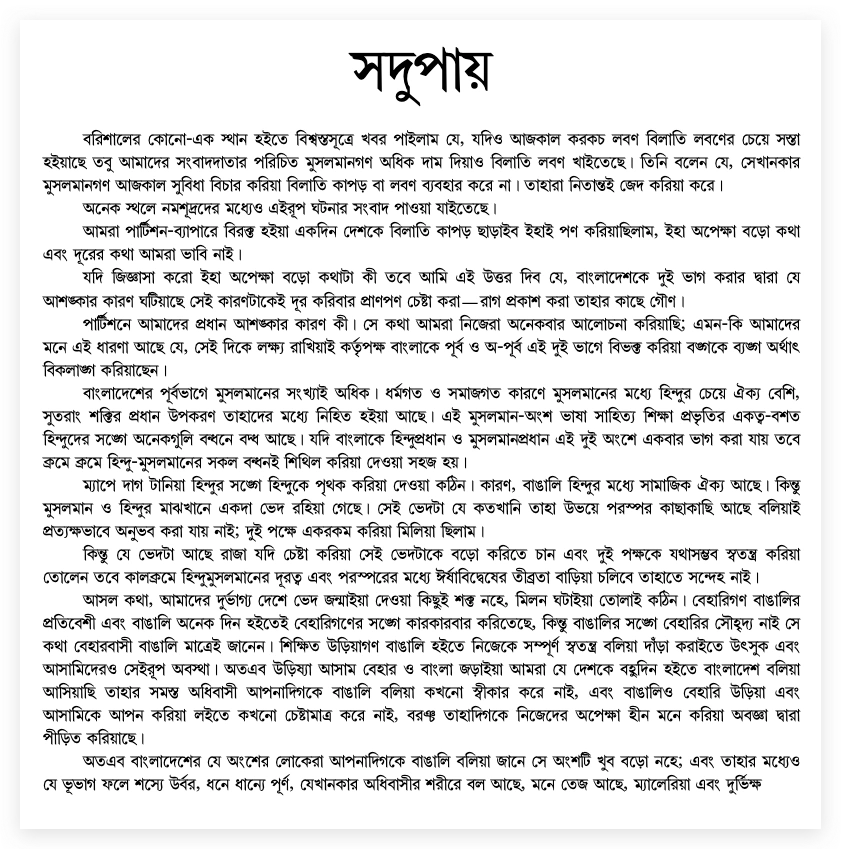
There is a distinction between the name of a territory, its linguistic identity and its identity as an independent state. For example, even while recognising the cultural unity of Bengali-speaking people, West Bengal and Bangladesh can form parts of separate state structures. Similarly, taking a stand in favour of Bengal’s administrative unity in 1905 does not mean taking a stand in favour of keeping East Bengal within the Pakistani state in 1971. Denying this distinction connects Rabindranath’s political position to a question of statehood that did not exist in its present form during his lifetime.
The Communal Limitations of the Swadeshi Movement and Rabindranath’s Political Evolution
One major problem of the Swadeshi movement was its use of cultural and religious symbols. At various stages of the movement, Hindu gods and goddesses, the figure of the mother, Shivaji and Hindu religious festivals were employed as symbols of political organisation. Although these symbols generated powerful emotions among some Hindu participants in the movement, they were not equally acceptable to large sections of the Muslim population. The political use of religious symbols and social contempt towards Muslims weakened the movement’s claim to universal nationalism. Banglapedia’s research on the Partition of Bengal notes that the song Vande Mataram and attempts to establish Shivaji as a national hero provoked adverse reactions among Muslims. In 1907, communal conflicts also occurred in several regions, including Comilla and Jamalpur. [203]
In these circumstances, Rabindranath’s political thinking underwent significant changes. He increasingly criticised nationalist frenzy, political coercion and the tendency to subordinate human freedom to collective glory. His novel Ghare Baire (The Home and the World) presents the conflict between political emotion, the desire for power, economic interests and moral responsibility against the background of the Swadeshi movement. Through the characters of Nikhilesh and Sandip, he constructs two distinct political and moral perspectives on nationalism. Sandip’s political methods involve exerting pressure on people to achieve the objectives of the movement, exploiting emotions and using personal interests. Nikhilesh, by contrast, emphasises people’s freedom to make decisions, moral responsibility and the economic realities of ordinary people. This is not a direct account of historical events; it is an analysis of the moral problems of nationalism through a literary work. [204] [205]
This literary analysis is related to his actual political position. He did not place nationalism above human freedom and dignity. He challenged the tendency to impose coercion upon people, divide communities or sacrifice the economic interests of poor populations in the name of political independence. This was not a simple continuation of his original anti-partition position, but a broader political criticism that developed out of his experiences in that movement. If Rabindranath’s political thought is frozen in the statements he made in a particular year, this transformation disappears from view.
Did Rabindranath’s Opposition to the Partition of Bengal Conflict with the Interests of East Bengal?
Rabindranath’s anti-partition position came into conflict with the political expectations of a significant section of East Bengal’s Muslims. The creation of a separate province had increased East Bengal’s administrative importance, and a large section of Muslim leaders anticipated new political opportunities. The annulment of the partition frustrated those expectations. The success of the movement led by Calcutta-centred educated Hindu society generated a sense of deprivation among East Bengal’s Muslims. This political experience contributed to the subsequent development of Muslim nationalism. [206]
But when a political decision comes into conflict with the expectations of a population, the person taking that decision does not thereby become an enemy of all that population’s rights, advancement and future independence. The subject of a political disagreement is specific. The administrative reorganisation that Rabindranath opposed concerned the division of Bengal within British India. His own statements expressed ideas of cultural unity based on the Bengali language, social cooperation and self-reliance in opposition to colonial authority. This position conflicted with the political expectations of East Bengal’s Muslims; but neither an intention to destroy Muslim education and rights nor opposition to a future independent Bangladesh follows from that conflict.
This distinction is the fundamental dividing line between historical criticism and communal propaganda. Whether Rabindranath’s opposition to the Partition of Bengal adequately considered the administrative interests of East Bengal’s Muslims is a legitimate political question. The extent to which his conception of cultural unity could have resolved the problems of class and educational inequality in East Bengal is also a legitimate question. But declaring him an enemy of Bangladesh’s independence without seeking answers to these questions is not historical analysis. It replaces criticism of an actual political decision with an accusation of an imaginary crime.
The Psychology of Political Falsehood: Reconstructing the Past in the Image of Present-Day Hostilities
A particular method of historical distortion operates in the propaganda presenting Rabindranath as an opponent of Bangladesh. First, an actual event is selected — the anti-partition movement of 1905. The political meaning of that event is then redefined in terms of present-day state and communal identities. The Partition of Bengal is presented as a precursor to Bangladesh’s independence, and opposition to it is transformed into opposition to Bangladesh. Finally, Rabindranath’s Hindu family background is used as the principal explanation for this alleged hostility. As a result, his own published statements, the subsequent evolution of his political thinking, his long residence in East Bengal and his position in favour of the educational advancement of Muslims are all rendered irrelevant.
This method denies the changing political realities of history. The national identity, aspirations for statehood and political objectives of a population can change over time. In 1905, a section of East Bengal’s Muslims supported a separate province; in 1947, Muslim-majority East Bengal became part of Pakistan; in 1971, a large section of the population of that same East Bengal participated in a war of independence against Pakistani rule. These transformations are part of actual history. They cannot be understood by arranging them along a straight line of immutable religious or national identity. Yet communal propaganda judges people of the past as though they already knew the political identities and state borders of the subsequent century.
This method is particularly pronounced in Rabindranath’s case. Selected elements of his identity by birth, anti-partition position and Calcutta-centred literary life are used to construct him as the historical adversary of Bengali Muslims. Yet his own writings contain criticism of Hindu society’s discrimination against Muslims, opposition to the coercion imposed on poor peasants in the name of the Swadeshi movement, and recognition of the need to establish social relationships between people. These actual facts do not fit the narrative of communal hostility. Consequently, selected information, conjecture and political slogans are prioritised over the complete historical sequence of events.
Criticising the political position of a historical figure requires examining the social consequences of that person’s specific decisions, the interests of the populations concerned and the individual’s own statements. Such an analysis may establish the limitations or harmful effects of those decisions. But attributing to that person a position against a future independent state requires that the political existence of that state and the question of its independence were present during that person’s lifetime. In Rabindranath’s case this condition is not met. Therefore, presenting his opposition to the Partition of Bengal as opposition to Bangladesh is a chronological and logical falsehood.
East Bengal, Bengali Identity and Rabindranath’s Historical Position
East Bengal occupied a profound place in Rabindranath’s life. His estate management, literary creations, experiences of rural society and rural reconstruction activities in this territory influenced his life and thought. He opposed the Partition of Bengal on the grounds of Bengali linguistic and cultural unity and social relationships. This position conflicted with some of the political expectations of East Bengal’s Muslims. But he also recognised the need for Muslim educational advancement, criticised communal discrimination within Hindu society and wrote against the coercion imposed on poor peasants in the name of the Swadeshi movement. His own writings reveal an effort to connect political unity with social equality, human dignity and independent thought.
His zamindari system, class position, conception of nationalism and the social consequences of his participation in the anti-partition movement are all subjects of separate criticism. But such criticism must be founded on specific historical events. His opposition to the Partition of Bengal cannot establish the allegation that he opposed the independence of Bangladesh in 1971. Portraying him as a political adversary of a state established thirty years after his death is not history; it is the distortion of past events in accordance with present-day communal hatred.
Rabindranath opposed the Partition of Bengal — this is a historical fact. Rabindranath opposed the independence of Bangladesh — this is false. The first event took place in 1905 under British colonial rule; the second occurred in 1971 through a struggle for independence against the Pakistani state. There are fundamental differences between the two events in political objectives, systems of government, state structures and historical circumstances. Denying those differences and propagating opposition to the Partition of Bengal as opposition to Bangladesh is an expression of historical ignorance and communal hatred. Rabindranath’s actual political decisions can be subjected to rigorous criticism; he cannot be accused of opposing the independence of a state that came into existence many years after his death.
Was Rabindranath a Hindu Nationalist and Anti-Muslim? A Historical Analysis of Brahmoism, Communalism, Religious Orthodoxy, and Humanism
There is a long history of portraying Rabindranath Tagore as a Hindu nationalist and an enemy of Muslims in communal propaganda in Bangladesh. Sometimes the surname ‘Thakur’ attached to his name is used as evidence of Hindu religious supremacism; sometimes the presence of Hindu mythology and Upanishadic philosophy in his literature is cited as evidence of Hindutva; and sometimes selected passages from his critical statements about Islam and Muslim society are quoted to portray him as an enemy of Muslims. Added to these accusations are his participation in the anti-partition movement, his family’s connections with the Hindu elite of Calcutta, and the controversy over the number of Muslim characters in his literary works. On this basis, a simplistic conclusion is propagated: Rabindranath represented Hindu communalism, and his hatred of Muslims was one of the foundations of his literary and political thought.
This narrative conflates Rabindranath’s religious identity, use of literary symbolism, social criticism and political ideology. His family’s religious tradition was associated with Brahmoism. His father, Debendranath Tagore, was one of the principal leaders of the Brahmo Samaj. Rabindranath himself served as secretary of the Adi Brahmo Samaj. His religious thought incorporated Upanishadic monotheism, the religious reforms of the Brahmo Samaj, Baul philosophy, personal spiritual inquiry and the concept of the religion of man. Hindu cultural traditions also influenced his thinking, and the expression of that influence changed at different stages of his life. This history is ideologically distinct from modern political Hindutva. Having connections with a religious tradition, holding religious beliefs, using religious symbols as literary material, and advocating the establishment of political authority in the state and society on the basis of religious majority status are separate matters. A person’s religious identity is not self-sufficient evidence of their political ideology.
A similar distortion occurs in the accusation that Rabindranath hated Muslims. His writings contain severe criticism of Islam, Christianity, Hinduism and the social conduct of various religious communities. In particular, he attacked religious exclusivism, pressure to convert, caste discrimination, untouchability, ritualism and the tendency to impose religious restrictions on intellectual inquiry. In some statements his generalisations are extremely broad and open to criticism. But criticising a particular religious doctrine or social practice is not the same as denying the rights and dignity of its adherents. Rabindranath’s own writings on educational equality for Muslims, social respect, political representation and the discriminatory conduct of Hindu society provide evidence contrary to his portrayal as a representative of wholesale hatred towards the Muslim population.
Abdur Razzaq bin Yusuf’s Statements: Turning Rabindranath into a Religious Enemy
The sermon clip below is a direct example of communal propaganda against Rabindranath. Here Abdur Razzaq bin Yusuf identifies Rabindranath as an enemy of Islam. This designation places a writer within a framework of religious allegiance and enmity. The question of assessing the arguments, statements and literary merits of his particular works is thereby transformed into a question of choosing a religious side. If a writer’s statement is wrong, that error must be established through a reading of his works and through evidence. Declaring him an enemy of religion is no substitute for that task.
Video: Abdur Razzaq bin Yusuf's statements about RabindranathCriticising a belief or rule of Islam, or a practice in Muslim society, does not in itself make a writer anti-Muslim. Questioning the truth and morality of a doctrine and denying equal rights to the people who follow it are entirely different positions. Conflating the two exempts religious doctrines from criticism. In Rabindranath’s case too, the nature of his criticism must be determined by the subject, target and reasoning of his specific statements.
The political significance of this designation of an enemy is also clear. It establishes the religious preacher’s authority over the decision to accept or reject literature: instead of independently judging a writer’s work, allegiance or aversion to that writer is presented as an expression of religious identity. Literary disagreement can consequently become a test of communal loyalty. The truth of specific allegations against Rabindranath then recedes into the background; what comes to the forefront is the pressure to demonstrate one’s religious identity by rejecting him.
Rabindranath’s Actual Religious Identity: Brahmoism and Religious Reform in the Tagore Family
The history of the foundation and development of the Brahmo Samaj in nineteenth-century Bengal is important for understanding Rabindranath’s religious identity. The Brahmo Sabha was founded in 1828 as a continuation of Raja Rammohan Roy’s religious reform movement. It subsequently became known as the Brahmo Samaj. Upanishadic monotheism, rational criticism of religion, opposition to idol worship, criticism of religious orthodoxy and the idea of social reform were important elements of Rammohan’s religious thought. He reinterpreted monotheistic thought from within the Hindu religious tradition and was also familiar with theological discussions in Islam and Christianity. Different interpretations of these ideas developed at various stages of the Brahmo Samaj.
Debendranath Tagore assumed an important leadership role in the Brahmo Samaj during the 1840s. Under his leadership, a distinct framework of Brahmo rituals, worship and religious instruction developed. Differences subsequently emerged within the Brahmo Samaj itself. A section led by Keshab Chandra Sen advocated relatively rapid change in matters of religious and social reform. The section led by Debendranath became known as the Adi Brahmo Samaj. The positions of these groups on religious traditions, caste discrimination, marriage customs and social rituals were not identical. In particular, the tendency to maintain links with Hindu social traditions was comparatively strong within the Adi Brahmo Samaj. Rabindranath grew up in this environment. In September 1884, he was appointed secretary of the Adi Brahmo Samaj. [207]
Just as it is wrong to reduce Rabindranath’s religious identity to the Hindu identity into which he was born, it is also wrong to conclude that Hindu social and cultural traditions had no influence on his thought because he was associated with the Brahmo Samaj. Brahmoism itself is deeply connected with the history of nineteenth-century Hindu social reform in Bengal. Although different branches of the Brahmo Samaj adopted different positions on idol worship, caste discrimination and religious rituals, an important part of their social base consisted of educated, upper-caste Bengali society. Rabindranath’s family was also part of that society. It was therefore hardly surprising that tensions between the ideals of Brahmoism and established Hindu social customs existed in his religious life, family rituals and social decisions.
There is also critical research on the complexity of Rabindranath’s religious and social position. Document-based discussions examine his family’s marriage customs, the wearing of the sacred thread, the rituals of the Adi Brahmo Samaj and his personal social decisions. These studies also identify discrepancies between his professed liberal religious ideals and actual family practices. But having connections with upper-caste family traditions and being an ideological adherent of modern political Hindutva are not the same thing. The former concerns social and historical identity; the latter concerns a specific political ideology. [208]
The Distinction Between Hinduism, Brahmoism and Political Hindutva
The word ‘Hindu’ has been used at different times in South Asian history as a religious, social, cultural and geographical designation. Modern political Hindutva, by contrast, is a particular nationalist ideology that politically defines the relationship between Indian nationhood and Hindu cultural and historical identity. Vinayak Damodar Savarkar’s 1923 book Essentials of Hindutva was important in the development of modern Hindutva political thought. The Rashtriya Swayamsevak Sangh was founded in 1925. These institutions and ideologies are not directly synonymous with the monotheistic religious reform movement of the nineteenth-century Brahmo Samaj.
Rabindranath incorporated numerous elements of Hindu cultural heritage into his literature and philosophy. But important aspects of his political thought contain criticism of an exclusive national identity based on the religious majority and of narrow nationalism. In particular, his novel Gora examines the limitations of Hindu national identity and the question of a broader human social identity. Literary scholar Ashim Dutta has analysed the development of this aspect of Rabindranath’s thought in his article Tagore’s Exploration of Hindu Identity in Gora. The study distinguishes the discussion of Hindu identity in Gora from the exclusionary ideology of later political Hindutva. It was published in the Journal of Commonwealth Literature. [209]
Rabindranath’s early nationalist thinking was influenced by Hindu cultural revivalism. In particular, the use of Hindu social and cultural symbols can be found in his association with the Swadeshi movement during the first decade of the twentieth century. There are substantive grounds for criticising his thinking during that period. But his political and philosophical positions did not remain static. Following his experiences of the frenzy of the Swadeshi movement, communal divisions and political coercion, his criticism of nationalism became more intense. Gora, The Home and the World, Nationalism and his subsequent essays bear witness to that transformation. Presenting the nationalist statements of one phase of his life as his immutable political ideology throughout his entire life denies the changing course of history.
The Novel ‘Gora’: From the Limitations of Hindu Identity to a Broader Human Identity
Rabindranath’s novel Gora is one of the most important works in Bengali literature dealing with religious identity, nationalism, caste and social divisions. It was serialised in the journal Prabasi between 1907 and 1909 and published in book form in 1910. Its central character, Gourmohan, is initially a staunch Hindu nationalist. To him, Hindu religious traditions and social identity constitute the centre of India’s national identity. He attaches great importance to religious rituals, caste distinctions and the established boundaries of Hindu society. But as the novel unfolds, a fundamental truth about his own origins emerges. He learns that he is not Hindu by birth: he is the child of an Irish couple. This discovery shatters the foundations of the religious and national identity he had hitherto embraced.
In the final part of the novel, Gora realises that belonging to a particular religious community is not essential to loving India. The country’s broader identity is to be found in establishing relationships with people across the boundaries of religious identity, birth, caste and social customs. In his conversation with Paresh Babu, Gora rediscovers himself as an Indian. [210]
গোরা কহিল, “আমার কথা কি আপনি ঠিক বুঝতে পারছেন? আমি যা দিন-রাত্রি হতে চাচ্ছিলুম অথচ হতে পারছিলুম না, আজ আমি তাই হয়েছি। আমি আজ ভারতবর্ষীয়। আমার মধ্যে হিন্দু মুসলমান খৃস্টান কোনো সমাজের কোনো বিরোধ নেই। আজ এই ভারতবর্ষের সকলের জাতই আমার জাত, সকলের অন্নই আমার অন্ন। দেখুন, আমি বাংলার অনেক জেলায় ভ্রমণ করেছি, খুব নীচ পল্লীতেও আতিথ্য নিয়েছি–আমি কেবল শহরের সভায় বক্তৃতা করেছি তা মনে করবেন না–কিন্তু কোনোমতেই সকল লোকের পাশে গিয়ে বসতে পারি নি–এতদিন আমি আমার সঙ্গে সঙ্গে একটা অদৃশ্য ব্যবধান নিয়ে ঘুরেছি–কিছুতেই সেটাকে পেরোতে পারি নি। সেজন্যে আমার মনের ভিতরে খুব একটা শূন্যতা ছিল। এই শূন্যতাকে নানা উপায়ে কেবলই অস্বীকার করতে চেষ্টা করেছি–এই শূন্যতার উপরে নানাপ্রকার কারুকার্য দিয়ে তাকেই আরো বিশেষরূপ সুন্দর করে তুলতে চেষ্টা করেছি! কেননা, ভারতবর্ষকে আমি যে প্রাণের চেয়ে ভালোবাসি–আমি তাকে যে অংশটিতে দেখতে পেতুম সে অংশের কোথাও যে আমি কিছুমাত্র অভিযোগের অবকাশ একেবারে সহ্য করতে পারতুম না। আজ সেই-সমস্ত কারুকার্য বানাবার বৃথা চেষ্টা থেকে নিষ্কৃতি পেয়ে আমি বেঁচে গেছি পরেশবাবু!”
English translation:
Gora said, “Do you understand exactly what I mean? Today I have become what I wished to become day and night, but could not. Today I am an Indian. Within me there is no conflict between Hindu, Muslim or Christian communities. Today the caste of everyone in India is my caste, and everyone’s food is my food. You see, I have travelled through many districts of Bengal and accepted hospitality even in the humblest villages—do not think that I have merely delivered speeches at urban meetings—but I could never go and sit beside everyone. All this time I have carried an invisible barrier about with me, and I could never cross it. That left a great emptiness within my mind. In many ways I kept trying to deny this emptiness, trying to make it particularly beautiful by adorning it with all kinds of ornamentation! For I love India more than my own life, and in the part of her that I could see, I could not tolerate even the slightest grounds for complaint. Today, Paresh Babu, I am relieved to be freed from the futile endeavour of fashioning all those ornaments!”
But in the overall course of the novel, Gora’s transformation from religious exclusivism towards a broader human identity is a central literary construction. The character who initially regarded the preservation of the superiority and purity of his Hindu identity as his foremost duty ultimately realises that birth and religious rituals are not the ultimate foundations of human relationships. This transformation is also connected with the evolution of Rabindranath’s political and philosophical thought.
To present Gora simply as propaganda for religious nationalism is therefore to deny the central conflict and resolution of the work. Gora’s Hindu nationalist statements are present in the early part of the novel, but those statements are not the novel’s ultimate conclusion. The dismantling of the character’s worldview is itself one of the principal themes of the novel. Treating a fictional character’s initial statements as the author’s ultimate ideology while omitting the transformation at the end is a distortion of literary interpretation.
Rabindranath’s Severe Criticism of Muslims: His Actual Statements and Their Limits
Among the passages most frequently used to accuse Rabindranath of hatred towards Muslims are several statements from his essay Hindumusalman (Hindus and Muslims). In this essay, he severely criticises the religious exclusivism of Islam and Christianity. His statements refer to the tendency of these two religions to come into conflict with other religions. He uses extremely harsh language about Islam and Christianity on questions of conversion, religious authority and social coexistence. These statements are preserved in his own writings. [211]
পৃথিবীতে দুটি ধর্মসম্প্রদায় আছে অন্য সমস্ত ধর্মমতের সঙ্গে যাদের বিরুদ্ধতা অত্যুগ্র– সে হচ্ছে খৃস্টান আর মুসলমান-ধর্ম। তারা নিজের ধর্মকে পালন করেই সন্তুষ্ট নয়, অন্য ধর্মকে সংহার করতে উদ্যত। এইজন্যে তাদের ধর্ম গ্রহণ করা ছাড়া তাদের সঙ্গে মেলবার অন্য কোনো উপায় নেই। খৃস্টানধর্মাবলম্বীদের সম্বন্ধে একটি সুবিধার কথা এই যে, তারা আধুনিক যুগের বাহন; তাদের মন মধ্যযুগের গণ্ডীর মধ্যে আবদ্ধ নয়। ধর্মমত একান্তভাবে তাদের সমস্ত জীবনকে পরিবেষ্টিত করে নেই। এইজন্যে অপরধর্মাবলম্বীদেরকে তারা ধর্মের বেড়ার দ্বারা সম্পূর্ণ বাধা দেয় না। য়ুরোপীয় আর খৃস্টান এই দুটো শব্দ একার্থক নয়। ‘য়ুরোপীয় বৌদ্ধ’ বা ‘য়ুরোপীয় মুসলমান’ শব্দের মধ্যে স্বতোবিরুদ্ধতা নেই। কিন্তু ধর্মের নামে যে-জাতির নামকরণ ধর্মমতেই তাদের মুখ্য পরিচয়। ‘মুসলমান বৌদ্ধ’ বা ‘মুসলমান খৃস্টান’ শব্দ স্বতই অসম্ভব। অপর পক্ষে হিন্দুজাতিও এক হিসাবে মুসলমানদেরই মতো। অর্থাৎ, তারা ধর্মের প্রাকারে সম্পূর্ণ পরিবেষ্টিত। বাহ্য প্রভেদটা হচ্ছে এই যে, অন্য ধর্মের বিরুদ্ধতা তাদের পক্ষে সকর্মক নয়– অহিন্দু সমস্ত ধর্মের সঙ্গে তাদের non-violent non-co-operation। হিন্দুর ধর্ম মুখ্যভাবে জন্মগত ও আচারমূলক হওয়াতে তার বেড়া আরও কঠিন। মুসলমানধর্ম স্বীকার করে মুসলমানের সঙ্গে সমানভাবে মেলা যায়, হিন্দুর সে পথও অতিশয় সংকীর্ণ।
English translation:
There are two religious communities in the world whose opposition to all other religious doctrines is extremely intense: Christianity and Islam. They are not content merely to practise their own religion; they are intent on destroying other religions. For this reason, there is no other way of uniting with them except by accepting their religion. One favourable circumstance concerning the followers of Christianity is that they are the bearers of the modern age; their minds are not confined within the boundaries of the Middle Ages. Religious doctrine does not exclusively encompass their entire lives. Consequently, they do not completely shut out followers of other religions by means of religious barriers. The words ‘European’ and ‘Christian’ are not synonymous. There is no inherent contradiction in the terms ‘European Buddhist’ or ‘European Muslim’. But when a people is named after a religion, its principal identity lies in religious doctrine. The terms ‘Muslim Buddhist’ or ‘Muslim Christian’ are inherently impossible. On the other hand, the Hindu community is also like the Muslims in one respect. That is, they are entirely surrounded by the ramparts of religion. The outward difference is that their opposition to other religions is not active: their attitude towards all non-Hindu religions is one of non-violent non-co-operation. Since Hindu religion is primarily hereditary and ritualistic, its barriers are even more rigid. By accepting Islam, one can associate with Muslims on equal terms; for Hindus, even that avenue is exceedingly narrow.
This statement is a criticism of the religious exclusivism of Islam and Christianity. Historically, various institutions and political powers belonging to both religions have undertaken missionary activity, conversion and the establishment of authority over other religions. The religious wars of Christian Europe, colonial missionary activity, and the history of religious law and political authority in various Muslim empires constitute substantive material for that discussion. But portraying Islam and Christianity in their entirety as possessing a single, immutable pattern of conduct is a sweeping generalisation. The theological exclusivism of a religion, the actions of its particular political institutions and the actual behaviour of its followers in different societies around the world are not the same thing. Rabindranath’s statements do not always distinguish accurately between these separate levels. His generalisation is therefore open to criticism.
But in the same essay he identified the social divisions of Hinduism as an even more difficult problem. Alongside the religious exclusivism of Muslim society, his argument contains a detailed analysis of hereditary caste discrimination, ritualism, untouchability and restrictions on social interaction with people of other religions in Hindu society. He wrote that although boundaries in Muslim society were constructed on the basis of religious identity, Hindu society had constructed barriers on the basis of birth and social customs that could not easily be overcome even through conversion or a change of opinion. He believed that the path towards accepting people of other identities as equals in Hindu society was even narrower than the path towards establishing relations of social equality with Muslims.
The most important part of this criticism concerns Rabindranath’s own experiences as a zamindar. He mentions that at the estate office, one end of the carpet would be folded back to seat Muslim tenants. The refusal to allow Muslim tenants to sit on the same seating as Hindu tenants was a direct example of social untouchability. Rabindranath identified this as a formidable barrier to human fellowship. In his account, the ritual prohibitions of Hindu society were not merely a problem in relations with Muslims; they also obstructed the social freedom of independently thinking people within Hindu society itself.
Extracting a sentence from Rabindranath’s essay Hindumusalman to prove that he hated Muslims, while ignoring his severe criticism of Hinduism in the same essay, constitutes a selective reading. The first part of his statement criticises religious exclusivism; the subsequent part criticises social untouchability and divisions based on birth. The two parts address different aspects of the same social problem. It does not follow that a critic who severely criticises a religious ideology hates all adherents of that religion.
The central discussion in this essay identifies the obstacles to social fellowship between Hindus and Muslims. Religious rules and social customs construct barriers between people that undermine political unity. He regards social change, education, independent thought and the development of interpersonal relationships as the foundations for resolving this problem. His criticism is connected with the need to expand human freedom and intellectual inquiry while preserving the identities of religious communities.
Rabindranath Against Caste Discrimination, Untouchability and Religious Orthodoxy in Hindu Society
Rabindranath’s criticism of social authority in Hindu society was not confined to his essay Hindumusalman. In his essay Kartar Ichchhay Karma (Action at the Master’s Will), he analysed the crisis of independent human thought under religious and social authority. He demonstrates how accepting society’s religious and ritual prescriptions as immutable truths causes people to fear exercising their own judgement. Accepting the instructions of scriptures, priests and social authorities as final diminishes the individual’s capacity for independent thought and moral decision-making.
In this essay Rabindranath specifically uses examples of caste and food-related untouchability in Hindu society. He shows that even when someone brings hygienic drinking water, that water may be considered impure solely because the person is Muslim; conversely, even when water is collected unhygienically, it may be considered acceptable because of a particular social identity. He severely attacks this tendency to attach greater importance to the instructions of social authorities than to human health, reason and practical needs. [212]
এই জবাবই সত্য জবাব। যদি নাছোড়বান্দা হইয়া কোনো একগুঁয়ে মানুষ এই জবাব দিয়া কর্তৃপক্ষকে বেজার করিয়া তোলে তবে সেদিক হইতে সে ইন্টার্নড্ হইতে পারে কিন্তু এদিক হইতে বাহবা পায়। অথচ ঠিক এই জবাবটাই যদি আমাদের সমাজকর্তাদের কাছে দাখিল করি, যদি বলি “তোমরা বল, যুগটা কলি, আমাদের বুদ্ধিটা কম, স্বাধীন বিচারে আমাদের ভুল হয়, স্বাধীন ব্যবহারে আমরা অপরাধ করি, অতএব মগজটাকে অগ্রাহ্য করিয়া পুঁথিটাকে শিরোধার্য করিবার জন্যই আমাদের নতশিরটা তৈরি, কিন্তু এতবড়ো অপমানের কথা আমরা মানিব না,” তবে চণ্ডীমণ্ডপের চক্ষু রাঙা হইয়া ওঠে এবং সমাজকর্তা তখনই সামাজিক ইন্টার্নমেণ্ট এর হুকুম জারি করেন। যাঁরা পোলিটিকাল আকাশে উড়িবার জন্য পাখা ঝটপট করেন তাঁরাই সামাজিক দাঁড়ের উপর পা-দুটোকে শক্ত শিকলে জড়াইয়া রাখেন।
English translation:
This answer is the true answer. If some obstinate person persistently gives this answer and thereby irritates the authorities, he may be interned by them, but he wins applause on our side. Yet if we submit precisely this answer to our social authorities, if we say, “You tell us that this is the age of Kali, that our intelligence is deficient, that we make mistakes in independent judgement and commit offences in independent conduct, and that our bowed heads are therefore made to disregard our brains and carry the scriptures upon them; but we will not accept such an insult,” then the eyes of the village Chandi pavilion flare with anger, and the social authorities immediately issue an order for social internment. Those who flutter their wings to fly in the political skies are the very people who bind their two feet in heavy chains upon the social perch.
The philosophical significance of this statement is profound. Rabindranath identifies here the conflict between independent human judgement and religious and social authority. A rule does not become rational simply because it appears in an ancient religious text, because a priest or social leader has pronounced it sacred, or because people have observed it for generations. Its practical consequences, its impact on people and its rational foundations must be examined. In Rabindranath’s criticism, this capacity for independent judgement is one of the conditions of human social emancipation.
His position against religious authority is particularly important here. He criticised a social system in which people learn to distrust their own intelligence and accept traditional prescriptions as immutable truths. This mentality is not confined to religious rituals; it also affects political authority, social hierarchies and individual freedom. A person unable to make independent decisions in private life easily becomes subject to authority in the political sphere as well. Rabindranath therefore analysed religious orthodoxy not merely as a problem of personal belief but also as an important cause of social and political subjugation.
Religious Blindness, Communal Violence and ‘Dharmamoha’
One of the most powerful literary expressions of Rabindranath’s criticism of religion is his poem Dharmamoha (Religious Delusion). Here he directly attacks violence against people in the name of religion, the killing of followers of other religions, the use of religious rituals as a substitute for morality and the tendency to blind human judgement. The poem’s argument is not confined to opposition to any one religious community. When religious authority becomes an instrument of violence, hatred and division instead of human welfare, it is that religious authority itself that he attacks.
In the poem he refers to an atheist who does not make a display of religious rituals but attaches importance to human welfare and exercises independent judgement. In contrast, he morally condemns the person who kills in the name of religion. In this comparison, human welfare and moral conduct, rather than religious identity, become the principal criteria. [213]
শ্রদ্ধা করিয়া জ্বালে বুদ্ধির আলো,
শাস্ত্রে মানে না, মানে মানুষের ভালো।
English translation:
With reverence he kindles the light of reason,
He heeds not scripture, but the good of humankind.
This statement reveals an important aspect of Rabindranath’s religious thought. He was not himself an atheist. God, spirituality and the idea of a broader human moral being were important in his religious philosophy. But he did not accept religious identity as the sole criterion of morality. He accorded moral dignity to people who lacked religious belief but worked for human welfare. Conversely, he morally condemned those who used religious identity to perpetrate violence and oppression. This criticism of religious authority is inseparably connected with the questions of human welfare and independent judgement.
The political significance of the poem Dharmamoha is also important. When violence is perpetrated in the name of religion, the aggressor can present himself as the representative of a sacred cause. Consequently, attempts are made to legitimise killing, torture and the deprivation of others’ rights as religious duties. Rabindranath attacked this moral catastrophe. In his argument, neither religious identity nor scriptural sanction can make unjust treatment of human beings legitimate. Violence committed in the name of religion remains a moral crime beneath the cloak of religious identity.
Rabindranath on Muslim Education, Administrative Opportunities and Social Equality
Rabindranath’s own published statements contradict the claim that he opposed the educational advancement of Muslims. In his presidential address to the Pabna Provincial Conference in 1908, he acknowledged that Hindu society was relatively advanced in English education, government employment and access to administrative opportunities. He also spoke of the need to overcome the actual disadvantages faced by Muslims. He believed that eliminating educational and administrative inequalities was essential to establishing genuine social equality between the two communities.
A similar position appears in his 1911 essay Hindu University. In it, he noted that Muslims lagged behind in modern education and regarded their demand for greater opportunities as legitimate. He stated that Muslims attaining equality in education and administrative standing would also benefit Hindu society. [214]
পদ মান শিক্ষায় তাহারা হিন্দুর সমান হইয়া উঠে ইহা হিন্দুরই পক্ষে মঙ্গলকর।
English translation: That they should attain equality with Hindus in position, status and education is beneficial to Hindus themselves.
The political meaning of this statement is clear. Rabindranath did not regard the educational advancement of Muslims as a loss for Hindu society. Rather, he considered equal opportunities for a community that had long lagged behind to be an essential part of the progress of society as a whole. In communal political thinking, the advancement of one community is often portrayed as a loss of power for another. Rabindranath’s statement stands in opposition to this competitive conception.
This position is particularly significant because these statements preceded the official announcement of the establishment of the University of Dhaka. He discussed positively the need to establish a separate institution for Muslim higher education. His statements addressed the relationship between the pursuit of modern knowledge and religious and cultural distinctiveness. He opposed confining any university within religious narrowness, but he did not deny the need for distinct institutions of higher education for Muslims.
The Establishment of Islamic, Arabic, Persian and Urdu Studies at Visva-Bharati
The institutional history of Visva-Bharati, founded by Rabindranath, is particularly important in relation to allegations of his hostility towards Muslims. In 1927, on his initiative, a centre for Arabic, Persian, Urdu and Islamic Studies was established at Visva-Bharati. Mir Osman Ali Khan, the Nizam of Hyderabad, donated one lakh rupees to establish the institution. The history of the department on Visva-Bharati’s own website explicitly states that Rabindranath himself conceived and implemented the initiative. [215]
The idea of giving shape and form of such centre of learning of Arabic, Persian, Urdu and Islamic Studies was conceived and materialized by Tagore himself in the year 1927 with generous donation of Rupees One lakh by the then Nizam of Hyderabad.
This document is especially significant because it records not merely a courteous statement by Rabindranath about Muslims, but the establishment of institutional research into Islamic traditions, languages and literature at the educational institution he himself founded. A person can take a critical position towards the doctrines of another religion while recognising the necessity of studying its history, literature, philosophy and languages. This freedom of intellectual inquiry was an important element of Rabindranath’s plans for Visva-Bharati.
By establishing facilities for the study of Arabic, Persian and Urdu, he sought to incorporate the cultural connections between South Asia and West Asia into education. Visva-Bharati’s official account also identifies research into the literature and culture of Iran, Afghanistan, Turkey and various regions of Central Asia as an objective. Rather than confining Indian culture within a particular religious tradition, this plan expresses the aim of establishing intellectual connections between different languages and civilisations.
The Allegation That Muslim Characters Are Absent from Rabindranath’s Literature
Another widespread allegation about Rabindranath’s literature is that he supposedly never wrote about Muslims or included Muslim characters in his stories. This claim is plainly false. His writings contain Muslim characters, the history of Muslim rule, Islamic social settings and various representations of Hindu–Muslim relations. Notable examples include Kabuliwala, Samasyapuran (The Solution), Kshudhita Pashan (The Hungry Stones), Durasha (The Impossible Hope), Dalia and Musalmanir Galpa (The Story of a Muslim Woman). Muslim characters do not play identical roles in these works. In some, personal relationships are central; in others, historical memory, religious identity or social inequality becomes the principal subject. [216]
How frequently Muslim characters appear, which social classes of Muslims are better represented, and whether literary biases exist in their portrayal are separate subjects of research. The representation of different classes of Muslim society in relation to Rabindranath’s enormous literary output can legitimately be criticised. But these possible limitations of representation do not establish the conclusion that he harboured hostility towards Muslims as a whole. The relatively limited presence of a community in a body of literature and a political intention to hate that community are not the same thing. The second claim requires separate and direct evidence.
In particular, Musalmanir Galpa (The Story of a Muslim Woman) is an important document of Rabindranath’s literary position on communalism and social inequality. Kamala, the central character of the story, is a girl from a Brahmin family. When she faces a social catastrophe, she is rescued by a Muslim man, Habir Khan. Initially, Kamala feels reluctant to seek shelter in a Muslim household. Habir Khan then assures her of safety and religious freedom. The Muslim character in the story is portrayed as humane, responsible and respectful of the beliefs of people belonging to another religion. [217]
তুমি হিন্দু ব্রাহ্মণের মেয়ে, মুসলমানের ঘরে যেতে সংকোচ হচ্ছে। কিন্তু একটা কথা মনে রেখো–যারা যথার্থ মুসলমান, তারা ধর্মনিষ্ঠ ব্রাহ্মণকে সম্মান করে।
English translation: You are the daughter of a Hindu Brahmin, and you feel reluctant to enter a Muslim household. But remember one thing: those who are truly Muslims respect a devout Brahmin.
The literary significance of this story is profound. Instead of judging people on the basis of their inherited religious identity, it gives precedence to individual conduct, humanity and respect for the freedom of others. Habir Khan, a Muslim, protects a girl of another religion and promises to preserve her religious identity. An important contrast emerges between this humane conduct and the Hindu social environment depicted in the story. In Rabindranath’s literary imagination, Muslim characters were not presented solely as enemies, attackers or religious adversaries; they were also made representatives of human dignity and refuge.
Rabindranath’s literary characters, of course, do not represent every individual in actual Muslim society. Portraying a Muslim as a humane character in a story does not eliminate every problem in the author’s social and political statements. But the allegation that his literary imagination contained nothing but hostility towards Muslims contradicts this story. Similarly, in Kabuliwala, the relationship between Rahman, an Afghan Muslim trader, and a Bengali child depicts fatherhood, separation and shared human emotions, constructing a literary representation of human relationships beyond religious identity.
Rabindranath’s Relationship with Islamic and Persian Cultural Traditions
Persian literature and Sufi spirituality also had an important influence on Rabindranath’s religious and literary thought. His father, Debendranath Tagore, was an admirer of the works of the Persian poet Hafez. In the cultural environment of the Tagore family, Persian and English literature were discussed alongside Bengali and Sanskrit literature. Various references to Hafez, Sufi philosophy and Islamic cultural traditions appear in Rabindranath’s own writings and lectures.
In 1932, Rabindranath visited Persia. He toured literary and historical sites in Iran and visited the tomb of Hafez in Shiraz. This journey was a significant expression of his longstanding appreciation of Persian literature. Accounts of the visit are preserved in his travel writings and contemporary newspapers. A research-oriented discussion of Rabindranath’s literature and religious thought published in 2025 also examines his relationship with Islamic traditions, Persian literature and Hafez. [218] [219]
This relationship cannot be equated with endorsement of religious doctrines. Appreciating Persian literature, Sufi philosophy or a historical contribution of Islamic civilisation does not mean accepting every claim of Islamic theology as true. Likewise, criticising a claim of Islamic theology does not mean harbouring hostility towards the literature, music and philosophy of that tradition. These distinct levels are present in Rabindranath’s thought. He criticised religious doctrines while also drawing literary and philosophical elements from diverse religious and cultural traditions. Ignoring these actual relationships and portraying him as an enemy of Islamic culture is a distortion of history.
Rabindranath’s Social Philosophy Against Communalism and Hostility to Knowledge
A fundamental premise of Rabindranath’s religious and social criticism is that independent human thought and moral judgement cannot be subordinated to the blind authority of any religious or social institution. Different expressions of this idea appear in his writings Kartar Ichchhay Karma (Action at the Master’s Will), Hindumusalman (Hindus and Muslims), Byadhi O Pratikar (Disease and Remedy), Samasya (The Problem) and Dharmamoha (Religious Delusion). In some he criticised untouchability and excessive ritualism in Hindu society; in others he criticised the exclusivism of Muslim and Christian religious institutions, wrote against communal violence, or established the necessity of independent intellectual development.
Within this social philosophy, religious identity and morality are separate questions. A person’s conduct does not become just merely because that person follows a particular religion. Likewise, the humane conduct of someone without a religious affiliation does not become worthless. Moral decisions must be determined on the basis of independent human judgement, the rights of others, mutual respect and social welfare. Although Rabindranath’s religious thought included spiritual beliefs, his objections to the blindness and violence perpetrated in the name of religious institutions were unmistakable.
His analysis of relations between Hindu and Muslim societies was also part of this broader social philosophy. He identified longstanding social isolation, distrust and unequal power relations between the two communities. In particular, he regarded the Hindu practice of treating Muslims as untouchable and the social contempt directed towards them as profound problems. The contradiction between proclaiming Hindu–Muslim unity when politically necessary and denying Muslims equal dignity in everyday social life recurs throughout his criticism.
This position contradicts the portrayal of Rabindranath as an unqualified representative of Hindu communal authority. He did not accept all prevailing practices and institutions of Hindu society as true and just. Rather, whenever religious identity became an obstacle to human freedom and social relationships, he questioned the authority of that identity itself.
The Distinction Between Rabindranath’s Genuine Limitations and False Allegations
There are legitimate subjects of criticism in the actual history of Rabindranath’s religious and social thought. His Brahmo identity was connected to the tradition of upper-caste Hindu social reform. Prevailing Hindu social customs also influenced his personal and family life. Elements of Hindu cultural revivalism appear in his early nationalist thought. Some of his generalisations about Islam and Christianity are excessively broad. In matters of language and literary taste, his judgements were not always equally sensitive to religious and social diversity. These are legitimate subjects of documentary criticism.
In particular, in his essay Hindumusalman (Hindus and Muslims), his statements about the relationship of Islam and Christianity with other religions display not only criticism of religious exclusivism but also a tendency to reduce large communities to a single set of behavioural characteristics. Such generalisations cannot be accepted as infallible historical truths. Religious doctrine, political institutions, social history and individual conduct are distinct. The conclusion that a theological claim determines the conduct of all its adherents is unacceptable without evidence. Rabindranath’s statements must also be judged by this logical standard.
But the conclusion that he was an enemy of Muslim rights and educational advancement does not follow from these genuine limitations. His own published statements support educational equality and social dignity for Muslims. An institution for Islamic Studies and Persian and Arabic education was established at Visva-Bharati, which he founded. His literature contains humane portrayals of Muslim characters. He severely criticised untouchability, caste discrimination and religious authority in Hindu society. His political and literary thought changed at different stages of his life. These direct documents cannot be denied in order to confine him to a one-dimensional communal identity.
The Political Purpose of Distorting Rabindranath’s Identity in Communal Propaganda
The allegation of Rabindranath’s hostility towards Muslims cannot be separated from the political and cultural history of Bangladesh. After the establishment of Pakistan, attempts began to reconstruct the language, literature and culture of East Bengal under a religious national identity. In this process, Rabindranath’s Hindu family background was used against the acceptance of his literary and cultural legacy. In the effort to establish Muslim identity, rather than the cultural heritage rooted in the Bengali language, as the principal criterion of national culture, Rabindranath became the focus of a particular controversy. Disputes over his songs, literature and relationship with the national cultural identity of Bangladesh subsequently became more extensive.
Modern research has also examined the history of this political conflict. The study Swing of the Pendulum: Identity Politics and the Ideological Strife over Rabindranath Tagore and the National Anthem in Bangladesh, published in the International Journal of Asian Studies, discusses the continuity of identity-based political conflict over Rabindranath and his music from the Pakistan period to independent Bangladesh. It analyses attempts to portray Rabindranath as a representative of Hindu communalism and to deny the legitimacy of the national anthem he composed in connection with the conflict between religious and linguistic national identities in Bangladesh. [220]
In this political process, Rabindranath’s religious identity is used as a substitute for evidence of his literary and social positions. He was a Brahmo, his literature was influenced by Hindu traditions, and he opposed the Partition of Bengal: these separate facts are combined to construct him as a historical enemy of Muslims. But his own published statements and actions do not correspond to that simplistic identity. In particular, his statements supporting Muslim educational advancement, criticism of untouchability in Hindu society, initiative to establish Islamic Studies and humane literary portrayal of Muslim characters constitute evidence contradicting this constructed image of an enemy.
A fundamental problem of communal thinking is that an individual’s identity is determined not by their own opinions and actions but by their inherited religious identity. A writer born into a Hindu family may express positive views about the social rights of Muslims and still be labelled hostile to Muslims if religious identity itself is accepted as evidence of guilt. Similarly, a Muslim writer who acknowledges the positive cultural contributions of Hindu society can be portrayed as an opponent of their own community. In this identity-based system of judgement, independent thought and actual conduct have no significance. The presence of this mentality is evident in the construction of allegations against Rabindranath in communal propaganda.
Historical evidence concerning Rabindranath’s religious and political identity presents a different picture. He grew up in the Brahmo tradition, incorporated Hindu cultural elements, participated in nationalist movements at various stages of his life, and subsequently became a severe critic of narrow nationalism. He made strong statements about the religious exclusivism of Islam and Christianity, while also attacking hereditary divisions, untouchability and religious orthodoxy in Hindu society. He acknowledged the need for the educational advancement of Muslims, established an institution for Islamic Studies at Visva-Bharati and portrayed Muslim characters humanely in his literature. In the face of this extensive documentary history, he cannot be established as a representative of an innate or immutable hatred of Muslims.
Rabindranath was connected to Hindu cultural traditions: that is true. He was a follower of Brahmoism: that is also true. Some of his statements contain harsh generalisations about Islam and Muslim society: that too is true. But these facts do not establish that he was an adherent of political Hindutva or an enemy of Muslim education, rights and social advancement. His own writings and institutional activities provide evidence contradicting this allegation. Turning religious identity into evidence of guilt, equating severe criticism with hatred of a community, and transforming a writer into a communal enemy while ignoring contrary documents constitute intellectual dishonesty. This propaganda surrounding Rabindranath is not founded on historical facts; it is a distorted history built upon selective quotations, identity-based prejudice and communal hatred.
Was Rabindranath an Agent of the British Rulers? Knighthood, the Jallianwala Bagh Massacre, Jana Gana Mana, and His Opposition to Colonialism
The allegation portraying Rabindranath Tagore as a collaborator with British imperialism, a loyal adherent of the British government and a beneficiary of colonial rule has circulated for a long time. In communal propaganda in Bangladesh, this allegation is combined with his Hindu family background, his participation in the movement against the Partition of Bengal and his receipt of the Nobel Prize to construct an imaginary political persona. It is claimed that the British government deliberately gave Rabindranath international recognition, conferred a knighthood upon him, and that he composed ‘Jana Gana Mana’ to express his loyalty to that government. This narrative portrays Rabindranath’s literary and political positions as identical to the interests of British colonial rule. Yet his own political essays, published speeches, correspondence with the British government and the records of the colonial administration fundamentally contradict this allegation.
Rabindranath accepted a knighthood from the British government in 1915. This is a historical fact. He belonged to a wealthy zamindar family in colonial Bengal and had social and institutional connections with the British educational system and administrative structure. But the same Rabindranath publicly repudiated that knighthood in 1919 in protest against the Jallianwala Bagh massacre and the British government’s repressive policies in Punjab. His letter of protest received international attention, and questions about its administrative consequences were raised in the British Parliament. Earlier still, in his book Nationalism, published in 1917, he had criticised the economic exploitation, educational deprivation and racial arrogance of British rule. In Crisis in Civilization, his last major address, delivered in 1941, he identified British colonial rule as one of the causes of India’s poverty, social fragmentation and human degradation. His political positions changed and are open to criticism; but portraying him as unconditionally loyal to the British government contradicts his own documented statements and actions.
The Bengali Elite Shaped by British Education and Rabindranath
Rabindranath was born on 7 May 1861 into the Tagore family of Jorasanko in Calcutta. His family was one of the most influential landowning and cultural families of nineteenth-century Bengal. The Tagore family’s wealth, social power and access to modern education were connected with the development of the British colonial economy and administrative system. The business activities of his grandfather Dwarkanath Tagore, his connections with British merchants and officials, and his interests in landed estates formed part of that historical relationship. Rabindranath himself was involved in managing the family estates. He therefore belonged to the educated and wealthy Bengali elite that developed under British rule—a real aspect of his social identity.
This class position has political significance. In colonial society, a section of the zamindars, highly educated professionals and urban middle class enjoyed economic and social advantages through the British administrative structure. The legal protection of the zamindari system, the expansion of English education and connections with the government administration strengthened their position. But critics of colonial rule, nationalists and supporters of political independence also emerged from the same class. An individual’s class position is not a substitute for evidence of that individual’s political statements and actions. Class privilege may influence a person’s thinking; that influence must be determined by examining specific decisions, political positions and actual conduct.
Towards the end of his life, Rabindranath publicly acknowledged his initial admiration for his English education and for British civilization. In his 1941 address Crisis in Civilization, he described how deeply he had been influenced in his youth by English literature, liberal political thought and the statements of English humanist figures. In the literature and political ideals of figures such as Burke, Shakespeare, Byron and John Bright, he saw the possibility of human freedom. His growing understanding of the true character of British rule gradually shattered that initial respect. [221]
মানবমৈত্রীর বিশুদ্ধ পরিচয় দেখেছি ইংরেজ-চরিত্রে, তাই আন্তরিক শ্রদ্ধা নিয়ে ইংরেজকে হৃদয়ের উচ্চাসনে বসিয়েছিলেম।
English translation: I had seen in the English character a pure expression of human fellowship, and so, with sincere respect, I had placed the English in a position of honour in my heart.
This acknowledgement is direct documentary evidence of the evolution of Rabindranath’s political thought. In his early life, he respected English literature and Western liberal ideals. But recognising the value of English literature and philosophy is not the same as regarding the political authority of the British Empire as legitimate. A writer may recognise the importance of English-language literature, science and liberal thought while opposing the British government’s economic exploitation and political repression. This distinction became particularly clear in Rabindranath’s later writings. He did not deny the intellectual and humanistic contributions of Western civilization, but severely criticised the structures of power that protected the interests of the colonial state.
The Acceptance of Knighthood in 1915: The Actual Event and Its Political Significance
Rabindranath received the Nobel Prize in Literature in 1913. Two years later, in 1915, the British government conferred a knighthood upon him. At the time, the British Empire bestowed various honorary titles on writers, educators, administrative officials and other prominent individuals. These titles were not merely matters of personal honour; they were also connected with the establishment of the social and cultural authority of colonial rule. By bestowing an imperial honour upon a prominent individual in a colony, the British state could symbolically assert its own legitimacy and prestige.
Rabindranath accepted that title. His decision is open to criticism. Accepting an honour bestowed by a colonial state has political and ethical implications, particularly when that state restricts the political freedom of the colonial population. But accepting a knighthood and supporting every policy of the British government are not synonymous. Acceptance of a title does not automatically invalidate a person’s subsequent political statements, protests or opposition to the government. Similarly, his later repudiation of the title does not erase his decision in 1915 from history. Both decisions are distinct historical events in his life.
The acceptance of the title in 1915 and its repudiation in 1919 are preserved in contemporary records. The India Office Records at the British Library contain a separate file concerning Rabindranath’s request to relinquish his knighthood. The reference is IOR/L/PS/15/43, File H150A/1919. The record identifies official correspondence between 11 June and 31 July 1919 concerning the repudiation of the knighthood conferred in June 1915. [222]
The significance of this record is that Rabindranath’s repudiation of the title is not the invention of a later biographer. It forms part of the British government’s own administrative records. He did accept the title and subsequently submitted a formal request to relinquish it. Both facts are equally important in assessing the allegation.
The Jallianwala Bagh Massacre: The Naked Violence of the British Empire
On 13 April 1919, a large number of unarmed people were killed by gunfire from the British Indian Army at Jallianwala Bagh in Amritsar, Punjab. Soldiers fired upon the assembled crowd on the orders of Brigadier-General Reginald Dyer. Even the official figures acknowledged hundreds of deaths; Indian investigations and other historical accounts reported a higher death toll. Following the massacre, martial law, flogging, public humiliation and various repressive measures were imposed in Punjab. These events are a stark example of the violence and racial domination of the British colonial state.
The political significance of the Jallianwala Bagh massacre was not confined to the number of people killed. The true character of the political subjugation imposed upon the Indian population by the British government was revealed through the use of state military force against unarmed people. Protests against the rulers, political gatherings and demands for civil rights were suppressed through military punishment. The responses of various sections of the administration after the massacre also called into question the British Empire’s claim to moral authority.
Rabindranath did not regard this event merely as a local crisis in Punjab. To him, it was a manifestation of the political subjugation and degradation of the entire Indian population. He realised that bearing a special honour bestowed by the British state while protesting against the humiliation and killing of ordinary people at the hands of that same state was not a morally acceptable position. It was this realisation that led him to repudiate his knighthood.
Rabindranath’s Letter of Protest to the Viceroy in May 1919
In protest against the Jallianwala Bagh massacre, Rabindranath wrote a formal letter to Lord Chelmsford, the Viceroy of India, towards the end of May 1919. The letter was published in The Statesman on 3 June 1919 and subsequently in The Modern Review in July. In the letter, he severely criticised the British government’s repressive policies in Punjab. He rejected attempts to justify the use of military force against an unarmed and defenceless population on the pretext of political necessity. His words revealed the profound disparity between the power of the state and the helplessness of ordinary people. [223]
The enormity of the measures taken by the Government in the Punjab for quelling some local disturbances has, with a rude shock, revealed to our minds the helplessness of our position as British subjects in India.
The disproportionate severity of the punishments inflicted upon the unfortunate people and the methods of carrying them out, we are convinced, are without parallel in the history of civilised governments, barring some conspicuous exceptions, recent and remote. Considering that such treatment has been meted out to a population, disarmed and resourceless, by a power which has the most terribly efficient organisation for destruction of human lives, we must strongly assert that it can claim no political expediency, far less moral justification.
This statement constitutes a direct indictment of the political and moral legitimacy of the British government. Rabindranath did not merely express sorrow over the massacre; he rejected the very moral foundation of state repression. His statement exposed the contradiction between the British government’s claim to represent civilized rule and its actual conduct. He identified the use of military force against unarmed people, collective punishment in response to political protest, and the denial of the dignity of the governed as abuses of power.
In another important part of the letter, he criticised the response of the Anglo-Indian English-language press. According to him, some newspapers had mocked the suffering of the people of Punjab. At the same time, the freedom of the victims of repression to express their views was being restricted. Thus, while media outlets supporting the rulers’ violence were able to circulate their views, the protests of the oppressed were suppressed. Rabindranath publicly identified this unequal relationship of power. His criticism was directed not merely at the decision of an individual military officer, but also at the colonial administration, state repression and the system of shaping public opinion in support of that repression.
He made clear in his letter that the special honour conferred by the British government was unacceptable in the circumstances of the humiliation of ordinary Indians. His intention was to relinquish the special title and stand alongside the politically oppressed population. Through this decision, he established an ethical relationship between personal honour and the dignity of the public. When an honour bestowed by the rulers becomes associated with the humiliation of the ruled, repudiating that honour becomes a public means of protest. [224] [225]
Knowing that our appeals have been in vain and that the passion of vengeance is blinding the nobler vision of statesmanship in our Government, which could so easily afford to be magnanimous as befitting its physical strength and moral tradition, the very least that I can do for my country is to take all consequences upon myself in giving voice to the protest of the millions of my countrymen, surprised into a dumb anguish of terror. The time has come when badges of honour make our shame glaring in the incongruous context of humiliation, and I for my part wish to stand, shorn of all special distinctions, by the side of those of my countrymen, who, for their so-called insignificance, are liable to suffer degradation not fit for human beings.
These are the reasons which have painfully compelled me to ask Your Excellency, with due reference and regret, to relieve me of my title of Knighthood, which I had the honour to accept from His Majesty the King at the hands of your predecessor, for whose nobleness of heart I still entertain great admiration.
The moral force of this statement is connected with Rabindranath’s own previous position. He had accepted a knighthood in 1915; four years later, he repudiated it. His protest was therefore not simply a general statement against the British government. It also involved a decision to relinquish part of his own social and institutional prestige. By repudiating an honour bestowed by the British Empire, he publicly challenged the moral legitimacy of state authority.
Did the British Government Formally Revoke His Knighthood?
An important administrative distinction exists in the history of Rabindranath’s renunciation of his knighthood. He publicly repudiated the title and formally requested that the Viceroy relieve him of it. But the British government did not immediately revoke his title. The proceedings of the British Parliament on 31 July 1919 directly document the matter.
On that day, in the House of Commons, Mr. Swan asked Edwin Montagu, the Secretary of State for India, whether Rabindranath had indeed applied to be relieved of his knighthood and whether the government had accepted his request. Montagu stated that the Viceroy had received the application and a reply had been sent, but that the title had not yet been formally revoked. He also noted that Rabindranath had published his letter in the Indian press. [226]
The title conferred on Sir Rabindranath Tagore has not been revoked.
This record does not negate Rabindranath’s protest; rather, it directly establishes that his protest had become a subject of administrative discussion within the British government. Acceptance of the title, the request to relinquish it, the public circulation of that request and the government’s failure to revoke the title formally are distinct events. Rabindranath’s own published decision is significant in determining his position of protest. The fact that the British government did not immediately revoke the title in accordance with his request does not justify the conclusion that he did not repudiate it.
This distinction also has political significance. A colonial state expresses its authority by conferring special honours upon individuals. When an individual publicly repudiates such an honour, that person has no direct control over the state’s decision. But the individual’s own political position is publicly established. Since Rabindranath’s repudiation of his knighthood is preserved in the British government’s own records, it cannot be dismissed as a fictional event invented by later political propaganda.
Nationalism (1917): A Critique of the Economic Exploitation of British Imperialism
Two years before the Jallianwala Bagh massacre, Rabindranath had already severely criticised the economic and political character of British colonial rule. The lectures delivered in the United States and elsewhere in 1916–17 were published in 1917 as Nationalism. In this book, he analysed the relationship between the modern Western state system, organised nationalism, economic competition and imperial power. In his account, the organised political and commercial power of the modern state manifests a tendency to subordinate human freedom and human relationships. He discussed the social and economic consequences of British rule in India as part of this broader analysis. [227]
In his lecture Nationalism in the West, Rabindranath raised the question of India’s educational deprivation under British administration. His argument was that the British state had created extensive opportunities for the development of education, industry and commerce in its own country, while keeping those opportunities extremely limited in India. After denying Indians adequate opportunities for education and economic development, it then blamed them for their supposed inadequacy. He severely criticised this double standard of the colonial state. [228] [229]
We have seen in these countries how the people are encouraged and trained and given every facility to fit themselves for the great movements of commerce and industry spreading over the world, while in India the only assistance we get is merely to be jeered at by the Nation for lagging behind. While depriving us of our opportunities and reducing our education to a minimum required for conducting a foreign government, this Nation pacifies its conscience by calling us names, by sedulously giving currency to the arrogant cynicism that the East is east and the West is west and never the twain shall meet. If we must believe our schoolmaster in his taunt that after nearly two centuries of his tutelage, India not only remains unfit for self-government but unable to display originality in her intellectual attainments, must we ascribe it to something in the nature of Western culture and our inherent incapacity to receive it or to the judicious niggardliness of the Nation that has taken upon itself the white man’s burden of civilizing the East? That Japanese people have some qualities which we lack we may admit, but that our intellect is naturally unproductive compared to theirs we cannot accept even from them whom it is dangerous for us to contradict.
The meaning of this statement is that colonial educational policy was not aimed at the full intellectual and economic development of the Indian people, but at creating a limited educated workforce suited to the needs of the foreign administration. Although the British state enjoyed the benefits of its own industrial, scientific and technological progress, it did not extend the same degree of opportunity to Indians. As a result, the economic backwardness and educational deprivation of the colony persisted. Rabindranath identified this inequality as an actual consequence of British colonial rule.
In his political analysis, British rule was not merely the administrative authority of foreign officials; it formed part of a broader economic system. The colonial population was exploited through the combination of organised commercial power, control over industry, capture of markets and state power. This relationship between the modern Western state and imperialism was one of the most important themes of his discussion of nationalism. He sought to demonstrate that when organised state power is subordinated to economic interests rather than human justice, political authority can become an instrument of exploitation.
It is the legitimacy of the colonial state’s power and policies of governance that is questioned here. Attempts to portray Rabindranath’s opposition to nationalism as support for the British government contradict the actual arguments of these writings.
Criticism of Nationalism Does Not Mean Opposition to Independence
Rabindranath’s criticisms of nationalism are often used to support the allegation that he collaborated with the British. He criticised the political and ethical dangers of modern nationalism. In particular, he wrote against European imperialism, competition between nations, and the tendency to place organised state power above human freedom. For him, nationalism became a problem when individual freedom, human dignity and moral judgement were subordinated in the name of the state or nation. Presenting this position as support for foreign rule is wrong.
In his lecture Nationalism in India, Rabindranath connected India’s social problems with the question of political independence. His argument was that merely achieving political independence while leaving caste distinctions, social divisions, religious narrow-mindedness and unequal status among people intact would not establish genuine social emancipation. He did not accept the demand for political independence as a substitute for social reform. Rather, he expressed concern that unjust authority could persist even in an independent state unless society’s internal forms of subjugation and inequality were eliminated. [230]
Our real problem in India is not political. It is social. This is a condition not only prevailing in India, but among all nations. I do not believe in an exclusive political interest. Politics in the West have dominated Western ideals, and we in India are trying to imitate you. We have to remember that in Europe, where peoples had their racial unity from the beginning, and where natural resources were insufficient for the inhabitants, the civilization has naturally taken the character of political and commercial aggressiveness. For on the one hand they had no internal complications, and on the other they had to deal with neighbours who were strong and rapacious. To have perfect combination among themselves and a watchful attitude of animosity against others was taken as the solution of their problems. In former days they organized and plundered, in the present age the same spirit continues—and they organize and exploit the whole world.
The central question in this statement was the social foundation of freedom. A population may achieve political independence from foreign rulers while retaining caste distinctions, untouchability, class exploitation and religious discrimination within its own society. In that case, large numbers of people remain socially subordinate even after the state achieves independence. Rabindranath regarded this problem not as something opposed to the demand for political independence, but as a deeper social condition of that independence.
The limitations of this perspective are open to political debate. Rabindranath’s position can be criticised on the question of how much priority the struggle for political independence under colonial rule should receive in comparison with social reform. But criticising a particular form of nationalism is not the same as supporting subjugation by a foreign state. Rabindranath wrote about the dangers of organised nationalism because, in his analysis, such nationalism was associated with imperialist exploitation and state violence. A significant part of his criticism of nationalism was directed against the power of European imperialist states, including Britain.
Spiritual India and the Mechanised West: Inconsistencies in Rabindranath’s Interpretation of History
Rabindranath’s criticism of imperialism contains a problem in its idealisation of ancient India. In Nationalism in the West, he described India’s history primarily as a history of social life and spiritual ideals; he portrayed kingdoms, wars and political domination as events passing over the lives of ordinary people. Although he acknowledged the severity of ethnic and social divisions in the same lecture, his comparison portrayed India as an ancient realm of human relationships and the modern West as a realm of mechanised power. This division does not adequately explain the actual history of governance, property, caste and patriarchal authority within India itself. His own caste-based instructions at Santiniketan and his acknowledgement of zamindari relations demonstrate that human subordination is also institutionally produced within social life. [231]
This is the remote portion of humanity, childlike in its manner, with the wisdom of the old, upon which burst the Nation of the West.
Through all the fights and intrigues and deceptions of her earlier history India had remained aloof. Because her homes, her fields, her temples of worship, her schools, where her teachers and students lived together in the atmosphere of simplicity and devotion and learning, her village self-government with its simple laws and peaceful administration – all these truly belonged to her. But her thrones were not her concern. They passed over her head like clouds, now tinged with purple gorgeousness, now black with the threat of thunder. Often they brought devastations in their wake, but they were like catastrophes of nature whose traces are soon forgotten.
Separating homes, fields, schools and village society from politics in this manner is misleading. Who owns the land, who pays rent, who gains access to educational institutions, whose food others will accept, and whose decision prevails in the marriage of a girl—all these are also questions of power. This power does not reside exclusively on the throne; it operates within families, estate offices, schools and social customs. Accepting objections to food served by a non-Brahmin student at Santiniketan was therefore not only a social custom but also an actual exercise of authority. A zamindar’s claim over the wealth produced by peasants is not merely a rural relationship; it is subordination organised through property. Restricting political power to the machinery of a foreign state obscures these everyday forms of domination. Rabindranath’s discussion of accountability in ‘Lokahit’ reveals this reality more clearly than his own spiritual portrayal of society.
This problem of idealisation does not invalidate his specific allegations of colonial exploitation. Rather, it distinguishes those parts of his criticism grounded in actual institutions and practices from those grounded in civilisational metaphors. His statements against restricted educational opportunities, economic deprivation and military repression under British rule concern specific events. In contrast, regarding the entirety of ancient society as essentially spiritual and the entirety of the modern West as essentially mechanised obscures internal exploitation on one side and social forces striving for freedom on the other. The measure of human emancipation is not a civilisation’s self-image, but the actual rights of people subordinate to its institutions and their capacity to resist. This criterion applies equally to Rabindranath’s own interpretation of history.
Rabindranath’s Disagreement with Gandhi’s Non-Cooperation Movement
Rabindranath’s political disagreements with Mohandas Karamchand Gandhi are also sometimes used to portray him as a British collaborator. The Non-Cooperation Movement of 1920–21 adopted programmes involving the boycott of British educational institutions and foreign goods, along with various forms of political non-cooperation. Rabindranath criticised some of the movement’s methods. He objected particularly to the boycott of educational institutions, the burning of foreign books, the imposition of political restrictions on intellectual inquiry and the tendency to reject all contributions of foreign cultures.
In his political thought, education was one of the principal foundations of human freedom and social progress. He therefore saw an intellectual danger in restricting educational opportunities in the name of political protest or rejecting sources of knowledge on the basis of national identity. His criticism centred on the methods of political movements and their long-term social consequences. He made severe statements about the economic and political inequalities of British rule while also recognising the necessity of embracing foreign knowledge, science and literature. There is no logical contradiction between these two positions.
The political debate between Gandhi and Rabindranath is preserved in their own correspondence and published essays. These discussions are collected in The Mahatma and the Poet: Letters and Debates Between Gandhi and Tagore, 1915–1941, edited by Sabyasachi Bhattacharya. Their correspondence shows that the two men adopted different positions concerning political independence, non-cooperation, education, economic self-reliance and the methods of nationalism. Their disagreements constituted genuine political and philosophical debates; they are not documentary evidence of Rabindranath’s secret allegiance to the British government. [232]
These disagreements have social and philosophical significance. The need to mobilise the masses in a political movement can sometimes conflict with the need to protect individual freedom of judgement. Gandhi’s Non-Cooperation Movement was a political method of mobilising large sections of the population against the colonial state. Rabindranath feared that if the movement proceeded towards curtailing educational freedom and severing intellectual relations with the outside world, it could inflict long-term intellectual damage on society. Adopting either position in this debate does not make a person a supporter of foreign rule. The objective of political independence and the means of achieving it are distinct matters for judgement.
Rabindranath in the Records of the British Intelligence Administration
The records of the colonial intelligence administration are also important in assessing the propaganda that portrays Rabindranath as unconditionally loyal to the British government. The intelligence department of the colonial state did not regard him as a loyal cultural figure beyond suspicion. His political contacts, the activities of Santiniketan and Visva-Bharati, and his relationships with various nationalist and left-wing figures were subjected to surveillance.
An account of an exhibition organised by the West Bengal State Archives disclosed information about the British intelligence department’s suspicions and surveillance of Rabindranath. It mentioned administrative concerns about his connections with left-wing politics and the possibility of political influence at Santiniketan. Rabindranath’s name also appears in a study by the Bureau of Police Research and Development under India’s Ministry of Home Affairs, in its account of political intelligence surveillance in colonial Bengal. [233]
Intelligence surveillance does not in itself establish that an individual was the most important leader of the independence struggle. The colonial administration sometimes conducted surveillance on the basis of exaggerated suspicions. But these records contradict a specific allegation. Had the British government regarded Rabindranath as a completely trustworthy loyalist, there would have been no question of intelligence concerns about his political contacts and educational institutions. His actual position was that of a public critic of various colonial policies whose political influence the government could not ignore.
Was ‘Jana Gana Mana’ Written in Praise of the British Emperor George V?
Another widely circulated allegation used to portray Rabindranath as an agent of the British government is that he composed ‘Jana Gana Mana’ in praise of the British Emperor George V. The allegation centres primarily on the events of the 1911 Calcutta session of the Indian National Congress. George V visited India that year, and the annulment of the Partition of Bengal was announced in his presence at the Delhi Durbar on 12 December. The Indian National Congress held its session in Calcutta towards the end of December. On 27 December, Rabindranath’s composition ‘Jana Gana Mana’ was sung collectively at that session. The same session also included a formal programme welcoming the Emperor and Empress.
Confusion arose in contemporary newspaper accounts of these events. Some newspapers presented Rabindranath’s song as a hymn in praise of the Emperor. But the official proceedings of the session identified Rabindranath’s composition as a patriotic song and separately mentioned another song written to welcome the Emperor. The relevant portion of the proceedings of the 1911 Congress session was quoted in a historical investigation published in The Times of India. [234]
The proceedings commenced with a patriotic song composed by Babu Rabindranath Tagore.
There were two separate events in this contemporary account. Rabindranath’s patriotic song was performed first. This was followed by a formal expression of greetings to the Emperor and Empress and the performance of a separate song composed in their honour. The name of Ram Bhaj Dutt Chaudhry is associated with that separate song praising the Emperor. Some contemporary newspaper reports presented the events in such a way that the identities of the two distinct songs became conflated. That misleading reporting was subsequently used to construct the allegation against Rabindranath.
Contemporary information and newspaper accounts of this controversy have been analysed in Prabodh Chandra Sen’s Bharatbarsher Jatiya Sangit (India’s National Anthem) and Arabinda Poddar’s Amader Jatiya Sangit Uttarkaler Prarthana (Our National Anthem: A Prayer for Posterity). A research article published in Parabaas also discusses the 1911 session, the separate song praising the Emperor, Rabindranath’s 1937 letter and the subsequent controversy surrounding the selection of the national anthem. The investigation shows that, although some newspaper reports from 1911 caused confusion, Rabindranath’s own statements and the detailed chronology of the session do not establish that the song was a hymn in praise of the Emperor. [235]
Rabindranath’s Explanation of ‘Jana Gana Mana’ in His Own Letter of 1937
The most important direct document in the controversy surrounding ‘Jana Gana Mana’ is Rabindranath’s letter of 20 November 1937 to Pulin Bihari Sen. Pulin Bihari Sen was an important figure associated with the editing and publication of Rabindranath’s works. He had asked Rabindranath whether the composition of ‘Jana Gana Mana’ had anything to do with the arrival of George V. In his letter, Rabindranath acknowledged that an acquaintance associated with the royal government had requested him to compose a song in praise of the Emperor on the occasion of his arrival. But he was astonished and angered by the request. He stated that instead of composing a hymn in praise of the Emperor, he had written a song addressed to the eternal arbiter of India’s destiny throughout its history. [236]
সেই যুগ যুগান্তরের মানবভাগ্যরথচালক যে পঞ্চম বা ষষ্ঠ বা কোনো জর্জই কোনোক্রমেই হতে পারেন না সে কথা রাজভক্ত বন্ধুও অনুভব করেছিলেন।
English translation: Even my royalist friend realised that the charioteer of human destiny through the ages could by no means be George the Fifth, the Sixth, or any George whatsoever.
This statement is Rabindranath’s own explanation. He stated explicitly that the ‘Bharata Bhagya Vidhata’ of the song—the arbiter of India’s destiny—was not the British Emperor. His religious and philosophical thought included the concept of an eternal guide or arbiter of destiny throughout history. He rejected the allegation that the spiritual language of the song was a personal tribute to any particular emperor.
There is an important historical distinction here. Someone requested Rabindranath to write a song of praise on the occasion of the Emperor’s arrival—a fact acknowledged in his own letter. But the mere existence of such a request does not establish that he composed the song in accordance with it. Rabindranath’s letter states that he rejected the request. To establish that the song was a hymn in praise of the Emperor, contrary to his own explanation, independent and direct evidence is required. The mere chronology of contemporary events or misleading reports in some newspapers is insufficient.
Another Letter from 1939: A Direct Rejection of the Allegation
Rabindranath addressed this allegation again after his letter of 1937. In a letter to Sudharani Devi dated 29 March 1939, he reiterated that he regarded as absurd the idea of praising a British emperor as the eternal guide of human history in ‘Jana Gana Mana’. This letter was subsequently published in the journal Purbasha. His irritation at the allegation is evident in the letter. [237]
এরকম অপরিমিত মূঢ়তা আমার সম্বন্ধে যাঁরা সন্দেহ করতে পারেন তাঁদের প্রশ্নের উত্তর দেওয়া আত্মাবমাননা।
English translation: It would be a humiliation of myself to answer the questions of those who can suspect me of such immeasurable foolishness.
In this statement, Rabindranath directly characterised the allegation as foolishness. In his own explanation, the arbiter of destiny in the song is not a king, but the eternal guide of human history. Identifying the emperor of a colonial empire with that philosophical concept contradicts his own religious and literary thought.
The song was subsequently adopted as India’s national anthem. But the purpose for which it was composed in 1911 and its subsequent adoption as the national anthem of independent India are distinct historical events. Determining its original purpose requires an examination of contemporary events, publications, the author’s own letters and the historical use of the song. The combined testimony of these documents does not support the allegation that ‘Jana Gana Mana’ was composed as a hymn in praise of the British Emperor George V.
The Political Significance of Falsehoods About ‘Jana Gana Mana’
This propaganda concerning ‘Jana Gana Mana’ has a broader political significance. It attempts to determine the author’s entire political character from a specific historical event associated with the composition of a song. First, the temporal connection between the Emperor’s arrival and the performance of the song at the Congress session is presented as conclusive evidence. Next, selected portions of misleading contemporary newspaper reports are used. Finally, Rabindranath’s own two letters, the evidence of a separate song praising the Emperor at the Congress session, and his anti-imperialist statements are ignored.
This method treats temporal proximity as evidence of a causal relationship. The fact that two events occurred at the same time does not justify the conclusion that one was the purpose of the other. The Emperor visited India in 1911, and Rabindranath composed ‘Jana Gana Mana’ at that time. These facts do not establish that the song was composed in praise of the Emperor, particularly when the contemporary proceedings identify a separate song honouring the Emperor and Rabindranath himself denied that his purpose was to compose a hymn in praise of him.
There is another inconsistency between this allegation and Rabindranath’s political philosophy. He wrote against the exploitation, military repression and racial arrogance of the British state. In 1919, he repudiated the special honour conferred upon him by the British government. In 1941, shortly before his death, he identified British colonial rule as one of the principal causes of the poverty and humiliation of India’s people. These documents reveal the successive changes and criticisms in his political positions at different stages of his life. Yet the propaganda has made an alleged tribute to an emperor the defining feature of his entire political life.
‘Crisis in Civilization’ (1941): Rabindranath’s Last Major Statement Against British Rule
The 1941 address Crisis in Civilization is particularly important for understanding the mature position of Rabindranath’s political thought. It was published on the first day of Baishakh in the Bengali year 1348, on the occasion of his eightieth birthday celebrations. Towards the end of his life, he analysed his experience of British colonial rule, his early admiration for Western civilisation, and the reasons for the collapse of that admiration. His address identified the responsibility of British rule for the poverty, illiteracy, malnutrition, lack of medical care and social fragmentation of the Indian people.
At the centre of Rabindranath’s criticism lay the disparity between the economic power of the British Empire and the actual living conditions of its colonial subjects. Britain had extracted wealth from India for a long period without providing the Indian population with adequate opportunities for education, healthcare, industrial development and technological advancement. While the military and industrial power of the empire grew, its colonial subjects remained impoverished. He regarded this situation as a profound conflict between the ideals of civilisation and the actual conduct of the British state. [238]
নিভৃতে সাহিত্যের রসসম্ভোগের উপকরণের বেষ্টন হতে একদিন আমাকে বেরিয়ে আসতে হয়েছিল। সেদিন ভারতবর্ষের জনসাধারণের যে নিদারুণ দারিদ্র্য আমার সম্মুখে উদ্ঘাটিত হল তা হৃদয়বিদারক। অন্ন বস্ত্র পানীয় শিক্ষা আরোগ্য প্রভৃতি মানুষের শরীরমনের পক্ষে যা – কিছু অত্যাবশ্যক তার এমন নিরতিশয় অভাব বোধ হয় পৃথিবীর আধুনিক – শাসনচালিত কোনো দেশেই ঘটে নি। অথচ এই দেশ ইংরেজকে দীর্ঘকাল ধরে তার ঐশ্বর্য জুগিয়ে এসেছে। যখন সভ্যজগতের মহিমাধ্যানে একান্তমনে নিবিষ্ট ছিলেম তখন কোনোদিন সভ্যনামধারী মানব – আদর্শের এতবড়ো নিষ্ঠুর বিকৃত রূপ কল্পনা করতেই পারি নি ; অবশেষে দেখছি, একদিন এই বিকারের ভিতর দিয়ে বহুকোটি জনসাধারণের প্রতি সভ্যজাতির অপরিসীম অবজ্ঞাপূর্ণ ঔদাসীন্য।
English translation:
One day I had to emerge from the sheltered surroundings in which I had privately savoured the pleasures of literature. The appalling poverty of the people of India that was revealed to me that day was heartbreaking. Such an extreme lack of food, clothing, drinking water, education, medical care and everything else essential to the human body and mind has probably not occurred in any other country in the world governed by a modern system of administration. Yet this country has long supplied the English with their wealth. When I was wholly absorbed in contemplating the glory of the civilised world, I could never have imagined so cruel a distortion of the human ideals that go by the name of civilisation; now, at last, I see in this distortion the boundless, contemptuous indifference of a civilised nation towards hundreds of millions of ordinary people.
The accusation against the British government in this statement concerns not merely the deprivation of political freedom, but also the denial of the basic necessities of human life. Rabindranath identified the lack of food, clothing, clean drinking water, education and medical care as a moral failure of civilisation. Even if a state proclaims itself the representative of civilisation, that claim becomes morally questionable when vast numbers of people under its rule are deprived of the necessities of life.
He also compared the technological and military power of the British Empire with India’s economic backwardness. In his account, the industrial and military capabilities of the British state were used to preserve its empire, while the benefits of those technological capabilities were not extended equally to the Indian population. This constitutes an important political critique of economic exploitation and the unequal distribution of development.
The Relationship Between Colonial Rule and Communal Division
In his address Crisis in Civilization, Rabindranath discussed the internal fragmentation of Indian society as another grave consequence of British rule. In his view, British rule had not only produced economic deprivation; it had also affected existing divisions among communities in ways that further weakened political and social unity. He linked the growing conflict and distrust between Hindus and Muslims to the political structure of the colonial administration. Yet he did not deny the caste distinctions and attitudes of untouchability within his own society by assigning all responsibility for social division to a foreign ruler. His earlier writings contain severe criticisms of these discriminatory practices in Hindu society.
This reveals a continuity in Rabindranath’s political analysis. In his 1907 essay Byadhi O Pratikar (Disease and Remedy), he identified the existing social estrangement between Hindus and Muslims as an internal cause of communal problems. In Crisis in Civilization in 1941, he emphasised the political impact of colonial rule on that estrangement. In other words, his analysis connected communal division both to inequalities within society and to the power politics of the colonial state.
The political significance of this analysis is profound. A foreign ruler may exploit the religious and social divisions of a society to perpetuate its rule. Such divisions become effective, however, when mutual distrust, discrimination and unequal power relations already exist within that society. Rabindranath identified this dual problem. For him, opposition to British rule was therefore not merely a matter of removing a foreign ruler; it was also a matter of ending the existing forms of social subordination and division among people.
Why Western Civilisation and British Imperialism Must Be Distinguished
Although Rabindranath was a severe critic of British colonial rule, he did not deny the contributions of English literature, Western science or European humanist thought. This distinction is important in his political philosophy. Opposing the imperialist policies of a state does not require denying every literary, scientific and cultural contribution made by its people. The humanistic and intellectual contributions of England’s Shakespeare, Byron or John Bright do not justify the British government’s massacre in Punjab. Similarly, the violence of the British government does not invalidate all the contributions of English-language literature and science.
In Rabindranath’s thought, national identity was not the ultimate criterion of moral truth. Being English did not automatically make an individual personally complicit in imperialist crimes; nor did being Indian automatically make all of an individual’s political and social positions just. For this reason, despite his criticism of British rule, he retained a deep respect for English humanists such as Charles Freer Andrews. For him, human moral dignity was more important than national identity acquired at birth.
Presenting this position as collaboration with the British government denies the distinction between national identity and political authority. Criticising imperialism and acknowledging the cultural contributions of the people of the imperial state concerned are not contradictory positions. Rather, Rabindranath’s criticism exposes a fundamental contradiction within British imperialism: the very state that promotes the ideals of liberty, humanity and justice in its literature and political philosophy practises political repression and economic exploitation against its colonial subjects.
The Allegation of British Collaboration and the Method of Historical Distortion
The propaganda portraying Rabindranath as an agent of the British makes selective use of several genuine events. He was influenced by British education, accepted a knighthood and criticised some of Gandhi’s political programmes. But these facts do not establish the conclusion that he was an unconditional collaborator with the British government. Establishing such an allegation requires specific evidence of collaboration between his political activities and the interests of the British government. Accepting the knighthood was a decision in his life that can be criticised, but it does not erase his subsequent repudiation of the title, his criticism of colonial repression or the existence of his later political statements.
A similar distortion occurs in the allegations concerning ‘Jana Gana Mana’. The British emperor visited India in 1911, and Rabindranath composed the song around that time: this temporal connection is used as evidence of the song’s purpose. A separate song praising the emperor at the Congress session is then conflated with Rabindranath’s patriotic song. Yet Rabindranath’s own letters of 1937 and 1939 reject this interpretation. The accusers have no direct evidence contradicting his statements.
The political psychology of this propaganda is also important. To establish a historical figure as the enemy of a religious or political community, selected events from his life are used as evidence of an immutable character. Rabindranath’s acceptance of a British title occupies the centre of the propaganda; his repudiation of that title is ignored. His admiration for English literature is publicised; his severe criticism of the economic exploitation of British rule is omitted. His political disagreements with Gandhi are mentioned; his statements against imperialism and state violence are excluded from the discussion. Through this selective presentation of history, a predetermined image of an enemy is constructed.
In actual history, Rabindranath was the son of a wealthy landowning family in colonial Bengal who benefited from the British educational system and at one time accepted an honour conferred by the British government. He also wrote openly against the economic inequalities, political repression and racial arrogance of colonial rule. He repudiated his knighthood in protest against the massacre in Punjab. His political thought contained controversial positions concerning nationalism and independence, but those positions cannot be established as unconditional support for British imperialism.
Rabindranath accepted a knighthood in 1915—this is true. In 1919, he publicly repudiated that honour in protest against the Jallianwala Bagh massacre—this is also true. The British government had not formally revoked the title, despite his repudiation, at least as late as July 1919—this, too, is established in the records of the British Parliament. His own published writings contain severe criticisms of the economic exploitation, educational deprivation, military repression and human degradation of British colonial rule. The allegation that ‘Jana Gana Mana’ was written in praise of the British emperor George V contradicts Rabindranath’s own letters and the records of the Congress session.
Portraying Rabindranath as an unconditionally loyal and deliberate agent of British imperialism is therefore a distortion of history. His class privileges and his decision in 1915 can be criticised, but such criticism cannot serve as a basis for denying his anti-imperialist statements and actions. Turning him into a faithful representative of the British Empire by omitting his public decision to repudiate the honour conferred by the colonial state in 1919 and his severe condemnation of that state’s exploitation and degradation in 1941 is an attempt to construct a false political persona. This propaganda denies the full body of historical evidence, selects events to suit its purpose, and gives precedence to communal and political hostility over evidence.
Communal Falsehoods Against the National Anthem of Bangladesh: ‘Amar Sonar Bangla’, Pakistani Opposition to Rabindranath, and the Bengali Struggle for Cultural Freedom
The history of communal propaganda surrounding Bangladesh’s national anthem, ‘Amar Sonar Bangla’, predates the birth of independent Bangladesh itself. This song by Rabindranath Tagore has been presented at various times as a Hindu religious song, an invitation to idol worship, a symbol of Indian cultural domination, or a political song written against the Muslims of East Bengal. It is alleged that because Rabindranath opposed the partition of Bengal in 1905, a song written by him cannot be the national anthem of independent Bangladesh. Others use the address ‘Mother’ as evidence of the worship of a Hindu goddess. The relationship between its melody and a Baul song by Gagan Harkara is likewise turned into an allegation of literary and musical theft. An important feature of this propaganda is that it prioritises the religious identity of the composer while ignoring the song’s actual history, its original message, the source of its melody, and its relationship with Bangladesh’s struggle for independence.
This identity-based attack on Rabindranath and his music had already assumed a political and institutional form during the Pakistan period. After the establishment of Pakistan in 1947, the conflict between a cultural identity based on the Bengali language and the state’s religion-based national identity became increasingly evident. Rabindranath’s literature and music became a major arena of that conflict. A section of the Pakistani ruling establishment identified Rabindranath as a representative of Hindu and Indian cultural traditions and sought to diminish his influence in the public life of East Pakistan. Attempts were made to obstruct the celebrations of his birth centenary in 1961. After the India–Pakistan war of 1965, initiatives were taken to restrict and discontinue the broadcasting of Rabindra Sangeet on state radio and television. In June 1967, Pakistan’s Minister of Information and Broadcasting, Khwaja Shahabuddin, announced in the National Assembly that Rabindra Sangeet deemed incompatible with Pakistan’s cultural ideals would not be performed on state broadcasting media. Public protests against this decision emerged among the intellectuals, artists, writers and political leaders of East Pakistan. In the history of Bangladesh’s struggle for independence, this controversy over Rabindra Sangeet developed into an important cultural and political conflict. [220]
The very tradition of song and literature that the people of East Bengal struggled to preserve against the cultural policies of the Pakistani state has subsequently been portrayed as a cultural conspiracy against independent Bangladesh. This is a profound distortion of history. The objections raised by Pakistan’s rulers against Rabindra Sangeet, the resistance of Muslim and non-Muslim intellectuals in East Bengal to those objections, and the song’s constitutional recognition after Bangladesh achieved independence are all parts of the same historical continuity. Disregarding this history and identifying the national anthem merely as a song by a poet born into a Hindu family is an expression of communal narrow-mindedness.
The History of the Composition of ‘Amar Sonar Bangla’: The Partition of Bengal in 1905 and the Swadeshi Movement
Rabindranath composed ‘Amar Sonar Bangla’ in 1905 during the movement against the partition of Bengal. The British government had announced its decision to divide the province of Bengal and create a new province called Eastern Bengal and Assam. In opposition to that decision, Rabindranath composed several Swadeshi songs advocating the cultural unity of the Bengali-speaking population and protesting against the colonial administration’s policy of division. ‘Amar Sonar Bangla’ was one of those songs. The original song consists of five stanzas. Its first ten lines were subsequently adopted as the national anthem of independent Bangladesh.
There is an important historical limitation concerning the precise day on which the song was composed. As the original manuscript has not been found, the exact date of composition cannot be established. Based on contemporary newspaper reports, Rabindranath’s biographer Prasanta Kumar Pal inferred that the song was first performed at an event held at Calcutta’s Town Hall on 25 August 1905. It was published in the periodical Sanjibani in September of the same year. Information concerning its subsequent publication and musical notation has also been preserved. Presenting a song composed in 1905 as having been written directly about the political circumstances of Bangladesh in 1971 is therefore chronologically incorrect. The song’s original political context was the partition of Bengal under British colonial rule. [239] [240]
The object of the song’s affection is clear from its very first line: [241]
আমার সোনার বাংলা, আমি তোমায় ভালোবাসি।
চিরদিন তোমার আকাশ, তোমার বাতাস, আমার প্রাণে বাজায় বাঁশি॥
ও মা, ফাগুনে তোর আমের বনে ঘ্রাণে পাগল করে,
মরি হায়, হায় রে—
ও মা, অঘ্রানে তোর ভরা ক্ষেতে আমি কী দেখেছি মধুর হাসি॥
কী শোভা, কী ছায়া গো, কী স্নেহ, কী মায়া গো—
কী আঁচল বিছায়েছ বটের মূলে, নদীর কূলে কূলে।
মা, তোর মুখের বাণী আমার কানে লাগে সুধার মতো,
মরি হায়, হায় রে—
মা, তোর বদনখানি মলিন হলে, ও মা, আমি নয়নজলে ভাসি॥
English translation:
My golden Bengal, I love you.
Forever your sky and your air play the flute in my heart.
O Mother, in spring the fragrance of your mango groves drives me mad with joy,
Ah, alas, alas!
O Mother, in late autumn, what a sweet smile I have seen in your harvest-laden fields.
What beauty, what shade, what tenderness, what affection!
What a veil you have spread beneath the banyan trees and along the banks of the rivers.
Mother, the words from your lips sound like nectar to my ears,
Ah, alas, alas!
Mother, when your face grows sorrowful, O Mother, I am adrift in tears.
Here, ‘Bangla’ refers to the Bengali-speaking territory of 1905. The political boundaries of that territory subsequently changed several times. In 1947, Bengal was divided between India and Pakistan. In 1971, East Pakistan emerged as independent Bangladesh. The historical geographical meaning of the Bengal that Rabindranath addressed in 1905 and the meaning acquired by the same song as the national anthem of independent Bangladesh are therefore not identical. A literary work can acquire new political significance under new historical circumstances. This is precisely what happened to Rabindranath’s song.
This changing political meaning of the song is discussed in the research of music scholar Martin O’Shaughnessy McDonald, published by ICI Berlin. The study explains that in the song of 1905, Bengal was a multireligious historical region defined by language; after its adoption as the national anthem of independent Bangladesh, the same song began to represent a new national identity. While the original song’s emotions and imagery of nature remained intact, its political use changed. [242]
This transformation is not a literary inconsistency. The subsequent use of a patriotic song is not confined to the political circumstances associated with its original composition. Language, nature, collective memory and affection for a homeland can outlast particular administrative boundaries. It was in this broader cultural sense that ‘Amar Sonar Bangla’ acquired renewed significance during the struggle for independence. The movement against the partition of Bengal in 1905 and the Liberation War against Pakistan in 1971 were distinct political events; in both cases, however, the people of Bengal used the song to assert their attachment to their homeland, language and cultural identity against political power.
Why Is a Song Written Against the Partition of Bengal the National Anthem of Bangladesh?
Rabindranath opposed the partition of Bengal—this is true. He composed ‘Amar Sonar Bangla’ during that movement—this is also true. But declaring the song hostile to Bangladesh on the basis of these two facts is logically inconsistent. The partition of Bengal in 1905 was an administrative reorganisation within British India. Bangladesh’s independence in 1971 was a struggle to achieve political sovereignty against the Pakistani state. In the first case, the British government altered the boundaries of the province of Bengal; in the second, the people of East Pakistan established an independent state. The political objectives, systems of government and historical circumstances of these two events were different.
In 1905, Rabindranath took a position in favour of Bengal’s linguistic and cultural unity. That position came into conflict with the administrative and political aspirations of a significant section of East Bengal’s Muslims. This conflict was real. The formation of a separate province increased Dhaka’s administrative importance, and some Muslim leaders of East Bengal anticipated opportunities for educational and economic advancement. The social and class limitations of the anti-partition movement are therefore a legitimate subject of historical criticism. But the conclusion that Rabindranath opposed the independence of Bangladesh in 1971 does not follow from that legitimate criticism. Salimullah Khan has also spread confusion on this subject, establishing some bizarre connections and winning the applause of religious fundamentalists. In Salimullah Khan’s words:
1905 সনে ইংরেজরা যখন তাদের প্রশাসনিক প্রয়োজনে অথবা তাদের কূটুদ্ধির কারণে ডিভাইড রুলের কারণে ঢাকাকে রাজধানী করে একটা নতুন প্রদেশ করল যার নাম দিয়েছিল পূর্ববঙ্গ এবং আসাম প্রদেশ এবং তার বিরুদ্ধে এটার নাম ছিল বঙ্গভঙ্গ তার বিরুদ্ধে আন্দোলন করে কবি রবীন্দ্রনাথ ঠাকুর আমাদের এই বিখ্যাত গান লিখেছিলেন যেটা এখন
বাংলাদেশের ঘটনাচক্রে জাতীয় সংগীত হয়েছে জাতীয় সংগীত হিসেবে খুবই মধুর কিন্তু এর ঐতিহাসিক জন্মটা হল ঠিক বাংলাদেশে এখন যে উদ্দেশ্য হয়েছে তার বিপরীত ঘটনাটা কিন্তু খুব মজার রবীন্দ্রনাথ চেয়েছিলেন এটা যেন প্রদেশ না হয় যেন দুই বাংলা মিলে একটা বাংলা থাকে এজন্য আমার সোনার বাংলা আমি তোমায় ভালোবাসি
English translation:
In 1905, when the English, whether for administrative reasons or because of their cunning policy of divide and rule, created a new province with Dhaka as its capital, which they called the province of Eastern Bengal and Assam—and this was called the partition of Bengal—poet Rabindranath Tagore, campaigning against it, wrote our famous song, which has now
by a turn of events become the national anthem of Bangladesh. As a national anthem it is very sweet, but its historical origin lies in precisely the opposite purpose to the one it now serves in Bangladesh. The event is quite interesting. Rabindranath wanted it not to become a [separate] province, so that the two Bengals would remain one Bengal. That is why he wrote, “My golden Bengal, I love you.”
The original lyrics of the song contain no statement against the Muslims of East Bengal. No religious community is identified as an enemy. The central themes of the song are Bengal’s natural landscape, its sky, air, mango groves, paddy fields, riverbanks and the emotional relationship between its people and their motherland. This love of one’s country is not the exclusive property of any particular religious identity. However controversial the political circumstances of the song’s composition may be, its words neither deny the rights of Muslims nor proclaim the establishment of Hindu religious authority.
This fact becomes even more significant when one observes that an important section of the Bengali population of East Bengal adopted as a symbol of their linguistic and cultural freedom the very music that Pakistan’s ruling establishment sought to suppress as incompatible with its national identity. The history of the selection of Bangladesh’s national anthem is therefore not merely the history of the reuse of a song from 1905; it is the history of the long resistance of the people of East Bengal against the cultural authority of the Pakistani state.
Is the ‘Mother’ in the National Anthem a Hindu Goddess? The Metaphor of the Motherland and the Allegation of Idol Worship
One of the principal arguments used to portray ‘Amar Sonar Bangla’ as a Hindu religious song is that Bengal is addressed as ‘Mother’ in it. According to those making the allegation, calling the motherland ‘Mother’ necessarily means imagining it as a goddess, and praising it necessarily amounts to idol worship. This claim denies the fundamental distinction between metaphor in literary language and religious worship.
Addressing a country, language, river or territory by giving it human form is a familiar literary device in poetry. It is called personification. Calling the motherland ‘Mother’ is a common form of this device. The reason for imagining one’s homeland as a mother lies in the relationship between one’s birthplace and one’s birth, childhood, shelter, memories, language and emotions. When someone addresses their homeland as ‘Mother’, it does not follow that they believe that territory to be a supernatural being or deity.
The first ten lines of ‘Amar Sonar Bangla’ express love for the skies and air of Bengal, the fragrance of its mango groves, its paddy fields, banyan trees, riverbanks and the motherland itself. The country is compared to a mother, but there is no mention of any particular Hindu goddess, no temple, no idol, no assertion of a goddess’s supernatural powers and no instruction to engage in religious worship. The ‘Mother’ in the song is a literary metaphor whose subject is the homeland. Presenting this metaphor as evidence of Hindu idol worship amounts to altering the fundamental meaning of the text. [240]
In his analysis of the history of patriotic songs, the renowned scholar of Bengali language and literature Golam Murshid identified an important distinction between Bankim Chandra Chattopadhyay’s Vande Mataram and Rabindranath’s Amar Sonar Bangla. In the later part of Vande Mataram, the motherland is explicitly associated with Durga. By contrast, no particular goddess appears in Amar Sonar Bangla. Here, the natural landscape of the country and the emotions of its people are expressed through the maternal metaphor. [243] [244] [240]
This distinction is significant from a religious perspective as well. If a song contains the name of the goddess Durga, identifies her in religious terms and praises her as a goddess, it may be associated with a specific form of religious worship. But when another song calls a country ‘Mother’, the meanings of the two songs do not become identical merely because the same word is used. The meaning of a word is determined by its syntactic and literary context. The word ‘Mother’ can be used in various senses, referring to a human mother, the motherland, nature or a goddess. The actual content of the work determines which meaning applies. In ‘Amar Sonar Bangla’, the country is compared to a mother; it is not established as any particular Hindu deity.
The later stanzas of the complete song also contain expressions of profound affection and reverence for the motherland. Devotional metaphors, such as bowing one’s head at her feet, are used in places. Establishing these literary expressions as specific religious rites would require evidence of that religious meaning within the song. Emotionally charged language addressed to the motherland and worship directed towards a supernatural deity are two distinct concepts. The first ten lines adopted as the national anthem of Bangladesh do not even mention a religious deity.
A broader intellectual problem underlies this communal interpretation of the national anthem. Metaphors, similes and symbolic expressions in literary language are treated as literal theological statements. The language of poetry is not always that of a scientific report or a religious injunction. Describing nature as smiling, the wind as playing a flute, or imagining a country as a mother does not assert that these events are literally occurring in the physical world. These are literary devices for expressing human feelings. Turning a metaphor into a literal religious claim and then calling a song idol worship is literary ignorance.
Was the Song’s Melody Stolen from Gagan Harkara?
Another common allegation concerning the melody of ‘Amar Sonar Bangla’ is that Rabindranath supposedly stole Gagan Harkara’s song. There is a real fact behind this allegation. The melody of ‘Amar Sonar Bangla’ is related to that of Gagan Harkara’s Ami Kothay Pabo Tare (Where Shall I Find Him?). Gagan Harkara was a folk songwriter and postman from the Kushtia region. His song belongs to the Baul musical tradition. During his residence in East Bengal, Rabindranath became acquainted with Baul and other folk music. The influence of this folk music is evident in many of his Swadeshi songs.
The music database of Geetabitan identifies ‘Amar Sonar Bangla’ as a song with a Baul melody. It records the connection between its melody and Gagan Harkara’s song. The song is set in the Dadra rhythmic cycle, and its musical notation was prepared by Indira Devi Chaudhurani. It is included in Volume 46 of Swarabitan. Thus, the influence of folk music on the melody of Rabindranath’s song is neither concealed nor unacknowledged; it is documented in musical history. [245]
In Jiboner Jharapata (Fallen Leaves of Life), Rabindranath’s relative Sarala Devi Chaudhurani recounts the collection of Baul melodies and Rabindranath’s composition of new songs using those melodies. According to her account, she collected various melodies from folk musicians and sang them to Rabindranath. He composed new lyrics and musical forms based on those melodies. ‘Amar Sonar Bangla’ is one example of this practice. Music researcher Martin O’Shaughnessy McDonald’s research also discusses Rabindranath’s contact with Gagan Harkara and the history of his adoption of the latter’s melody. [246]
The central point is that adopting a folk melody, transforming it musically and committing literary theft are not the same thing. In the Bengali folk musical tradition, the oral transmission, reuse and regional variation of melodies, as well as the use of existing melodies with new lyrics, have long been familiar practices. In Baul, Bhatiyali, Murshidi and other folk musical traditions, a melody can acquire new forms through different performers. Rabindranath likewise drew on elements of that musical heritage. He himself wrote the lyrics of his new song; earlier folk music contributed to its melody. Both facts are simultaneously true.
Properly recognising Gagan Harkara’s contribution to the melody is important to the history of music. When the contribution of a relatively little-known folk musician behind a song popularised under the name of an established literary figure becomes obscured, that history needs to be recovered. Questions of class and cultural power also arise here. Rabindranath belonged to an educated and influential landowning family; Gagan Harkara was a rural folk musician. How the contributions of folk music creators have been preserved, how much recognition their names have received, and how established artists have drawn on folk traditions are all legitimate subjects of research. But an acknowledged instance of melodic borrowing cannot be turned into an allegation of fraudulent theft without specific evidence.
The truth about the origin of the melody reveals something else. The musical foundations of Bangladesh’s national anthem are closely connected with the folk music of the Kushtia region of present-day Bangladesh. The song was not exclusively a product of Calcutta’s elite literary circles; the rural musical heritage of East Bengal contributed to the history of its melody. Invoking Rabindranath’s name to portray the song as entirely foreign or as a creation outside East Bengal’s cultural heritage also denies the history of this folk music.
The Beginning of Cultural Attacks on Rabindranath After the Establishment of Pakistan in 1947
Attempts to reject Rabindranath’s literature and music on political grounds did not begin in independent Bangladesh. From the establishment of Pakistan onwards, conflict developed between East Bengal’s linguistic cultural identity and the Pakistani state’s religion-based national identity. An element of state cultural policy treated Hindu cultural components of Bengali literature and music as incompatible with Pakistan’s Muslim national identity. Rabindranath was placed at the centre of this conflict because, although his literature was an important part of Bengali language and culture, his family’s religious identity was associated with Brahmoism and Hindu social traditions.
The objective of this cultural outlook of the Pakistani state was to define the national identity of the people of East Pakistan primarily on the basis of religion rather than language and territory. According to this conception, the cultural inheritance of a Bengali Muslim would be determined by its compatibility with their religious identity. It thus became possible to label portions of Bengal’s literary and cultural heritage, to which Hindus, Muslims, Buddhists and other communities had contributed, as foreign or alien. This cultural division formed the basis of attempts to portray Rabindranath’s songs and literature as a threat to Pakistani national identity.
However, the claim that Rabindrasangit was completely banned everywhere throughout the Pakistani period from 1947 onwards is historically incorrect. Rabindranath’s birth anniversary was celebrated in East Pakistan, his songs were broadcast on the radio, and they were taught in institutions of musical education. First-hand recollections of cultural activities during the Pakistani period record these events. The essay Some Recollections of the Cultural Sphere of East Bengal, published in Kali O Kalam, records the introduction of Rabindrasangit instruction at the Bulbul Academy of Fine Arts in 1955, the visit of musicians from Santiniketan to Dhaka in 1956, and performances of Rabindranath’s plays and songs at various events. [247]
This history makes it clear that Pakistani state and communal opposition to Rabindranath coexisted with the continued cultivation of his works in the everyday cultural life of East Pakistan. Although Pakistan’s cultural authorities attempted to exclude Rabindranath, artists, teachers and music lovers in East Bengal continued to practise his songs. Consequently, the official restrictions of 1967 cannot be described as the first instance of opposition to Rabindranath during the Pakistani period. They represented an overt and significant stage of state intervention in the cultural conflict that had developed after 1947.
Rabindranath’s Birth Centenary in 1961: Pakistani Opposition and East Bengali Resistance
The year 1961 marked the hundredth anniversary of Rabindranath’s birth. Extensive preparations were made in the cultural sphere of East Pakistan to celebrate his birth centenary. But a section of Pakistan’s ruling establishment regarded the occasion as contrary to the state’s ideology. Attempts were made to prevent or curtail the centenary celebrations. Several pro-Pakistan organisations and newspapers portrayed Rabindranath’s literature as foreign and incompatible with Muslim national culture.
On 8 May 1961, the daily Azad published a report on a meeting opposing the celebration of Rabindranath’s birth centenary. At the meeting, calls were made to free East Pakistan’s radio, universities and cultural institutions from alleged foreign influence. A detailed historical account of this opposition is available in the research-oriented discussion entitled The Rabindranath Birth Centenary Committee and the Role of Dr Khan Sarwar Murshid. [248]
Despite official opposition and communal propaganda, Rabindranath’s birth centenary was celebrated in East Pakistan. Teachers and students of the University of Dhaka, writers, artists and various cultural organisations organised events. A celebration committee was formed under the leadership of Justice S. M. Murshed, and Professor Khan Sarwar Murshid was an important organiser of the initiative. The Bulbul Academy of Fine Arts staged Rabindranath’s dance dramas Chandalika and Chitrangada. His songs, poetry, plays and literature were discussed at various events. First-hand recollections by a participant of the time describe both official reluctance and obstacles and the extensive cultural response generated by these events. [249]
This episode bears witness to an important change in the cultural politics of the Pakistani period. The celebration of Rabindranath’s birth centenary was no longer merely a matter of observing a literary figure’s birthday. It had also become a question of cultural freedom in opposition to the state’s authority to determine which literature was acceptable and which should be rejected. A significant section of East Bengal’s Bengali Muslims had embraced Rabindranath as part of their own linguistic and literary heritage. For them, his literary standing was not determined by his religious identity at birth.
This position reveals a fundamental limitation of Pakistani nationalism. Even when a state is founded on religious identity, the language, literature, music and everyday culture of its inhabitants do not remain confined within religious boundaries. Rabindranath’s literature was present in the cultural history of Bengal’s Muslim population. The official instruction to reject that literature became an attempt to impose state control over their own cultural experience.
The Curtailment of Rabindrasangit Broadcasts After the Indo-Pakistani War of 1965
The Indo-Pakistani War of 1965 created a new crisis in the cultural life of East Pakistan. After the war, the Pakistani government imposed restrictions on Indian goods, books, films and cultural materials. Rabindranath’s literature and music were also increasingly classified politically as part of Indian culture. The broadcasting of Rabindrasangit on Pakistan’s state radio and television was curtailed. These restrictions did not affect Rabindranath’s songs alone; they also extended to other Bengali literary and cultural works identified as being of Indian origin.
Published research on this political conflict surrounding Rabindrasangit during the Pakistani period documents the imposition of controls on Rabindrasangit and other Bengali cultural programmes in the state broadcasting media after the 1965 war. The study The Contested Legacy of Rabindrasangīt: Musical Nationalism, Political Symbolism, and the Shaping of Bangladesh’s Cultural Identity, published in 2025, discusses this development in detail. The study shows that the policy of portraying Rabindranath’s music as incompatible with Pakistan’s cultural ideology had begun to take effect even before the official announcement of 1967. [250]
There was a fundamental political inconsistency here. Rabindranath was born in undivided Bengal, spent an important part of his life in the territory of present-day Bangladesh, and his music was closely connected with the folk music of East Bengal. The people of East Pakistan had long been singing his songs. Yet the Pakistani state began to classify that literature and music as foreign on the basis of religious and national identity. Declaring the literature of a Bengali poet foreign on the basis of state boundaries that had changed after his death was an attempt to redefine the history of Bengali language and culture according to the political needs of the contemporary state.
22 June 1967: The Pakistani Information Minister’s Announcement Against Rabindrasangit
On 22 June 1967, during the budget session of Pakistan’s National Assembly, Information and Broadcasting Minister Khawaja Shahabuddin announced the government’s position on Rabindrasangit. In response to a question from Mujibur Rahman Chowdhury, an opposition member elected from Rajshahi, he stated that Rabindrasangit deemed contrary to Pakistan’s cultural ideology would not be broadcast on state radio or television. It was also announced that broadcasts of other songs of a similar nature would be reduced. On 24 June, the daily Dainik Pakistan published a report on the matter. This announcement provoked a strong reaction in East Pakistan’s literary and cultural circles. [251]
Through this decision, the Pakistani government concentrated the power to define state culture in the hands of the central ruling establishment. The political administration was determining which songs were compatible with Pakistan’s national ideology. But the cultural standing of a song cannot be determined solely by government-proclaimed religious nationalism. Declaring the linguistic and literary traditions in which the people of East Bengal had participated for generations to be contrary to the state’s ideology was an attempt to establish political authority over their own cultural identity.
At the time, some Pakistani political leaders openly equated Rabindrasangit with Hindu culture. Occasions such as Pahela Baishakh and Rabindranath’s birth anniversary were also portrayed as alien cultural practices. Literary assessment was secondary in such statements; the primary considerations were religious identity and the demand for cultural allegiance to Pakistani nationalism. The criterion for deciding whether Rabindranath’s literature should be accepted became the extent to which he was compatible with Pakistan’s religion-based national identity. The actual content of his literary creations, his contribution to the language and the cultural experience of East Bengal’s people were disregarded in this judgement.
25 June 1967: The Historic Protest by Eighteen Intellectuals
On 25 June 1967, eighteen intellectuals from East Pakistan issued a joint statement against the Pakistani government’s decision concerning Rabindrasangit. The statement appeared in several Dhaka newspapers. Its signatories included the scientist Muhammad Qudrat-i-Khuda, Kazi Motahar Hossain, the poet Sufia Kamal, the artist Zainul Abedin, Professor Muhammad Abdul Hai, Munier Chowdhury, Khan Sarwar Murshid, Ahmad Sharif, Nilima Ibrahim, the poet Shamsur Rahman, Anisuzzaman, Rafiqul Islam and other distinguished individuals. The number of protesters subsequently increased. The statement described the Pakistani government’s decision as regrettable and recognised Rabindranath’s literature and music as integral to the cultural identity of Bengali-speaking Pakistanis.
The original text of this statement is preserved in Volume II of Bangladesher Swadhinata Juddha Dalilpatra (Documents of Bangladesh’s War of Independence). It identifies Rabindrasangit not merely as the personal creation of a poet, but as part of the feelings, culture and historical identity of Bengali-speaking people. [252] [253]
স্থানীয় একটি দৈনিক পত্রিকায় ২৩শে জুন ১৯৬৭ তারিখে মুদ্রিত একটি সংবাদের প্রতি আমাদের দৃষ্টি আকৃষ্ট হয়েছে। এত সরকারী মাধ্যম হতে রবীন্দ্র-সংগীতের প্রচার হ্রাস ও বর্জনের সিদ্ধান্ত প্রকাশ করা হয়েছে। এই সিদ্ধান্ত আমরা অত্যন্ত দুঃখজনক বলে মনে করি। রবীন্দ্রনাথের সাহিত্য বাংলা ভাষাকে যে ঐশ্বর্য দান করেছে, তাঁর সঙ্গীত আমাদের অনুভূতিকে যে গভীরতা ও তীক্ষ্ণতা দান করেছে তা রবীন্দ্রনাথকে বাংলাভাষী পাকিস্তানীদের সাংস্কৃতিক সত্তার অবিচ্ছেদ্য অংশে পরিণত করেছে। সরকারী নীতি নির্ধারণের সময় এই সত্যের গুরুত্বকে মর্যাদা দান করা অপরিহার্য।
English translation:
Our attention has been drawn to a news item published in a local daily newspaper on 23 June 1967. It announced the decision to reduce and discontinue broadcasts of Rabindrasangit through official media. We regard this decision as extremely regrettable. The richness that Rabindranath’s literature has bestowed upon the Bengali language, and the depth and acuity that his music has imparted to our feelings, have made Rabindranath an integral part of the cultural identity of Bengali-speaking Pakistanis. It is essential that the importance of this truth be accorded due recognition in the formulation of government policy.
The political significance of this protest was profound. A large proportion of the signatories were Bengali Muslims from East Pakistan. They declared Rabindranath’s songs to be part of their own culture. In opposition to the Pakistani government’s religion-based cultural division, they established language, literature and historical experience as the foundations of cultural identity. In their position, Rabindranath’s familial religious identity was not the principal determinant of his literary standing. Rather, his literary contribution to the Bengali language and society was the central consideration.
This event constitutes important historical evidence against contemporary communal propaganda. Rabindranath’s literature and music are portrayed as creations external to the culture of East Bengal’s Muslims. Yet during the Pakistani period itself, distinguished Muslim writers, teachers and artists of East Bengal opposed state restrictions and recognised that music as part of their own cultural life. Denying this history and identifying Rabindrasangit as the exclusive cultural property of the Hindu community is false.
Counter-Statements in Support of Pakistani Ideology: Documents of Communal Cultural Division
Following the statement by eighteen intellectuals opposing the Pakistani government’s decision, a counter-position was also made public. On 29 June 1967, several teachers at the University of Dhaka issued a statement in the daily Dainik Pakistan. Their statement attempted to establish a distinction between the culture of Bengali-speaking Pakistanis and the broader culture based on the Bengali language. At around the same time, another, more extensive statement presented the broadcasting of Rabindrasangit as problematic on the basis of Pakistan’s distinct Muslim cultural identity.
Among the signatories of this counter-statement were Abul Mansur Ahmad, Abul Kalam Shamsuddin, Principal Ibrahim Khan, the poet Ahsan Habib and other writers and intellectuals. A detailed account of this political position is preserved in Dilip Majumder’s study Rabindranath: The Movement of Acceptance and Rejection. It discusses quotations from contemporary newspapers and the contents of the statements. [254]
রবীন্দ্রসংগীত সম্বন্ধে ১৮ জন বুদ্ধিজীবীর বিবৃতি মারাত্মক। যে তমদ্দুনিক স্বাতন্ত্র্যের ভিত্তিতে পাকিস্তানের প্রতিষ্ঠা, উপরোক্ত বিবৃতি মেনে নিলে তার ভিত্তিই অস্বীকৃত হয়। এই কারণে উপরোক্ত বিবৃতিকে আমরা শুধু বিভ্রান্তিকর নয়, অত্যন্ত মারাত্মক ও পাকিস্তানের মূলনীতি বিরোধী বলেও মনে করি।
English translation:
The statement by eighteen intellectuals concerning Rabindrasangit is dangerous. Acceptance of the above statement would amount to denying the very foundation of the cultural distinctiveness upon which Pakistan was established. For this reason, we regard the above statement not only as misleading but also as extremely dangerous and contrary to the fundamental principles of Pakistan.
This statement clearly exposes the ideological basis of Pakistani opposition to Rabindranath. It contains no specific literary analysis of the lyrics, melodies or artistic qualities of Rabindranath’s music, or of its impact on people. The principal objection is that recognising Rabindranath as part of the cultural identity of Bengali-speaking Pakistanis would weaken the claim of a distinct Muslim cultural identity for Pakistan. In other words, the political interests of state-sponsored religious nationalism were prioritised over literary assessment.
There is a clear ideological similarity between this position and contemporary communal propaganda against Rabindranath. In both cases, instead of the actual content of his works, emphasis is placed on his religious identity and the cultural boundaries constructed around that identity. Rather than determining whether a literary tradition belongs to the Bengali language, the central question becomes how compatible it is with Muslim national identity. In this way, an attempt is made to rewrite a language-based cultural history on the basis of religious identity.
Maulana Bhashani’s Protest: Opposition to the Use of Islam as a Weapon Against Rabindranath
Maulana Abdul Hamid Khan Bhashani also publicly protested against the 1967 decision targeting Rabindrasangit. His statement was published in the newspaper Dainik Pakistan on 28 June. Referring to the remarks of Pakistan’s Minister of Information and Broadcasting, he asked whether the declaration that Rabindrasangit was contrary to Islam and Pakistan’s traditions represented the government’s official position. In the same statement, he praised Rabindranath’s contribution to Bengali language and literature. His opposition to excluding Rabindranath on the basis of religious identity was clear. The statement is preserved in the second volume of Documents of the Bangladesh War of Independence. [255] [256]
“তথ্যমন্ত্রী জনাব সাহাবুদ্দিন ঘোষনা করেছেন যে, রবীন্দ্র সঙ্গীত ইসলাম ও পাকিস্তানের ঐতিহ্য পরিপন্থী বিধায় আর বেতার ও টেলিভিশন মারফত পরিবেশিত হইবে না।”
“কিছুদিন পূর্বে কেন্দ্রীয় মন্ত্রী জনাব সবুর খানও রবীন্দ্রনাথ সম্পর্কে অনুরূপ বক্তব্য পেশ করেছিলেন। তাঁদের এই বক্তব্য পাকিস্তান সরকারের মনোভাবেরই প্রকাশ কিনা, ইহাই সরকারের নিকট আমার জিজ্ঞাস্য।”
রবীন্দ্রনাথ তাহার কাব্য, সাহিত্য, ছোটগল্প, প্রবন্ধ, নাটক ও উপন্যাস ও সঙ্গীতের মাধ্যমে বাংলা ভাষাকে নতুন গৌরবে অভিষিক্ত করেছেন।
রবীন্দ্রনাথের অবদান সার্বজনীন।
ইসলাম সত্য ও সুন্দরের জন্ম ঘোষনা করেছেন। এই সত্য ও সুন্দরের পতাকাকে তুলে ধরেছেন রবীন্দ্রনাথ।
তাই, যারা ইসলামের নামে রবীন্দ্রনাথের উপর আক্রমন চালাচ্ছেন তাঁরা আসলে ইসলামের সত্য ও সুন্দরের নীতিতে বিশ্বাসী নন।
তাই আমি এই দেশের সাধারণ মানুষের প্রতি সরকারের এই প্রচেষ্টাকে প্রতিহত করার জন্য আহবান জানাচ্ছি।
English translation:
“Information Minister Mr Shahabuddin has announced that Rabindrasangit, being contrary to Islam and the traditions of Pakistan, will no longer be broadcast on radio and television.”
“A few days earlier, Central Minister Mr Sabur Khan had made similar remarks about Rabindranath. My question to the government is whether these statements of theirs reflect the attitude of the Government of Pakistan itself.”
Through his poetry, literature, short stories, essays, plays, novels and music, Rabindranath has invested the Bengali language with new glory.
Rabindranath’s contribution is universal.
Islam has proclaimed the birth of truth and beauty. Rabindranath has raised the banner of this truth and beauty.
Therefore, those who are attacking Rabindranath in the name of Islam do not actually believe in Islam’s principles of truth and beauty.
I therefore call upon the ordinary people of this country to resist this endeavour by the government.
Maulana Bhashani’s position is historically significant because he himself was a Muslim religious leader and political organiser. His protest demonstrates that the Pakistani government’s portrayal of Rabindrasangit as anti-Islamic did not represent a unanimous religious or cultural position among Muslims. There were profound disagreements over this issue even within the Muslim political leadership of East Pakistan. Bhashani acknowledged Rabindranath’s literary and cultural contributions and opposed the state-sponsored exclusion of that literature.
The political division here concerned literary freedom and cultural identity. On one side stood the Pakistani state’s religion-based cultural authority; on the other stood the right of the Bengali-speaking population to its own literary heritage. This dispute cannot be presented as a simple conflict between Hindus and Muslims. Many Muslim artists, writers and political leaders were among those protesting in defence of Rabindrasangit. They expressed their opposition to the policy of dividing culture along religious lines.
Chhayanaut, Bulbul Academy and Cultural Resistance Centred on Rabindrasangit
Cultural resistance to the Pakistani government’s anti-Rabindranath policies was not confined to newspaper statements or political protests. The cultivation of Rabindranath’s works continued through musical education, stage performances, plays, dance dramas and public cultural gatherings. One of the most important institutions in this resistance was Chhayanaut.
Chhayanaut’s organisational foundations grew out of the experience of celebrating Rabindranath’s birth centenary in 1961. Various cultural activists, including Wahidul Haque and Sanjida Khatun, played important roles in the institution’s development. Chhayanaut subsequently became a major institution for musical education and the cultivation of Rabindrasangit. Sustaining the regular practice of Rabindrasangit under Pakistani rule was itself an exercise in cultural freedom at the time.
The organisation of the Bengali New Year celebrations under the banyan tree at Ramna in 1967 was one of the most significant events in this cultural resistance. By establishing the Bengali New Year as a public cultural festival, the distinctive identity of Bengali language and heritage was expressed beyond the narrow conception of a religion-based Pakistani national culture. Bengali music, literature and Rabindrasangit stood at the centre of the event. This initiative by Chhayanaut and associated cultural activists had a lasting impact on the cultural history of East Bengal. [257] [258]
The social significance of this resistance lay in civil society asserting its right to organise its cultural life independently of state directives. The Pakistani government could control which songs were broadcast on state radio and television, but it could not establish the same degree of control over people’s literary memories, private musical practices and social gatherings. Cultural organisations used that independent space to preserve the continuity of Bengali language and music.
Rabindrasangit was no longer merely a form of entertainment. Singing these songs in defiance of state-imposed cultural restrictions had itself acquired the meaning of protest. Through this transformation, literary creations became symbols of political resistance. The opposition of Pakistan’s ruling establishment gave Rabindrasangit a new political significance for the people of East Bengal.
23 February 1969: The Demand to Lift Restrictions on Rabindrasangit
During the mass uprising of 1969, the Pakistani government’s restrictions on Rabindrasangit became an important political issue. Following his release in the Agartala Case, Sheikh Mujibur Rahman spoke against government control over Rabindranath’s books and music at a public reception held at the Racecourse Maidan in Dhaka on 23 February. He demanded the withdrawal of restrictions on broadcasting Rabindrasangit on state radio and television. Accounts of his speech were published in the newspapers Dainik Ittefaq and Dainik Paigam on 24 February 1969. [259] [260]
আমি রেডিও এবং টেলিভিশনে রবীন্দ্রসঙ্গীতের উপর হইতে সর্বপ্রকার বিধিনিষেধ প্রত্যাহার করিয়া অবিলম্বে পর্যাপ্ত পরিমাণে রবীন্দ্রসঙ্গীত প্রচারের দাবী জানাই।
English translation:
I demand that all restrictions on Rabindrasangit on radio and television be withdrawn and that an adequate amount of Rabindrasangit be broadcast immediately.
This demand clearly expresses the relationship between the Bengali movement for political autonomy and cultural freedom. The presence of Bengali literature and music in state broadcasting was no longer merely a question of programming; it was also connected to the right of the people of East Pakistan to determine their cultural identity. The demand to broadcast the songs that the Pakistani government had identified as incompatible with state ideology was incorporated into the discussion of Bengali political rights.
Through these events, Rabindrasangit became an important symbol of East Bengal’s political movement. The intellectuals’ protests against government restrictions in 1967 and the public demands of the political leadership during the mass uprising of 1969 formed part of the same continuing cultural conflict. The attempt to subordinate Rabindrasangit to Pakistani nationalism and exclude it strengthened the movement among Bengali-speaking people to preserve the freedom of their own literary identity.
‘Amar Sonar Bangla’ During the Liberation War and Its Selection as the National Anthem of Independent Bangladesh
During the struggle for independence in 1971, ‘Amar Sonar Bangla’ acquired new political importance. The song was performed during the non-cooperation movement in March, at public gatherings demanding independence and at cultural events. It had become an expression of the people of East Bengal’s love for their own territory and cultural identity. Its importance grew as a means of expressing the aspiration for an independent Bangladesh in opposition to the Pakistani state identity.
In an interview with the British journalist David Frost on 18 January 1972, Sheikh Mujibur Rahman recalled the performance of ‘Amar Sonar Bangla’ at the public meeting of 7 March 1971. According to his account, the people present at that meeting at the Racecourse Maidan collectively paid their respects to the song. This recollection constitutes important firsthand testimony concerning the song’s place in the political environment of the struggle for independence. [261]
On 17 April 1971, the day on which the provisional government of independent Bangladesh was sworn in, ‘Amar Sonar Bangla’ was formally performed as the national anthem at Mujibnagar. The song was also broadcast by Swadhin Bangla Betar Kendra during the Liberation War. In the music and cultural campaigns of the Liberation War, it became part of Bangladesh’s independent national identity.
This sequence of events is also important in refuting the widespread allegation that ‘Amar Sonar Bangla’ was a national anthem imposed by India. The song was used in the political movement and cultural resistance during Bangladesh’s struggle for independence. It was performed as the national anthem at the swearing-in ceremony of the independent Bangladesh government at Mujibnagar. Subsequently, the government of independent Bangladesh determined its official status through its own laws and Constitution. The history of that decision is documented directly in Bangladesh’s own political and constitutional processes.
Recognition of the National Anthem in the Law and Constitution of 1972
After independence, at a cabinet meeting on 13 January 1972, the Government of Bangladesh decided to adopt the first ten lines of ‘Amar Sonar Bangla’ as the national anthem. Its legal basis was subsequently established through The Bangladesh National Anthem, Flag and Emblem Order, 1972. Article 2 of the Order recognised the first ten lines of Rabindranath’s ‘Amar Sonar Bangla’ as the national anthem of Bangladesh. [262]
The National Anthem shall be the first ten lines of Kabi Guru Rabindranath Tagore’s “Amar Sonar Bangla” as set out in the First Schedule.
The same decision subsequently acquired constitutional status under Article 4(1) of the Constitution of Bangladesh, adopted on 4 November 1972. According to the constitutional provision, the national anthem of the Republic consists of the first ten lines of ‘Amar Sonar Bangla’. This article of the Constitution is the direct legal source defining Bangladesh’s national anthem. [263]
প্রজাতন্ত্রের জাতীয় সঙ্গীত “আমার সোনার বাংলা”র প্রথম দশ চরণ।
English translation:
The national anthem of the Republic shall be the first ten lines of “Amar Sonar Bangla”.
These two official documents establish the actual basis for state recognition of the national anthem. The song was composed in 1905, but its legal status as the national anthem of independent Bangladesh was established through Bangladesh’s own state decisions. The adoption of an older literary composition as the national anthem of a new state is not an unusual phenomenon. What matters is how the song became associated with the political identity and historical experience of the state’s people and with its constitutional decisions.
In the case of Bangladesh’s national anthem, this relationship is clear. The song was used during the Liberation War, performed at the swearing-in ceremony of the independent Bangladesh government and recognised in the laws and Constitution of the independent state. The attempt to invalidate Bangladesh’s constitutional decision of 1972 on the basis of Rabindranath’s political position in 1905 is therefore another instance of conflating two distinct historical events.
The Inconsistency of Determining a National Anthem’s Suitability by Religious Identity
A fundamental assumption behind communal objections to the national anthem is that if the majority of a country’s population is Muslim, the composer of its national anthem must also be Muslim, or the language of the song must conform to a particular religious belief. This conception transforms the national anthem from an expression of the state’s civic identity into the property of a religious community.
In assessing the suitability of a state’s national anthem, its language, message, melody, historical use and relationship to civic identity are important. The composer’s inherited religious identity does not determine the meaning of the song. A song written by a Muslim composer may contain hostility towards a particular religious community, while a song written by someone from a Hindu or Brahmo family may express secular patriotism. The content of a national anthem must be judged by what the song actually says rather than by the identity of its author.
The first ten lines of ‘Amar Sonar Bangla’ express love for Bangladesh’s landscape, seasons, language and motherland. They contain no statements against any religious community. There is no declaration of a state religion, no praise of any deity, scripture or specific religious institution. The song does not instruct citizens to subordinate themselves to a particular religious identity. Consequently, the claim that it is a Hindu religious song contradicts its actual lyrics.
There is a further political inconsistency in this allegation. The population of independent Bangladesh is not composed exclusively of Muslims. Hindus, Buddhists, Christians, various Indigenous communities and non-religious citizens also live in this state. Subordinating the national anthem to the identity of a particular religious community diminishes the equal civic identity of other citizens. The actual message of Bangladesh’s national anthem is founded on love for the land and language rather than on religious identity. Its rejection on the basis of religious identity therefore conflicts with the concept of civic equality as well.
The Ideological Relationship Between Pakistani Cultural Authority and Contemporary Anti-Rabindranath Propaganda
At the centre of the arguments used against Rabindrasangit during the Pakistan period was Rabindranath’s alleged incompatibility with Pakistan’s Muslim national identity. By identifying Rabindranath as a representative of Hindu cultural heritage, attempts were made to remove his literature and music from the cultural life of the people of East Pakistan. The government announcement of 1967 and the counter-statements published in its support are direct documentary evidence of this political position.
When ‘Amar Sonar Bangla’ is described today as a Hindu religious song, a call to idol worship or unsuitable for a Muslim-majority country, there is a clear similarity between these arguments and the cultural divisions of the Pakistan period. In both cases, the religious identity of the author is given priority over the actual literary content of the work. In both cases, attempts are made to narrow the multi-religious cultural history of the Bengali-speaking population and determine which literature is acceptable and which must be excluded on the basis of religious identity.
But the structure of the argument is the same: to establish Rabindranath not as part of the Bengali literary heritage, but as a representative of a religiously distinct cultural identity. The Pakistani state translated this conception into the policies of its official broadcasting media; in contemporary propaganda, the same kind of demand for identity-based exclusion reappears in social and political discourse.
An important aspect of this history is that Muslim intellectuals and political leaders of East Bengal themselves played a significant role in opposing the cultural policies of Pakistan’s rulers. Muhammad Qudrat-i-Khuda, Kazi Motahar Hossain, Sufia Kamal, Munier Chowdhury, Anisuzzaman, Maulana Bhashani and others opposed the exclusion of Rabindranath on the basis of religious identity. Their protests demonstrate that Muslim identity and love for Rabindrasangit were not mutually contradictory. Denying that history and presenting Rabindrasangit as the cultural enemy of Muslims is communal falsehood.
The Political and Psychological Foundations of Falsehoods Against the National Anthem
The allegations disseminated about ‘Amar Sonar Bangla’ share a common feature. The composer’s religious identity is given precedence over the actual lyrics. His opposition to the Partition of Bengal in 1905 is presented as opposition to Bangladesh’s independence in 1971. A literary metaphor of the motherland is transformed into a literal religious declaration of goddess worship. The history of borrowing a melody from folk music is used as an accusation of theft. By omitting the history of cultural resistance through Rabindrasangit against Pakistani rule, the song is portrayed as a symbol of foreign cultural domination.
These allegations do not rest on a common body of historical evidence. Rather, separate events have been used selectively to prove a predetermined communal position. Where the composer’s religious identity is accepted as evidence of wrongdoing, the content of the song ceases to be the primary consideration. Where literary metaphor is judged in the language of religious injunctions, the actual meaning of poetry is distorted. Where the history of a state’s independence is conflated with an earlier administrative division, chronology and political reality become irrelevant.
As a result, the space for genuine cultural and political debate about the national anthem also narrows. It is possible to discuss a national anthem’s language, melody, historical background, civic identity or aesthetic suitability. The extent to which a song represents the multifaceted experiences of a state’s population may also be a subject of criticism. But such discussion must be founded on the song’s actual content and history. Disqualifying the composer on account of religious identity, discovering the worship of a deity absent from the lyrics, or transforming the recognised source of a melody into a story of clandestine theft does not constitute evidence-based criticism.
The most important fact in the history of Bangladesh’s national anthem is that Rabindranath composed the song in 1905, but its status as the national anthem of independent Bangladesh was established through Bangladesh’s political struggle and constitutional decisions. The Pakistani state sought to suppress Rabindrasangit by identifying it as incompatible with its cultural ideology. Artists, intellectuals and political leaders in East Bengal publicly protested against that policy of suppression. During the Liberation War, the song became a symbol of the aspiration for an independent Bangladesh, and in 1972 it was recognised as the national anthem in the laws and Constitution of the independent state.
The allegation that ‘Amar Sonar Bangla’ is a song of worship of a Hindu goddess is false. The allegation that it was composed against the Muslims of East Bengal is likewise not established by its actual lyrics. Its relationship with the melody of Gagan Harkara’s folk song is historically recognised; that relationship is not in itself evidence of fraudulent theft. The conclusion that the song is opposed to independent Bangladesh because Rabindranath opposed the Partition of Bengal is also logically false.
The people of East Bengal stood in defence of the very literature and music that the Pakistani ruling establishment sought to suppress by declaring it incompatible with religious nationalism. The Rabindranath birth centenary of 1961, the protests against the restrictions in 1967, Chhayanaut’s cultural activities and the political demands of 1969 are historical evidence of that resistance. The portrayal of independent Bangladesh’s national anthem as unsuitable for Muslims reproduces the conception of cultural division promoted in Pakistan. It is not the result of literary judgement; it is an attempt to turn religious identity into a criterion for establishing control over culture.
Denying the history of Bangladesh’s national anthem and presenting it as a symbol of a Hindu religious conspiracy is an expression of historical ignorance and communal hatred. Although Rabindranath composed the song, its status as the national anthem of independent Bangladesh derives from the history of the Bangladeshi people’s struggle for independence, cultural resistance and state decisions. Erasing that history and propagating religious hatred against the song amounts not only to distorting Rabindranath’s literary identity but also to denying Bangladesh’s own cultural and political history.
Did Rabindranath’s Family Own 43 Brothels in Calcutta? An Investigation into Dwarkanath Tagore, the Bowbazar Property, and the Distortion of Historical Evidence
Among the personal and familial allegations circulated against Rabindranath Tagore is the claim that his grandfather, Dwarkanath Tagore, owned 43 brothels in Calcutta and that the proceeds of this business formed the basis of the Tagore family’s wealth and Rabindranath’s literary life. This accusation has been repeatedly circulated in various Islamist media outlets in Bangladesh, videos of religious sermons, social media and anti-Rabindranath writings. Some claim that Dwarkanath operated 43 brothels in Calcutta’s Sonagachi. Others put the figure at nearly 50. Still others go a step further, claiming that Rabindranath lived on the proceeds of brothels and that his literature, humanism and moral philosophy therefore rested upon an immoral family economy. The purpose of this propaganda is not merely to question Dwarkanath’s business history, but to tarnish the personal character and literary standing of his grandson Rabindranath through allegations of familial wrongdoing.
There is an actual historical fact behind this allegation. Research on the urban history of Calcutta mentions a brothel at 235 and 236 Bowbazar, the property having been identified as belonging to a member of Dwarkanath Tagore’s family. The building contained 43 rooms for sex workers. In the propaganda, however, the 43 rooms of a single building have been turned into 43 separate brothels. Property belonging to an unspecified member of the family has been described as Dwarkanath’s personal property. A property record from 1806 has been presented as though it were evidence of economic activities in Rabindranath’s own lifetime. Yet Dwarkanath was born in 1794; in 1806 he was approximately twelve years old. Rabindranath was born in 1861, fifty-five years after the property assessment in question. The allegation has been constructed by conflating distinct matters: what the original research says, ownership of the land, the number of rooms in the building, genealogical relationships within the family, and Rabindranath’s personal responsibility.
The Circulation of the Allegation: 43 Brothels, Sonagachi, and the Story of Family Wealth
The allegation that Dwarkanath owned 43 brothels has circulated in Bengali-language writings since at least the late 1990s. Those advancing the allegation generally cite the chapter ‘Extraordinary Dwarkanath’ in Golam Ahmad Mortaza’s E Ek Anya Itihas (This Is a Different History) and an article published in Anandabazar Patrika on 14 November 1999. Accounts circulating online have also attributed the statement to Ranjan Bandyopadhyay. Subsequently, various blogs, religious websites and videos have republished the same claim. A common feature of these accounts is that Dwarkanath’s connection with Calcutta’s brothels is presented as an established fact, but no specific property deeds, identification of the actual owner, addresses of 43 separate establishments, or financial records of business operations are produced.
A report published in Bangla Edition in October 2026 circulated the old allegation once again. On the basis of Golam Ahmad Mortaza’s book and an alleged earlier newspaper article, it claimed that approximately 43 brothels owned by Dwarkanath operated in Calcutta’s Sonagachi. It then attempted to establish a relationship between that family history and Rabindranath’s personal thinking and literary character. Examination of the original scholarly source behind the accusation, however, yields entirely different information concerning the property’s address, the number involved and the identity of its owner. [264]
The use of a precise number in this propaganda may make the allegation appear credible at first sight. The expression ‘43 brothels’ gives the impression of quantitative information, as though the establishments had been counted in an official record. In the original research, however, 43 is not the number of separate brothels; it is the number of rooms provided for sex workers in a particular building. The number has been detached from what it actually denotes and used to denote something else. This is not a minor error of wording: both the magnitude and the meaning of the historical claim have been altered.
A building containing 43 rooms and an individual owning 43 separate brothels are entirely different economic circumstances. The former provides information about the use of a particular property. The latter implies ownership, management, revenue and business organisation across numerous establishments. The second claim is substantially more extensive than the first. The original source supplied evidence for the first; the propagandists transformed it into the second. This is an exaggeration of the facts and a distortion of the meaning of a historical citation.
The Actual Historical Source: Sumanta Banerjee’s ‘Under the Raj’
The historian Sumanta Banerjee conducted important research on nineteenth-century Calcutta’s brothels, the social position of sex workers and the relationship between the sex trade and the colonial economy. His book Under the Raj: Prostitution in Colonial Bengal was published in 1998. It analyses the expansion of the sex trade in Calcutta and other towns in Bengal under British colonial rule, demand from British soldiers and Bengali babu society, the class position of sex workers, colonial legislation and the history of women’s labour.
On page 72 of the book, in the chapter The ‘Beshya’ and the ‘Babu’, information from a historical survey of Calcutta properties in 1806 is cited. It mentions a brothel at 235 and 236 Bow Bazar Street. According to the research, the property in question belonged to a member of Dwarkanath Tagore’s family. The same account states that the building contained 43 rooms for sex workers. The publication details and the author’s identity can be verified through the publisher and bibliographic sources. [265] [266]
Original English: a brothel in 235 and 236 Bow Bazar Street, owned by a member of Dwarkanath Tagore’s family.
Every detail of this brief statement is significant. It refers to one brothel, not 43 separate brothels. The address given is 235 and 236 Bow Bazar Street, not Sonagachi. The owner is described as a member of Dwarkanath’s family; Dwarkanath himself is not explicitly named as the owner. The research drew upon Calcutta property records from 1806. Consequently, this account cannot be used as direct evidence of a business operating in Rabindranath’s own time.
Sumanta Banerjee’s own explanation makes his statement even more significant. He mentioned this property to illustrate the economic expansion of the sex trade in colonial Calcutta. His discussion shows that by the beginning of the nineteenth century the prospect of earning money from the sex trade had reached a point at which even properties belonging to elite families were rented out as accommodation for sex workers. The subject of the original research was therefore an economic and social system, not an assessment of Rabindranath’s personal character. Constructing a story of familial moral wrongdoing against a poet from this historical discussion distorts the actual purpose and findings of the research.
Not 43 Brothels, but 43 Rooms in One Building
The principal factual distortion in the allegation is immediately apparent in the use of the number itself. The original research states that a specific building in Bowbazar contained 43 rooms for sex workers. The number therefore referred to rooms. In the propaganda, the number of rooms has been transformed into the number of brothels.
The economic implications of this alteration are also significant. A brothel building containing 43 rooms might be a large property generating considerable rental income. Ownership of 43 separate brothels, however, would imply a far greater number of properties, a more extensive economic organisation and a much larger business operation. Distinct documentary evidence is required to compare these two situations. The original source contains no evidence of ownership on the second scale.
The same historical account lists the rental value of the building as 140. This figure cannot be equated with monthly income in the modern sense, total business profits, or the annual wealth of the family. In the research in which it appears, the figure forms part of a record of property assessments and rents. The revenues of the entire sex trade, the profits of its operators or the total earnings of the Tagore family cannot be determined from this valuation. Separate financial records are necessary for that purpose.
This information has subsequently been repeated in several studies of Calcutta’s urban history. The study entitled History of Prostitution in Calcutta: A Review also records the address at 235 and 236 Bowbazar, ownership by a member of the family and the existence of 43 rooms. It, too, makes no mention of 43 separate brothels. Repetition of the same information in several studies does not create multiple independent attestations of the original 1806 record; it instead demonstrates the continuity of the subsequent reception and circulation of this historical information. [267]
On the basis of this factual distinction, the widely circulated numerical claim that Dwarkanath owned 43 brothels is false. The available research refers to a building in Bowbazar and its 43 rooms. Presenting the number of rooms as the number of separate establishments has altered the meaning of the original information.
The Source of the Original Research: S. N. Mukherjee’s ‘Calcutta: Myths and History’
The information provided by Sumanta Banerjee about the Bowbazar property comes from an earlier study of urban history. The historian Soumyendranath Mukherjee, or S. N. Mukherjee, published Calcutta: Myths and History in 1977. An important component of his research into Calcutta’s urban life, population, property ownership and social stratification was the record of housing and property in Calcutta in 1806. He used information from the contemporary House Assessment Book, or property valuation records, of Calcutta. The publication details and the author’s identity are preserved in library records. [268] [269]
The relevant portion of this research was subsequently included in Calcutta: Essays in Urban History. In the footnote to the relevant paragraph of Under the Raj, Sumanta Banerjee cites pages 12–13 of the 1993 edition of S. N. Mukherjee’s work. The same research is also described on pages 100–101 of the 1977 Calcutta: Myths and History. The sequence of sources thus runs from Calcutta’s 1806 property assessment records to Mukherjee’s study of urban history based on those records, and subsequently to Sumanta Banerjee’s research on the history of the sex trade.
Mukherjee analysed a large number of property records in his research. Given the limitations of information technology at the time, data cards were prepared for the research by classifying different characteristics. Certain unusual details were recorded on separate comment cards. The information concerning the Bowbazar property appeared as an example of such a special record. The purpose of the research was to understand Calcutta’s urban structure and property use. Subsequent propaganda turned that information into material for a story of criminality within the Tagore family.
This examination of the identity of the original source is important because the publication of the same information in different books, newspapers and websites does not constitute separate pieces of direct evidence. Sumanta Banerjee used the information on the basis of S. N. Mukherjee’s research. Other authors subsequently cited it. This chain of citations has made the original property information more widely known, but it has produced no new document establishing ownership of 43 separate brothels.
Dwarkanath’s Age in 1806 and the Question of Actual Ownership
Dwarkanath Tagore was born in 1794. His father was Rammani Tagore and his mother was Menaka Devi. He was adopted by his childless uncle, Ramlochan Tagore, a wealthy member of the Jorasanko Tagore family. Following Ramlochan’s death in 1807, Dwarkanath inherited his property. Uma Das Gupta’s study of the history of the Jorasanko Tagore family provides a detailed account of these family relationships and the development of Dwarkanath’s business career. [270]
At the time of the 1806 assessment, Dwarkanath was a boy of approximately twelve. He had not yet become the entrepreneur behind his later commercial enterprises. In 1834, he established Carr, Tagore & Company with British business partners. A property description from 1806 therefore cannot directly establish conclusions about Dwarkanath’s own commercial activities in the 1830s or 1840s.
It would also be incorrect to conclude that he could not legally have owned any property simply because he was twelve years old. A minor may acquire property through inheritance or a gift. But the relevant account from 1806 does not name Dwarkanath himself as the owner; it refers to a member of his family. The identity of that member, the person’s relationship with Dwarkanath and whether the property subsequently passed into Dwarkanath’s hands are not established by the original citation.
The Tagore family does not refer exclusively to the direct paternal line of Dwarkanath, Debendranath and Rabindranath. The Calcutta Tagore family has an extensive history, including its Jorasanko and Pathuriaghata branches. Members of different branches of the same family had separate properties and businesses. Research into the history of the Calcutta Tagore family discusses the identities of these branches and the distinctions between their properties. [271] [272]
Specific documentary evidence of ownership is therefore necessary to present a property belonging to a family member as Dwarkanath’s personal business. The information from the original 1806 assessment cited in subsequent research does not directly establish that conclusion.
Ramlochan’s Estate and the Question of the Bowbazar Property
The history of the estate of Dwarkanath’s adoptive father, Ramlochan Tagore, is also relevant to this allegation. Ramlochan died in 1807, leaving Dwarkanath as the heir to his property. His will and inventory of properties have been discussed in historical research. They mention houses and land in various parts of Calcutta, as well as the Birahimpur zamindari in Jessore.
In an article investigating the sources, Swapan Kumar Ghosh quotes Ramlochan’s will and property inventory and shows that the cited list contains no identifiable mention of the property at 235 and 236 Bowbazar. The study compares the popular allegation with Ramlochan’s estate, Dwarkanath’s age and the information in the original urban history research. [273]
Failure to identify a particular address in a list of inherited properties does not conclusively establish that the property did not exist. Property addresses, ownership and land identification in old Calcutta changed over time. Establishing the complete history of a property requires examining land deeds, assessment registers, inheritance records and records of property transfers for specific periods together. Such evidence is absent from the popular allegation.
In these circumstances, the conclusion that Dwarkanath inherited the Bowbazar brothel property or subsequently managed it himself has not been established. Establishing ownership by a particular heir from information about ownership by a member of an extended family requires evidence of the intervening property transfers. Without that evidence, using family identity as documentary proof of personal property ownership is historically incorrect.
The Sex Trade in Calcutta in 1806 and the Colonial Economy
Understanding the history of the Bowbazar property requires consideration of Calcutta’s urban economy in the early nineteenth century. With the expansion of the East India Company’s political and economic authority, Calcutta was rapidly becoming an important colonial city. A new social environment emerged, comprising European merchants, Company officials, soldiers, sailors and the indigenous elite. The sex trade also expanded within this urban economy.
Sumanta Banerjee’s research shows that the presence of the colonial administration and military establishments profoundly influenced the structure of Calcutta’s sex trade. Separate brothels and arrangements associated with military cantonments were established for British soldiers. Meanwhile, new forms of sex trade and centres of entertainment developed in connection with the consumption culture of the indigenous wealthy and babu classes. This system generated economic relationships among property owners, landlords, intermediaries, musicians, sex workers and their clients. [274]
The history of Calcutta’s sex trade is not merely an abstract question of morality; it is also a history of class, gender and colonial power. Many poor women, widows, abandoned women and women from socially disadvantaged communities entered the sex trade amid limited opportunities to earn a livelihood. Some women associated with music and dance, meanwhile, attained relatively independent economic and cultural positions. Multiple class and social realities therefore existed within the sex trade. Treating all sex workers as though they lived under identical circumstances obscures the differences in their actual lives.
Property owners played an important role in this economy. A person who rented a house out for use as a brothel could become connected to the economic structure of the sex trade through the collection of rent from that house. Determining the nature of that person’s own participation requires records of ownership, rent, management and control. Renting out a house to sex workers and personally operating a sex-trade business are distinct economic roles. Questions of exploitation may arise in both cases, but denying the distinction between these roles undermines the accuracy with which responsibility can be determined.
In the case of the property at 235 and 236 Bowbazar, the original research supplies information about ownership. The citation, however, contains no specific information that the family member in question personally operated the sex trade, recruited sex workers or exercised direct control over them. Every responsibility associated with operating the business cannot therefore be automatically inferred from property ownership. Historical conclusions must remain within the limits of the evidence.
Dwarkanath’s Actual Businesses: Zamindari, Coal, Indigo, Shipping and Opium
An important aspect of Dwarkanath Tagore’s economic history is that he was one of the most influential businessmen in nineteenth-century colonial Bengal. His businesses included zamindari, banking, coal mines, indigo, silk, shipping, insurance and opium-related commerce. He was professionally associated with the administrative system of the East India Company and subsequently expanded his businesses with European partners. Established in 1834, Carr, Tagore & Company was one of the most important enterprises in his commercial career. The company is particularly significant in the history of joint ventures between Indian and European capital in the colonial economy. [275] [276]
There are substantial grounds for criticising Dwarkanath’s role in the colonial economy. In particular, questioning his business connections with the opium trade, indigo cultivation and the economic exploitation inherent in the zamindari system is entirely justified. Opium production and commerce under the British Empire formed part of an enormous economic system. The history of colonial control over Indian agriculture and labour, and of the opium trade with China, raises questions of human and political harm. Dwarkanath’s businesses were connected to that imperial economy.
The same applies to the zamindari system. Deep inequalities of class power characterised the zamindar’s legal rights over land and the system of collecting revenue from the crops produced by peasants. As a participant in that system, Dwarkanath enjoyed economic advantages. His zamindari and commercial activities cannot be assessed in isolation from the history of colonial exploitation.
Despite the abundance of historical information about Dwarkanath’s actual business activities, there is no need to circulate the false numerical allegation that he owned 43 brothels. On the contrary, doing so obscures the necessary criticism of his actual economic role. The histories of opium, zamindari, indigo cultivation, coal and colonial trade rest upon verifiable documents. Presenting the 43 rooms of a building as 43 brothels instead of examining that actual history undermines the quality of the research.
The Problem with the Allegation That Rabindranath Lived on the Proceeds of Dwarkanath’s Businesses
At the next stage of the propaganda against Rabindranath, it is claimed that he lived on money earned from his grandfather’s brothel business. No specific financial accounts, inheritance records or documents recording income and expenditure are presented in support of this claim.
Dwarkanath died in 1846. Rabindranath was born in 1861, fifteen years after his death. Following Dwarkanath’s death, significant changes occurred in the management of the Tagore family’s finances. Responsibility for the debts and property management of his commercial enterprises passed to the subsequent generation. Debendranath Tagore played an important role in matters concerning family property and the repayment of debts. Ignoring this lengthy economic history cannot establish the conclusion that proceeds from a particular business during the grandfather’s lifetime directly financed the personal life of a grandson born fifteen years after his death. [277]
There is a distinction between an individual’s family wealth and personal earnings. Rabindranath was an heir of a zamindar family and was involved in the management of the family estates. Part of his financial and social privilege was connected to family property. This reality can be subjected to criticism. But the amount earned from a particular business, the manner in which that money passed to subsequent generations and the extent to which Rabindranath personally benefited from it are separate financial questions. Without specific evidence, this lengthy chain of relationships cannot be presented as an established economic fact.
In the particular case of the Bowbazar property, the original research does not even establish Dwarkanath’s personal ownership. The entire chain of reasoning therefore rests on multiple unsupported steps: first turning an unspecified member of the family into Dwarkanath, then making him the owner of 43 brothels, and finally declaring the proceeds of that business to have been the economic foundation of Rabindranath’s personal life.
An error in the first step does not make the second step true; an assumption in the second step does not establish the financial relationship asserted in the third. Adding multiple assumptions to an allegation can make the story longer, but it does not increase the strength of the historical evidence.
The Logical Inconsistency of Holding a Grandson Responsible for His Grandfather’s Activities
The most fundamental logical problem with this propaganda is its use of an individual’s ancestors’ activities as evidence of that individual’s own moral and intellectual identity. If any of Dwarkanath’s businesses was unethical, responsibility for that business rests with the businessmen and participants concerned. Without evidence of Rabindranath’s personal participation or decision-making in that business, he cannot be held culpable for the activities in question.
This reasoning applies equally to all people, not merely to Rabindranath. An individual’s father’s, grandfather’s or other family member’s occupation, crime or moral limitations do not constitute substitute evidence of that individual’s own conduct. Determining personal responsibility requires examining the specific relationship between the person’s own decisions, conduct, participation and benefits received. Transferring responsibility for wrongdoing on the basis of family identity acquired at birth is logically incorrect.
This kind of propaganda creates a notion of hereditary guilt. An individual becomes responsible not for their own actions, but for the identity into which they were born. Instead of refuting a writer’s literary statements, it attempts to discredit the writer by stigmatising their family. This is a familiar fallacy of personal attack. The truth of a statement and the speaker’s family history are separate matters.
Rabindranath’s literary works, political decisions and social philosophy must be assessed on the basis of his own statements and actions. The actual history of his management of the zamindari estates and his class privileges can certainly form part of that assessment. But the history of an old property belonging to another member of his family does not make his own literary statements true or false.
The Communal Politics of Using the Social Position of Sex Workers as a Weapon of Humiliation
Another serious aspect of this propaganda is the use of the social position of female sex workers as a weapon with which to humiliate another person. The language of the allegation presents the presence of brothels and sex workers as though the social identity of the women concerned were itself a hereditary stigma. Their actual economic and social circumstances are consequently excluded from the discussion.
Women’s poverty, social exclusion, economic insecurity, patriarchal power and state control played important roles in the history of the sex trade in colonial Calcutta. Sumanta Banerjee’s research discusses these matters in detail. Some sex workers occupied relatively independent economic positions; many were victims of exploitation and violence. But using the occupation of women belonging to a social group as a degrading symbol renders their actual struggles invisible. [278]
Where coercion, trafficking, debt bondage, physical violence or economic exploitation exist in the sex trade, they constitute serious violations of human rights. If a property owner or business operator was involved in such offences, their responsibility must be established. That responsibility, however, must be established through evidence of specific activities. The mere fact that a person owned accommodation used by sex workers does not automatically establish allegations of specific sexual violence, trafficking or coercion against them.
These real human concerns are generally absent from the propaganda against Rabindranath. The rights, safety, poverty or exploitation of sex workers are not its principal concerns. Its primary aim is to humiliate Rabindranath by demonstrating a relationship between those women and the Tagore family. The social degradation of women is thus used for another political purpose. Turning the presence of sex workers into a symbol of hereditary disgrace instead of investigating actual historical exploitation is also an expression of misogynistic social attitudes.
The Distinction Between Sonagachi and Bowbazar: The Displaced Geography of the Allegation
Another important distortion in the circulated allegation concerns the property’s location. The original research specifically identifies the address as 235 and 236 Bow Bazar Street. Various versions of the subsequent propaganda, however, claim that Dwarkanath’s 43 brothels were in Sonagachi.
Sonagachi and Bowbazar are distinct historical areas of Calcutta. Several areas were important in the history of the city’s sex trade, but the address of a particular property cannot be equated with a different locality. The original 1806 property account gives a Bowbazar address. That source contains no list of ownership of 43 separate brothels in Sonagachi.
This geographical alteration has also contributed to the spread of the allegation. Sonagachi is widely known as a prominent red-light district of Calcutta. Associating information about an old brothel with Sonagachi consequently makes the accusation more immediately recognisable and sensational to the general public. But using the name of a historically familiar place is not geographical evidence of a specific event. The address given in the original source forms the basis of the established information.
Family Property, an Individual’s Business and Literary Character: Three Distinct Questions
The allegation concerning brothels against Rabindranath conflates three distinct questions. First, whether any member of the Tagore family owned property used by sex workers in Calcutta. Second, whether Dwarkanath himself owned that property or operated the sex trade. Third, whether Rabindranath benefited financially from that property or whether his literary and moral thinking was determined by that business.
Historical research provides relevant information concerning the first question. S. N. Mukherjee’s research into the 1806 property records and Sumanta Banerjee’s subsequent book mention a brothel owned by a member of Dwarkanath’s family. With regard to the second question, the original citation does not directly identify Dwarkanath as the owner or operator. With regard to the third, there is no evidence of a specific inheritance or financial transaction.
The conclusion concerning one of these three questions does not automatically follow from the answer to another. Information about the property of one family member does not establish the business participation of every member of that family. Even if Dwarkanath’s ownership of a property were established, the conclusion that its specific proceeds reached Rabindranath in his personal life would be unacceptable without evidence. Even an established financial connection would not in itself constitute proof of the truth of Rabindranath’s literary statements or a self-sufficient moral assessment of his political thinking.
The Political Purpose of the Falsehood: Hereditary Stigma Instead of Literary Criticism
A particular political method is evident in the common use of the brothel allegation against Rabindranath. Instead of offering specific criticism of his literature, philosophy or political statements, it first introduces an old economic connection involving his family. That connection is then numerically exaggerated. Although the original source refers to an unspecified family member, the name is changed to hold Dwarkanath directly responsible. The allegation is then linked to Rabindranath’s personal character and literary standing.
This method produces two important distortions of historical information. First, the scale and substance of the actual event are altered. The 43 rooms of a building become 43 brothels. Second, the subject of responsibility is changed. A family member’s property becomes Dwarkanath’s personal business and subsequently the basis of Rabindranath’s personal moral identity.
Such propaganda has more to do with character assassination than the study of history. If historical investigation were its aim, the actual owner of the property, the deeds, rental accounts, the social circumstances of the sex workers and the business structure would be the principal questions. Instead of pursuing these enquiries, however, the propaganda displays a greater interest in portraying Rabindranath as a person ‘maintained on brothel money’.
Communal identity also plays a role here. Rabindranath is identified as a symbol of Hindu cultural authority, and his family history is turned into a weapon of humiliation. This neither refutes his literary achievements nor examines his political decisions. It merely attempts to diminish his standing on the basis of religious and social identity. The tendency to discredit an author’s entire body of thought and literature through the allegedly immoral conduct of an ancestor is logical ignorance.
Assessment of the Allegation on the Basis of Historical Evidence
The allegation that Dwarkanath Tagore owned 43 brothels has an actual source, but the information in that source does not support the popular claim. Research into Calcutta’s property assessment records of 1806 mentions a brothel at 235 and 236 Bow Bazar Street. According to the research, the property was owned by a member of Dwarkanath Tagore’s family. The building contained 43 rooms for sex workers. This information is part of history.
The claim that Dwarkanath himself owned 43 separate brothels in Calcutta, however, distorts the findings of the original research. The cited original source contains no information that he personally managed the Bowbazar property. Nor are there specific financial or inheritance documents supporting the claim that proceeds from that business formed the economic foundation of Rabindranath’s personal life. Furthermore, Dwarkanath was approximately twelve years old at the time of the 1806 record, and Rabindranath was born another fifty-five years later.
Dwarkanath’s actual economic history contains evidence of his connections with British colonial trade, opium, indigo, zamindari, coal and banking. The social and moral consequences of those businesses can be subjected to rigorous criticism. The Tagore family’s class privileges and Rabindranath’s position in relation to the zamindari system are also subjects of separate historical analysis. But that actual history cannot be conflated with the exaggerated story of 43 brothels.
The widely circulated claim that Dwarkanath Tagore owned 43 brothels in Calcutta is false. The actual research records the existence of 43 rooms in a brothel building. A member of Dwarkanath’s family is mentioned as the owner of the property; Dwarkanath’s personal ownership has not been established. The allegation that Rabindranath lived on the proceeds of that business is also unsupported by evidence.
This falsehood both distorts historical information and uses the social position of female sex workers as a means of humiliating a literary figure. Turning a family member’s property into an individual’s crime, transforming the number of rooms in a building into ownership of numerous establishments, and holding a grandson responsible for his grandfather’s alleged business constitute a series of logical inconsistencies. The attempt to stigmatise Rabindranath while ignoring these fundamental differences between the original historical documents and research and the popular allegation is an expression of historical ignorance, intellectual dishonesty and communal hatred.
Rabindranath’s Genuine Social and Political Limitations: Zamindari, Peasant Exploitation, Caste, Child Marriage, and Elite Authority
There is no contradiction between recognising Rabindranath Tagore’s literary genius, humanist philosophy and social reform initiatives and criticising the class privileges, social decisions and political limitations of his actual life. Rabindranath was born into a wealthy zamindar family in colonial Bengal. His family’s economic power rested on landownership, the collection of rent from tenants and the legal framework of property established under British rule. He himself managed the family estates for many years. Brahmanical caste distinctions influenced the practices and administration of the first educational institution he founded at Santiniketan. Although he wrote literature advocating women’s freedom and opposing child marriage and patriarchal society, he married off young girls within his own family. His early political thought contained an idealisation of the ancient Indian Brahmanical social order and the idea of social reform under the leadership of an educated elite. These are not fabricated allegations; they are documented in his own letters, published writings, the administrative directives of his educational institution, family histories and research.
These inconsistencies in Rabindranath’s life and thought are significant because the relationship between his literary ideals and his actual social power was not uniform. The proprietary, religious and patriarchal privileges of the society into which he was born influenced his life. Yet he subsequently spoke forcefully against the injustices, inequalities and religious orthodoxy of that very society. This change can be traced through specific actions and statements from different periods of his life. His attempts to improve the lives of peasants while remaining within the zamindari system, and his opposition to untouchability after having administered a caste-based educational institution, are particularly important records of the practical limitations and evolution of his social thought.
Rabindranath’s Zamindari: Landownership and the Economic Subordination of Peasants
In 1793, the British East India Company introduced the Permanent Settlement in Bengal. It conferred strong legal rights over land upon zamindars and assigned them responsibility for paying a fixed revenue to the government. Under this system, a substantial portion of the wealth produced from the land was concentrated in the hands of zamindars and various intermediaries. Peasants cultivated the land, but their rights and security were constrained by zamindari law, rent demands and local power relations. Zamindars were entitled to collect rent from the crops produced by peasants. There was consequently a structural inequality between the zamindar’s income and the peasant’s labour. Historical research into Bengal’s agrarian economy contains detailed analyses of rent collection, the proliferation of intermediaries and the crisis of peasant rights. [279]
The Tagore family’s estates formed part of this colonial land system. A substantial portion of the family property lay in Shilaidaha, Shahjadpur and Patisar, in present-day Bangladesh. In 1890, Debendranath Tagore entrusted his youngest son, Rabindranath, with the management of the family estates in East Bengal. Rabindranath was then twenty-nine years old. Estate supervision required him to travel from village to village, manage rent accounts, oversee employees and conduct relations with tenants. This economic responsibility within a zamindar family became an important part of his literary and social experience. [280]
Describing his position as an estate manager merely as a poet’s affectionate relationship with rural people obscures the actual structure of economic power. The relationship between zamindar and tenant was not one of equality. One possessed ownership of the land and authority to collect rent; the other depended for his livelihood on agricultural labour and access to the land. A zamindar’s personal sympathy did not abolish this structural inequality. Even the ability to assist tenants, establish schools or arrange agricultural credit was connected to the wealth and decision-making power concentrated in the zamindar’s hands.
Rabindranath was a beneficiary of this system. Part of his family’s wealth was linked to rent extracted from peasant production. This actual economic relationship does not disappear on account of his literary talent or personal sympathy. A zamindar may be deeply conscious of peasant distress, spend money on agricultural development and simultaneously remain a beneficiary of a land-revenue system founded on peasant labour. Both positions were present in Rabindranath’s life as a zamindar.
The Peasant Is the Rightful Owner of the Land: Rabindranath’s Own Admission
Rabindranath himself was conscious of the moral inconsistency of the zamindari system. In a passage of his Letters from Russia, he expressed his longstanding thoughts about landownership. He explicitly stated that the rightful ownership of land belonged not to the zamindar but to the cultivator. He also stressed the necessity of consolidating land for cooperative production in order to improve agriculture. [281]
তার পর থেকে দুর্গম বন্ধুর পথে সামান্য পাথেয় নিয়ে চলেছে সেই ইতিহাস। চাষীকে আত্মশক্তিতে দৃঢ় করে তুলতে হবে, এই ছিল আমার অভিপ্রায়। এ সম্বন্ধে দুটো কথা সর্বদাই আমার মনে আন্দোলিত হয়েছে—জমির স্বত্ব ন্যায়ত জমিদারের নয়, সে চাষীর; দ্বিতীয়ত, সমবায়নীতি-অনুসারে চাষের ক্ষেত্র একত্র করে চাষ না করতে পারলে কৃষির উন্নতি হতেই পারে না। মান্ধাতার আমলের হাল লাঙল নিয়ে আলবাঁধা টুকরো জমিতে ফসল ফলানো আর ফুটো কলসিতে জল আনা একই কথা।
English translation: Since then, that history has proceeded along a difficult and rugged path with scant provisions. My intention was to strengthen the cultivator through his own powers. Two things have constantly stirred in my mind: the rightful ownership of the land belongs not to the zamindar, but to the cultivator; secondly, agriculture cannot advance unless the fields are consolidated and cultivated according to cooperative principles. Raising crops on fragmented plots separated by ridges, with ploughs and implements from time immemorial, is like bringing water in a leaking pitcher.
The significance of this statement is profound. A zamindar himself acknowledges that the rightful claim to the land belongs not to his own class but to the peasant who labours on it and produces crops. Legal ownership and moral entitlement are distinguished here. Although colonial law recognised the zamindar as the owner of the land, the moral basis of that ownership was open to question. Rabindranath considered the relationship between the land and human labour, livelihood and production more important.
But this moral understanding did not culminate in the complete abolition of zamindari ownership in his own life. He undertook various initiatives for peasant welfare, but the structure of the family estates remained intact. Recognising the peasant’s rightful claim to the land and establishing that right in practice are separate matters. Rabindranath’s statement is evidence of the former; there is no evidence that the latter was fully realised in his lifetime.
In the same discussion he identified an economic problem with transferring ownership to peasants. He feared that, even if cultivators became owners, debt might soon drive the land into the hands of moneylenders. He recognised the practical problem that peasants’ circumstances would not improve unless the credit system, production and market structures changed alongside landownership. But the existence of this problem does not establish the moral legitimacy of zamindari. Rather, it demonstrates that the peasant’s right to land, moneylenders’ credit and control over production are interconnected questions.
The Zamindar’s Benevolence and the Peasant’s Rights: Two Distinct Social Concepts
An assessment of Rabindranath’s rural reconstruction programme requires a distinction between a zamindar’s personal welfare initiatives and the social rights of peasants. If a zamindar establishes a village school, local children may gain access to education. Agricultural credit may provide some relief from moneylenders’ high-interest loans. A dispensary may improve villagers’ access to medical care. These activities have tangible benefits.
But such benefits do not automatically eliminate the inequality of power between zamindar and peasant. Authority over property, money and administrative decisions remains with the zamindar. Peasant advancement then depends largely upon his initiative, goodwill and financial capacity. When education, healthcare and economic security are established as social rights, these benefits no longer depend on personal generosity.
This conception of paternalistic leadership was important in Rabindranath’s early thinking on rural reconstruction. He called upon educated and wealthy people to assume social responsibility. But the idea contains a class problem. Social decision-making power is first concentrated in an educated and affluent leadership, which then provides for the advancement of ordinary people. The extent to which ordinary people themselves make decisions and establish their own political and economic authority becomes a secondary question.
Historical research has identified this paternalistic characteristic of Rabindranath’s early social thought. The study Tagore and Caste: From Brahmacharyasram to Swadeshi Movement (1901–07), published in Sahapedia, analyses how, in the first decade of the twentieth century, Rabindranath regarded the ancient Indian Brahmanical social order and leadership by the educated landowning class as important foundations for social reconstruction. In his social ideal, responsibility for the advancement of ordinary people rested largely with morally enlightened and educated elite leaders. [282]
The limitation of this ideal is that it makes social justice dependent upon a ruler of superior moral character rather than upon equal relations of power. A benevolent zamindar may do much for his tenants; but if he regards the existence of the zamindar class and its proprietary authority as indispensable, the peasant’s full economic emancipation cannot be achieved.
From Benevolence to Obligation: Holding the Zamindar Accountable for the Establishment of Rights
The sharpest political aspect of Rabindranath’s thinking on rural reconstruction is not captured merely by accounts of the good deeds of a benevolent zamindar. In his essay “Lokahit” (Public Welfare), he explicitly wrote that no lasting system of justice can be established when the kind treatment of the weak depends upon the will of the powerful. Urging the zamindar to fulfil his duties, asking the moneylender to reduce his interest or requesting the police not to commit injustices has its limitations. Those who suffer the injustice have not developed their own capacity for resistance. The argument shifts attention from appeals for the moral improvement of rulers to the organised strength of the ruled. Alongside the question of what the zamindar provides for peasant advancement arises the question of what peasants themselves are able to demand of him. [283]
আমাদের ভদ্রসমাজ আরামে আছে কেননা আমাদের লোকসাধারণ নিজেকে বোঝে নাই। এইজন্যই জমিদার তাহাদিগকে মারিতেছে, মহাজন তাহাদিগকে ধরিতেছে, মনিব তাহাদিগকে গালি দিতেছে, পুলিস তাহাদিগকে শুষিতেছে, গুরুঠাকুর তাহাদের মাথায় হাত বুলাইতেছে, মোক্তার তাহাদের গাঁট কাটিতেছে, আর তাহারা কেবল সেই অদৃষ্টের নামে নালিশ করিতেছে যাহার নামে সমন-জারি করিবার জো নাই। আমরা বড়োজোর ধর্মের দোহাই দিয়া জমিদারকে বলি, তোমার কর্তব্য করো, মহাজনকে বলি, তোমার সুদ কমাও, পুলিসকে বলি, তুমি অন্যায় করিয়ো না– এমন করিয়া নিতান্ত দুর্বলভাবে কতদিন কতদিক ঠেকাইব। চালুনিতে করিয়া জল আনাইব আর বাহককে বলিব যতটা পারো তোমার হাত দিয়া ছিদ্র সামলাও– সে হয় না; তাহাতে কোনো এক সময়ে এক মুহূর্তের কাজ চলে কিন্তু চিরকালের এ ব্যবস্থা নয়। সমাজে দয়ার চেয়ে দায়ের জোর বেশি।
English translation: Our respectable society lives in comfort because our common people have not understood themselves. That is why the zamindar beats them, the moneylender seizes them, the master abuses them, the police exploit them, the religious preceptor pats them on the head, the legal agent picks their pockets, and they complain only against that fate upon which no summons can be served. At most, invoking religion, we tell the zamindar to do his duty, the moneylender to reduce his interest, and the police not to commit injustice. How long, and in how many directions, can we fend things off so feebly? To have water brought in a sieve and tell its bearer to cover as many holes as possible with his hands will not work. It may serve a momentary purpose on some occasion, but it cannot be a permanent arrangement. In society, obligation is more powerful than benevolence.
“In society, obligation is more powerful than benevolence” identifies the moral problem of the zamindari relationship. Under benevolence, the giver determines the amount, timing and recipient of assistance; under obligation, the decision-maker must answer to the claims of the rights-holder. Whether a peasant gains access to a school matters, but so does his ability to have a say in its administration and expenditure. Whether he obtains credit matters, as does his organised role in determining its terms. Benefits may cease when the zamindar’s goodwill changes; when rights are established, their withdrawal can be challenged. This distinction shifts the measure of development from expenditure to power relations. Rabindranath’s own cooperative and rural reconstruction initiatives are subject to this test: alongside the money distributed, the extent to which they created independent social authority must also be assessed.
Towards the end of the same essay, Rabindranath acknowledges that beating servants, tormenting tenants and cheating poor people are possible because the other party is weak. If justice is left to the character of the powerful, there is no effective mechanism for preventing abuses of that power. This observation also calls into question his own privileged position within the zamindari system. If a zamindar could understand so clearly the political consequences of peasant weakness, the decision-making power concentrated in his own hands can be judged by the same standard. Recognition of his sense of justice does not diminish his accountability; the standards he himself articulated become the basis for examining his actual conduct. [284]
আমাদের দেশের জনসাধারণ আজ জমিদারের, মহাজনের, রাজপুরুষের, মোটের উপর সমস্ত ভদ্রসাধারণের দয়ার অপেক্ষা রাখিতেছে, ইহাতে তাহারা ভদ্রসাধারণকে নামাইয়া দিয়াছে। আমরা ভৃত্যকে অনায়াসে মারিতে পারি, প্রজাকে অনায়াসে অতিষ্ঠ করিতে পারি, গরিব মূর্খকে অনায়াসে ঠকাইতে পারি;– নিম্নতনদের সহিত ন্যায়ব্যবহার করা, মানহীনদের সহিত শিষ্টাচার করা নিতান্তই আমাদের ইচ্ছার ‘পরে নির্ভর করে, অপর পক্ষের শক্তির ‘পরে নহে, এই নিরন্তর সংকট হইতে নিজেদের বাঁচাইবার জন্যই আমাদের দরকার হইয়াছে নিম্নশ্রেণীয়দের শক্তিশালী করা। সেই শক্তি দিতে গেলেই তাহাদের হাতে এমন একটি উপায় দিতে হইবে যাহাতে ক্রমে তাহারা পরস্পর সম্মিলিত হইতে পারে– সেই উপায়টিই তাহাদের সকলকেই লিখিতে পড়িতে শেখানো।
English translation: The common people of our country today depend upon the benevolence of the zamindar, the moneylender, the government official and, broadly, the entire respectable class. In doing so, they have degraded that class. We can easily beat our servants, torment our tenants and cheat the poor and ignorant; whether we act justly towards those beneath us and courteously towards those without status depends entirely on our own will, not upon the strength of the other party. It is precisely to save ourselves from this constant danger that we need to empower the lower classes. To give them that strength, we must put into their hands a means by which they may gradually unite with one another: that means is to teach them all to read and write.
Kangal Harinath’s Allegations Against the Tagore Estates
An important critical source on the history of the Tagore family’s estates is the journalism of Kangal Harinath Majumdar. Harinath was born in Kumarkhali, Kushtia, in 1833. He worked for rural education and social reform and against the oppression of peasants by zamindars and indigo planters. In 1863, he began publishing the newspaper Grambartta Prakashika. It reported on the economic distress of rural people, abuses of power by local zamindars and the exploitation inherent in colonial indigo cultivation.
Harinath’s journalism contains allegations relating to the Tagore family estates. These subsequently appeared in discussions by the historian Akshay Kumar Maitreya and other researchers. Literary and scholarly controversies about allegations of tenant oppression against Rabindranath and the Tagore zamindars have also been published. A critical essay published in bdnews24 in 2007 describes Harinath’s allegations against the Tagore zamindars and an alleged dispute between Akshay Kumar Maitreya and Rabindranath. [285]
Establishing the historical dates of these allegations is particularly important. Harinath’s Grambartta Prakashika was published from 1863 to 1888. Rabindranath assumed principal responsibility for managing the family estates in 1890. Earlier allegations of tenant oppression published in that newspaper cannot therefore be treated directly as offences committed during Rabindranath’s own management of the estates. Separate documents are required to establish a connection between the conduct of earlier Tagore zamindars, estate managers, agents and other employees and Rabindranath’s personal decisions.
Shipra Dastidar, writing in Banglapedia, describes Harinath’s pro-peasant journalism, his reports against indigo planters and zamindars, and the threats he received as a result. Md. Masud Parvez’s article on Grambarta Prakashika also mentions the publication of Rabindranath’s essays and rhymes in that newspaper. The National Gallery of Modern Art in India places his assumption of responsibility for the family estates in 1890 in its chronology of his life. This chronology matters when determining responsibility for Harinath’s reports, the Tagore family’s earlier estate administration and Rabindranath’s own decisions. [286] [287] [288]
This does not diminish the importance of Harinath’s anti-zamindar journalism. His reports are significant historical testimony concerning nineteenth-century Bengal’s peasant life, zamindari exploitation and local power structures. But the exploitation inherent in the zamindari system, the conduct of particular employees of the Tagore family and Rabindranath’s personal responsibility cannot be presented as one and the same event. Establishing the truth of allegations against the Tagore estates requires examination of tenant complaints, rent accounts, lawsuits, estate correspondence and administrative documents from the relevant period.
Agricultural Education Financed by Tenants: Rabindranath’s Own Realisation
Rabindranath sent his son Rathindranath and young men associated with the family to the United States to study modern agricultural science. In 1906, Rathindranath and Santosh Chandra Majumdar went to the University of Illinois to study agriculture and animal husbandry. Nagendranath Gangopadhyay subsequently became involved in agricultural education as well. The purpose was to learn scientific methods of agriculture and apply that knowledge for the benefit of Bengali cultivators.
In a letter dated 12 Kartik 1314, or 29 October 1907, to his son-in-law Nagendranath Gangopadhyay, who was studying in America, Rabindranath expressed his sense of obligation towards the labour and economic contributions of peasants. He acknowledged that the cost of agricultural education abroad was being borne by famine-stricken tenants. He placed repayment of this debt through improvements in their food supply and livelihoods above personal domestic advancement. Sankha Ghosh’s research provides an English translation of the letter and details of its original publication. [289]
তোমরা দুর্ভিক্ষপীড়িত প্রজার অন্নগ্রাসের অংশ নিয়ে বিদেশে কৃষি শিখতে গেছ—ফিরে এসে এই হতভাগ্যদের অন্নগ্রাস কিছু পরিমাণে হলেই যদি বাড়িয়ে দিতে পার তাহলেই ক্ষতিপুরণ হলে মনে সান্ত্বনা পাব।
English translation: You have gone abroad to study agriculture by taking a portion of the food from the mouths of famine-stricken tenants. If, on your return, you can increase the food available to these unfortunate people even a little, I shall find consolation in knowing that restitution has been made.
The letter contains a significant admission about Rabindranath’s class position. He knew that part of the wealth produced by peasants reached his family through the zamindari system. Members of his family were receiving opportunities for higher education with that wealth. In other words, an economic relationship existed between peasant labour and the educational privileges of the zamindar family. Rabindranath considered this relationship a matter of moral obligation.
But this realisation does not eliminate the economic inequality of zamindari. The opportunity for members of a zamindar family to study abroad using wealth produced by tenants constitutes a class privilege. That education might subsequently benefit peasants, but whether peasants’ own children had access to the same education is a separate question. The fact that heirs of zamindars obtained international educational opportunities from the wealth generated by peasant labour while most children of peasant families lacked even primary education was part of the class reality of colonial Bengal.
Rabindranath felt a moral obligation concerning this inequality. His letter provides evidence of that sense of obligation. At the same time, it demonstrates that he himself was aware of the economic privileges of the zamindari system. Both facts are equally important to understanding his life.
The Agricultural Cooperative Bank at Patisar: Initiative and Practical Limitations
Rabindranath undertook to establish an agricultural cooperative bank in Patisar to free peasants from moneylenders’ debt. The bank began operations in Patisar in 1905. It sought to provide cultivators with loans on comparatively favourable terms, increase the supply of funds for agricultural production and reduce dependence on local moneylenders’ high-interest loans. Alongside agricultural development, various initiatives were undertaken in education, healthcare, roads and rural organisation. [290]
These initiatives had tangible economic value. The high interest charged by moneylenders consumed a substantial proportion of the wealth produced by peasants. They were compelled to borrow before producing crops and frequently faced financial distress after selling their harvest and repaying principal and interest. An alternative system of agricultural credit could alleviate this pressure to some extent. Rabindranath did not wish to confine cooperatives to lending institutions. He believed that if peasants organised collectively in production, storage, marketing and the use of machinery, agricultural efficiency and income could increase.
In his essay Samabaya 1 (Cooperation 1), written in 1918, he explained the economic limitations of peasants cultivating in isolation. Small separate plots, limited livestock and implements, individual granaries and small-scale crop sales increased production costs. He presented the idea that collective cultivation, use of machinery and marketing of crops could reduce those expenses. [291]
আমাকে এক পাড়াগাঁয়ে মাঝে মাঝে যাইতে হয়। সেখানে বারান্দায় দাঁড়াইয়া দক্ষিণের দিকে চাহিয়া দেখিলে দেখা যায়, পাঁচ-ছয় মাইল ধরিয়া খেতের পরে খেত চলিয়া গেছে। ঢের লোকে এইসব জমি চাষ করে। কারো-বা দুই বিঘা জমি, কারো-বা চার, কারো-বা দশ। জমির ভাগগুলি সমান নয়, সীমানা আঁকাবাঁকা। এই জমির যখন চাষ চলিতে থাকে তখন প্রথমেই এই কথা মনে হয়, হালের গোরু কোথাও-বা জমির পক্ষে যথেষ্ট, কোথাও-বা যথেষ্টর চেয়ে বেশি, কোথাও-বা তার চেয়ে কম। চাষার অবস্থার গতিকে কোথাও-বা চাষ যথাসময়ে আরম্ভ হয়, কোথাও সময় বহিয়া যায়। তার পরে আঁকাবাঁকা সীমানায় হাল বারবার ঘুরাইয়া লইতে গোরুর অনেক পরিশ্রম মিছা নষ্ট হয়। যদি প্রত্যেক চাষা কেবল নিজের ছোটো জমিটুকুকে অন্য জমি হইতে সম্পূর্ণ আলাদা করিয়া না দেখিত, যদি সকলের জমি এক করিয়া সকলে একযোগে মিলিয়া চাষ করিত, তবে অনেক হাল কম লাগিত, অনেক বাজে মেহন্নত বাঁচিয়া যাইত। ফসল কাটা হইলে সেই ফসল প্রত্যেক চাষার ঘরে ঘরে গোলায় তুলিবার জন্য স্বতন্ত্র গাড়ির ব্যবস্থা ও স্বতন্ত্র মজুরি আছে; প্রত্যেক গৃহস্থের স্বতন্ত্র গোলাঘর রাখিতে হয় এবং স্বতন্ত্রভাবে বেচিবার বন্দোবস্ত করিতে হয়। যদি অনেক চাষী মিলিয়া এক গোলায় ধান তুলিতে পারিত ও এক জায়গা হইতে বেচিবার ব্যবস্থা করিত তাহা হইলে অনেক বাজে খরচ ও বাজে পরিশ্রম বাঁচিয়া যাইত। যার বড়ো মূলধন আছে তার এই সুবিধা থাকাতেই সে বেশি মুনফা করিতে পারে, খুচরো খুচরো কাজের যে-সমস্ত অপব্যয় এবং অসুবিধা তাহা তার বাঁচিয়া যায়।
English translation: I have occasion from time to time to visit a remote village. Standing on the veranda and looking south, one sees field after field stretching for five or six miles. Many people cultivate these lands. One has two bighas, another four, another ten. The divisions are unequal and their boundaries irregular. When these lands are being cultivated, the first thing one notices is that in some places the ploughing oxen are sufficient for the land, in others more than sufficient, and elsewhere insufficient. Owing to the circumstances of the cultivators, cultivation begins at the proper time in some places and is delayed in others. Much of the oxen’s labour is then wasted in repeatedly turning the plough at the irregular boundaries. If each cultivator did not regard his own small plot as entirely separate from the others, if everyone’s land were brought together and cultivated jointly, many fewer ploughs would be required and much unnecessary labour would be saved. After harvesting, separate carts and separate wages are required to transport the crops to the granary of each cultivator; every household must maintain a separate granary and make separate arrangements for sale. If many cultivators could gather their rice in a common granary and arrange to sell it from one place, much unnecessary expense and labour would be saved. A person with substantial capital can earn greater profits precisely because he enjoys these advantages and avoids the waste and inconvenience of numerous small-scale operations.
This thinking reflects his practical experience of the technological and organisational problems of agricultural production. But attempts to improve peasants’ economic circumstances through cooperation are not the same as the abolition of zamindari. Cooperatives can offer alternative sources of credit, expand access to agricultural machinery and reduce production costs. But full economic freedom for peasants is not established if zamindars’ rent claims and inequalities in landownership remain intact.
Questions also arise regarding the effectiveness of Rabindranath’s cooperative initiatives. His rural reconstruction projects were not equally successful everywhere. Establishing village organisations, developing mutual trust among peasants, securing repayment of loans, finding suitably skilled staff and sustaining long-term economic institutions proved difficult. Researcher Christine Marsh’s analysis of rural reconstruction also discusses the partial successes and limitations of Rabindranath’s initiatives. [280]
These practical limitations cannot be removed by an individual’s goodwill. The system of agricultural production, landownership, credit relations, markets and state policy together influence the rural economy. A zamindar’s personal development programme may address some problems within this broader economic structure, but it is no substitute for transforming the system as a whole.
The Idealisation of the Ancient Brahmanical Social Order
An important limitation of Rabindranath’s social thought was his attraction to the ancient Vedic and Brahmanical social order in the early twentieth century. He presented the life of ancient Indian ashrams and the renunciation, restraint and pursuit of knowledge of Brahmin sages as ideals. These ideals played an important role in the initial planning of his school at Santiniketan.
The educational institution founded at Santiniketan in 1901 was initially known as Brahmacharyasram. A strict way of life, vegetarian meals, restraint, obedience to the guru and religious discipline were prescribed for pupils. The ideal of the ancient Vedic ashram informed the school’s educational philosophy. But this idealisation of ancient society was accompanied by recognition of a caste-based social hierarchy.
In his address on the foundation day of the ashram, Rabindranath described the social roles of ancient Brahmins, Kshatriyas and Vaishyas as ideals. He presented the renunciation and intellectual pursuits of Brahmin sages as the highest expression of social dignity. He also idealised the moral duties of Kshatriya rulers and the economic responsibilities of Vaishyas. His address portrayed ancient Indian society as an example of a moral order in which people of different classes fulfilled their prescribed duties. [292]
যাঁরা রাজত্ব করতেন, যাঁরা বাণিজ্য করতেন, যাঁরা কর্ম করতেন, তাঁদের সকলের জন্যই ব্রাহ্মণেরা চিন্তা করতেন। যাতে সমাজে ধর্ম থাকে, সত্য থাকে, শৃঙ্খলা থাকে, যাতে ভালো হয়, এই তাঁদের একান্ত লক্ষ্য ছিল। সেইজন্য তাঁদের আদর্শে তাঁদের উপদেশে তখনকার সকল লোকেই ভালো হয়ে চলতে পারত। সমস্ত সমাজের মধ্যে সেইজন্যে এত উন্নতি এত শ্রী ছিল।
সেই তখনকার ব্রাহ্মণ ক্ষত্রিয় বৈশ্যের। যে-শিক্ষা যেব্রত অবলম্বন করে বড়ো হয়ে উঠেছিলেন, বীর হয়ে উঠেছিলেন, সেই শিক্ষা সেই ব্রত গ্রহণ করবার জন্যেই তোমাদের এই নির্জন আশ্রমের মধ্যে আমি আহ্বান করেছি। তোমরা আমার কাছে এসেছ— আমি সেই প্রাচীন ঋষিদের সত্যবাক্য তাঁদের উজ্জ্বল চরিত মনের মধ্যে সর্বদা ধারণ করে রেখে তোমাদের সেই মহাপুরুষদের পথে চালনা করতে চেষ্টা করব— আমাদের ব্রতপতি ইশ্বর আমাকে সেই বল সেই ক্ষমতা দান করুন। যদি আমাদের চেষ্টা সফল হয় তবে তোমরা প্রত্যেকে বীরপুরুষ হয়ে উঠবে— তোমরা ভয়ে কাতর হবে না, দুঃখে বিচলিত হবে না, ক্ষতিতে ম্রিয়মাণ হবে না, ধনের গর্বে স্ফীত হবে না; মৃত্যুকে গ্রাহ্য করবে না, সত্যকে জানতে চাইবে, মিথ্যাকে মন থেকে কথা থেকে কাজ থেকে দূর করে দেবে, সর্বদা জগতের সকল স্থানেই মনে এবং বাইরে এক ঈশ্বর আছেন এইটে নিশ্চয় জেনে আনন্দমনে সকল দুষ্কর্ম থেকে নিবৃত্ত থাকবে। কর্তব্যকর্ম প্রাণপণে করবে, সংসারের উন্নতি ধর্মপথে থেকে করবে, অথচ যখন কর্তব্যবোধে ধনসম্পদ ও সংসার ত্যাগ করতে হবে তখন কিছুমাত্র ব্যাকুল হবে না। তাহলে তোমাদের দ্বারা ভারতবর্ষ আবার উজ্জ্বল হয়ে উঠবে— তোমরা যেখানে থাকবে সেইখানেই মঙ্গল হবে, তোমরা সকলের ভালো করবে এবং তোমাদের দেখে সকলে ভালো হবে।
English translation: The Brahmins thought on behalf of all those who ruled, those who traded and those who laboured. Their sole aim was to ensure that righteousness, truth, order and goodness prevailed in society. Thus, by following their ideals and counsel, all the people of those times could lead good lives. Hence the prosperity and grace of society as a whole.
The education and vows through which the Brahmins, Kshatriyas and Vaishyas of those times attained greatness and courage—it is to embrace that education and those vows that I have called you to this secluded ashram. You have come to me; keeping always in my mind the truthful words and illustrious lives of those ancient sages, I shall endeavour to guide you along the path of those great men. May God, the lord of our vows, grant me that strength and ability. If our endeavour succeeds, each of you will become a courageous man. You will not be overcome by fear, shaken by sorrow, dejected by loss or swollen with pride in wealth; you will not heed death, you will seek to know truth, you will banish falsehood from your minds, words and deeds, and, knowing with certainty that one God exists everywhere in the world, within and without, you will joyfully refrain from wrongdoing. You will perform your duties with all your might and advance worldly affairs along the path of righteousness, yet when duty demands that you renounce wealth and worldly life, you will not be distressed in the least. Then India will shine brightly again through you. Wherever you are, there will be welfare; you will do good to all, and all will become good through your example.
This address uses ancient social hierarchy as a moral ideal. But the historical reality of the caste system was not merely a division of occupational duties. Varna and caste profoundly affected hereditary status, social rights, religious practices, marriage, education and occupational opportunities. Social exclusion and discrimination were imposed on people classified as lower-caste or untouchable. Presenting the ancient caste system primarily as a framework of cooperation and moral responsibility therefore obscures its exploitative character.
The research published in Sahapedia specifically identifies this problem. It states that Rabindranath initially regarded the ancient caste system as a rational method of maintaining social cohesion. In his view, the prescribed duties of distinct social groups created social order. But this interpretation did not give sufficient weight to the actual history of hereditary inequality and social oppression under the caste system. [282]
This idealisation was a genuine weakness in Rabindranath’s social philosophy. If human dignity and opportunities differ according to hereditary identity, members of society do not possess equal rights. Presenting caste-based duties as a moral ideal does not resolve the problem of unequal status.
Caste Distinctions in the Early Santiniketan School: Rabindranath’s Own Instructions
The influence of caste distinctions on Rabindranath’s early educational philosophy was not confined to theoretical statements. The first administrative directives of Santiniketan Brahmacharyasram explicitly refer to caste-based differences in students’ meals and social practices. Rabindranath’s lengthy letter of instructions to Kunjalal Ghosh, dated 27 Kartik 1309 in the Bengali calendar, was subsequently published as “Pratham Karyapranali” (First Administrative Rules) in Santiniketan Brahmacharyasram. The publisher’s note indicates that this letter can be regarded as the first detailed set of rules governing the school’s administration.
The letter provided detailed rules regarding students’ daily lives, teachers’ responsibilities, health, cleanliness, labour and hospitality. But in discussing the serving of meals to pupils, Rabindranath mentioned a specific caste-based objection. He stated that students could take turns serving meals, but objections might arise if the person serving was not a Brahmin. He therefore instructed that separate arrangements be made for this matter. [293]
জাপানী ছাত্র হোরির সেবার রথী প্রভৃতি কোনো বিশেষ ছাত্রের উপর দিবেন। এন্ট্রেন্স পরীক্ষার ব্যস্ততায় আপাতত তাহার যদি একান্ত সময়াভাব ঘটে তবে আর কোনো ছাত্রের উপর অথবা পালা করিয়া বয়স্ক ছাত্রদের উপর দিবেন। তাহারা যেন যথাসময়ে স্বহস্তে হোরিকে পরিবেশন করে। প্রাতঃকালে তাহার বিছানা ঠিক করিয়া দেয়— যথাসময়ে তাহার তত্ত্ব লইতে থাকে— নাবার ঘরে ভৃত্যেরা তাহার আবশ্যকমতো জল দিয়াছে কি না পর্যবেক্ষণ করে। প্রথম দুই-একদিন রথীর দ্বারা এই কাজ করাইলে অন্য ছাত্রেরা কোনোপ্রকার সংকোচ অনুভব করিবে না।
ছাত্ররা যখন খাইতে বসিবে তখন পালা করিয়া একজন ছাত্র পরিবেশন করিলে ভালো হয়। ব্রাহ্মণ পরিবেশক না হইলে আপত্তিজনক হইতে পারে। অতএব সে সম্বন্ধে বিহিত ব্যবস্থাই কর্তব্য হইবে!
English translation: Assign responsibility for attending to the Japanese student Hori to a particular pupil, such as Rathi. If preparation for the entrance examination temporarily leaves him with absolutely no time, assign it to another pupil or to the older pupils in rotation. They should serve Hori personally at the proper time, make his bed in the morning, attend to him at appropriate times and check whether the servants have provided the requisite amount of water in the bathroom. If Rathi performs these tasks for the first day or two, the other pupils will feel no embarrassment.
When the pupils sit down to eat, it would be good for one of them to serve in rotation. It may be objectionable if the person serving is not a Brahmin. Appropriate arrangements should therefore be made in this regard!
The social meaning of this instruction is clear. Hereditary caste identity was treated as a relevant consideration when allocating responsibility for serving food among pupils. Rather than directing all pupils to participate equally in defiance of the social custom under which objections might be raised to accepting food served by a non-Brahmin, the instructions called for arrangements accommodating those potential objections.
Such instructions are particularly open to criticism in an educational institution. Schools play a significant role in shaping children’s social conduct and sense of dignity. When hereditary caste identity determines differences of status or acceptability in an ordinary task such as serving food, discrimination becomes part of education. The Brahmin pupil’s social identity acquires special significance under this arrangement, while the equal dignity of non-Brahmin pupils is undermined.
Research has also documented objections by Brahmin pupils in the early years of Santiniketan to touching the feet of non-Brahmin teachers as a gesture of respect, and the introduction of distinct practices in response. This problem arose in the case of non-Brahmin teachers such as Kunjalal Ghosh. Rabindranath’s decision preserved a distinction between greeting Brahmin teachers by touching their feet and greeting other teachers with an ordinary namaskar. Researchers have analysed this incident as a concrete example of Brahmanical social authority in his early educational institution. [294] [295]
This incident is significant because Rabindranath subsequently wrote powerful literary works and essays against caste discrimination, untouchability and religious orthodoxy. His later position cannot be used to deny the caste-based educational policies of the early period. The historically established fact is that caste influenced his thinking and educational practices, and that his position on this influence subsequently changed.
From the Caste System to Criticism of Untouchability: A Changing Social Position
Rabindranath’s social thought underwent significant changes after the first decade of the twentieth century. During the Swadeshi movement, he witnessed conflicts between the upper-caste Hindu leadership and the interests of Muslim and lower-caste peasants. Pressure on poor peasants in the name of the boycott movement, social untouchability and the political use of religious symbols compelled him to rethink nationalism and social unity.
His later writings contain forceful criticisms of caste discrimination and untouchability. The short story Samskar and the dance drama Chandalika are important examples. In Chandalika, the self-respect of a girl classified by birth as a Chandala becomes the central question. When the Buddhist monk Ananda asks her for water, she initially hesitates because of her caste identity. Ananda rejects that hesitation on the basis of equal human dignity. At the centre of the drama lies an assertion of common humanity against hereditary caste distinctions.
This literary position stands in sharp contrast to the caste-based practices of early Santiniketan. Whereas in the early period the acceptability of serving food was judged on the basis of Brahmin identity, his later literary works called into question the very social foundations of untouchability. This change represents a genuine historical development in Rabindranath’s thought.
But criticism of untouchability and rejection of every structural foundation of the caste system are not invariably the same thing. A thinker may identify untouchability as inhuman while retaining certain traditional conceptions of the caste-based division of social responsibilities. Researchers have identified such tensions in Rabindranath’s writings from different periods. It is therefore incorrect to present him as an unchanging opponent of caste from birth to death. His own early instructions contradict that simplistic portrayal.
Rabindranath’s Marriage: Mrinalini Devi, Not Yet Ten Years Old
Rabindranath’s literary reputation as an advocate of women’s freedom and critic of patriarchal society is well known. But his personal and family life contains a documented history of child marriage. On 9 December 1883, Rabindranath married Bhavatarini Raichoudhuri, who was renamed Mrinalini Devi after the wedding. Rabindranath was then twenty-two years old. Mrinalini was approximately nine to ten years old. Biographical sources differ slightly about her year of birth, but reliable biographies and research establish that she was a child at the time of marriage. [296] [297]
The social and ethical implications of this marriage are profound. A marriage between a twenty-two-year-old adult man and a nine- or ten-year-old child entails fundamental inequalities in age, experience, social power and decision-making capacity. A child cannot make decisions comparable to an adult’s about her future, sexual life, educational opportunities and family responsibilities. Child marriage concentrates important decisions about a child’s life in the hands of adult members of the family and society.
Rabindranath himself participated in this child marriage. The fact that his family arranged it does not erase the reality of personal decision-making. The marriage is significant in an ethical assessment of his life and social position. His subsequent literary statements about women’s freedom do not alter the historical existence of that event.
Arrangements were subsequently made for Mrinalini’s education within the Tagore family. But providing educational opportunities after marriage and the question of the child’s free consent at the time of marriage are separate matters. The former does not resolve the problem of the latter. The fact that the power to decide the child’s life rested with adult family members is a structural characteristic of child marriage.
The Child Marriages of His Own Daughters: The Clearest Personal Inconsistency
An even more serious inconsistency in Rabindranath’s family life is that, despite having spoken about the social problem of child marriage, he married off his own daughters at young ages. His eldest daughter, Madhurilata, was married in 1901, when she was approximately fifteen. In August of the same year, his second daughter, Renuka, was married to Satyendranath Bhattacharya. Renuka was then only ten years and six months old. The groom was an educated adult considerably older than her. She had not met him before the marriage. These facts are recorded in the chronology and research maintained by the Scottish Centre of Tagore Studies. [298]
At the time of her wedding, Renuka is only 10 years and 6 months old.
This event directly conflicts with Rabindranath’s literary and social ideals and his own family decisions. He had previously spoken against child marriage. Yet in 1901 he arranged the marriage of his ten-year-old daughter. This decision exercised the authority of a male family guardian over the child’s freedom and future.
In a letter to Mrinalini Devi dated 20 July 1901, Rabindranath explained his reasoning for sending daughters to their in-laws’ homes at an early age. He argued that the education, tastes and way of life of the Tagore family differed so greatly from those of other Bengali families that girls needed to become accustomed to their new family environments while still young. This argument reveals a deeply patriarchal conception. The need to adapt to the future husband’s family was given greater importance than the education, freedom and independent development of the girl. [299]
This reasoning views the girl not as an independent individual but as a social being who must be prepared to become a member of a future marital household. Her own education and decision-making capacity become secondary. The need to adapt to differences in family tastes and social practices cannot provide a moral justification for marrying off a young girl.
This discrepancy between Rabindranath’s literary position on women’s freedom and his decisions concerning his daughters’ marriages constitutes a genuine limitation of his life. It cannot be dismissed as a fabricated allegation. The events are documented in reliable chronologies, correspondence and research.
‘A Wife’s Letter’: The Literary Assertion of Women’s Freedom
Rabindranath’s short story Strir Patra (A Wife’s Letter) was first published in 1914. Its central character, Mrinal, is a housewife in an affluent family. In a letter addressed to her husband, she criticises her experiences of married life, neglect, family authority and the social position of women. The story exposes the tendency to confine women’s intellectual abilities and independent thought within a restricted domestic role.
Speaking of her intelligence, Mrinal says that she possesses more of it than her husband’s family requires. This statement reveals a fundamental problem in the patriarchal household. The family does not welcome women’s independent thought and decisions; rather, it considers such abilities unnecessary or dangerous outside their prescribed domestic role. [300]
আমার যে রূপ আছে সে কথা ভুলতে তােমার বেশিদিন লাগে নি। কিন্তু আমার যে বুদ্ধি আছে সেটা তােমাদের পদে পদে স্মরণ করতে হয়েছে। ঐ বুদ্ধিটা আমার এতই স্বাভাবিক যে তােমাদের ঘরকন্নার মধ্যে এতকাল কাটিয়েও আজও সে টিঁকে আছে। মা আমার এই বুদ্ধিটার জন্যে বিষম উদ্বিগ্ন ছিলেন, মেয়েমানুষের পক্ষে এ এক বালাই। যাকে বাধা মেনে চলতে হবে সে যদি বুদ্ধিকে মেনে চলতে চায় তবে ঠোকর খেয়ে খেয়ে তার কপাল ভাঙবেই। কিন্তু, কী করব বলো। তােমাদের ঘরের বউয়ের যতটা বুদ্ধির দরকার বিধাতা অসতর্ক হয়ে আমাকে তার চেয়ে অনেকটা বেশি দিয়ে ফেলেছেন, সে আমি এখন ফিরিয়ে দিই কাকে। তােমরা আমাকে মেয়ে-জ্যাঠা বলে দুবেলা গাল দিয়েছ। কটু কথাই হচ্ছে অক্ষমের সান্ত্বনা; অতএব সে আমি ক্ষমা করলুম।
আমার একটা জিনিস তােমাদের ঘরকন্নার বাইরে ছিল, সেটা কেউ তােমরা জান নি। আমি লুকিয়ে কবিতা লিখতুম। সে ছাইপাঁশ যাই হােক-না, সেখানে তােমাদের অন্দরমহলের পাঁচিল ওঠে নি। সেইখানে আমার মুক্তি; সেইখানে আমি আমি। আমার মধ্যে যা-কিছু, তােমাদের মেজোবউকে ছাড়িয়ে রয়েছে সে তােমরা পছন্দ কর নি, চিনতেও পার নি; আমি যে কবি সে এই পনেরাে বছরেও তােমাদের কাছে ধরা পড়ে নি।
English translation: It did not take you long to forget that I had beauty. But at every step you have had to remember that I possess intelligence. That intelligence is so natural to me that it has survived to this day despite all these years spent in your household. My mother was terribly worried about this intelligence of mine; for a woman it is an affliction. If someone who must obey restraints wishes instead to follow her intelligence, she is bound to break her head stumbling against obstacles again and again. But tell me, what could I do? The Creator, in a moment of carelessness, endowed me with considerably more intelligence than a daughter-in-law of your household requires. To whom am I to return it now? Twice a day you abused me for being a presumptuous woman. Harsh words are the consolation of the impotent; I therefore forgive them.
There was one thing of mine outside your domestic world, something none of you knew. I wrote poetry in secret. Worthless scribblings though they might have been, the walls of your inner household had not risen there. There lay my freedom; there I was myself. Whatever existed in me beyond your household’s middle daughter-in-law, you neither liked nor recognised. Even in these fifteen years, it never occurred to you that I was a poet.
This statement is not merely an expression of personal grievance. It depicts a conflict between a woman’s intellectual independence and the social role prescribed by her family. The patriarchal family expects women to obey, perform domestic labour and conform to social practices. When a woman’s independent judgement challenges that authority, she is regarded as disobedient or a source of trouble.
Through the life and death of a helpless girl named Bindu, the story depicts the cruel consequences of child marriage, hereditary social prestige and blind obedience to husbands. Bindu is married to a man whose serious mental illness had been concealed beforehand. Amid abuse in her marital home and social pressure, she takes her own life. Mrinal regards this incident as a terrible consequence of religious and social authority. Her protest calls into question the very religious morality professed by her husband’s family.
At the end of the story, Mrinal decides not to return to her husband’s household. Her decision rejects the conception of women merely as wives or family property. The story constitutes an important literary declaration of women’s individual freedom and self-respect in Bengali literature.
But this literary position in 1914 does not change the fact of Rabindranath’s own daughter’s child marriage in 1901. Establishing women’s freedom in literary imagination and recognising women’s independent decisions in personal life are distinct social acts. There was an inconsistency between these two levels in Rabindranath’s life. His literary contribution to women’s freedom is established; his family decisions concerning child marriage are also open to criticism.
The Concept of Women’s Freedom and the Actual Power of Elite Families
Rabindranath’s thinking about women went through several phases. In his short stories, novels and plays, women’s independent will, education, individuality and resistance to social constraints occupy an important place. Chokher Bali, Nastanirh, Strir Patra, Ghare Baire, Chitrangada and Chandalika explore women’s diverse experiences and questions of self-identity.
But his personal life was situated within the structure of an elite patriarchal family. Fathers and senior men in the family possessed considerable decision-making power concerning marriage, property, education and women’s social mobility. Rabindranath himself exercised that power.
In the chapter Women, Gender, and the Family in Tagore in The Cambridge Companion to Rabindranath Tagore, researcher Himani Bannerji analyses this complex relationship between Rabindranath’s thinking about women and his family life. The patriarchal family structure of nineteenth-century Bengali bhadralok society, women’s education, religious reform and changes in Rabindranath’s literary and personal positions are important elements of her discussion. [301]
Rabindranath’s literary position on women cannot be dismissed merely because of failures in his personal life. The arguments and social criticism in his literary works possess independent value. Equally, the progressive statements of his literary works cannot be used to deny the discriminatory character of his personal decisions. His thinking and actions require specific assessment at both distinct levels.
The Absence of Accountability Within the Family: The Political Mechanism of Women’s Subordination
In “Lokahit”, Rabindranath identifies the same problem of power in the relationship between men and women as in that between zamindars and peasants. His own accusation is that social power has been mobilised against women to preserve their supposed chastity, while men are not accountable to women. Here the explanation of oppression is not confined to the personal character of a cruel husband. Excluding women from property, income, education and social decision-making increases the cost of protest for them and weakens the means of redress against men’s misconduct. Family peace then depends upon women’s silence, and that silence is in turn presented as evidence of virtue. [302]
পূর্বেই বলিয়াছি শক্তির সঙ্গে শক্তির বোঝাপড়া হইলে তবেই সেটা সত্যকার কারবার হয়। এই সত্যকার কারবারে উভয় পক্ষেরই মঙ্গল। য়ুরোপে শ্রমজীবীরা যেমনি বলিষ্ঠ হইয়াছে অমনি সেখানকার বণিকরা জবাবদিহির দায়ে পড়িয়াছে। ইহাতেই দুই পক্ষের সম্বন্ধ সত্য হইয়া উঠিবে– অর্থাৎ যেটা বরাবর সহিবে সেইটেই দাঁড়াইয়া যাইবে, সেইটেই উভয়েরই পক্ষে কল্যাণের। স্ত্রীলোককে সাধ্বী রাখিবার জন্য পুরুষ সমস্ত সামাজিক শক্তিকে তাহার বিরুদ্ধে খাড়া করিয়া রাখিয়াছে– তাই স্ত্রীলোকের কাছে পুরুষের কোনো জবাবদিহি নাই— ইহাতেই স্ত্রীলোকের সহিত সম্বন্ধে পুরুষ সম্পূর্ণ কাপুরুষ হইয়া দাঁড়াইয়াছে; স্ত্রীলোকের চেয়ে ইহাতে পুরুষের ক্ষতি অনেক বেশি। কারণ দুর্বলের সঙ্গে ব্যবহার করার মতো এমন দুর্গতিকর আর-কিছুই নাই। আমাদের সমাজ লোকসাধারণকে যে শক্তিহীন করিয়া রাখিয়াছে এইখানেই সে নিজের শক্তিকে অপহরণ করিতেছে। পরের অস্ত্র কাড়িয়া লইলে নিজের অস্ত্র নির্ভয়ে উচ্ছৃঙ্খল হইয়া উঠে– এইখানেই মানুষের পতন।
English translation: I have said before that only when power negotiates with power is there a genuine transaction. In such a transaction both sides benefit. As soon as the working classes in Europe became strong, the merchants there were obliged to answer to them. Through this the relationship between the two sides will become genuine: what can endure consistently will remain, and that will be beneficial to both. To keep women chaste, men have arrayed the entire force of society against them—and therefore men have no accountability to women. In consequence, men have become utter cowards in their dealings with women; the damage to men is much greater than that to women. For nothing is more degrading than dealing with the powerless. In keeping the common people powerless, our society is depriving itself of its own strength. When one takes away another’s weapons, one’s own weapons become unrestrained through the absence of fear. Herein lies the downfall of humanity.
Comparing this political analysis with his decision to marry off his own young daughter makes Rabindranath’s inconsistency more concrete. The argument for sending the girl to her husband’s household at an early age so that she might adapt to it subordinates her individuality to that household’s needs. What kind of family it is, what the girl herself wants, and what is necessary for her education and independent development remain under the authority of adult guardians. The girl does not possess equal social power to prevent a decision made against her wishes. The very unaccountable power criticised in “Lokahit” is seen in operation in the decision to arrange a child marriage. Criticism of his family conduct therefore requires no invention of new stories about offences; his own analysis of power and his family’s documented decisions are sufficient.
In “Strir Patra”, Mrinal’s secret writing of poetry creates a small but fundamental space of freedom in opposition to that power. In writing poetry, she recognises her own being beyond the identity in which her household has confined her. Although her family regards her intelligence as an inconvenience to domestic life, for her it forms part of her self-identity. Recognising the dignity of this independent self in a literary creation and implementing that freedom in the life of an actual girl are not the same decision. The profundity of the former makes the failure of the latter more evident. It is in this gap between recognising the mechanisms underlying social injustice and transforming the relations from which one personally benefits that progressive thought and patriarchal power can coexist in the life of the same individual.
Begum Rokeya’s Movement for Women’s Emancipation and the Question of Rabindranath’s Literary Recognition
The position of contemporary women writers is important in assessing the inconsistency between Rabindranath’s literature on women’s freedom and his personal decisions. Rokeya Sakhawat Hossain (1880–1932) was an independent thinker, writer and organiser of women’s education in the same Bengal. Her Motichur (first volume, 1904), Sultana’s Dream (1905), Padmarag (1924) and Abarodhbasini (1931) are not merely descriptions of women’s suffering. They articulate a coherent body of thought on the right to education, social control through seclusion, men’s monopoly of political and economic authority, and the deprivation of women’s freedom in the name of religious injunctions. By founding and administering a school, she also created an actual institution for girls’ education. Her role in women’s emancipation was thus not merely a fictional narrative but an attempt to transform a visible structure of social power. Barnita Bagchi’s historical research on women’s education and Mohammad A. Quayum’s analysis of Rokeya’s ideas on women’s emancipation establish the importance of this literary activity and institutional struggle. [303] [304]
In Sultana’s Dream, published in English in 1905, Rokeya reverses the rules of patriarchal society to construct an imaginary country in which women lead government, education, research and technology, while men are confined indoors. This reversal, depicting men confined to the home, exposes the arbitrariness of conventional justifications for women’s seclusion. Through women’s education and scientific discoveries, the story presents new possibilities for solar energy, collecting water from the atmosphere and production. The narrative also includes a prohibition on marrying women before a prescribed age and the establishment of universities for girls. It appeared approximately nine years before Rabindranath’s short story Strir Patra. In Rokeya’s thought, women’s freedom was not merely a matter of an unhappy wife’s protest; it concerned structural changes in education, institutions, scientific capacity, participation in public life and the age of marriage. She was publishing this social criticism at a time when underage girls were being married off in Rabindranath’s own family. [305] [306]
“As a matter of fact, in your country this very thing is done! Men, who do or at least are capable of doing no end of mischief, are let loose and the innocent women, shut up in the zenana! How can you trust those untrained men out of doors?”
“We have no hand or voice in the management of our social affairs. In India man is lord and master, he has taken to himself all powers and privileges and shut up the women in the zenana.”
“Why do you allow yourselves to be shut up?”
“Because it cannot be helped as they as stronger than women.”
“A lion is stronger than a man, but it does not enable him to dominate the human race. You have neglected the duty you owe to yourselves and you have lost your natural rights by shutting your eyes to your own interests.”
Rokeya’s statement directly rejects the argument that men’s physical strength justifies their political and social domination. Conventional society declares women weak and confines them to the home, while regarding the concentration of all wealth and decision-making power in the hands of stronger men as natural. Rokeya demonstrated that this very arrangement of power creates the social conditions of women’s weakness. Depriving women of education and then using their supposed incompetence to justify their confinement is a self-fulfilling form of discrimination. Because her literary protest was accompanied by the struggle to establish schools, her position on women’s emancipation had practical institutional significance. The vision subsequently presented in Padmarag of reconstructing women’s lives through shelter, education, work and mutual cooperation likewise attempts to conceive of women as independent social beings outside male guardianship. Reducing the history of women’s freedom in Bengal to the history of the writings of prominent male literary figures, while disregarding the social scope of Rokeya’s life and work, renders women’s own organisation, labour and theoretical contributions invisible. [307] [308]
Against this background, alongside Rabindranath’s thinking about women, the question of his public literary recognition of Rokeya is important. Both wrote in the same colonial Bengal, raised questions about women’s education and social seclusion, and had partially overlapping readerships. No documentary evidence has been identified of specific public support by Rabindranath for Rokeya’s literary or educational movement, or of direct correspondence between them. The question therefore remains open as to how he received her work and how much attention he paid to this exceptional contemporary initiative in women’s education. The marginal position of a pioneering Muslim woman writer such as Rokeya within the male-centred system of recognition in Bengali literary institutions is an important problem of literary authority. Mohammad A. Quayum has comparatively examined the writings of Rabindranath and Rokeya on Hindu–Muslim relations; this research likewise provides a basis for assessing both authors as independent thinkers within the same literary and political history, rather than making one a follower of the other. [309] [310]
Swarnakumari Devi’s Literary Talent: Rabindranath’s Disdain and Attempt to Obstruct Publication
Among the women writers of Rabindranath’s family, Swarnakumari Devi was exceptionally talented and had established her own creative identity long before her younger brother Rabindranath achieved literary recognition. Her extensive activities included work as a novelist, poet, editor, playwright, lyricist and essayist; she was also involved for many years in editing the literary periodical Bharati. Her Dipnirban was published in 1876 and Kahake? in 1898. The complex literary life constructed in the latter novel around a female character’s individual desires, love, marriage and independent self represents an important creative position against the male-centred literary standards of the nineteenth century. Maroona Murmu has analysed the literary distinctiveness of Swarnakumari’s novel and her struggle for recognition as a woman writer. In her 2015 scholarly book, Susan Stanford Friedman examined the tensions among family power, literary competition and women writers’ freedom of publication within the creative relationship between Rabindranath and Swarnakumari. [311] [312]
When Swarnakumari undertook to publish an English translation of her novel Kahake? in England in 1913 under the title The Unfinished Song, Rabindranath did not encourage its publication. This is not a subsequent family rumour. In a letter written in 1914 to the English artist and writer William Rothenstein, he made openly disparaging remarks about his elder sister’s literary abilities. He claimed that Swarnakumari’s ambition exceeded her talent and that unscrupulous literary agents in London had exploited her weakness. He further admitted that he had not encouraged her publishing endeavour and had failed to bring her round to what he considered the ‘proper’ view of the matter. Quotations from this letter are preserved in Maroona Murmu’s research and Susan Stanford Friedman’s book. His discouragement of his sister’s English publication is thus supported by research quoting Rabindranath’s own words. [313] [314]
She is one of those unfortunate beings who has more ambition than ability. But just enough talent to keep her alive for a short period. Her weakness has been taken advantage of by some unscrupulous literary agents in London and she has had stories translated and published. I have given her no encouragement but have not been successful in making her see things in the proper light.
The disdain in the language of the letter is unmistakable. An established woman writer seeks to present her work to foreign readers, and her internationally recognised younger brother describes that effort as a manifestation of ambition for which she lacks ability. Instead of a specific aesthetic assessment of her literature, the letter offers a sweeping negative judgement of the author’s abilities and judgement. Not using his influence to support Swarnakumari’s publication might have been his personal decision; but discouraging her and attempting to convince her that her effort to publish in London was misguided raises the question of literary authority. According to Friedman’s research, Rabindranath’s attempt to prevent publication did not succeed. The Unfinished Song was published in England, received positive reviews and appeared in a second edition in 1914. In light of this actual sequence of events, Rabindranath’s preconceived judgement of literary inadequacy becomes even more questionable. In his letter to Rothenstein, he belittled Swarnakumari’s abilities and acknowledged discouraging her attempt at international publication. [315] [316]
The painful aspect of this incident is that Swarnakumari had long established her own literary identity and had also encouraged her younger brother’s talent. The dedication of her collection of poetry, Gatha, to Rabindranath is mentioned in literary research. But the narrowness apparent in Rabindranath’s own family conduct on the question of women’s self-expression and creative freedom conflicts with his literary ideals. There was an inequality of power between the international recognition of the male writer and recognition of the publications of a woman writer in the same family. Although Swarnakumari could not entirely overcome these obstacles, she established her own position through substantial literary creation, editing and publication. Both the independent importance of her literary work and Rabindranath’s documented disdain for that work are established facts. His powerful literary statements about women’s freedom do not absolve him of moral responsibility for this treatment of his elder sister. [317] [318]
Mussolini’s Hospitality and the Letter of 1930: When Literary Prestige Serves a Dictator
A serious inconsistency in Rabindranath’s international political judgement is found in his relationship with Benito Mussolini, the fascist ruler of Italy. In 1926, he accepted Mussolini’s hospitality and initially expressed admiration for him. After hearing Romain Rolland’s warnings and accounts of fascist persecution, he took a stand against fascism in a letter published in the Manchester Guardian in August. But on 21 November 1930, from New York, he sent another letter to his son Rathindranath concerning the normalisation of relations with Mussolini. In an English letter written to Mussolini on the same date, he expressed gratitude for the hospitality he had received and the Italian books donated to Visva-Bharati, and hoped that the “misunderstanding” would be resolved. The letter was sent; Ashis Pathak of the Visva-Bharati publishing department has provided its original text and publication history. [319] [320]
Prof. Formichi এসেছিলেন। এখনো আমাদের উপরে তাঁর আন্তরিক টান আছে। আমার সঙ্গে দেখা হতেই তাঁর চোখ দিয়ে জল পড়তে লাগল। আমি তাঁকে জিজ্ঞাসা করলুম ইটালি দিয়ে আমার যাওয়া চলবে কিনা। তিনি বললেন মুসোলিনিকে একখানা চিঠি লিখলেই সমস্ত জঞ্জাল সাফ হয়ে যায়। আমি তাঁকে বলেচি, চিঠি লিখব। চিঠিটা এইসঙ্গে পাঠাই। যদি দ্বিধার কারণ না থাকে পাঠিয়ে দিস। চিরকাল ইটালির সঙ্গে ঝগড়া জাগিয়ে রাখা ঠিক নয়। ঠিক জানিনে address-এ কিরকম করে লিখতে হয়। বোধ হচ্ছে এই রকম— Il Duce / Signor Mussolini.
English translation: Prof. Formichi came to see me. He still feels a sincere attachment to us. As soon as he met me, tears began falling from his eyes. I asked him whether I could travel through Italy. He said that a single letter to Mussolini would clear away all the complications. I told him I would write the letter. I am sending it with this one. If there is no reason for hesitation, send it on. It is not right to perpetuate a quarrel with Italy forever. I do not quite know how the address should be written. I suppose it should be something like this—Il Duce / Signor Mussolini.
The language about clearing away the “complications” in the relationship, found in the letter to Rathindranath, takes a more formal shape in the letter to Mussolini. No demand is raised there on behalf of the victims of political persecution. The central subjects become personal hospitality, gifts received by his educational institution and contact with Italian culture. In the original English letter, Rabindranath wrote: [320]
It often comes to my memory how we were startled by the magnanimous token of your sympathy reaching us through my very dear friend Prof Formichi. The precious gift, the library of Italian literature, is a treasure to us highly prized by our institution and for which we are deeply grateful to Your Excellency.
I am also personally indebted to you for the lavish generosity you showed to me in your hospitality when I was your guest in Italy and I earnestly hope that the misunderstanding which has unfortunately caused a barrier between me and the great people you represent, the people for whom I have genuine love, will not remain permanent, and that this expression of my gratitude to you and your nation will be accepted. The politics of a country is its own; its culture belongs to all humanity.
My mission is to acknowledge all that has eternal value in the self-expression of any country. Your Excellency has nobly offered to our institution in behalf of Italy the opportunity of a festival of spirit which will remain inexhaustible and ever claim our homage of a cordial admiration.
“The politics of a country is its own; its culture belongs to all humanity”—as an abstract principle, the sentence recognises the transnational value of culture. But writing this sentence to a fascist ruler has different practical consequences. When a ruler exercises power over a country’s educational institutions, press and cultural representation, his gifts cannot be placed outside political relations. If the very person who has sent the books controls the scope of independent intellectual work, the relationship established through acceptance of those books can also serve his political image. The advantage this arrangement offers is that the desire to maintain relations with a country’s people and culture can be transformed into recognition of the dictator’s personal prestige. Rabindranath’s international literary reputation made such recognition all the more valuable.
The problem with the conciliatory language of the letter becomes more acute because, even after protesting against fascist persecution, Rabindranath described the crisis in the relationship as a “misunderstanding”. If the subject of the political disagreement is human oppression and freedom of thought, expressing gratitude for hospitality does not resolve it. Here a conflict emerges between maintaining the cultural connections of his educational institution as its head and sustaining a public position in favour of the freedom of oppressed people. Literary humanism did not provide an easy resolution to that conflict. When the benefits received by one’s own institution and international connections are considered valuable, room arises for concessions in the moral assessment of state power. This letter is a specific document of such a concession.
Viewing this incident merely as a poet being misled by a ruler’s deception diminishes Rabindranath’s responsibility for his own decisions. Accepting hospitality, expressing praise, registering a protest and subsequently writing a letter to repair the relationship were all decisions of his own. Their political consequences were also distinct. His subsequent protest did not erase his initial praise; nor did the letter of gratitude in 1930 render his protest in August 1926 nonexistent. The inconsistency established by this sequence of events is that his philosophical statements against authority were not always applied with equal rigour in his international cultural relations. Rather than inventing crimes in his name on the basis of his identity at birth, his political judgement can be subjected to severe criticism using this published letter itself.
Leadership by the Educated Elite and the Political Role of the Masses
Leadership by the educated and affluent elite was important in Rabindranath’s early thinking on social reform. He believed that morally enlightened, educated and responsible individuals should organise ordinary people for the advancement of society. This thinking was related to his own class position. As a zamindar, he used his economic power to initiate schools, cooperatives, agricultural credit and rural organisations.
But the extent to which ordinary people’s own political authority is established under this model is an important question. When the zamindar himself takes the initiative, villagers may receive benefits, while principal authority over social decisions may remain with the zamindar. Without political organisation among peasants and working people, land rights and autonomy, social development may preserve unequal power relations in the long term.
In later years Rabindranath emphasised organising the economic power of ordinary people themselves through cooperatives. His Samabayaniti (Principles of Cooperation) expresses this changed thinking. There he regards social cooperation and collective production as important means of empowering poor people. But the extent to which his own practical development programmes realised that ideal is a separate subject of research.
This limitation is not a question of a lack of personal goodwill; it is a question of the structure of social power. It is difficult to establish full freedom for peasants while remaining within a system that keeps them dependent upon zamindars. Rabindranath understood part of this problem, but much of his life was spent within the economic structure of zamindari.
The Evolution of Rabindranath’s Thought and Responsibility for Personal Decisions
Rabindranath’s social and political thinking underwent significant changes over his long life. In the early twentieth century, he was attracted to the ancient Brahmanical social order; later, he adopted a forceful literary position against caste discrimination and untouchability. Initially he emphasised social reconstruction under the leadership of educated zamindars and the elite; subsequently he increasingly recognised the need for cooperation and ordinary people’s own economic organisation. Alongside his early social conceptions regarding women, his later literary works contain powerful assertions of women’s freedom.
These changes constitute the history of the development of his thought. But changed thinking does not erase moral responsibility for previous decisions. Marrying off a ten-year-old daughter in 1901 does not disappear because he subsequently wrote literature advocating women’s freedom. Recognition of caste-based practices in the first administrative directives of Santiniketan is not erased from history by his subsequent opposition to untouchability. The economic benefits he received as a zamindar are not annulled by his establishment of cooperatives for peasant advancement.
Equally, it is logically wrong to declare all of Rabindranath’s literary and social statements false on the basis of these genuine limitations. The truth of any particular statement he made depends on the evidence and reasoning supporting it. Inconsistencies in his personal life may call his moral credibility into question, but they do not automatically render every literary statement of his untrue.
This distinction matters because many communal allegations circulated against Rabindranath have substituted fabricated stories of crimes for his genuine limitations. Allegations such as the supposed meeting against the establishment of the University of Dhaka, theft of Nazrul’s Nobel Prize, making Nazrul ill by administering datura, or the story of 43 brothels are not criticisms of his actual social decisions. His documented history contains serious issues such as his zamindari, caste-based educational policies and the child marriage of his daughter.
Social and Ethical Assessment
Rabindranath’s life reveals an important contradiction within the elite society of colonial Bengal. Its educated section had become familiar with European liberalism, human freedom, science and ideas of social reform. Yet at the same time it retained the privileges of zamindari, caste, child marriage and patriarchal family authority. The conflict between new ideas and old social power was one of the defining features of this society.
Rabindranath was not outside that conflict. His literature and philosophy contain powerful statements in favour of human freedom and social dignity and against religious orthodoxy. But in his actual life he shared in inherited property, caste-based social practices and the power of male guardians within the family. The exercise of this power influenced his personal decisions.
His position within the zamindari system raises the question of economic inequality. His instructions concerning caste-based practices in early Santiniketan raise the question of social equality. His decision to marry off his ten-year-old daughter raises the question of children’s freedom and patriarchal authority. These are all genuine and documented limitations of his life.
Historical responsibility lies in directly acknowledging the criticisms established on the basis of his actual conduct.
Rabindranath was a beneficiary of the zamindari system—this is true. Caste-based practices were recognised in the early educational policies of Santiniketan—this is also true. He married off his own daughters at young ages—this, too, is historically established. These decisions created actual inconsistencies with his stated ideals of human equality and freedom. The subsequent evolution of his literary and social thought does not negate those inconsistencies.
A genuine historical assessment of Rabindranath rests on specific evidence concerning his literary achievements, social reform initiatives, the evolution of his political thought and the actual exercise of his power. There is no contradiction between calling proven injustice unjust and calling false allegations false.
Rabindranath’s Visit to Russia: Atheism, Emancipation from Religious Blindness, Socialist Education, and the Question of Human Freedom
Following his visit to Soviet Russia in 1930, Rabindranath Tagore expressed one of the most important political and philosophical assessments of his life concerning religious authority, illiteracy, social inequality and freedom of thought. In Letters from Russia, written on the basis of that experience, he praised Soviet efforts to expand education, raise the social standing of peasants and workers, eliminate class inequalities and dismantle the religious authority associated with Tsarism. Identifying religious fanaticism in particular as one of the principal causes of intellectual subjugation, he declared explicitly: “Atheism is far better than religious delusion.” This statement is neither a later scholar’s interpretation nor an unreliable quotation circulated in Rabindranath’s name; it comes from his own writing, in the seventh letter dated 3 October 1930. [321]
সোভিয়েটরা রুশসম্রাট্কৃত অপমান এবং আত্মকৃত অপমানের হাত থেকে এই দেশকে বাঁচিয়েছে— অন্য দেশের ধার্মিকেরা ওদের যত নিন্দাই করুক আমি নিন্দা করতে পারব না। ধর্মমোহের চেয়ে নাস্তিকতা অনেক ভালো। রাশিয়ার বুকের ‘পরে ধর্ম ও অত্যাচারী রাজার পাথর চাপা ছিল; দেশের উপর থেকে সেই পাথর নড়ে যাওয়ায় কী প্রকাণ্ড নিষ্কৃতি হয়েছে, এখানে এলে সেটা স্বচক্ষে দেখতে পেতে।
English translation:
The Soviets have rescued this country from the humiliation inflicted by the Russian emperor and from its self-inflicted humiliation. However much religious people in other countries may condemn them, I cannot condemn them. Atheism is far better than religious delusion. The weight of religion and a tyrannical ruler lay upon Russia’s breast; what enormous relief has come from lifting that weight from the country is something you could see with your own eyes if you came here.
This statement reveals an important position in Rabindranath’s religious and social thought. He himself adhered to Brahmo religious and spiritual ideas. But for him, religious identity was not an indispensable condition of human morality, social advancement or civilisational superiority. When illiteracy, superstition, political obedience and intellectual subjugation were established in the name of religion, he regarded that religious authority as an enemy of human freedom. Conversely, he rejected the tendency to condemn a society merely for being atheist when it repudiated religious authority and undertook to establish education, social cooperation and human dignity. His position is particularly significant because it directly challenges the notion of determining moral superiority on the basis of religious identity.
Rabindranath’s assessment was not an unconditional endorsement of every action of the Soviet state. In the same book, he severely criticised political dictatorship, restrictions on freedom of expression and state coercion. Alongside his praise of the educational and social achievements of Soviet rule, he expressed concern that the concentration of power could destroy independent thought. The central question in his thinking was whether people would become free through their own intellect, education and social cooperation, or become blind followers of some religious or political authority. In addressing this question, he identified a profound relationship between theocracy and authoritarian state power.
The Visit to Russia in 1930: Experiencing Post-Revolutionary Society First-Hand
Rabindranath arrived in Moscow on 11 September 1930. He was then sixty-nine years old. Following the Bolshevik Revolution of 1917, the Soviet state had been established, and under Stalin’s leadership an extensive programme of transformation in agriculture, industry, education and social organisation was underway. Political and economic conflict between the Soviet Union and the capitalist states of Europe was also intense. Rabindranath went to Russia out of an interest in witnessing this changing social system. His visit was organised by VOKS, the Soviet institution responsible for cultural relations with foreign countries. Research published on the basis of state archival records shows that in Moscow he visited educational institutions and museums, attended gatherings of artists and cultural events, and observed the activities of various social institutions. He visited Leningrad on 26 September and left the Soviet Union the following day. [322]
Before this visit, Rabindranath had heard various reports about the Russian Revolution. Some acquaintances in Europe had warned him about the harshness of Soviet rule. He had also heard praise of Soviet educational and economic reconstruction initiatives. He was particularly interested in learning what measures the Soviet government had taken to educate large numbers of illiterate peasants and workers within a short period. Education and rural reconstruction were important areas of work in his own life. He was keen to compare the educational and social programmes he had attempted to implement at Santiniketan and Sriniketan with Russia’s large-scale educational activities.
During his visit, Rabindranath was particularly astonished by the state’s efforts to expand education and raise the social standing of ordinary people. Soviet educational institutions were not confined to the urban upper classes; arrangements were also being developed to educate workers, peasants and members of various ethnic communities. He saw an attempt to extend educational opportunities to the wider population rather than preserve them as a class privilege. This astonishment is expressed in his very first letter. [323]
রাশিয়ায় অবশেষে আসা গেল। যা দেখছি আশ্চর্য ঠেকছে। অন্য কোনাে দেশের মতােই নয়। একেবারে মূলে প্রভেদ। আগাগােড়া সকল মানুষকেই এরা সমান করে জাগিয়ে তুলছে।
চিরকালই মানুষের সভ্যতায় এক দল অখ্যাত লােক থাকে, তাদেরই সংখ্যা বেশি, তাঁরাই বাহন; তাদের মানুষ হবার সময় নেই; দেশের সম্পদের উচ্ছিষ্টে তারা পালিত। সব-চেয়ে কম খেয়ে কম পরে কম শিখে কি সকলের পরিচর্যা করে; সকলের চেয়ে বেশি তাদের পরিশ্রম, সকলের চেয়ে বেশি তাদের অসম্মান। কথায় কথায় তারা উপােসে করে, উপরওয়ালাদের লাথি ঝাঁটা খেয়ে মরে—জীবনযাত্রার জন্য যত কিছু সুযােগ সুবিধে, সবকিছুর থেকেই তারা বঞ্চিত। তারা সভ্যতার পিলসুজ, মাথায় প্রদীপ নিয়ে খাড়া দাঁড়িয়ে থাকে—উপরের সবাই আলাে পায়, তাদের গা দিয়ে তেল গড়িয়ে পড়ে।
আমি অনেক দিন এদের কথা ভেবেছি, মনে হয়েছে এর কোনাে উপায় নেই। এক দল তলায় না থাকলে আরেক দল উপরে থাকতে পর নীং অপচ উপরে থাকার দরকার আছে। উপরে না থাকলে নিতান্ত কাছের সীমার বাইরে কিছু দেখা যায় না;–কেবলমাত্র জীবিকানির্বাহ করার জন্যে তো মনুষ্যত্ব নয়। একান্ত জীবিকাকে অতিক্রম করে তবেই তার সভ্যতা। সভ্যতার সমস্ত শ্রেষ্ঠ ফসল অবকাশের ক্ষেত্রে ফলেছে। মানুষের সভ্যতায় এক অংশে অবকাশ রক্ষা করার দরকার আছে। তাই ভাবতুম, যেসব মানুষ শুধু অবস্থার গতিকে নয়, শরীর-মনের গতিকে নিচের তলায় কাজ করতে বাধ্য এবং সেই কাজেরই যােগ্য, যথাসম্ভব তাতে শিক্ষাস্বাস্থ্য-সুখসুবিধার জন্যে চেষ্টা করা উচিত।
English translation:
At last I have managed to come to Russia. What I see strikes me as astonishing. It is unlike any other country. The difference is fundamental. They are awakening everyone equally, from beginning to end.
Throughout the history of human civilisation there has always been a class of obscure people, the more numerous class, who bear its burden. They have no time to become fully human; they subsist on the scraps of the country’s wealth. Eating the least, wearing the least and learning the least, they serve everyone; their toil is the greatest and their humiliation the greatest. At every turn they go hungry and suffer the kicks and blows of those above them; they are deprived of every opportunity and advantage necessary for living. They are the lampstands of civilisation, standing upright with lamps on their heads: everyone above receives the light, while the oil runs down their bodies.
I have thought about these people for a long time and felt that there was no remedy. Unless one group remains below, another cannot remain above, and yet there is a need to be above. Without being above, one cannot see beyond the narrow limits of one’s immediate surroundings. Humanity does not exist solely to earn a livelihood. It is by transcending mere subsistence that civilisation becomes possible. All the finest fruits of civilisation have grown in the field of leisure. Some portion of human civilisation must preserve leisure. I therefore used to think that for those who, not merely because of circumstances but because of their physical and mental constitution, were compelled to work at the lower level and were suited to such work, one ought to make every possible effort to provide education, health, comfort and opportunities.
Behind this experience lay a changing awareness of Rabindranath’s own class position. He had been born into a zamindar family and had long been part of a social system in which a small number of people enjoyed greater opportunities for education and cultural development, while vast numbers of peasants and workers were principally occupied with the arduous labour of earning a livelihood. Seeing the expansion of educational and cultural institutions for ordinary people in Russia led him to reconsider the supposed inevitability of this class division.
His first letter contains a severe criticism of the practice of using working people as the foundation of civilisation while depriving them of education and human dignity. The majority of society produces wealth through labour, yet their lives are confined to food, clothing and the bare necessities. A small privileged minority, meanwhile, enjoys extensive opportunities in education, art and culture. Rabindranath identified this inequality as a profound moral problem of civilisation.
Human Advancement in an Atheist Society: Is Religious Belief an Indispensable Condition of Civilisation?
One of the most important aspects of Rabindranath’s visit to Russia was his observation of religious authority. Before the Revolution, the Orthodox Christian Church in Russia had been deeply intertwined with Tsarist state power. The established religious institution played a role in legitimising the ruler, maintaining social obedience and suppressing political opposition at various levels. After the Revolution of 1917, the Bolshevik government transformed the relationship between the state and religious institutions, emphasising secular education and atheist advocacy in place of religious authority.
In the Soviet society Rabindranath witnessed in 1930, an important part of state policy was to restrict the political and social authority of religious institutions. This transformation was accompanied by programmes of mass education, the pursuit of scientific knowledge and the elevation of the social standing of workers and peasants. This experience became significant to Rabindranath because in his own country he had seen the freedom of ordinary people curtailed through religious rituals, superstition, caste and illiteracy.
His seventh letter praises the Soviet revolutionaries for breaking the authority of the old theocracy and monarchy. He specifically observed that the decline in influence of institutions that had suppressed human thought and creative energy for centuries had created new opportunities for the advancement of ordinary people. For him, the conflict between the political power of religious institutions and people’s independent judgment was a real social problem. [324]
The philosophical significance of this statement is that Rabindranath did not accept religious belief as the indispensable foundation of human social progress. Atheist ideals were being promoted through Soviet state policy. Yet he regarded the educational and social initiatives of that society as morally valuable. In other words, he did not endorse the idea that the weakening of established religious authority in a society would necessarily lead to moral degradation, the destruction of education or the disappearance of social cooperation.
There is a fundamental distinction here. The atheist policy of the Soviet state and the personal religious beliefs of every citizen of the Soviet Union were not identical. Religious believers also lived in Russia at the time. There is no basis for claiming that state control over religious institutions and official campaigns against religious practices made every individual in society an atheist. Rabindranath’s praise centred on efforts towards social emancipation from religious authority and the associated expansion of education and human dignity. He was not announcing the results of a universal survey of the entire population’s personal beliefs.
One particular significance of the severe criticism of religious blindness in his own writings is his rejection of claims to the moral superiority of religious believers. Although religious people in other countries condemned the Soviets as atheists, he refused to participate in that condemnation. In his view, actual efforts to establish education, freedom and social dignity were more important than religious identity.
‘Atheism Is Far Better Than Religious Delusion’: The Actual Philosophical Meaning of the Statement
Rabindranath’s statement was not an ordinary remark about a religious disagreement. It identified a fundamental conflict between religious blindness and independent human judgment. Religious delusion refers to a condition in which blind obedience to religious beliefs, rituals and authorities renders people incapable of exercising their own reason. This obedience also affects their social and political position. If religious authorities establish a ruler as God’s representative, declare a social inequality sacred or identify independent thought as a sin, religious belief can become a powerful instrument of political subjugation.
In his seventh letter, Rabindranath directly connected this problem with political rule. He said that a religion that destroys freedom of thought can be an even greater enemy than a tyrannical ruler. A king uses external force to control people, but religious blindness subordinates their very minds to authority. People may develop a desire to disobey a political ruler’s orders; if they are persuaded that those same orders are sacred duties, however, they may regard their own subordination as a moral obligation. [325] [326]
যে পুরাতন ধর্মতন্ত্র এবং পুরাতন রাষ্ট্রতন্ত্র বহু শতাব্দী ধরে এদের বুদ্ধিকে অভিভূত এবং প্রাণশক্তিকে নিঃশেষপ্রায় করে দিয়েছে এই সোভিয়েট-বিপ্লবীরা তাদের দুটোকেই দিয়েছে নির্মূল করে; এত বড়ো বন্ধনজর্জর জাতিকে এত অল্পকালে এত বড়ো মুক্তি দিয়েছে দেখে মন আনন্দিত হয়। কেননা, যে ধর্ম মূঢ়তাকে বাহন করে মানুষের চিত্তের স্বাধীনতা নষ্ট করে, কোনো রাজাও তার চেয়ে আমাদের বড়ো শত্রু হতে পারে না— সে রাজা বাইরে থেকে প্রজাদের স্বাধীনতাকে যতই নিগড়বদ্ধ করুক-না। এ-পর্যন্ত দেখা গেছে, যে রাজা প্রজাকে দাস করে রাখতে চেয়েছে সে রাজার সর্বপ্রধান সহায় সেই ধর্ম যা মানুষকে অন্ধ করে রাখে। সে ধর্ম বিষকন্যার মতো; আলিঙ্গন করে সে মুগ্ধ করে, মুগ্ধ করে সে মারে। শক্তিশেলের চেয়ে ভক্তিশেল গভীরতর মর্মে গিয়ে প্রবেশ করে, কেননা তার মার আরামের মার।
English translation:
The old theocracy and the old political order that for centuries had overwhelmed their intellect and all but exhausted their vitality have both been uprooted by these Soviet revolutionaries. It gladdens the heart to see such a nation, so burdened by bondage, granted such immense liberation in so short a time. For no king can be a greater enemy to us than a religion that uses ignorance as its vehicle to destroy the freedom of the human mind, however much that king may shackle the freedom of his subjects from outside. History has shown that the principal ally of a king who wishes to keep his subjects enslaved is that religion which keeps people blind. Such religion is like a poison maiden: it enchants with its embrace and kills through its enchantment. The dart of devotion penetrates deeper into the heart than the weapon of force, because its blow is a soothing blow.
This statement contains the reasoning for identifying religious authority as even more dangerous than ordinary political oppression. Political rulers can use external punishment, imprisonment or military force. Religious authority, however, exercises influence over people’s thoughts, fears, hopes and moral convictions. If people believe that questioning is sinful, expressing doubt is a crime and disobeying religious authorities inevitably brings supernatural punishment, their independent judgment is profoundly impaired. In that condition, they can be controlled not only externally but through their own beliefs.
This psychological mechanism of religious blindness is connected to social power. When religious rules determine social status, dietary practices, marriage, education, occupation or political allegiance, the sphere of individual freedom contracts. By declaring a social inequality to be divinely ordained, it becomes possible to characterise protest against that inequality as opposition to religion. Likewise, when a ruler’s authority is granted religious legitimacy, moral and supernatural fears can be imposed upon political opposition.
Rabindranath connected this problem with the history of Russian Tsarism. In his view, religious blindness had helped keep the population politically subordinate. When the Soviet revolutionaries undertook to dismantle that authority, he saw in their efforts an important possibility of emancipation. The principal basis of his praise was the attempt to reduce the control exercised by religious institutions over human thought and social life.
Why Does Religious Fanaticism Facilitate Political Dictatorship?
Rabindranath’s statement identifies a functional relationship between religious blindness and political dictatorship. When a religious institution becomes allied with a ruler, that ruler’s political power need not rely solely on administrative and military strength; it can also rest on religious legitimacy. People are taught that obedience to the ruler is a religious duty. Protest against social injustice is presented as rebellion against religion. This makes it easier to perpetuate political subordination through people’s own moral convictions.
In the seventh letter, Rabindranath described this process in extremely severe terms. He showed how a religion that keeps the human mind blind can become the principal ally of an oppressive ruler. The emotions associated with religious belief can operate upon people’s minds in such a way that they voluntarily accept subjugation. Where the power of external rule creates fear, religious blindness cloaks obedience in sanctity.
This criticism has a direct connection with India’s social history. In his own country, Rabindranath had seen human freedom restricted in the name of caste, untouchability, religious rituals and social authority. His essay Kartar Ichchhay Karma (Action at the Master’s Will) examines how blind adherence to scriptures deprives people of their judgment. His essay Hindumusalman (Hindus and Muslims) criticises religious narrow-mindedness and social division. His poem Dharmamoha (Religious Delusion) launches a severe attack on violence in the name of religion. His observations during the Russian visit, combined with this earlier thinking, reveal the relationship between religious authority and state power even more clearly.
For this reason, Rabindranath did not view the atheist position of Soviet society merely as an abandonment of religion. For him, its political and social significance lay in breaking the influence of old religious authority and expanding opportunities for education and independent thought. In this assessment, religious institutions and human moral advancement were not treated as synonymous.
Education Against Religious Blindness: The Principal Means of Human Self-Emancipation
The expansion of mass education made the deepest impression on Rabindranath during his visit to Russia. He saw extensive efforts to increase opportunities for schooling, technical knowledge, artistic practice and social organisation among peasants and workers. This was significant to him because a vast proportion of India’s population under British rule was still deprived of primary education.
In the third letter of Letters from Russia, he analysed the relationship between India’s social problems and illiteracy. In his account, illiteracy was one of the principal foundations of caste divisions, religious conflict, economic weakness and backwardness in the world of work. He regarded the expansion of education by the Soviet state as an important initiative against this problem. [327]
তাই যখন শুনলুম, রাশিয়াতে জনসাধারণের শিক্ষা প্রায় শূন্য অঙ্ক থেকে প্রভূত-পরিমাণে বেড়ে গেছে, তখন মনে মনে ঠিক করলুম, ভাঙা শরীর আরো যদি ভাঙে তো ভাঙুক, ওখানে যেতেই হবে। এরা জেনেছে, অশক্তকে শক্তি দেবার একটিমাত্র উপায় শিক্ষা—অন্ন স্বাস্থ্য শান্তি সমস্তই এরই ‘পরে নির্ভর করে। ফাঁকা ‘ল অ্যাণ্ড্ অর্ডার’ নিয়ে না ভরে পেট, না ভরে মন। অথচ তার দাম দিতে গিয়ে সর্বস্ব বিকিয়ে গেল।
আধুনিক ভারতবর্ষের আবহাওয়ায় আমি মানুষ, তাই এতকাল আমার মনে দৃঢ় ধারণা ছিল, প্রায় তেত্রিশ কোটি মূর্খকে বিদ্যাদান করা অসম্ভব বললেই হয়; এজন্য আমাদের মন্দ ভাগ্য ছাড়া আর কাউকে বুঝি দোষ দেওয়া চলে না। যখন শুনেছিলুম, এখানে চাষী ও কর্মীদের মধ্যে শিক্ষা হূহূ করে এগিয়ে চলেছে আমি ভেবেছিলুম, সে শিক্ষা বুঝি সামান্য একটুখানি পড়া ও লেখা ও অঙ্ক কষা—কেবলমাত্র মাথা-গুনতিতেই তার গৌরব। সেও কম কথা নয়। আমাদের দেশে তাই হলেই রাজাকে আশীর্বাদ করে বাড়ি চলে যেতুম। কিন্তু এখানে দেখলুম, বেশ পাকা রকমের শিক্ষা, মানুষ করে তোলবার উপযুক্ত, নোট মুখস্থ করে এম. এ. পাস করবার মতন নয়।
English translation:
So when I heard that the education of the general population in Russia had increased enormously from virtually zero, I resolved that even if my frail body were to become frailer, I must go there. They have learnt that there is only one way to give strength to the weak: education. Food, health and peace all depend upon it. Empty ‘law and order’ fills neither the stomach nor the mind. Yet in paying its price we have lost everything.
I grew up in the atmosphere of modern India, and so until now I had firmly believed that educating some 330 million ignorant people was virtually impossible, and that we could perhaps blame no one but our ill fortune for this. When I heard that education was advancing rapidly among peasants and workers here, I imagined that it amounted to a little reading, writing and arithmetic—that its glory lay merely in the number of people educated. Even that would have been no small achievement. Had that happened in our country, I would have blessed the ruler and gone home. But here I found a thoroughly substantial education, one suited to making people fully human, not the sort that consists of memorising notes to pass an M.A. examination.
In this statement, education is not regarded merely as a means of earning a personal livelihood. Education increases people’s social and political power. If an illiterate peasant cannot adequately acquaint himself with his economic rights, the terms of a loan, health information or political decisions, his dependence upon others increases. Religious authorities, zamindars, moneylenders and political leaders can exploit that dependence to preserve their own authority. Education is an important means of reducing such dependence.
In Rabindranath’s observations, a distinctive feature of the Soviet education system was the connection between educational opportunities for ordinary people and the question of social dignity. Rather than treating workers and peasants merely as instruments of production, opportunities were being provided for them to participate in art, literature, science and social decision-making. The presence of working people in museums, art galleries and educational centres impressed him deeply.
In the seventh letter, he mentions Moscow’s Tretyakov Gallery. Whereas institutions of this kind had previously catered mainly to wealthy, educated and aristocratic people, access for workers, peasants, students and soldiers had increased following the Revolution. Specialists were provided to explain the paintings to visitors. Rabindranath regarded this initiative as an important example of cultural democratisation. [328]
This conception of education is connected with Rabindranath’s position against religious blindness. To develop independent human thought, criticising blind belief alone is insufficient; practical opportunities for knowledge, observation, science and social participation must be created as alternatives. In a society where ordinary people are deprived of education, priests, religious leaders or political authorities can easily establish their own interpretations as unquestionable truths. Education develops the ability to question that authority.
Emancipation from Religious Authority and Human Moral Dignity
Alongside the atheist policies of the Soviet state, Rabindranath attached importance to initiatives promoting social cooperation and enhancing the dignity of ordinary people. In determining a society’s moral standards, what mattered to him was people’s actual welfare and mutual relationships, not religious rituals. Working for the education, health, culture and social respect of peasants and workers is a moral activity. Its moral value does not disappear if the individual or institution undertaking it is atheist.
His experience in Russia revealed something else to him. When people who have long suffered social neglect gain access to education and social participation, their sense of self-respect can change. A peasant who previously felt subordinate before a zamindar or government official may, through education, acquire a new awareness of his own position and rights. This transformation also affects relations of political authority.
Rabindranath did not assess this transformation in Soviet society on the basis of religious rituals or scriptural approval. For him, human advancement was valuable in itself. That is why he regarded atheism as preferable to religious blindness. His statement does not claim that the absence of religion in a society will automatically solve all its problems. The particular transformation he praised was the effort to expand education and elevate the social standing of a population formerly subject to Tsarist and religious authority.
This distinction is important in moral philosophy. Whether people in a society hold religious beliefs is not the sole determinant of their moral conduct. Morality is connected with human relationships, empathy, judgments concerning harm and welfare, social cooperation and independent decision-making. Religious authority can assist or obstruct those values; its actual role must be determined on the basis of conduct and outcomes. In Soviet society, Rabindranath regarded the removal of the obstacles imposed by religious authority as an important part of human emancipation.
Personal Spiritual Belief and Opposition to Theocracy
Rabindranath’s statement that “atheism is far better than religious delusion” does not establish that he personally denied the existence of God. In his own religious philosophy, the concepts of God, the greater spiritual being of humanity and universal humanity were important. These ideas are expressed in The Religion of Man and his other philosophical writings.
In praising Soviet society, he did not announce that he had abandoned his personal religious beliefs. Rather, he used his own religious and spiritual vocabulary to explain Soviet ideas of cooperation and human unity. In the seventh letter, he compared the Upanishadic injunction ‘ma gridhah’—do not covet—with Soviet ideals concerning wealth and social cooperation. For him, social cooperation against individual greed and economic inequality was an important moral ideal. [329]
This reveals an important distinction in his religious thought. He did not consider personal spirituality and organised religious authority to be identical. He saw no inevitable connection between human moral development and blind obedience to religious institutions, priestly authority or scriptures. Although he held spiritual beliefs of his own, he did not use those beliefs as a reason to deny the social and moral contributions of atheists.
The significance of his position is that a religious thinker refused to declare an atheist society morally inferior on the basis of his own religious identity. Instead, when religious blindness destroys human freedom, he called atheism preferable to that blindness. This statement constitutes a clear position against claims to moral superiority based on religious identity.
Rabindranath’s Criticism of the Dictatorship of the Soviet State
Although impressed by Soviet education and social transformation, Rabindranath did not overlook the dangers of the concentration of state power and restrictions on freedom of expression. In the eighth letter of Letters from Russia, he mentioned having heard allegations of coercion and punishment without trial under the Soviet system. His visit was brief, so he did not have the opportunity to investigate all allegations of administrative repression himself. But he expressed concern about the restrictions on individual freedom to oppose the decisions of state authorities. [330]
অতএব রাশিয়ায় গিয়ে বেশি কিছু দেখতে পাব এরকম আশা করা অন্যায় হত। কীই বা জানি, কীই বা দেখেছি যাতে আমাদের আশার জোর বেশি হতে পারে। আমাদের দুঃখী দেশে লালিত অতিদুর্বল আশা নিয়ে রাশিয়ায় গিয়েছিলুম। গিয়ে যা দেখলুম তাতে বিস্ময়ে অভিভূত হয়েছি। ‘ল অ্যাণ্ড্ অর্ডার ‘ কী পরিমাণে রক্ষিত হচ্ছে বা না হচ্ছে তার তদন্ত করবার যথেষ্ট সময় পাই নি— শোনা যায়, যথেষ্ট জবরদস্তি আছে; বিনা বিচারে দ্রুত পদ্ধতিতে শাস্তি, সেও চলে; আর-সব বিষয়ে স্বাধীনতা আছে, কিন্তু কর্তৃপক্ষের বিধানের বিরুদ্ধে নেই। এটা তো হল চাঁদের কলঙ্কের দিক, কিন্তু আমার দেখবার প্রধান লক্ষ্য ছিল আলোকের দিক। সে দিকটাতে যে দীপ্তি দেখা গেল সে অতি আশ্চর্য— যারা একেবারেই অচল ছিল তারা সচল হয়ে উঠেছে।
English translation:
It would therefore have been unreasonable to expect that I would see much upon going to Russia. What did we know, what had we seen that could give us stronger hopes? I went to Russia with the exceedingly feeble hopes nurtured in our unhappy country. What I saw there overwhelmed me with astonishment. I did not have sufficient time to investigate the extent to which ‘law and order’ was or was not being maintained. One hears that there is considerable coercion, and that punishment is meted out swiftly without trial. There is freedom in all other matters, but not against the dictates of the authorities. That is the blemished side of the moon, but my principal object was to see its illuminated side. The radiance I saw on that side was truly astonishing: those who had been altogether immobile had begun to move.
This statement reveals the continuity of his thinking about religious and political authority. Just as a religious institution that suppresses independent human judgment is open to criticism, a state authority that restricts people’s freedom of expression is equally open to criticism. Even when a society is emancipated from the old religious rule, human freedom can be restricted under a new political authority.
In the conclusion of Letters from Russia, he made an even more severe statement about dictatorship. In his view, when people’s independent thought and capacity for collective decision-making are restricted in the name of national development, the foundations of that system become weaker in the long run. Development centred on power may appear successful from the outside, yet people may lose the opportunity to exercise their own intellect and will. [331] [332]
জনগণের ভাগ্য যদি তাদের সম্মিলিত ইচ্ছার দ্বারাই সৃষ্ট ও পালিত না হয় তবে সেটা হয় খাঁচা, দানাপানি সেখানে ভালো মিলতেও পারে, কিন্তু তাকে নীড় বলা চলে না, সেখানে থাকতে থাকতে পাখা যায় আড়ষ্ট হয়ে। এই নায়কতা শাস্ত্রের মধ্যেই থাক্, গুরুর মধ্যেই থাক্, আর রাষ্ট্রনেতার মধ্যেই থাক্, মনুষ্যত্বহানির পক্ষে এমন উপদ্রব কিছুই নেই।
আমাদের সমাজে এই ক্লীবত্বসৃষ্টি বহুযুগ থেকে ঘটে আসছে এবং এর ফল প্রতিদিন দেখে আসছি। মহাত্মাজি যখন বিদেশী কাপড়কে অশুচি বলেছিলেন আমি তার প্রতিবাদ করেছিলাম; আমি বলেছিলাম, ওটা আর্থিক ক্ষতিকর হতে পারে, অশুচি হতেই পারে না। কিন্তু আমাদের শাস্ত্রচালিত অন্ধ চিত্ত ভোলাতে হবে, নইলে কাজ পাব না– মনুষ্যত্বের এমনতরো চিরস্থায়ী অবমাননা আর কী হতে পারে। নায়কচালিত দেশ এমনিভাবেই মোহাচ্ছন্ন হয়ে থাকে– এক জাদুকর যখন বিদায় গ্রহণ করে তখন আর-এক জাদুকর আর-এক মন্ত্র সৃষ্টি করে।
ডিক্টেটর্শিপ একটা মস্ত আপদ, সে কথা আমি মানি এবং সেই আপদের বহু অত্যাচার রাশিয়ায় আজ ঘটছে সে কথাও আমি বিশ্বাস করি। এর নঙর্থক দিকটা জবরদস্তির দিক, সেটা পাপ। কিন্তু সদর্থক দিকটা দেখেছি, সেটা হল শিক্ষা, জবরদস্তির একেবারে উলটো।
English translation:
If the destiny of the people is not created and sustained by their collective will, then it is a cage. Good food and water may be available there, but it cannot be called a nest; the longer the bird stays there, the stiffer its wings become. Whether this domination by a leader resides in the scriptures, in a guru or in the head of a state, there is no greater menace to humanity.
This process of rendering people impotent has been going on in our society for ages, and we see its consequences every day. When Mahatma Gandhi called foreign cloth impure, I protested; I said it might be economically harmful, but it could not possibly be impure. Yet our blind, scripture-directed minds must be beguiled, or nothing can be accomplished through them—what greater permanent degradation of humanity could there be? A country governed by leaders in this fashion remains under a spell: when one magician departs, another magician devises another incantation.
Dictatorship is a great calamity, I admit, and I also believe that many of the abuses arising from this calamity are occurring in Russia today. Its negative aspect is coercion, and that is a sin. But I have seen its positive aspect, which is education, the very opposite of coercion.
The significance of this criticism is that Rabindranath did not wish to establish state authority as a new unquestionable power in place of religious authority. For him, individual freedom of thought and the right of people to make collective decisions were important. Even when a state expands education and healthcare, that achievement does not create moral justification for suppressing freedom of expression.
Just as he regarded religious blindness as the enslavement of the human mind, he considered political dictatorship dangerous to people’s capacity for independent decision-making. The common foundation of his criticism of these two forms of authority was human freedom.
A Guided Tour, Personal Expectations and State Showcases: The Limits of Observation
An important element of selection in Rabindranath’s assessment of Soviet Russia is acknowledged in his own words. After mentioning punishment without trial and the absence of freedom to oppose the authorities in the eighth letter, he said that his principal object was to see the illuminated side. In other words, his choice of which aspect of the government system he wished to see more of—repression or educational expansion—influenced the focus of his observations. His travel account is therefore both a record of direct experience and a record of the perspective through which those experiences were selected. [333]
For someone who had long been dismayed by the educational deprivation of ordinary people in India, the presence of working people in Russian schools and cultural institutions seemed extremely valuable. That expectation had a specific foundation. But when progress observed at one institution is made into evidence of emancipation throughout an entire system, the conclusion exceeds the evidence. That people have learnt to read is evidence of educational opportunity; whether they can organise independently against the rulers is a question requiring other evidence. The opening of libraries and the safety of expressing dissenting political opinions are not the same indicator. Rabindranath himself grasped this distinction in his criticism of dictatorship, but in some of the enthusiastic descriptions of his visit the extent of emancipation he described became considerably broader than the opportunities he had to observe it.
Under arrangements for state hospitality, the selection of the people and institutions that a guest is allowed to see matters. An accredited school, a prepared exhibition or an official meeting does not become false in itself; but neither does it provide access to every experience of life under that state. In the visits to Mussolini’s Italy and Soviet Russia, this question has considerable political significance: the achievements seen by the guest, the experiences of oppressed people who are absent from his view, and the state’s promotion of its achievements using his name can all form part of the same relationship. Rabindranath’s documented praise is valuable as his response to the institutions he saw; treating it as an infallible assessment of an entire state’s social system means mistaking the scenes selected by that state for the whole reality.
Criticism of this selectivity is particularly relevant because his own statement of principle made the collective will of the people the foundation of government. In the conclusion of Letters from Russia, he said that when people’s destiny is not shaped by their own will, even good food and water cannot make that system a nest. Education, food and health are human rights; receiving them creates no debt that must be repaid by surrendering political freedom. A rigorous application of his principle limits his praise of the Soviet system and applies equally to decisions in his own estates and educational institutions. The claim of human emancipation remains incomplete if the question of how much authority subordinate people have acquired over their own destiny is avoided in favour of asking only how many benefits they have received. [334]
জনগণের ভাগ্য যদি তাদের সম্মিলিত ইচ্ছার দ্বারাই সৃষ্ট ও পালিত না হয় তবে সেটা হয় খাঁচা, দানাপানি সেখানে ভালো মিলতেও পারে, কিন্তু তাকে নীড় বলা চলে না, সেখানে থাকতে থাকতে পাখা যায় আড়ষ্ট হয়ে। এই নায়কতা শাস্ত্রের মধ্যেই থাক্, গুরুর মধ্যেই থাক্, আর রাষ্ট্রনেতার মধ্যেই থাক্, মনুষ্যত্বহানির পক্ষে এমন উপদ্রব কিছুই নেই।
English translation:
If the destiny of the people is not created and sustained by their collective will, then it is a cage. Good food and water may be available there, but it cannot be called a nest; the longer the bird stays there, the stiffer its wings become. Whether this domination by a leader resides in the scriptures, in a guru or in the head of a state, there is no greater menace to humanity.
Why Was Rabindranath’s Interview Not Published in the Soviet Press?
At the end of his visit to Russia, Rabindranath gave an interview to the Soviet newspaper Izvestia. In that interview, alongside his praise for Soviet education and social transformation, he criticised hatred towards political opponents, the spirit of retaliation and the tendency to restrict freedom of expression. In his statement, freedom of human thought emerged as an indispensable condition for the pursuit of truth.
But the interview was not published in the Soviet newspaper in 1930. It was published much later, in 1988. The economist Amartya Sen described this incident in his essay on Rabindranath’s thought, Tagore and His India. There he showed that the two principal foundations of Rabindranath’s assessment of the Soviet Union were his deep support for mass education and his commitment to independent thought. [335]
Freedom of mind is needed for the reception of truth; terror hopelessly kills it.
This statement is Rabindranath’s explicit criticism of the political authority of the Soviet state. He understood that if the purpose of educating people is to develop their capacity to exercise their own conscience and judgment, then subjecting those very people to a single official decision in matters of political opinion is contradictory. Independent education and compulsory political obedience cannot remain sustainable together in the long term.
The failure to publish the interview is itself a direct example of this problem. The state that claimed to acquaint ordinary people with new knowledge through education prevented the publication of independent criticism by an internationally renowned thinker. Rabindranath’s political concerns were thus reflected in his own experience.
British Government Objections: The Colonial Response to ‘Letters from Russia’
Rabindranath’s observations of the Soviet Union did not become controversial solely because of his criticism of the Soviet state. The British colonial administration also considered his writings about Russia politically problematic. In particular, his comparison of Russia’s mass education initiatives with the educational backwardness of British India was regarded as a severe criticism of the British government.
Letters from Russia was published in Bengali in book form in 1931. When portions of it were translated into English and published in The Modern Review in 1934, the British government objected. The matter was raised in the British Parliament on 12 November of that year. The parliamentary record states that the editor of the journal had been warned because a portion of the book previously published in Bengali had appeared in English translation. [336]
The political significance of this incident is important. Rabindranath had shown that the Soviet government was attempting to educate peasants and workers within a short period, whereas a vast proportion of the Indian population remained illiterate even after a long period of British rule. This comparison challenged the colonial administration’s claims to civilisation and development. The British government considered such criticism damaging to its political standing.
Thus two distinct political responses to Rabindranath’s writings about Russia emerged. The British government disliked his praise of the Soviet educational system and his comparison with British India. The Soviet government, on the other hand, was unwilling to publish his criticism concerning freedom of expression. These two incidents reveal an important characteristic of Rabindranath’s thought: he did not accept the totality of any one state’s political activities as true or just. Education, freedom and social dignity were at the centre of his assessment.
Religious Delusion, Political Obedience and Individual Freedom of Thought
The philosophical significance of Rabindranath’s writings about Russia is not confined to his praise or criticism of Soviet society. A profound similarity between religious authority and political dictatorship can be identified in his discussion. In both cases, an institution can establish itself as the ultimate authority on truth, justice and social order. In the case of a religious institution, that authority is established in the name of God, scripture and sacred tradition. In the case of political dictatorship, it can be established in the name of the state, revolution, class or national interest. In both cases, however, there is a danger that the individual’s independent judgment will be curtailed.
In Rabindranath’s criticism, freedom of thought is not merely the opportunity to express personal opinions; it is a fundamental component of human dignity. A person who cannot question their own beliefs, social rules or political decisions becomes dependent upon the authority of others. That dependence can be maintained through fear, ignorance or habit. When religious authority declares that dependence sacred, it becomes even more difficult to question it.
In his Soviet experience, Rabindranath saw a possibility of reversing this problem. The idea that the social dignity of people could be enhanced by reducing the influence of religious and monarchical authority and expanding education impressed him deeply. But if the same state establishes a new political ideology as unquestionable truth, human freedom is again at risk of being restricted. For this reason, he identified dictatorship as dangerous.
His position did not arise from a special allegiance to any particular religion or political ideology. When he saw initiatives in a society that enhanced independent human thought, education and dignity, he praised those initiatives. When he saw a political system in which freedom of expression was curtailed, he criticised it. His objections to religious authority and political authority were grounded in the same human concern.
The Historical Significance of Rabindranath’s Position on Atheism
There is an important connection between the communal anti-Rabindranath propaganda in Bangladesh and his Russian experience of 1930. In such propaganda, Rabindranath is often presented as a representative of Hindu religious authority. The use of Hindu mythology in his literature, his Brahmo family identity and his political opposition to the Partition of Bengal are used to make him a symbol of religious communalism. Yet his own Letters from Russia contains severe criticism of theocracy and praise of the educational and social advancement of an atheist society.
Rabindranath did not condemn Soviet society as a champion of religious belief. He declared that atheism was preferable to religious blindness. He identified religious authority as an ally of political dictatorship. He regarded education and independent judgment as principal foundations of human social emancipation. This position contradicts attempts to present him as a one-dimensional representative of communal religious authority.
Alongside his personal spiritual beliefs, he expressed a positive assessment of the educational and social initiatives of an atheist society. The historical significance of his statement is that religious identity is not an indispensable condition of human civilisation, morality or advancement. When religious blindness obstructs independent thought and social progress, efforts to dismantle that authority can deserve praise.
This position remains important today against the tendency to claim moral superiority on the basis of religious or political identity. A person’s social contribution, moral conduct or human dignity cannot be determined by whether that person believes in God. Likewise, merely adopting a religious identity as a state ideology does not guarantee that education, freedom and justice will be established in that society. Their actual assessment depends upon people’s real rights, intellectual pursuits and social conditions.
Rabindranath’s Visit to Russia and the Development of His Humanist Thought
Rabindranath’s experience of visiting Russia was deeply connected to his earlier social thought. While administering the zamindari estates, he had witnessed the plight of peasants. At Santiniketan and Sriniketan, he had undertaken initiatives in education and rural reconstruction. During the Swadeshi movement, he had criticised the political pressure imposed upon poor peasants and the social inequality between Hindus and Muslims. His early conception of the ancient Brahmanical social system had subsequently developed towards a criticism of caste discrimination and untouchability. Within this long experience, mass education and social reconstruction in Soviet Russia became an important practical example for him.
In Russia he saw that a state could undertake organised programmes for the education and social advancement of vast numbers of ordinary people. This experience intensified his dissatisfaction with the educational and economic backwardness of British India. At the same time, he understood that establishing dictatorship in the name of social development could endanger people’s independent judgment. The questions of social equality and individual freedom therefore appear together in his writings about Russia.
His statements concerning religious authority also form part of this broader thought. He identified a religion that keeps people blind as an ally of political oppression. He praised an atheist society working to expand education and raise social dignity. He also criticised a political state that restricted opportunities for free expression. These three positions have a coherent moral foundation: independent human thought, education and social dignity cannot be subordinated to blind obedience to any religious or political authority.
Rabindranath was deeply impressed in 1930 by Soviet Russia’s expansion of education, its efforts to raise the social standing of peasants and workers, and its attempt to dismantle theocratic authority—this is established in his own writings. He explicitly declared atheism preferable to religious blindness. At the same time, he also took a public stand against state dictatorship and the suppression of freedom of expression.
The propaganda that presents Rabindranath exclusively as a representative of religious communalism ignores this important philosophical position. In his own published statements, religious belief was not accepted as the sole foundation of morality; rather, religious blindness was identified as a serious obstacle to independent human intellectual development. “Atheism is far better than religious delusion”—this declaration reveals the distinction between Rabindranath’s religious identity and his humanist thought and constitutes direct historical evidence against the widespread falsehood that turns him into a symbol of communal religious authority.
The Factory of Anti-Rabindranath Falsehoods: Fabricated Quotations, Historical Distortion, Religious Hatred, and the Politics of Destroying Cultural Identity
The falsehoods circulating about Rabindranath Tagore are not a collection of isolated factual errors. They exhibit recurring methods of historical distortion. Sometimes the date of an event is changed; sometimes one person’s statement is circulated under another person’s name; sometimes the meaning of a sentence in a book is altered; and sometimes an actual historical event is presented in such a way that its political and social significance changes entirely. These allegations have repeatedly targeted Rabindranath’s religious and family identity, Nazrul’s Muslim identity, the history of the establishment of Dhaka University, and the independence and national anthem of Bangladesh. Literary and historical questions have thus been turned into stories of communal rivalry. The attempt is not merely to make Rabindranath an object of criticism, but to establish him as the perpetual enemy of Bengali Muslims.
An important characteristic of this propaganda is that the allegations are expressed with tremendous confidence even when the evidence necessary to establish their truth is absent. Sometimes a speaker at a public meeting or religious sermon describes an event as though he had witnessed it himself; sometimes the name of a prominent intellectual is inserted into a Facebook graphic; sometimes the mere mention of a book’s title is taken to establish the truth of a statement. But a speaker’s confidence, social prominence, religious standing or large following is not evidence of a historical claim. A statement about an alleged event must be consistent with contemporary documents, publication history and direct testimony. When subjected to this test, many of the widespread allegations against Rabindranath prove to be outright falsehoods.
The contemporary consequences of these falsehoods are also visible. On 10 October 2026, an attempt was made to erase a mural of Rabindranath outside the Bangladesh Shilpakala Academy in Segunbagicha, Dhaka, by applying black paint to it. Speaking to the media, a woman participating in the incident claimed that Rabindranath was anti-Bangladesh and repeated the old allegation that he had opposed the establishment of Dhaka University. Police detained four people at the scene. A few weeks later, in the first week of November, Rabindranath’s portrait at Khulna railway station was also defaced with black paint; posters concerning his alleged opposition to the establishment of Dhaka University had been put up nearby. In other words, a historical falsehood is not merely being circulated in books, speeches or social media; it has also been used to justify the destruction of public cultural installations. [337] [338]
How the Story of a Fictitious Meeting Becomes Established History
The allegation that Rabindranath opposed the establishment of Dhaka University is an important example of historical distortion. Its popular version claims that on 28 March 1912 Rabindranath presided over a meeting opposing Dhaka University on the Maidan in Calcutta. Yet according to his contemporary correspondence, he was staying in Shilaidaha that day. No original text of his speech at the alleged meeting, minutes of the meeting or reliable contemporary newspaper report accompanies the allegation. The mention of a specific date and place, however, has given the story an outward appearance of credibility.
The falsehood here is not merely a matter of an incorrect date. First, the actual opposition of certain influential figures in Calcutta to the establishment of Dhaka University has been exploited. Rabindranath’s political opposition to the Partition of Bengal has then been associated with that opposition. Finally, he has been made the chairman of a protest meeting without any direct evidence of his presence. In other words, the actual political activities of other people have been attributed to him. This alteration of history is more serious than an ordinary misunderstanding, because it assigns responsibility to a specific individual for an act for which there is no direct evidence.
Within the structure of this allegation, a political supposition is first elevated to the status of a historical event. The proposition that because Rabindranath opposed the Partition of Bengal he would also oppose the establishment of Dhaka University is, at most, a supposition. But a supposition does not make an event real. Even if someone’s thinking coincides with another person’s political position, independent evidence is required to establish that the former presided over a particular meeting.
An article entitled Rabindranath and Dhaka University, published in the Dhaka Tribune on 16 May 2018, examined the historical basis of the allegation. It discussed Rabindranath’s whereabouts at the time of the alleged meeting, his actual relationship with Dhaka University, and the history of communal propaganda against him during the Pakistan period. [339]
The persistence of this allegation against Rabindranath illustrates how a story’s credibility can sometimes depend not on its evidence, but on the continuity of its circulation and its compatibility with the audience’s prejudices. For someone who already regards Rabindranath as an enemy of Muslims, the allegation of opposition to Dhaka University fits that belief. Verifying the story’s precise date, location and source may consequently become less important to that person. Yet the most effective way of verifying the allegation would have been to examine contemporary correspondence and direct documentary evidence of the meeting.
A Fabricated Statement in a Researcher’s Name: The Story of ‘17 Memoranda’
In 2024, a new version of the allegation of opposition to the establishment of Dhaka University circulated on social media. It claimed that Rabindranath had submitted memoranda to the British government on 17 occasions to prevent the university from being established. The statement was further attributed to researcher and professor Salimullah Khan. By attaching the name of a prominent intellectual to the allegation, an attempt was made to give it renewed credibility.
On 7 September 2024, the fact-checking organisation Rumor Scanner published an investigation into the claim. It found that Salimullah Khan had made no such statement. Rumor Scanner located an earlier video of his speech and contacted him directly. Salimullah Khan said that the statement circulated in his name was fake. Referring to information in Ramesh Chandra Majumdar’s Jibaner Smritidipe, he had discussed the actual opponents of the establishment of Dhaka University, but had not accused Rabindranath of submitting memoranda on 17 occasions. [340]
ঢাকা বিশ্ববিদ্যালয় প্রতিষ্ঠার ব্যাপারে রবীন্দ্রনাথ কোন বিরোধিতা করেননি। কিন্তু তার উৎসাহ একটু কম ছিল।
English translation:
Rabindranath did not oppose the establishment of Dhaka University. But his enthusiasm was somewhat limited.
This is an extract from Salimullah Khan’s earlier recorded speech and bears no resemblance to the fabricated statement about submitting memoranda on 17 occasions. The latter part of his statement contains an assessment of Rabindranath’s enthusiasm; it cannot be transformed into a direct accusation that he submitted 17 memoranda. An opinion and a documented political activity are distinct matters. Even if an assessment that a historical figure was less enthusiastic about an initiative is true, it does not establish that the figure submitted administrative petitions on 17 occasions to prevent it.
In this fabricated statement, deceptive information has been constructed at two distinct levels. First, a new numerical allegation against Rabindranath has been invented. Second, the allegation has been passed off as the statement of an established researcher. This may give the audience the impression that historical research lies behind the allegation. Yet the researcher’s actual statement was different. This method of circulating false statements under the names of prominent individuals exploits people’s natural trust in the sources of information.
The Allegation Concerning the 1971 Genocide: A New Letter Attributed to the Deceased Rabindranath
In October 2026, another absurd allegation concerning Rabindranath circulated on social media. Professor Salimullah Khan’s name was used again. A widely circulated graphic attributed to him the claim that Rabindranath had written to the Pakistani rulers in 1971 urging them to carry out genocide against Bengalis. Rumor Scanner’s October 2026 investigation identified this, too, as a fabricated statement circulated in his name. The investigation identified the relevant graphic, published on 11 October on a Facebook page called ‘Dainik Mollar Desh’. [341]
This allegation is an extreme example of historical ignorance. Rabindranath died on 7 August 1941. The state of Pakistan was established in August 1947. The Pakistani army’s genocide in Bangladesh began in 1971. Thus Pakistan was established six years after Rabindranath’s death, and the genocide in Bangladesh took place approximately thirty years after his death. The story that a dead man sent a letter to a future state directing a future genocide denies the very continuity of real time.
No complicated historical research is necessary to assess such an allegation. Knowing three years is sufficient: 1941, 1947 and 1971. Circulating the story nevertheless means that even minimal chronological consistency was not maintained when the allegation was constructed. The desire to portray Rabindranath as the enemy of Bengalis has become so dominant that he has been implicated even in a crime committed many years after his death.
Another characteristic is apparent here. The allegation concerning the supposed 1912 meeting opposing the establishment of Dhaka University at least uses a date within Rabindranath’s lifetime. But the story linking him to the 1971 genocide crosses even that minimal threshold. It contains no consistency with historical time or with the existence of the persons and states concerned. The incident demonstrates how absurd the stories circulated can become when constructing a communal enemy takes priority over factual truth.
The Technique of Inserting False Numbers into Real Events
The allegation that Rabindranath’s grandfather Dwarkanath Tagore owned 43 brothels is another clear example of factual distortion. Here the allegation did not begin with pure invention. S. N. Mukherjee conducted research on the property assessment data of Calcutta in 1806. The historian Sumanta Banerjee later used that information in his book Under the Raj: Prostitution in Colonial Bengal. It refers to premises used for the sex trade at numbers 235 and 236 Bowbazar. The property belonged to a member of Dwarkanath Tagore’s family, and the building contained 43 rooms for sex workers.
But in the circulation of this information, 43 rooms became 43 separate brothels. Ownership by a family member became Dwarkanath’s personal ownership. The Bowbazar address was sometimes relocated to Sonagachi. Information about this property in 1806 was then linked to the personal economic and moral identity of Rabindranath, who was born in 1861. Several new claims have been generated from an actual document, each of which requires separate evidence.
In an investigation of the sources published in 2024, Swapan Kumar Ghosh compared the relevant statements of Sumanta Banerjee and S. N. Mukherjee. The reference to the Bowbazar property and the information about 43 rooms are present; no information about 43 separate brothels is found. This is the fundamental inconsistency in the allegation circulated on the basis of the 1806 property assessment records used in the research. [342]
Here we see the process of exaggerating an actual historical fact. There was a specific piece of information concerning the use of a property. But its numbers and ownership have been altered to make the accusation more sensational. The altered information has then been used to assassinate another person’s character. This is not honest historical research. Generating claims that go beyond what the source states and circulating those claims in the name of the original source is a distortion of the meaning of the evidence.
The Nobel Prize and Nazrul: Constructing Communal Rivalry by Destroying Chronology
The principal means of distorting information in the allegation that Rabindranath stole Nazrul’s Nobel Prize is the denial of chronology. Rabindranath received the Nobel Prize in Literature in 1913. Kazi Nazrul Islam was born in 1899. His earliest known published prose and poetry appeared in 1919. There is therefore no basis for presenting the 1913 Nobel Prize as recognition stolen from Nazrul’s published literary achievements. The institutional records of the Nobel Prize contain information concerning Rabindranath’s nomination and literary assessment. [343] [344]
In this story, Rabindranath’s and Nazrul’s literary identities have been transformed into a religious competition. Rabindranath’s Nobel Prize is presented as the unjust victory of a Hindu writer, and Nazrul’s lack of an international award as the deprivation of a Muslim poet. Yet the actual history of their literary relationship contains evidence of mutual respect, dedications, correspondence and literary exchanges. Nazrul dedicated his Sanchita to Rabindranath; Rabindranath dedicated Basanta to the imprisoned Nazrul. By denying this actual literary relationship, an imaginary religious rivalry has been constructed between them.
A similar method is evident in the allegation that Nazrul was made ill by being fed datura. Rabindranath died in 1941, and Nazrul’s serious neurological illness became apparent in 1942. Although the specific medical cause of the illness was subsequently discussed and disputed, there is no direct evidence of deliberate poisoning by Rabindranath. Yet a story of personal conspiracy has been constructed from an actual illness.
These stories serve the same social function. Nazrul’s own creativity, political struggle and literary stature are removed from the centre of discussion, and he is portrayed as a Muslim poet deceived by Rabindranath. Consequently, the two poets’ independent literary contributions become confined within the narrow framework of religious competition.
New Propaganda Emerging from the Cultural Division of the Pakistan Period
The cultural politics of the Pakistan period constitute a historical background to modern propaganda against Rabindranath. After Pakistan was established in 1947, a conflict emerged between East Bengal’s linguistic cultural identity and the Pakistani state’s religion-based national identity. Attempts were made to diminish the influence of Rabindranath’s literature and music by identifying him as a representative of Hindu and Indian cultural traditions. Opposition to the 1961 birth centenary celebrations and the government’s 1967 announcement restricting Rabindrasangit in state media were important episodes in this conflict.
But a significant section of East Pakistan’s prominent Muslim writers, educators, artists and political leaders opposed this policy. The intellectuals’ statement protesting the restrictions on Rabindrasangit in 1967 and Maulana Bhashani’s public position are direct documentary evidence of this. The history demonstrates that the attempt to establish Rabindranath as a cultural symbol opposed to Muslim identity was a political component of Pakistani state nationalism; it was not the natural or unanimous position of the entire Muslim population of East Bengal.
Mohammad A. Quayum’s study Rabindranath Tagore: A Sectarian or a Cosmopolitan Writer?, published in Asian Studies Review in 2025, analysed the conflict involving religious identity, Bengali nationalism and cultural politics in South Asia centred on Rabindranath. The study compared his actual statements about Muslim society and his cultural relationships with communal propaganda. [345]
There are clear ideological similarities between state-imposed cultural division during the Pakistan period and contemporary anti-Rabindranath rhetoric. In both cases, Rabindranath’s religious identity is used against the acceptability of his literary work. In both cases, attempts are made to define the boundaries of cultural inclusion and exclusion according to religious identity, rather than recognising the multi-religious literary tradition of the Bengali language. The argument for rejecting literature on the basis of its author’s religious identity and the method of dividing culture along religious boundaries are present in both phases of propaganda.
The Defacement of Portraits in 2026: From Falsehood to Cultural Attack
The incident in October 2026 involving the erasure of Rabindranath’s portrait outside the Shilpakala Academy in Dhaka is important for understanding the practical consequences of falsehoods. The statements of those participating in the incident included the allegations that Rabindranath was anti-Bangladesh and had opposed the establishment of Dhaka University. This means that a previously circulated historical falsehood was used to justify a present-day action in the public cultural sphere. [346]
Protests against the incident by cultural organisations and civil society have also been documented. Sixty-two teachers of Dhaka University issued a statement describing the defacement of Rabindranath’s portrait as an attack on the spirit of non-communalism. Various organisations protested through public cultural events. A petition was subsequently submitted to the High Court seeking protection of Rabindranath’s portrait and an end to obstruction of cultural activities. [347] [348]
The November incident in which the portrait at Khulna railway station was defaced and posters concerning the alleged opposition to Dhaka University were put up is another concrete example of the same kind of propaganda. The participants, motives and organisational connections in each of these incidents are matters for separate investigation. But the fact that Rabindranath’s alleged opposition to the university was used as a public justification for defacing his portrait is documented in the media.
These incidents illustrate the distinction between freedom of expression and the destruction of cultural property. Everyone has the right to criticise Rabindranath’s literature, politics or personal activities. If someone finds one of his writings unacceptable, they can oppose it through reason and evidence. But attempting to destroy a public portrait on the basis of a false historical allegation is not synonymous with such criticism. It also attacks the sphere of other people’s cultural expression.
When falsehoods create moral authorisation for the destruction of actual cultural installations, their social harm becomes even more apparent. Historical misinformation does not merely generate mistaken ideas; it can also produce hostility and aggressive behaviour in contemporary society on the basis of those ideas. The relationship between the accusers’ public statements and their subsequent actions in these particular incidents provides a direct example of that danger.
Why Can a Falsehood Seem True When It Is Heard Repeatedly?
Psychological research has shown that repeated exposure to a statement can make it familiar, and that this familiarity can sometimes increase the perception of its truth. This process is known as the illusory truth effect. In other words, a statement may appear credible not because it is true, but because it is familiar. The influence of familiarity can be particularly pronounced when memory of the source of a statement, the circumstances in which it was first heard, or an earlier correction has weakened.
An experimental study published in the journal Cognition in 2023 found that repetition of statements can influence people’s perceptions of their credibility and may also be associated with their tendency to share misinformation with others. The study explains a psychological mechanism involved in the dissemination of misinformation. [349]
A similar process may operate through repetition of the allegation that Rabindranath opposed Dhaka University. A statement becomes familiar when it is read in a book, heard in a religious sermon, seen on Facebook and subsequently heard again from another speaker. The listener may think that because the same thing is said in so many places, there must surely be evidence behind it. But when misinformation from the same original source is repeated through numerous channels, the amount of evidence does not increase. Only the number of repetitions increases.
Research by psychologists Ullrich Ecker, Stephan Lewandowsky and colleagues has further shown that even after misinformation has been corrected, its influence can sometimes persist in people’s subsequent judgements and decisions. This phenomenon is called the continued influence effect. However, there is no reliable general evidence for the idea that simply mentioning a false claim while correcting it necessarily strengthens it. A 2020 study based on three experiments found that appropriate corrections can reduce false beliefs; identifying the false claim within a correction is not inherently harmful. [350]
The significance of these studies is that merely declaring ‘This is false’ is often insufficient to counter misinformation. Establishing how the falsehood was constructed, which original information was altered, and what the actual chronology was provides people with an alternative, evidence-supported explanation. In the case of allegations against Rabindranath, therefore, the letters from Shilaidaha are important in countering the alleged meeting; the 43 rooms in a single building in countering the claim of 43 brothels; the chronology of publications in countering the Nobel theft allegation; and the actual medical history in countering the story that Nazrul was poisoned.
How Religious Identity Becomes a Criterion for Accepting Misinformation
People’s attraction to misinformation does not depend solely on memory or repetition. Social identity, political allegiance and prejudices can also influence how information is received. When a statement portrays one’s own group as morally superior and another group as guilty, that statement may be emotionally consistent with the identity concerned. Consequently, there may be a tendency to apply different standards when assessing the truth of the same statement.
The study The Religious Roots of Belief in Misinformation: Experimental Evidence from India, published in the British Journal of Political Science in 2025, examined the relationship between religious identity and the acceptance of misinformation. Conducted in India, the study found a relationship between religious group identity, attitudes towards other religious groups, and judgements of the truth of information. The research does not yield direct conclusions about the behaviour of everyone in Bangladesh; but it provides an experimental explanation of how religious identity can influence the psychology of receiving information. [351]
This identity-based method of judgement is evident in communal propaganda against Rabindranath. In an allegation, Rabindranath is designated the offender because of his Hindu identity and Nazrul the victim because of his Muslim identity. Historical events are then arranged to fit that predetermined relationship. Rabindranath’s Nobel Prize becomes Nazrul’s deprivation; Nazrul’s illness becomes Rabindranath’s crime; and the actions of the actual individuals responsible for opposing the establishment of Dhaka University are attributed to Rabindranath.
Within this framework of thinking, evidence diminishes in importance because the conclusion has already been determined. Once the belief that Rabindranath was an enemy of Muslims is assumed to be true, stories consistent with it readily become acceptable. There may then be a tendency to deny or ignore contrary information. Consequently, even Rabindranath’s own letters, Nazrul’s dedications, the records of invitations from Dhaka University, or the date of Rabindranath’s death are not considered sufficient to alter an established prejudice.
Statements in Religious Sermons, Book Titles, and the False Notion of Evidence
When a speaker makes an accusation against Rabindranath and mentions the title of a history book at the end of the statement, the accusation does not thereby become established. It is necessary to determine whether the book actually exists, which particular edition contains the information, what the page actually says, and whether the author’s statement corresponds to the speaker’s claim. Likewise, a statement made in a video of a religious sermon does not become independent historical testimony when another speaker repeats it.
A religious preacher’s role may be to propagate religious doctrines; but in determining the truth of a historical event, his statements are subject to the same evidentiary standards. If a religious preacher says that Rabindranath poisoned Nazrul, direct testimony, a chronology and medical evidence are necessary to support the claim. If he says that Rabindranath held a meeting in opposition to Dhaka University, contemporary documents concerning the meeting are necessary. The speaker’s religious identity or popularity is no substitute for that evidence.
The same rule applies to established historians, literary critics, university teachers and popular political analysts. Merely invoking a researcher’s name does not make a claim true. Whether the researcher actually made the statement circulated in his name must also be verified. The fabricated statement about ‘17 memoranda’ circulated in Salimullah Khan’s name in 2024 and the fabricated statement concerning the 1971 genocide attributed to him in 2026 are direct examples of this problem.
By substituting the identity of an authority for evidence, a false statement can become acceptable to many people. Especially for those who have not read the original books or correspondence, the speaker’s confidence or a familiar name may seem sufficient. Under these circumstances, the actual contents of the history book become irrelevant; its title is used merely as an ornament to lend credibility to the claim.
Holding One Person Responsible for Another’s Crimes
Another recurring method in anti-Rabindranath propaganda is to determine responsibility according to family, religious or social identity instead of individual responsibility. Information concerning the property of a member of Dwarkanath’s family is used against Rabindranath’s personal character. The opposition of certain Hindu educationists in Calcutta to the establishment of Dhaka University is circulated as Rabindranath’s own opposition. He is held responsible for the communal conduct of a section of Hindu society.
The fundamental problem with this reasoning is that an individual becomes guilty on account of other people’s actions rather than his own. When another member of someone’s family, religious community or associated political group makes a decision, it does not become that individual’s own decision. Specific evidence is required to establish personal participation, support, influence or collaboration.
This error is even more apparent when responsibility is assigned on the basis of family identity. An individual’s ancestors’ businesses or social conduct do not make his own literary statements true or false. There are actual instances in Rabindranath’s life that warrant criticism, such as his own zamindari, decisions concerning child marriage and the early caste-based practices at Santiniketan. These are connected to his personal actions. But there is no logical basis for circulating information about another family member’s property as evidence of his own crime.
The Attempt to Establish Exclusive Authority over Cultural Identity
A wider social consequence of the communal propaganda surrounding Rabindranath is the attempt to divide the heritage of Bengali literature and culture according to religious identity. In this approach, Rabindranath is portrayed as the poet of Hindus and Nazrul as the poet of Muslims, as though their literary legacies were two mutually antagonistic religious possessions. Yet the two poets’ own writings, relationships and cultural activities do not correspond to this division.
Rabindranath’s literature and music form part of the historical heritage of the Bengali language. Nazrul’s literature and music are part of the heritage of the same language. Their religious and family identities may differ, their political thinking may diverge, and their literary styles may be distinct. But these differences do not establish the exclusive ownership of any religious community over the literary heritage of the Bengali language.
The protests by Muslim writers and political leaders in East Pakistan against the Pakistani government’s decision concerning Rabindrasangit in 1967 constitute important historical testimony to this reality. Likewise, the adoption of ‘Amar Sonar Bangla’ as independent Bangladesh’s national anthem demonstrates that the political and cultural significance of a literary work is not confined to its author’s religious identity at birth.
Dividing cultural heritage according to religious identity can alienate people from a part of their own language’s literary history. When false history about Rabindranath is taught to cultivate hatred of him, it is not merely the identity of one poet that is distorted; the literary development of the Bengali language, the history of its music, and the history of East Bengal’s cultural struggles are also distorted. In this process, religious identity is used as a criterion for establishing authority over literary and historical knowledge.
Ownership of Literary Heritage and Citizens’ Cultural Rights
The demand to erase Rabindranath’s portrait is not merely a verdict against a deceased writer; it is also a decision concerning the cultural rights of living people. The cultural choices of those who wish to sing his songs, read his writings or commemorate his literary contributions in public spaces are made subject to the approval of a particular group. The allegation portraying the writer as an enemy of Muslims provides this authority with its moral language: the portrait ceases to be part of other citizens’ commemorative and artistic practices and becomes a symbol of an enemy to be removed. Contemporary artists, readers and citizens thus pay the price of false allegations against a dead person. Just as religious accusations in Ramu and Nasirnagar targeted the lives and property of people beyond the individuals concerned, cultural exclusion also uses an individual’s alleged offences to restrict the rights of a wider social sphere.
In this politics, the distinction between state property, works of art and worship may also disappear. The presence of a writer’s portrait does not declare every action of that writer sacred; nor do the viewers of a portrait become his followers or worshippers. But by making the portrait a matter of religious objection, a religious group can claim control over other citizens’ ways of commemorating the past. Power then extends from determining who may read what to determining who may display what in public spaces. The relationship between the religious justification for removing portraits and sculptures and the deprivation of other people’s cultural rights is also important in the context of Blasphemy, Communalism and the Sunnah of Idol Destruction. However extensive the right to criticise a writer may be, it does not confer the authority to stop other people from practising their art.
This is also where the political significance of opposition to Rabindranath during the Pakistan period becomes apparent. The central government did not create the culture of Bengali-speaking people by permitting songs to be broadcast on the radio; it used state power to control which parts of that culture could be publicly expressed. The protesters of East Bengal did not wish to sing Rabindranath’s songs in order to establish him as a flawless person; they demanded the right to choose their own linguistic heritage. Even in an independent country, that right is not a favour bestowed by the state, the leadership of the religious majority or a particular political group. Literary heritage remains alive when citizens retain the freedom to decide whether to read Rabindranath, reject him, criticise his wrongdoings or perform his works. Obstructing that freedom of choice through false history is a direct means of establishing cultural authority.
The Social Significance of the Incidents of 2024 and 2026
Two distinct tendencies are evident in recent incidents involving falsehoods against Rabindranath. First, old allegations reappear in new forms. A new numerical claim about submitting memoranda on 17 occasions has been added to the story of opposition to the establishment of Dhaka University. Second, entirely new and chronologically impossible allegations are constructed, such as linking Rabindranath, who died in 1941, to the genocide of 1971. Social media graphics and fabricated statements attributed to prominent individuals have been used to circulate these new allegations.
The incidents of portrait defacement in October and November 2026 demonstrate that the consequences of propaganda need not remain confined to personal beliefs. Once an individual has been established as a cultural enemy, his portraits, books, songs or memorials can also become targets of hostility. The use of the allegation that Rabindranath opposed Dhaka University as a justification for defacing his portrait has made this relationship visible.
In this process, false historical statements become elements of contemporary conflicts over cultural rights. An attempt is made to destroy contemporary cultural installations on the basis of an allegation for which no contemporary documentary evidence exists. Misinformation about the past is thus transformed into moral authorisation for public actions in the present. This connection between historical ignorance and communal hatred is particularly dangerous.
The Fundamental Difference Between Falsehoods and Historical Criticism
There are ample grounds for severe criticism of Rabindranath’s actual life and activities. He benefited from the colonial zamindari system. He married off his daughters at an early age. The original administrative regulations of Santiniketan recognised caste-based practices. Some of his political decisions came into conflict with the interests of the population of East Bengal. These events can be analysed and criticised on the basis of specific documents.
But the allegations against him concerning a supposed meeting opposing the establishment of Dhaka University, the theft of Nazrul’s Nobel Prize, deliberate poisoning, ownership of 43 separate brothels or collaboration in the 1971 genocide do not constitute the same kind of historical criticism. In these claims, direct evidence is absent, the meaning of the original sources has been altered, or there are fundamental inconsistencies with the actual chronology.
The truth of an allegation against an individual and the moral assessment of his other actions are determined by separate evidence. Identifying a historical figure’s actual wrongdoing and circulating fabricated crimes in his name are contradictory activities. In the former, the individual’s responsibility is determined on the basis of evidence. In the latter, events are invented as needed to validate a predetermined hatred.
This is the serious problem with anti-Rabindranath propaganda. Where actual history provides grounds for criticism, they are not given sufficient attention; instead, allegations are circulated that can be disproved merely by comparing a few dates. As a result, sensational communal fictions displace actual social history at the centre of discussion.
This succession of falsehoods surrounding Rabindranath is an example of reconstructing the literary and political history of the Bengali language within a framework of religious hostility. Sometimes a deceased person is accused of a future crime; sometimes another person’s statement is attributed to him; sometimes the number of rooms in a building is transformed into the ownership of numerous establishments; and sometimes an entirely fictitious statement is circulated under a researcher’s name. None of these methods displays the discipline required to investigate historical truth.
These falsehoods against Rabindranath are not merely literary disagreements. The use of religious identity as evidence of a crime, the transformation of Nazrul into an instrument of communal rivalry, the distortion of the history of Bangladesh’s independence and the repeated circulation of demonstrable falsehoods are clear manifestations of communal hatred and historical ignorance. The most damaging aspect of this propaganda is that it displaces the actual history of a people’s cultural heritage and establishes stories of enmity, suspicion and fabricated crimes in its place.
In his international political relationships, too, inconsistencies in his decisions are documented. His initial admiration for Mussolini during his 1926 visit to Italy, his subsequent protest against fascism and his 1930 letter seeking to repair relations demonstrate that his objections to dictatorship on principle were not always equally effective when institutional interests and cultural contacts were involved. In the Soviet visit, too, alongside his interest in educational progress, there was a distinction between the scenes presented by the state and the actual conditions of freedom. Literary fame, humanist philosophy and noble intentions do not make political judgement immune to error. As with zamindari, caste discrimination and patriarchal power in his own society, in international affairs his specific decisions and their consequences determine his responsibility.
Conclusion
The history of the falsehoods circulated against Rabindranath Tagore reveals a profound crisis of religious communalism, lack of education, miseducation and intellectual dishonesty in Bangladeshi society. Instead of assessing one of the most influential writers of the Bengali language on the basis of his actual writings, political decisions and historical activities, stories of crimes have been constructed against him, most of which fail even the most elementary historical scrutiny. The alleged chairmanship of a meeting opposing the establishment of Dhaka University, the theft of Nazrul’s Nobel Prize, making Nazrul ill by feeding him datura, composing ‘Jana Gana Mana’ in praise of the British emperor, opposition to Bangladesh’s independence and the story of the Tagore family’s 43 brothels all exhibit a common tendency. Where there is no direct documentary evidence, supposition has been turned into an event; where an actual event exists, its date, numbers, purpose or the identities of those involved have been altered. Some allegations are so inconsistent that their absurdity becomes apparent merely by comparing the birth and death dates of the individuals concerned. Yet these stories have repeatedly circulated through social media, religious sermons, political speeches and popular writings. This tendency to substitute the repetition of falsehoods for truth reveals a profound weakness in a society’s historical understanding and capacity for judgement.
At the centre of these allegations, greater importance has been attached to Rabindranath’s religious and family identity than to his literary activities. Rabindranath is portrayed as Hindu and Nazrul as Muslim in such a way that the history of Bengali literature appears to be fundamentally a competition between two religious communities. Rabindranath’s international recognition is used as evidence of Nazrul’s deprivation, his political decisions as evidence of a conspiracy against Muslims, and his family history as evidence of hereditary guilt. Yet the history of the actual relationship between Rabindranath and Nazrul contains direct evidence of mutual respect, literary collaboration, dedications and personal affection. Ignoring the history of the respect that Nazrul himself expressed for Rabindranath, he has been transformed into a communal symbol of opposition to Rabindranath. This both distorts Rabindranath’s identity and diminishes Nazrul’s literary independence and humanist position. To portray Nazrul as a Muslim poet victimised by the conspiracy of an alleged Hindu adversary, instead of acknowledging the independent significance of his literature, politics and egalitarian thought, is also a disservice to his talent.
An even more serious manifestation of this distortion is apparent in the allegations circulated concerning the history of Bangladesh. In order to present the movement against the Partition of Bengal in 1905 as opposition to independent Bangladesh in 1971, the fundamental differences between the administrative reorganisation of British India, the establishment of the state of Pakistan and Bangladesh’s War of Independence have been erased. Rabindranath died in 1941; Pakistan was established in 1947; and Bangladesh became independent in 1971. To deny this chronology and characterise him as a collaborator of the Pakistani state or an enemy of Bangladesh’s independence is historical ignorance. Likewise, the allegation that he opposed the establishment of Dhaka University does not accord with his own published statements on education and contemporary correspondence. He recognised the necessity of educational advancement for East Bengal’s Muslims. His political position came into conflict with the actual interests of a section of East Bengal’s Muslim population, but that conflict cannot establish an intention to destroy Muslim education and rights. The communal nature of this propaganda manifests itself precisely in the transformation of specific historical political disagreements into religious hostility attributed to a person’s birth.
There is no ambiguity concerning Rabindranath’s genuine social and political limitations either. He was born into a zamindar family and benefited from the zamindari system. His family’s economic power was connected to the colonial land system and the extraction of rent from the labour of peasants. The early educational system at Santiniketan recognised caste-based social practices. He married off his own underage daughters. His early social thought idealised the ancient Brahmanical social order and displayed a tendency towards social reform under the leadership of the elite. These decisions produced actual inconsistencies with his later ideals of humanism and social equality. His administration of the zamindari, his early position on caste and his decisions concerning child marriage within his family are subjects of severe criticism. Rabindranath’s literary achievements do not place him above moral judgement; equally, his personal and social limitations do not make all his literary and philosophical statements false. Responsibility for an individual’s actual actions and the truth of a particular statement he makes are determined separately. To deny this distinction and hold him responsible for his ancestors’ alleged crimes, or to deny his literary stature on the basis of religious identity, is logically inconsistent.
The history of state attacks on Rabindrasangit during the Pakistan period further clarifies the political foundations of this communal propaganda. Rabindranath became a principal target of the attempt, initiated after the establishment of Pakistan, to subordinate Bengali linguistic cultural identity to religious nationalism. Opposition to the celebrations of Rabindranath’s birth centenary in 1961, cultural restrictions after 1965 and the government’s 1967 announcement that broadcasts of Rabindrasangit on state radio and television would be stopped or curtailed were important episodes in this history. A significant section of East Bengal’s Muslim writers, teachers, artists and political leaders openly protested against these measures. Many individuals, including Maulana Bhashani, recognised Rabindranath’s literary contributions as part of the cultural heritage of Bengali-speaking people. During the Liberation War, ‘Amar Sonar Bangla’ became a symbol of the aspiration for an independent Bangladesh, and in 1972 it was recognised as the national anthem in the independent state’s law and Constitution. This chronology demonstrates that the attempt to exclude Rabindranath from Bangladesh’s cultural identity and the struggle to establish his music as part of Bengali cultural freedom represented two opposing political tendencies. Even today, when his songs are described as Hindu religious music or as unsuitable for Muslims, the familiar framework of Pakistan’s religion-based cultural division reappears in that reasoning.
Rabindranath’s own religious and philosophical thought is also inconsistent with his portrayal as an exclusive representative of Hindu communal authority. He grew up in the Brahmo religious tradition, his literature was influenced by the Upanishads and Hindu mythology, and his personal spiritual beliefs were important. Yet the same individual severely criticised caste divisions, untouchability, ritualism and religious authority within Hindu society. He recognised the necessity of educational equality for Muslims, established facilities for Arabic, Persian, Urdu and Islamic studies at Visva-Bharati, and wrote against violence in the name of religion. After his visit to Soviet Russia in 1930, analysing the relationship between religious blindness and political subjugation, he explicitly declared, “Atheism is far better than religious delusion.” He praised the educational and social progress of a society freed from religious authority, while also speaking against the dictatorship of the Soviet state and its suppression of freedom of expression. In this position, independent human judgement, education and social dignity were placed above blind allegiance to religious or political authorities. He had religious beliefs, but he did not accept religious identity as the sole criterion of human morality.
The spread of falsehoods against Rabindranath is therefore not merely a problem of misconceptions about a writer; it is connected to a broader crisis of intellectual inquiry and belief formation in society. The 2013 rumour that Sayeedi’s face had appeared on the moon demonstrated how quickly an edited image can acquire the status of a miraculous truth when religious emotion, political organisation and weak fact-checking converge. People took to the streets over that rumour, and the resulting confrontations also led to deaths. The communal attacks in Ramu in 2012 and Nasirnagar in 2016 likewise demonstrated that crowds can be mobilised against particular communities without verifying the truth of allegations that religious sentiments have been offended. Although the social and political circumstances of these incidents differ, they share an important feature: before any independent examination of the truth had taken place, religious emotion was used to determine guilt and provide moral authorisation for retaliation. The same kind of intellectual weakness is present in the falsehoods circulated about Rabindranath. Instead of verifying an allegation’s source and chronology, people may accept it on the basis of whether it supports their pre-existing beliefs. If a false story reinforces one’s religious or political identity, the desire to believe it and circulate it among others may also increase. The social spread of misinformation is then mistakenly regarded as evidence of its truth.
In these circumstances, the problem of lack of education and miseducation is not confined to school attendance or examination pass rates. The fundamental problem concerns the development of independent thought, the examination of information sources and the capacity to revise one’s beliefs on the basis of evidence. In a social environment where questioning the statements of religious preachers or political leaders is considered immoral, even educated people may adhere to irrational beliefs. In an environment where religious identity becomes the criterion for determining truth, believing false allegations against a person from another community may become an expression of social allegiance. In this way, communalism not only generates hatred towards people; it also distorts intellectual inquiry and the capacity for judgement. An individual then does not form beliefs on the basis of information, but selects information in order to preserve existing beliefs. It is this mentality that makes possible the circulation of such absurd stories as linking Rabindranath to a genocide that took place thirty years after his death. Despite being entirely inconsistent with the actual chronology, the accusation appears fit for circulation because its purpose is not to establish historical truth but to invent a new story of crime against a predetermined enemy.
Neither devotion to Rabindranath nor hatred of him can substitute for evidence in assessing his literary, social and political identity. If one of his statements is wrong, it must be called wrong; if a social decision was unjust, that injustice must be identified; if one of his ideas is rational and humane, that truth must also be recognised. In this judgement, no special exemption is granted on the basis of a person’s religious identity, nationality, family status or literary fame. The problem with communal propaganda, however, is that it rejects this common standard. Unsupported accusations against Rabindranath are accepted, while direct documents concerning his own statements and actions are denied. In the name of respecting Nazrul, Nazrul’s own literary relationships and political thought are distorted. In the name of preserving Bangladesh’s history, the distinct events of 1905, 1947 and 1971 are conflated. In the name of religious morality, false information is used to stigmatise a literary figure belonging to another community. In this approach, the principal aim becomes not the investigation of truth but the construction of a justification for hatred.
Criticising Rabindranath’s genuine errors and opposing communal falsehoods against him are two inseparable components of the same evidence-based position. Just as criticism of his zamindari, child marriage and caste-based social decisions rests on historically established facts, examining the original sources also exposes the inconsistencies and lack of evidence in allegations such as the supposed meeting opposing Dhaka University, the theft of Nazrul’s Nobel Prize, datura poisoning and the ownership of 43 separate brothels. The falsehoods against Rabindranath have distorted the history of a poet, but to an equal extent they have revealed a social mentality in which prejudice is more powerful than evidence, religious allegiance is more important than independent judgement, and communal hatred can displace historical truth. The most profound disaster of this mentality is that people then do not merely believe falsehoods—they embrace falsehood as part of their identity, dignity and moral responsibility.
References
- General Economics Division, Bangladesh Planning Commission, Sustainable Development Goals Bangladesh Progress Report 2025, p. 52, Tables 5.7–5.8 ↩︎
- Sudipta Roy, Samia Huq and Aisha Binte Abdur Rob, “Faith and education in Bangladesh: A review of the contemporary landscape and challenges”, International Journal of Educational Development, Vol. 79, 2020, 102290 ↩︎
- The Daily Star, “Lie worked well: Photoshopped pic of Sayedee used to instigate Bogra violence”, 3 March 2013, contemporary investigation ↩︎
- The Daily Star, “19 more killed”, 3 March 2013, report on violence and casualties in five districts ↩︎
- Dhaka Tribune, “Sayedee on Moon: 361 summoned for violence”, 2014, case concerning the attack on Nandigram police station ↩︎
- The Daily Star, 3 March 2013, contemporary account of the manipulated image and announcements over mosque loudspeakers ↩︎
- “Sociological perspectives of social media, rumors, and attacks on minorities: Evidence from Bangladesh”, Frontiers in Sociology, Vol. 8, 2023, article 1067726; DOI: 10.3389/fsoc.2023.1067726 ↩︎
- “Sociological perspectives of social media, rumors, and attacks on minorities”, Frontiers in Sociology, 2023, especially Sections 3, 5 and 6 ↩︎
- Amnesty International, “Bangladesh: Wave of violent attacks against Hindu minority”, 6 March 2013 ↩︎
- Md. Sayeed Al-Zaman, “Social Media Users’ Engagement with Religious Misinformation: An Exploratory Sequential Mixed-Methods Analysis”, 2024, DOI: 10.1177/27523543241257715 ↩︎
- Md. Sayeed Al-Zaman and Mridha Md Shiblee Noman, “A dataset on social media users’ engagement with religious misinformation”, Data in Brief, Vol. 49, 2023, 109439 ↩︎
- Raymond S. Nickerson, “Confirmation Bias: A Ubiquitous Phenomenon in Many Guises”, Review of General Psychology, Vol. 2, No. 2, 1998, pp. 175–220 ↩︎
- Bronstein et al., “Belief in Fake News is Associated with Delusionality, Dogmatism, Religious Fundamentalism, and Reduced Analytic Thinking”, Journal of Applied Research in Memory and Cognition, 2019 ↩︎
- Ullrich K. H. Ecker et al., “The psychological drivers of misinformation belief and its resistance to correction”, Nature Reviews Psychology, Vol. 1, 2022, pp. 13–29 ↩︎
- Ecker, Lewandowsky, Cook, Schmid, Fazio, Brashier, Kendeou, Vraga and Amazeen, “The psychological drivers of misinformation belief and its resistance to correction”, Nature Reviews Psychology, 2022 ↩︎
- “Sociological perspectives of social media, rumors, and attacks on minorities: Evidence from Bangladesh”, Frontiers in Sociology, 2023, analysis of causes and impunity ↩︎
- Rabindranath Tagore, ‘Dharmamoha’, Parishesh, Government of West Bengal, Rabindra Rachanabali, first page ↩︎
- Rabindranath Tagore, ‘Dharmamoha’, Parishesh, second and final page of the same work ↩︎
- Ecker et al., The psychological drivers of misinformation belief and its resistance to correction, 2022, identity and resistance to correction ↩︎
- Rathje, Van Bavel and van der Linden, Out-group animosity drives engagement on social media, PNAS, 2021 ↩︎
- Brady et al., How social learning amplifies moral outrage expression in online social networks, Science Advances, 2021 ↩︎
- Official history of the University of Dhaka ↩︎
- University of Dhaka, list of honorary degrees ↩︎
- University of Dhaka, Historical Outline: Institutional chronology, 1912–1921 ↩︎
- Shahadat H. Khan, “Muslim Sahitya Samaj (1926–1938)”, CIU Journal 5(1), 2022, pp. 158–160 ↩︎
- University of Dhaka, list of faculties, departments and residential halls at the university’s foundation ↩︎
- Institutional history concerning Satyendra Nath Bose: S. N. Bose: The Man and His Work, “Dhaka University 1921–1924”, pp. 32–33 ↩︎
- The political history of the establishment of the University of Dhaka, citing Muhammad Abdur Rahim’s research, The Daily Star ↩︎
- Official historical account of the University of Dhaka ↩︎
- S. N. Bose: The Man and His Work, “Dhaka University 1921–1924”, pp. 32–33; delegation of 16 February 1912 ↩︎
- Obaidul Hasan, “The University of Dhaka and Rabindranath”, Prothom Alo, 2 July 2021 ↩︎
- Research on university history concerning political disputes at the establishment of the University of Dhaka ↩︎
- Major General M. A. Matin, Bangladesh’s Struggle for Independence: From 1757 to 1947, The Universal Academy, 2nd ed., February 2017, p. 164; PDF p. 167 ↩︎
- Prasanta Kumar Pal, Rabijibani, Vol. VI, digital PDF p. 384; letter to Jagadananda Roy from Shilaidaha, 28 March 1912 ↩︎
- Rumor Scanner, fabricated statement attributed to Salimullah Khan concerning seventeen memoranda, 7 September 2024 ↩︎
- Prasanta Kumar Pal, Rabijibani, Vol. VI; digital PDF used here, p. 384 ↩︎
- Rathindranath Tagore, Pitrismriti, 1960, printed p. 146; scanned PDF p. 159 ↩︎
- Rabijibani, Vol. VI, digital PDF p. 381 ↩︎
- Rabindranath’s letter quoted in Rabijibani, Vol. VI, digital PDF p. 383 ↩︎
- Pal’s source reference, note 216: Desh, autumn issue 1355, p. 4, letter 1 ↩︎
- Rabijibani, Vol. VI, digital PDF p. 384; quotation from the cashbook ↩︎
- Letter to Kadambini Dutta quoted in Rabijibani, Vol. VI, digital PDF p. 384 ↩︎
- Pal’s source reference, note 218: Chithipatra, Vol. VII, p. 53, letter 27 ↩︎
- Letter to Jagadananda Roy quoted in Rabijibani, Vol. VI, digital PDF p. 384 ↩︎
- Pal’s source reference, note 219: Visva-Bharati Patrika, Magh–Chaitra 1376, p. 253, letter 5 ↩︎
- Rabijibani, Vol. VI, digital PDF p. 384: chronology of compositions, 28–31 March ↩︎
- Same work, digital PDF p. 385: chronology of compositions in April ↩︎
- Rabijibani, Vol. VI, digital PDF p. 388 ↩︎
- Rabindranath, “Address on the Occasion of the Pabna Provincial Conference”, 1908; Samuha, original text ↩︎
- Rabindranath, “Hindu University”, Parichay, 1911; complete original text ↩︎
- Rabindranath, “Hindu University”, passage on independent Muslim universities ↩︎
- Rabindranath, “Hindu University”, concluding section of the essay ↩︎
- Rabindranath, “Hindu University”, analysis of Hindu–Muslim political and educational inequality ↩︎
- M. A. Matin, Bangladesher Swadhinata Sangram, pp. 162–163; PDF pp. 165–166: quotation of the expression “Mecca University” in connection with opponents led by Ananda Chandra Roy ↩︎
- Obaidul Hassan, “The University of Dhaka and Rabindranath”, Prothom Alo, 2 July 2021; full text of Rabindranath’s letter dated 16 Magh 1332 ↩︎
- Obaidul Hassan, account of the Dhaka visit, lectures and receptions ↩︎
- Shahadat H. Khan, “Muslim Sahitya Samaj (1926–1938)”, CIU Journal, pp. 163–165 ↩︎
- Shahadat H. Khan, “Muslim Sahitya Samaj (1926–1938): The Origin and Evolution of an Intellectual Organization in Dhaka”, CIU Journal 5(1), 2022, pp. 148–175 ↩︎
- Shahadat H. Khan, CIU Journal 5(1), pp. 163–165; sources from Abul Husain’s Pataka and Abul Fazal’s recollections ↩︎
- Shahadat H. Khan, “Muslim Sahitya Samaj (1926–1938): The Origin and Evolution of an Intellectual Organization in Dhaka”, CIU Journal 5(1), December 2022, pp. 163–164; PDF pp. 170–171; reference to the original source of Abul Husain’s address on p. 164, note 33 ↩︎
- Shahadat H. Khan, CIU Journal 5(1), pp. 163–165, reception and early records of the Muslim Sahitya Samaj ↩︎
- University of Dhaka, Honoris Causa: Rabindranath Tagore, Doctor of Literature, 1936 ↩︎
- Obaidul Hassan, account of the certificate of the honorary degree conferred by the University of Dhaka ↩︎
- Institutional history of the University of Dhaka ↩︎
- Shahadat H. Khan, CIU Journal 5(1), sociopolitical analysis of the university’s establishment ↩︎
- Rabindranath Tagore, Hindu University, historical and rational examination of one’s own traditional disciplines ↩︎
- Prasanta Kumar Pal, Rabijibani, Vol. VI, digital PDF p. 384; letters and chronology of his whereabouts on 25 and 28 March 1912 ↩︎
- Original text of Rabindranath’s “Hindu University” ↩︎
- Shahadat H. Khan, CIU Journal, 2022 ↩︎
- Official list of honorary degrees of the University of Dhaka ↩︎
- Official Nobel Prize information, 1913 ↩︎
- M. Abu Zafor, “Tagore’s Poetry in English Translation: A Critical Review”, Journal of the Asiatic Society of Bangladesh, 58(1), 2013, pp. 67–82 ↩︎
- Biography of Kazi Nazrul Islam, Banglapedia ↩︎
- Rabindranath Tagore, Adhunik Sahitya (Modern Literature), ‘Biharilal’ ↩︎
- Firoze Basu, “Goethe’s ‘Welt’ poet in Bengal: The Influence of World Literature on Jibanananda Das and other Bengali Poets of the 1930s–40s”, The Creative Launcher, 6(3), 2021 ↩︎
- Edgar Allan Poe, ‘To Helen’, The Raven and Other Poems, 1845 text ↩︎
- Jibanananda Das, ‘Banalata Sen’, Selected Poems of Jibanananda Das, 1954, p. 48 ↩︎
- bdnews24, ‘The Unfinished Memoirs’: Fiction and Scandalous Tales, the text and rejection of the circulating story ↩︎
- bdnews24, original context of the quoted fictional story ↩︎
- Banglapedia, “Islam, Kazi Nazrul”, birth and early life ↩︎
- Kabi Nazrul Institute, ‘Bibliography of Kazi Nazrul Islam’, publications of 1919–22 ↩︎
- Banglapedia, first published prose and poetry ↩︎
- Kazi Nazrul Islam, life and literary emergence, Banglapedia ↩︎
- “The Two Gitanjalis”, National Library Tagore research publication, comparison of the two volumes ↩︎
- Md. Abu Zafor, “Tagore’s Poetry in English Translation: A Critical Review”, Journal of the Asiatic Society of Bangladesh, 2013, pp. 67–82 ↩︎
- Library of Congress, Gitanjali: Song Offerings, bibliographic record for 1912–13 ↩︎
- The Morgan Library & Museum, early printed edition of Gitanjali ↩︎
- Gitanjali: Song Offerings, Macmillan, London, 1913; title page of the early edition ↩︎
- Government of India, Ministry of Culture, publication of a facsimile of the original Gitanjali manuscript ↩︎
- Md. Abu Zafor, Journal of the Asiatic Society of Bangladesh, 58(1), 2013, pp. 67–82 ↩︎
- NobelPrize.org, The Nobel Prize in Literature 1913, official prize information ↩︎
- NobelPrize.org, Nobel Literature nominations and committee reports, 1901–1950 ↩︎
- Michael Collins, “History and the Postcolonial: Rabindranath Tagore’s Reception in London, 1912–1913”, The International Journal of the Humanities, 4(9), 2007, pp. 71–84 ↩︎
- Harald Hjärne, Nobel Prize award ceremony speech, 10 December 1913; text compiled by the Indian High Commission, pp. 112–113 ↩︎
- Michael Collins, “History and the Postcolonial”, research article, UCL research repository ↩︎
- Michael Collins, Empire, Nationalism and the Postcolonial World, chapter “England and the Nobel Prize” ↩︎
- Michael Collins, 2007, pp. 71–84 ↩︎
- NobelPrize.org, “The Nobel Prize in Literature: Nominations and Reports 1901–1950”, the 1913 selection ↩︎
- Michael Collins, 2007, History and the Postcolonial, UCL ↩︎
- W. B. Yeats, “Introduction”, Gitanjali: Song Offerings, September 1912; original English text ↩︎
- The Morgan Library & Museum, Gitanjali, bibliographical record of author and writer of the introduction ↩︎
- Yeats, “Introduction”, 1912, second section ↩︎
- Md. Abu Zafor, 2013, research on Rabindranath’s self-translation ↩︎
- Collins, “History and the Postcolonial”, 2007, discussion and bibliographical information ↩︎
- Invisibility and Hypervisibility: Rabindranath Tagore and His Self-Translated English Works in the Western World, research article, 2024 ↩︎
- Michael Collins, “History and the Postcolonial”, 2007 1 2
- Prothom Alo, ‘Dhumketu and Nazrul’, the periodical’s publication in 1922 and Rabindranath’s blessing ↩︎
- Rabindranath Tagore, Sphulinga (Supplement), ‘Ay Chole Ay, Re Dhumketu’, original text 1 2
- Rabindranath Tagore, Basanta, original dedication, 10 Falgun 1329, Rabindra-Rachanabali (NLTR) 1 2
- Chronology of Kazi Nazrul’s life, dedication of Basanta in 1923 ↩︎
- Nazrulke Jemon Dekhechi (1958), reprint of contemporary recollections ↩︎
- Sanchita, bibliographical introduction, text adopted by the Kabi Nazrul Institute and differences between the 1928 editions ↩︎
- Kazi Nazrul Islam’s Sanchita, D. M. Library edition and dedication ↩︎
- Sanchita, bibliographical introduction: separate editions of 2 and 14 October 1928 ↩︎
- Kazi Nazrul Islam, Sanchita, dedication and bibliographical introduction ↩︎
- Banglapedia, Kazi Nazrul Islam’s literature, politics and musical works ↩︎
- Kabi Nazrul Institute bibliography, early literary publications ↩︎
- Michael Collins, Empire, Nationalism and the Postcolonial World, Nobel-related research ↩︎
- Kazi Nazrul Islam, introduction to his literary and musical works, Banglapedia ↩︎
- The Daily Star, “Tagore’s Nobel medal goes missing”, 26 March 2004, contemporary report ↩︎
- bdnews24, report on the investigation into the theft of the Nobel medal ↩︎
- Anandabazar Patrika, report on the investigation into the Nobel medal theft ↩︎
- Gitanjali, 1913 printed edition ↩︎
- Harald Hjärne, 1913 Nobel speech ↩︎
- Kabi Nazrul Institute bibliography ↩︎
- Sanchita, 1928 dedication and edition history ↩︎
- Mozaffor Hossain, ‘Problems in Nazrul Studies in Bangladesh’, Prothom Alo, literary supplement/essay, direct recollection of the circulating rumour. ↩︎
- Mozaffor Hossain, ‘Problems in Nazrul Studies in Bangladesh’, Prothom Alo, recollection and criticism. ↩︎
- Banglapedia, ‘Islam, Kazi Nazrul’, Asiatic Society of Bangladesh, biography and chronology. ↩︎
- Banglapedia, ‘Islam, Kazi Nazrul’: Nazrul’s compositions upon Rabindranath’s death in 1941 and account of his illness in 1942. ↩︎
- Kazi Nazrul Islam: Rebel and Lover, The Independent, chronological record of his life; 10 July 1942 and subsequent treatment. ↩︎
- The Independent, Kazi Nazrul Islam: Rebel and Lover, medical history from 1942 to 1953. ↩︎
- The Daily Star Bangla, ‘Kazi Nazrul Islam: Illness, Allowance and Treatment’, historical account of treatment. ↩︎
- Asma Bouziri et al., ‘Datura stramonium L. poisoning in a geophagous child: A case report’, International Journal of Emergency Medicine, 4:31 (2011), PMC3128847. ↩︎
- ‘Datura poisoning in a family: Case series and literature review’, Clinical Case Reports, 2022, PMC9314559. ↩︎
- NCBI Bookshelf, ‘Plant Alkaloids Toxicity’, duration and clinical manifestations of acute anticholinergic poisoning. ↩︎
- StatPearls/NCBI Bookshelf, ‘Plant Alkaloids Toxicity’: clinical manifestations and duration of tropane alkaloid toxicity. ↩︎
- ‘Acute Poisoning With Datura stramonium Plant Seeds in Qatar’, Cureus, 2021, PMC8723786. ↩︎
- The Daily Star Bangla, ‘Kazi Nazrul Islam: Illness, Allowance and Treatment’, 2023, discussion of historical medical documents. ↩︎
- The Independent, ‘Kazi Nazrul Islam: Rebel and Lover’, chronological biography. ↩︎
- The Daily Star Bangla, account of Nazrul’s treatment in Vienna and Hans Hoff’s diagnosis. ↩︎
- ‘History of Pick’s disease’, Clinical Neuropathology, 2020, PubMed 32000890. ↩︎
- ‘Cerebral atrophy as a cause of aphasia: From Pick to the modern era’, Cortex, 2023, PubMed 37276800. ↩︎
- NCBI Bookshelf, ‘Pick Disease’/Frontotemporal Dementia: clinical and pathological characteristics. ↩︎
- ‘Longitudinal anatomic, functional, and molecular characterization of Pick disease phenotypes’, 2021, PMC7836669. ↩︎
- Nirmal Kanti Bhattacharjee, ‘A Fiery Iconoclast Remembered’, The Book Review, review of the English translations of Nazrul’s prose edited by Radha Chakravarty. ↩︎
- Banglapedia, ‘Islam, Kazi Nazrul’, account of literary relationships. ↩︎
- Siamul Islam Siam, ‘Behind the Literature of Khun: A Review of the Rabindranath–Nazrul Conflict’, Trisangam International Refereed Journal, research article, 2024. ↩︎
- The Book Review, ‘A Fiery Iconoclast Remembered’, research-based discussion of the original collection of Nazrul’s prose. ↩︎
- Rabindranath Tagore, ‘Ay Chole Ay Re Dhumketu’, Sphulinga, supplementary poems, complete original text, TagoreWeb. ↩︎
- ‘Dhumketu and Nazrul’, Prothom Alo, publication history of the periodical and Rabindranath’s blessing. ↩︎
- Banglapedia, ‘Islam, Kazi Nazrul’, information on the dedication of Basanta in 1923. ↩︎
- Rabindranath Tagore, Basanta, original dedication, 10 Falgun 1329, Rabindra Rachanabali (NLTR) ↩︎
- Nazrulke Jemon Dekhechi (Nazrul as I Saw Him, 1958), recollections of Nazrul’s imprisonment and the dedication of Basanta (source used in this article) ↩︎
- Banglapedia, ‘Islam, Kazi Nazrul’: the imprisoned Nazrul’s hunger strike, telegram and ending of the strike. ↩︎
- The Book Review, ‘A Fiery Iconoclast Remembered’, Nazrul’s hunger strike and Rabindranath’s telegram. ↩︎
- Siamul Islam Siam, ‘Behind the Literature of Khun: A Review of the Rabindranath–Nazrul Conflict’, Trisangam International Refereed Journal, 2024; ‘Barar Piriti Balir Bandh’ and the contemporary debate. ↩︎
- Trisangam International Refereed Journal, 2024, ‘Behind the Literature of Khun’, references to Nazrul Rachanabali and Pramatha Chaudhuri’s essay. ↩︎
- The Book Review, ‘A Fiery Iconoclast Remembered’, assessment of Nazrul’s prose and the linguistic controversy. ↩︎
- ‘Tribute to the Teacher and Disciple’, bdnews24, quotation from Rabindranath’s letter of 1 September 1936 and Nazrul’s reply. ↩︎
- bdnews24, ‘Tribute to the Teacher and Disciple’, account of Rabindranath’s letter and Nazrul’s poem ‘Tirthapathik’. ↩︎
- ‘Kazi Saheb as Music Director’, Anandabazar Patrika, Rabibasariya, 2019; history of the film Gora and Nazrul’s musical direction. ↩︎
- Bengal Film Archive, Gora (1938), film information, director and music director. ↩︎
- Anandabazar Patrika, ‘Kazi Saheb as Music Director’, 2019, detailed account of the incident citing Bandhan Sengupta’s research. ↩︎
- Banglapedia, ‘Islam, Kazi Nazrul’, Nazrul’s poetry and music on the occasion of Rabindranath’s death on 7 August 1941. ↩︎
- The Independent, ‘Kazi Nazrul Islam: Rebel and Lover’, chronology for August 1941. ↩︎
- Banglapedia, ‘Islam, Kazi Nazrul’, literary life and chronology of 1941–1942. ↩︎
- Banglapedia, ‘Islam, Kazi Nazrul’, marriage to Pramila Sengupta on 24 April 1924. ↩︎
- The Daily Star, 4 July 2005, remembrance and biography of Pramila Nazrul Islam. ↩︎
- Kazi Nazrul University, chronology of Nazrul’s life, marriage to Pramila in 1924. ↩︎
- The Daily Star, 4 July 2005, remembrance of Pramila Nazrul Islam and discussion of married life. ↩︎
- The Daily Star Bangla, history of Nazrul’s illness, allowance and treatment. ↩︎
- Nirmal Kanti Bhattacharjee, The Book Review, critical reading of Nazrul’s selected prose and non-communal political position. ↩︎
- Mozaffor Hossain, ‘Problems in Nazrul Studies in Bangladesh’, Prothom Alo, criticism of the construction of Nazrul’s identity in opposition to Rabindranath. ↩︎
- Mozaffor Hossain, Prothom Alo, direct recollection of the datura rumour circulating since the 1990s. ↩︎
- Banglapedia, ‘Islam, Kazi Nazrul’, prolonged illness and literary and musical work in the 1930s and 1940s. ↩︎
- The Daily Star Bangla, economic history of Nazrul’s illness, allowance and medical treatment. ↩︎
- Banglapedia, “Partition of Bengal, 1905” ↩︎
- Banglapedia, administrative structure and population of the partitioned province ↩︎
- Banglapedia, economic and political causes of the anti-partition movement ↩︎
- Banglapedia, changes in the position of Muslim leaders regarding the partition ↩︎
- Banglapedia, Muslim leaders and organisations opposing the partition ↩︎
- Rabindranath Tagore, ‘Abastha O Byabastha’, Atmashakti, original text ↩︎
- Prafulla Kumar Sarkar, Jatiya Andolane Rabindranath, ‘The Swadeshi Movement’, 1947 ↩︎
- Abanindranath Tagore, Gharoya; quoted in Jatiya Andolane Rabindranath ↩︎
- Banglapedia, economic impact and communal tensions of the Swadeshi movement ↩︎
- Rabindra Rachanabali, Appendix 60, social and economic limitations of the Swadeshi movement ↩︎
- Rabindranath Tagore, ‘Byadhi o Pratikar’, 1907 ↩︎
- Rabindra Rachanabali, ‘Samasya’, original text ↩︎
- Banglapedia, Shahida Akhter, “Tagore, Rabindranath” ↩︎
- Dhaka Tribune, “Tagore’s bank ledger left neglected”, 2014 ↩︎
- INFLIBNET, “Rabindranath Tagore and Adult Education in Rural Reconstruction” ↩︎
- Banglapedia, Helal Uddin Ahmed, “Annulment of Bengal Partition” ↩︎
- Banglapedia, Sirajul Islam, “Partition Politics” ↩︎
- Banglapedia, ‘Proclamation of Independence’ ↩︎
- Sadupay, Rabindranath Tagore ↩︎
- Rabindra Rachanabali — Swadeshi Samaj ↩︎
- Rabindra Rachanabali — Bijaya-Sammilan ↩︎
- Rabindra Rachanabali — Banglabhasha-Parichay, Chapter Seven ↩︎
- Rabindra Rachanabali — Ghare-Baire, Bimala’s Narrative ↩︎
- Rabindra Rachanabali — Rabibar ↩︎
- Rabindra Rachanabali — Address to Students ↩︎
- Banglapedia, account of religious symbols and communal conflicts in the Swadeshi movement ↩︎
- Jadavpur University, Bichitra: Rabindranath’s manuscripts and collected works ↩︎
- Rabindranath Tagore, Ghare Baire, original text ↩︎
- Banglapedia, political consequences of the annulment of the Partition of Bengal ↩︎
- Subhashis Mandal, “In Search of the Author: Rabindranath as Editor”, Part Two ↩︎
- Muslims in Rabindranath’s Short Stories and Prose and Related Reflections: Brahmo Samaj, Family Customs and Social Limitations ↩︎
- Ashim Dutta, “Tagore’s Exploration of Hindu Identity in Gora”, The Journal of Commonwealth Literature ↩︎
- Rabindranath Tagore, Gora, Chapter 76 ↩︎
- Rabindra Rachanabali, Kalantar, “Hindumusalman” ↩︎
- Rabindranath Tagore, “Kartar Ichchhay Karma”, original text ↩︎
- Rabindra Rachanabali, Parishesh, “Dharmamoha”, original text ↩︎
- Rabindranath Tagore, Parichay, “Hindu University,” original text ↩︎
- Visva-Bharati University, Department of Arabic, Persian, Urdu & Islamic Studies, official departmental history ↩︎
- Biswajit Panda, “The Distinctiveness of the Muslim Mind in Post-Independence Bengali Short Stories from West Bengal,” Parabaas ↩︎
- Rabindranath Tagore, “Musalmanir Galpa,” original text ↩︎
- Prothom Alo, “Rabindranath, Islam and Muslim Heritage: A Reading of Controversy, Reality and Inner Affinity” ↩︎
- Rabindranath Tagore, Parasya-Yatri (Journey to Persia), Visva-Bharati, 1963, diary entry of 17 April 1932 and his own account of visiting the tomb of Hafez ↩︎
- International Journal of Asian Studies, “Swing of the Pendulum: Identity Politics and the Ideological Strife over Rabindranath Tagore and the National Anthem in Bangladesh” 1 2
- Rabindra Rachanabali (Collected Works of Rabindranath), ‘Crisis in Civilization’, Part One ↩︎
- British Library, India Office Records, IOR/L/PS/15/43, File H150A/1919 ↩︎
- Rabindranath Tagore, Letter to Lord Chelmsford, May 1919; reproduced from Selected Letters of Rabindranath Tagore ↩︎
- Rabindranath Tagore, Letter of Renunciation of Knighthood, 1919 ↩︎
- Rabindranath Tagore, Letter to the Viceroy, May 1919; full text of the repudiation of knighthood ↩︎
- British Parliament, Hansard, House of Commons, 31 July 1919, “Sir Rabindranath Tagore” ↩︎
- Rabindranath Tagore, Nationalism, Macmillan, 1917, original book ↩︎
- Rabindranath Tagore, ‘Nationalism in the West’, 1917 ↩︎
- Rabindranath Tagore, Nationalism in the West, colonial educational policy and deprivation ↩︎
- Rabindranath Tagore, “Nationalism in India”, 1917 ↩︎
- Rabindranath Tagore, Nationalism in the West, remarks on Indian society and political authority ↩︎
- Sabyasachi Bhattacharya, ed., The Mahatma and the Poet: Letters and Debates Between Gandhi and Tagore, 1915–1941 ↩︎
- INTACH, “Tagore under British Intelligence Surveillance”, account of an exhibition by the West Bengal State Archives ↩︎
- The Times of India, “Was Jana Gana Mana in praise of George V?”, 2002; quotation from the proceedings of the Congress session ↩︎
- Parabaas, ‘Jana Gana Mana: Since When Has It Been the National Anthem?’, historical investigation ↩︎
- Anandabazar Patrika, Pritam Sengupta, ‘Was Jana Gana Mana Really a Song in Praise of the British Ruler?’, 22 August 2021; quotation from the letter to Pulin Bihari Sen ↩︎
- Rabindranath Tagore, letter to Sudharani Devi, 29 March 1939; quoted in Parabaas ↩︎
- Rabindra Rachanabali, ‘Crisis in Civilization’, Part Two ↩︎
- Prasanta Kumar Pal, Rabijibani, Vol. V, Ananda Publishers, pp. 450–451; research on publication in Sanjibani and Bangadarshan and the date of the first performance ↩︎
- Rabindranath Tagore, Gitabitan, Swadesh 1, ‘Amar Sonar Bangla’, complete original text 1 2 3
- Rabindranath Tagore, Gitabitan, Swadesh 1, Amar Sonar Bangla, first ten lines ↩︎
- Martin O’Shaughnessy McDonald, “Rabindranath Tagore’s Communities of Song”, ICI Berlin, 2023 ↩︎
- Golam Murshid, ‘The History of Patriotic Songs’, bdnews24 ↩︎
- Bankim Chandra Chattopadhyay, Anandamath (1938 edition), Part I, Chapter 10, ‘Vande Mataram’, original text ↩︎
- Geetabitan, ‘Amar Sonar Bangla’: melody, rhythm, notation and folk musical origins ↩︎
- Martin O’Shaughnessy McDonald, “Rabindranath Tagore’s Communities of Song”, the influence of Baul music and Gagan Harkara ↩︎
- Kali O Kalam, ‘Some Recollections of the Cultural Sphere of East Bengal’, first-hand recollections of the practice of Rabindranath’s works during the Pakistani period ↩︎
- bdnews24, ‘The Rabindranath Birth Centenary Committee and the Role of Dr Khan Sarwar Murshid’ ↩︎
- Kali O Kalam, recollections of the 1961 birth centenary events and their organisers ↩︎
- “The Contested Legacy of Rabindrasangīt: Musical Nationalism, Political Symbolism, and the Shaping of Bangladesh’s Cultural Identity”, 2025 ↩︎
- bdnews24, ‘Rabindranath in Our Difficult Times’, history of the 1967 official announcement and protests ↩︎
- Documents of Bangladesh’s War of Independence, Volume II, ‘Opposition to the Rejection of Rabindrasangit’, statement by eighteen intellectuals ↩︎
- Original printed text, p. 289; Dainik Pakistan, 25 June 1967 ↩︎
- Dilip Majumder, ‘Rabindranath: The Movement of Acceptance and Rejection’, Part V; the counter-statements of 1967 ↩︎
- Documents of the Bangladesh War of Independence, Vol. II, “Statement by Maulana Bhashani Protesting Against the Decision to Exclude Rabindrasangit,” Dainik Pakistan, 28 June 1967 ↩︎
- Original printed text of the complete statement, p. 290 ↩︎
- Kali O Kalam, the history of Chhayanaut, Bulbul Academy and cultural resistance during the Pakistan period ↩︎
- The Contested Legacy of Rabindrasangīt, 2025, Chhayanaut and the cultural movement at Ramna Batamul ↩︎
- Dainik Ittefaq, 24 February 1969, “We Shall Listen to Rabindrasangit”; preserved by Songramer Notebook ↩︎
- Sheikh Mujibur Rahman, collected text of the speech at the public reception on 23 February 1969 ↩︎
- Sheikh Mujibur Rahman, interview with David Frost, 18 January 1972, complete English transcript (republished on the Awami League website) ↩︎
- The Bangladesh National Anthem, Flag and Emblem Order, 1972, Article 2 ↩︎
- Constitution of the People’s Republic of Bangladesh, Article 4(1), National Anthem, Flag and Emblem ↩︎
- Bangla Edition, ‘The Controversies Surrounding Rabindranath Tagore’, 16 October 2026 ↩︎
- Sumanta Banerjee, Under the Raj: Prostitution in Colonial Bengal, 1998, p. 72 ↩︎
- NYU Press, Under the Raj, book description ↩︎
- History of Prostitution in Calcutta: A Review, historical review ↩︎
- S. N. Mukherjee, Calcutta: Myths and History, Subarnarekha, 1977 ↩︎
- WorldCat, Calcutta: Myths and History, 1977 bibliographic record ↩︎
- Uma Das Gupta, “The Tagore Family of Jorasanko”, Jibansmriti Archive ↩︎
- Uma Das Gupta, “The Tagore Family of Jorasanko” ↩︎
- The Indian Express, “Streetwise Kolkata: Why this Tagore scion got a road named after him in Kolkata” ↩︎
- Swapan Kumar Ghosh, ‘Did Dwarkanath Tagore Really Own 43 Brothels in Bowbazar?’, 2024 ↩︎
- Sumanta Banerjee, Under the Raj: Prostitution in Colonial Bengal, ‘The Beshya and the Babu’ chapter ↩︎
- The Scottish Centre of Tagore Studies, “Dwarkanath Tagore” ↩︎
- South Asian Britain, “Dwarkanath Tagore” ↩︎
- Uma Das Gupta, “The Tagore Family of Jorasanko”, family property and Dwarkanath’s commercial history ↩︎
- Sumanta Banerjee, Under the Raj: Prostitution in Colonial Bengal, women’s labour, class and colonial control ↩︎
- Historical research associated with the Journal of Agrarian Change, “Agriculture and the Literati in Colonial Bengal, 1870 to 1940” ↩︎
- Christine Marsh, “Rabindranath Tagore and Rural Reconstruction”, Scottish Centre of Tagore Studies 1 2
- Rabindranath Tagore, Letters from Russia, p. 18; transcription of the original book page ↩︎
- Sahapedia, “Tagore and Caste: From Brahmacharyasram to Swadeshi Movement (1901–07)” 1 2
- Rabindranath Tagore, Lokahit, discussion of zamindari exploitation and social obligation ↩︎
- Lokahit, sixth page, the strength of subordinate people and the power of respectable society ↩︎
- bdnews24, “Muslims in Rabindranath’s Short Stories and Prose and Related Reflections” ↩︎
- Shipra Dastidar, “Harinath, Kangal”, Banglapedia, Asiatic Society of Bangladesh ↩︎
- Md. Masud Parvez, “Grambarta Prakashika”, Banglapedia ↩︎
- National Gallery of Modern Art, official chronology of Rabindranath’s life, entry for 1890, PDF p. 2 ↩︎
- Sankha Ghosh, “Rabindranath Tagore: From Art to Life”, in The Cambridge Companion to Rabindranath Tagore, edited by Sukanta Chaudhuri, Cambridge University Press, 2020, pp. 7–8; reference to original publication on p. 11, note 39: Desh, autumn issue 1362, p. 9 ↩︎
- Prothom Alo, “Rabindranath’s Agricultural Cooperative Bank at Patisar” ↩︎
- Rabindranath Tagore, Samabayaniti (Principles of Cooperation), “Samabaya 1”, Sravan 1325; original text ↩︎
- Rabindranath Tagore, Santiniketan Brahmacharyasram, “Address on the Foundation Day”; original text ↩︎
- Rabindranath Tagore, Santiniketan Brahmacharyasram, “Pratham Karyapranali”, 27 Kartik 1309; original text ↩︎
- The Cambridge Companion to Rabindranath Tagore, research on the early educational system at Santiniketan ↩︎
- Sahapedia, “Tagore and Caste” ↩︎
- Scottish Centre of Tagore Studies, “Mrinalini Devi (Raichoudhuri), Rabindranath’s Wife” ↩︎
- Banglapedia, “Tagore, Rabindranath” ↩︎
- Scottish Centre of Tagore Studies, “Arranged Marriage of Daughter Renuka Debi (Rani)” ↩︎
- Scottish Centre of Tagore Studies, “Renuka Devi: Daughter of Rabindranath”, discussion of the letter of 20 July 1901 ↩︎
- Rabindranath Tagore, Galpaguchchha, “Strir Patra”, original text ↩︎
- Himani Bannerji, “Women, Gender, and the Family in Tagore”, The Cambridge Companion to Rabindranath Tagore, Cambridge University Press, 2020 ↩︎
- Rabindranath Tagore, Lokahit, relations between women and men and male accountability ↩︎
- Barnita Bagchi, “Towards Ladyland: Rokeya Sakhawat Hossain and the movement for women’s education in Bengal, c. 1900–c. 1932”, Paedagogica Historica, 2010 ↩︎
- Mohammad A. Quayum, “Gender and Education: The Vision and Activism of Rokeya Sakhawat Hossain”, Journal of Human Values, 22(2), 2016, pp. 139–150 ↩︎
- Rokeya Sakhawat Hossain, Sultana’s Dream, The Indian Ladies’ Magazine, Madras, 1905; complete original English text ↩︎
- “Sultana Dreams of Infrastructure”, Victorian Literature and Culture, Cambridge University Press, 2024 ↩︎
- Sreejata Paul, “Writing Rokeya: Muslim Women’s Life-Writing, Intergenerational Camaraderie and Activism in Twentieth Century Bengal”, South Asia: Journal of South Asian Studies, 2024 ↩︎
- Barnita Bagchi, Rokeya’s practical organisational role in the movement for women’s education, 2010 ↩︎
- Mohammad A. Quayum, “Hindu–Muslim Relations in the Work of Rabindranath Tagore and Rokeya Sakhawat Hossain”, South Asia Research, 2015 ↩︎
- Mohammad A. Quayum, “Gender and Education: The Vision and Activism of Rokeya Sakhawat Hossain”, 2016 ↩︎
- Maroona Murmu, “Kahake: Swarnakumari Debi’s Literary Resistance?”, Amitava Chatterjee (ed.), Gender and Modernity, Setu Prakashani, 2015, pp. 224–243 ↩︎
- Susan Stanford Friedman, Planetary Modernisms: Provocations on Modernity Across Time, Columbia University Press, 2015, Rabindranath and Swarnakumari in the discussion “Rethinking Modernisms” ↩︎
- Maroona Murmu, “Kahake: Swarnakumari Debi’s Literary Resistance?”, pp. 239–240; quotation from Rabindranath’s 1914 letter to Rothenstein ↩︎
- Susan Stanford Friedman, Planetary Modernisms, Columbia University Press, 2015, discussion of the relationship between Swarnakumari and Rabindranath ↩︎
- Susan Stanford Friedman, Planetary Modernisms, 2015; discussion of the English publication and second edition ↩︎
- “Kahake: Swarnakumari Debi’s Literary Resistance?”, account of the reception and reviews of the English edition ↩︎
- “Kahake: Swarnakumari Debi’s Literary Resistance?”, discussion of the dedication of Swarnakumari’s Gatha and her literary self-establishment ↩︎
- Gayathri Prabhu, A Genre of Her Own: Life Narratives and Feminist Literary Beginnings in Modern India, Bloomsbury, 2025; relevant discussion of Swarnakumari’s Kahake? ↩︎
- Rabindranath Tagore, letters to Rathindranath and Mussolini, 21 November 1930; Ashis Pathak’s discussion including the original letters ↩︎
- Rabindranath Tagore, letter to Mussolini dated 21 November 1930; reproduction and transcription of the original letter preserved in the archives of the Italian Ministry of Foreign Affairs, Giuseppe Flora, 2008, pp. 1045–1047 1 2
- Collected Works of Rabindranath Tagore, Letters from Russia, Seventh Letter, 3 October 1930 ↩︎
- Elena Yushkova, “I Came to This Country to Learn: Rabindranath Tagore’s Visit to the USSR, 1930”, ROSSICA, 2021 ↩︎
- Rabindranath Tagore, Letters from Russia, First Letter, text of the book published in 1931 ↩︎
- Collected Works of Rabindranath Tagore, Letters from Russia, Seventh Letter, discussion of theocracy ↩︎
- Rabindranath Tagore, Letters from Russia, Seventh Letter; the conflict between religion and independent thought ↩︎
- Letters from Russia, Seventh Letter, paragraph beginning on the preceding page ↩︎
- Collected Works of Rabindranath Tagore, Letters from Russia, Third Letter, 25 September 1930 ↩︎
- Collected Works of Rabindranath Tagore, Letters from Russia, Seventh Letter; art galleries and public education ↩︎
- Collected Works of Rabindranath Tagore, Letters from Russia, first part of the Seventh Letter ↩︎
- Collected Works of Rabindranath Tagore, Letters from Russia, Eighth Letter ↩︎
- Collected Works of Rabindranath Tagore, Letters from Russia, Conclusion ↩︎
- Rabindranath Tagore, Letters from Russia, Conclusion, rule by leaders and dictatorship ↩︎
- Rabindranath Tagore, Letters from Russia, Eighth Letter, the object of observation and the limits of authority ↩︎
- Rabindranath Tagore, Letters from Russia, Conclusion, collective will and rule by leaders ↩︎
- Amartya Sen, “Tagore and His India”, The New York Review of Books, 26 June 1997 ↩︎
- British Parliament, Hansard, 12 November 1934, “Rabindranath Tagore (Article)” ↩︎
- The Daily Star, 11 October 2026 ↩︎
- Prothom Alo, the defacement of Rabindranath’s portrait in Khulna, November 2026 ↩︎
- Dhaka Tribune, “Rabindranath and Dhaka University”, 16 May 2018 ↩︎
- Rumor Scanner, ‘Fake statement circulated in Salimullah Khan’s name regarding the allegation that Rabindranath opposed the establishment of Dhaka University’, 7 September 2024 ↩︎
- Rumor Scanner, ‘Fake statement circulated in Salimullah Khan’s name claiming Rabindranath wrote a letter urging genocide in 1971’, October 2026 ↩︎
- Swapan Kumar Ghosh, ‘Did Dwarkanath Tagore really own 43 brothels in Bowbazar?’, 2024 ↩︎
- NobelPrize.org, Rabindranath Tagore, Nobel Prize in Literature 1913 ↩︎
- Banglapedia, “Islam, Kazi Nazrul” ↩︎
- Mohammad A. Quayum, “Rabindranath Tagore: A Sectarian or a Cosmopolitan Writer?”, Asian Studies Review, 2025 ↩︎
- bdnews24, ‘Attempt to erase Rabindranath’s portrait with black paint by a group; four detained’, 10 October 2026 ↩︎
- Prothom Alo, ‘Defacement of Rabindranath’s graffiti is an attack on the spirit of non-communalism’, 12 October 2026 ↩︎
- bdnews24, High Court petition seeking an end to obstruction of cultural events and protection of Rabindranath’s graffiti, 14 October 2026 ↩︎
- Cognition, “The illusory truth effect leads to the spread of misinformation”, 2023 ↩︎
- Cognitive Research: Principles and Implications, “Can corrections spread misinformation to new audiences?”, 2020 ↩︎
- British Journal of Political Science, “The Religious Roots of Belief in Misinformation: Experimental Evidence from India”, 2025 ↩︎
About This Article
Genre: Source-Based Historical Investigation, Literary Criticism, and Psychological and Political Analysis
Epistemic Position: Secular Humanism, Historical Criticism, Evidentiary Reasoning, and Opposition to Sectarian Disinformation
This article investigates allegations surrounding Rabindranath Tagore, including his supposed opposition to the establishment of Dhaka University, the theft of Kazi Nazrul Islam’s literary work and Nobel recognition, the alleged poisoning of Nazrul, and claims concerning national anthems and the Tagore family’s property. It examines how these narratives circulate through religious preaching, political discourse, books, and social media, and how communal identity can displace documentary evidence.
Historical claims are tested against dated correspondence, contemporary publications, original literary texts, institutional records, and specialist scholarship. A later book establishes what its author alleged; the allegation’s historical validity depends on its supporting evidence. Repeated accounts derived from a common source do not constitute independent corroboration. Literary influence and plagiarism are examined through the texts, their chronology, and the demonstrable relationship between them.
The same evidentiary standards govern the examination of Tagore’s own conduct: his position within the zamindari system, caste practices, family arrangements involving child marriage, and his dealings with Mussolini. His literary achievement does not determine the truth of accusations against him or exempt his documented decisions from ethical criticism. Responsibility rests on identifiable actions, relationships of power, and their consequences.
The central political and ethical issue is the conversion of cultural history into an instrument of communal hostility. The article connects specific instances of misinformation with research on confirmation bias, repetition, authority, and the incentives that reward expressions of outrage. Its conclusions depend on the accuracy of the cited passages, the chronology of events, and the validity of the inferences drawn from them.