The rights of non-Muslims in the Islamic Sharia state
Introduction
Those of us who seek a peaceful life, whether in Bangladesh, India, or elsewhere in the world, want to live safely with our families, self-respect, and dignity. Just as I wish to live with my dignity intact, so does everyone else. I would not accept being attacked because of my home, property, place of worship, or personal beliefs; being treated by the state as an inferior person; or having a court determine the value of my testimony by looking at my religion. I must therefore recognize the same rights for others. The enduring foundation of my own rights is equal rights for everyone; securing special privileges for myself by taking away someone else’s rights destroys that foundation. A person who belongs to the majority today may become a minority in another country or under different circumstances. Once we accept that numerical strength justifies reducing people’s rights, our grounds for objecting when the same principle is applied against us become weaker. Denying the rights of non-Bengali Indigenous peoples on the grounds that Bengalis form the majority in Bangladesh is unjust. Reducing the rights of Hindus, Buddhists, Christians, or nonbelievers on the grounds that Muslims form the majority is equally unjust. The right to live in one’s homeland, enjoy security, and live with dignity cannot depend on the majority’s mercy or religious permission. A state in which citizens must continually conceal their beliefs, endure humiliation, or accept another religion’s authority as a condition of protection may permit them to reside there, but it does not allow them to live freely and with dignity as equal citizens.
In the eyes of the state, a person is first a citizen and only then a Muslim, Hindu, Buddhist, Christian, atheist, or anything else. Dividing citizens by religious identity into rulers and subordinate subjects, or into people entitled to respect and people who may be humiliated, establishes discrimination at the very foundation of the system. This is the central question of this article about the position of non-Muslims in an Islamic Sharia state: can non-Muslims live in their own homeland with the same rights as Muslims, or will their security, religious practice, social standing, and access to justice remain restricted by conditions imposed by Muslim authority? To assess the familiar claim that non-Muslims are safest and most respected in an Islamic state, we must ask whether they can build new places of worship, publicly propagate their religion, hold positions of state authority when qualified, and assert their rights against Muslims in court on equal terms. We must also ask whether the punishment of a murderer and the compensation due to the victim’s family are determined by the same principles when the victim is Muslim and when the victim is non-Muslim. When these rights vary according to religion, discrimination is no longer merely an isolated individual’s misconduct: it becomes entrenched in the state’s laws, courts, administration, and social rules. A non-Muslim may then obey the law, pay taxes, and contribute to society without being able to escape a subordinate position imposed by religious identity. This article will expose, with documentary evidence, the teeth and claws of that institutional discrimination under Sharia. Many who demand the establishment of Sharia have heard it praised without reading in detail the rules imposed on non-Muslims. After examining those rules, readers can judge for themselves how acceptable it is for citizens by birth to be assigned an inferior standing, receive fewer rights, face restrictions on expressing their beliefs, and encounter disadvantages in obtaining justice because of their religion.
These questions extend beyond the pages of legal texts. Whether a religious community can survive safely in its historic settlements, whether the next generation can see a future there, and whether its members can participate equally in society while retaining their beliefs are also important measures of its position. Assessing the position of non-Muslims in the Middle East and the Indian subcontinent therefore requires examining their historical presence, population changes, emigration, the safety of their places of worship, and their participation in the state together. When a family is forced to leave its homeland to save its lives, cannot protect its property, or seeks refuge abroad for its children’s future, the claim that “non-Muslims are safe” cannot erase its suffering. Nor does the survival of a few members of a community establish that the community enjoys freedom and equal rights. The conditions under which they survive are what must be examined. Consider the issue by reversing your own position: if a Muslim seeks the freedom to practise religion, build mosques, propagate the faith, and participate in public affairs in Europe, why should a non-Muslim seeking the same freedoms in a Muslim-majority state be obstructed? You have no moral right, as a member of the majority, to impose on others a law that you would refuse to accept against yourself as a member of a minority. If Muslims have the right to build mosques in Europe, non-Muslims must also have the right to build temples and churches in Muslim states. If preventing a Muslim from becoming president in India is religious discrimination, excluding non-Muslims from governing power in a Sharia state because of their religion is religious discrimination as well. A claim to justice is established by testing whether people from other communities receive the same rights, rather than by measuring the advantages enjoyed by one’s own community.
At the outset, note an important point: Islam explicitly commands offensive jihad against non-Muslim countries for the purpose of propagating the religion. This includes instructions to kill polytheists among the non-Muslim population and impose a humiliating jizya tax on the People of the Book, namely Jews and Christians. It also prescribes turning non-Muslim women captured in war into slaves for sexual use as part of the spoils of war. These issues are not discussed in detail here, since doing so would considerably lengthen the discussion. Interested readers may consult this article [1]. Detailed evidence concerning the objectives of offensive jihad, the command to eradicate shirk, and the religious basis for continuing warfare to that end can be found in a separate Shongshoy article [2]. Instances of offensive warfare and the suppression of dissent in Muhammad’s campaigns have also been compiled separately [3]. The following article discusses in detail the rules concerning the captivity and enslavement of civilian women and children, and their inclusion among the spoils of war [4].
What Is Secularism?
Secularism generally means keeping the state’s laws, governing authority, and citizens’ rights separate from the authority of any particular religion. The state is to be governed on the basis of people’s worldly welfare, security, freedom, and equal dignity. Citizens’ rights must neither increase nor diminish because they believe in a particular religion, believe in no religion, or change their beliefs at some point in life. Muslims, Hindus, Buddhists, Christians, Jews, and atheists are citizens of equal standing before the state. Religious identity cannot make some people the state’s rightful owners and others subordinate residents permitted to remain. State law must not declare the followers of one religion qualified by birth to rule and the followers of another fitted by birth to be ruled. The truth of a person’s statement in court must be assessed through evidence; the person’s religion cannot determine whether it is true or false. Nor may the religious identity of an offender or victim alter the value assigned to life, property, or dignity in criminal proceedings. The foundation of secularism is that the right to live in a state and receive equal protection from it is not the exclusive property of the followers of any particular religion. It belongs to every citizen. It is not granted through the majority’s generosity and cannot be withdrawn because the majority disapproves on religious grounds.
In a secular state, religion is a matter of personal belief and free choice. People are free to practise their religion, participate in religious ceremonies, discuss their beliefs with others, and offer arguments in their support. Others are equally free to criticize those beliefs, reject them, embrace another religion, or believe in none. Recognizing freedom of personal belief does not mean allowing people to practise religion inside their homes while prohibiting their religious identity in public. If opportunities for worship, religious education, places of worship, and the expression of belief differ according to religion, freedom itself becomes unequal. A system in which Muslims may publicly propagate their religion while Hindus or Christians may not, or in which Muslims may give their children religious instruction while followers of other religions encounter obstacles, violates the basic principles of secularism. The state will prevent coercion, attacks, the seizure of property, or the denial of rights carried out in the name of religious practice or propagation. The basis for intervention will be harm to people and violations of their rights, rather than any state authority to declare one religion true and another false. No one will be forced to practise religion or to abandon it. People will not have to endure humiliation or surrender their rights before the state in order to retain their beliefs.
In a secular state, political decisions are assessed against people’s actual needs, information, and evidence. Describing a rule as Allah’s law, God’s command, or religiously sacred does not create a right to impose it on every citizen. The law must answer questions about how it affects people’s lives, whose rights it protects, and whose rights it takes away. A citizen’s religious identity cannot substitute for competence in schools, hospitals, courts, administration, or public office. Similarly, a poor person’s hunger, illness, or need for security does not become less significant because of religion. Access to public resources and services must be determined by relevant needs and fair criteria. The majority will participate in governing the state, but its numerical strength cannot cancel the fundamental rights of others. The expression “Religion belongs to each individual; the state belongs to everyone” therefore means that people may have their own religions, but state power cannot become the private property of the followers of one faith. The Universal Declaration of Human Rights explicitly sets out these standards of equality before the law, freedom to change one’s beliefs, and equal participation in government. The four relevant articles are reproduced in full below [7].
Article 2: Everyone is entitled to all the rights and freedoms set forth in this Declaration, without distinction of any kind, such as race, colour, sex, language, religion, political or other opinion, national or social origin, property, birth or other status. Furthermore, no distinction shall be made on the basis of the political, jurisdictional or international status of the country or territory to which a person belongs, whether it be independent, trust, non-self-governing or under any other limitation of sovereignty.
Article 7: All are equal before the law and are entitled without any discrimination to equal protection of the law. All are entitled to equal protection against any discrimination in violation of this Declaration and against any incitement to such discrimination.
Article 18: Everyone has the right to freedom of thought, conscience and religion; this right includes freedom to change his religion or belief, and freedom, either alone or in community with others and in public or private, to manifest his religion or belief in teaching, practice, worship and observance.
Article 21: 1. Everyone has the right to take part in the government of his country, directly or through freely chosen representatives. 2. Everyone has the right of equal access to public service in his country. 3. The will of the people shall be the basis of the authority of government; this will shall be expressed in periodic and genuine elections which shall be by universal and equal suffrage and shall be held by secret vote or by equivalent free voting procedures.
When assessing non-Muslims’ rights against this standard, it is insufficient merely to say that “they will not be killed” or “they may retain their religion.” Protecting human life is a state’s basic duty; fulfilling that duty cannot be made the price paid for taking away other rights. If non-Muslims may remain alive but cannot publicly propagate their religion, must pay taxes but cannot hold positions of authority, or may go to court but have their testimony against Muslims rejected because of religion, their citizenship is not equal. There is a fundamental difference between permitting people to reside in their homeland and accepting them as citizens with equal rights in that state. Receiving protection by accepting a ruler’s conditions is the position of a subordinate subject; enjoying equal standing in law, administration, and society while retaining one’s religious identity is a citizen’s right. This distinction must remain central when examining the position of non-Muslims in a Sharia state.
Secularism in the Subcontinent: Principles and Reality
After the birth of the state of Bangladesh, its first Constitution, adopted in 1972, declared four fundamental principles of state policy: nationalism, socialism, democracy, and secularism. This declaration carried particular significance after the establishment of an independent state that broke with Pakistan’s conception of a state founded on religion. A person’s identity before the state was to be citizenship; the state would neither increase nor diminish a person’s rights on the basis of religious belief. Yet writing secularism into a constitution does not automatically make a state’s administration, political culture, or social behaviour secular. The practical meaning of that declaration becomes clear when a minority citizen is in danger. What the police do when that citizen’s home is attacked, what the administration does when the citizen’s land is seized, what the courts do when a place of worship is destroyed, and how effectively the state provides support when someone is threatened because of religious identity are all parts of this test. If minority rights must repeatedly be compromised before the majority’s religious sentiments, the constitutional promise remains on paper. Assessing the position of non-Muslims in Bangladesh therefore requires comparing the declared principles with their actual security, social standing, property rights, and access to justice. What the Constitution says about secularism, equality before the law, and religious freedom is directly relevant here. The three pertinent articles are reproduced in full below [8] [9].
Secularism and Freedom of Religion
12. The principle of secularism shall be realized by the elimination of:
(a) communalism in all its forms;
(b) the granting by the State of political status in favour of any religion;
(c) the abuse of religion for political purposes;
(d) any discrimination against, or persecution of, persons practising a particular religion.
Equality before the Law
27. All citizens are equal before the law and are entitled to equal protection of the law.
Freedom of Religion
41. (1) Subject to law, public order, and morality:
(a) every citizen has the right to profess, practise, or propagate any religion;
(b) every religious community or denomination has the right to establish, maintain, and manage its religious institutions.
(2) No person attending any educational institution shall be required to receive religious instruction, or take part in or attend any religious ceremony or worship, if that instruction, ceremony, or worship relates to a religion other than the person’s own.
Many Muslims in Bangladesh occasionally lament that secularism is weakening in India, that militant Hindu nationalism is gaining ground, and that Muslims’ religious identity is being used against them. These concerns have a basis in reality. Calls to establish Ram Rajya, portrayals of Muslims as a suspect population, and the spread of hatred against them in Hindu nationalist politics do not remain confined to political slogans: they affect people’s security, livelihoods, and social relationships. In a letter sent to the Indian government on 24 September 2024, three United Nations Special Rapporteurs raised allegations concerning hate speech, incitement to violence, and calls for boycotts against the Muslim minority, and requested an explanation [10]. In Myanmar, on Bangladesh’s other side, Buddhist nationalist hostility and exclusion by the state have accompanied the persecution of the Rohingya. Denial of citizenship, restrictions on movement, and reduced access to education, health care, and livelihoods are interconnected problems there. Describing this discrimination against the Rohingya as systematic and institutional, the United Nations Human Rights Council has called for the amendment of the 1982 Citizenship Law and the removal of discriminatory laws and restrictions [11]. In such cases, the problem is more than an individual’s hatred of another religion. When that hatred determines citizenship, administrative decisions, permission to travel, or conditions for accessing services, persecution becomes part of the state structure.
Those of us who claim to be civilized want no state to discriminate between people on the basis of religion. Everyone, whatever their religion, ethnicity, or gender, should receive equal rights and opportunities from the state and the law. Religious discrimination should end, and people’s competence and conduct should be what matters. But this demand applies to other communities just as fully as it applies to our own. The protection we demand when a Muslim place of worship is attacked in India must also be provided when a Hindu or Christian place of worship is attacked in Bangladesh or Pakistan. Muslims who seek the freedom to practise and propagate their religion cannot treat the same freedom for followers of other religions as a crime. If disqualifying someone from an important state position for being Muslim is unjust, disqualifying someone for being non-Muslim is equally unjust. Treating members of one’s own religion as full citizens and members of other religions as subordinate populations conditionally permitted to reside offers no foundation for equal rights. In a system where rights depend on religious identity acquired at birth, the majority’s goodwill becomes the minority’s principal refuge. Rights, however, should be guarantees that remain in force even when the majority is displeased, and that the state will enforce against that majority when necessary.
Religious identity must not become a substitute for competence in education, employment, or public affairs. What citizens believe is a matter of personal freedom; the state has no right to deny them education, employment, or public services because of those beliefs. A job interview should assess a candidate’s skills, experience, and ability to perform the role; the religion into which the candidate was born should not be used against them. A child’s religion should not become a reason for refusing school admission. Imagine a society in which you belong to a minority and your child is not allowed to sit alongside children of another religion as an equal, has their beliefs routinely insulted, or is compelled to receive religious instruction and participate in worship unrelated to the family’s beliefs. You start work and discover that, despite your skills and experience, you cannot advance beyond a particular level because your religion is considered wrong. When a dispute arises over your home or place of worship, you find that your statements receive less weight because of your religion. Under such conditions, persecution is more than an occasional attack: it becomes a daily struggle over your life, your children’s future, and the preservation of your dignity. Would you want to live safely and with your head held high in such a society? A life you regard as degrading for yourself cannot be established as a just arrangement for others. Everyone wants to live with self-respect and dignity, and everyone is entitled to do so without the religious majority’s permission.
Since childhood, we have heard Islamic scholars and religious figures in our country claim that Islam guarantees equal rights and dignity for non-Muslims. According to this claim, non-Muslims will receive the highest respect and protection only when Islam is established. We are therefore taught to wage jihad in the cause of Islam, establish an Islamic state, and institute Sharia rule. The Islamic state is presented as an ideal system in which everyone receives justice regardless of religious identity. We are pleased to hear this, imagining that establishing Islam will solve all our problems. To determine whether this promise is true, however, we must examine the actual legal position of non-Muslims in that state. Will they enjoy the same political rights as Muslims? Will they have the right to build and renovate their places of worship and propagate their religion? Will their testimony in court and the value of their lives be considered on equal terms with those of Muslims? Will their eligibility for state leadership be cancelled because of their religious identity? Will their religious freedom include expressing their beliefs, embracing other beliefs, and criticizing religious rules? The answers to these questions determine whether equal rights exist. Occasional kindness by a ruler, good treatment by a Muslim neighbour, or special advantages granted to a particular non-Muslim do not resolve the question of legal discrimination. If a system’s laws themselves distribute rights according to religious identity, the problem lies within its institutions and rules. Understanding why life becomes difficult for non-Muslims under Islamic Sharia therefore requires moving beyond speeches of praise and examining the relevant religious rules, legal status, and conditions of everyday life.
Ever since the demolition of the Babri Mosque during my childhood, I had heard that India was a country of religious discrimination. Yet the biggest superstars in Indian cinema are three Khans, all Muslims: Shah Rukh Khan, Aamir Khan, and Salman Khan. India’s first prime minister, Jawaharlal Nehru, was an atheist. An exceptionally respected and influential political leader of that period, Maulana Abul Kalam Azad, was India’s first education minister. India’s third president, Zakir Husain, was Muslim, as were Mohammad Hidayatullah, who served as chief justice, vice-president, and briefly acting president; President Fakhruddin Ali Ahmed; and President A. P. J. Abdul Kalam. Giani Zail Singh and former prime minister Manmohan Singh were Sikhs. Mohammad Hamid Ansari, India’s vice-president from 2007 to 2017, was also Muslim. By contrast, from their establishment to the present, Bangladesh and Pakistan have had no prime minister or president belonging to another religion; all have been Muslims. Nor does there appear to be any prospect in the foreseeable future of a Hindu leader becoming president or prime minister of Bangladesh or Pakistan. The presence of a few Muslim celebrities or public officeholders does not, of course, make India a perfectly secular state. It does at least demonstrate that being Muslim does not automatically disqualify a person, constitutionally, from high political or social standing. This is precisely where Sharia reveals itself: a non-Muslim’s disqualification is based on religious identity rather than individual characteristics.
Muslims in India face communal attacks, hostility, and discrimination because of their religious identity. These injustices must be opposed. But when discussing the rights of minorities in other countries, we must assess the position of minorities in our own country by the same standard. If a Muslim’s insecurity in India is unjust, a Hindu’s identical insecurity in Bangladesh cannot be concealed beneath stories of communal harmony. After learning about these issues in India, I wanted to know how the populations of different religious communities in Bangladesh, India, and Pakistan had changed over recent decades. Searching for those statistics revealed a long history of a steadily declining Hindu share of Bangladesh’s population. The proportion that Hindus constituted in this territory before Partition contracted rapidly during the Pakistan period; the decline did not stop in independent Bangladesh. The table below shows that change. The figures for 1941 and 1951 are historical census figures for this territory; the independent state of Bangladesh did not yet exist. The Hindu population shares recorded in earlier censuses have also been compiled in a judgment of Bangladesh’s High Court Division. For 2022, the figures from the final national report are used here [12] [13] [14].
| Year | Hindu Share of Total Population (%) | Total Population (Approx.) |
|---|---|---|
| 1941 | 28.00 | 42 million |
| 1951 | 22.05 | 42 million |
| 1974 | 13.50 | 71 million |
| 1981 | 12.13 | 87 million |
| 1991 | 10.51 | 106 million |
| 2001 | 9.20 | 124 million |
| 2011 | 8.54 | 144 million |
| 2022 | 7.96 | 165 million |
What is declining in this table is the Hindu share of the country’s total population. A declining proportion and a decline in the absolute number of people at every census are not the same thing. The final national report for 2022 records approximately 13,144,000 Hindus; interpreting “the proportion has fallen” as “the total number has also fallen every time” would therefore misrepresent the figures. What is evident here is that the Hindu population’s share has not kept pace with the growth of the country’s overall population; that share has contracted over a long period. In 1974, approximately thirteen and a half people in every hundred were Hindu; in 2022, the proportion was fewer than eight. Understanding the social history of this change requires examining Partition, war, emigration, differences in birth and death rates, and families’ decisions about their futures. Understanding the reasons for emigration also requires examining property security, communal attacks, discrimination, and actual access to justice. People may leave a country for education, employment, or to live with family; they may also leave because they cannot live safely while retaining their beliefs. In the latter situation, the responsibility of the state and society is particularly clear. That responsibility cannot be concealed by simply declaring that “everyone lives happily and peacefully.” An illustration of statistics published in the press appears below.
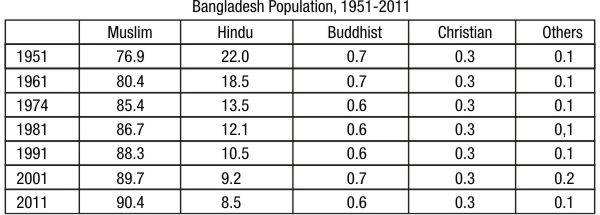
Now consider the published figures from the 2022 census. The preliminary report put the Hindu share at 7.95 per cent; the final national report put it at 7.96 per cent. In both publications, therefore, Hindus accounted for less than eight per cent of the country’s total population. Understanding this community’s position cannot end with counting how many people remain. What conditions do those who remain live under? We must also ask whether they can keep their homes, land, and places of worship secure, raise their children according to their beliefs, and enjoy equal standing in education, employment, and social life while openly expressing their religious identity. The fact that members of a community reside in the country does not establish that their rights are guaranteed. The conditions of their residence, their security, and the assurance they have about their future are what must be assessed.
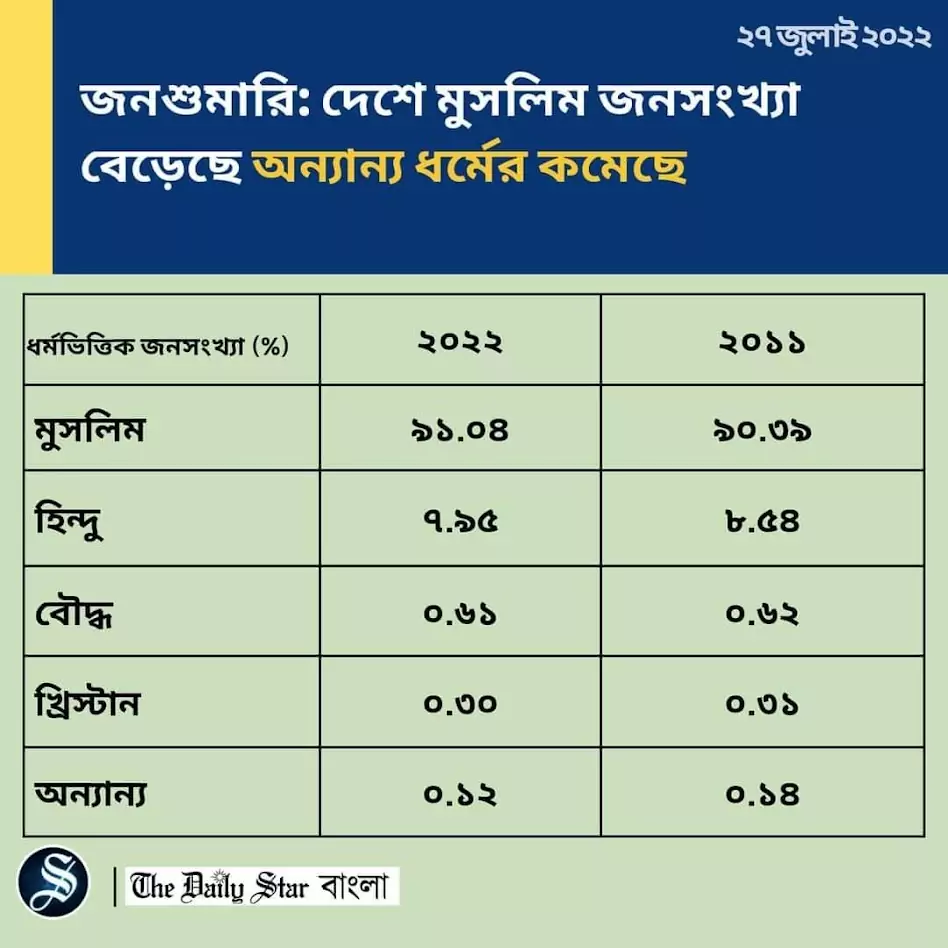
Hindus currently constitute approximately eight per cent of Bangladesh’s population. The question is: why are Hindu families leaving the country? They are not vanishing into thin air; their departure reflects actual experiences, fear, and decisions about their future. The history of Partition, loss of property, insecurity, social discrimination, and communal attacks cannot be excluded from this question. When someone’s home is attacked, the damage extends beyond that day’s destruction. Their children learn that their religious identity may put them in danger in this society. When a family loses land, its economic foundation is damaged; when it receives no justice, its confidence in the state is damaged. If that property is acquired or listed through state law and administrative procedures, deprivation becomes lasting and affects subsequent generations. This connection between minority emigration and property has also been discussed in a High Court judgment. The full passage from paragraph 123 of the 2017 judgment delivered by the bench comprising Justice Obaidul Hassan and Justice Krishna Debnath is reproduced in English below [15].
English rendering: Although Indian territory has never been regarded as enemy territory of Bangladesh, we believe that, in 1965, some people left Bangladesh, then East Pakistan, out of fear of war. This departure by members of the minority community was encouraged by the then government of East Pakistan. Consequently, these people can never be regarded as enemies of the country. It is for this reason that the government of Bangladesh and our legislature enacted the Vested Property Return Act, 2001, which was amended in 2013. The purpose of this Act is to return properties listed as vested property in 1974 and thereafter to their original owners or successors in interest residing in Bangladesh.
Reversing your own position makes clear how devastating it is to treat a family that has left because of war as an enemy and place its property under state control. You temporarily leave your home for safety, then return to discover that your absence has become the basis for losing your property. Insecurity and dispossession then reinforce each other. Where can people who have lost their homes return, with what resources can they rebuild their lives, and what future can they promise their children? Institutional deprivation weakens people’s ability to remain in their country in precisely this way. Assessing minority rights therefore requires more than examples of a neighbour’s personal kindness or photographs taken together at a festival. We must examine whether the law and administration protect people’s property, provide remedies for injustice, and give their citizenship the same weight as the majority’s when danger arises. Without these guarantees, “they are allowed to stay” does not amount to a promise of equal rights. Living in one’s own country is a person’s right, not a temporary permission obtained through the religious majority’s generosity.
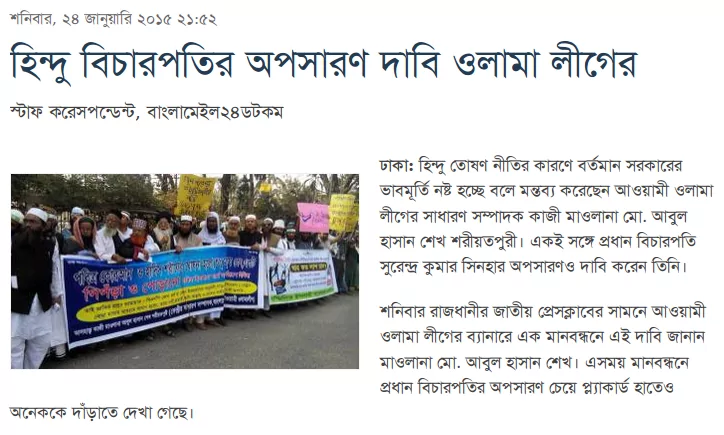
Representation in the state is equally important. Are there no Hindus in Bangladesh qualified to hold important public positions? Is the ability to acquire expertise in education, the judiciary, administration, or governing a state determined by the religion one inherits at birth? If a person becomes qualified but their religion is nevertheless used as an argument against assuming responsibility, the problem is not a lack of competence: it is a refusal to recognize that person as a citizen of equal standing. After Surendra Kumar Sinha became chief justice, a faction of the Olama League invoked his Hindu identity and demanded his resignation. In a report published on 20 April 2016, Partha Pratim Bhattacharjee recorded the demand: his resignation was sought on the grounds that the presence of a Hindu chief justice in a Muslim-majority country offended the sentiments of devout Muslims [16]. The objection concerned neither the judge’s integrity or competence nor the reasoning of a particular judgment; his religious identity itself was made the basis of disqualification. The religious discrimination we recognize when someone in India demands the removal of a Muslim chief justice solely for being Muslim is equally present in the same demand against a Hindu in Bangladesh. This attitude, which dismisses a citizen’s qualifications when their religion differs from the majority’s, creates the social foundation for religious subordination. When the law turns that attitude into a binding rule, the denial of non-Muslims’ rights becomes part of the state system.
Now consider Pakistan. The territory of present-day Pakistan is not the same as that of Pakistan established in 1947. Pakistan then included East Bengal, which later became independent Bangladesh. Directly comparing an old population proportion for East and West Pakistan combined with a proportion for present-day Pakistan therefore conflates figures for different territories. The Pakistan Bureau of Statistics also presents the 1951 and 1961 populations separately for East and West Pakistan in its historical account. Meanwhile, the departure of Hindus from Pakistan to India during Partition formed part of a vast population movement. According to the United Nations refugee agency’s historical account, Partition in 1947 displaced more than 14.5 million people in both directions combined. Assessing the Hindu community’s position in Pakistan requires examining both this history of displacement and subsequent citizenship rights. How many people left, and what rights those who remained received, are distinct and critically important questions. [17] [18]
A further point needs clarification in the current population figures. Pakistan’s official 2023 census counted “Hindu” and “Scheduled Castes” in separate categories. It recorded 3,867,729 people as “Hindu,” representing 1.61 per cent of the population in the religion table, and 1,349,487 people as “Scheduled Castes,” representing 0.56 per cent. Together, these categories total 5,217,216 people, or approximately 2.17 per cent. Christians constitute 1.37 per cent in the same table. Using only the 1.61 per cent in the “Hindu” category as the proportion of all Hindus in Pakistan would therefore exclude people counted under Scheduled Castes. Yet the fact that these people remain in the country does not prove that they enjoy equal rights. Understanding the position of minorities also requires answers to questions about whether they can practise their religion, face employment discrimination because of it, have the right to hold the state’s highest offices, or receive justice when attacked. [19]
The clearest evidence of restrictions on citizenship rights by religion in Pakistan appears in the state’s Constitution itself. Article 41(2) requires a person to be Muslim in order to be elected president; alongside age and eligibility for membership of Parliament, religion is a mandatory qualification. Article 91(3), in turn, requires the National Assembly to elect the prime minister from among its Muslim members. A Hindu or Christian citizen therefore cannot hold either position even after meeting every other qualification. Integrity, intelligence, political experience, or popular support cannot remove this religious barrier. Such citizens must obey the state’s laws, pay taxes, and contribute to the country’s economy, yet have no right to hold its highest governing offices. Religious discrimination here is a constitutional condition of eligibility. How can a claim to equal citizenship survive where the Constitution limits citizens’ political rights because of a religion inherited at birth or personally adopted? [20]
This exclusion also takes an institutional form in employment. The official account of the investigative report on minority rights published by Pakistan’s National Commission for Human Rights in 2022 stated that approximately half the positions reserved for minorities remained vacant. Among the filled positions, 80 per cent of non-Muslim employees worked in the lowest-paid posts, Basic Pay Scales 1–4. The Commission also highlighted discriminatory public recruitment advertisements and the dangerous working conditions of sanitation workers. Consider what this means: many positions supposedly reserved to provide opportunities are not being filled at all, while a large proportion of the available opportunities remain confined to the lowest pay levels. In such circumstances, a community’s occupational position cannot simply be presented as the natural outcome of its members’ individual competence or lack of it. We must also examine where the doors to employment are opened, where they remain closed, and which kinds of work are associated with religious identity. When state institutions maintain this division, discrimination directly affects people’s livelihoods and social standing. [21]
In the case of Ahmadis, the state’s control over religion reaches deeper still. Article 260(3) of Pakistan’s Constitution legally classifies them as non-Muslim; the same definition also includes Baha’is as non-Muslim. Whatever Ahmadis understand their own religious identity to be, the state has assigned them an identity. The question of this state authority over a citizen’s beliefs is profoundly serious. Where is a person’s right to decide what they believe, what to call their beliefs, and which religious identity to adopt? When a minority’s identity is determined according to the majority’s religious interpretation, freedom of belief becomes subject to state permission. The following provision of the Pakistan Penal Code demonstrates the practical form of this control. The section is reproduced in full in English below. [22]
Section 298B. Misuse of epithets, descriptions and titles, etc., reserved for certain holy personages or places. (1) Any person of the Quadiani group or the Lahori group (who call themselves ‘Ahmadis’ or by any other name) who by words, either spoken or written, or by visible representation: (a) refers to, or addresses, any person, other than a Caliph or companion of the Holy Prophet Muhammad (peace be upon him), as ‘Ameer-ul-Mumineen’, ‘Khalifa-tul-Mumineen’, ‘Khalifa-tul-Muslimeen’, ‘Sahaabi’ or ‘Razi Allah Anho’; (b) refers to, or addresses, any person, other than a wife of the Holy Prophet Muhammad (peace be upon him), as ‘Ummul-Mumineen’; (c) refers to, or addresses, any person, other than a member of the family (Ahle-bait) of the Holy Prophet Muhammad (peace be upon him), as ‘Ahle-bait’; or (d) refers to, or names, or calls, his place of worship as ‘Masjid’; shall be punished with imprisonment of either description for a term which may extend to three years, and shall also be liable to fine. (2) Any person of the Quadiani group or the Lahori group (who call themselves ‘Ahmadis’ or by any other name) who by words, either spoken or written, or by visible representation, refers to the mode or form of call to prayers followed by his faith as ‘Azan’, or recites Azan as used by the Muslims, shall be punished with imprisonment of either description for a term which may extend to three years, and shall also be liable to fine. [23]
Section 298C also provides for imprisonment of up to three years and a fine for Ahmadis who identify themselves as Muslims or propagate their religion. [24] Judging this system against the standard of freedom of belief inevitably raises questions. If the right to use the language of one’s own faith depends on the majority’s approval, where is the minority’s freedom? What is the moral basis for subjecting religious disagreements to imprisonment rather than addressing them through reasoning, discussion, and criticism? Why should the state restrict the expression of a citizen’s beliefs merely because others dislike them? Equal citizenship requires that an individual’s rights not depend on the popularity of their religious views. When the state becomes the guardian of a particular religious interpretation, that foundation of equality is destroyed.
Attacks, intimidation, and the absence of effective justice compound these problems. In its 2024 concluding observations, the United Nations Human Rights Committee expressed deep concern about reports of discrimination, hate speech, mob attacks, and the destruction of places of worship targeting Pakistan’s Christian, Ahmadi, Hindu, Shia, and Sikh minorities. It also mentioned the events in Jaranwala in August 2023. The Committee noted the lack of effective protection for minorities and inadequate accountability for these offences. Paragraph 54 of the same observations expressed concern about allegations involving the abduction and forced marriage of girls from religious minority families, their forced conversion to Islam under threats of violence, and widespread impunity in such cases. Consider what this insecurity means for a family. Fear over a daughter’s safety, the survival of a place of worship, and the prospect of justice after an attack makes an ordinary life difficult in one’s own country. Citizenship on paper does not by itself provide a safe life as a citizen. [25]
Pakistan’s example therefore makes the question of assessing minorities’ position particularly clear. The presence of members of a community in a country does not establish that they enjoy equal standing there. Equal standing must be assessed through the right to hold the state’s highest offices, opportunities to earn a livelihood, freedom to express one’s beliefs, and protection against violence. None of these is supposed to be received as a favour from the majority; they are citizens’ rights. Closing doors to qualified citizens because of religion, criminalizing the expression of belief, and failing to provide effective justice to people under attack each undermine those rights. In a state where religious identity determines the limits of citizens’ opportunities and freedoms, the difficulties minorities face in living there are rooted in the state’s power, laws, and institutions.
That covers the comparison between Bangladesh and Pakistan. But what is the position of Muslims in Hindu-majority India? Surely persecution by communal-minded Hindus must leave India’s Muslims in an even worse position—must it not? The statistics, however, complicate that account!
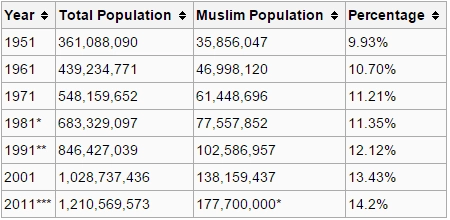
- In 1951, Muslims constituted 9.93 per cent of India’s population.
- In 1961, Muslims constituted 10.70 per cent of India’s population.
- In 1971, Muslims constituted 11.21 per cent of India’s population.
- In 1981, Muslims constituted 11.35 per cent of India’s population.
- In 1991, Muslims constituted 12.12 per cent of India’s population.
- In 2001, Muslims constituted 13.43 per cent of India’s population.
- In 2011, Muslims constituted 14.60 per cent of India’s population.
In other words, the Muslim population in India has grown and continues to grow. How is that possible? We have always heard that India is a country of extremely militant Hindus. Although constitutionally secular, organizations such as the Shiv Sena, Bajrang Bali, and the BJP are said to persecute Muslims and demolish mosques. We hear that Muslims are seized and slaughtered in broad daylight. By contrast, the Muslims of Bangladesh and Pakistan are described as deeply religious and free from communal prejudice, with Hindus and Muslims living together happily and peacefully. Yet how is it that Hindu numbers are declining in Bangladesh and Pakistan while Muslim numbers are increasing in India? Those Muslims also become presidents and cinema superstars! Meanwhile, who posted the viciously obscene comments on the Facebook page of a Hindu cricketer in Bangladesh?
Dr Zakir Naik is one of the most popular Islamic preachers not only in India but worldwide. Born and living in a Hindu-majority country, he has criticized Hinduism and pointed out its alleged faults in almost every speech. For years, he has described numerous aspects of Hinduism as false and distorted. From within India, he has held enormous public gatherings at which he has ridiculed idol worship and made derogatory statements about it. At the same time, he has proclaimed Islam the best religion and advised Hindus to become Muslims. He frequently says that idol worship is deeply objectionable and that Hindus should stop practising it. India also has a blasphemy-related law: under Section 295A of the Indian Penal Code, Zakir Naik could have been punished on numerous occasions, but that has not happened! He has been able to propagate Islam and point out what he considers errors in Hinduism without obstruction there!
Suppose a Hindu did precisely the same thing in Bangladesh or Pakistan. What would happen? What if a Hindu preacher said that Islam was a distorted and false religion and that Hinduism alone was true? Or said that Muslims should stop travelling to the Kaaba for Hajj and begin worshipping idols, because performing Hajj at the Kaaba was itself a form of idol worship? Can we imagine the consequences? Consider the reaction to a fairly ordinary comment by Latif Siddiqui about Hajj some time ago. If a Hindu had made such a statement, would there be any way to count how many Hindu homes might have been set on fire or how many women might have been raped?
That covers India, Bangladesh, and Pakistan. What about the Muslim countries of the Middle East? What is the position of minority communities in Muslim-majority countries such as Saudi Arabia and Iran? Do they retain the right to practise their own religions? Can they build their own places of worship and attend them? The answer is that Iran allows a very limited degree of public practice of other religions, whereas in Saudi Arabia it is prohibited by law altogether! No non-Muslim can legally become head of state. The civic status of Muslims and non-Muslims is itself different. Different laws apply to them, and their rights are by no means equal.
All these matters need careful examination. We therefore need to understand the various provisions of Islamic Sharia law and the fatwas of prominent Islamic scholars. Let us examine them closely.
What Are Equal Rights?
Equal rights mean guaranteeing every citizen the same rights before the state and the law. Religious identity, gender identity, health or disability, ethnic characteristics, and skin colour must not affect those rights. Everyone must receive equal opportunities and respect before the law. Whether someone has a disability, a diverse gender identity, or is regarded as ordinary by conventional standards, their rights are equal. Freedom of thought, freedom of expression, freedom of religious belief, and freedom to practise religion must be protected regardless of political affiliation, opinion, religion, or belief. The state will not ask citizens about their religion, because its task is not to examine their consciences; its task is to guarantee their rights, security, and legal standing. To prevent religious discrimination, the state will neither encourage nor discourage religion. Religion is a personal matter, to be practised within one’s personal sphere.
This principle applies to Muslims living in America, Palestinians in Israel, and Hindus in Bangladesh or Pakistan alike. We often demand equal citizenship rights for Uyghur Muslims in China and call for an end to their persecution, while simultaneously persecuting Hindus in our own country. We lament the absence of secularism in India and fear the establishment of a militant Hindu nationalist Ram Rajya, yet demand Sharia law in Bangladesh. We want Allah’s law, rather than secularism.
By the same reasoning through which we demand Allah’s law, a Hindu in India can demand Ram Rajya. And by precisely the reasoning through which we demand secularism in India and equal rights for Hindus and Muslims, Hindus in Bangladesh should have the same rights as Muslims. The hypocrisy is that we demand secularism and equal rights in countries where Muslims are minorities, but Sharia law where Muslims are the majority. This double standard is not merely irrational; it is morally bankrupt. Demanding secularism as a minority and Sharia as a majority means seeking the dominance of one’s own group rather than justice.
Sharia and Muslim Law
A state Sharia system is one in which Islamic Sharia plays a dominant role and operates across most areas of a country’s legal system. Iran, Saudi Arabia, and Sudan are examples of state Sharia systems. Many wrap Sharia in sanctity by calling it “Allah’s law.” Once it becomes state law, however, it means dividing people’s rights and civic standing according to religious identity. It ceases to be a matter of personal religious observance and becomes a religious means of controlling state power. Sharia, Islamic law, or Sharia law refers fundamentally to Islam’s immutable laws drawn from the Quran and Hadith, understood as binding divine laws or commands. Traditionally, Islamic jurisprudence recognizes four sources of Sharia: the religious scripture, the Quran; the Sunnah, recorded in Hadith; qiyas, or analogical reasoning, for matters not specifically addressed in the Quran or Hadith; and ijma, the consensus of scholars and jurists.
Muslim law, by contrast, refers to adapting the provisions of Islamic Sharia through additions and omissions to suit a particular country and enacting them as state law. For example, Islamic Sharia does not require a Muslim man to obtain his first wife’s permission before marrying a second wife. Under Bangladesh’s Muslim law, however, a Muslim man must obtain his first wife’s permission before taking a second wife. Similarly, Sharia imposes no minimum age for a girl’s marriage: a father may marry even an infant daughter in his arms to a middle-aged man. Under Bangladeshi law, by contrast, marrying off an underage girl is a punishable offence.
Many religious political organizations in Bangladesh have long sought to establish Sharia and a caliphate in the country. They also claim that Islamic Sharia is the best and most respectful system for non-Muslims, and that non-Muslims enjoyed their best conditions under Sharia during the caliphate! It is therefore necessary to examine how good this Sharia law actually is.
The Destruction of Buddhist Statues in Afghanistan
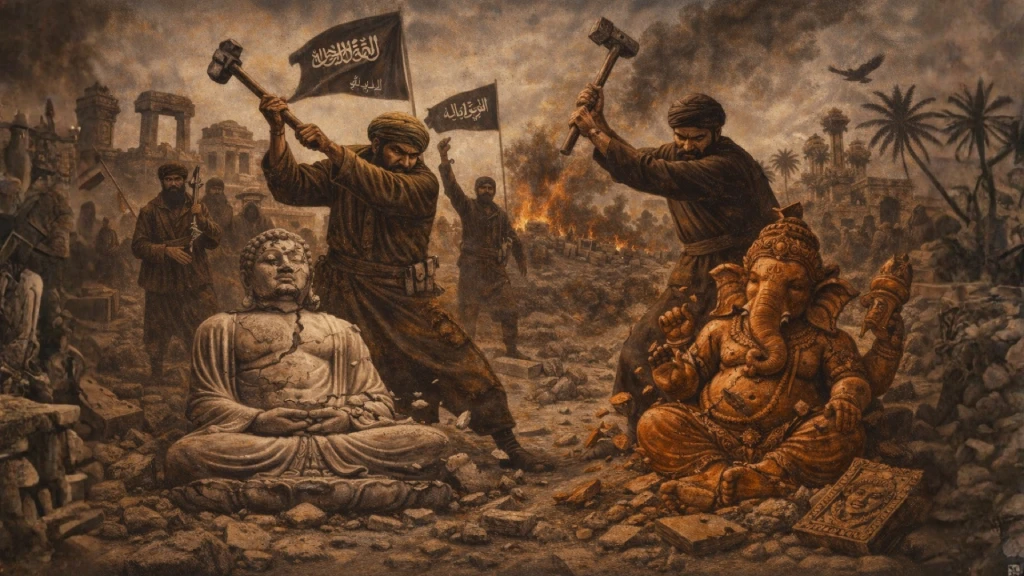
The Buddhas of Bamiyan were once considered among the largest Buddha statues in the world. The Taliban destroyed them in 2001, acting in accordance with the provisions of Islamic Sharia. The approximately 1,500-year-old statues, built in the sixth century, were carved into a mountain ridge in the Bamiyan Valley of central Afghanistan. They stood at an altitude of 2,500 metres, or 8,200 feet, above sea level. The larger statue was 55 metres high and the smaller 35 metres. Numerous smaller Buddha statues were also carved into the mountains in the area. These statues are considered outstanding examples of Gandharan art, a distinctive artistic form that flourished under Buddhist influence between the third and tenth centuries CE. UNESCO recognized them as part of the world’s heritage. In March 2001, the two large statues were destroyed with dynamite on the orders of Taliban leader Mullah Muhammad Omar. This raises an important question: were the provisions of Islamic Sharia decisive in their destruction, or did Mullah Omar destroy them by misinterpreting Islam? Examining that question also requires reading Islamic fatwas on destroying statues. A separate Shongshoy article discusses the relevant fatwas and their reasoning in detail [26]. The significance of these religious instructions must also be considered when assessing the right of people of other religions to preserve their objects of worship and historical monuments.
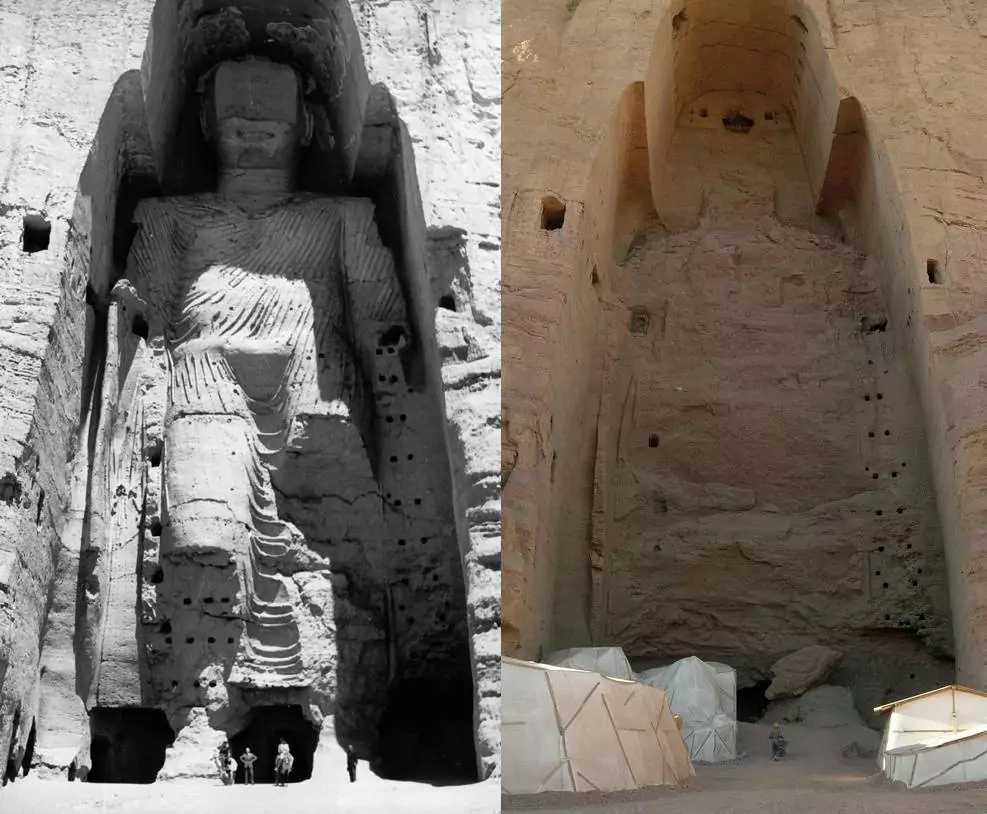
An important point is that Emperor Babur, India’s first Mughal ruler, also ordered these statues destroyed. In September 1528, Babur wrote that he had ordered both of them destroyed [27]. Later, Mughal Emperor Aurangzeb attempted to destroy the statues using heavy artillery. His actions broke the legs of the Buddha statues [28]. Another attempt to destroy the Bamiyan statues was made by the eighteenth-century Persian ruler Nader Afshar, who fired cannon at them [29].
In the nineteenth century, Afghan ruler Abdur Rahman Khan destroyed the upper part of the larger figure’s face during a military campaign against a Hazara rebellion in the region [30]. After destroying these Buddhist statues in 2001, Taliban leader Mullah Omar proudly declared:
Every Muslim in the world should be proud of destroying the idols. Allah has been praised through their destruction, because we have destroyed them. [31]
Muslim Rule in India
Muslim rule in India was not uniform throughout its history. At times it was favourable to its subjects; at others it was oppressive. A general verdict on the entire period is therefore inappropriate, though particular reigns can be discussed. Ahmad al-Faruqi al-Sirhindi (26 June 1564–10 December 1624) was an Indian Islamic scholar, a Hanafi jurist, and a prominent scholar of the Naqshbandi Sufi order. Many regard him as the foremost scholar among India’s Sharia-oriented Sufis. He was born in the celebrated town of Sirhind, then within the state of Patiala in Punjab. His father, Abdul Ahad, was a disciple of Shaykh Abdul Quddus Gangohi. His lineage is traditionally said to extend back to Umar ibn al-Khattab. Ahmad Sirhindi is described as a mujaddid, a reviver of Islam. He is known as Mujaddid-i Alf-i Thani, meaning “the reformer of the second millennium.” Sirhindi sharply criticized the failure to observe Islamic rules during the Mughal period. His efforts to establish Sharia rule bore fruit when Emperor Alamgir reintroduced Sharia provisions, resulting in the renewed establishment of Islamic Sharia in India.
During Emperor Akbar’s reign, his nonsectarian outlook led him to discontinue several provisions of Islamic Sharia in India, notably the humiliating jizya tax imposed on non-Muslims. Removing this Sharia provision brought Akbar severe criticism from Islamic scholars who supported Sharia. Ahmad Sirhindi was among the leading critics.
Notable works of Mujaddid-i Alf-i Thani include:
- Al-Mabda wa al-Ma‘ad
- Risala-i Tahliliyya
- Risala fi Ithbat al-Nubuwwa wa Adab al-Muridin
- Radd-i Rawafid
- Maktubat.
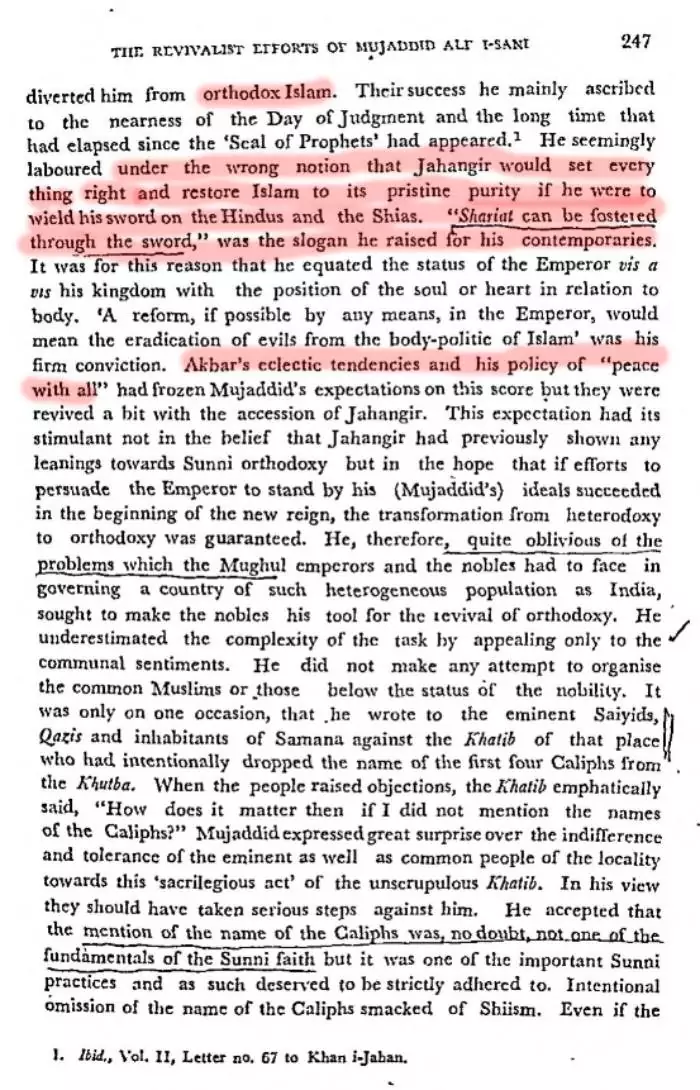
Mujaddid-i Alf-i Thani, also known as Ahmad al-Faruqi al-Sirhindi, made numerous statements in his works grounded in Islamic belief and doctrine that contributed to establishing Islamic Sharia in India. Some notable passages are collected here. Let us first examine a well-known work by Saiyid Athar Abbas Rizvi, Muslim Revivalist Movements in Northern India [32]:
diverted him from orthodox Islam. Their success he mainly ascribed to the nearness of the Day of Judgment and the long time that had elapsed since the ‘Seal of Prophets’ had appeared. He seemingly laboured under the wrong notion that Jahangir would set every thing right and restore Islam to its pristine purity if he were to wield his sword on the Hindus and the Shias. “Shariat can be fostered through the sword,” was the slogan he raised for his contemporaries. It was for this reason that he equated the status of the Emperor vis a vis his kingdom with the position of the soul or heart in relation to body. ‘A reform, if possible by any means, in the Emperor, would mean the eradication of evils from the body-politic of Islam’ was his firm conviction. Akbar’s eclectic tendencies and his policy of “peace with all” had frozen Mujaddid’s expectations on this score but they were revived a bit with the accession of Jahangir. This expectation had its
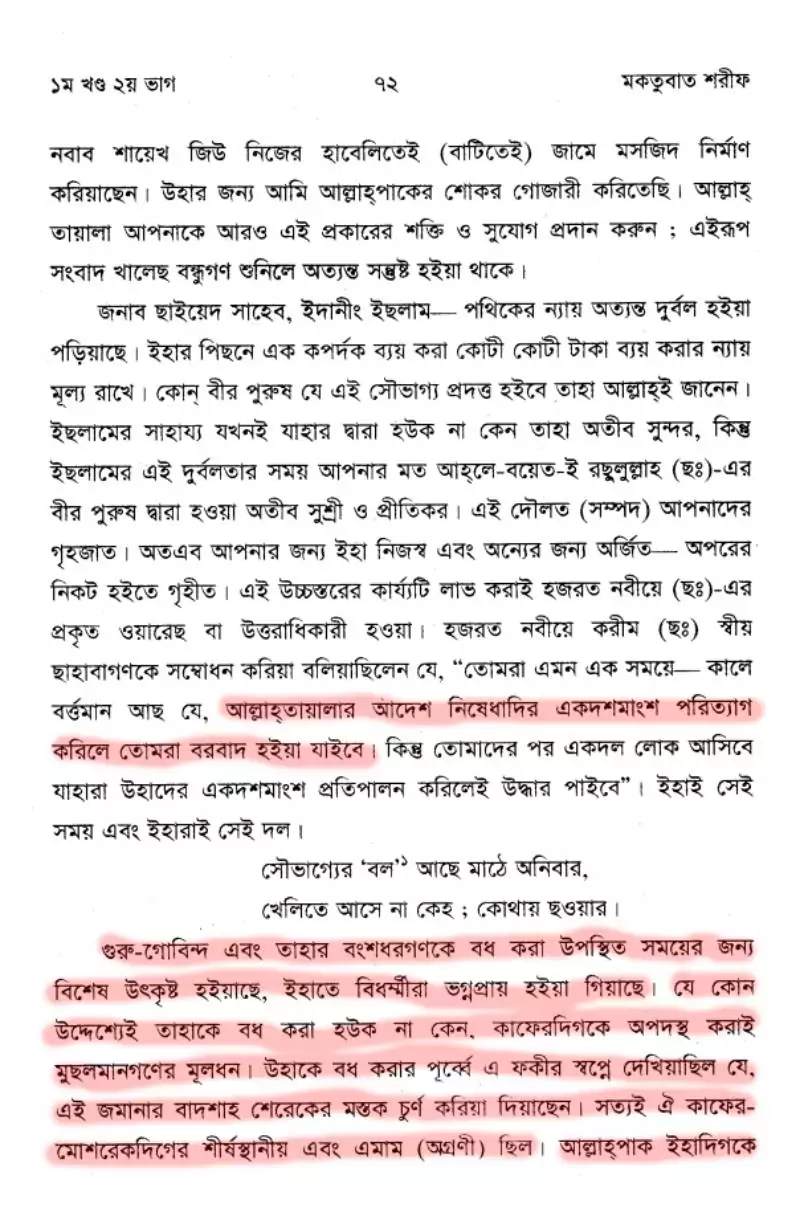
Now let us read a letter written by Ahmad Sirhindi from his famous Maktubat Sharif. In it, he stresses the establishment of Sharia rules requiring the humiliation and degradation of unbelievers and polytheists, and expresses disappointment that the Mughal ruler is not collecting the humiliating jizya tax [33]:
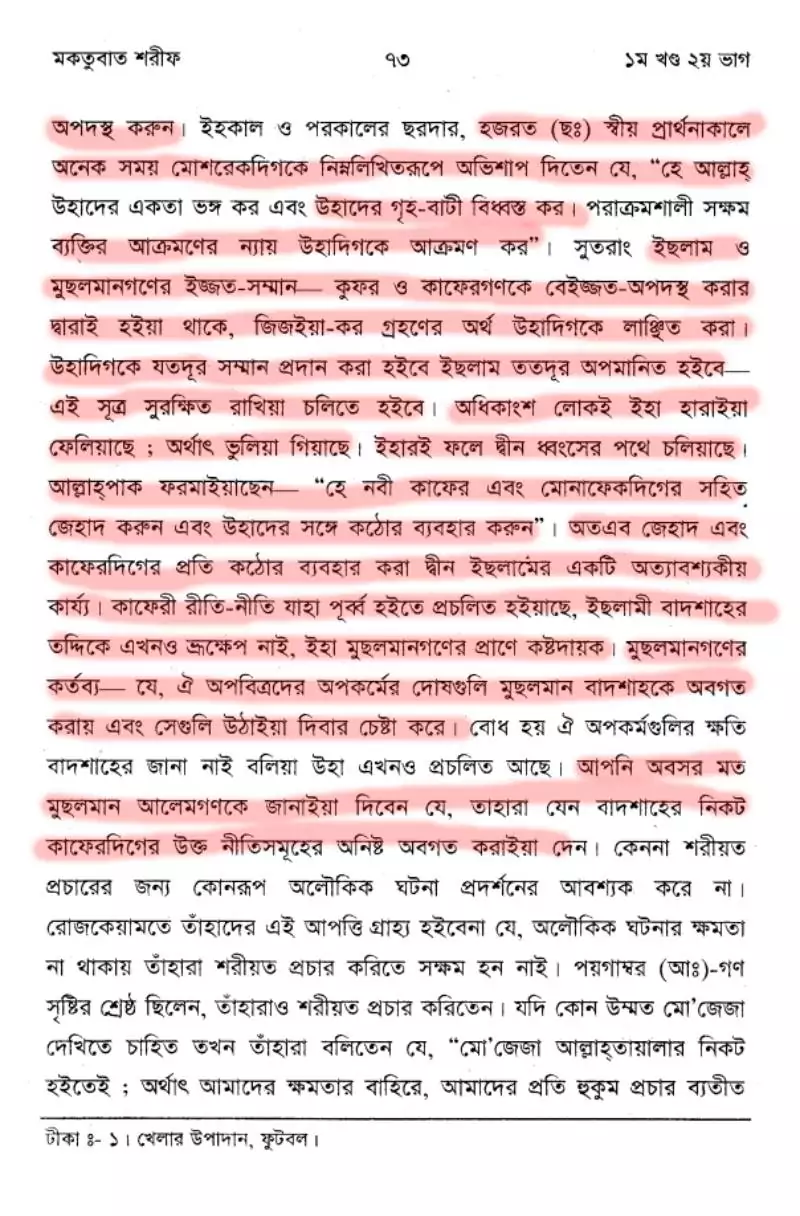
The killing of Guru Gobind and his descendants has been particularly beneficial at the present time, for it has left the followers of other religions broken. Whatever the purpose of his killing, humiliating the unbelievers is the Muslims’ capital. Before he was killed, this faqir saw in a dream that the emperor of this age had crushed the head of shirk. Truly, that unbeliever was a leading figure and imam among the unbelievers and polytheists. May Allah disgrace them. The lord of this world and the next, the Prophet (peace be upon him), frequently cursed the polytheists in his supplications in the following terms: “O Allah, break their unity and destroy their homes. Attack them as a mighty and capable assailant would.” Thus the honour and dignity of Islam and Muslims are achieved through the humiliation and degradation of unbelief and unbelievers; the purpose of collecting jizya is to disgrace them. This principle must be carefully preserved: the more honour they receive, the more Islam is dishonoured. Most people have lost sight of it—that is, forgotten it. As a result, the religion is moving towards destruction. Allah has said: “O Prophet, wage jihad against the unbelievers and hypocrites and deal harshly with them.” Jihad and harsh treatment of unbelievers are therefore essential duties in Islam. The Islamic emperor still pays no attention to the unbelieving customs and practices that have long been prevalent, and this causes Muslims distress. Muslims have a duty to inform the Muslim emperor of the faults of these impure people’s misconduct and seek its abolition. Perhaps these practices remain prevalent because the emperor does not know the harm they cause. When you have the opportunity, inform the Muslim scholars that they should explain to the emperor the harmful effects of these practices of the unbelievers. No display of miracles is required to propagate Sharia.
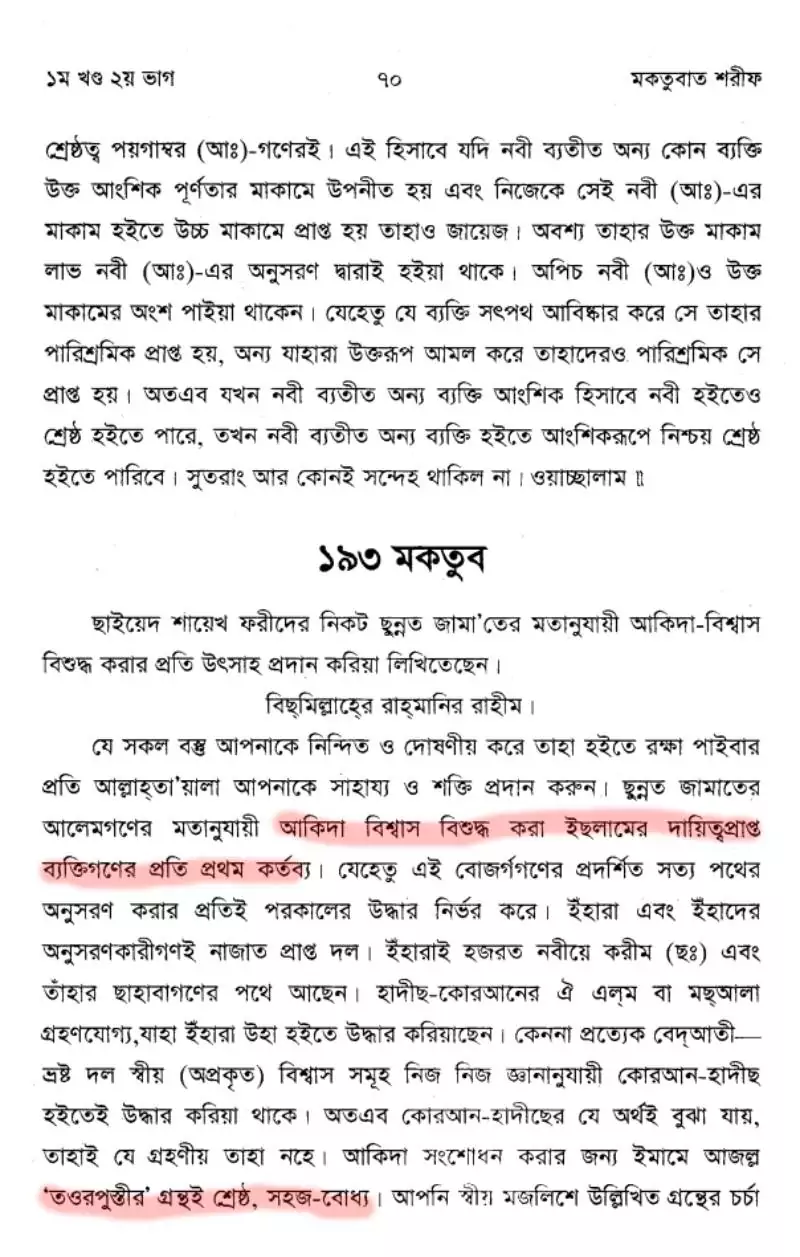
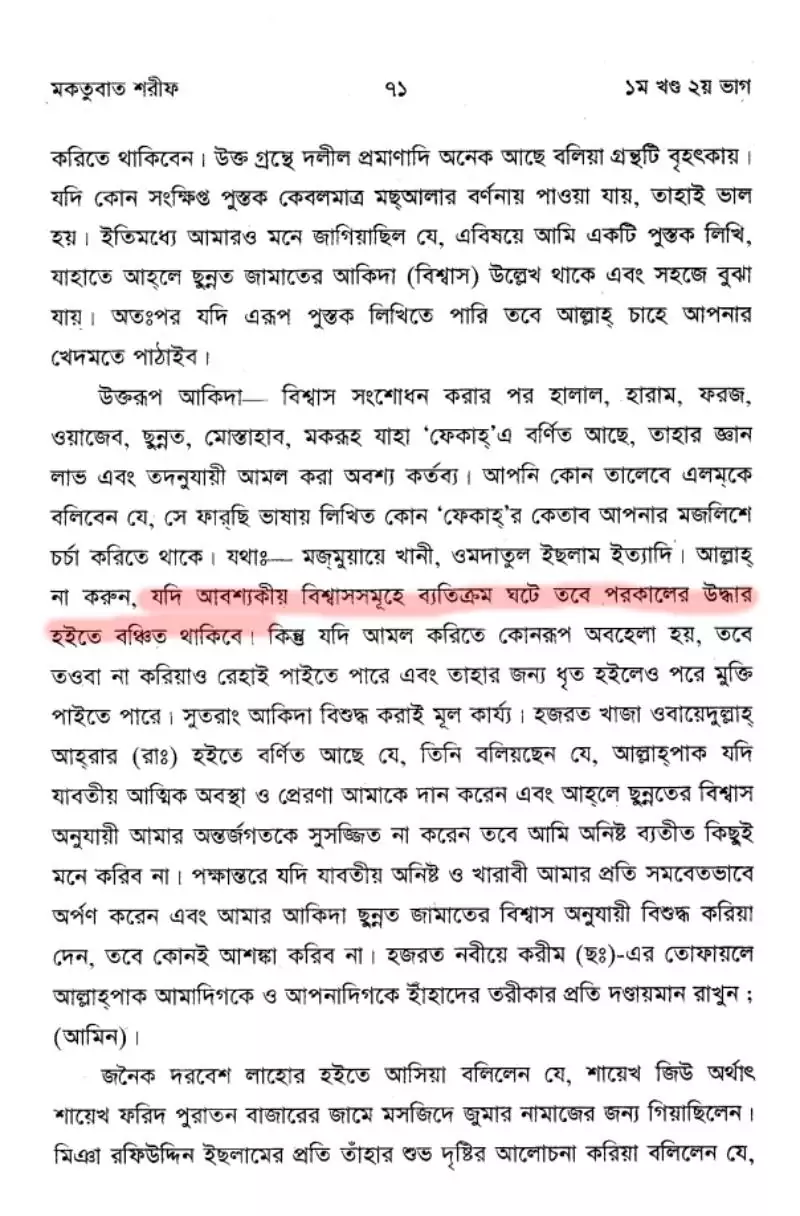
Let us read some further letters from the same work [34]:
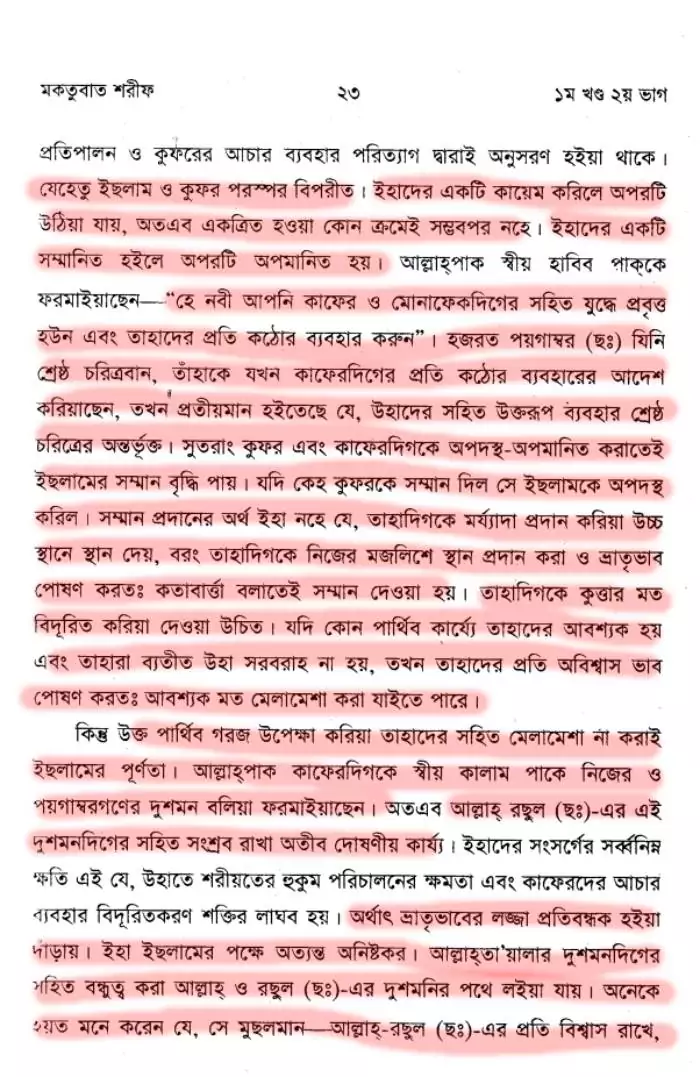
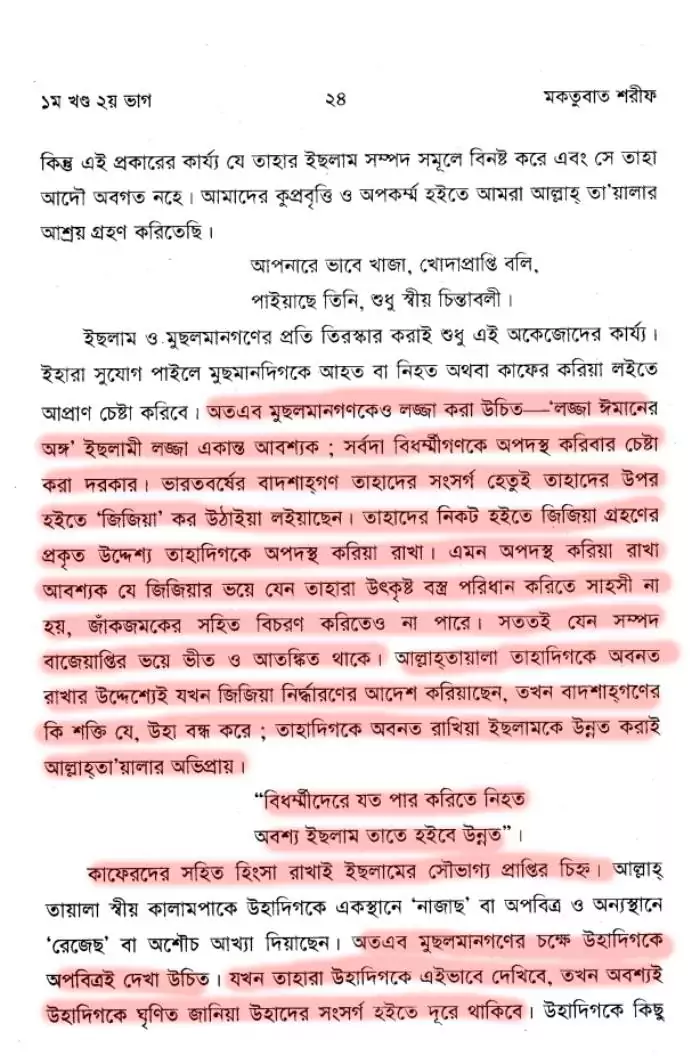
Following is accomplished through observance and through abandoning the customs and practices of unbelief. Islam and unbelief are opposed to each other. Establishing one removes the other, so their coexistence is impossible. Honouring one dishonours the other. Allah has said to His beloved: “O Prophet, engage in warfare against the unbelievers and hypocrites, and deal harshly with them.” Since the Prophet (peace be upon him), who possessed the finest character, was commanded to deal harshly with unbelievers, it follows that such treatment forms part of the finest character. The honour of Islam therefore increases through the degradation and humiliation of unbelief and unbelievers. Whoever honours unbelief disgraces Islam. Honouring them does not mean only according them high rank or elevated positions; admitting them into one’s gathering and speaking to them with a feeling of brotherhood also constitutes honouring them. They should be driven away like dogs. If they are needed for a worldly task that cannot be performed without them, one may associate with them as necessary while maintaining distrust. But disregarding that worldly need and refusing to associate with them is the perfection of Islam. In His holy word, Allah has described unbelievers as enemies of Himself and His prophets. Maintaining relations with these enemies of Allah and His Messenger (peace be upon him) is therefore deeply blameworthy. The least harm of their company is that it weakens the ability to implement Sharia commands and eradicate unbelieving customs and practices: embarrassment arising from brotherly feeling becomes an obstacle. This is extremely harmful to Islam. Befriending the enemies of Allah leads towards enmity with Allah and His Messenger (peace be upon him). Many may think that they are Muslims, that they believe in Allah and His Messenger (peace be upon him), and that they will strive with all their strength. Muslims must therefore also feel shame—“modesty is part of faith.” Islamic modesty is indispensable; one must always strive to disgrace the followers of other religions. It was because of their association with them that the emperors of India abolished the jizya tax imposed on them. The true purpose of collecting jizya from them is to keep them humiliated. They must be so degraded that fear of jizya prevents them from daring to wear fine clothes or move about in splendour. They should remain continually fearful and terrified that their property will be confiscated. When Allah Himself has ordered jizya to keep them low, what power do emperors have to abolish it? Allah’s intention is to elevate Islam by keeping them subordinate. “The more followers of other religions you can kill, the more Islam will surely rise.” Maintaining hostility towards unbelievers is a sign of attaining Islam’s good fortune. In His holy word, Allah has called them ‘najas,’ or impure, in one place, and ‘rijs,’ or unclean, in another. Muslims must therefore regard them as impure. When they see them in this way, they will naturally consider them contemptible and keep away from their company.
In the following sections, we will compare the statements and letters of Ahmad al-Faruqi al-Sirhindi quoted above with Islamic teachings to see how far they conform to Islam and how far they contradict it. I hope readers will read the entire article carefully.
Friendship with Non-Muslims Is Forbidden
Islam imposes strict prohibitions on forming close friendships with non-Muslims. Such prohibitions appear in numerous places in the Quran. Contemporary believers, however, cite another Quranic verse and claim that these instructions do not apply to all non-Muslims. These issues are discussed in detail in the following articles [35] [36]. Here, therefore, the scholars’ statements will be more relevant than revisiting those texts. Let us listen to several of Bangladesh’s most prominent Islamic scholars:
Now let us see how the poison of religious prejudice is being instilled in the minds of children and adolescents in Bangladesh:
Non-Muslim Places of Worship and Religious Practice
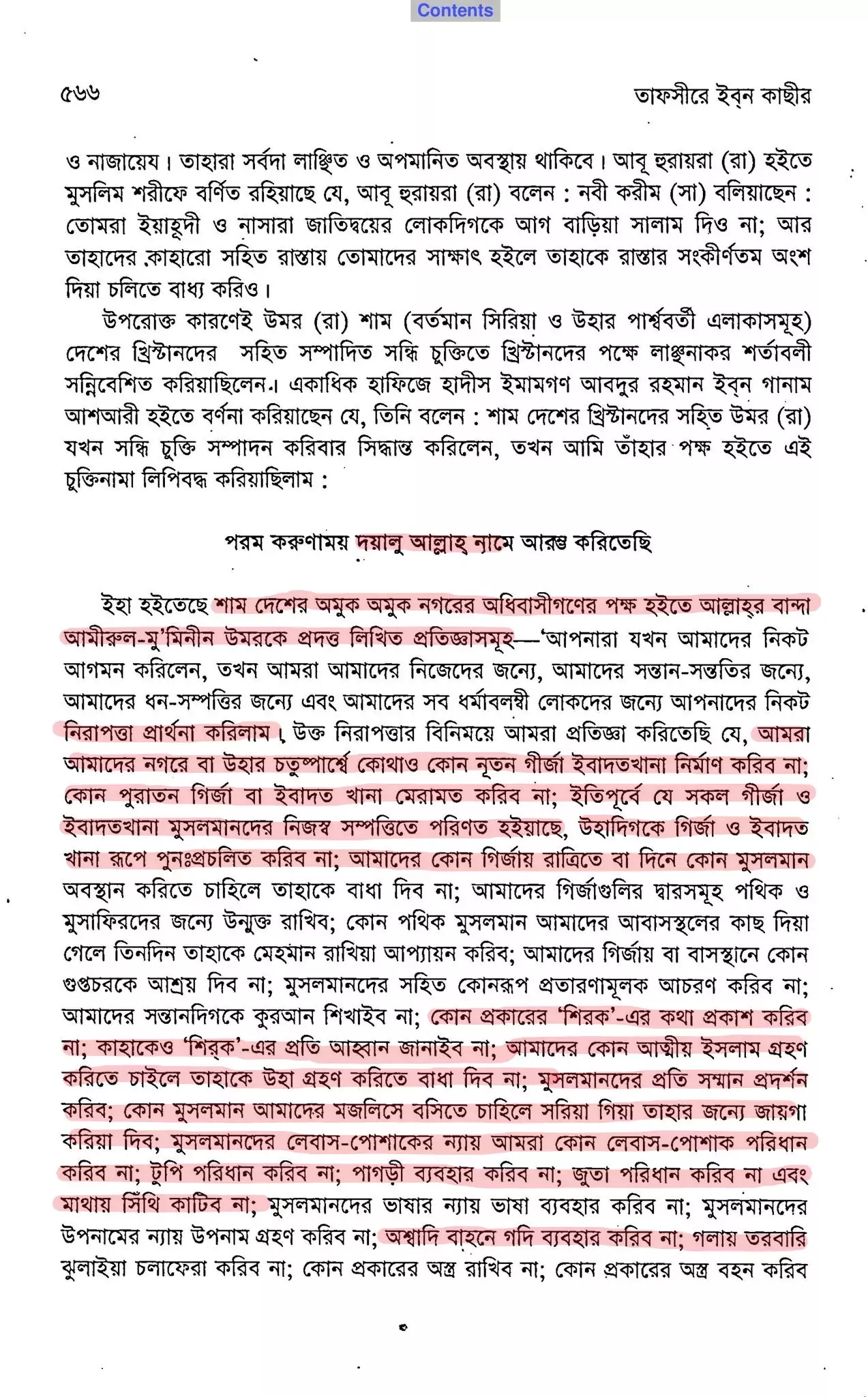
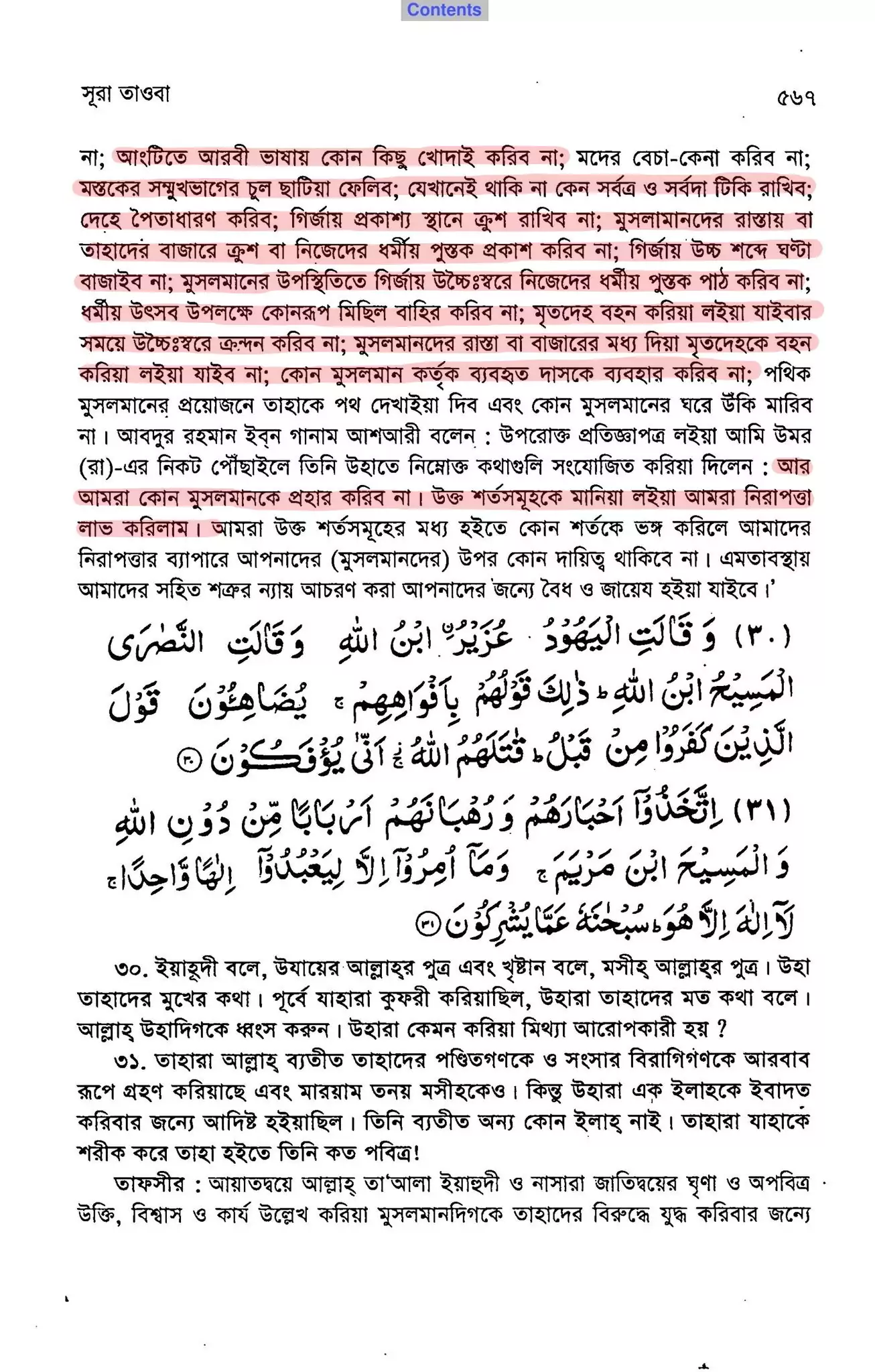
In a Sharia or Islamic state, non-Muslims cannot build new places of worship. Umar entered into a treaty with the inhabitants of Syria. This treaty is highly significant in Islamic history, and later Muslim agreements with non-Muslims have been based on it. Let us read the treaty as presented in Tafsir Ibn Kathir [37]. It explicitly states that non-Muslims cannot build new places of worship, repair them, reclaim those seized by Muslims, wear caps, turbans, or shoes, use padded saddles when riding horses, propagate their religion, or weep loudly while carrying their dead, among other restrictions. A separate Shongshoy article discusses these restrictions on constructing places of worship, publicly expressing religious observances, and propagating religion in detail. Alongside the Pact of Umar and provisions of Hanafi jurisprudence, it examines the statements of contemporary religious speakers [38]. A separate analysis based on Quranic verses and commentaries also examines how far the statement “Your religion is yours, and our religion is ours” is consistent with freedom to practise and propagate one’s religion [39].
In the name of Allah, the Most Compassionate, the Most Merciful.
These are the written undertakings submitted to Allah’s servant Umar, Commander of the Faithful, by the inhabitants of such-and-such towns in Syria: “When you came to us, we requested protection from you for ourselves, our children, our property, and all the people of our religion. In exchange for that protection, we undertake that we will not construct any new church or place of worship in our towns or anywhere around them; we will not repair any old church or place of worship; we will not restore as churches or places of worship those that have already become Muslim property; we will not prevent any Muslim who wishes to stay in any of our churches by night or day; we will keep the doors of our churches open to wayfarers and travellers; when a travelling Muslim passes near our dwellings, we will host and entertain him for three days; we will not shelter any spy in our churches or homes; we will not act deceitfully towards Muslims; we will not teach our children the Quran; we will not publicly express any form of shirk; we will not invite anyone to shirk; if any relative of ours wishes to accept Islam, we will not prevent that person from doing so; we will show respect to Muslims; if a Muslim wishes to sit in our gathering, we will move aside and make room; we will not wear clothing resembling Muslim dress; we will not wear caps, use turbans, wear shoes, or part the hair on our heads; we will not use language resembling that of Muslims; we will not adopt bynames resembling Muslim bynames; we will not use padded saddles on horses or other mounts; we will not walk about with swords suspended from our necks; we will not possess any weapons; we will not carry any weapons; we will not engrave anything in Arabic on our rings; we will not buy or sell wine; we will cut the hair at the front of our heads; wherever we are, we will always retain a tuft of hair; we will wear a sacred cord on our bodies; we will not display crosses in public places in our churches; we will not display crosses or our religious books on Muslim roads or in their markets; we will not ring bells loudly in our churches; we will not read our religious books aloud in churches in the presence of Muslims; we will not organize processions for religious festivals; we will not weep loudly when carrying the dead; we will not carry the dead through Muslim roads or markets; we will not employ any slave used by a Muslim; we will show travelling Muslims the way when they need it; and we will not peer into any Muslim’s home.” Abdur Rahman ibn Ghanm al-Ash‘ari says: When I brought the foregoing undertaking to Umar, he added the following words: “And we will not strike any Muslim.” By accepting these conditions, we obtained protection. If we violate any of these conditions, you Muslims will bear no responsibility for our protection. In that event, it will become lawful and permissible for you to treat us as enemies.
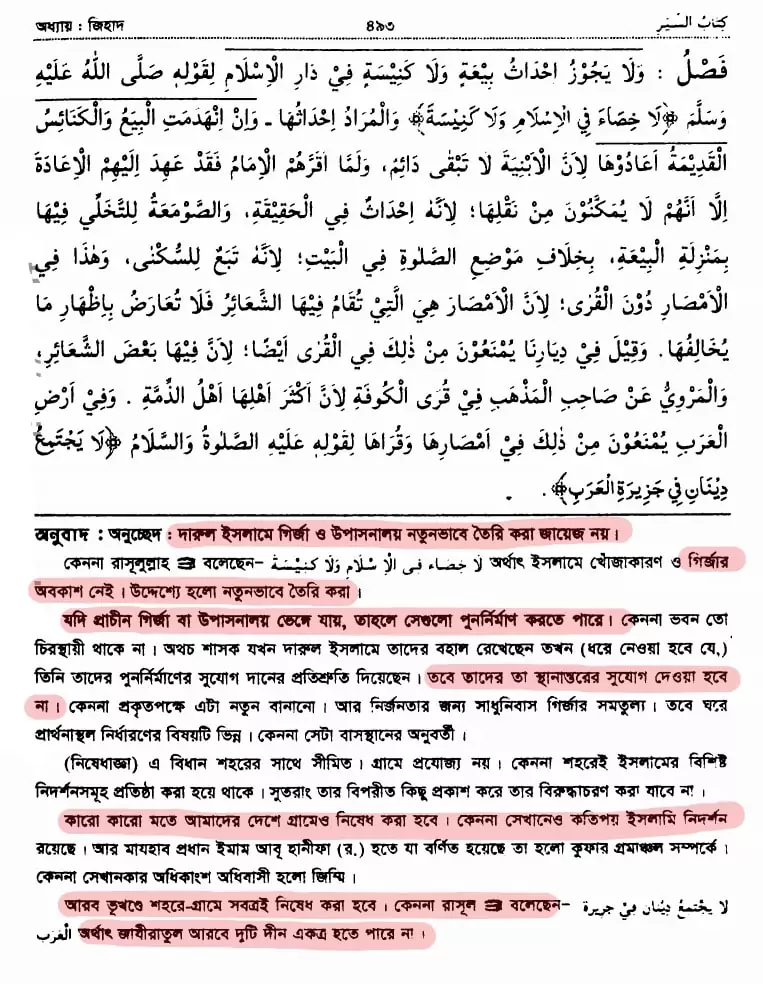
Let us also examine what the foundational work of Hanafi jurisprudence, Ashraful Hidaya, says on this subject [40].
Translation: Section: It is not permissible to construct new churches or places of worship in Dar al-Islam.
This is because the Messenger of Allah said: لا حصاء في الإسلام ولا كنيسة, meaning that there is no place for castration or churches in Islam. What is meant is new construction.
If an old church or place of worship collapses, they may rebuild it, since buildings do not last forever. When the ruler has allowed them to remain in Dar al-Islam, it is assumed that he has promised them the opportunity to rebuild. They will not, however, be allowed to relocate it, because that would effectively constitute new construction. A monastery used for seclusion is equivalent to a church. Setting aside a place of prayer in a home is different, since it is incidental to the dwelling.
This prohibition is restricted to cities and does not apply to villages. The distinctive signs of Islam are established in cities, so nothing contrary to them may be displayed in opposition.
Some hold that the prohibition should also apply in the villages of our country, since certain Islamic signs exist there as well. What has been narrated from Imam Abu Hanifa, the founder of the school, concerns the rural areas of Kufa, where most inhabitants were dhimmis.
In Arabian territory, the prohibition applies everywhere, in cities and villages alike, because the Messenger said: لا يجتمع بينان في جريرة الغرب, meaning that two religions cannot coexist in the Arabian Peninsula.
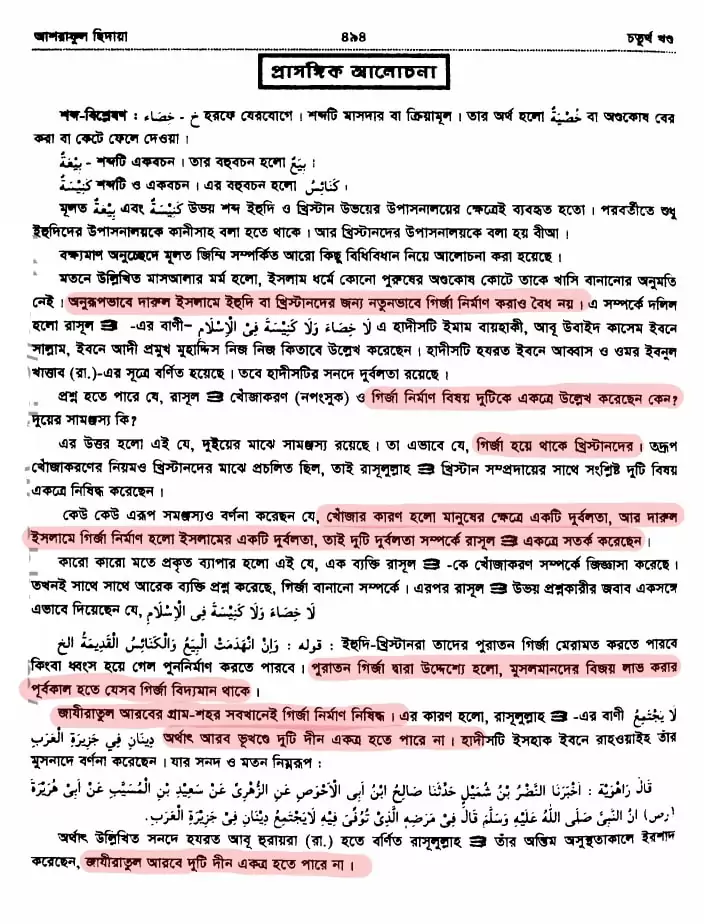
Relevant Discussion
Word analysis: خضاء, with a kasra, is a verbal noun. It means removing or cutting out the testicles.
بيغة is a singular word; its plural is بیع.
The other word is also singular; its plural is کنائش.
Originally, both بیعۀ and کنیه were used for the places of worship of Jews and Christians. Subsequently, a Jewish place of worship came to be called kanisa, while a Christian place of worship was called bi‘a.
This section principally discusses further rules concerning dhimmis.
The meaning of the ruling stated in the main text is that Islam does not permit removing a man’s testicles to castrate him. Similarly, building new churches for Jews or Christians in Dar al-Islam is not lawful. The evidence is the Messenger’s statement: لا خضاءَ وَلَا كَثِيسَةَ فِي الْإِسْلَام. Imam al-Bayhaqi, Abu Ubayd Qasim ibn Sallam, Ibn ‘Adi, and other Hadith scholars have cited this report in their respective works. It is narrated through Ibn Abbas and Umar ibn al-Khattab. Its chain of transmission, however, contains weakness.
A question may arise: what connects these two matters? Why did the Messenger mention castration and the construction of churches together?
The answer is that there is a connection: churches belong to Christians, and castration was also practised among Christians. The Messenger of Allah therefore prohibited two matters associated with the Christian community together.
Some have offered another explanation: castration is a weakness in a human being, while constructing churches in Dar al-Islam is a weakness of Islam, so the Messenger warned against both weaknesses together.
According to others, what actually happened was that one person asked the Messenger about castration, and another immediately asked about building churches. He then answered both questioners together by saying: لا خضاءً وَلَا كَبَيسَةً فِي الْإِسْلام.
قوله : وإن الهدمت الْبَيْعُ وَالْكَنَائِسُ الْقَدِيمَةُ الخ: If the old places of worship collapse, they may be rebuilt. “Old churches” means churches that existed before the Muslims’ conquest.
Building churches is forbidden everywhere in the Arabian Peninsula, in villages and cities alike. The reason is the Messenger of Allah’s statement: لا يجتمع دينان في جزيزة الغرب, meaning that two religions cannot coexist in Arabian territory. Ishaq ibn Rahwayh narrated this Hadith in his Musnad. Its chain of transmission and text are as follows:
قال زاهرية : أَخْبَرَنَا النَّضْرُ بْنُ شُمَيْلٍ حَدَّثَنَا صَالِحُ ابْنُ أَبِي الْأَحْوَصِ عَنِ الزُّهْرِى عَنْ سَعِيدِ بْنِ الْمُسَيِّبِ عَنْ أَبِي هُرَيْرَةَ
(رض) أن النبي صلى اللهُ عَلَيْهِ وَسَلَّمَ قَالَ فِي مَرَضِهِ الَّذِي تُوَفَّى فِيهِ لَا يَجْتَمِعُ دِينَانِ فِي جَزِيرَةِ الْعَرَبِ.
In other words, through the foregoing chain, Abu Hurayra narrated that the Messenger of Allah said during his final illness: “Two religions cannot coexist in the Arabian Peninsula.”
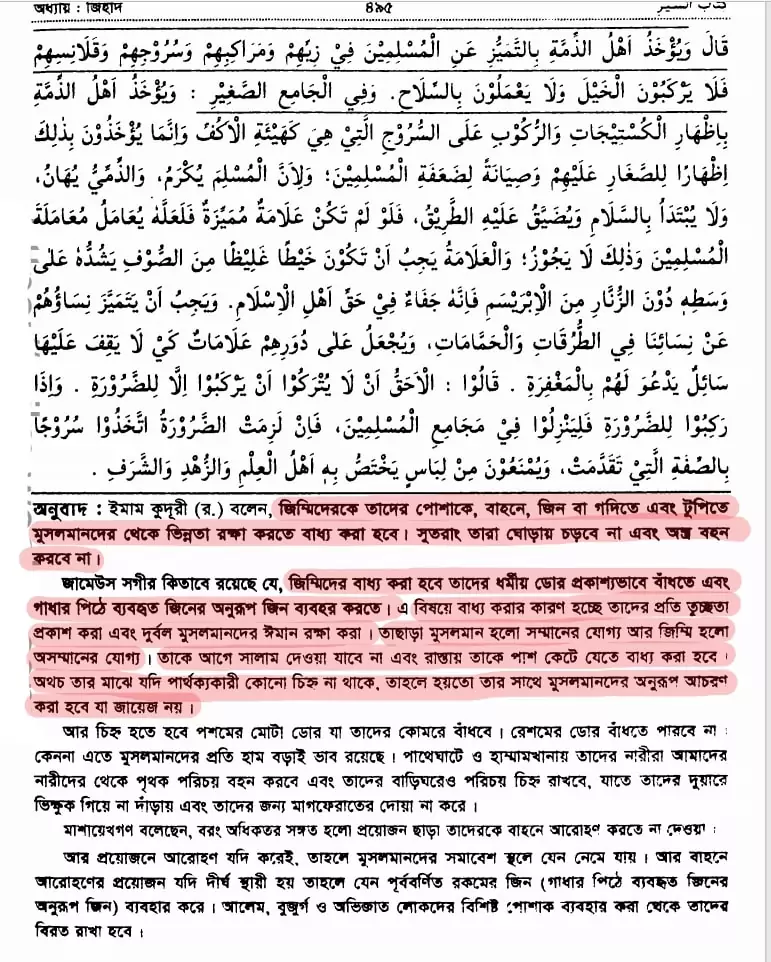
Translation: Imam al-Quduri says that dhimmis will be compelled to distinguish themselves from Muslims in their clothing, mounts, saddles or padding, and caps. They will therefore not ride horses or carry weapons.
Al-Jami‘ al-Saghir states that dhimmis will be compelled to wear their religious cords visibly and use saddles resembling those used on donkeys. The purpose of compelling this is to express contempt for them and protect the faith of weak Muslims. Moreover, Muslims deserve honour, while dhimmis deserve dishonour. They must not be greeted with salam first and must be compelled to pass along the side of the road. Without a distinguishing sign, they might be treated like Muslims, which is not permissible.
The sign must be a thick woollen cord tied around the waist. They may not wear silk cords, since that would express arrogance towards Muslims. Their women must be distinguishable from our women on roads and in bathhouses, and they must place identifying signs on their houses so that beggars do not stand at their doors and pray for their forgiveness.
The shaykhs have said that it is more appropriate not to allow them to ride mounts unless necessary.
If they do ride out of necessity, they must dismount where Muslims gather. If the need to ride continues for a long time, they must use the kind of saddle described above, resembling a donkey saddle. They will be prevented from wearing the distinctive clothing of scholars, religious elders, and people of high status.
Now let us listen to another Islamic statement:
Non-Muslims Have No Right to Propagate Their Religion
When Muslims travel to different countries, they seek the right and permission to propagate Islam there. Every civilized country permits them to practise and propagate their religion. Yet if Sharia is established in a Muslim-majority country, non-Muslims will no longer have any right to propagate theirs. Let us examine what the prominent Islamic preacher Zakir Naik has said on this matter:
The Humiliating Jizya Tax
It is important for all of us to understand what jizya means. Many conflate jizya with kharaj and claim that jizya is simply an ordinary tax. This is entirely mistaken. Kharaj is the land tax paid by non-Muslims. Jizya, however, is money they pay to be spared by the victorious Muslims, to remain alive, or to obtain protection. It must be paid in submission and humiliation. A separate Shongshoy article examines in detail jizya’s religious basis, the instructions linking its collection to humiliation and subordination, and its effects on non-Muslims’ social standing. Readers assessing the claim that jizya is an ordinary civic tax may also consult the evidence from Quranic commentaries and jurisprudence compiled there [41]. The Quran states the matter explicitly [42]:
Fight those among the People of the Book who do not believe in Allah or the Last Day, do not regard as forbidden what Allah and His Messenger have forbidden, and do not embrace the true religion, until they pay jizya with their own hands in a state of submission.
Tafsir al-Jalalayn says on this matter: The word jizya derives from “jaza”: that is, you are an offender deserving the death penalty. However, you are granted the concession that this penalty is not enforced against you and that you are permitted to reside safely in Dar al-Islam [43].
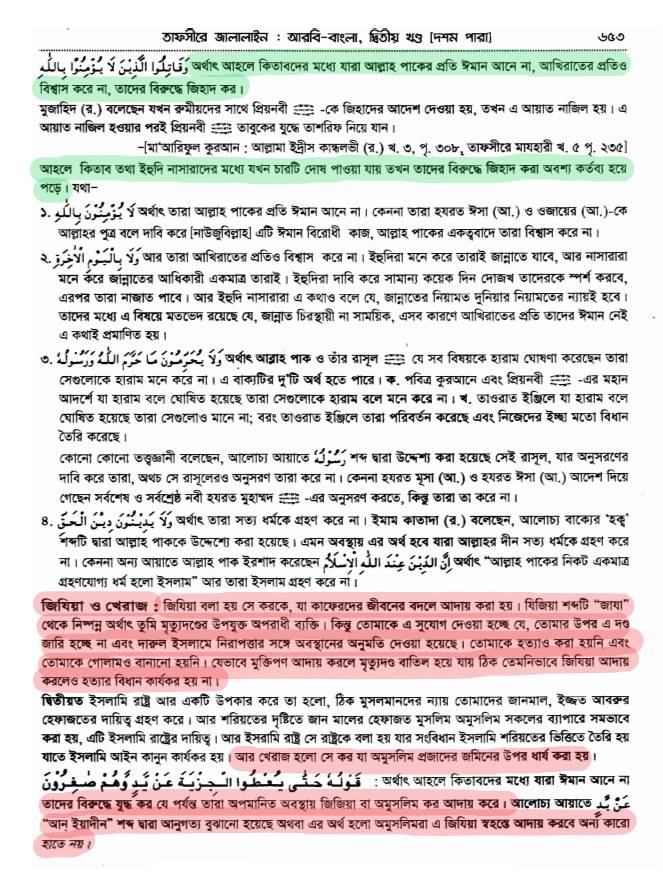
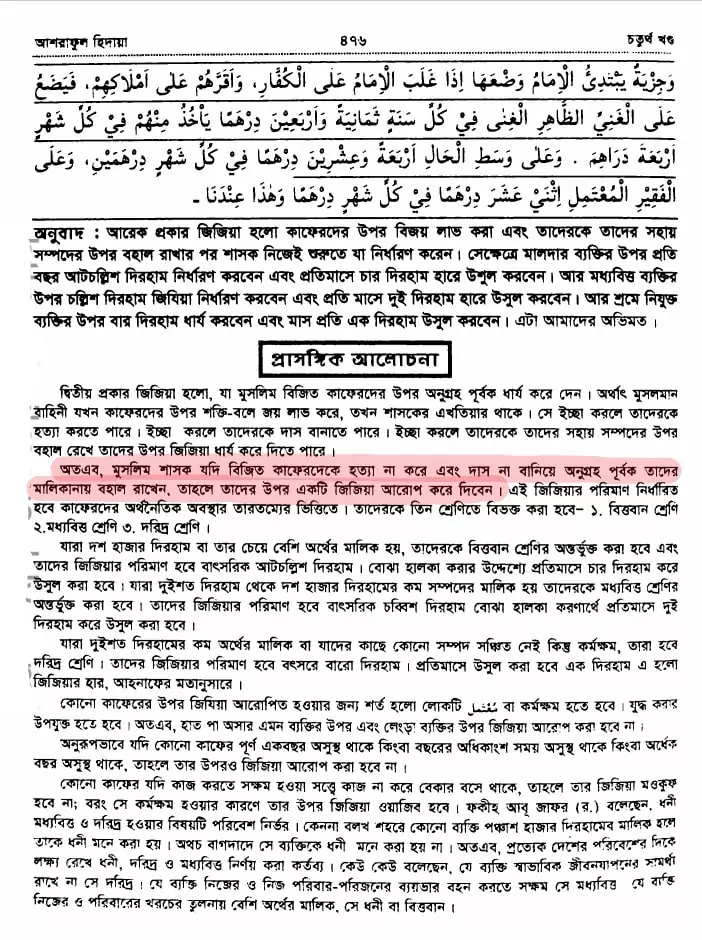
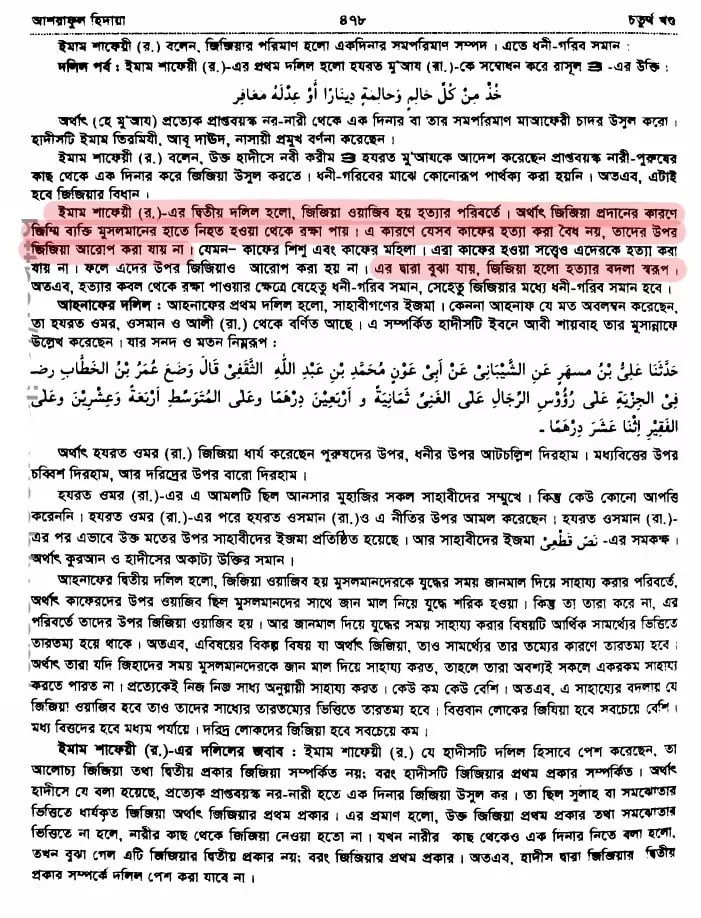
Let us examine the meaning and purpose of jizya in the Hanafi work of jurisprudence Ashraful Hidaya [44].
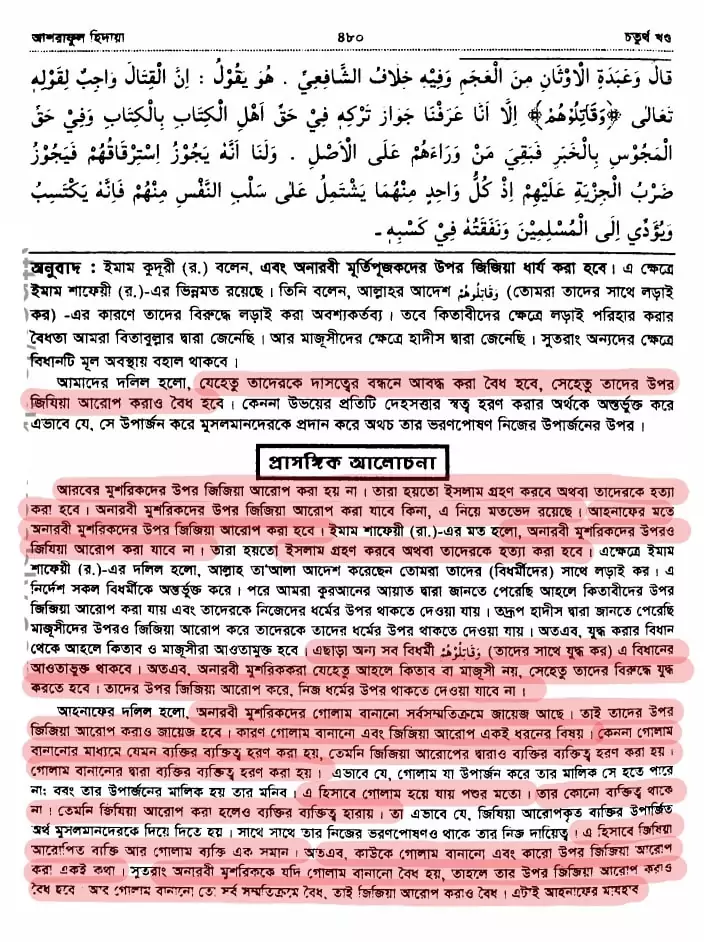
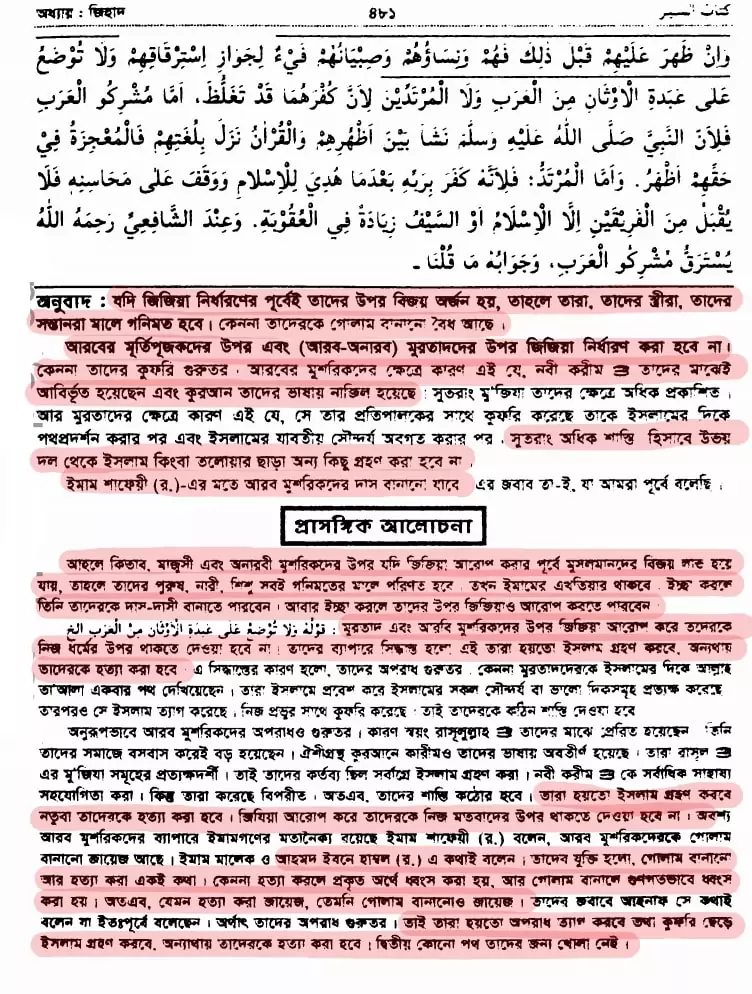
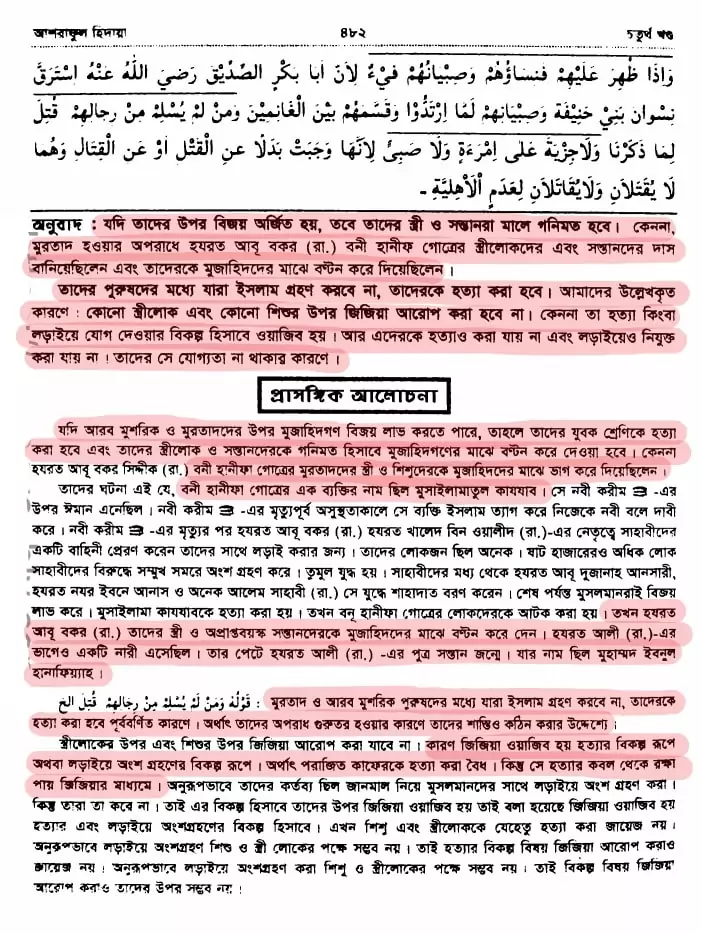
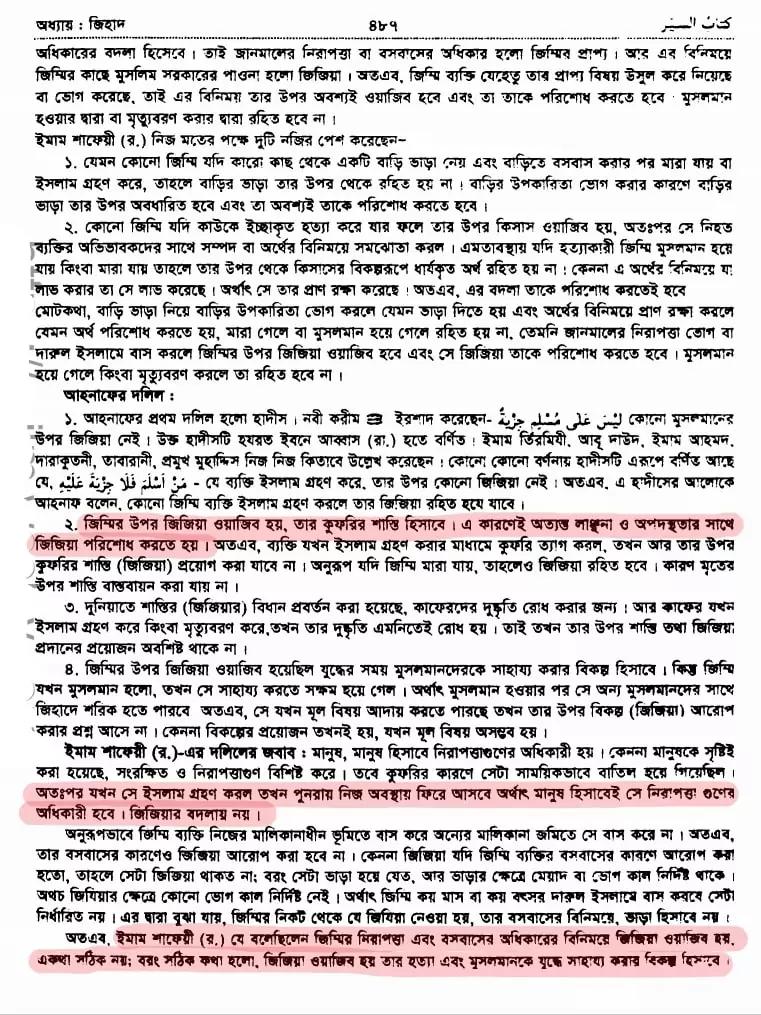
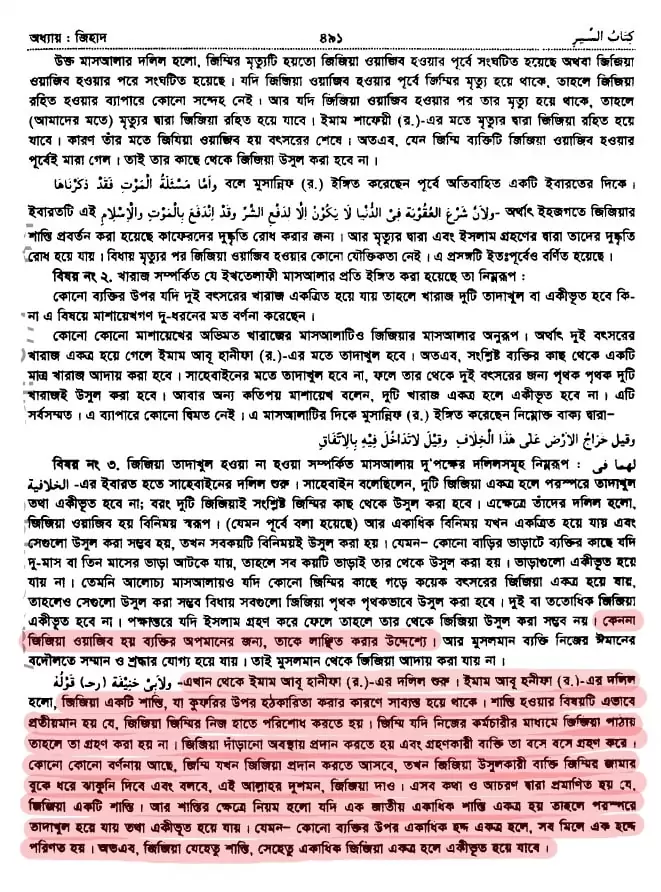
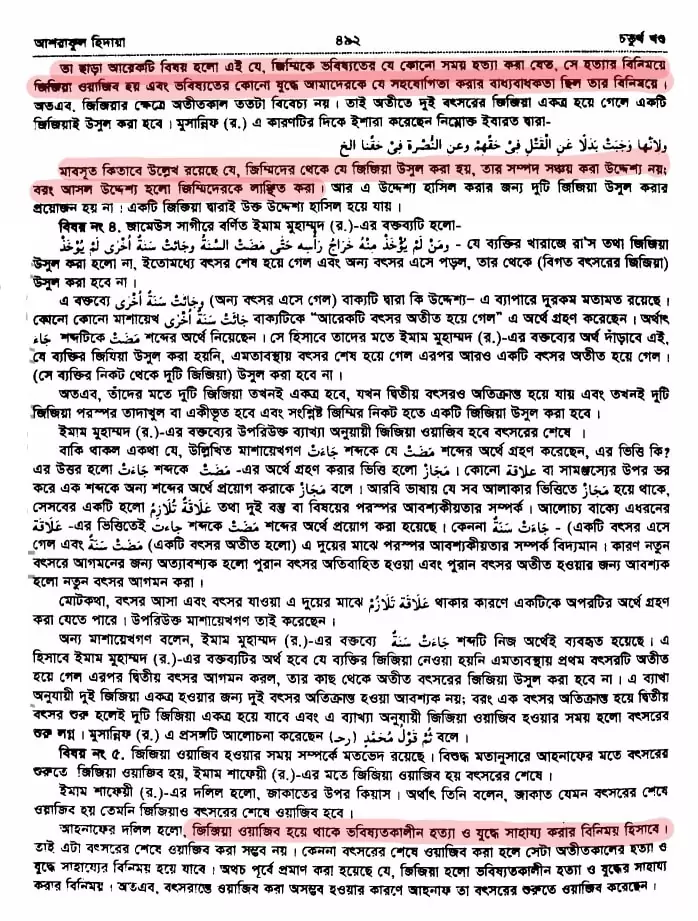
Tafsir al-Mazhari, written by Allama Qadi Muhammad Sanaullah Panipati, is an important Quranic commentary. It explicitly discusses what verse 29 of Surah al-Tawba says about jizya and how it is interpreted. To understand in detail how jizya signifies humiliation and degradation, and how it is to be collected, this section should be read [45].


The same matter can be examined in Tafsir Ibn Kathir [46].


Now let us examine a renowned fatwa collection from the Indian subcontinent, Fatawa Alamgiri, to see whether Islam prescribes placing iron chains around the necks of non-Muslim dhimmi women and marking their homes to establish their inferior and contemptible status. Let us consult the book directly [47].
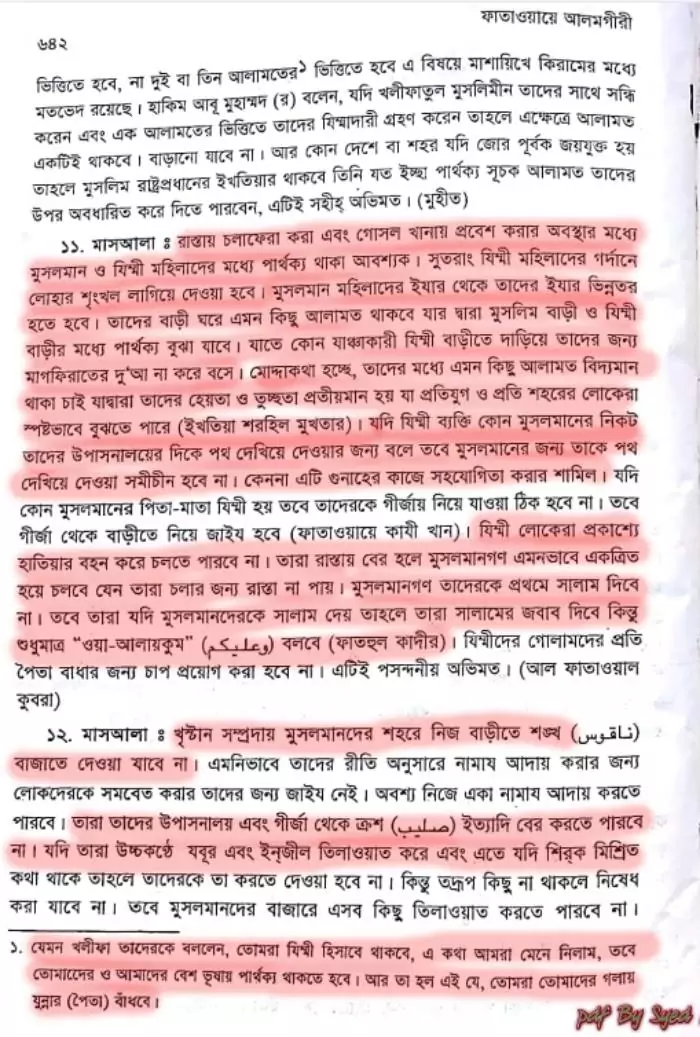
Let us read an incident from Umar’s time showing how he humiliated Christians and explained that humiliation [48].
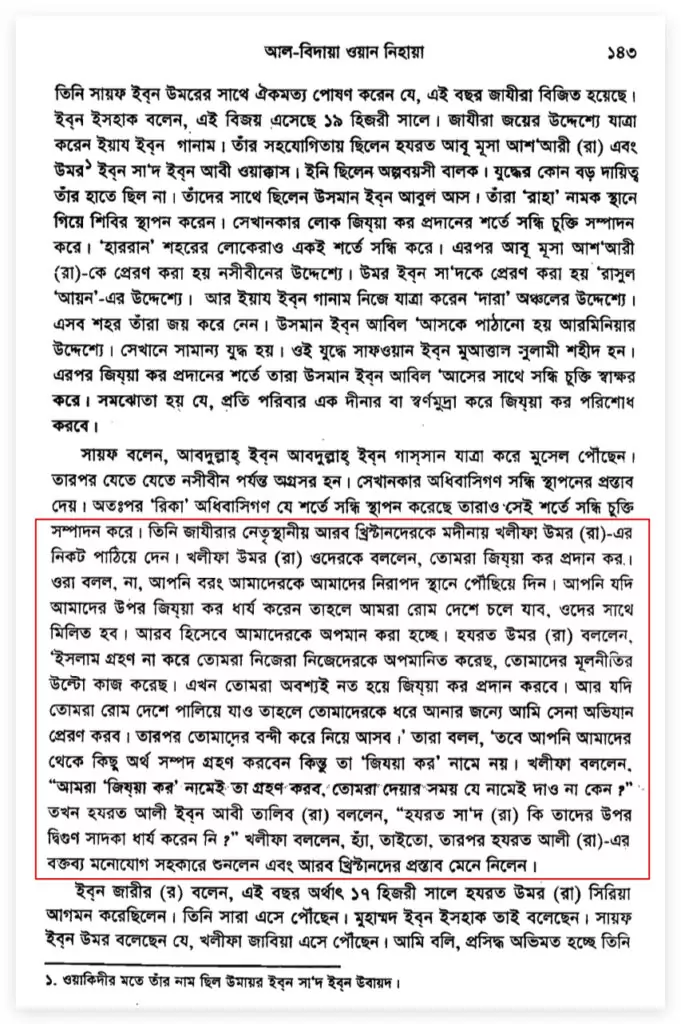
Forced Conversion
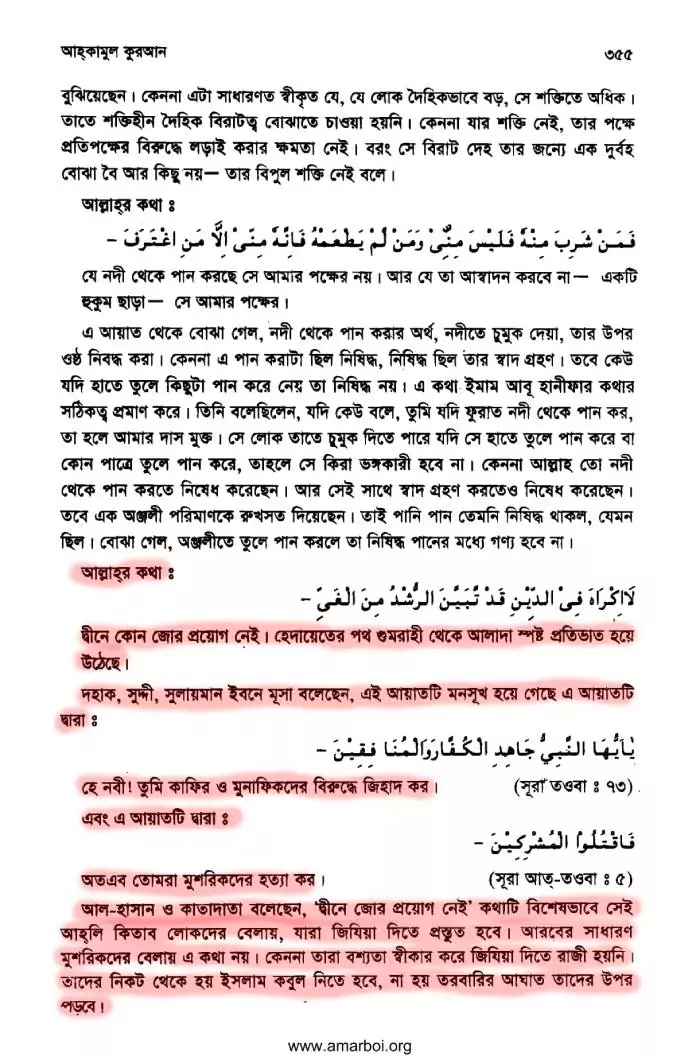
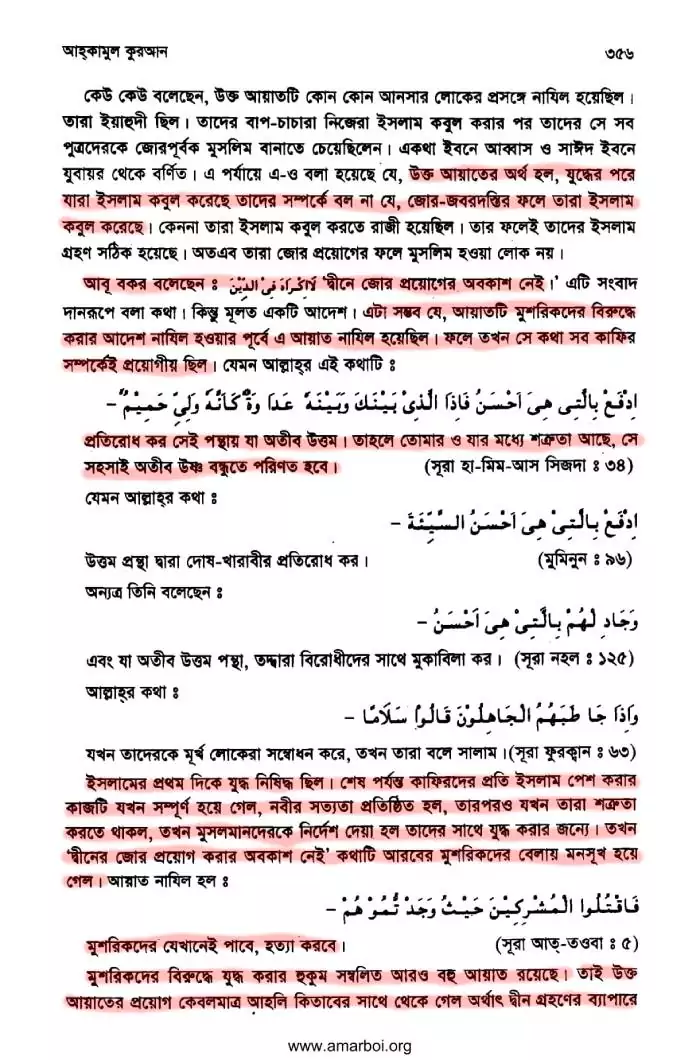
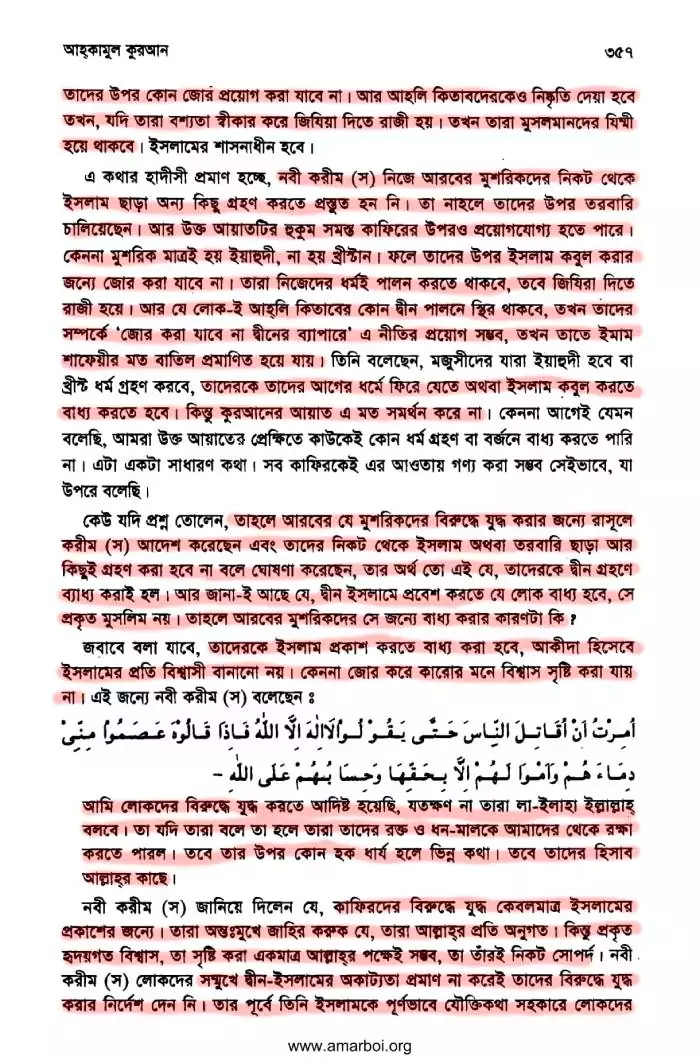
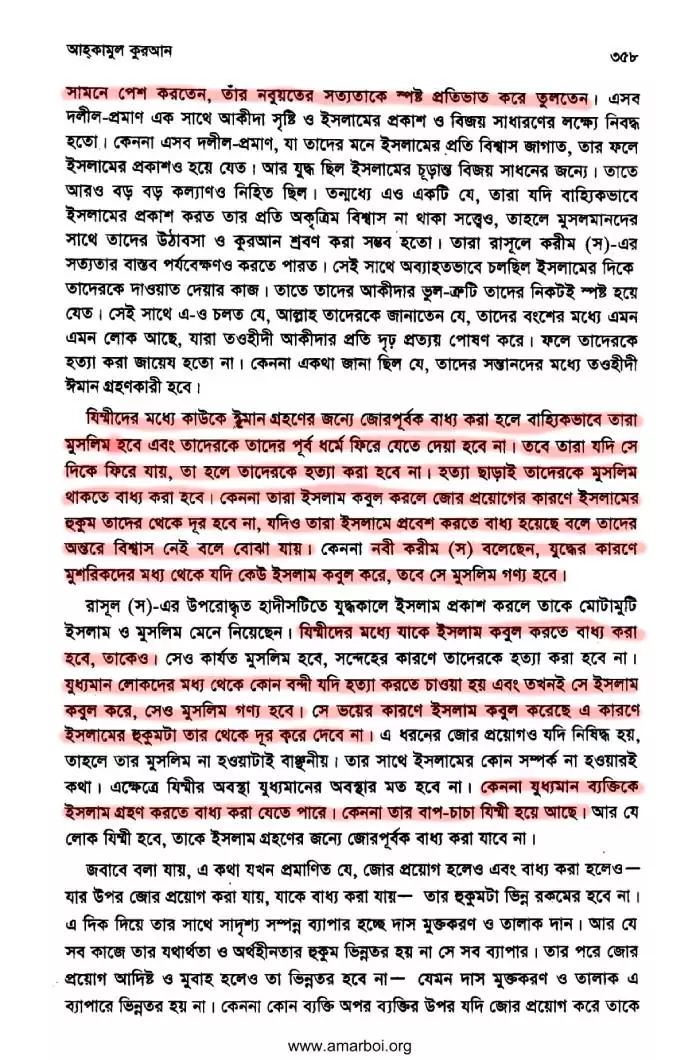
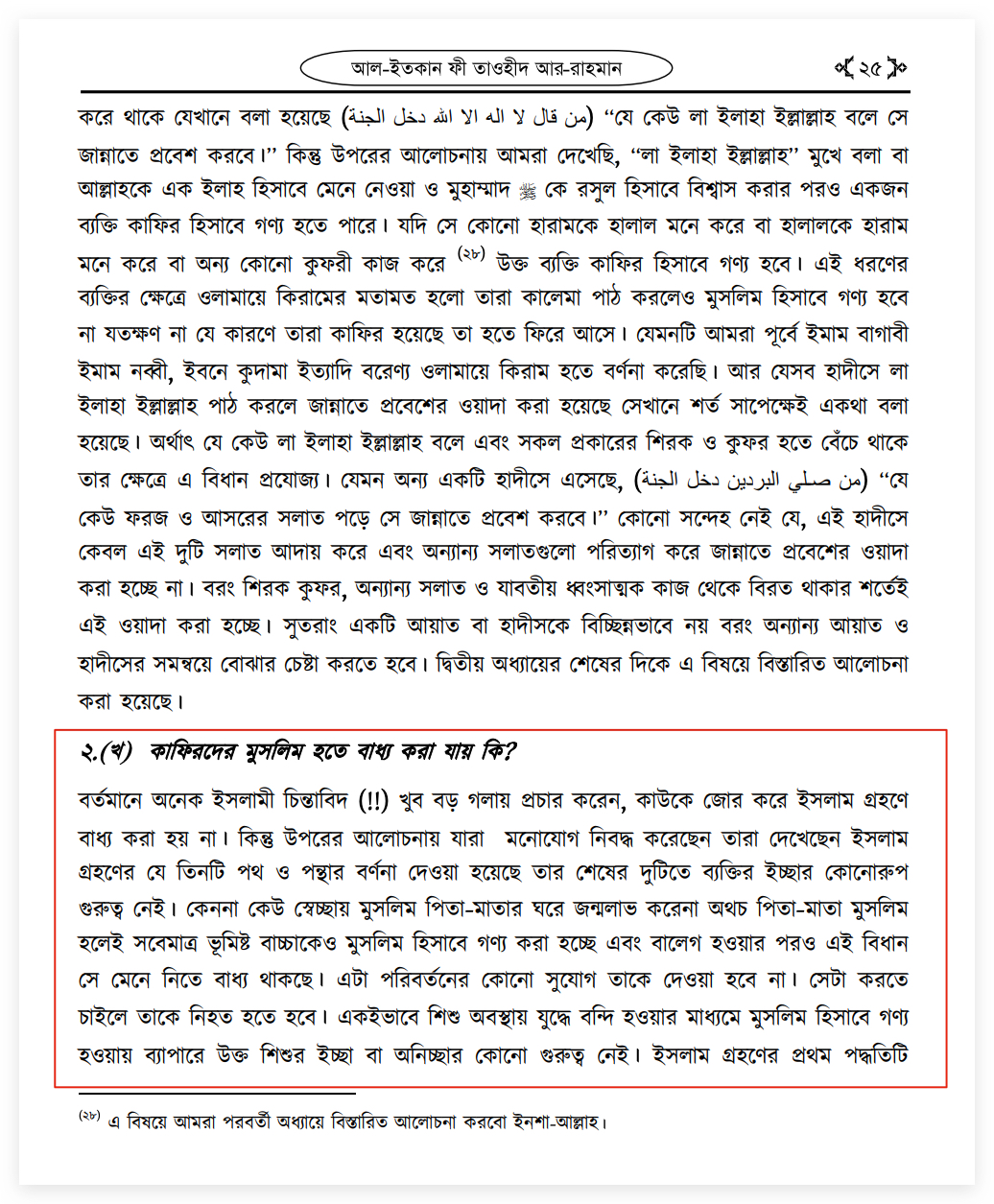
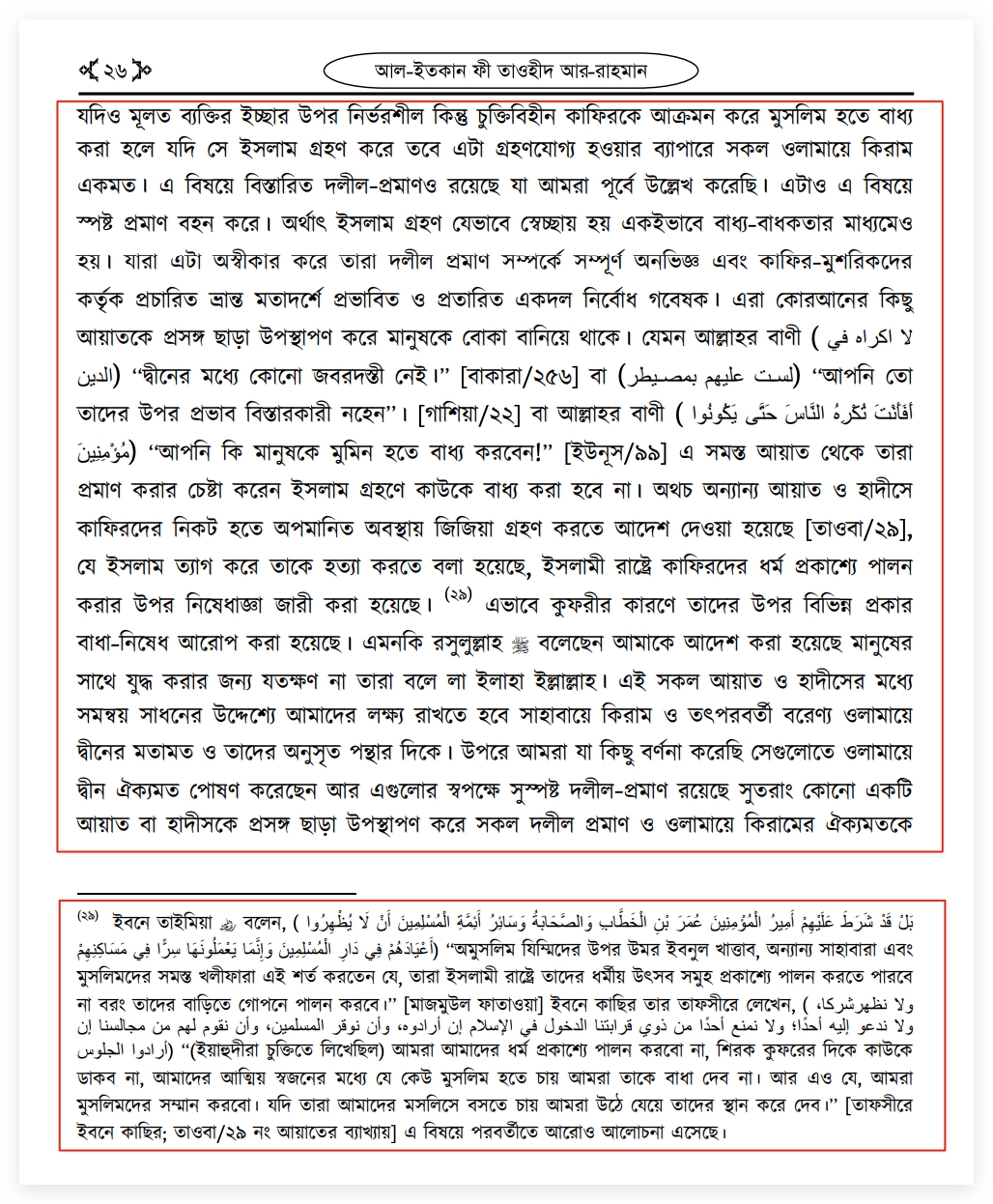
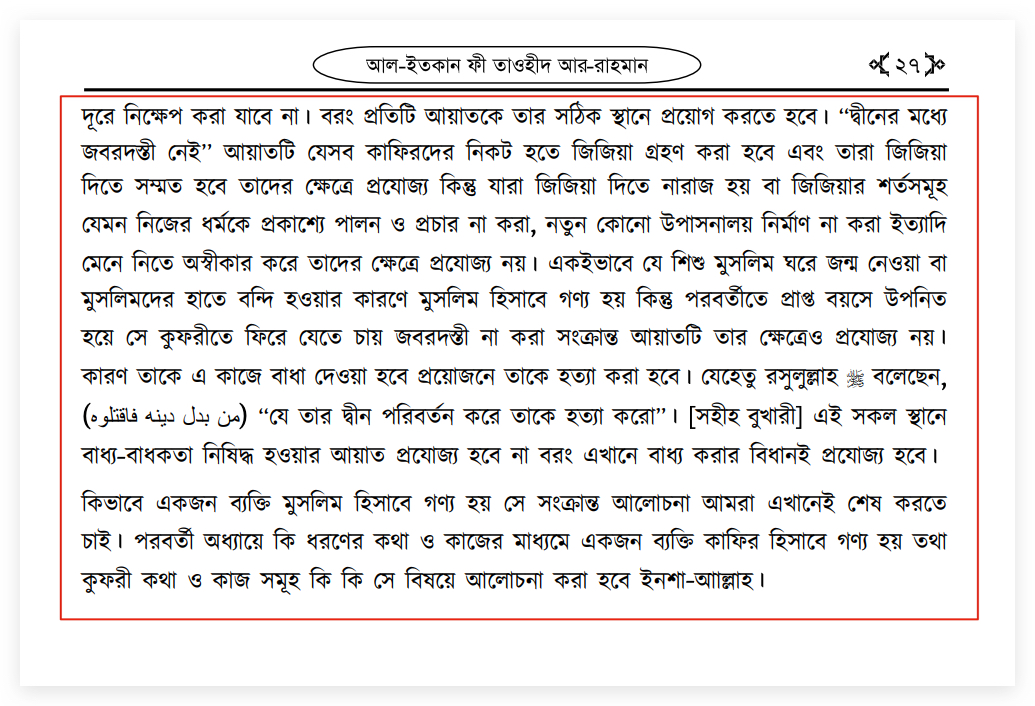
Many claim that verse 256 of Surah al-Baqara states that there is no compulsion in religion! But what is the context of this verse? Does its ruling remain in force? Let us read the explanations of this Quranic verse directly from the commentaries [49]. These make it clear that forced conversion is also authorized in Islam. A separate Shongshoy article discusses the meaning and application of “La ikraha fi al-din” in greater detail. It examines the verse’s context, explanations in classical commentaries, and the relevant rules alongside the claim that there is no compulsion in religion [50]. Understanding these rules is necessary to assess how effective the freedom to retain one’s beliefs is in a person’s life. The evidence below forms part of that assessment.
Islam: A Rat Trap
We will now examine a well-known work of Islamic creed to establish what Islam’s commands and rules actually are on this subject [51].
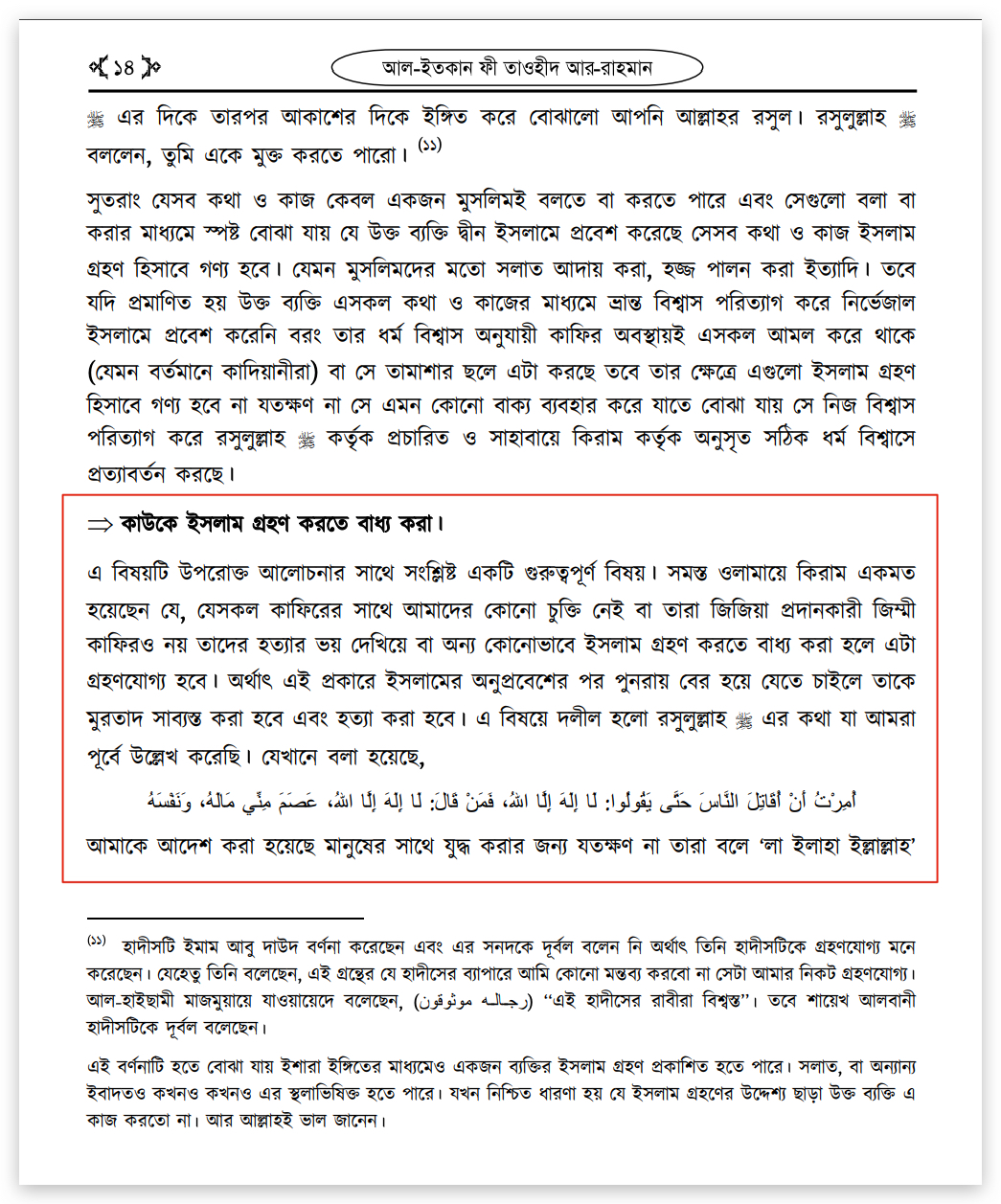
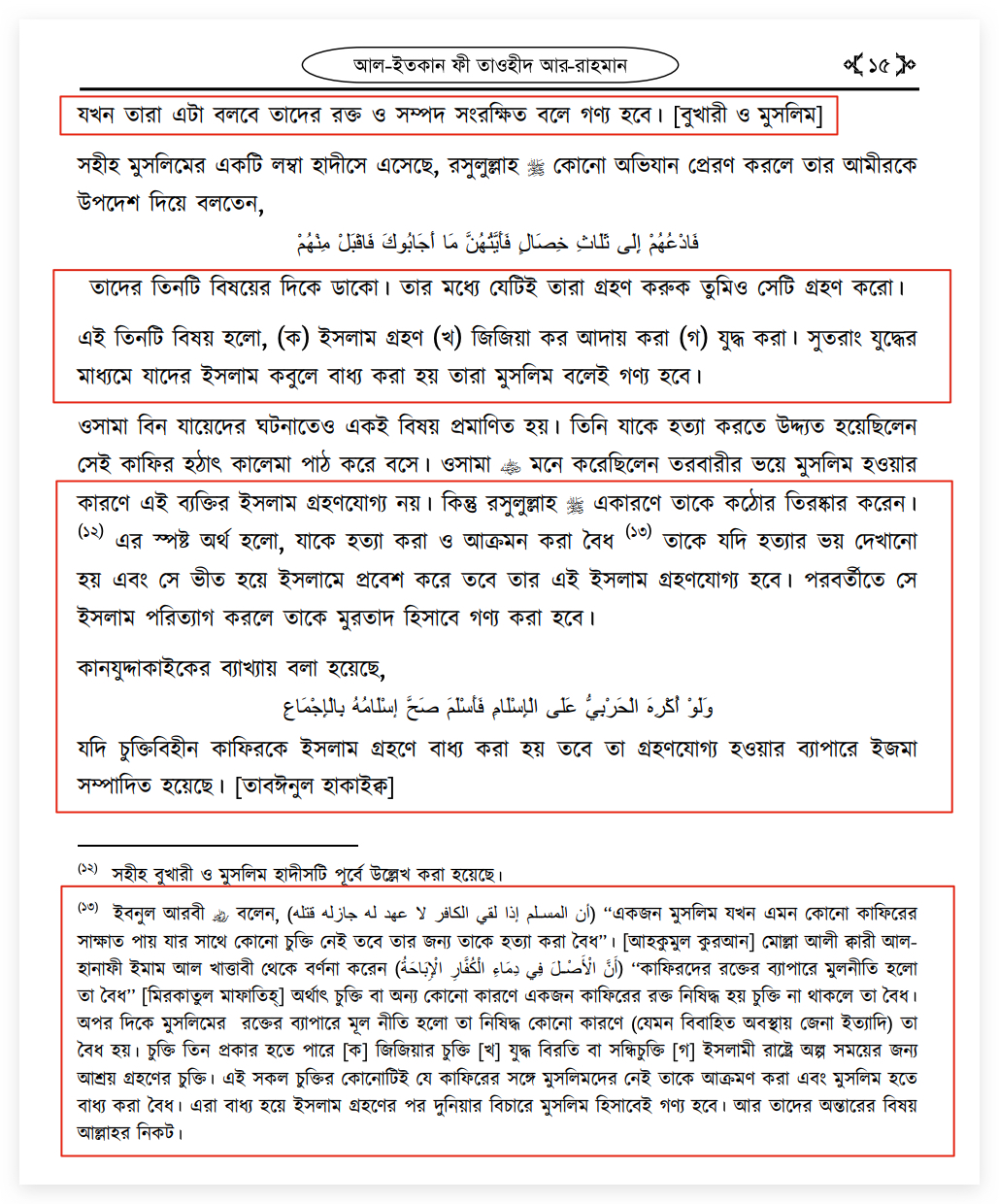
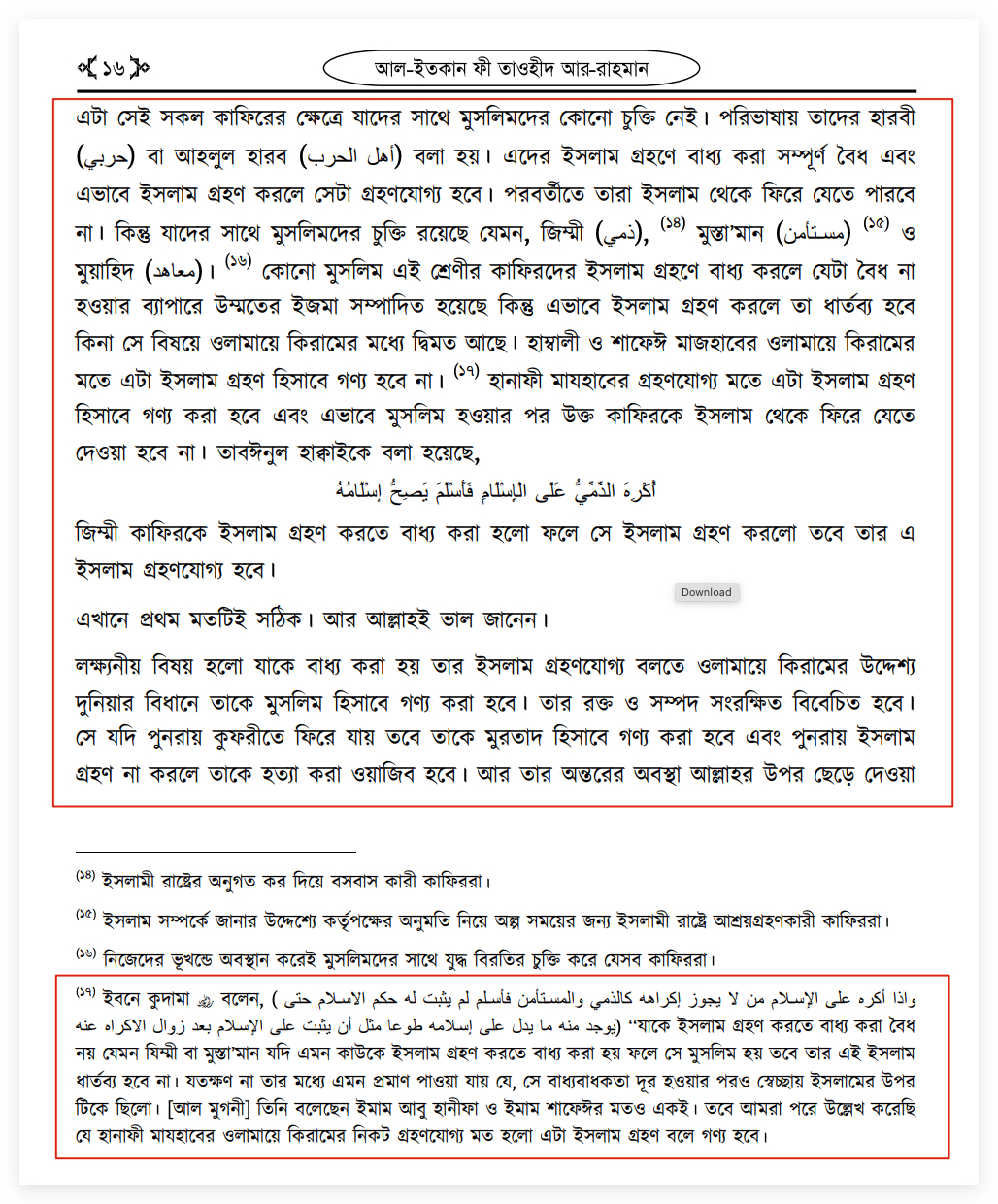
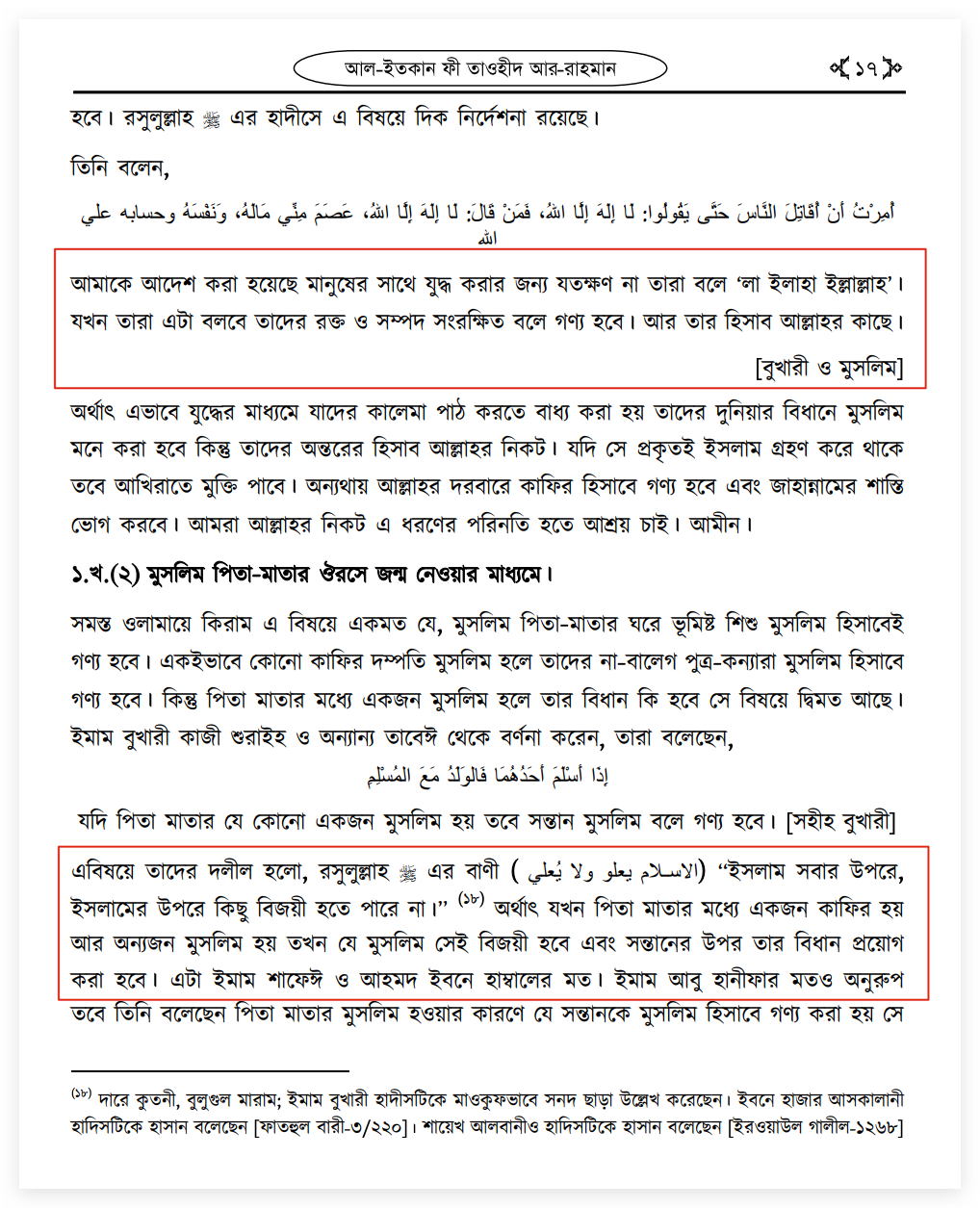
Non-Muslims Cannot Hold High Office, Even When Qualified
Suppose a teacher at your school is Hindu. Under Islamic Sharia law, that teacher can never occupy a position that confers authority, even with all the necessary qualifications, intelligence, and ability. A fatwa from the well-known website Islamweb is reproduced below. Its basic position is that a non-Muslim cannot be given “any position involving power or authority” in a Muslim state. Drawing on several Quranic verses and historical incidents, it argues that non-Muslims cannot by their nature be trustworthy allies, or wali, of Muslims, and that since Allah has supposedly humiliated them, Muslims should not elevate them to any honourable position.
This sectarian sophistry rests entirely on discrimination by religious identity. Character, skill, integrity, and citizenship count for nothing: the single question of whether someone is Muslim renders all their qualifications meaningless. Language such as “Non-Muslims must not be honoured, because Allah has degraded them for their unbelief” crushes personal dignity and self-respect beneath a religious label. The fatwa directly conflicts with one of the most basic principles of modern human rights—that all human beings are equal in dignity. It explicitly holds that a difference in belief alone makes someone less human and less deserving of respect in the eyes of the state.
A little imagination reveals the inhumane circumstances that applying this fatwa would create. Suppose that 10–20 per cent of a country’s citizens are Christians, Hindus, Buddhists, atheists, or people of other identities. They are citizens by birth, pay taxes, obey the law, and join the armed forces in wartime. Yet simply because they are “not Muslim,” they can never become ministers, mayors, judges, university vice-chancellors, or even officers in charge of police stations or directors of public hospitals. An honest, highly competent non-Muslim could spend a lifetime in public service without ever acquiring “authority in any position,” while a mediocre Muslim citizen could be placed above them solely because of belief. What conception of competence, justice, or basic humanity is compatible with that? Worse still, the story of Umar ibn al-Khattab cited in the fatwa says that keeping a non-Muslim in office means “honouring” that person, and asks: “When Allah has degraded him for his unbelief, why should we honour him?” [52]
Disbelievers are not to hold positions of authority in a Muslim state
1341
7-3-2012 – Rabee’ Al-Aakhir 14, 1433
598
Question
Is it permissible to appoint Christians to have positions of authority in Muslim countries?
Answer
All perfect praise be to Allaah, The Lord of the Worlds. I testify that there is none worthy of worship except Allaah, and that Muhammad sallallaahu `alayhi wa sallam ( may Allaah exalt his mention ) is His slave and Messenger.
Imaam Ibn Taymiyyah may Allaah have mercy upon him has relevant words which we will mention here with slight modifications. He stated that the righteous predecessors may Allaah be pleased with them held that Muslims should not seek the help of disbelievers in positions of power. To support this fact, they cited the sayings of Allaah (which mean):
– {O you who believe, do not take the Jews and the Christians as allies. They are [in fact] allies of one another.} [Quran 5:51]
– {Your ally is none but Allaah and [therefore] His Messenger and those who have believed – those who establish prayer and give Zakah [obligatory charity], and they bow [in worship]. And whoever is an ally of Allaah and His Messenger and those who have believed – indeed, the party of Allaah – they will be the predominant.} [Quran 5:55-56]
– {And those who disbelieve are allies of one another.} [Quran 8:73]
Abu Moosa may Allaah be pleased with him narrated he informed ‘Umar Ibn Al-Khattaab may Allaah be pleased with him that he had appointed a Christian scribe. ‘Umar may Allaah be pleased with him reproached him and reminded him of the verse in which Allaah The Almighty Says (what means): {O you who have believed, do not take the Jews and the Christians as allies. They are [in fact] allies of one another.} [Quran 5:51] He then ordered him to replace the Christian scribe with a Muslim. Abu Moosa may Allaah be pleased with him argued that he benefited from his writing while the scribe bore the sin of his religion. In turn, ‘Umar may Allaah be pleased with him explained to him that we must not honor them while Allaah The Almighty has degraded them with disbelief, nor should we dignify them while Allaah The Almighty has humiliated them, nor should we bring them closer to us while Allaah The Almighty has distanced them. [Ahmad: through a sound chain of narration]
Thus, we conclude that it is unanimously prohibited to assign disbelievers, irrespective of their sects and beliefs, to positions of authority.
Allaah Knows best.
Translation: Fatwa title: “Disbelievers Are Not to Hold Positions of Authority in a Muslim State”
Fatwa number: 1341
Publication date: 7 March 2012
Question (paraphrased): Is it permissible to appoint Christians to positions of power—that is, positions involving authority or governance—in Muslim-majority countries?
Answer (paraphrased)
All perfect praise belongs to Allah, Lord of all creation. I testify that there is no deity except Allah, who is One and has no partner. I also testify that Muhammad is His servant and Messenger.
Imam Ibn Taymiyya made relevant statements, the substance of which is presented here with slight modifications. He stated that the position of the salaf, the pious Muslim predecessors of the earliest generations, was that Muslims should not seek the assistance of unbelievers in positions that place power or authority in their hands.
To establish this position, they pointed to several Quranic verses, including:
“O believers, do not take Jews and Christians as friends, allies, or protectors; they are friends of one another.” (Surah al-Ma’ida 5:51, paraphrased meaning)
“Your true ally or supporter is Allah, His Messenger, and those who believe, who establish prayer, give zakat, and bow humbly in worship. Whoever takes Allah, His Messenger, and the believers as allies belongs to Allah’s party, and Allah’s party will be successful and predominant.” (Al-Ma’ida 5:55–56, paraphrased meaning)
“Those who disbelieve are allies, friends, or protectors of one another.” (Al-Anfal 8:73, paraphrased meaning)
According to Ibn Taymiyya, these verses establish that unbelievers should not be placed in any position of guardianship or authority over Muslims.
In this connection, he mentions an incident involving the Companion Abu Musa al-Ash‘ari:
Abu Musa informed Caliph Umar ibn al-Khattab that he had appointed a Christian as his scribe or writing clerk. Umar rebuked him and reminded him of the verse prohibiting Jews and Christians from being taken as allies. He then instructed Abu Musa to dismiss the Christian and appoint a Muslim in his place.
Abu Musa argued that he was merely benefiting from the man’s writing skills, while the man himself bore the religious sin of his beliefs. Umar replied:
We cannot honour them when Allah has disgraced them for their unbelief;
we cannot dignify them when Allah has lowered their standing;
we cannot draw them close when Allah Himself has kept them distant.
(The fatwa states that Imam Ahmad narrated the report with a sound chain of transmission.)
On the basis of all this evidence, the fatwa concludes:
Assigning unbelievers, whatever their beliefs or sects, to any high office involving governance, authority, responsibility, or power is prohibited unanimously, according to the consensus of Islamic law. Appointing them to any position of power in a Muslim state is not permissible.
How does this fatwa strike you? Consider how it would feel if Muslims were treated in exactly the same way. In such cases, the state is being used as an instrument to deliberately demean another person’s religious identity. This is more than discrimination: it is planned humiliation and degradation. No modern constitution or even minimal human values can describe it as just. Looking more deeply, such rules create lasting hostility and insecurity in society. If Muslims in Muslim-majority countries issue fatwas declaring political and administrative discrimination against non-Muslims “religiously permissible,” non-Muslim-majority countries may respond with equally discriminatory policies against Muslim minorities: “Since you refuse to accord our people equal standing in your country, we will not accord your people equal standing in ours.” Making religious identity the measure of political rights divides humanity into camps confronting one another, where the distinction between “us” and “them” as citizens never ends. A humane and just social system assigns positions on the basis of qualifications, integrity, skill, and accountability, rather than religious identity. The doctrine of this fatwa is therefore not only inhumane but, in practical terms, the complete opposite of justice: it attempts to give legal form to religious bigotry that disregards every minimal standard of modern human civilization.
Non-Muslim Testimony Is Inadmissible
Under Islamic law, a non-Muslim’s testimony against a Muslim is inadmissible. Suppose a Muslim enters a non-Muslim family’s home, kills several members, and is seen by other members of that family. Their testimony will not be admissible in an Islamic court when the case is tried. This means that if non-Muslims witness crimes committed by Muslims or testify against them, their evidence is not to be considered [53]. Rejecting eyewitness testimony because of religious identity before examining what the witness saw or how reliable the account is also divides access to justice by religion. A Muslim witness to the same crime will have an opportunity in court that a non-Muslim witness is denied. Such an unequal position before the courts, even for citizens in their own homeland, directly contradicts equal rights. A separate Shongshoy article examines the admissibility of non-Muslim testimony and the associated judicial discrimination in detail [54]. Let us read the relevant provision of Fatawa Alamgiri below:
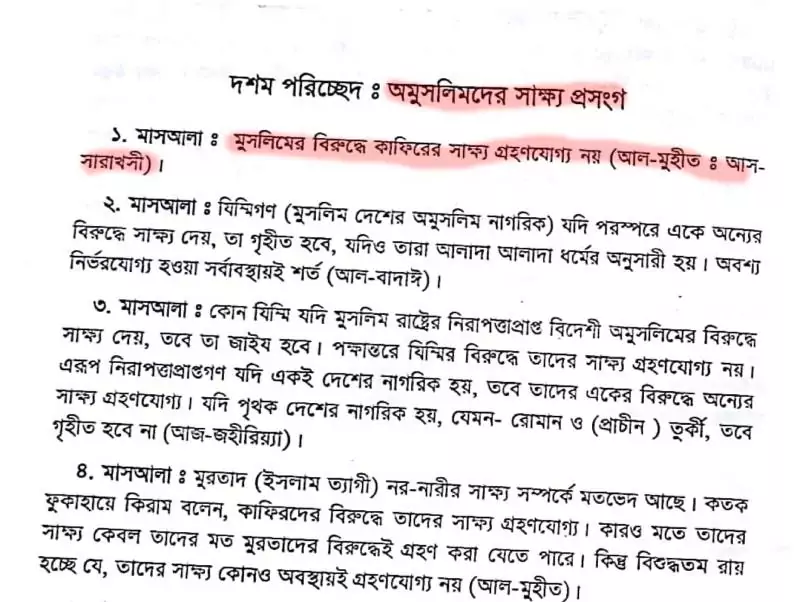
They Must Be Forced to the Edge of the Road
Although Jews and Christians may obtain permission to live in an Islamic state by paying the humiliating jizya tax, they must actually live in humiliation and degradation. The Hadith below states that the Prophet himself instructed Muslims to force Jews and Christians to the side of the road so that they could not walk along its middle [55]. Compelling people to accept an inferior position even while using a public road because of their religion undermines their social dignity every day. A Muslim subjected to such treatment abroad because of religious identity would regard it as humiliation and discrimination. The same standard applies to Jews and Christians. A separate Shongshoy article compiles in detail the Hadith reports and explanations concerning greetings, giving way on the road, and instructions to humiliate non-Muslims [56]. Let us read the Hadith below:
Sunan al-Tirmidhi, verified edition
Book 19: Military Expeditions
Publisher: Husain al-Madani
Chapter 41: Greeting the People of the Book
1602. Abu Hurayra narrated that the Messenger of Allah (peace and blessings be upon him) said: Do not initiate the greeting of salam to Jews and Christians. When you encounter any of them on the road, force that person to its edge.
Sahih; al-Sahiha (704), Irwa (1271), Muslim, and al-Bukhari’s al-Adab al-Mufrad. The discussion of Hadith 2855 will follow.
Reports on this subject have also been narrated from Ibn Umar, Anas, and Abu Basra al-Ghifari. Abu Isa called this Hadith hasan sahih.
Hadith classification: Sahih (authentic).
The explanation of this Hadith also states that Muslims are instructed to humiliate non-Muslims [57] [58].
Sunan al-Tirmidhi, Islamic Foundation
Book 24: Military Expeditions
Chapter: Greeting the People of the Book
1608. Qutayba … narrated from Abu Hurayra: The Messenger of Allah (peace and blessings be upon him) said: Do not initiate the greeting of salam to Jews and Christians. If you encounter any of them on the road, force them to its edge. Sahih; al-Sahiha 704, Irwa 1271, Muslim, al-Adab al-Mufrad; al-Tirmidhi Hadith number 1602 in the al-Madani edition.
Reports on this subject have also been narrated from Ibn Umar, Anas, and the Companion Abu Basra al-Ghifari. Imam Abu Isa says that this Hadith is hasan sahih. Its meaning is that you should not initiate salam to Jews and Christians. Some scholars say that this is disliked because it shows them respect, whereas Muslims are instructed to humiliate them. Similarly, if one of them is encountered on the road, one should not give way, because doing so shows them respect.
Hadith classification: Sahih (authentic).
Narrator: Abu Hurayra.
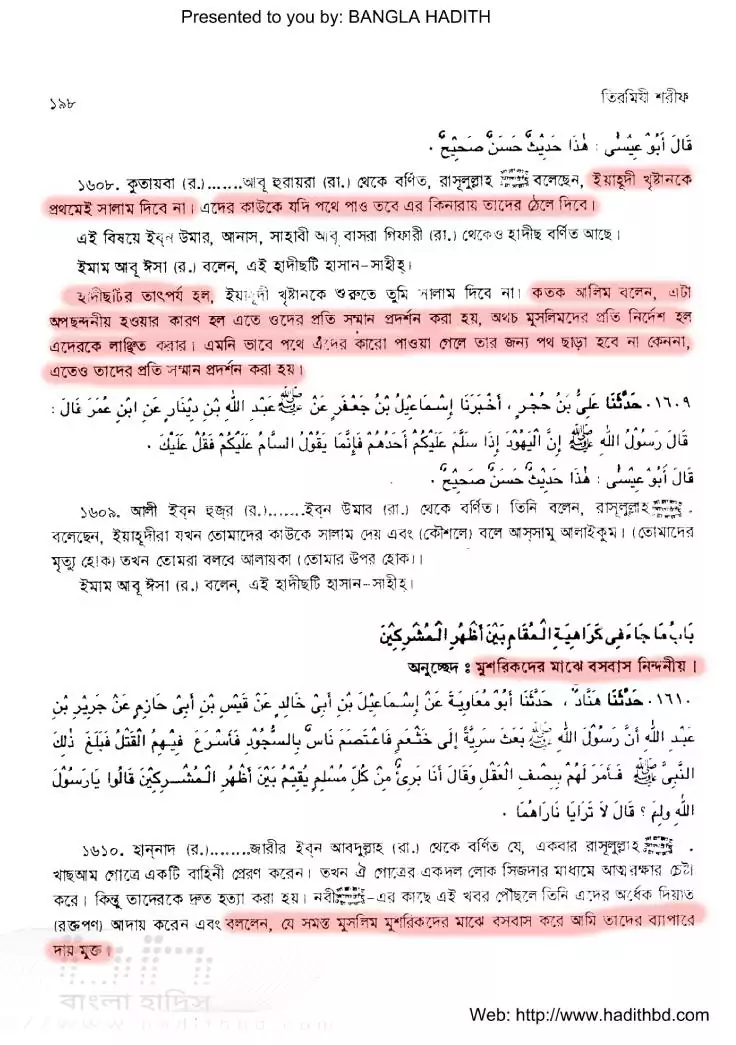
This matter is also stated in Tafsir Ibn Kathir [59].
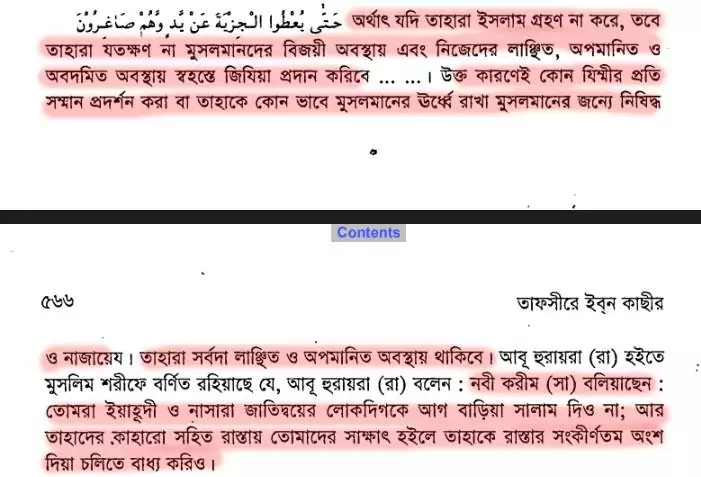
Zakat Cannot Be Given to Non-Muslims
All Muslims in an Islamic country are required to pay zakat. Under Islamic law, however, zakat cannot be given to poor unbelievers. The religious beliefs of poor people must be examined when distributing zakat; whether they receive it depends on those beliefs. Let us examine a well-known fatwa [60].
Question
Last week a scholar said that we can give Zakah to non-Muslims, also that where the Qur’an says to give to the 8 people it does not clearly say for Muslims only. Is this correct?
Answer
Praise be to Allah, the Lord of the Worlds; and may His blessings and peace be upon our Prophet Muhammad and upon all his Family and Companions.
Zakah should be strictly limited to the 8 categories mentioned in the verse. Allah Says (interpretation of meaning): {As-Sadaqât (here it means Zakât) are only for the Fuqarâ’ (poor), and Al-Masâkin (the poor) and those employed to collect (the funds); and for to attract the hearts of those who have been inclined (towards Islâm);….}(9:60).
Now if the person gives Zakah to non-Muslims apart from those inclined to Islam his/her deed is not permissible and does not free him/her from the Zakah duty. So, he/she still has to pay that Zakah again.
In fact, Zakah should not be paid to a Kafir (non-Muslims) unless he/she is from “those inclined to become Muslims”.
The evidence for the above rule is the Hadith reported by Muslim and Al Bukhari from Ibn Abbas (Radiya Allahu Anhu) that the Prophet (Sallallahu Alaihi wa Sallam) said: “(Zakah) is taken from their wealthy people and paid to their poor ones”. The pronoun “their” in both cases refers to Muslims.
As for those who are inclined to Islam, they are of two types:
1) The non-Muslims who could become Muslim, these could be given Zakah according to the Maliki and Hanbali but according to the Shafi’e and Hanafi should not be given Zakah.
2) Muslims who could become more firm in their religion. These should be given Zakah according to the Maliki, Shafi’e and Hanbali.
The Hanafis opinion is that neither types should be given Zakah as Allah has made Islam glorious and does not need pushing people to it.
Now those Muslims who are doubtful or weak in religion should be given Zakah not to convince them but, because they are poor or needy so, what you heard about giving Zakah to non-Muslims is wrong unless the scholars meant those inclined towards Islam.
Allah knows best.
The same position appears in the renowned Quranic commentary Tafsir al-Mazhari [61].
Al-Fiqh al-Muyassar states the same rule [62]:
Living with Polytheists Is Forbidden
Prophet Muhammad did not merely prohibit polytheists or idol worshippers from residing in an Islamic state; he also prohibited living with them elsewhere. This Hadith states that no Muslim may live together harmoniously with a polytheist neighbour [63] [64]. A neighbour’s suitability for maintaining a relationship should be assessed by honesty, conduct, and respect for others’ rights. Prohibiting residence and companionship with someone because of religion creates a lasting division between people in the same society. The rights of people who have lived in the same locality for generations to their homeland, homes, and social relationships then also become subordinate to religious identity. A separate Shongshoy article compiles detailed evidence concerning the command to expel Jews and Christians from Arabian territory and the eviction of non-Muslims on religious grounds [65]. Read the Hadith reports below with this question in mind: how uncertain do non-Muslims’ security and civic standing become when their right to live in their own homeland depends on the religious majority’s permission?
Sunan al-Tirmidhi, verified edition
Book 19: Military Expeditions
Publisher: Husain al-Madani
Chapter 42: The Prohibition on Living with Polytheists
1605. A report similar to Abu Mu‘awiya’s Hadith is narrated through Hannad, from ‘Abda, from Isma‘il ibn Abi Khalid, from Qays ibn Abi Hazim. Jarir is not mentioned in this chain, and this version is much more authentic. A report on this subject has also been narrated from Samura.
Abu Isa says that most of Isma‘il’s companions narrate from him, from Qays ibn Abi Hazim, that the Messenger of Allah (peace and blessings be upon him) sent a small military force. Jarir is not mentioned in this chain either. A report similar to Abu Mu‘awiya’s Hadith was narrated by Hammad ibn Salama, from Hajjaj ibn Artat, from Isma‘il ibn Abi Khalid, from Qays, from Jarir.
I heard Imam al-Bukhari say that the correct version is Qays’s mursal narration from the Messenger of Allah (peace and blessings be upon him). Samura ibn Jundab narrated: The Messenger of Allah (peace and blessings be upon him) said: “Do not live together with polytheists or keep their company. Whoever lives with them or keeps their company will be considered like them.”
Hadith classification: Sahih (authentic).
Sunan Abu Dawud, verified edition
Book 9: Jihad
Chapter 182: Residing in the Territory of Polytheists
2787. Narrated from Samura ibn Jundab. The Messenger of Allah (peace and blessings be upon him) said: Whoever keeps the company of a polytheist and lives with them is like them. (1)
(1) Sahih.
Hadith classification: Sahih (authentic).
Even Food Must Not Be Given to Non-Muslims
Islam also contains a prohibition on giving food to unbelievers. Let us examine what the Prophet said about this [66]:
Sunan Abu Dawud, verified edition
Book 36: Etiquette
Chapter 19: Those Whose Company One Should Keep
4832. Narrated from Abu Sa‘id: The Prophet (peace and blessings be upon him) said: Keep no one as a companion except a believer, and let only a pious person eat your food. (1)
Hasan.
(1) Al-Tirmidhi and Ahmad.
Hadith classification: Hasan (good).
Prophet Muhammad also made a particularly distasteful statement about how much unbelievers eat [67]:
Sahih al-Bukhari, Islamic Foundation
Book 57: Food
Chapter 2116: A Believer Eats with One Stomach
Islamic Foundation number: 5004; international number: 5396
5004. Isma‘il … narrated from Abu Hurayra, who said: The Messenger of Allah (peace and blessings be upon him) said: A believer eats with one stomach, while an unbeliever eats with seven stomachs.
Hadith classification: Sahih (authentic).
Narrator: Abu Hurayra.
Let us listen to a statement:
Polytheists Must Not Be Allowed to Sit on the Bed
Another brief incident demonstrates the severe religious prejudice that Islam teaches. At the time, Abu Sufyan travelled to Medina to meet Prophet Muhammad. There was considerable hostility between them. The Prophet’s wife Habiba was Abu Sufyan’s daughter. When he entered her room and attempted to sit on the bed, Habiba refused to let him do so because he was a polytheist—an idol worshipper—and therefore impure! The Prophet’s wife gave no other reason. The reason was not hostility or warfare with Abu Sufyan, but his status as a polytheist. This indicates that a polytheist is impure in Islam’s eyes, so even touching such a person or allowing them to sit on a bed is contrary to Islam. Their touch might make Muslims impure as well! Let us examine the evidence [68]:
A Non-Muslim’s Life Is Worth Less
In a state governed by Islamic Sharia, or Islamic law, a Muslim’s life is valued much more highly than a non-Muslim’s. For this reason, a Muslim cannot be sentenced to death for killing a non-Muslim, whereas a non-Muslim who kills a Muslim will certainly receive the death penalty. This means that in a Sharia state, the earthly punishment for a Muslim’s killing of a non-Muslim is not the death penalty. Let us first listen to a sermon:
Md. Abdul Qader’s book A Review of Shirk, Bid‘a, and Superstitions Prevalent in Bangladesh, published under the editorship of the prominent Bangladeshi scholar and Islamic jurisprudence specialist Dr Abu Bakr Muhammad Zakaria, explicitly states that shirk is an offence punishable by killing, and that the blood of those who practise shirk is lawful for Muslims to shed [69]. The social consequences of this belief are terrifying: in a society where millions attend temples, worship images, follow other religions, or believe in none, the idea that “shirk is punishable by killing” directly threatens public safety.
Another Hadith states that a Muslim who kills a dhimmi—a non-Muslim who pays jizya or is protected by a treaty—will not even smell the fragrance of Paradise, but it does not prescribe the earthly death penalty. By contrast, killing a Muslim is associated with punishment both in this world and in the hereafter [70] [71] [72]. Trying a homicide requires considering the nature of the offence, the evidence, and the offender’s responsibility. The victim’s religion cannot diminish the family’s right to justice. Likewise, the murderer’s religious identity cannot confer special advantages in punishment. Announcing punishment in the hereafter does not settle the question of equal justice for the victim’s family in this world’s courts. A separate Shongshoy article discusses in detail the rules of qisas, the relevant Hadith reports, and jurisprudential explanations concerning the killing of non-Muslims [73]. The following sources demonstrate this judicial position more clearly.
Bulugh al-Maram
Part 9: Offences
Chapter: Executing a Muslim in Retaliation for Killing an Unbeliever, and the Equal Standing of All Believers’ Blood
1163. Abu Juhayfa narrated: I said to ‘Ali, “Do you possess anything in writing?” He replied, “No, only Allah’s Book and the understanding and discernment granted to a Muslim. Apart from that, there is some material recorded in this document.” Abu Juhayfa said: I asked, “What is in this document?” He replied, “Rules concerning compensation and the release of prisoners, and also the rule that no Muslim may be killed in retaliation for killing an unbeliever.” [1]
[1] Al-Bukhari 111, 1870, 3047, 3172, 3180, 6755; Muslim 1370; al-Tirmidhi 1412, 2127; al-Nasa’i 4734, 4735, 4755; Abu Dawud 2034, 4530; Ibn Majah 2658; Ahmad 600, 616, 784, 800; al-Darimi 2356.
Hadith classification: Sahih (authentic).
Narrator: Abu Juhayfa.
Sahih al-Bukhari, Tawhid edition
Book 87: Blood Money
Chapter 87/31: A Muslim Must Not Be Killed in Retaliation for an Unbeliever.
6915. Abu Juhayfa narrated: I asked ‘Ali, “Do you possess anything that is not in the Quran?” He replied, “The rules of blood money, the release of prisoners, and the rule that no Muslim may be killed in retaliation for an unbeliever.” (111) (Adhunik Publications: 6435; Islamic Foundation: 6447)
Hadith classification: Sahih (authentic).
Sunan Ibn Majah
Book 15: Blood Money
Publisher: Tawhid Publications
Chapter 15/21: A Muslim Must Not Be Executed for Killing an Unbeliever
1/2658. Abu Juhayfa narrated: I said to ‘Ali ibn Abi Talib, “Do you possess any knowledge unknown to others?” He replied, “No, by Allah! We have no special knowledge beyond what people possess, except if Allah grants someone understanding of the Quran, and what this document contains from the Messenger of Allah (peace and blessings be upon him) concerning blood money and related matters. This document also contains the rule that no Muslim may be killed for the offence of killing an unbeliever.”
Sahih al-Bukhari 111, 1870, 3047, 3034, 3172, 3180, 6755, 6903, 6915, 7300; Muslim 1370; al-Tirmidhi 1412, 2127; al-Nasa’i 4734, 4735, 4744, 4745, 4746, 4530; Ahmad 600, 616, 484, 962, 994, 1040; al-Darimi 2356; Irwa 2209. Al-Albani’s verification: Sahih.
Hadith classification: Sahih (authentic).
Sunan Abu Dawud, verified edition
Book 34: Blood Money
Chapter 11: Whether a Muslim Is to Be Executed for Killing an Unbeliever
4530. Qays ibn ‘Abbad narrated: On one occasion, al-Ashtar and I went to ‘Ali and asked, “Did the Messenger of Allah (peace and blessings be upon him) give you any special instruction that he did not give people generally?” He replied, “No, except for what is in this document of mine.” He then took a document from the sheath of his sword. It stated: The lives of all Muslims are of equal standing. They are a united force against others.
A guarantee of protection given by an ordinary member of their community must be observed by all. Take heed! No believer may be killed for the offence of killing an unbeliever. Nor may a non-Muslim protected by a treaty be killed while the treaty remains in force. Whoever introduces an innovation bears responsibility for it. Whoever introduces an innovation or grants refuge to an innovator is subject to the curse of Allah, the angels, and all humanity. (1)
Sahih.
(1) Al-Nasa’i and Ahmad.
Hadith classification: Sahih (authentic).
Narrator: Qays ibn ‘Abbad.
Sunan Abu Dawud, verified edition
Book 34: Blood Money
Chapter 11: Whether a Muslim Is to Be Executed for Killing an Unbeliever
4531. ‘Amr ibn Shu‘ayb narrated through his father and grandfather that the Messenger of Allah (peace and blessings be upon him) said words similar to the Hadith narrated by ‘Ali. This version additionally states that those farthest away may also grant protection on their community’s behalf; owners of strong and weak mounts, soldiers stationed at the rear, and those engaged on the front line receive equal shares of the spoils. (1)
Hasan sahih.
(1) This has previously appeared as Hadith 2751.
Hadith classification: Hasan (good).
Narrator: ‘Amr ibn Shu‘ayb.
Let us now examine an incident during Uthman’s rule from the book Fiqh-i Uthman Radiyallahu ‘Anhu [74]:
Further detail is available in Lessons on Tawhid and Qital (Fourth Lesson): Grounds on Which Shedding Someone’s Blood Becomes Lawful [75]:
Let us examine a fatwa on this issue from the well-known fatwa website Islamweb [76].
All perfect praise be to Allaah, The Lord of the Worlds. I testify that there is none worthy of worship except Allaah, and that Muhammad is His slave and Messenger. We ask Allaah to exalt his mention as well as that of his family and all his companions.
First of all, you should know that a Muslim should not be killed for killing a belligerent non-Muslim according to the consensus of the scholars may Allaah have mercy upon them. According to the view of the majority of the scholars may Allaah have mercy upon them a Muslim should not be killed against a free non-Muslim under the Muslim rule. The evidence about this is the saying of the Prophet sallallaahu `alayhi wa sallam ( may Allaah exalt his mention ): “A Muslim should not be killed for killing a non-Muslim.” (At-Tirmithi)
Moreover, according to the view of the majority of the scholars may Allaah have mercy upon them the title (and rulings) “disbeliever” is applicable to a free non-Muslim under the Muslim rule. However, Abu Haneefah, and the scholars of his School of jurisprudence may Allaah have mercy upon them are of the view that a Muslim should be killed for killing a free non-Muslim under Muslim rule; their evidence is the two verses which the questioner mentioned. Nonetheless, the correct opinion is that of the majority of the scholars may Allaah have mercy upon them that is based on the above Prophetic narration, which is a direct proof related to the case of dispute.
Allaah Knows best.
Blood Money for Killing a Non-Muslim
The Hadith reports and fatwa above make clear that a Muslim cannot be sentenced to death for killing a non-Muslim. This means that Islamic Sharia assigns less value to a non-Muslim’s life. What punishment, then, is imposed for killing a non-Muslim? Under Islamic rules, blood money, or diya, must be paid, but at half the amount payable for a Muslim [77]:
Sunan Ibn Majah
Book 15: Blood Money
Chapter 15/13: Blood Money for an Unbeliever
1/2644. ‘Amr ibn Shu‘ayb narrated through his father and grandfather: The Messenger of Allah (peace and blessings be upon him) ruled that the blood money for the two communities of the People of the Book, Jews and Christians, would be half that for Muslims.
Al-Tirmidhi 1413; al-Nasa’i 4806, 4807; Irwa 2251.
Al-Albani’s verification: Hasan. Concerning the narrator Abdur Rahman ibn ‘Ayyash, Ibn Hajar al-‘Asqalani said that he was maqbul (acceptable). Imam al-Dhahabi described him as thiqa (trustworthy).
Hadith classification: Hasan (good).
Narrator: ‘Amr ibn Shu‘ayb.
Let us read another Hadith [78]:
Sunan al-Tirmidhi, Islamic Foundation
Book 16: Blood Money
Chapter: Blood Money for an Unbeliever
1417. ‘Isa ibn Ahmad … narrated from ‘Amr ibn Shu‘ayb, through his father and grandfather, Abdullah ibn ‘Amr: The Messenger of Allah (peace and blessings be upon him) said: A Muslim must not be killed in retaliation for a non-Muslim. Ibn Majah 2659; al-Tirmidhi Hadith 1413 in the al-Madani edition.
The same chain also narrates that the Prophet (peace and blessings be upon him) said: The blood money for an unbeliever is half that for a believer. Ibn Majah 2644.
The report narrated from Abdullah ibn ‘Amr on this subject is hasan. Scholars disagree about the blood money for Jews and Christians. Some follow the position of this Hadith narrated from the Prophet (peace and blessings be upon him). Umar ibn Abdul Aziz said that the blood money for Jews and Christians is half that for Muslims. Ahmad ibn Hanbal held this view. It is narrated from Umar ibn al-Khattab that he said the blood money for Jews and Christians is four thousand dirhams, while that for a fire worshipper is eight hundred dirhams. This is the view of Imam Malik, al-Shafi‘i, and Ishaq. Some scholars say that the blood money for Jews and Christians is equal to that for Muslims. This is the view of Imam Sufyan al-Thawri and the scholars of Kufa.
Hadith classification: Hasan (good).
Narrator: ‘Amr ibn Shu‘ayb.
In other words, a non-Muslim’s life is valued at half that of a Muslim. I do not know how an ideology that determines the value of human life by religion can be described as just. Let us also read this report from the Muwatta of Malik [79].
Muwatta Malik
Book 43: Blood Money
Chapter 15: Blood Money for an Unbelieving Dhimmi
Malik said that a report had reached him that Umar ibn Abdul Aziz used to say: The blood money for Jews and Christians when they kill one another is half that for a free Muslim.
Malik says: The rule among us is that no Muslim shall be killed in retaliation for an unbeliever. However, if he kills a dhimmi by treachery, he shall be killed.
Sulayman ibn Yasar used to say that the blood money for fire worshippers is eight hundred dirhams. Malik says: This is the rule among us.
Malik says: Blood money for injuries to Jews and Christians, calculated relative to blood money for injuries to Muslims, is one-twentieth for a mudhiha (a wound exposing bone) and one-third for a ma’muma (a wound reaching the membrane surrounding the brain) or a ja’ifa (a penetrating bodily wound). Other injuries may be assessed by analogy with these.
Hadith classification: Verification pending.
Narrator: Malik ibn Anas.
The Punishment for Leaving Islam
Belief is a matter of the mind. Those who are convinced believe; coercion cannot create belief in someone who is not convinced. Nor is a child born into a Muslim family asked which religion they wish to choose. People become Muslim without expressing a preference and before reaching an age at which they can examine, understand, and choose for themselves. What happens if they later wish to leave Islam, choose another religion, or become atheists? What punishment does Islam prescribe for leaving the religion, and what are the Sharia rules on this issue? The freedom to adopt a religion must include the freedom to leave it. Forcing someone who no longer considers a belief true to retain the identity of its follower in order to stay alive cannot constitute freedom of belief. It may preserve a public religious identity, but it does not remove disbelief from the person’s mind. Making the decision to leave an inherited religion an offence punishable by death subjects the right to examine and change one’s beliefs to punishment. A separate Shongshoy article discusses the death penalty for apostasy, the relevant Hadith reports, and the rules of classical jurisprudence in detail [80]. Let us examine the Hadith reports below [81] [82].
Sunan Abu Dawud, Islamic Foundation
Book 33: Prescribed Punishments
4300. Ahmad ibn Muhammad … narrated from ‘Ikrima that ‘Ali burned people who had become apostates. When the news reached Ibn Abbas, he said: Had I been present, I would not have allowed them to be burned, because the Messenger of Allah (peace and blessings be upon him) said: Do not punish anyone with the means of punishment belonging to Allah. I would, however, have killed them in accordance with the Messenger of Allah’s instruction, for he said: If anyone abandons the religion and becomes an apostate, kill that person. When ‘Ali heard Ibn Abbas’s statement, he said: Excellent! Excellent! Ibn Abbas has spoken the truth. This is indeed the Prophet’s instruction.
Hadith classification: Sahih (authentic).
Sunan Abu Dawud, Islamic Foundation
Book 33: Prescribed Punishments
4301. ‘Amr ibn ‘Awn … narrated from Abdullah, who said: The Messenger of Allah (peace and blessings be upon him) said: It is not lawful to shed the blood of a Muslim who testifies, “There is no deity except Allah, and I am Allah’s Messenger.” However, shedding a Muslim’s blood is lawful for one of three reasons: (1) a married person commits zina; (2) a person kills someone and is killed in retaliation; or (3) a person abandons the religion, becomes an apostate, and leaves the Muslim community.
Hadith classification: Sahih (authentic).
Let us verify the Hadith reports directly in Sahih al-Bukhari [83] [84].
Now let us examine the punishment for apostates in the Muwatta of Imam Malik, the renowned Hadith compiler. The report appears on pages 406–407 of Volume II of the edition published by the Islamic Foundation. Download link [85].
An additional inhumane rule is that someone who kills an apostate will not receive the death penalty for that killing. This is recorded in Volume I of Codified Islamic Law [86].
Islamic law also states that an apostate’s property will be seized [87].
Let us also hear what Muslim preachers say on this issue:
The Ruler Must Come from the Quraysh
Islam declares the Quraysh the foremost people and emphasizes choosing the caliph from among them [88] [89]. Assessing fitness to govern requires considering competence, integrity, ability to discharge responsibilities, and accountability. Making ancestry a condition of leadership gives members of a particular lineage priority before they have acquired those qualifications. However qualified people born into other lineages become, they cannot overcome this barrier of birth through their own efforts. Alongside restricting non-Muslims’ political rights, leadership rights are therefore also divided among Muslims by ancestry. This inherited preference is discriminatory by the standard of equal citizenship. A separate Shongshoy article examines the Hadith reports reserving leadership for the Quraysh and the associated hereditary privilege [90]. Let us read the relevant reports below:
Sahih al-Bukhari, Islamic Foundation
Book 82: Rulings
Chapter 3006: The Ruler Must Come from the Quraysh
6654. Abu al-Yaman … narrated from Muhammad ibn Jubayr ibn Mut‘im, who related that they were with Mu‘awiya as part of a Quraysh delegation. Mu‘awiya received news that Abdullah ibn ‘Amr had reported that a king would soon arise from the tribe of Qahtan. On hearing this, he became angry and stood up. He praised Allah as He deserved, then said: “To proceed: I have received reports that some of you are saying things that are neither in Allah’s Book nor narrated from the Messenger of Allah (peace and blessings be upon him). These are the most ignorant people among you. Beware of such invented statements, which lead even their speakers astray. I heard the Messenger of Allah (peace and blessings be upon him) say: This matter of the caliphate will remain with the Quraysh as long as they uphold the religion. Whoever opposes them, Allah will cast down on their face.” Nu‘aym followed Shu‘ayb in narrating this through Muhammad ibn Jubayr.
Hadith classification: Sahih (authentic).
Narrator: Jubayr ibn Mut‘im.
Sahih al-Bukhari, Tawhid edition
Book 93: Rulings
Chapter 93/2: The Ruler Must Come from the Quraysh.
7139. Muhammad ibn Jubayr ibn Mut‘im narrated that they were with Mu‘awiya as part of a Quraysh delegation. Mu‘awiya received news that Abdullah ibn ‘Amr had reported that a king would soon arise from the tribe of Qahtan. On hearing this, he became angry and stood up. He praised Allah as He deserved, then said: “To proceed: I have received reports that some of you are saying things that are neither in Allah’s Book nor narrated from the Messenger of Allah (peace and blessings be upon him). These are the most ignorant people among you. Beware of such invented statements, which lead even their speakers astray. I heard the Messenger of Allah (peace and blessings be upon him) say: This matter of the caliphate will remain with the Quraysh as long as they remain firm upon the religion. Whoever opposes them, Allah will cast down on their face.” (1) (3500)
Nu‘aym … followed Shu‘ayb in narrating this through Muhammad ibn Jubayr. (Adhunik Publications: 6640; Islamic Foundation: 6654)
(1) As long as Islamic government was confined to territory under Quraysh influence, the Quraysh were entitled to leadership. This is because the Quraysh are the foremost people in the world. If someone else had become ruler in territory under Quraysh influence while members of the Quraysh were present, that person would not have been accepted by everyone; the Quraysh were accepted by all there. Allah’s Messenger made this statement in the context of Islamic government in Arabian territory. At present, the most widely accepted people in each region of the world will lead the Muslims there.
Hadith classification: Sahih (authentic).
The Threat to Strip a Non-Muslim Woman Naked
On one occasion, Prophet Muhammad sent ‘Ali to a polytheist woman who possessed a letter. When she denied having it, ‘Ali threatened to strip her naked and search her. She was then compelled to hand over the letter. Whatever the letter’s importance, we all understand how terrifying a threat to strip and search a woman is. In the modern civilized world, if a woman must be searched, the search is conducted by a female police officer. Even when a woman wearing a burqa is searched at an airport in a civilized country, a female officer conducts the search. If a male security officer at an Indian airport made the same threat to a Muslim woman wearing a burqa, would Muslims accept it? Would they not demand that, if a search were necessary, a woman should conduct it? How civilized would it be for a man to threaten to strip and search a Muslim woman? [91]:
Sahih al-Bukhari, Tawhid Publications
Book 79: Seeking Permission
Chapter 79/23: Investigating a Letter When There Is Clear Knowledge That It Contains Something Threatening to Muslims
6259. Narrated from ‘Ali. He said: The Prophet (peace and blessings be upon him) ordered me, al-Zubayr ibn al-‘Awwam, and Abu Marthad al-Ghanawi to take our horses and set out for Rawdat Khakh. He said that we would find a polytheist woman there carrying a letter from Hatib ibn Abi Balta‘a to the polytheists. We found her precisely where the Messenger of Allah had said she would be. The woman was riding a camel. We asked, “Where is the letter you have?” She replied, “I have no letter with me.” We made her and her camel stop and searched her luggage, but found nothing.
My two companions said, “The letter has not been found.” I said, “I know that the Messenger of Allah has not spoken without grounds.” Then he sternly told the woman: “You must produce the letter, or I will strip you naked and search you.” When she saw my determination, she was compelled to reach into the cloth wrapped around her waist and bring out the letter. We then took it to the Messenger of Allah.
He asked Hatib, “Hatib, why did you do this?” Hatib replied, “I had no evil intention of abandoning faith and belief in Allah and His Messenger. I have not changed my conviction, nor have I changed my religion. My sole intention in sending this letter was to do the people of Mecca a favour through which Allah might keep my family and property safe. Other Companions of yours have people there through whom Allah will protect their families and property.”
The Prophet (peace and blessings be upon him) then said, “Hatib has spoken the truth. Say nothing but good about him.” The narrator said: Umar ibn al-Khattab said, “He has certainly betrayed Allah, His Messenger, and the believers. Let me strike off his head.” The narrator said: The Prophet replied, “Umar, do you not know that Allah has indeed looked upon those who participated in the Battle of Badr and declared: You may do whatever you wish; Paradise has certainly been ordained for you?” The narrator said: Tears began to flow from Umar’s eyes, and he said, “Allah and His Messenger know best.” [3007] (Adhunik Publications: 5817; Islamic Foundation: 5712)
Hadith classification: Sahih (authentic).
Narrator: ‘Ali ibn Abi Talib.
Conclusion
The rules discussed above restrict non-Muslims’ rights and dignity on the basis of religious identity. Even while living in their own homeland, they will not have equal standing with Muslims: their opportunities to build places of worship, propagate their religion, assume positions of authority, and establish their rights in court will remain subject to religious rules. Instructions also require them to occupy a distinct and subordinate position in everyday matters such as clothing, greetings, and movement along public roads. In the homicide and blood-money provisions discussed, religious identity likewise affects the justice and compensation to which a person is entitled. If these rules are enforced, non-Muslims cannot overcome the barriers imposed by religion through honesty, competence, or contributions to society. The claim that Sharia guarantees non-Muslims equal dignity and rights directly conflicts with these provisions.
The effects of this exclusion reach into people’s lives and subsequent generations. If a family cannot keep its home and place of worship safe, fears for its children’s future because of religious identity, or receives no effective justice after suffering wrongdoing, life becomes difficult in its own country. The discussion of property loss and emigration in Bangladesh, and constitutional and occupational discrimination in Pakistan, has brought these practical problems into view. The fact that some members of a community remain in a country does not establish that equal rights exist. What must be assessed is the conditions under which they remain, the opportunities they are denied, and the consequences they face when expressing their beliefs. Permission to adopt a religion does not amount to freedom of belief if leaving it carries the death penalty. Forcing people who no longer consider a belief true to retain the identity of its followers in order to preserve their lives directly attacks their conscience and freedom.
Those who demand religious freedom, the right to build mosques and propagate religion, and participation in public office for Muslims in Europe and America must recognize the same rights for people of other religions. Using those freedoms to demand the establishment of Sharia while denying the same freedoms to non-Muslims under Sharia is an obvious double standard. Seeking secularism when one’s community is a minority, but imposing religious authority on other communities when it is the majority, rests on group advantage and dominance. Conduct that Muslims abroad identify as humiliation, discrimination, and a violation of rights is equally unjust when directed at Hindus, Buddhists, Christians, or nonbelievers. There is no just basis for demanding full rights for one’s own religious community while reducing those of others.
In a humane state, everyone will live with dignity regardless of religion, ethnicity, gender, or identity at birth. The state will equally protect their lives, property, freedom of belief, and access to justice. These guarantees must remain in force even when a citizen’s religion differs from the majority’s; where necessary, the state must enforce that citizen’s rights against the majority’s demands. Declaring a law religiously sacred does not make discrimination just. The law must answer questions about whose rights it protects, whose freedoms it takes away, and whom it keeps subordinate. No matter how often a state system that reduces people’s rights and dignity because of religion is promoted as Allah’s law, the discrimination and injustice entrenched within it do not become justice. Taking away people’s self-respect and equal rights is a hallmark of a barbaric state system.
References
- The Inhumane Institution of Slavery in Islam ↩︎
- The Objective of Islamic Jihad: Offensive Jihad and Qital Must Continue until the Day of Judgment until Shirk Is Eradicated ↩︎
- Attacks without Provocation: Examples of Prophet Muhammad’s Jihad, Qital, and Suppression of Dissent ↩︎
- The Fate of Civilian Women and Children in War: Ghanima, or War Booty, in Islam ↩︎
- Sahih al-Bukhari, Hadith 2652 ↩︎
- Sahih Muslim, Hadith 2533 ↩︎
- United Nations, Universal Declaration of Human Rights, 1948; Articles 2, 7, 18, and 21 ↩︎
- Constitution of the People’s Republic of Bangladesh, Part II, Article 12 ↩︎
- Constitution of the People’s Republic of Bangladesh, Part III, Articles 27 and 41 ↩︎
- Letter from United Nations Special Rapporteurs to India, 24 September 2024, document AL IND 5/2024 ↩︎
- United Nations Human Rights Council, Resolution on the Human Rights Situation in Myanmar, paragraphs 17–20 ↩︎
- Supreme Court of Bangladesh, High Court Division, Writ Petition No. 8932/2011, judgment of 23 November 2017, paragraph 125: Hindu Population Shares from 1941 to 2001 ↩︎
- Historical Compilation of Hindu Population Figures Based on Censuses ↩︎
- Bangladesh Bureau of Statistics, Population and Housing Census 2022, National Report, Volume I, Table 3.2.15; archived copy of the report ↩︎
- Md. Abdul Hai v. Government of Bangladesh and Others, Writ Petition No. 8932/2011, High Court Division, 23 November 2017, paragraph 123 ↩︎
- Partha Pratim Bhattacharjee, Report on the Olama League’s Position and Its Demand for the Hindu Chief Justice’s Resignation, The Daily Star, 20 April 2016 ↩︎
- Pakistan Bureau of Statistics: History of Pakistan’s Censuses and Separate Figures for East and West Pakistan ↩︎
- United Nations High Commissioner for Refugees, People Forced to Flee, 2022, Partition and Population Displacement, p. 74 ↩︎
- Pakistan Bureau of Statistics, National Census Report 2023, Table 4.13: Population by Religion ↩︎
- Constitution of Pakistan, Official Edition Amended up to 21 November 2025, Articles 41(2) and 91(3) ↩︎
- National Commission for Human Rights, Pakistan: Official Account of the Launch of Its Investigative Report on Minority Rights, 23 May 2022 ↩︎
- Constitution of Pakistan, Article 260(3): Legal Definitions of Muslim and Non-Muslim ↩︎
- Pakistan Penal Code, Section 298B, complete section ↩︎
- Pakistan Penal Code, Section 298C ↩︎
- United Nations Human Rights Committee, Concluding Observations on Pakistan’s Second Periodic Report, 2 December 2024, paragraphs 46 and 54 ↩︎
- The Supreme Fatwa: The Necessity of Destroying Statues ↩︎
- The Baburnama: Memoirs of Babur, Prince and Emperor, trans. Wheeler M. Thackston (Washington, DC: Ferrer Gallery of Art/Arthur M. Sackler Gallery, 1996), 406–07; cf. Zahiru’d-Din Muhammed Babur Padshah Ghazi, Babur-nama (Memoirs of Babur), trans. Annette Susannah Beveridge (1922; New Delhi: Oriental Books Reprint Corporation, 1979), 608–13. Beveridge notes that Babur’s destruction amounted to cutting off the heads of the idols, which were restored with plaster by the Jains in the locality. ↩︎
- Jain, Meenakshi (2019). Flight of Deities and Rebirth of Temples: Episodes from Indian History. Aryan Books International. p. 28. ISBN 978-81-7305-619-2. ↩︎
- Asian Art, chapter “History of Attacks on the Buddhas” ↩︎
- “Ancient Buddhas Will Not Be Rebuilt – UNESCO”. Ipsnews.net. Archived from the original on 13 September 2011. Retrieved 9 October 2013. ↩︎
- Markos Moulitsas Zúniga (2010). American Taliban: How War, Sex, Sin, and Power Bind Jihadists and the Radical Right. Polipoint Press. p. 8. ISBN 978-1-936227-02-0.
Muslims should be proud of smashing idols.
↩︎ - Muslim Revivalist Movements in Northern India, by Saiyid Athar Abbas Rizvi, p. 247 ↩︎
- Maktubat Sharif, Vol. II; original author: Ghawth-i Samadani, Mahbub-i Subhani, Imam-i Rabbani, Hazrat Mujaddid-i Alf-i Thani; Bengali translator: Shah Muhammad Muti Ahmad Aftabi; publisher: Aftabia Khanqah Sharif; pp. 70–73 ↩︎
- Maktubat Sharif, Vol. II; original author: Ghawth-i Samadani, Mahbub-i Subhani, Imam-i Rabbani, Hazrat Mujaddid-i Alf-i Thani; Bengali translator: Shah Muhammad Muti Ahmad Aftabi; publisher: Aftabia Khanqah Sharif; pp. 23–24 ↩︎
- Does Islam Permit Friendship with Non-Muslims? ↩︎
- Friendship with Non-Muslims: Allama Ibn Kathir ↩︎
- Tafsir Ibn Kathir, Islamic Foundation, Vol. IV, pp. 566–567 ↩︎
- Non-Muslims in a Sharia State: Religious Propagation and the Construction of Places of Worship Are Forbidden ↩︎
- Lakum Dinukum wa Liya Din: Your Religion Is Yours, and Our Religion Is Ours? ↩︎
- Ashraful Hidaya, Vol. IV, pp. 493–495 ↩︎
- Humiliating Jizya: A Tax Intended to Degrade and Disgrace Unbelievers ↩︎
- Quran, Surah al-Tawba, verse 29 ↩︎
- Tafsir al-Jalalayn, Islamia Kutubkhana Publications, Vol. II, p. 653 ↩︎
- Ashraful Hidaya, Vol. IV, pp. 476–492 ↩︎
- Tafsir al-Mazhari, Vol. V, pp. 291–301 ↩︎
- Tafsir Ibn Kathir, Islamic Foundation, Vol. IV, pp. 564–565 ↩︎
- Fatawa Alamgiri, Islamic Foundation Bangladesh, Vol. III, p. 642 ↩︎
- Al-Bidaya wa al-Nihaya, Vol. VII, Islamic Foundation, p. 143 ↩︎
- Ahkam al-Quran, Khairun Publications, Vol. II, pp. 355–358 ↩︎
- La Ikraha fi al-Din: Is There Really No Compulsion in Islam? ↩︎
- Al-Itqan fi Tawhid al-Rahman, Shaykh Abdullah al-Munir, pp. 14–17, 25–27 ↩︎
- Disbelievers Are Not to Hold Positions of Authority in a Muslim State ↩︎
- Fatawa Alamgiri, Islamic Foundation Bangladesh, Vol. V, p. 570 ↩︎
- Non-Muslim Testimony Is Inadmissible in Islam ↩︎
- Sunan al-Tirmidhi, verified edition, Hadith 1602 ↩︎
- The Islamic Rule Requiring Non-Muslims to Be Humiliated by Being Forced to the Edge of the Road ↩︎
- Sunan al-Tirmidhi, Islamic Foundation, Hadith 1608 ↩︎
- Sunan al-Tirmidhi, Islamic Foundation, Vol. IV, p. 198 ↩︎
- Tafsir Ibn Kathir, Islamic Foundation, Vol. IV, pp. 565–566 ↩︎
- Giving Zakah to Non-Muslims, Fatwa No. 87316 ↩︎
- Tafsir al-Mazhari, Vol. XI, p. 451 ↩︎
- Al-Fiqh al-Muyassar, faithful Bengali translation with necessary vocabulary explanations; Hazrat Maulana Shafiqur Rahman Nadwi; Bengali translation by Maulana Ashraf Halimi; Bud Comprint and Publications; p. 247 ↩︎
- Sunan al-Tirmidhi, verified edition, Hadith 1605 ↩︎
- Sunan Abu Dawud, verified edition, Hadith 2787 ↩︎
- The Terrifying Rules in Islam for Expelling Unbelievers and Carrying Out Ethnic Cleansing ↩︎
- Sunan Abu Dawud, verified edition, Hadith 4832 ↩︎
- Sahih al-Bukhari, Islamic Foundation, Hadith 5004 ↩︎
- Ar-Rahiq al-Makhtum, Allama Safiur Rahman Mubarakpuri, Tawhid Publications, p. 451 ↩︎
- A Review of Shirk, Bid‘a, and Superstitions Prevalent in Bangladesh, Section 2: The Consequences of Shirk ↩︎
- Bulugh al-Maram, Hadith 1163 ↩︎
- Sahih al-Bukhari, Tawhid Publications, Hadith 6915 ↩︎
- Sunan Ibn Majah, Tawhid Publications, Hadith 2658 ↩︎
- No Death Penalty for a Muslim Who Kills an Unbeliever under Islamic Sharia ↩︎
- Fiqh-i Uthman Radiyallahu ‘Anhu, Dr Muhammad Rawwas Qal‘aji; Bengali translation and editing by Muhammad Khalilur Rahman Mumin; Adhunik Publications; pp. 152–154 ↩︎
- Lessons on Tawhid and Qital (Fourth Lesson): Grounds on Which Shedding Someone’s Blood Becomes Lawful; original author: Shaykh Mujahid Harith ibn Ghazi al-Nadhari; Bengali translation by Abdullah Siraji; Al-Abtal Media Publications; pp. 7–8 ↩︎
- Killing a Muslim in Punishment for Killing a Non-Muslim ↩︎
- Sunan Ibn Majah, Hadith 2644 ↩︎
- Sunan al-Tirmidhi, Islamic Foundation, Hadith 1417 ↩︎
- Muwatta Malik, Hadith 1614 ↩︎
- The Killing of Apostates in Islam: The Barbaric Punishment for Leaving Religion ↩︎
- Sunan Abu Dawud, Islamic Foundation, Hadith 4300 ↩︎
- Sunan Abu Dawud, Islamic Foundation, Hadith 4301 ↩︎
- Sahih al-Bukhari, Vol. V, p. 236 ↩︎
- Sahih al-Bukhari, Vol. X, p. 261 ↩︎
- Muwatta Imam Malik, Vol. II, pp. 406–407 ↩︎
- Codified Islamic Law, Islamic Foundation, Vol. I, p. 257 ↩︎
- Codified Islamic Law, Islamic Foundation, Vol. I, p. 246 ↩︎
- Sahih al-Bukhari, Islamic Foundation, Hadith 6654 ↩︎
- Sahih al-Bukhari, Tawhid Publications, Hadith 7139 ↩︎
- A Quota in Islam: The Ruler of the Caliphate Must Come from the Quraysh ↩︎
- Sahih al-Bukhari, Tawhid Publications, Hadith 6259 ↩︎
About This Article
Genre: Source-Based Critical Analysis of Sharia, Non-Muslim Status, Secularism, and Religious Inequality
Epistemic Position: Secular Humanism, Equal Citizenship, Human Rights, Anti-Discrimination Ethics, Historical Criticism, and Source-Internal Islamic Critique
This article examines whether Islamic Sharia can provide equal citizenship, dignity, religious freedom, and legal protection to non-Muslims in a modern state.
Its scope includes secularism, equal rights, Bangladesh-India-Pakistan minority questions, Sharia and Muslim law, iconoclasm, Islamic rule in India, friendship with non-Muslims, places of worship, religious preaching, jizya, forced conversion, public office, testimony, social humiliation, zakat exclusion, residence with polytheists, food and social contact, blood-money inequality, apostasy, Quraysh leadership, and threats against non-Muslim women.
The article is written in Shongshoy's tradition of sharp, evidence-based, non-apologetic criticism. It does not treat Sharia's treatment of non-Muslims as a harmless historical technicality, cultural misunderstanding, or modernly softened coexistence model; it examines the classical doctrine as a system of religious hierarchy and state-backed discrimination.
The central argument is that a law cannot be called just or humane if it grants full dignity to Muslims while reducing non-Muslims to subordinate, restricted, taxed, excluded, or legally inferior subjects.
This article should be evaluated through source accuracy, legal consistency, equal-citizenship reasoning, minority-rights ethics, freedom of religion, human dignity, and secular democratic standards—not through religious sensitivity, apologetic expectation, inherited reverence, nostalgia for Islamic rule, or the demand that discriminatory Sharia rules be rebranded as protection.