
Mahr in Islam: The Price of Enjoying a Woman’s Vagina
Introduction
Almost every day, we hear the same claim from Islamists: Islam supposedly granted women the highest honor and exalted status. Yet Islam permits marriage to underage girls and sexual relations with them, sexual access to enslaved women, polygyny, and the subordination of wives to a status resembling that of slaves, among numerous other discriminatory practices. Whenever these practices are questioned, Islamists return to a single assertion: whatever else may be said, Islam gave women the mahr, or bridal dower. For them, this payment supposedly justifies the inequalities, discrimination, and denial of rights that women face under Islamic law.
Presenting the bridal dower as the ultimate proof of respect for women obscures how marriage contracts distribute sexual rights between men and women. Who pays the dower and who receives it? Why does marriage create this financial obligation? Why does the amount payable change when a marriage ends before rather than after intercourse? What rights can a wife exercise while her dower remains unpaid, and what authority can a husband claim once it has been paid? The Qur’an, hadith, and specific provisions of classical Islamic jurisprudence answer these questions. A financial payment can place property in a woman’s hands; when that same payment is legally defined as consideration for a man’s access to her sexuality and obedience, the financial entitlement itself becomes part of an unequal marital structure.
In Islam, the bridal dower, or mahr, is money or property owed to a wife by reason of marriage, with the obligation resting on her husband. The specified amount may be paid immediately or deferred under the marriage agreement. A marriage may be contracted without stating the amount of the dower, and the wife’s financial claim does not disappear as a result. But identifying the recipient of the money does not establish the nature of the transaction. The decisive questions are what sexual entitlements the man acquires through the marriage contract and how classical jurists describe those entitlements. Hanafi, Shafi’i, and Hanbali jurisprudence discuss the dower as consideration for sexual access, compensation for making sexual relations legally permissible, and a financial obligation compared to sale or lease contracts. There is a fundamental contradiction in celebrating a system that establishes a man’s legal authority over a woman’s body and sexual availability through a financial transaction as the highest expression of respect for women.
Under Qur’an 4:4, the dower belongs to the woman. If she voluntarily relinquishes part or all of it, the husband’s obligation is discharged to that extent. A voluntary waiver is not the same as forcing her to relinquish her claim. But the fact that the dower is the wife’s property does not erase the exchange-based character of the marriage contract. Al-Kasani stated that the dower is consideration for the wife’s sexual availability, just as the price is consideration for goods sold; al-Jassas stated that sexual access cannot be made lawful without consideration. Thus the wife acquires ownership of the money, while the husband acquires legally recognized sexual access through marriage. The unequal allocation of power between a woman’s control over her sexuality and a husband’s contracted sexual entitlement cannot be concealed by pointing to the dower as her financial property. [1] [2] [3]
The Qur’an’s own terminology shows that the dower is more than a ceremonial wedding gift. Surah al-Nisa 4:4 instructs that women receive their dowers. Verse 24 of the same surah connects the expenditure of property, marriage to women, sexual enjoyment, and the payment due to them. The word ujur in this verse conveys wages, compensation, or an amount due. Verses 4:25 and 5:5 also require the payment of women’s ujur in the context of marriage. By placing the man’s financial obligation alongside the authorization of sexual relations with women, these passages supplied the terminology later jurists used to define the dower as consideration for sexual access. [4] [5] [6] [7]
أَنْ تَبْتَغُوا بِأَمْوَالِكُمْ مُحْصِنِينَ غَيْرَ مُسَافِحِينَ فَمَا اسْتَمْتَعْتُمْ بِهِ مِنْهُنَّ فَآتُوهُنَّ أُجُورَهُنَّ فَرِيضَةً
English translation: You must seek them with your wealth in lawful marriage, not in illicit sexual relations. Then give those among them from whom you have derived enjoyment their prescribed compensation as an obligation. (Relevant continuous portion of Qur’an 4:24.)
The legal implications of this language are particularly evident in the Hanafi jurist al-Kasani’s Bada’i al-Sana’i. Explaining a wife’s right to withhold sexual access until her dower is paid, he compared the relationship to that between a buyer and a seller. In his formulation, the dower is consideration for the wife’s sexual availability just as the purchase price is consideration for the goods sold. He also stated that before the dower is fully paid, the husband has no right to prevent his wife from traveling or visiting relatives; after payment, he recognized that restrictive authority. Financial payment is therefore directly linked to the wife’s personal liberty and the husband’s control over her. [8]
ولأن المهر عوض عن بضعها كالثمن عوض عن المبيع وللبائع حق حبس المبيع لاستيفاء الثمن فكان للمرأة حق حبس نفسها لاستيفاء المهر
English translation: For the dower is consideration for her sexual availability just as the purchase price is consideration for goods sold. Just as a seller may withhold goods until the purchase price has been received, a wife may withhold herself until her dower has been paid.
A similar legal conception appears in al-Jassas’s Ahkam al-Qur’an. In explaining when the obligation to pay the dower arises, he argued that sexual access cannot be lawfully obtained without consideration, and that the marriage contract creates the obligation to pay for that entitlement. He also compared a husband’s entitlement to his wife’s sexual availability with a buyer’s entitlement to purchased goods. Portraying the dower simply as a gesture of respect therefore conceals the explicit legal vocabulary of sexual rights, exchange, and ownership-like authority found in the juristic sources themselves. [9]
لأنه غير جائز استباحة البضع بغير بدل والدليل على ذلك أنه لو شرط في العقد أنه لا مهر لها لوجب لها المهر
English translation: Sexual access cannot lawfully be obtained without consideration. The proof is that even if the marriage contract stipulated that no dower was due to her, she would nevertheless be entitled to a dower.
Women as Objects of Enjoyment in Islam
Cultivated Fields, Objects of Enjoyment, and the Status of Women
Several passages in the Qur’an and hadith describe women as objects of men’s enjoyment and as the site of sexual reproduction. The Qur’an describes a wife as a field for her husband and speaks of his finding repose with her. This is profoundly degrading to women. The verses prioritize men’s sexual access, reproduction, and comfort. Comparing a woman to a cultivated field does not present her as a person with an independent will, sexual autonomy, and equal authority over her life; it assigns her a role defined by men’s needs.[10][11]
Your wives are for you a field for cultivation. Approach them as you wish.
He is the One who created you from a single being and made its mate from it, so that he might find comfort with her.
The Arabic word harth in Qur’an 2:223 means cultivated land or a field, while fa’tu harthakum instructs men to approach their field. The wife is imagined as the site of the man’s reproduction, and the language also addresses the man as the one who decides how he will approach her. Human reproduction and sexuality involve two people; describing one as the land and the other as its cultivator does not express equal moral authority. Qur’an 7:189 similarly speaks of a man finding comfort with his mate. Read together, the passages construct a recurring account of marriage around the wife’s reproductive capacity and the husband’s comfort. [12] [13]
نِسَاؤُكُمْ حَرْثٌ لَكُمْ فَأْتُوا حَرْثَكُمْ أَنَّى شِئْتُمْ وَقَدِّمُوا لِأَنْفُسِكُمْ وَاتَّقُوا اللَّهَ وَاعْلَمُوا أَنَّكُمْ مُلَاقُوهُ وَبَشِّرِ الْمُؤْمِنِينَ
English translation: Your wives are your fields for cultivation. Therefore approach your fields as you wish; send ahead good deeds for yourselves, be mindful of Allah, and know that you will meet Him. Give good news to the believers.
The description of the wife as a field and the husband as its cultivator in Qur’an 2:223 becomes even more revealing when read alongside the account of male repose in Qur’an 7:189. The field metaphor explains the woman’s role in reproduction and sexual relations, but does not establish a corresponding entitlement for her own desires or choices. In the following hadith from Sahih Muslim, a righteous woman is called the best among the enjoyments of this world. In both the scriptural metaphor and the hadith, the measure of a woman’s value is thus framed around what the man receives and enjoys. [12] [14]
Sahih Muslim (Islamic Foundation edition)
Chapter 18: Breastfeeding
Section 9: Counsel concerning women
3512. Muhammad ibn Abd Allah ibn Numayr al-Hamdani … narrated on the authority of Abd Allah ibn Amr that Muhammad said: The world is a provision for enjoyment, and the best provision for enjoyment in the world is a righteous woman.
Hadith classification: Sahih.

The Arabic word mata’ in this hadith from Sahih Muslim is highly significant. It conveys the idea of something to be enjoyed, usable property, or a temporary worldly possession. Within the same sentence, a righteous woman is declared the best of the world’s enjoyable possessions. There is no description here of the wife’s independent life, aspirations, or personhood; the criterion is how valuable she is as an object of enjoyment in a man’s domestic life. No parallel designation in the statement calls the husband an object for the wife’s enjoyment. The asymmetry is clear: the man occupies the position of the one who enjoys, and the woman the position of that which is enjoyed. [15]
الدُّنْيَا مَتَاعٌ وَخَيْرُ مَتَاعِ الدُّنْيَا الْمَرْأَةُ الصَّالِحَةُ
English translation: The world is a provision for enjoyment, and the finest provision for enjoyment in this world is a righteous woman.
The Bridal Dower and Marital Sexual Entitlements
In Islamic terminology, the dower is the money or property a wife receives as an obligatory entitlement from her husband in marriage. The husband is required to provide it. The Qur’an states the following in Surah al-Nisa 4:4. [16]
Give the women their dowers willingly. If a wife freely relinquishes some or all of her dower, that amount may be accepted.
Surah al-Nisa 4:4 identifies the dower as the woman’s own entitlement. It orders the husband to provide the payment and allows the woman to relinquish part of it of her own free will. But recognizing the woman’s right to the money does not answer what rights the marriage contract creates for the husband. Ownership of property confers one form of financial entitlement; when the marital and sexual relationship is defined around the man’s contractual entitlement, financial ownership is not equivalent to personal freedom. Giving the dower to a wife does not justify a unilateral claim over her body. [17]
وَآتُوا النِّسَاءَ صَدُقَاتِهِنَّ نِحْلَةً فَإِنْ طِبْنَ لَكُمْ عَنْ شَيْءٍ مِنْهُ نَفْسًا فَكُلُوهُ هَنِيئًا مَرِيئًا
English translation: Give women their dowers willingly. If they voluntarily relinquish any part of them to you, you may accept it and enjoy it without reservation.
A statement attributed to Muhammad through Aisha and preserved in Musnad Ahmad connects a woman’s good fortune or blessing with the ease and modest size of her dower. The statement lists the ease of obtaining a marriage proposal, the ease of her dower, and the ease of her womb or childbirth together as favorable signs. Alongside the expectation of reducing the husband’s financial burden, the woman is assessed in terms of marriageability, the amount of her dower, and reproductive capacity. Her independent life, sexual wishes, and freedom of personal decision are not criteria in that assessment. Although the dower is the husband’s financial obligation, the religious advice about its size also ties women’s social position to their reproductive role. [18]
حَدَّثَنَا إِبْرَاهِيمُ بْنُ إِسْحَاقَ، قَالَ: حَدَّثَنَا ابْنُ الْمُبَارَكِ، عَنْ أُسَامَةَ بْنِ زَيْدٍ، عَنْ صَفْوَانَ بْنِ سُلَيْمٍ، عَنْ عُرْوَةَ، عَنْ عَائِشَةَ، أَنَّ رَسُولَ اللَّهِ صلى الله عليه وسلم قَالَ: «إِنَّ مِنْ يُمْنِ الْمَرْأَةِ تَيْسِيرَ خِطْبَتِهَا، وَتَيْسِيرَ صَدَاقِهَا، وَتَيْسِيرَ رَحِمِهَا»
English translation: Ibrahim ibn Ishaq transmitted from Ibn al-Mubarak, who transmitted from Usama ibn Zayd, from Safwan ibn Sulaym, from Urwa, from Aisha, that Muhammad said: Among the signs of good fortune or blessing in a woman are the ease of proposing marriage to her, the ease of her dower, and the ease of her womb, pregnancy, or childbirth.
In Surah al-Ahzab 33:50, the Qur’an identifies the wives made lawful for Muhammad by referring expressly to those whose dowers he has paid. The religious authorization of wives for a husband and the financial requirement of payment appear in the same passage. Read together with Surah al-Nisa 4:24–25 and al-Ma’idah 5:5, the rules governing legitimate sexual relations within marriage are constructed through language addressed to men. Women’s financial entitlements and men’s legally recognized sexual access are made interconnected components of the same marital system. [19]
O Prophet, I have made lawful for you your wives to whom you have given their dowers.
Surah al-Nisa 4:25 also couples the payment due to enslaved women with the permission of their owners or guardians when discussing marriage to enslaved women. Surah al-Ma’idah 5:5 makes payment of the amount due a condition in addressing marriage to Muslim women and women of the People of the Book. The dower is the woman’s financial entitlement, while the legitimacy of sexual relations with her is also regulated within the same male-addressed legal provisions. Understanding this institution requires examining not only how much the woman is paid, but also what forms of sexual entitlement the man obtains. [6] [7]
فَانْكِحُوهُنَّ بِإِذْنِ أَهْلِهِنَّ وَآتُوهُنَّ أُجُورَهُنَّ بِالْمَعْرُوفِ مُحْصَنَاتٍ غَيْرَ مُسَافِحَاتٍ وَلَا مُتَّخِذَاتِ أَخْدَانٍ
English translation: Marry them with the permission of their guardians or owners and give them the compensation due to them according to what is customary and just, on condition that they enter marriage rather than engage in open illicit sexual relations or take secret lovers. (Relevant continuous portion of Qur’an 4:25.)
A contemporary fatwa on IslamQA, question 350913, addresses why the dower is called a wage in the books of Islamic law and why it is associated with sexual relations. The response explicitly describes the dower as an amount designated in return for the husband’s marital relations with his wife. It also quotes a historical account of earlier marriage customs in which payments to a woman’s guardian established specific rights over her. This is a written example of how subsequent Islamic legal discussion connects the dower to sexual availability and the transfer of property. [20]
المهر وإن سمِّي أجرا وجعل مقابل معاشرة الزوج لزوجته، إلا أنّ فيه معنى التعبد لله تعالى، فليس كسائر معاملات الإجارة
English translation: Although the dower is called a wage and is assigned in return for the husband’s marital relations with his wife, it also carries the meaning of fulfilling an act of worship prescribed by Allah; it is therefore not like an ordinary contract of hire.
The consequences of treating a woman as a sexual partner obtainable through a financial payment become particularly stark in the question of consent. The dower is property transferred to the wife; that transfer cannot turn her into someone contractually obligated to submit to sexual relations for the rest of her life. The legal permission to have sex and a person’s free consent on each occasion are separate matters. Marriage, or the husband’s payment of the dower, does not morally entitle him to disregard her refusal. Consent, personal liberty, and the individual’s authority over her own body are decisive in each sexual encounter. Under an interpretation that makes the man’s sexual access an enforceable entitlement after payment, the woman is no longer an equal partner in the relationship; she becomes the source of a claim acquired by contract.
Making sexual relations lawful through marriage is not the same as obtaining a married woman’s free consent every time. The idea that paying the dower secures the man’s sexual access, and that the wife must therefore comply with his requests in every circumstance, subordinates her authority over her own body. When sex is structured as one person’s demand and the other’s religious duty, the freedom to refuse becomes subject to legal and social pressure. The following videos featuring Bengali-speaking Islamic preachers address wives’ sexual refusal and husbands’ use of force. Their statements are relevant to the social application of the legal framework that connects the dower to marital sexual rights.
Treating sexual access as a right secured once and for all through the marriage contract, regardless of later refusal, creates a risk of abuse and violence. Even in a marriage lasting many years, each sexual encounter takes place in distinct circumstances: illness, fear, emotional condition, desire, and unwillingness may all change. If the husband’s financial responsibilities are understood as payment for the wife’s continuous sexual availability, these lived realities are pushed aside by a legal demand. Religious fear, the threat of divorce, social disgrace, and economic dependence may further restrict a wife’s ability to refuse freely. Paying the dower is a past transfer of property; it cannot substitute for consent in future sexual encounters. A system that treats payment as establishing a permanent entitlement to sex recognizes the man’s claim while obstructing the woman’s freedom to withhold consent.
Did Muhammad Invent the Bridal Dower?
The claim that Islam uniquely invented the bridal dower is historically false. The practice of specifying a mahr or sadaq at marriage was already known in Arabian society long before Muhammad began his religious preaching. In Sahih al-Bukhari, one of Islam’s principal hadith collections, Aisha described four kinds of marriage in the pre-Islamic period. The first involved asking a woman’s guardian for her hand, specifying and giving her a dower, and then marrying her. Ibn Hisham’s biography also describes twenty young camels as the dower in Muhammad’s marriage to Khadija. These are direct testimonies preserved in Islamic literature to the existence of the practice before Islam. [21] [22]
Aisha’s description of marriage in the pre-Islamic period is especially significant. The first form of marriage she describes includes three successive elements: a proposal to the woman’s guardian, a dower for the bride, and marriage. The assertion that the bridal dower was unknown before Islam and that Muhammad first introduced the practice directly contradicts this report. [23]
حَدَّثَنَا أَحْمَدُ بْنُ صَالِحٍ، حَدَّثَنَا عَنْبَسَةُ، حَدَّثَنَا يُونُسُ، عَنِ ابْنِ شِهَابٍ، قَالَ أَخْبَرَنِي عُرْوَةُ بْنُ الزُّبَيْرِ، أَنَّ عَائِشَةَ، زَوْجَ النَّبِيِّ صلى الله عليه وسلم أَخْبَرَتْهُ أَنَّ النِّكَاحَ فِي الْجَاهِلِيَّةِ كَانَ عَلَى أَرْبَعَةِ أَنْحَاءٍ فَنِكَاحٌ مِنْهَا نِكَاحُ النَّاسِ الْيَوْمَ، يَخْطُبُ الرَّجُلُ إِلَى الرَّجُلِ وَلِيَّتَهُ أَوِ ابْنَتَهُ، فَيُصْدِقُهَا ثُمَّ يَنْكِحُهَا
English translation: Ahmad ibn Salih narrated from Anbasa, from Yunus, from Ibn Shihab, who said that Urwa ibn al-Zubayr reported that Aisha, Muhammad’s wife, informed him that there were four kinds of marriage during the pre-Islamic period. One resembled the marriage practiced today: a man would propose to another man for the hand of a woman under his guardianship or his daughter, specify and give her a dower, and then marry her.
Muhammad married Khadija before his claim to prophethood and the proclamation of the Qur’an. The presence of a dower in that marriage invalidates the claim that Islam invented the practice. Ibn Hisham records twenty young camels as Khadija’s dower. Islamic law subsequently incorporated this existing financial custom into its own marriage rules and explained it through obligatory legal concepts concerning sexual entitlements. An established feature of pre-Islamic Arabian marriage culture was thus absorbed into a new legal framework under later Islamic jurisprudence. [24] [25]
The marriage of Muhammad to Khadija
Muhammad informed his paternal uncles of Khadija’s proposal. His uncle Hamza accompanied him to Khadija’s father, Khuwaylid, and formally requested her hand in marriage. The marriage then took place.
Ibn Hisham reports that Muhammad gave Khadija twenty young camels as her dower. Khadija was Muhammad’s first wife, and he did not marry anyone else during her lifetime.
The Arabic text of Ibn Hisham makes the circumstances especially clear: Khadija’s proposal, consultation with Muhammad’s relatives, the marriage, and the specified dower are described in one continuous account. The specified amount belonged to a marriage that preceded Islam; it was not the invention of a marital institution through a later Qur’anic revelation. [26]
فَلَمَّا قَالَتْ ذَلِكَ لِرَسُولِ اللَّهِ صَلَّى اللَّهُ عَلَيْهِ وَسَلَّمَ ذَكَرَ ذَلِكَ لِأَعْمَامِهِ فَخَرَجَ مَعَهُ عَمُّهُ حَمْزَةُ بْنُ عَبْدِ الْمُطَّلِبِ، حَتَّى دَخَلَ عَلَى خُوَيْلِدِ بْنِ أَسَدٍ، فَخَطَبَهَا إِلَيْهِ، فَتَزَوَّجَهَا.
قَالَ ابْنُ هِشَامٍ: وَأَصْدَقَهَا رَسُولُ اللَّهِ صَلَّى اللَّهُ عَلَيْهِ وَسَلَّمَ عِشْرِينَ بَكْرَةً، وَكَانَتْ أَوَّلَ امْرَأَةٍ تَزَوَّجَهَا رَسُولُ اللَّهِ صَلَّى اللَّهُ عَلَيْهِ وَسَلَّمَ، وَلَمْ يَتَزَوَّجْ عَلَيْهَا غَيْرَهَا حَتَّى مَاتَتْ.
English translation: When Khadija informed Muhammad, he mentioned the matter to his paternal uncles. His uncle Hamza ibn Abd al-Muttalib accompanied him to Khuwaylid ibn Asad, proposed the marriage, and Muhammad married her.
Ibn Hisham said: Muhammad gave Khadija twenty young camels as her dower. She was his first wife, and he married no other woman until she died.

Aisha’s report of pre-Islamic marriages in Sahih al-Bukhari and Ibn Hisham’s description of Khadija’s marriage establish a specific historical point: a custom of allocating a financial entitlement to the bride existed in Arabian society before the emergence of Islam. The claim that women received no bridal dower before Islam and that Islam first created the practice is therefore incompatible with the surviving evidence. Islam adopted the existing institution into its own matrimonial law. Later jurisprudence tied the husband’s financial obligation to the wife’s sexual availability, her submission, and the financial consequences of divorce. The assertion of Islamic invention is false because Islamic literature itself acknowledges the practice’s earlier existence; using the mere payment of a dower as proof of equal dignity for women likewise conceals the legal structure surrounding it.
The origins of the dower and its legal function are separate but closely connected questions. The first is answered by evidence of pre-Islamic marriage customs. The second is answered by the rules governing what rights a man acquires through marriage, what a wife can withhold before receiving her dower, what control her husband can exercise after paying it, and why the financial consequences of divorce differ before and after intercourse. A woman’s entitlement to money may confer property rights; but when that property is treated as consideration for transferring sexual availability, she is reduced from an equal partner in marriage to the subject of a contracted sexual entitlement. Evidence of the dower’s pre-Islamic existence refutes the claim of its invention by Islam, while the exchange-based definitions in classical jurisprudence reveal the nature of the husband’s legally established authority over the wife’s body.
The Bridal Dower: The Price of Sexual Access
Juristic Definitions of the Dower: Sexual Access and Financial Exchange
Islamic jurisprudence does not define the dower merely as a ceremonial payment made at marriage. Several established jurists explain it as money given in return for making a wife’s sexual organs lawful to her husband, acquiring a right to sexual enjoyment, or establishing sexual access. In Islamic legal terminology, bud’ or bud’a refers to the woman’s sexual organs and sexual availability, while ‘iwad means consideration or compensation. The definitions found in the Bengali work Ahkam al-Hadith use this financial exchange framework explicitly. Similar formulations appear in the original Arabic jurisprudential writings of al-Jassas, al-Kasani, and al-Mawardi. Describing marriage as a relationship of mutual care is not the same as turning a woman’s sexual availability into a right acquired through a financial transaction. [27]
The Maliki exegete Abu Abd Allah al-Qurtubi defines the nature of the dower even more directly in his commentary on Qur’an 4:24. In his explanation, istimta’ means sexual enjoyment, ujur means dowers, and the dower is called a wage precisely because it is payment for sexual enjoyment. He goes further, recording three juristic views about what exactly the marriage contract covers: the woman’s body, the benefit obtained from her sexual organs, or the legal permission to enjoy them. He concludes that the contract encompasses all of these. His subsequent discussion addresses the rule that consummation establishes the full dower. Thus, not only in Hanafi jurisprudence but also in a major Maliki Qur’anic commentary, the financial rights of marriage are defined in this manner. The woman’s personhood and the husband’s contractual rights over her sexuality are not treated as separate; the body, its enjoyment, and its legal availability are combined as objects of contractual entitlement. [28]
الثامنة : قوله تعالى : فما استمتعتم به منهن فآتوهن أجورهن فريضة الاستمتاع التلذذ والأجور المهور ؛ وسمي المهر أجرا لأنه أجر الاستمتاع ، وهذا نص على أن المهر يسمى أجرا ، وذلك دليل على أنه في مقابلة البضع ؛ لأن ما يقابل المنفعة يسمى أجرا . وقد اختلف العلماء في المعقود عليه في النكاح ما هو : بدن المرأة أو منفعة البضع أو الحل ؛ ثلاثة أقوال ، والظاهر المجموع ؛ فإن العقد يقتضي كل ذلك . والله أعلم .
English translation: Eighth discussion: Regarding the words of God, ‘Then give the women from whom you have derived enjoyment their prescribed compensation.’ Here istimta’ means sexual enjoyment, and ujur means dowers. The dower is called a wage because it is payment for enjoyment. This explicitly establishes that the dower is described as compensation, indicating that it is consideration for the benefit obtained from sexual organs, because payment for a benefit is called a wage. Jurists differed over the exact subject matter of the marriage contract: is it the woman’s body, the benefit obtained from her sexual organs, or the lawful authorization of sexual intercourse? There are three opinions. The apparent position is that the contract comprises all three, because the contract entails them all. Allah knows best.
The importance of al-Qurtubi’s explanation lies in his exact terminology. He refers to the woman’s body as badan al-mar’a, the benefit obtained from her sexual organs as manfa’at al-bud’, and the permissibility of intercourse as hill. He then says that all three fall within the subject matter of the contract. Marriage to a woman is thus structured not simply as recognition of her independent personhood, but as an acquisition of rights over her body and sexual availability. By placing financial consideration and sexual access within the same legal vocabulary, the husband’s contractual claim takes precedence over a framework in which the woman’s independent consent is decisive on each occasion. Although the dower transfers property to the wife, the right claimed in return directly concerns her bodily autonomy.
Technical definitions of the dower (mahr):
1. The marginal commentary on شرح وقاية (Sharh Wiqaya) states:
هُوَ عِبَارَةِ عَمَّا يُسَاقُ إِلَى الزَّوْجَةِ مِنَ الزَّوْجِ عِوَاضًا لِمَنَافِعِ بُضْعِهَا
That is, the dower is property given by a husband to his wife in exchange for enjoyment of her sexual organs.
الْمَهْرُ مَا يُقَابِلُ البُضْعُ مِنَ الْمَالِ حَلالاً – قواعد الفقة 21
That is, the dower is the property in exchange for which a woman’s sexual organs become lawful.
3. According to some scholars, the dower is the consideration or compensation given in order to establish lawful sexual relations with a woman.
4. Others state:
مَا يُعْطَى إِلَى الزَّوْجَةِ عِوَضًا لِمَنَافِعِ يُضْعِهَا مُعَجَّلًاً أَوْ مُؤَجَّلًا
That is, money or property paid to the wife immediately or on a deferred basis in exchange for enjoyment of her sexual organs.
مَا يَدْفَعُهُ الزَّوْجُ إِلَى زَوْجَتِهِ بِعَقْدِ الزَّوَاجِ – 27001 المعجم الوسيط (2)
Chapter on Marriage
That is, what a husband gives to his wife in connection with the marriage contract is the dower. In short, the dower is the money a husband pays in exchange for enjoying his wife’s intimate parts during marital relations.
Minimum amount of the dower: Jurists do not disagree about its maximum amount, which depends on agreement between husband and wife. Care must nevertheless be taken not to demand an excessively high dower for the sake of status, competition, pride, display, or deception when the husband cannot or does not intend to pay it. There is disagreement among the imams, however, regarding the minimum amount.
According to al-Shafi’i, Ahmad, Sufyan al-Thawri, Ishaq, and others, there is no fixed minimum dower. In their view, marriage is analogous to a sale. The two parties may therefore determine the amount by mutual negotiation, whether small or large. Any property that may legally serve as the price of goods in a sale may also be specified as a dower.
)۱۸۰شرح المهذب ج ١٥ ص ٤٨٢، المغني ج٦ ص(
It is also reported that Ibn Hazm considered almost anything capable of being given as a dower, even water, dogs, cats, and similar things, whether or not their sale was permissible.
)المحلى ج ٩ ص ٤٩٤…


The Hanafi legal debate about the minimum dower in Abu Bakr al-Jassas’s Ahkam al-Qur’an uses particularly revealing language. It makes the authorization of sexual access conditional upon financial consideration and discusses the qimat al-bud’, or value of sexual availability. Even in discussing a minimum dower of ten dirhams, this sexual and financial exchange is treated as a legal premise. If the marriage contract does not specify a dower, the husband is still liable for the woman’s mahr al-mithl, or customary equivalent dower. Al-Jassas explains that obligation in terms of consideration for sexual access. [29]
وقد احتج بعض أصحابنا لاعتبار العشرة أن البضع عضو لا تجوز استباحته إلا بمال فأشبه القطع في السرقة، فلما كانت اليد عضوا لا تجوز استباحته إلا بمال وكان المقدار الذي يستباح به عشرة على أصلهم، فكذلك المهر يعتبر به. وأيضا لما اتفق الجميع على أنه لا تجوز استباحة البضع بغير بدل واختلفوا فيما تجوز استباحته به من المقدار، وجب أن يكون باقيا على الحظر في منع استباحته إلا بما قام دليل جوازه، وهو العشرة المتفق عليها وما دونها مختلف فيه، فالبضع باق على حكم الحظر.
وأيضا لما لم تجز استباحته إلا ببدل كان الواجب أن يكون البدل الذي به يصح قيمة البضع هو مهر المثل وأن لا يحط عنه شيء إلا بدلالة، ألا ترى أنه لو تزوجها على غير مهر لكان الواجب لها مهر مثلها؟ وفي ذلك دليل على أن عقد النكاح يوجب مهر المثل، فغير جائز إسقاط شيء من موجبه إلا بدلالة.
English translation: Some of our Hanafi jurists argued for a minimum of ten dirhams on the ground that the sexual organ is an organ whose use cannot lawfully be made available except in exchange for property. They compared this with the monetary threshold for cutting off the hand in cases of theft. In their reasoning, as that threshold was ten dirhams, the same figure should apply to the dower. They stated that everyone agrees that sexual access cannot lawfully be obtained without consideration; where there is disagreement over the amount, the original prohibition remains unless there is evidence establishing the permissibility of a particular amount.
They further argued that, since such access cannot lawfully be obtained without consideration, its value should be measured by the equivalent dower, mahr al-mithl, and no part of that entitlement may be waived without evidence. Even if a woman is married without a dower being specified, she remains entitled to her equivalent dower. This demonstrates that the marriage contract itself creates the obligation to pay mahr al-mithl.
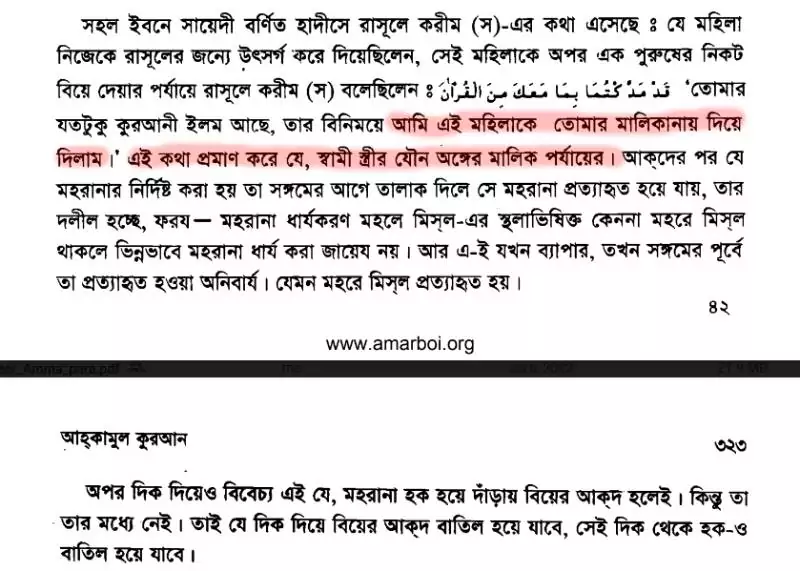
The Bengali edition of Sharh Abi Dawud likewise defines the dower as money or property paid immediately or deferred by a husband in exchange for enjoyment of his wife’s sexual organs. This is closely aligned in both wording and legal substance with the original Arabic writings of al-Kasani, al-Jassas, and al-Qurtubi. Although the financial obligation arises from marriage, its explanation centers on the wife’s sexual organs and the legal permissibility of their enjoyment. The wife also participates in the sexual relationship, but the payment obligation falls on the husband, and the acquisition of sexual entitlement is defined from the man’s position. The legal terminology is therefore not merely a matter of financial assistance between spouses; it constitutes a contractual system of price and entitlement that treats the woman’s sexuality as its subject matter. [30]
‘Give women their dowers willingly.’
In the terminology of Islamic law, the dower is defined as:
ما يغي الزوج إلى الزوجة يوضًا لِسْنَافِعُ بُضْعِهَا مُعَجَّلًا أَوْ مُوجَّلًا
‘Money or property paid immediately or deferred by a husband to his wife in exchange for enjoyment of her sexual organs.’
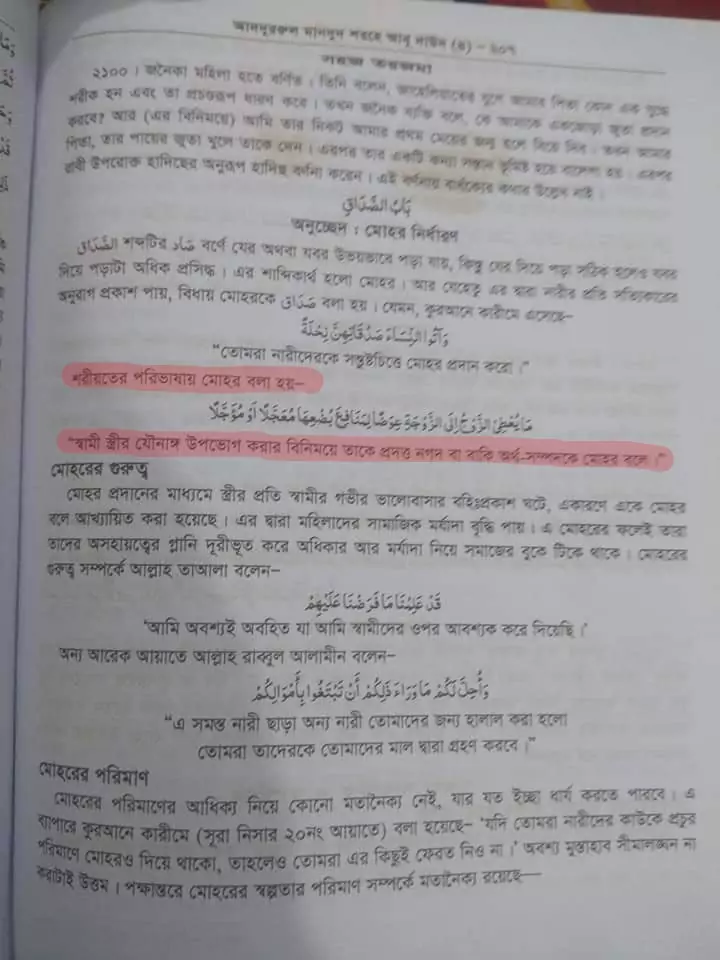
A passage in the Bengali edition of Ahkam al-Qur’an draws on the report of Muhammad’s companion Sahl ibn Sa’d to describe the husband’s right over his wife’s sexual organs in ownership-like terms. From the account of Qur’anic instruction being stipulated as the dower, the jurist derives a broader principle: the husband acquires a right to sexual availability through the marriage consideration. The quoted legal text itself describes the husband’s sexual entitlement as a form of ownership-like right. The same legal conception treats sexual availability within marriage as something the husband obtains and the dower as the financial condition associated with creating that right. [31]
The hadith transmitted by Sahl ibn Sa’d records Muhammad’s statement when giving in marriage to another man a woman who had offered herself to Muhammad: قَدْ مَذْكُتُمَا بِمَا مَعَكَ مِنَ القُرْآنَ — ‘I have given this woman into your ownership in exchange for the knowledge of the Qur’an that you possess.’ This establishes, according to the quoted juristic interpretation, that the husband occupies a position of ownership over his wife’s sexual organs. The specified dower is reduced when divorce takes place before intercourse. The reason is that an expressly stipulated dower takes the place of mahr al-mithl: where mahr al-mithl is payable, an alternative stipulated dower cannot be imposed in the same way. Consequently, a reduction before intercourse is required, just as it would apply to the equivalent dower.
Mahr al-Mithl: The Monetary Valuation of Age, Beauty, and Virginity
In the Shafi’i jurist al-Mawardi’s al-Hawi al-Kabir, the explanation of mahr al-mithl employs an even more explicit analogy with valuing property. When a specified dower is invalid or indeterminate, he says the equivalent dower is due as compensation for sexual entitlement that has passed through the marriage contract and cannot be recovered. To illustrate the principle, he compares it to a purchased slave who dies before the sale is unwound and to the monetary value owed when the original goods cannot be returned. Why is a woman’s marriage evaluated through the language of property sales? Al-Mawardi supplies the answer in his own terminology: it concerns the value of bud’, sexual availability. [32]
فصل: فإذا تقرر أن النكاح صحيح، وإن سقط المهر بالفساد، فلها مهر المثل: لأن البضع مفوت بالعقد، فلم تقدر على استرجاعه، فوجب أن تعدل إلى قيمته وهي مهر المثل، كمن اشترى عبدا بثوب فمات في يده ورد بائعه الثوب بعيب، رجع بقيمة العبد حين فات الرجوع بعينه.
English translation: Section: Once it has been established that the marriage remains valid even though the stipulated dower is invalid, the wife is entitled to the equivalent dower. This is because the sexual entitlement has passed under the contract and cannot be recovered. Compensation must therefore be made by assigning its value, which is mahr al-mithl. It is like a person who buys a slave in exchange for a garment; the slave dies while in his possession, and the seller takes back the garment because of a defect. Since the slave can no longer be returned, the buyer must compensate for the slave’s value.
In a subsequent discussion, al-Mawardi identifies ten qualities of a woman used to determine the amount of her equivalent dower. These include age, intelligence, beauty, wealth, religion, chastity, free or enslaved status, virginity, manners, and lineage. Under this system, a woman’s body, age, and sexual history become inputs into a monetary valuation. His most disturbing statement concerns age: he treats a younger girl as more valuable because she is regarded as more promising for childbirth and more pleasurable for sexual enjoyment. Assessing a woman’s age and sexual characteristics as determinants of a market-like financial amount, instead of recognizing her equal personhood, forms part of the classical Shafi’i legal literature. [33]
مسألة: قال الشافعي: ومهر من هو في مثل سنها، وعقلها وحمقها، وجمالها وقبحها، ويسرها وعسرها، وأدبها، وصراحتها، وبكرا كانت أو ثيبا؛ لأن المهور بذلك تختلف. قال الماوردي: وهذا صحيح. وصفات الذات المعتبرة في المهور شرط في الحكم بمهر المثل، كما تعتبر صفات ما يقوم، والصفات المعتبرة في مهر المثل عشرة: أحدها: السن؛ لاختلاف المهر باختلافه؛ لأن الصغيرة أرجى للولد، وألذ في الاستمتاع من الكبيرة. والثاني: عقلها وحمقها، فإن للعاقلة مهرا، وللرعناء والحمقاء دونه؛ لكثرة الرغبة في العاقلة، وقلة الرغبة في الحمقاء. وحكي عن قتادة، في قول الله تعالى: ليبلوكم أيكم أحسن عملا، أي أيكم أتم عقلا. وروى كليب بن وائل عن عبد الله بن عمر: أن النبي صلى الله عليه وسلم تلا: أيكم أحسن عملا، ثم قال: أيكم أحسن عقلا، وأردع عن محارم الله، وأسرع في طاعة الله تعالى. والثالث: جمالها وقبحها، فإن مهر الجميلة أكثر من مهر القبيحة. وقد روى سعيد بن أبي سعيد عن أبيه عن أبي هريرة: أن رسول الله صلى الله عليه وسلم قال: ينكح النساء لأربع: لمالها، ولحسبها، ولجمالها، ولدينها، فعليك بذات الدين تربت يداك. والرابع: يسارها وإعسارها؛ لأن ذا المال مطلوب ومخطوب، فيكثر مهر الموسرة؛ بكثرة طالبها، ويقل مهر المعسرة؛ لقلة خاطبها.
English translation: Al-Shafi’i said: The equivalent dower should be determined by comparison with women of similar age, intelligence or foolishness, beauty or lack of beauty, wealth or poverty, manners, lineage, and status as virgins or previously married women, because dowers vary according to these characteristics. Al-Mawardi said: This is correct. The personal characteristics considered when assessing an equivalent dower must be taken into account just as the characteristics of other things being valued are taken into account. Ten qualities are considered. First, age: a younger girl is regarded as more promising for childbirth and more pleasurable for sexual enjoyment than an older woman, and thus the dower varies with age. Second, intelligence or foolishness: an intelligent woman’s dower is higher than that of a foolish or reckless woman, because demand is greater for the intelligent woman. The passage then cites Qatada’s commentary on the Qur’anic expression ‘to test which of you is best in deeds’ and a report through Ibn Umar concerning intelligence and obedience to God. Third, beauty: the dower of a beautiful woman is higher than that of a woman considered unattractive. In this connection al-Mawardi quotes the hadith about marrying women for wealth, lineage, beauty, and religion. Fourth, wealth: a wealthy woman attracts more suitors and therefore receives a higher dower, while a poor woman attracts fewer suitors and receives a lower dower.
Al-Mawardi’s valuation scheme treats the woman simultaneously as a participant in marriage and as the object of a sexual relationship classified in monetary terms. His discussion gives lower dower values to older women, differentiates them according to appearance, treats virginity as particularly desirable, and distinguishes free women from enslaved women. Instead of grounding the calculation in the woman’s independent decisions concerning her body, equality between partners, or consent at each sexual encounter, it asks which characteristics men find more desirable and what sum makes the relationship lawful. These socially discriminatory preferences are not merely described; they are turned into standards for determining a financial entitlement under the law.
The Hanbali jurist Ibn Qudama also uses the language of property and contract in al-Mughni when discussing the determination of dowers. He describes the dower as part of an exchange contract in which the parties’ agreement is evaluated like that in other financial transactions. He then states that when the father is the guardian, the dower amount agreed between the father and the prospective husband is valid whether the daughter is young or old, a virgin or previously married. Where the guardian is someone other than the father, he expressly discusses the woman’s consent. Explaining this distinction, he compares the dower to compensation for the woman’s usufruct, and to the rent payable on her house. Paternal authority, the sum of the dower, and the rental analogy occur in the same legal discussion. Allowing a daughter’s financial marriage terms to be settled through an agreement between her father and future husband rather than by her independent decision, while calling those terms compensation for the use of property, exposes the patriarchal character of classical jurisprudence. [34]
الفصل الثاني أن الصداق ما اتفقوا عليه ، ورضوا به لقول الله تعالى : ولا جناح عليكم فيما تراضيتم به من بعد الفريضة وقال النبي صلى الله عليه وسلم : العلائق ما تراضى عليه الأهلون ؛ ولأنه عقد معاوضة ، فيعتبر رضى المتعاقدين ، كسائر عقود المعاوضات . فإن كان الولي الأب فمهما اتفق هو والزوج عليه ، جاز أن يكون صداقا قليلا كان أو كثيرا ، بكرا كانت أو ثيبا صغيرة كانت أو كبيرة على ما أسلفناه فيما مضى ، ولذلك زوج شعيب عليه السلام موسى عليه السلام ابنته وجعلا الصداق إجارة ثماني حجج من غير مراجعة الزوجة ، وإن كان الولي غير الأب اعتبر رضى المرأة والزوج ، لأن الصداق لها وهو عوض منفعتها فأشبه أجر دارها وصداق أمتها . فإن لم يستأذنها الولي في الصداق ، فحكمه حكم الوكيل المطلق في البيع إن جعل الصداق مهر المثل فما زاد صح ولزم ، وإن نقص عنه فلها مهر المثل .
English translation: Second discussion: The dower is whatever the parties agree upon and accept. God says, ‘There is no blame upon you concerning what you mutually agree to after the prescribed obligation’; and Muhammad said, ‘The marital attachments are what the families agree upon.’ Because it is an exchange contract, the consent of the contracting parties is considered as it is in other exchange transactions. If the guardian is the father, whatever he and the husband agree upon is a valid dower, whether small or large and whether the daughter is a virgin or previously married, young or old, as explained earlier. Thus Shu’ayb married his daughter to Moses and stipulated eight years of labor as the dower without consulting the daughter. If the guardian is someone other than the father, the agreement of both the woman and the husband is considered, because the dower belongs to the woman and is compensation for her usufruct, comparable to the rent of her house or the dower of her enslaved woman. If the guardian does not ask her permission regarding the dower, he is treated like an agent with general authority to sell: an amount equal to or greater than the equivalent dower is valid and binding, whereas an amount below it leaves the woman entitled to mahr al-mithl.
In Ibn Qudama’s account, the father and the groom fix the amount of the dower, while the independent agreement of the woman whose marriage and sexual availability are at stake is not given equal standing in that particular determination when her father acts as guardian. Her financial entitlement is then compared to the rental value of her own house, making the exchange character of the marriage contract explicit. This is more than a rhetorical analogy: it is direct evidence of treating the dower and marital sexual entitlements through the logic of exchange contracts. Al-Mawardi’s Shafi’i assessment of the woman’s age and sexual characteristics, combined with Ibn Qudama’s Hanbali discussion of the father’s agreement and property-use compensation, reveals the constraints placed on women’s independent decision-making within marriage. The woman is paid a dower, but the authority to set its terms and the right to claim sexual access are structured through male-centered contractual rules.
Consummation, Dower Obligations, and the Hadiths of Li’an
The exchange-based conception of marriage is not confined to jurists’ definitions. Hadith reports also make the occurrence of intercourse a decisive consideration in the payment of the dower. In a report transmitted from Aisha, a marriage concluded without a guardian’s permission is declared invalid, yet the woman is entitled to her dower if intercourse has occurred. In Ibn Umar’s account of li’an, a husband who accuses his wife of adultery asks for the return of his dower after their separation; Muhammad rejects the request because he has already had intercourse with her. In the first instance, the woman’s financial claim arises from intercourse even where the marriage’s validity is in question. In the second, the prior financial consideration remains payable despite separation because sexual relations have occurred. Both rules turn on whether intercourse with the woman took place and what its consequences are for the legal status of the dower. [35] [36]
Mishkat al-Masabih
Part 13: Marriage
Section 2: Guardians in Marriage and Obtaining the Woman’s Permission
3131-(6). Narrated from Aisha: Muhammad said, ‘Any woman who marries without the permission of her guardian—her marriage is invalid, her marriage is invalid, her marriage is invalid. If intercourse has taken place in such a marriage, the woman is entitled to her dower because the man has made sexual use of her. If the guardians dispute, the ruler is the guardian of anyone who has no guardian.’
(Ahmad, al-Tirmidhi, Abu Dawud, Ibn Majah, and al-Darimi.)
References in the edition: Abu Dawud 3083, al-Tirmidhi 1102, Ibn Majah 1879, Ahmad 24205, al-Darimi 2230, Irwa 1840, Sahih al-Jami 2709.
Hadith classification: Sahih.
Narrator: Aisha.
The Arabic version of Aisha’s report quoted in Mishkat al-Masabih also appears in Sunan Abi Dawud 2083. It declares marriage without the guardian’s permission invalid but expressly establishes the woman’s entitlement to a dower where intercourse has taken place. Even when the validity of the marriage is disputed, the occurrence of sexual relations creates a financial claim. Whether sexual intercourse occurred is therefore a critical legal basis for determining the dower obligation. [35]
حَدَّثَنَا مُحَمَّدُ بْنُ كَثِيرٍ، أَخْبَرَنَا سُفْيَانُ، أَخْبَرَنَا ابْنُ جُرَيْجٍ، عَنْ سُلَيْمَانَ بْنِ مُوسَى، عَنِ الزُّهْرِيِّ، عَنْ عُرْوَةَ، عَنْ عَائِشَةَ، قَالَتْ قَالَ رَسُولُ اللَّهِ صلى الله عليه وسلم: أَيُّمَا امْرَأَةٍ نَكَحَتْ بِغَيْرِ إِذْنِ مَوَالِيهَا فَنِكَاحُهَا بَاطِلٌ، ثَلَاثَ مَرَّاتٍ، فَإِنْ دَخَلَ بِهَا فَالْمَهْرُ لَهَا بِمَا أَصَابَ مِنْهَا فَإِنْ تَشَاجَرُوا فَالسُّلْطَانُ وَلِيُّ مَنْ لاَ وَلِيَّ لَهُ.
English translation: Muhammad ibn Kathir narrated from Sufyan, from Ibn Jurayj, from Sulayman ibn Musa, from al-Zuhri, from Urwa, from Aisha, that Muhammad said: Any woman who marries without her guardians’ permission has entered an invalid marriage—he repeated this three times. If intercourse has taken place with her, she is entitled to a dower because of what the man has obtained from her. If the guardians disagree, the ruler is the guardian of anyone who has no guardian.
Sahih Muslim (Islamic Foundation edition)
Chapter 20: Mutual Imprecation (Li’an)
No separate section title
3610. Narrated from Ibn Umar through Yahya ibn Yahya, Abu Bakr ibn Abi Shayba, Zuhayr ibn Harb, and others: Muhammad said to the couple making mutual imprecations, ‘Your reckoning is with Allah. One of you must be lying. You have no further claim over this woman.’ The man asked, ‘Messenger of Allah, what about my property—the dower I gave her?’ Muhammad said, ‘You are not entitled to recover it. If you are telling the truth, the property was given in consideration of making her sexual organs lawful to you. If you are lying about her, then you have even less claim to recover it.’
Zuhayr’s version records that Sufyan transmitted the report through Amr from Sa’id ibn Jubayr, who heard Ibn Umar narrate it from Muhammad.
English text preserved in the source edition: Ibn Umar (Allah be pleased with them) reported Allah’s Messenger (ﷺ) saying to the invokers of curse: Your account is with Allah. One of you must be a liar. You have now no right over this woman. He said: Messenger of Allah, what about my wealth (dower that I paid her at the time of marriage)? He said: You have no claim to wealth. If you tell the truth, it (dower) is the recompense for your having had the right to intercourse with her, and if you tell a lie against her, it is still more remote from you than she is. Zuhair said in his narration: Sufyan reported to us on the authority of ‘Amr that he had heard Sa’id b Jubair saying: I heard Ibn Umar (Allah be pleased with them) saying that Allah’s Messenger (ﷺ) had said it.
Hadith classification: Sahih.
In this account of li’an, the rejection of the husband’s financial claim is explicitly grounded in the fact that he had already had intercourse with his wife. Muhammad identified consummation as the reason the money could not be reclaimed, directly linking the dower to sexual relations. The exchange-based nature of the dower is the specific point at issue in his statement. The printed version of this report appears on page 472 of volume three of Sahih Muslim published by the Islamic Foundation; a photograph of that page is reproduced below. [37]

Sahih al-Bukhari also records a detailed account of the same separation involving li’an. The husband accuses his wife of adultery, and the couple are separated after the mutual imprecations. He then asks for the return of his dower, but the request is refused on the stated ground that he has already had intercourse with her. Although parallel transmissions of this event vary in wording, they preserve the same link between the dower and sexual relations. The legal significance is that intercourse is treated as a decisive event in settling the financial obligations of marriage. [38]
Sahih al-Bukhari (Islamic Foundation edition)
Chapter 55: Divorce
Section 2072: The judge’s statement to the couple making li’an that one of them is lying, and asking whether either will repent
4929. Narrated by Sa’id ibn Jubayr through Ali ibn Abd Allah and others: He said, ‘I asked Ibn Umar about the couple making mutual imprecations. He said that Muhammad told them, “Your reckoning is with Allah. One of you is lying. You have no further claim over this woman.” The man said, “What about my money, the dower I gave her?” Muhammad replied, “You will not receive it back. If you are truthful, that payment was in return for making her sexual organs lawful to you. If you have falsely accused her, you have even less claim to the money.”’
Sufyan said he had memorized this report from Amr. Ayyub also reported hearing Sa’id ibn Jubayr say that he questioned Ibn Umar about a man performing li’an with his wife. Ibn Umar gestured with two fingers to illustrate how Muhammad separated a couple from Banu Ajlan and said, ‘Allah knows that one of you is lying. Will either of you repent?’ He repeated this three times. Sufyan stated that he had memorized the hadith in this form from Amr and Ayyub.
Hadith classification: Sahih.
In another hadith from al-Nasa’i’s Book of Marriage, Muhammad states that the contractual conditions through which sexual relations become lawful are those most deserving of fulfillment. The original Arabic uses shurut, meaning contractual conditions; reducing it to a mere synonym for the dower would narrow the statement. Its central issue is which conditions of the marriage contract confer the lawful right to sexual relations, and why those conditions must be fulfilled. The financial obligation to pay the dower forms part of that larger contract. Sexual permissibility is presented as a legal relationship established by meeting specified conditions, with its financial consideration and obligations addressed in the Qur’anic and juristic rules of dower. [39]
Sunan al-Nasa’i (Islamic Foundation edition)
Chapter 26: Marriage
Section 42: Conditions of marriage
3284. Narrated from Uqba ibn Amir through Isa ibn Hammad and others: Muhammad said, ‘The conditions most deserving of fulfillment are the conditions by means of which women’s sexual organs become lawful to you, meaning the fulfillment of the dower obligation,’ as stated in this Bengali translation.
Existing English edition: It was narrated from ‘Utbah bin ‘Amir that the Messenger of Allah said: The conditions that are most deserving of fulfillment, are those by means of which the private parts become allowed to you.
Verification in the edition: Sahih; see Ibn Majah 1954, Mukhtasar Muslim 804, Sahih al-Jami al-Saghir 1547.
Hadith classification: Sahih.
Another account in Sahih al-Bukhari describes the same husband’s request to recover his dower after separating from a wife whom he had accused of adultery. The request is rejected because they had already consummated their marriage. There is no basis for treating this report as a different divorce: it is the same event transmitted through multiple accounts and preserved in different printed editions. Its appearance in discussions of marriage and li’an helps explain why the dower’s connection to marital sexual entitlements occupies such a significant place in classical jurisprudence. [40]
Sahih al-Bukhari (Islamic Foundation edition)
Chapter 55: Divorce
Section 2091: Dower after seclusion, dower upon divorce before seclusion or touching, and proof of seclusion
4958. Narrated by Sa’id ibn Jubayr through Amr ibn Zurara and others: ‘I asked Ibn Umar what happens if a man accuses his wife. He said Muhammad separated a couple from Banu Ajlan and told them, “Allah knows that one of you is lying. Will either of you repent?” Both refused. He repeated the question, and when they still refused, he separated them.’ Ayyub added that Amr ibn Dinar told him an important part of the hadith had been omitted. The man asked, ‘Will I not get back my money—the dower I paid her?’ Muhammad replied, ‘You will not get it back. Even if you were telling the truth, you have already had intercourse with her.’ If you were lying, you have even less claim to it.
Hadith classification: Sahih.
Existing English edition: Narrated Sa’id bin Jubair: I said to Ibn Umar, ‘If a man accuses his wife of illegal sexual intercourse (what is the judgment)?’ He said, ‘Allah’s Prophet separated the couple of Bani Ajlan (when the husband accused his wife of illegal sexual intercourse). The Prophet said, “Allah knows that one of you two IS a liar; so will one of you repent?” But they refused. He then again said, “Allah knows that one of you two is a liar; so will one of you repent?” But they refused, whereupon he separated them by divorce.’ Aiyub, a sub-narrator, said Amr bin Dinar told him there was something missing from the report: the husband asked about his money (mahr), and Muhammad told him he was not entitled to take it back, for if his statement was true he had already consummated the marriage, and if he was lying he had still less entitlement.
The li’an involving the couple from Banu Ajlan directly contradicts the idea that the dower is nothing more than a ceremonial wedding gift. Muhammad’s reason for refusing to return the husband’s dower after separation centers on intercourse with his wife. Even if the husband told the truth, he was not entitled to recover the money because sexual relations had taken place; if his accusation was false, his claim was even less acceptable. Thus, irrespective of whether the allegation is established as true or false, intercourse already performed remains a crucial factor in fixing the financial status of the dower. The same report is preserved under different numbers and in several Bengali editions of Sahih al-Bukhari. A separate case in the Muwatta of Malik similarly recognizes a woman’s dower entitlement after sexual intercourse in a marriage contracted during her waiting period, even though the marriage itself is dissolved. Together, these different cases show that the actual occurrence of sexual relations is legally connected to the financial consideration of marriage. [38] [41]
Sahih al-Bukhari (Islamic Foundation edition)
Chapter 55: Divorce
Section 2071: The dower of a woman involved in li’an
4928. Narrated by Sa’id ibn Jubayr through Amr ibn Zurara and others: ‘I asked Ibn Umar about a man who accused his wife. He said Muhammad separated the spouses from Banu Ajlan and told them that Allah knew one of them was lying. He asked whether either would repent, but both refused. He repeated the question and they again refused, so he separated them.’ Ayyub said that Amr ibn Dinar asked why a part of the report had been omitted. The man asked, ‘What about the money I paid her as dower?’ He was told, ‘You will not get your money back. Even if you are truthful, you have already had intercourse with her.’ If you are lying, you are still less entitled to it.
Hadith classification: Sahih.
Sahih al-Bukhari (Tawhid edition)
Chapter 68: Divorce
Section 68/32: The dower of a woman involved in li’an
5311. Narrated by Sa’id ibn Jubayr: ‘I asked Ibn Umar about a man who accused his wife. He said Muhammad separated a couple of Banu Ajlan and told them, “Allah knows that one of you is lying. Will either of you repent?” Both refused. He repeated the question, and neither agreed. He asked a third time and again received no agreement, then separated them.’ Ayyub said that Amr ibn Dinar asked why another part of the report had been left out. The man asked, ‘What about my money?’ He was told, ‘You will not recover it, even if you were telling the truth, because you had intercourse with her.’ If you were lying, recovery was even more remote. (Also 5312, 5349, 5350; Modern Publishers 4920; Islamic Foundation 4815.)
Hadith classification: Sahih.
Sahih al-Bukhari (Tawhid edition)
Chapter 68: Divorce
Section 68/52: Dower after seclusion, before touching or seclusion, and establishing evidence of seclusion
5349. Narrated by Sa’id ibn Jubayr: ‘I asked Ibn Umar about a man accusing his wife. He said Muhammad separated a couple from Banu Ajlan and told them, “Allah knows that one of you is lying. Will either of you repent?” Both refused. He repeated the question and they again refused, so he separated them.’ Ayyub said Amr ibn Dinar pointed out that part of the report was missing. The man then asked, ‘Will I not recover my dower?’ Muhammad replied, ‘You will not recover the money. Even if you told the truth, you have already had intercourse with her.’ If you lied, recovery was further beyond question. (Also 5311; Modern Publishers 4949; Islamic Foundation 4845.)
Hadith classification: Sahih.
Muwatta Malik
Hadith number (1125)
Chapter 28: Marriage
Publisher: Islamic Foundation
Section 11: Various invalid marriages
Report 27. Sa’id ibn al-Musayyab narrated from Sulayman ibn Yasar: Tulayha al-Asadiyya was the wife of Rushayd al-Thaqafi, who divorced her. She then married another man during her waiting period. Umar ibn al-Khattab flogged her and the second husband several times and separated them. Umar ruled that where a woman marries during her waiting period and the new husband has not had intercourse with her, the spouses are separated and the woman completes the remaining waiting period from her first marriage. The second husband may then propose to her again like any other suitor. If the second husband has had intercourse with her, they are separated and she completes the remaining waiting period, but those two are never permitted to reunite in marriage.
Malik reported that Sa’id ibn al-Musayyab said the woman is entitled to a dower because intercourse has taken place with her. Malik added that a free woman whose husband has died must observe a waiting period of four months and ten days. If uncertainty about menstruation raises a concern about pregnancy, she must not marry until the uncertainty is resolved.
The li’an narratives cited under several numbers and in different Bengali editions of Sahih al-Bukhari and Sahih Muslim concern the same core event: after accusing his wife of adultery, the husband seeks the return of his dower, and Muhammad says it cannot be returned because intercourse has occurred. Variations of transmission and printed translation preserve the same relationship between the dower and sexual relations; they are not separate divorce cases. A distinct application of the principle appears in the Muwatta of Malik: where a marriage during the woman’s waiting period is dissolved, her entitlement to the dower remains if intercourse occurred. This demonstrates the legal importance attached to consummation when determining dower obligations. [38] [41]
The refusal to return the dower on account of consummation in the li’an case is not merely a feature of an online translation. The same report appears on pages 70–71 of volume nine of Sahih al-Bukhari published by the Islamic Foundation. That printed edition places the husband’s demand for the money alongside the ruling that it cannot be returned because he has had intercourse with his wife. The correspondence between this printed version and other editions can be established despite the different numbering. Photographs of the two pages are reproduced below, showing the demand for the dower, sexual relations, and the financial consequence of separation together. [42]


Mut’a, Shighar, and the Exchange-Based Rules of Sexual Entitlement
In the Bengali commentary traditionally circulated under Ibn Abbas’s name, the explanation of Qur’an 4:24 combines the dower, sexual enjoyment, the purchase of enslaved women, and the idea that financial payment makes access to a woman’s sexual organs lawful. The cited passage connects marriage, temporary sexual arrangements or mut’a, and ownership of enslaved women, exposing the financial mechanisms by which a man’s sexual access is regulated. Sexual entitlements are discussed in the language of enjoyment, exchange, and ownership. The additional questions of dower payment in permanent marriage and the duration of temporary marriage show how the legitimacy of sexual relations was assessed through contracts and financial transactions. [43]
24. Also forbidden to you are married women, except those whom your right hands possess. This is Allah’s decree for you. All women other than those mentioned are lawful for you if you seek them in marriage with your wealth, not merely for illicit enjoyment. For those among them whom you have enjoyed, give them their prescribed dowers. There is no sin if, after fixing the amount, you mutually agree to another arrangement. Allah is All-Knowing and Wise.
)وَالْمُحْصَنَتْ مِنَ النِّسَاء( Married women, meaning those who have husbands, are forbidden to you. )ما ملكت أيمانكم( Except female captives whom you have come to own. They are lawful to you even when they have husbands in enemy territory. They become lawful after their wombs have been cleared by one menstrual period. )كتب الله عَلَيْكُ( This is Allah’s prescription for you: the women listed have been made unlawful in Allah’s book. )وَأُحِلُّ لَكُمْ( All women other than those identified as prohibited have been made lawful to you. )أَن تَبْتَغُوا( That you seek to marry. )بأموالكُمْ( By spending your wealth, up to four wives.
It is also said that the meaning is that you may buy enslaved women with your wealth. Another interpretation is that you may seek access to women’s sexual organs through financial expenditure, as in mut’a, which was subsequently abrogated according to this commentary.
)محصنين( In lawful marriage: God commands that you live with them as married spouses. غير( )مفحين Not in illicit sexual relations outside marriage. )فما استمتعتم بم( Those from whom you have derived enjoyment or benefit after marriage. )فاتوهن( Give to them. )أجوره( Their compensation, meaning their complete dower. )فريضة( The prescribed obligation laid upon you by Allah: to pay their dower in full. )وَلاَجنَاحَ عَلَيْكُ( There is no sin upon you. فيما تراضیتم به( If you mutually agree concerning the dower to reduce or increase it after it has been determined. من بعد(

In the Bengali translation of al-Tahawi’s work, the discussion of the legality and subsequent prohibition of temporary marriage (mut’a) uses an explicit juristic expression concerning ‘ownership of the organ of sexual enjoyment.’ The cited discussion says that the temporary marriage contract does not confer on the husband the enduring sexual entitlement associated with permanent marriage. Here ownership is not a vague moral metaphor; the term is used to distinguish two forms of sexual contract in law. What sort of sexual entitlement a husband acquires, how long it lasts, and what financial obligations arise from it are all questions of juristic determination. This vocabulary turns marriage from a reciprocal relationship between two independent persons into a legal institution for the acquisition of male sexual entitlements. [44]
This statement of Muhammad shows that the earlier temporary marriage does not become a permanent marital bond. If it were transformed into a lasting bond, the condition upon which the temporary husband and wife had agreed would become void, although the permission and validity under which the marriage had originally been concluded before the prohibition would not be invalidated. The command to terminate it therefore establishes that through such a marriage contract the husband does not acquire ownership of the wife’s ‘organ of sexual enjoyment.’ This is the opinion of Imam Abu Hanifa, Imam Abu Yusuf, and Imam Muhammad.

The prohibition of shighar marriage is another example of the importance assigned to a distinct financial consideration in the marriage contract. Sahih Muslim describes shighar as a reciprocal arrangement in which one man marries another man’s daughter on condition that the other marries his daughter, without a separate dower for either woman. One woman is exchanged for another, and neither has an independently specified financial entitlement. Decisions about the women’s marriages become part of a reciprocal bargain between male guardians. In a legal framework that organizes marriage using the vocabulary of property and sexual entitlements, the rule concerning shighar also exposes the central place of financial consideration. [45]
حَدَّثَنَا يَحْيَى بْنُ يَحْيَى، قَالَ قَرَأْتُ عَلَى مَالِكٍ عَنْ نَافِعٍ، عَنِ ابْنِ عُمَرَ، أَنَّ رَسُولَ اللَّهِ صلى الله عليه وسلم نَهَى عَنِ الشِّغَارِ، وَالشِّغَارُ أَنْ يُزَوِّجَ الرَّجُلُ ابْنَتَهُ عَلَى أَنْ يُزَوِّجَهُ ابْنَتَهُ وَلَيْسَ بَيْنَهُمَا صَدَاقٌ.
English translation: Yahya ibn Yahya narrated that he read to Malik from Nafi’, from Ibn Umar, that Muhammad prohibited shighar. Shighar is when one man marries his daughter to another on the condition that the other man marries his own daughter to him, with no dower specified for either woman.
Al-Jassas makes the point more explicitly in his discussion of shighar: exchanging one woman’s sexual entitlement for another woman’s sexual entitlement does not constitute an acceptable dower; the consideration must be property or a benefit of monetary value that can be provided as the woman’s entitlement. His analysis therefore centers on the legal nature of the dower and what a man provides in exchange for marital sexual rights. This conception is not the invention of a translator or a modern critic. Badal al-bud’, qimat al-bud’, and mahr al-mithl are all terms drawn from classical jurisprudence itself. [46]
Equating the financial right to receive a dower with the independent right to make decisions about one’s body conceals the central inequality of this legal arrangement. A wife’s ability to express her own wishes concerning sexual relations in marriage is a matter of bodily autonomy. Yet the juristic texts examined here compare the dower to consideration for the man’s acquired sexual availability, to the value of access to sexual organs, and sometimes to the price of goods in sale contracts. Calculating a woman’s dower according to her age, beauty, and virginity extends the same underlying conception. A person’s dignity cannot be measured by a sum of money; nevertheless, a marital system that calculates the price of a woman’s sexual availability legitimizes male authority over her body and liberty through the vocabulary of property transactions.
Conclusion
The economic character of the bridal dower in Islamic marriage is particularly visible in the rules of divorce. Qur’an 2:236 addresses a divorce in which the husband has not had intercourse with his wife and no dower amount was specified. In that circumstance, the verse requires a gift or financial provision according to his means. The absence of a specified dower does not mean that the marriage was invalid: a marriage took place and is being dissolved, but the absence of consummation and a previously fixed dower produces a different financial outcome. The next verse clarifies this legal relationship among the marriage contract, sexual intercourse, and the financial entitlement. [47]
لَا جُنَاحَ عَلَيْكُمْ إِنْ طَلَّقْتُمُ النِّسَاءَ مَا لَمْ تَمَسُّوهُنَّ أَوْ تَفْرِضُوا لَهُنَّ فَرِيضَةً وَمَتِّعُوهُنَّ عَلَى الْمُوسِعِ قَدَرُهُ وَعَلَى الْمُقْتِرِ قَدَرُهُ مَتَاعًا بِالْمَعْرُوفِ حَقًّا عَلَى الْمُحْسِنِينَ
English translation: There is no blame upon you if you divorce women before touching them or before specifying a dower for them. But provide them with a suitable gift, each according to his means: the wealthy according to his ability and the less affluent according to theirs. Providing a reasonable gift is an obligation upon those who do good.
The following verse, Qur’an 2:237, requires payment of half the specified dower if a marriage ends before intercourse, even when the amount was agreed at marriage. Whether intercourse occurred therefore functions as an explicit legal dividing line for the extent of the financial obligation. The woman has been married and recognized as a wife; yet, when the marriage ends before intercourse, the general rule entitles her to half the agreed dower. The verse also refers to waivers by the woman or the person holding the marriage tie. This difference in the financial amount before and after sexual relations reveals a contractual structure in which the dower and marital sexual availability are closely interconnected. [48]
وَإِنْ طَلَّقْتُمُوهُنَّ مِنْ قَبْلِ أَنْ تَمَسُّوهُنَّ وَقَدْ فَرَضْتُمْ لَهُنَّ فَرِيضَةً فَنِصْفُ مَا فَرَضْتُمْ إِلَّا أَنْ يَعْفُونَ أَوْ يَعْفُوَ الَّذِي بِيَدِهِ عُقْدَةُ النِّكَاحِ وَأَنْ تَعْفُوا أَقْرَبُ لِلتَّقْوَى وَلَا تَنْسَوُا الْفَضْلَ بَيْنَكُمْ إِنَّ اللَّهَ بِمَا تَعْمَلُونَ بَصِيرٌ
English translation: If you divorce women before touching them although you have already specified a dower, then half of what was specified is due, unless the women themselves waive it or the person holding the marriage tie waives it. To forgive is closer to righteousness. Do not forget generosity between yourselves. Allah sees all that you do.
Al-Kasani offers an even more explicit juristic explanation of this calculation in Bada’i al-Sana’i. He identifies three grounds for the full dower becoming definitively established: consummation, valid seclusion, and the death of either spouse. In his Hanafi account, the marriage contract itself makes the dower a debt owed by the husband, and intercourse confirms that financial claim. Explaining why, he says that intercourse constitutes receiving the benefit contracted for. Once the contracted benefit has been received, the consideration remains due rather than lapsing, just as under a lease agreement. Sexual relations are thereby analyzed not merely as personal intimacy but as the actual receipt of a contracted benefit. When a legal system describes intercourse as istifa’ al-ma’qud ‘alayh—obtaining what was contracted for—the woman’s sexual availability is placed at the center of financial consideration. [49]
(وأما) بيان ما يتأكد به المهر فالمهر يتأكد بأحد معان ثلاثة: الدخول والخلوة الصحيحة وموت أحد الزوجين، سواء كان مسمى أو مهر المثل حتى لا يسقط شيء منه بعد ذلك إلا بالإبراء من صاحب الحق، أما التأكد بالدخول فمتفق عليه، والوجه فيه أن المهر قد وجب بالعقد وصار دينا في ذمته، والدخول لا يسقطه؛ لأنه استيفاء المعقود عليه، واستيفاء المعقود عليه يقرر البدل لا أن يسقطه كما في الإجارة؛ ولأن المهر يتأكد بتسليم المبدل من غير استيفائه لما نذكر فلأن يتأكد بالتسليم مع الاستيفاء أولى.
English translation: Regarding the circumstances that definitively establish the dower: it is confirmed by any of three things—consummation, valid seclusion, or the death of either spouse. Whether a specified amount or the equivalent dower is involved, once one of these occurs no portion lapses unless the holder of the right releases the obligation. There is consensus that consummation establishes the full dower. The reason is that the dower becomes an obligation and a debt upon the husband through the marriage contract itself; intercourse does not cancel that debt. It is the receipt of the subject matter of the contract, and receiving what was contracted for confirms the consideration rather than extinguishing it, as in a lease. Since delivery of what is owed may establish the dower even without actual enjoyment, delivery accompanied by actual enjoyment confirms it all the more strongly.
These three grounds reveal a structure more extensive than a simple one-time fee for intercourse. Under the Hanafi rules explained by al-Kasani, the full dower can become payable following valid seclusion even if intercourse never occurred; it also becomes due if either spouse dies. Shafi’i jurisprudence reaches a different conclusion about the legal effect of seclusion. Yet the contractual question remains central to these discussions: under what circumstances does marital sexual availability, the opportunity to exercise it, or the ending of the marriage fully establish the financial claim? Classical jurisprudence has developed a systematic legal framework connecting the occurrence of intimacy with the calculation of financial rights. [50]
Qur’an 4:20–21, meanwhile, forbids a husband who wishes to replace one wife with another from reclaiming property already given to the former wife. These verses refer to the spouses having been intimate with one another and the solemn covenant taken from the wives. They therefore place sexual intimacy, the marriage contract, and the financial claim to the dower within the same account of the marital relationship. The obligation to recognize the dower as the wife’s property coexists in the same legal system with juristic definitions of that dower as consideration for sexual availability. Recognizing a financial entitlement does not, by itself, eliminate the notion of an entitlement acquired by a man over the woman’s body. [51] [52]
وَإِنْ أَرَدْتُمُ اسْتِبْدَالَ زَوْجٍ مَكَانَ زَوْجٍ وَآتَيْتُمْ إِحْدَاهُنَّ قِنْطَارًا فَلَا تَأْخُذُوا مِنْهُ شَيْئًا أَتَأْخُذُونَهُ بُهْتَانًا وَإِثْمًا مُبِينًا
وَكَيْفَ تَأْخُذُونَهُ وَقَدْ أَفْضَى بَعْضُكُمْ إِلَى بَعْضٍ وَأَخَذْنَ مِنْكُمْ مِيثَاقًا غَلِيظًا
English translation: If you wish to replace one wife with another and have given one of them a great amount of wealth, do not take any of it back. Would you take it through false accusation and manifest wrongdoing? How could you take it back when you have been intimate with one another and they have received from you a solemn covenant?
Another aspect of this financial relationship in divorce appears in Sahih al-Bukhari 5273. The wife of Thabit ibn Qays sought to leave her marriage without alleging any fault in her husband’s character or religion. Muhammad asked whether she would return the garden he had given her. When she agreed, he instructed Thabit to accept the garden and divorce her. Her wish to end the marriage and the requirement to return property she had received at marriage thus formed part of the same decision. The dower was not merely an amount given at the wedding: the return of money or property also became an important factor in negotiating the woman’s departure from the marriage. [53]
حَدَّثَنَا أَزْهَرُ بْنُ جَمِيلٍ، حَدَّثَنَا عَبْدُ الْوَهَّابِ الثَّقَفِيُّ، حَدَّثَنَا خَالِدٌ، عَنْ عِكْرِمَةَ، عَنِ ابْنِ عَبَّاسٍ، أَنَّ امْرَأَةَ ثَابِتِ بْنِ قَيْسٍ أَتَتِ النَّبِيَّ صلى الله عليه وسلم فَقَالَتْ يَا رَسُولَ اللَّهِ ثَابِتُ بْنُ قَيْسٍ مَا أَعْتُبُ عَلَيْهِ فِي خُلُقٍ وَلاَ دِينٍ، وَلَكِنِّي أَكْرَهُ الْكُفْرَ فِي الإِسْلاَمِ. فَقَالَ رَسُولُ اللَّهِ صلى الله عليه وسلم «أَتَرُدِّينَ عَلَيْهِ حَدِيقَتَهُ». قَالَتْ نَعَمْ. قَالَ رَسُولُ اللَّهِ صلى الله عليه وسلم «اقْبَلِ الْحَدِيقَةَ وَطَلِّقْهَا تَطْلِيقَةً». قَالَ أَبُو عَبْدِ اللَّهِ لَا يُتَابَعُ فِيهِ عَنِ ابْنِ عَبَّاسٍ.
English translation: Azhar ibn Jamil narrated from Abd al-Wahhab al-Thaqafi, from Khalid, from Ikrima, from Ibn Abbas, that the wife of Thabit ibn Qays came to Muhammad and said, ‘Messenger of Allah, I find no fault with Thabit ibn Qays in either his character or his religion, but I fear falling into unbelief within Islam by continuing this marriage.’ Muhammad asked, ‘Will you return his garden to him?’ She replied, ‘Yes.’ Muhammad told Thabit, ‘Accept the garden and divorce her once.’ Abu Abd Allah (al-Bukhari) remarked that this report from Ibn Abbas was not corroborated through another transmission in the same way.
Taken together, these rules expose a particular structure of financial and sexual power. A man pays a dower when marrying; the lawfulness of sexual relations, specified control over the wife, and the scope of financial obligations are tied to that contract. The form and timing of separation then determine questions of dower entitlement or restitution. The wife also participates in sexual relations with her husband, but she is not required to buy the use of his sexual organs through a corresponding dower. In the vocabulary of legal transactions, the man is the payer and the holder of the sexual entitlement; the woman is the recipient of payment and the subject of the contracted entitlement. Terms such as badal, ‘iwad, bud’, and istifa’ used by al-Kasani, al-Jassas, and other jurists establish the relationship in the language of contract, exchange, and enjoyment.
The rules on mahr al-mithl make the inequality even more apparent. In al-Mawardi’s analysis, a woman’s age, beauty, virginity, reproductive prospects, and social position are considered in determining the comparative dower amount. Two women’s human dignity should be equal, yet this framework calculates a marital financial sum according to differences in their bodies and sexual characteristics. It is not a neutral measure of human worth but a market-like valuation of men’s marital preferences and sexual access. Giving monetary importance to whether a woman is a virgin, her age, and how attractive men find her turns her body into an input used to price a contractual relationship, rather than measuring her worth by her education, independent will, individuality, or life goals.
Qur’an 4:24 connects sexual enjoyment with the payment of the dower; hadith reports in Sahih al-Bukhari and Sahih Muslim make consummation a reason for refusing the return of the dower; al-Kasani compares it to sales and leases; al-Jassas speaks of the value of sexual organs; and al-Qurtubi describes it as payment for enjoyment. These are different manifestations of the same legal structure. In Islamic marriage, the dower is not merely a ceremonial gift; classical jurisprudence defines it as financial consideration for making a woman’s sexual availability lawful to a man. Although the transfer gives the wife a right to property, the husband claims sexual access and marital authority through the contract. When al-Mawardi discusses the dower amount in terms of a woman’s age, beauty, and virginity, and Ibn Qudama gives the father and groom a role in fixing that sum while comparing it to rent, the economic valuation of a woman’s body and sexual availability ceases to be an isolated metaphor: it becomes part of established juristic rules.
Classical jurisprudence gives specific legal meanings to expressions such as ‘the exchange value of sexual organs,’ ‘payment for sexual enjoyment,’ ‘receipt of the contracted subject matter,’ and ‘consideration for usufruct.’ Within this terminology, the wife’s body and sexual relations are treated as subjects of an entitlement acquired by the husband. The same legal structure describes a husband’s authority over the wife’s movements after payment of the dower, establishes the full claim through seclusion or intercourse, and uses the woman’s age, virginity, and beauty as criteria in calculating its amount. Under a conception of equal human dignity, sexual relations are not a property right and no payment can establish permanent dominion over another person’s body. A marital law that prices a woman’s sexual availability and defines the man as holder of the resulting entitlement cannot coherently be presented as a system granting women the highest possible dignity. The amount of a dower cannot substitute for personal liberty, mutual consent, or equality.
The assertion that the dower represents the greatest possible dignity for women collapses most decisively under the terminology of Islamic jurisprudence itself. The texts make use of a woman’s sexual organs lawful in exchange for payment, compare marital sexual access with sale and lease contracts, and prescribe financial valuation according to age, physical appearance, and virginity. Marriage is a relationship; sexual relations depend on the free choice of two human beings. A structure that assigns one partner the status of payer and purchaser of sexual entitlements, and the other the status of payment recipient and source of sexual access, is not equality. A woman’s dignity is not determined by how much dower she receives, but by the extent to which she can decide freely about her own body, sexuality, relationships, and life. To call a law that grants sexual access to a woman’s body through financial consideration the highest expression of dignity for women is logically incoherent and contrary to human equality.
References
- Qur’an, Surah al-Nisa 4:4 ↩︎
- Al-Kasani, Bada’i al-Sana’i, Rules on Dower ↩︎
- Al-Jassas, Ahkam al-Qur’an, Dower Obligation ↩︎
- Surah al-Nisa 4:4 ↩︎
- Surah al-Nisa 4:24 ↩︎
- Surah al-Nisa 4:25 1 2
- Surah al-Ma’idah 5:5 1 2
- Al-Kasani, Bada’i al-Sana’i, Book of Marriage, Entitlement to the Dower ↩︎
- Abu Bakr al-Jassas, Ahkam al-Qur’an, al-Baqarah: Divorce and Dower ↩︎
- Surah al-Baqarah, verse 223 ↩︎
- Surah al-A’raf, verse 189 ↩︎
- Surah al-Baqarah 2:223 1 2
- Surah al-A’raf 7:189 ↩︎
- Sahih Muslim 1467a ↩︎
- Sahih Muslim 1467a, Book of Breastfeeding ↩︎
- Surah al-Nisa, verse 4 ↩︎
- Surah al-Nisa 4:4, Arabic text ↩︎
- Musnad Ahmad, report from Aisha, original Arabic and transmission variants ↩︎
- Qur’an, Surah al-Ahzab 33:50 ↩︎
- IslamQA, question 350913, Why Islamic legal texts call the dower a wage ↩︎
- Sahih al-Bukhari 5127: Four kinds of pre-Islamic marriage ↩︎
- Ibn Hisham, al-Sira al-Nabawiyya, Marriage to Khadija ↩︎
- Sahih al-Bukhari 5127, report from Aisha ↩︎
- Ibn Hisham, al-Sira al-Nabawiyya, vol. 1, p. 190 ↩︎
- Sirat al-Nabi, vol. 1, p. 178 ↩︎
- Ibn Hisham, al-Sira al-Nabawiyya, Muhammad’s marriage to Khadija ↩︎
- Ahkam al-Hadith, Mawlana Md. Kamrul Hasan, edited by Dr Muhammad Fazlur Rahman, Riyad Publications, pp. 481–482 ↩︎
- Al-Qurtubi, al-Jami li-Ahkam al-Qur’an, 4:24, eighth and ninth discussions ↩︎
- Al-Jassas, Ahkam al-Qur’an, vol. 3, discussion of dower amounts ↩︎
- Sharh Abi Dawud, technical definition of dower; reproduced printed page below ↩︎
- Ahkam al-Qur’an, Bengali edition, vol. 2, p. 42 ↩︎
- Al-Mawardi, al-Hawi al-Kabir, vol. 9, equivalent dower when specified dower is invalid ↩︎
- Al-Mawardi, al-Hawi al-Kabir, vol. 9, ten criteria for determining mahr al-mithl ↩︎
- Ibn Qudama, al-Mughni, Book of Dower, guardian’s authority ↩︎
- Sunan Abi Dawud 2083 1 2
- Sahih Muslim, li’an and the dower ↩︎
- Sahih Muslim, Islamic Foundation edition, vol. 3, p. 472 ↩︎
- Sahih al-Bukhari 5311 1 2 3
- Sunan al-Nasa’i 3282, numbered 3284 in the English edition ↩︎
- Sahih al-Bukhari 5349 ↩︎
- Muwatta Malik, Book of Marriage, report 27 1 2
- Sahih al-Bukhari, Islamic Foundation edition, vol. 9, pp. 70–71 ↩︎
- Tafsir attributed to Ibn Abbas, Islamic Foundation Bangladesh, p. 228 ↩︎
- Tahawi Sharif, Islamic Foundation edition, vol. 3, p. 49 ↩︎
- Sahih Muslim 1415a, prohibition of shighar marriage ↩︎
- Al-Jassas, Ahkam al-Qur’an, dower amounts and shighar marriage ↩︎
- Qur’an, Surah al-Baqarah 2:236 ↩︎
- Qur’an, Surah al-Baqarah 2:237, full verse ↩︎
- Al-Kasani, Bada’i al-Sana’i, Book of Marriage, grounds confirming the full dower ↩︎
- IslamQA, valid seclusion, consummation, and confirmation of the dower ↩︎
- Qur’an, Surah al-Nisa 4:20 ↩︎
- Qur’an, Surah al-Nisa 4:21 ↩︎
- Sahih al-Bukhari 5273, khul’ and the wife of Thabit ibn Qays ↩︎
About This Article
Genre: Critical Analysis / Islamic Jurisprudence / History of Marriage / Women's Rights
Epistemic Position: Evidence-based, secular, historical and textual criticism grounded in the Qur'an, hadith collections, classical tafsir, and the primary legal literature of Islamic jurisprudence. Religious rulings, historical reports, juristic interpretations, and ethical conclusions are distinguished according to the evidence supporting each.
Mahr (dower) is frequently presented as proof that Islam grants women exceptional dignity. The legal sources examined here expose a different dimension of the institution: the financial payment is repeatedly discussed in relation to a husband's acquisition of lawful sexual access to his wife. Qur'an 4:4 establishes a woman's financial entitlement, while Qur'an 4:24–25 uses the language of payment in the context of lawful sexual relations. Al-Qurtubi explicitly describes mahr as compensation for sexual enjoyment; al-Kasani compares it to the price paid for goods; and al-Jassas explains it as consideration for making sexual access lawful. These statements are examined as the jurists' own legal formulations rather than as terminology invented by modern critics.
The historical claim that Muhammad introduced the institution of mahr is tested against Islamic literary evidence of its pre-Islamic existence. Aisha's account of marriage practices before Islam in Sahih al-Bukhari includes an arrangement involving the bride's dower, while Ibn Hisham records a dower of twenty young camels in Muhammad's marriage to Khadija. The subsequent development of mahr within Islamic law is considered alongside rules governing the validity of marriage without a specified dower, consummation, seclusion, divorce before intercourse, and the non-recovery of dower following consummation.
The analysis also examines how classical jurists assessed mahr al-mithl (a comparable dower). Al-Mawardi's discussion evaluates a woman's age, beauty, virginity and other attributes when determining the amount; Ibn Qudama treats dower as part of an exchange-based contract and compares a woman's marital benefit with rent from her property. Hadith reports concerning guardianship, li'an, shighar marriage, and khul' provide further evidence of how financial claims, sexual relations and marital authority interact within the legal structure.
The ethical conclusion concerns the difference between owning a financial entitlement and possessing bodily autonomy. A wife's right to receive mahr does not establish equality when the corresponding legal framework treats her sexual availability as an entitlement obtained by her husband. The article therefore challenges the claim that a monetary obligation can itself demonstrate women's equal dignity, and assesses the institution against the principles of independent sexual consent, equal personhood and freedom from coercive marital authority.