
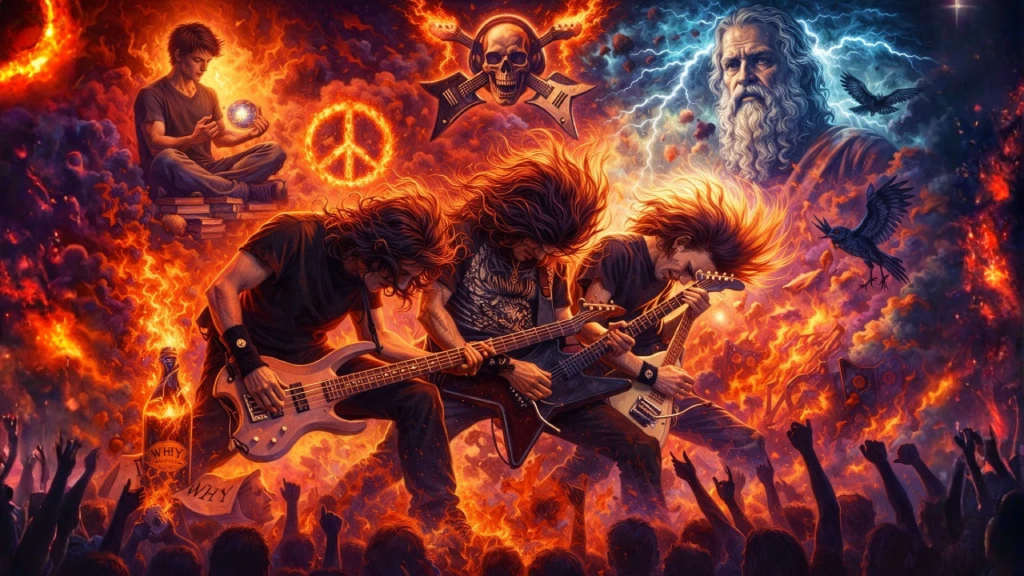
Metal: Dissecting a Noisy Art Form
Introduction
Picture a cloudy afternoon. A fine drizzle is falling outside. Days like this can leave the mind in a strange mood; nothing quite feels good. Yet even that sense of discontent has a peculiar beauty of its own. Now imagine that from an apartment in the building next door comes a barrage of loud, incomprehensible sounds—sounds unlike anything in your familiar world. It feels as though a thousand instruments have risen in rebellion at once: the drums rage as if the sky is collapsing; the guitar shrieks like a wounded animal writhing in pain; and over it all comes a roar from a human throat that barely sounds human.
Your brow will probably furrow in irritation. What is the point of all this noise? Do young people these days have no sense of taste? What kind of art is there in all this screaming? What hidden elixir could possibly lie within it—something powerful enough to bind hundreds of millions of people around the world together by an invisible thread for decades?
It is rather like tasting coffee or bitter-gourd juice for the first time. The very first sip makes your face contort: bitter, strange, unfamiliar. But for those who learn to enter more deeply into it, an entirely new world opens up. Metal music is much the same. Its outer shell is rough, abrasive and, in many cases, frightening. But once you break through that shell, you discover a complex, artistic and deeply emotional world. Layer upon layer reflects some of the most intense human feelings—anger, sorrow, exhilaration, despair, loneliness, strength and, above all, liberation.
This article is a long and sincere attempt to dissect that noisy art form. We will travel from the moments preceding its birth to its many-branched forms in the present day. We will explore its subgenres, the technical details of its instruments, the depth of its lyrics, the culture of its followers and the controversies surrounding it. Let us dive into this ocean of intense sound. Hopefully, by the end of the journey, the noise will no longer seem like mere noise.
Where Did This “Noise” Come From?
Nothing comes into being out of nowhere; everything has a prehistory. Metal music did not suddenly appear one day either. To trace its roots, we have to travel back several decades. Woven into its DNA are the stories of sorrow, joy and rebellion experienced by different people in different eras.
Blues: The Sigh of the Grandparents
If we trace the genealogy of metal music, the first ancestor we encounter is the blues. The blues was a deep sigh rising from the hearts of African-American slaves who worked in the cotton fields of the Mississippi Delta and from their descendants. Their lives were filled with immense suffering, deprivation, and labor, and this music emerged as a way of telling the story of that life. The blues carried a kind of raw, unfiltered emotion. Its musical foundation relied on particular scales, especially the Pentatonic Scale and the Blues Scale. A characteristic note in the blues scale—the “Blue Note”—creates a sense of melancholy and unresolved tension. These scales would later become essential tools for rock and metal guitarists.
The blues was popularized through artists such as Robert Johnson, Muddy Waters and Howlin’ Wolf. The intense anguish in Robert Johnson’s guitar playing and voice became legendary. According to the famous myth, he acquired his extraordinary guitar-playing ability by selling his soul to the Devil. That legend seems almost to anticipate metal’s later sinister imagery. The blues was among the first modern popular forms to demonstrate how music could become a vehicle for expressing intensely personal pain. The darkness of metal has roots here.
Rock and Roll: The Father’s Wild Youth
By the 1950s, the blues had taken on a faster tempo, greater energy and an electrified form, giving birth to rock and roll. Technology played a major role in this transformation. The development and spread of the electric guitar and amplifier made music louder and more forceful. Elvis Presley, Chuck Berry and Little Richard did more than sing: their bodily movements onstage, their energy and their rebellious attitude shook the younger generation of the quiet, conservative post-Second World War society.
Chuck Berry was a consummate showman. He would play guitar while doing his famous Duckwalk, an astonishing sight for audiences of the time. His guitar techniques—especially his double-stops and riff-based playing—became a textbook for generations of guitarists. Rock and roll was among the first forms of popular music to be branded by respectable society as “dangerous” and “morally corrupting.” What adults condemned, young people embraced. That rebellious attitude became one of the foundations of metal culture.
Psychedelic and Hard Rock in the 1960s: The Gathering Storm
During the 1960s, rock music began to grow heavier, more experimental and more unruly. Across the United States, opposition to the Vietnam War, the Civil Rights Movement, social unrest and youthful rebellion were all leaving deep marks on music. It was in this environment that Psychedelic Rock emerged. Musicians in this scene attempted to turn strange inner experiences—often associated with psychedelic drugs such as LSD—into sound. The result was music filled with long, improvised guitar solos, unusual sound effects and surreal lyrics.
The most influential figure of this period was Jimi Hendrix. He could reasonably be called a god of the electric guitar. Hendrix did not treat the guitar merely as an instrument; he turned it into a mouthpiece for his inner life and emotions. He drew sounds from it that few before him had imagined. His deliberate use of feedback by bringing the guitar close to the amplifier, and his use of fuzz and distortion pedals to alter the guitar’s sound, were revolutionary. Distortion electrically transforms the guitar’s natural clean signal into a heavier, harsher and more sustained tone. It would become one of metal’s most important sonic elements. Listen to Hendrix’s “Purple Haze” or “Voodoo Child (Slight Return)” and it becomes clear how far ahead of his time he was.
At the same time in Britain, The Kinks, with “You Really Got Me” (1964), first used the power chord to open the door to Hard Rock. A power chord is essentially a two-note chord that sounds especially forceful and heavy under distortion. Metal riffs are almost unimaginable without it. The Who shook stages with extreme volume, guitarist Pete Townshend’s windmill-style playing and instrument-smashing theatrics, and drummer Keith Moon’s unrestrained drumming. Their destructive performances became artistic statements in themselves. Cream popularized the “Power Trio” format, in which guitar, bass and drums each carried major weight. Eric Clapton’s extended blues-based solos and Jack Bruce’s heavy bass lines helped lay the foundations of hard rock.
Together, these bands were assembling all the ingredients that the infant called metal would need: enormous volume, distorted guitars, a powerful rhythm section, a rebellious attitude and a taste for theatrical performance.
“The Unholy Trinity”: The Birth of Metal
Historians and critics commonly identify three bands as the principal progenitors or pioneers of metal music: Black Sabbath, Led Zeppelin, and Deep Purple. Interestingly, none of the three initially defined themselves as a “heavy metal band.” They thought of themselves as rock bands. Yet their music pushed beyond the boundaries of hard rock into a new and heavier territory that would eventually become known as heavy metal.
1. Black Sabbath: The Trunk of the Tree
If metal is imagined as an enormous tree, then Black Sabbath is its central trunk. Emerging from the bleak, industrial, working-class environment of Birmingham, England, the band overturned rock music’s prevailing language of “love” and “peace.” Their sound reflected their surroundings: grey, heavy and desolate.
The band’s guitarist, Tony Iommi, is one of metal’s great architects. In a steel-factory accident as a young man, he lost the tips of two fingers on his right hand. Doctors told him that he might never play guitar again. He refused to give up. He fashioned prosthetic fingertips for himself from melted plastic bottles and, to reduce the pressure needed to fret the strings, loosened the strings and began using lower tunings. In other words, he tuned the guitar below standard tuning (E-A-D-G-B-E), effectively detuning it. The result was an extraordinarily heavy, dark and ominous guitar sound. That sound would become one of metal’s trademarks—a transformative musical consequence born from an accident (Christe, 2003).
Consider “Black Sabbath”, the opening track of their first album (1970). It begins with rain and the tolling of a church bell. Then comes a slow, ominous, crushing three-note riff. The three notes create an interval known in musical language as a tritone. Its sound was considered so ominous and dissonant that, in the Middle Ages, its use in church music was forbidden and it was called “Diabolus in Musica,” or “The Devil in Music.” Black Sabbath deliberately made this ominous sound a foundation of their music.
Their lyrics dealt with dark themes such as war (“War Pigs”), fear of nuclear destruction (“Electric Funeral”), drug addiction (“Hand of Doom”), psychological disturbance (“Paranoid”), loneliness and social criticism—subjects that stood far apart from much of the pop music of the period. Vocalist Ozzy Osbourne’s eerie, wailing voice, bassist Geezer Butler’s dark and thoughtful lyrics and heavy bass lines, and drummer Bill Ward’s jazz-influenced, powerful playing combined into something audiences had scarcely heard before. Metal is almost impossible to imagine without Black Sabbath. They showed how heavy and dark music could become.
2. Led Zeppelin: Power and Grandeur
Led Zeppelin fused the raw force later associated with metal with the grandeur of rock and roll. They became one of the biggest rock bands in the world, yet the ingredients of metal are clearly present in their musical DNA. Jimmy Page’s guitar work was legendary, and he was also an extraordinary producer. He understood how to create a vast, epic sound in the studio. By combining blues, folk, psychedelic rock and Middle Eastern musical colors, he helped shape a new kind of hard rock.
Robert Plant’s piercing, high-register, almost androgynous voice changed the vocabulary of rock singing. It was both powerful and intensely expressive. John Paul Jones’s versatility on bass and keyboards added another dimension to the band’s music. And then there was John Bonham, whom many regard as one of the greatest drummers in rock history. His playing was not merely powerful; it was extraordinarily groovy and intricate. His drums sounded enormous, as if struck with hammers. The savage riff and Plant’s Viking-like cry in “Immigrant Song”, the sexually charged heaviness of “Whole Lotta Love”, and the galloping rhythm of “Achilles Last Stand” all became direct blueprints for metal. A riff is a short, recurring musical pattern that can serve as the foundation of a song, and Led Zeppelin’s role in making the riff central to heavy rock is undeniable.
3. Deep Purple: Speed and Virtuosity
Deep Purple brought the influence of classical music and a new level of virtuosity into heavy rock and early metal. Two members in particular—keyboardist Jon Lord and guitarist Ritchie Blackmore—were astonishingly accomplished on their instruments. Jon Lord ran his Hammond organ through a Leslie speaker and Marshall guitar amplification, creating a distorted, aggressive sound powerful enough to compete directly with the guitar.
Ritchie Blackmore was a technical genius. He used classical scales, especially the Harmonic Minor Scale, to give his solos a dramatic, fast-moving quality. The onstage musical duels between Jon Lord and Ritchie Blackmore—organ against guitar—became a highlight of their live performances. The extraordinary speed and technical complexity of songs such as “Highway Star” and “Speed King” helped point toward later Speed Metal and Power Metal. Vocalist Ian Gillan’s ear-splitting high-register screams also became a model for later generations of metal singers. The riff from “Smoke on the Water” is probably one of the most recognizable guitar riffs in the world.
Together, this “Unholy Trinity” pushed the boundaries of hard rock so far during the 1970s that a new, heavier, faster and more aggressive form of music emerged from the territory they opened up: Heavy Metal.
The Proliferation of Branches
From the 1980s onward, metal music could no longer be contained within a single genre. It began spreading branches like a vast banyan tree. Countless subgenres emerged, each with its own characteristics, sound, philosophy and community of followers. This diversity is one of metal’s greatest strengths and beauties. It shows that metal is not a static art form but a living organism—one that has repeatedly broken itself apart and rebuilt itself over time. Let us tour some of its major and most influential branches.
New Wave of British Heavy Metal (NWOBHM)
By the end of the 1970s, the rise of Punk Rock had somewhat reduced the popularity of major Hard Rock bands such as Led Zeppelin and Deep Purple. Many thought the age of heavy music was over. But in Britain’s underground, a new movement was quietly taking shape. Young bands began combining the heaviness and melancholy of Black Sabbath, the speed of Deep Purple, and the raw energy and DIY (Do It Yourself) ethos of punk into a new kind of sound. Music journalist Geoff Barton gave this movement the name “New Wave of British Heavy Metal,” or NWOBHM.
The two biggest names associated with this movement were Judas Priest and Iron Maiden.
- Judas Priest: Another product of Birmingham, Judas Priest had begun working in the 1970s, but during the NWOBHM movement they reached their defining form. They helped define both the sound and the image of metal. Their use of twin-lead guitars produced a sound that was melodic yet aggressive. The interplay between K. K. Downing and Glenn Tipton was extraordinary. Vocalist Rob Halford possessed an astonishing vocal range spanning more than four octaves. He could sing in a rich, full voice and then leap into glass-shattering screams. Judas Priest also brought leather, metal studs and motorcycle culture into metal’s visual vocabulary. The “leather and studs” look would later become virtually synonymous with metal fashion (Walser, 1993).
- Iron Maiden: This band carried NWOBHM onto the world stage. Their music was epic. Bassist and principal songwriter Steve Harris’s trademark galloping bass line—resembling the pounding hooves of a running horse—gave their songs a distinctive momentum and energy. Their compositions were often long and complex. Their lyrics told stories based on history (“The Trooper”), literature (“Rime of the Ancient Mariner”) and mythology (“Flight of Icarus”). Vocalist Bruce Dickinson’s powerful, almost operatic voice and seemingly endless energy onstage pushed the band to another level. Their mascot, “Eddie” (Eddie the Head), appeared on album covers and onstage, becoming an inseparable part of metal culture. The covers created by artist Derek Riggs were works of art in their own right.
Alongside these two bands, groups such as Saxon, Diamond Head, Angel Witch and Motörhead helped spread NWOBHM around the world. Motörhead in particular, with its speed, abrasive sound and punk attitude, became one of the major inspirations for Thrash Metal. Their leader, Lemmy Kilmister, became an embodiment of rock and roll itself.
Thrash Metal: The Monster of Speed
In the early 1980s, on the west coast of the United States—especially in California’s Bay Area—the speed and technical skill of NWOBHM collided with the social awareness and raw aggression of Hardcore Punk. Out of that collision came a new, faster and more violent genre: Thrash Metal. Its defining features include extreme speed, complex and rapid palm-muted guitar riffs, aggressive drumming—especially double-bass drumming—and lyrics on social and political issues, often delivered in a shouted vocal style.
Four bands are commonly grouped together as Thrash Metal’s “Big Four,” the acts that defined and popularized the genre:
- Metallica: The single most important band in bringing Thrash Metal into the mainstream. Their early albums, including “Kill ‘Em All” (1983), “Ride the Lightning” (1984) and “Master of Puppets” (1986), are often treated as the bible of thrash. James Hetfield’s extraordinarily precise and rapid down-picking riffs and Lars Ulrich’s drumming established a new standard. Their music combined speed and aggression with melody and complex song structures.
- Slayer: The most aggressive, fastest and darkest face of thrash. Their music embraced extreme chaos, dissonant guitar solos and controversial lyrics dealing with war, death, serial killers and Satanism. The guitar work of Kerry King and Jeff Hanneman, together with Dave Lombardo’s astonishingly fast drumming, produced an intensity that felt almost nightmarish. Their album “Reign in Blood” (1986) lasts only 28 minutes, yet it is a landmark in the history of Extreme Metal.
- Megadeth: Formed by guitarist and vocalist Dave Mustaine after he was expelled from Metallica, Megadeth developed a highly technical and politically conscious form of thrash. Mustaine’s guitar playing became legendary, while his lyrics frequently addressed conspiracy theories, war and criticism of government. Their music was among the most sophisticated and intricate in the genre.
- Anthrax: This New York band mixed thrash with elements of Hardcore Punk and Hip-Hop. Their music often displayed humor and a love of comic books, setting them apart from many other thrash bands. They were among the first metal bands to collaborate with the rap group Public Enemy, on “Bring the Noise”.
Thrash Metal was not confined to the United States. Germany’s “Big Four” of Teutonic Thrash—Kreator, Sodom, Destruction and Tankard—developed an even rawer and more violent sound than much American thrash. Brazil’s Sepultura opened another horizon by fusing thrash with elements of indigenous culture.
Glam Metal: Glamour and Party
At the opposite pole from thrash’s aggression stood Glam Metal or Hair Metal. It rose from Los Angeles’s Sunset Strip in the 1980s. The genre combined the catchy melodies of pop music with the power of hard rock. Its main attractions were memorable guitar riffs, sing-along songs with anthemic choruses, and—most visibly—an extravagant appearance. Band members arrived onstage with enormous teased hair, maintained through generous use of hairspray, along with makeup and colorful, tight-fitting clothes. Lyrics largely revolved around parties, women, love and a wild lifestyle. Mötley Crüe, Poison, Bon Jovi and Def Leppard were among the most successful bands in the style. Thanks to MTV, Glam Metal became the most commercially successful metal subgenre of the 1980s. Although many purist metalheads dismissed its musicians as “posers” or fakes, their music introduced metal to hundreds of millions of listeners.
Death Metal: The Music of Death
Death Metal can be understood as an extreme development of Thrash Metal. It emerged in the mid-1980s in Florida and Sweden. Inspired by bands such as Slayer, Kreator and the genre’s early poster child Possessed, some musicians pushed heavy music another step downward and deeper. Its characteristic features include:
- Guitar: Heavily distorted, down-tuned guitars, often using tremolo picking and complex riffs.
- Drums: Extremely fast drumming, especially the blast beat—a very rapid, continuous pattern involving the drums and snare—which creates a sense of controlled chaos.
- Vocals: Deep growled vocals that seem to rise from the bottom of the throat. This style can make the lyrics almost unintelligible, but it fits the ferocity of the music perfectly.
- Lyrics: Graphic descriptions of death, gore, zombies, violence and the darker sides of human existence.
Florida’s Death is regarded as one of the pioneers of the genre. Its leader, Chuck Schuldiner, often called the “Father of Death Metal,” was a gifted guitarist and songwriter. Over time his song structures and lyrics became increasingly philosophical and complex, helping move Death Metal beyond sheer violence toward greater artistic sophistication. Other important bands include Florida’s Morbid Angel, Obituary and Cannibal Corpse, as well as Sweden’s Entombed and Dismember. One distinctive feature of Swedish Death Metal was its guitar tone, often produced by turning every knob on a Boss HM-2 pedal to maximum, creating what became known as the “buzz-saw” sound.
Black Metal: Cold Darkness
Black Metal is one of metal’s most controversial, mysterious and extreme branches. It emerged in the 1980s through bands such as England’s Venom, Sweden’s Bathory and Switzerland’s Celtic Frost. Venom helped establish the term by naming its 1982 album “Black Metal”. Their music was raw, Satanic in theme and deliberately crude in execution. In the early 1990s, however, Black Metal took on a different and notorious form in Norway, a movement known as the “Second Wave”.
Norwegian Black Metal was characterized by:
- Production: Deliberately raw lo-fi production, conceived partly as a rebellion against the cleaner production of contemporary Death Metal.
- Guitar: Extremely fast, repetitive tremolo picking that creates a hypnotic, wall-like sound. The guitar tone often contains very little bass and is dominated by treble.
- Vocals: Sharp, agonized screams or shrieks.
- Atmosphere: The aim is often to create a cold, ominous, melancholic and cosmic atmosphere, reflecting the long dark nights of the Norwegian winter.
- Lyrics: Nature, winter, forests, Norwegian Paganism, mythology, misanthropy and Satanism.
Pioneers of this scene included Mayhem, Darkthrone, Burzum, Emperor and Immortal. The Norwegian Black Metal scene became notorious not only for its music but also for criminal acts including church burnings, suicide and murder, leaving a dark stain on the history of metal (Moynihan & Søderlind, 2003). Yet beyond those controversies, Black Metal established itself as a highly artistic and influential genre, later giving rise to numerous branches such as Symphonic Black Metal, Atmospheric Black Metal and Post-Black Metal.
Doom Metal: Slow-Moving Sorrow
While many metal genres moved toward greater speed and aggression, Doom Metal went in the opposite direction. Its primary inspiration is the slow, heavy and melancholic music of Black Sabbath. Doom Metal is defined by extremely slow tempos, heavy and sustained guitar riffs, clean but mournful or epic vocals, and lyrics dealing with despair, sorrow, suffering and the burden of human existence. America’s Pentagram and Saint Vitus, Sweden’s Candlemass and England’s Cathedral were pioneers of the genre. It later developed still slower and heavier branches such as Epic Doom, Funeral Doom and Stoner Doom.
Power Metal: A Hymn to Hope
Power Metal is especially popular in Europe, particularly in Germany and the Scandinavian countries. The genre emerged by combining the melody of NWOBHM with the speed of Speed Metal. Its hallmarks include clean, very high-register vocals, fast and highly melodic guitar solos, frequent double-bass drumming and the use of keyboards in fantasy-themed compositions. Its lyrics are filled with dragons, swords, magic, mythology and, above all, stories of hope and victory. It is one of metal’s most positive and uplifting branches. Germany’s Helloween is often called the father of Power Metal. Their two “Keeper of the Seven Keys” albums laid the foundation of the genre. Blind Guardian, Stratovarius, HammerFall and DragonForce are among its other popular bands.
Progressive Metal: Exercise for the Brain
Progressive Metal, or Prog Metal, emerged from the fusion of metal’s heavy sound with the complex musical structures and experimental approach of 1970s Progressive Rock bands such as Rush, Pink Floyd and King Crimson. It is characterized by long, multidimensional song structures, unusual and shifting time signatures, extraordinary technical virtuosity and deep philosophical or conceptual lyrics. America’s Dream Theater is the best-known name in the genre. The astonishing instrumental skill of its members and the complexity of its compositions took Prog Metal to another level. Sweden’s Opeth created a distinctive form of progressive metal by combining the ferocity of Death Metal with the quiet beauty of acoustic guitar. Tool, Porcupine Tree and Fates Warning are other influential bands in the style.
Groove Metal: Weight with a Groove
Groove Metal emerged in the early 1990s by slowing Thrash Metal down somewhat and adding a mid-tempo rhythmic pocket—a groove—to the riffs. Texas band Pantera became the genre’s defining innovator and biggest name. Guitarist Dimebag Darrell’s sharp, heavy, grooving riffs and trademark guitar tone sounded entirely new. Their album “Vulgar Display of Power” (1992) laid a foundation for the style. Exhorder, Machine Head and Sepultura—particularly on “Chaos A.D.” and “Roots”—played important roles in the development of Groove Metal.
Nu Metal and Alternative Metal: A Generation’s Rebellion
In the mid-1990s, metal turned in a new direction that many older fans found controversial. By mixing metal with Hip-Hop, Funk, Grunge and Industrial music, a new style emerged: Nu Metal. Korn, Limp Bizkit, System of a Down, Slipknot and Disturbed became major names in the genre. Korn created a new kind of heavy, dissonant sound through seven-string guitars and extremely low tunings. Jonathan Davis’s lyrics dealt with personal trauma and psychological pain. Limp Bizkit fused rap and metal directly. Slipknot created a terrifying atmosphere through its nine-member lineup, masks and chaotic live performances. The genre became enormously successful commercially and received heavy exposure on MTV, yet many purist metal fans refused to accept it as “real metal” because of its simpler riffs and strong Hip-Hop influence.
At the same time, bands such as Faith No More, Jane’s Addiction and Alice in Chains blended Alternative Rock with metal to create Alternative Metal, a style that was generally more experimental and artistically eclectic than Nu Metal.
A Few More Branches
The world of metal is so vast that discussing every branch is nearly impossible. Beyond the genres described above, there are countless smaller and larger branches and fusion genres, including:
- Symphonic Metal: A fusion of metal with classical and full orchestral music. It often features the voice of a female operatic singer. Nightwish, Epica, Therion.
- Folk Metal: A fusion of metal with the melodies and traditional instruments of folk music from different countries, such as flutes, violins and bagpipes. Skyclad, Ensiferum, Eluveitie.
- Gothic Metal: A mixture of Doom Metal’s melancholy with the dark Romanticism of Gothic Rock. It often uses “Beauty and the Beast” vocals, pairing a male growler with a female clean vocalist. Paradise Lost, My Dying Bride, Tristania.
- Industrial Metal: A fusion of metal with the mechanical sounds, samples and electronic beats of Industrial music. Ministry, Fear Factory, Rammstein.
- Metalcore and Deathcore: A fusion of Hardcore Punk and Extreme Metal. Metalcore combines hardcore breakdowns with metal riffs and solos. Killswitch Engage, As I Lay Dying. Deathcore is a more violent fusion of Death Metal and Metalcore. Suicide Silence, Whitechapel.
This diversity demonstrates that metal is not a narrow art form. It is a global language that continually enriches itself by absorbing elements from different cultures and musical traditions.
The Anatomy of a Metal Song
Why does a metal song sound so distinctive and intense? What technical elements produce that sound? Why does it feel so different from an ordinary pop or rock song? Let us dissect the various parts of a metal song.
Guitar: The Heart and Soul of Metal
The electric guitar is the most important and defining instrument in metal music. It does not merely play melody or rhythm; it becomes a voice and a character in its own right. A number of specialized techniques and technologies are used to create the characteristic sound of metal guitar:
- Distortion and Gain: As noted earlier, distortion alters the guitar’s sound, making it heavy, abrasive and sustained. This can be produced by increasing the amplifier’s gain or by using a distortion pedal. Distortion is an essential component of almost every form of metal. It transforms the guitar from a smooth, clean voice into a serrated, aggressive roar.
- Riff: Metal songs are built largely around riffs. A strong, memorable riff can carry an entire song and lodge itself permanently in the listener’s mind. Listen to the riffs of Black Sabbath’s “Iron Man”, Deep Purple’s “Smoke on the Water” or Metallica’s “Enter Sandman” and their power becomes immediately obvious.
- Power Chord: This is a simple two-note chord consisting of the root and fifth or a three-note voicing consisting of the root, fifth and octave. Because it contains no major or minor third, it sounds forceful, clear and harmonically ambiguous under distortion. It is one of the fundamental building blocks of rock and metal.
- Palm Muting: By lightly resting the edge of the picking hand on the strings near the bridge, the guitarist produces a heavy, chugging and percussive sound. This technique is indispensable for the rapid, precise riffs of Thrash and Death Metal. It gives a riff a tight, controlled form of aggression.
- Guitar Solo: The guitar solo is a major feature of metal, giving the guitarist an opportunity to display technical skill, speed and artistry. Guitarists such as Randy Rhoads, Yngwie Malmsteen, John Petrucci and Jeff Loomis have elevated soloing into an art form. Through techniques such as shredding, sweep picking, tapping and dive bombs, they create astonishingly complex solos.
- Down-Tuning and Extended-Range Guitars: What Black Sabbath’s Tony Iommi began accidentally has become a standard technique. Tuning the guitar below E Standard—for example Drop D, D Standard or C Standard produces a heavier, deeper and darker sound. This is common in Death Metal, Doom Metal and Nu Metal. Bands such as Korn and Meshuggah went further by adopting seven-string and eight-string guitars, allowing them to reach still lower and heavier notes.
- Twin-Lead Guitar: Popularized by bands such as Judas Priest and Iron Maiden, this technique uses two guitarists playing different but harmonically related melodies or solos at the same time, producing a rich and often epic sound.
Drums: Driving Force and Thunder
Metal drumming does far more than keep time. It is itself an aggressive force that drives the music forward.
- Double Bass Drumming: One of metal drumming’s signature techniques. A drummer uses two bass drums or a double pedal on a single bass drum to play rapid, continuous streams of sixteenth or thirty-second notes with the feet. The effect adds an unbroken, machine-gun-like force to the music. Drummers such as Dave Lombardo (Slayer), Gene Hoglan and Thomas Lang have taken the technique to extraordinary levels of speed and creativity.
- Blast Beat: An extremely fast drumming pattern used in Extreme Metal. Typically, the bass drum and snare are played at very high speed while the hi-hat or ride cymbal reinforces or doubles the pulse. The result creates a sense of chaotic velocity and a wall of intensity.
- Complex Fills and Polyrhythms: Drummers in Progressive Metal often employ intricate drum fills and polyrhythms—two different rhythmic patterns sounding at the same time. These devices make the music more intellectually demanding and unpredictable. Metallica’s Lars Ulrich and Dream Theater’s Mike Portnoy are known for their creative approaches to drumming.
Bass Guitar: The Invisible Backbone
For many listeners, the bass guitar can be difficult to distinguish beneath the intense guitar sound of metal, yet it is the song’s invisible backbone. The bass generally follows or interacts with the guitar riff while joining the drums to establish the rhythmic and harmonic foundation. A strong bass line makes a song deeper, fuller and heavier. Steve Harris (Iron Maiden) often functions almost like a lead instrumentalist through his galloping bass lines. Cliff Burton (ex-Metallica) used distortion and a wah pedal on bass to play solos. Bassists such as Justin Chancellor (Tool) and Alex Webster (Cannibal Corpse) have demonstrated just how complex and important the instrument can be.
Vocals: The Extreme Expression of Emotion
Metal vocals are enormously varied and often play a major role in defining a genre. They are not simply “screaming”; extreme vocal styles are controlled and technically demanding techniques (Hart, 2013).
- Clean Vocals: Conventional melodic singing. In metal, however, clean vocals can also be exceptionally powerful and high-ranging. Ronnie James Dio, Bruce Dickinson (Iron Maiden) and Michael Kiske (Helloween) are among the finest examples.
- Growl or Death Growl: The deep, demonic-sounding roar associated with Death Metal. It is produced in a controlled manner through techniques involving the diaphragm and false cords, rather than by simply forcing the ordinary speaking voice. Done incorrectly, it can seriously damage the throat. Chuck Schuldiner (Death) and George “Corpsegrinder” Fisher (Cannibal Corpse) are well known for this style.
- Shriek: The piercing, anguished scream characteristic of Black Metal. It is higher-pitched and rawer than a growl.
- Scream: An aggressive vocal style heard in Metalcore and Thrash, less deep than a growl and generally less piercing than a Black Metal shriek.
- Mixed Vocals: Many bands, especially in Progressive and Gothic Metal, combine clean and extreme vocals within the same song, creating contrast and drama. Opeth’s Mikael Åkerfeldt is a master of this approach.
Song Structure and Production
Unlike ordinary pop songs, metal songs often do not follow a simple Verse-Chorus-Verse-Chorus structure. Especially in Progressive, Death and Black Metal, songs may be long and pass through multiple shifts of mood and tempo. A twelve-minute composition may move forward with little or no repetition, more like a piece of classical music.
Production also differs by genre. Glam Metal and Power Metal are often produced with a clean, polished and radio-friendly sound. By contrast, early Black Metal bands deliberately used lo-fi or low-quality production to create a raw, unvarnished atmosphere. Modern Death Metal and Progressive Metal, meanwhile, often use extremely precise and powerful production in which each instrument can be heard clearly.
Together, all of these elements give a metal song its distinctive, powerful and complex form. This is music not merely to be heard, but to be felt.
The Philosophy of Metal: A Noisy Art Born from Rupture and Thought
In the preceding discussion, we dissected the body of metal—its guitar, drums, vocals and other limbs. But just as a body contains a mind or soul, behind metal’s intense, noisy sound lies a philosophy: a framework of thought that holds the art form together. That philosophy did not fall from the sky. It emerged from particular historical ruptures, political upheavals and the ideas of some fiercely provocative philosophers.
Metal is not merely music of rebellion; it also asks why rebellion is necessary. It does not merely speak of darkness; it also searches for the reasons darkness can be so compelling. Let us now dissect that mind or soul of metal and examine the historical wounds and philosophical hammer-blows that helped shape this strangely beautiful skeleton.
Echoes of History and Rupture
Music carries the imprint of its time. The political climate around it, social frustration and the sound of things breaking apart all find their way into music in one form or another. Metal was born and grew during a turbulent period in world history. The echo of that turbulence can be heard throughout the genre.
The Vietnam War and a Generation of Disillusionment
America in the 1960s was a country of striking contradictions. On one side were the colorful advertisements of the “American Dream”; on the other was the muddy reality of the Vietnam War. As television began bringing war into people’s homes with unprecedented immediacy, the public’s illusions began to crack. The brutality, death and meaninglessness hidden behind the government’s language of a “just war” became increasingly visible.
Out of that disillusionment grew the Counter-culture, or anti-establishment culture. Young people wore their hair long, listened to Psychedelic Rock, spoke of love and stood against the war. But eventually even the ideal of “Peace and Love” no longer seemed sufficient. The horror of the war, the psychological and physical wounds carried home by returning soldiers, and the hypocrisy of government produced a deeper anger, despair and bitterness.
Bands such as Black Sabbath emerged from the womb of that bitterness. Their famous song “War Pigs” can be regarded as one of the most powerful anti-Vietnam War songs of its era. Politicians and generals are portrayed as “pigs” who sit safely in their offices while sending young people to die. The song’s heavy, slow-moving riff sounds almost like a tank advancing across a battlefield. There is none of the gentle protest of “Flower Power”; instead there is direct hatred and condemnation. The aggressive attitude in songs such as Led Zeppelin’s “Immigrant Song”, with its Viking-like character, was likewise a kind of response to the weak political situation of the time through a display of power. This era gave metal one of its earliest lessons: do not trust institutions; search for the ugly truths hidden behind their beautiful words.
The Cold War and Nuclear Anxiety
From the end of the Second World War until roughly the 1990s, the planet was held hostage by the tense rivalry between two immense powers: the United States and the Soviet Union. This period is known as the Cold War. Its greatest terror was the fear of nuclear weapons. Both sides possessed arsenals capable of destroying the world several times over. One wrong button pressed at the wrong moment seemed enough to bring human civilization to an end.
This constant fear of nuclear annihilation left a deep mark on the public imagination. By the 1980s, when Thrash Metal was reaching full maturity, that anxiety was at its height. The fear of destruction fed directly into thrash’s speed, aggression and chaos. The very name Megadeth came from the term megadeath, meaning the death of one million people in a nuclear war. On “Peace Sells… but Who’s Buying?”, the band directly addressed political hypocrisy and the danger of nuclear conflict. Germany’s Sodom, in “Agent Orange”, dealt with the horrific chemical weapons used in the Vietnam War. Kreator‘s “Pleasure to Kill” and Nuclear Assault‘s “Critical Mass” presented terrifying visions of a post-nuclear world.
Conspiracy theories, government lies and the fear that humanity might lose control over technology returned again and again in Thrash Metal lyrics. Beneath all of this lay the distrust of the Cold War era and the sensation of living permanently under the shadow of death. Metal’s rapid, breathless velocity can feel like the panic of trying to run after a nuclear siren has begun to sound.
Post-Industrial Decay: The Age of Thatcher and Reagan
In the 1980s, the United States and Britain saw the rise of a new form of conservative and free-market capitalism under Ronald Reagan and Margaret Thatcher, respectively. Under their policies, older industries began to close, trade unions weakened and unemployment rose sharply. The working classes of northern England and America’s Rust Belt were pushed into profound frustration and economic uncertainty.
Bands such as Black Sabbath and Judas Priest had come from Birmingham, one of England’s great industrial cities. They had seen factory smoke and the hardships of working-class life at close range, and the greyness of that existence entered their music. In the 1980s, the situation became even harsher. The New Wave of British Heavy Metal (NWOBHM) also arose within this atmosphere of economic frustration. Many young people saw no future and no hope ahead of them. That loss of hope drove them toward aggressive and nihilistic forms such as Punk and Metal. Punk’s slogan “No Future” seeped into metal’s philosophy as well. Metal’s power and speed became a loud protest against social stagnation and despair. It was as if the music were saying, “If you refuse to leave us a future, we will fill your present with noise.” The economic deprivation of the period helped sharpen metal’s voice of social criticism (Kahn-Harris, 2007).
The Shadow of Romanticism and Gothic Literature
Metal’s philosophy did not arise from politics alone; its roots also reach deep into literature. The Romantic and Gothic artistic movements of the eighteenth and nineteenth centuries left a profound mark on metal.
Romanticism was in part a rebellion against the Age of Reason. Romantic poets and artists elevated emotion, feeling, imagination and the power of nature over pure reason or intellect. They explored the storms inside the individual, loneliness and fascination with the unknown. Alongside nature’s beauty and tranquility, they were drawn to its terrifying and destructive aspect—the Sublime. The epic, emotional music of Power Metal and Symphonic Metal, their descriptions of the immensity of nature and their stories of individual heroism all show the clear influence of this Romantic tradition.
One of Romanticism’s darker relatives is Gothic literature. Think of Mary Shelley’s “Frankenstein,” Bram Stoker’s “Dracula” or the stories of Edgar Allan Poe. They are filled with mystery, supernatural beings, ruined castles, melancholic heroes and a romantic fascination with death. Gothic literature explores the dark regions of the human mind, forbidden desires and the grey zones of morality. This tradition fed directly into Doom Metal and Gothic Metal. The poetic treatments of melancholy, lost love and death in bands such as Paradise Lost, My Dying Bride and Type O Negative are directly inspired by Gothic literature. They demonstrate that darkness can be beautiful and sorrow can become art.
The Philosophers’ Hammer: Ideas That Forged Metal’s Skeleton
Metal music grapples with many profound philosophical questions. Does God exist? What is the meaning of life? What is morality? What are the limits of individual freedom? These questions are not new. Philosophers have wrestled with them for centuries. Their ideas indirectly helped shape the intellectual skeleton of metal.
Friedrich Nietzsche: The Death of God and the Rise of the Übermensch
The German philosopher Friedrich Nietzsche is perhaps the philosopher most often associated with metal music. Without him, the philosophical language surrounding Black Metal in particular is difficult to understand. Nietzsche was a radical thinker who attacked many of society’s established values, especially Judeo-Christian morality.
His famous declaration was “God is dead.” He did not mean that a deity had literally died. Rather, he argued that with the rise of modern science and reason, the idea of God had lost its former absolute authority and relevance in Western society. The result was a profound crisis of nihilism, because the divine foundation on which morality had rested was no longer secure. Nietzsche did not simply fear this void; he saw it as an opportunity. Humanity, he argued, could move beyond Slave Morality—humility, pity and compassion—and create a Master Morality. This new morality would be life-affirming, powerful and individualistic.
To move beyond this void, Nietzsche introduced the figure of the Übermensch, or “Superman/Overman”. The Übermensch is a person who transcends values imposed by society and creates values of his own. He embraces life together with its suffering, pain and joy. Nietzsche lies at the root of Black Metal’s misanthropy, anti-establishment stance and philosophy of individualism. When bands such as Burzum or Darkthrone speak against established religion and society, they echo Nietzsche’s philosophy. They do not want to be part of the weak, conformist “herd”; they want to become the solitary, powerful Übermensch. Nietzsche’s idea of the “Will to Power” is likewise directly connected to metal’s celebration of strength (Spracklen, 2020).
Jean-Paul Sartre and Albert Camus: The Burden of Existence and Revolt Against Absurdity
The French philosophers Jean-Paul Sartre and Albert Camus were two major figures associated with the philosophical movement known as Existentialism. Their ideas are deeply reflected in many metal lyrics, especially in the more philosophical branches of Progressive Metal and Death Metal.
Sartre’s central formulation was “Existence precedes essence.” Human beings, in this view, are not born with a predetermined purpose or fixed nature. We first find ourselves thrown into the world and then, through our choices and actions, create ourselves and our own meaning. The burden of this freedom is immense, because we are responsible for our choices; neither God nor nature can carry that responsibility for us. This sense of loneliness, alienation and the burden of freedom is a central theme in metal. Artcell’s “Ostitto”, along with songs by many Progressive Metal bands, repeatedly explores existential crisis and the struggle to find one’s identity.
Camus described the human condition as Absurd. The absurd arises from a collision between two things: the human hunger for meaning and the cold silence and indifference of the universe. What should we do when confronted by that meaninglessness? Camus discusses three possibilities: suicide, which he rejects; refuge in faith, which he calls philosophical suicide; or Rebellion. One must accept the Absurd and continue living in revolt against it. He illustrates the idea through the myth of Sisyphus, condemned by the gods to push a stone up a mountain for eternity only to watch it roll back down again. Camus argues that when Sisyphus consciously accepts the reality of his meaningless task and continues pushing the stone, he becomes greater than his fate. His revolt is his victory. A metalhead can resemble this absurd hero: seeing the meaninglessness, hypocrisy and suffering of society, yet refusing to surrender to despair and instead rebelling through the intense force of music. The noise itself becomes an act of pushing the stone.
Gnosticism: The Prison of the Material World and Rebellion Against the False God
The roots of metal’s rebellion lie not only in modern philosophy but also in ancient esoteric and mystical spiritual movements. Among the most important is Gnosticism. This radically dualistic current, which emerged as a rival to Christianity in the first centuries of the Common Era, provides a powerful mythological foundation for many themes found in metal.
A central Gnostic belief was that the visible material world was not created by an all-merciful supreme God. Instead, it was made by an imperfect, ignorant or evil creator called the Demiurge. This Demiurge was identified with the jealous and wrathful God of the Old Testament. The true supreme reality exists far above the material world in a pure spiritual realm, the Pleroma. The human soul is a divine spark of that supreme reality trapped within the prison of matter. This idea fits closely with metal’s anti-establishment and especially anti-Christian themes. It offers a philosophical attack deeper than ordinary Satanism: God is not merely denied, but portrayed as a fraudulent, tyrannical jailer. The esoteric, mythological and anti-religious atmosphere in the music of bands such as Switzerland’s Celtic Frost and Samael is presented here as deeply influenced by Gnostic thought.
According to this philosophy, the material world and the human body are prisons of the soul. Life means suffering, decay and death. This misanthropic and life-denying outlook lies at the center of the philosophy associated with Black Metal and Doom Metal. The only path out of this prison is to acquire “Gnosis,” or secret knowledge, which awakens a person to his true divine identity. This too can be connected to metal culture, where the metalhead imagines himself as separate from society’s “herd” because he sees a truth others do not. Metal’s intense music and dark lyrics become, in this reading, a means of acquiring that gnosis or hidden knowledge.
H. P. Lovecraft: Cosmic Terror and Human Insignificance
H. P. Lovecraft was not strictly a philosopher; he was an American writer of horror fiction. Yet behind his work lay a deep and dark worldview now known as “Cosmic Horror” or “Lovecraftian Horror.” This vision had a major influence on metal, especially Death Metal and some forms of Black Metal.
Unlike conventional Gothic horror, Lovecraft’s terror is not centered primarily on humans or ghosts. It emerges from the idea of an immense, indifferent and incomprehensible universe. Human beings are not important creatures within it; they are as insignificant as specks of dust. Across the universe sleep ancient and powerful beings such as the “Great Old Ones” and “Outer Gods”—for example Cthulhu—to whom human civilization is little more than an insect colony. Knowledge is not a path to liberation here but a road to madness and destruction, because the weak human mind cannot withstand the true reality of the cosmos.
This idea of human insignificance is enormously attractive to metal. It rejects not only the conventional idea of God but every anthropocentric worldview that places humanity at the center of existence. Metallica’s “The Call of Ktulu” and “The Thing That Should Not Be,” much of Morbid Angel’s discography, and numerous bands such as Sulphur Aeon draw directly from Lovecraft’s Mythos. The heavy, suffocating and chaotic atmosphere of this music can feel as terrifying as the awakening of those incomprehensible beings. Lovecraft’s worldview taught metal that the greatest terror is not necessarily somewhere outside us, but in the realization of our own insignificance and helplessness in an immense universe (Brown, 2020).
Marquis de Sade: Ultimate Transgression and the Rejection of Morality
Marquis de Sade was an eighteenth-century French aristocrat and writer whose name gave rise to the word “Sadism”. His writings were so controversial that he spent much of his life in prisons or asylums. Sade was not merely a pornographer; he was also a radical libertine thinker.
Sade’s philosophy was grounded in his view of nature. He regarded nature itself as violent, destructive and indifferent, with no inherent concept of good or evil. Human morality—especially morality founded on religion—was therefore, in his view, artificial and contrary to nature. He believed in ultimate individual freedom, including the right to violate social and moral prohibitions, particularly in matters of sexuality and violence. His writings exposed what he saw as humanity’s darkest and most brutal drives without concealment.
Sade’s philosophy of radical transgression became an important inspiration for some branches of Extreme Metal. The excessively violent and sexually perverse imagery found in lyrics associated with Goregrind or Pornogrind, and in bands such as Cannibal Corpse, can be read as an extreme artistic expression of this transgressive impulse. The English Black Metal band Cradle of Filth openly invokes similar influences in its lyrics and album titles, such as “Cruelty and the Beast”. This kind of music pushes directly against social taboos and forces listeners to question the boundaries of their own morality. It was not made to be pretty or comforting; its purpose is to create discomfort and strip hypocrisy of its mask.
Together, these historical contexts and philosophical ideas create metal’s complex and often self-contradictory worldview. It can be nihilistic and life-affirming at once, destructive and creative, misanthropic yet deeply humanistic. Hidden beneath the noise is an honest and uncompromising attempt to grapple with some of the hardest questions of our time.
Culture, Philosophy and Controversy
Metal is not merely a musical style. It is a global culture and a subculture with its own rules, symbols and rituals. For many of its followers, it is also a way of life.
Metalhead: A Global Brotherhood
Fans of metal are known as “metalheads.” Among metalheads scattered across the world there is often a powerful sense of fraternity and solidarity. A Bangladeshi metalhead may differ in language and culture from a Norwegian metalhead, yet the sight of an Iron Maiden or Metallica T-shirt can create an immediate, invisible connection between them. One reason is that metalheads often see themselves as existing outside the social mainstream—as “outsiders”. Metal gives them a refuge and a sense of identity amid loneliness and alienation (Weinstein, 2000).
Some common elements of this culture include:
- Clothing and Appearance (The Look): Black clothes, T-shirts bearing band logos, ripped jeans, leather jackets, denim vests covered with band patches, and long hair together form a familiar, almost uniform-like metal look. It is not merely fashion; it is a silent declaration of identity and of allegiance to particular bands.
- The Concert: A metal concert, or gig, stands at the center of this culture—almost a place of pilgrimage. Metalheads gather there to hear their favorite bands and take part in shared rituals. For many, it is a space of release and liberation.
- Concert Rituals:
- Headbanging: Moving the head rhythmically with the music. It is a physical expression of merging oneself with the music’s intense energy.
- Mosh Pit: A form of vigorous dancing in a designated area near the stage, where fans deliberately push and collide with one another. From the outside it may look violent, but it has unwritten rules—for example, if someone falls, others are expected to help them back up. It is a form of order within chaos.
- Horns: A hand gesture made by raising the index finger and little finger while folding the others, creating a horn-like shape. Legendary vocalist Ronnie James Dio popularized the gesture in metal. His Italian grandmother had used a similar sign to ward off evil. Dio began using it as a way of connecting with audiences, and it eventually became an international symbol of metal culture.
Album Art: Music Made Visible
Metal album covers are not merely packaging; they are an extended and inseparable part of the music. In many cases, a cover becomes almost as famous as the album itself. These artworks visually express an album’s themes, atmosphere and philosophy. The many forms of Iron Maiden’s mascot “Eddie” painted by Derek Riggs, the thrash art that Ed Repka created for bands such as Megadeth and Death, and the surreal, terrifying covers associated with H. R. Giger and Celtic Frost all rise to the level of art in their own right. Before a fan even hears the music, such covers generate expectation and mystery.
Controversies and Misconceptions: The Accusations Behind the Noise
Metal music has been surrounded by controversy and misunderstanding since its birth. Because of its intense and aggressive nature, many people have viewed it negatively.
- Accusations of Satanism or Devil Worship: This is one of the oldest and most common accusations directed at metal. The ominous sound of Black Sabbath, the band’s name and symbols associated with album artwork—such as inverted crosses—helped generate the idea. Later, Venom, Slayer and Norwegian Black Metal bands deliberately employed Satanic themes, strengthening the association. Yet within the enormous world of metal, explicitly Satanic bands are a small minority. In many cases, Satanic or evil imagery is used not literally but metaphorically—as a symbol of rebellion against established religion, social norms and hypocrisy (Walser, 1993).
- Incitement to Violence, Suicide and Crime: In the 1980s, the American organization PMRC (Parents Music Resource Center) effectively declared war on metal and rock music. It alleged that such music encouraged violence, drug abuse and suicide among young people. Lawsuits were even brought against Judas Priest and Ozzy Osbourne over claims that young listeners had killed themselves after hearing their music; those allegations were ultimately rejected. Research has also found that metal fans are not necessarily more depressed, anxious or violent than others. For many listeners, metal instead functions as a form of catharsis—a healthy release of psychological pressure. People who feel lonely, depressed or excluded can use metal’s intensity to express and work through anger and frustration rather than acting destructively (Arnett, 1991).
- Misogyny: Many Glam Metal songs and music videos have been criticized for presenting women as sexual objects. Some Extreme Metal lyrics also contain graphic descriptions of violence against women. This criticism is not entirely baseless. At the same time, it does not describe the whole of metal. The genre includes numerous female-fronted bands such as Arch Enemy, Nightwish and Jinjer, while artists such as Doro Pesch have commanded the metal world for decades. Misogyny exists within metal culture, but so do powerful voices against it.
- Noise Pollution and Lack of Artistry: To many people, metal is nothing more than ear-splitting noise. But that reaction often comes from unfamiliarity. Listening to metal and understanding its complexity requires a degree of acquired taste and attention. To listeners who understand its intricate guitar riffs, rapid drumming, shifting rhythms and dense lyrics, it can be as artistic and emotionally powerful as the symphonies of Mozart or Beethoven.
The Philosophy of Metal: Finding Meaning in Chaos
Is there any coherent structure of thought beneath metal’s intense, ear-splitting noise, or is it merely meaningless chaos? From the outside, it can look like directionless adolescent anger or immature rebellion. Yet beneath the rough surface operates a powerful and often surprisingly consistent philosophical current. It is not a single, unified doctrine of the kind associated with a political party or religious group. Rather, it is a multidimensional and sometimes self-contradictory world of ideas in which certain themes and currents recur again and again. Metal is a mirror that holds the fractured, chaotic face of the modern world before us without concealment, and within that chaos searches for meaning, strength and identity. Let us examine the main pillars of this philosophy more closely.
Individualism: The Defiance to Stand Outside the Herd
At the very center of metal’s philosophy lies the idea of Individualism. It places the individual above the demands of society or the group. Metal teaches its listeners to think and live for themselves rather than simply surrendering to rules imposed by society, blind belief, social convention and Conformity—the tendency to drift with the crowd.
This outlook is deeply connected to the thought of Nietzsche. Nietzsche portrayed society as a “herd” in which most people surrender independent thought in exchange for a safe and comfortable life, following a form of “herd morality”. Metal refuses to belong to that herd. It teaches the listener to regard being an “outsider” not as a weakness but as a source of strength. The metalhead’s long hair, black clothes and band T-shirts are therefore not merely fashion; they become a conscious declaration of separation from the herd: “I am not like you, and I am not ashamed of it—I am proud of it.”
This theme appears clearly in songs such as Metallica’s “The Unforgiven”, which tells of a person whom society has tried to mold from childhood, and who eventually struggles to break those chains. Pantera’s “Walk” is an even more direct manifesto of individual defiance, with its confrontational challenge: “Respect, walk! What did you say? Are you talking to me?” This audacity and self-respect sit at the heart of metal’s philosophy. It insists that living by one’s own terms and one’s own truth is more dignified than living for the approval or praise of others (Berger, 2005).
Facing Reality: Looking Darkness in the Eye
Mainstream pop music often wraps life in bright, colorful packaging—love is everything, every problem has a solution. Metal tears that wrapping apart. It does not avoid life’s dark, ugly and difficult aspects; it confronts them directly. War, death, injustice, political hypocrisy, psychological pain and existential crisis are addressed in direct, uncompromising language. Metal gives its listeners permission to speak about what is difficult to face.
In this sense, it can function as a form of Existentialist art. Albert Camus argued that life is “Absurd” because human beings seek meaning while the universe remains silent; metal too often stands face to face with that meaninglessness. But this is not necessarily music of surrender. Chuck Schuldiner of Death wrote about mortality and the fragility of life, yet his work could also encourage listeners to experience and value life more intensely. In “Without Judgement”, he questions the human tendency to judge others, expressing a distinctly humanistic outlook.
When a band such as Slayer sings about war or serial killers, the purpose is not necessarily to glorify violence. Rather, such songs can force the listener to confront some of the darkest chapters of human history. In that sense they resemble Goya’s “Disasters of War” series—horrifying, but necessary. Metal’s message is that closing our eyes does not make darkness disappear. To overcome it, we must look it directly in the eye (Olson, 2008).
Strength and Resilience: Standing on Broken Bones
Metal’s intense, aggressive power is not only destructive; it can also be constructive. The music can create a sense of psychological strength, resilience and empowerment. It is not music of weakness, but music of standing up to adversity and surviving it.
Sociologists have argued that metal can serve many young people as a form of catharsis—a means of releasing psychological pressure. Anger, frustration and the sense of having suffered injustice can be discharged within a safe space through the intense force of the music. When James Hetfield roars or a drummer’s double-bass kicks fire like a machine gun, listeners may hear an echo of their own anger. They no longer feel entirely alone. Shared anger can become a source of strength and solidarity (Arnett, 1996).
Metal lyrics often tell stories of overcoming adversity. Songs by bands such as Hatebreed can sound almost like motivational speeches. Their “I Will Be Heard” has become a powerful mantra for people struggling with despair. It is not music about running away from hopelessness, but about staring it down and overcoming it. You may collapse, it says, but you have to rise again. You must become stronger by standing on your own broken bones.
Anti-Authoritarianism: Questioning the Masters
From its birth, metal has been a harsh critic of government, religion and other forms of institutional authority. It teaches questioning and rejects blind acceptance. The French philosopher Michel Foucault showed that power operates not only through direct repression but also through knowledge, rules and discipline; metal similarly questions these less visible structures of power.
- Government and Politics: Metal bands frequently attack government deception, corporate greed and military aggression. Rage Against the Machine has directly criticized capitalism and imperialism through its music. Megadeth’s Dave Mustaine often invokes conspiracy theories in his lyrics. Such ideas may not always be factually correct, but they express a deep suspicion of power and authority.
- Religion: Metal attacks the hypocrisy, blind faith and attempts to control human life associated with institutional religion. It does not necessarily reject personal spirituality, but it challenges the authority of organized religion. Black Metal takes this impulse to an extreme, treating Christianity as an oppressive force and, in some cases, openly declaring war against it.
- Social Norms: Metal questions the idea of a “normal” or “ordinary” life. Why must I dress in a particular way? Why must I work a nine-to-five job? Why must I accept society’s definition of success? Metal gives people the courage to ask such questions. It insists that you have the right to make your own path, even if society considers that path “abnormal” or “dangerous.”
Ultimately, metal’s philosophy is a form of radical honesty. It refuses to filter out any aspect of life, however dark or uncomfortable. It stands in the middle of chaos and screams its own existence into the world, while struggling within that chaos to find its own meaning, strength and freedom. It speaks to those who do not want the safety of the herd, but are prepared to confront hard truths like solitary wolves.
The Sword of Words: Dissecting Language, Poetry and Philosophy in Metal Lyrics
If melody and rhythm are the body of music, then words—lyrics—are its soul. This is especially true of metal. Behind the intense, abrasive sound lies a vast and diverse literary world. To many people, metal vocals may seem like nothing more than unintelligible growls or screams, yet the words behind those screams are often filled with deep philosophy, epic storytelling and sharp social criticism.
Metal lyrics are not lightweight love poems. They are like a sword—sharp, cutting and often bloodstained. They speak about aspects of life that frighten us or make us uncomfortable. Let us dissect this verbal sword of metal and examine its subject matter, literary techniques and theoretical foundations.
The Subject Matter of Metal Lyrics: An Alphabet of Darkness
Metal lyrics form an enormous library, every shelf filled with different stories of darkness and half-light. The covers of these books may be frightening and the letters may seem written in blood, yet inside them lies a vast and honest spectrum of human experience. Their themes change from genre to genre: the dragons of Power Metal are far removed from the dissecting table of Death Metal, just as Black Metal’s snow-covered forests differ from Thrash Metal’s nuclear battlefield. Yet beneath all this variety runs a common current. Metal tends to confront subjects that mainstream society either avoids or presents under a layer of sugar-coating. Let us read some of the major chapters written in this alphabet of darkness more closely.
Rebellion, Anti-Establishment Politics and Social Criticism
Metal was born as a rebellious scream. That scream is directed against hypocrisy, injustice and the abuse of power. Anti-establishment criticism therefore remains one of the central and enduring themes of metal lyrics.
- War, Politics and Corporate Greed: Metal has never simply glorified war; rather, it has repeatedly tried to unmask the people who wage it. Written against the background of the Vietnam War, Black Sabbath’s “War Pigs” remains relevant. Its lyrics compare politicians, intoxicated by rituals of black magic, to witches, treating war as a game and ordinary people as pieces on a chessboard. Written amid the Cold War nuclear anxiety, Megadeth’s “Peace Sells…” is a sharp critique of Reagan-era America, with Mustaine asking, “Peace sells, but who’s buying?” Thrash Metal as a genre is deeply grounded in this kind of social and political criticism. Anthrax, in “Indians”, addressed historical injustice against Native Americans, while bands such as Ministry in Industrial Metal fiercely criticized the George Bush administration. Modern bands such as System of a Down combine surreal but incisive lyrics attacking American foreign policy, media hypocrisy, corporate culture and environmental pollution (Bashe, 2011).
- Religious Criticism and Spiritual Exploration: Historically, metal has been a harsh critic of institutional religion, particularly the dominant Christianity of the Western world. This criticism does not necessarily arise from Devil worship, but from a perception of hypocrisy, control and historical oppression carried out in the name of religion. In Black Sabbath’s “After Forever”, the song asks, “Would you like to see the Pope on the end of a rope? Do you think he’s a fool?” Slayer, in “Jesus Saves”, addresses the greed and corruption of television evangelists. Black Metal transformed this criticism into a philosophical and historical rebellion. Norwegian bands often portrayed Christianity as a foreign, imperialist force that had violently destroyed their Nordic Pagan heritage and culture. Their anti-Christianism therefore became not only religious but also cultural and political resistance. Their lyrics frequently echo Nietzsche, rejecting Slave Morality and searching for a powerful, nature-based spirituality (Moynihan & Søderlind, 2003).
Darkness, Death and the Crisis of Human Existence
Metal does not flee from life’s difficult and uncomfortable questions. It acts like a mirror, forcing us to confront our own mortality, loneliness and psychological struggle.
- Death, Mortality and the Meaning of Life: The central subject of Death Metal is already hidden in its name. In its early years, bands such as Possessed and early Death Metal groups often emphasized death and Satanic themes. As the genre matured, however, its lyrics also grew deeper. Chuck Schuldiner’s band Death is one of the clearest examples of that evolution. On their later albums, graphic descriptions of death increasingly gave way to philosophical questions about fear of death, regret and the search for meaning in the face of life’s fragility. The lyrics of albums such as “Symbolic” and “The Sound of Perseverance” can read like Existentialist poetry. Doom Metal bands such as My Dying Bride present death and grief in long, melancholic songs in a romantic but painful form, much like Gothic literature.
- Mental Anguish, Depression and Alienation: Metal often becomes a voice for people who cannot fit themselves into the social mainstream—people who feel lonely, depressed or excluded. This is especially clear in Nu Metal. Korn vocalist Jonathan Davis wrote lyrics that often resembled a personal diary, with raw and unfiltered expressions of childhood trauma, bullying, sexual abuse and depression. His song “Daddy” is a horrifying but powerful example. That extreme honesty resonated with the private pain of millions of young people and convinced many that they were not alone. The lyrics of Linkin Park’s Chester Bennington repeatedly returned to psychological struggle and suicidal thoughts, which tragically came to mirror his own life. In Bangladesh, songs such as Artcell’s “Dukkho Bilash” similarly offer a poetic image of urban loneliness and existential crisis.
Fantasy, Mythology and History: Not Escape from Reality, but the Construction of an Alternative Reality
Metal does not speak only of the darkness of the real world; it often carries us into imagined worlds as well. Yet this is not necessarily mere escapism. Through alternative worlds and stories of heroism, it can create a metaphorical resistance to the frustrations of the present.
- Epic Fantasy and Literature: J. R. R. Tolkien’s “The Lord of the Rings” and other works of fantasy literature have provided an inexhaustible source of inspiration for metal lyrics. References to Tolkien’s world appear in Led Zeppelin’s “Ramble On” and “The Battle of Evermore”. Power Metal is built almost entirely around stories of dragons, swords, magic and the struggle of good against evil. Germany’s Blind Guardian is sometimes called “the Tolkien of metal.” The band created an entire concept album based on Tolkien’s “The Silmarillion”, “Nightfall in Middle-Earth”. Such stories can give listeners a sense of power and hope that inspires them in their own real-life struggles.
- Mythology and History: Iron Maiden is exceptional in its use of history and mythology as canvases for lyrics. “Powerslave” approaches death from the perspective of a pharaoh; “Alexander the Great” recounts the heroic story of Alexander; and “The Trooper” presents the tragic fate of an ordinary soldier in the Crimean War. Viking Metal bands such as Amon Amarth and Ensiferum sing of Norse mythology, Viking sea voyages and warfare. This is more than storytelling: it can also become a way of reviving and celebrating cultural heritage and identity.
Transgression and Taboo: Tasting the Forbidden Fruit
Some of metal’s most extreme branches deliberately engage with society’s most forbidden or taboo subjects. Their aim is to shock the listener, create discomfort and force questions about the boundaries of social morality.
The graphic, detailed and often grotesquely exaggerated descriptions of death, murder and bodily mutilation found in the lyrics of bands such as Cannibal Corpse and in Goregrind can resemble 1980s slasher or horror films. Song titles such as “I Cum Blood” or “Hammer Smashed Face” are intentionally designed to shock. Sociologist Keith Kahn-Harris has described this kind of practice as “transgressive play”, in which both artist and audience understand that what is being enacted is fantasy. The purpose is not necessarily to incite real violence, but to mock artificial divisions between good and evil in society and to test the limits of fear. It is an extreme form of art, one that insists there can be no absolutely sacred or forbidden territory for artistic expression. It is not for everyone, nor is it intended to be (Purcell, 2003). Through transgression, metal asserts its freedom and refusal to compromise.
Literary Techniques and Theoretical Dimensions of Metal Lyrics
It would be unfair to judge metal lyrics only by their explosive subject matter. Their real strength and depth also lie in language, structure and modes of presentation. Metal lyricists do not merely tell stories; they paint images with words, construct philosophical worlds and use a variety of literary and artistic techniques to represent the complexity of human experience. These techniques have turned metal lyrics into fertile territory for academic discussion, where approaches drawn from literary theory, philosophy and gender studies can all be applied.
Intertextuality: Echoes of Other Texts and Cultural Capital
Metal lyrics rarely stand alone like isolated islands. They are often engaged in a continuing dialogue with other literature, poetry, cinema, philosophy, history and mythology. In literary theory this process is known as Intertextuality: the idea that no text emerges from nothing, and that every text carries echoes of earlier texts.
Metal has taken this technique to an artistic extreme. When Blind Guardian builds an entire concept album around the complex world of J. R. R. Tolkien’s “The Silmarillion”—“Nightfall in Middle-Earth”—or when Iron Maiden transforms Samuel Taylor Coleridge’s long poem “The Rime of the Ancient Mariner” into an epic seventeen-minute song that follows the source closely, the bands are doing more than borrowing stories. They bring the cultural weight and accumulated meaning of those earlier texts into their music, producing a new, multilayered experience.
For a listener who already knows those source texts, the song’s appeal can become much deeper. Every line can be connected back to the original story, enriching the listening experience. This creates a form of “cultural capital” within metal culture, borrowing a concept from the French sociologist Pierre Bourdieu. Knowing which band draws from which book, philosophy or historical source can become a marker of knowledge and status within the metalhead community. It also helps establish metal as music for an intellectually curious or well-read audience—not merely an eruption of raw emotion, but the product of sustained intellectual engagement as well (O’Flynn, 2017). Metallica’s “For Whom the Bell Tolls” is difficult to separate from Ernest Hemingway’s novel, just as “One” is inseparable from Dalton Trumbo’s “Johnny Got His Gun”. Such intertextual connections elevate metal lyrics from ordinary song texts toward the status of literary texts.
Aesthetics and the Sublime: The Aesthetic Form of Terror
The fear, vastness, suffering and darkness described in metal lyrics connect to a central concept in philosophical aesthetics: the Sublime. Eighteenth-century philosophers Edmund Burke and Immanuel Kant drew an important distinction between the Beautiful and the Sublime. The Beautiful gives pleasure to the senses; it is harmonious, balanced and calm. A flower or a gentle melody can soothe us. The Sublime, by contrast, is an experience that overwhelms us and exceeds the limits of ordinary comprehension. It is vast, powerful, chaotic and often terrifying: a violent ocean storm, a volcanic eruption or the idea of infinite space. Such experiences force us to feel our own insignificance and limitation, generating fear together with a strange, almost spiritual form of wonder.
Metal lyrics and music consciously seek this experience of the Sublime. Death Metal lyrics inspired by H. P. Lovecraft describe Cosmic Horror in which humanity is no more than dust against an immense, indifferent universe, confronting the listener with the Sublime. The huge orchestral arrangements and operatic singing of Symphonic Metal, or Black Metal’s descriptions of nature as violent, frozen and inhuman, likewise attempt to create a Sublime experience. They pull us out of the comfortable scale of everyday life and place us before the vastness, force and terror of existence. Finding a form of beauty within that terror is a major part of metal’s aesthetics (Kane, 2020).
Performance and the Role of the Voice: When a Scream Becomes Meaning
If metal lyrics are read only as words printed on a page, half of their power is lost. How they are sung—their performance—is an inseparable and forceful part of their meaning. The Death Metal growl, Black Metal shriek and Hardcore scream are not merely vocal styles; they are meaningful artistic choices.
Linguists and musicologists have argued that these “inhuman” or “monstrous” voices can make the lyrical subject matter more powerful and convincing. When a vocalist growls about death, pain or cosmic terror, the voice pushes beyond the ordinary limits of human speech. It becomes a physical manifestation of experiences too extreme to communicate through ordinary language. Such vocals often make the literal words deliberately unintelligible, yet in return they multiply the song’s emotion and atmosphere. The voice is no longer merely a vehicle carrying words; it becomes an instrument in itself, creating the texture of feeling. In this sense, extreme vocals challenge an anthropocentric worldview and pull the listener toward a primal, pre-linguistic realm where emotion can become more powerful than words (Hill, 2011).
Masculinity and Gender Performance: Multiple Forms of Strength
Metal lyrics and culture have historically been criticized as patriarchal. Themes of strength, aggression, war, heroism and sexual prowess can express a form of hypermasculinity that marginalizes women and those who fall outside conventional ideas of masculinity. Yet academic researchers, especially theorists in Gender Studies, have shown that masculinity in metal is neither one-dimensional nor fixed. It appears in multiple and often contradictory forms.
- Different Forms of Masculinity: The androgynous styling of 1980s Glam Metal, including its makeup and emphasis on emotionally vulnerable subjects such as love and heartbreak, directly challenged conventional macho masculinity in rock. Similarly, the poetic expression of melancholy, self-pity and emotional vulnerability in Gothic and Doom Metal differs sharply from traditional ideals of masculine strength. Metal therefore contains an ongoing negotiation among different models of masculinity.
- Women Musicians and Challenges to Gender Norms: When women such as Arch Enemy’s Angela Gossow and Alissa White-Gluz successfully growl within an intensely male-dominated genre such as Death Metal, they break conventional gender expectations. Their forceful presence and voices demonstrate that aggression, power and intensity belong to no single gender. Jinjer vocalist Tatiana Shmailyuk can move within moments from clean, jazz-inflected singing to violent growls, challenging conventional binary ideas of femininity.
Metal lyrics and performance are therefore fertile fields for the study of Gender Performance. They reveal how music constructs, performs and challenges multiple, complex and often contradictory forms of masculinity and femininity. The world of metal may look deeply patriarchal, yet within it also lie resources for questioning and breaking that patriarchy.
The Poetry Behind the Scream
Metal lyrics inhabit a complex, multilayered world. They can be epic poem, political manifesto, personal diary and philosophical essay at the same time. This is literature that is not simply read but physically felt—through the ears and through the body’s response to sound.
Those who recoil from the screaming noise may never discover the enormous world of poetry, narrative and thought inside it. But once a listener begins to hear the words behind the scream, metal can become an inexhaustible source of inspiration and reflection. Its lyrics prove that the strongest poetry is not always recited in a quiet voice. Some poems ring like swords; others roar like storms.
Literature in the Mirror of Sound: The Footprints of Poetry in Metal Lyrics
Metal lyrics are more than words attached to songs; they are a distinct and powerful form of literary expression. Behind the intense, abrasive sound, the language is often deeply connected to particular literary movements, literary genres and literary styles. If we stop treating metal songs as merely musical objects and approach them as a kind of “performed poetry,” their literary genealogy is not difficult to trace.
Metal lyricists may not identify themselves as poets, yet their work often echoes poets and writers who rejected conventional ideas of beauty and explored the dark, chaotic and epic dimensions of human experience. Let us dust off the shelves of metal’s lyrical library and see which literary traditions have left their footprints there.
Romanticism and Its Dark Twin: The Gothic
Perhaps the largest share of metal’s literary DNA comes from the Romantic and Gothic movements of the eighteenth and nineteenth centuries. Both traditions were emotionally charged rebellions against the cold, controlled rationalism of the Age of Reason.
- Romanticism: Romantic poets such as Lord Byron, Percy Bysshe Shelley and William Wordsworth emphasized individual emotion, imagination, nature and fascination with the supernatural. They developed the idea of the “Byronic Hero”—an intelligent, passionate, melancholic and socially alienated figure who lives by a morality of his own making. Many protagonists in metal lyrics resemble modern versions of this Byronic hero. The epic narratives of Power Metal, descriptions of nature in its vast and often terrifying form—the Romantic Sublime—and the longing for individual heroism and liberation all bear the mark of Romanticism. Many songs by the Symphonic Metal band Nightwish likewise express this Romantic intensity and sense of wonder before nature.
- Gothic Literature: When Romantic emotion takes a darker, more mysterious and frightening form, we enter the territory of Gothic literature. Mary Shelley’s “Frankenstein”, Bram Stoker’s “Dracula”, Horace Walpole’s “The Castle of Otranto”, and the stories and poems of Edgar Allan Poe are classic examples. Common features include ruined castles; supernatural beings such as vampires and ghosts; psychological disturbance; death, decay and forbidden love. This tradition fed directly into Doom Metal and Gothic Metal. The melancholy, lost love, fascination with death and vampire imagery found in bands such as Paradise Lost, My Dying Bride and Type O Negative are directly indebted to Gothic literature. Cradle of Filth built much of its entire aesthetic around Gothic horror and the decadent beauty of the Victorian era (Baddeley, 2002).
Modernism and Existentialism: Fragments of a Broken World
At the beginning of the twentieth century, two World Wars, industrialization and urbanization transformed the way people saw the world. The fractured, fragmented and seemingly meaningless reality that followed was reflected in Modernist literature and Existentialist philosophy. The echo of that rupture is powerful in metal lyrics.
- Modernism: Modernist writers such as T. S. Eliot, Ezra Pound and James Joyce broke apart older, coherent narrative forms. Their work used fragmented imagery, stream of consciousness, alienation and the struggle to find meaning in an apparently meaningless world. Similar techniques can be found in many metal lyrics, especially in Progressive Metal and some forms of Avant-Garde Metal. The lyrics of Tool‘s Maynard James Keenan are often opaque, symbolic and multilayered, forcing listeners to construct their own meanings. The experience can resemble reading Eliot’s “The Waste Land”.
- Existentialism: Existentialist ideas became widely known through writers and thinkers such as Jean-Paul Sartre, Albert Camus and Fyodor Dostoevsky. At the center of this tradition is the thought that the universe is indifferent and godless, that human beings are thrown into a meaningless world and must create meaning through their own actions. That freedom is also an immense burden. Existential crisis, loneliness, absurdity and the weight of freedom are central metal themes. These questions recur throughout the lyrics of Death. The intense rage and alienation in Slipknot’s lyrics can likewise sound like an existential scream: how do I establish my own existence in this meaningless, hypocritical world?
Surrealism and the Beat Generation: Breaking the Chains of Logic
Metal lyrics do not always tell linear stories. At times they move beyond rational order into the strange territories of dreams, nightmares and the depths of consciousness.
- Surrealism: Surrealism emerged through artists and writers such as Salvador Dalí and André Breton. Its central aim was to express the world of the unconscious mind directly, without filtering it through ordinary logic or morality. The lyrics of System of a Down vocalist Serj Tankian are often surreal. He places strange and apparently unrelated images beside one another; even when they do not create a straightforward logical meaning, they can generate powerful emotional and political effects. The lyrics of “Chop Suey!”, for example, are often grasped more through feeling than through linear logic.
- The Beat Generation: Writers such as Allen Ginsberg, Jack Kerouac and William S. Burroughs were rebels against established social and literary conventions in the 1950s. They emphasized spontaneity, raw emotion and writing outside conventional structures. Burroughs’s “cut-up” technique, in which pieces of different texts were cut apart and rearranged to create new meanings, influenced methods later used by some Avant-Garde Metal bands. The Beat generation’s anti-establishment, nomadic and rebellious spirit is closely related to metal’s own philosophical impulse.
Pulp Fiction, Comics and Science Fiction: The Literature of Popular Culture
Metal does not draw inspiration only from “high literature.” It freely takes material from popular culture as well, including pulp fiction, comic books and science fiction.
- Pulp Horror and Science Fiction: H. P. Lovecraft’s stories of cosmic terror originally appeared largely in pulp magazines, and his influence on metal is immense. Likewise, Robert E. Howard’s “Conan the Barbarian” and other Sword and Sorcery stories have inspired many metal bands. Thrash and Death Metal lyrics frequently imagine post-apocalyptic worlds, alien beings and terrifying forms of technology, drawing directly from 1980s science-fiction film and literature. Bands such as Voivod and Nocturnus have built entire identities around science-fiction themes.
- Comic Books: Anthrax wrote “I Am the Law” about the British comics character Judge Dredd. Stoner Rock bands such as Monster Magnet frequently reference cosmic characters from Marvel comics in their lyrics and artwork. The “larger-than-life” world of comics and its exaggerated conflicts between good and evil fit naturally with metal’s epic aesthetic.
Metal lyrics therefore cannot be confined to a single literary tradition. Metal is an eclectic, absorptive art form that travels everywhere from Gothic castles to spaceships. It can make the melancholy poetry of Edgar Allan Poe its own just as easily as the bright pages of a comic book. This variety and literary depth establish metal lyrics not merely as words to songs, but as a distinctive and powerful form of literary expression.
Our Metal
Like many other countries, Bangladesh has a strong, vibrant and combative underground metal scene. The story of metal growing in this climate is somewhat different from that of the West, but its passion and force are no less intense.
The Pioneers: The Beginning of Hard Rock
The practice of heavy music in Bangladesh began mainly in the late 1980s and early 1990s. There was no internet, and foreign cassettes were difficult to obtain. Hand-copied recordings and a small number of cassette shops were the main sources of access. Within those limitations, bands such as Rockstrata, Warfaze and Aces helped establish Hard Rock and Heavy Metal in Bangladesh. Warfaze’s early work carried obvious influences from Iron Maiden and Judas Priest. Guitarists such as Kamal, Babna and Russell helped popularize fast, melodic guitar solos in Bangladesh. Songs such as Rockstrata’s “Shesh Rater Dak” and Warfaze’s “Boshe Achi” opened a new sonic world for young listeners. These bands were the pioneers of Bangladeshi metal.
The Rise of the Underground: The Roar of a New Century
In the late 1990s and the beginning of the new century, the Bangladeshi metal scene turned toward a new and heavier direction. This was the period in which bands such as Artcell, Cryptic Fate, Powersurge, Vibe and D’realmed emerged. They did not simply imitate Western bands. They adapted metal subgenres—especially Progressive, Thrash and Groove Metal—into new forms within Bangla-language music.
- Artcell: Perhaps the most important band in bringing Bangladeshi metal closer to the mainstream. Their complex song structures, exceptional twin-guitar interplay and deeply philosophical Bengali lyrics became enormously popular with a younger generation. Songs such as “Onno Shomoy,” “Poth Chola” and “Dukkho Bilash” were heavy and emotional at the same time. They demonstrated that powerful metal could be written in a language as soft and poetic as Bengali.
- Cryptic Fate: One of Bangladesh’s oldest and most respected metal bands. They have continually experimented with their music. Their album “Sreshtho” (2002) was among Bangladesh’s early concept albums. Their English-language album “Nine Months”, based on Bangladesh’s Liberation War, is an exceptional work.
- Underground Concert Culture: During this period, a culture of underground concerts developed in Dhaka, especially at venues such as the Russian Cultural Centre (RCC), the Goethe-Institut and various auditoriums. These concerts were among the few places where new bands could introduce themselves and metalheads could gather as a community.
The Contemporary Scene: Extreme and Diverse
Today, the Bangladeshi underground metal scene is more diverse and extreme than ever. Bands working at an international level in Death Metal, Black Metal, Thrash Metal and Metalcore are active across the country.
- Extreme Metal: Bands such as Severe Dementia and Orator have earned recognition internationally through their Brutal Death Metal and Thrash Metal. Their music demonstrates how powerfully metal can cross linguistic and geographic boundaries.
- A New Generation: New bands continue to appear, experimenting with different fusions and hybrid forms of metal. Groups such as Trainwreck, Owned and Power of Ground are carving out spaces of their own.
- Challenges and Survival: The path remains difficult for Bangladeshi metal musicians. They face shortages of quality venues, high costs for instruments and recording studios, limited social acceptance and economic uncertainty. Yet despite all of this, they continue making music and organizing concerts through sheer love and passion for the art. The internet has now made it much easier for them to distribute their work worldwide.
The Bangladeshi metal scene may remain far from the spotlight of mainstream publicity, hidden in a darker corner, but its energy, passion and creativity are no less intense. It demonstrates that metal is a universal language capable of finding a path through almost any adversity.
The Contagious Echo of Noise: When Metal’s Shadow Falls on Other Sounds
The walls between musical rooms are thin. Sounds from one room seep into another. Sometimes a sound is so intense and contagious that it breaks through the walls and rearranges the furniture next door. Metal is that kind of sound. The harsh echo of an art form once pushed to the margins by mainstream society can now be heard in places that would once have seemed astonishing.
The process is almost viral. Metal’s DNA has escaped its own body and entered other artistic bodies, taking new forms inside them. This influence has not always been direct or friendly. Sometimes other artists have borrowed metal’s power; sometimes they have adopted its aggression; sometimes they have taken its aesthetics and reshaped them to express something of their own. Let us see where else the shadow of this noise has fallen.
The Birth of Alternative Rock and the Grey Skies of Grunge
If metal’s influence is most clearly and directly visible anywhere outside metal itself, it is in the Alternative Rock of the 1990s and especially in the Grunge movement. The musical revolution that began in Seattle in the early 1990s carried metal in its bloodstream.
By the end of the 1980s, a large section of young listeners had grown tired of the glitter and excess of Glam Metal. They were looking for music that felt more honest, raw and emotionally direct. Grunge emerged as an answer. Its DNA contained the DIY ethic of Punk Rock, but also the heaviness of 1970s Hard Rock and Heavy Metal.
- Black Sabbath’s Long Shadow: Black Sabbath can be regarded as one of Grunge’s godfathers. Their slow, heavy, sludgy and melancholic riffs formed part of the genre’s foundation. Bands such as The Melvins, themselves important precursors to Grunge, took Sabbath’s sound and made it even slower and heavier.
- Nirvana: Kurt Cobain repeatedly expressed his love for Black Sabbath and Led Zeppelin. Nirvana’s songs combined the simplicity of Punk with a powerful “loud-quiet-loud” dynamic associated with heavier rock. The central riff of “Smells Like Teen Spirit” may resemble Boston’s “More Than a Feeling,” but its weight and aggression draw heavily from metal.
- Soundgarden: This band can be viewed as a direct heir to Led Zeppelin and Black Sabbath. Chris Cornell’s extraordinary vocal range, Kim Thayil’s heavy Drop-D guitar riffs and the use of odd time signatures were all unmistakably connected to metal. Songs such as “Black Hole Sun” and “Outshined” blend hard rock and metal with remarkable ease.
- Alice in Chains: Among the major Grunge bands, they were perhaps the darkest and closest to metal. Their music clearly carried the melancholy, slowness and weight of Doom Metal. The combination of Jerry Cantrell’s guitar work and Layne Staley’s anguished voice created a uniquely dark world.
Many purist metalheads saw Grunge as an enemy because its rise coincided with the collapse of much of the 1980s metal mainstream. Historically, however, Grunge can also be understood as an evolved and more stripped-down form of metal’s central impulses, restoring the power of heavy riffs and raw emotion (Merino, 2017).
The Light and Shadow of Pop Music
There is a striking irony here. Metal was once one of mainstream pop culture’s most obvious enemies, yet pop culture now repeatedly reaches toward metal. Often the borrowing is less about the music itself than about its aesthetics and attitude. Pop stars frequently draw from metal’s visual and cultural vocabulary to appear more “edgy” or defiant.
- Lady Gaga: From early in her career, she acknowledged a debt to metal and rock culture. The leather, studs and biker-gang imagery in the video for “Judas” draws directly from the iconic look associated with Judas Priest‘s Rob Halford. She often uses heavy electric guitar in her music, and the theatricality of her live shows bears obvious traces of bands such as Iron Maiden and Kiss.
- Post Malone: Although he became successful as a pop/hip-hop artist, he began by playing guitar in a Metalcore band. He has often spoken about his love for Ozzy Osbourne and Metallica and has performed with them onstage. Even when the musical influence is indirect, his tattooed appearance and rebellious image still carry traces of metal culture.
- Post-Internet Pop: Modern pop artists such as Poppy and Rina Sawayama have gone further. Poppy began her career with a strange, robotic YouTube persona, but later introduced direct elements of Nu Metal and Industrial Metal into her music. On “I Disagree”, sweet pop melodies can suddenly collide with Death Metal-like heavy guitar riffs and screamed vocals. Rina Sawayama has likewise mixed Nu Metal’s bouncy riffs and angst with twenty-first-century pop sensibilities.
When pop uses elements of metal, it often functions as a form of “aesthetic borrowing.” Metal’s power, rebellion and image of authenticity are used to make a pop star’s commercial persona more compelling (Klein, 2009). Some metalheads regard this as an insult to their culture, but it is also strong evidence of metal’s lasting cultural influence.
Metal’s Roar in Hip-Hop’s Concrete Jungle
From the outside, metal and hip-hop can look like completely separate worlds. One developed largely within white working-class rock culture; the other emerged as a voice of African-American urban culture. Look more closely, however, and important similarities appear: both can be anti-establishment, both speak about social injustice and anger, and both place great weight on the power of sound and language. Those shared impulses have repeatedly brought the two genres together.
- The Early Fusion: One of the earliest and most famous examples was the 1987 collaboration between Thrash Metal band Anthrax and rap group Public Enemy on “Bring the Noise”. It was a landmark moment that built a bridge between two different fan cultures. Before that, Run-D.M.C. and Aerosmith had brought rock and rap together on “Walk This Way”, but “Bring the Noise” was more aggressive and overtly political.
- Rap Rock and Nu Metal: In the 1990s the fusion reached full form. Rage Against the Machine became one of its most successful and artistically accomplished examples. Tom Morello’s riffs were rooted in Heavy Metal, while Zack de la Rocha’s vocal delivery was rap. Their music functioned as a direct political weapon. At the same time, Nu Metal bands such as Korn, Limp Bizkit and Linkin Park combined rap rhythms, DJ scratching and heavy metal guitars into a new sound that became enormously popular with a generation of young listeners.
- Trap Metal: In the twenty-first century this fusion moved in another direction. Artists emerging from SoundCloud, including Ghostemane, Scarlxrd and the late XXXTentacion, mixed metal aesthetics with Trap, a modern branch of Hip-Hop. They use distorted 808 bass to create an effect resembling heavy guitar riffs and then rap over it with screams influenced by Hardcore Punk and metal. Their lyrics also contain metal-like themes of darkness, depression and nihilism. The style demonstrates how relevant the shared emotional core of the two genres—anger and frustration—remains.
The Electronic World and the Avant-Garde Laboratory
Metal’s influence is not limited to the world of acoustic instruments; it has also left a mark on electronic music. Here the influence is less a direct imitation of melodies or riffs than an adoption of metal’s intensity, texture and appetite for breaking boundaries.
- Industrial and Techno: Industrial music, inspired by the mechanical and abrasive sounds of factories, fused with metal to create Industrial Metal. Bands such as Ministry and Fear Factory combined metal riffs with drum machines and samples to create a cold, inhuman sound. Some Techno artists, such as Aphex Twin, have likewise brought extreme distortion and chaos reminiscent of metal into their work. The video for “Come to Daddy”, with its piercing screams and shattered beats, can feel as terrifying as any Death Metal performance.
- Breakcore and the Avant-Garde: Breakcore artists tear apart the rapid beats of Drum and Bass and combine them with metal guitar samples and screamed vocals to create controlled chaos. French artist Igorrr is an extreme example, mixing Black Metal, Baroque classical music and Breakcore in ways that are simultaneously absurd and ingenious. It is an extreme expression of metal’s experimental spirit.
- Avant-Garde Jazz and Classical Music: Avant-Garde Jazz composer John Zorn, in his Naked City project, could jump within seconds between Hardcore Punk, Metal and Jazz. The point was to destroy the very idea of stable genre boundaries. Even contemporary classical composers have drawn inspiration from metal’s intense energy and sonic textures.
Metal has shown other musical traditions that music does not exist only to sound pleasant. It can also be uncomfortable, intense, heavy and terrifying. Metal has supplied a toolkit of intensity that other artists can adapt to their own purposes. The echo of the noise now appears in unexpected places, proving that no powerful emotion or art form can be kept behind a wall forever.
Religion and Metal: The Myth and Reality of an Endless War
Looking across metal’s long and eventful history, one subject repeatedly emerges at the center of controversy: its permanent, complicated and often explosive relationship with religion. In popular imagination, mainstream media narratives and conservative social discourse, metal has often been portrayed one-sidedly as the Devil’s Music or as anti-religious propaganda. That image partly grew from ominous sonic techniques associated with early metal, such as the tritone—popularly linked to the medieval idea of the “Devil in Music”—and from the consciously eerie atmosphere used by bands such as Black Sabbath. But is metal’s relationship with religion simply one of hatred or worship of darkness? Or does it contain centuries-old theological questioning, alternative searches for spirituality and a sociological rebellion against the abuse of institutional power? To understand this tension between metal and religion, we have to look beyond appearances toward historical development, Moral Panic, complex theological debates and the theoretical frameworks of the Sociology of Religion. This is not merely a linear struggle between believer and atheist; it is a cultural battlefield over the definitions of the Sacred and the Profane, where metal appears at once as defendant and judge.
Historically, metal has established itself as a powerful and uncompromising critic of the Abrahamic religions, especially Christianity, because the genre emerged and developed in a Western world where Christian morality remained culturally influential. The form, intensity and purpose of the criticism vary by genre. Thrash Metal often attacks religion’s political influence, economic hypocrisy and role in justifying war, while Black Metal attacks its spiritual foundations, monotheistic philosophy and morality. Yet, paradoxically, metal itself can assume some basic characteristics of religion—ritual, intense devotion, pilgrimage and a powerful sense of community—becoming a form of Implicit Religion or Alternative Spirituality that gives meaning to its followers’ lives. This chapter tries to untangle that noisy, multidimensional relationship, in which Devil worship, church burning, evangelism and spiritual liberation can all appear as opposing faces of the same cultural conflict.
Satanic Panic: The Moral Fear of the 1980s
During the 1980s, the United States and Europe witnessed a wave of mass hysteria around metal music that became notorious in sociological and cultural history as the Satanic Panic. The sociologist Stanley Cohen described this kind of phenomenon as Moral Panic, in which society, the media and powerful institutions collectively mark a particular subculture or group as an extreme threat to established values, safety and social order—a Folk Devil. In the context of conservative America in the 1980s, long-haired metalheads in black T-shirts became such “folk devils,” convenient figures onto whom society could project wider fears and failures. Conservative Christian groups, anxious parents and sensationalist media began claiming that metal was driving teenagers toward Devil worship, suicide, drug addiction, animal sacrifice and occult practices. Much of this fear was rooted in a generational gap rather than evidence.
At the center of the panic stood a strange technological conspiracy theory called Backmasking. The claim was that if metal records were played backwards, they revealed secret declarations of loyalty to Satan or subliminal messages capable of manipulating the listener’s unconscious mind and causing harmful behavior. The controversy reached a dramatic peak when the British band Judas Priest was taken to court over allegations that its song “Better by You, Better than Me” had contributed to two young men’s suicide attempt. After a lengthy trial, the band was found not liable, and the supposed hidden messages were understood as examples of pareidolia—the tendency to find familiar patterns or meanings in ambiguous stimuli. Even so, the case helped permanently attach the label “dangerous” to metal. Politically influential organizations such as the Parents Music Resource Center (PMRC) helped establish the use of “Parental Advisory: Explicit Lyrics” labels on albums. Instead of suppressing metal, the labels often made it even more attractive to young listeners as forbidden fruit and strengthened its rebellious image (Walser, 1993). Sociologists have argued that this panic was not created by metal itself but reflected older generations’ anxiety over changes in American family life, rising divorce rates and juvenile crime, with metal turned into a convenient scapegoat (Cowan, 2010).
The Theology of Metal: When Satan Becomes a Symbol of Freedom
Although the use of Satanism and Satanic imagery in metal has generated fear and misunderstanding, its philosophical basis is often quite different and much more complex. For many metal bands, Satan is not a literal red, horned deity from biblical imagination, but a powerful literary and philosophical metaphor that has inspired poets and writers for centuries. Here Satan or Lucifer becomes the tragic hero and ultimate rebel of John Milton’s Paradise Lost, the figure who refuses God’s dictatorship, blind obedience and servitude in Heaven and instead dares to build a kingdom of his own. Influenced in part by Anton LaVey and the philosophy of the Church of Satan, founded in 1966, many metal bands have used Satan as a symbol of individualism, earthly pleasure, the hunger for knowledge and Promethean rebellion. Bands such as Slayer and Venom used Satanic imagery in lyrics and album artwork largely for shock value and to challenge social hypocrisy and conservative Christian morality, rather than as an act of literal Devil worship.
Norwegian Black Metal in the 1990s, however, carried Satanic imagery into a different and more frightening dimension that did not remain confined to lyrics. Members of bands such as Burzum, Mayhem and Emperor did not merely sing about Satan; some declared a cultural and physical revolt against Christianity itself. Church burning was framed not simply as vandalism but as part of a struggle to expel a supposedly “foreign,” “Middle Eastern” Christianity from Norway and restore ancient Nordic Paganism. Controversial figures such as Varg Vikernes and Euronymous described Christianity as a weak, compassion-based religion of servitude that had destroyed a proud and powerful Viking culture. For them, Satanism could function as Christianity’s polar opposite: a force celebrating nature, darkness, winter and primal instinct. Metal here became a form of Radical Traditionalism seeking a violent resurgence of ancient mythology against modernity, globalization and monotheistic religion (Moynihan & Søderlind, 2003).
White Metal: Noise Inside the Church and the Work of Evangelism
While metal was attacking Christianity from the outside and sometimes speaking of destroying it, an unexpected counter-current arose from within the church itself: Christian Metal, also known as White Metal. During the 1970s and 1980s, some devout Christian musicians asked a provocative question: why should the Devil have all the good tunes? They began using metal’s heavy sound, distortion, speed and aggression to preach the message of Jesus. Stryper became the most commercially successful and controversial band in this style, appearing in yellow-and-black striped outfits, throwing Bibles into the audience and reversing familiar metal symbols—for example, raising one finger for “One Way,” the way of Jesus, rather than using the traditional horns gesture.
The existence of White Metal created a major theoretical and cultural controversy inside both metal and religious communities, and that debate continues. Secular or mainstream metalheads often dismissed such bands as “fake,” “hypocritical” or “poser” because, in their view, metal’s essential spirit is rebellion and anti-establishment resistance, incompatible with serving or promoting a religion. Conservative Christians, meanwhile, argued that using music they regarded as “profane,” “violent” and “worldly” to spread the sacred word of God was itself irreligious and corrupting. Yet the mainstream commercial success of bands such as P.O.D. and Skillet shows that many fans regard metal and religion as not merely compatible but desirable. Even the extreme language of Black Metal produced Unblack Metal, in which bands such as Horde and Antestor use Black Metal’s ferocious sound and lyrical structures to declare war on Satan and proclaim the glory of God. Theologian Marcus Moberg has argued that Christian Metal is more than evangelism; it creates an Alternative Religious Identity for young Christians, allowing them to combine their faith with the aesthetics of modern popular culture (Moberg, 2009).
Non-Western Religions and Metal: Blasphemy and the Politics of Resistance
In the West, metal’s conflict with religion has been centered mainly on Christianity and has often remained theoretical. In Muslim, Hindu or Buddhist societies, however, the situation can be very different and, in some cases, a matter of life and death. In the Middle East, Indonesia and South Asia, metal is often regarded as blasphemy, Western cultural aggression or an extreme form of moral decay. Practicing metal in such contexts can become more than a hobby; it may be a political and social rebellion undertaken at real personal risk. In countries such as Iran, Saudi Arabia and Egypt, metal bands have at times been arrested on suspicion of “Devil worship,” their music banned and their communities socially ostracized. Yet anthropological studies have also shown that many metalheads in these regions remain religious in their personal lives, or at least are not necessarily atheists. For them, metal may be less a rejection of religion itself than a language of protest against religious extremism, political repression and corruption.
Indonesia, the world’s largest Muslim-majority country, presents an especially striking coexistence of Islam and metal. Bands such as Burgerkill and Jasad mix local culture, Sufi philosophy and religious feeling with metal’s aggression. Anthropologist Jeremy Wallach has shown that young Indonesians do not necessarily see metal as incompatible with modern Muslim identity; many regard metal’s moral codes—honesty, brotherhood, courage and opposition to hypocrisy—as compatible with core Islamic teachings (Wallach, 2009). In India, meanwhile, a new current called Vedic Metal has emerged, with bands such as Singapore’s Rudra combining Hindu mythology, the Vedas and Sanskrit verses from the Upanishads with complex Death Metal structures to create a spiritual form of metal. This shows that metal does not always attack religion; sometimes it also helps reanimate ancient religious traditions in modern, forceful and culturally relevant forms.
When Metal Itself Becomes Religion: Implicit Worship
Beyond metal’s conflicts with religion, contemporary sociologists have raised a deeper question: has metal itself become a kind of religion? According to theologian Edward Bailey’s theory of Implicit Religion, if a secular practice functions in people’s lives in ways similar to religion—providing meaning, producing rituals and generating a powerful, devoted community—it may itself be understood as a form of religion (Bailey, 1997). From this perspective, metal culture clearly carries many religious characteristics.
Metal concerts are not merely entertainment; they can function as modern rituals or acts of collective devotion. The physical experience of the Mosh Pit can be compared with ancient communal dance, in which participants enter something like a trance and, in sociologist Émile Durkheim’s terms, experience Collective Effervescence. Metalheads’ black clothing, distinctive symbols such as the pentagram and horns, pilgrimages such as traveling to the Wacken Open Air festival in Germany, and reverence for fallen figures such as Dimebag Darrell, Cliff Burton and Chuck Schuldiner can all resemble elements of organized religion. According to Christopher Partridge, as people in modern secular societies distance themselves from or become dissatisfied with institutional religion, forms of occulture and esoteric culture such as metal can fill a kind of spiritual vacuum. Metal offers a world in which listeners confront fear, death and evil forces while searching for deeper meaning—a deeper meaning in life that conventional, safer religions have failed to provide (Partridge, 2004).
The Legacy of the Noise: The Influence of Metal Music
Everything has a lifespan. Rebellion does too. The fierce fire that erupts one day gradually loses some of its heat and changes form with time. The noise that society once branded as the ultimate expression of delinquency also grows old. But some kinds of noise never die out; they endure. They preserve their existence not merely as music, but as a way of thinking, as a culture, and even as a subject of academic research. Metal music is that kind of noise.
We have already dissected the body and soul of metal. We have seen which historical wounds and which philosophers’ hammer blows contributed to its birth. But what came after that? What did this art leave behind once it had been born? Where has the echo of its fierce scream reached today? Ironically, metal was once excluded from academic institutions and serious intellectual discussion, yet today the academic world itself studies it. Sociologists, musicologists, and philosophers are finding within this noise the reflection of a complex society, a deep cultural legacy, and answers to some fundamental questions of human existence. This chapter and the next will discuss precisely those issues.
When an art form survives, it does not merely preserve itself; it also changes many things around it. With its intense power, metal music has left lasting marks on music, technology, and culture.
A Laboratory of Sound Technology: Heavier, Faster
One of metal music’s most fundamental and enduring impulses is the desire to create sound that is heavier and more intense. In pursuing that goal, metal musicians have often pushed the boundaries of music technology, sometimes without even realizing it.
- Amplifiers and Distortion: Jimi Hendrix and Tony Iommi helped pioneer the heavy sound that later generations of metal bands developed into an art form. From the classic crunch of Marshall amplifiers to the modern high-gain sound of Mesa/Boogie, these developments were driven in large part by guitarists’ demand for more distortion and saturation. Guitarists such as Randy Rhoads and Dimebag Darrell were not merely skilled players; they were also sound experimenters. They modified amplifiers and pedals to suit their needs, which in turn encouraged manufacturers to develop new products.
- Extended Range Guitars: The practice of detuning guitars to create a heavier sound already existed. But when the nu metal band Korn began using seven-string guitars with major commercial success, it helped trigger a revolution in guitar design. The Swedish band Meshuggah then used eight-string guitars to create an extraordinarily heavy and complex sound associated with the microgenre known as djent. Today, even nine- or ten-string guitars are no longer unheard of. All of this grows out of metal’s primordial desire to go heavier.
- Recording Techniques: Capturing the extreme speed of extreme metal, especially its drumming, posed a major studio challenge. Techniques such as drum triggering emerged as one solution: a digital sample is layered with the acoustic drum sound so that every strike can be heard clearly. Conversely, black metal deliberately embraced lo-fi or low-quality recording techniques to create a raw, cold atmosphere, an aesthetic that later influenced other genres such as indie rock and lo-fi hip-hop.
The Empowerment of the DIY Principle
In the 1980s, while mainstream media and record labels were preoccupied with glam metal, underground genres such as thrash, death metal, and black metal had few channels through which to circulate their music. Out of this necessity emerged a powerful Do It Yourself, or DIY, culture.
- Tape Trading: In the pre-internet era, tape trading was the lifeblood of underground metal. A fan in one part of the world might record a demo cassette by a favorite local band and mail it to another fan on the other side of the planet. In return, another band’s cassette would arrive. Through this network, a Norwegian black metal band could become known in Brazil, or a Florida death metal band in Malaysia. It was a form of analog social networking run entirely by fans.
- Fanzines: A fanzine, or zine for short, was the underground press. Photocopied pages carried handwritten or typed reviews, interviews, and news. These publications preserved and transmitted metal culture. Fans learned about a band’s philosophy, its latest album, and developments in the scene by reading zines.
- Independent Labels: This DIY culture also gave rise to legendary independent record labels such as Earache Records, Nuclear Blast, and Peaceville Records. They signed extreme bands that mainstream labels would not dare touch. Countless influential bands, from Napalm Death to Emperor, built their careers through labels like these.
This DIY principle gave the metal community extraordinary self-reliance and power. Rather than depending on mainstream media or the corporate world, its members built their own world themselves. This model later became an inspiration for punk, hip-hop, and many other forms of independent art.
A Global Subculture and a Language of Protest
Perhaps metal’s greatest legacy is its global reach. Remarkably, this musical form, born in the Anglo-American world, has reached almost every corner of the planet and taken on new forms by merging with local cultures.
- Brazil’s Sepultura: On their “Roots” (1996) album, they created something unprecedented by combining thrash metal with the music of the indigenous Xavante people of the Amazon rainforest. This was not merely a musical fusion; it also expressed solidarity with Brazil’s politically marginalized Indigenous communities.
- Indonesia’s Metal Scene: Sociologist Jeremy Wallach has shown in his work how, in a Muslim-majority country such as Indonesia, metal became a symbol of modernity for young people and, in many cases, an indirect means of protest against conservative social and religious structures. Even Indonesia’s former president Joko Widodo has described himself as a metalhead (Wallach, 2009).
- Botswana’s Cowboy Metalheads: Metalheads in Botswana wear leather clothing and hats reminiscent of American cowboys. For them, this is not merely fashion; it is a rebellious identity that gives them a distinctive presence outside local social conventions.
- Metal in the Middle East: In countries such as Iran or Saudi Arabia, where performing or even listening to metal can be dangerous and punishable, underground bands nevertheless remain active. For them, metal becomes a way to assert their existence against suffocating political and religious rule.
In this way, although metal began as a Western musical form, it has become a global language of protest. It shows that anger, frustration, and the desire for liberation are not confined to any particular country or culture.
When Noise Becomes History
The noise that once began amid Birmingham’s smoke-filled factories has now spread across every continent. Its echo is no longer heard only in the streets; it now resonates in university classrooms and academic journals. The art form that society once dismissed has itself become an important lens through which to understand society.
Metal’s legacy is that it has shown how anything powerful, honest, and uncompromising can survive the test of time. It has taught us that art is not only about creating beautiful things; it can also force uncomfortable truths into view. It has shown that the world’s outsiders and socially marginalized people can share a common language.
The noise may be as intense as ever, but now we know that this noise has a history, a philosophy, and a future. The noise itself has become history.
Academic Dissection and the Contribution of Theorists: When Noise Becomes a Subject of Research
There was a time when metal music was almost untouchable in the academic world. In the eyes of respectable culture, it belonged to “low culture.” Intellectuals, sociologists, and musicologists either ignored it or dismissed it as a cause of moral decline among the young. But times changed. Researchers now find within the noise once dismissed as mere chaos complex social structures, deep cultural significance, and powerful philosophical narratives.
A number of bold and unconventional theorists opened this path. They immersed themselves among metalheads, attended concerts, read lyrics as poetry, and analyzed the music’s intense sound through the grammar of musicology. Their work helped create a distinct academic field known as Metal Music Studies. Let us examine metal’s contribution to these academic fields and meet several of the major theorists whose work changed the way we understand it.
Sociology and Subcultural Studies: The Sociological Investigations of Deena Weinstein and Keith Kahn-Harris
Sociologists were among the first to take metal seriously as a social phenomenon. They asked why millions of young people were drawn to this culture and what social function it served.
Deena Weinstein: The First Cartographer of Metal Culture
In sociology, Deena Weinstein can be regarded as one of the foundational figures of metal studies. Her groundbreaking 1991 book Heavy Metal: The Music and Its Culture was the first comprehensive and sympathetic academic study of the subject. Before that, much of the writing about metal was either alarmist or morally judgmental. Weinstein was among the first to analyze metal as a serious social phenomenon.
- Core Theory: Weinstein established metal as a distinct subculture with its own codes, symbols, and rituals. She argued that metal culture functioned largely as a refuge for young, white, working-class men, offering relief from the monotony, powerlessness, and alienation of everyday life. She compared the central ethos of metal with the Greek god Dionysus, associated with ecstasy, passion, and the breaking of restraints. In her view, the metal concert is a kind of Dionysian festival in which participants temporarily escape the discipline of everyday life through headbanging or the mosh pit.
- Significance: Weinstein’s work helped move metal from the category of a “social problem” to the academic discussion of a “cultural phenomenon.” She showed that metal’s clothing, symbols, and rituals have deeper social and psychological meanings. Her framework laid a foundation for later generations of researchers.
Keith Kahn-Harris: Deep Inside the Extreme Metal Scene
Deena Weinstein’s work focused primarily on mainstream heavy metal. But as metal took on more extreme forms, a different kind of analysis became necessary. British sociologist Keith Kahn-Harris undertook that task in his 2007 book Extreme Metal: Music and Culture on the Edge.
- Core Theory: Kahn-Harris is himself a metalhead and musician. Working as a participant observer, he entered deeply into extreme metal, particularly the black metal and death metal scenes. He showed that these scenes are not merely places where people listen to music; they are social worlds in which members accumulate subcultural capital. In other words, status and recognition within the scene may depend on how “true” or authentic someone is, who possesses rare demos, or how deeply underground someone is. He further argued that the horrific and transgressive themes of extreme metal are different from violence in the real world. They can function as a form of “symbolic violence” enacted within a relatively safe cultural space, challenging social taboos.
- Significance: Kahn-Harris’s work made it possible to understand from within a culture as obscure and frequently misunderstood as extreme metal. He demonstrated that this culture has its own logic, morality, and social structure.
These sociologists showed that being a metalhead means more than listening to music; it means belonging to a community and embracing a way of life.
Musicology and the Dissection of Sound: The Grammar of Noise and Robert Walser
Musicologists have brought metal’s artistic complexity into view by analyzing its musical structures and techniques. They have shown that it is anything but simple or monotonous music.
Musicologist Robert Walser exposed the structural depth of metal music. His 1993 book Running with the Devil: Power, Gender, and Madness in Heavy Metal Music demonstrates that metal is far from musically simple or repetitive. In the book, he compares metal’s instrumental virtuosity with classical music. He shows that the work of guitarists such as Randy Rhoads and Yngwie Malmsteen bears direct influence from classical composers such as Bach, Vivaldi, and Paganini. Their extraordinary speed and technical command, or virtuosity, can be compared with figures such as Liszt and Mozart, who likewise displayed extraordinary skill before audiences. Walser also analyzes how the use of power chords, tritones, distortion, and different scales, such as the blues and minor scales, creates sensations of power, the sinister, aggression, and darkness within metal.
Walser’s work helped establish metal’s artistic legitimacy. He demonstrated that metal is not merely raw emotion; it rests on complex music theory and the rigorous practice and skill of its musicians. He presented metal as an example of breaking down the wall between high culture and low culture. Later researchers examined the musical characteristics of different metal subgenres in even greater depth: how black metal’s tremolo picking creates a hypnotic, cosmic atmosphere, for example, or how death metal’s complex riffs and polyrhythms express a form of controlled chaos. Such analyses have reinforced the artistic depth of metal. They demonstrate that this noise has a grammar and aesthetic of its own, one that requires close attention to understand.
The Geopolitics, Anthropology, and Cultural Theory of Global Metal: Jeremy Wallach and Rosemary Overell
Metal is no longer simply the music of the Western world. It is a global phenomenon. Anthropologists and cultural theorists such as Jeremy Wallach and Rosemary Overell have examined this global dimension of metal.
In his book Modern Noise, Fluid Genres: Popular Music in Indonesia, 1997-2001, Jeremy Wallach shows how, in a Muslim-majority country such as Indonesia, metal music has mixed with local culture, politics, and religion to take on a new form. For young people it can symbolize modernity and global citizenship while simultaneously functioning as an indirect form of resistance to conservatism. Rosemary Overell, in her research, has analyzed the roles of space and affect within Australia’s extreme metal scene. Their work shows that when metal enters a new geographical and cultural context, it ceases to be merely a musical style and becomes a complex instrument of local identity, politics, and resistance.
These researchers helped open metal studies to global and postcolonial perspectives. They ask whether the global spread of metal reinforces Western cultural imperialism, or whether it gives local cultures a new language through which to speak for themselves on the world stage.
Philosophy and “Metal Studies”: Diving Beneath the Noise with Karl Spracklen
To many people, connecting a “serious” discipline such as philosophy with an art form as “noisy” as metal may seem strange. Yet in recent years philosophers have increasingly turned their attention to metal. They have found echoes of thinkers such as Nietzsche, Camus, and Lovecraft in metal lyrics and ideas. As a result, the Philosophy of Heavy Metal has become a popular subject of study.
Universities now offer courses on metal. International academic conferences under titles such as Heavy Metal and Popular Culture are held regularly, where researchers from around the world present their work. Books such as The Palgrave Handbook of the Philosophy of Heavy Metal (Spracklen et al., 2020) have been published, using branches of philosophy such as aesthetics, ethics, and politics to analyze metal.
These researchers argue that metal is not merely entertainment but a form of applied philosophy. It forces listeners to confront some of life’s largest questions. In analyses of the Norwegian black metal scene, for example, they show how Nietzsche’s idea of the “death of God” can create a crisis of identity in a modern, secular society and can push some young people toward extremist paths. They identify within metal a complex tension between nihilism and humanism.
One important figure in this field is the British sociologist and cultural theorist Karl Spracklen. He has worked extensively to connect philosophy with metal as an art form. He is one of the leading figures analyzing metal through a philosophical lens.
In his various writings and edited volumes, including The Palgrave Handbook of the Philosophy of Heavy Metal, Spracklen has argued that the lyrics and deeper philosophy of metal clearly reflect the thought of philosophers such as Nietzsche, Heidegger, and Sartre. He has especially connected black metal with Nietzschean philosophy, showing how Nietzsche’s concepts of the “death of God,” the “Übermensch,” and “master morality” have helped provide philosophical foundations for black metal’s anti-establishment stance, individualism, and anti-Christianity. Rather than treating metal as mere entertainment, he describes it as a form of “serious leisure” in which participants cultivate deep knowledge and engage with philosophical ideas.
Spracklen’s work has helped establish metal as a highly intellectual artistic medium. He has shown that beneath metal’s noise lies a continuous philosophical exploration of some of the most fundamental questions of human existence.
Through their work, these theorists and many others have demonstrated that metal music is not merely a musical style. It is a complex cultural text from which we can learn about society, politics, philosophy, technology, and the deeper workings of the human mind. They have taught us how to find order within noise, poetry within screaming, and philosophy within darkness.
Postcolonial Readings and the Global Context: The Geopolitics of Noise
The most recent research approaches metal as a global phenomenon and asks what happens when a culture that emerged in the Western world enters non-Western societies.
- Cultural Hybridization: Researchers point to metal as an excellent example of globalization. When it enters a new culture, it mixes with local musical elements, languages, and political realities. Japan’s Babymetal, for example, combines heavy metal with the kawaii, or “cute,” aesthetic of Japanese pop music, or J-Pop, creating a strange but globally successful hybrid.
- Metal as a Tool of Resistance: Postcolonial theorists analyze how, in former colonies, metal can represent Western cultural hegemony while simultaneously serving as a tool of resistance against local authoritarian rulers or religious fundamentalism. It therefore plays a complex and internally contradictory role.
This research demonstrates that metal’s legacy is not one-dimensional. In different countries and in the hands of different people, it acquires new meanings and significance.
Final Thoughts: Noise, or Something More?
So, where have we arrived at the end of this long discussion? Is metal music nothing more than monotonous, ear-splitting noise?
Probably not. It is an extraordinarily complex, deep, and multidimensional art form. It contains thunderous roars, but also a quiet beauty like the light of dawn. It speaks of the deepest darkness and despair of human existence, but also celebrates immense strength and liberation. This is music that may not comfort you; it may make you uncomfortable. It can pull you out of your comfortable world and force you to confront difficult questions. It can draw out emotions buried inside you, especially the intense anger and confusion of youth, and give them a voice.
Metal music is not for everyone, and that is entirely natural. No art form is for everyone. Just as not everyone enjoys the songs of Rabindranath Tagore, not everyone will enjoy metal. But for those who discover the extraordinary musicianship, complex musical structures, and deep emotion hidden behind its rough and abrasive exterior, it ceases to be merely a collection of songs. It becomes an inseparable part of life: a kind of refuge, a kind of language, a kind of philosophy.
Think back to that cloudy afternoon and the fierce sound coming from the neighboring apartment. The teenager or young person behind that closed door, listening to metal at maximum volume, may not be going astray at all. Perhaps they cannot express their feelings the way many others do. Perhaps within that noise they are speaking to themselves, trying to calm the storm that has accumulated inside. Because, at the end of the day, metal music is an unending artistic attempt to find order within chaos.
A terrifyingly beautiful, honest, and powerful noise.
References
- Arnett, J. J. (1991). Heavy metal music and reckless behavior among adolescents. Journal of Youth and Adolescence, 20(6), 573–592.
- Arnett, J. J. (1996). Metalheads: Heavy metal music and adolescent alienation. Westview Press.
- Baddeley, G. (2002). Gothic chic: A connoisseur’s guide to dark culture. Plexus Publishing.
- Bailey, E. (1997). Implicit Religion in Contemporary Society. Peeters Publishers.
- Bashe, P. (2011). Heavy metal: The music and its history, from the classics to the new spiritual metal. ECW Press.
- Berger, H. M. (2005). “Arm-waving and fist-pumping”: The rites and rituals of the heavy metal music community. In M. T. Carroll (Ed.), Popular music and communication (2nd ed., pp. 21-42). Ablex Publishing.
- Brown, A. R. (2020). “That is not dead which can eternal lie”: The Cthulhu Mythos in heavy metal. In G. Spracklen, B. R. Hagen, & K. T. V. Krogstad (Eds.), The Palgrave handbook of the philosophy of heavy metal (pp. 209-226). Palgrave Macmillan.
- Christe, I. (2003). Sound of the beast: The complete headbanging history of heavy metal. HarperCollins.
- Cohen, S. (1972). Folk Devils and Moral Panics: The Creation of the Mods and Rockers. MacGibbon and Kee.
- Cowan, D. E. (2010). Sacred Terror: Religion and Horror on the Silver Screen. Baylor University Press.
- Hart, K. (2013). The “Death-Grunt” and the “Sub-Scat”: Monstration in Death Metal and the “A-signifying” Voice. Popular Music and Society, 36(4), 503-520.
- Hill, R. (2011). ‘Then what’s the voice for?’: The screaming voice in extreme metal. In D. Zakarin & N. Mehdizadeh (Eds.), Terror tracks: Music, sound and horror cinema (pp. 165-180). Equinox Publishing.
- Kahn-Harris, K. (2007). Extreme metal: Music and culture on the edge. Berg Publishers.
- Kane, B. (2020). Kant’s sublime and the music of black metal. In G. Spracklen, B. R. Hagen, & K. T. V. Krogstad (Eds.), The Palgrave handbook of the philosophy of heavy metal (pp. 41-58). Palgrave Macmillan.
- Klein, B. (2009). As heard on TV: Popular music in advertising. Ashgate.
- Merino, J. Á. O. (2017). Grunge: A sub-state of the art of rock’n’roll. In J. M. González, M. Á. G. M. S., & M. S. Paradelo (Eds.), The state of the art of the G.E.A.S. journal (pp. 11-30). University of Jaén.
- Moberg, M. (2009). Faster for the Master: Exploring Issues of Religious Expression and Alternative Christian Identity within the Finnish Christian Metal Music Scene. Åbo Akademi University Press.
- Moynihan, M., & Søderlind, D. (2003). Lords of chaos: The bloody rise of the Satanic metal underground (New ed.). Feral House.
- O’Flynn, J. (2017). Heavy metal and the fantastic. In G. Bayer (Ed.), Heavy metal music in Britain (pp. 167-182). Routledge.
- Olson, B. (2008). I’m a monster: The oral history of a ‘shock-rock’ roll ‘n’ roll band. Northeast Ohio College of Massotherapy.
- Partridge, C. (2004). The Re-Enchantment of the West: Alternative Spiritualities, Sacralization, Popular Culture, and Occulture (Vol. 1). T&T Clark International.
- Purcell, N. J. (2003). Death metal music: The passion and politics of a subculture. McFarland.
- Spracklen, G. (2020). Metal music and the re-imagining of masculinity, place, and race. Emerald Publishing Limited.
- Spracklen, G., Hagen, B. R., & K. T. V. Krogstad (Eds.). (2020). The Palgrave handbook of the philosophy of heavy metal. Palgrave Macmillan.
- Spracklen, K. (2020). “To live is to war”: The intellectual foundation of Nietzsche’s philosophy in the music and culture of black metal. In G. Spracklen, B. R. Hagen, & K. T. V. Krogstad (Eds.), The Palgrave handbook of the philosophy of heavy metal (pp. 59-75). Palgrave Macmillan.
- Wallach, J. (2009). Modern noise, fluid genres: Popular music in Indonesia, 1997-2001. University of Wisconsin Press.
- Walser, R. (1993). Running with the Devil: Power, gender, and madness in heavy metal music. Wesleyan University Press.
- Weinstein, D. (2000). Heavy metal: The music and its culture (Revised ed.). Da Capo Press.
About This Article
Genre: Long-Form Musicological, Cultural, Historical, and Subcultural Analysis
Epistemic Position: Musicological Literacy, Cultural Studies, Historical Analysis, Aesthetic Criticism, and Anti-Moral-Panic Reasoning
This article critically and sympathetically examines heavy metal music as a complex artistic, cultural, historical, philosophical, and subcultural phenomenon rather than dismissing it as mere noise, aggression, vulgarity, or youth rebellion.
Its purpose is not to produce fan propaganda, genre elitism, moral panic, or a superficial list of bands and subgenres. The article traces metal's development from blues, rock and roll, psychedelic rock, hard rock, and the foundational work of Black Sabbath, Led Zeppelin, and Deep Purple to the later expansion of heavy metal into diverse subgenres, scenes, aesthetics, and global cultural forms.
This article treats metal music as a serious object of analysis. Its sound, distortion, riffs, rhythm, drums, bass, vocals, lyrical themes, album art, stage performance, fan culture, and philosophical vocabulary are examined as parts of a coherent artistic language.
Special attention is given to the internal diversity of metal, including heavy metal, NWOBHM, thrash, death metal, black metal, doom, power metal, progressive metal, groove metal, nu metal, symphonic metal, folk metal, industrial metal, metalcore, and other hybrid forms. These genres are not treated as random labels, but as historically and aesthetically meaningful developments.
The article also examines metal's deeper intellectual and cultural dimensions: alienation, war, industrial decay, existential anxiety, anti-authoritarianism, mythology, literature, religion, Satanic Panic, individualism, resistance, and the search for meaning through darkness, intensity, and sonic extremity.
This article does not accept conservative moral panic, religious fearmongering, or middle-class respectability politics as valid criticism of metal. At the same time, it does not romanticize every controversy inside metal culture. Criminality, extremism, misogyny, commercial dilution, and subcultural gatekeeping should be examined honestly, without reducing the entire genre to its worst examples.
Strong language, darkness, distortion, screaming, anti-religious imagery, death symbolism, or transgressive aesthetics in metal should not automatically be mistaken for moral corruption. In many cases, these are artistic tools for confronting fear, trauma, power, hypocrisy, social collapse, and the violence already present in the real world.
This article should be evaluated through historical accuracy, musical explanation, genre literacy, cultural context, philosophical depth, source awareness, and fairness toward both fans and critics—not through noise prejudice, religious panic, generational discomfort, pop-music standards, or demands that intense art must become polite in order to be taken seriously.