
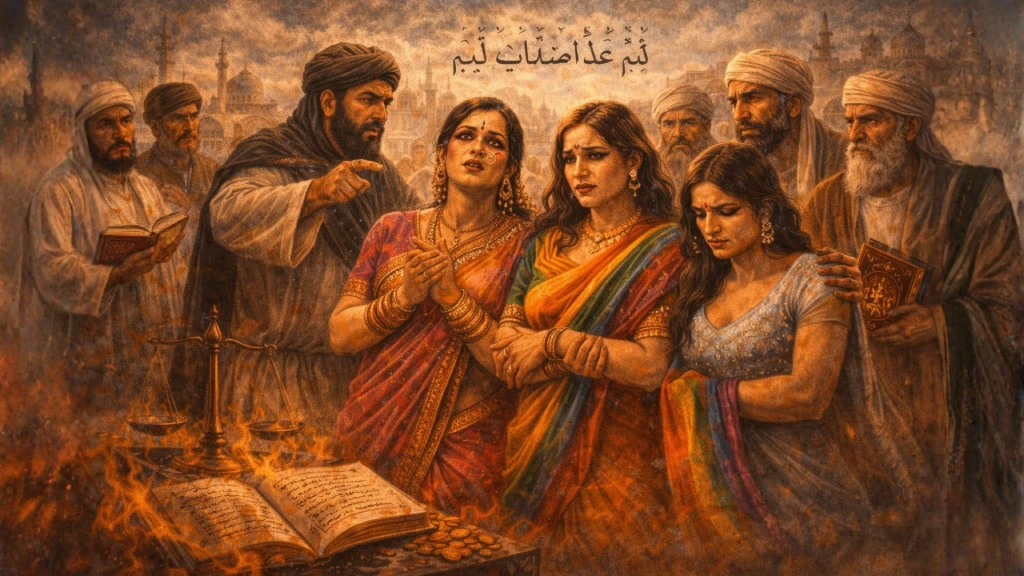
‘Mukhannath’ and ‘Khuntha’: Islamic Sharia Rulings on Hijras
Introduction
A person’s innate physical characteristics, gender identity, or gender expression are not crimes. Yet in our society, countless gender-diverse people are expelled from their families, subjected to humiliation and deprivation, and denied opportunities for education, employment, and an ordinary life simply because of their identities and behaviour. People who should be free to live according to their own identities are instead made objects of hatred, ridicule, and contempt. Islamic scripture, hadith, and classical jurisprudence have played an important role in giving religious legitimacy to this inhumane discrimination. Sahih al-Bukhari recounts the cursing of men who dress as women and the instruction to drive them out of their homes. Sunan Abi Dawud contains accounts of such people being exiled from the areas where they lived. Islamic jurists of later periods discussed these incidents as legitimate precedents for punishment and social control. Even modern Islamic fatwas instruct Muslims to ostracise men who dress and behave like women, sever relationships and business dealings with them, and refrain from employing them in homes, restaurants, and other establishments. Imposing such restrictions on people because their clothing, movements, speech, or behaviour do not conform to conventional gender norms directly attacks individual freedom, equal dignity, and fundamental human rights.
The Arabic terms ‘mukhannath’ and ‘khuntha’ used in Islamic texts do not mean the same thing. Mukhannath generally refers to a man who behaves in a feminine manner, whereas khuntha refers to someone whose innate sex characteristics make classification within the conventional categories of male or female complicated. The hijra community of South Asia is likewise not a single physical or medical category; it is a distinct social and gender identity. However, Bengali translations of hadith have frequently used ‘hijra’ for mukhannath. Consequently, accounts of cursing, expulsion, and exile in these hadith have become directly associated with the hijra community. Even amid this terminological ambiguity, a fundamental ethical problem with these Islamic rules is clear: religious rules have been developed to condemn, control, and exclude people who cross socially accepted boundaries of masculinity and femininity. There can be no justifiable basis for rules under which people may be cursed, socially isolated, or exiled merely because of their clothing, behaviour, or gender expression, even when they have harmed no one. A person’s dignity and rights cannot depend on their innate characteristics or their conformity to the gendered behaviour prescribed by religious authorities.
The historical and legal foundations of these discriminatory rules can be found in the accounts in Sahih al-Bukhari, Sahih Muslim, and Sunan Abi Dawud; the interpretations of Ibn Hajar al-Asqalani, Imam al-Nawawi, al-Shawkani, Ibn Taymiyyah, and Jalal al-Din al-Suyuti; and the fatwas published by Islamweb and IslamQA. These sources contain instructions to curse people for dressing as women, expel them from homes, exile them from populated areas, sever social relationships, and restrict employment opportunities. Such instructions conflict with fundamental human freedoms. Depriving an innocent person of an ordinary life and social dignity in the name of religious purity, social order, or public interest is not justice; it institutionalises discrimination through religious authority.
Who Are Hijras?
‘Hijra’ is an Urdu word derived from the Semitic Arabic root hijr with the meaning ‘abandoned by the tribe’ [1]. It subsequently entered Bengali and Hindi as a loanword. Its Indian usage has traditionally been translated into English as ‘eunuch’ (a castrated man) or ‘hermaphrodite’ (a person with characteristics of both sexes), denoting the ‘absence of male genitalia’. Most hijras are generally born with typical male physical characteristics, although a small number of members are born with intersex variations.

Hijra identity is not a medical term for a chromosomal defect or an innate ‘sexual disability’. In South Asia, it is a social and cultural gender identity. The community may include people born with intersex characteristics, as well as people who were assigned male at birth but whose gender identity and social position subsequently developed differently. Innate intersex variation is not confined to chromosomal differences; it also involves variations in hormones, reproductive organs, and other sex characteristics. In Bangladesh, India, and Pakistan, family rejection, poverty, violence, and social discrimination force many hijra people to leave their families and seek refuge within their own communities. A newborn child’s fundamental needs include a family’s affection, security, and care. Abandoning a child because of gender diversity, or later expelling that child from the family, denies this basic right. Exclusion from education, healthcare, housing, and employment forces many people to depend on insecure or restricted livelihoods, including singing and dancing, collecting gratuities, begging, or sex work. Their identities are not responsible for their social deprivation; the responsibility lies with the discrimination, oppression, and denial of opportunities directed against them.
Consider how, without committing any wrong or crime, their entire lives are destroyed from birth for such a trivial reason. They receive no rights, social standing, or respect. Ridicule, humiliation, neglect, and obstacles at every stage to becoming self-respecting, self-reliant people: this is how they are forced to scrape through life. You, too, could have been condemned to such an inhumane existence. Think for a moment: how would you feel if this were your life?
Those who wish to learn more about hijra people’s lives can watch these videos—
There is a well-known Pakistani film on this subject called Bol. It depicts the life of a gender-diverse child. It is an excellent film that you can watch. I am including it here—
The Prophet Muhammad’s Hijrah
The Prophet Muhammad’s hijrah is an extremely important event in Islamic history. The Arabic word هِجْرَة, or hijrah, means moving from one place to another, or migration. In 622 CE, Muhammad left his birthplace, Mecca, and took refuge in Medina. According to Islamic historical accounts, Muhammad began preaching a new religion in opposition to his ancestors’ religious beliefs, the worship of their deities, and established religious practices. This brought him into conflict with Mecca’s influential tribes. Verse 30 of Surah al-Anfal also refers to this event. It describes the plan to kill Muhammad or expel him from his homeland as a conspiracy by his opponents [2]—
وَإِذْ يَمْكُرُ بِكَ الَّذِينَ كَفَرُوا لِيُثْبِتُوكَ أَوْ يَقْتُلُوكَ أَوْ يُخْرِجُوكَ ۚ وَيَمْكُرُونَ وَيَمْكُرُ اللَّهُ ۖ وَاللَّهُ خَيْرُ الْمَاكِرِينَ
English translation (Dr. Mustafa Khattab, The Clear Quran): And ˹remember, O Prophet,˺ when the disbelievers conspired to capture, kill, or exile you. They planned, but Allah also planned. And Allah is the best of planners.
Forcing someone to flee their homeland for expressing their religious beliefs, criticising an established religion, or promoting new ideas is unquestionably a grave injustice. A person’s homeland is more than a geographical location: it is where their family, relatives, friends, livelihood, childhood memories, and social relationships take shape. Severing people from these relationships because of political or religious disagreements attacks their individual freedom and security. In Muhammad’s case, too, Islamic scripture presents this departure from his homeland as an immensely significant event. Verse 40 of Surah al-Tawbah explicitly states that the disbelievers of Mecca drove him out. It also describes Muhammad taking refuge in a cave with Abu Bakr and comforting his companion in a moment of danger [3]—
إِلَّا تَنْصُرُوهُ فَقَدْ نَصَرَهُ اللَّهُ إِذْ أَخْرَجَهُ الَّذِينَ كَفَرُوا ثَانِيَ اثْنَيْنِ إِذْ هُمَا فِي الْغَارِ إِذْ يَقُولُ لِصَاحِبِهِ لَا تَحْزَنْ إِنَّ اللَّهَ مَعَنَا ۖ فَأَنْزَلَ اللَّهُ سَكِينَتَهُ عَلَيْهِ وَأَيَّدَهُ بِجُنُودٍ لَمْ تَرَوْهَا وَجَعَلَ كَلِمَةَ الَّذِينَ كَفَرُوا السُّفْلَىٰ ۗ وَكَلِمَةُ اللَّهِ هِيَ الْعُلْيَا ۗ وَاللَّهُ عَزِيزٌ حَكِيمٌ
English translation (Dr. Mustafa Khattab, The Clear Quran): ˹It does not matter˺ if you ˹believers˺ do not support him, for Allah did in fact support him when the disbelievers drove him out ˹of Mecca˺ and he was only one of two. While they both were in the cave, he reassured his companion, “Do not worry; Allah is certainly with us.” So Allah sent down His serenity upon the Prophet, supported him with forces you ˹believers˺ did not see, and made the word of the disbelievers lowest, while the Word of Allah is supreme. And Allah is Almighty, All-Wise.
Here we find a profound ethical inconsistency between Muhammad’s own experience and the measures he subsequently ordered. The same man who suffered persecution by his opponents because of his religious beliefs and conduct, and was ultimately compelled to leave his homeland and seek refuge, later, after establishing his power, cursed people who did not conform to society’s conventional gendered behaviour, ordered them expelled from homes, and arranged their exile. Sahih al-Bukhari 5886 recounts the cursing of men who behave like women and women who behave like men, together with the instruction to ‘turn them out of your houses’. The same account mentions Muhammad himself expelling one person and Umar expelling another. Sunan Abi Dawud 4928 records an order to exile outside Medina a mukhannath who had dyed his hands and feet with henna and adopted the appearance of women. Permission was even sought to kill this person. Muhammad’s response invoked the person’s performance of prayer as the reason for refusing permission to kill him. Thus, on the one hand, departure from one’s homeland under religious persecution is accorded the status of sacred history, while on the other, expelling people with different gender expressions from homes and exiling them is established as a religious rule and a precedent to be followed. [4] [5]
If forcing a person to leave their homeland because of their religious beliefs is unjust, then driving another person from their home and exiling them because of their clothing, mannerisms, or gender expression is unjust as well. There is no universal ethical basis for treating religious freedom and the need for refuge as important in Muhammad’s case while denying others that same freedom. A person’s right to live according to their own beliefs and another person’s right to live with their own identity and behaviour rest on the same ethical principle. Condemning the violation of the first as persecution while accepting the violation of the second as a religious duty or legitimate punishment is a clear double standard. The recognition of human rights underlying the pain of displacement, persecution, and the need for refuge that have received such prominence in Islamic history through Muhammad’s hijrah is absent from the rules on exiling mukhannaths.
How Are Hijras Born?
Let us begin by listening to a prominent Islamic scholar from Bangladesh,
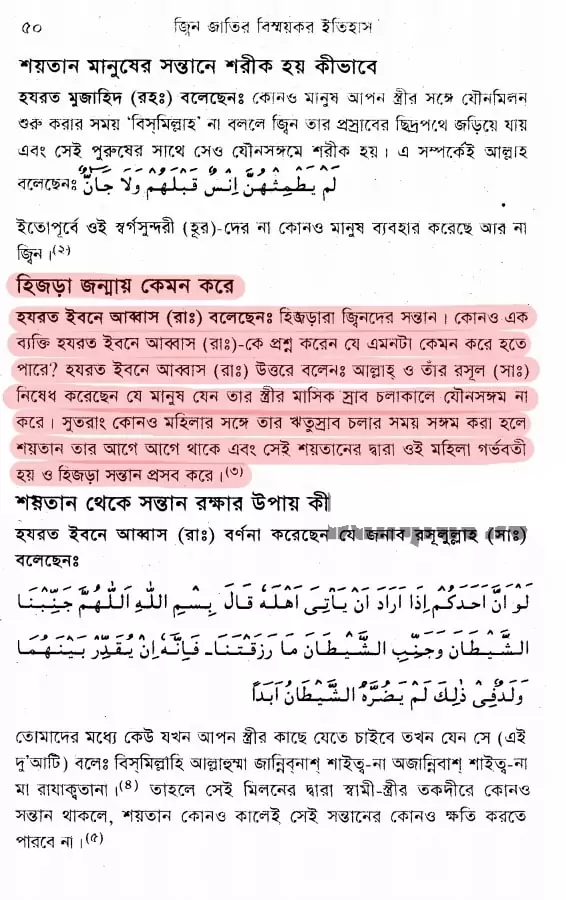
Islamic references explain the birth of hijras by claiming that if intercourse takes place during a woman’s menstruation, Satan impregnates her: in other words, hijras are supposedly born through intercourse with Satan! [6]
How Satan Shares in Human Offspring
Hazrat Mujahid (may Allah have mercy on him) said: If a man does not say ‘Bismillah’ when beginning intercourse with his wife, a jinn wraps itself around his urinary opening and joins the man in intercourse. It is in this connection that Allah says لم يطمثهن إنس قبلهم ولا جان )
‘who no human or jinn has ever touched before.’ (Dr. Mustafa Khattab, The Clear Quran, Quran 55:56, excerpt.) (2)
How Hijras Are Born
Hazrat Ibn Abbas (may Allah be pleased with him) said: Hijras are the offspring of jinn. Someone asked Hazrat Ibn Abbas (may Allah be pleased with him) how that could be. Hazrat Ibn Abbas (may Allah be pleased with him) replied: Allah and His Messenger (peace and blessings be upon him) have forbidden a man to have intercourse with his wife while she is menstruating. Therefore, when intercourse takes place with a woman during her menstruation, Satan precedes the man, and the woman becomes pregnant by Satan and gives birth to a hijra child. (3)
What Is a Child Born of Intercourse Between a Jinn and a Human Called?
Allamah al-Tha‘labi (may Allah have mercy on him) said: A child born of intercourse between a human and a jinn is called ‘khunnas’. (6)
A Woman’s Ritual Bath After Intercourse with a Jinn
Abu al-Ma‘ali Ibn al-Munajja al-Hanbali (may Allah have mercy on him) said: If a
woman says that a jinn comes to her as a husband comes to his wife, she is not obliged to perform a ritual bath. Some Hanafi scholars say the same, because the conditions that make a ritual bath obligatory are absent here, namely
penetration and ejaculation. (7)
Allamah Barud al-Din al-Shibli (may Allah have mercy on him) said: This statement is objectionable. A ritual bath should be obligatory for the woman concerned, because without ‘penetration’ she could not have known that the jinn was having intercourse with her as a man does.
Queen Bilqis’s Mother Was a Jinn
It is said that one of Bilqis’s parents was a jinn. Ibn al-Kalbi
said that Bilqis’s father married a daughter of the jinn named ‘Rayhana bint Sukun’, and Bilqis was born to her. Her name was given as being like animals’ hooves, and her ankles were hairy as well. Hazrat Sulayman (peace be upon him) married her and instructed the devils to build a bathhouse and make a depilatory powder. (8) ‘Bilqimah’. It is related that the front part of Bilqis’s feet was quadrupedal.
I (Allamah Jalal al-Din al-Suyuti, may Allah have mercy on him) say—
Hazrat Abu Hurayrah (may Allah be pleased with him) narrated that the Messenger of Allah (peace and blessings be upon him) said:
-احدا بوي بلقيس كان جنيا
One of Bilqis’s parents was a jinn. (9)
Hazrat Mujahid (may Allah have mercy on him) said: The mother of the Queen of Sheba (Bilqis) was a jinn. (10) Hazrat Zubayr ibn Muhammad (may Allah have mercy on him) said: Bilqis’s ‘mother Fari‘ah’ was a jinn. (11)
Hazrat Ibn Jurayj (may Allah have mercy on him) said: Bilqis’s mother was ‘Bilfanah’. (12) Hazrat Uthman ibn Hadir (may Allah have mercy on him) said: Bilqis’s mother was one of the jinn, and her name was ‘Bilqimah bint Saysan’. (13)


Men Without Sexual Desire in the Quran: Surah al-Nur 24:31 and the Position of Mukhannaths in Classical Tafsir
Verse 31 of Surah al-Nur is directly relevant to mukhannaths’ access to women’s quarters, their social position, and the restrictions imposed on them. This verse lists the people before whom Muslim women are permitted to reveal their adornments. Alongside husbands, fathers, sons, and specified relatives, it mentions male attendants who have no sexual desire for women. The Arabic expression used for this category is غَيْرِ أُولِي الْإِرْبَةِ مِنَ الرِّجَالِ. In defining the people included in it, early commentators discussed sexual desire, physical capacity, intellectual condition, and feminine behaviour together. Al-Tabari, Ibn Kathir, al-Qurtubi, and several other commentators directly connected this Quranic classification with the accounts in hadith of mukhannaths being prohibited from entering homes and being exiled. The verse states [7]—
أَوِ التَّابِعِينَ غَيْرِ أُولِي الْإِرْبَةِ مِنَ الرِّجَالِ أَوِ الطِّفْلِ الَّذِينَ لَمْ يَظْهَرُوا عَلَىٰ عَوْرَاتِ النِّسَاءِ
English translation (Dr. Mustafa Khattab, The Clear Quran, excerpt): male attendants with no desire, or children who are still unaware of women’s nakedness.
Under this verse’s rule, permission to associate with women depends not on a person’s individual identity and social relationships, but on other people’s assessment of whether he has sexual desire for women. The authority to determine who lacks sexual desire, who understands women’s physical characteristics, and who is consequently suitable to enter women’s quarters passes into other people’s hands. In explaining this expression in his Jami‘ al-Bayan, al-Tabari refers to men who followed others for food or shelter and were assumed to have no interest in women. He writes [8]—
يقول تعالى ذكره: والذين يتبعونكم لطعام يأكلونه عندكم، ممن لا أرب له في النساء من الرجال، ولا حاجة به إليهنّ، ولا يريدهنّ.
English translation: Here Allah refers to those men who follow you to obtain food from you and have no desire, need, or inclination towards women.
Al-Tabari also collected the statements of Ibn Abbas, Mujahid, Qatadah, al-Zuhri, and other early commentators. Their various interpretations mention men who stay with others for food, have no interest in women, are ignorant about women, or are impotent. An interpretation attributed to Ikrimah also describes a mukhannath as someone whose penis does not become erect. In other words, a person is placed in this particular category on the basis of sexual behaviour and bodily capacity. In the same discussion, al-Tabari includes an account from Aisha: a mukhannath used to enter the quarters of Muhammad’s wives and was considered to lack sexual desire. Later, when he made detailed comments about the folds of a woman’s body, Muhammad ordered that he no longer be allowed to enter. As soon as the earlier assumption about a person’s sexual desire changed, his social access was withdrawn as well.
In his commentary on the same verse, Ibn Kathir connects the accounts of early commentators with Aisha’s hadith. He first discusses various interpretations concerning men without sexual desire for women. He then mentions Aisha’s account of a mukhannath who used to visit the quarters of Muhammad’s wives and was thought to belong to the category in this verse. After describing a woman’s physical appearance in detail, he was prohibited from entering. The account quoted by Ibn Kathir states [9]—
كَانَ رَجُلٌ يَدْخُلُ عَلَى أَزْوَاجِ النَّبِيِّ ﷺ مُخَنَّثٌ، وَكَانُوا يَعُدّونه مِنْ غير أولي الإربة، فدخل النبي صلى الله عَلَيْهِ وَسَلَّمَ يَوْمًا
English translation: A mukhannath (eunuch) used to enter upon the wives of Prophet (ﷺ). They (the people) counted him among those who were free of physical needs. One day the Prophet (ﷺ) entered upon us
Al-Qurtubi’s Al-Jami‘ li-Ahkam al-Quran uses the term more broadly in its explanation of this verse. He mentions simple-minded men or men uninterested in women, impotent men, eunuchs, mukhannaths, elderly people, and children who have not reached maturity. These categories do not indicate a single innate characteristic or social identity. People in entirely different circumstances—some without sexual desire, some physically incapable, some with feminine behaviour, and others elderly or children—are brought under the same rule on the assumption that they have no sexual interest in women. Al-Qurtubi writes [10]—
وقيل العنين . وقيل الخصي . وقيل المخنث . وقيل الشيخ الكبير ، والصبي الذي لم يدرك . وهذا الاختلاف كله متقارب المعنى
English translation: Some said an impotent man; some, a eunuch; some, a mukhannath; and others, a very elderly person or a child who has not yet reached sexual maturity. He considered all these interpretations close in meaning.
Al-Qurtubi likewise connects this verse with the incident involving a mukhannath named Hit. He notes that although Hit was initially considered uninterested in women, Muhammad ordered him kept away from women after hearing his description of a woman’s physical beauty. This connection between tafsir and hadith reveals a particular system for determining a person’s social position. Gaining or losing permission to enter women’s quarters depends on the authorities’ decisions: what kind of sexual desire the person is thought to experience and how much he knows about women’s bodies. The same person may be considered free of sexual desire and granted access in one situation, only to lose that right in another.
The Quranic verse does not directly use the word mukhannath or hijra. Classical commentators, however, included mukhannaths in their explanation of this rule and cited Hit’s case as its practical application. This established a religious framework for classifying men in their social interaction with women and controlling people with feminine behaviour. Restricting a person’s social movements on the basis of other people’s assessments of their sexual desire, physical capacity, or behaviour conflicts with individual freedom. In particular, restricting access and ordinary social relationships because of someone’s identity or behaviour, without establishing that they have committed an offence that harms another person, institutionalises discrimination against gender-diverse people.
The Exile of Hijras in Sahih Hadith
Sahih al-Bukhari states that hijras are to be exiled. The Prophet himself used to drive them out of homes. Why? Simply because they were born hijras [11] [12]—
Sahih al-Bukhari (Islamic Foundation)
Book: 75/ Accounts of Disbelievers and Apostate Rebels
Section: 2852. Exiling Sinners and Hijras
6373. Muslim ibn Ibrahim (may Allah have mercy on him) … narrated from Ibn Abbas (may Allah be pleased with him): The Prophet (ﷺ) cursed the effeminate men and those women who assume the similitude (manners) of men. He also said, “Turn them out of your houses.” He turned such-and-such person out, and `Umar also turned out such-and-such person.
Hadith grade: Sahih
Narrator: Abdullah ibn Abbas (may Allah be pleased with him)

Let us also examine what is said in Sahaj Nasrul Bari, Sharh Sahih al-Bukhari, a commentary on the hadith of al-Bukhari [13],
بَابٌ نَفْيِ أَهْلِ الْمَعَاصِي وَالْمُخَنَّثِينَ
3613. Section: Exiling Sinners and Hijras
Commentary: It is permissible for rulers and judges to send people engaged in major sins and hijras into exile. This applies only to sins for which no hadd punishment is prescribed. As explained earlier, where a hadd punishment has been prescribed for a sin, a judge has no authority to change the punishment; rather, implementing the hadd is obligatory.
For a detailed analysis of mukhannaths or hijras, see Nasrul Bari, 8/393!

Readers should note that in the explanation quoted above from Nasrul Bari, the words ‘people engaged in major sins’ are followed by ‘and’. This means that it refers both to people engaged in major sins and to hijras. Had that ‘and’ been absent, the passage could have meant only hijras engaged in major sins. Many Islamists nowadays make precisely that claim in an attempt to conceal the matter. They try to suggest that the passage does not concern hijras, but supposedly only hijras who have committed offences. That ‘and’ itself proves this claim to be entirely false. Moreover, the Prophet Muhammad did not merely issue instructions: he himself forced hijras to leave their communities [14]—
Sunan Abi Dawud (Critically Verified Edition)
Book: 27/ Clothing
Section: 35. The Words of Almighty Allah: ‘Men Free of Sexual Desire’
4109. The tradition mentioned above has also been transmitted by Aishah through a different chain of narrators. This version has: He (the Prophet) exiled him and he lived in a desert (outside Medina) [al-Bayda’]. He would come every Friday asking for food.(1)
Sahih.
(1). Irwa’ al-Ghalil (6/205).
Hadith grade: Sahih
Narrator: Aisha (may Allah be pleased with her)
Let us read another hadith which makes it clear that expelling hijras from homes is the Islamic rule [15]—
Hadith Sambhar
24/ Marriage and Conjugal Life
Section: Rules of Purdah
(2665) Narrated Ibn Abbas (may Allah be pleased with him): The Prophet (ﷺ) cursed effeminate men (those men who are in the similitude (assume the manners of women) and those women who assume the manners of men, and he said, “Turn them out of your houses .” The Prophet (ﷺ) turned out such-and-such man, and `Umar turned out such-and-such woman.
(Ahmad 2006, 2123; al-Bukhari 5886)
Hadith grade: Sahih
Narrator: Abdullah ibn Abbas (may Allah be pleased with him)
At the same time, the Prophet Muhammad hated hijras, as further sahih hadith demonstrate [16] [17] [18]—
Sahih al-Bukhari (Islamic Foundation)
Book: 51/ Maghazi (Military Expeditions)
Section: 2220. The Battle of Ta’if. According to Musa ibn Uqbah (may Allah be pleased with him), this battle took place in Shawwal, 8 AH
3988. Al-Humaydi (may Allah have mercy on him) … narrated from Umm Salama (may Allah be pleased with her): The Prophet (ﷺ) came to me while there was an effeminate man sitting with me, and I heard him (i.e. the effeminate man) saying to `Abdullah bin Abi Umaiya, “O `Abdullah! See if Allah should make you conquer Ta’if tomorrow, then take the daughter of Ghailan (in marriage) as (she is so beautiful and fat that) she shows four folds of flesh when facing you, and eight when she turns her back.” The Prophet (ﷺ) then said, “These (effeminate men) should never enter upon you (O women!).” Ibn Uyaynah reported that Ibn Juraij said, “That effeminate man was called Hit.” Narrated Hisham: The above narration and added extra, that at that time, the Prophet, was besieging Taif.
Hadith grade: Sahih
Narrator: Umm Salamah (may Allah be pleased with her)
Sahih al-Bukhari (Islamic Foundation)
Book: 54/ Marriage
Section: 2537. Women Are Prohibited from Associating with a Man Who Dresses Like a Woman
4855. Uthman ibn Abi Shaybah (may Allah have mercy on him) … narrated from Umm Salama (may Allah be pleased with her): that while the Prophet (ﷺ) was with her, there was an effeminate man in the house. The effeminate man said to Um Salama’s brother, `Abdullah bin Abi Umaiyya, “If Allah should make you conquer Ta’if tomorrow, I recommend that you take the daughter of Ghailan (in marriage) for (she is so fat) that she shows four folds of flesh when facing you and eight when she turns her back.” Thereupon the Prophet (ﷺ) said (to us), “This (effeminate man) should not enter upon you (anymore).”
Hadith grade: Sahih
Narrator: Umm Salamah (may Allah be pleased with her)
Sunan Abi Dawud (Islamic Foundation)
Book: 36/ Etiquette
Section: 59. The Ruling Concerning Eunuchs.
4846. Abu Bakr ibn Abi Shaybah (may Allah have mercy on him) … Umm Salamah said that the Prophet (May peace be upon him) came upon her when there was with her an effeminate man (mukhannath) who said to her brother ‘Abd Allah (b. Abi Umayyah): if Allah conquers al-Ta’if for you tomorrow, I shall lead you to a woman who has four folds of fats in front and eight behind. Thereupon the Prophet (May peace be upon him) said: Put them out of your houses.
Abu Dawud said: The woman had four folds of fat on her belly. Hadith grade: Sahih (al-Albani)
Narrator: Umm Salamah (may Allah be pleased with her)
Let us examine another piece of evidence that clearly reveals the Prophet Muhammad’s hatred and hostility towards hijras [19]—
3988/330. Al-Humaydi (may Allah have mercy on him) narrated from the Mother of the Believers, Umm Salama (may Allah be pleased with her): The Prophet (ﷺ) came to me while there was an effeminate man sitting with me, and I
heard him (i.e. the effeminate man) saying to `Abdullah bin Abi Umaiya, “O `Abdullah! See if Allah should make you conquer Ta’if tomorrow, then take the daughter of Ghailan (Badiyah) (in marriage) as (she is so beautiful and fat that) she shows four folds of flesh when facing you,
and eight when she turns her back.” The Prophet (ﷺ) then said, “These (effeminate men) should never enter upon you (O women!).” Ibn Uyaynah reported that Ibn Juraij said, “That effeminate man was called Hit.” Mahmud
(ibn Ghaylan) narrated this hadith through Abu Usamah from Hisham (that is, like Hisham’s preceding report, عن أبيه الغ). He added that the Prophet (peace and blessings be upon him) was besieging Ta’if at the time.

The Exile of Mukhannaths: Social Expulsion and Punishment in Classical Islamic Jurisprudence
The accounts in Sahih al-Bukhari and Sunan Abi Dawud of cursing men who behave like women, expelling them from homes, and exiling them from Medina also acquired an important place in the Islamic jurisprudence of later periods. Classical jurists and hadith commentators did not cite these incidents merely as accounts of Muhammad’s personal conduct; they also discussed them as legal foundations for exile, social control, and punitive measures. It is particularly important to note that the Arabic term mukhannath (مخنث) used in these discussions refers to a man with feminine behaviour, speech, or movements. It is not synonymous with khuntha (خنثى), the jurisprudential designation for a person with innate intersex characteristics. Consequently, these rules did not target only innate genital variation; they also included people who crossed conventional standards of male social behaviour and dress.
In volume 12 of his renowned Fath al-Bari Sharh Sahih al-Bukhari, Ibn Hajar al-Asqalani explains al-Bukhari’s chapter باب نفي أهل المعاصي والمخنثين, meaning ‘Exiling Sinners and Mukhannaths’. According to his discussion, in this chapter al-Bukhari presents a precedent for a punishment that is not confined to enemies engaged in warfare or people convicted of serious crimes. In discussing the legal conclusions to be drawn from incidents of exile, Ibn Hajar also mentions a person who merely imitates women. He cites a jurisprudential interpretation whose conclusion is that exile may apply even for merely imitating women. In other words, this discussion does not present proof of murder, theft, physical assault, or violation of another person’s rights as an indispensable condition for exile. Explaining the purpose of al-Bukhari’s chapter, Ibn Hajar writes [20]—
كَأَنَّهُ أَرَادَ الرَّدَّ عَلَى مَنْ أَنْكَرَ النَّفْيَ عَلَى غَيْرِ الْمُحَارِبِ فَبَيَّنَ أَنَّهُ ثَابِتٌ مِنْ فِعْلِ النَّبِيِّ صَلَّى اللَّهُ عَلَيْهِ وَسَلَّمَ وَمَنْ بَعْدَهُ
English translation: It appears that he intended to respond to those who denied exile for anyone other than a person engaged in warfare. He demonstrated that such exile is established by the actions of Muhammad and those who came after him.
This interpretation of exile expands the rule from punishment for a specific violent offence committed against someone into a mechanism for controlling social behaviour. How a person walks, speaks, or dresses, and whether their behaviour conforms to society’s conventional understanding of masculinity, can become factors affecting their right to reside in a place. Even when someone’s personal behaviour harms no one, a punishment as severe as exile can arise if that behaviour is considered religiously impermissible. A person’s right to remain with their family, maintain social relationships and a livelihood, and live in familiar surroundings thus becomes subordinate to religiously established social standards.
Muhammad ibn Ali al-Shawkani discusses in greater detail the case of the mukhannath exiled on Muhammad’s orders. Based on Aisha’s narration, his Nayl al-Awtar mentions a person who initially used to visit Muhammad’s wives. He was considered a man without sexual desire for women. Later, after he described a woman’s physical appearance in detail, he was prohibited from entering. Al-Shawkani explains that three matters were considered in his exile: the change in the assumption that he lacked sexual desire; his description of a woman’s physical beauty and intimate parts before men; and the disclosure of his particular knowledge of women’s bodies. The outcome was more than a prohibition on entering one house: he had to remain away from populated areas. Even entering a settlement for food and a livelihood required special permission. Drawing on this incident, al-Shawkani writes about the legitimacy of banishment as a punishment [21]—
وَفِي ذَلِكَ دَلِيلُ جَوَازِ الْعُقُوبَةِ بِالْإِخْرَاجِ مِنْ الْوَطَنِ لِمَا يُخَافُ مِنْ الْفَسَادِ وَالْفِسْقِ
English translation: This provides evidence that it is permissible to punish a person by expelling him from his homeland or place of residence out of fear of corruption and sinful conduct.
A particularly important feature of al-Shawkani’s statement is that the basis for exile includes not only an offence already committed, but also the fear of future corruption or sinful conduct. In other words, this legal interpretation provides a rationale for removing someone from their home if religious authorities consider their presence or behaviour a potential social danger. Aisha’s account also describes the exiled person being permitted to enter the settlement for food at specified times. This shows that exile created practical obstacles to his daily livelihood and access to food. Under such arrangements, decisions by state or religious authorities can sever a person even from the basic means of sustaining their social existence.
Ibn Taymiyyah’s Majmu‘ al-Fatawa also discusses exile as a punitive measure. He brings together precedents for the exile of various people during Umar’s rule and accounts of exile for unlawful sexual intercourse and of a mukhannath in Muhammad’s time. His discussion treats exile as a punishment that temporarily removes a person from their place of residence. Ibn Taymiyyah writes [22]—
وَقَدْ مَضَتْ سُنَّةُ رَسُولِ اللَّهِ صَلَّى اللَّهُ عَلَيْهِ وَسَلَّمَ بِالنَّفْيِ فِي الزِّنَا وَنَفْيِ الْمُخَنَّثِ
English translation: The Sunnah of Allah’s Messenger has established exile in cases of unlawful sexual intercourse and the exile of a mukhannath.
Ibn Taymiyyah’s statement shows how the incident of exile was received in later Islamic legal thought. The exile of a mukhannath is cited here as a precedent from Muhammad’s Sunnah rather than as an isolated event in early Islamic history. Such legal acceptance matters because the social impact of a historical event is not confined to the time when it occurred. When later jurists use an incident as a precedent for legitimate punishment, it can become a religious foundation for social control and expulsion in later periods as well.
Imam al-Nawawi’s explanation of the nature of mukhannaths’ behaviour also makes an important distinction. In his Sharh Sahih Muslim, he discusses mukhannaths in two categories. Those in the first category have innate feminine behaviour and do not deliberately imitate women’s behaviour. Those in the second deliberately imitate women’s speech, movements, clothing, and conduct. According to al-Nawawi, people in the first category are not culpable for their innate characteristics. He writes [23]—
بَلْ هُوَ خِلْقَةٌ خَلَقَهُ اللَّهُ عَلَيْهَا فَهَذَا لَا ذَمَّ عَلَيْهِ، وَلَا عَتَبَ، وَلَا إِثْمَ وَلَا عُقُوبَةَ؛ لِأَنَّهُ مَعْذُورٌ لَا صُنْعَ لَهُ فِي ذَلِكَ
English translation: Rather, he was born with these characteristics, which Allah created in him. Therefore, no blame, reproach, sin, or punishment applies to him, because he had no part in creating them.
Al-Nawawi’s classification shows that classical Islamic interpretation also recognised feminine behaviour as an innate characteristic. This did not, however, give individuals the right to determine their own clothing, behaviour, and social identity freely. Rather, religious condemnation and punishment became dependent on the determination of whether their behaviour was innate or deliberate. Al-Nawawi himself placed men who deliberately imitate women’s behaviour and clothing in the category cursed in sahih hadith. The system that treats people’s personal clothing, speech, and gestures as religious offences thus remains intact. Refraining from condemning someone for an innate characteristic is not equivalent to recognising their freedom to determine their own gender expression.
In his Al-Ashbah wa al-Naza’ir, Jalal al-Din al-Suyuti discusses ‘ta‘zir’, or punishment left to a judge’s discretion, and mentions situations in which punitive measures are contemplated even though an act is not itself considered sinful. In this discussion, he also cites Imam al-Shafi‘i’s position on the exile of a mukhannath. According to al-Suyuti, even when the behaviour is not sinful because it is unintentional, exile may be considered on grounds of public interest. He writes [24]—
وَمِنْهَا نَفْيُ الْمُخَنَّثِ نَصَّ عَلَيْهِ الشَّافِعِيُّ مَعَ أَنَّهُ لَا مَعْصِيَةَ فِيهِ إِذَا لَمْ يَقْصِدْهُ إِنَّمَا فَعَلَ لِلْمَصْلَحَةِ
English translation: One such case is the exile of a mukhannath. Al-Shafi‘i explicitly stated this. Although it involves no sin if unintentional, the measure was nevertheless taken in the public interest.
This statement by al-Suyuti is particularly significant. It discusses exiling someone whose relevant characteristics or behaviour are unintentional and who has therefore not been found guilty of any sin on that account. Nevertheless, exiling him in the name of the supposed public interest is regarded as acceptable. The ordinary ethical relationship between culpability and punishment is thus severed. A person may lose the right to reside in a place because they do not conform to society’s conventional standards, despite bearing no responsibility for their innate or involuntary characteristics. Although al-Nawawi’s interpretation rejects punishment for innate characteristics, the absence of sin does not rule out exile in the jurisprudential position quoted by al-Suyuti. These two statements reveal a serious tension within classical Islamic jurisprudence between personal responsibility and social control in the name of the public interest.
Ibn Hajar’s interpretation of exile, al-Shawkani’s declaration that banishment is a legitimate punishment, Ibn Taymiyyah’s invocation of exile as a precedent from the Sunnah, and al-Suyuti’s jurisprudential discussion of exiling a mukhannath despite the absence of sin together reveal an important social reality. Islamic jurisprudence developed several mechanisms for exercising religious authority over people whose behaviour falls outside conventional gender norms. Expulsion from homes, exclusion from women’s company, cursing, and exile from one’s place of residence each directly affect a person’s social relationships, security, and freedom. The legal idea that measures as severe as severing people from their livelihood, family, and familiar society can be permitted without proof of an offence they have committed makes fundamental human dignity and rights subordinate to the discretion of religious authorities.
Hijras Who Pray Must Not Be Killed
The sahih hadith also makes it clear that the Prophet Muhammad would indeed have killed hijras; he forbade killing Muslim hijras who prayed only because they performed prayer. In other words, they were actually deserving of death, and the Prophet refrained from killing them only because Allah had forbidden the killing of those who pray. Otherwise, in this hadith the Prophet would have stated quite plainly: “Do not kill someone simply for being a hijra.” When permission is sought to kill hijras, the question of whether they pray becomes relevant only if the Prophet actually wished to kill them for being hijras, with prayer being the sole reason the killing could not take place. The ruling concerning the others, those who do not pray, therefore remains an open question [25]—
Sunan Abi Dawud (Critically Verified Edition)
Book: 36/ Etiquette
Section: 61. Rules Concerning Hijras
4928. Narrated Abu Hurayrah: An effeminate man (mukhannath) who had dyed his hands and feet with henna was brought to the Prophet (ﷺ). He asked: What is the matter with this man? He was told: “Messenger of Allah! He imitates the look of women.” So he issued an order regarding him and he was banished to an-Naqi’. The people said: Messenger of Allah! Should we not kill him? He said: I have been prohibited from killing people who pray. AbuUsamah said: Naqi’ is a region near Medina and not a Baqi’.(1)
Sahih.
(1). Al-Daraqutni.
Hadith grade: Sahih
Narrator: Abu Hurayrah (may Allah be pleased with him)
Let us also consult the book directly [26]—
Section 61: Rules Concerning Hijras
٤٩٢٨ حَدَّثَنَا هَارُونُ بْنُ عَبْدِ اللهِ، وَمُحَمَّدُ بْنُ الْعَلَاءِ، أَنْ أَبَا أَسَامَةَ، أَخْبَرَهُمْ عَنْ مُفَضْلِ بْنِ يُونُسَ، عَنِ الأَوْزَاعِي، عَنْ أَبِي يَسَارِ الْقُرَشِي، عَنْ أَبِي هَاشِمٍ، عَنْ أَبِي هُرَيْرَةً، أن النبي الله أتِي بِمُحَتْ قَدْ خَضَبَ يَدَيْهِ وَرِحْلِيْهِ بِالْحِنَّاءِ فَقَالَ النَّبِيُّ ” مَا بَالُ هَذَا ” . فَقِيلَ يَا رَسُولَ اللهِ يَتَشَبَّهُ بِالنِّسَاءِ . فَأَمَرَ بِهِ فَفِي إِلَى التَّقِيعِ فَقَالُوا يَا رَسُولَ اللَّهِ أَلا تَقْتُلُهُ فَقَالَ ” إِنِّي نُهِيتُ عَنْ قَتْلِ الْمُصَلِّينَ ” . قَالَ أَبُو أَسَامَةَ وَالنَّقِيعُ نَاحِيَةٌ عَنِ الْمَدِينَةِ وَلَيْسَ بِالْبَقِيعِ .
صحيح
4928. Narrated Abu Hurayrah: An effeminate man (mukhannath) who had dyed his hands and feet with henna was brought to the Prophet (ﷺ). He asked: What is the matter with this man? He was told: “Messenger of Allah! He imitates the look of women.” So he issued an order regarding him and he was banished to an-Naqi’. The people said: Messenger of Allah! Should we not kill him? He said: I have been prohibited from killing people who pray. AbuUsamah said: Naqi’ is a region near Medina and not a Baqi’. 1926
Sahih.

This hadith is also found in several other places [27]—
Mishkat al-Masabih (Mishkat)
Book: Part 22/ Clothing
Section: 3. Third Subsection—Combing the Hair
4481-(63) Abu Huraira told that a mukhannath who had dyed his hands and feet with henna was brought to God’s messenger who asked, “What is the matter with this man?” On being told that he affected women’s get-up he ordered him to be banished to an-Naqi’. The people suggested that they should kill him, but he said, “I have been prohibited from killing people who pray.” Abu Dawud transmitted it.(1)
(1) Sahih: Abu Dawud 4928, Sahih al-Jami‘ 2506, Silsilat al-Sahihah 2379, Shu‘ab al-Iman 4606, al-Daraqutni 9, Al-Mu‘jam al-Awsat 5058, Al-Sunan al-Kubra by al-Bayhaqi 17442, Al-Sunan al-Sughra 597.
Hadith grade: Sahih
Narrator: Abu Hurayrah (may Allah be pleased with him)
Hijras’ Natural Inclinations
Hijra people naturally enjoy wearing women’s clothing and adornments. For many hijras, this is a perfectly natural desire. People should have the freedom to dress and adorn themselves however they wish. Islam, however, strictly prohibits this. The Prophet Muhammad pronounced la‘nah on male hijras and men who dress as women—in other words, he cursed them [28] [29]—
Sahih al-Bukhari (Tawhid)
Book: 77/ Clothing
Section: 77/61. Men Dressing as Women and Women Dressing as Men.
5885. Narrated Ibn Abbas (may Allah be pleased with him): Allah’s Messenger (ﷺ) cursed those men who are in the similitude (assume the manners) of women and those women who are in the similitude (assume the manners) of men. (Adhunik Publications: 5457; Islamic Foundation: 5353)
Amr also narrated the same. Shu‘bah informed us of this.
Hadith grade: Sahih
Narrator: Abdullah ibn Abbas (may Allah be pleased with him)
Sahih al-Bukhari (Tawhid)
Book: 77/ Clothing
Section: 77/62. Expelling Men Who Dress as Women from Homes.
5886. Narrated Ibn Abbas (may Allah be pleased with him): The Prophet (ﷺ) cursed effeminate men (those men who are in the similitude (assume the manners of women) and those women who assume the manners of men, and he said, “Turn them out of your houses .” The Prophet (ﷺ) turned out such-and-such man, and `Umar turned out such-and-such woman. (Adhunik Publications: 5458; Islamic Foundation: 5354)
Hadith grade: Sahih
Narrator: Abdullah ibn Abbas (may Allah be pleased with him)
The Prophet even cursed people who wear false hair [30]—
Sahih al-Bukhari (Tawhid)
Book: 77/ Clothing
Section: 77/83. Attaching False Hair.
5934. Narrated Aisha (may Allah be pleased with her): An Ansari girl was married and she became sick and all her hair fell out intending to provide her with false hair. They asked the Prophet (ﷺ) who said, “Allah has cursed the lady who artificially lengthens (her or someone else’s) hair and also the one who gets her hair lengthened.” (5205) (Adhunik Publications: 5501; Islamic Foundation: 5396)
Hadith grade: Sahih
Narrator: Aisha (may Allah be pleased with her)
Social Ostracism, Employment Bans, and Discrimination Against Gender-Diverse People in Religious Fatwas
The expulsion of mukhannaths from homes, their cursing, and their exile in the Prophet Muhammad’s time also influenced the religious rules and fatwas of later periods. Modern Islamic fatwas do more than express religious condemnation of people who dress or move like women, or who do not conform to conventional masculine behaviour: they also impose restrictions on social relationships, friendship, business dealings, and employment involving such people. Particularly significant is that several fatwas instruct Muslims to ostracise the people concerned without presenting evidence that they have committed a specific offence. An allegation of religiously impermissible gender expression thus becomes a basis for affecting a person’s livelihood, social security, and right to develop ordinary relationships with others.
Fatwa 70474, published on 2 January 2006, is particularly important in this regard. A questioner asked whether it was permissible to maintain social and business relationships with men who openly behaved in a feminine manner. He explicitly stated that he was not asking about their punishment; he wanted to know whether they could be employed to cook or clean, even if they were not allowed to mix with women. He also asked about the ruling on buying food from a restaurant they operated or eating food they had prepared at a wedding. The answer begins by describing men who voluntarily imitate women’s clothing and movements, and who are said to desire particular homosexual acts, as criminals and accursed. It then instructs Muslims to exclude them socially and economically. The respondent writes [31]—
ويجب على المسلمين هجرهم والإنكار عليهم فلا يقصد المكان الذي هم فيه ولا يستأجرون في العمل في البيوت والمطاعم ومحلات الحلاقة ونحوها من الأماكن
English translation: Muslims must shun them and denounce their conduct. They must not frequent the places where they are present, nor employ them in homes, restaurants, barbershops, or similar establishments.
The remainder of the fatwa also instructs that these people should not be allowed to mix with men or women, and that anyone who encounters them should avert their gaze and denounce their behaviour as far as possible. Here the religious prohibition does not remain confined to a person’s clothing or behaviour; it is applied directly to their social and economic existence. In cooking, cleaning, restaurant work, or barbering, the reasonable criteria for employment are skill, honesty, and the ability to fulfil one’s responsibilities. The fatwa, however, takes a person’s gender expression and assumptions about their alleged sexual behaviour as reasons to deny employment. The questioner even specified a situation in which they would work without mixing with women. Employment was not permitted even in that situation. Thus, the prohibition is not confined to safety in a particular workplace: its direct consequence is the social and economic exclusion of the people concerned.
The fatwa presents feminine clothing and behaviour together with a desire for specific sexual acts as characteristics of the same category of people. Yet such conclusions about someone’s sexual behaviour or interests do not logically follow from their clothing, voice, movements, or gestures. No evidence is presented here for the assumption that every man with feminine behaviour desires the same sexual acts. Nevertheless, this unproven classification underlies the declaration that they are ‘criminals’ and ‘accursed’, and the instruction to exclude them from employment and social relationships. As a result, a person who does not conform to religiously prescribed gendered behaviour can become an object of suspicion and ostracism in society before any specific offence against them has been proved.
A similar position appears in fatwa 61019, published on 13 April 2005. The questioner asked who was meant by the ‘third gender’, what ruling applied to people born with both male and female genitalia, and how to treat those who identified as women after being raised like women. The answer discusses people whose sex is difficult to determine from birth, or khunthas, separately from men who voluntarily imitate women’s behaviour. For khunthas, it instructs that their legal category be determined from physical signs. For men who voluntarily imitate women, it invokes the curse in hadith and prohibits dealings with them. The fatwa states [32]—
وأما إن كان قصدك بالجنس الثالث المخنثين المتشبهين طوعا بالنساء فهؤلاء ملعونون على لسان رسول الله صلى الله عليه وسلم
English translation: If by the third gender you mean those mukhannath men who voluntarily imitate women, they are accursed according to the words of Allah’s Messenger.
Immediately after this statement, the fatwa declares that Muslims may not engage in dealings with this category of people. It does more than declare an act religiously forbidden: it also prohibits ordinary social and business relationships with the people who engage in that behaviour. A person’s freedom to determine their own behaviour and social identity is made subordinate to religiously approved standards of masculinity. Prohibiting business with someone, purchasing goods from them, or employing them directly affects their financial independence. If such prohibitions are implemented socially, the person concerned faces not only humiliation or hatred, but also the risk of exclusion from ordinary opportunities to earn a living.
The instruction to sever social relationships because of nonconformity to religiously prescribed gendered behaviour appears even more explicitly in fatwa 13711, dated 29 January 2002. A questioner sought advice about his friend. According to the questioner, his friend had become accustomed to feminine behaviour after growing up among female family members and had later become involved in homosexual acts as well. The answer instructs him to advise his friend to adopt conventional male behaviour and habits. It also tells him to try to reform his friend by invoking mukhannaths’ social position, people’s hostile attitudes towards them, and fear of punishment in the afterlife. If these measures fail, he is instructed to abandon the friendship [33]—
فإن استجاب لك وأقلع عما هو فيه، فذلك المطلوب، وإلا فاهجره وابتعد عنه صوناً لدينك وعرضك.
English translation: If he accepts your advice and abandons his present conduct, that is the desired outcome. Otherwise, shun him and keep away from him to protect your religion and honour.
This fatwa presents social ostracism as a means of protecting religion and honour. Pressuring the questioner’s friend to change his behaviour and instructing that ties be severed if he does not change directly establishes religious authority over personal relationships. Separation from family and friends can cause serious social and psychological harm to anyone. Family and friendship are particularly important sources of social security for people whose gender identities and behaviour do not conform to convention. Making such relationships conditional confronts the person with two alternatives: try to change their behaviour to gain social acceptance, or bear the risk of losing social relationships. Besides restricting individual freedom, religiously prescribed ostracism of this kind may compel people to conceal their identities and behaviour.
Muhammad al-Amin al-Shinqiti offers a clear explanation of the position that conventional distinctions between masculinity and femininity are religiously immutable. His statement on page 415 of volume 7 of Adwa’ al-Bayan is quoted in IslamQA answer 145802. There, al-Shinqiti describes the differences between men and women as established both in creation and in Sharia. According to his argument, people who imitate the opposite sex are cursed precisely because they attempt to cross these distinctions between men and women. He writes [34]—
ولا شك أن سبب هذا اللعن هو محاولة من أراد التشبه منهم بالآخر لتحطيم هذه الفوارق التي لا يمكن أن تتحطم.
English translation: Undoubtedly, the reason for this curse is that those of one sex who wish to imitate the other are attempting to destroy distinctions that cannot be destroyed.
Al-Shinqiti’s statement also presents differences in social behaviour between men and women as part of a religiously protected boundary. Clothing, adornment, voice, and movements thus cease to be merely matters of social taste and become questions of religious obedience. When someone crosses conventional boundaries of masculinity or femininity, this theological framework treats their behaviour as an attempt to defy religious rules rather than as natural individual variation. When this idea is combined with fatwas prescribing curses, ostracism, and employment bans, multiple layers of religious and social control are imposed on people’s freedom to determine their own gender expression.
This language of social exclusion becomes still harsher in fatwa 18605, published on 4 July 2002. The questioner asked about the ruling on associating with a good-looking boy or young man without facial hair, and whether this differed from associating with people described as belonging to the so-called third gender. The answer first discusses sexual attraction towards young, attractive males. It then refers to men who imitate women’s movements, clothing, and speech under the designation of the so-called third gender, associating them with homosexual acts. On the basis of this classification, the fatwa’s author invokes an alleged consensus of the Companions and states that the punishment is death. However, the fatwa specifies that only the ruler, not ordinary individuals, has the authority to carry out this punishment. It states [35]—
وحكم هؤلاء القتل بإجماع الصحابة، ولكن هذا القتل لا يطبقه إلا السلطان، فلا يجوز للأفراد المسلمين تطبيق هذا الحد وغيره من الحدود.
English translation: According to the consensus of the Companions, the ruling concerning these people is death. However, only the ruler may carry out this execution; individual Muslims are not permitted to implement this or any other hadd punishment.
The claim of consensus concerning the death penalty is the fatwa author’s assertion; this quotation does not establish any such historical consensus against every man with feminine behaviour. The important feature of the fatwa is that it discusses an extremely severe punishment while presenting a person’s gender expression, possible sexual attraction, and sexual behaviour as features of a single category. Dressing or speaking like a woman and engaging in a specific sexual act are entirely different matters. The presence of one does not establish the other. Yet the fatwa’s classification effectively disregards this distinction. Such classification creates a basis for making unproven allegations of sexual offences against gender-diverse people and presenting them as socially dangerous.
The fatwas reveal a consistent structure of social discrimination. First, clothing and behaviour that do not conform to conventional masculinity are declared religiously reprehensible. Then unproven assumptions about sexual desire or offences are attached to that behaviour. Next come instructions to end friendships, social relationships, business dealings, and employment involving the people concerned. Some fatwas also conflate the identities of people in this category with sexual offences and discuss severe punishments. Throughout this process, the tendency to judge a person’s social identity and behaviour takes precedence over questions of what they have done, whether they have actually harmed anyone, and whether specific allegations against them have been proved.
The ethical problems with this kind of social application of religious rules are extremely serious. A person’s clothing, speech, gestures, or gender expression do not give them fewer rights than anyone else. Their rights to earn a living, maintain social relationships, live in safety, and live according to their own identity are equal to everyone else’s. Yet the fatwas discussed here establish ostracism as a religious duty, exclusion from employment as an approved measure, and severing personal ties as a means of protecting religion and honour. These positions directly conflict with equal human dignity, individual freedom, and the principle of earning a living without discrimination. The continuity from early accounts of exile to modern fatwas prescribing social and economic exclusion shows that religious arguments for restricting the rights of people who do not conform to conventional gender norms have not remained confined to early texts; they are clearly present in modern religious guidance as well.
Innate Gender Diversity and Islamic Jurisprudence: Rules on Khunthas’ Marriage, Prayer, Prayer Leadership, and Inheritance
Classical Islamic jurisprudence developed separate rules for people whose innate sex characteristics make classification difficult. In jurisprudential terminology, they are called khuntha (خنثى). If physical signs allow the person to be classified as male or female, they are categorised as khuntha ghayr mushkil; if the signs are inconclusive or contradictory, they are classified as khuntha mushkil. The consequences extend beyond terminology. These categories directly affect the person’s right to marry, inheritance share, position in congregational prayer, right to lead others in prayer, and life in society under the rules governing men or women. Innate physical variation can therefore create significant obstacles in determining a person’s legal rights.
In his Al-Mughni, the Hanbali jurist Ibn Qudamah discusses the rule requiring a khuntha to be placed in one of the two legal categories of male and female. Citing Quranic verses about the creation of male and female, his discussion denies the existence of a separate third legal category. In the same discussion, however, he cites a position on the marriage of a khuntha mushkil that permits the person to be regarded as male or female on the basis of their own statement and attraction. According to this position, someone who declares themselves male may marry women, and someone who declares themselves female may marry men; they may not subsequently enter another marriage under the opposite identity. Ibn Qudamah writes [36]—
وَإِذَا قَالَ الْخُنْثَى الْمُشْكِلُ : أَنَا رَجُلٌ . لَمْ يُمْنَعْ مِنْ نِكَاحٍ النِّسَاءِ ، وَلَمْ يَكُنْ لَهُ أَنْ يَنْكِحَ بِغَيْرِ ذَلِكَ بَعْدُ
English translation: If a khuntha mushkil says, ‘I am a man’, he shall not be prevented from marrying women. However, he may not subsequently enter a different kind of marriage.
The presence of this position in Ibn Qudamah’s work shows that classical jurists did not hold entirely identical views on khunthas’ marriage. Yet even where a person is allowed to determine their legal category according to their internal experience, marriage remains confined to a relationship between male and female. Although the person’s identity is accepted in decisions concerning marriage, it must be permanently confined to one of the two categories predetermined by religious law. This tendency to place innate variation within the male–female binary, rather than accept it as a distinct lived reality, is a fundamental source of legal restriction.
The Hanafi jurist Ala’ al-Din al-Kasani discusses inheritance calculations and other rules concerning the khuntha mushkil in detail in the ‘Kitab al-Khuntha’ section of his Bada’i‘ al-Sana’i‘. He presents as the Hanafi position the rule that a khuntha receives the lesser of the inheritance shares that would be due if the person were treated as male or female. Since a woman’s share is smaller than a man’s in most cases, the khuntha receives the woman’s share; however, if a particular calculation produces an even smaller share when the person is treated as male, that smaller share is assigned instead. The ambiguity of a person’s physical characteristics thus places them in the less favourable position in the inheritance calculation. Al-Kasani writes [37]—
قَالَ أَصْحَابُنَا – رَحِمَهُمُ اللَّهُ – يُعْطَى لَهُ أَقَلُّ الْأَنْصِبَاءِ وَهُوَ نَصِيبُ الْأُنْثَى إِلَّا أَنْ يَكُونَ أَسْوَأَ أَحْوَالِهِ أَنْ يُجْعَلَ ذَكَرًا
English translation: The scholars of our school state that the person is to receive the lesser of the possible shares, generally the female share. However, if treating the person as male produces a less favourable outcome, the calculation follows that classification.
Under this rule, a khuntha’s inheritance bears the burden of uncertainty about their identity. Other heirs in the same family receive property according to their legally determined male or female status. But when someone’s status cannot be determined because of innate physical variation, the rule selecting the smaller share may apply. Their entitlement is reduced not because of an offence or a failure to fulfil responsibilities, but solely because of uncertainty over which of the two established categories they should be placed in.
Maliki jurisprudence offers another method of inheritance calculation. In his Hashiyat al-Dasuqi ‘ala al-Sharh al-Kabir, Muhammad al-Dasuqi discusses calculating a khuntha mushkil’s possible shares as male and female and then taking their average. Thus, where the Hanafi method tends to award the smaller possible share, this Maliki method adds half of each possible share. The same work also states that a khuntha mushkil’s marriage is invalid while their sex remains undetermined. Al-Dasuqi’s account states [38]—
فإذا كان على تقدير كونه ذكرا سهمان وعلى تقدير كونه أنثى سهم فإنه يعطى نصف نصيب الذكر وهو سهم ونصف نصيب الأنثى وهو نصف سهم
English translation: If the person would receive two shares when treated as male and one share when treated as female, they are given half the prospective male entitlement, namely one share, and half the prospective female entitlement, namely a further half-share.
These differing views on inheritance provide two distinct legal solutions to the same practical problem: Islamic inheritance law does not assign a separate share based on equal rights to people born with variations in sex characteristics. The person must first be treated as either male or female for the calculation. A smaller share, an average share, or another calculation then applies according to the jurists’ methodological differences. Property rights become tied to bodily classification rather than being determined on the basis of equal dignity as a person.
A similar classification operates in prayer and prayer leadership. Islamweb fatwa 189089 states that a khuntha mushkil may not lead other men in prayer. The reasoning is that the person may be female, in which case men cannot pray behind them. The same reasoning also prevents a khuntha mushkil from praying behind another khuntha mushkil. The fatwa quotes Al-Muhadhdhab by the Shafi‘i jurist Abu Ishaq al-Shirazi [39]—
ولا تجوز صلاة الرجل خلف الخنثى الْمُشْكِلِ لِجَوَازِ أَنْ يَكُونَ امرأة, ولا صلاة الخنثى خلف الخنثى لِجَوَازِ أَنْ يَكُونَ الْمَأْمُومُ رَجُلًا وَالْإِمَامُ امرأة.
English translation: A man may not pray behind a khuntha mushkil, because that person may be a woman. Likewise, one khuntha mushkil may not pray behind another, because the follower may be male and the imam female.
Under this rule, the basis for restricting a person’s right to lead prayer is their innate physical characteristics rather than their religious qualifications, ability to recite the Quran, honesty, or competence in conducting prayer. Even when the person can perform the responsibilities of an imam properly, they are prohibited from leading other men if their sex is ambiguous. Their place in the prayer rows is likewise determined by the same classification. These restrictions on leadership and participation within Islam’s religious sphere turn innate variation into a basis for restricting rights.
IslamQA answer 221919 cites Ibn Uthaymin’s Al-Sharh al-Mumti‘ and Al-Mawsu‘ah al-Fiqhiyyah on the rules governing a khuntha mushkil’s prayer and marriage. It states that a khuntha is not obliged to attend congregational prayer at the mosque; if they do attend, they should stand in a separate row between the men and women. According to most jurists, marriage is invalid while the person’s sex remains undetermined. This position directly affects the right to choose a life partner and establish a family. The answer states [40]—
وإن كان ” مشكِلاً ” : فإنه لا يصح تزوجه عند جمهور العلماء ؛ لأنه يحتمل أن يكون ذَكراً فكيف يتزوج ذكراً ؟!
English translation: If the person’s sex remains undetermined, most scholars hold that their marriage is invalid. The person may be male—in which case, how could they marry a man?
Although one position cited by Ibn Qudamah permits marriage on the basis of the person’s own statement, the position of most jurists presented in IslamQA’s answer is stricter. Where innate sex characteristics are ambiguous, the right to marry is suspended or denied. This prohibition may deprive a person of the opportunity to form a family despite there being no offence or fault in their personal capabilities, sense of responsibility, or treatment of others. The reason for restricting their rights is their own physical variation and uncertainty in legal classification.
These jurisprudential rules cannot be said to apply identically to every member of South Asia’s hijra community. The historical category of khuntha is a specific legal and physical classification, whereas hijra identity in South Asia has a broader scope. Nevertheless, the rules developed for khunthas reveal the Islamic legal method of compulsorily placing people with innate gender diversity in one of two categories, male or female. This method creates restrictions on fundamental rights such as marriage, inheritance, and religious leadership. A person’s innate characteristics or ambiguity in bodily classification cannot justifiably diminish their right to equal dignity and freedom.
Conclusion
The curses, instructions to expel people from homes, and incidents of exile outside Medina attributed to Muhammad were used as foundations for punitive rules in later Islamic jurisprudence. Ibn Hajar explained exile as applicable even to noncombatants; al-Shawkani discussed the permissibility of expulsion from one’s place of residence out of fear of corruption; and al-Suyuti cited a jurisprudential position allowing even a person whose feminine characteristics are unintentional and not considered sinful to be exiled in the public interest. These rules made personal security and the right to live with one’s family and community dependent on the decisions of religious authorities. Treating people’s clothing, gestures, and gender expression as grounds for punishment, even when they harm no one, is not justice.
Modern fatwas prescribing social and economic exclusion have been added to the earlier rules on exile. Instructions to abandon friendship with someone, cease business with them, or refuse to employ them because they dress or behave like women deny their equal dignity as a person. For people born with variations in sex characteristics, the classifications of Islamic jurisprudence have likewise created discriminatory restrictions on marriage, inheritance, and religious leadership. Whether someone deliberately chooses their own clothing and gender expression or their characteristics are innate, social ostracism, exile, or restrictions on fundamental rights without proof of an offence against them cannot be ethically legitimate in either case. These Islamic rules directly conflict with equal human rights and freedom.
Whether a newborn is a boy, a girl, or gender-diverse—whoever that child may be—the child is innocent and beautiful. No mother should ever turn a child away from her embrace. She should not make the child a hijra, in the sense of casting them out of the community. A child has the right to grow up within a family, surrounded by laughter, joy, love, and affection. No child should ever be pushed into a life of indignity on the basis of their gender. Every child should have the opportunity to grow into an independent, self-reliant, self-respecting person. And these filthy Islamic rules should be eradicated from society.
References
- Perspectives on Arabic linguistics XVII-XVIII: papers from the Seventeenth and Eighteenth Annual Symposia on Arabic Linguistics, (John Benjamins, 2005), p. 97 ↩︎
- Quran, Surah al-Anfal, verse 30 ↩︎
- Quran, Surah al-Tawbah, verse 40 ↩︎
- Sahih al-Bukhari 5886 ↩︎
- Sunan Abi Dawud 4928 ↩︎
- The Astonishing History of the Jinn, Allamah Jalal al-Din al-Suyuti, pp. 50, 51 ↩︎
- Surah al-Nur, verse 31 ↩︎
- Imam al-Tabari, Jami‘ al-Bayan, commentary on Surah al-Nur 24:31, vol. 19 ↩︎
- Ibn Kathir, Tafsir al-Quran al-‘Azim, Surah al-Nur 24:31 ↩︎
- Imam al-Qurtubi, Al-Jami‘ li-Ahkam al-Quran, Surah al-Nur 24:31 ↩︎
- Sahih al-Bukhari, Islamic Foundation, hadith: 6373 ↩︎
- Sahih al-Bukhari, Islamic Foundation, vol. 10, p. 240, hadith: 6373 ↩︎
- Sahaj Nasrul Bari, Sharh Sahih al-Bukhari, Arabic–Bengali, Simple Translation and Detailed Commentary and Analysis, Hazrat Mawlana Usman Ghani, Al-Kawsar Publications, vol. 12, p. 240 ↩︎
- Sunan Abi Dawud (Critically Verified Edition), hadith: 4109 ↩︎
- Hadith Sambhar, hadith: 2665 ↩︎
- Sahih al-Bukhari, Islamic Foundation, hadith: 3988 ↩︎
- Sahih al-Bukhari, Islamic Foundation, hadith: 4855 ↩︎
- Sunan Abi Dawud, Islamic Foundation, hadith: 4846 ↩︎
- Sahaj Nasrul Bari, Sharh Sahih al-Bukhari, Arabic–Bengali, Simple Translation and Detailed Commentary and Analysis, Hazrat Mawlana Usman Ghani, Al-Kawsar Publications, vol. 8, p. 426 ↩︎
- Ibn Hajar al-Asqalani, Fath al-Bari, vol. 12, pp. 165–166, باب نفي أهل المعاصي والمخنثين ↩︎
- Muhammad ibn Ali al-Shawkani, Nayl al-Awtar, vol. 6, باب في غير أولي الإربة ↩︎
- Ibn Taymiyyah, Majmu‘ al-Fatawa, vol. 11, discussion of punishment through exile ↩︎
- Imam al-Nawawi, Sharh Sahih Muslim, vol. 14, pp. 336–337, باب منع المخنث من الدخول على النساء الأجانب ↩︎
- Jalal al-Din al-Suyuti, Al-Ashbah wa al-Naza’ir, p. 491, باب التعزير ↩︎
- Sunan Abi Dawud, Islamic Foundation, hadith: 4928 ↩︎
- Sunan Abi Dawud, critically verified by Allamah Nasir al-Din al-Albani, vol. 5, p. 535 ↩︎
- Mishkat al-Masabih (Mishkat), hadith: 4481 ↩︎
- Sahih al-Bukhari, Tawhid Publications, hadith: 5885 ↩︎
- Sahih al-Bukhari, Tawhid Publications, hadith: 5886 ↩︎
- Sahih al-Bukhari, Tawhid Publications, hadith: 5934 ↩︎
- الاختلاط والتعامل مع المخنثين من الرجال — Fatwa 70474, 2 January 2006 ↩︎
- كيفية التعامل مع الجنس الثالث — Fatwa 61019, 13 April 2005 ↩︎
- لعن الله المخنثين من الرجال — Fatwa 13711, 29 January 2002 ↩︎
- Muhammad al-Amin al-Shinqiti, Adwa’ al-Bayan, vol. 7, p. 415; IslamQA, answer 145802 ↩︎
- حكم النظر إلى الأمرد، وحكم المتخنثين — Fatwa 18605, 4 July 2002 ↩︎
- Ibn Qudamah, Al-Mughni, vol. 7, كتاب النكاح, مسألة قال الخنثى المشكل أنا رجل ↩︎
- Ala’ al-Din al-Kasani, Bada’i‘ al-Sana’i‘, vol. 7, كتاب الخنثى, فصل في حكم الخنثى المشكل ↩︎
- Muhammad al-Dasuqi, Hashiyat al-Dasuqi ‘ala al-Sharh al-Kabir, vol. 4, pp. 489–491, chapter on inheritance ↩︎
- Abu Ishaq al-Shirazi, Al-Muhadhdhab; Islamweb, fatwa 189089, حكم إمامة الجنس الثالث ↩︎
- IslamQA, answer 221919, بعض أحكام الخنثى المشكل في باب الصلاة والنكاح ↩︎
About This Article
Genre: Semi-Academic Skeptical Analysis
Epistemic Position: Scientific Skepticism and Secular Humanist Ethics
This article belongs to the skeptical-rationalist analytical tradition of Shongshoy.com.
Its purpose is evidence-based critical examination of religious, philosophical, moral, and historical claims.
