Introduction: The Definitional Conflict and the Question of Impartiality
One of the most fundamental premises of Islamic theology is Allah’s perfect and unquestionable justice. In Islamic belief, Allah is defined as the “ultimate judge” (al-ʿAdl), omniscient and omnipotent. It is claimed that the scope of His knowledge is limitless and that none of His decisions or judgments can ever be biased, irrational, or unjust. Yet once we move beyond this theological assertion and examine certain Qur’anic narratives from the standpoint of reason and critical analysis, the claim of such “perfect justice” encounters serious logical difficulties.
In any rational or legal framework, “justice” requires certain identifiable standards. Among them are equal opportunity, impartiality, and unbiased evaluation. If, in a competitive or test-like setting, the participants are deliberately given unequal initial conditions or unequal access to the relevant knowledge, then the exercise cannot reasonably be described as fair. It instead becomes a predetermined performance whose result has been built into the setup itself.
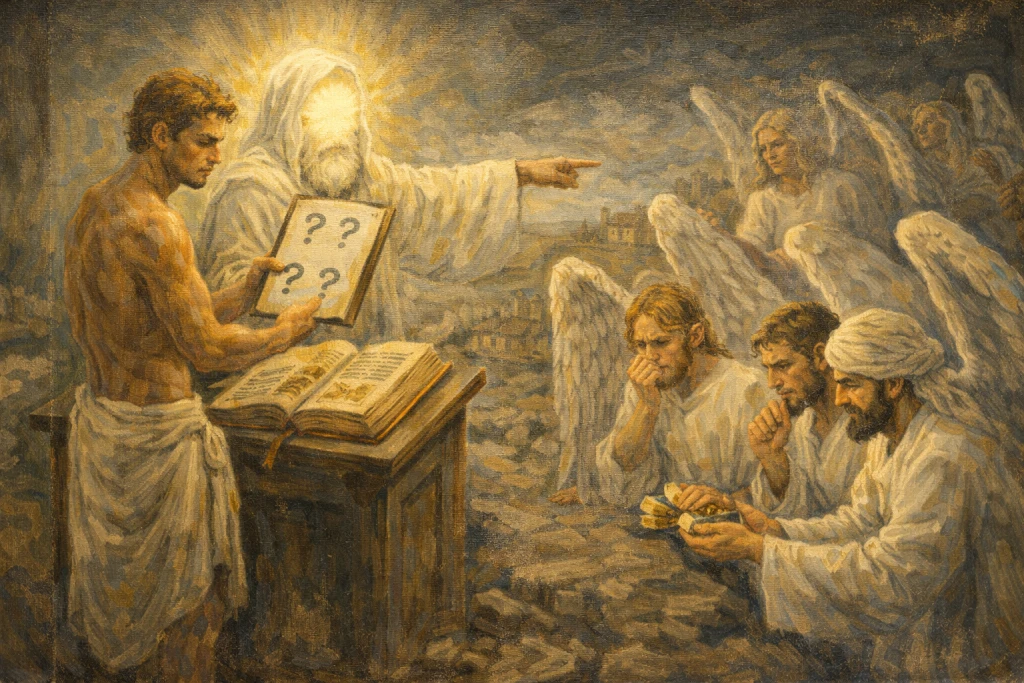
The test of knowledge between the first human, Adam, and the angels described in Surah al-Baqarah 2:31–33 is a classic example that places the concept of divine justice itself under scrutiny. The narrative explicitly states that Allah taught Adam the names of all things, or a body of special knowledge, while the angels were not given that same knowledge. Yet both sides were then confronted with the same question.
The unavoidable question is therefore this: can a judge reasonably claim fairness after testing someone on knowledge that was never taught to them and then publicly demonstrating their failure? Was this genuinely an assessment of merit, or a carefully arranged spectacle in which one side had already been selected to succeed and the other to fail? This article examines this specific Qur’anic episode to determine whether the test can coherently be described as a fair and rational evaluation, or whether it is better understood as an arbitrary display of unilateral power and an extreme example of favoritism.
The Qur’anic Narrative: Blueprint of a Predetermined Test
Surah al-Baqarah 2:31–33 recounts this well-known episode involving the first human, Adam, and the angels. A conventional reading presents it as a demonstration of human superiority, yet the structure of the episode is marked by a striking inequality of access to knowledge. The text explicitly says that Allah Himself taught Adam “the names of all things” or a particular body of knowledge (verse 31). He then presented those things before the angels and asked them to name them. Predictably, the angels could not answer, because they had not been given that knowledge. They responded, “We have no knowledge except what You have taught us” (verse 32). Adam was then instructed to provide the names. Once Adam did so, Allah addressed the angels in a reproachful manner and emphasized that He knew the unseen of the heavens and the earth (verse 33). [1]
[ Surah al-Baqarah 2:31 ]
وَعَلَّمَ ءَادَمَ ٱلۡأَسۡمَآءَ كُلَّهَا ثُمَّ عَرَضَهُمۡ عَلَى ٱلۡمَلَٰٓئِكَةِ فَقَالَ أَنۢبِـُٔونِي بِأَسۡمَآءِ هَٰٓؤُلَآءِ إِن كُنتُمۡ صَٰدِقِينَ
And He taught Adam the names—all of them. Then He presented them to the angels and said, “Inform Me of the names of these, if you are truthful.”
— Saheeh International
Allah taught Adam the names of all things, then placed them before the angels and said: “If you are right, tell Me the names of these.”
— A. Maududi
He taught Adam all the names, then showed them to the angels, saying: Inform Me of these names, if you are truthful.
— Pickthall
He taught Adam the names of all things; then placed them before the angels, and said: “Tell Me the names of these if you are right.”
— Yusuf Ali
[ Surah al-Baqarah 2:32 ]
قَالُواْ سُبۡحَٰنَكَ لَا عِلۡمَ لَنَآ إِلَّا مَا عَلَّمۡتَنَآۖ إِنَّكَ أَنتَ ٱلۡعَلِيمُ ٱلۡحَكِيمُ
The angels said, “Glory be to You! We have no knowledge except what You have taught us. Indeed, You are the All-Knowing, the Wise.”
— Saheeh International
They said, “Glory to You! We know nothing except what You taught us. Truly, You are All-Knowing, All-Wise.”
— Maududi
They said: “Be glorified! We know only what You have taught us. You alone are the Knower, the Wise.”
— Pickthall
They said: “Glory to You; of knowledge we have none, save what You have taught us. Indeed, You are perfect in knowledge and wisdom.”
— Yusuf Ali
[ Surah al-Baqarah 2:33 ]
قَالَ يَٰٓـَٔادَمُ أَنۢبِئۡهُم بِأَسۡمَآئِهِمۡۖ فَلَمَّآ أَنۢبَأَهُم بِأَسۡمَآئِهِمۡ قَالَ أَلَمۡ أَقُل لَّكُمۡ إِنِّيٓ أَعۡلَمُ غَيۡبَ ٱلسَّمَٰوَٰتِ وَٱلۡأَرۡضِ وَأَعۡلَمُ مَا تُبۡدُونَ وَمَا كُنتُمۡ تَكۡتُمُونَ
He said, “O Adam, inform them of their names.” And when Adam had informed them, He said, “Did I not tell you that I know the unseen of the heavens and the earth, and that I know what you reveal and what you conceal?”
— Saheeh International
Allah said, “O Adam, tell them their names.” When Adam told them, Allah said: “Did I not tell you I know the secrets of the heavens and the earth, and all that you reveal and hide?”
— Maududi
He said: “O Adam, inform them of their names.” When Adam had done so, He said: “Did I not tell you I know what is hidden in the heavens and the earth, and what you disclose and conceal?”
— Pickthall / Yusuf Ali
Logical Analysis: An Assessment of Merit or a Display of Power?
If this entire narrative is judged by the standards of any neutral or rational tribunal, it does not qualify as a “fair test”; rather, it appears as a deliberately structured sham. A basic condition of any meaningful test is that the syllabus or relevant body of knowledge must be common to all participants and that they must have an equal opportunity to acquire it. Here, however, the judge—Allah—personally gives one participant, Adam, the relevant knowledge before the test while leaving the others, the angels, without it.
The inequality becomes obvious through a simple modern analogy. Imagine a teacher who, before an examination, privately calls in one specially favored student and teaches that student the exact material from which the exam questions will be drawn, while teaching the rest of the class nothing about that material. On the day of the exam, the teacher then asks precisely those questions in front of everyone. Naturally, the privately tutored student will answer successfully while the others will fail. If the teacher then uses that result to announce that the favored student is the most intelligent and that the rest are incompetent, would anyone seriously describe the process as fair? Or would the teacher be regarded as corrupt and flagrantly biased? In the Qur’anic narrative of Surah al-Baqarah, Allah’s role follows the same structure: the outcome is engineered in advance and then presented as a demonstration validating the preferred participant.
The Angels’ Helplessness and Divine Autocracy
The angels’ reply in verse 32 is often described by theologians as an expression of “obedience,” but psychologically and logically it can also be read as the response of completely powerless participants. “We have no knowledge except what You have taught us” is, in effect, a devastating statement about the structure of the test itself. The angels are pointing out, in the most restrained possible manner, that their inability to answer is not evidence of incompetence; it is the direct consequence of not having been given the relevant knowledge. How can a judge who distributes the necessary knowledge unequally remain impartial when evaluating competence?
Allah’s statement after Adam gives the answers—“Did I not tell you that I know the unseen…” —is not a reasoned conclusion establishing the fairness of the exercise. It functions instead as an assertion of superior power and knowledge after a result that was already guaranteed by the unequal distribution of information. The episode does not demonstrate Adam’s merit through an equal comparison; rather, it publicly exposes the angels’ informational disadvantage and then turns that disadvantage into a display of divine supremacy. In a genuinely fair system, status should follow from comparable conditions and demonstrable merit. Here, by contrast, the very structure of the episode makes the result dependent on the creator’s prior selective allocation of knowledge. The test therefore fails as evidence of impartial superiority and becomes a serious logical challenge to the concept of divine justice.
The Legitimization of Punishment Without an Offense and the Naked Face of Divine Autocracy
The Islamic theological account of Allah’s “justice” encounters its most severe logical and moral stumbling block in the doctrine of divine decree. Mishkat al-Masabih 115—a report graded Sahih by al-Albani and also preserved in Sunan Abi Dawud 4699 and Sunan Ibn Majah 77—provides a stark and disturbing example of this theological crisis. The source article’s argument is explicit: if Allah were to decide to punish every inhabitant of the heavens and the earth without any cause or offense, He would still not be deemed a “wrongdoer” or an unjust being. This proposition collides not only with ordinary rational judgment but also with the most basic moral meaning of justice. [2]
Mishkat al-Masabih
Book 1: Faith
Chapter: Belief in the Divine Decree — Section 3
115 — Ibn al-Dailami reported that he went to Ubayy b. Kaʿb because he was troubled by the question of divine decree and asked him for something that might remove that doubt. Ubayy replied: “Were God to punish everyone in the heavens and the earth He would do so without being unjust to them”; and if He showed mercy to them, His mercy would be better for them than their deeds. He further told him that even if he spent an amount of gold equal to Mount Uhud in God’s cause, it would not be accepted from him until he believed in divine decree and accepted that what had reached him could not have missed him and what had missed him could not have reached him; dying on any other belief would lead to Hell.
Ibn al-Dailami then went to ʿAbdullah b. Masʿud and to Hudhaifa b. al-Yaman, both of whom gave him substantially the same answer. He then went to Zaid b. Thabit, who reported the same teaching from the Prophet. The report is transmitted by Ahmad, Abu Dawud, and Ibn Majah.
Arabic text preserved in the canonical Mishkat record:
وَعَنِ ابْنِ الدَّيْلَمِيِّ قَالَ: أَتَيْتُ أُبَيَّ بْنَ كَعْبٍ فَقُلْتُ لَهُ: قَدْ وَقَعَ فِي نَفْسِي شَيْء من الْقدر فَحَدثني بِشَيْء لَعَلَّ الله أَن يذهبه من قلبِي قَالَ لَو أَن الله عَذَّبَ أَهْلَ سَمَاوَاتِهِ وأَهْلَ أَرْضِهِ عَذَّبَهُمْ وَهُوَ غَيْرُ ظَالِمٍ لَهُمْ وَلَوْ رَحِمَهُمْ كَانَتْ رَحْمَتُهُ خَيْرًا لَهُمْ مِنْ أَعْمَالِهِمْ وَلَوْ أَنْفَقْتَ مِثْلَ أُحُدٍ ذَهَبًا فِي سَبِيلِ اللَّهِ مَا قَبِلَهُ اللَّهُ مِنْكَ حَتَّى تُؤْمِنَ بِالْقَدَرِ وَتَعْلَمَ أَنَّ مَا أَصَابَكَ لَمْ يَكُنْ لِيُخْطِئَكَ وَأَنَّ مَا أَخْطَأَكَ لَمْ يَكُنْ لِيُصِيبَكَ وَلَوْ مُتَّ عَلَى غَيْرِ هَذَا لَدَخَلْتَ النَّارَ قَالَ ثُمَّ أَتَيْتُ عَبْدَ اللَّهِ بْنَ مَسْعُودٍ فَقَالَ مِثْلَ ذَلِكَ قَالَ ثُمَّ أَتَيْتُ حُذَيْفَةَ بْنِ الْيَمَانِ فَقَالَ مثل ذَلِك قَالَ ثُمَّ أَتَيْتُ زَيْدَ بْنِ ثَابِتٍ فَحَدَّثَنِي عَنِ النَّبِيِّ صَلَّى اللَّهُ عَلَيْهِ وَسَلَّمَ مِثْلَ ذَلِكَ. رَوَاهُ أَحْمَدُ وَأَبُو دَاوُدَ وَابْنُ مَاجَهْ
Reference: Mishkat al-Masabih 115; in-book reference: Book 1, Hadith 108.
Corroborating canonical records: Sunan Abi Dawud 4699; Sunan Ibn Majah 77.
Grade on Sunnah.com: Isnād Hasan (Zubair ʿAliza’i); Sahih (al-Albani). Sunan Abi Dawud 4699 is graded Sahih (al-Albani), and Sunan Ibn Majah 77 is graded Sahih (Darussalam).
In any rational and humane moral framework, one minimum and indispensable condition of justice is that a person should not be punished without wrongdoing. A system in which the innocent and the guilty can be treated alike and punished at the will of the authority cannot meaningfully be called justice; it is pure autocracy. The hadith therefore creates a direct conceptual problem for claims about Allah’s justice. If a being may punish the entire created order and that act must still, by definition, be classified as “not unjust,” then the distinction between justice and injustice has been emptied of independent moral content. What remains is the primitive formula that “the will of the powerful is the law,” elevated into a theological principle.
This hadith presents Allah not as an impartial and merciful judge but as an extremely arrogant, obstinate, and arbitrary ruler. Just as an earthly dictator can use laws of his own making to declare his injustices and cruelties “legal” or “justified,” the theological structure expressed here portrays Allah in essentially the same way. There is no definite moral rule or principle to which He is accountable. He may, under this logic, carry out an act that would ordinarily be recognized as extreme injustice, yet the sheer supremacy of His power requires that He still be called “just.” This is a frightening moral philosophy: instead of teaching principled ethics, it teaches blind obedience and fear before unrestricted authority.
This hadith does not solve the problem of divine justice; it makes the problem even more grotesque. It makes painfully clear that, within this formulation, Allah’s “justice” is not an ethical ideal at all but a cover for the boast of absolute power and autocratic domination. If a being possesses the right to punish without offense and must nevertheless be called just, then describing that being as the greatest autocratic power in the universe is logically more coherent than describing it as a just judge.
Conclusion: The Futility of Divine Autocracy Draped in Justice
When the Qur’anic and hadith material discussed above is examined logically, the Islamic theological claim of perfect divine justice faces a serious internal problem. The episode involving Adam and the angels was not an impartial assessment of knowledge or merit; it was an unequal contest whose result had been fixed by unequal access to the relevant information. When the judge personally teaches one participant the answers, withholds the same knowledge from the others, and then subjects both sides to the same question, calling the resulting process “fair” is logically indefensible. The episode therefore functions less as a demonstration of Adam’s independently established superiority than as a demonstration of how absolute control over the conditions of a test can manufacture the desired result.
The hadith concerning divine decree drives the problem further. A doctrine under which the entire created order may be punished while the punishing authority remains, by definition, beyond the charge of injustice cannot satisfy even the minimal moral principle that punishment should be connected to culpability. This is an autocratic model of morality in which power is not answerable to justice; rather, power defines justice. The result is a framework in which moral accountability, humanity, and rational evaluation become subordinate to the unrestricted will of the supreme ruler.
Ultimately, Islam’s conception of Allah as a “just judge” becomes a psychological riddle and an instrument of intimidation. When the creator’s actions cannot be independently judged by rational or moral standards, and even extreme inequality or injustice must be accepted by force of doctrine as “justice,” that religious philosophy fails to teach a coherent higher morality. From Adam’s sham test to the asserted divine legitimacy of punishment without offense, these narratives demonstrate that the claim of divine justice, when tested against reason, collapses into an incoherent, self-contradictory, and authoritarian conception in which the ruler’s will is treated as the final definition of right.