
Introduction
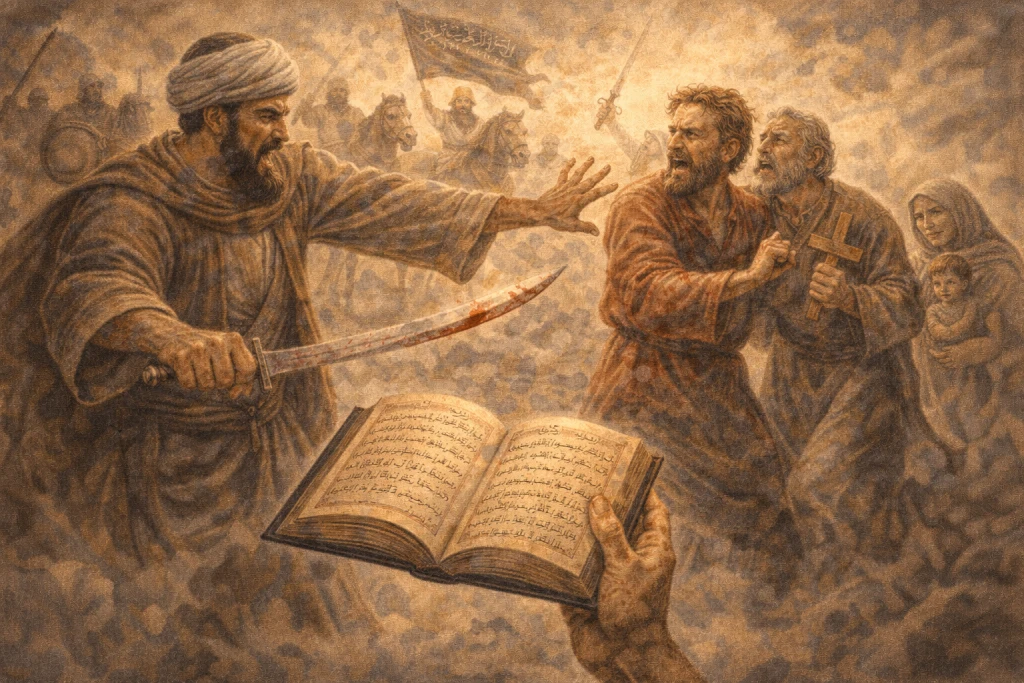
In the modern world, Muslim da‘is and preachers use a particular verse from Surah al-Kafirun [1] as a principal tool for portraying Islam as a religion of supposed “peace and coexistence.” “Your religion is yours, and our religion is ours”—this catchy slogan is promoted in such a way as to suggest that Islam seeks to establish a fraternal and egalitarian bond with all religions and ideologies in the world. However, this claim of “tolerance” stands in stark contradiction to the classical sources of Islam, the tafsirs followed by the Salaf, and Muhammad’s own conduct, and amounts to nothing more than an enormous intellectual deception.
A close analysis of Islam’s foundational texts and authoritative tafsirs reveals that this temporary “liberality” toward other religions was merely a product of the Muslims’ political and military weakness amid the hostile environment of Mecca. Islam’s true and ultimate objective is by no means coexistence; rather, it is to eradicate all other religions through “jihad” and “qital,” eliminate every trace of “shirk,” or idolatry, from the face of the earth, and establish the absolute supremacy of Islam. According to classical scholars, when the Muslims in Mecca were cornered by their fear of the Quraysh, this verse constituted a “strategic retreat” that was abrogated or rendered inoperative by the “Sword Verse” (Ayat al-Sayf) after they gained power in Medina.
Even today, an examination of the activities of hardline Islamist groups and their foundational books of creed makes it clear that their real objective is not coexistence, but the suppression and eradication of dissenters. In an ideology where “shirk” is treated as an offense punishable by death and the blood of non-Muslims is regarded as “halal,” this verse from Surah al-Kafirun is nothing more than a temporary disguise. The wars of aggression waged by Muhammad and during the caliphate attest to this very truth. In this article, we will reveal how these “tolerant” pronouncements from the early period of Islam were subsequently transformed into offensive jihad and sectarian aggression, and how this creates an irreconcilable hostility toward the principles of modern human rights.
The International Bill of Human Rights
Among the principal tenets of the International Bill of Human Rights are freedom of expression, freedom of religion, and peaceful coexistence with followers of other religions. However, the verses of the Quran, the hadiths, the classical tafsirs, and books of jurisprudence show that Islam does not call upon Muslims to be tolerant of other religions at all, nor does it advise them to be temporarily tolerant subject to certain conditions (such as humbly paying the jizya). Rather, various Quranic verses and hadiths speak of war, jihad, the unconditional surrender of followers of other religions for the propagation of Islam, their payment of the jizya in order to remain alive, or their subjugation. The history of Islam and the present legal structures of many Islamic countries show that non-Muslims face social and legal discrimination unless they convert. In Islam, non-Muslims are permitted to live under specified conditions as “dhimmis,” or protected subjects, through the payment of a humiliating tax, which essentially confers a form of second-class citizenship. This is a clear violation of international human rights, which stipulate that no person may be subjected to discrimination on account of their religion, ideology, or beliefs.
Verse 6 of Surah al-Kafirun
At the outset, it is necessary to correct a misconception. Many modern Muslims frequently claim that the word Islam means peace. Yet the word Islam means submission; that is, Islam teaches that peace can be attained only through complete submission. Let us hear Dr. Abu Bakr Muhammad Zakaria’s explanation of this meaning of the word Islam,
The actual tafsir and historical context of the verse from Surah Al-Kafirun that Islamists present as an example of supposed coexistence are different. According to classical Islamic scholars, this verse was revealed in the context of a temporary agreement with the Quraysh of Mecca, in which Muhammad refused to compromise with them on religion. Popular works of tafsir such as Tafsir Ibn Kathir state explicitly that the true purpose of this verse is not to make any compromise with non-Muslims, but to reject their religion and establish the truth of Islam. It was a temporary measure adopted by Muslims while they were powerless, through which they sought to prevent others from retaliating by insulting Allah after Muslims had insulted the deities of other religions. It is not an example of peaceful coexistence or religious tolerance of any kind; rather, it was a measure adopted with the aim of establishing the exclusive supremacy of Islam once sufficient power had been attained in the future.
When judged in light of human rights, an analysis of the reasons behind this Islamic directive reveals that its underlying rationale is plainly contrary to religious tolerance. Refusing to respect a non-Muslim’s right to practice their religion and declaring their ideology invalid are contrary to the fundamental principles of human rights. Since international human rights declarations state explicitly that every person has freedom of expression, freedom to practice religion, and the right to live according to their own beliefs, these Islamic principles restrict or violate those rights. There is therefore a clear contradiction between the fundamental teachings of Islam and the principles of international human rights declarations. A close study of Islamic tafsirs shows that coexistence and tolerance are not intrinsic teachings of Islam; rather, its principal objective is to suppress and overthrow every ideology other than Islam. Let us read that verse and its tafsir [4] –
Quran reference : Surah Al-Kafirun, 109:6
Arabic : لَكُمْ دِينُكُمْ وَلِىَ دِينِ ٦
Translation — Dr. Mustafa Khattab, The Clear Quran : “You have your way, and I have my Way.”
Translation — Sahih International : “For you is your religion, and for me is my religion.”
Translation — M. Pickthall : “Unto you your religion, and unto me my religion.”
Tafsir al-Jalalayn
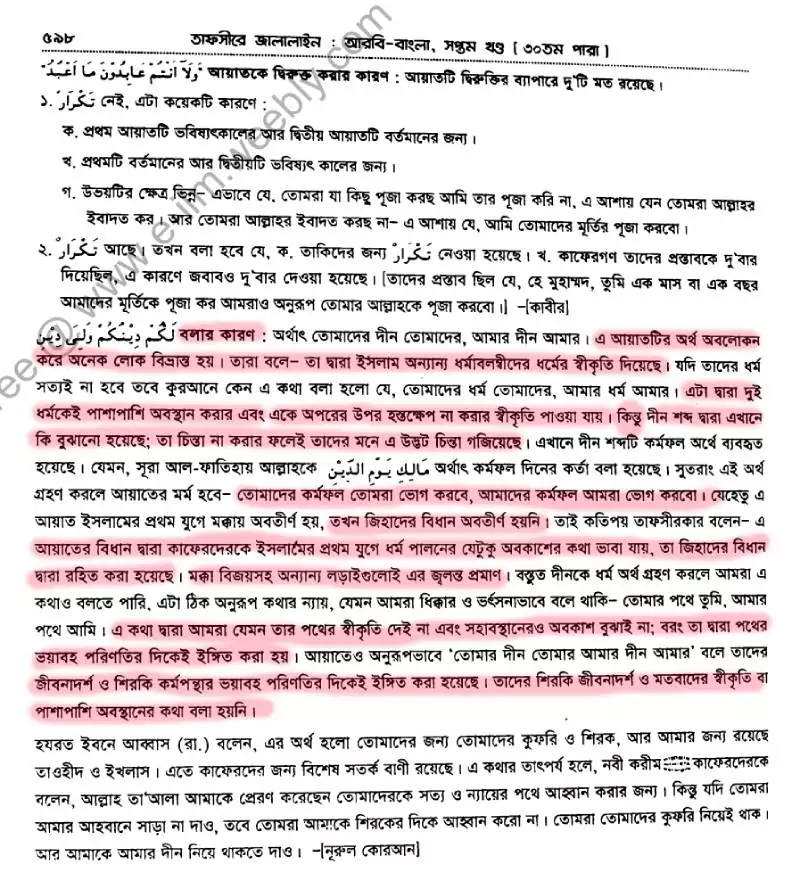
Let us read its exegesis from Tafsir al-Jalalayn, [5]
Reason for saying this: That is, your religion is yours, and my religion is mine. Many people become confused upon considering the meaning of this verse. They claim that through it Islam has recognized the religions of adherents of other faiths. If their religions were not true, why then does the Quran say, “Your religion is yours, and my religion is mine”? They understand this as recognition of the right of both religions to exist side by side and not interfere with one another. But this absurd notion has arisen in their minds because they have failed to consider what the word din means here. The word din is used here in the sense of recompense for one’s deeds. For example, in Surah Al-Fatihah, Allah is described as the Master of the Day of Recompense. Thus, if this meaning is adopted, the purport of the verse is: you will experience the recompense for your deeds, and we will experience the recompense for ours. Since this verse was revealed in Mecca during the early period of Islam, when the command concerning jihad had not yet been revealed, some exegetes state that whatever scope this verse’s ruling may be understood to have afforded the disbelievers to practice their religion during the early period of Islam was abrogated by the command concerning jihad. The conquest of Mecca and the other battles are vivid proof of this. In fact, if din is understood to mean religion, we may also say that this statement resembles the way we express condemnation and reproach by saying, “You follow your path, and I follow mine.” Just as this statement neither recognizes the other person’s path nor implies any possibility of coexistence, but instead points to the dreadful consequences of that path, the verse similarly states, “Your religion is yours, and my religion is mine,” to indicate the dreadful consequences of their way of life and their polytheistic course of action. It does not recognize their polytheistic way of life and doctrine or speak of coexistence alongside them.
Tafsir-e-Mazhari
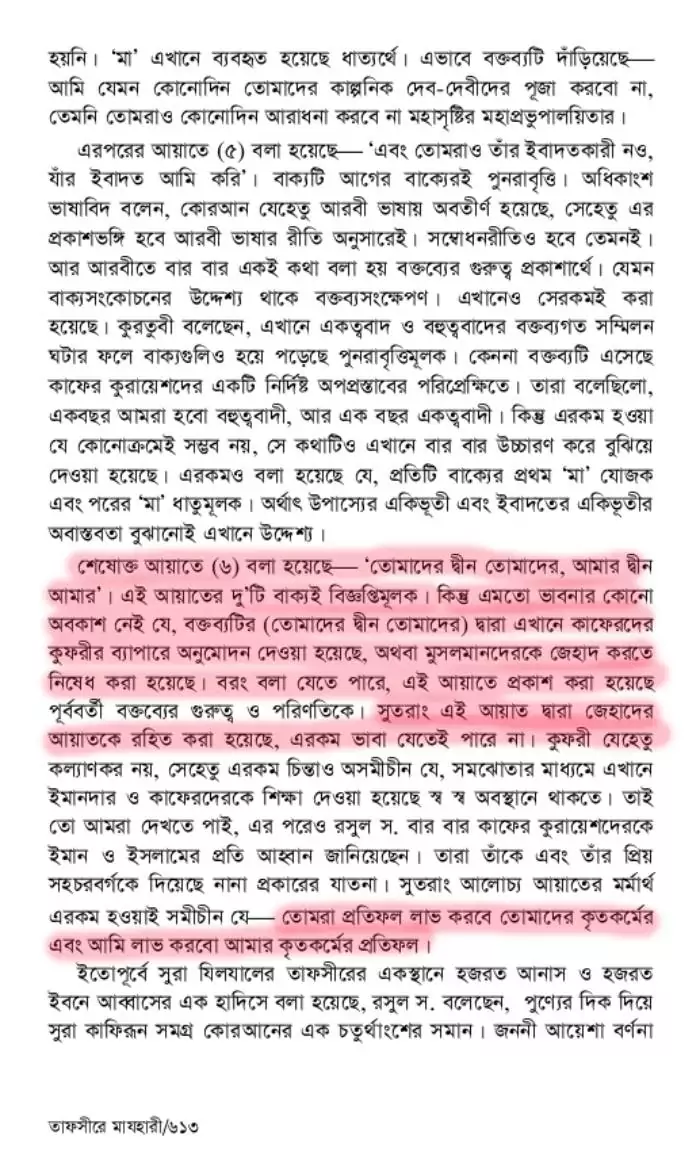
Now let us examine what Tafsir-e-Mazhari says [6] –
The final verse (6) states— “Your religion is yours, and my religion is mine.” Both clauses of this verse are declarative. There is, however, no scope for imagining that the statement “Your religion is yours” sanctions the disbelief of the disbelievers or prohibits Muslims from engaging in jihad. Rather, it may be said that this verse expresses the gravity and consequences of the preceding statement. It is therefore inconceivable that the verse concerning jihad was abrogated by this verse. Since disbelief is not beneficial, it is likewise improper to imagine that believers and disbelievers are being instructed here, through a compromise, to remain in their respective positions. Indeed, we find that even after this, the Messenger, peace be upon him, repeatedly invited the disbelieving Quraysh to faith and Islam. They subjected him and his beloved Companions to various forms of torment. The appropriate meaning of the verse under discussion is therefore: you will receive the recompense for the deeds you have committed, and I will receive the recompense for the deeds I have committed.
Hadiths on Offensive Jihad
Now, let us read two hadiths. The Prophet said that he had been commanded to fight the people until they say, “La ilaha illallah” [7] [8] –
Reference : Jami` at-Tirmidhi 2607
In-book reference : Book 40, Hadith 2
English translation : Vol. 5, Book 38, Hadith 2607
Chapter : What Has Been Related About “I Have Been Ordered To Fight The People Until They Say: La Ilaha Illallah”
Narrated Abu Hurairah:
said: “When the Messenger of Allah (ﷺ) died and Abu Bakr became the Khalifah after him, whoever disbelieved from the Arabs disbelieved, so Umar bin Al-Khattab said to Abu Bakr: ‘How will you fight the people while the Messenger of Allah has said: ‘I have been ordered to fight the people until they say La Ilaha Illallah, and if they say that, then their blood and wealth will be protected from me, except what it makes obligatory upon them, and their reckoning is with Allah?’ So Abu Bakr said: ‘By Allah I will fight whoever differentiates between Salat and Zakat. For indeed, Zakat is the right due upon wealth. And by Allah! If they withhold even (camel) tethers which they used to give to the Messenger of Allah (ﷺ) I will fight them for withholding it.’ So Umar bin Al-Khattab said: ‘By Allah! I saw that Allah had opened Abu Bakr’s chest to fighting, so I knew that it was correct.’“
Arabic : حَدَّثَنَا قُتَيْبَةُ ، حَدَّثَنَا اللَّيْثُ ، عَنْ عُقَيْلٍ ، عَنِ الزُّهْرِيِّ ، أَخْبَرَنِي عُبَيْدُ اللَّهِ بْنُ عَبْدِ اللَّهِ بْنِ عُتْبَةَ بْنِ مَسْعُودٍ ، عَنْ أَبِي هُرَيْرَةَ ، قَالَ لَمَّا تُوُفِّيَ رَسُولُ اللَّهِ صلى الله عليه وسلم وَاسْتُخْلِفَ أَبُو بَكْرٍ بَعْدَهُ كَفَرَ مَنْ كَفَرَ مِنَ الْعَرَبِ فَقَالَ عُمَرُ بْنُ الْخَطَّابِ لأَبِي بَكْرٍ كَيْفَ تُقَاتِلُ النَّاسَ وَقَدْ قَالَ رَسُولُ اللَّهِ صلى الله عليه وسلم ” أُمِرْتُ أَنْ أُقَاتِلَ النَّاسَ حَتَّى يَقُولُوا لاَ إِلَهَ إِلاَّ اللَّهُ وَمَنْ قَالَ لاَ إِلَهَ إِلاَّ اللَّهُ عَصَمَ مِنِّي مَالَهُ وَنَفْسَهُ إِلاَّ بِحَقِّهِ وَحِسَابُهُ عَلَى اللَّهِ ” . قَالَ أَبُو بَكْرٍ وَاللَّهِ لأُقَاتِلَنَّ مَنْ فَرَّقَ بَيْنَ الزَّكَاةِ وَالصَّلاَةِ فَإِنَّ الزَّكَاةَ حَقُّ الْمَالِ وَاللَّهِ لَوْ مَنَعُونِي عِقَالاً كَانُوا يُؤَدُّونَهُ إِلَى رَسُولِ اللَّهِ صلى الله عليه وسلم لَقَاتَلْتُهُمْ عَلَى مَنْعِهِ فَقَالَ عُمَرُ بْنُ الْخَطَّابِ فَوَاللَّهِ مَا هُوَ إِلاَّ أَنْ رَأَيْتُ أَنَّ اللَّهَ قَدْ شَرَحَ صَدْرَ أَبِي بَكْرٍ لِلْقِتَالِ فَعَرَفْتُ أَنَّهُ الْحَقُّ .
Grade: Sahih (Darussalam)
Reference : Jami` at-Tirmidhi 2608
In-book reference : Book 40, Hadith 3
English translation : Vol. 5, Book 38, Hadith 2608
Chapter : What Has Been Related About The State of The Prophet (SAW): “I Have Been Ordered To Fight The People Until They Say La Ilaha Illallah And Establish The Salah”
Narrated Anas bin Malik:
that the Messenger of Allah (ﷺ) said: “I have been ordered to fight the people until they bear witness to La Ilaha Illallah, and that Muhammad is His servant and Messenger, and they face our Qiblah, eat our slaughtered (meat), and perform our Salat. And if they do that, then their blood and wealth will be unlawful to us, except with its due right. For them shall be whatever is for the Muslims, and they shall be obliged with that which the Muslims are obliged.”
Arabic : حَدَّثَنَا سَعِيدُ بْنُ يَعْقُوبَ الطَّالْقَانِيُّ ، حَدَّثَنَا ابْنُ الْمُبَارَكِ ، أَخْبَرَنَا حُمَيْدٌ الطَّوِيلُ ، عَنْ أَنَسِ بْنِ مَالِكٍ ، قَالَ قَالَ رَسُولُ اللَّهِ صلى الله عليه وسلم ” أُمِرْتُ أَنْ أُقَاتِلَ النَّاسَ حَتَّى يَشْهَدُوا أَنْ لاَ إِلَهَ إِلاَّ اللَّهُ وَأَنَّ مُحَمَّدًا عَبْدُهُ وَرَسُولُهُ وَأَنْ يَسْتَقْبِلُوا قِبْلَتَنَا وَيَأْكُلُوا ذَبِيحَتَنَا وَأَنْ يُصَلُّوا صَلاَتَنَا فَإِذَا فَعَلُوا ذَلِكَ حُرِّمَتْ عَلَيْنَا دِمَاؤُهُمْ وَأَمْوَالُهُمْ إِلاَّ بِحَقِّهَا لَهُمْ مَا لِلْمُسْلِمِينَ وَعَلَيْهِمْ مَا عَلَى الْمُسْلِمِينَ ” .
Grade: Sahih (Darussalam)
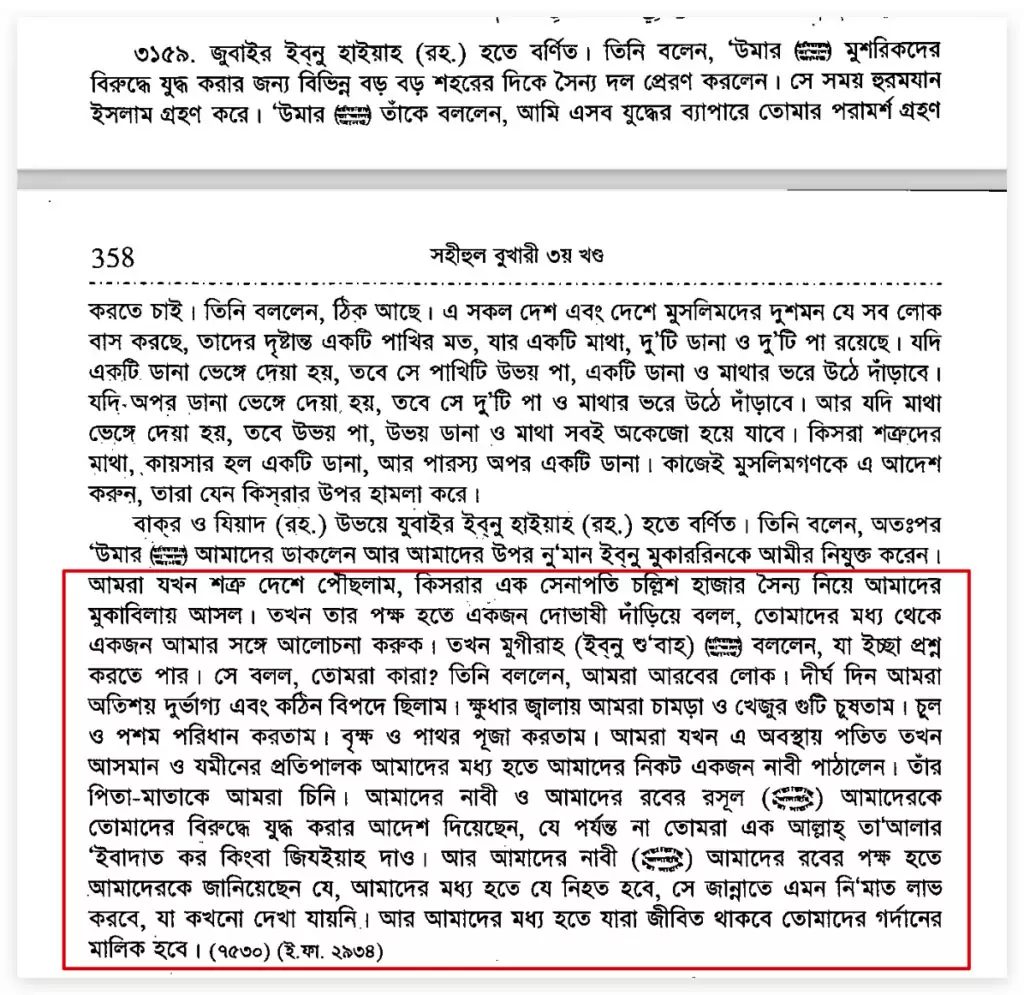
Let us examine an example of how the Companions of the Prophet Muhammad attacked non-Muslim kingdoms and what they said during those attacks [9] [10]
Reference : Sahih al-Bukhari 3159, 3160
In-book reference : Book 58, Hadith 3
USC-MSA web (English) reference : Vol. 4, Book 53, Hadith 386
Chapter : Al-Jizya taken from the Dhimmi
Narrated Jubair bin Haiya:
`Umar sent the Muslims to the great countries to fight the pagans. When Al-Hurmuzan embraced Islam, `Umar said to him. “I would like to consult you regarding these countries which I intend to invade.” Al-Hurmuzan said, “Yes, the example of these countries and their inhabitants who are the enemies of the Muslims, is like a bird with a head, two wings and two legs; If one of its wings got broken, it would get up over its two legs, with one wing and the head; and if the other wing got broken, it would get up with two legs and a head, but if its head got destroyed, then the two legs, two wings and the head would become useless. The head stands for Khosrau, and one wing stands for Caesar and the other wing stands for Faris. So, order the Muslims to go towards Khosrau.” So, `Umar sent us (to Khosrau) appointing An-Nu`man bin Muqrin as our commander.
When we reached the land of the enemy, the representative of Khosrau came out with forty-thousand warriors, and an interpreter got up saying, “Let one of you talk to me!” Al-Mughira replied, “Ask whatever you wish.” The other asked, “Who are you?” Al-Mughira replied, “We are some people from the Arabs; we led a hard, miserable, disastrous life: we used to suck the hides and the date stones from hunger; we used to wear clothes made up of fur of camels and hair of goats, and to worship trees and stones. While we were in this state, the Lord of the Heavens and the Earths, Elevated is His Remembrance and Majestic is His Highness, sent to us from among ourselves a Prophet whose father and mother are known to us. Our Prophet, the Messenger of our Lord, has ordered us to fight you till you worship Allah Alone or give Jizya (i.e. tribute); and our Prophet has informed us that our Lord says:– “Whoever amongst us is killed (i.e. martyred), shall go to Paradise to lead such a luxurious life as he has never seen, and whoever amongst us remain alive, shall become your master.” (Al-Mughira, then blamed An-Nu`man for delaying the attack and) An-Nu’ man said to Al-Mughira, “If you had participated in a similar battle, in the company of Allah’s Messenger (ﷺ) he would not have blamed you for waiting, nor would he have disgraced you. But I accompanied Allah’s Apostle in many battles and it was his custom that if he did not fight early by daytime, he would wait till the wind had started blowing and the time for the prayer was due (i.e. after midday).”
Arabic : حَدَّثَنَا الْفَضْلُ بْنُ يَعْقُوبَ، حَدَّثَنَا عَبْدُ اللَّهِ بْنُ جَعْفَرٍ الرَّقِّيُّ، حَدَّثَنَا الْمُعْتَمِرُ بْنُ سُلَيْمَانَ، حَدَّثَنَا سَعِيدُ بْنُ عُبَيْدِ اللَّهِ الثَّقَفِيُّ، حَدَّثَنَا بَكْرُ بْنُ عَبْدِ اللَّهِ الْمُزَنِيُّ، وَزِيَادُ بْنُ جُبَيْرٍ، عَنْ جُبَيْرِ بْنِ حَيَّةَ، قَالَ بَعَثَ عُمَرُ النَّاسَ فِي أَفْنَاءِ الأَمْصَارِ يُقَاتِلُونَ الْمُشْرِكِينَ، فَأَسْلَمَ الْهُرْمُزَانُ فَقَالَ إِنِّي مُسْتَشِيرُكَ فِي مَغَازِيَّ هَذِهِ. قَالَ نَعَمْ، مَثَلُهَا وَمَثَلُ مَنْ فِيهَا مِنَ النَّاسِ مِنْ عَدُوِّ الْمُسْلِمِينَ مَثَلُ طَائِرٍ لَهُ رَأْسٌ وَلَهُ جَنَاحَانِ وَلَهُ رِجْلاَنِ، فَإِنْ كُسِرَ أَحَدُ الْجَنَاحَيْنِ نَهَضَتِ الرِّجْلاَنِ بِجَنَاحٍ وَالرَّأْسُ، فَإِنْ كُسِرَ الْجَنَاحُ الآخَرُ نَهَضَتِ الرِّجْلاَنِ وَالرَّأْسُ، وَإِنْ شُدِخَ الرَّأْسُ ذَهَبَتِ الرِّجْلاَنِ وَالْجَنَاحَانِ وَالرَّأْسُ، فَالرَّأْسُ كِسْرَى، وَالْجَنَاحُ قَيْصَرُ، وَالْجَنَاحُ الآخَرُ فَارِسُ، فَمُرِ الْمُسْلِمِينَ فَلْيَنْفِرُوا إِلَى كِسْرَى. وَقَالَ بَكْرٌ وَزِيَادٌ جَمِيعًا عَنْ جُبَيْرِ بْنِ حَيَّةَ قَالَ فَنَدَبَنَا عُمَرُ وَاسْتَعْمَلَ عَلَيْنَا النُّعْمَانَ بْنَ مُقَرِّنٍ، حَتَّى إِذَا كُنَّا بِأَرْضِ الْعَدُوِّ، وَخَرَجَ عَلَيْنَا عَامِلُ كِسْرَى فِي أَرْبَعِينَ أَلْفًا، فَقَامَ تُرْجُمَانٌ فَقَالَ لِيُكَلِّمْنِي رَجُلٌ مِنْكُمْ. فَقَالَ الْمُغِيرَةُ سَلْ عَمَّا شِئْتَ. قَالَ مَا أَنْتُمْ قَالَ نَحْنُ أُنَاسٌ مِنَ الْعَرَبِ كُنَّا فِي شَقَاءٍ شَدِيدٍ وَبَلاَءٍ شَدِيدٍ، نَمَصُّ الْجِلْدَ وَالنَّوَى مِنَ الْجُوعِ، وَنَلْبَسُ الْوَبَرَ وَالشَّعَرَ، وَنَعْبُدُ الشَّجَرَ وَالْحَجَرَ، فَبَيْنَا نَحْنُ كَذَلِكَ، إِذْ بَعَثَ رَبُّ السَّمَوَاتِ وَرَبُّ الأَرَضِينَ تَعَالَى ذِكْرُهُ وَجَلَّتْ عَظَمَتُهُ إِلَيْنَا نَبِيًّا مِنْ أَنْفُسِنَا، نَعْرِفُ أَبَاهُ وَأُمَّهُ، فَأَمَرَنَا نَبِيُّنَا رَسُولُ رَبِّنَا صلى الله عليه وسلم أَنْ نَقَاتِلَكُمْ حَتَّى تَعْبُدُوا اللَّهَ وَحْدَهُ أَوْ تُؤَدُّوا الْجِزْيَةَ، وَأَخْبَرَنَا نَبِيُّنَا صلى الله عليه وسلم عَنْ رِسَالَةِ رَبِّنَا أَنَّهُ مَنْ قُتِلَ مِنَّا صَارَ إِلَى الْجَنَّةِ فِي نَعِيمٍ لَمْ يَرَ مِثْلَهَا قَطُّ، وَمَنْ بَقِيَ مِنَّا مَلَكَ رِقَابَكُمْ. فَقَالَ النُّعْمَانُ رُبَّمَا أَشْهَدَكَ اللَّهُ مِثْلَهَا مَعَ النَّبِيِّ صلى الله عليه وسلم فَلَمْ يُنَدِّمْكَ وَلَمْ يُخْزِكَ، وَلَكِنِّي شَهِدْتُ الْقِتَالَ مَعَ رَسُولِ اللَّهِ صلى الله عليه وسلم كَانَ إِذَا لَمْ يُقَاتِلْ فِي أَوَّلِ النَّهَارِ انْتَظَرَ حَتَّى تَهُبَّ الأَرْوَاحُ وَتَحْضُرَ الصَّلَوَاتُ.
Explanation of the Hadith Commanding Qital
Let us learn from a scholar, through a hadith lesson, the explanation of the hadith stating, “I have been commanded to fight the people until they say La ilaha illallah.”
Fatwa on Offensive Jihad
Now let us examine a fatwa published by Saudi Arabia’s highest Islamic Sharia board. This fatwa was published on the well-known fatwa website islamqa.info, which is directly administered by Sheikh Salih al-Munajjid, one of the foremost contemporary Salafi scholars [11]
There is no compulsion to accept Islam
08/Shawwal/1423 , 12/December/2002
Question 34770
Some friends say that whoever does not enter Islam, that is his choice and he should not be forced to become Muslim, quoting as evidence the verses in which Allah says (interpretation of the meaning):
“And had your Lord willed, those on earth would have believed, all of them together. So, will you (O Muhammad) then compel mankind, until they become believers”
[Yoonus 10:99]
“There is no compulsion in religion”
[al-Baqarah 2:256]
What is your opinion concerning that?.
Answer
Praise be to Allah, and blessings and peace be upon the Messenger of Allah:
The scholars explained that these two verses, and other similar verses, have to do with those from whom the jizyah may be taken, such as Jews, Christians and Magians (Zoroastrians). They are not to be forced, rather they are to be given the choice between becoming Muslim or paying the jizyah.
Other scholars said that this applied in the beginning, but was subsequently abrogated by Allah’s command to fight and wage jihad. So whoever refuses to enter Islam should be fought when the Muslims are able to fight, until they either enter Islam or pay the jizyah if they are among the people who may pay jizyah. The kuffaar should be compelled to enter Islam if they are not people from whom the jizyah may be taken, because that will lead to their happiness and salvation in this world and in the Hereafter. Obliging a person to adhere to the truth in which is guidance and happiness is better for him than falsehood. Just as a person may be forced to do the duty that he owes to other people even if that is by means of imprisonment or beating, so forcing the kaafirs to believe in Allah alone and enter into the religion of Islam is more important and more essential, because this will lead to their happiness in this world and in the Hereafter. This applies unless they are People of the Book, i.e., Jews and Christians, or Magians, because Islam says that these three groups may be given the choice: they may enter Islam or they may pay the jizyah and feel themselves subdued.
Some of the scholars are of the view that others may also be given the choice between Islam and jizyah, but the most correct view is that no others should be given this choice, rather these three groups are the only ones who may be given the choice, because the Prophet (peace and blessings of Allah be upon him) fought the kuffaar in the Arabian Peninsula and he only accepted their becoming Muslim. And Allah says (interpretation of the meaning):
“But if they repent [by rejecting Shirk (polytheism) and accept Islamic Monotheism] and perform As-Salaah (Iqaamat-as-Salaah), and give Zakaah, then leave their way free. Verily, Allah is Oft-Forgiving, Most Merciful”
[al-Tawbah 9:5]
He did not say, “if they pay the jizyah”. The Jews, Christians and Magians are to be asked to enter Islam; if they refuse then they should be asked to pay the jizyah. If they refuse to pay the jizyah then the Muslims must fight them if they are able to do so. Allah says (interpretation of the meaning):
“Fight against those who (1) believe not in Allah, (2) nor in the Last Day, (3) nor forbid that which has been forbidden by Allah and His Messenger (Muhammad), (4) and those who acknowledge not the religion of truth (i.e. Islam) among the people of the Scripture (Jews and Christians), until they pay the Jizyah with willing submission, and feel themselves subdued”
[al-Tawbah 9:29]
And it was proven that the Prophet (peace and blessings of Allah be upon him) accepted the jizyah from the Magians, but it was not proven that the Prophet (peace and blessings of Allah be upon him) or his companions (may Allah be pleased with them) accepted the jizyah from anyone except the three groups mentioned above.
The basic principle concerning that is the words of Allah (interpretation of the meaning):
“And fight them until there is no more Fitnah (disbelief and polytheism, i.e. worshipping others besides Allah), and the religion (worship) will all be for Allah Alone [in the whole of the world]”
[al-Anfaal 8:39]
“Then when the Sacred Months (the 1st, 7th, 11th, and 12th months of the Islamic calendar) have passed, then kill the Mushrikoon (see V.2:105) wherever you find them, and capture them and besiege them, and lie in wait for them in each and every ambush. But if they repent [by rejecting Shirk (polytheism) and accept Islamic Monotheism] and perform As-Salaah (Iqaamat-as-Salaah), and give Zakaah, then leave their way free. Verily, Allah is Oft-Forgiving, Most Merciful”
[al-Tawbah 9:5]
This verse is known as Ayat al-Sayf (the verse of the sword).
These and similar verses abrogate the verses which say that there is no compulsion to become Muslim.
And Allah is the Source of strength.
Let us read another well-known fatwa, [12]
Was Islam spread by the sword?
02/Jumada al-thani/1424 , 31/July/2003
178,102
Question 43087
Was Islam spread by the sword?.
Answer
Praise be to Allah, and blessings and peace be upon the Messenger of Allah:
We have already stated in question no. 34830 that jihad is of two types: taking the initiative in fighting and jihad in self-defence.
Undoubtedly taking the initiative in fighting has a great effect in spreading Islam and bringing people into the religion of Allaah in crowds. Hence the hearts of the enemies of Islam are filled with fear of jihad.
In the English-language Muslim World Magazine it says: There should be some kind of fear in the western world, one of the causes of which is that since the time it first appeared in Makkah, Islam has never decreased in numbers, rather it has always continued to increase and spread. Moreover Islam is not only a religion, rather one of its pillars is jihad.
Robert Bean says: The Muslims conquered the entire world before and they could do it again.
The Orientalists wanted to slander Islam by claiming that it was spread by the sword.
The orientalist Thomas Arnold wrote his book The Preaching of Islam with the aim of killing off the spirit of jihad among the Muslims and proving that Islam was not spread by the sword, rather that it spread by means of peaceful preaching, free from any use of force.
The Muslims fell into the trap that was set up for them. When they heard the orientalists’ accusations that Islam was spread by the sword, they said: You are mistaken, listen to a refutation from one of your own people, this Thomas says such and such.
The defeatists among the Muslims come out to defend Islam, and they want to disavow Islam of this so-called lie, so they deny that Islam was spread by the sword, and they say that jihad is not prescribed in Islam, except in the case of self-defence. There is no such thing in Islam as taking the initiative in fighting in their view. This goes against what the Muslim scholars have stated, let alone the fact that it goes against the Qur’aan and Sunnah.
Shaykh al-Islam Ibn Taymiyah said in Majmoo’ al-Fataawa, 28/263.
The purpose is that all religion should be for Allaah alone, and that the word of Allaah should be supreme. The word of Allaah is a comprehensive phrase that refers to His words that are contained in His Book. Hence Allaah says (interpretation of the meaning):
“Indeed We have sent Our Messengers with clear proofs, and revealed with them the Scripture and the Balance (justice) that mankind may keep up justice”
[al-Hadeed 57:25]
The purpose behind sending the Messengers and revealing the Books was so that mankind might keep up justice with regard to the rights of Allaah and the rights of His creation. Then Allaah says (interpretation of the meaning):
“And We brought forth iron wherein is mighty power (in matters of war), as well as many benefits for mankind, that Allaah may test who it is that will help Him (His religion) and His Messengers in the unseen”
[al-Hadeed 57:25]
So whoever deviates from the Book is to be brought back with iron, i.e. by force. Hence the soundness of the religion is based on the Qur’aan and the Sword. It was narrated that Jaabir ibn ‘Abd-Allaah (may Allaah be pleased with him) said: The Messenger of Allaah (peace and blessings of Allaah be upon him) commanded us to strike with this, meaning the sword, whoever turns away from this, meaning the Qur’aan.
Ibn al-Qayyim (may Allaah have mercy on him) said in al-Faroosiyyah (p.18):
Allaah sent him – meaning the Prophet (peace and blessings of Allaah be upon him) – with the guiding Book and the conquering sword, ahead of the Hour, so that Allaah alone would be worshipped with no partner or associate, and his provision was placed beneath the shade of his sword and spear. Allaah has established the religion of Islam with proof and evidence, and with the sword and spear, both together and inseparable.
This is some of the evidence from the Qur’aan and Sunnah. The evidence clearly indicates that the sword is one of the most important means that led to the spread of Islam.
1 – Allaah says (interpretation of the meaning):
“For had it not been that Allaah checks one set of people by means of another, monasteries, churches, synagogues, and mosques, wherein the Name of Allaah is mentioned much would surely, have been pulled down. Verily, Allaah will help those who help His (Cause). Truly, Allaah is All-Strong, All-Mighty”
[al-Hajj 22:40]
“And if Allaah did not check one set of people by means of another, the earth would indeed be full of mischief. But Allaah is full of bounty to the ‘Aalameen (mankind, jinn and all that exists)”
[al-Baqarah 2:251]
2 – Allaah has commanded us to prepare the means of fighting against the kuffaar and frightening them. He says (interpretation of the meaning):
“And make ready against them all you can of power, including steeds of war (tanks, planes, missiles, artillery) to threaten the enemy of Allaah and your enemy, and others besides whom, you may not know but whom Allaah does know”
[al-Anfaal 8:60]
If Islam was only spread by peaceful means, what would the kuffaar have to be afraid of? Of mere words spoken on the tongue? In al-Saheehayn it is narrated that the Prophet (peace and blessings of Allaah be upon him) said: “I have been supported with fear as far as a month’s journey.” Would the kuffaar be afraid of being told, “become Muslim, but if you do not then you are free to believe and do whatever you want”? or were they afraid of jihad and the imposition of the jizyah and being humiliated? That may make them enter Islam so that they may be spared this humiliation.
3 – When the Messenger called people to Islam, his call was accompanied by the sword, and he commanded his leaders to do likewise, so that when the people saw the serious of the Muslims in calling people to their religion, that dispelled any confusion.
Al-Bukhaari (3009) and Muslim (2406) narrated that Sahl ibn Sa’d (may Allaah be pleased with him) said: The Prophet (peace and blessings of Allaah be upon him) said on the day of Khaybar: “Tomorrow I will give the banner to a man at whose hands victory will come, one who loves Allaah and His Messenger, and Allaah and His Messenger love him.” The people spent that night wondering which of them would be given the banner and all of them were hoping for it. Then he (the Prophet (peace and blessings of Allaah be upon him) ) said, “Where is ‘Ali?” It was said, “His eye is hurting.” So he spat in his eyes and made du’aa’ for him, and he was healed, as if there had not been anything wrong with him. Then he gave him the flag and he [‘Ali] said: “Shall I fight them so that they will be like us?” He said: “Go ahead, until you reach their encampment, then call them to Islam and tell them what they are obliged to do, for by Allaah if Allaah were to guide a man at your hands that would be better for you than having red camels [the best kind].”
So this call to Islam was accompanied by the force of arms.
Muslim (3261) narrated that Buraydah said: When the Messenger of Allaah (peace and blessings of Allaah be upon him) appointed a commander to lead an army or a raiding party, he would advise him to fear Allaah with regard to himself and the Muslims with him, then he said: “Fight in the name of Allaah and for the sake of Allaah. Fight those who disbelieve in Allaah, fight but do not steal from the war booty (before it is shared out), betray, or mutilate. Do not kill children. If you meet your enemy of the mushrikeen, call them to three things, and whichever one of them they respond to, accept that from them and leave them alone. Then call them to Islam and if they respond, accept that from them and leave them alone. If they refuse but they pay the jizyah, then they have responded to you, so accept that from them and leave them alone. If they refuse then seek the help of Allaah and fight them…”
So the Messenger of Allaah (peace and blessings of Allaah be upon him) told his commanders to call the kuffaar to Islam whilst wielding their swords over their heads. If they refused to become Muslim then they should pay the jizyah with humility. If they refused then there was nothing left for them but the sword – “If they refuse then seek the help of Allaah and fight them”
4 – The Prophet (peace and blessings of Allaah be upon him) said: “I have been sent ahead of the Hour with the sword so that Allaah will be worshipped alone, and my provision has been placed in the shade of my spear, and humiliation has been decreed for those who go against my command, and whoever imitates a people is one of them.” Narrated by Ahmad, 4869; Saheeh al-Jaami’, 2831.
The fact that the sword and power were means of spreading Islam is not a sources of shame for Islam, rather it is one of its strengths and virtues, because that makes people adhere to that which will benefit them in this world and in the Hereafter. Many people are foolish and lacking in wisdom and knowledge, and if they are left to their own devices they will remain blinded to the truth, indulging in their whims and desires. So Allaah has prescribed jihad in order to bring them back to the truth and to that which will benefit them. Undoubtedly wisdom dictates that the fool should be prevented from doing that which will harm him, and should be forced to do that which will benefit him.
Al-Bukhaari (4557) narrated that Abu Hurayrah (may Allaah be pleased with him) said: “ ‘You (true believers in Islamic Monotheism, and real followers of Prophet Muhammad and his Sunnah) are the best of peoples ever raised up for mankind’ [Aal- Imraan 3:110 – interpretation of the meaning].” He said: “You are the best (i.e., the most beneficial) of people for mankind, you bring them in the chains that are around their necks until they enter Islam.” Can people be brought in chains except in the case of jihad??
This is something for which Islam deserves to be praised, not condemned. The defeatists should fear Allaah lest they distort this religion and cause it to become weak on the basis of the claim that it is a religion of peace. Yes, it is the religion of peace but in the sense of saving all of mankind from worshipping anything other than Allaah and submitting all of mankind to the rule of Allaah. This is the religion of Allaah, not the ideas of any person or the product of human thought, so that those who promote it should feel ashamed to state its ultimate goal, which is that all religion (worship) should be for Allaah alone. When the ideas that people follow are all produced by human beings and the systems and laws that control their lives are all made up by human beings, then in this case each idea and each system has the right to live safely within its own borders so long as it does not transgress the borders of others, so the various ideas and laws can co-exist and not try to destroy one another. But when there is a divine system and law, and alongside it there are human systems and laws, then the matter is fundamentally different, and the divine law has the right to remove the barriers and free people from enslavement to human beings…
Fiqh al-Da’wah by Sayyid Qutb, 217-222.
It says in Fataawa al-Lajnah al-Daa’imah (12/14):
Islam spread by means of proof and evidence to those who listened to the message and responded to it, and it spread by means of force and the sword to those who were stubborn and arrogant, until they were overwhelmed and became no longer stubborn, and submitted to that reality.
And Allaah knows best.
Question number: 43087
Question
Did Islam spread by the sword?
Answer
All praise is due to Allah, and may Allah’s blessings and peace be upon the Messenger of Allah:
We previously mentioned in question no. 34830 that jihad is of two types: offensive jihad (initiating warfare) and defensive jihad.
There is no doubt that offensive jihad has had an extensive impact on propagating Islam and bringing people into Allah’s religion in multitudes. This is why the hearts of Islam’s enemies constantly tremble in fear of jihad.
The English-language ‘Muslim World Magazine’ stated:
“There should be a kind of fear in the Western world, one reason being that the number of Islam’s followers has never declined since its emergence in Mecca; rather, it has always increased and spread. Moreover, Islam is not merely a religion; jihad is also one of its principal pillars.”
Robert Bean said:
“The Muslims conquered the entire world before, and they can do so again.”
The Orientalists sought to claim, with the intention of maligning Islam, that it had spread by the sword. On the other hand, the Orientalist Thomas Arnold wrote his book ‘The Preaching of Islam’ with the aim of eradicating the spirit of jihad from among Muslims and proving that Islam spread not by the sword, but through peaceful propagation without coercion.
Muslims fell into this trap laid for them. When they heard the Orientalists’ allegation that Islam had spread by the sword, they said: “You are mistaken; listen to its refutation from one of your own people—Thomas Arnold has said such-and-such.”
Those Muslims who possess a defeatist mentality (defeatists) seek to absolve Islam of this so-called ‘falsehood’ while defending it. Thus, they deny that Islam spread by the sword and claim that Islam contains no provision for jihad except in self-defence. According to them, offensive warfare has no place in Islam. This contradicts the statements of Muslim scholars and is also directly contrary to the Quran and Sunnah.
Shaykh al-Islam Ibn Taymiyyah stated in his ‘Majmu al-Fatawa’ (28/263):
“The objective is that the entire religion should be for Allah alone and that Allah’s word should be supreme. ‘Allah’s word’ is a comprehensive expression referring to His words contained in His Book. Allah said:
‘Indeed, We sent Our messengers with clear proofs and sent down with them the Book and the balance (justice) so that people might establish justice’ [Al-Hadid 57:25 ].
The purpose of sending the messengers and revealing the Book was that people might establish justice regarding the rights of Allah and the rights of creation. Allah then said:
‘And We sent down iron, in which there is tremendous strength (in warfare) and many benefits for people, so that Allah may test who supports Him (His religion) and His messengers without seeing Him’ [Al-Hadid 57:25 ].
Therefore, whoever deviates from the Book must be brought back by means of iron (that is, through the use of force). Thus, the soundness of the religion is established upon the Quran and the sword. It is narrated from Jabir ibn Abdullah (may Allah be pleased with him), who said: The Messenger of Allah (peace be upon him) commanded us to strike with this (pointing to the sword) anyone who turns away from this (pointing to the Quran).”
Ibn al-Qayyim (may Allah have mercy on him) stated in his ‘Al-Furusiyyah’ (page 18):
“Allah sent him (the Messenger, peace be upon him) before the Day of Resurrection with the guiding Book and the victorious sword, so that Allah alone would be worshipped without any partner, and his provision was placed beneath the shade of his sword and spear. Allah established the religion of Islam through proof and evidence and through the sword and spear; the two are inseparably joined.”
Some further evidence from the Quran and Sunnah is presented below, clearly indicating that the sword was one of the most important means by which Islam spread:
1. Allah says:
“Had Allah not repelled one group of humanity by means of another, monasteries, churches, synagogues, and mosques—where Allah’s name is frequently remembered—would certainly have been destroyed. Indeed, Allah supports whoever supports Him (His religion). Indeed, Allah is All-Powerful and Almighty.” [Al-Hajj 22:40 ].
“And had Allah not repelled one group of people by means of another, the earth would have been filled with corruption. But Allah is immensely gracious to all worlds.” [Al-Baqarah 2:251 ].
2. Allah has commanded us to prepare the instruments of war against the disbelievers and to strike fear into them. He says:
“And prepare against them whatever forces and cavalry you can muster for war, by which you may frighten the enemies of Allah, your enemies, and others besides them whom you do not know but Allah knows.” [Al-Anfal 8:60 ].
If Islam spread exclusively through peaceful means, what would the disbelievers have to fear? Mere words? It is narrated in the two Sahih collections (Bukhari and Muslim) that the Prophet (peace be upon him) said: “I have been aided by instilling fear in the hearts of the enemy from a month’s journey away.” Were the disbelievers frightened merely upon hearing: “Become Muslims, but if you do not, you may believe or do whatever you wish”? Or were they afraid of jihad, the imposition of jizya, and humiliation? This fear may have compelled them to enter Islam so that they could escape that humiliation.
3. When the Messenger (peace be upon him) invited people to Islam, the sword accompanied that invitation. He gave the same instruction to his military commanders. When people saw how serious the Muslims were about inviting them to their religion, all their doubts disappeared.
Bukhari (3009) and Muslim (2406) narrate from Sahl ibn Sa‘d (may Allah be pleased with him): On the day of the Battle of Khaybar, the Prophet (peace be upon him) said: “Tomorrow I shall give the banner to a man through whom victory will come, who loves Allah and His Messenger and whom Allah and His Messenger also love.” The following day he summoned Ali (may Allah be pleased with him), gave him the banner, and said: “Advance until you reach their courtyard; then invite them to Islam and inform them of what is obligatory upon them. By Allah! If Allah guides even one person through you, it will be better for you than possessing red camels (the Arabs’ finest wealth).” Thus, the force of arms was also present alongside this invitation to Islam.
Muslim (3261) narrates from Buraydah: Whenever the Messenger of Allah (peace be upon him) appointed a commander over an army or a special expedition, he advised him to fear Allah concerning himself and concerning the Muslims accompanying him. He would then say: “Fight in the name of Allah and in the way of Allah. Fight those who disbelieve in Allah… When you encounter your polytheist enemies, invite them to three courses of action. Whichever of these they accept, accept it from them and leave them alone. First, invite them to embrace Islam… If they refuse, ask them to pay the jizya… If they also refuse to pay the jizya, seek Allah’s help and fight them…”
Thus, the Messenger of Allah (peace be upon him) instructed his commanders to invite the disbelievers to Islam while holding the sword over their heads. If they refused to become Muslims, they would submit and pay the jizya; if they refused even that, the sword would decide their fate—”If they refuse, seek Allah’s help and fight them.”
4. The Prophet (peace be upon him) said: “I have been sent with the sword before the Day of Resurrection so that Allah alone may be worshipped. My provision has been placed beneath the shade of my spear. Humiliation and disgrace have been ordained for those who disobey my command.” [Musnad Ahmad 4869, Sahih al-Jami’ 2831 ].
There is nothing shameful for Islam in the sword and force being means of spreading it; rather, this is one of Islam’s strengths and marks of superiority. This is because it compels people to adhere to matters that benefit them in this world and the Hereafter. Many people are foolish and lack knowledge and wisdom; if left to their own desires, they would remain blind to the truth and follow their inclinations. Allah therefore instituted jihad so that they might be brought back to the truth and to what benefits them. Wisdom undoubtedly requires that a foolish person should be prevented from harming himself and compelled to do what is beneficial for him.
It is narrated in Sahih Bukhari (4557) from Abu Hurayrah (may Allah be pleased with him), who said while explaining the verse, ‘You are the best nation brought forth for the benefit of humanity’ [Ali Imran 3:110 ]: “You are the best people for humanity; you bring them with chains around their necks (as captives) until they enter Islam.” Could anyone be brought in chains without jihad?
This is something for which Islam deserves praise, not condemnation. Muslims with a defeatist mentality should fear Allah, lest they distort and weaken this religion under the pretext of proving it to be a ‘religion of peace.’ Yes, it is a religion of peace—but in the sense that it rescues all humanity from worshipping anyone other than Allah and establishes genuine peace by bringing them under Allah’s rule. It is Allah’s religion, not an idea conceived by the human mind whose advocates should be ashamed to state its ultimate objective. Man-made ideologies or laws are entitled to security only so long as they do not transgress the boundaries of others. But when the matter concerns divine law versus man-made law, divine law has the right to remove all obstacles and liberate human beings from servitude to other human beings.
[Fiqh al-Da‘wah: Sayyid Qutb, pages 217–222]
It is stated in ‘Fatawa al-Lajnah al-Da’imah’ (12/14):
“For those who heard the message and responded positively, Islam reached them through evidence and proof. As for those who were disobedient and arrogant, Islam reached them through force and the sword, until they were defeated, abandoned their conceit, and submitted to reality.”
Allah knows best.
Let us read another fatwa published on the islamqa.info website that is relevant to this matter, [13]
The Obligation to Destroy Idols
Question
Is it obligatory in Islam to destroy statues, even if they form part of human heritage and the legacy of civilization? When the Companions conquered various countries, why did they not destroy the statues they encountered in the conquered lands?
Answer
Praise be to Allah.
The evidence of the Sharia demonstrates that destroying idols is obligatory. Among such evidence are the following:
1. It is narrated from Abu al-Hayyaj al-Asadi (may Allah have mercy upon him) that he said: Ali ibn Abi Talib (may Allah be pleased with him) said to me: “Shall I not send you on the same mission on which the Messenger of Allah, peace and blessings be upon him, sent me? Destroy every image you findand level every elevated grave you find.” (Sahih Muslim (969))
2. It is narrated from Amr ibn Abasah (may Allah be pleased with him) that he asked the Prophet, peace and blessings be upon him: “With what have you been sent?” He replied: “I have been sent to maintain ties of kinship, destroy idols, establish the oneness of Allah, and associate nothing with Him.” (Sahih Muslim (832))
The obligation to destroy idols becomes even more emphatic when those idols are worshipped instead of Allah.
3. It is narrated from Jarir ibn Abdullah al-Bajali (may Allah be pleased with him) that he said: The Messenger of Allah, peace and blessings be upon him, said to me: “O Jarir! Can you not relieve me of Dhu al-Khalasah (a house belonging to the Khath’am tribe that was known as the Yemeni Kaaba)?” He said: I then prepared an expedition of one hundred and fifty horsemen. I could not remain steady upon my horse. I mentioned this to the Messenger of Allah, peace and blessings be upon him. He struck my chest with his hand and said: اللهم ثبته واجعله هاديا مهديا (O Allah! Make him steadfast and make him a guide who is rightly guided.) The narrator said: Jarir (may Allah be pleased with him) set out, reached that Kaaba, and burned it with fire. He then sent one of our men, whose kunyah was Abu Arta, to convey the good news to the Messenger of Allah, peace and blessings be upon him. The man came to the Messenger of Allah, peace and blessings be upon him, and said: We have returned to you after leaving that temple looking like a black camel smeared with tar because of disease. The Messenger of Allah, peace and blessings be upon him, then invoked Allah’s blessings five times upon the horses and warriors of the Ahmas tribe.” (Sahih al-Bukhari (3020) and Sahih Muslim (2476))
Ibn Hajar (may Allah have mercy upon him) said:
This hadith establishes that the Sharia prescribes the removal of anything through which people are subjected to temptation, whether it is a building or something else, such as a human being, an animal, or an inanimate object. (End quote)
4. The Prophet, peace and blessings be upon him, sent an expedition under the leadership of Khalid ibn al-Walid (may Allah be pleased with him) to destroy the idol named al-Uzza.
5. He sent an expedition under the leadership of Sa’d ibn Zayd al-Ashhali (may Allah be pleased with him) to destroy the idol named Manat.
6. He sent an expedition under the leadership of Amr ibn al-As (may Allah be pleased with him) to destroy the idol named Suwa’. All these expeditions took place after the conquest of Mecca.
(‘Al-Bidayah wa al-Nihayah’ (4/712, 776, 5/83) and ‘Al-Sirah al-Nabawiyyah’ by Dr. Ali al-Sallabi (2/1186))
While discussing تصوير (the production of representations and the drawing or construction of images) in ‘Sharh Muslim,’ Imam al-Nawawi said: “The scholars have reached a consensus that producing an image which casts a shadow is prohibited and that it must be disfigured.” (End quote)
Images that cast shadows are representations possessing bodily structures, like these idols.
The claim that the Companions did not destroy the idols in the conquered lands is nothing more than a baseless supposition. It is inconceivable that the Companions of the Prophet, peace and blessings be upon him, would have left idols and statues standing, particularly since they were worshipped at that time.
If it is asked: How, then, did the conquering Companions leave intact these statues of the pharaohs, the Phoenicians, and others?
The answer is that there are three possibilities concerning these statues:
First, these statues were located in such remote places that the Companions did not reach them. For example, the Companions’ conquest of Egypt does not mean that they reached every part of Egypt.
Second, those statues may not have been visible. Rather, they were inside the dwellings of the pharaohs and others. The practice of the Prophet, peace and blessings be upon him, was to pass swiftly through the dwellings of wrongdoers and those who had been punished. Indeed, entering such places was forbidden. It is reported in Sahih al-Bukhari and Sahih Muslim: “When you enter the land of those who were punished, enter only while weeping, lest what befell them should also befall you.” The Prophet, peace and blessings be upon him, said this while passing through the territory of the people of al-Hijr, which had been the dwelling place of the Thamud, the people of Salih, peace be upon him.
Another narration in Sahih al-Bukhari and Sahih Muslim states: “If you cannot weep, do not enter their dwellings, lest what befell them should also befall you.”
It may reasonably be assumed that even if the Companions saw their temples or dwellings, they did not enter them and therefore did not see what was inside them.
This answers the possible objection concerning the Companions’ failure to destroy the pyramids and whatever was inside them. There is also the possibility that the entrances to the pyramids were covered by mounds of sand at that time.
Third, the statues visible today may then have been covered by sand and hidden from sight, or they may have been newly discovered, or they may have been brought from remote places which the Companions did not reach.
The historian al-Zirikli was asked whether the Companions who entered Egypt had seen the pyramids, the Sphinx, and similar monuments. He replied that most of these statues had been covered by sand, particularly the Sphinx. (‘Shibh Jazirat al-Arab’ (4/1188))
Even if it is assumed that a particular statue was visible and not covered by sand, it must still be established that the Companions saw that statue and were capable of destroying it.
The reality is that the Companions were incapable of destroying certain statues. Some statues of this kind have required twenty days to demolish despite the availability of machinery, equipment, explosives, and manpower—resources that did not exist during the age of the Companions.
Evidence that the Companions were incapable of destroying them is found in what Ibn Khaldun mentioned in his ‘Muqaddimah’ (page 383): Caliph al-Rashid once decided to demolish the palace of the Persian king. He began the work of demolishing it and, for that purpose, assembled workers, collected axes, heated the palace with fire, and poured vinegar over it. Ultimately, however, he failed. Caliph al-Ma’mun likewise gathered workers in an attempt to demolish the pyramids of Egypt, but he too was unable to do so.
Nor is there any basis for justifying the preservation of the idols by claiming that they constitute human heritage. To the Quraysh and the other inhabitants of the Arabian Peninsula who worshipped al-Lat, al-Uzza, Hubal, Manat, and the other idols, those idols were likewise part of human heritage.
They were indeed heritage, but forbidden heritage that must be destroyed. When the command of Allah and His Messenger arrives, a believer obeys it without delay. A believer does not reject the command of Allah and His Messenger by invoking such feeble arguments. Allah the Exalted says: “When they are called to Allah and His Messenger so that he may judge between them, the response of the believers is only that they say: We hear and we obey. It is they who are successful.” (Surah An-Nur, verse 51)
We pray to Allah to enable all Muslims to act in accordance with what He loves and what pleases Him.
Allah knows best.
At present, the opinion of the most prominent Islamic scholars on this matter is that when Muslims attain power, they must destroy all idols and temples belonging to non-Muslims. After examining the Quran and Hadith in their entirety, prominent Islamic scholars have reached this very conclusion. A direct fatwa has also been issued on this matter. The fatwa is provided here, taken from the renowned fatwa website Islamweb – [14]
Demolishing idols in a non-Muslim country
Fatwa No: 190575
Fatwa Date:18-11-2012 – Muharram 5, 1434Email Print
Rating:
Question
Assalamu Alaikum, In the Quran, Allah says that Abraham destroyed the idols to teach the people that idols don’t have any power. In another place, Quran asks to follow the religion of Abraham. Is it required for a muslim living in a hindu country to destroy the idols. Will this not cause religious hatred and communal violence? Is it allowed to construct hindu temple in an islamic country?
Answer
All perfect praise be to Allaah, The Lord of the Worlds. I testify that there is none worthy of worship except Allaah, and that Muhammad sallallaahu `alayhi wa sallam ( may Allaah exalt his mention ) is His slave and Messenger.
There is Islamic evidence that it is an obligation to demolish idols and statues, among which is the Hadeeth narrated by ‘Amr ibn ‘Abasah may Allaah be pleased with him that he asked the Prophet sallallaahu `alayhi wa sallam ( may Allaah exalt his mention ): ”What did Allaah send you with?” He sallallaahu `alayhi wa sallam ( may Allaah exalt his mention ) said: “He sent me to keep ties with kinship and demolish idols, and that Allaah Alone should be worshipped without associating anything with Him.” (Muslim)
Also, Abu Al-Hayyaaj Al-Asadi may Allaah be pleased with him said: “ ‘Ali ibn Abi Taalib may Allaah be pleased with him said to me: “Shall I send you for a mission once the Prophet sallallaahu `alayhi wa sallam ( may Allaah exalt his mention ) had sent me for: Do not leave an idol unless it is destroyed, nor you leave an up leveled grave unless you level it down to ground.” (Muslim)
However, this is restricted to the ability of the Muslims in doing so and them being safe from causing a greater harm. Our best example is that of the Prophet sallallaahu `alayhi wa sallam ( may Allaah exalt his mention ) as he used to go to the House of Allaah and perform Tawaaf (circumambulation around the Ka‘bah) while there were 360 idols around it but he did not cause harm to any of them until after the conquest of Makkah and after the Muslims became strong and the polytheists were no longer ruling over Makkah; it was then that the Prophet sallallaahu `alayhi wa sallam ( may Allaah exalt his mention ) destroyed the idols. He sallallaahu `alayhi wa sallam ( may Allaah exalt his mention ) prodded the idols with a bow while saying: “The truth has come and falsehood has vanished.” The story is narrated in Saheeh Al-Bukhari and Saheeh Muslim.
The Prophet sallallaahu `alayhi wa sallam ( may Allaah exalt his mention ) used to take into consideration the prevailing circumstances and leave that which could lead to a greater evil despite the fact that it was permissible in principle. The evidence about this is the Hadeeth of ‘Aa’ishah may Allaah be pleased with her who said: “I asked the Prophet sallallaahu `alayhi wa sallam ( may Allaah exalt his mention ) about Al-Hijr (the area adjacent to the Ka’bah enclosed by a low semi-circular wall), is it from the House (of Allaah)? He sallallaahu `alayhi wa sallam ( may Allaah exalt his mention ) said: ’Yes.’ I said, ‘Why did they not include it in the House?’ He sallallaahu `alayhi wa sallam ( may Allaah exalt his mention ) said: ’Your people did not have enough resources to spend on it.’ I said: ’Why is the level of its door raised high?’ He sallallaahu `alayhi wa sallam ( may Allaah exalt his mention ) said: ’Your people did so, so that they would let whomever they want to enter it and prevent whomever they want from entering it. Your people are close to the Pre-Islamic Period of Ignorance; so I fear that they would reject if I included the Hijr in the House and make its door at a level with the ground.’ ” (Al-Bukhari and Muslim)
Besides, what the Prophet Ibraaheem (Abraham) may Allaah exalt his mention did does not contradict what we have stated, as he did not do that matter until he was capable of doing it and being secure from being harmed. Ibn ‘Aashoor may Allaah have mercy upon him said while interpreting the verse (which means): {And (I swear) by Allaah, I will surely plan against your idols after you have turned and gone away.} (Quran 21:57): “He conditioned that his plan (agaist their idols) be after they depart in order to indicate that he will inflict harm on the idols as soon as he will be able to do so. This proves his strong determination to change evil, because taking the initiative to change evil although it is by hand (physically), is a rank of strong determination, but he would not be able to do so in the presence of idolaters. So, if he were to try to demolish it in their presence, then his act will be in vain. What is meant from changing evil: is to remove it as much as possible, so removing it by hand can only be done with the existence of the ability to do so.”
Finally, it should be noted that it is not permissible for the Muslims to allow non-Muslims to establish one of their temples in a Muslim country, let alone the Muslim country establishing it itself. The conditions that ‘Umar may Allaah be pleased with him put on the non-Muslims living safely in a Muslim country under Muslim rule included: “….that we will not erect in our city any church….”
Allaah Knows best.
An interpretive translation of the above fatwa is provided below (translator: Qayes Ali) —
Question:
Assalamu alaikum. Allah states in the Quran that Abraham sought to demonstrate, by breaking the idols, that idols possess no power. Elsewhere in the Quran, people are instructed to follow the religion introduced by Abraham. Are Muslims living in a Hindu country, therefore, obligated to break idols? Would this not spread religious hatred and lead to communal terrorism? Is it permissible to establish Hindu temples in an Islamic country?
Answer:
Among the information we find concerning the Islamic injunction to break idols is a hadith narrated by ‘Amr ibn ‘Abasah, who asked the Prophet, “What did Allah send you with?” The Prophet replied, “He sent me to uphold the ties of kinship and to break the idols, and so that Allah alone would be worshipped without any partner or associate.” (Muslim)
Again, Abu al-Hayyaj al-Asadi said, “Ali ibn Abu Talib said, ‘Shall I send you on the same mission on which the Prophet sent me? Do not leave any image without defacing it, or any elevated grave without leveling it.’ (Muslim)
However, this has now been restricted for Muslims so that they may be protected from greater harm. The best example is that the Prophet (peace be upon him) regularly visited the House of Allah and performed tawaf there. Idols were positioned all around it, throughout the full 360 degrees, yet he did not damage any of them before the conquest of Mecca. Later, when the Muslims became powerful and the polytheists became weak, the Prophet (peace be upon him) destroyed the idols in a single sweep and said, ”Truth has been revealed, and falsehood has vanished.“ This is narrated in Sahih al-Bukhari and Sahih Muslim.
The Prophet would assess the surrounding circumstances before reaching a decision, giving greater importance to the potential harm resulting from an action than to its ideological dimension. We learn from a hadith narrated by Aisha: ‘I asked the Prophet, “Is al-Hijr (the semicircular walled area adjacent to the Kaaba) connected to the House of Allah?”’ The Prophet replied, ’Yes.’ I asked, ‘Then why did Allah not include it in the House?’ The Prophet replied, ’Your people did not have sufficient funds.’ I asked, ‘Why is the threshold of the door so high?’ The Prophet replied, ’Your people did this so that they could admit some people and exclude others. Your people were still close to the pre-Islamic age of ignorance. Therefore, I feared that if I incorporated al-Hijr into the Kaaba and demolished the door to make it level with the ground, they might reject me.’
Our argument, therefore, does not conflict with what the Prophet Abraham did. This is because he acted only after acquiring the necessary capability and remained beyond the reach of harm. Ibn Ashur narrates—”By Allah, after you turn your backs and leave, I shall devise a plan against your idols.”
He stipulated that the destruction of idols should be undertaken only when one possesses the capacity to do so.
This demonstrates the Prophet’s firm resolve to change what was wrong, because his initiative to break the idols with his own hands confirms the strength of his determination. But he could not do so in the presence of the idol worshippers, because this might have caused the effort to fail. Changing what is wrong means reducing it as far as possible and destroying it with one’s own hands. This becomes possible only when one has the capacity to do so.
Finally, Muslims cannot accept the establishment of a non-Muslim temple in a Muslim country or permit any Muslim country to allow it. Under the Islamic rule of Hazrat Umar, non-Muslims were granted security on the condition: ’We will not permit any church to be built in our city.”
Offensive Jihad in a Book of Aqidah
We shall now examine a renowned book of aqidah to determine what the rule and injunction of Islam on this matter actually are [15]
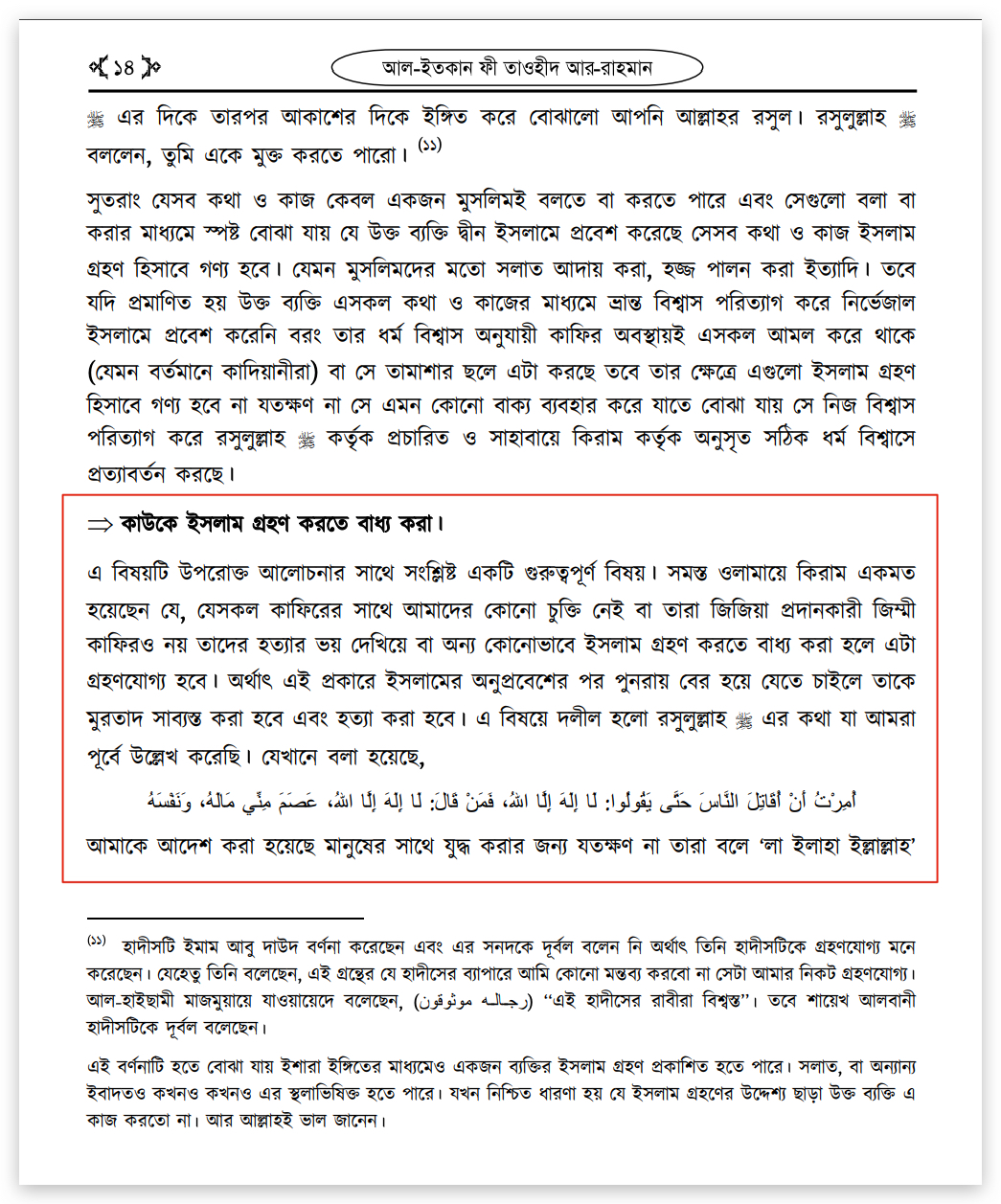
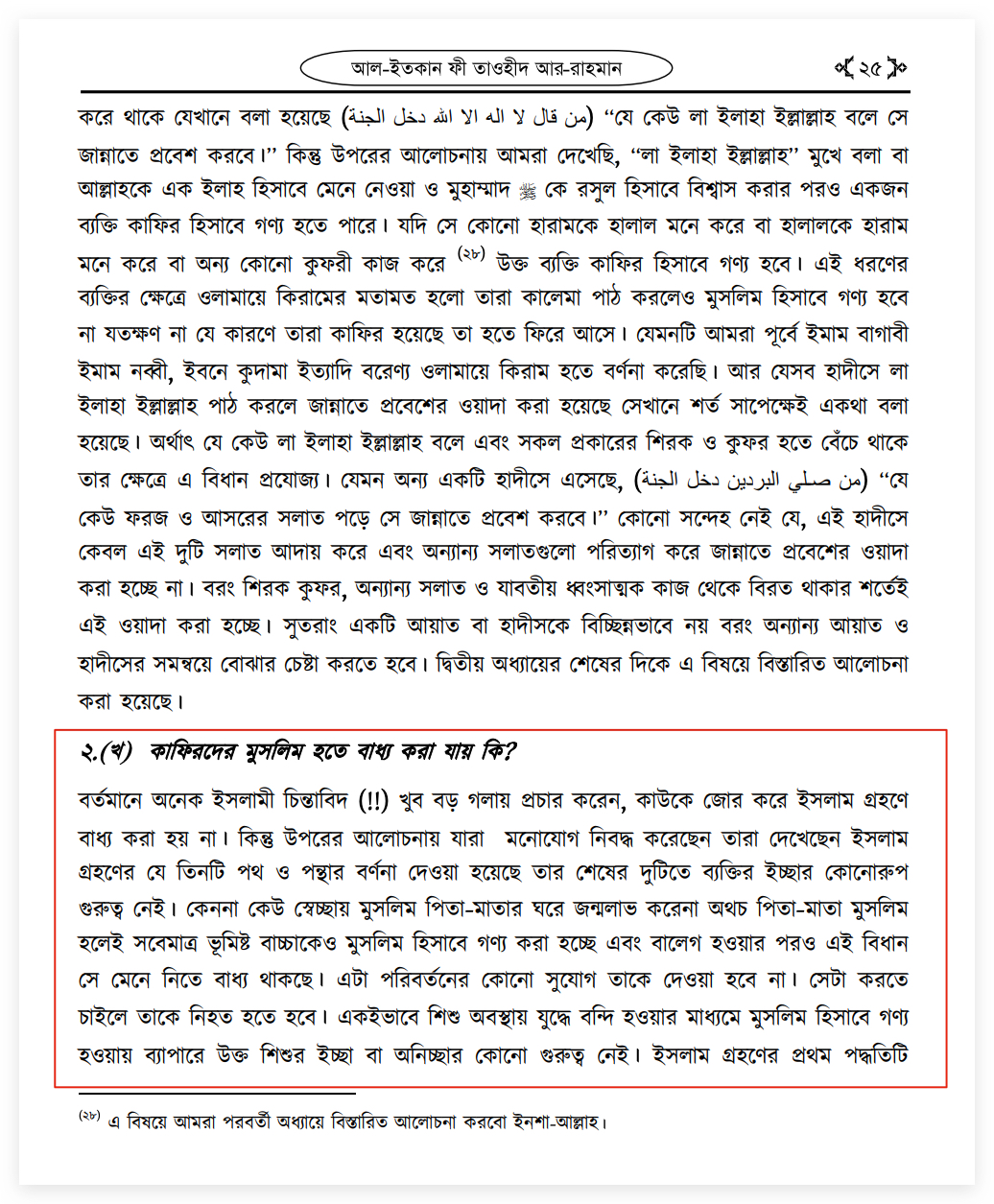
Pointing toward the sky indicated that you are the Messenger of Allah. The Messenger of Allah (peace be upon him) said, “You may set her free.” (Hadith no. 11)
Only those words and actions that can be uttered or performed exclusively by a Muslim, and through which it becomes clear that the person concerned has entered Islam, will be regarded as the ‘acceptance of Islam.’ Examples include performing salah like Muslims, undertaking Hajj, and so forth. However, if it is established that by performing such acts the person has not abandoned false beliefs and entered pure Islam, but continues to perform them as a kafir in accordance with his own religious beliefs—as the Qadianis do today—or performs them in jest, then these acts will not be regarded as an acceptance of Islam in his case. He will not be considered a Muslim until he uses an expression demonstrating that he has abandoned his former beliefs and returned to the correct religious creed preached by the Messenger of Allah (peace be upon him) and followed by the Companions.
The Ruling on Compelling Someone to Accept Islam
Compelling someone to accept Islam is an important matter of fiqh. All the ulama agree that if kafirs who have no treaty with the Muslims (harbis), or who are not dhimmi kafirs paying jizya, are compelled to accept Islam through threats of death or by any other means, their conversion will be valid. In other words, if they subsequently seek to renounce Islam, they will be declared ‘apostates’ and sentenced to death. The evidence on this matter is the statement of the Messenger of Allah (peace be upon him):
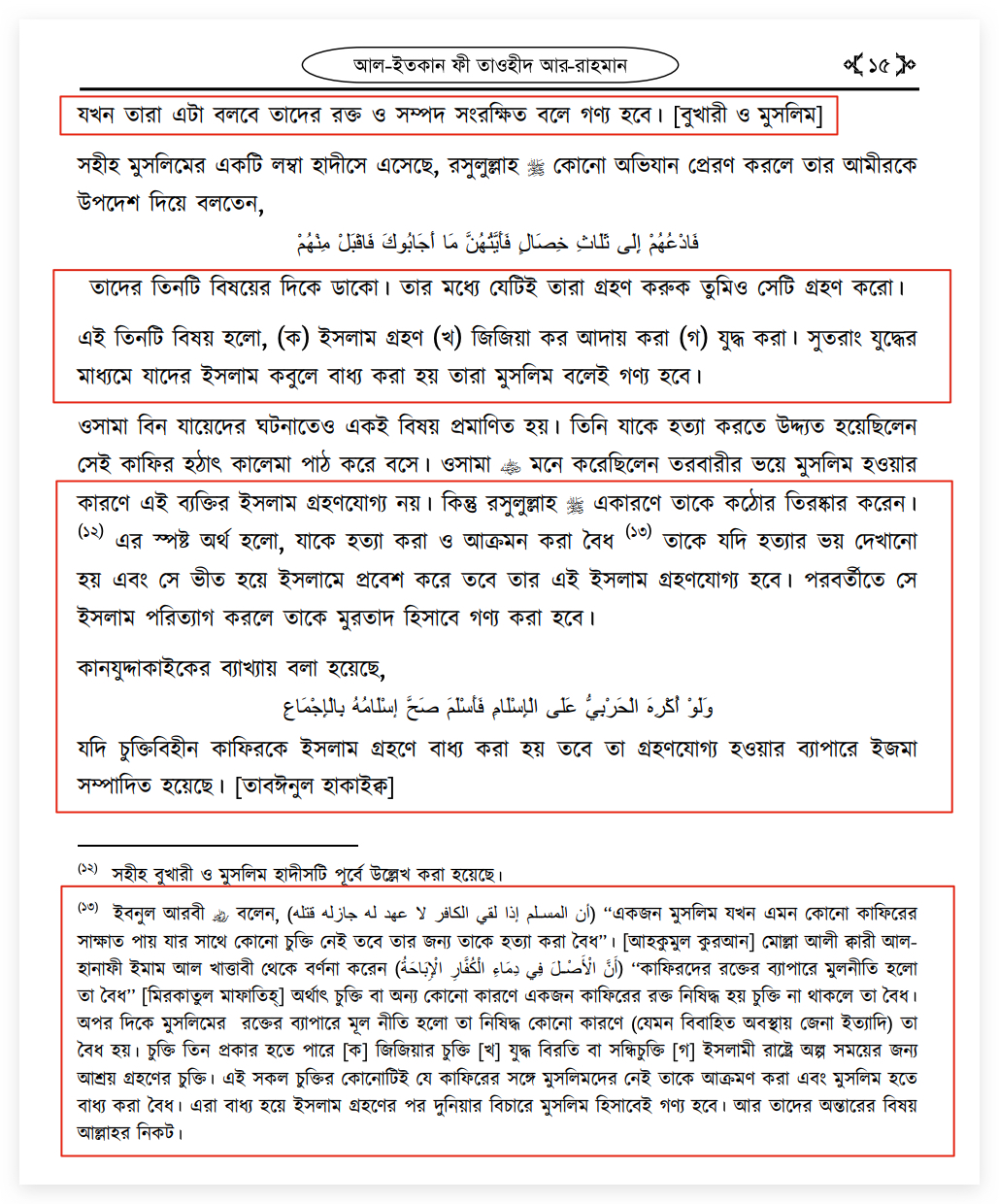
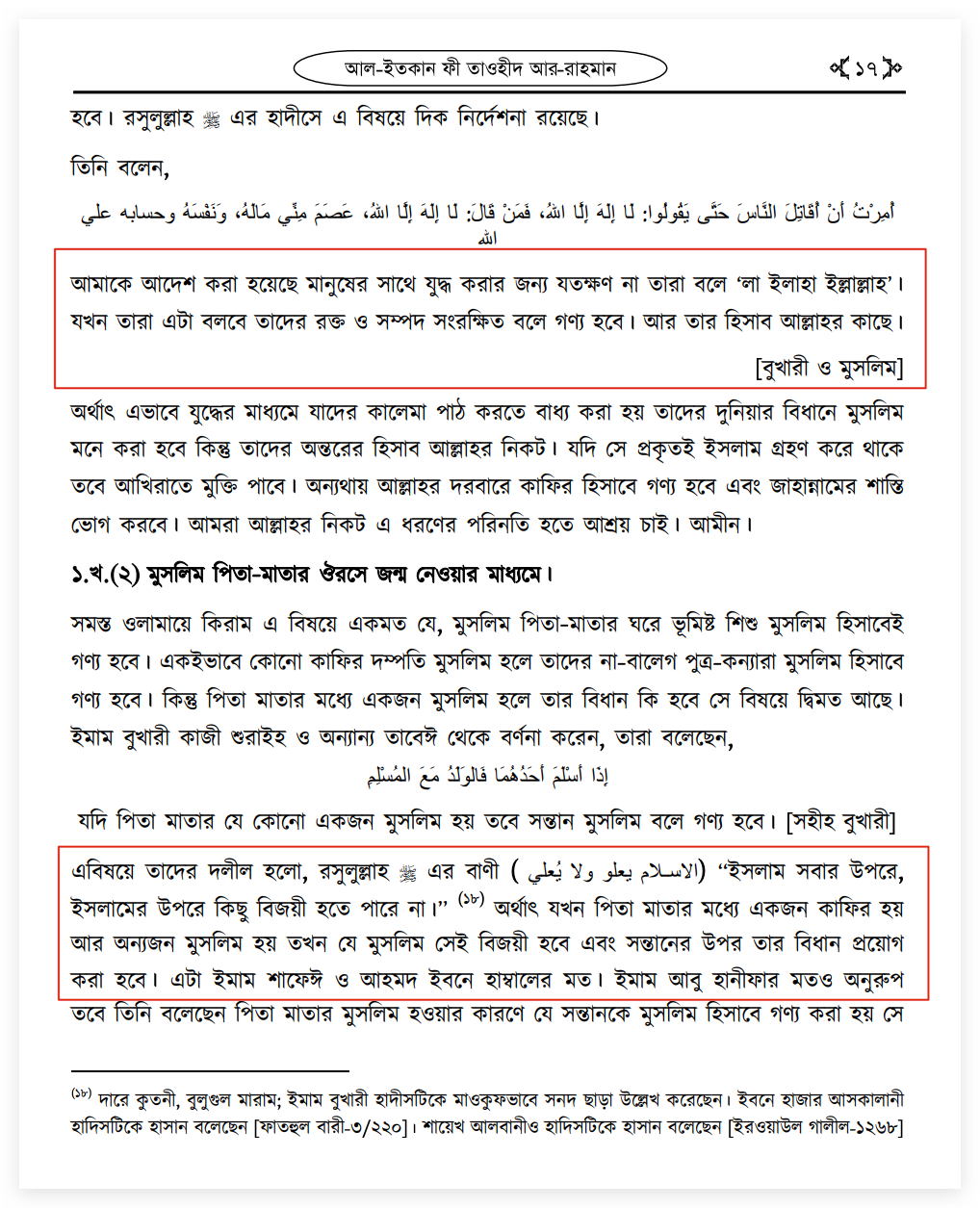
“I have been commanded to fight the people until they say—‘There is no deity but Allah.’” (Bukhari and Muslim)
When they say this, their blood and property will be regarded as protected. A lengthy hadith in Sahih Muslim states that when the Messenger of Allah (peace be upon him) dispatched a commander on an expedition, he would advise him: “Call them to three things. Whichever of them they accept, accept it from them.” These three matters were:
a. Acceptance of Islam
b. Payment of the jizya tax
c. War
Therefore, those who are compelled to accept Islam through warfare will be regarded as Muslims under worldly law. The same point is established by the incident involving Usama ibn Zayd. When Usama (may Allah be pleased with him) was about to kill a kafir, the man suddenly recited the kalima. Usama believed that he had accepted Islam out of fear of the sword and that his conversion was therefore invalid. The Messenger of Allah (peace be upon him), however, severely reprimanded him for this. Its clear implication is that if a person whom it is lawful to kill is threatened with death and enters Islam out of fear, his conversion will be valid. If he subsequently abandons Islam, he will be regarded as an apostate. (Hadith nos. 12 and 13)
Disagreement Regarding Harbis and Dhimmis
The commentary on Kanz al-Daqa’iq states: “If a kafir without a treaty (harbi) is compelled to accept Islam, there is ijma (consensus) that his conversion is valid.” (Tabyin al-Haqa’iq)
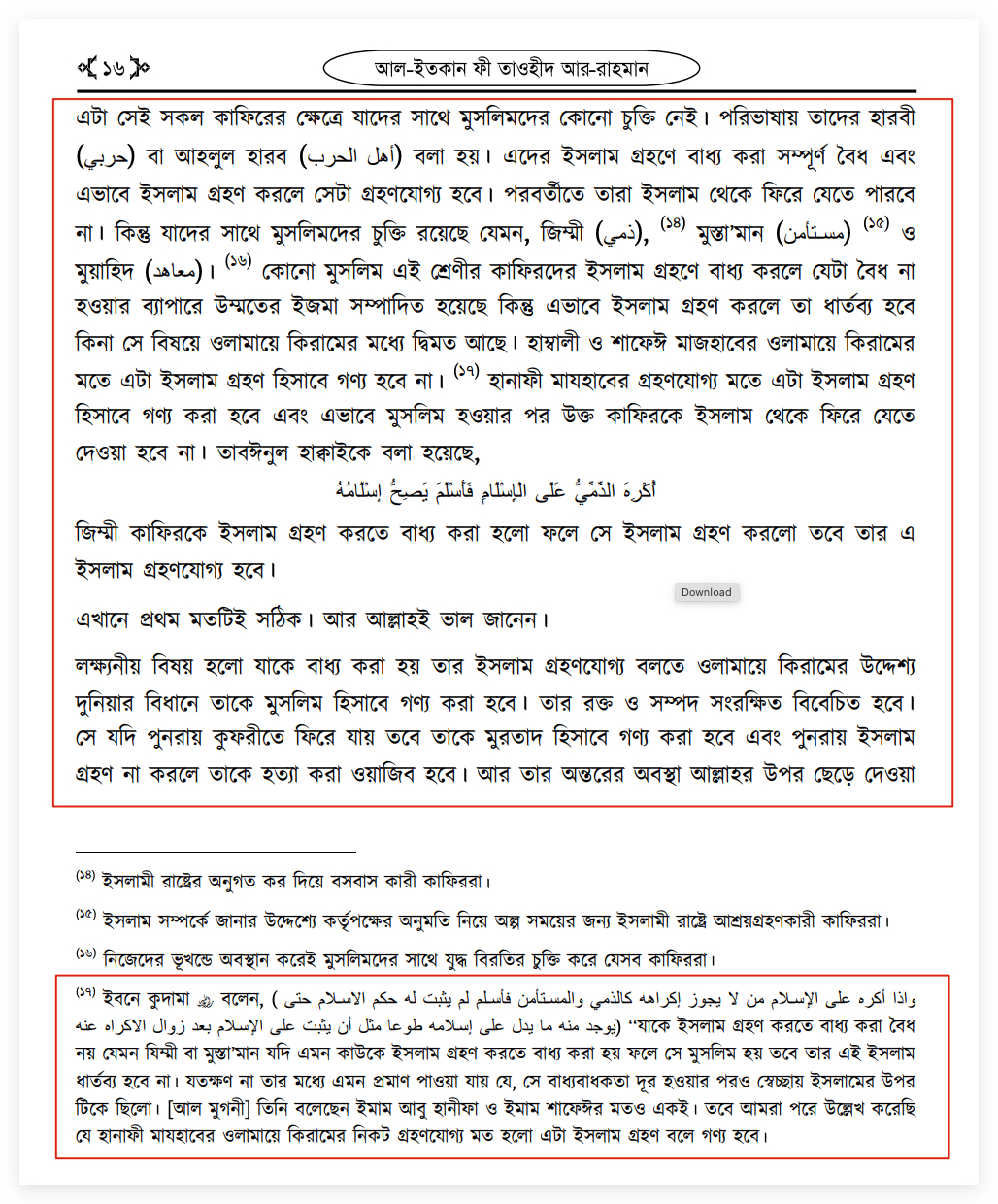
It is unlawful to compel those who have treaties with the Muslims—such as dhimmis (Hadith no. 14), musta’mans (Hadith no. 15), or mu’ahids (Hadith no. 16)—to accept Islam, and there is consensus among the ummah on this matter. However, if someone compels them and they accept Islam, the ulama disagree over whether that conversion will be valid:
Hanbali and Shafi‘i Schools: In their view, it will not be regarded as an acceptance of Islam unless, after the compulsion has ended, the person voluntarily remains within Islam. (Hadith no. 17; Al-Mughni)
Hanafi School: According to the accepted opinion, it will be regarded as a valid acceptance of Islam, and the person will not be permitted to return to disbelief. (Tabyin al-Haqa’iq)
Of these, the first view—the Shafi‘i and Hanbali position—appears to be more correct.
Hereditary and Circumstantial Muslim Identity
A person may also be regarded as a Muslim through the following means:
1. Through Muslim Parents:
All the ulama agree that a child born to Muslim parents will be regarded as a Muslim. Likewise, if a kafir couple becomes Muslim, their minor children will also become Muslims. If either parent is Muslim, the child will be regarded as a Muslim. (Bukhari; Fath al-Bari, 3/220) The evidence for this is the statement of the Messenger of Allah (peace be upon him): “Islam is supreme, and nothing can prevail over Islam.” (Hadith no. 18; Daraqutni)
2. In the Case of a Child Captured in War:
If a child is regarded as a Muslim by virtue of being captured in war during childhood, the child’s own wishes are of no importance. This, too, is a compulsory method.
Interpretation of the Verse “There Is No Compulsion in Religion”
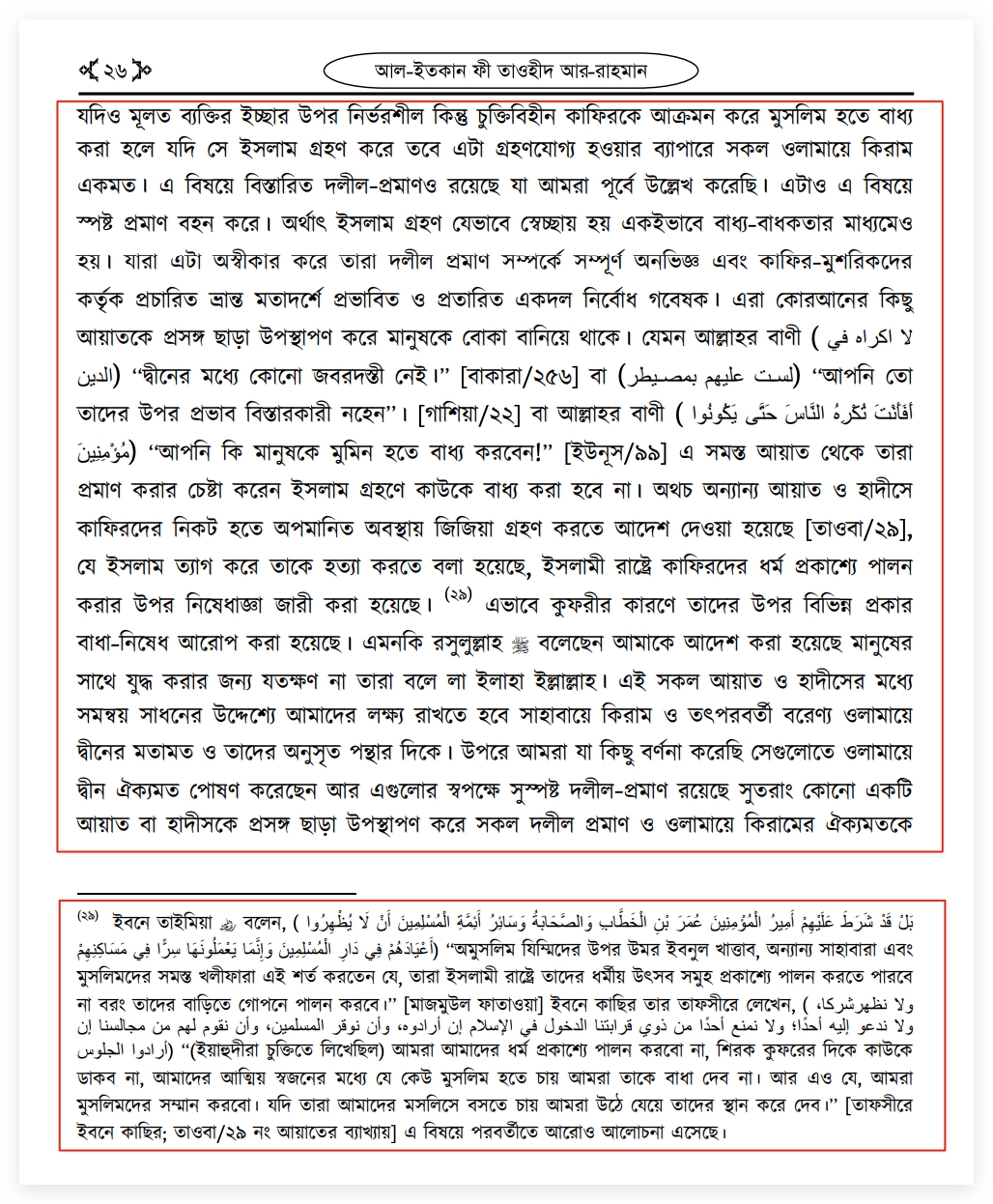
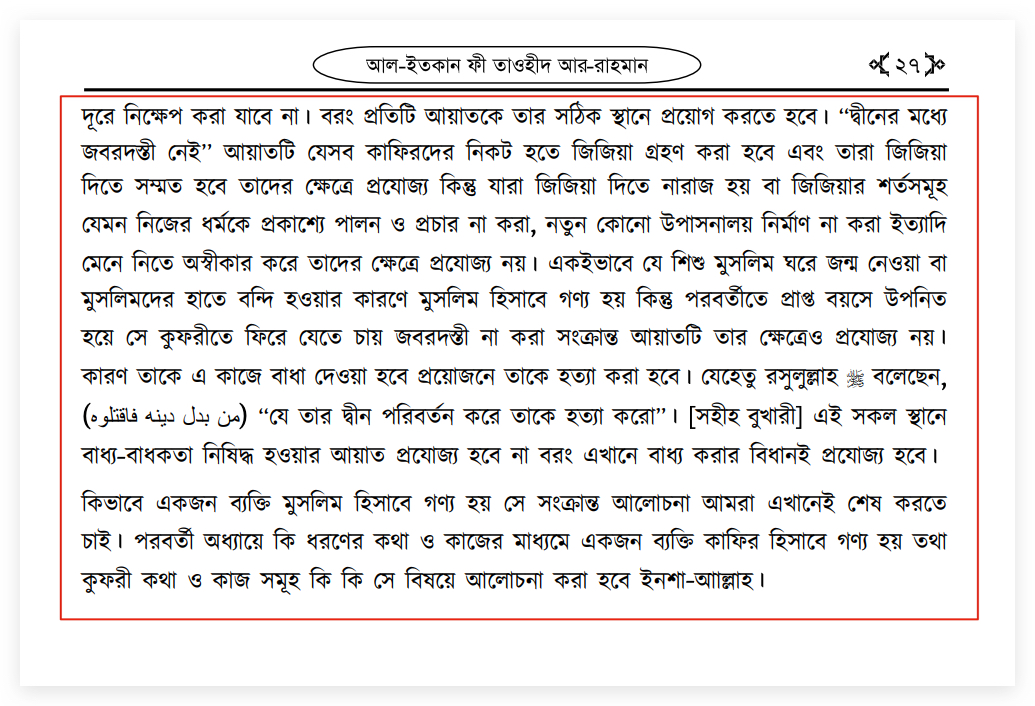
Many contemporary thinkers argue that Islam provides no scope for compelling anyone. They cite verse 256 of Surah al-Baqarah (“There is no compulsion in religion”) or verse 99 of Surah Yunus. According to the ulama, however, these verses must be understood in conjunction with other evidence and the practices of the Messenger of Allah (peace be upon him).
The verse “There is no compulsion in religion” applies only to those kafirs who have agreed to pay jizya. Those who refuse to pay jizya or have become apostates, however, remain subject to the ruling of compulsion. The Messenger of Allah (peace be upon him) said: “Whoever changes his religion, kill him.” (Bukhari) Every verse must therefore be applied within its proper context; compulsion has not been prohibited categorically in every case. (Hadith no. 29)
Footnotes:
(11) The hadith was narrated by Imam Abu Dawud, who did not describe its chain of transmission as weak, meaning that he considered the hadith acceptable. Al-Haythami stated in Majma‘ al-Zawa’id, “The narrators of this hadith are trustworthy.” Shaykh al-Albani, however, classified the hadith as weak.
(12) Sahih al-Bukhari and Muslim; the hadith was cited previously.
(13) Ibn al-Arabi states, “When a Muslim encounters a kafir with whom there is no treaty, it is lawful for him to kill that person.” (Ahkam al-Quran). Mulla Ali al-Qari al-Hanafi narrates from Imam al-Khattabi, “The fundamental rule concerning the blood of kafirs is that it is permissible (ibaha).” (Mirqat al-Mafatih). In other words, in the absence of a treaty, their blood is not inviolable.
(14) Kafirs who reside in an Islamic state under its authority by paying the jizya tax.
(15) Kafirs who, with the permission of the authorities, seek temporary refuge in an Islamic state in order to learn about Islam or for the purpose of trade.
(16) Kafirs who remain in their own territory while entering into a truce with the Muslims.
(17) If a dhimmi or musta’man is compelled, his conversion will not be considered valid unless he voluntarily remains within Islam. (Al-Mughni).
(18) Daraqutni, Bulugh al-Maram. Imam Bukhari cited the hadith in mawquf form without a chain of transmission. Ibn Hajar al-Asqalani and Shaykh al-Albani classified the hadith as ‘hasan.’ (Fath al-Bari, 3/220; Irwa al-Ghalil, 1268).
(28) This matter will be discussed in detail in the following chapter, insha-Allah.
(29) Amir al-Mu’minin Umar ibn al-Khattab (may Allah be pleased with him) and other Companions stipulated that non-Muslims would not be permitted to celebrate their religious festivals publicly in an Islamic state. (Majmu‘ al-Fatawa; Tafsir Ibn Kathir).
Sugar-Coated Islam versus Authentic Islam
Today’s so-called moderate Muslims and Islamic intellectuals make strenuous efforts to define the word ‘jihad’ merely as ‘spiritual struggle’ in order to gain acceptance in the Western world. However, an analysis of Islam’s foundational texts and the jurisprudential rulings of the four Imams reveals that jihad means armed warfare (qital) against disbelievers. In classical Islam, ‘offensive jihad,’ or aggressive warfare, was regarded as more meritorious than ‘defensive jihad,’ or defensive warfare. By concealing this truth, Islamists resort to a form of ‘taqiyya,’ or religious deception. Denying the military obligation to impose Islam upon non-Muslims or subjugate them under an Islamic state is essentially tantamount to denying thirteen centuries of Islamic history. Jihad is not a path to peace; rather, it is an instrument for establishing imperialist political domination. Let us hear the views of another English-speaking Arab scholar,
Now let us hear what Islam says about coexistence or living together with non-Muslims, in the words of a Bangladeshi Islamic scholar,
Now let us watch a video featuring Ahmadullah, a prominent Bangladeshi Islamic scholar. The remarks in this video portray the idea of peaceful coexistence with non-Muslims as a temporary and strategic arrangement, thereby implicitly presenting them as second-class citizens. The speaker, Ahmadullah, describes the Constitution of Medina as an “agreement” made with the Jews only under pressure from circumstances, and states that it was subsequently “cancelled” or “abrogated” through Surah At-Tawbah. In doing so, he conveys the message that peaceful coexistence with non-Muslims on the basis of equal rights is not an enduring Islamic ideal. In particular, he refers to imposing the demeaning ‘jizya,’ or tax, upon non-Muslims and to allowing them to reside by paying a specified ‘fee,’ rather than recognising them as ‘citizens’; this contradicts the modern conception of equal citizenship rights. The speaker characterises “standing shoulder to shoulder” or “becoming thoroughly intermingled” with non-Muslims as a “deception” and, by making extremely negative and racist remarks about Jews (such as claiming that they are cunning or that they came from outside and established themselves), incites a form of social hatred and distrust toward them. Overall, by portraying peaceful coexistence with non-Muslims as an “opportunistic” and “abrogated” arrangement, he diminishes their status within the state and society.
Shaykh Salih Al-Fawzan: The Purpose of Jihad Is to Eliminate Shirk and Bring People into Islam
On the question of whether aggressive or offensive jihad ever existed in classical Islam, the views of Shaykh Salih bin Fawzan Al-Fawzan, one of contemporary Saudi Arabia’s most influential Salafi jurists and its Grand Mufti, are particularly important. In the Kitab al-Jihad section of Sharh Zad al-Mustaqni‘, he first draws a direct distinction between qital al-daf‘, or defensive warfare, and qital al-talab, or proactively initiated offensive warfare. According to him, when Muslims are weak and lack the capacity to conduct qital al-talab, they should engage in defensive warfare; but when Muslims possess sufficient strength and capability, they should wage qital al-talab against disbelievers—to exalt the word of Allah and establish tawhid throughout the world. Immediately afterward, he directly rejects as “slander against Islam” the claims of those who present Islam as an unconditionally pacifist religion. Let us read his statement,
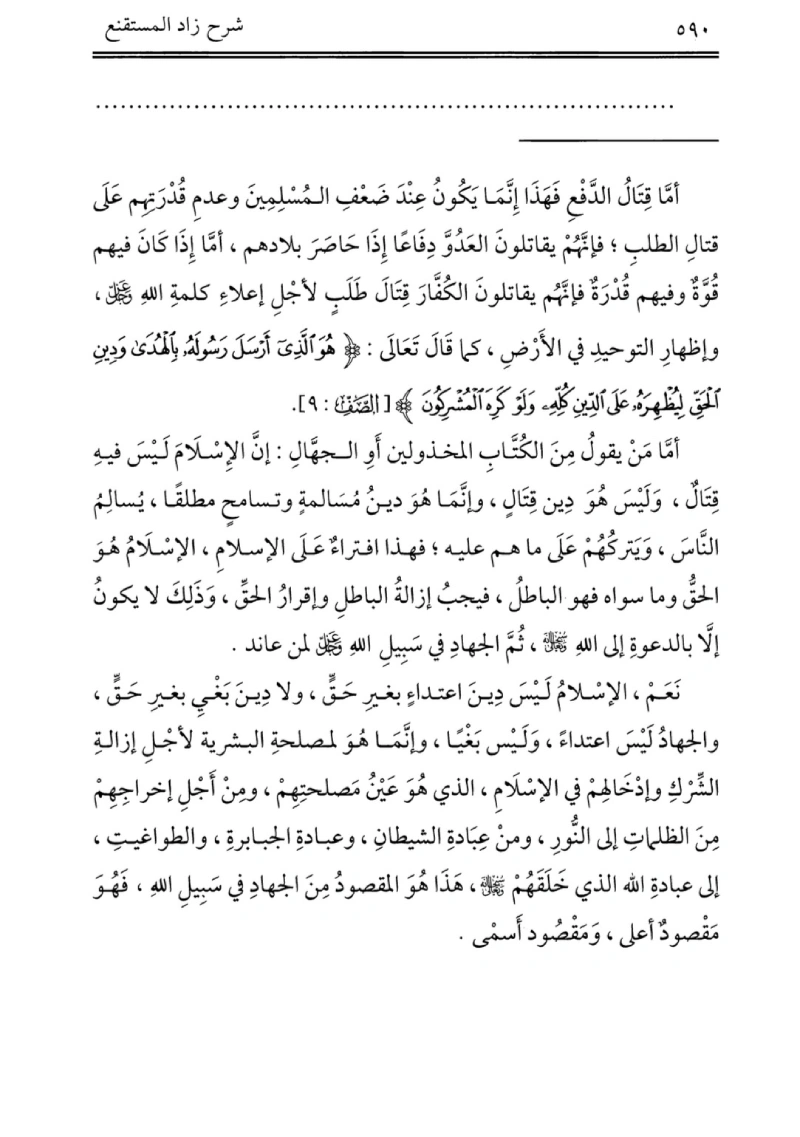
Shaykh Salih al-Fawzan says:
“Those among failed writers or the ignorant who say, ‘There is no warfare in Islam; it is not a religion of war. Rather, it is entirely a religion of peace and tolerance. It deals peacefully with people and leaves them as they are’—this is a slander against Islam. Islam alone is the truth, and everything other than Islam is falsehood. Therefore, falsehood must be removed and the truth established. This is not possible except by calling people to Allah, followed by jihad in the path of Allah against those who obstinately resist.
Yes, Islam is neither a religion of unjust aggression nor a religion of unjust oppression. Jihad is neither aggression nor oppression. Rather, it is for the welfare of humankind—with the aim of eliminating shirk and bringing them into Islam, for Islam constitutes their true welfare—and to bring them out of darkness into light, from the worship of Satan and the worship of tyrants and taghuts to the worship of Allah, who created them to worship Him alone. This is the purpose of jihad in the path of Allah. It is therefore a higher and greater purpose.”
The significance of this statement is not merely that al-Fawzan acknowledges the existence of jihad. He explicitly rejects the very notion that Islam is an unconditionally pacifist system that allows adherents of other religions to remain undisturbed in their own beliefs. Within the structure of his argument, Islam is true and other beliefs are false; thus, an attempt must first be made to eliminate that “falsehood” through da‘wah, and jihad is to be employed if obstinate resistance persists. More explicitly, among the purposes of jihad he directly mentions both “eliminating shirk” and “bringing them into Islam”—in Arabic, إزالة الشرك وإدخالهم في الإسلام. Consequently, defining offensive jihad solely as self-defence, defence of borders, or a war to rescue an attacked Muslim population contradicts al-Fawzan’s own explanation. Here, one declared religious objective of military jihad is to remove existing non-Islamic systems of belief and establish the authority of Islam and tawhid. Let us examine what he says about this:
Statement: Question: Has any opinion been reported that the saying of Allah, Glorified and Exalted—“There is no compulsion in religion” [2:256]—was abrogated (naskh) by the verses of jihad?
Answer: Yes, this is the opinion of some exegetes. According to them, this verse was abrogated by the verses of jihad.
Another opinion is that this verse applies specifically to the People of the Book. “There is no compulsion in religion” (2:256) means that when the People of the Book pay the jizya, they are to be left to practise their religion.
The Uncensored Tafsir of Surah al-Tawbah (Video)
Although modern Islamists use the Qur’an’s peaceful verses as a shield, classical exegetes never engaged in concealment. The revelation of Surah al-Tawbah—one of the last major surahs of the Qur’an—demonstrates that when Islam’s power increased, the earlier policy of ‘tolerance’ was abrogated or rendered ‘mansukh.’ According to renowned exegetes, verses 5 and 73 of Surah al-Tawbah—known as the ‘verses of the sword’—abrogated several hundred earlier peaceful verses. This indicates that the peace of the Meccan period was essentially a strategic position arising from the Muslims’ weakness. As soon as they acquired state power and military strength in Medina, the final command to propagate the religion through ‘jihad’ and ‘qital’ arrived. This shifting policy renders untenable Islam’s claim to be an allegedly ‘eternal religion of peace.’ Now let us listen to a fearless and forthright sermon on Surah al-Tawbah:
Was the Prophet a Militant? (Video)
Many elements of what we understand today as ‘militancy’ or ‘terrorism’ can be observed in the military campaigns of that period. ‘I have been commanded to fight against the people until they testify…’—this saying of the Messenger of Allah does not describe a defensive war; rather, it constitutes a doctrine of perpetual aggression. When the founder of a religion himself declares that his mission is to compel others into submission through warfare, that religious belief no longer remains confined to spirituality but transforms into an imperial power. The ‘general amnesty’ said to have been granted to the idolaters after the conquest of Mecca was in fact a conditional amnesty for a brief period; it was subsequently replaced by the policy: embrace Islam, leave the country, or face death. This coercive position is a principal source of inspiration for extremist groups in the contemporary world. Let us listen to another sermon:
Offensive Jihad Against Non-Muslims (Video)
The Blood of Those Who Commit Shirk Is Halal
The book A Review of Shirk, Bid‘ah, and Superstitions Prevalent in Bangladesh, written by Md. Abdul Qader and published under the editorship of Dr. Abu Bakr Muhammad Zakaria, a renowned Bangladeshi Islamic scholar and one of the leading authorities on Islamic jurisprudence, clearly states that shirk is an offence punishable by death. The blood of those who commit shirk is halal for Muslims! Let us look directly at the book, [17]-
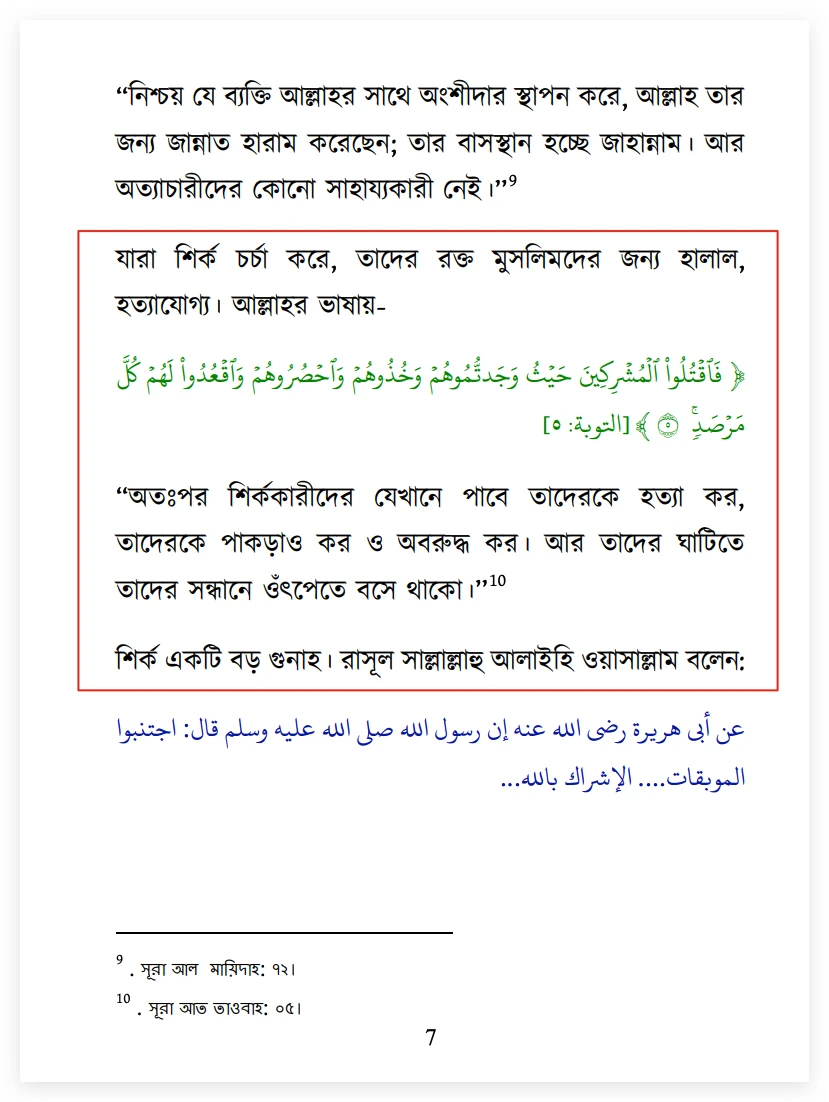
Conclusion
The theoretical and historical analysis above proves beyond doubt that expressions in Surah al-Kafirun such as ‘your religion is yours’ are not the product of any timeless Islamic tolerance or non-sectarian spirit. Rather, this was a form of ‘strategic deception,’ or tactical deception, employed by Muhammad while he remained a powerless member of a minority in Mecca. As soon as Muslims acquired military strength and political authority, Islam discarded this veneer of ‘tolerance’ and revealed its true militant and expansionist form.
According to the explicit opinions of classical Quranic exegetes, this verse does not in any way recognize the religions of non-Muslims; rather, it was merely a temporary expression of exasperation that was subsequently abrogated, or made mansukh, in its entirety by the ‘verse of jihad’ [18] [19]. Leading Islamic scholars and fatwa boards of the modern era have unequivocally acknowledged that, after attaining power, ending idol worship and destroying the places of worship of other religions are religious obligations incumbent upon every Muslim [20] [21]. Even in the context of a supposedly liberal democratic country such as Bangladesh, influential Islamic scholars claim that ‘shirk’ is an offence punishable by death and that the blood of mushriks is ‘halal’ for Muslims [22].
This kind of duplicitous and aggressive ideological position is fundamentally incompatible with ‘human rights’ and ‘individual freedom,’ the foundations of modern civilization. When medieval barbarities such as destroying the places of worship of others or declaring the blood of dissenters halal are legitimized as religious injunctions in the name of religion, it cannot possibly be defined as a ‘religion of peace.’ The vast gulf between the ‘pseudo-tolerance’ of Islam’s early period and its subsequent ‘aggressive doctrine of power’ is, in fact, nothing other than an immense deception. Such a militant and autocratic ideology is not only contrary to human rights but also poses an enduring threat to global communal harmony. Therefore, to protect civilized society and modern humanist values, it is essential to identify and intellectually resist this duplicitous strategy of Islam and the violent, hegemonic psychology underlying it.
References
- Surah al-Kafirun, verse 6 ↩︎
- Sahih al-Bukhari, Hadith: 2652 ↩︎
- Sahih Muslim, Hadith: 2533 ↩︎
- Surah Al-Kafirun, verse 6 ↩︎
- Tafsir al-Jalalayn, volume 7, page 598 ↩︎
- Tafsir-e-Mazhari, volume 12, page 613 ↩︎
- Jami‘ at-Tirmidhi 2607 ↩︎
- Jami‘ at-Tirmidhi 2608 ↩︎
- Sahih al-Bukhari 3159, 3160; Tawheed Publication, Hadith: 3159 ↩︎
- Sahih al-Bukhari, Tawheed Publication, Volume Three, pages 357, 358 ↩︎
- There is no compulsion to accept Islam, Question 34770 ↩︎
- Was Islam spread by the sword?, Question 43087 ↩︎
- The Obligation to Destroy Idols ↩︎
- Demolishing idols in a non-Muslim country ↩︎
- Al-Itqan fi Tawhid al-Rahman, Shaykh Abdullah al-Munir, pp. 14–17, 25–27 ↩︎
- Shaykh Salih bin Fawzan al-Fawzan, Al-Sharh al-Mukhtasar ‘ala Matn Zad al-Mustaqni‘ bi-Tahlil Alfazihi wa Taqrib Ma‘anihi (الشرح المختصر على متن زاد المستقنع بتحليل ألفاظه وتقريب معانيه), Dar al-Asimah, Riyadh, 1st edition, 1424 AH/2004 CE, vol. 2, p. 590; IslamWeb Audio Archive, شرح زاد المستقنع, “زاد المستقنع 042 – كتاب الجهاد” ↩︎
- A Review of Shirk, Bid‘ah, and Superstitions Prevalent in Bangladesh 2. The Consequences of Shirk ↩︎
- Tafsir al-Jalalayn, Volume Seven, page 598 ↩︎
- Tafsir al-Mazhari, Volume 12, page 613 ↩︎
- Islamweb Fatwa No: 190575 ↩︎
- IslamQA Fatwa: 20894 ↩︎
- A Review of Shirk, Bid‘ah, and Superstitions Prevalent in Bangladesh, 2. The Consequences of Shirk ↩︎