

Summary
In Islamic theology, Umar ibn al-Khattab has been glorified in such a way that he appears almost as a sacred figure beyond criticism. His decisions are called foresight, his objections are called ijtihad, his pressure is called muwafaqat, and his legal interventions are called the strength of Islam. But if Islamic sources are read calmly, a very different picture emerges. There we see that Umar repeatedly came into conflict with the operative rulings of the Quran, the Prophet’s direct instructions, the law practiced in the Prophet’s era, and Islam’s own principle of obedience; if the same things had occurred in the case of anyone else, they would have been treated directly as acts of kufr. By “acts of kufr” formal takfir is not meant here; what is meant are actions which, by Islam’s own declared standards, would be regarded, if committed by an ordinary Muslim, as disobedience to the Messenger, distortion of the Quran, alteration of the Sharia, bid‘ah, addition to the Quran, or grave faith-destroying defiance. If an ordinary Muslim did the same things, he would be called disobedient, fasiq, an innovator, rebellious, even someone committing kufr-like conduct; but in Umar’s case, the same incidents have been polished in religious language and turned into matters of virtue and Umar’s wisdom.
The central question of this article is therefore very simple: if Islam truly demands unconditional obedience to Allah and the Messenger, why is that standard not applied in Umar’s case? Why do incidents such as disobeying the Prophet’s instruction, banning lawful practices of the Prophet’s era, repairing the Quran’s inheritance mathematics through a human method, changing the law of slave-woman ownership, exerting pressure over women’s movement, or fleeing from the battlefield not become crimes in Umar’s case, but instead become sacred ornaments of history? This double standard is the real picture of Sahabi-worship, which is beautifully decorated and taught to us in the name of religion. The matters discussed in this article are as follows:
| Subject | Umar’s role | Conflict with the Qur’an/Prophet/Sharia | Logical conclusion |
|---|---|---|---|
| Veto on the Prophet’s glad tidings | Muhammad directly instructed Abu Huraira to proclaim the glad tidings of Paradise. Umar struck him in the chest, sent him back, and later proposed that the message should not be publicly proclaimed because of his own concern about its consequences. | According to the Qur’an, once Allah and His Messenger have decided a matter, a believer has no right to choose otherwise. Yet Umar first physically stopped the implementation of the Prophet’s instruction and then proposed, on the basis of his own judgment, that it should not be proclaimed. [1] [2] | Umar’s human judgment functioned as an effective veto over a direct Prophetic instruction; ultimately the implementation of the Prophet’s original command was stopped. |
| Truth on Umar’s tongue and the “Muhaddath” | Reports attributed to the Prophet state that Allah placed truth upon Umar’s tongue and heart; another report says that if there were a “Muhaddath” in this ummah, it would be Umar. | Umar’s human judgment is elevated beyond ordinary ijtihad and given a special truth-guided, inspiration-like status; the same tradition also claims that Qur’anic revelation repeatedly came in accordance with Umar’s words. [3] [4] [5] | These reports provide the theological foundation for “Muwafaqat Umar”: Umar’s opinions are no longer treated as merely political judgments, but are sanctified as specially guided toward truth. |
| Sawda and veiling | Umar repeatedly demanded that veiling be imposed upon the Prophet’s wives. Even after the ruling of hijab, when Sawda went outside for a natural need, Umar recognized her from her body and publicly told her, “By Allah, you cannot remain hidden from our sight; now see how you will go outside.” After this harassment, Sawda returned and complained to Muhammad. | A woman could not even go outside to urinate or defecate without falling under Umar’s patriarchal surveillance and obstruction. Umar’s words forced Sawda to return and complain; Muhammad then had to declare explicitly that women were permitted to go outside for their needs. [6] [7] | The practical face of Umar’s obsession with veiling is not the dignity of women, but public patriarchal policing of a woman’s body, natural needs, and freedom of movement. Later religious tradition transformed this harassment itself into a narrative of Umar’s virtue. |
| Prisoners of the Battle of Badr | Abu Bakr favored releasing the captives for ransom; Umar proposed killing them, even suggesting that close relatives should personally execute their own relatives. Muhammad accepted Abu Bakr’s position. | The following day Muhammad and Abu Bakr were found weeping; in Sahih Muslim the possibility of punishment for accepting ransom is mentioned together with Qur’an 8:67–69. Although the verses do not repeat Umar’s precise proposal for relatives to execute one another, within the narrative structure of Sahih Muslim the Prophet’s ransom policy is rebuked as a punishable mistake and Umar’s harsher position is placed closer to the subsequent revelation. [8] [9] | In the narrative, the Prophet chooses the comparatively lenient position, Umar argues for the harsher opposite position, and subsequent revelation rebukes the policy chosen by the Prophet. This makes the doctrine of “Muwafaqat Umar” even more disturbing. |
| Funeral prayer for a hypocrite | When Muhammad stood to perform the funeral prayer for Abdullah ibn Ubayy, Umar repeatedly objected. Muhammad told him to move aside and proceeded with the funeral prayer according to his own decision. | Muhammad said at the time that he had been given a choice; later Qur’an 9:84 was revealed prohibiting funeral prayers for hypocrites. Thus Muhammad performed the very act Umar had tried to stop, and subsequent revelation prohibited it. [10] [11] | Again, Umar tried to stop something the Prophet intended to do, and later revelation turned Umar’s objection into the rule. The religious narrative itself therefore places Umar in the position of being “correct before the Prophet.” |
| Sexual intercourse on Ramadan nights | According to tafsir reports, Umar and other Muslims violated the operative prohibition on intercourse, eating, or drinking during the prohibited period; afterward the Ramadan-night ruling was relaxed. | Qur’an 2:187 itself states that Muslims were “betraying themselves,” after which Allah pardoned them and permitted intercourse, eating, and drinking at night. Ibn Kathir also mentions Umar and other Companions as part of the background to this change. [12] [13] | The original harsh ruling collided with actual Muslim behavior and was subsequently relaxed, calling into question the claim that the law had been eternally and perfectly designed from the outset. |
| Mut‘ah marriage | According to Jabir’s report, mut‘ah continued during the Messenger’s era and the time of Abu Bakr; Umar later prohibited it. Other Sunni reports, however, attribute a final prohibition to the Prophet himself. | Within the same Sunni corpus, reports of the Prophet’s final prohibition coexist with Jabir’s statement that the two mut‘ahs were practiced during the Messenger’s time and later prohibited by Umar. [14] | Sunni sources themselves create the question of whether the effective historical source of the final prohibition was the Prophet or Umar. |
| Tamattu‘ in Hajj | Umar prohibited tamattu‘ even though a report attributed to him acknowledges that it is found in the Book of Allah and that the Messenger practiced it. | In a sahih report in Sunan al-Nasa’i, Umar says: “By Allah, I am forbidding you from tamattu‘, although it is in the Book of Allah and the Messenger of Allah practiced it.” [15] | The caliph’s administrative judgment could override the practical application of the Qur’an and the Prophet’s own practice, weakening the claim that Sharia’s ultimate authority rests with revelation and Prophetic Sunnah. |
| The principle of ‘awl | The first inheritance case in which the Qur’anic shares exceeded the available estate arose during Umar’s rule; after consultation with the Companions, proportional reduction through ‘awl was applied. | The Qur’an specifies fixed fractions for heirs but gives no instruction for what to do when the total claims exceed 100 percent. IslamWeb also acknowledges that no marfu‘ hadith from the Prophet establishes the application of ‘awl and that the problem first arose in Umar’s time. [16] [17] | When direct application of the Qur’anic fractions produced an impossible result, a human mathematical solution became necessary; the “complete law” therefore became dependent on a later juristic patch for practical operation. |
| Sale of Umm Walad | According to Jabir, Umm Walad slave women were sold during the eras of the Prophet and Abu Bakr; Umar later prohibited their sale. | The chapter heading in Sahih Ibn Hibban itself identifies Umar as the one who prohibited the sale of Umm Walad, while Jabir preserves the practice of selling them during the Prophet’s and Abu Bakr’s eras. [18] | If Umar’s law morally improved the position of the slave woman and her child, then the permitted or tolerated system of the Prophetic era was itself morally inferior by comparison. |
| Adult breastfeeding | Muhammad instructed that adult Salim be breastfed in order to create a mahram relationship; Aisha applied the principle more broadly, the other wives regarded it as a special case, while Umar’s fatwa denied the legal effect of adult breastfeeding. | Disagreement appears within the first generation over the scope of the same Prophetic ruling: on one side Muhammad’s instruction regarding Salim, on the other Umar’s ruling that breastfeeding creates kinship only when it occurs in childhood. [19] [20] | This is not a picture of clear Sharia; Aisha, the other wives of the Prophet, and Umar hold different legal positions concerning the scope of the same Prophetic instruction. |
| Wife-beating | Muhammad initially prohibited beating women. Umar complained that women had become emboldened against their husbands, after which permission to beat wives was granted. | In the sahih report of Abu Dawud, wife-beating is permitted after Umar’s complaint; later many women complain, and Muhammad says that those who beat their wives are not the best among men. Qur’an 4:34 also places beating within the disciplinary sequence for a wife’s alleged nushuz. [21] [22] | The husband’s disciplinary authority was given priority over women’s physical safety; Umar’s complaint is a central part of the narrated background to that change. |
| Declaration that the religion was completed | In tafsir reports, Umar weeps after the revelation of al-Ma’idah 5:3 and interprets “completion” as a sign that decline will follow. | Qur’an 5:3 declares the religion complete; yet tafsir reports explain Umar’s weeping by saying that once something reaches completion, deficiency begins afterward. At the same time, numerous legal and institutional changes actually occurred after the Prophet’s death. [23] [24] | If “completion” is taken to mean an actually complete and unchangeable legal system, the subsequent corrections, prohibitions, and administrative changes become difficult to reconcile with that claim. |
| The verse of stoning | Umar claimed that a verse of stoning had been revealed and that they had recited and understood it; in another report he said that, had he not feared people accusing him of adding to the Book of Allah, he would have written it into the mushaf. | In Sahih al-Bukhari Umar says that the stoning verse was revealed and fears that future generations will reject stoning because they cannot find the verse in the Qur’an; in Musnad Ahmad he says that he would have written it down were it not for the accusation of adding to the Qur’an. [25] [26] | A supposedly revealed verse absent from the present mushaf while its death-penalty ruling remains operative exposes the instability of the claims surrounding Qur’anic preservation, abrogation, and textual authority. |
| The Prophet’s final writing | On his deathbed Muhammad asked for writing materials, intending to write something by which Muslims would not go astray; Umar said that the Prophet’s illness was severe and that “the Book of Allah is sufficient for us.” | The Qur’an denies believers an independent choice against a decision of the Prophet; yet because of the dispute in the room, the written guidance Muhammad requested was never produced. [27] [28] | In the stoning-verse episode Umar wants an alleged Qur’anic verse absent from the mushaf to be written down, while here he invokes “the Book of Allah is sufficient” to block the Prophet’s written instruction. Placed together, the two positions reveal a stark inconsistency. |
| The nickname Abu Isa | Al-Mughira states that the nickname “Abu Isa” had been given to him by the Messenger himself; Umar nevertheless rejected it and ordered him to use “Abu Abdullah.” | In the report of Abu Dawud, even after learning that the nickname had been given by the Messenger, Umar did not withdraw his objection. Under the Qur’anic doctrine of obedience, the question of an ordinary follower overriding the Prophet’s decision arises here as well. [29] [30] | Even a social identity given by the Prophet failed to survive Umar’s personal religious judgment, exposing the gap between the declared doctrine of obedience and actual political authority. |
| The Black Stone | Umar tells the Black Stone that he knows it is merely a stone that cannot itself harm or benefit anyone, and that he kisses it only because he saw the Prophet kiss it. | Another hadith depicts the same stone appearing on the Day of Resurrection with eyes and a tongue, testifying for those who touched it sincerely. Thus, on one side it is presented as a powerless stone, while on the other it is endowed with miraculous memory, speech, and testimonial capacity. This dual narrative makes it difficult to dismiss Islamic stone-veneration as merely symbolic respect. [31] [32] | The stone is simultaneously emphasized as utterly powerless and endowed with an extraordinary eschatological role as a living witness, creating an obvious theological tension within Islam’s stone ritual. |
| The Battle of Hunayn | When the Muslim army retreated at Hunayn, Abu Qatada reached Umar and asked what had happened to the people; Umar replied, “It is the command of Allah.” The report places Umar within the scene of the retreat itself. | Qur’an 9:25 describes Muslim self-confidence in their numbers at Hunayn followed by their turning their backs; Sahih al-Bukhari 4321 narrates the same flight and preserves Abu Qatada’s exchange with Umar within it. [33] [34] | If Umar is presented as an almost superhuman model of Sahabi purity, the fear, collapse, and retreat visible on the battlefield must also be included in that historical picture. |
| Tarawih congregation | Umar gathered people who were praying separately at night behind a single imam and described the new arrangement as “what an excellent bid‘ah.” | Al-Bukhari records that after the Prophet’s death, throughout Abu Bakr’s reign and the early period of Umar’s caliphate, the night prayer remained in its earlier scattered form; Umar later organized it behind one imam and called it a “bid‘ah.” Elsewhere the Prophet is reported to have said that “every bid‘ah is misguidance.” [35] [36] [37] | Later fiqh reconciles the problem by distinguishing “linguistic” from “Shar‘i” bid‘ah, but the historical fact remains that a post-Prophetic religious innovation organized by Umar became an established Sunni practice. |
This summary shows that the incidents are not separate uncomfortable stories; they are part of the same pattern of power. Umar at times broke an operative ruling because of bodily desire, at times blocked the Prophet’s instruction, at times abolished practices of the Prophet’s era, at times repaired the Quran’s unworkable law through a human method, at times imposed his own veiling obsession on women, and at times elevated his own administrative decision to the level of religious truth. Certainly, in some cases these changes were practical, worldly, and necessary for governance, but that is not the question. The question is whether he can change the rulings of Allah and His Messenger. This continuity proves that early Islamic law and revelation were not some heaven-descended, unchanging, perfect system; rather, they repeatedly changed with power, personality, social pressure, and political necessity.
Thus the real question about Umar is not his personal greatness or his identity as a Sahabi. The question is whether the same standard applies to everyone. If an ordinary Muslim receives the threat of Hell for disobeying the Prophet’s command, why is Umar “far-sighted”? If an ordinary person becomes an innovator for abolishing a lawful ruling of the Prophet’s era, why is Umar a “mujtahid”? If the Quranic inheritance law requires correction, how is the Quran called a complete book of law? It is precisely to avoid these questions that criticism of the Sahabis is prohibited. For as soon as criticism begins, the covering of sacred history falls away, and from within emerge power, double standards, patriarchy, legal chaos, and the naked reality of religious authority.
Introduction
One of the most effective defensive weapons of Islamic theology is the concept of the Sahabis’ ‘adalah, or their overall moral reliability. According to this idea, the Sahabis may make mistakes, but criticism of their character, intentions, political conduct, lust for power, violence, decisions concerning women, or conflicts with the Prophet’s instructions is supposedly fitnah, hatred, Shia influence, atheism, or Islamophobia. As a result, the people of Islam’s first era are presented not as real historical figures, but as a kind of religious idol. Instead of judging human beings as human beings, a fog of sanctity is created around them.
But the task of history is not devotion; the task of history is judgment. Placing “Hazrat,” “radiyallahu anhu,” or “Sahabi” before someone’s name does not make his actions morally correct. In the case of powerful political figures, even more suspicion, analysis, and questioning are needed. For those who influenced the state, war, law, women, slaves, wealth, inheritance, sexual policy, and religious punishment, the cost of their mistakes was not merely personal; it affected human lives generation after generation. Therefore, the culture of placing the Sahabis above criticism is in fact an enemy of the search for truth. It removes history from the domain of research and places it inside the prison of faith-based obedience.
The second caliph, Umar ibn al-Khattab, is the most important example of this problem. In the conventional Sunni narrative, he is just, far-sighted, stern but truth-loving, a powerful pillar of Islam. But when the Islamic sources themselves are read closely, it becomes clear that this same Umar repeatedly exerted pressure on the Prophet’s decisions, obstructed the Prophet’s direct instructions, abolished practices current in the Prophet’s era, established human solutions to the Quran’s mathematical problems, applied pressure regarding women’s movement and veiling, was seen in the ranks of Sahabis who fled the battlefield, and in many cases later theology glorified his decisions as “muwafaqat,” or Umar’s agreement with Allah.
Here lies the central problem. If an ordinary Muslim disobeys the Prophet’s instruction, he is called disobedient to the Messenger. If an ordinary person wants to abolish a lawful ruling of the Prophet’s era, he is called an innovator. If someone calls the Quran’s law mathematically unworkable and applies a human patch, he is said to prove the Quran’s incompleteness. If someone blocks a woman’s path in order to impose veiling, he is called an oppressor. But as soon as Umar’s name is attached to these actions, the religious language changes. Disobedience becomes ijtihad, pressure becomes foresight, legal change becomes the development of Sharia, and power becomes virtue. This double standard is not neutral morality; it is a religious strategy for protecting a powerful personality.
In this article, Umar will be judged not out of personal hostility, but by using Islam’s own sources and its own standards. If Islam says that obeying Allah and the Messenger is obligatory, then Umar cannot stand outside that command. If Islam says that after the Prophet’s decision a believer has no choice of his own, then Umar’s objection is also subject to the same standard. If Islam claims that the Quran is complete, then the question of why a human correction called ‘awl was needed in inheritance law is also legitimate. If Islam calls the Prophet’s era the ideal era, then questions such as the sale of umm walad, mut‘ah, tamattu‘, slavery, and patriarchal surveillance over women cannot be avoided.
Thus the purpose of this writing is not to “insult” Umar; the purpose is to remove and examine the religious mask behind which power, law, patriarchy, slavery, revelation-politics, and the naked structure of Sahabi-worship are hidden. A history that cannot be questioned is not history; it is religious propaganda. And a figure who cannot be judged is not a moral ideal; he is a political idol. This article will scrape away the paint of sanctity accumulated on that idol and show how much of what lies within is human, how much is power, and how much is religious polish. Let us hear the statement of the Salafi scholar Dr. Abu Bakr Muhammad Zakaria,
This statement shows how tightly rational examination of the Sahabis is controlled within the Islamic sphere. If the principle of “concealing faults” is established religiously, then the door to truth is closed. History then does not stand on information; it stands on obedience. And when obedience becomes an alternative to truth, any barbarity, any double standard, any political power can be clothed in sanctity. In Umar’s case, exactly that has happened.
The Standard of Judgment: Is Umar Above Islam’s General Rule?
Before judging Umar ibn al-Khattab, it is necessary to clarify Islam’s own declared standard. For the most convenient strategy of Sahabi-worship is this: one rule for ordinary Muslims, another rule for influential Sahabis. If an ordinary Muslim disobeys the Prophet’s words, he is disobedient, misguided, deserving of Hell; but if Umar does the same thing, it becomes ijtihad, wisdom, muwafaqat, or foresight. This double standard cannot stand. If Islam truly makes obedience to Allah and the Messenger obligatory, then that standard must apply equally to Umar as well.
The language of the Quran is not unclear on this matter. The Quran repeatedly says that the command of Allah and the Messenger must be obeyed; what the Messenger gives must be accepted, what he prohibits must be abandoned; when Allah and the Messenger decide a matter, no believing man or woman has the right to retain a choice of their own. That is, within Islam’s own structure, Prophet Muhammad’s instruction is not seen merely as personal opinion or ordinary advice; it is religiously binding. Therefore, before the Prophet’s direct instruction, positions such as “in my view,” “the Quran is sufficient for us,” “this is not my preference,” or “I forbid this” constitute grave disobedience even by Islam’s internal standard. Let us read the Quranic verses. If Muhammad gives any instruction, it must be obeyed [38]
When Allah and His Messenger give any command, no believing man or believing woman has any right to differ from that command. Whoever disobeys Allah and His Messenger has clearly strayed far from the true path.
Taisirul Quran
When Allah and His Messenger give an instruction regarding any matter, no believing man or believing woman shall have any right of decision in that matter. Whoever disobeys Allah and His Messenger is clearly misguided.
Sheikh Mujibur Rahman
And when Allah and His Messenger give any command, no believing man or woman has the right to choose something else in their own matter; and whoever disobeys Allah and His Messenger will clearly be misguided.
Rawai Al-bayan
And when Allah and His Messenger decide a matter, it is not proper for any believing man or believing woman to have any choice in that matter. And whoever disobeys Allah and His Messenger has clearly gone astray (1).
Dr. Abu Bakr Muhammad Zakaria
According to the Quranic account, Muhammad’s responsibility was to explain the Quran to people [39]
(We sent the messengers of the past) with clear proofs and scriptures; and now We are sending down the Quran to you so that you may clearly explain to people what has been sent down to them, and so that they may reflect.
Taisirul Quran
We sent them with clear signs and scripture, and We have sent down the Quran to you so that you may clearly explain to people what had been sent down to them, so that they may reflect.
Sheikh Mujibur Rahman
(We sent them) with clear proofs and scriptures, and We have sent down the Quran to you so that you may make clear to people what has been sent down to them. And so that they may reflect.
Rawai Al-bayan
With clear proofs and scriptures (1). And We have sent down the Quran to you, so that you may clearly explain to people what has been sent down to them (2), and so that they may reflect.
Dr. Abu Bakr Muhammad Zakaria
The Quran also instructs people to follow Muhammad’s rulings and prohibitions [40]
Accept what the Messenger gives you, and refrain from what he forbids you; fear Allah; Allah is severe in punishment.
Taisirul Quran
Therefore accept what the Messenger gives you, and refrain from that which he forbids you. Fear Allah; Allah is severe in punishment.
Sheikh Mujibur Rahman
Accept what the Messenger gives you, and refrain from what he forbids you and fear Allah alone; surely Allah is severe in punishment.
Rawai Al-bayan
Accept what the Messenger gives you, and refrain from what he forbids you (2), and observe taqwa of Allah; surely Allah is severe in punishment.
Dr. Abu Bakr Muhammad Zakaria
Muhammad too must be obeyed alongside Allah, for which there is clear instruction [41] [42] [43] [44] [45] [46]
Whoever obeys the Messenger has indeed obeyed Allah; and if anyone turns away, I have not sent you as a guardian over them.
Taisirul Quran
Whoever obeys the Messenger surely obeys Allah Himself, and whoever turns away, I have not sent you as a protector over him.
Sheikh Mujibur Rahman
Whoever obeys the Messenger has obeyed Allah. And whoever turns away, I have not sent you over them as a supervisor.
Rawai Al-bayan
Whoever obeys the Messenger has indeed obeyed Allah (1), and whoever turns away, We have not sent you as a supervisor over them.
Dr. Abu Bakr Muhammad Zakaria
O believers! Obey Allah and obey the Messenger, and do not ruin your deeds.
Taisirul Quran
O believers! Obey Allah, obey the Messenger, and do not destroy the fruits of your deeds.
Sheikh Mujibur Rahman
O believers, obey Allah and obey the Messenger. And do not ruin your deeds.
Rawai Al-bayan
O believers! Obey Allah and obey the Messenger, and do not ruin your deeds.
Dr. Abu Bakr Muhammad Zakaria
Obey Allah and obey His Messenger, and be cautious of evil; and if you turn away, then know that My Messenger’s duty is only to convey clearly (My message).
Taisirul Quran
And continue to obey Allah and obey the Messenger, and be cautious; and if you turn away, then know that My Messenger’s duty was only to convey clearly (the command).
Sheikh Mujibur Rahman
And obey Allah and obey the Messenger, and beware. Then if you turn away, know that My Messenger’s duty is only clear proclamation.
Rawai Al-bayan
And obey Allah and obey the Messenger. And exercise caution; then if you turn away, know that Our Messenger’s duty is only to proclaim clearly.
Dr. Abu Bakr Muhammad Zakaria
Say: Obey Allah and obey the Messenger, then if you turn away, he is responsible for the duty placed upon him, and you are responsible for the duty placed upon you; if you obey him, you will find the right path. The Messenger’s duty is only to convey clearly.
Taisirul Quran
Say: Obey Allah and obey the Messenger; then if you turn away, he is responsible for the duty placed upon him and you are responsible for the duty placed upon you; and if you obey him, you will be rightly guided. The Messenger’s duty is only to convey clearly.
Sheikh Mujibur Rahman
Say, ‘Obey Allah and obey the Messenger.’ Then if you turn away, he is responsible only for the duty placed upon him and you are responsible for the duty placed upon you. And if you obey him, you will be guided. And the Messenger’s duty is only to convey clearly.
Rawai Al-bayan
Say, ‘Obey Allah and obey the Messenger.’ Then if you turn away, he is responsible for the duty placed upon him and you are responsible for the duty placed upon you; and if you obey him, you will find the right path. In reality, the Messenger’s duty is only to convey clearly.
Dr. Abu Bakr Muhammad Zakaria
Obey Allah and obey the Messenger. Then if you turn away, no compulsion will be used to bring you back to the right path, for My Messenger’s duty is only to convey clearly (My message).
Taisirul Quran
Obey Allah and obey His Messenger, and if you turn away, then My Messenger’s duty is only to proclaim clearly.
Sheikh Mujibur Rahman
Obey Allah and obey the Messenger. But if you turn away, then My Messenger’s only duty is to convey the message clearly.
Rawai Al-bayan
And obey Allah and obey the Messenger; then if you turn away, Our Messenger’s duty is only to proclaim clearly.
Dr. Abu Bakr Muhammad Zakaria
Say, ‘If you love Allah, then follow me; Allah will love you and forgive your sins. Indeed, Allah is most forgiving, most merciful.’
Taisirul Quran
Say: If you love Allah, then follow me, so that Allah may love you and forgive your offenses; and Allah is forgiving, merciful.
Sheikh Mujibur Rahman
Say, ‘If you love Allah, then follow me; Allah will love you and forgive you your sins. And Allah is most forgiving, most merciful.’
Rawai Al-bayan
Say, ‘If you love Allah, then follow me (1); Allah will love you and forgive your offenses. Allah is most forgiving, most merciful.’
Dr. Abu Bakr Muhammad Zakaria
At the same time, it is also clearly stated that Muhammad must not be disobeyed [47],
My task is to convey Allah’s word and proclaim His message. Whoever disobeys Allah and His Messenger, for him is the fire of Hell; therein they will remain forever.
Taisirul Quran
My task is only to convey Allah’s word and proclaim it. For those who disobey Allah and His Messenger there is the fire of Hell; there they will abide forever.
Sheikh Mujibur Rahman
The responsibility is only to convey Allah’s word and His message. And whoever disobeys Allah and His Messenger, for him there is the fire of Hell. Therein they will abide forever.
Rawai Al-bayan
‘My responsibility is only to convey from Allah and proclaim His message. And whoever disobeys Allah and His Messenger, for him there is the fire of Hell; there they will abide forever (1).’
Dr. Abu Bakr Muhammad Zakaria
The same claim is stated even more directly in hadith [48]
Hadith Sambhar
13/ Sunnah
Chapter: On the importance of observing the Sunnah and some of its etiquette
(1499) Miqdam bin Ma‘dikarib said, The Messenger of Allah, peace and blessings be upon him, said: Listen! I have been given the Quran, and along with it something like it (the Sunnah) has been given. Listen! Perhaps some satisfied person reclining on his couch will say, ‘Follow this Quran; whatever lawful thing you find in it, regard it as lawful, and whatever forbidden thing you find in it, regard it as forbidden.’ Beware! What the Messenger of Allah declares forbidden is also like what Allah declares forbidden.
(Abu Dawud 4606, Ibn Majah 12, Darimi 586, Mishkat 163)
Hadith grade: Sahih (Sahih)
Narrator: Miqdam (RA)
Another hadith is especially important here. For in the case of the pen-and-paper incident, it is usually said that the Prophet was ill at the time; thus Umar may have said “the Quran is sufficient” out of concern for the Prophet’s suffering or in consideration of his illness. But Islam’s own hadith tradition weakens this defense. In a report from Sahih Bukhari, it is seen that the Prophet, while ill, had forbidden people from pouring medicine into his mouth. Those present disregarded his prohibition, assuming it to be the ordinary irritation of a sick person. Later, when the Prophet felt better, he asked them whether he had not forbidden them to pour medicine into his mouth. Then he instructed that medicine be poured into the mouth of everyone in the house except Abbas, because Abbas was not present at the time.
Sahih Bukhari (Tawhid Publication)
64/ Maghazi [Military Expeditions]
Chapter: 64/84. The illness of the Prophet, peace and blessings be upon him, and his death.
4458. Aisha (RA) said: During the Prophet’s illness, we poured medicine into his mouth. He gestured to us not to pour medicine into his mouth. We said, this is the natural aversion of patients toward medicine. When he felt better, he said, did I not forbid you to administer medicine to me? We said, we thought this was the patient’s ordinary aversion to medicine. Then he said, pour medicine into the mouth of everyone in the house before my eyes except Abbas. For he is not present among you.
[1] First, here the validity of qiyas is established even in a very minor matter. Second, the necessity of obeying the Prophet’s instructions applies equally in all circumstances, whether he is healthy or ill.
Hadith grade: Sahih
The note beneath this hadith is highly significant: obeying the Prophet’s instruction is obligatory in all conditions, whether he is healthy or ill. That is, the argument “the Prophet was ill” is not a valid excuse, by Islam’s internal standard, for disobeying the Prophet’s instruction. Rather, the hadith shows that even the Prophet’s gesture while ill is not insignificant; when it was disobeyed, the Prophet later issued a remedial instruction. Then when, on his deathbed, the Prophet directly asks for writing materials and says that he will write something by which Muslims will not go astray, how can stopping that instruction on the excuse of illness be valid?
The explanation given in Sahaj Darse Ibn Majah regarding the source of the Prophet’s statements makes this question even sharper. If the Prophet does not issue religious instructions on his own, but his statements are considered part of Allah-given guidance, then disobeying the Prophet’s direct instruction is not merely failing to listen to a sick man; it falls into the category of disregarding Allah’s system of command itself. Therefore, Umar’s position in the pen-and-paper incident cannot be softened as “practical wisdom” or “compassion.” According to Islam’s own principle, the Prophet’s instruction is obligatory even in illness. By that standard, Umar’s statement that “the Quran is sufficient” stands directly against obedience to the Prophet.
That is, the Prophet was not merely called the bearer of the Quran; alongside the Quran, he was also presented as a lawgiver furnished with the Sunnah. Indeed, warning was given about precisely such a person who, sitting comfortably in an armchair, would say, “The Quran is sufficient for us.” This language is especially important, because Umar’s statement in the pen-and-paper incident was: “We have the Book of Allah; that is sufficient.” In other words, the mentality that later hadiths identify as dangerous was effectively the very mentality Umar expressed in the deathbed incident.
Therefore, in this article Umar is not first being judged by some external atheist, humanist, or modern secular standard. He is first being judged in light of Islam’s own declared principles. If Islam says that the Messenger’s instruction must not be disobeyed, then what is Umar’s obstruction of the pen and paper? If Islam says that what the Messenger has made lawful must be accepted, then what is the position of Umar’s prohibition regarding mut‘ah or tamattu‘? If Islam says that the Quran is complete and clear, then why was a human mathematical patch called ‘awl needed in inheritance law? If Islam calls the Prophet’s era the best era, then where does the morality of the Prophet’s era stand if the Prophet-era reality of selling umm walad was later changed by Umar?
To avoid these questions, theologians usually use terms such as “Umar’s ijtihad,” “Umar’s virtue,” “Umar’s muwafaqat,” “Umar’s foresight,” and so on. But these are not really explanations; they are linguistic polish. If the same act is a crime when done by an ordinary Muslim, but a virtue when done by Umar, this is not a moral principle; it is a special exemption for a powerful person. However sacred this exemption may be made in religious language, in the language of reason its name is double standard.
Thus in the discussions that follow, a strict but fair standard will be applied: do Umar’s actions agree with the Quran’s declared principle of obedience? Do they agree with the Prophet’s direct instructions? Do they agree with the law current in the Prophet’s era? Do they agree with the divine rulings described in Islamic sources? If they do not, then they cannot be washed clean by calling them “virtues.” They must then be called disobedience, political intervention, human correction, the exercise of power, or the internal self-contradiction of the Islamic legal system.
Once this standard is established, the foundation of the conventional religious romanticism surrounding Umar’s character becomes logically unacceptable. It then becomes clear that Islam’s early history is not a simple history of sanctity; it is a history of power, obedience, compromise, pressure, changes in principle, and the legitimization of political decisions through religious language. Umar is one of the central figures of that history, a figure before whom the alleged finality of the Quran, the Prophet, the Sunnah, and the Sharia repeatedly softened under the test of real power.
Umar’s Veto on the Prophet’s Glad Tidings: Censorship of Revelation
One of the most disturbing instances of Umar’s intervention in a direct Prophetic instruction is preserved in Sahih Muslim itself. There is no question here of a weak chain of transmission, a later historical chronicle, or a disputed narrator. Abu Huraira himself reports that Muhammad gave him his two sandals and sent him on a specific mission: whoever he met outside the garden who testified with heartfelt certainty that there was no deity except Allah was to be given the glad tidings of Paradise. The sandals served as a token demonstrating that Abu Huraira had been sent by Muhammad himself. In other words, Abu Huraira was not going out to preach a fatwa of his own; he was going out to carry out a direct instruction from the Prophet. [49]
Sahih Muslim
The Book of Faith
Chapter: The Evidence That One Who Dies Believing in Tawhid Will Definitely Enter Paradise
Sahih Muslim 31
It is narrated on the authority of Abu Huraira that he said: We were sitting around the Messenger of Allah, and Abu Bakr and Umar were among those present. The Messenger of Allah then got up and left us. When his return was delayed, we became afraid that something might have happened to him in our absence. We became alarmed and got up, and I was the first to go out in search of him. I eventually reached a garden belonging to the Banu al-Najjar among the Ansar.
I went around the garden looking for a gate but could not find one. Then I noticed a small watercourse entering the garden from a well outside. I squeezed myself through it as a fox would and entered upon the Messenger of Allah. He said, “Abu Huraira?” I replied, “Yes, Messenger of Allah.” He asked, “What has brought you here?” I said, “You were among us, then you got up and left. When you were delayed, we became afraid that something might happen to you while we were not with you. I was the first to become alarmed, so I came to this garden and squeezed myself through like a fox. The others are behind me.”
The Messenger of Allah then gave me his sandals and said, “Take these two sandals of mine. Whoever you meet outside this garden who testifies with certainty in his heart that there is no deity except Allah, give him the glad tidings of Paradise.”
Abu Huraira said: The first person I met was Umar. He said, “What are these sandals, Abu Huraira?” I replied, “These are the sandals of the Messenger of Allah. He has sent me with them so that whoever I meet who testifies with heartfelt certainty that there is no deity except Allah, I should give him the glad tidings of Paradise.” Upon hearing this, Umar struck me in the chest so forcefully that I fell backward. He then said, “Go back, Abu Huraira.”
I returned to the Messenger of Allah on the verge of tears, while Umar followed closely behind me. The Messenger of Allah asked, “What is the matter with you, Abu Huraira?” I replied, “I met Umar and told him the message with which you had sent me. He struck me in the chest so that I fell backward, and he told me to return.” The Messenger of Allah then said, “Umar, what prompted you to do this?”
Umar replied, “Messenger of Allah, may my father and mother be sacrificed for you. Did you send Abu Huraira with your sandals so that whoever he met who testified with certainty in his heart that there is no deity except Allah should be given the glad tidings of Paradise?” The Messenger of Allah replied, “Yes.” Umar said, “Do not do this. I fear that people will rely on this alone. Let them continue to perform deeds.” The Messenger of Allah then said, “Then leave them to do so.”
باب الدليل على أن من مات على التوحيد دخل الجنة قطعا
حَدَّثَنِي زُهَيْرُ بْنُ حَرْبٍ، حَدَّثَنَا عُمَرُ بْنُ يُونُسَ الْحَنَفِيُّ، حَدَّثَنَا عِكْرِمَةُ بْنُ عَمَّارٍ، قَالَ حَدَّثَنِي أَبُو كَثِيرٍ، قَالَ حَدَّثَنِي أَبُو هُرَيْرَةَ، قَالَ كُنَّا قُعُودًا حَوْلَ رَسُولِ اللَّهِ صلى الله عليه وسلم مَعَنَا أَبُو بَكْرٍ وَعُمَرُ فِي نَفَرٍ فَقَامَ رَسُولُ اللَّهِ صلى الله عليه وسلم مِنْ بَيْنِ أَظْهُرِنَا فَأَبْطَأَ عَلَيْنَا وَخَشِينَا أَنْ يُقْتَطَعَ دُونَنَا وَفَزِعْنَا فَقُمْنَا فَكُنْتُ أَوَّلَ مَنْ فَزِعَ فَخَرَجْتُ أَبْتَغِي رَسُولَ اللَّهِ صلى الله عليه وسلم حَتَّى أَتَيْتُ حَائِطًا لِلْأَنْصَارِ لِبَنِي النَّجَّارِ فَدُرْتُ بِهِ هَلْ أَجِدُ لَهُ بَابًا فَلَمْ أَجِدْ فَإِذَا رَبِيعٌ يَدْخُلُ فِي جَوْفِ حَائِطٍ مِنْ بِئْرٍ خَارِجَةٍ – وَالرَّبِيعُ الْجَدْوَلُ – فَاحْتَفَزْتُ كَمَا يَحْتَفِزُ الثَّعْلَبُ فَدَخَلْتُ عَلَى رَسُولِ اللَّهِ صلى الله عليه وسلم فَقَالَ ” أَبُو هُرَيْرَةَ ” . فَقُلْتُ نَعَمْ يَا رَسُولَ اللَّهِ . قَالَ ” مَا شَأْنُكَ ” . قُلْتُ كُنْتَ بَيْنَ أَظْهُرِنَا فَقُمْتَ فَأَبْطَأْتَ عَلَيْنَا فَخَشِينَا أَنْ تُقْتَطَعَ دُونَنَا فَفَزِعْنَا فَكُنْتُ أَوَّلَ مَنْ فَزِعَ فَأَتَيْتُ هَذَا الْحَائِطَ فَاحْتَفَزْتُ كَمَا يَحْتَفِزُ الثَّعْلَبُ وَهَؤُلاَءِ النَّاسُ وَرَائِي فَقَالَ ” يَا أَبَا هُرَيْرَةَ ” . وَأَعْطَانِي نَعْلَيْهِ قَالَ ” اذْهَبْ بِنَعْلَىَّ هَاتَيْنِ فَمَنْ لَقِيتَ مِنْ وَرَاءِ هَذَا الْحَائِطِ يَشْهَدُ أَنْ لاَ إِلَهَ إِلاَّ اللَّهُ مُسْتَيْقِنًا بِهَا قَلْبُهُ فَبَشِّرْهُ بِالْجَنَّةِ ” فَكَانَ أَوَّلَ مَنْ لَقِيتُ عُمَرُ فَقَالَ مَا هَاتَانِ النَّعْلاَنِ يَا أَبَا هُرَيْرَةَ . فَقُلْتُ هَاتَانِ نَعْلاَ رَسُولِ اللَّهِ صلى الله عليه وسلم بَعَثَنِي بِهِمَا مَنْ لَقِيتُ يَشْهَدُ أَنْ لاَ إِلَهَ إِلاَّ اللَّهُ مُسْتَيْقِنًا بِهَا قَلْبُهُ بَشَّرْتُهُ بِالْجَنَّةِ . فَضَرَبَ عُمَرُ بِيَدِهِ بَيْنَ ثَدْيَىَّ فَخَرَرْتُ لاِسْتِي فَقَالَ ارْجِعْ يَا أَبَا هُرَيْرَةَ فَرَجَعْتُ إِلَى رَسُولِ اللَّهِ صلى الله عليه وسلم فَأَجْهَشْتُ بُكَاءً وَرَكِبَنِي عُمَرُ فَإِذَا هُوَ عَلَى أَثَرِي فَقَالَ لِي رَسُولُ اللَّهِ صلى الله عليه وسلم ” مَا لَكَ يَا أَبَا هُرَيْرَةَ ” . قُلْتُ لَقِيتُ عُمَرَ فَأَخْبَرْتُهُ بِالَّذِي بَعَثْتَنِي بِهِ فَضَرَبَ بَيْنَ ثَدْيَىَّ ضَرْبَةً خَرَرْتُ لاِسْتِي قَالَ ارْجِعْ . فَقَالَ لَهُ رَسُولُ اللَّهِ صلى الله عليه وسلم ” يَا عُمَرُ مَا حَمَلَكَ عَلَى مَا فَعَلْتَ ” . قَالَ يَا رَسُولَ اللَّهِ بِأَبِي أَنْتَ وَأُمِّي أَبَعَثْتَ أَبَا هُرَيْرَةَ بِنَعْلَيْكَ مَنْ لَقِيَ يَشْهَدُ أَنْ لاَ إِلَهَ إِلاَّ اللَّهُ مُسْتَيْقِنًا بِهَا قَلْبُهُ بَشَّرَهُ بِالْجَنَّةِ . قَالَ ” نَعَمْ ” . قَالَ فَلاَ تَفْعَلْ فَإِنِّي أَخْشَى أَنْ يَتَّكِلَ النَّاسُ عَلَيْهَا فَخَلِّهِمْ يَعْمَلُونَ . قَالَ رَسُولُ اللَّهِ صلى الله عليه وسلم ” فَخَلِّهِمْ ” .
Hadith grade: Sahih
Narrator: Abu Huraira
Thus, the first person Abu Huraira encountered was Umar. When Abu Huraira informed him that Muhammad had sent him to proclaim this glad tidings, Umar did not first go to the Prophet to verify the matter, seek permission, or calmly present an objection. According to the wording of the narration, Umar struck Abu Huraira in the chest so forcefully that he fell backward, and then ordered him to return. Abu Huraira went back to Muhammad on the verge of tears, while Umar followed closely behind him.
Original Arabic:
فَضَرَبَ عُمَرُ بِيَدِهِ بَيْنَ ثَدْيَيَّ فَخَرَرْتُ لِاسْتِي، فَقَالَ ارْجِعْ يَا أَبَا هُرَيْرَةَ
English translation:
“Umar struck me with his hand in the middle of my chest, causing me to fall backward. He said, ‘Go back, Abu Huraira.’”
The sequence of events is crucial. Umar first halted the implementation of the Prophet’s instruction and only afterward presented his reasoning to the Prophet. When Muhammad asked why he had done so, Umar confirmed that Abu Huraira had indeed been sent by the Prophet. Muhammad answered yes. Umar then said, “Do not do this. I fear that people will rely on it; let them continue to perform deeds.” Muhammad then withdrew his original directive and accepted Umar’s position: “Then leave them to do so.”
Original Arabic:
قَالَ فَلَا تَفْعَلْ، فَإِنِّي أَخْشَى أَنْ يَتَّكِلَ النَّاسُ عَلَيْهَا فَخَلِّهِمْ يَعْمَلُونَ … قَالَ: فَخَلِّهِمْ
English translation:
Umar said, “Do not do this. I fear that people will rely upon it; let them continue to perform deeds.” The Messenger then said, “Then leave them to do so.”
The conflict between this incident and Islam’s own doctrine of obedience is stark. The Qur’an says that when Allah and His Messenger decide a matter, a believing man or woman has no right to choose otherwise [50]; it further declares that obedience to the Messenger is obedience to Allah [51]. Yet here, upon learning of a clear instruction from the Prophet, Umar’s first response was not to comply with it. Instead, he physically struck the messenger carrying that instruction, stopped him, and decided on the basis of his own judgment that the Prophet’s directive might be harmful for the public. Only afterward did he go to the Prophet and explain his reasoning. If an ordinary Muslim had obstructed the implementation of a direct Prophetic command in this manner, what terminology would conventional Islamic theology have used to describe such conduct? That question cannot simply be avoided.
Even more significant is the fact that Umar’s objection was not based on a revelation, a new Prophetic instruction, or a correction of inaccurate information. He did not claim that Abu Huraira had misunderstood the Prophet. Nor did he claim that Muhammad had never issued such an instruction. His objection was based entirely on human reason and judgment—a policy judgment: if people heard this glad tidings, they might reduce their religious effort and rely upon it. In other words, Muhammad intended to communicate a religious truth, while Umar assessed its possible social consequences and concluded that this truth should not be communicated to the general public at that time. On the basis of Umar’s reasoning, the Prophet’s original instruction was then altered.
This makes the question even more difficult. If Muhammad was truly a prophet receiving the highest guidance from Allah, how did Umar understand the likely consequences of proclaiming this glad tidings while Muhammad apparently did not? If the possibility that people might hear “Paradise is assured” and then abandon religious effort was such an obvious psychological risk, why was it not considered before the original instruction was issued? And if the Prophet’s first decision was already correct and safe, why did Umar’s objection make it necessary to change it? Within the Islamic narrative itself, the incident creates an uncomfortable situation in which Umar’s practical judgment functions as a corrective to Muhammad’s original decision.
This interpretation is not an invention of a modern critic of Islam. Imam al-Nawawi, one of the most important commentators on Sahih Muslim, explains the incident by acknowledging that Umar considered concealing this information to be more beneficial for the people. Al-Nawawi further states that one lesson derived from the hadith is that a subordinate may inform a leader when, in his own judgment, he considers another course more beneficial, and if the leader finds that judgment correct, he may withdraw from his previous instruction. But such a principle may be perfectly ordinary in the case of an ordinary leader or ruler; how does it apply in the same way to a Prophet of Allah, when the Prophet’s statements themselves are regarded within Islam as revelation? [52]
Imam al-Nawawi’s statement:
فَرَأَى عُمَرُ أَنَّ كَتْمَ هَذَا أَصْلَحَ لَهُمْ
English translation:
“Umar considered concealing this to be more beneficial for them.”
He further states:
وَرُجُوعُهُ عَمَّا أَمَرَ بِهِ بِسَبَبِهِ
English translation:
“And his withdrawal, because of his counsel, from what he had previously instructed.”
Al-Nawawi’s commentary does not lessen the problem; it makes it more explicit. In theological language, this may be described as “consultation,” maslahah, or concern for the public good, but the sequence of events remains unchanged: the Prophet ordered that a message be proclaimed; Umar physically stopped that proclamation; using his own judgment, he considered concealing the information preferable; and ultimately the Prophet withdrew from his previous instruction. The judgment of an ordinary follower therefore functioned here as an effective correction to the Prophet’s prior decision.
Even more troubling is the principle of “concealing the truth.” The glad tidings of Paradise in this incident was not false; Muhammad did not retract the statement on the grounds that the information itself had been mistaken. The problem was its possible use by the public. The resulting decision was therefore that people should not be told the truth because they might rely on it incorrectly. Al-Nawawi derives from this hadith the permissibility, under particular circumstances, of withholding certain religious knowledge or information when disclosure is feared to cause harm. [53]
A dangerous form of religious authority becomes visible here. Which truths followers may know and which truths they may not know are determined not simply by whether those statements are true or false, but by an authority’s assessment of their possible social consequences. If a religious leader today were to say, “This is true, but ordinary people may misunderstand it, so it is better to conceal it,” we would describe that as information control. We would defend the public’s right to know the information and make decisions on its basis. In this Sahih Muslim narrative, the same religious legitimisation of censorship of revelation appears, and it begins with Umar’s intervention. Are we therefore to understand Umar as an auditor of the department of revelation—the person authorised to decide which information would benefit the public, which information would harm them, and which revelations should be passed through the censor’s office?
The physical dimension of the incident is also easily buried beneath religious embellishment. Abu Huraira was carrying out the Prophet’s instruction. Umar struck him so forcefully that he fell down and returned to the Prophet on the verge of tears. In explaining the blow, al-Nawawi states that Umar’s purpose was not to hurt him, but to stop him more effectively—“ليكون أبلغ في زجره”, meaning “so that the act of restraining him would be more effective.” [54] Yet even this explanation cannot erase the basic fact: physical force was used against the Prophet’s messenger in order to prevent him from implementing the Prophet’s instruction.
When this incident is placed alongside the episode of the pen and paper, a recurring pattern in Umar’s conduct becomes even clearer. In one case, the Prophet orders that a glad tidings be communicated to the people; Umar decides that it should not be proclaimed and stops it. On the Prophet’s deathbed, Muhammad asks for writing materials—an incident discussed in detail later—intending to write something by which Muslims would not go astray; there again, Umar uses his own judgment and says that the Book of Allah is sufficient. The subject matter of the two incidents is different, but the pattern of authority is the same: the Prophet intends to do something or instructs that something be done, Umar makes his own assessment of its consequences, and then intervenes in the implementation of the Prophet’s instruction.
If this incident is praised as evidence of “Umar’s wisdom,” that praise comes with a price. It requires admitting that some direct decisions of Muhammad had social consequences that Umar understood better than Muhammad himself, and that Umar’s human judgment created the need to correct the Prophet’s decisions. If that conclusion is unacceptable, then Umar’s conduct must instead be described straightforwardly as intervention in a Prophetic command. Either way, the familiar image in which “the Prophet’s instruction is final and the Companions are unquestioning followers” breaks down.
This incident in Sahih Muslim, therefore, is not merely a story of harmless advice from Umar. It shows Umar assessing the possible harm of Muhammad’s instruction with his own reason and judgment before that instruction could be implemented, striking and sending back the Prophet’s messenger, preferring concealment of the truth over its proclamation, and ultimately having the Prophet’s previous instruction changed on the basis of his argument. If Islam’s own doctrine of obedience is genuinely applied equally to everyone, this incident cannot simply be washed clean with labels such as “virtue” or “foresight.” It is a clear example of a human veto imposed by Umar upon a Prophetic instruction, followed by the later theological sanctification of that veto.
The ‘Adalah of the Companions: A Religious License for Concealing Truth
The concept of the Companions’ ‘adalah is one of the greatest forms of censorship imposed on the study of Islamic history. The primary function of this idea is not the search for truth, but rather to remove certain historical figures from the reach of criticism. If unquestioned honor is granted to those who were beside the Prophet, those who were directly involved in the politics, wars, slavery, policies toward women, penal laws, caliphate, distribution of wealth, and struggles for power in Islam’s earliest period, then history no longer remains history. It becomes religious propaganda.
The ugliest aspect of this doctrine is that it values identity over morality. What a person did is not central; whether he was a “Companion” is central. If an ordinary Muslim did the same thing, he would be called a rebel, a fasiq, disobedient, a hypocrite, or someone committing an act of kufr. But if a major Companion does the same thing, it becomes ijtihad, wisdom, virtue, foresight, and sometimes even agreement between his opinion and Allah’s. This method of judgment is not justice. It is open partisan bias. More directly, it is historical corruption dressed in religious language.
The culture that is promoted around concealing the faults of the Companions is essentially a method for destroying Muslims’ critical faculties. It is said that one must not discuss the mistakes of the Companions, must not suspect their hearts, that criticizing them will ruin faith, spread fitnah, and divide the ummah. These arguments may sound religious, but in reality they are a system for producing moral impunity for powerful dead men. If criticism is shut down against those who made decisions in history, made laws, controlled the lives of women and slaves, waged wars, and suppressed opponents, then judging crimes becomes impossible.
As seen in the statement quoted in the introduction, the culture of concealing the faults of the Companions is directly encouraged within the Islamic sphere. This principle is not neutral historical inquiry; it is an ideological system for granting impunity to powerful religious figures.
The question is: if a fault is truly a fault, what religious need is there to conceal it? If truth is on the Companions’ side, why fear criticism? And if their character, decisions, hunger for power, violence, or double standards come to light as soon as they are criticized, then the problem is not with the critic; the problem is with that history. The principle of “conceal the faults” is therefore not any higher morality. It is faith-based censorship against truth. It tells Muslims: do not seek to know history; merely revere it. Do not seek to judge; merely bow your head. Do not ask questions, because if you ask, the mask of sanctity will become soiled.
In the case of Umar ibn al-Khattab, this problem is even more acute. For he was not merely a religious follower; he was a powerful political figure, a caliph, an enforcer of law, a military decision-maker, and the practical source of many later Islamic laws. His decisions influenced the Qur’an, the Prophet’s practice, the customs of the Prophet’s era, and Islamic jurisprudence in many areas. Therefore, placing him beyond criticism does not merely mean protecting one individual; it means removing a large part of Islamic law and history from scholarly examination. This is not the pursuit of knowledge. It is ideological policing.
The concept of the Companions’ ‘adalah habituates the Muslim public to a dangerous mental practice. They learn that the errors of powerful religious figures must not be called errors. Instead, explanations must be manufactured. If Umar objected to the Prophet’s decision, it will be said that he was farsighted. If Umar prohibited a practice that had been lawful in the Prophet’s time, it will be said that he understood the welfare of the sharia. If revelation later coincided with Umar’s opinion, it will be said that Allah agreed with him. If he pressured women’s movement, it will be said that he desired purity. In this way, moral judgment is destroyed, and personality-worship is installed in its place.
This is not only a problem of history; it is also a problem of the present society. For a society that does not learn to tolerate criticism of the Companions does not learn to criticize religious power either. Then scholars, caliphs, prophets, imams, mujtahids, and party leaders all gradually move beyond questioning. Loyalty replaces truth, fear replaces reason, bias replaces justice, and rote devotion replaces inquiry. The concept of the Companions’ ‘adalah therefore not only distorts the past; it also poisons intellectual freedom in the present.
This article rejects that principle. Whether Umar was a Companion or not cannot be a reason for moral impunity. Whether he was close to the Prophet or not cannot halt criticism of his actions. Whether he was a caliph or not does not sanctify his legal interventions. Whether he expanded the Muslim empire or not does not erase his conflicts with the Qur’an and the Prophet’s instructions. In the court of history, identity is not what is judged; actions are. And when Umar’s actions are judged in the light of Islamic sources themselves, it becomes clear that the conventional religious glorification is in fact irrational, biased, and profoundly dishonest.
Therefore, the demand to prohibit criticism of the Companions is in reality a demand born of fear of truth. A history that cannot tolerate light cannot be called sacred. A figure who has to be protected from questions cannot be called a moral ideal. And a theology that does not allow the people of its earliest period to be judged by ordinary standards of justice is not loyal to truth; it is loyal to power. This is why judging Umar is necessary. Because judging Umar does not mean merely judging one Companion; it means placing the very claim of sanctity in Islamic history in the dock.
Umar-Centered Revelation: Agreement with Allah, or Protecting Umar’s Feelings?
Within Sunni theology, a special idea is current around Umar ibn al-Khattab, known as “Muwafaqat Umar.” That is, Umar’s opinion, desire, or demand later coincided with Allah’s revelation. In religious language, this is presented as Umar’s virtue and wisdom. It is said that Umar’s insight was so powerful that Allah’s rulings were revealed in conformity with his opinion. But if this claim is viewed not through the eyes of devotion but through neutral analysis, the picture becomes deeply uncomfortable. The question arises: was Allah’s revelation truly an independent divine decision, or was it a changing religious discourse adjusted to the pressure, preferences, discomfort, and political position of an influential Companion?
Allah’s Truth on Umar’s Tongue and in His Heart
The doctrine of “Muwafaqat Umar” becomes even more explosive when it is placed beside several hadiths concerning Umar himself. These reports do not merely claim that, by coincidence, a few of Umar’s opinions later resembled Qur’anic verses; Umar’s thought and speech are explicitly connected with a special form of “truth.” In Jami‘ al-Tirmidhi, Muhammad is reported to have said, “Indeed, Allah has placed truth upon Umar’s tongue and in his heart.” The same report then attributes to Ibn Umar the statement that whenever people faced an issue and expressed one opinion while Umar expressed another, the Qur’an would be revealed in accordance with what Umar had said. [55]
Original Arabic:
إِنَّ اللَّهَ جَعَلَ الْحَقَّ عَلَى لِسَانِ عُمَرَ وَقَلْبِهِ
English translation:
“Indeed, Allah has placed truth upon Umar’s tongue and in his heart.”
Ibn Umar’s statement:
مَا نَزَلَ بِالنَّاسِ أَمْرٌ قَطُّ فَقَالُوا فِيهِ وَقَالَ فِيهِ عُمَرُ … إِلَّا نَزَلَ فِيهِ الْقُرْآنُ عَلَى نَحْوِ مَا قَالَ عُمَرُ
English translation:
Whenever an issue arose among the people and they expressed an opinion about it, while Umar also expressed an opinion, the Qur’an would be revealed in accordance with what Umar had said.
Abu Dawud preserves another statement of the same kind: “Allah has placed truth upon Umar’s tongue, and he speaks by it.” [56] Later religious tradition therefore did not leave Umar’s political and social judgments at the level of ordinary human ijtihad; his tongue and heart themselves were presented as specially connected with “truth.” Once the stories of revelation repeatedly agreeing with Umar are placed on top of this foundation, an almost unquestionable religious authority is constructed around his decisions.
Original Arabic:
إِنَّ اللَّهَ وَضَعَ الْحَقَّ عَلَى لِسَانِ عُمَرَ يَقُولُ بِهِ
English translation:
“Allah has placed truth upon Umar’s tongue, and he speaks by it.”
Not a Prophet, Yet a “Muhaddath”
Another report in Sahih al-Bukhari takes this special status even further. Muhammad is reported to have said that among the nations before his community there had been muhaddathun, and that if there were such a person in his own ummah, it would be Umar ibn al-Khattab. [57] In Sunni interpretation, a muhaddath is not technically a prophet, but a person into whose heart correct judgments are specially cast or inspired, whose intuitions and assessments correspond to truth in an extraordinary way. The problem therefore does not disappear merely by insisting that the term does not mean prophethood. The deeper question remains: if prophethood ended with Muhammad, why was Umar’s human judgment elevated to such an extraordinary inspiration-like status?
Original Arabic:
إِنَّهُ قَدْ كَانَ فِيمَا مَضَى قَبْلَكُمْ مِنَ الأُمَمِ مُحَدَّثُونَ، وَإِنَّهُ إِنْ كَانَ فِي أُمَّتِي هَذِهِ مِنْهُمْ، فَإِنَّهُ عُمَرُ بْنُ الْخَطَّابِ
English translation:
“Among the nations before you there were Muhaddathun; and if there is one among this ummah of mine, it is Umar ibn al-Khattab.”
The theological construction is remarkably clear. First, Allah is said to have placed truth upon Umar’s tongue and in his heart. Then Umar is described as a Muhaddath. After that, numerous stories are presented in which Umar takes a position first and the Qur’an is subsequently revealed in accordance with his position. Umar’s political opinions, personal discomforts, and social judgments therefore cease to function merely as the opinions of an ordinary human being; they are placed under the shadow of special divine truth. Once this framework is established, even Umar’s conflicts with the Prophet are no longer read as disobedience. They themselves become virtues, because the religious narrative has already constructed Umar as a figure specially guided toward truth.
For this reason, “Muwafaqat Umar” cannot be reduced to an innocent list of coincidences. It forms a complete theological structure of authority around Umar: truth is in his heart, truth is on his tongue, he is a Muhaddath, and the Qur’an repeatedly comes down in accordance with his words. The problem is therefore no longer merely Umar’s status; it reaches the independence of revelation itself. If the judgments of a non-prophetic political figure so consistently anticipate, resemble, or receive divine approval, where exactly is the boundary between human power and revelation?
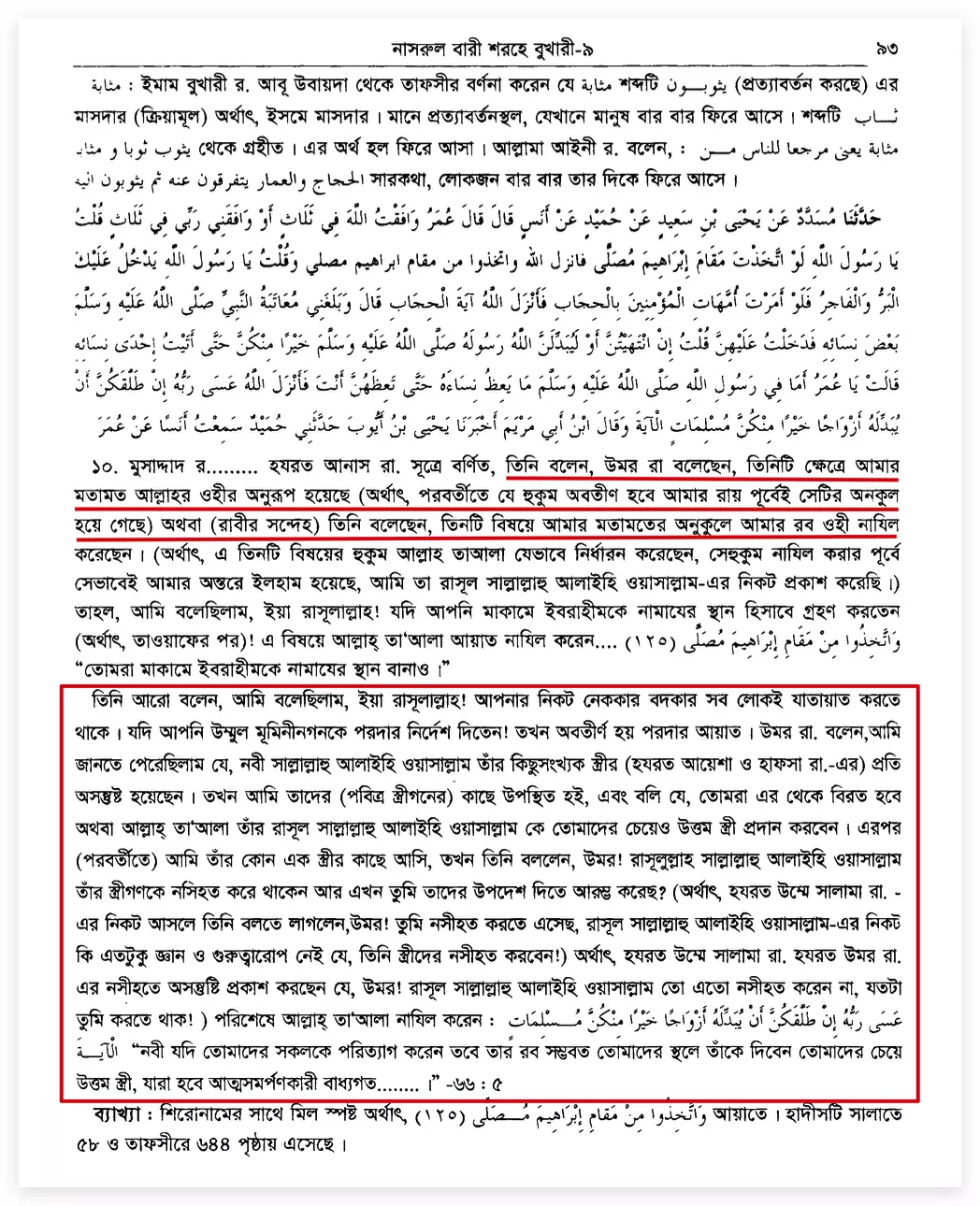
Umar himself narrated that in three matters his opinion coincided with the opinion of his Lord: making the Maqam Ibrahim a place of prayer, the ruling of hijab for the Prophet’s wives, and the revelation of a verse corresponding to his statement regarding the Prophet’s wives. In Sunni narratives, these incidents are promoted as evidence of Umar’s special status. But when this report is read logically, the very character of revelation becomes questionable. Did the all-knowing Allah not know the ruling beforehand, and then give the ruling after Umar’s advice? Or was Umar in such a powerful social position that his pressure was established as “Allah’s decision”? [58] –
Sahih Bukhari (IF)
Chapter: 8/ Prayer
Section: 273. Narration concerning the Qiblah.
393. Amr ibn ‘Awn (R.A.) …. narrated from Anas ibn Malik (R.A.), he said, ‘Umar (R.A.) said: In three matters my opinion conformed with Allah’s revelation. I said, O Messenger of Allah! If only we could make the Maqam Ibrahim a place of prayer! Then this verse was revealed: (وَاتَّخِذُوا مِنْ مَقَامِ إِبْرَاهِيمَ مُصَلًّى) “Take the Maqam Ibrahim as a place of prayer” (2 : 125)
(Second) the verse of hijab. I said: O Messenger of Allah! If only you instructed your wives to observe hijab! For both the righteous and the wicked speak with them. Then the verse of hijab was revealed.
On another occasion, the wives of the Prophet sallallahu alaihi wasallam came to him in a state of hurt pride. I then said to them: If the Messenger of Allah sallallahu alaihi wasallam divorces you, then his Lord will grant him wives better than you in your place. (66 : 5) Then this verse was revealed.
(Through another chain, Ibn Abu Maryam (R.A.) …. narrated similarly from Anas (R.A.).)
Hadith grade: Sahih (Sahih)
It is notable that Umar’s advice and the verses of Allah, written in the Preserved Tablet at the beginning of the universe, correspond so remarkably! Let us see what is said on this matter in Nasrul Bari, the commentary on Bukhari Sharif, [59]
10. Musaddad R……… narrated through Hazrat Anas R.A., he says, Umar R.A. said, In three cases my opinion was similar to Allah’s revelation (that is, my judgment had already become favorable to the ruling that would later be revealed), or (the narrator is doubtful) he said, My Lord revealed revelation in accordance with my opinion in three matters. (That is, before Allah Ta‘ala revealed the ruling for these three matters in the way He had determined it, it was inspired in my heart in that same way, and I expressed it to the Messenger sallallahu alaihi wasallam.) They are: I said, O Messenger of Allah! If you adopted the Maqam Ibrahim as a place of prayer (that is, after tawaf). Concerning this, Allah Ta‘ala revealed the verse…. )۱۲۵( وَاتَّخِذُوا مِنْ مَقَامِ إِبْرَاهِيمَ مُصَلَّى “Take the Maqam Ibrahim as a place of prayer.”
He further says, I said, O Messenger of Allah! All kinds of people, righteous and wicked, come and go to you. If only you instructed the Mothers of the Believers to observe hijab! Then the verse of hijab was revealed. Umar R.A. says, I learned that the Prophet sallallahu alaihi wasallam had become displeased with some of his wives (Hazrat Aisha and Hafsa R.A.). Then I went to them (the pure wives) and said that you must refrain from this, or Allah Ta‘ala will give His Messenger sallallahu alaihi wasallam wives better than you. After this, I later came to one of his wives, and she said, Umar! The Messenger of Allah sallallahu alaihi wasallam advises his wives, and now you have begun advising them? (That is, when he came to Hazrat Umm Salama R.A., she began saying, Umar! Have you come to advise us; does the Messenger sallallahu alaihi wasallam not have even that much knowledge and seriousness, that he would advise his wives!) That is, Hazrat Umm Salama R.A. expressed displeasure at Hazrat Umar R.A.’s advice, saying, Umar! The Messenger sallallahu alaihi wasallam does not advise as much as you keep advising!) Finally Allah Ta‘ala revealed: عَسَى رَبُّهُ إِنْ طَلْقَكُنَّ أَنْ يُبَدِّلَهُ أَزْوَاجًا خَيْرًا مِنْكُنَّ مُسْلِمات ta “If the Prophet abandons all of you, then his Lord may give him in your place wives better than you, who will be submissive, obedient………” -۶۶: ۵
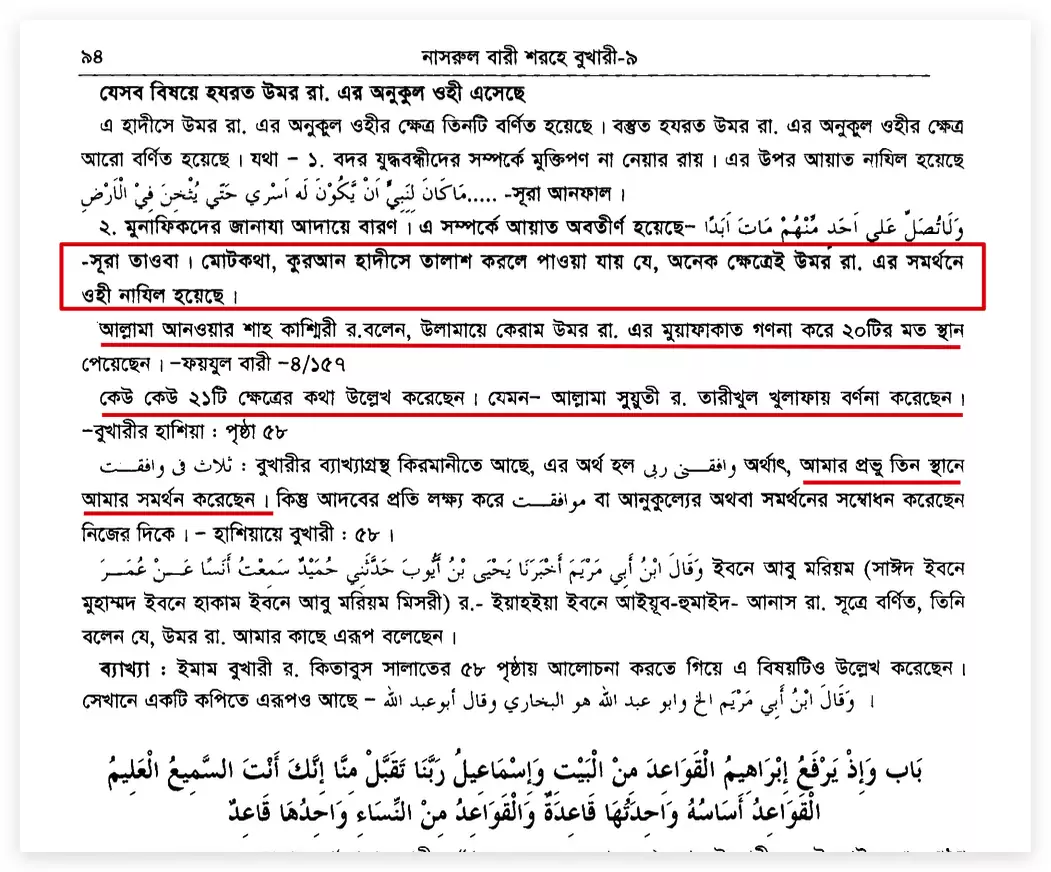
Matters in which revelation came in favor of Hazrat Umar R.A.
In this hadith, three fields of revelation in favor of Umar R.A. have been described. In fact, more fields of revelation in favor of Hazrat Umar R.A. have been narrated. Such as: 1. The opinion not to take ransom regarding the prisoners of the Battle of Badr. On this, the verse was revealed: 1 150 151 ….. مَا كَانَ لَنَبِي أَنْ يَكُونَ لَهُ أَسْرِي حَتَّى يُنْخِنَ فِي الْأَرْضِ
۲. Forbidding the performance of funeral prayer for hypocrites. Concerning this, the verse was revealed- وَلَاتُصَلِّ عَلَى أَحَدٍ مِّنْهُمْ مَاتَ أَبَدًا
-Surah Tawbah. In short, if one searches the Qur’an and hadith, it is found that revelation came in support of Umar R.A. in many cases.
Allama Anwar Shah Kashmiri R. says, the scholars counted the muwafaqat of Umar R.A. and found about ۲۰ places.
-Fayzul Bari-۴/۱۵۷
Some have mentioned ۲۱ cases. For example, Allama Suyuti R. narrated in Tarikh al-Khulafa.
-Bukhari’s marginal note: page ۵۸
ثلاث في وافقت : In Kirmani, the commentary on Bukhari, it says that its meaning is وافقی ربی, that is, my Lord supported me in three places. But out of regard for etiquette, he attributed muwafaqat, or accordance, or support, to himself. Hashiyah Bukhari: ۵۸.
وَقَالَ ابْنُ أَبِي مَرْيَمَ أَخْبَرَنَا يَحْيَى بْنُ أَيُّوبَ حَدَّثَنِي حُمَيْدٌ سَمِعْتُ أَنَسًا عَنْ عُمَرَ Muhammad ibn Hakam ibn Abu Maryam al-Misri) R. narrated through Yahya ibn Ayyub-Humayd-Anas R.A.; he said that Umar R.A. said this to me.
Explanation: Imam Bukhari R. mentioned this matter as well while discussing on page ۵۸ of Kitab al-Salat. وَقَالَ ابْنُ أَبِي مَريم الخ وابو عبد الله هو البخاري وقال أبو عبد الله
Among these incidents, the ruling of hijab is especially important. Umar repeatedly told the Prophet to prescribe hijab for his wives. The Prophet did not do so at first. Later, Umar identified the Prophet’s wife Sawda outside, called out to her, and humiliated her. After this, reports say that revelation concerning hijab was revealed. Religious narratives present this as Allah’s ruling, but the sequence of events shows that the discomfort and pressure of a male Companion regarding women’s movement, bodies, identity, and visibility ultimately took the form of a religious ruling. This is not any emancipatory morality. It is the process of legitimizing patriarchal surveillance in the language of revelation.
Here a harsh question arises: were the Prophet’s wives human beings, or a testing ground for Umar’s desire for hijab? A woman goes outside for a natural need, she can be recognized from the shape of her body, so she must be shamed, her path must be obstructed, and then that social humiliation must be made permanent through religious law. If this is “Umar’s virtue,” then the meaning of that virtue is patriarchal policing over women’s freedom of movement. Theology may call it sacred, but in the language of reason its name is simply patriarchal power.
The incident of the Maqam Ibrahim is another form of the same problem. Umar proposes making a certain place a site of prayer, and later revelation coincides with him. The question is: did the all-knowing Allah Himself not know which place ought to be made a place of prayer? If He knew, why wait for Umar’s advice? And if Umar’s advice was the effective cause of the ruling being revealed, where is the independence of revelation? The Islamic narrative avoids this question and promotes Umar’s status, but a rational reading gives a direct indication of human influence upon divine law.
The revelation of a verse corresponding to Umar’s statement regarding the Prophet’s wives is of the same kind. According to Islamic commentary, revelation also coincided with Umar’s statement about warning the Prophet’s wives or giving him better wives in their place. In these reports, Allah seems merely to be a religious authority validating Umar’s language. Umar speaks first; Allah later sends it down as revelation. Such a sequence may seem miraculous to a devotee, but to a critic it is a clear sign of the human production of revelation, social pressure, and patriarchal power-politics. [60]
Sahih Bukhari (Islamic Foundation)
۵۲/ Tafsir
Section: The statement of Allah Ta‘ala: لا تدخلوا … عند الله عظيما O believers! Do not enter the Prophet’s houses until permission is given to you for a meal, without waiting for its preparation; but when you are called, then enter, and when you have eaten, then disperse, without becoming absorbed in conversation. This conduct of yours certainly causes pain to the Prophet. He feels shy to ask you to leave. But Allah does not feel shy to speak the truth. And when you ask his wives for anything, ask them from behind a screen. This is purer for your hearts and for their hearts. It is never lawful for any of you to hurt Allah’s Messenger, nor to marry his wives after his death. This is a grave offense in the sight of Allah. It is said إِنَاهُ means the cooking of food. It is formed from أَنَى يَأْنِيْ أَنَاةً. لَعَلَّ السَّاعَةَ تَكُوْنُ قَرِيْبًا perhaps the Hour is very near. If you use it as feminine, then you will say قَرِيْبَةً. And if you do not take it as الصِّفَةَ but use it as ظَرْفًا or بَدَلًا, then you will not attach ‘ta’ to it. Likewise, this word is used in the singular, dual, plural, and in all cases of feminine and masculine.
Islamic Foundation number: 4432, international number: 4795
4432. Zakariya ibn Yahya (R.A.) … narrated from Aisha (R.A.). She said, After the ruling of hijab was revealed, Sawda went out for a natural need. Sawda had such a large body that she could not hide herself from people who knew her. Umar ibn Khattab (R.A.) saw her and said, O Sawda! Know that, by Allah, you cannot remain hidden from our sight. Now see how you will go outside? Aisha (R.A.) said, hearing this, Sawda (R.A.) returned. At that time the Messenger sallallahu alaihi wasallam was eating the night meal in my room. In his hand was a piece of bone. Sawda (R.A.) entered the room and said, O Messenger of Allah! I had gone out for a natural need. Then Umar (R.A.) said such-and-such things to me. Aisha (R.A.) said, at that time Allah Ta‘ala revealed revelation to him. When the revelation ended, the piece of bone was still in his hand; he had not put it down. The Messenger sallallahu alaihi wasallam said, You have certainly been permitted to go out for your needs.
Hadith grade: Sahih (Sahih)
Narrator: Aisha bint Abu Bakr Siddiq (R.A.)
The Prisoners of Badr: The Prophet Chose Ransom, Umar Wanted Them Killed
One of the most brutal examples of “Muwafaqat Umar” is the case of the prisoners captured at the Battle of Badr. According to Sahih Muslim, after seventy men had been killed and another seventy taken captive at Badr, Muhammad asked Abu Bakr and Umar for their opinions about the prisoners. Abu Bakr appealed to kinship and proposed taking ransom and releasing them, hoping that they might later become Muslims. Umar proposed the exact opposite, and his proposal was far bloodier: the captives should be handed over to the Muslims and beheaded; Ali should personally kill his own brother Aqil, while Umar himself should personally kill one of his own relatives. [61]
Original Arabic:
وَلَكِنِّي أَرَى أَنْ تُمَكِّنَّا فَنَضْرِبَ أَعْنَاقَهُمْ، فَتُمَكِّنَ عَلِيًّا مِنْ عَقِيلٍ فَيَضْرِبَ عُنُقَهُ، وَتُمَكِّنِّي مِنْ فُلَانٍ نَسِيبًا لِعُمَرَ فَأَضْرِبَ عُنُقَهُ، فَإِنَّ هَؤُلَاءِ أَئِمَّةُ الْكُفْرِ وَصَنَادِيدُهَا
English translation:
Umar said: “I do not hold the same opinion as Abu Bakr. Rather, my view is that you should hand them over to us so that we may strike off their heads. Give Aqil to Ali so that he may strike off his head, and give me one of my own relatives so that I may strike off his head, for these men are the leaders and chiefs of disbelief.”
Muhammad, however, did not accept Umar’s proposal for execution. Umar himself states in Sahih Muslim that the Messenger preferred what Abu Bakr had said and did not prefer what Umar had said. At the moment of decision, therefore, the Prophet’s choice was not the beheading of the captives but the acceptance of ransom.
Original Arabic:
فَهَوِيَ رَسُولُ اللَّهِ صَلَّى اللَّهُ عَلَيْهِ وَسَلَّمَ مَا قَالَ أَبُو بَكْرٍ وَلَمْ يَهْوَ مَا قُلْتُ
English translation:
“The Messenger of Allah preferred what Abu Bakr had said and did not prefer what I had said.”
But the next day the scene changes dramatically. Umar comes and finds Muhammad and Abu Bakr sitting and weeping. Muhammad says that he had been shown the punishment that could have fallen upon his Companions because ransom had been accepted from the prisoners. The narration then connects the episode with Qur’an 8:67–69: “It is not for a prophet to have captives until he has thoroughly subdued the enemy in the land”; people desire the goods of this world, while Allah desires the Hereafter. [62] [63]
The theological discomfort of the episode lies precisely here. The Qur’an does not repeat Umar’s exact proposal that Muslim relatives should personally behead their captive relatives. But within the narrative structure of Sahih Muslim, the ransom policy preferred by Muhammad is the policy subsequently rebuked by revelation, while Umar’s harsher position is placed closer to Allah’s later declaration than the Prophet’s original choice. Once again the same pattern appears: the Prophet takes one position, Umar takes the opposite position, and revelation then comes down against the position the Prophet had chosen.
To celebrate this as “Umar’s virtue” requires accepting its devastating theological price. If subsequent revelation proves that Umar’s position was closer to Allah’s intention, why was Allah’s own Prophet behind Umar in such an important decision of war and punishment? Muhammad chose ransom, Umar wanted the prisoners killed, and on the next day Muhammad is portrayed as weeping over the possibility of punishment because of the decision he had accepted. Calling this Umar’s “foresight” therefore amounts to admitting that Umar’s human military judgment reached the supposedly correct position before the Prophet’s own judgment did.
The moral ugliness of the proposal is no less significant. Umar did not merely propose “punishing the prisoners.” He proposed a theatrical demonstration in which Muslims would personally execute their own captive relatives. Aqil was to be handed to Ali, while Umar wanted one of his own relatives handed to himself. The purpose was to display the brutal superiority of the new religious allegiance over blood and family ties. When later religious narratives transform this severity into “correct insight” or agreement with Allah, the proposal for this extreme killing itself becomes an ingredient in Umar’s religious virtue.
The case of the prisoners of Badr is therefore one of the most explosive examples of Muwafaqat Umar: the Prophet chose ransom, Umar chose killing, the Prophet rejected Umar’s position, and then revelation rebuked the very policy the Prophet had chosen. If this is presented as Umar’s glory, it must simultaneously be admitted that in a major decision Umar reached a position closer to Allah’s subsequent declaration before the Prophet did. The greater this “virtue” is made, the greater the problem becomes for the claim that the Prophet possessed the highest divine guidance.
An even more important example is the matter of the funeral prayer for a hypocrite. In the narration, it is seen that when the Prophet went to perform the funeral prayer for Abdullah ibn Ubayy, Umar prevented him or objected. Later, a verse was revealed in which it was forbidden to perform the funeral prayer for hypocrites. Here too, the same pattern appears. The Prophet is about to do something, Umar objects, and later revelation shifts toward Umar’s position. Religious interpretation will call this Umar’s foresight. But the rational question is: was the Prophet’s decision then wrong? If the Prophet was proceeding along the wrong path, then where is the Prophet’s moral and legal authority? And if the Prophet was not wrong, why did Allah’s subsequent revelation coincide with Umar’s objection? [64]
Sahih Bukhari (Islamic Foundation)
۲۰/ Funerals
Section: ۸۶۷. The undesirability of performing the funeral prayer for hypocrites and seeking forgiveness for polytheists.
Islamic Foundation number: 1282 , international number: 1366
رَوَاهُ ابْنُ عُمَرَ رَضِيَ اللَّهُ عَنْهُمَا عَنِ النَّبِيِّ صَلَّى اللَّهُ عَلَيْهِ وَسَلَّمَ
(Abdullah) ibn Umar (R.A.) narrated this matter from the Prophet sallallahu alaihi wasallam.
1282. Yahya ibn Bukayr (R.A.) … narrated from Umar ibn Khattab (R.A.), he said, When the leader of the hypocrites, Abdullah ibn Ubayy ibn Salul*, died, the Messenger of Allah sallallahu alaihi wasallam was called for his funeral prayer. When the Messenger of Allah sallallahu alaihi wasallam stood up (with the intention of performing the prayer), I quickly went to him and said, O Messenger of Allah! Are you going to perform the funeral prayer (namaz/prayer) for Ibn Ubayy? Yet on such-and-such days he said such-and-such things (about your honor and about the believers). Saying this, I counted and repeated his statements.
The Messenger of Allah sallallahu alaihi wasallam smiled slightly and said, Umar, move aside! When I objected repeatedly, he said, I have been given a choice (regarding performing his prayer). Therefore I have accepted it. If I knew that seeking forgiveness more than seventy times would result in his being forgiven, I would certainly seek forgiveness more times than that.
Umar (R.A.) said, After this, the Messenger of Allah sallallahu alaihi wasallam performed their funeral prayer (namaz/prayer) and returned. Shortly thereafter, these two verses of Surah Bara’ah were revealed: وَلاَ تُصَلِّ عَلَى أَحَدٍ مِنْهُمْ مَاتَ أَبَدًا) إِلَى (وَهُمْ فَاسِقُونَ Never perform the funeral prayer (namaz/prayer) for any of them when he dies. In a state in which they are fasiq. (Surah Tawbah: ۸۴)
The narrator says, I was astonished at my bold conduct that day before the Messenger of Allah sallallahu alaihi wasallam. Allah and His Messenger know best. * The father of the leader of the hypocrites, Abdullah, was named Ubayy, and his mother was named Salul. Therefore he was also called Ibn Salul.
Hadith grade: Sahih (Sahih)
Narrator: Umar ibn al-Khattab (R.A.)
If these incidents are seen separately as individual “glories,” the main pattern remains hidden. But when placed together, the picture becomes clear. Umar’s opinions, discomforts, social pressures, patriarchal outlook, or political positions repeatedly coincided with religious rulings. If this correspondence happened once, it could be called coincidence. If it happened twice, it could be called an interesting event. But when the same tendency appears again and again, the question becomes unavoidable: did revelation descend from Allah, or were the psychology, social influence, and political position of powerful figures like Umar established in religious language?
In religious narratives, Umar does not agree with Allah; rather, Allah agrees with Umar. This language itself is abnormal. If the ruling of an omnipotent, omniscient, eternal being comes after the opinion of one human being and validates that opinion, then it is not proof of divine omniscience. Rather, it shows that the rulings propagated in the name of revelation were negotiating with real social and political contexts. Umar was one of the most powerful participants in that negotiation.
Here there is a moral problem with Umar, and there is also a serious problem with the concept of revelation. If Umar truly reached the correct decision before Allah’s ruling, then the question arises: why was Allah’s ruling not revealed earlier? And if Allah revealed the ruling after Umar’s pressure or opinion, then it is difficult to call revelation an independent, eternal, omniscient plan. In that case, revelation must instead be seen as a religious discourse adapted to the demands of powerful men, social tensions, sexual policy, hijab-politics, and political necessity.
For this reason, “Muwafaqat Umar” is not an innocent list of virtues. It is a powerful internal testimony against the Islamic concept of revelation. It shows that the rulings propagated in Allah’s name were not, in practice, free from the power relations of human society. Umar was not merely a follower there; he was a figure who influenced the process of legislation. His personal discomfort sometimes became hijab, his proposal about a place became part of worship, his political objection corrected the Prophet’s decision, and his statement increased religious pressure upon women. This can be called virtue only when power is placed above morality.
Therefore, the idea of Umar-centered revelation is in reality an explosive confession placed inside Islam’s sacred history. It tells us that early Islamic law was not simply a perfect law descending from the sky; it was formed together with human bodies, male jealousy, social pressure, political calculation, the opinions of powerful Companions, and the real tensions of the Prophet’s environment. However much Umar may be glorified, it cannot be denied that his wishes and pressures repeatedly received the language of religious law. And this is not divine glory; it is the construction of power’s legitimacy in religious language.
Intercourse on the Nights of Fasting: Umar Broke the Rule, Allah Changed the Law
Islamic law is usually presented as a heavenly, flawless body of rulings given by an omniscient being. But when one reads the history of Islam’s early rulings, it appears that in many cases this law was experimental among the Companions, at times impractical, in conflict with actual human behavior, and changeable under pressure from influential Companions. The ruling on intercourse and eating and drinking during the nights of Ramadan is a stark example of that problem. In the beginning, the ruling on fasting was strict: after the Isha prayer or after falling asleep, no one could eat, drink, or have intercourse with his wife. This prohibition was in force, but a large portion of Muslims failed to observe it. In particular, the incident of Umar ibn al-Khattab has been mentioned in tafsir and narrative literature as a major background to the change in this ruling.
The incident here is extremely important. Allah gave a ruling. That ruling came into force upon the Muslims. Then it became clear that even the Prophet’s own close Companions were unable to follow it. Umar could not restrain his own desire; even after knowing that his wife had fallen asleep, he had intercourse. Later he went to the Prophet and confessed what he had done. The Qur’an itself describes this condition as “betraying yourselves” or self-deception. In other words, this was not an innocent mistake. It was a violation of an operative religious ruling. Yet what was the result? No severe punishment came upon Umar or the other Companions; rather, Allah Himself changed the ruling. The prohibition was relaxed, intercourse with wives at night became lawful, and the time limit for eating and drinking was also made easier.
Let us read the verse from Surah Al-Baqarah of the Qur’an, [65] –
It has been made lawful for you to go to your wives on the nights of Ramadan; they are a covering for you and you are a covering for them. Allah knew that you were deceiving yourselves. So He pardoned you and relieved you. Therefore, from now on you may have intercourse with them and seek what Allah has ordained for you, and continue to eat and drink until the white thread of dawn becomes distinct to you from the black thread. Then complete the fast until nightfall, and do not have intercourse with them while you are in i‘tikaf in the mosques. These are the laws of Allah, so do not go near them. Allah explains His verses in detail for humankind so that they may become muttaqi.
— Taisirul Quran
It has been made lawful for you to associate with your wives on the nights of Ramadan; they are a covering for you and you are a covering for them, Allah knows that you were harming yourselves; therefore He turned toward you and lightened your burden; so now you may unite with them even on the nights of Ramadan and seek what Allah has written for you, and eat and drink until the white thread becomes distinct from the black thread at dawn; then complete the fast until nightfall; and do not unite with them while you are in i‘tikaf in the mosques; these are the limits of Allah. Therefore do not even go near them; thus Allah explains His signs for humankind, so that they may be restrained.
— Sheikh Mujibur Rahman
On the nights of fasting, it has been made halal for you to go to your wives. They are garments for you and you are garments for them. Allah has known that you were betraying yourselves. Then He accepted your repentance and pardoned you. Therefore, now unite with them and seek what Allah has written for you. And eat and drink until the white thread of dawn becomes clear from the black thread. Then complete the fast until night. And do not unite with your wives while you are in i‘tikaf in the mosques. This is the boundary of Allah, so do not go near it. Thus Allah makes His verses clear for people so that they may adopt taqwa.
— Rawai Al-bayan
Intercourse with wives has been made lawful for you on the nights of fasting [1]. They are as garments for you, and you too are as garments for them. Allah knows that you were betraying yourselves. So He accepted your repentance and pardoned you. Therefore now associate with them and seek what Allah has ordained for you. And eat and drink until the white thread of dawn becomes clearly manifest to you from the black thread of night [2]. Then complete the fast until the arrival of night. And do not associate with them while you are in i‘tikaf [3] in the mosques. These are the boundaries of Allah. Therefore do not go near them [4]. Thus Allah makes His verses clearly manifest for people, so that they may possess taqwa.
— Dr. Abu Bakr Muhammad Zakaria
In Islamic discourse, this incident is usually called “Allah’s mercy.” But from a logical point of view, it is not mercy; it is a legal retreat. A ruling was put into force, people did not obey it, even influential Companions did not obey it, and in the end the ruling was changed. If this incident is to be accepted as divine wisdom, then the question arises: did the omniscient Allah not know from the beginning that people would be unable to observe this ruling? If He knew, then why did He issue such an impractical ruling in the first place? And if He did not know, then where is the claim of His omniscience? The picture that emerges here is that the law did not control human behavior; rather, human behavior forced the law to change.
In Tafsir al-Jalalayn, Mazhari, Ibn Kathir, and many other tafsirs, the role of Umar and other Companions in this incident has been mentioned. There it is said that Umar had intercourse with his wife during the prohibited time, then informed the Prophet of the matter; other Companions also confessed to similar acts, and then the verse was revealed. When these reports are placed together, it becomes clear that behind the change in the ruling was not merely personal deviation but disobedience on a social scale. In other words, the ruling had become impractical within Muslim society itself. The alleged law of Allah could not withstand the pressure of real society.
Let us read the tafsir of this verse, [66] –
Translation:
187. On the nights of fasting, unrestricted relations with your wives, that is, intercourse, have been made lawful for you. In the earliest period of Islam, during fasting, food, drink, and intercourse with wives became forbidden immediately after Isha. Allah ta’ala revealed this verse abrogating that ruling.
They are your garments and you are their garments. Here, by describing each as a garment for the other, an indication is given of their intimate mutual relationship and their dependence upon one another. Allah knew that on the nights of fasting you were deceiving, betraying yourselves by having intercourse with your wives. Such acts had occurred on the part of Hazrat Umar and some Companions during the prohibited time. They then presented their excuse regarding this matter before Rasulullah.
Allah ta’ala says: thereafter He turned toward you in forgiveness, accepted your repentance, and forgave your offense. Therefore, now that it has been made lawful for you, associate with them, engage in intercourse, and seek what Allah has ordained for you, that is, the lawfulness of intercourse with wives, or the child that has been placed in your destiny.
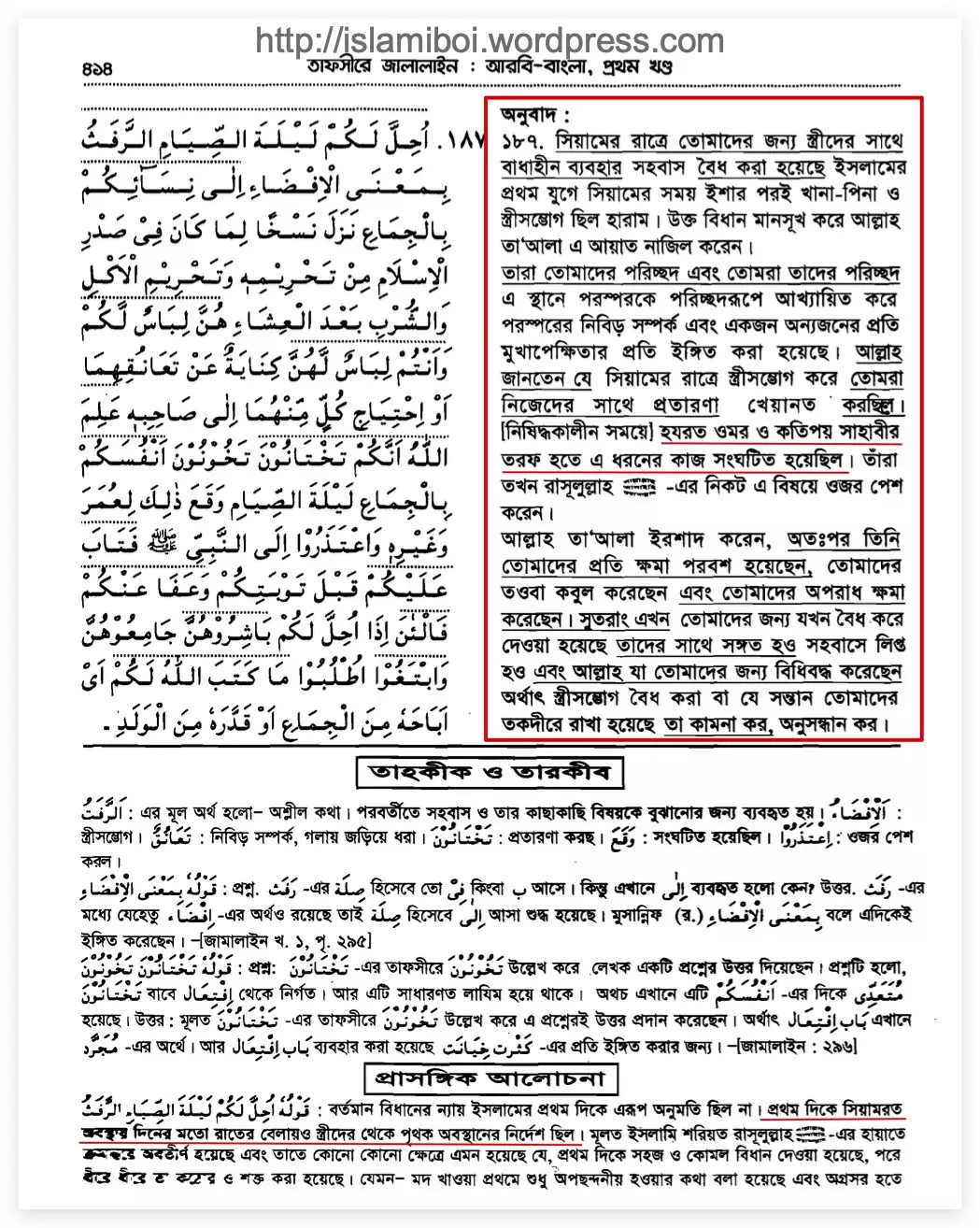
Now let us see what is said in Tafsir Mazhari, [67] –
… Then he went to his wife. Meanwhile, Hazrat Ka’b bin Malik also did the same. When the matter was brought to the attention of the Noble Messenger, s., in the morning, this verse was revealed. Baghawi said that in the early period of Islam, if someone lay down before the Isha prayer, then food, drink, and intercourse became forbidden for the rest of the night. One day Hazrat Umar violated this prohibition. The next day he informed the Most Sacred Messenger, s., of the incident. He, s., said, Umar, such conduct was not becoming of you. Then a number of other Companions stood up and confessed that similar incidents had occurred with them as well. It was then that this verse was revealed.
In the next sentence comes testimony to this effect: He turned toward you in forgiveness and forgave your offense. Therefore, from now on, association at any part of the night is lawful.
Seek what Allah has ordained for you means: through intercourse with wives, seek the offspring that Allah has decreed in your destiny. Through this statement it is proven that the desire for children should be the principal objective of intercourse with wives. The fulfillment of sensual desire should not be the main objective. The Most Sacred Messenger, s., said: marry a woman who loves her husband and is capable of bearing many children, for I shall take pride in surpassing the numbers of the ummahs of other prophets through your great number. Abu Dawud and Nasa’i narrated this hadith from Hazrat Ma’qal bin Yasar. This sentence of the verse proves that during intercourse, ‘azl, that is, ejaculation outside the wife’s organ, is makruh, undesirable. The sentence also indicates that satisfying sexual desire through the proper organ is mubah, lawful. Baghawi said that according to Hazrat Mu’adh bin Jabal, the meaning of the phrase ma kataballahu lakum is Laylatul Qadr. I say that the wording of the sentence does not support this opinion.
“And eat and drink until the white thread of dawn becomes clearly manifest to you from the black thread of night”—in this sentence, “khayt abyad” means the light of day and “khayt aswad” means the darkness of night. At the beginning of fajr, a long line stretching north to south is seen in the eastern sky. The word “khayt” has been used here to indicate that line. If “khaytil abyad” is fajr, that is, day, then “khaytil aswad” must necessarily mean night. In the phrase “minal fajr,” the preposition min expresses a partial state. And “khaytil abyad” denotes the state of fajr. Here fajr means a portion of fajr. Until fajr appears—such a statement is being made here…
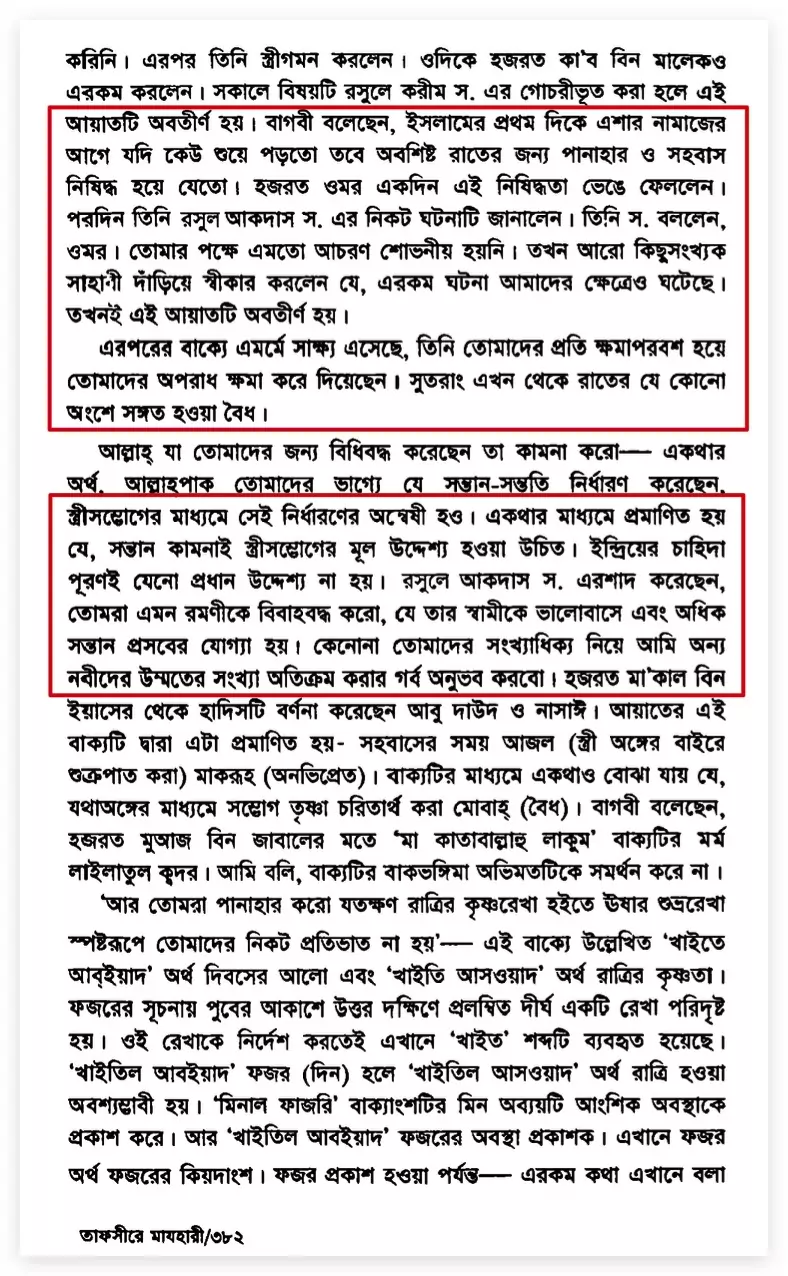
Now let us look at Tafsir Ibn Kathir: Allah’s helpless surrender before the desire of Umar and other Companions to have intercourse with their wives [68]
عَلِمَ اللَّهُ أَنَّكُمْ كُنْتُمْ تَخْتُنُونَ اَنْفُسَكُمْ فَتَابَ عَلَيْكُمْ وَعَفَا عَنْكُمْ ta’ala knows that you were betraying yourselves in your own matter. Thereafter He accepted your repentance and forgave you.
Ali ibn Talhah narrates from Hazrat Ibn Abbas (ra): in the month of Ramadan, when the Muslims completed the Isha prayer, from then until the next Maghrib, eating, drinking, and intercourse with wives became forbidden for them. Nevertheless, in the case of some of them, exceptions to this occurred during Ramadan. Hazrat Umar (ra) was among them. As a result, a group of people raised this complaint in the court of the Noble Prophet (sa). Then Allah ta’ala revealed this verse granting concession.
Hazrat Awfa narrates from Musa ibn Uqbah, he from Kurayb, and he from Ibn Abbas (ra):
Before this verse on fasting was revealed, the Muslims would eat, drink, and go to their wives at night. But once they fell asleep, from then until the following evening they would not eat, drink, or have intercourse with their wives. Even so, one day news reached us that Umar ibn Khattab had woken from sleep and gone to his wife. In the meantime, he appeared in the court of the Noble Prophet (sa) and said: “I have come to complain before Allah and the Messenger of Allah against my own deed.” The Messenger (sa) asked: what have you done? He replied: “Although I had intended to fast, after waking from sleep I went to my wife.” The Messenger (sa) said: this was not a proper act for you. Then the verse under discussion was revealed.”
Ata ibn Rubah, Qays ibn Sa’d, and Sa’id ibn Abi Urwah narrate successively from Hazrat Abu Hurayrah (ra):
Before this verse was revealed, in Ramadan, after the Muslims had completed the Isha prayer, if they went to sleep, then until the following evening eating, drinking, and intercourse with wives became forbidden for them. Then Umar ibn Khattab had intercourse with his wife after the Isha prayer, and Surakah ibn Qays Ansari, overcome with sleep after the Maghrib prayer, fell asleep and remained asleep until before the Messenger (sa) led the Isha prayer. Then after performing the Isha prayer, he ate and drank. The next morning they came and related all these conditions in the service of the Messenger (sa). It was then revealed:
أُحِلَّ لَكُمْ لَيْلَةَ الصَّيَامِ الرَّفَثُ إِلَى نِسَائِكُمْ …… ثُمَّ أَتِمُّوا الصِّيَامَ إِلَى اللَّيْلِ Indeed, this is nothing but the great mercy and grace of Allah ta’ala.
Husayn ibn Abd al-Rahman and Hisham narrate respectively from Abd al-Rahman ibn Abi Layla:
“One day Umar ibn Khattab (ra) stood up and said: ‘O Messenger of Allah! Last night I expressed to my wife the desire that a man has for a woman. My wife informed me that she had gone to sleep. I considered that to be her excuse and had intercourse with her.’ It was then concerning him that this verse was revealed: ثُمَّ اَتِمُّوا الصَّيَامَ إِلَى اللَّيْلِ …. Shu’bah and Amr ibn Shu’bah narrate similarly in sequence from Ibn Abi Layla. Ibn Jarir narrates from Ka’b ibn Abd al-Malik through, successively, Abdullah ibn Ka’b, the freedman of Banu Salamah, Musa ibn Jubayr, Abu Lahi’ah, Ibn al-Mubarak, Suwayd, Muthanna, and Abu Ja’far:
“The condition of the people in the month of Ramadan was that if someone, while fasting, fell asleep at night, then from that point until the next iftar, eating, drinking, and intercourse with wives became forbidden for him. One night Umar ibn Khattab returned home late from the court of Rasulullah (sa). At that time his wife was asleep. When he expressed to her his desire to satisfy his passion, his wife said, I had gone to sleep. He did not believe this and had intercourse with her. Ka’b ibn Malik says: at dawn Umar ibn Khattab came into the service of the Messenger (sa) and described this condition to him. Then Allah ta’ala: … meaning, Allah ta’ala has known that you were betraying yourselves. Thereafter Allah ta’ala accepted your repentance; so from now on you may go to your wives.
Similarly, Mujahid, Ata, Ikrimah, Qatadah, and others have narrated the incident of Hazrat Umar (ra) and Surakah ibn Qays Ansari as the reason for the revelation of this verse. Thereafter, as a mercy, grace, and love from Allah, Allah ta’ala made intercourse with wives, eating, and drinking permissible throughout the whole night of Ramadan.
… In explaining the phrase “seek it,” Abu Hurayrah, Ibn Abbas, Anas, Qadi Shurayh, Mujahid, Ikrimah, Sa’id ibn Jubayr, Ata, Rabi ibn Anas, Suddi, Zayd ibn Aslam, Hakam ibn Utbah, Muqatil ibn Hayyan, Hasan Basri, Dihhak, Qatadah (r), and other Companions and Tabi’in say: its meaning is “offspring.”
Abd al-Rahman ibn Zayd ibn Aslam interpreted وَابْتَغُوا مَا كَتَبَ اللَّهُ لَكُمْ as “intercourse.” Umar ibn Malik al-Bukri narrated from Abu Jawza, and he from Hazrat Ibn Abbas (ra), that the meaning of وَابْتَغُوا مَا كَتَبَ اللَّهُ لَكُمْ is Laylatul Qadr. Ibn Abi Hatim and Ibn Jarir also narrated similarly.
Abd al-Razzaq says: Ma’mar informed me that Qatadah وَابْتَغُوا الرُّحْصَةُ الَّتِي كَتَبَ اللهُ لَكُمْ يَقُولُ مَا أَحَلَّ اللَّهُ لَكُمْ : seek the concession that has been written for you. Some have said: “Seek whatever has been made halal for you.”
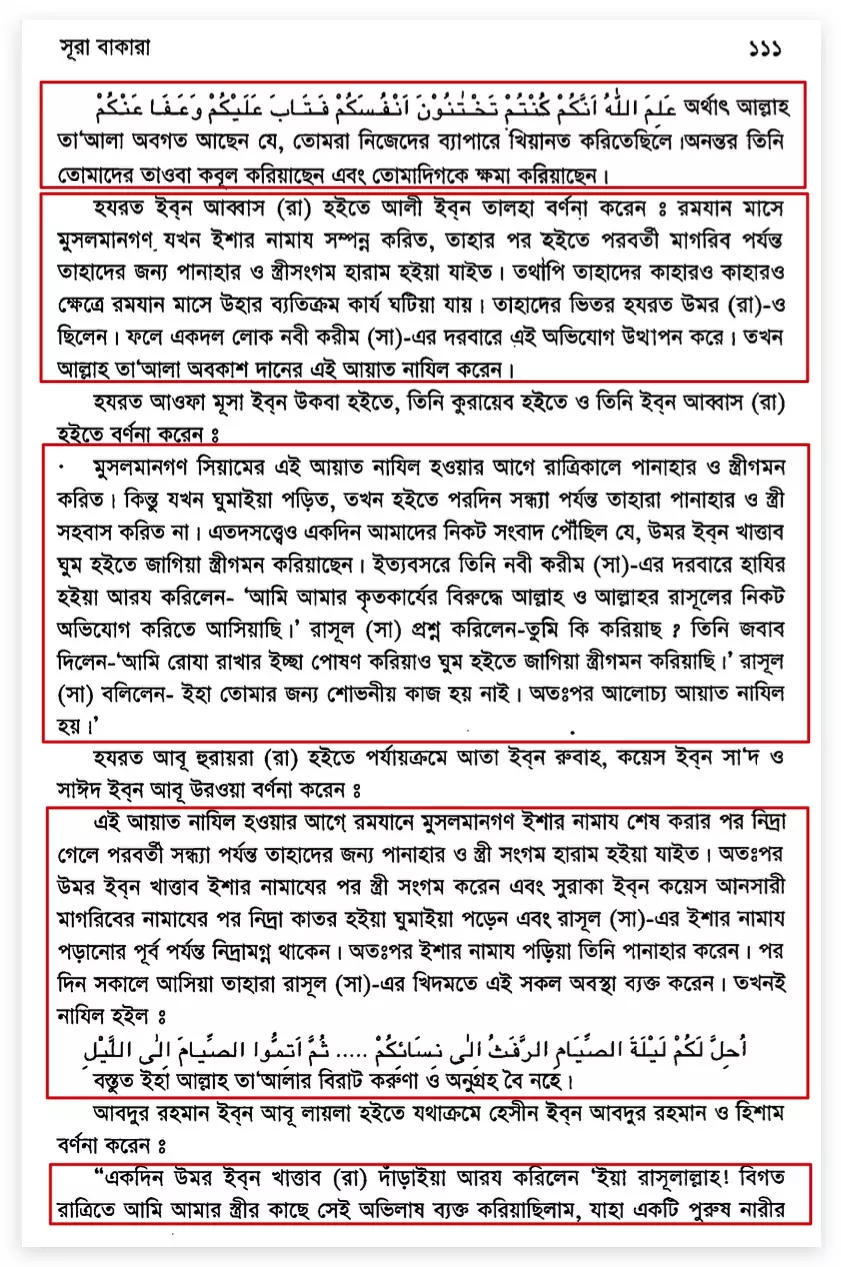
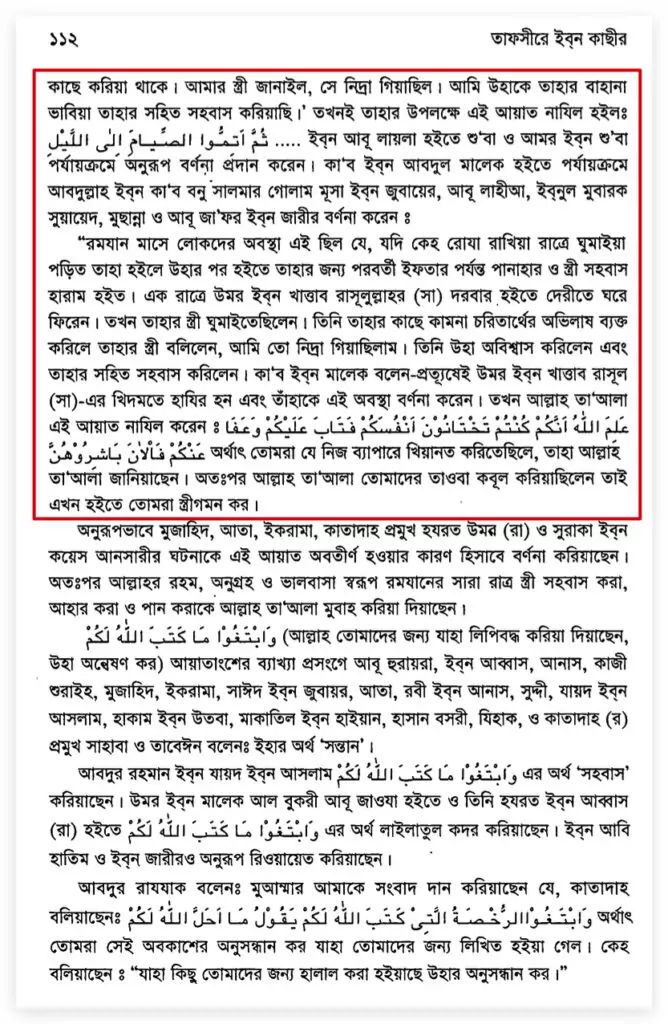
Umar’s position in this incident is extremely embarrassing. The very Umar who was later presented as a symbol of Islam’s strict morality, administrative discipline, taqwa, and justice broke an operative ruling of fasting before his bodily desire. He was not some ordinary rural Muslim; he was a close, influential, and politically important Companion of the Prophet. His act, therefore, was not merely an incident of personal desire. It shows that at the very beginning of Islam, rulings promoted in the name of “Allah’s law” were, in practice, bargaining with the lives and impulses of powerful followers.
The most absurd point is that this failure was later promoted as Allah’s compassion. Allah gave the law, people broke the law, then Allah changed the law, and theology said: see, what mercy! But in the eyes of reason, this is not compassion; it is a failure of principle. If a law is not realistic from the beginning, relaxing it later does not prove the lawgiver’s foresight. Rather, it proves that the law originally rested upon a mistaken understanding of human nature, social reality, and behavioral limits. The claim of omniscience remains on paper here; in practice, what remains is incompetent legislation.
The Qur’anic language, “you were betraying yourselves,” is highly significant. Here the behavior of the Muslims is being called betrayal, but in response to that betrayal comes not punishment, but relaxation of the ruling. In the case of ordinary people, religious law is often strict, but in the case of influential Companions, the law itself becomes soft. This is another form of Umar-centered revelation. Umar did not obey the ruling; later the ruling was changed to suit people like him. This process is called sacred, but in reality it is an ugly testimony to the human and political character of religious law.
There is another moral question here as well. The narration says that Umar’s wife had said she had fallen asleep, but Umar considered that to be an excuse and had intercourse. This part is usually suppressed in religious explanation, because it is not convenient for Umar’s character. Rejecting a woman’s statement and satisfying one’s own desire is not a moral virtue. Islamic tafsir uses this almost as the background for a change in the ruling, but it does not engage in any serious moral discussion about the woman’s consent, discomfort, or position. In other words, in this incident not only does Allah’s law become soft; the woman’s voice is also suppressed within the religious narrative.
This single incident reveals three weaknesses of early Islam. First, the ruling declared in Allah’s name was not compatible with reality from the beginning. Second, the disobedience of influential Companions could become a reason for changing a ruling. Third, women’s bodies, consent, and experiences become secondary in discussions of religious law. Umar’s desire, the Companions’ inability, and Muslim society’s violation of the ruling ultimately received legitimacy under the name of “mercy.” To call this incident spiritual beauty is intellectual dishonesty. It directly shows that Islamic law changed before human impulse, power, and social pressure.
Therefore, this account of intercourse on the nights of Ramadan is not a trivial domestic incident. It is a deep internal testimony against Islam’s legal claims. Umar broke an operative ruling, others did the same, and then revelation came and legitimized that rupture. This is where Islam’s claim to divine law becomes seriously questionable. If Allah’s law changes when it does not match human desire, then it is not an eternal moral truth; it is a situation-dependent social rule. And if an influential Companion like Umar stands at the center of that change, then it is more honest to call it revelation becoming soft before a powerful follower, rather than sacred foresight.
Mut’ah Marriage: Its Validity in the Prophetic Era and Umar’s Prohibition
Mut’ah marriage is one of the most uncomfortable issues in the legal history of Islam. This is because it is not merely a question of sexual ethics or marriage; it directly shows how unstable, contradictory, and politically mutable the sources of Islamic law actually were. Sunni theology today presents mut’ah as haram, yet within Islamic sources themselves there are reports showing that mut’ah was practiced during the time of the Messenger and even during the time of Abu Bakr, and that Umar later came and prohibited it. This information is extremely dangerous, because it directly raises the question of the caliph’s legal intervention over the Prophet’s Sunnah.
In Sahih Muslim, in the narration of Jabir ibn Abdullah, it is reported that they used to contract mut’ah during the time of the Messenger of Allah and during the time of Abu Bakr for a small compensation, and that Umar later prohibited it after a particular incident. Another report in the same line also mentions the “two mut’ahs”: mut’ah with women and tamattu’ in Hajj. If these reports are accepted, then the question arises: by what authority did Umar prohibit a practice that existed in the Messenger’s time and continued during Abu Bakr’s time? If a caliph comes and abolishes a practice that the Prophet had made lawful, or at least allowed to continue in the Prophetic era, then who is the final lawgiver in Islam? Allah and the Messenger, or Umar? [69] [70] [71] [72] [73] [74] –
Sahih Muslim (Islamic Foundation)
17/ Marriage
Chapter: 3. Mut’ah marriage; it was lawful, then it was abrogated, then made lawful, then abrogated again, and now its illegality will remain in force until the Day of Resurrection
3285. Hasan Hulwani (rh) … Ata (rh) said, Jabir ibn Abdullah (ra) came to perform Umrah. We then went to him at his lodging. People asked him about various matters. Then, when they mentioned mut’ah, he said, Yes, we contracted mut’ah marriage during the time of Rasulullah sallallahu alaihi wa sallam, and during the time of Abu Bakr (ra) and Umar (ra).
Hadith grade: Sahih (Sahih)
Narrator: Ata ibn Abi Rabah (rh)
Sahih Muslim (Islamic Foundation)
17/ Marriage
Chapter: 3. Mut’ah marriage; it was lawful, then it was abrogated, then made lawful, then abrogated again, and now its illegality will remain in force until the Day of Resurrection
3286. Muhammad ibn Rafi (rh) ... Abu Zubayr (rh) said, I heard Jabir ibn Abdullah (ra) say: We used to contract mut’ah marriage during the time of Rasulullah sallallahu alaihi wa sallam and during the time of Abu Bakr (ra), in exchange for a handful of dates or flour. Eventually Umar (ra), in connection with the matter of Amr ibn Hurayth, prohibited it.
Hadith grade: Sahih (Sahih)
Narrator: Abu Zubayr (rh)
Sahih Muslim (Islamic Foundation)
17/ Marriage
Chapter: 3. Mut’ah marriage; it was lawful, then it was abrogated, then made lawful, then abrogated again, and now its illegality will remain in force until the Day of Resurrection
3287. Hamid ibn Umar Bakrawi (rh) … Narrated from Abu Nadrah (rh). He said, I was present with Jabir ibn Abdullah (ra). A man came to him and said, Ibn Abbas (ra) and Ibn Zubayr (ra) have differed with one another regarding the two kinds of mut’ah (tamattu’ Hajj and mut’ah marriage). Then Jabir (ra) said, We practiced both kinds of mut’ah in the presence of Rasulullah sallallahu alaihi wa sallam. Then Umar (ra) forbade us from doing both of them. Therefore, we did not do them anymore.
Hadith grade: Sahih (Sahih)
Sahih Muslim (Hadith Academy)
17. Marriage
Chapter: 3. Mut’ah marriage was lawful, then it was abrogated, then made lawful, then abrogated again, and it will remain so until the Day of Resurrection
3307-(16/…) Muhammad ibn Rafi’ (rh) ….. Abu Zubayr (rh) said, I heard Jabir ibn ‘Abdullah (razi.) say, We used to contract mut’ah marriage in exchange for a handful of dates or flour during the time of Rasulullah sallallahu alaihi wa sallam and during the time of Abu Bakr (razi.). Eventually Umar (razi.), in connection with the matter of Amr ibn Hurayth, prohibited it.*. (Islamic Foundation 3282, Islamic Center 3280)
* Amr ibn Hurayth contracted mut’ah marriage in Kufa with his freed slave-woman. When she became pregnant as a result, Amr ibn Hurayth brought her before Umar Faruq (razi.); at that time he strictly prohibited mut’ah marriage.
Hadith grade: Sahih (Sahih)
Narrator: Abu Zubayr (rh)
Sahih Muslim (Hadith Academy)
17. Marriage
Chapter: 3. Mut’ah marriage was lawful, then it was abrogated, then made lawful, then abrogated again, and it will remain so until the Day of Resurrection
3306-(15/…) Hasan al-Hulwani (rh) ….. Ata (rh) said, Jabir ibn Abdullah (razi.) came to perform Umrah. We then went to him at his lodging. People asked him about various matters. Then when they mentioned mut’ah to him, he said, Yes, we practiced mut’ah (marriage) during the time of Rasulullah sallallahu alaihi wa sallam and during the time of Abu Bakr (razi.) and Umar (razi.).*. (Islamic Foundation 3281, Islamic Center 3279)
Hadith grade: Sahih (Sahih)
Narrator: Ata ibn Abi Rabah (rh)
Muwatta Malik
28. Chapter on Marriage
Chapter: 18. Regarding mut’ah marriage
Report 42. Khawla bint Hakim (ra) came before Umar ibn Khattab (ra) and said: Rabi’ah ibn Umayyah (ra) contracted mut’ah marriage with a muwalladah(1) woman, and that woman became pregnant. Umar ibn Khattab (ra), hearing this, became alarmed and went out dragging his cloak. Then he said: Mut’ah is forbidden. If I had previously announced this among the people, then I would have stoned this fornicator because of this mut’ah.
(1) Muwalladah: A woman who is not Arab, but who was born in Arabia and was trained according to Arab customs, manners, and etiquette.
Hadith grade: Awaiting verification
Here the Sunni narrative will immediately offer a counterargument: no, the Prophet himself later prohibited mut’ah. But this argument does not solve the problem; rather, it deepens it. If the Prophet himself prohibited mut’ah, then how were Muslims still practicing it after the Messenger’s death, during Abu Bakr’s time? Why does a Companion like Jabir say that they used to practice it during the time of the Messenger and Abu Bakr? And why is Umar’s prohibition described as a separate event? If the Prophet’s prohibition had been so clear, final, and universally known, then Umar’s prohibition would not have acquired a distinct historical significance. [75] [76] [77] [78] –
Sahih Muslim (Islamic Foundation)
17/ Marriage
Chapter: 3. Mut’ah marriage; it was lawful, then it was abrogated, then made lawful, then abrogated again, and now its illegality will remain in force until the Day of Resurrection
3283. Muhammad ibn Bashshar (rh) … Narrated from Jabir ibn Abdullah (ra) and Salama ibn al-Akwa’ (ra). They both said, the announcer of Rasulullah sallallahu alaihi wa sallam came out before us and said, Rasulullah sallallahu alaihi wa sallam has permitted you to contract mut’ah marriage.
Hadith grade: Sahih (Sahih)
Narrator: Jabir ibn Abdullah Ansari (ra)
Sahih Muslim (Islamic Foundation)
17/ Marriage
Chapter: 3. Mut’ah marriage; it was lawful, then it was abrogated, then made lawful, then abrogated again, and now its illegality will remain in force until the Day of Resurrection
3284. Umayyah ibn Bistam al-Ayshi (rh) … Narrated from Salama ibn al-Akwa’ (ra) and Jabir ibn Abdullah (ra) that Rasulullah sallallahu alaihi wa sallam came to us and permitted us to contract mut’ah (temporary marriage).
Hadith grade: Sahih (Sahih)
Narrator: Salamah ibn Akwa’ (ra)
Sahih Muslim (Islamic Foundation)
17/ Marriage
Chapter: 3. Mut’ah marriage; it was lawful, then it was abrogated, then abrogated again, and now its illegality will remain in force until the Day of Resurrection
3288. Abu Bakr ibn Abi Shaybah (rh) … Narrated from Ayyash ibn Salamah (rh), from his father. He (the father) said, Rasulullah sallallahu alaihi wa sallam, in the year of the Battle of Awtas, permitted mut’ah marriage for three days. Then he prohibited it.
Hadith grade: Sahih (Sahih)
Sahih Bukhari (Tawhid Publication)
67/ Marriage
Chapter: 67/32. Finally, the Messenger sallallahu alaihi wa sallam prohibited mut’ah marriage.
5117-5118. Narrated from Jabir ibn ‘Abdullah and Salama Akwa’ (ra) that we were in an army, and the Messenger sallallahu alaihi wa sallam came to us and said, You have been permitted to contract mut’ah marriage. So you may practice mut’ah. (Modern Publication- 4742, Islamic Foundation- 4744)
Hadith grade: Sahih (Sahih)
Narrator: Jabir ibn Abdullah Ansari (ra)
Indeed, from hadith it is known that mut’ah marriage was lawful even when entering Mecca in the year of the Conquest of Mecca [79] [80] –
Sahih Muslim (Islamic Foundation)
17/ Marriage
Chapter: 3. Mut’ah marriage; it was lawful, then it was abrogated, then made lawful, then abrogated again, and now its illegality will remain in force until the Day of Resurrection
3294. Ishaq ibn Ibrahim (rh) … Narrated from Abdul Malik ibn Rabi ibn Sabrah Juhani (rh), successively through his father and grandfather. He (the grandfather) said, in the year of the Conquest of Mecca, when we entered Mecca, Rasulullah sallallahu alaihi wa sallam granted us permission for mut’ah marriage. We did not leave, abstaining from women, until he commanded us to refrain from it.
Hadith grade: Sahih (Sahih)
Narrator: Rabi’ ibn Sabrah Juhani (rh)
Sahih Bukhari (Tawhid Publication)
67/ Marriage
Chapter: 67/32. Finally, the Messenger sallallahu alaihi wa sallam prohibited mut’ah marriage.
5119. Ibn Abu Dhi’b said, Ayas ibn Salamah ibn Akwa’, through his father, narrated from the Prophet sallallahu alaihi wa sallam: if any man and woman both agree to it, then this relationship between them will be counted for three nights. Thereafter, if they wish, they may extend it beyond that, or if they wish to separate, they may separate. (The narrator said) We do not know whether this arrangement was specific to us alone or was for all people.
Abu ‘Abdullah (Imam Bukhari) said, ‘Ali (ra) has clearly stated from the Prophet sallallahu alaihi wa sallam that the practice of mut’ah marriage has been abrogated. (Muslim 16/2, H: 1405) (Modern Publication- 4742, Islamic Foundation- 4744)
Hadith grade: Sahih (Sahih)
Let us look at the ruling by which mut’ah marriage became haram. Here, see how Allah Pak repeatedly changed the decision on this matter [81] [82] –
Sahih Muslim (Islamic Foundation)
17/ Marriage
Chapter: 3. Mut’ah marriage; it was lawful, then it was abrogated, then made lawful, then abrogated again, and now its illegality will remain in force until the Day of Resurrection
3280. Muhammad ibn Abdullah ibn Numayr al-Hamdani (rh) … Narrated from Qays (rh). He said, I heard Abdullah (ra) say, We used to take part in jihad with Rasulullah sallallahu alaihi wa sallam, and our wives were not with us. We said, Shall we not castrate ourselves? He forbade us from that. Then, in exchange for giving a garment, he instructed us, for a fixed period, to marry women. Then Abdullah (ra) recited: “O believers! Do not make unlawful the good things that Allah has made lawful for you, and do not transgress. Allah does not love the transgressors.” (Surah Ma’idah: 87)
Hadith grade: Sahih (Sahih)
Narrator: Qays bin Abu Hazim (rh.)
Therefore, on the issue of mut’ah, Sunni sources themselves stand in two opposing positions. On the one hand, it is said that the Prophet prohibited it. On the other hand, in the narration of a Companion in Sahih Muslim, we see that mut’ah was practiced during the time of the Prophet and Abu Bakr, and that Umar later forbade it. These two reports cannot both be true at the same time, at least not in their plain sense. If the Prophet prohibited it, then the long-term practice described by Jabir demands explanation. If commentators say that Companions such as Jabir did not know that the Prophet had prohibited mut’ah marriage, then many more questions arise. For prominent Companions such as Ibn Abbas, and even an imam such as Imam Ahmad ibn Hanbal, held views in favor of mut’ah marriage after the Prophet’s death. To learn more, read this article. And if Umar prohibited it, then the caliph abolished by his own authority a practice that was lawful or tolerated in the Prophetic era. In both cases, Islam’s claim to legal finality is damaged.
Here Umar’s role is especially important. For he is not merely offering a personal opinion; he is prohibiting a sexual-legal practice. Mut’ah was a practice in which a relationship between a man and a woman was made lawful for a specified period. From the perspective of modern morality, it raises grave questions of the exploitation of women, temporary sexual contracts, poverty, and patriarchal opportunism. But the problem in Islamic sources is still more fundamental: if this practice is morally filthy, why was it permitted or tolerated in the Prophet’s time? And if it could be lawful in the Prophet’s time, from where did Umar obtain the moral and religious authority to make it haram?
At this point, Islamic theology adopts an opportunistic position. When the practice of mut’ah in the Prophetic era is mentioned, it is said that this was a temporary permission. When Umar’s prohibition is mentioned, it is said that he enforced the Prophet’s prohibition. But when, at the same time, narrations such as Jabir’s state that mut’ah continued until Abu Bakr’s time, this explanation becomes weak. For if the Prophet had finally prohibited it, how were the Companions disobeying that prohibition during Abu Bakr’s time? And if the Companions did not know, then how clear was the Prophet’s prohibition? Was Islamic law so unclear that within a single generation such disorder emerged over the boundary between lawfulness and prohibition?
The issue of mut’ah, therefore, is not merely one legal decision by Umar; it reveals the nature of Islamic law formation. Here we see that a practice first remains lawful or tolerated, is then used under military-social conditions, then political authority comes and shuts it down, and later theology presents that political prohibition as eternal Sharia. In other words, the law first occurs in society, then power regulates it, and then theology gives it a sacred explanation. This is not divine legislation; it is the ordinary human process of social and political law production.
The deeper problem is that the Islamic position on the morality of mut’ah itself stands in a filthy dilemma. If mut’ah is haram and immoral, then its permission or tolerance in the Prophet’s time calls the Prophet’s morality into question. And if mut’ah could at one time be lawful and moral, then its later declaration as haram proves the relativity of Islamic morality. That is, the same act is halal at one time and haram later; the same sexual contract is permitted at one time and forbidden later. This is not eternal morality. It is circumstance-dependent legislation. And passing off circumstance-dependent legislation as the law of an eternal God is intellectual deception.
Umar’s prohibition casts a double light here. On the one hand, he is reported to have stopped a practice that existed in the Prophetic era, which shows the caliph’s intervention over the Prophet’s legal authority. On the other hand, if mut’ah really is an exploitative system against women’s dignity, then Umar’s prohibition exposes the moral bankruptcy of sexual ethics in the Prophetic era. From both directions, the problem belongs to Islam. If Umar was wrong, then he abolished something lawful from the Messenger’s era. If Umar was right, then the lawfulness of the Messenger’s era itself was wrong. Without religious polish, there is no honest way out of this crisis.
For this reason, the issue of mut’ah is an extremely strong piece of evidence for criticism of the Companions. It shows that Umar was not merely a follower; he was a powerful decision-maker who changed legal reality. His prohibition found a place in later Sharia, but the historical contradiction behind that prohibition has been covered over. The incident that is simply taught as “mut’ah is haram in Islam” contains within it the practice of the Prophetic era, the continuity of Abu Bakr’s time, Umar’s prohibition, and the deep self-contradiction of Sunni sources.
Thus the history of mut’ah marriage throws a hard question against Islam’s legal claims. Where did the law come from? Who made it lawful? Who prohibited it? If the Prophet’s prohibition existed, why is Umar’s prohibition so important? And if Umar’s prohibition was the effective turning point, then how deep was the caliph’s political authority over the law of Allah and the Messenger? One may avoid these questions and end the matter simply by calling mut’ah “haram,” but that does not erase history. Rather, it becomes clear that Islamic Sharia is not a flawless system descended from the heavens; it is the complex result of patriarchy, a war society, sexual opportunism, political power, and later theological repair.
Tamattu’ in Hajj: Umar’s Prohibition Over the Book of Allah and the Practice of the Messenger
Like mut’ah marriage, the issue of tamattu’ in Hajj is another important example of Umar’s legal intervention. Here the problem is not merely a difference of juristic opinion. The problem is that within Islamic sources themselves there are reports in which tamattu’ is mentioned as being in the Book of Allah and as the practice of the Messenger, yet Umar prohibited it. That is, here the caliph’s administrative decision stands directly against the Qur’an and the Prophet’s practice. This incident can be dressed up as “ijtihad,” but that does not erase the core conflict. If the Prophet’s practice is a source of Sharia, then by what authority does Umar’s prohibition sit above that practice?
Tamattu’ in Hajj generally means performing Umrah during the same journey, coming out of ihram, and then assuming a new ihram for Hajj. In Islamic sources, it was known and practiced in the Prophetic era. But Umar’s position was different. It is narrated that he prohibited tamattu’, although in Abu Musa’s report, Umar’s own answer shows that he knew the Messenger had done it; nevertheless, he disliked it and prohibited it. This single sentence is explosive for all Sunni legal theory. For here the question is not ambiguous: it is in the Qur’an, the Messenger did it, but Umar prohibits it. Then whose authority is final?
Sunan an-Nasa’i (Islamic Foundation)
24/ The rules and procedures of Hajj
Chapter: 50. Tamattu’ in Hajj
2737. Muhammad ibn Muthanna and Muhammad Bashshar (rh) … Narrated from Abu Musa (ra) that he used to give fatwa in favor of Hajj al-Tamattu’. A man said to him: Refrain from giving such fatwas. For you do not know what new thing Amir al-Mu’minin has introduced in the rulings of Hajj. Later I met him and asked him about this matter. In reply, Umar (ra) said: I certainly know that Rasulullah sallallahu alaihi wa sallam did it. But I do not like that people should have intercourse with their wives at Arak* and then go to Hajj while water is dripping from their heads.
*Arak is the name of a tree near Arafat.
Verification: Sahih. Ibn Majah 2979.
Hadith grade: Sahih (Sahih)
Narrator: Abu Musa al-Ash’ari (ra)
Several difficult questions cannot be avoided around this narration. If tamattu’ is in Allah’s Book, how did Umar prohibit it? If the Messenger himself practiced it, then by what right did Umar impose a prohibition over the Messenger’s practice? If an ordinary Muslim stood up to prohibit something the Messenger had done, would he be called a “mujtahid,” or would he be called an opponent of the Messenger’s Sunnah? Why do the words change in Umar’s case? Why is the same act a crime when done by an ordinary person, but farsightedness when done by Umar?
In Sahih Muslim too, regarding the “two mut’ahs,” there is a narration in which both mut’ah with women and tamattu’ in Hajj appear in the context of the Messenger’s time, and Umar’s later prohibition is mentioned. This correspondence is important. For here the same pattern can be seen: a practice is current or tolerated in the Prophetic era, it remains operative under Abu Bakr or in the early period, and then Umar comes and issues a prohibition. In other words, the law is not functioning simply as “Allah’s eternal decree”; rather, its form changes through political authority, administrative convenience, and later interpretation.
Sahih Muslim (Islamic Foundation)
17/ Marriage
Chapter: 3. Mut’ah marriage; it was lawful, then it was abrogated, then made lawful, then abrogated again, and now its illegality will remain in force until the Day of Resurrection
3287. Hamid ibn Umar Bakrawi (rh) … Narrated from Abu Nadrah (rh). He said, I was present with Jabir ibn Abdullah (ra). A man came to him and said, Ibn Abbas (ra) and Ibn Zubayr (ra) have differed with one another regarding the two kinds of mut’ah (tamattu’ Hajj and mut’ah marriage). Then Jabir (ra) said, We practiced both kinds of mut’ah in the presence of Rasulullah sallallahu alaihi wa sallam. Then Umar (ra) forbade us from doing both of them. Therefore, we did not do them anymore.
Hadith grade: Sahih (Sahih)
Here the religious defense will usually say that Umar did not abrogate any Sharia; he prohibited it temporarily for administrative reasons. But this argument does not remove the problem. Rather, it creates an even larger question. If a caliph can suspend the Messenger’s practice for administrative reasons, then where is the finality of Sharia? If a head of state can stop, in the name of public interest, a practice found in the Qur’an and Sunnah, then Islamic law is not actually absolute; it is changeable in the ruler’s hands. And if it is changeable, then it is not eternal divine law, but political law.
Umar’s prohibition of tamattu’, therefore, is not merely a juristic view concerning Hajj; it strikes at the center of Islam’s theory of authority. The Sunni framework says that the Qur’an and Sunnah are the primary sources of Sharia. But in practice, we see that the caliph’s decision often established effective administrative control over those sources. This control later received legitimacy in theological language. In other words, power made the decision first, and theology later manufactured its explanation. Although the earliest period of Islam is presented as sacred, its legal reality was far more raw, political, and dependent on power.
In this section, Abu Musa’s narration and Jabir’s statement regarding the “two mut’ahs” are especially significant. On one side stand the Messenger’s practice and the Companions’ custom; on the other side stands Umar’s prohibition. These two layers come into conflict within the same discussion. If read devotionally, one may say that Umar displayed deeper wisdom. But in the language of reason, the meaning is simple: despite the existence of the Messenger’s practice, Umar prohibited it. If following the Prophet is obligatory, this is a serious problem. And if Umar’s prohibition is acceptable, then the Prophet’s practice is not binding in all circumstances. In both positions, a rupture inside the Islamic doctrine of obedience becomes clear.
Here the phrase “Umar’s ijtihad” is really only a change of name for the problem. Ijtihad against what? Against the Qur’an? Against the Messenger’s practice? Against an acknowledged practice of the Prophetic era? If ijtihad means that the caliph, by his own political judgment, can cancel or suspend the practical application of the Book and Sunnah, then it must be admitted that Islamic law was subordinate to power from the very beginning. And if that is not admitted, then Umar’s prohibition of tamattu’ must be described directly as a position against the Messenger’s practice.
Viewed more broadly, this incident shows that Islamic law was never merely a law existing on the pages of a book. It was used, suspended, changed, and interpreted by power. Umar stood at the center of that power. He was not only an observer of law; he was a ruler who shaped law according to his own administrative ideas. His role in the matter of tamattu’ lays that reality bare. The Messenger did it, it is in the Book, and still Umar prohibits it. What could be a more direct conflict of authority than this?
Another matter also needs attention here. Hajj is one of the five pillars of Islam. It is not a minor family matter, personal habit, or local custom. If, regarding the method of such a central act of worship, a conflict appears between the practice of the Prophetic era and the prohibition of Umar’s era, then Islam’s claim of legal continuity itself becomes questionable. If later political decisions can change practice even in a central act of worship such as Hajj, then Islam’s claim of an “unchangeable Sharia” weakens before actual history.
Therefore, the issue of tamattu’ in Hajj is an extremely strong case against Umar. Here he cannot be seen merely as a person who made a mistake; he appears as a caliph who imposed an administrative prohibition over the Qur’an and the Prophet’s practice. However much this decision may be called ijtihad in religious language, under rigorous analysis it is the imposition of political authority over the Prophet’s Sunnah. If the command of Allah and the Messenger is final, then Umar’s prohibition is unacceptable. And if Umar’s prohibition is acceptable, then the command of Allah and the Messenger is not final before political power. From this contradiction it becomes clear that early Islamic law is not really the history of heavenly perfection; it is a history of power, interpretation, and administrative intervention.
The Principle of ‘Awl: Repairing the Qur’an’s Inheritance Mathematics
In Islamic preaching, the Qur’an is presented as a complete, flawless, clear, and final book of law revealed by the all-knowing Allah. But in the case of inheritance law, as soon as the specific fractions of the Qur’an are applied together, it becomes clear that in some real situations the total share exceeds 1, or 100 percent. In other words, the deceased person’s estate is 100 percent, but when the Qur’anic shares are added, the claims amount to 112.5 percent, 116.67 percent, and sometimes even more. This is not some small interpretive problem. It is a directly mathematical problem. The estate claims more shares than it actually has. The law of the all-knowing Allah gets stuck at the calculator test.
The method used in fiqh to solve this problem is what is called ‘awl. ‘Awl means that when it is not possible to give the shares fixed in the Qur’an directly, the shares of all beneficiaries are reduced proportionally. Suppose, for example, that the deceased leaves behind a wife, parents, and two daughters. According to the Qur’anic calculation, the wife receives one-eighth, the parents together receive one-third, and the two daughters receive two-thirds. Adding these gives 1/8 + 1/3 + 2/3 = 27/24. That is, the estate has 24 parts, but the Qur’anic shares for the claimants come to 27 parts. In this impossible situation, fiqh says: do not give everyone the original Qur’anic share; reduce everyone proportionally. This is ‘awl. You can read about this in detail from here.
Here the problem of Islamic jurisprudence is entirely exposed. If the Qur’an really is a perfect inheritance law given by an omniscient being, then why did cases arise in which the sum of the shares exceeds the estate? Even an ordinary mathematics student knows that nothing can be distributed in shares exceeding 100 percent. Yet the Qur’an’s inheritance law lacks even this basic mathematical caution. Later, the jurists came and said, no problem, we will apply ‘awl. That is, when the specific Qur’anic shares are impossible in practice, they will be made workable through a human-made proportional reduction. This is not the completeness of the Qur’an; it is a human bandage over the Qur’an’s mathematical failure.
More importantly, ‘awl is not a Qur’anic word. The Qur’an itself nowhere says, “If the shares add up to more than the estate, then reduce everyone’s share proportionally.” Nor is there any clear, effective, universally accepted ruling from the Prophet that establishes ‘awl as the real solution to the Qur’anic problem. Rather, in historical fiqh discussions, it is seen that when this problem was faced during Umar’s time, the method of ‘awl was institutionally applied. In other words, when the Qur’an’s law got stuck in real complexity, Umar came and applied a mathematical patch.
Umar’s role in this incident is extremely significant. He is not merely solving an administrative problem here; he is changing the practical meaning of the Qur’anic shares. When the Qur’an says that so-and-so will receive half, so-and-so will receive one-sixth, and so-and-so will receive two-thirds, the ordinary reader understands these as fixed shares. But ‘awl comes and says, no, in practice these are not fixed shares; they are proportional claims that may be reduced when necessary. That is, the language of the Qur’an cannot be taken in its plain meaning. To make the law function, a human-made interpretation has to be inserted. Without this interpretation, Qur’anic mathematics is ineffective in some cases.
Theologians will say that ‘awl is not a correction of the Qur’an; it is a just application based on understanding the Qur’an’s intent. But this argument conceals the real problem. If the Qur’an’s intent was proportional reduction, then why did the Qur’an not state that clearly? A Qur’an that can specify half, one-fourth, one-eighth, two-thirds, one-third, and even one-sixth, why does that Qur’an not say what should be done if the total shares exceed the estate? Why would a complete book of law remain silent about the solution to such a fundamental conflict in inheritance mathematics?
Here the claim of a “complete book” is directly struck. Inheritance law is not a marginal issue. It is connected to family, wealth, men and women, parents, children, siblings, spouses, economics, and the just distribution of society. If, in such a central law, the Qur’an itself gives fractions that do not fit together in some cases, then this law cannot be called perfect. And if a perfect law requires a method of ‘awl invented by humans such as Umar in order to function, then the Qur’an is not complete in itself. The Qur’an then becomes complete with the help of the jurists’ mathematics, the caliph’s decision, and later legal repair.
Umar’s ‘awl, therefore, is not merely a fiqh technique; it is a silent testimony against the Qur’an. It says that problems arise when the Qur’an’s inheritance law is applied directly. It says that Qur’anic shares are not mathematically sufficient for all real situations. It says that this law cannot be made effective without human-made proportional reduction. In religious language, this is called a fiqh solution. In the language of reason, it is a human correction applied to the Qur’an’s mathematical error.
Here Ibn Abbas’s objection is important. Because it shows that there was disagreement among the Companions themselves over ‘awl. In other words, Umar’s method was not an unquestioned divine truth from the very beginning. It was a human decision, and there was an opposing view as well. Later Sunni fiqh accepted Umar’s method, but acceptance does not mean that it is Qur’anic truth. Rather, it proves that in the place of the Qur’an’s ambiguity and mathematical dysfunction, the interpretation backed by power ultimately prevailed.
A severe question must be asked here: if Umar had not applied ‘awl, how would the Qur’an’s inheritance law have worked in practice? If the shares were 27/24, where would the extra 3 shares come from? Would the deceased rise from the grave and produce additional property? Or would the shortfall be filled from Allah’s unseen treasury? None of these things happens in the real world. So the jurists reduced everyone’s shares. But that reduction is not in the Qur’an. That reduction is human-made. This is where the claim of the Qur’an’s completeness turns into a paper slogan.
Islamic defenses regarding ‘awl often say that it is a fair proportional solution. Fine, in human law this may be an acceptable method. But the problem is not whether there is a fair proportional solution. The problem is: why is that solution not in the Qur’an? Why did the omniscient Allah provide such a system of inheritance shares that requires a later human-made algorithm in order to function? When a human legislature makes a mistake, an amendment comes later. But if the Qur’an is divine law, why should its mathematical amendment come in Umar’s time?
This incident also shows another aspect of Umar’s character. He is not merely a follower who stood beside the Prophet; he is a ruler in whose time, when the Qur’an’s law encountered practical problems, a new method was inserted. This method later became established as a fiqh standard in Muslim society. In other words, once again we see that the decision of a powerful caliph becomes the foundation of later theology. The language of the Qur’an on one side, the practical problem on the other, and Umar’s administrative decision in the middle. This is not calling something heavenly law; this is power-based law production.
Therefore, the principle of ‘awl is a strong piece of evidence against Islam’s claim to a complete law. It shows that the Qur’an gave shares in inheritance law that are mathematically impossible in some cases. Later, Umar and the fiqh tradition repaired that impossibility through ‘awl. However much this repair is called wisdom, the reality does not change: the Qur’an’s law was not sufficient in itself. To make it function, human calculation, the caliph’s decision, and later fiqh techniques were needed. A law that calls itself complete, but in practice cannot stand without a human patch, cannot be called the perfect command of an omniscient God. It must be called religious polish over an incomplete law.
Umm Walad: Umar’s Legal Correction and Islam’s Moral Bankruptcy
The issue of Umm Walad casts a ruthless light on the morality of Islam’s slavery system. Umm Walad refers to a slave woman in whose womb her owner’s child has been born. In other words, she is not merely a slave woman; she is the mother of that man’s child. From the standpoint of modern humane justice, this identity alone should have been enough to recognize her immediately as a free human being. But in Islamic sources, there are reports that Umm Walad women were sold during the era of the Prophet Muhammad and the era of Abu Bakr. Later Umar came and prohibited this sale. This one incident alone calls into question Islam’s slavery morality, the claim of the Prophet-era ideal, and Umar’s legal intervention all at once. [83] [84] [85] [86] –
Sunan Abi Dawud (verified)
24/ Manumission
Chapter: 8. The Emancipation of Umm Walad
3954. Narrated from Jabir ibn Abdullah (RA). He said, We sold Umm Walad slave women during the era of the Messenger of Allah, peace and blessings be upon him, and Abu Bakr. Later, during the era of Umar (RA), when he forbade us, we refrained.[1]
Sahih.
[1]. Bayhaqi, Hakim. Imam Hakim said: This hadith is according to the conditions of Muslim.
Grade of the hadith: Sahih (Sahih)
Narrator: Jabir ibn Abdullah Ansari (RA)
Sunan Ibn Majah
13/ Judgments and Rulings
Chapter: 13/95. Regarding Umm Walad
3/251۷. Narrated from Jabir ibn Abdullah (RA). He said, while the Prophet, peace and blessings be upon him, was alive among us, we used to sell our female prisoners of war, slave women and Umm Walad. We did not consider this objectionable.
Abu Dawud ۳۹۵۴. Sahihah ۲۴۱۷.
Albani’s verification: Sahih.
Grade of the hadith: Sahih (Sahih)
Narrator: Jabir ibn Abdullah Ansari (RA)
Bulugh al-Maram
Section – 7: Rules of Buying and Selling
Chapter: 1. Conditions of buying and selling and prohibited matters related to it – The ruling on selling Ummul Walad (the slave woman in whose womb her master’s child has been born)
۷۹۱. Narrated from Ibn Umar (RA), he said, Umar (RA) forbade the sale of a mother-slave. He said: She may not be sold, may not be gifted, and no one may acquire her as an heir. Her owner may benefit from her for as long as he wishes. After the owner’s death, she will become free. —Bayhaqi said: Some narrators of this hadith narrated it as marfu’ on the basis of uncertainty or doubt.[1]
[1] Ibn Majah ۲۵۱۷, Abu Dawud ۳۹۵۴.
Grade of the hadith: Sahih (Sahih)
Narrator: Abdullah ibn Umar (RA)
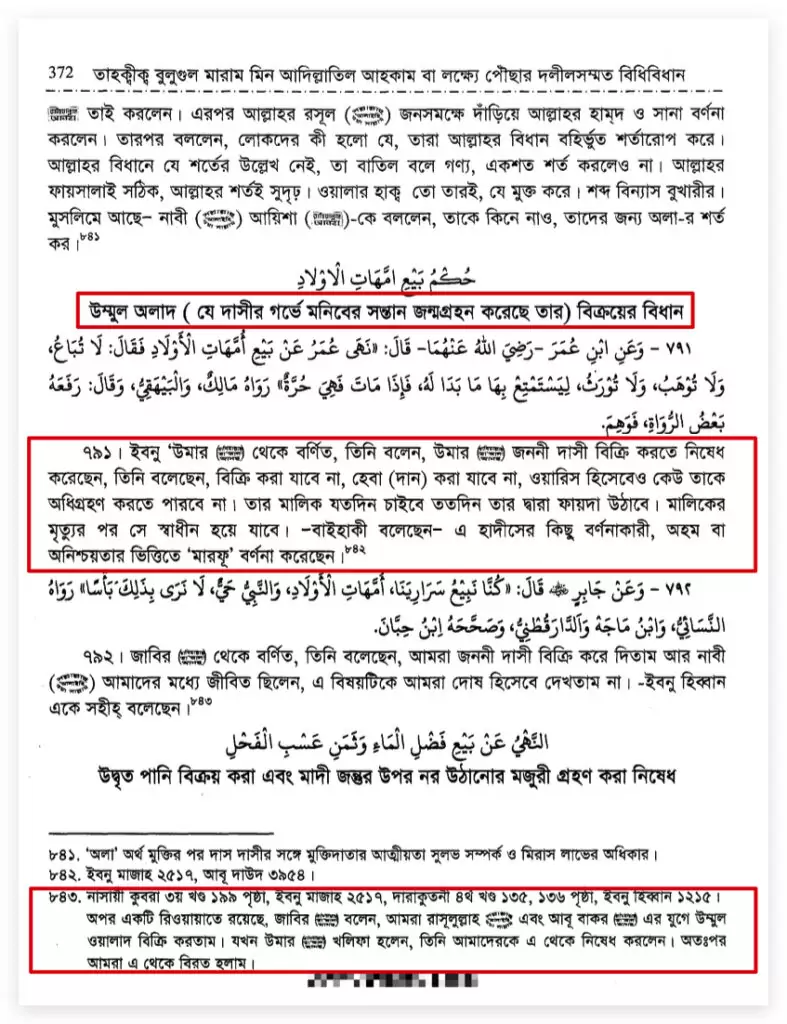
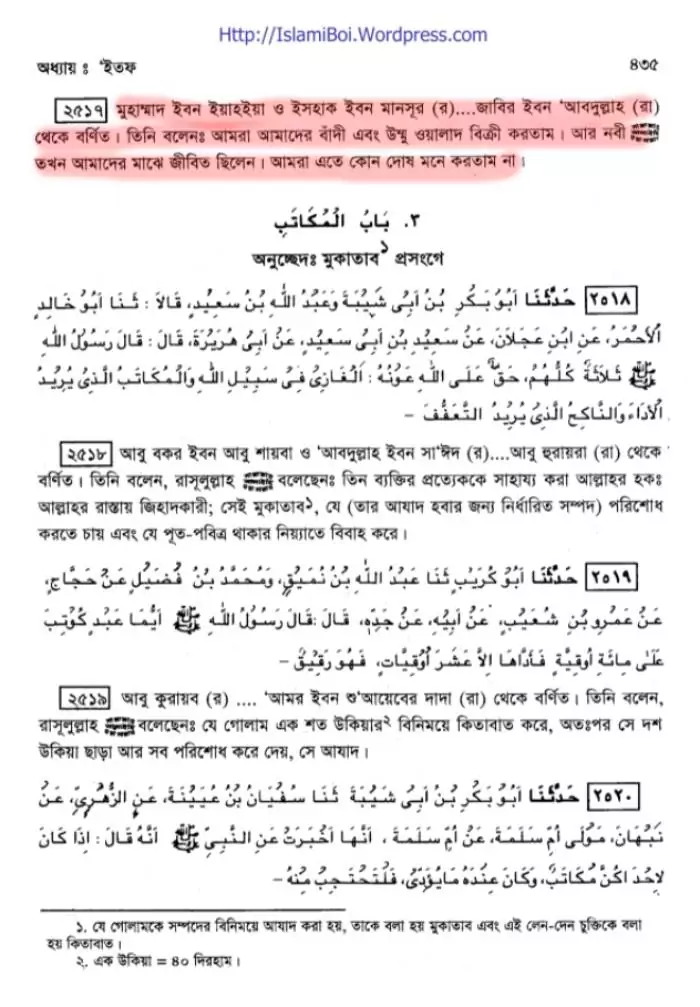
First, the filthy reality of slavery needs to be made clear here. A slave woman is not a free sexual partner. Her body is under the authority of her owner. Islamic law legitimized the owner’s sexual relationship with her. In this relationship, there is no free consent in the modern sense, because the slave woman does not stand in a social, economic, or legal position equal to the owner from which she has the freedom to say “no.” Even when the owner’s child was born in that slave woman’s womb, reports indicate that during the eras of the Prophet and Abu Bakr she was regarded as saleable property. In other words, even the mother of a child could be put on the market. This is the humanity of the so-called golden age.
In this situation, Umar’s legal intervention is important. He came and said that an Umm Walad could not be sold, could not be gifted, and could not be inherited; the owner could continue relations with her while he was alive, but after the owner died she would become free. Many may present this ruling as humane progress. But the problem lies precisely here. If Umar’s decision was humane progress, then the law of the Prophet’s era was humanely backward. And if the law of the Prophet’s era itself was complete and ideal, then Umar imposed his own law upon that ideal. In both cases, Islam’s conventional claim of sacred history falls into danger.
Through this change, Umar did not abolish slavery. It did not acknowledge the full human dignity of the slave woman. It did not cancel the owner’s sexual right. It merely limited, at a particular level, the power to sell a slave mother in the market. That is, a woman is still a slave, still sexually under the authority of her owner, still not a free citizen, but at least after giving birth to a child she can no longer be sold in the market. If even this limited correction was absent from the law of the Prophet’s era, then the law of the Prophet’s era cannot be called morally final. Rather, one must say that Umar, too, showed greater practical humanity in some matters than the Prophet’s law did. If that is accepted, the Prophet’s moral perfection is shaken. If it is not accepted, Umar’s prohibition becomes a political legal intervention against the practice of the Prophet’s era.
The Islamic defense here will usually say that Umar understood the objectives of the Sharia and applied the law accordingly. But this statement actually makes the problem even more acute. If the objective of the Sharia was to stop the sale of Umm Walad, then why did the Prophet himself not stop it clearly? Why did the sale of slave mothers of children continue in the era of Allah’s Messenger? Why did it continue even during Abu Bakr’s time? Umar understood that objective, but the Prophet did not? If it is said that laws came gradually according to the needs of the time, then the eternality of Islamic morality is lost. If it is said that there were sufficient rulings in the Prophet’s era itself, then Umar’s prohibition becomes unnecessary or bid’ah-like.
In this context, a moral duality is clear. Islamic preaching often says that Islam gave rights to slaves, humanized slavery, and gradually opened the path to liberation. But the incident of Umm Walad shows that Islam initially kept the slave woman as property. Even after giving birth to a child, her human status did not automatically rise to the level of a free person. The question of selling her arose at all because the law regarded her as property. To call a system humane in which even the mother of a child can be sold as the owner’s property is intellectual dishonesty.
Umar’s prohibition therefore reveals two truths at once. First, slavery in the Prophet’s era was morally filthy. Second, Islamic law changed in the hands of the caliph even after the Prophet’s death. Umar did not merely issue an administrative order here; he changed effective law on questions of ownership, sexuality, motherhood, the slave market, and freedom. Later fiqh accepted this change as law. In other words, once again we see that it was not Allah’s final law, but rather the decision of a powerful caliph, that became part of practical Sharia.
A severe question must be raised here: if a slave woman remains saleable in the Prophet’s era even after becoming the mother of her owner’s child, then what dignity has Islamic morality actually given to women? She is a mother, but not a human being; she gives birth to a child, but is not free; she is part of the owner’s bed, but not the owner of her own body; she gives birth to a child inside the household, but carries the risk of being sold in the market. Such a system cannot be called divine justice. It is a sexual-economic law made for the benefit of slave-owning men.
Umar’s law limited part of this filth, but did not touch the core institution of slavery. Umm Walad was not made a free person immediately. During the owner’s lifetime, she remains under his authority. The owner can maintain sexual relations with her. Her freedom depends on the owner’s death. In other words, the woman is not free because of her own human rights; the death of the male owner is the condition of her freedom. Such a ruling can be called humane only when the standard of humanity is lowered into the gutter of a slave-owning society.
More importantly, this incident directly strikes Islam’s claim that the “Prophetic era was the best era.” If the Prophet’s era was the best, then why would Umar come and stop the sale of slave mothers? Why was this filthy market operating in the best era itself? And if Umar came and made a better law, then the claim of excellence shifts toward Umar, not toward the Prophet. One then has to admit that the Prophet’s Sharia was incomplete and that later political leadership corrected it. This admission is devastating for Islamic theology, because it calls into question both the Prophet’s legal perfection and the finality of Qur’anic morality.
This issue is important from another angle as well. In Islamic jurisprudence, the Prophet’s Sunnah is given importance equivalent to Allah’s law. But in the case of Umm Walad, if the ongoing practice of the Prophet’s era was later prohibited by Umar, then where is the permanence of the Sunnah? Is everything that took place in the Prophet’s era always ideal? If it is ideal, Umar’s prohibition is unacceptable. If it is not ideal, then the Prophet’s era cannot be called a moral model. Theology may manufacture many explanations to escape this contradiction, but the core problem remains: the law of the Prophet’s era and the law of Umar’s era are not the same.
The issue of Umm Walad, therefore, is not merely a sub-rule of slavery. It is a powerful piece of evidence against Islam’s moral claims. It shows that in the Prophet’s era, even a slave mother of a child was property; there are reports that this reality continued during Abu Bakr’s time as well; later Umar came and made a limited correction. This sequence is not the history of heavenly justice. It is the law of a slave-owning society, where a woman’s body is under male ownership, motherhood is imprisoned within a relationship of property, and humanity waits afterward for the caliph’s administrative correction.
Therefore, on the issue of Umm Walad, there is no honorable escape route for Islam. If Umar was wrong, then he changed a valid practice of the Prophet’s era. If Umar was right, then the practice of the Prophet’s era itself was morally wrong. And if it is said that both were right, then Islamic morality is a relative system that changes according to time, power, and convenience, not eternal justice. In this incident, Umar is not merely a caliph; he is an unintended witness to Islam’s moral incompleteness. His prohibition shows that even the Prophet’s law was not free from the need for human correction.
Adult Breastfeeding: Umar’s Primacy over the Quran and the Prophet
One of the most uncomfortable and ugly issues in Islamic sharia is adult breastfeeding, or rada‘at al-kabir. The matter is so embarrassing that modern Muslim apologists usually try to suppress it, dismiss it as a special case, or weave a web of explanations to make the incident appear acceptable. But when Islamic sources, including Sahih Muslim, are read, it becomes clear that the Prophet Muhammad himself instructed that an adult man named Salim be breastfed so that he could move in and out of a household. On questions of relations between men and women, hijab, mahram status, the body, sexuality, and social propriety, what legal imagination could be more absurd and sordid than this?
Let us first look at the hadiths [87] [88] [89] [90] [91] [92] [93] [94] [95] –
Sahih Muslim (Islamic Foundation)
18/ Breastfeeding
Chapter: No chapter title
3469. ‘Amr al-Naqid and Ibn Abi Umar (RH) … narrated from Aisha (RA). She said: Sahlah, daughter of Suhayl, came to the Prophet, peace and blessings be upon him, and said: O Messenger of Allah! Because Salim comes to meet me, I see signs of displeasure on Abu Hudhayfah’s face, although Salim is his ally/adopted son. The Prophet, peace and blessings be upon him, said: Breastfeed him. She said, How can I breastfeed him when he is an adult man? At this, the Messenger of Allah, peace and blessings be upon him, smiled and said: I know that he is an adult man. ‘Amr (the narrator) added in his hadith that Salim had participated in the Battle of Badr. And in the narration of Ibn Abi Umar it says that the Messenger of Allah, peace and blessings be upon him, laughed.
Hadith grade: Sahih (Sahih)
Narrator: Aisha (RA)
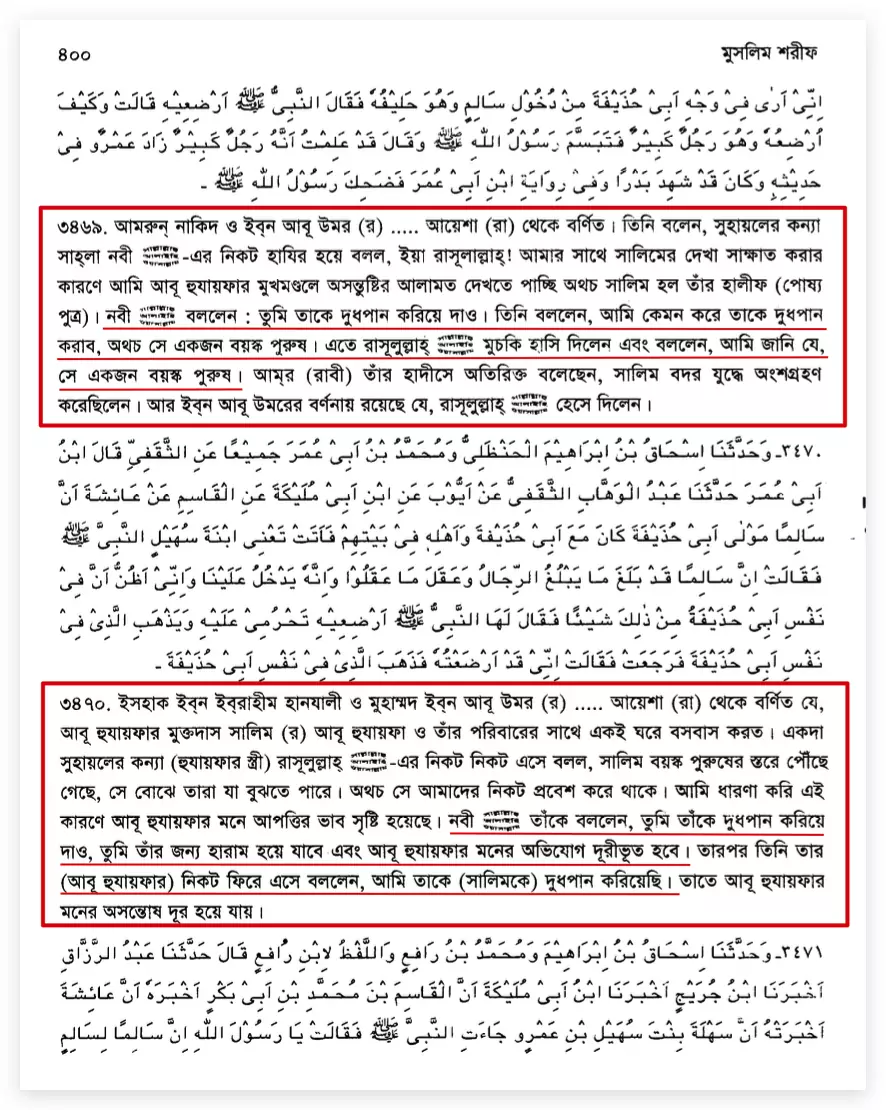
Sahih Muslim (Islamic Foundation)
18/ Breastfeeding
Chapter: No chapter title
3470. Ishaq ibn Ibrahim al-Hanzali and Muhammad ibn Abi Umar (RH) … narrated from Aisha (RA) that Salim (RH), the slave of Abu Hudhayfah, lived in the same house with Abu Hudhayfah and his family. One day the daughter of Suhayl (Hudhayfah’s wife) came to the Messenger of Allah, peace and blessings be upon him, and said: Salim has reached the stage of adult men; he understands what people understand, yet he enters upon us. I think this has created a feeling of displeasure in Abu Hudhayfah’s mind. The Prophet, peace and blessings be upon him, said to her: Breastfeed him, and you will become forbidden for him and the displeasure in Abu Hudhayfah’s mind will disappear. Then she returned to him (Abu Hudhayfah) and said: I have breastfed him (Salim). Thereupon Abu Hudhayfah’s displeasure disappeared.
Hadith grade: Sahih (Sahih)
Narrator: Aisha (RA)
Sahih Muslim (Islamic Foundation)
18/ Breastfeeding
Chapter: No chapter title
3472. Muhammad ibn al-Muthanna (RH) … Umm Salamah (RA) said to Aisha (RA): Boys who are near the age of puberty enter upon you, but I do not like such boys entering upon me. The narrator says that Aisha (RA) said: Do you not have a beautiful example in the Messenger of Allah, peace and blessings be upon him? She further said: Once the wife of Abu Hudhayfah submitted: O Messenger of Allah! Salim enters upon me, although he is an adult man, and because of this there is some displeasure in Abu Hudhayfah’s heart. Then the Messenger of Allah, peace and blessings be upon him, said: Give him your milk to drink so that he may enter upon you.
Hadith grade: Sahih (Sahih)
Narrator: Umm Salamah (RA)
Sahih Muslim (Islamic Foundation)
18/ Breastfeeding
Chapter: No chapter title
3473. Abu Tahir and Harun ibn Sa‘id al-Ayli (RH) … Umm Salamah (RA), the wife of the Messenger of Allah, peace and blessings be upon him, one day said to Aisha (RA): By Allah, I do not like that a boy who has passed the age of breastfeeding should see me. She said: Why? Once Sahlah, daughter of Suhayl, came to the Messenger of Allah, peace and blessings be upon him, and said: O Messenger of Allah! By Allah! Because Salim enters upon me, I see signs of displeasure on Abu Hudhayfah’s face. Aisha (RA) says, Then the Messenger of Allah, peace and blessings be upon him, said: Breastfeed him. Sahlah said, He (Salim) has a beard. He said: Breastfeed him, and the gloom on Abu Hudhayfah’s face will disappear. Sahlah narrated: I swear by Allah that after that I no longer saw gloom on Abu Hudhayfah’s face.
Hadith grade: Sahih (Sahih)
Narrator: Umm Salamah (RA)
Sunan Ibn Majah
9/ Marriage
Chapter: 9/36. If an adult person drinks milk.
1/1943. Narrated from Aisha (RA). She said: Sahlah bint Suhayl (RA) came to the Prophet, peace and blessings be upon him, and said: O Messenger of Allah! Because Salim comes and goes to me, I notice displeasure on the face of my husband Abu Hudhayfah. The Prophet, peace and blessings be upon him, said: Breastfeed him. She said: How can I breastfeed him when he is an adult man? The Messenger of Allah, peace and blessings be upon him, smiled and said: I certainly know that he is an adult man. She did so, and after the breastfeeding I did not notice any sign of displeasure on Abu Hudhayfah’s face. (The narrator says) He had participated in the Battle of Badr.
Sahih al-Bukhari 4000, 5088; Muslim 1453; Nasa’i 3223, 3234, 3319, 3320, 3321, 3322, 3323; Abu Dawud 2061; Ahmad 25121; Muwatta Malik 1288; Darimi 2257; Irwa’ 6/264; Rawd al-Nadir 354
Tahqiq al-Albani: Sahih.
Hadith grade: Sahih (Sahih)
Narrator: Aisha (RA)
The core problem of the incident is very clear. When an adult man moves in and out of a house, a problem of hijab and mahram status arises. To solve that problem, the Prophet says: breastfeed him. This means that milk from a woman’s body was turned into a legal instrument for creating a social relationship. Human beings may become relatives by birth; they may become relatives by marriage; but here bodily fluid is being used to legitimize an adult man’s access to a household. This legal imagination is not merely strange; it turns the female body into an object of sharia’s social engineering.
The most common apologetic defense of this incident is that it was only a special concession for Salim. But the Islamic sources themselves do not allow the matter to end so easily. Aisha did not regard the incident merely as a special case for Salim; there are reports that she accepted the idea of establishing mahram status through breastfeeding in the case of men whom she wished to allow into her house. On the other hand, the Prophet’s other wives rejected this interpretation and said that it was nothing more than a special permission for Salim. In other words, disagreement over this law arose inside the Prophet’s own household. One wife of the Prophet considered it generally applicable, while the other wives treated it as a limited exception. This is the alleged clarity of sharia.
Muwatta Malik (Islamic Foundation)
30. Chapter concerning the ruling on breastfeeding children
Section: 2. Breastfeeding after adulthood
Narration 12. Ibn Shihab (RH) was asked about breastfeeding an adult. In reply, he said: Urwah ibn al-Zubayr (RH) told me: Abu Hudhayfah ibn Utbah ibn Rabi‘ah (RA) was one of the Companions of the Messenger of Allah, peace and blessings be upon him. He was martyred in the Battle of Badr. He had adopted Salim (RA), who was called Salim Mawla Abu Hudhayfah. [A woman named Sa’ibah freed him; afterward Abu Hudhayfah raised him and took him as a son. For this reason Salim was called the mawla of Abu Hudhayfah.] Just as the Messenger of Allah, peace and blessings be upon him, had made Zayd ibn Harithah (RA) his son, Abu Hudhayfah married his niece Fatimah bint Walid ibn Utbah ibn Rabi‘ah to Salim, and he considered Salim his own son.
Fatimah was among the women who migrated in the first period, and at that time she was also among the unmarried women of Quraysh. When Allah revealed this verse in His Book concerning Zayd ibn Harithah:
ادْعُوهُمْ لآبَائِهِمْ هُوَ أَقْسَطُ عِنْدَ اللَّهِ فَإِنْ لَمْ تَعْلَمُوا آبَاءَهُمْ فَإِخْوَانُكُمْ فِي الدِّينِ وَمَوَالِيكُمْ
(That is, call them by their fathers’ names. This is more just in the sight of Allah; and if you do not know their fathers, then regard them as your brothers in religion and as your allies.) Return those whom you have adopted as sons to the names of their fathers. And if the father’s identity is not known, then return them to their mawla (master, or relative established through alliance/friendship). Sahla bint Suhayl, the wife of Hudhayfah, who belonged to the tribe of Amir ibn Lu’ayy, came to the Messenger of Allah, peace and blessings be upon him, and said: O Messenger of Allah! We had taken Salim as a son. He enters my room while I am wearing only one garment. And my house is only one room. What is your opinion regarding this matter? Then the Messenger of Allah, peace and blessings be upon him, said: Our instruction in this matter is that you breastfeed him five times. Then, because of this breastfeeding, he will become forbidden, and Sahla regarded him as a son because of the breastfeeding.
The Mother of the Believers Aisha (RA) accepted this opinion of the Messenger of Allah, peace and blessings be upon him; therefore she liked those men to enter upon her. She would instruct her sister Umm Kulthum bint Abi Bakr al-Siddiq (RA) and her nieces to breastfeed those men. But the other wives of the Noble Prophet, peace and blessings be upon him, refused to allow any man to enter upon them through this kind of breastfeeding. They used to say, [addressing Aisha al-Siddiqa (RA)] By Allah, we think that the ruling the Messenger of Allah, peace and blessings be upon him, gave to Sahla bint Suhayl was only a rukhsah (special permission) from the Messenger of Allah, peace and blessings be upon him, for Salim alone. By Allah! Through this kind of breastfeeding, no man will be able to enter upon us. All the other wives of the Noble Prophet, peace and blessings be upon him, remained firm upon this opinion regarding adult breastfeeding.
Hadith grade: awaiting verification
Narrator: Ibn Shihab al-Zuhri (RH)
Here Umar’s role makes the issue even more important. In a report in Muwatta Malik, a man is seen coming to Umar and saying that he had a slave woman with whom he had sexual relations; his wife had breastfed that slave woman so that she would become forbidden to her husband. Umar did not accept this tactic. Rather, he said: punish your wife and go to the slave woman; breastfeeding is breastfeeding for children. In other words, Umar effectively nullified the strange legal possibility of adult breastfeeding that the Prophet had given. In his fatwa, adult breastfeeding does not create any mahram relationship. Here again we see a later authority limiting, disabling, or effectively cancelling an uncomfortable ruling originating from the Prophet.
Muwatta Malik (Islamic Foundation)
30. Chapter concerning the ruling on breastfeeding children
Section: 2. Breastfeeding after adulthood
Narration 13. Narrated from Abdullah ibn Dinar (RH), who said: A man came near the “Dar al-Qada” (the court; this was the house of Umar Faruq (RA), and after his martyrdom the house was sold to pay his debts, which is why it was called Dar al-Qada) to ask about adult breastfeeding. I was then present with Abdullah ibn Umar (RA). Abdullah ibn Umar (RA) said: A man came to Umar ibn al-Khattab (RA) and said: I had a slave woman. I used to have intercourse with her. My wife deliberately breastfed her; afterward, when I entered upon that slave woman (with the intention of intercourse), my wife said: Stop. Do not have intercourse with her; by Allah, I have breastfed her. Umar (RA) said: Punish your wife, then go to the slave woman; breastfeeding is valid in the case of children.
Hadith grade: awaiting verification
Narrator: Abdullah ibn Dinar (RH)
Here the question is direct. If the Prophet instructed that adult Salim be breastfed in order to create a mahram relationship, by what authority does Umar say that breastfeeding is effective only in the case of children? If Umar is right, then the Prophet’s ruling concerning Salim was ethically and legally strange, unworkable, or dangerous. And if the Prophet is right, then Umar’s fatwa stands against the Prophet’s ruling. In both directions, the problem belongs to Islam. On one side, the Prophet’s law is abnormal and embarrassing; on the other, Umar’s law removes that prophetic instruction from practical sharia.
In this incident we see a filthy mixture of slavery, the female body, sexual entitlement, and legal strategy. A man has a slave woman, and he has sexual relations with her. His wife tries to make that relationship forbidden by breastfeeding the slave woman. Umar says: punish the wife and go to the slave woman. Where is the slave woman’s own will here? Who owns her body? Who has sexual rights over her? Who gave the right to punish the wife? In this entire report, both women are objects of male law: one is a slave woman, held as sexual property; the other is a wife, whom one is told to punish. This is the naked picture of Islamic family and slave-owning reality.
The issue of adult breastfeeding is therefore not merely a ridiculous hadith. It exposes the disorder of Islamic legal reasoning. The Prophet gives one instruction; Aisha accepts it as broadly applicable; the Prophet’s other wives reject it; Umar effectively denies the legal effect of adult breastfeeding; and later fiqh largely confines the matter to infant breastfeeding. The question, then, is: where is sharia? In the Prophet’s words? In Aisha’s application? In the restriction imposed by the other wives? In Umar’s fatwa? Or in the later juristic repair?
Here another death occurs for Islam’s claim to clear law. On such a sensitive matter, where privacy between men and women, the body, mahram relations, sexual boundaries, and family ethics are involved, the Prophet gives an instruction that later Muslim society itself could not digest. Therefore it had to be buried under explanations such as special case, limited permission, infant breastfeeding, giving milk in a vessel, not directly, indirectly, exception, context-dependent, and so on. The truth is very simple: the ruling is so uncomfortable that Muslim fiqh itself did not dare carry it as a general law.
Umar’s fatwa exposes this embarrassing truth even more clearly. He understood in practical terms that if adult breastfeeding were made a source of mahram relationship, it would create absurd chaos in social and sexual law. So he confined it to breastfeeding children. But this limitation did not come from Qur’anic clarity or from the Prophet’s final ruling; it came from the practical sense of a later authority. That is, once again we see that when the Prophet’s instruction becomes uncomfortable in real society, Umar or later fiqh comes and repairs it. This is not divine law; it is a human attempt to make an embarrassing hadith socially manageable.
Aisha’s role in this incident also deserves separate attention. If she regarded the Salim incident as broadly applicable, then inside the Prophet’s own household a major female narrator acknowledged the legal effect of adult breastfeeding. If the other wives rejected it, then even within the Prophet’s family there was no single interpretation of sharia. If Umar declared adult breastfeeding ineffective, then disagreement among the Companions was intense as well. Which Islam, then, is true? Aisha’s Islam? Umm Salamah’s Islam? Umar’s Islam? Or the convenient Islam of later jurists? From this question it becomes clear that the idea of “one clear, final, unchanging sharia” does not survive before the actual sources.
Another laughable apologetic tactic here is to say that it was not direct suckling; rather, milk was given in a vessel and drunk from it. As if that solves the problem. The real problem is not the method; the real problem is the legal idea. Whether directly or through a vessel, the question remains the same: how does an adult man become mahram by drinking a woman’s milk? What is the ethical basis of that relationship? Why must a woman solve the problem of a man’s movement by giving milk from her own body? However much theology creates haze around the method, the core abnormality remains intact.
Umar’s position can be seen as an early political-legal step to suppress this abnormality. He said that adult breastfeeding does not count. This reduces the social problem, but it places the Prophet’s Salim-instruction under question. If one wants to keep the Prophet’s instruction intact, Umar’s fatwa becomes problematic. If one wants to keep Umar intact, the Prophet’s instruction becomes limited, abnormal, exceptional, and effectively inapplicable. Islamic theology sidesteps this contradiction by calling it a “special rukhsah.” But saying special rukhsah does not end the question; it intensifies it. Why would an omniscient lawgiver grant such a special concession, one so embarrassing to later generations that everyone busies himself with limiting it?
Therefore, adult breastfeeding is an excellent example of the legal and moral disorder of Islam. The Prophet gave a strange instruction, Aisha considered it applicable, the other wives rejected it, Umar denied the legal effect of adult breastfeeding, and later fiqh imprisoned it within the limits of infant breastfeeding. This is not the history of eternal divine law. It is the history of an embarrassing ruling, disagreement within the household, a caliph’s fatwa, and later legal repair. And this history again shows that Islamic sharia is not a complete code descended from heaven, but a chaotic legal system that continually changed form through human discomfort, social pressure, sexual policy, slavery, and the decisions of powerful men.
Wife-Beating: The Prophet’s Prohibition Softened in the Face of Umar’s Objection
The influence of Umar ibn al-Khattab was not limited to legally uncomfortable issues such as hijab, mut‘ah, tamattu‘, slave-woman ownership, or adult breastfeeding. In Islamic sources, his role is also extremely important on the question of violence against women. The reports show that the Prophet Muhammad initially forbade beating wives. But Umar came and complained that women had become bold or disobedient toward their husbands. The Prophet then permitted wife-beating. Later, many women came to the Prophet’s family and complained against their husbands. The Prophet then said that those who beat their wives are not the best among you. This incident exposes a strange and ugly duality in Islamic morality: first prohibition, then permission in the face of Umar’s objection, and then moral displeasure after a flood of complaints. [96] [97] –
Sunan Ibn Majah
9/ Marriage
Chapter: 9/51. Beating wives is a vile act.
3/1985. Narrated from Iyas ibn Abdullah ibn Abi Dhubab (RA). He said: The Messenger of Allah, peace and blessings be upon him, said: Do not beat the female servants of Allah. Then Umar (RA) came to the Prophet, peace and blessings be upon him, and said: O Messenger of Allah! Women are acting disobediently toward their husbands. He gave permission to beat them, and they were beaten. Afterward many women gathered at the house of the Messenger of Allah, peace and blessings be upon him.In the morning he said: “Tonight, in the family of Muhammad, seventy women came, each complaining against her own husband.You will not find those who beat among the best of you.”
Abu Dawud 2146, Darimi 2219, Ghayat al-Maram 251, Sahih Abi Dawud 1863.
Tahqiq al-Albani: Hasan Sahih.
Hadith grade: Hasan (Hasan)
Mishkat al-Masabih (Mishkat)
Part 13: Marriage
Chapter: 10. Second section – concerning good conduct toward wives and the mutual rights and claims of each spouse
3261-[24] Narrated from Iyas ibn Abdullah (RA). He said: The Messenger of Allah, peace and blessings be upon him, said: Do not beat the female servants of Allah Most High (wives as if they were slave women). Then Umar came and said: Because of your prohibition, women have exceeded the limits over their husbands. At this, the Messenger of Allah, peace and blessings be upon him, permitted them to be beaten (as needed). In this situation, women began coming repeatedly to the wives of the Messenger of Allah, peace and blessings be upon him, complaining about their husbands’ oppression. Therefore the Messenger of Allah, peace and blessings be upon him, said: Listen! Wives are repeatedly coming to my family with complaints against their husbands that those among you (who hurt their wives in this way) are by no means good people. (Abu Dawud, Ibn Majah and Darimi)[1]
[1] Sahih: Abu Dawud 2146, Ibn Majah 1985, Darimi 2265, Sahih Ibn Hibban 4189, Sahih al-Jami‘ 7360.
Hadith grade: Sahih (Sahih)
Narrator: Muhammad ibn Abdullah ibn Sa’ib (RH)
This report directly shows that the Prophet’s moral position was not stable. He first prohibited wife-beating. That was a comparatively better position. But Umar came and said that women were becoming assertive over their husbands or disobedient toward them. Then the prohibition was relaxed. In other words, the safety of women’s bodies lost to the preservation of husbands’ authority. The principle of not beating women did not survive before a male complaint. And the chief carrier of that complaint was Umar. Here Umar again appears as the representative of patriarchal pressure before which religious law changes its position.
The language of the report is highly significant. Umar says that women have become “bold” or “disobedient” toward their husbands. That is, the problem was not that women were killing men, physically abusing men, or destroying families. The problem was that women were not bowing their heads before husbandly authority. The ruling that comes in response to this complaint is not women’s freedom or safety; it is the restoration of the power to beat to men. This is the natural language of patriarchy: when a woman protests, she is called disobedient; male suppression is called discipline; and beating is called a method for preserving the family.
This directly matches the structure of verse 34 of Surah al-Nisa. In the verse, men are described as authorities or guardians over women, because Allah has given one class superiority over the other and because men spend wealth. Then, in the case of fear of “nushuz,” or disobedience, wives are to be admonished, abandoned in bed, and finally beaten. However much modern apologists perform linguistic gymnastics over the word “idribuhunna,” in the ancient and mainstream interpretive tradition of Islam its meaning has been accepted as beating the wife, even though later attempts were made to soften it by saying “light,” “non-injurious,” “with a miswak,” and so on. For details on this issue, you may read this article.
The main strategy of Islamic defense here is the phrase “light beating.” As if beating becomes moral once it is light. This is a principled deception. The very idea that a husband has the right to beat his wife is inhuman. How hard the beating is becomes a secondary question. The central question is whether an adult woman is a punishable object subordinate to her husband. Can physical assault be the punishment for her disagreement, anger, objection, displeasure, or disobedience? In a civilized morality the answer is clear: no. A wife is a human being, not a slave woman; a citizen, not a child; a person of equal dignity, not an animal to be trained by her husband.
In the asbab al-nuzul tradition, the context of Surah al-Nisa 4:34 is even uglier. A report says that a man slapped his wife; the wife or her family complained to the Prophet; the Prophet initially spoke of qisas, or retaliation; later the verse was revealed, and that qisas was suspended. In other words, in the first position, when a woman was beaten by her husband, there was a possibility of retaliation or justice. But the verse came and removed that possibility, establishing male authority and the right to beat in religious language. If this context is true, 4:34 is not a verse protecting women; it closes the woman’s path to justice against wife-beating and legitimizes the patriarchal right of punishment.
In al-Wahidi’s Asbab al-Nuzul, this very incident is narrated as the context of revelation for Surah al-Nisa 4:34. Through Muqatil’s chain it is said there that Sa‘d ibn al-Rabi‘, a leader of the Ansar, struck his wife Habibah bint Zayd ibn Abi Zuhayr in the face. When Habibah’s father took her to Muhammad and complained, Muhammad initially permitted qisas, or equal retaliation, against the husband. But as they were leaving to carry out the qisas, Muhammad called them back and said that Jibril had come to him; then Surah al-Nisa 4:34 was revealed and the decision of qisas was withdrawn. [98]
According to Muqatil’s report, when Sa‘d ibn al-Rabi‘ struck his wife Habibah in the face, her father took her to the Prophet. The Prophet first said that the wife would take qisas from her husband. When they left for that purpose, the Prophet called them back and said that Jibril had come to him; after that the verse “men are authorities over women” was revealed. The report then gives Muhammad’s statement: “We wanted one thing, Allah wanted another thing; and what Allah wanted is better.” Then qisas was lifted.
This context belongs to the same patriarchal pattern as the report in Sunan Abu Dawud concerning Umar. In both places, one first sees a relatively just position against wife-beating. In one place, the Prophet says: do not beat women. In another, the possibility of qisas for a beaten wife appears. But in the end, patriarchal authority wins. In the face of Umar’s objection, permission for wife-beating returns. In Surah al-Nisa 4:34, beating is made part of a step-by-step domestic punishment when a wife is disobedient. The result is the same: the woman is subordinate to the husband, the husband is the punisher, and Allah is the one who authorizes that power.
In this incident, Umar’s moral position is clear. He did not stand for women’s safety. He did not say that husbands should not oppress women. He did not say that when there is disagreement in the family, there should be judgment, mediation, divorce, or equal rights. He complained that women had become bold toward their husbands. Within this complaint lies the anxiety of a male-dominated society. If a woman speaks, she will be called disobedient. If a woman does not bow her head, she will be accused of becoming bold. And as the remedy for that complaint, permission to beat is placed in men’s hands. This is Umar’s patriarchal politics.
The Prophet’s position here is equally problematic. He first said something good: do not beat women. But he did not remain firm in that principle. After Umar’s objection, he gave permission. Later, when women began coming in groups with complaints, he said that wife-beaters were not the best people. This moral hesitation is extremely weak. If wife-beating is wrong, why permit it? And if the permission is valid, why are the beaters not the best? A principle is either just or inhuman. The position that “it is permitted, but good people will not do it” is in fact moral cowardice. It does not stop violence; rather, violent men receive a legal license, while victimized women receive only soft advice.
This duality still operates in Muslim societies today. It is said that Islam did not tell men to beat their wives, only to “discipline lightly.” It is said that the Prophet did not beat his wives, so not beating is better. But at the same time, by citing Quran 4:34, permission is given to husbands to beat. The result is that the moral door to wife-beating remains open. The husband knows that he is not doing something absolutely prohibited; he is only using the “final step.” The scholar will say: do not beat too hard, do not leave marks, do not strike the face. But these restrictions do not make the original offense moral. Giving the husband the right of physical punishment means lowering the woman to a subordinate status.
The language of Surah al-Nisa 4:34 is itself patriarchal. Men are authorities over women because men spend and because Allah has granted some superiority over others. In other words, economic expenditure has been made the basis of ruling authority. A man spends money, therefore he is ruler; the woman is to be maintained, therefore she is obedient. In this structure, marriage is not a relationship of equal dignity. It is a hierarchy: man above, woman below. The punitive instrument of that hierarchy is beating. Thus 4:34 is not merely family advice; it is a constitutional declaration of patriarchal power in religious language.
The word “nushuz” is also important here. What must a wife do for it to be nushuz? Refuse to obey her husband? Decline sexual relations? Want to leave the house? Refuse to submit to her husband’s authority? This ambiguity is dangerous in itself. For when the power of punishment is in the husband’s hands, the husband is often the judge, the accuser, and the punisher. A woman’s “disobedience” is determined through a man’s eyes. Then come the stages of that accusation: admonition, abandonment in bed, beating. This is not justice; it is religious authorization for a private system of punishment in the name of domestic authority.
Modern apologists often say that “idribuhunna” does not mean beating; it may mean separating or going away. This explanation is a word-game born from modern embarrassment. If the meaning were truly “go away,” then the first step would be admonition, the second step separation in bed, and the third step separation again: the repetition would become meaningless. Moreover, the ancient tafsir tradition, juristic discussions, and hadith commentary surrounding the limits of wife-beating all show that the traditional understanding took the meaning to be beating. Modern discomfort cannot erase the ancient meaning.
In the context of wife-beating, the Umar-centered pattern again becomes clear. Umar becomes uncomfortable because women are behaving with some degree of independence. He complains to the Prophet. The Prophet’s prohibition is softened. Later, the consequence of violence becomes visible: women begin to complain. Then, once again, moral language is used to say that wife-beaters are not the best people. But by then the door has been opened. The law has placed a weapon in men’s hands, while morality says from a distance: if you are a good man, do not use it. Such a principle does not prevent violence; it grants violence conditional legitimacy.
This incident cannot be called one of Umar’s virtues. It is a document of Umar’s role in re-establishing patriarchal rule over women. He is the person whose complaint softened the Prophet’s “do not beat” position. He represents the political-social psychology for which women’s voice, protest, and self-respect were breaches of discipline. The later Qur’anic structure gave permanent form to the same theory of rule: men are authorities, women are obedient, and if they are disobedient they are punishable in stages. This is the patriarchal spine of Islamic family law.
Here Islam’s moral failure is direct. From the law of an omniscient, merciful, and just God, one would expect: no husband may beat his wife; when there is marital conflict, there will be judgment on the basis of equal dignity; if a beating occurs, the woman will have qisas or legal remedy; economic expenditure will not become a license to rule. But Quran 4:34 gives precisely the opposite structure. There we find male superiority, female obedience, punishment for disobedience, and beating as the final step. This cannot be called protection of women. It is a religious law of controlling women.
Therefore, the issue of wife-beating is a powerful charge against Umar and against Islamic sharia. Here we see that the initial principle of stopping violence against women does not survive Umar’s objection; the power of punishment returns to the husband’s hands; the Quran codifies that power; and later theology polishes it with language such as “light,” “final step,” and “not the best.” But however much it is polished, the basic truth remains: Islam gave the husband the right to beat his wife. In the language of patriarchy, that right is discipline; in the language of theology, it is a ruling; but in the language of human justice, it is legitimized domestic violence.
The Verse of the Perfection of the Din: Umar’s Discontent after the Declaration of Perfection
Verse 3 of Surah al-Ma’idah is extremely important in Islamic theology. In this verse it is said, “Today I have perfected your din for you, completed My favor upon you, and chosen Islam as your din.” In ordinary religious discourse, this verse is presented as proof of the perfection of Islam, the completeness of the Sharia, and the final declaration of Allah’s blessing. But when this verse is read alongside the reaction of Umar ibn al-Khattab, a deeply uncomfortable question arises. If the din had truly been perfected, was this perfection a matter of joy, or a sign of the completion and closing of the Prophet’s mission?
It is reported in Sahih al-Bukhari and other sources that a Jewish man said to Umar: there is a verse in your Book which, had it been revealed to us, we would have taken that day as a festival. Umar replied that he knew when and where the verse had been revealed: on Friday, on the Day of Arafah, while the Messenger of Allah was standing at Arafah. This report shows that the historical moment of the verse was especially significant to Umar. It was not an ordinary legal verse; it was a declaration of Islam’s perfection, a major theological announcement revealed in the final phase of the Prophet’s life.
Sahih al-Bukhari (Islamic Foundation)
2/ Faith
Chapter: 33/ The increase and decrease of faith.
Islamic Foundation Number: 43 , International Number: 45
43. Hasan ibn al-Sabbah (may Allah have mercy on him) … narrated from Umar ibn al-Khattab (may Allah be pleased with him) that a Jew said to him: O Commander of the Believers! There is a verse in your Book which you recite; had it been revealed upon us Jews, we would certainly have observed that day as a festival. He said, Which verse? He said:
الْيَوْمَ أَكْمَلْتُ لَكُمْ دِينَكُمْ وَأَتْمَمْتُ عَلَيْكُمْ نِعْمَتِي وَرَضِيتُ لَكُمُ الإِسْلاَمَ دِينًا
“Today I have perfected your din for you, completed My favor upon you, and chosen Islam as your din.” (۵ : ۳) Umar (may Allah be pleased with him) said: We know the day and the place where it was revealed upon the Messenger, peace and blessings of Allah be upon him; he was standing at Arafah that day, and it was a Friday.
Hadith grade: Sahih (Sahih)
Narrator: Umar ibn al-Khattab (may Allah be pleased with him)
But in exegetical reports, an even more significant reaction surrounding this verse is found. There it is narrated that when the verse “Today I have perfected your din for you” was revealed, Umar began to weep. The Prophet asked him, What is making you weep? Umar said: We were continually increasing in our din; but when something becomes complete, after completion its deficiency or decline begins. In the report, the Prophet acknowledges his statement as true. This reaction is highly significant. For here Umar reads perfection not as victory or joy, but as a sign of closure and impending decline. Let us read the middle portion of the verse, [99]
Today I have perfected your din for you, completed My favor upon you and chosen Islam as your din.
— Sheikh Mujibur Rahman
Today I have perfected your din for you and completed My blessing upon you and have chosen Islam for you as din.
— Rawai Al-bayan
Today I have perfected your din for you and completed My favor upon you [۱۴], and have chosen Islam for you as din [۱۵].
— Dr. Abu Bakr Muhammad Zakaria
Now let us read its tafsir, [100]
He bent downward. The mount, unable to bear the weight of revelation, sat down. Immediately I wrapped my cloak over the Messenger of Allah (peace be upon him).
Ibn Jarir says: The Messenger of Allah (peace be upon him) passed away ۸۱ (eighty-one) days after departing from Arafat. Ibn Jarir (may Allah have mercy on him) has cited both reports.
Ibn Jarir (may Allah have mercy on him)…… narrates from the father of Harun ibn Antarah that the father of Harun ibn Antarah said: When this verse, اَلْيَوْمَ أَكْمَلْتُ لَكُمْ دِينَكُمْ, was revealed on the Day of Arafah during the Hajj, Hazrat Umar (may Allah be pleased with him) began to weep. The Messenger of Allah (peace be upon him) asked him: Why are you weeping? He said: We had hoped for more regarding this din. But when it has attained completion, then nothing more than this can be hoped for; rather, one may expect only its gradual decline. The Messenger of Allah (peace be upon him) then said: You have spoken correctly.’
Another hadith has come in support of this hadith. The hadith is this: Islam began as something strange, and soon it will return again as something strange. So glad tidings for those few strangers.
Imam Ahmad (may Allah have mercy on him)…… narrates from Tariq ibn Shihab that Tariq ibn Shihab said: A Jew came to Hazrat Umar ibn al-Khattab (may Allah be pleased with him) and said: O Commander of the Believers! You recite in your Book a verse which, had it been revealed upon the Jews, we would have celebrated the day on which that verse was revealed as a festival. Umar (may Allah be pleased with him) asked him: Which verse is that? The Jew said, It is:
الْيَوْمَ أَكْمَلْتُ لَكُمْ دِينَكُمْ وَأَتْمَمْتُ عَلَيْكُمْ نِعْمَتِي
Umar (may Allah be pleased with him) said: By Allah! I am properly aware of the day and the time when this verse was revealed to the Messenger of Allah (peace be upon him). It was revealed to the Messenger of Allah (peace be upon him) on Friday afternoon, the Day of Arafah.
Imam Bukhari through the chain of Ja‘far ibn Awn, and Imam Muslim, Tirmidhi, and Nasa’i through the chain of Qays ibn Muslim have also narrated similarly.
In explaining the verse under discussion, Imam Bukhari (may Allah have mercy on him)…… narrates from Tariq that Tariq said: The Jews said to Umar (may Allah be pleased with him): You recite in the Qur’an a verse which, had it been revealed to us, we would have celebrated the day of its revelation as a festival. Then Umar (may Allah be pleased with him) said: I know precisely when, where, and how that verse was revealed upon the Messenger of Allah (peace be upon him). That day was the Day of Arafah. By Allah! I was at Arafah at that time.
Sufyan (may Allah have mercy on him) says: I have considerable doubt as to whether the verse under discussion was revealed on Friday.
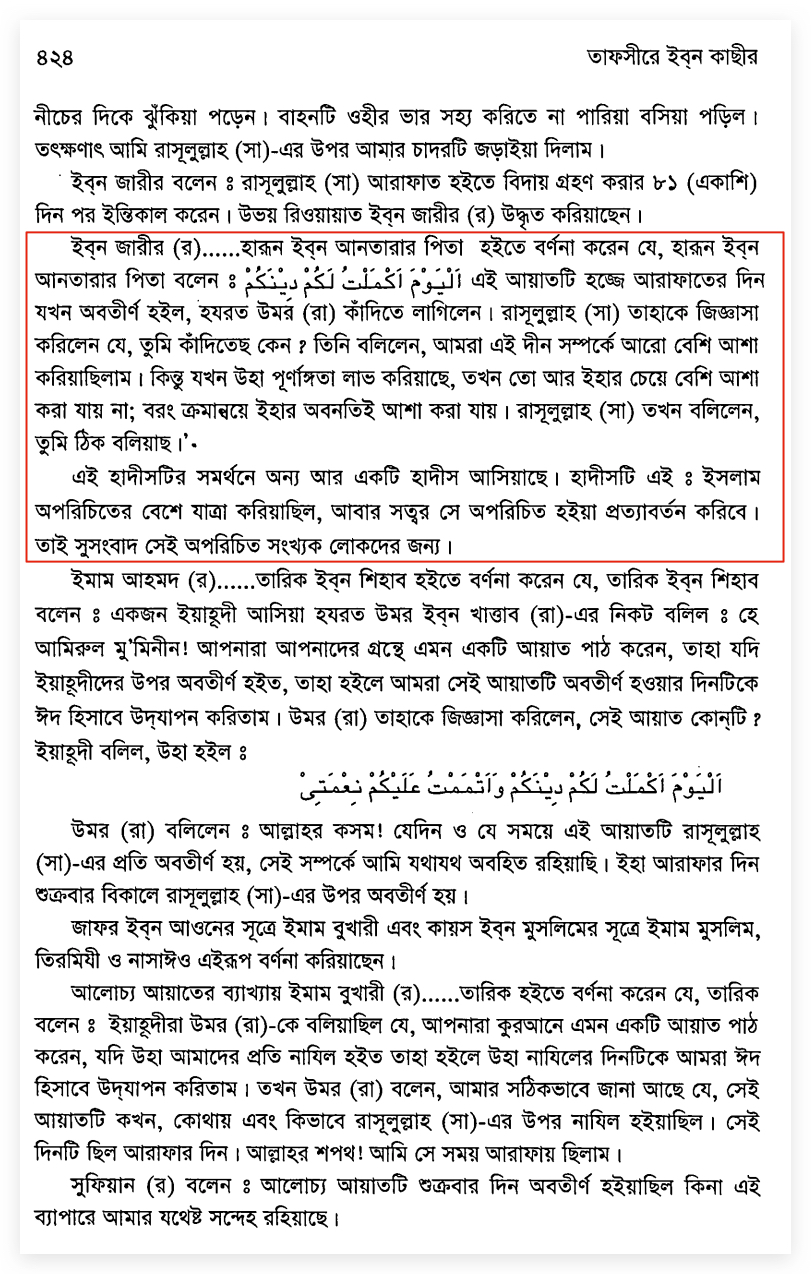
This incident is important from two angles: Umar’s character and Islam’s claim to perfection. On the one hand, the Islamic narrative says that the din was perfected. On the other hand, Umar’s reaction shows that he understood the declaration of perfection as a sign of religious closure. This was not mere emotion; it was political-religious foresight. Umar understood that when the Prophet’s mission receives a declaration of completion, the time of the Prophet’s presence is also nearing its end. After that would begin a new chapter of post-Prophetic power, interpretation, leadership, law, conflict, and authority. In other words, alongside Islam’s victory, the verse of perfection also opens the door to Islam’s human political history.
Here a stern question arises. If the din became complete in Surah al-Ma’idah ۵:۳, then why were so many later legal repairs, interpretations, prohibitions, corrections, and institutional changes needed? If the din was complete, why awl? If the din was complete, why Umar’s prohibition of mut‘ah and tamattu‘, which had been practiced in the Prophet’s era? If the din was complete, why did a Prophetic-era practice such as the sale of umm walad later have to be changed? If the din was complete, why did an organized post-Prophetic form of worship such as tarawih in congregation have to be established as an “excellent bid‘ah”?
Thus, however much this verse’s declaration of perfection is used in favor of Islam, in an analytical reading it produces an equally powerful question against Islam. For the greater the claim implied by the word “perfection,” the greater its failure as well. An incomplete legal system can make mistakes and later introduce corrections. But in the case of a system that declares itself complete from Allah, every subsequent human patch, every political prohibition, every juristic repair, every power-dependent interpretation damages that claim of perfection. The more human repairs increase after the declaration of perfection, the clearer it becomes that perfection was a religious slogan, not a real legal truth.
Umar’s weeping is uncomfortable for this reason. It is as though he understood that perfection does not mean stability; perfection means completion, and after completion begin decay, dispute, interpretation, and struggles for power. During the Prophet’s lifetime, revelation was the final language for settling disputes. After the Prophet’s death, that finality would no longer remain; what would remain were the decisions of the Companions, the power of the caliph, political conflict, the interpretations of jurists, and later theological polishing. History shows that this is exactly what happened. Umar himself became one of the principal faces of post-Prophetic law-power.
This incident may be glorified as “Umar’s foresight.” But that glorification too is not safe for Islam. If Umar truly understood that decline begins after perfection, then this clashes with Islam’s claim of immutability. And if he misunderstood, then his weeping is a sign of failure to understand the meaning of the religious declaration of perfection. In either case, the question remains: when Allah declared this verse to be the perfection of the din, why did hearing it produce not Umar’s natural joy, but grief or dread? Is perfection a cause for festival, or a mourning notice of closure?
This part is directly connected to the incident of the pen and paper. On the one hand, the din has been declared complete. On the other hand, on his deathbed the Prophet wishes to write something down so that Muslims will not go astray. The question is: if the din was truly complete and sufficient, what else did the Prophet want to write? And if that writing of the Prophet was necessary to prevent misguidance, then what is the practical meaning of the declaration of perfection? It is here that Umar’s role becomes even more significant. Upon hearing the declaration of perfection in al-Ma’idah ۳, he understood the sign of closure; when the Prophet wished to write on his deathbed, he was the one who said the Qur’an alone was sufficient. On one side, weeping upon hearing perfection; on the other, the excuse of the “complete Book” to block the Prophet’s additional instruction. This contradiction shows the political depth of Umar’s character.
It would therefore be a mistake to read this incident merely as emotional piety. It must be read as Islam’s claim of perfection, the forewarning of the Prophet’s death, the end of revelation, the transfer of power, and the beginning of post-Prophetic Sharia-construction. Al-Ma’idah ۳ declares the din complete. Umar understood that after perfection comes decline. Then in actual history it was seen that to run that complete din, Umar’s prohibitions, Umar’s patches, Umar’s bid‘ah, Umar’s pressure for veiling, and Umar’s legal interventions were needed. Where, then, was the perfection? In the Book? In the slogan? Or in the repaired structure of Sharia made by later power?
Therefore, the declaration of perfection in Surah al-Ma’idah ۵:۳ is an important connecting point in the critique of Umar. It shows that although Islam declares itself complete, its actual history is not one of perfection; rather, it is a history of power struggles after closure, interpretation, correction, and human intervention. Umar’s weeping is like the first ominous sign of that history. And his later role shows that he had not merely understood that closure; he himself became one of the chief architects who filled the post-Prophetic incompleteness with law, prohibition, patches, and institutional decisions. From this perspective, al-Ma’idah ۳ is not a verse of joy; it is the door to the incompleteness hidden inside Islam’s claim of perfection.
Had There Been No Fear of Public Shame, Umar Would Have Altered the Qur’an
Umar ibn al-Khattab’s statement regarding the verse of stoning is an extremely uncomfortable piece of evidence for the Islamic claim of Qur’anic preservation. Umar explicitly said that Allah had revealed the verse concerning stoning, that they had recited it and preserved it; the Messenger himself carried out stoning, and after him stoning was also implemented. In other words, according to Umar’s statement, the matter was not merely a juristic opinion; rather, it was an obligatory ruling established on the basis of a revealed verse. But that alleged verse is not present in the current Qur’an. Here lies the central crisis: if the verse was truly a revealed part from Allah, why is it absent from the Qur’an? If the verse was abrogated, who abrogated it? If the Prophet himself abrogated the verse, why did Umar say such a thing? And if it was not part of the Qur’an, then how did Umar claim it as a “revealed verse” and an “obligation from Allah”?
An even more serious matter is that Umar himself says that if people had not raised the accusation that “Umar has added to the Book of Allah something that is not in it”, then he would have written the verse of stoning into the Qur’an. That is, according to his own account, he was prepared to add a verse to the written text of the Qur’an; what stopped him was not any revelation, not any instruction from the Prophet, not any specific Qur’anic criterion, but rather public opinion and the fear of social shame. This is extremely important. For here, in the question of determining the text of the Qur’an, it is not divine instruction but social reaction or fear of public shame that plays an effective role. A caliph thinks a verse ought to be in the Qur’an, but he does not write it because of how people will take the matter or what accusation they will make; this exposes the human, political, and power-centered nature of the compilation of the Qur’an.
This incident also reveals Umar’s double position. On the one hand, he claims that the verse of stoning had been revealed and that if it were abandoned, people would go astray by forsaking an obligation revealed by Allah. On the other hand, he himself does not add that alleged revealed verse to the Qur’an, because people might accuse him of adding to the Qur’an. The question, then, is this: was fear of people’s accusation more important than preserving a verse revealed by Allah? If the verse was truly part of the Qur’an, then not writing it was a failure of Qur’anic preservation. And if it was not part of the Qur’an, then Umar’s claim of a “revealed verse” itself creates a terrifying problem.
This report, therefore, is not only about the punishment of stoning; it places the perfection, preservation, determination of recitation, and Companion-authority of the Qur’an, all of it, under question. If an ordinary Muslim were to say, “It is not in the Qur’an, but I think it is a verse revealed by Allah; if I had the chance, I would write it into the Qur’an”, he would immediately be called a corrupter, an innovator, or someone making a statement of kufr. But when the same statement comes from Umar’s mouth, it is passed off as religious wisdom. Here the naked double standard of the doctrine of the uprightness of the Companions is exposed. [101] [102]
Sunan Abu Dawud (Tahqiq)
Chapter: ۳۳/ Crimes and their punishments
Section: ۲۳. Regarding stoning
۴۴۱۸. Narrated through Abdullah ibn Abbas (may Allah be pleased with him). Umar ibn al-Khattab (may Allah be pleased with him) said in his sermon: Indeed Allah sent Muhammad, peace and blessings of Allah be upon him, with the true din and revealed the Book upon him. And among what He revealed upon him was the verse concerning stoning. We recited it and preserved it. The Messenger of Allah, peace and blessings of Allah be upon him, carried out stoning, and we too carried out stoning after him. But I fear that, with the long passage of time, someone may say: We do not find the verse of stoning in the Book revealed by Allah.
As a result, they will go astray by abandoning an obligation revealed by Allah. Know that when married men and women are proven guilty of adultery, or if pregnancy occurs, or if they confess, stoning them is inevitable. By Allah! If people had not said that Umar has added something to the Book of Allah, I would certainly have written down this verse.(1)
Sahih.
(1). Bukhari, Muslim.
Hadith grade: Sahih (Sahih)
Musnad Ahmad
Musnad of Umar ibn al-Khattab (may Allah be pleased with him) (Hadith narrated by Umar)
Section:
۳۵۲. Abdur Rahman ibn Awf (may Allah be pleased with him) said: Umar (may Allah be pleased with him) once performed Hajj. At that time he wanted to deliver a public sermon. Abdur Rahman ibn Awf said: There is an unruly crowd present before you. In this situation, postpone your sermon until you come to Madinah. Later, when he reached Madinah, I was present near the pulpit beside him. I heard that he was saying: Many people say: What is stoning, again? In the Book of Allah, only flogging is mentioned as the punishment for adultery. Yet the Messenger of Allah, peace and blessings of Allah be upon him, carried out stoning (killing by throwing stones), and after him we too carried out stoning. If there had not been the fear that people would raise the accusation that Umar has added to the Book of Allah something that is not in it, then I would have added the verse concerning stoning to the Qur’an just as it was revealed. (See hadith no. ۳۹۱)
Hadith grade: Sahih (Sahih)
Blocking the Prophet’s Final Writing: Making the Prophet Himself Unnecessary by Saying “The Qur’an Is Sufficient”
The most explosive example of a clash between Umar ibn al-Khattab and the Prophet’s instruction is the incident of pen and paper on the Prophet’s deathbed. In this incident, Prophet Muhammad himself asks for writing materials, so that he may write something after which Muslims will not go astray. In the Prophet’s own words, then, this was not an ordinary note, a private instruction, or some trivial administrative matter; it was a serious directive connected to preventing future misguidance. Yet precisely at this moment Umar says that pain or illness has overcome the Prophet, that we have Allah’s Book with us, and that it is sufficient. After that, disagreement and raised voices begin in the room, and in the end the Prophet tells them to leave without writing anything. [103] [104] [105] –
Sahih Bukhari (IF)
Chapter: 3/ Knowledge
Section: 81. Writing down knowledge
115. Narrated from Yahya ibn Sulayman (rh) … from Ibn Abbas (ra), who said: When the Prophet’s illness became severe, he said: Bring me paper and pen; I will write something for you after which you will not go astray. Umar (ra) said, the Messenger’s pain and suffering have become intense (in such a state, speaking or writing will be difficult for him). And with us is Allah’s Book, which is sufficient for us. At this there arose disagreement among the Companions and the noise increased. Then the Messenger of Allah said: Get up and leave me. It is not proper to quarrel and dispute in my presence. After narrating up to this point, Ibn Abbas (ra), while leaving the place where he had been narrating the hadith, kept saying: Alas, what a calamity, what a terrible calamity! What came between the Messenger of Allah and his writing.
Hadith grade: Sahih
Narrator: Abdullah ibn Abbas (ra)
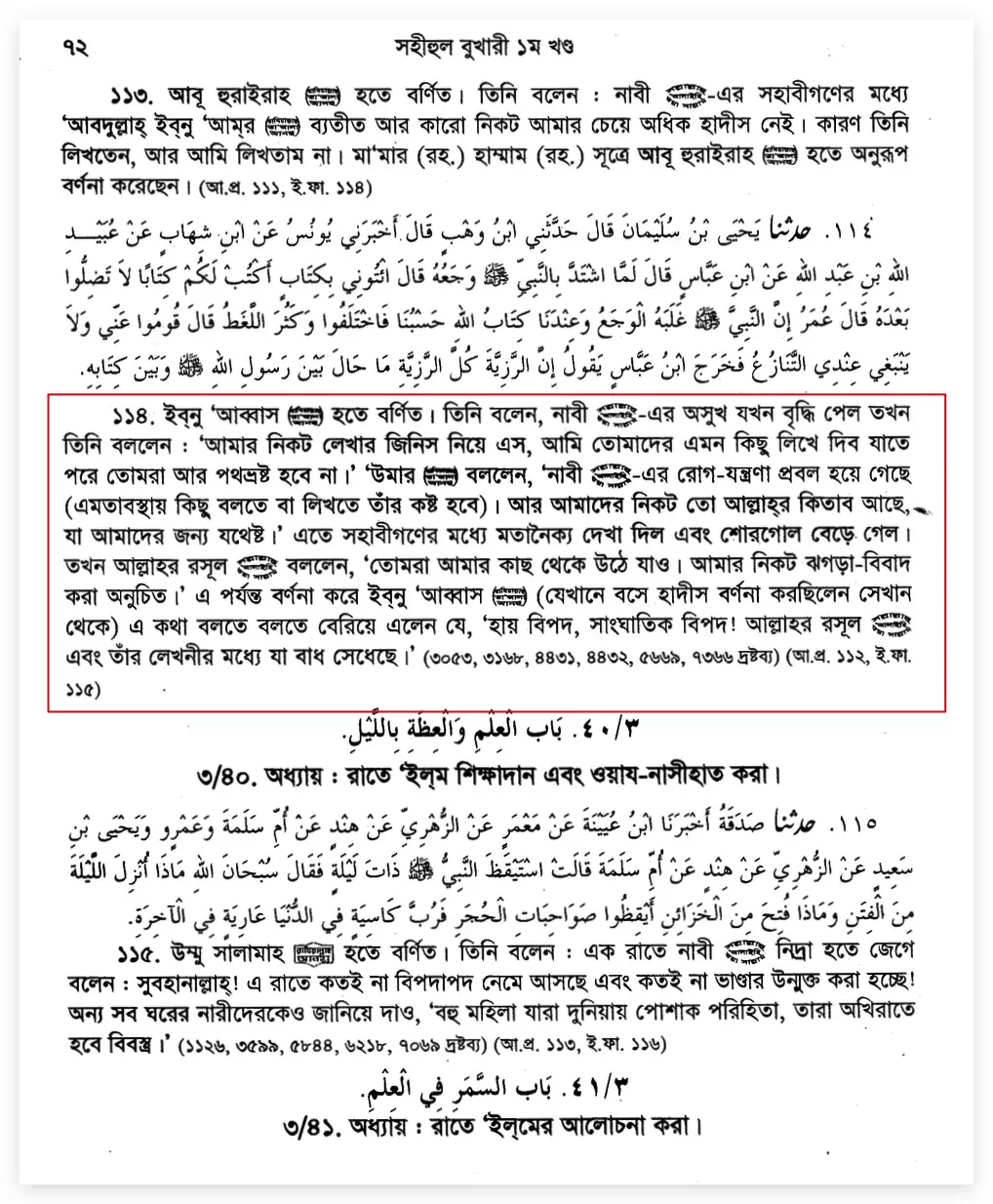
Sahih Muslim (Hadith Academy)
26. Bequests
Section: 5. For one who has nothing fit to be bequeathed, not making a bequest
Hadith Academy number: 4126, international number: 1637
4126-(22/…) Narrated from Muhammad ibn Rafi and Abd ibn Humayd (rh) ….. from Ibn Abbas (razi). He said, When the Messenger of Allah was on his deathbed and many people were present in the room, among them was Umar ibn al-Khattab. Then the Prophet said: Come, I shall write for you a document after which you will not go astray. Umar (razi) said: The illness of the Messenger of Allah has increased. And the Qur’an is present with you. The Book of Allah is sufficient for us. Then dispute began among the people of the room and they became involved in quarrelling. Some of them said: Bring it near. The Messenger of Allah will write for you a document after which you will not go astray. And others said what Umar (razi) had said. When their quarrelling and argument increased in the presence of the Messenger of Allah, the Messenger of Allah said: Get up and leave.
Ubaydullah (rh) said: From then on Ibn Abbas (razi) would lament and say: What a calamity, what a great calamity it was! Their disagreement and quarrelling became an obstacle between the Messenger of Allah and his writing that document for them. (Islamic Foundation 4088, Islamic Center 4087)
Hadith grade: Sahih
Narrator: Abdullah ibn Abbas (ra)
The most common excuse from Umar’s defenders here is that the Prophet was ill; therefore his request for pen and paper need not be treated as a binding instruction. But Islam’s own hadith tradition weakens this excuse. In another narration in Sahih Bukhari, it is clearly seen that even when the Prophet, while ill, forbade something by gesture, disobeying that instruction was later called into question by him. Even the note says that the Prophet’s instruction must be obeyed in both health and illness. Now let us read the instruction described in the following part of this hadith. [106] [107] –
Sahih Bukhari (Tawheed Publication)
64/ Maghazi [Military expeditions]
Section: 64/84. The illness of the Prophet and his death.
4458. Aishah (ra) said: During the Prophet’s illness we poured medicine into his mouth. He gestured to us not to pour medicine into his mouth. We said: This is the usual aversion of sick people to medicine. When he felt better, he said: Did I not forbid you to make me take medicine? We said: We thought it was the patient’s ordinary dislike of medicine. Then he said: Pour medicine into the mouth of everyone in the house, except Abbas, while I watch. [1] For he is not present among you. This hadith is narrated by Ibn Abi Zinad ……. from Aishah (ra), and she narrated it from the Prophet. [5712, 6886, 6897; Muslim 39/27, H: 2213, Ahmad 24317] (Modern Publication: 4101, Islamic Foundation: 4104)
[1] First, the validity of qiyas is established here even in a very minor matter. Second, the necessity of obeying the Prophet’s instruction applies equally in all his states, whether healthy or ill.
Hadith grade: Sahih
Narrator: Aishah bint Abu Bakr Siddiq (ra)
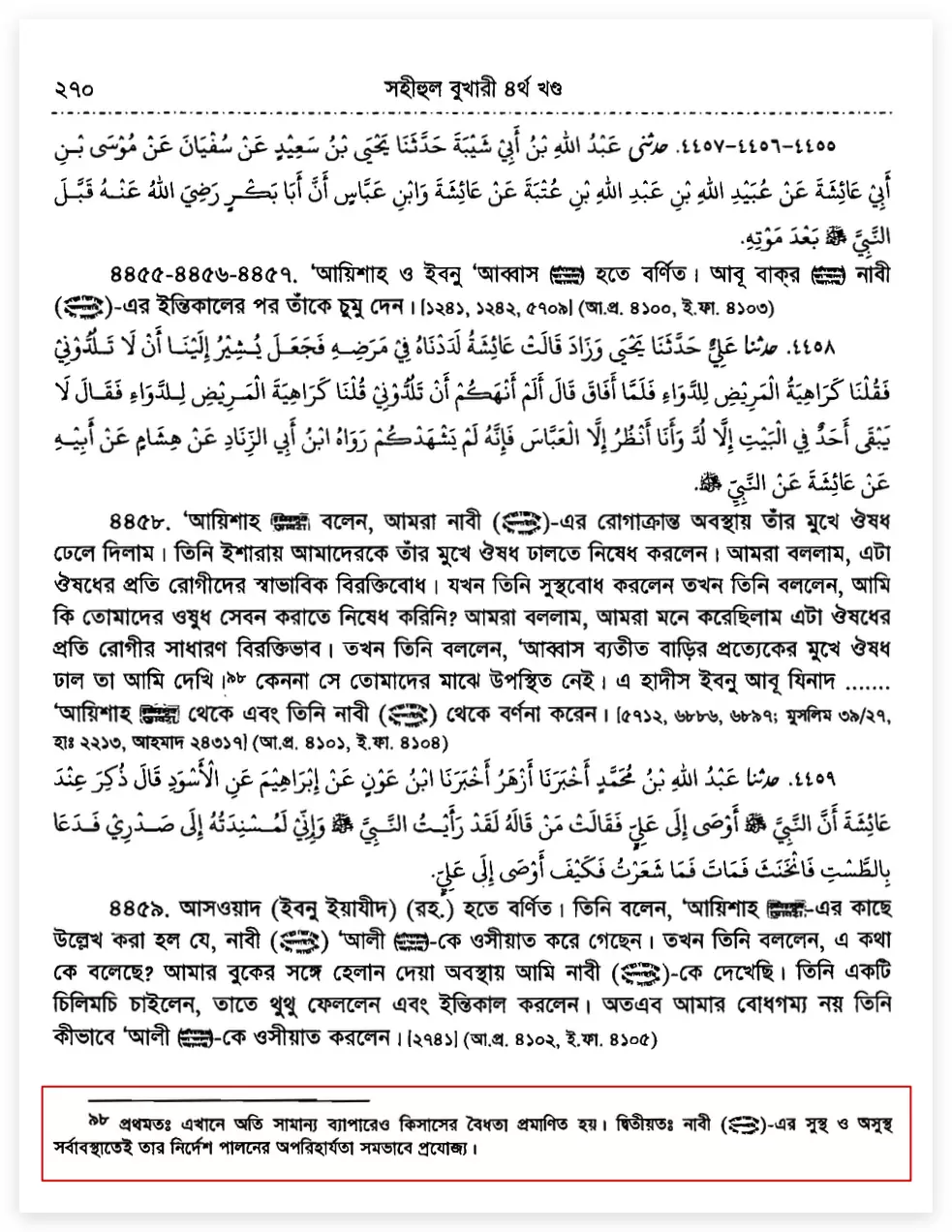
Now let us read a page from the book Sahaj Darse Ibn Majah, from which it becomes clear that the Prophet says nothing on his own. Allah is, in reality, the one who causes the Prophet to speak. Then why did Umar not want to listen to Allah’s words, that is, the Prophet’s words? [108]
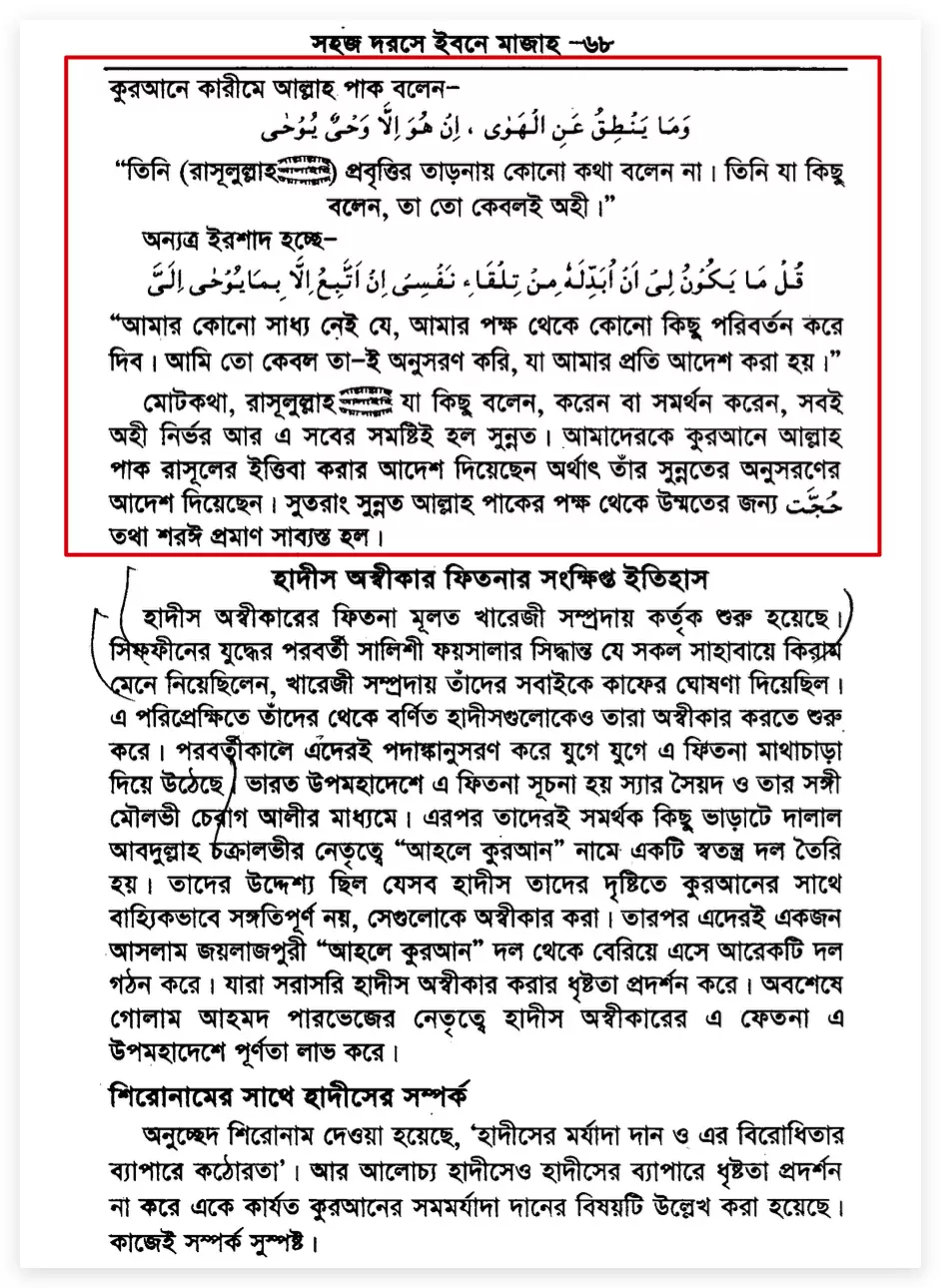
When these two sources are placed side by side, the apologetic defense of the pen-and-paper incident collapses. The fact that the Prophet was ill is not a valid excuse for disobeying his instruction. Rather, according to Bukhari’s note, even in illness it is necessary to obey the Prophet’s instruction. Again, if the Prophet’s religious speech is part of Allah-given guidance, then his request for pen and paper on his deathbed was not merely the private wish of a sick man; it was an instruction of prophetic authority. In the face of that instruction, Umar’s statement that “the Qur’an alone is sufficient” was therefore not compassion, practicality, or caution; it was the placing of his own decision over the Prophet’s instruction while the Prophet was still alive.
There is no opportunity to treat this incident lightly. The Prophet says that if he writes it down, Muslims will not go astray. Umar says the Qur’an alone is sufficient. The question is: in that situation, where is the value of the Prophet’s instruction? If Islam says that what the Messenger gives must be accepted, that obedience to the Messenger is obedience to Allah, and that after the Messenger’s decision a believer has no choice of his own, then how can Umar’s statement “the Qur’an is sufficient” be acceptable in the face of this direct instruction from the Messenger on his deathbed? If an ordinary Muslim had said to the Prophet, “Your words are not needed; the Qur’an alone is sufficient,” would the scholars of Ahl al-Sunnah call him a mujtahid, or would they call him someone who disobeyed the Messenger?
Umar’s statement is especially significant here because the Sunni hadith tradition itself warns against the person who, sitting comfortably in an armchair, will say: the Qur’an alone is sufficient for us. Such a person is described as an example of a mindset that denies the Sunnah. Yet in the deathbed incident Umar’s actual position was exactly this: we have Allah’s Book with us, and that is sufficient. In other words, the very statement that later hadith theory identifies as a dangerous attitude is the statement Umar used in front of the Prophet’s face. Here the double standard of theology is laid bare. If someone ordinary says it, he is anti-Sunnah; if Umar says it, he is farsighted.
The moral and legal significance of this incident goes still deeper. The Prophet’s claim was that his writing would prevent future misguidance. Did Umar’s obstruction, then, not deprive Muslims of possible guidance? If the writing truly was not necessary, why did the Prophet want to write it? If the writing was necessary, why did Umar obstruct it? If the Prophet mistakenly thought it was necessary, then the Prophet’s capacity for judgment is called into question. And if the Prophet was right, then Umar’s obstruction is one of the gravest acts of disobedience in Islamic history. In both cases, the conventional glorification of the Companions is endangered.
Ibn Abbas’s reaction makes the gravity of the incident clear. He described it as a disaster, a true disaster, because people’s disagreement prevented the Prophet from writing that document. If the incident had been trivial, Ibn Abbas would not have mourned it in this way. If Umar’s position had been flawless, it would not have been called a disaster. Ibn Abbas’s own language proves that, at least within the Companion tradition itself, this incident was seen as a deep loss. In other words, discomfort over Umar’s conduct is not the invention of a modern atheist; the wound is preserved within Islamic narration itself.
The excuse that “the Prophet was ill” does not stand before Islam’s own hadith tradition. In Sahih Bukhari narration 4458, it is seen that while the Prophet was ill he forbade them to pour medicine into his mouth. When those present disobeyed this by assuming it was merely a patient’s ordinary aversion, the Prophet later held them accountable for that disobedience. The note to that hadith explicitly says that the necessity of obeying the Prophet’s instruction applies in all conditions, whether he is healthy or ill. Therefore, ignoring the Prophet’s request for pen and paper on the excuse of illness collides with Islam’s own doctrine of obedience. The Prophet being ill is not a license to disobey an instruction; according to the hadith tradition, even in that state his instruction was binding.
For this reason, Umar’s statement that “the Qur’an alone is sufficient” is not merely a situational comment. It was uttered at a moment when the Prophet himself wanted to write something to prevent future misguidance. If the Prophet does not speak religiously on his own, but speaks through Allah’s guidance, as Islamic commentarial works claim, then Umar’s obstruction was not the blocking of a personal request from the Prophet; it was the placing of his own decision before Allah-guided prophetic authority. In this situation, defending Umar by saying “the Prophet was ill” actually weakens the authority of the Prophet’s final instruction itself.
Apologists usually say here that the Prophet’s illness was very severe, and that Umar spoke out of compassion. But this explanation does not solve the problem. First, the Prophet himself was speaking and giving a specific instruction. If he was so incapacitated that his instruction had no importance, then how are his other deathbed statements acceptable? Second, showing compassion does not mean cancelling the Prophet’s instruction. If the Prophet asks for writing materials, the minimum demand of obedience is to bring them. Third, in the name of compassion, a document was prevented that, in the Prophet’s own words, could have prevented misguidance. This kind of compassion is not obedience; it is a paternalistic intervention over the Prophet’s decision.
Still more dangerous is the implication of a statement such as “pain has overcome the Prophet.” If this means that the Prophet, because of illness, was no longer in proper judgment, then it casts doubt on his final instructions, final statements, and late religious authority. A Messenger wants to give an important instruction before death, and his close Companion says that illness has affected him. However devotionally this statement may be explained, its political meaning is clear: even while the Prophet was still alive and present, his decision was placed under question.
Here Islamic obedience theory is directly thrown into crisis. The Qur’an says that the Messenger must be obeyed. Hadith says that what the Messenger forbids is like what Allah forbids. Sunni Islam says the Qur’an alone is not sufficient; the Sunnah is also law. But in the deathbed incident Umar effectively took a Qur’an-only position. He made the Prophet’s additional written instruction unnecessary. If Umar’s statement is correct, then Sunni theory of the Sunnah itself becomes weak. And if the Sunnah is necessary, then Umar’s statement that “the Qur’an is sufficient” is directly wrong. In either direction, the incident is uncomfortable for Islamic theology.
The smell of power is also strong in this incident. The Prophet is on his deathbed. Questions over subsequent leadership, authority, and the future of the ummah are naturally intense. At such a moment, if the Prophet had written something, it might have affected the later structure of power. We do not know what he would have written. But we do know that he said Muslims would not go astray if he wrote it. Stopping that writing cannot be read only as medical sympathy; it can also be read as a political obstruction to possible future guidance. Moments of power in history are never innocent, especially when the final instruction of a dying Prophet is lost in the argument of those present in the room.
Religious commentary may defend Umar by saying that he was protecting the dignity of the Qur’an. But the question is: why must the Prophet’s written instruction be blocked in order to protect the dignity of the Qur’an? Was the Prophet about to write something against the Qur’an? If not, then what did Umar’s obstruction mean? And if it is assumed that the Prophet’s possible writing might have been confusing, then the Prophet’s prophetic authority itself is destroyed. Islam cannot simultaneously say that the Prophet is the best guide directed by Allah, and that his final important writing can be made unnecessary by saying “the Qur’an is sufficient.”
Calling this incident “ijtihad” is also little more than verbal polish. Ijtihad usually means an epistemic effort in an unclear matter. But here there was no ambiguity. The Prophet gave a direct instruction: bring writing materials. Umar took a direct counter-position: the Qur’an is sufficient. If this clash is called ijtihad, then any act of disobedience to the Prophet can be called ijtihad. What, then, does obedience mean? If a Companion can place his own opinion before the Prophet’s instruction while the Prophet is still alive, and if even that becomes a virtue, then obedience to the Messenger is merely political discipline for ordinary people, not for the powerful.
There is another hard question here: if the Prophet had been able to write that document, would Muslim history have been different? The Sunni-Shia divide, the conflict over the caliphate, civil war, the crisis of succession, the bloody history of leadership: could these have been otherwise? It cannot be said with certainty. But according to the Prophet’s own language, he wanted to write something by which misguidance could be avoided. Ibn Abbas called the failure of that writing a disaster. Therefore, denying the historical and political importance of this incident is dishonest. It was not merely a minor disagreement in the room of an ill patient; it was a grave power-conflict over Islam’s future guidance.
In this incident Umar appears once again in the same pattern. In the rules of fasting, Allah’s law changes before his desire. In mut‘ah and tamattu‘, practices from the Prophet’s era move aside before his prohibition. His discomfort regarding veiling receives the language of revelation. In wife-beating, his complaint restores male authority over women’s safety. And here, the Prophet’s last possible written instruction stops at his declaration that “the Qur’an is sufficient.” This cannot be treated as an isolated incident. It is part of a continuity in which religious authority is rearranged in the hands of a powerful Companion.
Therefore the pen-and-paper incident is a central piece of evidence in the criticism of Umar. Here he stood before the Prophet’s instruction, called the Prophet’s necessary writing unnecessary, used the Qur’an against the Prophet’s additional explanation, and ultimately did not allow a writing to happen which, in the Prophet’s own words, could have saved Muslims from misguidance. However much religious narratives may defend him, on a plain reading this is not obedience to the Messenger. It is Umar’s effective veto over the Prophet’s final authority. And a theology that turns this veto into virtue is loyal not to truth, but to power.
Cancelling the Nickname Given by the Prophet: Umar’s Authority over the Messenger’s Decision
In the discussion of Umar ibn al-Khattab’s disobedience to the Prophet, a small but, in principle, extremely important incident is the changing of the nickname Abu Isa. In the narration, we see that a man’s nickname was Abu Isa. Umar disliked this nickname and objected to his being called by it; he even behaved punitively. The man then clearly informed him that the Messenger of Allah himself had given him this nickname. At this point the ordinary expectation would be that Umar would stop. For according to Islam’s own principle, after the Prophet has made a decision, a believer no longer has any decision of his own. But Umar did not stop. He said that the Messenger of Allah’s past and future sins had been forgiven, whereas we are worried. After that, the man’s nickname became Abu Abdullah.
Sunan Abu Dawud (verified edition)
36/ Etiquette
Section: 72. Keeping the nickname Abu Isa
4963. Narrated from Zayd ibn Aslam (rh), from his father. Umar (ra) struck one of his sons for taking the nickname Abu Isa. Mughirah ibn Shu‘bah (ra) had the nickname Abu Isa. Umar (ra) said to him: Is it not enough if you change your nickname and make it Abu Abdullah? He said, The Messenger of Allah gave me this nickname. Umar (ra) said: All the past and future sins of the Messenger of Allah have been forgiven, but we are worried. From then until his death his title was Abu Abdullah.[1]
Hasan Sahih.
[1]. Bayhaqi.
Hadith grade: Hasan
Narrator: Zayd ibn Aslam (rh)
Outwardly, this incident may seem small. There is no war here, no caliphate, no slavery, no wife-beating, no arithmetic of inheritance. But from a principled standpoint it is highly significant. For the question is simple: if the Prophet gave someone a nickname, by what authority did Umar change it? If an ordinary Muslim disregarded an identity, name, or decision given by the Messenger and imposed his own decision instead, would he be described as virtuous? Or would he be described as someone who had crossed the limit of obedience to the Prophet?
Umar’s reasoning is even more deeply problematic. He says that the Messenger of Allah’s past and future sins have been forgiven, while we are worried. In other words, the Prophet can do something because he has a special status; but if ordinary people do that same thing, there is fear of danger. This reasoning may sound cautious, but in reality it limits the effectiveness of the Prophet’s decision. The Prophet gave someone a nickname; Umar said it was safe for the Prophet, not for us. Then is the Prophet’s action something to be followed, or merely a personal privilege of the Prophet? If even a nickname given by the Prophet cannot survive the moral anxiety of a later caliph, where is the binding force of the Messenger’s Sunnah?
Here Islamic obedience theory again runs into difficulty. The Qur’an says: accept what the Messenger gives you, and refrain from what he forbids. The Qur’an also says that when Allah and the Messenger decide a matter, a believer has no choice of his own. But the practical picture in this incident is that the Messenger gave a nickname, Umar did not accept it, and instead changed it. If this conflict is called ijtihad, then ijtihad means that a caliph may place his own judgment even against a specific decision of the Prophet. The Prophet’s decision then no longer remains final; what becomes final is the administrative preference of a powerful Companion.
The possible reason for objecting to the nickname Abu Isa was that Isa has no father, and therefore a nickname like “Abu Isa,” or father of Isa, was religiously uncomfortable. But the problem is this: if this discomfort was truly so serious, why did the Prophet himself give that nickname? Did the Prophet not know that Isa had no father? Did the Prophet fail to understand the theological problem? Was Umar more cautious than the Prophet? And if the Prophet knowingly gave the nickname, then Umar’s objection was a direct correction of the Prophet’s judgment. There is no easy respectful answer to this question.
This incident shows a continuing feature in Umar’s character. He is not merely a personal adviser; he positions himself as the practical guardian of religious discipline. Even the Prophet’s living decision, or a decision given by the Prophet, is not final before his moral-administrative anxiety. When the rule of fasting at night is violated, Allah changes the law. In tamattu‘, the Prophet performed it, yet Umar does not like it. In mut‘ah, a practice from the Prophet’s time stops under Umar’s prohibition. In adult breastfeeding, the Prophet’s strange ruling is limited by later authority. And here, even a nickname given by the Prophet is changed by Umar. The pattern is the same: the Prophet’s decision on one side, Umar’s correction on the other.
The theological double standard is clear in this incident. In the case of ordinary Muslims, the language of obedience to the Prophet is strict. If one opposes the Messenger’s words, there are threats of fitnah, punishment, misguidance, even hell. But in Umar’s case, even changing a nickname given by the Prophet becomes “caution,” “farsightedness,” or “juristic prudence.” In other words, the nature of the act is not being determined by the act itself; it is being determined by who performed it. This is the real dishonesty of the doctrine of the uprightness of the Companions.
There is another subtle matter here. A nickname is part of a person’s social identity. Changing someone’s name or nickname is not merely changing a word; it is establishing authority over that person’s identity. The identity the Prophet gave him is erased by Umar and replaced with another identity. This is an application of religio-state power over the individual. That power is so strong that the person is compelled to say: this name was given to me by the Messenger himself; yet even that cannot protect his identity. The name given by the Prophet is not enough; Umar’s approval is needed. This scene is extremely uncomfortable for Islamic obedience theory.
The phrase “we are worried” in Umar’s statement is also politically important. Whose anxiety is this? By what authority? Whose risk is Umar determining? Here it is not the individual’s own nickname, not the identity given by the Prophet, but Umar’s religious security-mindset that decides. This same security-mindset later became the basis of many religious laws: what people may be called, what names they may keep, which relations are valid, which conduct is dangerous, which women may go outside, which wife may be beaten, which practice must be stopped. Umar represents that governing religious mind which calls control religious caution, not independent moral judgment.
Apologists may say in this incident that Umar did not oppose the Prophet; he chose the safer path for ordinary people. But that is precisely the problem. If the Prophet has done or approved something, and Umar can still change it in the name of a “safer path,” then the Prophet’s action is not an ideal for ordinary people. The Sunnah of the Prophet then becomes conditional: if Umar or later jurists consider it safe, it is followable; otherwise it can be limited or cancelled. This position weakens the claim of the Sunnah’s binding force from within.
The larger question is that the argument of the Prophet’s special status is being used here to render the Prophet’s decision ineffective. The statement “the Prophet’s sins have been forgiven” is generally used to show the Prophet’s dignity. But in this incident it is used to show that the nickname given by the Prophet is unacceptable for ordinary people. In other words, the Prophet’s dignity is not strengthening the practice of following the Prophet; it is weakening it. The Prophet did it, but you cannot. The Prophet gave it, but you cannot keep it. The Prophet approved it, but Umar is worried. What kind of obedience to the Messenger is this?
This small incident therefore strengthens the larger thesis of the essay. Umar had the mentality of changing Prophet-given decisions not only in major legal matters, but even in small matters of identity. He was not merely a caliph; he was a strict guardian of religious control. For him, even the Prophet’s action was not the final word; the final word was his own caution, his own religious anxiety, his own governing judgment. This outlook later became a familiar form of Islamic politics: authority over the individual, authority over women, authority over slaves, authority over language and names, and even authority over decisions given by the Prophet.
Therefore the incident of the nickname Abu Isa is not trivial. It shows that Umar did not hesitate to correct the Prophet’s decision by means of his own religious-administrative judgment. The Prophet gave the nickname, the person reminded Umar of that, yet Umar changed it. If this incident is called virtue, then the finality of the Prophet’s decision is only rhetoric. In reality, finality remains in the hands of power. And Umar is one of the principal faces of that power.
Hajar al-Aswad: Stone-Kissing and Islam’s Pagan Remnants
Hajar al-Aswad, or the Black Stone, is the most visible example of the pagan remnants within Islam. Islam presents itself as a strictly monotheistic religion opposed to idol worship, stone worship, deity-images, and belief in the sanctity of inanimate objects. Yet in the central Islamic act of worship, Hajj, Muslims rush toward a stone set into the corner of the Kaaba, kiss it, touch it, gesture toward it, display emotion before it, and construct a discourse of special sanctity around that stone. In this duality, the continuity of pre-Islamic Arabian ritual practice within Islam is clear. The name has changed, the explanation has changed, but the stone-centered rite of sanctity has survived.
The famous statement of Umar ibn al-Khattab makes this problem even more stark. Standing before Hajar al-Aswad, he said, I know that you are a stone; you can neither harm nor benefit. Had I not seen the Messenger of Allah kiss you, I would not have kissed you. In this sentence, Umar seems for a moment to become rational. He understands that a stone is merely a stone; it has no power of its own. But in the next moment he kisses that stone, because the Prophet did so. In other words, reason rejects the stone, but religious imitation once again places that stone at the center of sacred ritual. [109]
Sahih Muslim (Islamic Foundation)
16/ Hajj
Chapter: 37. It is recommended to kiss Hajar al-Aswad during tawaf
2939. Khalaf ibn Hisham, Muqaddami, Abu Kamil and Qutaybah ibn Sa’id (RH) … narrated from Abdullah ibn Sarjis (RA). He said, I saw the bald-headed one, that is Umar ibn al-Khattab (RA), kissing the Black Stone, Hajar al-Aswad, and he said, By Allah! I shall certainly kiss you, and I certainly know that you are a stone; you can neither harm anyone nor benefit anyone. Had I not seen the Messenger of Allah, peace and blessings be upon him, kiss you, I would not have kissed you.
Hadith grade: Sahih (Sahih)
Narrator: Abdullah ibn Sarjis (RA)
This statement clarifies the tension within Islam. On the one hand, Umar acknowledges the stone’s incapacity; on the other, he kisses that incapable stone. The question is: if the stone can neither benefit nor harm, what is the religious meaning of kissing it? If the answer is, “the Prophet did it,” then the problem becomes even larger. Why would the Prophet do something that outwardly resembles stone worship so closely? Why would a Prophet sent to establish the oneness of Allah make a stone an emotionally charged part of central worship? And if this is merely a test of obedience, why is the form of that obedience so pagan?
Umar’s rationalism stops halfway here. He does not turn the stone into a deity, but neither does he abandon stone-kissing. He says the stone possesses no power, yet he performs a ritual toward the stone in imitation of the Prophet. This is a kind of half-rationalism: reason recognizes the problem, but surrenders before religious authority. This scene is extremely important, because it shows how Islamic obedience halts a person’s simple rational sense. One is permitted to say “a stone is just a stone”; but one may not say, “then I will not kiss it.”
The Islamic hadith tradition concerning Hajar al-Aswad again grants this stone an even more miraculous status. In some places it is said to have come from Paradise. Elsewhere it is said that it was whiter than milk, but people’s sins turned it black. Elsewhere it is said that on the Day of Resurrection it will have eyes and a tongue and will testify on behalf of those who touched it sincerely. In other words, the stone is not merely a memorial; the hadith tradition links it with supernatural history, moral reaction, and the capacity to testify in the afterlife. This is nothing other than assigning religious power and a person-like role to an inanimate object.
In this case, that person received an additional benefit, which proves that this stone has some power of its own. Otherwise, merely because of a kiss, no one should receive any special benefit. When such self-contradictory statements are heard from the mouth of Muhammad, who claimed that idols and stones have no power, one does not know whether to laugh or cry.
Sunan Ibn Majah
19/ Hajj
Chapter: 19/27. Kissing Hajar al-Aswad
2/2944. Narrated from Sa’id ibn Jubayr (RA). He said, I heard Ibn Abbas (RA) say, The Messenger of Allah, peace and blessings be upon him, said: On the Day of Resurrection this stone will be brought forth. It will have two eyes with which it will see, a tongue with which it will speak, and it will testify in favor of the person who kissed it with sincerity.
Tirmidhi 961, Ahmad 2216, 23۹۴, ۲۶۳۸, ۲۷۹۳, ۳۵۰۱, Darimi ۱۸۳۹, Mishkat ۲۵۷۸, At-Ta’liq ‘ala Ibn Khuzaymah ۲۷۳۵, ۲۷۳۶.
Albani’s verification: Sahih.
Hadith grade: Sahih (Sahih)
Narrator: Sa’id ibn Jubayr (RH)
Sunan at-Tirmidhi (Verified)
7/ Hajj
Chapter: 113. Concerning Hajar al-Aswad
۹۶۱۔ It is narrated from Ibn Abbas (RA) that he said, The Messenger of Allah, peace and blessings be upon him, said concerning Hajar al-Aswad: By Allah! Allah Most High will raise this stone on the Day of Resurrection in such a state that it will have two eyes with which it will see and one tongue with which it will speak. This stone will testify before Allah Most High concerning the person who touched it with a sincere heart.
— Sahih, Mishkat (۲۵۷۸), Ta’liq ar-Raghib (۲/۱۲۲), Ta’liq ‘ala Ibn Khuzaymah (۲۷۳۵)
Abu Isa called this hadith hasan.
Hadith grade: Sahih (Sahih)
Narrator: Abdullah ibn Abbas (RA)
Sunan ad-Darimi
5. Chapter on Hajj
Chapter: 26. The virtue of kissing Hajar al-Aswad
۱۸۷۶. Narrated from Ibn Abbas, may Allah be pleased with him, The Messenger of Allah, peace and blessings be upon him, said: On the Day of Resurrection Allah will resurrect this stone in such a state that it will have two eyes with which it will see and a tongue with which it will speak, and it will testify on behalf of the person who kissed it properly.(1)
Salman says (in his narration): for the person who kissed it, meaning without the word “properly.”
(1) Verification: Its chain is sahih.
Takhrij: [41]
We have given its complete takhrij in Musnad al-Mawsili no. ۲۷۱۹; Sahih Ibn Hibban nos. ۳۷۱۱, ۳۷۱۲ and Mawarid al-Zam’an no. ۱۰۰۵.
Also, Tabarani, al-Kabir ۱۲/۶۳ no. ۱۲۴۷۹.
Hadith grade: Sahih (Sahih)
Narrator: Abdullah ibn Abbas (RA)
Here Islam’s monotheistic claim falls into its most embarrassing position. On the one hand, it is said that stones, idols, images, trees, graves, and deity-statues can neither benefit nor harm. On the other hand, Hajar al-Aswad is described as a stone from Paradise, a stone whose color changed because of human sin, a stone that will testify in the afterlife. The question is: how far is this from stone worship? It is not called a deity, true. But the stone has been given a heavenly origin, moral reaction, and the power of testimony on the Day of Resurrection. If after this someone says it is merely a stone, he stands against his own hadith tradition. And if he says the stone has a special status, then he must admit belief in the sanctity of an inanimate object.
To understand this contradiction more clearly, the video related to Hajar al-Aswad may be watched.
Islamic defense here usually says that Muslims do not worship the stone; they merely follow the Sunnah of the Prophet. But this argument evades the problem. The same argument can be used for almost every religious symbol. A Hindu may say that he does not regard an idol as “God Himself,” but as a reminder of God or a medium of worship. A Christian may say that the cross is not wood, but a memorial of Jesus’ sacrifice. Someone may say that a sacred amulet is not powerful in itself, but a means of God’s blessing. Then why is only the Muslim’s stone-kissing pure monotheism, while another’s symbolic devotion is paganism? The double standard is clear here. One’s own stone is Sunnah; another’s stone is shirk.
Umar’s statement cannot cover this double standard; rather, it exposes it further. He knows the stone is incapable. Yet he kisses it in imitation of the Prophet. In other words, the moral and rational basis of the act is not the stone’s power; the basis is the Prophet’s conduct. But if the Prophet’s conduct establishes such a devotional physical ritual centered on an inanimate object, then that conduct itself becomes questionable. Monotheism is not merely the claim that a stone is not God; the claim of monotheism should be that a stone is not made the center of religious emotion, afterlife testimony, and sacred touch. Islam fails that test.
The broader context of the Kaaba is also important here. The Kaaba was the sacred center of pre-Islamic Arabs. Many idols were there, the rituals of different tribes took place there, tawaf existed, the consciousness of a sacred place existed, and Hajar al-Aswad was also part of that sacred architecture. Even after removing the idols, Islam retained the Kaaba, tawaf, the Black Stone, direction-oriented worship, and the emotions of kissing and touching. Thus a large part of pre-Islamic ritual practice survived, reinterpreted in Islamic language. This is the normal history of religious continuity, but it is difficult to call it an entirely new monotheistic purity descended from heaven.
The distinction Islam wants to create in the case of Hajar al-Aswad is essentially linguistic. If others accept a stone, it is shirk; if Muslims kiss a stone, it is Sunnah. If others see blessing in a sacred object, it is superstition; if Muslims call Hajar al-Aswad an object from Paradise, it is faith. If others show emotion before an idol, it is paganism; if Muslims crowd around the Black Stone, it is part of worship. This double standard cannot withstand rational scrutiny. In the structure of the ritual, the sanctity of an inanimate object, the desire to touch, kissing, bodily devotion, and supernatural belief are all present. Only the name has changed.
Umar’s position is therefore ambiguous. On the one hand, he denies divinity to the stone, which is a step toward monotheistic reasoning. But on the other hand, he maintains stone-kissing, which is a continuation of ritual paganism. This ambiguity is in fact Islam’s ambiguity as well. Islam wants to deny the sanctity of inanimate objects, but preserves that sanctity around the Kaaba and Hajar al-Aswad. Islam speaks against shirk, but makes an exception for its own sacred stone. Islam tells the story of smashing idol worship, but preserves the ritual of stone-kissing.
There is another subtle point here. If Hajar al-Aswad is imagined as a witness on the Day of Resurrection, then the stone no longer remains merely a stone. To testify, consciousness, memory, identity, language, or at least supernatural power is required. When the hadith gives the stone eyes, a tongue, and the power to testify, it elevates an inanimate object almost to personhood. This kind of belief is precisely the foundation of sacred objects, totems, images, and divine signs in ancient religions. In the case of other religions, Islam condemns this mentality as shirk; in its own case, it sanctifies it as hadith.
Apologists may also say that kissing Hajar al-Aswad is not obligatory; gesturing from a distance is sufficient. But this does not resolve the problem. Even if it is not obligatory, the ritual has religious status. People crowd to touch it, consider kissing it to have special virtue, perform it as the Prophet’s Sunnah, and the hadith tradition gives it the power to testify in the afterlife. Something does not cease to be a pagan remnant merely because it is not obligatory. Many religious rituals are optional, yet still carry belief in the sanctity of inanimate objects.
The incident of Hajar al-Aswad is directly connected to the broader thesis of this essay. Here Umar identifies an unease within Islam. He understands that the stone itself is nothing. But he does not follow that understanding to its conclusion. Imitation of the Prophet bends him again before the stone. This scene shows where the limit of reason lies in Islamic tradition. If reason comes into conflict with the Prophet’s ritual, reason must stop. Thus stone-kissing remains, monotheistic explanation applies a polish over it, and Muslims declare that their own stone is not stone worship.
Therefore, Umar’s statement concerning Hajar al-Aswad is not evidence in favor of Islam; rather, it is evidence of the contradiction within Islam. He himself admits that the stone can neither benefit nor harm. Yet even after that admission, stone-kissing remains. The hadith tradition gives that stone miraculous status. Kaaba ritual keeps that stone at the center of Muslim emotion. On one side, anti-stone-worship language; on the other, sacred stone-kissing. The name of this duality is not monotheism; it is the Islamic reinterpretation of pre-Islamic paganism.
The Humiliation of the Prophet’s Wife Sawda: The Prophet’s Silence and Tacit Consent
Umar ibn al-Khattab’s zeal for hijab is usually promoted in Islamic history as a virtue. It is said that he wanted to protect women’s purity, the dignity of the Prophet’s family, and the moral order of Muslim society. But when the sources are read closely, the mask of this so-called purity falls away. There one sees that Umar’s zeal for hijab was a stark example of imposing patriarchal surveillance over women’s bodies, movement, visibility, and private needs. The most uncomfortable incident of this surveillance is his identifying and calling out the Prophet’s wife Sawda bint Zam’a when she went outside to relieve herself.
It is reported that after the ruling of hijab was revealed, Sawda went outside to relieve herself. She had such a physical build that people who knew her could recognize her. Seeing her, Umar said, “O Sawda, you cannot remain hidden from our sight; now see how you go outside.” This sentence is not an innocent remark. It is the public identification of a woman’s body, the turning of her natural need into a matter of social shame, and the creation of pressure of male surveillance over her movement. A woman went outside because the human body has natural needs. Umar did not respect that human need; rather, he turned it into an instrument of hijab politics. [110] [111]
Sahih Muslim (IFA)
Chapter: 40/ Salam
Section: 7. The permissibility of women going outside to fulfill people’s natural needs
548۴. Abdul Malik ibn Shu’ayb ibn Layth (RH) … narrated from Aisha (RA) that the wives of the Messenger of Allah, peace and blessings be upon him, would go out at night toward “Manasi” when responding to the call of nature. الْمَنَاصِع (Manasi) means wide open grounds. Meanwhile Umar ibn al-Khattab (RA) used to say to the Messenger of Allah, peace and blessings be upon him, impose hijab upon your wives. But the Messenger of Allah, peace and blessings be upon him, did not do so. One night at the time of Isha, Sawda bint Zam’a (RA), the wife of the Prophet, peace and blessings be upon him, went out. She was a tall woman. Umar (RA) called out to her and said, O Sawda! We have recognized you. He did this out of an intense desire for the ruling of hijab to be revealed. Aisha (RA) said, Then Allah Most High revealed the ruling of hijab.
Hadith grade: Sahih (Sahih)
Sahih Bukhari (Islamic Foundation)
52/ Tafsir
Chapter: The statement of Allah Most High: لا تدخلوا … عند الله عظيما O believers! Do not enter the Prophet’s houses until permission is given to you for a meal, without waiting for its preparation; but when you are called, then enter, and when you have eaten, disperse, without lingering for conversation. Indeed, such behavior causes discomfort to the Prophet. He feels shy to ask you to leave. But Allah is not shy of the truth. And when you ask his wives for anything, ask them from behind a screen. That is purer for your hearts and their hearts. It is never lawful for you to cause discomfort to the Messenger of Allah, nor to marry his wives after him, ever. Indeed, that is a grave offense before Allah. It is said إِنَاهُ means the cooking of food. It is formed from أَنَى يَأْنِيْ أَنَاةً. لَعَلَّ السَّاعَةَ تَكُوْنُ قَرِيْبًا perhaps the Hour is very near. If you use it as feminine, then you will say قَرِيْبَةً. And if you do not take الصِّفَةَ, but use it as ظَرْفًا or بَدَلًا, then you will not attach ‘ta’ to it. Likewise, this word is used in the singular, dual, plural, and for both masculine and feminine.
Islamic Foundation number: 4432, international number: 4795
4432۔ Zakariya ibn Yahya (RH) … narrated from Aisha (RA). She said, After the ruling of hijab was revealed, Sawda went outside for a natural need. Sawda had such a stout body that she could not hide herself from people who knew her. Umar ibn al-Khattab (RA) saw her and said, O Sawda! Know that, by Allah, you cannot remain hidden from our sight. Now see how you go outside? Aisha (RA) said, Hearing this, Sawda (RA) returned. At that time the Messenger, peace and blessings be upon him, was eating supper in my room. In his hand was a piece of bone. Sawda (RA) entered the room and said, O Messenger of Allah! I had gone outside for a natural need. Then Umar (RA) said such-and-such things to me. Aisha (RA) said, At that time Allah Most High sent revelation to him. When the revelation ended, the piece of bone was still in his hand; he had not put it down. The Messenger, peace and blessings be upon him, said, Certainly you have been permitted to go outside for your needs.
Hadith grade: Sahih (Sahih)
Narrator: Aisha bint Abu Bakr Siddiq (RA)
No modern theory is needed to understand the moral ugliness of this incident. A woman went at night or outside to fulfill a natural need. A man saw her and publicly commented on her body shape, visibility, and identity. As a result of that comment, the woman became uncomfortable, returned, and complained to the Prophet. In today’s language, this can be called street harassment, body surveillance, and an attempt to control movement. But in religious discourse the incident becomes Umar’s virtue. In other words, where there should have been moral judgment, patriarchal control has been dressed up in the language of purity.
What is important here is that Umar did not target just any ordinary woman; he targeted the Prophet’s wife. In Islamic discourse, the Prophet’s wives are called “Mothers of the Believers.” But even that status did not protect Sawda from Umar’s surveillance. Rather, her identity as the Prophet’s wife turned her even more into an object of surveillance. The more religiously honored a woman is, the more controllable her body becomes. This pattern is seen not only in Islam but in almost all patriarchal religious cultures: surrounding, covering, surveilling, and subjecting a woman’s movement to male moral anxiety in the name of honoring her.
Sawda’s incident lays bare this patriarchal logic. The problem was not any offense committed by Sawda. The problem was that she was visible. Her body was recognizable. Therefore, in Umar’s eyes, her going outside was not acceptable. Here the woman’s offense is the visibility of her existence. The male eye sees her, so the woman must be further concealed. The question is: why should women be confined instead of men’s eyes being controlled? Umar could not avert his own gaze, but he placed the blame on the woman. This logic is the central dishonesty of hijab morality: men look, women cover; men feel discomfort, women stay indoors; men want control, Allah sends revelation.
Religious defense will say that Umar wanted safety and dignity for the Prophet’s wives. But this explanation distorts the language and circumstances of the incident. If safety were the concern, the language could have been, “Arrangements are needed for your safety.” If dignity were the concern, he could have spoken respectfully with the Prophet. But he directly targeted Sawda and said, you cannot remain hidden from our sight; now see how you go outside. This is not safety; it is shaming. This is not dignity; it is social discipline. This is not modesty; it is patriarchal interference in a woman’s natural need.
The Prophet’s reaction here is also morally weak. Sawda returned and complained. The Prophet eventually said, you have been permitted to go outside for your needs. This sentence acknowledges women’s need to go outside, but where is the moral condemnation of Umar’s behavior? In the structure of the narration, Umar is not publicly rebuked. No clear moral position is seen against his body surveillance, his shaming of a woman, and his attempt to control a natural need. As a result, the incident is ultimately read not as a matter of women’s right to movement, but as part of hijab politics.
Caution is needed at this point. Someone may say that the Prophet did, after all, permit women to go outside for their needs. True, but that is not a solution to the problem. Permission for women to go outside for natural needs is not a high moral advancement; it is the minimum of humanity. The question is, why did that minimum need become a matter of surveillance and objection for men like Umar? Why did a woman have to be shamed for her body? Why did even the Prophet’s wife have to receive the validity of her need through men’s conversations? The answer to these questions is nothing but patriarchy.
In the context of the revelation of hijab, this incident becomes even more serious. Umar repeatedly told the Prophet, impose hijab upon your wives. His argument was that both the righteous and the wicked spoke with them. Within this language itself, women are seen as objects of potential danger, centers of male gaze, and fields of social suspicion. Later, verses concerning hijab were revealed. In a devotional reading, this is Allah’s command. But in an analytical reading, one sees that Umar’s patriarchal anxiety, discomfort over women’s visibility, and the pressure of social control over the Prophet’s family received the language of religious law.
This incident is directly connected to the idea of “Muwafaqat Umar.” Umar wanted hijab; later the verse of hijab came. Umar identified Sawda outside and pressured her; later narrations related to revelation appear in the context of women’s needs. This sequence is called a virtue. But the question is: is it virtue, or the religiousization of male social discomfort? A man wanted women to be less visible, and then that desire was established as Allah’s command. In this picture, Allah’s revelation is not an independent moral truth; rather, it is an instrument that grants religious legitimacy to the anxieties of a powerful man.
Here a fundamental problem in Islamic hijab morality appears. It places the burden of male desire, gaze, suspicion, and discomfort onto women’s bodies. Men are looking, so women must cover. Men are recognizing them, so women must become even more invisible. Men’s minds are restless, so women’s movement must be controlled. But the demand of civilized morality should be the opposite: men should control their own gaze, conduct, and modesty; women should not have to be shamed for their human needs, movement, and social presence. This balance is absent in Islamic hijab politics. There, men’s incapacity becomes women’s punishment.
Body politics is also clear in Sawda’s incident. The narration mentions her physical build. That means the size of a woman’s body, her recognizability, her visibility, her being caught in another’s gaze—all of these become elements of religious discussion. A woman is stout, tall, known, recognizable—and for these reasons her movement becomes a problem. Here the woman is not a full human subject; she is a visible body formed in the male gaze. This perspective is the central problem of patriarchal religion. A woman is viewed not as a human being with soul, intellect, will, rights, and freedom, but as a body that must be covered.
No matter how much theology tries to sanctify this incident, its human reading is clear. Sawda went outside because she had a need. Umar shamed her. Sawda returned and complained. The Prophet permitted women to go outside, but Umar’s insulting behavior was not identified as an offense in Islamic tradition. Rather, Umar’s zeal for hijab was glorified in later discourse. This means that it does not matter if a woman is shamed; male passion for hijab is sacred. Women’s discomfort is secondary; male control is primary.
If this incident is judged in today’s language, it is clearly a violation of personal privacy and the dignity of movement. When a woman goes outside to fulfill a natural need, identifying her and saying, “You are visible; now see how you go out,” is not modesty. It is surveillance. It is not religious morality. It is social humiliation. Holding a woman responsible for her body, shaming her for being caught in the male gaze, and making her movement subject to male approval—all of these are directly unacceptable by modern human rights standards.
This context also fits Umar’s broader character. He regulated sexual-social practices in mut’ah and tamattu’. In the case of wife-beating, he objected to women “becoming bold.” He became part of the later restriction concerning adult breastfeeding, where women’s bodies were made into a strange instrument of mahram law. In Sawda’s case, he played a direct role in controlling women’s movement and visibility. In other words, a central element of Umar’s religious-legal character is patriarchal control over women and sexuality. If he is seen only as a just ruler, this uncomfortable continuity is hidden.
The biggest question here is: is hijab morality, or control? If it were morality, it would stand upon the equal dignity of men and women, mutual respect, personal privacy, and freedom of movement. But in Sawda’s incident, one sees that hijab is in fact the legal form of male discomfort over women’s visibility. If a woman goes outside, that is a problem; if a woman is recognized, that is a problem; if a woman is present with a body, that is a problem. As the solution to this problem, not the male gaze but the concealment of women has been chosen. This is the fundamental patriarchy of hijab morality.
Therefore Sawda’s incident is not a small embarrassing family anecdote. It shows that Umar’s zeal for hijab did not protect women’s dignity; rather, it subjected women’s bodies and movement to male surveillance. Even the Prophet’s wife was not free from this surveillance. Her natural need too became a matter of religious politics. Later tradition did not condemn this behavior of Umar, but placed it within the stream of hijab-virtue. Thus it becomes clear that Islam’s hijab policy is not respect for women; it is the religious legitimation of patriarchal control. And Umar is one of the principal faces in the construction of that legitimacy.
The Battle of Hunayn: The Companions’ Flight, Umar’s Presence, and the Myth of Sanctity
A large part of the popular Sunni mythology about the Companions rests on a romantic image of heroism, sacrifice, unconditional obedience to the Prophet, and steadfastness on the battlefield. Ordinary Muslims are taught that the Companions were mountains of faith, always ready to give their lives for the Prophet, firm in battle, fearless, and unparalleled. But when Islam’s own sources are read closely, this image appears far more complex, human, and uncomfortable. The Battle of Hunayn is one of the clearest examples of that discomfort. The Qur’an itself mentions the Muslims’ self-satisfaction, pride in numbers, battlefield crisis, and turning of backs on the day of Hunayn. In other words, within the heroic narratives of the Companions themselves there is documentary evidence of flight, fear, chaos, and weakness. [112]
Indeed, Allah has helped you on many battlefields and on the day of the Battle of Hunayn, when your great numbers made you proud, but they availed you nothing; and the earth, despite its vastness, became narrow for you, and you turned back in flight.
— Taisirul Quran
Certainly Allah gave you victory in many places (in battle) and on the day of Hunayn. When your great numbers made you intoxicated with pride, yet that great number was of no use to you; and despite the earth being vast, it became narrow upon you, then you fled, showing your backs.
— Sheikh Mujibur Rahman
Certainly Allah helped you in many places and on the day of Hunayn, when your great numbers delighted you, though they availed you nothing. And the earth, despite being vast, became narrow upon you. Then you fled, turning your backs.
— Rawai Al-bayan
Certainly Allah helped you in many places and on the day of the Battle of Hunayn [1], when your great numbers delighted you; but they availed you nothing, and despite its vastness the earth became constricted for you. Then you fled, turning your backs [2].
— Dr. Abu Bakr Muhammad Zakaria
The Qur’anic language here is extremely important. This is not enemy propaganda, not the mockery of an atheist historian, and not a Shi‘i polemic either. It is the language of Islam’s own sacred scripture. There it says that on the day of Hunayn the Muslims’ numbers made them self-satisfied, but those numbers availed them nothing; despite the earth being spacious, it seemed narrow to them; then they turned back and fled. This description directly shocks the conventional image of the Companions’ flawless battlefield heroism. Those who were in the Prophet’s company, who are presented as the best generation of faith, could also become disordered by fear of battle and turn back.
The hadith also provides a detailed picture of this chaos at Hunayn. In Abu Qatadah’s narration, Muslims are seen withdrawing or fleeing from the battlefield. He himself says that he too fled with those who were fleeing. In that situation, he sees Umar ibn al-Khattab among the people and asks, what has happened to the people? Umar says, it is Allah’s affair. Later the Muslims return. In this narration, Umar does not stand as a solitary, steadfast hero. He is among that chaotic crowd who, out of fear for their lives, were fleeing after leaving the Prophet behind, where battlefield composure had collapsed. [113]
Sahih Bukhari (Tawhid Publication)
64/ Maghazi [Battles]
Chapter: 64/55. The saying of Allah, the Most High:
4322. Narrated from Abu Qatadah (ra). He said, On the day of the Battle of Hunayn I saw a Muslim fighting a polytheist. Another polytheist was attacking the Muslim from behind in order to kill him. Then I struck his arm and cut it off. He grabbed me and squeezed me with tremendous pressure, until I became afraid. Then he released me and became weak. I attacked him and killed him. When the Muslims began to flee, I too fled with them. Suddenly I saw Umar ibn al-Khattab (ra) among the people. I said to him, what is the state of the people? He said, whatever Allah wills. Then the people returned to the Messenger of Allah, peace and blessings be upon him. Then the Messenger of Allah, peace and blessings be upon him, said, “Whoever can produce proof that he killed someone shall receive the property left by the slain person.” I stood up to look for a witness regarding the one I had killed. But I found no one who would testify on my behalf. Then I sat down. Later, at a suitable opportunity, I informed the Messenger of Allah, peace and blessings be upon him, of the incident. Then one of those sitting beside him said, the weapons of the slain person mentioned are with me; persuade him to give them to me. Then Abu Bakr (ra) said, no, that cannot be. He [the Prophet, peace and blessings be upon him] cannot give them to this weak man of Quraysh instead of giving them to one of the lions of Allah who fought on behalf of Allah and His Messenger. The narrator says, then the Messenger of Allah, peace and blessings be upon him, stood up and gave them to me. With them I bought a garden. And after accepting Islam, this was the first property by which I established my financial foundation. [2100] (Modern Publication: 3978/3979, Islamic Foundation: 3983)
Hadith grade: Sahih (Sahih)
Narrator: Abu Qatadah Salami (ra)
This needs to be read carefully. The claim is not that Umar alone fled the battlefield like a coward while everyone else stood firm. The claim is stronger and fairer: the collective flight or chaos of the Companions at Hunayn is acknowledged in Islam’s own sources, and Umar appears outside the sanctified, steadfast, invincible, unquestionable image of the Companion as an ordinary human figure. He was not outside the realities of fear, chaos, and retreat on the battlefield. That alone is enough to break the myth of Companion-purity.
The major problem with Companion-worship is that it does not allow people to be seen as human beings. On the battlefield, people may feel fear, fall into disorder, flee, and return again. From a historical perspective, this is not unusual. But when religious propaganda turns the Companions into almost superhuman figures, events like Hunayn become dangerous. For it shows that the Companions were real people: they were afraid, made mistakes, retreated, made political decisions, surveilled women, ran a slave trade, objected to the Prophet’s instructions, and, when necessary, reshaped religious rulings according to their own interests or psychology.
The Battle of Hunayn is especially important because the event takes place on the battlefield. The battlefield is the principal stage of Companion-heroism. In Islamic history, stories of battles such as Badr, Uhud, Khandaq, Hunayn, and Tabuk are used to construct the glory of the Companions’ faith, courage, and sacrifice. But on these very same battlefields we see fascination with numerical superiority, collapse under sudden attack, scattering away from the Prophet, and turning of backs. In other words, where the narrative of heroism is produced, there is also documentary evidence of weakness. Religious history erases weakness and preserves heroism; critical history sees both.
The Qur’anic phrase “your great numbers delighted you” is also significant. What is seen here is not faithful humility, but self-satisfaction. They were large in number, and therefore a kind of confidence or pride developed. Then that confidence collapsed under the shock of actual battle. This description matches ordinary military psychology. When a group is large, self-satisfaction arises; when disaster strikes, panic spreads; when panic spreads, flight occurs. There is nothing miraculous in this. Rather, the Qur’anic description itself shows that the Muslim army of the Prophet’s time was also subject to psychological weaknesses like other human societies.
It is important to view Umar separately here, because in later Sunni narratives he is a symbol of severity, courage, justice, firmness, and the strength of Islam. But in the narration of Hunayn he is not in any separate superhuman position like that romantic symbol. He is present in the midst of the chaos of battle, in a scene connected with the crowd that was fleeing or retreating. When Abu Qatadah asks what has happened to the people, Umar’s answer is not a heroic military declaration; rather, it is a fate-dependent comment of the sort, “This is Allah’s affair.” This scene brings Umar down from the seat of myth and places him in a real human position.
Of course, Islamic apologetics will say that the Muslims returned later, that Allah helped them, and that the battle ultimately went in favor of the Muslims. But that does not erase the basic problem. The question is whether flight occurred or not. The Qur’an itself speaks of turning backs. In the hadith there is an admission of flight. Returning later does not make the initial retreat disappear. If someone first flees and then returns, it cannot be said that he did not retreat. Rather, it should be said that he retreated and later returned. Religious propaganda wants to cover the weakness in the middle by showing the victory at the end. But in history, both are true.
This event also reveals another moral double standard in the Qur’an. In other cases, severe language has been used against fleeing or turning one’s back on the battlefield. But in the case of the Companions, the flight is later softened through language such as Allah’s help, mercy, the sending down of tranquility, and regrouping. The judgment of the same act changes depending on the identity of the person. Ordinary battlefield desertion is cowardice, but the Companions’ flight from the battlefield is a temporary test in history. This is religious privilege. Those who must be sanctified have even their weaknesses made part of a sacred story.
The event of Hunayn, therefore, is not merely a criticism of Umar; it is an important document against the doctrine of Companion-uprightness. If the Companions are morally reliable, almost unquestionable in character, and ideals of firmness in faith, then how is the flight at Hunayn to be explained? If it is said that they were human, became afraid, made mistakes, and were later corrected, then very well; but that admission weakens the foundation of Companion-worship. If they are human, they are open to criticism. If they made mistakes, their mistakes may be named as mistakes. If they retreated on the battlefield, it may be called retreat. If they objected to the Prophet’s instruction, it may be called objection.
Devotees of Companion-uprightness usually divide history into two parts: explanation for the Companions, judgment for others. If a Companion flees, it is called a test from Allah. If an ordinary soldier flees, it is called cowardice. If a Companion objects to the Prophet’s decision, it is called ijtihad. If an ordinary person objects, it is called rebellion. If a Companion surveils a woman, it is called a desire for purity. If an ordinary person does it, it is called harassment. The event of Hunayn removes the mask from this double standard, because here the people of the sacred generation too became frightened on the battlefield just like ordinary people.
There is no need in this section to make Umar the sole culprit; rather, the entire structure of Companion-purity must be questioned. Umar was one of the chief figures of that generation. If even on the battlefield of that generation we see flight, chaos, and fear, then their political, social, sexual, and legal decisions cannot remain above suspicion either. Those who felt fear on the battlefield are not free from the desire for power. Those who can flee can also make faulty laws. Those who are human must be judged as human. The identity of Companion is not a divine seal.
When the event of Hunayn is read together with the earlier discussions of Umar, the continuity becomes clearer. On the nights of fasting, he violated an operative rule. In mut‘ah and tamattu‘, practices from the Prophet’s time faced his prohibition. In ‘awl, the Qur’an’s mathematical problem was repaired through a human method. In the case of umm walad, Umar introduced a limited correction to the slave market of the Prophet’s time. On wife-beating, his objection worked in favor of patriarchal authority over women. In the pen-and-paper incident, the Prophet’s last possible instruction was halted. And at Hunayn, it is seen that even on the battlefield he was part of that same world of ordinary human weakness. Taken together, all this makes it necessary to view Umar not as a sacred idol, but as a powerful, influential, mistaken, patriarchal, and political human being.
Therefore, the Battle of Hunayn is not disrespect toward the Companions; it is a source-based reality. The Qur’an itself spoke of retreat. The hadith itself showed battlefield chaos. Umar is not outside that history. Thus those who want to shut down all criticism of the Companions are actually behaving dishonestly toward Islam’s own sources. When the sources show weakness, they make glory. When the sources show flight, they make heroism. When the sources show human fear, they make superhuman virtue. Critical reading wipes away this religious makeup.
Thus the event of Hunayn strengthens the central argument of this essay further: Umar and the Companions are not above criticism. They were real political-military human beings around the Prophet, not angels. They felt fear, retreated, changed laws, controlled women, obstructed the Prophet’s decisions, and established the social power structures of their time in religious language. Hunayn removes the military mask from that myth of sanctity. On the battlefield itself it becomes clear that the claim of Companion-purity is not history; it is later religious propaganda.
Tarawih Congregation: When Bid‘ah Gains Legitimacy in the Hands of the Caliph
In Islamic theology, the word “bid‘ah” is an extremely powerful term of condemnation. Introducing something new in religious matters after the Prophet, changing the form of worship, or giving religious status to a practice that was not permanently established in the Prophet’s time are generally attacked as bid‘ah. In many hadiths bid‘ah is called misguidance, the innovator is severely condemned, and in Muslim society the accusation of “bid‘ah” has been used to invalidate countless practices, opinions, groups, and people. But in the case of the tarawih congregation, that fear of bid‘ah is seen to soften in the hands of a powerful caliph. Umar himself introduced a new organized congregational system and said, “What an excellent bid‘ah this is.” [114]
Sahih Bukhari (Islamic Foundation)
24/ The Tarawih Prayer
Chapter: 1252. The virtue of qiyam Ramadan (the tarawih prayer in Ramadan)
Islamic Foundation number: 1883 , International number: 2009 – 2010
1883. Abdullah ibn Yusuf (rh) … narrated from Abu Hurayrah (ra) that the Messenger of Allah, peace and blessings be upon him, said: Whoever stands in the tarawih prayer with faith and in hope of reward, his previous sins will be forgiven. The narrator of the hadith, Ibn Shihab (rh), said: The Messenger of Allah, peace and blessings be upon him, passed away, and the matter of tarawih continued in this way. It remained so during the caliphate of Abu Bakr (ra) and in the first part of the caliphate of Umar (ra).
Ibn Shihab (rh) narrated through Urwah ibn az-Zubayr (rh), from Abdur Rahman ibn Abd al-Qari (rh), who said: One night in Ramadan I went with Umar ibn al-Khattab (ra) to the Prophet’s Mosque and saw that the people were divided into scattered congregations. Some were performing salat (namaz/prayer) alone, while another person was performing salat and a group of people were following him in prayer. Umar (ra) said: I think that if I gather these people behind one qari (imam), it will be better.
Then he gathered everyone behind Ubayy ibn Ka‘b (ra). Later, on another night, I went out with him [Umar (ra)]. At that time the people were performing salat with their imam. Umar (ra) said: How beautiful this new arrangement is! The part of the night in which you sleep is better than the part of the night in which you perform salat (namaz/prayer); by this he meant the last part of the night, because at that time the people used to perform salat in the first part of the night.
Hadith grade: Sahih (Sahih)
Narrator: Abu Hurayrah (ra)
Here the double standard of Islamic bid‘ah theory is exposed in relation to the tarawih congregation. In the Prophet’s language, newly invented matters in the religion are the worst matters, every bid‘ah is misguidance, and introducing into the religion something that does not belong to it is rejected. But when Umar establishes a post-Prophetic organized congregational form and himself calls it an “excellent bid‘ah,” that bid‘ah no longer remains misguidance; it becomes a religious practice supported by the caliph. In other words, whether bid‘ah is condemned is not determined by the nature of the act; in practice, it is determined by whose hands establish it. In the hadith narration, the Prophet directly called newly invented religious matters the worst matters and called every bid‘ah misguidance [115]
Sahih Bukhari (Tawhid Pub.)
96/ Holding Fast to the Qur’an and Sunnah
Chapter: 96/2. Following the Sunnah of the Messenger of Allah (peace and blessings be upon him).
7277. Narrated from Abdullah ibn Mas‘ud (ra) that the best speech is the Book of Allah, and the best guidance is the guidance of Muhammad, peace and blessings be upon him. And the worst matters are newly invented ways. “That which you are promised will surely come to pass, and you cannot frustrate it” – (Surah An‘am 6/134).[1] [6098] (Modern Publication- 6769, Islamic Foundation- 6781)
Hadith grade: Sahih (Sahih)
Narrator: Abdullah ibn Mas‘ud (ra)
The event is broadly this: on Ramadan nights, people were praying in the mosque separately or in small groups. Umar saw this and gathered everyone behind one imam. Later, pleased with this organized form, he said, “What an excellent bid‘ah.” This sentence is uncomfortable for Islamic legal theory, because here the word bid‘ah is not used as an insult, but in a praiseworthy sense. In other words, Umar is admitting that he established a form that was not a continuous repetition of the previous situation; it was a new organization, a new institutional form, and a post-Prophetic worship system created by the caliph.
Islamic apologetics usually says about this event that it was not a true bid‘ah, because the Prophet himself had led the Ramadan night prayer in congregation for a few nights. Later he abandoned it because there was a fear that it might become obligatory. Umar merely revived that Sunnah. But this explanation does not remove the problem completely. For if the Prophet intentionally left the regular congregation discontinued, by what right did Umar give it a regular institutional form? The Prophet did not make that act permanent; Umar turned it into a permanent social practice. Calling this merely a “revival” is linguistic polish; in reality it is post-Prophetic religious institutionalization.
The Prophet’s practice for a few nights and Umar’s permanent institutional arrangement are not the same thing. A Prophet temporarily did something and later discontinued it; on the other hand, the caliph came and gathered the whole community behind one imam, giving it a new regular form. In Islamic fiqh, the form, number, method, time, and organization of worship are all important. The question, then, is why this institutional transformation of worship should not be called bid‘ah. If an ordinary person had organized a post-Prophetic act of worship in this way, would he have been called a “reviver of the Sunnah,” or would he have been called an innovator?
Umar’s own language is the strongest evidence here. He did not say, “This is the Prophet’s Sunnah.” He did not say, “I have merely restored an old ruling.” He said, “This is an excellent bid‘ah.” This choice of words is not unnecessary. It shows that he himself understood that he was creating a new organized form. But because he was Umar, because he was the caliph, because power was in his hands, this new form was not a sinful bid‘ah; it became an excellent bid‘ah. Here the political character of bid‘ah theory becomes visible. Whether bid‘ah is good or bad is not determined by the nature of the act; it is determined by whose hands establish it.
A double standard within Islamic anti-bid‘ah discourse becomes clear around this event. If ordinary people do something new, it is confusion. If a group outside the court introduces a new ritual, it is misguidance. If another madhhab or another community brings a new interpretation, it is error. But if Umar does it, it is an “excellent bid‘ah.” This language is not religious principle; it is the principle of power. The innovation of the powerful can become part of the shari‘ah. The innovation of those outside power is bid‘ah and misguidance.
The tarawih congregation, therefore, is not merely the organization of a prayer; it is a test of post-Prophetic religious authority. A form that had not been permanently established while the Prophet was alive was institutionalized by Umar. Later Muslim society accepted it. Today many Muslims regard the tarawih congregation as one of the principal religious signs of Ramadan. Yet behind its organized form lies Umar’s political-religious decision. This reality shows that many parts of Muslim worship practice are not merely direct copies of the Prophet’s time; rather, they are practices organized, institutionalized, and sanctified by later power.
There is another deeper question here. If there can be good bid‘ah within bid‘ah, then how should strict hadith language such as “every bid‘ah is misguidance” be understood? And if every bid‘ah truly is misguidance, then how is Umar’s “excellent bid‘ah” valid? Islamic commentators usually try to manage this problem by dividing bid‘ah into linguistic and shari‘ah meanings. It is said that Umar used bid‘ah in the linguistic sense, not in the shari‘ah sense. But this division itself is a later interpretive repair. When attacking the practices of ordinary Muslims, this subtlety is often forgotten, while in Umar’s case it becomes necessary.
This double standard is especially visible in Salafi-style anti-bid‘ah rhetoric. They condemn the mawlid, specific forms of dhikr, collective supplication, grave-related rituals, and various local religious practices as bid‘ah. But in the case of the tarawih congregation, they accept Umar’s “excellent bid‘ah.” In other words, the principle is not universal. The bid‘ah of one’s own tradition is part of the Sunnah; the bid‘ah of others’ traditions is misguidance. This principle cannot be called reason; it is sectarian religious politics.
Umar’s tarawih decision connects with the same pattern discussed earlier. In mut‘ah, a practice from the Prophet’s time was stopped. In tamattu‘, despite there being Prophetic practice, administrative dislike operated. In ‘awl, a human method was placed over the Qur’an’s mathematical problem. In the case of umm walad, the slave market of the Prophet’s time was limited. In adult breastfeeding, the Prophet’s strange ruling was narrowed by later authority. And in tarawih, a post-Prophetic organized form of worship was established in the hands of the caliph. In every case it is seen that Islamic law and ritual are not only revelation-dependent; they changed form through the decisions of powerful human beings.
One may certainly call Umar’s decision regarding tarawih positive. One may say that it brought Muslims together, introduced order into worship, and created unity in society. But that is not the central question of this essay. The question is: if a new organized form of worship becomes valid because it produces good results, then why is the Islamic principle against bid‘ah so strict? If social benefit, discipline, and unity make a new form acceptable, then many other practices must also be judged by that standard. But in religious reality this does not happen. Umar’s novelty is acceptable; the novelty of others is suspect.
More important than condemning Umar in this event is understanding the reality of how Islamic law and ritual were formed. The tarawih congregation that Muslims today know almost as a self-evident Ramadan practice is the result of post-Prophetic political-religious organization. The Prophet himself did not regularly establish it as a permanent congregation. Umar did that. Later society accepted it. Then theology placed it within the stream of Sunnah. This process shows that “shari‘ah” is in fact, in many cases, a later historical construction in which the Prophet, caliphs, jurists, society, and power worked together.
A hard question can be raised here: if Umar can perform bid‘ah and it can be a good bid‘ah, then who closed the door of bid‘ah? The Qur’an? The Prophet? Or later scholars, according to their own convenience? If bid‘ah is said to be completely forbidden, then Umar’s tarawih becomes questionable. If good bid‘ah is accepted, then strict anti-bid‘ah propaganda collapses. Islamic tradition tries to manage this contradiction with linguistic explanation, but the central reality remains: a new religious form gained legitimacy in the hands of a powerful caliph.
The issue of the tarawih congregation therefore has special importance within the critique of Umar. Here he is not committing some forbidden act, not shaming a woman, not changing a law concerning slave women, and not present in a scene of battlefield flight. Here he is constructing religious ritual. This construction itself shows that Umar was not merely a legal reviser or administrative ruler; he was also a maker of Muslim worship culture. His decision later became part of the shari‘ah-society. In other words, Umar’s role in shaping the actual form of Islam was so large that the boundary between the Prophet’s era and the caliphal era becomes blurred in many cases.
This event also complicates the concept of “Sunnah.” If Sunnah means the regularly established practice of the Prophet, then Umar’s tarawih congregation is not directly the Prophet’s Sunnah in that sense. If Sunnah also means the path of the Rightly Guided Caliphs, then it must be admitted that the new organized form created by a post-Prophetic caliph has also entered the sources of the shari‘ah. Then Islamic law is no longer only Allah’s and the Messenger’s; the caliph’s decision too becomes a religious criterion. This admission strengthens the main argument of this essay further: Islamic law and ritual did not descend from the sky in a fully prepared form; they were formed in the hands of power.
Therefore, the event of the tarawih congregation is not a simple criminal charge against Umar; it is a deep question against Islam’s theory of bid‘ah and theory of authority. Here it is seen that if a powerful caliph establishes a new religious organization, it can become an “excellent bid‘ah.” But the same principle does not apply in the case of ordinary people. Thus anti-bid‘ah discourse is not really doctrinal purity; it is the language of controlling religious power. Who has the right to do something new? Whose new practice will be valid? Whose will be misguidance? In the event of tarawih, the answer is clear: near power, even bid‘ah can become sacred.
Thus Umar’s “excellent bid‘ah” is not a small phrase in Islamic history; it is a major admission. It says that post-Prophetic political authority can give religious ritual a new form. It says that however strict the word bid‘ah may be in principle, in practice it is flexible in the hands of power. It says that some parts of Muslim society’s established forms of worship were constructed in history, not prepared in revelation. And for this reason, the event of the tarawih congregation is important for understanding Umar’s role: he was not merely a follower of Islam; he was the face of the power that constructed Islam’s later actual form.
Conclusion: Power, Double Standards, and the Suppression of History behind Sahabi-Worship
The conventional religious narrative about Umar ibn al-Khattab is usually one-dimensional. In it, he is just, farsighted, stern but truthful, a powerful defender of Islam, and a shining star of the Rightly Guided Caliphs. In this narrative, Umar’s objections become virtues, his pressure becomes wisdom, his legal changes become ijtihad, his patriarchal surveillance becomes purity, his new practices become good bid‘ah, and even his conflicts with the Prophet ultimately become glory. But when Islamic sources are read without the lens of devotion, one sees that beneath this glorified image lie power, double standards, legal instability, control over women, slavery, political intervention, and repeated conflict with the declared principle of obedience to the Prophet.
The incidents discussed in this article are not isolated. The relaxation of a rule after the effective ruling for Ramadan nights was violated; the cessation of the Prophet-era practice of mut‘ah marriage through Umar’s prohibition; Umar’s disapproval prevailing in the case of tamattu‘ in Hajj despite the Messenger’s own practice; the Qur’an’s inheritance arithmetic being unable to function without the human patch of ‘awl; the Prophet-era reality of selling umm walad later being restricted by Umar; the Prophet’s ruling on adult breastfeeding being narrowed by later authority; the prohibition on wife-beating being softened after Umar’s objection; the Prophet’s last possible written instruction being halted in the pen-and-paper incident; the changing of a kunyah given by the Prophet; half-rationalism in the case of Hajar al-Aswad; bodily surveillance over Sawdah; the flight of the Companions at Hunayn; and “good bid‘ah” in congregational tarawih—all are part of the same deeper pattern.
That pattern is this: Islam’s supposedly final law was not, in practice, fixed. It repeatedly changed form through the decisions of powerful men, social pressure, sexual politics, wartime conditions, administrative convenience, the realities of a slave-owning society, and later theological interpretation. Umar is one of the central figures in this transformation. He is not merely a follower of the Prophet; he is a builder of post-Prophetic Islam’s actual law, ritual, policy, and structure of power. However much his role is adorned in the language of virtue, his decisions in many cases stand in direct conflict with Prophet-era practice, Qur’anic claims, the authority of the Sunnah, and the human dignity of women.
The greatest problem is the double standard. For ordinary Muslims, obedience to the Messenger is obligatory; for Umar, objection in the face of the Prophet’s instruction is ijtihad. If an ordinary Muslim says the Qur’an is sufficient, he is anti-Sunnah; when Umar uses the same argument to block the Prophet’s writing on his deathbed, he is farsighted. If an ordinary person forbids a valid Prophet-era practice, he is an innovator; when Umar does it, he is a guardian of the welfare of the sharia. If an ordinary person establishes a new religious ritual, it is bid‘ah; when Umar does it, it is good bid‘ah. If an ordinary man shames women over their movement and bodies, it is harassment; when Umar does it, it is the virtue of veiling. This double standard is not morality. It is a linguistic strategy created to protect a powerful religious figure.
The doctrine of the uprightness of the Sahabah gives this double standard a religious license. It is said: do not speak about the Companions’ errors, do not suspect their hearts, conceal their faults. But a religious command to conceal the truth is not morality; it is censorship against history. To stop criticism of someone who changes law, controls women, makes decisions about slavery, wages war, holds political power, and objects to the Prophet’s decisions is to turn history into faith-based propaganda. If the Sahabah are human beings, then they are open to criticism. And if they are above criticism, then the court of history is closed.
In Umar’s case this problem is especially acute, because his influence was not personal but institutional. The question is not only whether he made mistakes. The question is how his mistakes, opinions, objections, discomforts, and decisions became part of later Islamic law and theology. His desire for veiling became a ruling over women. His prohibitions on mut‘ah and tamattu‘ became part of the sharia. His method of ‘awl became the mathematical repair of Qur’anic inheritance law. His prohibition concerning umm walad became a later correction to the Prophet-era slave market. His organization of tarawih became a central part of Muslim Ramadan culture. In other words, Umar is not a figure standing outside Islam; he is the face of the power that constructed Islam’s later practical form.
This reality deeply weakens Islam’s claim to a “complete sharia.” If the sharia is complete and final, why are there so many human patches? If the Qur’an is a flawless legal text, why is ‘awl needed in inheritance shares? If the Prophet’s Sunnah is final, why are there differences between the Prophet-era and the Umar-era in matters such as mut‘ah, tamattu‘, umm walad, adult breastfeeding, and tarawih? If Allah’s ruling is an omniscient plan, why did the rule for the nights of fasting change in the face of human inability? If Islam established women’s dignity, how do incidents such as veiling, wife-beating, slave-women’s sexuality, and the humiliation of Sawdah fit with that dignity?
Religious interpreters use various terms in response to these questions: abrogation, concession, ijtihad, maqasid, gradualism, wisdom, muwafaqat, good bid‘ah, exceptional incident, context, linguistic meaning, administrative prohibition. But these terms often function more as coverings than as explanations. Where Prophet-era law is uncomfortable, it is called gradual change. Where Umar changes Prophet-era practice, it is called welfare. Where the Qur’anic shares do not add up, it is called a juristic solution. Where permission for violence against women remains, it is called light beating. Where kissing a stone remains, it is called Sunnah. The language changes, but the problems remain.
In reality, the history of early Islam is not a history of angelic morality. It is the history of seventh-century Arab society, tribal politics, patriarchy, war, slavery, sexual law, wealth distribution, leadership crises, and power. The Qur’an and hadith were formed, used, interpreted, and institutionalized within that history. Umar is a powerful actor in that history. If he is turned into a sacred idol, this human history disappears. But when the sources are placed together, it becomes clear that Islamic law did not descend from the sky fully prepared; it was shaped within real power and social negotiation.
The purpose of criticizing Umar is not personal hatred. The purpose is to place the claims of Islamic history before Islam’s own sources. If Islam says obedience to the Messenger is obligatory, then Umar’s obstruction in the pen-and-paper incident is open to judgment. If Islam says the Prophet’s practice is to be followed, then Umar’s prohibitions concerning tamattu‘ and mut‘ah are open to judgment. If Islam says it honored women, then shaming Sawdah, permitting wife-beating, the sexual rights of slave-owners, and the saleability of umm walad are open to judgment. If Islam says bid‘ah is misguidance, then Umar’s good bid‘ah is open to judgment. Once the same standard is applied to everyone, the artificial covering of sanctity falls away.
This article, therefore, is not a simplistic attempt to prove that Umar was a “bad person.” Rather, it shows that the figures of Islam’s first generation must be read in real political and social context instead of through divinized morality. Umar was a powerful man, a ruler, an influencer of law, a social regulator, and a builder of post-Prophetic Islam. Some of his decisions may appear less ugly than Prophet-era practice to modern eyes, such as ending the sale of umm walad. Other decisions are openly patriarchal, such as wife-beating and pressure for veiling. But in both cases the basic truth is the same: the sharia was not a fixed, flawless, immutable divine system. It changed in human hands.
Once this truth is acknowledged, Islam’s conventional sacred history no longer remains the same. It then becomes clear that Allah’s law changed many times after human behavior. The Prophet’s decisions were repeatedly brought into question before Umar’s objections. Women’s bodies became objects of male legal discussion. Slave women remained property even after becoming mothers. The stone was called powerless, yet that same stone was given the capacity to be kissed and to testify in the hereafter. The Companions retreated on the battlefield, yet the myth of their sanctity was preserved. Bid‘ah was condemned, but the bid‘ah of a powerful caliph became sacred. Taken together, all this makes it more honest to read Islam’s first generation as a history of power rather than as a moral ideal.
Thus criticism of Umar is, in fact, a demand for historical inquiry against Sahabi-worship. It says that no individual is above criticism. No identity grants moral immunity. No religious title changes history. The word “Sahabi” is not a moral seal on human actions. If Umar blocked the Prophet’s instruction, then it was blocking. If he prohibited Prophet-era practices, then it was prohibition. If he pressured women’s movement, then it was surveillance. If he introduced a new form of worship, then it was a post-Prophetic religious construction. Devotion can change words; it cannot change history.
Ultimately, the question is not only about Umar; it is about Islam’s claim to truth. If a religion is true, then its history should also be able to stand the test of truth. But if, in order to preserve that history, one must conceal the Companions’ faults, use double standards, turn conflict with the Prophet into virtue, call violence against women light beating, call slavery humanitarianism, and call human legal revision divine wisdom, then the problem is not with the critic. The problem lies with the theology that is busy preserving the theater of sanctity instead of truth.
Umar must therefore be judged by the ordinary standards of history. He was influential, powerful, stern, politically capable, but at the same time a human being who erred, was patriarchal, intervened in the Prophet’s decisions, and actively participated in constructing the later sharia. Turning him into a sacred idol is an injustice to truth. Criticizing him is not hatred; rather, it is the work of rescuing history from religious propaganda. And until that rescue takes place, Sahabi-worship will continue to cover over the real power, violence, double standards, and human disorder of Islam’s first generation. Removing that covering is the purpose of this article.
References
- Sahih Muslim 31—Umar strikes Abu Huraira and stops the proclamation ↩︎
- Qur’an 33:36—no choice after Allah and His Messenger decide ↩︎
- Jami‘ al-Tirmidhi 3682—truth upon Umar’s tongue and heart ↩︎
- Sunan Abi Dawud 2962—truth upon Umar’s tongue ↩︎
- Sahih al-Bukhari 3469—Umar as a “Muhaddath” ↩︎
- Sahih al-Bukhari 402—Umar’s pressure concerning hijab ↩︎
- Sahih al-Bukhari 4795—Umar’s harassment of Sawda when she went out for a natural need ↩︎
- Sahih Muslim 1763—Badr captives, Umar’s proposal to kill them, and the subsequent rebuke ↩︎
- Qur’an 8:67–69—captives and ransom ↩︎
- Sahih al-Bukhari 1366—Umar’s objection and Muhammad’s funeral prayer ↩︎
- Qur’an 9:84—prohibition on funeral prayers for hypocrites ↩︎
- Qur’an 2:187—“you were betraying yourselves” ↩︎
- Tafsir Ibn Kathir—the background to Qur’an 2:187 ↩︎
- Sahih Muslim 1405e—two forms of mut‘ah in the Messenger’s era and Umar’s prohibition ↩︎
- Sunan al-Nasa’i 2736—the Book of Allah and the Prophet’s practice despite Umar’s prohibition ↩︎
- Qur’an 4:11–12—fixed inheritance shares ↩︎
- IslamWeb—the first case of ‘awl occurred under Umar; no Prophetic hadith establishes its application ↩︎
- Sahih Ibn Hibban—sale of Umm Walad during the Prophet’s and Abu Bakr’s eras and Umar’s prohibition ↩︎
- Sahih Muslim 1453a—Muhammad’s instruction to breastfeed adult Salim ↩︎
- Muwatta Malik 30/14—Umar: breastfeeding creates legal kinship only for children ↩︎
- Sunan Abi Dawud 2146—permission to beat wives after Umar’s complaint ↩︎
- Qur’an 4:34—wife-beating as a disciplinary measure ↩︎
- Qur’an 5:3—“Today I have perfected your religion” ↩︎
- IslamWeb—report of Umar’s weeping after Qur’an 5:3 ↩︎
- Sahih al-Bukhari 6840—the revealed stoning verse and fear that people will not find it in the Qur’an ↩︎
- Musnad Ahmad 196—“I would have written it were it not that people would say I added to the Qur’an” ↩︎
- Sahih al-Bukhari 114—the pen-and-paper incident and “the Book of Allah is sufficient for us” ↩︎
- Qur’an 33:36—no independent choice against the Prophet’s decision ↩︎
- Sunan Abi Dawud 4963—Umar changes the nickname “Abu Isa” given by the Messenger ↩︎
- Qur’an 33:36—Prophetic decision and obedience ↩︎
- Sahih al-Bukhari 1597—Umar: the stone cannot itself harm or benefit ↩︎
- Jami‘ al-Tirmidhi 961—the Black Stone as a witness on the Day of Resurrection ↩︎
- Qur’an 9:25–26—the Muslim retreat at Hunayn ↩︎
- Sahih al-Bukhari 4321—the flight at Hunayn and Abu Qatada’s exchange with Umar ↩︎
- Sahih al-Bukhari 2009—the earlier state of Ramadan night prayer after the Prophet ↩︎
- Sahih al-Bukhari 2010—Umar’s “what an excellent bid‘ah” ↩︎
- Sahih Muslim 867a—“every bid‘ah is misguidance” ↩︎
- Quran 33:36 ↩︎
- Quran 16:44 ↩︎
- Quran 59:7 ↩︎
- Quran 4:80 ↩︎
- Quran 47:33 ↩︎
- Quran 5:92 ↩︎
- Quran 24:54 ↩︎
- Quran 64:12 ↩︎
- Quran 3:31 ↩︎
- Quran 72:23 ↩︎
- Hadith Sambhar, Hadith number: 1499 ↩︎
- Sahih Muslim 31 ↩︎
- Qur’an 33:36 ↩︎
- Qur’an 4:80 ↩︎
- Imam al-Nawawi, Sharh Sahih Muslim—Umar’s objection, concealment of the information, and the Prophet’s withdrawal from his earlier instruction ↩︎
- Sharh al-Nawawi—the permissibility of withholding certain knowledge when harm is feared ↩︎
- Sharh al-Nawawi—his explanation of Umar striking Abu Huraira ↩︎
- Jami‘ al-Tirmidhi 3682—truth upon Umar’s tongue and heart and Qur’anic revelation corresponding to his words ↩︎
- Sunan Abi Dawud 2962—Allah placed truth upon Umar’s tongue ↩︎
- Sahih al-Bukhari 3469—Umar described as a “Muhaddath” ↩︎
- Sahih Bukhari, Islamic Foundation, Hadith: 393 ↩︎
- Nasrul Bari, Commentary on Sahih Bukhari, Volume Nine, Shibli Publications, pages 93, 94 ↩︎
- Sahih Bukhari, Islamic Foundation, Hadith: 4432 ↩︎
- Sahih Muslim 1763—Umar’s proposal to execute the prisoners of Badr ↩︎
- Sahih Muslim 1763—Muhammad and Abu Bakr weeping after accepting ransom ↩︎
- Qur’an 8:67–69—the prisoners of Badr and ransom ↩︎
- Sahih Bukhari, Islamic Foundation, Hadith: 1282 ↩︎
- Surah Al-Baqarah, verse 187 ↩︎
- Tafsir al-Jalalayn, first volume, page 414 ↩︎
- Tafsir Mazhari, first volume, page 382 ↩︎
- Tafsir Ibn Kathir, volume 2, page 111 ↩︎
- Sahih Muslim, Islamic Foundation, Hadith: 3285 ↩︎
- Sahih Muslim, Islamic Foundation, Hadith: 3286 ↩︎
- Sahih Muslim, Islamic Foundation, Hadith: 3287 ↩︎
- Sahih Muslim, Hadith Academy, Hadith: 3307 ↩︎
- Sahih Muslim, Hadith Academy, Hadith: 3306 ↩︎
- Muwatta Malik, Islamic Foundation, Hadith: 1141 ↩︎
- Sahih Muslim, Islamic Foundation, Hadith: 3283 ↩︎
- Sahih Muslim, Islamic Foundation, Hadith: 3284 ↩︎
- Sahih Muslim, Islamic Foundation, Hadith: 3288 ↩︎
- Sahih Bukhari, Tawhid Publication, Hadith: 5117 ↩︎
- Sahih Muslim, Islamic Foundation, Hadith: 3294 ↩︎
- Sahih Bukhari, Tawhid Publication, Hadith: 5119 ↩︎
- Sahih Muslim, Islamic Foundation, Hadith: 3280 ↩︎
- Sunan Ibn Majah, Hadith: 1962 ↩︎
- Sunan Abi Dawud (verified), Hadith: 3954 ↩︎
- Sunan Ibn Majah, Hadith: 2517 ↩︎
- Bulugh al-Maram, Hadith: 791 ↩︎
- Sunan Ibn Majah, Islamic Foundation, Volume 2, Page 435 ↩︎
- Sahih Muslim, Islamic Foundation, Hadith: 3469 ↩︎
- Sahih Muslim, Islamic Foundation, Third Volume, page 400 ↩︎
- Sahih Muslim, Islamic Foundation, Hadith: 3470 ↩︎
- Sahih Muslim, Islamic Foundation, Hadith: 3472 ↩︎
- Sahih Muslim, Islamic Foundation, Hadith: 3473 ↩︎
- Sunan Ibn Majah, Hadith: 1943 ↩︎
- Sunan Ibn Majah, Hadith: 1942 ↩︎
- Sahih Muslim, Hadith Academy, Hadith: 3490 ↩︎
- Sahih Muslim, Islamic Foundation, Hadith: 3466 ↩︎
- Mishkat al-Masabih (Mishkat), Hadith: 3261 ↩︎
- Sunan Ibn Majah, Hadith: 1985 ↩︎
- Al-Wahidi, Asbab al-Nuzul, Surah al-Nisa 4:34; English translation: Mokrane Guezzou, Al-Wahidi’s Asbab al-Nuzul, Royal Aal al-Bayt Institute for Islamic Thought, 2011, page 72 ↩︎
- Surah al-Ma’idah, verse ۳ ↩︎
- Tafsir Ibn Kathir, Volume ۲, Islamic Foundation, page ۴۲۴ ↩︎
- Sunan Abu Dawud (Tahqiq), Hadith: ۴۴۱۸ ↩︎
- Musnad Ahmad, Hadith: ۳۵۲ ↩︎
- Sahih Bukhari, Islamic Foundation, Hadith: 115 ↩︎
- Sahih Bukhari, Tawheed Publications, first volume, page 72 ↩︎
- Sahih Muslim, Hadith Academy, Hadith: 4126 ↩︎
- Sahih Bukhari, Tawheed Publication, Hadith: 4458 ↩︎
- Sahih Bukhari, Tawheed Publication, 4th volume, page 270 ↩︎
- Sahaj Darse Ibn Majah, Al Kawser Publications, page 68 ↩︎
- Sahih Muslim, Islamic Foundation, Hadith: 2939 ↩︎
- Sahih Bukhari, Islamic Foundation, Hadith: 580۶ ↩︎
- Sahih Bukhari, Islamic Foundation, Hadith: 5482 ↩︎
- Surah At-Tawbah, verse 25 ↩︎
- Sahih Bukhari, Tawhid Publication, Hadith: 4322 ↩︎
- Sahih Bukhari, Islamic Foundation, Hadith: 1883, Umar sees people praying separately on Ramadan nights and gathers them behind Ubayy ibn Ka‘b; later he says, “ni‘matil bid‘atu hadhihi” or “What an excellent bid‘ah this is” ↩︎
- Sahih Bukhari, Tawhid Publications, Hadith: 7277 ↩︎