Abstract
In historical and philosophical literature, the ‘Kalam Cosmological Argument’ (KCA) has long been presented as a powerful argument. Developed out of medieval Islamic theological reasoning—and later given new life in modern Christian apologetics—the argument assumes that the universe is finite and therefore requires some extra-cosmic cause behind it, namely a creator. But the simpler the claim appears, the more complicated the questions become: How can the ‘beginning of expansion’ be conclusively transformed into the ‘absolute beginning of existence’? At what point is it justified to treat the causal relations of everyday life as scientific truths applicable to whatever lies at or beyond the beginning of the universe?
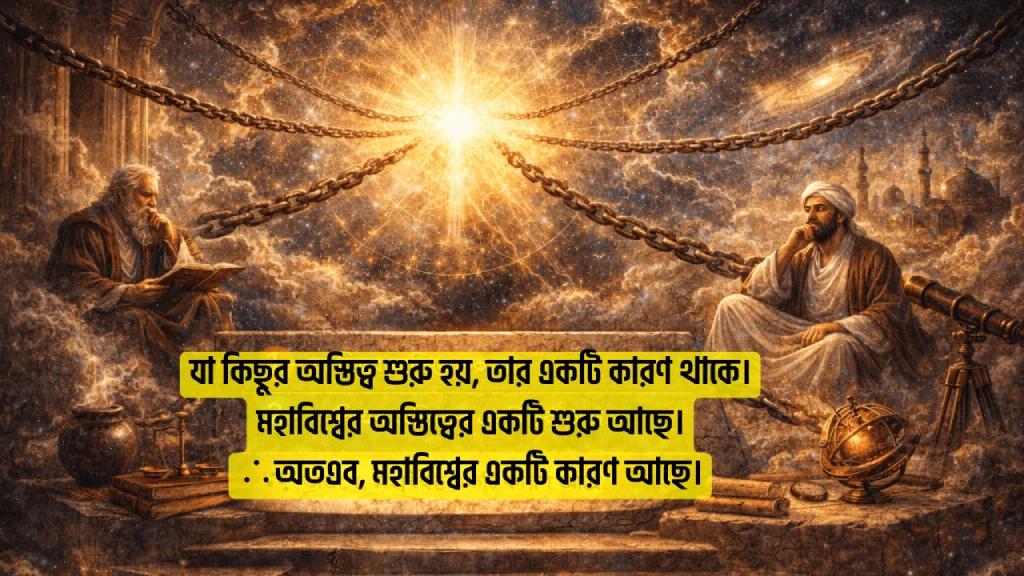
The purpose of this article is to re-evaluate the argument not on the basis of emotion, faith, or tradition, but according to objective scientific and logical standards. Using modern physics, contemporary cosmological models, and modal logic, we will examine the central premises of the KCA separately. The preliminary result is straightforward: The KCA immediately encounters a structural crisis because its first two premises are not genuinely independent; the statement “whatever begins to exist” effectively functions as a universal disguise for the very claim that requires proof: “if the universe began to exist, it has a cause.” Added to this are the uncertainties of quantum mechanics and contemporary cosmology, the tendency to conflate the ‘beginning of cosmic expansion’ with the ‘absolute beginning of the universe’s existence,’ and the fallacy of composition involved in transferring rules from parts to the whole. In short, however influential the KCA may have been historically, it requires serious reconsideration under logical, scientific, and modal analysis. The fundamental weaknesses of the Kalam Cosmological Argument (KCA) are as follows:
The first two premises of the Kalam argument are not genuinely independent; the statement “whatever begins to exist” effectively functions as a universal disguise for the very claim that requires proof: “if the universe began, it has a cause.”
The Big Bang marks the beginning of expansion, but whether it also represents the absolute beginning of the universe remains unresolved [1].
Einsteinian relativity strongly pushes our understanding of time toward a block-universe interpretation, in which past, present, and future coexist within a single spacetime structure [2].
Declaring God ‘eternal’ and therefore exempt from the rule, while denying the same possibility to the universe or fundamental physical reality, is a logical fallacy. Why could the universe itself not be an ultimate fact? [3].
Transferring a property of the parts to the whole is a logical error. The universe as a whole need not necessarily have a cause [4].
Even if the universe has a cause, there is no conclusive argument that this cause must be a “personal being” or God [5]. Craig argues that the cause of the universe must fall under a “personal explanation,” because a timeless and immaterial entity could produce an effect only through an act of will. But this reasoning is circular: it assumes in advance that a “timeless willing agent” is both possible and causally effective—which is itself a claim requiring proof. Moreover, “personal will” is an inherently time-dependent psychological process; the KCA provides no explanation of whether “will” or “decision” is even meaningful in an atemporal condition.
It is conceptually extremely difficult to explain how a being outside time could ‘decide’ anything, because decision-making itself depends upon a before-and-after structure [6].
When questions are raised about the mechanism of creation, saying “God did not reveal it” is not an explanation; it merely replaces one mystery with another.
Introduction
Among the arguments that have been marketed throughout history as ‘irrefutable’ proofs of God’s existence, the Kalam Cosmological Argument is one of the most widely circulated. Its strength lies in its simplicity—or, more accurately, in its dangerous simplicity. The argument is structured in such a way that it immediately resonates with common sense; upon hearing it, one instinctively thinks, “This seems perfectly natural.” But the history of philosophy has repeatedly shown that what appears natural or obvious often fails under rigorous logical analysis.
Historically, its distant roots can be traced to the Greek philosopher Aristotle’s reflections on causality. Its systematic theological form, however, was developed within medieval Islamic theological disputation. In the eleventh century, al-Ghazali used this argument as a central weapon in his Tahafut al-Falasifa while opposing Aristotle’s conception of an eternal universe [7]. Many centuries later, in the late twentieth century, the American philosopher William Lane Craig reformulated the argument in the language of modern cosmology and brought it to the center of contemporary Christian apologetics [8].
Structurally, it is a deductive syllogism. It should be noted that this argument deals specifically with the ‘beginning’ of the universe, which distinguishes it from the Leibnizian ‘contingency argument’—an argument that claims the universe requires an explanation whether or not it had a beginning. At a deeper level, however, both arguments ultimately depend on the same underlying causal principle, or may be understood as somewhat different formulations of the same basic line of reasoning. The KCA itself is extremely concise:
This conclusion is then expanded further by arguing that this ‘cause’ must exist beyond space and time, possess immense power, and be a willing personal agent—in other words, God. But this is precisely where the questions begin. How does one move directly from an abstract “cause” to a specific religious God? Is this leap logically valid, or is it merely a reflection of theological expectation?
Although this structure appears clean at first glance, it contains a more fundamental problem: whether the two premises are genuinely independent at all. We will therefore begin by examining how questionable the alleged deductive structure of the Kalam argument itself actually is. Then, for the sake of argument, we will examine the premises separately and ask whether they survive scientific, philosophical, and modal analysis.
The Initial Problem: Are the Two Premises of Kalam Really One and the Same Claim?
The Kalam Cosmological Argument is generally presented as a deductive syllogism. Its standard form is: “Whatever begins to exist has a cause; the universe began to exist; therefore, the universe has a cause.” At first glance, it appears that there are two independent premises here, from which a conclusion is drawn. But this is precisely where the real problem lies: these two premises are not genuinely independent. Rather, the same claim has been divided into two separate sentences.
The first premise says, “Whatever begins to exist has a cause.” The statement sounds like a universal principle. But the question is: what exactly does “whatever” mean here? If it refers to ordinary objects in the world—human beings, trees, stars, animals, objects, and events—then these are merely changes occurring within the universe. But Kalam does not intend to use “beginning” in that sense. Its purpose is to speak about the “beginning of the universe’s existence.” In other words, “beginning” here does not mean an ordinary change, but the coming into existence of reality as a whole.
The problem is that we have no independent example of something “beginning to exist” in this sense. We have never observed an entire reality, a spacetime structure, a universe, or an entity outside the universe coming into existence. Therefore, the “whatever” invoked in the first premise is not, in practice, an empirically established universal class. It is an empty universal category whose only relevant target is the universe itself.
Therefore, the statement “whatever begins to exist has a cause” effectively becomes: “if a reality like the universe begins to exist, it has a cause.” But we have no independent example of “a reality like the universe” other than the universe itself. The statement therefore contracts even further into: “if the universe begins to exist, it has a cause.” Now place the second premise beside it: “the universe began to exist.” It becomes clear that the first and second premises are not generating any genuinely independent logical structure. The conclusion has already been inserted into the first premise in conditional form with the universe as its target, while the second premise merely names that same target.
Put differently, Kalam actually works like this: “If the universe began, it has a cause; the universe began; therefore, the universe has a cause.” The first statement is not an independently established cosmological law; it assumes the conclusion in conditional form from the outset. After all, the claim “if the universe began, it has a cause” is precisely what requires proof. Dressing that claim in the universal language of “whatever begins to exist” does not make it proven.
For this reason, Kalam cannot properly be regarded as a strong deductive argument. In an argument, the premises must stand independently before the conclusion is drawn. But here, the first premise is effectively a prewritten version of the conclusion. The second premise merely inserts the word “universe” into that prewritten structure. As a result, although the argument appears externally to have three steps, internally it reduces to one: “The universe has a cause because the universe must have a cause.”
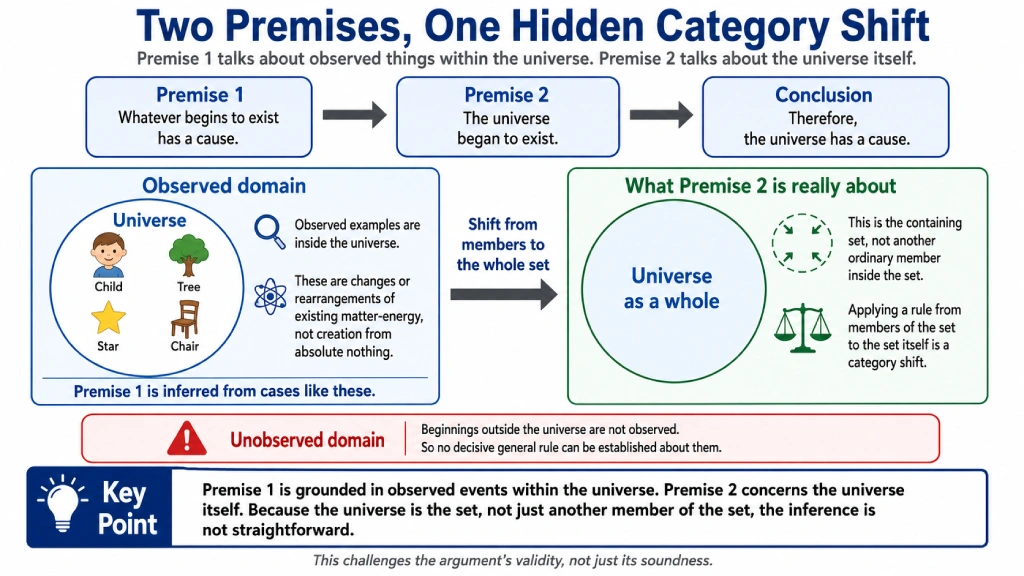
The rhetorical strategy here is quite clear. If one directly claims, “the universe has a cause,” evidence must immediately be demanded. So instead of stating the claim directly, it is first reformulated as a universal statement: “Whatever begins to exist has a cause.” Then comes the statement: “The universe began to exist.” This creates the impression that a general principle is being applied to a specific case. But in reality, the general principle has not been independently established; it has been formulated specifically for application to the universe. The universal class called “whatever” has not been shown here to contain any independent example relevant to this kind of beginning other than the universe itself.
In this sense, the first two premises of Kalam are two formulations of the same claim. The first says: “if the universe begins to exist, it must have a cause”—but conceals this behind the phrase “whatever.” The second says: “the universe began to exist.” When the two are combined, the resulting conclusion is not a new discovery; it was already inserted into the first premise in conditional form. Thus, there is no genuine logical progression in the Kalam argument. Instead, the same claim is arranged across three levels: universal principle, specific event, and conclusion.
The problem becomes equally clear when expressed symbolically. Kalam first says: “All B have C.” Then it says: “U is B.” Then it concludes: “U has C.” On paper, this appears to be a valid form. But no independent member of the class B is demonstrated. In practice, B ultimately refers to U itself. That is, the class “whatever begins to exist” effectively collapses into a single relevant target: “the universe.” The argument then becomes: “If U, then C; U; therefore C.” But “if U, then C” was precisely the claim that required proof. Turning it into the first premise does not make it proven.
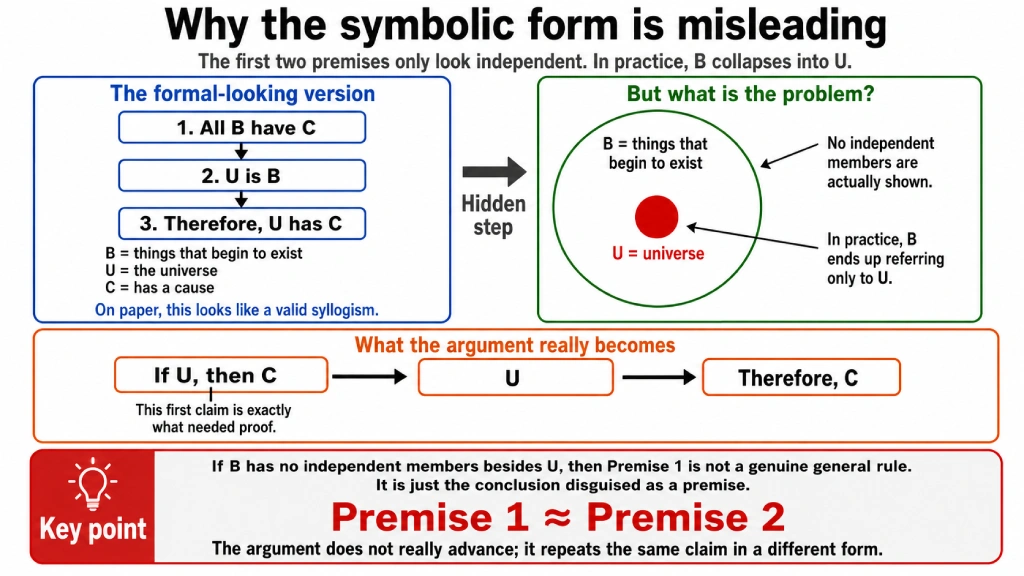
Thus, the Kalam Cosmological Argument suffers from a fundamental logical problem from the outset: its first premise has not been independently established with respect to the universe, yet the entire conclusion rests upon that unproven generalization. The problem is not merely whether the premises are true or false. The more fundamental question is whether the first two premises are genuinely two independent premises at all. If the alleged “whatever” in the first premise ultimately targets the universe, and the second premise also targets the universe, then this is not a genuine deductive syllogism. It is the same claim stated twice—once in universal language and once by naming the specific object.
This, then, is where Kalam derives much of its apparent force: instead of directly proving the claim “the universe has a cause,” it first generalizes that claim into “whatever begins to exist has a cause.” It then places the universe inside that generalization and returns to the same conclusion. This is not logical progress; it is the conclusion hidden inside the premise. Therefore, Kalam cannot be described as an “irrefutable argument.” Rather, it is a rhetorical strategy that creates the appearance of deductive reasoning by arranging the same claim in different words.
Dissecting the First Premise: The Limits of Causal Reasoning
The previous section showed that Kalam’s first premise does not stand as an independently established universal principle; to a considerable extent, it assumes the conclusion itself in conditional form. Nevertheless, even if, for the sake of argument, we examine the premise separately—“Whatever begins to exist has a cause”—it still encounters serious problems. It is an intuitive notion derived from our everyday experience, what philosophy calls the ‘Causal Principle.’ But when this apparent truth is applied at the level of cosmological or fundamental reality, it can no longer be regarded as secure. A philosophical question also arises here: is the first premise an a priori truth (like a mathematical proposition), or an a posteriori truth (a generalization derived from experience)? If it is merely an empirical generalization, then it is contingent and may admit exceptions, as quantum mechanics suggests. If, on the other hand, it is claimed to be an a priori truth, then the burden of proving that status lies with its proponents—a burden the KCA has never discharged. Thus, beneath the disguise of an unproven deductive truth, this premise is actually an inductive generalization.
Causality and Its Dependence on Time
In the Kalam Cosmological Argument, the word ‘cause’ is used as though it refers to some atemporal relation existing outside time. But our ordinary concept of causation is entirely time-dependent. One event occurs ‘before,’ another occurs ‘after’—and only then do we describe the first as the cause of the second.
Immanuel Kant, in his Critique of Pure Reason, argued that causality is meaningful only within the temporally structured framework of our experience. It is not a mind-independent relation in itself, but an a priori category of our cognition that is inseparably connected with time (Kant, Critique of Pure Reason, trans. Paul Guyer and Allen W. Wood, Cambridge University Press, 1998, A189–A211).
If time itself began together with the Big Bang, as the standard picture in modern cosmology suggests, then questions such as “What happened before time?” or “Who was the cause before time?” become self-contradictory. The very language of ‘before’ and ‘after’ already presupposes the existence of time. The Kalam argument attempts to avoid this problem by invoking an “atemporal cause,” but in doing so it applies the same word—‘cause’—in two different senses: once within time (in the case of the universe), and once outside time (in the case of God). From the standpoint of clear reasoning, this conceptual equivocation is unacceptable.
Beyond this problem of temporal dependence, the KCA’s first premise—“Whatever begins to exist has a cause”—is merely an inductive conclusion. It arises from our everyday experience of the macroscopic world, but applying this rule as a universal metaphysical law to the primordial state of the universe—at the Planck scale or in a quantum vacuum—is dangerously unsupported. According to the Heisenberg Uncertainty Principle (1927), there is a fundamental uncertainty relation between energy (ΔE) and time (Δt):
This equation shows that over extremely short time intervals—close to the Planck time, approximately 10-43 seconds—energy or virtual particles may spontaneously emerge from the quantum vacuum without requiring classical causation or a preceding event.
Another revolutionary contribution to physical cosmology is Alexander Vilenkin’s 1982 model—“Creation of Universes from Nothing.” Vilenkin mathematically showed that the beginning of a universe need not require any primordial material particle or reservoir of energy; rather, an extremely small primordial universe could spontaneously emerge through Quantum Tunneling directly from ‘nothing,’ which he defined as a state without spacetime and geometry.
To understand this idea, we must return to the physics of the microscopic world. According to quantum mechanics, in quantum cosmology, ‘nothing’ does not mean theological absolute nothingness; rather, it refers to a theoretical, law-governed state without spacetime or geometry. According to the Heisenberg uncertainty principle (), enormous fluctuations in energy are possible over extremely short intervals, potentially producing virtual particles without any external cause. Vilenkin’s reasoning is that if a particle can arise, in the classical sense, ‘without a cause’ because of quantum instability, then a primordial cosmological point or singularity could likewise come into existence under the rules of ‘Quantum Indeterminacy,’ without any conscious designer.
At this level, imposing our familiar macroscopic notion of ‘causality’ (Classical Causality) upon the primordial state of the universe approaches intellectual fraudulence. Where the geometry of space and time itself is emerging through quantum tunneling, searching for a ‘cause before creation’ becomes logically meaningless. Consequently, the Kalam argument’s claim that the beginning of the universe necessarily requires a supernatural ‘conscious agent’ or creator is directly challenged by these mathematical models of modern physics.
‘Ex Nihilo’ versus the Rearrangement of Matter
Everything we observe ‘beginning’ in our experience is actually a transformation of already existing matter. For example, a chair begins to exist through the work of a carpenter, but the molecules and atoms of the wood already existed. In other words, the causal relationships we know from experience always apply to the ‘rearrangement of matter.’ But in the case of the origin of the universe, theologians claim ‘creation from nothing’ (Creatio Ex Nihilo). Applying knowledge derived from the world of our experience—where everything is transformation—to a case in which we have no experience at all—creation from nothing—is a category error [9].
The First Law of Thermodynamics: Conservation of Energy versus the Problem of ‘Creation from Nothing’
One of the fundamental foundations of physical science is the First Law of Thermodynamics, which describes the transformation of energy in a closed system. This law states unambiguously that, within a closed system, energy or matter cannot be newly created, nor can it be destroyed; it can only be transformed from one form into another [10].
The ultimate conclusion of the Kalam argument indirectly rests upon the doctrine of ‘creation from nothing’ (Creatio ex nihilo), which cannot be straightforwardly established through the laws of modern physics. If the total amount of mass-energy in the universe remains constant, then there is no obvious logical room for an ‘absolute zero point’ or for ‘coming into existence from non-existence.’ Rather, from a scientific perspective, the so-called ‘beginning’ of the universe may simply represent a transition from one particular state of matter into another [11].
Transformation versus Absolute Beginning
Everything we observe ‘beginning’ in our experience—whether the birth of a star or the emergence of a particle—is fundamentally a rearrangement of some pre-existing energy or matter. When theologians use this worldly experience to argue for an ‘absolute beginning’ of the universe, they commit a category error. At minimum, the principle of conservation of energy shows that the theological language of ‘a mountain of energy emerging from nothing’ is not the language of physics. The Big Bang describes the expansion history of our observable universe from a hot, dense state; it is not a certificate of creation from non-existence, nor does it establish an absolute origin or prove a prior state of ‘non-existence.’
The Zero-Energy Hypothesis and the Redundancy of an External Cause
Even if, for the sake of argument, we assume that the universe emerged from nothing, physics still does not compel us to accept any supernatural ‘will’ as a necessary condition of explanation. According to the ‘Zero-Energy Universe’ model, some cosmological models propose that the positive energy of all matter in the universe may be cancelled by the negative energy of the gravitational field. Consequently, the total energy of the universe may be zero () [12].
Mathematically and physically, such a special geometric configuration in which zero gives rise to a net zero may be possible without requiring any external conscious cause. Therefore, the religious claim of “matter being created from absolute nothingness” is made without observational evidence and stands upon an ‘unproven belief’ while bypassing established physical principles. Logically, where the state and transformation of the universe can be explained through natural laws, the burden of proof remains upon the theologians—and they have so far failed to discharge that burden with scientific evidence.
The Zero-Energy Universe Hypothesis: The Precise Balance of Cosmic Energy
Theologians often claim that God created this enormous universe of mass and energy from nothing. According to them, it is impossible for such a vast quantity of energy to arise without a cause or source. But modern cosmology and the principle of conservation of energy in physics confront this claim with a fundamental question. The ‘Zero-Energy Universe’ model in physics suggests that the total energy of the universe may be zero, and this possibility alone is sufficient to undermine Kalam’s claim that an external creator is necessarily required.
The Balance between Positive and Negative Energy
In this mathematical model, the existence of the universe may be compared to a vast ‘accounting ledger.’ The mass () and kinetic energy of all visible matter, stars, and galaxies in the universe are treated as positive energy. On the other hand, the mutual attraction or gravitational force (Gravity) between cosmic objects is a form of binding energy that functions mathematically as negative energy.
The Mathematical Equation and the Redundancy of an External Source
According to the mathematical framework of general relativity, the positive mass-energy of the universe and its negative gravitational energy may cancel each other out completely. Mathematically:
If the net energy of the universe is zero, then its origin does not require the injection of any external ‘energy provider’ or miraculous source. A special geometric transition of this kind from an initial quantum state through cosmic inflation is logically and physically mathematically consistent and theoretically possible. In Lawrence Krauss’s formulation, ‘nothing’ or Nothingness in nature is highly unstable; therefore, the emergence of such a universe can be modeled within the theoretical framework of physics without any supernatural act of will—making the theological ‘designer’ an unnecessary additional assumption [12].
Logical Conclusion
The Kalam argument claims that the existence of the universe requires an external cause. But if the total energy of the universe is zero, then no genuinely new net quantity has been ‘added.’ Rather, it may simply represent a natural transition from a prior unstable state into a stable configuration. Consequently, where there is no energy deficit requiring replenishment, introducing a ‘God’ or supernatural agent violates the principle of Occam’s Razor and becomes unnecessary.
Quantum Mechanics and Uncaused Events
Quantum mechanics, one of the central pillars of modern physics, directly challenges the classical conception of causality. At the subatomic level, numerous events occur for which there is no determinate ‘cause.’ For example, it is impossible to predict exactly when a radioactive atom will decay, and there is no external cause determining that precise moment. According to Heisenberg’s Uncertainty Principle, ‘virtual particles’ are continually appearing and disappearing even in the vacuum without a cause [13]. The renowned physicist Lawrence Krauss has argued that, according to quantum field theory, ‘Nothing’ is unstable and that the spontaneous emergence of a universe from such a state is mathematically possible [14]. Therefore, the claim that “everything must have a cause” is not universally true.
The Fallacy of Composition
The previous problem concerned the independence of the two premises; a separate problem now arises when a rule is transferred from the parts to the whole. To argue, on the basis of our everyday experience that every object within the universe has a cause, that the universe as a whole must therefore also have a cause is logically a “Fallacy of Composition.” Immanuel Kant argued that the concept of causality applies only within space and time; applying it to something outside spacetime is logically and scientifically groundless. The fact that a brick weighs one kilogram does not mean that a house constructed from those bricks also weighs one kilogram. Likewise, imposing the rules operating within the universe upon the universe as a whole is unjustified and lacks objective evidence [15]. Bertrand Russell (1948) made the point clearly: the fact that every brick in a wall is small does not mean that the wall itself is small. The universe itself may be a closed system or a brute fact requiring no further explanation. Properties of the parts—causation within the universe—do not automatically transfer to the whole—causation of the universe. This is a classic logical fallacy that further weakens the KCA.
Critique of the Second Premise: Did the Universe Really Begin to Exist?
The second premise states: “The universe had a beginning.” The Big Bang Theory and entropy, or the Second Law of Thermodynamics, are generally presented as evidence in support of this claim. But modern cosmology does not support such a simplistic interpretation.
Beginning of Expansion versus Beginning of Existence (The Crucial Distinction)
The greatest scientific weakness of the Kalam argument is its conflation of the ‘beginning of expansion’ with the ‘beginning of the universe.’ Big Bang theory shows that approximately 13.8 billion years ago our observable universe entered its history of expansion from an extremely hot and dense state [16]. But we do not know whether this was also the beginning of the universe’s existence. At the ‘singularity’ or extremely dense state associated with the beginning of the Big Bang, our current laws of physics break down. Consequently, whether the universe existed eternally in some other form before the singularity—such as a quantum fluctuation or another state—remains unresolved in contemporary science. A beginning of expansion does not imply a beginning of existence. The distinction is illustrated in the following simple diagram:
(Singularity / Quantum State)
(The Big Bang)
(Expanding Universe)
Singularity: Mathematical Limitation versus Absolute Beginning
Proponents of the Kalam argument use the Big Bang ‘singularity’ as evidence that the universe came into existence from nothing (Creatio ex nihilo). But in physics, a singularity does not mean ‘nothing’; nor is it a doorway through which Kalam advocates can insert God. It is fundamentally a mathematical signal indicating that, at that point, our current laws of physics—especially General Relativity—cease to function. When density or temperature becomes ‘infinite’ within a mathematical model, the result is called a singularity—which is essentially a mathematical failure or ‘Mathematical Breakdown’ [17].
According to modern quantum cosmology, the universe may not have begun with a singularity at all. Advanced models such as Loop Quantum Gravity and String Cosmology avoid the singularity. According to these models, the universe may have ‘bounced’ from a previous contracting state and then begun expanding. Therefore, presenting the singularity as the ‘absolute beginning’ of the universe is nothing more than a theological misuse of scientific information. A singularity is not a supernatural point of creation; rather, it marks the boundary of our present knowledge about the universe [18].
In this context, William Lane Craig frequently cites a theorem by Borde, Guth, and Vilenkin (2003), known as the BGV Theorem, which states that any spacetime whose average Hubble expansion rate is positive cannot be extended infinitely into the past—that is, in that geometric sense, it must have a ‘beginning.’ But two important points must be noted here. First, the BGV theorem establishes the geodesic past-incompleteness of inflationary spacetime; it is not a religious creation doctrine, and at the Planck scale, in the domain of quantum gravity, the theorem is no longer applicable. Second, Alexander Vilenkin, one of the theorem’s co-authors, has himself made clear that BGV establishes a mathematical limit on the trajectory of cosmic expansion; it does not prove the existence of a supernatural creator. To infer from it an “absolute beginning of existence” is merely an extrapolation—one that moves beyond physics into metaphysical speculation [19].
The Nature of Time: The Hartle-Hawking Model
According to the ‘No Boundary Proposal’ developed by Stephen Hawking and James Hartle, time has no beginning, just as the surface of the Earth has no ‘beginning’ or ‘ending’ edge. Just as we cannot meaningfully ask what lies south of the South Pole—because the South Pole itself is the terminal point—the question of what existed ‘before’ the Big Bang is likewise meaningless. In this model, although the universe is finite, it has no initial point or ‘Boundary’ [20]. If time itself has no beginning, then the very question of something ‘beginning’ becomes irrelevant.
In this model, the universe has a definite sharp beginning or ‘singularity.’ This inevitably raises the question, “What existed before this point?”
In this model, time merges with spacetime and takes on a dome-like geometry. It has no sharp beginning; therefore, the question ‘What existed before?’ becomes irrelevant.
The South Pole Analogy Just as the surface of the Earth has no geographical ‘final edge,’ and the question “What is south of the South Pole?” is entirely meaningless, time in the Hartle-Hawking model functions in much the same way. Since time has no initial point or boundary, the question “What existed before the Big Bang?” has no logical existence within this model.
The Fear of Infinity and Mathematical Reality
Proponents of the Kalam argument claim that an ‘actual infinite’ is impossible in reality, and therefore past time cannot be infinite. In support of this claim, they invoke the paradox of ‘Hilbert’s Hotel.’ Modern mathematics, however, particularly Georg Cantor’s ‘Set Theory,’ has demonstrated that infinity is a well-defined mathematical concept and that its existence in reality is not logically impossible [21]. Moreover, numerous models in physics—such as eternal inflation—make use of the concept of infinite time [22].
Proponents of Kalam claim that an ‘actual infinite’ cannot exist in reality. By invoking the paradox of ‘Hilbert’s Hotel,’ they attempt to demonstrate that an infinite past is logically impossible and merely an imaginary concept.
In modern mathematics, Georg Cantor’s ‘Set Theory’ has demonstrated that infinity is neither a confusion nor a paradox. It is a rigorously defined mathematical concept whose logical and mathematical coherence is firmly established.
In modern cosmological models such as Alan Guth’s ‘Eternal Inflation’, the concept of infinite time is highly relevant. In other words, the possibility of an infinite past in physical reality is not inherently incompatible with scientific models.
The Nature of Time: A-Theory versus B-Theory
The Kalam argument depends entirely on the ‘A-Theory of Time,’ according to which the flow of time from the past toward the future is an objective reality and only the present truly exists. But modern physics, particularly Albert Einstein’s theory of relativity, strongly supports the ‘B-Theory of Time’ (or Block Universe). In this scientific model, the past, present, and future coexist within a four-dimensional spacetime block. According to the B-Theory, the universe does not newly “come into existence” or “begin”; rather, spacetime simply has a particular boundary. Since physics supports the B-Theory, the claim of an absolute beginning of the universe becomes scientifically untenable and rests solely on an obsolete philosophical assumption [23].
According to this theory, time flows from the past toward the future, and only the ‘present’ moment has real existence. The Kalam argument depends entirely on this outdated philosophical conception of time.
Einstein’s theory of relativity strongly supports this view. In this model, the past, present, and future coexist simultaneously within a four-dimensional spacetime block. There is no objective flow of time here.
Scientific Conclusion: The Collapse of an Absolute Beginning Since modern physics supports the B-Theory (Block Universe), the universe does not newly “come into existence” or “begin”; rather, spacetime simply has a particular boundary. In other words, the central Kalam claim that the universe ‘came into existence’ is scientifically untenable and rests solely on an obsolete philosophical assumption.
The Kalam Argument in the Light of Modal Logic
Modal Logic is a powerful tool for analyzing the concepts of possibility and necessity (Possibility & Necessity). The Kalam argument is often presented as though “whatever begins to exist must necessarily depend on some cause” and “God must necessarily be eternal and independent of any cause.” But in the language of modal logic, these claims are, at most, only contingently true—that is, they may be true in some possible worlds and false in others [24].
Possible Worlds and the Question of a ‘Necessary Being’
Theistic philosophers often claim that God is a “Necessary Being.” In simple terms, this means that no matter what possible situation, universe, or reality we imagine, God must exist in it. His existence is said to be necessary. By contrast, they describe our universe as a “Contingent Being.” In other words, the universe could have existed, but it also could have failed to exist; its existence is supposedly not logically necessary [25].
The contingency argument is constructed on precisely this idea. The reasoning is roughly as follows: because the existence of the universe is not necessary, there must be some external explanation for its existence. And that explanation is God—who is himself supposedly necessary, or a “Necessary Being.”
But the problem is that a critically important assumption is built into the argument from the very beginning—God is the Necessary Being, while the universe is merely a Contingent Being. Yet no independent evidence is provided for this claim. It is not really the conclusion of the argument; it is an assumption inserted at the outset.
This is where modal logic, or the logic of possible worlds, raises an important counter-question. Why should we assume that only God can be a “Necessary Being”? Why could physical reality, the fundamental laws of nature, a quantum field, or even a multiverse not themselves be eternal and necessary? In other words, why should we not consider the reverse possibility—that the universe itself is actually the “Necessary Being,” while the concept of God is merely a “Contingent Being”?
The issue becomes easier to understand through the concept of a “possible world.” In modal logic, a “possible world” does not mean some literally existing separate planet or universe; rather, it refers to a logically conceivable state of affairs. For example, we can easily conceive of a situation in which no personal God exists, but some form of physical reality, energy, quantum field, or cosmic structure nevertheless exists. If such a situation is at least logically conceivable, then the claim that “God’s existence is necessarily unavoidable” is no longer secure.
For something to qualify as a “Necessary Being,” it must exist in every possible world. But if even one possible situation can be conceived in which God is absent, then God is no longer established as a “Necessary Being.” At that point, the God hypothesis itself becomes contingent—merely one possible explanation among other possible explanations.
One major limitation of the Kalam Cosmological Argument is that it never genuinely competes with these alternative possibilities. Possibilities such as “the universe itself may be eternal,” “physical reality itself may be fundamental,” or “there may simply be a brute fact” are not adequately examined before God is presented as the only acceptable explanation. As a result, the argument largely proceeds toward a conclusion that has already been partially assumed from the beginning.
See the diagram below to understand one of the weakest points of the Kalam argument
+
Universe Exists
+
No Universe
+
Physical Reality Exists
The Central Problem: Theists assume without evidence that God is a ‘Necessary Being’ while the universe is a ‘Contingent Being.’ But modal logic asks: if we can conceive of a world like ‘World 3’ above, in which no God exists but physical reality or a multiverse exists on its own, then the claim that God is a “Necessary Being” collapses. The Kalam argument avoids this counter-possibility and forces God into the position of the only explanation.
If the existence of some mathematical or physical structure is logically necessary—for example, if some fundamental physical structure or natural modal base could itself be logically necessary—then God does not have an exclusive claim to being the ‘Necessary Being.’ In that case, the necessity of a conscious creator is ruled out by the principles of modal logic itself. Philosopher Graham Oppy has argued that the theistic claim that the universe is ‘contingent’ is itself an unsupported assumption. The universe or multiverse may be sufficient for its own existence and may itself be the ‘Ultimate Necessary Being,’ or the ultimate necessary reality, requiring no conscious creator [26]. Let us understand Graham Oppy’s argument through the following diagram,
The Final Point of Modal Logic: ‘Necessity’ is not the exclusive property of a conscious or supernatural God. If a mathematical or physical structure (such as quantum mechanics or the laws of logic) operates in every possible world, that claim itself requires proof; but theists make exactly the same unproven claim of necessity in the case of God. In that case, the primordial physical state itself may be the Ultimate Necessary Being. According to Graham Oppy, theists begin with a logical fallacy or an unsupported assumption by treating the universe as ‘contingent’ from the outset.
Underdetermination: Multiple Explanations, the Same Data
In discussions of modal logic and the philosophy of science, ‘Underdetermination’ is an important concept—the same observational data may be explained equally well by multiple theories. Even if the Kalam argument could, for the sake of argument, establish that “the universe has some kind of cause,” that cause could still be a natural multiverse, an impersonal quantum global state, or some other unknown natural mechanism. All of these are logically and modally possible explanations. Under such circumstances, declaring one specific religious God to be the sole explanation is nothing more than another logical leap or unjustified inference.
Unjustified Inference (Logical Leap) From the standpoint of science and modal logic, the God explanation enjoys no special evidential advantage over the four explanations listed above. Yet the Kalam argument, without examining the first three natural possibilities, simply forces the fourth explanation (God) into the position of the sole cause—as though encountering something unknown were enough to allow the priest’s or mullah’s explanation to take the place of a scientific explanation. Under the principle of underdetermination, this is a serious logical fallacy.
The Inconsistency of the Conclusion: Why Must the Cause Be ‘God’?
Even if, for the sake of argument, we accept that the universe has a cause, the Kalam argument still fails to establish logically that this cause is the ‘God’ of conventional religion. This is an enormous Logical Leap.
Personal Agent versus Mechanical Cause
The conclusion of the argument claims that this cause must be a ‘Personal Agent’ endowed with will. The reasoning is that if the cause is eternal, how could it produce a finite universe? Supposedly, this is possible only if the cause possesses a ‘will’ to create. But this is a weak argument. In quantum mechanics, we observe transitions from one state to another without any conscious intention—for example, spontaneous symmetry breaking. The cause could be some blind natural force or a ‘multiverse generator’ possessing no consciousness whatsoever [27].
Craig further argues that a “timeless mechanical cause” could not produce a time-dependent effect, and therefore the cause must necessarily be a “personal agent with a will.” But this argument is itself circular: it assumes at the outset that “timeless will” or “decision-making outside time” is a coherent and possible concept—when that is precisely what requires proof. Philosopher Quentin Smith has argued that the notion of “timeless agency” collapses into linguistic meaninglessness, because acts such as “deciding,” “willing,” and “acting” are, by definition, sequential and time-dependent. To speak of “making a decision” outside time is as meaningless as speaking of “going north of the North Pole” [28].
The Special Pleading Fallacy
One of the most widely discussed problems with the Kalam Cosmological Argument is its tendency toward ‘special pleading.’ The argument begins with the claim that “whatever begins to exist must have a cause.” It then asserts that the universe must therefore have a cause. But when the question is raised—“Then what caused that cause, or God?”—an exception is suddenly introduced. It is said that “God is eternal,” that “God did not begin to exist,” and therefore that God requires no cause.
This is where the central philosophical problem emerges. If it is permissible to accept some entity as ‘eternal,’ ‘necessary,’ or an uncaused reality, then the same property could be applied directly to the universe, a multiverse, quantum reality, or some fundamental natural structure. Yet the Kalam argument bypasses these possibilities and grants exceptional status from the outset to a supernatural intelligent being. In other words, the very causal principle used to demand a cause for the universe is then suspended in the case of God. This selective exemption is the defining feature of special pleading.
Defenders of Kalam, of course, respond that they are not claiming “everything has a cause”; rather, they are saying that “whatever begins to exist has a cause.” But the question still remains: why can the universe not be regarded as eternal or as a necessary reality? Why should that special status be reserved exclusively for God? If one must ultimately accept an uncaused, eternal reality, then the rational course is to choose the simplest explanation involving the fewest assumptions. This is where the principle of ‘Occam’s Razor’ becomes relevant. According to the principle associated with William of Ockham, unnecessary entities, assumptions, or complexities should not be added to an explanation [29].
From this perspective, introducing an omniscient, omnipotent, conscious supernatural being instead of an unknown cosmic reality or an eternal natural structure actually makes the explanation more complex. It immediately generates further questions: why does God exist, what is the source of his consciousness, why did he create at a particular time, and how could a timeless being make a decision? In other words, the Kalam argument ultimately resurrects the very problem it claims to solve, only in a deeper and more complicated form.
Infinite Regress and the Uncaused Ultimate Fact
The central claim of the Kalam argument is that whatever begins to exist must have a cause. But in the case of God, its proponents claim that he has no beginning, which creates the logical fallacy known as ‘special pleading.’ If the chain of causation is infinite, then it falls into an infinite regress, which the proponents themselves regard as impossible. And if there must ultimately be an ‘Uncaused First Cause,’ then it is more logical for that ultimate state to be the universe itself or the quantum vacuum. Treating the existence of the universe itself as a Brute Fact is more acceptable according to the principle of Occam’s Razor; introducing an unproven supernatural entity for this purpose is logically unjustified and unnecessary [30]. It should be noted that the contingency argument fundamentally rests on the ‘Principle of Sufficient Reason,’ or PSR. But the very reasoning by which they make their God an ultimate fact can equally be used to regard the universe as an ultimate fact or ‘brute fact’ requiring no external explanation. If God can be uncaused, then by the same rule the universe is equally eligible to be an explanation-independent ultimate fact. Indeed, this is more logical, because it does not introduce the unnecessary hypothesis of God.
The central claim of the Kalam argument is that whatever begins to exist must have a cause. To avoid infinite regress or an endless regress into the past, proponents of this argument introduce the concept of an ‘infinite’ God.
The Logical Evasion: Theists essentially combine countless infinite events and turn them into a ‘God.’ But if God has, by definition, existed from an infinite past, then the problem of infinite regress remains exactly the same! This does not solve the problem; it merely hides the problem beneath the label of God.
Claiming in the case of God that “he has no beginning” creates the logical fallacy known as ‘special pleading.’ If the causal chain is infinite, it falls into an infinite regress, which the proponents themselves regard as impossible. And if there must be an ‘Uncaused First Cause,’ then it is more logical for that ultimate state to be the universe itself or the quantum vacuum. Treating the existence of the universe itself as a Brute Fact is more acceptable according to Occam’s Razor; introducing an unproven supernatural entity for this purpose is logically unjustified and unnecessary [30].
Does changing the name eliminate the logical problem?
(Point 0)
Argument: Theists claim that God is ‘beginningless’ or ‘infinite.’ But placing infinity inside a box and naming that box ‘God’ does not solve the mathematical problem of traversing an infinite past.
If, in order to reach the present (point 0), God must pass through an infinite number of past mental states (Infinite Mental States) within himself, then he could never have reached the moment of creation. In other words, if the box contains an infinity, that box can never reach the doorway of the present. Labeling or changing the name is not a logical solution.
The Conceptual Self-Contradiction of a Timeless Willing Being
Proponents of the Kalam argument ultimately claim that the cause of the universe is a timeless and willing personal being. But this is an extremely self-contradictory concept. Decision-making and the formation of intentions are psychological and changing processes for which the passage of time is indispensable. If time did not exist prior to creation, it is logically impossible to explain how such a being could make sequential decisions or form an intention to create the universe. Therefore, a timeless being cannot meaningfully be “personal” or “willing”; this is a claim born of theological desire, with no logical or empirical foundation [31].
For the sake of argument, let us assume that the universe has a cause. Even then, why must that cause be a ‘willing personal God’? Quentin Smith (1996) argued that a disembodied mind or timeless personal agent is self-contradictory. Willing or deciding is a temporal process — thought → decision → action. But if time itself did not exist before creation, then possessing any ‘will’ would be impossible. A timeless, spaceless, immaterial agent has no way to undergo any mental process. Consequently, an impersonal quantum law or a brute fact is far more logically coherent as a cause.
Dissecting Apologetic Dishonesty
Leaving aside the theoretical complexities, let us now examine through some real-life analogies and stories how these arguments are presented to ordinary people.
A Murder Investigation: Why ‘I Don’t Know’ Is an Intellectually Honest Position
Imagine that the body of a wealthy businessman is discovered inside a locked room. All the doors and windows were locked from the inside, and there is apparently no sign that a murderer entered the room. Under such circumstances, some people in society might begin saying, “This must have been the work of some disembodied spirit, jinn, or ghost, because it would have been impossible for an ordinary person to enter this locked room.” But when a professional detective investigates the case, he would never file an FIR naming a disembodied spirit as the murderer. Why? Because law and science operate not on personal beliefs, but on verifiable evidence.
If the investigation reveals no fingerprints, DNA, or CCTV footage, then the only honest answer available to a competent detective would be— “I don’t know.”
This answer—“I don’t know”—is not a defeat; rather, it represents an uncompromising commitment to truth. The fact that the cause of a mystery has not yet been discovered does not mean that something miraculous or supernatural has occurred [32]. The absence of evidence can never be used as evidence for the existence of a supernatural being; in logic, this is known as the Argument from Ignorance.
When theologians directly insert ‘God’ as the cause of the beginning of the universe, they are essentially playing the role not of Detective Rahul, but of those villagers who treated the absence of information as evidence of supernatural power. Saying “I don’t know” is intellectually honest precisely because it leaves the door open to new information. By contrast, declaring without evidence that “God did it” closes the path of inquiry and merely replaces one mystery with an even greater mystery—what is the origin of God? [33]. In fact, throughout the history of science, countless mysteries that were once regarded as supernatural were later resolved through natural and rational explanations. Therefore, until conclusive evidence about the ultimate cause is available, blaming ‘God’ is nothing more than the imaginative belching of an idle mind.
The Opportunistic Transformation of Agnosticism: Taking One Step Back
It is from an intellectual inability to explain the primordial and profoundly intricate complexity of the universe through natural or mathematical means that theists adopt a predetermined ‘miraculous solution’—the concept of God. Here, they primarily invoke the ‘Contingency Argument,’ appealing to the supposed dependence of the universe. Their reasoning is: Since the universe is not necessary for its own existence (Contingent), it is logically necessary that there be a ‘Necessary Being’ or ‘Necessary Cause’ to explain its existence. But this position rests upon an extreme logical double standard and Opportunistic Agnosticism.
The maneuver becomes apparent as soon as deeper questions are raised about the specific mechanism by which the universe was created, how the creator’s non-physical existence could operate, or why he supposedly ‘waited for eternity’ before creating. At this stage, theists rapidly retreat from their previously proclaimed ‘Principle of Sufficient Reason’ (PSR). In the very argument in which they had claimed that everything must have an explanation, when the same chain of reasoning is applied to the creator himself, they suddenly claim that because the creator did not reveal these matters through ‘revelation,’ human beings cannot possibly know them. This is essentially a more sophisticated form of the ‘God of the Gaps’ approach, in which unknown areas of science are filled with a supernatural explanation.
This is where the intellectual contradiction lies. An agnostic atheist stands before the primordial mystery of the universe without introducing any supernatural fantasy and directly acknowledges what they do not know; theists, by contrast, merely insert one additional layer—God—and then arrive at exactly the same agnostic position. They claim to solve one mystery—the universe—but in reality merely replace it with an even greater and more inexplicable mystery—God. If the chain of explanation must ultimately stop somewhere, then logically the universe or multiverse itself is equally qualified to be that ‘ultimate fact’ or Brute Fact, requiring no supernatural entity at all. Atheistic agnosticism begins with objective reality and an intellectually honest acknowledgment of ignorance; theistic agnosticism begins only at the boundary of their own imagined God—which is not a logical solution at all, but a calculated form of intellectual evasion: merely rebranding ignorance in the name of God.
“I don’t know”
Honestly acknowledging the unknown while remaining grounded in reality.
“God did not reveal it, so I don’t know”
Taking an additional step backward only to acknowledge the same unknown—something that can be done without imagining an unproven God.
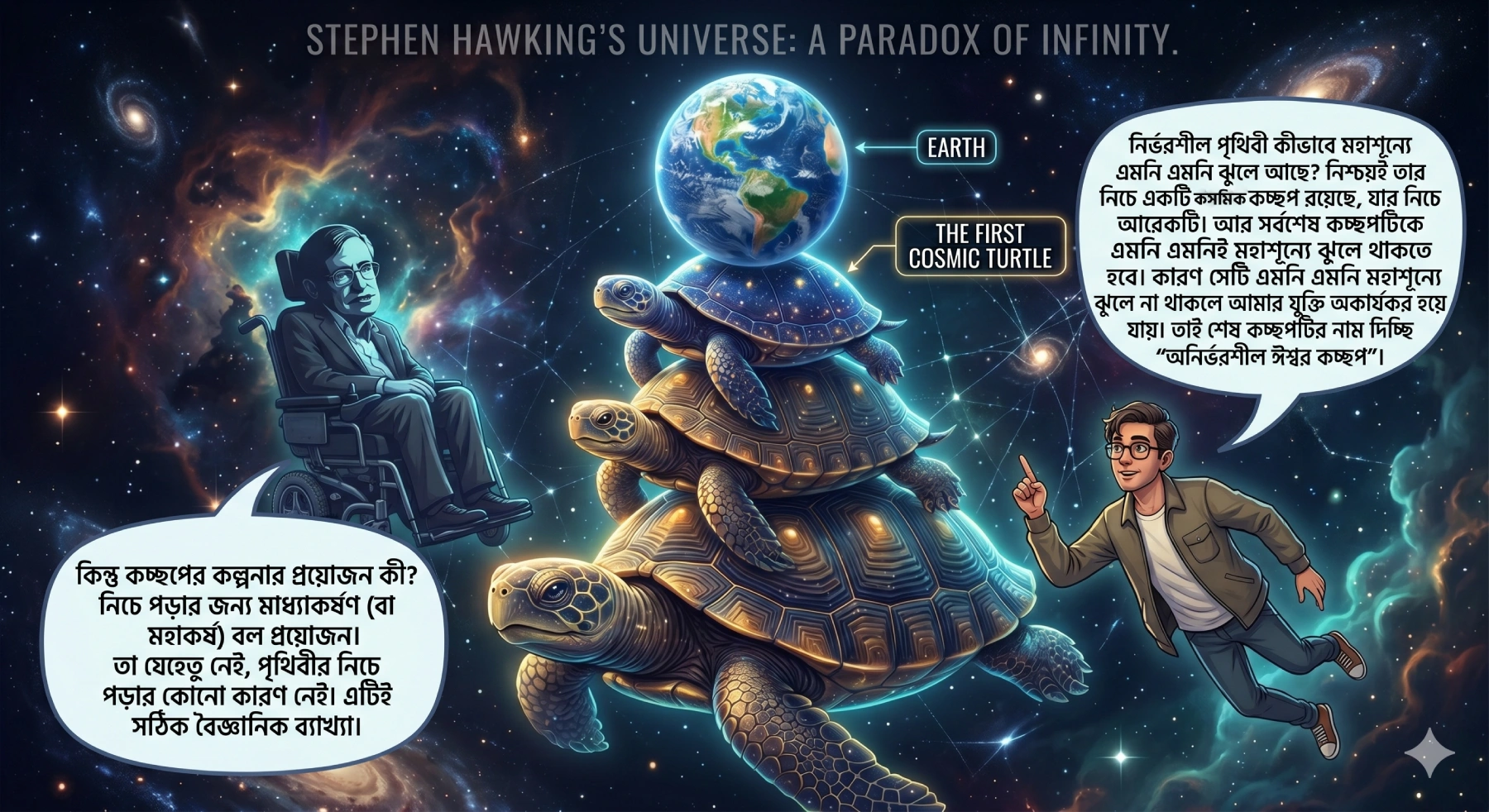
Godfather Akkas Ali and the Labyrinth of Infinite Regress
Proponents of the Kalam argument often claim that a long chain of causes behind the creation of the universe cannot continue backward forever. They call this Infinite Regress, or an endless regress into the past. According to them, without some ultimate first cause, the present moment itself could never have come to exist. To make this philosophical knot easier for ordinary people to understand, we may turn to a fictional Dhaka godfather named ‘Akkas Ali.’
Suppose your police-officer friend Akram claims that Godfather Akkas Ali is behind every murder in the city. You observe that crimes are indeed taking place, so according to your friend’s claim, there must be a mastermind behind them. But the question is: is Akkas Ali doing everything on his own? If he is acting under someone else’s orders, who is that superior godfather? If one boss after another keeps appearing in this way, where is the ultimate source of the crimes?
To avoid this infinite chain, you may eventually grow tired and decide that the chain ends with Godfather ‘Kuddus Ali.’ You declare, “Kuddus Ali is the first godfather; he has no boss above him.” But this is precisely where a major logical sleight of hand, or the fallacy of Special Pleading, arises. When you claim, “The existence of the universe must have a cause,” but immediately afterward say in the case of God, “God is beginningless; he requires no cause,” you are breaking your own rule for your own convenience [3].
If a supernatural entity (God) can be ‘beginningless’ or ‘self-existent’ without any cause, what prevents us from applying the same special property to the universe itself? Why can we not regard the universe or multiverse as a ‘Brute Fact’ or ultimate fact? [33]. To escape infinite regress, theists place an infinite number of causes inside a black box and attach a sticker labeled ‘God’ to it—but this is not actually a solution.
As with Akkas Ali in our story, even if we assume God to be the first cause, we possess no objective evidence for determining at which step we should stop—Kuddus Ali or Mokles Ali? Without any specific evidence, simply arriving at an arbitrary point and declaring “there is no further cause” is merely an imaginary solution based on assumption. As Richard Dawkins has argued, if explaining a complex universe requires an even more complex entity, then attempting to explain the origin of that entity only intensifies the problem rather than solving it [3].
Self-Gratifying Fiction: The Myth of the Atheist Professor and the Strawman Argument
When promoting the Kalam Cosmological Argument or arguments for the existence of God, advocates often rely more heavily on ‘popular myths’ or cheap legends than on logic. One story in particular is extremely common on social media and in various pamphlets: an arrogant atheist professor is denying God before all his students in a classroom, when suddenly an exceptionally intelligent religious student arrives and asks a few devastating questions that leave the professor speechless and secure a glorious victory for God! These stories may sound highly satisfying, but at their foundation lies a major logical deception known in philosophy as a Strawman Argument. [34]
A strawman argument is a tactic in which, instead of attacking an opponent’s actual argument, one constructs a weaker and distorted version of it and then declares victory after defeating that distortion. The authors of these stories make the atheist professor say things that no genuinely rational person would actually say.
In such stories, the professor is often made to say, “I cannot see God, therefore he does not exist.” The clever student then replies, “Sir, can you see air? Can you see a black hole? Can you see germs? If you cannot see them, why do you believe they exist?” Although the story presents this as the professor’s defeat, in reality the argument is profoundly foolish. Because:
When theistic apologetics belittles the atheist position by portraying it as merely a matter of “seeing with one’s own eyes,” it is engaging in intellectual dishonesty [36]. Instead of confronting the actual arguments made by atheists, they fight against an imaginary ‘strawman’ and then burp with self-satisfaction over defeating it.
In reality, science and reason do not operate through such cheap heroic tales. Changing one’s position requires compelling evidence. As Richard Dawkins has pointed out, religious belief often presents the absence of evidence as a ‘virtue,’ which runs contrary to rational thought [3]. These fictional stories may provide believers with momentary comfort, but in serious philosophical debate they amount to little more than ridiculous rhetorical tricks.
The Metaphor of Limitation: Two Twins in the Womb and the ‘Veil of Ignorance’
Proponents of the Kalam Cosmological Argument often claim that the orderly existence of the universe itself proves that there is a creator, or a ‘mother,’ behind it. To understand the limitations of human knowledge and our longing to know the unknown, the story of two twin brothers can serve as a powerful philosophical tool [37].
Imagine two twin brothers—Ahan and Hridoy—inside the darkness of their mother’s womb. The only world familiar to them is that small, dark chamber. Hridoy believes that beyond this world there is a ‘mother’ who created them, and that one day they will enter a vast world filled with light. Ahan, on the other hand, is a skeptic. He says, “Where is the evidence that anything exists beyond what is before our eyes? Have we ever seen our mother? We are simply growing here on our own.”
When Hridoy claims, “Mother is beginningless and eternal; she has no creator,” he essentially falls into the same eternal trap as the Kalam argument. Ahan then raises the decisive question— “If Mother can be beginningless, why can this world of the womb not also be beginningless? Does Mother herself not have a mother?” This metaphor exposes a harsh reality about our existence:
The central lesson of this story is that something does not become true merely because it sounds appealing or gives us psychological comfort. If a world outside the womb really exists, the way to discover it is through investigation and evidence, not mere imagination or blind faith. The Kalam argument essentially capitalizes on this ‘limited knowledge’ of ours and builds its case upon a fairy tale [33].
First Premise: It directly conflicts with quantum indeterminacy and spontaneous events in quantum mechanics.
Second Premise: Equating the universe’s ‘expansion’ with the ‘beginning of existence’ is merely a scientific oversimplification.
Logical Error: The attempt to move directly from a cause to a ‘personal God’ is a ‘God of the Gaps’ argument or a logical leap.
References
- Carroll, 2016 ↩︎
- Davies, 1995 ↩︎
- Dawkins, 2006 1 2 3 4 5
- Russell, 1948 ↩︎
- Oppy, 2006 ↩︎
- Smith, 1996 ↩︎
- Abu Hamid Al-Ghazali, The Incoherence of the Philosophers (Tahafut al-Falasifah), trans. Michael E. Marmura (Provo, UT: Brigham Young University Press, 2000), pp. 12–14 ↩︎
- William Lane Craig, The Kalām Cosmological Argument (London: Macmillan, 1979), p. 63 ↩︎
- Adolf Grünbaum, “The Pseudo-Problem of Creation in Physical Cosmology,” Philosophy of Science, Vol. 56, No. 3 (1989), pp. 373-394 ↩︎
- Atkins, P. (2010). The Laws of Thermodynamics: A Very Short Introduction ↩︎
- Carroll, S. (2016). The Big Picture: On the Origins of Life, Meaning, and the Universe Itself ↩︎
- Krauss, L. M. (2012). A Universe from Nothing 1 2
- Werner Heisenberg, The Physical Principles of the Quantum Theory (New York: Dover Publications, 1930), pp. 20-21 ↩︎
- Lawrence M. Krauss, A Universe from Nothing: Why There Is Something Rather Than Nothing (New York: Free Press, 2012), pp. 142-150 ↩︎
- Immanuel Kant, Critique of Pure Reason, 1781 ↩︎
- Planck Collaboration, 2018 ↩︎
- Hawking, S., & Penrose, R. (1996). The Nature of Space and Time ↩︎
- Steinhardt, P. J., & Turok, N. (2007). Endless Universe: Beyond the Big Bang ↩︎
- Vilenkin, A., Many Worlds in One, 2006, pp. 176–178 ↩︎
- James B. Hartle and Stephen W. Hawking, “Wave Function of the Universe,” Physical Review D, Vol. 28, No. 12 (1983), pp. 2960-2975 ↩︎
- Georg Cantor, Contributions to the Founding of the Theory of Transfinite Numbers, trans. Philip E. B. Jourdain (New York: Dover Publications, 1955), pp. 85-90 ↩︎
- Alan H. Guth, “Eternal Inflation and Its Implications,” Journal of Physics A: Mathematical and Theoretical, Vol. 40, No. 25 (2007), pp. 6811-6826 ↩︎
- Paul Davies, About Time: Einstein’s Unfinished Revolution, 1995 ↩︎
- Brian F. Chellas, Modal Logic: An Introduction (Cambridge: Cambridge University Press, 1980), pp. 1-15 ↩︎
- Alexander R. Pruss and Joshua L. Rasmussen, The Principle of Sufficient Reason: A Reassessment (Cambridge: Cambridge University Press, 2018), pp. 64-71 ↩︎
- Graham Oppy, Arguing about Gods (Cambridge: Cambridge University Press, 2006), pp. 147-152 ↩︎
- Graham Oppy, Arguing about Gods (Cambridge: Cambridge University Press, 2006), pp. 137-145 ↩︎
- Quentin Smith, “The Uncaused Beginning of the Universe,” Philosophy of Science, Vol. 55, No. 1, 1988, pp. 39–57 ↩︎
- William of Ockham, Summa Logicae, ed. Philotheus Boehner (St. Bonaventure, NY: Franciscan Institute, 1974), Part II, Chapter 15 ↩︎
- David Hume, Dialogues Concerning Natural Religion, 1779 1 2
- Michael Martin, Atheism: A Philosophical Justification, 1990 ↩︎
- Hume, 1779 1 2
- Russell, 1957 1 2 3
- Self-Gratifying Fiction: The Myth of the Atheist Professor ↩︎
- Krauss, 2012 ↩︎
- Do Atheists Believe in Things They Cannot See? ↩︎
- A Rational Conversation between Twin Babies ↩︎