Introduction: Cosmological Reality vs. Classical Cosmology
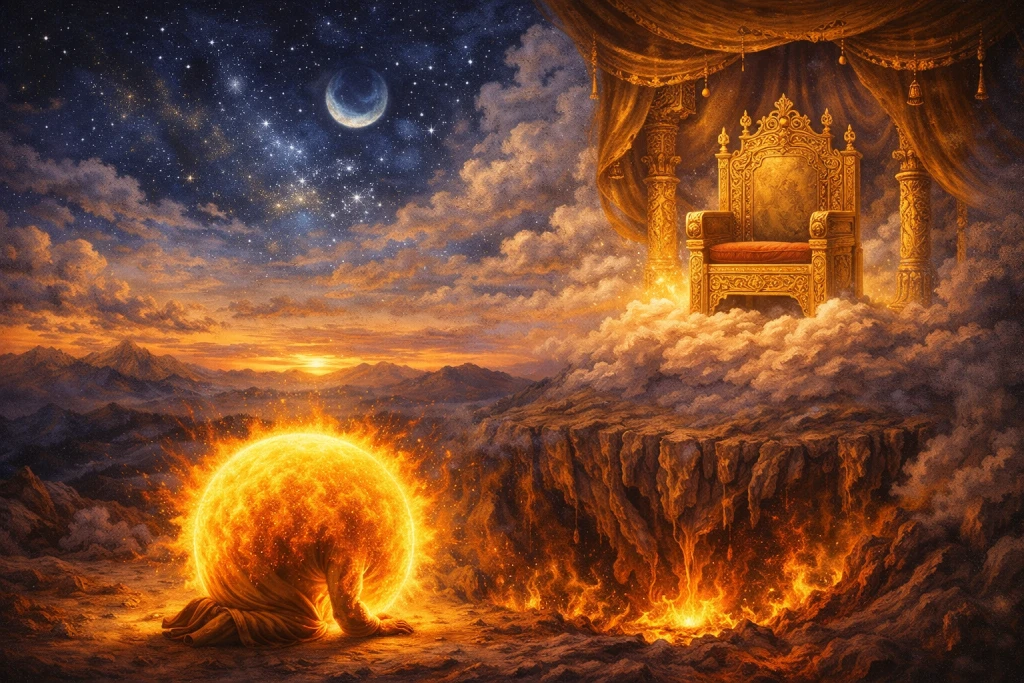
In an age when modern astronomy can measure the universe with extraordinary precision through telescopes, satellites, spectroscopy, and mathematical modelling, some cosmological descriptions found in religious texts and hadith create an obvious intellectual conflict. One of the most striking examples in Islamic tradition is the claim that after sunset the sun goes beneath Allah’s Throne, prostrates, and asks permission to rise again. The Qur’anic account of Dhul-Qarnayn in Surah al-Kahf also describes him reaching the setting-place of the sun and finding it setting in a murky or muddy spring.
To a devout believer these accounts may be treated as miraculous truths, but measured against basic physics and astronomy they reflect ancient cosmological imagination rather than physical reality. In the heliocentric model, daily sunrise and sunset are not caused by the sun circling the Earth; they are apparent motions produced by the Earth’s rotation on its axis. This article examines the scientific problems in these Qur’anic and hadith descriptions of the sun and the logical devices later used to reconcile ancient Arabian cosmological language with modern science.
Why Did Ancient People Create Myths and Fables?
Since antiquity, people have watched the sun rise during the day and apparently disappear somewhere at night. Before scientific astronomy and observational instruments, there was no reliable physical explanation for this everyday phenomenon. Human beings naturally search for causes, and when causes are unknown, imagination often fills the gap. Ancient cultures therefore explained natural and cosmic events through intention, anger, punishment, curses, gods, or supernatural agency. In psychology and anthropology, attributing human-like intention, emotion, or behaviour to nature, animals, objects, or cosmic phenomena is known as anthropomorphism.
The human mind is strongly inclined to detect patterns and purposes. When ancient people saw thunderclouds gather, lightning strike, or the sun suddenly darken during an eclipse, they often searched for an intention, warning, or punishment behind the event. Such myths are expressions of early human curiosity and fear. As the examples below illustrate, many cultures explained natural phenomena through gods, curses, and supernatural purposes.
Ancient Cosmology: Flat Earth, Layered Heavens, and the Sun’s Night Journey
To modern readers, asking where the sun “goes” after sunset may sound strange, but for ancient people it was a genuine cosmological question. The Earth was not understood as a planet rotating in space. In many ancient world-pictures it was imagined as an extended inhabited land beneath a layered or domed sky, with an underworld below. Ancient Near Eastern cosmologies often pictured the heavens as a firm roof, dome, or set of layers; the edges of the Earth, gates of heaven, places of sunrise and sunset, divine dwellings, and the realm of the dead all belonged to the same cosmic geography. Mesopotamian cosmology likewise contained flat-earth or “layer-cake” models in which heaven, Earth, and the underworld occupied distinct levels [1]. Within such a world-picture, sunset was not merely the disappearance of the sun from a local horizon because of Earth’s rotation; the sun was imagined as actually reaching the western edge and entering another route, layer, or lower realm at night.
The Mesopotamian sun god Utu/Shamash is especially relevant. In Sumerian and Akkadian traditions, the sun was not merely a luminous celestial body; Shamash was a deity associated with justice and with the protection of travellers. During the day he traversed the sky from east to west, while traditions also linked his nocturnal journey with the lower heavens or the underworld [2]. Some traditions pictured the sun resting at night; others imagined it returning eastward through the underworld or a “nether sky” so that it could rise again. Ancient Egyptian cosmology developed a comparable pattern: the sun god Ra crossed the sky by day and passed through the Duat at night before re-emerging in the east [3]. The Book of Amduat divides the night into twelve stages of this underworld journey [4]. The idea that the sun travels through an invisible cosmic route after sunset was therefore widespread in ancient cosmology.
Against this historical background, the sun-language of the Qur’an and hadith is no longer isolated or mysterious: “reaching the setting-place of the sun,” finding it setting in a muddy spring, asking where it goes, locating its destination beneath the Throne, and describing it as prostrating and seeking permission all belong to a recognizably ancient cosmological vocabulary. Later tafsir literature added another layer through the influence of Greek-Ptolemaic astronomy. In the Ptolemaic geocentric model, the Earth occupies the centre while the sun, moon, planets, and stars move around it in spheres or orbits [5]. Through the Abbasid translation movement, Ptolemy’s Almagest entered Arabic scholarship and Muslim astronomers adopted and modified geocentric models [6]. Thus, when Ibn Kathir says that Dhul-Qarnayn saw the sun setting in the sea from his perspective while the sun remained in its orbit, that is not a prediction of heliocentric astronomy; it is a medieval astronomical gloss placed over older cosmological language. Conflating that geocentric notion of an “orbit” with modern astronomy does not resolve the spatial problem created by the text’s setting-place and rising-place of the sun.
The Qur’an: The Sun Sets in a Muddy Spring
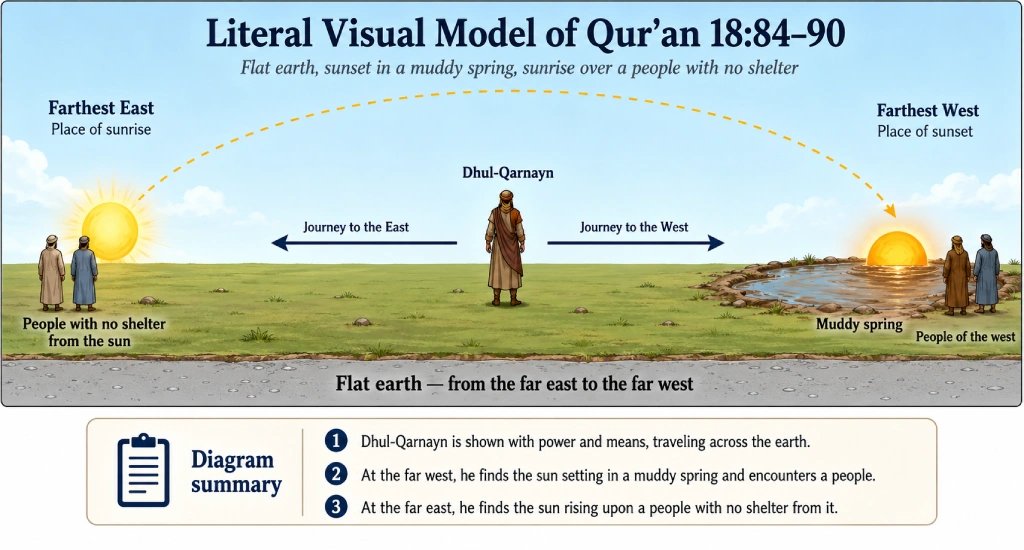
Let us examine what the Qur’an actually says about the sun’s setting and rising—where it is described as setting and where it is described as rising [7].
إِنَّا مَكَّنَّا لَهُۥ فِي ٱلۡأَرۡضِ وَءَاتَيۡنَٰهُ مِن كُلِّ شَيۡءٖ سَبَبٗا ٨٤
Surely We established him in the land, and gave him the means to all things.
— Dr. Mustafa Khattab, The Clear Quran
فَأَتۡبَعَ سَبَبًا ٨٥
So he travelled a course,
— Dr. Mustafa Khattab, The Clear Quran
حَتَّىٰٓ إِذَا بَلَغَ مَغۡرِبَ ٱلشَّمۡسِ وَجَدَهَا تَغۡرُبُ فِي عَيۡنٍ حَمِئَةٖ وَوَجَدَ عِندَهَا قَوۡمٗاۖ قُلۡنَا يَٰذَا ٱلۡقَرۡنَيۡنِ إِمَّآ أَن تُعَذِّبَ وَإِمَّآ أَن تَتَّخِذَ فِيهِمۡ حُسۡنٗا ٨٦
until he reached the setting ˹point˺ of the sun, which appeared to him to be setting in a spring of murky water, where he found some people. We said, “O Dhul-Qarnain! Either punish them or treat them kindly.”
— Dr. Mustafa Khattab, The Clear Quran
ثُمَّ أَتۡبَعَ سَبَبًا ٨٩
Then he travelled a ˹different˺ course,
— Dr. Mustafa Khattab, The Clear Quran
حَتَّىٰٓ إِذَا بَلَغَ مَطۡلِعَ ٱلشَّمۡسِ وَجَدَهَا تَطۡلُعُ عَلَىٰ قَوۡمٖ لَّمۡ نَجۡعَل لَّهُم مِّن دُونِهَا سِتۡرٗا ٩٠
until he reached the rising ˹point˺ of the sun. He found it rising on a people for whom We had provided no shelter from it.
— Dr. Mustafa Khattab, The Clear Quran
Islamic Beliefs About Hadith
In conservative Sunni hadith theology, the Prophet’s religious statements, explanations, and rulings are treated as truthful under divine guidance. On that premise, statements attributed to the Prophet about revelation or the external world are not received merely as ordinary human speculation. A sahih hadith concerning cosmological or scientific reality may therefore be accepted as true even when it conflicts with observation. The report of Abdullah ibn Amr is relevant here because it presents the Prophet as authorizing the recording of what he says on the grounds that truth comes from his mouth [8].
Sunan Abi Dawud
Book 26: Knowledge; Chapter: Writing knowledge
Hadith 3646
Narrated Abdullah ibn Amr ibn al-‘As: he used to write what he heard from the Messenger of Allah in order to preserve it. The Quraysh objected that Muhammad was a human being who spoke both in anger and in pleasure, so Abdullah stopped writing and reported the objection to him. The Prophet pointed to his mouth and instructed him to keep writing, swearing that nothing but truth came from it.
Grade: Sahih (Al-Albani)
Narrator: Abdullah ibn Amr ibn al-‘As
The Story of the Sun in the Hadith
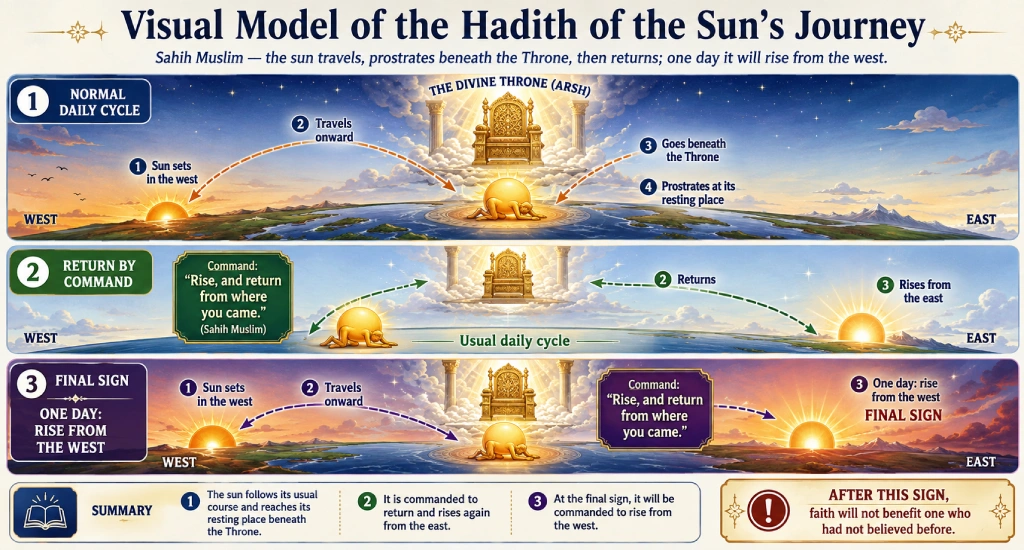
According to these Islamic narrations, after sunset the sun goes beneath Allah’s Throne, prostrates, and rises again when permission is granted. This conflicts with the elementary astronomical fact that Earth is spherical and rotating, so the sun is continuously above the horizon somewhere on Earth while it is below the horizon elsewhere. The relevant reports include Abu Dawud 4002; Bukhari 3199, 4802, 4803 and 7433; Muslim 159a, 159c and 159d; and parallel edition-number references preserved in the Bengali source [9] [10] [11] [12] [13] [14] [15] [16] [17] [18].
Sunan Abi Dawud
Book 32: Dialects and Readings of the Qur’an
Hadith 4002
Abu Dharr reported that he was riding behind the Messenger of Allah on a donkey while the sun was setting. The Prophet asked where it set. Abu Dharr replied that Allah and His Messenger knew best. He answered that it sets in a spring of warm water (ʿayn ḥāmiyah).
Grade: Sahih in chain (Al-Albani)
Narrator: Abu Dharr
Sahih al-Bukhari
Book 59: Beginning of Creation; Chapter: Characteristic of the Sun and the Moon
Hadith 3199
Abu Dharr reported that at sunset the Prophet asked him where the sun goes. Abu Dharr said that Allah and His Messenger knew best. The Prophet said that it travels until it prostrates beneath the Throne and asks permission to rise again; permission is granted until a time comes when it will be ordered to return from where it came and will rise from the west. He connected this account with Qur’an 36:38.
Narrator: Abu Dharr
Sahih al-Bukhari
Book 65: Prophetic Commentary on the Qur’an
Hadith 4802
Abu Dharr reported that he was with the Prophet in the mosque at sunset. The Prophet asked where the sun sets. Abu Dharr replied that Allah and His Messenger knew best. He said that the sun goes and prostrates beneath the Throne, and he cited Qur’an 36:38 in connection with this account.
Narrator: Abu Dharr
Sahih al-Bukhari
Book 65: Prophetic Commentary on the Qur’an
Hadith 4803
Abu Dharr reported that he asked the Prophet about the Qur’anic statement وَالشَّمْسُ تَجْرِي لِمُسْتَقَرٍّ لَهَا. The Prophet replied that the sun’s appointed course or resting-place is beneath Allah’s Throne.
Narrator: Abu Dharr
Sahih Muslim
Book 1: The Book of Faith; Chapter: The time when faith will no longer be accepted
Hadith 159a
Abu Dharr reported that the Messenger of Allah asked where the sun goes. After the companions answered that Allah and His Messenger knew best, he said that the sun travels until it reaches its resting-place beneath the Throne, falls prostrate, and remains there until it is told to rise and return to where it came from. This cycle continues until it is ordered to rise from its place of setting, after which it rises from the west. The report then connects that event with Qur’an 6:158.
Narrator: Abu Dharr
Sahih Muslim
Book 1: The Book of Faith
Hadith 159c
Abu Dharr reported that when the sun disappeared from sight, the Prophet asked where it goes. Abu Dharr replied that Allah and His Messenger knew best. The Prophet said that it goes and asks permission to prostrate, and permission is granted; eventually it will be told to return from where it came and will rise from its setting-place.
Narrator: Abu Dharr
Sahih Muslim
Book 1: The Book of Faith
Hadith 159d
Abu Dharr reported that he asked the Messenger of Allah about the verse وَالشَّمْسُ تَجْرِي لِمُسْتَقَرٍّ لَهَا. He replied that its appointed resting-place is beneath the Throne.
Narrator: Abu Dharr
Sahih Hadith Qudsi
1/ Miscellaneous Hadiths
Section: Virtues of the words of praise of Allah
161. On the authority of Abu Zar Radiyallahu Anhu, he said: I was with the Prophet (peace and blessings of Allah be upon him) on a donkey. At that time he had a folded sheet over it. He said: It was at sunset, he said to me: “O Abu Zar, you know where it goes?” He said: I said: Allah and His Messenger know best. He said: The sun sets in a muddy fountain, he continues to prostrate under the throne for his Lord, when Allah allows him to go out, so he comes out and rises. When he wants to rise from where he has set, he will say: O my Lord, my path is long, Allah will say: From where it sinks, rise from it. This is the time when a person does not benefit his faith”. sahih.
Hadith grading: sahih (Sahih) )
Sahih al-Bukhari
Book 65: Prophetic Commentary on the Qur’an
Hadith 4802
Abu Dharr reported that at sunset the Prophet asked him where the sun sets. Abu Dharr answered that Allah and His Messenger knew best. The Prophet said that it goes until it prostrates beneath the Throne, linking the statement with Qur’an 36:38.
Parallel Bengali-edition numbering: Tawheed Publication 4802; Islamic Foundation 4439.
Narrator: Abu Dharr
Sahih al-Bukhari
Book 65: Prophetic Commentary on the Qur’an
Hadith 4803
Abu Dharr reported that he asked the Prophet about وَالشَّمْسُ تَجْرِي لِمُسْتَقَرٍّ لَهَا. The Prophet replied that the sun’s appointed resting-place is beneath the Throne.
Parallel Bengali-edition numbering: Tawheed Publication 4803; Islamic Foundation 4440.
Narrator: Abu Dharr
Sahih al-Bukhari
Book 97: Oneness, Uniqueness of Allah (Tawheed)
Hadith 7433
Abu Dharr reported that he asked the Prophet about the verse concerning the sun running to its appointed course. The Prophet answered that its fixed course is beneath Allah’s Throne.
Narrator: Abu Dharr
Sahih Muslim
Book 1: The Book of Faith
Hadith 159a
This is the same Abu Dharr narration preserved under a different Bengali-edition number: the sun is described as travelling to its resting-place beneath the Throne, prostrating, and eventually being ordered to rise from the west. The canonical Sunnah.com reference is Muslim 159a.
Parallel Bengali-edition numbering: Hadith Academy 289-(250/159); Islamic Foundation 296.
Narrator: Abu Dharr
Hadith-Tafsir Contrivances: From Literal Text to Modern Apologetic Interpretation
The report about the sun prostrating beneath the Throne is not an isolated narration. It appears in Sahih al-Bukhari and Sahih Muslim and is used as a direct interpretation of Qur’an 36:38. Tafsir Abu Bakr Zakaria, preserved in Shongshoy’s Islamic archive, explicitly connects «مُسْتَقَرٍّ لَّهَا» with the sun’s destination beneath the Throne. Al-Qurtubi quotes the same Abu Dharr material about the sun travelling, prostrating, seeking permission, and ultimately rising from the west. Al-Durr al-Manthur likewise records parallel material from Bukhari, Tirmidhi, Ibn Abi Hatim, Bayhaqi and others. Thus, “the destination beneath the Throne” is not a modern mistranslation; it is embedded in the tafsir tradition [19] [20] [21] [10] [14]. The problem is therefore not a marginal interpretation. The hadith is event-structured: the sun goes, reaches a destination, prostrates, seeks permission, receives permission, returns, and is eventually ordered to rise from the west. Read straightforwardly, this resembles ancient geocentric and layered cosmology. Once modern astronomy made that reading difficult, reinterpretations multiplied: “mustaqarr” became a period rather than a place, prostration became metaphorical obedience, the Throne became all-encompassing so that the sun was always beneath it, or the entire event was moved into an unseen realm beyond scientific testing.
Original Arabic
قَوْلُهُ تَعَالَى: (وَالشَّمْسُ تَجْرِي لِمُسْتَقَرٍّ لَها) يَجُوزُ أَنْ يَكُونَ تَقْدِيرُهُ وَآيَةٌ لَهُمُ الشَّمْسُ. وَيَجُوزُ أَنْ يَكُونَ الشَّمْسُ مَرْفُوعًا بِإِضْمَارِ فِعْلٍ يُفَسِّرُهُ الثَّانِي. وَيَجُوزُ أَنْ يَكُونَ مَرْفُوعًا بِالِابْتِدَاءِ” تَجْرِي” فِي مَوْضِعِ الْخَبَرِ أَيْ جَارِيَةٌ. وَفِي صَحِيحِ مُسْلِمٍ عَنْ أَبِي ذَرٍّ قَالَ: سَأَلْتُ رَسُولَ اللَّهِ صلى الله عليه وسلم عَنْ قَوْلِهِ عز وجل:” وَالشَّمْسُ تَجْرِي لِمُسْتَقَرٍّ لَها” قَالَ:” مُسْتَقَرُّهَا تَحْتَ الْعَرْشِ”. وَفِيهِ عَنْ أَبِي ذَرٍّ أَنَّ النَّبِيَّ صلى الله عليه وسلم قَالَ يَوْمًا: (أَتَدْرُونَ أَيْنَ تَذْهَبُ هَذِهِ الشَّمْسُ) قَالُوا اللَّهُ وَرَسُولُهُ أَعْلَمُ، قَالَ:” إِنَّ هَذِهِ تَجْرِي حَتَّى تَنْتَهِيَ إِلَى مُسْتَقَرِّهَا تَحْتَ الْعَرْشِ فَتَخِرُّ سَاجِدَةً فَلَا تَزَالُ كَذَلِكَ حَتَّى يُقَالَ لَهَا ارْتَفِعِي ارْجِعِي مِنْ حَيْثُ جِئْتِ فَتَرْجِعُ فَتُصْبِحُ طَالِعَةً مِنْ مَطْلِعِهَا ثُمَّ تَجْرِي حَتَّى تَنْتَهِيَ إِلَى مُسْتَقَرِّهَا تَحْتَ الْعَرْشِ فَتَخِرُّ سَاجِدَةً وَلَا تَزَالُ كَذَلِكَ حَتَّى يُقَالَ لَهَا ارْتَفِعِي ارْجِعِي مِنْ حَيْثُ جِئْتِ فَتَرْجِعُ فَتُصْبِحُ طَالِعَةً مِنْ مَطْلِعِهَا ثُمَّ تَجْرِي لَا يَسْتَنْكِرُ النَّاسُ مِنْهَا شَيْئًا حَتَّى تَنْتَهِيَ إِلَى مُسْتَقَرِّهَا ذَاكَ تَحْتَ الْعَرْشِ فَيُقَالُ لَهَا ارْتَفِعِي أَصْبِحِي طَالِعَةً مِنْ مَغْرِبِكِ فَتُصْبِحُ طَالِعَةً مِنْ مَغْرِبِهَا) فَقَالَ رَسُولُ اللَّهِ صلى الله عليه وسلم:” أَتَدْرُونَ مَتَى ذَلِكُمْ ذَاكَ حِينَ” لَا يَنْفَعُ نَفْساً إِيمانُها لَمْ تَكُنْ آمَنَتْ مِنْ قَبْلُ أَوْ كَسَبَتْ فِي إِيمانِها خَيْراً” [الأنعام: 158] (.
وَلَفْظُ الْبُخَارِيِّ عَنْ أَبِي ذَرٍّ قَالَ: قَالَ النَّبِيُّ صلى الله عليه وسلم لِأَبِي ذَرٍّ حِينَ غَرَبَتِ الشَّمْسُ:” تَدْرِي أَيْنَ تَذْهَبُ” قُلْتُ اللَّهُ وَرَسُولُهُ أَعْلَمُ، قَالَ:” فَإِنَّهَا تَذْهَبُ حَتَّى تَسْجُدَ تَحْتَ الْعَرْشِ فَتَسْتَأْذِنُ فَيُؤْذَنُ لَهَا وَيُوشِكُ أَنْ تَسْجُدَ فَلَا يُقْبَلُ مِنْهَا وَتَسْتَأْذِنَ فَلَا يُؤْذَنُ لَهَا يُقَالُ لَهَا ارْجِعِي مِنْ حَيْثُ جِئْتِ فَتَطْلُعُ مِنْ مَغْرِبِهَا فَذَلِكَ قَوْلُهُ تَعَالَى:” وَالشَّمْسُ تَجْرِي لِمُسْتَقَرٍّ لَها ذلِكَ تَقْدِيرُ الْعَزِيزِ الْعَلِيمِ”.
وَلَفْظُ التِّرْمِذِيِّ عَنْ أَبِي ذَرٍّ قَالَ: دَخَلْتُ الْمَسْجِدَ حِينَ غَابَتِ الشَّمْسُ وَالنَّبِيُّ صلى الله عليه وسلم جَالِسٌ. فَقَالَ النَّبِيُّ صلى الله عليه وسلم:” يَا أَبَا ذَرٍّ أَتَدْرِي أَيْنَ تَذْهَبُ هَذِهِ” قَالَ قُلْتُ: اللَّهُ وَرَسُولُهُ أَعْلَمُ، قَالَ:” فَإِنَّهَا تَذْهَبُ فَتَسْتَأْذِنُ فِي السُّجُودِ فَيُؤْذَنُ لَهَا وَكَأَنَّهَا قَدْ قِيلَ لَهَا اطْلُعِي مِنْ حَيْثُ جِئْتِ فَتَطْلُعُ مِنْ مَغْرِبِهَا” قَالَ: ثُمَّ قَرَأَ” ذَلِكَ «1» مُسْتَقَرٌّ لَهَا” قَالَ وَذَلِكَ قِرَاءَةُ عَبْدِ اللَّهِ.
قَالَ أَبُو عِيسَى: هَذَا حَدِيثٌ حَسَنٌ صَحِيحٌ.(1). كذا في الأصول وفى صحيح الترمذي والعلة تحريف، إذ لا تعرف قراءة بهذا النص، وقراءة عبد الله بن مسعود” والشمس تجرى لا مستقر لها” كما سيأتي.
English translation
The words of Almighty Allah: (And the sun continues towards its destined destination). This means it is possible that “the sun is a sign for them.” Again the word “sun” is also possible to get r’ (pesh) by an implied verb, which is explained by the next part. Or it can be obtained as muktada and the word “continued” (tajri) will be in place of news, i.e. “transportational.” On the authority of Abu Zar (R.A.) in Sahih Muslim, he said: I asked the Messenger of Allah (PBUH) about the words of Almighty Allah – “And the sun is moving towards its designated destination”.
He said: “His destination is under the throne.” And it is narrated from Abu Zar (RA) that the Prophet (PBUH) said one day: (Do you know where this sun goes?) They said: Allah and His Messenger know best. He said: “It continues until he reaches his destination under the throne. There he falls prostrate and remains as he is said: Get up and go back to where you came from, so he returns and rises from his own place. Stays until he reaches his destination under the throne and falls prostrate.
This is how he stays until he is told: get up and go back to where you came from. As a result he returns and rises from his own place of origin. He then continues and the man sees nothing unusual in him until he reaches that destination under the throne. Then it will be said to him: Get up and rise from your the west (West) today. As a result, he will rise from the west.” Then the Messenger of Allah (PBUH) said: “Do you know when it will be? It will be the time when the faith of a person will not benefit him unless he has previously believed or attained any good through faith.Surah Al-An’am: 158].
On the authority of Abu Zar (RA) in the words of Bukhari, he said: When the sun was setting, the Prophet (PBUH) said to Abu Zar: “Do you know where it goes?” I said: Allah and His Messenger know best. He said: “It goes and prostrates under the throne. Then he asks for permission and he is allowed. And soon there will come a time when he will prostrate but it will not be accepted, and he will ask for permission but he will not be allowed. He will be told: from where he came from Go back. As a result he will rise from the west. And that is the word of Allah Almighty: ‘And the sun continues towards its destined destination; it is the well-controlled determination of the Mighty, the All-Knowing’.” Narrated by Abu Zar (R.A.) in the words of Tirmidhi, he said: When I entered the mosque when the sun went down, the Prophet (PBUH) was sitting.
The Prophet (peace be upon him) said: “O Abu Zar! Do you know where it goes?” He (Abu Zar) said, I said: Allah and His Messenger know best. He said: “It goes and asks for permission to prostrate, so he will be allowed. And he will soon be told: rise from where you came. As a result he will rise from his west.” Narrator Said: Then he recited “This is (1) the destination appointed for him.” He said: This is Abdullah’s Qiraat (reading). Abu Isa said: This hadith hasan Sahih. (1) This is how it is in the original manuscripts and in Sahih Tirmidhi and the matter is a textual error (Tahreef); Because there is no description (Qiraat) in this text.
The qiraat of Abdullah Ibn Mas’ud is—”And the sun travels, there is no stability”—as it will come forward.
The central problem with these reinterpretations is that they do not arise naturally from a stable reading of the text; they arise after scientific pressure makes the straightforward reading difficult to defend. Earlier interpretations treated the sun’s destination, its position beneath the Throne, and its prostration as religious realities. Once it became unavoidable that the Earth rotates, that the sun does not circle the Earth once per day, and that night in one region coincides with daylight in another, the interpretive rules changed. Prostration became obedience to natural law; “going” ceased to mean an actual journey; “beneath the Throne” ceased to describe a location; “mustaqarr” became either place or time; and whatever remained was declared unknowable. This method is epistemically weak because it has no stable interpretive criterion. When literalism is convenient, the text is literal; when literalism conflicts with science, it becomes metaphor; when metaphor is insufficient, the event becomes unseen. That is not explanation but retreat.
| Explanation Type | Original claim | Problem | Rationalization |
|---|---|---|---|
| Literal hadith-text | After the sun sets, it goes under the throne, prostrates, rises again with permission. | The rotation of the earth, the day and night of the spherical earth and the actual position of the sun. | It matches ancient cosmology, not modern astronomy. |
| Changing the meaning of the word “mustaqarr” | “mustaqarr” is not a place, it can also be a deadline or a fixed period of running until the Day of Resurrection. | The hadith itself supplies the destination, prostration, and permission beneath the Throne. Merely changing the vocabulary does not remove the event-structure of the hadith. | This is a partial linguistic possibility, but does not solve the original problem of the hadith. |
| metaphorical prostration | The Sun’s prostration means obedience to Allah’s commands, not literal bowing. | Then what do “seeking permission,” “being granted permission,” and “returning” mean? This dramatic dialogue is unnecessary just to mean loyalty. | The metaphorical interpretation fails to explain all the elements of the text. |
| Throne is omnipresent, so no problem | Throne is above all creation/encircling; So the sun is always under the throne in some sense. | If the sun is always under the throne, “where does the sun go?”, “prostrate there”, “go back from where you came”—the journeying language becomes meaningless. | This interpretation does not save the hadith; rather, it breaks the structure of the hadith. |
| The Unseen Reality | The event is in the invisible world, cannot be understood by science. | The hadith explains sunset, rise, rise from the west—that is, observable astronomical phenomena. If the interpretation of the observable event is wrong, it is removed as an invisible ad hoc escape. | It is an unfalsifiable claim—not knowledge, but a device for protecting faith. |
| Explanation of modern reference-frame | From the point of view of man, the sun rises and sinks; So there is no problem. | It is one thing to say “the sun has risen” in everyday language; It is another thing to say that the sun goes under the throne and takes permission. Myths cannot be made science with reference frames. | It conflates apparent motion with physical reality. |
The trajectory from older to newer interpretation is therefore clear: the hadith remains sahih, while additional layers of explanation are added to reconcile it with reality. Tafsir literature has taken Qur’an 36:38 in several ways—as a place of rest, a fixed term, or movement continuing until the Last Day—and modern commentary likewise notes both spatial and temporal senses of “mustaqarr” [22]. More significantly, modern Salafi sources do not simply dismiss the prostration as metaphor. IslamQA explicitly treats it as a real prostration whose manner is unknown, and IslamWeb gives the same basic reading. Ibn Baz explains the sun’s «مستقرها» as its prostration beneath the Throne while “going and returning” by Allah’s command—«ذاهبة وآيبة» [23] [24] [25]. The more the plain language conflicts with astronomy, the more abstract, unseen, and untestable the explanation becomes.
Original Arabic
مستقرها: أنها تسجد تحت عرش ربها عز وجل ذاهبة وآيبة بأمره سبحانه وتعالى (¬1) ». سجودا الله أعلم بكيفيته سبحانه وتعالى.
وهذه المخلوقات كلها تسجد لله وتسبح له جل وعلا، تسبيحا وسجودا يعلمه سبحانه، وإن كنا لا نعلمه ولا نفقهه، كما قال عز وجل: تُسَبِّحُ لَهُ السَّمَاوَاتُ السَّبْعُ وَالْأَرْضُ وَمَنْ فِيهِنَّ وَإِنْ مِنْ شَيْءٍ إِلَّا يُسَبِّحُ بِحَمْدِهِ وَلَكِنْ لَا تَفْقَهُونَ تَسْبِيحَهُمْ إِنَّهُ كَانَ حَلِيمًا غَفُورًا (¬2) وقال تعالى: أَلَمْ تَرَ أَنَّ اللَّهَ يَسْجُدُ لَهُ مَنْ فِي السَّمَاوَاتِ وَمَنْ فِي الْأَرْضِ وَالشَّمْسُ وَالْقَمَرُ وَالنُّجُومُ وَالْجِبَالُ وَالشَّجَرُ وَالدَّوَابُّ وَكَثِيرٌ مِنَ النَّاسِ وَكَثِيرٌ حَقَّ عَلَيْهِ الْعَذَابُ وَمَنْ يُهِنِ اللَّهُ فَمَا لَهُ مِنْ مُكْرِمٍ إِنَّ اللَّهَ يَفْعَلُ مَا يَشَاءُ (¬3) الآية، هذا السجود يليق به، لا يعلم كيفيته إلا الله سبحانه، ومن هذا قوله تعالى في سورة الرعد: وَلِلَّهِ يَسْجُدُ مَنْ فِي السَّمَاوَاتِ وَالْأَرْضِ طَوْعًا وَكَرْهًا وَظِلَالُهُمْ بِالْغُدُوِّ وَالْآصَالِ (¬4) فالشمس تجري كما أمرها الله تطلع من المشرق وتغيب من المغرب إلى آخر الزمان، فإذا قرب قيام
(¬1) أخرجه البخاري في صحيحه كتاب (بدء الخلق) باب: صفة الشمس والقمر برقم (2960).
(¬2) سورة الإسراء الآية 44
(¬3) سورة الحج الآية the 18
(¬4) سورة الرعد الآية 15
English translation
Its location is: It prostrates by coming and going under the throne of His mighty and Glorious Lord (1). Prostration, the method of which (Qaifiyat) is well known by Allah subhanahu wa ta’alai.
All these creations prostrate for Allah, the Glorious and the Exalted, and worship Him. Tasbeeh and Sajdah which He (Allah) knows, although we do not know or understand it. As Allah the Mighty and the Glorious says:
تُسَبِّحُ لَهُ السَّمَاوَاتُ السَّبْعُ وَالْأَرْضُ وَمَنْ فِيهِنَّ وَإِنْ مِنْ شَيْءٍ إِلَّا يُسَبِّحُ بِحَمْدِهِ وَلَكِنْ لَا تَفْقَهُونَ تَسْبِيحَهُمْ إِنَّهُ كَانَ حَلِيمًا غَفُورًا
Meaning: The seven heavens, the earth and everything in them is praised by Him. There is nothing that does not praise Him with praise. But you do not understand their praise. Surely He is tolerant, forgiving. (2)
He also said:
أَلَمْ تَرَ أَنَّ اللَّهَ يَسْجُدُ لَهُ مَنْ فِي السَّمَاوَاتِ وَمَنْ فِي الْأَرْضِ وَالشَّمْسُ وَالْقَمَرُ وَالنُّجُومُ وَالْجِبَالُ وَالشَّجَرُ وَالدَّوَابُّ وَكَثِيرٌ مِنَ النَّاسِ وَكَثِيرٌ حَقَّ عَلَيْهِ الْعَذَابُ وَمَنْ يُهِنِ اللَّهُ فَمَا لَهُ مِنْ مُكْرِمٍ إِنَّ اللَّهَ يَفْعَلُ مَا يَشَاءُ
Meaning: Do you not see that those who are in the heavens and those who are in the heavens, and the sun, the moon, the stars, the mountains, the trees, the animals and many people? And many have become inevitable. There is no honorer of whomever Allah humiliates. Surely Allah does what He wills. (3)
This verse (ends). This sajdah is suitable for him (Allah). No one knows the method of this except Allah subhanahu. on this matter Surah There is also the saying of Allah Ta’ala in Ar-Ra’de:
وَلِلَّهِ يَسْجُدُ مَنْ فِي السَّمَاوَاتِ وَالْأَرْضِ طَوْعًا وَكَرْهًا وَظِلَالُهُمْ بِالْغُدُوِّ وَالْآصَالِ
Meaning: And Allah prostrates to Allah willingly or unwillingly and their shadows in the morning and evening. (4)
So the sun is moving according to the command of Allah. It rises from the east and sets in the west, which will continue till the end. When the doomsday is near…
(1) This is described by Imam Bukhari in his Sahih book in the chapter ‘The Beginning of Creation’, in the chapter ‘Description of the Sun and the Moon’ (Hadith No. 2960).
(2) Surah Al-Isra, verse: 44
(3) Surah Al-Hajj, verse: 18
(4) Surah Ar-ra’d, verse: 15
Original Arabic
الساعة طلعت من مغربها، وذلك من أشراط الساعة العظمى، كما تواترت بذلك الأحاديث الصحيحة عن رسول الله – صلى الله عليه وسلم – فإذا انتهى هذا العالم وقامت القيامة كورت، كما قال تعالى: إِذَا الشَّمْسُ كُوِّرَتْ (¬1) فتكور ويذهب نورها وتطرح هي والقمر في جهنم؛ لأنهما قد ذهبت الحاجة إليهما بزوال هذه الدنيا.
والمقصود: أنها تجري لمستقر لها ذاهبة وآيبة، ومستقرها سجودها تحت العرش في سيرها طالعة وغاربة، كما تقدم ذكر ذلك في الحديث الصحيح، ذلك بتقدير العزيز العليم، وهو الذي قدر سبحانه وتعالى لها ذلك.
العزيز، ومعناه: المنيع الجناب الغالب لكل شيء، العليم بأحوال خلقه سبحانه وتعالى. والله ولى التوفيق.
(¬1) سورة التكوير الآية 1
English translation
The sun will rise from its west side, and this is one of the greatest signs of doomsday. As it is through Sahih Hadith from the Messenger of Allah (may peace be upon him) mutawatir Sources have been proven.
When this world is over and the Day of Resurrection takes place, the sun will be folded (Quobirat). As Allah says: when the sun is folded. (Surah At-Takveer, verse 1). Then he will be wrapped up and his light will go away. And he and the moon will be thrown into hell; Because with the extinction of this world, their needs will also be exhausted.
The main purpose is: the sun moves towards its specific destination—through going and coming. And his destination is to prostrate under the throne, when he rises and when he sets. As mentioned earlier in Sahih Hadith. It is the determination of Allah, the Mighty, the Wise (Al-Aziz, Al-Alim). And it is He who has determined it for subhanahu wa ta’ala.
‘Al-Azizh’ (mighty) means: He who is unstoppable, whose presence is protected and He who is victorious over everything. And ‘Al-Alim’ (the wise man) is: He who is aware of all the conditions of His creation, Subhanahu wa Taala.
And Allah is the giver of tawfiq.
The logical conclusion is straightforward. A literal reading conflicts with astronomy; a metaphorical reading does not account for the narrative language of travel, permission, and return; an unseen reading removes the claim from testing; and a reference-frame defence confuses the ordinary appearance of sunrise and sunset with the distinct claim that the sun prostrates beneath the Throne. Presenting the sun-prostration hadith as compatible with modern science is therefore not an explanation of the text but a later repair imposed upon it.
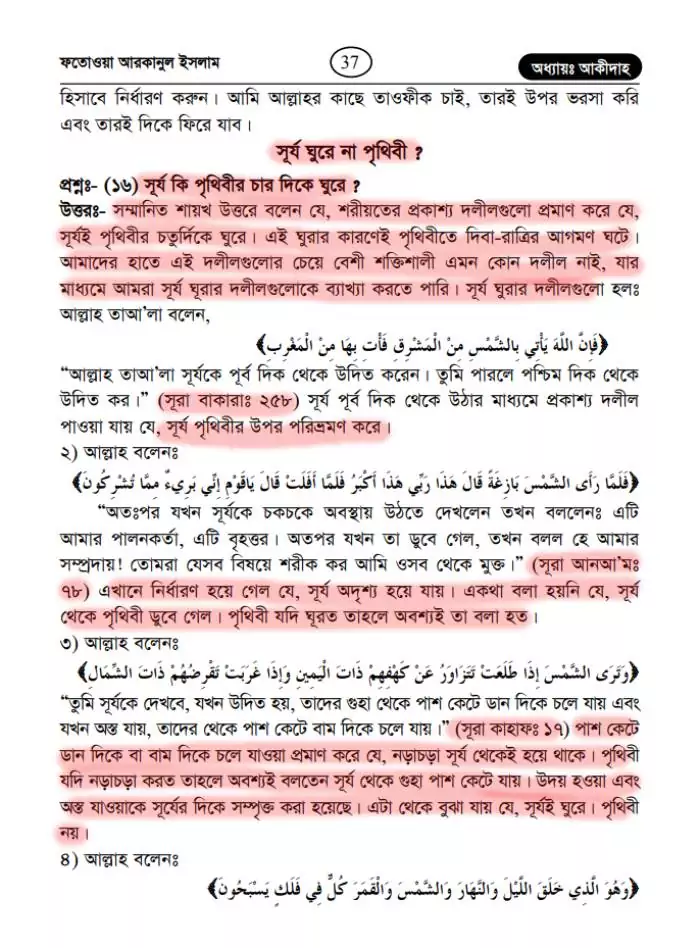
Shaykh Ibn ‘Uthaymeen’s Fatwa: Not the Earth, but the Sun Revolves!
Now consider a well-known fatwa attributed to Shaykh Muhammad ibn Salih al-‘Uthaymeen in Fatawa Arkan al-Islam [26] [27]. The Bengali book-link is retained because an exact authoritative international replacement for this specific edition/page reference has not yet been confirmed.
Question: (16) Does the sun revolve around the earth?
Answer: The Shaykh replied that the apparent meanings of the revealed texts establish that the Sun revolves around the Earth, producing the alternation of day and night. We should not depart from those apparent meanings without stronger evidence permitting a different interpretation. The proofs that the Sun revolves are as follows: Allah Ta’ala says:
﴿فَإِنَّ ٱللَّهَ يَأۡتِي بِٱلشَّمۡسِ مِنَ ٱلۡمَشۡرِقِ فَأۡتِ بِهَا مِنَ ٱلۡمَغۡرِبِ﴾ [البقرة: ٢٥٨]
“Allah Ta’ala raises the sun from the east. If you can, rise from the west.” [Surah Al-Baqarah, verse: 258] The Sun’s being brought from the east is evidence, in this argument, that it revolves around the Earth.
2) Allah says:
﴿فَلَمَّا رَءَا ٱلشَّمۡسَ بَازِغَةٗ قَالَ هَٰذَا رَبِّي هَٰذَآ أَكۡبَرُۖ فَلَمَّآ أَفَلَتۡ قَالَ يَٰقَوۡمِ إِنِّي بَرِيٓءٞ مِّمَّا تُشۡرِكُونَ ٧٨﴾ [الانعام: ٧٨]
“Then when he saw the sun rising, he said, “This is my Lord, this is greater, and when it sinks, he said, O my people! I am free from what you associate with.” [Surah Al-An’am, verse: 78]
Here the text attributes the setting to the Sun; it does not say that the Earth turns away from the Sun. If the Earth were rotating, the text would have said so.
3) Allah says,
﴿وَتَرَى ٱلشَّمۡسَ إِذَا طَلَعَت تَّزَٰوَرُ عَن كَهۡفِهِمۡ ذَاتَ ٱلۡيَمِينِ وَإِذَا غَرَبَت تَّقۡرِضُهُمۡ ذَاتَ ٱلشِّمَالِ﴾ [الكهف: ١٧]
“You will see the sun, when it rises, passes from their cave and goes to the right, and when it sets, it goes to the left.” [Surah Kahaf, verse: 17] The description of the Sun moving to the right and left is taken, in this argument, as evidence that the motion belongs to the Sun. If the Earth were moving, it would have been described as moving away from the Sun. The references to rising and setting are therefore presented as evidence that the Sun revolves, not the Earth.
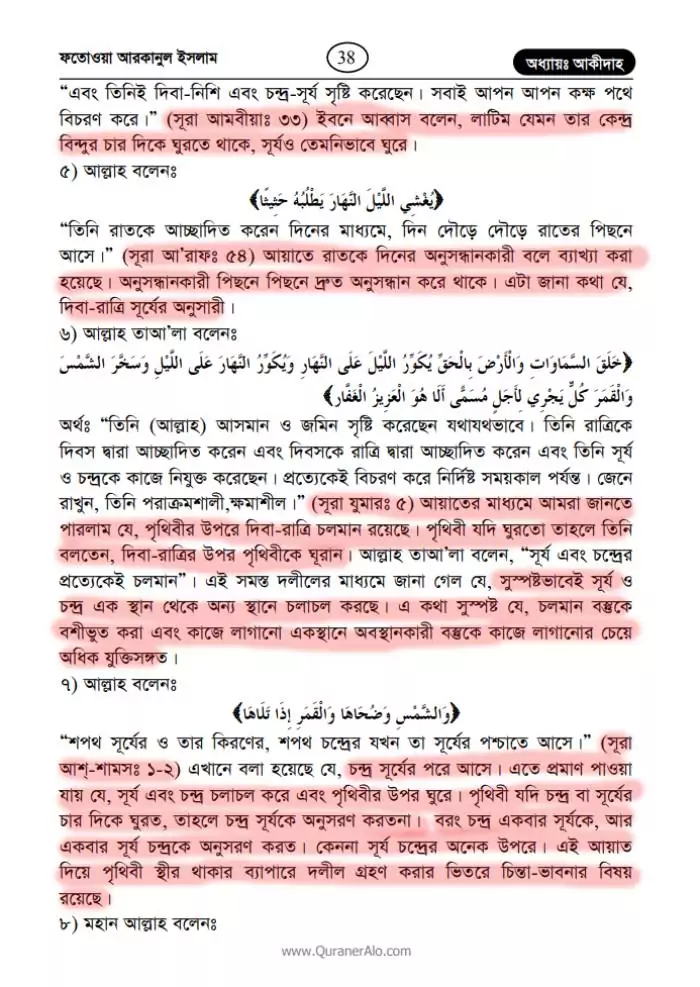
4) Allah says:
﴿وَهُوَ ٱلَّذِي خَلَقَ ٱلَّيۡلَ وَٱلنَّهَارَ وَٱلشَّمۡسَ وَٱلۡقَمَرَۖ كُلّٞ فِي فَلَكٖ يَسۡبَحُونَ ٣٣﴾ [الانبياء: ٣٣]
“And it is He who has created the day and the moon and the sun, and all wander in their own orbit.” [Surah Al-Ambia, verse: 33]
Ibn Abbas said, just as Latim revolves around its center point, so does the sun.
5) Allah says,
﴿يُغۡشِي ٱلَّيۡلَ ٱلنَّهَارَ يَطۡلُبُهُۥ حَثِيثٗا﴾ [الاعراف: ٥٤]
“He covers the night through the day, the day runs and comes after the night.” [Surah Al-Araf, verse: 54]
The verse describes the night as pursuing the day swiftly. This is taken to mean that day and night follow the Sun.
6) Allah says:
﴿خَلَقَ ٱلسَّمَٰوَٰتِ وَٱلۡأَرۡضَ بِٱلۡحَقِّۖ يُكَوِّرُ ٱلَّيۡلَ عَلَى ٱلنَّهَارِ وَيُكَوِّرُ ٱلنَّهَارَ عَلَى ٱلَّيۡلِۖ وَسَخَّرَ ٱلشَّمۡسَ وَٱلۡقَمَرَۖ كُلّٞ يَجۡرِي لِأَجَلٖ مُّسَمًّىۗ أَلَا هُوَ ٱلۡعَزِيزُ ٱلۡغَفَّٰرُ ٥﴾ [الزمر: ٥]
“He created the heavens and the earth in a proper way. He covers the night by the day and covers the day by night, and He has engaged the sun and the moon to work. Everyone wanders for a certain period of time. Know that He is Mighty, Forgiving.” [Surah Az-Zumar, verse: 5]
Through the verses we came to know that day and night are going on over the earth. If the Earth were moving, the wording would have referred to the Earth’s motion. Allah Ta’ala says, “The sun and the moon are all moving”. Through all these evidences, it was known that the sun and the moon were moving from one place to another. It is clear that subjugating and using moving objects is more reasonable than using objects in one place.
7) Allah says,
﴿وَٱلشَّمۡسِ وَضُحَىٰهَا ١ وَٱلۡقَمَرِ إِذَا تَلَىٰهَا ٢﴾ [الشمس: ١، ٢]
“By the Sun and its brightness, and by the Moon as it follows it.” [Surah ash-shams, verse: 1-2]
Here it is said that the moon comes after the sun. This is taken to show that the Sun and Moon move in relation to the Earth. If the earth orbited the moon or the sun, the moon would not follow the sun. Rather, the moon followed the sun once, and once the sun the moon. Because the sun is far above the moon. This verse There is a matter of thought in accepting evidence about the stabilization of the world.
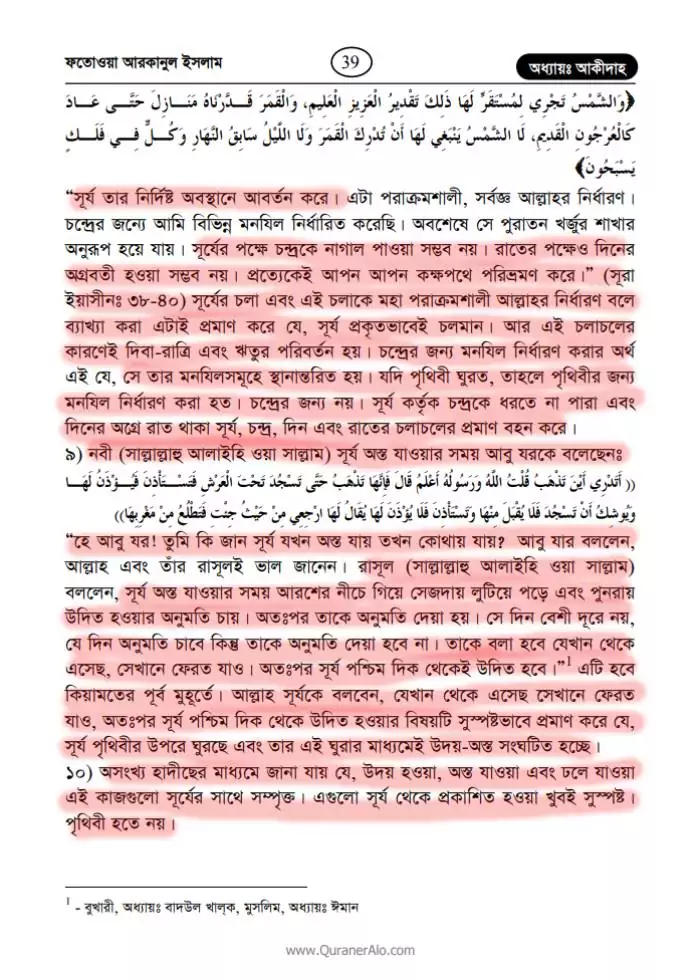
8) Allah says:
﴿وَٱلشَّمۡسُ تَجۡرِي لِمُسۡتَقَرّٖ لَّهَاۚ ذَٰلِكَ تَقۡدِيرُ ٱلۡعَزِيزِ ٱلۡعَلِيمِ ٣٨ وَٱلۡقَمَرَ قَدَّرۡنَٰهُ مَنَازِلَ حَتَّىٰ عَادَ كَٱلۡعُرۡجُونِ ٱلۡقَدِيمِ ٣٩ لَا ٱلشَّمۡسُ يَنۢبَغِي لَهَآ أَن تُدۡرِكَ ٱلۡقَمَرَ وَلَا ٱلَّيۡلُ سَابِقُ ٱلنَّهَارِۚ وَكُلّٞ فِي فَلَكٖ يَسۡبَحُونَ ٤٠﴾ [يس: ٣٨، ٤٠]
“The Sun runs to its appointed course. It is the determination of the Mighty, the All-Knowing Allah. I have determined various stages for the Moon. Finally, it becomes like the old palm branch. The sun cannot reach the moon. It is not possible for the moon to be the foremost of the day. Each travels in its own orbit.” [Surah Yasin, verse: 38-40]
Explaining the movement of the sun and this movement as the determination of Allah, the Mighty, proves that the sun is truly moving. And because of this movement, day-night and seasons change. Determining the destination for the moon means that he migrates to his places. If the earth rotated, the earth would have been determined for the earth. Not for the moon. Not being able to grasp the moon by the sun and the night ahead of the day bears proof of the movement of the sun, moon, day and night.
9) The Prophet (peace and blessings be upon him) said to Abu Dharr when the Sun set:
«أَتَدْرِي أَيْنَ تَذْهَبُ قُلْتُ اللَّهُ وَرَسُولُهُ أَعْلَمُ قَالَ فَإِنَّهَا تَذْهَبُ حَتَّى تَسْجُدَ تَحْتَ الْعَرْشِ فَتَسْتَأْذِنَ فَيُؤْذَنُ لَهَا وَيُوشِكُ أَنْ تَسْجُدَ فَلَا يُقْبَلَ مِنْهَا وَتَسْتَأْذِنَ فَلَا يُؤْذَنَ لَهَا يُقَالُ لَهَا ارْجِعِي مِنْ حَيْثُ جِئْتِ فَتَطْلُعُ مِنْ مَغْرِبِهَا»
“O Abu Dharr, do you know where it goes?” He replied that it goes beneath the Throne, prostrates, and asks permission to rise. A time will come when permission will not be granted; it will be told to return from where it came, and it will rise from the west.”
This is presented as the event before the Day of Resurrection. The command for the Sun to rise from the west is taken here as clear evidence, in the author’s argument, that the Sun rotates around the Earth and that this rotation produces sunrise and sunset.
10) Numerous hadiths, it is argued, attribute rising, setting, and prostration to the Sun rather than to the Earth. There may be further evidence, but the author does not recall it at present; the evidence cited is presented as sufficient for his purpose.
[1] Sahih Bukhari, Chapter: Badul Khalq; Sahih Muslim, Chapter: Faith
Statements by Scholars: “Allah Knows Best”
Let us also look at how some contemporary preachers respond when confronted with this problem. Instead of answering the astronomical contradiction directly, they often redirect the discussion or retreat to “Allah knows best.”
Now consider what Shaykh Matiur Rahman Madani says on the same issue.
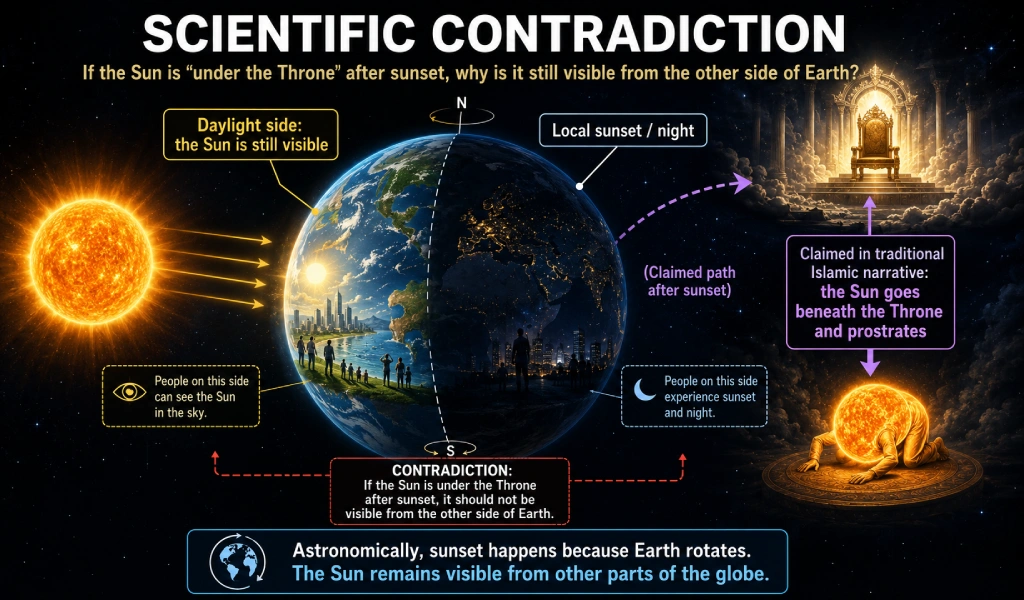
Scientific Inconsistency of the Hadith
The description in these hadiths is scientifically unacceptable as a physical account of daily sunrise and sunset. In modern astronomy, sunrise and sunset are not caused by the sun circling the Earth once each day; they are apparent motions produced by Earth’s rotation. The Sun is a massive sphere of plasma with a mass of about 1.99 × 10^30 kilograms. Its different latitudes rotate at different rates, roughly 25 days near the equator and longer near the poles. Nuclear fusion in its core converts hydrogen into helium and releases the energy that reaches Earth as light and heat. Against this physical reality, the idea that the Sun travels each evening to a particular destination, prostrates, seeks permission, and then returns belongs to the language of ancient cosmology. Because Earth is spherical and rotating, some part of Earth is always illuminated; when one region experiences night, another experiences day. There is no global moment at which the Sun “goes somewhere at night.”
The Qur’anic narrative likewise describes Dhul-Qarnayn reaching the setting-point of the sun and finding it setting in a murky spring; another hadith recension uses the expression “warm spring.” Whatever textual variant is selected, there is no physical location on Earth into which the Sun actually descends. Sunset occurs at different horizons for different observers because Earth rotates. A literal terrestrial spring, pool, or sea cannot be the physical destination of the Sun.
The Impact of Unscientific Religious Beliefs
Unscientific religious claims can damage the practice of knowledge when they are treated as immune from correction. If a scripture or hadith teaches a proposition that conflicts with well-established evidence, insisting that the proposition must nevertheless be true encourages people to subordinate observation and reasoning to inherited belief. That replaces inquiry with dogma.
Narratives of this kind show how religious cosmology can preserve ancient imagination long after the relevant natural phenomenon has been scientifically explained. Accepting such descriptions as factual despite contrary evidence obstructs scientific reasoning and keeps erroneous models alive.
Modern Apologetic Manipulation: Not Explanation, but Text-Saving Fraud
When Qur’anic and sahih-hadith descriptions of the Sun are placed beside modern astronomy, a predictable apologetic pattern appears. When a text seems to support belief, it is read literally; when the same wording becomes scientifically indefensible, it is redescribed as metaphorical, relative, unseen, eschatological, or merely “from the human point of view.” This is not a consistent hermeneutic. It is selective literalism combined with opportunistic metaphor: where evidence is absent, invoke the unseen; where science contradicts the wording, invoke metaphor; where wording is explicit, change the lexical range. The objective ceases to be finding the most coherent meaning and becomes preserving the text from falsification.
The strongest sign of this method is that the text is never allowed to be wrong. If the Sun really goes beneath the Throne, that is called a miracle. If it does not go anywhere, the statement becomes metaphorical. If no stop can be measured, perhaps it stops for a nanosecond. If nanoseconds do not help, quantum uncertainty is invoked. If “beneath the Throne” creates a spatial problem, the Throne is said to encompass everything. If the Sun does not enter a muddy spring, the verse becomes Dhul-Qarnayn’s visual perspective. This is a chain of ad hoc rescue devices, moving goalposts, and unfalsifiable claims.
Manipulating the Meaning of “Mustaqarr”
Qur’an 36:38 says, in Khattab’s translation, “The sun travels for its fixed term.” The Arabic word mustaqarr can carry senses such as a fixed place, resting-place, destination, or settled term. In an ancient cosmological setting, a spatial reading is entirely natural—especially because sahih hadiths explicitly interpret the verse through the Sun’s destination beneath the Throne, its prostration, its request for permission, and its return. After modern astronomy, apologetic readings often shift mustaqarr from place to time, from destination to abstract term, and from physical movement to eschatological duration. That semantic flexibility does not erase the problem created by the hadith narrative attached to the verse.
Even if mustaqarr is interpreted temporally, the hadith problem remains. The difficulty is not merely the dictionary meaning of one noun. The Prophet is reported as explaining the verse by asking where the Sun goes and describing it as travelling beneath the Throne, prostrating, requesting permission, and returning. If the verse were simply a generic statement about cosmic motion, this event-filled explanatory narrative would be unnecessary. The apologetic manoeuvre therefore produces an internally unstable position: the verse becomes temporal, the hadith becomes unseen, the Sun’s motion becomes relative, and the Throne becomes spatially all-encompassing. These explanations do not form a coherent single reading; they function as separate repairs applied wherever the previous repair fails.
The Sun Prostrating in Nanoseconds: Turning Science Fiction into Physics
Another apologetic proposal says that the Sun might stop for an unimaginably short interval—a nanosecond, picosecond, or femtosecond—prostrate beneath the Throne, ask permission, receive it, and resume its motion before humans could detect anything. This is science fiction presented as physics. The Sun is an enormous stellar body embedded in gravitational and barycentric dynamics; arbitrarily stopping and restarting it is not a trivial hidden event. More importantly, “you cannot prove it did not stop for a femtosecond” simply reverses the burden of proof. The person asserting the stop, prostration, and permission must provide evidence for those claims.
The same tactic could rescue any fantasy. One could claim that the Moon becomes an invisible dragon for a picosecond each day, or that an invisible being returns to Paradise every night for a femtosecond, and then demand that sceptics disprove it. A method that can protect every imaginable claim protects nothing evidentially. If the Sun’s prostration is proposed as a real cosmic event, the claimant must supply a coherent mechanism or evidence. Saying “perhaps it happens too quickly to detect” merely removes the claim from empirical testing; it does not make the hadith scientific.
Misuse of Quantum Uncertainty: Pseudoscience in the Name of Science
A still weaker strategy invokes Heisenberg’s uncertainty principle. The argument usually runs that motion cannot be measured with absolute precision and observations contain temporal gaps; therefore science cannot prove that the Sun never stops for an instant. This is a misuse of quantum mechanics. The uncertainty principle concerns limits on simultaneously specifying conjugate quantities such as position and momentum; it is not a licence to insert arbitrary macroscopic events between observations [28]. A star of roughly 1.99 × 10^30 kilograms does not acquire permission to violate celestial dynamics merely because quantum measurements have uncertainty. At macroscopic scales, environmental decoherence rapidly suppresses quantum superpositions and produces effectively classical behaviour [29]. Using quantum uncertainty to smuggle in a hidden stop, prostration, and restart is pseudoscience.
Uncertainty also does not mean “anything can happen.” Failure to observe an event is not evidence that the event occurred. The rational conclusion from an unmeasured proposition is simply that it has not been established. Heisenberg’s principle defines limits on measurement; it does not supply evidence for miracles. Decoherence, meanwhile, explains why large systems interacting constantly with their environments display stable classical behaviour in observation. Quantum mechanics therefore does not rescue the hadith; invoking it here only obscures the absence of evidence.
The Hollow Theology of the Claim that “the Throne Encompasses Everything”
Another defence says that because the Throne encompasses or stands above all creation, the Sun is always “beneath the Throne,” so no spatial contradiction exists. But that answer empties the hadith’s journey-language of meaning. If the Sun is always beneath the Throne, why ask where it goes at sunset? Why say that it goes there, prostrates there, asks permission, and is told to return from where it came? The more “beneath the Throne” is expanded into a universal relation, the less sense the reported sequence of movement makes.
The defence therefore asserts two incompatible things at once. On one side, the hadith describes a specific journey, destination, prostration, request, permission, and return. On the other, the apologetic reading says there is no special journey because the Sun is always beneath the Throne. If the latter is true, the temporal and directional structure of the hadith becomes redundant. Rather than resolving the contradiction, the explanation dissolves the narrative that created it.
Geocentric Sleight of Hand in the Name of Reference Frames
A further manoeuvre appeals to reference frames: from an observer standing on Earth, the Sun appears to rise and set, so one may loosely say that the Sun moves around the observer. But this does not justify the claim that the Sun physically revolves around Earth and produces day and night. Reference frames are coordinate descriptions; they do not make every dynamical interpretation equally correct. A geocentric coordinate system can be constructed mathematically, but the physical explanation of daily sunrise and sunset is still Earth’s rotation.
Ordinary language such as “the Sun rose” is harmless because everyone understands it as phenomenological language. Saying “the Sun revolves around the Earth and causes day and night” is a physical claim and is false. A passenger on a moving train may describe trees outside as moving backward relative to the carriage, but that does not establish that the landscape is physically racing backward. Apparent motion and causal physical motion are different questions.
Most importantly, the hadith does not merely use everyday language for apparent sunrise and sunset. It treats the Sun as an agent that goes somewhere, prostrates, asks permission, receives permission, returns, and will eventually be ordered to rise from the west. A reference frame can explain why an observer says “the Sun set”; it cannot explain the additional narrative of prostration beneath the Throne and permission from Allah. Conflating these two levels is the central sleight of hand.
This is not observational astronomy; it is mythological cosmology.
Dhul-Qarnayn’s “Perspective” Interpretation: A Rescue Device for Fragmented Classical Readings
In Surah al-Kahf, Dhul-Qarnayn reaches the setting-place of the Sun and finds it setting in a murky body of water. A common apologetic defence says that this is merely his visual perspective: he stood at a shoreline and saw the Sun apparently sink into the horizon. A perspective-based reading is also found in classical tafsir; Ibn Kathir says that Dhul-Qarnayn saw the Sun setting in the sea as a coastal observer sees it, while the Sun itself remained in its course. Modern IslamQA uses a similar defence. Yet other classical material preserves a much more concrete geographical picture. Al-Qurtubi, for example, cites traditions in which Dhul-Qarnayn reaches the extreme ends of east and west, beyond which there is no further inhabited creation [30]. The story’s structure is also explicitly geographical: Dhul-Qarnayn is given power and means, follows a route, reaches the setting-place, encounters the Sun setting in a spring and finds a people there; then he follows another route, reaches the rising-place and encounters another people exposed to the Sun. Reducing the entire passage to a casual seaside optical illusion ignores that narrative geography [31].
The verb وَجَدَهَا does not by itself transform the report into an explicit optical illusion. Depending on context, wajada can mean finding, encountering, or perceiving. The larger sentence is what matters. The text says that Dhul-Qarnayn reaches the setting-place of the Sun, finds it setting in a murky spring, and finds a people there; later he reaches the rising-place and finds another people. Setting, rising, place, journey, and populations are woven into one geographical narrative. Isolating the verb “found” while ignoring the structure of the passage does not solve the problem.
There is a further difficulty: within the religious claim, the narrator is not an uninformed traveller but an omniscient God. If the intended meaning were merely “from Dhul-Qarnayn’s viewpoint the Sun appeared to sink at the horizon,” the text could have described an ordinary visual scene without repeatedly invoking a setting-place, a people found there, a second journey, and a rising-place. Using one limited classical gloss to erase the entire spatial structure of the passage is context-stripping, not a complete explanation.
The apologetic claim therefore does more than soften the wording; it rewrites the narrative logic of the Qur’anic passage. The contrast is straightforward:
Treating the entire episode as nothing more than Dhul-Qarnayn’s private visual impression is a post-hoc justification. Such explanations become necessary only after it is already known that Earth is spherical and that the Sun does not physically sink into a terrestrial body of water.
“Dhul-Qarnayn merely saw the Sun appear to sink with his own eyes; God is not describing physical reality here.”
In the preceding verses (18:84–85), Allah states that He established Dhul-Qarnayn in the land and gave him the means to pursue his course. The narrative is presented as God’s own description of events, not as a warning that Dhul-Qarnayn is experiencing an optical illusion.
“Not Knowing Science Is Not Blameworthy” — Escaping the Actual Question
When older scholars read the Qur’an and hadith in a way that implied a stationary Earth and a Sun moving around it, modern apologists often respond that ignorance of science is not morally blameworthy. That may be true, but it is irrelevant. The question is not whether a medieval scholar deserves moral condemnation; the question is whether the cosmological claim is true. Ignorance can explain an error, but it cannot convert the error into truth. The proposition that a stationary Earth is circled daily by the Sun, producing day and night, is scientifically false regardless of the speaker’s intentions or historical period.
The emotional function of this response is to shift the discussion from a truth-claim to a sympathy-claim. Saying that earlier scholars lacked modern astronomy effectively concedes that their physical explanation was scientifically wrong, while still preserving their reading as a legitimate interpretation of the text. That creates a two-way escape: if they had known modern science, they might have interpreted differently; yet their literal reading is still defended as linguistically possible. The obvious question remains: if the scripture came from an omniscient source, why does its natural historical reading fit the mistaken cosmology of its age so readily, and why do new interpretive devices become necessary only after scientific discovery?
The Final Problem: The Same Text Cannot Be Literal and Metaphorical at the Same Time
The final breakdown occurs when the same text is made literal and metaphorical sentence by sentence according to convenience. The Sun moves—literal. It goes beneath the Throne—unseen. It prostrates—figurative. It asks permission—natural law. It returns—cosmic order. It will rise from the west—eschatological miracle. Dhul-Qarnayn finds it setting in a spring—visual illusion. The “setting-place” and “rising-place”—merely human language. With a different rescue rule for every clause, no text can ever be falsified. An interpretation that is insulated from every possible counterexample is not evidentially strong; it is protected by construction.
A defensible interpretation should assess the language, context, early commentary, connected hadith, and relationship to external reality together. On those criteria, the Qur’an-hadith narratives about the Sun carry the vocabulary of ancient Earth-centred and layered cosmology. The later appeal to reference frames, quantum mechanics, optical illusion, an all-encompassing Throne, or endlessly flexible lexical possibilities does not emerge as a unified reading of the text. It is a system of repairs designed to prevent the religious text from being acknowledged as mistaken. The more repairs required, the less plausible the claim that the original wording displayed miraculous scientific knowledge.
Conclusion: Ancient Cosmology vs. Cosmological Reality
Against the established evidence of astronomy, the narratives of the Sun prostrating beneath the Throne or being found setting in murky water read as products of an ancient cosmological worldview, not as descriptions of physical reality. Once Earth’s sphericity, rotation, and orbit are understood, these accounts cannot be taken as literal astronomy. When theologians resort to ad hoc metaphor, private perspective, invisible realms, or other after-the-fact devices solely to protect the text, they concede that the straightforward reading cannot survive modern scientific knowledge.
The motion and behaviour of the Sun described in these Islamic texts therefore do not constitute universal astronomical knowledge. They reflect concepts compatible with the limited cosmological models available in late antiquity and the early medieval Near East. A Sun that reaches a particular setting-place, disappears into a spring, travels beneath a supernatural Throne, prostrates, seeks permission, and returns is not the Sun described by modern astrophysics. Repeatedly moving the interpretive goalposts to preserve such claims is not intellectual honesty. Science shows that celestial bodies follow physical laws that can be modelled, tested, and observed. When ancient cosmology conflicts with demonstrable evidence, rational inquiry requires that evidence take priority.
References
- M. J. Geller, “Sumerian Paradise Lost,” UCL Discovery ↩︎
- World History Encyclopedia, “Utu-Shamash: Sumerian God of the Sun and Justice” ↩︎
- American Research Center in Egypt, “Ra, The Creator God of Ancient Egypt” ↩︎
- Eton College Collections, “Gods, Snakes and the Underworld: Fragment of a scene from the Book of Amduat” ↩︎
- Library of Congress, “Ancient Greek Astronomy and Cosmology” ↩︎
- Astronomy in the Medieval Islamic World: Ptolemy’s Almagest in Arabic Tradition ↩︎
- Surah al-Kahf, verses 84–90 ↩︎
- Sunan Abi Dawud, Islamic Foundation no. 3607; canonical equivalent: Sunan Abi Dawud 3646 ↩︎
- Sunan Abi Dawud 4002 ↩︎
- Sahih al-Bukhari 3199 1 2
- Sahih al-Bukhari 4802 ↩︎
- Sahih al-Bukhari 4803 ↩︎
- Sahih al-Bukhari 7433 ↩︎
- Sahih Muslim 159a 1 2
- Sahih Muslim 159c ↩︎
- Sahih Muslim 159d ↩︎
- Sahih Hadith Qudsi, Bengali edition no. 161 — exact canonical Sunnah.com match not confirmed ↩︎
- Allah in the Nearest Heaven ↩︎
- Tafsir Abu Bakr Zakaria, Surah Yasin 36:38 ↩︎
- Tafsir al-Qurtubi: Volume 15, pages 26–30 ↩︎
- Tafsir al-Durr al-Manthur, Volume 7, pages 55–56; Surah Yasin 36:38 ↩︎
- Ma‘arif al-Qur’an on 36:38, Quran.com ↩︎
- Ibn Baz, fatwa: Volume 24, pages 271–275 ↩︎
- IslamQA, “The correct way to describe the sun…” ↩︎
- IslamWeb Fatwa 81453 ↩︎
- Fatawa Arkan al-Islam, Iman, Shaykh Muhammad ibn Salih al-‘Uthaymeen ↩︎
- Fatawa Arkan al-Islam, pp. 37–39 ↩︎
- Busch, Heinonen & Lahti, “Heisenberg’s Uncertainty Principle,” arXiv review ↩︎
- W. H. Zurek, “Decoherence and the transition from quantum to classical,” review article ↩︎
- Tafsir al-Qurtubi, Volume 11, pages 46–50 ↩︎
- Tafsir Ibn Kathir on Qur’an 18:86, Quran.com ↩︎
- Surah Kahf 18:84–85 ↩︎
- Surah Kahf 18:86 ↩︎
- verse 90 ↩︎
- Surah Kahf 18:90 ↩︎