
Introduction
Whenever the question of Islamic extremism or violence arises in the modern world, so-called ‘peace-loving’ Muslim preachers and Western left-wing intellectuals very cleverly present a particular verse as a shield. This is verse 32 of Surah al-Ma’idah. A specific portion of this verse— “Whoever kills one person, it is as though he has killed all of humanity”—is promoted as though it were a universal and eternal humanitarian declaration of Islam. But the way this verse is presented after being detached from its historical context, linguistic construction, and source can only be described as an ‘intellectual deception’.
A deeper analysis shows that this verse is not, in fact, an original humanitarian injunction revealed for Muslims. At the very beginning of the verse, it is stated with utmost clarity that this injunction was given to the ‘Children of Israel’, or the Jewish people. Even more strikingly, this injunction is not part of any divine scripture or the Torah; rather, it was adopted verbatim from the ‘Talmud’ (Mishnah Sanhedrin 4:5), an exegetical work composed by ancient Jewish rabbis. This raises the question: did the creator of Islam himself not know which injunction he had sent to the Jews as ‘divine’ and which was a human-authored interpretation?
Moreover, a disturbing condition lies concealed behind the supposed ‘humanitarianism’ of this verse. An examination of whom the verse means by an ‘innocent’ person and what Islam understands by ‘causing fasad on earth’, or creating disorder, shows that within the Islamic legal framework, a non-Muslim or a person who commits shirk is never regarded as fully ‘innocent’. In this article, we shall reveal how this verse was incorporated into the Quran in a flawed manner from Jewish tradition and how the verses that follow it (5:33–34) transform this supposed humanitarianism into a provision for brutal punishment.
The Quranic Verse: A Seemingly Humanitarian Verse
The widely discussed verse is presented below in various translations, with the specific community being mentioned at the very beginning of the verse [3]. Notably, the phrase ‘Children of Israel’ appears in every translation, demonstrating that this declaration is not a universal humanitarian charter but merely a quotation from an old law issued for a particular nation.
For this reason, I prescribed for the Children of Israel that whoever kills a person—unless in retribution for murder or for spreading terror in the land—it is as though he has killed all humanity. And whoever saves a life, it is as though he has saved all humanity. My messengers came to them with clear proofs, yet even after that most of them continued to transgress on earth.
— Taisirul Quran
For this reason, I gave this command to the Children of Israel that whoever kills a person—not in retribution for another life, nor because that person spread fitna and fasad upon the earth—it is as though he has killed all humanity; and whoever protects a person, it is as though he has protected all humanity; and many of My messengers came to them (the Children of Israel) with clear proofs, yet even after this many among them became transgressors upon the earth.
— Sheikh Mujibur Rahman
For this reason, I decreed for the Children of Israel that whoever kills anyone—unless in retribution for murder or for spreading fasad in the land—it is as though he has killed all humanity. And whoever saves that person, it is as though he has saved all humanity. Indeed, My messengers came to them with clear signs. Nevertheless, many of them thereafter certainly became transgressors in the land.
— Rawai Al-bayan
For this reason, I prescribed for the Children of Israel that whoever kills a person for any reason other than murder or committing destructive acts in the land [1], it is as though he has killed all humanity [2]; and whoever saves a life, it is as though he has saved all humanity [3]. Indeed, My messengers came to them with clear proofs, yet even after that many of them certainly remained transgressors in the land.
— Dr. Abu Bakr Muhammad Zakaria
Differences Between the Talmud and the Torah, and the Error of Attribution
To understand the true nature of Quran 5:32, it is essential to know the historical context behind it. Immediately before this verse, the story of the fratricidal murder involving Adam’s two sons, Abel and Cain, is recounted. When Cain killed his brother Abel out of vengeance, Allah allegedly instituted a special ordinance for the Children of Israel in response to this horrific crime—this is the Quran’s claim. But this is precisely where a major historical and theoretical question arises: Where did this so-called ‘divine ordinance’ actually come from?
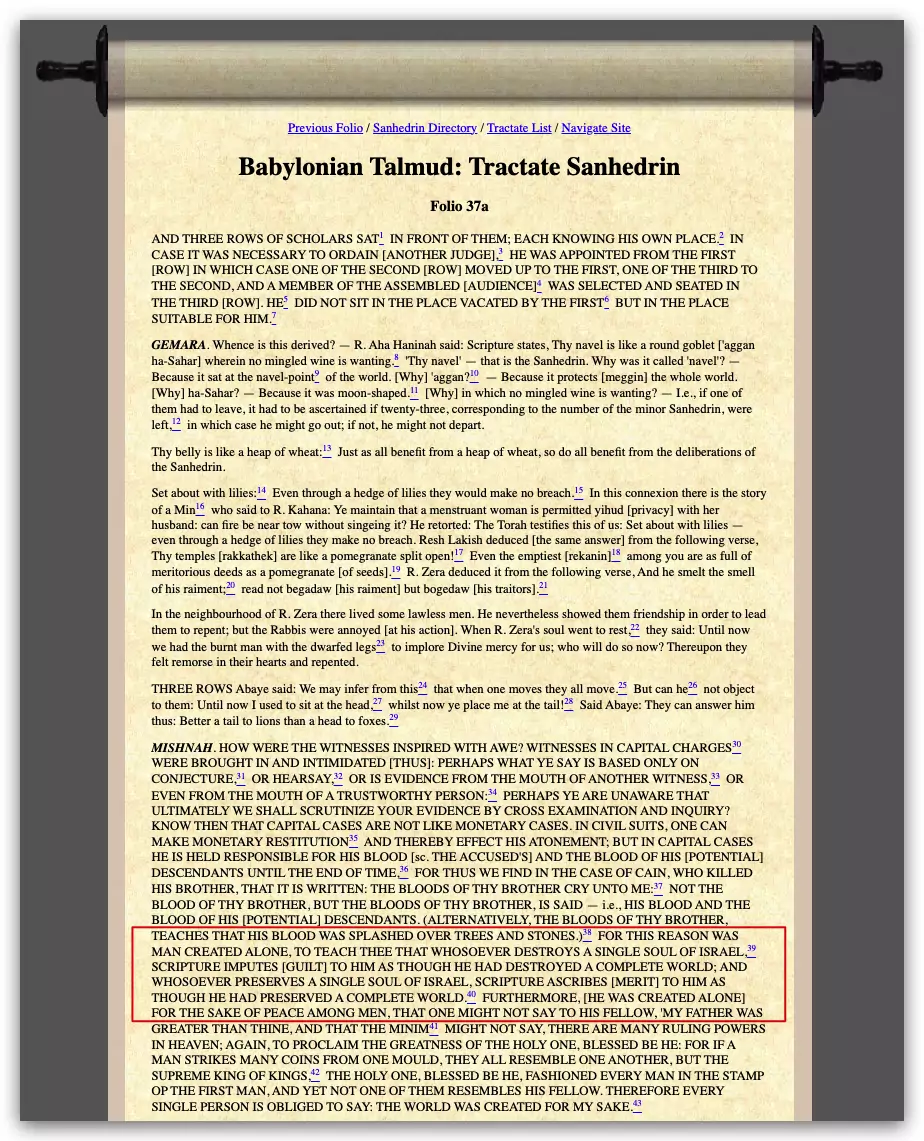
According to Abrahamic theology, the original scripture sent by God is the Torah, which was revealed to Moses. In Judaism, however, alongside the Torah there is another extremely important and extensive collection of texts known as the ‘Talmud’ (Talmud). It is not a divine revelation; rather, it is a compilation of legal interpretations, moral teachings, and philosophical debates written by Jewish rabbis or scholars over the course of centuries. Put simply, just as Islam has Hadith or the discipline of Fiqh for interpreting the Quran and its ordinances, the Talmud is a comparable human compilation in Judaism. Yet verse 5:32 claims that Allah Himself had ‘ordained’ this particular rule for the Children of Israel. The historical reality, however, is that this ordinance appears nowhere in the Torah (the divine scripture). Its verbatim equivalent is found in the Jewish rabbinical compilation ‘Babylonian Talmud: Tractate Sanhedrin, Folio 37a’ [4].
It is precisely here that a fundamental logical problem arises regarding the omniscience of the author of the Quran. If the Quran is the infallible word of Allah, why would Allah present a human-authored legal commentary as His own revealed ‘divine ordinance’? This clearly indicates that the author of the Quran was unable to distinguish between the oral traditions heard from the Jews of contemporary Arabia and their written interpretive texts. In their everyday debates and religious discussions, the Jews of Arabia at the time quoted the Talmud or the sayings of the rabbis. Muhammad probably mistook an elevated piece of judicial reasoning written by those rabbis for a direct ‘command of God.’ In other words, what was a human principle conceived by the rabbis became disguised in the Quran as Allah’s own declaration.
The Words of the Rabbis’ Written Talmud: Dissecting the Divine Claim
The Babylonian Talmud itself is sufficient to demonstrate that the source of the Quran’s supposedly ‘humanistic’ message in verse 5:32 is not any divinely revealed scripture, but rather a legal interpretation conceived by Jewish rabbis. An analysis of this particular passage of the Talmud (Sanhedrin 37a) shows that it was originally a legal admonition formulated for a specific ethnic group. The original Talmudic statement was highly ethnocentric, specific, and directly connected to the existence of the Children of Israel [4]:
“FOR THIS REASON WAS MAN CREATED ALONE, TO TEACH THEE THAT WHOSOEVER DESTROYS A SINGLE SOUL OF ISRAEL, SCRIPTURE IMPUTES [GUILT] TO HIM AS THOUGH HE HAD DESTROYED A COMPLETE WORLD; AND WHOSOEVER PRESERVES A SINGLE SOUL OF ISRAEL, SCRIPTURE ASCRIBES [MERIT] TO HIM AS THOUGH HE HAD PRESERVED A COMPLETE WORLD.”
The inclusion of this verse in the Quran is not, in fact, any original spiritual revolution; rather, it is a statement taken from and slightly modified from a human ‘source’—and mistakenly quoted as ‘divine revelation.’ Passing off jurisprudence conceived by Jewish scholars themselves as Allah’s eternal ordinance undermines the very foundation of the Quran’s claim to divinity. If the Quran were truly a divinely revealed scripture, it would have quoted the original Torah rather than a Talmud written by human beings. Yet this particular statement cannot be found anywhere in the Torah.
This makes it clear that the humanistic tone of verse 5:32 is not the product of heavenly inspiration, but a fragment borrowed from contemporary Jewish folk tradition and the legal debates of the rabbis. The author of the Quran mistakenly incorporated this Jewish secular proverb or legal interpretation into his scripture as ‘Allah’s command.’ This essentially demonstrates that the Quran is not the word of an omniscient being, but merely an incomplete compilation of various religious narratives current in Arabia at the time.
Source Error: Human Selection or Divine Mistake?
An objective analysis of the verbal differences between the formulation of Quran 5:32 and the original message of the Talmud [4] reveals a clear ‘source error.’ This error is not merely a historical discrepancy; rather, it creates a major logical problem at the very foundation of the Quran’s claim to divinity.
Jews were present in the social environment of Mecca and Medina at the time, and many stories and proverbs from their oral tradition circulated throughout Arabia. It is highly likely that the author of the Quran heard this ‘excellent’ and ‘meaningful’ maxim from contemporary Jews. He may have been impressed by the gravity and humanistic appeal of the statement and assumed that it came directly from the Torah. In reality, however, it was part of the Jewish scholars’ or rabbis’ own legal interpretation—that is, part of the Talmud. This tendency to accept a sectarian principle written by human beings as the word of Allah calls the Quran’s divine infallibility into question.
This is not an isolated incident in the history of Islam. We find a similar example in the case of the revelation-scribe Abdullah ibn Abi Sarh. It is reported that, at the end of verse 14 of Surah Al-Mu’minun, Abdullah was so impressed that he involuntarily exclaimed—So blessed is Allah, the best of creators (Therefore, exalted is Allah, who is the best creator), whereupon Muhammad liked the beautiful phrase and instructed him to write it down as revelation [5]. Thus, Islamic tradition contains another example of a pleasing and appealing statement heard from a human being being accepted as revelation. The same thing probably happened in the case of verse 5:32: because an excellent humanistic statement by the rabbis appealed to him, it found a place in the Quran as an ‘instruction from Allah.’
The original text of the Babylonian Talmud explicitly stated: “Whosoever destroys a single soul of Israel…” that is, whoever destroys a single life of Israel. Here, the rabbis’ intention was sectarian—they used this analogy solely to emphasize the importance of the lives of their own people. When the Quran quotes this statement, however, it introduces a fundamental alteration, since Muhammad would have gained little from it had it applied only to Jews. Therefore, the sectarian expression ‘soul of Israel’ (Soul of Israel) was removed and replaced simply with ‘human being’ or ‘life’ (nafs), so that Muhammad’s Muslim followers could also be included.
From an ethical perspective, transforming a narrow sectarian principle into a global and universal humanitarian message is undoubtedly a positive act. The problem, however, is not ethical but rather one of provenance. If this were indeed Allah’s eternal and universal decree, there would have been no need to append the specific historical limitation “That is why We ordained for the Children of Israel” at the beginning of the verse. If it applies to everyone, why does it begin by invoking only one particular ancient ethnic group?
This very inconsistency proves that the author of the Quran knew it was a Jewish decree, and therefore added the words ‘We ordained for the Children of Israel’ at the beginning of the verse. Yet, tempted to present it in a more impressive and generous form, he changed the word ‘Israel’ in the original text to ‘humanity.’ Partially altering a human-made sectarian law and claiming it as a ‘universal divine message’ demonstrates that the supposed humanitarianism of verse 5:32 is merely a statement collected from an erroneous source and selectively refined.
Shirk: The Unforgivable Crime and the Illusion of ‘Innocent’ Life
To assess the depth of the supposed humanitarian appeal of Quran 5:32, we must first understand what Islam actually means by an ‘innocent’ or ‘ma‘sum’ (Innocent) person. Although modern liberal interpretations regard any ordinary person as ‘innocent,’ the conditions for being ‘innocent’ are extremely narrow and conditional in Quranic jurisprudence, or in the language of fiqh. Verse 5:32 states— “whoever takes a life…”. Although this appears universal at first glance, an analysis of the Quran’s broader context reveals that a non-Muslim or polytheist is not regarded as fully ‘innocent’ at any level of Islam’s legal framework.
The primary reason for this is ‘shirk.’ According to the Quran and Hadith, the most hateful, heinous, and unforgivable crime in the sight of Allah, the creator of the universe, is shirk, or associating anyone else with Allah in His sovereignty. The Quran declares in extremely severe terms that shirk is a ‘great wrong,’ or an injustice of the highest order [6]. Indeed, this offence has been characterized as so grave that Allah has directly declared that He may forgive any sin other than shirk if He wills, but He will never forgive one who commits shirk [7].
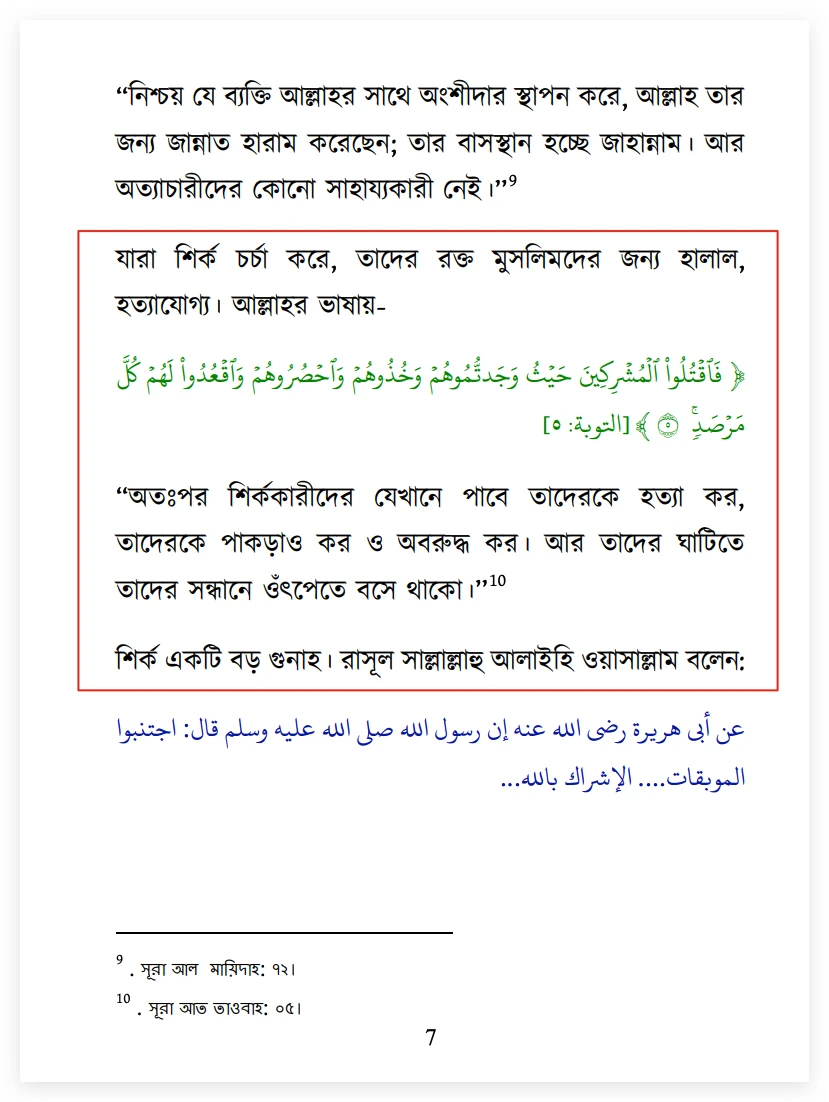
Careful and logical consideration now makes it clear that it is virtually impossible to include within the ‘innocent’ category of verse 5:32 a person identified as the greatest criminal in the universe according to Allah’s laws and standards. When an idolater, Hindu, Buddhist, or follower of another religion commits shirk, that person is no longer ‘innocent’ in the sight of Islam’s creator; rather, that person becomes the perpetrator of a continuously ongoing crime. In Islamic jurisprudence, the right to the protection of life (Ismah) is fundamentally connected to faith. A work edited by Dr. Abu Bakr Muhammad Zakaria also makes clear that shirk is a crime that deprives a person of the protection of life, and that the blood of a person who commits shirk is considered halal or lawful for Muslims (details below) [8].
Therefore, a polytheist is not supposed to have the right to benefit from the statement in verse 5:32 that ‘whoever saves a life, it will be as if they saved all of humanity’. After all, in Islam’s view, such a person is engaged in the gravest crime on earth: ‘shirk.’ Logically, therefore, the protective ambit of this verse is reserved only for Muslims free from shirk or for those who submit to Islam. Since an idolater is inherently identified as a ‘great wrongdoer’ or ‘great sinner,’ applying the humanitarian tone of verse 5:32 to such people would conflict with Islam’s own system of justice. This is essentially a ‘logical exclusion’: the wording used is general, but its meaning or application is restricted to an extremely limited and specific group. Where ‘disbelief’ in the creator or ‘polytheism’ is itself an offence punishable by death (unless one is under covenant or pays jizya), the claim that Islam would invoke verse 5:32 to grant security to, or preserve the life of, such a grave offender is merely a theoretical deception.
In this context, let us hear the remarks of an Islamist writer who has recently become popular among Islamist youths in Bangladesh,
The Following Verse: The Terrible Punishment of Those Who Cause Fasad
Although this verse of the Quran primarily speaks of refraining from violence and of the value and preservation of human life, the severity of Islamic scripture becomes evident in the verses that follow. Verses 5:33–34 state that those who wage war against Allah and His Messenger and spread disorder on earth are to be punished by death, crucifixion, the amputation of their hands and feet, or exile. The injunctions in verses 32, 33, and 34 indicate that creating ‘fitna’ or ‘fasad’ is regarded as the gravest offence in Islam and is subject to extremely severe punishment. Therefore, understanding what fitna and fasad actually mean is essential to comprehending this verse. Let us now read the following verse as well, because it also uses the same word فَسَادًا, or fasādan, meaning fitna and fasad [9]
Those who wage war against Allah and His Messenger and spread disorder throughout the land shall be punished as follows: they shall be killed or crucified, or their hands and feet shall be cut off from opposite sides, or they shall be exiled from the land. This is a disgrace for them in this world, and a great punishment awaits them in the Hereafter.
— Taisirul Quran
Those who struggle against Allah and His Messenger and continue to create unrest upon the earth shall be punished as follows: they shall be killed or impaled, or a hand from one side and a foot from the other shall be cut off, or they shall be exiled from their land; this is a grave humiliation for them in this world, and a severe punishment awaits them in the Hereafter.
— Sheikh Mujibur Rahman
The only punishment for those who wage war against Allah and His Messenger and spread fasad throughout the land is that they shall be killed or crucified, or their hands and feet shall be cut off from opposite sides, or they shall be expelled from the land. This is a disgrace for them in this world, and a great punishment awaits them in the Hereafter.
— Rawai Al-bayan
The only punishment for those who wage war against Allah and His Messenger and engage in destructive acts throughout the land is that they shall be killed or crucified, or their hands and feet shall be cut off from opposite sides, or they shall be exiled from the land [1]. This is their disgrace in this world, and a great punishment awaits them in the Hereafter [2].
— Dr. Abu Bakr Muhammad Zakaria
What Constitutes Fitna and Fasad in Islam
At the outset, a misconception needs to be corrected. Many modern Muslims frequently claim that the word Islam means peace. In fact, the word Islam means submission; that is, Islam teaches that peace can be attained only through complete submission. Let us hear Dr. Abu Bakr Muhammad Zakaria’s explanation of this meaning of the word Islam,
In Arabic, the word ‘fasad’ signifies corruption, disorder, or immorality. Its definition in Islamic jurisprudence, however, is very broad. Classical tafsirs show that ‘fasad’ has been associated with opposing Allah and His Messenger, rioting, obstructing roads, plundering property, and even abandoning Islam. Ibn Kathir’s tafsir states that ‘fasad’ means disobedience to Allah’s ordinances, which creates disorder on earth. It is therefore not confined to warfare and killing; it also applies to disregarding religious injunctions and departing from the faith.
The word used in this verse is فَسَادٍۢ, or fasādin—that is, except for causing fitna and fasad. We will examine the Islamic meaning of fitna and fasad shortly. For now, let us determine what Islam regards as the gravest wrongdoing or offence. Let us hear from Matiur Rahman Madani whether, from the Islamic perspective, non-Muslims or those who commit shirk are innocent or the most dangerous criminals,
Let us now examine several verses from the Quran, [6] [7]
Recall when Luqman advised his son, saying, “O my son! Do not associate anything with Allah; indeed, shirk is a grave injustice.”
— Taisirul Quran
Recall when Luqman said to his son by way of counsel, “O my son! Do not associate any partner with Allah. Indeed, shirk is the gravest injustice.”
— Sheikh Mujibur Rahman
And recall when Luqman, while advising his son, said, “Dear son, do not associate partners with Allah; indeed, shirk is a grave injustice.”
— Rawai Al-bayan
And recall when Luqman, while advising his son, said, “O my dear son! Do not associate anything with Allah. Indeed, shirk is a grave injustice [1].”
— Dr. Abu Bakr Muhammad Zakaria
Indeed, Allah will not forgive associating partners with Him, but He will forgive whomever He wills for anything besides that; and whoever associates partners with Allah has committed a grave sin.
— Sheikh Mujibur Rahman
Indeed, Allah does not forgive associating partners with Him. He forgives other sins for whomever He wills. And whoever associates partners with Allah has undoubtedly committed a grave sin.
— Rawai Al-bayan
Indeed, Allah does not forgive associating partners [1] with Him. He forgives other offences for whomever He wills [2]. And whoever associates partners with Allah has fabricated a grave sin.
— Dr. Abu Bakr Muhammad Zakaria
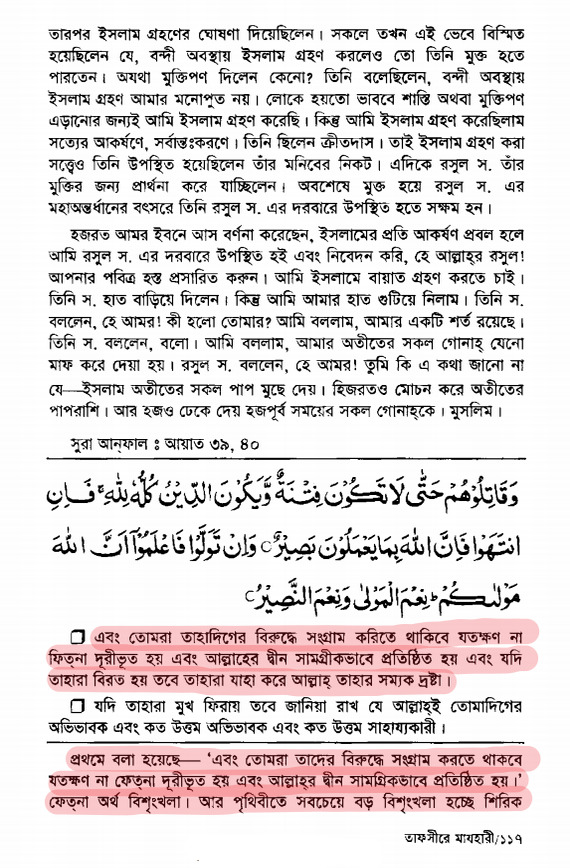
Thus, it becomes evident that, from the Islamic perspective, shirk is the most heinous crime. Therefore, from the Islamic perspective, a polytheist of another faith is by no means innocent. Let us now read what fitna and fasad mean. To understand the fundamental concept of jihad in Islam, let us begin by reading the tafsir of verse 39 of Surah al-Anfal. This tafsir can be found in volume five of Tafsir-e-Mazhari. Written by the world-renowned Sunni Islamic scholar and devoted follower of the Hanafi school, Allama Qadi Thanaullah Panipati, this tafsir is extremely important for correctly understanding the Quran [10] –
And continue fighting against them until fitna is eliminated and Allah’s religion is established in its entirety; and if they desist, then Allah is fully aware of what they do.
If they turn away, then know that Allah alone is your Guardian—and what an excellent Guardian and what an excellent Helper.
( Surah al-Anfal: 39, 40 )
It is stated first: And continue fighting against them until fitna is eliminated and Allah’s religion is established in its entirety. Fitna means disorder. And the greatest disorder on earth is shirk (polytheism). The sentence under discussion commands fighting until fitna is eliminated. This means that the polytheists must be fought until they abandon shirk, or accept the Muslims’ exclusive authority and agree to pay jizya. The instruction under discussion does not say that all polytheists and unbelievers must be forced to embrace Islam through warfare. If it were understood in this manner, the verse under discussion would become: if they agree to pay jizya, then do not fight them. Thus—the instruction of this verse amounts to this: the struggle must continue until the unbelievers embrace Islam or become fully subordinate through the payment of jizya. Here, the establishment of religion means the establishment of power, victory, and exclusive rule. This meaning of the word ‘religion’ has been mentioned in the book Qamus.
Hazrat Miqdad ibn Aswad narrated, the Messenger, peace be upon him, said that a time would come when Islam would be established in every home on earth. Disbelief and polytheism would become completely subordinate to Islam. All superiority and glory will belong to Allah alone.
It has been narrated by Hazrat Ibn Umar, the Messenger, peace be upon him, said, I have been commanded to fight the unbelievers until they say, ‘There is no deity but Allah, and Muhammad is the Messenger of Allah,’ establish prayer, and pay zakat. Whoever does so will have his life and property protected from me. Allah alone will take account of what is within them (He will judge whether they embraced Islam to protect their lives and property or from the prompting of their hearts). Bukhari and Muslim. Six Companions narrated the hadith from Hazrat Abu Huraira. Allama Suyuti stated that the hadith is well established (mutawatir).
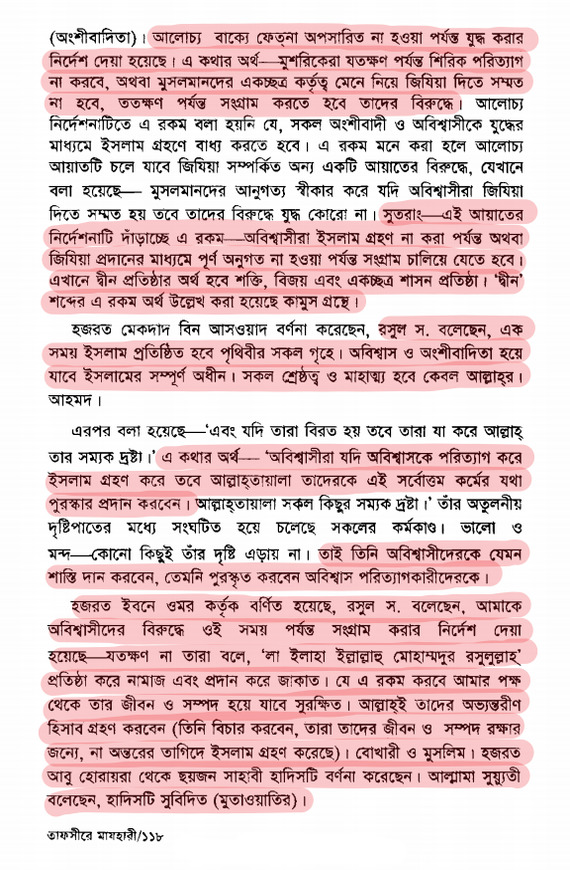
It is evident from the discussion above that, from the Islamic perspective, shirk is the greatest fitna and the gravest crime. Therefore, verse 32 of Surah al-Ma’idah cannot in any way apply to a polytheist non-Muslim. From the Islamic perspective, because they commit shirk, they are the greatest instigators of fitna. They are not regarded as innocent people from the Islamic perspective. The book A Review of Shirk, Bid‘ah, and Superstitions Prevalent in Bangladesh, written by Md. Abdul Qader and published under the editorship of the renowned Bangladeshi Islamic scholar and distinguished authority on Islamic jurisprudence Dr. Abu Bakr Muhammad Zakaria, clearly states that shirk is a crime punishable by death. The blood of those who commit shirk is lawful for Muslims [11] –
Statements of Islamic Scholars
Let us listen to the tafsir of verse 5 of Surah At-Tawbah,
Now let us listen to some more Islamic statements,
Conclusion: Communal Division under the Guise of Humanism
The manner in which Quran 5:32 is currently presented as a unique declaration of universal human values is, by both historical and scriptural standards, an enormous deception concealed in plain sight. The condition concerning the creation of ‘fasad’, or disorder, inserted midway into this statement—borrowed fragmentarily from the Jewish humanistic tradition (the Talmud)—is, in essence, the verse’s real lethal trap. This is not an eternal humanitarian declaration, but rather part of a specific body of religious jurisprudence.
According to the classical interpretations and tafsirs of Islamic scripture, ‘shirk’, or polytheism, is the greatest form of ‘fasad’, or calamity, on earth [12]. Consequently, idolaters or non-Muslims are excluded from the outset from the protective ambit extended to supposedly ‘innocent’ people in verse 5:32. This verse in no way assumes responsibility for protecting the lives of those whom Islam’s creator considers the gravest offenders because they commit ‘shirk’. Rather, the very next verse (5:33) prescribes horrific punishments for those who create such ‘fasad’, including the amputation of hands and feet or crucifixion.
Thus, this verse functions as a safeguard only when the person is a Muslim or accepts the sovereignty of Islam. For the vast non-Muslim population beyond that category—whose very beliefs constitute ‘fasad’ in the eyes of Islam—this verse offers neither mercy nor refuge. The offensive wars conducted by Muhammad and during the Caliphate attest to this very truth. The diagram below makes it even clearer how, through linguistic sleight of hand and manipulations surrounding the definition of ‘fasad’, this ‘message of peace’ has in fact been transformed into a rigidly communal and aggressive body of jurisprudence.
References
- Sahih al-Bukhari, Hadith: 2652 ↩︎
- Sahih Muslim, Hadith: 2533 ↩︎
- Surah al-Ma’idah, verse 32 ↩︎
- Babylonian Talmud: Tractate Sanhedrin, Folio 37a 1 2 3
- An Analysis of the Reasons for the Apostasy of the Apostate Revelation-Scribe Abdullah ibn Sa‘d ibn Abi Sarh ↩︎
- Surah Luqman, verse 13 1 2
- Surah An-Nisa, verse 48 1 2
- A Review of Shirk, Bid‘ah, and Superstitions Prevalent in Bangladesh, 2. Consequences of Shirk ↩︎
- Surah Al-Ma’idah, verse 33 ↩︎
- Tafsir-e-Mazhari, Hakimabad Khanqah-e-Mujaddedia Publications, volume 5, pages 117–120 ↩︎
- A Review of Shirk, Bid‘ah, and Superstitions Prevalent in Bangladesh 2. The Consequences of Shirk ↩︎
- Tafsir-e-Mazhari, Volume 5, pages 117–120 ↩︎