Occam’s Razor: Weapons to clear the mess of superstition
Published: September 9, 2026 · Author: আসিফ মহিউদ্দীন · 11 min read
Share:
Introduction
The human brain is naturally adept at detecting patterns, a tendency often described as patternicity. As soon as we notice even a slight resemblance, we tend to impose meaning on it. In ancient times, for example, people might interpret lightning as the anger of a thunder god, earthquakes as signs of divine displeasure, or the premature death of a child as the work of Satan. In reality, such events are explained through phenomena such as electricity, the movement of tectonic plates, infectious disease, or genetic disorders.
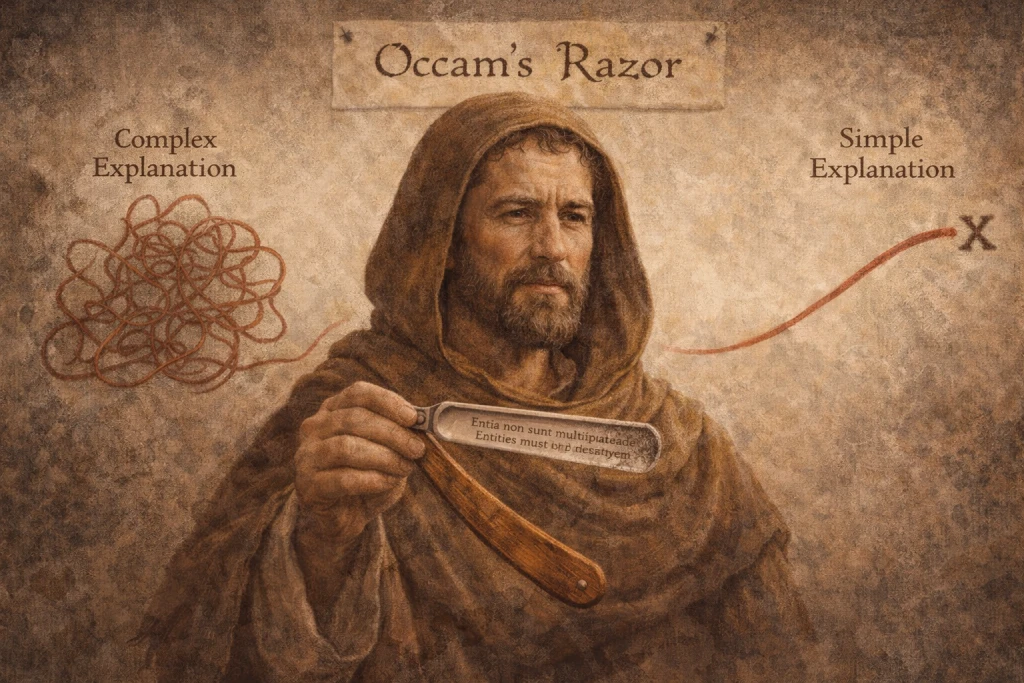
Occam’s Razor is a powerful tool for cutting away this tendency to introduce unnecessary imaginary entities—such as gods, jinn, ghosts, karmic forces, or invisible conspirators—in place of natural and testable explanations. In rationalism, scientific thinking, and skepticism, it is a fundamental methodological principle: seek the explanation that accounts for the evidence with the fewest unnecessary assumptions, and do not add “miracles” or “magic” when they are not needed.
Occam’s Razor is not a scientific law. It is a logical and methodological principle intended to eliminate unnecessary complexity and move us closer to an adequate explanation of reality. It can therefore be applied not only to religious claims involving God, angels, or miracles, but also to modern superstitions and pseudoscientific ideas such as conspiracy theories, homeopathy, astrology, or voodoo therapy.
What Is Occam’s Razor?
In short, Occam’s Razor is a problem-solving principle whose central idea is: “If several explanations are available for the same phenomenon, the explanation requiring the fewest assumptions or additional conditions is generally the better place to begin.” A common Latin formulation is: Entia non sunt multiplicanda praeter necessitatem — meaning, “Entities should not be multiplied beyond necessity.”
Here, an “entity” means any newly introduced element, force, deity, mechanism, or invisible cause. If an explanation depends on an assumption that is unnecessary—something that can be removed without reducing the explanation’s ability to account for the event—then there is no logical reason to retain that additional element. It is called a “razor” because it metaphorically shaves away unnecessary and speculative explanations, leaving a simpler, testable account that depends on fewer assumptions.
It is important to note that Occam’s Razor never claims that “the simplest explanation is always true.” Rather, it recommends beginning with the explanation that introduces the fewest unnecessary assumptions. Fewer assumptions generally mean fewer opportunities for error. Reality can certainly be complex, but before adding complexity without evidence, simpler explanations should first be tested.
Historical Context and Philosophical Background
William of Ockham (c. 1287–1347) was an English Franciscan friar, logician, and philosopher whose name became associated with this principle. Although a devout Christian, he argued in logic and philosophy against multiplying unnecessary entities and overly complex concepts, particularly in theology, metaphysics, and epistemology. [1]
Similar ideas of explanatory economy existed before Ockham. Aristotle had already expressed the view that “nature contains nothing superfluous,” meaning that reality generally need not be explained by introducing unnecessary entities. Thomas Aquinas also emphasized simplicity in arguments concerning God. Ockham, however, applied the principle systematically and criticized the excessive theological complexity of his time.
In the modern era, the principle became more explicit within scientific methodology. Scientists such as Newton, Laplace, Einstein, and Feynman repeatedly favored theories that explained observations without unnecessary assumptions. In The Demon-Haunted World , Carl Sagan included simplicity and critical thinking within his “baloney detection kit”. [2]
Here, “simplicity” does not mean reducing the number of formulas; it means minimizing the assumptions required to establish a theory. If two theories explain the data equally well, the theory that depends on fewer assumptions is preferred. In modern epistemology, this idea is also associated with Bayesian probability. More complex theories can carry a lower prior probability because more components must align for the theory to be true. Adding an unverified supernatural entity can therefore make a theory unnecessarily less probable. [3]
A Practical Example: From a Broken Flowerpot to Aliens
For example
You wake up in the morning and discover that a flowerpot on the balcony has fallen and shattered. Two possible explanations are:
Hypothesis A
A strong gust of wind, a cat, or a crow knocked the flowerpot over during the night.
Hypothesis B
Extraterrestrial aliens arrived in an invisible spacecraft, accidentally hit the flowerpot while testing a laser, and then left without a trace.
According to Occam’s Razor, Hypothesis A should be preferred because:
1
Established basis: Wind, cats, birds, and gravity are all known to exist, and the event can occur through ordinary physical causes.
2
Additional assumptions required by B: Hypothesis B requires multiple unsupported assumptions: (1) aliens exist, (2) they came to Earth, (3) they appeared at this particular balcony, (4) they possessed and used a laser, and (5) they departed without leaving evidence—each claim requires independent evidence.
3
Logical conclusion: Every additional assumption creates another possible point of failure. If A is sufficient to explain the event, accepting the far more elaborate B without evidence is irrational.
Occam’s Razor in Everyday Experience
Everyday Applications
Applying Occam’s Razor does not require advanced education or complicated philosophy. It is equally useful in ordinary life. Here are several everyday examples:
1
Losing a Mobile Phone
Explanation A
You left it in the kitchen, between the sofa cushions, or in the bathroom and forgot about it.
Explanation B
An invisible jinn came while you were asleep and stole it.
↳
A is testable and natural; B introduces an entirely unnecessary new entity. Therefore, A is the more reasonable explanation.
2
A Noise at the Door at Night
Natural cause
A gust of wind, changes in air pressure, or the expansion and contraction of wood caused by temperature changes can make the door move or rattle.
Additional assumption
The sound is being caused by an invisible spirit or ghost.
↳
When ordinary physical processes are sufficient to explain the event, assuming the presence of an invisible spirit or ghost is unnecessary.
3
Astrology and Palmistry
Reasonable explanation
Events in a person’s life arise from a combination of psychology, social circumstances, economic conditions, chance, and personal decisions.
Additional assumption
Invisible planetary forces or cosmic arrangements control a person’s destiny.
↳
When observable personal and social causes are already available, adding planetary deities or invisible cosmic influences merely introduces unsupported assumptions and reinforces superstition.
Science vs. Supernatural Explanation: The Role of Occam’s Razor
Occam’s Razor in Science
The history of science is, in large part, the history of replacing supernatural explanations with natural ones supported by evidence. Occam’s Razor has often operated quietly within that process.
1
Cosmology and the God Hypothesis
Natural explanation
Cosmology explains the universe through the Big Bang, quantum fluctuations, and the laws of physics, without requiring a supernatural entity within the explanation.
Religious claim
The complexity of the universe is sometimes attributed to a designer. But such an explanation raises a further question and can lead to an infinite regress: Who designed the designer?
↳
Stephen Hawking and Leonard Mlodinow argued that explaining the origin of the universe does not require invoking God.
[4]
2
Evolution vs. Intelligent Design
Scientific explanation
The complexity of living organisms can be explained through natural selection and genetic variation.
Additional assumption
Intelligent Design introduces an unseen designer as the cause of biological complexity, adding an entity that evolutionary biology does not require in order to explain the observed evidence.
↳
When a natural explanation is sufficient, the concept of an invisible designer or a “God hypothesis” becomes an additional explanatory assumption.
[5]
3
Miraculous Healing vs. Medicine
Medical science
Recovery from cancer or another complex disease can be explained through modern medical treatment and the response of the immune system.
Religious belief
Claiming that recovery occurred because of prayer or a miracle.
↳
When established medical and biological mechanisms are sufficient to account for recovery, treating prayer-induced supernatural intervention as the cause introduces an additional unsupported assumption under Occam’s Razor.
4
Jinn Possession vs. Neurological and Psychiatric Disorders
Psychiatry, psychology, and neurology
Conditions such as epilepsy and schizophrenia are explained in terms of brain chemistry and genetic factors.
Superstition
Describing unusual behavior as possession by an invisible jinn or the influence of an evil spirit.
↳
When neurological and psychiatric explanations supported by evidence are available, introducing an invisible jinn is unnecessary and can seriously obstruct appropriate medical diagnosis and treatment.
Occam’s Razor in Superstition, Homeopathy, and Conspiracy Theories
Occam’s Razor in Pseudoscience and Superstition
In medicine, everyday events, and explanations of global affairs, Occam’s Razor helps us reject unsupported additional claims and prefer explanations that account for the evidence without unnecessary assumptions.
1
Homeopathy
Reasonable explanation
Placebo effects and the body’s natural capacity for recovery are sufficient to explain the reported improvement.
Pseudoscientific claim
The principles of “like cures like” and the supposed “memory” of water are invoked to explain healing, despite lacking adequate scientific support.
↳
When placebo effects, natural recovery, and other known factors can account for the perceived improvement, adding a magical “memory of water” is unnecessary.
2
The Evil Eye and Amulets
Natural cause
A child’s sudden illness is commonly caused by viruses, bacteria, or another infection.
Superstition
Claiming that the child became ill because of the evil eye or black magic.
↳
Infections and pathogens are scientifically demonstrable causes of disease. Therefore, the evil eye or black magic is an unsupported additional assumption unless independent evidence is produced.
3
Conspiracy Theories
Realistic explanation
Large events can often be explained through administrative disorder, system failure, and human error.
Additional assumption
A secret, all-powerful group or “cabal” is controlling everything from behind the scenes.
↳
Without evidence, the idea of an all-controlling secret cabal introduces unnecessary complexity. Where ordinary institutional failures and human actions sufficiently explain an event, adding an unsupported conspiracy is unwarranted.
What Occam’s Razor Is Not — Common Misconceptions
Common Misconceptions
Several misconceptions about Occam’s Razor are widespread. Understanding what the principle does not mean is just as important:
✕
Misconception 1
“The simplest explanation is always true.”
↳
Correct explanation
This is false. Highly complex theories, such as quantum mechanics, can be true when supported by sufficient evidence. Here, “simple” does not mean easy to understand; it refers to the minimum number of necessary assumptions .
✕
Misconception 2
“Complex theories are never acceptable.”
↳
Correct explanation
This is also false. Simplicity is a tie-breaker when competing explanations account for the evidence equally well. When the evidence requires complexity, complexity is entirely acceptable.
✕
Misconception 3
“It proves that God does not exist.”
↳
Correct explanation
Incorrect. Occam’s Razor is a methodological tool. It asks us to exclude unnecessary entities from an explanation; it is not, by itself, a conclusive proof that any particular entity does not exist.
✕
Misconception 4
“Anything I do not understand is false.”
↳
Correct explanation
False. Occam’s Razor is a safeguard against filling gaps in knowledge with unnecessary supernatural or invented entities. It is not a measure of the limits of an individual’s personal understanding.
Occam’s Razor and the “God of the Gaps” Mentality
In religious discussion, placing God into an unexplained area of knowledge is known as the “God of the gaps.” For example, lightning was once attributed to divine anger, whereas it can now be explained through electricity. As knowledge expands, the gaps shrink. Occam’s Razor gives priority to natural explanations and encourages us to say “I don’t know” when the evidence is insufficient, thereby keeping inquiry open.
A Practical Guide for Skeptics
A simple visual flow for evaluating claims—moving step by step from evidence to a justified conclusion.
Visual Flow
1
Evidence
Gather the Evidence
Use reliable sources. Prioritize primary sources, data, documents, and direct evidence.
2
Hypotheses
List the Possible Explanations
Write down multiple alternatives, including both natural and supernatural claims if they are genuinely being proposed.
3
Assumptions
Count the Assumptions
Which explanation introduces the fewest new assumptions or conditions? All else being equal, fewer unsupported assumptions make an explanation stronger.
4
Consistency
Compare with Established Knowledge
Is the explanation consistent with well-established scientific or historical knowledge? If not, substantially stronger evidence is required.
5
No Magic
Remove Unnecessary Supernatural Additions
If a natural explanation is sufficient, there is no reason to add magic or miracles without independent evidence.
6
Uncertainty
Accept “I Don’t Know”
If none of the explanations is adequately supported, suspend judgment and wait for more information or evidence.
✓
Outcome
Following this process allows you to base belief, doubt, or suspended judgment not on the mere existence of a claim, but on the strength of the evidence .
“The simplest explanation is usually the correct one, but not always. However, it is the best place to start.” — A summary of a common modern scientific attitude
Conclusion
Human beings dislike uncertainty, so unknown gaps are often filled with “God’s will,” “fate,” or “ghosts.” But reason must take priority in the search for truth. Occam’s Razor cuts through the clutter of superstition and gives priority to natural explanations. For freethought, it works as a filter for examining supernatural claims. We do not need imaginary ghosts to understand the universe; we need observation, testable hypotheses, the razor of reason, and the courage to say “I don’t know.”
Ultimately, Occam’s Razor is not an anti-religious doctrine. It is a tool for evaluating any claim—whether about God, spirits, astrology, or conspiracies—by the same standard. For every explanation, ask: “How many unsupported assumptions does this require?”—and doing so brings us closer to the truth.
References
“William of Ockham”, The Stanford Encyclopedia of Philosophy↩︎
Sagan, Carl. The Demon-Haunted World: Science as a Candle in the Dark. ↩︎
MacKay, D. J. C. Information Theory, Inference, and Learning Algorithms. ↩︎
Hawking, Stephen & Mlodinow, Leonard. The Grand Design. ↩︎
Dawkins, Richard. The God Delusion. – “God hypothesis” ↩︎
About This Article
Genre: Introductory Critical Thinking, Scientific Skepticism, and Occam's Razor Analysis
This article explains Occam's Razor as a methodological principle for preferring explanations that require fewer unnecessary assumptions when competing explanations account for the same evidence.
Its scope is not to claim that the simplest explanation is always true, or that complex theories are automatically false. The article clarifies that evidence can justify complexity, but unsupported supernatural or speculative entities should not be added when natural and testable explanations are sufficient.
The discussion applies Occam's Razor to everyday events, religious claims, God hypotheses, miracles, intelligent design, jinn possession, ghosts, astrology, homeopathy, conspiracy theories, and the “God of the gaps” mindset.
The central standpoint is that ignorance should not be filled with gods, spirits, karma, magic, hidden cabals, or miracle claims. When a natural explanation explains the available facts, adding unverified supernatural agents is an unnecessary and weaker explanatory move.
This article should be evaluated through conceptual clarity, correct explanation of Occam's Razor, evidential discipline, scientific reasoning, fair distinction between simplicity and oversimplification, and consistency in rejecting unnecessary assumptions—not through religious sensitivity, supernatural preference, apologetic discomfort, conspiracy-minded suspicion, or the demand that unverified invisible entities be treated as equally explanatory.
God is unable to remove suffering: If God has a desire to remove suffering, but does not have the power to remove suffering, then He is not omnipotent.…
A deep analysis of Russell's tea kettle (Russell's teapot) and Burden of Proof. Learn more about the logical futility of theology and why it is unreasonable to accept…