
Introduction
We may dislike it when someone uses abusive language. A person’s words may strike us as tasteless, obscene, aggressive, or repulsive. But a basic principle of morality in a civilized society is that words are answered with words, criticism with criticism, and insults with social condemnation or, where appropriate, lawful process—not with knives, swords, machetes, bullets, or murder. Someone may insult Donald Trump, insult the United Nations, insult the Prime Minister of Bangladesh, wish for the destruction of America, or even insult me. Such speech may not always be morally admirable or civil, but hunting someone down and killing them for it is a crime, an act of barbarism, and a grave injustice in any civilized society. A human life is worth far more than the words a person has uttered. Killing a person merely for uttering a word, phrase, or sentence that causes no visible physical harm is unjust.
But when a religious doctrine says that killing a person may be legitimate for insulting a prophet, a religion, a god, or a sacred personality, the issue is no longer merely “protecting religious feelings”; it becomes a direct divine and moral authorization of killing. Worse still, if such killing occurs without a court, trial, evidence, an opportunity for the accused to defend themselves, an impartial judge, or due process, then it is plainly an extrajudicial killing. The accuser becomes judge, prosecutor, and executioner at once. Whether the person actually uttered the alleged insult, in what context it was said, what the speaker’s mental state was, what the statement meant, or what defense the accused might have offered—all of this becomes irrelevant. Religious frenzy displaces law, and the killer receives a license to imagine himself a moral warrior.
The hadiths examined in this article bring exactly this dangerous moral structure into view. Here, an accusation of insulting the Prophet is turned into an offense for which a person may be killed without ever being brought before a court. In other words, this strand of Islamic narration does not merely contain the idea of capital punishment for insulting the Prophet; it is also tied to a more disturbing structure of immunity in which a person who kills the accused on his own initiative may escape qisas or blood-money liability. Later jurists and modern Salafi commentators have used this incident in precisely that way: even where the killing occurred without prior authorization from the ruler, the victim’s blood could be treated as hadar, leaving the killer without qisas liability. Judged by modern standards of human rights, freedom of expression, and fair judicial process, this is not justice in any meaningful sense; it is an attempt to sanctify killing in the name of religious honor. A doctrine that demands killing rather than argument in response to criticism cannot be described, in the language of civilization, as moral; it must be described as a doctrine of fear, repression, terror, and authority.
Insults, Criticism, and the Question of Harm
A basic moral question must first be made clear: what concrete harm is actually caused when someone insults, mocks, or harshly criticizes another person? No body is injured, no property is destroyed, no house is burned, and no life is placed in danger. A person may feel humiliated, angry, or distressed—but equating emotional discomfort with physical injury or a lethal crime is a dangerous moral deception. “My feelings were hurt” cannot become a license to take another human life. Feelings are personal, variable, and not objectively measurable; criminal justice, by contrast, depends on demonstrable harm, provable wrongdoing, and proportionate punishment.
Abuse or mockery may be undesirable, but it is not the kind of offense for which death, bloodshed, or physical violence can be justified. If someone says, “So-and-so insulted me, therefore I killed him,” civilized law does not call that self-defense or justice; it calls it murder. An insult is not a lethal attack. If killing becomes an acceptable response to insult, there is no longer a system of justice—only private vengeance carried out in the name of wounded pride. Giving that vengeance a religious vocabulary makes it even more dangerous, because the killer then begins to imagine himself not as a criminal but as someone carrying out a sacred duty. From this mentality arise machete attacks, mob lynchings, fatwa killings, and extrajudicial terror in the name of blasphemy.
And if the person being discussed is a public figure—a head of state, preacher, prophet, lawgiver, judge, military commander, or anyone in whose name rules governing law, morality, war, taxation, marriage, the rights of men and women, slavery, punishment, and civic life are imposed on society—then criticism of that person should not merely be tolerated; it should be recognized as a basic public right. The decisions, teachings, and ideology of public figures are not private household matters. They affect people’s lives, liberty, law, property, bodies, sexuality, thought, and future. Anyone who seeks to prescribe rules for society must endure society’s hard questions, harsh criticism, severe condemnation, and, where necessary, merciless satire. Seeking authority while refusing criticism is not morality; it is authoritarianism.
Therefore, whether someone did or did not insult the Prophet Muhammad is not the central moral question. The real question is whether a person may be killed for criticizing or insulting a public religious-political leader. The answer is clear: no. There is no court, no impartial investigation, no verification of evidence, and no opportunity for the accused to defend themselves—only a follower’s claim that “she insulted the Prophet,” followed by death. This is not justice; it is extrajudicial killing. A religious morality that legitimizes such killing is not merely intolerant of freedom of expression; it is directly lethal.
The most horrifying feature of this moral structure is that it values the dignity of a personality, the pride of a doctrine, and the wounded feelings of followers above human life. In a civilized society, no leader, prophet, or religious figure can be so sacred that killing people in his name becomes legitimate. If a doctrine says, “If you criticize me, your death is justified,” then it is not a confident doctrine of truth; it is a doctrine of fearful, vindictive, and violent power. Truth stands by argument and does not fear criticism. Falsehood and authority, by contrast, rely on intimidation and repression. Islam, in this framework, suppresses human thought in precisely this way—through the use of force.
Punishment for Insulting the Prophet
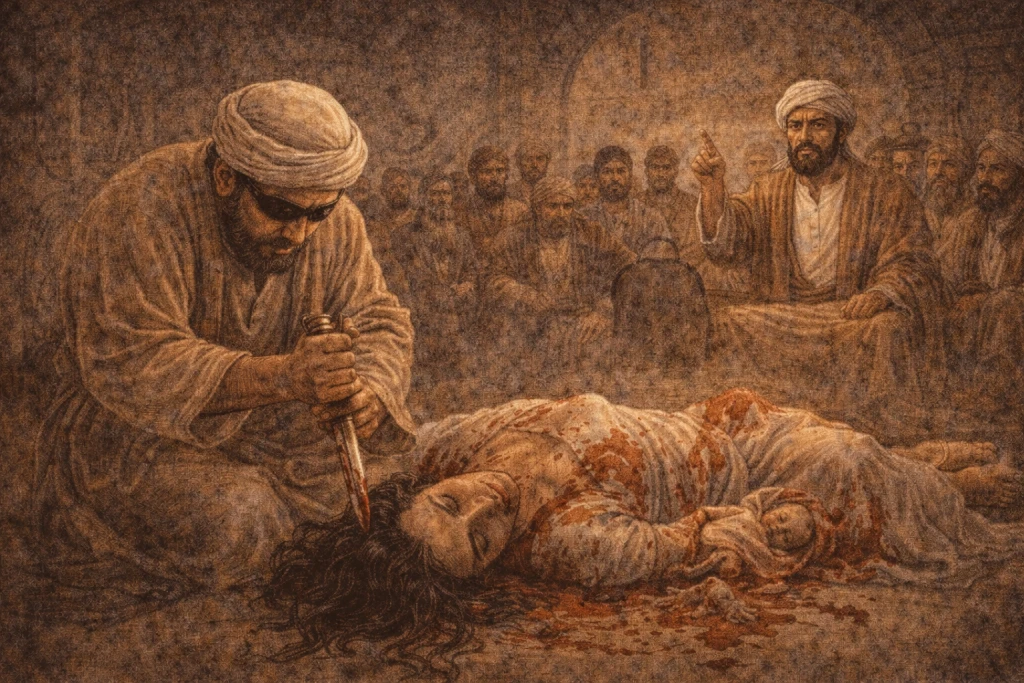
The following hadith exposes a brutal and deeply disturbing feature of this moral structure. What is the accusation? A slave woman allegedly used to insult the Prophet Muhammad and speak abusively about him. The allegation is not murder, rape, arson, robbery, armed rebellion, or any other form of concrete physical harm; it concerns speech. And what happened in response to that speech? A blind man killed his own Umm Walad—an enslaved woman who had borne his children—at night by driving a sharp weapon into her abdomen. There was no court, no trial, no examination of evidence, and no opportunity for the accused woman to defend herself. There is only the follower’s allegation that she insulted the Prophet, and the immediate consequence is death.
At this point the event ceases to be merely a private homicide and becomes an extrajudicial killing. The killer is simultaneously the accuser, judge, and executioner. He decides what counts as “insult,” decides that the punishment is death, and carries out that punishment himself. No civilized legal system could call this justice. It is straightforward vigilante killing: taking the law into one’s own hands and killing a human being in the name of personal religious sentiment and devotion to the Prophet.
Most importantly, the Prophet Muhammad is not described as condemning the killing afterward. He does not punish the killer. He does not say that even a person who insults him may not be killed without trial. He does not say that an enslaved woman is also a human being with a right to due process. Instead, according to the narration, he declares her blood hadar. In practical terms, no retaliation or blood compensation is imposed for her death. This is not merely the forgiveness of one killing; it amounts to effective immunity for the killer. Later Islamic interpretation explicitly understood the incident in this way: the woman had become liable to execution because she insulted Muhammad, and qisas was therefore not demanded from her killer. More directly still, in Shaykh Abd al-Muhsin al-Abbad’s commentary on Sunan Abi Dawud, the answer states that although an individual does not normally possess the authority to execute such a person on his own initiative, if the killing nevertheless occurs, the victim’s blood is hadar and there is no qisas against the killer. Thus the problem is not merely a doctrine of capital punishment; the concept of Sharia-based immunity after a private killing is directly attached to it. [1] [2]
IslamQA — Answer 111252
فاستحقت القتل لذلك
“She therefore deserved to be executed for that reason.”
The same answer explains that because she was regarded as deserving execution, Muhammad did not demand qisas from her killer.
Shaykh Abd al-Muhsin al-Abbad — Sharh Sunan Abi Dawud [492]
Question: هل في هذا دليل على أن المرتد أو ساب الرسول صلى الله عليه وسلم يقتله من سمعه؟
Answer: لا. ليس له قتله؛ لأن القتل هو للإمام، لكن لو وقع فإن الدم هدر، وليس فيه قصاص.
“No. He does not have the right to kill him, because carrying out the killing belongs to the ruler. But if the killing does occur, the blood is hadar and there is no qisas for it.”
This is where the severe moral problem becomes unmistakable. An alleged insult is treated as more important than a human life. A woman is killed in the name of defending the Prophet’s honor, and religious authority validates the killing. That validation is not trivial. Its social consequences include cultures of blasphemy killing, mob lynching, fatwa terror, machete attacks, and moral approval for extrajudicial murder. When a religious system says, in effect, “If you insult my Prophet, your blood has no compensable value,” it is doing more than opposing freedom of expression; it transforms killing into something that can be presented as a sacred duty. [3] [4] [5] [6] [7]
Sunan Abi Dawud
Book 40: Prescribed Punishments (Kitab al-Hudud)
Chapter: The ruling regarding one who reviles the Prophet (ﷺ)
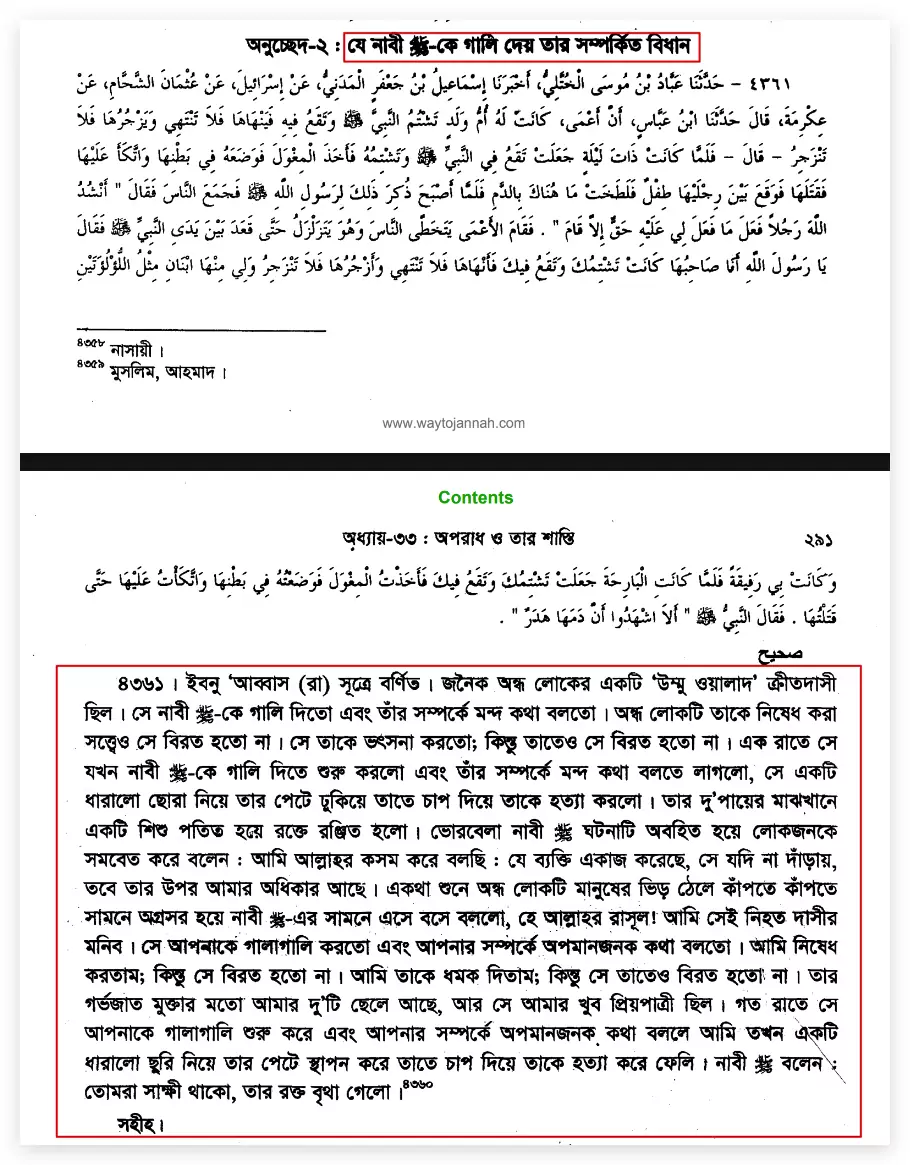
Sunan Abi Dawud 4361. Narrated Abdullah ibn Abbas: A blind man had a slave-mother who repeatedly abused and disparaged the Prophet (ﷺ). He forbade and rebuked her, but she did not stop. One night, when she again abused and disparaged the Prophet, he took a dagger, placed it against her abdomen, pressed upon it, and killed her. A child who came between her legs was smeared with blood. In the morning the Prophet (ﷺ) was informed and assembled the people, calling upon the person responsible to stand. The blind man came forward trembling and admitted that he had killed her. He said that she had continued to abuse and disparage the Prophet despite his repeated warnings, that she was dear to him, and that he had two sons by her. He then described how he killed her with the dagger. The Prophet (ﷺ) concluded: “Oh be witness, no retaliation is payable for her blood.”
Grade: Sahih (Al-Albani)
Canonical reference: Sunan Abi Dawud 4361; Book 40, Hadith 11.
Sunan Abi Dawud — alternate edition mapping
Section: Punishments
Chapter: The ruling concerning one who reviles the Prophet (ﷺ)
Bengali-edition reference 4310; canonical Sunnah.com reference: 4361. Narrated from Ibn Abbas: A blind man had an Umm Walad who repeatedly spoke abusively and disparagingly about the Prophet (ﷺ). He repeatedly forbade and rebuked her, but she did not stop. One night she again spoke abusively about the Prophet. The man took a dagger, drove it into her abdomen, and killed her. The following morning, after the matter was reported, the Prophet gathered the people and called upon the killer to come forward. The blind man appeared trembling, admitted the killing, described the woman as beloved to him and the mother of two of his sons, and explained that he had killed her because she again insulted the Prophet. The Prophet then declared that no retaliation or compensation was due for her blood.
Canonical grade: Sahih (Al-Albani)
Canonical mapping: Sunan Abi Dawud 4361.
Bulugh al-Maram
Book 9: Crimes (Qisas or Retaliation)
Book 9, Hadith 47 (Bengali-edition reference: 1204)
Ibn ‘Abbas (RAA) narrated that a blind man had a pregnant slave who used to abuse the Messenger of Allah (ﷺ) and defame him. He forbade her, but she did not stop. One night she again slandered the Prophet, so he placed a sharp implement against her abdomen, pressed upon it, and killed her. When the Prophet was informed, he declared that no Diyah was to be paid for her blood.
Source note: Related by Abu Dawud with a trustworthy chain of narrators.
Canonical cross-reference: Sunan Abi Dawud 4361.
Sunan an-Nasa’i
Book 37: The Book of Fighting [The Prohibition of Bloodshed]
Chapter: The Ruling on the One Who Defames the Prophet [SAW]
Sunan an-Nasa’i 4070 (Islamic Foundation Bengali-edition reference: 4071). Ibn Abbas narrated that a blind man in the time of the Messenger of Allah (ﷺ) had an Umm Walad by whom he had two sons. She repeatedly slandered and defamed the Messenger of Allah. He rebuked and forbade her, but she did not stop. One night, after she again slandered the Prophet, he took a dagger, thrust it into her abdomen, leaned upon it, and killed her. The next morning the Prophet gathered the people and called on the person responsible to stand. The blind man came forward trembling, admitted the killing, and explained that she had continued to defame the Prophet despite his warnings. The Messenger of Allah [SAW] said: “I bear witness that her blood is permissible.”
Grade: Sahih (Darussalam)
Canonical reference: Sunan an-Nasa’i 4070; Book 37, Hadith 105.
These reports are therefore not merely historical narratives; they became evidentiary material in later Islamic hadith-jurisprudence for treating the blood of a person accused of insulting the Prophet as hadar—without compensatory or retaliatory liability. Ibn Abi Asim titled an entire chapter of his al-Diyat: “If one who insults the Prophet is killed, there is neither Diyah nor Qawad [retaliatory execution].” The point is therefore not a meaning imposed by modern critics; the elimination of blood-money and retaliatory liability appears explicitly in the chapter-heading of an Islamic hadith work itself. [8]
Ibn Abi Asim — al-Diyat
باب إذا قتل ساب النبي صلى الله عليه وسلم فلا دية ولا قود
“Chapter: If a person who insults the Prophet ﷺ is killed, there is neither Diyah nor Qawad/Qisas.”
IslamQA explains the incident in the same direction even more explicitly. According to its answer, the woman was not killed merely because she was a dhimmi; rather, she became liable to execution because she reviled Muhammad. It then states that because she was regarded as deserving execution as a hadd punishment, Muhammad did not demand qisas from her killer. [1]
IslamQA — Answer 111252
“This woman was not killed because she was a dhimmi … so she deserved to be executed for that reason.”
The same answer later states that because she was regarded as deserving execution as a hadd punishment, “he did not demand qisaas from her killer.”
The same IslamQA answer cites al-San’ani’s Subul al-Salam for the proposition that this report indicates that a person who reviles Muhammad is to be executed and that no blood money is payable for that person. [9]
Al-San’ani — Subul al-Salam, 3/501
“This report indicates that the one who reviles the Prophet … is to be executed and no blood money is to be paid for him.”
Thus immunity after a private killing is not an interpretation externally imposed by modern critics. Ibn Abi Asim’s chapter-heading itself says “no Diyah and no Qisas”; al-San’ani derives execution and the absence of blood money from the report; and IslamQA explicitly states that the woman was regarded as liable to execution and therefore qisas was not demanded from her killer. Human life is not the governing value here; the honor of the doctrine is. Justice is not central; religious loyalty is. Argument is not central; fear and coercive authority are. A system in which a subordinate woman can be killed without trial for allegedly insulting a public religious-political leader and her blood can then be treated in such a way that neither Diyah nor Qisas is due cannot reasonably be called a moral system of justice. It is a brutal structure that legitimizes killing and grants the killer religiously grounded immunity.
Was the Slave Woman Who Insulted the Prophet Pregnant?
After describing the killing, the narration in Sunan Abi Dawud says that “a child who came between her legs was smeared with the blood that was there.” The wording raises an even more disturbing possibility. On a straightforward reading, the question naturally arises: was the enslaved woman pregnant at the time? Some commentators have understood the wording in precisely that direction. Abu Humam Abdullah Basa’d, while explaining this passage, states directly: “It seems that she was pregnant.” [10]
Abu Humam Abdullah Basa’d
al-Sahih al-Musnad mimma laysa fi al-Sahihayn — commentary on Hadith 620
فوقع بين رجليها طفل فلطخ ما هناك بالدم -كأنها كانت حاملا-
“A child fell between her legs and the area was smeared with blood—it seems that she was pregnant.”
However, other versions of the same incident contain different wording. Reports transmitted by al-Tabarani and al-Bayhaqi speak of “her two children” being between her legs and covered with blood. A biographical report preserved through Abu Dawud also identifies the child as Abdullah ibn Yazid al-Khatmi. The available reports therefore do not allow us to state with certainty that the woman was pregnant.
Nevertheless, the wording in Abu Dawud undeniably creates a horrifying possibility. A woman is described as being killed at night by a sharp weapon pressed into her abdomen, and the same account mentions a child at or between her legs amid the blood. We do not possess enough evidence to conclude that she was pregnant or that a fetus was killed by the blow. But if the wording did in fact refer to the expulsion of an unborn child, the incident would no longer involve only the brutal killing of an enslaved woman; the same act may also have destroyed the life of her unborn child. In that case, the violence subsequently treated as carrying no blood liability in defense of prophetic honor would reach an even more appalling level.
Shaykh Matiur Rahman Madani
Shaykh Ahmadullah
Immunity for the Killer: Later Islamic Interpretations
Later Islamic scholars did not treat the blind man’s killing as a merely isolated outburst of private anger; they used it as a juristic proof concerning both the punishment for insulting Muhammad and the killer’s legal immunity. In al-Sarim al-Maslul ‘ala Shatim al-Rasul, Ibn Taymiyyah directly raises the obvious objection: hudud punishments are ordinarily carried out by the ruler or his deputy. He then offers several juristic routes for excusing the blind man’s independently executed killing. First, he notes a recognized juristic view according to which a master may enforce hadd punishments upon his slave, including, according to one opinion, execution for apostasy or for reviling the Prophet. Second, he argues that at most the killer can be said to have encroached upon the ruler’s authority, while the ruler may pardon a person who carried out an obligatory hadd without referring the matter to him. Third, he argues that the case can also be classified under killing a harbi, and that such a person may be killed by anyone. The classical discussion therefore does not merely ask whether insulting Muhammad is punishable by death; it directly addresses the liability of someone who personally kills the accused without a prior judicial judgment or authorization from the ruler. [11] [12]
Ibn Taymiyyah — al-Sarim al-Maslul ‘ala Shatim al-Rasul, pp. 285–286
يبقى أن يقال: الحدود لا يقيمها إلا الإمام أو نائبه
“It remains to be said: hudud punishments are carried out only by the ruler or his deputy.”
Ibn Taymiyyah then discusses the juristic view that a master may enforce hadd punishment on a slave and that, according to one reported position from Ahmad and a view attributed to al-Shafi’i, this may extend to execution for apostasy or for reviling the Prophet.
والإمام له أن يعفو عمن أقام حدا واجبا دونه
“The ruler may pardon one who carried out an obligatory hadd without referring it to him.”
In another answer he treats the accused as falling under the category of a harbi and states:
وهذا يجوز قتله لكل أحد
“Such a person may be killed by anyone.”
The same result appears openly in modern Salafi commentary. In Shaykh Abd al-Muhsin al-Abbad’s Sharh Sunan Abi Dawud [492], the declaration that the woman’s blood was hadar is explained as meaning that “she was killed rightfully.” In the question-and-answer section, the issue is then put directly: does this hadith mean that someone who hears a person reviling Muhammad may kill him immediately? The first part of the answer says no, because execution is the ruler’s authority. But it immediately adds that if the killing nevertheless occurs, the victim’s blood is hadar and there is no qisas. The supposed procedural restriction therefore does not ultimately protect the accused person’s life: an individual may take the law into his own hands, kill, and still be shielded from qisas under this interpretation. A human being is killed without trial, testimony, or judicial verdict, yet afterward the religious ruling says that the victim’s blood carries no retaliatory claim and the killer does not answer with his own life. This is not justice; it is a special form of religiously grounded immunity for an extrajudicial killer. [13]
Shaykh Abd al-Muhsin al-Abbad — Sharh Sunan Abi Dawud [492]
حكم من سمع رجلاً يسب الرسول فقتله في الحال
Question: هل في هذا دليل على أن المرتد أو ساب الرسول صلى الله عليه وسلم يقتله من سمعه؟
“Does this hadith prove that whoever hears an apostate or a person insulting the Messenger may kill him?”
Answer:
لا. ليس له قتله؛ لأن القتل هو للإمام، لكن لو وقع فإن الدم هدر، وليس فيه قصاص.
“No. He does not have the right to kill him, because carrying out the killing belongs to the ruler. But if the killing occurs, the blood is hadar and there is no qisas.”
In explaining the phrase that the woman’s blood was hadar, al-Abbad also states:
يعني: أنه قتل بحق
“Meaning: she was killed rightfully.”
What Counts as “Insulting the Prophet”?
The danger of this doctrine becomes still deeper when classical Islamic jurisprudence is examined, because “insulting the Prophet” was not limited to direct obscene abuse. In al-Shifa bi-Ta’rif Huquq al-Mustafa, Qadi Iyad includes disparaging Muhammad, attributing a defect to him, diminishing his status or any of his qualities, belittling him, or insulting him through implication rather than direct wording. The heading of the discussion itself concerns what constitutes insult or diminution of the Prophet “by allusion or explicit statement.” More disturbingly, he transmits from Malik the ruling that a person who insults Muhammad or another prophet—whether Muslim or unbeliever—is to be killed and is not to be offered repentance. Even describing Muhammad’s cloak or garment-fastening as “dirty,” if intended as disparagement, is cited as an offense punishable by death. [14]
Qadi Iyad — al-Shifa bi-Ta’rif Huquq al-Mustafa
وفي كتاب محمد: أخبرنا أصحاب مالك أنه قال: من سب النبي صلى الله عليه وسلم أو غيره من النبيين من مسلم أو كافر قتل، ولم يستتب.
“In Muhammad’s book, Malik’s companions report from him: whoever insults the Prophet ﷺ or any other prophet, whether Muslim or unbeliever, is killed and is not asked to repent.”
In the same discussion, Qadi Iyad also transmits:
وروى ابن وهب، عن مالك: من قال: إن رداء النبي صلى الله عليه وسلم، ويروى زر النبي صلى الله عليه وسلم، وسخ، أراد عيبه قتل.
“Ibn Wahb narrated from Malik: if a person says that the Prophet’s cloak—or, in another version, the fastening of his garment—was dirty, intending thereby to disparage him, he is killed.”
[15]
Qadi Iyad extends the category still further. He discusses a person who may not even have consciously intended direct insult but nevertheless makes a statement regarded as diminishing Muhammad—for example, attributing a major sin to him, accusing him of compromising in delivering the message, alleging fault in his judgments between people, or diminishing his rank, lineage, knowledge, or asceticism. Even where the speaker claims that deliberate insult was not intended, Qadi Iyad states that the same punishment applies. [16]
فحكم هذا الوجه حكم الوجه الأول القتل دون تلعثم
“The ruling in this case is the same as in the first case: killing, without hesitation.”
Among the examples listed immediately beforehand are:
أو ينسب إليه إتيان كبيرة، أو مداهنة في تبليغ الرسالة، أو في حكم بين الناس، أو يغض من مرتبته، أو شرف نسبه، أو وفور علمه أو زهده
That is, attributing a major sin to Muhammad, accusing him of compromising in conveying the message or in judging between people, or diminishing his rank, noble lineage, abundance of knowledge, or asceticism.
Thus “insulting the Prophet” was not defined as a narrow, objectively measurable offense. Its boundaries extend from direct abuse to insinuation, ridicule, disparagement, diminution of status, attributing faults to Muhammad’s character or decisions, and even ordinary descriptive statements when interpreted as having a degrading intent. When an offense this vague and interpretation-dependent is combined with capital punishment and, in some cases, immunity from qisas for the killer, the danger goes far beyond suppression of expression. It creates a structure in which interpreting someone’s words as “insult” can itself become the basis for taking that person’s life.
Problems in the Hadith Narrative
The moral problem in this hadith is not merely that a woman is killed. The problem runs deeper. A supposed “insult” or “defamation of the Prophet” is transformed into an offense for which a person may be killed without a court, trial, evidence, an opportunity for self-defense, or even the minimum principle of proportional punishment. In other words, the narration does not merely carry the idea of capital punishment for blasphemy; it also grants moral legitimacy to extrajudicial killing. That is the most disturbing feature of the report.
An allegation that someone spoke harshly about another person is itself a linguistic, interpretive, and evidentiary matter. Which sentence is abuse? Which is criticism? Which is satire? Which is political condemnation? Which is protest against religious authority? Deciding such questions requires impartial inquiry. The accused must be heard. Context must be established. Evidence must be examined. None of that appears in this account. The killer’s statement becomes the evidence, the killer’s anger becomes the judgment, and the killer’s weapon becomes the verdict. That is not justice; it is the legitimization of private vengeance in the name of religious sentiment.
More seriously, the victim is not an independent citizen with social power. She is an enslaved woman, subordinate to the man who owns her, and her body and life already exist within a structure of ownership. In that context, the accusation against her is even more problematic because she is dead: she has no statement of her own, no defense, and no testimony. The man who killed her is effectively the sole narrator of the accusation against her. The claim of the powerful male owner is accepted, while the human existence of the slain woman is practically erased. This is not merely an exercise of misogynistic power; it is the combined brutality of slavery, patriarchy, and religious authority.
The manner of killing described in the hadith is also significant. She was not arrested, taken to court, or brought before a judge. She was killed at night by a sharp weapon driven into her abdomen. This is not the execution of a judicially imposed sentence; it is a direct private killing. Yet Muhammad is not described as treating the killing as a crime. He does not punish the killer. Instead, the report ends by treating the slain woman’s blood as hadar. The moral implication is stark: when the allegation is that Muhammad was insulted, the killer’s liability can disappear and the slain person’s blood can lose its compensable and retaliatory legal value.
Another serious feature of the incident is that the killing does not occur as the execution of a judicial verdict. The woman is not arrested, brought before a qadi or ruler, subjected to testimony, allowed to give her account, or presented with a formal sentence of death. The blind man kills her on the basis of his own accusation; only after the killing does he come before Muhammad and give his version of events. Muhammad then imposes neither qisas nor blood money and declares the woman’s blood hadar. Later juristic interpretation does not remove this problem. Ibn Taymiyyah himself confronts the objection that hudud are normally enforced by the ruler or his deputy. One of his answers is that there is a juristic view allowing a master to enforce such punishment upon his slave; another is that at most the man encroached upon the ruler’s authority, while the ruler can pardon someone who carried out an obligatory hadd without authorization; yet another treats the person liable to execution as a harbi whom anyone may kill. The extrajudicial character of the killing is therefore not an invented modern accusation: the classical juristic discussion itself recognizes that the killing took place without prior authorization from the ruler and constructs juristic routes by which the killer’s liability can nevertheless be removed. [17] [18]
At this point the moral order of the narration is turned upside down. In ordinary morality, killing is among the gravest offenses; in this narration, verbal abuse becomes graver, while killing becomes an acceptable response. In ordinary justice, the killer becomes the accused; here the slain woman is treated as the effective wrongdoer, while the killer becomes the defender of prophetic honor. In ordinary legal systems, courts are indispensable; here private anger substitutes for judicial process. Calling this inverted moral world “sacred law” does nothing more than confer religious status on barbarism.
The social consequences are extremely dangerous. When a religious narration teaches that killing someone accused of insulting the Prophet may carry no blood liability, it provides moral fuel for blasphemy killings, mob lynchings, machete attacks, fatwa terror, and private revenge in real societies. Anyone can then say, “He insulted the Prophet,” and the allegation itself can become a pretext for violence. In such a doctrine, emotion becomes stronger than evidence, the frenzy of crowds stronger than courts, and religious pride more valuable than human life.
This hadith is therefore not an isolated story; it is a kind of moral map. In that map, freedom of expression has no secure dignity, the accused has no guaranteed right to a fair trial, the enslaved woman has no meaningful human standing, and human life becomes trivial when weighed against alleged religious insult. In this structure, extrajudicial killing in defense of prophetic honor is not merely tolerated; after the killing takes place, qisas and blood-money liability can also be removed from the killer. In Abd al-Muhsin al-Abbad’s commentary on Abu Dawud, the question is asked directly whether a person who hears someone insulting Muhammad may kill him immediately. The answer first assigns the authority to the ruler, but then states that if the killing occurs, the victim’s blood is hadar and there is no qisas against the killer. In other words, the injunction “do not take the law into your own hands” provides no effective protection to the victim once the killer does exactly that; the killer does not ultimately face retaliatory execution. [19] This is precisely what makes the doctrine so reprehensible from the standpoint of modern civilization: a system that answers words not with courts, arguments, or counter-speech but with blood is not speaking the language of morality; it is speaking the language of terror.
- It turns expression into a capital offense: Non-physical, immeasurable, and interpretation-dependent acts such as abuse, mockery, or criticism are turned into offenses answerable by death. This is the complete opposite of proportional justice.
- It can immunize an extrajudicial killer after the killing: The killer presented no evidence before a court, the accused was not heard, and no judicial verdict existed; he killed her himself. The victim’s blood was then treated as hadar. Later Islamic interpretation makes the consequence even clearer: there is no qisas against the killer. Modern Salafi commentary likewise states that even if an individual did not possess the authority to carry out the killing himself, once he has killed, the victim’s blood is hadar and no qisas is due.
- It permits violence by a powerful man against a powerless woman: The victim is an enslaved woman with no independent social standing. The value of her life is subordinated to the owner’s religious loyalty.
- It criminalizes criticism of a public figure: Muhammad is not merely a private religious personality in Islamic tradition; he is a lawgiver, ruler, military leader, and organizer of society. Harsh criticism of such a figure should be a public right, not a crime.
- It plants the moral seed of future violence: Once the accusation “he insulted the Prophet” becomes a legitimate basis for killing, religious zealots can regard law and due process as unnecessary. The result is blasphemy killing, lynching, and terror.
Accordingly, this hadith cannot plausibly be treated as an innocent religious narrative. It is a document of a moral ideal in which a subordinate woman may be killed in the name of defending the dignity of a public religious-political leader, and the killing may then be declared to carry no blood liability. In the language of modern humanistic justice, this is not justice but religiously legitimized extrajudicial killing. A doctrine that presents such killing as moral cannot be softened into the phrase “the law of another culture.” It should be described plainly: it is barbaric, inhumane, and hostile to civilized principles of justice.
Conclusion
This hadith and the religious interpretations built upon it expose a disturbing moral reality: Muhammad’s status is valued above human life, religious obedience above justice, and wounded religious sentiment is made a stronger justification for killing than freedom of expression is for protection. A person is accused of speaking harshly; she is not brought before a court, her account is not heard, the evidence is not tested, and the gravity of the alleged offense is not assessed. Instead, she is killed by private initiative, and afterward her blood is treated as hadar. This is not justice; it is religious authorization of extrajudicial killing.
The core principles of civilized justice are that no one is guilty before proof, the accused has a right to defend themselves, punishment must be proportionate to the offense, and no private person may simply take the law into their own hands. Every one of those principles is trampled in this narration. The accuser becomes judge, the enraged follower becomes executioner, and religious authority removes the killer’s blood liability. This structure is not a moral judicial system. It replaces law with obedience, reason with fear, and human dignity with ideological pride.
No one is safe in a society where the accusation “he insulted the Prophet” becomes a moral pretext for killing. Abuse, mockery, satire, and criticism are linguistic and interpretive categories. What is a question to one person is an insult to another; what is historical criticism to one is sacrilege to another; what is political condemnation to one is apostasy or treason to another. If such vague allegations are turned into grounds for killing, law becomes unnecessary. What remains are enraged crowds, religious leaders, fatwas, and violent followers. This is why blasphemy culture ultimately produces a politics of blood rather than a culture of argument.
Criticizing public figures is a human right. Even if Muhammad were only a private spiritual figure, he could not reasonably be placed beyond criticism. But in Islamic tradition he is presented as lawgiver, judge, military leader, statesman, preacher, and source of social rules. His name and example continue to influence rules and attitudes affecting women, children, non-Muslims, atheists, homosexuals, apostates, critics, and dissenters. People must therefore have the right to analyze, criticize, condemn, satirize, and reject him in the strongest terms. A doctrine that attempts to suppress that right through killing is not defending truth; it is defending power.
The central moral message of the narration discussed in this article and of the juristic interpretations built upon it is therefore not obscure: a human being is killed without trial in the name of protecting Muhammad’s honor; Muhammad declares her blood hadar; and later scholars use the incident as evidence both for capital punishment for insulting Muhammad and for the killer’s immunity from liability in specified circumstances. IslamQA explicitly states that the woman was regarded as deserving execution and that qisas was therefore not demanded from her killer; Ibn Taymiyyah supplies multiple juristic arguments addressing a killing carried out without prior authorization from the ruler; and Abd al-Muhsin al-Abbad states directly that if an individual carries out the killing, the victim’s blood is hadar and there is no qisas. This is therefore not merely a seventh-century story. It forms part of a doctrinal tradition in which an accusation of religious insult can become a ground for taking a human life and, in specified circumstances, for shielding the killer from retaliatory execution. To disguise this reality with soft phrases such as “historical context,” “religious sensitivity,” or “a prescribed punishment” is to obscure what the sources actually say. Stated plainly, it is violence against freedom of expression, an assault on human dignity, a rejection of basic principles of justice, and moral authorization of extrajudicial killing in the name of religious authority. A doctrine that answers speech not with argument, court, or evidence but with killing cannot be called moral by civilized standards. It is barbarism, and calling barbarism sacred does not transform it into justice.
References
- IslamQA, Answer 111252 — Confusion about the hadith of the blind man who killed his slave woman 1 2
- IslamWeb — Abd al-Muhsin al-Abbad, Sharh Sunan Abi Dawud [492]: حكم من سمع رجلاً يسب الرسول فقتله في الحال ↩︎
- Sunan Abi Dawud (Tahqiq edition), Allama al-Albani Academy, Hadith 4361; canonical mapping: Sunan Abi Dawud 4361 ↩︎
- Sunan Abi Dawud (Tahqiq edition), Allama al-Albani Academy, Vol. 5, pp. 290–291 ↩︎
- Sunan Abi Dawud, Islamic Foundation edition, Hadith 4310; canonical mapping: Sunan Abi Dawud 4361 ↩︎
- Bulugh al-Maram, Bengali-edition Hadith 1204; canonical mapping: Book 9, Hadith 47 ↩︎
- Sunan an-Nasa’i, Islamic Foundation edition, Hadith 4071; canonical mapping: Sunan an-Nasa’i 4070 ↩︎
- Ibn Abi Asim — al-Diyat, باب إذا قتل ساب النبي صلى الله عليه وسلم فلا دية ولا قود ↩︎
- IslamQA, Answer 111252 — citing al-San’ani, Subul al-Salam 3/501 ↩︎
- Abu Humam Abdullah Basa’d — commentary on al-Sahih al-Musnad mimma laysa fi al-Sahihayn, Hadith 620 ↩︎
- Ibn Taymiyyah — al-Sarim al-Maslul ‘ala Shatim al-Rasul, pp. 285–286, Shamela ↩︎
- IslamQA, Answer 103739 — detailed discussion of the blind man’s killing ↩︎
- IslamWeb — Abd al-Muhsin al-Abbad, Sharh Sunan Abi Dawud [492], حكم من سمع رجلاً يسب الرسول فقتله في الحال ↩︎
- Qadi Iyad — al-Shifa bi-Ta’rif Huquq al-Mustafa, chapter on insult or diminution by allusion or explicit statement, IslamWeb ↩︎
- Qadi Iyad — al-Shifa, IslamWeb ↩︎
- Qadi Iyad — al-Shifa, الفصل الرابع: حكم من فعل ذلك دون قصد, IslamWeb ↩︎
- Ibn Taymiyyah — al-Sarim al-Maslul ‘ala Shatim al-Rasul, pp. 285–286 ↩︎
- IslamQA, Answer 103739 ↩︎
- IslamWeb, Sharh Sunan Abi Dawud [492], حكم من سمع رجلاً يسب الرسول فقتله في الحال ↩︎