

Summary
In Surah al-Nisa of the Quran (verses 11 and 12), specific fractions (such as 1/2, 2/3, and 1/8) are prescribed for heirs; in multiple real-world cases, however, their sum exceeds the principal estate (1 or 100%). Mathematically, it is impossible to distribute more than the entire estate. To resolve this mathematical error, Caliph Umar later introduced the ‘Awl’ method, through which the heirs’ Quran-prescribed shares are reduced proportionally. However, the unanimously accepted and undisputed principle of Islamic fiqh or jurisprudence is— “Lā ijtihāda fī mawrid al-naṣṣ” (لا اجتهاد في مورد النص). That is, where a clear ruling (naṣṣ) from the Quran or an authentic hadith of the Prophet exists, no ijtihad (independent reasoning), ijma, qiyas, or human reasoning applies.
Since the shares of heirs in the Quran are entirely specific ‘naṣṣ’, neither Umar nor any human being has the authority to change those figures through ijtihad. Therefore, applying the ‘Awl’ method is clearly a violation of the Quran. This situation irrefutably proves that either the Quran’s arithmetic contains a fundamental error that cannot be resolved without human intervention, or the currently prevalent ‘Awl’-based inheritance law, by the standards of the principles of Islamic Shariah itself, effectively amends the Quran’s specified naṣṣ. In other words, either the Quran’s calculations are not workable without human intervention, or the Awl method in practice changes the shares declared by the Quran—in either case, the claim of a “perfect divinely revealed inheritance law” does not hold. Let us first look at this diagram,
- Where a clear ruling (naṣṣ) from the Quran or an authentic hadith of the Prophet exists, no ijtihad (independent reasoning), ijma, qiyas, or human reasoning applies.
- Another Islamic ruling is that, in dividing property, one must follow the Quran’s ruling, not any human ruling.
- Surah Nisa clearly states how property is to be distributed. [1]
- When the Quranic verses are followed, it can be seen in some mathematical cases that the sum of the shares due to the heirs exceeds the entire estate (1 share), making it impossible to implement the specified rule.
- To eliminate this inconsistency, the second caliph Umar introduced the ‘Awl’ method, which is not found in any Quranic verse or direct naṣṣ. [2]
- Since human reasoning or ijtihad cannot take precedence over naṣṣ, the application of the Awl method directly conflicts with the fundamental rules of Islam. This is because, when the Awl method is adopted, the distribution is not made according to the Quranic ruling.
Introduction
The inheritance law described in the Quran is essentially a defective and erroneous method of dividing property. The moment one reads this law, it becomes clear that whoever formulated it had no practical experience or knowledge of the kind required to formulate an inheritance law. Before formulating such a law, it is essential to consider how it will apply in different kinds of cases and with different numbers of family members. Every family has different members: some families have two sons, some have three daughters, some have one son and three daughters, some have three sons and one daughter, along with a father, mother, and so on. When creating an inheritance law, it is necessary to formulate it with an understanding of whether it will work in each case. But this rule in the Quran contains mathematical errors that clearly reveal the limitations of Allah’s and the Prophet’s mathematical knowledge. This mathematical error is not merely an ordinary calculation mistake; rather, it is a deep inconsistency that could not have come from an omniscient being. The imprint of the limited legal experience, limited mathematical framework, and immature law-making methods of seventh-century Arab society is clearly evident in this inheritance law. Since such an error could not have come from an omnipotent being, this error plainly establishes itself as a major challenge to the truth of Islam.
According to the Quran’s inheritance law, when instructions are given to divide property, a specific fraction is stated for each heir. But in some real cases, when these fractions are added, their sum exceeds the total estate. For example, in some cases, when an estate is divided among a deceased person’s parents, wife, and children, adding the prescribed shares produces more than 100%. Such an error ought not to be present in instructions from a perfect Creator. Even for a person with ordinary knowledge of mathematics, giving such a rule for dividing property would be impossible. This shows that, behind these instructions, the imprint of the limited legal and mathematical concepts of seventh-century Arab society is more apparent than the perfect mathematical plan of an omniscient, all-seeing lawgiver.
The mathematical rule is very clear. When specific fractions are imposed on an estate, the sum of those specified shares cannot exceed 1. If the sum is greater than 1, it creates a claim to distribute more property than exists, which is mathematically impossible. The rules described in the Quran do not follow this simple rule, making it clear that this law did not come from miraculous knowledge. Rather, it reflects the immature knowledge of the people of that time.
What we need to know about this matter is that, when distributing an entire estate using specified fractions, if the sum exceeds 1, it becomes mathematically impossible. If the sum is less than 1, there may be a separate rule for distributing the remainder; but if the sum is greater than 1, a claim arises to distribute more property than the deceased left behind. This is because the entire estate is taken as one and divided.
Reality: In many cases, the sum exceeds 1. For example: husband (1/2) + 2 sisters (2/3) = 7/6.
The Qur’an provides no solution or mathematical guidance for this 1.16 or excess portion. [3]
Effect: The prescribed share of each heir is reduced from the Qur’anic fractions so that the sum becomes 1. As a result, the Qur’anic ‘nas’, or prescribed figure, is changed. [4]
Argument: The shares of certain heirs may not be reduced under any circumstances. Rather, any shortfall must be made up solely from the shares that are variable depending on the circumstances. He rejected Umar’s principle of “reducing everyone’s share.”
Difference: They keep the shares of parents and husbands/wives ‘fixed.’ If a shortfall arises in the distribution, they adjust it by deducting it solely from the shares of the children, especially the daughters.
Conclusion: Both Sunnis and Shi’a acknowledge that the literal application of the Qur’an is impossible, but a fundamental conflict exists between them over whose share should be reduced.
Awl—A Human Attempt to Correct the Qur’an’s Errors
‘Awl’ means ‘increase’. When the sum of the shares is a fraction whose numerator is larger and denominator smaller, the denominator must be made equal to the numerator—that is, it must be increased; this is called ‘awl’. For example, a deceased person leaves behind a husband and three sisters. Thus, the husband’s share + the three sisters’ share = 1/2 + 2/3 = 7/6. In this situation, the husband must receive 3/7 and the three sisters must receive 4/7. ‘Radd’ means ‘returning or giving back’. ‘Radd’ is the opposite of awl. When the sum of the shares is a fraction whose numerator is smaller and denominator larger, the denominator must be reduced to make it equal to the numerator. This is called ‘radd’.
When this mathematical problem became pronounced during the reign of Caliph Umar, he introduced the “awl principle”, which was merely a human attempt to correct the errors in the Qur’anic fractions. When a mortal human being of limited knowledge fails to follow Allah’s injunctions properly and instead attempts to correct them, introducing a new, amended law that changes or modifies the Qur’anic law, Allah’s knowledge is thereby defeated by human knowledge. According to Allah’s own definition, since Allah is All-Knowing, the inheritance law He has given should be correct in every case. Yet introducing any kind of amendment to that law essentially proves even Islam’s fundamental claim to be false. According to the awl principle, each heir’s rightful share is adjusted and distributed within the original estate. This is a variable principle imposed upon the Qur’anic verses, attempting to conceal the error in the original verse. Such a change clearly proves that the Qur’an is not a perfect document and contains mathematical errors.
Qur’anic Verses
Let us now read the Qur’anic law of inheritance. First, let us read the relevant Qur’anic verses,
Quran reference: Surah An-Nisa 4:11
Arabic (Quran.com): يوصيكم الله في اولادكم للذكر مثل حظ الانثيين فان كن نساء فوق اثنتين فلهن ثلثا ما ترك وان كانت واحدة فلها النصف ولابويه لكل واحد منهما السدس مما ترك ان كان له ولد فان لم يكن له ولد وورثه ابواه فلامه الثلث فان كان له اخوة فلامه السدس من بعد وصية يوصي بها او دين اباوكم وابناوكم لا تدرون ايهم اقرب لكم نفعا فريضة من الله ان الله كان عليما حكيما ١١
Translation — Dr. Mustafa Khattab, The Clear Quran (Quran.com): Allah commands you regarding your children: the share of the male will be twice that of the female.1 If you leave only two ˹or more˺ females, their share is two-thirds of the estate. But if there is only one female, her share will be one-half. Each parent is entitled to one-sixth if you leave offspring.2 But if you are childless and your parents are the only heirs, then your mother will receive one-third.3 But if you leave siblings, then your mother will receive one-sixth4—after the fulfilment of bequests and debts.5 ˹Be fair to˺ your parents and children, as you do not ˹fully˺ know who is more beneficial to you.6 ˹This is˺ an obligation from Allah. Surely Allah is All-Knowing, All-Wise.
Quran reference: Surah An-Nisa 4:12
Arabic (Quran.com): ۞ ولكم نصف ما ترك ازواجكم ان لم يكن لهن ولد فان كان لهن ولد فلكم الربع مما تركن من بعد وصية يوصين بها او دين ولهن الربع مما تركتم ان لم يكن لكم ولد فان كان لكم ولد فلهن الثمن مما تركتم من بعد وصية توصون بها او دين وان كان رجل يورث كلالة او امراة وله اخ او اخت فلكل واحد منهما السدس فان كانوا اكثر من ذالك فهم شركاء في الثلث من بعد وصية يوصى بها او دين غير مضار وصية من الله والله عليم حليم ١٢
Translation — Dr. Mustafa Khattab, The Clear Quran (Quran.com): You will inherit half of what your wives leave if they are childless. But if they have children, then ˹your share is˺ one-fourth of the estate—after the fulfilment of bequests and debts. And your wives will inherit one-fourth of what you leave if you are childless. But if you have children, then your wives will receive one-eighth of your estate—after the fulfilment of bequests and debts. And if a man or a woman leaves neither parents nor children but only a brother or a sister ˹from their mother’s side˺, they will each inherit one-sixth, but if they are more than one, they ˹all˺ will share one-third of the estate1—after the fulfilment of bequests and debts without harm ˹to the heirs˺.2 ˹This is˺ a commandment from Allah. And Allah is All-Knowing, Most Forbearing.
Example 1: Dividing a Pizza
If a pizza is divided into 1/8 portions, there will be a total of 8 pieces. If, after dividing it into 1/8 portions, a ninth or tenth person arrives and joins the group, the person or persons who join at the end will not receive any portion of the pizza. This is because a pizza cut into 1/8 pieces cannot be distributed among more than 8 people. It is possible to divide it among 9 people as well, but then the pizza will have to be divided again. In that case, each portion will be 1/9, and each person will have to be given 1/9. The sum of 9 portions of 1/9 should equal 1. In other words, the total sum must be 1 in every case. If, at that point, the sum of the fractions of the total pieces exceeds 1, the portion exceeding 1 cannot be given to anyone else. People learn these things in school when they study arithmetic. Let us see what the sum will look like when it is divided among 8 people,
or
Now suppose that an attempt is made to distribute the same pizza, which has already been divided into 1/8 portions, among 9 people. Since the pizza has 8 pieces, it will not be possible to divide it equally among 9 people. The last person will be deprived of pizza. Alternatively, that person’s portion will have to be provided by reducing everyone else’s share. But if the portions of the others are reduced, their shares will no longer remain 1/8. Their portions will change. This is a simple mathematical concept. Yet mathematical problems of this kind can clearly be seen in the verses of the Quran, which is not consistent with guidance coming from an ideal, perfect Creator.

Example 2: The Distribution of Abul Miah’s Property
The Quranic verses described above are the foundational verses in Islam concerning the calculation of inheritance: the calculation of how much property sons, daughters, husbands, and wives will receive. Now, let us suppose that Mr. Abul Miah’s family consists of his elderly parents, his wife, and three daughters. Abul Miah dies, and his property is to be distributed according to the Quranic verses above. For ease of calculation, let us assume that Abul Miah left property worth 100 taka. Now how will we distribute it?
1. For each of the deceased’s parents, one-sixth of the estate, if the deceased has children.
- According to this verse, since the deceased has children, each of his elderly parents will receive one-sixth. That is, each will receive (100 ÷ 6 = 16.66) taka. Together, the two will receive 16.66 × 2 = 33.33 taka.
2. Allah commands you concerning your children: for the male, what is equal to the share of two females. If there are only women and they are more than two, then they shall have two-thirds of the property he leaves behind at death, and if there is only one, then she shall have half.
- Now let us calculate how much property his three daughters will receive. It can be understood from the verse above that Mr. Abul’s three daughters will receive two-thirds of the property. That is, (100 × 2/3 = 66.67) taka.
3. For wives there shall be one-fourth of the property you leave if you have no child. But if you have a child, then they shall have one-eighth of the property you leave, after any bequest you make and after debts are paid.
- Now for the calculation of the deceased Abul Miah’s wife’s share. According to the verse above, she will receive one-eighth. That is, (100 ÷ 8 = 12.50) taka.
Let us calculate it this way. Mr. Abul left a total of 100 taka. According to this rule in the Quran,
| Recipients | Amount received |
| Parents | 33.33 taka |
| Three daughters | 66.67 taka |
| Wife | 12.50 taka |
| Total | 33.33 + 66.67 + 12.50 = 112.50 taka |
But when the money is divided and distributed, it becomes apparent that there is a shortfall of 12.50 taka. The total amount is 100, yet everyone must be given 112.50. Where will this additional 12.50 taka come from? Will Allah Almighty reveal it? Calculating property shares using such a major mathematical error is extremely dangerous.
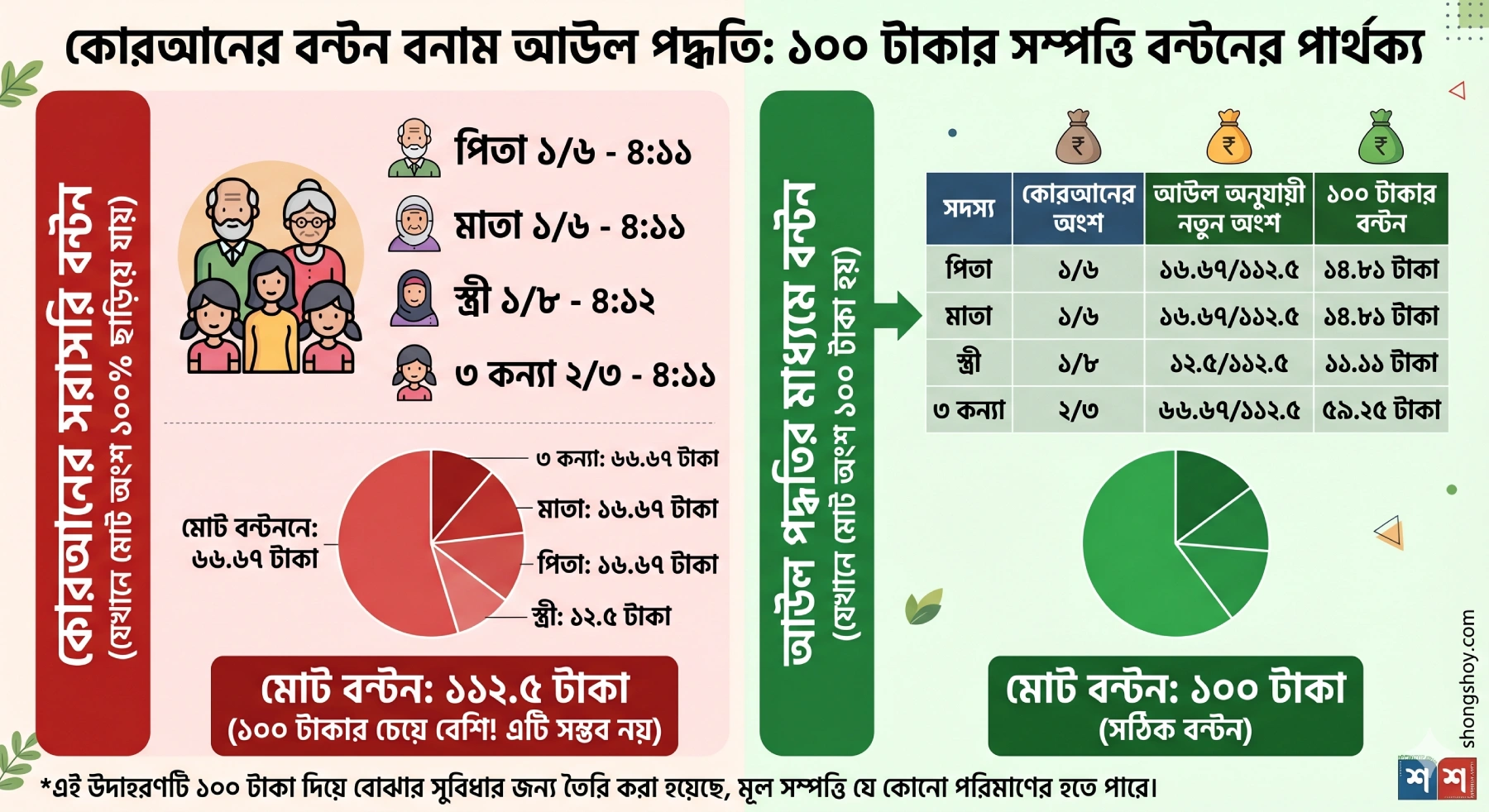
Example 3: The Distribution of Bilkis Begum’s Property
Let us suppose that Bilkis Begum has died. At the time of her death, she left 1 million taka. She has no heirs other than one daughter, her parents, and her husband. Now let us divide her property according to the Quran. Here, it is assumed that the net estate subject to inheritance after payment of debts and bequests is 1 million taka.
According to Surah An-Nisa 4:12 of the Quran, if a wife dies leaving a child, her husband will receive one-fourth of the property she leaves behind. Since Bilkis Begum has one daughter, her husband will receive 1/4.
1,000,000 × 1/4 = 250,000 taka
According to Surah An-Nisa 4:11, if the deceased has only one daughter, that daughter will receive half of the property. Therefore, Bilkis Begum’s only daughter will receive 1/2.
1,000,000 × 1/2 = 500,000 taka
The same verse states that if the deceased has children, each parent will receive 1/6 of the estate. Since Bilkis Begum has a child, her father will receive 1/6 and her mother will receive 1/6.
Father will receive: 1,000,000 × 1/6 = 166,666.67 taka
Mother will receive: 1,000,000 × 1/6 = 166,666.67 taka
Now the total calculation is:
Husband: 250,000 taka
One daughter: 500,000 taka
Father: 166,666.67 taka
Mother: 166,666.67 taka
Total = 250,000 + 500,000 + 166,666.67 + 166,666.67
= 1,083,333.34 taka
That is, Bilkis Begum left 1 million taka, but if the fractions prescribed by the Quran are applied directly, the heirs must be given 1,083,333.34 taka. The shortfall here is approximately 83,333.34 taka. The question is, where will this additional money come from?
Mathematically, the same calculation can be seen more clearly:
1/4 + 1/2 + 1/6 + 1/6
= 3/12 + 6/12 + 2/12 + 2/12
= 13/12
That is, the total claim amounts to 13/12, which is more than 1. As a percentage, this is 108.33%. Yet in reality, the estate amounts to only 100%. Therefore, it is impossible to apply the Quranically prescribed shares directly and simultaneously in this case. If everyone is given the shares prescribed by the Quran, more money than the estate contains would be required. And if the calculation is reconciled within 1 million taka by reducing everyone’s share according to the doctrine of ‘Awl, then the husband will not receive 1/4, the daughter will not receive 1/2, and each of the parents will not receive 1/6. In other words, the fractions declared by the Quran will effectively be altered.
This example shows that the problem is neither a rare nor an imaginary complexity. A woman has died, leaving behind her husband, one daughter, and both parents—an entirely realistic family situation. Yet even in such an ordinary case, directly applying the Quranic inheritance fractions creates claims exceeding the total estate. Thus, the calculation cannot be reconciled without ‘Awl, and once ‘Awl is applied, the specific Quranic shares no longer remain intact.
The Emergence of the Doctrine of ‘Awl
In the early days of Islam, from the time of the Prophet Muhammad to the reign of the first caliph, Abu Bakr, the law of inheritance was quite simple and clear. Property was divided in accordance with the specific injunctions given in the Quran. However, during the reign of Islam’s second caliph, Umar ibn al-Khattab, an unexpected incident occurred that marked the beginning of a new chapter in Islamic inheritance law.
One day, during Umar’s reign, a woman died. She left behind a husband and two sisters. According to Islamic inheritance law, in this situation the husband would receive one-half and the two sisters would receive two-thirds. But this calculation created a problem. If the husband were given one-half, two-thirds would not remain for the two sisters, and if the two sisters were given their share, it would not be possible to give the husband his full one-half.
Caliph Umar assembled the prominent Companions to find a solution to this complex problem. Presenting the Quranic instructions before them, he said, “Allah has prescribed one-half for the husband and two-thirds for the two sisters. But how am I to distribute this estate now? If I begin with the husband’s share, two-thirds will not remain for the two sisters, and if I give the two sisters their shares first, the husband will not have his due share. Advise me.”
According to the accounts, some of the Companions present advised the method of ‘Awl—that is, when the sum of the prescribed shares exceeds the total estate, they proposed reducing each heir’s share proportionately. The central idea of ‘Awl was to distribute the estate by proportionately reducing each heir’s due share when the estate was insufficient. But under this method of ‘Awl, the heirs cannot be given what the Quran specifies; their shares must be reduced below those amounts.
Ibn Abbas was a strong opponent of the doctrine of ‘Awl. However, the accounts differ as to whether he openly opposed it at Umar’s consultation council itself. One account portrays him as opposing Umar’s decision, while the account cited by Islamweb states that he expressed a contrary opinion after Umar’s death. His fundamental position, however, was clear: he did not accept the ‘Awl method of reducing the Quranically prescribed shares of all heirs proportionately; instead, he favored keeping the shares of certain heirs intact and adjusting the shortfall from the variable shares.
Thus, Caliph Umar applied the rule of ‘Awl for the first time. The husband’s one-half and the two sisters’ two-thirds were reduced proportionately and distributed among all of them. This decision is regarded as a landmark step in the history of Islamic inheritance law. Subsequently, the four Sunni madhhabs also accepted Umar’s decision, and the concept of ‘Awl became firmly established. Yet it is evident that this law directly contradicts Allah’s command in the Quran. Following this method requires altering the Quranic injunction.
Later, Abdullah ibn Abbas clearly expressed his opposition to the doctrine of ‘Awl; nevertheless, the method introduced by Umar became established in subsequent Sunni fiqh. Umar understood that there was a problem in the Quran regarding the division of the estate. Otherwise, there would have been no need to introduce a new, amended rule outside the Quran when the Quran itself provides clear instructions on the matter. The problem is that the Quranic verse remains; it could not simply be changed. That alone makes it clear that this law was amended. But revelation ceased after the Prophet’s death, so how could Umar amend Allah’s command in the Quran? The very meaning of this new provision for dividing the estate is to overrule Allah’s law described in the Quran, is it not?
Scholarly Opinions on ‘Awl
Now let us learn some information from several famous Islamic websites, [5]
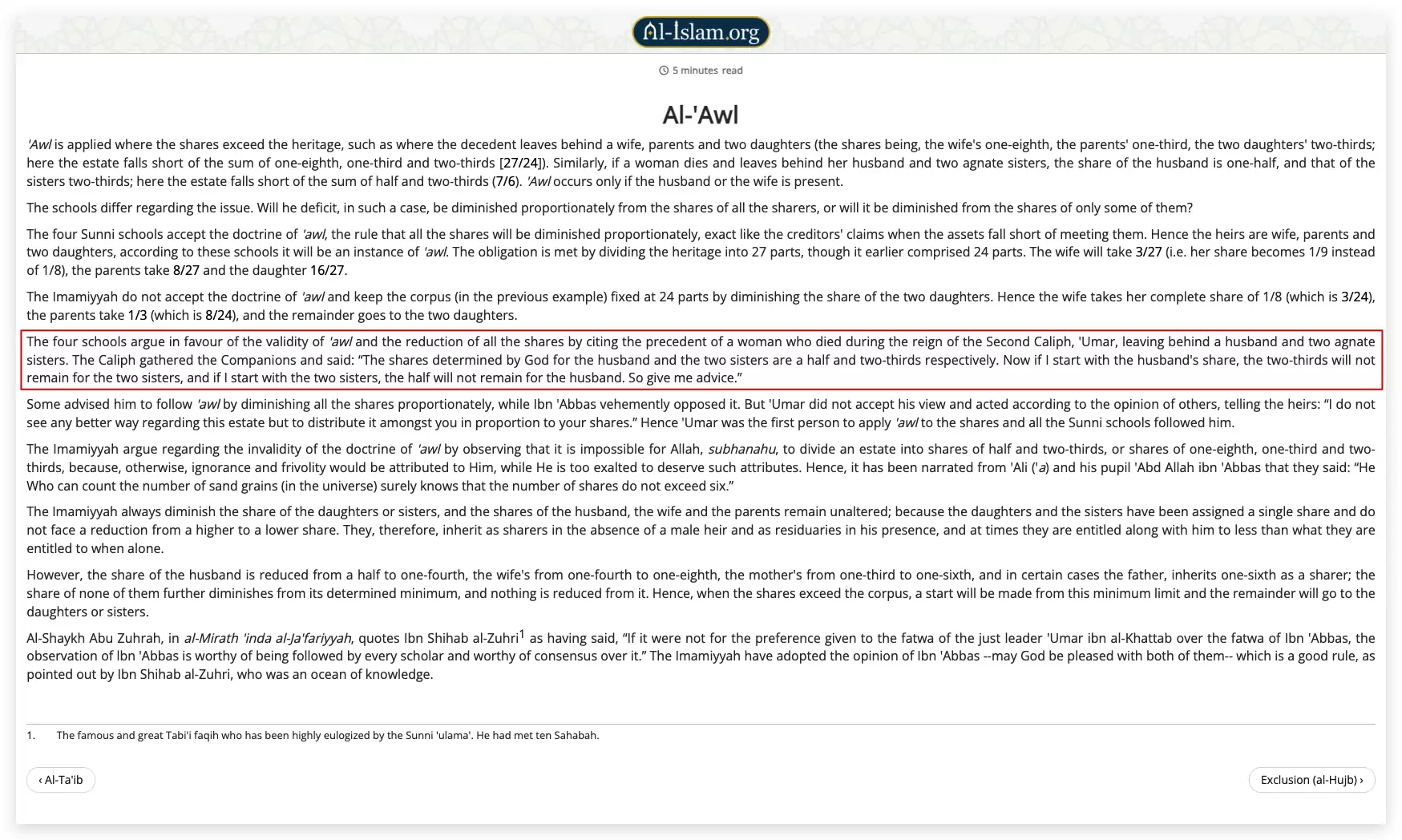
Al-‘Awl
‘Awl is applied where the shares exceed the heritage, such as where the decedent leaves behind a wife, parents and two daughters (the shares being, the wife’s one-eighth, the parents’ one-third, the two daughters’ two-thirds; here the estate falls short of the sum of one-eighth, one-third and two-thirds [27/24]). Similarly, if a woman dies and leaves behind her husband and two agnate sisters, the share of the husband is one-half, and that of the sisters two-thirds; here the estate falls short of the sum of half and two-thirds (7/6). ‘Awl occurs only if the husband or the wife is present.
The schools differ regarding the issue. Will he deficit, in such a case, be diminished proportionately from the shares of all the sharers, or will it be diminished from the shares of only some of them?
The four Sunni schools accept the doctrine of ‘awl, the rule that all the shares will be diminished proportionately, exact like the creditors’ claims when the assets fall short of meeting them. Hence the heirs are wife, parents and two daughters, according to these schools it will be an instance of ‘awl. The obligation is met by dividing the heritage into 27 parts, though it earlier comprised 24 parts. The wife will take 3/27 (i.e. her share becomes 1/9 instead of 1/8), the parents take 8/27 and the daughter 16/27.
The Imamiyyah do not accept the doctrine of ‘awl and keep the corpus (in the previous example) fixed at 24 parts by diminishing the share of the two daughters. Hence the wife takes her complete share of 1/8 (which is 3/24), the parents take 1/3 (which is 8/24), and the remainder goes to the two daughters.
The four schools argue in favour of the validity of ‘awl and the reduction of all the shares by citing the precedent of a woman who died during the reign of the Second Caliph, ‘Umar, leaving behind a husband and two agnate sisters. The Caliph gathered the Companions and said: “The shares determined by God for the husband and the two sisters are a half and two-thirds respectively. Now if I start with the husband’s share, the two-thirds will not remain for the two sisters, and if I start with the two sisters, the half will not remain for the husband. So give me advice.”
Some advised him to follow ‘awl by diminishing all the shares proportionately, while Ibn ‘Abbas vehemently opposed it. But ‘Umar did not accept his view and acted according to the opinion of others, telling the heirs: “I do not see any better way regarding this estate but to distribute it amongst you in proportion to your shares.” Hence ‘Umar was the first person to apply ‘awl to the shares and all the Sunni schools followed him.
The Imamiyyah argue regarding the invalidity of the doctrine of ‘awl by observing that it is impossible for Allah, subhanahu, to divide an estate into shares of half and two-thirds, or shares of one-eighth, one-third and two-thirds, because, otherwise, ignorance and frivolity would be attributed to Him, while He is too exalted to deserve such attributes. Hence, it has been narrated from ‘Ali (‘a) and his pupil ‘Abd Allah ibn ‘Abbas that they said: “He Who can count the number of sand grains (in the universe) surely knows that the number of shares do not exceed six.”
The Imamiyyah always diminish the share of the daughters or sisters, and the shares of the husband, the wife and the parents remain unaltered; because the daughters and the sisters have been assigned a single share and do not face a reduction from a higher to a lower share. They, therefore, inherit as sharers in the absence of a male heir and as residuaries in his presence, and at times they are entitled along with him to less than what they are entitled to when alone.
However, the share of the husband is reduced from a half to one-fourth, the wife’s from one-fourth to one-eighth, the mother’s from one-third to one-sixth, and in certain cases the father, inherits one-sixth as a sharer; the share of none of them further diminishes from its determined minimum, and nothing is reduced from it. Hence, when the shares exceed the corpus, a start will be made from this minimum limit and the remainder will go to the daughters or sisters.
Al-Shaykh Abu Zuhrah, in al-Mirath ‘inda al-Ja’fariyyah, quotes Ibn Shihab al-Zuhri1 as having said, “If it were not for the preference given to the fatwa of the just leader ‘Umar ibn al-Khattab over the fatwa of Ibn ‘Abbas, the observation of lbn ‘Abbas is worthy of being followed by every scholar and worthy of consensus over it.” The Imamiyyah have adopted the opinion of Ibn ‘Abbas –may God be pleased with both of them– which is a good rule, as pointed out by Ibn Shihab al-Zuhri, who was an ocean of knowledge.
……………………………………………
1.The famous and great Tabi’i faqih who has been highly eulogized by the Sunni ‘ulama’. He had met ten Sahabah.
Translation:
When the shares of inheritance exceed the total estate, ‘Awl is applied. For example, if the deceased leaves behind a wife, parents, and two daughters (where the wife’s share is one-eighth, the parents’ share is one-third, and the two daughters’ share is two-thirds, the estate falls short of the total of one-eighth, one-third, and two-thirds [27/24]). Similarly, if a woman dies and leaves behind her husband and two sisters, the husband’s share is one-half and the sisters’ share is two-thirds; here, the estate falls short of the total of one-half and two-thirds (7/6). ‘Awl occurs only when the husband or wife is present.
There is disagreement among the madhhabs on this issue. In such a case, should the shares of all the heirs be reduced equally, or should the shares of only some heirs be reduced?
The four Sunni madhhabs accept the doctrine of ‘Awl, under which the shares of all heirs are reduced equally, just as creditors’ claims are reduced when the assets are insufficient to satisfy their claims. Therefore, if the heirs are a wife, parents, and two daughters, this would be an example of ‘Awl according to these madhhabs. The claims must be met by dividing the estate into 27 parts instead of 24. The wife will receive 3/27 (that is, her share becomes one-ninth instead of one-eighth), the parents will receive 8/27, and the two daughters will receive 16/27.
The Imamiyyah do not accept the doctrine of ‘Awl and keep the estate fixed at 24 parts by reducing the share of the two daughters. Thus, the wife will receive her full one-eighth (which is 3/24), the parents will receive their one-third (which is 8/24), and the remainder will be distributed between the two daughters.
The four Sunni madhhabs argue in favor of the validity of ‘Awl and the reduction of all shares by citing the precedent of a woman who died during the reign of the second caliph, Umar (may Allah be pleased with him), leaving behind a husband and two sisters. The caliph gathered the Companions and said, “Allah has prescribed one-half for the husband and two-thirds for the two sisters. Now, if I begin with the husband’s share, two-thirds will not remain for the two sisters, and if I begin with the two sisters’ share, one-half will not remain for the husband. Therefore, advise me.”
Some Companions advised following ‘Awl, whereby all the shares would be reduced equally. Ibn Abbas (may Allah be pleased with him) strongly opposed it. Umar (may Allah be pleased with him), however, did not accept his opinion and acted according to the view of the others. He told the heirs, “I see no better way than to distribute the estate among you according to your shares.” Thus, Umar (may Allah be pleased with him) was the first person to apply ‘Awl, and the four Sunni madhhabs followed him.
The Imamiyyah argue for the invalidity of the doctrine of ‘Awl, saying that Allah (subhanahu) could never create a situation in which the shares of an estate are one-half and two-thirds or one-eighth, one-third, and two-thirds. Otherwise, ignorance and frivolity would be attributed to Him, which is inconsistent with His majesty. Therefore, it has been narrated from Ali (peace be upon him) and his student Abdullah ibn Abbas that they said, “He who knows the number of every grain of sand on earth surely knows that the shares will never exceed six.”
The Imamiyyah always reduce the shares of the daughters or sisters, while the shares of the husband, wife, and parents remain unchanged. This is because a single specified share is assigned to the daughters and sisters; unlike the husband, wife, or mother, they are not assigned separate levels that descend from a higher prescribed share to a lower prescribed share. Thus, they inherit as sharers in the absence of a male heir and as residuaries in his presence. At times, they inherit less alongside a male heir than they would inherit on their own.
However, the husband’s share is reduced from one-half to one-fourth, the wife’s share from one-fourth to one-eighth, the mother’s share from one-third to one-sixth, and in some cases the father’s share is reduced to one-sixth. Their prescribed minimum shares are never reduced further, and nothing is taken from them. Therefore, when the shares exceed the total estate, this minimum limit is secured first, and the remainder goes to the daughters or sisters.
Al-Shaykh Abu Zuhrah, in al-Mirath ‘inda al-Ja’fariyyah, quoted Ibn Shihab al-Zuhri as saying, “If the fatwa of the just leader Umar ibn al-Khattab had not been given preference over the fatwa of Ibn Abbas, Ibn Abbas’s opinion would have been one that every scholar followed and on which consensus would have been reached.” The Imamiyyah adopted Ibn Abbas’s opinion, which Ibn Shihab al-Zuhri demonstrated to be a sound rule.
Now let us read about this from Qatar’s famous fatwa website, Islamweb, [6]
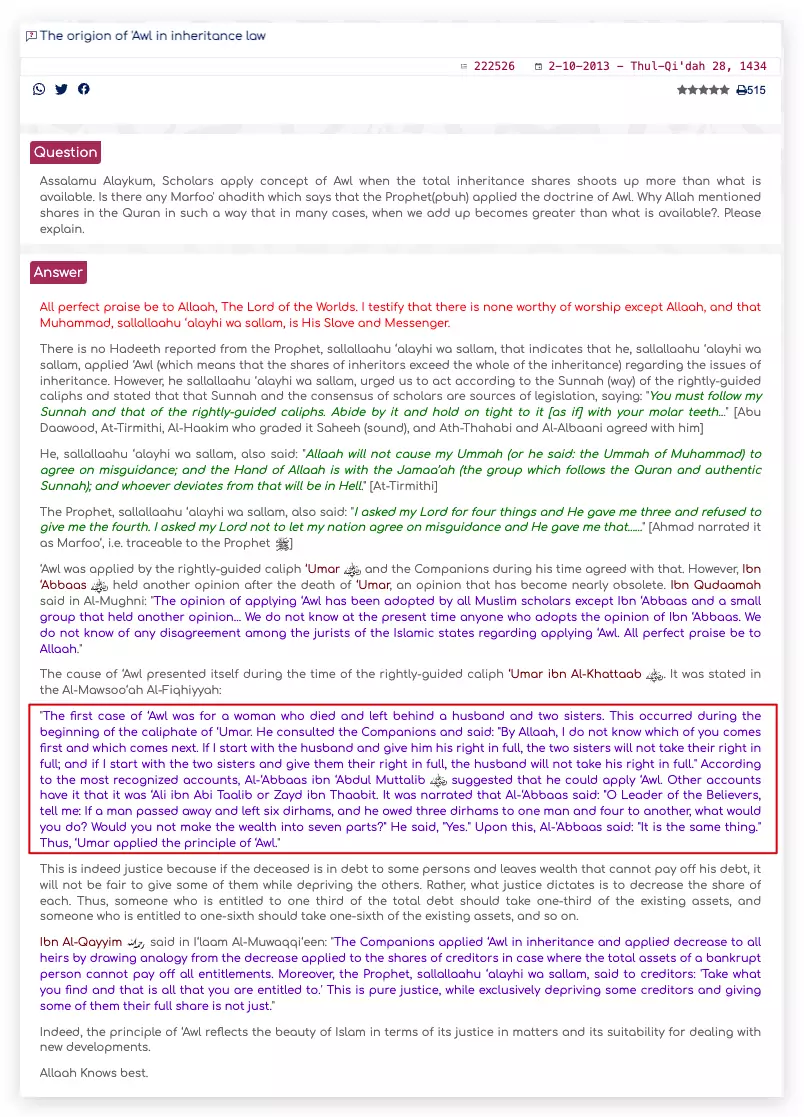
The origion of ‘Awl in inheritance law
222526
2-10-2013 – Thul-Qi’dah 28, 1434
515
Question
Assalamu Alaykum, Scholars apply concept of Awl when the total inheritance shares shoots up more than what is available. Is there any Marfoo’ ahadith which says that the Prophet(pbuh) applied the doctrine of Awl. Why Allah mentioned shares in the Quran in such a way that in many cases, when we add up becomes greater than what is available?. Please explain.
Answer
All perfect praise be to Allaah, The Lord of the Worlds. I testify that there is none worthy of worship except Allaah, and that Muhammad, sallallaahu ‘alayhi wa sallam, is His Slave and Messenger.
There is no Hadeeth reported from the Prophet, sallallaahu ‘alayhi wa sallam, that indicates that he, sallallaahu ‘alayhi wa sallam, applied ‘Awl (which means that the shares of inheritors exceed the whole of the inheritance) regarding the issues of inheritance. However, he sallallaahu ‘alayhi wa sallam, urged us to act according to the Sunnah (way) of the rightly-guided caliphs and stated that that Sunnah and the consensus of scholars are sources of legislation, saying: “You must follow my Sunnah and that of the rightly-guided caliphs. Abide by it and hold on tight to it [as if] with your molar teeth…” [Abu Daawood, At-Tirmithi, Al-Haakim who graded it Saheeh (sound), and Ath-Thahabi and Al-Albaani agreed with him]
He, sallallaahu ‘alayhi wa sallam, also said: “Allaah will not cause my Ummah (or he said: the Ummah of Muhammad) to agree on misguidance; and the Hand of Allaah is with the Jamaa’ah (the group which follows the Quran and authentic Sunnah); and whoever deviates from that will be in Hell.” [At-Tirmithi]
The Prophet, sallallaahu ‘alayhi wa sallam, also said: “I asked my Lord for four things and He gave me three and refused to give me the fourth. I asked my Lord not to let my nation agree on misguidance and He gave me that……” [Ahmad narrated it as Marfoo‘, i.e. traceable to the Prophet sallallaahu `alayhi wa sallam ( may Allaah exalt his mention )]
‘Awl was applied by the rightly-guided caliph ‘Umar may Allaah be pleased with him and the Companions during his time agreed with that. However, Ibn ‘Abbaas may Allaah be pleased with him held another opinion after the death of ‘Umar, an opinion that has become nearly obsolete. Ibn Qudaamah said in Al-Mughni: “The opinion of applying ‘Awl has been adopted by all Muslim scholars except Ibn ‘Abbaas and a small group that held another opinion… We do not know at the present time anyone who adopts the opinion of Ibn ‘Abbaas. We do not know of any disagreement among the jurists of the Islamic states regarding applying ‘Awl. All perfect praise be to Allaah.”
The cause of ‘Awl presented itself during the time of the rightly-guided caliph ‘Umar ibn Al-Khattaab may Allaah be pleased with him. It was stated in the Al-Mawsoo’ah Al-Fiqhiyyah:
“The first case of ‘Awl was for a woman who died and left behind a husband and two sisters. This occurred during the beginning of the caliphate of ‘Umar. He consulted the Companions and said: “By Allaah, I do not know which of you comes first and which comes next. If I start with the husband and give him his right in full, the two sisters will not take their right in full; and if I start with the two sisters and give them their right in full, the husband will not take his right in full.” According to the most recognized accounts, Al-‘Abbaas ibn ‘Abdul Muttalib may Allaah be pleased with him suggested that he could apply ‘Awl. Other accounts have it that it was ‘Ali ibn Abi Taalib or Zayd ibn Thaabit. It was narrated that Al-‘Abbaas said: “O Leader of the Believers, tell me: If a man passed away and left six dirhams, and he owed three dirhams to one man and four to another, what would you do? Would you not make the wealth into seven parts?” He said, “Yes.” Upon this, Al-‘Abbaas said: “It is the same thing.” Thus, ‘Umar applied the principle of ‘Awl.”
This is indeed justice because if the deceased is in debt to some persons and leaves wealth that cannot pay off his debt, it will not be fair to give some of them while depriving the others. Rather, what justice dictates is to decrease the share of each. Thus, someone who is entitled to one third of the total debt should take one-third of the existing assets, and someone who is entitled to one-sixth should take one-sixth of the existing assets, and so on.
Ibn Al-Qayyim may Allaah have mercy upon him said in I‘laam Al-Muwaqqi‘een: “The Companions applied ‘Awl in inheritance and applied decrease to all heirs by drawing analogy from the decrease applied to the shares of creditors in case where the total assets of a bankrupt person cannot pay off all entitlements. Moreover, the Prophet, sallallaahu ‘alayhi wa sallam, said to creditors: ‘Take what you find and that is all that you are entitled to.’ This is pure justice, while exclusively depriving some creditors and giving some of them their full share is not just.”
Indeed, the principle of ‘Awl reflects the beauty of Islam in terms of its justice in matters and its suitability for dealing with new developments.
Allaah Knows best.
Translation:
All perfect praise is for Allah, the Lord of the worlds. I testify that there is none worthy of worship except Allah, and that Muhammad (peace and blessings be upon him) is His servant and Messenger.
No sahih hadith has narrated that the Prophet (peace and blessings be upon him) applied ‘Awl in matters of inheritance (that is, when the shares of the heirs exceed the total estate). However, he (peace and blessings be upon him) instructed us to follow the Sunnah of the rightly guided caliphs and stated that their Sunnah and the consensus of scholars are sources of Sharia. He said: “You must follow my Sunnah and the Sunnah of the rightly guided caliphs. Hold firmly to it, as though you were clinging to it with your molar teeth…” [Abu Dawood, Tirmidhi, al-Hakim, who declared it sahih, and Imam al-Dhahabi and Shaykh al-Albani agreed with him].
He also said: “Allah will not allow my ummah (or, as he said, the ummah of Muhammad) to unite upon misguidance; Allah’s help is with the Jama‘ah; and whoever deviates from it will remain in Hell.” [Tirmidhi]
He also said: “I asked my Lord for four things, of which He granted me three and refused me one. I asked my Lord not to let my nation agree upon misguidance, and He granted me that…” [Ahmad narrated this as marfu‘, meaning that it is attributed to the Prophet (peace and blessings be upon him)].
‘Awl was first applied during the rule of the rightly guided caliph Umar (may Allah be pleased with him), and the Companions of that time agreed with it. However, Ibn Abbas (may Allah be pleased with him) held a different opinion after Umar’s death, which later became nearly extinct. Ibn Qudamah stated in Al-Mughni: “The opinion that ‘Awl should be applied has become universally accepted among Muslim jurists, except for Ibn Abbas and a small group… At present, we do not know of anyone who follows Ibn Abbas’s opinion. There is no disagreement among the jurists of the Islamic states regarding the application of ‘Awl. All perfect praise is for Allah.”
The first application of ‘Awl occurred during the rule of Caliph Umar ibn al-Khattab (may Allah be pleased with him). Al-Mawsu‘ah al-Fiqhiyyah states:
“The first case of ‘Awl occurred when a woman died leaving behind a husband and two sisters. This happened at the beginning of Umar’s caliphate. He consulted the Companions and said, ‘By Allah, I do not know who should come first and who should come next. If I give the husband his full right first, the two sisters will not receive their full right; and if I give the two sisters their full right first, the husband will not receive his full right.’ According to the most widely accepted account, al-Abbas ibn Abd al-Muttalib (may Allah be pleased with him) advised him to apply ‘Awl.”
‘Awl is a symbol of Islam’s justice and an appropriate solution for dealing with new circumstances.
Allah knows best.
Zakir Naik’s Failed Attempt to Defend the Doctrine of ‘Awl
The BODMAS argument in the Zakir Naik style is not actually a solution to the problem; rather, it is an extremely weak tactic for concealing the problem—or, more accurately, a shameless falsehood. The Quranic inheritance verses are not an algebraic equation in which the wrong answer results from not knowing the order of brackets, division, multiplication, addition, and subtraction. The matter here is extremely simple: the Quran declares specific fractions for specific heirs. If the wife’s 1/8, the father’s 1/6, the mother’s 1/6, and the share of two or more daughters, 2/3, are portions of the deceased’s total estate, then their sum cannot possibly exceed 1 or 100%. Yet when added in practice, they amount to 1/8 + 1/6 + 1/6 + 2/3 = 27/24, or 112.5%. Invoking BODMAS here is mere rhetoric; it is not an answer to the mathematical objection.
Let us hear Zakir Naik’s statement, in which he attempts to cover up the issue through outright falsehood. Full video transcript:
Brother has posed the question that according to Arun Shourie, in the Qur’an, in chapter 4, verses 11 and 12, if you add up the different parts of inheritance given to the heirs, the sum total becomes more than one. Therefore, Arun Shourie claims that the author of the Qur’an does not know mathematics.
As I mentioned in my talk, there are hundreds of people who have tried to find faults in the Qur’an. But if you analyze all of them, they are not true. None of them are true. Not a single one is true.
Regarding inheritance, the Qur’an speaks about inheritance in several places: in Surah Al-Baqarah, chapter 2, verse 180; Surah Al-Baqarah, chapter 2, verse 240; Surah An-Nisa, chapter 4, verse 9; Surah An-Nisa, chapter 4, verse 19; Surah Al-Ma’idah, chapter 5, verse 105; and in several other places.
But regarding the detailed explanation of the shares, it is mentioned in the Qur’an in Surah An-Nisa, chapter 4, verses 11 and 12, and in Surah An-Nisa, chapter 4, verse 176.
Regarding the translation of the verses quoted by Arun Shourie, that is Surah An-Nisa, chapter 4, verses 11 and 12, it says that regarding the shares of inheritance for your children, the male gets a share equal to that of two females. If there are only daughters, two or more, they share two-thirds. If there is only one daughter, she gets half.
The verse continues: regarding the parents, each gets one-sixth if the deceased has children. If there are no children, then the mother gets one-third, after payment of legacies and debts.
Verse 12 says that regarding what your wives leave, you get half if there are no children, and one-fourth if there are children, after payment of debts and legacies. Regarding what you leave for your wives, they get one-fourth if there are no children, and one-eighth if there are children.
It may sound confusing. Do not get confused; you can go home and refer to it.
In short, in verse 11 of Surah An-Nisa, chapter 4, the first share mentioned is that of the children, then of the parents, and later in verse 12 it gives the share of the spouses.
Now regarding inheritance, Islam speaks in great detail. The Qur’an only gives the basic outline. For the details, you have to refer to the hadith. A person can spend his full life only doing research on inheritance, and Arun Shourie expects to know about this just by quoting two verses.
It is somewhat similar to a person who wants to solve an arithmetic equation but does not know basic arithmetic. That is bad mathematics.
According to the rule of BODMAS, irrespective of whichever arithmetic sign comes first or last, first you have to solve the brackets, then division, then multiplication, then addition, and then subtraction. If you do not know the rule of BODMAS and you first do subtraction, then multiplication, then addition, and then solve the brackets, you will surely get the answer wrong.
In the same way, Arun Shourie himself does not know mathematics, because according to Islamic law for the division of inheritance, the first share goes to the spouses and the parents. After that, whatever remains is shared between the children.
If you follow this rule, the sum total can never be more than 100 percent.
Let us watch the video,
“First give the husband/wife and parents their shares, then give the remaining property to the children”—this argument also directly nullifies the shares declared by the Qur’an. Because the Qur’an did not say to give the daughters “whatever remains”; it said that if there are two or more daughters, they will receive 2/3. Now, in the example of a wife, father, mother, and two daughters, if the wife, father, and mother are given their shares first, 13/24 remains. But according to the Qur’an, the daughters are supposed to receive 16/24. So the question is clear: will the daughters receive the Qur’anic 16/24, or the 13/24 salvaged by the apologists? If they receive 16/24, the total property becomes 27/24. And if they receive 13/24, then the Qur’an’s 2/3 share becomes false. There is no honest way to escape this contradiction.
The most ridiculous aspect of this argument is that—in trying to conceal the mathematical error—the apologists themselves end up admitting that the Qur’an’s fractions cannot be applied directly. They say that the Qur’an provided a “basic outline” and that the details are found in fiqh. But the allegation is not about the books of fiqh; it is about the Qur’an’s specific numbers. If an omniscient God specifies 1/8, 1/6, 1/6, and 2/3, then adding those numbers should not produce 112.5%. Umar, the jurists, the legal schools, or Awl may later reduce it to 100%—but that is not a solution to the original mathematical inconsistency; it is a subsequent human patch to the original problem.
Thus, the BODMAS argument is an obvious red herring and category error. It transforms a question about inheritance mathematics into a question about the order of arithmetic operations, as though the audience should forget the actual problem. The real problem remains exactly where it was: the fixed shares given by the Qur’an exceed the total property in certain cases. No matter how often the apologists use the words “sequence,” “fiqh,” “hadith,” “basic outline,” or “deep knowledge,” 27/24 never equals 1. Property cannot be distributed as 112.5%. This simple truth dismantles the entire apologetic framework.
The Statement of Salafi Scholar Asim
Now let us examine the statement of a prominent Salafi scholar, Asim. His main statement:
So my question was about inheritance in the Qur’an, specifically the ratios. I know this is mentioned in Surah An-Nisa, verse 11, but many non-Muslims are saying that this verse is an example of a mistake in the Qur’an.
For example, they give a case where a man dies with one hundred dollars and leaves behind a wife, three daughters, and parents. The shares would be one-eighth to the wife, two-thirds to the daughters, and one-sixth to each of the parents. But when you add these up, they do not equal one hundred dollars. They become more than one hundred percent, so we would need to give one hundred and twelve and a half dollars.
So my question is: how would such a situation be solved, and how can we respond to people who say this is a mistake?
First of all, we address the non-Muslims and say to them: is this the only mistake you found in the whole of Islam? Eureka! That is good. That is fine. And we will have an answer for that as well.
But if it is the only mistake, would it be logical that the 99.9 percent which is all correct, valid, and foolproof would be covered and overwhelmed by this single mistake that your minds could not comprehend?
Or, if we look at your own religion and find that it is 75 percent filled with errors, or even 60 percent filled with errors and 40 percent correct, what logic and what ratio are you talking about?
What you have mentioned, along with other cases in the laws of inheritance, is solved by, if I am not mistaken, the word “awl.” It means recalculating the percentages, because this is an offshoot—something that is not normal or regular.
So they deduct proportionally from all the parties so that the shares would be equivalent and the ratio would remain the same. This is a correction that the Companions did, may Allah be pleased with them, and they never doubted the Qur’an or the Sunnah. The Tabi‘in and Muslims for fifteen centuries have been applying it. It is not something new.
It is also found in some cases when the wife and the parents are left, or when the husband and the parents are left; when the wife dies or the husband dies. There is also a form of correction between the ratio of the father and the mother of the deceased, where it should have been different.
This is all fixed and known by the Companions, and there is consensus among the Companions and the Muslims regarding fixing this ratio. So there is no mistake.
And again, we say to the non-Muslims: is this the only thing you found wrong in the Shariah? Alhamdulillah. The other overwhelming correct, logical, fair, and just rules of Shariah should overwhelm this thing that your head could not comprehend.
Let us watch the video,
This scholar’s statement immediately displays a clear fallacy: “Is this the only mistake you have found in all of Islam?”—this is not an answer; it is a tactic for evading the question. Even if 99 claims in a system are correct, a mathematical error in one specific claim remains an error. Mathematics is not decided by majority vote. If 1/8 + 2/3 + 1/6 + 1/6 = 27/24, then it does not equal 1; it equals 112.5%. Therefore, “everything else is correct” or “your religion has more errors”—these are tu quoque and red herring arguments. They do not refute the central problem in the inheritance mathematics even slightly.
Rather, the speaker’s most important admission is that he himself said, the solution to this problem is “Awl”—that is, recalculating the percentages and proportionally reducing everyone’s share. This is the real point. If the fractions declared by the Qur’an were inherently perfect and directly applicable, there would be no need later for “recalculating the percentages.” If it says that the wife will receive 1/8 but in practice she receives 1/9, or that the daughters will receive 2/3 but in practice receive less, these are not interpretations; they are numerical corrections. By using the word “correction,” the scholar has unwittingly strengthened the original allegation.
“The Companions did it,” “the Tabi‘in did it,” “Muslims have been doing it for fifteen centuries,” and “there is consensus”—none of these is an answer to the mathematical problem. Tradition cannot alter a fraction. Even if someone calls 27/24 equal to 1 for a thousand years, 27/24 never becomes 1. Historically, Muslim jurists used the Awl method—this proves that a practical legal patch was created. But it does not prove that the original Qur’anic fractions were mathematically consistent. Rather, the necessity of Awl shows that the shares specified directly by the verses cannot be applied together in certain real-world cases.
The weakest part is the speaker’s final claim—“your head could not comprehend it.” This is not an argument; it is arrogant hand-waving. No complicated fiqh is needed to understand the problem; knowing how to add ordinary fractions is sufficient. If the Qur’an assigns specific shares to specific heirs, the sum of those shares cannot exceed the total property. And if it does exceed it, there are two options: either the Qur’anic shares must be reduced, or one must produce the impossible figure of 112.5% of the property. Awl takes the first option—that is, it reduces the shares declared by the Qur’an in practice. Thus, this statement does not refute the Qur’an’s inheritance problem; rather, it itself admits that the problem cannot be resolved without a fiqh-based “correction.”
Even more noteworthy is that, in the middle of his statement, this scholar himself admits the essential truth: this was “a correction that the Companions did”—that is, the Companions made a correction. This admission alone destroys the entire apologetic argument. For if the Qur’an’s inheritance calculations had been perfect, complete, and mathematically consistent from the outset, there would have been no need for the Companions to make a “correction.” The word correction itself proves that applying the original rule directly was creating a problem, and that a subsequent human legal method was used to resolve it. The argument that it is not wrong because the Companions did it is absurd; rather, the fact that the Companions had to make a correction shows that the Qur’anic fractions could not stand on their own in certain real-world cases. A correction is needed precisely when directly applying the original rule does not produce a workable result.
The Mathematical and Legal Crisis of Awl
The inheritance shares described in the Qur’an’s Surah An-Nisa become mathematically inconsistent in certain cases; that is, the sum of the specified shares exceeds 1 or 100%. In other words, in certain cases, the sum of the shares due exceeds 1 or 100%. For example: if a deceased person leaves a husband and two sisters, the shares are:
Mathematically, it is impossible to distribute more than 1 whole of the property. To remedy this error, Caliph Umar introduced the ‘Awl’ method, which is essentially a mathematical rescaling (Rescaling). However, applying it requires changing the Qur’an’s precise fractions [7].
The fundamental principle of Islamic law is— “la ijtihada fi mawrid al-nass”. Where there is a clear Qur’anic directive, no kind of alteration or reasoning can be applied. Applying the ‘Awl’ method means—out of practical necessity, correcting the Qur’an’s ‘nass’ or incontrovertible ruling. This indirectly acknowledges that the mathematical design of the original text is not applicable.
Allah’s Ruling or Umar’s Ruling?
The ruling introduced during Hazrat Umar’s reign is clearly a separate ruling from the Qur’anic ruling given by Allah. So which ruling will a believing Muslim follow: Allah’s ruling or Umar’s ruling? Let us hear a statement by Ahmadullah,
What the Qur’anic Verse Would Have Looked Like If It Were Perfect
📖 Surah An-Nisa: Verse 11 – Original Translation (Summary)
“Allah instructs you concerning your children: the share of the male is twice that of the female. If there are only daughters, two or more, they shall receive two-thirds of the total property. If there is one daughter, she shall receive half. If the deceased’s parents are alive: each shall receive one-sixth if he has a child. If he has no child and his parents are the heirs, the mother shall receive one-third; but if the deceased has brothers and sisters, the mother shall receive one-sixth…” and so on.
Here, different shares are assigned in different situations, and in multiple places the sum of the fractions becomes greater or less than 1. The question is—is it actually possible to write a ruling that avoids this problem, in which the sum would be mathematically provably exactly 1 for every possible family combination—without any subsequent “Awl” or “Radd” patch? The answer is yes, and at least two distinct design philosophies were possible. Both are shown below, and each is tested against the previously discussed problematic cases (husband + two sisters, wife + parents + two daughters, and Abul Mia’s case).
✅ Design A: Priority-Residual Model (fixed shares, then the remainder)
The principle of this model is simple: the heirs will be divided into two tiers.
- Tier 1 (Fixed-Share Heirs): Husband/wife and parents—their shares will always be deducted directly and irrevocably from the total estate.
- Tier 2 (Residuaries): Children (or siblings if there are no children)—they will receive exactly whatever remains after Tier 1 has been deducted. The “two-thirds” or “one-half” figures mentioned in the Quran would then serve as an expected guideline, not an absolute guarantee.
If the verse had been written as follows:
“The share of the husband or wife and the share of the parents shall always be determined directly from the entire distributable estate. Thereafter, whatever remains shall be distributed among the children—the son shall receive twice the share of the daughter. If there are no children, the remainder shall be distributed among the siblings according to the same principle.”
Then the calculation would be as follows:
Case 1 — Husband + two sisters (no brother):
Husband (Tier 1) = 1/2. Sisters (Tier 2, remainder) = 1 − 1/2 = 1/2.
Total = 1/2 + 1/2 = 1 ✓
(The sisters would in practice receive 1/2 here instead of “two-thirds,” but no overflow would arise, and there would be no need for Umar to later reduce the figures—the rule itself would be consistent from the outset.)
Case 2 — Wife + parents + two daughters:
Tier 1: wife 1/8 (= 3/24), father 1/6 (= 4/24), mother 1/6 (= 4/24). Total Tier 1 = 11/24.
Tier 2 (daughters): remainder = 24/24 − 11/24 = 13/24.
Total = 11/24 + 13/24 = 1 ✓
Case 3 — Abul Mia (parents + wife + three daughters, estate of 100 taka):
Tier 1: parents 1/3 = 33.33 taka, wife 1/8 = 12.50 taka. Total = 45.83 taka.
Tier 2: daughters’ remainder = 100 − 45.83 = 54.17 taka.
Total = 100 taka, exactly equal to the estate he left behind ✓; no deficit or surplus arises.
The notable point is that, in this model, the Tier 1 heirs (husband/wife and parents) always receive their full, unchanged shares—a guaranteed floor (floor) is maintained for them. The children, however, have no guaranteed minimum; their shares fluctuate depending on the circumstances.
✅ Design B: Explicit Weight-Normalization Model
In the second design, each heir category will be assigned a specific weight (weight), rather than a direct fraction. The final share will be determined by the following formula:
Final share = (one’s own weight) ÷ (sum of the weights of all heirs present)
Under this formula, the total will always, automatically, and by the rules of algebra equal 1—this is not a subsequent correction, but an intrinsic property of the formula.
If the verse had been written as follows:
“Allah has assigned each heir a relative share-number (nisab). At the time of actual distribution, the nisabs of the heirs present must be added together, and each heir’s nisab must be divided by that total to determine the actual share, so that the total distribution equals the entire estate—neither less nor more.”
Let us assume a weight table derived from the original fractions (with the denominators normalized):
| Heir | Weight |
|---|---|
| Husband | 12 |
| Wife (if there are children) | 3 |
| Father | 4 |
| Mother | 4 |
| Two+ daughters (together) | 16 |
| Two+ sisters (together) | 16 |
Case 1 — Husband + two sisters:
Weights: husband 12, sisters 16. Total weight = 28.
Husband = 12/28 = 3/7, sisters = 16/28 = 4/7. Total = 1 ✓
(Note these figures—this is exactly the result of applying Awl in the Sunni madhhab, 3/7 and 4/7. The only difference is that here the figure results from a formula declared from the outset, rather than from Umar’s subsequent human correction.)
Case 2 — Wife + parents + two daughters:
Weights: wife 3, father 4, mother 4, daughters 16. Total = 27.
Wife = 3/27, father = 4/27, mother = 4/27, daughters = 16/27. Total = 27/27 = 1 ✓
In this model, no one has a guaranteed floor—everyone is adjusted proportionally, whatever the circumstances may be.
Significance of the Two Designs
Both designs prove that it would have been entirely possible to write a text that never exceeded 1 and that would never have required the later invention of a correction such as “Awl” or “Radd.” And the most important observation here is that Design A arrives at exactly the solution of Ibn Abbas and later Shia fiqh, while Design B arrives at exactly Umar’s Awl. In other words, the two rival fiqh solutions that emerged in history are actually implementations of these two different underlying design philosophies—neither of which was explicitly declared anywhere in the original Quranic text.
This is where the central argument assumes its strongest form. If the Quranic text itself had declared a specific, clear mathematical design principle (either “fixed share + remainder” or “weight ratio”), then no such dilemma would have arisen among the Companions during Umar’s time, there would have been no need for Ibn Abbas’s opposition, and no such fundamental division would have developed in Shia-Sunni fiqh. The problem could have been solved simply by analyzing a few case studies in depth before issuing the ruling. The supposedly perfect ruling in the greatest perfect book of the omniscient Allah would not have required human correction. What happened in reality is that the original ruling did not choose a single design principle; people themselves had to make that choice later—and two different human groups arrived at two different choices. When this synthesis is considered together with the discussion of Shia fiqh below, it further strengthens the article’s central claim.
Shia (Imamiyyah) Fiqh and the Rationale for Rejecting ‘Awl
In resolving the mathematical complexity of Islamic inheritance law, the position of the Shia or Imamiyyah madhhab is extremely uncompromising; it directly rejects the principle of ‘Awl’ (Awl) introduced by Caliph Umar. According to Shia jurists, since Allah is omniscient, it is impossible for His law to contain a mathematical error in which the sum of the shares exceeds 1. They hold that reducing everyone’s share proportionally by the same ratio (as the Sunnis do) essentially amounts to violating the ‘nass’ or definitive ruling that specifies Allah’s exact shares.
The Method of Covering the Deficit: Assigning Responsibility to Specific Heirs
According to Shia fiqh, when the sum of the heirs’ shares exceeds 1, the shares of everyone are not reduced; instead, the excess amount is deducted only from the shares of certain heirs (such as daughters or sisters). The Shia argument is that heirs can be divided into two categories:
- Fixed Heirs (Fixed Heirs): Those whose shares cannot under any circumstances fall below the limits assigned by Allah (such as the mother, father, husband, or wife).
- Variable heirs (Variable Heirs): Those whose shares may decrease under particular circumstances (e.g., daughters or sisters).
Mathematical example:
If a deceased person leaves behind a father, mother, wife, and two daughters, the Quranically declared shares are:
Here, because the sum exceeds 1, Sunnis increase the denominator 24 to 27 through the ‘awl method. Under the Shiite method, the father, mother, and wife receive their full shares. Whatever remains goes to the two daughters. In other words, 3 parts will be deducted from the daughters’ prescribed or share, leaving them with .
The Reasoning of Imam Ali and Ibn Abbas
The Shiites use the reports of Hazrat Ali and Abdullah ibn Abbas as a shield in support of this method. Ibn Abbas placed the mathematical responsibility of this problem not directly on the text, but on determining human priorities. He would say:
“He who can count the grains of desert sand surely knew that the shares could not exceed 1.” [8]
Analyzing this Shiite interpretation reveals that they employ a kind of ‘priority logic’ to conceal the mathematical error in the text. However, this also indirectly proves that the Quran’s literal fractions (such as 2/3 or 1/2) rest not on any miraculous mathematical balance, but on an administrative compromise—in which the Shiites restore balance by reducing the daughters’ shares, while the Sunnis restore balance by reducing everyone’s shares [9].
This division clearly proves that the Quran’s mathematical design is not self-contained; if it were self-contained, such a fundamental disagreement would not have arisen between Shiites and Sunnis in the post-Prophetic era over whose share should be reduced. The Shiite position is essentially just another human attempt to correct the Quran’s error through ‘awl.
The Fallacy of the ‘Relative Rights’ or Proportionality Theory
When the sum of the specified fractions in Quranic inheritance law exceeds 1, or 100% of the total estate, some Islamic apologists present a new safeguard. They argue that the shares of 1/2, 1/4, 1/8, 1/6, or 2/3 mentioned in the Quran are supposedly not the final or absolute shares of the deceased person’s total estate; rather, they are merely the heirs’ mutual “relative rights” or “proportions.” Therefore, when the total exceeds 1 in practice, proportionally reducing everyone’s shares through the ‘awl method supposedly does not contradict the Quran.
Although this argument may sound clever, in reality it is a clear post hoc rationalization—that is, an explanation devised after the error was discovered in order to defend it. The Quran’s language, the history of fiqh, the reactions of the Companions, and basic mathematical reasoning all undermine this theory of “relative proportions.” The reason is that the Quran nowhere says, “The wife’s share is such-and-such compared with the daughters’ share,” or “The mother’s share is such-and-such in proportion to the sisters’ share.” Instead, the Quran directly assigns specific fractions to what the deceased person has left behind. This is precisely where the backbone of the apologists’ proportionality theory breaks.
The Phrase “مِمَّا تَرَكَ”: The Shares Are Applied to the Total Estate
When specifying the heirs’ shares in verses 11 and 12 of Surah Nisa, the text repeatedly says—مِمَّا تَرَكَ or مَا تَرَكَ, meaning “from what he left behind.” This phrase is extremely important because it makes clear that the basis of the specified fractions is the deceased person’s estate—not another heir’s entitlement, nor any abstract mutual proportion. [10]
For example, the Quran says that if there are more than two daughters, they will receive two-thirds of what the deceased person has left behind. In the case of wives, it says that if there are children, they will receive one-eighth of what the deceased person has left behind. Here, the language is directly estate-based. The phrase “what he left behind” refers to the deceased person’s total estate. If the Quran’s intention had truly been only to convey mutual proportions, the wording would have been different—for example, “The wife’s share is such-and-such compared with the daughters’ share,” or “The mother’s share is such-and-such compared with the father’s share.” But the Quran does not say this.
Therefore, the claim that “these are not absolute shares but relative proportions” contradicts the Quran’s own sentence structure. When a fraction is placed directly upon “what the deceased person has left behind,” it must be understood as a share of the total estate. Calling it a “proportion” after the calculation fails to add up is not a linguistic interpretation; it is an artificial strategy for saving the text.
Direct Conflict with ‘Hudud Allah’ or the Limits Set by Allah
Immediately after these verses on inheritance distribution, verses 13 and 14 of Surah Nisa state, “These are the limits set by Allah”—تِلْكَ حُدُودُ اللَّهِ. In other words, the Quran itself declares these rules to be limits established by Allah. [11]
Now the question is: if a share is genuinely a limit established by Allah, how can it be reduced through the human-created ‘awl method? If the Quran gives the wife 1/8, but after applying ‘awl the wife actually receives 1/9, then the 1/8 share is no longer operative. If the Quran gives two daughters 2/3, but after ‘awl they receive 16/27, then the 2/3 share has likewise been nullified in practice. Nominally, it is said that the Quran is being followed, but in practice the Quran’s numbers are being changed.
The problem here is straightforward. If a limit decreases according to circumstances, then it is not a fixed limit. If 1/8 becomes 1/9 under pressure, and 2/3 becomes 16/27 under pressure, then it is meaningless to call these “inviolable limits set by Allah.” If a limit can be stretched and altered like rubber, it is not a limit; it is merely an approximate guideline subject to correction according to human convenience. Yet the Quran itself does not call these shares approximate guidelines—it calls them rules established by Allah. This is where a fundamental contradiction arises between ‘awl and the concept of “Hudud Allah.”
The Companions’ Confusion Proves That They Understood These as Absolute Shares
If the Quranic fractions had naturally been understood as “relative proportions” within Arab language and legal culture, then no confusion should have arisen when this problem appeared during the caliphate of Umar. The Companions present could simply have said: these are proportions, so when their total exceeds 1, they can be reduced while preserving the proportions. But historical accounts show that the matter was not so simple. Umar himself was perplexed by the problem and sought the Companions’ advice.
The substance of Umar’s statement was this: Allah had prescribed one-half for the husband and two-thirds for the two sisters; now, if the husband was given his share first, the two sisters would not receive their full shares, while if the two sisters were given their shares first, the husband would not receive his full share. He therefore sought the Companions’ advice on how the distribution should be carried out. [12]
This incident is itself powerful historical evidence against the apologists’ theory of “relative proportions.” If the fractions had been understood as proportions from the outset, Umar’s dilemma would not have arisen. Nor would the Companions’ discussion have been necessary. Ibn Abbas’s opposition would likewise have been meaningless. In reality, this debate shows that they understood the Quranic shares as absolute, specified, and binding shares. The problem arose because applying the Quran’s specified shares together did not leave enough property mathematically.
Therefore, ‘awl was not a predetermined Quranic method; it was a later human adjustment. And the need for a human adjustment itself proves that the original rule contained a practical problem that the Quran did not resolve on its own.
Mathematically, a “Fraction” and a “Proportion” Are Not the Same Thing
The apologists’ greatest maneuver is to conflate fractions and proportions. But in mathematics, a fraction and a proportion are not the same thing. When it is said that someone will receive 1/2 of the total estate, someone else 1/6, and another person 1/8, these are shares of 1, or of the entire estate. When added together, these shares must not exceed 1. If the sum exceeds 1, it means that a claim has arisen to distribute more property than the deceased person left behind. This is not a problem of proportions; it is a problem of calculation.
If an omniscient being had truly intended only to convey proportions, it could have used the language of proportions directly. For example, saying, “In this situation, the proportions for the wife, the parents, and the daughters will be 3:8:16” would have created no mathematical problem. But the Quran does not do this. It gives specific fractions, and in certain real cases those fractions exceed 1. Recasting those fractions as proportions after the fact does not eliminate the fundamental problem; rather, it shows that the plain meaning of the text cannot be preserved.
A single example makes the matter clear. If a deceased person leaves behind a wife, parents, and two daughters, the wife receives 1/8, the parents together receive 1/3, and the two daughters receive 2/3. The total is: 1/8 + 1/3 + 2/3 = 27/24. In other words, in an estate divided into 24 shares, claims totaling 27 shares are being created. Under the Sunni ‘awl system, 24 is then converted into 27 and the shares are reduced. As a result, the wife no longer receives 1/8; she receives 3/27 or 1/9. The shares of the parents and daughters are likewise reduced from their Quranically prescribed fractions.
Here, the theory of “relative proportions” offers no solution. The shares that existed in the Quran before the application of ‘awl no longer remain the same after its application. In other words, the actual distribution does not correspond to the Quranic figures. The straightforward conclusion, therefore, is that either the Quranic fractions are mathematically insufficient for all real-life situations, or applying ‘awl changes the specified Quranic shares. In either case, the claim that “the Quranic law of inheritance is perfect” cannot stand.
Final remarks: Calling an error relativity does not make the error correct
The primary purpose of the theory of “relative entitlement” is to conceal the Quran’s mathematical problem behind a play on language. But this strategy fails. The Quranic language assigns specific shares of the deceased person’s total estate; the subsequent verses declare those shares to be the limits set by Allah; the historical debates among the Companions show that they understood these as real and absolute shares; and the mathematics shows that, in some cases, these shares generate claims exceeding the total estate.
Thus, ‘awl is not an “extraordinary mathematical insight”; it is a later human patch. The theory of “relative proportions” is merely an attempt to present that patch as theologically valid. Giving an error the name “relativity” does not make the error correct. Rather, it makes even clearer that the Quranic law of inheritance was not designed with sufficient perfection to handle real-world complexities, and that human-made corrective procedures had to be relied upon to keep it operational.
The fallacy of the creditor-bankrupt analogy: inheritance law is not debt adjustment
Islamic apologists use another popular analogy to make the ‘awl method appear legitimate. They say that if the assets of a deceased or bankrupt person are insufficient to repay all debts, each creditor’s claim is reduced proportionally. One creditor is not paid in full by depriving another. Therefore, if the total of the prescribed shares of heirs exceeds the total estate, it is justifiable to reduce everyone’s share proportionally. This is the very argument presented in an IslamWeb fatwa, where ‘awl is presented as “justice” and as an expression of Islam’s beauty by comparing the reduction of heirs’ shares with creditors’ claims. [13]
But this analogy is essentially a false analogy—a mistaken comparison. The claims of creditors and Quranic inheritance shares are not matters of the same kind. Debt arises from transactions between people. Someone borrows, someone lends, one person is owed more, and another is owed less. It may later become apparent that the debtor’s assets are insufficient to repay all the debts. In that case, the shortfall in assets is the debtor’s economic inability, not a mathematical error by the lawmaker. But Quranic inheritance shares are not claims arising from human transactions; they are shares prescribed, according to the Quran’s claim, by the all-knowing Allah. Treating these two situations as equivalent is therefore a logically dishonest comparison.
In the case of a bankrupt person’s debts, the problem is that the actual assets are less than the total claims arising from the debts. But in the case of inheritance law, the problem is deeper. No person has voluntarily created an excessive claim; rather, the Quran itself has declared specific fractions for different heirs. When those fractions are added together, they exceed the total estate in some cases. In other words, the problem lies not in the heirs’ claims but in the mathematical construction of the law. A bankrupt person leaving behind insufficient assets is a form of real economic crisis; but a law proclaimed in Allah’s name generating instructions to distribute more than 1 as a whole is a mathematical crisis within the law’s formulation.
The creditor analogy also fails for another reason. In the case of creditors, each person’s claim is not predetermined as a specific fraction of the total assets. One person may be owed 300 taka, another 400 taka, and another 500 taka. If the total assets later turn out to be only 800 taka, everyone’s claim is reduced proportionally because of the material circumstances. But the Quranic law of inheritance states that one person will receive 1/2, another 1/6, another 1/8, and another 2/3. These are declared directly as shares of the total disposable estate. Therefore, reducing them later is not an adjustment of claims; it is a change to the declared fractions.
The apologists’ strategy is clear here. They introduce an analogy involving a human crisis in which insufficient assets are normal and a proportional reduction among creditors is realistic. They then extend that analogy to conceal the Quran’s mathematical inconsistency. But comparing the law of an all-knowing being with the accounts of a bankrupt person inadvertently exposes the central problem even more starkly. A bankrupt person does not know the future, cannot control the amount of assets, and does not have the capacity to repay all debts. But if Allah is described as all-knowing, all-powerful, and the best of lawmakers, then the inheritance law given by Him should have been formulated so that the total shares would never exceed 1 under any real circumstance.
Therefore, the creditor-bankrupt analogy does not legitimize ‘awl. Rather, the analogy inadvertently acknowledges that the Quranic law of inheritance creates situations in which there is not enough property to fulfill the declared claims. In the case of creditors, this is economic bankruptcy; in the Quran’s case, it is mathematical bankruptcy. The difference between the two is that the first reflects human limitation, while the second is direct evidence against the claim of omniscience. Thus, even if ‘awl is called “justice,” it does not eliminate the Quran’s error; it merely manages the error administratively.
Can ijma and the Sunnah of the Rightly Guided Caliphs change the Quranic figures?
Another argument is usually offered as the final refuge for defending the ‘awl method. It is said that although ‘awl is not mentioned directly in the Quran, Caliph Umar ibn al-Khattab introduced it after consulting the Companions; later, most jurists and scholars also accepted it. Therefore, it is the Sunnah of the Rightly Guided Caliphs, the consensus of the Companions, and a fiqh-based solution accepted by the ummah. Thus, even though ‘awl is not mentioned directly in the Quranic verses, it is valid within the broader framework of Islamic jurisprudence.
This argument may initially seem strong, because Islamic jurisprudence recognizes the Sunnah, ijma, and qiyas alongside the Quran as sources of law. But this is precisely where the central confusion becomes clear. Ijma or ijtihad may explain an ambiguous matter, apply a general rule to a specific context, or provide a principled decision for new circumstances. But ijma or ijtihad cannot alter figures explicitly stated in the Quran. A direct textual ruling or interpretation is not the same thing as a correction.
If the Quran says that a wife will receive 1/8, but after applying ‘awl she actually receives 1/9, then this is not an interpretation of 1/8. 1/9 can never be the tafsir of 1/8. If the Quran says that two daughters will receive 2/3, but after ‘awl they actually receive 16/27, that too is not an interpretation of 2/3. It is an actual alteration of the Quranic figure. In other words, ‘awl does not interpret the Quranic ruling; rather, it reduces the fractions declared by the Quran and creates a new distribution.
A fundamental principle of Islamic jurisprudence is relevant here: لا اجتهاد مع النص—ijtihad has no place in the presence of an explicit text. That is, where the Quran or an authentic textual ruling has directly established a provision, that provision cannot be changed through human ijtihad. The shares in the inheritance verses are not stated in ambiguous language; they are given as specific figures—one-half, one-third, one-fourth, one-sixth, one-eighth, and two-thirds. These are not estimates, principles, or guidelines; they are direct fractions. Therefore, ijtihad may have a role in interpretation here, but it cannot change the figures.
The problem becomes even clearer if the question is posed this way: If the Quran’s specific shares are not erroneous, why is ‘awl necessary? And if ‘awl is necessary, then it must be acknowledged that the Quran’s specific shares are not sufficient for all real-world situations. On the one hand, apologists say that the Quranic law of inheritance is perfect and complete; on the other hand, they say that Umar’s ijtihad became necessary in applying that law because a distribution could not be achieved by directly applying the Quranic shares. These two claims cannot both be true. A law cannot be both “complete” and “inoperable without a human patch” at the same time.
Invoking the Sunnah of the Rightly Guided Caliphs does not resolve the problem either. If a caliph’s decision had clarified an ambiguous application of the Quran, it could have been considered an acceptable interpretation. But the matter is different in the case of ‘awl. Here, the caliph’s decision does not interpret the Quran’s language; rather, it reduces the figures prescribed by the Quran in actual application. Turning 1/8 into 1/9, 2/3 into 16/27, or reducing 1/6—none of these is a linguistic interpretation; they are actual mathematical corrections.
There is another important question here. If ‘awl were truly part of Allah’s law, why did the Quran itself not mention it? The Quran gave such specific fractions concerning inheritance and explained in such detail who would receive what, yet it did not mention a fundamental situation in which the total shares would exceed 1 and everyone would have to be reduced proportionally. In reality, however, this problem is so significant that many distributions cannot be carried out in later fiqh without ‘awl. Are we therefore to assume that Allah gave a law whose necessary correction was discovered later by human beings?
The argument from ijma ultimately breaks down at the same point. Ijma cannot turn an error into a truth. The fact that many people accepted a method does not make it Quranic. The widespread use of a human solution in history is not the same as that solution being Allah’s original ruling. ‘Awl may be an administratively effective solution, but its effectiveness does not erase the Quran’s mathematical problem. Rather, the necessity of ‘awl shows that the Quran’s specific fractions were not sufficient for all inheritance situations.
Therefore, neither “Umar’s ijtihad,” “the consensus of the Companions,” nor “the Sunnah of the Rightly Guided Caliphs” removes the underlying problem. At most, these show that the Companions encountered a real mathematical crisis in Quranic distribution and created a human solution to manage it. But the creation of a human solution itself proves that the original ruling was not functioning completely on its own. Thus, ‘awl may be considered part of Islamic jurisprudence, but it cannot be presented as evidence of the Quran’s perfect mathematical wisdom. Rather, it is the strongest historical testimony to the limitations of the Quranic law of inheritance.
Conclusion
The Quranic law of inheritance is generally presented as a “perfect” and “Allah-prescribed” ruling. But the discussion in this article shows that in some real family configurations, adding the Quranically prescribed shares causes the total sum to exceed 1 (the entire estate), thereby creating a structural problem under straightforward arithmetic. This inconsistency is not merely a “small accounting error”; in a normative rule such as inheritance law, it undermines the fundamental requirements of functionality and accuracy.
The most significant aspect of this problem is that within the Islamic tradition itself, the principle of ‘awl emerged as its solution, essentially being applied or introduced during the time of Caliph Umar. In other words, where the Quranic fractions create an “overflow” in practice, the shares specified in the verses must be reduced and adjusted in order to carry out the distribution. This raises the question: if the law had been perfectly revealed by an all-knowing being, would it have created a situation in which a human correction became indispensable for sustaining its practical application?
It is also noteworthy that in later periods many scholars accepted ‘awl as an established solution, while Ibn Abbas’s differing view is often described as practically “unworkable.” Thus, the solution did not remain merely a temporary administrative decision; it subsequently became permanently embedded within a structure resembling fiqhi consensus. This reveals a kind of tension between the Quranic verses and their practical application: the shares given as “Allah’s shares” must, in practice, have their proportions altered when the estate is distributed.
Thus, the final conclusion of this discussion is as follows: ‘awl is not the “final proof” of the Quranic inheritance ruling; rather, it is a human strategy for effectively concealing and preserving the error, which itself indicates that the fraction-based design of the original text is not mathematically self-sufficient in every case. In one sense, this problem in the inheritance ruling challenges a central religious claim: that “an all-knowing law will function perfectly in every case”—yet reality produces an exception. For this reason, the “mathematically perfect” rewriting-style proposal presented in the article, in which the total always equals 1, is not merely an alternative interpretation; it is an analytical mirror that helps reveal the nature of the problem.
References
- Surah Nisa, verses: 11-12 ↩︎
- Tabari, History of Islamic Jurisprudence ↩︎
- Surah An-Nisa: 4:12, 4:176 ↩︎
- al-Tabari, History of Jurisprudence ↩︎
- Al-‘Awl, Wayback Machine Archive link ↩︎
- The origion of ‘Awl in inheritance law ↩︎
- al-Tabari, history of jurisprudence ↩︎
- Al-Mirath inda al-Ja’fariyyah ↩︎
- Inheritance According to Five Schools of Islamic Law ↩︎
- Surah Nisa, 4:11–12 ↩︎
- Surah Nisa, 4:13–14 ↩︎
- Al-Bayhaqi, Sunan al-Kubra, Volume 6, p. 253; see also: The Origin of ‘Awl in Inheritance Law, IslamWeb ↩︎
- IslamWeb, “The origin of ‘Awl in inheritance law”, Fatwa No. 222526 ↩︎
There are many images in most of the posts that is in Bangla