
Summary
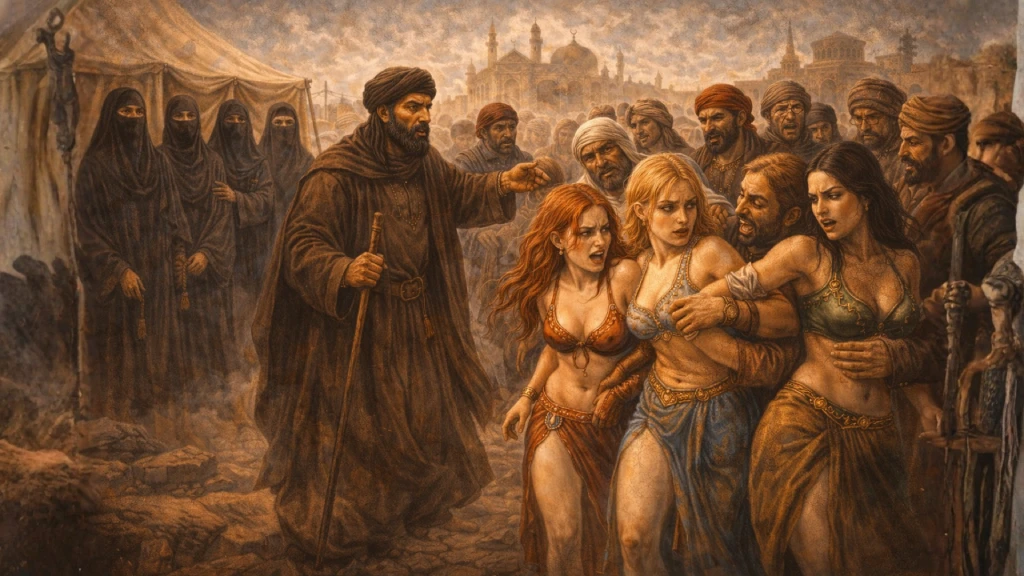
In Islamic history, slave markets were not merely an isolated social practice involving the buying and selling of human beings; classical Islamic jurisprudence transformed them into a systematically regulated legal and economic institution. Detailed rules were developed concerning the purchase and sale of slaves—especially female slaves—the inspection of their bodies, identification of defects, return of purchased slaves, calculation of depreciation, and assessment of their suitability for sexual use. Fiqh texts explicitly state that a female slave might be purchased for the purpose of sexual intercourse; even conditions such as foul odors from her mouth or armpits, virginity, and physical condition were treated as defects in purchased property and factors affecting market value.
Classical sources describe buyers touching and inspecting a female slave’s breasts, back, lower legs, buttocks, or the area between her thighs before purchase. Figures such as Ibn Umar are described touching women in slave markets and saying, “It is only merchandise.” Fiqhi rules also permitted adolescent slave girls to be displayed in markets with parts of their bodies uncovered. Likewise, when a slave woman was sold as a virgin, examination of her private parts was permitted in order to determine whether she was in fact a virgin. Even more significantly, classical jurisprudence treated virginity directly as a component of financial value and calculated how much a slave woman’s market price had diminished when intercourse resulted in the loss of her virginity. [1] [2]
This commodification did not end after sexual use. If a defect was discovered after intercourse with a slave woman, rules existed allowing her to be returned; if she had been a virgin, the amount by which intercourse had reduced her value was calculated. Reports concerning the Companions likewise mention slave women with whom owners had intercourse and practiced ‘azl before later selling them again. In the case of the captive women of Banu Mustaliq, Muslim warriors simultaneously wanted to use the women sexually while preserving their monetary value or prospects for ransom by preventing pregnancy. Early Islamic sources also preserve reports of slaves being sold on Muhammad’s instruction and of a captive woman being transferred in exchange for several other slaves.
Consequently, portraying the Islamic slave market as a system of “shelter,” “rehabilitation,” or humanitarian welfare is incompatible with the historical documentation. At the center of this legal system stood ownership and market value: a human being could be bought, sold, exchanged for other human beings, physically inspected before purchase, and assigned a monetary value on the basis of sexual and bodily characteristics. From the perspective of modern human rights, this constitutes a complete denial of human personhood and an institutional system that transformed the human body into a tradable asset. When ISIS captured Yazidi women and children in the twenty-first century and reduced them to sex slaves and marketable property, it did not invent an entirely new doctrine from nothing; it claimed to be reviving a classical legal framework of slavery whose rules remain preserved in authoritative works of Islamic jurisprudence today.
Map of the Article’s Evidence and Major Themes
The following table maps the principal dimensions of slavery examined in this article, the specific practices documented under each theme, and the major Islamic and historical sources on which the discussion is based.
| Theme | What the Evidence Shows | Major Sources and References |
|---|---|---|
| 1. Modern revival of the slave system | ISIS captured Yazidi women and children, reduced them to sexual slaves and marketable property, and explicitly claimed to be reviving classical rules of slavery. | Dabiq, Issue 4, “The Revival of Slavery Before the Hour”; UN reports on ISIS crimes against the Yazidis |
| 2. From female war captive to owned sexual property | Captivity created ownership over women; classical interpretation held that a captive woman’s previous marriage ceased to prevent intercourse with her new owner. | Qur’an 4:24; Tafsir Mazhari, vol. 3, pp. 16–17; reports concerning the female captives of Awtas |
| 3. Bodily inspection before purchasing a slave girl | Reports describe buyers exposing or touching a slave girl’s lower legs, back, abdomen, breasts, the area between her breasts, and buttocks before purchase. | Musannaf ʿAbd al-Razzaq, reports 13,202–13,209 |
| 4. Sahih authentication of Ibn Umar’s inspection of slave girls | Ibn Umar is reported to have exposed a slave girl’s lower leg and placed his hand between her breasts and on her buttocks; al-Albani graded the chain Sahih. | al-Albani, Irwa al-Ghalil, report 1792; al-Bayhaqi, al-Sunan al-Kubra, 5/329 |
| 5. Enforced dress distinction between slave and free women | Umar prevented slave women from dressing like free women; one report states that he struck a slave woman on the head until she removed her jilbab. | al-Albani, Irwa al-Ghalil, report 1796; Musannaf Ibn Abi Shaybah; al-Bayhaqi, al-Sunan al-Kubra, 2/226 |
| 6. Uncovered hair and “their breasts swayed” | Anas reports that Umar’s slave women served the men with their hair uncovered and that تضطرب ثديهن—“their breasts swayed”; al-Albani graded the chain jayyid. | al-Albani, Irwa al-Ghalil, vol. 6, p. 204; report transmitted by al-Bayhaqi |
| 7. Touching and displaying slave women for prospective buyers | Early reports and later fiqh permitted prospective buyers to view or touch the breasts, buttocks, thighs, lower legs, and other parts of slave women offered for sale. | Musannaf Ibn Abi Shaybah, section 2662; Ashraf al-Hidaya, vol. 9, pp. 618–619 |
| 8. Return of slave women as defective property and calculation of depreciation | A slave woman could be returned after a pre-existing defect was discovered even after intercourse; if she had been a virgin, the reduction in her market value caused by intercourse was calculated. | Malik, Al-Muwatta, Kitab al-Buyuʿ, Bab al-ʿAyb fi al-Riqaq; Mukhtasar al-Quduri and its commentaries |
| 9. Virginity as financial value | Classical jurisprudence explicitly treated virginity as a component of a slave woman’s financial value and stated that a virgin commanded a higher market price than a non-virgin. | al-Sarakhsi, Al-Mabsut, vol. 13, pp. 179–180; al-Nawawi, Al-Majmuʿ Sharh al-Muhadhdhab, vol. 11, p. 580 |
| 10. Genital examination to verify virginity | When a slave woman sold as a virgin was disputed to be non-virgin, examination of her private parts was permitted in order to determine the matter. | Ashraf al-Hidaya, vol. 9, p. 596 |
| 11. Market display of underage slave girls | Fiqhi discussions allowed younger slave girls to be displayed with the breasts and back uncovered before puberty and developed separate clothing rules for girls considered sexually desirable or physically capable of intercourse. | Ashraf al-Hidaya, vol. 9, pp. 618–619; Hanafi rulings concerning the ʿawrah and sale of slave girls |
| 12. Sexual use, coitus interruptus, and preservation of resale value | Reports connect intercourse with captive slave women, prevention of pregnancy through ʿazl, and the economic desire to preserve the women’s future sale or ransom value. | Sahih al-Bukhari, reports concerning ʿazl with captive women; ʿAbd al-Muhsin al-ʿAbbad, Sharh Sunan Abi Dawud; Sahaj Nasrul Bari |
| 13. Sale, resale, and exchange of human beings for other human beings | Reports document the sale of umm walad slave women, the sale of a slave promised future emancipation, and Safiyya being acquired in exchange for seven slaves, demonstrating direct human exchange value. | Sunan Abi Dawud 3955–3956; Tafsir al-Qurtubi, vol. 5, pp. 146–150; Sahih Ibn Hibban, report 7212 |
Introduction: A Dark History Beneath the Cover of Religion
As citizens of the modern world, when we speak of “human rights” or “personal dignity,” the sovereignty of every individual lies at the foundation of our moral consciousness. The course of history, however, was not always so smooth or humane. In medieval social systems in particular, slavery functioned as a highly organized economic and social backbone. Standing in the twenty-first century, many theologians or historians now attempt to present the slavery of those periods under the language of “compassion” or “security.” It is claimed that unprotected women or families devastated by war were supposedly placed in bondage in order to provide them protection. Yet a documentary examination of classical sources and Islamic fiqh reveals an extraordinarily harsh and horrific reality.
That reality is this: the slave markets of antiquity and the medieval period were not humanitarian shelters but vast marketplaces of human flesh. A woman was not treated there as a human being, but merely as a “commodity” or item whose usefulness was assessed according to her beauty, age, and sexual capacity. When an educated person in the modern world learns that it was considered legally permissible in a public market to touch a woman’s breasts, abdomen, or thighs in order to assess her “quality,” it is entirely natural to feel a chill of horror. It is equally natural to be overwhelmed by profound disgust.
The purpose of this article is to expose that historical reality through classical Islamic legal works—such as Ashraf al-Hidaya and Mukhtasar al-Quduri—a reality that survived for centuries under the claim that it represented “Allah’s law.” We will examine how the personhood of a human being was defined as merchandise and how, beneath rhetoric about mercy or justice, a highly organized marketplace of sexual appetite was institutionalized. When a legal system declares that a buyer may return a woman as defective property if her hymen is not intact, the moral depth to which that society had descended becomes painfully clear.
Let us therefore enter this dark chamber of history without evasion and examine it critically—a world in which human beings themselves were reduced to commodities for purchase and sale.
The Modern Revival of Islamic Barbarity: ISIS and the Dark Chapter of Sexual Slavery
Many people assume that the history of medieval slavery or the buying and selling of women survives only in old books and ancient manuscripts. Yet in the twenty-first century the world watched in astonishment as the so-called “Islamic State,” or ISIS, emerged and literally revived these classical fiqhi rules. The devastation inflicted upon the Yazidi community in the Sinjar region of northern Iraq in 2014 became one of the most brutal modern examples of ethnic cleansing. ISIS did not merely kill Yazidi men; it captured thousands of women and subjected them to the legal category of sabāyā (female captives enslaved as a result of warfare).
1. ISIS’s Theological and Legal Basis: ISIS did not present these actions merely as criminal conduct; it claimed that it was restoring an abandoned “Sunnah” or religious institution. In its official magazine Dabiq, ISIS explicitly argued that enslaving non-Muslim women and exercising sexual domination over them constituted a divinely sanctioned reward. [3] [4] It argued that a ruling practiced by the Prophet’s Companions, accepted by the four imams of the Sunni madhhabs and by classical scholars generally, preserved throughout the books of Islamic jurisprudence, and recorded in authoritative works such as those of Imam al-Quduri and Al-Hidaya, could not suddenly become unlawful. This claim demonstrates with disturbing clarity how ancient fiqhi rulings can serve as a powerful “legal shield” for modern perpetrators.
2. The Scene of a Modern Slave Market: The auctioning of Yazidi women in markets under ISIS control in Raqqa and Mosul amounted to a reproduction of the medieval slave market. According to secretly recorded videos and testimonies from survivors, buyers inspected women’s faces, teeth, and bodies in the marketplace. A price list attributed to ISIS assigned the highest prices to children aged nine or younger—approximately 200,000 Iraqi dinars, or around 170 US dollars. [5] This immediately recalls the fiqhi rulings under which a girl of seven or nine who was considered to have reached an age of sexual desirability could be presented for sale in the marketplace.
3. Sexual Slavery and Systematic Abuse: ISIS produced a handbook or set of instructions for its fighters setting out rules for sexual intercourse with captive women. It explicitly stated that sexual intercourse with a prepubescent slave girl could be lawful if she was physically capable of enduring it. This ruling was essentially a modern application of classical fiqhi discussions found in works such as Ashraf al-Hidaya and Mukhtasar al-Quduri. In other words, legal doctrines that a thousand years ago permitted buyers to touch a slave woman’s breasts or abdomen in the name of inspecting merchandise were invoked by modern ISIS to justify the destruction of thousands of women’s lives.
4. The Moral Crisis and International Response: The brutality of ISIS demonstrates how religious texts or legal systems that are never subjected to humane reform can erupt again like a volcano and threaten modern civilization. When Yazidi women describe the mass rape, sexual enslavement, and buying and selling inflicted upon them, their testimony is not merely an accusation against ISIS; it also raises a profound question about the jurisprudential system that recognizes one human being as the property of another. Although the international community has classified such conduct as crimes against humanity, the theoretical roots invoked to justify these acts continue to be taught in many religious institutions as “immutable divine law.”
Musannaf ʿAbd al-Razzaq: The Companions’ Inspection of Slave Girls
The rules permitting the exposure and touching of a woman’s body in a slave market were not merely theoretical discussions by jurists of later periods. One of the earliest collections of hadiths and reports, Musannaf ʿAbd al-Razzaq, also preserves concrete scenes from the buying and selling of slave girls. Its compiler, ʿAbd al-Razzaq ibn Hammam al-Sanʿani (126–211 AH), recorded not only Prophetic hadiths but also statements by the Companions and the Tabiʿun, as well as early Islamic legal practice. Several consecutive reports in the work show that exposing a slave girl’s lower legs, abdomen, back, and buttocks before purchase, touching her breasts and buttocks, and shaking her for inspection were treated as ordinary market procedures. [6]
Hadiths 13,202–13,204 contain several mutually corroborating versions of the same incident. According to Mujahid’s report, a group of buyers were turning a slave girl over and examining her. When they stopped after seeing Ibn Umar, Ibn Umar himself exposed the girl’s lower leg, touched her breast, and told the buyers to purchase her. Another version states that he placed his hand between the girl’s breasts and shook her.
Musannaf ʿAbd al-Razzaq
Regarding the inspection of a slave girl before purchase
Hadith 13,202
Original Arabic
عَنْ مَعْمَرٍ، عَنْ عَمْرِو بْنِ دِينَارٍ، عَنْ مُجَاهِدٍ قَالَ: مَرَّ ابْنُ عُمَرَ عَلَى قَوْمٍ يَبْتَاعُونَ جَارِيَةً، فَلَمَّا رَأَوْهُ وَهُمْ يُقَلِّبُونَهَا، أَمْسَكُوا عَنْ ذَلِكَ، فَجَاءَهُمُ ابْنُ عُمَرَ، فَكَشَفَ عَنْ سَاقِهَا، ثُمَّ دَفَعَ فِي صَدْرِهَا، وَقَالَ: «اشْتَرُوا». قَالَ مَعْمَرٌ، وَأَخْبَرَنِي ابْنُ أَبِي نَجِيحٍ، عَنْ مُجَاهِدٍ قَالَ: وَضَعَ ابْنُ عُمَرَ يَدَهُ بَيْنَ ثَدْيَيْهَا، ثُمَّ هَزَّهَا
English translation
Mujahid said: Ibn Umar passed by a group of people who were buying a slave girl. While they were turning her over and examining her, they stopped when they saw Ibn Umar. Ibn Umar went to them, exposed the girl’s lower leg, then pushed her on the breast and said, “Buy her.” Maʿmar further said: Ibn Abi Najih informed me, from Mujahid: Ibn Umar placed his hand between the girl’s breasts and then shook her.
Musannaf ʿAbd al-Razzaq
Hadith 13,203
Original Arabic
عَنِ ابْنِ عُيَيْنَةَ، عَنْ عَمْرِو بْنِ دِينَارٍ، عَنْ مُجَاهِدٍ قَالَ: كُنْتُ مَعَ ابْنِ عُمَرَ فِي السُّوقِ، فَأَبْصَرَ بِجَارِيَةٍ تُبَاعُ، فَكَشَفَ عَنْ سَاقِهَا، وَصَكَّ فِي صَدْرِهَا، وَقَالَ: «اشْتَرُوا». يُرِيهِمْ أَنَّهُ لَا بَأْسَ بِذَلِكَ
English translation
Mujahid said: I was with Ibn Umar in the market. He saw a slave girl being sold. He then exposed her lower leg, struck her on the breast, and said, “Buy her.” He was showing them that there was nothing wrong with this.
The final sentence of the report is particularly important: Ibn Umar was showing the buyers that exposing the slave girl’s body and touching her breast involved “nothing wrong.” In other words, the incident is not described as an accidental touch or a personal exception; it is presented to the buyers as permissible market conduct. Hadith 13,204, a shorter version of the same incident, again states that Ibn Umar placed his hand between the girl’s breasts and shook her. [7]
Musannaf ʿAbd al-Razzaq
Hadith 13,205
Original Arabic
عَنِ ابْنِ جُرَيْجٍ، عَنْ نَافِعٍ، أَنَّ ابْنَ عُمَرَ: «كَانَ يَكْشِفُ عَنْ ظَهْرِهَا، وَبَطْنِهَا، وَسَاقِهَا، وَيَضَعُ يَدَهُ عَلَى عَجُزِهَا»
English translation
According to Nafiʿ, Ibn Umar would expose the girl’s back, abdomen, and lower leg, and place his hand on her buttocks.
The body parts listed here cannot be confined to the scope of an ordinary medical examination: the back, abdomen, lower leg, the area between the breasts, and the buttocks. The woman’s body was turned into an examinable commodity before the eyes and hands of prospective buyers. There is no mention of her permission, objection, or personal boundaries. The purchasing decision of the men present in the market was the only consideration; the woman being examined was granted no authority over her own body.
The next two reports express this practice in more general legal language. A report preserved from Ibn al-Musayyib permits looking at the slave girl’s entire body except her private parts. Al-Shaʿbi’s statement is even more direct: when a man goes to purchase a slave girl, he may look at her entire body except her private parts.
Musannaf ʿAbd al-Razzaq
Hadith 13,206
Original Arabic
عَنِ ابْنِ جُرَيْجٍ، عَنْ رَجُلٍ، عَنِ ابْنِ الْمُسَيِّبِ، أَنَّهُ قَالَ: «يَحِلُّ لَهُ أَنْ يَنْظُرَ إِلَى كُلِّ شَيْءٍ فِيهَا، مَا عَدَا فَرْجَهَا»
English translation
According to Ibn al-Musayyib, he said: It is lawful for him to look at every part of her except her private parts.
Hadith 13,207
Original Arabic
عَنِ الثَّوْرِيِّ، عَنْ جَابِرٍ، عَنِ الشَّعْبِيِّ قَالَ: «إِذَا كَانَ الرَّجُلُ يَبْتَاعُ الْأَمَةَ، فَإِنَّهُ يَنْظُرُ إِلَى كُلِّهَا إِلَّا الْفَرْجَ»
English translation
Al-Shaʿbi said: When a man purchases a slave girl, he may look at her entire body except her private parts.
It is false to describe this rule as a medical, safety-related, or welfare measure for women. The purpose is clear from the reports themselves—the man is buying the woman, and therefore examines her body before the purchase. The bodily privacy and covering treated as matters of religious dignity in the case of free women disappeared before market interests in the case of slave girls. With the exception of her private parts, the rest of her body was declared open to inspection by the buyer. The legal boundary between a person and a commodity was effectively erased here.
The next report, preserved in the name of Ali, expresses the mentality underlying this system in its most naked terms. In response to the question of whether one may look at the lower leg, buttocks, and abdomen of a slave girl standing up for sale, it states: “She has no sanctity; she has merely been made to stand so that we may bargain over her.”
Musannaf ʿAbd al-Razzaq
Hadith 13,208
Original Arabic
عَنِ ابْنِ جُرَيْجٍ قَالَ: أَخْبَرَنِي مَنْ أُصَدِّقُ عَمَّنْ، سَمِعَ عَلِيًّا، يُسْأَلُ عَنِ الْأَمَةِ تُبَاعُ أَيَنْظُرُ إِلَى سَاقِهَا، وَعَجُزِهَا، وَإِلَى بَطْنِهَا؟ قَالَ: «لَا بَأْسَ بِذَلِكَ، لَا حُرْمَةَ لَهَا، إِنَّمَا وَقَفَتْ لِنُسَاوِمَهَا»
English translation
Ali was asked about a slave girl being sold: May the buyer look at her lower leg, buttocks, and abdomen? He replied: “There is nothing wrong with that. She has no sanctity; she has merely been made to stand so that we may bargain over her.”
Musannaf ʿAbd al-Razzaq
Hadith 13,209
Original Arabic
عَنِ الثَّوْرِيِّ، عَنْ عُبَيْدِ الْمَكْتَبِ، عَنْ إِبْرَاهِيمَ، عَنْ بَعْضِ أَصْحَابِ عَبْدِ اللَّهِ، أَنَّهُ قَالَ فِي الْأَمَةِ: «تُبَاعُ مَا أُبَالِي إِيَّاهَا مَسَسْتُ، أَوِ الْحَائِطَ»
English translation
It is reported from some of Abdullah’s companions concerning a slave girl: “She is to be sold. I do not care whether I touched her or touched a wall.”
The final statement is the ultimate verbal expression of the erasure of the slave girl’s personhood. Touching a flesh-and-blood woman and touching an inanimate wall are reduced to the same level. The true morality of the slave market is revealed in this mentality: the slave girl’s feelings, consent, modesty, and bodily autonomy have no value; only her saleable body has value. The buyer will look at her, expose her, touch her, shake her for inspection, and then purchase her through bargaining.
From the perspective of source criticism, the chains of transmission of these reports are not all equally strong. In particular, the chain of report 13,208, attributed to Ali, contains an unidentified narrator; it is therefore not being used as conclusive evidence of Ali’s personal conduct. This does not, however, alter the central facts when the other lines of transmission are considered. The incident involving Ibn Umar is reported from Mujahid through several chains in reports 13,202–13,204; report 13,205, transmitted through Nafiʿ, also preserves the account of exposing the slave girl’s back, abdomen, and lower leg and touching her buttocks. In addition, the legal statements in reports 13,206–13,207 show that permission to look at a slave girl’s body at the time of purchase was not an isolated personal incident; it was a recognized matter of legal practice in the early Islamic period, among the Companions and the generations that followed them, and in later jurisprudence.
In light of these documents, portraying the slave market as “humanitarian rehabilitation,” “shelter,” or a system for protecting the dignity of slave girls is a shameless distortion of history. In a shelter, no one places a hand between a woman’s breasts and shakes her body to assess her value; her value is not determined by touching her buttocks, and her body is not exposed for bargaining. These are the features of an organized market in human beings—in which men were buyers and owners, while captive women were living commodities kept for inspection, use, and resale.
Irwa al-Ghalil: Al-Albani’s Authentication of Slave-Girl Body Inspection and Class Discrimination in Covering
The exposure and touching of a slave girl’s body during purchase, and the radically different standards of bodily privacy and covering imposed upon enslaved women compared with free women, do not rest merely on weak or isolated historical reports. The influential twentieth-century hadith scholar Muhammad Nasir al-Din al-Albani examined several relevant reports and their chains of transmission in his Irwa al-Ghalil fi Takhrij Ahadith Manar al-Sabil. Report 1792 concerns Ibn Umar’s physical inspection of a slave girl during purchase, while report 1796 concerns Umar ibn al-Khattab’s enforcement of a visible dress distinction between enslaved and free women. In both cases, the central reports are supported by chains that al-Albani himself authenticated.
Irwa al-Ghalil 1792: A Hand Between the Slave Girl’s Breasts and on Her Buttocks — Sahih Chain
In report 1792 of Irwa al-Ghalil, al-Albani cites a report describing Ibn Umar’s physical inspection of a slave girl and explicitly grades it Sahih. He then traces it through al-Bayhaqi by way of Ubayd Allah ibn Umar, from Nafiʿ, from Ibn Umar. The same report is preserved in al-Bayhaqi’s al-Sunan al-Kubra, while Dorar al-Sunniyya identifies it as Irwa al-Ghalil 1792 and records al-Albani’s judgment as Sahih. In another entry giving the fuller wording, Dorar records his judgment as “Its chain is Sahih.” Al-Bayhaqi’s Arabic text is also independently available through Islamweb.
Irwa al-Ghalil, Report 1792
Original Arabic:
1792 – (روى أبو حفص بإسناده: `أن ابن عمر كان يضع يده بين ثدييها (يعنى الجارية) وعلى عجزها من فوق الثياب ويكشف عن ساقها`.
تحقيق الشيخ ناصر الدين الألباني: صحيح.
أخرجه البيهقى (5/329) من طريق عبيد الله بن عمر عن نافع عن ابن عمر: `أنه كان إذا اشترى جارية كشف عن ساقها، ووضع يده بين ثدييها، وعلى عجزها`.
وفى آخره زيادة: `وكأنه كان يضعها عليها من وراء الثياب`.
ولعلها من البيهقى أو من بعض رواته. والسند صحيح.
English translation:
1792 — Abu Hafs narrated with his chain that Ibn Umar used to place his hand between her breasts—that is, the slave girl’s breasts—and on her buttocks over the clothing, and he would expose her lower leg.
Shaykh Nasir al-Din al-Albani’s authentication: Sahih.
Al-Bayhaqi transmitted it through Ubayd Allah ibn Umar, from Nafiʿ, from Ibn Umar: “Whenever he purchased a slave girl, he would expose her lower leg, place his hand between her breasts, and place his hand on her buttocks.”
At the end there is an additional wording: “It appeared that he placed his hand upon her from behind the clothing.”
Al-Albani said: Perhaps this addition came from al-Bayhaqi or from one of his transmitters. The chain is Sahih.
This authentication is particularly important because the report does not depend upon an unidentified intermediary. Nafiʿ transmits Ibn Umar’s conduct through a recognized chain, and al-Albani explicitly authenticates it. Dorar al-Sunniyya also lists al-Bayhaqi, Abd al-Razzaq, and Ibn Abi Shaybah among the early sources preserving the same or closely corresponding conduct. The physical inspection of enslaved women was therefore not a single stray statement buried in one late collection. Multiple early compilations preserve the same pattern, while al-Albani authenticated one of its principal chains as Sahih. [8]
Irwa al-Ghalil 1796: The Sahih Report of Preventing a Slave Woman from Dressing Like a Free Woman
Report 1796 exposes another dimension of the same slave system: the forcible preservation of a visible class distinction between enslaved and free women through clothing. Al-Albani quotes Ibn al-Mundhir as stating that it was established that Umar saw a slave woman covering her head, ordered her to uncover it and not resemble free women, and struck her with his whip. Al-Albani grades the report Sahih.
He then examines several chains for the same practice. Through Ibn Abi Shaybah, he cites Wakiʿ, Shuʿbah, Qatadah, and Anas; al-Albani directly declares this chain Sahih. Another route comes through Abd al-Aʿla, Maʿmar, al-Zuhri, and Anas, which he also regards as Sahih if al-Zuhri heard the report directly from Anas. The most detailed version comes through Ali ibn Mushir, al-Mukhtar ibn Fulful, and Anas ibn Malik. There, Umar encounters an enslaved woman wearing a jilbab, orders her to remove it because the jilbab belongs to free believing women, and when she hesitates, strikes her on the head until she throws it off. Al-Albani grades this chain Sahih according to the conditions of Muslim. The core report is independently preserved in Ibn Abi Shaybah’s al-Musannaf on Islamweb.
Irwa al-Ghalil, Report 1796
Original Arabic:
1796 – (قال ابن المنذر ثبت: `أن عمر قال لأمة رآها متقنعة: اكشفى رأسك ولا تشبهى بالحرائر، وضربها بالدرة`.
تحقيق الشيخ ناصر الدين الألباني: صحيح.
أخرجه ابن أبى شيبة فى `المصنف` (2/28/1): حدثنا وكيع قال: حدثنا شعبة عن قتادة عن أنس قال: `رأى عمر أمة لنا مقنعة، فضربها وقال: لا تشبهين بالحرائر`.
قلت: وهذا إسناد صحيح.
ثم قال: حدثنا عبد الأعلى عن معمر عن الزهرى عن أنس به.
قلت: وهذا سند صحيح، إن كان الزهرى سمعه من أنس.
حدثنا على بن مسهر عن المختار بن فلفل عن أنس بن مالك قال: `دخلت على عمر بن الخطاب أمة قد كان يعرفها لبعض المهاجرين أو الأنصار، وعليها جلباب متقنعة به، فسألها: عتقت؟ قالت: لا. قال: فما بال الجلباب؟! ضعيه عن رأسك، إنما الجلباب على الحرائر من نساء المؤمنين، فتلكأت، فقام إليها بالدرة، فضرب بها رأسها حتى ألقته عن رأسها`.
قلت: وهذا سند صحيح على شرط مسلم.
وأخرج البيهقى (2/226) عن صفية بنت أبى عبيد قالت: `خرجت امرأة مختمرة متجلببة، فقال عمر رضى الله عنه: من هذه المرأة؟ فقيل: هذه جارية لفلان ـ رجل من بنيه ـ فأرسل إلى حفصة رضى الله عنها فقال: ما حملك على أن تخمرى هذه الأمة وتجلببيها وتشبهيها بالمحصنات حتى هممت أن أقع بها، لا أحسبها إلا من المحصنات؟! لا تشبهوا الإماء بالمحصنات`.
قلت: رجاله ثقات غير أحمد بن عبد الحميد فلم أجد له ترجمة.
ثم روى من طريق حماد بن سلمة قال: حدثنى ثمامة بن عبد الله بن أنس عن جده أنس بن مالك قال: `كن إماء عمر رضى الله عنه يخدمننا كاشفات عن شعورهن، تضطرب ثديهن`.
قلت: وإسناده جيد رجاله كلهم ثقات غير شيخ البيهقى أبى القاسم عبد الرحمن بن عبيد الله الحربى وهو صدوق كما قال الخطيب (10/303) وقال البيهقى عقبه: `والآثار عن عمر بن الخطاب رضى الله عنه فى ذلك صحيحة`.
English translation:
1796 — Ibn al-Mundhir said that it is established that Umar saw a slave woman covering her head and said to her: “Uncover your head and do not resemble free women,” and he struck her with his whip.
Shaykh Nasir al-Din al-Albani’s authentication: Sahih.
Ibn Abi Shaybah transmitted it in al-Musannaf: Wakiʿ narrated to us, saying: Shuʿbah narrated to us, from Qatadah, from Anas, who said: “Umar saw one of our slave women covering herself. He struck her and said: ‘Do not resemble free women.’”
Al-Albani said: This chain is Sahih.
Ibn Abi Shaybah then transmitted another route through Abd al-Aʿla, from Maʿmar, from al-Zuhri, from Anas, with the same report.
Al-Albani said: This chain is Sahih, if al-Zuhri heard it from Anas.
Ali ibn Mushir narrated from al-Mukhtar ibn Fulful, from Anas ibn Malik, who said: A slave woman whom Umar ibn al-Khattab recognized as belonging to one of the Muhajirun or Ansar entered before him. She was wearing a jilbab and covering herself with it. He asked her: “Have you been emancipated?” She replied: “No.” He said: “Then what is this jilbab? Remove it from your head. The jilbab is only for the free women among the believing women.” She hesitated. Umar then got up and approached her with his whip and struck her on the head with it until she threw the jilbab from her head.
Al-Albani said: This chain is Sahih according to the conditions of Muslim.
Al-Bayhaqi also transmitted from Safiyyah bint Abi Ubayd, who said: A woman came out wearing a khimar and jilbab. Umar asked: “Who is this woman?” He was told: “She is the slave woman of so-and-so”—a man from among his family. Umar then sent word to Hafsah and said: “What made you put a khimar and jilbab on this slave woman and make her resemble free, chaste women, until I was about to approach her sexually, thinking that she was one of the free, chaste women? Do not make slave women resemble free, chaste women.”
Al-Albani said: Its transmitters are trustworthy except Ahmad ibn Abd al-Hamid, for whom I could not find a biographical entry.
Al-Bayhaqi then transmitted through Hammad ibn Salamah, who said: Thumamah ibn Abd Allah ibn Anas narrated to me, from his grandfather Anas ibn Malik, who said: “Umar’s slave women used to serve us with their hair uncovered, while their breasts swayed.”
Al-Albani said: “Its chain is jayyid.” All of its transmitters are trustworthy except al-Bayhaqi’s shaykh Abu al-Qasim Abd al-Rahman ibn Ubayd Allah al-Harbi, who is saduq, as al-Khatib stated. Al-Bayhaqi immediately afterward said: “The reports transmitted from Umar ibn al-Khattab concerning this matter are Sahih.”
The authentication is devastatingly clear. The shortest version has Umar striking a slave woman simply because she covered herself like a free woman. A fuller version has him explicitly declaring that the jilbab belongs to free believing women and beating an enslaved woman on the head until she removes it. The surviving Arabic material therefore does not describe a voluntary difference in fashion. It documents a status distinction enforced with physical violence. [9]
Al-Albani’s Authentication: “Their Breasts Swayed” — The Chain Is Jayyid
The final report quoted by al-Albani is even more explicit. Anas describes Umar’s enslaved women serving the men with their hair uncovered and states that their breasts swayed. Al-Albani does not reject or weaken this wording. Dorar al-Sunniyya records the report directly from Irwa al-Ghalil, volume 6, page 204, and gives al-Albani’s judgment as “Its chain is jayyid.”
Original Arabic:
عن أنس بن مالك قال: كن إماء عمر رضي الله عنه يخدمننا كاشفات عن شعورهن، تضطرب ثديهن.
English translation:
Anas ibn Malik said: “Umar’s slave women used to serve us with their hair uncovered, while their breasts swayed.”
Al-Albani’s grading:
إسناده جيد
“Its chain is jayyid.”
Source: al-Albani, Irwa al-Ghalil, vol. 6, p. 204; preserved in Dorar al-Sunniyya.
The wording authenticated by al-Albani contains the expression translated above as “their breasts swayed.” The Arabic verb denotes movement, agitation, or swaying, while the noun refers directly to their breasts. Some editions of al-Bayhaqi preserve a different textual reading, but that does not erase the wording quoted and graded by al-Albani in Irwa al-Ghalil. Dorar al-Sunniyya itself preserves al-Albani’s reading and explicitly identifies its source as Irwa al-Ghalil, 6/204. The correct procedure is therefore to translate the text al-Albani actually cited, not silently replace it with the wording of another textual variant.
Read together with the preceding reports, the picture is stark. Umar did not permit an enslaved woman to dress like a free woman; when one woman hesitated to remove her jilbab, he beat her on the head until she removed it; and Anas reports that Umar’s slave women served men with uncovered hair while their breasts swayed. The distinction between enslaved and free women was therefore not merely an abstract legal category. It was imposed directly on women’s bodies—determining what they could cover, what clothing they could wear, and how enslaved women were expected to appear while serving men.
Result of the Authentication: Two Separate Bodies of Evidence, One Ownership-Based Class System
The two reports expose different dimensions of the same system. Report 1792 shows that during the purchase of a slave girl, parts of her body that would constitute intimate bodily privacy in the case of a free woman could be exposed, touched, and physically inspected. Report 1796 shows that an enslaved woman was not even permitted to adopt the covering associated with free women; the distinction between the two classes was enforced by physically removing her covering and, when necessary, beating her into compliance. In one case, the enslaved woman’s body was opened to inspection as merchandise. In the other, an attempt to dress like a free woman was forcibly suppressed.
The distinction between enslaved and free women therefore extended far beyond economic ownership. It determined who could inspect a woman’s body, who could touch her, how much of her body she could cover, what clothing she could wear, and how her subordinate social status was to remain visibly recognizable. Al-Albani’s authentication is especially significant because the principal reports are not being authenticated by a modern critic of Islam; al-Albani himself grades them Sahih, Sahih according to the conditions of Muslim, or jayyid. The documentary record is explicit: enslavement was not merely ownership of labor. It was a legal status imposed directly upon the woman’s body, privacy, clothing, and public identity.
Islamic Jurisprudence: The Shameless Evidence of the Fiqh Texts
In the preceding discussion, we saw how ISIS brought medieval slavery back into the modern era. We must now enter the legal chamber that defined a human being merely as a “commodity” or an “item.” In classical fiqh texts, slavery was not merely some “rescue operation”; it functioned as a systematically organized matter resembling consumer rights, in which the buyer’s sexual satisfaction was guaranteed.
Tafsir Mazhari: From War Captives to Owned Sexual Property
Before discussing the buying and selling of slaves in the market, the determination of their value, or the inspection of their bodies, it is essential to clarify a fundamental question: how did these women first become owned property that could later be bought, sold, given away, or used sexually? In its explanation of Qur’an 4:24 and the female captives taken at Awtas, Tafsir Mazhari presents this process with striking clarity. It did not regard the existence of a previous husband as an obstacle to the new owner’s intercourse even when the female captives were married. The ownership established over a woman through captivity invalidated her previous marital relationship and created the basis for the new owner’s sexual rights. [10]
Al-Tabarani presents Ibn Abbas’s statement as follows: This verse was revealed during the Battle of Hunayn. After the victory, some women from the People of the Book came under the authority of the Muslims. They were married. When the Muslims who had acquired them wanted to have intercourse with them, the women said, “We have husbands.” This was reported to the Messenger, peace be upon him, and this verse was then revealed.
This verse proves that the owners may have intercourse with female war captives. Even if they have husbands, they are deemed divorced from them; and this is obviously the case if they have no husbands.
The owners of the captives may also marry them off to others. They may do so because they are owned women (ownership means the captor’s comprehensive authority over the captive’s existence). Imam Malik, Imam al-Shafiʿi, and Imam Ahmad held this view.
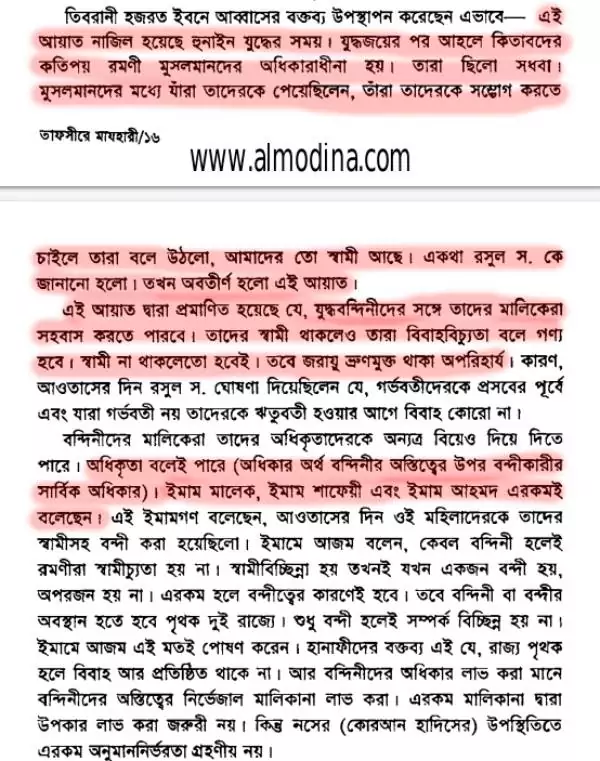
The most significant part of this interpretation is the phrase “the captor’s comprehensive authority over the captive’s existence.” In other words, victory in war does not merely create a right over the woman’s labor or over some particular asset; the woman’s very existence is interpreted as subject to ownership. The direct legal consequences of this ownership are the dissolution of her previous marriage, the lawfulness of intercourse with her for the new owner, and the owner’s power to marry her off to someone else at will. When we later encounter rules concerning the same woman’s purchase and sale in the slave market, bodily inspection, assessment of sexual utility, or resale, they are no longer isolated legal details; they become the economic and sexual consequences of this foundational concept of ownership.
The Public Display of Women’s Bodies: The ‘Return Policy’ for Purchasing Sex Slaves
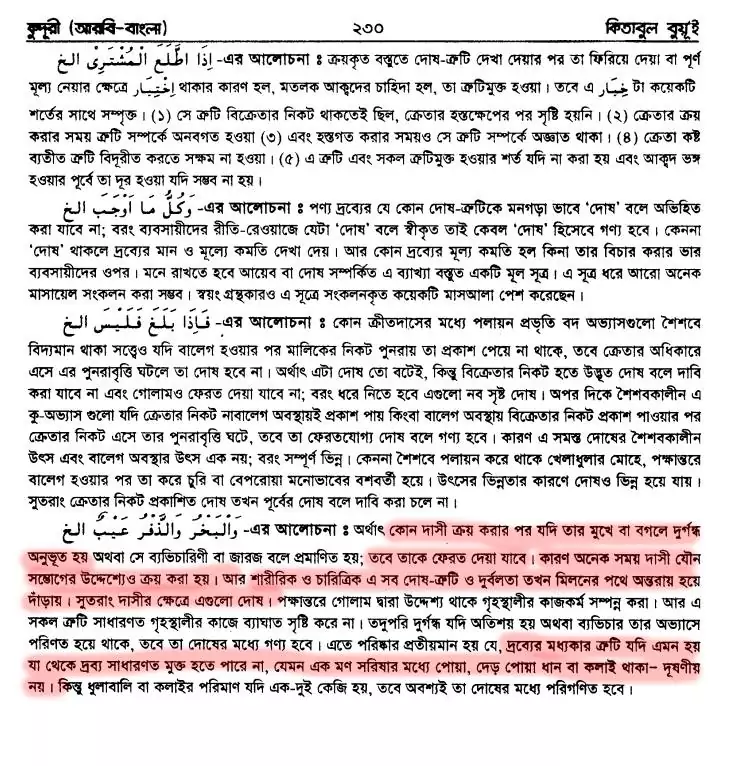
Imam al-Quduri directly treats a slave girl in his work as a “commodity” (Goods). Just as we return a defective product in the modern era, fiqh established the same rule for slave girls. If, after purchasing a slave girl, it is discovered that she has a foul odor in her mouth or armpits, the buyer may return that “product,” or woman, to the seller.
The reasoning offered for this is deeply degrading: it is stated that because a slave girl is purchased for the purpose of sexual intercourse, bodily odor constitutes a “defect” or obstacle to intercourse. By contrast, in the case of a male slave, such odor is not a major defect because his primary task is hard physical labor. Thus, a woman’s being is measured here solely by her fragrance or her ability to satisfy sexual desire. [11]
Discussion of والبخر والذفر عيب الخ -: In other words, if, after purchasing a slave girl, it is discovered that she has a foul odor in her mouth or armpits
or that she is proven to be an adulteress or illegitimate, she may be returned. This is because a slave girl is often purchased for sexual intercourse, and such physical and moral defects or weaknesses can become obstacles to intercourse. Therefore, these are considered defects in the case of a slave girl. By contrast, the purpose of a male slave is to perform household work, and these defects generally do not interfere with household labor. Moreover, if the odor is extreme or adultery has become her habitual behavior, it will be counted as a defect. This makes it clear that if a defect in a commodity is something from which commodities cannot ordinarily be entirely free—for example, a small amount of impurities or grain mixed into a measure of mustard seed—it is not considered blameworthy. But if the amount of dust or other impurities reaches one or two kilograms, it will certainly be counted as a defect.
That this “return policy” was not limited to foul odor or external defects is made even more explicit by a ruling in Imam Malik’s Al-Muwatta. It states that if a person purchases a slave girl, has intercourse with her, and then discovers a pre-existing defect that gives him the right to return her, he may return her to the seller even after intercourse has taken place. If the slave girl was a virgin, however, the buyer must pay the amount by which her market value was reduced because of his intercourse with her. If she was already non-virgin, the buyer owes no payment for having intercourse with her. Thus, after sexual intercourse with a woman, what is calculated is not her mental state, wishes, or the harm caused by humiliation; what is calculated is how much the market value of the purchased “property” declined as a result of sexual use. [12]
قال مالك الأمر المجتمع عليه عندنا أن من رد وليدة من عيب وجده بها وكان قد أصابها أنها إن كانت بكرا فعليه ما نقص من ثمنها وإن كانت ثيبا فليس عليه في إصابته إياها شيء لأنه كان ضامنا لها
English translation: Imam Malik said: The established ruling among us is that if a person returns a slave girl because of a defect he found in her after having intercourse with her, then, if she was a virgin, he must pay the amount by which her value was reduced because of the intercourse. If she was non-virgin, he owes nothing for having intercourse with her, because he was the one responsible for her as her owner.
The language of this ruling leaves the economic character of the slave market unmistakable. The same chapter contains detailed rules concerning defects in male and female slaves, the extent to which a defect reduces their value, the circumstances in which a purchase may be cancelled, and even how to calculate the ratio of their separate market values when two female slaves are exchanged for one slave girl. A human being is treated here as a complete legal commodity: she can be bought, used, financially depreciated according to changes in her body, and returned to the seller when necessary. It is difficult to find a structural difference between this and the calculation of depreciation for used products in a modern market; the only difference is that here the “product” is a flesh-and-blood human being. [13]
Al-Quduri (Arabic–Bengali edition), p. 230, Kitab al-Buyuʿ
Discussion: The reason for returning a purchased item after a defect appears, or for retaining it when the defect is absent, is that the basic requirement of an unrestricted contract is that the item be free of defects. This is subject to several conditions: (1) the defect already existed with the seller and was not created through the buyer’s intervention; (2) the buyer was unaware of the defect at the time of purchase; (3) the buyer was also unaware of it at the time of taking possession; (4) the buyer cannot remove the defect without difficulty; and (5) no condition was made that the item would be free from all defects, and it was not possible to remove the defect before the contract was annulled.
Discussion in Lota JS: No defect in a commodity may be arbitrarily designated a “defect”; only what is recognized as a defect according to the customs and practices of merchants counts as one. This is because a defect reduces the quality and price of a commodity, and the merchants are responsible for judging whether its value has been reduced. It should be remembered that this explanation concerning defects is essentially a foundational principle, from which many further legal cases can be derived. The author himself presents several cases compiled on the basis of this principle.
Discussion: If a male slave had bad habits such as running away in childhood, but these habits did not reappear before the owner after he reached maturity, then a recurrence after the buyer acquired him is not considered a defect attributable to the seller. It is instead treated as a newly arising defect, and the slave cannot be returned. On the other hand, if these childhood habits became apparent to the buyer while the slave was still a minor, or if they appeared to the seller after maturity and then recurred after the buyer acquired him, they are considered returnable defects. The source of the defect in childhood and its source in adulthood are not the same but entirely different: in childhood he runs away out of an attraction to play, whereas after reaching adulthood he does so to steal or out of recklessness. Because the sources differ, the defects also differ. Therefore, a defect that appears to the buyer cannot be claimed to be the earlier defect.
Discussion: In other words, if, after purchasing a slave girl, a foul odor is detected in her mouth or armpits, or she is proven to be an adulteress or illegitimate, she may be returned. This is because a slave girl is often purchased for sexual intercourse, and these physical and moral defects and weaknesses can obstruct intercourse. Therefore, they are defects in the case of a slave girl. By contrast, the purpose of a male slave is to perform household work, and these defects generally do not interfere with household labor. Moreover, if the odor is excessive or adultery has become habitual, it counts as a defect. It is therefore clear that if a defect in a commodity is something from which commodities ordinarily cannot be free—for example, a small amount of mustard seed mixed with impurities or a small amount of grain or pulse—it is not blameworthy. But if the quantity of dust or impurities reaches one or two kilograms, it is certainly counted as a defect.
Touching and Display: The Erasure of All Boundaries of Modesty
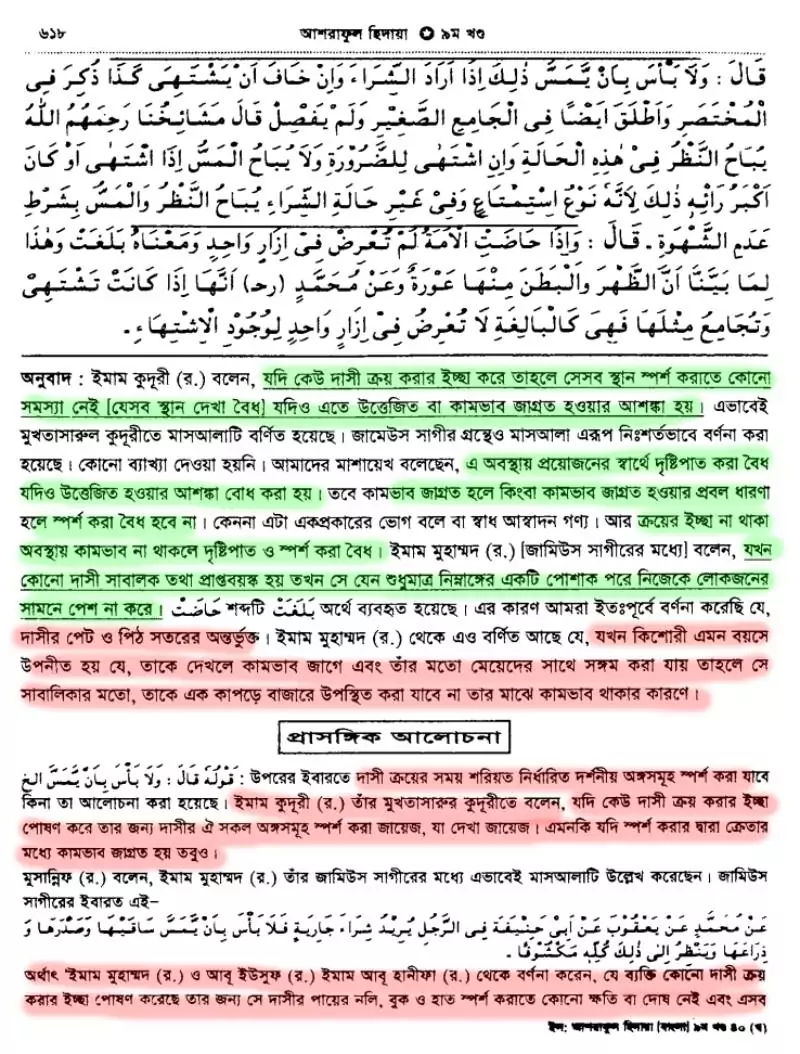
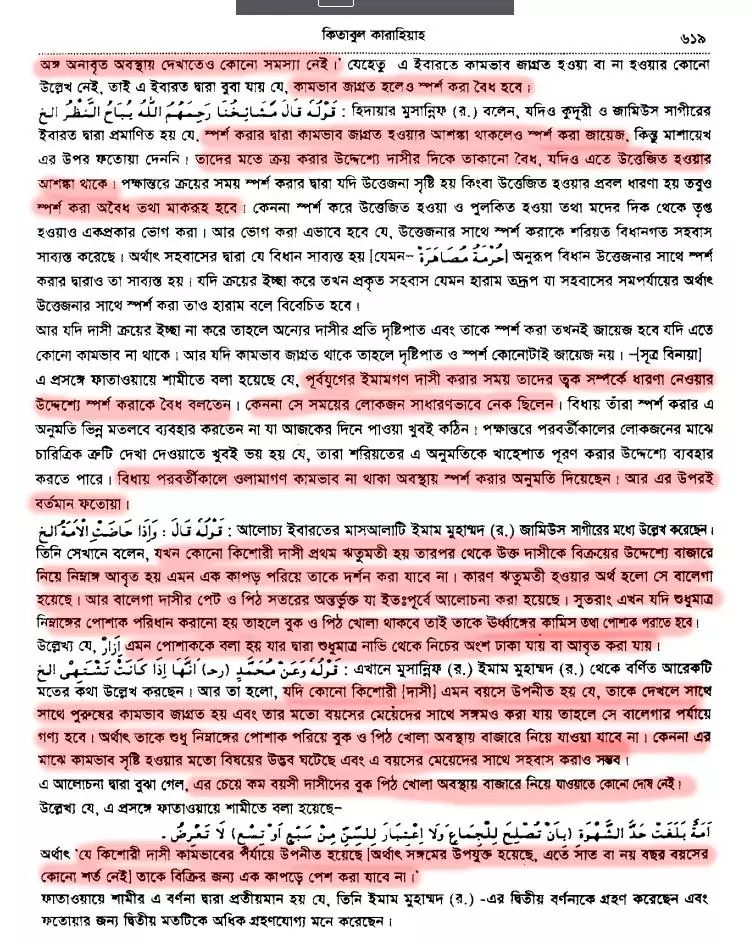
Although Islamic ethics describes haya, or modesty, as part of faith, the question of where that modesty or covering disappeared in the slave market is unavoidable. According to a ruling in Ashraf al-Hidaya, if a buyer intends to purchase a slave girl, he may touch those parts of her body that he is permitted to look at. These include her breasts, back, and lower legs. Even if touching her produces intense sexual arousal or desire in the buyer, classical law still described it as permissible.
The brutality of this display is most evident in the case of adolescent slave girls. Until they reached puberty, the upper parts of adolescent slave girls—the breasts and back—could be displayed in the market uncovered. Even young children considered physically suitable for intercourse, who might be seven or nine years old, were displayed in the market with only their lower bodies covered. This is not merely a historical description; it demonstrates that human dignity was sacrificed here to the profits of buying and selling. [14] –
Imam al-Quduri (may Allah have mercy on him) says in his Mukhtasar al-Quduri: If someone intends to purchase a slave girl, he may touch all those parts of her that he is permitted to look at—even if touching her causes sexual desire to arise in the buyer.
The compiler says: Imam Muhammad described the same legal issue in his Jamiʿ al-Saghir. The wording of Jamiʿ al-Saghir is as follows: “Imam Muhammad and Imam Abu Yusuf report from Abu Hanifa that a person who intends to purchase a slave girl may touch her lower legs, breasts, and hands; there is no harm or defect in doing so, and there is no problem with looking at these parts while they are uncovered.” “Touching remains permissible even if sexual desire arises.”
“Touching is permissible even when there is a fear that it may arouse sexual desire. According to them, looking at a slave girl for the purpose of purchasing her is permissible even if there is a risk of arousal.”
“The earlier imams considered it permissible to touch a slave girl while purchasing her in order to assess the nature of her skin, because people in those times were generally righteous.”
“Later scholars permitted touching when there was no sexual desire, and this is the ruling currently followed.”
“Once a young slave girl begins menstruating, she may no longer be taken to the market for sale wearing only a garment that covers the lower part of her body. This is because menstruation means that she has reached puberty. The abdomen and back of a pubescent slave girl are part of her awrah, as discussed earlier. Therefore, if she is dressed only in a lower garment, her breasts and back will remain exposed, so she must wear an upper garment, known as a qamis. An izar is a garment that covers only the area below the navel.”
“This discussion makes clear that there is no harm in taking younger slave girls to the market with their breasts and backs uncovered.”
“A young slave girl who has reached the stage of sexual desirability (that is, become physically suitable for intercourse; no condition of being seven or nine years old is stipulated) may not be presented for sale wearing only one garment.”
Buying a Slave Girl After Examining Her Vagina
The Companions of the Prophet Muhammad, presented as guides for all humanity, purchased beautiful virgin slave girls from the slave market for sexual use. Virgin slave girls also commanded higher prices in the market. Yet sometimes, after purchasing a slave girl, they discovered that she was not actually a virgin. Because the Prophet’s Companions greatly preferred virgin vaginas (and, according to Islamic teaching, virginal houris are even offered as an enticement in Paradise), they would become enraged if, after bringing a slave girl to bed, they found insufficient bleeding from a torn hymen or failed to enjoy intercourse because her vagina was not tight enough. They had paid for a virgin girl, after all. In other words, they thought that the entire payment had gone to waste.
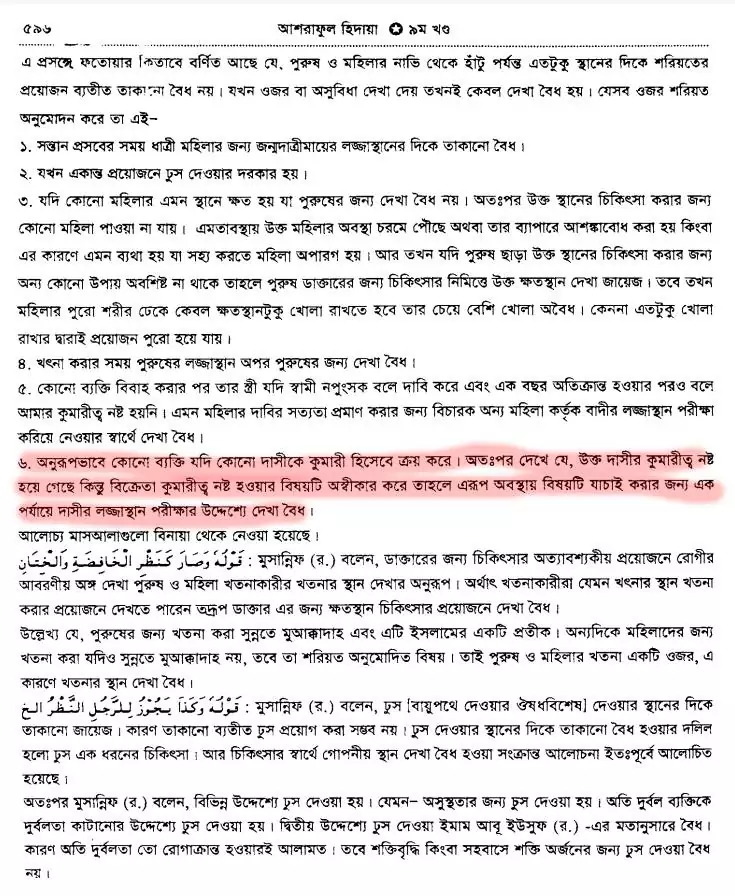
On this subject, the legal ruling given in Ashraf al-Hidaya states that, in such a case, the owner may examine the slave girl’s private parts or vagina for verification. These fiqh rulings make clear that virgin slave girls were in extremely high demand and commanded extremely high prices among the Companions in the slave market. Around this demand, another diabolical legal rule was developed. If an owner purchased a woman as a virgin and then claimed that she was not a virgin, it was made permissible to examine the woman’s private parts or vagina in order to verify the claim. The question is: how was this examination carried out? A two-finger test?
The fact that virgin slave girls had a higher market value is not merely the speculation of a modern critic. Shams al-Aʾimma al-Sarakhsi, one of the leading jurists of the Hanafi school, writes directly about a slave girl’s virginity in his famous work Al-Mabsut: “البكارة في حكم جزء من المالية”—that is, “Virginity is treated as a component of financial value.” He explains that if a virgin slave girl loses her virginity through intercourse with the buyer, a portion of her maliyya, or financial value, is considered to have been lost, and the corresponding portion of the purchase price must be calculated. Thus, the slave girl’s virginity is not treated here as a personal physical condition or as part of her own sexual history; it is a valuable characteristic of purchased property whose loss can be measured in money. [15]
وإن كانت بكرا أو كان الوطء نقصها … لأنه فات جزء من ماليتها بفعل المشتري … وهذا لأن البكارة في حكم جزء من المالية
English translation: If she is a virgin, or if intercourse reduces her value, then the corresponding portion of the purchase price is chargeable to the buyer because intercourse caused part of her financial value to be lost. This is because virginity is treated as a component of financial value.
The same economic valuation appears even more explicitly in Shafiʿi fiqh. In Imam al-Nawawi’s Al-Majmuʿ Sharh al-Muhadhdhab, discussing such a slave girl, it is stated that if a person purchases a slave girl as non-virgin but later finds her to be a virgin, the buyer may not return her on that account. In the language of fiqh, “البكر أفضل من الثيب في الثمن”—“A virgin is more valuable than a non-virgin in terms of price.” It is further stated that personal preference is not the criterion; the criterion is which characteristic increases the market price. Thus, virginity testing, selling a girl as a virgin, returning the property when virginity is lost, and calculating the reduction in value are interconnected parts of the same commercial structure. The condition of a woman’s vagina is not treated there as a matter of her personal privacy, but as a “characteristic” used to determine market value. [16]
وَإِنْ اشْتَرَاهَا عَلَى أَنَّهَا ثَيِّبٌ فَوَجَدَهَا بِكْرًا لَمْ يَثْبُتْ لَهُ الرَّدُّ … وَإِنَّمَا الِاعْتِبَارُ بِمَا يَزِيدُ فِي الثَّمَنِ، وَالْبِكْرُ أَفْضَلُ مِنْ الثَّيِّبِ فِي الثَّمَنِ
English translation: If someone purchases her as a non-virgin and later finds her to be a virgin, he does not acquire the right to return her… because personal preference is not considered here; what matters is which characteristic increases the price. And a virgin is more valuable than a non-virgin in terms of price.
Consider this: a woman who lost her family in war is now required to expose her genitals for examination before an unfamiliar man merely so that her “commodity value” can be assessed. Modern ethics would directly classify this as sexual assault or sexual abuse, yet fiqh legitimized it as “commercial fairness.” A woman’s virginity is not treated here as a matter of dignity; it is merely a “standard” used to determine her market price. [17] –
6. Similarly, if a person purchases a slave girl as a virgin and then discovers that the girl’s virginity has been lost, while the seller denies that her virginity was lost, then, in such a situation, in order to verify the matter, it is permissible at one stage to examine the slave girl’s private parts.
IslamWeb: The Most Influential Islamic Website
Let us now examine an article published on islamweb.net, one of the most influential Islamic fatwa websites in the world today, [18]
المصنف
ابن أبي شيبة – عبد الله بن محمد بن أبي شيبة
جزء
5
صفحة
33
إظهار / إخفاء التشكيل بحث في الكتاب
2662 ( 29 ) الرجل يريد أن يشتري الجارية فيمسها
( 1 ) حدثنا جرير عن منصور عن مجاهد قال : كنت مع ابن عمر أمشي في السوق فإذا نحن بناس من النخاسين قد اجتمعوا على جارية يقلبونها ، فلما رأوا ابن عمر تنحوا وقالوا : ابن عمر قد جاء ، فدنا منها ابن عمر فلمس شيئا من جسدها وقال : أين أصحاب هذه الجارية ، إنما هي سلعة .
( 2 ) نا علي بن مسهر عن عبيد الله عن نافع عن ابن عمر أنه كان إذا أراد أن يشتري الجارية وضع يده على أليتيها أو بين فخذها وربما كشف عن ساقيها [ ص: 33 ]
( 3 ) حدثنا وكيع عن سفيان عن عبيد المكتب عن إبراهيم عن رجل من أصحاب عبد الله أنه قال : ما أبالي مسستها أو مسست هذا الحائط .
( 4 ) حدثنا وكيع عن عبد الله بن حبيب عن أبي جعفر أنه ساوم بجارية فوضع يده على ثدييها وصدرها .
( 5 ) حدثنا ابن مبارك عن الأوزاعي قال : سمعت عطاء وسئل عن الجواري اللاتي يبعن بمكة فكره النظر إليهن إلا لمن يريد أن يشتري .
( 6 ) حدثنا أزهر السمان عن ابن عون قال : كان محمد إذا بعث إليه بالجارية ينظر إليها كشف بين ساقيها وذراعيها .
( 7 ) حدثنا هشيم عن مغيرة عن إبراهيم أن صديقا له أسود كتب إليه أن يشتري له جارية ، ففعل فعاب شيئا من ساق الجارية ، قال : فبلغ ذلك الأسود من قوله فقال : ما أحب أني نظرت إلى ساقيها ولا إلى كذا وكذا .
( 8 ) حدثنا وكيع عن حماد بن سلمة عن حكيم الأثرم عن أبي تميمة عن أبي موسى أنه خطبهم فقال : لا أعلم رجلا اشترى جارية فنظر إلى ما دون الجارية وإلى ما فوق الركبة إلا عاقبته .
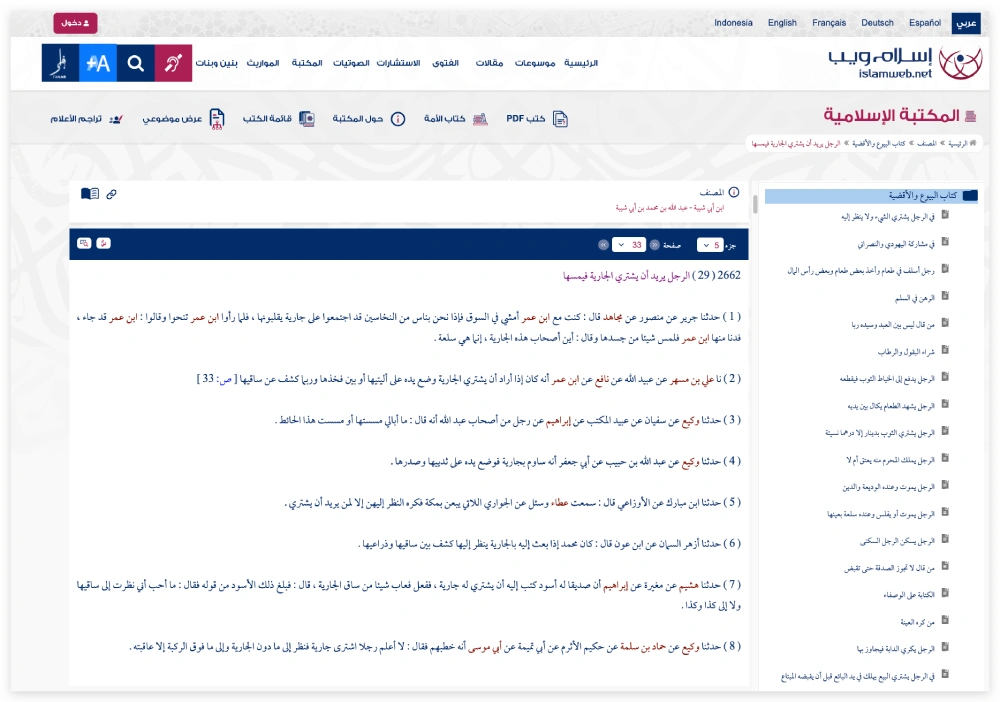
English translation: Musannaf Ibn Abi Shaybah
Section no. 2662 (29) — Regarding touching a slave girl when a person intends to purchase her
1. Reported from Mujahid: He said, I was walking through the market with Ibn Umar. Suddenly, we saw a group of slave dealers (nakhkhasin) gathered around a slave girl and turning her over for examination. When they saw Ibn Umar, they stepped aside and said, “Ibn Umar has arrived.” Ibn Umar then approached the slave girl and touched some part of her body. He said, “Where are the owners of this slave girl? She is merely a commodity.” ( Musannaf Ibn Abi Shaybah, Hadith no. 26620 )
2. Reported from Ali ibn Mushir through Nafiʿ: When Ibn Umar intended to purchase a slave girl, he would place his hand on her buttocks or between her thighs and would sometimes expose her two lower legs. ( Musannaf Ibn Abi Shaybah, Hadith no. 26621 )
3. Reported from Wakiʿ through Ibrahim: One of Abdullah’s companions—Abdullah ibn Masʿud—used to say, “I do not care whether I touched her, the slave girl, or touched this wall.” ( Musannaf Ibn Abi Shaybah, Hadith no. 26622 )
4. Reported from Wakiʿ through Abu Jaʿfar: While bargaining over the price of a slave girl, Abu Jaʿfar placed his hands on her breasts and chest. ( Musannaf Ibn Abi Shaybah, Hadith no. 26623 )
5. Reported from Ibn al-Mubarak through ʿAtaʾ: When he was asked about slave girls offered for sale in Mecca, he said that he disapproved of looking at them for anyone who did not intend to purchase them—that is, looking was permissible for a prospective buyer. ( Musannaf Ibn Abi Shaybah, Hadith no. 26624 )
6. Reported from Azhar al-Samman through Ibn ʿAwn: When a slave girl was sent to Muhammad ibn Sirin, he would examine her by exposing her two lower legs and her two arms. ( Musannaf Ibn Abi Shaybah, Hadith no. 26625 )
7. Reported from Hushaym through Ibrahim: A black man wrote to Ibrahim asking him to purchase a slave girl for him. Ibrahim did so and criticized one of the girl’s lower legs for a defect. When this reached the black man, he said, “I would rather not have looked at her lower leg or at such-and-such other parts.” ( Musannaf Ibn Abi Shaybah, Hadith no. 26626 )
8. Reported from Wakiʿ through Abu Musa al-Ashʿari: Abu Musa addressed the people and said, “If I learn that a man looked, while purchasing a slave girl, at the area below her navel or the area above her knee, I will punish him.” ( Musannaf Ibn Abi Shaybah, Hadith no. 26627 )
Summary: These reports clearly show that at that time it was customary for buyers or inspectors in the buying and selling of slave girls to directly touch or expose various sensitive parts of their bodies—the breasts, buttocks, and thighs. The statements attributed to figures such as Ibn Umar make clear that slave girls were treated not as human beings but as mere purchasable “commodities” or “goods.”
From Sexual Use to Resale: Women as Both Sex Slaves and Market Commodities
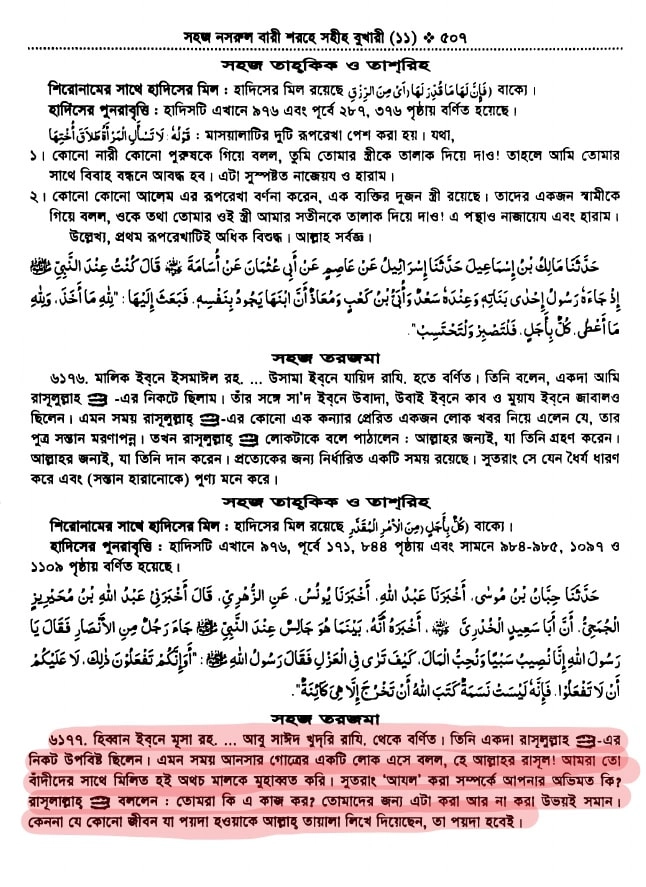
The horror of the slave market was not limited to the fact that a woman was made to stand in the market while her breasts, buttocks, thighs, or other body parts were examined. An even more horrifying truth is that even after the buyer purchased and sexually used her, she remained a market commodity. A report from Sahih al-Bukhari preserved in the Shongshoy Islamic Archive expresses this economic and sexual relationship in a single statement. According to Abu Saʿid al-Khudri, the Companions said to Muhammad, “We have intercourse with captive slave girls, but we want to obtain their price by selling them.” They then immediately asked about ʿazl, or coitus interruptus. In other words, the same woman was being used sexually while her pregnancy was being prevented in order to preserve the possibility of selling her later for money. She was not an independent sexual partner; she was simultaneously a body for sexual use and an economic asset available for resale. [19]
Sahih al-Bukhari (Islamic Foundation edition)
2088. It is narrated from Abu Saʿid al-Khudri that he was once sitting with the Noble Prophet, peace and blessings be upon him, when he said, “O Messenger of Allah! We have intercourse with captive slave girls, but we want to obtain their price by selling them. What do you say about ʿazl (coitus interruptus) in this situation?” He said, “Do you actually do this? If you do not do it, that will cause you no harm. For whatever child Allah Most High has decreed to be born will certainly be born.”
Hadith grading: Sahih (Sahih)
The economic relationship between ʿazl and the sale of slave girls is particularly important in this hadith. The Companions’ objective was not merely to have intercourse with captive women; they also wanted to profit by selling the same women later. But if a slave girl became pregnant and gave birth as a result of intercourse, she could become an umm walad, and the opportunity to sell her would then be closed. Thus, ʿazl was a way to use the same woman sexually while preventing pregnancy and preserving her future market value and saleability. In other words, the woman was simultaneously an object of sexual use and property convertible into cash in the future—these two economic and sexual interests are brought together in the same hadith. Islamic commentaries on hadith also state this reason explicitly. [20] [21]
Explanation in Sahaj Nasrul Bari:
If we do not practice ʿazl with the slave girl, there is a risk that she will become an umm walad. Yet we love our property. We want to sell her and benefit from her price. But once she becomes an umm walad, we will not be able to sell her. Therefore, we want to practice ʿazl with the slave girl so that she does not become pregnant.
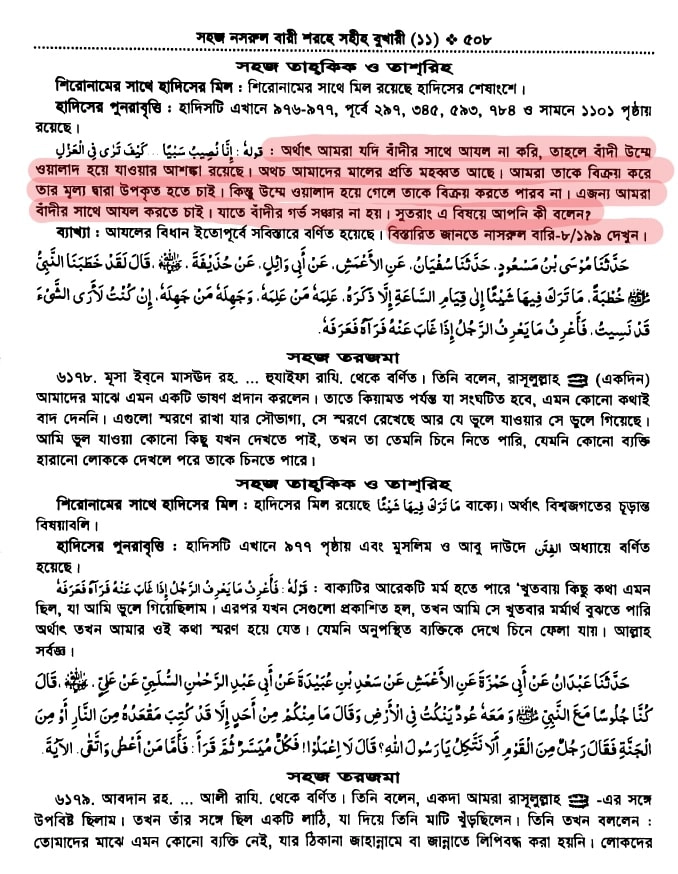
This is no longer a matter of inference. First, intercourse is taking place with the slave girl; at the same time, efforts are being made to prevent her from becoming pregnant; and the declared economic purpose behind this contraception is to sell her later and profit from the price. Sexual use and commodification were therefore not opposites—ʿazl was a method for sexually using the same slave girl while preserving her resale value. A woman’s pregnancy is considered here not as a question of her own life or motherhood, but as a question of the future marketability of the owner’s property.
This status of human beings as resalable property was not an isolated market practice from Muhammad’s time. In a sound report from Sunan Abi Dawud preserved in the Shongshoy Islamic Archive, Jabir ibn Abdullah says, “We sold umm walad slave women during the time of the Messenger of Allah and Abu Bakr. Later, during Umar’s time, we stopped when he prohibited us from doing so.” A sound report later in the same chapter states that a man had made his only slave a mudabbar—that is, he had declared that the slave would be freed after the owner’s death. But because the man had no other property, Muhammad ordered that slave to be sold, and he was sold for seven hundred or nine hundred Arab coins. Thus, even a person who had been promised future emancipation was placed back on the market as property convertible into cash because of financial necessity. [22]
Sunan Abi Dawud, Hadith 3955:
“We sold umm walad slave women during the time of the Messenger of Allah and Abu Bakr. Later, during Umar’s time, we stopped when he prohibited us from doing so.”
Sunan Abi Dawud, Hadith 3956:
“A man declared that his slave would be free when he died, while he owned no property other than that slave. The Prophet ordered him to sell the slave, and he was then sold for seven hundred or nine hundred Arab coins.”
The statement of Tafsir al-Qurtubi exposes this property-based reasoning even more starkly. While discussing the Prophetic instruction to sell a slave girl who repeatedly committed adultery, al-Qurtubi asks: if the seller must inform the buyer of this “defect” in the slave girl, why would anyone buy her? He answers, “She is property”—فَإِنَّهَا مَالٌ—and therefore she cannot simply be abandoned, because destroying property is prohibited; even if the owner keeps her permanently, he will be deprived of her utility. Consequently, “there remains no option except to sell her.” The fiqh solution for the life of a woman here is to find her a new owner so that the property’s financial and practical utility will not be lost. [23]
The fact that people were exchangeable assets not only for money but also for other people is directly illustrated by the incident of Safiyya at Khaybar. A report from Sahih Ibn Hibban preserved in the Shongshoy Islamic Archive states that a beautiful slave girl fell to the share of Dihya al-Kalbi, and Muhammad took her from Dihya “in exchange for seven slaves”—فَاشْتَرَاهَا رَسُولُ اللَّهِ ... بِسَبْعَةِ أَرْؤُسٍ. He then sent Safiyya to Umm Sulaym to prepare her. The value of a female war captive is thus expressed directly as the exchange value of seven other human beings. Money, male slaves, and female slaves were all interchangeable within the same property transaction. [24]
Hadith 7,212
Original Arabic
أَخْبَرَنَا الْحَسَنُ بْنُ سُفْيَانَ، قَالَ: حَدَّثَنَا هُدْبَةُ بْنُ خَالِدٍ، قَالَ: حَدَّثَنَا حَمَّادُ بْنُ سَلَمَةَ، عَنْ ثَابِتٍ، عَنْ أَنَسٍ، قَالَ: كُنْتُ رَدِيفَ أَبِي طَلْحَةَ يَوْمَ خَيْبَرَ، وَإِنَّ قَدَمِي لَتَمَسُّ قَدَمَ رَسُولِ اللَّهِ صَلَّى اللَّهُ عَلَيْهِ وَسَلَّمَ، فَأَتَيْنَا خَيْبَرَ وَقَدْ خَرَجُوا بِمَسَاحِيهِمْ وَفُؤُوسِهِمْ وَمَكَاتِلِهِمْ، وَقَالُوا: مُحَمَّدٌ وَالْخَمِيسُ، فَقَالَ رَسُولُ [ص:195] اللَّهِ صَلَّى اللَّهُ عَلَيْهِ وَسَلَّمَ: «اللَّهُ أَكْبَرُ خَرِبَتْ خَيْبَرُ، إِنَّا إِذَا نَزَلْنَا بِسَاحَةِ قَوْمٍ فَسَاءَ صَبَاحُ الْمُنْذَرِينَ»، فَقَاتَلَهُمْ رَسُولُ اللَّهِ صَلَّى اللَّهُ عَلَيْهِ وَسَلَّمَ فَهَزَمَهُمْ، فَلَمَّا قُسِمَتِ الْمَغَانِمُ قِيلَ لِرَسُولِ اللَّهِ صَلَّى اللَّهُ عَلَيْهِ وَسَلَّمَ: إِنَّهُ وَقَعَ فِي سَهْمِ دَحِيَّةَ الْكَلْبِيِّ جَارِيَةٌ جَمِيلَةٌ، فَاشْتَرَاهَا رَسُولُ اللَّهِ صَلَّى اللَّهُ عَلَيْهِ وَسَلَّمَ بِسَبْعَةِ أَرْؤُسٍ، ثُمَّ دَفَعَهَا رَسُولُ اللَّهِ صَلَّى اللَّهُ عَلَيْهِ وَسَلَّمَ إِلَى أُمِّ سُلَيْمٍ تُهَيِّئُهَا، وَكَانَتْ أُمُّ سُلَيْمٍ تَغْزُو مَعَ رَسُولِ اللَّهِ صَلَّى اللَّهُ عَلَيْهِ وَسَلَّمَ، فَدَعَا بِالْأَنْطَاعِ، فَأُحْضِرَتْ، فَوَضَعَ الْأَنْطَاعَ وَجِيءَ بِالتَّمْرِ وَالسَّمْنِ، فَأَوْسَعَهُمْ حَيْسًا، فَأَكَلَ النَّاسُ حَتَّى شَبِعُوا، فَقَالَ النَّاسُ: تَزَوَّجَهَا أَمِ اتَّخَذَهَا أُمَّ وَلَدٍ؟ فَقَالُوا: إِنْ حَجَبَهَا فَهِيَ امْرَأَتُهُ، وَإِنْ لَمْ يَحْجُبْهَا فَهِيَ أُمُّ وَلَدٍ، فَلَمَّا أَرَادَتْ أَنْ تَرْكَبَ حَجَبَهَا حَتَّى قَعَدَتْ عَلَى عَجُزِ الْبَعِيرِ خَلْفَهُ، ثُمَّ رَكِبَتْ، فَلَمَّا دَنَوْا مِنَ الْمَدِينَةِ أَوْضَعَ، وَأَوْضَعَ النَّاسُ، وَأَشْرَفَتِ النِّسَاءُ يَنْظُرْنَ، فَعَثَرَتْ بِرَسُولِ اللَّهِ صَلَّى اللَّهُ عَلَيْهِ وَسَلَّمَ رَاحِلَتُهُ، فَوَقَعَ وَوَقَعَتْ صَفِيَّةُ، فَقَامَ رَسُولُ اللَّهِ صَلَّى اللَّهُ عَلَيْهِ وَسَلَّمَ فَحَجَبَهَا، فَقَالَتِ النِّسَاءُ: أَبْعَدَ اللَّهُ الْيَهُودِيَّةَ، وَشَمِتْنَ بِهَا، قَالَ ثَابِتٌ: فَقُلْتُ لِأَنَسٍ: يَا أَبَا حَمْزَةَ أَوَقَعَ رَسُولُ اللَّهِ صَلَّى اللَّهُ عَلَيْهِ وَسَلَّمَ مِنْ رَاحِلَتِهِ؟ فَقَالَ: إِي وَاللَّهِ وَقَعَ مِنْ رَاحِلَتِهِ يَا أَبَا مُحَمَّدِ
رقم طبعة با وزير = (7168)
تحقيق الشيخ ناصر الدين الألباني: صحيح – مضى (7425 و 7426). تنبيه!! رقم (7425) = (7468) من «طبعة المؤسسة». رقم (7426) = (7469) من «طبعة المؤسسة» لكن الحديث ليس موجود بالرقمين المشار إليهما وإنما موجود بالأرقام التالية. رقم (4725) = (4745) من «طبعة المؤسسة». رقم (4726) = (4746) من «طبعة المؤسسة» – مدخل بيانات الشاملة -.
تحقيق الشيخ شعيب الأرناؤوط: إسناده صحيح على شرط مسلم
English translation
Anas (may Allah be pleased with him) reported: On the day of Khaybar, I was riding behind Abu Talha (may Allah be pleased with him), and my foot was touching the foot of the Messenger of Allah (peace and blessings be upon him). When we reached Khaybar, its people came out carrying their spades, axes, and baskets, saying, “Muhammad and the army.” The Messenger of Allah (peace and blessings be upon him) said: “Allah is the Greatest! Khaybar is destroyed. When we descend upon the territory of a people, evil is the morning of those who were warned.”
The Messenger of Allah then fought them and defeated them.
When the spoils were distributed, the Messenger of Allah was told: “A beautiful slave girl has fallen to the share of Dihya al-Kalbi (may Allah be pleased with him).” The Messenger of Allah purchased her in exchange for seven slaves. He then handed her over to Umm Sulaym (may Allah be pleased with her) so that she could prepare her. Umm Sulaym used to campaign with the Messenger of Allah. He then ordered leather mats to be brought.
They were brought, and he spread them out. Dates and ghee were brought, and he prepared a generous amount of hais for them—a dish made from dates, ghee, and cheese. The people ate until they were full. They said: “Did he marry her, or did he take her as an umm walad?” They said: “If he veils her, she is his wife; if he does not veil her, she is an umm walad.” When she wanted to mount, he veiled her until she sat behind him on the rear of the camel, and then she mounted.
When they came near Medina, he proceeded rapidly, and the people proceeded rapidly as well. The women looked out to see her. Suddenly, the Prophet’s mount stumbled, and he fell, as did Safiyya. The Messenger of Allah stood up and veiled her. The women said: “May Allah keep the Jewess away,” and they rejoiced at her misfortune. Thabit said: I said to Anas: “O Abu Hamza, did the Messenger of Allah fall from his mount?” He replied: “Yes, by Allah, he fell from his mount, O Abu Muhammad.”
When these documents are read together, the complete economic cycle of the slave market becomes clear: a woman could come under ownership through captivity or purchase; the buyer could examine her body; he could use her sexually; her market price could rise or fall based on virginity or physical defects; pregnancy could damage the possibility of future resale; and she could again be sold, returned, given away, or transferred in exchange for another human being. This was not a “shelter system,” but a systematically organized institution that brought the human body, labor, sexuality, and reproductive capacity under the same ownership-based market system.
The Anatomy of the Slave Market: The Unveiled Display of Women’s Bodies and the Legal Validity of Touching
The picture of the medieval slave market presented to us by the classical legal texts is not merely that of a marketplace; rather, it is a horrifyingly inhumane spectacle. Here, a woman’s body was viewed not simply as a ‘person,’ but as a ‘commodity’ or ‘property’ (mal). In modern ethics, where ‘consent’ and ‘privacy’ are fundamental conditions, the fiqh rulings granted a buyer the right to tear apart the privacy of a woman being offered for sale.
1. The Right to Touch Under the Pretext of Buying and Selling: A highly authoritative work such as Ashraful Hidaya states in remarkably direct language that if a person intends to purchase a slave girl, he is permitted to touch certain parts of her body. What is astonishing and horrifying is that this permission to touch was granted even when the buyer knew that touching her might arouse sexual desire in him [25]. According to influential jurists such as Imam Muhammad and Imam Abu Yusuf, a buyer could, if he wished, view and touch the slave girl’s breasts, back, wrists, and even her shins while they were uncovered. In the mirror of modern ethics, this is not merely indecent assault; it is organized sexual abuse—legitimized under the guise of law.
2. Humiliation in the Name of Inspecting the Commodity: The justification offered for this ruling is even more degrading. It was said that since the buyer was paying money for the commodity, he had the right to ascertain the ‘skin’ or qualities of the commodity. Here, a woman’s body was treated exactly like livestock at a cattle market. Human dignity was reduced below the ‘quality of the product.’ Although scholars of later periods spoke of touching only in the absence of sexual desire, the original classical right nevertheless gave the buyer an opportunity to indulge in that primitive savagery.
3. The Public Display of Adolescent Slave Girls: This brutality of the slave market became even more horrific in the case of adolescent slave girls. According to the rulings of Hidaya, as long as an adolescent slave girl had not begun menstruating (that is, had not reached puberty), she could be kept in the marketplace with her ‘upper body uncovered.’ Even if she was physically capable of intercourse—whether at seven or nine years of age—she could still be presented for sale with only a cloth covering her from the navel downward, leaving her breasts and back exposed [26]. In the present age, we can directly call this the institutionalized form of ‘child pornography’ or ‘pedophilia.’ Displaying children’s bodies in this way before buyers under the cover of religion is an ultimate example of moral bankruptcy.
4. The Double Standard Regarding the ʿAwrah or Covering: While Islam prescribed strict veiling for free women (azad women), the rule concerning the ‘awrah’ or covering of enslaved women was made extremely lax. According to Hanafi fiqh, the ʿawrah of a female slave was essentially the same as that of a man (from the navel to the knees). This discriminatory law created the opportunity to keep women standing half-naked in the marketplace. Through this, society was given the message that—nobility and honor were reserved only for free women, while slave women were merely objects of gratification with no right to modesty or dignity.
Modern Human Rights versus Medieval Fiqh: An Ideological and Moral Analysis
The fundamental conflict between medieval fiqh rulings and modern human rights is not merely a conflict over law; rather, it is a conflict over the very definition of the human being. The modern world order regards every person as ‘born free and endowed with dignity.’ By contrast, in the legal documents we have examined, human beings are viewed merely as a ‘utility’ or a ‘commodity.’ The fault lines between these two philosophies are analyzed below:
1. Personhood versus Commodification: The first article of modern human rights, Article 1 of the UDHR, declares that all human beings are born free and equal in dignity. Yet works such as Mukhtasar al-Quduri and Hidaya classify human beings as ‘mal’ or property. When a law says that a woman may be returned to the seller if she has a ‘bad smell from her mouth or armpits’ because this is an ‘obstacle to sexual intercourse’ [27], that woman’s personhood is completely erased. In modern ethics, this is called ‘dehumanization’, in which a person’s value depends not on their intellect or identity, but on the smell of their body or the perfect condition of their limbs.
2. Sexual Autonomy versus Ownership: In modern law and ethics, ‘sexual autonomy’ is an inviolable right. In other words, only the individual has authority over their own body, and any physical touch without ‘consent’ is considered sexual abuse. Yet in fiqh rulings, we find that a buyer could touch a woman’s breasts, back, or shins merely by intending to purchase her—even if this aroused sexual desire in the buyer, it was still considered lawful [25]. From the perspective of modern ethics, this is a form of structural rape culture, in which a woman’s bodily privacy or consent has no place; instead, the man’s ‘buyer’s right’ or ‘ownership right’ is given priority.
3. The Commercialization of Virginity and Gender-Based Violence: The legal validity granted by Hidaya to examining the hymen is extremely degrading and invasive from the perspective of modern medicine and human rights [28]. In the modern era, this is called ‘virginity testing,’ which the World Health Organization (WHO) identifies as a violation of human rights and a form of gender-based violence. This medieval ruling proves that a woman’s chastity or virginity was not regarded as a matter of dignity; rather, it was a ‘quality check’ on the commodity, and if that quality was found lacking, the buyer could raise the issue of financial loss. Subjecting a person’s body to such a ‘mechanical examination’ is nothing but primitive barbarism.
4. Child Protection versus Childhood Abuse: In the present world, protecting children and safeguarding their physical integrity is a sacred responsibility of the state. Yet fiqh rulings state that adolescent slave girls could be displayed in the marketplace with their breasts and backs exposed until they reached puberty [26]. Even the provision allowing seven- or nine-year-old children to be presented in the marketplace if they were considered sexually suitable is described in modern criminological terms as ‘child sexual exploitation’ or child sexual exploitation. Putting children’s childhood up for auction in this way under the pretext of religion is a profound moral challenge for any person with a healthy conscience.
5. The Double Standard of Veiling and Social Inequality: In Islam, the rule of veiling is often promoted as a ‘protective shield for women.’ But why was that same rule so lax in the case of slave women? Why was it lawful for a slave woman’s stomach and back to remain exposed in the marketplace? The answer lies in their ‘classification’. According to fiqh law, honor and privacy were reserved only for ‘free’ women, while slave women were ordinary objects of gratification. This double standard proves that the rule of veiling was not actually spiritual; rather, it was a symbol of social rank. Islamic jurisprudence did not recognize any right to protect the modesty or privacy of a woman who had no money or who had become enslaved after losing a war.
Conclusion: The Dialectic Between ‘Universal Compassion’ and the Documentary Reality
In this lengthy discussion, we have traversed the dark alleys of classical Islamic jurisprudence. We have seen how the flesh-and-blood existence of a human being was reduced to the level of a mere ‘commodity’ or ‘inanimate object.’ In the modern era, many Muslim preachers claim that slavery in Islam was a ‘system of compassion’ and that it bestowed dignity upon slaves. But when we read the rulings in authoritative legal works such as Ashraful Hidaya and Mukhtasar al-Quduri without bias, that claim of ‘compassion’ turns into a colossal farce.
This dispassionate examination of history can be the first step toward building a new, humane world free from fanaticism—a world in which no person owns another and no one’s body becomes an object of auction in any marketplace.
References
- al-Sarakhsi, Al-Mabsut, vol. 13, pp. 179–180 ↩︎
- Imam al-Nawawi, Al-Majmu‘ Sharh al-Muhadhdhab, vol. 11, p. 580 ↩︎
- Dabiq, Issue 4, “The Revival of Slavery Before the Hour” ↩︎
- The Role of Women and Girls in the Eyes of Islamic State: A Content Analysis of Dabiq and Rumiyah Magazines Stempień, Marta Sara ↩︎
- UN Report on ISIS Crimes against Yazidis, 2016 ↩︎
- Shongshoy Islamic Archive—Musannaf ʿAbd al-Razzaq ↩︎
- Musannaf ʿAbd al-Razzaq, Hadith 13,204 ↩︎
- Dorar al-Sunniyya, Irwa al-Ghalil, report 1792; al-Bayhaqi, al-Sunan al-Kubra, chapter on a man inspecting a slave girl he intends to purchase — Islamweb ↩︎
- al-Albani, Irwa al-Ghalil, report 1796; Ibn Abi Shaybah, al-Musannaf, section “The Slave Woman Praying Without a Khimar” — Islamweb; al-Maktaba al-Islamiyya online edition of Irwa al-Ghalil ↩︎
- Tafsir Mazhari, vol. 3, pp. 16–17 ↩︎
- al-Misbah al-Nuri, commentary on Mukhtasar al-Quduri, vol. 1, Islamia Kutubkhana, p. 230 ↩︎
- Imam Malik, Al-Muwatta, Kitab al-Buyuʿ, Bab al-ʿAyb fi al-Riqaq, p. 461 — Islamweb ↩︎
- Al-Muwatta of Malik—Rules on Defects and Valuation of Male and Female Slaves, Islamweb ↩︎
- Ashraf al-Hidaya, Islamia Kutubkhana, vol. 9, pp. 618–619 ↩︎
- al-Sarakhsi, Al-Mabsut, vol. 13, p. 179 — Islamweb ↩︎
- Imam al-Nawawi, Al-Majmuʿ Sharh al-Muhadhdhab, vol. 11, p. 580 — Islamweb ↩︎
- Ashraf al-Hidaya, Islamia Kutubkhana, vol. 9, p. 596 ↩︎
- ابن أبي شيبة – عبد الله بن محمد بن أبي شيبة ↩︎
- Shongshoy Islamic Archive — Sahih al-Bukhari, Islamic Foundation edition, Hadith 2088, concerning ʿazl ↩︎
- Sharh Sunan Abi Dawud — ʿAbd al-Muhsin al-ʿAbbad, explanation of ʿazl and the sale of an umm walad — Islamweb ↩︎
- Sahaj Nasrul Bari, commentary on Sahih al-Bukhari, vol. 11, pp. 507–508 ↩︎
- Sunan Abi Dawud, Hadiths 3955–3956 — Shongshoy Islamic Archive ↩︎
- Tafsir al-Qurtubi, vol. 5, pp. 146–150 — Shongshoy Islamic Archive ↩︎
- Sahih Ibn Hibban, Hadith 7212 — Shongshoy Islamic Archive ↩︎
- Ashraful Hidaya, vol. 9, p. 618 1 2
- Ashraful Hidaya, vol. 9, p. 619 1 2
- Al-Misbahun Nuri Sharh Mukhtasar al-Quduri, vol. 1, p. 230 ↩︎
- Ashraful Hidaya, vol. 9, p. 596 ↩︎