
Summary
Under Islamic Sharia, a free Muslim man may have a maximum of four wives at the same time. However, no maximum numerical limit—four or otherwise—was prescribed for female slaves owned by him, or those whom his “right hand possesses.” This distinction is explicitly recognized in classical Islamic fiqh. Major works of Hanafi, Shafi‘i, Maliki, and Hanbali jurisprudence limit the number of wives to four while imposing no comparable numerical limit on owned female slaves. Nor was there a four-woman ceiling on the number of female slaves with whom sexual intercourse was legally permissible, provided no separate Sharia impediment applied.
This article does not claim that an owner could have sexual intercourse with every female slave he owned under all circumstances. Islamic law imposed separate prohibitions involving kinship, sexual relations with two sisters at the same time, sexual relations with both a mother and her daughter, an existing valid marriage to another man, istibra’, and several other conditions. These, however, were not numerical limits. Thus, if four, ten, one hundred, or more female slaves were otherwise lawful for intercourse under Sharia, their number alone did not make such intercourse unlawful. This article examines the source, scope, and legal structure of this rule through the Qur’an, hadith, classical works of fiqh, and contemporary Islamic fatwas.
Introduction
Discussions of polygyny in Islam are usually reduced to a single number—four wives. On the basis of Qur’an 4:3, a free Muslim man may have no more than four wives under marriage at the same time. But this four-wife limit was not the total limit of lawful sexual relations in Islamic law. Alongside wives, the Qur’an recognized another distinct category: ma malakat aymanukum, “those whom your right hands possess.” Later Islamic jurisprudence developed separate legal rules for these two categories: sexual relations with a wife were lawful through nikah, whereas sexual relations with an owned female slave were grounded in milk al-yamin—ownership.
The most significant consequence of this distinction concerned numbers. While wives were limited to four, the same restriction did not apply to owned female slaves. Classical works from different schools of fiqh discuss the matter directly. Some state that a free man may own as many female slaves as he wishes; others state even more explicitly that, where no separate Sharia impediment exists, there is no four-woman limit on the number of owned female slaves with whom he may have intercourse. This was not an isolated opinion; the same basic rule appears across multiple schools of Islamic jurisprudence.
Wives and female slaves also did not possess the same legal status under this system. A wife had rights associated with marriage, including a dowry, maintenance, and an allotted share of nights where multiple wives were involved. The owner’s sexual access to a female slave, by contrast, did not depend on nikah, and he was not required to divide his time equally among female slaves as he was among wives. Therefore, the claim that “in Islam a man may lawfully have sexual relations with no more than four women” is historically and jurisprudentially false. Four was the limit for wives; Sharia recognized a separate, numerically open framework for slave concubinage.
The following sections first examine the relevant Qur’anic verses and then present direct quotations from Fatawa Alamgiri, Imam al-Shafi‘i’s al-Umm, al-Qarafi’s al-Furuq, Ibn Taymiyyah, ‘Abd al-Rahman al-Sa‘di, and other works of fiqh. In each case, the source link and the relevant passage are provided so that the jurisprudential basis for unlimited slave ownership and sexual relations can be verified directly.
Wives and Owned Female Slaves in the Qur’an: Two Distinct Sexual Relationships
The Qur’an places wives and owned female slaves side by side as two distinct categories of lawful sexual partners. Qur’an 23:5–7 first commands believers to guard their private parts, then declares two exceptions to that sexual restraint: their wives and those whom their right hands possess. Men are described as free from blame for sexual relations with these two categories, while those who seek sexual relations beyond them are called transgressors. The same rule is repeated in almost identical language in Qur’an 70:29–31. [1] [2]
Qur’an 23:5–7
“And those who guard their private parts (5), except from their wives or those whom their right hands possess, for then they are not blameworthy (6). But whoever seeks beyond that—then those are the transgressors (7).”
Qur’an 70:29–31
“And those who guard their private parts (29), except from their wives or those whom their right hands possess, for then they are not blameworthy (30). But whoever seeks beyond that—then those are the transgressors (31).”
The sexual meaning of these verses is also explicit in the tafsir literature. While commenting on this passage of Surah al-Mu’minun, al-Qurtubi states that the verse addresses men specifically and that a woman does not acquire a right to sexual intercourse with a male slave she owns. Thus, “ma malakat aymanuhum” here refers to female slaves owned by men. In a report cited by al-Qurtubi, a woman had intercourse with her male slave and argued that, just as a man’s owned female slave was lawful for him, her owned male slave should likewise be lawful for her. The Companions rejected her interpretation. The legal application is therefore clear: the ownership-based sexual right was recognized for the male owner in relation to his female slave. [3] [4]
“In this verse, men in particular are addressed, not women. The proof is the statement of Allah: ‘except from their wives or those whom their right hands possess.’ … The consensus of the scholars is that it is not lawful for a woman to have intercourse with a male slave whom she owns.”
In the report transmitted from Qatadah, a woman explained her intercourse with her male slave by saying: “I thought that, because he belonged to me, he was lawful for me just as a female slave owned by a man is lawful for him.”
Tafsir al-Durr al-Manthur likewise identifies wives and female slaves as two categories of lawful sexual partners for men when commenting on these verses. In al-Suddi’s explanation, “those whom their right hands possess” is defined directly as “his female slave.” A report attributed to Muhammad ibn Ka‘b identifies wives and owned female slaves as the two lawful avenues of sexual access, while a statement attributed to Ibn ‘Umar says that intercourse is not lawful with another person’s female slave, but only with one’s own. [5]
“They are not blameworthy for having intercourse with their wives and female slaves.”
Regarding “those whom their right hands possess,” al-Suddi said: “His female slave.”
Muhammad ibn Ka‘b said: “Every private part is forbidden to you except two kinds. Allah said: ‘except from their wives or those whom their right hands possess.’”
The contemporary Salafi fatwa site IslamQA also explicitly declares sexual intercourse between a master and his female slave lawful on the basis of these verses. In Fatwa 13737, the question asks why keeping a concubine or female slave is not forbidden and whether other Muslims could also possess such slave women. The answer cites Qur’an 23:6 and 70:30 and states that intercourse with one’s own female slave is lawful because Allah permitted it. The same answer discusses acquiring a female slave through purchase or as part of war booty. [6]
“With regard to your question about it being permissible for a master to be intimate with his slave woman, the answer is that that is because Allaah has permitted it.”
It then cites Qur’an 23:6 and 70:30:
“Except from their wives or (the slaves) that their right hands possess, for then, they are free from blame.”
It further states that the female slave may come into the man’s possession “because he has paid money to buy her or he has fought … and acquired her among the war booty.”
These Qur’anic provisions establish marriage and slave ownership as two distinct legal foundations for lawful sexual relations. A wife becomes sexually lawful through nikah; a female slave becomes sexually lawful through milk al-yamin, or ownership. The extensive body of later Islamic jurisprudence on slave concubinage was built upon this Qur’anic distinction.
The Four-Wife Limit
The central Qur’anic verse for understanding the numerical distinction between wives and female slaves is Qur’an 4:3. It permits a Muslim man to marry two, three, or four women and, if he fears that he cannot deal justly with them, directs him toward one wife or those whom his right hand possesses. One part of the verse establishes a numerical limit for nikah; the other introduces ma malakat aymanukum as a separate category. [7]
“And if you fear that you will not deal justly with the orphans, then marry those women who please you—two, three, or four. But if you fear that you will not be just, then marry only one, or those whom your right hands possess. That is more likely to prevent you from committing injustice.”
Al-Qurtubi explains that during the pre-Islamic period and the early period of Islam, men could marry as many free women as they wished, and that this verse restricted the number to four. In his subsequent discussion, attempts to derive a permissible total of nine or eighteen wives are also rejected, and “two, three, or four” is interpreted as establishing four as the maximum. [8] [9]
وقال الضحاك والحسن وغيرهما: إن الآية ناسخة لما كان في الجاهلية وفي أول الإسلام، من أن للرجل أن يتزوج من الحرائر ما شاء، فقصرتْهن الآية على أربع.
“Al-Dahhak, al-Hasan, and others said: This verse abrogated what had existed in the pre-Islamic period and at the beginning of Islam, when a man could marry as many free women as he wished; the verse restricted them to four.”
Al-Qurtubi’s subsequent discussion states: “Indeed, Allah Most High has made lawful for you two, three, and four women.”
IslamWeb Fatwa 61565 states the same rule even more directly. It cites al-Khiraqi as saying that a free man may not have more than four wives simultaneously. It then cites Ibn Qudamah’s al-Mughni as stating that the scholars reached consensus on this rule. A marriage to a fifth woman while four wives remain under the marriage bond is considered invalid. [10]
فلا يجوز للمسلم أن يجمع في عصمته أكثر من أربع نساء
“It is not permissible for a Muslim to have more than four women simultaneously under his marriage bond.”
قال الخرقي: وليس للحر أن يجمع بين أكثر من أربع زوجات. قال شارحه ابن قدامة في المغني: أجمع أهل العلم على هذا ولا نعلم أحدا خالفه منهم.
“Al-Khiraqi said: A free man may not combine more than four wives. His commentator Ibn Qudamah said in al-Mughni: The scholars are unanimously agreed upon this, and we do not know of anyone among them who disagreed.”
IslamWeb Fatwa 19722 likewise states that an ordinary Muslim man may have up to four wives simultaneously and no more. This four-woman limit governs the number of marriages or wives under nikah. Ownership of female slaves or the number of women taken in tasarri does not fall within that ceiling. [11]
ومن أحكام الله تعالى أنه شرع للرجل أن يجمع بين أربع نسوة، ولا يزيد على ذلك باتفاق أهل العلم
“Among the rulings of Allah Most High is that He prescribed for a man to combine four wives and no more than that, by agreement of the scholars.”
Thus, the number four was not the maximum number of lawful sexual partners available to a man in Islamic law. It was the maximum number of wives he could hold in marriage at the same time. Sharia created a separate institution for female slaves, in which milk al-yamin constituted an independent legal basis for sexual relations and was not subject to the four-wife limit. Hanafi jurisprudence states this distinction with particular clarity in Fatawa Alamgiri.
Fatawa Alamgiri: As Many Female Slaves as He Wishes
The large Hanafi legal compilation commissioned by the Mughal emperor Aurangzeb is known as al-Fatawa al-Hindiyyah, or more commonly in the Indian subcontinent as Fatawa Alamgiri. In the chapter on marriage, while discussing women who may not be combined together, the work first limits a free man to four wives. The very next rule establishes the opposite numerical rule for female slaves: a free man may practice tasarri with as many female slaves as he wishes, however numerous they may be. [12]
فإنه لا يحل للرجل أن يجمع بين أكثر من أربع نسوة
“It is not lawful for a man to combine more than four women in marriage.”
ويجوز للحر أن يتسرى من الإماء ما شاء من العدد وإن كثرن
“A free man may practice tasarri with as many female slaves as he wishes, however numerous they may be.”
The Bengali translation published by the Islamic Foundation Bangladesh states the same rule directly. After prohibiting a man from having more than four women in marriage, it says of the number of female slaves under the control of a free man: “as many as he wishes” and “however large their number may be.” The Arabic term يتسرى (yatasarra) does not merely mean owning female slaves for domestic labor. In the terminology of fiqh, tasarri refers to taking an owned female slave as a sexual concubine or surriyya. The Arabic text therefore states the unlimited numerical character of slave concubinage even more precisely than the Bengali translation. [13]
“It is not permissible for a man to bring more than four women under his marriage at the same time. … A free man may keep as many female slaves under his control as he wishes. No matter how great their number, there is no problem.”
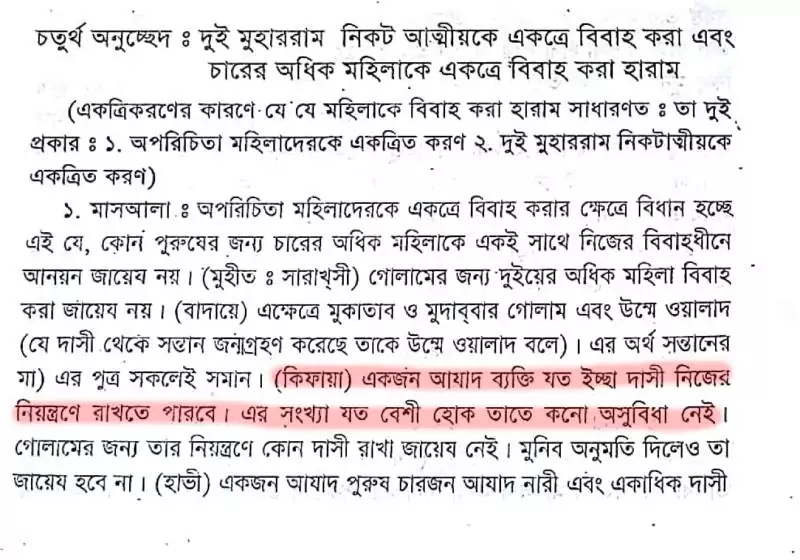
The next sentence in the same passage further states that a free man may marry four women, whether free women or female slaves. The text therefore distinguishes between marrying a female slave and taking an owned female slave in tasarri. If a female slave is married through nikah, she counts within the four-wife ceiling; but when an owned female slave is taken in tasarri, that numerical ceiling does not apply. [14]
وللحر أن يتزوج أربعا من الحرائر والإماء
“A free man may marry four women from among free women and female slaves.”
Immediately before this, the text states:
ويجوز للحر أن يتسرى من الإماء ما شاء من العدد وإن كثرن
“A free man may practice tasarri with as many female slaves as he wishes, however numerous they may be.”
The numerical distinction between marriage and slave concubinage is therefore stated side by side: a maximum of four under nikah; as many as he wishes under tasarri, however numerous they may be. In Hanafi jurisprudence, there was no maximum number of female slaves, and the four-wife ceiling did not govern tasarri. Shafi‘i, Maliki, and Hanbali sources state the same rule even more directly.
Imam al-Shafi‘i: Intercourse with as Many Female Slaves as He Wishes, but No More Than Four Wives
In al-Umm, Imam Muhammad ibn Idris al-Shafi‘i, founder of the Shafi‘i school, defines the numerical distinction between wives and owned female slaves directly in terms of sexual intercourse. The discussion concerns the rules governing intercourse with a mother and her daughter under milk al-yamin. Al-Shafi‘i first states that a man may own a woman and her daughter simultaneously, although he may not have intercourse with both; similarly, he may own two sisters simultaneously even though he may not combine them both in marriage. He then states the numerical distinction between wives and female slaves in a single sentence. [15] [16]
ويطأ من الولائد ما شاء بالملك وفي وقت واحد ولا يكون له أن يجمع بين أكثر من أربع بالنكاح
“Through ownership, he may have intercourse with as many female slaves as he wishes at the same time, but through marriage he may not combine more than four women.”
Al-Shafi‘i places two rules side by side in the same sentence. The first concerns intercourse with female slaves through milk, or ownership: “as many as he wishes” and “at the same time.” The second concerns taking wives through nikah: no more than four. The passage does not merely say that a man may purchase or own an unlimited number of female slaves; the Arabic verb يطأ directly denotes sexual intercourse. Therefore, the claim that al-Shafi‘i imposed a four-woman ceiling on slave concubines comparable to the four-wife limit is plainly false.
This passage is also important because al-Shafi‘i distinguishes ownership, marriage, and sexual intercourse as separate legal concepts within the same discussion. A man may own a mother and her daughter simultaneously but may not have intercourse with both; he may own two sisters simultaneously but may not combine them both in marriage; where no such kinship prohibition applies, however, he may have intercourse with as many female slaves as he wishes at the same time. Numerical openness and specific kinship prohibitions are therefore separate rules.
In jurisprudential terms, the distinction is precise: the legal basis for taking a wife as a sexual partner is nikah, while the legal basis for sexual relations with one’s own female slave is milk al-yamin. The four-person ceiling applies to marriage; it does not apply to ownership-based sexual relations. Al-Shafi‘i’s statement is therefore direct and unequivocal evidence for the central claim of this article.
Al-Qarafi: Whether Few or Many, Female Slaves Are Not Limited to Four
The influential Maliki jurist Shihab al-Din Ahmad ibn Idris al-Qarafi devoted a separate jurisprudential discussion in his Anwar al-Buruq fi Anwa’ al-Furuq, commonly known as al-Furuq, to the numerical distinction between wives and female slaves. It appears as his 144th farq, or legal distinction. In the very title of the discussion, he states that any number of female slaves may be combined—whether few or many—while the number of wives may not exceed four. [17]
الإماء يجوز الجمع بين عدد أي عدد شاء منهن كثر أو قل
“With female slaves, it is permissible to combine whatever number one wishes, whether many or few.”
ويضاف لذلك التسري بما شاء
“In addition to that, he may practice tasarri with as many as he wishes.”
فلذلك لم يقع العدد محصورا في جواز وطء الإماء
“For that reason, no numerical limit was imposed on the permissibility of intercourse with female slaves.”
The final sentence is one of the strongest statements in this entire discussion. Al-Qarafi does not merely say that an unlimited number of female slaves may be owned; he explicitly states that no numerical limit was imposed on lawful intercourse with female slaves. His position therefore leaves no room for a supposed distinction under which a man could own unlimited slave women but have sexual relations with only a limited number of them. His legal conclusion directly concerns wat’ al-ima’—sexual intercourse with female slaves.
Al-Qarafi presents four wives and numerically unrestricted tasarri as two parts of the same legal framework. According to his discussion, a man may have four wives and, in addition, practice tasarri with “as many as he wishes.” Therefore, presenting four as the total number of lawful sexual partners available to a Muslim man directly contradicts al-Qarafi’s jurisprudence. Four is the ceiling for wives; the number of female slaves available for ownership-based sexual relations is, in his own terminology, not mahsur—not numerically restricted.
Al-Qarafi’s discussion also exposes the harsh legal hierarchy separating wives from female slaves. He describes marriage as a relationship associated with honor, selection, and elevation, while identifying service and subordination as defining features of slavery. In his framework, sexual intercourse with the slave woman is placed within this structure of ownership and servitude. It is in explaining this distinction that he ultimately states that the number of female slaves with whom intercourse is lawful was not restricted. This is direct Maliki jurisprudential evidence for the absence of a numerical ceiling on slave concubinage.
Ibn Taymiyyah: “As Many Slave Concubines as He Wishes,” but Only Four Wives
The same numerical distinction appears directly in the Hanbali jurist Ibn Taymiyyah’s Majmu‘ al-Fatawa. The discussion concerns owning two sisters and other close female relatives under milk al-yamin and the rules governing sexual relations with them. Ibn Taymiyyah states that a man may own two sisters simultaneously, but may not practice tasarri with both at the same time. He then contrasts this kinship-based prohibition with the numerical rule and states plainly that, as far as number is concerned, a man may take as many slave concubines as he wishes, while he may marry only four wives. [18]
ويجوز له أن يملكهما لكن ليس له أن يتسراهما
“He may own both of them, but he may not practice tasarri with both.”
فإن له أن يتسرى ما شاء من العدد ولا يتزوج إلا بأربع
“As far as number is concerned, he may practice tasarri with as many as he wishes, but he may marry only four.”
Ibn Taymiyyah uses the phrase ما شاء من العدد—“whatever number he wishes.” This is not merely a statement about the total number of female slaves a man may own; the verb يتسرى refers specifically to taking an owned female slave as a sexual concubine. In the same sentence, he contrasts this with ولا يتزوج إلا بأربع—“he may marry only four.” His language therefore separates the numerical rules governing marriage and slave concubinage within a single statement: a maximum of four wives; no fixed numerical ceiling on tasarri.
The context is equally important. Ibn Taymiyyah distinguishes two different forms of prohibition. One is a numerical prohibition—tahrim al-‘adad—under which more than four wives cannot be held in marriage. The other concerns combinations prohibited because of kinship, such as two sisters, a woman and her paternal aunt, or a woman and her maternal aunt. He makes clear that the existence of these kinship restrictions does not create a numerical ceiling on the total number of slave concubines. The numerical rule is separate: a man may practice tasarri with as many as he wishes.
Ibn Taymiyyah’s statement stands within the same jurisprudential structure as those of al-Shafi‘i and al-Qarafi. Al-Shafi‘i says that a man may have intercourse, through ownership, with as many female slaves as he wishes at the same time; al-Qarafi says that the number of female slaves with whom intercourse is lawful is not restricted; Ibn Taymiyyah says that, as far as number is concerned, a man may practice tasarri with as many as he wishes while marriage is limited to four. These sources from different schools yield the same conclusion: the four-person limit applies to wives, not to the number of slave concubines.
‘Abd al-Rahman al-Sa‘di: “Among Those Whom the Right Hand Possesses, He May Intercourse with as Many as He Wishes”
The influential twentieth-century Salafi exegete and jurist ‘Abd al-Rahman ibn Nasir al-Sa‘di states the same numerical distinction in concise and unequivocal language in his Manhaj al-Salikin wa Tawdih al-Fiqh fi al-Din. While discussing women temporarily prohibited in marriage, he states in ruling 519 that a free man may not have more than four wives simultaneously. In the immediately following ruling, 520, he gives a completely different rule for milk al-yamin: the owner may have intercourse with as many of his female slaves as he wishes. [19]
٥١٩- ولا يجوزُ أن يجمعَ أكثرَ من أربعٍ، ولا للعبدِ أن يجمعَ أكثرَ من زوجتين.
“519—A free man may not combine more than four [wives], and a male slave may not combine more than two wives.”
٥٢٠- وأما ملكُ اليمينِ، فله أن يطأ ما شاء.
“520—As for those whom the right hand possesses, he may have intercourse with as many as he wishes.”
The wording of these two consecutive rulings is especially significant. Ruling 519 uses يجمع أكثر من أربع—he may not combine more than four wives. But ruling 520 uses يطأ ما شاء in relation to female slaves—“he may have intercourse with as many as he wishes.” In the terminology of Islamic sexual law, the Arabic word wat’ directly means sexual intercourse. Al-Sa‘di’s statement therefore does not merely permit ownership of an unlimited number of female slaves; it directly states the absence of a four-woman numerical ceiling on intercourse with owned female slaves.
Read side by side, al-Sa‘di’s two rulings make the numerical structure of Islamic law unmistakable: a free man may have no more than four wives under nikah, but under milk al-yamin he may have intercourse with as many female slaves as he wishes. The same rule has already appeared in the Hanafi Fatawa Alamgiri, al-Shafi‘i’s al-Umm, the Maliki al-Qarafi’s al-Furuq, and the Hanbali Ibn Taymiyyah’s Majmu‘ al-Fatawa. Across different periods and schools of jurisprudence, the numerical distinction between wives and slave concubines remained the same.
IslamWeb: Four Wives Are Limited, Female Slaves Are Not Numerically Limited
This rule of classical fiqh is also explicitly recognized by the contemporary Islamic fatwa site IslamWeb. Fatwa 457315, published on 28 April 2022, is titled “حكمة تقييد الزوجات بالأربع، دون الإماء”—“The wisdom behind limiting wives to four but not female slaves.” The questioner asks plainly why marriage is restricted to four wives while ownership of female slaves is allowed without any numerical limit. IslamWeb’s answer explicitly accepts the absence of such a numerical restriction under milk al-yamin. [20]
السؤال:
ما الحكمة في تقييد الله -عز وجل- الزواج بأربعة فقط دون زيادة، مع السماح بامتلاك الإماء بدون تقييد أي عدد؟
“Question: What is the wisdom behind Allah restricting marriage to only four without allowing more, while permitting the ownership of female slaves without restricting their number?”
الإجابة:
وأما عدم هذا التقييد في ملك اليمين…
“As for the absence of this restriction in milk al-yamin…”
The significance of IslamWeb’s answer lies precisely here: it does not reject the premise that female slaves were not subject to a limit of four or any other fixed number. Instead, the second part of the answer begins by explicitly referring to “the absence of this restriction in milk al-yamin.” Thus, a four-wife limit alongside numerically unrestricted slave ownership is treated as an accepted jurisprudential premise of the fatwa. [21]
In the same answer, IslamWeb quotes Ibn al-‘Attar’s Sharh al-‘Umdah on the legal distinction between a wife and a female slave. The passage states that marriage to a wife is primarily intended for sexual intercourse, whereas ownership of a female slave is not confined to intercourse and allows the owner to derive multiple forms of benefit from her. Marriage and slave ownership are therefore treated as distinct legal categories. [22]
قال أصحاب الشافعي: والفرق بين الزوجة والأمة: أن الزوجة تراد للوطء خاصة … بخلاف الأمة؛ فإنها تراد لملك الرقبة، وأنواع المنافع غير الوطء.
“The Shafi‘i scholars said: The distinction between a wife and a female slave is that a wife is sought specifically for intercourse … unlike a female slave, who is owned in person and for various forms of benefit other than intercourse.”
This fatwa links the position of contemporary IslamWeb directly to the preceding classical jurisprudential sources. Four wives constitute a fixed marital ceiling; no corresponding numerical ceiling exists for ownership of female slaves. And as the direct statements of al-Shafi‘i, al-Qarafi, Ibn Taymiyyah, and al-Sa‘di already demonstrate, there was likewise no four-woman limit on sexual intercourse with female slaves who were otherwise legally available for intercourse under Sharia.
IslamQA: Allah Permitted Sexual Intercourse with Female Slaves
IslamQA Fatwa 13737 was asked directly about the permissibility of keeping female slaves or concubines: “Why is it not haram to have concubines?” and “Can other Muslims have concubines too?” IslamQA’s answer is direct. It states that a master may have sexual relations with his own female slave because “Allah has permitted it.” It then cites Qur’an 23:5–6 and 70:29–30, where wives and those whom the right hand possesses are identified as two categories with whom sexual relations are lawful. [23]
“With regard to your question about it being permissible for a master to be intimate with his slave woman, the answer is that that is because Allaah has permitted it.”
“Except from their wives or (the slaves) that their right hands possess, for then, they are free from blame.”
—Qur’an 23:6; Qur’an 70:30
The same fatwa also explains how a female slave may come into a man’s possession. According to IslamQA, ownership may be established by purchasing the woman or by acquiring her as part of the war booty taken by Muslims. Thus, the fatwa does not merely discuss slavery as an abstract historical institution; once ownership is established, that ownership itself is treated as the legal basis for sexual access. [24]
“This slave woman belongs to him, either because he has paid money to buy her or he has fought … and acquired her among the war booty.”
Another IslamQA fatwa states even more directly that sexual intercourse with one’s own female slave is not zina. Answer 20802 cites Surah al-Mu’minun and states that Allah permitted a man to have sexual relations with a female slave if he owns her, and that “those whom their right hands possess” refers to female slaves or concubines. [25]
“Allah has permitted intimacy with a slave woman if the man owns her. This is not regarded as adultery.”
“What is meant by ‘those whom their right hands possess’ is slave women or concubines.”
The legal inequality between wives and female slaves is further stated in IslamQA Answer 102446. While explaining Qur’an 4:3, it quotes ‘Abd al-Rahman al-Sa‘di’s tafsir: a man may take two, three, or four wives, but no more than four. It then states that, unlike wives, female slaves were not entitled to equal division of the man’s time. [26]
“The one who wants to take two or three or four wives may do so, but no more than that.”
“Then he should limit himself to one, or to slaves that his right hand possesses, because he is not obliged to divide his time equally when it comes to slave women.”
These fatwas make the legal framework explicit: wives under nikah and owned female slaves did not belong to the same legal category; wives were limited to four, sexual intercourse with an owned female slave was lawful through ownership without nikah, and female slaves did not possess the same right to equal allocation of time that applied among wives. Contemporary IslamQA thus directly restates the separate sexual regime established in classical fiqh.
Even Married Female War Captives Could Become Sexually Lawful to Their Owners
Qur’an 4:24 is central to understanding the reach of ownership-based sexual relations. After prohibiting married women, the verse immediately makes an exception for “ma malakat aymanukum”—“those whom your right hands possess.” Thus, although another man’s married wife was ordinarily forbidden as a sexual partner, a woman who became owned through war captivity was removed from that general prohibition. The Abu Bakr Zakaria tafsir published in the Shongshoy Islamic Reference Library states directly that when non-Muslim women were captured in war and came into Muslim ownership, sexual relations with them became lawful without marriage. [27]
“They were then made lawful for the Muslims without marriage.”
The same tafsir states that one menstrual cycle had to pass to establish that the captive woman was not pregnant; if she was pregnant, intercourse could not occur until after childbirth.
Sahih Muslim 1456 directly connects this verse to the events at Awtas. Abu Sa‘id al-Khudri reports that during the campaign of Hunayn, Muhammad sent an army to Awtas. The Muslim forces defeated the enemy and captured their women. The husbands of these captive women were still alive among the polytheists. Because of those husbands, some of Muhammad’s Companions hesitated to have sexual intercourse with the captives. The report then states that the exception in Qur’an 4:24—“married women, except those whom your right hands possess”—was revealed. [28]
فَكَأَنَّ نَاسًا … تَحَرَّجُوا مِنْ غِشْيَانِهِنَّ مِنْ أَجْلِ أَزْوَاجِهِنَّ
That is, a group of the Companions refrained from intercourse with the captive women because those women had husbands.
The report then cites:
وَالْمُحْصَنَاتُ مِنَ النِّسَاءِ إِلَّا مَا مَلَكَتْ أَيْمَانُكُمْ
“And married women, except those whom your right hands possess.”
The chapter heading under which these reports appear in Sahih Muslim states the rule even more directly: intercourse with a captive woman becomes lawful after istibra’, and if she had a husband, captivity dissolves the previous marriage. This is not merely one possible interpretation of the verse; in the Sahih Muslim material itself, the question of intercourse with married captive women and the exception in Qur’an 4:24 are placed together. [29]
باب جواز وطء المسبية بعد الاستبراء وإن كان لها زوج انفسخ نكاحها بالسبي
“Chapter: The permissibility of intercourse with a female captive after istibra’; if she has a husband, her marriage is dissolved by captivity.”
IslamWeb Fatwa 15512 states the same conclusion even more explicitly in its explanation of Qur’an 4:24. It identifies muhsanat in this verse as married women and states that when a married woman becomes a war captive and thereby enters milk al-yamin, her previous marriage is dissolved by captivity itself. After istibra’ is completed, the owner may have sexual intercourse with her. [30]
فعقد الزوجية ينهدم بمجرد سبيها، ولكن لا توطأ إلا إذا استبرئت
“The marriage bond is dissolved simply by her being taken captive, but intercourse does not take place until istibra’ has been completed.”
Tafsir al-Durr al-Manthur collects several further reports under Qur’an 4:24 concerning the same issue. In one report, a captive woman tells the Muslim man approaching her for intercourse, “I have a husband.” The matter is then reported to Muhammad, after which the relevant verse is said to have been revealed. Another report attributed to Ibn ‘Abbas states directly that intercourse with a married woman is adultery—except in the case of a female war captive. Another states that even if her husband remained alive in dar al-harb, a captive woman who entered Muslim ownership became lawful to her owner after istibra’. [31]
“When a man wanted to approach a woman for intercourse, she would say: ‘I have a husband.’”
Another report states in substance that married women are forbidden, except female war captives who become owned.
These sources describe the same legal structure: when a married woman from the enemy side was captured and entered Muslim ownership, the marital rights of her living husband no longer remained effective under Sharia. Captivity dissolved the previous marriage, and after istibra’ the new owner could have sexual intercourse with her without nikah. The exception of “ma malakat aymanukum” in Qur’an 4:24 functioned as the Qur’anic basis for this system.
The Jurisprudential Meaning of “No Numerical Limit”
The absence of a numerical ceiling on female slaves was not merely an abstract rule in classical fiqh; jurists used examples in which a man could possess hundreds or even thousands of slave concubines within the legally permitted framework. In the Hanafi jurist Ibn ‘Abidin’s Radd al-Muhtar ‘ala al-Durr al-Mukhtar, the numerical distinction between wives and female slaves is discussed by first stating that a free man may have no more than four women under nikah. The very next statement says that he may practice tasarri with as many female slaves as he wishes. The text then gives the example of a man who already has four wives and one thousand surriyyas, yet wishes to purchase another female slave. [32]
وله التسري بما شاء من الإماء
“He may practice tasarri with as many female slaves as he wishes.”
فلو له أربع وألف سرية وأراد شراء أخرى
“If he has four wives and one thousand slave concubines and wishes to purchase another…”
After this quotation, “one thousand female slaves” cannot be dismissed as a rhetorical example invented by a modern critic. Hanafi jurisprudence itself uses the example of a man with four wives and one thousand surriyyas, and places his desire to purchase yet another female slave within the same lawful framework of tasarri. Whether the number is four, ten, one hundred, one thousand, or more, no fixed maximum is prescribed.
Ibn Taymiyyah expresses the same rule more concisely. In Majmu‘ al-Fatawa, he compares the numerical rules for wives and female slaves in a single sentence: as far as number is concerned, a man may practice tasarri with as many female slaves as he wishes, while he may not have more than four wives in marriage. [33]
فإن له أن يتسرى ما شاء من العدد ولا يتزوج إلا بأربع
“As far as number is concerned, he may practice tasarri with as many as he wishes, but he may marry only four.”
Separate sexual prohibitions nevertheless continued to apply. A woman prohibited because of blood or milk kinship could not be taken in tasarri; a man could not simultaneously have sexual relations with two sisters, with a woman and her paternal aunt, or with a woman and her maternal aunt. If an owner married his female slave to another man, he could not have intercourse with her while that marriage remained valid. A newly acquired female slave was also subject to the rules of istibra’. These were restrictions concerning particular women and their legal status or relationships; they were not maximum limits on the total number of female slaves or on the total number of female slaves otherwise lawful for intercourse. [34]
فليس له أن يتسرى الأختين ولا الأمة وعمتها والأمة وخالتها
“He may not practice tasarri simultaneously with two sisters, nor with a female slave and her paternal aunt, nor with a female slave and her maternal aunt.”
The jurisprudential rule is therefore straightforward: there is no maximum numerical ceiling; prohibitions are determined by the particular woman’s legal status and relationship. A man having one thousand surriyyas was not unlawful because of the number itself—Radd al-Muhtar explicitly uses that number. Where no separate Sharia impediment applied, acquiring or taking further female slaves in tasarri was not barred merely because of how many he already possessed.
Legal Inequality Between Wives and Female Slaves
In Islamic sexual law, wives and owned female slaves did not occupy the same legal status. Sexual relations with a wife were grounded in nikah; sexual relations with one’s own female slave were grounded in milk al-yamin, or ownership. A man did not have to marry his own female slave in order to have sexual relations with her. Classical fiqh in fact held that an owner could not marry a female slave while she remained his property, because ownership itself already conferred the relevant right of sexual access. IslamQA Answer 128160 explains this distinction by quoting Ibn Qudamah’s al-Mughni. [35]
“The contract of ownership is stronger than the contract of marriage.”
In substance, Ibn Qudamah’s statement is that ownership gives the master rights over the slave woman’s services and sexual access to her.
The numerical distinction follows directly from this legal division. Wives were limited to four; female slaves were not. Another consequence was the husband’s obligation to divide his time among multiple wives, an obligation that did not apply in the same way to female slaves. In explaining Qur’an 4:3, IslamQA quotes al-Sa‘di’s tafsir as saying explicitly that a man must divide his time equally among multiple wives but is under no such obligation with respect to slave women. [36]
“He is not obliged to divide his time equally when it comes to slave women.”
Al-Qarafi’s explanation exposes this hierarchy even more starkly. While explaining why wives and female slaves were governed by different numerical rules, he describes marriage as a relationship based on honor, selection, and elevation, while identifying service and the degraded status of slavery as fundamental characteristics of the female slave’s position. In his analysis, service is the primary function of the slave woman, while sexual intercourse is another ownership-based use attached to that status; it is within this structure that he explains why the number of female slaves with whom intercourse was lawful was not restricted. [37]
الزواج مبني على العز والاصطفاء والإعزاز … عكس باب الإماء الخدمة أصل
“Marriage is based on honor, selection, and elevation … whereas in the case of female slaves, service is fundamental.”
فلذلك لم يقع العدد محصورا في جواز وطء الإماء
“For that reason, the number was not restricted in the permissibility of intercourse with female slaves.”
The difference between a wife and a female slave was therefore not merely terminological; it represented a fundamentally different legal status. A wife was a free woman under nikah, and the relationship was governed by the rules of marriage. A female slave was a woman under ownership, and the legality of sexual relations with her was grounded not in marriage but in ownership. Wives were subject to a four-person limit and possessed rights concerning the allocation of nights; slave concubines were not subject to that numerical limit and did not possess the same right to equal allocation. No separate marriage and dowry were required for an owner to have sexual relations with his own female slave. This inequality was not a peripheral exception in Islamic jurisprudence; it followed directly from constructing wives and milk al-yamin as two separate categories of lawful sexual access.
The legal structure is therefore clear: on one side, wives under nikah—a maximum of four and subject to rules of marital allocation; on the other, owned female slaves—sexual access without nikah, without the wives’ right to equal allocation, and outside the numerical ceiling of four. In classical Islamic jurisprudence, whether a woman was a free wife or an owned female slave determined an entirely different body of sexual and family law.
Statements by Contemporary Islamic Speakers
The numerical distinction between wives and female slaves found explicitly in classical fiqh is also repeated in the statements of contemporary Islamic speakers. The following discussions address the rules governing four wives, female slaves, milk al-yamin, and sexual relations with slave women.
Canadian Islamic speaker Shabir Ally was also asked about concubinage and female slavery in Islam. In the discussion, he acknowledges that while a Muslim man’s wives are limited to four, the same numerical restriction does not apply to the female slaves he owns. In other words, the four-person limit belongs to wives under nikah; slave ownership falls outside that limit.
These statements reproduce the same basic framework established in the jurisprudential sources cited above. Just as Hanafi, Shafi‘i, Maliki, and Hanbali works limit wives to four while leaving the number of female slaves open, contemporary Islamic discussions also acknowledge the same fundamental rule.
Conclusion
The common claim that Islam permits a man no more than four lawful sexual partners is false. Four is the maximum number of wives he may simultaneously hold under nikah. Alongside marriage, Islamic Sharia recognized a separate sexual institution known as milk al-yamin, under which sexual relations with one’s own female slaves were lawful without marriage and those female slaves were not subject to a maximum limit of four or any other fixed number.
This rule does not depend on a single school, an isolated jurist, or a late reinterpretation. The Hanafi Fatawa Alamgiri states that a free man may practice tasarri with as many female slaves as he wishes, however numerous they may be. Al-Shafi‘i’s al-Umm states that through ownership a man may have intercourse with as many female slaves as he wishes at the same time, while he may not have more than four wives under marriage. The Maliki jurist al-Qarafi explicitly states that no numerical restriction was imposed on lawful intercourse with female slaves. Ibn Taymiyyah states that, as far as number is concerned, a man may practice tasarri with as many as he wishes while marriage is limited to four. ‘Abd al-Rahman al-Sa‘di likewise places the four-wife ceiling and the rule permitting intercourse with as many women as one wishes under milk al-yamin in two consecutive legal rulings. The Hanafi Radd al-Muhtar even uses the example of a man with four wives and one thousand surriyyas.
The Qur’an establishes the foundation of this dual sexual system. Qur’an 4:3 permits two, three, or four wives while separately identifying “those whom your right hands possess.” Qur’an 23:5–7 and 70:29–31 place both wives and owned female slaves within the categories of sexual relations for which men are not blameworthy. Qur’an 4:24 and the Awtas reports in Sahih Muslim 1456 show the historical application of ownership-based sexual access even to married female war captives: captivity dissolved their previous marriages, and after istibra’ they became sexually lawful to their new Muslim owners.
The legal status of wives and female slaves was also fundamentally unequal. A wife was a free woman under nikah, entitled to a dowry, maintenance, allocation of nights, and other marital rules. Sexual relations with a female slave, by contrast, were legally grounded in ownership; no marriage was required for sexual access, the owner was not required to allocate equal time to slave women as he was among wives, and their number was not restricted to four. In Islamic jurisprudence, whether a woman was a free wife or an owned slave determined radically different sexual and family-law consequences.
The structure of historical Islamic sexual law was therefore explicit: on one side, marriage to a maximum of four wives; on the other, ownership of a numerically unrestricted number of female slaves and ownership-based sexual relations with as many of them as were not barred by a separate Sharia prohibition. Presenting the “four-wife limit” as the total number of lawful sexual partners available to a man in Islam omits a fundamental component of the institution of milk al-yamin recognized in the Qur’an, hadith, and classical Islamic jurisprudence.
References
- Tafsir al-Qurtubi, Vol. 12, pp. 101–105, Qur’an 23:5–7 ↩︎
- Tafsir al-Qurtubi, Vol. 18, pp. 286–290, Qur’an 70:29–31 ↩︎
- Tafsir al-Qurtubi, Vol. 12, pp. 101–105 ↩︎
- Tafsir al-Qurtubi, Vol. 12, pp. 106–110 ↩︎
- Tafsir al-Durr al-Manthur, Vol. 6, pp. 118–122 ↩︎
- IslamQA, Answer 13737, “What is the ruling on intimacy with slave women?” ↩︎
- Tafsir al-Qurtubi, Vol. 5, pp. 11–15, Qur’an 4:3 — Shongshoy Islamic Reference Library ↩︎
- Tafsir al-Qurtubi, Vol. 5, pp. 11–15 ↩︎
- Tafsir al-Qurtubi, Vol. 5, pp. 16–20 ↩︎
- IslamWeb, Fatwa 61565, “الزواج بخامسة حكمه وحكم الأولاد” ↩︎
- IslamWeb, Fatwa 19722, “يباح الجمع بين أربع زوجات فقط.. لماذا” ↩︎
- Al-Fatawa al-Hindiyyah, Kitab al-Nikah, “القسم الرابع المحرمات بالجمع” — Arabic online edition; Fatawa Alamgiri, Islamic Foundation Bangladesh, Vol. 2, p. 44 ↩︎
- Al-Fatawa al-Hindiyyah, “ويجوز للحر أن يتسرى من الإماء ما شاء من العدد وإن كثرن”; Fatawa Alamgiri, Islamic Foundation Bangladesh, Vol. 2, p. 44 — scan ↩︎
- Al-Fatawa al-Hindiyyah, Kitab al-Nikah — online Arabic text ↩︎
- Imam al-Shafi‘i, al-Umm, Vol. 4, p. 291, “وطء الأم بعد البنت من ملك اليمين” — IslamWeb Islamic Library ↩︎
- Al-Umm — Shamela PDF edition ↩︎
- Al-Qarafi, Anwar al-Buruq fi Anwa’ al-Furuq, Vol. 3, pp. 112–113, Distinction No. 144 — IslamWeb Islamic Library ↩︎
- Ibn Taymiyyah, Majmu‘ al-Fatawa, Vol. 32, pp. 69–70, “فصل الجمع بين الأختين” — IslamWeb Islamic Library ↩︎
- ‘Abd al-Rahman ibn Nasir al-Sa‘di, Manhaj al-Salikin wa Tawdih al-Fiqh fi al-Din, rulings 519–520 — IslamContent ↩︎
- IslamWeb, Fatwa 457315, “حكمة تقييد الزوجات بالأربع، دون الإماء”, 28 April 2022 ↩︎
- IslamWeb, Fatwa 457315 — Print Version ↩︎
- IslamWeb, Fatwa 457315; citing Ibn al-‘Attar, Sharh al-‘Umdah ↩︎
- IslamQA, Answer 13737, “What is the ruling on intimacy with slave women?”, 18 March 2004 ↩︎
- IslamQA, Answer 13737 ↩︎
- IslamQA, Answer 20802, “Intercourse with a slave woman is not regarded as zina (adultery)” ↩︎
- IslamQA, Answer 102446, “Obligation of treating co-wives fairly and some of the rules on travel for men with more than one wife” ↩︎
- Tafsir Abu Bakr Zakaria, Qur’an 4:24 ↩︎
- Sahih Muslim 1456a, Kitab al-Rada‘ — Sunnah.com; Sahih Muslim 1456d — Sunnah.com ↩︎
- Sahih Muslim, Kitab al-Rada‘, Chapter 9, Hadith 1456a–e — Sunnah.com ↩︎
- IslamWeb, Fatwa 15512, “تفسير قوله تعالى والمحصنات من النساء” ↩︎
- Tafsir al-Durr al-Manthur, Vol. 2, pp. 478–482 ↩︎
- Ibn ‘Abidin, Radd al-Muhtar ‘ala al-Durr al-Mukhtar, Vol. 3, pp. 46–48 — IslamWeb Islamic Library ↩︎
- Ibn Taymiyyah, Majmu‘ al-Fatawa, Vol. 32, “فصل الجمع بين الأختين” — IslamWeb Islamic Library ↩︎
- Ibn Taymiyyah, Majmu‘ al-Fatawa, Vol. 32 — IslamWeb; IslamQA, Answer 13202, “It is not permissible for a master to have intercourse with his married slave woman” ↩︎
- IslamQA, Answer 128160, “Does a slave woman become free if her master marries her?” ↩︎
- IslamQA, Answer 102446, “Obligation of treating co-wives fairly…” ↩︎
- Al-Qarafi, Anwar al-Buruq fi Anwa’ al-Furuq, Vol. 3, Distinction No. 144 — IslamWeb Islamic Library ↩︎