
Summary
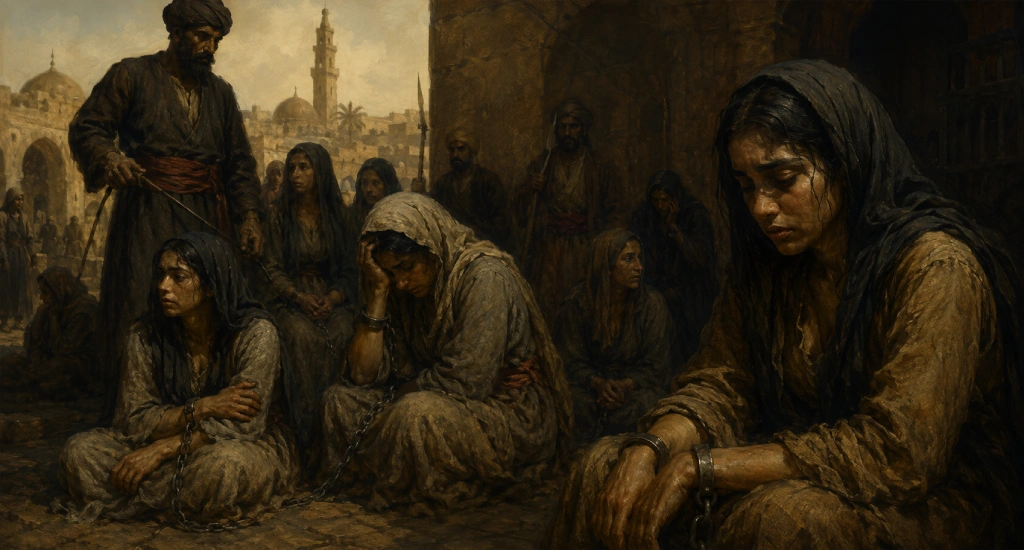
In Islamic Sharia, the rules governing sexual intercourse with slave women were not founded upon free consent, individual liberty, or women’s bodily autonomy; they were founded upon ownership, war captivity, and the concept of the master’s sexual rights. The Quran, hadith, and works of fiqh clearly contain rulings under which female prisoners of war who had just lost their families could be enslaved, their previous marriages rendered ineffective, sexual intercourse with them made lawful for their owners after istibra, slave women bought and sold, and masters granted sexual rights over them. Within this framework, the slave woman was not an independent person; she was an owned woman over whose body the master possessed legally recognized rights.
This article shows that, in the case of female war captives during the early Islamic period, the principal legal questions were whose ownership they had entered, whether istibra had been completed, whether their previous marriages had been annulled, whether there was a possibility of pregnancy, and whether their sale value or ransom would be impaired. But whether those women had freely consented to sexual relations with their new owners—men who, only a short while earlier, had killed members of their tribe—does not appear as a condition for the legality of intercourse. The events of Awtas, Banu Mustaliq, and Khaybar clearly reveal the reality of captive women being distributed, selected, transferred, and sexually used.
Major works of fiqh gave no legal recognition to a slave woman’s sexual refusal. Rather, responding to the master’s sexual summons was treated as an obligatory duty of the slave woman unless menstruation, serious illness, or another recognized legal impediment applied. Refusal was described as prohibited, sinful, deserving of curse, or as preventing the master from exercising his right. In other words, the slave woman’s “no” was not an independent legal veto capable of extinguishing the master’s sexual right. Where ownership itself is the source of sexual entitlement, the concept of free consent collapses in any meaningful sense.
It is therefore no exaggeration to describe intercourse with slave women in Islam, by modern standards, as an Islamic institutional form of the rape of female prisoners of war. Women who had just lost members of their families, witnessed the complete defeat of their people, passed into captivity over the bodies of their relatives, and were then enslaved and made sexually available to their owners on the basis of ownership were, by modern humanitarian standards, subjected to a system of sexual slavery. Slavery, women taken as war booty, ownership of the body, and legally recognized sexual rights—the entire structure stands in opposition to freedom and consent. Religious legitimacy cannot conceal this inhuman reality.
Introduction
Slavery is one of the darkest chapters in the history of human civilization. Ancient Greece, Rome, India, China, Arabia—almost every civilization practiced slavery in one form or another. Islam likewise emerged at a time when male and female slaves were a normal feature of Arabian society. An important question, however, is whether Islam abolished slavery or instead granted religious legitimacy to the existing institution and preserved it as part of Sharia law until the Day of Judgment. Did the Prophet himself own male and female slaves, buy and sell them—in other words, was the Prophet himself also a slave trader? In particular, the acceptance of female prisoners of war as slave women or concubines, and the authorization of sexual intercourse with them without requiring their consent, are explicitly established in Islamic law and fiqh. This article examines the issue through the Quran, hadith, Islamic jurisprudence, and modern human-rights standards. It should also be noted that, according to Islamic Sharia, the rulings established by Muhammad are regarded as effective and immutable until the Day of Judgment. Indeed, according to Islamic belief, these rulings remain applicable in the present age as well. This discussion, therefore, is not merely a modern evaluation of an obsolete historical rule; rather, it examines the internal framework of Islamic belief and the fiqhi reasoning upon which those who still seek to apply these rulings today base their position.
Before proceeding to the lengthy discussion that follows, the table below brings together the most important evidence examined in this article. It includes hadiths concerning intercourse with female prisoners of war, classical fiqhi rulings on a slave woman’s sexual refusal, the absence of any requirement to obtain her permission for ‘azl, the master’s sexual rights, forced intercourse, and proprietary claims over the slave woman’s body. The article’s central argument can therefore be seen at a glance: within the Islamic system of slavery, the legal basis of sexual access was not the slave woman’s free and revocable consent, but ownership, Sharia-recognized sexual entitlement, and the compulsory obedience imposed upon the enslaved woman under that entitlement.
| Evidence / Source | Core Statement | Significance for Consent | Reference |
|---|---|---|---|
| Sahih Muslim — Female Captives of Awtas | After married polytheist women became prisoners of war, they became sexually available to their Muslim owners once istibra had been completed. | Captivity and ownership form the basis of sexual legality even while the previous husbands are alive; the women’s consent is not stated as a condition. | Sahih Muslim 1456a |
| Sahih al-Bukhari — Banu Mustaliq | The Muslims wanted to have sexual intercourse with captive women and asked Muhammad about ‘azl in order to prevent pregnancy. | The question concerned pregnancy and the women’s future ransom or sale value—not the consent of the female captives. | Sahih al-Bukhari 7409 |
| Muwatta Malik — A Father’s Slave Woman Forbidden to His Son | A father gives his son a slave woman but prohibits him from approaching her because of the father’s own prior intercourse with her or sexual desire for her. | The discussion centers not on the slave woman’s wishes but on the boundaries of sexual rights and prohibitions among male family members. | Muwatta Malik, Islamic Foundation, Hadith 1134 |
| Al-Bidaya wa’l-Nihaya — A Naked Slave Woman Before Mu‘awiya | A slave woman is presented naked before Mu‘awiya; he considers sending her to Yazid, but later gives her to another man because of a Sharia prohibition. | The slave woman’s consent is not the issue; male owners’ desire, calculations of halal and haram, and decisions concerning her transfer dominate the account. | Ibn Kathir, Al-Bidaya wa’l-Nihaya, vol. 8, p. 266 |
| Rawdat al-Talibin — Imam al-Nawawi | It is strictly forbidden for a wife or slave woman to refuse the lawful sexual summons of her husband or master. | The slave woman’s “no” is not an independent legal veto. | Shamela |
| Al-Mawsu‘ah al-Fiqhiyyah | The slave woman is obliged to make herself sexually available to her master; refusal is prohibited because sexual access is regarded as the master’s right. | The sexual claim is explicitly defined as a right of the master. | Shamela |
| Al-Muhalla — Ibn Hazm | When the master calls her for intercourse, it is obligatory upon the slave woman not to prevent him; if she refuses without a valid excuse, she is described as cursed. | Sexual refusal is religiously prohibited. | Islamweb |
| IslamQA, Fatwa 33597 | A slave woman may not refuse her master’s sexual demand without a valid excuse; if she does, she is sinful and the master may discipline her. | Sexual refusal is linked to religious wrongdoing and the master’s power to punish. | IslamQA 33597 |
| Al-Shabaka al-Islamiyyah | “If she refuses, the master may compel her to intercourse; there is nothing reprehensible in this, because he is taking what is his right.” | Explicit refusal → إجبارها عليه, that is, authorization to compel her to intercourse. | Archived Fatwa |
| Al-Tamhid — Ibn ‘Abd al-Barr | The Companions did not seek the slave women’s permission or consult them; ‘azl was lawful without regard to the slave women’s opinion. | استئمار (seeking permission), مشاورة (consultation), and رأي (opinion) are all treated as unnecessary. | Islamweb |
| Al-Mughni — Ibn Qudama | The master may practice ‘azl with his slave woman without her permission because “she has no right to intercourse or to a child.” | The free wife’s permission is required, but the slave woman’s is not—the legal distinction directly concerns the right of consent. | Islamweb |
| Al-Mudawwana — Maliki Fiqh | Even if the master يغتصبها—forcibly has intercourse with his own mukataba slave woman—the hadd punishment for zina does not apply to him; the financial calculation concerns the reduction in the slave woman’s market value. | Even in a case of forced sexual intercourse, ownership and proprietary value rather than the slave woman’s autonomy remain central. | Islamweb |
| Sharh Muntaha al-Iradat — al-Buhuti | Even if a slave woman voluntarily agrees to sexual relations with another man, the right to financial compensation does not lapse because it is “the master’s right.” | The slave woman’s own consent cannot extinguish her master’s proprietary right over her body. | Islamweb |
| Ashraf al-Hidaya — ‘Azl | ‘Azl may not be practiced with a free wife without her permission; no such permission is required in the case of one’s own slave woman because she possesses no independent right to intercourse. | A direct legal distinction in sexual and reproductive agency between a free woman and a slave woman. | Ashraf al-Hidaya, vol. 9, p. 625 |
| Ashraf al-Hidaya — Istibra | The “real cause” of istibra is the new owner’s desire for intercourse; the power to have intercourse is established through ownership and possession. | Ownership and possession—not the woman’s consent—are identified as the legal source of sexual entitlement. | Ashraf al-Hidaya, vol. 9, p. 629 |
| Kecia Ali, “Concubinage and Consent” | In premodern Sunni fiqh, obtaining a slave woman’s consent before her owner had intercourse with her does not appear as a general legal requirement. | Modern academic scholarship likewise identifies an ownership-based sexual framework in classical fiqh. | Kecia Ali, IJMES, 49(1), 2017, pp. 148–152 |
International Human Rights Law and Modern Laws of War
The post-Second World War international order introduced a number of important conventions and legal instruments intended to prevent war crimes and protect human rights. The Universal Declaration of Human Rights, adopted by the United Nations in 1948, explicitly declares that “No one shall be held in slavery or servitude; slavery and the slave trade shall be prohibited in all their forms” (UDHR, Article 4). In addition, the Geneva Conventions of 1949 were adopted to protect civilians and prisoners during armed conflict, imposing mandatory standards of humane treatment upon parties to war. Acts such as the torture, killing, rape, or enslavement of prisoners are treated as grave war crimes. The International Criminal Court (ICC) and various war-crimes tribunals provide mechanisms for prosecuting those responsible for such crimes. In Bangladesh, too, the domestic International Crimes Tribunal was established to prosecute genocide, rape, and crimes against humanity committed during the 1971 War of Independence. Through such treaties and laws, modern secular states attempt to preserve minimum humanitarian standards during war and treat violations of those standards as crimes. Thus, in today’s world, the killing or torture of prisoners of war, or their reduction to sexual slavery, is universally condemned and prohibited.
Slavery and Sexual Rights over Female Prisoners of War
The Quran repeatedly uses the expression “ملک اليمين” (malakat aymanukum / what your right hands possess), an expression used for female war captives and slave women purchased from the market. This subject has been discussed in much greater detail in another article, which interested readers may consult [1]. Here, the wife—with whom a contract and consent exist—and the slave woman—whose case involves neither such a contract nor her consent—are both identified as lawful sexual partners.
In Quran 16:75 [2], a slave is compared to someone who “lacks all means.” This conception provides the underlying framework for Islamic jurisprudence: the male or female slave is deprived of independent will and consent, while the slave’s body, labor, and sexuality fall under the authority of the master.
Quran reference : Surah An-Nahl, 16:75
Arabic : ۞ ضَرَبَ ٱللَّهُ مَثَلًا عَبۡدٗا مَّمۡلُوكٗا لَّا يَقۡدِرُ عَلَىٰ شَيۡءٖ وَمَن رَّزَقۡنَٰهُ مِنَّا رِزۡقًا حَسَنٗا فَهُوَ يُنفِقُ مِنۡهُ سِرّٗا وَجَهۡرًاۖ هَلۡ يَسۡتَوُۥنَۚ ٱلۡحَمۡدُ لِلَّهِۚ بَلۡ أَكۡثَرُهُمۡ لَا يَعۡلَمُونَ ٧٥
Translation — Dr. Mustafa Khattab, The Clear Quran : “Allah sets forth a parable: a slave who lacks all means” — full published translation: Quran.com 16:75.
The Strategy of Erasing the Crime by Redefining Rape
One of the principal strategies employed by Islamic preachers is to redefine rape in such a way that the master’s sexual rights over a slave woman are excluded from the accusation from the outset. They define rape as “forced unlawful sexual intercourse.” They then argue that because intercourse with a wife or a legally owned slave woman is not unlawful under Sharia, it cannot be rape. This is not an argument; it is definitional deception. The central question in the dispute is precisely this: if a woman is taken prisoner in war, transformed into property that can be sold in a market, and the owner is granted a sexual right over her, does her consent thereby become irrelevant? Islamic preachers do not answer this question; instead, by declaring the act “lawful under Sharia,” they attempt to erase the problem itself.
If this reasoning were accepted, every system of slavery in history could declare itself innocent. A slave owner could say, “My law permits me to make slaves work, therefore this is not forced labour.” A racist legal system could say, “My law permits discrimination, therefore this is not discrimination.” Islamic fiqh proceeds in exactly the same way: “Intercourse with an owned slave woman is lawful, therefore it is not rape.” Modern moral and legal analysis, however, does not accept such circular definitions. Whether an act constitutes a crime must be assessed in relation to the victim’s freedom, consent, bodily autonomy, and the balance of power—not according to the legitimacy conferred by the perpetrator’s own religious law.
Consent does not mean merely that a woman remained silent, failed to protest out of fear, or submitted because of social or legal pressure. Genuine consent means consent that is free, informed, uncoerced, and revocable. A woman must be able to say “no” at any moment, without that refusal exposing her to religious condemnation, social humiliation, punishment, an accusation of violating her master’s rights, withdrawal of maintenance, beating, sale, continued captivity, or any other harm. Where there is no freedom to say “no,” a “yes” cannot constitute genuine consent either; it becomes merely the surrender of a weaker person before the will of the more powerful.
For this reason, the question of consent in intercourse with slave women is not merely whether “she verbally agreed.” The real question is whether she was free to refuse. If a woman is an owned slave, her body is treated as part of her master’s sexual entitlement, and her refusal is defined as forbidden, sinful, deserving of curse, or an obstruction of the master’s right, then meaningful consent does not exist within that arrangement. If the slave woman’s “no” cannot extinguish the master’s sexual right, describing that system as consensual is itself a deception.
Contemporary Islamic Justification for Sexual Use of Kafir Female Prisoners of War
A clear example of how some contemporary Islamic preachers attempt to justify this ruling can be found in this statement by Shaykh Mukhles bin Arshad Madani. He presents the kufr of non-Muslim women as a punitive justification for subjecting them to such treatment. He states quite explicitly that these measures may be imposed upon kafir women as punishment precisely because of their kufr.
Hadith and Fiqh on the Sexual Duties of Slave Women
Islamic Sharia quite explicitly regarded satisfying the sexual demands of an owner or master as an obligatory duty of slave women. The relevant evidence will be presented one by one below, but the issue can be understood clearly at the outset by watching the following video. In the video, Shaykh Mustafa al-Adawi, one of the prominent contemporary hadith scholars and Islamic scholars, was asked whether it is permissible for a man to compel his own slave woman to have sexual intercourse. The scholar replied with obvious irritation: what question of consent could there be for slaves? They are slaves! His irritated tone in the video is unmistakable, indicating that he regarded such a question as utterly unnecessary and beneath serious consideration. Let us watch the video.
The important evidence on this subject is presented below, one source at a time.
The Father’s Slave Woman, the Son’s Slave Woman: The Slave Woman’s Wishes Are Absent
A report in the Muwatta Malik reveals with striking clarity how the body of a slave woman was conceived in the language of Islamic law. The issue under discussion is not what the slave woman herself wanted, with whom she wished to live, or whether she consented to sexual intercourse. The question is whether, if a man gives a slave woman to his son, that son may have intercourse with her when the father had previously used her sexually or had desired to do so. The slave woman therefore does not appear here as an autonomous person; she appears as an owned object whose sexual use is regulated through the rights and prohibitions operating between men.
Umar ibn al-Khattab gave a slave woman to his son but instructed him not to touch her because, as he said, he had already “uncovered” her—that is, had engaged in sexual intercourse with her. In another report, Salim ibn Abdullah gave a slave woman to his son and told him not to approach her because he himself had desired her, although he had not proceeded to intercourse. The language itself exposes the nature of the system. The slave woman’s wishes are never the question; the question is whether the father’s previous sexual use or sexual desire restricts the son’s sexual right over her.
Muwatta Malik (Islamic Foundation)
Hadith: 1134
28. Book of Marriage
Chapter 15: Prohibition of Intercourse with a Slave Woman Who Had Belonged to One’s Father
Report 36. Malik stated that it had reached him that Umar ibn al-Khattab gave his son a slave woman and said to him: “Do not touch her, for I have uncovered her.”
Abd al-Rahman ibn al-Mujabbir said that Salim ibn Abdullah gave one of his sons a slave woman and told him: “Do not approach her, for I had wanted her, but I did not act upon it.”
Hadith grade: Awaiting verification
Narrator: Malik ibn Anas
بَاب النَّهْيِ عَنْ أَنْ يُصِيبَ الرَّجُلُ أَمَةً كَانَتْ لِأَبِيهِ
حَدَّثَنِي يَحْيَى عَنْ مَالِك أَنَّهُ بَلَغَهُ أَنَّ عُمَرَ بْنَ الْخَطَّابِ وَهَبَ لِابْنِهِ جَارِيَةً فَقَالَ لَا تَمَسَّهَا فَإِنِّي قَدْ كَشَفْتُهَا
وَحَدَّثَنِي عَنْ مَالِك عَنْ عَبْدِ الرَّحْمَنِ بْنِ الْمُجَبَّرِ أَنَّهُ قَالَ وَهَبَ سَالِمُ بْنُ عَبْدِ اللَّهِ لِابْنِهِ جَارِيَةً فَقَالَ لَا تَقْرَبْهَا فَإِنِّي قَدْ أَرَدْتُهَا فَلَمْ أَنْشَطْ إِلَيْهَا
The wording of this report is extremely important. لَا تَمَسَّهَا—“Do not touch her,” فَإِنِّي قَدْ كَشَفْتُهَا—“for I have uncovered her,” and لَا تَقْرَبْهَا—“do not approach her”—are not expressions concerning the slave woman’s personal consent; they are expressions regulating sexual prohibitions among male owners within a family. A father gives a slave woman to his son and then restricts the son’s sexual access to her on the basis of his own previous sexual use or desire. Whether the slave woman wants one man or the other, and whether she consents to intercourse with either of them, is never raised as a question.
It is here that the true moral obscenity of the Islamic slave-concubinage system becomes unmistakable. Decisions concerning the slave woman’s body are being made between father and son; the slave woman herself is not a party to the decision but the object of it. The father may give the slave woman to his son, and on the basis of his own previous intercourse with her or desire for her, may then tell the son, “Do not approach her.” The question is therefore not the slave woman’s consent; the question is the boundaries of sexual rights and prohibitions among male owners. In a system where the woman herself is owned property, the claim that “she consented” is a blatant deception.
This report should not be read as a prophetic hadith, but rather as supporting evidence concerning early Islamic legal culture and as a picture of the period of the Rightly Guided Caliphs. Its relevance in that respect is significant. It demonstrates that the fiqhi language surrounding slave women contains no independent consent, bodily autonomy, or right of refusal; instead, it contains ownership, sexual access, prohibitions arising from previous sexual access, and boundaries established between men. In the legal discourse, the slave woman was treated not as an autonomous person but as a legally regulated field of male sexual use.
| Issue | What the Report Shows | Significance for Consent |
|---|---|---|
| Giving a slave woman | A father gives a slave woman to his son | The slave woman is not herself a party to the relationship; she is transferable property |
| Previous sexual access | Umar says, “I have uncovered her” | The father’s previous sexual use limits the son’s sexual entitlement |
| Sexual desire | Salim says, “I had wanted her” | A man’s sexual desire toward the slave woman becomes the legally relevant factor |
| The slave woman’s position | She is never asked with whom she wishes to be | Independent consent or refusal is irrelevant to the discussion |
A Naked Slave Woman Before Mu‘awiya: Evidence of Consent?
In the report from the Muwatta Malik, we saw a father give a slave woman to his son and then restrict the son’s sexual entitlement because of his own previous intercourse with her or desire for her. An even more explicit manifestation of the same mentality appears in a historical account concerning Amir Mu‘awiya. Here, the slave woman’s body is not merely treated as owned sexual property; she is presented naked in a court, a staff is used to point toward her private parts, and whether she may be sent to Mu‘awiya’s son Yazid is discussed among men. What the slave woman herself wants—her modesty, consent, refusal, or bodily rights—is entirely absent from the discussion.
In Ibn Kathir’s Al-Bidaya wa’l-Nihaya, this incident is mentioned through Ibn ‘Asakir in connection with the biography of Khadij, a freedman of Mu‘awiya. The report states that Mu‘awiya purchased a beautiful, fair-skinned slave woman. She was then presented naked before him. Holding a staff, he pointed it toward her private parts and said, “If only this organ of intercourse were mine!” He then wanted to send the slave woman to his son Yazid. Later, however, someone warned him that because he had looked at the woman’s naked body and private parts with sexual desire, she would no longer be lawful for Yazid. Mu‘awiya therefore changed his decision and gave the slave woman to another freedman. [3] [4]
While discussing the biography of Khadij, the freedman of Mu‘awiya, Ibn ‘Asakir reports the following:
“On one occasion Mu‘awiya purchased a beautiful, fair-skinned slave woman. I then presented her before him while she was naked. At the time he had a staff in his hand. Pointing with it toward her private part, he said: If only this organ of intercourse were mine! Take her to Yazid ibn Mu‘awiya.
… When the narrator met him, he said to him: This slave woman was brought before me naked and I have seen her private parts; now I wish to send her to Yazid. He said: No, Commander of the Believers! Do not do that, for she is no longer lawful for him. Mu‘awiya said: You have given an excellent opinion.
The narrator says: He then gave the slave woman to Abdullah ibn Mas‘ada al-Fazari, the freedman of Fatima. He was dark-skinned, so Mu‘awiya said to him: Use her to make your offspring fair-skinned. This incident is evidence of Mu‘awiya’s religious discernment and careful inquiry, since he had looked at the slave woman with sexual desire. Yet, considering himself weak in relation to her and refraining from taking her for himself, he refrained from giving her to his son Yazid because of the following verse.”
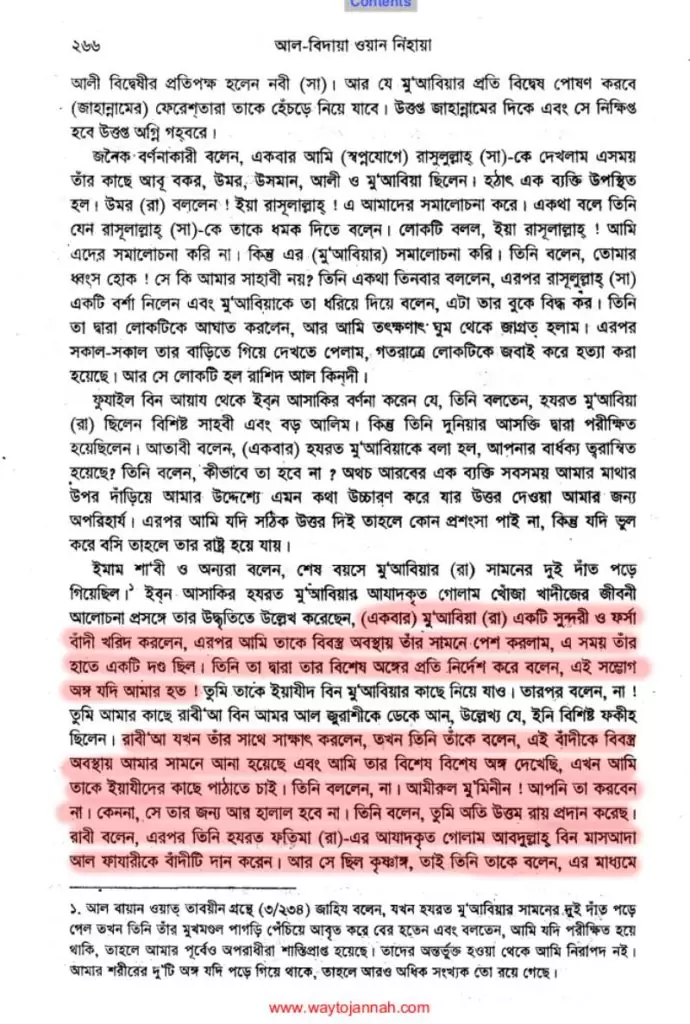
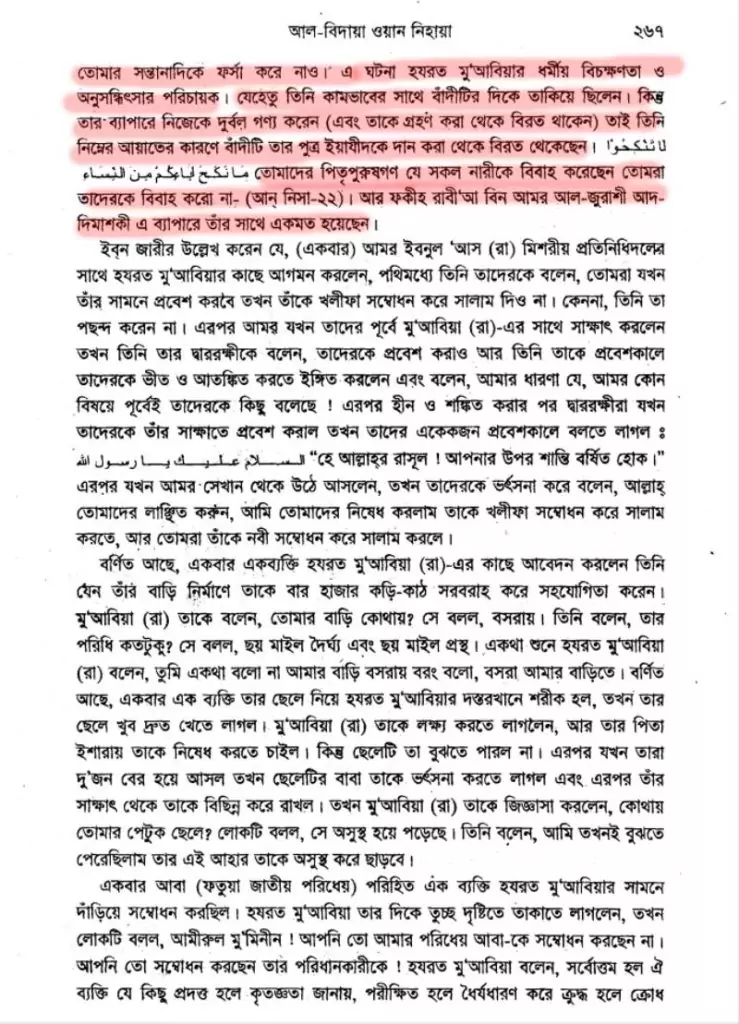
The horror of this account lies not merely in the nudity or the vulgar remark. Its deeper horror is that the slave woman’s entire existence has been reduced to an object of male sexual and legal calculation. She is purchased, displayed naked, her body is commented upon, sending her to a son is discussed, and then, because of a Sharia prohibition, she is given to another man. At no point does anyone ask: What does the slave woman herself want? Whom does she wish to accept? Did she give permission to be presented naked? Do her humiliation, modesty, or bodily autonomy possess any value?
Even more significantly, Ibn Kathir presents the incident as an example of Mu‘awiya’s “religious discernment,” because although he looked at the slave woman’s naked body with sexual desire, he ultimately followed the Sharia ruling and did not send her to his son. In other words, the moral problem was not that an enslaved woman had been brought naked before the court, that a staff had been used to point toward her sexual organ, or that she had been discussed as an object for intercourse. The legal and moral problem was instead whether a woman whom the father had viewed with desire remained lawful for the son. In this single feature, the moral bankruptcy of the entire slave-concubinage system becomes visible.
| Event | What the Account Shows | Significance for Consent |
|---|---|---|
| Purchase of the slave woman | Mu‘awiya purchases a beautiful, fair-skinned slave woman | The slave woman is treated as marketable property |
| Naked presentation | She is brought before him naked | Her modesty or permission is never raised as a question |
| Pointing at her body | A staff is used to indicate her private parts | The female body becomes an object of public sexual inspection |
| Decision to send her to the son | Mu‘awiya considers sending her to Yazid | Male owners, not the slave woman herself, determine her sexual future |
| Sharia prohibition | If the father has looked at her with desire, she is not lawful for the son | The issue is not the slave woman’s consent but male familial sexual prohibitions |
| Given to another man | She is ultimately given to another freedman | She remains transferable sexual property |
When this incident is placed beside the report in the Muwatta Malik, a continuous picture emerges. On one side, a father gives a slave woman to his son and says, “Do not approach her, because I used her or desired her.” On the other, a slave woman is displayed naked in Mu‘awiya’s court, the possibility of sending her to his son is discussed, and she is subsequently given to another man because of a Sharia prohibition. In both cases, the slave woman does not appear as a person endowed with human dignity; she appears as an object of male ownership, desire, prohibition, transfer, and reproduction. To describe such a system as a “consensual relationship” is not a reading of history; it is shameless apologetic fabrication intended to conceal the ugly reality of Islamic slavery.
Rawdat al-Talibin — Ruling Concerning Slave Women
Rawdat al-Talibin wa ‘Umdat al-Muftin is an extremely important and authoritative work in the history of Islamic jurisprudence. It is regarded as a major reference of the Shafi‘i madhhab. The work was written by the renowned Islamic hadith scholar and jurist Imam Muhyi al-Din Abu Zakariya Yahya ibn Sharaf al-Nawawi (d. 676 AH). In this work he systematically discusses minute questions concerning worship, mu‘amalat (transactions), and family law. In the Shafi‘i tradition in particular, the book is regarded as an authoritative standard in the issuance of legal opinions.
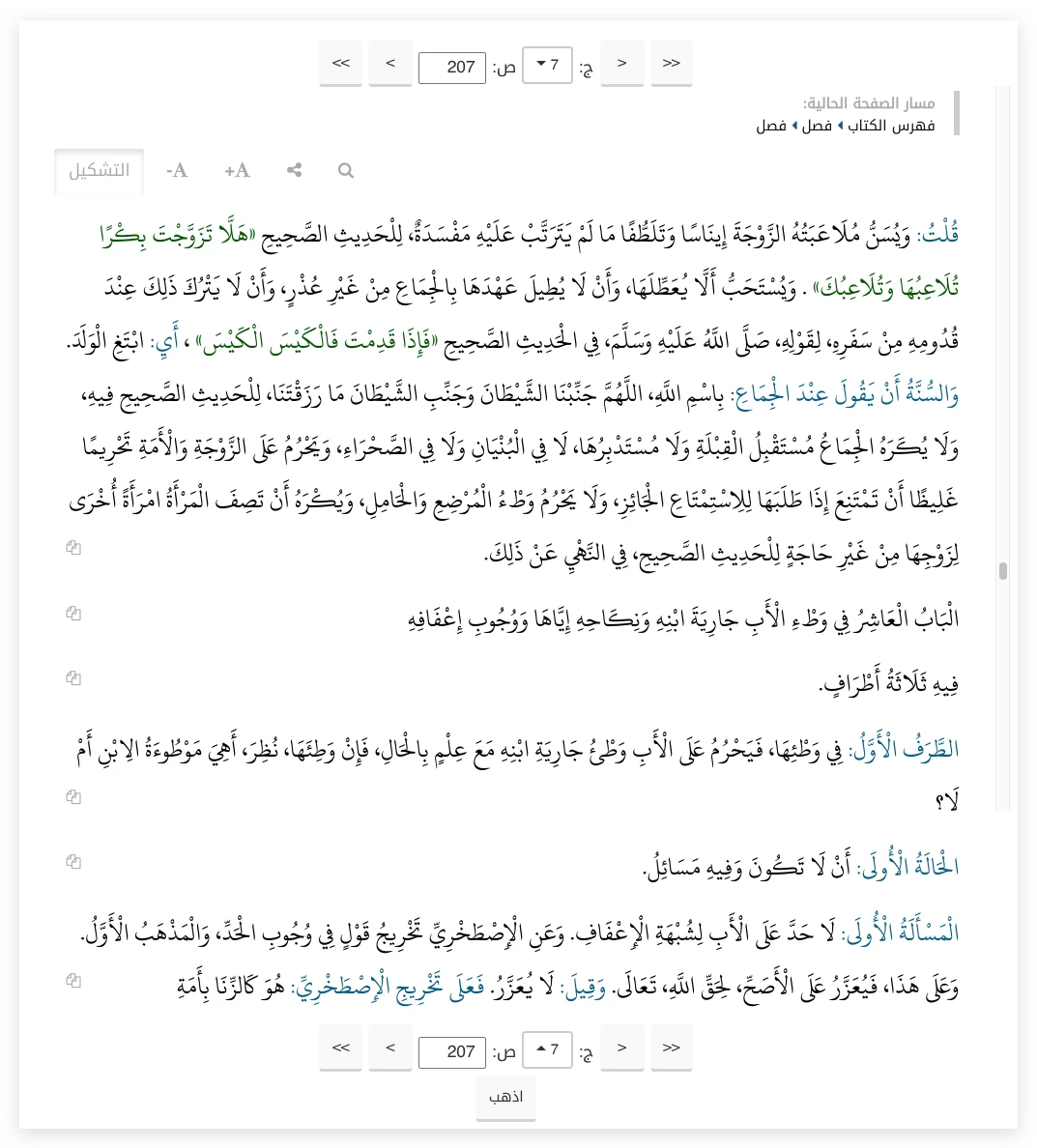
Original Arabic Text (Selected Passage) — the relevant Arabic passage concerning slave women and the associated ruling is given below: [5]
ويحرم على الزوجة والأمة تحريما غليظا أن تمتنع إذا طلبها للاستمتاع الجائز
It is strictly forbidden for a wife or a slave woman to refuse when the husband or master calls her for lawful sexual enjoyment.
— Rawdat al-Talibin
English Translation: “…It is strictly forbidden for a wife or slave woman to withhold herself when her husband or master calls her for lawful sexual enjoyment.”
Summary of the Translation: In the passage above, Imam al-Nawawi makes an important legal point concerning slave women explicit: under Islamic Sharia, when a slave woman was under the ownership of a particular master, responding to the master’s lawful physical demands was obligatory upon her. According to Sharia, preventing such access without a valid reason was regarded as a grave sin or as “haram.” This Sharia ruling demonstrates that in the legal relationship between a slave woman and her owner, the will of the master functioned as the legally recognized entitlement; the slave woman’s consent was not required as an independent condition.
Let us examine the passage directly from the book.
Al-Mawsu‘ah al-Fiqhiyyah
Al-Mawsu‘ah al-Fiqhiyyah, or the Encyclopedia of Islamic Jurisprudence, is a unique and enormous undertaking in the history of Islamic law and fiqh. It is not the work of a single author but one of the largest modern encyclopedias of fiqh compiled under state supervision. It was edited by a panel of specialist scholars under the Ministry of Awqaf and Islamic Affairs of Kuwait. The Al-Mawsu‘ah al-Fiqhiyyah states: [6]
كَضَرْبِ أُمَيَّتِكَ (١) وَقَوْلِهِ: لاَ يَجْلِدُ أَحَدُكُمُ امْرَأَتَهُ جَلْدَ الْعَبْدِ ثُمَّ يُجَامِعُهَا فِي آخِرِ الْيَوْمِ (٢) . وَلِلسَّيِّدِ أَنْ يُقَيِّدَ عَبْدَهُ إِذَا خَافَ عَلَيْهِ الإِْبَاقَ (٣) .
١٩ – سَابِعًا: لِلسَّيِّدِ حَقُّ وَطْءِ مَمْلُوكَتِهِ مَا لَمْ يَمْنَعْ مِنْ ذَلِكَ مَانِعٌ شَرْعِيٌّ، كَأَنْ تَكُونَ حَائِضًا أَوْ نُفَسَاءَ أَوْ مُزَوَّجَةً، أَوْ كَافِرَةً غَيْرَ كِتَابِيَّةٍ، أَوْ تَكُونَ مُرْتَدَّةً أَوْ غَيْرَ ذَلِكَ، أَوْ فِيهَا شِرْكٌ لِغَيْرِهِ، فَإِذَا وُطِئَتْ تَكُونُ سَرِيَّةً، إِلاَّ أَنَّهَا إِنْ كَانَتْ مُزَوَّجَةً ثُمَّ مُلِكَتْ بِالسَّبْيِ جَازَ لِمَالِكِهَا فَسْخُ نِكَاحِهَا ثُمَّ وَطْؤُهَا بَعْدَ الاِسْتِبْرَاءِ. وَلِلاِسْتِمْتَاعِ بِالإِْمَاءِ أَحْكَامٌ وَضَوَابِطُ شَرْعِيَّةٌ تُنْظَرُ فِي مَوْضِعِهَا مِمَّا يَلِي. وَفِي مُصْطَلَحِ: (تَسَرِّي) . وَيَجِبُ عَلَى الْمَمْلُوكَةِ أَنْ تُمَكِّنَ سَيِّدَهَا مِنْ نَفْسِهَا لِلاِسْتِمْتَاعِ، وَيَحْرُمُ عَلَيْهَا الاِمْتِنَاعُ مِنْ ذَلِكَ لأَِنَّهُ مَنْعُ حَقٍّ، مَا لَمْ تَكُنْ مُحَرَّمَةً عَلَيْهِ، أَوْ
19. The master has the right to have intercourse with a slave woman whom he owns, provided no Sharia impediment prevents it. Such impediments include:
– if she is menstruating,
– if she is in postpartum bleeding,
– if she is married,
– if she is a non-Muslim who is not from the People of the Book,
– if she has become an apostate,
– or if another person shares ownership of her.
In such circumstances intercourse is not lawful.
However, if she is married and then enters ownership through war captivity, her owner has the right to dissolve her previous marriage and then have intercourse with her after istibra.
The term tasarri (تَسَرِّي): sexual enjoyment and intercourse with slave women are regulated in Islam through specific Sharia rulings and restrictions. This is known as “tasarri.”
The Slave Woman’s Duty
It is obligatory upon the slave woman to make herself available to her master for sexual enjoyment. It is prohibited for her to refuse him, because doing so is regarded as preventing the exercise of the master’s right. She may refuse only where intercourse is prohibited for the master because of a Sharia impediment, such as menstruation, postpartum bleeding, or another legally recognized cause.
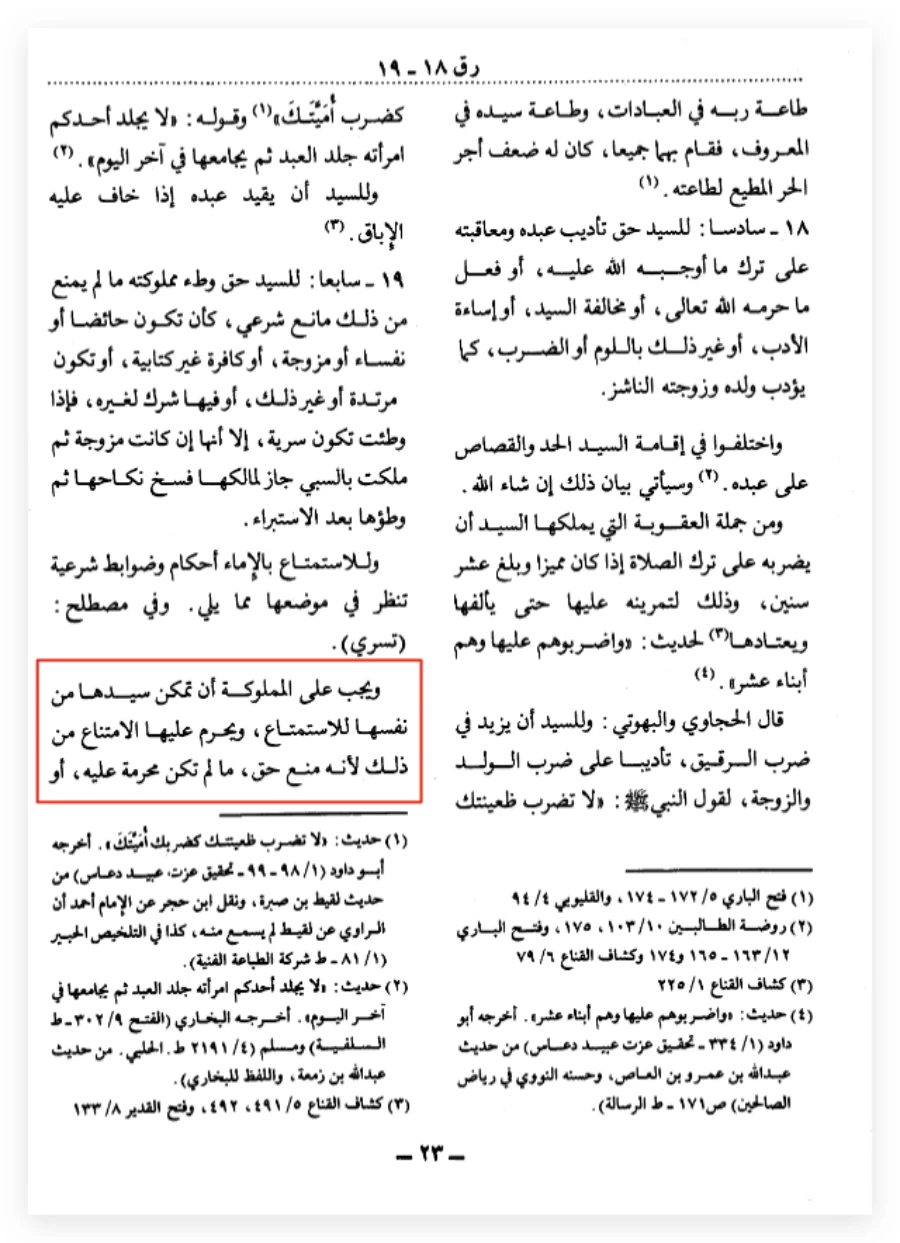
In other words, the slave woman’s consent carries no independent legal weight; her duty is to satisfy her master and provide him sexual access whenever he demands it, unless a Sharia-recognized impediment—such as a serious illness—exists.
Al-Muhalla bi’l-Athar
Al-Muhalla bi’l-Athar, written by Imam Ibn Hazm al-Andalusi, is a celebrated work of Islamic jurisprudence and a principal authoritative source of the Zahiri madhhab. In the book, Ibn Hazm interprets Islamic law on the basis of direct textual evidence from the Quran and Sunnah, prioritizing textual proof over analogical reasoning (qiyas). It is widely regarded as one of the great historical works for understanding comparative jurisprudence, or ikhtilaf al-fuqaha (juristic disagreement). On the question of consent and the duties imposed upon wives and slave women, the work states:
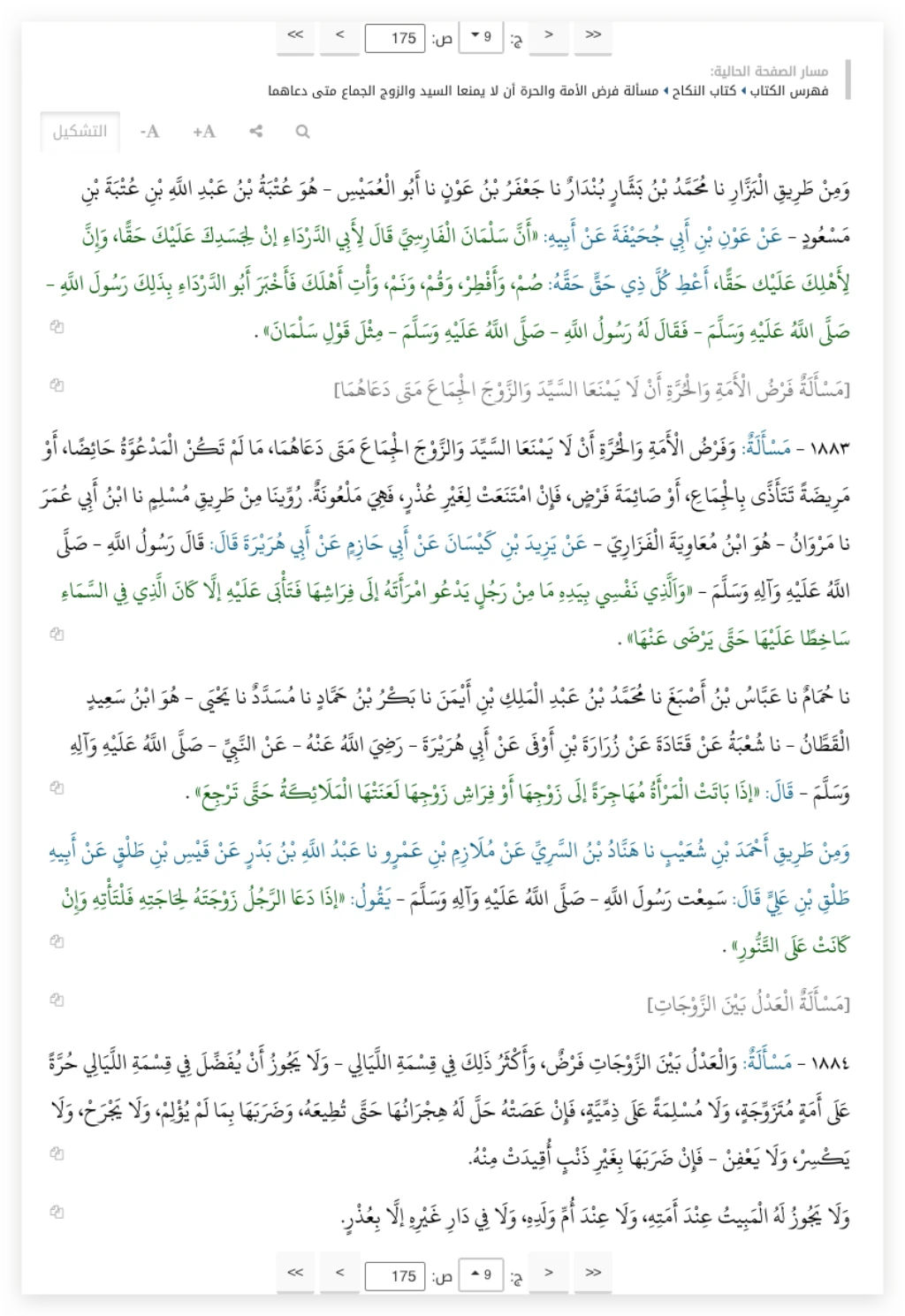
[مَسْأَلَةٌ فَرْضُ الْأَمَةِ وَالْحُرَّةِ أَنْ لَا يَمْنَعَا السَّيِّدَ وَالزَّوْجَ الْجِمَاعَ مَتَى دَعَاهُمَا]
Translation: It is obligatory upon both a free wife and a slave woman not to prevent the husband or master from intercourse whenever he calls them to it.
“…مَسْأَلَةٌ: وَفَرْضُ الْأَمَةِ وَالْحُرَّةِ أَنْ لَا يَمْنَعَا السَّيِّدَ وَالزَّوْجَ الْجِمَاعَ مَتَى دَعَاهُمَا، مَا لَمْ تَكُنْ الْمَدْعُوَّةُ حَائِضًا، أَوْ مَرِيضَةً تَتَأَذَّى بِالْجِمَاعِ، أَوْ صَائِمَةَ فَرْضٍ، فَإِنْ امْتَنَعَتْ لِغَيْرِ عُذْرٍ، فَهِيَ مَلْعُونَةٌ…”
Translation: “It is obligatory upon the slave woman and the free wife not to prevent the master or husband from intercourse whenever he calls them to it, unless the woman is menstruating, suffering from an illness that would cause her harm through intercourse, or observing an obligatory fast. If she refuses without a valid excuse, she is cursed.”
“…عَنْ النَّبِيِّ – صَلَّى اللَّهُ عَلَيْهِ وَآلِهِ وَسَلَّمَ – قَالَ: «إذَا بَاتَتْ الْمَرْأَةُ مُهَاجِرَةً إلَى زَوْجِهَا أَوْ فِرَاشِ زَوْجِهَا لَعَنَتْهَا الْمَلَائِكَةُ حَتَّى تَرْجِعَ»…”
Translation: “It is narrated from the Prophet that he said: If a woman spends the night abandoning her husband or her husband’s bed, the angels curse her until she returns.”
“…قَالَ رَسُولُ اللَّهِ – صَلَّى اللَّهُ عَلَيْهِ وَآلِهِ وَسَلَّمَ -: «إذَا دَعَا الرَّجُلُ زَوْجَتَهُ لِحَاجَتِهِ فَلْتَأْتِهِ وَإِنْ كَانَتْ عَلَى التَّنُّورِ»…”
Translation: “The Messenger of Allah said: When a man calls his wife for his need, she should come to him even if she is occupied at the oven.”
Let us examine the relevant passage directly from the work: [7]
Salih al-Munajjid (IslamQA.info)
Another widely consulted Islamic fatwa website, IslamQA, states in Fatwa No. 33597: [8]
إجبار الزوج زوجته على الجماع
السؤال: 33597
هل يجوز للرجل أن يُجبر زوجته أو أمته على الجماع إذا رفضت ؟.
الجواب
الحمد لله والصلاة والسلام على رسول الله، وبعد:
ليس للمرأة أن تمنع نفسها من زوجها ، بل يجب عليها أن تلبي طلبه كلما دعاها ما لم يضرها أو يشغلها عن واجب .
روى البخاري (3237) ومسلم (1436) عن أبي هريرة رضي الله عنه قال : قال رسول الله صلى الله عليه وسلم : ( إذا دعا الرجل امرأته إلى فراشه فأبت فبات غضبان عليها لعنتها الملائكة حتى تصبح ) .
فإن امتنعت من غير عذر كانت عاصية ناشزا ، تسقط نفقتها وكسوتها .
وعلى الزوج أن يعظها ويخوفها من عقاب الله ، ويهجرها في المضجع ، وله أن يضربها ضرباً غير مُبَرِّح، قال الله تعالى :
( وَاللاتِي تَخَافُونَ نُشُوزَهُنَّ فَعِظُوهُنَّ وَاهْجُرُوهُنَّ فِي الْمَضَاجِعِ وَاضْرِبُوهُنَّ فَإِنْ أَطَعْنَكُمْ فَلا تَبْغُوا عَلَيْهِنَّ سَبِيلًا إِنَّ اللَّهَ كَانَ عَلِيًّا كَبِيرًا ) النساء/34 .
وسئل شيخ الإسلام ابن تيمية رحمه الله عما يجب على الزوج إذا منعته من نفسها إذا طلبها ؟ فأجاب : ( لا يحل لها النشوز عنه ، ولا تمنع نفسها منه ، بل إذا امتنعت منه وأصرت على ذلك فله أن يضربها ضربا غير مبرح ، ولا تستحق نفقة ولا قسما ) مجموع الفتاوى 32/279 .
وسئل عن رجل له زوجة وهي ناشز تمنعه نفسها فهل تسقط نفقتها وكسوتها وما يجب عليها ؟
فأجاب : ( تسقط نفقتها وكسوتها إذا لم تمكنه من نفسها ، وله أن يضربها إذا أصرت على النشوز . ولا يحل لها أن تمتنع من ذلك إذا طالبها به ، بل هي عاصية لله ورسوله ، وفي الصحيح : ” إذا طلب الرجل المرأة إلى فراشه فأبت عليه كان الذي في السماء ساخطا عليها حتى تصبح ” )
انتهى من مجوع الفتاوى 32/278 ، والحديث رواه مسلم (1736) .
فينبغي وعظ الزوجة أولا ، وتحذيرها من النشوز وغضب الله عليها ولعنة الملائكة لها ، فإن لم تستجب هجرها الزوج في الفراش ، فإن لم تستجب ضربها ضربا غير مبرح ، فإن لم ينفع معها ذلك ، منع عنها النفقة والكسوة ، وله أن يطلقها أو يخالعها لتفتدي منه بمالها .
وكذلك الأمة ليس لها أن تمتنع من تلبية رغبة سيدها إلا من عذر ، فإن فعلت كانت عاصية ، وله أن يؤدبها بما يراه مناسباً وأذن الشرع به .
والله أعلم .
Question No. 33597
Question:
May a man compel his wife or his slave woman to have sexual intercourse if she refuses?
Answer
Praise be to Allah, and blessings and peace be upon the Messenger of Allah:
A woman is not permitted to withhold herself from her husband. Rather, she is obliged to respond to his request whenever he calls her, unless intercourse would harm her or prevent her from performing an obligatory duty.
Al-Bukhari (3237) and Muslim (1436) narrated from Abu Hurayra that the Messenger of Allah said that when a man calls his wife to his bed and she refuses, leaving him angry through the night, the angels curse her until morning.
Therefore, if she refuses without a valid excuse, she is regarded as disobedient and rebellious, and her entitlement to maintenance and clothing lapses.
The husband is to admonish her and warn her of Allah’s punishment; if she does not respond, he is to abandon her in the bed; and he may strike her in a manner that is not severe or injurious. Allah says:
“As for those women whose disobedience you fear, admonish them, abandon them in bed, and strike them; but if they obey you, then seek no means against them. Indeed, Allah is Most High, Most Great.” (Surah al-Nisa 4:34)
Shaykh al-Islam Ibn Taymiyya was asked what a husband should do if his wife refuses to make herself available when he requests her.
He replied that she is not permitted to rebel against him or withhold herself from him. If she refuses and persists in doing so, he may strike her without causing serious injury, and she is not entitled to maintenance or an allotted share. (Majmu‘ al-Fatawa, 32/279)
He was also asked about a man whose wife is rebellious and refuses to make herself available: whether her maintenance and clothing lapse and what is obligatory upon her.
He replied that her maintenance and clothing lapse if she does not make herself available to him, and that he may strike her if she persists in rebellion. She is not permitted to refuse when he demands this of her; rather, she is disobedient to Allah and His Messenger.
This quotation from Ibn Taymiyya ends in Majmu‘ al-Fatawa 32/278.
Accordingly, the wife should first be admonished and warned about rebellion, Allah’s anger, and the curse of the angels. If she does not respond, the husband is to abandon her in bed. If she still does not respond, he may strike her in a manner that does not cause serious injury. If that is ineffective, he may withhold her maintenance and clothing, and he may divorce her or enter into khul‘ in return for financial compensation.
Likewise, a slave woman is not permitted to refuse to satisfy her master’s sexual desire without a valid excuse. If she does so, she is sinful, and the master has the right to discipline her in whatever manner he considers appropriate within the limits permitted by Sharia.
Allah knows best.
The Text of Al-Muhalla Preserved on IslamWeb: Sexual Refusal by Wives and Slave Women
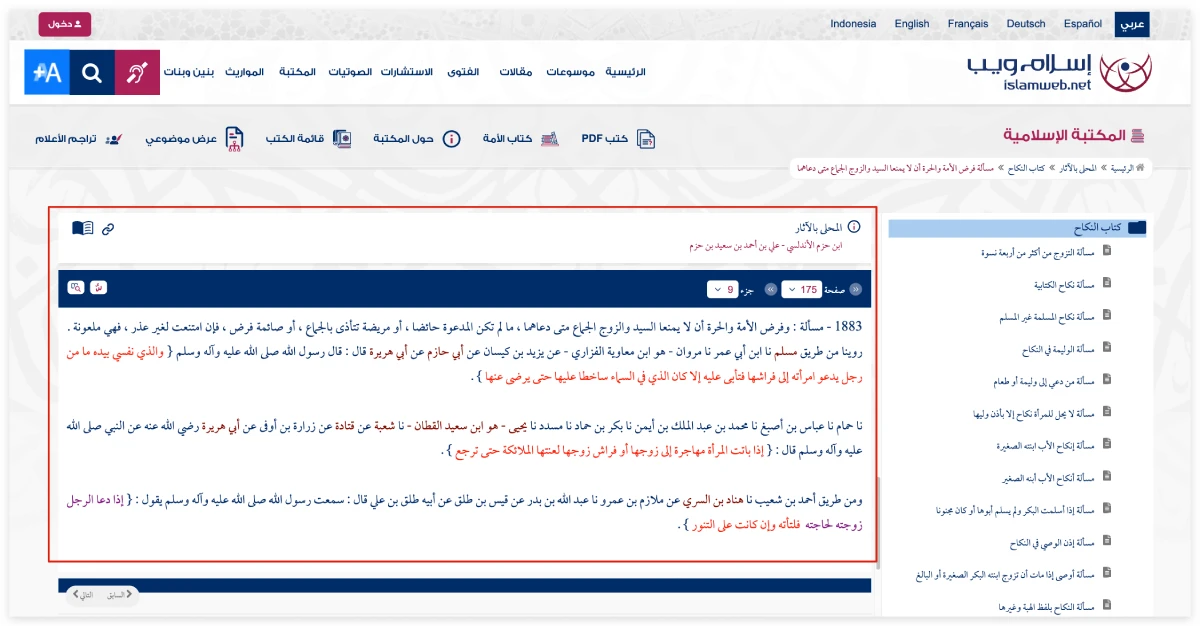
The same position is repeated in Ibn Hazm’s important work of fiqh, Al-Muhalla, as published on another well-known Islamic fatwa website, IslamWeb: [9]
معلومات الكتاب
المحلى بالآثار
ابن حزم الأندلسي – علي بن أحمد بن سعيد بن حزم
إظهار / إخفاء التشكيل بحث في الكتاب
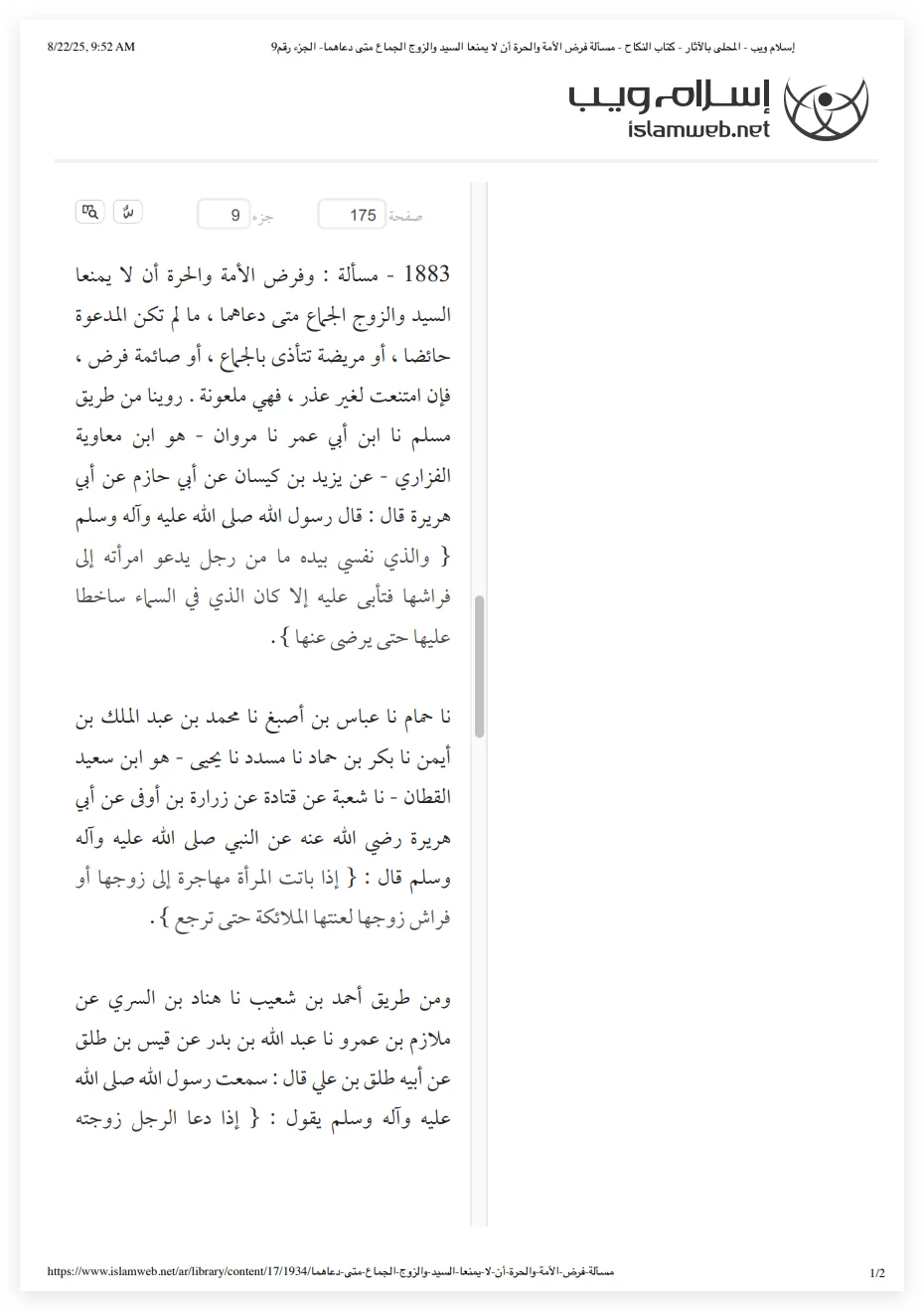
1883 – مسألة : وفرض الأمة والحرة أن لا يمنعا السيد والزوج الجماع متى دعاهما ، ما لم تكن المدعوة حائضا ، أو مريضة تتأذى بالجماع ، أو صائمة فرض ، فإن امتنعت لغير عذر ، فهي ملعونة . روينا من طريق مسلم نا ابن أبي عمر نا مروان – هو ابن معاوية الفزاري – عن يزيد بن كيسان عن أبي حازم عن أبي هريرة قال : قال رسول الله صلى الله عليه وآله وسلم { والذي نفسي بيده ما من رجل يدعو امرأته إلى فراشها فتأبى عليه إلا كان الذي في السماء ساخطا عليها حتى يرضى عنها } .
نا حمام نا عباس بن أصبغ نا محمد بن عبد الملك بن أيمن نا بكر بن حماد نا مسدد نا يحيى – هو ابن سعيد القطان – نا شعبة عن قتادة عن زرارة بن أوفى عن أبي هريرة رضي الله عنه عن النبي صلى الله عليه وآله وسلم قال : { إذا باتت المرأة مهاجرة إلى زوجها أو فراش زوجها لعنتها الملائكة حتى ترجع } .
ومن طريق أحمد بن شعيب نا هناد بن السري عن ملازم بن عمرو نا عبد الله بن بدر عن قيس بن طلق عن أبيه طلق بن علي قال : سمعت رسول الله صلى الله عليه وآله وسلم يقول : { إذا دعا الرجل زوجته لحاجته فلتأته وإن كانت على التنور } .
Now let us read the English translation of the relevant passage from Al-Muhalla.
Al-Muhalla, Issue No. 1883
It is obligatory upon both a slave woman and a free wife to comply when the master or husband calls them for sexual intercourse.
A slave woman or free wife may not refuse the call of the master or husband unless she is menstruating, suffering from an illness that makes intercourse harmful, or observing an obligatory fast. If she refuses without a valid excuse, she is described as cursed.
The text then cites a report through Muslim from Abu Hurayra in which the Prophet states that when a man calls his wife to bed and she refuses him, the One in heaven remains displeased with her until her husband becomes pleased with her.
Another chain from Abu Hurayra reports the Prophet as saying that if a woman spends the night estranged from her husband or his bed, the angels curse her until she returns.
Another report, through Qays ibn Talq from his father Talq ibn Ali, states that the Messenger of Allah said that when a man calls his wife for his need, she should come to him even if she is occupied at the oven.
Summary:
Neither a wife nor a slave woman is permitted to refuse the sexual summons of the husband or master unless a valid Sharia excuse exists.
Refusal without a valid excuse is associated with the curse of the angels and divine displeasure.
Jurists used these reports as evidence to establish the obligatory nature of the husband’s sexual right over his wife and, in Ibn Hazm’s formulation, the master’s corresponding right over the slave woman.
It is clear from this material that Islamic Sharia did not treat the consent of an enslaved woman as an independent condition overriding the master’s legally recognized sexual entitlement. Modern academic research has reached a similar conclusion regarding the structure of premodern Sunni jurisprudence. Kecia Ali, a scholar of religion and Islamic law at Boston University, examined the question directly in her study “Concubinage and Consent,” published by Cambridge University Press in the International Journal of Middle East Studies: according to early Muslim jurists, was a slave woman’s consent necessary for her owner to lawfully have sexual intercourse with her? After examining Maliki, Hanafi, Shafi‘i, and Hanbali legal texts from the eighth to the tenth centuries, Ali reports that she found no rule in these madhhab texts requiring an owner to obtain his own slave woman’s sexual consent; in her formulation, the answer appears clearly to be “no.” Jurists instead permitted owners to marry slave women off without their permission and did not regard the slave woman’s permission as necessary when the owner practiced ‘azl with her. More significantly, within the legal structure of classical fiqh, there was no basis for categorizing an owner’s unwilling or coercive intercourse with his own slave woman as zina on the ground of lack of consent, because ownership itself constituted the legal source of sexual entitlement. Ali’s analysis therefore shows that in premodern Islamic jurisprudence, the central legal question was whether the sexual relationship was lawful or unlawful under Sharia, rather than whether the woman had given free consent. [10]
The Slave Woman’s Permission Is Not Required Even for ‘Azl
Another Hanafi ruling is particularly significant to the question of a slave woman’s sexual consent. In distinguishing between a free wife and an owned slave woman, Ashraf al-Hidaya states directly that a husband may not practice ‘azl with his wife without informing her or obtaining her permission, whereas with his own slave woman the master may practice ‘azl without her permission. The reason is stated even more explicitly: intercourse is a right of the free wife, whereas the slave woman possesses no such right to intercourse; therefore, in the case of the slave woman, the master may decide the matter unilaterally. [11]
قَالَ: وَيَعْزِلُ عَنْ أَمَتِهِ بِغَيْرِ إِذْنِهَا، وَلَا يَعْزِلُ عَنْ زَوْجَتِهِ إِلَّا بِإِذْنِهَا ... وَلِأَنَّ الْوَطْءَ حَقُّ الْحُرَّةِ قَضَاءً لِلشَّهْوَةِ وَتَحْصِيلًا لِلْوَلَدِ ... وَلَا حَقَّ لِلْأَمَةِ فِي الْوَطْءِ، فَلِهَذَا لَا يُنْقَصُ حَقُّ الْحُرَّةِ بِغَيْرِ إِذْنِهَا، وَيَسْتَبِدُّ بِهِ الْمَوْلَى
Translation: Imam al-Quduri says that the master may practice ‘azl during intercourse with his slave woman without her permission, but he may not practice ‘azl with his wife without her permission. This is because intercourse is a right of the free wife, both for the satisfaction of sexual desire and for obtaining children. By contrast, the slave woman possesses no such right to intercourse. Therefore, the right of the free wife may not be diminished without her permission, whereas in the case of the slave woman the master may decide the matter unilaterally.
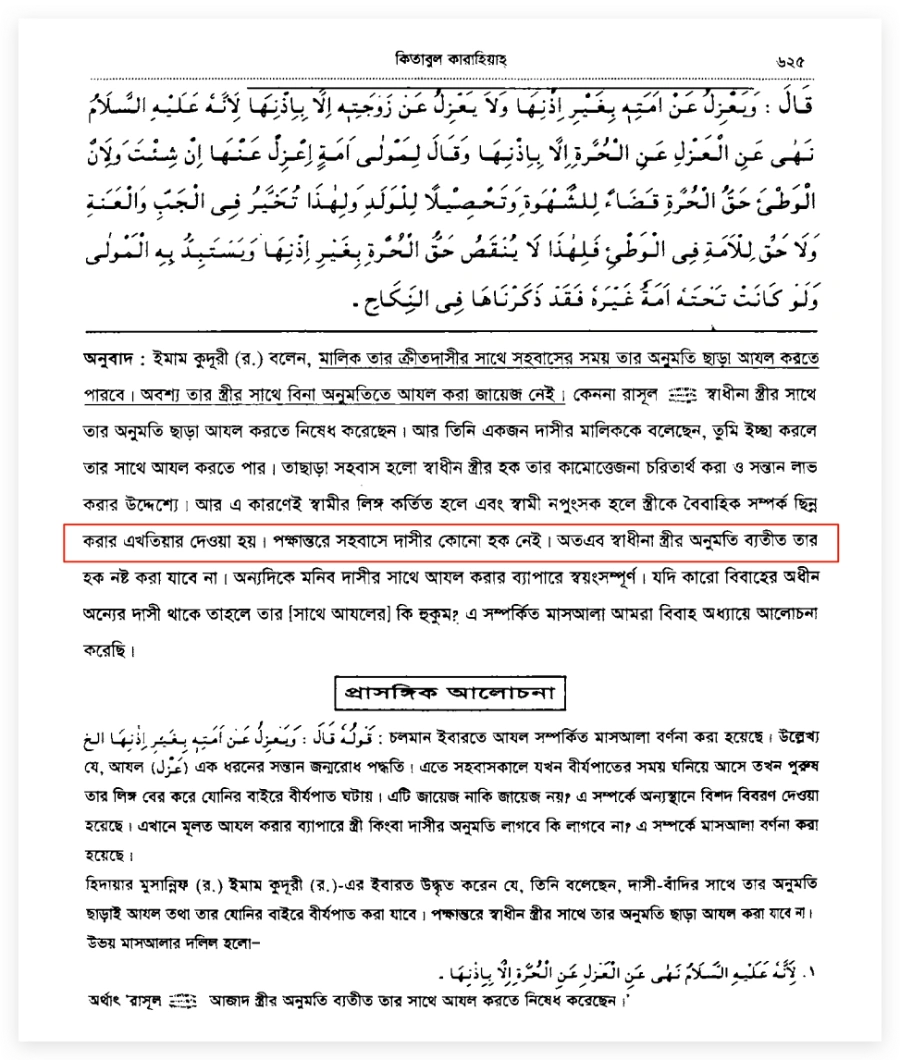
This ruling is highly significant to the question of consent. Fiqh distinguishes the free wife from the slave woman precisely through a right of permission. The free wife possesses a recognized sexual and reproductive right, and therefore her permission is required. In the case of the owner’s slave woman, that right is not recognized; consequently, the master may make unilateral decisions concerning the reproductive consequences of intercourse with her. The slave woman’s decisions—“I want a child,” or “I do not want you to practice ‘azl”—do not legally bind the master. When this ruling is placed beside the rulings already discussed—that responding to the master’s sexual summons is obligatory upon a slave woman and refusing him is prohibited—the absence of free sexual consent becomes even clearer.
Forced Intercourse When the Slave Woman Refuses: Fatwa of Al-Shabaka al-Islamiyyah
A contemporary Islamic fatwa institution, Al-Shabaka al-Islamiyyah (IslamWeb/Islamic Network), was asked directly whether a slave woman’s consent was a condition for the legality of sexual relations under Islamic slavery. The questioner asked whether, if a female prisoner of war who had become a slave woman refused sexual relations with her owner, the master could beat her or otherwise compel her. The response did not recognize the slave woman’s consent as an independent right; rather, it presented the master’s sexual demand as a legally recognized right. The fatwa was published by Al-Shabaka al-Islamiyyah on 29 December 2009 and is currently preserved in Archive al-Islam.
The structure of this fatwa is particularly important. This is not a case in which the slave woman is silent, her wishes are unknown, or the source simply fails to mention consent. Rather, the slave woman explicitly refuses sexual intercourse—and the fatwa nevertheless concludes that the master may compel her to it. The reason given is not her wishes, bodily freedom, or sexual autonomy; the reason is that the master is exercising his own “right.” Within this fiqhi framework, therefore, the slave woman’s “no” is not an effective veto: the master’s ownership-based sexual right takes precedence over her refusal. [12]
Original Arabic:
أما إذا أراد سيدها الجماع وامتنعت عنه فإن له إجبارها عليه وليس ذلك بمستقبح لأنه يستوفي حقه
English Translation:
“But if her master wishes to have intercourse with her and she refuses him, then he may compel her to it. This is not regarded as reprehensible, because he is exercising his right.”
With this statement, the question of consent is no longer a matter of inference. The slave woman has refused sexual intercourse, yet her refusal does not extinguish the master’s sexual right; on the contrary, compelling her is declared lawful. Even more disturbing is the moral language: forced intercourse is not merely permitted, but explicitly described as “not reprehensible” because the master is exercising his “right.” In a system where an owned woman may clearly say “no” and her owner may nevertheless compel her into sexual intercourse, consent is not an independent moral or legal condition. Under a modern consent-based definition, this constitutes non-consensual sexual intercourse; within the fiqhi structure of Islamic sexual slavery, the same act is legitimized as the exercise of the owner’s right.
The Slave Woman’s Opinion Has No Legal Weight Even in ‘Azl: Ibn ‘Abd al-Barr
The discussion of ‘azl, or coitus interruptus, in Ibn ‘Abd al-Barr’s Al-Tamhid shows with particular clarity what legal status the slave woman’s own opinion had in decisions concerning her sexual life. The issue is not merely the permissibility of a method of preventing pregnancy; the question is whether her permission or opinion possessed any legal weight at all in a decision concerning her own body. Ibn ‘Abd al-Barr states explicitly that an owner who wishes to practice ‘azl with his slave woman does not require her permission. The Companions had asked Muhammad about the permissibility of ‘azl, yet had not regarded it as necessary to obtain the slave women’s permission or to consult them—and Ibn ‘Abd al-Barr uses precisely this fact as evidence for the ruling.
His reasoning does not end there. He further argues that since the owner could withhold intercourse from the slave woman altogether, his right to practice ‘azl during intercourse follows even more readily. He then presents this position as supported by consensus, analogy, and established fiqhi principles, stating that there was no disagreement among the jurists of the different regions on this matter. In the same discussion, he states the opposite rule for a free woman: ‘azl may not be practiced with a free wife without her permission because intercourse is also her right. Thus, in the same sexual decision, the free woman’s opinion is recognized as a legal right while the slave woman’s opinion is denied the same status. [13]
Original Arabic:
لَمْ يُضِيفُوا إِلَى ذَلِكَ اسْتِئْمَارَ الْإِمَاءِ، وَلَا مُشَاوَرَتَهُنَّ، فَدَلَّ ذَلِكَ عَلَى جَوَازِ الْعَزْلِ عَنْهُنَّ دُونَ رَأْيِهِنَّ.
English Translation:
“They did not add to this any requirement to seek the slave women’s permission or to consult them. This therefore demonstrates the permissibility of practicing ‘azl with them without regard to their opinion.”
The terminology used here is especially significant: استئمار الإماء means seeking the permission or authorization of the slave women, مشاورتهن means consulting them, and دون رأيهن means without their opinion. The absence of the slave woman’s opinion is therefore not merely something the text fails to discuss; Ibn ‘Abd al-Barr uses that absence as part of his legal reasoning. More explicitly, in the following discussion he argues that since the owner may deprive the slave woman of intercourse altogether, her opinion is likewise unnecessary regarding ‘azl. Within this legal framework, the slave woman is not an autonomous participant in the sexual relationship; ultimate authority over her body and reproductive decisions belongs to the owner. The right of permission recognized for a free wife is denied to the slave woman.
The Slave Woman Has No Right to Intercourse or to a Child: Ibn Qudama
Ibn Qudama’s renowned Hanbali work Al-Mughni provides an exceptionally explicit answer concerning how much authority an enslaved woman possessed over sexual and reproductive decisions. Addressing whether her permission is required for ‘azl, Ibn Qudama states that the owner may practice ‘azl with his slave woman without her permission. He does not present this merely as a Hanbali opinion; he records the same position as the view of Ahmad, Malik, Abu Hanifa, and al-Shafi‘i. Thus, by explicitly naming the founders of the four Sunni madhhabs, the text records the slave woman’s permission as unnecessary.
Even more important is Ibn Qudama’s reason for this ruling. He says that the slave woman has no right to intercourse and no right to a child. For that reason, she has no right to prevent the master from practicing ‘azl. In the same discussion, he gives the opposite ruling for the free wife—‘azl may not be practiced with her without her permission. The distinction is therefore not a vague social convention; fiqh itself assigns different sexual and reproductive rights to the free woman and the owned woman. [14]
Original Arabic:
وَيَجُوزُ الْعَزْلُ عَنْ أَمَتِهِ بِغَيْرِ إذْنِهَا نَصَّ عَلَيْهِ أَحْمَدُ، وَهُوَ قَوْلُ مَالِكٍ وَأَبِي حَنِيفَةَ وَالشَّافِعِيِّ؛ وَذَلِكَ لِأَنَّهُ لَا حَقَّ لَهَا فِي الْوَطْءِ، وَلَا فِي الْوَلَدِ.
English Translation:
“The owner may practice ‘azl with his slave woman without her permission. Ahmad explicitly stated this, and it is also the opinion of Malik, Abu Hanifa, and al-Shafi‘i, because she has no right to intercourse and no right to a child.”
This statement exposes the legal structure of Islamic sexual slavery with extraordinary clarity. The absence of any requirement for the slave woman’s permission is not justified through a situational exception; rather, her right itself is denied—“she has no right to intercourse, nor any right to a child.” Even more significantly, the same work requires permission in the case of a free wife. Fiqh therefore acknowledges that permission can constitute a real sexual and reproductive right, but withdraws that right from the woman by virtue of her enslavement. Under such a system, authority over the slave woman’s body does not belong to her; the owner’s sexual and reproductive interests receive legal priority.
Forced Intercourse with a Mukataba Slave Woman: No Hadd Punishment for the Owner
Al-Mudawwana al-Kubra, one of the principal and earliest works of Maliki jurisprudence, directly addresses a case in which an owner has forced sexual intercourse with his mukataba slave woman. A mukataba is a slave woman who has entered into a contractual arrangement to purchase her freedom through payment of an agreed sum. She has therefore entered a legal process toward liberation from ordinary slavery. Nevertheless, Al-Mudawwana addresses explicitly how the law treats an owner who forces sexual intercourse upon such a woman. The title of the issue itself reads: “في الرجل يطأ مكاتبته طوعا أو غصبا”—“Concerning a man who has intercourse with his mukataba, whether voluntarily or by force.”
In Ibn al-Qasim’s report, Malik is asked directly: if a man has intercourse with his mukataba slave woman—يغتصبها, meaning that he forcibly takes her sexually, or alternatively she willingly complies—does the hadd punishment for zina apply to him? Malik’s answer is: “There is no hadd upon him.” The next question asks whether, because of the forced intercourse, he must pay her an equivalent dowry or instead compensate for the reduction in her market value. The answer is that he must compensate for whatever amount her value has decreased because of the force; she is not entitled to a dowry. Thus, even after forced sexual intercourse, the legal consequence is not structured around a violation of the slave woman’s sexual autonomy; the calculation is made on the basis of the reduction in her financial value. [15]
Original Arabic:
في الرجل يطأ مكاتبته طوعا أو غصبا
قلت: أرأيت الرجل يطأ مكاتبته – يغتصبها أو تطاوعه – أيكون عليه الحد في قول مالك أم لا؟
قال: قال مالك: لا حد عليه، وينكل إذا كان ممن لا يعذر بالجهالة.
قلت: أفيكون عليه ما نقصها من ثمنها إن غصبها نفسها أو صداق مثلها في قول مالك؟
قال: أرى أن عليه ما نقصها إذا اغتصبها. وقال لي مالك: ولا أرى لها في ذلك صداقا. قال ابن القاسم: ولم أسأله عن الاغتصاب وإنما سألته عن الرجل يطأ مكاتبته فقال: لا صداق لها.
English Translation:
“Concerning a man who has intercourse with his mukataba slave woman, whether voluntarily or by force.”
I asked: If a man has intercourse with his mukataba slave woman—he forcibly takes her or she willingly complies with him—does the hadd punishment apply to him according to Malik, or not?
He replied: Malik said: “There is no hadd upon him, although he is to be subjected to discretionary punishment if he is a person for whom ignorance is not an acceptable excuse.”
I asked: According to Malik, if he forcibly takes her sexually, must he compensate for the amount by which her market value has been reduced, or must he pay her an equivalent dowry?
He replied: “In my view, if he forcibly takes her, he must pay whatever amount her value has decreased.” Malik told me: “I do not consider her entitled to any dowry in this matter.” Ibn al-Qasim said: I did not ask him specifically about the forced intercourse; I asked him only about a man who has intercourse with his mukataba slave woman, and he said: “She is entitled to no dowry.”
The horror of this passage is not confined to the phrase “لا حد عليه”—“There is no hadd upon him.” The work itself describes the event using اغتصبها / غصبها نفسها—language denoting forcibly taking her sexually. Yet the financial consequence is assessed not as personal compensation for a violation of the slave woman’s sexual autonomy, but through “ما نقصها من ثمنها”—the amount by which her market value has decreased; at the same time, she is denied a dowry. Although the text mentions discretionary punishment despite the absence of a hadd, the slave woman’s consent and sexual rights are not the center of the legal structure. Even when an owner forcibly subjects a mukataba woman to sexual intercourse who has already entered into a contract for her freedom, the injury to her body is calculated in terms of diminished market value. This exposes with exceptional starkness a fiqhi structure in which the slave woman is treated not as an autonomous sexual person but as an owned economic asset.
Even the Slave Woman’s Consent Does Not Extinguish the Master’s Right
A ruling in the Hanbali work Sharh Muntaha al-Iradat reveals with particular starkness how the owner’s proprietary rights could outweigh the slave woman’s own decisions concerning her sexuality. The discussion concerns a man who has unlawfully had sexual intercourse with a slave woman owned by someone else. The work first states that if the man knowingly commits such an act, the hadd punishment for zina applies because the slave woman is neither his wife nor his milk al-yamin. But in discussing compensation, the text makes a distinction that is crucial for understanding the legal status of the slave woman’s sexual consent: even if the slave woman herself voluntarily agreed to the intercourse, the offender must still pay an equivalent dowry, because the financial right belongs not to the slave woman, but to her owner.
The work goes further. To explain why the slave woman’s consent cannot extinguish the master’s right, it offers an analogy: it is as though the slave woman had authorized another person to cut off her hand; her permission would not extinguish the owner’s right to compensation. The text then contrasts her directly with a free woman. In the case of a free woman, the dowry is her own right, and therefore voluntary participation in the sexual act may extinguish that claim. The same does not apply to a slave woman, because the financial right belongs to her owner. Thus, even where the slave woman consents to a sexual relationship, fiqh does not recognize that decision as an exercise of complete legal authority over her own body; the sexual use of her body is linked to a separate proprietary right held by her owner. [16]
Original Arabic:
وَيَجِبُ بِوَطْءٍ مَهْرُ مِثْلِهَا بِكْرًا كَانَتْ أَوْ ثَيِّبًا، وَلَوْ كَانَتْ الْأَمَةُ مُطَاوِعَةً؛ لِأَنَّهُ حَقٌّ لِلسَّيِّدِ فَلَا يَسْقُطُ بِمُطَاوَعَتِهَا، كَإِذْنِهَا فِي قَطْعِ يَدِهَا، وَكَاسْتِخْدَامِهَا. وَحَدِيثُ «النَّهْيِ عَنْ مَهْرِ الْبَغِيِّ» مَحْمُولٌ عَلَى الْحُرَّةِ؛ لِأَنَّهُ حَقُّهَا، فَيَسْقُطُ بِمُطَاوَعَتِهَا، بِخِلَافِ مَهْرِ الْأَمَةِ.
English Translation:
“Intercourse with her entails payment of an equivalent dowry, whether she was a virgin or previously married, even if the slave woman willingly complied, because this is a right belonging to the master and therefore does not lapse through her voluntary compliance—just as it would not lapse if she authorized someone to cut off her hand, or in the case of making use of her services. The hadith prohibiting the earnings of a prostitute is understood to apply to a free woman, because the right belongs to her and therefore lapses through her voluntary compliance. The dowry of a slave woman is different.”
This ruling is particularly important for understanding the proprietary nature of sexuality under slavery. Here, the slave woman has voluntarily consented, yet her consent is still not treated as complete legal authority over her own body and sexuality. A right that might otherwise have been extinguished through consent remains intact because, in the language of fiqh, it is “حق للسيد”—“a right of the master.” The most brutal analogy compares her sexual consent to authorizing someone to cut off her own hand: in both cases, the slave woman’s personal authorization cannot override her owner’s proprietary claim. A free woman may relinquish a financial right generated by her own sexual relationship, but a slave woman cannot, because in her case the relevant right is not hers. Within this legal framework, therefore, the slave woman’s sexuality was not solely her personal domain; the owner possessed a distinct legal interest in her body, its sexual use, and the economic claims arising from that use.
The Crucial Question Missing from the Hadith: The Captive Woman’s Consent
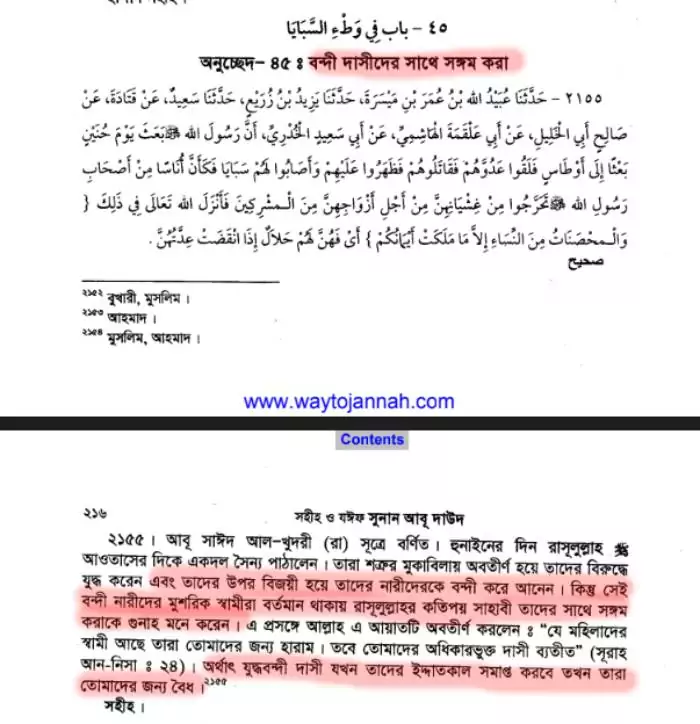
One of the most brutal features of the sahih hadith reports is that the consent of the captive women does not even arise as a question. Sahih Muslim records that Muslims captured Arab women in two separate campaigns, at Awtas and Banu Mustaliq; after having been away from their wives for a long time, they desired the captive women, while at the same time wishing to preserve the possibility of obtaining ransom or sale value from them. The question therefore arose whether intercourse with those women was lawful even though their husbands were alive and, in some cases, themselves captives. Yet nowhere does the question arise whether the captive women consented. The discussion centers on ownership, ‘iddah/istibra, and the legality of intercourse—not the women’s consent. Another concern was whether ‘azl could be practiced during intercourse so that the women would not become pregnant and lose their value for sale or ransom. The moral question was not, “Does the captive woman agree?” It was, “Can pregnancy be avoided?” The female body was treated simultaneously as an object of sexual use and as property possessing market value. [17] [18] [19]
Reference : Sahih Muslim 1456a
In-book reference : Book 17, Hadith 41
Chapter : It is permissible to have intercourse with a female captive after it is established that she is not pregnant, and if she has a husband, then her marriage is annulled when she is captured
Abu Sa’id al-Khudri reported that at the Battle of Hunain Allah’s Messenger (ﷺ) sent an army to Awtas. They encountered the enemy, fought them, defeated them, and took captives. Some of the Companions refrained from having intercourse with the captive women because their husbands were polytheists. Then Allah revealed concerning them: “And women already married, except those whom your right hands possess” (Quran 4:24), meaning that they became lawful for them when their waiting period had ended.
Arabic : حَدَّثَنَا عُبَيْدُ اللَّهِ بْنُ عُمَرَ بْنِ مَيْسَرَةَ الْقَوَارِيرِيُّ، حَدَّثَنَا يَزِيدُ بْنُ زُرَيْعٍ، حَدَّثَنَا سَعِيدٌ، بْنُ أَبِي عَرُوبَةَ عَنْ قَتَادَةَ، عَنْ صَالِحٍ أَبِي الْخَلِيلِ، عَنْ أَبِي عَلْقَمَةَ الْهَاشِمِيِّ، عَنْ أَبِي سَعِيدٍ، الْخُدْرِيِّ أَنَّ رَسُولَ اللَّهِ صلى الله عليه وسلم يَوْمَ حُنَيْنٍ بَعَثَ جَيْشًا إِلَى أَوْطَاسٍ فَلَقُوا عَدُوًّا فَقَاتَلُوهُمْ فَظَهَرُوا عَلَيْهِمْ وَأَصَابُوا لَهُمْ سَبَايَا فَكَأَنَّ نَاسًا مِنْ أَصْحَابِ رَسُولِ اللَّهِ صلى الله عليه وسلم تَحَرَّجُوا مِنْ غِشْيَانِهِنَّ مِنْ أَجْلِ أَزْوَاجِهِنَّ مِنَ الْمُشْرِكِينَ فَأَنْزَلَ اللَّهُ عَزَّ وَجَلَّ فِي ذَلِكَ { وَالْمُحْصَنَاتُ مِنَ النِّسَاءِ إِلاَّ مَا مَلَكَتْ أَيْمَانُكُمْ} أَىْ فَهُنَّ لَكُمْ حَلاَلٌ إِذَا انْقَضَتْ عِدَّتُهُنَّ .
Reference : Sunan Abi Dawud 2155
In-book reference : Book 12, Hadith 110
Chapter : Regarding Intercourse With Captives
Abu Sa‘id al-Khudri reported that the Messenger of Allah (ﷺ) sent a military expedition to Awtas on the occasion of the Battle of Hunain. They encountered the enemy, fought them, defeated them, and took captives. Some of the Companions were reluctant to have relations with the female captives because of their polytheist husbands. Allah then revealed: “And all married women are forbidden to you except those whom your right hands possess,” meaning that they were lawful for them after completion of the waiting period.
Arabic : حَدَّثَنَا عُبَيْدُ اللَّهِ بْنُ عُمَرَ بْنِ مَيْسَرَةَ، حَدَّثَنَا يَزِيدُ بْنُ زُرَيْعٍ، حَدَّثَنَا سَعِيدٌ، عَنْ قَتَادَةَ، عَنْ صَالِحٍ أَبِي الْخَلِيلِ، عَنْ أَبِي عَلْقَمَةَ الْهَاشِمِيِّ، عَنْ أَبِي سَعِيدٍ الْخُدْرِيِّ، أَنَّ رَسُولَ اللَّهِ صلى الله عليه وسلم بَعَثَ يَوْمَ حُنَيْنٍ بَعْثًا إِلَى أَوْطَاسٍ فَلَقُوا عَدُوَّهُمْ فَقَاتَلُوهُمْ فَظَهَرُوا عَلَيْهِمْ وَأَصَابُوا لَهُمْ سَبَايَا فَكَأَنَّ أُنَاسًا مِنْ أَصْحَابِ رَسُولِ اللَّهِ صلى الله عليه وسلم تَحَرَّجُوا مِنْ غِشْيَانِهِنَّ مِنْ أَجْلِ أَزْوَاجِهِنَّ مِنَ الْمُشْرِكِينَ فَأَنْزَلَ اللَّهُ تَعَالَى فِي ذَلِكَ { وَالْمُحْصَنَاتُ مِنَ النِّسَاءِ إِلاَّ مَا مَلَكَتْ أَيْمَانُكُمْ } أَىْ فَهُنَّ لَهُمْ حَلاَلٌ إِذَا انْقَضَتْ عِدَّتُهُنَّ .
Grade: Sahih (Al-Albani)
Muhammad’s jihadist soldiers were also highly attentive to ensuring that captive women did not become pregnant too quickly. Consider the following hadith [20]:
Reference : Sahih al-Bukhari 7409
In-book reference : Book 97, Hadith 38
Chapter : “He is Allah, the Creator, the Inventor of all things, the Bestower of forms…”
Narrated Abu Sa‘id al-Khudri:
During the battle with Banu Al-Mustaliq the Muslims captured some women and intended to have sexual relations with them without impregnating them. They therefore asked the Prophet (ﷺ) about coitus interruptus. He replied that it was better not to do so, because Allah had written whom He would create until the Day of Resurrection.
Arabic : حَدَّثَنَا إِسْحَاقُ، حَدَّثَنَا عَفَّانُ، حَدَّثَنَا وُهَيْبٌ، حَدَّثَنَا مُوسَى ـ هُوَ ابْنُ عُقْبَةَ ـ حَدَّثَنِي مُحَمَّدُ بْنُ يَحْيَى بْنِ حَبَّانَ، عَنِ ابْنِ مُحَيْرِيزٍ، عَنْ أَبِي سَعِيدٍ الْخُدْرِيِّ، فِي غَزْوَةِ بَنِي الْمُصْطَلِقِ أَنَّهُمْ أَصَابُوا سَبَايَا فَأَرَادُوا أَنْ يَسْتَمْتِعُوا بِهِنَّ وَلاَ يَحْمِلْنَ فَسَأَلُوا النَّبِيَّ صلى الله عليه وسلم عَنِ الْعَزْلِ فَقَالَ ” مَا عَلَيْكُمْ أَنْ لاَ تَفْعَلُوا، فَإِنَّ اللَّهَ قَدْ كَتَبَ مَنْ هُوَ خَالِقٌ إِلَى يَوْمِ الْقِيَامَةِ ” . وَقَالَ مُجَاهِدٌ عَنْ قَزَعَةَ سَمِعْتُ أَبَا سَعِيدٍ فَقَالَ قَالَ النَّبِيُّ صلى الله عليه وسلم ” لَيْسَتْ نَفْسٌ مَخْلُوقَةٌ إِلاَّ اللَّهُ خَالِقُهَا ”.
The hadith may also be examined directly in the printed edition [21]:
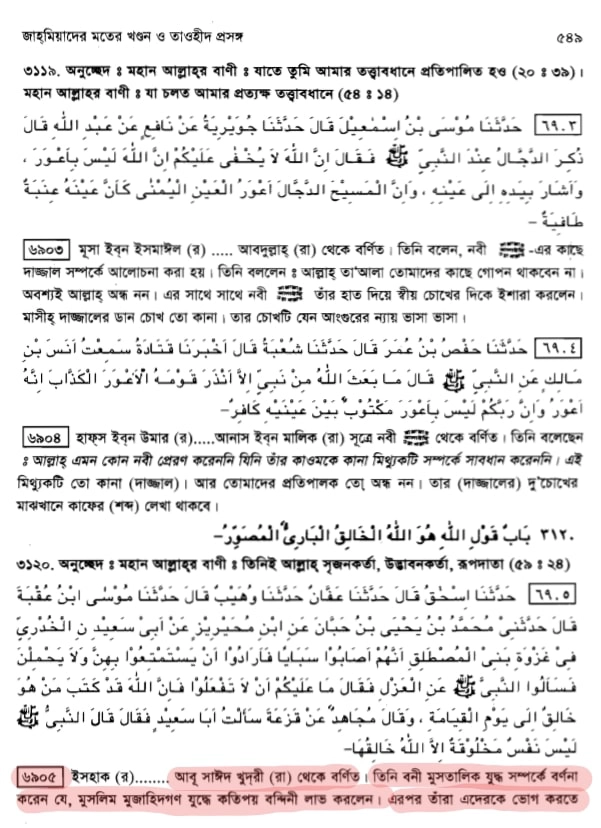
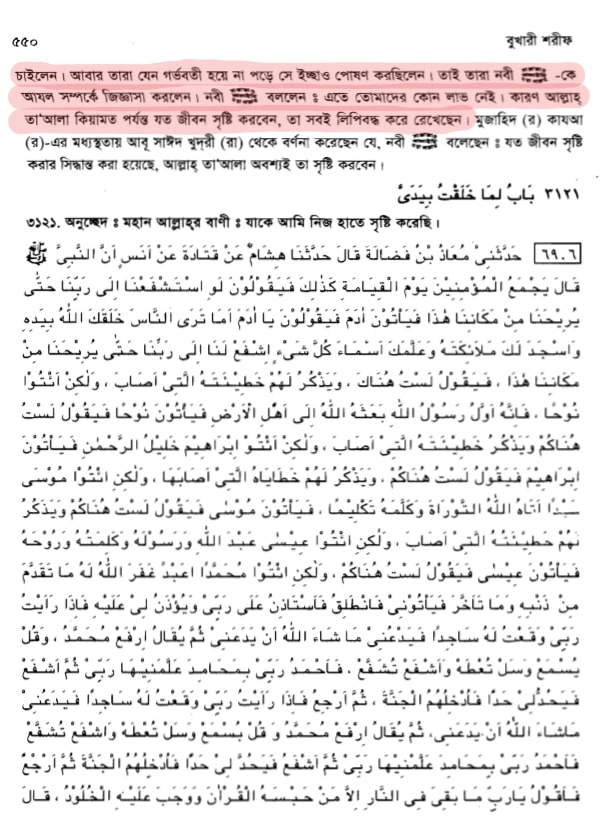
Now let us read the explanation of the relevant hadith from Sahaj Nasrul Bari [22]:
That is, if we do not practice ‘azl with a slave woman, there is a possibility that the slave woman will become an umm walad. Yet we are attached to our property. We wish to sell her and benefit from her price. But if she becomes an umm walad, we will no longer be able to sell her. For this reason we wish to practice ‘azl with the slave woman, so that she does not conceive. What, then, do you say concerning this?
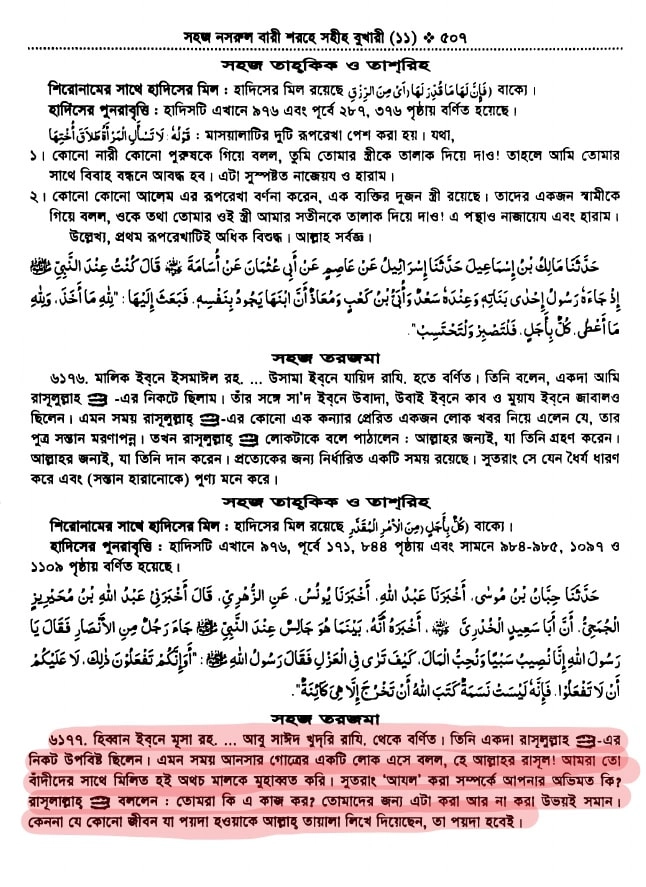
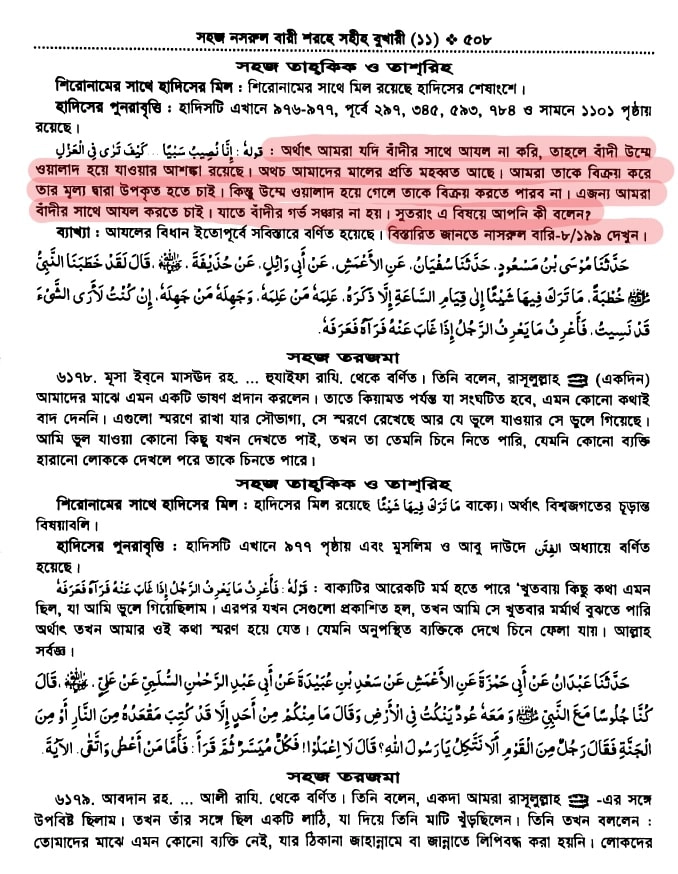
The same structure appears in the reports of Sahih al-Bukhari and Sahih Muslim. Muslim fighters desired the captive women while simultaneously wishing to obtain ransom for them; the question of ‘azl therefore arose as a means of avoiding pregnancy. The quoted commentary from Nasrul Bari states that if a captive woman became pregnant and acquired the status of umm walad, she could no longer be sold, eliminating the opportunity to profit from her sale price. The discussion then turns to ‘azl [23]. This is not the language of a “consensual relationship”; it is the language of sexual entitlement over women taken in war, reproductive control, and the preservation of market value. If apologists discover consent here, it does not come from the text of the hadith; it is an imagined morality retrofitted later to conceal modern embarrassment.
Selection and Distribution of Captive Women: The Case of Safiyya at Khaybar
The distribution of female captives after Khaybar provides a brutal and direct example of how irrelevant the consent of a prisoner of war was within the Islamic system. After Khaybar was conquered, women and children were taken captive and the captives were assembled. Muhammad’s Companion Dihya al-Kalbi then asked for a slave woman from among them, and Muhammad allowed him to take one of his choice. Dihya selected Safiyya bint Huyayy from among the captive women. The event is recorded in Sahih Muslim 1365c and other canonical collections: the captives had been assembled, Dihya requested a slave woman, and he was told, “Go and take a slave girl.”
Reference : Sunan Abi Dawud 2998
In-book reference : Book 20, Hadith 71
Anas reported:
“Captives were gathered at Khaibar. Dihyah came and said, ‘Messenger of Allah, give me a slave girl from the captives.’ He said, ‘Go and take a slave girl.’ He took Safiyyah daughter of Huyayy. A man then came to the Prophet (ﷺ) and said that Safiyyah, the chief lady of Quraizah and al-Nadir, was worthy only of him. The Prophet called Dihyah along with her. When he saw her, he told Dihyah to take another slave girl from among the captives. The Prophet then set her free and married her.”
Arabic : حَدَّثَنَا دَاوُدُ بْنُ مُعَاذٍ، حَدَّثَنَا عَبْدُ الْوَارِثِ، ح وَحَدَّثَنَا يَعْقُوبُ بْنُ إِبْرَاهِيمَ، – الْمَعْنَى – قَالَ حَدَّثَنَا ابْنُ عُلَيَّةَ، عَنْ عَبْدِ الْعَزِيزِ بْنِ صُهَيْبٍ، عَنْ أَنَسٍ، قَالَ جُمِعَ السَّبْىُ – يَعْنِي بِخَيْبَرَ – فَجَاءَ دِحْيَةُ فَقَالَ يَا رَسُولَ اللَّهِ أَعْطِنِي جَارِيَةً مِنَ السَّبْىِ . قَالَ ” اذْهَبْ فَخُذْ جَارِيَةً ” . فَأَخَذَ صَفِيَّةَ بِنْتَ حُيَىٍّ فَجَاءَ رَجُلٌ إِلَى النَّبِيِّ صلى الله عليه وسلم فَقَالَ يَا نَبِيَّ اللَّهِ أَعْطَيْتَ دِحْيَةَ – قَالَ يَعْقُوبُ – صَفِيَّةَ بِنْتَ حُيَىٍّ سَيِّدَةَ قُرَيْظَةَ وَالنَّضِيرِ – ثُمَّ اتَّفَقَا – مَا تَصْلُحُ إِلاَّ لَكَ . قَالَ ” ادْعُوهُ بِهَا ” . فَلَمَّا نَظَرَ إِلَيْهَا النَّبِيُّ صلى الله عليه وسلم قَالَ لَهُ ” خُذْ جَارِيَةً مِنَ السَّبْىِ غَيْرَهَا ” . وَإِنَّ النَّبِيَّ صلى الله عليه وسلم أَعْتَقَهَا وَتَزَوَّجَهَا .
A man then informed Muhammad that Safiyya belonged to the leading families of Banu Qurayza and Banu Nadir and was suitable only for Muhammad. Muhammad summoned Dihya together with Safiyya. After seeing her, he told Dihya to take another slave woman from among the captives instead. Thus Dihya first selected Safiyya from the captive women; Muhammad then annulled that selection, retained Safiyya for himself, and permitted Dihya to select another woman. The entire transaction took place between victorious men. Whether Safiyya or any of the other captive women wished to accept one man or another as their owner never appears as a question.
Another sahih report in Abu Dawud makes the proprietary character of the transaction even more explicit. It states that a beautiful slave woman had fallen to Dihya’s share and Muhammad obtained her from him in exchange for seven slaves. She was then sent to Umm Sulaym to be prepared. A captive woman was therefore valued and transferred in exchange for seven other enslaved human beings.
Reference : Sunan Abi Dawud 2997
In-book reference : Book 20, Hadith 70
Anas reported:
“A beautiful slave girl fell to Dihyah. The Messenger of Allah (ﷺ) purchased her for seven slaves. He then gave her to Umm Sulaim for decorating her and preparing her for marriage.” The report identifies the woman as Safiyyah bint Huyayy.
Arabic : حَدَّثَنَا مُحَمَّدُ بْنُ خَلاَّدٍ الْبَاهِلِيُّ، حَدَّثَنَا بَهْزُ بْنُ أَسَدٍ، حَدَّثَنَا حَمَّادٌ، أَخْبَرَنَا ثَابِتٌ، عَنْ أَنَسٍ، قَالَ وَقَعَ فِي سَهْمِ دِحْيَةَ جَارِيَةٌ جَمِيلَةٌ فَاشْتَرَاهَا رَسُولُ اللَّهِ صلى الله عليه وسلم بِسَبْعَةِ أَرْؤُسٍ ثُمَّ دَفَعَهَا إِلَى أُمِّ سُلَيْمٍ تَصْنَعُهَا وَتُهَيِّئُهَا قَالَ حَمَّادٌ وَأَحْسِبُهُ قَالَ وَتَعْتَدُّ فِي بَيْتِهَا صَفِيَّةُ بِنْتُ حُيَىٍّ .
Muhammad later freed Safiyya and married her, but that subsequent event does not erase the preceding reality of captivity and distribution. Safiyya first went from being a free woman to a prisoner of war; she then fell to Dihya’s share; afterward, by Muhammad’s decision, she was removed from Dihya’s possession; and Dihya was permitted to take another slave woman instead. At no stage in this process was Safiyya’s consent a condition for determining ownership. Her future was determined by the preferences of victorious men, calculations of social status, and decisions concerning the distribution of property.
The incident is therefore not merely the story of one particular woman’s eventual marriage. It is direct evidence of a system for distributing female prisoners of war. A Companion could select a woman from the assembled captives; Muhammad could then take that selected woman for himself and replace her with another woman from the same body of captives. Like cattle, camels, or other forms of war booty, women were assembled, selected, and transferred from one man’s share to another. In a system where the woman herself is an object of distribution, claiming that her independent consent governed the process is not a reading of history; it is a later apologetic invention.
What Happened to the Women of Banu Mustaliq?
The hadith literature makes the immediate fate of the women captured in the Banu Mustaliq campaign quite clear. Islamic sources do not preserve the names and complete later biographies of every captive woman, but they do clearly describe what was imposed upon them immediately after their capture. They lost the right to determine their own futures as free persons and became war property owned by the victorious Muslim fighters. Some were subjected to sexual intercourse, while at the same time efforts were made to prevent pregnancy through ‘azl so that the economic possibility of ransom or sale would remain intact.
In al-Bayhaqi’s Ma‘rifat al-Sunan wa al-Athar, under the heading “Intercourse with Female Captives by Virtue of Ownership Before Leaving Enemy Territory,” a statement of Imam al-Awza‘i is preserved. He directly describes intercourse with the captive woman as lawful from Allah and cites the conduct of Muslims during the Banu Mustaliq campaign as evidence. [24] [25]
51 – وطء السبايا بالملك قبل الخروج من دار الحرب
18306 – أخبرنا أبو عبد الله، وأبو سعيد قالا: حدثنا أبو العباس، أخبرنا الربيع، أخبرنا الشافعي قال: قال الأوزاعي : “له أن يطأها وهذا حلال من الله عز وجل بأن المسلمين وطؤوا مع رسول الله صلى الله عليه وسلم ما أصابوا من السبايا في غزوة بني المصطلق قبل أن يقفلوا”.
51. Intercourse with Female Captives by Virtue of Ownership Before Leaving Enemy Territory
Al-Awza‘i said: “He may have intercourse with her. This is lawful from Allah, Mighty and Majestic, because the Muslims had intercourse, together with the Messenger of Allah (ﷺ), with the female captives they obtained in the expedition of Banu Mustaliq before they returned.”
This is not a hadith spoken by Muhammad; it is a fiqhi conclusion attributed to al-Awza‘i. That does not make the source irrelevant. On the contrary, it demonstrates that an early and influential Muslim jurist accepted intercourse with the female captives of Banu Mustaliq as an established historical precedent and, on that basis, described it as “lawful from Allah.” In the next report in the same chapter, al-Shafi‘i states that the Companions of the Messenger of Allah had intercourse with female captives in enemy territory once istibra had been completed [26]. The basis of legality here is not the woman’s consent, marriage, or even a return to Muslim territory. Ownership created through captivity and completion of istibra were treated as sufficient. Waiting until the army had returned to Muslim territory was not regarded as necessary.
The next established hadith exposes even more openly the plans of the Muslim fighters concerning the captive women’s bodies and futures. Al-Bayhaqi describes it as an established hadith and notes that it is also narrated in Sahih al-Bukhari. [27] [28]
Reference : Ma‘rifat al-Sunan wa al-Athar, Report 18311
Narrated Ibn Muhairiz:
He asked Abu Sa‘id al-Khudri about ‘azl. Abu Sa‘id said: “We went out with Allah’s Messenger (ﷺ) for the Ghazwa of Banu Al-Mustaliq and we received captives from among the Arab captives and we desired the women, celibacy became hard on us, and we also wanted to obtain ransom for them. We therefore wanted to practice coitus interruptus.” They therefore asked the Messenger of Allah about it, and he replied that every soul predestined to exist until the Day of Resurrection would come into existence.
Arabic : حَدَّثَنَا قُتَيْبَةُ بْنُ سَعِيدٍ، أَخْبَرَنَا إِسْمَاعِيلُ بْنُ جَعْفَرٍ، عَنْ رَبِيعَةَ بْنِ أَبِي عَبْدِ الرَّحْمَنِ، عَنْ مُحَمَّدِ بْنِ يَحْيَى بْنِ حَبَّانَ، عَنِ ابْنِ مُحَيْرِيزٍ، أَنَّهُ قَالَ دَخَلْتُ الْمَسْجِدَ فَرَأَيْتُ أَبَا سَعِيدٍ الْخُدْرِيَّ فَجَلَسْتُ إِلَيْهِ فَسَأَلْتُهُ عَنِ الْعَزْلِ،، قَالَ أَبُو سَعِيدٍ خَرَجْنَا مَعَ رَسُولِ اللَّهِ صلى الله عليه وسلم فِي غَزْوَةِ بَنِي الْمُصْطَلِقِ، فَأَصَبْنَا سَبْيًا مِنْ سَبْىِ الْعَرَبِ، فَاشْتَهَيْنَا النِّسَاءَ وَاشْتَدَّتْ عَلَيْنَا الْعُزْبَةُ، وَأَحْبَبْنَا الْفِدَاءَ، فَأَرَدْنَا أَنْ نَعْزِلَ، وَقُلْنَا نَعْزِلُ وَرَسُولُ اللَّهِ صلى الله عليه وسلم بَيْنَ أَظْهُرِنَا قَبْلَ أَنْ نَسْأَلَهُ فَسَأَلْنَاهُ عَنْ ذَلِكَ فَقَالَ ” مَا عَلَيْكُمْ أَنْ لاَ تَفْعَلُوا، مَا مِنْ نَسَمَةٍ كَائِنَةٍ إِلَى يَوْمِ الْقِيَامَةِ إِلاَّ وَهْىَ كَائِنَةٌ ”.
The future of the captive women in this account can be summarized in three elements: sexual use, reproductive control, and ransom. Muslim fighters wished to have intercourse with the same women while also wishing to prevent them from becoming pregnant and retain their economic value. The question put to Muhammad was whether ‘azl could be practiced. No one asked whether the captive women agreed to intercourse, whether they should be released unconditionally, or what they themselves wanted for their lives. Muhammad’s answer likewise contains no discussion of the women’s consent or freedom; it is confined to ‘azl and a theological claim about predestined births.
These reports do not preserve the individual fate of every captive woman—whether all were eventually ransomed, some were sold, some remained enslaved, or some were later freed. But that does not alter the central fact. After their capture, at least some of these women were subjected to intercourse before the Muslim army had even returned; at the same time, they were retained as assets capable of generating ransom or sale value. Their future was shaped by the victorious men’s desire, ownership, and financial interests—not by the women’s own wishes. That is the practical structure of sexual slavery. Calling it a “consensual relationship” or “honorable rehabilitation” is not history; it is direct falsification.
Married Female Captives: The Husband’s Rights Annulled, the Owner’s Sexual Rights Established
Quran 4:24 and the hadith of Awtas constitute some of the most explicit textual evidence for Islamic sexual slavery. Married women are generally prohibited, yet the same verse makes an exception for those “whom your right hands possess.” The practical application of this exception appears in the case of the captive women of Awtas. They were married; they had husbands; and the Companions’ hesitation arose precisely because their husbands were alive and, according to the reports, connected to the captive enemy population. Yet the solution was not to obtain the women’s consent, restore their freedom, or preserve their existing marriages. Instead, captivity and ownership rendered the previous marriages ineffective, and after the waiting period the women became lawful to the victorious owners. Islamic law went even further: if an owned slave woman was married, the owner could in defined circumstances terminate that marriage and establish sexual access to her himself. [29]
Tafsir Mazhari: Comprehensive Ownership over the Captive Woman’s Existence
There is no basis for dismissing this interpretation of Quran 4:24 as the invention of later critics. In Tafsir Mazhari, the Hanafi scholar Qadi Thanaullah Panipati explains the incident of Awtas by stating directly that although the captive women were married, when their new Muslim owners wished to have intercourse with them the women referred to the existence of their husbands. The relevant verse was then used to establish the ruling that the owners could have intercourse with the female prisoners of war and that captivity rendered their previous marriages ineffective even if their husbands were still present. In other words, the woman’s previous marital bond, the continuing existence of her husband, and her own wishes did not negate the sexual consequences of the new ownership. [30]
Al-Tabarani reports the statement of Ibn Abbas concerning this verse as follows: the verse was revealed during the Battle of Hunain. After the victory, a number of women from among the People of the Book came under Muslim ownership as captives. They were married women. When those Muslims who had received them wished to have intercourse with them, the women said that they had husbands. The matter was reported to the Messenger of Allah, and this verse was then revealed.
This verse proves that the owners may have sexual intercourse with female prisoners of war. Even if the women have husbands, they are regarded as having become separated from those marriages.
The owners of the captive women may also marry them to others. They can do so by virtue of their ownership. (Ownership means the captor’s comprehensive authority over the captive woman’s existence.) Imam Malik, Imam al-Shafi‘i, and Imam Ahmad held the same position.
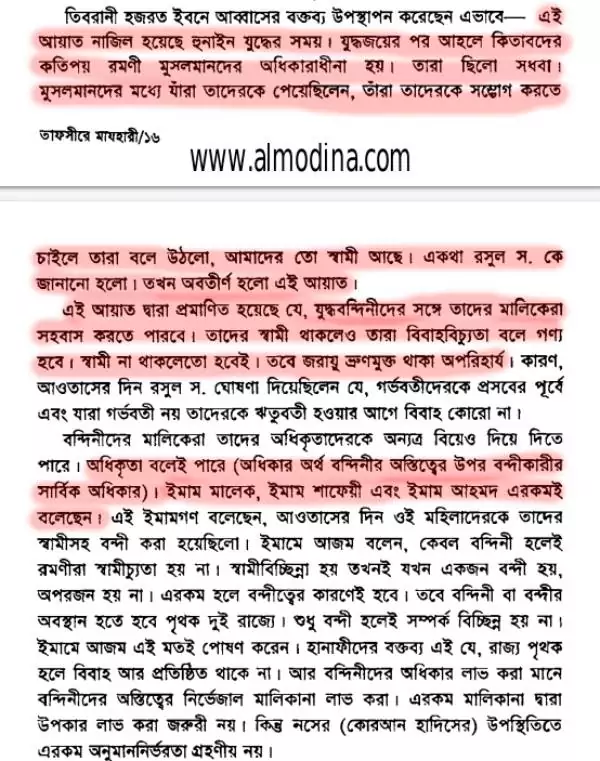
The most important words in this tafsir are: “the captor’s comprehensive authority over the captive woman’s existence.” Their significance for consent is profound. The legal basis of sexual intercourse is not identified here as the woman’s independent permission or her previous marital commitment; it is identified as ownership created through captivity. The power of that ownership is such that an existing marriage is rendered ineffective and the victorious owner acquires a new sexual entitlement over the woman. “Ownership” in Islamic sexual slavery was therefore not merely an economic status; it functioned as a source of legal authority over the woman’s body, sexuality, and family status.
Another important dimension of this ruling becomes even clearer in a statement attributed to Imam al-Shafi‘i. Whether the captive woman’s husband was captured with her, before her, after her, or was not captured at all was not treated as materially significant to the establishment of the new owner’s rights. In al-Bayhaqi’s Ma‘rifat al-Sunan wa al-Athar, al-Shafi‘i states: [31] [32]
Original Arabic:
قَالَ الشَّافِعِيُّ: وَقَدْ سَبَى رَسُولُ اللَّهِ صَلَّى اللهُ عَلَيْهِ وَسَلَّمَ رِجَالًا مِنْ هَوَازِنَ، فَمَا عَلِمْنَاهُ سَأَلَ عَنْ أَزْوَاجِ الْمَسْبِيَّاتِ أَسُبُوا مَعَهُنَّ أَوْ قَبْلَهُنَّ أَوْ بَعْدَهُنَّ أَوْ لَمْ يُسْبُوا، وَلَوْ كَانَ فِي أَزْوَاجِهِنَّ مَعْنًى لَسَأَلَ عَنْهُ إِنْ شَاءَ اللَّهُ
English Translation: Imam al-Shafi‘i said: “The Messenger of Allah (ﷺ) also took men of Hawazin captive. Yet, as far as we know, he did not ask concerning the husbands of the captive women—whether their husbands had been captured with them, before them, after them, or had not been captured at all. Had the status of their husbands possessed legal significance, Allah willing, he would have asked concerning it.”
Original Arabic:
قَالَ الشَّافِعِيُّ: وَقَدْ سَبَى رَسُولُ اللَّهِ صَلَّى اللهُ عَلَيْهِ وَسَلَّمَ رِجَالًا مِنْ هَوَازِنَ، فَمَا -[313]- عَلِمْنَاهُ سَأَلَ عَنْ أَزْوَاجِ الْمَسْبِيَّاتِ أَسُبُوا مَعَهُنَّ أَوْ قَبْلَهُنَّ أَوْ بَعْدَهُنَّ أَوْ لَمْ يُسْبُوا، وَلَوْ كَانَ فِي أَزْوَاجِهِنَّ مَعْنًى لَسَأَلَ عَنْهُ إِنْ شَاءَ اللَّهُ
English Translation:
Al-Shafi‘i said: The Messenger of Allah (ﷺ) took men from Hawazin captive. But we do not know that he asked about the husbands of the captive women—whether they had been captured with them, before them, after them, or not captured at all. If the circumstances of their husbands had possessed any particular legal importance, then Allah willing, he would certainly have asked about it.
The meaning of al-Shafi‘i’s argument is extremely clear. Who the woman had been married to before becoming a prisoner of war, whether her husband remained free, alive, or himself captive, was not treated as a basis for preserving her marriage. The emergence of captivity and ownership was considered sufficient to render the previous marital relationship ineffective. The husband’s right disappeared as a consequence of military defeat, while the woman’s own consent did not enter the legal analysis at any stage. Ownership by the victorious man became the basis of the new sexual entitlement.
The moral structure is therefore unmistakable: the woman’s wishes are not the basis of sexual legality, nor is the continuation of her previous relationship with her husband. Military victory and ownership are the determining factors. This is the fundamental logic of sexual slavery. Who the woman had previously been married to, what she herself wanted, or whether she had participated in the war were secondary questions; the decisive issue was whose “right hand” now possessed her. It is difficult to imagine a more explicit ownership-based sexual regime.
Underage Slave Girls and Istibra: The Legal Basis for Sexual Lust
According to Islamic jurisprudence, after purchasing a slave woman, her new owner must observe istibra—a waiting period intended to establish that her womb is free of pregnancy—before having sexual intercourse with her. Most disturbingly, this ruling was applied even to minor or prepubescent slave girls who had not yet begun menstruating or reached puberty.
The “True Cause” of Istibra: The New Owner’s Desire for Intercourse
The Hanafi fiqh work Ashraf al-Hidaya directly identifies the “true cause” for making istibra obligatory upon the purchaser as his desire to have intercourse with the slave woman. It further states that the ability or authority to have intercourse is established through ownership and possession. The fiqhi structure therefore identifies ownership and possession—not the woman’s consent—as the source of sexual entitlement. [33]
وَيَجِبُ عَلَى الْمُشْتَرِي لَا عَلَى الْبَائِعِ لِأَنَّ الْعِلَّةَ الْحَقِيقِيَّةَ إِرَادَةُ الْوَطْءِ، وَالْمُشْتَرِي هُوَ الَّذِي يُرِيدُهُ دُونَ الْبَائِعِ ... وَهُوَ التَّمَكُّنُ مِنَ الْوَطْءِ، وَالتَّمَكُّنُ إِنَّمَا يَثْبُتُ بِالْمِلْكِ وَالْيَدِ
Translation: Istibra is obligatory upon the purchaser, not upon the seller, because its true cause is the desire for intercourse, and it is the purchaser who desires it, not the seller. Desire, however, is an internal matter; the ruling is therefore connected to its outward indicator. That indicator is the ability or authority to have intercourse, and this authority is established through ownership and possession.
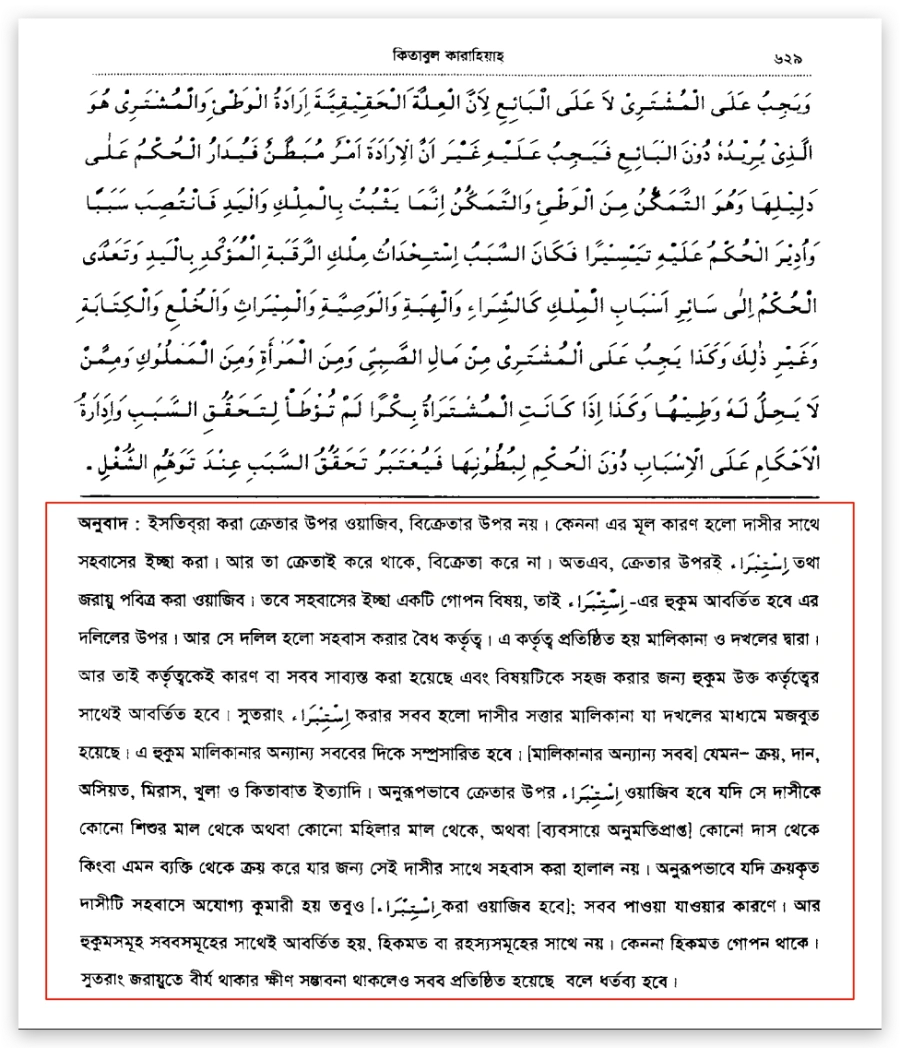
The significance of this statement is extraordinary. The right to intercourse does not arise from the woman’s free “yes”; it arises from ownership and possession. Whether the new ownership is created through purchase, gift, bequest, inheritance, or some other means, that ownership becomes the legal basis for potential sexual intercourse and consequently activates the requirement of istibra. Within this legal structure of sexual relations, what the woman wants and whether she has granted permission are not even mentioned as relevant causes.
Istibra Even for a Virgin Slave Woman Who Had Never Previously Had Intercourse
The same discussion further states that, according to the Hanafi position, istibra applies even when the purchased slave woman is a virgin who has never previously had intercourse. The ruling is not based upon whether intercourse had actually occurred before her purchase; the establishment of new ownership and possession is itself treated as the operative cause. [34]
وَكَذَا إِذَا كَانَتِ الْمُشْتَرَاةُ بِكْرًا لَمْ تُوطَأْ
Translation: Likewise, if the purchased slave woman is a virgin who has never previously had intercourse, [the requirement of istibra still applies]. This is because new ownership and possession are treated as the cause of the ruling concerning istibra; wherever that cause is present, the ruling takes effect.
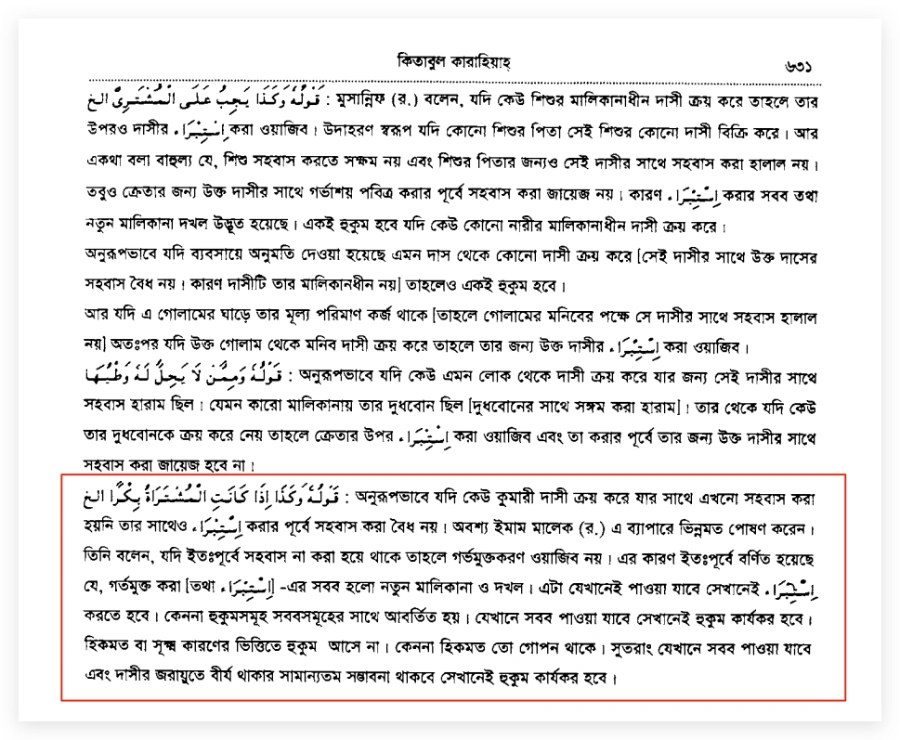
One distinction must be kept clear: this particular ruling is not itself about an “underage girl physically incapable of intercourse.” The original Arabic, بِكْرًا لَمْ تُوطَأْ, means “a virgin who has not previously had intercourse.” Its significance lies elsewhere: fiqh grounds the requirement of istibra not in the woman’s actual sexual history but in the potential sexual entitlement created by new ownership. The reports in al-Darimi then go one step further, prescribing istibra for an underage slave girl who has not even begun menstruating.
According to sahih reports in Sunan al-Darimi, if a man purchases a slave girl who has not yet begun menstruating, he must wait for a specified period before having intercourse with her in order to establish that her womb is free of pregnancy [35]. According to Imam al-Zuhri, this period is three months, while another opinion sets it at one month [36]. This raises the fundamental question: why prescribe istibra for a child who is physically immature and wholly incapable of sexual activity? The crucial point is that jurists did not exclude even a slave girl who had not begun menstruating and was not yet of childbearing age from this ownership-based sexual framework of istibra. This ruling was devised to make sexual intercourse with an underage slave girl legally permissible. Had intercourse with minors been prohibited, there would have been no reason to prescribe such a waiting period. The reports ask how long the purchaser must refrain from intercourse with this underage slave girl. The answers given are three months, forty-five days, or one month. Once that period has elapsed, Islamic law places no further obstacle before intercourse. Nowhere does the ruling say: “Wait until she reaches adulthood, free her, obtain her independent and voluntary consent while she is free from fear and coercion, and only then have intercourse with her on the basis of that consent.”
These rulings consequently show that Islamic Sharia regarded sexual activity with underage slave girls as entirely lawful. Muslim men could engage in “lawful” sexual relations with young girls acquired as prisoners of war or purchased from slave markets. It is difficult to imagine a ruling more brutal or shameless. It created a legal opportunity for pedophiles to gratify their desires under the protection of religious law. The thought that countless underage girls were subjected to prolonged sexual abuse under this inhuman system is deeply painful. Consider the following reports [37] [38] [39]:
Sunan al-Darimi (HadithBD)
Book 1: Purification
Chapter 120: Istibra of a Slave Woman
1212. Al-Awza‘i narrated: I asked al-Zuhri concerning a man who purchased a slave girl who had not yet begun menstruating and was not old enough to become pregnant. How long must the man refrain from intercourse with her? He replied: Three months.[1]
[1] Verification: Its chain of transmission is sahih.
Cross-reference: This appeared previously as report 956 (951 in the translation).
Hadith grade: Sahih
Narrator: Al-Awza‘i
Sunan al-Darimi (HadithBD)
Book 1: Purification
Chapter 120: Istibra of a Slave Woman
1213. Yahya ibn Abi Kathir said: Forty-five days.[1]
[1] Verification: Its chain of transmission is sahih.
Cross-reference: This appeared previously as report 957 (952 in the translation).
Hadith grade: Sahih
Narrator: Yahya ibn Abi Kathir
Sunan al-Darimi (HadithBD)
Book 1: Purification
Chapter 120: Istibra of a Slave Woman
1214. It was narrated from Yahya ibn Bashshar that ‘Ikrima said: One month.[1] ‘Abdullah was asked: “Which of these two opinions do you hold?” He replied: “Three months is the stronger opinion, but one month is sufficient.”
[1] Verification: The narrators are trustworthy.
Hadith grade: Sahih
Death Rather than Slavery: The Fate of a Woman of Banu Qurayza
One case study is particularly important in any discussion of the brutality inflicted upon female prisoners of war in Islam. The incident occurred during the attack on Banu Qurayza. While hundreds of men were being beheaded in the marketplace of Medina and the air had grown heavy with the smell of blood, Aisha witnessed a strange and heartbreaking scene amid the horror. A woman of Banu Qurayza—whose name was possibly ‘Aqal or Bunana—continued to burst into extraordinary laughter even at that final moment.
According to Aisha’s account, while the men were being summoned one after another for execution, this woman of Banu Qurayza sat beside Aisha, talking and laughing. Yet she knew that all the men of her tribe were being killed and that her own death was imminent. When her name was called, she showed no sign of distress and walked toward her executioner while still laughing. Astonished, Aisha asked her, “What is the matter with you? Why are you laughing when you know that you are about to be killed?” The woman merely continued laughing as she walked toward her death.
From a human and psychological perspective, this was no ordinary laughter. After witnessing the wholesale killing of her husband, children, relatives, and community before her own eyes, it would have been entirely natural for trauma to destroy a person’s ordinary capacity for judgment or drive her into a state resembling madness. Her laughter was an expression of extreme hatred and unbearable psychological agony. She may have realized that death offered the only escape from suffering more intolerable than life itself. Aisha later stated that she never forgot the woman’s laughter. On that battlefield, the anguished laughter of a bereaved woman left a wound in history deeper than any sword. [40] [41]
Sunan Abi Dawud (Verified Edition)
Book 9: Jihad
Chapter 121: Regarding the Killing of Women
2671. Narrated from ‘Aisha: She said that none of the women of Banu Qurayza was killed except one woman. She was sitting beside me, talking and repeatedly bursting into laughter, while the Messenger of Allah was having their men killed in the marketplace. Then a man called her by name and asked, “Where is so-and-so?” She replied, “Here I am.” I asked, “What is the matter with you? Why are they calling you?” She replied, “Because of what I did.” (She had used obscene language to insult the Prophet.) ‘Aisha said: She was then taken away and killed. I have never forgotten the incident. I was astonished by her behaviour: she continued bursting into laughter even though she knew that she would be killed. [1]
[1] Hasan.
Hadith grade: Hasan
Narrator: ‘Aisha
Sunan Abi Dawud (Islamic Foundation)
Book 9: Jihad
Chapter 15: Regarding the Killing of Women
2662. ‘Abdullah ibn Muhammad al-Nufayli narrated from ‘Aisha. She said that none of the women of Banu Qurayza was killed, except one woman who sat beside me, talking and repeatedly bursting into laughter. At that time, the Messenger of Allah was having their men killed in a marketplace. Then someone called the woman by name and asked, “Where is so-and-so?” She replied, “Here I am.” I asked her, “What is the matter with you?” She replied, “I committed an act.” (That is, she had insulted the Prophet.) ‘Aisha said: The caller then took her away and beheaded her. I have never forgotten the incident. What astonished me about her behaviour was that she continued bursting into laughter even though she knew that she would be killed.
Hadith grade: Hasan
Narrator: ‘Aisha
Another heartbreaking account concerning this woman has also been preserved. Only a short time earlier, she had a loving husband and a family. The depth of their marital devotion became evident during the final days of the siege. After Banu Qurayza had been besieged for twenty-five days and the fall of the fortress had become inevitable, the couple faced two possibilities: permanent enslavement and separation, or death. Her husband knew that although the men of Banu Qurayza would be killed, the women would be distributed as slaves. To him, the thought of his beloved wife becoming another man’s sexual slave was more unbearable than death. In utter desperation, he told her: “Muhammad will not kill you; he will make you a sexual slave. But the thought of you living as someone else’s slave is unbearable to me.” In response to her husband’s anguish, Bunana chose a terrible path. She rolled a millstone down from the fortress and killed a Muslim soldier. This was no ordinary attack; it was effectively a desperate attempt to guarantee her own death sentence. She knew that she would be executed for the killing and that death would save her from becoming a permanent sexual slave of Muhammad’s followers, allowing her instead to follow her husband into the afterlife.
Aisha’s account of Bunana’s final moments is psychologically devastating. With a death sentence hanging over her, she sat beside Aisha, laughing and joking. With her beloved husband and relatives being led to their deaths, she chose a path that would save her from the degradation of enslavement. In modern sociological terms, her act may be understood as a form of “protest suicide” or self-sacrifice in defiance. Aisha herself remained astonished throughout her life by the woman’s strange cheerfulness in the face of death. In the history of the massacre of Banu Qurayza, Bunana remains the woman who regarded embracing death as preferable to enduring the humiliation of slavery. [42]
On that day, only one woman among the women of Banu Qurayza was killed—a woman named Bunana. She belonged to Banu Nadir, but she had married a young man of Banu Qurayza. Their marital love was exceptionally deep. The siege had then reached its final stage. They all realized that there was no longer any possibility of escape. Bunana said to her husband, “You will now be separated from me. If that happens, what reason do I have to remain alive?” The young man replied, “If Muhammad is victorious, he will not kill you. He will make you a slave forever, because his religion does not prescribe the killing of women. But the thought of you living as someone else’s slave is unbearable to me.” He therefore told her, “Do one thing: roll that millstone down from here. If it strikes and kills a Muslim soldier, you will be sentenced to death for the act. I want you to be given the death sentence.” Following her husband’s instructions, Bunana rolled the millstone through an opening in the fortress. Outside, the heat of midday was intense. Many Muslim soldiers were resting in the shade of the fortress wall. The millstone rolled directly onto the head of one of the resting soldiers, and he was martyred shortly afterward.
According to ‘Urwa’s narration, Aisha said: “When the men of Banu Qurayza were being killed, Bunana was with me. She was almost constantly laughing and joking. While their men were being killed, she occasionally said in jest, ‘How delightful! Today the men of Banu Qurayza are being slaughtered.’” After some time, a voice called from outside, “Where is Bunana?” She immediately replied, “Here I am.” I said, “Wretched woman! Who is that man to you?” She replied, “I am being summoned to be killed.” I asked, “For what reason?” She replied, “I must have committed some offence.” Aisha further said: “Never in my life have I heard of anyone displaying such joy and cheerfulness while a death warrant hung over her. I still remember her.”
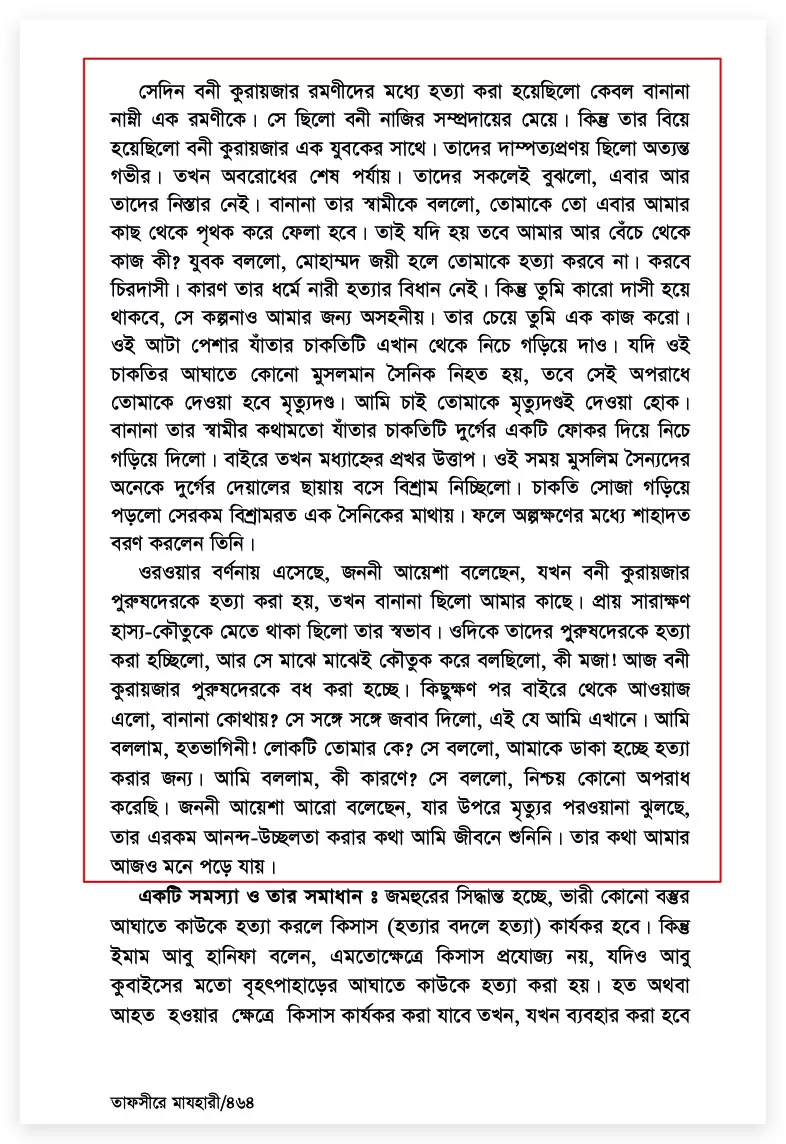
The Views of Islamic Scholars: Wives and Slave Women Are Obligated to Submit to Intercourse
In modern civilized societies, women enjoy the same rights as men. They participate equally in education, employment, leadership, and social service. Yet many cases still occur in which a husband forces his wife into sexual relations without her desire or permission. Modern civilized societies recognize this as rape, although many Islamic countries continue to regard such acts by husbands as lawful. Islam imposes the rule that a wife must submit to sexual activity whenever her husband demands it. This doctrine plays an important role in legitimizing severe and horrifying acts such as marital rape. Consider the following statement by Harun Izhar, a prominent leader of Hefazat-e-Islam.
Now consider whether, according to Islamic law, a husband or master may use force against his wife or slave woman.
Now consider the statements of several other Islamic scholars. The videos below discuss the Sharia status of a wife’s refusal when she is unwilling to have sexual intercourse, the husband’s sexual rights, and whether the wife may be compelled or punished. These discussions generally maintain that unless the wife has a Sharia-recognized excuse—such as serious illness, physical incapacity, menstruation, or a genuine risk of injury from intercourse—she is not permitted to reject her husband’s sexual summons. Some of these discussions, citing Fatawa Qadi Khan, also describe punitive measures under Islamic Sharia, including beating, when the wife refuses.
These statements are especially relevant to the present discussion. The issue is not limited to the legal position of slave women; it concerns the extent to which the Islamic framework of sexual entitlement recognizes a woman’s independent right to say “no.” If even a free wife is denied the unrestricted right to reject her husband’s sexual summons without a Sharia-recognized excuse, the claim that an enslaved woman possessed free and revocable sexual consent becomes even more implausible. A slave woman’s legal and social position was far more subordinate than that of a free wife, and her master also exercised proprietary authority over her. Consider the following statement by the prominent Pakistani mufti Tariq Masood.
Now consider an answer given during an Islamic question-and-answer programme in Bangladesh.
Now consider how a mufti explains in detail the four circumstances in which, according to Fatawa Qadi Khan, a husband may beat his wife.
Now consider a debate with Muslim believers on this issue. Begin watching at 07:08.
Now consider several additional relevant videos.
Beating Slaves for Disobeying Orders: Where Is the Freedom to Say “No”?
An exceptionally important piece of evidence for understanding the power structure of Islamic slavery appears in the legal opinion of Imam Ahmad ibn Hanbal. In Masa’il al-Imam Ahmad, compiled by Abu Dawud al-Sijistani, Imam Ahmad was asked for which matters a male or female slave could be disciplined or punished. He replied that slaves could be disciplined concerning their prayers, their other obligatory duties, and tasks assigned to them within their capacity [43].
سَمِعْتُ أَحْمَدَ، سُئِلَ عَنِ الْمَمْلُوكِ: فِيمَ يُؤَدَّبُ؟ قَالَ: فِي صَلَاتِهِ، وَفِي فَرَائِضِهِ، وَإِذَا حُمِّلَ مَا يُطِيقُ
Abu Dawud said: I heard Ahmad being asked, “For which matters may a slave be disciplined?” He replied, “Concerning his prayer, his obligatory duties, and when he is assigned a task within his capacity.”
The later Hanbali jurist al-Buhuti made the meaning of this ruling even clearer in Kashshaf al-Qina‘. It states: “وَيُؤَدِّبُهُ السَّيِّدُ عَلَى مَا إِذَا كَلَّفَهُ مَا يُطِيقُ فَامْتَنَعَ مِنْ امْتِثَالِهِ”—that is, if the owner orders a slave to perform a task within the slave’s capacity and the slave refuses to comply, the owner may discipline the slave. The same discussion states even more directly: “وَلِلسَّيِّدِ تَأْدِيبُهُمْ … بِاللَّوْمِ وَالضَّرْبِ”—the owner has the right to discipline his slaves through rebuke and beating [44].
The same fiqhi structure is repeated explicitly in IslamWeb’s fatwa on “the limits of a slave’s obedience to his owner and the permissibility of beating him.” Quoting Ibn Qudama, it states that when a male or female slave commits an offence, the owner may discipline the slave through rebuke and a light beating. It then cites Imam Ahmad’s position, transmitted by Ibn Muflih, that a slave may be disciplined concerning obligatory duties and tasks assigned within the slave’s capacity [45].
The significance of this evidence is not limited to the fact that Islamic jurisprudence permitted slaves to be beaten [46]. The more fundamental reality is that the owner’s authority to enforce orders upon a slave was backed by a legal power to inflict physical punishment. The owner could issue an order within the slave’s capacity; the slave could disobey it; and the owner could then discipline the slave, including by beating. This was not a relationship between two free human beings. It was a relationship between an owner who issued orders and an owned person compelled to obey.
This power structure is also crucial to the question of a slave woman’s consent. The most basic condition of genuine consent is the ability to say “no” safely. Yet in a system where a woman was an owned slave, where her owner had the authority to discipline her physically for disobeying his lawful orders, where she could be sold and her labor and movement controlled, and where the same fiqhi system recognized her owner’s sexual rights over her, her consent was devoid of real meaning. When saying “no” could activate the owner’s lawful power to impose ownership-based punishment, her “yes” cannot be imagined as free consent detached from that power relationship.
Beyond the specific sexual rulings, this exposes a deeper truth: under Islamic slavery, slaves did not control their own will. The owner issued commands, the slave was required to obey, and physical beating was one of the recognized means of enforcing that obedience. This issue has been examined in detail in another article. Interested readers may consult it here [47].
The Absence of Consent and Sexual Exploitation
In the modern civilized world, rape means sexual intercourse with a person without that person’s consent. Islamic law permitted precisely this in the case of female prisoners of war and slave women. Their consent was irrelevant because they were property owned by a master.
For a free woman, marriage is a contract in which consent plays at least some role, unless the wife is a minor. Islam requires the consent of an adult woman before marriage, but it does not require her continuing consent for regular sexual relations within that marriage. In the case of a slave woman, however, no contract or expression of will is required; the relationship rests purely upon ownership. This horrific rule grossly violated the human rights of female prisoners of war and affronted humanity itself.
Islam did not merely permit sexual rights over slave women; it preserved those rights institutionally. Instead of abolishing slavery, Islamic law conferred new religious legitimacy upon it. Female prisoners of war were established as objects for men’s sexual use.
Case Study: Multiple Owners Having Intercourse with the Same Slave Woman
An incident brought before Ali ibn Abi Talib for judgment is especially important for understanding the reality of enslaved women’s sexual lives under Islamic slavery. It would be incorrect to present this incident directly as “explicit proof of rape,” because the relevant reports contain no direct account of the woman’s consent, refusal, resistance, or the use of force. It is, however, an exceptionally important historical case study of how the female body, sexual entitlement, ownership, pregnancy, and paternity were interwoven under slavery.
The incident is preserved in several hadith collections through multiple chains of transmission and with minor textual variations. Its basic structure is largely the same: in Yemen, three men had intercourse with the same woman during the same tuhr, or the same interval free from menstruation. When she later gave birth, all three men claimed the child as their own, and the dispute was brought before Ali ibn Abi Talib. Ali first asked each man to relinquish his claim to the child in favor of the others. When none agreed, he told them, “You are contentious partners”—أنتم شركاء متشاكسون—and drew lots among them. The man whose name was drawn was awarded the child and ordered to pay the other two men two-thirds of the value or blood money. Some narrations state that when Muhammad was informed of the incident, he laughed until his molar teeth became visible. Another version reports him saying of Ali’s judgment, “I know nothing other than what Ali has said,” while a narration in al-Bayhaqi records him as saying, “You judged correctly,” or “You did well.”
Here, “the same tuhr” does not mean the same instant, night, or watch of the night. في طهر واحد refers to the same period of ritual purity between two menstrual periods. The three acts of intercourse therefore occurred close enough together that the child’s biological father could not be determined using the methods available at the time. A narration in al-Nasa’i states the matter directly: ثلاثة نفر اشتركوا في طهر—“Three men shared in the same tuhr.”
Hadiths and Athar Concerning the Same Incident
| Work and Reference | Important Part of the Report | Status/Distinguishing Feature |
|---|---|---|
| Sunan Abi Dawud 2269 | Three men had intercourse with one woman during the same tuhr; dispute over the child; Ali’s drawing of lots; two-thirds blood money; Muhammad’s laughter | Displayed as sahih on Shongshoy |
| Sunan al-Nasa’i 3489 | وقعوا على امرأة في طهر واحد—three men had intercourse with the same woman during the same tuhr; paternity determined by drawing lots | Sahih |
| Sunan al-Nasa’i 3490 | Another chain for the same incident; three men disputed over the child | Sahih |
| Sunan al-Nasa’i 3491 | Ali’s statement, أنتم شركاء متشاكسون; drawing lots, the child, and two-thirds blood money; Muhammad’s laughter | Sahih |
| Sunan al-Nasa’i 3492 | A brief narration of three men bringing a disputed child before Ali in Yemen | “Undetermined” on Shongshoy; a variant of the same incident |
| Sunan al-Nasa’i 3493 | ثلاثة نفر اشتركوا في طهر—three men shared in the same tuhr; no Zayd ibn Arqam or marfu‘ portion | Al-Nasa’i says this form is correct; sahih on Shongshoy |
| Musnad Ahmad 19342 | Three men had intercourse with the same woman during the same tuhr; Ali’s drawing of lots; the Prophet states that he knows nothing other than Ali’s decision | Shu‘ayb al-Arna’ut: weak due to inconsistency (اضطراب) in the chain |
| Musnad Ahmad 19344 | The same dispute, drawing of lots, and two-thirds blood money; account of Muhammad’s laughter | Shu‘ayb al-Arna’ut: weak chain |
| Musannaf Abd al-Razzaq 13473 | فأتي بامرأة وطئها ثلاثة في طهر واحد—one woman had been penetrated by three men during the same tuhr; drawing lots and blood money | An exceptionally explicit version of the incident |
| Musnad Ibn Abi Shaybah 519 | Three men had intercourse with the same woman during the same tuhr; each claimed the child; Ali called them “contentious partners” | Ends with an account of Muhammad’s laughter |
| Al-Bayhaqi 20346 | Three men claim the child; Ali draws lots and awards two-thirds blood money | The Prophet’s statement: “You judged correctly”/“You did well” |
| Al-Bayhaqi 20347 | وقعوا على امرأة في طهر واحد; the complete incident and Muhammad’s laughter | Abu Dawud’s narration is also quoted here |
| Al-Bayhaqi 20348 | ثلاثة نفر اشتركوا في طهر—three men shared in the same tuhr; the child’s father was unknown; drawing lots | A concise mawquf/athar-type version |
| Al-Bayhaqi 20349 | Al-Shafi‘i says that he would accept the report if it were established to him from the Prophet | Caution concerning the authenticity of the marfu‘ portion |
| Al-Bayhaqi 20350 | Discussion by al-Bayhaqi/Ahmad | Disagreement over the chain and its elevation to the Prophet is acknowledged |
These narrations are not equal in the strength of their chains. In particular, the portion describing Muhammad’s laughter or direct approval is not equally strong in every chain. Al-Nasa’i himself identifies a non-marfu‘ version—which contains only the three men’s intercourse during the same tuhr and Ali’s judgment—as the correct version. Critical analysis must therefore distinguish between two matters: the incident’s core historical nucleus and the additional portion in which the report reaches Muhammad and describes his reaction.
Was the Woman a Slave?
Many versions of the narrations use the word امرأة—“a woman.” Those versions alone therefore cannot establish whether she was free or enslaved. Another early transmission of the same incident, however, describes her explicitly as جارية لهم—“their slave woman.” In the version recorded in Musnad al-Humaydi, three men وقعوا على جارية لهم في طهر واحد—“had intercourse with their slave woman during the same tuhr.” It then recounts the same birth and Ali’s drawing of lots. The compensation is described explicitly as ثلثي قيمة الجارية—two-thirds of the slave woman’s value. This version explains why the “blood money” or “two-thirds of the value” was tied to the three men’s competing proprietary interests.
Later hadith commentary also explains the incident explicitly as involving a jointly owned slave woman (أمة يملكها ثلاثة). In other words, all three men owned the same slave woman and had intercourse with her during the same tuhr. The commentator also states that because she was jointly owned, it was not lawful under Sharia for any of the partners to have intercourse with her in that manner. It would therefore be wrong to use this incident as proof that “Islam permitted three owners to have intercourse with the same slave woman.” But such incidents occurred in practice and produced legal disputes over paternity and ownership; that cannot be denied.
Stronger evidence that this was not an isolated or unimaginable problem appears in the neighboring fiqhi athar in the same chapter of Musannaf Abd al-Razzaq. They discuss directly a slave woman jointly owned by several men with whom one of the partners had intercourse. In one narration, al-Zuhri prescribes one hundred lashes and payment of the other partner’s financial share. The next narration discusses how the value of a slave woman and her child should be calculated when a slave woman jointly owned by two men is made pregnant by one of them. In another report, Ibn Umar is asked about a man who had intercourse with a slave woman jointly owned by him and other partners. Thus, “an owner having intercourse with a jointly owned slave woman” was a real legal problem for which Muslim jurists had to formulate separate rulings. Musannaf Abd al-Razzaq 13461–13463.
What Does This Incident Reveal About the Slave Woman’s Position?
The most significant aspect of this case is that all the legal attention in the reports revolves around the men’s claims, the child’s paternity, and the owners’ financial rights. Who would receive the child, who would relinquish his claim, whose name would be drawn, and how much compensation the other two men would receive are all discussed in detail. Yet the reports are entirely silent about what the woman said, with whom she wished to have intercourse, or whether she had any genuine power to reject any of the three men who had intercourse with her during the same menstrual cycle and made her pregnant.
This silence alone cannot prove that “she was raped.” It is nevertheless highly significant when analyzing the status of a slave woman. She is not an active party to the legal dispute; she is primarily the person in whose womb the child was conceived and whose sexual use created a conflict among three men over paternity and proprietary interests. Even in resolving that dispute, it is not her preference but the drawing of lots that determines the man to whom the child will be attributed.
It is also notable that in al-Humaydi’s جارية لهم version, the financial compensation is not paid to the woman. One man is required to pay the other two owners two-thirds of the slave woman’s value. Later commentary explains that because the child was attributed to that man, the slave woman became his umm walad, causing the other partners to lose their ownership shares in her; they were therefore compensated financially. The judicial structure thus centers not on the slave woman’s personal sexual autonomy but on the shares of ownership in her and the financial value of those shares.
This is the importance of the case study. It does not prove that every slave woman was forcibly subjected to intercourse on every occasion; no such claim is needed. It instead reveals a social and legal system in which a slave woman could simultaneously be property owned by several men; sexual intercourse with her could create complications of ownership and paternity among those men; and fiqh addressed those disputes through discussions of drawing lots, blood money, the slave woman’s value, and shares of ownership.
Here lies the system’s fundamental conflict with the modern concept of sexual consent. The minimum condition of sexual consent is a person’s real and effective right to say “no.” When a human being is another person’s property, can be bought and sold, and is subject to an owner’s legally established rights over her body, the power relationship is unequal from the outset. The incident above offers an unusually clear window into that broader structure: it preserves detailed discussions of three men’s sexual relations, their claims of paternity, their mutual compensation, and the allocation of the child, but not a single sentence concerning the woman’s sexual wishes or consent.
It would therefore be historically exaggerated to reduce this incident to the simple statement that “three men raped a slave woman.” The more accurate statement is this: early Islamic sources preserve an incident in which three men had intercourse with the same slave woman during the same menstrual cycle, she became pregnant, and a judicial dispute later arose among the men over the child’s paternity and the slave woman’s financial value. Every legal account of the incident centers upon the men’s rights and ownership; the slave woman’s consent or right to refuse sex does not appear as an issue for adjudication at all. This is precisely why the incident is an important case study for understanding the structural problem of sexual consent under Islamic slavery.
Joint Ownership: A Father, Son, and Grandfather Having Intercourse with the Same Slave Woman
There is no reason to suppose that the incident above was isolated or merely hypothetical. Later works of Islamic jurisprudence contain detailed rulings on how to establish the paternity of a child when several owners—including a father, son, and grandfather from the same family—had intercourse with the same slave woman.
An important example appears in the Fatawa-e-Alamgiri, also known as Al-Fatawa al-Hindiyya. This vast compendium of Hanafi jurisprudence was compiled by a group of Hanafi scholars led by Shaykh Nizam al-Din al-Burhanpuri under the direction of the Mughal emperor Aurangzeb. Its Kitab al-Da‘wa, in the chapter on claims of lineage, contains separate sections on “a father’s claim to the child of his son’s slave woman” and “claims concerning the child of a jointly owned slave woman.”
The Bengali edition published by the Islamic Foundation Bangladesh contains several highly significant rulings on this subject. For example [48]:
Issue 34: If a slave woman is jointly owned by a man, his son, and his grandfather, and she gives birth to a child, and each of them claims the child, then the grandfather’s claim will take precedence (Zahiriyya). If she is jointly owned by a son and his father and both claim the child simultaneously, then according to subtle analogy the father’s claim will take precedence. He will be liable for half the slave woman’s value and half the equivalent dower. The son will be liable only for half the equivalent dower. They will therefore divide it between themselves by mutual settlement (Siraj al-Wahhaj).
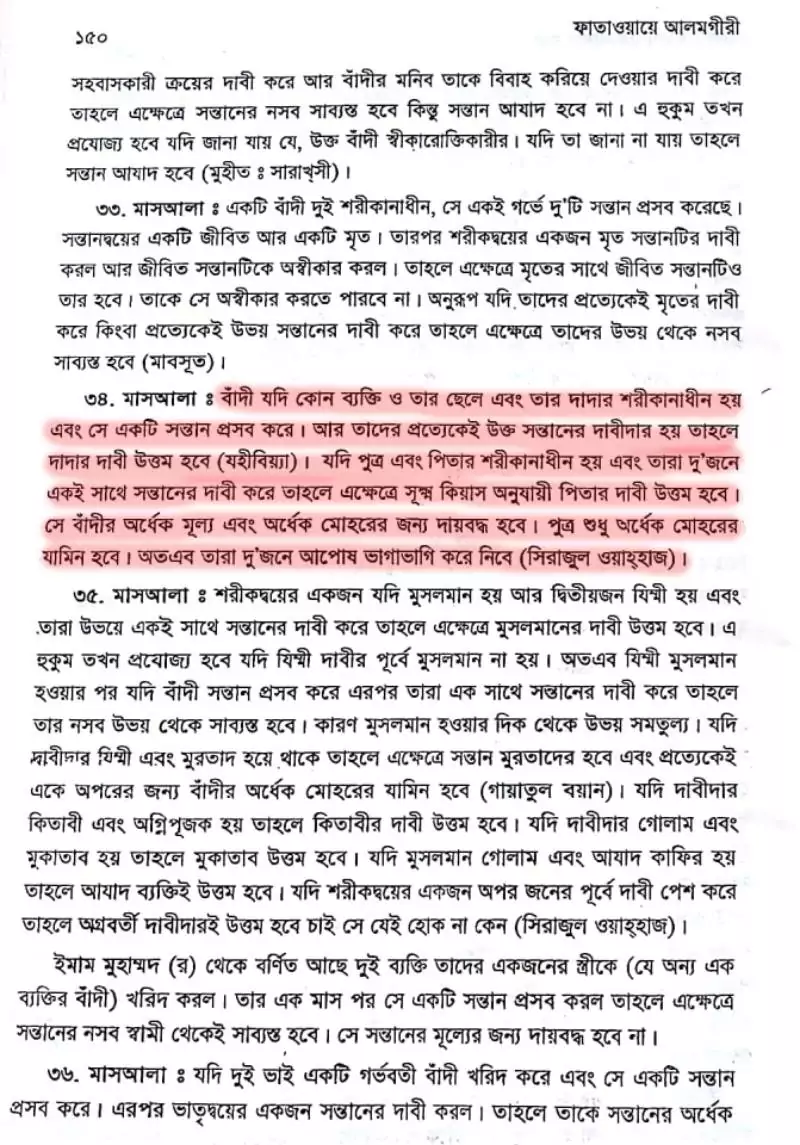
A parallel ruling appears in the Arabic Al-Fatawa al-Hindiyya. It concerns a slave woman jointly owned by a man, his son, and his grandfather. If all three claim her child after its birth, the ruling gives priority to the grandfather’s claim. The same section discusses in detail the competing claims of father and son when a jointly owned slave woman gives birth, the relevant share of her value, and the ‘uqr, or financial liability arising from sexual intercourse.
Another ruling states [49]:
Issue 21: If a person makes a slave woman who was previously penetrated by his father into an umm walad, the child’s lineage will be established through him (Qinyah).
If a father has sexual intercourse with his son’s slave woman, after which she gives birth and the father claims the child, the child’s lineage will be established through him, and the slave woman will become his umm walad. It makes no difference whether the son confirms or denies his claim, or whether the father claims that the intercourse occurred under a mistaken belief or does not make such a claim (Siraj al-Wahhaj).
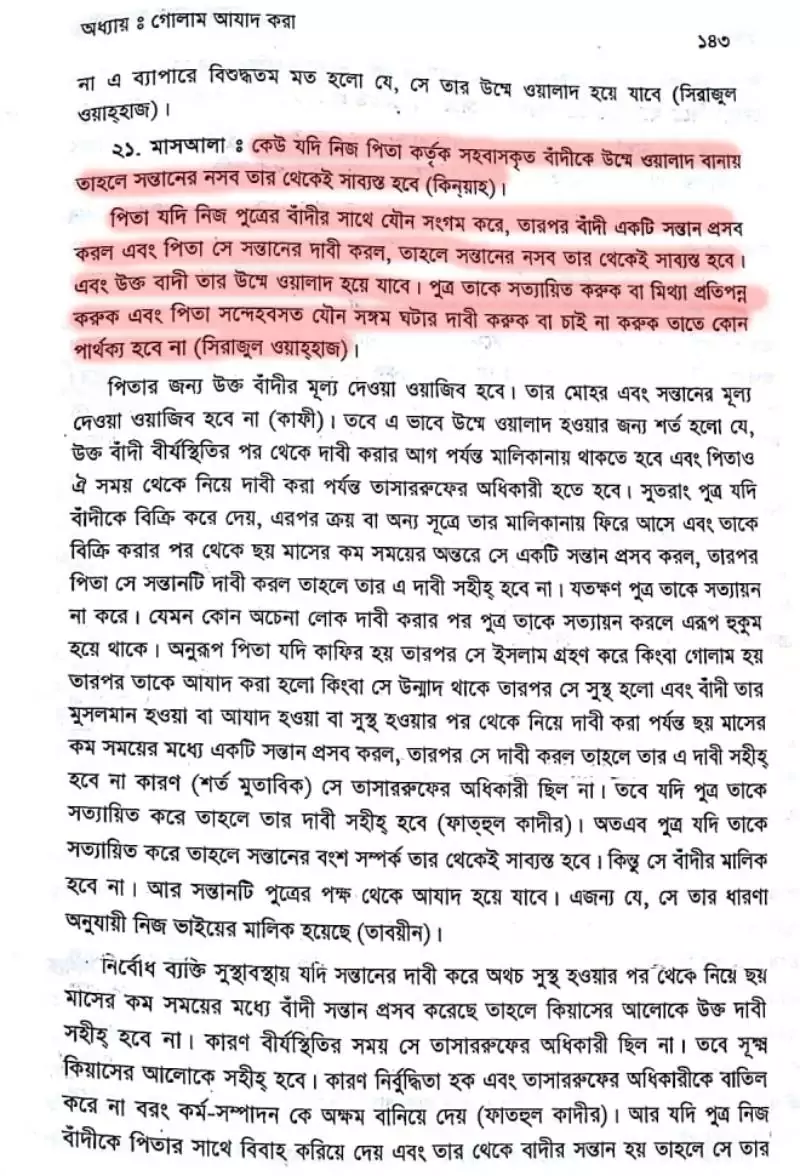
The Arabic original states the matter even more explicitly. The section titled “A father’s claim to the child of his son’s slave woman” explains that when a man’s father has intercourse with that man’s slave woman and she subsequently gives birth, the father’s claim of paternity may be recognized under specified circumstances. In one ruling, the father himself says:
وقعت على جارية ابني وأنا أعلم أنها علي حرام
That is, “I had intercourse with my son’s slave woman even though I knew that she was forbidden to me.”
Even then, the work states:
تصح دعوته ويثبت نسب الولد
That is, “His claim [to the child] will be valid, and the child’s lineage will be established through him.”
The argument is not that every one of these rulings declares the intercourse lawful. Under Sharia’s own rules, intercourse with a jointly owned slave woman or a son’s slave woman could be prohibited or create financial liability. In the Arabic passage above, the father himself admits that he knew the slave woman was forbidden to him.
The point relevant to this discussion lies elsewhere. Hanafi jurisprudence had to formulate detailed laws governing pregnancy and competing claims of paternity when a father, son, grandfather, or several co-owners had intercourse with the same slave woman. This was not merely an abstract sexual fantasy. It was a sufficiently recognized legal problem for Al-Fatawa al-Hindiyya to devote separate sections in its chapter on claims of lineage to “the child of a son’s slave woman” and “the child of a jointly owned slave woman.”
Most strikingly, the central question in these rulings is once again not the slave woman’s consent. The questions are: whose child it will be deemed to be, whose paternity claim takes precedence, whose umm walad the woman will become, what proportion of her value must be paid to whom, and how much mahr/‘uqr or financial liability each man must bear. The same property-and-paternity-centered legal structure seen in the dispute among three men brought before Ali ibn Abi Talib appears here in a more developed form.
Reading the early hadith incident alongside the Fatawa-e-Alamgiri from many centuries later reveals a persistent reality: a slave woman could be jointly owned by several men; several men could have intercourse with her; sexual intercourse with the same slave woman by men from different generations of a single family was a familiar occurrence in Islamic society; and when pregnancy resulted, Islamic law chiefly formulated rules to resolve questions of paternity, ownership, and financial rights. The slave woman’s own sexual wishes or consent were never a central element in that judicial equation.
Mothers and Daughters, and Two Sisters: Fiqhi Rules for Selecting Sexual Partners
The rulings above show that the same slave woman could be jointly owned by several men. Fiqh contains extensive discussions of intercourse with a jointly owned slave woman by multiple owners, her pregnancy, the child’s paternity, the slave woman’s value, and the partners’ financial entitlements. Strikingly, her own sexual wishes or consent are not at the center of those discussions. Their focus is ownership, the men’s claims, and the resulting financial and genealogical consequences.
The same ownership-based sexual structure appears even more starkly in rulings concerning a man who simultaneously owns a mother and daughter, or two sisters, as slave women. These rulings leave one point impossible to avoid: the jurists’ question is not whether the woman agrees. Their questions are which woman the owner may penetrate, how long the other woman becomes forbidden after he has intercourse with one of them, and how he may remove the first woman from the scope of his sexual entitlement so that the other becomes lawful to him again.
The important Shafi‘i work Al-Tahdhib fi Fiqh al-Shafi‘i states directly concerning a mother and daughter [50]:
فلو اشترى أمةً وابنتها، فوطيء إحداهما - حُرمت الأخرى على التأبيد
That is, if a man purchases a slave woman and her daughter and has intercourse with one of them, the other becomes permanently forbidden to him. The same ruling states that if two sisters, or a woman and her paternal or maternal aunt, are owned by the same man, he may not have intercourse with the second after having intercourse with the first until he makes the first woman forbidden to himself through an effective measure such as selling, gifting, freeing, marrying, or entering into a mukataba contract with her. Once he removes the first woman from his sexual entitlement in this manner, intercourse with the second becomes lawful [50].
At this point, the essential questions must be asked: What does the mother want? What does the daughter want? Which of them consents to intercourse with this owner? Such questions do not exist in the language of the fiqhi ruling. The rule is determined by the owner’s act: which woman he penetrates. The moment he has intercourse with one, the other woman’s status under Sharia changes. The determining factor is therefore not the woman’s will but the owner’s intercourse and his proprietary entitlement.
The matter is even clearer in the case of two sisters. Imam al-Nawawi’s Rawdat al-Talibin states that two women whom it would be forbidden to marry simultaneously may nevertheless be owned simultaneously as slave women, although the owner may not have intercourse with both at the same time. If he purchases two sisters, the ruling for the owner is [51]:
وله وطء أيتهما شاء
That is, “He may have intercourse with whichever of the two he wishes.”
These four Arabic words—أيتهما شاء—expose the character of the entire system: “whichever he wishes.” Who is the person doing the wishing? The owner. The ruling does not say, “He may have intercourse with whichever of the two sisters consents,” nor does it say, “He may choose whichever woman he desires, provided that she also desires him.” The fiqhi language states directly: whichever the owner wishes. The woman’s own “I want this” or “I do not want this” does not appear as a condition determining the legality of intercourse.
Al-Nawawi then states that if the owner has intercourse with one sister, the other becomes forbidden to him. Unlike the prohibition between mother and daughter, however, this prohibition is not permanent. The second sister may become lawful to him again if the owner removes the first from the scope of his sexual entitlement. How can he do this? By selling her, gifting her, freeing her, marrying her to another man, or entering into a mukataba contract with her. Removing one woman from his possession thus opens the way for him to exercise sexual entitlement over her sister [51].
Al-Nawawi’s language is even more significant. He states that the first sister must be made forbidden to the owner in a manner that changes the very basis of ownership or sexual entitlement; a merely temporary impediment is insufficient. If the first sister later returns to his ownership and completes the required istibra, and if he has not yet had intercourse with the second, the owner may once again وطء أيتهما شاء—“have intercourse with whichever of the two he wishes.” [51].
The Same Structure of Sexual Ownership in Hanafi Jurisprudence
This is not an isolated Shafi‘i ruling. The Hanafi work Ashraf al-Hidaya describes the same ownership-based sexual structure in detail for two enslaved sisters. It states that if a man owns two sisters as slave women and kisses both with desire, he may not then have intercourse with either of them until he terminates his sexual entitlement over one by transferring her to another person’s ownership, marrying her to another person, or freeing her [52].
قَالَ: وَمَنْ لَهُ أَمَتَانِ أُخْتَانِ فَقَبَّلَهُمَا بِشَهْوَةٍ، فَإِنَّهُ لَا يُجَامِعُ وَاحِدَةً مِنْهُمَا وَلَا يُقَبِّلُهَا وَلَا يَمَسُّهَا بِشَهْوَةٍ وَلَا يَنْظُرُ إِلَى فَرْجِهَا بِشَهْوَةٍ حَتَّى يُمَلِّكَ فَرْجَ الْأُخْرَى غَيْرَهُ بِمِلْكٍ أَوْ نِكَاحٍ أَوْ يُعْتِقَهَا
Translation: Imam Muhammad says: If a man owns two sisters as slave women and kisses both with desire, he may not have intercourse with either of them, kiss or touch either with desire, or look at her genitals with desire until he transfers his sexual entitlement over one of them to another person through ownership or marriage, or frees her.
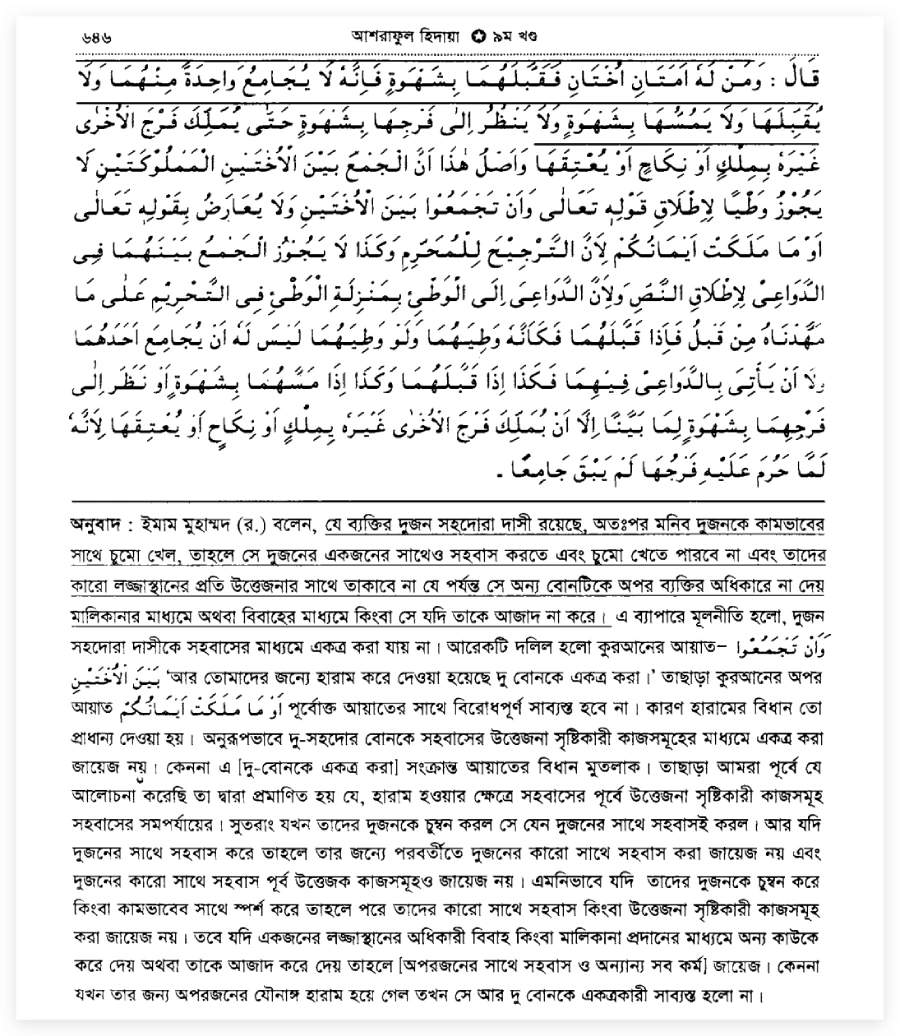
The work then clarifies the principle underlying this ruling: it is not forbidden for one owner to possess two sisters as slave women; what is forbidden is bringing both simultaneously within the scope of sexual enjoyment. Once one sister is removed from his sexual entitlement through transfer of ownership, marriage, or emancipation, the barrier to sexual intercourse with the other disappears.
The Bengali commentary on the following page states the matter even more openly. It explains that if the owner kisses one of the two sisters with desire, intercourse and other sexual intimacy with that sister remain lawful, while the other sister becomes forbidden to him. If one sister is transferred into another person’s ownership, married to another person, or freed, sexual relations with the other sister become lawful [53].
Relevant commentary: If a person owns two biological sisters as slave women and kisses one of them with desire, intercourse and other sexual intimacy with that sister remain lawful, but the other sister becomes forbidden to him. If he transfers his sexual entitlement over one sister to another person through ownership or marriage, or frees her, sexual relations with the other sister become lawful.
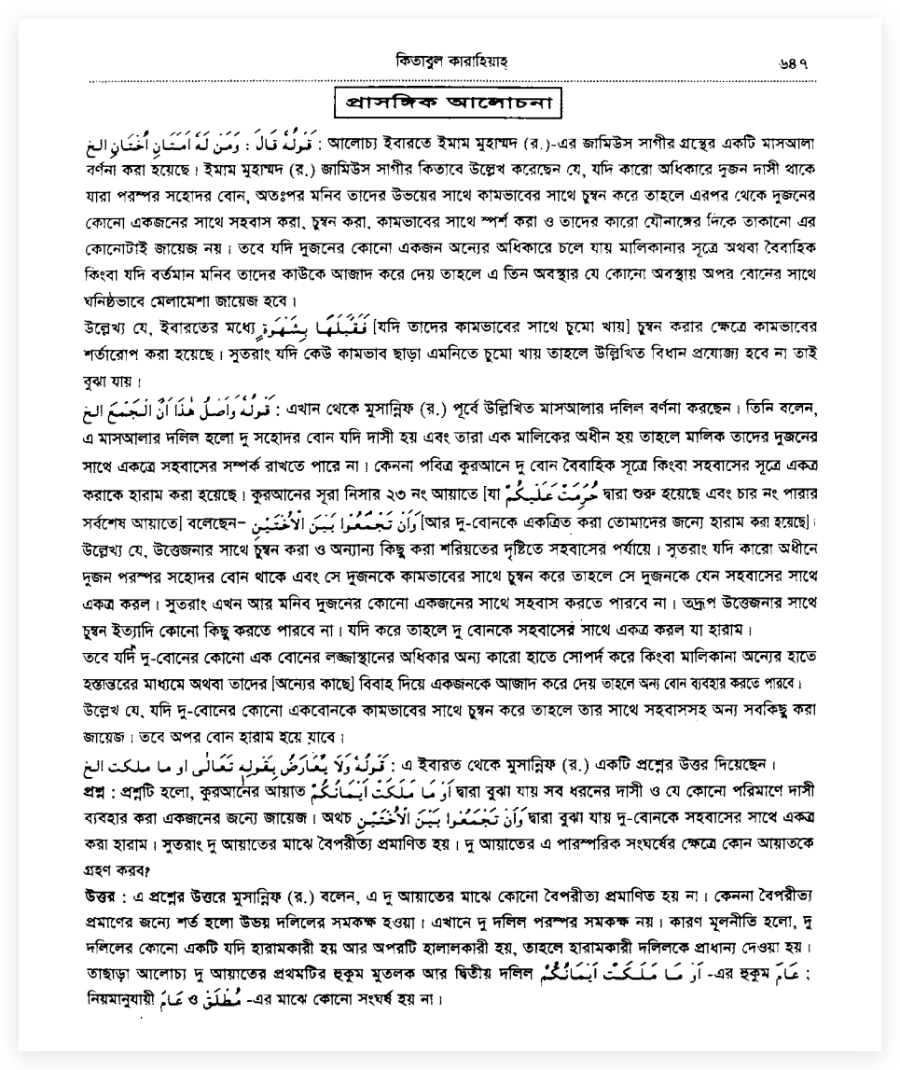
When this Hanafi ruling is placed beside al-Nawawi’s Shafi‘i statement, the problem becomes even starker. In two different schools of jurisprudence, the discussion revolves around the same axis: which woman the owner is using sexually, when his sexual entitlement over one woman ends, and when the other sister becomes lawful to him after that entitlement has ended. Whether either sister wants the owner as a sexual partner, possesses a right to say “no,” or has given her free consent does not appear anywhere as a condition determining legality.
The property-based language of the fiqh is also striking. The Arabic text uses يُمَلِّكَ فَرْجَ الْأُخْرَى غَيْرَهُ—that is, to place the right over one sister’s genitals in another person’s hands. Uncomfortable as this language may be, it is the language of the fiqhi text itself. It is not the language of a woman’s independent bodily rights, but an accounting of who possesses the legal right over her genitals.
The ruling is even stricter in the case of a mother and daughter. Al-Nawawi likewise states that if a man simultaneously owns a mother and her daughter and has intercourse with one of them, the other becomes permanently forbidden to him [54].
In summary, the sexual rules in these rulings produce the following sequence:
Both sisters are the owner’s property → the owner has intercourse with “whichever he wishes” → that intercourse temporarily makes the other sister forbidden → the first sister is removed from his possession by sale, gift, emancipation, or marriage → intercourse with the second sister becomes lawful.
In the case of a mother and daughter:
Both mother and daughter are owned → the owner has intercourse with one → the other becomes permanently forbidden to him. [50]
This sequence exposes one point starkly: the effective party making decisions about the woman’s body is the owner. The fiqh calculates which woman is currently lawful or forbidden to him, what transaction or arrangement will remove one woman so that the other becomes lawful, and which female relative becomes forbidden when he has intercourse with a particular woman. Yet nowhere in this lengthy and intricate legal accounting is the question “Does the enslaved woman consent?” made a condition for the legality of intercourse.
A possible objection should be clarified here. These rulings are not being used to claim that every act of intercourse necessarily involved physical force. That claim is unnecessary to the present discussion. The more fundamental question is: where is the slave woman’s free consent in determining the legality of intercourse under Sharia? It cannot be found in the language of these rulings. What appears repeatedly instead is the owner’s will, ownership, sexual entitlement, and the limits of that entitlement.
Nor can these rulings be read in isolation. This article has already examined established fiqhi rulings declaring that, without a Sharia-recognized excuse, it is forbidden for a slave woman to reject her owner’s lawful sexual summons and that it is her duty to make herself available for his sexual enjoyment. When those rulings are placed beside the declaration that an owner may have intercourse with أيتهما شاء—“whichever he wishes”—of two enslaved sisters, the character of the fiqhi structure concerning consent is unmistakable.
On one side, the slave woman’s “I do not want this” is not recognized under Sharia as an independent sexual refusal; on the other, the ruling’s language concerning the owner is “whichever he wishes.” How much more explicitly could the inequality of sexual power between owner and slave woman be written?
Placing these rulings beside the earlier rulings on joint ownership makes the matter even more stark. On one side, when a slave woman jointly owned by two or three men gives birth after intercourse with several owners, fiqh calculates paternity, ownership, her value, and the partners’ financial rights. On the other, when one man owns two sisters or a mother and daughter, fiqh calculates which woman he may penetrate, which must be temporarily or permanently excluded, and when intercourse with the other becomes lawful after the first has been removed.
The focus is the same in both cases: the owner’s sexual entitlement and when the body of the woman he owns falls within that entitlement as lawful or forbidden. The woman’s independent sexual decision is not the determining factor.
If consent means that a person can freely and effectively say “yes” or “no” concerning their own body, without fear or compulsion, and that the right to sexual intercourse ends the moment the person says “no,” then there is no rational way to deny the fundamental conflict between that concept and this fiqhi structure. The operative language is not the woman’s “whom I want,” but the owner’s “whom I want.”
Musannaf ʿAbd al-Razzaq: The Companions’ Inspection of Slave Girls
The rules permitting the exposure and touching of a woman’s body in a slave market were not merely theoretical discussions by jurists of later periods. One of the earliest collections of hadiths and reports, Musannaf ʿAbd al-Razzaq, also preserves concrete scenes from the buying and selling of slave girls. Its compiler, ʿAbd al-Razzaq ibn Hammam al-Sanʿani (126–211 AH), recorded not only Prophetic hadiths but also statements by the Companions and the Tabiʿun, as well as early Islamic legal practice. Several consecutive reports in the work show that exposing a slave girl’s lower legs, abdomen, back, and buttocks before purchase, touching her breasts and buttocks, and shaking her for inspection were treated as ordinary market procedures. [55]
Hadiths 13,202–13,204 contain several mutually corroborating versions of the same incident. According to Mujahid’s report, a group of buyers were turning a slave girl over and examining her. When they stopped after seeing Ibn Umar, Ibn Umar himself exposed the girl’s lower leg, touched her breast, and told the buyers to purchase her. Another version states that he placed his hand between the girl’s breasts and shook her.
Musannaf ʿAbd al-Razzaq
Regarding the inspection of a slave girl before purchase
Hadith 13,202
Original Arabic
عَنْ مَعْمَرٍ، عَنْ عَمْرِو بْنِ دِينَارٍ، عَنْ مُجَاهِدٍ قَالَ: مَرَّ ابْنُ عُمَرَ عَلَى قَوْمٍ يَبْتَاعُونَ جَارِيَةً، فَلَمَّا رَأَوْهُ وَهُمْ يُقَلِّبُونَهَا، أَمْسَكُوا عَنْ ذَلِكَ، فَجَاءَهُمُ ابْنُ عُمَرَ، فَكَشَفَ عَنْ سَاقِهَا، ثُمَّ دَفَعَ فِي صَدْرِهَا، وَقَالَ: «اشْتَرُوا». قَالَ مَعْمَرٌ، وَأَخْبَرَنِي ابْنُ أَبِي نَجِيحٍ، عَنْ مُجَاهِدٍ قَالَ: وَضَعَ ابْنُ عُمَرَ يَدَهُ بَيْنَ ثَدْيَيْهَا، ثُمَّ هَزَّهَا
English translation
Mujahid said: Ibn Umar passed by a group of people who were buying a slave girl. While they were turning her over and examining her, they stopped when they saw Ibn Umar. Ibn Umar went to them, exposed the girl’s lower leg, then pushed her on the breast and said, “Buy her.” Maʿmar further said: Ibn Abi Najih informed me, from Mujahid: Ibn Umar placed his hand between the girl’s breasts and then shook her.
Musannaf ʿAbd al-Razzaq
Hadith 13,203
Original Arabic
عَنِ ابْنِ عُيَيْنَةَ، عَنْ عَمْرِو بْنِ دِينَارٍ، عَنْ مُجَاهِدٍ قَالَ: كُنْتُ مَعَ ابْنِ عُمَرَ فِي السُّوقِ، فَأَبْصَرَ بِجَارِيَةٍ تُبَاعُ، فَكَشَفَ عَنْ سَاقِهَا، وَصَكَّ فِي صَدْرِهَا، وَقَالَ: «اشْتَرُوا». يُرِيهِمْ أَنَّهُ لَا بَأْسَ بِذَلِكَ
English translation
Mujahid said: I was with Ibn Umar in the market. He saw a slave girl being sold. He then exposed her lower leg, struck her on the breast, and said, “Buy her.” He was showing them that there was nothing wrong with this.
The final sentence of the report is particularly important: Ibn Umar was showing the buyers that exposing the slave girl’s body and touching her breast involved “nothing wrong.” In other words, the incident is not described as an accidental touch or a personal exception; it is presented to the buyers as permissible market conduct. Hadith 13,204, a shorter version of the same incident, again states that Ibn Umar placed his hand between the girl’s breasts and shook her. [56]
Musannaf ʿAbd al-Razzaq
Hadith 13,205
Original Arabic
عَنِ ابْنِ جُرَيْجٍ، عَنْ نَافِعٍ، أَنَّ ابْنَ عُمَرَ: «كَانَ يَكْشِفُ عَنْ ظَهْرِهَا، وَبَطْنِهَا، وَسَاقِهَا، وَيَضَعُ يَدَهُ عَلَى عَجُزِهَا»
English translation
According to Nafiʿ, Ibn Umar would expose the girl’s back, abdomen, and lower leg, and place his hand on her buttocks.
The body parts listed here cannot be confined to the scope of an ordinary medical examination: the back, abdomen, lower leg, the area between the breasts, and the buttocks. The woman’s body was turned into an examinable commodity before the eyes and hands of prospective buyers. There is no mention of her permission, objection, or personal boundaries. The purchasing decision of the men present in the market was the only consideration; the woman being examined was granted no authority over her own body.
The next two reports express this practice in more general legal language. A report preserved from Ibn al-Musayyib permits looking at the slave girl’s entire body except her private parts. Al-Shaʿbi’s statement is even more direct: when a man goes to purchase a slave girl, he may look at her entire body except her private parts.
Musannaf ʿAbd al-Razzaq
Hadith 13,206
Original Arabic
عَنِ ابْنِ جُرَيْجٍ، عَنْ رَجُلٍ، عَنِ ابْنِ الْمُسَيِّبِ، أَنَّهُ قَالَ: «يَحِلُّ لَهُ أَنْ يَنْظُرَ إِلَى كُلِّ شَيْءٍ فِيهَا، مَا عَدَا فَرْجَهَا»
English translation
According to Ibn al-Musayyib, he said: It is lawful for him to look at every part of her except her private parts.
Hadith 13,207
Original Arabic
عَنِ الثَّوْرِيِّ، عَنْ جَابِرٍ، عَنِ الشَّعْبِيِّ قَالَ: «إِذَا كَانَ الرَّجُلُ يَبْتَاعُ الْأَمَةَ، فَإِنَّهُ يَنْظُرُ إِلَى كُلِّهَا إِلَّا الْفَرْجَ»
English translation
Al-Shaʿbi said: When a man purchases a slave girl, he may look at her entire body except her private parts.
It is false to describe this rule as a medical, safety-related, or welfare measure for women. The purpose is clear from the reports themselves—the man is buying the woman, and therefore examines her body before the purchase. The bodily privacy and covering treated as matters of religious dignity in the case of free women disappeared before market interests in the case of slave girls. With the exception of her private parts, the rest of her body was declared open to inspection by the buyer. The legal boundary between a person and a commodity was effectively erased here.
The next report, preserved in the name of Ali, expresses the mentality underlying this system in its most naked terms. In response to the question of whether one may look at the lower leg, buttocks, and abdomen of a slave girl standing up for sale, it states: “She has no sanctity; she has merely been made to stand so that we may bargain over her.”
Musannaf ʿAbd al-Razzaq
Hadith 13,208
Original Arabic
عَنِ ابْنِ جُرَيْجٍ قَالَ: أَخْبَرَنِي مَنْ أُصَدِّقُ عَمَّنْ، سَمِعَ عَلِيًّا، يُسْأَلُ عَنِ الْأَمَةِ تُبَاعُ أَيَنْظُرُ إِلَى سَاقِهَا، وَعَجُزِهَا، وَإِلَى بَطْنِهَا؟ قَالَ: «لَا بَأْسَ بِذَلِكَ، لَا حُرْمَةَ لَهَا، إِنَّمَا وَقَفَتْ لِنُسَاوِمَهَا»
English translation
Ali was asked about a slave girl being sold: May the buyer look at her lower leg, buttocks, and abdomen? He replied: “There is nothing wrong with that. She has no sanctity; she has merely been made to stand so that we may bargain over her.”
Musannaf ʿAbd al-Razzaq
Hadith 13,209
Original Arabic
عَنِ الثَّوْرِيِّ، عَنْ عُبَيْدِ الْمَكْتَبِ، عَنْ إِبْرَاهِيمَ، عَنْ بَعْضِ أَصْحَابِ عَبْدِ اللَّهِ، أَنَّهُ قَالَ فِي الْأَمَةِ: «تُبَاعُ مَا أُبَالِي إِيَّاهَا مَسَسْتُ، أَوِ الْحَائِطَ»
English translation
It is reported from some of Abdullah’s companions concerning a slave girl: “She is to be sold. I do not care whether I touched her or touched a wall.”
The final statement is the ultimate verbal expression of the erasure of the slave girl’s personhood. Touching a flesh-and-blood woman and touching an inanimate wall are reduced to the same level. The true morality of the slave market is revealed in this mentality: the slave girl’s feelings, consent, modesty, and bodily autonomy have no value; only her saleable body has value. The buyer will look at her, expose her, touch her, shake her for inspection, and then purchase her through bargaining.
From the perspective of source criticism, the chains of transmission of these reports are not all equally strong. In particular, the chain of report 13,208, attributed to Ali, contains an unidentified narrator; it is therefore not being used as conclusive evidence of Ali’s personal conduct. This does not, however, alter the central facts when the other lines of transmission are considered. The incident involving Ibn Umar is reported from Mujahid through several chains in reports 13,202–13,204; report 13,205, transmitted through Nafiʿ, also preserves the account of exposing the slave girl’s back, abdomen, and lower leg and touching her buttocks. In addition, the legal statements in reports 13,206–13,207 show that permission to look at a slave girl’s body at the time of purchase was not an isolated personal incident; it was a recognized matter of legal practice in the early Islamic period, among the Companions and the generations that followed them, and in later jurisprudence.
In light of these documents, portraying the slave market as “humanitarian rehabilitation,” “shelter,” or a system for protecting the dignity of slave girls is a shameless distortion of history. In a shelter, no one places a hand between a woman’s breasts and shakes her body to assess her value; her value is not determined by touching her buttocks, and her body is not exposed for bargaining. These are the features of an organized market in human beings—in which men were buyers and owners, while captive women were living commodities kept for inspection, use, and resale.
Modern Muslim Societies and the Stagnation of Sharia
Today, slavery is legally prohibited in most Muslim-majority countries, and ordinary Muslims do not keep male or female slaves. This was achieved primarily through global pressure and the influence of human-rights values—not through Islamic morality [1]. The uncomfortable truth is that the Quran and hadith contain no command to abolish slavery; they mention good treatment of slaves in certain circumstances and rewards for freeing Muslim slaves. After Western countries abolished slavery during the colonial era, the Muslim world gradually followed, but the theoretical legitimacy of slavery remains within the texts of Islamic law. Islamic scholars generally find themselves in an uncomfortable position on this issue. Many claim that “Islam abolished slavery gradually,” but this is historically false. Slavery remained in Muslim societies for many centuries after the Prophet’s death, and both slaveholding and harem systems continued. In reality, today’s Muslims refrain from keeping slaves chiefly because of modern state law and international pressure, not for religious reasons.
Most importantly, Muslims believe Islamic law to be unchangeable until the Day of Judgment. According to mainstream scholars, any Sharia rule established by the Quran and sahih hadith remains in force forever: “The rulings of Islam established by explicit statements of the Quran and Sunnah will not change until the Day of Judgment.” Human laws may change, but laws given by Allah are immutable and applicable for all time. From this perspective, Islam’s original permission to enslave prisoners of war has not become morally wrong or evil under Sharia merely because international law now prohibits it. Islamic states have abolished slavery only because current circumstances bind them to the United Nations Charter and other laws. If an Islamic caliphate were established again, reviving the practice would still be regarded as “Sharia-compliant.” When ISIS seized territory in Syria and Iraq while claiming to establish a caliphate, for example, it enslaved Yazidi and Shia female captives, subjected them to sexual slavery, and sold children in markets. Although illegal under international law, ISIS justified these acts through Quranic descriptions. Its doctrine was that it was “reviving the Sunnah of the Messenger.”
Although mainstream Muslims were shocked and outraged by ISIS’s actions, they could not produce any explicit evidence from the Quran or hadith abrogating the underlying permission to enslave female prisoners of war. Instead, they condemned the practice on the basis of modern humanitarian values. In the same way, many other Islamic rules—such as polygamy, child marriage, and the discriminatory jizya tax imposed upon non-Muslims—remain religiously valid even where they are prohibited by law in Muslim countries. This dual reality confronts Muslim thinkers with a profound moral crisis: eternal religious law versus changing humanitarian values. Many do not wish to debate the conflict openly, but the reality is that human standards of morality have changed with the times while the rules in religious texts have remained immutable.
Human Reflection and the Moral Question
The preceding discussion naturally raises a fundamental human question: Can standards of right and wrong, or morality, differ according to one’s group or religion? It is irrational to maintain that an act is just when committed on the battlefield by “our side” but unjust when the enemy does the same thing.
Islamic jurisprudence declared it lawful to capture non-Muslim women, enslave them, and use them as sexual partners. But what if the situation were reversed? If a non-Muslim army captured Muslim women and treated them in exactly the same way, would any Muslim call it just or moral? The impartial historical record gives a clear answer: whenever Muslim women suffered such treatment, Muslim societies regarded it as a horrific injustice and a shameful crime.
Intercourse with Slave Women Under Muhammad’s Own Moral Test
A fundamental moral principle is that conduct considered unjust when directed at oneself or one’s loved ones cannot be declared just when directed at other people. Modern ethics calls this ethical reciprocity. Put simply: it is immoral to impose upon others what we would reject for ourselves. Islamic apologists defending slavery and the sexual enslavement of female prisoners of war frequently claim, “These practices were normal in that society.” Yet one of Muhammad’s own sahih hadiths demonstrates that he was fully familiar with judging an act’s morality by imagining one’s own mother, daughter, sister, paternal aunt, or maternal aunt in another person’s position [57].
Hadith 22,211
Original Arabic
حَدَّثَنَا يَزِيدُ بْنُ هَارُونَ، حَدَّثَنَا حَرِيزٌ، حَدَّثَنَا سُلَيْمُ بْنُ عَامِرٍ، عَنْ أَبِي أُمَامَةَ قَالَ: إِنَّ فَتًى شَابًّا أَتَى النَّبِيَّ صَلَّى اللهُ عَلَيْهِ وَسَلَّمَ فَقَالَ: يَا رَسُولَ اللهِ، ائْذَنْ لِي بِالزِّنَا، فَأَقْبَلَ الْقَوْمُ عَلَيْهِ فَزَجَرُوهُ وَقَالُوا: مَهْ. مَهْ. فَقَالَ: ” ادْنُهْ، فَدَنَا مِنْهُ قَرِيبًا “. قَالَ: فَجَلَسَ قَالَ: ” أَتُحِبُّهُ لِأُمِّكَ؟ ” قَالَ: لَا. وَاللهِ جَعَلَنِي اللهُ فِدَاءَكَ. قَالَ: ” وَلَا النَّاسُ يُحِبُّونَهُ لِأُمَّهَاتِهِمْ “. قَالَ: ” أَفَتُحِبُّهُ لِابْنَتِكَ؟ ” قَالَ: لَا. وَاللهِ يَا رَسُولَ اللهِ جَعَلَنِي اللهُ فِدَاءَكَ قَالَ: ” وَلَا النَّاسُ يُحِبُّونَهُ لِبَنَاتِهِمْ “. قَالَ: ” أَفَتُحِبُّهُ لِأُخْتِكَ؟ ” قَالَ: لَا. وَاللهِ جَعَلَنِي اللهُ فِدَاءَكَ. قَالَ: ” وَلَا النَّاسُ يُحِبُّونَهُ لِأَخَوَاتِهِمْ “. قَالَ: ” أَفَتُحِبُّهُ لِعَمَّتِكَ؟ ” قَالَ: لَا. وَاللهِ جَعَلَنِي اللهُ فِدَاءَكَ. قَالَ: ” وَلَا النَّاسُ يُحِبُّونَهُ لِعَمَّاتِهِمْ “. قَالَ: ” أَفَتُحِبُّهُ لِخَالَتِكَ؟ ” قَالَ: لَا. وَاللهِ جَعَلَنِي اللهُ فِدَاءَكَ. قَالَ: ” وَلَا النَّاسُ يُحِبُّونَهُ لِخَالَاتِهِمْ “. قَالَ: فَوَضَعَ يَدَهُ عَلَيْهِ وَقَالَ: ” اللهُمَّ اغْفِرْ ذَنْبَهُ وَطَهِّرْ قَلْبَهُ، وَحَصِّنْ فَرْجَهُ ” قَالَ : فَلَمْ يَكُنْ بَعْدُ ذَلِكَ الْفَتَى يَلْتَفِتُ إِلَى شَيْءٍ.
Shaykh Shu‘ayb al-Arna’ut’s assessment: [Its chain is sahih; its narrators are trustworthy narrators of the Sahih.]
English Translation
22211 — Abu Umama reported that a young man came to the Prophet (ﷺ) and said, “O Messenger of Allah, give me permission to commit zina.” The people turned toward him, rebuked him, and told him to stop. But the Prophet (ﷺ) said, “Come closer.” The young man came near and sat down. The Prophet asked him, “Would you like it for your mother?” He replied, “No, by Allah. May Allah make me your ransom.” The Prophet said, “Nor do people like it for their mothers.” He then asked, “Would you like it for your daughter?” The young man replied, “No, by Allah, O Messenger of Allah. May Allah make me your ransom.” The Prophet said, “Nor do people like it for their daughters.” He asked, “Would you like it for your sister?” He replied, “No, by Allah. May Allah make me your ransom.” The Prophet said, “Nor do people like it for their sisters.” He asked, “Would you like it for your paternal aunt?” He replied, “No, by Allah. May Allah make me your ransom.” The Prophet said, “Nor do people like it for their paternal aunts.” He asked, “Would you like it for your maternal aunt?” He replied, “No, by Allah. May Allah make me your ransom.” The Prophet said, “Nor do people like it for their maternal aunts.” The Prophet then placed his hand upon him and prayed, “O Allah, forgive his sin, purify his heart, and guard his chastity.” The narrators state that after this, the young man no longer turned toward anything of that kind.
In this hadith, Muhammad did not give the young man a complex theological explanation. He asked him to think by placing his own close female relatives in the position of other people. The substance of his questions was this: every other woman is also someone’s mother, daughter, sister, paternal aunt, or maternal aunt; what you cannot accept for your own female relatives should not be done to the female relatives of others. Muhammad therefore knew and used the method of changing perspectives in moral decision-making and imagining another person’s harm as one’s own.
The hadith’s reasoning is not based on women’s bodily autonomy in the modern sense. The young man is not asked whether the woman concerned has freely consented to sexual intercourse; he is asked whether he would like it in the case of his own mother, daughter, or sister. The focus therefore rests upon the family honor and disapproval of a male relative rather than upon the woman as an independent moral person. Despite this patriarchal limitation, however, the hadith proves at least one point: Muhammad was entirely familiar with the moral method of judging sexual conduct toward another woman by imagining one’s own mother, daughter, or sister in her position.
Applying the same question to female prisoners of war and slave women immediately exposes the moral double standard in Islamic law. Muhammad asked the young man, “Would you like it for your daughter?” Yet he did not ask this question about female prisoners of war: “Would I like it if my own daughter were captured by the enemy, made into war booty, her marriage annulled, and she were turned into the sexual slave of a victorious man?” The same question applies to the Companions. Would they have called it just if a defeated enemy had captured their mothers, daughters, sisters, paternal aunts, or maternal aunts, distributed them, sold them in markets, and subjected them to the sexual entitlement of new owners?
The answer appears within the hadith itself: “No, people do not like it for their mothers, daughters, sisters, paternal aunts, or maternal aunts.” Why, then, did this same principle cease to operate for the women captured at Awtas, Banu Mustaliq, Khaybar, or other campaigns? Were they not also someone’s mothers, daughters, sisters, paternal aunts, or maternal aunts? Did their husbands, children, and families approve of their captivity and sexual enslavement? To acknowledge an act as intolerable for one’s own relatives while legitimizing that same act against defeated non-Muslim women as “Allah’s law” is not universal morality. It is an explicit double standard constructed to serve the interests of the victorious side.
Islamic apologists may respond that the hadith concerns zina, whereas Sharia does not classify intercourse with one’s own slave woman as zina. This is not a moral answer; it merely renames the act through a religious definition. Sexual relations between two free and consenting adults are prohibited under the name of zina, while intercourse with a woman who has just lost her family, has been captured, can be sold, and lacks the freedom to disobey her owner is legitimized under the name milk al-yamin. Changing the Sharia category does not erase the captive woman’s fear, helplessness, refusal, or bodily rights. Judged by freedom and consent, the situation of an enslaved female prisoner of war is far more grave than ordinary consensual sex outside marriage.
This is why the argument that “these things were normal at the time” fails. The prevalence of a practice in a society is not evidence of its morality. More importantly, according to this hadith, Muhammad himself knew how to assess the morality of sexual conduct by placing another person in the position of one’s own loved ones. It is therefore false to claim that he could not have imagined this question in relation to female prisoners of war. He knew the method but did not apply it universally. The humane consideration extended to Muslim women and one’s own relatives was set aside once defeated non-Muslim women had been converted into property taken as war booty.
The problem, therefore, is not merely the limited social knowledge of the seventh century; it is selective empathy. The moral feeling activated in the case of one’s own mother, daughter, or sister was denied to the mothers, daughters, and sisters of the enemy. If moral standards change with faction, religion, and military power, then they are not morality at all; they are the advantages of the powerful legitimized in moral language. Judged by Muhammad’s own test, the rule allowing female prisoners of war to be enslaved and made subject to an owner’s sexual entitlement fails morally.
History contains countless examples in which both sides captured the women of the opposing side and imposed sexual slavery upon them.
Historical Examples
Several such incidents are listed below. As they are not directly central to the subject, they are not discussed in detail. Consider the following table:
| Period/Event | Victorious Side | Defeated Side | Captivity/Enslavement of Women |
|---|---|---|---|
| 711 CE, conquest of Sindh | Arab armies (Umayyad Caliphate) | Hindu kingdoms | Thousands of Hindu women were captured and sent to Arab lands as slave women. |
| Mughal era (16th–17th centuries) | Muslim sultans and emperors | Hindu royal families | Defeated Hindu princesses were incorporated into the harems of victorious sultans. |
| Crusades (11th–13th centuries) | European Christian Crusaders | Muslim populations | Muslim women and children were captured and sold in Europe. |
| Fall of al-Andalus (1492) | Catholic monarchs | Muslims of al-Andalus | Muslim men and women were sold in slave markets; countless women were subjected to sexual slavery. |
In every historical example, the victorious side described its actions as lawful or as “the spoils of holy war,” while the victims regarded them as sexual violence and violations of human rights. Partisan judgment thus presented justice with two faces. But genuine justice is universal. The Golden Rule of morality states:
“Do not do to others what you would not want done to yourself.”
Whatever your religion, if your mother, sister, or daughter were captured in war and forced to live in an enemy harem, you would never call it just or moral. It cannot therefore be just when inflicted upon someone else’s mother or sister. This is the real test of humanity. The progress of civilization has taught us that human rights are universal; they do not change according to “our side” and “their side.” For this reason, no state today openly endorses the rape or enslavement of prisoners of war; those that do become pariahs in the eyes of the world.
Religious permission therefore cannot make an immoral act just. What is wrong when inflicted upon the women of one’s own family is equally wrong when inflicted upon the women of another family.
The Apologists’ Claim: Conflating Fiqhi Rulings with Moral Advice
Several arguments recur in modern Islamic defenses concerning a slave woman’s consent. These include hadiths instructing owners to treat slaves well, not to beat them excessively, or encouraging emancipation as expiation for beating them. At other times, the punishment for raping someone else’s slave woman is presented as if it established the rape of one’s own slave woman as a crime in Islam. Al-Halimi’s moral recommendation, comparisons involving the word haqq, and the rules of ‘azl are also frequently misinterpreted. But a scholar’s moral counsel, recommendation of better conduct, or discussion of ihsan is not the same thing as a fiqhi ruling on an act. The legal question is whether a slave woman’s “no” extinguishes her owner’s sexual entitlement when she rejects intercourse. That question must be answered from sources that directly discuss obligation, prohibition, rights, permission, refusal, and the rules governing compulsion—not from general advice about good treatment.
| Common Objection | Very Brief Response |
|---|---|
| Al-Halimi said that if a slave woman dislikes lying with or having intercourse with her owner, he should seek her permission. Consent is therefore mandatory. | Al-Halimi’s statement is not a legal ruling in a Kitab al-Nikah or a section on tasarri determining the legality of intercourse with a slave woman. It belongs to the chapter “باب في الإحسان إلى المماليك”—“On Benevolence toward Slaves” in his Al-Minhaj fi Shu‘ab al-Iman. In the same discussion, after separately identifying mandatory matters as عزائم, he discusses better conduct using the phrase ثم أن الأولى به—“Then it is preferable for him.” This is therefore one scholar’s moral recommendation grounded in ihsan, not a madhhab-level fiqhi ruling declaring the slave woman’s consent a universal Sharia condition for the validity of intercourse. [58] |
| Islam commands good treatment of slaves and prohibits beating them without cause; therefore a slave woman could not be forced into intercourse. | A general prohibition on abuse does not establish a specific right of sexual refusal. Direct fiqhi sources instead declare a slave woman’s rejection of her owner’s sexual summons haram and recognize the owner’s authority to discipline or beat a slave who disobeys a lawful order. A general principle of “treat them well” does not nullify a specific fiqhi right [59]. Nor is beating slaves categorically haram in Islam [47]. |
| There is a hadd punishment or other penalty for forcibly raping another person’s slave woman; therefore Islam prohibits the rape of slave women. | This concerns another person’s slave woman. The offender’s problem is that the woman is neither his wife nor a slave woman whom he owns. It does not establish the slave woman’s right to autonomous consent; instead, it demonstrates that the boundaries of ownership determine sexual legality. In its discussion of an owner يغتصبها—forcibly having intercourse with his own mukataba slave woman—Al-Mudawwana rules that no hadd applies to the owner [60]. |
| The fact that a slave woman’s permission is unnecessary for ‘azl does not prove that her permission is also unnecessary for intercourse. | This objection is correct if the evidence concerning ‘azl is used alone. But the argument of this article does not rest upon ‘azl alone. Ibn Qudama explicitly explains why the slave woman’s permission is unnecessary: لا حق لها في الوطء، ولا في الولد—“She has no right to intercourse or to the child.” Ibn Abd al-Barr likewise permits ‘azl without the slave woman’s permission, consultation, or opinion. When these statements are read alongside direct rulings declaring sexual refusal haram and permitting compulsion after refusal, the legal structure becomes clear [61]; [62]. |
| Ibn Hajar opposed forced marriage and forcing slave women into prostitution. | Forced marriage and forcing a slave woman into prostitution are separate legal questions. Neither establishes that when an owner’s own slave woman rejects his sexual summons, her refusal extinguishes his sexual entitlement based on ملك اليمين. A prohibition in one legal question cannot be transferred to a different one. |
| Islam permits no “zulm”; forced intercourse therefore cannot be permitted. | This is circular reasoning. The relevant fiqh must first be examined to determine which acts it classifies as zulm. If compelling a slave woman to have intercourse after she refuses is described as ليس ذلك بمستقبح لأنه يستوفي حقه—“not reprehensible, because he is obtaining his right”—then merely stating that “zulm is haram” does not answer the problem. |
| In fiqh, “rape” means coerced zina. Intercourse with one’s lawfully owned slave woman is not zina and therefore is not rape. | This explains classical criminal-law terminology; it does not answer the question of consent. If the definition itself includes the condition that the woman is “neither a lawful wife nor one’s own slave woman,” then the owner’s forced intercourse is excluded from the category of rape at the outset, and the later declaration that “it is not rape” becomes a definitional circle. The real question is: when the woman says “no,” does that refusal legally terminate the right to sexual intercourse? |
| Judging the seventh century by the modern concept of consent is presentism. | Whether a historical system was prevalent at the time and whether it was moral are different questions. This article does not claim that historical people used modern terminology; it examines whether the system gave a woman an effective, free, and revocable right to say “no,” and how that system stands under modern humanitarian principles. The argument also creates a logical contradiction with the claim that Islamic Sharia is a perfect and immutable divine law for all humanity until the Day of Judgment. |
A scholar may say that the owner should keep the slave woman content, consider her aversion, or sell her. This may be advice concerning ihsan, etiquette, or better conduct. But to determine the fiqhi rule, one must examine the legal consequence of her refusal. There we find that refusal is strictly haram, making herself available for the owner’s sexual enjoyment is obligatory, the slave woman has no independent right to intercourse, her permission is unnecessary for ‘azl, and even in the case of direct refusal, she may be compelled through physical force. To elevate an isolated moral recommendation to the same evidentiary status as these direct fiqhi rulings and then claim that “a slave woman’s free consent was mandatory in Islam” is to confuse both the nature of the sources and their legal weight.
Conclusion
Islamic texts contain moral recommendations by a few scholars advising owners to consider a slave woman’s reluctance or aversion, but these are wholly exceptional opinions. Such statements cannot be presented as establishing a slave woman’s free sexual consent as a mandatory condition under Sharia. Several important fiqhi rulings do not recognize her unexplained sexual refusal as a valid and final right. Instead, responding to her owner’s sexual summons is described as her duty, while refusal is classified as forbidden, sinful, or punishable disobedience. When Islam requires even a wife to satisfy her husband’s sexual demands, the consent of an owned slave woman is rendered irrelevant. Islam contains no established madhhab ruling or strong fiqhi consensus declaring that an owner’s intercourse without his slave woman’s permission constitutes rape, that a specified punishment applies to him, or that the slave woman’s “no” extinguishes his sexual entitlement. The modern Islamist claim that free and revocable consent was a general legal prerequisite for an owner’s intercourse is therefore unproven.
The fact that a barbaric system was once considered normal does not make it moral. Slavery, war plunder, and the sexual enslavement of captive women were prevalent in ancient societies, but modern humanitarian morality has rejected them. The progress of human civilization lies precisely in humanity’s ability to recognize practices once accepted as inhuman and unjust. The problem begins when a religious law claims to be eternal and immutable and attempts to defend that ancient barbarity in the name of morality. Important parts of many religious legal systems, including Islam, were formed in the context of ancient warfare, slavery, and patriarchal society. When those rules are measured today against human rights, individual liberty, and consent, their inhumanity becomes unmistakable. Muslim societies should therefore acknowledge honestly that enslaving prisoners of war and granting owners sexual rights over slave women are historical Islamic rules that are unacceptable by modern humanitarian standards. Religious legitimacy cannot make an inhuman act moral; judgments of right and wrong must give priority to human reason, freedom, and consent.
References
- Inhuman Slavery in Islam 1 2
- Quran 16:75 ↩︎
- A Naked Slave Woman Was Brought Before Caliph Mu‘awiya for Sexual Use ↩︎
- Al-Bidaya wa’l-Nihaya, Ibn Kathir, vol. 8, p. 266 ↩︎
- ويحرم على الزوجة والأمة تحريما غليظا أن تمتنع إذا طلبها للاستمتاع الجائز ↩︎
- Al-Mawsu‘ah al-Fiqhiyyah, Vol. 23, p. 23 ↩︎
- مسألة فرض الأمة والحرة أن لا يمنعا السيد والزوج الجماع متى دعاهما ↩︎
- IslamQA, Fatwa No. 33597 ↩︎
- مسألة فرض الأمة والحرة أن لا يمنعا السيد والزوج الجماع متى دعاهما ↩︎
- Kecia Ali, “Concubinage and Consent,” International Journal of Middle East Studies, Vol. 49, Issue 1, Cambridge University Press, 2017, pp. 148–152 ↩︎
- Ashraf al-Hidaya, Islamia Kutubkhana, vol. 9, p. 625 ↩︎
- Al-Shabaka al-Islamiyyah — السبي يقطع نكاح المرأة المسبية, 29-12-2009 ↩︎
- Ibn ‘Abd al-Barr, Al-Tamhid lima fi al-Muwatta min al-Ma‘ani wa al-Asanid, vol. 3, pp. 147–148 — IslamWeb ↩︎
- Ibn Qudama, Al-Mughni, vol. 7, p. 227, “Practicing ‘Azl with One’s Slave Woman Without Her Permission” — IslamWeb ↩︎
- Malik ibn Anas, Al-Mudawwana, vol. 4, p. 481, “في الرجل يطأ مكاتبته طوعا أو غصبا” — IslamWeb ↩︎
- Al-Buhuti, Sharh Muntaha al-Iradat (Daqa’iq Uli al-Nuha), vol. 2, p. 310 — IslamWeb ↩︎
- Sahih Muslim, Islamic Foundation, Hadith 3477 ↩︎
- Sunan Abi Dawud, Islamic Foundation, Hadith 2152 ↩︎
- Sunan Abi Dawud, authenticated by Shaykh Nasir al-Din al-Albani, Al-Albani Academy, vol. 3, pp. 215–216, Hadith 2155 ↩︎
- Sahih al-Bukhari, Tawhid Publications, Hadith 7409 ↩︎
- Sahih al-Bukhari, Islamic Foundation, vol. 10, p. 549, Hadith 6905 ↩︎
- Sahaj Nasrul Bari, Sharh-e Sahih Bukhari, vol. 11, Arabic-Bengali, simple translation and detailed commentary, Mawlana Muhammad Usman Ghani, Al-Kawsar Publications, pp. 507–508 ↩︎
- Analysis of Non-Consensual ‘Azl with Slave Women in Islam and Its Reasons ↩︎
- Ma‘rifat al-Sunan wa al-Athar, Report 18306 ↩︎
- Ma‘rifat al-Sunan wa al-Athar by al-Bayhaqi, Hadith 18306 ↩︎
- Ma‘rifat al-Sunan wa al-Athar, Report 18307 ↩︎
- Ma‘rifat al-Sunan wa al-Athar, Hadith 18311 ↩︎
- Ma‘rifat al-Sunan wa al-Athar by al-Bayhaqi, Hadith 18311 ↩︎
- The Islamic Ruling Permitting the Annulment of a Married Slave Woman’s Marriage for Sexual Use ↩︎
- Tafsir Mazhari, vol. 3, pp. 16–17 ↩︎
- Ma‘rifat al-Sunan wa al-Athar, Report 18304 ↩︎
- Ma‘rifat al-Sunan wa al-Athar by al-Bayhaqi, Hadith 18304 ↩︎
- Ashraf al-Hidaya, Islamia Kutubkhana, vol. 9, p. 629 ↩︎
- Ashraf al-Hidaya, Islamia Kutubkhana, vol. 9, p. 631 ↩︎
- Sunan al-Darimi, HadithBD, Hadith 1212 ↩︎
- Sunan al-Darimi, HadithBD, Hadith 1214 ↩︎
- Sunan al-Darimi (HadithBD), Hadith 1212 ↩︎
- Sunan al-Darimi (HadithBD), Hadith 1213 ↩︎
- Sunan al-Darimi (HadithBD), Hadith 1214 ↩︎
- Sunan Abi Dawud (Verified Edition), Hadith 2671 ↩︎
- Sunan Abi Dawud, Islamic Foundation, Hadith 2662 ↩︎
- Tafsir Mazhari, vol. 9, p. 464 ↩︎
- Abu Dawud al-Sijistani, Masa’il al-Imam Ahmad, Riwayat Abi Dawud al-Sijistani, issue 1830, vol. 1, p. 378; Ibn Muflih, Al-Furu‘ ↩︎
- Al-Buhuti, Kashshaf al-Qina‘ ‘an Matn al-Iqna‘, vol. 5, pp. 491–492; IslamWeb Library ↩︎
- IslamWeb, Fatwa no. 137527, حدود طاعة العبد لسيده ومدى جواز ضربه ↩︎
- ↩︎
- Is It Really Forbidden to Beat Slaves in Islam? 1 2
- Fatawa-e-Alamgiri, Islamic Foundation Bangladesh, vol. 3, p. 150 ↩︎
- Fatawa-e-Alamgiri, Islamic Foundation Bangladesh, vol. 3, p. 143 ↩︎
- Al-Tahdhib fi Fiqh al-Shafi‘i, vol. 5, p. 362 1 2 3
- Rawdat al-Talibin, Kitab al-Nikah, the ruling on combining two sisters 1 2 3
- Ashraf al-Hidaya, Islamia Kutubkhana, vol. 9, p. 646 ↩︎
- Ashraf al-Hidaya, Islamia Kutubkhana, vol. 9, p. 647 ↩︎
- Rawdat al-Talibin, Kitab al-Nikah ↩︎
- Shongshoy Islamic Archive—Musannaf ʿAbd al-Razzaq ↩︎
- Musannaf ʿAbd al-Razzaq, Hadith 13,204 ↩︎
- Musnad Ahmad ibn Hanbal, Hadith 22211 ↩︎
- Al-Halimi, Al-Minhaj fi Shu‘ab al-Iman, “باب في الإحسان إلى المماليك” ↩︎
- Rawdat al-Talibin ↩︎
- Al-Mudawwana—voluntary or forced intercourse with a mukataba slave woman ↩︎
- Ibn Qudama, Al-Mughni ↩︎
- Ibn Abd al-Barr, Al-Tamhid ↩︎