
Introduction: The Idea of Heaven and the Reflection of Human Unsatisfied Desire
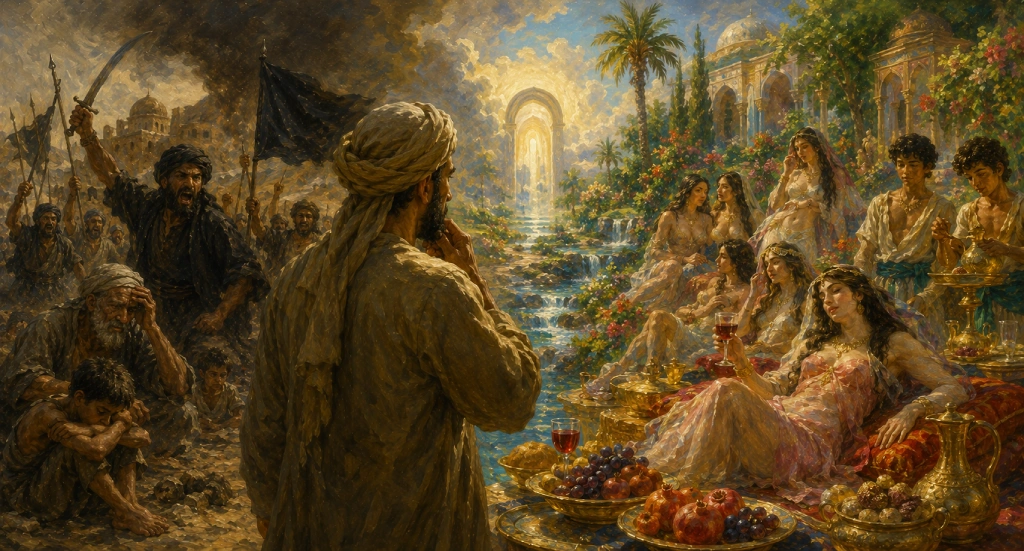
Humanity’s imagination of an afterlife heaven is not, at root, a supernatural truth; rather, it is a psychological reflection of the material deprivation, unsatisfied desires, and struggle for life of people in their own age. From a sociological point of view, religions developed in contexts where human life was deeply uncertain and full of natural adversity. Driven by the urge to escape that harsh reality, people designed an imaginary world where all the limitations and griefs of earthly life would end. The descriptions of heaven in each region’s religion are directly shaped by that region’s geography and people’s everyday needs. For example, in religions that emerged in the desert-dominated Middle East, descriptions of heaven repeatedly return to shaded gardens, rivers of cool water, and endless fruit, which are essentially the primal and lifelong longing of a thirsty, hungry desert-dweller. If we were to construct an image of heaven for religions arising in Europe, an entirely different environment would appear. In ‘The Elementary Forms of Religious Life,’ Emile Durkheim showed that religion is essentially a reflection of society itself and an ideal world made by human beings.
Psychologically, heaven or Jannah is the ultimate expression of the human escapist impulse. Thinkers such as Sigmund Freud argued that when people experience a particular deprivation or incompleteness in real life, they construct in imagination a world where those deprivations no longer exist. Freud identified religion as an illusion born of the desire to overcome the helplessness of childhood [1]. At the center of this illusion stands the lure of reward. These rewards are not abstract or spiritually elevated matters; rather, they are intensely biological and crude, such as food, drink, rest, and unrestricted sexual satisfaction. When a religious text says that in Jannah a man will be given the sexual strength of one hundred men, it appears as an unsatisfied reflection of libido or sexual desire in the patriarchal society of that time. When suppressed desire cannot be fulfilled in real life because of social or physical limits, the person dreams, through the opium of religion, of the highest realization of that desire in the afterlife and tries to forget present suffering. In ‘A Contribution to the Critique of Hegel’s Philosophy of Right,’ Karl Marx called religion the opium of the people because it keeps people absorbed in dreams of imaginary rewards instead of solving real problems.
.scope-box-pro { background-color: #fff9f9; border: 2px solid #ffb3b3; padding: 20px; border-radius: 10px; margin: 25px 0; font-size: 1em; line-height: 1.8; color: #7d2d2d; font-family: inherit; box-shadow: 0 4px 6px rgba(0, 0, 0, 0.05); } @media (prefers-color-scheme: dark) { .scope-box-pro { background-color: #2d1a1a; border-color: #8b0000; color: #ffcccc; } } @media (max-width: 600px) { .scope-box-pro { padding: 15px; font-size: 0.95em; } }The Idea of Heaven and a Comparative Dissection of Various Mythologies
When we closely observe depictions of heaven in different ancient religions and mythologies around the world, it becomes clear that each idea of heaven is essentially a pictorial report of that region’s geography, social crises, and suppressed desires. Just as the sexual lure of Islamic Jannah reflects the desires of people from a particular region, in other mythologies too we see people wrapping their earthly deprivations in the language of miracle and weaving dreams of the afterlife. Sociologically, if a society passes through warfare, its heaven becomes filled with heroic tales; and if a society struggles constantly with hunger, the central attraction of its heaven becomes endless feasting.
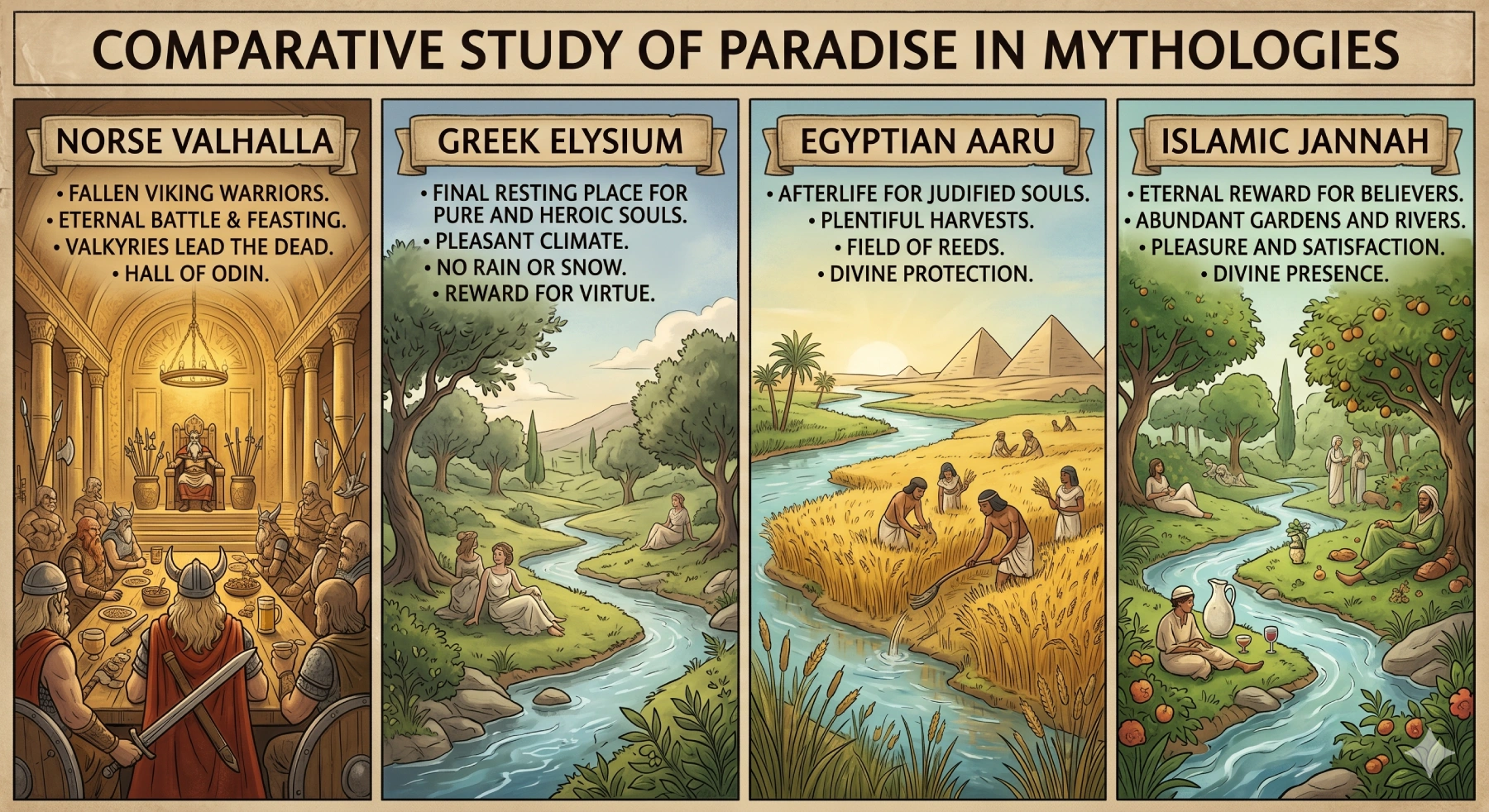
The clearest example is Valhalla in Norse mythology. For the Vikings of the extremely cold and war-torn regions of northern Europe, the highest fulfillment of life was to die heroically in battle. According to their belief, only those warriors who died on the battlefield with sword in hand gained a place in the vast heaven of the god Odin, Valhalla [4]. The description of this heaven is striking: every morning the warriors rise and engage in terrible combat with one another, their limbs are torn apart, but before evening they are miraculously restored to health. Then they sit with Odin at a feast, drink mead, and eat the flesh of the magical boar Saehrimnir, which comes back to life after being slaughtered every day [5]. Psychologically, this was an extreme escapism. That imaginary world was created to conquer the fear of death in Viking warriors, a place where battle was not horror but entertainment. Sociologically, it was an effective instrument for sustaining and motivating a militarized society in war.
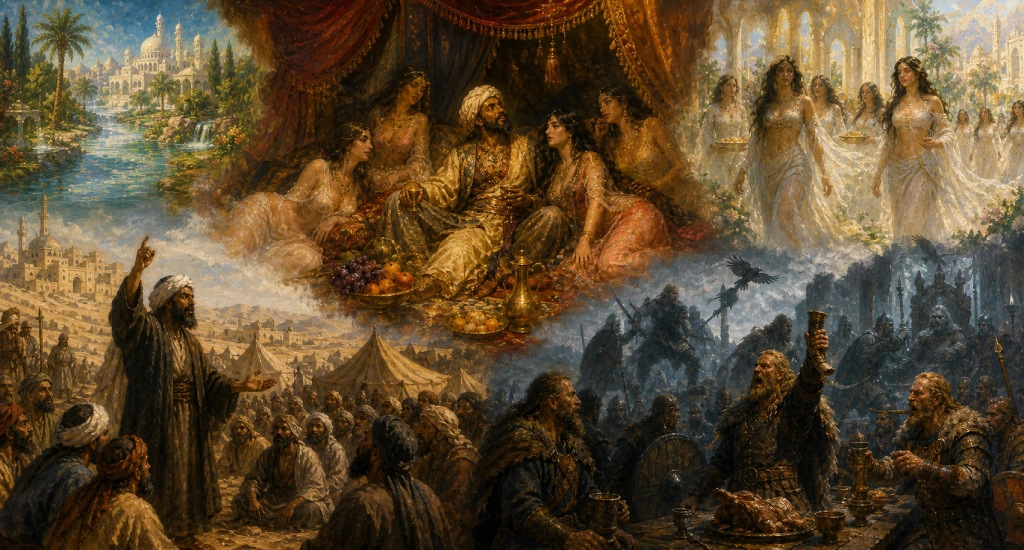
On the other hand, Greek mythology offers the idea of Elysium or the Elysian Fields. It was a place with no cold and no snowfall, but a constant mild cool breeze blowing from the ocean [6]. In contrast to the mountainous and rough climate of ancient Greece, this image of a comfortable plain arose from the desire for uninterrupted rest. Similarly, the ancient Egyptian idea of Aaru, or heaven, was an idealized form of the Nile delta. There the fields were larger than ordinary fields, crops were inexhaustible, and there were no insects or droughts [7]. For a hard-laboring Egyptian farmer, no object of desire could be greater than no longer having to struggle with hunger in the afterlife.
In Persian Zoroastrianism, ‘heaven’ or ‘behesht’ was essentially a fragrant garden or paradise, a word derived from the Persian ‘pairidaeza.’ For a desert-dweller, abundance of greenery in contrast to harsh sands was supreme happiness. Each of these descriptions proves that heaven is in fact an inverse reflection of human earthly suffering. According to Sigmund Freud’s theory, when people cannot accept the poverty or powerlessness of their present life, they construct these otherworldly realms in imagination in order to protect the ego and survive despair [8]. To the thirsty people of the Arabian desert, cool water and the bodies of houris were objects of longing, while for Nordic warriors it was immortal heroism. Therefore, these heavens are not divine discoveries; rather, in each time, place, and context they are pitiable attempts to eternalize human biological and psychological incompleteness. Religious institutions have skillfully used these primitive deprivations so that they can control people in this world and compel them to give their lives for institutional interests.
The Lake-Fount of Kawthar and the Inconsistency of Heavenly Age: Desert Psychology
When the concept of the Lake-Fount of Kawthar is analyzed in descriptions of Islamic Jannah, it appears primarily as a reflection of the extreme geographic and psychological deprivation of the harsh, arid Arabian desert of the seventh century. Sociologically, the religious rewards or heavenly imaginations of a region revolve around the rarest object in that region. In the hot, sandy Arabian desert, where people had to risk their lives traveling miles for a single drop of drinkable water, the dream of an eternal and inexhaustible spring of water was the greatest luxury fantasy. Hadith reports that the water of the Prophet’s Lake-Fount is whiter than milk and sweeter than honey, and that its surroundings are bordered by pearls and jewels. Yet with the evolution of modern civilization, human technological advancement has brought this ‘miraculous’ dream down to a very ordinary reality. The water-supply systems of modern developed cities, where turning a single tap ensures a continuous stream of drinkable water, would have seemed no less magical than the Kawthar of Jannah to a seventh-century desert nomad. The progress of science and human-made infrastructure proves that once primitive deprivations are fulfilled, so-called ‘heavenly miracles’ lose their appeal. [9]
Reference : Sahih al-Bukhari 6579
In-book reference : Book 81, Hadith 167
USC-MSA web (English) reference : Vol. 8, Book 76, Hadith 581
Narrated `Abdullah bin `Amr:
The Prophet (ﷺ) said, “My Lake-Fount is (so large that it takes) a month’s journey to cross it. Its water is whiter than milk, and its smell is nicer than musk (a kind of Perfume), and its drinking cups are (as numerous) as the (number of) stars of the sky; and whoever drinks from it, will never be thirsty.”
حَدَّثَنَا سَعِيدُ بْنُ أَبِي مَرْيَمَ، حَدَّثَنَا نَافِعُ بْنُ عُمَرَ، عَنِ ابْنِ أَبِي مُلَيْكَةَ، قَالَ قَالَ عَبْدُ اللَّهِ بْنُ عَمْرٍو قَالَ النَّبِيُّ صلى الله عليه وسلم ” حَوْضِي مَسِيرَةُ شَهْرٍ، مَاؤُهُ أَبْيَضُ مِنَ اللَّبَنِ، وَرِيحُهُ أَطْيَبُ مِنَ الْمِسْكِ، وَكِيزَانُهُ كَنُجُومِ السَّمَاءِ، مَنْ شَرِبَ مِنْهَا فَلاَ يَظْمَأُ أَبَدًا ”.
Grade: Not separately graded on Sunnah.com
A widely circulated promise of Prophet Muhammad about the Lake-Fount of Kawthar is that if someone drinks water from it once, he will never feel thirst again. At first glance this may appear to be a great reward, but biologically and neuroscientifically it is actually a condition of severe stagnation or painful indifference. The brain’s reward process, or reward system, works through a cycle of deprivation and the fulfillment of that deprivation. The real pleasure of drinking water, the dopamine rush, is felt only when dehydration or thirst arises in the body. In the body’s process of homeostasis, thirst is a signal, and drinking water produces satisfaction by answering that signal. If in Jannah human thirst is removed forever, then the biological pleasure of drinking water will also vanish forever. Drinking water without thirst is not a pleasurable experience; it is merely a mechanical act. Thus this afterlife promise actually denies natural human feelings and turns Jannah into a monotonous, lifeless, stagnant world.
The glaring contradiction, or logical inconsistency, in Islamic texts regarding the characteristics of the inhabitants of Jannah and the continuity of life there cannot be avoided. Numerous sahih hadiths claim that every male inhabitant of Paradise will be between thirty and thirty-three years old, that their youth will never end, and that their bodies will be hairless. Yet when Ibrahim, the infant son born to Muhammad’s slave-concubine Maria al-Qibtiyya, died at only eighteen months of age, Muhammad, in grief, claimed that a wet-nurse had been appointed in Jannah to suckle Ibrahim. Here a major logical question and contradiction emerges: if Jannah is an abode only of thirty-to-thirty-three-year-old youths, why would Ibrahim be there as an infant? If a wet-nurse is needed there, will the universal age boundary of Jannah be violated? These inconsistencies make clear that these descriptions of Jannah are not part of any coherent or divine plan; rather, they are isolated stories shaped by Prophet Muhammad’s immediate emotions and by attempts to soothe personal grief in particular times and circumstances. In trying to console a father after the premature death of his beloved son, he imagined a heavenly wet-nurse that conflicts with other basic features of Jannah he himself gave. Such incoherent promises show that these afterlife images were created to fulfill immediate human deprivation and emotion, where fantasy is more important than logic [10] [11] [12] [13]
Reference : Jami` at-Tirmidhi 2545
In-book reference : Book 38, Hadith 23
English translation : Vol. 4, Book 12, Hadith 2545
Mu’adh bin Jabal narrated that the Prophet (s.a.w) said:
“The people of Paradise shall enter Paradise without body hair, Murd, with Kuhl on their eyes, thirty years of age or thirty-three years.”
حَدَّثَنَا أَبُو هُرَيْرَةَ، مُحَمَّدُ بْنُ فِرَاسٍ الْبَصْرِيُّ حَدَّثَنَا أَبُو دَاوُدَ، حَدَّثَنَا عِمْرَانُ أَبُو الْعَوَّامِ، عَنْ قَتَادَةَ، عَنْ شَهْرِ بْنِ حَوْشَبٍ، عَنْ عَبْدِ الرَّحْمَنِ بْنِ غَنْمٍ، عَنْ مُعَاذِ بْنِ جَبَلٍ، أَنَّ النَّبِيَّ صلى الله عليه وسلم قَالَ “ يَدْخُلُ أَهْلُ الْجَنَّةِ الْجَنَّةَ جُرْدًا مُرْدًا مُكَحَّلِينَ أَبْنَاءَ ثَلاَثِينَ أَوْ ثَلاَثٍ وَثَلاَثِينَ سَنَةً ” . قَالَ أَبُو عِيسَى هَذَا حَدِيثٌ حَسَنٌ غَرِيبٌ وَبَعْضُ أَصْحَابِ قَتَادَةَ رَوَوْا هَذَا عَنْ قَتَادَةَ مُرْسَلاً وَلَمْ يُسْنِدُوهُ .
Grade: Sahih (Darussalam)
Reference : Jami` at-Tirmidhi 2545
In-book reference : Book 38, Hadith 23
English translation : Vol. 4, Book 12, Hadith 2545
Mu’adh bin Jabal narrated that the Prophet (s.a.w) said:
“The people of Paradise shall enter Paradise without body hair, Murd, with Kuhl on their eyes, thirty years of age or thirty-three years.”
حَدَّثَنَا أَبُو هُرَيْرَةَ، مُحَمَّدُ بْنُ فِرَاسٍ الْبَصْرِيُّ حَدَّثَنَا أَبُو دَاوُدَ، حَدَّثَنَا عِمْرَانُ أَبُو الْعَوَّامِ، عَنْ قَتَادَةَ، عَنْ شَهْرِ بْنِ حَوْشَبٍ، عَنْ عَبْدِ الرَّحْمَنِ بْنِ غَنْمٍ، عَنْ مُعَاذِ بْنِ جَبَلٍ، أَنَّ النَّبِيَّ صلى الله عليه وسلم قَالَ “ يَدْخُلُ أَهْلُ الْجَنَّةِ الْجَنَّةَ جُرْدًا مُرْدًا مُكَحَّلِينَ أَبْنَاءَ ثَلاَثِينَ أَوْ ثَلاَثٍ وَثَلاَثِينَ سَنَةً ” . قَالَ أَبُو عِيسَى هَذَا حَدِيثٌ حَسَنٌ غَرِيبٌ وَبَعْضُ أَصْحَابِ قَتَادَةَ رَوَوْا هَذَا عَنْ قَتَادَةَ مُرْسَلاً وَلَمْ يُسْنِدُوهُ .
Grade: Sahih (Darussalam)
Reference : Jami` at-Tirmidhi 2545
In-book reference : Book 38, Hadith 23
English translation : Vol. 4, Book 12, Hadith 2545
Mu’adh bin Jabal narrated that the Prophet (s.a.w) said:
“The people of Paradise shall enter Paradise without body hair, Murd, with Kuhl on their eyes, thirty years of age or thirty-three years.”
حَدَّثَنَا أَبُو هُرَيْرَةَ، مُحَمَّدُ بْنُ فِرَاسٍ الْبَصْرِيُّ حَدَّثَنَا أَبُو دَاوُدَ، حَدَّثَنَا عِمْرَانُ أَبُو الْعَوَّامِ، عَنْ قَتَادَةَ، عَنْ شَهْرِ بْنِ حَوْشَبٍ، عَنْ عَبْدِ الرَّحْمَنِ بْنِ غَنْمٍ، عَنْ مُعَاذِ بْنِ جَبَلٍ، أَنَّ النَّبِيَّ صلى الله عليه وسلم قَالَ “ يَدْخُلُ أَهْلُ الْجَنَّةِ الْجَنَّةَ جُرْدًا مُرْدًا مُكَحَّلِينَ أَبْنَاءَ ثَلاَثِينَ أَوْ ثَلاَثٍ وَثَلاَثِينَ سَنَةً ” . قَالَ أَبُو عِيسَى هَذَا حَدِيثٌ حَسَنٌ غَرِيبٌ وَبَعْضُ أَصْحَابِ قَتَادَةَ رَوَوْا هَذَا عَنْ قَتَادَةَ مُرْسَلاً وَلَمْ يُسْنِدُوهُ .
Grade: Sahih (Darussalam)
Reference : Jami` at-Tirmidhi 2545
In-book reference : Book 38, Hadith 23
English translation : Vol. 4, Book 12, Hadith 2545
Mu’adh bin Jabal narrated that the Prophet (s.a.w) said:
“The people of Paradise shall enter Paradise without body hair, Murd, with Kuhl on their eyes, thirty years of age or thirty-three years.”
حَدَّثَنَا أَبُو هُرَيْرَةَ، مُحَمَّدُ بْنُ فِرَاسٍ الْبَصْرِيُّ حَدَّثَنَا أَبُو دَاوُدَ، حَدَّثَنَا عِمْرَانُ أَبُو الْعَوَّامِ، عَنْ قَتَادَةَ، عَنْ شَهْرِ بْنِ حَوْشَبٍ، عَنْ عَبْدِ الرَّحْمَنِ بْنِ غَنْمٍ، عَنْ مُعَاذِ بْنِ جَبَلٍ، أَنَّ النَّبِيَّ صلى الله عليه وسلم قَالَ “ يَدْخُلُ أَهْلُ الْجَنَّةِ الْجَنَّةَ جُرْدًا مُرْدًا مُكَحَّلِينَ أَبْنَاءَ ثَلاَثِينَ أَوْ ثَلاَثٍ وَثَلاَثِينَ سَنَةً ” . قَالَ أَبُو عِيسَى هَذَا حَدِيثٌ حَسَنٌ غَرِيبٌ وَبَعْضُ أَصْحَابِ قَتَادَةَ رَوَوْا هَذَا عَنْ قَتَادَةَ مُرْسَلاً وَلَمْ يُسْنِدُوهُ .
Grade: Sahih (Darussalam)
Now let us see what awaits the Prophet’s son Ibrahim in Jannah [14] [15]
Reference : Sahih Muslim 2316
In-book reference : Book 43, Hadith 84
USC-MSA web (English) reference : Book 30, Hadith 5734
Anas b. Malik reported:
I have never seen anyone more kind to one’s family than Allah’s Messenger (ﷺ), and Ibrahim was sent to the suburb of Medina for suckling. He used to go there and we accompanied him. He entered the house, and it was filled with smoke as his foster-father was a bricksmith. He took him (his son Ibrihim) and kissed him and then came back. ‘Amr said that when Ibrihim died. Allah’s LMessenger (ﷺ) said: Ibrihim is my son and he dies as a suckling babe.
He has now two foster-mothers who would complete his suckling period in Paradise.
حَدَّثَنَا زُهَيْرُ بْنُ حَرْبٍ، وَمُحَمَّدُ بْنُ عَبْدِ اللَّهِ بْنِ نُمَيْرٍ، – وَاللَّفْظُ لِزُهَيْرٍ – قَالاَ حَدَّثَنَا إِسْمَاعِيلُ، – وَهُوَ ابْنُ عُلَيَّةَ – عَنْ أَيُّوبَ، عَنْ عَمْرِو بْنِ سَعِيدٍ، عَنْ أَنَسِ بْنِ مَالِكٍ، قَالَ مَا رَأَيْتُ أَحَدًا كَانَ أَرْحَمَ بِالْعِيَالِ مِنْ رَسُولِ اللَّهِ صلى الله عليه وسلم – قَالَ – كَانَ إِبْرَاهِيمُ مُسْتَرْضِعًا لَهُ فِي عَوَالِي الْمَدِينَةِ فَكَانَ يَنْطَلِقُ وَنَحْنُ مَعَهُ فَيَدْخُلُ الْبَيْتَ وَإِنَّهُ لَيُدَّخَنُ وَكَانَ ظِئْرُهُ قَيْنًا فَيَأْخُذُهُ فَيُقَبِّلُهُ ثُمَّ يَرْجِعُ . قَالَ عَمْرٌو فَلَمَّا تُوُفِّيَ إِبْرَاهِيمُ قَالَ رَسُولُ اللَّهِ صلى الله عليه وسلم ” إِنَّ إِبْرَاهِيمَ ابْنِي وَإِنَّهُ مَاتَ فِي الثَّدْىِ وَإِنَّ لَهُ لَظِئْرَيْنِ تُكَمِّلاَنِ رَضَاعَهُ فِي الْجَنَّةِ ” .
Grade: Not separately graded on Sunnah.com
Reference : Sahih Muslim 2316
In-book reference : Book 43, Hadith 84
USC-MSA web (English) reference : Book 30, Hadith 5734
Anas b. Malik reported:
I have never seen anyone more kind to one’s family than Allah’s Messenger (ﷺ), and Ibrahim was sent to the suburb of Medina for suckling. He used to go there and we accompanied him. He entered the house, and it was filled with smoke as his foster-father was a bricksmith. He took him (his son Ibrihim) and kissed him and then came back. ‘Amr said that when Ibrihim died. Allah’s LMessenger (ﷺ) said: Ibrihim is my son and he dies as a suckling babe.
He has now two foster-mothers who would complete his suckling period in Paradise.
حَدَّثَنَا زُهَيْرُ بْنُ حَرْبٍ، وَمُحَمَّدُ بْنُ عَبْدِ اللَّهِ بْنِ نُمَيْرٍ، – وَاللَّفْظُ لِزُهَيْرٍ – قَالاَ حَدَّثَنَا إِسْمَاعِيلُ، – وَهُوَ ابْنُ عُلَيَّةَ – عَنْ أَيُّوبَ، عَنْ عَمْرِو بْنِ سَعِيدٍ، عَنْ أَنَسِ بْنِ مَالِكٍ، قَالَ مَا رَأَيْتُ أَحَدًا كَانَ أَرْحَمَ بِالْعِيَالِ مِنْ رَسُولِ اللَّهِ صلى الله عليه وسلم – قَالَ – كَانَ إِبْرَاهِيمُ مُسْتَرْضِعًا لَهُ فِي عَوَالِي الْمَدِينَةِ فَكَانَ يَنْطَلِقُ وَنَحْنُ مَعَهُ فَيَدْخُلُ الْبَيْتَ وَإِنَّهُ لَيُدَّخَنُ وَكَانَ ظِئْرُهُ قَيْنًا فَيَأْخُذُهُ فَيُقَبِّلُهُ ثُمَّ يَرْجِعُ . قَالَ عَمْرٌو فَلَمَّا تُوُفِّيَ إِبْرَاهِيمُ قَالَ رَسُولُ اللَّهِ صلى الله عليه وسلم ” إِنَّ إِبْرَاهِيمَ ابْنِي وَإِنَّهُ مَاتَ فِي الثَّدْىِ وَإِنَّ لَهُ لَظِئْرَيْنِ تُكَمِّلاَنِ رَضَاعَهُ فِي الْجَنَّةِ ” .
Grade: Not separately graded on Sunnah.com
The Evolutionary Chemistry of Hunger and Taste: The Biological Futility of Afterlife Satisfaction
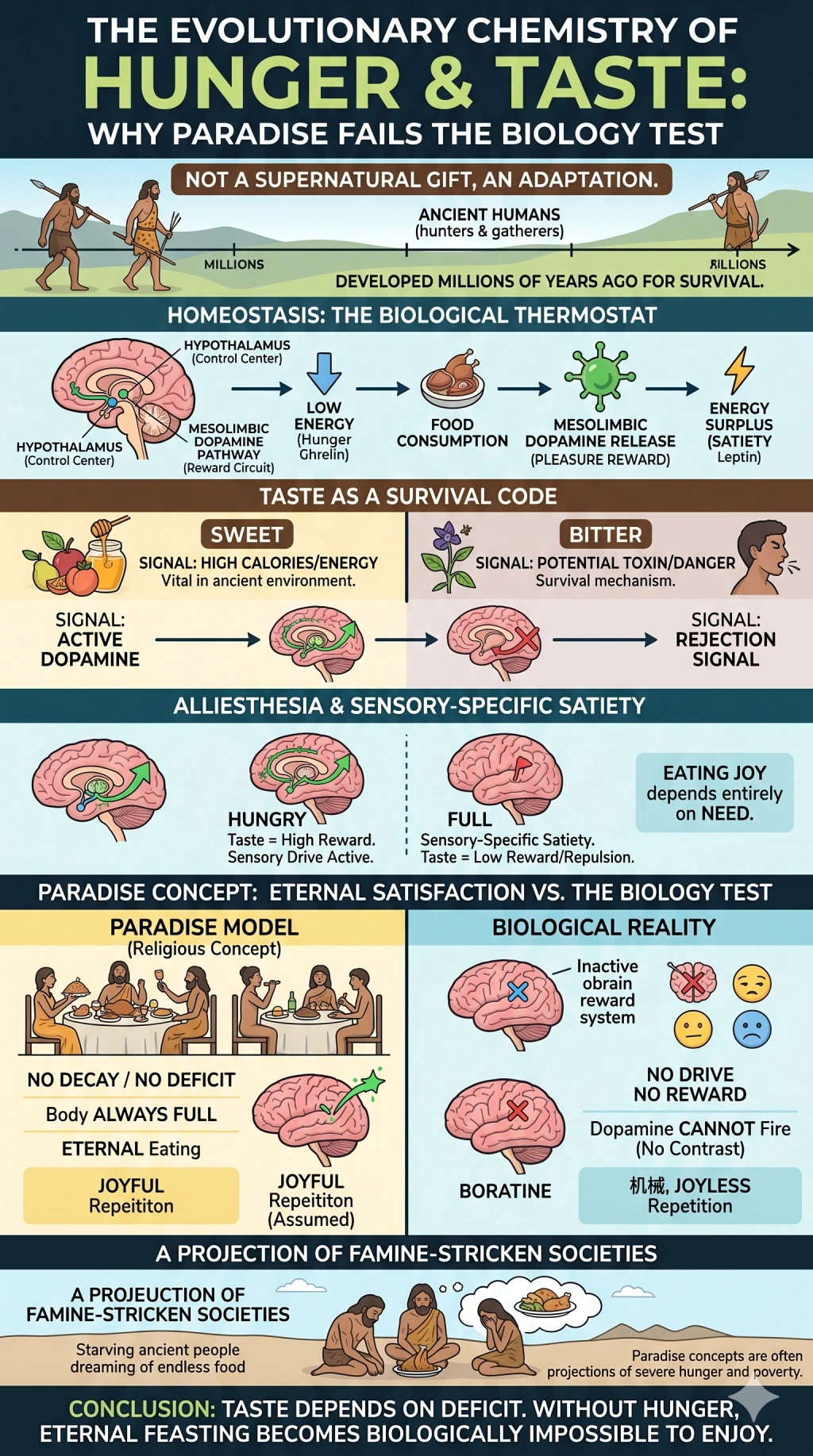
The sensation of taste on the human tongue and the pleasure obtained through eating are not divine or supernatural gifts; rather, they are a complex and adaptive result of millions of years of evolutionary adaptation. Physiologically, hunger and satiety are not merely feelings; they are a highly delicate signaling system by which the body maintains homeostasis, or internal balance. The hypothalamus in our brain works rather like a control room, continuously monitoring blood glucose levels and stomach expansion. When the body’s fuel or energy begins to run out, this center instructs us that food is now needed. When food is taken in a hungry state, the brain’s mesolimbic dopamine pathway, or reward circuit, becomes active and gives us a kind of intense satisfaction. Evolutionarily, this system developed so that every animal would be motivated to collect the calories necessary for survival. Richard Dawkins showed in detail in ‘The Selfish Gene’ how each of our biological needs works in the interest of preserving genes. The following table shows the main components of this complex physiological process of eating:
| Component | Role | Psychological/physiological effect |
| Hypothalamus | Control center | Senses blood-sugar levels and sends hunger or satiety signals. |
| Ghrelin | Hunger hormone | Sends the brain a “give food” signal when the stomach is empty. |
| Leptin | Satiety hormone | Is released from fat cells and signals when the stomach is full. |
| Dopamine | Reward neurotransmitter | Produces the feeling of pleasure or reward during food intake. |
Why Does Food Taste Pleasant or Unpleasant?
Behind whether a food tastes pleasant or unpleasant to us lies millions of years of evolutionary logic. In primitive hunter-gatherer society, the food supply was extremely uncertain. To survive in that hostile environment, the human brain was programmed to feel a strong attraction to high-calorie food. Our innate attraction to sweet taste exists because, in nature, sweetness usually means a source of high sugar or carbohydrate, which immediately supplies energy to the body. On the other hand, our natural aversion to bitter taste is basically a life-saving defense mechanism. Most poisonous plants and vines in the wild are bitter; therefore, as soon as the brain detects bitterness, it marks it as dangerous and sends signals for vomiting or rejection.
This sensation of taste depends not only on the ingredients of food but also entirely on the body’s immediate need. In physiology this is called alliesthesia. It is a process in which our feeling of liking or disliking a stimulus changes according to the body’s internal condition. For example, when your body lacks glucose, a glass of sugar syrup may seem like the finest drink in the world. But when your blood glucose level is sufficient, that same drink may feel excessively sweet and uncomfortable.
Another important physiological barrier in eating is sensory-specific satiety. Research shows that when people continue eating a particular food, their appetite for that specific food gradually decreases, even if they may still be hungry. This is a strategy of nature so that animals take varied nutrition instead of eating only one kind of food. But when a person’s stomach is completely full (satiety), even the most tempting food may seem unappealing, even tasteless. In other words, if hunger does not arise in the body, or if there is no real nutritional deficiency, it is impossible for the brain to provide that pleasure or reward. Below is a comparative analysis of this evolutionary feature of taste:
| Type of taste | Evolutionary reason | Body response |
| Sweet | Signal of high energy or calories. | Dopamine release and increased desire to consume. |
| Salty | Needed for electrolyte balance. | Produces satisfaction in moderate amounts. |
| Bitter | Signal of poisonous or harmful substances. | Rejection or nausea. |
| Umami | Signal of protein or amino acids. | Long-lasting satiety and a signal for muscle building. |
When we analyze the idea of the endless feast of Jannah or heaven in light of these scientific facts, its basic emptiness and physiological impossibility become very clear. If there is no bodily decay in Jannah, no labor, no nutritional deficiency of any kind, and if the body always remains in a state of fullness, then there is no biological or evolutionary basis left for eating or drinking. According to evolutionary biology, pleasure or satisfaction is a positive feedback loop that works only when the body is freed from some deprivation or negative state, such as thirst or hunger. In other words, without the suffering called hunger, it is neurochemically impossible to feel the pleasure called satiety.
The Conflict Between Heavenly Fantasy and Physiological Reality
Descriptions of Jannah say that its inhabitants will continue eating and drinking for years, yet they will not need to pass stool or urine; instead, what they consume will leave the body only through belching or fragrant sweat [16]. Physiologically, this is an impossible fantasy. A normal by-product of metabolism is waste. If a body produces no waste, then no metabolic work is taking place. And if no metabolic work is taking place, the cells are not receiving or transforming energy. In such an inert body, the neural stimulation or dopamine release needed to feel the taste of food is scientifically impossible.
Reference : Sahih Muslim 2835c
In-book reference : Book 53, Hadith 23
USC-MSA web (English) reference : Book 40, Hadith 6800
Jabir b. Abdullah reported that Allah’s Messenger (ﷺ) said that the inmates of Paradise would eat therein and they would also drink, but they would neither void excrement, nor suffer catarrh, nor pass water, and their eating (would be digested) in the form of belching and their sweat would be musk aged they would glorify and praise Allah as easily ai you breathe.
وَحَدَّثَنِي الْحَسَنُ بْنُ عَلِيٍّ الْحُلْوَانِيُّ، وَحَجَّاجُ بْنُ الشَّاعِرِ، كِلاَهُمَا عَنْ أَبِي عَاصِمٍ، – قَالَ حَسَنٌ حَدَّثَنَا أَبُو عَاصِمٍ، – عَنِ ابْنِ جُرَيْجٍ، أَخْبَرَنِي أَبُو الزُّبَيْرِ، أَنَّهُ سَمِعَ جَابِرَ بْنَ، عَبْدِ اللَّهِ يَقُولُ قَالَ رَسُولُ اللَّهِ صلى الله عليه وسلم ” يَأْكُلُ أَهْلُ الْجَنَّةِ فِيهَا وَيَشْرَبُونَ وَلاَ يَتَغَوَّطُونَ وَلاَ يَمْتَخِطُونَ وَلاَ يَبُولُونَ وَلَكِنْ طَعَامُهُمْ ذَاكَ جُشَاءٌ كَرَشْحِ الْمِسْكِ يُلْهَمُونَ التَّسْبِيحَ وَالْحَمْدَ كَمَا يُلْهَمُونَ النَّفَسَ ” . قَالَ وَفِي حَدِيثِ حَجَّاجٍ ” طَعَامُهُمْ ذَلِكَ ” .
Grade: Not separately graded on Sunnah.com
Below is a comparative analysis of the promises of Jannah and their physiological futility:
| Promise of Jannah | Physiological/scientific reality | Logical outcome |
| Drinking Kawthar without thirst | If there is no thirst, the brain’s reward center (dopamine) is not activated. | The drink would feel like ordinary syrup and would provide no miraculous satisfaction. |
| Eating without stool or urine | Waste production is inevitable when metabolism takes place. | If the body takes input but gives no output, it is a mechanical stagnation. |
| Uninterrupted feasting | Sensory-specific satiety creates monotony and aversion. | Eating forever would turn into painful mechanical repetition rather than happiness. |
| An ageless body | Without aging or decay, there is no need for cellular rebuilding or energy. | With no biological need, the senses of taste would become useless. |
The Projection of a Deprived Society
Psychological analysis shows that such descriptions of feasting are essentially the fantasies of people who lived on earth amid severe food scarcity, famine, and extreme poverty. For hungry and thirsty people in the harsh Arabian desert, eating to fullness and never becoming thirsty were supreme objects of longing. But evolutionarily, we have developed with a complex nervous system that can experience pleasure only through contrast. Just as darkness has no significance without light, the taste of food has no value without the suffering called hunger.
If human senses in Jannah work as they do on earth, then extreme monotony or hedonic adaptation would arrive there very quickly. That is, within a very short time the luxuries of Jannah would lose their appeal. Without biochemical or neurotransmitter stimulation, these descriptions of endless enjoyment are nothing more than an anatomical disaster or physiological collapse. In ‘Behave,’ Robert Sapolsky showed how our brain experiences pleasure only from the gap between expectation and receipt. Therefore, Jannah’s promise of inexhaustible and uninterrupted enjoyment is completely inconsistent with basic human biology and evolutionary history, and is merely a pictorial report of the suppressed desires of a primitive deprived society. Let us read a hadith where it is said that at the time of entering Paradise they will be given a piece of fish liver to eat, and at lunch a bull will be slaughtered for them, a bull that grazes around Paradise. This raises various questions: for those who do not like fish, is the same food provided? And the bull of Paradise is also paradisal; why must it give its life to satisfy someone else’s hunger? Does Allah have no other way to create meat, that even in Paradise cows, bulls, and the like must be slaughtered and killed? [17]
Reference : Sahih Muslim 315a
In-book reference : Book 3, Hadith 38
USC-MSA web (English) reference : Book 3, Hadith 614
Thauban, the freed slave of the Messenger of Allah (ﷺ), said:
While I was standing beside the Messenger of Allah (ﷺ) one of the rabbis of the Jews came and said: Peace be upon you, O Muhammad. I pushed him backwith a push that he was going to fall. Upon this he said: Why do you push me? I said: Why don’t you say: O Messenger of Allah? The Jew said: We call him by the name by which he was named by his family. The Messenger of Allah (ﷺ) said: My name is Muhammad with which I was named by my family. The Jew said: I have come to ask you (something).
The Messenger of Allah (ﷺ) said: Should that thing be of any benefit to you, if I tell you that? He (the Jew) said: I will lend my ears to it. The Messenger of Allah (ﷺ) drew a line with the help of the stick that he had with him and then said: Ask (whatever you like).
Thereupon the Jew said: Where would the human beings be on the Daywhen the earth would change into another earth and the heavens too (would change into other heavens)? The Messenger of Allah (ﷺ) said: They would be in darkness beside the Bridge. He (the Jew) again said: Who amongst people would be the first to cross (this bridge).? He said: They would be the poor amongst the refugees.
The Jew said: What would constitute their breakfast when they would enter Paradise? He (the Holy Prophet) replied: A caul of the fish-liver. He (the Jew) said. What would be their food alter this? He (the Holy Prophet) said: A bullockwhich was fed in the different quarters of Paradise would be slaughtered for them. He (the Jew) said: What would be their drink? He (the Holy Prophet) said: They would be given drink from the fountain which is named” Salsabil”.
He (the Jew) said: I have come to ask you about a thing which no one amongst the people on the earth knows except an apostle or one or two men besides him. He (the Holy Prophet) said: Would it benefit you if I tell you that? He (the Jew) said: I would lend ears to that. He then said: I have come to ask you about the child. He (the Holy Prophet) said: The reproductive substance of man is white and that of woman (i. e. ovum central portion) yellow, and when they have sexual intercourse and the male’s substance (chromosomes and genes) prevails upon the female’s substance (chromosomes and genes), it is the male child that is created by Allah’s Decree, and when the substance of the female prevails upon the substance contributed by the male, a female child is formed by the Decree of Allah. The Jew said: What you have said is true; verily you are an Apostle. He then returned and went away.
The Messenger of Allah (ﷺ) said: He asked me about such and such things of which I have had no knowledge till Allah gave me that.
حَدَّثَنِي الْحَسَنُ بْنُ عَلِيٍّ الْحُلْوَانِيُّ، حَدَّثَنَا أَبُو تَوْبَةَ، – وَهُوَ الرَّبِيعُ بْنُ نَافِعٍ – حَدَّثَنَا مُعَاوِيَةُ، – يَعْنِي ابْنَ سَلاَّمٍ – عَنْ زَيْدٍ، – يَعْنِي أَخَاهُ – أَنَّهُ سَمِعَ أَبَا سَلاَمٍ، قَالَ حَدَّثَنِي أَبُو أَسْمَاءَ الرَّحَبِيُّ، أَنَّ ثَوْبَانَ، مَوْلَى رَسُولِ اللَّهِ صلى الله عليه وسلم حَدَّثَهُ قَالَ كُنْتُ قَائِمًا عِنْدَ رَسُولِ اللَّهِ صلى الله عليه وسلم فَجَاءَ حَبْرٌ مِنْ أَحْبَارِ الْيَهُودِ فَقَالَ السَّلاَمُ عَلَيْكَ يَا مُحَمَّدُ . فَدَفَعْتُهُ دَفْعَةً كَادَ يُصْرَعُ مِنْهَا فَقَالَ لِمَ تَدْفَعُنِي فَقُلْتُ أَلاَ تَقُولُ يَا رَسُولَ اللَّهِ . فَقَالَ الْيَهُودِيُّ إِنَّمَا نَدْعُوهُ بِاسْمِهِ الَّذِي سَمَّاهُ بِهِ أَهْلُهُ . فَقَالَ رَسُولُ اللَّهِ صلى الله عليه وسلم ” إِنَّ اسْمِي مُحَمَّدٌ الَّذِي سَمَّانِي بِهِ أَهْلِي ” . فَقَالَ الْيَهُودِيُّ جِئْتُ أَسْأَلُكَ . فَقَالَ لَهُ رَسُولُ اللَّهِ صلى الله عليه وسلم ” أَيَنْفَعُكَ شَىْءٌ إِنْ حَدَّثْتُكَ ” . قَالَ أَسْمَعُ بِأُذُنَىَّ فَنَكَتَ رَسُولُ اللَّهِ صلى الله عليه وسلم بِعُودٍ مَعَهُ . فَقَالَ ” سَلْ ” . فَقَالَ الْيَهُودِيُّ أَيْنَ يَكُونُ النَّاسُ يَوْمَ تُبَدَّلُ الأَرْضُ غَيْرَ الأَرْضِ وَالسَّمَوَاتُ فَقَالَ رَسُولُ اللَّهِ صلى الله عليه وسلم ” هُمْ فِي الظُّلْمَةِ دُونَ الْجِسْرِ ” . قَالَ فَمَنْ أَوَّلُ النَّاسِ إِجَازَةً قَالَ ” فُقَرَاءُ الْمُهَاجِرِينَ ” . قَالَ الْيَهُودِيُّ فَمَا تُحْفَتُهُمْ حِينَ يَدْخُلُونَ الْجَنَّةَ قَالَ ” زِيَادَةُ كَبِدِ النُّونِ ” قَالَ فَمَا غِذَاؤُهُمْ عَلَى إِثْرِهَا قَالَ ” يُنْحَرُ لَهُمْ ثَوْرُ الْجَنَّةِ الَّذِي كَانَ يَأْكُلُ مِنْ أَطْرَافِهَا ” . قَالَ فَمَا شَرَابُهُمْ عَلَيْهِ قَالَ ” مِنْ عَيْنٍ فِيهَا تُسَمَّى سَلْسَبِيلاً ” . قَالَ صَدَقْتَ . قَالَ وَجِئْتُ أَسْأَلُكَ عَنْ شَىْءٍ لاَ يَعْلَمُهُ أَحَدٌ مِنْ أَهْلِ الأَرْضِ إِلاَّ نَبِيٌّ أَوْ رَجُلٌ أَوْ رَجُلاَنِ . قَالَ ” يَنْفَعُكَ إِنْ حَدَّثْتُكَ ” . قَالَ أَسْمَعُ بِأُذُنَىَّ . قَالَ جِئْتُ أَسْأَلُكَ عَنِ الْوَلَدِ قَالَ ” مَاءُ الرَّجُلِ أَبْيَضُ وَمَاءُ الْمَرْأَةِ أَصْفَرُ فَإِذَا اجْتَمَعَا فَعَلاَ مَنِيُّ الرَّجُلِ مَنِيَّ الْمَرْأَةِ أَذْكَرَا بِإِذْنِ اللَّهِ وَإِذَا عَلاَ مَنِيُّ الْمَرْأَةِ مَنِيَّ الرَّجُلِ آنَثَا بِإِذْنِ اللَّهِ ” . قَالَ الْيَهُودِيُّ لَقَدْ صَدَقْتَ وَإِنَّكَ لَنَبِيٌّ ثُمَّ انْصَرَفَ فَذَهَبَ . فَقَالَ رَسُولُ اللَّهِ صلى الله عليه وسلم ” لَقَدْ سَأَلَنِي هَذَا عَنِ الَّذِي سَأَلَنِي عَنْهُ وَمَا لِي عِلْمٌ بِشَىْءٍ مِنْهُ حَتَّى أَتَانِيَ اللَّهُ بِهِ ” .
Grade: Not separately graded on Sunnah.com
Ancient Inferiority About Sexual Power and Endurance, and the Heavenly Solution
Looking at ancient Arabian society and the world order of that time reveals the harsh reality of everyday life. In the absence of modern medical science, nutritious food, and advanced living standards, average human life expectancy in ancient times was very low. Hard physical labor, prolonged warfare, the hostile desert climate, and various epidemics rapidly reduced physical capacity. One direct effect of this fell on sexual health. Human desire is boundless, but because of physical limitations, fully satisfying that desire in real life was often impossible. Especially in patriarchal Arabian society, where polygyny and the possession of numerous slave women or concubines were socially accepted and markers of status, an unwritten pressure likely existed on a man to satisfy the sexual desires of multiple women. Psychologically, such a situation would naturally produce among men a kind of performance anxiety or deep inferiority about sexual capacity.
As psychological compensation for this inferiority and physical limitation, religious texts created a superhuman sexual fantasy of Jannah. Jami` at-Tirmidhi 2538 states very clearly that Prophet Muhammad told his followers that in Jannah every believer would be given sexual strength equal to one hundred men [13]. From a sociological point of view, this makes clear that the promise of “the strength of one hundred men” is not a symbol of spiritual or otherworldly purity; rather, it is a reflection of a repressed society whose men suffered deep frustration over sexual endurance and power in real life. In Freudian psychoanalysis, this is called wish fulfillment, or a fantasy of desire-fulfillment. A man who in real life cannot fully satisfy his sexual lust because of fatigue, age, or bodily weakness constructs in his unconscious mind a world where there is no fatigue, no old age, and there is endless sexual power without ejaculation.
Reference : Jami` at-Tirmidhi 2536
In-book reference : Book 38, Hadith 14
English translation : Vol. 4, Book 12, Hadith 2536
Anas narrated that the Prophet (s.a.w) said:
“The believer shall be given in paradise such and such strength in intercourse .” it was said: “O Messenger of Allah! And will he able to do that?” He said: “He will be given the strength of a hundred.”
حَدَّثَنَا مُحَمَّدُ بْنُ بَشَّارٍ، وَمَحْمُودُ بْنُ غَيْلاَنَ، قَالاَ حَدَّثَنَا أَبُو دَاوُدَ الطَّيَالِسِيُّ، عَنْ عِمْرَانَ الْقَطَّانِ، عَنْ قَتَادَةَ، عَنْ أَنَسٍ، عَنِ النَّبِيِّ صلى الله عليه وسلم قَالَ ” يُعْطَى الْمُؤْمِنُ فِي الْجَنَّةِ قُوَّةَ كَذَا وَكَذَا مِنَ الْجِمَاعِ ” . قِيلَ يَا رَسُولَ اللَّهِ أَوَيُطِيقُ ذَلِكَ قَالَ ” يُعْطَى قُوَّةَ مِائَةٍ ” . وَفِي الْبَابِ عَنْ زَيْدِ بْنِ أَرْقَمَ . قَالَ أَبُو عِيسَى هَذَا حَدِيثٌ صَحِيحٌ غَرِيبٌ لاَ نَعْرِفُهُ مِنْ حَدِيثِ قَتَادَةَ عَنْ أَنَسٍ إِلاَّ مِنْ حَدِيثِ عِمْرَانَ الْقَطَّانِ .
Grade: Hasan (Darussalam)
The enormous hollow-pearl tent promised for believers in Jannah, sixty miles long and containing multiple wives with all of whom the believer will have intercourse, is the extreme expression of this desire. The idea that the wives in these tents will not see one another is also an imaginary solution to the polygamous desires of men of that time and to freedom from domestic quarrels or mutual jealousy among wives. The mental or physical strain that a polygamous man had to endure on earth while keeping wives satisfied receives a magical solution in Jannah. There is no social or physical barrier there [18]
Reference : Riyad as-Salihin 1885
In-book reference : Book 19, Hadith 17
Abu Musa (May Allah be pleased with him) said:
The Prophet (ﷺ) said, “In Jannah the believer will have a tent made of a single hollowed pearl of which the length will be sixty miles in the sky. The believer will have his wives with him and he will visit them and they will not be able to see one another.”
[Al-Bukhari and Muslim].
وعن أبي موسى رضي الله عنه أن النبي صلى الله عليه وسلم قال: ”إن للمؤمن في الجنة لخيمة من لؤلؤة واحدة مجوفة طولها في السماء ستون ميلاً، للمؤمن فيها أهلون، يطوف عليهم المؤمن فلا يرى بعضهم بعضاً، ((متفق عليه)).«الميل» : ستة آلاف ذراع
Grade: Not separately graded on Sunnah.com
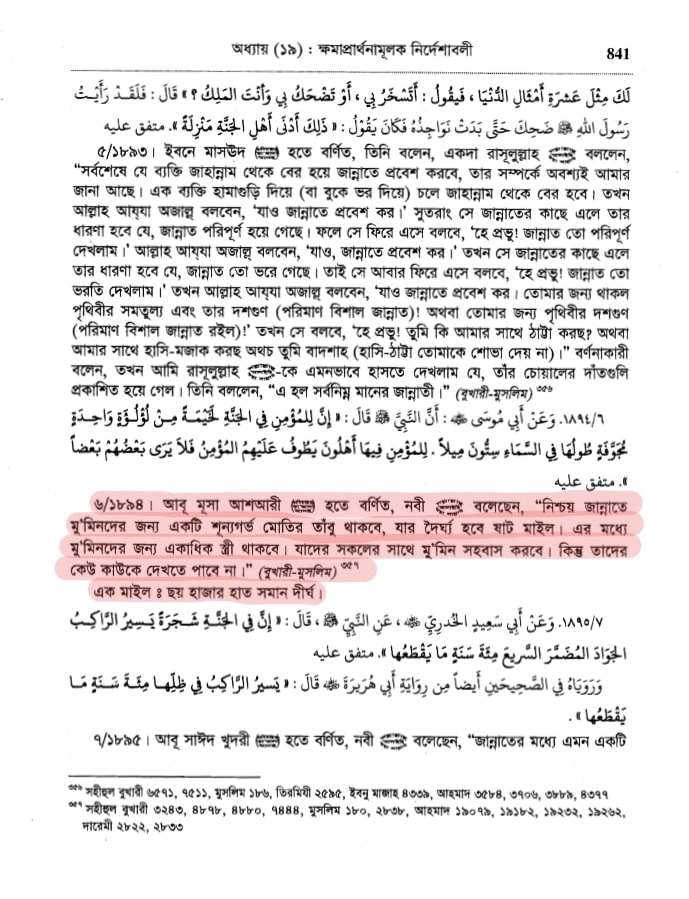
As a result, this Jannah is not a place of spiritual development; rather, it is merely a precise reflection of human worldly and biological desire. Religion has capitalized on this unsatisfied sexual desire and frustration over physical inability. By arranging the afterlife in the pattern of an everlasting brothel, where tireless sexual activity is guaranteed, religion has created a clever psychological trap to extract obedience from ordinary people and make them forget their worldly suffering. The idea of God or the Creator is used here as the supplier of this eternal youth and sexual capacity. Let us listen to a statement by a scholar in which he joyfully dreams of continuous intercourse for thousands of years with each houri in Jannah,
Houris of Jannah and the Commodification of Women: A Physical Dissection of the Quran and Tafsir
When the description of houris or heavenly beauties as the central attraction of the Islamic afterlife is analyzed, it becomes clear that this is not a spiritual or non-material realm, but a highly specific and crude patriarchal fantasy. The physical descriptions of houris found in the Quran and hadith are based on the definition of ideal female beauty held by a seventh-century Arabian man. Sociologically, this presents women’s existence merely as a biological commodity for satisfying male sexual lust. Let us look at the Quranic verses and tafsir,
Some of the physical descriptions of houris, or heavenly prostitutes, found in the Quran and hadith are roughly as follows: [19] [20] [21]
Quran reference : Surah An-Naba, 78:33
Arabic : وَكَوَاعِبَ أَتْرَابًۭا ٣٣
Translation — Dr. Mustafa Khattab, The Clear Quran : and full-bosomed maidens of equal age,
Translation — Saheeh International : And full-breasted [companions] of equal age
Quran reference : Surah As-Saffat, 37:48
Arabic : وَعِندَهُمْ قَـٰصِرَٰتُ ٱلطَّرْفِ عِينٌۭ ٤٨
Translation — Dr. Mustafa Khattab, The Clear Quran : And with them will be maidens of modest gaze and gorgeous eyes,
Translation — Saheeh International : And with them will be women limiting [their] glances, with large, [beautiful] eyes,
Quran reference : Surah Al-Waqi`ah, 56:35-37
Arabic : إِنَّآ أَنشَأْنَـٰهُنَّ إِنشَآءًۭ ٣٥ فَجَعَلْنَـٰهُنَّ أَبْكَارًا ٣٦ عُرُبًا أَتْرَابًا ٣٧
Translation — Dr. Mustafa Khattab, The Clear Quran : Indeed, We will have perfectly created their mates, making them virgins, loving and of equal age,
Translation — Saheeh International : Indeed, We have produced them [i.e., the women of Paradise] in a [new] creation And made them virgins, Devoted [to their husbands] and of equal age,
Now let us learn the meaning of the Quranic verse from Tafsir Ibn Kathir [22] –
إِنَّ لِلْمُتَّقِينَ مَفَارًا means: for the righteous there is success. They will be freed from Hell and enter Paradise. حدائق means gardens of date-palms and trees. عنابا means grapes. كَوَاعِبَ أَتْرَابُ means young houris of equal age with raised breasts. That is, these things will be given to the righteous in Paradise.
Ibn Abbas (ra), Mujahid (r), and many others say that كواعب means نواعب, that is, women with raised and rounded breasts. The houris have been discussed in detail in Surah Al-Waqi`ah.
Ibn Abi Hatim (r) narrated from Abu Umamah (ra) that Abu Umamah (ra) said: The Messenger of Allah (sa) said, “Allah’s pleasure will become manifest in the clothing of the inhabitants of Paradise, and clouds will come to them and say, O inhabitants of Paradise!
Do you desire rain? Then ۳وَكَاسًا دها will rain houris of equal age with rounded breasts. Ibn Abbas (ra) says وَكَاساً دهَاقًا means a full cup.
Ikrimah (r) says دهاقًا means صافيته, that is, clear. Mujahid, Hasan, Qatadah, and Ibn Zayd (r) say دهاق means الملاى المترعه, that is, filled to the brim.
manual_verification_required: This tafsir excerpt includes a non-Sunnah.com narration and should be checked against the cited printed Tafsir Ibn Kathir edition before publication.
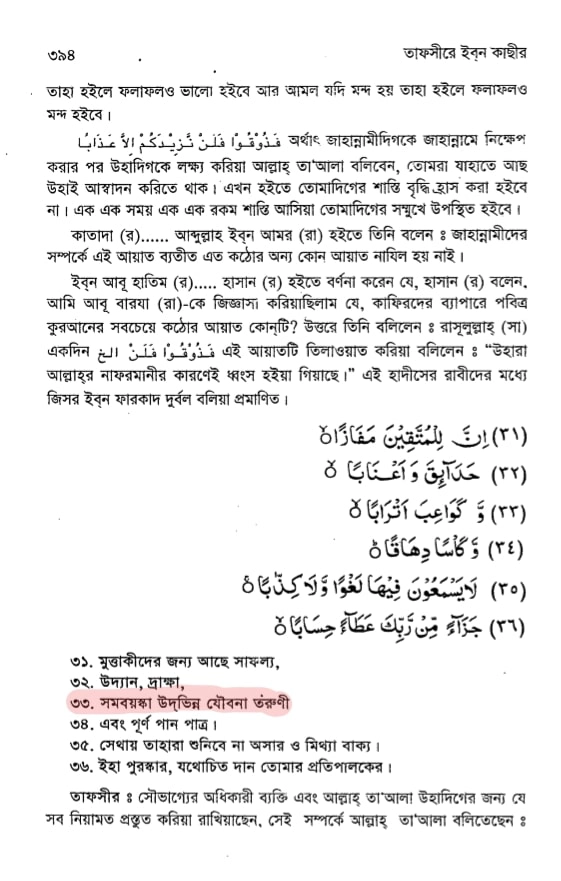
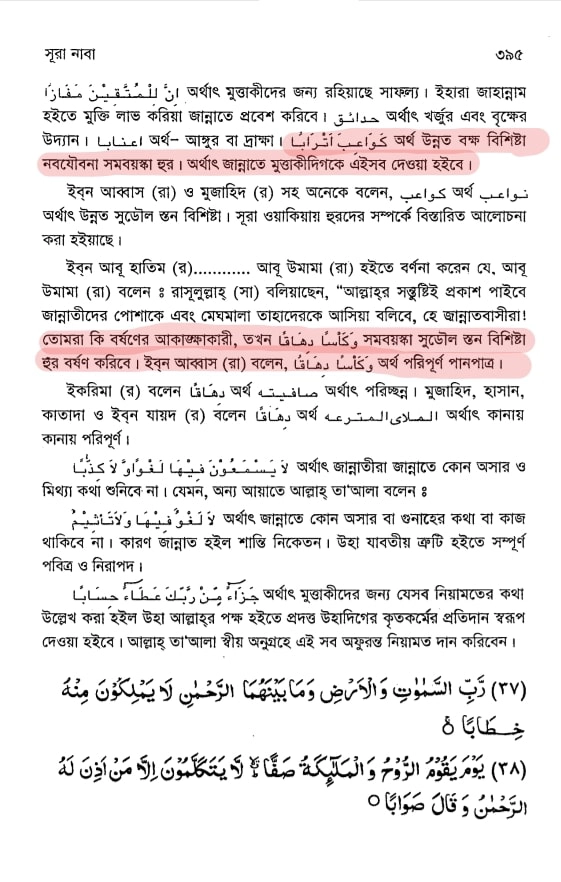
In Surah An-Naba, verse 33, the Quran says about the houris: “kawa`iba atraba,” commonly rendered as “full-bosomed maidens of equal age” [19]. Explaining the word “kawa`ib,” the famous exegete Ibn Kathir wrote in his tafsir that it means young women whose breasts will be raised, round, and not sagging; rather, they will be swollen and rounded like grapes [23]. Psychologically, these descriptions are directly designed to satisfy the male gaze, or the lustful gaze of men. Why a woman’s body had to be described in such detailed and sexually charged terms even in a supposedly sacred place like Jannah proves beyond question that this idea of heaven is essentially a device for stimulating primitive male lust. Let us listen to some scholars on this matter,
Let us see what Madrasa students are being taught about the Houris,
In Surah As-Saffat, houris are described as “modest in gaze” and “large-eyed” [20]. Here “modest in gaze,” or restraining the gaze, means they will look only at their husbands. This reflects the mentality of the patriarchal society of that time, where a woman was seen merely as her husband’s property and any contact with another man, even looking at him, was treated as an offense. In addition, Surah Al-Waqi`ah says of the houris that they will be created repeatedly as virgins and will be extremely loving or devoted wives [21]. This intense obsession with virginity is essentially a form of dominance psychology in primitive tribal society, where female chastity or virginity was the greatest object of male consumption.
The supplied video clips also show an ugly form of this physical description. In sermons by Bangladeshi scholars, such as Madani or Razzak bin Yusuf, the houris of Jannah are described as though Jannah were a vast bride market or houri market. The titillation offered in the videos about the houris’ height, complexion, and years of uninterrupted sexual intercourse with them is a vile example of religious commerce capitalizing on ordinary people’s sexual insecurity. These statements by the scholars show that they imagine Jannah as a vast brothel, where Allah functions as the supplier or broker of these beautiful women. Women have no independent self, feeling, or will there; they are merely specially manufactured robotic objects made to satisfy the tireless sexual hunger of believers. This view not only tramples women’s dignity but is enough to make a society sexually frenzied and misogynistic.
Houris of Jannah Versus AI-Powered Sex Dolls: A Fantasy of Biological Robotics
In this age of advanced technology, analyzing how AI-powered sex dolls or robots work reveals a striking psychological similarity with descriptions of the houris of Jannah. Modern advanced AI-driven robots are programmed only to obey the owner’s commands, feed his desires, and satisfy him; descriptions of the houris of Jannah suggest exactly the same kind of programming. From a sociological and psychological point of view, the question arises: are these houris truly independent beings, or are they high-grade bio-automatons, biological robots made by the Creator?
A movie was released recently; let us watch some scenes from it,
The primary condition of a living human being is emotional complexity. Human love becomes meaningful only where there is the capacity to feel hurt, to take offense, and to say “no,” or to express consent or refusal. But in descriptions of the houris of Jannah we see that they are specially made only to be loving and husband-devoted [21]. Psychologically, this creates a deep crisis: if a being has no capacity to say “no,” then its “yes,” or consent, has no moral value. If the houris of Jannah are always smiling and sexually aroused, and if sadness, fatigue, or irritation never grows within them, then they are nothing more than present-day AI-powered Chinese sex dolls. The only difference is that one is made of silicone and chips, and the other of imagined miraculous flesh.
Human feelings such as jealousy, anger, and sorrow give fullness to a person’s personality. If the houris of Jannah have no jealousy, even though they will live in the same tent with hundreds of co-wives, then it must be understood that the human-emotional part of their brains has been deleted. If a being has no likes or dislikes of its own and is programmed only to surrender itself as an object of someone else’s pleasure, then the word love becomes meaningless. Love is the union of two independent beings; in the case of the houris, it is only the relationship between an owner and his product.
Consequently, this portrayal of the houris of Jannah is actually the expression of a primitive and diseased fantasy in which a person wants a partner who will be obedient like a robot but whose body will be human. This proves that this religious idea of heaven arises from a lack of emotional maturity. The person who has not learned to respect the complex emotions and personality of an independent human being of flesh and blood is the one who essentially desires in the afterlife a sex doll or ghilman with no power to protest. Thus, theoretically, the houris of Jannah are not higher beings; rather, they are a kind of prehistoric sexual AI described in ancient religious texts, created to fulfill human suppressed desire and patriarchal domination.
The Ghilman of Jannah and the Luxury Fantasy of Ancient Arabia
Descriptions of Islamic Jannah do not merely offer the lure of houris or female companions; they also very specifically describe the presence of ghilman, eternally youthful pleasure boys. From a sociological and historical point of view, Arabic literature and poetry before the rise of Islam fourteen hundred years ago contained a distinct culture in which elite and royal life included harems full of beautiful women and, alongside them, the company of attractive adolescent boys. Poetry from the Jahiliyyah period of Arabia often praised this kind of luxurious and hedonistic life. When the Quran depicts Jannah as the final place of indulgence and eternal comfort for believers, it mentions ghilman in three different places in order to complete that ancient royal fantasy. The Quran compares them to protected pearls or scattered jewels, eternally youthful boys who will remain engaged in serving the inhabitants of Jannah [24] [25] [26] –
Quran reference : Surah Al-Waqi`ah, 56:17-18
Arabic : يَطُوفُ عَلَيْهِمْ وِلْدَٰنٌۭ مُّخَلَّدُونَ ١٧ بِأَكْوَابٍۢ وَأَبَارِيقَ وَكَأْسٍۢ مِّن مَّعِينٍۢ ١٨
Translation — Dr. Mustafa Khattab, The Clear Quran : They will be waited on by eternal youths with cups, pitchers, and a drink ˹of pure wine˺ from a flowing stream,
Translation — Saheeh International : There will circulate among them young boys made eternal With vessels, pitchers and a cup [of wine] from a flowing spring –
Quran reference : Surah At-Tur, 52:24
Arabic : ۞ وَيَطُوفُ عَلَيْهِمْ غِلْمَانٌۭ لَّهُمْ كَأَنَّهُمْ لُؤْلُؤٌۭ مَّكْنُونٌۭ ٢٤
Translation — Dr. Mustafa Khattab, The Clear Quran : And they will be waited on by their youthful servants like spotless pearls.
Translation — Saheeh International : There will circulate among them [servant] boys [especially] for them, as if they were pearls well-protected.
Quran reference : Surah Al-Insan, 76:19
Arabic : وَيَطُوفُ عَلَيْهِمْ وِلْدَانٌۭ مُّخَلَّدُونَ ۖ إِذَا رَأَيْتَهُمْ حَسِبْتَهُمْ لُؤْلُؤًۭا مَّنثُورًۭا ١٩
Translation — Dr. Mustafa Khattab, The Clear Quran : They will be waited on by eternal youths. If you saw them, you would think they were scattered pearls.
Translation — Saheeh International : There will circulate among them young boys made eternal. When you see them, you would think them [as beautiful as] scattered pearls.
Psychologically, the presence of these ghilman in Jannah reflects an extreme and unrestricted individualistic lust, or unfettered hedonism. According to Islam’s theoretical framework, Jannah is a place where no worldly Shariah or laws of halal and haram will exist. Scholars clearly explain that what is forbidden or haram on earth will become freely halal in Jannah. The video clips also show scholars saying that there will be no social or religious restrictions of any kind in Jannah.
This no-law zone, or idea of lawless pleasure, emerges from the suppressed desire of the human unconscious, which cannot be fulfilled on earth because of social and moral restraints. Many Islamists try to argue that the ghilman will be there only as servants and that no sexual intercourse with them is involved. But the implication is very pronounced when Jannah is introduced as a place of eternal luxury and pleasure, and where pearl-like, large-eyed boys are described as moving about alongside beautiful houris. In Abdul Hamid Madani’s book ‘Jannat-Jahannam,’ the description of the ghilman, their beauty and adolescent form, is essentially a heavenly transformation of the psychological culture of pederasty or attraction to adolescent boys in Arabia at that time [27].
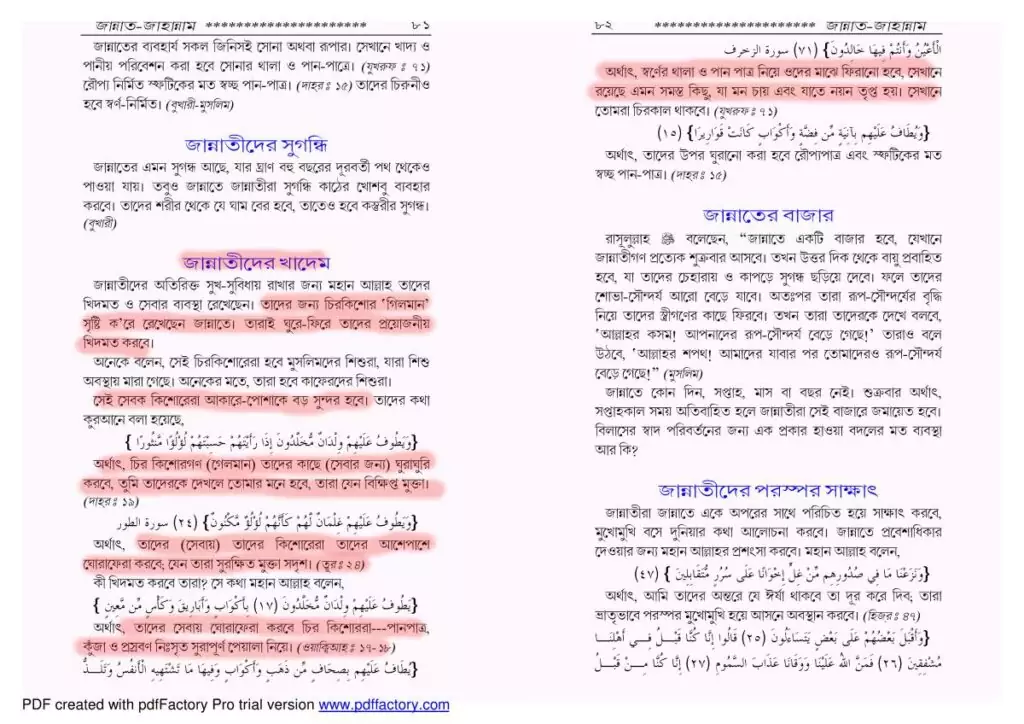
Sociologically, this issue becomes even deeper when we analyze texts such as Imam Nawawi’s famous hadith collection ‘Riyad as-Salihin.’ There, looking at beautiful adolescent boys, or amrad (beardless youths), is strictly forbidden [28]
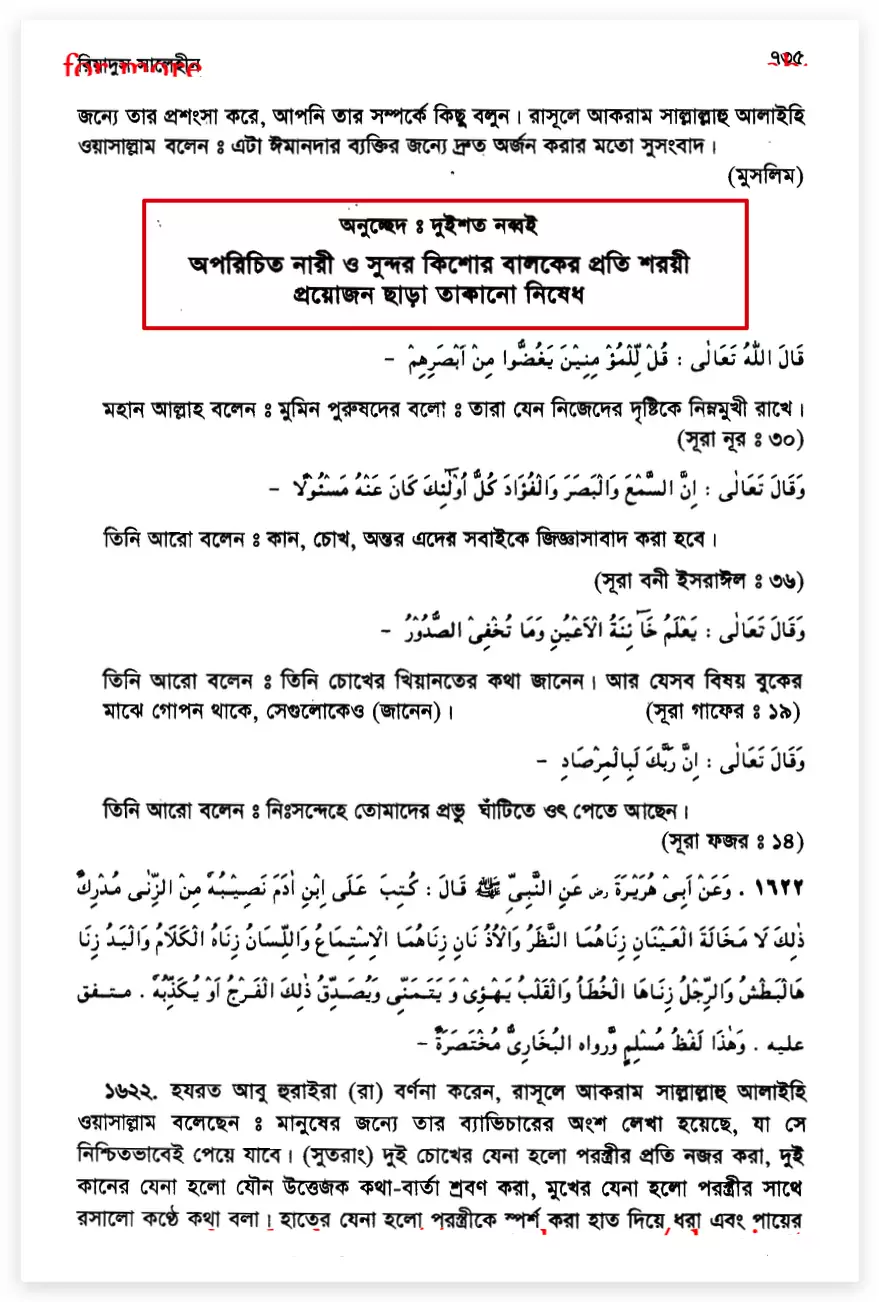
In psychological analysis, something needs to be prohibited only when that thing exists in society as a present and uncomfortable tendency. This means that sexual attraction toward attractive adolescent boys in madrasas or religious circles, and incidents of sexual abuse against them, are not isolated problems of the modern age; rather, they were marked as a clear psychological crisis from the earliest period of Islam. When scholars warn others that looking at adolescent boys can create sexual arousal, they indirectly confirm the source of desire behind the presence of the eternally youthful ghilman in Jannah. Thus houris and ghilman are both essentially reflections of human primitive and unsatisfied biological desires, which are legitimized under the cover of afterlife purity. These descriptions of heaven actually prove that it is not a sacred heavenly dwelling but a vast fantasy world of human blocked and suppressed desire.
The Afterlife No-Law Zone and the Legitimization of Suppressed Lust: Wine, Gold, and Silk
A curious aspect of religious ethics is that Jannah or heaven is depicted as a place where everything haram or forbidden in the earthly world is counted as fully halal and as the highest reward. Sociological and psychological analysis makes clear that Jannah is not a higher moral or spiritual world; rather, it is an imaginary field for those desires that are repressed on earth because of social or religious restrictions. In sermons and various explanations, scholars state quite openly that all rules of halal and haram apply only to the Shariah of this world; in Jannah there will be no such laws or moral obligations. In the video clips too, scholars present Jannah as a no-law zone where every wish of the believer, however immoral or forbidden it may be on earth, receives ultimate legitimacy.
The largest example of this forbidden pleasure is wine or intoxicating drink. Drinking wine is strictly forbidden in Islam on earth and is a major sin. Yet in descriptions of Jannah, Mishkat al-Masabih 5650 says that seas and rivers of wine will flow there [29].
Reference : Jami` at-Tirmidhi 2571
In-book reference : Book 38, Hadith 49
English translation : Vol. 4, Book 12, Hadith 2571
Hakim bin Mu’awiyah narrated from his father, that the Prophet (s.a.w) said:
“Indeed in Paradise there is a sea of water, and a sea of honey,and a sea of milk, and a sea of wine, then the rivers shall split off afterwards.”
حَدَّثَنَا مُحَمَّدُ بْنُ بَشَّارٍ، حَدَّثَنَا يَزِيدُ بْنُ هَارُونَ، أَخْبَرَنَا الْجُرَيْرِيُّ، عَنْ حَكِيمِ بْنِ مُعَاوِيَةَ، عَنْ أَبِيهِ، عَنِ النَّبِيِّ صلى الله عليه وسلم قَالَ ” إِنَّ فِي الْجَنَّةِ بَحْرَ الْمَاءِ وَبَحْرَ الْعَسَلِ وَبَحْرَ اللَّبَنِ وَبَحْرَ الْخَمْرِ ثُمَّ تُشَقَّقُ الأَنْهَارُ بَعْدُ ” . قَالَ أَبُو عِيسَى هَذَا حَدِيثٌ حَسَنٌ صَحِيحٌ . وَحَكِيمُ بْنُ مُعَاوِيَةَ هُوَ وَالِدُ بَهْزِ بْنِ حَكِيمٍ وَالْجُرَيْرِيُّ يُكْنَى أَبَا مَسْعُودٍ وَاسْمُهُ سَعِيدُ بْنُ إِيَاسٍ .
Grade: Hasan (Darussalam)
Psychologically, this is a project of deferred gratification, or delayed satisfaction. Prophet Muhammad explicitly stated that whoever drinks wine in this world will be deprived of it in the afterlife. This means that the wine of Jannah is essentially an upgraded version of worldly wine. Many theorists try to claim that the wine of Jannah will not contain any intoxicating element; but logically, if there is no intoxicating element, it can no longer be called wine, and should instead be regarded as ordinary syrup or fruit juice. In effect, the human impulse to obtain desired pleasure through intoxication, suppressed on earth, is presented in the afterlife as a gift [30] [31] [32] –
Reference : Sahih Muslim 2003a
In-book reference : Book 36, Hadith 92
USC-MSA web (English) reference : Book 23, Hadith 4963
Ibn ‘Umar reported Allah’s Messenger (ﷺ) as saying:
Every intoxicant is Khamr and every intoxicant is forbidden. He who drinks wine in this world and dies while he is addicted to it, not having repented, will not be given a drink in the Hereafter.
حَدَّثَنَا أَبُو الرَّبِيعِ الْعَتَكِيُّ، وَأَبُو كَامِلٍ قَالاَ حَدَّثَنَا حَمَّادُ بْنُ زَيْدٍ، حَدَّثَنَا أَيُّوبُ، عَنْ نَافِعٍ، عَنِ ابْنِ عُمَرَ، قَالَ قَالَ رَسُولُ اللَّهِ صلى الله عليه وسلم ” كُلُّ مُسْكِرٍ خَمْرٌ وَكُلُّ مُسْكِرٍ حَرَامٌ وَمَنْ شَرِبَ الْخَمْرَ فِي الدُّنْيَا فَمَاتَ وَهُوَ يُدْمِنُهَا لَمْ يَتُبْ لَمْ يَشْرَبْهَا فِي الآخِرَةِ ” .
Grade: Not separately graded on Sunnah.com
Reference : Sahih Muslim 2003f
In-book reference : Book 36, Hadith 97
USC-MSA web (English) reference : Book 23, Hadith 4968
Ibn ‘Umar said:
He who drank wine in the world and did not repent would be deprived of it (the pure drink) in the Hereafter. It was said to Malik: Is this hadith Marfu’? He said: Yes.
حَدَّثَنَا عَبْدُ اللَّهِ بْنُ مَسْلَمَةَ بْنِ قَعْنَبٍ، حَدَّثَنَا مَالِكٌ، عَنْ نَافِعٍ، عَنِ ابْنِ عُمَرَ، قَالَ ” مَنْ شَرِبَ الْخَمْرَ فِي الدُّنْيَا فَلَمْ يَتُبْ مِنْهَا حُرِمَهَا فِي الآخِرَةِ فَلَمْ يُسْقَهَا ” . قِيلَ لِمَالِكٍ رَفَعَهُ قَالَ نَعَمْ .
Grade: Not separately graded on Sunnah.com
Reference : Sahih Muslim 2003g
In-book reference : Book 36, Hadith 98
USC-MSA web (English) reference : Book 23, Hadith 4969
Ibn ‘Umar reported Allah’s Messenger (ﷺ) as saying:
He who drank wine in this world will not be provided with pure drink in the Hereafter, except in case he repents.
وَحَدَّثَنَا أَبُو بَكْرِ بْنُ أَبِي شَيْبَةَ، حَدَّثَنَا عَبْدُ اللَّهِ بْنُ نُمَيْرٍ، ح وَحَدَّثَنَا ابْنُ نُمَيْرٍ، حَدَّثَنَا أَبِي، حَدَّثَنَا عُبَيْدُ اللَّهِ، عَنْ نَافِعٍ، عَنِ ابْنِ عُمَرَ، أَنَّ رَسُولَ اللَّهِ صلى الله عليه وسلم قَالَ ” مَنْ شَرِبَ الْخَمْرَ فِي الدُّنْيَا لَمْ يَشْرَبْهَا فِي الآخِرَةِ إِلاَّ أَنْ يَتُوبَ ” .
Grade: Not separately graded on Sunnah.com
The same contradiction appears in clothing and ornaments. According to Islamic Shariah, gold ornaments and silk garments have been made completely haram for men [33]. But several Quranic verses, in Surah Al-Hajj, Surah Fatir, and Surah Al-Kahf, promise that believers in Jannah will be adorned with bracelets of gold and pearls and will wear green garments of fine and thick silk [34]. These descriptions prove that the world of Jannah is nothing more than the fantasy of a seventh-century deprived Arab about luxurious life. Precious metals or fabrics that were scarce on earth, and intoxicants that cloud human consciousness, are arranged as the highest afterlife rewards. That is, the things that are haram on earth will become halal in Jannah, because in Jannah there will be nothing called haram. Psychologically, this is an extremely opportunistic strategy for extracting obedience to religion by provoking primitive human greed and lust. What is sin on earth becomes virtue in the afterlife: through this magical transformation, religion controls the human mind and forces it to sacrifice earthly happiness in pursuit of an imaginary, fantasy-based future.
Reference : Sahih al-Bukhari 5832
In-book reference : Book 77, Hadith 49
USC-MSA web (English) reference : Vol. 7, Book 72, Hadith 723
Narrated Anas bin Malik:
The Prophet (ﷺ) said, Whoever wears silk in this world shall not wear it in the Hereafter.”
حَدَّثَنَا آدَمُ، حَدَّثَنَا شُعْبَةُ، حَدَّثَنَا عَبْدُ الْعَزِيزِ بْنُ صُهَيْبٍ، قَالَ سَمِعْتُ أَنَسَ بْنَ مَالِكٍ ـ قَالَ شُعْبَةُ فَقُلْتُ أَعَنِ النَّبِيِّ صلى الله عليه وسلم فَقَالَ شَدِيدًا عَنِ النَّبِيِّ صلى الله عليه وسلم ـ فَقَالَ ” مَنْ لَبِسَ الْحَرِيرَ فِي الدُّنْيَا فَلَنْ يَلْبَسَهُ فِي الآخِرَةِ ”.
Grade: Not separately graded on Sunnah.com
Again, the same gold and silk garments are made halal in Jannah. Verse 23 of Surah Al-Hajj, verse 33 of Surah Fatir, and verse 31 of Surah Al-Kahf say [35] [36] [37] –
Quran reference : Surah Al-Hajj, 22:23
Arabic : إِنَّ ٱللَّهَ يُدْخِلُ ٱلَّذِينَ ءَامَنُوا۟ وَعَمِلُوا۟ ٱلصَّـٰلِحَـٰتِ جَنَّـٰتٍۢ تَجْرِى مِن تَحْتِهَا ٱلْأَنْهَـٰرُ يُحَلَّوْنَ فِيهَا مِنْ أَسَاوِرَ مِن ذَهَبٍۢ وَلُؤْلُؤًۭا ۖ وَلِبَاسُهُمْ فِيهَا حَرِيرٌۭ ٢٣
Translation — Dr. Mustafa Khattab, The Clear Quran : ˹But˺ Allah will surely admit those who believe and do good into Gardens, under which rivers flow, where they will be adorned with bracelets of gold and pearls, and their clothing will be silk,
Translation — Saheeh International : Indeed, Allah will admit those who believe and do righteous deeds to gardens beneath which rivers flow. They will be adorned therein with bracelets of gold and pearl, and their garments therein will be silk.
Quran reference : Surah Fatir, 35:33
Arabic : جَنَّـٰتُ عَدْنٍۢ يَدْخُلُونَهَا يُحَلَّوْنَ فِيهَا مِنْ أَسَاوِرَ مِن ذَهَبٍۢ وَلُؤْلُؤًۭا ۖ وَلِبَاسُهُمْ فِيهَا حَرِيرٌۭ ٣٣
Translation — Dr. Mustafa Khattab, The Clear Quran : They will enter the Gardens of Eternity, where they will be adorned with bracelets of gold and pearls, and their clothing will be silk.
Translation — Saheeh International : [For them are] gardens of perpetual residence which they will enter. They will be adorned therein with bracelets of gold and pearls, and their garments therein will be silk.
Quran reference : Surah Al-Kahf, 18:31
Arabic : أُو۟لَـٰٓئِكَ لَهُمْ جَنَّـٰتُ عَدْنٍۢ تَجْرِى مِن تَحْتِهِمُ ٱلْأَنْهَـٰرُ يُحَلَّوْنَ فِيهَا مِنْ أَسَاوِرَ مِن ذَهَبٍۢ وَيَلْبَسُونَ ثِيَابًا خُضْرًۭا مِّن سُندُسٍۢ وَإِسْتَبْرَقٍۢ مُّتَّكِـِٔينَ فِيهَا عَلَى ٱلْأَرَآئِكِ ۚ نِعْمَ ٱلثَّوَابُ وَحَسُنَتْ مُرْتَفَقًۭا ٣١
Translation — Dr. Mustafa Khattab, The Clear Quran : It is they who will have the Gardens of Eternity, with rivers flowing under their feet. There they will be adorned with bracelets of gold, and wear green garments of fine silk and rich brocade, reclining there on ˹canopied˺ couches. What a marvellous reward! And what a fabulous place to rest!
Translation — Saheeh International : Those will have gardens of perpetual residence; beneath them rivers will flow. They will be adorned therein with bracelets of gold and will wear green garments of fine silk and brocade, reclining therein on adorned couches. Excellent is the reward, and good is the resting place.
Modern Apologetics and the Failed “Raisin” Theory
In the modern era, when these crude and sexually charged descriptions of the houris of Jannah face criticism around the world, a class of modern Islamic apologists has resorted to various kinds of linguistic gymnastics to cover up the issue. The most ridiculous and widely discussed claim among them is that in the Quran, houri does not mean beautiful women but white raisins or grapes. This claim is based on a controversial thesis by the German researcher Christoph Luxenberg, in which he argues that the language of the Quran derives from a Syro-Aramaic source and that houri means white grapes [38]. But sociological and linguistic analysis shows that this claim is not only factually wrong; it is a crude joke against fourteen hundred years of Islamic tradition, tafsir, and hadith history.
Logical analysis shows that if houri really meant raisins or grapes, then the physical adjectives used for them in the Quran and hadith cannot be coherent in any way. Is the word “kawa`ib” (full-bosomed) used in Surah An-Naba 33 applicable to raisins? Do raisins have breasts? Similarly, can a fruit have the description of “modest gaze” or large eyes given for houris? [20]. In addition, the houris are described as virgins (abkara), and hadith explicitly mentions that men of Jannah will have intercourse with them. The claim that grapes or raisins possess virginity or that believers will have intercourse with them using the sexual strength of one hundred men is not merely laughable; it is literally a sign of distorted psychology [39].
Psychologically, this apologetic attempt at concealment can be identified as cognitive dissonance. When a modern educated Muslim sees that the Jannah of his religious scripture is nothing more than a primitive sexual fantasy, this information clashes with his modern moral sense. To escape that discomfort, apologists construct imaginary explanations such as raisins or clear light so that the matter becomes acceptable to present civilized society. But classical exegetes such as Ibn Kathir, Tabari, and Qurtubi, who had the strongest command over Arabic, did not speak of raisins. Rather, they described in detail the houris’ complexion, the shape of their eyes, and the pleasure of sexual union with them [40].
From a sociological point of view, would the warriors of ancient Arabia have agreed to give their lives in jihad merely for a bowl of raisins? Certainly not. The reward that lured people to give their lives on the battlefield was intensely biological and the ultimate form of earthly desire. When the hadith narrated from Al-Miqdam bin Ma`diykarib guarantees marriage to seventy-two houris, that reward was clearly identified as women, not raisins [41]. Therefore, what modern apologists are trying to conceal through linguistic cleverness is essentially a denial of Islam’s earliest history and texts. Such falsehood only confuses ordinary people and is a weak attempt to hide the truth. The truth is that Islamic Jannah is a fantasy world of primitive and patriarchal libido, and there is no way to sanctify it with the raisin theory.
Women in Jannah: Residues of Patriarchal Fantasy and Psychological Consolation
Analyzing the overall structure of Islamic Jannah shows that it stands from beginning to end on a patriarchal philosophy, where women’s independent desires or biological needs receive no recognition. Linguistically, the word hur (حُوْرٌ) is feminine and is specifically assigned as a reward for men of Jannah. According to Islamic theology and common belief, even though male jihadis receive seventy-two houris each in Jannah, there is no mention of ghilman or any equivalent sexual reward for women. The reward fixed for women of Jannah is only their worldly husband, with no alternative. Sociologically, this reflects the gender-unequal structure of seventh-century Arabian tribal society, where men were given the right to polygyny while monogamy and absolute obedience were imposed on women. Let us listen to a sermon,
A curious point in psychological analysis is that, against the man’s huge army of houris in Jannah, earthly wives are given the consolation of an imaginary honor: becoming the leader or chief of the houri army so that they will not feel jealous. This is essentially a psychological consolation prize. No woman easily accepts her husband’s attraction to other women on earth; to pacify this eternal human emotion or jealousy in Jannah, a kind of illusion of status has been created. Shaykh Muhammad bin Salih al-Uthaymin’s ‘Fatawa Arkanul Islam’ also states clearly that women will receive their husbands from among the children of Adam, and there is no provision for separate houris or any other male partners for them [42]. This fatwa confirms that even in Jannah, women have no agency or independent will; there they are merely obedient companions of their husbands or managers of a vast harem.
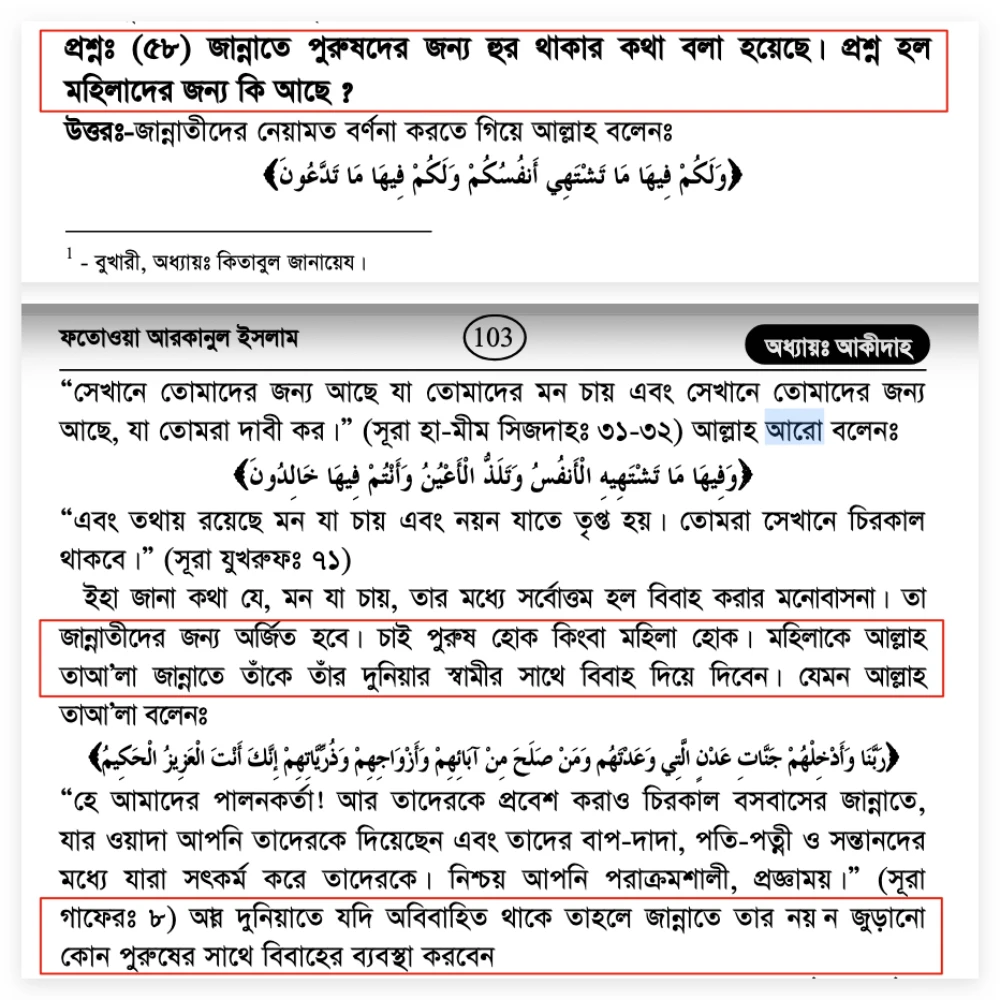
When sermons by scholars say that women of Jannah will be more beautiful than houris and will manage their husbands’ houris, even then women’s existence remains trapped at the level of objects for male consumption. According to Sigmund Freud’s theory, this kind of religious narrative helps suppress women’s natural individuality and confine them within a specific mold [8]. Where Jannah for men is the field for the ultimate expression of heroism and lust, Jannah for women is an eternal and miraculous version of their earthly servitude. For men, Jannah is a center of power and pleasure; for women, it is merely a place of submission and service. This enormous inequality proves that women’s biological or psychological fulfillment was not considered at all when this imaginary design of heaven was made; rather, she was imagined only as an accessory to male afterlife comfort. It is an ultimate form of hegemonic masculinity, which depicts even the afterlife as a vast male harem.
Sexual Lure as Fuel for Jihad and the Afterlife Sex Market
In religious history, the lure of Jannah or heaven has not functioned merely as a guarantee of individual afterlife salvation; it has also been used as an extremely powerful political and military weapon. Sociological analysis shows that in ancient times, kings offered mercenary soldiers two kinds of opportunity for winning wars: if they lived, spoils of war, meaning looted wealth and women; and if they died, eternal pleasures in heaven. Islam institutionalized this ancient military strategy. Especially when a population is at the extreme limit of poverty, deprivation, and struggle for life, it becomes easiest to incite desperate people to war and killing by dangling the carrot of houris in Jannah. This is essentially a vile process of turning human biological needs into fuel for war. Let us read a hadith in which one of Prophet Muhammad’s companions, while conducting offensive jihad in another region, said certain things. This hadith needs to be understood deeply in order to understand the reality of that time and the psychology of the Prophet’s companions [43] [44]
Reference : Sahih al-Bukhari 3159, 3160
In-book reference : Book 58, Hadith 3
USC-MSA web (English) reference : Vol. 4, Book 53, Hadith 386
Narrated Jubair bin Haiya:
`Umar sent the Muslims to the great countries to fight the pagans. When Al-Hurmuzan embraced Islam, `Umar said to him. “I would like to consult you regarding these countries which I intend to invade.” Al-Hurmuzan said, “Yes, the example of these countries and their inhabitants who are the enemies. of the Muslims, is like a bird with a head, two wings and two legs; If one of its wings got broken, it would get up over its two legs, with one wing and the head; and if the other wing got broken, it would get up with two legs and a head, but if its head got destroyed, then the two legs, two wings and the head would become useless. The head stands for Khosrau, and one wing stands for Caesar and the other wing stands for Faris. So, order the Muslims to go towards Khosrau.” So, `Umar sent us (to Khosrau) appointing An-Nu`man bin Muqrin as our commander.
When we reached the land of the enemy, the representative of Khosrau came out with forty-thousand warriors, and an interpreter got up saying, “Let one of you talk to me!” Al-Mughira replied, “Ask whatever you wish.” The other asked, “Who are you?” Al-Mughira replied, “We are some people from the Arabs; we led a hard, miserable, disastrous life: we used to suck the hides and the date stones from hunger; we used to wear clothes made up of fur of camels and hair of goats, and to worship trees and stones. While we were in this state, the Lord of the Heavens and the Earths, Elevated is His Remembrance and Majestic is His Highness, sent to us from among ourselves a Prophet whose father and mother are known to us. Our Prophet, the Messenger of our Lord, has ordered us to fight you till you worship Allah Alone or give Jizya (i.e. tribute); and our Prophet has informed us that our Lord says:– “Whoever amongst us is killed (i.e. martyred), shall go to Paradise to lead such a luxurious life as he has never seen, and whoever amongst us remain alive, shall become your master.” (Al-Mughira, then blamed An-Nu`man for delaying the attack and) An-Nu’ man said to Al-Mughira, “If you had participated in a similar battle, in the company of Allah’s Messenger (ﷺ) he would not have blamed you for waiting, nor would he have disgraced you. But I accompanied Allah’s Apostle in many battles and it was his custom that if he did not fight early by daytime, he would wait till the wind had started blowing and the time for the prayer was due (i.e. after midday).
حَدَّثَنَا الْفَضْلُ بْنُ يَعْقُوبَ، حَدَّثَنَا عَبْدُ اللَّهِ بْنُ جَعْفَرٍ الرَّقِّيُّ، حَدَّثَنَا الْمُعْتَمِرُ بْنُ سُلَيْمَانَ، حَدَّثَنَا سَعِيدُ بْنُ عُبَيْدِ اللَّهِ الثَّقَفِيُّ، حَدَّثَنَا بَكْرُ بْنُ عَبْدِ اللَّهِ الْمُزَنِيُّ، وَزِيَادُ بْنُ جُبَيْرٍ، عَنْ جُبَيْرِ بْنِ حَيَّةَ، قَالَ بَعَثَ عُمَرُ النَّاسَ فِي أَفْنَاءِ الأَمْصَارِ يُقَاتِلُونَ الْمُشْرِكِينَ، فَأَسْلَمَ الْهُرْمُزَانُ فَقَالَ إِنِّي مُسْتَشِيرُكَ فِي مَغَازِيَّ هَذِهِ. قَالَ نَعَمْ، مَثَلُهَا وَمَثَلُ مَنْ فِيهَا مِنَ النَّاسِ مِنْ عَدُوِّ الْمُسْلِمِينَ مَثَلُ طَائِرٍ لَهُ رَأْسٌ وَلَهُ جَنَاحَانِ وَلَهُ رِجْلاَنِ، فَإِنْ كُسِرَ أَحَدُ الْجَنَاحَيْنِ نَهَضَتِ الرِّجْلاَنِ بِجَنَاحٍ وَالرَّأْسُ، فَإِنْ كُسِرَ الْجَنَاحُ الآخَرُ نَهَضَتِ الرِّجْلاَنِ وَالرَّأْسُ، وَإِنْ شُدِخَ الرَّأْسُ ذَهَبَتِ الرِّجْلاَنِ وَالْجَنَاحَانِ وَالرَّأْسُ، فَالرَّأْسُ كِسْرَى، وَالْجَنَاحُ قَيْصَرُ، وَالْجَنَاحُ الآخَرُ فَارِسُ، فَمُرِ الْمُسْلِمِينَ فَلْيَنْفِرُوا إِلَى كِسْرَى. وَقَالَ بَكْرٌ وَزِيَادٌ جَمِيعًا عَنْ جُبَيْرِ بْنِ حَيَّةَ قَالَ فَنَدَبَنَا عُمَرُ وَاسْتَعْمَلَ عَلَيْنَا النُّعْمَانَ بْنَ مُقَرِّنٍ، حَتَّى إِذَا كُنَّا بِأَرْضِ الْعَدُوِّ، وَخَرَجَ عَلَيْنَا عَامِلُ كِسْرَى فِي أَرْبَعِينَ أَلْفًا، فَقَامَ تُرْجُمَانٌ فَقَالَ لِيُكَلِّمْنِي رَجُلٌ مِنْكُمْ. فَقَالَ الْمُغِيرَةُ سَلْ عَمَّا شِئْتَ. قَالَ مَا أَنْتُمْ قَالَ نَحْنُ أُنَاسٌ مِنَ الْعَرَبِ كُنَّا فِي شَقَاءٍ شَدِيدٍ وَبَلاَءٍ شَدِيدٍ، نَمَصُّ الْجِلْدَ وَالنَّوَى مِنَ الْجُوعِ، وَنَلْبَسُ الْوَبَرَ وَالشَّعَرَ، وَنَعْبُدُ الشَّجَرَ وَالْحَجَرَ، فَبَيْنَا نَحْنُ كَذَلِكَ، إِذْ بَعَثَ رَبُّ السَّمَوَاتِ وَرَبُّ الأَرَضِينَ تَعَالَى ذِكْرُهُ وَجَلَّتْ عَظَمَتُهُ إِلَيْنَا نَبِيًّا مِنْ أَنْفُسِنَا، نَعْرِفُ أَبَاهُ وَأُمَّهُ، فَأَمَرَنَا نَبِيُّنَا رَسُولُ رَبِّنَا صلى الله عليه وسلم أَنْ نُقَاتِلَكُمْ حَتَّى تَعْبُدُوا اللَّهَ وَحْدَهُ أَوْ تُؤَدُّوا الْجِزْيَةَ، وَأَخْبَرَنَا نَبِيُّنَا صلى الله عليه وسلم عَنْ رِسَالَةِ رَبِّنَا أَنَّهُ مَنْ قُتِلَ مِنَّا صَارَ إِلَى الْجَنَّةِ فِي نَعِيمٍ لَمْ يَرَ مِثْلَهَا قَطُّ، وَمَنْ بَقِيَ مِنَّا مَلَكَ رِقَابَكُمْ. فَقَالَ النُّعْمَانُ رُبَّمَا أَشْهَدَكَ اللَّهُ مِثْلَهَا مَعَ النَّبِيِّ صلى الله عليه وسلم فَلَمْ يُنَدِّمْكَ وَلَمْ يُخْزِكَ، وَلَكِنِّي شَهِدْتُ الْقِتَالَ مَعَ رَسُولِ اللَّهِ صلى الله عليه وسلم كَانَ إِذَا لَمْ يُقَاتِلْ فِي أَوَّلِ النَّهَارِ انْتَظَرَ حَتَّى تَهُبَّ الأَرْوَاحُ وَتَحْضُرَ الصَّلَوَاتُ.
Grade: Not separately graded on Sunnah.com
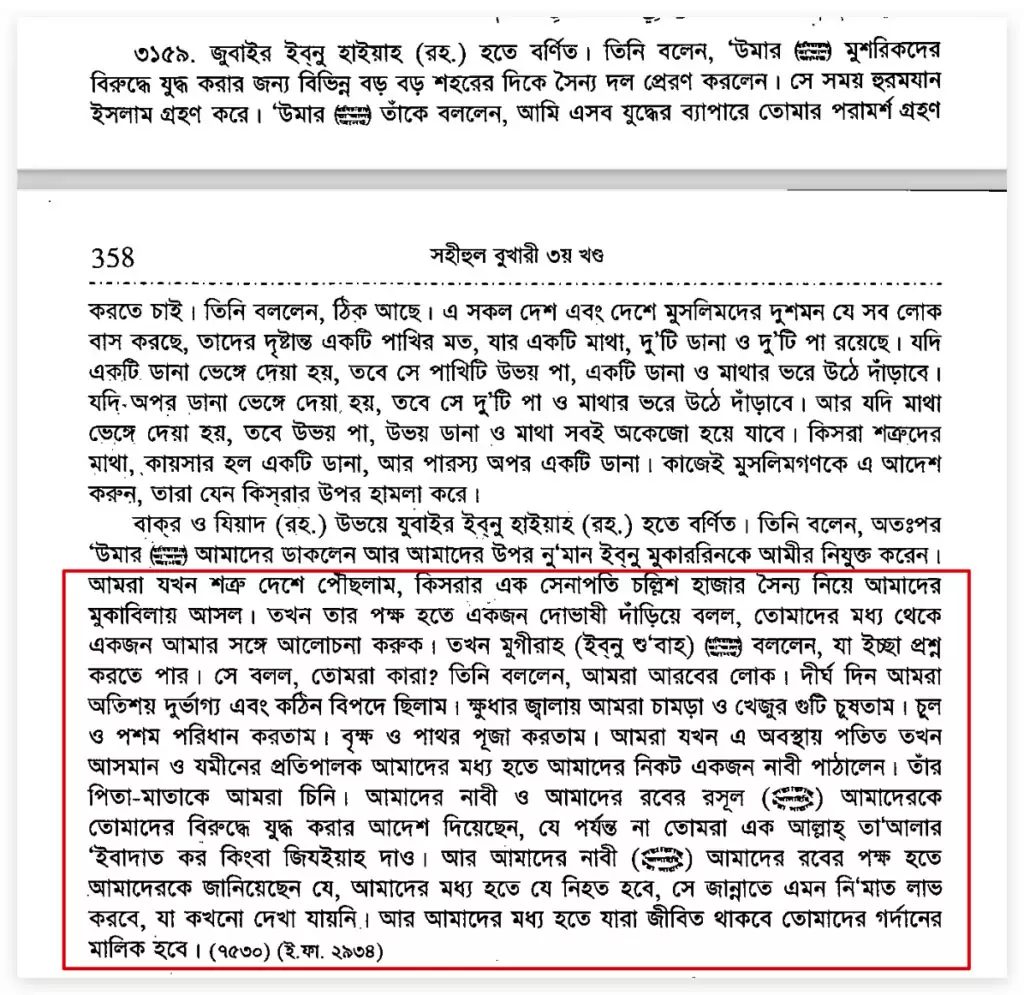
Islamic scriptures portray jihad as a miraculous shortcut, or the shortest route, to Jannah; psychologically, it works by capitalizing on a person’s suppressed emotions and guilt. Psychological analysis shows that when a Muslim suffers constantly from worldly failure, deep life-pain, or intense guilt over his own actions, his unconscious mind seeks a final and rapid path of release from that mental pressure or pain. According to Sigmund Freud’s psychoanalysis, when people are tormented by inner conflict, they seek to purify themselves through a kind of catharsis, or radical transformation [45]. The idea of jihad strikes precisely at that psychological point; it offers an imaginary deal in which, instead of the difficult path of years of worship or moral life, a single violent or suicidal act promises to wash away all past sins in a moment. Hadith says that at the first drop of blood from a martyr’s body, all his sins are forgiven [46].
Sociologically, this is essentially a finely crafted recruitment strategy. When society marginalizes someone, or when someone feels cut off from the mainstream and suffers guilt, religion tempts him with this shortcut path and lets him dream of regaining the status of hero or martyr. According to Emile Durkheim’s theory of altruistic suicide, when a person is ready to give his life for some supposedly noble social or religious goal, he feels a supreme satisfaction of release from all personal sorrow and guilt [47]. Thus this shortcut route is not merely a path to Jannah; for a guilt-ridden person it is an extremely opportunistic option to cover a failed life with a meaningful sacred death. By trapping people in this psychological mechanism, jihadist groups can very easily brainwash frustrated youths, because they know that a person crushed under the weight of sin will not hesitate to accept any shortcut to escape that pressure.
Jami` at-Tirmidhi 1669 mentions six special rewards for the martyr, one of the most attractive parts of which is marriage to seventy-two wide-eyed houris [46]. Psychologically, this is a terrifying offer. When a young man who perhaps cannot satisfy his sexual needs in this life because of poverty or social conditions is told that in exchange for a suicide attack or war he will immediately possess seventy-two miraculously beautiful women, death no longer remains frightening to him; rather, it becomes the object of extreme desire. This process numbs the human sense of death and turns the person into a living torpedo or human bomb.
Reference : Jami` at-Tirmidhi 1663
In-book reference : Book 22, Hadith 46
English translation : Vol. 3, Book 20, Hadith 1663
Narrated Al-Miqdam bin Ma’diykarib:
That the Messenger of Allah (ﷺ) said: “There are six things with Allah for the martyr. He is forgiven with the first flow of blood (he suffers), he is shown his place in Paradise, he is protected from punishment in the grave, secured from the greatest terror, the crown of dignity is placed upon his head – and its gems are better than the world and what is in it – he is married to seventy two wives along Al-Huril-‘Ayn of Paradise, and he may intercede for seventy of his close relatives.”
[Abu ‘Eisa said:] This Hadith is Hasan Sahih.
حَدَّثَنَا عَبْدُ اللَّهِ بْنُ عَبْدِ الرَّحْمَنِ، حَدَّثَنَا نُعَيْمُ بْنُ حَمَّادٍ، حَدَّثَنَا بَقِيَّةُ بْنُ الْوَلِيدِ، عَنْ بَحِيرِ بْنِ سَعْدٍ، عَنْ خَالِدِ بْنِ مَعْدَانَ، عَنِ الْمِقْدَامِ بْنِ مَعْدِيكَرِبَ، قَالَ قَالَ رَسُولُ اللَّهِ صلى الله عليه وسلم “ لِلشَّهِيدِ عِنْدَ اللَّهِ سِتُّ خِصَالٍ يُغْفَرُ لَهُ فِي أَوَّلِ دَفْعَةٍ وَيَرَى مَقْعَدَهُ مِنَ الْجَنَّةِ وَيُجَارُ مِنْ عَذَابِ الْقَبْرِ وَيَأْمَنُ مِنَ الْفَزَعِ الأَكْبَرِ وَيُوضَعُ عَلَى رَأْسِهِ تَاجُ الْوَقَارِ الْيَاقُوتَةُ مِنْهَا خَيْرٌ مِنَ الدُّنْيَا وَمَا فِيهَا وَيُزَوَّجُ اثْنَتَيْنِ وَسَبْعِينَ زَوْجَةً مِنَ الْحُورِ الْعِينِ وَيُشَفَّعُ فِي سَبْعِينَ مِنْ أَقَارِبِهِ ” . قَالَ أَبُو عِيسَى هَذَا حَدِيثٌ صَحِيحٌ غَرِيبٌ .
Grade: Hasan (Darussalam)
Reference : Jami` at-Tirmidhi 1663
In-book reference : Book 22, Hadith 46
English translation : Vol. 3, Book 20, Hadith 1663
Narrated Al-Miqdam bin Ma’diykarib:
That the Messenger of Allah (ﷺ) said: “There are six things with Allah for the martyr. He is forgiven with the first flow of blood (he suffers), he is shown his place in Paradise, he is protected from punishment in the grave, secured from the greatest terror, the crown of dignity is placed upon his head – and its gems are better than the world and what is in it – he is married to seventy two wives along Al-Huril-‘Ayn of Paradise, and he may intercede for seventy of his close relatives.”
[Abu ‘Eisa said:] This Hadith is Hasan Sahih.
حَدَّثَنَا عَبْدُ اللَّهِ بْنُ عَبْدِ الرَّحْمَنِ، حَدَّثَنَا نُعَيْمُ بْنُ حَمَّادٍ، حَدَّثَنَا بَقِيَّةُ بْنُ الْوَلِيدِ، عَنْ بَحِيرِ بْنِ سَعْدٍ، عَنْ خَالِدِ بْنِ مَعْدَانَ، عَنِ الْمِقْدَامِ بْنِ مَعْدِيكَرِبَ، قَالَ قَالَ رَسُولُ اللَّهِ صلى الله عليه وسلم “ لِلشَّهِيدِ عِنْدَ اللَّهِ سِتُّ خِصَالٍ يُغْفَرُ لَهُ فِي أَوَّلِ دَفْعَةٍ وَيَرَى مَقْعَدَهُ مِنَ الْجَنَّةِ وَيُجَارُ مِنْ عَذَابِ الْقَبْرِ وَيَأْمَنُ مِنَ الْفَزَعِ الأَكْبَرِ وَيُوضَعُ عَلَى رَأْسِهِ تَاجُ الْوَقَارِ الْيَاقُوتَةُ مِنْهَا خَيْرٌ مِنَ الدُّنْيَا وَمَا فِيهَا وَيُزَوَّجُ اثْنَتَيْنِ وَسَبْعِينَ زَوْجَةً مِنَ الْحُورِ الْعِينِ وَيُشَفَّعُ فِي سَبْعِينَ مِنْ أَقَارِبِهِ ” . قَالَ أَبُو عِيسَى هَذَا حَدِيثٌ صَحِيحٌ غَرِيبٌ .
Grade: Hasan (Darussalam)
One of the principal architects of this extremist ideology in modern times is Abdullah Yusuf Azzam, who is called the father of modern global jihad. In his book ‘Who Loves the Virgins of Paradise,’ Azzam compiled desirous descriptions of the physical beauty of the houris of Jannah and sexual intercourse with them in order to attract young men to jihad [48]. His philosophy later laid the foundation for organizations such as Osama bin Laden’s network and al-Qaeda. Even today, videos from various jihadist organizations show young suicide attackers departing with smiles on their faces because they believe that after a few moments of pain they will reach that imaginary brothel of Jannah, where seventy-two houris are waiting for them in lust.
Analyzing the statements of scholars in the videos shows that they depict Jannah in such a way that Allah appears to function as an intermediary or broker who guarantees sexual relations with beautiful women if one fights on His behalf. This not only reduces the dignity of the Creator to dust, it also turns women’s existence into an inert object for satisfying male sexual lust. The view that sees women as spoils of war and also presents women in the afterlife merely as rewards pushes gender inequality and misogyny to an extreme level. When a young man learns that if he wins in jihad he will receive women and slave girls, and if he dies he will receive houris, then that fleshy desire becomes greater to him than humanity, morality, or the value of life. By trapping people in this psychological mechanism, religions have produced countless bloody conflicts throughout history and still transform a class of people into militants and killers today.
Conclusion: Afterlife Illusion and the Liberation of Human Consciousness
In conclusion, when the detailed and varied ideas of heaven or Jannah are analyzed, it becomes clear that they are not supernatural or divine truths; rather, they are the ultimate reflection of human primitive instincts, biological drives, and social limitations. Sociological and psychological review shows that every religion’s afterlife is essentially the product of the escapist mentality of people of that time. From the blood-soaked Valhalla of Nordic warriors to the houri-filled Jannah of the Arabian desert, every imagination stands on human fear and unsatisfied lust. When people suffered in real life from poverty, aging, sexual incapacity, or uncertainty over victory in war, they imagined an alternative world where magical solutions to all these deprivations existed [8].
But when the lure of this imaginary afterlife becomes a tool of earthly violence and moral decay, it becomes a serious cause of concern for a civilized society. Inciting young people to jihad or suicide attacks by displaying the fleshy lure of heavenly houris is not merely spiritual bankruptcy; it is a planned crime. In this process, the Creator is presented as a hedonistic broker and women merely as male sexual commodities, which is completely inconsistent with modern ideas of human rights and gender equality. When a religion, in the name of the afterlife, marks women only as rewards, it also creates in this life a mentality that belittles women’s dignity and personality.
To build an advanced and humane society, we must be free of these imaginary temptations. Human worth should be judged by intellect, empathy, and humane action, not by the fictional guarantee of an afterlife brothel. Keeping people diverted from the real world through religious opium and submerged in a diseased fantasy is a major obstacle to the progress of civilization [49]. Therefore, this mythological dissection and rational analysis of history teaches us that our true responsibility should be to make the present earth beautiful through reason, science, and morality, not to chase the gardens of heaven. Let the darkness of afterlife illusion clear away; let the song of victory for a rational and humane world be the path of our future.
References
- Sigmund Freud, ‘The Future of an Illusion’ ↩︎
- Sahih al-Bukhari, Hadith: 2652 ↩︎
- Sahih Muslim, Hadith: 2533 ↩︎
- Snorri Sturluson, ‘Prose Edda’ ↩︎
- Kevin Crossley-Holland, ‘The Norse Myths’ ↩︎
- Homer, ‘The Odyssey’ ↩︎
- The Egyptian Book of the Dead ↩︎
- Sigmund Freud, ‘Civilization and Its Discontents’ 1 2 3
- Sahih al-Bukhari, Tawhid Publications, Hadith: 6579 ↩︎
- Jami` at-Tirmidhi, Islamic Foundation, Hadith: 2547 ↩︎
- Jami` at-Tirmidhi (verified edition), Hadith: 2545 ↩︎
- Mishkat al-Masabih, Hadith: 5639 ↩︎
- Jami` at-Tirmidhi, Islamic Foundation, Hadith: 2538 1 2
- Mishkat al-Masabih, Hadith: 5831 ↩︎
- Sahih Muslim, Islamic Foundation, Hadith: 5819 ↩︎
- Sahih Muslim, Hadith: 6832 ↩︎
- Sahih Muslim, Hadith Academy, Hadith: 603 ↩︎
- Tahqiq Riyadus Salihin, Imam Nawawi, tahqiq by Allamah Nasiruddin Albani, Tawhid Publications, p. 841, Hadith no. 6/1894 ↩︎
- Surah An-Naba, Ayah 33 1 2
- Surah As-Saffat, Ayah 48 1 2 3
- Surah Al-Waqi`ah, Ayahs 35-37 1 2 3
- Tafsir Ibn Kathir, Islamic Foundation, vol. 11, pp. 394-395 ↩︎
- Tafsir Ibn Kathir, Islamic Foundation, vol. 11, p. 394 ↩︎
- Surah Al-Waqi`ah, Ayahs: 17-18 ↩︎
- Surah At-Tur, Ayah: 24 ↩︎
- Surah Ad-Dahr, Ayah: 19 ↩︎
- Abdul Hamid Madani, ‘Jannat-Jahannam,’ pp. 81-82 ↩︎
- Riyad as-Salihin, Imam Nawawi, Islamia Quran Mahal Publications, vol. 4, p. 735 ↩︎
- Mishkat al-Masabih, Hadith: 5650 ↩︎
- Sahih Muslim (Islamic Foundation), Hadith: 5052 ↩︎
- Sahih Muslim, Islamic Foundation, Hadith: 5053 ↩︎
- Sahih Muslim, Islamic Foundation, Hadith: 5054 ↩︎
- Al-Lu’lu wal-Marjan, Hadith: 1343 ↩︎
- Surah Al-Hajj, Ayah 23; Surah Fatir, Ayah 33; Surah Al-Kahf, Ayah 31 ↩︎
- Surah Al-Hajj, Ayah 23 ↩︎
- Surah Fatir, Ayah 33 ↩︎
- Surah Al-Kahf, Ayah 31 ↩︎
- Christoph Luxenberg, ‘The Syro-Aramaic Reading of the Koran’ ↩︎
- Jami` at-Tirmidhi, Hadith: 2538 ↩︎
- Tafsir Ibn Kathir, vol. 11, p. 394 ↩︎
- Jami` at-Tirmidhi, Hadith: 1663 ↩︎
- Fatawa Arkanul Islam, Shaykh Muhammad bin Salih al-Uthaymin, pp. 102, 103 ↩︎
- Sahih al-Bukhari, Tawhid Publications, Hadith: 3159 ↩︎
- Sahih al-Bukhari, Tawhid Publications, vol. 3, pp. 357, 358 ↩︎
- Sigmund Freud, ‘The Ego and the Id’ ↩︎
- Jami` at-Tirmidhi, Hadith: 1669 1 2
- Emile Durkheim, ‘Suicide’ ↩︎
- Abdullah Yusuf Azzam, ‘Who Loves the Virgins of Paradise’ ↩︎
- Karl Marx, ‘A Contribution to the Critique of Hegel’s Philosophy of Right’ ↩︎