Introduction
Several verses of the Quran claim that it is a unique, incomparable, and inimitable book, one whose like cannot be composed not only by human beings, but even if humans and jinn were to gather together. In Islamic theology, this claim is usually presented as one of the chief proofs of i‘jaz al-Quran, or the miraculous nature of the Quran. Muslim speakers, scholars, and da‘wah workers often use this claim in the form of an intellectual challenge: “If the Quran is written by humans, then produce a surah like it.” At first glance, this may seem like a bold, open, and reason-based challenge. But even a modest analysis shows that embedded within this challenge are many logical traps, ambiguities, self-declared victories, and forms of unjudged authority, which prevent it from becoming a genuinely testable claim.
The first problem is this: in the Quranic verses, neither Allah nor the Prophet clearly defines what operational criteria must be fulfilled by “something like the Quran.” Later Islamic scholars, of course, tried to fill this gap. Al-Baqillani developed a distinct theory around i‘jaz al-Quran, while Abd al-Qahir al-Jurjani, in his Dala’il al-I‘jaz, placed nazm—that is, the subtle relationship among words, syntax, meaning, and contextual arrangement—at the center of the Quran’s inimitability. So the problem is not that Islamic scholars never tried to formulate linguistic criteria; the problem is that the criteria they formulated are ultimately not testable standards, but rather an intelligent protective shield built upon the believing interpreter’s taste, Arabic-religious training, and a predetermined conclusion. These can be used to interpret the Quran, but they cannot prove its divine origin.
What is the basis of this standard? Language? Rhythm? Arabic rhetoric? Moral teaching? Legal rulings? Prophecy? Literary impact? Emotionally charged sound? Religious solemnity? Or some undefined mixture of all these? A challenge is reasonable only when its criteria are clear, its method of judgment is known in advance, and both sides know under what conditions the claim will count as successful or failed. But in this Quranic challenge, there is no specific, operational, neutral, and falsifiable standard of that kind. As a result, if someone writes something in the style of the Quran, a believer can easily say—“This is not like the Quran.” If someone follows the style exactly, then it will be said—“That is merely imitation.” And if someone writes in a different style, it will be said—“That is not comparable at all.” In other words, whatever the opponent does, the door has already been left open to declare him defeated.
The second problem concerns the judge. In this challenge, who will determine which writing is like the Quran and which is not? Muslim scholars? Arabic linguists? Ordinary believers? Atheist critics? Neutral literary critics? If the judge is someone who already believes that the Quran is the word of Allah and that humans can never produce anything equal to it, then his judgment is no longer neutral; it becomes a formal repetition of a belief already settled in advance. Again, if human beings themselves determine this standard, then the question arises: how can the comparability of a divine book be determined by limited human knowledge? And if Allah alone is the judge, then the challenge is no longer a matter of human intellectual testing; it turns into a claim in which the accused, judge, lawgiver, and victor are all roles retained by the same party.
The third problem is still deeper. The Quran, on the one hand, issues the challenge—“Bring a surah like it”; on the other hand, in the very next declaration, it states—“You will never be able to do so.” In other words, the verdict has been announced before the judgment even begins. If such a thing happened in any neutral competition, it could not be called a competition; it would be called a rigged game. If someone said before a race, “Run, but I am already declaring that you will never win; and I am the judge,” that would not be a challenge, but a display of power. The same problem appears in the Quranic claim: the claim assumes its own truth, then uses that assumed truth again as evidence. In the language of logic, this is circular reasoning, where the conclusion is secretly inserted as a premise.
The fourth problem is the real social consequence of this challenge. Theoretically, it says, “Write and show us”; but in Muslim-majority societies, if someone actually writes and publishes a surah resembling the Quran, accusations of insult, unbelief, apostasy, blasphemy, or religious sedition may be brought against him. In many cases, the risk is not merely social condemnation, but also state prosecution, imprisonment, death threats, mob violence, or exile. In other words, the challenge is open on paper, but dangerous in practice. A challenge whose acceptance places the competitor’s life, freedom, or safety under threat cannot be called a free intellectual invitation; rather, it is a kind of authoritarian trap surrounded by walls of fear.
In this article, we will examine this so-called claim of the Quran’s inimitability not through the eyes of religious devotion, but from a rationalist, skeptical, and evidence-based perspective. The question here is not: to whom is the Quran beautiful, emotionally moving, or sacred? Beauty, emotion, and sanctity may be part of a believer’s personal experience, but they are not objective proof. The question is: is this challenge verifiable? Are its standards specific? Is the judge neutral? Are the conditions of failure and success known in advance? And does the mere fact that a text is difficult to imitate prove that it is the word of God? Once these questions are placed before it, it becomes clear that the Quran’s challenge to “bring a surah like it” cannot stand in the court of reason; it is essentially a weak but highly marketable religious claim built on vague standards, self-declared victory, the believer’s taste, and the politics of fear.
The Quranic Verses
In this verse, if there is any doubt about the divine origin of the Quran, a challenge is issued to compose a similar surah. At the same time, as a condition of verification, it tells them to call upon anyone besides Allah as helpers. [1]
If you are in any doubt concerning what I have sent down to My servant, then bring forth a surah like it and, if you are truthful, call upon all your helpers besides Allah.
— Taisirul Quran
And if you are in doubt about what I have revealed to My servant, then bring a “surah” similar to it and call upon those helpers of yours apart from Allah, if you are truthful!
— Sheikh Mujibur Rahman
And if you are in doubt about what I have sent down upon My servant, then bring a surah like it and call your witnesses besides Allah, if you are truthful.
— Rawai Al-bayan
And if you have any doubt about what We have sent down to Our servant, then bring forth any surah similar to it [1] and call upon all your witnesses and helpers besides Allah [2], if you are truthful [3].
— Dr. Abu Bakr Muhammad Zakaria
After the previous challenge, if no one can compose anything similar to the Quran—which they will never be able to do—Allah here effectively declares Himself victorious and issues a threat. They are warned of the punishment of Hell, where people and stones will be the fuel of the fire. [2]
If you cannot do it, and you will never be able to do it, then fear the Fire whose fuel will be people and stones, prepared for the disbelievers.
— Taisirul Quran
Then if you cannot do it, and you will never be able to do it, then fear that Hell whose fuel is human beings and stones, prepared for the unbelievers.
— Sheikh Mujibur Rahman
Therefore, if you do not do it—and you will never do it— then fear the Fire whose fuel will be people and stones, prepared for the disbelievers.
— Rawai Al-bayan
So if you cannot do it, and you will never be able to do it [1], then take measures to save yourselves from that Fire whose fuel will be people and stones [2], which has been prepared [3] for the disbelievers.
— Dr. Abu Bakr Muhammad Zakaria
In this verse, a universal and final claim is made about the uniqueness of the Quran: even if humans and jinn together attempted it, they would still not be able to bring anything similar to the Quran, no matter how much they helped one another. [3]
Say, ‘If all humankind and jinn gathered together to bring a Quran like this Quran, they would still not be able to bring anything like it, even if they helped and supported one another.’
— Taisirul Quran
Say: If humankind and jinn were to assemble in order to compose a Quran similar to this Quran, and if they helped one another, they still would not be able to compose anything similar to it.
— Sheikh Mujibur Rahman
Say, ‘If humankind and jinn gathered together to produce something similar to this Quran, they would not be able to produce anything similar to it, even if they were helpers to one another.’
— Rawai Al-bayan
Say, ‘If humankind and jinn assembled to bring a Quran similar to the Quran, and even if they helped one another, they still would not be able to bring anything similar to it.
— Dr. Abu Bakr Muhammad Zakaria
Although this claim is considered one of the pillars of Islamic belief, when analyzed in the light of rationalism, it is filled with many logical fallacies. We will discuss all of them here, step by step.
Verses or Surahs Similar to the Quran
A Ridiculous Surah: Whose Meaning Only the Author Knows Best
Even meaningless letters can be claimed to be meaningful as “hidden meaning.” But the unknowability of meaning can never be proof of miraculousness.
: “ৎ ঋ ড়”
: Is that supposed to be something? What does it mean? Can someone just say random nonsense?
: All right, what does Alif Lam Mim mean?
: Its meaning is known only to its author, the Most Merciful.
: The meaning of “ৎ ঋ ড়” is also known by its author (me), but since it is hidden knowledge, it cannot be disclosed to you.
A Similar Claim: What Another Surah Might Look Like
Here a demo of a surah is being provided; you may read it. Therefore, if anyone comes to point out its mistakes, they will be told, “You need to read the tafsir of this verse; you need to read the occasion of revelation. Do you know the context and circumstances? You must know what famous atheists have said about this issue, and who has given what interpretation. Do you know this, do you understand that? Have you read the previous verse? The verse before that? The verse before that? The next verse? The verse after the next one? You will understand only after reading all of them. It is not right to criticize this verse with limited knowledge. With the limited knowledge of human beings, the meaning of this verse will not be comprehensible. Die first, then you will understand! Can you compose a verse like this? If not, then accept that this is a verse from God!”
Arabic Text
سورة الشك
1. بِسْمِ الْمَنْطِقِ وَالْبُرْهَانِ، قَانُونِ الْكَوْنِ الْمُسْتَمِرِّ
2. اَلْحَمْدُ لِلْعَقْلِ الطَّلِيْقِ، كَاشِفِ أَسْرَارِ الْخَلْقِ الْعَمِيْقِ
3. اَلْقَائِمِ عَلَى الْقِسْطِ وَالسَّوَاءِ، وَالْمُسْتَنِيْرِ بِضِيَاءِ الْعِلْمِ وَالْكِيْمِيَاءِ
4. إِنَّ الشَّكَّ وَالنَّظَرَ هُمَا الْهُدَى، لِتَحْرِيْرِ الْبَشَرِ مِنَ الْأَغْلَالِ وَالْعَمَى
5. إِيَّاكَ نَتَّبِعُ فِي الْحُجَّةِ، وَبِكَ نَسْتَعِيْنُ فِي الْاِسْتِدْلَالِ
6. اِهْدِنَا الْمَنْهَجَ الرَّشِيْدَ، صِرَاطَ الْفِكْرِ السَّدِيْدِ
7. غَيْرِ صِرَاطِ الْأَوْهَامِ وَالْخَوْفِ وَالطَّمَعِ، بَلْ صِرَاطَ الْحُرِّيَّةِ وَحُقُوقِ النَّاسِ وَالْكَرَامَةِ
Pronunciation (Transliteration)
1. Bismil mantiqi wal burhan, qanunil kawnil mustamir.
2. Al-hamdu lil ‘aqlit taliq, kashifi asraril khalqil ‘amiq.
3. Al-qa-imi ‘alal qisti was sawa, wal mustaniri bi diya-il ‘ilmi wal kimiya.
4. Innash shakka wan nazara humal huda, litahriril bashari minal aglali wal ‘ama.
5. Iyyaka nattabi‘u fil hujjah, wa bika nasta‘inu fil istidlal.
6. Ihdinal manhajar rashid, siratal fikris sadid.
7. Ghayri siratil awhami wal khawfi wat tama‘, bal siratal hurriyyati wa huquqin nasi wal karamah.
English Translation
1. I begin in the name of logic and proof, which are the inexorable and continuous law of the universe.
2. All praise is for that free intellect, which unveils the hidden and profound mysteries of the universe.
3. It is established upon equality and justice, and illuminated by the light of science and true wisdom.
4. Surely doubt and observation are the true guidance, meant to free humanity from the chains of blindness and subjugation.
5. We follow reason alone, and on the basis of evidence we seek help in making decisions or arriving at conclusions.
6. Guide us to the path of disciplined and correct method—the path of rationality and sound thought.
7. Not the path of illusory error (blind faith), imaginary fear, and otherworldly greed; rather, the path that gives the highest place to freedom, secular human rights, and human dignity.
“Surah ash-Shakk” (سورة الشك) — Tafsir
The “Surah ash-Shakk” presented here is not part of any religious claim; it is a deliberate satire, an intellectual experimental imitation, whose purpose is to show that, with the help of religious language, exegetical style, the solemnity of Arabic words, occasions of revelation, lexical analysis, rhetoric, allusion, abjad, and numerology, almost any text can be dressed up as “miraculous.” In other words, the main aim here is not to create a new “holy book,” but to bring into the open field and show how the factory of sanctity works.
This surah establishes “shakk,” or doubt, as “huda,” or guidance. Its linguistic structure deliberately follows a familiar scriptural mold—بِسْمِ…, اَلْحَمْدُ…, إِيَّاكَ…, اِهْدِنَا…, صِرَاط…—phrases that immediately create a Quranic atmosphere in the reader’s mind. Then, within that familiar atmosphere, the ideas of reason, proof, observation, human dignity, and freedom are inserted in place of God, obedience, fear, and otherworldly desire. This is precisely where the satire strikes: for those who regard mere sound, form, atmosphere, the gravity of Arabic vocabulary, and scriptural phrasing as miraculous, such an imitation too may easily seem “profound,” “unique,” “miraculous,” or “superhuman.”
In other words, one major problem with the claim of “i‘jaz,” or inimitability, is that it often does not rest on verifiable criteria; rather, it rests on the believer’s prior assumptions, emotions, unfamiliarity with the language, religious training, and conditioned auditory experience. A person who has already assumed that the Quran is inimitable will never accept any human text written in a Quranic mold as equal to it. Yet if the same person does not know the source of that text and is told that it is part of some ancient esoteric scripture, he will very likely begin to find mystery, depth, allusion, miraculous arrangement, and hidden knowledge within that text as well.
This imitative tafsir therefore directly poses a question: before calling any text miraculous, are we truly using neutral standards, or are we first reaching a conclusion and then decorating that conclusion with language, interpretation, and numerology?
Occasion of Revelation: The Dramatic Construction of Cause and Context
Some “people of narration” say that once a group of devotees said: “If you ask for evidence, you will go astray; faith means bowing your head before the truth.” Then a knowledge-seeking skeptic asked: “If asking for evidence is itself misguidance, then how will the difference between truth and falsehood be determined? If blind obedience is proof of truth, then every religion on earth becomes true to its own followers.”
In response to this question—so it is said—“Surah ash-Shakk” was revealed. Its purpose was to lead people out of a culture of fear-based obedience and to establish method, reason, evidence, and observation as standards for verifying truth. In the language of this surah, “doubt” is not anarchic denial; rather, it is epistemic honesty. Here doubt does not mean rejecting everything without reason; it means placing any claim that requires evidence before evidence itself.
It is narrated that after this incident many devotees became agitated. They said, “If we ask questions like this, then all beliefs will have to be tested!” The skeptic replied: “Yes, if a claim presents itself as truth, it must withstand examination. A claim that collapses under examination should not be called truth—it should be called power, fear, or habit.” Thereafter, this surah reminds people that sanctity without evidence is merely a construction of emotion; and obedience without verification is not the path of knowledge, but the path of servitude.
Regarding the chain of transmission of this narration, “Ibn Hajar Banglastani” said: “The chain is so strong that it is sufficient for those who wish to believe, and suspicious for those who wish to verify.” The true blade of the satire is hidden within this comment. For in many religious discussions, piles of chains, context, narrators, language, and interpretation are built up in order to obscure the central question: is the claim actually verifiable or not?
Tafsir of Verse 1
1. بِسْمِ الْمَنْطِقِ وَالْبُرْهَانِ، قَانُونِ الْكَوْنِ الْمُسْتَمِرِّ
English rendering: I begin in the name of logic and proof, which are the inexorable and continuous law of the universe.
Explanation: The verse begins with بِسْمِ. This phrase immediately creates in the reader’s mind an atmosphere of religious opening, formal solemnity, and sacredness. But unlike the conventional religious formula, it does not begin in the name of a personal deity; rather, it begins in the name of الْمَنْطِقِ, or logic, and الْبُرْهَانِ, or proof. In other words, in its very first sentence, the surah performs a fundamental substitution: method in place of authority, evidence in place of blind faith, and verification in place of fear.
Here, “beginning in the name of” is not merely ornament; it is an epistemological position. Elsewhere, sanctity is established through the status of the claimant; here, the basis for verifying truth is placed upon method. A statement will be true not because of the identity of the speaker, not because of a book’s claim to sanctity, not because of a community’s emotion, but because it survives the test of reason and evidence.
Lexical aspect: The word المنطق points to logic, the discipline of thought, and the proper arrangement of concepts. The word البرهان indicates clear evidence, something grounded not merely in feeling but in verifiability. By placing these two words side by side, the surah constructs a strong claim: a truth-claim cannot merely be believed; it must be brought before the discipline of thought and proof.
قَانُونِ الْكَوْنِ الْمُسْتَمِرِّ, or “the continuous law of the universe,” moves the discussion away from personal spiritual feeling and toward the regularity of the material world. It says that reality is not a stage for the whims of any individual; it is a world of law, cause, relation, and continuity. Any claim related to this world must be tested within the laws of this world.
Rhetoric: The rhetorical force of the verse comes from the collision between a familiar scriptural mold and non-religious epistemological content. At first the reader receives the tone of religious solemnity, but immediately sees that at the center of that solemnity sits not God, but reason and proof. This sudden substitution creates a “rhetorical shock.” For those who feel sanctity merely from form, this verse becomes a mirror: is atmosphere proof of truth, or only the effect of language?
Tafsir of Verse 2
2. اَلْحَمْدُ لِلْعَقْلِ الطَّلِيْقِ، كَاشِفِ أَسْرَارِ الْخَلْقِ الْعَمِيْقِ
English rendering: All praise is for the free intellect, which unveils the deep mysteries of creation.
Explanation: Here the phrase اَلْحَمْدُ is used—the language of praise. But unlike the conventional religious structure, the object of praise is not an omnipotent being; the object of praise is العقل الطليق, the free intellect. This substitution is highly significant. For in human history, knowledge has been advanced most by the intellect that was not afraid to ask questions; the intellect that entered forbidden zones; the intellect that did not place priest, king, prophet, scripture, tribe, or state above evidence.
الطليق means free, unconfined, unchained. The word points to an intellect that is not imprisoned by fear, social punishment, otherworldly terror, religious guilt, or tribal obedience. An intellect that cannot ask questions is not intellect; it is trained obedience. An intellect that fears asking for evidence is not an instrument of knowledge; it is the servant of ideology.
كَاشِفِ أَسْرَارِ الْخَلْقِ الْعَمِيْقِ—“the unveiler of the deep mysteries of creation”—points to the true method of knowledge. Mystery is not unveiled by devotion; mystery is unveiled through observation, experiment, reasoning, correction of error, and re-verification. To understand that lightning is not the anger of a deity, human beings did not need to search for gods in the sky; they needed to understand the laws of nature. To know that disease is not an attack by Satan, human beings needed not incantations but microbiology. To understand the structure of the universe, what was needed was not celestial poetry but mathematics, observation, and physics.
Allusion: Here “deep creation” does not refer only to “creation” in the religious sense; it refers to the broad field of reality—the universe, nature, life, consciousness, matter, energy, history, and human society. If one wished, an exegete could easily pass this phrase off as a “cosmic allusion.” He might say, “Look, this verse speaks of the deep mysteries of the universe; here there are allusions to modern cosmology, evolution, quantum reality—everything!” But the skeptical reader will immediately ask: are these really in the text, or are they being inserted into the text after the fact?
Tafsir of Verse 3
3. اَلْقَائِمِ عَلَى الْقِسْطِ وَالسَّوَاءِ، وَالْمُسْتَنِيْرِ بِضِيَاءِ الْعِلْمِ وَالْكِيْمِيَاءِ
English rendering: It is established upon justice and equality, and illuminated by the light of knowledge and chemistry.
Explanation: In this verse, القسط, or justice, and السواء, or equality, are placed side by side. In other words, the basis of morality here is not tribe, religion, lineage, gender, faith, unbelief, purity, or impurity, but the ideas of justice and equality. At precisely this point, the verse sets up a framework of human morality against religiously divisive morality. No human being is inferior merely because of different beliefs; no person is superior merely because of inherited identity; no community increases its moral standing simply by claiming to be God’s chosen group.
Then comes the light of العلم, or knowledge, and الكيمياء, or chemistry. “Light” is an important metaphor here. Light means that which can be seen, tested, and disclosed. In darkness, belief is born; in light, verification begins. In darkness, the priest’s interpretation is needed; in light, people see for themselves. In darkness, authority says, “Believe”; in light, evidence says, “Test.”
Exegetical technique: Someone may object: “The word kimiya, or chemistry, is related to a modern field of knowledge; does it fit with ancient scriptural language?” A skilled exegete will immediately reply: “No, here kimiya does not mean modern chemistry; it means the esoteric theory of transformation, the inner change of matter, the chemical-philosophical motion within being.” In this way, an ordinary word can be expanded, metaphorized, spiritualized, and adapted to the age as needed.
This technique is extremely familiar in religious interpretation. If a word fits directly, it is said—“See how clear it is!” And if it does not fit, it is said—“This is metaphor, allusion, deep significance.” Thus the interpreter never loses. If it matches in the literal sense, it is miraculous; if it matches metaphorically, it is miraculous; if it is stretched to match knowledge discovered later, it is even more miraculous. In this way, it is not the text but the interpreter’s imagination that becomes miraculous.
Tafsir of Verse 4
4. إِنَّ الشَّكَّ وَالنَّظَرَ هُمَا الْهُدَى، لِتَحْرِيْرِ الْبَشَرِ مِنَ الْأَغْلَالِ وَالْعَمَى
English rendering: Surely doubt and observation are guidance, freeing human beings from chains and blindness.
Explanation: This verse is the central blow of the surah. Here الشَّكّ, or doubt, and النظر, or observation/reflection, are called الهُدَى, or guidance. In conventional religious language, “huda” is usually associated with divine instruction, revelation, prophet, scripture, or faith. But here, doubt and observation are placed as the sources of guidance. Through this, the verse says: the path to truth begins not with blind faith, but with questioning.
Yet “doubt” here does not mean purposeless denial. It is not that cheap skepticism in which someone rejects everything without reason. Here doubt means methodological caution: the greater the claim, the greater the evidence must be; any claim that seeks to govern human life must stand before rigorous testing; any claim that declares itself divine must clearly prove itself superior to human poetry, law, ethics, and philosophy.
الأغلال, or chains, here does not mean only iron shackles; it symbolizes mental chains, social chains, familial chains, religious guilt, otherworldly terror, fear of blasphemy, threats of being declared an apostate—everything of that kind. العمى, or blindness, is not physical blindness either; it is cognitive blindness. When a person fears asking questions, when he accepts authority instead of evidence, when he regards his own doubt as sin, then even with open eyes he remains blind.
Benefit: A supporter could easily declare this verse “a great verse of human liberation.” He might say, “Look, in a single verse doubt, observation, liberation, chains, blindness—the entire epistemological struggle of human civilization has been captured!” But the skeptical reader will not stop there. He will ask: does a sentence become miraculous merely because it is beautiful? Does an idea become divine merely because it is humane? Does a text become inimitable merely because we like it? Displaying emotion without answering these questions is not proof.
Exegesis of Verse 5
5. إِيَّاكَ نَتَّبِعُ فِي الْحُجَّةِ، وَبِكَ نَسْتَعِيْنُ فِي الْاِسْتِدْلَالِ
Paraphrased meaning: We follow only in matters of reasoned proof, and in reaching evidence-based conclusions we seek assistance from it alone.
Explanation: The verse begins with the structure إِيَّاكَ, which creates a familiar supplicatory rhythm. But here the following is not of any deity, not of any prophet, not of any scripture, not of any school of law; the following is in the domain of الحجة, or rationally established proof. Assistance is sought in الاستدلال: the construction of reasoning, the method of arriving at conclusions, inferential reasoning.
The central claim of this verse is this: to be a follower of truth is not to be a follower of an identity; to be a follower of truth is to surrender to reason. If a claim is demonstrated, it will be accepted; if it is refuted, it will be rejected; if it remains undecided, it will be called undecided. Here, method is placed where devotion usually stands, inquiry where obedience usually stands, and reasoned judgment where belief usually stands.
If a commentator wished, he could discover extraordinary depth here as well. He might say, “This is in fact a new tawhid: not the tawhid of authority, but the tawhid of method; in a world of divided opinions, a return to proof alone.” Then he would add, “Here the fronting of the word ‘iyyaka’ indicates exclusivity: that is, proof alone, reason alone, method alone.” In this way, with the help of linguistic explanation, an ordinary sentence can be presented as deep, mysterious, extraordinary, and inimitable.
But the question arises precisely here: was this depth of interpretation truly inside the text, or did the commentator’s skill produce it? If a skilled commentator can make any sentence seem profound, then the depth of the interpretation is not evidence of the text’s miraculousness; rather, it is evidence of the commentator’s rhetorical skill.
Exegesis of Verse 6
6. اِهْدِنَا الْمَنْهَجَ الرَّشِيْدَ، صِرَاطَ الْفِكْرِ السَّدِيْدِ
Paraphrased meaning: Guide us to the path of that mature method, the path of sound thought.
Explanation: Here the structure اِهْدِنَا, or “guide us,” creates a familiar spiritual atmosphere. But the path is not ethnic, religious, tribal, or ideological; the path is المنهج الرشيد: a mature, orderly, self-correcting method. To walk the path of truth, emotion, devotion, tradition, or identity alone is not enough; method is necessary. For one cannot reach correct conclusions through a faulty method, while with a sound method, even errors remain open to correction.
The word الرشيد carries the ideas of maturity, correctness, prudence, moderation, and awareness of the destination. The method here must be one that can correct itself; that can bow before evidence; that can abandon old conclusions when new information arrives; that regards questions not as enemies, but as means of improvement. In this sense, science, logic, historical criticism, linguistic analysis: all these are examples of a “rashid” method, because they rest not on the sanctity of the individual, but on the verifiability of the method.
صِرَاطَ الْفِكْرِ السَّدِيدِ, the path of sound thought, points toward the ethics of thinking. Not all thought is equal. Superstition is also thought, conspiracy theory is also thought, religious fanaticism is also thought, racism is also thought. But “sadid” thought is thought that accords with evidence, is internally free of contradiction, and is capable of defending itself in the face of criticism.
A supporter, if he wished, would claim here as well: “See, in only a few words, epistemology, scientific method, critical thinking, self-correction: everything has been stated!” But this is precisely the central lesson of the satire: if you have already decided to prove a text great, then infinite philosophy can be extracted from a few ordinary words. The question is whether that philosophy was in the text, or whether we imposed it upon the text.
Exegesis of Verse 7
7. غَيْرِ صِرَاطِ الْأَوْهَامِ وَالْخَوْفِ وَالطَّمَعِ، بَلْ صِرَاطَ الْحُرِّيَّةِ وَحُقُوقِ النَّاسِ وَالْكَرَامَةِ
Paraphrased meaning: Not the path of delusions, fear, and craving, but the path of freedom, human rights, and dignity.
Explanation: This verse constructs the metaphor of two paths. The first path is the path of الأوهام, or false imaginings, الخوف, or fear, and الطمع, or greed. The second is the path of الحرية, or freedom, حقوق الناس, or human rights, and الكرامة, or dignity. Through this binary arrangement, the surah sets two opposing sources of morality face to face.
Fear-based morality does not make a person truthful; it makes him timid. Greed-based morality does not make a person just; it makes him hungry for reward. If someone refrains from killing only out of fear of hell, then he is not a moral person; he is a person afraid of punishment. If someone shows mercy only out of desire for paradise, then his mercy is not humane; it is a reward transaction. Genuine morality rests on human suffering, freedom, rights, dignity, and mutual well-being.
This verse therefore places the two principal instruments of religious control, fear and greed, under suspicion. One tells a person, “If you do not obey, you will burn”; the other says, “If you obey, you will receive a reward.” But in both cases, the human being is not seen as an autonomous moral agent; he is seen as a controllable creature. In contrast, the claim of this verse is that a human being must be seen as a human being: not as the soldier of an ideology, the slave of a god, the property of a community, or the object of an afterlife examination.
A devotional commentator would say here as well, “This verse contains the essence of human rights, the summary of modern moral philosophy, the foundation of free thought, the declaration of political liberty: everything is here.” And he would not have to work very hard to say it. For the words “freedom,” “rights,” and “dignity” are so powerful that a skilled commentator can build an immense philosophy with them. But once again, the question remains the same: however beautiful an interpretation may be, is it evidence of miraculousness?
Lata’if and Isharat: The Subtle Points Where the Factory of Miracles Begins
Now let us see how a believing commentator could make this surah “miraculous.” Here we are deliberately using those techniques often seen in many religious commentaries, miracle-promotion, numerology, scientific allusions, and discussions of literary inimitability. The purpose is to expose the technique in its bare form.
1. The miracle of structural resemblance: The surah has deliberately used familiar scriptural molds. Words and structures such as بسم, الحمد, إياك, اهدنا, and صراط create in the reader’s mind a response of already familiar sanctity. As a result, the reader is affected by the atmosphere even before logically assessing the content. Here the question is important: are we standing before truth, or have we become emotionally stirred by a familiar cadence?
2. The convenience of inserting meaning: Words such as قانون, مستمر, العلم, الخلق العميق, and المنهج are sufficiently general and flexible. If one wishes, physics, evolution, human rights, the scientific method, cosmology, and moral philosophy can all be inserted into them. If the commentator has decided the conclusion in advance, inserting meaning into words is not very difficult. This technique may be called meaning smuggling: that is, introducing through interpretation what is not explicitly present in the text.
3. The metaphor-based escape route: If a word matches directly, it will be said, “Look, what a clear prophecy!” And if it does not match, it will be said, “You are stuck in literalism; this is actually metaphorical.” Under this technique, the claim is never refuted. A match in the literal sense is a victory, a match through metaphor is a victory, and failure to match is the reader’s ignorance. Thus the text does not remain testable; it becomes a self-protective interpretive system.
4. The gateway of mathematical allusion: Counting letters, counting words, counting verses, calculating abjad values, looking for odd and even numbers, searching for prime numbers, measuring the distance between words, excluding particular words, adding particular particles: patterns can be created in any text through these devices. If the rules are not fixed in advance, numerology is not proof; it is pattern-hunting. If the result is decided first and the rule is made afterward, then “miraculous” numbers can be found in any poem, law, speech, or even grocery list in the world.
5. Declaring the reader unqualified: When every interpretation fails, the final weapon appears: “You did not understand,” “You do not know Arabic,” “You do not know balagha,” “You do not know the occasion of revelation,” “You have not read tafsir,” “You did not read with your heart.” In this technique, the claim is never wrong; the reader is always wrong. Epistemologically, this is weak, because if a claim can never fail any external test, then it is not a provable claim either.
This imitative tafsir therefore shows that the style of tafsir is not proof. The occasion of revelation, lexical analysis, balagha, allusion, numerology, abjad: the use of these does not make any writing divine. They may be methods of interpretation, elements of literary analysis, or part of a traditional reading; but they do not automatically prove any claim miraculous. Proof requires criteria fixed in advance, a repeatable method, impartial judgment, and a real possibility of failure.
The Miracle of the Surah: An Unprecedented Linguistic and Philosophical Revolution?
Now we shall deliberately speak in the classic style of the “miracle debate.” That is, we shall construct an exaggerated interpretation of why, in the eyes of a believing supporter, this demo surah is “unique,” “beyond human capacity,” “linguistically revolutionary,” and “full of divine allusions.” The aim is not to claim that the surah is truly miraculous; rather, it is to show that if the door of interpretation is opened without control, any text can be made miraculous.
1. Word choice and euphony: From the very beginning of the surah, familiar scriptural sentence patterns are noticeable: بِسْمِ…, اَلْحَمْدُ…, إِيَّاكَ…, اِهْدِنَا…, صِرَاط…. These structures immediately create in the reader’s mind the feeling of “sacred language.” Then sounds such as السَّوَاءِ, الْعَمَى, and الْكَرَامَةِ, along with long vowels and the rhythmic quality of Arabic words, together produce a prose-rhythm. Now, if someone already regards the “Arabic religious tone” as evidence of miraculousness, then this imitation too may sound deep and astonishing to him.
2. Etymological hints: In the first verse, the two words الْمَنْطِقِ and الْبُرْهَانِ are linked with the law of the universe. A supporter will say, “This is not merely speaking of logic; it is speaking of the rational intelligibility of the universe.” Then from the word المستمر he will extract continuity, causality, natural law, cosmic order: everything. Yet the word itself may be used in a very ordinary sense. Here lies the play of etymological suggestionism: extracting additional philosophy from the normal meaning of a word and declaring it to be the text’s own miraculousness.
3. A summary of the universe in seven verses: In only seven verses, the surah has created an imagined progression: law → reason → knowledge → justice → doubt → method → freedom. A supporter will immediately say, “Look, in seven verses, the entire epistemological and moral evolution of human civilization is summarized!” But the skeptic will ask: can human beings not write such concise thesis statements? Is expressing large ideas in seven lines miraculous, or is it an ordinary skill of literary compression?
4. Psychological liberation: In the fourth verse, doubt has been described as guidance. A supporter will call this “an intellectual revolution in human history.” He will say, “Where everyone is demanding obedience, this surah has called doubt huda: this is the declaration of humanity’s liberation.” But in reality, it is merely a concise form of modern epistemology and the skeptical method. A concept does not become divine simply because it is good, humane, or emancipatory.
5. Moral elevation: In the final verse, the path of fear and craving is contrasted with the path of freedom, rights, and dignity. A supporter will say, “Here lies the essence of modern human rights.” But here again the same problem appears: the presence of humane values in a text does not make it miraculous. It is human beings who have constructed the idea of human rights, struggled for it, legislated it, shed blood for it, and written philosophy about it. Therefore, to prove a humane sentence divine, beautiful words alone are not enough; independent proof is required.
The Mathematical Miraculousness of the Surah: The Mystery of “Surah ash-Shakk”
Now comes the real “miracle show”: numbers. In the market of religious miracles, numbers are an extremely effective commodity, because numbers appear neutral, rigorous, and scientific. But in reality, it is very easy to deceive with numbers if the rules of counting are not specified in advance. Which letters will be counted and which will not; whether tashdid will be counted or not; whether hamza will be counted separately or not; whether the connective و will be counted as a word or not; whether the basmala will be counted or not; whether the root form of a word will be counted, or the written form: if these are not decided first, any result can be manufactured.
The section below deliberately imitates those popular techniques by which many people extract “math miracles” from any text. The aim here is not to prove truth through numbers, but to lay bare the technique of making patterns with numbers.
A Perfect Mathematical Sequence: A Miraculous Series as Soon as the Counting Rule Is Changed
Suppose that while counting words, we will not count connectors or particles such as و, بِ, and لِ as full words. Why will we not? Because we need a neat result. So we will say, “These are not independent meaning-bearing words; they should be excluded.” Again, where necessary, we will count them. This is the first rule of manufacturing a numerological miracle: the rule is not fixed; the result is fixed.
It is evident that the sequence did not emerge spontaneously from the text; rather, it was manufactured by changing the rules of counting. Once “how the counting will be done” is left in the commentator’s hands, he can make any result miraculous. If the result is 6, it is creation; if 7, perfection; if 8, infinity; if 9, mystery; if 11, a prime number; if 19, a special code: there is a ready-made explanation for every result.
The Prime Constant of “Reason” and “Knowledge”: Why Is 11 Miraculous?
Now let us look at another “miraculous” correspondence. In the word الْمَنْطِق, the letters are counted as six: ا، ل، م، ن، ط، ق. Again, in the word الْعِلْم, the letters are counted as five: ا، ل، ع، ل، م. 6 + 5 = 11. And 11 is a prime number. Now the supporter’s explanation is ready:
This kind of argument sounds striking, but in reality it is a numerological game. Why were only these two words chosen? Why not other words? Why was the calculation made with the article included? Why was the root not taken? Why not a pronunciation-based count? Why a script-based count? There is no answer to these questions. Because here the method did not come before the result; rather, the method was arranged after obtaining the result.
Abjad Numerology: Where Mystery Descends as Soon as You Divide
Now let us turn to abjad. Abjad numerology is one of the most convenient fields for producing miraculous claims, because here any word can be converted into numbers, and then those numbers can be matched with anything at all: addition, subtraction, multiplication, division, factorization, digit sum, odd-even status, primes, verse count, word count, letter count—whatever one likes.
Using this method, one could extract mystery even from the word الشكّ, or doubt. Its abjad value can be taken and factorized; a relation with 7 can be found; a relation with 11 can be found; a relation with the number of verses can be found. If it does not match, one can say: you did not count the tashdid, you did not understand the qira’at, you did not grasp the hidden form, or you do not know the “real calculation.” In other words, the result that matches is miraculous; the result that does not match is the reader’s ignorance.
Here, the miraculousness is not in the text; it is being manufactured by changing the filter of calculation. The filter that produces the desired result is then declared the “correct method.” This is the Texas Sharpshooter method: first shoot the bullets, then draw the target where the bullets landed and say, “Look, what perfect aim!”
“Doubt” and “Guidance”: Creating a Match with ‘Almost’ Even When None Is Found
The fourth verse contains الشَّكّ, or doubt, and الْهُدَى, or guidance. Now, if someone wishes, they can construct a miraculous relationship between these two words. How?
In this way, the claim always remains protected. If it matches, it is miraculous; if it does not, it is an even deeper miracle. Mathematics here no longer remains mathematics; it becomes an ornament for defending belief.
Not Miraculousness, but the Art of Interpretation
After seeing the entire imitation tafsir, linguistic analysis, and numerological “proof” above, someone could, if they wished, claim: “Surah ash-Shakk is truly a unique miracle.” But with a little calm reflection, it becomes clear that this miraculousness was not born from the text’s own transparent evidence; it was born from four techniques: first, using a familiar scriptural mold; second, inserting meanings into words at will; third, changing the rules of calculation for convenience; and fourth, declaring the objector ignorant.
Using the very same method, it is possible to extract “miraculousness” from any poem, any political speech, any love letter, any law, or even any social media post. Only three things are needed: prior belief, rules invented afterward, and unlimited interpretive freedom for avoiding objections.
Thus, “the numbers match,” “the words are deep,” “the rhythm is beautiful,” “the sound is distinctive,” “the interpretation is infinite,” “there is an indication”—none of these proves any claim to be divine. These may be literary qualities, rhetorical effects, the reader’s emotional response, or layers of meaning produced by a skilled interpreter. But they are not proof. Proof requires clear criteria, an impartial method, testable claims, and a real possibility of being shown false. A claim that can never be shown false is not a knowledge claim; it is a fortress of belief.
Academic note: The above “miracle analysis” is a deliberate practical demonstration of the Texas Sharpshooter Fallacy and Apophenia. The Texas Sharpshooter Fallacy is when a result is produced first and criteria are then drawn around it—like shooting first and then drawing a target where the bullets landed. Apophenia is the tendency to see patterns even where no real design exists. Religious numerology, scientific indications, abjad mysteries, word-count-based miracles—a large share of these claims stand on these two psychological and logical problems. Therefore, merely saying that “a match has been found” does not establish proof; one must first see whether the match was found through a predefined method, or whether the method was created after the result was obtained.
The Danger and Threat of Accepting the Challenge
The Quranic challenge to “bring a surah like it” is often presented in Islamic discourse as a bold, open, and reason-based invitation. As if the matter were very simple: if someone thinks the Quran was written by humans, then let them compose a surah like the Quran, and then it will be judged. The statement sounds like an intellectual contest. But the reality is that this challenge is as dangerous in practice as it is open on paper. For accepting this challenge does not merely mean taking a literary or linguistic test; in many societies, it means placing one’s life, safety, freedom, and social existence at risk.
If someone, while living in a Muslim-majority country, genuinely composes and publishes a surah or verse similar to the Quran, it will generally not be treated as a neutral literary competition. Rather, it will very quickly be marked as insulting Islam, insulting the Quran, hatred of the Prophet, disbelief, apostasy, or blasphemy. In many countries, including Pakistan, Bangladesh, Saudi Arabia, and Iran, the consequences of such an act may include state prosecution, arrest, imprisonment, demands for the death penalty, social boycott, exile, or direct violent attack. In other words, what is verbally called “accepting the challenge” may in practice be treated as a crime, a sin, rebellion, and a punishable offense.
An even more frightening aspect is that in many cases, public judgment begins before state law can even take effect. Through rumors, Facebook posts, mosque sermons, local religious leaders, agitated processions, and political backing, a person can be turned within moments into a “murtad,” “kafir,” “atheist,” “blasphemer,” or “enemy of Islam.” After that, whether their writing was actually similar to the Quran or not, how powerful the language was, how deep the reasoning, how developed the literature—none of this is judged at all. Judgment is passed on the basis of identity; punishment is demanded in the name of faith; and violence is concealed beneath the wrapping of religious emotion.
It is here that the hypocrisy of this challenge is exposed in its naked form. In any genuine intellectual challenge, the participant must remain safe. In debate, competition, examination, or literary imitation, the opponent’s task is to judge by reason, language, evidence, and criteria; it is not to threaten to cut off the opponent’s head. But in the case of writing something similar to the Quran, the problem is that the author comes under trial before the writing itself is judged. Instead of evaluating the text, religious charges are framed against the author. As a result, it no longer remains a free challenge; it becomes an unequal contest staged within a wall of fear.
This situation can be understood through a simple example. Suppose I say to you: “You cannot beat me in a race. If you have the courage, run and show me.” You accept the challenge. The race begins. The moment you start running, I shoot you in the leg. Then, when you fall to the ground, I myself announce: “You see? You could not do it; I am the winner.” Would anyone call such a race a fair competition? This is not a competition; it is a strategy of disabling the opponent and then declaring one’s own victory.
The problem is almost the same in the case of the challenge to write a surah similar to the Quran. The challenger’s side verbally says, “Bring something written”; but as soon as someone tries to write, an atmosphere of social, religious, or state threat is created. Then it is said, “See, no one can do it.” But the question is: can people truly not do it, or are they placed in danger as soon as they try? To prevent a competitor from running safely and then cite their failure as proof of one’s own superiority is not intellectual honesty; it is deception. Let us watch a short video clip to make this argument clearer.
This example is not merely a humorous comparison; it exposes the power politics inside the challenge. On one side it is said, “Challenge our scripture”; on the other side, the very act of issuing that challenge turns the writer into a criminal, an insulter, or an enemy of religion. Thus the challenge survives not on the basis of reason, but on the basis of fear and prohibition. A claim that cannot allow independent testing in order to protect itself, a claim that puts the questioner in danger when questioned, and a claim whose opponent is morally criminalized before judgment even begins—is not a knowledge claim; it is a claim of authority.
Even if someone accepts this challenge while living in a comparatively free, secular, and law-governed state such as those in Europe, America, or Canada, they are still not entirely safe. Because in the eyes of Islamist fundamentalist politics, questioning the sacred claims of the Quran, the Prophet, or Islam is not an ordinary literary or philosophical critique; rather, it is seen as an “attack on faith,” a “war against Islam,” or an “insult to Allah and the Messenger.” We have seen the horror of this mentality again and again. The attempted murder of Salman Rushdie, the long security-bound life and risk of attack surrounding the cartoonist Lars Vilks, the brutal murder of the teacher Samuel Paty, and the terrorist attack on the French newspaper Charlie Hebdo—these events show that challenging claims of religious sanctity is not dangerous only in Muslim-majority states; people who stand for free thought can become targets of fundamentalist violence even in Western democratic societies.
The contexts of each of these incidents are different, but the underlying psychology is the same: an individual or institution questioned Islamic belief, the Prophet, religious authority, or claims of sanctity—and in response, instead of reason, counter-writing, or debate, there came murder fatwas, knives, bullets, fire, security surveillance, concealment, exile, or the compulsion to live under police protection. Some were killed; some survived but were seriously injured; some spent years of their lives inside a security cordon. Thus the phrase “show that you can write a surah like the Quran” is not, in reality, an innocent literary challenge; behind it stands a religious-political culture in which criticism is seen not as disagreement, but as a crime against sanctity.
For this reason, challenging the Quran’s “incomparability” is, in the eyes of many fundamentalists, not a rational test but “disbelief,” “rebellion,” or “war against Allah.” In such an environment, the challenger’s claim is in fact double-faced: verbally it says, “Write and show us”; but when someone tries to write, that person is socially demonized, religiously declared a criminal, and in many cases turned into a legitimate target of physical attack. Thus this so-called free challenge is in reality a terrifying trap. Once a free-thinking person enters it, they no longer merely participate in a literary competition; they enter a violent field of power where reason is answered not with reason, but with fear, threats, exile, bloodshed, and murder.
Declaring Oneself the Victor Alongside the Challenge
The nature of a challenge should be such that both sides stand before a neutral judge with arguments and evidence, and the winner is determined after the process of judgment. But the challenge used to prove the Quran’s supposed miraculousness is the complete opposite. Here, the being claimed to be Allah first says, “Compose something like it,” and then, in the very next verse, declares—“You will never be able to do it.” In other words, before even entering the process of judgment, he has declared himself the victor. It turns into a game where one player says, “I have already won, because you will never be able to win.” Yet the other player has not been given the opportunity to enter the game, there is no neutral referee, and the rules of the game have also been set by the player himself.
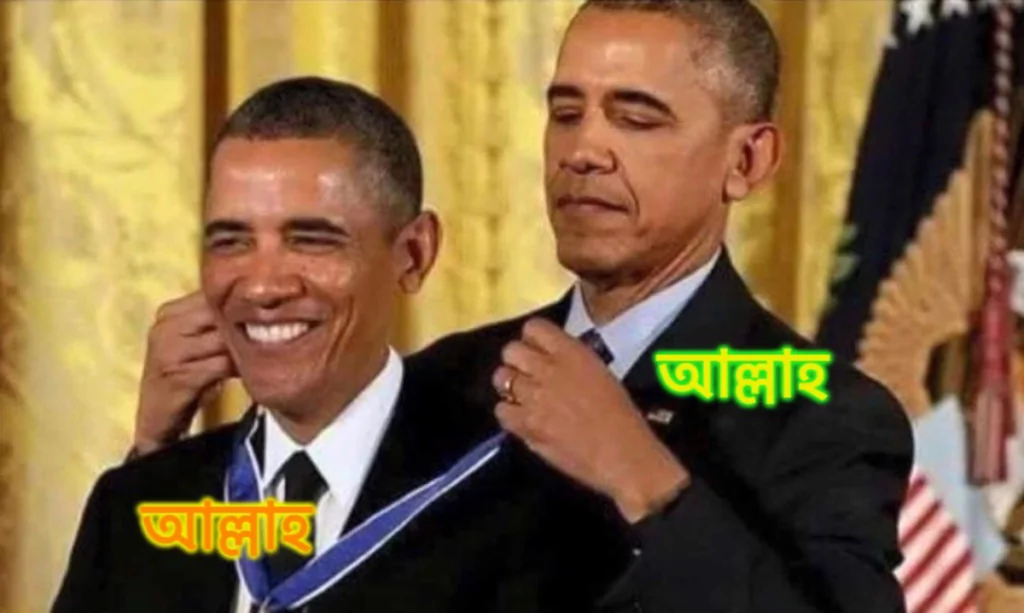
From the standpoint of logic, this kind of challenge is utterly ridiculous and empty. Because when, immediately after issuing the challenge, the challenger himself assumes the roles of judge, referee, and winner, it is no longer a challenge—but a symbol of self-declared supremacy. It is like saying: “I cannot be wrong, because I have said that I am not wrong.” In logic, this behavior falls under the fallacies known as Circular Reasoning and Begging the Question, where one’s own statement is presented as proof without offering evidence. Thus it can be said that this kind of challenge is not really an invitation to a test, but a strategy for establishing a form of self-protective authority, where questioning is treated as insult, and failure is met with hellfire—thereby blocking the path of reason through fear.
The Criteria for Being Similar to the Quran
The challenge to compose something like the Quran stands, in the Quran’s own language, on vague and undefined criteria. An important distinction must be maintained here: the criteria are not clear in the Quranic verses, but later Islamic scholars tried to construct criteria. In particular, scholars such as al-Baqillani and Abd al-Qahir al-Jurjani sought to explain the Quran’s i‘jaz not merely as a matter of general beauty or rhythm, but in light of linguistic structure, density of meaning, syntax, balaghah, contextuality, and nazm. But here lies the central problem: these may be literary-theoretical explanations, or frameworks of religious taste, but they are not criteria that can be measured in a neutral laboratory. Which arrangement is “miraculous,” which density of meaning is “beyond human capacity,” which balaghah is “unsurpassable”—all of these ultimately depend on the judge’s taste, training, belief, and linguistic formation. Thus, despite attempts at criteria, the challenge does not become objective or falsifiable. The important question is: what is meant by “like it”? In the Quran, no guidance has been given from Allah Pak regarding what is meant here by being like the Quran. Various Muslims may offer various different opinions about what “like the Quran” actually means. But the one who issued the challenge bears the responsibility of specifying the criteria of that challenge; if later devotee-interpreters come and set up the goalposts, those do not become the original conditions of the challenge. If some third party wishes to explain the criteria of the challenge, that cannot in any way be considered the criteria of the challenge itself. On what matter or matters, then, will the criteria of this challenge rest?
Nazm Theory: Criteria Exist, but Testability Does Not
Abd al-Qahir al-Jurjani’s theory of nazm is one of the strongest classical versions of the discussion of i‘jaz. According to this theory, the Quran’s miraculousness lies not merely in the beauty of words, but in the perfect relationship among words, grammar, meaning, syntax, context, and purpose. In other words, it is not enough for a word to be beautiful in isolation; where it is placed inside the sentence, what semantic pressure it creates, what relationship it establishes before and after, and how it carries the structure of the entire statement—this whole arrangement is nazm. From this perspective, al-Jurjani’s theory is more refined than the simple claim that “Arabic is beautiful, therefore miraculous”—but refinement does not automatically make something proof. Often, when a weak claim is dressed in more complex language, it appears profound; but appearing profound and being proven true are not the same thing.
But this refinement does not make the claim testable. To judge nazm, the judge must determine which word arrangement is truly unique, which density of meaning has exceeded human limits, which sentence structure is inimitable, and which ornamentation is merely skilled literature. There is no measurable scale for these things. There is no neutral metric of the sort: “This sentence has 87% density of meaning, therefore it is miraculous.” As a result, judgment ultimately depends on a judge trained in Arabic balaghah, often a believer, and one who already accepts the divine status of the Quran. In this situation, even if criteria exist, they effectively become subjective judge-dependent.
The greater problem is that there is no real path of falsification for this criterion. If someone produces strong writing in a Quranic mold, it can be said: “It does not have nazm”; if someone produces different but profound literature, it can be said: “This is not like the Quran”; if someone writes in a linguistically complex way, it can be said: “This is artificial”; if someone writes simply yet with density of meaning, it can be said: “It lacks divine gravity.” In other words, although nazm theory provides a kind of sophisticated rhetoric in favor of the Quran, it does not offer any test whose result could show the claim of the Quran’s i‘jaz to be false. It is therefore important as a literary-theoretical explanation, but weak as objective proof of divine origin.
Can Human Beings Set the Standard for the Quran?
If it is said that no one can compose anything like the Quran, the first question that arises is: who will determine the standard for whether something is or is not “like” it? Who will play the role of judge in this matter? Ordinary Muslims? A linguist? A believer? But each of them is limited, biased, and likely to disagree with the perspectives of others. What one Muslim scholar calls “not like the Quran,” a humanist writer may regard as more elevated. For instance, if someone says, “It is unethical to call anyone inferior on the basis of religion,” then when comparing Surah 98:6 (“…they are the worst of creatures”) with a humane verse written by a rationalist author (“All human beings are equal; do not create division through religion”), is deciding which of the two is superior not beyond the limits of human judgment? To judge this impartially would require a being who is neutral, supernatural, and possessed of complete knowledge. Thus, in this challenge between Allah and the atheist, yet another neutral being would be needed, one capable of conducting the process of judgment with complete impartiality.
In this context, the question arises: if the Quran is the word of Allah, can human beings determine the standard for this challenge? That standard ought to have been defined clearly and flawlessly by Allah Himself. Yet although the Quran issues this challenge, nowhere does it clearly specify the measure of “comparability,” the process of judgment, or the criteria of acceptability. It does not even state the qualifications of those who would evaluate it. Therefore, in the end, no other human opinion can be acceptable here. The religious claim is that because human knowledge is limited, human beings do not understand many divine matters. By that logic, how is it possible to determine the standard of Allah’s Quran with limited human knowledge? And even if that is done, there is no guarantee that Allah would accept it. Suppose a Quran is written according to some human standard; another Muslim may then come along and say that those Muslims are not authentic Muslims. What then? Do all Muslims agree that those standards are the standards for all of them? And if the claim comes from Allah, then to preserve the meaningfulness of this challenge, Allah Himself ought to have stated clearly: “If these specific features are fulfilled, it will be considered like the Quran, and it must be verified by these neutral judges.” But in the absence of any such definition or method, the entire challenge becomes a one-sided, indeterminate, and essentially self-declared strategy.
The Consent of Both Sides Regarding the Standard or Rules of the Game
The foundational value of any competition or debate is a level playing field, where the rules of the game are determined by the consent of both sides, and a third party applies those rules and conducts the judgment impartially. For example, when two teams compete in a game, the rules are not made by any of the players. Rather, those rules are set by an independent regulatory body or neutral referee, so that both sides can compete fairly. But in this so-called “comparability challenge” of the Quran, even this minimum ethical requirement has not been observed. Here Allah Himself is the player, He is also the referee, and He has already declared in advance that He has won. Whatever else such a situation may be, it cannot be called a challenge or a competition; rather, it is merely a tactic for imposing a one-sided verdict.
The most important matter in this process has been ignored: the consent and opinion of both sides regarding the rules of the game. If the rules of the game are one-sided, and under those rules one competitor simply tells the other side, “Play by these rules, and lose,” then that is not really a competition; rather, it is an expression of insecure, authoritarian thinking. In the game of reason, fairness means sitting together and creating rules with the consent of the players; if that is violated, the legitimacy of the entire game comes into question. The Quranic challenge, therefore, is not truly a rational invitation, but a kind of belief-dependent cage of claims, where objection becomes blasphemy and questioning is punished with hell. In this way, the ethical foundation of the game disappears, and the claim becomes a blind reflection of inviolable, singular authority.
How Neutral Is the Claim That Ancient Arab Poets Failed?
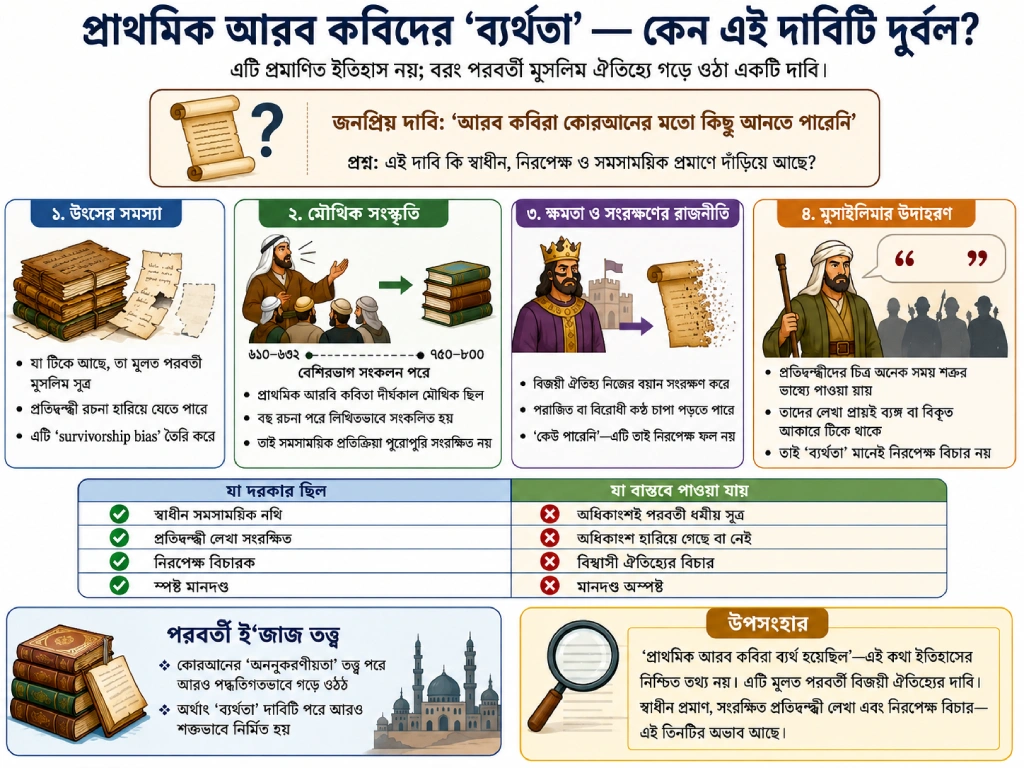
The claim that early Arab poets and orators “failed” in response to the Quranic challenge is very popular in Islamic discourse. But from a historical perspective, this claim is not a directly proven event. The reason is that there are almost no independent, neutral, contemporary, and oppositional sources in its favor. Most of the narratives we possess have come through later Muslim tradition. In the Muslim society of that period, the idea of the Quran’s iʿjāz, or inimitability, had already become established as a religious truth. As a result, the statement that “no one could bring anything like the Quran” is not the outcome of a neutral literary competition; rather, it is a memory and interpretation produced by the victorious religious-political tradition itself.
The first problem here is that which writings survive in history and which writings disappear is not always determined neutrally. Whether the writings of those who attempted to produce something similar to the Quran, or who created rival religious discourses, were preserved at all is something we do not know with certainty. Even if they were preserved, whether they survived in their authentic form, or whether later Muslim writers quoted them in mocking, distorted, or derogatory language, is also a major question. This problem may be called “the bias of surviving sources”; that is, only the sources that survived within the victorious tradition are treated as evidence. But the absence of rival voices that were lost, destroyed, or not preserved cannot be called “proof of failure.”
The same problem appears in the case of pre-Islamic Arabic poetry. In ancient Arab society, poetry was primarily part of an oral culture. Poets recited poems, listeners transmitted them orally, and many works were not preserved in written form for a long time. Suzanne Stetkevych has shown that Jāhili and early Arabic poetry was fundamentally dependent on oral composition and performance; these works began to be compiled in written form on a large scale in the second and third Islamic centuries, approximately 750–800 CE [4]. In other words, regarding the responses of Arab poets contemporary with Muhammad, we do not have direct neutral documents from that very period; rather, we depend on memories transmitted through later Muslim compilations, chains of transmitters, and religious-political selection.
The second problem is the imbalance of power. During the weaker Meccan phase, if someone mocked the Quran, imitated it, composed rival revelations, or produced an alternative religious statement in narrative language, it is not realistic to expect that all such writings would have been independently preserved under the post-Medinan Islamic state. Under the Ridda wars, the suppression of rival claimants to prophethood, and the later ideology of the caliphate, the victorious side became the principal narrator of history after killing the “so-called enemies” of Islam in the name of suppressing them. Thus, it is entirely natural that the writings of defeated or oppositional voices would disappear, be destroyed, or survive only in distorted form in the language of their enemies.
The example of Musaylima is especially important here. In Muslim tradition he is presented as “Musaylima al-Kadhdhab,” or “Musaylima the Liar.” His alleged utterances are also often quoted in ridiculous, childish, or distorted forms. But in most cases these accounts come from the sources of his opponents and enemies. Al Makin has shown that Musaylima’s image in Muslim literature was constructed primarily as an enemy-image; that is, the victorious tradition arranged his character, claims, and utterances in the way it wished to see him. For writers such as Ibn Taymiyya, Ibn Kathir, and Darwaza, his claim to prophethood was completely false; yet in different readings by figures such as al-Masʿūdī, Ibn Qutayba, al-Farabi, Ibn Sina, Ibn Khaldun, and Jawad Ali, Musaylima can be understood within the broader context of Arab culture, tribal religious authority, and rival prophetic politics [5]. Therefore, it is not reasonable to call Musaylima’s alleged “failure” the result of neutral literary judgment; rather, it may also be a satirical rewriting of a defeated rival by the victorious side.
The third problem is that the doctrine of the Quran’s iʿjāz, or inimitability, was not itself established in a fully clear and systematic form in the earliest period. It developed as a more organized theory in the later Abbasid intellectual environment. Hans-Peter Pökel has shown that iʿjāz al-Qurʾān—that is, the inimitability of the Quran—is a later technical term whose development occurred especially in the context of the social, political, theological, and interreligious debates of the Abbasid period. Although the Quranic challenge verses appear as responses to Meccan critics, the Quran itself does not directly answer whether anyone fulfilled that challenge; rather, later Muslim scholars discussed the nature, limits, and interpretation of this challenge in detail [6].
This point is extremely important. If the Quranic challenge had already been conclusively settled in Muhammad’s own time through a public, neutral, and linguistic test, then there would have been no need to construct such complex theoretical explanations in later centuries. The ṣarfah theory, balāghah-based judgment, philosophical debates over divine miracle versus human language—these would not have acquired such importance later. Rather, what we see is that the claim “the Arab poets failed” is itself a defensive conclusion of later iʿjāz theory. It is not an independently verifiable historical fact.
The fourth problem is the bias of the judge. Suppose a poet or orator truly did compose something similar to the Quran. Who would determine whether it had succeeded? If the judges were those Muslim scholars who had already assumed the Quran to be the speech of Allah and impossible for human beings to imitate, then that could not be neutral literary judgment. It would instead be a judicial system in which the outcome had already been determined. If someone wrote like the Quran, it would be said that he had copied it; and if he wrote differently, it would be said that it was not like the Quran. Thus, no clear path to success was left open.
Therefore, the claim that “the early Arab poets failed” actually rests on three unproven assumptions. First, it is assumed that all of them truly accepted the challenge freely and neutrally. Second, it is assumed that all their attempts were faithfully preserved. Third, it is assumed that their failure was determined by some neutral literary standard. From a historical perspective, none of these three is firmly established. Rather, the cautious conclusion should be this: Muslim tradition claims that Arab poets and rivals could not bring anything like the Quran; but in support of this claim we do not possess independent contemporary literary documents, a neutral process of judgment, a preserved corpus of rival compositions, or an effective standard; what we have is predetermined evaluation. Therefore, it is logically unacceptable to call this alleged “failure” proof of divine origin. The most that can be said is that the victorious Islamic tradition declared its own scripture unsurpassable, while defeated or excluded rival voices vanished to the margins of history.
The Arabic Language and Grammar: A Game of Politics and Religion
To understand the Quran’s challenge to “compose a surah similar to it,” the structural history of the Arabic language and grammar is also essential. But it would not be right to oversimplify the matter. Arabic grammar was not made solely from the Quran; Sibawayh’s al-Kitāb, the work of the grammarians of Basra and Kufa, Jāhili poetry, the spoken language of the Bedouins, the Quran, and the qirāʾāt—all together formed the repository of grammatical shawāhid, or linguistic evidence. Early grammarians accepted pre-Islamic poetry and the usage of Bedouin Arabic as important evidence for establishing the rules of the language. Therefore, saying that “grammar came only from the Quran” is historically incomplete. Rather, the correct criticism is this: although the raw material of grammar came from many sources, through later theological canonization the Quran was gradually turned into the highest and almost unquestionable standard of the Arabic language, balāghah, and rhetoric. The circle therefore works in a more subtle way. In the first stage, grammarians used the Quran, qirāʾāt, Jāhili poetry, and Bedouin language—all of them—as shawāhid. But in the second stage, theological interpretation established the Quran not merely as an important linguistic source, but as the supreme judge of language. Thus, if a Quranic construction agrees with conventional qiyās or the rules of Jāhili poetry, it is said: “See, the Quran is the finest model of pure Arabic.” And if a construction seems unusual, it is not called an error; it is said: “Even if it is shādh, it is possible in the Quran,” “it is rhetoric,” “it is iltifāt,” “there is an implied word here,” or “divine language cannot be judged by ordinary human grammar.” This is precisely where grammatical discussion turns into theological circularity: when the Quran agrees, it is the best proof of Arabic; when it does not, that very fact becomes a miracle surpassing the limits of Arabic. In other words, whatever the outcome, the verdict is the same: the Quran has won. This is not linguistics; it is an arrangement of interpretation in favor of a verdict already written. Moreover, against the early claim that the Quran was revealed in “seven dialects,” Caliph Uthman turned a single “Uthmanic mushaf” into the state standard and undertook the destruction of different mushafs—meaning that a specific textual version became standardized through political power. That standard text was then made the center of linguistic correctness, the challenge, and “inimitability.” In other words, the problem is not the simple claim that “grammar came from the Quran”; rather, it is the theological transformation of the Quran into the final judge over a multilingual and multi-sourced linguistic tradition. A visual diagram and detailed example of this theological circularity between Arabic grammar and the Quran are given here; for a more detailed analysis of the sources of Arabic grammar, Uthmanic standardization, the seven qirāʾāt, and related issues, one may consult the separate article [7].
There are signs of this tension within early grammatical practice itself. Regarding the iʿrāb of some Quranic readings or qirāʾāt, grammarians at times offered evaluations such as “weak,” “not preferable,” “shādh qiyāsan,” or exceptional when judged by rule. As an example, in some explanations by al-Farrāʾ, researchers have taken remarks of the لا أشتهيه type as indications of weakness; again, in later discussions, scholars such as Qastallani also acknowledge that a construction may be shādh according to qiyās, while its presence in the Quran remains undeniable. In other words, the relationship between the language of the Quran and Arabic grammar was never linear from the beginning; rather, it was formed through conflicts among linguistics, qirāʾāt, religious authority, and canonization. This reality does not weaken the argument of the article; rather, it strengthens it, because it shows that the later position that “the Quran is the final standard” is itself historically constructed.
It is assumed from the outset that the purest and most authoritative form of the Arabic language is the language of the Quran. The final reference for what the rules of language will be is already fixed: the Quran cannot be wrong—this is a prior assumption.
The core rules of Arabic grammar were compiled by taking the Quran’s sentence structure, iʿrāb, pronouns, verb forms, and some poetry as evidence. In other words, the raw material of grammar also came from the same Quran that had already been assumed to be flawless.
It is then said that, in light of these rules of Arabic grammar, there is no grammatical error in the Quran. That is, rules were made from the Quran, and by those same rules the Quran was again declared flawless.
When an example from the Quran does not match ordinary grammatical rules, it is not called an error; instead, new theories are added—“iltifāt,” “balāghah,” “implied word,” “exception,” and so on— so that in every situation the Quran can ultimately be maintained as correct.
First, the Quran, qirāʾāt, Jāhili poetry, and Bedouin language together form the grammatical shawāhid → later, through theological canonization, the Quran is made the highest and unquestionable standard of language → then the superiority of the Quran is again proved by that very standard → where it does not match ordinary qiyās, it is called not an error, but rhetoric, exception, shādh qiyās, iltifāt, or a special feature of divine language. Since both the beginning and the end of the argument remain trapped in the same assumption, the entire structure becomes a closed circular logic.
The Question of the Judge’s Impartiality and Competence
A fundamental condition for assessing any challenge, controversy, or claim is the presence of an impartial and competent judge, someone who can consider the statements, evidence, and arguments of both sides and reach a decision on the basis of truth and justice. If the Qur’an’s claim is, “No one will be able to produce anything like this book,” then determining the validity of that claim requires a judge with sufficient courage, rational judgment, and moral firmness to place Allah Himself in the dock of reason. Such a judge would adjudicate in a way that gives both the Qur’an-supporting claim and its opponent an equal opportunity to defend themselves, while the judge independently examines everything by the standards of reasoning, literary quality, humaneness, and logical coherence.
But in reality, no such judge can exist. For if he is truly impartial, this judge must have not only the right to question the word of Allah, but also the right to reject it. Yet possessing such a right means that he is a being higher than Allah. For if someone’s words can be put on trial, the judge must necessarily possess moral and intellectual authority over that person. Yet according to Islam, Allah is supreme, unquestionable, and all-knowing. Thus, if anyone assumes the responsibility of determining the correctness of Allah’s word, then he himself would have to be superior to that claimed supreme being. This is a trap of faulty reasoning: those who might have judged become “unqualified” because of their belief in Islam; and those who are “qualified” become, in Muslim eyes, unbelievers, blasphemers, deserving of death, and above all part of a conspiracy of Jews, Christians, and atheists!
In this situation, the Qur’an’s “make a comparison” challenge ultimately remains nothing more than a biased, one-sided, and self-protective declaration: there is no judge, no judicial process, only an inviolable authoritarian claim. This claim does not seek judgment in the language of reason; rather, it demands prostration through the eyes of faith.
The Challenge of Composing Music Like Rabindra Sangeet
Suppose a group of devotees of Rabindranath claimed that the Rabindra Sangeet written by Rabindranath Tagore is such a unique, incomparable, and inimitable artistic tradition that no human being could ever write a new song like it. Even if all the poets, all the composers, all the linguists, and all the musicians of the world came together, they could not compose an original song equal to Rabindra Sangeet. Then, from this claim, they drew an even larger conclusion: since no one can write songs like Rabindranath, Rabindranath possessed miraculous power, even a divine status. The question now is: how would we test this claim?
The first problem would arise over the meaning of the phrase “like Rabindra Sangeet.” What is meant by “like Rabindra Sangeet”? The use of Sanskrit-derived vocabulary? Brahmo and Upanishadic themes? A blended aesthetic of nature, worship, love, and humanity? A melody based on particular ragas? Rabindranathian rhythm and rhyme? A melancholy yet luminous spirituality? Or Rabindranath’s historical personality, lived experience, linguistic signature, time, and culture as a combined singularity? If there are no clear criteria for these things, then the claim “like Rabindra Sangeet” is not really a testable literary claim; it is an ambiguous declaration of taste expressed in the language of devotion.
Now imagine that a skilled poet and composer writes a new song by following Rabindranath’s linguistic style, melodic flow, thematic world, ornamentation, imagery of nature, sense of spiritual sorrow, and human emotion. A devotee of Rabindranath serving as judge could then easily say: “No, this does not have Rabindranath’s soul. The words are there, the atmosphere is there, but there is no life.” If asked what he means by “life,” he might say: “This is a matter of feeling; to understand it, one must carry Rabindranath in one’s heart.” At that point, the judgment no longer remains literary; it becomes an invisible court of devotion, where the verdict has already been decided.
Again, if someone imitates Rabindranath’s rhythm, word choice, lyrical structure, depth of feeling, and musical character so perfectly that it truly sounds like Rabindra Sangeet, the same devotee-judge will say: “But this is imitation. You have copied Rabindranath. Where is the originality?” In other words, if the writing is not like Rabindranath, it fails; and if it is like Rabindranath, it is imitation. In this two-sided trap of judgment, the competitor can never win. For the criteria have been designed in such a way that every path to failure is open, but there is no real door to success.
It is precisely here that the logical weakness of the Qur’an’s “bring a surah like it” challenge becomes visible. What is meant by “like the Qur’an”? The gravity of Arabic? Rhythmic prose? Ornamentation? Moral instruction? Legal rulings? The language of fear? Threats concerning the afterlife? Historical influence? Emotional resonance? Or the feeling of sanctity produced in the believer’s mind? If the criteria for being “like” it are not clear, then the challenge is not a neutral test; it is a religious claim of taste whose judges have already assumed that the Qur’an is inimitable.
Suppose someone composed an ayah-like passage on the basis of humaneness, equality, reason, and moral courage: “Surely there is no superiority among human beings on account of religion, nation, gender, or birth; the person who protects another’s freedom, life, and dignity is the better one.” A Muslim believer could very easily say: “This is not like the Qur’an.” Why is it not? The answer would come: “It does not contain the Qur’an’s balaghah, its weight, its divine gravity, or its Arabic ornamentation.” Again, if someone imitates the Qur’anic mold, Arabic sound, ayah structure, oaths, fear, reward, punishment, repetition, and prose-rhythm, then it will be said: “This is just a copy; it is not original.” In other words, the judge will keep changing the criteria according to his need.
This kind of challenge comes close to what in logic is called an unfalsifiable claim. For the claim is arranged in such a way that any possible answer can be dismissed. If it is different, it will be called “not similar”; if it resembles too closely, it will be called “imitation”; if it is morally superior, it will be said to lack “Qur’anic balaghah”; if it is linguistically powerful, it will be said to lack “divine depth”; if the judge wants, he will say, “You do not know Arabic”; and if you do know Arabic, he will say, “You did not understand it with your heart.” Thus, the outcome of the challenge does not depend on the test; it depends on the believer’s capacity to deny.
Here one may conduct a counter thought experiment. According to Islamic belief, Allah is omnipotent. Then let us, on behalf of the rationalists, issue a challenge: let Allah compose a new Rabindra Sangeet in the style of Rabindranath. Then we, as atheist and Rabindranath-loving judges, will examine it. But we announce in advance that whatever song comes, we will not accept it. We will say, “It has copied Rabindranath’s words, but it lacks Rabindranath’s soul.” If the song is very different, we will say, “This is not Rabindra Sangeet.” If it is very close, we will say, “This is imitation.” If it is philosophical, we will say, “It lacks Rabindranath’s humane tenderness.” If it is emotional, we will say, “This is not Rabindranathian; it is sentimental imitation.” How, then, will Muslims prove that Allah is capable of writing songs like Rabindranath?
The purpose of this thought experiment is not to turn Rabindranath into God, but to expose the hypocrisy of the judging process. If the judges have already decided that no answer will be acceptable, then the challenge is meaningless. If the judge treats his own taste, devotion, prior belief, and invisible criteria as final truth, then the competitor has no real opportunity. However well he writes, his work will be declared a failure; because the failure is not inside the text, it has already been written in the judge’s mind.
The example of Rabindra Sangeet also clarifies another important point. An artist’s style may be unique, but uniqueness is not proof of the miraculous. A second Rabindranath like Rabindranath is not possible, because every creator’s history, language, experience, time, culture, and creative process are different. But this does not mean that no one else can create art equal to Rabindranath’s, or even stronger than his. Jibanananda Das is not like Rabindranath, but the world of his poetry is unique at its own height. Nazrul is not Rabindranath, but his melody, rebellion, movement, and vocal force created a different height. Shakespeare is unique, but to claim that Dostoevsky, Tolstoy, or Goethe are not unique would be foolish. Uniqueness does not mean inimitable divinity; often it is simply the result of personal style, historical context, and cultural influence.
The same applies to the Qur’an. The language of the Qur’an created a distinctive style within the specific context of seventh-century Arabia’s religious, poetic, oral, legal, and tribal culture. That style may be historically influential, literarily powerful, and sacred to the believer. But a text does not become divine simply because it is historically influential or stylistically distinct. Homer’s epics, the Upanishads, the Bible, Dante’s Divine Comedy, Shakespeare’s plays, Rabindranath’s songs: all are unique within their own historical and linguistic worlds. But we call them unique; we do not call them the direct word of God merely because they are unique.
Thus, the claim that “nothing like the Qur’an can be composed” is less a literary claim than a claim of faith-based authority. Hidden within it is a simple but powerful self-protective strategy: “Whatever you bring, I will not accept it.” I accept judgment, provided the verdict remains mine. Under this logic, no claim remains falsifiable. No writing will be acceptable, because the criteria of acceptability are not in the judge’s hands; they are imprisoned inside the judge’s faith.
In a genuine challenge, the conditions of success are stated in advance. What the opponent must do to win, what would refute the claim, by which criteria it will be judged, and who the judges will be: all of this is made clear. But in the Qur’an’s challenge, none of these exists. There is only a claim, devotion, a predetermined outcome, and infinite opportunities to declare the opponent a failure. As a result, it is not a free intellectual competition; rather, it is a self-sealing claim: a claim sealed in such a way that no path to refutation has been left inside it. And a claim that allows no possibility of refutation does not live in the field of knowledge, but in the fortress of faith.
Sing Like Arijit Singh — A Comparison
This argument can be seen even more briefly through the example of Arijit Singh. If someone says, “Sing like Arijit Singh; if you cannot, that will prove his voice is divine,” then the first question will be: what is meant by “like Arijit”? If someone copies him exactly, it will be dismissed as mimicry; if someone sings beautifully in a different way, it will be said, “But this is not like Arijit.” Thus, from the beginning, the challenge is arranged in such a way that the competitor has no real route to success. The same structure operates in the Qur’an’s challenge: if one imitates the Qur’anic mode, it is called “copying”; if one offers a different yet powerful piece of writing, it is called “not like the Qur’an”; if it is morally superior, it is said to lack “balaghah”; if it is linguistically complex, it is said to lack “divine gravity.” Therefore, this is not a neutral challenge; it is a kind of Catch-22 or predefined failure trap. The diagram below gives a visual summary of this argument.
the challenger will always lose
The Fallacy of Inimitability and Claims of Divinity
Imagine that someone were to make a very serious claim: “If no one on earth can sing like Arijit Singh, then it will be proven that Arijit Singh himself is God, or at least an avatar.” At first, this may sound amusing, but from the standpoint of logic it is in fact a serious fallacy. The fact that a person’s voice, artistry, melody, poetry, or writing is unique, or that it is extremely difficult to imitate, proves only that the artist or writer is exceptionally gifted, that his style and skill lie beyond ordinary reach, and that his work emerged within a particular historical, cultural, and personal context. But from there, the additional claim of a “divine source” or “proof of divinity” is an entirely separate leap—it is a non sequitur, a fallacy in which the conclusion does not logically follow from the premise. If someone spends an entire lifetime trying and still cannot properly imitate Arijit Singh’s voice, the most we can say is that Arijit’s voice is unique, very difficult, rare; but to say “therefore he is God” means throwing logic aside entirely and placing emotion and belief in the position of evidence.
The claim of the Quran’s “incomparability” is essentially a copycat version of this Arijit Singh example. There it is said: “If you cannot compose a surah like the Quran, then you must accept that it is the word of Allah.” But the same kind of fallacy is operating here. First, literary inimitability or uniqueness can never serve as objective proof that a text is “God-given.” There are countless literary works in the world whose style, language, history, and context are so distinctive that exact imitation is almost impossible—but we do not thereby declare them to be “written by God.” Second, what exactly is meant by “like the Quran”—language, rhythm, poetry, meaning, morality, depth of knowledge, or an Arabic Bedouin style? This criterion is not clearly defined in the Quran; rather, it is left entirely to the subjective taste and prior belief of the believer, which, from the standpoint of logic, is a subjective criteria fallacy. Third, those who sit in the role of judge have often already accepted the Quran as “miraculous,” “incomparable,” and “God-given”; as a result, they are not psychologically prepared to acknowledge any alternative text as equal or superior. In other words, judgment and conclusion are proceeding in reverse order: first, the conclusion is adopted that the Quran is the word of Allah, and then “inimitability” or the “challenge” is used as evidence in support of that predetermined conclusion. This is clear circular reasoning: “The Quran is the word of Allah because no one has been able to write anything like it; and no one can write anything like it because it is the word of Allah.” Through the example of Arijit Singh’s voice, we can understand that just as an artist’s inimitable talent does not make him God, the literary or poetic uniqueness of a book does not automatically make it God-given; between the two lies an entire logical gap, for which the religious side offers no objective evidence capable of filling it.
The larger problem is that, even if atheists or critics were to assume for the sake of argument that “fine, in whatever sense you intend, no one will be able to write a surah like the Quran”, it still would not be logically valid to draw the conclusion “therefore it is the word of Allah,” because many other possible explanations remain in between, and these are deliberately excluded. For example, the Quran could be the joint creation of one or more gifted Arab writers; or it could be the highest expression of the rhetoric, poetry, and religious language of that period; or it could be a powerful form of propagandistic religious literature produced to legitimize the political and military expansion of Arab society. Setting aside these real and natural explanations and restricting the issue to only two alternatives—1) no one could imitate it → therefore it is the word of Allah, or 2) if someone can imitate it, only then is it not the word of Allah—is a false dichotomy. Whether it is Arijit Singh, Rabindranath, or the Quran itself, the “inimitability” of any text or artwork can never be a scientific, philosophical, or logical criterion for proving “divinity” or a “divine origin”; at most, it is a faith-based claim, which collapses the moment one tries to present it in the language of reason.
Fear of Imprisonment on Charges of Terrorism
When discussing the Quran’s “bring a surah like it” type of challenge, another harsh reality comes into view, one that is not merely rhetorical flourish or mental gymnastics, but a real political and legal risk. There are many surahs and verses in the Quran where language is used about directly fighting unbelievers, polytheists, the People of the Book, or “those who commit kufr,” killing them, besieging them, and taking their property, women, and children as spoils of war. However much modern apologist Islamists explain these away as “context,” “defensive war,” “only that specific age,” and so on, as texts they are unquestionably violent, divisive, and couched in the language of group-based hatred. At least when read literally, those verses are unutterable in a civilized society. In the modern age, various jihadi groups, Islamic terrorist organizations, and radical Islamists openly draw incitement and inspiration from these verses to legitimize their violence and terrorism; they believe that killing those whom the Quran calls “kafirs,” striking the necks of enemies, and taking women and children captive are, in fact, commands from Allah.
For example, in Surah Tawbah 9:5 we see—“Then, when the sacred months have passed, kill the polytheists wherever you find them, capture them, besiege them, and lie in wait for them at every place…”; in Surah Tawbah 9:29 it is said—“Fight those who do not believe in Allah and the Last Day, who do not regard as forbidden what Allah and His Messenger have forbidden, and who do not adopt the religion of truth as their religion, until they pay the jizya and submit in humiliation”; in Surah Anfal 8:12 there is—“I shall cast terror into the hearts of the disbelievers, so strike them upon the necks and strike every joint of their fingers”; in Surah Muhammad 47:4 it is said—“So when you meet the disbelievers, strike their necks, until, when you have inflicted great slaughter upon them, bind them firmly…”; in Surah Ahzab 33:26–27, regarding the Banu Qurayza Jews, it says—“He brought down those among the People of the Book who supported them from their fortresses and cast terror into their hearts; one group of them you killed, and one group you took captive… He made you inherit their land, their homes, and their wealth.” However much one may wish to explain these verses in historical context, to the open eye they clearly legitimize violence, war, and mass killing against a group of people on the basis of religion—there is no way to deny this.
Now the central question is this: if an atheist, a humanist, or some secular writer were today to “imitate” the structure, form, and language of these war-verses of the Quran—but reverse the target group and put “Muslims” in that place—what would happen? Suppose, for example, someone followed the language of Surah Tawbah and composed an imaginary “Second Tawbah,” writing there—
Therefore, when the safe period has ended, kill Muslims wherever you find them, arrest them, surround them, and lie in wait for them everywhere, because they spread superstition on the earth;
Or if someone wrote in the style of Surah Anfal—
I shall cast terror into the hearts of Muslims; therefore, strike the necks of those who regard Islam as the true religion;
Or, in place of Surah 9:29, wrote—
Fight those who do not accept modern human rights, who deny women equal rights, and who regard freedom of expression as an enemy, until they surrender to the principles of human rights
—then such writing, leaving aside any Muslim-majority country, would be seen even in Europe, America, or Germany as “hate speech,” “incitement to violence,” “racism,” “spreading religious hatred,” and even “incitement to terrorism.” If a complaint were made to the police, the writer could easily be charged under hate-crime laws, Volksverhetzung, or similar statutes; his book or post could be banned, removed from social media, and he could receive continuous threats from different sections of society. In other words, if you truly “imitate” the language and style of the Quran’s war-verses and merely change the target group, then far from being treated as a “response to a literary challenge,” there is a strong possibility that you yourself would be identified as someone promoting terrorism.
This is where the hypocrisy of the entire challenge becomes apparent. When it is written inside the Quran, “kill the kafirs wherever you find them”, “fight those who do not obey Allah and the Messenger”, “kill one group of Jews and take another group captive”, it is praised and defended as “divinely given instruction”, “the ordinance of jihad”, “historical context”, “establishing the superiority of the religion”, and so forth. But if, using the same sentence-structure and the same kind of war mentality, you write an imaginary surah only against “Muslims”—for example, “wherever you find those who belittle other religions and ideologies, confront them with questions,” or in a harsher version, “wherever you find radical Islamists, put them in the dock of justice so that they can no longer violate anyone’s rights”—then by the standards of modern law and ethics it would be counted as incitement to terrorism, hate speech, and provocation to violence. From the perspective of the legal framework, it would be seen as follows: you are using the language of violence while targeting a specific religious group. Yet the Quran has done the same thing using labels such as “kafir,” “polytheist,” and “People of the Book”—which the religious side wants to protect as a “holy book.” In other words, when the same kind of language and violence appears in the Quran, it is a “miraculous command”; but when someone wants to reverse that language and write it against Muslims even merely as an example, it quickly becomes terrorism, racism, and a hate crime.
| Surah and Verse | The Quran’s Original Verse (Hatred/Qital Toward Non-Muslims) | A “Reversed” Version in the Same Pattern (If Turned Toward Muslims) |
|---|---|---|
|
9:5
Tawbah
|
Original Text “Then, when the sacred months have passed, kill the polytheists wherever you find them, capture them, besiege them, and lie in wait for them at every place…” |
If Written in Reverse “If someone today wrote in this way— ‘When the safe period has ended, kill Muslims wherever you find them, capture them, besiege them, and lie in wait for them everywhere’— then everyone would see it as jihadi hate speech and incitement to violence against Muslims, and under modern law it would be treated directly as hate speech and incitement to terrorism.” An immediate offense by legal and ethical standards
|
|
8:12
Anfal
|
Original Text “I shall cast terror into the hearts of the disbelievers, so strike them upon their necks and strike every joint of their fingers.” |
If Written in Reverse “If someone wrote in reverse language— ‘We shall cast terror into the hearts of Muslims; therefore strike their necks and break the joints of their fingers’— it would be one of the starkest examples of a hate crime against Muslims, for which the writer would surely be charged with incitement to violence and possible terrorist propaganda.” |
|
9:29
Tawbah
|
Original Text “Those who do not believe in Allah and the Last Day, do not regard as forbidden what Allah and the Messenger have forbidden, and do not adopt the religion of truth as their religion— fight them until they pay the jizya and submit in humiliation.” |
If Written in Reverse “If someone today wrote— ‘Fight those who do not accept Islamic sharia, who do not adopt the doctrine of the Muslim ummah as religion, until they pay a special tax and surrender in a humiliated state’— then it would clearly be counted as a call to establish discrimination, oppression, and forced domination over Muslims, something prohibited by both modern human rights and law.” |
|
47:4
Muhammad
|
Original Text “So when you meet the disbelievers face to face, strike their necks, until, when you have inflicted great slaughter, bind them firmly…” |
If Written in Reverse “If someone wrote the reverse in the same structure— ‘Whenever you meet Muslim fighters, strike their necks, and after causing widespread slaughter, bind them as captives’— it would become an open call for organized massacre against a specific religious group, for which the writer would be viewed even in the eyes of international law as a promoter of terrorist ideology.” |
|
33:26–27
Ahzab
|
Original Text “Those among the People of the Book who helped them (the Muslims), Allah brought them down from their fortresses and cast terror into their hearts; one group of them you killed and one group you took captive… He made you inherit their land, their homes, and their wealth…” |
If Written in Reverse “If someone, instead of speaking historically, wrote today— ‘Those who help Muslim extremists, bring them down from their fortresses, kill one group of them, take another group captive, and make their homes and property the possession of the victorious army’— then it would be regarded as a direct call for ethnic cleansing, looting, and genocide against the Muslim community, and would fall under war crimes even before an international tribunal.” |
|
2:191
Baqarah
|
Original Text “Kill them wherever you find them, and expel them from wherever they expelled you; fitna (religious disorder) is more serious than killing…” |
If Written in Reverse “If someone reversed this language and wrote— ‘Wherever you find Muslim preachers or their supporters, attack them; expel them from wherever they expelled non-Muslims, because religious coercion is more serious than killing’— then it would be taken as a straightforward provocation to retaliatory nationalist or racist violence against Muslims.” |
|
5:33
Maidah
|
Original Text “Those who wage war against Allah and the Messenger and create fasad in the land, their punishment is— that they be killed, or crucified, or that their hands and feet be cut off from opposite sides, or that they be exiled from the land…” |
If Written in Reverse “If someone wrote in the same style— ‘Those who spread terrorism and fasad in the name of Islam should be punished by being killed, or crucified and hung up, or having their hands and feet cut off, or being exiled from their country’— then by modern standards this language would be seen as terrorist incitement in favor of cruel, torturous, and inhuman punishment, and the writer could be identified as an extremist supporting torture and extrajudicial killing.” |
|
98:6
Al-Bayyinah
|
Original Text “Indeed, those who disbelieve among the People of the Book and the polytheists will remain in the fire of Hell, abiding there forever; they are the worst of creation.” |
If Written in Reverse “If someone today wrote— ‘Those who are Muslim and regard Islam as the true religion will all be fuel for Hell and the worst creatures in creation’— then that would be direct hate speech against Muslims (dehumanization), punishable as hate speech under Western law and socially classifiable as part of a fascist mentality.” |
The whole purpose of showing this contrast is not to speak in favor of violence, but to demonstrate that if the Quran’s war-verses are truly to be judged by ethical and legal standards, many of them contain the sort of statements that, if any ordinary citizen wrote or circulated them publicly today, would fall under laws concerning terrorism and hate crimes. “Bring a surah like the Quran”—this challenge is therefore, in practice, a deadly trap; because if you attempt genuine imitation, especially in the case of those verses that promote killing in war, spoils, and extreme hatred toward unbelievers, then all the material needed to send you to prison is already prepared. When the same language remains inside a religious scripture, it is holy; but when the same words are brought outside and turned against another side, they become a legal offense. Thus, on the one hand, this challenge is ridiculous from the standpoint of logic (because it has no workable standard, contains circular reasoning, and places the burden of proof on the opponent), and on the other hand, it is almost impossible to accept freely in the real world—because if you accept this challenge and attempt real imitation, you yourself will become a “writer accused of terrorism,” while the Quran’s original war-verses remain intact, unquestioned, and spared under the label of “holy.”
The Risk of Passing Every Standard
For the sake of argument, let us assume that a standard is established for what is meant by something comparable to the Qur’an, and that someone is able to write a surah far better than that standard. Even then, there would be a problem. Muslims would then say: the very ability to write such excellent verses or a surah was given to you by Allah. Allah Himself entered the depths of your mind and taught you this beautiful verse. Without Allah’s help, you could never have written it. Therefore, this proves that Allah exists, does it not? In other words, if you lose, you lose; and even if you win, you still lose.
List of the Logical Fallacies
Subjective Criteria Fallacy
All the standards involved in this Qur’anic claim are entirely relative (subjective) and governed by the judge’s personal viewpoint and preconceptions. For example, to a believer in Islam, a verse of the Qur’an is “God-given”, and therefore unquestionably moral and humane; by contrast, a humane and rational person may regard the same verse as immoral and hateful. To such a person, it may appear to be a brutal verse that creates divisions among human beings.
Example: Surah al-Bayyinah 98:6
“Indeed, those who disbelieved among the People of the Book and the polytheists will go to Hell, remaining there forever. They are the worst of creation.”
This verse states that merely because of a difference in belief, namely being an unbeliever or committing “kufr,” a group of people are “the worst of creation” and will remain in Hell eternally. This statement:
Now, in contrast to this verse, if a person with a rational and humane outlook were to compose the following verse:
“Indeed, there is no division among human beings; no one becomes superior or inferior because of religious belief. Do not discriminate on the basis of religion, race, or gender. The dignity of all human beings is equal. Wish happiness and peace for all living beings on earth. Indeed, human beings are creatures like other animals; therefore, regard other living beings too as kin of your own soul and give them love. Surely, those who can love are the noble ones, and those who do not love but only hate are the lowest of beings.”
This verse:
The question now is: which verse would not be considered superior, at least by the criterion of humaneness?
A Muslim would say: “No, the Qur’anic verse is superior,” because they believe that the language of the Qur’an is miraculous, its word choice is unique, and it is the word of Allah. At the same time, they may say that the language of the Qur’an is Arabic. On the other hand, a humane and rational person would say: “This humane verse is superior, because it contains love, equality, non-sectarianism, and compassion for all living beings. Far more important than language or rhythm is what the statement actually says.”
That is, “which one is superior” depends on the judge’s mental framework, moral outlook, and belief—which are, by definition, subjective factors. This is precisely why this Qur’anic challenge falls into the fallacy of subjective criteria.
The Nature of This Fallacy
If a criterion is not scientific, neutral, and verifiable—such as beauty, rhythm, or the grandeur of language—then claiming on the basis of that criterion that “no one will be able to produce anything like this” is meaningless from the standpoint of logic.
Examples:
Here, claims of moral excellence or linguistic beauty are not measurable, because their standards are shaped by each individual’s beliefs and preconceptions
False Dichotomy
For the sake of argument, let us assume that the Qur’an has such an extraordinary literary style that no one can write anything like it. One major logical flaw in the Qur’anic challenge is the False Dichotomy, or False Dilemma Fallacy. In this fallacy, two alternatives are presented in such a way that they appear to be the only possible solutions, even though in reality many other alternatives exist. The challenge offers a simplified argument:
This argument deliberately excludes many other possible explanations or alternatives, which is the central feature of this fallacy. For a powerful and distinctive literary work like the Qur’an, the only two possible truths regarding its origin are not merely “the word of Allah” or “copyable by someone else.” There may be more reasonable possibilities, such as:
By excluding these logical and realistic alternatives and remaining confined only to the two options of “the word of Allah” or “incapable of being imitated by human beings,” one commits a false dichotomy, which is logically flawed. It creates a narrow path of proof in which no alternative explanation is accepted in relation to the central claim.
Circular Reasoning
This challenge proves itself: “The Qur’an is the word of Allah because no one can write anything like it, and no one can write anything like it because it is the word of Allah.”
From the standpoint of logic, this is a clear case of circular reasoning [8].
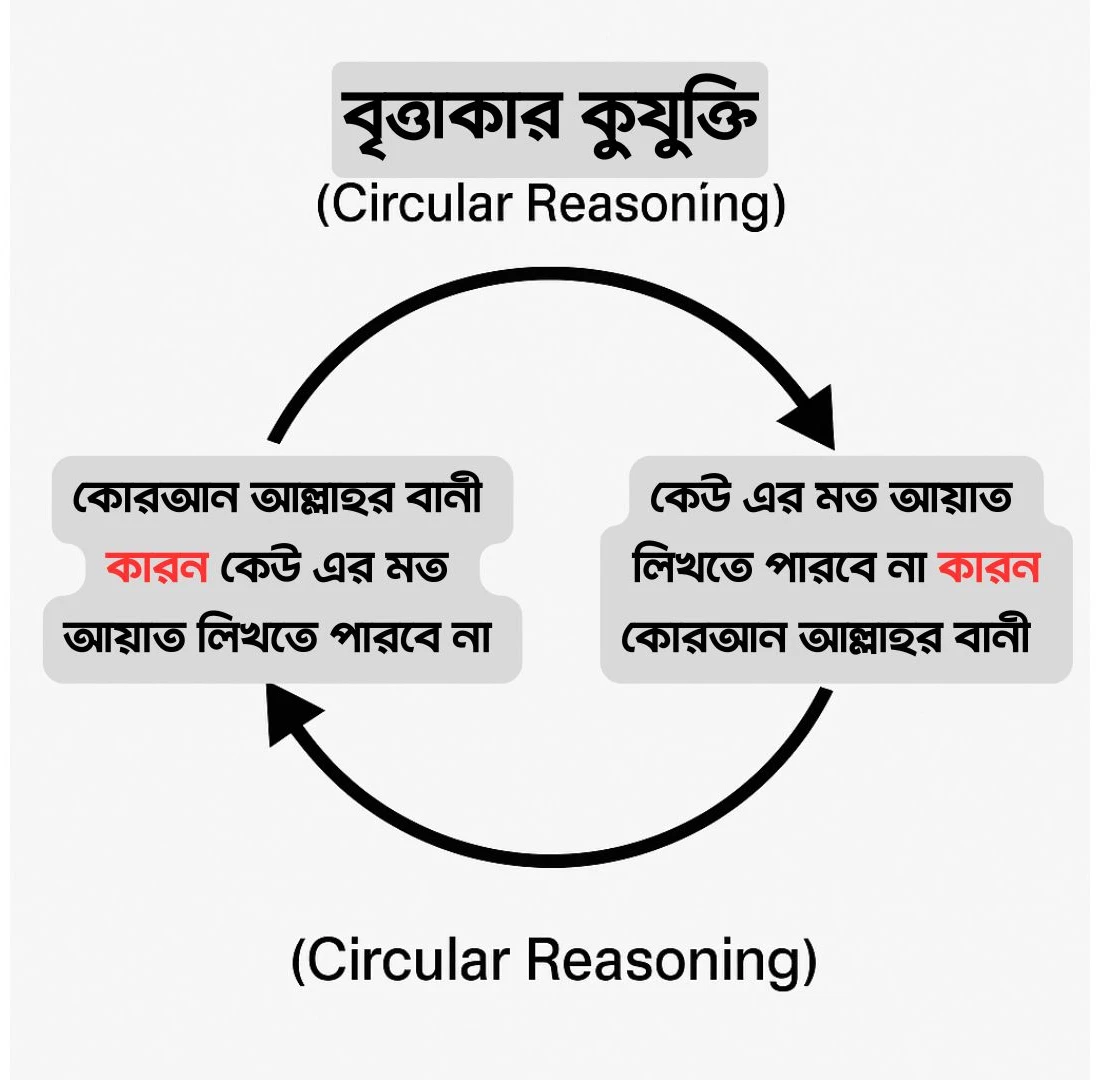
Texas Sharpshooter Fallacy
This fallacy occurs when someone fixes a decision or conclusion in advance, then highlights selected information in order to present that conclusion as “true”—like a careless hunter who fires shots at random and then, wherever the bullet marks are clustered, draws a bullseye around that spot and claims to be a perfect marksman. This method of manipulating information to prove a conclusion is the Texas Sharpshooter Fallacy.
The relationship between the Qur’an and grammar follows the same argumentative tactic. First, the Qur’an is assumed to be a “complete,” “flawless,” and “stable source”; then the rules of Arabic grammar are constructed in accordance with that very assumption. Historical research indicates that the Qur’an was treated as one of the principal foundations in the formation of Arabic grammar and its rules. Once the grammar had been formulated, it was then said: “Look, the Qur’an follows all the rules of grammar—therefore the Qur’an is perfect.” Where the sentence structure of the Qur’an does not align with conventional grammar, theoretical explanations such as exceptions, iltifat, implied words, figures of speech, and so forth were attached, thereby making the grammar once again compatible with the Qur’an.
As a result, this creates an argument in which the conclusion comes first and the evidence is arranged afterward—that is, the Qur’an is presumed perfect in advance, then grammar is shaped toward that target, and finally that very grammar is used to return to the declaration that the Qur’an is “perfect.” This strategy of selecting information and arranging interpretations is the central feature of the Texas Sharpshooter Fallacy: information does not generate the conclusion; rather, the conclusion selectively uses the information.
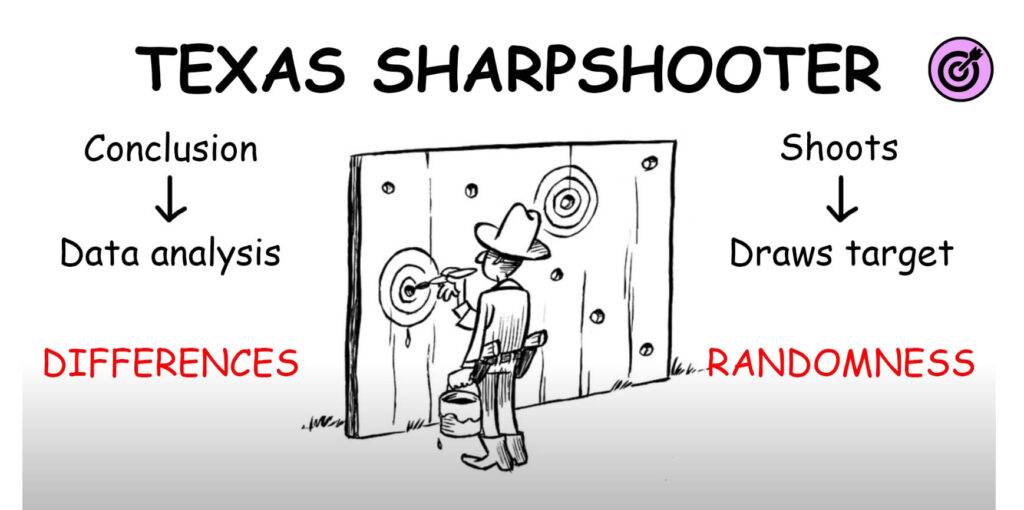
Shifting the Burden of Proof
A fundamental principle in the world of logic is this: the person who advances a claim also bears the responsibility of proving it. That is, if someone says, “This book is the word of Allah,” then the responsibility of proving it rests entirely on that person’s shoulders. Such proof must be based on observation, reason, morality, linguistic excellence, and humaneness—as should be the case for any truth claim. But in Islamic argumentation, the picture is entirely reversed. Here, without proving anything themselves, the claimant directly throws a challenge at the other side: “Produce something like it.” Yet prior evidence is necessary in support of the Qur’an’s divine origin or its miraculous nature; otherwise, it is merely a claim.
This challenging posture is in fact a well-known logical error—Shifting the Burden of Proof, [9] that is, shifting the responsibility of proof away from oneself and placing it on the opponent. It is a cunning trap in logic, where, without presenting any neutral or verifiable evidence oneself, one attempts to turn the other side’s failure into evidence in favor of one’s own claim. For example, if someone says, “If you cannot prove that this is not the word of Allah, then it must be assumed that it is the word of Allah,” this is entirely unacceptable and baseless in the eyes of logic. The tactic of transforming an unproven claim into a challenge in order to win an argument is a form of deception, and it has no legitimate place in rational debate.
Appeal to Biased Authority
In support of the Qur’an’s miraculousness, an argument is often presented that “in the early period of Islam, no Arab poet or literary figure could overcome this challenge.” This is a logical error known as an Appeal to Biased Authority. In this fallacy, the statement of a person is presented as evidence even though that person has personal interests or pre-existing beliefs that may influence their opinion.
In seventh-century Arabia, poetry was at the heart of society. The poets of that time were highly influential, and their poetic skill was beyond question. When Islam emerged and the Qur’anic challenge was proclaimed, the role of those poets became highly significant. But why their alleged “failure” may have been biased can be analyzed from several angles:
1. Religious Belief and Loyalty: Many poets who may initially have been critics of Islam later became Muslims. Once they had accepted Islam, it was no longer possible for them to question the divine nature or literary superiority of the Qur’an. Any previous “attempt” or “opposition” of theirs then became irrelevant because of their new faith. For a convert, criticizing their new scripture would not merely have signaled disloyalty; it would have amounted to denying their own belief. And if, in the early period of Islam in Mecca, any poet had written a surah comparable to the Qur’an, surely after the conquest of Mecca Muhammad’s followers would not have left those works intact, would they?
2. Social Pressure and Security: In the Arab society of that time, Islam was rapidly expanding as a powerful political and social force. Those who opposed Islam, or even did not believe in it, often faced social exclusion, economic sanctions, and even aggressive jihad or physical harm. Composing poetry against the Muslim ummah was regarded as rebellion or insult, the consequences of which were extremely severe. For example, many poets or individuals who criticized Islam were punished or executed (such as Ka’b ibn Ashraf). In the face of such terrible social and political pressure, it was practically impossible for a poet to accept the Qur’an’s “challenge” freely and compose something successful against it. Their silence or refusal cannot be counted as “failure”; rather, it was a strategy for survival.
3. The Perspective of the “Historical Victor”: After the rapid expansion of Islam and its political victories, history was written from the perspective of the victorious side. Poets who may have tried but did not succeed (and of whom no record exists), or whose works were deliberately devalued, were far more likely to have been lost from the pages of history. The victorious side always strengthens its own narrative and diminishes the contributions of its opponents.
Therefore, when it is said that “the poets of that time could not overcome it,” this becomes a biased fallacy. Their alleged “failure” was not a neutral literary judgment, but the result of religious belief and socio-political pressure. Their opinions or silence cannot be accepted as proof of the Qur’an’s irresistible literary superiority, because their freedom to express a critical perspective was limited or nonexistent.
Non-Falsifiability
This Qur’anic claim is beset by a serious logical flaw known as Non-Falsifiability. According to Karl Popper’s Falsifiability Principle, a scientific or meaningful claim must be formulated in such a way that there is a method by which it could be proven false. If no possible evidence can falsify a claim, then from the standpoint of science that claim is meaningless.
The Qur’an’s “challenge to compose something comparable” falls into this trap of non-falsifiability, because arrangements are made to reject the outcome at any cost:
In this way, regardless of the outcome of the challenge, the claimant side finds a way to use it in support of its own claim. The challenger can never prove that the challenge is false, because every attempt is dismissed on one pretext or another. Because of this double-edged position, the claim is not falsifiable, which, in the language of science, turns it into a meaningless or untestable claim.
The Plagiarism Trap: The Inevitable Result of Catch-22
The plagiarism trap is not, in fact, a separate new argument; it is the direct result of the earlier Catch-22 structure. If someone follows the Qur’an’s wording, rhythm, syntax, and scriptural atmosphere very closely, it will be said: “This is imitation.” Again, if that person composes something fundamentally different but literarily or morally powerful, it will be said: “This is not like the Qur’an.” In other words, similarity is plagiarism, and dissimilarity is failure. In this double-edged system of judgment, there is no path for the competitor to win; whatever the result, the judge can preserve his predetermined conclusion.
For this reason, the Qur’an’s imitation challenge is logically weak. In a genuine challenge, the conditions of success are specified in advance. Here there is no condition for success; there are only endless routes of rejection. Thus, it is not a literary test, but rather a self-protective claim of the heads I win, tails you lose variety.
Denial of Historical Context (Context Fallacy)
To understand this “challenge” of the Qur’an, it is crucial to grasp the social and cultural context of seventh-century Arabia. At that time, poetry was the principal measure of knowledge, wisdom, and social prestige in Arab society. Through poetry, the bravery of the tribe, the glory of ancestors, and one’s own culture were presented. Eloquence and poetic skill were an inseparable part of the Arabic language, capable of winning people’s hearts or persuading them. In that era, a poet or literary figure was placed at the highest level of society. Regular poetic competitions were held, such as at the Ukaz fair, where poets would bring their new compositions and claim superiority before the judges.
In this context, when the Qur’an claimed that no one could compose a surah like it, this was not merely a literary challenge; rather, it was a powerful contest within the established tradition of poetic competition in Arab society at the time. Perhaps, to the people of that era, it was regarded as evidence of the Qur’an’s miraculous nature or divine origin.
The problem, however, is that taking what was a relevant and powerful challenge within the poetic context of the seventh century and placing it before today’s global age of literature, science, and reason is a clear “Context Fallacy,” or the fallacy of denying historical context. In the modern age, the standards of literature, science, and reason are much broader and multidimensional. Today, the excellence of a text does not depend only on its poetic beauty, but also on its philosophical depth, scientific coherence, ethical values, and overall impact. Therefore, when a seventh-century literary challenge is judged by the expanded measures of present-day knowledge and reason, it becomes detached from its original context and appears irrational.
The Fallacy of Changing the Target, or Moving the Goalposts
In the language of logic, “moving the goalposts” is a kind of tactic in which, when the initial conditions of an argument or challenge come under threat, or when the opponent fulfills them, the standard or goal for winning is shifted farther away instead of admitting defeat. Among modern Islamists, this fallacy is widely observable in discussions of the Qur’an’s challenge.
The Original Challenge versus Modern Conditions: In Surah al-Baqarah (2:23) or Surah Yunus (10:38), the Qur’anic challenge was extremely general: “Bring a surah like it.” No additional conditions were imposed there regarding linguistic ornamentation, scientific information, or prophecy. But whenever, across the ages, Arab poets or contemporary critics have presented works of comparable or even superior literary quality to the Qur’an, Islamists have quickly begun adding new conditions.
Some New Conditions Added by Modern Islamists:
Whenever a critic produces a lyrical or rhythmic passage resembling the Qur’an, this moving-the-goalposts tactic is used to say, “It has not succeeded, because it lacks such-and-such scientific information,” or “It has not influenced as many people as the Qur’an.” In this way, the scope of the original challenge is repeatedly altered so that it becomes an unrealistic claim, which we may call “non-falsifiable.” This is an act of intellectual dishonesty, because changing the rules of the game while the game is already underway runs contrary to reasonable debate. The conditions must be fixed at, or before, the moment of the challenge; conditions added afterward cannot be part of the challenge.
Through this fallacy, Islamists essentially create a “defensive mechanism” in which they decide in advance that no response will be acceptable to them. As a result, the challenge no longer remains a genuine challenge; rather, it turns into a circular fallacy, or circular reasoning.
Conclusion
“Nothing like the Qur’an can be composed” — this Qur’anic claim, which is regarded as evidence of its divine origin, is, under rational analysis, burdened with several serious logical flaws. As we have seen in this article, it is not merely a literary challenge, but is surrounded by various fallacies such as the error of subjective criteria, the false dilemma, circular reasoning, shifting the burden of proof onto the opponent, appeal to biased authority and non-falsifiability. Taken together, these flaws turn the challenge into a “plagiarism trap” or “no-win situation,” in which no path to success remains open for the person who accepts the challenge. Whatever the opponent brings, the believing judge already has the language ready to dismiss it. Thus, this challenge does not open the door to knowledge; rather, it hangs a religious lock on the door of reason.
Furthermore, although it may have had a certain relevance in the context of seventh-century Arabia, by today’s global literary, scientific, and rational standards it is a fallacy of denying historical context (Context Fallacy). Moreover, the real-life threats and consequences that exist for those who accept this challenge prove that it is not a free intellectual or literary competition, but rather a faith-based, self-protective claim that leaves no room for reason, evidence, or open discussion. Truth and reason are not merely a contest of literary beauty or a claim of miraculousness, but the pursuit of evidence, analysis, and justice.
References
- Quran, 2:23 ↩︎
- Quran, 2:24 ↩︎
- Quran 17:88 ↩︎
- Suzanne Pinckney Stetkevych, “From Jāhiliyyah to Badīʿiyyah: Orality, Literacy, and the Transformations of Rhetoric in Arabic Poetry,” Oral Tradition 25/1 (2010), pp. 211–230 ↩︎
- Al Makin, Representing the Enemy: Musaylima in Muslim Literature, Frankfurt: Peter Lang, 2010 ↩︎
- Hans-Peter Pökel, “The inimitability of the Qur’ān (iʿjāz al-qur’ān) in transconfessional contexts of the early ʿAbbāsid period,” Orient-Institut Beirut ↩︎
- The Political and Religious Origins of Arabic Grammar ↩︎
- Circular Fallacy | Circular logic ↩︎
- Burden of Disproof Fallacy | Burden of proof ↩︎