Introduction
One of the most influential logical thinkers, mathematicians, and philosophers of the twentieth century, Bertrand Russell (Bertrand Russell), introduced a remarkable intellectual tool for dissecting the theoretical foundations of religion, widely known as “Russell’s Teapot”. This analogy functions primarily as a fundamental principle for determining the “Burden of Proof”, or Onus Probandi, in the case of any supernatural or unprovable claim. Through this argument, Russell makes clear that the moral and logical obligation to establish the existence of an entity rests only on the person advancing that claim; in the absence of evidence, there is no rational obligation to accept a claim as true merely because it cannot be “disproved.” [1]
Historical Context
In 1952, the British periodical ‘Illustrated Magazine’ invited Bertrand Russell to write an essay titled “Is There a God?” Russell’s principal purpose in writing the essay was to analyze the logical foundations of the conventional arguments presented in support of the existence of God or any supernatural being. He argued that when a claim lacks empirical or observable evidence, there is no rational justification for accepting it as true merely on the basis of belief.
Russell identifies an important theoretical distinction here: “being unable to prove the non-existence” of an entity and that entity “actually existing” are not necessarily related. He emphasizes that the Burden of Proof always rests on the person advancing a new or supernatural claim, not on the skeptic. In other words, the absence of disproof cannot in any way constitute evidence of existence. In this essay, he clearly explains that the fact that something cannot be “proved false” does not make it “true”; such a claim fails within a coherent logical framework. [2]
The Core Structure of the Argument
Russell uses an apparently bizarre and deliberately extreme example to expose the irrationality of conventional belief and to make the contrasting position of rational skepticism unmistakably clear. He presents his central argument as follows:
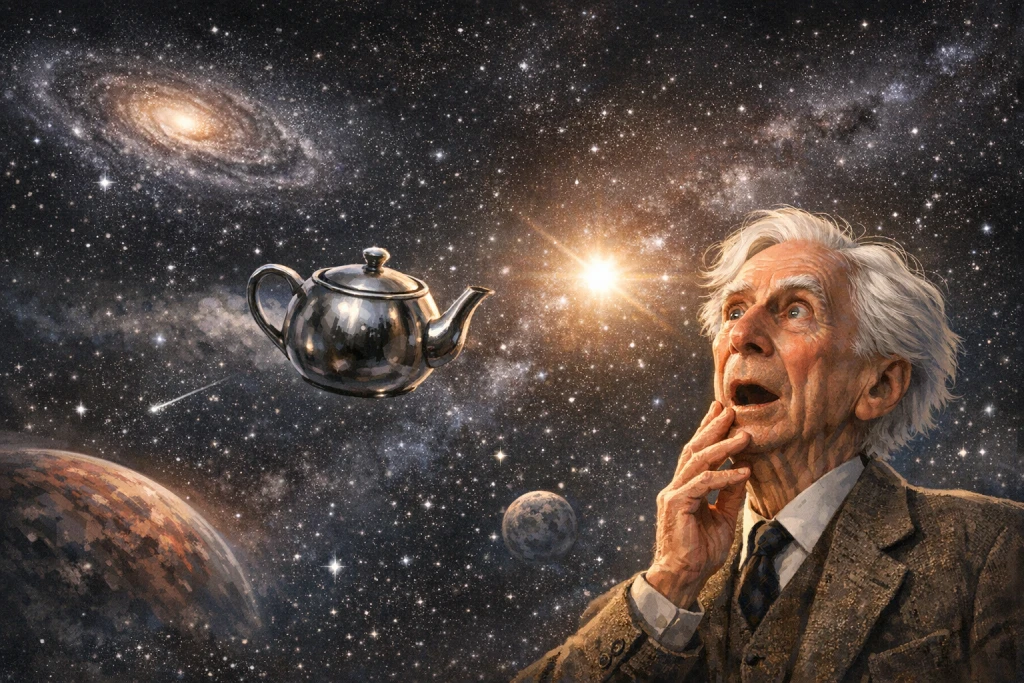
“If I were to claim that, somewhere between Earth and Mars, a porcelain teapot is orbiting the Sun in an elliptical path, no one could disprove my claim—provided I carefully added that the teapot was so small that even our most powerful telescopes could not detect it. Now, since no one could disprove my claim, if I were then to insist that doubting it would be an intolerable insult to human reason, people would quite reasonably conclude that I was talking nonsense.” [1]
Through this powerful analogy, Russell identifies three fundamental pillars of the argument:
If a claim is defined in such a way that no possible observation or test could ever show it to be false, then the claim loses its standing within meaningful scientific or theoretical inquiry. Russell shows that “cannot be disproved” does not mean “true”; rather, it exposes the logical emptiness of treating unfalsifiability as evidence [1].
A fundamental principle of logic is that when someone advances a new or extraordinary claim, the Burden of Proof, or Onus Probandi, always rests on the claimant. It is not the responsibility of a skeptic or non-believer to prove that “there is no teapot in space” or that “God does not exist.” Until the claimant presents specific and objective evidence in support of the proposition, rejecting the claim is the most rational conclusion [3].
Russell makes a psychological observation here. The claim that a teapot is floating in space sounds ridiculous today because it has no social or historical support. But if it had been written into ancient texts and instilled in children from an early age, disbelief in it could be treated as “abnormal.” In other words, the truth of a claim does not depend on its antiquity or social acceptance [4].
Burden of Proof (Burden of Proof / Onus Probandi)
An ancient and widely recognized principle of logic states: Ei incumbit probatio qui dicit, non qui negat. This means that the legal and logical Burden of Proof rests on the party making a positive claim or proposition, not on the party merely denying it. [3]
In theological debate, theists often employ a familiar Logical Fallacy known as the “Argument from Ignorance” (Argumentum ad Ignorantiam). They argue that because atheists or skeptics cannot prove with absolute certainty that God does not exist, the existence of God must therefore remain possible or rational. Russell’s Teapot argument directly attacks this fallacy. Russell shows that just as it is impossible to demonstrate mathematically that there is no tiny teapot somewhere in space, it is likewise impossible to prove the non-existence of every conceivable supernatural entity. This is because proving the Non-existence of something can, in theoretical terms, be made an impossible task.
Russell’s argument makes one point especially clear: being unable to disprove something is not evidence that it is correct. The task of atheists or skeptics is not to prove that God does not exist; rather, the initial responsibility of theists is to present empirical and verifiable evidence for their supernatural claim. Richard Dawkins argues that as long as sufficient evidence for a claim is absent, God and an undetectable teapot floating in space occupy the same logical category in this specific respect: both remain imaginative and “unproven” ideas. [5]
Philosophical Criticism and Counterarguments
Russell’s powerful analogy has generated extensive discussion in philosophical and theological circles. Many philosophers have attempted to demonstrate limitations or defects in the argument, while skeptics have responded with equally sharp counterarguments.
Alvin Plantinga’s Criticism
The prominent Christian philosopher Alvin Plantinga argues that Russell’s teapot analogy is a Weak Analogy. According to him, we possess substantial “Evidence Against” the teapot. We know that a porcelain teapot would not naturally form in space and that no space agency is known to have undertaken the pointless task of placing one there. We therefore have sufficient rational grounds for disbelieving the teapot. By contrast, he holds that there is no directly comparable “evidence against” God or corresponding physical improbability. [6]
Skeptical Counterarguments and Analysis
Skeptics and philosophers have rejected this criticism by Plantinga. Their principal counterarguments are as follows:
When Russell defines the teapot as something that “cannot be detected by a telescope,” he is illustrating how a claim can be made Unfalsifiable. When theists define God as “incorporeal,” “formless,” or “beyond the laws of nature,” they likewise block the possibility of ordinary “natural evidence” counting against God. Therefore, in the theoretical grey area between absence of evidence and absence of evidence against a claim, Russell’s Teapot remains fully relevant and forceful [7].
The absence of “evidence against” something does not by itself increase the “probability” that it is true. If that reasoning were accepted, the existence of dragons, unicorns, or the Flying Spaghetti Monster would have to be treated as equally rational, because direct “evidence against” every such entity is likewise impossible to provide [5].
Influence on Modern Skepticism
Within the twenty-first-century ‘New Atheism’ movement, Richard Dawkins, Sam Harris, and Christopher Hitchens have made extensive use of Russell’s analogy.
In ‘The God Delusion’, Dawkins argues that, in practice, we are all “atheists” with respect to teapots or unicorns—A-teapot-ists—because we do not believe in them without evidence. He calls for God to be judged by the same standard and argues that belief is not rationally established in the absence of evidence [5].
Dawkins’s contemporary Christopher Hitchens expressed the idea in an even shorter and sharper form: “What can be asserted without evidence can be dismissed without evidence.” It is, in essence, a concise logical standard for locating the Burden of Proof [8].
Conclusion
Russell’s Teapot is not merely an imaginary analogy; it is a powerful strike of rational thought against the fortified walls of blind belief. It teaches us clearly that no claim acquires the status of truth merely by appealing to ancient tradition or supposed “sanctity.” Where the absence of evidence is clear, the intellectually honest response is not irrational belief but methodological skepticism as a scientifically minded path toward truth. [9]
References
- Russell, B. (1952). Is There a God? 1 2 3
- Garvey, B. (2010). Philosophy of Religion. Acumen Publishing ↩︎
- Hitchcock, D. (2017). On Reasoning and Argument. Springer 1 2
- Blackford, R. (2019). The Teapot and the Elephant ↩︎
- Dawkins, R. (2006). The God Delusion 1 2 3
- Plantinga, A. (2007). The Dawkins Confusion ↩︎
- Garvey, B. (2010). Absence of Evidence and Evidence of Absence ↩︎
- Hitchens, C. (2007). God Is Not Great ↩︎
- Pigliucci, M. (2010). Nonsense on Stilts: How to Tell Science from Bunk ↩︎