
Introduction
Whenever Islamic apologetic discourse addresses the Prophet Muhammad’s polygamy, child marriage, the rule allowing women to offer themselves to him, his relations with women, or his sexual relations with enslaved women, a familiar defensive claim is put forward: Muhammad supposedly had no particular attraction to women and did not enter these relationships out of personal desire or a wish to obtain women; rather, social, political, or religious needs supposedly required him to marry one woman after another. It is also claimed that Allah repeatedly pressured him through revelation to marry various women and that, despite his reluctance, he was forced to do so. But this claim directly conflicts with Islam’s primary sources. The special privileges, exceptions, choices, attractions, and sexual desires described in the Quran and authentic hadiths do not support the claim that he had no particular interest in women.
In Surah Al-Ahzab, Muhammad is given marital and sexual provisions different from those given to ordinary Muslim men. Alongside his wives, women taken into his possession as war captives, women from specified family groups, and even believing women who offered themselves directly to the Prophet and whom he wished to marry were made lawful for him. The Quran itself clearly says that this special permission was not for other believers but was specific to Muhammad, “so that there would be no blame on you.” In the same surah, it directly mentions the possibility that another woman’s beauty might attract him: “even if her beauty may attract you.” Thus, the claim that Muhammad had no attraction to women’s beauty or companionship does not accord with the Quran’s own language.
These special privileges did not go unnoticed even within Muhammad’s closest family circle. Aisha’s famous statement is recorded in Sahih al-Bukhari and Sahih Muslim. She expressed jealousy regarding women who offered themselves to Muhammad for marriage. Later, when the verse was revealed giving Muhammad the freedom to defer whichever of his wives he wished, draw close whichever he wished, and call back whichever he had set aside, Aisha remarked, “I see that your Lord hastens to fulfill your wishes.” This was not the comment of a modern critic of Islam; it was Muhammad’s own wife, during his lifetime, commenting on the relationship between his wishes and the special ruling revealed for him.
Other authentic hadith reports make the matter even clearer. Muhammad is described as considering women among the things of this world made beloved to him. Sahih Muslim also reports that after seeing a woman, he went to his wife Zaynab and had intercourse with her. He then told his Companions that when one of them saw a woman and felt desire, he should go to his wife or enslaved woman, because that would dispel what he felt. These reports do not portray a man whose sexual life was merely an unwanted religious duty. They portray a man attracted to women’s beauty, who regarded women among his beloved interests, experienced sexual arousal on seeing a woman, and for whom special marital and sexual provisions were made in comparison with ordinary Muslim men.
Accordingly, this article will not treat the character-protective claims of later religious speakers as evidence. It will assess the Quran, authentic hadith, early tafsir, hadith commentary, and recognized Islamic legal sources. What do Islam’s primary sources actually say about Muhammad’s attraction to women, sexual desire, and special marital and sexual privileges? If those sources provide information contrary to later Islamic claims, the problem lies not with the sources but with those later claims.
Special Marital and Sexual Benefits for Muhammad
The Quran declares special privileges for Muhammad in his relationships with women that did not apply to ordinary Muslim men. In verse 50 of Surah Al-Ahzab, several categories of women are declared lawful for him: wives whose dowries he had paid; those in his possession from what Allah had granted him as war gains; the daughters of his paternal uncles and aunts and of his maternal uncles and aunts who had emigrated with him; and a believing woman who offered herself to Muhammad and whom he wished to marry. The Quran then makes two important points. First, this last privilege is “exclusively for you, not for the rest of the believers.” Second, the purpose of these special permissions is stated as “so that there would be no blame on you.” [1] –
O Prophet! We have made lawful for you your wives to whom you have paid their full dowries as well as those bondwomen in your possession, whom Allah has granted you. And you are allowed to marry the daughters of your paternal uncles and aunts, and the daughters of your maternal uncles and aunts, who have emigrated like you. Also allowed for marriage is a believing woman who offers herself to the Prophet without dowry if he is interested in marrying her—this is exclusively for you, not for the rest of the believers. We know well what rulings We have ordained for the believers in relation to their wives and those bondwomen in their possession. As such, there would be no blame on you. And Allah is All-Forgiving, Most Merciful.
— Dr. Mustafa Khattab, The Clear Quran
The wording of the verse makes one point clear: Muhammad is not being ordered to marry a particular woman against his will. Rather, the sphere of marital and sexual relations is being expanded for him in comparison with ordinary Muslims. Some restrictions that applied to ordinary Muslims were lifted in his case. If a believing woman offered herself to Muhammad and he wished to marry her, a separate permission was announced for that marriage. The phrase “if he is interested in marrying her” is important: the arrangement depends on Muhammad’s own will. He is not required to accept every woman who offers herself; he may accept her if he wishes and decline if he does not.
Al-Tabari, one of the earliest and most important Quran commentators, explains this verse in even clearer terms. If a believing woman offered herself to Muhammad, he was given permission to marry her without a dowry. Al-Tabari then states directly that this privilege was specific to Muhammad and that no other member of his community could accept a woman who offered herself in this way [2] –
وأحللنا له امرأة مؤمنة إن وهبت نفسها للنبي بغير صداق … إن أراد أن ينكحها فحلال له أن ينكحها وإذا وهبت نفسها له بغير مهر … لا يحل لأحد من أمتك أن يقرب امرأة وهبت نفسها له، وإنما ذلك لك يا محمد خالصة أخلصت لك من دون سائر أمتك.
That is: “We have made lawful for him a believing woman who offers herself to the Prophet without a dowry … if he wishes to marry her, it is lawful for him to marry her without a dowry … no one else in your community may accept a woman who offers herself in this way; Muhammad, this is exclusively for you.”
There is no ambiguity in Al-Tabari’s interpretation. The rule applicable to ordinary Muslim men was not retained unchanged for Muhammad. If a woman voluntarily offered herself to him and he wished to marry her, he had special permission to accept her without a dowry. Recasting this provision merely as a “social responsibility” or “political necessity” distorts the language of the primary source. The condition of the verse is that Muhammad wishes to marry her; his personal will is central to the provision.
Ibn Kathir likewise clarifies the meaning of the verse. In his explanation, a believing woman who offers herself to Muhammad may be married by him without a dowry if he wishes. Ibn Kathir also mentions reports that more than one woman offered herself to Muhammad [3] –
ويحل لك – يا أيها النبي – المرأة المؤمنة إذا وهبت نفسها لك أن تتزوجها بغير مهر إن شئت ذلك.
That is: “O Prophet, if a believing woman offers herself to you, it is lawful for you to marry her without a dowry if you wish.”
Here, the phrase “if you wish” is again decisive. Muhammad is not being forced to accept women despite reluctance. If a woman offers herself, the decision whether to accept her rests with Muhammad. Women offer themselves, he accepts if he wishes, and the dowry normally required of ordinary Muslims is waived for him. It is therefore impossible to use this provision to prove that he was disinterested in women.
A clearer explanation appears in Al-Wahidi’s At-Tafsir al-Wasit. He describes this as a special marital privilege of Muhammad: a marriage could be concluded through an offer of self-gifting, without a guardian or witnesses. He contrasts this with the ordinary Muslim limit of four wives and the ordinary requirements of dowry, guardian, and witnesses [4] –
وهذا من خصائصه في النكاح، وكان ينعقد النكاح له بلفظ الهبة من غير ولي ولا شهود … قد علمنا ما فرضنا عليهم في أزواجهم، يقول: ما أوجبنا عليهم أن لا يتزوجوا أكثر من أربع بمهر وولي وشهود … لكيلا يكون عليك حرج، ضيق في أمر النكاح، ومنع من شيء تريده.
That is, “It is part of his special characteristics in marriage. The word offer could have been completed by the word offer, without any guardian and witness… The provision we have made regarding the wives of the believers is that they should not marry more than four women and dowry There will be guardians and witnesses… ‘so that you do not have any difficulty’, that is, you should not be narrow about marriage and Don’t stop you from what you want.”
Al-Wahidi’s final explanation is especially significant. Explaining “so that there would be no blame on you,” he says that Muhammad should not face restriction in marriage or be prevented from what he wants. Thus, presenting Muhammad’s successive marriages and special privileges concerning women as the result of reluctance is not only unsupported; it contradicts the early tafsir. The purpose of the provision is to relax restrictions for him.
This verse reveals another important disparity. The Quran first acknowledges restrictions governing ordinary believers’ wives and women in their possession, then announces separate privileges for Muhammad in the same passage. This is not an ordinary marital rule but an individual exception. The limit of four wives and other marital conditions remains for ordinary Muslims, while several conditions are relaxed for Muhammad so that he will not face “difficulty.” Creating such a personal religious exception around a preacher’s marital and sexual desires raises serious questions. In light of these sources, it is false to say that Muhammad received no special privilege concerning women or had no personal interest in them.
Fascinated by Women’s Beauty: The Quran’s Direct Language
The claim that Muhammad had no particular attraction to women’s beauty and that personal preference or female beauty played no role in his marriages conflicts with the Quran’s language. In verse 52 of Surah Al-Ahzab, while restricting Muhammad from marrying more women or replacing his current wives, the Quran directly describes a situation in which another woman’s beauty might attract him: “even if her beauty may attract you.” The verse again excludes women in his possession from this restriction [5] –
It is not lawful for you, O Prophet, to marry more women after this, nor can you replace any of your present wives with another, even if her beauty may attract you—except those bondwomen in your possession. And Allah is ever Watchful over all things.
— Dr. Mustafa Khattab, The Clear Quran
The verse’s language is direct. Women’s beauty is presented as a possible attraction for Muhammad—something that might incline him toward taking another woman—while the new rule limits that inclination. The phrase “even if her beauty may attract you” would be unnecessary if Muhammad’s attraction to female beauty were wholly irrelevant. The Quran is not speaking abstractly about ordinary human sexual instincts; it addresses Muhammad directly in the second person.
Tafsir al-Tabari also explains this part of the verse in the context of attraction to women’s beauty. He cites early interpretations that Muhammad was forbidden to take other women instead of his current wives even if their beauty attracted him, including Mujahid’s explanation that refers to replacing Muslim wives with other women and being attracted by their beauty [6] –
ولا أن تبدل بالمسلمات غيرهن من النصارى واليهود والمشركين ولو أعجبك حسنهن
That is: “Do not replace your Muslim wives with Christian, Jewish, or polytheist women, even if their beauty attracts you.”
Whichever interpretation one accepts, the central point does not change. “Even if her beauty may attract you” appears in the context of choosing women and marital attraction. It is therefore inconsistent with portraying women’s beauty as entirely irrelevant to Muhammad. The verse conveys the opposite: a woman’s beauty may attract him, yet he is instructed to refrain from a new marriage after the stated limit.
Tafsir al-Qurtubi clarifies the matter. He did not treat “even if her beauty may attract you” as a merely rhetorical phrase; he also took it as evidence that a man may look at a woman whom he intends to marry. In his reasoning, a man may see beauty in a woman that makes him interested in marrying her. The phrase is therefore directly connected to the desire for marriage [7] –
وفي هذه الآية دليل على جواز أن ينظر الرجل إلى من يريد زواجها
That is: “This verse is evidence that a man may look at a woman whom he intends to marry.”
Al-Qurtubi’s interpretation is important because it shows that early Muslim commentators understood “even if her beauty may attract you” as referring to real women’s beauty, looking at women, and interest in marriage. This is not a later anti-Islamic reading. Al-Qurtubi himself used the verse as evidence in a legal discussion about looking at a woman with a view to marriage.
Qurtubi also mentions a narration in the name of Ibn Abbas in the same place, which states that after the death of Jafar Ibn Abi Talib, Muhammad liked the beauty of his wife Asma bint Umais and he wanted to marry her. But Qurtubi mentions that Ibn al-Arabi called this specific narration weak. However, the direct language of the verse and its interpretation in the ancient tafsir are sufficient for the main claim [8] –
After mentioning the report attributed to Ibn Abbas about Muhammad’s attraction to Asma bint Umais, Al-Qurtubi writes, “وهذا حديث ضعيف قاله ابن العربي”—that is, Ibn al-Arabi judged this particular report weak.
This distinction matters. The specific historical claim that Muhammad was impressed by Asma bint Umais’s beauty is weak according to the judgment cited by Al-Qurtubi. But it is an even greater mistake to infer from this that Muhammad was not attracted to women’s beauty. Even if the report about Asma is set aside, the Quranic phrase remains: “even if her beauty may attract you.” The main argument therefore does not depend on a weak story; it rests on the Quran’s own wording.
Tafsir al-Nasafi likewise interprets the phrase as describing women whose beauty had become attractive to Muhammad. Nasafi explains the grammar of “ولو أعجبك” as presupposing that the women had attracted him, and also mentions the report concerning Asma bint Umais [9] –
وتقديره: مفروضا إعجابك بهن
That is: the sentence presupposes a situation in which Muhammad was attracted to those women.
An Islamweb commentary states this even more directly: when a woman appeared before Muhammad, her beauty could attract his attention; after the verse was revealed, he was told not to marry another woman [10] –
قد يرى النبي عليه الصلاة والسلام امرأة … فيلفت جمالها نظره
That is, the Prophet can see a woman and Her beauty can attract the attention of the Prophet.
It is especially noteworthy that, while restricting the taking of new wives, the Quran explicitly excludes women in Muhammad’s possession from the same verse’s restriction: “except those bondwomen in your possession.” Thus, even though the possibility of taking a new wife was restricted, the opportunity for sexual relations with an enslaved woman was not removed. Al-Tabari’s tafsir preserves early interpretations of this exception [6] –
إِلَّا مَا مَلَكَتْ يَمِينُكَ
That is, it was out of the ban “Your right hand is the owner”, i.e. owned maid.
This sequence of rules in Surah Al-Ahzab cannot be reconciled with the story that a prophet uninterested in women was forced into successive marriages by Allah or by sociopolitical circumstances. Verse 50 gives Muhammad special access to women who offered themselves and makes acceptance dependent on his will; verse 51 gives him special freedom regarding which wives to keep close or set aside; and verse 52 acknowledges that another woman’s beauty may attract him while again excluding women in his possession from the restriction. The sequence centers Muhammad’s choice, attraction, and special privileges.
Therefore, the claim that Muhammad had no interest in women’s beauty is not merely unsupported; it is contrary to the Quran’s language. The Quran itself presents female beauty as a possible reason for Muhammad’s attraction, and early Muslim commentators understood the phrase in that sense. If later preachers portray him as sexually indifferent, that portrait comes not from the primary sources but from later character-protective apologetics.
What Was the Prophet’s Difficulty That Allah Intended to Remove?
One of the most important phrases in verse 50 of Surah Al-Ahzab is “so that there would be no blame on you.” This naturally raises the question: what difficulty did Muhammad face that required Allah to relax the marriage rules applicable to ordinary Muslims? Why did the limit of four wives not apply to him? Why could he accept a woman who offered herself without a dowry? Why were women in his possession declared lawful, and why were these privileges announced as a special provision for him? The early tafsirs do not leave the answer unclear: the “difficulty” concerns restriction and constraint in marriage and the acceptance of women, and means preventing Muhammad from what he wanted.
In explaining “so that there would be no blame on you,” Al-Wahidi’s At-Tafsir al-Wasit leaves little room for speculation about the nature of the difficulty. He writes that Muhammad should not face restriction in marriage or be prevented from what he wants [4] –
لِكَيْلَا يَكُونَ عَلَيْكَ حَرَجٌ ضِيقٌ فِي أَمْرِ النِّكَاحِ، وَمَنْعٌ مِنْ شَيْءٍ تُرِيدُهُ … أَحْلَلْنَا لَكَ مَا ذَكَرْنَا لِيَرْتَفِعَ عَنْكَ الْحَرَجُ.
ie, “So that you do not have the narrowness of marriage and you are not prevented from what you want” … “We have made the things mentioned for you legal, so that the difficulties will be removed from you.”
Here, “difficulty” does not mean the difficulty of conducting a war, governing a state, or preaching. In Al-Wahidi’s wording it is “restriction in marriage” and “being prevented from what he wants.” The means of removing that restriction is to relax Muhammad’s marital rules compared with those of ordinary Muslims.
Tafsir al-Baghawi states the same point more directly. It first lists the rules for ordinary Muslims—no more than four wives, and the requirements of guardians, witnesses, and dowry—then says that Muhammad’s wives, women in his possession, and women who offered themselves were made lawful for him so that he would face no constraint [11] –
أَوْجَبْنَا عَلَى الْمُؤْمِنِينَ فِي أَزْوَاجِهِمْ مِنَ الْأَحْكَامِ أَنْ لَا يَتَزَوَّجُوا أَكْثَرَ مِنْ أَرْبَعٍ وَلَا يَتَزَوَّجُوا إِلَّا بِوَلِيٍّ وَشُهُودٍ وَمَهْرٍ … أَحْلَلْنَا لَكَ أَزْوَاجَكَ وَمَا مَلَكَتْ يَمِينُكَ وَالْمَوْهُوبَةَ لَكَ لِكَيْ لَا يَكُونَ عَلَيْكَ حَرَجٌ وَضِيقٌ.
That is, “We have made provisions regarding the wives of the believers that they should not take more than four wives and guardians, witnesses and dowry Don’t get married without… But for you I have made it lawful for your wives, the women you own, and the women who you have, so that there is no inconvenience and narrowness over you.”
Al-Baghawi’s interpretation makes the disparity clear. Some restrictions imposed on ordinary Muslim men were lifted for Muhammad. The limit of four wives applied to ordinary Muslims, not to Muhammad; the general rules concerning guardians, witnesses, and dowry applied to others, while women who offered themselves received special treatment. The stated reason was that Muhammad should not face “difficulty and constraint.”
An Islamweb explanation of Surah Al-Ahzab 49–51 says the same clearly: ordinary believers may not take more than four wives and must observe the requirements of dowry, witnesses, and guardians, while some of these obligations were removed for Muhammad so that he would not face difficulty [12] –
فَفَرَضْنَا عَلَيْهِمْ أَلَّا يَتَزَوَّجُوا إِلَّا بِمَهْرٍ وَبَيِّنَةٍ – شَاهِدَيْنِ – وَوَلِيٍّ، وَأَلَّا يَجْمَعُوا بَيْنَ أَكْثَرَ مِنْ أَرْبَعِ نِسْوَةٍ، وَقَدْ رَخَّصْنَا لَكَ فِي ذَلِكَ، فَلَمْ نُوجِبْ عَلَيْكَ شَيْئًا مِنْ هَذَا لِكَيْلَا يَكُونَ عَلَيْكَ حَرَجٌ.
That is, “We have enjoined upon them that they dowry, will not marry without two witnesses and guardians and will not gather more than four wives. But I have made you a concession on this and I have not made any of these compulsory on you, so that you do not have any trouble.”
This statement clarifies the meaning of “difficulty.” If an ordinary Muslim man wants to marry a fifth woman after having four wives, religious rules prevent him. In Muhammad’s case, that obstacle was removed. The formal and financial conditions applicable to ordinary Muslim marriage were also relaxed in his special case. The “difficulty” Allah removed was therefore the religious restrictions standing in the way of taking more women.
Abu Bakr al-Jazairi’s tafsir on Islamweb lists these concessions even more openly: Muhammad could have more than four wives, and a woman who offered herself could be married without a dowry or guardian—permissions not granted to ordinary believers [13] –
فأباح له أكثر من أربع، وقصر المؤمنين على أربع، وأباح له الواهبة نفسها أن يتزوجها بغير مهر ولا ولي، ولم يبح ذلك للمؤمنين.
ie, “Allah has made it lawful for him to have more than four wives, confined the believers to the four of them, and the woman who makes a mistake to her. dowry and allowed the marriage without a guardian; It is not lawful for the believers.”
In the next verse, this special privilege goes further. Surah Al-Ahzab 33:51 gives Muhammad freedom to defer whichever wife he wishes, receive whichever he wishes, and call back any wife he had set aside. The general rules governing the distribution of turns and sexual access among existing wives were therefore relaxed for him [14] –
It is up to you, O Prophet, to delay or receive whoever you please of your wives. There is no blame on you if you call back any of those you have set aside. That is more likely that they will be content, not grieved, and satisfied with what you offer them all. Allah fully knows what is in your hearts. And Allah is All-Knowing, Most Forbearing.
— Dr. Mustafa Khattab, The Clear Quran
The common interpretation of this verse in Tafsir al-Baghawi is that equal division of turns among wives was no longer obligatory for Muhammad. He could decide whom to visit, whom not to visit, whom to favor, and how to distribute expenses and turns [15] –
فَلَمَّا نَزَلَتْ هَذِهِ الْآيَةُ سَقَطَ عَنْهُ وَصَارَ الِاخْتِيَارُ إِلَيْهِ فِيهِنَّ … فَيَرْضَيْنَ بِهِ قَسَمَ لَهُنَّ أَوْ لَمْ يَقْسِمْ، أَوْ قَسَمَ لِبَعْضِهِنَّ دُونَ بَعْضٍ، أَوْ فَضَّلَ بَعْضَهُنَّ فِي النَّفَقَةِ وَالْقِسْمَةِ، فَيَكُونُ الْأَمْرُ فِي ذَلِكَ إِلَيْهِ يَفْعَلُ كَيْفَ يَشَاءُ.
That is, “This verse After the revelation, that obligation rose from him and the decision about the wives went to him… He would give them turn if he wanted, not if he wanted; Give someone a turn, don’t let anyone; Give priority to someone over others in terms of expenses and turns; All these decisions are in his hands, he will make the way he wants.”
Al-Tabari is even more explicit: Muhammad could accept or marry a woman, keep her close or set her aside, and have intercourse with her or not, as he wished, without an obligation to distribute equal turns [16] –
فتقبلها أو تنكحها … فتجامعها إذا شئت وتتركها إذا شئت بغير قسم.
ie, “If you want to accept him or marry him… with him if you want sexual intercourse Do and leave him if he wants to, without any turn of distribution.
Fakhr al-Din al-Razi explains that Muhammad was given freedom in his relationships with his wives, so that he could visit them as he wished and was not required to maintain equal turns [17] –
أَحَلَّ لَهُ وُجُوهَ الْمُعَاشَرَةِ بِهِنَّ حَتَّى يَجْتَمِعَ كَيْفَ يَشَاءُ وَلَا يَجِبُ عَلَيْهِ الْقَسْمُ.
ie, “The methods of relationships with them have been made valid for him, so that he can meet in whatever way he wants, and the distribution of turns between them is not necessary.”
What, then, was the Prophet’s difficulty? Islamic sources identify it as being confined to four wives like ordinary Muslims, being required to follow ordinary marital conditions, being unable to accept a woman who offered herself without a dowry, and being required to divide turns and sexual access equally among his wives. In Al-Wahidi’s words, it was “being prevented from what he wants.” The Quran’s solution was to remove these obstacles one by one.
The meaning of this sequence is clear: Muhammad first received the opportunity to take more women than ordinary Muslims; then the right to accept a woman who offered herself; concessions from ordinary marriage conditions; freedom to decide which wives to keep close, which to set aside, and with whom to have intercourse; and finally an acknowledgment that another woman’s beauty might attract him while women in his possession remained outside the restriction. These provisions do not portray a reluctant man being forced into marriage. They create special rules designed to secure Muhammad’s will, choice, and advantage in accepting women.
The campaign that Allah forced Muhammad to marry one woman after another despite his reluctance is therefore contrary to the Quran and early tafsir. The sources present the opposite picture: several marital barriers imposed on ordinary Muslims were removed for Muhammad, and the stated reason was “so that there would be no blame on you.” Removing the difficulty meant reducing religious restrictions on women and marriage in accordance with his will.
When the tafsirs are read together, there is no real ambiguity about “so that there would be no blame on you.” None of the commentators connects it to war, state administration, preaching, or a public-welfare problem. They repeatedly connect it to marriage, the number of wives, women who offered themselves, dowry, and the absence of restriction on Muhammad’s acceptance of women. The table below brings these interpretations together.
| Commentary | Statement about the difficulty | Direct meaning |
|---|---|---|
| Al-Wahidi, At-Tafsir al-Wasit [18] | ضيق في أمر النكاح، ومنع من شيء تريده “The narrowness of marriage and preventing you from what you want.” | The difficulty is restriction on Muhammad’s will in marriage. Allah removes that obstacle so that he is not prevented from what he wants. |
| Tafsir al-Baghawi [19] | After referring to the limits of four wives, guardians, witnesses and dowry for ordinary believers, he said, Muhammad’s wife, maidservant and woman who are married have been made lawful for him. لكي لا يكون عليك حرج وضيق, i.e. “so that you do not have difficulty and narrowness.” | For Muhammad, creating broader marital and sexual opportunities than those available to ordinary Muslims is what removes the difficulty. |
| Tafsir al-Tabari [20] | Tabari said that women of these classes have been legalized for Muhammad لكيلا يكون عليك إثم وضيق في نكاح من نكحت من هؤلاء الأصناف, i.e. “so that there is no sin or narrowness against you in marrying these classes of women.” | The difficulty is the religious barrier to marrying or accepting these women; the verse removes it by declaring the relationships lawful. |
| Qurtubi in Tafsir [20] | Qurtubi explains the “disadvantages”, ضيق في أمر أنت فيه محتاج إلى السعة, i.e. “the narrowness in a matter where your breadth is required.” | In Qurtubi’s language, Muhammad needed greater latitude in marital law, and the Quran’s special concessions provide it. |
| Ibnul Jawzi, Jadul Masir [19] | Ibn al-Jawzi first mentions the limits of four wives and the rules of guardian, witness and dowry in the case of ordinary believers and says, “So that you do not have any difficulty” is associated with the special validity mentioned earlier for Muhammad. | The purpose of the special concessions was to keep Muhammad from being bound by the same marital restrictions imposed on ordinary Muslims. |
| Tafsir al-Nasafi [21] | Nasafi explains “حرج” directly as ضيق, i.e. “narrowness”; And associated it with this special arrangement “only for you, not for other believers”. He also mentions the special privilege of accepting a woman without a dowry. | Removing the difficulty means confirming special, relaxed marriage rules for Muhammad compared with ordinary Muslims. |
| Ibn Ashur, At-Tahrir Wat Tanwi [19] | Ibn Ashur says, “Not inconvenience” is a law for Muhammad. التوسعة بالازدياد من عدد الأزواج وتزوج الواهبات أنفسهن دون مهر ، وجعل قبول هبتها موكولا لإرادتهThat is, he could increase the number of wives, marry women who offered themselves without a dowry, and decide according to his own will whether to accept such an offer. | There is no ambiguity here: removing the “difficulty” meant the opportunity to have more wives, to accept a woman without a dowry, and to leave acceptance of that woman to Muhammad’s personal will. |
The table’s picture is stark. “The Prophet’s difficulty” is not described as public welfare, spreading Islam, war, or rehabilitating widows. It is described as restriction in marriage, the limit of four wives, dowry and other marital conditions, accepting a woman who offered herself, the opportunity to take more wives, and, in the most direct wording, “being prevented from what you want.” The “difficulty” removed by the Quran was essentially the religious restrictions on Muhammad’s acceptance of women.
Aisha’s View: “Your Lord Hastens to Fulfill Your Desires”
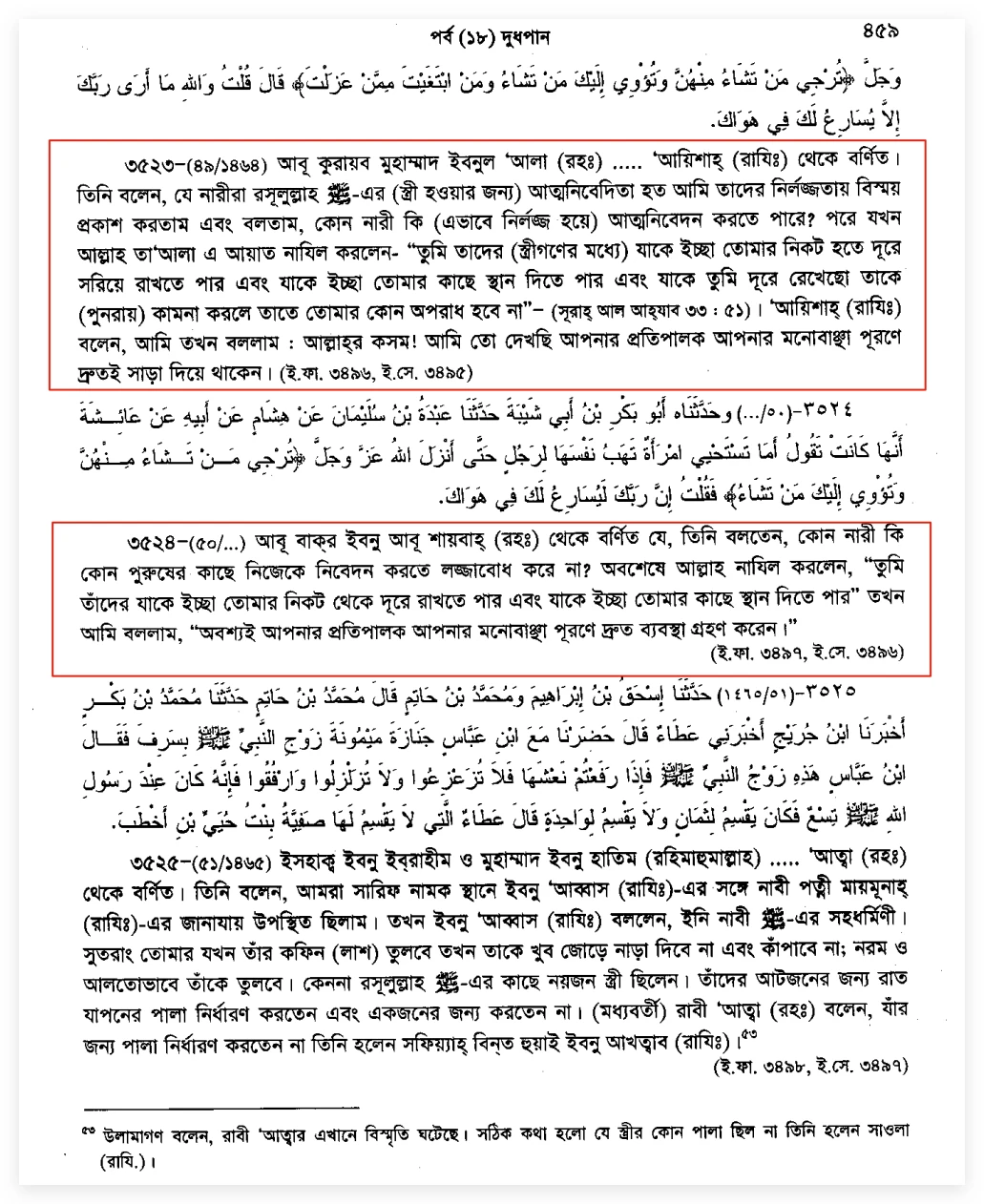
The sharpest comment on Muhammad’s special privileges concerning women was not made by a modern critic of Islam; it was made by his wife Aisha. Women offered themselves to Muhammad for marriage without demanding a dowry, and Aisha did not conceal her jealousy and irritation. Sahih Muslim records that she felt jealous of these women and asked in astonishment, “Does a woman offer herself in this way?” When verse 33:51 was then revealed, giving Muhammad freedom to defer, receive, and call back whichever women he wished, Aisha’s reaction was pointed [22] –
‘A’isha (Allah be pleased with her) reported: I felt jealous of the women who offered themselves to Allah’s Messenger (ﷺ) and said, “Does a woman offer herself?” Then when Allah revealed, “You may defer any one of them you wish, and take to yourself any you wish; and if you desire any you have set aside, no sin is chargeable to you” (Quran 33:51), I said: It seems to me that your Lord hastens to satisfy your desire.
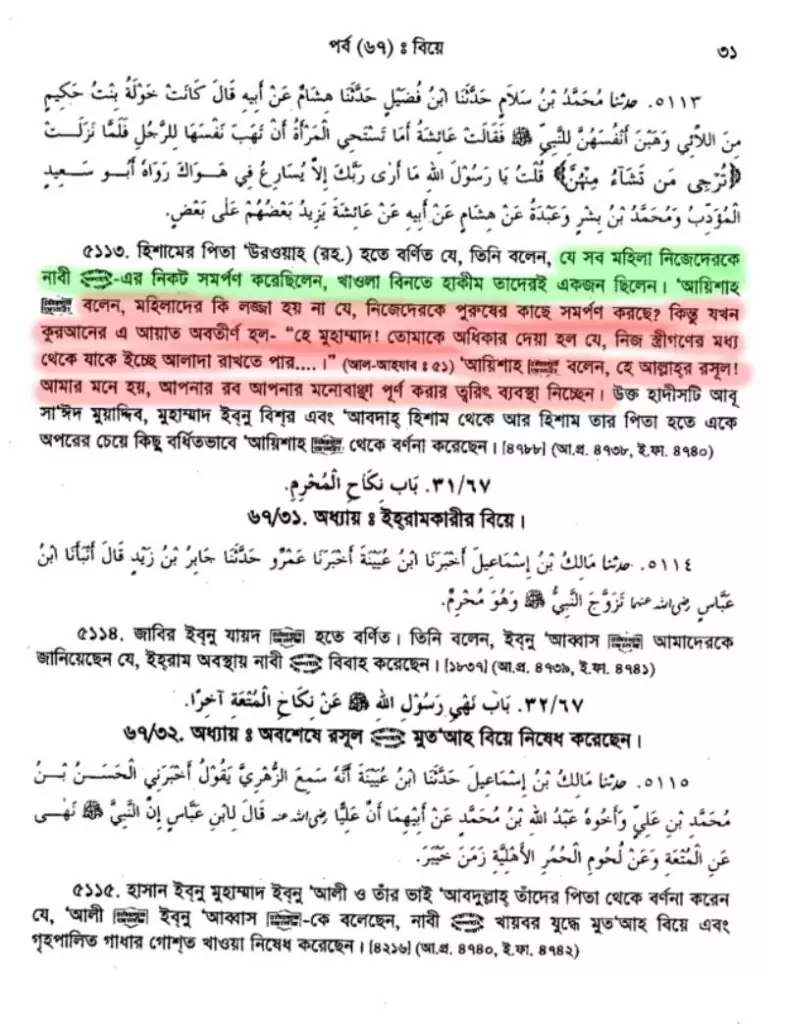
The same report is preserved in Sahih al-Bukhari. There Aisha’s wording is more concise but has the same meaning: she disapproved of women offering themselves to Muhammad; then, when the special freedom in 33:51 was revealed, she said, “I feel that your Lord hastens in fulfilling your wishes and desires.” [23] –
Narrated Aisha: I used to look down upon those women who had offered themselves to Allah’s Messenger (ﷺ) and would ask, “Can a woman offer herself?” Then when Allah revealed the ruling of 33:51, I said, “I feel that your Lord hastens to fulfill your wishes.”
There is no reason to dismiss this as merely a modern critic’s sarcasm. It is a statement from inside Muhammad’s household, preserved in two of the most prestigious hadith collections, Sahih al-Bukhari and Sahih Muslim. The sequence is important: women offered themselves to Muhammad; Aisha objected; a verse then gave him freedom to decide whom to keep close, whom to set aside, and whom to receive again; and Aisha commented that his Lord was hastening to fulfill his wishes. She herself connected Muhammad’s will with the special ruling revealed for him.
Islamweb preserves the Arabic text of Sahih Muslim 1464a. Aisha’s key word is هَوَاكَ, meaning your desire, inclination, or choice [22] –
وَاللَّهِ مَا أَرَى رَبَّكَ إِلَّا يُسَارِعُ لَكَ فِي هَوَاكَ
That is, “By Allah, I see your Lord responding quickly to you for your wishes or desires.”
The relevant source references are Sahih Muslim 1464a and Sahih al-Bukhari 4788, together with the corresponding Bengali-edition references preserved in the source material.
Sahih Muslim 1464a
Book 17, Hadith 64
Sahih Muslim 1464a
‘A’isha (Allah be pleased with her) reported: I felt jealous of the women who offered themselves to Allah’s Messenger (ﷺ) and said, “Does a woman offer herself?” Then when Allah revealed, “You may defer any one of them you wish, and take to yourself any you wish; and if you desire any you have set aside, no sin is chargeable to you” (Quran 33:51), I said: It seems to me that your Lord hastens to satisfy your desire.
Grade: Sahih
Narrator: Aisha
Sahih al-Bukhari 4788
Book 65, Hadith 310
Sahih al-Bukhari 4788
Narrated Aisha: I used to look down upon those ladies who had given themselves to Allah’s Messenger (ﷺ) and I used to say, “Can a lady give herself to a man?” But when Allah revealed, “You, O Muhammad, can postpone the turn of whom you will of them, and you may receive any of them whom you will; and there is no blame on you if you invite one whose turn you have set aside temporarily” (Quran 33:51), I said to the Prophet: “I feel that your Lord hastens in fulfilling your wishes and desires.”
Grade: Sahih
Narrator: Aisha
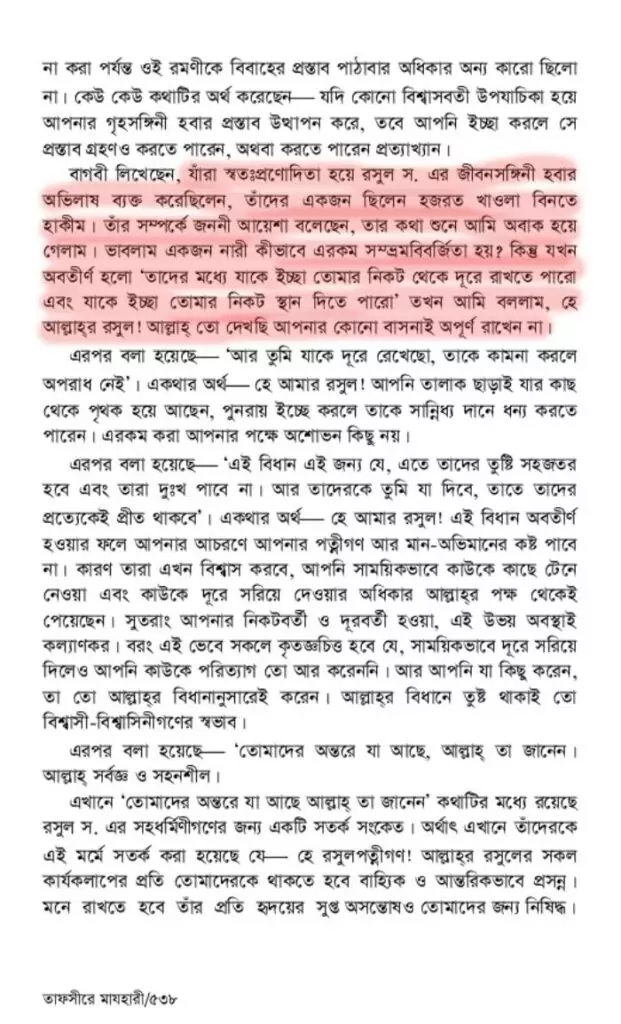
A closely related account appears in Tafsir Mazhari, volume 9, page 538 [24] –
Al-Baghawi wrote that Khawla bint Hakim was among the women who offered themselves to the Messenger. Aisha expressed astonishment at the woman’s conduct; after the verse allowing Muhammad to defer or receive whichever women he wished was revealed, Aisha said, “O Messenger of Allah, I see that God does not leave any of your desires unfulfilled.”
More significantly, in Fath al-Bari, Ibn Hajar al-Asqalani explains Aisha’s statement in language that makes the point explicit: “your Lord hastens in fulfilling your desire” means that Allah makes what Muhammad wants happen without delay and reveals what he loves and chooses [25] –
مُوجِدًا لِمَا تُرِيدُ بِلَا تَأْخِيرٍ، مُنْزِلًا لِمَا تُحِبُّ وَتَخْتَارُ
That is: “making what you want happen without delay and revealing what you love and choose.”
No clearer explanation is needed. Even if Aisha’s statement is dismissed as a wife’s jealous remark, the underlying information does not change. Ibn Hajar’s explanation gives the sentence this meaning: Muhammad’s wishes were fulfilled quickly and revelation came in accordance with what he loved and chose. The practical meaning therefore points back to Muhammad’s will and to rulings revealed in support of it.
Elsewhere in Fath al-Bari, Ibn Hajar records that Khawla bint Hakim was among the women who offered themselves to Muhammad. Aisha used to say of such women, “Does a woman not feel ashamed to offer herself to a man?” After the revelation of 33:51, she made the famous comment [26] –
أَمَا تَسْتَحِي الْمَرْأَةُ أَنْ تَهَبَ نَفْسَهَا لِلرَّجُلِ … مَا أَرَى رَبَّكَ إِلَّا يُسَارِعُ فِي هَوَاكَ
That is, “isn’t a woman ashamed that she betrays herself to a man?”… “I see your Lord responds quickly to your wishes.”
Al-Qurtubi also uses Aisha’s authentic report in his commentary on Surah Al-Ahzab 33:51. In his view, the strongest interpretation is that Muhammad was given freedom from the obligation of equal turns among his wives. After quoting Aisha’s hadith, Al-Qurtubi cites Ibn al-Arabi’s statement that the interpretation established by the authentic hadith is the one that should be relied upon [27] –
التَّوْسِعَةُ عَلَى النَّبِيِّ … فَكَانَ لَا يَجِبُ عَلَيْهِ الْقَسْمُ بَيْنَ زَوْجَاتِهِ
That is: “The Prophet was given latitude … equal division among his wives was not obligatory for him.”
Ibn al-Arabi said: هَذَا الَّذِي ثَبَتَ فِي الصَّحِيحِ هُوَ الَّذِي يَنْبَغِي أَنْ يُعَوَّلَ عَلَيْهِ
That is: “What is established in the authentic report is what should be relied upon.”
Another authentic report from Aisha clarifies the practical meaning of this privilege. After verse 33:51 was revealed, when Muhammad wanted to visit another wife on the day assigned to one of them, he would ask that wife’s permission. Mu‘adha asked Aisha what she would say when he asked. Aisha replied, “If the decision were mine, I would not give anyone precedence over myself.” The report appears in both Sahih Muslim and Sunan Abi Dawud [28] [29] –
‘A’isha (Allah be pleased with her) reported that Allah’s Messenger (ﷺ) sought our permission when he had a turn to spend a day with one of his wives while he wanted to visit his other wives. This was after verse 33:51 was revealed. Mu‘adha asked her what she said when he sought her permission. She replied: “If it had been up to me, I would not have allowed anyone to have precedence over me.” [28]
This hadith is important because it shows how the legal situation changed after 33:51. Muhammad asked for permission, but the verse did not make him dependent on that permission. Abdul Muhsin al-Abbad’s commentary on Abu Dawud states directly that equal division of turns among wives was not obligatory for Muhammad; Allah placed the matter of will and choice in his hands [29] –
لَمْ يَكُنِ الْقَسْمُ وَاجِبًا عَلَى رَسُولِ اللَّهِ … لِأَنَّهُ جَعَلَ الْمَشِيئَةَ وَالِاخْتِيَارَ إِلَيْهِ
That is, “the turn of the wife was not obligatory on the Messenger… because the will and the election were handed over to him.”
In other words, the incident was not limited to women offering themselves to Muhammad. A woman could offer herself without a dowry, and Muhammad decided whether to accept her; he also decided which wives to keep close, which to set aside, and which to call back. The ordinary obligation of equal turns was lifted in his case. In the middle of this sequence, Muhammad’s own wife Aisha remarked, “I see that your Lord hastens to fulfill your wishes.”
The sharpness of Aisha’s comment lies here. Religious preaching today often claims that personal desire, preference, or attraction played no significant role in Muhammad’s life with women, as though Allah repeatedly forced him into relationships against his will. Yet the accounts from Muhammad’s own household present the opposite picture: Aisha saw women offering themselves to her husband, objected to it, then saw a verse revealed that gave Muhammad even broader freedom regarding those women and his wives; at that moment, her conclusion was that Allah was hastening to fulfill Muhammad’s wishes.
Later explanations cannot change the sequence preserved in the authentic reports. Ibn Hajar’s interpretation makes Aisha’s statement even clearer: “making what you want happen without delay and revealing what you love and choose.” A sacred portrait that completely detaches Muhammad’s special revelations from his personal will conflicts with Sahih al-Bukhari, Sahih Muslim, and early Islamic commentary.
These Were Not Isolated Incidents
Aisha’s comment cannot be treated as an isolated incident in Muhammad’s life. When the Islamic reports are read together, similar behavior appears repeatedly in matters of women and sex. Sahih Muslim reports that Muhammad saw a woman, went to his wife Zaynab, and had intercourse with her; he then instructed his Companions to follow the same procedure when they felt desire [30] –
Likewise, authentic hadith reports describe Muhammad having sexual relations with several wives in a single night. One report even records the Companions discussing his exceptional sexual strength. These reports and their variant wordings are preserved in Sahih al-Bukhari 268 [31].
Other Islamic reports describe related incidents involving Muhammad’s wives. One report concerns Hafsa finding Muhammad having sex with Maria al-Qibtiyya in Hafsa’s house and bed; Muhammad then promised to abstain from Maria, and a Quranic revelation later addressed the breaking of that promise. The source reports and their relationship to Surah Al-Tahrim are analyzed in the linked articles. The important point here is that resentment, jealousy, and conflict over Muhammad’s sexual life were not limited to a single incident.
Other reports describe conflict over Muhammad’s relations with women. One account says that Hafsa found Muhammad having sex with Maria al-Qibtiyya in Hafsa’s house and bed; Muhammad then promised to abstain from Maria, and a Quranic revelation later addressed the breaking of that promise. The source reports and their relationship to Surah Al-Tahrim are analyzed in the linked article; the important point here is that the wives’ resentment, jealousy, and conflict over Muhammad’s sexual life were not limited to one incident.
The picture presented here does not rest on one isolated verse or a disputed story. Attraction to women’s beauty, sexual arousal on seeing women, sexual relations with multiple wives over a short period, jealousy and conflict among the wives, special marital concessions, and revelation supporting those concessions are all found across Islamic sources. Read together, these reports undermine the claim that Muhammad had no particular attraction to women.
Conclusion
The campaign that Prophet Muhammad had no special attraction to women, that he married one woman after another only because Allah commanded him despite his reluctance, and that his life concerning women was mainly the result of social or political responsibilities does not accord with Islam’s primary sources. Reading the Quran, authentic hadith, and early tafsir together produces a very different picture. Muhammad was granted special marital and sexual privileges beyond those of ordinary Muslim men: he was not confined by the ordinary limit of four wives; he could accept a woman who offered herself to him without a dowry; the obligation of equal turns among his wives was lifted; and he was given authority to decide whom to keep close, whom to set aside, and whom to receive again. The Quran itself states the reason for these concessions: “so that there would be no blame on you.”
The early commentators did not conceal the meaning of this “difficulty.” Al-Wahidi described it as “the narrowness of marriage and preventing you from what you want.” Ibn Ashur explained it as the opportunity to increase the number of wives, marry women who offered themselves without a dowry, and leave acceptance of such an offer to Muhammad’s own will. In other words, restrictions that functioned as religious rules for ordinary Muslims were treated as “difficulty” and removed through a special exemption.
The Quran’s language is even more direct. It says that another woman’s beauty might attract Muhammad and, while restricting the taking of a new wife, states, “even if her beauty may attract you.” The same verse again excludes women in his possession from the restriction. This is accompanied by authentic hadith reports describing women among Muhammad’s beloved worldly interests, sexual arousal on seeing a woman, going to his wife to relieve that desire, visiting several wives in one night, and jealousy and conflict among his wives. These are not later anti-Islamic inventions; they are reports preserved in Islamic sources.
The most important testimony comes from Aisha. She expressed jealousy on seeing women offer themselves to Muhammad. Later, when a verse gave Muhammad the freedom to decide which wives to keep close, which to set aside, and which to receive again, she said, “I feel that your Lord hastens to fulfill your wishes.” Ibn Hajar explained the statement as meaning, “making what you want happen without delay and revealing what you love and choose.” After this, to claim that personal desire played no role in Muhammad’s life with women is to deny the testimony of the Islamic sources.
Therefore, the claim that “Muhammad had no desire for women” is not a conclusion grounded in historical or religious sources; it is a later character-protective apologetic narrative. Islamic sources state that Muhammad was attracted to women’s beauty, experienced sexual arousal on seeing a woman, had relations with multiple women, and received special marital and sexual exemptions unavailable to ordinary believers. Revelation was even presented in support of those exemptions. Claims such as “he wanted nothing; Allah forced him” are not merely unsupported—they contradict the Quran, authentic hadith, and early tafsir.
If a missionary receives special marital and sexual privileges, presents provisions aligned with his own preferences as divine commands, and his own wife says that his Lord hastens to fulfill his wishes, an impartial assessment sees a combination of personal advantage and religious authority. The original sources do not support a sanctified narrative designed to conceal that combination.
References
- Surah Al-Ahzab 33:50 ↩︎
- Tafsir al-Tabari, Surah Al-Ahzab 33:50, Islamweb ↩︎
- Tafsir Ibn Kathir, Surah Al-Ahzab 33:50, Islamweb ↩︎
- Al-Wahidi, At-Tafsir al-Wasit, Surah Al-Ahzab 33:50–52, Islamweb 1 2
- Surah Al-Ahzab 33:52 ↩︎
- Tafsir al-Tabari, Surah Al-Ahzab 33:52, Islamweb 1 2
- Tafsir al-Qurtubi, Surah Al-Ahzab 33:52 ↩︎
- Tafsir al-Qurtubi, Surah Ahzab 33:52 ↩︎
- Tafsir al-Nasafi, Surah Al-Ahzab 33:52, Islamweb ↩︎
- Commentary on Surah Al-Ahzab 51–52, Islamweb ↩︎
- Tafsir al-Baghawi, Surah Al-Ahzab 33:50, Islamweb ↩︎
- IslamWeb, Tafsir of Surah Al-Ahzab 49–51, Fatwa 14075 ↩︎
- Abu Bakr al-Jazairi, Tafsir of Surah Al-Ahzab 33:50, Islamweb ↩︎
- Surah Al-Ahzab 33:51 ↩︎
- Tafsir al-Baghawi, Surah Al-Ahzab 33:51, Islamweb ↩︎
- Tafsir al-Tabari, Surah Al-Ahzab 33:51, Islamweb ↩︎
- Tafsir al-Razi, Surah Al-Ahzab 33:51, Islamweb ↩︎
- Surah Ahzab 33:50-52, Islamweb ↩︎
- Surah Ahzab 33:50, Islamweb 1 2 3
- Surah Ahzab 33:50 1 2
- Madarikut Tanzeel, Surah Ahzab 33:50-51 ↩︎
- Sahih Muslim 1464a 1 2
- Sahih al-Bukhari 4788 ↩︎
- Tafsir Mazhari, volume 9, page 538 ↩︎
- Ibn Hajar al-Asqalani, Fath al-Bari, commentary on Surah Al-Ahzab 33:51, Islamweb ↩︎
- Ibn Hajar al-Asqalani, Fath al-Bari, “Can a Woman Offer Herself?” chapter, Islamweb ↩︎
- Tafsir al-Qurtubi, Surah Al-Ahzab 33:51, Islamweb ↩︎
- Sahih Muslim 1476a 1 2
- Sunan Abi Dawud 2136 1 2
- Sahih Muslim 1403a ↩︎
- Sahih al-Bukhari 268 ↩︎