
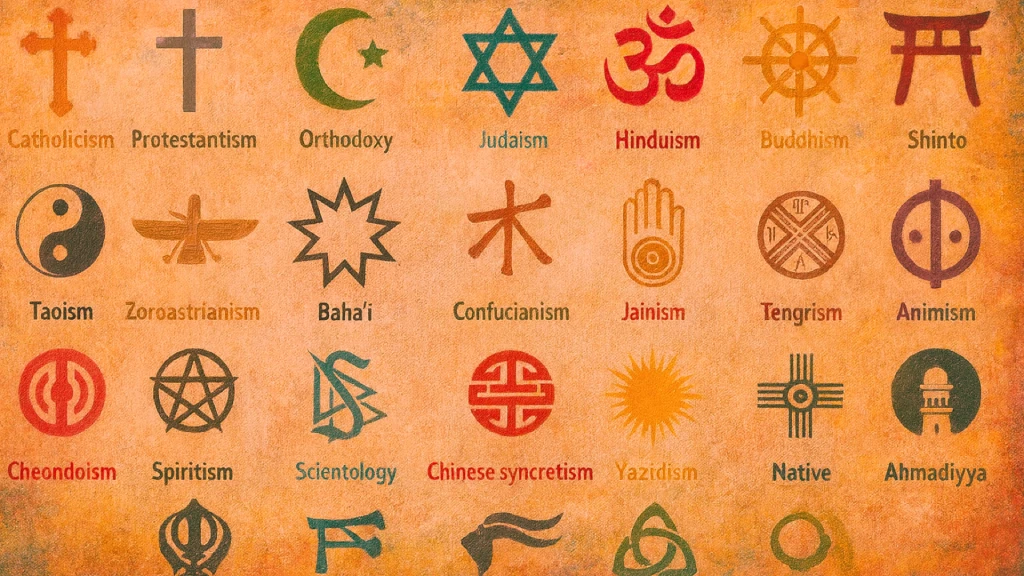
Classification of Religion: A Human Map of Belief and Disbelief
Introduction
From the earliest stages of human civilization, the immense scale of the universe, the destructive force of nature, and the mortality of life have confronted human beings with a profound and unresolved sense of wonder. When prehistoric people looked at the night sky and tried to read their fate in the arrangement of the stars, or pleaded with an unseen power for survival during a violent storm, the idea of the “supernatural” began to take shape in the human imagination. From the desire to establish contact with such invisible powers, from uncertainty about life after death, and from the search for consolation amid worldly suffering, there gradually evolved the complex and multidimensional institution we call “religion.” Religion is not merely worship, ritual, or temple architecture; it is woven into human culture, social organization, psychology, and morality. It can provide inner reassurance to individuals while also binding communities together through powerful structures of solidarity.
Yet it is almost impossible to confine the word “religion” within a single definition. In ordinary usage, religion often brings to mind an omnipotent creator, a set of sacred scriptures, and a system of judgment after death. But a global map of religion shows that this picture captures only a fragment of the phenomenon. When a shaman in the frozen expanses of Siberia communicates with spirits, when every element of nature is treated as a living being in the depths of the Amazon, or when practitioners in a Japanese Zen Buddhist monastery seek to apprehend emptiness through meditation without reference to a creator God, conventional definitions begin to collapse. In some traditions God is one and unique; in others the divine is multiple and diverse; elsewhere there is no creator God at all, only morality, discipline, and the pursuit of self-liberation.
To understand this vast, colorful, and often confusing world of belief and unbelief, a systematic theoretical framework is necessary. Just as biologists classify the animal world into different phyla and classes, theologians, anthropologists, and sociologists have attempted to organize the spiritual experiences of humanity into different types. This article offers a detailed exploration of those theoretical classifications. We will examine religion from multiple perspectives: from monotheism to polytheism according to the number of gods; from pantheism to animism according to conceptions of divinity and nature; and from churches to cults or folk religions according to organizational structure. We will also consider how science, technology, and modernity have reshaped inherited forms of belief and produced newer identities such as “spiritual but not religious.” This is therefore not merely a list of religions, but an intellectual map of the changing forms of human consciousness.
Basic Types of Religion: Variations in the Concept of God
The familiar image of religion as belief in a single bearded God seated upon a throne represents only a small portion of the immense spectrum of religious thought. Religions can be classified in different ways according to their conception of God or supernatural beings and according to the relationship between the divine and the universe. These categories are theoretical tools intended to facilitate analysis; in practice, many religions display characteristics of more than one category, and the boundaries between them are often blurred and fluid.
Based on the Number of Gods:
The number of gods is probably one of the oldest and most straightforward ways of classifying religion. Whenever human beings have reflected on the supernatural realm, they have confronted a basic question: is ultimate power one, or is it many? Different structures of religious belief have developed around different answers to this question.
Monotheism: The Concept of the One and Only
Monotheism is a system of belief in which only one, and no more than one, supreme God is acknowledged. This God is generally understood as the creator, sustainer, and final judge of the entire universe. The most influential examples are the three Middle Eastern traditions collectively known as the Abrahamic Religions: Judaism, Christianity, and Islam. In addition, Sikhism and the Baháʼí Faith are also strongly monotheistic. In these traditions, God is commonly conceived as a personal being who hears prayer, acts in history, and judges good and evil.
Historically, the rise of strict monotheism represented a major intellectual transformation. German philosopher Karl Jaspers described the period roughly between 800 and 200 BCE as the “Axial Age”, during which major developments in human thought took place independently in China, India, Persia, Greece, and Israel (Jaspers, 1953). This broad era saw the emergence of Zarathustra in Persia, the Buddha and Mahavira in India, the Upanishadic sages, and monotheistic prophets in Israel, all of whom challenged older mythological and polytheistic worldviews in different ways.
The monotheistic conception of God is often defined through several specific philosophical attributes:
- Omnipotent: God’s power has no limit.
- Omniscient: God knows everything about the past, present, and future.
- Omnipresent: God is present everywhere at the same time.
- Omnibenevolent: God is ultimately good and the source of morality.
- Transcendent: God exists beyond the material world. God created the world but is not simply a part of it.
- Personal: God is not merely an abstract force, but possesses will, consciousness, and personality. God enters into relationships with human beings and guides them through prophets.
When these attributes are combined, they generate a profound philosophical difficulty known as the Problem of Evil, often discussed in connection with theodicy. The argument traditionally associated with the ancient Greek philosopher Epicurus asks: if God is willing to prevent evil but unable to do so, then God is not omnipotent. If God is able but unwilling, then God is not omnibenevolent. If God is both able and willing, why does evil exist? And if God is neither able nor willing, in what sense should such a being be called God? For thousands of years this question has preoccupied monotheistic theologians and philosophers, producing an enormous literature in response (Hick, 1966).
Two major forms of monotheism can be distinguished:
- Exclusive Monotheism: According to this position, only one God exists, and acknowledging or worshipping other gods is a serious sin or shirk. The Abrahamic religions are generally included in this category. Their scriptures frequently contain severe warnings against the worship of other deities. This claim to possess the sole religious truth has made monotheistic traditions powerful and strongly proselytizing. It has also had a darker historical dimension: such exclusivism has repeatedly been associated with intolerance toward other religions, forced conversion, and religious wars such as Crusades and Jihads.
- Inclusive Monotheism: This position recognizes one ultimate God while regarding other deities as different forms, manifestations, or expressions of that same supreme reality. Some strands of Hindu theology, including the Smarta tradition and certain currents of Vaishnava philosophy, approach this idea. Different gods may be worshipped under different names and forms, while devotion is ultimately understood as reaching one supreme being.
The rise of monotheism is often regarded as an important intellectual and political turning point in human history. Karen Armstrong, in A History of God (1993) , traces the gradual development of monotheistic ideas across different cultures. Such developments often involved increasing abstraction and consolidation of earlier polytheistic deities. For example, in the fourteenth century BCE, the Egyptian pharaoh Akhenaten attempted to establish the solar deity Aten as the sole object of worship, an episode frequently regarded as one of the earliest major monotheistic experiments in history. By replacing numerous local and tribal gods with a more universal, abstract, and moral divine authority, monotheism could also function as a powerful ideological instrument in empire-building and the integration of different populations.
Polytheism: The Colorful World of the Gods
Polytheism is belief in the existence of multiple gods and goddesses. Before the rise of monotheism, it was among the most widespread forms of religious belief. The religions of ancient Greece, Rome, Egypt, Mesopotamia, the Nordic world, and pre-Columbian America were all polytheistic. The largest modern religious tradition commonly described as polytheistic is Hinduism, although strongly monotheistic and pantheistic currents also exist within it. Japan’s Shinto tradition is also polytheistic, centering on innumerable natural powers or kami.
A polytheistic pantheon is often organized like a royal court or an extended family, with a hierarchy of power among the gods. Zeus, for example, presided over the Greek pantheon, while Odin occupied a comparable position in the Norse pantheon. These major deities often take the form of a “Sky Father,” a pattern found across Indo-European-speaking cultures—for example Sanskrit Dyauṣ Pitṛ, Greek Zeus Pater, and Latin Jupiter.
Polytheistic gods are generally not omnipotent or omniscient in the manner of the classical monotheistic God. They are powerful, but their authority is limited to particular domains. Zeus could wield the thunderbolt, but the sea belonged to his brother Poseidon. The gods may be immortal, yet they display recognizably human emotions—love, hatred, jealousy, anger, and lust. Their myths are therefore filled with drama and often resemble cosmic reflections of human life. Philosophers such as Plato sharply criticized Homer’s gods for precisely this reason, arguing that their conduct failed to provide a proper moral model for human beings (Plato, Republic, Book II).
In many polytheistic religions, the relationship between humans and gods was fundamentally contractual or transactional (do ut des – “I give so that you may give”). Through proper ritual and sacrifice, worshippers sought to satisfy the gods and obtain divine favor. For this reason polytheistic religions have often been more syncretic and accommodating toward foreign deities than exclusive monotheistic traditions. When two polytheistic cultures came into contact, their gods could often be identified with one another. The Romans associated Jupiter with the Greek Zeus, Mars with Ares, and Venus with Aphrodite. The cult of the Egyptian goddess Isis spread widely throughout the Roman Empire. Incorporating an additional deity into an existing pantheon posed no fundamental theological contradiction.
Hinduism is often described as polytheistic because it includes the worship of many gods and goddesses. Yet this classification can be overly simplistic. Many Hindu philosophers regard these numerous deities as manifested forms of one ultimate, formless reality, Brahman. This makes Hindu theology considerably more complex; aspects of it can be described as polymorphic monotheism or henotheism.
Pantheism: All Existence Is God
Pantheism is a philosophical position radically different from conventional personal conceptions of God. According to pantheism, God is not a person-like being standing outside the universe and controlling it like a puppet master. Rather, God and the universe are identical: God is the universe and the universe is God. Chairs, tables, plants, stars, galaxies, and human beings together constitute the one divine reality. God and nature are therefore inseparable. In pantheism, God does not listen to prayers or suspend natural law through miracles; the order of nature itself is divine.
In Western philosophy, the Dutch thinker Baruch Spinoza became the most influential advocate of this position. He famously used the expression Deus sive Natura, “God or Nature.” For Spinoza, the order of nature is eternal and necessary, leaving no room for supernatural interventions that violate natural law (Spinoza, 1677/1996). Albert Einstein repeatedly contrasted the personal God of Abrahamic religion with what he called Spinoza’s God, manifested in the rational harmony of existence rather than in a deity concerned with individual human fate and action. Similar themes also appear in ancient Stoic philosophy, where the cosmos was thought to be permeated by a divine rational principle or Logos and human beings were urged to live in accordance with that cosmic order.
There is also a strong resonance with pantheistic thought in the Hindu philosophy of Advaita Vedanta. According to the tradition associated with Adi Shankaracharya, Brahman is the sole ultimate reality. The world before us and our apparently separate self or Atman appear distinct because of illusion or Maya. When this illusion is dispelled through knowledge, the seeker realizes that Atman and Brahman are ultimately identical. The great sayings “Aham Brahmasmi” (“I am Brahman”) and “Tat Tvam Asi” (“You are That”) express this non-dual realization. Comparable resonances can also be found in Taoism and in some Buddhist philosophies.
Panentheism: The World Is in God, but God Transcends the World
This idea is a subtle but important refinement of pantheism. If pantheism says that “the universe is God,” panentheism says that “the entire universe exists within God, but God is not limited to the universe” (All is in God, but God is more than the All). In other words, everything exists in God without exhausting the totality of God.
A simple analogy can make the distinction clearer. Imagine God as an infinite ocean and the universe as a sponge floating within it. The sponge is saturated with water and exists entirely within the water, just as every particle of the universe is permeated by the divine (Immanent). Yet the ocean extends infinitely beyond the sponge, just as God also exists beyond and above the universe (Transcendent).
Panentheism attempts to explain both divine infinity and God’s intimate relation to the world. It also seeks to avoid a difficulty often raised against pantheism: if the world simply is God, then the evil and imperfection found within the world would also be direct aspects of God. In panentheism, the world exists within God, but the totality of the divine being is not exhausted or limited by the world’s imperfections.
Twentieth-century Process Theology, developed from the work of philosophers Alfred North Whitehead and Charles Hartshorne, represents an influential form of panentheistic thought. In this philosophy God is not wholly static and unchanging but exists in a dynamic and creative relationship with the universe. God and the world continually affect one another (Hartshorne, 1967).
Henotheism: Supreme for the Moment
The term was popularized by the German Indologist and scholar of religion Max Müller, primarily in his attempts to describe aspects of ancient Vedic religion. Henotheism is a form of belief in which the existence of multiple gods is fully acknowledged, yet at the moment of worship a particular deity is praised as supreme, sometimes as though that deity alone were the effective ruler of the universe.
The defining feature of henotheism is situational or shifting supremacy. When a worshipper praises Indra for rain, Indra becomes, within that act of devotion, lord of the universe. When the worshipper turns to Agni, the fire god becomes foremost. The arrangement resembles a large organization with several department heads: when one enters the marketing department, its director becomes the most relevant authority, but this does not require denying the existence of the heads of finance or human resources.
Müller identified this tendency while analyzing hymns of the Rigveda. In one hymn a particular god—such as Indra, Varuna, or Agni—may be praised as though he alone were omnipotent, creator of heaven and earth, and ruler of all other gods. In the next hymn, however, another deity may receive the same supreme status. Müller described this apparent contradiction as “henotheism” or “kathenotheism” (Kathenotheism—worshipping one god at a time) (Müller, 1878). It is a syncretic and relatively flexible outlook that recognizes the importance of multiple deities without requiring permanent exclusive loyalty to one.
Monolatry: Only One for Us
Monolatry or exclusive worship of one god is a system in which the existence of many gods is acknowledged, but a particular group or people is committed to worshipping only one of them.
Monolatry is less fluid than henotheism. One deity is permanently chosen as the “national” or “group” god, and exclusive loyalty is owed to that deity. The gods of other peoples are not necessarily denied, but worshipping them is strictly forbidden because it is treated as betrayal of one’s own god. The central ideas here are loyalty and covenant rather than metaphysical superiority.
The religion of early Israel is frequently discussed as an important example of monolatry. In many portions of the Old Testament—particularly from Exodus through the Book of Judges —the Israelites are portrayed as accepting Yahweh as their sole object of worship, the god who delivered them from Egypt and entered into a special covenant with them. The famous first commandment, “Thou shalt have no other gods before me,” can be read as prohibiting worship of “other gods” without necessarily denying that such gods were believed to exist. When Israelites worshipped the Canaanite god Baal or the goddess Asherah, the act was represented as adultery or covenantal betrayal. According to biblical scholar Mark S. Smith, ancient Israelite religion gradually developed from monolatry toward stricter monotheism, especially around and after the Babylonian Exile, when Yahweh increasingly came to be understood as the sole universal God (Smith, 2002).
Compared directly, henotheism grants shifting supremacy to different gods in different contexts, whereas monolatry maintains permanent loyalty to one deity while acknowledging the existence of others. Both are important categories for understanding historical transitions between polytheistic and monotheistic forms of belief.
Non-Theistic Religions: Seeking Liberation Without a Creator God
When we hear the word “religion,” we usually imagine a creator God. Yet the spectrum of belief is so diverse that several influential religions and philosophies do not place an omnipotent creator at the center of their worldview—or dispense with such a being altogether. These traditions are often described as non-theistic. Rather than placing faith in supernatural beings, they place greater emphasis on human effort, morality, philosophy, self-discipline, and liberation.
Buddhism: The Path of Wisdom and Compassion
The foundation of Buddhism lies in the teachings of Siddhartha Gautama, who lived in northern India around the fifth century BCE and became known as the Buddha, the “Awakened One.” Buddhism developed into a complete religious tradition with its own cosmology, ethical system, and path to liberation, yet it does not place a creator God at its center.
- Absence of a creator God: Buddhism contains no doctrine of an omnipotent, omniscient creator deity. When the Buddha was questioned about certain metaphysical matters, including the ultimate origin of the universe, he treated such questions as “unanswered” or “undeclared” questions. His famous Parable of the Poisoned Arrow illustrates the practical point: if a person has been struck by a poisoned arrow, the urgent task is to remove the arrow and treat the wound, not to postpone treatment while asking who fired it, what caste the archer belonged to, or what material the arrow was made from. Likewise, the central human problem is suffering, and the priority is to understand and overcome it rather than speculate endlessly about the origin of the cosmos (Rahula, 1959).
- The universe: Buddhist philosophy describes reality through an interdependent cycle of cause and effect, or dependent origination (Pratītyasamutpāda). Phenomena arise in dependence upon conditions; events are understood through networks of causation rather than the creative act of a single supreme deity.
- The path to liberation: Buddhism centers on understanding the Four Noble Truths: (1) suffering exists, (2) suffering arises from craving or attachment (Taṇhā), (3) suffering can cease, and (4) the path leading to its cessation is the Noble Eightfold Path. This path integrates ethical conduct (Sīla), meditation (Samādhi), and wisdom (Prajñā). Its ultimate goal is Nirvana, the extinguishing of craving, hatred, and ignorance. Liberation is therefore pursued through discipline and insight rather than dependence upon the grace of a creator God.
- The position of gods: Buddhism does not necessarily deny the existence of gods. Buddhist cosmology includes heavenly realms and devas, but these beings are neither creators nor omnipotent. They remain subject to karma and rebirth. Their lives may be longer and more pleasurable than those of humans, but they have not necessarily attained Nirvana and are not ultimately superior in the quest for liberation. In Mahayana Buddhism, Bodhisattvas may acquire almost divine devotional significance, yet they are not creators; they are compassionate beings who postpone final liberation in order to aid others.
Jainism: Nonviolence and Purification of the Soul
Jainism is an ancient Indian religion, contemporary with Buddhism in its historically documented form and rooted in traditions that Jains themselves regard as much older. It is also a strongly non-theistic religion.
- Rejection of a creator: Jainism explicitly rejects the idea of a creator God. One traditional line of reasoning is that a perfect and immutable being would have no unfulfilled desire or motive to create. The universe is therefore regarded as eternal, without an absolute beginning or end.
- Structure of the universe: Jain metaphysics describes reality in terms of six eternal substances (Six Dravyas): Jīva (soul), Pudgala (matter), Dharma (the medium of motion), Adharma (the medium of rest), Ākāśa (space), and Kāla (time). The natural interaction of these realities accounts for the structure and processes of the cosmos.
- The path to liberation: The central goal of Jainism is purification of the soul and liberation (Moksha) from the bondage of karma. In Jain thought, karma is not only the moral consequence of action but is also described as a kind of subtle material substance that adheres to the soul and binds it to the cycle of rebirth. Right Faith (Samyak Darshana), Right Knowledge (Samyak Jnana), and Right Conduct (Samyak Charitra)—the Three Jewels (Triratna)—provide the path toward freedom from karmic bondage.
- Core principles: The most important ethical principle is Ahimsa (nonviolence). It extends not only to human beings and animals but, in Jain thought, to plants and even microscopic forms of life in air and water. This concern helps explain the strict practices of Jain ascetics, including the use of mouth coverings by some monks to reduce the risk of harming tiny organisms. Other fundamental principles include Anekantavada (the many-sidedness of truth) and Aparigraha (non-attachment or non-possession).
Some Forms of Taoism: Following the Way of Nature
Chinese Taoism exists in both philosophical and religious forms. In its philosophical expression, associated especially with Laozi‘s Tao Te Ching and the writings of Zhuangzi, there is no central conception of a personal creator God.
- Tao: The Tao, or “Way,” is the natural, spontaneous, and underlying order of the universe. It is not a personal being or deity but an abstract, indescribable, impersonal principle. All things arise through the Tao and ultimately return to it.
- Wu Wei: The Taoist ideal is to live in harmony with the Tao through Wu Wei, often translated as “effortless action.” It does not mean laziness. Rather, it means acting without forcing oneself against the natural flow of circumstances, much as water moves around an obstacle instead of attempting to smash through it.
- Religious Taoism: Over time, Taoism interacted with Buddhism and Chinese folk traditions and developed organized religious forms involving gods, immortals, priests, rituals, and quests for longevity. Yet its foundational philosophical strand remains non-theistic in the sense that it does not depend upon a personal creator God.
These non-theistic religions demonstrate that belief in a creator God is not indispensable to every attempt to answer life’s deepest questions, construct an ethical and meaningful life, or pursue liberation. They offer alternative spiritual paths grounded in discipline, wisdom, effort, and compassion.
Types Based on God’s Relationship with the Universe
Religions and philosophies can also be classified according to how the divine is understood to relate to the world. Is God actively involved in every event? Did God create the universe and then withdraw? Or is the universe itself somehow within God? These questions penetrate deeply into the conceptual architecture of religious belief.
Theism: An Active and Involved God
Theism is a broad category referring to belief in one or more gods who are actively involved in the creation and governance of the universe. Both monotheism and polytheism can fall within theism. The defining point is that the divine is not merely a remote cause but an active ruler or presence involved in worldly events.
Characteristics:
- Active involvement: Theists believe that God or the gods intervene in human life and history.
- Prayer and revelation: They believe that God hears human prayer and may answer it. God may communicate with human beings through prophets and revelation.
- Miracles: In many forms of theism, God is regarded as standing above ordinary natural law and capable of producing miracles by suspending or overriding the usual course of nature.
Examples: The Abrahamic religions—Judaism, Christianity, and Islam—are classic examples of theism. Their sacred texts contain many narratives of divine intervention: seas are divided, the dead are restored to life, and chosen peoples or individuals are guided. Likewise, in many polytheistic traditions the gods descend into the human world, communicate with mortals, and influence their fate.
Deism: The Distant Watchmaker
Deism is the belief that a creator God brought the universe into existence and established immutable natural laws to govern it, but thereafter ceased to intervene in its ordinary operation.
Characteristics:
- The single intervention—creation: Deists generally recognize creation as God’s decisive act while denying continuing supernatural interference.
- Rejection of revelation and miracles: Classical deists reject claims that a particular scripture, prophet, or miracle constitutes a privileged supernatural disclosure. God is understood to be revealed through nature and reason rather than through one exclusive sacred text. Reason and scientific investigation therefore become central tools for understanding the universe.
- The “Cosmic Watchmaker”: Deists often compare God to a watchmaker who constructs a perfect mechanism, winds it, and allows it to operate according to its own design. Once the system is functioning, the maker need not continually intervene.
Historical context: Deism became influential among many European and American intellectuals during the eighteenth-century Age of Enlightenment, including figures such as Voltaire, Thomas Paine, and Thomas Jefferson. It offered one way of reconciling belief in a creator with a scientific worldview. Newtonian physics encouraged the image of the universe as an orderly machine governed by regular laws. Deism allowed a creator to be retained while rejecting many miraculous and revelatory claims of traditional religion (Walters, 1992).
Dualism: The Eternal Conflict Between Good and Evil
In dualistic systems of belief, reality is understood through the conflict of two fundamental, enduring, and opposing principles. These forces commonly symbolize good and evil, light and darkness, spirit and matter, or order and chaos.
Characteristics:
- Two primordial powers: In strong forms of dualism, good and evil are not both created by one supreme being; they are treated as fundamental opposing realities.
- A solution to the problem of evil: Dualism offers a relatively direct answer to the monotheistic Problem of Evil. Evil exists because there is an adversarial power actively producing disorder and suffering. The good deity struggles against evil but has not yet achieved final victory.
- Moral summons: Human beings must choose a side in this cosmic conflict. Through free will, each person can align with good or evil. Right thought, right speech, and right action strengthen the forces of good.
Examples:
- Zoroastrianism: A classic example is ancient Persian Zoroastrianism. In traditions associated with Zarathustra, the cosmos is shaped by conflict between the wise and beneficent Ahura Mazda, associated with light, truth, life, and order, and the destructive spirit Angra Mainyu or Ahriman, associated with darkness, falsehood, death, and chaos. Human history becomes part of this cosmic struggle, which ultimately ends with the victory of Ahura Mazda.
- Gnosticism: Gnosticism is another important example of religious dualism, especially in movements that flourished during the early Christian centuries. Many Gnostic systems taught that the material world was not created by the highest benevolent God, but by an ignorant or hostile lesser deity known as the Demiurge. The human soul was understood as belonging to a higher divine realm but imprisoned within material existence. Salvation came through special knowledge, or Gnosis, which awakened the individual to this hidden divine origin (Pagels, 1979).
- Manichaeism: Founded in third-century Persia by Mani, Manichaeism combined elements drawn from Zoroastrianism, Buddhism, and Christianity within a rigorously dualistic religious system. At its height it spread from the Roman Empire across Central Asia toward China.
The influence of Zoroastrian dualistic themes on later Abrahamic religions, particularly on their eschatology, has been widely discussed. Many scholars have identified possible Zoroastrian influence in later ideas concerning the conflict between God and Satan, heaven and hell, final judgment, and resurrection of the dead (Boyce, 1984). Dualism in philosophy is also important. A famous example is René Descartes’ mind-body dualism, which treats mind (non-material, thinking substance) and body (material, extended substance) as fundamentally distinct.
These categories demonstrate that conceptions of God are shaped not only by the number or nature of divine beings, but also by how the divine is understood to interact with the visible world.
Types Based on the Relationship with Nature
This classification focuses less on the number or metaphysical nature of supernatural beings and more on the relationship between humans, nature, and the forces believed to inhabit the natural world. It is especially relevant when discussing indigenous traditions and folk religions.
Animism: A Living World
Animism is often described as one of the oldest forms of human religious thought. British anthropologist Sir Edward Tylor, in his influential Primitive Culture, treated belief in spiritual beings as the basic foundation of religion (Tylor, 1871). In animistic worldviews, not only humans and animals but also rivers, mountains, stones, trees, winds, the sun, and the moon may possess spirit, agency, or life-force.
According to Tylor’s theory, early humans developed the idea of the soul from experiences such as dreams, death, and trance, and then extended this idea to the rest of nature. Although Tylor’s evolutionist interpretation—which treated animism as a “primitive” or mistaken stage of religion—has largely been abandoned in modern anthropology, the term remains useful for describing worldviews in which reality is not understood as a collection of inert objects but as a community of living or relational beings. Contemporary anthropologist Graham Harvey has described animism as a world in which “persons” are everywhere, only some of whom are human, and where life is fundamentally lived through relationships with others (Harvey, 2005).
- Nature as conscious and agentive: In animistic cultures, nature is not treated as passive matter but as a living field populated by spirits or persons with their own intentions, personalities, and powers. Some may be friendly and helpful, others dangerous or hostile, and others indifferent. Hunting success, fertility, disease, and misfortune may be interpreted through one’s relationship with these beings.
- Reciprocity: Humans are participants within this wider community rather than its absolute masters. This can produce reciprocal relationships with the natural world. Before cutting a tree or killing an animal, people in some traditions may ask permission, offer thanks, or perform a ritual acknowledging the being that has been taken.
- Communication with the spirit world: A central figure in many such traditions is the shaman or ritual specialist. Through special training, altered states of consciousness, or inherited status, shamans are believed to communicate directly with spiritual beings. They may journey in trance, attempt to recover the lost soul of a sick person, interpret signs, predict future events, or negotiate with spirits on behalf of the community.
Examples: Animistic beliefs remain widespread among many indigenous communities in Siberia, the Amazon, and Papua New Guinea. The concept of kami in Japanese Shinto also closely resembles animistic understandings, in which mountains, rivers, trees, and exceptional persons may be treated as sacred presences. Some currents in the modern environmental movement have likewise been described as reflecting forms of neo-animist thought, particularly where nature is treated as a living subject rather than merely a resource.
Animatism: Impersonal Cosmic Power
Anthropologist Robert Marett proposed this concept as a distinction from animism. He believed Tylor’s emphasis on “souls” was too intellectualized and argued that some early forms of religious experience were more emotional, diffuse, and abstract.
Characteristics:
- Impersonal power: Rather than belief in a specific spirit or soul, animatism centers on an abstract, impersonal, pervasive supernatural force believed to exist throughout the universe.
- Mana: A well-known example is the concept of mana in Polynesian and Melanesian cultures. Mana refers to sacred or extraordinary power that may be concentrated in a person—such as a successful warrior or leader—an object such as a weapon or stone, or a particular place. A person or object possessing mana is regarded as powerful, effective, prestigious, or fortunate. Mana can be acquired and can also be lost.
- Taboo: The concept of taboo is closely related to mana. A taboo person, object, or act is set apart because it is exceptionally sacred, powerful, or dangerous and is therefore restricted to ordinary people.
Examples: Alongside Polynesian mana, comparable concepts include Orenda among the Iroquois and Manitou among Algonquian-speaking peoples of North America. Marett believed that such notions of diffuse supernatural power could later develop into belief in specific spirits (animism) and eventually into gods (polytheism) (Marett, 1909).
These classifications make clear that “religion” is a vast umbrella under which many different systems of belief, philosophy, and life have taken shelter. Religion is not one single idea but a broad collection of answers—often radically different answers—to the fundamental questions of human existence.
Brief Introduction to the Major Religions of the World
Among the thousands of religions in the world, a few have become especially prominent in terms of population, historical influence, and cultural reach. They have not only shaped the worldviews of billions of people but have also deeply influenced the course of global history, politics, and civilization. The following is a brief and neutral introduction to these major traditions, focusing on their central beliefs, history, and principal branches.
Abrahamic Religions: Three Traditions of the Middle East
These religions are understood as tracing their lineage to the prophet Abraham (Abraham/Ibrahim) and his descendants. They share a number of broad features, including strict monotheism, concepts of heaven and hell, belief in a Final Judgment, and the idea that God communicates His message through prophets. These traditions generally view history in a linear way, with a beginning in creation and an end in final judgment.
Judaism
Judaism is one of the oldest and most influential Abrahamic religions, with a history extending back roughly four thousand years.
- Core Belief: There is one God, commonly referred to as Yahweh or Hashem, who created the world and entered into a special covenant with Abraham and his descendants, the people of Israel. According to this covenant, the Jews are God’s chosen people and bear a special responsibility to follow divine law, particularly the Torah. The idea of being “chosen” is understood not simply as ethnic superiority but as a call to fulfill a particular religious responsibility.
- Main Scriptures: The principal scripture is the Tanakh, an acronym formed from Torah (Law), Nevi’im (Prophets), and Ketuvim (Writings). It substantially overlaps with what Christians call the Old Testament. Its most important section is the Torah, traditionally understood as the law given by God to Moses at Mount Sinai and comprising the first five books of the Bible: Genesis, Exodus, Leviticus, Numbers, and Deuteronomy. The Talmud is also extremely important in Jewish life; it is a vast body of Jewish law, tradition, debate, and rabbinic interpretation.
- History and Tradition: Jewish history is deeply marked by narratives of exile and return. The Babylonian Exile, the destruction of the Jerusalem Temple by the Romans in 70 CE, and the subsequent Diaspora profoundly shaped Jewish identity. In the twentieth century, the Holocaust became the most catastrophic chapter in modern Jewish history.
- Major Branches: Modern Judaism is commonly divided into three major streams:
- Orthodox Judaism: Regards the Torah as the literal and unchanging word of God and generally observes traditional Jewish law strictly.
- Conservative Judaism: Respects tradition while allowing that religious law can undergo a degree of historical change and adaptation.
- Reform Judaism: Treats many religious laws as adaptable to modern circumstances and places comparatively greater emphasis on ethical principles and individual religious choice.
Christianity
Christianity is the world’s largest religion, with approximately 2.4 billion followers.
- Core Belief: Jesus of Nazareth is regarded as the Son of God and the Savior of humanity. A central Christian doctrine is the Trinity, according to which God is one but exists in three Persons: the Father, the Son (Jesus), and the Holy Spirit. Christians believe that Jesus’ crucifixion and resurrection three days after his death bring salvation from original sin.
- Main Scriptures: The Bible, divided into two principal parts: the Old Testament, largely corresponding to the Jewish Tanakh, and the New Testament, which contains writings about the life and teachings of Jesus and the activities of his apostles. The four Gospels—Matthew, Mark, Luke, and John—provide the principal New Testament narratives of Jesus’ life.
- History and Divisions: Christianity has experienced several major schisms. The first great division occurred in 1054, during the Great Schism, when the Roman Catholic Church and the Eastern Orthodox Church formally separated. Another major rupture came with the sixteenth-century Protestant Reformation, associated with figures such as Martin Luther and John Calvin.
- Major Branches: The principal branches are:
- Roman Catholic: Led by the Pope and the largest single branch of Christianity.
- Eastern Orthodox: Concentrated especially in Eastern Europe and parts of the Middle East, and organized through its own network of bishops and patriarchates.
- Protestantism: Rejects papal authority and historically emphasizes principles such as Sola Fide, “faith alone,” and Sola Scriptura, “scripture alone.” It includes thousands of denominations and traditions, among them Lutheranism, Calvinism, Anglicanism, Baptist traditions, and Methodism.
Islam
Islam is the world’s second-largest religion and one of its fastest-growing, with approximately 2 billion followers.
- Core Belief: Allah is one and unique, a doctrine known as Tawhid. There is no deity but Him. Muhammad is regarded as His final messenger or prophet. The word Islam is commonly understood to mean submission to Allah.
- Main Scriptures: The Qur’an, which Muslims believe to be the word of Allah revealed to Muhammad through the angel Jibril over approximately twenty-three years. Hadith are collections of reports concerning the words and deeds of the Prophet Muhammad and constitute a second major source of religious authority after the Qur’an.
- Major Branches: The two principal branches of Islam are Sunni and Shia. The historical origin of this division lies primarily in disagreement over who should lead the Muslim community after Muhammad’s death.
- Sunni: The majority tradition, commonly estimated at about 85–90 percent of Muslims. Sunnis recognize the first four caliphs—Abu Bakr, Umar, Uthman, and Ali—as the Rashidun, or Rightly Guided Caliphs.
- Shia: Holds that leadership should remain within Muhammad’s family, particularly through his son-in-law Ali and Ali’s descendants, the Imams.
- Mystical Tradition: Sufism is a mystical and spiritual current within Islam that exists in both Sunni and Shia contexts. Sufi traditions emphasize personal spiritual discipline and direct experiential closeness to God.
Dharmic Religions: Philosophies of Karma and Rebirth
These religions originated in the Indian subcontinent and share several broad philosophical concepts, including Karma—the consequences of action; Dharma—moral duty or natural order; Samsara—the cycle of birth, death, and rebirth; and Moksha or Nirvana—liberation from that cycle. Unlike the linear conception of history characteristic of the Western Abrahamic traditions, Dharmic religions generally understand cosmic time as cyclical.
Hinduism
Hinduism is one of the world’s oldest living religious traditions. It has no single founder, no single universally authoritative scripture, and no central religious authority. For this reason, it is often described not as one uniform religion but as a family of religious traditions, or as Sanātana Dharma—“the eternal order.” Its roots have developed over thousands of years through the beliefs and practices associated with the Indus Civilization and the Vedic period.
- Core Beliefs: Hindu belief is extremely diverse, but several central ideas connect many of its traditions.
- Brahman: At the center of many schools of Hindu philosophy stands the concept of Brahman, the ultimate reality—one, unique, formless, infinite, and eternal. In philosophical systems such as Advaita Vedanta, Brahman alone is ultimately real. This is called Nirguna Brahman, Brahman without attributes. For devotional purposes, however, the same ultimate reality may be approached through Saguna Brahman, divinity understood through attributes and forms, including Brahma the creator, Vishnu the preserver, Shiva the destroyer, the Trimurti, and numerous other gods and goddesses. This framework helps explain the apparent coexistence of monotheistic and polytheistic forms within Hinduism (Flood, 1996).
- Karma and Samsara: Karma is understood as a cosmic principle of moral causation. Every physical and mental action produces consequences, to be experienced in this life or in future lives. Because of karma, the soul or Jivatman remains bound to Samsara, the recurring cycle of birth, death, and rebirth.
- Moksha: The ultimate goal of Hindu life is Moksha, liberation from the cycle of Samsara and the return or union of the individual self with its ultimate source, Parabrahman. Several paths to Moksha are described, especially Karma Marga, the path of selfless action; Jnana Marga, the path of knowledge and wisdom; and Bhakti Marga, the path of devotion and surrender to God.
- Purusharthas: Hindu tradition commonly describes four principal aims of human life: Dharma, the fulfillment of moral and social duties; Artha, the pursuit of material prosperity; Kama, the enjoyment of desire and pleasure; and ultimately Moksha, spiritual liberation.
- Main Scriptures: Hindu sacred literature is vast and is often divided into two broad categories: Shruti—“that which is heard,” traditionally associated with divine revelation—and Smriti—“that which is remembered,” texts of human authorship and tradition.
- Shruti: The oldest and most sacred texts are the four Vedas—Rigveda, Samaveda, Yajurveda, and Atharvaveda. The philosophical discussions associated with the concluding portions of the Vedic tradition are known as the Upanishads, which form a central foundation of Vedanta philosophy.
- Smriti: This category includes the Puranas, which contain narratives of gods and goddesses, cosmology, and mythology; Dharmashastra, which deals with social and religious law; and the two great epics, the Ramayana and the Mahabharata. The Bhagavad Gita, a section of the Mahabharata, is one of the most popular and influential Hindu texts and brings together the paths of action, knowledge, and devotion.
- Major Branches: Hinduism contains many traditions organized around different understandings of the supreme divine. The principal currents include Shaivism, which worships Shiva as supreme; Vaishnavism, centered on Vishnu and his avatars such as Rama and Krishna; Shaktism, which worships the Goddess or Mahashakti as the supreme reality; and Smartism, in which the five major deities—Vishnu, Shiva, Devi, Ganesha, and Surya—may be worshipped as different manifestations of one Brahman.
Buddhism
Buddhism is a religion and philosophy associated with Siddhartha Gautama, the Buddha, in northern India in the fifth century BCE. It developed around ideas of karma, rebirth, and liberation from Samsara while interpreting or rejecting Hindu concepts such as Atman and creator deity in different ways.
- Core Beliefs: Buddhism is grounded in the Four Noble Truths.
- Four Noble Truths: (1) Life involves Dukkha, or suffering and dissatisfaction; (2) the cause of Dukkha is craving or attachment, Taṇhā; (3) the cessation of Dukkha is possible; and (4) the path leading to its cessation is the Noble Eightfold Path.
- The Eightfold Path: This path is commonly grouped into three areas: Prajñā, wisdom—Right View and Right Intention; Sīla, ethical conduct—Right Speech, Right Action, and Right Livelihood; and Samādhi, mental discipline—Right Effort, Right Mindfulness, and Right Concentration.
- Nirvana: The ultimate goal of this path is Nirvana, the extinguishing of craving, hatred, and ignorance and liberation from the cycle of Samsara. It is not simply a heavenly place but a condition of ultimate release and peace.
- Anatta and Anicca: A central and radical Buddhist doctrine is Anatta, or “no-self.” It rejects the idea of a permanent, unchanging Atman. According to Buddhist thought, there is no enduring “I” or soul; what exists is a temporary aggregation of five Skandhas. Everything is impermanent or changing—Anicca—and attachment to what is impermanent is a fundamental source of suffering (Rahula, 1959).
- Main Scriptures: The Tripitaka, or Pali Canon, is the foundational scripture of Theravada Buddhism; its name means “three baskets.” These are the Vinaya Pitaka, rules and discipline for monastics; the Sutta Pitaka, discourses and teachings attributed to the Buddha; and the Abhidhamma Pitaka, systematic philosophical analysis of doctrine.
- Major Branches: Buddhism developed into numerous schools and traditions. Two major historical groupings commonly discussed are:
- Hinayana or Theravada (“Way of the Elders”): Theravada is widespread in Sri Lanka, Thailand, Cambodia, Laos, and Myanmar. It presents itself as closely preserving early Buddhist teaching and places strong emphasis on individual liberation. Its ideal is the Arhat, one who personally attains Nirvana.
- Mahayana (“Great Vehicle”): Mahayana is widespread in China, Japan, Korea, Vietnam, and, in distinct forms, Tibet. In contrast to an emphasis on individual liberation, Mahayana gives central importance to compassion. Its ideal is the Bodhisattva, a being who is capable of attaining Nirvana but remains engaged in the world for the liberation of all sentient beings. From broader Mahayana traditions emerged influential forms such as Vajrayana, especially Tibetan Buddhism, and Zen Buddhism.
Jainism
Jainism is one of India’s oldest and most distinctive religious traditions. Although it took its present historical form around the sixth century BCE, its followers regard it as beginningless and eternal. Contemporary with Buddhism in its classical development, Jainism nevertheless has a highly distinctive philosophical foundation and way of life. It rejects a creator God and teaches purification and liberation of the soul through self-restraint and nonviolence.
- Tirthankaras and History: According to Jain belief, time is cyclical, and in each cosmic cycle twenty-four Tirthankaras, or “ford-makers,” appear to guide humanity toward Moksha. The twenty-fourth and most recent Tirthankara was Mahavira (599–527 BCE), a contemporary of the Buddha. Jain tradition does not regard Mahavira as the founder of a new religion but as one who revived and systematized the teachings of earlier Tirthankaras, especially the twenty-third, Parshvanatha.
- Core Beliefs:
- Anekantavada: One of the central principles of Jain philosophy is Anekantavada, or the doctrine of many-sided reality. Truth and reality are understood as complex and possessing multiple aspects. No single viewpoint can fully express the whole truth. The familiar parable of blind people describing different parts of an elephant illustrates this idea: each person encounters only part of the truth, not the whole. This principle underlies Jain intellectual tolerance.
- Ahimsa: Nonviolence, or refraining from harm to living beings, is the highest ethical principle of Jainism—often expressed in the phrase “Ahimsa is the supreme Dharma.” Jains hold that life is present not only in humans and animals but also in plants and, in traditional Jain cosmology, in elements such as water, air, and fire. For this reason, strict Jain ascetics follow rigorous vegetarian practices and may cover the mouth or walk with extreme care to avoid harming even minute living beings.
- Karma and Samsara: Like Hinduism and Buddhism, Jainism accepts karma and rebirth. In Jain philosophy, however, karma is not merely an abstract moral law but is described as a subtle form of material substance or karmic matter. Actions rooted in anger, greed, or violence cause karmic particles to adhere to the soul, weighing it down and binding it to the cycle of Samsara.
- Moksha: The goal of Jain life is to free the soul from karmic matter. Through rigorous austerity, self-restraint, and the Three Jewels—Right Faith, Right Knowledge, and Right Conduct—the bonds of karma can be broken. When the soul becomes completely free of karma, it rises to the highest realm of the universe, known as Siddha Shila, and possesses eternal bliss, knowledge, and power.
- Major Branches: Jainism is principally divided into two communities: Digambaras, whose male ascetics may practice complete nudity as a symbol of renunciation—“sky-clad”—and Shvetambaras, whose ascetics wear white robes. Their fundamental philosophical beliefs are broadly similar, although they differ over ritual matters and the authenticity of certain scriptures (Dundas, 2002).
Sikhism
Sikhism is a monotheistic religion founded in the Punjab region in the fifteenth century by Guru Nanak. It developed in an environment where the Hindu Bhakti movement and Islamic Sufism were both influential. Although Sikhism emerged in dialogue with these traditions, it developed as a distinct and independent religious system.
- Core Beliefs:
- Ek Onkar: Sikhism is founded upon strict monotheism. God is one and unique, expressed in the phrase Ek Onkar. God is formless, Nirankar, omnipresent, and eternal. Sikh teaching rejects distinctions of human worth based on gender, caste, or religion because all people are understood as creations of the one God.
- Guru Tradition: Sikhs follow the teachings of ten human Gurus, beginning with Guru Nanak and ending with the tenth Guru, Guru Gobind Singh. The Gurus were understood as transmitters of divine truth. Guru Gobind Singh ended the succession of human Gurus and established the Guru Granth Sahib, the sacred scripture of Sikhism, as the continuing or living Guru.
- Three Core Pillars: Sikh life is commonly described through three foundational practices: Naam Japna, remembering and meditating upon the name of God; Kirat Karni, earning an honest livelihood; and Vand Chhakna, sharing one’s resources with others and serving those in need.
- Service and Equality: Opposition to caste discrimination, commitment to equality between men and women, and selfless service, Sewa, are central Sikh values. One of their clearest expressions is the Langar, the communal kitchen in a Gurdwara, where free food is served to everyone regardless of caste, religion, or social status.
- Main Scripture: The Guru Granth Sahib, revered as the sacred scripture of Sikhism and as the eleventh or living Guru. It contains not only hymns of the Sikh Gurus but also compositions associated with devotional figures such as Kabir and Ravidas, reflecting the text’s broad spiritual range (McLeod, 1997).
- Distinctive Features: In 1699 Guru Gobind Singh established the Khalsa, the “community of the pure,” a specially initiated Sikh body organized around the Saint-Soldier ideal and resistance to oppression. Khalsa Sikhs undertake to maintain the Five K’s: Kesh, uncut hair; Kangha, a comb; Kara, an iron or steel bracelet; Kirpan, a sword or ceremonial blade symbolizing self-defense and justice; and Kachhera, a distinctive undergarment associated with self-discipline.
East Asian Religions: Philosophy and Ways of Life
These traditions, which developed primarily in China and Japan, often do not fit neatly into the Western concept of “religion.” The boundaries between religion, philosophy, and a way of life are frequently indistinct. Rather than focusing primarily on salvation in an afterlife, many of these traditions place greater emphasis on social harmony, ethics, and living in accord with nature in this world. In China, Taoism and Confucianism, and in Japan Shinto, have often coexisted with Buddhism and interacted with one another to form complex religious and spiritual landscapes.
Taoism
Taoism is an ancient Chinese philosophy and religion traditionally associated with the legendary figure Laozi and the text attributed to him, the Tao Te Ching. It emerged in ancient China as a vision of natural and spontaneous living in contrast to the perceived artificiality of rigid social conventions.
- Core Beliefs and Concepts:
- Tao: The central concept of Taoism is the Tao, literally “the Way.” It is not an ordinary path but the underlying, ineffable, impersonal, and natural order or flow of the universe. It is the source from which all things arise and to which all things ultimately return. The Tao is not a personal God; it is an indescribable principle manifested through the workings of nature. The opening line of the Tao Te Ching states that “the Tao that can be spoken is not the eternal Tao.”
- Wu Wei: The Taoist ideal is Wu Wei, often translated as “effortless action” or “non-forcing.” It does not mean laziness or complete inactivity. Rather, it means acting spontaneously in harmony with the flow of nature instead of forcing oneself against it. Water is a common analogy: it does not fight against hard rock but flows around it, yet over time can wear the rock away.
- Yin and Yang: Taoism emphasizes dynamic balance between complementary forces in nature. Yin is associated with darkness, receptivity, passivity, and the feminine; Yang with light, activity, creativity, and the masculine. They are not absolute enemies but complementary poles whose balance sustains harmony in the cosmos.
- Philosophical and Religious Taoism: Over time Taoism developed into distinct but overlapping forms. Philosophical Taoism (Daojia), associated especially with Laozi and Zhuangzi, emphasizes simplicity, self-cultivation, and harmony with nature. Religious Taoism (Daojiao) developed institutional forms that incorporated ritual, priesthood, gods, local religious traditions, and quests for longevity or immortality (Kohn, 2009).
Confucianism
Confucianism is an ethical and philosophical tradition based on the teachings associated with Confucius, or Kong Fuzi (551–479 BCE). It is not primarily a religion focused on supernatural salvation, but a human-centered philosophy concerned with the creation of an orderly, ethical, and stable society. Confucius’ central concern was to restore harmony amid the political and social disorder of his time.
- Core Beliefs and Concepts:
- Concept of a Creator: Questions about a creator deity or the supernatural world are secondary in classical Confucianism. Confucius was generally reluctant to speculate about supernatural matters; his primary concern was how human relationships and society could be improved in this world.
- Five Constants:
- Ren (仁): Humaneness, compassion, or benevolence. It is one of the central ideals of Confucian ethics. A familiar formulation of its spirit is: “Do not impose on others what you do not wish for yourself.”
- Yi (義): Righteousness or moral rightness—the commitment to do what is ethically proper regardless of personal advantage.
- Li (禮): Ritual propriety, proper conduct, and social etiquette. It is an outward expression of Ren and includes customs, manners, and ritual forms that regulate relationships and preserve social harmony.
- Zhi (智): Knowledge or wisdom, including the capacity to distinguish what is right from what is wrong.
- Xin (信): Trustworthiness, sincerity, or integrity.
- Filial Piety (Xiao – 孝): The family is treated as the foundation of society. Devotion and respect toward parents and ancestors are therefore major obligations. Family relationships also serve as models for broader social relations, including those between rulers and subjects.
- Junzi (君子): The Confucian ideal is to become a Junzi, often translated as a “gentleman,” “noble person,” or morally cultivated person, who develops virtue through self-discipline and dedicates those qualities to the service of society.
- Influence: Confucianism shaped state philosophy, education, government, and family structures in China and also exerted major influence in Korea, Japan, and Vietnam for more than two millennia (Fingarette, 1972). One of its central texts is The Analects, a collection of sayings and teachings associated with Confucius.
Shinto
Shinto is Japan’s indigenous and oldest folk-religious tradition. The word ‘Shinto‘ means “the Way of the Gods” or “the Way of the Kami.” The term came into use after Buddhism entered Japan, helping distinguish indigenous traditions from the “Way of the Buddha.” Shinto has no single founder and is not based upon one fixed canonical scripture; rather, it is an interwoven tradition of reverence for nature, ancestors, sacred places, and Japanese mythology.
- Core Beliefs and Concepts:
- Kami (神): The concept of Kami lies at the center of Shinto. Kami may be understood as spirits, deities, or sacred presences. They are not omnipotent or morally perfect in the sense associated with the God of Western monotheism. Kami are believed to inhabit natural features such as mountains, rivers, waterfalls, and winds, as well as sacred places, extraordinary natural objects, and deceased ancestors, especially figures connected with the imperial family. This deep reverence for nature is fundamental to Shinto.
- Amaterasu Omikami: The sun goddess Amaterasu is among the most important and revered Kami. According to Japanese mythology, she is an ancestral figure of the imperial line, a tradition that historically contributed to the divine legitimacy of the Japanese emperor.
- Purity and Cleanliness: In Shinto, the concepts of purity and impurity—especially Kegare—are often more central than the Western theological concept of sin. Death, blood, and illness may be associated with impurity. Purification rituals such as Harai, and washing the hands and mouth before entering a Shinto shrine, are therefore important religious practices.
- Shrines and Festivals: A Shinto shrine, or Jinja, is a sacred place associated with one or more Kami. A Torii gate commonly marks the transition from ordinary space into sacred space. Matsuri, or festivals, are an important part of Shinto life, bringing local communities together to express gratitude to the Kami and seek their blessings (Hardacre, 2017).
- Relationship with Buddhism: In Japan, Shinto and Buddhism developed in close interaction for many centuries. Many Japanese participate in both traditions. It is common, for example, for celebratory rites such as births and weddings to incorporate Shinto practices, while funerals are often conducted according to Buddhist traditions.
Beyond these major religions, thousands of other religions and belief systems exist throughout the world, reflecting the extraordinary diversity and depth of human thought.
Structural Diversity of Religion: From Institutions to Folk Beliefs
Religions cannot be classified solely by their concept of God or geographical origin; they also differ enormously in organizational structure and modes of practice. Some religions are highly organized and institutionalized, functioning almost like multinational corporations. Others are entirely folk-based, decentralized, and dependent upon personal experience, transmitted from one generation to the next like the stories of a local family. Understanding this diversity is essential to understanding religion itself.
Institutional or Organized Religion: The Institutional Form of Faith
When we use the word “religion,” we usually have institutional religion in mind. It has several common and visible features that distinguish it from folk belief. Such structures help a religion survive over time, spread geographically, and bring millions of followers under a shared identity.
- Canonized Sacred Texts: One of the foundations of institutional religion is its written scripture. Such religions possess one or more texts regarded as divine revelation or supreme truth. These texts are generally considered final and authoritative, or canonized, as in the case of the Bible, Qur’an, and Vedas. They become the foundation of doctrine, law, history, and morality. The process of canonization is often long and contested, as religious authorities determine which writings are sacred and authentic and which are not.
- Priesthood and Religious Specialists: Institutional religions generally have specially trained figures—such as priests, imams, Hindu priests, rabbis, and monks—who conduct rituals, interpret scripture, and serve as spiritual guides for ordinary believers. They may be organized into a clear hierarchy, as in the Pope, cardinals, and archbishops of the Catholic Church. This specialist class preserves continuity and acts as an intermediary between the laity and the sacred realm.
- Formal Places of Worship: Prayer and worship take place in designated and often architecturally significant spaces, such as churches, mosques, temples, and synagogues. These places serve not only for worship but also as centers of community gathering, religious education, and social life. Their architecture often reflects the worldview of the religion itself.
- Dogma and Doctrine: Institutional religions commonly possess clear and often binding beliefs or doctrines that followers are expected to accept. Membership and religious identity may be defined through these doctrines. They can be formulated through councils or religious assemblies, such as the Council of Nicaea in Christianity. Those who reject foundational doctrines may be labeled heretics.
- Central Authority and Bureaucracy: Many institutional religions possess centralized administrative structures that coordinate activities across large geographical areas. The clearest example is the Roman Catholic Church, centered in the Vatican and led by the Pope. Such authority regulates doctrine and practice, manages property, and coordinates missionary activity around the world.
Sociologists Rodney Stark and William Bainbridge (Stark & Bainbridge, 1985) classified religious organizations according to their degree of tension with society into categories such as Church, Denomination, Sect, and Cult. Churches are established and integrated into society, whereas sects and cults tend to stand at greater distance from mainstream society and are often more conflictual.
Unorganized or Folk Religion: The Flow of Tradition
Alongside organized religions, countless folk religions exist throughout the world without centralized institutions, written scriptures, or formal priesthoods. They are usually woven directly into local culture and everyday life, like grass carrying the scent of the soil from which it grows.
- Oral Tradition: Beliefs, myths, and sacred stories are transmitted from generation to generation through speech, storytelling, songs, and ritual rather than primarily through written texts. As a result, such beliefs are often highly flexible and capable of adapting to local circumstances.
- Local Beliefs: Folk religions are often rooted in a specific geographical area, such as a village or valley, and are closely connected with ordinary concerns such as farming, hunting, and healing. Their sacred beings are frequently local—the spirit of a particular river, mountain, or forest.
- Nature Worship: In many folk religions, elements of nature—such as the sun, moon, rivers, mountains, and forests—are revered as deities or sacred spirits. Nature is approached as a living and conscious reality.
- Ancestor Worship: It may be believed that the spirits of deceased ancestors can influence the lives of the living for good or ill. They are therefore honored, worshipped, or given offerings. Such practices reinforce continuity between family, lineage, and the dead.
- Syncretism: Folk religions often merge with more powerful organized religions and develop hybrid forms. In Latin America, for example, African traditional religions such as Yoruba religion have interacted with Catholic saints and traditions, producing syncretic systems such as Vodou and Santería, creating syncretic religious forms. Similarly, many South Asian folk beliefs combine local practices with Hindu or Islamic elements.
Several important forms include:
- Animism: This is often described as one of humanity’s oldest belief systems. Animists hold that not only humans and animals but also plants, stones, rivers, and winds possess spirit or conscious agency. Anthropologist Edward Tylor, in Primitive Culture (1871), treated this idea as a foundational stage in the development of religion. Animistic traditions remain widespread among Indigenous communities in Siberia, the Amazon, and Papua New Guinea. In such worldviews, nature as a whole is alive, and maintaining relationships with spirits forms an important part of human life.
- Shamanism: This is not one specific religion but a spiritual practice found in many cultures. In shamanic traditions, a special practitioner called a shaman is believed to travel into the spirit world. By entering an altered state of consciousness—sometimes through dance, chanting, drumming, or psychoactive plants—the shaman is believed to communicate with spirits or deities, heal illness, foretell the future, or resolve problems affecting the community. Anthropologist Mircea Eliade, in Shamanism: Archaic Techniques of Ecstasy (1964), argued that shamanic practices across widely separated cultures share striking similarities.
- Totemism: A belief system in which a clan or group understands itself as possessing a special and mysterious relationship with a particular animal, plant, or natural object—the totem. Émile Durkheim argued that the totem symbolizes the group itself and that, in venerating the totem, the group is in a sense venerating its own social unity.
Although folk religions may not exercise the same global influence as major organized religions, they remain crucial evidence in the history of human belief and remarkable expressions of cultural diversity.
Classification by Organizational Structure
Religion is not merely a collection of private beliefs; it is also a powerful social institution. The way people organize themselves to express their beliefs shapes the social character of religion. Sociologists have therefore classified religious groups into several ideal types according to social organization, patterns of membership, leadership structures, and their relationship with the dominant culture. This taxonomy is rooted especially in the work of German sociologist Max Weber and his student Ernst Troeltsch (Troeltsch, 1911/1992). Troeltsch’s distinction between “Church” and “Sect” remains central in sociology of religion. Later scholars expanded this framework to include “Denomination” and “Cult” or “New Religious Movement” (NRM). As noted earlier, Rodney Stark and William Bainbridge (Stark & Bainbridge, 1985) classified religious organizations according to their degree of tension with society into Church, Denomination, Sect, and Cult. In this model, a church is established and integrated with society, while sects and cults tend to be more socially distant and conflictual.
Ecclesia or Church
In sociological terminology, a Church or Ecclesia is a large, organized, bureaucratic, and influential religious institution closely integrated with mainstream culture and generally supportive of it. It gives divine legitimacy to existing social structures and values.
- Integration with the State: Its fullest form is a state religion, in which religious institutions and political authority are closely connected. The state provides financial or legal support to the Church, while the Church in return grants divine approval or legitimacy to political power. Political and religious boundaries can become almost indistinguishable. Citizens may be treated as members of the religion by birth, and religious dissent may be interpreted as political disloyalty.
- Formal Membership: Membership does not require a profound personal religious experience or conversion. Being born into a particular society or family may be enough. Religious participation becomes a social duty as much as a matter of private conviction. As Weber noted, the Church is an institution into which people are “born,” rather than one they voluntarily join (Weber, 1922/1963).
- Professional and Hierarchical Clergy: An Ecclesia maintains a trained, professional, and strongly hierarchical priestly class, for example popes, cardinals, bishops, and priests. This clergy is responsible for scriptural interpretation, conducting religious rituals, and maintaining religious authority over the laity. Their authority derives from office rather than personal charisma.
- Examples: The Roman Catholic Church of medieval Europe was a classic example of an Ecclesia, exercising immense influence over political, social, and cultural life throughout Western Europe. Modern examples may include the Church of England, the Lutheran Church of Denmark, Wahhabi Islam in Saudi Arabia, or Theravada Buddhism in Thailand.
Denomination
A denomination is also a large and well-organized religious group, but unlike an Ecclesia it is not integrated with the state and does not claim a monopoly over society. It usually coexists peacefully with other groups in a religiously pluralistic society. Sociologist H. Richard Niebuhr understood the denomination as an adaptation of the European Church model in America, where no single religious body enjoyed a monopoly (Niebuhr, 1929).
- Separate from the State: A denomination is not a state religion and has no formal union with government. The principle of separation of Church and State established in the First Amendment to the United States Constitution created especially favorable conditions for denominational pluralism.
- Tolerance and Pluralism: Denominations generally accept the existence and legitimacy of other denominations. Although they may believe their own doctrines are correct, they usually do not claim to be the sole possessors of truth.
- Voluntary but Often Familial: Membership is formally voluntary, yet many people belong to a denomination because of family tradition. Unlike an Ecclesia, membership is not automatic by birth; unlike a Sect, however, a dramatic conversion experience is usually not required.
- Examples: In the United States, Christian groups such as Baptists, Methodists, Presbyterians, and Lutherans are classic denominations. All belong to the broader Christian tradition but differ in theological interpretation, worship, and organizational structure. Subgroups within Islam, including Shia and Sunni communities such as Hanafi and Maliki traditions—or various Hindu communities such as Vaishnavas and Shaivas, can also be analyzed sociologically through the denominational model.
Sect
A sect is a relatively small but highly committed group that has broken away from a larger religious tradition, such as a Church or denomination. In Troeltsch’s model, where the Church compromises with society, the Sect protests against it.
- Protest Character: Sects emerge through protest. They often believe that the parent religious institution has abandoned its original ideals, become corrupted through compromise with worldly power, and accepted the sinful values of surrounding society. They therefore seek a “pure,” “original,” or “authentic” form of religion, often through literal readings of scripture.
- Separation from Society: Sects frequently view secular society negatively or even as hostile and maintain a degree of separation from it. Members may regard themselves as a special elect or sacred group set apart in the eyes of God. This separation can also be expressed through distinctive dress, diet, or lifestyle.
- Strict Membership and Leadership: Membership is generally not inherited automatically but entered through a conscious adult decision. It may require a profound personal conversion or “new birth” experience and a commitment to strict moral rules. Leadership often rests not with a professional clergy but with charismatic figures emerging from among ordinary members.
- Trajectory: From Sect to Denomination: Sociologists Rodney Stark and William Bainbridge (Stark & Bainbridge, 1985) argued that successful sects often lose their intensity over time. By the second or third generation, members may become less hostile to society, gain worldly success, and gradually relax the group’s strictness. The sect can then develop into a denomination. This recurring process can be observed repeatedly in religious history. Methodism and Pentecostalism, for example, began as sectarian movements separated from the Anglican Church but later developed into internationally established denominations.
Cult or New Religious Movement (NRM)
The word “cult” is among the most controversial and misunderstood terms in the sociology of religion. In media and popular discourse it is often used in a strongly negative sense, associated with ideas such as brainwashing, sexual abuse, or mass suicide. Events such as Jonestown and Heaven’s Gate have reinforced this negative image. Because of these connotations, sociologists increasingly avoid the term and prefer the more neutral expression New Religious Movement (NRM) (Barker, 1989).
The main distinction between an NRM and a Sect is that a Sect breaks away from an established religious tradition and seeks to “purify” it, whereas an NRM introduces into its surrounding culture a religious tradition that is substantially new or foreign.
- New or Alien Beliefs: The beliefs and rituals of an NRM often appear novel, strange, or foreign to mainstream society. They may involve a radical reinterpretation of an older religion, such as the Unification Church; a new synthesis or syncretism drawing from several traditions, such as Theosophy; or claims based on entirely new revelations or extraterrestrial messages, such as Scientology or Raëlism.
- Charismatic Leader: NRMs are often led by a highly influential, compelling, or quasi-sacred leader whose words are treated by followers as final and beyond question. Max Weber called this form of power charismatic authority, a form of revolutionary authority distinct from traditional or legal-rational authority.
- Conflict with Society: Because their beliefs and lifestyles depart from conventional norms, NRMs may come into conflict with mainstream society, media, and even members’ families. Media portrayals may reinforce the image of such groups as dangerous “cults,” generating wider public fear.
- Uncertain Future and Institutionalization: Many NRMs disappear after the death of a charismatic founder because charisma is difficult to transfer. Weber described the solution to this problem as the routinization of charisma. If an NRM is to survive, it must translate the founder’s charisma into durable bureaucracy, rules, and tradition. If it succeeds, it may gradually become a denomination or even a new world religion. It is worth remembering that many major religions—including Christianity, Islam, and Buddhism—began at some stage of their history as relatively small, marginal, and socially unfamiliar movements.
These four ideal types help us see that religion is not simply a set of beliefs; it is also a social organism that relates to society in different ways and evolves over time.
The Inner and Outer Forms of Religion: Esotericism and Exotericism
When discussing the classification or varieties of religion, attention usually falls on structured categories such as monotheism, polytheism, or animism. Yet another important and profound dividing line runs through religion, one that concerns not its horizontal spread but its vertical depth. This is the distinction between Exotericism, the outward, public, and formal form of religion, and Esotericism, its inward, hidden, and mystical dimension. Derived from the Greek words “exo” (outside) and “eso” (inside), these terms point to two aspects that many major religions develop: an outer shell or body open to everyone, and an inner core or spirit accessible only to initiates or those considered spiritually qualified. This duality is often explained through the image of a circle. Taking Islam as an example, the circumference may be described as exoteric Sharia, the law that surrounds the community; the radius as the esoteric path or Tariqa, which leads inward from the circumference; and the center as the ultimate truth, Haqiqa. Understanding this structural distinction is important because it helps explain how, under the same religious umbrella, a strict legalist and a liberal mystic can both claim to represent truth from very different positions.
Exotericism: Public and Universal Religion
Exotericism refers to the form of religion intended for the general public and designed to be understandable and practicable by all members of society. It is built around institutional, social, and legal structures. At this level, religion is concerned not only with individual salvation but also with maintaining social cohesion and creating a moral and orderly community. Exotericism assumes that adherence to divinely revealed or traditionally sanctioned laws, rituals, and moral restrictions is sufficient for religious life. Scripture is generally interpreted literally, and God is presented as an external sovereign, judge, and ruler. The relationship between God and the human being is therefore often imagined primarily as that of “master and servant.”
The principal features of exoteric religion are dogma, formal ritual, and an organized religious community. Because it addresses all levels of society—whose members do not possess equal intellectual or spiritual capacities—its teachings tend to be simple, explicit, and universal. Examples include Sharia in Islam, Halakha in Judaism, Varnashrama Dharma and Karma Kanda in Hinduism, and the Canon Law of Christianity. These rules and laws impose order on society and seek to keep individuals within a recognized moral framework. Sociologist Émile Durkheim emphasized this social and integrative dimension of religion, arguing that ritual helps generate a shared or collective consciousness. In exoteric religion, faith or belief is therefore of great importance because truth is accepted primarily through confidence in religious authorities, such as scripture or clergy, rather than through direct mystical experience. Its limitation is that it can become excessively mechanical or legalistic, allowing external observance to overshadow the inner spiritual meaning.
Esotericism: Inner and Hidden Knowledge
Esotericism, by contrast, is the inward dimension of religion that seeks a deeper truth concealed beneath outward forms and rituals. It is not merely a set of beliefs or observances but a path toward Gnosis, direct or inner knowledge. Esoteric traditions often regard the external forms of scripture and ritual as symbols pointing toward an eternal truth hidden within them. Such truth cannot be reached through intellectual study or debate alone; it requires self-transformation and spiritual discipline. Esotericism therefore frequently depends upon initiation or bay’ah, in which a disciple receives instruction under the supervision of a spiritual master. Here God is not merely a distant judge but the ultimate reality present within the depths of the human self or latent throughout nature.
The central claim of esotericism is that the highest goal of human beings is not simply to enter heaven or escape hell, but to realize their true nature and unite with the ultimate source—what Sufis call Fana, Vedantins call Moksha, and Christian mystics call Unio Mystica. This path is not conceived as universally accessible; it is presented for those who are considered capable of moving beyond ordinary ritual toward direct encounter with truth. Historically, esoteric knowledge was often kept secret through an arcane discipline because it was believed that unprepared people might misunderstand it or that such teachings might destabilize the religion’s social, exoteric structure. Classical examples include Sufism or Tasawwuf in Islam, Kabbalah in Judaism, Gnosticism and mysticism in Christianity, and Vedanta or the philosophy of the Upanishads in Hinduism. Esotericism also carries a danger: if it dismisses external law entirely, it can turn into Antinomianism, in which moral rules are rejected in the name of spiritual freedom. For this reason, major mystical thinkers such as Al-Ghazali and Adi Shankara generally attempted to maintain a balance between external discipline and inner realization.
Esoteric and Exoteric Currents in Different Religions
Across the major religions of the world, these two currents have often flowed in parallel and functioned as complements to one another. At other times they have entered into sharp conflict, with exoteric authorities accusing esoteric groups of heresy or unbelief.
- Islam: The distinction is especially visible in Islamic history. On one side stands Sharia, the legal system built upon explicit instructions in the Qur’an and Hadith. This is Islam’s exoteric form, uniting the Muslim Ummah through practices such as Salat, Sawm, and Zakat. On the other side stands Tariqa or Sufism, the esoteric or inward dimension. Sufis seek symbolic and spiritual interpretation (Ta’wil) of Qur’anic verses. The famous Sufi thinker Ibn Arabi, through the doctrine of Wahdat al-Wujud, or “Unity of Being,” argued that behind outward multiplicity lies one ultimate reality, Allah. Mainstream Sufis have often maintained, however, that Sharia is the vessel by which one crosses the sea of Tariqa to reach the island of Haqiqa; just as one cannot cross the sea without a boat, spirituality without Sharia is regarded as incomplete.
- Judaism: In Judaism, the exoteric dimension lies in the strict legal traditions of the Torah and Talmud. Beneath this lies the complex esoteric tradition known as Kabbalah. The medieval Zohar, written in Spain, became one of the central texts in the development of Kabbalistic thought. Kabbalah interprets the letters and words of the Torah as possessing mathematical and spiritual meanings. Through the ten Sefirot, or emanations of divine attributes, it seeks to explain how the finite world emerges from the infinite God, Ein Sof. Scholar Gershom Scholem argued that Kabbalah infused life into the legal structure of Judaism and interpreted the suffering of Jewish exile as part of a cosmic drama (Scholem, 1995).
- Hinduism: Hinduism has a somewhat different structure because the boundary between exoteric and esoteric is less rigid. Even so, the Karma Kanda portion of the Vedic tradition—concerned with sacrifice, ritual, and social obligations associated with varna—can be described as exoteric. By contrast, the Jnana Kanda, including the Upanishads and Aranyakas, which emphasizes self-knowledge, realization of Brahman, and meditation, represents the esoteric side. In Advaita Vedanta, the distinction is especially clear: worship of a personal deity may be regarded as useful for purification of the mind, while liberation ultimately requires realization of formless Brahman and the insight “I am Brahman” (Aham Brahmasmi).
- Christianity: The institutional doctrines of the Church, the sacraments, and the ethical teachings of the Bible form Christianity’s exoteric dimension. Alongside them, however, there emerged Gnosticism and later forms of Christian Mysticism. Medieval mystic Meister Eckhart expressed ideas that went beyond conventional Church formulations. He spoke of a “Godhead” beyond ordinary concepts of God, an undifferentiated reality in which the human soul becomes absorbed. Such esoteric ideas brought Eckhart into conflict with Church authorities because they exceeded the boundaries of ordinary doctrinal language.
Philosophical Perspective: The Traditionalist School
In the twentieth century, some of the most elaborate theoretical discussions of the relationship between esotericism and exotericism came from thinkers such as René Guénon and Frithjof Schuon, associated with the Traditionalist School or Perennialist School. They argued that all major religions are rooted in an eternal wisdom or Sophia Perennis.
Frithjof Schuon, in The Transcendent Unity of Religions (1948), argued that differences and conflicts at the outer or exoteric level of religion are both natural and necessary because each religion arises within a particular culture, historical period, and collective mentality. Christian dogma and Islamic Sharia will therefore differ. At the esoteric or metaphysical level, however, Schuon argued that all authentic religions converge. He explained this through the image of a mountain: at the foot of the mountain, the roads are distant from one another and head in different directions. As one ascends through esoteric discipline, the paths come closer together, until at the summit—the ultimate truth—they meet (Schuon, 1984). René Guénon believed that a central crisis of the modern world was humanity’s fixation on material reality and the external shell of religion while losing access to primordial esoteric knowledge or “metaphysics.” For Guénon, genuine intellectuality was not merely logical argument but direct apprehension of a transcendent truth that he believed modern Western civilization had largely lost (Guénon, 2001).
Western Esotericism: A Different Context
A distinction is necessary here. The esotericism discussed so far has referred mainly to the “inner dimension” or mysticism found within institutional religions. In modern religious studies and history, however, Western Esotericism has become a distinct field with a somewhat different meaning. It refers not simply to the inner side of established religion, but to a group of alternative spiritual traditions that developed in Europe from the Renaissance onward, often standing apart from both mainstream Church authority and modern science. These include Alchemy, Astrology, Hermeticism, Rosicrucianism, Freemasonry, and later Theosophy.
French scholar Antoine Faivre proposed four primary and two secondary characteristics for defining Western esotericism. At its core, he identified: 1) Correspondences, the belief in symbolic and real relationships between visible and invisible dimensions of the cosmos—for example, between stars and human fate or between metals and planets, often summarized in the phrase “As above, so below”; 2) Living Nature, the view that nature is not a dead machine but a living reality infused with hidden forces; 3) Imagination and Mediations, the conviction that higher knowledge can be approached through imagination, symbols, angels, or other mediating forms; and 4) Transmutation, the transformation of matter—as in turning lead into gold in alchemy—or the transformation and rebirth of the human soul (Faivre, 1994). Modern historian Wouter Hanegraaff has described this broad field as “Rejected Knowledge,” because after the Enlightenment and the Protestant Reformation many such practices were pushed outside the intellectual mainstream as superstition or irrationality (Hanegraaff, 2013). Despite this marginalization, Western esotericism has exercised enormous influence on the New Age movement and modern spirituality.
The Necessity of Shell and Kernel
Ultimately, esotericism and exotericism may be understood as two sides of the same coin. Without exotericism, religion lacks structure; without esotericism, it risks becoming spiritually lifeless. According to Islamic philosopher Seyyed Hossein Nasr, maintaining a balance between these two dimensions is characteristic of traditional societies. When a society emphasizes only exoteric behavior, it can generate fanaticism and fundamentalism by leaving little room for compassion, love, and inner realization. Conversely, when a group dismisses external discipline and claims access only to secret knowledge, it can slide into pseudo-spirituality or misleading cultic forms (Nasr, 1981). A complete religious life, in this model, requires both the firm vessel of exoteric discipline and the inner substance of esoteric knowledge. In the modern world, where crises of belief coexist with persistent spiritual longing, understanding the relationship between these two dimensions has become more relevant than ever.
New Forms of Belief in the Modern Age: Crisis and Possibility
In an age of globalization, science, the internet, and secularism, belief is no longer static. It is continuously changing, fragmenting, and taking new forms. The traditional monopoly of institutional religions now faces a new kind of challenge. Forces of modernity—especially individualism, consumer culture, and the unrestricted circulation of information—have created what may be called a “spiritual marketplace.” In this marketplace, people are no longer always satisfied with the religious identity inherited by birth; they actively seek beliefs and philosophies of life that fit their personal experience and modern way of living.
Two major responses have emerged from this situation. On one side is the rise of fundamentalism, which rejects the relativism of modernity and seeks security in the literal and unchanging truth of scripture. On the other side, the world of belief has become increasingly personal, eclectic, and non-institutional. The human desire for meaning has not disappeared; it has simply begun flowing through new channels. This section examines these modern forms of belief and the crises and possibilities they create.
New Religious Movements (NRMs)
Over the last two centuries, and especially since the cultural upheavals of the 1960s, numerous new religions have appeared that sociologists collectively describe as NRMs. In popular culture many are dismissed as “cults”, but in sociology the category is used more neutrally for religious groups whose beliefs and practices differ significantly from the dominant surrounding culture.
- Origins and Appeal:
Sociologist Bryan Wilson argued that NRMs often arise in contexts of rapid social change, secularization, and cultural crisis or anomie—the breakdown of social norms and stable identities (Wilson, 1982). When established religions fail to meet modern psychological and spiritual needs, when their rituals seem lifeless and their doctrines disconnected from the complexity of contemporary life, NRMs attempt to fill the resulting vacuum. They often offer tightly bonded communities, a clear sense of purpose, and claims to special knowledge or liberation that can appear attractive in societies marked by alienation and meaninglessness. Sociologists Rodney Stark and William Bainbridge, through their Rational Choice Theory of Religion, argued that NRMs serve forms of religious demand neglected by mainstream institutions. - Characteristics and Types:
NRMs often share certain characteristics: they may be led by a compelling or charismatic leader (Charismatic Leader), their beliefs are frequently syncretic, drawing from several religions or philosophies, and they often exist in some degree of tension with mainstream society. Sociologist Roy Wallis divided NRMs into three ideal types according to their orientation toward the world (Wallis, 1984):- World-Rejecting: These movements view surrounding society as corrupt, sinful, and moving toward destruction. They therefore separate themselves from society and may live communally. Their ultimate goal is often otherworldly salvation. The Peoples Temple at Jonestown and Heaven’s Gate are extreme examples.
- World-Affirming: These movements do not reject society. Instead, they promise methods for developing human potential and achieving success, happiness, and fulfillment within the existing world. They can resemble therapy or self-improvement systems more than traditional religion. Scientology and Transcendental Meditation (TM) are examples.
- World-Accommodating: These movements do not seek either to reject or transform the social order. They concentrate primarily on private religious life and spiritual experience and make fewer demands for radical changes in ordinary worldly behavior. Neo-Pentecostalism can be treated as an example.
- Examples:
- Scientology: Founded by science-fiction writer L. Ron Hubbard. It claims that a psycho-spiritual procedure called “Auditing” can free people from the mental traces of past trauma, called Engrams, and help them become conscious of their true spiritual nature as a “Thetan.” It is a classic world-affirming NRM, promising followers improved communication skills and greater success in life and work.
- Raëlism: A UFO religion founded by French journalist Claude Vorilhon, known as “Raël.” Followers believe that life on Earth was created in laboratories through genetic engineering by a group of advanced extraterrestrial scientists called the Elohim. According to the movement, major religious figures such as Jesus, Muhammad, and the Buddha were messengers sent by the Elohim.
- Wicca: A modern Pagan religion popularized in mid-twentieth-century England by Gerald Gardner. It draws upon reconstructed or reimagined pre-Christian European folk traditions and emphasizes nature, a Goddess, and a Horned God. It is closely associated with feminism, environmentalism, and personal empowerment ideas, and includes practices connected with witchcraft and seasonal ritual.
Spiritual but Not Religious (SBNR)
This identity has become increasingly popular in the modern West and among urban, educated populations around the world. People in this category reject the dogma of institutional religion, formal institutions, and often the political or social conservatism associated with them. Yet they do not necessarily identify as atheists or as completely secular. They believe that life has a deeper meaning or spiritual dimension.
- Characteristics and Practices:
SBNR individuals place strong emphasis on personal spiritual experience, self-discovery, and a sense of unity with the universe. Spirituality is treated as a personal journey rather than membership in an institution or acceptance of imposed doctrine. People often assemble elements from different sources into a highly eclectic personal belief system. These may include:- Eastern Philosophies: Buddhist mindfulness meditation, Hindu Yoga, or Taoist philosophy.
- Connection with Nature: Hiking, forest bathing, or environmental activities through which a spiritual connection with nature is experienced.
- Personal Rituals: Creating personally meaningful practices, such as journaling, using crystals, or reading Tarot cards.
- Art and Music: Seeking a transcendent experience through artistic creation or music.
- Sociological Context:
Sociologist Grace Davie described this tendency as “believing without belonging”, or “belief without institutional belonging” (Davie, 1994). People may lose confidence in institutional religion without abandoning spiritual belief altogether. Sociologists Paul Heelas and Linda Woodhead, in their well-known Kendal Project, argued that Western societies were experiencing a form of “spiritual revolution”, in which traditional religion was giving way to a “holistic milieu” centered on subjective experience and self-development (Heelas & Woodhead, 2005). This tendency suggests that the human search for meaning remains powerful, even as the methods become more individual, non-institutional, and compatible with consumer culture. Critics, however, argue that this form of “DIY spirituality” can be shallow, highly self-centered, and incapable of producing durable community or sustained social responsibility.
Secular Humanism
Secular Humanism is a worldview or philosophy of life that encourages meaningful and ethical living without reliance upon supernatural beings, divine revelation, or an afterlife. Instead, it rests upon human reason, compassion, ethics, and justice.
- Core Beliefs:
Humanists hold that human beings are capable of shaping their own destiny and building a better society. Ethical life does not require divine commands or belief in supernatural reward and punishment.- Reason and Science as Sources of Knowledge: Science and rational inquiry are the best available methods for understanding the universe.
- Humanity as the Basis of Morality: Morality is grounded in shared human needs, empathy, and the practical necessity of living together in a cooperative society. Echoing the famous dilemma raised by Plato in Euthyphro, humanists ask: “Is an action good because God commands it, or does God command it because it is already good?” Secular humanism adopts the latter position.
- Goal of Life: The aim is not salvation in another world but human flourishing, personal fulfillment, and the construction of a more just and humane society in this one.
- History and Declarations: The modern form of humanism is rooted especially in the eighteenth-century Enlightenment, though its intellectual ancestry extends back to ancient Greek philosophy. Its principles have been expressed in documents such as the Humanist Manifesto tradition.
Atheism, Agnosticism, and Apatheism
This end of the spectrum of belief and unbelief has become increasingly visible and vocal in the modern world, especially with the expansion of the internet and unrestricted access to information.
- Atheism: Atheists do not believe in the existence of God. Atheism is commonly divided into two broad forms:
- Negative/Weak Atheism: The absence of belief in God. It is treated as a default position: until sufficient evidence for the existence of God is presented, belief is withheld. This is not necessarily an active claim that no God exists.
- Positive/Strong Atheism: The active claim that no God exists. Such a claim carries its own burden of proof. At the beginning of the twenty-first century, the movement known as “New Atheism” became prominent through writers such as Richard Dawkins, Sam Harris, Christopher Hitchens, and Daniel Dennett. They were not merely personally nonreligious; they publicly criticized religion and argued strongly for science and reason in public discourse.
- Agnosticism: The word agnosticism was coined by biologist Thomas Henry Huxley in 1869. It denotes an epistemological position. Agnosticism holds that whether God exists may lie beyond human knowledge, or at least cannot presently be known with certainty. Agnostics neither affirm nor deny God’s existence; they suspend judgment and say, in effect, “I do not know, and perhaps no one can know with certainty.” It is a form of skepticism toward final metaphysical claims.
- Apatheism: A relatively recent concept increasingly relevant in modern secular societies. Apatheists do not necessarily regard the question of God’s existence as false or unknowable; they regard it as irrelevant. Whether God exists or not makes little difference, in their view, to how they live, make ethical decisions, or experience wonder at the universe. They neither defend nor oppose theism with much interest, but remain largely indifferent to the question.
These new forms demonstrate that the world of belief is not fixed. In response to the complexity of modern life, individualism, and scientific progress, belief is continually changing, developing, and fragmenting. Religion may not be disappearing, but it is being transformed—sometimes through fundamentalist reaction, sometimes through the vast variety of individualized spirituality.
Limitations of Classification and New Forms of Religion in the Modern World
So far we have constructed a number of conceptual frameworks or boxes for understanding religion. From monotheism to animism, from Church to Cult, these classifications are undoubtedly useful. They provide a map of an unfamiliar continent that would otherwise be easy to get lost in. But reality is always more complex, untidy, and alive than theory. A changing phenomenon such as religion can rarely be confined to a few watertight categories. In Max Weber’s language, these are “Ideal Types”—analytical standards against which reality can be measured, even though pure examples of them are rarely found in the real world. This section examines the limitations of such classifications and the changing face of religion under globalization and modernity.
The Problem of Classification: When the Boxes Overflow
Theoretical frameworks often have to become flexible when confronted with lived reality. Religion in practice repeatedly crosses the boundaries that scholars create.
- Religious Mixture and Syncretism: Many religions display characteristics belonging to several categories at once, making it difficult to place them inside a single box. Hinduism is perhaps the clearest example. How should it be classified? It contains elements of polytheism, monotheism through the idea of Brahman or a supreme God, pantheism through Advaita Vedanta, henotheism in Vedic hymns that elevate different gods in different contexts, and animistic elements in village religion, including reverence for trees, rivers, and snakes. It is therefore often better understood as a family of traditions or an “ocean of religions” rather than a single uniform religion. Likewise, is the Christian doctrine of the Trinity—Father, Son, and Holy Spirit—pure monotheism? From Muslim and Jewish perspectives, it may appear to compromise strict monotheism. Critics have even described it as a form of “pseudo-polytheism.” Such blending, known as syncretism, occurs throughout the world. In Haitian Vodou, for example, West African deities and spirits associated with Yoruba and related traditions have been identified with Roman Catholic saints. Cuban Santería and Brazilian Candomblé provide other examples of Afro-Catholic syncretic religion.
- Official Religion versus Folk Religion: Ordinary believers often do not practice religion exactly as scriptures, theologians, or formal clergy prescribe it. Sociologists therefore distinguish between a culture’s “Great Tradition” and “Little Tradition”. The Great Tradition is the literate, formal, universal religion cultivated by educated elites. The Little Tradition is folk religion, rooted in oral practice, local custom, and the practical problems of daily life (Redfield, 1956). Official Islam is strictly monotheistic, yet in many Muslim societies people visit the shrines of pirs or Sufi saints, ask for help, or make vows—practices that strict reformists may condemn as shirk or polytheistic deviation. Likewise, official Buddhism is non-theistic and emphasizes Nirvana as the goal of liberation, but in many Buddhist societies, including Thailand and Sri Lanka, people worship local gods or spirits for worldly goals such as healing or business success. Folk religion survives alongside and inside formal religion because it meets everyday spiritual needs that abstract theology may not.
- Change and Dynamism over Time: Religion is not static or unchanging. Like a living organism, it changes and evolves. Sociologist H. Richard Niebuhr proposed the idea of the Sect-Church Cycle, according to which a protest-oriented and socially isolated sect may, in later generations, achieve worldly success, compromise with society, and gradually become an established denomination or Church (Niebuhr, 1929). The history of Methodism is a classic example. A polytheistic religion may also move historically toward monotheism, as happened in ancient Israelite religion. Contact with outside cultures may introduce new elements, while major historical trauma—such as the Holocaust—can profoundly reshape a religion’s (Judaism) theology concerning the relationship between God and humanity.
New Faces of Religion in the Modern World: The Tension Between Tradition and Change
In the twentieth and twenty-first centuries, globalization, the extraordinary expansion of science and technology, and the rise of secular thought have created both new challenges and new opportunities for religion. Religious life has changed in response.
- Secularization: A Contested Prediction: Nineteenth-century classical sociologists such as Marx, Weber, and Durkheim broadly expected modernization to reduce religion’s social importance. This became known as the Secularization Thesis. Its basic argument was that the rise of science would make supernatural explanations of natural phenomena increasingly unnecessary—what Weber described as the “disenchantment of the world.” At the same time, institutions such as the state, education, and law would become differentiated from religious control, while religion would increasingly become a private matter. In parts of Western Europe this prediction appears substantially accurate: church attendance has fallen dramatically and religion has become far less visible in public life.
- Critique of Secularization and the Return of Religion: The prediction did not become universally true. Sociologist Peter Berger, once a major advocate of secularization theory, later revised his view and declared that the idea of a secular modern world was mistaken and that the contemporary world remained intensely religious (Berger, 1999). Religion continues to exercise substantial influence in the United States, while in the Middle East, Africa, Latin America, and South Asia it has not merely survived but in many cases grown as a political and social force. Sociologist José Casanova argued that religion has moved back from the private sphere into public life and again participates in moral and political debate, a process he called the “deprivatization of religion” (Casanova, 1994).
- The Rise of Fundamentalism: One of the strongest reactions to secular modernity has been the rise of fundamentalism across several religious traditions. Fundamentalism is not simply traditionalism or conservatism; it is a distinctly modern phenomenon that uses modern technologies, including mass media and the internet, to resist modernity itself. According to scholars associated with the University of Chicago’s Fundamentalism Project, fundamentalists interpret modern secularism as a direct threat to religious identity and attempt to build a wall of perfect, unchanging, literal truth against a relativistic and pluralistic world (Marty & Appleby, 1991). They often regard scripture as literally inerrant and seek a return to a “pure” and original form of religion that can oppose what they see as the moral decline of modern society and restore politics and social life to religious law. Fundamentalist movements have appeared within Christian, Muslim, Jewish, Hindu, and Sikh traditions.
- Spiritual But Not Religious (SBNR): A very different trend has emerged, especially in Western societies. Many people have become indifferent or hostile toward institutional religion—churches, mosques, temples—while continuing to seek meaning, purpose, and spirituality. They identify as “Spiritual But Not Religious”. Sociologist Grace Davie described this as “Believing without Belonging” (Davie, 1994). Such individuals reject the rigid rules, hierarchies, and often intolerant attitudes of institutional religion and instead construct an individualized, eclectic spiritual path. They may combine preferred elements from several traditions—such as Buddhist meditation, Hindu Yoga, Sufi poetry, or Native American shamanism—into a personalized worldview. This has sometimes been described as “DIY Religion” or “pick-and-mix religion”, a spiritual reflection of modern consumer culture. The New Age movement is a major example.
These developments show that religion has not simply disappeared in the face of modernity; instead, it continues to adapt and transform itself in new and often unexpected ways.
Classifying Belief: A Theoretical Journey Through the Varieties of Religion
The word “theory” can sound dry and academic, as though it belongs only in university classrooms. In reality, a theory is more like a pair of glasses: through different lenses, the same world can look different. The study of religion works in the same way. Some theorists have asked where religion comes from and why it exists, questions discussed earlier. Others have looked at the thousands of religions and belief systems in the world and asked a different question: can they be arranged systematically? Can they be classified? Just as biologists organize the animal world into phyla, classes, and orders, these thinkers tried to bring order to the enormous landscape of belief. Their task was not to explain the origin of religion but to classify its outward and inward forms. Let us meet some of these remarkable intellectual mapmakers.
Evolutionary Mapmakers: From Simple to Complex
In the nineteenth century, Darwinian evolution transformed not only biology but also the social sciences. Many thinkers began interpreting human society and its institutions, including religion and family, as products of a linear evolutionary process. Religion, they argued, had developed gradually from primitive and simple forms toward increasingly complex and “advanced” ones.
Edward Tylor: The Evolution of the Soul
We have already encountered Edward Tylor (1832–1917) in discussions of the origin of religion. His theory also functions as an early evolutionary classification of religious forms. Tylor believed that as “civilization” advanced, human religious thought developed with it. His model can be imagined as a ladder:
- First Stage: Animism: At the lowest rung stands Animism. Tylor considered it the most primitive and fundamental form of religion. At this stage, people believe that inanimate objects, plants, and animals all possess souls or spirits. Experiences such as dreams and death led humans to formulate the idea of a soul, which was then extended throughout nature (Tylor, 1871).
- Second Stage: Polytheism: Over time, people began to organize the world of spirits. Some spirits came to be regarded as more powerful than others. Separate gods and goddesses were imagined as controllers of natural forces such as the sun, rain, and sea. This gave rise to Polytheism, with an organized pantheon of deities such as those of ancient Greece and Rome.
- Final Stage: Monotheism: At the highest stage, humanity was said to move beyond belief in many gods and arrive at the idea of one unique and all-powerful God—Monotheism. Tylor treated this as the highest development of religious reason.
Tylor’s model was groundbreaking in its own time but is now heavily criticized. Its major weakness is that it is strongly Eurocentric and overly linear. It assumes that Western monotheistic religion represents the culmination of religious evolution and that other belief systems are “primitive” or “less developed.” Historical reality is far more complicated than this ladder suggests.
Robert Bellah: A New Reading of Religious Evolution
American sociologist Robert Bellah (1927–2013) also worked within an evolutionary framework, but his model was far more sophisticated and less strictly linear than Tylor’s. He did not interpret religious evolution as simple moral or intellectual “progress.” Instead, he saw it as religion adapting to increasingly complex forms of social organization. In his famous essay “Religious Evolution” (1964), Bellah described five ideal stages.
- Primitive Religion: The religious world is saturated with myth. Clear distinctions between humanity and nature or between sacred and profane have not yet emerged. The Australian Aboriginal idea of the Dreamtime is an example. Reality is experienced as fluid and deeply interconnected.
- Archaic Religion: With the development of agriculture, society becomes more complex. Gods and goddesses emerge as objects of organized worship, a priestly class develops, and sacrifice becomes central. Mesopotamian and ancient Greek religions are examples.
- Historic Religion: This stage represents a major transformation. A dualistic worldview appears, separating this world from a transcendent or otherworldly realm. Earthly life is interpreted as preparation for salvation beyond this world. Monotheism, universal ethics, and canonical scriptures become especially important. Judaism, Christianity, Islam, and Buddhism are treated as examples of historic religions.
- Early Modern Religion: The Protestant Reformation marks this stage. Greater emphasis is placed upon a direct relationship between the individual and God, reducing the mediating role of priesthood and religious institutions. Individuals can read scripture for themselves and establish a more personal religious relationship.
- Modern Religion: Bellah argued that modern societies were entering a stage in which literal interpretations of doctrine and symbol are increasingly questioned. Religion becomes more personal, symbolic, fluid, and open to individual construction. Spiritual But Not Religious (SBNR) identities can be understood as one expression of this stage.
Bellah’s model demonstrates that religious types are not fixed; they change as the structure of society changes over time (Bellah, 1964).
Sociological Architects: The Relationship Between Religion and Society
Theorists in this tradition classify religion according to its social position. Their central questions are: is a religious group integrated into society or opposed to it? Is it established or rebellious?
Max Weber: Church versus Sect
Max Weber (1864–1920) did not only analyze the spirit of capitalism; he also made foundational contributions to the classification of religious organizations. For Weber, religious groups are not all sociologically alike. He distinguished two ideal types: the Church and the Sect.
- Church:
- A large, bureaucratic, and established religious organization.
- Integrated into mainstream society and often maintaining positive relations with political power.
- Membership is commonly inherited by birth. Joining does not require a rigorous test or dramatic conversion experience; the institution is broadly open.
- It emphasizes formal ritual and established doctrine more than intense individual religious enthusiasm. Examples include the Roman Catholic Church and the Church of England.
- Sect:
- A comparatively small, rebellious, and emotionally intense religious group.
- Often breaks away from an established Church because members believe the parent body has betrayed its original ideals.
- Tends to separate itself from mainstream society and may maintain a tense relationship with the wider culture.
- Membership is voluntary and normally entered through a conscious adult decision. High commitment is expected. Examples include early Christian communities, Anabaptists, and many modern Evangelical groups.
Weber understood these types dynamically. If a sect becomes successful and expands over time, it may gradually lose its emotional intensity and rebellious character and develop into an established Church or Denomination (Weber, 1922/1978).
Stark and Bainbridge: Religion on a Scale of Social Tension
Rodney Stark and William Sims Bainbridge refined and expanded the Church-Sect model. They arranged religious groups along a continuum according to their level of tension with society. “Tension” refers to how far a religious group’s beliefs, practices, and lifestyle differ from the dominant surrounding culture.
- Church: Tension with society is minimal or nearly absent. Churches generally affirm dominant social values.
- Sect: Tension with society is high. Sects reject many mainstream values.
- Cult or New Religious Movement: These groups can also have high tension with society, but unlike sects they do not necessarily break away from the society’s dominant religious tradition. Instead, they introduce a religious tradition that may be entirely new or culturally foreign. Thus Buddhism or the Hare Krishna movement in Western societies could initially be perceived as cultic or novel religious movements (Stark & Bainbridge, 1985).
This model helps explain why some religious groups are easily accepted by society while others are regarded as rebellious or dangerous.
Phenomenological Observers: The Inner World of Religion
Phenomenologists are less concerned with reducing religion to social or psychological causes. Their aim is to understand religious experience on its own terms—to describe what religion means to a believer. They are interested in the internal structure and expression of religion.
Joachim Wach: Three Expressions of Religious Experience
German-American scholar of religion Joachim Wach (1898–1955) argued that religious experience has three universal forms of expression. To analyze any religion, all three dimensions should be considered.
- Theoretical Expression: The “speech” or conceptual side of religion—what a religion says and believes. It includes:
- Myth: Sacred narratives concerning the origin of the cosmos, the creation of humanity, or the actions of gods.
- Doctrine: When myths are organized into systematic, logical, and philosophical formulations, they become doctrines, such as the Christian doctrine of the Trinity.
- Practical Expression: The “doing” side of religion—what believers practice. It includes:
- Cult/Worship: Formal acts expressing devotion toward a deity or sacred reality, including prayer, hymns, and meditation.
- Ritual: Symbolic actions used to mark important moments of life such as birth, marriage, and death, or to establish contact with the sacred realm.
- Sociological Expression: The communal side of religion—how believers organize themselves. It includes:
- Religious Community: Such as Church, Ummah, or Sangha.
- Religious Differentiation: Such as distinctions between clergy and laity, men and women, or different sectarian groups.
Wach’s model is a highly useful analytical tool. It allows us to classify and compare any religion—organized or folk—according to its internal structure (Wach, 1944).
One Reality Through Many Lenses
The work of these theorists shows that there is no single “correct” way to classify religion. Through the evolutionary lenses of Tylor and Bellah, we see historical transformation. Through the sociological lenses of Weber or Stark, we see the struggle over power and social integration. Through Wach’s phenomenological lens, we enter religion’s inner world, where belief, practice, and community exist together.
These classifications are not final truths but intellectual tools. They help us think more clearly about the vast and disorderly world of belief. Each model illuminates a particular dimension of reality while leaving others in shadow. The task of an intellectually curious reader is therefore to try on these different lenses one after another and observe every color in the spectrum of belief in its own complexity and diversity. This theoretical journey may not lead to one final destination, but its value lies in the process of exploration itself.
Conclusion
This theoretical review of the varieties of religion, belief, and unbelief makes one point clear: religion and belief are neither fixed nor unchanging. For analytical purposes, sociologists and anthropologists have organized religions into categories such as monotheism, polytheism, non-theism, and animism. The frameworks or “models” developed by theorists such as Max Weber, Edward Tylor, and Robert Bellah provide necessary conceptual lenses for studying religion. In lived reality, however, human beliefs and practices repeatedly cross these theoretical boundaries. The mixture of personal conviction and social practice is so complex that it cannot always be confined within a single definition.
In the nineteenth and twentieth centuries, advocates of the “Secularization Thesis” expected modernization and scientific progress to reduce the social importance of religion until it eventually disappeared. The twenty-first century presents a more complicated picture. Religion has not vanished, but its structures and functions have changed. On one side, religious fundamentalism has risen through modern technology and political mobilization; on the other, new forms of personal spirituality are developing outside institutional religion. Even where formal places of worship have lost importance, the human search for meaning continues through increasingly abstract, individualized, and unconventional practices.
These transformations suggest that religion is not merely a system of belief but a phenomenon deeply embedded in society and psychology. Historically, it has played many roles in shaping identity, maintaining social cohesion, and helping people confront uncertainty. As scientific knowledge advances, the forms of belief may change further, or new ideologies may come to occupy roles once filled by religion. The future direction of religion cannot be predicted with certainty. Yet understanding the theoretical classifications and diversity of belief remains essential for analyzing the evolution of human society, culture, and history without reducing that complexity to a single model.
References
- Armstrong, K. (1993). A History of God: The 4,000-Year Quest of Judaism, Christianity and Islam. Alfred A. Knopf.
- Atran, S. (2002). In Gods We Trust: The Evolutionary Landscape of Religion. Oxford University Press.
- Barbour, I. G. (1990). Religion in an Age of Science. Harper & Row.
- Barker, E. (1989). New Religious Movements: A Practical Introduction. Her Majesty’s Stationery Office.
- Barrett, J. L. (2004). Why Would Anyone Believe in God?. AltaMira Press.
- Becker, E. (1973). The Denial of Death. Free Press.
- Bellah, R. N. (1964). Religious Evolution. American Sociological Review, 29(3), 358–374.
- Bellah, R. N. (1967). Civil Religion in America. Daedalus, 96(1), 1-21.
- Berger, P. L. (Ed.). (1999). The Desecularization of the World: Resurgent Religion and World Politics. Wm. B. Eerdmans Publishing.
- Boyce, M. (1984). Zoroastrians: Their Religious Beliefs and Practices. Routledge & Kegan Paul.
- Boyer, P. (2001). Religion Explained: The Evolutionary Origins of Religious Thought. Basic Books.
- Casanova, J. (1994). Public Religions in the Modern World. University of Chicago Press.
- Davie, G. (1994). Religion in Britain Since 1945: Believing Without Belonging. Blackwell.
- Dawkins, R. (1976). The Selfish Gene. Oxford University Press.
- De Waal, F. (2009). The Age of Empathy: Nature’s Lessons for a Kinder Society. Harmony Books.
- Dundas, P. (2002). The Jains (2nd ed.). Routledge.
- Durkheim, É. (1995). The Elementary Forms of the Religious Life (K. E. Fields, Trans.). The Free Press. (Original work published 1912)
- Eliade, M. (1964). Shamanism: Archaic Techniques of Ecstasy. Princeton University Press.
- Fingarette, H. (1972). Confucius: The Secular as Sacred. Harper & Row.
- Faivre, A. (1994). Access to Western Esotericism. State University of New York Press.
- Flood, G. D. (1996). An Introduction to Hinduism. Cambridge University Press.
- Freud, S. (1961). The Future of an Illusion (J. Strachey, Trans.). W. W. Norton & Company. (Original work published 1927)
- Gould, S. J. (1999). Rocks of Ages: Science and Religion in the Fullness of Life. Ballantine Publishing Group.
- Guénon, R. (2001). The Crisis of the Modern World (M. Pallis & A. Osborne, Trans.). Sophia Perennis. (Original work published 1927)
- Guthrie, S. E. (1993). Faces in the Clouds: A New Theory of Religion. Oxford University Press.
- Hanegraaff, W. J. (2013). Western Esotericism: A Guide for the Perplexed. Bloomsbury Academic.
- Hardacre, H. (2017). Shinto: A History. Oxford University Press.
- Harris, S. (2010). The Moral Landscape: How Science Can Determine Human Values. Free Press.
- Hartshorne, C. (1967). A Natural Theology for Our Time. Open Court.
- Harvey, G. (2005). Animism: Respecting the Living World. C. Hurst & Co. Publishers.
- Heelas, P., & Woodhead, L. (2005). The Spiritual Revolution: Why Religion is Giving Way to Spirituality. Blackwell Publishing.
- Hick, J. (1966). Evil and the God of Love. Macmillan.
- Jaspers, K. (1953). The Origin and Goal of History (M. Bullock, Trans.). Yale University Press.
- Jung, C. G. (1969). Archetypes and the Collective Unconscious (R. F. C. Hull, Trans.). Princeton University Press. (Original work published 1938)
- Kohn, L. (2009). Introducing Daoism. Routledge.
- Marett, R. R. (1909). The Threshold of Religion. Methuen & Co.
- Marty, M. E., & Appleby, R. S. (Eds.). (1991). Fundamentalisms Observed (The Fundamentalism Project, Vol. 1). University of Chicago Press.
- Marx, K. (1975). Contribution to the Critique of Hegel’s Philosophy of Right. In K. Marx & F. Engels, Collected Works (Vol. 3). International Publishers/Progress Publishers. (Original work published 1844)
- McLeod, W. H. (1997). The Sikhs: History, Religion, and Society. Columbia University Press.
- Müller, F. M. (1878). Lectures on the Origin and Growth of Religion. Longmans, Green, and Co.
- Nasr, S. H. (1981). Knowledge and the Sacred. State University of New York Press.
- Niebuhr, H. R. (1929). The Social Sources of Denominationalism. Henry Holt and Company.
- Norenzayan, A. (2013). Big Gods: How Religion Transformed Cooperation and Conflict. Princeton University Press.
- Pagels, E. (1979). The Gnostic Gospels. Random House.
- Plato. (2000). The Republic (G.R.F. Ferrari, Ed.; T. Griffith, Trans.). Cambridge University Press.
- Plato. (2007). The Republic (D. Lee, Trans.). Penguin Classics.
- Rahula, W. (1959). What the Buddha Taught. Grove Press.
- Redfield, R. (1956). Peasant Society and Culture: An Anthropological Approach to Civilization. University of Chicago Press.
- Scholem, G. (1995). Major Trends in Jewish Mysticism. Schocken Books.
- Schuon, F. (1984). The Transcendent Unity of Religions. Quest Books.
- Smith, M. S. (2002). The Early History of God: Yahweh and the Other Deities in Ancient Israel (2nd ed.). William B. Eerdmans Publishing Company.
- Solomon, S., Greenberg, J., & Pyszczynski, T. (2015). The Worm at the Core: On the Role of Death in Life. Random House.
- Spinoza, B. (1996). Ethics (E. Curley, Trans.). Penguin Classics. (Original work published 1677)
- Stark, R., & Bainbridge, W. S. (1985). The Future of Religion: Secularization, Revival, and Cult Formation. University of California Press.
- Troeltsch, E. (1992). The Social Teaching of the Christian Churches (O. Wyon, Trans.). Westminster John Knox Press. (Original work published 1911)
- Tylor, E. B. (1871). Primitive Culture: Researches into the Development of Mythology, Philosophy, Religion, Language, Art, and Custom. John Murray.
- Wach, J. (1944). Sociology of Religion. University of Chicago Press.
- Wallis, R. (1984). The Elementary Forms of the New Religious Life. Routledge & Kegan Paul.
- Walters, K. (1992). The American Deists: Voices of Reason and Dissent in the Early Republic. University Press of Kansas.
- Weber, M. (1963). The Sociology of Religion (E. Fischoff, Trans.). Beacon Press. (Original work published 1922)
- Weber, M. (1978). Economy and Society: An Outline of Interpretive Sociology (G. Roth & C. Wittich, Eds.). University of California Press. (Original work published 1922)
- Weber, M. (2001). The Protestant Ethic and the Spirit of Capitalism (S. Kalberg, Trans.). Roxbury Publishing Company. (Original work published 1905)
- Wilson, B. R. (1982). Religion in Sociological Perspective. Oxford University Press.
- Wilson, D. S. (2002). Darwin’s Cathedral: Evolution, Religion, and the Nature of Society. University of Chicago Press.
About This Article
Genre: Semi-Academic Comparative, Sociological, Anthropological, and Philosophical Analysis of Religion and Belief Systems
Epistemic Position: Comparative Religion, Sociology of Religion, Anthropology of Belief, Philosophy of Religion, Intellectual History, and Secular Humanist Inquiry
This article examines the diversity of religion, belief, non-belief, spirituality, and religious organization through a structured analytical framework.
Its purpose is not devotional teaching, sectarian defense, or the promotion of any single religious worldview. Rather, the article studies religion as a complex human phenomenon shaped by cosmology, supernatural imagination, ritual practice, moral systems, social organization, institutional authority, folk tradition, philosophical abstraction, and historical change.
The article begins by rejecting the narrow assumption that religion always means belief in one personal creator-God. It shows that religious systems may be monotheistic, polytheistic, pantheistic, panentheistic, henotheistic, monolatrous, dualistic, animistic, animatistic, non-theistic, mystical, institutional, folk-based, philosophical, or secularized.
Special attention is given to the classification of religions according to the number of gods, the nature of divine reality, the relation between God and the universe, the place of nature and spirits, the role of institutional authority, the distinction between organized and folk religion, and the difference between public doctrine and esoteric inner practice.
The article discusses major traditions such as Judaism, Christianity, Islam, Hinduism, Buddhism, Jainism, Sikhism, Taoism, Confucianism, Shinto, Zoroastrianism, Gnosticism, Manichaeism, and various indigenous and folk belief systems. These traditions are treated as historically situated intellectual and social formations rather than as timeless, isolated, or internally uniform categories.
The article also examines modern transformations of belief: new religious movements, spirituality without institutional religion, secular humanism, atheism, agnosticism, apatheism, and the continuing difficulty of defining religion in a world shaped by science, globalization, individualism, digital culture, and identity politics.
This article does not treat classification as an absolute truth imposed on living traditions. Categories such as monotheism, polytheism, church, sect, cult, folk religion, esotericism, and non-theistic religion are used as analytical tools, not rigid boxes. Real religions often overflow these categories, combine multiple elements, and change across time and place.
The article engages with major theoretical approaches associated with scholars such as Edward Tylor, Robert Bellah, Max Weber, Stark and Bainbridge, Joachim Wach, and other thinkers who attempted to map religion through evolution, social function, institutional structure, religious experience, and cultural practice.
The central claim of the article is that religion cannot be understood only through scripture, theology, or worship. It must also be studied through anthropology, sociology, psychology, history, politics, language, ritual, myth, social hierarchy, collective identity, and the human search for meaning under uncertainty.
Strong criticism in this article should not be mistaken for hostility toward religious people or cultural traditions. When religious categories are used to erase complexity, protect inherited dogma, deny internal diversity, or treat one tradition's self-description as universal truth, those assumptions deserve critical examination.
This article should be evaluated through conceptual accuracy, comparative breadth, historical awareness, sociological clarity, philosophical precision, fairness in describing different traditions, and the ability to distinguish analytical classification from devotional truth-claims—not through sectarian loyalty, religious sensitivity, apologetic expectation, inherited reverence, doctrinal protectionism, or the demand that religion be defined only in the terms preferred by one faith tradition.