
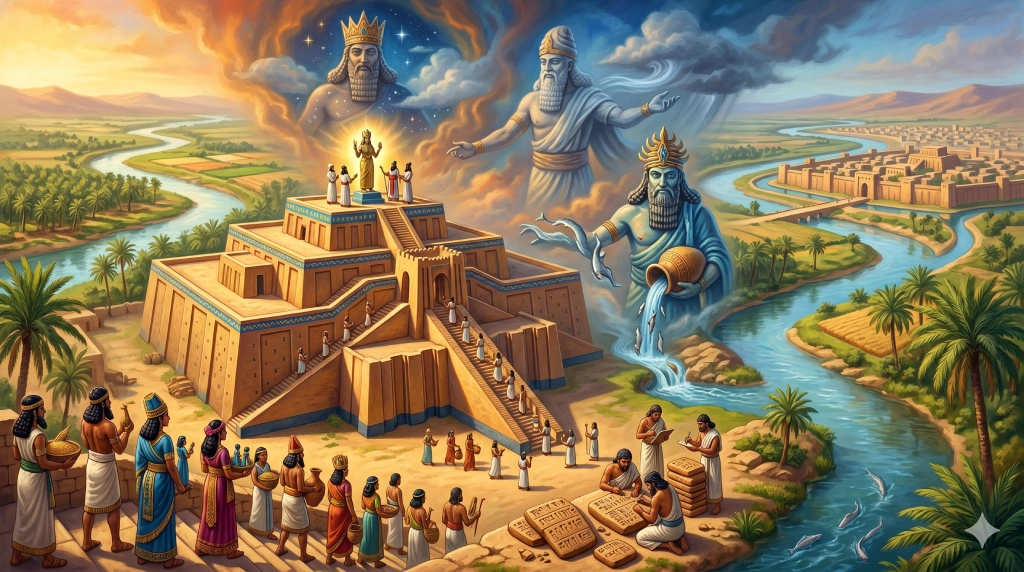
Sumerian religion and mythology: outline of the earliest beliefs of human civilization
Introduction
In the fertile alluvial plain between the Tigris and Euphrates, cutting through the arid landscape of Mesopotamia, one of the earliest well-organized civilizations in human history emerged. As people left nomadic life behind and learned to settle permanently, agriculture and animal husbandry laid the foundations of a stable economy. This stability freed them, at least to some extent, from the daily struggle for survival and gave them the opportunity to think more deeply about the universe, nature, and their own existence. Confronted by immense and often uncontrollable natural forces, the Sumerians began to recognize the smallness of human existence. Why did rivers overflow their banks and inundate settlements? Why did drought turn fields barren? Why did day and night alternate? The urge to answer such fundamental questions gave rise to a primitive yet remarkably complex system of belief.
They imagined one or more powerful beings behind every element of nature. Over time, these beings became established in their society as gods. The Sumerians believed that the laws of the universe and the phenomena of nature were entirely subject to the will of these deities. Appeasing the gods therefore became a central objective of both state and society. Religion was not merely a spiritual undertaking; it also served as a major instrument for maintaining social cohesion and legitimizing political authority. Within Sumerian polytheism, each city-state had its own principal deity. The temple or ziggurat of that god stood at the center of the city-state’s economy, administration, and social organization. The relationship between humans and the gods rested on a form of mutual dependence in which human beings were expected, through physical labor, to provide for the gods’ earthly needs.
Much of what we know about the religious beliefs and mythological narratives of this ancient civilization comes from the cuneiform script inscribed on clay tablets recovered through archaeological excavation (Kramer, 1963). These texts were not merely records of granary accounts or royal decrees; they also became vehicles for some of humanity’s earliest literature and philosophical reflection. Once the tablets were deciphered, the modern world encountered stories of heroes such as Gilgamesh, accounts of a devastating Great Flood, and descriptions of the dark realm of the underworld. They also revealed how the Sumerians constructed an extensive pantheon through anthropomorphism, attributing human characteristics to their gods.
Their myths and religious system would not, of course, satisfy the standards of modern evidence-based science. Yet they represent an extraordinary intellectual attempt, at an early stage of human civilization, to understand and explain the cosmos. The psychological framework the Sumerians developed to survive in a hostile environment later exerted a profound influence on Babylonian, Assyrian, and wider ancient Near Eastern religious traditions. In this article, we will examine in detail the Sumerians’ remarkable religious beliefs, their cosmology, the structure of their pantheon, and the mythological narratives they left behind. Through this discussion, we will try to understand how a society thousands of years ago organized the world around it within a coherent divine order.
Geographical and Historical Context
Geographical Outline of Mesopotamia and Environmental Conflict
Ancient Mesopotamia, a name that literally means “the land between the rivers,” extended primarily across modern Iraq and parts of the surrounding region. This geographical zone, formed around the basins of the Tigris and Euphrates, witnessed one of the most consequential transformations in human history. The two rivers descended from the mountainous north before flowing toward the Persian Gulf. Their floodplains were naturally extremely fertile, but that fertility came with profound uncertainty. The flooding of the Nile in ancient Egypt was comparatively regular and predictable, making agriculture easier to manage. By contrast, the Tigris and Euphrates could rise erratically and destructively. Depending on snowmelt in the northern mountains, river levels could increase suddenly and sweep away settlements and cultivated fields. This harsh and unpredictable behavior of the natural environment deeply shaped the lives of local inhabitants. In theoretical terms, it can be discussed through the idea of Environmental Determinism, in which the physical environment of a region helps shape the social and psychological structures of the people who inhabit it.
Another important feature of Mesopotamian geography was the openness of its plains. The region lacked naturally formidable defensive boundaries. Rugged mountains lay to the north and the vast Syrian Desert to the west, from which nomadic groups repeatedly moved toward the fertile lowlands. In such an exposed landscape, the Sumerians had little alternative but to develop highly organized social structures if they wished to survive. This geographical vulnerability also generated persistent geopolitical tension among the ancient city-states over control of resources. In the language of international relations, the situation can be viewed as an early example of geopolitics. For people seeking refuge from the harshness of desert and mountain environments, the river-fed plains were among the most viable places to live. Control over limited fertile land and usable water therefore became virtually synonymous with survival. When a river changed its course, an entire settlement could sometimes be abandoned.
Living in such a demanding environment, the Sumerians realized that survival required more than passive dependence on nature. To protect crops from drought and destructive flooding across the broad plains, they undertook large-scale irrigation projects and dug extensive canal networks. These canals were used not only for agriculture but also as major routes for travel and commerce between city-states (Kramer, 1963). Projects such as canal excavation and dam construction were beyond the capacity of any single individual; they required the coordinated labor of large populations under centralized direction. These geographical pressures contributed to the emergence of organized systems of governance and bureaucracy in Sumerian society. In this sense, Mesopotamia’s difficult environment indirectly helped compel the development of some of the earliest administrative structures in human history (Postgate, 1992).

Emergence of an Agriculture-Based Economy and the Rise of City-States
The foundations of civilization began to take shape when human communities moved away from nomadic hunting and settled permanently in one place. In the Sumerian region, this transition developed in a highly organized manner. On the fertile alluvial soils of the river plains, people cultivated crops such as wheat, barley, and dates. This transformation is commonly associated with the Agricultural Revolution. Improved irrigation generated substantial agricultural surpluses. Large granaries were built to store the excess harvest, and some of the earliest urban settlements developed around these centers of storage and redistribution. City-states such as Uruk, Ur, Eridu, Nippur, and Lagash were products of this agrarian economy. Agricultural surplus also allowed part of the population to move away from food production and enter specialized occupations such as pottery, metallurgy, and temple construction.
City-states such as Uruk and Ur gradually expanded in both area and population. Archaeologists estimate that around 3000 BCE, Uruk may have been the most populous city in the world, with roughly forty to fifty thousand inhabitants. Managing such a large population within a coherent social structure required a powerful authority. Each city-state was politically independent and autonomous. From the perspective of international-relations theory, particularly Realism, the behavior of these city-states can be interpreted as competition among sovereign political units operating without an overarching central authority. Each pursued its own interests and sought to expand its power. Violent conflicts frequently broke out over fertile farmland, water rights, and control of trade routes. For protection, cities were surrounded by high and massive mud-brick walls, physical evidence of their continuing insecurity.
The rise of these city-states provides a striking early example of Urbanization (Liverani, 2013). At the center of the city stood the principal temple or ziggurat, while residential areas developed around it in successive zones. Social organization became increasingly complex, and a clear hierarchy emerged. At the top stood rulers and priests, followed by merchants and artisans, then ordinary farmers, with enslaved people at the bottom. Enslaved people were often war captives or individuals who had fallen into debt. Sumerian city-states organized their governments around three major necessities: the redistribution of agricultural surplus, maintenance of irrigation canals, and defense against external enemies. In this way, relatively simple agrarian communities gradually developed into complex and highly organized states.
Natural Uncertainty and the Development of Religious Psychology
The unpredictability of nature had a profound and enduring effect on Sumerian psychology. Without access to modern scientific explanations, ancient people could not account for the destructive events around them in terms of natural mechanisms. Lightning from an apparently clear sky, sudden violent storms, or prolonged drought could appear to be manifestations of the wrath of unseen supernatural powers. From the perspective of Functionalism in sociology and anthropology, religion can serve to provide psychological stability and social order in the face of extreme uncertainty. The Sumerians imagined one or more powerful beings behind the forces of nature, and these beings gradually became their gods. They believed that worldly disasters could be avoided only by keeping these deities satisfied.
As a result of this psychological transformation, the Sumerian gods were imagined as supremely powerful and often quick-tempered. Like the harsh environment of Mesopotamia itself, the behavior of the gods could be capricious and destructive. The storm god Enlil, for example, inspired both fear and reverence because, in their understanding, a single act of his will could submerge an entire city beneath floodwaters (Jacobsen, 1976). Human beings increasingly conceived of themselves as obedient servants of the gods. Every aspect of daily life—whether farming or digging canals—could be interpreted through a religious framework. Because people lacked control over the natural forces around them, they developed a strong psychological dependence on the gods. This dependence also helped reinforce social cohesion: when a community worked collectively to satisfy the same deity, internal divisions could be reduced, at least temporarily.
The material expression of these religious beliefs is particularly visible in Sumerian architecture, above all in the ziggurats. These enormous stepped, pyramid-like temples were not merely places of worship; they represented an intense attempt to approach the gods in the face of human vulnerability. The Sumerians believed that gods did not dwell on ordinary flat ground, so by constructing artificial mountains they invited the deities to establish a presence on earth. Their rituals were highly specific and strictly regulated. Through sacrifices, the recitation of hymns, and special religious festivals, they attempted to avert natural disasters (Black & Green, 1992). Their religion was therefore not primarily a path toward spiritual liberation; it also functioned as a psychological means of coping with daily survival in a harsh environment. By submitting to the overwhelming power of nature, they sought to make their world intelligible and meaningful.

Interrelationship of Religion, State, and Power
In the early phase of Sumerian civilization, there was no clear boundary between religion and the state. Responsibility for administering society was concentrated in the hands of the temple’s chief priest, known as the “En”. In political terminology, such a system can be described as a Theocracy. The chief priest not only directed religious rituals but also exercised extensive authority over the city’s agricultural land and economy. Ordinary farmers deposited a substantial share of their produce in the temple, where it was treated as an offering to the gods. Temple officials later redistributed portions of this surplus grain to the population in times of crisis or during festivals. This temple-based economy, or Temple Economy, formed a central pillar of Sumerian social organization. The deity was regarded as the true owner of the city, while the priest served as the god’s earthly representative.
Over time, however, city-state populations grew and conflicts over resources became increasingly difficult to avoid. Uruk and Lagash, or Nippur and Ur, could become locked in repeated disputes over boundaries and water rights. Under conditions of near-continuous warfare, temple priests were not always able to provide effective military leadership. A new type of military leader therefore emerged, known in Sumerian as the “Lugal,” or “Big Man”. Initially, a lugal could be appointed temporarily as a commander during wartime and return to ordinary life when the conflict ended. But as warfare became recurrent, these leaders consolidated their authority and developed into permanent kings. This transfer of power provides a notable example of early Political Evolution, in which authority gradually shifted from religious leadership toward military kingship (Yoffee, 2005).
The emergence of monarchy did not eliminate the influence of religion. The new kings understood that maintaining popular loyalty required religious legitimacy. They therefore presented themselves as representatives chosen by the gods. Kings built monumental temples and patronized leading priests, while priests in turn declared the ruler to be divinely favored. This amounted to a form of ancient Grand Strategy: kings used religious legitimacy to preserve internal stability while simultaneously strengthening their military power. The reciprocal accommodation between state and religion helped sustain Sumerian civilization within a relatively durable institutional framework.

Wheel, Script, and the Structural Evolution of Civilization
Perhaps the Sumerians’ greatest contribution to the structural development of civilization was the invention of writing. The accounting demands of the enormous temple economy—the tracking of grain reserves, livestock, and other resources—eventually exceeded what could reliably be preserved in human memory. Cuneiform writing emerged from these administrative needs. It was inscribed on soft clay tablets with a reed stylus, producing wedge-shaped marks. At first, the system consisted largely of pictorial signs or pictograms, but it gradually developed into a much more complex writing system capable of representing language. This innovation amounted to an ancient Information Revolution. Writing also created a major social distinction between literate administrators or scribes and the non-literate majority. Scribes became crucial officials because they controlled the recording and preservation of information, law, and administration.

Alongside writing, the Sumerians also developed the wheel, an innovation that transformed both economic and military activity. The wheel was initially used in pottery production, but it was soon adapted for transportation. Wheeled ox carts made it easier to move heavy loads. At the same time, the use of wheeled vehicles in warfare introduced a new degree of mobility to the battlefield. The wheel also contributed to the expansion of long-distance trade. Mesopotamia’s plains lacked many essential raw materials, including stone, timber, and metal ores. As a result, the Sumerians exchanged surplus grain and textiles for cedar timber from Lebanon, copper from Anatolia, and lapis lazuli from Afghanistan. These trade networks created a form of Economic Interdependence across the wider region.
Writing did not remain confined to economic administration. Gradually, it became a means of preserving literature, law, and mythology. The Sumerians began inscribing hymns to their gods, accounts of royal victories, and ancient oral traditions on clay tablets. Early works of world literature associated with The Epic of Gilgamesh survived in this broader scribal tradition (George, 2003). Written law also emerged as a means of regulating social order. The Code of Ur-Nammu is a major example, setting out specific legal penalties for particular offenses. These technological and structural innovations helped transform Sumerian society from a predominantly agrarian population into a complex and advanced civilization whose influence continued for millennia.
Decline of Sumerian Civilization and Cultural Legacy
Like every major civilization, Sumerian civilization eventually declined, but the process did not occur overnight. Environmental deterioration was as important as external invasion in weakening the region. Mesopotamian agriculture depended heavily on artificial irrigation. Centuries of bringing water onto fields through canals caused salt to accumulate in the soil at increasingly damaging levels. Fertile alluvial land gradually lost its productive capacity. As wheat yields fell sharply, farmers increasingly turned to barley because it could tolerate higher salinity. Eventually, however, some fields became severely degraded or unproductive. Modern scholarship has described this environmental deterioration as a form of Ecological Collapse, one that seriously weakened the economic foundations of Sumerian society.
Neighboring peoples took advantage of this growing economic vulnerability. To the north, the Akkadians gradually increased their power. Around the mid-third millennium BCE, the Akkadian ruler Sargon conquered Sumerian city-states one after another and established the first large territorial empire in Mesopotamian history. The Sumerians lost their political independence. After the Akkadian period, continued political upheaval involving Babylonians, Elamites, and other powers eventually erased independent Sumerian political rule. Yet the conquerors did not simply defeat the Sumerians; they absorbed a substantial part of Sumerian culture. This process is a classic example of Cultural Assimilation. Rulers such as Sargon respected Sumerian deities, and Sumerian language and writing continued to be used alongside Akkadian in important religious and scholarly contexts.
Although the Sumerians eventually disappeared from the political map, their cultural and institutional legacy endured for centuries. Later Babylonian and Assyrian civilizations inherited and developed traditions associated with the wheel, cuneiform writing, written law, and the sexagesimal or base-sixty mathematical system (Pollock, 1999). Their creation traditions and flood narratives also exerted a deep influence on later literature and religion. The administrative and intellectual infrastructure they developed in order to survive within an arid, difficult, and flood-prone environment became part of the foundations of subsequent Near Eastern civilizations. The Sumerian experience demonstrates how human innovation and the struggle for survival can transform an unforgiving landscape into one of the major cradles of civilization.
Cosmology
The Primordial Sea and the Primary Elements of Creation
The geographical setting of ancient Mesopotamia and its surrounding natural environment profoundly shaped the Sumerian world of thought. At the very center of Sumerian cosmology stood the idea of a primordial body of water. According to their creation narratives, the universe initially had no definite form or structure. There was only an infinite and boundless expanse of water, known as Nammu. Nammu was not an ordinary deity. She was regarded as one of the most primordial beings in the universe. The Sumerians considered this primeval sea to be the source from which everything originated. To them, the idea of water as the basis of creation was closely connected to lived experience. People inhabiting the Tigris and Euphrates river basins constantly witnessed both the destructive and life-giving powers of water. Water could inundate settlements and sweep everything away, yet it was also indispensable to agriculture. Imagining water as the primary substance of life and creation was therefore a philosophical reflection of their everyday environment.
From within this primordial sea, Nammu, the later cosmic elements emerged spontaneously. Sumerian thought left no room for the creation of the universe out of absolute nothingness. From the perspective of ancient Ontology, or the study of being, human beings often imagine the larger cosmos using elements drawn from the material world around them. The people of Mesopotamia had little conception of absolute nothingness as a creative starting point. In their view, some pre-existing material substance was necessary for creation. Nammu was that primordial and eternal material foundation. This body of water had no identifiable creator; it existed in its own right. From the womb of Nammu emerged a vast cosmic mountain, an inseparable combination of heaven and earth. This primordial union of sky and earth is sometimes described in mythological terminology as World Parents Mythology. The original structure of the cosmos was chaotic and compact, leaving no space in which life could develop.
The gradual movement from this primordial chaos toward order lies at the heart of Sumerian creation mythology. The gods do not create things from nothing like magicians. Instead, they function primarily as craftsmen. They break apart, separate, and reshape existing materials in order to produce a habitable world. Within the cosmic mountain born from Nammu, heaven was identified as An and earth as Ki. An and Ki were tightly joined together. From the union of An, the sky god, and Ki, the earth goddess, was born the god of air, Enlil. The birth of Enlil initiated the first major transformation in the structure of the universe. The compacted elements gradually began to acquire separate identities. At this initial stage of creation, there was no concept of morality, sin, or virtue. It was fundamentally a physical and structural process in which one element emerged from another. The entire account represents an early intellectual attempt to place the world within a mechanical and intelligible framework.
The Separation of Heaven and Earth and the Cosmic Architects
The most important step in making the universe habitable was the separation of heaven and earth. According to Sumerian mythology, the god Enlil carried out this transformative act. As the god of air, Enlil possessed immense power. With the aid of a great cosmic axe or weapon, he separated his father An from his mother Ki. An moved upward and assumed the highest throne of heaven, while the goddess Ki remained below and took the form of the flat earth. In the vast space created between heaven and earth, Enlil established his domain. This newly opened region filled with air, and it was here that life could later emerge. This geometric division is an important feature of ancient cosmology. It indicates that the Sumerians imagined the universe as possessing a definite structural arrangement. Their account can be read metaphorically as an early form of Physical Mechanics (Kramer, 1961). The idea that force could separate and displace bodies was entirely consistent with their everyday experience of physical labor.
The separation of heaven and earth did more than create physical space; it also established the administrative structure of the universe. An, Enlil, and Enki became the principal divine powers responsible for cosmic governance. As the supreme lord of heaven, An observed the whole order of creation. Enlil, however, was responsible for putting cosmic decisions into effect. He controlled winds and storms across the earth. The movement of clouds, the coming of rain, and the growth of crops were understood to occur under his authority. Enki, meanwhile, took control of the subterranean reservoir of fresh water beneath the earth. He was regarded as the god of wisdom and technical knowledge. This celestial administrative structure was, in effect, a cosmic reflection of the bureaucratic systems of Mesopotamian city-states. Just as responsibilities in society were divided among kings, military leaders, and priests, the universe itself was imagined as operating through a similarly differentiated allocation of duties.
The activities of the gods as cosmic architects suggest that the universe was imagined as a vast work of construction. The Sumerians believed that every mountain, river, and valley was the result of deliberate divine planning. Their myths likewise attributed a direct divine role to the origins of the Euphrates and Tigris. For life to flourish on the flat surface of the earth, water had to be distributed in an orderly way. The gods were imagined as digging canals and determining the courses of rivers to accomplish this task. This entire process can be described as Cosmic Designing. Nothing in this model was purely accidental. Every element had a specific purpose and causal function. The Sumerians built ziggurats and cities through their own physical labor, and they interpreted cosmic creation through the same conceptual lens. In their imagination, the gods were the chief engineers of the universe, continuously transforming a chaotic expanse of water into a habitable and ordered world.

Geometric and Physical Structure of the Universe
In the Sumerian imagination, the geometric structure of the universe was highly definite and measurable. They conceived of the earth as a vast, flat, circular disk or dish. This surface floated above an endless and deep primordial sea. Above the flat earth stood a solid dome or firmament. They believed this dome to be made of tin or some similarly hard material. Its principal function was to hold back the primordial waters above and prevent them from crashing down upon the earth. Rain was imagined as heavenly water passing through small openings in this dome. This entire system can be regarded as a classical example of an ancient Flat Earth Model (Horowitz, 1998). Although such a model is unscientific by the standards of modern astronomy, it is possible to understand how people relying on unaided observation might have arrived at it. Standing on an open plain, the horizon appears flat and the sky can resemble an inverted bowl. The Sumerians took this visual experience as an important foundation for their cosmology.
Several layers existed within this cosmic structure. Heaven was not understood as a single undifferentiated place; it had different levels corresponding to the status and rank of the gods. The highest level belonged to the chief god An, while other gods occupied lower regions. Humans and other living creatures inhabited the flat surface of the earth. Immediately beneath the earth lay the underworld, or Kur, the dwelling place of the dead. Between the underworld and the surface world was Abzu, the vast subterranean reservoir of fresh water. The god Enki lived in the Abzu. In the dry and drought-prone environment of Mesopotamia, fresh groundwater was extremely valuable. When water emerged from wells, the Sumerians believed that it came from this Abzu. Heaven, earth, the underworld, and Abzu together formed the principal layers of their geometric universe. These divisions demonstrate the highly structured character of Sumerian cosmological thought. They attempted to leave no part of the cosmos undefined.
This three-dimensional cosmic structure also provided a degree of psychological reassurance. The idea of infinite and boundless space can be deeply disorienting, whereas the Sumerians imagined a universe with definite boundaries. Their earth was covered by a dome and surrounded below by water. In this respect, it resembled a protected fortress. The idea of a closed and controlled cosmos could therefore generate a sense of security. The gods guarded the boundaries of the dome and the underworld, while the cosmic enclosure protected humanity from the chaotic primordial waters beyond. These geometric conceptions later contributed to the mathematical astronomical traditions of Babylonian civilization. The sexagesimal numerical system used to calculate the positions and movements of celestial bodies developed within this broader tradition of measuring and ordering the cosmos.
Cosmic Order and the Inviolable Decrees
Once the physical structure of the universe had been established, a set of definite principles was required to keep it functioning. In Sumerian thought, these principles were called Me. The Me were inviolable divine ordinances or powers that maintained the order and balance of the cosmos. The regular movements of celestial bodies, the changing of seasons, the rhythms of rivers, as well as social institutions such as kingship and justice, and even activities such as art and warfare, were all associated with one or more Me. These were not moral teachings. Rather, they operated more like fixed laws governing reality, laws that could not simply be ignored. Even the most powerful gods were bound within this cosmic order. They did not exercise entirely arbitrary power over the universe; they preserved, controlled, and administered these established principles. In philosophical terms, the idea can be interpreted as a form of cosmic Determinism, in which every element of the universe operates according to a pre-established pattern.
The concept of the Me shows that the Sumerians did not regard the universe as wholly blind or chaotic. In their view, events occurred within a network of causes and established cosmic arrangements. If drought struck or an untimely flood arrived, they could interpret the event as a disturbance in cosmic order. Natural disaster was thus understood as a sign that the balance represented by the Me had been disrupted. The god of wisdom, Enki, was regarded as one of the principal custodians of the Me. According to myth, from his watery dwelling in Abzu he administered these powers and, when necessary, transferred them to the gods of different city-states. The rise and decline of Mesopotamian cities could therefore be explained through the possession and transfer of the Me. When a city became powerful, it could be understood as evidence that the city’s god had acquired a large number of Me. This intimate connection between human society and cosmic order profoundly influenced Sumerian ideas of political authority.
Through the concept of the Me, the Sumerians attempted to place the changing world around them within a framework of stable rules. They recognized that the world moved according to recurring patterns. Seeds produced shoots when planted, while crops died if they did not receive water at the proper time. This continuity between cause and effect demanded explanation. The Me became an institutionalized expression of such patterns. The gods themselves could not simply run the universe without restraint; they too had to operate within an established cosmic order. The regularity of the cosmos reassured ordinary people. They believed that if proper rules were followed and the gods remained satisfied, the order of nature would continue. Consequently, strict procedures shaped every level of society, from religious ritual to administrative practice.
Astronomy and the Role of Celestial Entities
When the Sumerians looked at the night sky, they did not see merely a collection of bright points; they saw the direct presence of divine beings. Celestial bodies occupied an important place within their conception of the universe. The moon, the sun, and the planet Venus were worshipped as major deities. The moon god Nanna held particular importance. In the harsh and intensely hot climate of Mesopotamia, the daytime sun could be oppressive, while the gentler light of night offered relief. For this reason, within the Sumerian pantheon the moon god Nanna could hold a position of greater ritual importance than Utu, the sun god. Nanna was imagined as traveling across the night sky in a boat while observing the earth. The Sumerians based their calendar on the waxing and waning of the moon. This lunar calendar was essential for organizing agriculture, religious festivals, and the collection of taxes. Their continuing and systematic observation of the heavens helped lay foundations for the development of ancient Astronomy.
The sun god Utu was a symbol of justice and truth. During the day, his rays illuminated the entire world, and nothing was believed to remain hidden from his sight. People therefore imagined that Utu could witness crimes committed within society. He was regarded as a strict judge who supervised both cosmic and human order. Inanna, associated with the planet Venus, was the goddess of love, fertility, and war. Her appearance in the sky as both morning star and evening star made her celestial presence especially conspicuous. These heavenly beings did more than provide light; they functioned like the hands of a great cosmic clock. Their regular and precisely timed movements helped the Sumerians develop a structured understanding of time. They learned to divide periods of day and night and to use the positions of celestial bodies for orientation.
The Sumerians also interpreted the planets and stars as a kind of divine script. They believed that the gods had inscribed signs concerning human destiny and the fate of the world into the heavens through constellations and celestial events. From this conception emerged traditions of Astrology (Rochberg, 2004). Priests and scribes spent night after night recording the movements of planets and stars. If a celestial body appeared to depart from its expected path, or if an eclipse occurred, they could interpret it as a warning of impending danger. Before going to war or beginning the construction of a new temple, kings could order specialists to interpret these celestial signs. In Sumerian cosmology, therefore, the heavens and human destiny were linked by an invisible thread. The belief that even small changes in the sky might have major consequences on earth encouraged increasingly careful observation of celestial phenomena.

Absence of Creation Ex Nihilo and Material Transformation
A major feature of Sumerian cosmology is the absence of a doctrine of creation out of nothing. In later Jewish, Christian, and Islamic philosophy, we encounter the concept of Creatio Ex Nihilo, the creation of the universe from absolute nothingness by divine command. This idea was absent from the Sumerian cosmological model described here. The Sumerians understood creation in strongly material terms. In their view, making something required some form of pre-existing material. Just as a carpenter cannot make a chair without wood, the gods could not fashion a world without substance. The primordial waters already existed at the beginning of the cosmos. The gods organized, divided, and reshaped these chaotic materials into an ordered world. This conception provides an important model of ancient Cosmogony, or creation theory, in which creation does not mean producing something from absolute nothingness, but rearranging and transforming what already exists.
This idea of material transformation closely reflected the Sumerians’ environmental experience and their familiarity with physical labor. They made bricks from clay and used those bricks to construct enormous temples. In their creation mythology, the gods performed comparable acts of fabrication. In narratives about the creation of humanity, the god Enki is described as forming the first human from pre-existing earthly material together with divine substance. Here too, the materials required for creation already existed. This model presents the universe as an immense workshop in which the gods continually fashion and reorganize matter. From a modern perspective, one might hear in this ancient way of thinking a distant conceptual echo of the idea that matter changes form rather than simply appearing from nothing, although the Sumerian framework was mythological rather than scientific.
In conclusion, Sumerian cosmology can be understood as a cosmic projection of their social structure, economy, and geographical circumstances. They imagined the universe as an ordered system resembling the organized world they themselves sought to construct and control. From the primordial sea to the flat earth, the solid dome, and the inviolable Me, each element occupied a defined place and fulfilled a specific function. This cosmology was not merely an arbitrary collection of beliefs; it was also the product of generations of observation, attempts to interpret nature, and efforts to make human existence meaningful within an uncertain environment. The Sumerians did not discover the actual scientific structure of the universe, but they developed a powerful conception of a cosmos governed by order, regularity, and definable relationships—an important stage in the early history of human attempts to understand the world.
Polytheism and Anthropomorphism
Structure of Polytheism and Relationship with City-States in Sumerian Society
As the first civilizations began to rise from the dry dust and alluvial soil of Mesopotamia, the human desire to understand the world was intense. The Sumerians did not regard the varied natural world around them as merely inert matter. They imagined that every natural force was directed by a particular power or being. This vast system of belief was Polytheism. Sumerian polytheism was not a random collection of ideas; rather, it closely reflected their social and political organization. The Sumerians believed that heaven possessed as much diversity as their own society. There were thousands of greater and lesser gods. One deity might guard a particular plant or locality, while another might command the entire force of a storm. Sociologist Émile Durkheim, in The Elementary Forms of Religious Life, discussed religion as a force of social cohesion; Sumerian society offers an early example of religion functioning as a fundamental basis of collective identity. Religion stood at the core of each city-state’s sense of itself.
Each Sumerian city-state was self-contained and politically independent, and behind that independence stood its own patron deity or “Patron God”. Consider the city of Uruk: its inhabitants believed that their lord was An, the sky god. The people of Eridu, by contrast, regarded Enki, the god of wisdom, as their protector. Relations and conflicts among city-states were often interpreted through the relationships among their gods. When one city defeated another in war, the victory could be understood as evidence that the god of the victorious city had overcome the god of the defeated one. Viewed through anthropologist Bronislaw Malinowski‘s Functionalism, this polytheistic structure can be understood as a means of binding people together within a geographically divided region. When inhabitants believed that a powerful deity owned and protected their city, their motivation to work for it and defend it could become stronger.
The Sumerian pantheon was highly organized and structured by a clear hierarchy. At its summit stood seven great gods who were believed to determine the fate of the universe. Beneath them was a group of deities known as the Anunnaki. The number of lesser gods was immense. Different professions could have their own divine patrons: just as a scribe or a maker of sickles might have a particular deity, individual households could also imagine a personal protective being such as a Lamassu. This system functioned psychologically as a kind of protective shield for everyday life. The world was not imagined as a place in which people wandered alone and unprotected; someone or something was responsible for every part of it. Yet obedience to the gods did not arise from devotion alone. It was also driven by the need to survive. The Sumerians believed that if the gods were not kept satisfied, they might become angry and unleash destruction at any moment. Sudden flooding of the Tigris or Euphrates could therefore be interpreted as an expression of divine anger.
This polytheistic structure was also deeply intertwined with the political life of Mesopotamia. Temple priests could at times become more powerful than kings because they were regarded as the principal intermediaries between humans and the gods. The Sumerians believed that their cities ultimately belonged to the deities and that human beings were merely cultivators working on divine land. Sociologist Max Weber‘s concept of Theocratic Authority, or religious authority, provides a useful framework for interpreting this form of rule. Religion in this context was not primarily concerned with attaining spiritual liberation; it functioned as a central mechanism for maintaining social order and organizing the distribution of resources. The thousands of divine names preserved in Mesopotamian traditions reflect an attempt to connect every change in the world with a particular supernatural agent. In this way, the Sumerian world became more animated, intelligible, and meaningful.
Anthropomorphism: Psychological Profile of Human-like Deities
One of the most striking features of Sumerian religion was the appearance and temperament of its gods. The Sumerians did not imagine their deities merely as abstract forces or terrifying monsters. Their gods were thoroughly human-like. This is known as Anthropomorphism. The attribution of human qualities was not limited to physical appearance. The gods wore clothing, valued ornaments, and had families just as humans did. More strikingly, their emotions were also profoundly human. The gods laughed and celebrated, but they could also become sorrowful. They fell in love, grew jealous, and at times behaved with extreme cruelty. Sumerian myths frequently portray deities quarreling among themselves over seemingly trivial matters. In the history of religion, this attribution of human characteristics is particularly significant because it made the gods appear much closer and more familiar to ordinary people.
From a theoretical perspective, Anthropomorphism can be interpreted as the projection of humanity’s own image onto the universe. Sociologist and philosopher Ludwig Feuerbach, in The Essence of Religion, argued in comparable terms that human beings imagine divine figures through projections of their own idealized or magnified qualities. When the Sumerians saw powerful and influential kings around them, they imagined their gods in a similarly royal form. Yet this humanization also had a darker side. Because the gods were conceived as emotionally volatile like human beings, their behavior was unpredictable. At one moment they could be benevolent, and at another terrifyingly angry. When Enlil decided to bring about a great flood because he was disturbed by human noise, his personal irritation appeared more decisive than any abstract standard of moral judgment. To the Sumerians, therefore, the gods were not embodiments of perfect justice; they were immensely powerful and emotionally driven rulers.
The earthly needs of these anthropomorphic gods were also imagined in human terms. They required food and water and were thought to need comfortable places in which to rest. Royal meals were presented to divine statues in the temples twice each day. The Sumerians believed that the deity’s real presence inhabited the statue. Through a special ceremony known as “Mis-pi,” or the Mouth Opening Ritual, the statue was ritually animated so that it could symbolically speak, hear, and receive food. If offerings were delayed, priests could fear that the deity might become angry and bring famine upon the city. This entire system formed part of the psychological security structure of society. Once a god was understood as having recognizable needs, human beings possessed an intelligible method for satisfying or influencing that deity. It was, in effect, a psychological accommodation between human vulnerability and the overwhelming powers of nature.
The contrast between divine immortality and ordinary human mortality formed one of the central tensions of Sumerian religion. The gods were immortal because they possessed the cosmic ordinances known as “Me”. Their difference from humans lay primarily in immortality and the scale of their power. In other respects, they could make mistakes just as humans did. In The Epic of Gilgamesh, for example, the goddess Ishtar falls in love with Gilgamesh and, after being rejected, behaves like a jealous and enraged human lover. The capacity of the gods to make mistakes or act impulsively suggests that the Sumerians viewed the universe as an orderly yet capricious monarchy. There was no absolute moral law embodied in the gods themselves; instead, there was a balance of power. This Anthropomorphism was not simply a limitation of ancient thought, but also an attempt to understand the world through the categories of human experience.

Humans as Servants: Material Context of Service and Rituals
In Sumerian creation mythology, the purpose of human existence was bleak but clear. Human beings were believed to have been created to perform labor on behalf of the gods. Before the creation of humans, the gods themselves cultivated fields, dug canals, and built dwellings. Eventually, however, they became exhausted by this physical labor and rebelled. Enki, the god of wisdom, then proposed creating a being who would take the burden of divine labor upon itself. This belief gave religious legitimacy to the division of labor and the Social Hierarchy of Sumerian society. Ordinary people could understand themselves as servants or slaves of the gods. According to anthropologist Clifford Geertz‘s theory of Religion as a Cultural System, symbolic beliefs of this kind can give a larger purpose to painful human labor. When people believed that their hard work ultimately served to feed and maintain the gods, even exhausting labor could acquire sacred meaning.
The temple was the central institution of this service. It was called “E,” meaning “house”. It was not merely a place of worship but also a vast commercial and administrative institution. Temples controlled thousands of acres of land on which ordinary farmers worked. A large share of the harvest was deposited in temple storehouses. From this stock, a designated portion was set aside as offerings for the gods, while the remainder could be distributed during famine or among those in need. Historians describe this system as a Temple Economy. Religion, therefore, did not function only in relation to salvation or the afterlife; it was also embedded in an effective economic and social-security structure. By serving the gods, people were simultaneously helping maintain the balance of their own society. Feeding the deity also meant, indirectly, sustaining and replenishing the community’s stored resources.
Sumerian religious practice was highly formalized. Correct performance often mattered more than personal devotion or emotional love. A priest was expected to recite prescribed formulas, pour water in a specific manner, and perform sacrifices according to fixed procedures. Even a minor mistake could be interpreted as an ominous error. This can be described as a form of Ritualistic Formalism. Washing divine statues, dressing them in new garments, and applying fragrant substances were part of everyday temple practice. On special occasions, statues of the gods could even be transported by boat from one city to another so that they might symbolically visit other deities. The incorporation of the gods into such recognizably earthly activities also added ceremony and spectacle to Sumerian social life. Their festivals were colorful, elaborate, and lively.
The relationship between humans and the gods was not imagined as a profound spiritual bond between a merciful creator and creation. It more closely resembled a Contractual Relationship. Humans would provide service, and in return the deity would protect the city. If a city was destroyed, people could conclude either that its god had abandoned it or that the inhabitants had failed to satisfy the deity through adequate service. This rationalized yet supernatural belief system created a strong sense of obligation. People understood that idleness threatened not only their material survival but could also invite divine anger. The servant-like religious mentality of Sumerian society therefore became a powerful motivating force behind the enormous collective labor undertaken in the harsh environment of Mesopotamia.

Divine Assembly and Cosmic Hierarchy
In Sumerian belief, the gods did not always make decisions individually. They were imagined as participating in a great assembly associated with the Anunnaki. The assembly was presided over by An, the sky god, although much of the effective administrative authority belonged to Enlil. On important matters, the gods gathered and deliberated together. This structure was interpreted by historian Thorkild Jacobsen through his concept of Primitive Democracy. Just as groups of elders may have participated in collective decision-making in Mesopotamian cities before the consolidation of kingship under the lugal, the gods of heaven were imagined as deliberating in an assembly. The decision of this divine council determined the final fate of the cosmos. Under such a system, no single deity was entirely free to act as an autocrat, although Enlil could exercise enormous influence.
The proceedings of this assembly were imagined as highly ordered. Myths contain scenes of debate and, in some interpretations, something resembling collective assent or voting. When the gods decided to destroy a city-state, the patron deity of that city might plead before the assembly for its survival. If the majority of the divine council nevertheless favored destruction, the city’s protector had to submit helplessly to the collective decision. Such a conception offered a way to explain and endure the harsh realities of human life. When a prosperous city was suddenly reduced to ruins, its inhabitants could imagine that the decision had been made in the assembly of the gods and that even their own patron deity had been unable to prevent it. In the language of political theory, this could be described as a mythological form of Collective Decision Making.
Hierarchy was a fundamental characteristic of the Sumerian pantheon. Deities could be assigned specific numbers according to their rank and importance. For example, An was associated with the number 60, symbolizing completeness; Enlil with 50; and Enki with 40. This numerical ordering reflects the Sumerian tendency to classify and measure their world systematically. Lesser gods could serve greater gods in subordinate roles. For example, divine magicians and craftsmen could serve under Enki. Such divisions mirrored Sumerian bureaucracy. Sociologist Robert Merton‘s concept of Bureaucratic Structure provides a modern analytical analogy: the Sumerian pantheon was imagined almost as a supernatural administration in which each deity possessed a specific office or “Me”.
This cosmic hierarchy did not end with heaven; it extended into the underworld, or “Kur”. The underworld had its own system of government, presided over by the goddess Ereshkigal. Rules and restrictions applied there as well. When Inanna entered the underworld, she was required to surrender her seven royal garments and ornaments as she passed through its seven gates. The narrative demonstrates that even divine power was not unlimited: gods remained bound by particular spatial and legal boundaries. Such stories reinforced the Sumerian idea that rules applied even to powerful supernatural beings. If the gods themselves could not escape the consequences of violating established order, then human beings had even greater reason to obey it. In this way, the Sumerian pantheon supported the moral and legal structures of society.
Animation of Divine Statues and Nature of Earthly Existence
To the Sumerians, a divine statue was not merely a symbol. They believed that the real presence of the deity could inhabit the image. This was one of the most physical and sensory aspects of their religion. Statues were washed every day, dressed in the finest garments, and surrounded by fragrant incense. The purpose of these rituals was to keep the deity comfortable within its earthly residence. In the history of religion, this kind of belief can be described as Iconographic Realism, in which the cult image is treated as a material locus of divine presence. The statues could be adorned with gold, silver, and precious stones such as lapis lazuli. When an enemy captured a city, one of the most humiliating acts was to seize and carry away the statue of its principal deity. The removal of the image symbolized the god’s departure from the city and represented both political defeat and religious catastrophe.
The intimate relationship between humans and the divine image was formalized through a special ritual known as “Mis-pi”. Through this ceremony, the mouth and ears of the statue were believed to be opened so that it could hear worshippers and receive food. The ritual represented the transformation of an inanimate object into a vessel of divine presence. Theorist Mircea Eliade, in The Sacred and the Profane, described how ritual can transform ordinary space or objects into sacred realities. The statue placed at the summit of the ziggurat represented a point at which heaven and earth could symbolically meet. Standing before such an image, a worshipper could experience a sense of direct proximity to the deity.
The process of feeding the statue was elaborate. It was treated as an offering. Every morning and evening, high-quality bread, meat, fruit, and wine were arranged before the deity. After a period of time, the food placed behind a curtain was removed, and it was believed that the god had consumed its subtle or divine essence. The remaining food was then distributed among temple priests and workers. This was not merely a religious rite; it also formed part of an organized system of Resource Distribution. Large numbers of temple personnel were supported through this arrangement, and part of society’s agricultural surplus was put to institutional use. People believed that they were feeding the deity, while in material terms they were also sustaining a functioning social and economic institution.
The Sumerian conception of earthly existence was deeply marked by impermanence and insecurity. The gods, they believed, could abandon their earthly residences at any time. Temples and ziggurats were therefore continually repaired and renovated. Even the collapse of a single brick might be interpreted as an ominous sign. The desperate effort to keep the deity within its house reflected the broader insecurity of Mesopotamian life. People wanted their most powerful and cherished beings to remain visible before them, accessible to touch, service, and ritual care. This materially grounded religious outlook centered belief on things that could be seen, handled, and experienced. In this way, Sumerian polytheism and anthropomorphism became central supports through which an ancient civilization interpreted the world and sought to survive within it.

An: Supreme Lord of Heaven
The Supreme Throne of Heaven and the Mythological Origin of An
The inhabitants of ancient Mesopotamia did not regard the vast and seemingly limitless blue sky above them as merely a natural spectacle. To them, the sky was one of the oldest, most silent, and most powerful entities in the universe. In Sumerian, “An” literally means “sky” or “heaven.” An was therefore not merely the god of the sky; he was identified with the sky itself. In the language of theology and anthropology, this kind of belief can be described as Personification, in which an inanimate element of nature is imagined as a living and conscious being. At the earliest stage of creation, the universe was conceived as an enormous cosmic mountain. The upper portion of this mountain was the male being An, or heaven, while the lower portion was the female being Ki, or earth. In this primordial condition, heaven and earth were tightly joined together. Their inseparable union left no room for light or air to circulate through the cosmos. Everything was enclosed within a compact darkness. Later, after their son Enlil, the god of air, was born, he separated his father An from his mother Ki with the aid of a great cosmic axe.
As a result of Enlil’s act of force, the earth assumed a flat position below while An moved upward. Once established in the highest region of heaven, An became the ultimate lord of the universe. The Sumerians imagined the sky as a solid dome covering the earth, and An’s throne stood at the highest point of that dome. From there he watched over the whole created world. The origin and position of An illuminate an important feature of Sumerian cosmology. Ancient people sought something permanent and stable behind the changing elements of nature, such as wind and water. The immensity and apparent permanence of the sky provided such an image of stability. Clouds came and went, storms rose and subsided, but the sky remained fixed in its place. An embodied this enduring stability. He was not preoccupied with minor events of everyday life; instead, he represented the power that sustained the balance of the entire cosmos.
As the father of the gods, An held the highest status in the pantheon. Nearly all the principal deities of the Sumerian divine order were regarded, directly or indirectly, as his descendants. A particular group of heavenly gods was known as the “Anunnaki”, literally understood as the descendants or offspring of An. These Anunnaki were imagined as participating in the administration of the universe. Sumerian myths provide little detail about any specific birth narrative for An; he appears almost as if he had always existed. Although he was associated with emergence from the primordial waters of Nammu, later traditions could place him close to the beginning of the entire divine order. An’s fatherhood was not limited to genealogy. He was also associated with the source of divine authority. The Sumerians regarded the cosmic ordinances known as “Me” as ultimately connected to An, who transmitted such ordering powers to other gods so that they could govern the world. For this reason, the other gods approached An with both reverence and fear.

The Inactive God and the Nature of Cosmic Authority
One of the most intriguing aspects of Sumerian theology is An’s relative inactivity. Although he was the supreme lord of heaven, he did not participate extensively in the day-to-day administration of the universe. In the sociological study of religion, a deity of this kind is sometimes described as a Deus Otiosus, or inactive god. According to this concept, a primordial or supreme deity withdraws from direct involvement after establishing the cosmos or its fundamental order, leaving everyday administration to subordinate gods. An’s character closely resembles this pattern. He did not personally bring rain, protect crops, or teach humans magical arts. When crises arose in ordinary life, people turned instead to active gods such as Enlil, Enki, or Inanna. An stood far beyond the everyday reach of ordinary people, and direct appeals to him could be regarded as beyond the normal sphere of common worshippers.
An’s inactivity did not imply a lack of power. On the contrary, it could be understood as a cosmic expression of supreme authority. The analogy becomes clearer when compared with ancient Mesopotamian government. An emperor or commander-in-chief did not personally distribute water through canals or fight like an ordinary soldier on the battlefield. He remained in the palace, made the final decision, and placed his seal upon the command. An’s rule was imagined in much the same way. He presided over the assembly of the gods. In moments of major crisis or important decision, the gods could turn to An for judgment. Once An had issued a decree, no one possessed the authority to alter it. In Sumerian terms, this was conceived as “the word of An”. His word was final and inviolable. Thus, although An did not personally carry out every action, the cosmic order ultimately operated under his authority.
There was also a psychological dimension to the idea of such a distant and inactive deity. People continually witnessed natural forces behaving in ways that appeared violently hostile to human life. Floods could sweep everything away, while epidemics could devastate entire settlements. Active gods such as Enlil or Ishtar could be blamed for such destruction and imagined as volatile or capricious. Yet people could also conceive of a deity who stood above these temporary outbursts of anger. An occupied that distant and impassive position. He was not imagined as delighting in destruction. When other gods treated humanity with excessive severity, people could hope that An’s higher authority might restore balance. Put simply, An functioned almost like the supreme court of the cosmic order, a final authority beyond the immediate conflicts of the other gods. His distance also protected him from becoming the direct target of everyday human resentment and frustration, preserving his elevated status within the pantheon.
Worship in Uruk and the Role of the E-anna Temple
Among the earliest and most important city-states to emerge in Mesopotamia was Uruk. Uruk became one of An’s principal centers of worship. At the heart of the city stood a vast sacred precinct dedicated to An, known as “E-anna”. In Sumerian, the name means “House of Heaven.” The temple complex was an extraordinary achievement of ancient architecture. With massive brick construction, colorful mosaic decoration, and monumental sacred structures, E-anna was far more than a place of worship. It also became one of the main engines of Uruk’s economy. Large areas of agricultural land were associated with the temple. Farmers cultivated this land and delivered a substantial portion of the harvest to the temple in An’s name. These agricultural surpluses supported priests, artisans, and administrators. E-anna consequently became a center of religious, administrative, and economic power.
Worship of An, however, was not structured like the ordinary daily devotion directed toward more accessible deities. Because An was a distant god, his rituals were highly formal and solemn. Ordinary people did not normally enter the innermost sacred chamber of E-anna. Only high-ranking priests and kings were permitted to enter on specified occasions under strict conditions of ritual purity. Offerings made to An were correspondingly more royal in character than those presented to many other gods. Historians can interpret this as an early Mesopotamian example of State Religion. Kings donated substantial wealth to An’s temple in order to demonstrate that the supreme god of heaven supported their rule. During major New Year observances, elaborate ceremonies were held in the temple. It was believed that during such festivals An and the other gods together determined the fate of the city for the coming year.
An important development was that over time An’s influence in Uruk began to diminish, while control of the E-anna temple increasingly became associated with Inanna, the goddess of love and war. Several mythological narratives symbolized this transfer of authority. In one version, Inanna cunningly obtained rights connected with the temple from An. In another, An himself was so impressed by Inanna’s courage and power that he granted her authority over the sanctuary. From a theoretical perspective, this transition can be read as reflecting a wider psychological and social change. As society moved beyond a predominantly agrarian dependence and became increasingly oriented toward trade, warfare, and imperial expansion, an active and aggressive deity such as Inanna could become more immediately relevant than a distant and inactive god such as An. Even so, An was never completely removed from Uruk. He continued to receive the highest formal respect, even as Inanna became increasingly central to the city’s active cultic life.
Monarchical Legitimacy and the Gradual Decline of An in the Pantheon
In Sumerian political thought, political authority was not understood as arising merely from personal strength or hereditary descent. Kingship itself was believed to descend from heaven to earth, and An stood at the highest level of the divine order from which that authority was derived. His approval was therefore presented as essential to legitimate kingship. In political terminology, this resembles the Divine Right of Kings. Sumerian mythology represented the crown, the scepter, and the throne as heavenly institutions existing from the beginning of the ordered world. When divine authority determined that a particular human ruler should exercise power on earth, kingship was imagined as being granted from heaven. This belief enabled rulers to present themselves as direct representatives of the divine order. By associating their rule with An, kings strengthened the legitimacy of their authority and discouraged ordinary subjects or political rivals from challenging the throne.
Despite being a principal source of monarchical legitimacy, An’s own active political and cosmic role gradually declined. The political map of Mesopotamia was highly unstable. As the city of Nippur became increasingly influential in religious and political life, Enlil, the chief god of Nippur, came to occupy the position of the active executive authority of heaven. Enlil was the god of air, volatile and intensely active. This shift of power within the Sumerian pantheon was not represented as the result of a violent divine war. Rather, it can be understood as an evolution of ancient Political Theology. An retained the highest position of honor while effective executive power increasingly rested with Enlil. Kings continued to invoke An’s name, but they feared Enlil’s immediate power. Enlil could send storms and destroy cities; An, by contrast, remained distant and rarely acted in such direct ways.
Another major reason for An’s gradual decline was the increasing anthropomorphization of the gods. People were drawn to deities who behaved emotionally and dramatically like human beings. Inanna, Enki, and Enlil were surrounded by numerous exciting myths. They loved, fought, deceived, and encountered danger. Such narratives created a strong psychological connection between worshippers and the gods. An, by contrast, was comparatively austere and undramatic. He possessed no great cycle of romantic adventures or heroic exploits; he largely remained seated upon his throne. From a literary perspective, this made him a less compelling character. Poets and singers therefore produced fewer stories and songs centered on An. He gradually receded from everyday conversation and popular narrative, surviving more prominently in formal state language, contracts, and ancient oaths. In the emotional world of ordinary people, more human, active, and flawed gods increasingly occupied the place An once held.
Mythological Narratives and An’s Influence on Other Cultures
Although relatively few dramatic myths center on An himself, his presence is significant in several important Mesopotamian narratives. One of these is the story of a human priest named Adapa. Adapa was an exceptionally loyal servant of the god Enki. One day, while he was fishing, the South Wind overturned his boat. Enraged, Adapa broke the wind’s wing. He was then summoned to An’s heavenly court to answer for the act. An was initially furious, but later became impressed by Adapa’s wisdom. An offered him the food and water associated with immortality. Because Enki had warned him beforehand, however, Adapa refused to consume what was offered. Humanity therefore lost this opportunity for immortality. In the myth, An appears as the supreme judge and decision-maker. He possessed the authority to offer immortality, yet through the human protagonist’s own decision that possibility was lost. The story provided an ancient mythological framework for confronting and explaining human mortality.
An also plays a small but formidable role in one of the earliest monuments of world literature, The Epic of Gilgamesh. When Gilgamesh, king of Uruk, rejects the marriage proposal of the goddess Inanna—Ishtar in the Babylonian tradition, the goddess feels deeply humiliated. Inanna rushes to her father An in heaven and demands the “Bull of Heaven” so that she can punish Gilgamesh. An initially refuses because he knows that sending the bull to earth will bring devastating consequences, including years of famine. Faced with Inanna’s insistence and threats, however, An ultimately allows the Bull of Heaven to be released. The episode exposes a vulnerable side of his character. Although he occupies the highest position of authority, he can still yield to pressure from members of his divine family, particularly Inanna. The Bull of Heaven becomes an instrument of destruction and drought, presenting a terrifying manifestation of An’s cosmic power.
Even after Sumerian civilization disappeared as an independent political force, the concept of An continued to influence later cultures. The Akkadians and Babylonians adopted him into their pantheon under the name “Anu”. One of the most striking later parallels appears in Hurrian and Hittite mythology. There, the sky god Anu is overthrown by Kumarbi, who bites off Anu’s genitals during their struggle. The violent narrative functions as an extreme metaphor for the transfer of cosmic power. Historians have drawn comparisons between this Hurrian succession myth and later Greek mythology. In Greek myth, the sky god Ouranos is similarly castrated and overthrown by his son Kronos. The ancient Mesopotamian pattern associated with An or Anu therefore did not remain confined to Sumer alone. Motifs of divine succession and conflict spread through the wider ancient Near East and became part of a broader mythological tradition that also reached the Mediterranean world.
Symbolic Significance, Numerology, and Celestial Control
In ancient art and seal imagery, An was not commonly represented in a clearly individualized human form. Instead, specific symbols could be used to signify his authority. One of the most important was the horned crown. The horns of a bull carried strong associations with power, fertility, and masculinity in ancient agrarian and pastoral societies. An could therefore be imagined as the Bull of Heaven or a cosmic bull whose roar shook the earth. The horned crown later became a general symbol of divine status among major Mesopotamian gods. The greater the number or elaboration of horns on a deity’s crown, the higher that deity’s rank could be represented. An’s crown stood at the summit of this symbolic hierarchy. The heavenly throne and the scepter were likewise associated with his authority. In symbolic representations, a crown or throne could therefore evoke An’s presence without requiring a detailed anthropomorphic image. Such symbolism emphasized that An was not confined to one physical appearance but represented a universal cosmic authority.
Mathematical and numerical order occupied an important place in Sumerian thought. Specific numbers were assigned to major gods, and An was associated with the number 60. This number held exceptional importance in Mesopotamian mathematics. The base-sixty numerical system developed in Mesopotamia is known in modern terminology as the Sexagesimal System. Within this system, 60 represented a complete numerical cycle and was especially useful because it could be divided by many smaller integers. The continuing division of an hour into 60 minutes and a circle into 360 degrees preserves the legacy of this mathematical tradition. Associating An with 60 symbolically placed him at the summit of the divine numerical hierarchy. Just as 60 functioned as a foundational number within sexagesimal calculation, An was imagined as occupying a foundational position in the pantheon. This numerical symbolism brought religion into a broader intellectual framework of classification, measurement, and mathematical order.
An’s presence also extended into celestial observation. Sumerian and later Babylonian astronomers divided the night sky into three principal celestial paths. The equatorial or central region was known as “The Way of Anu”. The northern region was associated with Enlil, and the southern region with Enki. Stars situated along the Way of Anu could be interpreted as belonging to An’s celestial domain. Ancient Mesopotamia developed extensive systems for interpreting the movements of planets and stars as signs concerning events on earth, a tradition that can be described as Astral Theology. The heavens were treated as a medium through which divine messages could be communicated. An unusual celestial event within the Way of Anu could therefore alarm rulers and lead to special rituals intended to appease the god. An might not descend personally to bring rain or intervene in everyday affairs, but his silent presence in the heavens helped enclose society within a perceived network of cosmic order.
Enlil: Controller of Storms
Enlil and the Cosmic Power of Air
Standing on the plains of ancient Mesopotamia and looking toward the horizon, a person might have imagined that an immensely powerful being inhabited the vast emptiness between earth and sky. To the Sumerians, this immense void or atmosphere was the domain of the god Enlil. “En” means lord, while “Lil” means wind or storm. Enlil was therefore the lord of the air. When heaven and earth were still tightly joined together, it was Enlil who forced space between them and created the room necessary for life. In Sumerian cosmology, air played an extraordinarily important role. Air sustains life through oxygen—although the Sumerians did not know about oxygen and instead conceived of air as the breath of life—but the same air could also sweep desert dust across settlements and plunge them into darkness. This duality lay at the heart of Enlil’s character. On the one hand, he brought the moisture needed for crops to grow; on the other, he could unleash violent storms or typhoons and devastate everything in their path. As anthropologist Bronislaw Malinowski argued through Functionalism, early societies developed divine concepts in part as a way of confronting and attempting to control the uncertain forces of nature.
Enlil’s birth story is equally striking. He was born from the union of the sky god An and the earth goddess Ki. After his birth, Enlil found himself confined within a narrow space. The universe at that time resembled a compact cosmic mountain. Using his innate power, Enlil split this mountain apart, pushing the sky upward and the earth downward. This cosmic transformation can be imagined as an ancient metaphor for Atmospheric Pressure. Air naturally spreads outward, and Enlil symbolized that expansion. He was not merely the god of air; he was also one of the principal driving forces of cosmic order. Without Enlil, no plan of the universe could be put into effect. The sky god An devised the plans, but Enlil implemented them in the dust and soil of the earthly world. This role elevated him to the position of the most powerful active deity in the Sumerian pantheon.
Wind was of immense importance in the geographical environment of Mesopotamia. Sudden dust storms were a regular hazard across the Tigris and Euphrates river basins. Farmers looked toward the sky in hope of clouds, and Enlil was believed to be responsible for driving those clouds across the land. Yet Enlil was profoundly unpredictable. At times he could mercifully send rain; at other times, blinded by anger, he could unleash the scorching dry winds of the desert. This uncertainty created a form of fear-laden devotion toward Enlil among the Sumerians. They did not imagine him as a benevolent supreme deity, but rather as an immensely influential and somewhat ill-tempered emperor. He ruled others through force, and his will functioned as inviolable law. Enlil’s overwhelming authority deeply influenced the political imagination of Sumerian society, in which military strength and strict discipline stood at the center of power (Jacobsen, 1976).
Nippur and Ekur: The Administrative Center of Earth
Among the Sumerian city-states, Nippur was never particularly powerful in military or political terms. Religiously, however, Nippur was the holiest city for the Sumerians. The reason was that it contained Enlil’s principal sanctuary, “Ekur”. In Sumerian, “Ekur” means “mountain-like house.” This temple was not merely a place of worship; it functioned as the spiritual capital of Mesopotamia. The Sumerians believed that when the gods descended from heaven to earth, Nippur was the first place they entered. From the Ekur temple, Enlil presided over the assembly of the gods and determined the fate of the world. The vast religious system centered on this sanctuary can be described as an early form of Theocracy. No king could claim to be the legitimate ruler of the Sumerians until the priests of Nippur—and, symbolically, Enlil himself—recognized him. Enlil was therefore the king of kings, a divine “king-maker.”
The Ekur temple was itself an extraordinary architectural achievement. It took the form of a monumental ziggurat rising upward in successive stages. The Sumerians believed that gods inhabited elevated places. Because Nippur lay on a flat plain, they constructed an artificial mountain and invited Enlil to dwell there. Inside the temple, Enlil’s statue was maintained with royal splendor and presented every day with valuable food and drink. As anthropologist Clifford Geertz observed, religious rituals reflect some of the deepest values of a society. The priests who served Enlil were among the most influential people in Sumerian society. They controlled extensive agricultural lands and granaries associated with the temple. Ekur was therefore both a religious center and a vast economic institution. This temple-centered economy played an important role in sustaining Sumerian civilization for centuries (Stone, 1995).
Nippur occupied a distinctive position in comparison with other Mesopotamian cities. While cities such as Lagash and Umma fought bloody wars over territorial boundaries, Nippur often functioned as neutral ground. It was regarded as a city of the gods, and warfare there was considered a grave sacrilege. This political neutrality also helped make Nippur an important commercial center. People believed that Enlil protected the city. Clay tablets associated with Ekur indicate that people traveled from distant regions to make vows and seek divine blessings there. Enlil’s central position demonstrates how the Sumerians, although politically divided, could still be bound together by a shared religious framework. Enlil became a symbol of that unity. He may have been the god of storms, yet his temple stood as an enduring pillar of peace. The search for peace in the house of the storm god was one of the striking paradoxes of Sumerian religion.

Human Noise and the Narrative of the Great Flood
In Sumerian mythology, Enlil is often portrayed as an angry deity irritated by humanity. The most famous example is the story of the Great Flood. According to Sumerian creation mythology, humans had been created to relieve the gods of physical labor. Over time, however, the human population grew enormously. Everywhere there was human noise and commotion. Enlil preferred peace and quiet, and the endless shouting and uproar of humanity prevented him from sleeping. Deeply irritated, he proposed before the assembly of the gods that this disobedient and noisy human race should be wiped from the earth forever. Enlil believed that humanity had exceeded its proper limits.
Faced with Enlil’s insistence, the other gods also agreed to unleash a flood. He opened the gates of heaven, and torrential rain began to fall. The Tigris and Euphrates overflowed their banks and swept away settlements. This was no ordinary flood; it was an expression of Enlil’s cosmic wrath. Enki, the god of wisdom, however, could not agree with Enlil’s decision. In secret, he warned a pious king named Ziusudra about the coming flood and advised him to construct an enormous boat. Ziusudra survived aboard that vessel. When the waters subsided and Enlil discovered that some humans were still alive, he initially became furious. He believed that someone had violated his command. Enki eventually persuaded him, however, that if humanity were completely destroyed, there would be no one left to serve the gods. Enlil finally calmed down and granted immortality to Ziusudra.
This narrative highlights both the fragility of human existence and the capriciousness of nature. Enlil does not appear here as a morally principled judge, but as a powerful ruler whose temper is difficult to predict. His inability to sleep because of human noise carries symbolic significance. It suggests that when humanity creates excessive noise or disorder and moves beyond the perceived order of nature, nature itself may assume a terrifying form. The flood narrative later found a place in the Babylonian epic Enuma Elish and in the Hebrew Bible. In the Sumerian version, however, Enlil was presented as the principal architect of the destruction. The story demonstrated that when wind and water worked together under his command, human buildings could be swept away like straw. This terrifying aspect of Enlil secured for him an enduring place of fear in the Sumerian imagination. Human life, they understood, hung upon the breath of Enlil (Kramer, 1963).
Enlil and Ninlil: The Myth of Exile and Love
Enlil’s personal life was no less complicated. According to Sumerian myth, he fell in love with a young woman named Ninlil. Rather than directly proposing marriage, however, Enlil forced himself upon her—or, according to another interpretation, seduced her. When news of the encounter reached the divine assembly, the gods found Enlil guilty. Although he was the executive head of the gods, the law in the Sumerian moral imagination stood above everyone. The gods exiled him from Nippur and sent him to the underworld, or “Kur.” This myth reveals an important dimension of Sumerian social and moral order. Even a deity possessing the highest authority could be punished for violating social norms or morality. In terms of political philosophy, this can be described as an early divine version of the Rule of Law.
Ninlil, however, did not abandon Enlil. She set out toward the underworld in search of him. Enlil knew that if his child were born in the underworld, the child would never see the light of the earthly world. The underworld belonged to the dead; it was no place for life. Enlil therefore assumed a series of disguises in an attempt to obstruct Ninlil, but each time she recognized him. From their union was born the moon god Nanna. Enlil then devised a way for Nanna to be sent upward from the underworld so that he could spread light across the sky. The narrative suggests that even within darkness or forces associated with death, benevolent and luminous power may emerge. Here Enlil appears not only as the god of storms but also as a father and husband attempting to atone for his own wrongdoing.
After completing his exile, Enlil eventually returned to Nippur and elevated Ninlil to the status of his queen. Ninlil became a highly respected goddess in Sumerian society and was known as “the Goddess of Wind”. Her sanctuary stood beside Enlil’s within the Ekur temple at Nippur. To the Sumerians, the pair symbolized fertility and cosmic balance. The story of Enlil’s exile conveyed the idea that the arrogance of power does not remain unchallenged forever. Even the mighty Enlil had been forced to encounter the darkness and dust of the underworld. The narrative therefore functioned as an instructive tale about accountability for one’s actions. The story of Enlil and Ninlil, with its love, separation, punishment, and reunion, became one of the more complex and romantic episodes in Sumerian literature.
Decrees of Fate and the Source of Kingly Power
To the Sumerians, one of the most precious objects in the universe was the “Tablet of Destinies,” or the record of fate. It was believed that whoever possessed this tablet would become the true director of the universe. Initially, the tablet belonged to the sky god An, but it later came under Enlil’s control. Whatever Enlil wrote upon it became reality in the world. Each year during the New Year festival, he placed the tablet before the assembly of the gods and determined the fate of every city-state for the coming year. From a theoretical perspective, this process can be described as Fatalism. People believed that what Enlil’s stylus inscribed upon the tablet was ultimately more important than their own effort or labor. Control over this record of fate made Enlil more formidable than the other gods.
For earthly kings, Enlil was the ultimate source of legitimacy. Sumerian rulers called themselves Lugal, or “Great Man”. They believed that Enlil, seated in Nippur, had placed the royal scepter in their hands. When a dynasty collapsed, people could say that Enlil had turned his face away and written another person’s name upon the tablet of fate. This was essentially a religious means of legitimizing political transition. Kings sent lavish gifts to the Ekur temple in order to satisfy Enlil. In inscriptions, they declared themselves blessed by him. According to sociologist Pierre Bourdieu‘s concept of Symbolic Capital, invoking Enlil’s name represented an immense political resource for rulers. It provided them with a moral claim to govern ordinary people.
Enlil’s power was not limited to granting blessings; he was also imagined as a severe punisher. If a king dishonored a temple or acted unjustly over the distribution of canal water, it was believed that Enlil might send an enemy army against his city. The Sumerians interpreted war and conflict as one of Enlil’s methods of judgment. When enemy forces destroyed cities such as Ur or Uruk, poets lamented that Enlil had abandoned his house. Connecting defeat with the will of the gods offered psychological consolation to a defeated people. They could believe that they had not lost because of a lack of courage, but because the decision of heaven had turned against them. In this way, Enlil became one of the principal divine forces through which the Sumerians interpreted political history and social transformation. His overwhelming authority remained deeply embedded in the cultural memory of Mesopotamia.
Enki: Guardian of Wisdom and Water
Enki and the Dominion of the Subterranean Freshwater Abzu
Water was the foundation on which Mesopotamian civilization survived. In an arid region with very little rainfall, everything from agriculture to everyday life depended on river water. The Sumerians personified this indispensable power of water in the god Enki. In Sumerian, “En” means lord and “Ki” means earth. Although his name can literally be understood as “Lord of the Earth,” he was primarily associated with the fresh water believed to flow beneath the earth. Ancient people imagined that directly below the flat surface of the world lay a vast and seemingly limitless reservoir of fresh water called the Abzu. The water found in rivers, lakes, and wells was believed to originate from this subterranean source. It was distinct from the salt water of the sea. Salt water was regarded as destructive, whereas the fresh water of the Abzu was life-giving. Enki dwelt in his great palace within the Abzu and from there governed the flow of water throughout the world. Changes in river courses and the balanced distribution of canal water for irrigation were all imagined as taking place under Enki’s invisible direction.
Where Enlil, the god of wind and storm, was destructive and volatile, Enki was imagined as almost his opposite. If Enlil represented the sudden violence of a flood or typhoon, Enki represented the calm and controlled stream flowing through an irrigation canal and keeping the fields alive. This measured temperament was one reason he came to be regarded as the god of wisdom. Water possesses a distinctive quality: it finds a path around obstacles. It does not always strike with brute force; instead, it can slowly erode even the hardest surfaces. Sumerian thinkers compared this physical quality of water with human intelligence. In their imagination, wisdom was a kind of mental fluidity capable of finding solutions even in complicated circumstances. From a theoretical perspective, this can be viewed as a form of Cosmological Dualism, in which Enki’s calm and intellectual power balances the harsher and more force-driven authority of Enlil.
Because Enki dwelt in the Abzu, he was believed to possess many of the deep mysteries associated with the subterranean world. He was not only a god of water but also a symbol of the mineral wealth and fertility hidden within the earth. The fertile agricultural land formed from river-borne silt could therefore be associated with Enki’s creative power. In the agrarian society of the Sumerians, this connection with fertility was particularly important. They imagined Enki sending water upward from the Abzu to moisten the soil and cause seeds to germinate. The intimate relationship between water, wisdom, and creation occupied an important place in Mesopotamian thought. They understood that no civilization could be built without intelligence, just as no society could survive without water. Enki represented a cosmic union of these two indispensable forces. Beneath the flat earth of Sumerian geometric cosmology, the endless waters of the Abzu functioned as a vast hidden reservoir of life-sustaining resources (Jacobsen, 1976).

Creation of Humanity and the End of Divine Physical Labor
Among the most widely discussed Sumerian myths are the accounts of human creation. In these narratives, Enki appears not merely as a god but as a skilled architect of solutions. According to the mythic framework, there were initially no human beings, and the gods themselves had to perform physical labor in order to sustain their existence. Lesser and intermediate deities, known as the “Igigi,” worked day and night cultivating fields, digging canals, and cutting through the land. After enduring this exhausting labor for a long time, they rebelled. They abandoned their work and gathered in protest before the palace of the chief god Enlil. This cosmic strike created an enormous crisis in heaven. With labor suspended, the gods began to face shortages of food. Enlil, true to his forceful temperament, considered suppressing the rebellion through power, but such a solution proved inadequate. The gods therefore went together to seek help from Enki, the god of wisdom, who was sleeping in the Abzu. Enki understood that the problem could not be solved through violence; it required a new structural innovation.
Enki devised a revolutionary solution. He proposed creating a new species that would take the burden of divine labor upon itself. Under Enki’s direction, the goddess Nammu and the birth goddess Ninmah fashioned the form of this new species from clay. Clay alone, however, was not considered sufficient to animate it. On Enki’s advice, a rebellious god was killed and his blood and intelligence were mixed with the clay. From this mixture the first humans were created. This narrative provided a striking religious justification for the Social Stratification of ancient Mesopotamian society. It framed the purpose of ordinary human existence as service to the gods and, indirectly, to the priests and kings who claimed to represent them on earth. For laboring people, the story transformed painful work into a divinely ordained responsibility and placed their social position within the structure of the cosmos.
Enki’s method of creation also portrays him not merely as a magician but as a pragmatic designer. Humans were not created as equals of the gods. They were given the capacity to work but denied immortality. The mixture of clay and divine blood symbolized this dual nature of humanity. Human beings were mortal and bound by earthly limitations because they were formed from soil, yet the divine substance within them made them intelligent and creative. Nor did Enki abandon humanity after creating it. He assumed responsibility for providing the knowledge necessary for survival. He was said to teach people agriculture, the making of ploughs, and the techniques of constructing houses from brick. In this sense, Enki became a primordial teacher of human civilization. His comparatively protective attitude toward humanity made him one of the most approachable and popular deities in the Sumerian pantheon.
Guardian of Wisdom, Magic, and the Me, the Rules of Civilization
In ancient Mesopotamian society, magic was not treated simply as superstition or sleight of hand. It formed part of what was regarded at the time as advanced knowledge, healing, and ritual technique. Enki was imagined as the supreme master of this domain. The Sumerians believed that illness could sometimes be caused by malevolent spirits or supernatural forces entering the human body. To drive them away, specialists recited particular formulas or “incantations.” Enki was regarded as the primordial source of such spells and healing knowledge. When a person became gravely ill and ordinary remedies failed, priests appealed to Enki. Through his son Asalluhi, Enki transmitted magical knowledge and techniques of healing to the human world. In theoretical language, this may be described as ancient Esoteric Knowledge, restricted to specially trained ritual specialists. Enki’s mastery of such hidden knowledge made him one of the principal guardians of cosmic order.
Another major dimension of Enki’s wisdom was his role as guardian of the “Me”. The Me were inviolable divine powers, ordinances, or decrees associated with the functioning of the cosmos and civilization. Kingship, truth, justice, weapon-making, music, and even prostitution were each associated with particular Me. These powers were kept within Enki’s Abzu. According to his judgment, Enki distributed them among the gods of different city-states so that those deities could administer their cities properly. The concept of the Me shows that the Sumerians imagined civilization as something divinely authorized rather than purely the product of human invention. Enki functioned as the librarian or cosmic custodian of this collection. He ensured that the rules and institutions of civilization remained operative and that divine power was distributed within an organized system (Black & Green, 1992).
Yet Enki is also portrayed as occasionally losing control of the Me, revealing a humorous and fallible aspect of his personality. According to a famous myth, Inanna, the goddess of love and war, once visited Enki’s palace in the city of Eridu. Enki welcomed her with royal hospitality, and the two drank together. While intoxicated, Enki proceeded to give Inanna more than a hundred important Me. Inanna quickly took possession of them and departed for her own city, Uruk. When Enki sobered up, he realized that he had made a disastrous mistake. He sent supernatural beings to stop Inanna, but she successfully carried the Me to Uruk. The myth functions as a symbolic narrative of the transfer of power from one city to another. Historians may interpret it as an early metaphor for Cultural Diffusion. The historical shift in cultural prestige from Eridu toward Uruk was given mythological expression through this story. Enki ultimately accepted what had happened and blessed Inanna, illustrating the flexibility of his character.
Saving Humanity from the Great Flood and the Contrast with Enlil
One of the most dramatic episodes in Sumerian mythology is the story of the Great Flood, in which the ideological contrast between Enki and Enlil is made especially clear. Irritated by the noise of humanity, the storm god Enlil proposed before the divine assembly that the entire human race should be destroyed. Enki strongly opposed the proposal. Enlil, however, used his political authority and the support of the other gods to secure approval for the flood. He also required the gods to swear that none of them would reveal the plan to any human being. Enlil wanted no human survivors. His decision is presented as the destructive impulse of an autocratic ruler rather than the product of careful foresight; his immediate objective was simply to eliminate the source of his irritation.
Enki, however, was the god of wisdom. He understood that destroying humanity completely would endanger the gods themselves. If no humans remained, who would bring offerings to the temples? Yet Enki could not openly violate the oath imposed upon the gods. He therefore resorted to an ingenious strategy. He went near the reed hut of a devout and obedient king named Ziusudra and, instead of speaking directly to the king, addressed the reed wall of the hut. He said, “O wall, listen! A terrible flood is coming that will sweep away all life. Build a great boat and preserve within it the seed of living creatures.” Ziusudra overheard the warning from behind the wall and, following Enki’s instructions, built a large vessel through which he and his family survived. The episode illustrates both Enki’s intelligence and his artful approach to rules. He did not directly break the oath, yet he still ensured that humanity would survive.
When the flood ended, Enlil discovered that people had survived aboard a boat. He erupted in anger and demanded to know who had disobeyed him. Enki calmly argued that collective punishment could not constitute justice and that only those responsible for wrongdoing should be punished. He further pointed out that without human beings, the gods themselves would be deprived of food and offerings. From the perspective of Rational Choice Theory, Enki’s argument was grounded in practical self-interest. Enlil eventually yielded to his reasoning and recognized that the total destruction of humanity would ultimately have harmed the gods themselves. He granted immortality to Ziusudra. In this narrative, Enki appears as humanity’s ultimate protector. He demonstrates that subtle intelligence and foresight can overcome brute force and the arrogance of power.
The Worship Center of Eridu and the Divine Architect of Civilization
According to Sumerian tradition, Eridu was the first city established on earth. The ancient Mesopotamian king list states that when kingship first descended from heaven, it was established at Eridu. This sacred city was Enki’s own cult center. Located near the Persian Gulf amid marshes and reed beds, its geography closely matched Enki’s identity as a god of water. At the center of Eridu stood Enki’s principal sanctuary, the E-abzu, or “House of the Abzu”. Archaeological excavation has shown that temples were repeatedly rebuilt on the same sacred site over a very long period. The Sumerians believed that this sanctuary stood directly above the subterranean freshwater realm. It was therefore not merely a brick structure; symbolically, it formed a point of direct connection between the surface world and the Abzu beneath it.
Enki was revered not only as a god of water but also as the primordial patron of technical knowledge. The skills required to build an advanced city—making bricks, digging canals, smelting metals for ornaments, woodworking, and other crafts—were all associated with his blessing. He was the patron deity of architects, carpenters, goldsmiths, and artisans. In the harsh environment of Mesopotamia, where stone and timber were scarce, building a great civilization from clay, reeds, and imported materials required exceptional technical skill. From a theoretical perspective, this emphasis can be interpreted as an ancient form of Technical Determinism. Craftspeople prayed to Enki before beginning their work because they believed that the skill in their hands was not entirely their own but a divine gift granted by him (Bottero, 2001).
Over time, Eridu lost much of its political importance as cities such as Uruk and Ur became major centers of power. Yet its religious sanctity endured. Later Mesopotamian kings continued to visit Eridu, restore Enki’s temple, and take pride in presenting themselves as his servants. Enki’s blessing remained a powerful source of religious legitimacy. Nor was his worship confined to Eridu; sanctuaries dedicated to him appeared in other major Mesopotamian cities. In Sumerian mythology, Enki remained the cosmic engineer who transformed primordial disorder into an organized and habitable world. His constructive role embodied the impulse to survive, build, and continually invent new solutions within the difficult Mesopotamian environment.
Psychological Complexity of Enki and the Reflection of Human Flaws
Among the gods of the Sumerian pantheon, Enki possessed an unusually colorful and psychologically complex personality. He could be supremely wise and compassionate, yet he also displayed weaknesses and flaws. In comparative mythology, Enki is often interpreted through the Trickster Archetype: a clever figure willing to bend or circumvent rules. He rarely relied on direct warfare. Instead, he used deception, cunning, and at times morally ambiguous methods to turn circumstances in his favor. His decision to circumvent the divine oath and save Ziusudra during the Great Flood exemplifies this trickster dimension. Yet his deceptions were generally presented not as acts of malice, but as strategies for preserving cosmic balance and protecting humanity. His character suggests that the Sumerians did not define wisdom merely as formal knowledge; quick thinking, adaptability, and strategic cunning were also regarded as forms of intelligence.
The myths of Enki’s personal life reveal the same human weaknesses. One famous story concerns Enki and the goddess Ninhursag. Enki lived in the sacred paradise of Dilmun, a place without sickness or death. Yet he became entangled there in a series of sexual transgressions. In the absence of his wife Ninhursag, he had sexual relations with his own daughter, granddaughter, and great-granddaughter, producing several new deities. Eventually Enki ignored Ninhursag’s prohibition and consumed the fruits of certain forbidden plants. Eight parts of his body then became gravely diseased, and he approached death. Through the intervention of a fox, Ninhursag returned and created eight new goddesses to heal him. One of these was “Ninti”, whose name is associated with both “Lady of the Rib” and “Lady of Life.” Ninti was created specifically in connection with the healing of Enki’s rib. Historians have suggested that the Hebrew Bible’s story of Eve being created from Adam’s rib may ultimately have been influenced by this earlier Sumerian myth (Dalley, 1989).
Enki’s flawed and at times morally transgressive character brought him psychologically closer to ordinary human beings. He was not as distant or emotionally detached as An or Enlil. He was a deity who, like humans, could make mistakes through desire, curiosity, or temptation and then suffer the consequences of those mistakes. Enki can therefore be understood as a divine reflection of the creative yet disorderly dimensions of the human mind. Human intelligence is capable of extraordinary invention, but when misdirected it can also produce destruction. Enki’s character embodied this complexity. His myths suggested that greatness did not require perfection and that mistakes could still be corrected through wisdom. These recognizably human qualities helped make Enki one of the most compelling and psychologically vivid gods of ancient Mesopotamia.
Inanna: Goddess of Love and Conflict
Inanna’s Dual Nature and Her Role as the Goddess of Love and Fertility
The ancient Mesopotamian pantheon contained numerous gods and goddesses, each with specific responsibilities and powers. Within this vast divine structure, the goddess Inanna emerged as one of the most fascinating, dynamic, and psychologically complex figures. In the Sumerian belief system, she was revered simultaneously as the goddess of love, beauty, sexuality, and war. To a modern reader, the coexistence of two apparently opposite forces such as love and conflict within a single figure may seem contradictory. Yet in the worldview of ancient people, these forces could be understood as complementary. Love contains intense emotion and a desire to possess, while war can be driven by a comparable intensity of aggression. The Sumerians imagined this fierce and uncontrolled power of nature in Inanna. In sociological discussion, a goddess of this kind is sometimes interpreted as a symbol of Primordial Feminine Energy, a force that refuses to be confined by conventional rules. Inanna was not a deity who sat silently on a throne and ruled like An or Enlil. She was restless, ambitious, and perpetually driven to push beyond her own boundaries.
As a goddess of fertility, Inanna stood at the center of the Sumerian agrarian economy. Producing crops from the harsh soil of Mesopotamia was never easy. Water was essential, but so was the fertility of the soil itself. Inanna was regarded as the key to that fertility. Each spring, a special religious rite was performed to ensure the productivity of agricultural land, a practice historians have described as the Sacred Marriage. In this ritual, the king of the city-state assumed the role of the god Dumuzi and married the chief priest of Inanna’s temple. It was believed that this sacred union would make the earth fertile and produce an abundant harvest. Dumuzi was the god of shepherds, so the ritual was considered important not only for agriculture but also for the reproduction and growth of livestock. People believed that if the goddess was pleased, society would remain secure in food, whereas her anger could bring famine.
Although she was the goddess of love, Inanna was not generally imagined as a conventional maternal deity. She was neither the protector of married women nor the embodiment of a quiet domestic wife. Her love was intense and, in many myths, destructive. She is portrayed as an independent woman who chooses the man she desires and abandons him when he no longer serves her purpose. From the perspective of Feminist Theology, Inanna is sometimes interpreted as an extraordinary ancient metaphor for autonomous female identity. Even within a patriarchal pantheon, she established a distinct and highly influential position for herself. Scholars debate whether this independence reflected the actual social position of women at the time or functioned merely as a cosmic metaphor. Even so, the forcefulness of Inanna’s character made her appear unusually real and immediate to ordinary people. They feared her, while at the same time admiring her courage.

The E-anna Temple in Uruk and the Center of Political Power
Among the city-states that achieved the greatest prosperity during the earliest phase of Sumerian civilization was Uruk. Uruk became the principal center of Inanna’s worship. At the heart of the city stood her enormous temple, known as E-anna. In Sumerian, the name means “House of Heaven.” Interestingly, the temple had originally been associated with the sky god An. Over time, however, Inanna came to assume full control of this sanctuary from An. The myths do not describe a direct conflict over this transfer of authority. Instead, they say that An himself was impressed by Inanna’s qualities and granted her this status. Viewed through the lenses of history and sociology, however, the transition can be interpreted differently. As Uruk developed from a small agrarian settlement into a vast and powerful commercial city, its population may have found a dynamic and aggressive deity such as Inanna more relevant than a distant and inactive god. In the process of Urbanization, Inanna became an appropriate symbol of these new imperial ambitions.
The E-anna temple was not merely a place for burning incense or reciting hymns. It was one of the largest economic and administrative institutions in Mesopotamia. Thousands of acres of cultivated land fell under the authority of the temple, and large numbers of farmers worked those lands. The need to record the agricultural produce generated by this system was one of the contexts in which cuneiform writing emerged. Inanna’s priests supervised this enormous accumulation of resources. Artisans worked in workshops within the temple complex, producing pottery, textiles, and metal ornaments. Merchants were dispatched from the temple to distant cities in order to facilitate trade. In effect, Inanna’s temple combined functions resembling those of a central bank and an administrative secretariat for Uruk. E-anna is often regarded as one of the most successful examples of the ancient Temple Economy. Ordinary people believed that Inanna was the ultimate owner of their wealth and that they merely had the privilege of working on her land. This belief helped maintain economic organization within society.
The early kings of Uruk used Inanna’s blessing as a major instrument for consolidating political authority. Ancient rulers such as Enmerkar and Lugalbanda claimed to be directly appointed representatives of Inanna. This political connection with the goddess gave kings a distinct form of legitimacy. In political science, this is described as Political Legitimacy. When kings went to war, they swore in Inanna’s name. Because Inanna was also a goddess of war, the conquest of an enemy city could be portrayed as the fulfillment of her will. Her character thus became inseparable from the political and military ambitions of Uruk. She was no longer merely a goddess of love; she became a guardian and guide of imperial power, a deity whose will was imagined as influencing the fate of Mesopotamia itself.
Seizing the Me, the Rules of Civilization, from Enki
The most famous and dramatic example of Inanna’s ambition appears in the myth of her encounter with Enki. The god of wisdom, Enki, lived in the city of Eridu. He possessed the cosmic and civilizational ordinances known as “Me”. Kingship, truth, war, peace, and the arts were all governed through these Me. Inanna wanted to bring them to Uruk at any cost. She understood that without the Me, Uruk could never become the greatest city in Mesopotamia. She therefore traveled to Eridu. Enki welcomed her with royal hospitality and arranged an elaborate feast. After drinking heavily, Enki became intoxicated and lost control of himself. Inanna seized the opportunity. One by one, she asked him to give her more than a hundred important Me as gifts. In his drunken state, Enki granted them all. Inanna’s strategy demonstrated that she did not rely on brute force alone; she was equally willing to use intelligence and cunning to achieve her objectives.
As soon as she possessed the Me, Inanna boarded the “Boat of Heaven” and set out for Uruk. When Enki recovered from his intoxication, he realized the magnitude of his mistake. The most valuable treasures of civilization were now in Inanna’s possession. Enki quickly sent his monsters and raiders to stop her boat. Inanna, however, was prepared. With the help of her loyal commander and minister Ninshubur, she repelled every attack Enki sent against her. After overcoming one obstacle after another, Inanna finally entered Uruk in triumph. The people of the city celebrated her arrival. By acquiring the Me, Uruk was transformed in the myth from an ordinary city into the most advanced and civilized city of Mesopotamia. Historians interpret the entire story as a powerful metaphor for Cultural Diffusion. Eridu was one of the oldest cities, but its prestige gradually declined as Uruk emerged as a new center of power. The historical transfer of cultural centrality is represented here through the language of mythology.
The narrative also indirectly presents an image of female power within the social imagination of the time. Inanna did not seize the Me by defeating Enki in armed combat; she exploited his weakness. Within a patriarchal pantheon, the image of a female deity outmaneuvering a powerful male god becomes a forceful literary statement. Enki later accepted his mistake and blessed Inanna, realizing that she possessed the vitality required to make effective use of the Me. After this episode, Inanna’s status within the pantheon increased dramatically. She was no longer merely a local goddess; she came to be recognized as one of the principal architects of Sumerian civilization. To the people of Uruk, she became an undisputed leader carrying the light of civilization (Kramer, 1963).
The Epic of Gilgamesh and the Psychological Consequences of Rejection
In one of the earliest monuments of world literature, The Epic of Gilgamesh, Inanna appears in an especially fierce and vengeful form. In the Babylonian version of the epic, she is called Ishtar, although the underlying figure derives from the Sumerian Inanna. After Gilgamesh, king of Uruk, and his companion Enkidu kill Humbaba, the monster of the Cedar Forest, and return triumphantly to the city, Inanna becomes captivated by Gilgamesh’s beauty and valor. She directly proposes marriage and promises him immense wealth and power in return. Gilgamesh, however, rejects the proposal harshly. He does not stop with refusal; he recounts one by one the tragic fates of Inanna’s former lovers. Gilgamesh tells her that everyone she has loved has ultimately been ruined. He cites the shepherd Dumuzi, whom she sent to the underworld, the gardener whom she transformed into a frog, and the horse whom she subjected to the whip. For a powerful goddess, Gilgamesh’s accusations were profoundly insulting.
The rejection brings forth Inanna’s most terrifying side. She cannot accept the humiliation. She goes directly to her father An in heaven and asks to borrow the “Bull of Heaven” in order to punish Gilgamesh. An initially refuses to send such a destructive creature to earth. Inanna then threatens that, unless he gives her the bull, she will break open the gates of the underworld, bring the dead back to earth, and allow them to devour the living. This willingness to destroy cosmic order in response to wounded pride can be interpreted in psychological terminology as an ancient metaphor for Narcissistic Rage. Inanna becomes a vivid example of how cruel a human being—or a god—can become when the ego is injured. Under pressure, An gives her the bull, which descends upon Uruk and begins to cause widespread destruction.
Gilgamesh and Enkidu eventually kill the Bull of Heaven as well. After the bull’s death, Inanna stands upon the walls of Uruk crying out in grief and fury. Enkidu tears off the bull’s right thigh and hurls it toward Inanna’s face. It is the ultimate act of contempt by a mortal man toward a goddess. The entire narrative can be interpreted as a reflection of the struggle for power between palace and temple. In ancient societies, priests attempted to exercise control over kings. Gilgamesh’s rejection of Inanna’s proposal symbolizes the increasing independence of monarchical power: the king is no longer merely obedient to the temple but relies upon his own strength. Yet the episode brings terrible consequences. Enkidu ultimately loses his life under the curse of the gods. Inanna’s anger may not kill Gilgamesh directly, but it brings the deepest grief of his life. The story demonstrates that defying Inanna could never be expected to end pleasantly (George, 2003).
Descent to the Underworld and the Metaphor of Cosmic Transformation
The most famous and philosophically profound myth concerning Inanna is the story of her descent into the underworld. The Sumerians called the underworld “Kur”, and it was ruled by Inanna’s elder sister, the goddess Ereshkigal. Inanna decides to extend her power beyond heaven and earth into the underworld itself. Adorned in magnificent clothing and jewelry, she sets out for Kur. Yet she understands that the journey is extremely dangerous. Before leaving, she instructs her minister Ninshubur that if she does not return within three days, Ninshubur must seek help from the principal gods. To enter the underworld, Inanna must pass through seven gates. At each gate, the guards remove one item of royal clothing or ornament from her body. By the time she finally reaches Ereshkigal’s throne, she is completely naked and powerless. Ereshkigal and the judges of the underworld cast the gaze of death upon her, and Inanna becomes a corpse. Her body is then hung upon a hook.
Scholars of mythology have interpreted this narrative of death and rebirth as a Myth of the Dying God. In an agrarian society, the story could be closely associated with the changing seasons. When crops withered during the summer drought, people could imagine that the goddess of fertility had died or become imprisoned in the underworld. After three days, Ninshubur seeks Enki’s help. Enki creates two small beings from the dirt beneath his fingernails and sends them into the underworld. They win Ereshkigal’s sympathy and sprinkle life-giving water and food upon Inanna’s corpse, restoring her to life. Inanna is revived, but the laws of the underworld require that anyone who leaves must provide a replacement. When she returns to the world above, the demons of the underworld follow her in search of someone who can take her place.
Inanna protects her loyal minister Ninshubur and the other deities from being taken in her place. When she returns to her own city, Uruk, however, she discovers her husband Dumuzi seated upon the throne in royal garments instead of mourning her absence. The sight enrages her. She orders the demons to seize Dumuzi and carry him into the underworld. Despite his efforts, Dumuzi cannot escape this fate. Later, Dumuzi’s sister, the goddess Geshtinanna, proposes that she spend half of each year in the underworld while Dumuzi remains there for the other half. In this way, the myth provides an explanation for the seasonal cycle. Inanna’s descent therefore symbolizes not only seasonal change but also spiritual transformation. It suggests that genuine wisdom or rebirth requires a person to abandon pride and outward status and pass through the darkness of symbolic death (Dalley, 1989).
From Goddess to Ishtar: Cultural Evolution and Historical Impact
As Sumerian political power began to weaken and the Akkadians rose to prominence, Inanna underwent her most significant transformation. Enheduanna, the daughter of the Akkadian emperor Sargon, served as the chief priestess of the city of Ur. Historians often identify Enheduanna as the earliest author in world history whose name is known with certainty. She composed several remarkable hymns to Inanna. Through these hymns, she sought to establish the Sumerian Inanna and the Akkadian goddess Ishtar as manifestations of the same divine being. In the sociology of religion, this process can be described as Cultural Assimilation. Through Enheduanna’s intellectual and religious work, Inanna was transformed from the goddess of a particular city into one of the most powerful universal deities of Mesopotamia. As Ishtar, her martial dimension became even more pronounced, fitting closely with the military expansion of the Akkadian Empire.
Under the name Ishtar, she continued to receive widespread worship in the later Babylonian and Assyrian empires. When Assyrian kings marched to conquer neighboring lands, they did so in Ishtar’s name. They honored her as the “Queen of the Battlefield.” Her influence did not remain confined to Mesopotamia. Through Mediterranean trade, the idea of the goddess spread into other cultures. Among the Phoenicians, she became associated with Astarte. Many scholars also see substantial influence from Inanna or Ishtar behind the later Greek conception of Aphrodite, the goddess of love. Although the martial dimension is largely absent from Aphrodite’s character, the older complex of love, sexuality, and fertility embodied by Inanna survived in different forms across many cultures of the ancient world. Inanna provides a remarkable example of how a goddess originating in a local agrarian society could shape the religious imagination of successive empires and cultures for centuries.
Even in the modern era, Inanna has lost little of her fascination. For scholars of ancient literature and mythology, her stories continue to generate new avenues of research. Her myths reveal ancient attempts to understand the seasonal cycle and agricultural life, while also exposing dark and complicated dimensions of the human mind. She could do almost anything in pursuit of power, yet she could also descend into the underworld for the sake of love. She cannot be confined within any simple boundary between good and evil. She was, above all, an indomitable force of life. Inanna’s character reflects the terrifying beauty of nature as the Sumerians themselves experienced it. Thousands of years later, the E-anna temple may no longer stand in its ancient form, but the stories of one of humanity’s earliest goddesses of love and war remain deeply embedded in the literary memory of civilization.

The Myth Behind Human Creation
Physical Labor of the Gods and Cosmic Instability
In the Sumerian view of life, the existence of human beings was not an accidental development. At the earliest stage of the cosmos, when heaven and earth had only just been separated, there were no humans on earth. Thousands of years before the scientific perspective of modern evolutionary theory, the Sumerians developed their own explanation for why human beings existed. According to their beliefs, in that distant age the gods themselves had to perform hard physical labor in order to sustain their existence. The vast irrigation networks of canals across the Tigris and Euphrates basins, they imagined, had originally been excavated by the gods themselves. The divine population was divided into two groups—the higher-ranking “Anunnaki” and the lower-ranking “Igigi”. The Igigi were primarily responsible for physical labor. Their days were spent cutting through the soil to construct canals, producing crops, and maintaining the material structure of cosmic order. This arrangement can be viewed as an early mythological form of Social Hierarchy (Kramer, 1963).
The gods may have been immortal, but Sumerian mythology clearly attributed human qualities and limitations to them. They became hungry and tired. They did not spend their existence merely in contemplation; they also performed exhausting labor such as agriculture. The very idea of gods engaging in physical work suggests that the Sumerians imagined the world as an enormous workshop. The Igigi gods labored continuously for two and a half thousand years. Eventually, however, their patience collapsed. They came to feel that this endless work would never cease. Carrying baskets of mud upon their heads and deepening canals became unbearable. From a theoretical perspective, this stage can be described as Theocratic Functionalism: the amount of labor required to keep the universe operating had exceeded the capacity of the divine workforce.
This excessive burden generated deep resentment among the gods. They burned their sickles and baskets and gathered in protest before Enlil’s palace. This was no ordinary disturbance; it was the first rebellion against the established cosmic order. The situation became so serious that Enlil himself shut the doors of his palace in fear. The unrest among the gods demonstrates that the Sumerians did not regard their deities as perfect or infallible beings. Gods too could fall into crisis, and gods too could make mistakes. This cosmic instability ultimately created the conditions for a new invention. The gods recognized the need for an alternative labor force that could take this burden upon itself. From this realization emerged the context for the creation of humanity, a religious narrative beneath which lay the hard material reality of the division of labor (Dalley, 1989).
The Rebellion of the Igigi and Enki’s Strategy
When the rebellion of the gods reached its height, the administrative structure of the universe itself seemed close to collapse. Enlil became furious and wanted the rebels to be punished severely. Yet the rebels were numerous, and their grievances were also reasonable. At this moment of extreme tension, the god of wisdom, Enki, intervened. Enki understood that brute force could not solve the rebellion. What was required was a structural solution. He therefore presented a proposal before the divine assembly: a new being could be created to free the gods from physical labor. The gods would be relieved of their burden, while a newly created species would serve them throughout its existence. Enki’s ingenious solution calmed the anger of the gods.
Enki did not stop with the proposal. He identified the materials and method required for creation. His plan was to fashion a new body from the fresh water of the subterranean Abzu and the clay of the earth. The Sumerian myths Enki and Ninmah and Atrahasis describe this creative process. Here Enki appears less as a magician than as an engineer or architect. He understood that a clay body required more than a physical structure if it was to become alive; some divine element had to be incorporated into it. Enki’s strategy was therefore carefully balanced. He ended the rebellion while simultaneously creating the conditions for a loyal labor force that would serve the gods. The invention of an entirely new being as a solution to a structural problem reflects the Sumerian imagination of innovation itself.
There was another subtle dimension to Enki’s strategy. He wanted human beings to receive something that would make them intelligent, but not so much that they would become equal to the gods. Maintaining this balance was the central challenge. When the rebels heard Enki’s plan, they agreed to return to work under the new arrangement. Enki began the work of creation together with the goddess Nammu and the birth goddess Ninmah. The story can be interpreted as supporting a kind of Utilitarianism or instrumental logic. Humanity was not created here as the product of affection or love; human beings were created as an instrument for meeting a practical need. This material and functional outlook distinguishes the Sumerian creation narrative from many later traditions. Humanity came into existence to relieve the gods of their exhaustion, not to guard an idyllic heavenly garden (Lambert & Millard, 1969).

The Chemistry of Blood and Clay: Elements of Creation
The materials Enki selected for creating human beings form an important part of Sumerian cosmology. He intended to produce a new being by combining the clay of the earth with the blood of a dead god. This required the sacrifice of a deity. According to the myth, on Enlil’s orders a rebellious god named “We-ilu” was killed. There was a reason for choosing We-ilu: he was considered intelligent and rebellious. His blood therefore carried an association with wisdom and courage. Enki wanted human beings to possess enough intelligence to understand the commands of the gods and perform their work effectively. At the same time, that blood was not to grant them divine immortality. The whole process can be viewed as a form of Materialistic Cosmogony, in which material substances are combined with an immaterial source of life in the act of creation (Jacobsen, 1976).
Clay was inseparable from Sumerian life. They made bricks from clay, constructed houses with it, and even wrote upon clay tablets. It was therefore unsurprising that the creators should use the same familiar material to fashion human beings. When clay moistened with the fresh water of the Abzu was mixed with the blood of the slain god, a spiritual entity or “Etemmu” was believed to enter humanity. The Sumerians understood human intelligence and wisdom as deriving from the sacrificed deity. Yet the human body also contained the mortality of the earth from which it was formed. This dual composition—divine blood and mortal clay—placed humanity within a profound existential tension. Humans could think in ways resembling the gods, but they could not live forever like them. The myth thus provided a philosophical framework for accepting the limitations of human existence.
A scientific explanation of creation was not possible in that period, yet the symbolism of these materials is significant. In modern genetics, blood was once popularly associated with heredity; similarly, the Sumerians imagined blood as the carrier of divine qualities. Clay, by contrast, represented material structure and earthly permanence. When Enki combined blood with a clay body, the myth portrayed creation as a union of biological and spiritual elements. After this process succeeded, seven men and seven women were created, and humanity multiplied through them. Sumerian creation mythology contains no concept of “Original Sin”. Human beings were not born inherently sinful; they were born as servants. Every part of their existence was understood as having been created for the service of the gods (Dalley, 1989).
The Purpose of Human Existence and the Temple Economy
Within the Sumerian social order, the purpose of human life was remarkably clear and concentrated upon a single function: humans were to serve the gods and maintain cosmic balance. Once the gods transferred the burden of physical labor to humanity, humans received the “Shupshikku”, or work basket. This basket became a symbol of human destiny. The Sumerians believed that people had come to earth to grow grain for the gods, provide them with food and drink, and construct luxurious dwellings for them. This belief helped impose a powerful discipline upon society. Every person could imagine that his or her work was directly connected with divine satisfaction. This psychological framework became a central pillar of the ancient Mesopotamian Temple Economy.
Temples were not merely places of prayer; they were vast commercial and administrative institutions. Ordinary people cultivated thousands of acres of land controlled by temples. A substantial share of the resulting harvest was deposited in temple granaries as offerings to the gods. The Sumerians believed that this grain was literally intended as divine food. Priests acted as the custodians of these resources and directed human labor on behalf of the gods. From a theoretical perspective, this system can be analyzed as a form of Theocratic Directivism: religious authority was used to direct the labor of a large population toward specific economic objectives. This arrangement made it possible to develop one of the earliest stable societies organized around substantial agricultural surpluses.
This servant-like identity did not necessarily make people feel devoid of dignity. On the contrary, they could take pride in understanding themselves as the “household servants” of the gods. When they climbed the monumental stairs of the ziggurat carrying offerings, they could imagine themselves as participants in the cosmic order. The sanctification of labor became one of the forces that helped sustain Sumerian civilization. From distributing canal water to harvesting grain, nearly every form of work could be incorporated into a religious framework. To neglect one’s work was therefore to neglect one’s duty toward the gods. This disciplined labor contributed to the extraordinary technical achievements of Sumerian society. The purpose of human existence was not an abstract quest for salvation, but the maintenance of a functioning and productive society that, in turn, ensured the satisfaction of the gods (Kramer, 1963).
Imperfect Creations and the Absence of Morality
One of the most striking features of Sumerian creation mythology is the idea of human “imperfection.” When the gods created humanity, not everything proceeded perfectly. Enki and the birth goddess Ninmah entered into a kind of game or contest during the act of creation. After drinking, they began producing a succession of humans with different impairments. One was blind, another physically disabled, while another lacked reproductive capacity. Enki assigned each of these people a specific place and means of livelihood within society. The blind person, for example, was given a role as a skilled musician. The myth suggests that physical impairment was not necessarily interpreted simply as a curse. Instead, it was incorporated into the structure of creation itself. In sociological language, this can be described as an early mythological form of Social Inclusion.
The Sumerian account of human creation contains no absolute moral law or “Moral Code” built into humanity’s origin. Humans were not created as inherently good or evil; they were created to function and work. Unlike modern Abrahamic religions, in which Satan or an evil power may tempt human beings, Sumerian mythology contains no equivalent structure within this creation narrative. Human wrongdoing was primarily understood as a consequence of human limitation. If a person committed an offense, earthly law could punish it, but there was no corresponding doctrine of eternal punishment in hell. The Sumerians believed that after death everyone ultimately went to the gray and dark underworld known as “Kur”. It was not structured as a realm in which the virtuous received heavenly reward and the wicked suffered eternal punishment. This outlook indicates the strongly this-worldly character of Sumerian religion. The meaning of life lay in correctly completing the tasks assigned by the gods in the earthly world.
This creation narrative, without a doctrine of inherited moral guilt, also provided a kind of psychological release. People did not have to understand themselves as inherently sinful; they could instead understand themselves as imperfect. They knew that the gods themselves made mistakes, and therefore human perfection was impossible. The story of Enki and Ninmah’s contest was, in effect, an imaginative attempt to make sense of human diversity. If the very makers of humanity could create while intoxicated, then irregularity within creation was hardly surprising. The Sumerians could therefore treat “imperfection” as one of the fundamental realities of life. Within the logic of the myth, people with disabilities could be assigned social roles according to their abilities rather than being treated simply as accursed. This presents a notably inclusive and humane idea within the literary imagination of the ancient world (Black & Green, 1992).
Impact on Other Cultures and Comparative Analysis
Sumerian creation traditions profoundly influenced later civilizations of Mesopotamia. A more martial version of the story appears in the Babylonian epic Enuma Elish. There, the god Marduk kills the monstrous Tiamat and uses parts of her body to fashion the world, while humanity is created from the blood of Tiamat’s commander, Kingu. In place of the comparatively calm and calculating Enki, the narrative centers a victorious warrior god. Yet the basic purpose assigned to humanity remains the same—to serve the gods. From a theoretical perspective, this transformation can be described as Cultural Assimilation, in which an older mythic pattern is reshaped within a new political and religious context.
What is particularly interesting is that although some structural similarities exist between the Hebrew Bible’s Genesis or Book of Genesis and Sumerian creation traditions, the fundamental differences are substantial. In Genesis, God creates humanity in his own image and grants humans dominion over the earth. In Sumerian mythology, by contrast, human beings are primarily servants. Yet the idea of fashioning the human body from earth or clay appears prominently within the older Mesopotamian mythic world. The association between human mortality and the earth became deeply embedded across later religious traditions of the Middle East. Scholar of religion Mircea Eliade examined the ways in which ancient myths supplied recurring structures and symbols that continued to shape later religious imagination. The Sumerians were among the earliest peoples to frame human existence through a definite combination of material origin and assigned purpose.
In conclusion, the Sumerian myth of human creation was a way of confronting the harsh realities of the world around them. They understood that life involved relentless labor. To make that labor meaningful, they constructed a narrative in which the gods themselves had once labored and humanity was created to assume their burden. It was not primarily a sentimental story; it was a strongly material and functional explanation of human existence. Why did humans come into the world? Why must they work until sweat runs from their bodies? The Sumerians answered these enduring questions through the ingenuity of Enki and the creation of a new laboring species. Today, science explains human origins through entirely different mechanisms, but the deeper question of what human existence means can already be seen in the ancient, dust-covered tablets of Mesopotamia.
Ziggurat: Earthly Abode of the Gods
Architectural Style of the Ziggurat and the Metaphor of the Cosmic Mountain
Living amid the flat, horizon-spanning landscape of Mesopotamia, ancient people experienced a striking absence of natural elevation. The basins of the Tigris and Euphrates contained no great mountains; the land stretched outward as an immense plain of alluvial soil. In Sumerian cosmology, however, the primordial universe had been imagined as a vast compact mountain joining heaven and earth. Dwelling in this mountainless landscape, the Sumerians therefore chose to construct artificial mountains for their gods. These artificial mountains are known in history as ziggurats . Rising from the earth in successive stages, these enormous pyramid-like structures were not merely masses of brickwork; they were visual and material representations of Sumerian cosmology. On the open plain, people could feel themselves far removed from the gods. By building upward, they attempted symbolically to draw closer to the divine. Theorist Mircea Eliade described this kind of sacred height through the concept of the Axis Mundi. The central idea is that civilizations often imagine a sacred center binding heaven, earth, and the underworld together. The ziggurat served as such a cosmic center or axis mundi for Sumerian society, providing the city with both a spiritual and physical point of orientation.
The technology of ziggurat construction also reflects the geographical limitations of Mesopotamia. Ancient Egypt possessed abundant stone for the construction of pyramids, which helped many of those monuments survive for thousands of years. Mesopotamia, by contrast, had almost no readily available building stone. Its principal resources were the soft clay of the riverbanks and reeds. Sumerian architects nevertheless used this ordinary clay to create extraordinary works of monumental architecture. The massive core of a ziggurat was built from sun-dried mud bricks. To protect this structure against water and weathering, the exterior was covered with a layer of harder kiln-fired bricks. To bind the bricks firmly together, builders used a natural asphalt or bitumen, a form of tar extracted from the ground (Crawford, 2004). The bitumen made the brickwork highly resistant to water. Ziggurat walls were built with a slight inward incline rather than rising completely vertically, helping the enormous structure resist collapse under its own weight. Broad monumental stairways connected one level to the next and gave the building a powerful sense of royal grandeur.
These monumental structures did not follow one fixed design; their size and complexity increased over time. The earliest ziggurats were little more than small temples raised upon elevated platforms. But during the reign of Ur-Nammu in the city of Ur, ziggurat construction entered what may be described as a golden age of Mesopotamian architecture. The Ziggurat of Ur stood upon a rectangular base and was organized into three clearly defined stages. Its stairways were designed so that, when seen from below, they appeared almost to ascend directly toward heaven. Each successive level became smaller as the structure rose, increasing its stability. Architects also cut narrow recessed grooves at regular intervals along the outer walls. These recesses were not merely decorative; sunlight and shadow moved across them and created a striking visual effect. From a distance, the whole building could appear almost alive and pulsating. The architectural sophistication of the ziggurat demonstrates that the Sumerians were not simply absorbed in religious belief; they were also highly skilled in mathematics and engineering. These artificial mountains remain extraordinary records of both their physical labor and intellectual achievement.


The Sacred Space as the Nexus Between Heaven and Earth
In Sumerian theology, the role of the ziggurat was far deeper and more complex than that of an ordinary place of worship. The Sumerians did not believe that the gods permanently inhabited these temples on earth. The principal residences of the gods were in heaven or the underworld. The ziggurat functioned instead as a transit point or place of connection through which divine beings could descend to earth. When heavenly gods came to receive human offerings or determine the fate of a city, they were believed to arrive first at the small temple situated at the very summit of the ziggurat (Jacobsen, 1976). This summit sanctuary functioned as a kind of “waiting room” for the deity. People believed that the immense distance between heaven and earth could be overcome through the ziggurat. By constructing this sacred space, the Sumerians created a spiritual bridge joining the two opposite poles of the cosmos. They imagined that the gods disliked the noise of the flat city below, and therefore built for them a secluded and sacred place closer to the clouds.
The idea of sacred space also created a form of psychological reassurance and social order. French sociologist Émile Durkheim and Mircea Eliade both explored the division between the Sacred and Profane, or the sacred and ordinary spheres of life, and the spatial organization of the ziggurat provides a striking example of such a distinction. The daily world of markets, farming, noise, and ordinary labor belonged to the profane or worldly sphere. The interior of the ziggurat complex, by contrast, belonged to the sacred sphere. A clear boundary separated the two. Ordinary people could approach the lower steps of the ziggurat and deposit their offerings, but not everyone had the right to ascend farther. The higher one climbed, the greater the degree of sacredness. Only the chief priest and the king could enter the temple at the summit. This spatial hierarchy produced a combination of reverence and distance in the minds of ordinary worshippers. The deity was present within their own city, yet remained inaccessible to direct touch or sight.
To ensure that the gods remained comfortable within this sacred space, the summit sanctuary was furnished with exceptional luxury. A large bed stood within the temple, made from valuable wood and decorated with gold. Fresh food, fragrant wine, and the finest meat were presented daily before the divine image. People believed that the gods received the aroma or essence of these offerings within the sacred chamber. On special festival days, particularly at New Year, the importance of the ziggurat as a point of connection increased dramatically. It was believed that the decrees of fate established by the gods in heaven became effective on earth through this sacred center. The ziggurat was therefore not imagined as a dead monument; it functioned as a living medium through which cosmic power moved between heaven and earth. If the sanctuary became unclean or rituals were performed incorrectly, people believed that the gods might become angry and sever this connection from heaven. The maintenance of the sacred space was consequently regarded as a condition for the survival of the city itself (Bahrani, 2017).
Social Cohesion in Ziggurat Construction and the Political Economy of Labor
Building a ziggurat was no ordinary undertaking. It was one of the largest construction projects of the ancient world and required the sustained labor of thousands of people. To organize such an enormous enterprise, Mesopotamian city-states needed a highly coordinated social structure. When kings and priests announced the construction of a new ziggurat, people from every layer of society could be required to participate. This labor obligation functioned as a form of sacred tax or corvée labor. After the harvest season, farmers came to dig clay and manufacture bricks for the monument. Collective labor did more than construct a building; it united the population around a shared objective. Theoretically, it can be understood as an important mechanism of Social Cohesion. When people worked side by side to build an artificial mountain for the god of their city, internal divisions could diminish and the community could experience itself as a single political and religious body.
Providing food for this enormous workforce formed another major dimension of the ziggurat economy. Feeding thousands of workers every day required substantial agricultural surpluses. Large storehouses near the ziggurat held this grain. Ordinary farmers delivered a fixed portion of their harvest to the temple as a tax in the name of the deity. The grain collected through this system was then used to provide wages or rations for construction workers, craftsmen, and administrators. The entire arrangement is often interpreted as a classical example of a Redistributive Economy (Kramer, 1963). The ziggurat was therefore not merely a religious monument; it was a major economic institution that centralized resources and redistributed them in ways that helped sustain the social order. Such large-scale construction projects also contributed to the development of early bureaucratic and accounting classes in Mesopotamia, whose members recorded the movement of resources in cuneiform writing.
Politically, the construction of a ziggurat was one of the most powerful means by which kings displayed authority. In political analysis, this can be described as Monumental Architecture, in which rulers use massive buildings to demonstrate the legitimacy, durability, and scale of their power. The larger and more magnificent a ziggurat a king could build, the more powerful and divinely favored he appeared in the eyes of the population. Kings placed copper foundation pegs inscribed with their own names beneath the structures so that future generations would know under whose command the monument had been erected. Powerful rulers such as Ur-Nammu and Shulgi wrapped their political ambitions in religious legitimacy through such construction projects. They presented the ziggurat not as a monument to personal interest, but as the fulfillment of divine instruction. In this way, religion and the state reinforced one another and produced a powerful political economy centered upon the ziggurat.
Spatial Layout of Worship, Rituals, and Priesthood
Worship and ritual within the ziggurat were highly organized and theatrical. These were not ordinary prayer gatherings; ritual actions were presented almost as a cosmic drama. On festival days, long processions climbed the monumental stairways of the ziggurat. The chief priest, the king, musicians, and animals prepared for sacrifice could all take part. Amid fragrant incense and the sound of musical instruments, the ascent created an intense religious atmosphere. Climbing from one level to the next symbolized a psychological movement from the earthly realm toward heaven. Through hymns and prescribed formulas, worshippers invited the gods to descend to earth. Every ritual was governed by strict timing and precise rules. Priests believed that even the smallest mistake in pronunciation or procedure could bring misfortune upon the entire city (Bottero, 2001).
Administering this elaborate system of worship required a powerful priesthood whose members lived and worked within the ziggurat complex. Priests were not merely religious leaders; they belonged to the most educated and knowledgeable strata of society. Sociologically, this arrangement can be understood as a pronounced form of Social Stratification, in which a monopoly over specialized knowledge gave the priesthood exceptionally high social status. Lower chambers of the ziggurat were occupied by ordinary temple personnel responsible for recording grain, selecting animals for sacrifice, and maintaining the sanctuary. The chief priest—or in many cases a chief priestess, such as the En-priestess of Ur—occupied more exclusive chambers higher within the sacred complex. From beyond the reach of ordinary people, these religious specialists attempted to interpret the will of the gods. Their principal concern was not the routine problems of individual life but the fate of the state and the preservation of cosmic order.
The height of the ziggurat was used not only for worship; it also functioned as one of the ancient world’s earliest observatories. Under the clear night sky, priests could sit at the summit and closely observe the movements of planets and stars. Visibility from the flat plain was limited, but from the elevated ziggurat they could observe celestial patterns across a much wider horizon. Such observations contributed to the development of early Mesopotamian Astral Theology and astronomy. Priests believed that changes in the positions of planets and stars represented messages sent by the gods to the earth. They recorded these celestial movements and used them to advise the king about war, peace, and other major decisions. The spatial organization of the ziggurat therefore allowed it to function simultaneously as a religious sanctuary, an economic center, and an early center of scientific observation, helping organize Sumerian society within a highly structured system (Frankfort, 1954).
The Symbolic Role of the Ziggurat in the Identity and Defense of the City-State
The political map of ancient Mesopotamia was divided among numerous small city-states. Each possessed its own distinct identity, and the ziggurat stood at the center of that identity. The Sumerians did not primarily identify themselves as citizens of a large unified empire; instead, they often defined themselves through the deity of their own city. The people of Ur took pride in Nanna’s ziggurat, “E-temen-nigur”, while the inhabitants of Nippur centered their civic identity upon Enlil’s ziggurat, “Ekur”. In sociology and anthropology, this may be described as Civic Identity. When merchants or travelers approached a city across the desert, the first thing they often saw was the high summit of its ziggurat. That monument announced that a civilized settlement stood there and that a powerful deity inhabited it. Ziggurats therefore functioned almost like the logos or identifying symbols of ancient city-states, distinguishing one urban community from another.
The ziggurat did more than provide identity; it also functioned as the city’s strongest form of psychological defense. Massive brick walls physically protected urban settlements, but people believed that the city’s true protection came from the deity residing in the ziggurat. As long as regular sacrifices and food offerings were presented before the divine statue, they believed that no enemy or natural disaster could destroy the city. Theoretically, this functioned as a kind of cosmic security system. If a severe flood or epidemic struck, people could conclude that the god of the ziggurat had become angry with them. They would then send even more offerings to the sanctuary in the hope of restoring divine protection. Such belief produced a powerful psychological bond within the city. Soldiers defending the walls could imagine that they were protecting not merely a collection of brick structures but the earthly residence of their own god (Roaf, 1990).
This concept of symbolic defense reached its most extreme expression during warfare. When an enemy army captured a city, one of its principal objectives could be to destroy or desecrate the city’s ziggurat. To destroy the ziggurat of an enemy meant symbolically defeating that city’s god and depriving the deity of its earthly residence. Burning the sanctuary or carrying away the divine statue constituted one of the most devastating psychological blows imaginable. Sumerian literature preserves numerous laments in which poets mourn the destruction of their ziggurats and declare that the gods have abandoned their cities, leaving them defenseless. Such narratives demonstrate how closely the fate of a population was intertwined with the continued existence of its ziggurat. As long as the monument stood proudly above the city, the community could imagine itself alive; its destruction signified the final death of a civilization.
The Fall of Ziggurats and Their Cultural Legacy in the History of Civilization
After standing for thousands of years, the great ziggurats gradually began to decline. Political conflict and warfare were not the only causes. The harsh Mesopotamian environment also played a major role. Year after year, intense sunlight, sudden heavy rains, and flooding from the Tigris and Euphrates slowly eroded the outer brick surfaces. The Sumerians continually repaired these monuments, but as their economy weakened and new empires arose, maintaining such enormous structures became increasingly difficult. Changes in river courses also caused many prosperous cities to be abandoned permanently. Once people left these cities, their ziggurats remained behind without regular maintenance. Sun-dried bricks gradually returned to their original material state as clay. When modern archaeologists first encountered many of these ruins, they appeared merely as enormous mounds of earth.
Although their physical structures declined, the cultural and psychological legacy of ziggurats never disappeared from the history of civilization. After the Sumerians, the Babylonian and Assyrian empires adopted this architectural form and built even larger ziggurats for their own gods. The most famous among them was the Babylonian ziggurat known as “Etemenanki”. Historians have argued that the Hebrew Bible, or the Book of Genesis, preserves in the story of the Tower of Babel a myth that may have been inspired by this Babylonian ziggurat (Dalley, 1989). In the biblical story, humans attempt to build an enormous tower reaching toward heaven. The narrative can therefore be read as a theological critique of the monumental and sky-reaching architectural ambition embodied by Mesopotamian ziggurats. In this way, the ziggurat moved beyond its original geographical setting and acquired a lasting place within the sacred literature of later religious traditions.
The legacy of the ziggurat continues to influence architecture and imagination even in the modern world. The urge to display power through enormous buildings and the relentless desire to reach toward the sky can be traced, in symbolic terms, back to these early Mesopotamian monuments. Echoes of their stepped pyramidal form can still be recognized in the design of many later monuments and towering structures. Human beings continue to associate height with power, grandeur, and transcendence. The Sumerians dreamed of drawing the gods of heaven down to earth through mountains built from mud brick. That dream may have been an attempt to fill the cosmic distance they perceived between humanity and the divine, but it also produced an architectural philosophy that still commands admiration. The earthen mountains built by some of civilization’s earliest architects are therefore more than ruins; they are enduring monuments to the extraordinary inventive capacity of human beings.
The Underworld or Kur
Geographical Location of the Underworld and the Cosmic Concept of Kur
Human beings have never ceased to wonder about the final destination of life, and the people of ancient Mesopotamia were no exception. Yet their picture of that destination was shrouded in profound darkness. The Sumerians called this post-mortem realm “Kur”. As described in their cosmology, they imagined the earth as a flat disk. Far beneath that earth, and deeper still than the Abzu—the freshwater realm associated with Enki, the god of wisdom—lay the underworld. The Sumerians believed that this world was completely dark and silent. Sunlight never reached it, and no wind blew there. They imagined Kur as an immense and seemingly endless cavern. Interestingly, the original Sumerian meaning of the word Kur was “mountain” or “mountainous land.” To inhabitants of Mesopotamia’s flat plains, the distant, rugged, and exposed mountains represented a frightening and unfamiliar world. Over time, this idea of a remote and unknown mountainous realm was transformed into the concept of a dark world beneath the ground. This linguistic shift reveals an important dimension of ancient psychology: the frightening unknown beyond the familiar horizon gradually became imagined as the permanent destination of the dead.
The journey to Kur was by no means easy. Reaching the underworld from the surface of the earth required a long and exhausting passage. According to the myths, the dead first had to cross a vast wilderness before arriving at a river called “Hubur”. This river formed the boundary between the worlds of the living and the dead. To cross the Hubur, there was a designated ferryman, sometimes identified as Urshanabi or Silulu. The idea bears a striking resemblance to Charon in Greek mythology and the Vaitarani River in Hindu mythology. Once souls crossed the river and reached the other side, no path remained open for a return to the world of the living. In theology, the study of such beliefs is known as Eschatology. Sumerian eschatology did not promise spiritual liberation. Instead, it described a physical and final boundary. The dead were imagined as entering a definite geographical realm much like the earthly world, but one entirely devoid of the vitality of life.
This conception of a dark afterlife shows that the Sumerians did not indulge in romantic fantasies about what awaited them after death. Death did not mean entering a paradise of eternal peace. Instead, they developed an intensely somber and material picture of the world beyond. Kur was the opposite of heaven. In heaven, the gods lived royally; on earth, humans existed amid activity and labor; in Kur, none of that remained. There was no green grass and no fresh water from flowing rivers. It was an immense kingdom of dust. From a philosophical perspective, this condition may be described as a dark form of Metaphysical Realism. The Sumerians knew that a body buried beneath the ground gradually decayed and returned to dust. Their conception of the underworld was, in effect, a cosmic metaphor for that decomposition and dissolution. They did not attempt to cover the terror of death with comforting illusions. They accepted the hard reality in its most naked and dust-covered form (Katz, 2003).
Life After Death: Dusty Existence and Feathered Souls
Sumerian mythology offers an exceptionally bleak description of what happened to a human being after death. They believed that although the body decayed beneath the earth, an immaterial or shadow-like form of the person survived. In Sumerian, this spirit was called the “Gidim”. After entering Kur, these gidim lost their earthly appearance. They no longer dressed or moved as living humans did. According to Sumerian mythology, the spirits of the underworld wandered about covered in feathers like birds. Their arms resembled wings, yet they could not fly through an open sky. They merely fluttered within the darkness of the cavern like bats. This image of the feathered soul is both poetic and disturbing. Birds ordinarily symbolize freedom, but the birds of the underworld were imprisoned forever. They had wings, but no sky in which to fly. Few images in ancient literature express human helplessness with such melancholy force.
The food of these spirits was even more miserable. Those who had eaten bread, meat, and beer every day on earth were reduced in Kur to consuming mud and dust. They had no fresh water to drink and instead consumed bitter, dirty water. This image of surviving on dust in a lightless world represented the ultimate expression of human mortality. According to the Sumerian myth of human creation, Enki, the god of wisdom, had fashioned humanity from clay. In death, the human being returned to clay and spent eternity consuming it. This diet was not a special punishment. It was simply part of the natural order of the underworld. There were no kitchens and no fields of grain. On earth, humans produced food through enormous labor; in the underworld, where there was no opportunity for productive labor, there was likewise no possibility of production.
This dust-covered mode of existence created a profound sense of emptiness in the human imagination. The fear of losing every sensory pleasure haunted Sumerian thought. On earth, a person could hear music, see sunlight, and feel the touch of loved ones. In the underworld, all five senses became effectively useless. Only silence and darkness reigned there. In modern psychological terminology, this condition could be interpreted as an extreme form of Sensory Deprivation. Souls could not see one another; they simply wandered aimlessly through the darkness. The Sumerians believed that the meaning and richness of human life resided in bodily and mental sensation. Death stripped those sensations away. They therefore did not regard existence in the underworld as “life” in any meaningful sense. It was merely a lifeless shadow of existence, a condition in which one continued to exist while everything that made existence life had disappeared (Jacobsen, 1976).
The Reign of Ereshkigal and the Administrative Structure of the Underworld
Just as An and Enlil ruled in heaven, the underworld too was governed through an administration under a specific ruler. The absolute sovereign of this dark realm was the goddess Ereshkigal. She was the elder sister of Inanna, the goddess of love and conflict. The contrast between the two sisters reveals a striking duality in Sumerian thought. The younger sister, Inanna, symbolized light, fertility, and the vitality of life. The elder sister, Ereshkigal, symbolized darkness, death, and stillness. Ereshkigal sat upon her throne in the vast palace of the underworld. The myths often portray her as sorrowful and weeping. She could not see the light of the earthly world, and no spring ever arrived in her kingdom. Her sadness functioned as a cosmic embodiment of the grief of death. Ereshkigal was not a demon or an evil goddess. She was simply the strict administrator of the laws of death. Once someone entered her realm, no one could disobey her authority.
The administrative structure of the underworld was highly organized. Before reaching the central palace of Kur, souls had to pass through seven enormous gates. Each gate was guarded by armed sentries. The chief gatekeeper was named Neti. Whatever a person’s social or political identity had been on earth, everyone had to become completely naked and stripped of possessions while passing through Neti’s gates. When the goddess Inanna entered the underworld, she too was required to surrender her crown, jewelry, and royal garments at these seven gates. The ritual is a powerful metaphor. It suggests that death removes all earthly pride, wealth, and power. In sociological terms, this process may be described as a Deconstruction of Identity. To enter the underworld was to have every worldly marker erased and to come under a new order in a state of total dispossession.
Before Ereshkigal’s throne sat the judges of the underworld, known as the “Anunnaki”. Anunnaki gods also appeared in heaven, but these judges of the underworld performed a very different function. They did not conduct a moral evaluation of the dead. They were not concerned with how many good deeds a person had performed or how many temples he had built during life. Their sole responsibility was to enter the dead person’s name into the records of the underworld and place upon that person the final seal of death. Once these judges fixed their gaze upon someone, there was no hope of returning to the earthly world. The “gaze of death” they cast upon Inanna symbolized this final destiny. This bureaucracy of the underworld illustrates the Sumerian belief that every level of the cosmos operated through a structured administrative system. Ereshkigal and her judges strictly enforced those rules so that no disorder would arise between the worlds of the living and the dead (Dalley, 1989).
An Egalitarian and Rewardless World: The End of Social Stratification
Ancient Mesopotamian society was highly unequal. At one extreme stood kings with immense power; at the other were enslaved people with virtually no rights. Society was sharply divided into layers. Yet one of the most striking features of the underworld was that this social hierarchy no longer existed there. Death was, for the Sumerians, the ultimate equalizing force. From the powerful king Gilgamesh of Uruk to an ordinary farmer, everyone entered Kur after death under the same conditions. There was no separate golden throne for kings. Enslaved people were not required to enter into another person’s service again. Everyone wandered together in darkness and consumed dust. Sociologists and historians have described this conception of death as a form of Radical Egalitarianism. The equality that could not be established in earthly life was imagined as being imposed perfectly by death.
Alongside this equality was another remarkable feature: the absence of reward for good conduct or moral judgment after death. Nearly all major later religions developed concepts of reward or heaven for virtuous conduct and punishment for wrongdoing. Sumerian religion, however, contained no comparable system in its conception of Kur. Even a person who had lived a profoundly pious and honest life still went to the same dark underworld after death. A brutally oppressive ruler met the same fate. In theoretical terminology, this conception may be described as an ancient form of Moral Nihilism as applied specifically to the afterlife. The Sumerians believed that morality and legal judgment belonged to earthly life. The gods could punish crimes in this world or reward proper behavior with greater agricultural abundance. But once a person’s breath ended, those accounts were permanently closed. In the underworld there was no ledger of sin and virtue—only eternal dust.
The absence of posthumous reward or punishment gave Sumerian attitudes toward life an intensely practical character. They did not behave well because of fear of the afterlife or desire for heavenly reward. Good conduct meant obeying social rules and protecting the earthly temples of the gods. Unlike the pharaohs of Egypt, who built pyramids and buried enormous wealth with themselves in expectation of eternal rule after death, Sumerian kings had no comparable hope. They knew that even if gold and treasure accompanied them into burial, such possessions would be stripped away at the gates of the underworld. Although the royal tombs of Ur provide evidence that kings were buried with considerable wealth and attendants, these were understood primarily as offerings intended to satisfy the gods of the underworld rather than as provisions for personal luxury. Overall, the egalitarian and rewardless structure of Kur reduced human pride to dust. It reminded people every day that, at the end of life, everyone shared the same dark destination, where no light remained by which to distinguish king from beggar (Kramer, 1963).
Funerary Rites and the Responsibility of the Living Towards the Dead
Although the afterlife was not imagined as pleasant, the living nevertheless carried major social and religious responsibilities toward the dead. The Sumerians believed that whether a dead spirit, or gidim, could remain at peace in the underworld depended significantly upon its living relatives on earth. Proper funerary rites were therefore essential. If a corpse was not buried respectfully beneath the ground, its spirit might never reach the gates of the underworld. In sociology, practices of this kind are often discussed under the category of Ancestor Worship. Sumerians commonly buried the dead beneath the floors of their houses or in designated cemeteries within the city. They believed that although deceased family members were physically gone, they remained tied to the family through a spiritual bond. The responsibility for maintaining this bond rested primarily upon the eldest son.
Because the underworld provided no proper food or drink for its inhabitants, the living were expected to send sustenance to the dead. Sumerians inserted a small clay pipe or tube through the earth of a grave. On particular days, such as the night of the new moon, family members poured clean water and liquid food through this tube. The ritual was known as “Kispu”. They believed that the water would directly relieve the thirst of their ancestors in the underworld. If the performance of kispu ceased for any reason, the dead spirit was believed to suffer terribly. It would then become entirely dependent upon dust and polluted water. This system strongly reinforced the structure of the Mesopotamian family. People became deeply anxious to have children because they believed that if no descendant survived to perform kispu, existence in the underworld would become even more dreadful. Childlessness therefore carried the meaning of a profound social and cosmic misfortune.
If a corpse was never buried, or if a dead person had no relatives, the fate of the spirit was considered especially terrible. Such spirits could not properly enter the underworld. Instead, they wandered the earthly world as ghosts or restless spirits. The Sumerians feared these dissatisfied dead intensely. Because these spirits remained hungry and thirsty, people believed that they could attach themselves to the living and cause disease, misfortune, or even epidemics. Priests used special incantations and amulets to protect people from such ghosts. Neglecting the dead, therefore, did not cause suffering only to the deceased; it could also become a source of danger for the living. This mutual dependence between the living and the dead shows that Sumerian society was not imagined as consisting only of the present generation. Family and community formed an uninterrupted chain joining past, present, and future. Funerary rituals helped preserve that chain (Barret, 2007).
The Supremacy of Earthly Life and the Psychological Impact of Mortality
The lightless and joyless conception of Kur exerted a profound psychological influence upon Sumerian civilization. Because there was little in the afterlife to hope for or dream about, the Sumerians concentrated their attention and energy upon earthly existence. They believed that after death there would be no pleasure, no gatherings over beer, and no festivals. As long as breath remained in the body, therefore, life was to be experienced fully. This intense attachment to life contributed to the energy and industriousness of Sumerian society. They built enormous cities, dug canals, expanded trade, and developed sophisticated forms of art. They understood that the time allotted to them on earth was precious and could not be wasted. The darkness of the afterlife cast earthly existence into an unusually vivid light.
The finest literary expression of this relentless human attachment to earthly life is found in The Epic of Gilgamesh. After the death of his friend Enkidu, King Gilgamesh confronts for the first time the terror of death and the unavoidable reality of the underworld. He becomes desperate to find immortality. He crosses mountains and seas in search of the meaning of life. During this journey, Siduri, the goddess of wine, gives him a remarkable piece of advice. Siduri tells him, “Gilgamesh, you will never find what you seek. When the gods created humanity, they kept death for human beings. So fill your belly, rejoice day and night, wear clean clothes, and love the wife and child who hold your hand. This is the only task of humanity.” Siduri’s words embody the broader Sumerian philosophy of life. They are not simply an expression of despair; they represent a profound philosophical acceptance of mortality and a commitment to celebrating the present. Death was inevitable, but until it came, life was to be filled as completely as possible.
In conclusion, the Sumerian conception of the underworld, or Kur, stands as one of the most strikingly realistic reflections on death in the history of civilization. They did not seek false consolation in the face of mortality. They accepted a dark and dust-filled cosmic abyss as their final destination. There was a kind of courage in this acceptance. They feared the gods, but they confronted the reality of death directly. With this dark destination always in mind, they nevertheless attempted to flood the earthly world with light by lighting fires atop their ziggurats. While the goddesses of the underworld ruled beneath the ground, human beings above continued to write a new history of civilization with clay and water. For the Sumerians, life meant flowing like a river and bringing fertility to its banks before finally falling into that dark abyss. This profoundly material and life-affirming philosophy still forces us to consider how human beings can build a magnificent world even without the promise of a rewarding afterlife (George, 2003).
The Epic of Gilgamesh
Historical and Mythological Foundation of Gilgamesh
Any discussion of ancient Mesopotamian literature begins almost inevitably with Gilgamesh. The epic centered on this powerful king of Uruk is regarded as one of the earliest surviving monuments of world literature. Archaeologists and historians have long debated whether Gilgamesh was a historical ruler of flesh and blood or purely a legendary figure. His name appears prominently in the ancient Sumerian King List, which identifies him as the fifth ruler of the First Dynasty of Uruk and places his reign around the twenty-seventh century BCE. Historians have also associated him with the massive brick walls that once enclosed Uruk. Around this early history of monarchy, stories gradually accumulated through oral tradition. Over time, an ordinary human king was transformed in collective memory into a supernatural hero whose power far exceeded that of ordinary people.
Gilgamesh’s parentage in the mythic tradition is striking and mathematically difficult to reconcile. According to the epic, his mother was the goddess Ninsun, while his father was Lugalbanda, a former king of Uruk. By ordinary genetic reasoning, one might expect such a child to be half divine and half human. Sumerian poets, however, described Gilgamesh as two-thirds god and one-third human. Although this proportion is biologically impossible, its literary significance is considerable. It expresses the central tension in his character. Gilgamesh possesses divine strength, courage, and arrogance, yet because one-third of him is human, he remains mortal. He must eventually die. In political analysis, such a figure may be understood as a metaphor for Divine Kingship: rulers elevated themselves above ordinary people and legitimized their authority by claiming blood ties with the gods.
At the beginning of the epic, Gilgamesh is not portrayed as an ideal or compassionate ruler. He is intensely autocratic. His power has few limits, and he uses it harshly against the people of Uruk. He compels ordinary citizens to labor beyond their willingness and capacity in order to construct the city’s enormous walls, forces young men into military service, and behaves arbitrarily toward women. The text describes a custom under which the king would sleep with a bride before her husband on the first night of marriage. This practice generates deep resentment among the inhabitants of the city. Gilgamesh’s conduct illustrates how absolute power can make a ruler increasingly reckless. Exhausted by his oppression, the people appeal to the gods of heaven and pray for someone capable of restraining him. From a sociological perspective, the situation may be interpreted as an early violation of the Social Contract Theory: the ruler’s responsibility was to protect his subjects rather than oppress them.
The cries and lamentations of the people eventually reach the gods. They understand that if Gilgamesh’s excesses continue unchecked, Uruk itself may be destroyed. Rather than punish him directly, however, they decide to create a counterweight to his power. They instruct the birth goddess Aruru to fashion someone as strong as Gilgamesh, someone capable of challenging his arrogance. Aruru shapes a gigantic human figure from clay in the wilderness and names him Enkidu. With Enkidu’s creation, the central conflict of the epic is established. Gilgamesh represents the pride and power of urban civilization, while Enkidu embodies the strength of untamed nature. By bringing these two forces into confrontation, the poets create a philosophical conflict between two contrasting dimensions of human existence (George, 2003).

The Creation of Enkidu and the Conflict Between Civilization and Nature
Enkidu, fashioned by the goddess Aruru, was the complete opposite of Gilgamesh. Gilgamesh lived amid the luxuries of a palace, whereas Enkidu was born and raised far from human settlements among wild animals. His entire body was covered with thick hair. He knew no human language, drank from the river alongside gazelles, and survived on grass and leaves. He possessed enormous physical strength but retained a primitive and untamed simplicity. He regarded the animals of the forest as his companions and protected them by destroying hunters’ traps. Enkidu’s way of life evokes the familiar anthropological and sociological debate over Nature versus Nurture. He represents primordial nature before law, social custom, and organized civilization. Hunters become alarmed because his presence prevents them from successfully hunting in the wilderness.
Responding to the hunters’ complaints, Gilgamesh devises a calculated plan. He understands that intelligence may be more effective than weapons in overcoming wild strength. He sends a temple courtesan named Shamhat into the wilderness. Her task is to attract Enkidu through sexuality and physical intimacy. Shamhat removes her clothing and presents herself before him. Enkidu, who has never encountered a woman, is strongly drawn to her and remains with her for six days and seven nights. After this sexual encounter, his life changes dramatically. When he attempts to return to the wild animals that had once accepted him, they flee. He can no longer run as swiftly as they can. His primitive physical power has diminished, but in exchange human consciousness and intelligence have awakened within him. The process becomes a powerful metaphor for the Civilization Process: entry into civilization requires the surrender of a portion of primordial wildness.
Shamhat then teaches Enkidu how humans live. She clothes him, teaches him to eat bread and drink beer, and introduces him to settled society. Enkidu begins working as a protector of shepherds, driving away wolves and lions. From Shamhat he also learns of Gilgamesh’s autocratic rule. When he hears of the king’s coercion of newly married brides, a human sense of justice awakens in him. He decides to travel to Uruk and challenge the arrogant king. Through contact with society, Enkidu learns not merely to eat bread but to distinguish between right and wrong. Civilization is presented here as more than clothing and food; it becomes an ethical structure that separates human social life from the purely instinctive existence of animals (Mitchell, 2004).
Enkidu’s arrival in Uruk becomes a dramatic public event. During a wedding celebration, as Gilgamesh attempts to force his way into the bride’s chamber, Enkidu blocks the doorway. A violent wrestling match erupts between the two gigantic heroes. They throw one another to the ground, walls shake, and the earth seems to tremble. The people watch in astonishment. After a prolonged struggle, neither can decisively defeat the other. Both men come to recognize the depth of the other’s strength. Instead of producing lasting hostility, the fight generates profound mutual respect. They embrace and swear enduring friendship. Their union can be read as a symbolic form of Cultural Assimilation: Gilgamesh’s civilized arrogance and Enkidu’s untamed wildness combine to produce a new and more balanced force.
Expedition to the Cedar Forest and the Assertion of Power
Although friendship with Enkidu changes Gilgamesh in several ways, it does little to diminish his relentless ambition. He does not wish to remain peacefully in Uruk. He knows that because he is not fully divine, death will eventually claim him. He therefore seeks an achievement that will cause people to remember his name forever. This hunger for fame drives him toward a dangerous decision: he will undertake an expedition to the Lebanese cedar forest, the vast woodland regarded as the property of the gods. Enlil himself had appointed the terrifying Humbaba as its guardian. The expedition was more than an opportunity to display heroism. In the environmental context of ancient Mesopotamia, high-quality timber was scarce on the alluvial plains, and cedar represented immense economic value. In modern terminology, the expedition can be interpreted through the lens of Imperialism, as an aggressive seizure of natural resources beyond the homeland.
Enkidu is deeply frightened by the plan. Having grown up in the wilderness, he knows how terrifying Humbaba is said to be. Humbaba’s breath is described as fire and his voice as a storm. Enkidu urges Gilgamesh to abandon what appears to be a suicidal expedition, but Gilgamesh refuses. He prays to the sun god Shamash, who promises assistance. Gilgamesh’s insistence illustrates how powerful rulers can become blinded by confidence in their own strength, imagining nature and even the gods as instruments of their will. Ignoring the warnings of Uruk’s elders, the two friends depart with enormous weapons. During the long journey, Gilgamesh repeatedly experiences nightmares that reflect his subconscious fear, but each time Enkidu interprets them optimistically and reassures him.
When they reach the cedar forest, they confront its enormous, sky-reaching trees. Humbaba soon appears, and a violent battle begins. The monster’s strength is overwhelming, but the sun god Shamash sends thirteen powerful winds that trap Humbaba from every direction. Unable to see or move, Humbaba begs Gilgamesh for his life. He promises to become Gilgamesh’s servant and send the trees of the forest to Uruk. Gilgamesh briefly feels compassion, but Enkidu objects, warning that if Humbaba survives they may never return safely. Invoking friendship and self-preservation, they finally cut Humbaba’s throat. The episode has often been interpreted as both a celebration of humanity’s victory over nature and a metaphor for Ecological Exploitation.
After killing Humbaba, the heroes cut down the largest cedar trees. From the timber they construct a massive door and float it toward Nippur for the temple of Enlil. They believe this offering will satisfy the gods and confirm their own heroism. They return to Uruk in triumph and receive the acclaim of the city’s inhabitants. Yet they fail to understand that by killing a guardian appointed by the gods, they have violated the cosmic order. Their conquest of nature brings temporary fame, but they do not yet comprehend how severe the consequences may become. This arrogance of power prepares the way for the greatest tragedy of their later lives (Dalley, 1989).
Rejection of Goddess Ishtar and the Fall of the Bull of Heaven
After returning from the cedar forest, Gilgamesh bathes, dresses in royal garments, and places the crown upon his head. His appearance is so striking that Ishtar, the goddess of love and war—Inanna in the Sumerian tradition—becomes captivated by him. She directly proposes marriage and promises that, if Gilgamesh becomes her husband, she will give him a golden chariot, immense wealth, and the submission of kings. Yet Gilgamesh rejects her with extraordinary harshness. He reminds Ishtar of the fate of her former lovers and argues that everyone she has loved has ultimately suffered. He mentions Dumuzi, the shepherd sent to the underworld, and the gardener transformed into a frog. Gilgamesh declares that he will not fall into the trap of Ishtar’s destructive love.
Gilgamesh’s rejection can be read as more than personal arrogance. It reflects a deeper political and religious tension in ancient Mesopotamia. Kings had once been heavily dependent upon temple priests and divine authority, yet Gilgamesh acts as though even the threats of the gods cannot intimidate a sufficiently powerful ruler. In sociological terms, the episode may be interpreted through Political Theology, as a moment when secular monarchical power begins to challenge religious authority. Ishtar cannot tolerate the humiliation. The defiance of a mortal man ignites her desire for revenge. She goes to heaven and demands judgment from her father, An. She pressures him to release the terrifying Bull of Heaven upon the earth in order to destroy Gilgamesh. An initially objects but eventually yields to her insistence.
As soon as the Bull of Heaven descends upon Uruk, catastrophic destruction begins. The heat of its breath dries the river and cracks the earth. When it stamps the ground, fissures open and hundreds of people fall into them. The episode functions as a mythic representation of drought, disaster, and epidemic. Gilgamesh and Enkidu confront the cosmic bull to save the city. After a long and violent struggle, Enkidu grips its horns while Gilgamesh strikes its neck with his sword and kills it. They have defeated another terrifying force sent by the gods. Intoxicated by victory, however, Enkidu tears off part of the bull and hurls it toward Ishtar while mocking her. The act directly humiliates divine authority.
An emergency assembly of the gods follows the killing of the Bull of Heaven and the insult to Ishtar. The gods conclude that Gilgamesh and Enkidu have gone too far. They have killed Humbaba, cut down the divine cedar forest, and slain the Bull of Heaven. Someone must pay the price. Because Gilgamesh is two-thirds divine and king of Uruk, they decide that Enkidu will bear the punishment. In a dream, Enkidu learns of the divine decision and realizes that his time is running out. The punishment imposed for human arrogance corresponds to the ancient literary motif of Hubris: however great human power becomes, defiance of cosmic order or divine authority ultimately carries a price. With Enkidu’s approaching death, the epic enters its most philosophical and tragic phase.
The Death of Enkidu and the Psychological Reaction to Grief
After the divine judgment, Enkidu is suddenly struck by an unknown and incurable disease. The enormous wild strength of his body slowly disappears. Lying in bed and suffering intensely, he first curses his fate. He curses the hunter who first saw him in the wilderness and the temple courtesan Shamhat, because through her he left the forest and entered human society. But the sun god Shamash reminds him that Shamhat also made possible his friendship with Gilgamesh and the royal life he later enjoyed. Enkidu’s anger subsides, and he blesses her instead. For twelve days he struggles against death. During this period he experiences terrifying dreams in which he is dragged into the dark and dusty underworld, Kur, where feathered beings consume dust. Even a hero such as Enkidu is terrified by this slow and painful approach of death.
Enkidu finally dies. It is not the heroic death he had imagined. The thought of dying from disease in bed rather than by the sword on a battlefield torments him until the end. Gilgamesh’s response is even more devastating. He sits beside the body of his beloved friend and laments continuously. Unable to accept that Enkidu is gone, he orders the entire city to mourn. Gilgamesh refuses to permit burial and remains beside the decaying corpse for seven days and seven nights, hoping somehow that Enkidu may open his eyes again. Only when a worm emerges from Enkidu’s nose is he forced to confront the physical reality of death. He understands that death is not merely sleep; it is decomposition and final bodily dissolution. The scene remains one of the earliest and most powerful literary depictions of grief confronting the material reality of death.
Gilgamesh tears away his royal crown and silken robes. He pulls at his hair and wraps himself in a lion skin. In a moment, a civilized king abandons his pride and status and takes on the appearance of a wild man. He leaves Uruk and wanders aimlessly through the wilderness. In modern psychological language, his condition can be described as an Existential Crisis. Enkidu’s death has opened a void that neither wealth nor kingship can fill. Gilgamesh has lost not only his friend but also his illusion of personal invulnerability. For the first time, he fully understands that he too is mortal. The one-third human element within him will eventually lead him to the same fate. His transformation from king to wild man becomes a symbolic reversal of Enkidu’s own journey from wilderness to civilization.
The intensity of grief drives Gilgamesh toward a new and desperate purpose. He decides that he will not die as Enkidu did; he will conquer death itself. He has heard of Utnapishtim, an ancient survivor of the Great Flood who received immortality from the gods. Gilgamesh resolves to travel even to the edge of the world in order to find him and learn the secret of eternal life. His journey reveals how desperate human beings can become when forced to confront the meaning of mortality. He abandons his throne, his city, and everything familiar in pursuit of a single question: why must human beings die? This is no longer an expedition for glory. It is a solitary struggle against humanity’s oldest and most unconquerable enemy—death (Kramer, 1963).
The Quest for Immortality and the Final Lesson on Human Mortality
Gilgamesh’s search for immortality becomes the most difficult journey of his life. He reaches Mount Mashu, where the sun is believed to rise, and finds it guarded by the Scorpion-men. They warn him that the road is not meant for ordinary mortals, but he refuses to turn back. He passes through the pitch-dark tunnel inside the mountain, the path through which the sun travels at night. After twelve hours of suffocating darkness, he emerges into a strange and enchanted garden where precious stones hang from branches in place of fruit. There he meets Siduri, the divine keeper of an inn. Alarmed by Gilgamesh’s ragged and wild appearance, she initially shuts her door. After hearing his purpose, however, she offers an intensely practical lesson: human life is not fulfilled by chasing immortality but by enjoying the present with family and loved ones.
Gilgamesh cannot accept Siduri’s advice. With the help of Urshanabi, the ferryman of the waters of death, he eventually reaches Utnapishtim’s distant dwelling. Utnapishtim recounts the story of the Great Flood and explains that his own immortality resulted from an exceptional circumstance: it was a unique reward, not a general possibility open to humanity. Death, he argues, is part of cosmic order. To demonstrate Gilgamesh’s limitations, Utnapishtim gives him a test. If Gilgamesh wishes to conquer death, he must first conquer sleep and remain awake for seven days. Exhausted by his journey, however, Gilgamesh falls asleep almost immediately. The test exposes the contradiction at the center of his ambition: if he cannot defeat ordinary sleep, how can he defeat the eternal sleep of death?
Utnapishtim’s wife takes pity on Gilgamesh and, before his departure, tells him about a thorny plant growing at the bottom of the sea that can restore lost youth. It cannot make a person immortal, but it can reverse the effects of aging. Gilgamesh ties heavy stones to his feet, dives beneath the water, and retrieves the plant. He decides not to eat it immediately. Instead, he plans to return to Uruk and test it first on an old man, indicating that he is no longer the purely selfish ruler seen at the beginning of the epic. Yet fate intervenes. While Gilgamesh bathes in a pool on the journey home, a snake smells the plant, steals it, and eats it. The snake sheds its old skin and departs renewed. Gilgamesh sits empty-handed by the water and weeps. His long journey and extraordinary effort appear to have been rendered meaningless in an instant.
Gilgamesh eventually returns to Uruk with nothing in his hands—no magical plant and no promise of immortality. Yet as he looks upon the city’s massive brick walls, an unexpected calm descends upon him. He proudly explains their masonry, scale, and craftsmanship to Urshanabi. Gilgamesh finally understands that although the human body is mortal, human beings can survive through what they build and leave behind. The city he has constructed and the civilization he has helped shape become his true immortality. In philosophical terms, this represents a profound Acceptance of mortality. Having confronted death, Gilgamesh resumes responsibility for his city. The epic becomes more than a mythological adventure: it is an enduring literary document of human arrogance, grief, and the eventual embrace of reality (Mitchell, 2004).
The Narrative of the Great Flood
Divine Irritation and the Context of the Great Flood
Among the most haunting stories preserved in the clay tablets of Sumerian civilization is the narrative of a catastrophic flood. The destructive power of nature was hardly unfamiliar to the inhabitants of Mesopotamia. People living in the basins of the Tigris and Euphrates knew that rivers could sustain life and destroy it with equal force. The flood described in myth, however, was different from an ordinary regional inundation. The principal agent of destruction was Enlil, the storm god and one of the central powers of Sumerian cosmology. According to the narrative, after humanity was created its population increased continuously, and with greater population came greater noise. Enlil, imagined as a ruler who valued quiet and order, became increasingly disturbed by human commotion. The story can be compared, in a very loose mythological sense, with Thomas Malthus‘s Malthusian Theory of Population: when a population is imagined as exceeding the capacity of its environment or administration, catastrophe is presented as a mechanism for restoring balance.
Enlil’s irritation represented more than the inconvenience of lost sleep; it became a perceived crisis in cosmic order. He proposed before the highest assembly of the gods that noisy and unruly humanity be erased from the earth. Because Enlil’s authority within the pantheon was immense, most of the gods did not dare openly resist him. He planned to cleanse the world through a gigantic flood. The decision was not presented as the result of a moral trial; it was fundamentally administrative. In the drought-prone environment of Mesopotamia, where water was the most precious resource, that same water was transformed into the instrument of annihilation. From the perspective of Bronislaw Malinowski‘s Functionalism, the myth can be read as a religious explanation imposed upon the terrifying and recurring reality of major floods in Mesopotamia.
The determination with which Enlil pursued the flood also reflected the political structures familiar to Sumerian society. When rulers confronted perceived overpopulation or pressure upon resources, severe measures could follow. Here too the gods behave like autocratic rulers. They swear an oath that no mortal is to learn of the coming destruction. The conspiracy is complete. Ordinary people continue ploughing fields, harvesting crops, and celebrating marriages without knowing that catastrophe is approaching. This uncertainty and fear formed one of the psychological foundations of Sumerian religion: nature could withdraw its blessings without warning. The secrecy of the gods also suggests that humanity was no longer being viewed simply as a useful servant, but as a burden to be removed (Lambert & Millard, 1969).
Enki’s Cunning and the Warning to Ziusudra
When the assembly finally decides to destroy humanity, one god cannot accept the plan: Enki, the god of wisdom. Enki was associated with the creation of humanity and functioned as one of its principal protectors. He also understood a practical problem that Enlil had ignored: if humanity disappeared completely, the gods themselves would lose the servants who cultivated food and brought offerings to their temples. Yet Enki lacked the political power to confront Enlil openly, and he was bound by the divine oath of secrecy. In this episode Enki assumes the role of the Trickster Archetype. He seeks a way to preserve humanity without formally breaking his oath. The person he chooses to warn is Ziusudra, the devout king of Shuruppak.
Ziusudra is portrayed as a loyal worshipper of Enki who regularly visits the temple and prays for divine favor. One day, while he sits in meditation inside a hut made from reeds, Enki positions himself on the other side of the wall. Because he cannot directly reveal the secret to Ziusudra, he addresses the wall instead: “O wall, listen! Hear me! A terrible storm and flood will sweep across the cities. Build a great boat and preserve the seed of humanity.” Ziusudra overhears the warning through the wall. The scene celebrates ingenuity over brute force. Enki demonstrates that intelligence can circumvent a prohibition that direct confrontation cannot overcome. Ziusudra understands that the coming storm is not an ordinary rain but a catastrophe threatening the survival of the world.
Enki’s secret warning is more than a rescue episode; it is also a metaphor for survival through foresight. Even amid overwhelming natural destruction, intelligence may still locate a narrow path toward survival. Enki instructs Ziusudra to dismantle his house, use its material to construct a boat, and abandon his wealth. Ziusudra recognizes that preserving life matters more than retaining possessions. His obedience and Enki’s indirect assistance introduce an element of sympathy into the relationship between gods and humans. Enki is not presented simply as a miracle-working deity, but as a strategic mentor. If even one viable “seed” of life can survive total destruction, life can begin again. This concept gives Sumerian cosmology a thread of optimism even within a narrative dominated by catastrophe (Kramer, 1963).
Construction of the Boat and Preservation of the Cosmic Seed
After receiving Enki’s instructions, Ziusudra wastes no time. The design of the vessel is described as highly deliberate. It is not an ordinary riverboat but a massive floating structure, almost a mobile building. Ziusudra summons craftsmen and laborers and sets them to work day and night. The exterior and interior of the vessel are sealed with asphalt or bitumen to make it waterproof. The construction reflects the advanced practical knowledge developed in Mesopotamia for dealing with water, brickwork, and large structures. Its floors and compartments are arranged to carry enormous loads. In this sense, the boat becomes a form of Civilizational Technology: technical knowledge is mobilized to preserve society itself.
Once the vessel is ready, the next task is to preserve the “seed” of living things. The term is symbolic as well as literal. It refers not only to grain but to the continuity of life. Ziusudra brings aboard his family, relatives, skilled craftsmen, and representatives of animal life. The process can be interpreted as an early mythological form of Cultural Preservation. When the flood ends and the earth becomes habitable again, civilization will require not only biological survival but also technical knowledge and social memory. Ziusudra therefore preserves more than his own life; he carries the accumulated knowledge and ecological diversity necessary for a new beginning.
The final moments before departure are both solemn and tragic. The population outside still does not understand what is coming. People may wonder why their king has enclosed himself inside an enormous vessel with animals, supplies, and valuable resources. As Ziusudra shuts the entrance, black clouds gather and the wind strengthens. Dust darkens the sky. Inside the boat remains the fragile pulse of future life; outside lies a population unaware of imminent destruction. The narrative turns Ziusudra into a symbol of preparedness. Its underlying lesson is that societies incapable of recognizing danger and preparing for it may be swept away when nature turns violent (Lambert & Millard, 1969).
Seven Days and Nights of Cataclysm and Natural Disaster
The flood begins with a terrifying roar. According to the narrative, an enormous black cloud rises from the south and covers the sky. Lightning flashes continuously, and then the rain begins. This is no ordinary storm; the imagery describes it as though “the gates of heaven had opened.” The Tigris and Euphrates overflow their banks, while water also seems to surge upward from the ground. For seven days and seven nights, relentless rain and storm engulf the world. Across the open Mesopotamian plain, the familiar horizon disappears beneath turbulent water. Theoretically, this can be interpreted as an image of Ecological Collapse, a moment when the structured world dissolves and nature returns to primordial chaos.
The scale of destruction terrifies even the gods who approved it. They retreat in fear before the catastrophe they themselves unleashed. Inanna, goddess of love, laments the mass death of humanity and regrets not opposing the decision more forcefully in the divine assembly. The gods realize that by destroying people they have also destroyed their own servants. The smell of corpses and wreckage fills the world. Inside the vessel, Ziusudra and his companions are tossed upon the violent waters. Human dams, ziggurats, and buildings disappear beneath the flood. Sumerian literature describes the storm with vivid force, transforming rainfall into something resembling a cosmic cry. The flood becomes nature’s overwhelming answer to human noise and pride.
At the end of the seventh day, the storm suddenly subsides. Sunlight breaks through the clouds. Ziusudra opens a window and the first light falls upon his face. Around him stretches an apparently endless body of water without visible land. He kneels in reverence. The silence after the storm marks the beginning of a new world. Ziusudra understands that the people inside his vessel may now represent the entire surviving human community. To determine whether dry land has appeared, he releases birds in succession. A dove and a swallow return because they can find nowhere to rest. Finally, a crow is released and does not return, indicating that somewhere the water has receded and exposed land. The use of birds reflects close observation of animal behavior as a practical source of environmental information. The vessel eventually reaches a mountain called Nisir (Dalley, 1989).
Post-Flood Era and the Immortality of Ziusudra
Ziusudra’s first act after leaving the vessel is to offer thanks to the gods. He prepares a sacrifice and burns fragrant offerings. During the flood, the gods have received no food because human worshippers no longer existed on the earth. As soon as the smoke rises, the gods gather around the sacrifice “like flies.” The image is deliberately striking because it exposes the gods’ dependence upon human beings. Enki’s decision to preserve Ziusudra has indirectly preserved the divine economy as well. When Enlil discovers that humans have survived, however, he becomes furious and demands to know who violated his order. Enki calmly confronts him and argues that a wise ruler should punish the guilty rather than annihilate the innocent along with them.
Enlil eventually accepts Enki’s reasoning and his anger subsides. He takes Ziusudra and his wife by the hand and blesses them. Ziusudra is no longer to remain an ordinary mortal. As a reward for his courage, obedience, and preservation of humanity, he receives immortality and is sent to Dilmun, the sacred land where old age and death are absent. In sociological terms, this immortality can be interpreted as a symbolic recognition of civilizational continuity. Ziusudra carries knowledge from the destroyed world into the renewed one. To make him immortal is therefore also to immortalize the memory and traditions he preserves.
Although Ziusudra receives immortality, new restrictions are imposed upon ordinary humanity. The gods decide that uncontrolled population growth must not recur. They introduce infertility and infant mortality along with complications of childbirth as limits upon human reproduction. The narrative thus imagines a form of cosmic resource management. Humanity is permitted to continue, but never again in a way that disturbs divine order as before. The Sumerians retold the flood narrative in ritual and literary contexts as a reminder that life was fragile and that wisdom, preparation, and divine favor were essential for survival. Ziusudra, now dwelling in Dilmun, becomes a permanent witness to the destruction of the old world and the beginning of the new (George, 2003).
Comparative Mythology and Historical Reality
The Sumerian flood narrative did not remain confined to its original cultural setting. In later Mesopotamian traditions, Ziusudra was transformed into Atrahasis and, in the Babylonian Gilgamesh tradition, into Utnapishtim. Its most famous later parallel appears in the story of Noah in the Hebrew Bible. The construction of a great vessel, preservation of living creatures, and release of birds after the flood all invite comparison with the older Mesopotamian material. Parallels have also been drawn with Deucalion in Greek mythology and Manu in Hindu flood traditions. In comparative mythology, the movement and transformation of such narrative patterns can be discussed under the concept of Cultural Diffusion.
Archaeologists have long asked whether some historical event lies behind these stories. In the early twentieth century, Leonard Woolley, while excavating Ur, identified a thick deposit of alluvial sediment separating archaeological layers and suggested that it represented physical evidence of a major flood. Later research, however, showed that severe floods affected different Mesopotamian cities at different times rather than as one single simultaneous global event. The flood tradition may therefore preserve a cultural memory formed from multiple catastrophic regional floods. This can be understood through Historical Particularism, in which a broad mythic narrative develops around the accumulated memory of specific geographical experiences. For communities inhabiting vulnerable river plains, an overwhelming flood could easily become synonymous with the destruction of the entire known world.
Scholar of religion Mircea Eliade interpreted flood myths as narratives of cosmic renewal. Water functions not only as an agent of destruction but also as a symbol of purification. The old world is submerged, and a reorganized world emerges afterward. In this interpretation, the Sumerian flood narrative contains a form of hope: even after overwhelming destruction, a new beginning remains possible. Ziusudra’s vessel becomes a symbol of the determination of civilization to preserve life, memory, and knowledge. The story therefore represents more than an ancient catastrophe; it expresses the recurring human struggle to survive, rebuild, and carry knowledge across periods of destruction (Jacobsen, 1976).

Me or the Rules of Civilization
Theoretical and Cosmic Foundation of Me
The people of ancient Mesopotamia did not accept the society and universe around them as a collection of chaotic or accidental events. They believed that behind every visible element operated an invisible, precise, and inviolable order. In Sumerian thought these rules or divine powers were collectively called Me. In simple terms, the Me may be understood as something like a blueprint or design of civilization. They were not ordinary laws issued by a ruler but the foundational principles of cosmic order. Theoretically, the idea may be interpreted as a form of Cosmological Determinism. From the movements of planets and stars to the ploughing of fields, everything was imagined as operating within these predetermined structures. The Me had neither birth nor death. Since the separation of heaven and earth at the beginning of creation, they had sustained the structural integrity of the universe. Even major gods such as An and Enlil were not entirely outside this order; they too existed within a cosmos regulated by these principles (Kramer, 1963).
To the Sumerians, the Me were simultaneously abstract and material. Modern people generally understand “law” or “civilization” as concepts, but ancient myth often gave such abstractions a physical form. The gods could transport the Me from one place to another, carry them in a boat, or keep them in a particular repository. This mode of thought can be described as Cognitive Materialism: abstract institutions such as kingship, truth, or music were imagined as possessing an objective existence beyond the human mind. Their archetypal forms existed in the divine realm and could be entrusted to particular gods or rulers. When a king was enthroned, people could understand the relevant Me of kingship as having been invested in him. Without the Me, no institution or social practice could remain legitimate or functional. They therefore acted like divine authorization for the structures through which society operated (Jacobsen, 1976).
The Me were not divided according to a simple moral distinction between good and evil. This sharply differentiates the concept from many modern assumptions about the “rules of civilization.” The Sumerian lists included Me associated with justice, peace, and courage, but also Me connected with fear, destruction, falsehood, and prostitution. The society reflected in these lists was viewed with unusual realism. Civilization was not imagined as consisting only of desirable elements. Destruction could accompany construction, fear could help sustain obedience, and conflict could remain part of political life. Philosophically, this may be described as Holistic Realism. Rather than denying the contradictory and defective dimensions of the world, the Sumerians placed them within the same divine order. Whatever existed and performed a recognized function in society was imagined as corresponding to a Me (Horowitz, 1998).
God Enki and the Preservation of Me in Abzu
The preservation of so many powerful and sensitive cosmic ordinances could hardly be entrusted to an unstable deity. Enlil was the executive power of the universe, but his temperament was volatile. An, the sky god, was distant from ordinary affairs. The Sumerians therefore associated the guardianship of the Me with Enki, god of wisdom and fresh water. Enki dwelt in the subterranean reservoir called the Abzu, which Mesopotamian thought connected with hidden knowledge, magic, and technical skill. The Me were preserved in Enki’s domain. He was not merely their guard; he functioned as their principal coordinator. Just as water flows into different spaces and assumes the form of whatever contains it, Enki’s wisdom allowed the Me to be distributed throughout civilization. The mobility of divine order was symbolically linked with the fluidity of water itself (Dalley, 1989).
Enki did not keep every Me permanently concentrated in his own possession. Civilization required these powers to be put into use. Mythologically, he distributed particular Me among the gods and cities that required them. A city associated with agriculture and irrigation might receive the relevant divine ordinances, while another religious center could receive Me connected with ritual authority. This distribution resembles a form of decentralization adapted to the geopolitical structure of ancient Mesopotamia. Different city-states possessed different strengths and functions, yet remained interdependent. Through trade and cultural contact, institutions and practices also moved between cities. The mythic distribution of the Me thus mirrored the wider exchange through which Mesopotamian society developed (Bottero, 2001).
Guarding the Me was nevertheless a difficult task. Because these powers were valuable, other gods might attempt to seize them, while destructive Me released at the wrong moment could bring chaos. The Sumerians sometimes interpreted drought, war, or epidemic as evidence that harmful cosmic powers had entered the human world. Such thinking reinforced the sense that civilization itself was fragile and depended upon a delicate balance maintained through divine wisdom. Priests therefore prayed to Enki to preserve the proper distribution of the Me. The interaction between temple ritual and cosmic order reveals how deeply Mesopotamians connected the survival of society with the continued stability of these invisible rules (Frankfort, 1954; Bahrani, 2017).
Goddess Inanna’s Cunning and the Transfer of Power to Uruk
One of the most famous myths concerning the Me describes their transfer from Enki to Inanna, goddess of love, beauty, and war. Uruk was gradually emerging as a major commercial and political center, but many of civilization’s oldest and most prestigious Me were imagined as remaining with Enki in Eridu. Inanna wanted to transform Uruk into the unrivaled center of Mesopotamia. She therefore traveled to Enki’s Abzu in Eridu. Enki welcomed her with great hospitality, and during the feast he drank heavily. Inanna waited for precisely this opportunity. Taking advantage of his intoxication, she persuaded him to grant her more than a hundred important Me. In his drunken state, Enki handed over kingship, heroism, arts, institutions, and numerous other powers without restraint (Postgate, 1992).
Inanna immediately loads the Me onto her “Boat of Heaven” and sets out for Uruk. After recovering from his intoxication, Enki realizes the scale of his mistake. The most valuable structures of civilization are now in the hands of an ambitious goddess. He sends supernatural agents to intercept her and recover the Me, but Inanna is prepared. Her loyal minister Ninshubur helps repel the attacks, and Inanna reaches Uruk successfully. The population receives her in celebration. Sociologically and historically, the myth can be read as a metaphor for Cultural Diffusion. Eridu was one of Sumer’s most ancient cities, but its centrality declined as Uruk rose. The myth translates this historical shift in cultural power into a story of divine transfer. Inanna’s victory suggests that power can be acquired not only by force but through strategy and intelligence (Yoffee, 2005).
The story also presents a complex image of gender and authority. In a predominantly patriarchal pantheon, Inanna outmaneuvers a powerful male deity without defeating him in direct combat. She exploits Enki’s weakness and takes possession of the Me through intelligence. The myth may therefore suggest that the institutions of civilization are not the permanent property of one god or city. They move toward whoever possesses the energy and capacity to use them. Enki eventually accepts what has happened and ceases attempting to obstruct her, recognizing that rapidly expanding Uruk can make use of the Me. The rise of Uruk marked a new phase in Mesopotamian political economy, one in which trade and territorial expansion increasingly accompanied agriculture. Inanna became a fitting symbol of this new order (Liverani, 2013; Pollock, 1999).
The List of Me and the Social Picture of Ancient Mesopotamia
The detailed list of Me in the myth of Inanna and Enki is an invaluable source for understanding ancient Mesopotamian society. Approximately a hundred Me are mentioned, touching nearly every sphere of social life. Near the beginning appear kingship, priesthood, the crown, and the scepter, indicating the central place of political and religious institutions. These institutions were not imagined as purely human inventions but as structures with divine origins. The list also includes technical and occupational knowledge. Carpenters, metalworkers, leatherworkers, scribes, and other specialized professions were associated with particular skills and functions. The divine status attached to such occupations reflects the advanced division of labor in the Sumerian economy. In anthropological terminology, this can be described as Occupational Specialization (Black & Green, 1992).
The most striking aspect of the list is the inclusion of negative social forces alongside positive ones. It does not contain only peace and justice; it also contains hostility, fear, rebellion, the destruction of cities, prostitution, and sexuality. Modern readers may instinctively classify some of these as signs of social decay, but the Sumerians placed them within the same cosmic structure as other institutions. Their logic was that whatever actually existed within society had a cause or function. War and prostitution were not simply excluded from the map of civilization because they were morally uncomfortable. Theoretically, the approach resembles Sociological Functionalism: every persistent element of society, beneficial or destructive, is treated as part of the overall structure. The Sumerians therefore did not erase the darker aspects of social existence; they incorporated them into divine order (George, 2003).
The list also assigns great importance to music, musical instruments, and art. Flutes, harps, drums, and other forms of cultural expression were given their own place within the order of civilization. Music played a major role in religious ritual and royal ceremony and contributed to social cohesion. The list also refers to descent into and return from the underworld, reflecting Mesopotamian beliefs concerning death and the boundary between worlds. Taken as a whole, the Me form something close to a catalog of Sumerian civilization. They reveal what people valued, what they feared, what professions they recognized, and how they imagined the organization of society. The list is therefore far more than a random sequence of words; it is an intellectual map of a highly organized civilization attempting to classify both the visible and invisible dimensions of its world (Rochberg, 2004; Stone, 1995).
Application of Me in Human Society and State Administration
The concept of Me was not confined to mythological narrative. It also provided a framework through which political power and social administration could be understood. Kings legitimized their authority by claiming possession of the Me of kingship. Such a claim elevated a ruler above ordinary people because resistance to the king could be represented as resistance to cosmic order itself. In political philosophy this functions as a strategy of Political Legitimacy. Royal inscriptions celebrated rulers who protected the Me of their cities or restored powers believed to have been lost to enemies. The Me thus became symbols of state continuity and sovereign authority. As long as the city’s cosmic ordinances were believed to remain intact, its population could imagine the political order itself as protected (Lambert & Millard, 1969).
The influence of the Me extended into law and justice. The Sumerians produced some of the earliest surviving written legal codes, including the Code of Ur-Nammu. Such laws were not necessarily presented as arbitrary inventions of a ruler. Truth and justice were imagined as already existing within the cosmic order, and earthly kings formulated legal rules in accordance with those principles. This idea bears some resemblance to Natural Law Theory, in which human legislation is understood as subordinate to a more fundamental order. Judges could therefore imagine themselves as implementing the cosmic justice associated with Enki or An. Violating the law was not merely an offense against another individual; it could be understood as a disturbance of the larger order upon which society depended (Crawford, 2004).
The influence of the Me also extended deeply into ordinary life. Agriculture, animal husbandry, family relations, and other daily activities were all imagined as operating within established divine patterns. A farmer sowing seed could believe that the Me associated with agriculture would help produce a good harvest. Temple priests performed rituals intended to maintain harmony between these powers and the human community. In an environment threatened by flood, drought, and crop failure, belief in stable cosmic rules offered psychological reassurance. Even if nature appeared unpredictable, people could believe that some principles remained constant. The Me therefore acted as an invisible thread connecting individual life, city-state institutions, and the larger cosmos into one coherent order (Roaf, 1990; Katz, 2003).
Philosophical Significance of Me and the Evolution of Civilization
The Sumerian concept of Me represents an important stage in the history of philosophical reflection upon civilization. Modern societies generally treat civilization as the cumulative result of human innovation, conflict, adaptation, and historical development. The Sumerians, by contrast, often imagined its essential structures as having been established from the beginning and delivered to humanity by the gods. Civilization was therefore not something humanity invented gradually; it was a complete divine order to be preserved. Philosophically, this can be described as a Static Worldview. Correctly maintaining inherited patterns could be regarded as more honorable than creating something unprecedented. Ancient knowledge was treated as especially pure, which helps explain the great care with which Mesopotamian scribes copied old texts across generations (Barret, 2007; Mitchell, 2004).
This stable worldview had contradictory consequences. On one hand, it helped preserve Mesopotamian institutions across extraordinarily long periods. On the other, it could restrict the imagination of alternative social arrangements. Because the Me were regarded as final and inviolable, disasters were often interpreted not through purely material causes but through the loss or withdrawal of cosmic order. When foreign armies captured a city or natural disaster destroyed it, people could imagine that its Me had been stolen or withdrawn by the gods. Such fatalistic thinking could divert attention from immediate material causes. Yet the same belief also gave communities extraordinary resilience. If the Me themselves could never truly be destroyed, then a ruined city could be rebuilt and its order restored. Mesopotamian cities repeatedly rose again from catastrophe with precisely this conviction (Van de Mieroop, 2015).
Ultimately, the concept of Me was an early and remarkably systematic attempt to understand a complex world through stable categories. The Sumerians tried to place the changing and often destructive environment around them within an intelligible framework of rules. The Me were not merely laws; they were the identity of civilization itself. From royal power to the labor of ordinary craftsmen, every sphere of life could be located within this conceptual map. Later Babylonian and Assyrian traditions transformed and absorbed aspects of these older Sumerian ideas into their own concepts of divine order. Comparisons have even been drawn with later philosophical notions such as Logos, although the historical and conceptual contexts are very different. The Sumerians did not describe the universe through modern scientific equations, but they created an ordered intellectual framework through which society, authority, technology, morality, and ritual could be classified. In that sense, the Me became one of the most enduring intellectual legacies of Sumerian civilization (Gadd, 1971).
Priesthood and Temple-Centric Economy
The Divine Landlord and the Foundation of the Temple Economy
Anyone entering the city-states of ancient Mesopotamia would first notice the enormous ziggurat or principal temple. In the modern world, a temple is often imagined simply as a quiet place of worship or prayer. Sumerian temples were something entirely different. They were noisy, busy centers of large-scale economic activity. The Sumerians believed that the city itself and the agricultural land surrounding it ultimately belonged to the city’s principal deity. People did not think of themselves as absolute owners of the land; they understood themselves as tenants or cultivators working the estate of the god. In theoretical discussion, this system is commonly described as a Temple Economy. At the core of the structure stood the deity as an absent landlord, while society as a whole labored to maintain the divine estate. In cities such as Uruk, Ur, and Nippur, the deity was not merely a source of spiritual consolation but also the largest symbolic landowner and economic authority of the state. For ordinary farmers, producing crops and depositing a share in the divine storehouse became a central obligation of life.
The temple complex was not confined to a single building. Around it spread extensive compounds containing granaries, slaughterhouses, bakeries, and workshops for many kinds of artisans. A substantial share of the wheat or barley produced by farmers went directly into temple storage as tax or offering. The process was highly organized. Priests, acting as earthly representatives of the deity, recorded and administered these resources. Religious devotion helped make the transfer acceptable to the population. People believed that satisfying the deity would bring better harvests in the following year and protect the city from flood or drought. From a sociological perspective, religious belief therefore helped transform taxation into a sacred obligation and reduced resistance to a state-like revenue system. The Sumerian priesthood used this psychological mechanism with considerable effectiveness (Postgate, 1992).
Managing such wealth required a complex institutional system. Land controlled by the temple was generally divided into three broad categories. One part was treated as the deity’s own land, with its entire produce entering temple reserves. A second part supported priests, officials, and artisans attached to the temple. A third was leased to ordinary cultivators, who paid an agreed portion of the harvest in return. Temple authority extended beyond agriculture into animal husbandry. Thousands of sheep and goats grazed on temple-controlled pastures, and their wool and meat formed an important part of the Sumerian economy. Put simply, major Mesopotamian temples functioned in some respects like large modern corporations, employing substantial numbers of people whose livelihoods depended directly upon the institution (Crawford, 2004).
Redistribution of Wealth and the Administrative Power of Priests
The enormous quantity of wealth accumulated in temples was not simply stored indefinitely. One of the foundations of the Sumerian economy was redistribution. Crops collected from farmers, products made by artisans, and wool supplied by herders first entered a central pool and were then distributed as rations according to the needs and status of different groups within society. In economic and anthropological terminology, this is known as a Redistributive Economy. Temple officials maintained careful records of these allocations. Workers, artisans, and administrators received specified amounts of barley, oil, and wool according to rank and occupation. Temples could also provide support to vulnerable members of society, including widows and orphans. In this way, the temple combined the functions of a religious institution with some characteristics of an early welfare structure.
Control over these resources made priests one of the most powerful groups in society. Since the distribution of food and essential goods passed through institutions they supervised, virtually everyone had reason to respect their authority. In the earliest Sumerian city-states, there was not always a clearly separate institution of kingship. The chief priest, known in Sumerian as the “En”, could function as the city’s principal leader. The En conducted religious rituals while also supervising practical matters such as canal construction, sowing schedules, and urban planning. Political science describes such a system as Theocracy, in which religious and political authority are deeply fused. The chief priest’s decisions could be treated as extensions of divine command, allowing the priesthood to exercise influence over legislation, administration, and judicial practice (Yoffee, 2005).
This administrative authority emerged partly from the practical demands of surviving in an extremely difficult geographical environment. Mesopotamian agriculture depended almost entirely upon irrigation. Without canals carrying water from the Tigris and Euphrates into the fields, reliable cultivation would have been impossible. No single farmer could excavate and maintain such a network alone. It required the coordinated labor of large populations under centralized direction. Priests helped provide that direction, mobilizing farmers for canal work and feeding them from temple stores while the work was under way. During droughts or crop failures, the grain accumulated in temple granaries could help sustain the wider population. Priesthood power therefore rested not only upon religious fear but also upon an effective and practical economic system capable of meeting daily material needs (Charvát, 2002).
Development of Bureaucratic Structure and the Scribe Class
As the economy expanded, it became impossible to manage every transaction through memory alone. How much barley had entered a warehouse? How many rations had been distributed? How many sheep had been born in spring? The need to record such information created an enormous administrative challenge. From this demand emerged one of the most consequential inventions in human history: writing. The Sumerians developed the cuneiform script by pressing reed styluses into soft clay tablets. Significantly, writing was not originally developed to compose poetry or epic literature; it arose largely from economic and administrative needs. The specialists who kept such records gradually became one of the most important professional groups in society. In Sumerian they were known as “Dub-sar”, or scribes. Through their work began one of the earliest forms of organized Bureaucratic Dominance.
Becoming a scribe required extensive training. Cuneiform employed a large and difficult repertoire of signs that took years to master. Young students were trained in schools associated with temples, known as “Edubba”, or tablet houses. Access to this education generally favored sons of elite, priestly, or administrative families. After training, scribes entered temple or palace service. They functioned as the information infrastructure of ancient Mesopotamia, recording grain, labor attendance, land measurements, contracts, and many other transactions. Their technical literacy allowed them to exercise a Monopoly of Information. Since much of the population—and at times even rulers themselves—could not read or write proficiently, scribes acquired substantial influence behind the visible structures of power (Roaf, 1990).
This bureaucracy imposed mathematical discipline upon economic life. Scribes could estimate how much grain would be required to feed the population for a year and how much could remain as surplus for trade. They developed techniques of mathematics and geometry for measuring fields, canal water, and boundaries. If a farmer suffered crop failure, administrators could consult records and adjust calculations of debt or obligation. Through professional record-keeping, the economy acquired a more systematic and quantitative character. The combination of agricultural labor with a literate and highly organized administrative apparatus gave Sumerian society considerable institutional strength. The dry accounting tablets recovered by archaeologists are therefore among the clearest surviving records of the economic durability of this ancient civilization (Snell, 1997).
Social Stratification and the Specific Division of Labor
The temple-centered economy divided society into clearly differentiated layers. At the top stood the chief priest and members of the ruling household, positioned at the center of resource control and policy. Beneath them were scribes, accountants, and senior administrators. These relatively small groups performed little heavy physical labor while enjoying a disproportionate share of social privilege. Below them stood large classes of artisans and merchants. At the bottom were ordinary farmers, laborers, and enslaved people. Sociologists describe such hierarchical organization as Social Stratification. In Mesopotamia, this hierarchy was openly reflected in ration lists, which specified how much barley, oil, or other goods individuals would receive according to their rank and occupation. Inequality itself was broadly accepted as part of the social and divine order.
This precise division of labor made the Sumerian economy highly productive. Because artisans could receive regular food rations from the temple’s central stores, they did not have to devote all their time to producing their own subsistence. They could specialize. As a result, Sumerian pottery, metallurgy, jewelry, and textile production reached a high level of technical sophistication. Temple complexes contained large workshops that can be compared, cautiously, with early factories. Textile production was particularly important. Thousands of women worked in temple textile workshops, and such female workers were known as “Geme”. They cleaned wool, spun thread, and wove cloth in labor-intensive production systems. These textiles supplied domestic demand and also became major trade goods. The scale of female labor indicates that women made a substantial economic contribution within the Sumerian production system (Stone, 1995).
The most physically punishing work was commonly imposed upon enslaved people and dependent laborers, including groups described as Gurus. Prisoners of war were often assigned to temple labor as slaves. People unable to repay debts might also enter temporary forms of servitude. Such laborers excavated canals, hauled heavy stone or brick loads, and harvested crops under severe conditions. They possessed little freedom and often received only subsistence rations. This darker side of the economy shows that monumental achievements such as ziggurats rested not only upon religious devotion but also upon the sweat, coercion, and suffering of large numbers of ordinary and enslaved workers. The system was highly exploitative, yet it also contributed to the stability of Mesopotamian economic structures. Like many other major civilizations of the ancient world, Sumer developed through sharp hierarchy and the extraction of labor from subordinate groups (Bottero, 2001; Nemet-Nejat, 1998).
From Theocracy to Monarchy: Transformation and Accommodation of Power
As Mesopotamian city-states grew, competition over fertile land and river water intensified. Cities such as Lagash, Umma, Uruk, and Ur repeatedly entered into violent conflict. Under these conditions, a chief priest or En could no longer easily provide all the military leadership required to defend the city. Priests were primarily administrators and ritual specialists rather than battlefield commanders. The need for effective military leadership therefore produced a new political office. During war, a skilled warrior could be appointed commander and designated in Sumerian as a “Lugal”, or “Great Man.” Initially, such leadership may have been temporary. As warfare became more frequent, however, military commanders increasingly retained power after the crisis ended and transformed themselves into permanent kings. In political terms, this transition represents a form of Political Evolution in which military authority gradually displaced the earlier predominance of priestly government.
The rise of monarchy introduced a new institutional balance. Alongside the ziggurat, cities now developed large royal palaces, creating a subtle rivalry between temple and palace. Sumerian kings, however, recognized that military force alone could win wars but could not easily secure the loyalty of the population. Ordinary people still feared the gods and respected the priesthood. Kings therefore sought accommodation rather than the destruction of temple authority. They presented themselves as divinely chosen representatives or foster children of the gods and claimed that Enlil or An had placed the royal scepter in their hands. This was a strategy of Political Legitimacy. Without temple support, rulers would have found it far more difficult to secure unquestioned obedience from farmers and laborers, so they had strong incentives to maintain good relations with the priesthood (Jacobsen, 1976).
This mutual dependence reshaped the state economy. When kings conquered rival cities, they donated significant portions of captured wealth to the principal temple. They restored old ziggurats, founded new sanctuaries, and publicly displayed their piety. In return, priests declared the ruler divinely favored in festivals and ritual ceremonies. During major observances such as New Year festivals, the king could assume a central sacred role. Palace and temple thus became complementary institutions. The palace provided military security, while the temple supplied religious legitimacy and economic continuity. Although administration now operated from two major centers, religion and state remained closely intertwined in the eyes of the wider population. This enduring political-religious alliance helped Mesopotamian civilization survive repeated invasion, dynastic change, and environmental crisis (Gadd, 1971; Bahrani, 2017).
Long-Distance Trade and the International Structure of the Economy
The Mesopotamian plain was highly productive agriculturally, but it suffered from major shortages of other resources. The region possessed abundant grain, dates, and wool, but lacked many of the raw materials required for monumental civilization. There was little good stone for ziggurats and palaces, insufficient copper and gold for tools, weapons, and ornaments, and limited high-quality timber for boats and major construction. Temples therefore had to look beyond the local environment and participate in long-distance trade. Their vast economies became important engines of interregional commerce. Surplus grain and textiles produced in temple workshops could serve as trade capital. For this purpose, institutions employed professional merchants known as “Damgar”. These merchants traveled to distant regions under temple sponsorship and protection. This expanding system can be understood as a form of Economic Interdependence: Mesopotamia depended upon imported raw materials, while neighboring regions valued Mesopotamian grain, textiles, and manufactured goods (Crawford, 2004).
The trade routes were extensive and difficult. Sumerian merchants sailed across the Persian Gulf to Dilmun, usually associated with Bahrain, Magan in Oman, and Meluhha, often linked with the Indus Valley. To the north, they traveled along rivers or by donkey caravan toward Anatolia and the cedar forests of Lebanon. They returned with cedar timber, copper, tin, gold, and valuable stones such as lapis lazuli. Such commerce demanded sophisticated logistics. Scribes prepared contracts, and standardized systems of weights helped guarantee quantities and quality. Silver increasingly functioned as a common standard of value, an early step toward later monetary practices. Contracts could invoke the gods as witnesses so that violating an agreement carried not only economic but also religious consequences. Religion therefore remained deeply embedded even in activities as apparently secular as commerce (Snell, 1997).
Long-distance trade enriched Mesopotamia not only materially but intellectually and culturally. The movement of merchants helped turn cities such as Uruk and Ur into cosmopolitan centers where languages, technologies, and cultural practices met. New techniques of metallurgy and new forms of wheeled transport could travel from one region to another through these networks. A society that had begun with a temple-centered agrarian economy gradually became one of the most influential commercial systems of the ancient world. From the farmer’s plough to the lapis lazuli decorating elite buildings and sacred objects, a highly organized trading structure lay behind much of Sumerian material culture. The Sumerians demonstrated that centralized administration and an effective bureaucracy could help overcome severe geographical limitations. Their economic model would influence the great empires of the Near East for many centuries (Liverani, 2013).
Sumerian Influence on Subsequent Civilizations
Extinction of Language and the Psychology of Cultural Assimilation
No civilization preserves its political splendor forever. The early urban civilization of southern Mesopotamia eventually lost its political and geographical dominance. Long-term irrigation contributed to rising salinity in agricultural soils, while environmental deterioration weakened productivity. At the same time, the rise of the Akkadian Empire under Sargon brought the independent Sumerian city-states under imperial rule. Political subordination affected every level of society. Akkadian language and administration expanded, and over time Sumerian ceased to function as the ordinary spoken language of the population. Yet the disappearance of a language from daily speech did not erase the civilization associated with it. Sumerian survived for centuries as a prestigious language of learning, scholarship, and religious ritual. Its position in Mesopotamia can be compared with the later role of Latin in medieval and early modern Europe. In sociology and anthropology, this process can be described as Cultural Assimilation. The Akkadians conquered politically, but in intellectual and cultural terms they absorbed a great deal from the civilization they had conquered.
The Akkadians emerged from Semitic-speaking populations that had interacted with urban Mesopotamia for a long period. As they adopted city-centered life and imperial administration, they also absorbed older Sumerian institutions, literary traditions, cosmological ideas, and writing practices. Rather than simply erase the religious world of the conquered population, Akkadian scribes translated Sumerian myths and copied them with extraordinary care onto clay tablets. Behind this process lay a form of Intellectual Pragmatism (Crawford, 2004). The inherited Sumerian framework already supplied explanations for floods, droughts, divine authority, kingship, and cosmic order that remained meaningful within Mesopotamian life. As a result, even when Sumerian ceased to be a spoken vernacular, Sumerian intellectual traditions continued to shape the worldview of later peoples.
Later Babylonian and Assyrian empires carried the Sumerian legacy forward in much the same way. They continued to use cuneiform to record royal decrees, economic accounts, literature, and diplomacy. Scribal schools across Mesopotamia required students to study Sumerian long after it had ceased to be an everyday language. This educational system helped bind the region together through a common intellectual tradition. Sumerian literary genres became models for later lamentations, royal hymns, prayers, and scholarly texts. The survival of these forms after the disappearance of Sumerian political independence demonstrates that intellectual institutions can endure far longer than military power. Sumer may have lost its independent political landscape, but its conquerors continued to inhabit a world profoundly shaped by Sumerian concepts, texts, and administrative practices.
Transformation of the Pantheon and Babylonian and Assyrian Assimilation
The most visible form of Sumerian influence appears in the religious systems of later Mesopotamian civilizations. Akkadian and Babylonian traditions merged Semitic deities with older Sumerian gods. In the sociology of religion, this process is known as Syncretism. Distinct divine figures were identified with one another until they effectively became different linguistic or cultural forms of the same deity. The Sumerian sky god An, for example, became Anu in Akkadian and Babylonian religion. His name changed, but his position as a distant and supreme heavenly authority remained broadly recognizable. Likewise, Enki, the Sumerian god of wisdom and water, became Ea. The qualities associated with Enki—wisdom, magic, protection of humanity, and association with subterranean fresh water—continued to characterize Ea. In this way, Sumerian gods retained authority even within new linguistic and imperial systems.
The most influential example of this transformation was Inanna. The Sumerian goddess of love and conflict became Ishtar in Akkadian and Babylonian traditions. Inanna’s independent and ambitious character became even more pronounced in later imperial contexts, where Ishtar was revered not only as a goddess of love but also as a terrifying force of war. Assyrian kings invoked her when launching campaigns against neighboring states. Her influence also moved beyond Mesopotamia through Mediterranean exchange. In Phoenician contexts she became associated with Astarte. Many scholars have also argued that the later Greek goddess Aphrodite absorbed significant elements ultimately connected with the older Inanna-Ishtar-Astarte complex. The career of this goddess demonstrates how a local deity could be transformed repeatedly while continuing to shape the religious imagination of different cultures (Black & Green, 1992).
The assimilation of the pantheon also served political purposes. The Sumerian god Enlil had long occupied a leading position in the divine assembly. When Babylon became the dominant political center of Mesopotamia, Babylonian theology elevated the city’s god Marduk to supreme rank. Later, as Assyria rose to imperial power, the Assyrians similarly promoted their national god Ashur. From the perspective of political theory, this is a clear example of Political Theology. The strongest city on earth sought to imagine its own deity as the strongest power in heaven. Yet new imperial gods did not simply erase the old Sumerian pantheon. Instead, theological narratives often represented ancient authorities such as An or Enlil as voluntarily transferring power to Marduk or legitimizing his supremacy. The new empires therefore continued to depend upon the prestige of older Sumerian divine authority in order to justify their own political order.
Evolution of Cosmology and the Cosmic Politics of Enuma Elish
Sumerian cosmology was closely shaped by the riverine and agricultural environment of southern Mesopotamia. The cosmos emerged from a primordial watery state through processes of separation and organization. Later Babylonian civilization preserved much of this basic framework but transformed it into a far more political and militarized narrative. The Babylonian creation epic Enuma Elish presents this altered cosmology in dramatic form. The primordial waters appear as two beings: Apsu, associated with fresh water, and Tiamat, associated with salt water. The older Sumerian idea of a primordial sea is here transformed into the monstrous figure of Tiamat, who threatens to drive the cosmos into destructive chaos. The violent image of Tiamat can be read as a composite symbol of natural disaster and hostile external forces. Because Babylonian imperial culture was deeply shaped by warfare and expansion, its creation narrative likewise became more militarized and blood-soaked.
When the gods are overwhelmed by fear, the young god Marduk offers to fight Tiamat on condition that he receive supreme authority. He defeats her and splits her enormous body in two, using one half to form heaven and the other to form the earth. This type of creation narrative is described as a Combat Myth. Where Sumerian creation stories often portrayed deities arranging and separating existing material like craftsmen, the Babylonian version made cosmic creation the consequence of violent combat. The change reflects the heightened importance of military force within Babylonian political culture. Yet important continuities remained. Water still formed the basic material of creation, and the world was still imagined as a structured cosmos. Even Marduk’s rule was presented within an inherited Mesopotamian framework of divine order corresponding to the ancient Me.
The purpose and process of human creation were likewise adapted from older Mesopotamian patterns. In Sumerian traditions, humans were formed from clay and divine blood in order to take over the labor of the gods. Enuma Elish preserves the same basic structure. Marduk creates humanity using the blood of Kingu, Tiamat’s commander. The purpose remains essentially the same: humans will serve the gods and build their temples. By tying human existence to divine service, these myths gave religious legitimacy to social discipline and compulsory labor. Babylonian and Assyrian rulers could therefore inherit a worldview in which ordinary people were expected to work within a divinely sanctioned hierarchy. The mythological framework, first developed in Sumerian culture, was adapted to the needs of later imperial states.
Migration of the Flood Narrative: From Ziusudra to Utnapishtim
The history of world literature shows the repeated appearance of flood narratives in different cultures and periods. One of the earliest surviving Mesopotamian versions centers on the Sumerian king Ziusudra, who receives a warning from Enki, constructs a great boat, and preserves the seed of humanity. In later Akkadian tradition the flood hero becomes Atrahasis, “the exceedingly wise.” The Atrahasis tradition likewise presents the gods as irritated by human noise and choosing a flood as a means of destruction. In the Babylonian Epic of Gilgamesh, the same basic hero appears as Utnapishtim. When Gilgamesh seeks immortality, he reaches Utnapishtim and hears from him the ancient story of the flood. In the study of Comparative Mythology, this continuity provides a striking example of the transmission and transformation of narrative tradition.
Although the structure remained broadly recognizable, later traditions added their own philosophical and literary elements. In the Babylonian version, the indecision of the gods and their regret after the flood are more dramatically developed. When the gods gather around the smoke of sacrifice “like flies,” the narrative makes their dependence upon human offerings unmistakable. The idea existed already in earlier Mesopotamian religion, but later literature intensified it. The flood tradition therefore shows how recurring regional disaster could be transformed into a cosmic narrative of judgment. Mesopotamian rivers repeatedly overflowed their banks, and the memory of such catastrophes could be wrapped in religious meaning and transmitted as a warning to future generations about the fragility of civilization and the danger of violating cosmic order (George, 2003).
The influence of this narrative extended beyond Mesopotamia. In ancient Hebrew literature, the Genesis account of Noah contains structural similarities to older Mesopotamian flood traditions: construction of a large vessel, preservation of living creatures, and the use of birds to determine whether the waters had receded. The theological interpretation, however, changes significantly. In the Mesopotamian traditions, human noise or overpopulation can trigger divine hostility; in Genesis, the flood is framed in terms of human wickedness and moral corruption. In sociological terms, this kind of transformation may be described as Cultural Re-appropriation, in which an inherited narrative acquires new meaning within a different religious framework. In this way, a story rooted in Mesopotamian experience became part of the sacred literature of later civilizations.
Expansion of Ziggurat Architecture and the Legacy of City-Centered Administration
The religious and social center of Sumerian cities was the monumental ziggurat, a stepped structure built as an artificial mountain and symbolic meeting point between earth and heaven. This architectural tradition did not disappear with Sumerian political decline. Later empires expanded it on an even more monumental scale. One of the most famous examples was the Babylonian Etemenanki, “House of the Foundation of Heaven and Earth,” associated with the god Marduk. Babylonian rulers built and restored such structures as conspicuous symbols of imperial wealth and sacred authority. In political terminology, these projects are examples of Monumental Architecture. They were intended not merely to honor the gods but also to display the ruler’s capacity to mobilize labor, resources, and technical knowledge on a massive scale. Ziggurats therefore became powerful instruments of political spectacle and psychological control (Van De Mieroop, 2015).
These enormous buildings generated awe among neighboring peoples, especially communities whose social experience had been shaped by pastoral or less urban environments. Many historians have connected the Hebrew Bible‘s story of the Tower of Babel with the monumental ziggurats of Babylon. In the biblical narrative, humans attempt to build a tower reaching toward heaven, and God disrupts the project by confusing their languages. Read in relation to Mesopotamian architecture, the story can be interpreted as a theological critique of urban monumental ambition. The ziggurat thus survived not only as an architectural form but also as a literary symbol of human pride, political grandeur, and the desire to bridge the distance between earth and heaven.
The Sumerian model of urban administration was equally influential. The collection of taxes or agricultural surplus, storage of grain in temple institutions, and maintenance of detailed written accounts through trained scribes had produced a highly effective Temple Economy. Akkadian, Babylonian, and Assyrian states expanded these practices as they built larger territorial empires. Supplying cities and armies required administrative mechanisms for storage, taxation, transport, and record-keeping, and the older Sumerian system provided a tested foundation. Descendants of the scribal tradition became bureaucrats of palace and temple alike. Systems of weights, taxation, written contracts, and institutional accounting retained a strong Sumerian imprint. Politically, Sumer disappeared; institutionally, later empires continued to operate on many of the administrative foundations first developed in Sumerian cities.
Codification of Law and the Internationalization of Writing
One of the most consequential and enduring Sumerian contributions to civilization was the development of writing. The cuneiform system, created by impressing signs into soft clay, rapidly expanded far beyond the Sumerian language itself. Even after Sumerian ceased to be spoken, peoples including the Akkadians, Hittites, Elamites, and Urartians adapted cuneiform to write their own languages. It functioned, in effect, as a transregional writing technology. Cuneiform became a major medium of diplomacy and trade across the ancient Near East. The famous Amarna Letters, exchanged between the Egyptian court and other rulers, were likewise written in cuneiform. The script was therefore more than a technical invention; it became an ancient Information Network connecting different languages, political systems, and geographical regions through written communication (Snell, 1997).

The idea of giving law a written and codified form also emerged early in Sumerian civilization. The Sumerian king Ur-Nammu promulgated one of the earliest surviving law codes, specifying penalties for theft, homicide, and other offenses. When the Babylonian king Hammurabi later compiled his famous Code of Hammurabi, he was working within an older Mesopotamian legal tradition. Sumerian laws often relied more heavily upon fines and compensation, while Hammurabi’s code included harsher forms of retributive punishment. Despite such differences, the central principle of making law written, public, and standardized had deep Sumerian precedents. Written legal codes could increase predictability in judicial practice and place at least some limits upon arbitrary decision-making.
Equally important, rulers did not present these laws merely as expressions of personal will. At the top of Hammurabi’s famous stele, the king is shown receiving symbols of authority from the justice-associated god Shamash, the Akkadian counterpart of Sumerian Utu. The king therefore appears not as the ultimate source of law but as its divinely authorized administrator. In political discussion, this can be described as the Divine Right of Law. The principle represents a political extension of the Sumerian concept of Me, the cosmic ordinances of civilization. The Sumerians had imagined social order as ultimately grounded in divine rules; later rulers used the same framework to give sacred authority to written legislation. In this way, Sumerian ideas concerning writing, law, administration, and cosmic order continued to shape political institutions for centuries.

Influence of Sumerian Religion and Mythology on Abrahamic Religions
Cosmology and the Outline of the Primordial Sea
When we examine the history of the Middle East, one basic truth becomes immediately apparent: no civilization emerges from a vacuum. When one civilization disappears beneath the earth, the knowledge, philosophy, and stories it leaves behind do not simply vanish. Later civilizations reorganize and reinterpret that inherited material within their own cultural frameworks. After Sumerian civilization disappeared, many of its beliefs, myths, and cosmological ideas gradually entered narratives later associated with the Abrahamic religions—Judaism, Christianity, and Islam. At the center of Sumerian cosmology stood the idea of a primordial and eternal body of water known as Nammu. The Sumerians believed that at the beginning of creation there was no definite form or structure, only an immense expanse of water. Heaven and earth later emerged from this primordial sea. In the Babylonian epic Enuma Elish, this Nammu is transformed into the saltwater goddess Tiamat, whom the god Marduk defeats before creating the ordered world. At the opening of the Hebrew Bible’s Genesis, we encounter a similar cosmic picture: the earth is described as formless and empty, while the spirit of God moves over the waters. This primordial deep is called Tehom in Hebrew. Linguists have argued that the Babylonian “Tiamat” and Hebrew “Tehom” are historically related terms (Smith, 2001). On this reading, the idea of primordial chaotic waters followed by the emergence of an ordered cosmos reflects the influence of much older Mesopotamian patterns of thought.
The structural similarities are not confined to the opening image of primordial water. In Sumerian cosmology, the air god Enlil separates heaven from earth with a cosmic axe. This produces a hard covering or dome above the earth that holds back the primordial waters overhead. Hebrew cosmology similarly describes God creating a “firmament” on the second day in order to separate the waters above from the waters below. Ancient peoples frequently imagined the sky as a solid dome, with a great ocean beyond it and openings through which rain could descend. From a theoretical perspective, this may be described as Cosmological Continuity. In other words, an early model of the geometric structure of the universe, developed within a specific geographical and cultural environment, crossed religious boundaries and became embedded in the imagination of later cultures. As the Abrahamic religions developed their own theologies, they adopted elements of this familiar cosmic model while replacing its multiple divine agents with a single sovereign God (Gmirkin, 2006).
These similarities in cosmology demonstrate how deeply interconnected the peoples of the ancient Near East were. The Israelites did not live on an isolated island. They existed in close proximity to Babylon and other major Mesopotamian powers. During the Babylonian Exile in particular, Jewish communities came into direct contact with Mesopotamian literature and mythological traditions. Many scholars have argued that Jewish priests and scribes encountered Babylonian and older Sumerian narratives while compiling and editing their own sacred literature. They did not simply copy Mesopotamian stories. Rather, they recast inherited motifs within a new monotheistic framework. Where Sumerian creation narratives describe gods struggling, conspiring, and acting against one another, Abrahamic creation theology presents a single God bringing creation into existence through sovereign command. Even after this theological transformation, however, older elements—primordial water, darkness, and the separation of heaven and earth—remain visibly comparable to much earlier Mesopotamian cosmological traditions (Kramer, 1963).
The Narrative of the Great Flood and the Origin of Noah’s Ark
The story that appears to have entered Abrahamic tradition most directly and forcefully from the religious and mythological world of ancient Mesopotamia is the Great Flood narrative. Mesopotamian literature preserves this catastrophic flood story in remarkable detail. In Sumerian tradition we encounter Ziusudra, a pious king secretly warned of the coming flood by the god Enki. In the later Babylonian Epic of Gilgamesh, the corresponding flood survivor is Utnapishtim. The similarities between Utnapishtim’s story and the account of Noah found in the Hebrew Bible and Islamic tradition are striking. In the Sumerian and Babylonian narratives, the gods decide to flood the earth because they are disturbed by human noise. In Abrahamic tradition, by contrast, the flood is attributed to human wickedness and moral corruption. Despite this difference in theological justification, the preparation for the flood and much of the subsequent narrative follow closely comparable patterns. In both traditions, a particular individual is selected, instructed to construct an enormous vessel according to prescribed dimensions, and told to make it waterproof with asphalt or bitumen (Finkel, 2014).
The similarities continue in the preservation of living creatures. Utnapishtim takes aboard the seed of living things together with his family, while Noah likewise shelters animals in the ark. Both narratives describe an overwhelming natural catastrophe that submerges the inhabited world for an extended period. When the waters finally begin to recede, the vessel comes to rest upon a mountain. In the Babylonian story it is Mount Nisir, while the biblical narrative names the mountains of Ararat. Both stories also contain the memorable episode of releasing birds to determine whether dry land has appeared. Utnapishtim first releases a dove, then a swallow, and finally a raven. Noah likewise sends out a raven and later a dove to determine whether the waters have diminished. In theoretical discussions of sociology and anthropology, parallels of this kind are often interpreted through Cultural Diffusion, the transmission of stories and cultural forms across populations and regions. The flood narrative provides a classic example of how a story rooted in one geographical environment can move through trade, migration, conquest, and cultural contact into new religious traditions (Dalley, 1989).
The events following the flood are equally important for comparative mythology. After leaving the vessel, Utnapishtim prepares a sacrifice for the gods. The myth famously describes the gods gathering “like flies” around the fragrant smoke of the offering. The Hebrew Bible likewise describes Noah leaving the ark, constructing an altar, and presenting burnt offerings to God. God receives the pleasing aroma and determines that the earth will not again be destroyed in the same manner by flood. In both narratives, sacrifice functions as part of a symbolic new beginning for humanity. The Sumerians lived with the danger of destructive flooding and transformed that environmental terror into a cosmic narrative. Abrahamic traditions inherited comparable narrative structures while giving the flood a more explicitly moral interpretation: disobedience brings punishment, while obedience and divine favor can preserve the faithful even in catastrophe. In this way, a story born from the mud and floodwaters of Mesopotamia became part of the sacred imagination of vast later religious communities (George, 2003).
Creation of the First Human and the Mythological Connection of the Garden of Eden
When narratives of human creation are compared, several structural connections appear between Sumerian and Abrahamic traditions. According to Sumerian cosmology, when the gods rebelled because they were exhausted by physical labor, the wisdom god Enki proposed creating humans from clay. The goddess Ninmah and Enki fashioned the first human form by mixing clay with the blood of a slain god. The motif of earth or clay as the material of human creation appears explicitly in both the Hebrew Bible and the Qur’an. In Abrahamic traditions, God creates the first human, Adam, from earth or clay. The difference lies in the source of animation: in the Sumerian account divine blood is mixed with the clay, whereas in Abrahamic narratives God gives life to the earthly form through divine breath or spirit. This shared material symbolism suggests a deep ancient association between human mortality and the soil. The ordinary observation that the body returns to earth after death may have contributed to the development of the idea that humanity was originally formed from earth. In theoretical terms, this can be described as Mythological Transference, in which an older metaphor is taken into a different religious structure and given a new meaning (Smith, 2001).
The Abrahamic story of the creation of Eve also has a striking comparison in a Sumerian myth involving the goddess Ninhursag and the god Enki. The Hebrew Bible states that God creates Eve from Adam’s rib, and Eve is described as the “mother of all living.” In the Sumerian myth, Enki eats certain forbidden plants and develops severe illness in eight parts of his body, including his rib. To heal him, the goddess Ninhursag creates eight new goddesses. The goddess created to heal Enki’s rib is called Ninti. In Sumerian, the word “ti” can mean both “rib” and “life,” so Ninti’s name can be interpreted through a wordplay involving both “Lady of the Rib” and “Lady of Life.” Some scholars have argued that this Sumerian pun may stand behind the later association between a rib and the creation of the woman identified as the mother of life in Hebrew literature (Kramer, 1963).
The roots of the Garden of Eden motif have likewise been compared with older Mesopotamian traditions. The Sumerians believed in Dilmun, a sacred and divine land described in myth as a place without disease or death, where lions do not attack and wolves do not devour sheep. It was imagined as a realm of peace and freedom from ordinary mortality, inviting comparison with the paradisal imagery of Eden. The Sumerian myth of Adapa also contains a theme of lost immortality. In heaven, the god An offers Adapa the food and water of immortality, but because of a misunderstanding Adapa refuses them, and humanity loses the opportunity to acquire eternal life. Such stories reflect an ancient preoccupation with human mortality and the loss of access to divine existence. The people of Mesopotamia, living in a harsh and arid environment, imagined an ideal green land free from ordinary suffering. The article interprets this older cultural dream as one of the mythological backgrounds from which later paradise traditions such as Eden developed (Gmirkin, 2006).
Divine Law and the Structural Foundation of the Ten Commandments
Ancient Mesopotamia was not only a source of myths and narratives; it was also one of the earliest centers of written law. Sumerian and Babylonian rulers formulated detailed rules concerning justice, punishment, property, and social obligations. The Code of Ur-Nammu and later the Code of Hammurabi are among the best-known examples. A recurring feature of such legal traditions was that law was not presented merely as the personal invention of the ruler. Royal iconography and inscriptions could portray kings as receiving legal authority from Shamash, the god of justice—Sumerian Utu, or from another major deity. The Abrahamic account of Moses receiving God’s law or the Ten Commandments contains a comparable structural pattern: Moses ascends Mount Sinai and receives divine law inscribed upon stone tablets. In political terminology, this can be described as the Divine Right of Law, the grounding of legal authority in a divine source. In ancient societies, such sacred legitimacy could make obedience to law appear more binding than ordinary human command (Dalley, 1989).
Beyond the manner in which law is delivered, parallels can also be found in legal form and content. The Hebrew Bible’s Book of the Covenant contains laws that invite comparison with Mesopotamian legal collections, especially the Code of Hammurabi. The principle commonly summarized as “an eye for an eye, a tooth for a tooth,” or Lex Talionis, was already present within Mesopotamian systems of retributive justice. Hammurabi’s code explicitly prescribes reciprocal injury in certain cases. Hebrew law likewise employs conditional or casuistic formulations: if a person commits a particular act, a specified legal consequence follows. Such “if–then” structures are prominent in Mesopotamian legal writing. The similarities point to a broader ancient Near Eastern legal culture in which neighboring societies developed, borrowed, and transformed comparable legal forms (Finkel, 2014).
There were also important differences between Mesopotamian and Abrahamic legal traditions. Mesopotamian laws often reflected rigid social stratification, with penalties varying according to the status of the people involved. The treatment of an elite person, an ordinary free person, and an enslaved person could differ substantially. In Abrahamic religion, particularly within early Hebrew law, there was at least a theological attempt to place all members of the community under one divine authority. God was not merely a distant ruler but an active supervisor of moral conduct. In Mesopotamian legal systems, violations were often framed primarily as offenses against the social and political order; in Abrahamic religion they could also become sins against God. Even with these later moral developments, the older model of publicly inscribed law invested with divine authority had already been established within Mesopotamian civilization. The underlying principle was that durable society required rules treated as more authoritative than ordinary custom (Smith, 2001).
Ziggurats and the Psychological Conflict of the Tower of Babel
The tallest structures dominating the centers of Sumerian and Babylonian cities were the ziggurats. These massive stepped brick monuments rose toward the sky and supported temples at their summits. Mesopotamians believed that gods could descend to earth through these sacred structures, which symbolically connected heaven and earth. Babylon’s principal ziggurat was known as Etemenanki, “House of the Foundation of Heaven and Earth.” The famous Tower of Babel narrative in the Hebrew Bible has often been connected with the monumental ziggurats of Mesopotamia. In the biblical story, humans attempt to construct a city and a tower whose top reaches toward heaven. God responds to their arrogance by confusing their language and dispersing them across the earth so that they can no longer complete the project. In theoretical discussion, the narrative may be read as a theological response to Monumental Architecture and to the political-religious ambition embodied by Mesopotamian tower-temples (George, 2003).
Beneath this story lies a broader sociological and psychological contrast. Ancient Israelite society had strong pastoral and agrarian roots and retained memories of nomadic or semi-nomadic life. Mesopotamia, by contrast, was characterized by enormous cities, royal palaces, and towering ziggurats. From such a perspective, monumental urban architecture could be interpreted as a symbol of human pride and excessive political ambition. The Tower of Babel story can therefore be read as a critique of urban civilization from a religious tradition shaped partly outside the great Mesopotamian city-state system. The Sumerians built ziggurats as sacred structures intended to draw the gods toward the human world, whereas biblical writers transformed the upward-reaching tower into an image of humanity attempting arrogantly to invade the divine realm. Buildings of mud brick and bitumen became symbols of the contrast between human ambition and divine sovereignty. The narrative thus expresses, in mythological form, a conflict between two different models of social life—urban monumentality and a more pastoral relationship to land and community (Gmirkin, 2006).
The biblical explanation for linguistic diversity, or the Confusion of Tongues, can also be read against the social reality of Mesopotamian cities. Babylon was one of the great international commercial centers of the ancient world. Merchants, artisans, laborers, diplomats, and travelers speaking different languages gathered there from many regions. To an outsider walking through such a city, the constant mixture of unfamiliar languages could easily appear chaotic and bewildering. The biblical narrative interprets linguistic plurality as a divine punishment for collective human arrogance. When humanity attempts to cross a divine boundary, unity breaks down and communication fails. Mesopotamian ziggurats may never literally have touched heaven, but their enormous scale generated a sense of awe that later religious literature could transform into a warning against human pride. In this way, Mesopotamian architecture acquired an entirely different symbolic meaning inside another culture’s theology (Black & Green, 1992).
Eschatology and the Continuity of the Underworld’s Transformation
The evolution of ideas about life after death also bears a faint but significant resemblance to older Sumerian conceptions. The Sumerians imagined the afterlife as a dark, dusty, and joyless realm known as Kur. There was no systematic division into posthumous reward and punishment. Kings and enslaved people alike ultimately descended into the same dark realm and survived upon dust. In some early forms of Hebrew theology, the post-mortem realm appears in a comparably somber form. The Hebrew Bible refers to Sheol, not as heaven or hell in the later sense, but as a shadowy realm or pit associated with the grave, where the dead dwell regardless of moral status. Sheol was not originally imagined as a place of final moral recompense. In theological terminology, the study of death and the afterlife is known as Eschatology. The similarities between Sumerian Kur and early Hebrew Sheol reflect a broader ancient Near Eastern tendency to imagine death not as joyful liberation but as a dim and diminished continuation of existence (Jacobsen, 1976).
Over time, however, Abrahamic eschatology underwent major transformation. In later Judaism, and especially in Christianity and Islam, ideas about the afterlife became much more closely connected with moral judgment. The dead are evaluated according to their conduct and may receive radically different destinies. Such a clear moral division between reward and punishment was absent from the older Sumerian model. For the Sumerians, the central task of human beings was to serve the gods during earthly life; after death, humans had little further function. Abrahamic religions increasingly treated human beings as morally accountable subjects whose actions continued to matter beyond death. Concepts of the fire of hell and an everlasting garden of paradise gradually developed within these traditions and provided a powerful moral framework for earthly conduct. Yet even as these later doctrines evolved, the ancient fear of the dark grave beneath the earth never entirely disappeared (Finkel, 2014).
A similar continuity can be observed in burial practices and in the symbolic relationship between humanity and the earth. Sumerians placed food and water with the dead because they believed such necessities were scarce in the underworld. Abrahamic religions rejected or transformed many practices of feeding the dead, but respectful burial in the earth remained profoundly important. The familiar idea that humans come from the earth and return to it echoes the older Mesopotamian association between human beings and clay. Sumerian mythology may not have adorned the afterlife with comforting reward, but its stark recognition of mortality became part of the intellectual background of later civilizations. Abrahamic religions constructed more morally differentiated and hopeful doctrines of the afterlife, yet beneath those later theological structures the article sees a distant memory of Mesopotamia’s ancient and dust-filled Kur (Smith, 2001; Kramer, 1963).
Conclusion
To treat Sumerian religion and mythology merely as a collection of ancient fictional tales is to underestimate their historical and philosophical significance. They represented one of humanity’s earliest systematic attempts to explain a complex and changing world. Faced with the immense and often destructive forces of the Mesopotamian environment, the Sumerians created gods and mythological narratives through which they could make their own existence intelligible. The gods were not simply objects of worship; they were guardians and administrators of cosmic order. From the brickwork of towering ziggurats to hymns and epics carefully inscribed in cuneiform, the civilization’s material and literary achievements reveal an intense and highly organized struggle for survival.
The Sumerians did not possess the mathematical models or experimental methods of modern science. Even so, they attempted to place nature and the human life cycle within an ordered intellectual framework. Their cosmology and the concept of Me, the inviolable ordinances of civilization, show that they preferred an intelligible world order to a vision of pure chaos. Every major aspect of social administration was connected to this divine structure. Sumerian gods are no longer worshipped on active altars, and their monumental temples lay buried for millennia beneath the dry soil of Mesopotamia. Yet when nineteenth- and twentieth-century archaeology brought forgotten clay tablets back into view, the modern world gained direct access to the intellectual world of some of civilization’s earliest urban architects.
The religious and social system created by the Sumerians was not an isolated episode in history. Although Sumerian civilization disappeared politically and linguistically, its cultural and religious inheritance survived in later societies. Akkadian, Babylonian, and Assyrian empires absorbed the Sumerian pantheon and mythological traditions into their own systems. The Epic of Gilgamesh and the flood narrative left recognizable echoes in later mythologies and literatures. Sumerian mythology is therefore more than the record of a dead civilization; it is a living monument to the evolution of human thought, revealing how early societies confronted mortality, power, nature, social order, and the possibility of immortality.
In the end, the philosophical questions raised by the Sumerians still offer material for reflection. Their concern with human mortality, the limits of power, and the moral foundations of social order remains recognizable even after thousands of years. From the emergence of temple-centered economic systems to the development of social hierarchy, their religious worldview left a clear imprint upon the institutions they built. This formative period of human history therefore remains important to sociologists, historians, archaeologists, and general readers alike. The intellectual structures preserved in Sumerian texts remind us that, despite enormous changes in technology and social form, human beings have continued to ask many of the same epistemological and existential questions: what can be known, how should society be organized, and what meaning can be found in a finite human life?
References
- Bahrani, Z. (2017). Mesopotamia: Ancient Art and Architecture. Thames & Hudson.
- Barret, C. E. (2007). Was Dust Their Food and Clay Their Meat? Journal of Ancient Near Eastern Religions.
- Black, J., & Green, A. (1992). Gods, Demons and Symbols of Ancient Mesopotamia: An Illustrated Dictionary. University of Texas Press.
- Bottéro, J. (2001). Religion in Ancient Mesopotamia. University of Chicago Press.
- Charvát, P. (2002). Mesopotamia Before History. Routledge.
- Crawford, H. (2004). Sumer and the Sumerians. Cambridge University Press.
- Dalley, S. (1989). Myths from Mesopotamia: Creation, the Flood, Gilgamesh, and Others. Oxford University Press.
- Finkel, I. (2014). The Ark Before Noah: Decoding the Story of the Flood. Hodder & Stoughton.
- Frankfort, H. (1954). The Art and Architecture of the Ancient Orient. Yale University Press.
- Gadd, C. J. (1971). The Cities of Babylonia. Cambridge University Press.
- George, A. R. (2003). The Babylonian Gilgamesh Epic: Introduction, Critical Edition and Cuneiform Texts. Oxford University Press.
- Gmirkin, R. E. (2006). Berossus and Genesis, Manetho and Exodus: Hellenistic Histories and the Date of the Pentateuch. T&T Clark.
- Horowitz, W. (1998). Mesopotamian Cosmic Geography. Eisenbrauns.
- Jacobsen, T. (1976). The Treasures of Darkness: A History of Mesopotamian Religion. Yale University Press.
- Katz, D. (2003). The Image of the Netherworld in the Sumerian Sources. CDL Press.
- Kramer, S. N. (1961). Sumerian Mythology: A Study of Spiritual and Literary Achievement in the Third Millennium B.C.. University of Pennsylvania Press.
- Kramer, S. N. (1963). The Sumerians: Their History, Culture, and Character. University of Chicago Press.
- Lambert, W. G., & Millard, A. R. (1969). Atra-hasis: The Babylonian Story of the Flood. Oxford University Press.
- Liverani, M. (2013). The Ancient Near East: History, Society and Economy. Routledge.
- Mitchell, S. (2004). Gilgamesh: A New English Version. Free Press.
- Nemet-Nejat, K. R. (1998). Daily Life in Ancient Mesopotamia. Greenwood Press.
- Pollock, S. (1999). Ancient Mesopotamia: The Eden that Never Was. Cambridge University Press.
- Postgate, J. N. (1992). Early Mesopotamia: Society and Economy at the Dawn of History. Routledge.
- Roaf, M. (1990). Cultural Atlas of Mesopotamia and the Ancient Near East. Facts on File.
- Rochberg, F. (2004). The Heavenly Writing: Divination, Horoscopy, and Astronomy in Mesopotamian Culture. Cambridge University Press.
- Smith, M. S. (2001). The Origins of Biblical Monotheism: Israel’s Polytheistic Background and the Ugaritic Texts. Oxford University Press.
- Snell, D. C. (1997). Life in the Ancient Near East. Yale University Press.
- Stone, E. C. (1995). Nippur, Neighborhoods and Households in Ancient Mesopotamia. The University of Chicago Press.
- Van De Mieroop, M. (2015). A History of the Ancient Near East, ca. 3000-323 BC. Wiley-Blackwell.
- Yoffee, N. (2005). Myths of the Archaic State: Evolution of the Earliest Cities, States, and Civilizations. Cambridge University Press.
About This Article
Genre: Semi-Academic Historical, Mythological, Archaeological, and Comparative Religious Analysis
Epistemic Position: Ancient Near Eastern Studies, Historical Criticism, Comparative Mythology, Archaeological Awareness, and Secular Humanist Inquiry
This article examines Sumerian religion and mythology as one of the earliest structured attempts by human beings to explain nature, cosmic order, death, power, kingship, social hierarchy, and the purpose of human life.
Its scope is historical and analytical, not devotional. The article does not treat Sumerian gods as real supernatural beings, nor does it mock ancient people for lacking modern science. It studies their beliefs as cultural, political, psychological, and myth-making responses to environmental uncertainty, agricultural dependence, urbanization, and state formation.
The discussion covers Mesopotamian geography, city-states, temple economy, cuneiform writing, ziggurats, polytheism, anthropomorphic gods, Sumerian cosmology, the concept of Me, the underworld, the Epic of Gilgamesh, flood mythology, priestly power, and the cultural transmission of Sumerian motifs into later Babylonian, Assyrian, and Abrahamic traditions.
The article's central claim is that Sumerian religion was not an isolated fantasy system, but a foundational civilizational framework through which early urban society organized labor, explained disaster, legitimized authority, preserved memory, and imagined the structure of the universe.
Comparisons with later Abrahamic narratives should be evaluated as comparative mythology and intellectual history, not as sectarian attack. Similarities in creation, primordial waters, flood stories, divine law, sacred architecture, underworld imagery, and human origins are examined as historical continuities, adaptations, and cultural inheritances.
This article should be evaluated through historical accuracy, careful use of archaeological and textual sources, conceptual clarity, comparative rigor, and awareness of ancient Near Eastern context—not through religious sensitivity, apologetic discomfort, modern literalism, nationalist myth-making, or the demand that later sacred traditions be protected from historical comparison.