
Introduction: Global Islamic Dominance Is the Objective of Jihad
In Islam’s political and military philosophy, ‘jihad’ and ‘qital’ (armed warfare) are not merely temporary defensive strategies; rather, they are bloody and permanent instruments for achieving a far-reaching global objective. At the core of this philosophy lies the establishment of the sovereignty or ‘hukumat’ of the one Allah by eliminating all forms of ‘shirk’ or polytheism from the face of the earth. According to classical Islam, the entire world is essentially divided into two parts—‘Dar al-Islam’ or the abode of Islam, and ‘Dar al-Harb’ or the abode of war. According to this theological imperialism of Islam, the ambition is not merely to seize territory, but to establish a single Universal Legal Framework by forcing all existing sovereignties on earth to submit. In other words, until Allah’s religion becomes victorious in every corner of the earth, Allah’s rule is established, and the political and religious authority of non-Muslims is abolished from every settlement, continuing this war has been prescribed as a sacred and indispensable religious duty for believers.
The objective of this jihad is not merely to seize maps, but to erase all other religions, or ‘kufr’ and ‘shirk’, from the human mind. When Muslim forces attack a settlement, three specific paths are left open to the non-Muslims there: first, accepting Islam; second, acknowledging subjugation and surviving as dhimmis through payment of the extremely humiliating and discriminatory ‘jizya’; and third, facing war if they agree to neither of these two options. This war not only brings military victory, but also opens the way to enormous economic and personal gain for the victors. After the war, the fate of the people in the conquered region is determined as ‘ghanimah’ or spoils of war. Just as the blood of the defeated men there is considered lawful, instructions are given to make their blood flow abundantly upon the earth; likewise, taking their women and children as ‘male and female slaves’, sexually exploiting the female captives, or selling them in the marketplace has also been given religious sanction.
Although Islamic preachers in the contemporary world often portray the concept of Islam’s ‘offensive jihad’ or ‘jihad al-talab’ as defensive, the classical tafsirs, hadith collections, and works of jurisprudence bear witness to a different and brutal reality. In these works, shirk is defined as the ‘greatest disorder’ or ‘fitna’ on earth, and the existence of adherents of other religions has been placed under threat in the name of suppressing that disorder or fitna and fasad. In this article, on the basis of authoritative information, we will show how Islam’s laws of jihad and qital are simultaneously a form of political supremacism and the progenitor of inhumane slavery. The offensive wars conducted by Muhammad and during the caliphate reveal precisely this cruel truth to us. This discussion is not merely a theoretical critique; rather, it is an unsparing dissection of Islam’s strict classical framework, which is in direct conflict with modern human rights and humanitarian values.
Quran: Jihad Until Fitna Is Eradicated
In Islam, conducting offensive jihad in non-Muslim states for the purpose of spreading the religion and compelling polytheists among non-Muslims to accept Islam by the force of the sword are completely lawful, and compelling the People of the Book to pay humiliating jizya is completely lawful. The Quran contains very clear rulings on this matter. No explanation is being offered in this section; only the verses are being presented. Detailed explanations will follow in the subsequent sections, [3] [4] [5] [6] [7] [8] [9] [10] [11] [12] [13]
Then when the sacred months have passed kill the polytheists wherever you find them, capture them, besiege them, and lie in wait for them at every outpost. But if they repent, establish prayer, and pay zakat, then let them go on their way. Surely Allah is All-Forgiving, Most Merciful.
— Taisirul Quran
Thereafter when the sacred months have passed fight and kill those polytheists wherever you find them, seize them, besiege them, and station yourselves at the outposts in pursuit of them. Then, if they repent, perform the prayer, and give zakat, let them go on their way. Surely Allah is Most Forgiving, Most Merciful.
— Sheikh Mujibur Rahman
Thereafter when the sacred months have elapsed, kill the polytheists wherever you find them and capture them, besiege them, and lie in wait for them at every outpost. But if they repent, establish the prayer, and pay zakat, then let them go on their way. Surely Allah is Most Forgiving, Most Merciful.
— Rawai Al-bayan
Then when the sacred month [1] has elapsed kill the polytheists wherever you find them [2], capture them [3], besiege them, and lie in wait for them at every outpost; but if they repent, establish the prayer, and pay zakat [4], then let them go on their way [5]; surely Allah is Most Forgiving, Most Merciful [6].
— Dr. Abu Bakr Muhammad Zakaria
Against them continue fighting until fitna (disbelief and polytheism) is eradicated and the religion becomes entirely for Allah. Then, if they desist, Allah is All-Seeing of what they do, whether right or wrong.
— Taisirul Quran
You shall continue to fight against them until fitna comes to an end and the religion becomes wholly for Allah. And if they desist from creating fitna and disorder, Allah Himself will see what they have done.
— Sheikh Mujibur Rahman
And fight against them until fitna comes to an end and the religion becomes entirely for Allah. But if they desist, surely Allah is All-Seeing of what they do.
— Rawai Al-bayan
And continue struggling against them until fitna is removed and the religion becomes entirely for Allah [1] Then, if they desist, Allah is certainly All-Seeing of what they do.
— Dr. Abu Bakr Muhammad Zakaria
And fight them until there is no fitnah and religion is established for Allah, then, if they desist, no harshness is permissible against anyone except the wrongdoers.
— Taisirul Quran
And fight them until the fitnah has ceased and Allah’s religion has been established; then, if they desist, there is no hostility except against the oppressors.
— Sheikh Mujibur Rahman
And fight them until the fitnah comes to an end and religion becomes exclusively for Allah. So, if they desist, there is no harshness against anyone except the wrongdoers.
— Rawai Al-bayan
And continue fighting them until the fitnah [1] is completely removed and the religion becomes exclusively for Allah. Then, if they desist, there is no attack against anyone except the wrongdoers [2].
— Dr. Abu Bakr Muhammad Zakaria
O believers! The polytheists are impure, so after this year they must not approach the Sacred Mosque. If you fear poverty, then, if Allah wills, He will soon enrich you through His grace. Surely Allah is All-Knowing, All-Wise.
— Taisirul Quran
O believers! The polytheists are completely impure, so after this year they must not even approach the Sacred Mosque, and if you fear poverty, then Allah will make you free from want through His own grace, if He wills. Surely He is All-Knowing, full of wisdom.
— Sheikh Mujibur Rahman
O believers, indeed the polytheists are impure, so let them not approach the Sacred Mosque after this year. And if you fear poverty, then Allah, if He wills, will make you free from want through His grace. Surely Allah is All-Knowing, All-Wise.
— Rawai Al-bayan
O believers! The polytheists are indeed impure [1]; therefore, after this year [2], they must not come near the Sacred Mosque [3]. And if you fear poverty, then, if Allah wills, He will make you free from want through His own mercy [4]. Surely Allah is All-Knowing, All-Wise.
— Dr. Abu Bakr Muhammad Zakaria
Fight those among the People of the Book who do not believe in Allah and the Last Day, who do not consider unlawful what Allah and His Messenger have made unlawful, and who do not accept the true religion, until humbly they pay the jizyah.
– MUHIUDDIN KHAN
Fight those among the People of the Book who do not believe in Allah or the Last Day, who do not regard as unlawful what Allah and His Messenger have made unlawful, and who do not adopt the true religion as their religion, until they willingly and submissively pay the tax.
— Taisirul Quran
Continue fighting those who do not believe in Allah or the Day of Resurrection, who do not consider unlawful the things that Allah and His Messenger have declared unlawful, and who do not accept the true religion, until they acknowledge subordination as subjects and agree to pay the jizyah.
— Sheikh Mujibur Rahman
Fight those among the People of the Book who do not believe in Allah and the Last Day, who do not consider unlawful what Allah and His Messenger have made unlawful, and who do not accept the true religion, until they submit humbly with their own hands and pay the jizyah.
— Rawai Al-bayan
Fight those among the People of the Book [1] who do not believe in Allah or the Last Day, who do not consider unlawful what Allah and His Messenger have made unlawful, and who do not follow the true religion; fight them [2] until they submit humbly with their own hands and pay the jizyah [3] [4].
— Dr. Abu Bakr Muhammad Zakaria
SAHIH INTERNATIONAL
Fight those who do not believe in Allah or in the Last Day and who do not consider unlawful what Allah and His Messenger have made unlawful and who do not adopt the religion of truth from those who were given the Scripture – (fight) until they give the jizyah willingly while they are humbled.
Quran 9/29
Indeed, Allah has purchased from the believers their lives and their wealth in exchange for Paradise. They fight in the way of Allah, and then they kill and are killed. This is a promise binding upon Him in the Torah, the Gospel, and the Qur’an. And who is more faithful to his promise than Allah? So rejoice in the transaction you have concluded, and that is the great success.
— Taisirul Quran
Indeed, Allah has purchased from the believers their lives and their wealth in exchange for Paradise; for them is Paradise. They fight in the way of Allah so that they sometimes kill and sometimes are killed, and because of this, a true promise has been made in the Torah, the Gospel, and the Qur’an. And who is more faithful to his promise than Allah? So rejoice in this transaction of yours, which you have completed; and this is the great success.
— Sheikh Mujibur Rahman
Indeed, Allah has purchased from the believers their lives and their wealth (in exchange) for Paradise for them. They fight in the way of Allah. Therefore, they kill and are killed. There is a true promise concerning this in the Torah, the Gospel, and the Qur’an. And who can be greater than Allah in fulfilling His promise? So rejoice in the bargain you have made with Allah, for that is the supreme success.
— Rawai Al-bayan
Indeed, Allah has purchased from the believers their lives and their wealth (in exchange) for Paradise for them. They fight in the way of Allah, and then they kill and are killed. They have a true promise concerning this in the Torah, the Gospel, and the Qur’an. And who is superior to Allah in fulfilling His pledge? So rejoice in the bargain you have made. And that indeed is the great success [1].
— Dr. Abu Bakr Muhammad Zakaria
O believers! Fight those disbelievers who are nearest to you against them, so that they may find firmness among you; and know that Allah is with the God-fearing.
— Taisirul Quran
O believers! Fight those disbelievers who are situated around you, so that they may find harshness among you; and know that Allah is with the pious.
— Sheikh Mujibur Rahman
O believers, you should fight against the disbelievers nearest to you in battle. And let them find harshness among you. And know that Allah is with the God-fearing.
— Rawai Al-bayan
O believers! Among the disbelievers, fight those who are closest to you [1] and let them find harshness [2] among you. And know that surely Allah is with the God-fearing.
— Dr. Abu Bakr Muhammad Zakaria
Fighting has been prescribed for you, although it is disliked by you, but perhaps you dislike something that is good for you, and perhaps you like something that is bad for you. Indeed, Allah knows, and you do not know.
— Taisirul Quran
Fighting has been made obligatory for you, although it is disliked by you. But perhaps you hate something that is good for you, and perhaps you love something that is harmful to you. Allah knows, and you do not know.
— Sheikh Mujibur Rahman
Fighting has been made obligatory upon you, although it is disliked by you; but perhaps what you dislike is good for you, and perhaps what you like is bad for you. Allah knows, and you do not know.
— Rawai Al-bayan
Fighting [1] has been prescribed for you, although it is disliked by you; but perhaps what you dislike is good for you, and perhaps what you like is bad for you. And Allah knows, and you do not know.
— Dr. Abu Bakr Muhammad Zakaria
Shirk and Fitnah: Theological Excuses and Explanations for War
To legitimize the endless continuation of Islamic offensive jihad until the Day of Resurrection, a particular Quranic term has been used as a shield: ‘fitnah-fasad.’ Although fitnah-fasad generally means disorder or turmoil, in the verses concerning jihad its meaning is highly specific and horrifying. According to the classical interpretation of Islam, the greatest obstacle or disorder on the path to Allah’s absolute dominion over the earth is ‘shirk,’ or associating someone else as a partner with Allah. The existence of non-Muslim kafirs in the world, or the worship of any other religion, is also regarded from the Islamic perspective as a disorder, a great terror, or fitnah, which believers are duty-bound to eliminate through war. According to classical fiqh, the existence of non-Muslims is not merely a matter of personal belief; rather, it is an open rebellion or ‘fitnah’ against Allah’s sole sovereignty (Tawhid al-Hakimiyyah), and waging war to suppress it is regarded as ‘purification’ rather than punishment.
The Crime of Fitnah-Fasad and Shirk in Islam
Let us listen to a statement by the renowned Salafi scholar Shaykh Motiur Rahman Madani, from which it will become very clear why fitnah-fasad is regarded as the most serious crime in the sight of Allah, and how shirk is considered in Islam to be a crime included within fitnah-fasad.
To understand this extremist concept of jihad, the tafsir of verse 39 of Surah Al-Anfal is extremely important. The explanation of this verse given by the renowned Hanafi scholar Allama Qazi Sanaullah Panipathi in his ‘Tafsir-e-Mazhari’ makes it clear that, from the Islamic perspective, the only path to peace is either to accept Islam or to acknowledge submission with extreme humiliation. “And continue fighting them until fitnah is no more and the religion of Allah is established in its entirety…” [Surah Al-Anfal: 39]
Many modern Muslims often claim that the word Islam means peace. Yet the fundamental meaning of the word Islam is surrender; that is, Islam teaches that peace is to be attained only through surrender. Let us listen to the statement of Dr. Abu Bakr Muhammad Zakaria concerning this meaning of the word Islam.
In the explanation of the verse described above, it is stated that the greatest disorder on earth is shirk. The sentence under discussion commands fighting until fitnah has been removed. This means that war must continue against the polytheists until they abandon shirk, or agree to pay jizya by accepting the Muslims’ absolute authority. Here, ‘establishing the religion’ means establishing power, victory, and absolute rule. Those discussions will be addressed in the next chapter. Let us look at the famous work of Imam Ibn Taymiyyah [14]—
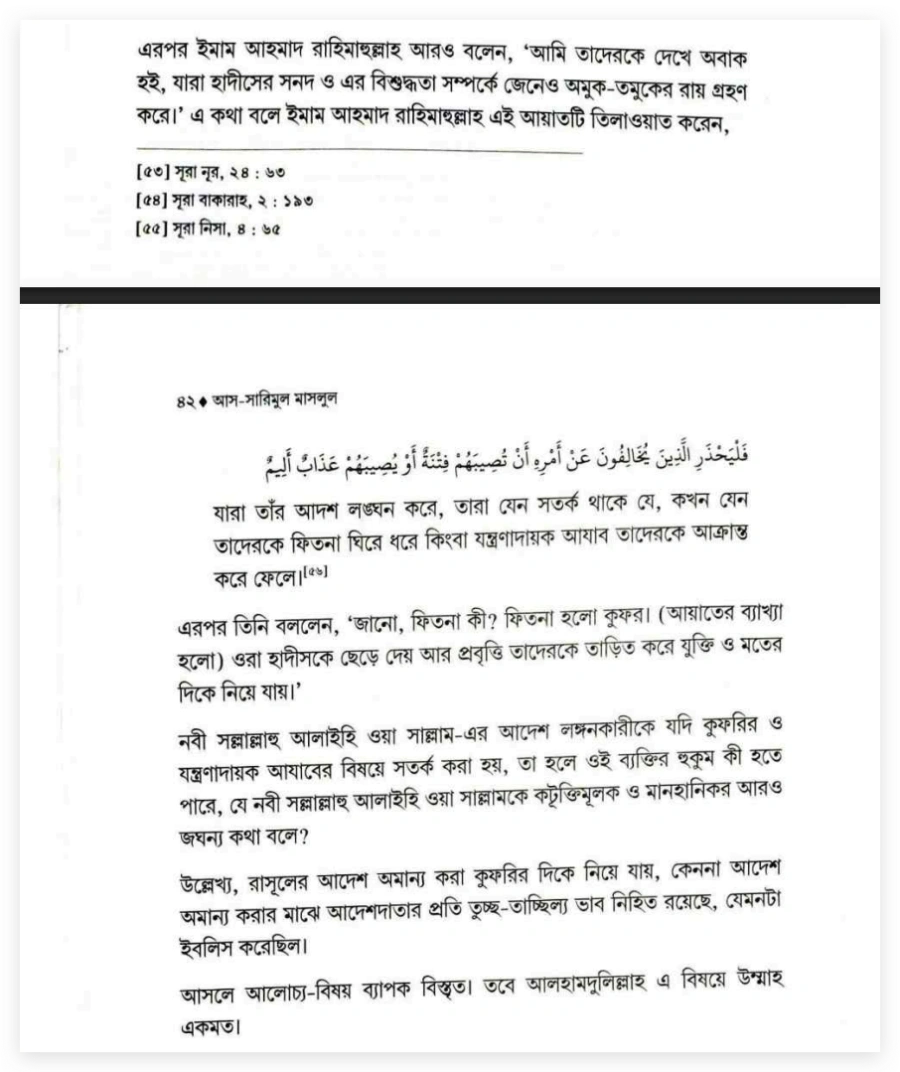
Then Imam Ahmad, may Allah have mercy on him, further said, ‘I am amazed when I see those who, despite knowing the chains of transmission of hadith and their authenticity, accept the opinions of so-and-so and such-and-such.’ Saying this, Imam Ahmad, may Allah have mercy on him, recited this verse,
[53] Surah An-Nur, 24: 63
[54] Surah Al-Baqarah, 2: 193
[55] Surah An-Nisa, 4: 65
فَلْيَحْذَرِ الَّذِينَ يُخَالِفُونَ عَنْ أَمْرِهِ أَنْ تُصِيبَهُمْ فِتْنَةٌ أَوْ يُصِيبَهُمْ عَذَابٌ أَلِيمٌ
Those who violate his command should beware lest a fitnah befall them or a painful punishment afflict them.[5]
Then he said, ‘Do you know what fitnah is? Fitnah is kufr. (The explanation of the verse is that) they abandon hadith, and their desires drive them toward reasoning and opinions.’
What could be the ruling concerning a person who violates the command of the Prophet, peace and blessings of Allah be upon him, if one who violates the command of the Prophet, peace and blessings of Allah be upon him, is warned about kufr and a painful punishment, while that person utters even more heinous insulting and defamatory words against the Prophet, peace and blessings of Allah be upon him?
It should be noted that disobeying the command of the Messenger leads toward kufr, because disobedience to a command contains an attitude of contempt and disdain toward the one issuing the command, just as Iblis did.
In fact, the subject under discussion is extremely broad. However, alhamdulillah, the ummah is unanimous on this matter.
Ibn Baz: “There Is No Compulsion in Religion” — Islam, Jizyah, or War
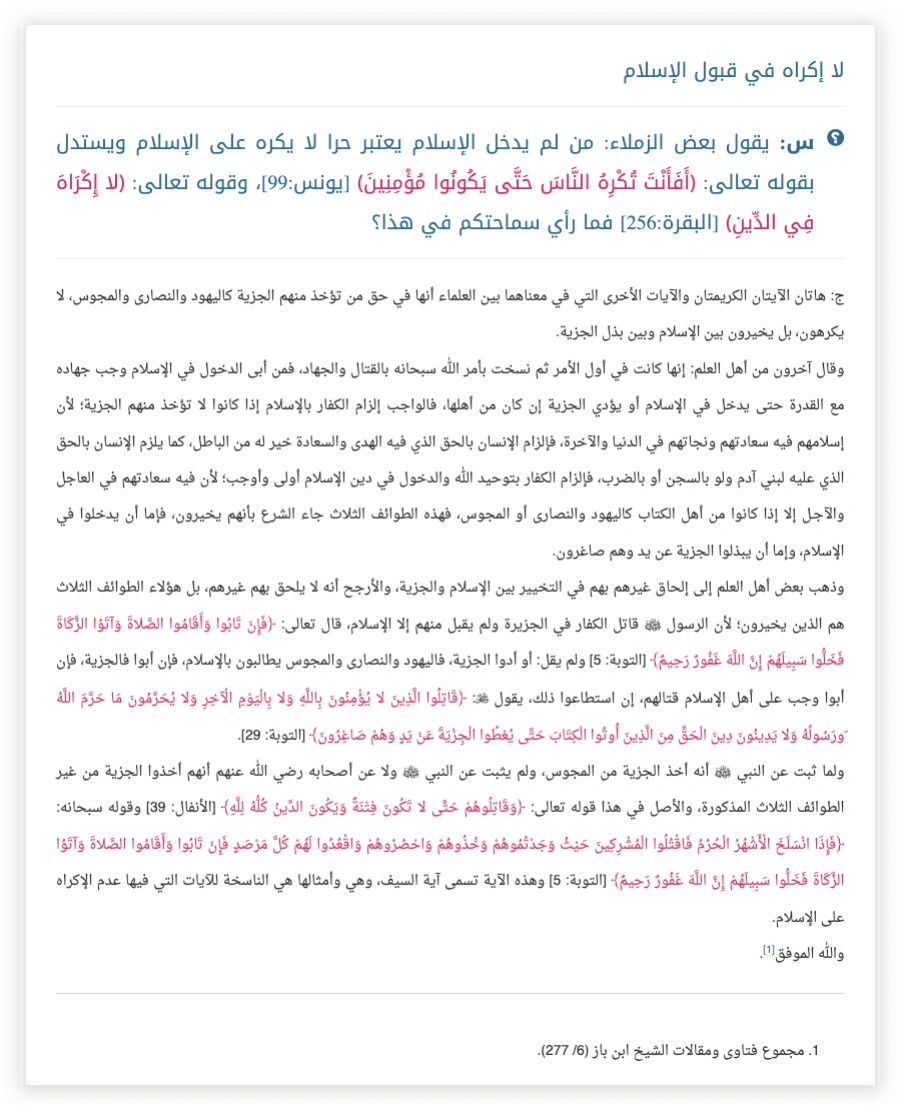
The fatwa of Shaykh Abd al-Aziz ibn Baz, the former Grand Mufti of Saudi Arabia and one of the most influential Salafi scholars of the twentieth century, is particularly important when the Quranic statement “There is no compulsion in religion” is presented as a declaration of universal religious freedom. Here, he was directly asked about the verses from Surah Yunus—“So would you compel the people until they become believers?”—and Surah al-Baqarah—“There is no compulsion in religion.” In response, Ibn Baz presents two recognized scholarly positions. According to the first, “no compulsion” applies primarily to those groups from whom Jizyah may be accepted, such as Jews, Christians, and Zoroastrians; in other words, they are given the choice between Islam and paying Jizyah in submission. According to the second position, this prohibition on compulsion belonged to the early period of Islam and was later abrogated by the verses commanding Jihad and Qital. Ibn Baz, however, does not merely report these two positions; he also makes his preferred position clear—those from whom Jizyah is not accepted are obliged to be compelled to accept Islam, while if Jews, Christians, and Zoroastrians reject both Islam and Jizyah, Muslims are obliged to fight them when they possess the capability to do so. He even compares this form of compulsion with compelling someone through imprisonment or beating to fulfill an obligation owed to another person, and argues that compelling disbelievers to embrace Tawhid and enter Islam is even more important. Thus, “there is no compulsion in religion” does not function here as freedom of belief in the modern sense; rather, it operates in a restricted sense within a conditional legal framework of Islam, Jizyah, and military submission for particular groups [15].
Original Arabic:
لا إكراه في قبول الإسلام
س: يقول بعض الزملاء: من لم يدخل الإسلام يعتبر حرا لا يكره على الإسلام ويستدل بقوله تعالى: أَفَأَنْتَ تُكْرِهُ النَّاسَ حَتَّى يَكُونُوا مُؤْمِنِينَ [يونس:99]، وقوله تعالى: لا إِكْرَاهَ فِي الدِّينِ [البقرة:256] فما رأي سماحتكم في هذا؟
ج: هاتان الآيتان الكريمتان والآيات الأخرى التي في معناهما بين العلماء أنها في حق من تؤخذ منهم الجزية كاليهود والنصارى والمجوس، لا يكرهون، بل يخيرون بين الإسلام وبين بذل الجزية.
وقال آخرون من أهل العلم: إنها كانت في أول الأمر ثم نسخت بأمر الله سبحانه بالقتال والجهاد، فمن أبى الدخول في الإسلام وجب جهاده مع القدرة حتى يدخل في الإسلام أو يؤدي الجزية إن كان من أهلها، فالواجب إلزام الكفار بالإسلام إذا كانوا لا تؤخذ منهم الجزية؛ لأن إسلامهم فيه سعادتهم ونجاتهم في الدنيا والآخرة، فإلزام الإنسان بالحق الذي فيه الهدى والسعادة خير له من الباطل، كما يلزم الإنسان بالحق الذي عليه لبني آدم ولو بالسجن أو بالضرب، فإلزام الكفار بتوحيد الله والدخول في دين الإسلام أولى وأوجب؛ لأن فيه سعادتهم في العاجل والآجـل إلا إذا كانوا من أهل الكتاب كاليهود والنصارى أو المجوس، فهذه الطوائف الثلاث جاء الشرع بأنهم يخيرون، فإما أن يدخلوا في الإسلام، وإما أن يبذلوا الجزية عن يد وهم صاغرون.
وذهب بعض أهل العلم إلى إلحاق غيرهم بهم في التخيير بين الإسلام والجزية، والأرجح أنه لا يلحق بهم غيرهم، بل هؤلاء الطوائف الثلاث هم الذين يخيرون؛ لأن الرسول ﷺ قاتل الكفار في الجزيرة ولم يقبل منهم إلا الإسلام، قال تعالى: فَإِنْ تَابُوا وَأَقَامُوا الصَّلاةَ وَآتَوُا الزَّكَاةَ فَخَلُّوا سَبِيلَهُمْ إِنَّ اللَّهَ غَفُورٌ رَحِيمٌ [التوبة: 5] ولم يقل: أو أدوا الجزية، فاليهود والنصارى والمجوس يطالبون بالإسلام، فإن أبوا فالجزية، فإن أبوا وجب على أهل الإسلام قتالهم، إن استطاعوا ذلك، يقول : قَاتِلُوا الَّذِينَ لا يُؤْمِنُونَ بِاللَّهِ وَلا بِالْيَوْمِ الْآخِرِ وَلا يُحَرِّمُونَ مَا حَرَّمَ اللَّهُ َورَسُولُهُ وَلا يَدِينُونَ دِينَ الْحَقِّ مِنَ الَّذِينَ أُوتُوا الْكِتَابَ حَتَّى يُعْطُوا الْجِزْيَةَ عَنْ يَدٍ وَهُمْ صَاغِرُونَ [التوبة: 29].
ولما ثبت عن النبي ﷺ أنه أخذ الجزية من المجوس، ولم يثبت عن النبي ﷺ ولا عن أصحابه رضي الله عنهم أنهم أخذوا الجزية من غير الطوائف الثلاث المذكورة، والأصل في هذا قوله تعالى: وَقَاتِلُوهُمْ حَتَّى لا تَكُونَ فِتْنَةٌ وَيَكُونَ الدِّينُ كُلُّهُ لِلَّهِ [الأنفال: 39] وقوله سبحانه: فَإِذَا انْسَلَخَ الْأَشْهُرُ الْحُرُمُ فَاقْتُلُوا الْمُشْرِكِينَ حَيْثُ وَجَدْتُمُوهُمْ وَخُذُوهُمْ وَاحْصُرُوهُمْ وَاقْعُدُوا لَهُمْ كُلَّ مَرْصَدٍ فَإِنْ تَابُوا وَأَقَامُوا الصَّلاةَ وَآتَوُا الزَّكَاةَ فَخَلُّوا سَبِيلَهُمْ إِنَّ اللَّهَ غَفُورٌ رَحِيمٌ [التوبة: 5] وهذه الآية تسمى آية السيف، وهي وأمثالها هي الناسخة للآيات التي فيها عدم الإكراه على الإسلام.
والله الموفق[1].
Freedom to Choice Regarding Acceptance of Islam
Q: Some colleagues say: Whoever does not enter Islam is considered free and cannot be compelled to enter Islam. They site as evidence the saying of Allah Almighty: ‘So would you compel the people until they become believers?’ [Yunus: 99], and His saying: ‘There is no compulsion in religion’ [Al-Baqarah: 256]. What is your Eminent Eminence’s opinion on this matter?
A: These two noble verses, and other verses bearing similar meanings, have been clarified by scholars as applying specifically to those from whom the Jizyah (tribute tax) is taken, such as Jews, Christians, and Zoroastrians. They are not to be compelled; rather, they are given the choice between accepting Islam or paying the Jizyah.
Other scholars have stated that this was the ruling in the beginning, but it was later abrogated (naskh) by Allah Almighty’s command to fight and engage in Jihad. Thus, whoever refuses to enter Islam must be fought—provided there is capability—until they either enter Islam or pay the Jizyah if they belong to those eligible to pay it. Therefore, it is obligatory to compel non-Muslims to accept Islam if they are not among those from whom Jizyah can be accepted. This is because their acceptance of Islam contains their salvation and happiness in this world and the Hereafter. Compelling a person toward the truth, which contains guidance and happiness, is better for them than leaving them upon falsehood—just as a person is compelled to fulfill the rights due to fellow human beings, even through imprisonment or corporal punishment. Thus, compelling non-Muslims to accept the monotheism of Allah and enter the religion of Islam is even more paramount and obligatory, for therein lies their happiness in the immediate life and the Hereafter—unless they are People of the Book (Jews and Christians) or Zoroastrians. For these three groups, the Islamic law dictates that they are given the choice: to enter Islam, or to pay the Jizyah willingly while being humbled.
Some scholars held the view of extending this choice between Islam and Jizyah to other non-Muslim groups as well. However, the most correct and stronger view is that others are not to be included with them; rather, only these three groups are given the choice. This is because the Messenger of Allah (peace be upon him) fought the non-Muslims in the Arabian Peninsula and accepted nothing from them except Islam. Allah Almighty says: ‘But if they repent, establish prayer, and give Zakat, then let them go on their way. Indeed, Allah is Forgiving and Merciful’ [At-Tawbah: 5]—He did not say: ‘or if they pay the Jizyah.’ Thus, Jews, Christians, and Zoroastrians are called to Islam; if they refuse, Jizyah is demanded; if they refuse that as well, it becomes obligatory upon the Muslims to fight them, provided they possess the capability to do so. Allah Almighty says: ‘Fight those who do not believe in Allah or in the Last Day and who do not consider unlawful what Allah and His Messenger have made unlawful and who do not adopt the religion of truth from those who were given the Scripture – [fight] until they give the jizyah willingly while they are humbled’ [At-Tawbah: 29].
Since it is authentically established that the Prophet (peace be upon him) accepted Jizyah from the Zoroastrians, whereas it is not established from the Prophet (peace be upon him) nor from his Companions (may Allah be pleased with them) that they took Jizyah from any group other than the three mentioned, the foundational rule in this regard remains the saying of Allah Almighty: ‘And fight them until there is no fitnah and [until] the religion, all of it, is for Allah’ [Al-Anfal: 39], and His saying: ‘And when the sacred months have passed, then kill the polytheists wherever you find them and capture them and besiege them and sit in wait for them at every place of ambush. But if they should repent, establish prayer, and give zakah, let them go on their way. Indeed, Allah is Forgiving and Merciful’ [At-Tawbah: 5]. This verse is called ‘Ayat al-Sayf’ (the Sword Verse), and it, along with similar verses, abrogates the verses that state there is no compulsion in Islam.
And Allah is the Granter of success. [Majmoo’ Fatawa Ibn Baz, Vol. 6, p. 219]
The significance of this fatwa is that there is no need to infer the meaning of “compulsion” from an ambiguous historical episode. Ibn Baz himself explicitly uses the expressions “compelling the disbelievers to accept Islam” (إلزام الكفار بالإسلام), “imprisonment or beating” (بالسجن أو بالضرب), Jihad against those who refuse Islam, Qital when Jizyah is rejected, and finally the position that verses concerning “no compulsion” were abrogated by the Sword Verse—all within the same answer. Therefore, presenting “La ikraha fi al-din” in the modern sense as a universal and unconditional right of every person to accept Islam, reject it, or remain in their own religion with equal status is not directly compatible with Ibn Baz’s interpretation. In his framework, the scope of religious freedom is determined by a person’s religious category, eligibility for Jizyah, and the military capability of Muslims.
Asim bin Luqman al-Hakim: Offensive Jihad or Jihad al-Talab
Let us listen to the statement of Asim bin Luqman al-Hakim, a highly popular Salafi scholar throughout the world today, in which he explains jihad al-talab, or the jihad of launching an offensive,
Shaykh Salih al-Fawzan: The Purpose of Jihad Is to Eliminate Shirk and Bring People into Islam
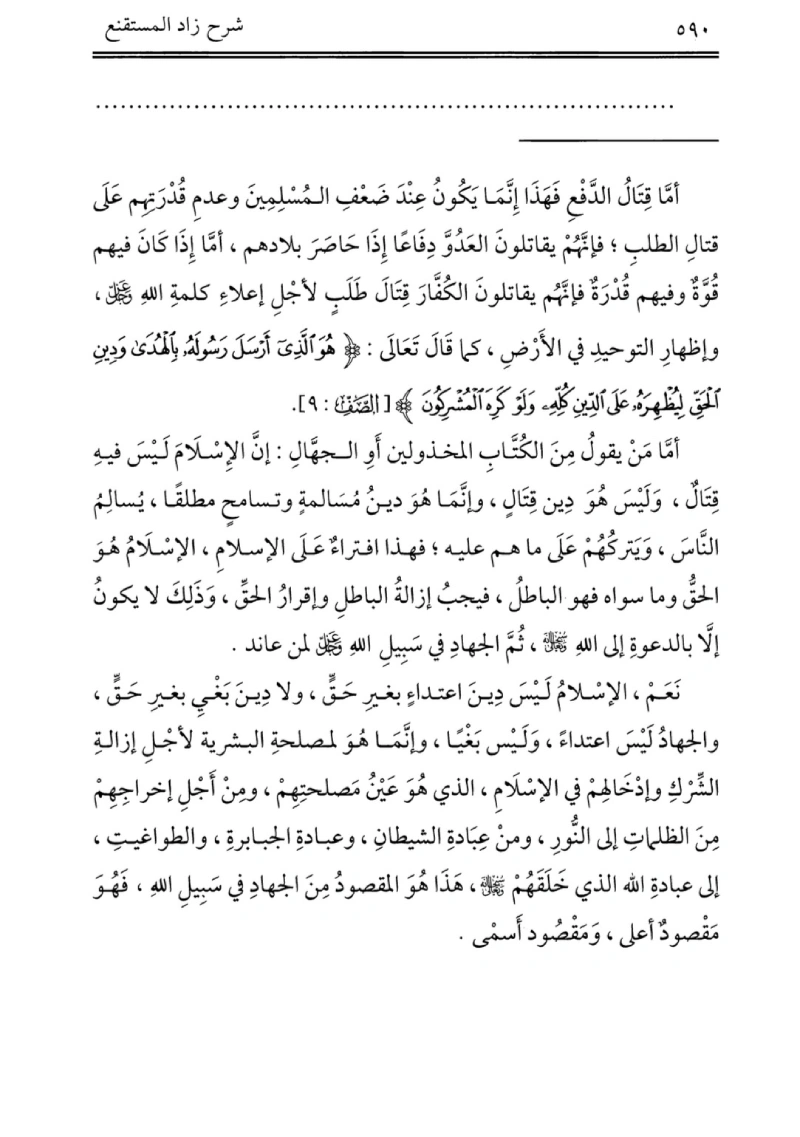
On the question of whether offensive or offensive jihad existed at all in classical Islam, the statement of one of contemporary Saudi Arabia’s most influential Salafi jurists and the Grand Mufti of Saudi Arabia, Shaykh Salih bin Fawzan al-Fawzan, is particularly important. In the Kitab al-Jihad section of Sharh Zad al-Mustaqni‘, he first directly distinguishes between qital al-daf‘, or defensive warfare, and qital al-talab, or warfare undertaken offensively through initiative. According to his statement, when Muslims are weak and lack the ability to conduct qital al-talab, they will wage defensive war; but when Muslims possess strength and capability, they will conduct qital al-talab against the unbelievers—to exalt the word of Allah and establish tawhid on earth. Immediately thereafter, he directly rejects the statements of those who present Islam as an unconditionally pacifist religion, calling them “a slander against Islam.” Let us read his statement,
Shaykh Salih al-Fawzan says:
“Those who say, among failed writers or among the ignorant: ‘There is no war in Islam; it is not a religion of war. Rather, it is entirely a religion of peace and tolerance. It deals peacefully with people and leaves people as they are’—this is a slander against Islam. Islam is the truth, and everything besides Islam is falsehood. Therefore, it is necessary to remove falsehood and establish the truth. And this is not possible except by calling people to Allah, and then waging jihad in the path of Allah against whoever stubbornly opposes it.
Yes, Islam is not a religion of unjust aggression, nor is it a religion of unjust oppression. Jihad is neither aggression nor oppression. Rather, it is for the welfare of humankind—for the purpose of removing shirk and bringing them into Islam; and Islam is their true welfare. And for bringing them out from darkness into light, from the worship of Satan, the worship of the Jabbars and Taghuts, to the worship of Allah, who created them, so that they may worship Him alone. This is the purpose of jihad in the path of Allah. Thus, it is a higher purpose and a greater objective.”
The significance of this statement is not merely that Fawzan acknowledges the existence of jihad. He is clearly rejecting the notion that Islam is an unconditionally pacifist system that leaves followers of other religions undisturbed in their own beliefs. Within the structure of his argument, Islam is the truth and other beliefs are falsehood; therefore, an attempt will first be made to remove that “falsehood” through preaching, and if there is stubborn resistance, jihad will be employed. More explicitly, he directly mentions both “removing shirk” and “bringing them into Islam”—in Arabic, إزالة الشرك وإدخالهم في الإسلام—among the purposes of jihad. Consequently, defining offensive jihad solely as a war of self-defense, border protection, or rescuing attacked Muslim populations conflicts with Fawzan’s own explanation. Here, one declared religious purpose of military jihad is to remove the existing non-Islamic belief system and establish the authority of Islam and tawhid. Let us find out what he says about this,
Statement: Question: Has any statement been narrated to the effect that this verse of the speech of Allah, Subhanahu wa Ta‘ala—“There is no compulsion in religion” [2:256]—has been abrogated (naskh) by the verses of jihad?
Answer: Yes, this is the view of some exegetes. According to them, this verse was abrogated by the verses of jihad.
Another view is that this verse applies specifically to the People of the Book. “There is no compulsion in religion” (2:256) means that when the People of the Book pay the jizya, they will be left to follow their religion.
The Constitution of Medina and Coexistence with Non-Muslims
Let us now watch a video by Bangladesh’s renowned scholar Ahmadullah. In this video statement, the idea of peaceful coexistence with non-Muslims is portrayed as a temporary and strategic arrangement, which ultimately presents them as second-class citizens. The speaker, Ahmadullah, has described the Constitution of Medina as a “treaty” made with the Jews only under the pressure of circumstances, and has stated that it was subsequently “cancelled” or “abrogated” through Surah al-Tawbah. Through this, he conveys the message that peaceful coexistence with equal rights for non-Muslims is not Islam’s permanent ideal. In particular, the imposition of the humiliating ‘jizya’ or tax on non-Muslims and the condition that they live by paying a specific ‘fee,’ rather than as ‘citizens,’ have been mentioned—an idea contrary to the concept of equal citizenship rights in the modern state. The speaker has described “living shoulder to shoulder” or “mixing together” with non-Muslims as a “deception,” and has made highly negative and racist remarks about Jews (such as saying that they are cunning or that they came from outside and drove in stakes), thereby inciting a kind of social hatred and distrust toward them. Overall, by portraying peaceful coexistence with non-Muslims as an “opportunistic” and “abrogated” arrangement, he has diminished their status in the state and society.
Tafsir Mazhari: Qital Until Shirk Is Eradicated
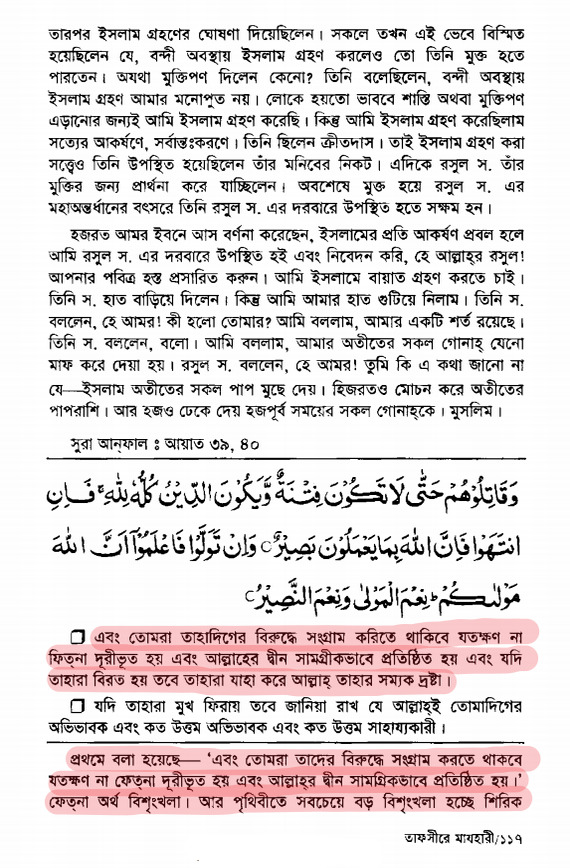
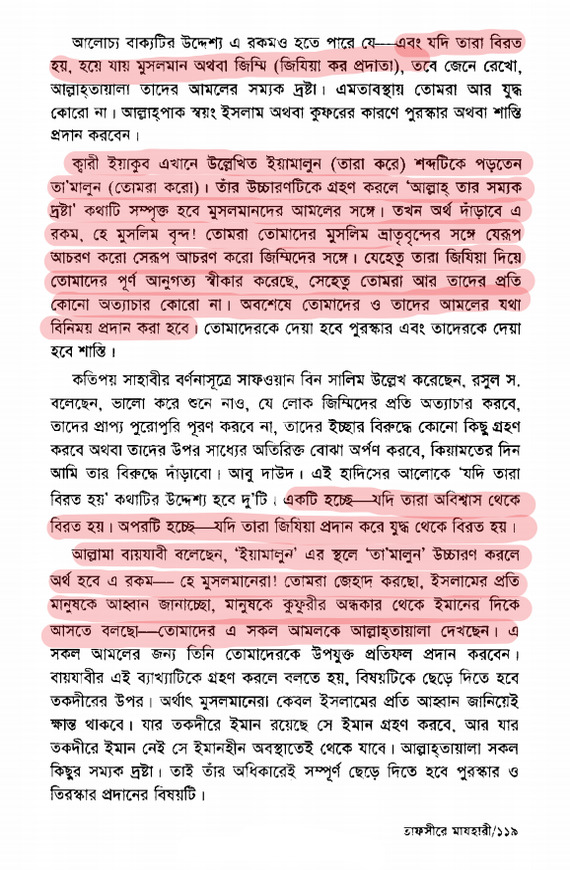
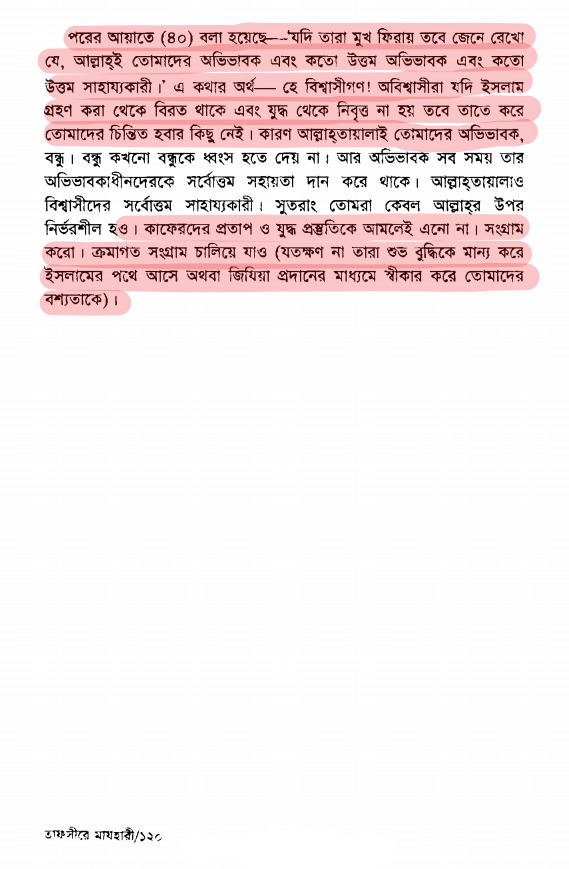
In support of this classical interpretation, we provide below the evidentiary passages from the original work of Allama Panipathi, which prove that this is not an isolated interpretation or misunderstanding, but rather a mainstream doctrine of Islam [17] –
And continue fighting against them until fitna is removed and the religion of Allah is established in its entirety; and if they desist, then Allah sees perfectly all that they do.
And if they turn away, then know that Allah is your Protector—how excellent a Protector and how excellent a Helper.
(Surah al-Anfal: 39, 40)
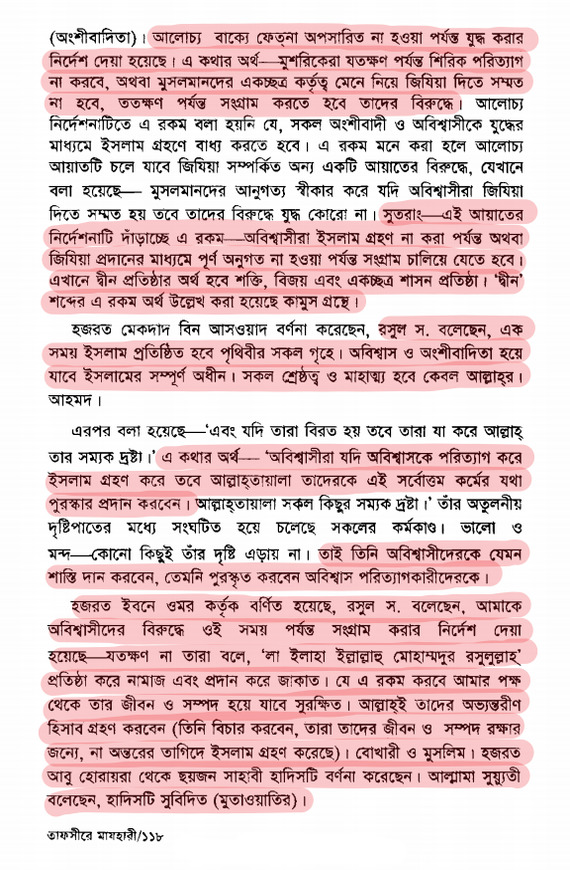
It is first stated that you must continue fighting against them until fitna is removed and the religion of Allah is established in its entirety.Fitna means disorder.And the greatest disorder on earth is shirk (polytheism). In the sentence under discussion, the command is given to fight until fitna is removed. This means that they must be fought against until the polytheists abandon shirk, or agree to pay jizya while accepting the Muslims’ exclusive authority. This instruction does not say that all polytheists and unbelievers must be compelled to accept Islam through war. If this were assumed, the relevant verse would read: if they agree to pay jizya, then do not fight against them. Thus, the instruction of this verse amounts to the following: fighting must continue until the unbelievers accept Islam or become completely submissive through the payment of jizya. Here, establishing the din means establishing power, victory, and exclusive rule. This meaning of the word ‘din’ has been mentioned in the work Qamus.
Hazrat Miqdad ibn Aswad narrated, The Messenger (peace be upon him) said, “At one time Islam will be established in every home on earth. Unbelief and polytheism will become completely subordinate to Islam.”All superiority and glory will belong solely to Allah.
It has been narrated by Hazrat Ibn Umar, The Messenger (peace be upon him) said, “I have been commanded to fight against the unbelievers until they say, ‘There is no deity except Allah, and Muhammad is the Messenger of Allah,’ establish prayer, and pay zakat. Whoever does so will have his life and property protected by me. Allah alone will hold them to account internally (He will judge whether they accepted Islam to protect their lives and property or from the prompting of their hearts).”Bukhari and Muslim. Six Companions narrated this hadith from Hazrat Abu Huraira. Allama Suyuti said that the hadith is well-known (mutawatir).
Zakaria: The Blood of a Practitioner of Shirk Is Lawful
It is from this theological position that the blood of those involved in shirk or kufr is considered ‘halal’ or lawful. The same tone is echoed in the interpretations of contemporary scholars. A book published under the editorship of Dr. Abu Bakr Muhammad Zakaria states with complete clarity that shirk is not merely a sin; rather, it is a ‘crime punishable by death’. That is, those who hold any belief outside the tawhid prescribed by Islam may lawfully be killed under normal circumstances if they have no treaty with the Muslims. Because they lack a treaty and are guilty of kufr, they essentially lose the security of their lives. Let us look directly at the book, [18] –
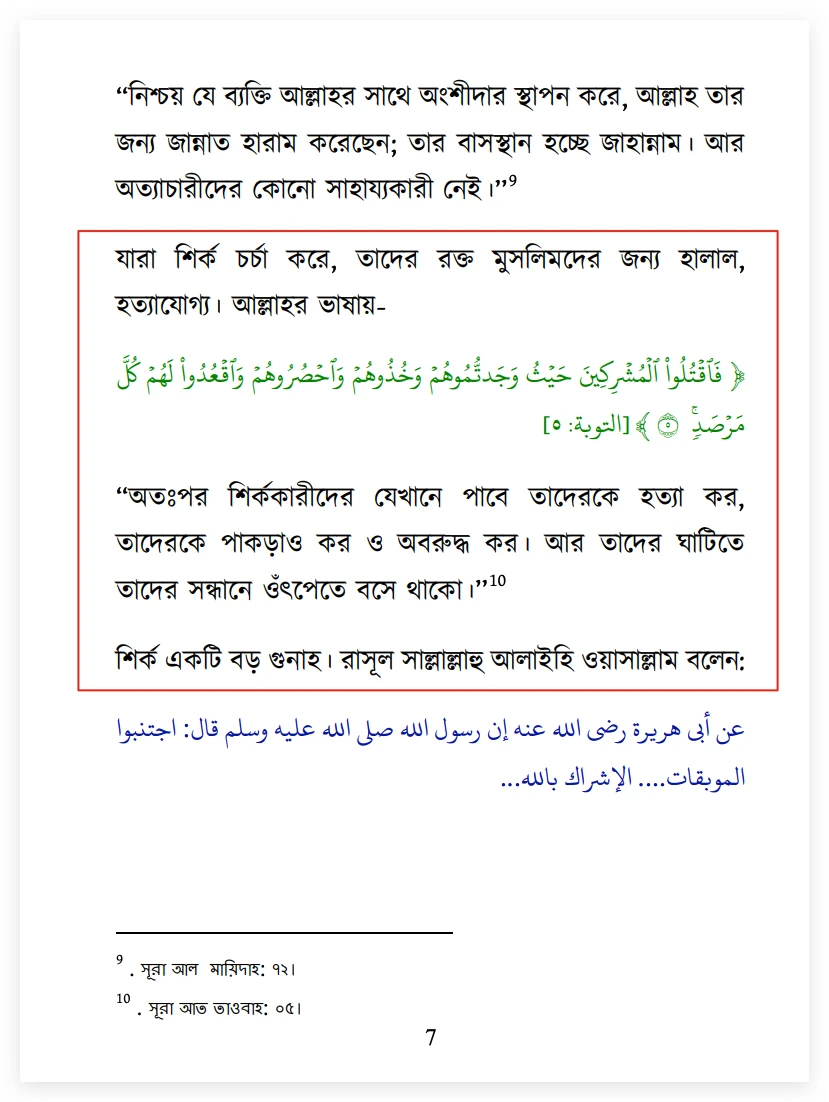
Hadith: The Prophet Was Commanded to Conduct Qital
This aggressive jihad conducted in the name of suppressing the so-called ‘fitna’ is not merely a matter of theoretical discussion. It is directly applied against those non-Muslims or ‘harbi’ infidels with whom the Muslims have no peace treaty. The primary basis of this ruling is Muhammad’s famous statement, in which he said— “I have been commanded to continue fighting against people until they recite the Kalimah” [19]. Thus, from the Islamic perspective, continuing this bloody struggle or qital until shirk is eradicated from the earth is an eternal divine command. [20] [21] [22] [23] [24] –
Sunan al-Tirmidhi (verified)
38/ Faith
Chapter: 1. I have been commanded to conduct qital against them until people say, “There is no deity except Allah.”
Jami` at-Tirmidhi 2607 It was narrated from Abu Hurairah (may Allah be pleased with him), who said: After the death of the Messenger of Allah, peace and blessings be upon him, when Abu Bakr (may Allah be pleased with him) was elected caliph, some groups among the Arabs became disbelievers. Umar ibn al-Khattab (may Allah be pleased with him) said to Abu Bakr (may Allah be pleased with him), “How will you fight these people, when the Messenger of Allah, peace and blessings be upon him, said: I have been commanded to fight people until they acknowledge that there is no lord except Allah. Whoever says, ‘There is no lord except Allah’ has secured his property and life from me. However, the rights of Islam are an exception. Their reckoning rests with Allah Almighty.”
Abu Bakr (may Allah be pleased with him) said: By Allah, I will certainly fight whoever differentiates between prayer and zakat. For zakat is the right due on wealth. By Allah, if they refuse to give even a rope that they used to give to the Messenger of Allah, peace and blessings be upon him, I will certainly fight them. Then Umar ibn al-Khattab (may Allah be pleased with him) said: By Allah, I realized that Allah had opened Abu Bakr’s heart to fighting, and I understood that his decision was correct.
Authentic: Sahihah (407), Sahih Abu Dawud (1391–1393), Bukhari and Muslim.
Abu Isa said: This hadith is hasan sahih. Shu‘ayb ibn Abi Hamzah narrated it from al-Zuhri, who narrated it from Ubaydullah ibn Abdillah, who narrated it from Abu Hurairah (may Allah be pleased with him), with a similar wording. Imran al-Qattan narrated this hadith from Ma‘mar, from al-Zuhri, from Anas (may Allah be pleased with him), from Abu Bakr (may Allah be pleased with him). This narration is erroneous. There is disagreement regarding the narration transmitted from Ma‘mar concerning Imran.
Hadith grade: Sahih (Authentic)
Narrator: Abu Hurairah (may Allah be pleased with him)
Sunan al-Tirmidhi (verified)
38/ Faith
Chapter: 2. I have been commanded to fight people until they say, “There is no deity except Allah,” and perform the prayer.
Jami` at-Tirmidhi 2608It was narrated from Anas ibn Malik (may Allah be pleased with him), who said: The Messenger of Allah, peace and blessings be upon him, said: I have been commanded to fight people until they testify that there is no lord except Allah, that Muhammad is the servant and Messenger of Allah, face our qiblah in prayer, eat the meat of animals slaughtered by us, and perform prayer as we do. If they do these things, it is unlawful for us to interfere with their lives and property. However, the rights of Islam are an exception. They will receive the benefits due to Muslims, and the responsibilities imposed upon Muslims will also apply to them.
Authentic: Sahihah (303) and (1/152), Sahih Abu Dawud (2374); similar to Bukhari.
Hadiths have also been narrated in this chapter from Mu‘adh ibn Jabal and Abu Hurairah (may Allah be pleased with them). Abu Isa said: This hadith is hasan sahih and gharīb through the above chain. Yahya narrated a similar hadith from Humayd, from Anas (may Allah be pleased with him).
Hadith grade: Sahih (Authentic)
Sunan an-Nasa’i (I.F.)
Chapter: 38/ The Prohibition of Killing
Section: 1. The Prohibition of Killing a Muslim
Sunan an-Nasa’i 3977 (Islamic Foundation edition: 3979) Ishaq ibn Ibrahim (may Allah have mercy on him) … narrated from Abu Hurairah (may Allah be pleased with him). He said, the Messenger of Allah, peace and blessings be upon him, said: I have been commanded to fight the people until they say, ‘There is no deity except Allah.’ If they say, ‘There is no deity except Allah,’ then their lives and property will be protected from me except with due right. And their account is with Allah.
Verification: Sahih.
Hadith grade: Sahih (Sahih)
Sahih Muslim (Hadith Academy)
Chapter: 1. Faith (Iman)
Section: 8. The command to fight the people until they acknowledge that there is no true deity except Allah, that Muhammad is the Messenger of Allah, establish prayer, pay zakat, and believe in the rulings of the Shariah brought by the Prophet; whoever does these things will attain security for his life and property, except for a Shariah-sanctioned reason, and what is in his heart is known to Allah; the command to fight those who refuse to pay zakat and observe the other rulings of Islam, and the importance for the imam to insist on establishing the distinctive features of Islam.
Sahih Muslim 21c Abu Bakr ibn Abu Shaybah (may Allah have mercy on him) ….. narrated from Jabir (may Allah be pleased with him), Abu Hurairah (may Allah be pleased with him), and Abu Salih that the Messenger of Allah, peace and blessings be upon him, said, “I have been commanded to fight the people.” The remainder is similar to the hadith narrated by Ibn al-Musayyab from Abu Hurairah (may Allah be pleased with him).
Abu Bakr ibn Shaybah and Muhammad ibn al-Muthanna (may Allah have mercy on them) ….. narrated from Jabir (may Allah be pleased with him) that the Messenger of Allah, peace and blessings be upon him, said, “I have been commanded to fight the people until they acknowledge that there is no true deity except Allah. If they acknowledge that there is no true deity except Allah, then their lives and property will be protected from me, except for a Shariah-sanctioned reason. Their account is with Allah.” Then he recited the verse: “So remind them, [O Muhammad]; you are only a reminder. You are not over them a controller” (Surah al-Ghashiyah 88:21-22). (Islamic Foundation: 35, Islamic Center: 35-36)
Hadith grade: Sahih (Sahih)
Sunan Ibn Majah
Publisher: Tawhid Publication
Chapter: 30/ Tribulations and Calamities
Section: 30/1. Refraining from interfering with one who says, “There is no deity except Allah”
Sunan Ibn Majah 3929 Aws (may Allah be pleased with him) said, “We were sitting with the Prophet, peace and blessings be upon him. He was advising us by mentioning past events. In the meantime, a man came to him and whispered something privately to him. The Prophet, peace and blessings be upon him, said: ‘Take him away and kill him.’ When the man turned back, the Messenger of Allah, peace and blessings be upon him, called him and asked him: ‘Do you testify that there is no deity except Allah?’ He replied, ‘Yes.’ He said: ‘Go, and let him proceed on his way.’ For I have been commanded to fight the people until they say, ‘There is no deity except Allah.’ When they do so, interfering with their lives and property becomes forbidden for me.”
Nasai 3979, 3982, 3983; Ahmad 15727; Darimi 2446. Al-Albani’s verification: Sahih.
Hadith grade: Sahih (Sahih)
Explanation of the Hadith on the Command to Fight
Let us learn the explanation of this hadith—that I have been commanded to fight until they say “There is no deity except Allah”—from a scholar through a hadith lesson,
The Prophet’s Statement: Paradise Lies Beneath the Shade of Swords
Without any reservation, the Prophet Muhammad stated very directly that Paradise lies beneath the shade of the sword. Through this, it becomes quite easy to understand that comprehensive jihad was in fact being encouraged [25] [26] –
Sahih Bukhari (Tawhid)
Chapter: 56/ Jihad and Conduct During Wartime
Section: 56/22. Paradise is beneath the flashing of swords.
Al-Mughirah ibn Shu’bah (may Allah be pleased with him) said, “The Prophet, peace and blessings be upon him, informed us of the message from us and from our Lord. Whoever among us was martyred reached Paradise.”
Umar (may Allah be pleased with him) said to the Prophet, peace and blessings be upon him, “Our martyrs are inhabitants of Paradise, but are those whom they have killed not inhabitants of Hell?” The Messenger of Allah, peace and blessings be upon him, said, “Yes.”
Sahih al-Bukhari 2818 Narrated by Salim Abu an-Nadr (may Allah have mercy on him), the freed slave and scribe of Umar ibn Ubaydullah (may Allah have mercy on him). He said, “Abdullah ibn Abu Awfa (may Allah be pleased with him) wrote to him that the Messenger of Allah, peace and blessings be upon him, said, ‘Know that Paradise is under the shades of swords.’
Uwaysi (may Allah have mercy on him), through Ibn Abu Zinad (may Allah have mercy on him), followed the narration of Muawiyah ibn Amr (may Allah have mercy on him), through Abu Ishaq (may Allah have mercy on him), from Musa ibn Uqbah (may Allah have mercy on him), regarding the narration of the hadith from Musa ibn Uqbah (may Allah be pleased with him). (2833, 2966, 3024, 7237) (Muslim 32/6, Hadith 1742; Ahmad 19136) (Modern Publication: 2608, Islamic Foundation: 2620)
Hadith grade: Sahih (Sahih)
Hadith Collection
20/ Jihad (in Allah’s path)
Section: Jihad is obligatory and the virtue of morning and evening
(1900) Narrated by Ibn Umar (may Allah be pleased with him), the Messenger of Allah (peace and blessings of Allah be upon him) said, I have been sent with a sword (before the Day of Resurrection), so that Allah may be worshipped without any partner. My sustenance has been placed under the shade of my spear. Humiliation and disgrace have been decreed for those who oppose my command. Whoever adopts the likeness of a people is one of them.
(Ahmad 5114–5115, 5667, Shu’ab al-Iman 98, Sahih al-Jami’ 2831)
Hadith grade: Sahih (Authentic)
Narrator: Abdullah ibn Umar (may Allah be pleased with him)
Victory through Terror: Psychological Warfare
In Islam’s military philosophy, victory is not determined solely on the field of physical battle; rather, crushing the enemy’s psychological foundation is an integral part of this strategy. In a highly significant hadith from Sahih al-Bukhari, Muhammad directly stated that he was helped through instilling fear or terror in the minds of the enemy. The horror of this psychological warfare was so great that even when the opposing forces were situated at a distance of a month’s journey, intense dread or fear would be instilled in their hearts. Why would people living a month’s distance away fear the Prophet who is called Rahmatallil Alamin, that is, a mercy for all the worlds? In the current English translation published on Sunnah.com, the corresponding wording is “I have been made victorious with awe (cast in the hearts of the enemy).” The underlying Arabic term is al-ru‘b (الرعب), referring to intense fear or terror. It is noteworthy that, in Bengali translations, linguistic sophistry is often employed to somewhat soften the intensity of the word ‘Terror’ by using words such as ‘fear and intimidation’ or ‘panic’ instead. From a religious perspective, the objective of creating this terror is to corner and psychologically overwhelm non-Muslims to such an extent that, in order to preserve their existence or escape humiliation, they are compelled to accept Islam or pay jizya. Judged by the standards of modern political science and human values, using fear and terror as a tool for propagating an ideology or religion is an utterly inhumane war strategy and amounts to depriving people of their natural freedom of thought. Classical Islamic scholars, however, do not regard this as a matter of shame; rather, they view it as one of Islam’s unique excellences and sources of strength. In reality, alongside the sword, this psychological fear was one of the principal pillars of the expansion of the Islamic empire, establishing the foundation of Islamic dominance not only on the battlefield but also in the minds of the enemy.
Let us see where the Prophet Muhammad said this: “The Prophet was made victorious through the creation of fear or terror.” While translating this hadith into Bengali, a noticeable degree of sophistry can be observed in various Bengali translations. So let us first read this hadith in Bengali and then in English [27] –
Sahih al-Bukhari (Tawhid Publication)
56/ Conduct and etiquette during jihad and wartime
Section: 56/122. The statement of the Messenger of Allah (peace and blessings of Allah be upon him):I have been helped through instilling fear of me in the hearts of enemies situated at a distance of one month’s journey from me.
وَقَوْلِهِ جَلَّ وَعَزَّ )سَنُلْقِيْ فِيْ قُلُوْبِ الَّذِيْنَ كَفَرُوا الرُّعْبَ بِمَآ أَشْرَكُوْا بِاللهِ ( قَالَهُ جَابِرٌ عَنْ النَّبِيِّ صلى الله عليه وسلم
The statement of Allah, the Most High: I will cast terror into the hearts of those who disbelieved, because they associated partners with Allah. (Ali ‘Imran 151)
In this connection, Jabir (may Allah be pleased with him) quoted a hadith from the Messenger of Allah (peace and blessings of Allah be upon him)
2977. Narrated Abu Huraira (may Allah be pleased with him). Allah’s Messenger (peace and blessings of Allah be upon him) said, I have been sent with the power to express comprehensive meanings in few words and I have been helped through instilling fear in the hearts of the enemy. Once I was asleep, and the keys to the treasures of the earth were brought to me and placed in my hand. Abu Huraira (may Allah be pleased with him) said, Allah’s Messenger (peace and blessings of Allah be upon him) has departed, and you are bringing them out. (6998, 7013, 7273) (Muslim 5/5, hadith 523, Ahmad 7758) (Modern Publication: 2756, Islamic Foundation: 2766)
Hadith grade: Sahih (Authentic)
Narrator: Abu Huraira (may Allah be pleased with him)
Now let us look at the English translation of this hadith. In the current translation published on Sunnah.com, the wording is “I have been made victorious with awe (cast in the hearts of the enemy).” It should be noted that the original Arabic term is al-ru‘b (الرعب), which denotes intense fear or terror. Bengali translations generally render the expression with terms such as ‘fear’, ‘fear and intimidation’, or ‘panic’. The difference therefore lies in the choice of translation for the underlying Arabic term rather than in the Arabic wording itself.
Narrated Abu Huraira:
Allah’s Messenger (ﷺ) said, “I have been sent with the shortest expressions bearing the widest meanings, and I have been made victorious with awe (cast in the hearts of the enemy), and while I was sleeping, the keys of the treasures of the world were brought to me and put in my hand.” Abu Huraira added: Allah’s Messenger (ﷺ) has left the world and now you, people, are bringing out those treasures (i.e. the Prophet did not benefit by them).
The Expulsion of Jews and Religious Land Seizure: The Naked Form of Hegemonism
Expulsion of Jews and religious geopolitics have been marked in history primarily as an extremely naked manifestation of Islam’s expansionist hegemony. When the Prophet of Islam entered a Jewish settlement, he did not go there merely with a message of peace or spiritual revolution; rather, he brought with him the extreme condition of either accepting subjugation or going into exile. A sahih hadith narrated in Sunan Abu Dawud, among others, states that Muhammad went to the Jewish area and directly offered them the opportunity to secure their safety by accepting Islam; otherwise, he clearly informed them that he wished to expel them from that land. The extremely sensitive and important point here is that ownership of the territory was not determined on the basis of any humanitarian agreement or historical settlement; rather, he declared that ‘the ownership of this land belongs only to Allah and His Messenger’. Expelling an ancient people from the homes of their ancestors merely because of religious disbelief is an extreme catastrophe from the perspective of current international law and humanitarian values. In the modern definition of human rights, imposing such a decision upon a community is regarded simultaneously as ethnic extermination and extreme aggression against human rights, which can in no way be indicative of a “pacifist” or “coexistence” philosophy. This principle demonstrates that, in the theological geopolitics of that time, a community’s right to exist depended solely on its beliefs, which is fundamentally a tremendous challenge for any modern pluralistic social system.
Religious apologists often claim, in order to legitimize the mass expulsion of these Jewish tribes, that they must have been involved in some betrayal or state wrongdoing. However, even if this claim is accepted for the sake of argument, this Islamic military strategy still appears to be wholly contrary to a modern and fair judicial framework. According to the norms of a civilized society, if a group or individual has committed a crime, only the actual offenders should be identified through a specific investigation and punished through a fair judicial process. Here, however, it can be seen that instead of a trial, a theological condition such as “accept Islam or be expelled” was imposed upon an entire community. Pressuring people to accept a religion as punishment for a crime, or threatening to drive them from their homes, cannot constitute a judicial process; rather, it is essentially merely a strategy for establishing a particular political and religious hegemony under the pretext of crime. When everyone—including women, children, and the elderly—is expelled from a settlement, it is no longer “punishment for individual crimes”; rather, it becomes “Collective Punishment,” which from the perspective of modern human rights is a horrific crime against humanity. Thus, justifying such mass oppression or expulsion on the pretext of crime fundamentally brings the very concept of justice into extreme disrepute [28]-
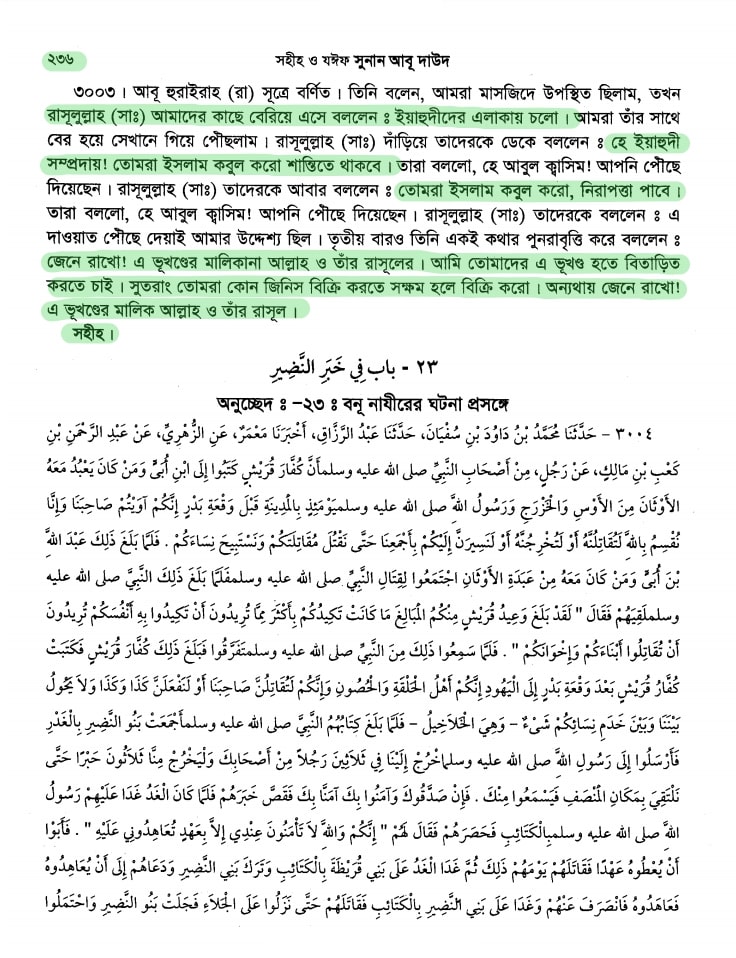
Sunan Abu Dawud (verified edition)
Publisher: Allama Albani Academy
Chapter: 14/ Jizya, Fay’ and Administration
Sunan Abi Dawud 3003 Narrated by Abu Hurairah (رضي الله عنه). He said, “We were present in the mosque when the Messenger of Allah (ﷺ) came out to us and said: ‘Let us go to the Jewish area.’ We went out with him and reached there. The Messenger of Allah (ﷺ) stood and called them, saying: O Jewish community! Accept Islam and you will remain in peace. They said, ‘O Abu al-Qasim! You have conveyed the message.’ The Messenger of Allah (ﷺ) said to them again: Accept Islam and you will gain security. They said, ‘O Abu al-Qasim! You have conveyed the message.’ The Messenger of Allah (ﷺ) said to them: ‘It was only to convey this invitation that I came.’ For the third time, he repeated the same statement and said: Know that the ownership of this land belongs to Allah and His Messenger. I wish to expel you from this land. Therefore, if you are able to sell any of your property, sell it. Otherwise, know that the owner of this land is Allah and His Messenger.
Hadith grade: Sahih (authentic)
Imperialist Aggression and the Legitimization of Slavery: Evidence from the Campaign against Khosrow
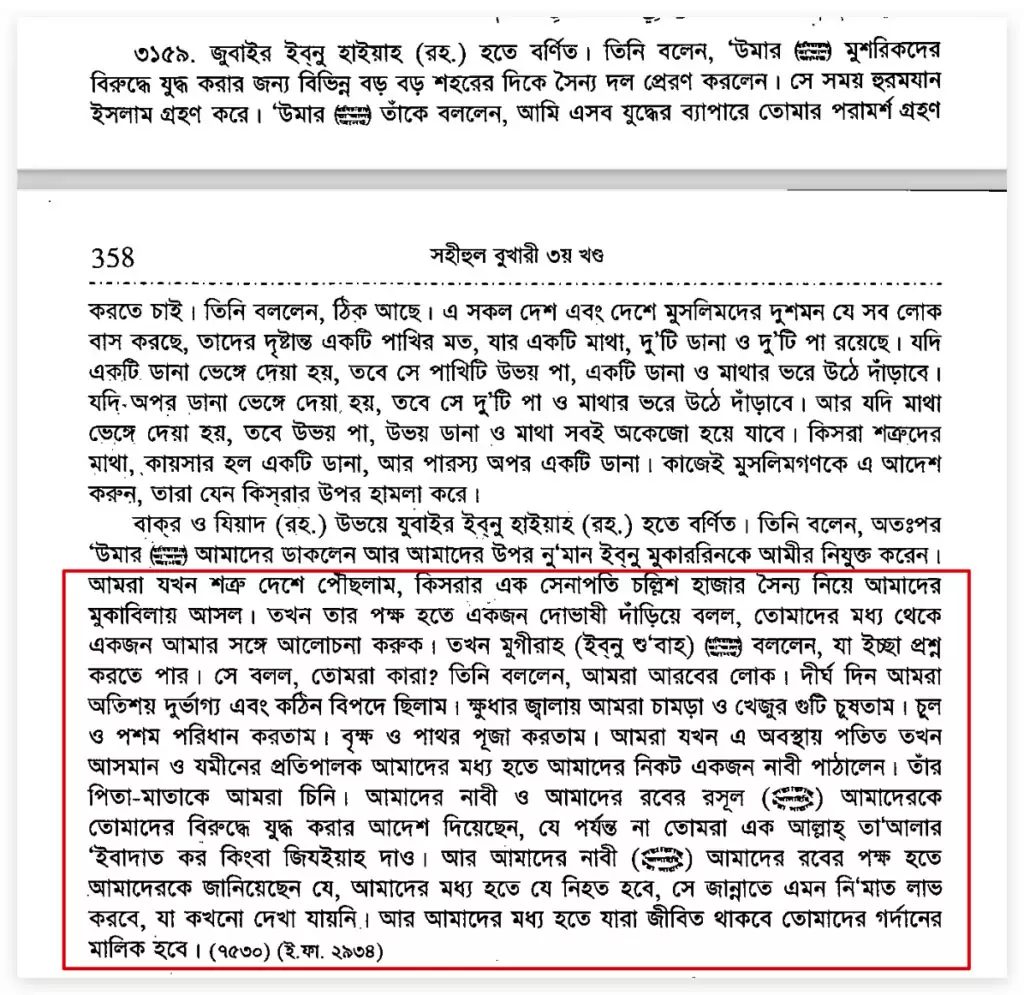
Analyzing this lengthy hadith from Sahih al-Bukhari reveals a brutal picture of the military strategy and hegemonic ideology of Islam’s early period . Here it can be seen that Caliph Umar regularly sent large military forces to major cities not merely for self-defense, but with the aim of expanding Islamic rule . The military strategy described by Hurmuzaan—comparing the empires of the Persian emperor Khosrow and the Roman emperor Caesar to a bird whose head and wings were to be broken—clearly constitutes evidence of a well-organized imperialist aggression . The objective of the Muslim forces in this war was not merely self-defense; rather, the principal aim was to militarily cripple another independent and sovereign state and eradicate its central power entirely .
The statement given by Mughirah ibn Shu‘bah reveals the religious and material objectives of this war even more clearly. He openly admitted that the people of Arabia had once been afflicted by extreme poverty and famine, but that their prophet had ordered them to continue fighting against non-Muslims until they worshipped the one God or paid the humiliating ‘jizya’ tax. This proves that this qital, or armed struggle, was not merely the result of a temporary outburst, but rather a permanent military policy accepted as a divine command, whose primary objective was to suppress other beliefs and establish Islamic hegemony. It should be noted that this is not the only such example; there are many.
The most shocking aspect is what was declared as the consequence or reward of this war. Mughirah clearly stated that those who were killed in battle would attain Paradise, while those who remained alive would become ‘masters of the necks’ of the defeated enemies. This ‘becoming masters of the necks’ means directly turning the people of the conquered regions into slaves and establishing absolute personal ownership over their lives and property. While modern human rights and international law regard human freedom as inviolable, this classical Islamic view of warfare treats the people of conquered communities as ‘property’ or ‘spoils of war,’ thereby denying their fundamental human rights. Thus, this hadith is not merely a history of one war; rather, it is an irrefutable document of Islamic supremacism and institutionalized slavery. [29] [30]
Sahih al-Bukhari (Tawhid Publication)
58/ Jizya Tax and Making Peace
Chapter: 58/1. Accepting Jizya from Dhimmis and the Treaty to Cease Fighting with Harbis.
Sahih al-Bukhari 3159. Narrated by Zubair ibn Haiyah (may Allah have mercy on him): He said, “‘Umar (may Allah be pleased with him) sent groups of soldiers toward various major cities to fight against the polytheists. At that time, Hurmużan embraced Islam. ‘Umar (may Allah be pleased with him) said to him, ‘I wish to seek your advice regarding these wars.’ He said, ‘Very well.’ He said, ‘The example of all these countries and the people living in them who are enemies of the Muslims is like that of a bird with one head, two wings, and two legs. If one wing is broken, the bird will stand supported by both legs, one wing, and its head. If the other wing is broken, it will stand supported by its two legs and its head. But if its head is broken, then both legs, both wings, and the head will all become useless. Kisra is the head of the enemies, Caesar is one wing, and Persia is the other wing. Therefore, command the Muslims to attack Kisra.’
Bakr and Ziyad (may Allah have mercy on them) both narrated from Zubair ibn Haiyah (may Allah have mercy on him). He said: “‘Umar (may Allah be pleased with him) then called us and appointed Nu‘man ibn Muqarrin as our commander. When we reached the enemy’s land, one of Kisra’s commanders came to confront us with forty thousand soldiers. Then an interpreter from his side stood up and said, ‘Let one person from among you discuss with me.’ Mughirah (ibn Shu‘bah) (may Allah be pleased with him) said, ‘You may ask whatever you wish.’ He said, ‘Who are you?’ He said, ‘We are Arabs. For a long time, we lived in extreme misfortune and severe hardship. Because of hunger, we used to suck leather and date pits. We wore hair and wool. We worshipped trees and stones. When we had fallen into this condition, the Lord of the heavens and the earth sent to us a prophet from among us. We know his parents. Our Prophet and the Messenger of our Lord—may Allah’s blessings and peace be upon him—ordered us to fight against you until you worship the One Allah, the Exalted, or pay jizya. Our Prophet also informed us, from our Lord, that whoever among us is killed will attain in Paradise such blessings as have never been seen. And those among us who remain alive will become masters of your necks.’ (7530) (Islamic Foundation: 2934)
Hadith grade: Sahih (Authentic)
Narrator: Zubair ibn Haiyah (may Allah have mercy on him)
Offensive Jihad (Jihad al-Talab): Da‘wah, Jizya, and Attack
In Islamic jurisprudence, jihad has primarily been divided into two main categories:
Jihad al-Daf: This is essentially defensive jihad. When a Muslim territory is attacked or the opposing side poses a threat to the existence of Muslims, repelling that attack is the primary objective of this jihad. Modern propaganda presents this aspect of jihad as the principal one.
Jihad al-Talab: This is offensive jihad. According to classical Islamic doctrine, its objective is to launch preemptive attacks on non-Muslim states, overthrow their infidel systems of government, and establish the law of Sharia there. It is regarded as a compulsory act of worship for the expansion of Islamic rule.
The Objective of Jihad: Becoming Wealthy through the Collection of Jizya
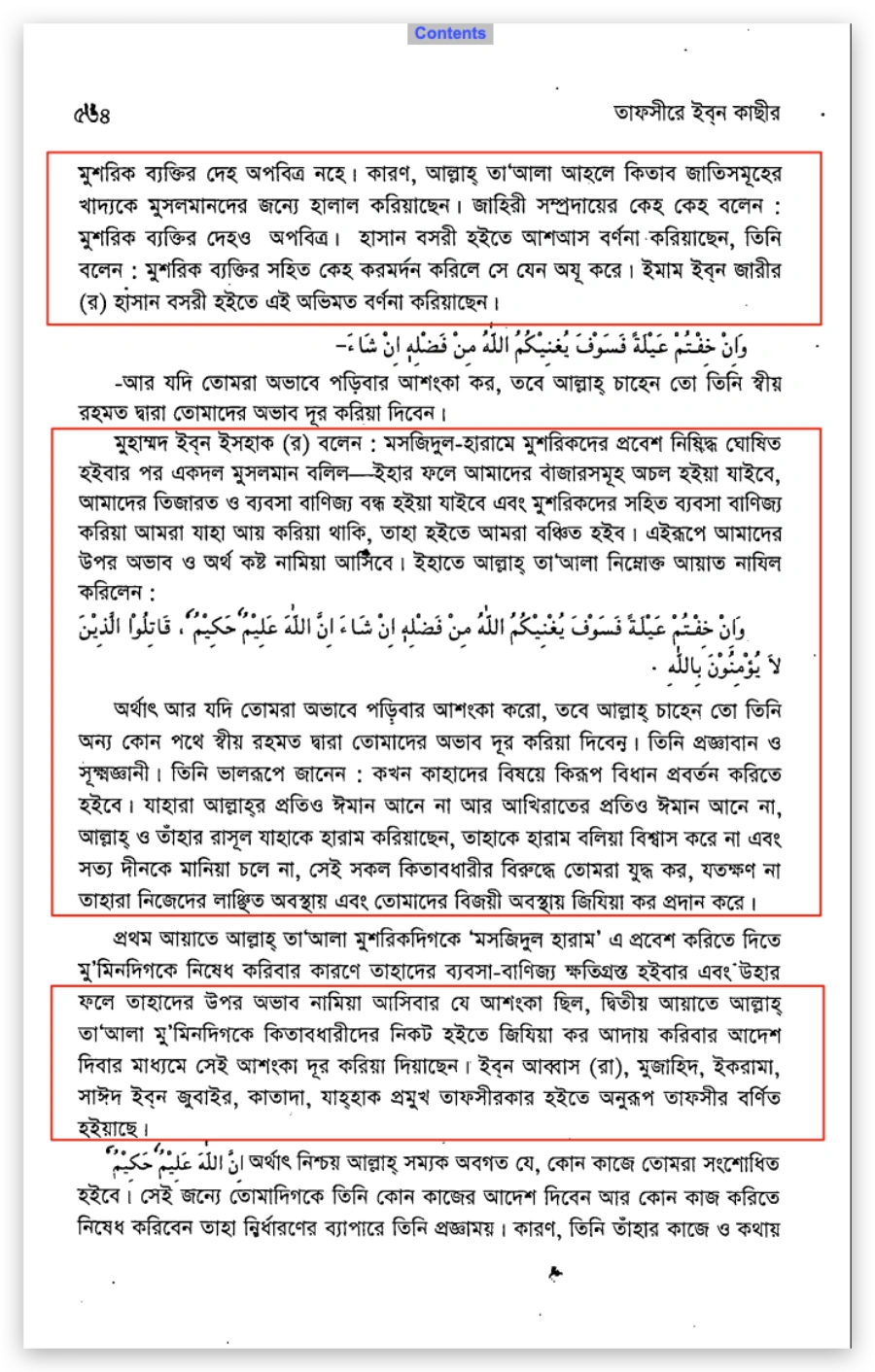
In discussions of offensive jihad, when religious explanations are generally brought to the forefront, it may seem that their primary objectives are daʿwah, establishing tawhid, suppressing disbelief, establishing the authority of the Sharia, and so forth. Yet within the Qur’an and tafsir themselves, there is also a clear economic dimension to this military expansion. Reading Surah al-Tawbah, verses 28 and 29, side by side makes it evident that the prohibition on polytheists entering al-Masjid al-Haram had created fears of economic loss within Muslim society; for the economy of Mecca, its markets, commerce, and transactions related to the Hajj had long depended on the presence of foreign Arab polytheists. In response to this concern, the Qur’an says that if you fear poverty, Allah will enrich you from His bounty.
The matter does not end there. In the very next verse comes the command to fight against the People of the Book until they pay the jizya and acknowledge subjugation. Thus, the sequence of the text is highly significant: first, the possibility of economic loss resulting from prohibiting the polytheists, and then, as an alternative source for that loss, the path of a jizya-based revenue system. Ibn Kathir clearly explained at this point that there was a fear that severing relations with the polytheists would cause the markets to close, commerce to suffer, and income to decline; and that Allah compensated the Muslims for that loss through the jizya collected from the ahl al-dhimmah. [31]
The body of a polytheist is not impure. For Allah the Exalted has declared the food of the nations of the People of the Book lawful for Muslims. Some among the apparentist communities say that the body of a polytheist is also impure. Ashʿath narrated from Hasan al-Basri that he said: If someone shakes hands with a polytheist, he should perform ablution. Imam Ibn Jarir (رحمه الله) narrated this opinion from Hasan al-Basri.
وَإِنْ خِفْتُمْ عَيْلَةً فَسَوْفَ يُغْنِيْكُمُ اللَّهُ مِنْ فَضْلِهِ إِنْ شَاءَ
-And if you fear poverty, then, if Allah wills, He will remove your poverty through His grace.
Muhammad ibn Ishaq (رحمه الله) said: After the polytheists were prohibited from entering al-Masjid al-Haram, a group of Muslims said: As a result, our markets will become inactive, our trade and commerce will cease, and we will be deprived of what we used to earn through trade and commerce with the polytheists. Thus, poverty and financial hardship will descend upon us. Thereupon Allah the Exalted revealed the following verse:
وَإِنْ خِفْتُمْ عَيْلَةً فَسَوْفَ يُغْنِيكُمُ اللهُ مِنْ فَضْلِهِ إِنْ شَاءَ إِنَّ اللَّهَ عَلِيمٌ حَكِيمٌ، قَاتِلُوا الَّذِينَ لا يُؤْمِنُونَ بالله
That is, if you fear poverty, then, if Allah wills, He will remove your poverty through His grace by some other means. He is Wise and Subtle in knowledge. He knows very well when and what kind of ruling should be instituted concerning whom. Fight against those among the People of the Book who do not believe in Allah or the Last Day, do not regard as unlawful what Allah and His Messenger have made unlawful, and do not follow the true religion, until they pay the jizya tax with themselves in a humiliated condition while you are victorious.
In the first verse, because Allah the Exalted prohibited the believers from allowing the polytheists to enter al-Masjid al-Haram, there was a fear that their trade and commerce would be harmed and that, as a result, poverty would descend upon them. In the second verse, Allah the Exalted removed that fear by commanding the believers to collect the jizya tax from the People of the Book. Similar interpretations have been narrated from Ibn Abbas (رضي الله عنه), Mujahid, Ikrimah, Saʿid ibn Jubayr, Qatadah, Dahhak, and other exegetes.
إِنَّ اللَّهَ عَلَيْمٌ حَكِيمٌ That is, surely Allah is fully aware of what will set you right. Therefore, He is Wise in determining which actions to command you to perform and which actions to prohibit you from performing. For He is most skilled and perfect in His acts and words, and He is the most just in dealing with His creation and guiding them. Therefore, He granted them victory as the recompense for their jihad, together with the receipt of the jizya tax from the conquered dhimmis.
قالُوا الَّذِيْنَ لَا يُؤْمِنُونَ بِالله That is, the People of the Book claim that they believe in the previous prophets. In reality, they do not believe in any prophet at all. They possess neither a commitment to truth nor a thirst for truth. If they possessed those qualities, they would surely believe in Allah’s Messenger—His greatest Messenger, Muhammad (peace be upon him). Their claim that they believe in the previous prophets is completely false. If they truly believed in the previous prophets, they would also believe in Muhammad Mustafa (peace be upon him), the crown of the prophets, because all the previous prophets foretold the coming of Muhammad (peace be upon him). They were also commanded to believe in Muhammad Mustafa (peace be upon him) accordingly. In fact, if the People of the Book follow any part of the laws of the previous prophets, the reason is not that they truly believe in the prophet concerned; rather, the reason is that their ancestral inheritance or some similar worldly benefit and interest lies in following it. Such adherence is not an indication of faith; therefore, it will be of no benefit to them.
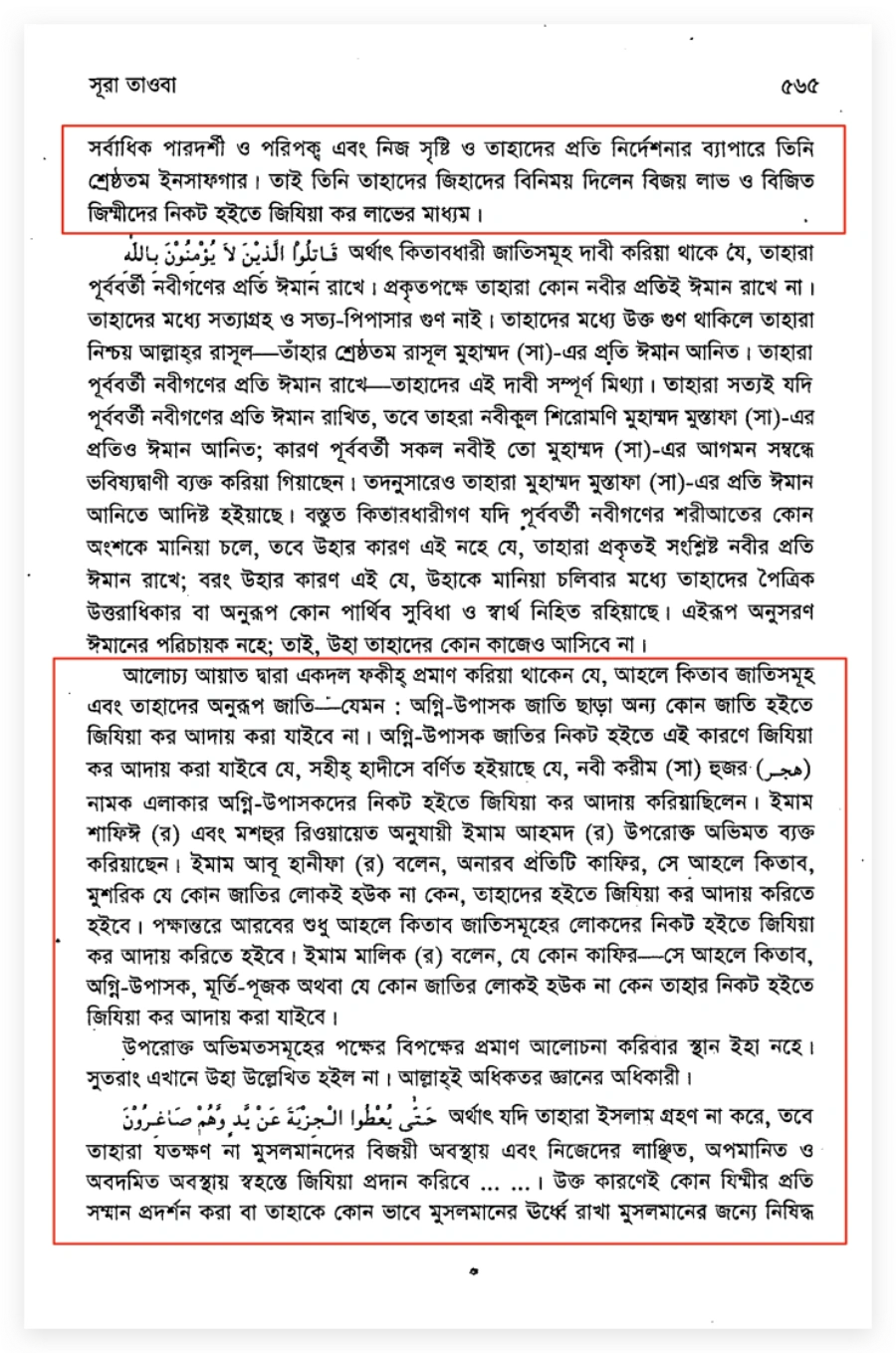
Some jurists use this verse as evidence that the jizya may not be collected from any nation other than the nations of the People of the Book and similar nations—such as the fire-worshipping community. Jizya may be collected from the fire-worshippers because it is narrated in an authentic hadith that the Noble Prophet (صلى الله عليه وسلم) collected jizya from the fire-worshippers of an area called Hujr )هج(. Imam al-Shafiʿi (رحمه الله) and, according to the famous narration, Imam Ahmad (رحمه الله) expressed the above opinion. Imam Abu Hanifa (رحمه الله) said that jizya must be collected from every non-Arab unbeliever, whether he is from the People of the Book, a polytheist, or belongs to any other nation. On the other hand, among the Arabs, jizya must be collected only from members of the nations of the People of the Book. Imam Malik (رحمه الله) said that jizya may be collected from any unbeliever, whether he is from the People of the Book, a fire-worshipper, an idol-worshipper, or belongs to any other nation.
This is not the place to discuss the evidence for and against the above opinions. Therefore, it has not been mentioned here. Allah knows best.
حَتَّى يُعْطُوا الْجِزْيَةَ عَنْ يُدِ وَهُمْ صَاغَرُونَ That is, if they do not accept Islam, then until they pay the jizya with their own hands while the Muslims are victorious and they themselves are humiliated, dishonoured, and subjugated … For this reason, it is prohibited and unlawful for a Muslim to show respect to a dhimmi or to place him in any way above a Muslim. They will always remain humiliated and disgraced. It is narrated in Sahih Muslim from Abu Hurayrah (may Allah be pleased with him) that Abu Hurayrah (may Allah be pleased with him) said: The Noble Prophet (peace be upon him) said: Do not initiate the greeting of peace to the Jews and Christians; and when you encounter any of them on the road, force him to walk along its narrowest part.
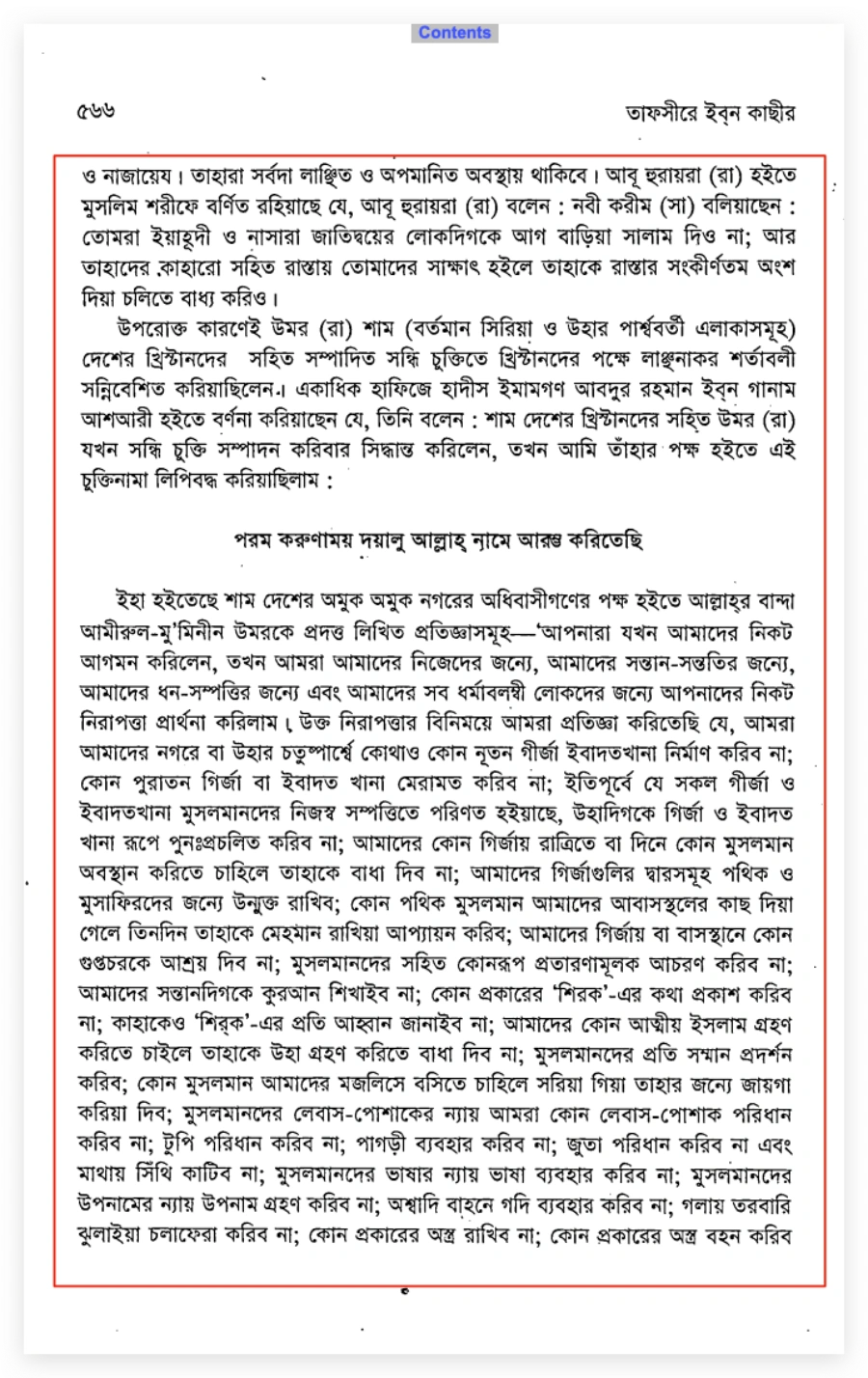
For this very reason, Umar (رضي الله عنه) inserted humiliating conditions for the Christians into the treaty he concluded with the Christians of Syria (present-day Syria and its surrounding regions). Several hadith scholars and imams narrated from Abd al-Rahman ibn Ghanam al-Ashʿari that he said: When Umar (رضي الله عنه) decided to conclude a treaty with the Christians of Syria, I recorded the following treaty document on his behalf:
In the name of Allah, the Most Compassionate, the Most Merciful
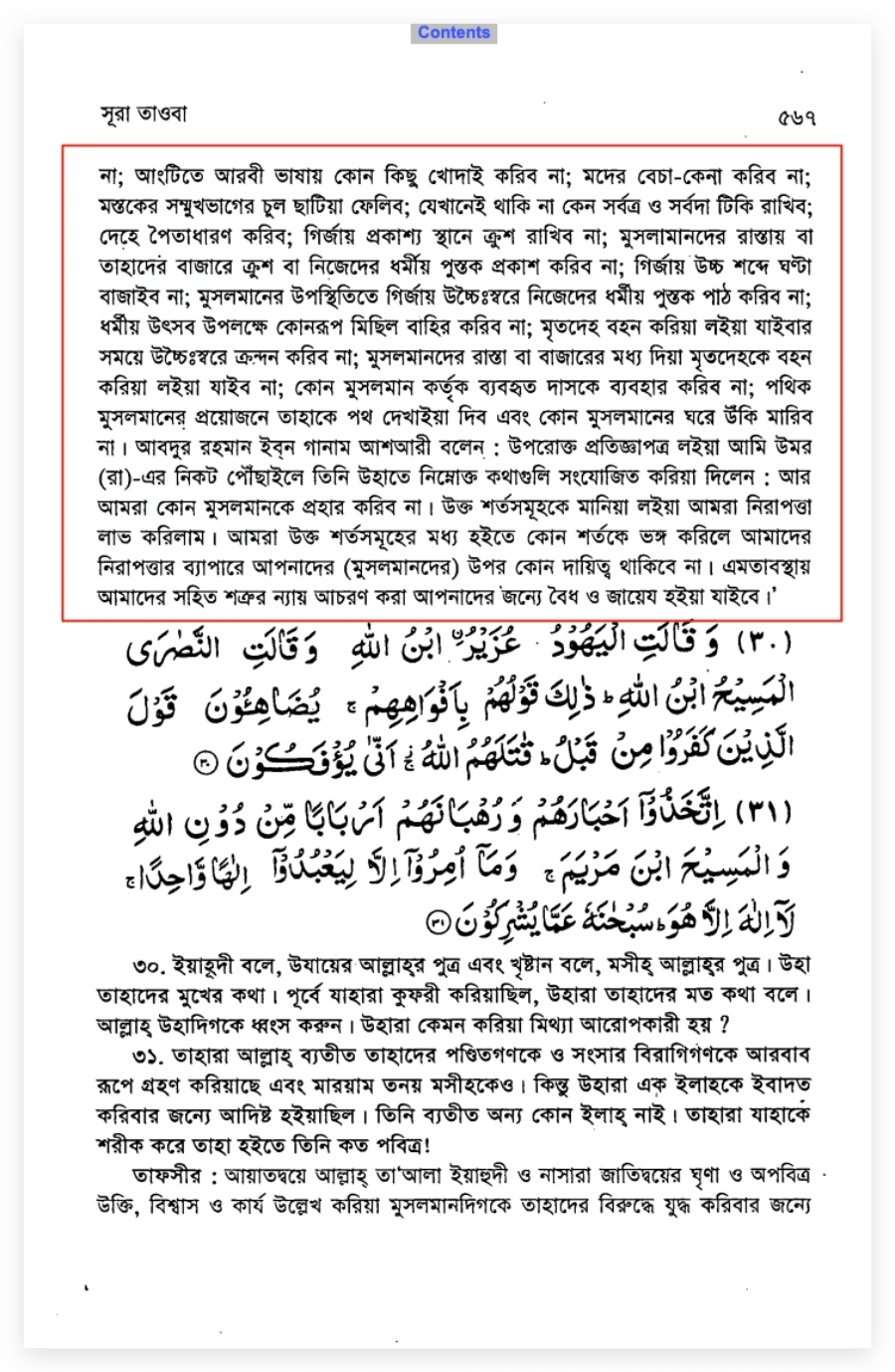
This is the written pledge given by the inhabitants of such-and-such cities of Syria to Umar, the servant of Allah and Commander of the Believers: “When you came to us, we requested security from you for ourselves, our children, our wealth and property, and all members of our religious community. In exchange for this security, we pledge that we will not build any new churches or houses of worship in our city or anywhere around it; we will not repair any old church or house of worship; we will not restore as churches or houses of worship those churches and houses of worship that have previously become the property of the Muslims; we will not prevent any Muslim who wishes to stay in any of our churches, by night or by day; we will keep the doors of our churches open to travellers and wayfarers; if a Muslim traveller passes near our dwellings, we will host and entertain him for three days; we will not shelter any spy in our churches or dwellings; we will not engage in any kind of deceitful conduct with the Muslims; we will not teach the Qur’an to our children; we will not openly mention any form of ‘shirk’; we will not invite anyone to ‘shirk’; if any of our relatives wishes to accept Islam, we will not prevent him from doing so; we will show respect to the Muslims; if any Muslim wishes to sit in our assembly, we will move aside and make room for him; we will not wear clothing resembling the clothing of the Muslims; we will not wear caps; we will not use turbans; we will not wear shoes; and we will not part our hair in the manner of the Muslims; we will not use language resembling the language of the Muslims; we will not adopt surnames resembling the surnames of the Muslims; we will not use saddles on horses or similar riding animals; we will not walk about with swords hanging from our necks; we will not keep any kind of weapon; we will not carry any kind of weapon; we will not engrave anything in Arabic on our rings; we will not buy or sell wine; we will cut the hair from the front of our heads; wherever we may be, we will always keep a forelock; we will wear the sacred thread on our bodies; we will not display crosses in public places in the churches; we will not display crosses or our religious books on the roads or in the markets of the Muslims; we will not ring bells loudly in the churches; in the presence of Muslims, we will not read our religious books aloud in the churches; we will not hold processions on the occasion of religious festivals; we will not cry out loudly while carrying the dead; we will not carry the dead through the roads or markets of the Muslims; we will not use slaves used by Muslims; we will show Muslim travellers the way when they need it; and we will not look into the houses of any Muslim. Abd al-Rahman ibn Ghanam al-Ashʿari said: When I brought the above pledge to Umar (رضي الله عنه), he added the following words to it: And we will not strike any Muslim. Having accepted these conditions, we obtained security. If we violate any of these conditions, you (the Muslims) will bear no responsibility for our security. In such circumstances, it will become lawful and permissible for you to treat us as enemies.”
This interpretation leaves no room for viewing offensive jihad merely as an abstract religious duty. Here, jihad, jizya, and the state economy are parts of the same framework. Three options are presented to non-Muslim political communities: accepting Islam, acknowledging subordination to Islamic rule by paying jizya, or war. Among these, jizya was not merely a tax representing religious tolerance; it was regular state revenue collected from defeated and subordinated non-Muslim communities. Thus, offensive jihad also functioned as the economic engine of Islamic imperialism.
This point is extremely important, because modern apologists often present jizya in softened language as a “state security tax” or a “tax in exchange for military service.” However, the economic character of jizya is revealed more nakedly in the sequence of Surah al-Tawbah and in discussions within classical tafsir. In response to the concern that prohibiting polytheists would cause Muslims commercial losses, the solution being presented is to wage war against the People of the Book and collect jizya from them. In other words, jizya here is not merely an administrative tax; it is a classical method of conquest, subjugation, and resource extraction.
The same line of interpretation is also found in Tafsir Mazhari: the promise to remove the fear of poverty that Muslims had due to the prohibition of polytheists is linked to jizya and the spoils of war. This makes it even clearer that offensive jihad was not merely a project for spreading religious doctrine; at the same time, it was also a project of economic redistribution, revenue collection, resource extraction from subjugated communities, and strengthening the victorious Muslim state. Let us likewise examine this evidence from Tafsir Mazhari, [32]
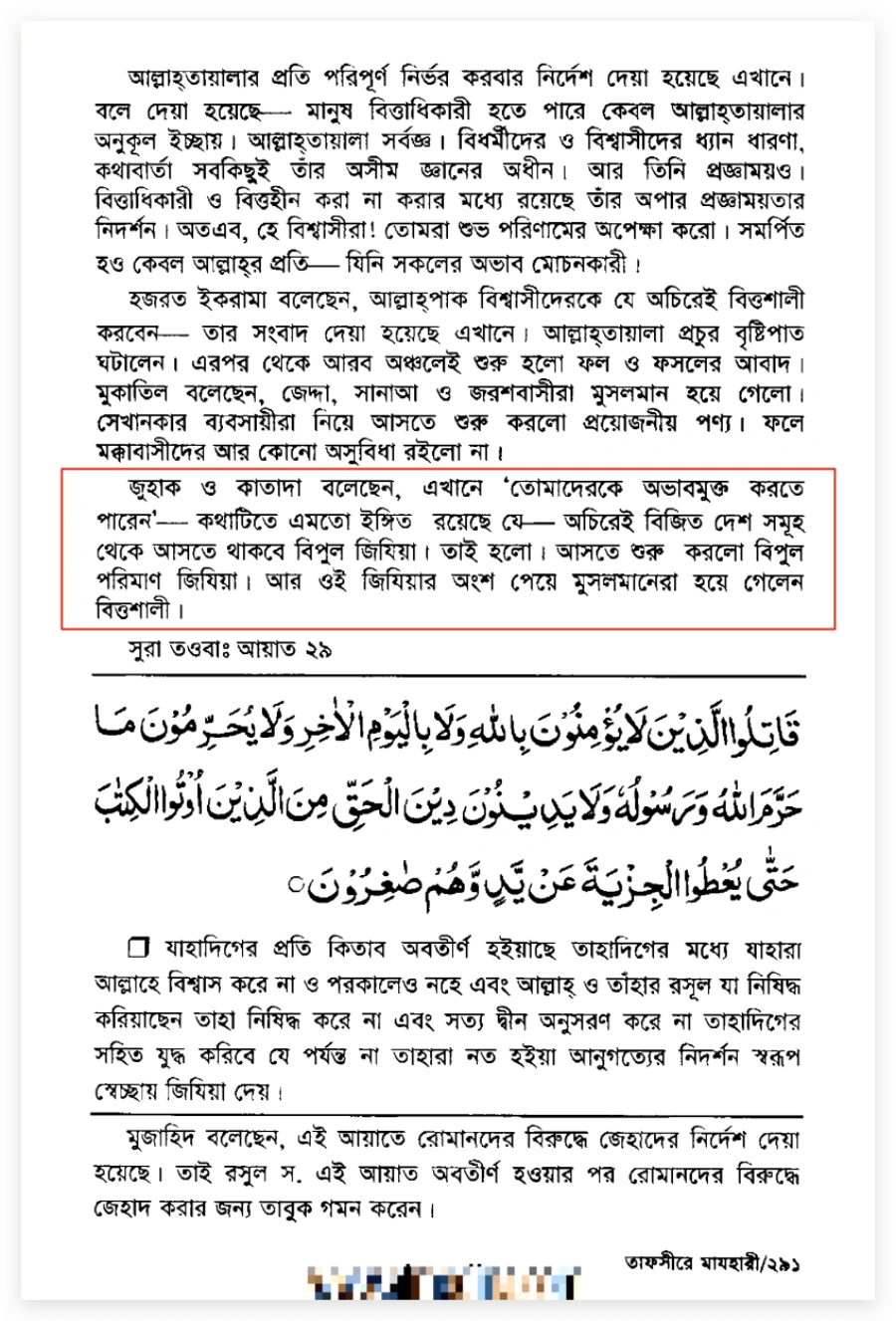
Dhahhak and Qatadah said that the statement here, “He may free you from poverty,” contains an indication that abundant jizya would soon begin to arrive from the conquered lands. And so it happened. Large amounts of jizya began to arrive. By receiving a share of that jizya, the Muslims became wealthy.
Therefore, when Surah al-Tawbah 9:28–29 is read together, it becomes evident that although the language of “calling to Islam” or “establishing the true religion” appears behind offensive jihad, economic interests based on jizya are highly explicit within its actual structure. The fear that Muslim society would become impoverished after losing the commercial presence of polytheists is addressed by presenting an alternative source of income: waging war against non-Muslims, politically subjugating them, and enriching the Muslim state through the collection of jizya. For this reason, offensive jihad must be evaluated not merely as a question of religious ideals, but as an integrated system of military conquest and economic exploitation.
Al-Hidaya: Jihad Will Continue Until the Day of Resurrection
In the world of fiqh, particularly within the Hanafi fiqh tradition, Al-Hidaya is a fundamental and foundational work. In a word, this book may be called the encyclopedia of Hanafi jurisprudence. Let us now read a section from the chapter on jihad in this work [33] –
Chapter on Jihad
In the terminology of fiqh, matters relating to jihad are called سیر. This is the plural of سيرة, whose literal meaning is the path of a matter. In the terminology of the Shariah, it specifically refers to the policies and methods followed by the Prophet, peace and blessings of Allah be upon him, in (jihad and) military expeditions.
Imam Quduri (may Allah have mercy on him) said that jihad is a communal obligation. If a group of people performs it, its obligatory status is lifted from the rest. The proof that it is obligatory is the statement of Allah the Exalted:
فاقْتُلُوا المشركين كافة كما يقاتِلُونَكُمْ كَافَّة
Kill all the polytheists just as they fight against all of you.
And the statement of the Prophet, peace and blessings of Allah be upon him: الجهاد ماض الى يوم القيامة (Jihad is an operative ruling until the Day of Resurrection.)
By this, he intended that it would remain obligatory until the Day of Resurrection.
The reason it is a communal obligation is that it was not made obligatory because of its intrinsic quality. For, considered in itself, it is the creation of فساد. It was made obligatory only to establish the supremacy of Allah’s religion and to prevent wrongdoing by His servants. Therefore, when the objective is achieved by some people, the obligation is lifted from the rest, just as with the funeral prayer and returning a greeting.
However, if no one performs it, all people will be sinful for abandoning it, because it is obligatory upon everyone.
(Another reason it is a communal obligation is that) involving everyone in it would mean halting the provision of the means of jihad, namely horses and weapons. Therefore, it is obligatory on a communal basis. However, if a general call is made, it becomes an individual obligation.
For Allah the Exalted said:
Go forth, lightly armed or heavily armed (9:41).
Imam Muhammad (may Allah have mercy on him) said in the book Jami al-Saghir that jihad is obligatory, but a Muslim has the option to remain behind as long as the need for them has not arisen.
The first part of his statement indicates that it is a communal obligation, while the latter part indicates a general call. For when there is a widespread need, the objective cannot be achieved without everyone’s participation. Therefore, it becomes obligatory upon everyone. Since the verse and hadith are unconditional and general, fighting against the disbelievers is obligatory even if they do not initiate the conflict (as soon as the need arises). Jihad is not obligatory upon minors, because children are objects of mercy. Nor is it obligatory upon slaves and women, because the rights of the master and husband take precedence.
It is also not obligatory upon the blind, the disabled, and those with amputated limbs, because they are incapable. But if the enemy attacks a city, resistance becomes obligatory upon everyone. A wife may go forth without her husband’s permission, and a slave without the master’s permission.
For at that point it has become an individual obligation, and the bonds of slavery and marriage are not considered in the face of an individual obligation, as in the case of prayer and fasting.
The situation before a widespread need is different. For the need can be fulfilled without slaves and women. Thus, there is no need to invalidate the rights of the master and husband.
It is disliked to impose a war tax on people to give to the mujahidin as long as the Muslims have property from the “fay” in the Bayt al-Mal.
For this resembles remuneration, and there is no need for it, since the Bayt al-Mal exists precisely to address all the calamities faced by the Muslims.
If it is unavailable, then there is no blame in strengthening one another.
For a minor harm has been accepted in order to prevent such a great harm.
Supporting this ruling is the fact that the Prophet, peace and blessings of Allah be upon him, borrowed a number of coats of armor from Safwan. And Umar (may Allah be pleased with him) would send an unmarried young man to war at the expense of a married man, and temporarily give the horse of a person remaining at home to one who was going to war.
Section: The Method of Jihad and Fighting
When the Muslim army enters Dar al-Harb and lays siege to a city or fortress, it should invite them to Islam. For Ibn Abbas (may Allah be pleased with him) narrated that the Prophet, peace and blessings of Allah be upon him, never fought a people without inviting them to Islam.
If they respond to the invitation, it should refrain from fighting them, because the objective has been achieved. And the Prophet, peace and blessings of Allah be upon him, said:
أمرت أن أقاتل الناس حتى يقولوا لا اله الا الله
I have been commanded to fight the people until they say, “There is no deity except Allah.”
If they refrain from responding, it should invite them to pay jizya. The Messenger of Allah, peace and blessings of Allah be upon him, gave precisely this instruction to the commanders of the various forces he sent out.
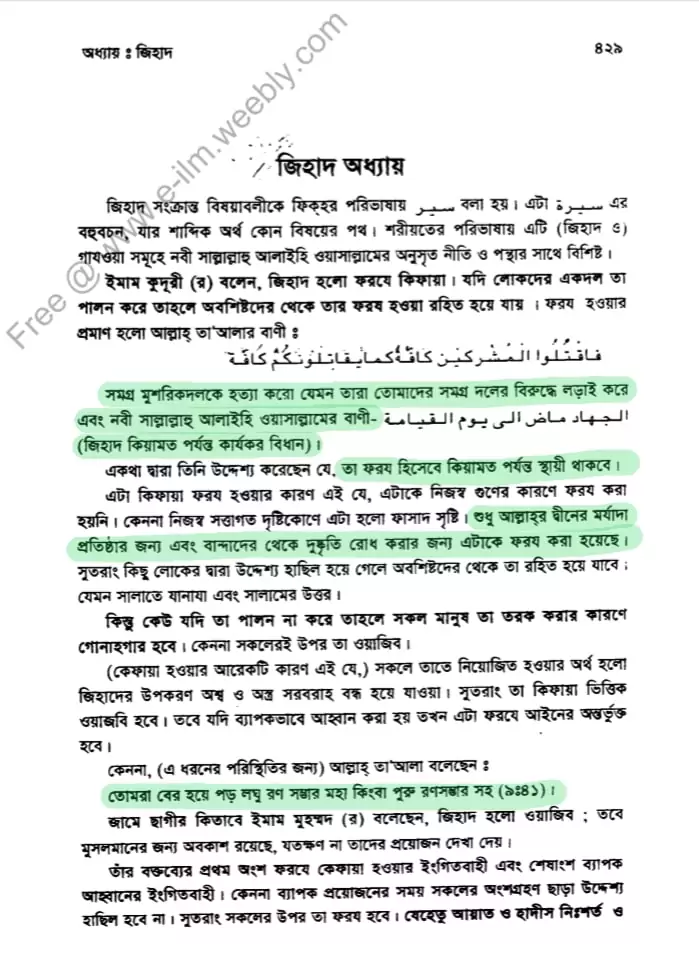
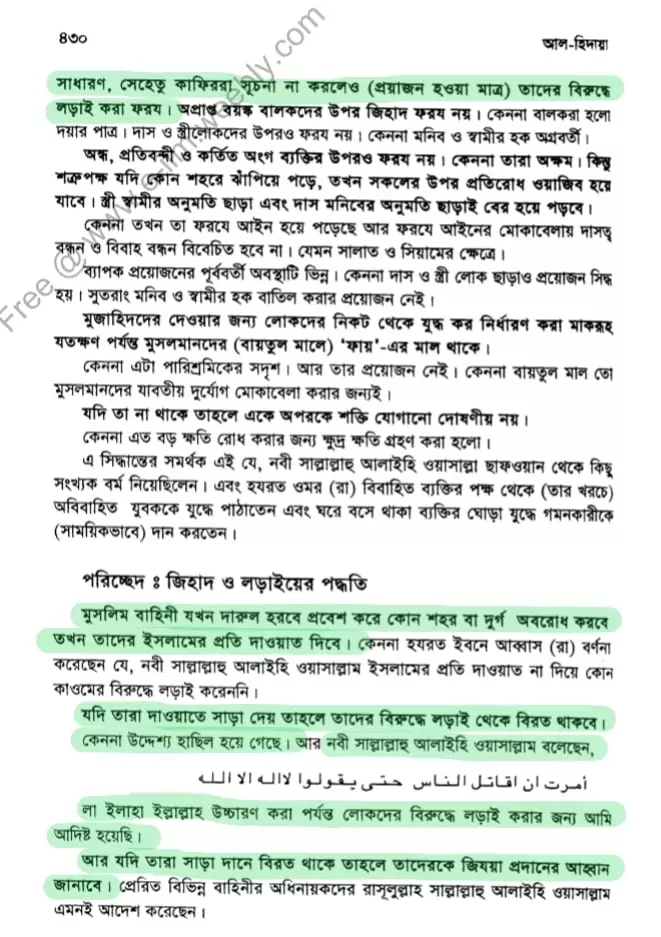
Fatawa Alamgiri: The Method of Jihad and Fighting
For the compilation of Fatawa Alamgiri, Aurangzeb appointed 500 scholars of fiqh. Among them, 300 came from South Asia, 100 from Iraq, and 100 from the Hijaz. Shaykh Nizam Burhanpuri led the team engaged in compiling it in Delhi and Lahore. Through their several years of labor, Fatawa Alamgiri was compiled. This book records laws and legal instructions concerning individuals, families, slaves, warfare, property, interfaith relations, transactions, taxation, the economy, and other matters in relation to various possible circumstances. Let us learn from this book the principles of jihad and the Islamic method of acquiring spoils of war. First, let us look at a diagram,
Legal Classification of Non-Muslims (Fiqh Criteria)
| Non-Muslim Group | Ruling on Accepting Jizya | Final Outcome (if They Do Not Submit) |
|---|---|---|
| Arab Polytheists | ❌ Invalid | Accept Islam or death |
| People of the Book (Jews/Christians) | ✅ Valid | Become dhimmis by paying jizya |
| Apostates | ❌ Invalid | Execution by the sword |
*Source: Fatawa Alamgiri, Volume 3, pages 502–535
Now let us look directly at the book, [34] –
(Pages 502–503) Second Chapter
The Method of Jihad and Fighting
1. Mas’ala: When the Imam of the Muslims (the ruler) intends to enter Dar al-Islam, it is his duty to inspect the army and ascertain the number of cavalry and infantry.
To record their names (and become informed of necessary matters) (Sharh Tahawi).
2. Mas’ala: When the Muslim army enters Dar al-Harb and besieges a city or fortress, it will invite them to Islam1. If they respond to the invitation, it will refrain from fighting them. If they refrain from responding, it will invite them to pay jizya (Hidaya). If they agree to pay jizya, then
all the benefits and obligations applicable to Muslims will also apply to them (Kaniyya). The above ruling concerns those from whom jizya may be accepted (from the Islamic perspective). Therefore, those from whom jizya cannot be accepted will not be invited to pay jizya (Tabyin).
It should be noted that the unbelievers are divided into several categories:
First category: Those from whom it is not permissible, by consensus, to take jizya.
They are the Arab polytheists who follow none of the heavenly scriptures. Therefore, when the Muslims overcome them, either the men will accept Islam or they will be killed. Their women and children, however, will be counted as spoils of war.
Second category: Those from whom it is unanimously permissible to take jizya. They are the followers of the heavenly scriptures: Jews and Christians, whether Arab or non-Arab, and fire-worshippers, whether Arab or non-Arab.
Third category: Those concerning whom the jurists differ over the collection of jizya. They are all others besides the groups mentioned above. According to our Hanafi madhhab, however, collecting jizya from them is obligatory (Muhit).
3. Mas’ala: It is not permissible to begin fighting those who have not received the invitation to Islam without first inviting them to Islam (Hidaya). If the Muslims fight them without conveying the invitation to Islam,
they will be sinful. However, the Muslims will not be held liable for damage to their lives and property, just as they are not held liable in the case of their women and children (Mabsut). As for those to whom the invitation has previously been conveyed, inviting them again as an additional precaution is recommended, not obligatory2 (Hidaya).
1. Because Ibn Abbas (may Allah be pleased with him) narrated that the Prophet (peace be upon him) never fought against a people without inviting them to Islam.
2. Because it has been established through an authentic narration that the Prophet (peace be upon him) attacked Banu Mustaliq while they were unaware, and assigned Usama (may Allah be pleased with him) the task of launching a forceful attack on the village of Ubna and setting the village on fire; and a surprise attack is never carried out after issuing an invitation.
However, there are two conditions for this to be recommended. First, the renewed invitation must not create any possibility of harm to the Muslims. For example, they might use the additional time to prepare for war. Or, if they employ some stratagem, then in such a case it is not recommended to invite them again before fighting.
The second condition is that there must be a possibility that they will accept Islam as a result of the renewed invitation. If there is no such possibility, they will not be invited (Muhit). Thus, if the unbelievers of a territory to whom the invitation to Islam has once been conveyed are attacked by surprise at night or during the day, it will not be unlawful (Muhit: Sarangi).
If they reject the invitation to Islam, he will seek Allah’s help against them and engage in fighting (Ikhtiyar: Sharh al-Mustar). He will deploy manjaniqs (cannons) against them, set fires, release water upon them (by breaking dams or by other means), cut down their trees, and destroy their grain and crops (Hidaya). He will demolish their fortresses and reduce them to ruins, flood them by directing water into them, and destroy their buildings and palaces. Hasan ibn Ziyad (may Allah have mercy on him) says that this is permissible if he knows that there are no Muslim prisoners in the fortress. If he does not know this, then burning and setting fires is not permissible. But our position is that if we restrain the Muslim armies from doing this, it will be difficult for them to fight and defeat the polytheists. Moreover, very few fortresses are free of enemy prisoners. However, these actions will be directed specifically at the polytheists (Mabsut).
Even if there are Muslim prisoners or merchants among them, there is no prohibition against shooting arrows at them.1 Even if they use Muslim boys or prisoners as shields, they will not refrain from shooting arrows at them. However, the intention must be to shoot at the unbelievers. 2 The blood money for those Muslims who are struck by their arrows will not be obligatory upon the mujahids. Nor will expiation be obligatory. 3
4. Mas’ala: There is no harm in taking women and the Noble Quran along with the Muslim army if their safety can be ensured. But taking them along with a small army whose safety is uncertain is reprehensible. If a Muslim enters their country under a guarantee of safety, and they are people who honor their promises, then there is no prohibition against taking the Noble Quran with him (Hidaya).
5. Mas’ala: Elderly women may be taken with a large army to perform necessary service work. For young women, on the other hand, the home is safer. However, because of the fear of temptation
…..
Notes: 1. Because a major harm can be prevented by shooting arrows from the center of Islam, whereas the killing of Muslim prisoners and merchants would cause limited harm; moreover, very few fortresses are free of Muslims. Therefore, if one were to refrain from fighting after considering this, the door of jihad would be closed altogether.
2. Because although distinguishing them in practice is impossible, it is possible in terms of intention. Moreover, the responsibility of obeying commands is assessed according to one’s ability.
Because jihad is obligatory, and “punishment” cannot be attached to the performance of an obligation.
3. 4. Such as cooking, providing drinking water, providing nursing care, and so on.
…….
(p. 535) 5. Mas’ala: Regarding those who are taken prisoner, the ruler has discretion: if he wishes, he may kill them, and if he wishes, he may enslave them. However, the matter of the Arab polytheists and apostates is different¹ (either they will accept Islam, or their necks will be struck off with the sword). If he wishes, he may make them protected non-Muslim subjects of the Muslims and grant them freedom. However, the matter of the Arab polytheists and apostates is different (they may not be released as free persons). Regarding those among the prisoners who accept Islam, no decision other than enslaving them may be taken (Tabyin). They may not be returned to Dar al-Harb. It should be noted that, according to the view of Imam Abu Hanifa (r), it is not permissible² to give Harbi prisoners as ransom in exchange for Muslim prisoners (that is, to give as ransom those Harbis who are prisoners among the Muslims in exchange for those Muslims who are prisoners among the Harbis) (Kafi).
A similar narration is also found in the Mutun. In this case, the view of Imam Abu Hanifa (r) is the sounder one (Zad). Imam Muhammad (r) says in al-Siyar al-Kabir that those men and women among the unbelievers whom the Muslims
…
Note: 1. This is because their unbelief and polytheism are among the gravest offences from the perspective of Islam. In the case of the Arab polytheists, the reason is that the Messenger of Allah, peace and blessings be upon him, appeared among them. The Holy Qur’an was revealed in their language. Therefore, the message of Islam and the laws of the Shariah were clearest and easiest for them to understand. Moreover, the miraculous events and the commands of Allah were more manifest and observable in their case.
In the case of apostates, the reason is that, after receiving guidance toward Islam and becoming aware of all the beauty of Islam and its beneficial laws, they rejected Islam and, by disbelieving in their Lord and showing insolence and extreme disrespect toward the Messenger, committed apostasy. For all these reasons, as both groups (the Arab polytheists and the apostates) are more deserving of severe punishment, either they will accept the religion of Islam or they will be killed. There is no other alternative in their case.
2. This is because returning unbelieving prisoners would mean assisting the enemies of the Muslims. For these people would later become alert and active and come to fight against the Muslims as combatants. War is such a matter that carries a grave risk of harm to the entire Muslim nation, whereas this is generally not observed when a Muslim prisoner is left in the hands of the enemies as a protected subject. Therefore, taking measures to prevent comprehensive harm to Islam and the Muslims and the anticipated harm of war is preferable to freeing a few Muslim prisoners.
Furthermore, if he remains a prisoner in their hands, this will be an individual test on his part, the responsibility for which rests solely upon him. It will not be connected to us. Conversely, handing their prisoners over to them and thereby assisting them will be our responsibility, and we will have to suffer its disastrous consequences.
3. The word Mutun is the plural of matn, meaning back, surface, main portion, original text, or textual passage. In Hanafi jurisprudential terminology, Mutun refers to those books in which the legal questions of the Hanafi school have been recorded following the apparent narrations. Examples include Bidaya, Mukhtasar al-Quduri, Mukhtar, Wiqaya, Qand al-Daqa’iq, and Multaqa al-Abhur.
And apparent narrations refers to those narrations or legal questions that were transmitted from the founders of the school—Imam Abu Hanifa, Abu Yusuf, and Muhammad (r)—and mentioned in the six books compiled by Imam Muhammad (r): al-Jami’ al-Saghir, al-Jami’ al-Kabir, al-Siyar al-Saghir, al-Siyar al-Kabir, al-Mabsut, and al-Ziyadat.
(p. 537) 7. Mas’ala: It is not permissible to show clemency toward prisoners (that is, to release them without enslaving them, making them protected non-Muslim subjects, or killing them)¹ (Kafi).
8. Mas’ala: Imam Muhammad (r) says that if the parents of polytheist children are also taken prisoner together with them, those children may be given as ransom². But if only the children are taken prisoner (and their parents are not captured) and they are brought to Dar al-Islam, they may not be given as ransom.
Similarly, if the spoils are distributed in Dar al-Harb and a child falls into a person’s share, or if the property of the spoils is sold there and a person becomes the owner of that child by purchasing him, then that child will be regarded as a Muslim as a dependent of that person (Muhit).
9. Mas’ala: Imam Muhammad (r) says that if the Muslims seize horses and weapons from the unbelievers, and then they wish to ransom them in exchange for property, it is not permissible to grant them this opportunity. Conversely, if they request: “Give us our captured people, and in exchange take one or—he said—two polytheists,” it is not permissible for the Muslims to do this. In exchange for Muslims held captive in Dar al-Harb, dirhams and dinars, as well as things that are not weapons or materials of war, may be given. Examples include clothing, food, and so on. Giving materials of war is not permissible, such as weapons, horses, and iron (Siraj al-Wahhaj).
10. Mas’ala: Imam Muhammad mentions in al-Siyar al-Kabir that if a free Muslim or a protected non-Muslim subject is held captive in Dar al-Harb, and he says to a Muslim or protected non-Muslim subject under their protection there, “Free me (by paying for my release) or purchase me,” and that person does so and brings him to Dar al-Islam, he will be deemed free. The ransom or purchase price will be regarded as a debt owed by that person. Thus, the person who was ordered to do so will recover from him the amount of property he paid as ransom. However, the amount recovered must be equivalent to the blood-money. Therefore, if he paid a ransom exceeding the nisab of the blood-money, he may recover only property equivalent to the nisab of the blood-money, and no more.
Some have said that, according to the statement of Imam Abu Hanifa (r), this ruling should apply: whatever amount the person ordered to do so pays for the release, he will recover from the person who issued the order (the prisoner), whether it is less or more than the nisab of the blood-money; there would be no difference in this regard. However, the soundest view is that, according to all of them (Imam Abu Hanifa, Abu Yusuf, and Muhammad (r), the ruling applicable in this case is the one mentioned first.
…
Note: 1. For it is stated: Kill the polytheists wherever you find them (Surah al-Baqarah) Moreover, because they have become subject to enslavement by being captured and brought under control, this constitutes a right of the Muslims. Therefore, it is not permissible to nullify that right without benefit or compensation. In addition, there is a grave risk that they may later cause harm and injury to the Muslims.
2. Because these are instruments of war and among the means of overcoming the enemy on the battlefield.
(Page 540) And they will smash and shatter all the household goods and furnishings, including their utensils and furniture, in such a way that they cannot later benefit from them. They will also release all kinds of liquid substances, so that they cannot later benefit from them. These actions will be carried out in order to provoke them into anger.
18. Mas’ala: If, while returning from an expedition in Dar al-Harb, it is not possible to bring the captives along, then the men will be killed if they do not accept Islam, while the women, children, and elderly will be left in an isolated place without food or drink so that they die of hunger and thirst. For killing them is not possible because of the prohibition mentioned in the hadith, while there is no particular justification for keeping them alive. 1
For this reason, if Muslims find a snake or scorpion anywhere in Dar al-Harb, they will cut off the scorpion’s tail, and if it is a snake, they will break its teeth, so that no harm comes to the Muslims while they remain there. Yet they will not kill them outright, so that their lineage may continue and their descendants may later sting and torment the unbelievers (Siraj al-Wahhaj).
19. Mas’ala: One cannot become the owner of the spoils until they have been brought into and secured in Dar al-Islam (Muhit: Sarangi).
Many mas’alas are based on the above principle: (1) If one of those entitled to a share of the spoils has intercourse with a captured slave girl (while still in Dar al-Harb), after which the slave girl gives birth to a child, and that person claims the child, then the child’s lineage will not be established with him in this case. However, because of the intercourse, ‘ushr will become obligatory upon that person.
Therefore, the slave girl, her child, and the ‘ushr that has been paid will be distributed among those entitled to the spoils. (2) After the spoils have been divided in Dar al-Harb and everyone has received his own share, if someone dies before bringing his share into Dar al-Islam, no one will be entitled to his share by inheritance. (3) If any of the mujahids destroys or ruins an item from the spoils, then according to the Hanafi school he will not be liable for it. (4) If the ruler distributes the spoils without exercising ijtihad or without considering the needs of the warriors, then according to our (Hanafi) school the distribution will not be valid. 2 (Tabyin).
…
Notes: 1. The reason for the prohibition of killing is compassion toward the weak; therefore, on the same grounds, the above-mentioned matter cannot be considered permissible. (Editor)
2. That is, if the imam is a scholar and possesses the ability to exercise ijtihad and reach a correct and beneficial decision, then distributing the spoils without such consideration, or without considering the benefits and needs of the mujahids, will not be valid. Therefore, if the imam distributes them after considering that the spoils may be destroyed or spoiled before they can be taken to Dar al-Islam, it will be valid; likewise, it will also be valid if doing so serves the interests of the mujahids.
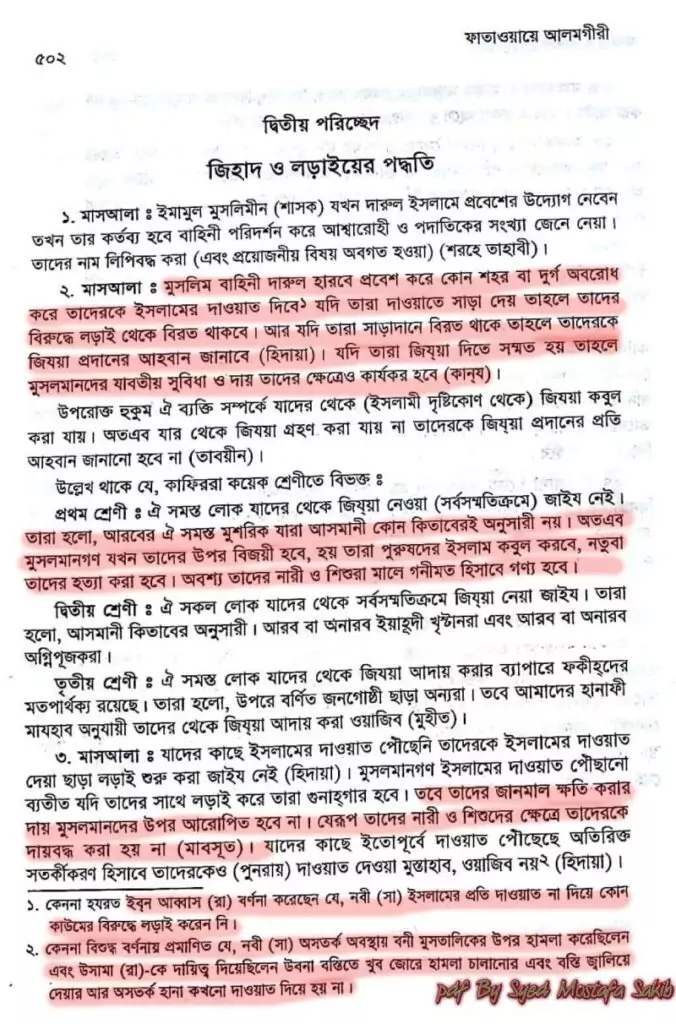
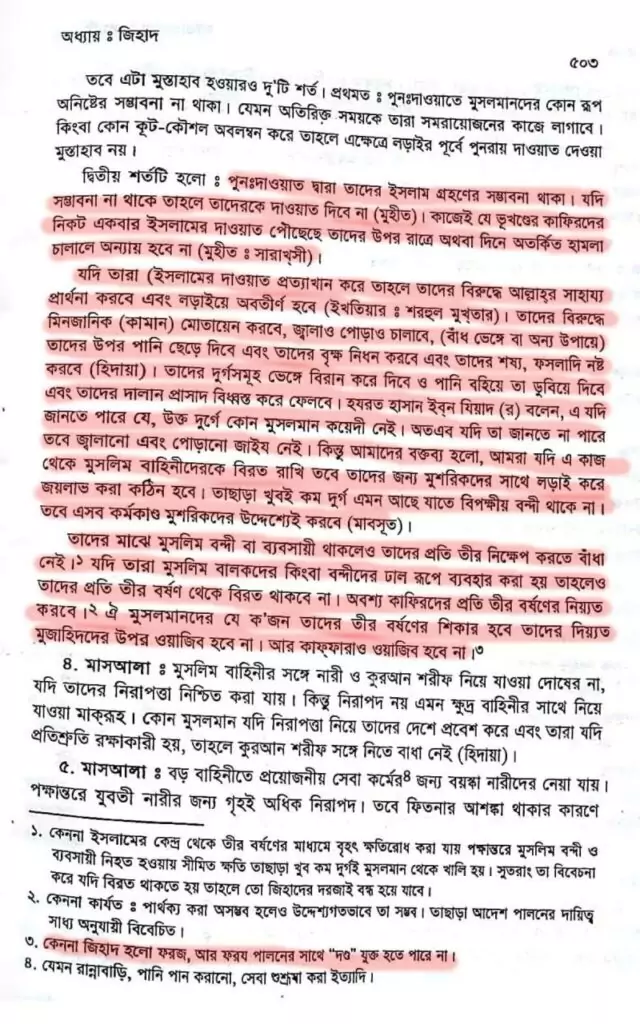
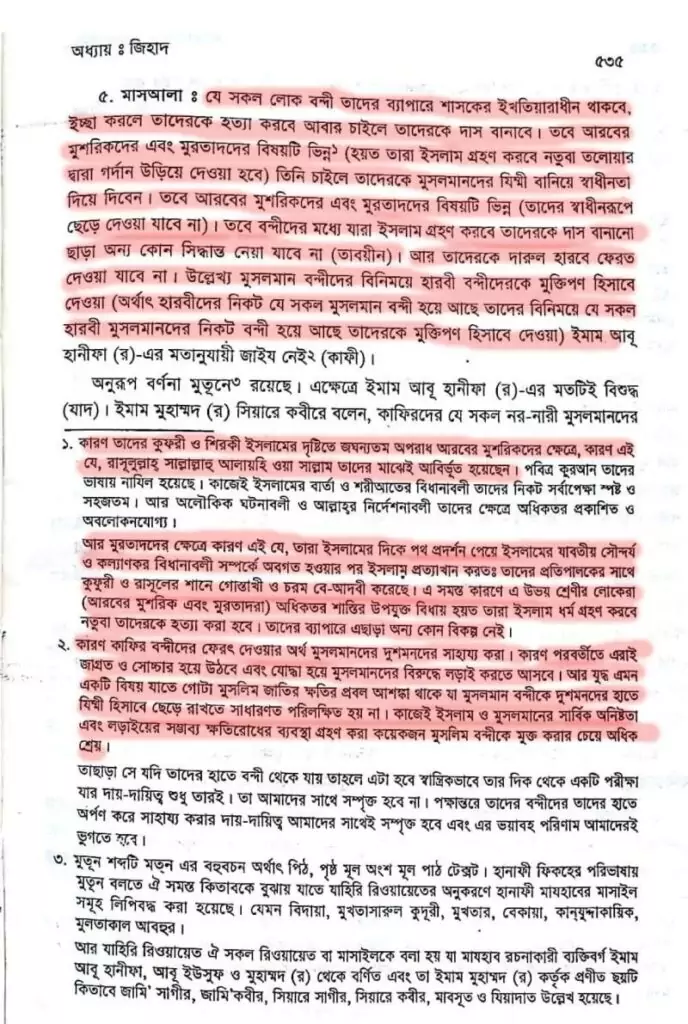
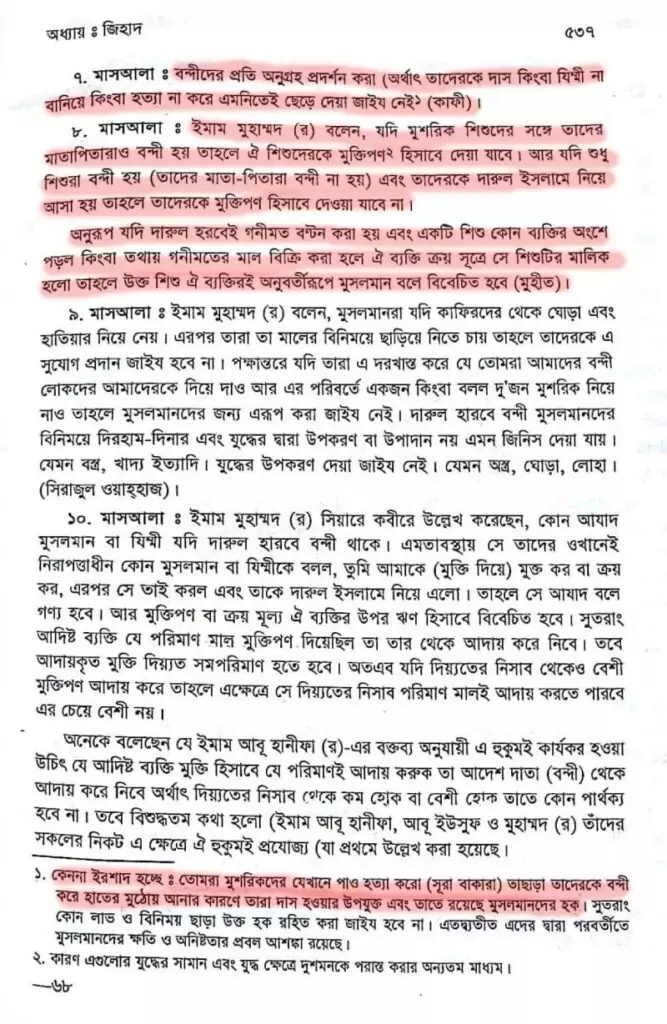
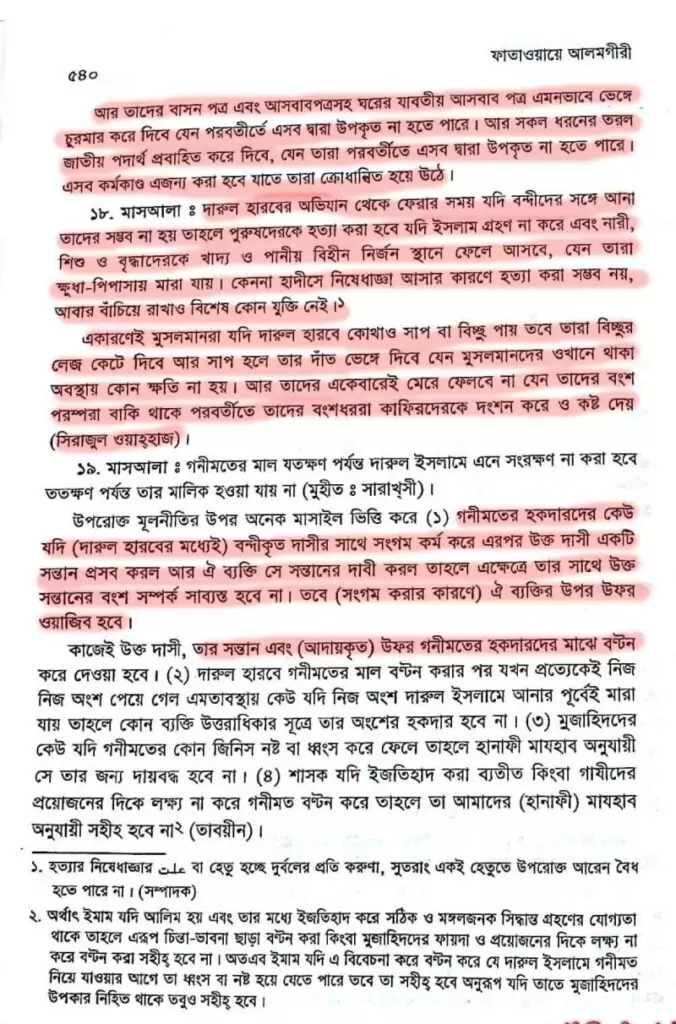
Now let us take a brief look at the main subjects discussed in the Fatawa Alamgiri,
| Subject matter (mas’ala) | Impartial criticism and analysis |
|---|---|
| Classification and determination of the fate of non-Muslims | Here, non-Muslims have been divided into three categories. For Arab polytheists, there are only two options: accepting Islam or death. This is contrary to the modern concept of religious freedom and is directly equivalent to genocide. |
| Surprise and nighttime attacks | It is considered lawful to attack at night, without any prior declaration, those to whom the call has once been conveyed. This is not any kind of heroic warfare; rather, it is a treacherous and cowardly tactic that deprives civilians of security. |
| Destruction of civilian infrastructure | The destruction of enemy buildings, the extermination of gardens and vegetation, and the breaching of dams to flood settlements have been legitimized. Modern principles of warfare require the protection of the environment and civilian property, both of which have been completely violated here. |
| Using Muslims as ‘shields’ | Even if the enemy uses Muslim captives or children as ‘shields’, there is no prohibition against shooting arrows at them. This proves that, in order to achieve broader imperialistic objectives, the lives of innocent people—even people of the same religion—are considered worthless. |
| Killing and enslaving captives | The ruler may, if he wishes, kill the captives or enslave them. In the case of apostates or Arab polytheists, there is no alternative to killing. From the perspective of human rights, this is an extreme form of inhumanity and medieval barbarism. |
| Abandoning captives during retreat | If it is not possible to bring the captives along, the men will be killed, while the women and children will be left in an isolated place without food so that they languish and die of hunger and thirst. This is not merely inhumane; it is a deliberately planned war crime. |
| Sexual relations with female prisoners of war or slave women | The sexual intercourse of mujahids with slave women taken as spoils has been treated as normal and as part of a legal process. This is essentially a system that institutionalizes sexual slavery and legitimizes rape, reducing the dignity of women to the level of animals. |
| Forced conversion to Islam | For certain groups, accepting Islam is the only way to save their lives. These fatwas directly conflict with the modern liberal interpretation of the verse “There is no compulsion in religion” and serve as evidence of aggressive expansion. |
The General Structure of Offensive Jihad in the Fiqh of the Four Madhhabs
Here, it is necessary to clarify an important matter. The concept of offensive jihad, or jihad al-talab, is not the exceptional view of an isolated scholar, a particular political era, or merely one madhhab. In all four major madhhabs of classical Sunni fiqh—Hanafi, Maliki, Shafiʿi, and Hanbali—offensive jihad has been designated as a state/collective obligation. The differences among these four madhhabs mainly concern subsidiary matters: from whom jizya may be taken, precisely under what circumstances fighting becomes an individual obligation or an obligatory duty, how necessary the permission of the imam or ruler is, and what the practical rules of warfare should be. But the fundamental framework converges at one point: inviting non-Muslim states to Islam, eliminating non-Muslim rule and incorporating those states into the Islamic empire, imposing sharia law, compelling non-Muslims under Islamic authority to acknowledge subordination by paying the humiliating jizya, or waging war—these are the paths discussed in classical fiqh.
| Madhhab | Classical Fiqhi Position | Important Significance |
|---|---|---|
| Hanafi | In Hanafi fiqh, jihad is described as a communal obligation. That is, if one group of Muslim society fulfills it, the responsibility is lifted from the others; but if no one fulfills it, collective sin is incurred. Hanafi texts further state that fighting against unbelievers may become obligatory even if they did not initiate hostilities, provided there is sufficient strength and the rule of Islam can be established. Upon entering dar al-harb, the prescribed order is to first invite them to accept Islam; if they reject it, to offer jizya; and if they reject that as well, to wage war. | Here, war is viewed not merely as a defensive response, but as a classical method for expanding Islamic political authority. |
| Maliki | Ibn Rushd of the Maliki tradition, in Bidayat al-Mujtahid, states that the general position of Muslim jurists regarding the purpose of fighting the People of the Book is that they will either accept Islam or pay jizya. In the Maliki position, the scope of jizya is broader; according to Imam Malik, it is not limited to the People of the Book, but may also be taken from other polytheists. | Here too, the cause of war is not only direct aggression; rather, bringing non-Muslims under Islamic authority is the center of fiqhi discussion. Quranic verse |
| Shafiʿi | In the renowned Shafiʿi fiqh work ʿUmdat al-Salik, or Reliance of the Traveller, jihad is described as a communal obligation. It states that when non-Muslims remain in their own countries, jihad against them is a collective responsibility of Muslims. The People of the Book and Zoroastrians are first invited to accept Islam, then offered jizya, and if they refuse it, war is prescribed. The Shafiʿi position is stricter regarding other polytheists; the opportunity to pay jizya is limited for them, and they are instead given the choice of accepting Islam or facing war. | This position directly demonstrates that in Shafiʿi fiqh, jihad al-talab is viewed as a regular communal obligation, not merely as a rule requiring war when attacked. |
| Hanbali | Ibn Qudamah of the Hanbali madhhab, in Al-Mughni, explains jihad as a communal obligation. If a sufficient number of Muslims fulfill it, the responsibility is lifted from the others; but if none of those capable fulfill it, sin is incurred by all. He also states that although jihad is generally a communal obligation, it becomes an individual obligation in the event of direct confrontation on the battlefield, the enemy entering Muslim territory, or the imam’s call to arms. | In the Hanbali position, jihad appears as a state/imam-controlled military obligation; it is not merely individual self-defense, but part of the military functions of the Islamic system of governance. |
This comparative picture makes it clear that in classical fiqh, jihad cannot be limited, as modern apologists claim, to “defensive war” or “jihad against one’s own self.” Rather, in the discussions of all four madhhabs, the central issue is bringing non-Muslim political entities under Islamic authority. In some cases the scope of jizya is broad, and in others narrow; some place greater emphasis on the imam’s permission, while others differ in their list of circumstances that make fighting obligatory. But these differences do not invalidate the concept of offensive jihad; rather, they show that it is an established military-political ruling within classical Islamic jurisprudence.
Therefore, when modern preachers claim that jihad in Islam means only self-defense, that claim is merely a modern interpretation founded on selected peaceful readings of the Quran and Hadith. In the discussions of the four madhhabs of classical fiqh, jihad al-talab, daʿwah, jizya, dar al-harb, ghanimah, and Islamic political domination appear as a comprehensive legal framework connected to one another. Let us look at another table,
| Verifiable Claim | Hanafi | Maliki | Shafiʿi | Hanbali |
|---|---|---|---|---|
| Jihad is not merely individual self-defense, but a collective/state responsibility | Jihad is viewed as a collective responsibility of Muslim society; the ruling on jihad under the authority of a ruler or organized power is clear. | In Ibn Rushd’s discussion, the purpose of war is not individual self-defense, but determining the relationship between Islamic power and non-Muslim political powers. | In ʿUmdat al-Salik, jihad is described as a communal obligation; when a sufficient number of people fulfill it, the responsibility is lifted from the rest. | In Ibn Qudamah’s Al-Mughni, jihad is generally described as a communal obligation; however, it becomes an individual obligation in specific circumstances. |
| The framework of Islam, jizya, or war presented to the non-Muslim side | In conflict with dar al-harb, the stages of invitation, jizya, and war are discussed; in the Hanafi position, the scope for accepting jizya is comparatively broad. | Regarding the People of the Book, the purpose of war is that they will either accept Islam or pay jizya; according to Imam Malik, jizya may also be taken from all polytheists. | Jews, Christians, and Zoroastrians are first offered Islam, then jizya; for others, the ruling of Islam or war is presented more strictly. | In Hanbali fiqh, war, truces, aman, captives, ghanimah, and jizya are all discussed as parts of state military law. |
| Can offensive jihad be denied? | No. The rules of war are not limited to the case in which “the enemy attacks first”; there is a framework for bringing non-Muslim political authority under the Islamic system of governance. | No. Ibn Rushd directly asks, “Why are they fought?”—and mentions Islam or jizya as the objective in response. | No. When non-Muslims remain in their own countries, jihad against them is explained as an annual communal obligation. | No. Jihad is a communal obligation, the discussion of conducting an expedition at least once a year, and the rules for military organization under the ruler all indicate the legal framework of offensive jihad. |
| Where do the differences lie? | The Hanafi position is comparatively broad concerning from whom jizya may be taken. | The Maliki position also has a broad scope for jizya; the view that it may be taken from all polytheists is found here. | The Shafiʿi position is comparatively narrow; jizya is essentially limited to the People of the Book and Zoroastrians. | Hanbali discussions place primary emphasis on the imam/ruler, military organization, and the distinction between the states of communal and individual obligation. |
| In summary | In Hanafi fiqh, jihad is part of the legal framework of political-military expansion. | In Maliki fiqh, jizya and subordination are directly connected to the purpose of war. | In Shafiʿi fiqh, jihad is clearly defined as a regular communal obligation. | In Hanbali fiqh, jihad is an organized state military responsibility, not merely individual self-defense. |
Sugarcoated Islam for Embarrassed Muslims
Although in modern propaganda Islamists try to establish that jihad means jihad against one’s own self, or merely defensive jihad, according to classical Islamic creed, “jihad al-talab,” or launching an offensive against non-Muslim states, is not merely permissible but an obligatory act of worship for establishing Islamic rule. The objective of this jihad is to uproot the system of unbelieving governance and establish the rule of Shariah there. Many Muslims currently travel to Europe and America and try to promote how peaceful a religion Islam is, but they do not mention even in the slightest this account of Islam’s offensive jihad. They claim that Islam supposedly says, “For you is your religion, and for me is my religion.” Yet this was not a ruling for Islam’s later era. Let us hear the statement of another English-speaking Arab scholar, who has clarified this matter further:
When Muhammad sent a commander on a military expedition, he instructed him to present the non-Muslims with three specific alternatives or options. This is not a modern interpretation; rather, it is directly established by a lengthy hadith in Sahih Muslim. It is clearly stated there that before the Muslim army launched an attack, the unbelievers had to be invited to three things:
Aqidah: Compelling Conversion to Religion and Qital
Let us now examine, from a famous book of creed, what Islam’s ruling and legal provision actually are on this matter [35]
He pointed toward the sky, indicating that you are the Messenger of Allah. The Messenger of Allah (peace be upon him) said, “You may set him free.” (Hadith no. 11)
Words and actions that only a Muslim can say or perform, and through which it is clearly understood that the person in question has entered Islam, will be regarded as “acceptance of Islam.” Examples include performing salat like Muslims and performing Hajj. However, if it is established that the person did not abandon false beliefs and enter pure Islam through these actions—but is performing these acts while remaining an unbeliever according to his religious belief (as the Qadianis do today), or is doing so as a joke—then these will not be regarded as acceptance of Islam in his case. He will not be considered a Muslim until he uses some statement indicating that he has abandoned his own belief and returned to the correct religious belief preached by the Messenger of Allah and followed by the Companions.
Ruling on Compelling Someone to Accept Islam
Compelling someone to accept Islam is an important issue of fiqh. All the scholars have unanimously agreed that if unbelievers with whom the Muslims have no treaty (harbis), or unbelievers who are not dhimmis paying jizya, are compelled to accept Islam by threatening them with death or by some other means, that acceptance will be valid. That is, if after accepting Islam in this manner he later wishes to apostatize, he will be declared an “apostate” and sentenced to death. The evidence for this is the statement of the Messenger of Allah:
“I have been commanded to fight the people until they say—’There is no deity except Allah.'” (Bukhari and Muslim)
When they say this, their blood and property will be considered protected. A lengthy hadith in Sahih Muslim states that when the Messenger of Allah sent a commander on an expedition, he would advise him: “Invite them to three matters. Whichever of them they accept, accept that from them as well.” These three things are:
a. Acceptance of Islam
b. Collection of the jizya tax
c. Fighting
Thus, those who are compelled to accept Islam through war will be considered Muslims in worldly terms. The same matter is established by the incident of Usama ibn Zayd. The unbeliever whom Usama was about to kill suddenly recited the kalimah. Usama thought that he had accepted Islam out of fear of the sword, and therefore that his acceptance of Islam was invalid. But for this reason the Messenger of Allah severely reprimanded him. The clear meaning is that if someone whose killing is lawful is threatened with death and enters Islam out of fear, his acceptance of Islam will be valid. If he later abandons Islam, he will be considered an apostate. (Hadith nos. 12 and 13)
Difference of Opinion Regarding Harbis and Dhimmis
The explanation of Kanzuddaqaiq states: “If a treatyless unbeliever (harbi) is compelled to accept Islam, consensus (ijma) has been reached that the acceptance is valid.” (Tabyinul Haqa’iq)
It is not lawful to compel those with whom the Muslims have a treaty—such as dhimmis (Hadith no. 14), musta’mans (Hadith no. 15), or mu’ahids (Hadith no. 16)—to accept Islam, and there is consensus of the ummah on this matter. However, if someone compels them and they accept Islam, the scholars disagree as to whether that acceptance will be valid:
Hanbali and Shafi‘i schools: In their view, this will not count as acceptance of Islam until, after the compulsion has been removed, the person voluntarily remains steadfast in Islam. (Hadith no. 17; al-Mughni)
Hanafi school: According to the accepted view, this will count as acceptance of Islam, and he will not be allowed to return to unbelief. (Tabyinul Haqa’iq)
Here, the first view (Shafi‘i and Hanbali) appears to be more correct.
Hereditary and Circumstantial Muslim Identity
A person may also be considered a Muslim in the following ways:
1. Through Muslim parents:
All scholars unanimously agree that a child born to Muslim parents will be considered a Muslim. Likewise, if an unbelieving couple becomes Muslim, their minor children will also become Muslims. If one of the parents is Muslim, the child will be considered a Muslim. (Bukhari; Fath al-Bari 3/220) The evidence is the statement of the Messenger of Allah: “Islam is superior to everything, and nothing can prevail over Islam.” (Hadith no. 18; al-Daraqutni)
2. In the case of a child captured in war:
When a child is considered a Muslim by being captured in war, the child’s own wishes have no relevance. This too is a compulsory method.
Interpretation of the Verse “No Compulsion in Religion”
Many thinkers currently promote the idea that there is no opportunity in Islam to compel anyone. They cite Surah al-Baqarah, verse 256 (“There is no compulsion in religion”) or Surah Yunus, verse 99. However, according to the scholars, these verses must be understood by reconciling them with other evidence and the practice of the Messenger of Allah.
The verse “There is no compulsion in religion” applies only to those unbelievers who have agreed to pay jizya. But for those unwilling to pay jizya or those who have become apostates, the ruling of compulsion will apply. The Messenger of Allah said: “Whoever changes his religion, kill him.” (Bukhari) Thus, each verse must be applied in its proper context; compulsion has not been categorically prohibited in every case. (Hadith no. 29)
Footnotes:
(11) The hadith was narrated by Imam Abu Dawud, and he did not declare its chain weak; that is, he considered the hadith acceptable. Al-Haythami said in Majma‘ al-Zawa’id, “The narrators of this hadith are trustworthy.” However, Shaykh al-Albani declared the hadith weak.
(12) Sahih Bukhari and Muslim; the hadith was mentioned earlier.
(13) Ibn al-Arabi says, “When a Muslim encounters an unbeliever with whom there is no treaty, it is lawful for him to kill him.” (Ahkam al-Qur’an). Mulla Ali al-Qari al-Hanafi narrates from Imam al-Khattabi, “The basic principle regarding the blood of unbelievers is that it is lawful (ibahah).” (Mirqat al-Mafatih). That is, in the absence of a treaty, their blood is not inviolable.
(14) Unbelievers living under the Islamic state while paying the tax of allegiance (jizya).
(15) Unbelievers who take refuge in the Islamic state for a short period, with the authorities’ permission, in order to learn about Islam or for business purposes.
(16) Unbelievers who, while remaining in their own territories, have concluded a truce with the Muslims.
(17) If a dhimmi or musta’man is compelled, his acceptance of Islam will not be counted until he voluntarily remains steadfast in it. (al-Mughni).
(18) al-Daraqutni, Bulugh al-Maram. Imam Bukhari mentioned the hadith in a mawquf form without a chain. Ibn Hajar al-Asqalani and Shaykh al-Albani called the hadith “hasan.” (Fath al-Bari 3/220; Irwa’ al-Ghalil 1268).
(28) This matter will be discussed in detail in a later chapter, insha’Allah.
(29) Amir al-Mu’minin Umar ibn al-Khattab and other Companions stipulated that non-Muslims could not publicly observe their religious festivals in the Islamic state. (Majmu‘ al-Fatawa; Tafsir Ibn Kathir).
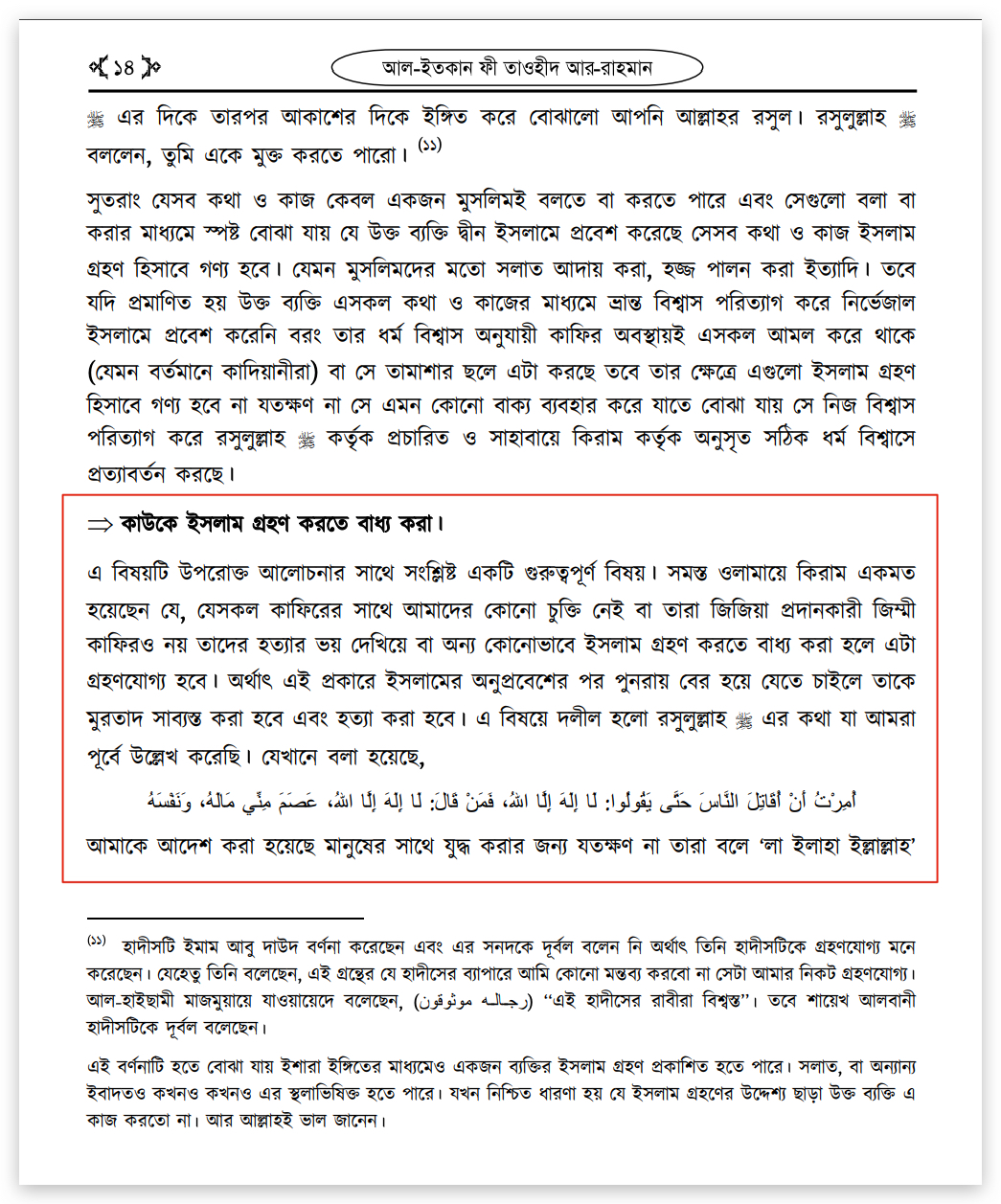
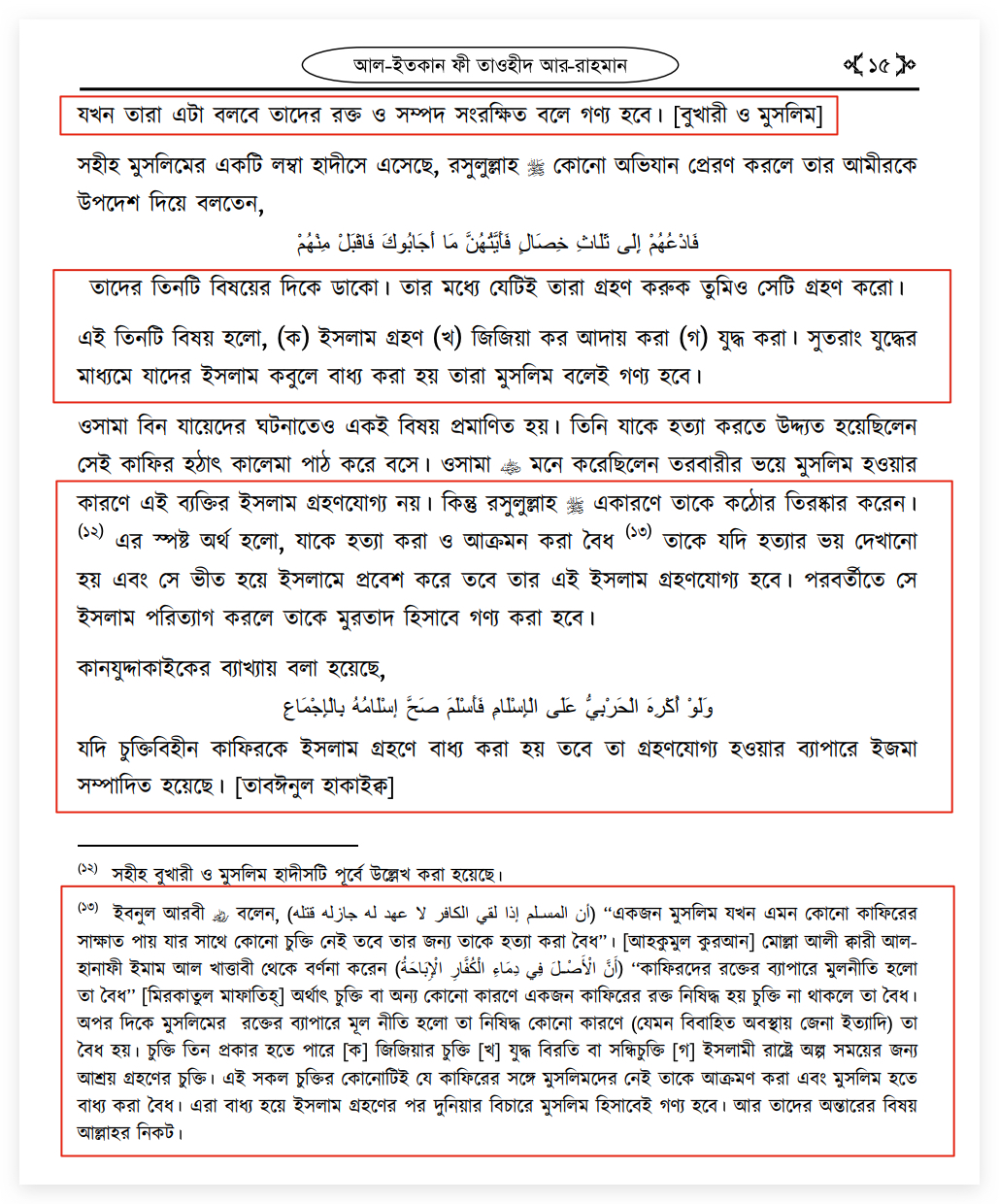
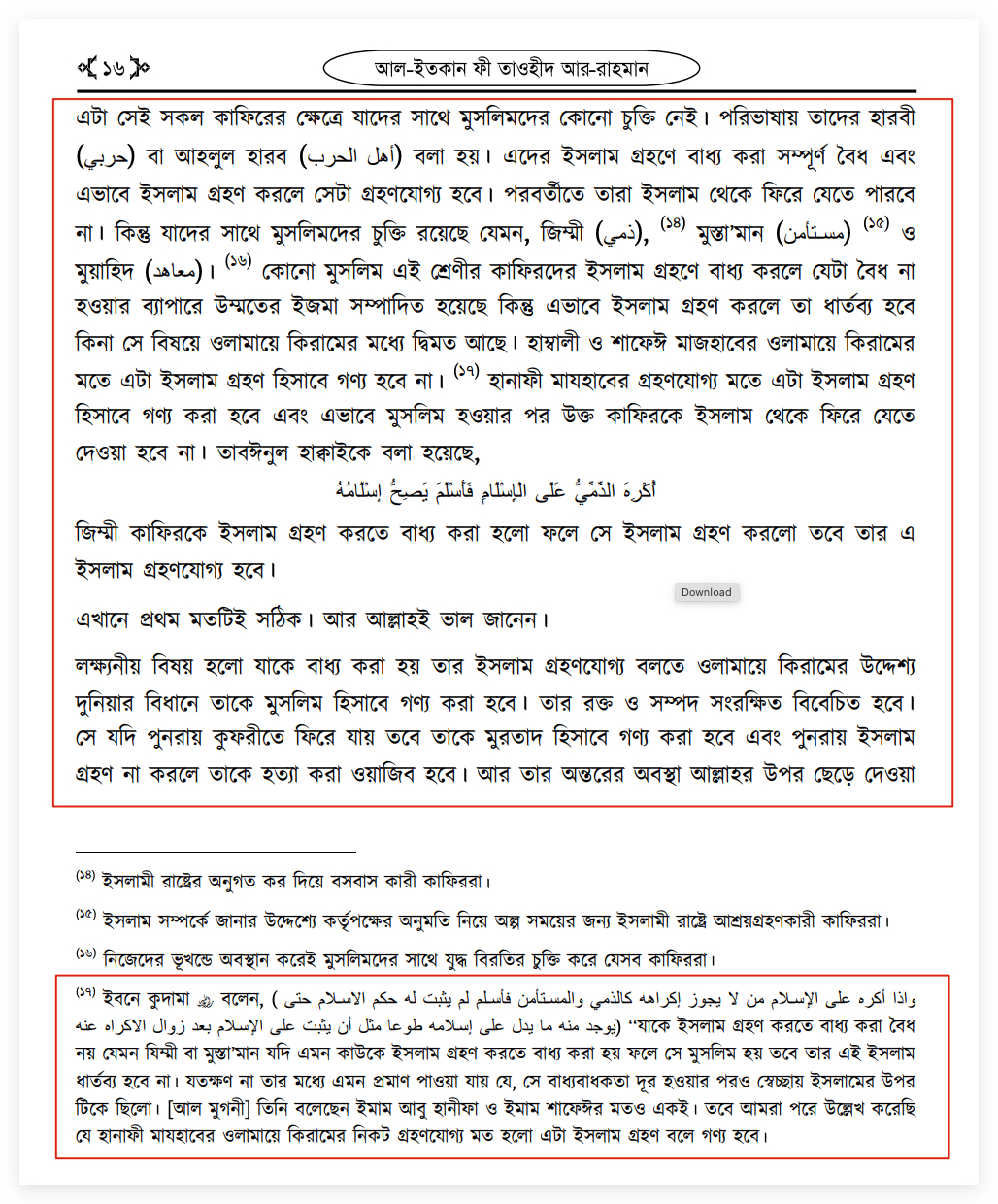
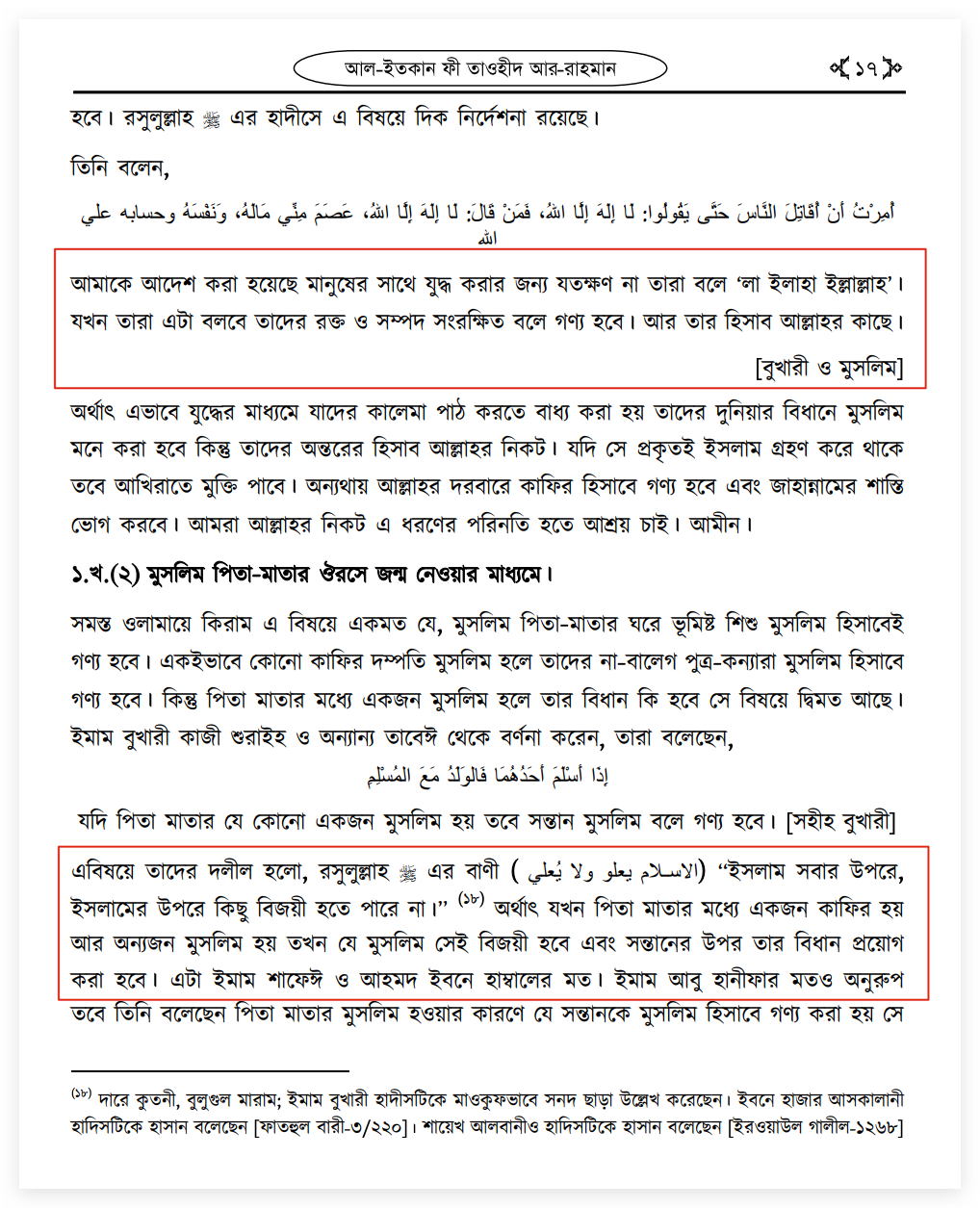
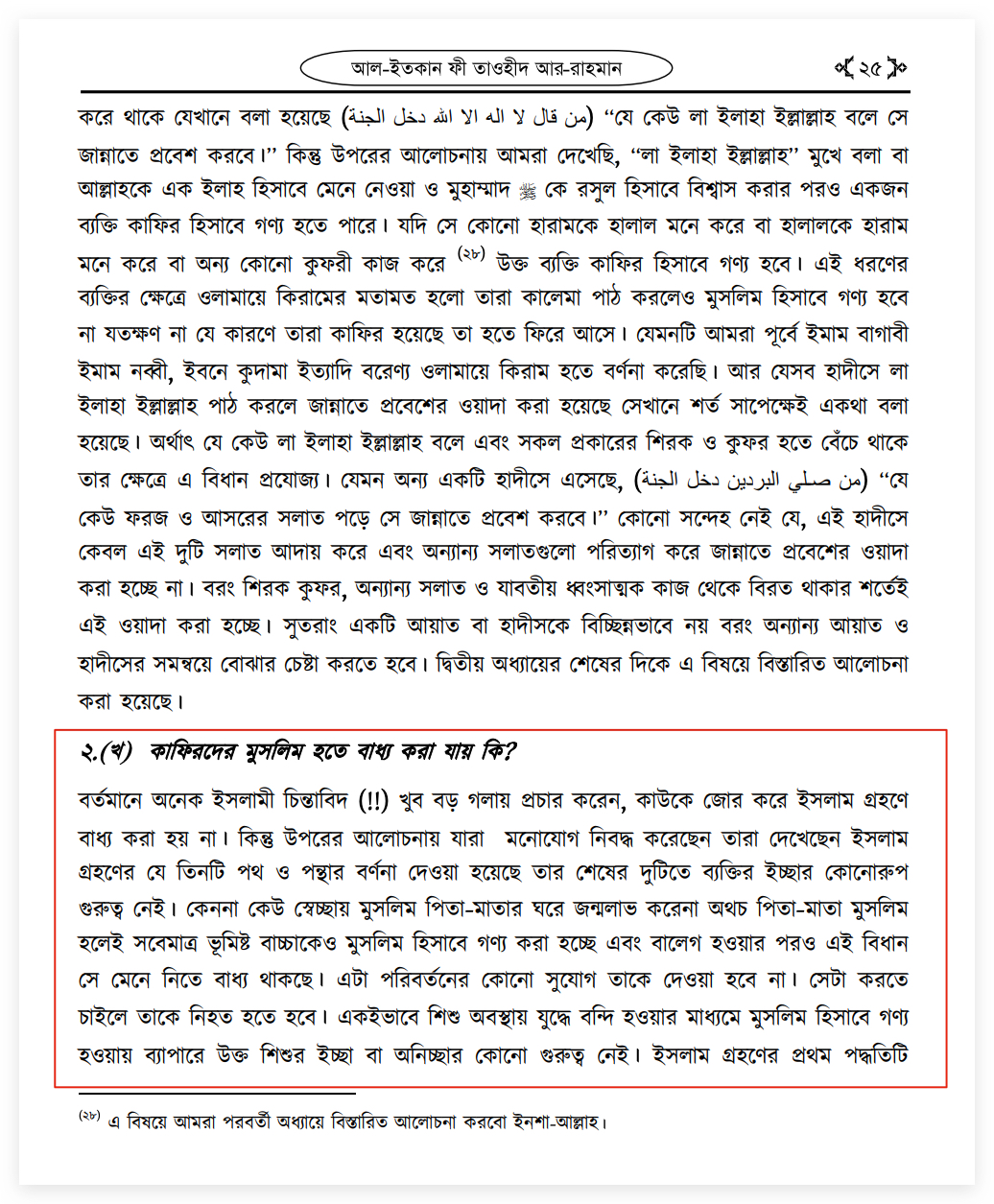
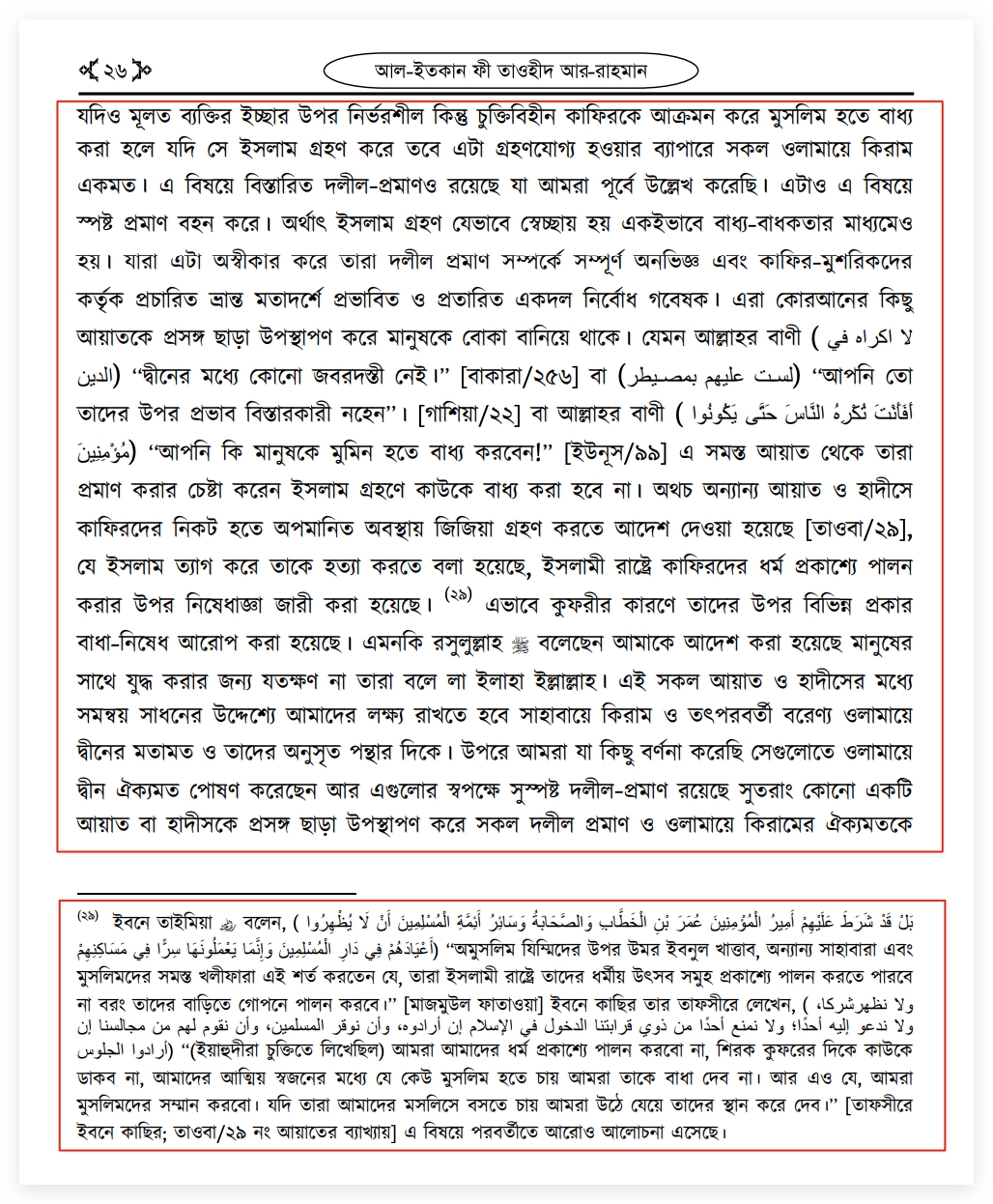
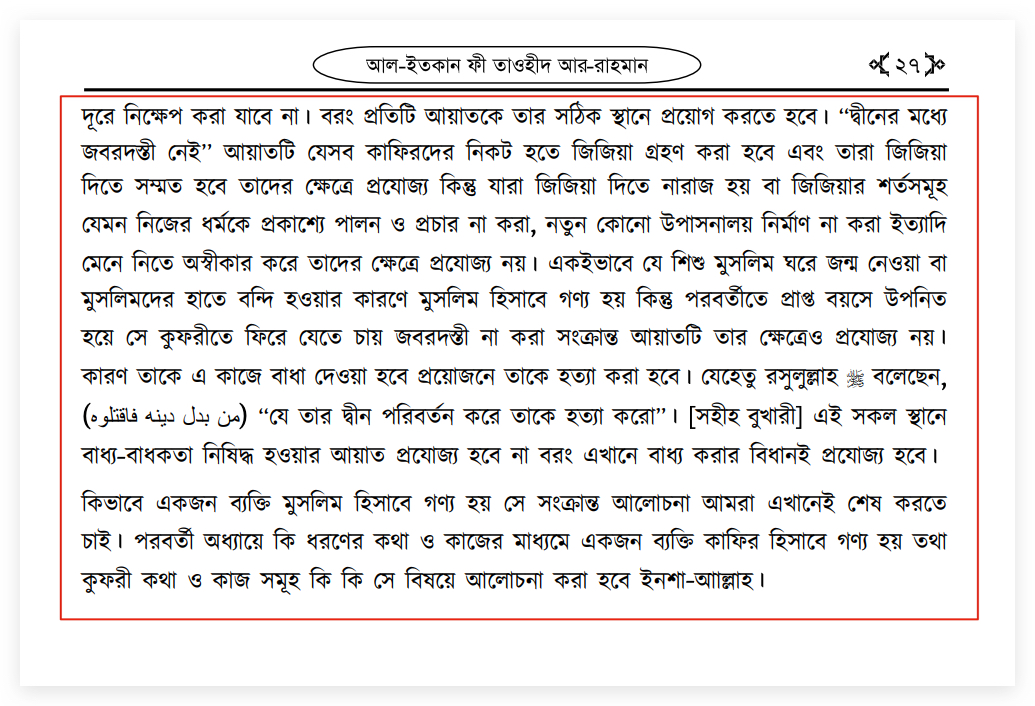
Types of Jihad: The Ruling on Jihad in Islam
Now let us read a few pages from a book concerning the famous theoretical outline of jihad written by Shaykh Yusuf al-Uyayri, may Allah have mercy on him, [36]
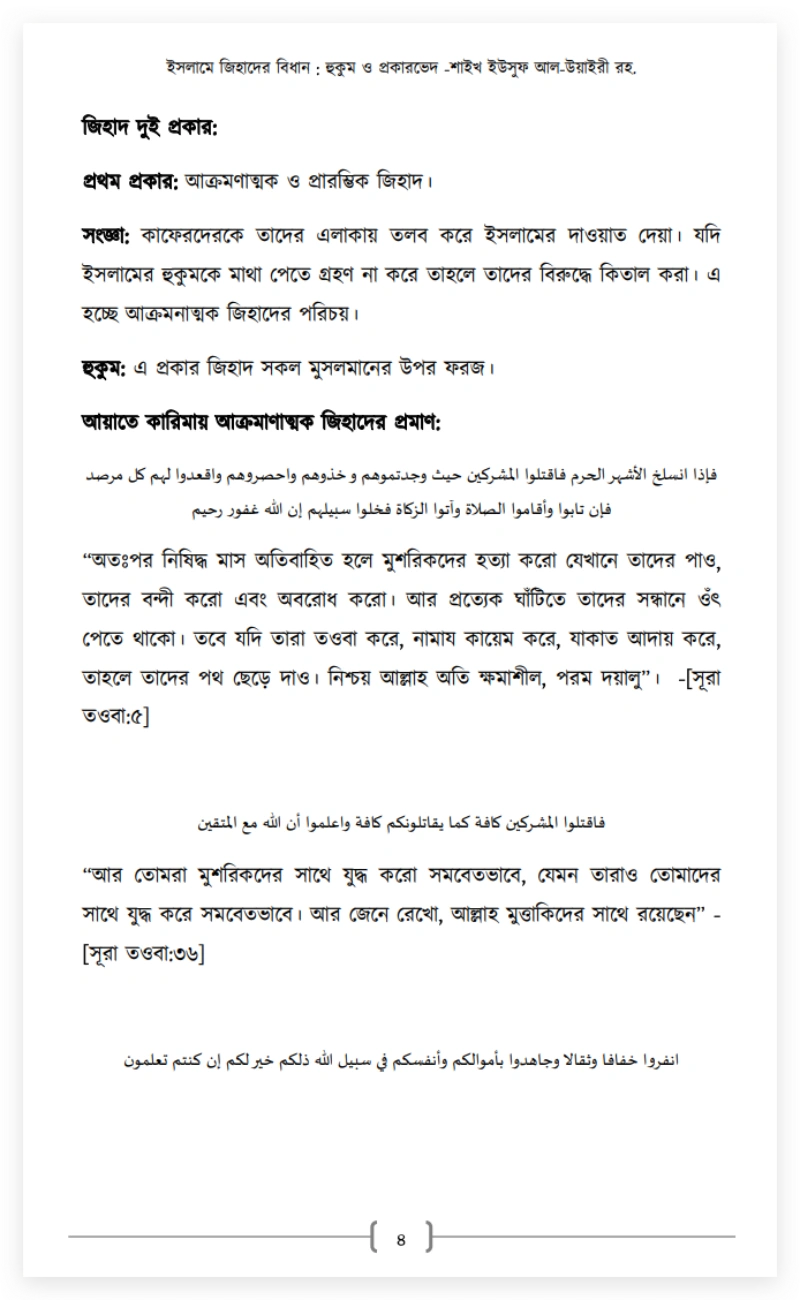
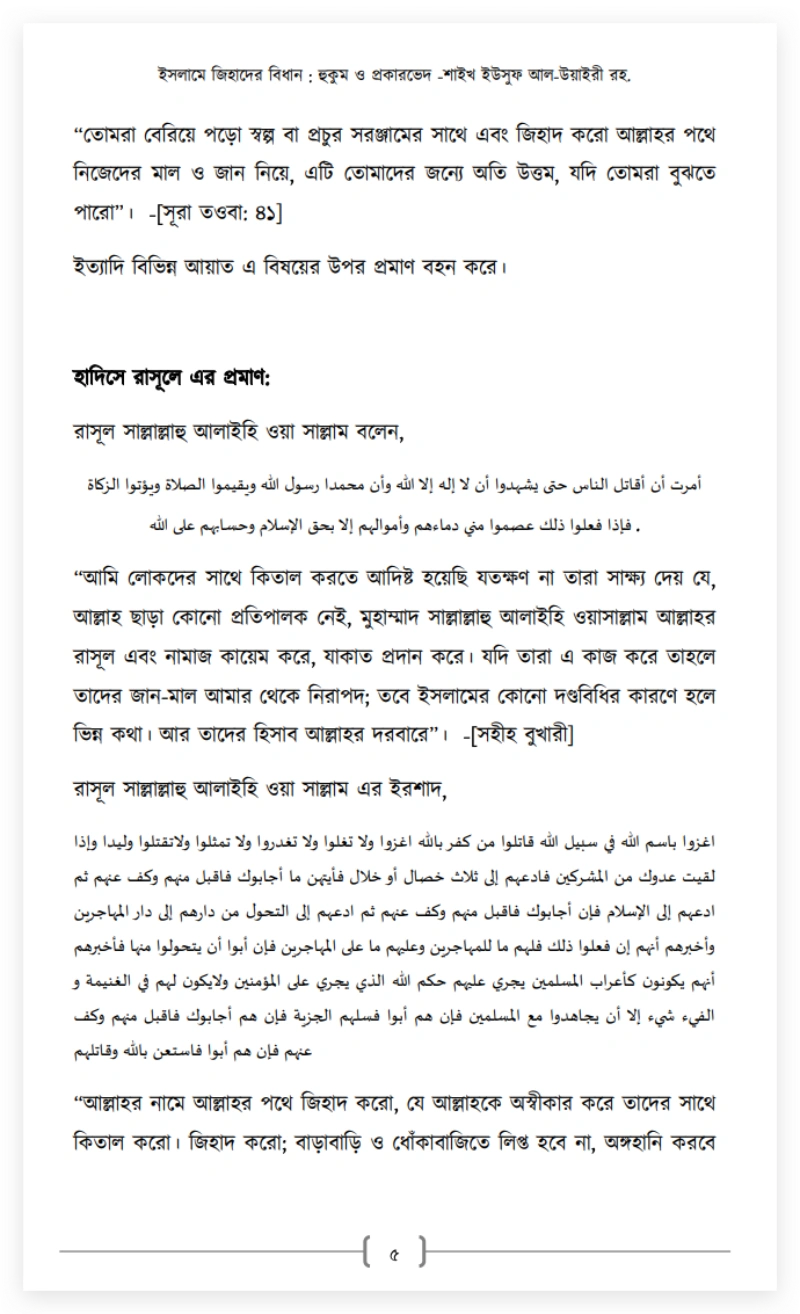
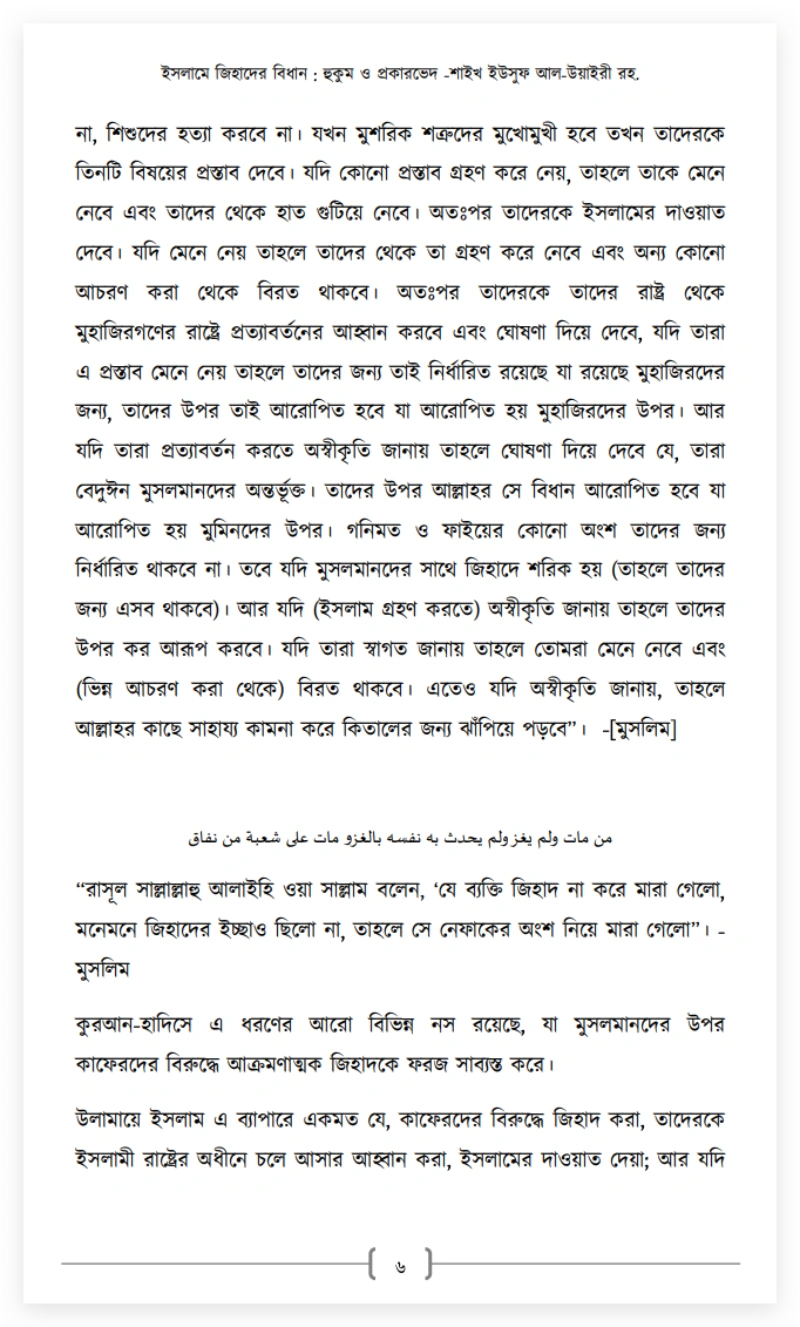
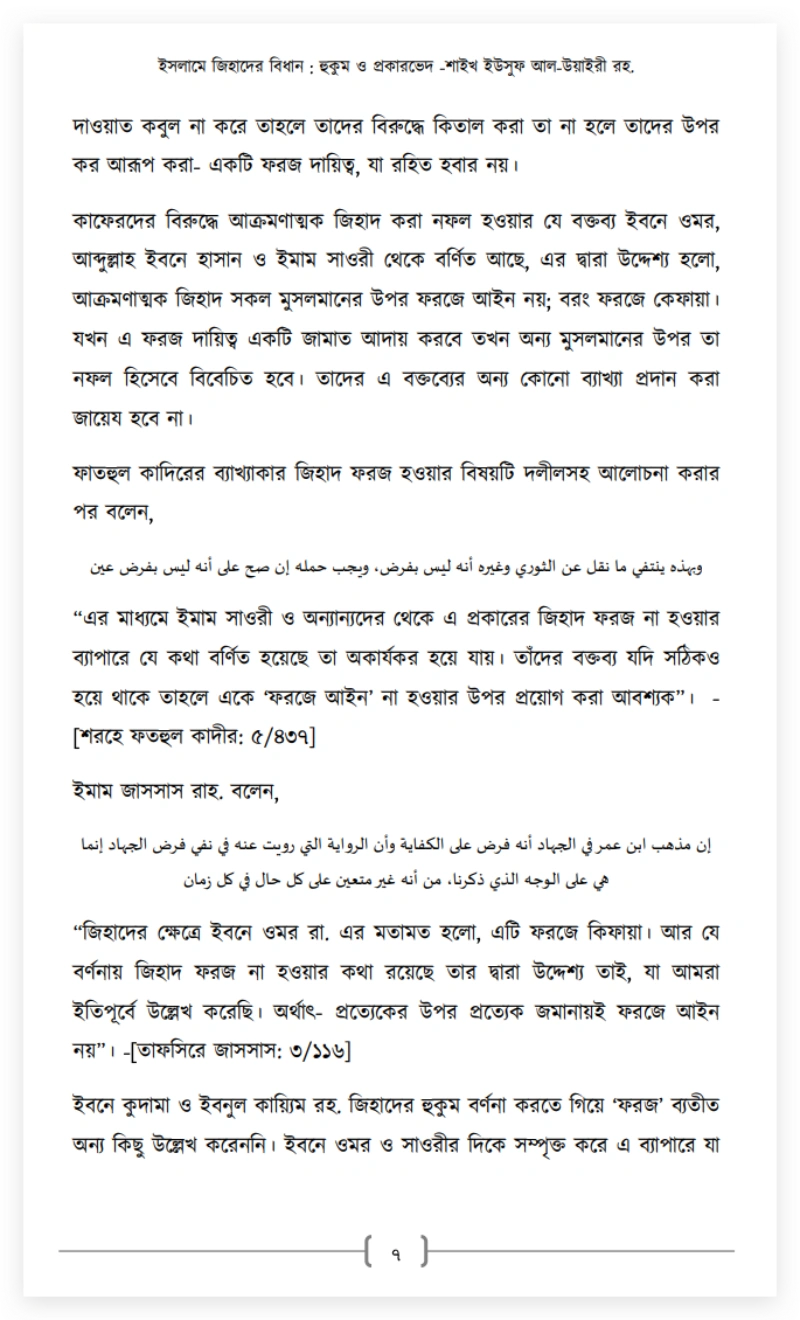
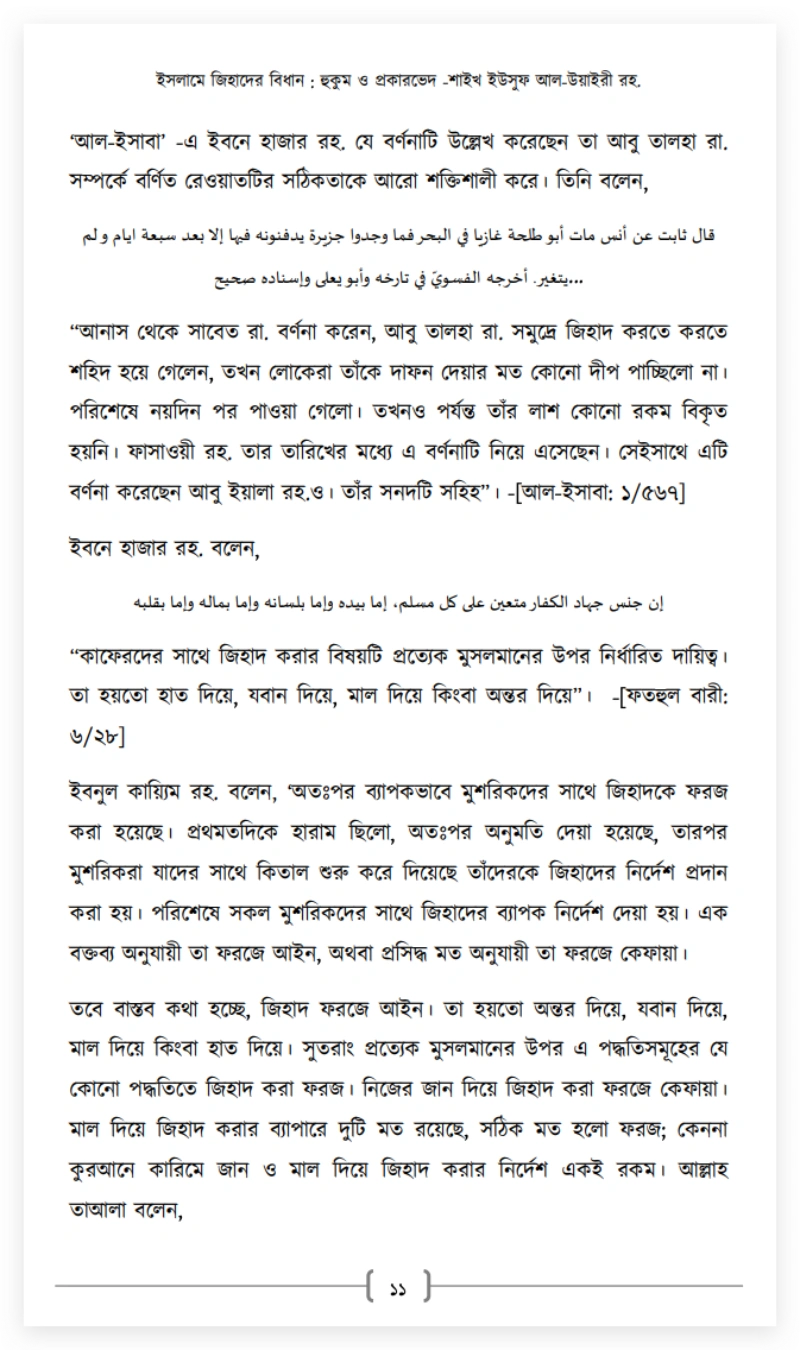
The Islamic Explanation of Offensive Jihad
The video documents below are extremely important for understanding the horrific nature of this offensive jihad, in which even contemporary scholars occasionally end up acknowledging these barbaric injunctions of Islam,
Even many of Islam’s online preachers indirectly acknowledge this injunction through euphemistic sugarcoating. Let us listen to the statement of Muhammad Mushfiqul Rahman Minar,
If, in this process of jihad, a non-Muslim state obstructs it or refuses to submit to the Muslims, armed ‘qital’ begins. After this war, the wealth and people of the conquered region are deemed ‘ghanima’, or spoils of war, for the victors. This is essentially the path that creates the foundation for legally sanctioned slavery in Islam. When a non-Muslim settlement is conquered through warfare, Muslim warriors acquire the absolute right to take the women and children there as their personal property or slaves, without any regard for their wishes or consent [37] .
‘No Compulsion in Religion’ or To Each Their Own Religion?
In the propagation and expansion of Islam, one verse is frequently used as a shield today— “There is no compulsion in religion” (Surah al-Baqarah: 256), or To you your religion, and to me my religion (Surah al-Kafirun, verse 6), or Whoever kills an innocent person, it is as if he has killed all mankind (Surah al-Ma’idah, verse 32). Modern interpreters present these as evidence of religious freedom in Islam. However, when the classical Islamic jurisprudence or fiqh and the interpretations of reliable scholars are analyzed, it becomes clear that the application of these verses is extremely limited and confined to specific contexts. The truth is that, in certain specific circumstances, compelling non-Muslims to accept Islam is not merely permissible in Islam; rather, it is legally recognized. Since the article would become lengthy, links to separate articles concerning these matters have been provided; interested readers may read them, hopefully.
Historical reality shows that the Prophet Muhammad wrote letters to various infidel emperors and heads of state neighboring Arabia, inviting them to accept Islam, in which clear and extreme threats of war were issued if they did not acknowledge submission. After the conquest of Mecca, many polytheistic communities were uprooted from the Arabian Peninsula, despite Muhammad having no personal enmity with them. Their only crime was that they had not agreed to accept Islam. This aggressive policy of Muhammad and the incidents involving the expulsion of various tribes deserve very detailed and independent discussion, which has been discussed in detail with sources in other articles.
In other words, in light of Islamic creed and various books of jurisprudence, it is clear that the injunction prohibiting compulsion applies only to those infidels who have acknowledged submission by paying the “jizyah” or security tax. However, in the case of those who are “harbi” (those with whom there is no peace treaty), or those unwilling to pay jizyah, Islam contains a ruling allowing them to be forced to accept Islam through threats of war.
Imam Nawawi: The Ruling on Initiating Attacks in Sharh Muslim
To become more certain about this matter, let us read some details from a commentary on Sahih Muslim. It is stated here that disbelieving People of the Book can remain alive only by accepting Islam or by submitting in a humiliated condition and paying jizyah. At the same time, even if the disbelievers do not initiate an attack, it is permissible to attack them preemptively. However, it must be remembered that the matter of strength and capability [38] –
Fourth stage: Even if the Muslims have not begun a war against them, jihad must first be initiated against the infidels of every religion and race, until they accept Islam or pay jizyah (the tax imposed on non-Muslims in an Islamic state). The purpose of this is to exalt the word of Allah, honor the religion of Islam, and destroy the dominance of disbelief. The declaration of this stage’s operation was made in the ninth year of the Hijrah through the words of Hazrat Abu Bakr al-Siddiq (may Allah be pleased with him). Allah, glorified and exalted is He, has given a detailed account of this in Surah al-Tawbah. Allah, exalted is He, says, “Then, when the sacred months have passed, kill the polytheists wherever you find them, capture them, besiege them, and lie in wait for them at every place of ambush.” Then, if they repent from disbelief, establish prayer, and pay zakat, leave their way free; surely Allah is Most Forgiving, Most Merciful. — (Surah al-Tawbah 5)
In another verse of Surah al-Tawbah, Allah, exalted is He, says: Fight against those who do not believe in Allah and the Last Day, who do not regard as unlawful what Allah and His Messenger have declared unlawful, and who do not accept the true religion, until they acknowledge submission and agree to pay jizyah (tax). — (Surah al-Tawbah 29)
Allah, exalted is He, says in Surah al-Anfal: And fight them until there is no more fitnah (shirk) among them and the religion is entirely for Allah. — (Surah al-Anfal 39)
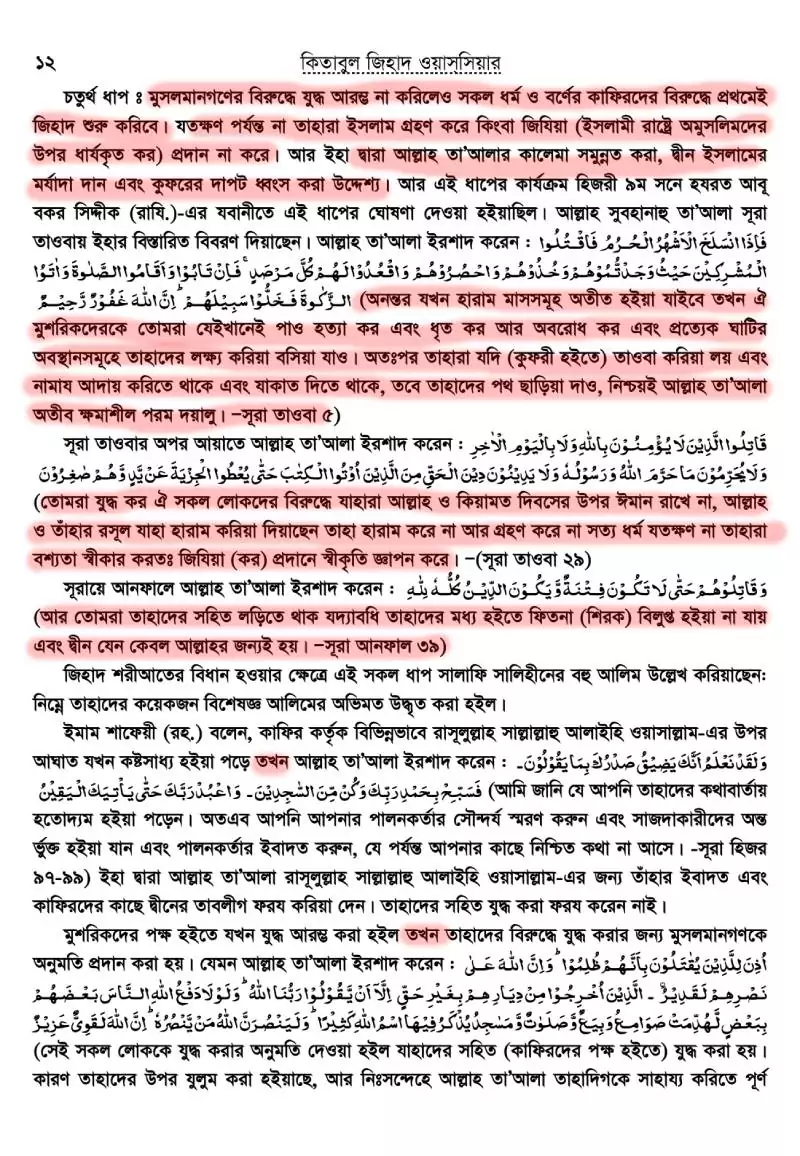
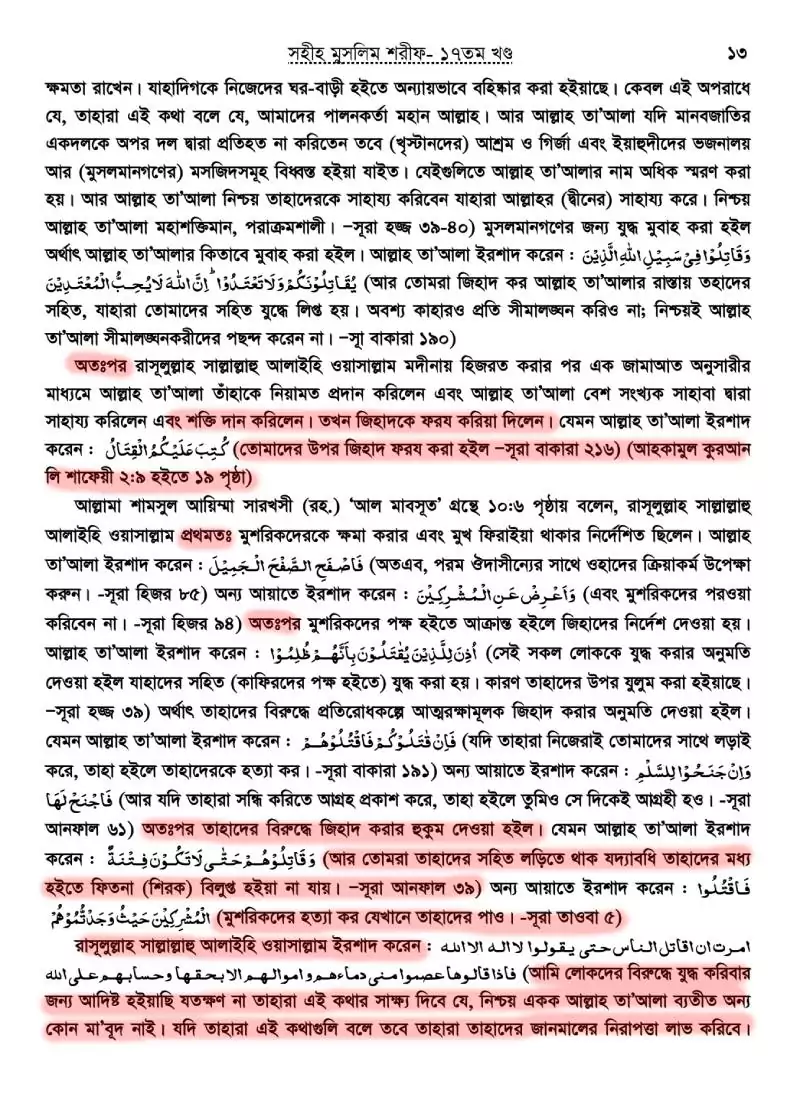
The Highest Fatwa of the Modern Era: Aggressive Jihad
Now let us examine a fatwa published by Saudi Arabia’s highest Islamic Sharia board, along with its Bengali translation. This fatwa was published on the famous fatwa-related website islamqa.info, which is directly operated by Sheikh Salih al-Munajjid, the highest-ranking Salafi scholar of the present time [39]
There is no compulsion to accept Islam
08/Shawwal/1423 , 12/December/2002
Question 34770
Some friends say that whoever does not enter Islam, that is his choice and he should not be forced to become Muslim, quoting as evidence the verses in which Allah says (interpretation of the meaning):
“And had your Lord willed, those on earth would have believed, all of them together. So, will you (O Muhammad) then compel mankind, until they become believers”
[Yoonus 10:99]
“There is no compulsion in religion”
[al-Baqarah 2:256]
What is your opinion concerning that?.
Answer
Praise be to Allah, and blessings and peace be upon the Messenger of Allah:
The scholars explained that these two verses, and other similar verses, have to do with those from whom the jizyah may be taken, such as Jews, Christians and Magians (Zoroastrians). They are not to be forced, rather they are to be given the choice between becoming Muslim or paying the jizyah.
Other scholars said that this applied in the beginning, but was subsequently abrogated by Allah’s command to fight and wage jihad. So whoever refuses to enter Islam should be fought when the Muslims are able to fight, until they either enter Islam or pay the jizyah if they are among the people who may pay jizyah. The kuffaar should be compelled to enter Islam if they are not people from whom the jizyah may be taken, because that will lead to their happiness and salvation in this world and in the Hereafter. Obliging a person to adhere to the truth in which is guidance and happiness is better for him than falsehood. Just as a person may be forced to do the duty that he owes to other people even if that is by means of imprisonment or beating, so forcing the kaafirs to believe in Allah alone and enter into the religion of Islam is more important and more essential, because this will lead to their happiness in this world and in the Hereafter. This applies unless they are People of the Book, i.e., Jews and Christians, or Magians, because Islam says that these three groups may be given the choice: they may enter Islam or they may pay the jizyah and feel themselves subdued.
Some of the scholars are of the view that others may also be given the choice between Islam and jizyah, but the most correct view is that no others should be given this choice, rather these three groups are the only ones who may be given the choice, because the Prophet (peace and blessings of Allah be upon him) fought the kuffaar in the Arabian Peninsula and he only accepted their becoming Muslim. And Allah says (interpretation of the meaning):
“But if they repent [by rejecting Shirk (polytheism) and accept Islamic Monotheism] and perform As-Salaah (Iqaamat-as-Salaah), and give Zakaah, then leave their way free. Verily, Allah is Oft-Forgiving, Most Merciful”
[al-Tawbah 9:5]
He did not say, “if they pay the jizyah”. The Jews, Christians and Magians are to be asked to enter Islam; if they refuse then they should be asked to pay the jizyah. If they refuse to pay the jizyah then the Muslims must fight them if they are able to do so. Allah says (interpretation of the meaning):
“Fight against those who (1) believe not in Allah, (2) nor in the Last Day, (3) nor forbid that which has been forbidden by Allah and His Messenger (Muhammad), (4) and those who acknowledge not the religion of truth (i.e. Islam) among the people of the Scripture (Jews and Christians), until they pay the Jizyah with willing submission, and feel themselves subdued”
[al-Tawbah 9:29]
And it was proven that the Prophet (peace and blessings of Allah be upon him) accepted the jizyah from the Magians, but it was not proven that the Prophet (peace and blessings of Allah be upon him) or his companions (may Allah be pleased with them) accepted the jizyah from anyone except the three groups mentioned above.
The basic principle concerning that is the words of Allah (interpretation of the meaning):
“And fight them until there is no more Fitnah (disbelief and polytheism, i.e. worshipping others besides Allah), and the religion (worship) will all be for Allah Alone [in the whole of the world]”
[al-Anfaal 8:39]
“Then when the Sacred Months (the 1st, 7th, 11th, and 12th months of the Islamic calendar) have passed, then kill the Mushrikoon (see V.2:105) wherever you find them, and capture them and besiege them, and lie in wait for them in each and every ambush. But if they repent [by rejecting Shirk (polytheism) and accept Islamic Monotheism] and perform As-Salaah (Iqaamat-as-Salaah), and give Zakaah, then leave their way free. Verily, Allah is Oft-Forgiving, Most Merciful”
[al-Tawbah 9:5]
This verse is known as Ayat al-Sayf (the verse of the sword).
These and similar verses abrogate the verses which say that there is no compulsion to become Muslim.
And Allah is the Source of strength.
Let us read another famous fatwa, [40]
Was Islam spread by the sword?
02/Jumada al-thani/1424 , 31/July/2003
178,102
Question 43087
Was Islam spread by the sword?.
Answer
Praise be to Allah, and blessings and peace be upon the Messenger of Allah:
We have already stated in question no. 34830 that jihad is of two types: taking the initiative in fighting and jihad in self-defence.
Undoubtedly taking the initiative in fighting has a great effect in spreading Islam and bringing people into the religion of Allaah in crowds. Hence the hearts of the enemies of Islam are filled with fear of jihad.
In the English-language Muslim World Magazine it says: There should be some kind of fear in the western world, one of the causes of which is that since the time it first appeared in Makkah, Islam has never decreased in numbers, rather it has always continued to increase and spread. Moreover Islam is not only a religion, rather one of its pillars is jihad.
Robert Bean says: The Muslims conquered the entire world before and they could do it again.
The Orientalists wanted to slander Islam by claiming that it was spread by the sword.
The orientalist Thomas Arnold wrote his book The Preaching of Islam with the aim of killing off the spirit of jihad among the Muslims and proving that Islam was not spread by the sword, rather that it spread by means of peaceful preaching, free from any use of force.
The Muslims fell into the trap that was set up for them. When they heard the orientalists’ accusations that Islam was spread by the sword, they said: You are mistaken, listen to a refutation from one of your own people, this Thomas says such and such.
The defeatists among the Muslims come out to defend Islam, and they want to disavow Islam of this so-called lie, so they deny that Islam was spread by the sword, and they say that jihad is not prescribed in Islam, except in the case of self-defence. There is no such thing in Islam as taking the initiative in fighting in their view. This goes against what the Muslim scholars have stated, let alone the fact that it goes against the Qur’aan and Sunnah.
Shaykh al-Islam Ibn Taymiyah said in Majmoo’ al-Fataawa, 28/263.
The purpose is that all religion should be for Allaah alone, and that the word of Allaah should be supreme. The word of Allaah is a comprehensive phrase that refers to His words that are contained in His Book. Hence Allaah says (interpretation of the meaning):
“Indeed We have sent Our Messengers with clear proofs, and revealed with them the Scripture and the Balance (justice) that mankind may keep up justice”
[al-Hadeed 57:25]
The purpose behind sending the Messengers and revealing the Books was so that mankind might keep up justice with regard to the rights of Allaah and the rights of His creation. Then Allaah says (interpretation of the meaning):
“And We brought forth iron wherein is mighty power (in matters of war), as well as many benefits for mankind, that Allaah may test who it is that will help Him (His religion) and His Messengers in the unseen”
[al-Hadeed 57:25]
So whoever deviates from the Book is to be brought back with iron, i.e. by force. Hence the soundness of the religion is based on the Qur’aan and the Sword. It was narrated that Jaabir ibn ‘Abd-Allaah (may Allaah be pleased with him) said: The Messenger of Allaah (peace and blessings of Allaah be upon him) commanded us to strike with this, meaning the sword, whoever turns away from this, meaning the Qur’aan.
Ibn al-Qayyim (may Allaah have mercy on him) said in al-Faroosiyyah (p.18):
Allaah sent him – meaning the Prophet (peace and blessings of Allaah be upon him) – with the guiding Book and the conquering sword, ahead of the Hour, so that Allaah alone would be worshipped with no partner or associate, and his provision was placed beneath the shade of his sword and spear. Allaah has established the religion of Islam with proof and evidence, and with the sword and spear, both together and inseparable.
This is some of the evidence from the Qur’aan and Sunnah. The evidence clearly indicates that the sword is one of the most important means that led to the spread of Islam.
1 – Allaah says (interpretation of the meaning):
“For had it not been that Allaah checks one set of people by means of another, monasteries, churches, synagogues, and mosques, wherein the Name of Allaah is mentioned much would surely, have been pulled down. Verily, Allaah will help those who help His (Cause). Truly, Allaah is All-Strong, All-Mighty”
[al-Hajj 22:40]
“And if Allaah did not check one set of people by means of another, the earth would indeed be full of mischief. But Allaah is full of bounty to the ‘Aalameen (mankind, jinn and all that exists)”
[al-Baqarah 2:251]
2 – Allaah has commanded us to prepare the means of fighting against the kuffaar and frightening them. He says (interpretation of the meaning):
“And make ready against them all you can of power, including steeds of war (tanks, planes, missiles, artillery) to threaten the enemy of Allaah and your enemy, and others besides whom, you may not know but whom Allaah does know”
[al-Anfaal 8:60]
If Islam was only spread by peaceful means, what would the kuffaar have to be afraid of? Of mere words spoken on the tongue? In al-Saheehayn it is narrated that the Prophet (peace and blessings of Allaah be upon him) said: “I have been supported with fear as far as a month’s journey.” Would the kuffaar be afraid of being told, “become Muslim, but if you do not then you are free to believe and do whatever you want”? or were they afraid of jihad and the imposition of the jizyah and being humiliated? That may make them enter Islam so that they may be spared this humiliation.
3 – When the Messenger called people to Islam, his call was accompanied by the sword, and he commanded his leaders to do likewise, so that when the people saw the serious of the Muslims in calling people to their religion, that dispelled any confusion.
Al-Bukhaari (3009) and Muslim (2406) narrated that Sahl ibn Sa’d (may Allaah be pleased with him) said: The Prophet (peace and blessings of Allaah be upon him) said on the day of Khaybar: “Tomorrow I will give the banner to a man at whose hands victory will come, one who loves Allaah and His Messenger, and Allaah and His Messenger love him.” The people spent that night wondering which of them would be given the banner and all of them were hoping for it. Then he (the Prophet (peace and blessings of Allaah be upon him) ) said, “Where is ‘Ali?” It was said, “His eye is hurting.” So he spat in his eyes and made du’aa’ for him, and he was healed, as if there had not been anything wrong with him. Then he gave him the flag and he [‘Ali] said: “Shall I fight them so that they will be like us?” He said: “Go ahead, until you reach their encampment, then call them to Islam and tell them what they are obliged to do, for by Allaah if Allaah were to guide a man at your hands that would be better for you than having red camels [the best kind].”
So this call to Islam was accompanied by the force of arms.
Muslim (3261) narrated that Buraydah said: When the Messenger of Allaah (peace and blessings of Allaah be upon him) appointed a commander to lead an army or a raiding party, he would advise him to fear Allaah with regard to himself and the Muslims with him, then he said: “Fight in the name of Allaah and for the sake of Allaah. Fight those who disbelieve in Allaah, fight but do not steal from the war booty (before it is shared out), betray, or mutilate. Do not kill children. If you meet your enemy of the mushrikeen, call them to three things, and whichever one of them they respond to, accept that from them and leave them alone. Then call them to Islam and if they respond, accept that from them and leave them alone. If they refuse but they pay the jizyah, then they have responded to you, so accept that from them and leave them alone. If they refuse then seek the help of Allaah and fight them…”
So the Messenger of Allaah (peace and blessings of Allaah be upon him) told his commanders to call the kuffaar to Islam whilst wielding their swords over their heads. If they refused to become Muslim then they should pay the jizyah with humility. If they refused then there was nothing left for them but the sword – “If they refuse then seek the help of Allaah and fight them”
4 – The Prophet (peace and blessings of Allaah be upon him) said: “I have been sent ahead of the Hour with the sword so that Allaah will be worshipped alone, and my provision has been placed in the shade of my spear, and humiliation has been decreed for those who go against my command, and whoever imitates a people is one of them.” Narrated by Ahmad, 4869; Saheeh al-Jaami’, 2831.
The fact that the sword and power were means of spreading Islam is not a sources of shame for Islam, rather it is one of its strengths and virtues, because that makes people adhere to that which will benefit them in this world and in the Hereafter. Many people are foolish and lacking in wisdom and knowledge, and if they are left to their own devices they will remain blinded to the truth, indulging in their whims and desires. So Allaah has prescribed jihad in order to bring them back to the truth and to that which will benefit them. Undoubtedly wisdom dictates that the fool should be prevented from doing that which will harm him, and should be forced to do that which will benefit him.
Al-Bukhaari (4557) narrated that Abu Hurayrah (may Allaah be pleased with him) said: “ ‘You (true believers in Islamic Monotheism, and real followers of Prophet Muhammad and his Sunnah) are the best of peoples ever raised up for mankind’ [Aal- Imraan 3:110 – interpretation of the meaning].” He said: “You are the best (i.e., the most beneficial) of people for mankind, you bring them in the chains that are around their necks until they enter Islam.” Can people be brought in chains except in the case of jihad??
This is something for which Islam deserves to be praised, not condemned. The defeatists should fear Allaah lest they distort this religion and cause it to become weak on the basis of the claim that it is a religion of peace. Yes, it is the religion of peace but in the sense of saving all of mankind from worshipping anything other than Allaah and submitting all of mankind to the rule of Allaah. This is the religion of Allaah, not the ideas of any person or the product of human thought, so that those who promote it should feel ashamed to state its ultimate goal, which is that all religion (worship) should be for Allaah alone. When the ideas that people follow are all produced by human beings and the systems and laws that control their lives are all made up by human beings, then in this case each idea and each system has the right to live safely within its own borders so long as it does not transgress the borders of others, so the various ideas and laws can co-exist and not try to destroy one another. But when there is a divine system and law, and alongside it there are human systems and laws, then the matter is fundamentally different, and the divine law has the right to remove the barriers and free people from enslavement to human beings…
Fiqh al-Da’wah by Sayyid Qutb, 217-222.
It says in Fataawa al-Lajnah al-Daa’imah (12/14):
Islam spread by means of proof and evidence to those who listened to the message and responded to it, and it spread by means of force and the sword to those who were stubborn and arrogant, until they were overwhelmed and became no longer stubborn, and submitted to that reality.
And Allaah knows best.
Let us read another relevant fatwa published on the islamqa.info website, [41]
The Obligation to Destroy Idols
Question
Is it obligatory in Islam to destroy statues, even if they are part of humanity’s heritage and civilization? When the Companions conquered various countries, why did they not destroy the statues in the conquered lands despite seeing them?
Answer
All praise is due to Allah..
The proofs of the Sharia provide evidence that destroying idols is obligatory . Such proofs include:
1. It is narrated from Abu al-Hayyaj al-Asadi (may Allah have mercy on him) that he said: Ali ibn Abu Talib (may Allah be pleased with him) said to me: “Shall I not send you on the task for which the Messenger of Allah (peace and blessings of Allah be upon him) sent me? You must destroy every image you find and level every elevated grave.”(Sahih Muslim (969))
2. It is narrated from Amr ibn Abasa (may Allah be pleased with him) that he said to the Prophet (peace and blessings of Allah be upon him): “With what have you been sent?” He said: “‘I have been sent to uphold ties of kinship, break idols and establish the Oneness of Allah and not associate anything with Him.’”(Sahih Muslim (832))
The obligation to destroy idols becomes even more emphatic when those idols are worshipped instead of Allah.
3. It is narrated from Jarir ibn Abdullah al-Bajali (may Allah be pleased with him) that he said: The Messenger of Allah (peace and blessings of Allah be upon him) said to me: “O Jarir! Can you not relieve me of Dhu al-Khalasah (a house belonging to the Khath’am tribe that was called the Yemeni Ka’bah)?” He said: So I prepared to set out with one hundred and fifty horsemen. I could not remain steady on my horse. I mentioned this to the Messenger of Allah (peace and blessings of Allah be upon him). He then struck my chest with his hand and said: اللهم ثبته واجعله هاديا مهديا (O Allah, make him steadfast and make him a guide and rightly guided.) The narrator said: Jarir (may Allah be pleased with him) set out and burned that Ka’bah with fire. Then he sent one of our men to give the Messenger of Allah (peace and blessings of Allah be upon him) the good news; his kunya was Abu Arta. That man came to the Messenger of Allah (peace and blessings of Allah be upon him) and said: We have come to you after leaving that temple in such a condition that it resembles a camel blackened with tar because of illness. Then the Messenger of Allah (peace and blessings of Allah be upon him) prayed five times for blessings upon the horses and brave men of the Ahmas tribe.”(Sahih al-Bukhari (3020) and Sahih Muslim (2476))
Ibn Hajar (may Allah have mercy on him) said:
It is cited in this hadith that removing anything by which people are subjected to tribulation is prescribed by Sharia, whether it is a building or something else, such as people, animals, or inanimate objects.(End)
4. The Prophet (peace and blessings of Allah be upon him) sent an expedition under the leadership of Khalid bin al-Walid (may Allah be pleased with him) to destroy the idol called al-‘Uzza.
5. He sent an expedition under the leadership of Sa‘d bin Zayd al-Ashhali (may Allah be pleased with him) to destroy the idol called Manat.
6. He sent an expedition under the leadership of ‘Amr bin al-‘As (may Allah be pleased with him) to destroy the idol called Suwa‘. All these expeditions took place after the conquest of Makkah.
(‘Al-Bidaya wa al-Nihaya’ (4/712, 776, 5/83) and Dr. Ali Sallabi’s ‘As-Sirat an-Nabawiyyah’ (2/1186))
While discussing taswir (making portraits, drawing/constructing images) in his ‘Sharh Muslim’, Imam al-Nawawi said: “The scholars have unanimously agreed that making an image which has a shadow is prohibited and that it must be altered.”(End)
Images which have shadows are precisely those images possessing bodily structures, like these idols.
The claim that the Companions did not destroy statues in the conquered lands is simply an unfounded assumption. It is inconceivable that the Companions of the Prophet (peace and blessings of Allah be upon him) would leave idols and statues standing—especially since they were worshipped in that era.
If it is said: Then how did the conquering Companions leave behind the statues of the Pharaohs, the Phoenicians, and others?
The answer is that there are three possibilities concerning these statues:
One. These statues were in such remote places that the Companions did not reach them. For example, the Companions’ conquest of Egypt does not mean that they reached every part of Egypt.
Two. Or those statues were not visible. Rather, they were inside the houses of the Pharaohs and others. The practice of the Prophet (peace and blessings of Allah be upon him) was to hasten while passing through the dwellings of the unjust and those who had been punished. Indeed, a prohibition was issued against entering such places. It is narrated in Sahih al-Bukhari and Sahih Muslim: “When you enter the area of those who were punished, enter only while weeping, lest what befell them should befall you as well.” The Prophet (peace and blessings of Allah be upon him) said this while passing through the area of the people of al-Hijr, which was the dwelling place of the people of Thamud, the nation of Hud (peace be upon him).”
Another narration in Sahih al-Bukhari and Sahih Muslim says: “If you do not weep, then do not enter their homes, lest what befell them should befall you as well.”
The assumption that may be made concerning the Companions is that even if they saw the temples or houses of these people, they did not enter them and did not see what was inside them.
This answers the possible objection as to why the Companions did not destroy the pyramids and whatever was inside them. Alongside this, it is possible that in that era the entrances to the pyramids were covered by heaps of sand.
Three. The statues visible today were buried in sand at that time, were hidden, were newly discovered, or had been brought from very distant places that the Companions did not reach.
The historian Zirikli was asked about the pyramids, Abu al-Hul (the name of a statue), and similar matters—whether the Companions who entered Egypt had seen them. He replied that most of these statues had been covered by sand, especially Abu al-Hul.(Shibh Jazirat al-Arab (4/1188))
Even if it is assumed that a particular statue was visible and was not covered by sand, it would still be necessary to establish that the Companions had seen that statue and were capable of destroying it.
The reality is that the Companions were unable to destroy some statues. This is because destroying certain such statues took twenty days even with machinery, equipment, explosives, and manpower—resources that did not exist in the era of the Companions.
Evidence that the Companions were unable to destroy them is what Ibn Khaldun mentioned in his ‘Muqaddimah’ (p. 383): once Caliph al-Rashid decided to demolish the palace of the Persian king. He began the work of demolishing it and assembled manpower for this purpose, collected axes, heated the palace with fire, and poured vinegar over it. But ultimately he failed. Caliph al-Ma’mun gathered elephants in order to demolish the pyramids of Egypt, but he too was unable to do so.
There is no room to consider the justification that these statues should not be destroyed because they are part of human heritage. For the Quraysh and other people of the Arabian Peninsula who worshipped Lat, ‘Uzza, Hubal, Manat, and other idols, these were also part of human heritage.
They are indeed heritage—but forbidden heritage, whose destruction is obligatory. When the command of Allah and His Messenger comes, a believer carries it out without delay. He does not reject the command of Allah and His Messenger by means of such weak arguments.Allah the Exalted says: “When they are called to Allah and His Messenger so that he may judge between them, the statement of the believers is only: ‘We hear and we obey.’ And it is they who are successful.”(Surah an-Nur, verse: 51)
We pray to Allah to grant all Muslims the ability to do what He loves and with which He is pleased.
Allah knows best.
The opinion of the most prominent Islamic scholars of the present time on this matter is that when Muslims gain power, all idols and temples of non-Muslims must be destroyed. After researching the Qur’an and Hadith in their entirety, the prominent scholars of Islam have reached this very conclusion. A direct fatwa on this matter has also been issued. The fatwa is provided here, taken from the renowned fatwa website Islamweb – [42]
Demolishing idols in a non-Muslim country
Fatwa No: 190575
Fatwa Date:18-11-2012 – Muharram 5, 1434Email Print
Rating:
Question
Assalamu Alaikum, In the Quran, Allah says that Abraham destroyed the idols to teach the people that idols don’t have any power. In another place, Quran asks to follow the religion of Abraham. Is it required for a muslim living in a hindu country to destroy the idols. Will this not cause religious hatred and communal violence? Is it allowed to construct hindu temple in an islamic country?
Answer
All perfect praise be to Allaah, The Lord of the Worlds. I testify that there is none worthy of worship except Allaah, and that Muhammad sallallaahu `alayhi wa sallam ( may Allaah exalt his mention ) is His slave and Messenger.
There is Islamic evidence that it is an obligation to demolish idols and statues, among which is the Hadeeth narrated by ‘Amr ibn ‘Abasah may Allaah be pleased with him that he asked the Prophet sallallaahu `alayhi wa sallam ( may Allaah exalt his mention ): ”What did Allaah send you with?” He sallallaahu `alayhi wa sallam ( may Allaah exalt his mention ) said: “He sent me to keep ties with kinship and demolish idols, and that Allaah Alone should be worshipped without associating anything with Him.” (Muslim)
Also, Abu Al-Hayyaaj Al-Asadi may Allaah be pleased with him said: “ ‘Ali ibn Abi Taalib may Allaah be pleased with him said to me: “Shall I send you for a mission once the Prophet sallallaahu `alayhi wa sallam ( may Allaah exalt his mention ) had sent me for: Do not leave an idol unless it is destroyed, nor you leave an up leveled grave unless you level it down to ground.” (Muslim)
However, this is restricted to the ability of the Muslims in doing so and them being safe from causing a greater harm. Our best example is that of the Prophet sallallaahu `alayhi wa sallam ( may Allaah exalt his mention ) as he used to go to the House of Allaah and perform Tawaaf (circumambulation around the Ka‘bah) while there were 360 idols around it but he did not cause harm to any of them until after the conquest of Makkah and after the Muslims became strong and the polytheists were no longer ruling over Makkah; it was then that the Prophet sallallaahu `alayhi wa sallam ( may Allaah exalt his mention ) destroyed the idols. He sallallaahu `alayhi wa sallam ( may Allaah exalt his mention ) prodded the idols with a bow while saying: “The truth has come and falsehood has vanished.” The story is narrated in Saheeh Al-Bukhari and Saheeh Muslim.
The Prophet sallallaahu `alayhi wa sallam ( may Allaah exalt his mention ) used to take into consideration the prevailing circumstances and leave that which could lead to a greater evil despite the fact that it was permissible in principle. The evidence about this is the Hadeeth of ‘Aa’ishah may Allaah be pleased with her who said: “I asked the Prophet sallallaahu `alayhi wa sallam ( may Allaah exalt his mention ) about Al-Hijr (the area adjacent to the Ka’bah enclosed by a low semi-circular wall), is it from the House (of Allaah)? He sallallaahu `alayhi wa sallam ( may Allaah exalt his mention ) said: ’Yes.’ I said, ‘Why did they not include it in the House?’ He sallallaahu `alayhi wa sallam ( may Allaah exalt his mention ) said: ’Your people did not have enough resources to spend on it.’ I said: ’Why is the level of its door raised high?’ He sallallaahu `alayhi wa sallam ( may Allaah exalt his mention ) said: ’Your people did so, so that they would let whomever they want to enter it and prevent whomever they want from entering it. Your people are close to the Pre-Islamic Period of Ignorance; so I fear that they would reject if I included the Hijr in the House and make its door at a level with the ground.’ ” (Al-Bukhari and Muslim)
Besides, what the Prophet Ibraaheem (Abraham) may Allaah exalt his mention did does not contradict what we have stated, as he did not do that matter until he was capable of doing it and being secure from being harmed. Ibn ‘Aashoor may Allaah have mercy upon him said while interpreting the verse (which means): {And (I swear) by Allaah, I will surely plan against your idols after you have turned and gone away.} (Quran 21:57): “He conditioned that his plan (agaist their idols) be after they depart in order to indicate that he will inflict harm on the idols as soon as he will be able to do so. This proves his strong determination to change evil, because taking the initiative to change evil although it is by hand (physically), is a rank of strong determination, but he would not be able to do so in the presence of idolaters. So, if he were to try to demolish it in their presence, then his act will be in vain. What is meant from changing evil: is to remove it as much as possible, so removing it by hand can only be done with the existence of the ability to do so.”
Finally, it should be noted that it is not permissible for the Muslims to allow non-Muslims to establish one of their temples in a Muslim country, let alone the Muslim country establishing it itself. The conditions that ‘Umar may Allaah be pleased with him put on the non-Muslims living safely in a Muslim country under Muslim rule included: “….that we will not erect in our city any church….”
Allaah Knows best.
Surprise Attacks in the Darkness of Night: When Civilian Women and Children Become Spoils of War
In any civilised society or modern international law of war, there is a clear boundary between guerrilla attacks and ordinary banditry. In guerrilla warfare, the targets are only armed enemy soldiers. But when an attack targets sleeping, unarmed civilians, deprives children of the security of their lives, and treats women as property, it can no longer be called ‘war’—it becomes nothing more than organised ‘banditry’ or a ‘war crime’. These surprise attacks in the early period of Islam (called ‘tabayyut’ in the terminology of the sira) were precisely this brutal. When people were sunk in deep sleep in the darkness of night, Muslim forces would suddenly descend upon their settlements. In these attacks, there was neither the opportunity nor the intention to distinguish women or children. The instruction of the Prophet Muhammad was extremely clear—since it was difficult to distinguish between enemies and allies in the darkness of night, the women and children of the families of unbelieving disbelievers were also legitimate targets of the attack. Those who survived these brutal attacks faced an even more tragic fate; they were taken captive, used as sex slaves, and sold in the marketplace. From the perspective of modern human rights, this was not merely inhumane; it was also a horrific war crime.
The following hadith shows that the standard governing Muhammad’s attacks was not justice or self-defence; rather, it was a specific religious aggression. If the sound of the adhan could be heard in a settlement, its inhabitants would survive; otherwise, a bloody attack would be launched against them. In other words, the security of people’s lives depended on whether or not they had accepted Muhammad’s religion. [43]
Sahih Muslim (Islamic Foundation)
4/ The Book of Prayer
Chapter: 6. Refraining from attacking a tribe in the land of disbelief or a non-Muslim country when the sound of the call to prayer is heard from that tribe
Islamic Foundation number: 733, International number: 382
Sahih Muslim 382 (Islamic Foundation: 733).. It was narrated by Zuhayr ibn Harb (may Allah have mercy on him) … from Anas ibn Malik (may Allah be pleased with him), who said,
This hadith drives the final nail into the coffin of Islam’s ‘pacifist’ and ‘defensive’ claims. Here we see that the Banu Mustaliq tribe was not preparing for any war; they were peacefully watering their animals. While they were in such an unprepared state, the warriors suddenly attacked them without any declaration, killing them and taking the women captive, including Juwayriya, the daughter of Harith. This was not an act of heroism, but rather a striking example of extreme deception and treachery. In order to legitimize this attack in various ways, Islamic propagandists say that the Banu Mustaliq tribe must have committed some major wrongdoing, and that the attack was therefore carried out as punishment. But even if, for the sake of argument, that claim is accepted, it is difficult to understand how they regard attacking, killing, enslaving, sexually exploiting, or selling civilian women and children in the marketplace as moral conduct.
An analysis of these hadiths shows that Islam’s early wars were not merely ‘wars against aggression’; rather, they were a ‘strategy for defeating unsuspecting populations and collecting war booty’. The Banu Mustaliq tribe was not on a battlefield; they were occupied with their daily activities—so attacking them in such a situation means that, in Islamic jihad, ‘victory’ and ‘seizure of wealth’ took precedence over morality. Moreover, the way Juwayriya bint al-Harith was taken as a ‘prisoner of war’ is, according to the modern Geneva Conventions, another name for ‘kidnapping’ and ‘sexual slavery’. [44]
Sahih Muslim (Islamic Foundation)
Chapter: 33/ Jihad and Its Principles
Chapter: 1. It is permissible to attack disbelievers to whom the invitation to Islam has been conveyed without prior declaration
Sahih Muslim 1730a (Islamic Foundation: 4370). Yahya ibn Yahya al-Tamimi (may Allah have mercy on him) … It was narrated from Ibn Awn (may Allah have mercy on him). He said, I wrote to Nafi‘ (may Allah have mercy on him) asking whether it was necessary to invite the disbelievers to the religion before fighting them. He wrote back to me that this practice existed in the early period of Islam. The Messenger of Allah (peace and blessings be upon him) attacked Banu Mustaliq while they were unaware and unprepared. Their animals were being taken to drink water. He killed their warriors (adult men) and took the rest (women and children) captive. On that same day, he acquired possession of her. (Yahya said that I think he said) Juwayriya, or he said with certainty, the daughter of Harith. The narrator said: Abdullah ibn Umar (may Allah be pleased with him) narrated this hadith to me. He was in that army.
Grade of the hadith: Sahih (Sahih)
Narrator: Ibn ‘Awn (may Allah have mercy on him)
But this is not the only example of such an incident. Almost the same thing happened during the attack on Awtas. In this case, the infidel tribe had brought their wives and children with them because their area had become undefended as a result of their going to war. But those women and children were in no way participants in that war. They had merely accompanied the warriors; they had pitched their tents at a designated location far from the battlefield and were waiting there. The Muslims took those women and children as spoils of war and took them to their beds in the presence of their husbands, [45]
Sahih Muslim (Hadith Academy)
18. Breastfeeding
Chapter: 9. Intercourse with a female war captive is permissible after istibra, and if her husband is present, her marriage is annulled
Hadith Academy number: 3500, International number: 1456
Sahih Muslim 1456a (Hadith Academy: 3500) Ubaydullah ibn Umar al-Maysarah al-Qawariyri (may Allah have mercy on him) ….. It was narrated from Abu Sa‘id al-Khudri (may Allah be pleased with him) that, the Messenger of Allah (peace and blessings be upon him) sent a group toward Awtas during the Battle of Hunayn. They confronted the enemy and fought them, achieving victory, and many captives from among them fell into their hands. Some Companions of the Messenger of Allah (peace and blessings be upon him) considered having sexual intercourse with the female slaves from among them impermissible because their polytheist husbands were present. Allah Most High revealed the verse: “And all married women are forbidden to you, except those whom your right hands possess,” meaning that they are lawful for you once they complete their waiting period. (Islamic Foundation 3473, Islamic Center 3472)
[If she is pregnant, giving birth; otherwise, allowing one menstrual period to pass is called istibra.]
Grade of the hadith: Sahih (Sahih)
Narrator: Abu Sa‘id al-Khudri (may Allah be pleased with him)
Let us look at some more hadiths, [46] [47] [48] [49] [50] [51] –
Sunan Abu Dawud (Islamic Foundation)
6/ Marriage
Chapter: 139. Having intercourse with captive women.
Sunan Abi Dawud 2155 (Islamic Foundation: 2152). It was narrated from Ubaydullah ibn Umar ibn Maysarah …… Abu Sa’id al-Khudri (may Allah be pleased with him) said: During the Battle of Hunayn, the Messenger of Allah (peace and blessings of Allah be upon him) sent an army to a place called Awtas. They confronted their enemies, killed them, and defeated them. At that time, they took some women captive from the Hawazin tribe. Some of the Companions of the Messenger of Allah (peace and blessings of Allah be upon him) considered it sinful to have intercourse with them unlawfully, because their polytheist husbands had been taken captive. Then Allah Most High revealed this verse: “Married women are forbidden to you.” “Except those women who are in your possession,” meaning those women who come under your control as prisoners of war; they become lawful for you after completing their waiting period (one menstrual cycle).
Hadith grade: Sahih (Authentic)
Narrator: Abu Sa’id al-Khudri (may Allah be pleased with him)
Sunan Abu Dawud (Islamic Foundation)
6/ Marriage
Chapter: 139. Having intercourse with captive women .
Sunan Abi Dawud 2157. Amr ibn Awn …… It was narrated from Abu Sa’id al-Khudri (may Allah be pleased with him). He said: The Messenger of Allah (peace and blessings of Allah be upon him) said: Do not have intercourse with a pregnant captive woman until she gives birth, nor with a woman until she becomes pure from menstruation.
Hadith grade: Sahih (Authentic)
Narrator: Abu Sa’id al-Khudri (may Allah be pleased with him)
Sahih Muslim (Hadith Academy)
17. Marriage
Chapter: 22. The ruling on coitus interruptus
Hadith Academy number: 3436,
International number: 1438
Sahih Muslim 1438a (Hadith Academy: 3436) Yahya ibn Abu Ayyub, Qutaybah ibn Sa’id, and Ali ibn Hujr (may Allah have mercy on them) ….. It was narrated from Ibn Muhayriz (may Allah have mercy on him). He said: Abu Sirmah (may Allah have mercy on him) and I went to Abu Sa’id al-Khudri (may Allah be pleased with him). Abu Sirmah asked him, “O Abu Sa’id, have you heard the Messenger of Allah (peace and blessings of Allah be upon him) discussing coitus interruptus?” He said, “Yes. We went to war with the Messenger of Allah (peace and blessings of Allah be upon him) against Banu al-Mustaliq. In that battle, we captured the most beautiful slave women in Arabia. On the one hand, we had been deprived of marital relations for a long period. On the other hand, we were fond of wealth. In these circumstances, we wanted to fulfill our desires with the slave women and practice coitus interruptus. But we also discussed whether we should do this while the Messenger of Allah (peace and blessings of Allah be upon him) was present among us. Should we not ask him about it? So we asked the Messenger of Allah (peace and blessings of Allah be upon him). He said: You will suffer no harm if you do not do that. For Allah has decreed that all the people He will create until the Day of Resurrection will certainly be created. (Islamic Foundation 3409, Islamic Center 3408)
Hadith grade: Sahih (Authentic)
Narrator: Ibn Muhayriz (may Allah have mercy on him)
Sahih al-Bukhari (Tawhid Publication)
64/ Maghazi [Battles]
Chapter: 64/32. The Battle of Dhat al-Riqa.
قَالَ ابْنُ إِسْحَاقَ وَذَلِكَ سَنَةَ سِتٍّ وَقَالَ مُوْسَى بْنُ عُقْبَةَ سَنَةَ أَرْبَعٍ وَقَالَ النُّعْمَانُ بْنُ رَاشِدٍ عَنْ الزُّهْرِيِّ كَانَ حَدِيْثُ الإِفْكِ فِيْ غَزْوَةِ الْمُرَيْسِيْعِ
Ibn Ishaq (may Allah have mercy on him) said that this battle took place in the sixth year after the Hijrah. Musa ibn Uqbah (may Allah have mercy on him) said it took place in the fourth year. Al-Nu’man ibn Rashid narrated from al-Zuhri (may Allah have mercy on him) that the incident of the slander occurred during the Battle of al-Muraysi’.
Sahih al-Bukhari 4138. It was narrated from Ibn Muhayriz (may Allah have mercy on him). He said: Once I entered the mosque, saw Abu Sa’id al-Khudri (may Allah be pleased with him), went and sat beside him, and asked him about coitus interruptus. Abu Sa’id al-Khudri (may Allah be pleased with him) said: We participated in the Battle of Banu al-Mustaliq with the Messenger of Allah (peace and blessings of Allah be upon him). In this battle, many Arab captives fell into our hands. We became attracted to the women, and living without marriage and without wives became difficult for us. Therefore, we preferred coitus interruptus and resolved to practice it. Then we said to one another, “The Messenger of Allah (peace and blessings of Allah be upon him) is among us, and we are about to practice coitus interruptus without asking him about it.” When we asked him about it, he said: What harm will come to you if you do not do it? All the souls that are destined to come into existence until the Day of Resurrection will certainly come into existence. [2229; Muslim, Divorce/21, Hadith 1438, Ahmad 11839] (Modern Publication: 3826, Islamic Foundation: 3829)
Hadith grade: Sahih (Authentic)
Narrator: Ibn Muhayriz (may Allah have mercy on him)
Sahih Muslim (Hadith Academy)
17. Marriage
Chapter: 22. The ruling on coitus interruptus
Hadith Academy number: 3451, International number: 1440
Sahih Muslim 1440a (Hadith Academy: 3451) Abu Bakr ibn Abu Shaybah and Ishaq ibn Ibrahim (may Allah have mercy on them) ….. Narrated from Jabir (may Allah be pleased with him). He said, We used to practise coitus interruptus while the Qur’an was being revealed. Regarding this, Ishaq added that Sufyan (may Allah have mercy on him) said, If there had been anything that required prohibition, the Qur’an would have prohibited it. (Islamic Foundation 3424, Islamic Center 3423)
Hadith grade: Sahih (Sahih)
Narrator: Jabir ibn Abdullah al-Ansari (may Allah be pleased with him)
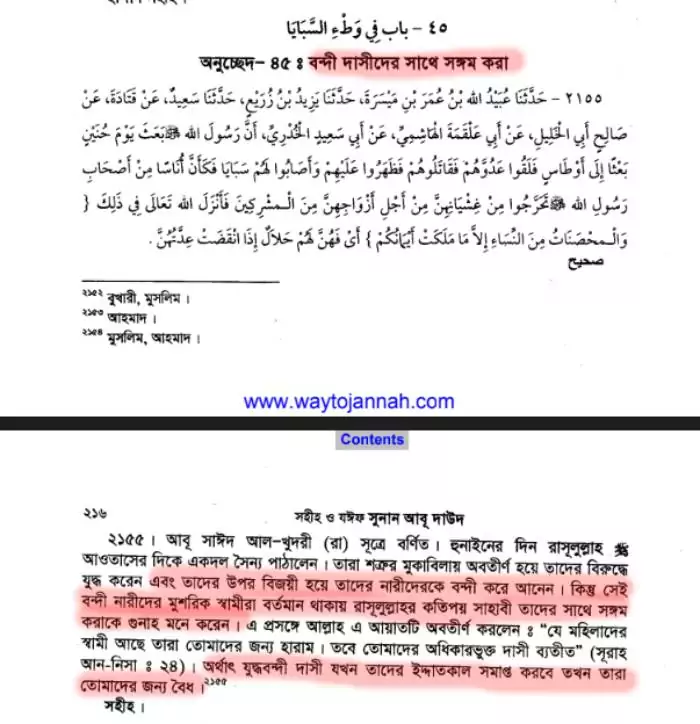
The brutality of jihad reaches an even more extreme level when Islam’s law also permits attacks on the children of the unbelievers under cover of night. When Muhammad’s Companions, feeling hesitant, asked him that women and children were being killed in night attacks, Muhammad answered without any remorse or warning: “They too are included among them (the polytheists).” In other words, because they were non-Muslims, the lives of children had no separate value in Muhammad’s view. This collective punishment is regarded as one of the most heinous crimes in modern civilization. [52] [53] [54] [55] !
Sahih Muslim (Islamic Foundation)
Chapter: 33/ Jihad and Its Principles
Section: 9. During a night-time surprise attack there is no blame for unintentionally killing women and children
Sahih Muslim 1745a (Islamic Foundation: 4399). Yahya ibn Yahya, Sa’id ibn Mansur and Amr al-Naqid (may Allah have mercy on them) … Narrated from Sa’b ibn Jaththamah (may Allah be pleased with him) that he said: The Messenger of Allah (peace and blessings be upon him) was asked about the women and children of the polytheists when a surprise attack is carried out at night, during which their women and children are also struck. The Messenger of Allah (peace and blessings be upon him) said: They too are included among them (the polytheists).
Hadith grade: Sahih (Sahih)
Sahih Muslim (Hadith Academy)
Chapter: 33. Jihad and Travel
Section: 9. During a sudden night attack there is no blame for unintentionally killing women and children
Sahih Muslim 1745b Abd ibn Humayd (may Allah have mercy on him) ….. Narrated from Sa’b ibn Jaththamah (may Allah be pleased with him). He said, I asked the Messenger of Allah (peace and blessings be upon him), “O Messenger of Allah! In a sudden attack in the darkness of night, we also strike the children of the polytheists.” The Messenger of Allah (peace and blessings be upon him) said, They too are counted among them (the polytheist warriors). (Islamic Foundation 4400, Islamic Center 4400)
Hadith grade: Sahih (Sahih)
Sunan Ibn Majah
Tawheed Publication
Chapter: 18/ Jihad
Sunan Ibn Majah 2839. Narrated from Sab’ ibn Jaththamah (may Allah be pleased with him). He said, the Prophet (peace and blessings be upon him) was asked about a surprise attack on the neighbourhoods of the polytheists at night, in which women and children are killed. He said: They too (the women and children) are included among them.
Hadith grade: Sahih (Sahih)
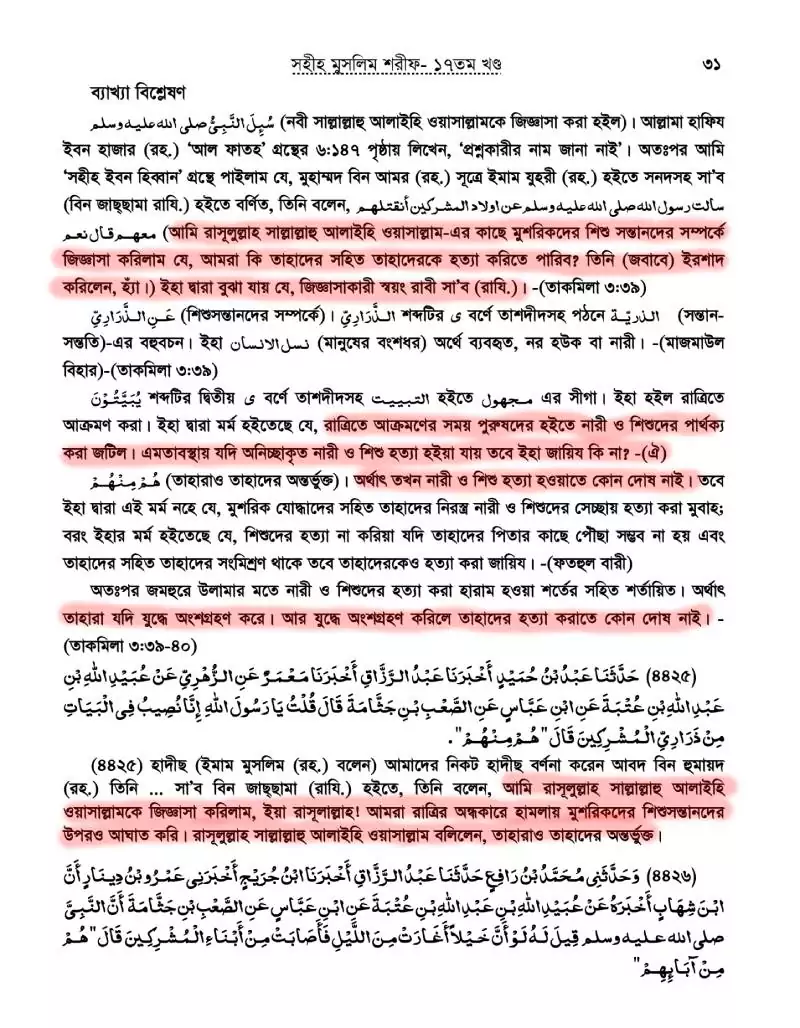
When present-day apologists or popular preachers promote Islam as a religion that grants women sublime dignity, they strategically avoid such horrific incidents, like those involving the women and children of Banu Mustaliq or Awtas who became spoils of war. The hadith below directly and proudly admits, without the slightest sense of shame, that there is no longer any need for the drama of da‘wah; Islam’s legitimate military strategy is to pounce at any time, without a declaration, upon those to whom the name of Islam has once reached. This is not a spiritual revolution or an invitation to the faith, but rather a naked form of imperialist aggression. [44] [56] –
Sahih Muslim (Ifa)
Chapter: 33/Jihad and Its Principles
Section: 1. It is permissible to attack non-Muslims to whom the invitation to Islam has reached without prior warning
4370. Yahya ibn Yahya al-Tamimi (may Allah have mercy on him) … narrated from Ibn ‘Awn (may Allah have mercy on him). He said, I wrote to Nafi’ (may Allah have mercy on him) asking whether it was necessary to invite non-Muslims to the religion before fighting them. He replied to me that this practice existed in the early period of Islam. The Messenger of Allah (peace and blessings be upon him) attacked Banu al-Mustaliq while they were off guard (not knowing about it). Their animals were being taken to drink water. He killed their fighting men (adult males) and captured the rest (women and children). Juwayriyah came into his possession that very day. (Yahya said that he thought the narrator said) Juwayriyah, or he stated with certainty that it was the daughter of al-Harith. The narrator said, “Abdullah ibn Umar narrated this hadith to me. He was among that army.”
Hadith grade: Sahih (Sahih)
Narrator: Ibn ‘Awn (may Allah have mercy on him)
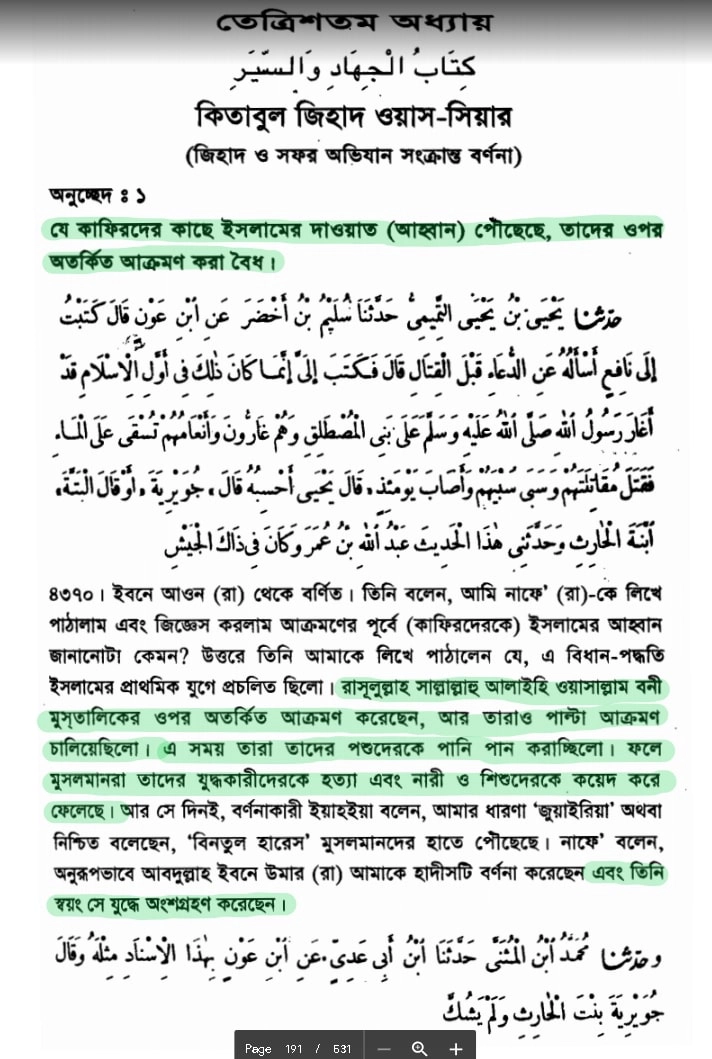
According to one of the leading imams of Islamic jurisprudence, Abu Hanifa, and his disciples, since the message of Islam has reached most parts of the world, there is no longer any need to warn non-Muslims. A deadly attack may be launched against them at any time. This perspective proves that the existence of non-Muslims alongside the Islamic state was always under threat, and that aggressive jihad was the only language of communication with them.
Now let us read a hadith from the Tahawi Sharif, where it can be seen that, since the invitation to Islam has now reached everyone, there is again no particular need to invite them to the path of Islam. If aggressive jihad or a surprise attack is carried out, it is completely permissible [57] –
4724. Muhammad ibn Khuzaymah (may Allah have mercy on him) ….. narrated from Mansur (may Allah have mercy on him). He said, “I asked Ibrahim (may Allah have mercy on him) about inviting the Dailamites. He said, ‘The invitation to Islam has reached them.’”
Imam Abu Ja’far al-Tahawi said: What we have narrated concerning this matter makes it clear that the obligation to invite people existed at the beginning of Islam. At that time, the invitation had not reached everyone, and they did not know why they were being fought. Therefore, the command to invite them was given so that it would constitute a proclamation to them and inform them of the reason why they were being fought. Thereafter, the command was given to attack other people. Thus, the meaning is that these people did not require an invitation, because they were aware of what they were being invited to. If they had responded to the invitation, they would not have been fought. Therefore, there is no meaning in inviting them. Imam Abu Hanifa (may Allah have mercy on him), Imam Abu Yusuf (may Allah have mercy on him), and Imam Muhammad (may Allah have mercy on him) used to say likewise: the invitation to Islam has reached every community. Now the imam may fight them without giving them an advance invitation. As for those communities to whom the invitation of Islam has not reached, it is not appropriate to fight them until it has become clear to them for what purpose or reason they are being fought and to what they are being invited.
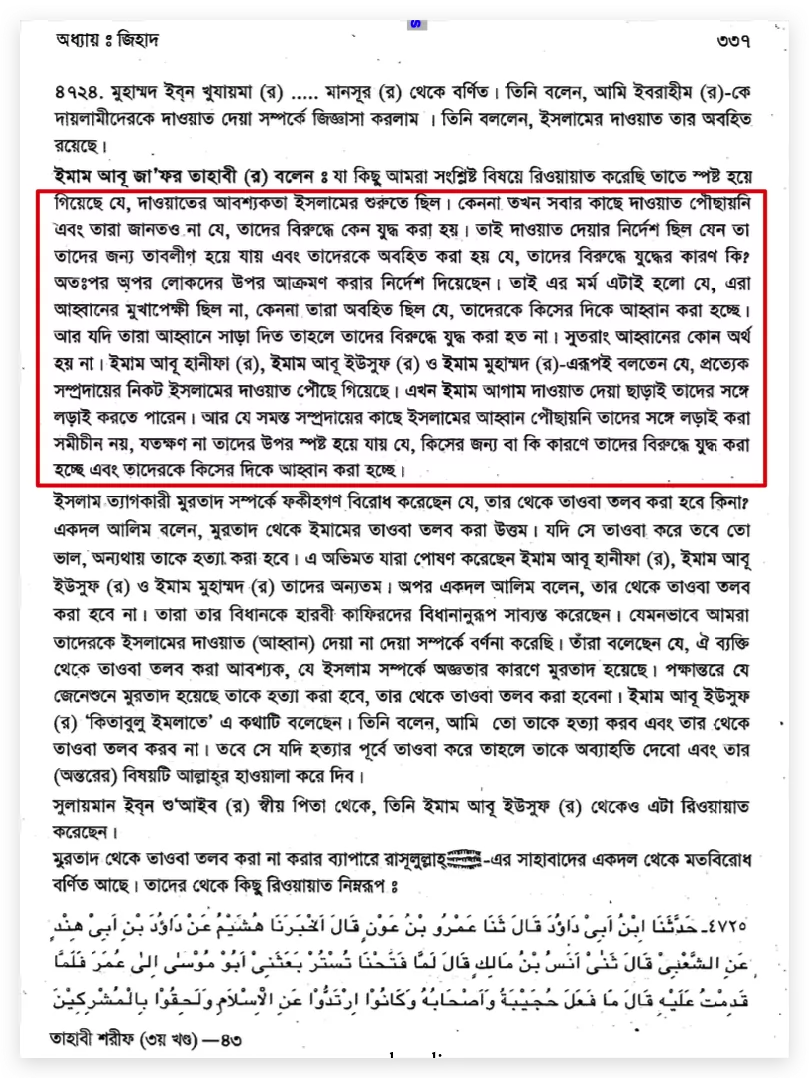
Now let us hear the Islamic rationale for the rape of female prisoners of war,
Now let us listen to some sermons by Ahmadullah and other scholars,
Now let us hear how a Pakistani Muslim is making an advance booking to turn the Indian actress Madhuri into war booty in the event of an India–Pakistan war:
Ghamidi’s Theory of ‘Itmam-e-Hujjah,’ Progressive Interpretation, and the Question of Qital
Javed Ahmad Ghamidi’s theory of ‘Itmam-e-Hujjah’ (the completion of proof in support of the truth) functions in the modern era as an attempt to confine Islam’s laws concerning qital within a narrow historical framework, which ultimately amounts to denying the political and military philosophy of classical Islam. According to Ghamidi’s claim, qital, or armed warfare, descended as divine punishment only upon those who rejected the truth after its final proof had been presented in the direct presence of the Messenger—something he defines as ‘divine judgment.’ However, a subtle analysis of this theory reveals that it conflicts with the linguistic structure of the Quran, the universal scope of the hadith, and the historical sequence of events. First, a fundamental and unanimously accepted principle of usul al-fiqh (Islamic jurisprudence) is: ‘Al-ibratu bi-umumil lafz, la bi-khususis sabab’ (the applicability of a ruling depends on the generality of its wording, not on the specific context in which it was revealed) [58]. In verses 5 and 29 of Surah al-Tawbah, the command to fight against the polytheists and the People of the Book contains no time-frame or technical condition such as ‘Itmam-e-Hujjah.’ If qital had been merely a temporary divine arrangement belonging to the era of the Messenger, then instead of the words ‘polytheist’ or ‘kafir,’ the Quranic wording should have used a specific and restricted expression such as ‘the contemporary disobedient nations of Arabia.’ But the Quran’s general directives indicate that this qital was not a temporary ruling applicable only to a particular context, nor was it a temporary accident; rather, it was Islam’s eternal military stance against disbelief and polytheism [59].
Ghamidi’s theory faces an even greater challenge when the issue of jizya (tax) and submission arises in the discussion. Ghamidi wishes to portray qital merely as ‘divine punishment,’ generally equating it with the flood sent upon the people of Noah or the punishment inflicted upon the peoples of Ad and Thamud. Yet in no case of divine punishment in history was people given the opportunity to survive in exchange for submitting and paying a tax. Verse 29 of Surah al-Tawbah states that the objective of fighting the People of the Book is ‘hatta yu’tu al-jizyata an yadin wa hum saghirun,’ meaning until they pay the jizya in a submissive and humbled condition. This condition of being ‘saghirun,’ or humiliated/subdued, proves that the objective of qital is not merely punishment for denying the truth in the hereafter; rather, it is a process of establishing a global political and legal framework in which Islamic sovereignty will remain absolute and all other ways of life will remain subjugated beneath it [60]. Ghamidi’s modern interpretation seeks to package this naked political supremacism as ‘divine judgment,’ which is essentially an intellectual exercise in concealing the true nature of qital. Let us read a fatwa from Ibn Qudamah’s al-Mughni stating that offensive jihad must be undertaken at least once a year, and examine its reasons, [61]
المغني
ابن قدامة – موفق الدين عبد الله بن أحمد بن قدامة المقدسي
إظهار / إخفاء التشكيل بحث في الكتاب
( 7415 ) وأقل ما يفعل مرة في كل عام ; لأن الجزية تجب على أهل الذمة في كل عام ، وهي بدل عن النصرة ، فكذلك مبدلها وهو الجهاد ، فيجب في كل عام مرة ، إلا من عذر ، مثل أن يكون بالمسلمين ضعف في عدد أو عدة ، أو يكون ينتظر المدد يستعين به ، أو يكون الطريق إليهم فيها مانع أو ليس فيها علف أو ماء ، أو يعلم من عدوه حسن الرأي في الإسلام ، فيطمع في إسلامهم إن أخر قتالهم ، ونحو ذلك مما يرى المصلحة معه في ترك القتال ، فيجوز تركه بهدنة فإن النبي صلى الله عليه وسلم قد صالح قريشا عشر سنين ، وأخر قتالهم حتى نقضوا عهده ، وأخر قتال قبائل من العرب بغير هدنة . وإن دعت الحاجة إلى القتال في عام أكثر من مرة وجب ذلك ; لأنه فرض كفاية ، فوجب منه ما دعت الحاجة إليه .
Translated from al-Mughni (Ibn Qudamah)
(7415) And this (offensive jihad) must be undertaken at least once a year, because jizya becomes obligatory upon the ahl al-dhimma (non-Muslims residing in a Muslim state) every year, and this jizya is an alternative to (Islamic) conquest or victory. Therefore, its actual counterpart—that is, jihad—becomes obligatory once every year [62].
However, this may be exempted in the presence of an excuse or reasonable cause, such as:
Weakness among the Muslims in manpower or military equipment.
Awaiting additional troops or assistance through which support can be obtained.
An obstacle on the route to reaching the enemy, or a shortage of animal fodder or water along the way.
Signs of a positive attitude or interest in Islam on the part of the enemy, creating hope that they may accept Islam if war with them is delayed.
In such or similar circumstances, where abandoning war entails ‘maslahah’ or a greater benefit, it is permissible to abandon war through a truce or treaty. For the Prophet (peace be upon him) made a ten-year truce with the Quraysh and suspended fighting against them until they violated the treaty. He also delayed fighting with many tribes of Arabia without making any kind of truce or treaty [62].
And if, in any year, the need arises to fight more than once, that too becomes obligatory, because this (jihad) is ‘fard kifayah’; therefore, whatever amount is necessary due to the need must be carried out [62].
Ghamidi’s position is also extremely weak when judged by historical and fiqh traditions. None of the fuqaha or mujtahid imams of the four madhhabs of Islam’s golden age regarded qital as restricted solely to the era of the Messenger. From Imam al-Nawawi to Ibn Taymiyyah, all agreed that conducting an expedition at least once a year against the disbelievers bordering the Islamic state is ‘fard kifayah’ [63]. If qital had depended solely on ‘itmam-i-hujjah’, then the Companions’ conquests of Persia and Rome after Muhammad’s death would in no way have been legitimate, because the Companions were not messengers and did not possess the miraculous ability to perform ‘itmam-i-hujjah’ directly upon any nation. Yet the Companions accepted these conquests as the uninterrupted continuation of Quranic jihad. Moreover, the wording of an authentic hadith—‘I have been commanded to fight the people until they testify that there is no deity except Allah’—the use of the word ‘an-nas’ (people) here is highly significant [64]. This is a universal term (Universal quantifier), not confined by any geographical or historical boundary. Ghamidi also offers an extremely strained interpretation of this hadith in order to make it fit his theory, which is essentially a failed attempt to force the classical Islamic philosophy of warfare into the mold of the modern liberal nation-state. In reality, Islamic qital is not a metaphorical or context-dependent punitive system; rather, it is a specific ‘offensive’ or aggressive military strategy whose objective is to eliminate the political power of polytheism from the face of the earth and establish the rule, Sharia, and authority of the one deity, Allah—something that cannot be concealed behind Ghamidi’s progressive veil.
Conclusion: Modern Human Rights versus the Eternal Doctrine of Jihad
After the overall discussion and evidentiary review, it is clear that Islam’s injunctions concerning ‘jihad’ and ‘qital’ are not limited merely to self-defense at a particular time or to a personal moral struggle. Rather, they constitute an organized political and military expansionism whose ultimate objective is to eliminate dissenting views and divergent beliefs from the face of the earth and establish a single religious rule. According to classical sources and the explanations of eminent scholars, shirk or kufr has been declared the ‘greatest disorder’ in the world, and taking up arms against it has been presented as a sacred act of worship.
We have seen how an independent settlement is subjugated through ‘jihad at-talab’ or offensive jihad, and how the value of the lives of its people is determined by their conversion or payment of the jizya tax. An even more horrifying aspect is the ruling that women and children are to be taken as slaves and concubines as war spoils, which is utterly contrary to modern humanitarian values and human rights. Although many modern interpreters currently attempt to claim that this was defensive or symbolic warfare, the testimony of classical fiqh and reliable hadiths is different. There, without any concealment, the blood and property of non-Muslims have been declared lawful until they submit. If Islamic jihad were merely defensive, how was such a vast empire, extending from Spain to Sindh, established? The evidence of history and fiqh shows that the sword was an integral part of Islam’s propagation, something wholly inconsistent with the modern narrative of peace.
In a modern, civilized, and pluralistic world, where everyone’s personal freedom and right to belief are given the highest importance, this kind of armed expansionist religious philosophy in the name of ‘eradicating shirk’ produces nothing but conflict. When these injunctions of Islam are claimed to be ‘eternal’ and ‘unchangeable’, they become a tremendous challenge not only for non-Muslims but also for overall global peace. Therefore, instead of avoiding these injunctions concerning Islamic qital and slavery, it is extremely important to conduct an impartial and rational analysis of their origins and application. Verifying truth and justice on the touchstone of reason, rather than viewing them only through the lens of faith, may be the only path to liberation from this medieval expansionism.
References
- Sahih al-Bukhari, Hadith: 2652 ↩︎
- Sahih Muslim, Hadith: 2533 ↩︎
- Surah At-Tawbah, verse 5 ↩︎
- Surah Al-Anfal, verse 39 ↩︎
- Surah Al-Baqarah, verse 193 ↩︎
- Surah At-Tawbah, verses 28–29 ↩︎
- Surah At-Tawbah, verse 111 ↩︎
- Surah At-Tawbah, verse 123 ↩︎
- Surah Al-Baqarah, verse 216 ↩︎
- Surah An-Nisa, verse 74 ↩︎
- Surah An-Nisa, verse 76 ↩︎
- Surah Muhammad, verse 4 ↩︎
- Surah At-Tawbah, verse 73 ↩︎
- Al-Sarim al-Maslul ‘ala Shatim al-Rasul. Author: Imam Ibn Taymiyyah, Nusus Publications, pages 41, 42 ↩︎
- Majmoo’ Fatawa Ibn Baz, Vol. 6, p. 219 ↩︎
- Shaykh Salih bin Fawzan al-Fawzan, al-Sharh al-Mukhtasar ‘ala Matn Zad al-Mustaqni‘ bi-Tahlil Alfazihi wa-Taqrib Ma‘anihi (الشرح المختصر على متن زاد المستقنع بتحليل ألفاظه وتقريب معانيه), Dar al-Asimah, Riyadh, 1st edition, 1424 AH/2004 CE, vol. 2, p. 590; IslamWeb Audio Archive, شرح زاد المستقنع, “زاد المستقنع 042 – كتاب الجهاد” ↩︎
- Tafsir Mazhari, Hakimabad Khanqah-e Mujaddedia Publications, Volume 5, pages 117–120 ↩︎
- A Review of the Shirk, Bid‘ah and Superstitions Prevalent in Bangladesh 2. Consequences of Shirk ↩︎
- Sahih Bukhari and Muslim ↩︎
- Sunan al-Tirmidhi (verified), Hadith: 2607 ↩︎
- Sunan al-Tirmidhi (verified), Hadith: 2608 ↩︎
- Sunan an-Nasa’i (Ifa), Hadith: 3979 ↩︎
- Sahih Muslim (Hadith Academy), Hadith: 35 ↩︎
- Sunan Ibn Majah, Tawhid Publication, Hadith: 3929 ↩︎
- Sahih Bukhari, Tawhid Publication, Hadith: 2818 ↩︎
- Hadith Collection, Hadith: 1900 ↩︎
- Sahih Bukhari, Tawhid Publication, Hadith: 2977 ↩︎
- Sunan Abu Dawud (verified edition), Allama Albani Academy, Volume Four, Hadith: 3003 ↩︎
- Sahih al-Bukhari, Tawhid Publication, Hadith: 3159 ↩︎
- Sahih al-Bukhari, Tawhid Publication, Volume Three, Pages: 357, 358 ↩︎
- Tafsir Ibn Kathir, Volume 4, Islamic Foundation, pp. 564–567 ↩︎
- Tafsir Mazhari, volume 5, page 291 ↩︎
- Al-Hidaya, Islamic Foundation Bangladesh, volume 2, pages 429, 430 ↩︎
- Fatawa Alamgiri, Islamic Foundation Bangladesh, Volume 3, pages 502, 503, 535, 537, 540 ↩︎
- Al-Itqan fi Tawhid ar-Rahman, Shaykh Abdullah al-Munir, pp. 14–17, 25–27 ↩︎
- The Ruling on Jihad in Islam: Its Regulations and Types, Shaykh Yusuf al-Uyayri, may Allah have mercy on him, translated by Mufti Abdul Malek Musa, may Allah preserve him, pages 4–7, 11 ↩︎
- The Inhumane Slavery of Islam ↩︎
- Sahih Muslim Sharif (Bengali Translation with Necessary Commentary), Al-Hadith Publishing, volumes 17 and 18, pages 12, 13 ↩︎
- There is no compulsion to accept Islam, Question 34770 ↩︎
- Was Islam spread by the sword?, Question 43087 ↩︎
- The Obligation to Destroy Idols ↩︎
- Demolishing idols in a non-Muslim country ↩︎
- Sahih Muslim, Islamic Foundation, Hadith: 733 ↩︎
- Sahih Muslim, Islamic Foundation, Hadith: 4370 1 2
- Sahih Muslim, Hadith Academy, Hadith: 3500 ↩︎
- Sunan Abu Dawud, Islamic Foundation, Hadith: 2152 ↩︎
- Sunan Abu Dawud, Islamic Foundation, Hadith: 154 ↩︎
- Sahih Muslim, Hadith Academy, Hadith: 3436 ↩︎
- Sahih al-Bukhari, Tawhid Publication, Hadith: 4138 ↩︎
- Sahih Muslim, Hadith Academy, Hadith: 3451 ↩︎
- Sunan Abu Dawud, Tahqiq: Allamah Nasiruddin Albani, Allamah Albani Academy, Volume 3, pages 215–216, Hadith: 2155 ↩︎
- Sahih Muslim, Islamic Foundation, Hadith: 4399 ↩︎
- Sahih Muslim, Hadith Academy, Hadith: 4442 ↩︎
- Sunan Ibn Majah, Tawheed Publication, Hadith: 2839 ↩︎
- Sahih Muslim Sharif (Bengali Translation with Necessary Explanation), Al-Hadith Publications, Volumes 17 and 18, page 31 ↩︎
- Sahih Muslim, Bangladesh Islamic Center, Volume 6, page 181, Hadith: 4370 ↩︎
- Tahawi Sharif, Islamic Foundation, third volume, page 337 ↩︎
- Al-Itqan fi Ulum al-Quran, al-Suyuti ↩︎
- Tafsir al-Qurtubi, volume 8, page 72 ↩︎
- Tafsir Ibn Kathir, Surah al-Tawbah 29 ↩︎
- ابن قدامة – موفق الدين عبد الله بن أحمد بن قدامة المقدسي ↩︎
- Al-Mughni, Ibn Qudamah, volume 9, page 164 1 2 3
- Minhaj at-Talibin ↩︎
- Sahih Bukhari, hadith 25 ↩︎