
Introduction
The existence of God and the concept of an infinitely merciful, omnipotent, and omniscient deity have long been debated in philosophy. At the center of this debate lies the Problem of Evil—the problem of evil, suffering, and pain. The Greek philosopher Epicurus (341–270 BCE) reflected deeply on this problem and is associated with a famous paradox, commonly known as “Epicurus’s Paradox” or “the problem of evil.” The paradox fundamentally questions whether divine omnipotence and the existence of suffering can coherently coexist. This article examines Epicurus’s paradox, its philosophical foundations, and the major attempts that have been made to answer it.
Epicurus’s Paradox: The Central Question
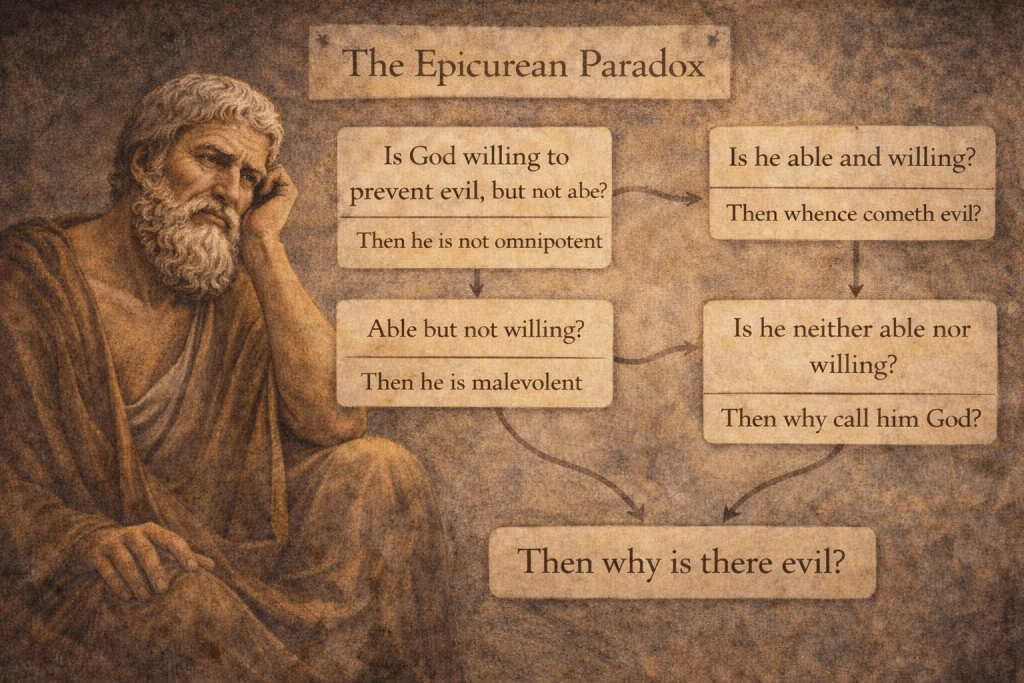
Epicurus’s paradox points directly to the problem of evil and human suffering. If God is infinitely merciful, omnipotent, and omniscient, why do evil, pain, and suffering exist in the world? The paradox raises three questions that create a profound conflict among divine benevolence, omnipotence, and the reality of suffering. The argument is:
If God wishes to eliminate suffering but lacks the power to do so, then he is not omnipotent. In that case, his will is defeated by limitation.
If God has the power to eliminate suffering but is unwilling to do so, then he is not infinitely merciful or omnibenevolent. Allowing evil despite having the power to prevent it conflicts with a perfectly benevolent character.
If God possesses both the power and the will to eliminate suffering, then why do evil, pain, and suffering exist in the world? This conflict demonstrates a vast gap between the conventional definition of God and the condition of the actual world.
These questions associated with Epicurus had a profound influence on philosophical reflection about the existence and nature of God. The argument treats the existence of suffering as incompatible with divine omnipotence. If God is omnipotent, omniscient, and infinitely merciful, then logically there should be no suffering or misery.
Historical Context
The Epicurean paradox is associated with Epicurus (341–270 BCE), the Greek philosopher who founded a philosophical school in Athens known as “The Garden.” His philosophy was built primarily upon atomism and hedonism. He held that happiness consists in the absence of suffering. He was not an atheist. He did not deny the existence of gods; rather, he maintained that the gods exist but do not intervene in human life or earthly events. They live their own blissful lives in the “intermundia,” the spaces between worlds. For Epicurus himself, therefore, evil did not create a theological “problem” in the later monotheistic sense.
The paradox, however, does not appear directly in Epicurus’s surviving writings. It is preserved in the Christian philosopher Lactantius’s (c. 240–320 CE) De Ira Dei (On the Wrath of God). Lactantius was a Christian and used the argument while discussing pagan views of divine providence. In the form attributed to Epicurus, the dilemma is essentially this: “If God wishes to remove evils but cannot, he is weak. If he can but does not wish to, he is malevolent. If he both can and wishes to, then why do evils exist?”
The paradox became especially powerful against monotheistic religions—particularly Christianity, Islam, and Judaism—once God came to be understood as simultaneously omnipotent, omniscient, and infinitely benevolent. In the Greco-Roman religious world of Epicurus, the gods were limited and anthropomorphic, so the contradiction was not as acute. David Hume later refined the argument in the eighteenth century. In modern philosophy, the debate has developed from the “logical problem of evil” into the “evidential problem of evil.”
In short, Epicurus himself was not an atheist, but the argument associated with him later became one of the most serious challenges to monotheistic belief. It demonstrates that philosophy is not blind belief; it is a test of claims by knowledge and reason.
The Problem of Evil: A Philosophical Review
The Problem of Evil is one of the most controversial and influential problems in philosophy. It asks whether the suffering, misery, and anguish that exist in the world can coherently be reconciled with a God who is omnipotent, omniscient, and infinitely benevolent. The question becomes especially important in the context of religious belief. Most religions portray God as all-powerful, all-knowing, and perfectly good. Yet the existence of pain and suffering creates a conflict with that conception. One logical conclusion is that these attributes conflict with one another and therefore cannot all be true at the same time.
The philosopher David Hume, in his “Dialogues Concerning Natural Religion”, famously writes: “Is he willing to prevent evil, but not able? then is he impotent. Is he able, but not willing? then is he malevolent. Is he both able and willing? whence then is evil?” [1]
These questions challenge some of the most fundamental assumptions of religious belief. If one accepts that God is omnipotent and perfectly good, the existence of evil creates a profound logical conflict. If suffering and misery are real, questions inevitably arise about divine goodness and power.
The Structure of Epicurus’s Argument
Epicurus’s paradox is built around three central ideas:
If God is omnipotent, then every atom in the universe is under his control. He is therefore capable of eliminating every form of pain and suffering in the world instantly.
If God is perfectly merciful and omnibenevolent, then inflicting suffering upon creation would contradict his nature. He should necessarily wish to bring suffering in the world to an end.
Suffering, aging, disease, and apparently pointless agony are persistent realities of the world. Every day we witness both the cruelty of nature and the suffering of human beings.
If ‘A’ (power) and ‘B’ (will) are both true, then there is no logical room for ‘C’ (suffering) to exist. Since the real existence of ‘C’ is undeniable, logic requires that at least one of the claims represented by ‘A’ or ‘B’ must be false.
Epicurus’s question is straightforward: if God possesses all these attributes, how can pain and suffering exist? If he has the power to remove suffering and also wishes to do so, why does suffering continue?
Theodicy: Proposed Solutions to the Problem of Suffering
Religious thinkers have proposed various responses to Epicurus’s paradox, the most important of which fall under the category of theodicy. A theodicy is a philosophical and theological attempt to reconcile the existence of suffering with the claim that God is both omnipotent and perfectly good.
The Free Will Defense
One of the most popular responses to the problem of evil is the free will defense. According to this argument, God has given human beings free will and the freedom to choose between right and wrong. People frequently choose wrongly, and evil or suffering results from those choices. If God prevented the exercise of free will, that would supposedly undermine the purpose for which humans were created. Human suffering caused by wrongdoing is therefore attributed to human choices rather than to a limitation of divine omnipotence. Augustine and Alvin Plantinga have defended versions of this approach. In “God, Freedom, and Evil”, Plantinga argues that although free will can result in suffering, this does not contradict divine omnipotence. God granted human beings freedom, and suffering arises from the misuse of that freedom. [2]
This solution, however, creates several problems. One is that God becomes dependent upon human free will. Divine sovereignty is thereby restricted. If human beings determine their own destinies, God appears to become little more than a silent observer. Such a merely observational role conflicts with the conception of God found in many religions.
At the same time, another problem remains: what explains the evil and suffering experienced by animals? According to the Abrahamic religions, animals do not possess free will in the same sense as morally responsible humans. Why, then, do they suffer? Whose fault is it?
The Soul-Making Theodicy
Another important theodicy is the soul-making argument. According to this view, pain and suffering are part of human spiritual development. God educates and matures human beings through hardship and adversity. Without pain and suffering, people supposedly could never understand genuine happiness or attain spiritual growth. From this perspective, suffering itself forms part of God’s benevolent purpose. The philosopher John Hick defended this approach in “Evil and the God of Love”. On this view, God intends suffering to teach us the value of life and bring us toward spiritual maturity. In other words, suffering is good and beneficial for human beings; we simply fail to understand or accept it. [3]
But this argument contains a fundamental difficulty. It implies that without pain and suffering people could never understand genuine happiness or achieve spiritual development, which creates a direct conflict with divine omnipotence. Is God incapable of educating human beings without pain and suffering? Would that be impossible even for God? If so, in what sense is he omnipotent?
The problem becomes even sharper when a six-month-old infant is killed by a bomb. What lesson does the child learn through that pain and suffering? Was the infant undergoing some kind of test? What was the result of that test? What did the six-month-old dead child learn from it? How much genuine happiness or spiritual development did the child achieve? And what genuine happiness or spiritual development is produced in others by witnessing the infant’s death?

The Cosmic Plan Argument
Many religious thinkers argue that human beings are incapable of understanding the whole of God’s plan. God supposedly acts according to a cosmic plan beyond ordinary human knowledge. Pain and suffering may form part of a greater purpose that we cannot comprehend. According to this argument, God knows everything and may possess purposes extending far beyond what we can see. The idea appears in the thought of Plato and Leibniz, who maintained that suffering may be necessary for a greater whole. On this view, human beings are expected to endure lesser suffering for the sake of a greater good. [4]
The problem with this argument is that it is built upon the “argumentum ad ignorantiam” fallacy—the appeal to ignorance. Its very foundation is human ignorance, and that ignorance is then invoked to establish a claim. For that reason, it cannot be accepted as a sound argument.
Moral Evil vs. Natural Evil
One of the most important distinctions in the problem of evil is between moral evil and natural evil. Without this distinction, criticism of theodicy remains incomplete. Theodicy is a theological and philosophical attempt to explain the coexistence of evil, sin, and suffering with the existence of an omnipotent and perfectly benevolent God as justifiable or logically coherent.
Moral evil refers to suffering produced by human free will. It includes deliberate human acts such as murder, rape, war, torture, greed, and hatred. Examples include the murder of millions during the Holocaust or the abduction and torture of a child. Here the immediate responsibility lies with human agency. The free-will theodicy argues that God made humans free to choose between good and evil; without freedom, humans would be mere machines. Critics respond, however, that an omnipotent God could have given human beings less destructive freedom—enough to love and make meaningful choices without granting them the capacity to produce catastrophes such as the Holocaust. Human beings themselves, when developing artificial intelligence, attempt to constrain its freedom so that it cannot use its autonomy to cause catastrophic harm.
Natural evil consists of suffering outside human choice—earthquakes, tsunamis, cancer, viruses, floods, and animal suffering. No human being is responsible for these events. Familiar examples include the 2004 Indian Ocean tsunami, in which more than two hundred thousand people died, or the leukemia of an innocent child. William Rowe’s example is even more severe: lightning starts a forest fire, a fawn becomes trapped, and it burns for days in unbearable agony before dying. No one witnesses it; there is no obvious “lesson,” “greater good,” or “future outcome” produced by the suffering.
Why does this distinction matter? The free-will theodicy may offer at least a partial account of moral evil, but it does not explain natural evil. Soul-making and divine-plan theodicies attempt to explain natural suffering by claiming that it forms human character. Critics ask whether a child’s cancer truly builds anyone’s character. Animal suffering—which existed long before human beings—cannot plausibly be described as someone’s “deep lesson.”
At a deeper level, natural evil shows that if the laws of nature—such as gravity and pathogenic biology—were created by God, he could also have created laws that produced less suffering. The distinction therefore shows that the problem of evil is not merely logical but empirical and evidential. Natural evil is a pervasive feature of ordinary life and makes belief in a perfectly good and omnipotent deity substantially more difficult.
William Rowe’s Evidential Problem of Evil
Epicurus’s paradox is usually associated with the logical problem of evil, which argues that evil and the traditional God cannot consistently coexist. The modern philosopher William L. Rowe (1931–2015) developed a different and, in many respects, stronger form of the argument: the evidential problem of evil. Rowe argued that evil may not make God’s existence logically impossible, but it makes such a God highly improbable.
Rowe’s argument rests on the following principal premises:
There exist instances of intense suffering that an omnipotent and perfectly good God could have prevented without thereby losing some greater good.
An omnipotent and perfectly good God would not permit unnecessary or apparently pointless intense suffering in the world.
Therefore, on the available evidence, it is probable that no such God exists.
His most famous illustration is the “fawn case”: “In a distant forest, lightning strikes a dead tree and starts a fire. A fawn becomes trapped in the flames, is horribly burned, and lies in terrible agony for several days before dying.” No human free will is involved; there is no “soul-making” and no evident benefit from a “cosmic plan.” This is presented as “gratuitous evil”—apparently pointless suffering.

Rowe also discusses another horrifying case involving a young girl, Sue, who is raped, beaten, and murdered. Here too, no known good appears sufficient to justify the suffering. The point is that much of the evil we observe appears unnecessary for any recognizable divine purpose. On a probabilistic reading, the prevalence of such suffering significantly lowers the probability of the existence of an omnipotent and perfectly good God.

Why is this stronger than the traditional Epicurean formulation? The older logical argument says that such a God and evil cannot coexist. Rowe instead argues that their coexistence may be logically possible but is highly improbable. Thus, even if theodicies such as free will, soul-making, or a hidden divine plan remain logically possible, the enormous amount of apparently gratuitous suffering in the actual world weakens the evidential case for God.
Critics respond with what is known as “skeptical theism.” Stephen Wykstra, for example, argues that human knowledge is limited, so we may be unable to perceive God’s unknown greater reasons for permitting suffering. The counterargument is that if human beings are so cognitively limited that no judgment about apparently pointless suffering can be trusted, the foundations of moral reasoning themselves become unstable. Moral judgment depends upon our capacity to distinguish what is good for sentient beings from what is harmful.
In short, Rowe’s argument shows that evil is not merely a logical contradiction but an evidential challenge grounded in the actual world. It has made the problem traditionally associated with Epicurus even more relevant in modern philosophy. For believers, it remains a profound test of the coherence and probability of classical theism.
The Moral Paradox in the Context of Islamic Aqidah
Epicurus’s paradox becomes even more complex and severe when considered in the context of Islamic theology or aqidah (Islamic Aqidah). A large number of Islamic theologians argue that the suffering of innocent people in this world is fundamentally a “test” or a “lesson for others.” But when specific moral realities are examined, the concepts of divine “justice” and a “perfectly merciful” being come under severe pressure.
Suppose five Muslim men rape and murder a ten-year-old Hindu girl. According to Islamic aqidah, if those perpetrators do not die upon ‘shirk’ (associating another being with God) and repent before death, Allah may forgive them and grant them Paradise. By contrast, if the ten-year-old child dies as a non-Muslim—such as a Hindu—having been raised in a non-Muslim family and, under the relevant religious doctrine, dies in the state of a ‘kafir’ or ‘mushrik’, she would have to burn eternally in the fire of Hell [5] [6].
Several serious logical and moral questions arise from this scenario:
If worldly suffering exists for the purpose of “education,” what lesson did the innocent child gain from such horrific suffering? She had no opportunity to carry any lesson forward in life; her life simply ended after extreme abuse and pain.
If it is said that Allah allowed this event in order to teach other people, another question follows: why must an innocent child endure the most extreme humiliation and abuse for the education of others? Does this not directly conflict with the creator’s attribute of perfect justice (Al-Adl)?
If the same child who suffered inhuman torment in this world is then subjected to eternal punishment in the afterlife, while those who abused her can ultimately enjoy Paradise after repentance, what logical foundation remains for describing the governing deity as perfectly merciful or omnibenevolent?
This situation demonstrates that conventional theodicies and arguments offered in defense of the creator cannot survive unchanged when confronted with concrete moral crises of this kind. It produces an irreducible conflict among the claimed divine attributes of perfect power, perfect knowledge, and perfect mercy.
Criticism and Responses
Epicurus’s paradox has profoundly influenced philosophical discussion of evil, suffering, and divine omnipotence. Many philosophers regard it as a major challenge to religious belief. Theodicies and other philosophical arguments have attempted to answer the problem, but many of those responses themselves rely upon controversial assumptions or logical fallacies. The problem of evil therefore remains highly influential in philosophy, and no response has succeeded in ending the debate. Many theistic philosophers have proposed answers, but in numerous cases those answers come into direct tension with the conception of God maintained by established religions.
Conclusion
Epicurus’s paradox raises one of the enduring questions of theology and philosophy. It forces the claims of divine omnipotence, omniscience, and perfect goodness to be examined alongside the reality of suffering. Religious traditions have offered various solutions through theodicy, yet the paradox remains at the center of deep philosophical debate. The problem of evil compels us to scrutinize the nature of God, the alleged purposes behind suffering, and the logical coherence of the attributes traditionally assigned to a supreme being.
References
- Hume, D. 1779, Dialogues Concerning Natural Religion ↩︎
- Plantinga, A. 1974, God, Freedom, and Evil ↩︎
- Hick, J. 1966, Evil and the God of Love ↩︎
- Leibniz, G.W. 1710, Essays on Theodicy ↩︎
- According to Islam, Non-Muslims Are Destined for Eternal Hell ↩︎
- Paradise Even After Killing One Hundred People ↩︎