
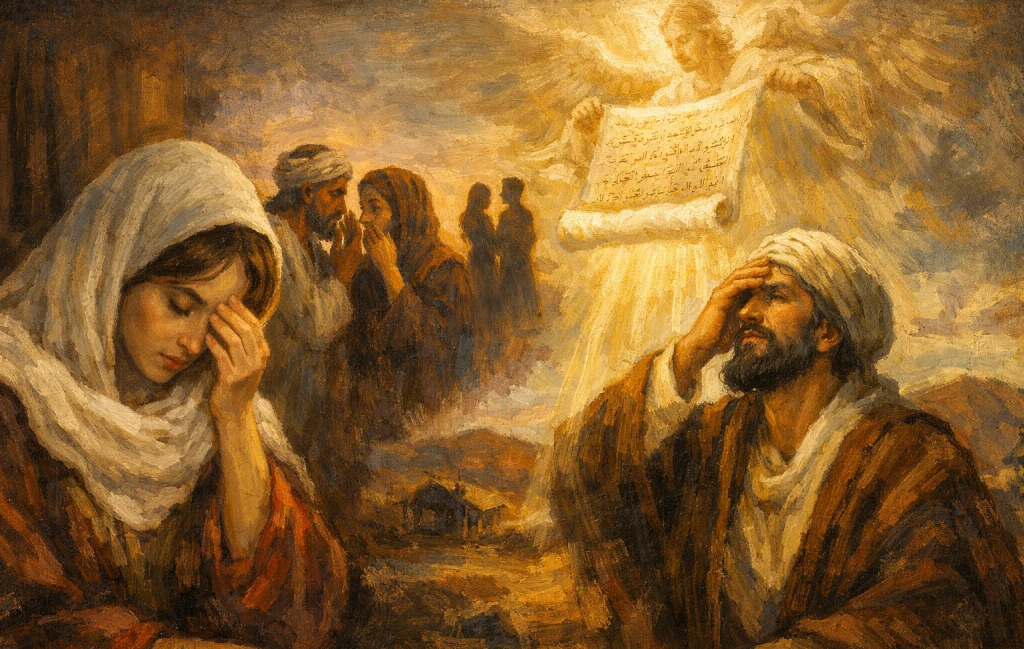
Introduction: A Dangerous Account
In Islamic history, the incident of the “Ifk” (slander) is described most fully in a lengthy narration in Sahih al-Bukhari. In this account, Aisha herself relates the sequence of events in considerable detail. From her narration we learn of the spread of rumours that she had engaged in an illicit affair, the Prophet’s emotional distance, the counsel offered by his Companions, the tension in the mosque, and, finally, the revelation of verses from Surah An-Nur. The Ifk—the slander against Aisha—is one of the most discussed and controversial episodes in Islamic history. It is not merely the story of a family quarrel or conflict; rather, it serves as a distinctive litmus test for assessing the truth of Muhammad’s claim to prophethood. A month of silence, consultation with other people, and, at last, revelation arriving at an exceptionally “convenient” moment naturally raises a question: was this truly a divine sign, or a skilfully executed human strategy? A closer examination of the hadith helps bring that issue into view. While reading it, one point should be kept in mind: a woman’s menstrual cycle.
This detailed account raises a serious question: is this (a) a normal example of a “divinely guided” prophetic process, or (b) an instance of “human crisis management,” in which decisions, consultation, social pressure, and subsequent legitimation through religious language operate much as they do in the affairs of ordinary religious leaders?
Context: A Grave Crisis
On the return journey from the Battle of al-Muraysi, Aisha was left behind while searching for a lost necklace and returned the next morning riding Safwan’s camel. The episode gave rise to a grave social and political crisis. Aisha herself states that, after returning to Medina, she was ill for about a month and that throughout this period the Prophet maintained a kind of emotional distance from her. Did the Prophet truly not know whether Aisha was innocent? If he was in constant communication with the Creator through Gabriel, why did he remain uncertain for a month about his own wife’s moral integrity? The events of that month can be presented as the following crisis-management model:
| Stage | Action taken by the Prophet | Critical observation |
| 1. Silence and observation | Waiting a month for revelation and keeping his distance from Aisha. | Why would the messenger of an “all-knowing” being remain in the dark for a month? Was this a delay in revelation, or time taken to assess Aisha’s character and the seriousness of the circumstances? |
| 2. Human counsel | Consulting Ali and Usama. Ali advised that divorce was an available option. | Reliance on human judgment rather than turning to God appears to conflict with the basic notion of prophethood as divine guidance. Someone in direct communication with an omniscient Allah should not need ordinary people’s advice on such a sensitive matter. |
| 3. Information-gathering | Questioning the maidservant Barira. | This was not recourse to a miraculous source, but an ordinary investigation that sought the truth through a human witness. |
| 4. Testing public support | Addressing the tribal leaders in the mosque. | This can be read as a political strategy: an attempt to suppress the opponent Abdullah ibn Ubayy by making use of the rivalry between the Aws and Khazraj. |
| 5. Final resolution (revelation) | After a full month, revelation descends—or is enacted—in Aisha’s presence and declares her innocent. | Just as the situation was slipping out of control and civil conflict seemed imminent, revelation settled the matter through verses favourable to the Prophet and his family. The result was to defuse the crisis while preserving the centre of leadership. |
The Hadith in Detail
One need not read a large number of hadiths: this single narration is enough to place the Prophet’s claim to prophethood under serious scrutiny. It contains numerous details that may be read as concrete indications that the Prophet composed the Qur’an himself. Indeed, this one hadith alone substantially unsettles Islam’s foundations. Let us read it: [1]
Sahih al-Bukhari (Islamic Foundation edition)
51. Al-Maghazi (Military Expeditions)
Chapter 2198: The Incident of al-Ifk. [Imam al-Bukhari (RH) said:] The word إِفْك, like نِجْس and نَجَس, is used in both the forms إِفْك and أَفك. Thus the Arabs say: إِفْكُهُمْ أَفْكُهُمْ وَأَفَكُهُمْ
Islamic Foundation number: 3835; international number: 4141; canonical match: https://sunnah.com/bukhari:4141
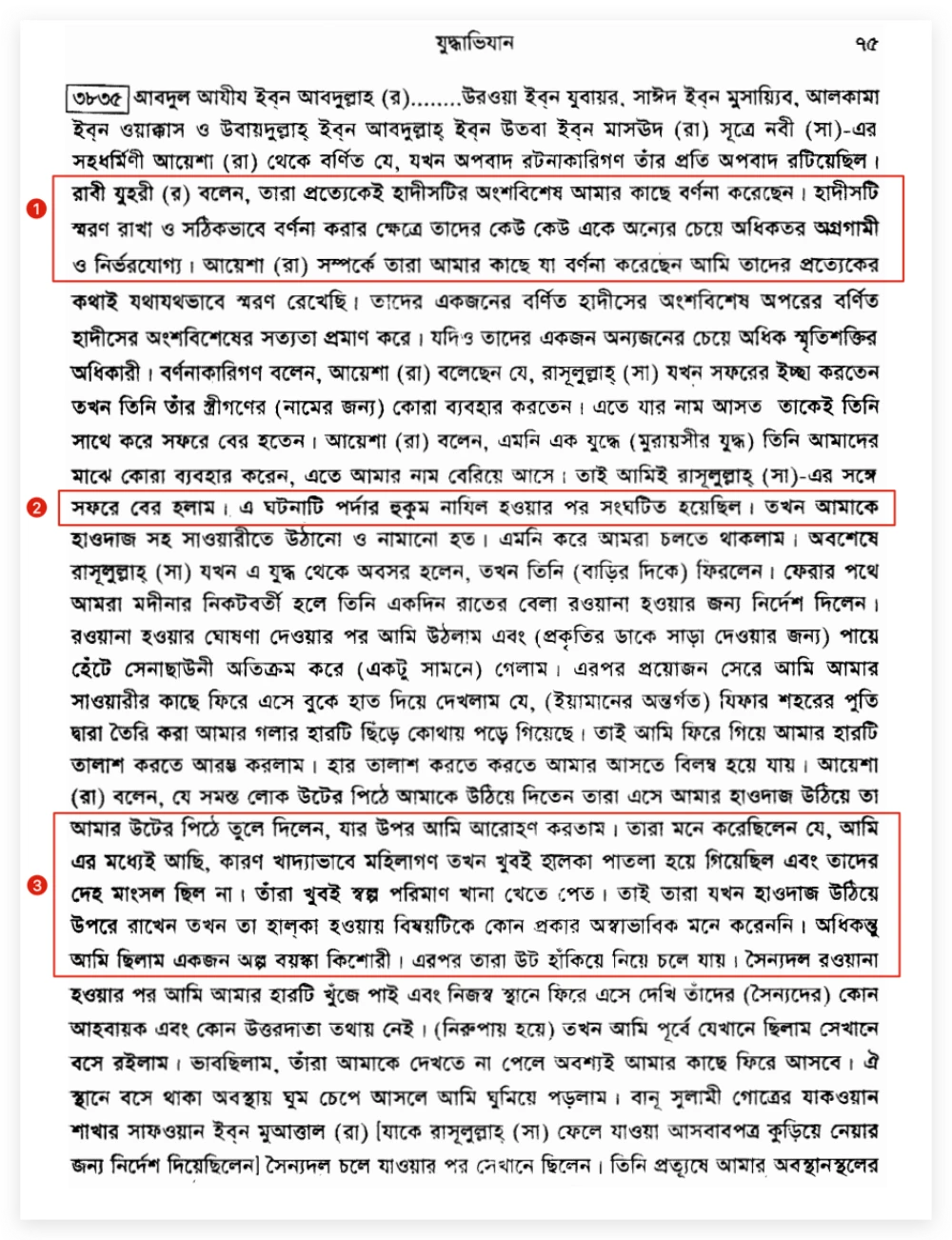
3835. Abdul Aziz ibn Abdullah (RH) … narrated through Urwa ibn al-Zubayr, Sa’id ibn al-Musayyib, Alqama ibn Waqqas, and Ubaydullah ibn Abdullah ibn Utba ibn Mas’ud (RA), from Aisha (RA), the wife of the Prophet (ﷺ), concerning the time when the slanderers accused her. The narrator al-Zuhri (RH) said that each of them related part of the hadith to him. Some were more accurate and reliable than others in remembering and reporting it. He retained what each had narrated about Aisha; one narrator’s account corroborated another’s, although some had stronger memories than others.
The narrators report that Aisha (RA) said: Whenever the Messenger of Allah (ﷺ) intended to travel, he drew lots among his wives and took with him the one whose lot was drawn. Aisha (RA) said: On one such expedition—the expedition of al-Muraysi—he drew lots among us, and my name was drawn. So I travelled with the Messenger of Allah (ﷺ). This occurred after the command concerning the veil had been revealed. I was carried in a howdah, and I remained in it when it was lifted onto or lowered from the camel. We continued in this manner until the Messenger of Allah (ﷺ) completed the expedition and began the journey home.
On the return journey, when we had drawn near Medina, he ordered the caravan to depart during the night. After the departure was announced, I rose, walked beyond the army camp to answer the call of nature, and then returned to my mount. When I felt my chest, I discovered that my necklace, made of Zifar beads from Yemen, had broken and fallen somewhere. Searching for it delayed me. Meanwhile, the men responsible for my camel came, lifted my howdah, and placed it on the camel, assuming that I was inside. Women at that time were light because food was scarce and they ate little, and I was still a young girl; therefore, the men did not consider the howdah’s lightness unusual.
They drove the camel away with the army. After finding my necklace, I returned to the campsite and found no one there to call or answer me. With no other option, I sat where I had been, thinking that once they noticed my absence they would return for me. Sleep overcame me while I waited. Safwan ibn al-Mu’attal (RA), of the Dhakwan branch of Banu Sulaym—who had remained behind the army to collect anything left behind—reached the place after the troops had departed. At daybreak he saw the form of a sleeping person and recognized me, for he had seen me before the command of veiling was revealed.
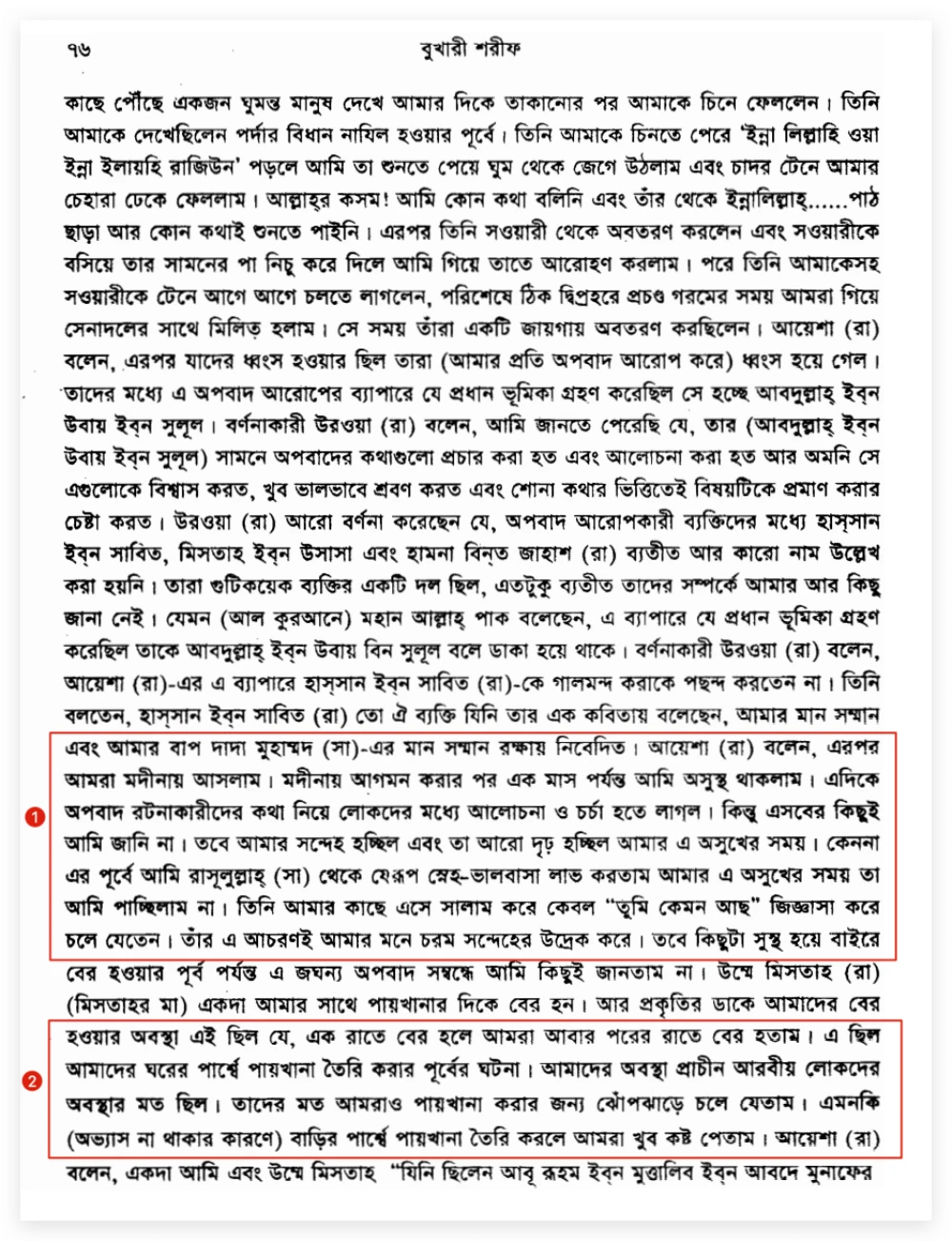
When he recognized me, he recited, “Inna lillahi wa inna ilayhi raji’un.” I awoke at the sound and covered my face with my head-cover. By Allah, we did not exchange a word, and I heard nothing from him except the istirja’. He dismounted, made the camel kneel, and held down its foreleg while I mounted. He then led the camel until, in the fierce midday heat, we caught up with the army while it was encamped.
Aisha (RA) said that those who were destined for ruin brought ruin upon themselves, and the person chiefly responsible for spreading the Ifk was Abdullah ibn Ubayy ibn Salul. Urwa (RA) said that, apart from Abdullah, the named participants were Hassan ibn Thabit, Mistah ibn Uthatha, and Hamna bint Jahsh, along with others he did not know. They formed a small group, as the Qur’an states, and the one who bore the greatest share of the slander was Abdullah ibn Ubayy ibn Salul.
Urwa (RA) added that Aisha (RA) disliked hearing Hassan ibn Thabit (RA) abused in her presence, for he was the poet who had said that his honour, his father, and his grandfather were all offered in defence of Muhammad’s honour. Aisha (RA) said: Then we returned to Medina. After arriving in Medina, I remained ill for a month. During that time, people circulated the slanderers’ claims, but I knew nothing of them. Yet something aroused my suspicion during my illness: I did not receive from the Prophet (ﷺ) the affection I had previously received whenever I was ill.
He would come, greet me, ask, “How is that lady?” and then leave. His conduct deepened my doubts, although I remained unaware of the vile slander until I had partly recovered and went out with Umm Mistah (RA) towards al-Manasi. We went out at night to answer the call of nature, before latrines had been built near our homes. Our practice resembled that of the early Arabs of the desert. We went to open ground to relieve ourselves, and because we were unaccustomed to latrines, having them beside our homes would have caused us considerable discomfort.
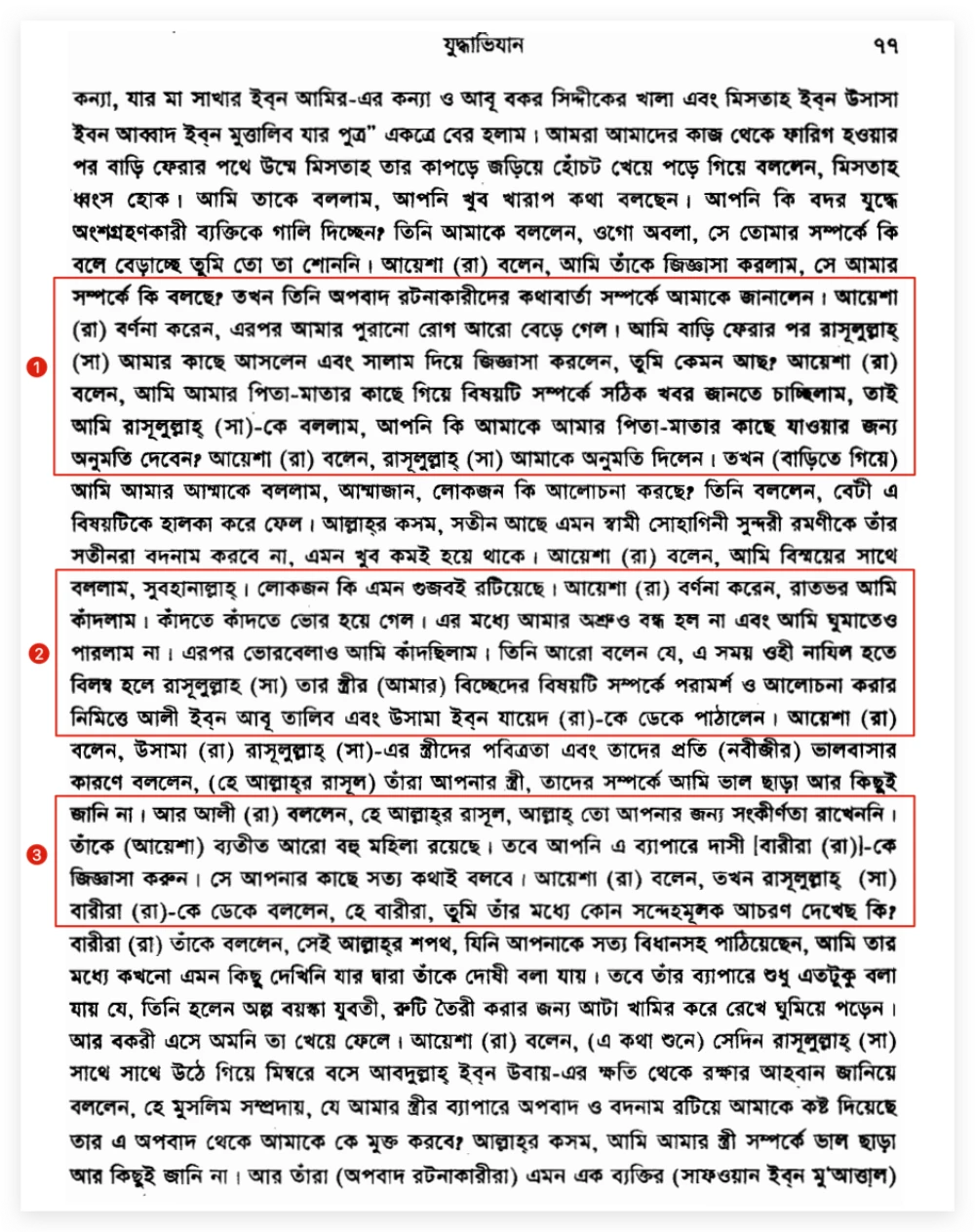
Aisha (RA) said: Umm Mistah was the daughter of Abu Ruhm ibn al-Muttalib ibn Abd Manaf; her mother was the daughter of Sakhr ibn Amir and the aunt of Abu Bakr al-Siddiq, and her son was Mistah ibn Uthatha ibn Abbad ibn al-Muttalib. After we had attended to our needs and were returning home, Umm Mistah stumbled over her garment and exclaimed, “May Mistah be ruined!” I said, “What a harsh thing to say! Do you insult a man who took part in Badr?” She replied, “My dear, have you not heard what he has been saying about you?” When I asked what he had said, she told me what the slanderers were circulating.
Aisha (RA) said that her illness then became worse. When I returned home, the Prophet (ﷺ) came, greeted me, and asked, “How are you?” Wanting to learn the truth from my parents, I asked the Messenger of Allah (ﷺ), “Will you permit me to go to my parents?” The Messenger of Allah (ﷺ) gave me permission. At my parents’ home I asked my mother, “Mother, what are people saying?” She replied, “My daughter, do not make too much of it. By Allah, seldom is there a beautiful woman loved by her husband, who has co-wives, without those co-wives finding fault with her.”
Aisha (RA) exclaimed, “Subhan Allah! Are people really saying this?” She wept throughout the night until dawn, unable either to stop crying or to sleep, and continued weeping in the morning.She also said: While revelation was delayed, the Messenger of Allah (ﷺ) summoned Ali ibn Abi Talib and Usama ibn Zayd to ask their advice about separating from his wife—me.Aisha (RA) said that Usama (RA), knowing the innocence of the Prophet’s wives and the love he bore them, said, “O Messenger of Allah, she is your wife; we know nothing but good of her.”
And Ali (RA) said, “O Messenger of Allah, Allah has not placed you under constraint; there are many women besides her. Ask the maidservant [Barira (RA)] about the matter.” She will tell you the truth. Aisha (RA) said: The Messenger of Allah (ﷺ) then summoned Barira (RA) and asked, “O Barira, have you ever seen anything in her that aroused your suspicion?” Barira (RA) replied, “By Him Who sent you with the truth, I have seen nothing in her for which she could be blamed, except that she is a young girl who sometimes falls asleep while leaving the family’s dough unattended, and the household goat comes and eats it.”
Aisha (RA) said that the Messenger of Allah (ﷺ) then mounted the pulpit and appealed for protection from Abdullah ibn Ubayy’s harm: “O Muslims, who will relieve me of a man whose slander has injured me through my family? By Allah, I know nothing but good of my wife. They have also named a man about whom I know nothing but good and who never entered my home except in my company.” Sa’d ibn Mu’adh (RA), of Banu Abd al-Ashhal, rose and said, “O Messenger of Allah, I will relieve you of him. If he belongs to the Aws, I will strike off his head; and if he belongs to our brothers, the Khazraj, command us and we will carry out your order.”
Sa’d ibn Ubada (RA), chief of the Khazraj and a relative of Hassan ibn Thabit’s mother, rose in protest. Aisha (RA) said that before this incident he had been a righteous man, but tribal zeal drove him to tell Sa’d ibn Mu’adh, “By Allah, you have lied. You cannot kill him and have no power to do so. Had he belonged to your tribe, you would never have wanted him killed.” Usaid ibn Hudayr (RA), a cousin of Sa’d ibn Mu’adh, replied to Sa’d ibn Ubada, “Rather, you are the liar. By Allah, we will surely kill him. You are a hypocrite defending the hypocrites.”
Aisha (RA) said that the Aws and Khazraj became so agitated that they were on the verge of fighting. The Prophet (ﷺ) was still standing on the pulpit, and he continued calming them until they fell silent. Aisha (RA) said that she wept throughout that day without her tears ceasing and without sleeping. With her parents beside her, she wept for two nights and a day until she thought her liver would burst from the intensity of her crying.
While she was weeping with her parents beside her, an Ansari woman asked permission to enter. Aisha allowed her in, and the woman sat and wept with her. Aisha said: While we were weeping, the Prophet (ﷺ) came, greeted us, and sat beside us. Since the slander began, he had not sat with me in this way. A full month had passed, yet no revelation concerning me had come to him.
Aisha (RA) said that after sitting down, the Messenger of Allah (ﷺ) recited the testimony of faith. Then he said: “To proceed, O Aisha: I have been told certain things about you. If you are innocent, Allah will soon declare your innocence; but if you have committed a sin, seek Allah’s forgiveness and repent to Him, for when a servant admits a sin and repents, Allah accepts that repentance.” Aisha (RA) said that when the Messenger of Allah (ﷺ) finished speaking, her tears stopped completely, until she could not feel even a single drop. She asked her father to answer the Messenger of Allah (ﷺ) on her behalf.
Her father replied, “By Allah, I do not know what to say to the Messenger of Allah (ﷺ).” She then asked her mother to answer for her, but her mother gave the same reply. Aisha said that she was still a young girl with little knowledge of the Qur’an, yet she answered: “I know that you have heard this slander until it has settled in your hearts and you have accepted it as true. If I tell you that I am innocent, you will not believe me; but if I confess to something of which Allah knows I am innocent, you will believe me. By Allah, I can find no example for you and me except the words of Joseph’s father.” She then cited Qur’an 12:18: وَجَآءُو عَلَىٰ قَمِيصِهِۦ بِدَمٖ كَذِبٖۚ قَالَ بَلۡ سَوَّلَتۡ لَكُمۡ أَنفُسُكُمۡ أَمۡرٗاۖ فَصَبۡرٞ جَمِيلٞۖ وَٱللَّهُ ٱلۡمُسۡتَعَانُ عَلَىٰ مَا تَصِفُونَ — “And they brought his shirt, stained with false blood. He responded, ‘No! Your souls must have tempted you to do something ˹evil˺. So ˹I can only endure with˺ beautiful patience! It is Allah’s help that I seek to bear your claims.’” (Dr. Mustafa Khattab, The Clear Quran)
Then I turned away, lay down on my bed, and trusted that Allah knew I was innocent and would make my innocence known. By Allah, I never imagined that revelation concerning me would be recited forever, for I considered myself too insignificant for Allah to speak about my case. I hoped only that the Messenger of Allah (ﷺ) might see a dream through which Allah would establish my innocence. By Allah! Before the Messenger of Allah (ﷺ) left his seat, and before anyone in the household went out, revelation began to descend upon him. The severe condition that overtook him during revelation came upon him, and drops of sweat like pearls ran from his body despite the winter cold because of the weight of the words being revealed.
Aisha (RA) said that when the condition passed, the Messenger of Allah (ﷺ) smiled, and his first words were: “O Aisha, Allah has declared your innocence.” Her mother told her to rise and show respect to the Messenger of Allah (ﷺ), but Aisha replied, “By Allah, I will not rise to him; I will praise none but Allah.” Aisha (RA) said that Allah then revealed ten verses declaring her innocence—Qur’an 24:11–20:
24:11 — إِنَّ ٱلَّذِينَ جَآءُو بِٱلْإِفْكِ عُصْبَةٌۭ مِّنكُمْ ۚ لَا تَحْسَبُوهُ شَرًّۭا لَّكُم ۖ بَلْ هُوَ خَيْرٌۭ لَّكُمْ ۚ لِكُلِّ ٱمْرِئٍۢ مِّنْهُم مَّا ٱكْتَسَبَ مِنَ ٱلْإِثْمِ ۚ وَٱلَّذِى تَوَلَّىٰ كِبْرَهُۥ مِنْهُمْ لَهُۥ عَذَابٌ عَظِيمٌۭ — “Indeed, those who came up with that ˹outrageous˺ slander are a group of you. Do not think this is bad for you. Rather, it is good for you. They will be punished, each according to their share of the sin. As for their mastermind, he will suffer a tremendous punishment.”
24:12 — لَّوْلَآ إِذْ سَمِعْتُمُوهُ ظَنَّ ٱلْمُؤْمِنُونَ وَٱلْمُؤْمِنَـٰتُ بِأَنفُسِهِمْ خَيْرًۭا وَقَالُوا۟ هَـٰذَآ إِفْكٌۭ مُّبِينٌۭ — “If only the believing men and women had thought well of one another, when you heard this ˹rumour˺, and said, ‘This is clearly ˹an outrageous˺ slander!’”
24:13 — لَّوْلَا جَآءُو عَلَيْهِ بِأَرْبَعَةِ شُهَدَآءَ ۚ فَإِذْ لَمْ يَأْتُوا۟ بِٱلشُّهَدَآءِ فَأُو۟لَـٰٓئِكَ عِندَ ٱللَّهِ هُمُ ٱلْكَـٰذِبُونَ — “Why did they not produce four witnesses? Now, since they have failed to produce witnesses, they are ˹truly˺ liars in the sight of Allah.”
24:14 — وَلَوْلَا فَضْلُ ٱللَّهِ عَلَيْكُمْ وَرَحْمَتُهُۥ فِى ٱلدُّنْيَا وَٱلْـَٔاخِرَةِ لَمَسَّكُمْ فِى مَآ أَفَضْتُمْ فِيهِ عَذَابٌ عَظِيمٌ — “Had it not been for Allah’s grace and mercy upon you in this world and the Hereafter, you would have certainly been touched with a tremendous punishment for what you plunged into—”
24:15 — إِذْ تَلَقَّوْنَهُۥ بِأَلْسِنَتِكُمْ وَتَقُولُونَ بِأَفْوَاهِكُم مَّا لَيْسَ لَكُم بِهِۦ عِلْمٌۭ وَتَحْسَبُونَهُۥ هَيِّنًۭا وَهُوَ عِندَ ٱللَّهِ عَظِيمٌۭ — “when you passed it from one tongue to the other, and said with your mouths what you had no knowledge of, taking it lightly while it is ˹extremely˺ serious in the sight of Allah.”
24:16 — وَلَوْلَآ إِذْ سَمِعْتُمُوهُ قُلْتُم مَّا يَكُونُ لَنَآ أَن نَّتَكَلَّمَ بِهَـٰذَا سُبْحَـٰنَكَ هَـٰذَا بُهْتَـٰنٌ عَظِيمٌۭ — “If only you had said upon hearing it, ‘How can we speak about such a thing! Glory be to You ˹O Lord˺! This is a heinous slander!’”
24:17 — يَعِظُكُمُ ٱللَّهُ أَن تَعُودُوا۟ لِمِثْلِهِۦٓ أَبَدًا إِن كُنتُم مُّؤْمِنِينَ — “Allah forbids you from ever doing something like this again, if you are ˹true˺ believers.”
24:18 — وَيُبَيِّنُ ٱللَّهُ لَكُمُ ٱلْـَٔايَـٰتِ ۚ وَٱللَّهُ عَلِيمٌ حَكِيمٌ — “And Allah makes ˹His˺ commandments clear to you, for Allah is All-Knowing, All-Wise.”
24:19 — إِنَّ ٱلَّذِينَ يُحِبُّونَ أَن تَشِيعَ ٱلْفَـٰحِشَةُ فِى ٱلَّذِينَ ءَامَنُوا۟ لَهُمْ عَذَابٌ أَلِيمٌۭ فِى ٱلدُّنْيَا وَٱلْـَٔاخِرَةِ ۚ وَٱللَّهُ يَعْلَمُ وَأَنتُمْ لَا تَعْلَمُونَ — “Indeed, those who love to see indecency spread among the believers will suffer a painful punishment in this life and the Hereafter. Allah knows and you do not know.”
24:20 — وَلَوْلَا فَضْلُ ٱللَّهِ عَلَيْكُمْ وَرَحْمَتُهُۥ وَأَنَّ ٱللَّهَ رَءُوفٌۭ رَّحِيمٌۭ — “˹You would have suffered,˺ had it not been for Allah’s grace and mercy upon you, and had Allah not been Ever Gracious, Most Merciful.” (Dr. Mustafa Khattab, The Clear Quran; https://quran.com/24/11-20)
Allah revealed these verses to declare Aisha’s innocence. Abu Bakr al-Siddiq (RA), who had supported Mistah ibn Uthatha because of their kinship and Mistah’s poverty, swore after Mistah’s part in the slander that he would never support him again. Allah then revealed Qur’an 24:22: وَلَا يَأْتَلِ أُو۟لُوا۟ ٱلْفَضْلِ مِنكُمْ وَٱلسَّعَةِ أَن يُؤْتُوٓا۟ أُو۟لِى ٱلْقُرْبَىٰ وَٱلْمَسَـٰكِينَ وَٱلْمُهَـٰجِرِينَ فِى سَبِيلِ ٱللَّهِ ۖ وَلْيَعْفُوا۟ وَلْيَصْفَحُوٓا۟ ۗ أَلَا تُحِبُّونَ أَن يَغْفِرَ ٱللَّهُ لَكُمْ ۗ وَٱللَّهُ غَفُورٌۭ رَّحِيمٌ — “Do not let the people of virtue and affluence among you swear to suspend donations to their relatives, the needy, and the emigrants in the cause of Allah. Let them pardon and forgive. Do you not love to be forgiven by Allah? And Allah is All-Forgiving, Most Merciful.” (Dr. Mustafa Khattab, The Clear Quran; https://quran.com/24/22)
After this verse was revealed, Abu Bakr al-Siddiq (RA) said, “Yes, by Allah, I certainly want Allah to forgive me.” He resumed the support he had previously given Mistah (RA) and said, “By Allah, I will never stop giving it to him again.” Aisha (RA) added that the Messenger of Allah (ﷺ) asked Zaynab bint Jahsh (RA) about her: “What do you know, and what have you seen?” Zaynab replied, “O Messenger of Allah, I guard my hearing and sight. By Allah, I know nothing but good of her.”
Aisha (RA) said that among the Prophet’s wives, Zaynab had been her peer and rival, but Allah protected her because of her piety. Her sister Hamna (RA), however, supported her by joining those who spread the slander, and so she was ruined with those who were ruined.
The narrator Ibn Shihab (RH) said that this was what had reached him concerning those people. Urwa (RA) reported that Aisha (RA) said: “By Allah, when the man who had been accused heard the allegation, he would say, ‘Subhan Allah! By Him in Whose hand is my soul, I have never uncovered a woman’s veil.’” Aisha (RA) added that he was later martyred in the cause of Allah.
Hadith grade: Sahih
Narrator: Aisha bint Abu Bakr al-Siddiq (RA)
Now let us examine the hadith directly from the printed edition:
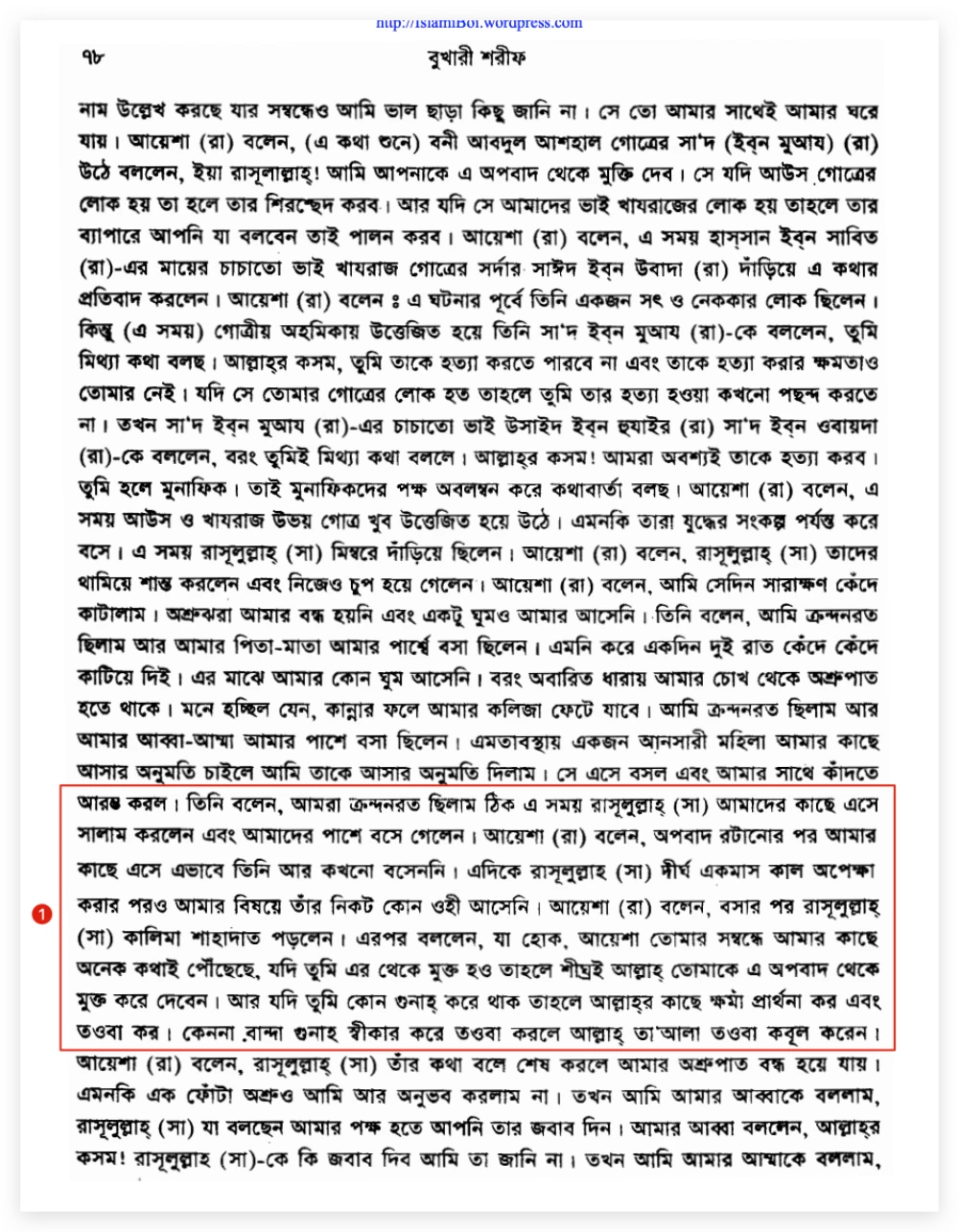
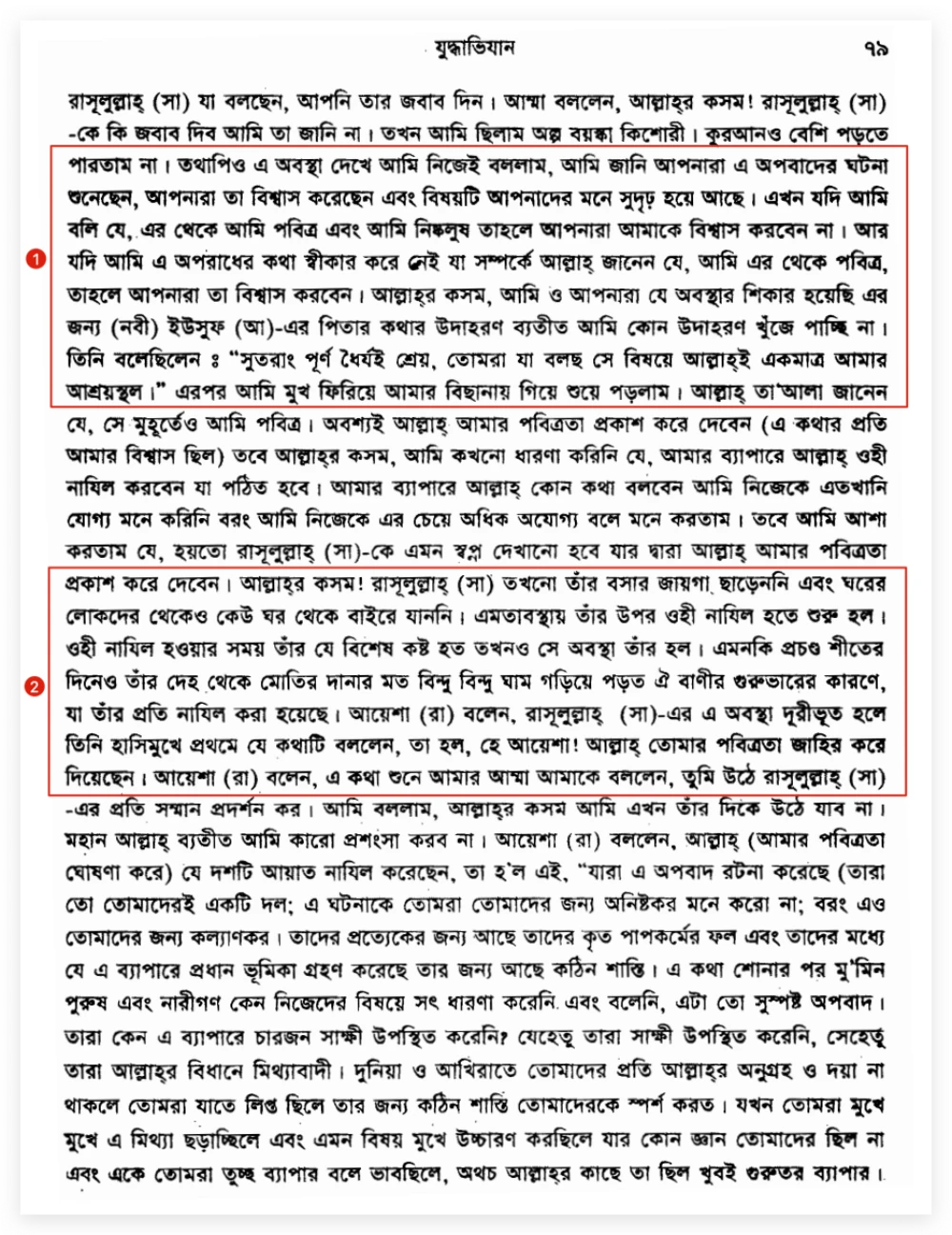
Several “Internal” Anchors in the Primary Source
Bukhari’s lengthy account contains several central, load-bearing points that serve as the pillars of the entire analysis:
- Delayed revelation—According to Aisha’s account, a month passed without any revelation concerning her: “A month had elapsed and no divine inspiration came to him about my case.” — “A full month had passed, yet no revelation concerning me had come to him.”
- While revelation was delayed, the Prophet consulted his Companions—He spoke with Ali and Usama, and the possibility of separation/divorce (“divorcing me”) entered the discussion. — “While revelation was delayed, the Messenger of Allah (ﷺ) summoned Ali ibn Abi Talib and Usama ibn Zayd to ask their advice about separating from his wife—me.”
- “Conditional language” in the Prophet’s statement—The Prophet told Aisha that if she was innocent, Allah would soon declare her innocence, and that if she had sinned, she should repent. — “O Aisha, I have been told certain things about you. If you are innocent, Allah will soon declare your innocence; but if you have committed a sin, seek Allah’s forgiveness and repent to Him, for when a servant admits a sin and repents, Allah accepts that repentance.”
- The incident entered the mosque and became a tribal crisis—Tension between the Aws and Khazraj rose to the brink of armed conflict, creating the possibility of civil strife. — “The Aws and Khazraj became so agitated that they were on the verge of fighting.”
- Only then does “revelation” arrive, directly linking Surah An-Nur 24:11–20 to the incident and issuing commands and rebukes concerning slander, testimony, rumour, and social order.
- Qur’an 24:22 appears as a post-incident moral instruction—The same narration adds the episode in which Abu Bakr stopped supporting Mistah financially and was then instructed to forgive him and resume that assistance.
These are the “anchors.” The central question is therefore: how does this sequence make sense for a divinely guided prophet who is said to communicate regularly with Allah through Gabriel, and how closely does it resemble a social crisis managed by a human leader? How can these events be reconciled with the idea of an infallibly guided prophet?
Suspicion, Emotional Distance, and the “Epistemic” Problem of Prophethood
What Did the Prophet Know—and What Did He Not Know?
In the narration, Aisha says that while the slander was circulating, the Prophet no longer showed her his former affection. He would merely ask, “How is that lady?” and leave—behaviour that aroused Aisha’s suspicion.
Logical questions
| Textual fact | Possible explanation A: informational uncertainty | Possible explanation B: strategic conduct despite certainty | Implication for prophethood |
| The Prophet keeps his emotional distance, shows none of his former affection, asks “How is that lady?” and leaves. | The Prophet himself was doubtful and therefore watched events from a safe distance. | The Prophet was certain of Aisha’s character but adopted the posture of suspicion to manage the social and political situation. | If A: The claim of “certain knowledge from Allah” fails in practice. If B: An innocent person is subjected to psychological pressure within an atmosphere of suspicion, which is morally unjust. |
| The Prophet says: if you are innocent, Allah will reveal it; if you have sinned, repent. | This is conditional speech under uncertainty—the language of ordinary human doubt. | This is pressure-inducing language: even if he knew she was innocent, framing the matter conditionally would not be fair. | If A: Human inference and doubt operate in place of revealed certainty. If B: Conditional language corners her psychologically despite his knowing the truth. |
| Revelation is delayed while consultation and investigation continue. | The Prophet does not know the truth and therefore seeks information from other people. | The Prophet knows the truth but takes time to “manage” the social situation. | If A: Prophethood does not operate as immediate divine direction; decisions emerge from human observation. If B: “Revelation” functions as a later seal of legitimacy, while loyalty, power, and control take precedence over moral clarity. |
The Apologetic Counter-Interpretation
Classical Islamic interpretations argue that the Prophet judged as a human being, did not make unseen knowledge the standard of social law, and followed evidentiary principles; on this view, investigation and consultation were entirely normal.
But the problem remains
In the hadith, Ali raises the option of divorce and taking another wife. That hardly seems like advice one would give to a prophet who receives revelation from Allah. If Ali knew and believed that the Creator of the universe personally sent messages to Muhammad, why would he offer such counsel—especially without certain knowledge of the facts? A more natural and logical recommendation would have been to wait for Allah’s revelation or seek the guidance of the omniscient Allah.
Menstrual Cycles, the Possibility of Pregnancy, and “One Month of Waiting”
The central accusation in the Ifk incident implied a sexual relationship. The slander against Aisha therefore concerned not only social honour but also physical reality. The hadith tells us that Muhammad waited a full month for revelation on the matter. A basic question inevitably follows: if the accusation pointed to an actual sexual encounter, it could have had physical or biological consequences, the most readily observable of which would have involved menstruation/the menstrual cycle.
As a general rule for a woman of reproductive age, ovulation and the formation of the uterine lining occur in a monthly cycle. If conception does not occur, the lining is shed through bleeding, which is menstruation. Consequently, having a period often provides an initial indication that pregnancy did not occur during that cycle. This is why, throughout history and before modern pregnancy tests, the most common early sign that raised suspicion of pregnancy was a missed period.
It is equally true, however, that the menstrual cycle is not a “miracle detector.” Illness, psychological stress, malnutrition, travel, excessive physical exertion, and hormonal irregularity can all delay or interrupt menstruation independently of pregnancy. Light bleeding may also occur in early pregnancy and be mistaken for a period. It is therefore scientifically incorrect to claim that menstruation makes pregnancy absolutely impossible. Yet it is also undeniable that, in ancient societies, the first practical indication of possible pregnancy was a disruption or cessation of the menstrual cycle.
The narration says that revelation did not come for a month, while rumours, tension, the danger of political conflict, and family distress continued to grow. If the objective was simply to declare the truth, such a long delay is itself unusual. Yet one biological time frame fits naturally within it: one month is approximately one complete menstrual cycle. As time passes, a significant practical indicator concerning pregnancy emerges on its own—whether menstruation occurs. This sharpens the question about the timing of revelation: if the menstrual cycle resumed normally after a month, the possibility of pregnancy would be substantially reduced, making a declaration of “innocence” socially less risky and considerably more convenient.
Raising this possibility is not, by itself, an anti-Islamic or merely emotional conjecture. It is a logical suspicion built on three features: the nature of the allegation (sexual slander), the period involved (one month), and the ordinary way pregnancy could be inferred in an ancient setting. The suspicion is this: was the Prophet truly waiting for certain knowledge of the unseen, or was he waiting for an ordinary human “time-check”—the outcome of a menstrual cycle—until the situation became safer? If the second reading is closer to the truth, the “delay in revelation” ceases to be a mystery of divine planning and becomes a mundane crisis-management tactic: allow time to reduce the biological uncertainty concerning pregnancy, and then bring the crisis to a religiously framed conclusion.
An important logical caution is necessary: Bukhari’s text does not directly state that “revelation descended only after the menstrual cycle had been confirmed.” This connection is not explicit; it is a reasoned suspicion derived from the chronology and the nature of the accusation. The resulting question is why, if prophethood entails immediate and accurate divine guidance, this human explanation fits the timeline so naturally. The text does not answer that question, but the question nevertheless emerges from it. Explaining the “one-month delay” solely as a “test of faith” requires setting aside this biological possibility, making that explanation still more dependent on speculation.
“Delayed Revelation”: Divine Plan or Human Timing?
In the narration, “one month” is not merely a calendar interval; it is the duration of a full-scale social conflict. Rumours hardened, incendiary talk spread, a family suffered psychologically, and suspicion, hostility, and factionalism within the community became real political tension. Aisha’s illness and tears, together with the conduct of those around her, show that the episode did not remain a “private slander”; it nearly tore apart Medina’s social order. The month-long delay was therefore a period of injury, pressure, and preparation for a decision, whose consequences later required substantial effort to contain.
The first question is straightforward: if the aim was to declare the truth, why did that declaration not come at the beginning? In any crisis, greater delay normally means greater damage and deeper conflict. From a “divinely guided process,” one would at least expect rapid clarity about truth and falsehood, since the alleged source of information lies beyond human limitations. Here the opposite occurs: uncertainty persists for a month while human strategies are deployed. The pattern resembles not “divine management” but a leader gradually moving toward a resolution—first assessing the situation, observing the reactions of different parties, measuring the likely damage, and only then reaching a final decision.
More importantly, the steps taken while revelation remained delayed form a clear pattern. Counsel was sought, a particular person was questioned, and then an address in the mosque attempted to restrain the crowd. These are not miraculous disclosures of information; they are thoroughly ordinary tools of crisis management. Only when society had become turbulent did verses arrive to “close” the incident. To a critic, that sequence may make the verses appear as a final religious seal placed upon an already unfolding human crisis-management process, conferring ultimate legitimacy on its resolution.
Traditional readings explain the delay differently: as part of a test, a lesson in discipline, and the establishment of social principles. Surah An-Nur 24:11–20 rebukes the casual treatment of rumours, insists on restraint in speech, requires four witnesses, and warns against slander. These provisions can be read as a programme of “community reform.” The interpretation seeks to build a collective norm beyond the personal episode: how society should respond to future slander, how standards of evidence should operate, and how rumour should be treated as a social offence.
The sharper critical question remains: is it morally acceptable to let an innocent person and her family endure a month of humiliation, uncertainty, and emotional devastation in order to deliver a “lesson”? Sustaining this interpretation requires assuming that the value of teaching “community discipline” justifies an innocent person’s prolonged suffering. That is not a minor gap; it is the ethical cost of the defence.
Human Counsel, Witness Inquiry, and “Revelation versus Investigation”
The hadith states that, while revelation did not come, the Prophet consulted Usama and Ali. Ali mentioned the availability of other wives, meaning that separation or replacement was discussed as a practical way to resolve the crisis. Barira was then questioned in an attempt to assess Aisha’s character through the testimony of someone inside the household. The centre of this entire process is “human information,” not the immediate certainty of revelation.
Critically, the implication is starkly simple: the decision-making process first proceeds through social and human channels. With a prophet “guided by the divine,” especially amid a crisis involving the honour of his own household, the minimum expectation is that he would know the truth or become certain of it quickly. Instead, the text presents a step-by-step human routine: counsel, inquiry, a public stance before the crowd, and only then the verses. This sequence can readily be read as the crisis-management framework of a political or social leader; resisting that reading requires additional explanation.
The traditional defence invokes the “principle of evidence.” It argues that the Prophet was to judge before people according to evidence; making unseen knowledge the standard of courts or social policy would destroy the predictability of law. Investigation and consultation should therefore be understood as exemplary legal conduct.
Yet this defence contains an internal tension: if revelation ultimately supplies the “final truth,” what effective role did the preceding human consultation and investigation play? Were they merely a staged completion of the social process, or did genuine uncertainty exist? Both answers are problematic: the first intensifies the moral question, while the second weakens the claim of divine certainty.
The Timing of the Verses and the Question of “Convenience”
Aisha herself says that she expected the matter to be clarified through a dream; she never imagined that revelation concerning her would be “recited forever.” The statement is significant because it conveys her astonishment that a personal incident should become an eternally recited religious text. The episode was not merely resolved; it entered the religious canon permanently.
In a critical reading, the timing appears extraordinarily “effective.” A month has passed, society is in turmoil, the Prophet’s family is under intense pressure, and the Prophet is acting publicly. At that point, the verses solve several problems at once: they declare Aisha innocent, condemn the slanderers, establish rules governing slander for the future, and then, in 24:22, address Abu Bakr and Mistah in a way that begins to mend damaged social relations. Because of this many-sided payoff, a critic may read the episode as “reactive revelation”—the timely production of a text under the pressure of events—particularly because community law emerges immediately after the crisis.
The traditional reading sees this as a process of setting norms. It is said to be greater than the rescue of one individual: it establishes a moral law against slander in society. In 24:11–20, the rebuke of defamatory rumour and the four-witness requirement become part of the formation of community discipline.
Even so, an analytical question cannot be avoided: can the same text accomplish personal rescue, political stabilization, and social legislation all at once, and with such apparent precision? Some will call this the skill of divine planning; others will call it human, need-driven textual construction, because the text’s effectiveness is greatest exactly where the unfolding events require it.
A “Near-War” Situation: Power, Identity, and the Real Politics of a Religious Community
Many readers may treat the part in which the Aws and Khazraj nearly clash as a side episode, but it is in fact the political nucleus of the entire incident. It shows that the Ifk was not merely a “moral debate”; it was splitting the community over questions of power and identity. The rumour first attacks an individual’s character, then produces factional bias, then tribal conflict, and finally peace through the intervention of the central leader. This pattern is not a distinctive feature of a “divine society”; it is a familiar form of human social politics.
A critic may ask: if continuous divine intervention truly existed, why was the crisis allowed to develop so far, and why was so much social deterioration permitted? The traditional interpretation answers that truth and falsehood are not distinguished without a test, people must learn, and pressure is therefore natural; the verses descend at the end to establish the correct principle. Yet this interpretation returns to the same question: how much social division and psychological destruction can be morally justified in the name of a test?
The Historical-Critical Layer: Narrative Formation, Multiple Transmissions, and Canonization
A semi-academic reading introduces another layer: how this account became “fixed.” The Ifk appears through multiple chains in different collections, and modern discussions often note the close similarity between the Bukhari and Muslim versions, especially in transmissions based on al-Zuhri. This can point in two directions. On the one hand, similar reports in many places strengthen the event’s presence within the tradition. On the other, repetition of the same language and structure may indicate that the narrative was standardized within a particular transmission stream, blurring the boundary between “exact history” and an “instructive narrative.”
Considerable caution is needed before reaching a conclusion. The label “sahih” does not automatically turn a narration into evidence of divine origin, because sahih is fundamentally a claim about the credibility of transmission, not proof of a metaphysical source. Conversely, the presence of human elements does not automatically make the account false. The sharper and more specific question is what tension this narration—its timing, human decision-making, social conflict, and text-based resolution—creates with the claim of prophethood, and how many additional assumptions religious defences must introduce to reduce that tension.
Summary Assessment: What “This Hadith” Shows—and What It Does Not
What the Text Strongly Establishes
Several features are undeniably present in the account because they are part of its direct sequence rather than later interpretation. First, according to Aisha, the Prophet made no final declaration for a considerable period. The path he followed instead resembles an ordinary human crisis process: consultation, questioning within the household, and finally an attempt to secure social support or control through a public speech in the mosque. This chain is not the language of miraculous certainty; it is the practical language of crisis resolution by social leadership.
Second, Surah An-Nur 24:11–20 is positioned in the narration so that it performs two functions simultaneously: it resolves the incident by declaring Aisha innocent and condemning the slanderers, while also using the episode to establish principles governing rumour, testimony, moral restraint, and social order. The verses therefore do not remain merely “spiritual advice”; they operate as directives that regulate social behaviour.
Third, the incident produces real division and conflict. Tribal tension in the mosque rises until the Aws and Khazraj stand at the brink of fighting, requiring direct intervention by the leadership. This is therefore far more than moral discussion; it is the real politics of power, identity, and social control.
What Questions This Hadith Raises about Prophethood and the Qur’an’s Source
The text places the claim of prophethood under pressure along three main axes. These are not separate problems; they reinforce one another. The first is epistemic pressure. If prophethood means “certain knowledge from a higher source,” why does uncertainty last so long, and why is there such reliance on human channels? The text shows consultation and inquiry becoming the operative process while revelation is delayed. This conflicts with the idea of divine certainty.
The second axis is temporal pressure. The verses arrive when social tension is at its peak, personal and political damage has accumulated, and the crisis is close to escaping control. Their arrival at this “moment of greatest need” admits two readings: it may be presented as a skilful “divine plan,” or read critically as a timely textual solution produced under the pressure of events. The text itself leaves the door open to both readings, which is why the question is real.
The third axis is functional pressure. The Qur’an’s role here is not merely spiritual; it appears directly as an instrument of social governance, providing the central regulatory language for rumour, punishment, ethics, standards of testimony, and social order. At the same time, it resolves a personal crisis. This “multiple functionality within a single text” may appear to some as evidence of divine competence and to others as a sign of need-driven political and social text-production.
The following table presents these three pressures at a glance:
| Type of pressure | What the text contains | Why it pressures the claim of prophethood or divine origin |
| Epistemic | No certain declaration for a long period; consultation, questioning, and social action continue. | The human decision-making process becomes operative in place of “certain divine knowledge.” |
| Temporal | The verses arrive after the crisis peaks, resolving it and establishing policy. | This can be read either as a “divine plan” or as a “need-driven reactive text.” |
| Functional | The verses simultaneously rescue an individual and establish norms of social governance. | The Qur’an assumes an immediate administrative and disciplinary role, intensifying the question of its source. |
But What Is Difficult to Call “Definitive Proof”
It is not a logically necessary conclusion to leap from this hadith directly to “the Qur’an is a human composition.” Traditional frameworks—testing, teaching social discipline, and modelling legal procedure—can be made to fit parts of the text. One may therefore argue that the delay was educational, the investigation established a judicial precedent, and the revelation of the verses was the final stage in founding a moral law.
Yet accepting these apologetic interpretations requires a costly assumption: as part of a “divine plan,” an individual is left for an extended period amid public slander, emotional suffering, and family uncertainty, after which the ordeal must be accepted as a just form of “instruction” or “testing.” This moral price cannot be avoided when defending the text. Here lies the hadith’s central challenge: it is not merely a dispute about facts but a source of both moral and epistemic pressure on the claim of prophethood.
A “Test of Faith” from Allah
A common apologetic interpretation holds that the Ifk was a “test of faith” from Allah: through the episode, Allah supposedly intended to reveal whose faith was firm and whose was fragile. At first glance this may sound attractive, but it does not stand logically, because the concept of a “test” is being applied in the wrong place. If an omniscient Allah already knows the state of every heart—its motives, doubts, and certainties—there is no epistemic need to create a month-long social and psychological catastrophe in order to discover “who has faith and who does not.” Tests ordinarily obtain information that is not yet known. If omniscience is accepted, nothing relevant should be unknown. The “verification of faith” argument therefore tacitly diminishes Allah’s omniscience; otherwise, the test lacks an intelligible purpose.
Even if the purpose was not to learn anything, but rather to “expose what lies in human hearts” or “place each person in a revealed position,” the outcome remains questionable. What did the incident actually produce? Many who participated in the slander or entertained suspicions later expressed regret or sought forgiveness, and relations returned to normal. Suspicion or mistaken speech about Aisha therefore does not map neatly onto an absence of faith. Another point deserves mention: Ali, a Companion promised Paradise and Islam’s fourth caliph, advised the Prophet that he could divorce Aisha and take another wife. Does that mean Ali failed this test of faith?
The larger question is that the accusation concerned Aisha’s character, not Allah’s existence. Whether Aisha committed adultery is a factual, social, and moral question, but it has no direct logical bearing on the existence of Allah or on monotheism. Allah could exist even if Aisha were guilty, and Allah could be unreal even if Aisha were innocent; no logical necessity connects the two. Calling the episode a “test of faith” is therefore a conceptual mistake. At most, it can function as a lesson in “community discipline”: the Prophet’s family must be presumed innocent regardless of the allegation. On that logic, not only the Prophet but his family must be believed without waiting for evidence—an institutional form of familial authority. Conflating this with faith in Allah is logically irrelevant.
The most serious point avoided by the apologetic explanation is that, according to the narration, the atmosphere of suspicion emerged from the centre itself. The Prophet made no certain declaration for a long time, maintained emotional distance, sought advice, and conducted inquiries. When the leader himself appears uncertain—should that be described as weakness of faith?—suspicion among many followers is not “faithlessness” but an ordinary human response. The faith-test theory therefore requires two incompatible claims: “Allah was testing faith” and “the Prophet himself was not certain.” The result is that, in defending the interpretation, the Prophet’s own faith becomes implicated. Making doubt the criterion of faith is therefore artificial. If doubt signals faithlessness, the uncertainty at the centre of the entire episode must be judged by the same standard, under which both the Prophet and Ali become evidence of failed faith—shaking the foundation of the religious narrative itself.
The interpretation that “it was a test of faith” therefore fails logically from two directions: its purpose becomes meaningless when set against the claim of omniscience, and the nature of the incident is not directly connected to faith in Allah, making the proposed result incoherent as well. In practice, the interpretation mainly creates a convenient religious frame in which the month-long delay can appear morally acceptable. But a frame does not create logic. In this case, one assumption after another must be added to sustain the “test of faith” argument, none of which follows automatically from the text itself.
Conclusion: One Hadith, Many Hidden Layers
Bukhari’s account of the Ifk (4141) is not merely a “family story.” It is simultaneously a live case study in personal crisis, the balance of social power, the construction of legal norms, and the establishment of religious authority. The episode is not confined to the question of who was guilty or innocent. It shows how rumour inflames a society, how leadership manages public support, how human channels—consultation, questioning, and public speech—are activated in decision-making, and how the crisis is finally closed through religious language. Because these layers coexist, the hadith is not merely history; it is raw textual evidence through which the practical operation of a claim to prophethood can be assessed.
For a “neutral reader,” the question raised by this account is simple but potentially devastating. If prophethood means immediate, accurate, and consistent divine guidance, the delay, dependence on consultation, and conditional or doubt-like language found here directly conflict with that definition. A month without divine clarification, followed by reliance on human advice and testimony and, finally, the securing of a decision through verses, does not look like divinely guided certainty. It resembles the way a human leader might work through a crisis. The narration therefore makes the claim of prophethood something that requires interpretation rather than something self-evident.
On the other hand, the narration can be reconciled with religious claims if prophethood is defined so that the Prophet fundamentally works within human reality and revelation arrives only in particular situations as a limited intervention. But the cost is substantial: the popular idea that “the Prophet constantly receives infallible knowledge from an omniscient source” must be scaled back. Prophethood then ceases to mean “infallible, immediate guidance” and becomes an occasional legitimating intervention superimposed on a human process. This is not merely an interpretive adjustment; it narrows the theological scope of prophethood.
The central argument therefore comes down to this: a lengthy and widely accepted sahih narration does not turn the claim of prophethood into self-proving evidence; instead, it makes that claim dependent on explanation and subject to tension. This tension creates a genuine question about the Qur’an’s source, because the same sequence can be read either as the flawless operation of a divine plan or as a timely textual solution produced under pressure. The text does not automatically compel either reading. Yet evading the pressure it creates requires additional assumptions, additional defences, and additional layers of explanation.
References
- Sahih al-Bukhari, Islamic Foundation edition, Hadith 3835; international numbering 4141; canonical English verified at https://sunnah.com/bukhari:4141 ↩︎