
Summary
This article examines, in light of Sahih al-Bukhari and several early Islamic commentaries and historical works, the episodes involving women known as Jauniyya and Umayma in relation to Muhammad, focusing on consent, sexual autonomy, and power. In Sahih al-Bukhari, when a woman is brought to Muhammad, he tells her, “Give yourself to me.” She rejects the proposal, describes herself as a princess, and refers to Muhammad as a “market commoner.” When Muhammad then reaches his hand toward her, she says, “I seek refuge with Allah from you.” In another sahih report, Umayma bint Sharahil is described as Muhammad’s wife, yet the same narration states that when Muhammad stretched his hand toward her, she disliked it. The central question, therefore, is not merely whether some form of marriage or marriage contract existed with the women concerned, but whether they themselves freely consented to the relationship and to physical intimacy.
The article also examines the debate over whether Jauniyya and Umayma were the same woman or different women. Alongside the linguistic differences among Bukhari’s reports, Ibn Hajar al-Asqalani’s Fath al-Bari is cited to show that he too regarded the possibility of multiple incidents as strong and stated directly, in the case of one of the women concerned, that no marriage contract had been concluded with her; Muhammad had only gone to propose marriage to her. At the same time, the fact that a report appears under a chapter concerning “divorce” does not mean that the woman’s marital status can be settled solely from that chapter heading. The example of the killing of the Jewish man Abu Rafiʿ under Bukhari’s chapter “Killing a Sleeping Mushrik” shows that chapter headings in hadith collections may function as the compiler’s fiqhi classification rather than as a literal historical identification of every person mentioned in a report.
More importantly, the article analyzes Muhammad’s special marital privileges, or khaṣāʾiṣ, in classical Islamic jurisprudence. Ibn Hajar’s discussion states that Muhammad could contract a marriage for himself with a woman without the permission of either the woman or her guardian, and even explains that sending for the woman, having her brought before him, and Muhammad’s desire for her could be sufficient under this special dispensation. Imam al-Nawawi’s Rawdat al-Talibin, Ibn Qudama’s al-Mughni, and Ibn Kathir’s tafsir are also cited to show that, in Muhammad’s marriages, special exceptions were recognized to conditions applicable to ordinary Muslims, including the wali, witnesses, mahr, and even the woman’s permission. Thus, the claim that “she was his wife” does not resolve the question of consent, because within the same classical fiqhi framework, the existence of a marriage and the woman’s independent consent to that marriage become two separate questions.
The article further argues that some later Islamic explanations attempted to reinterpret Jauniyya’s rejection through stories about an alleged scheme by Aisha and Hafsa, claims about the woman’s mental condition, or attempts to soften the force of the term “bazaaria,” whereas the core Bukhari reports present a continuous pattern of direct rejection in the woman’s words and conduct. A report in al-Bidaya wa al-Nihaya is also discussed in which, after the woman sought Allah’s refuge from Muhammad and Muhammad came out angry or distressed, al-Ashʿath consoled him and offered his own, more beautiful sister Qutayla in marriage. The article analyzes this episode as part of a broader social mentality in which women could be treated as instruments for male desire, prestige, and emotional gratification around centers of power.
Ultimately, the central issue of the article is whether calling a relationship “marriage” in religious or fiqhi language is by itself sufficient to establish its moral legitimacy, or whether the woman’s own free, informed, and revocable consent is the decisive criterion. When the accounts of Jauniyya and Umayma, their rejection, the classical fiqh of Muhammad’s special marital privileges, and the related historical narratives are placed side by side, the article argues that a woman’s personal consent could easily become secondary to power and religious privilege. For that reason, these incidents are not merely episodes in the private relationships of the seventh century; they raise a fundamental moral question that remains directly relevant to the claim that Muhammad should be regarded as a moral model for all times.
Summary of the article’s content and evidence
| Topic | Core information and evidence | Main source | Analytical significance |
|---|---|---|---|
| Jauniyya’s rejection | Muhammad tells the woman, “Give yourself to me.” She presents herself as a woman of royal or noble status and disparages Muhammad as al-sūqah, a common or market-class person. When Muhammad physically moves toward her, she says, “I seek refuge with Allah from you.” | [1] | The woman’s own words and conduct provide direct evidence of rejection and of unwillingness toward physical intimacy. |
| Drawing near | In another sahih report from Aisha, when the daughter of al-Jaun was brought to Muhammad, he وَدَنَا مِنْهَا, that is, drew near to her. At that moment she sought Allah’s refuge from him. | [2] | The rejection is directly connected to Muhammad’s physical approach. |
| Advancing to kiss her | Some early reports describe Muhammad’s advance more specifically with the wording فَأَهْوَى إِلَيْهَا لِيُقَبِّلَهَا, meaning “he moved toward her to kiss her.” | [3] [4] | This substantially narrows the possibility of treating Bukhari’s “stretching out his hand” as merely an innocuous calming gesture. |
| Ibn Hajar’s explanation | While explaining Bukhari’s فأهوى بيده, Ibn Hajar cites Ibn Saʿd’s variant, which explicitly contains ليقبلها, “to kiss her.” | [5] | The interpretation involving a kiss is not an invention of a modern critic; it is preserved in the classical commentary on Bukhari. |
| The Umayma episode | Another sahih report says that Muhammad married Umayma bint Sharahil. When she was brought to him, he stretched his hand toward her and she disliked it. She was then sent back to her family. | [6] | Even while she is described as married, the woman’s physical unwillingness is separately recorded. |
| One woman or multiple women | After analyzing inconsistencies among the reports, Ibn Hajar writes فَيَقْوَى التَّعَدُّدُ, meaning that the possibility of multiple incidents becomes stronger. He says that a contract had been concluded with one woman, while in the other case لَمْ يُعْقَدْ عَلَيْهَا, no contract had been concluded. | [7] | The reports cannot simply be forced into a single harmonized story of one woman’s marriage and divorce. |
| The Prophet’s authority to marry without the woman’s permission | Ibn Hajar’s cited explanation states that Muhammad could marry a woman to himself without her permission and without the permission of her wali; sending for her, having her brought, and his desire for her could be sufficient. | [8] | The claim “she was his wife” does not establish the woman’s independent consent; classical commentary itself recognizes a framework in which marriage could be effective without it. |
| Al-Nawawi on the Prophet’s khaṣāʾiṣ | Imam al-Nawawi states that if Muhammad wished to marry an unmarried woman, then according to the sound view she was obliged to respond positively. He could marry the woman to himself without her permission or that of her wali. | [9] | This privilege is not merely an ad hoc idea invented to explain Jauniyya’s case; it is treated as part of the Prophet’s special marital law in classical fiqh. |
| Exceptions from wali, witnesses, and mahr | Ibn Qudama mentions marriage without a wali and witnesses as a special privilege of Muhammad. Ibn Kathir likewise states that he could marry without mahr, wali, or witnesses. | [10] [11] | It is historically inaccurate to assume that Muhammad’s marriages operated under precisely the same procedural rules as those of ordinary Muslims. |
| Hiba, or giving oneself to the Prophet | Qur’an 33:50 and classical tafsir specifically mention a believing woman who gives herself to the Prophet. This arrangement is distinct from ordinary Muslim marriage. | [12] [13] | Muhammad’s words to Jauniyya, هبي نفسك لي, use the language of a specific prophetic marital privilege, not ordinary marital conversation. |
| Aisha’s reaction | Aisha objected to women who offered themselves to the Prophet. After 33:51 was revealed, she told Muhammad, ما أرى ربك إلا يسارع في هواك, meaning that his Lord seemed quick to satisfy his desire. | [14] | The Prophet’s special marital privileges were visible and discussed within his own household. |
| Chapter title versus historical identity | In Bukhari, the killing of the Jewish man Abu Rafiʿ appears under the chapter “Killing a Sleeping Mushrik.” | [15] | The fact that a hadith appears in a divorce chapter does not mean that the woman’s marital status can be established solely from the chapter heading. |
| A companion offers his sister after the rejection | A historical report says that after the woman sought Allah’s refuge from Muhammad, Muhammad came out angry or distressed. Al-Ashʿath then offered his own, more beautiful sister Qutayla to Muhammad in marriage. | [16] | The episode exposes a social structure in which women could be treated as transferable marriageable assets among men rather than as autonomous agents. |
| Later explanatory reconstruction | Some later reports claim that Aisha and Hafsa taught the woman to say a particular phrase, while others add stories about her mental state or identity. | [17] [18] | Later tradition developed different rescue narratives to explain the direct rejection found in the core account. |
| Selective preservation in early sira | Ibn Hisham himself states that he omitted some material from Ibn Ishaq, including reports whose mention was objectionable or displeasing to some people. | [19] | The early Islamic historical tradition was not a purely mechanical or neutral process of preservation. |
| The article’s central conclusion | Whether a marriage contract existed is not the only question. The central question is whether the woman herself freely wanted the relationship and the physical intimacy. Rejection, physical discomfort, and the statement “I seek refuge with Allah from you” recur in the preserved reports. | Sahih al-Bukhari, Ibn Saʿd, Ibn Hajar, al-Nawawi, Ibn Qudama, Ibn Kathir, and related historical sources | The word “marriage” is not itself proof of consent. Classical Islamic sources recognize prophetic marital privileges under which the woman’s independent permission was not required in the same way as in ordinary nikah. |
Introduction
When analyzing the life of a historical figure, personal conduct is no less relevant than political success, military victories, religious teachings, or influence over followers. This is especially true when the person is presented not merely as a historical leader but as a moral ideal to be imitated for all time. In that case, there is no logical reason to place his personal relationships beyond criticism. The question is particularly important in Muhammad’s case because many episodes from his private life, marriages, sexual relationships, and treatment of women later became sources for Islamic law, morality, and social norms. Even today, in many societies, his conduct is presented as an ideal to be followed. These episodes therefore belong not only to the private history of the seventh century; they retain moral significance in the present.
The central issue in this discussion is consent: whether a woman freely agreed to a relationship, marriage, or physical intimacy. In modern sexual and marital ethics, consent is a fundamental principle. Family approval, social custom, religious rules, or the wishes of a powerful person cannot substitute for an individual’s own consent to enter a relationship. Seventh-century Arabian society was of course different from the modern world. Women’s social status, the structure of marriage, slavery, female captives of war, and male authority within the family all operated differently. [20] [21] Even in the relatively recent past, many societies attached little importance to women’s independent opinions in marriage. Historical reality, however, does not automatically make a practice moral, particularly when the person involved is claimed to be a universal moral model transcending time and society.
This article focuses on Muhammad’s conduct toward one or more women known as Jauniyya and Umayma. In one report in Sahih al-Bukhari, a woman is brought to Muhammad and he tells her, “Give yourself to me.” She rejects the proposal, presents herself as a princess, and calls Muhammad a “market commoner.” Muhammad then reaches his hand toward her, whereupon she says, “I seek refuge with Allah from you.” Another sahih report describes Umayma bint Sharahil as Muhammad’s wife, yet there too, when Muhammad stretches his hand toward her, the woman dislikes it. These accounts immediately raise several basic questions. If the woman was already his wife, where is her own consent? Why was it necessary to tell her, “Give yourself to me”? Why did she reject Muhammad? Why did she seek Allah’s refuge from him? Most importantly, if a fiqhi system classified a woman as a “wife,” does that by itself prove that she freely accepted the relationship?
These questions are not inventions of modern critics. Classical Islamic commentary itself records complications concerning the marriage and divorce involved in this episode. In Fath al-Bari, Ibn Hajar al-Asqalani directly cites the objection: if no marriage contract is described and the woman refused to give herself to Muhammad, how could he divorce her? The answer he transmits invokes a special marital privilege under which Muhammad could marry a woman to himself without the permission of the woman or her guardian. More importantly, this idea is not confined to a single isolated interpretation by Ibn Hajar. Imam al-Nawawi’s Rawdat al-Talibin, Ibn Qudama’s al-Mughni, Ibn Kathir’s tafsir, and other classical Islamic texts discuss Muhammad’s marital khaṣāʾiṣ, or special privileges, including exceptions from multiple conditions applied to ordinary Muslim marriages. Consequently, the statement “he married her” cannot simply close the problem of consent, because classical fiqh itself did not necessarily treat “a marriage existed” and “the woman freely consented to that marriage” as the same proposition.
The article also examines several related questions: whether Jauniyya and Umayma were the same woman or two different women; what the wording of Bukhari’s reports actually indicates; how far a hadith chapter heading can be used as historical evidence; how classical fiqh understood hiba, or a woman giving herself to the Prophet; and what additional narratives later commentators used to explain the more uncomfortable features of the episode. Another example from Sahih al-Bukhari will show that a chapter heading does not necessarily provide a literal identification of every person or event within it. Likewise, alongside later harmonizing interpretations of Jauniyya and Umayma’s identities, Ibn Hajar’s own statement will be considered, in which he regards the possibility of multiple incidents as strong.
The purpose of the article, therefore, is not to generate curiosity about a historical figure’s private life, but to examine a specific moral question through documentary evidence. In Muhammad’s relations with these women, how much practical force did the women’s own wishes, rejection, and consent actually have? Can religious privilege, a father’s decision, the fiqhi validity of a marriage, or the interest of a powerful man substitute for a woman’s personal consent? The article addresses these questions by placing side by side the reports preserved in sahih hadith, classical commentary, fiqh, tafsir, and Islamic historiography.
What Is Rape or Sexual Abuse?
At the outset, it is necessary to clarify what is meant by rape and sexual abuse. Rape is sexual intercourse imposed on another person through physical force, coercive pressure, blackmail, abuse of authority, or any other means that overrides the person’s voluntary consent. Sexual intercourse with a person who is incapable of giving meaningful consent, such as someone who is unconscious, severely cognitively impaired, mentally incapacitated, or underage, also falls within the scope of rape under relevant legal definitions. In other words, when an adult does not knowingly and voluntarily consent, sexual intercourse imposed on that person constitutes rape. Unwanted sexual conduct imposed on another person also constitutes sexual abuse or sexual assault. This includes unwanted touching and the use of power or pressure to obtain compliance with sexual acts. A person who commits such acts is a sexual abuser or assailant. Likewise, when an adult induces a child or minor to participate in sexual activity, the conduct constitutes child sexual abuse and may fall under statutory rape or related criminal offences.
With that definition in mind, let us examine whether Muhammad’s conduct in the following reports amounts to sexual abuse.
A Plain Reading of the Hadith: The Prophet’s Sexual Abuse of Jauniyya
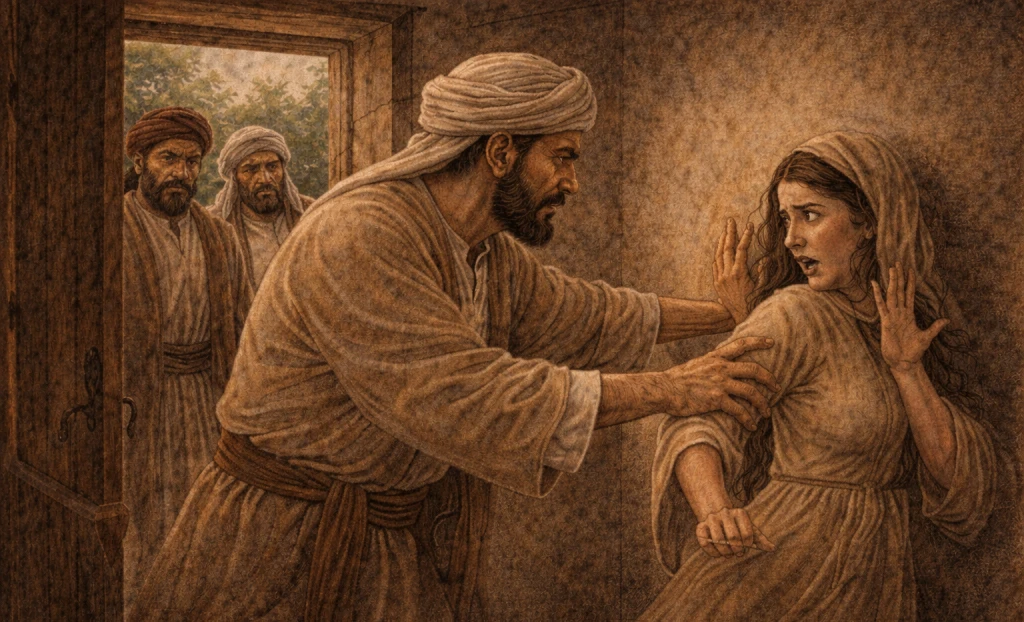
Sahih al-Bukhari reports that Muhammad once went with his companions to a walled garden called al-Shaut. A young woman was specifically brought there for him. It is worth noting that she was brought neither to Muhammad’s own residence nor to her father’s home, but to a secluded garden house. In Arabia at the time, such enclosed garden houses were commonly used for private recreation or secluded sexual encounters. The significance of choosing such a setting is not difficult to understand.
After entering, Muhammad directly told the woman to give herself to him as a hiba. He had left his companions seated outside while he went in alone, so that they could wait for the Prophet’s “business” to be completed. The woman rejected the proposal with contempt. Presenting herself as a princess or woman of royal status, she asked whether a princess would ever give herself to a low-status market commoner. The narration makes clear that she was angry and hostile to the proposal.
Muhammad then extended his hand toward her and attempted to place it on her body. The woman, as a final means of protecting herself, said, “I seek refuge with Allah from you.” Once she invoked Allah for protection, Muhammad did not proceed further and let her go.
An important possibility arises here. The hadith states that a nurse or dāya was present to attend to the woman. In the social setting of the time, such attendants were commonly associated with young or dependent girls. Under classical Islamic rules concerning the marriage of minors, a father’s authorization could be treated as sufficient and the girl’s own consent was not necessarily required. The article therefore raises the possibility that this woman may have been underage, and that she was brought for a relationship with Muhammad on the basis of paternal consent, or even under coercive circumstances.
Another possibility is that the woman was brought to the garden house without a completed marriage and Muhammad then asked her directly to make a hiba of herself to him. Whether she was in fact Muhammad’s legally recognized wife and how hiba functioned in his special marital law will be examined later. For the moment, consider the report itself. [22]
Sahih al-Bukhari
Book 68: Divorce
Chapter: Should a man tell his wife face to face that she is divorced?
5255. Narrated Abu Usaid: We went out with the Prophet (ﷺ) to a garden called Ash-Shaut till we reached two walls between which we sat down. The Prophet (ﷺ) said, “Sit here,” and went in (the garden). The Jauniyya (a lady from Bani Jaun) had been brought and lodged in a house in a date-palm garden in the home of Umaima bint An- Nuʿman bin Sharahil, and her wet nurse was with her.
When the Prophet (ﷺ) entered upon her, he said to her, “Give me yourself (in marriage) as a gift.” She said, “Can a princess give herself in marriage to an ordinary man?” The Prophet (ﷺ) raised his hand to pat her so that she might become tranquil. She said, “I seek refuge with Allah from you.” He said, “You have sought refuge with One Who gives refuge. Then the Prophet (ﷺ) came out to us and said, “O Abu Usaid! Give her two white linen dresses to wear and let her go back to her family.
Reference: Sahih al-Bukhari 5255, Book 68, Hadith 5.
Grade: Sahih.
Not Merely Reaching Out a Hand: Early Reports Describe an Advance to Kiss Her
In the Bengali translation of Sahih al-Bukhari 5255, Muhammad’s action is described as extending his hand toward the woman “to place it on her body so that she might become calm.” But when other early accounts of the incident are read alongside the classical commentary on Bukhari, a more explicit description of this physical advance appears within the Islamic tradition itself. Even the immediately preceding report, Sahih al-Bukhari 5254, states through Aisha that when the daughter of al-Jaun was brought to Muhammad, he وَدَنَا مِنْهَا, meaning that “he drew near to her.” At that moment she said, “I seek refuge with Allah from you,” after which Muhammad told her to return to her family. [23]
Sahih al-Bukhari
Book 68: Divorce
Chapter: Should a man tell his wife face to face that she is divorced?
5254. Al-Awzaʿi reported that he asked al-Zuhri which of the wives of the Prophet (ﷺ) had sought refuge with Allah from him. He said, “I was told by ʿUrwa that ʿAisha said, ‘When the daughter of Al-Jaun was brought to Allah’s Messenger (ﷺ) (as his bride) and he went near her, she said, “I seek refuge with Allah from you.” He said, “You have sought refuge with The Great; return to your family.”’
بَاب مَنْ طَلَّقَ وَهَلْ يُوَاجِهُ الرَّجُلُ امْرَأَتَه“ بِالطَّلاَقِ
الْحُمَيْدِيُّ حَدَّثَنَا الْوَلِيدُ حَدَّثَنَا الأَوْزَاعِيُّ قَالَ سَأَلْتُ الزُّهْرِيَّ أَيُّ أَزْوَاجِ النَّبِيِّ صلى الله عليه وسلم اسْتَعَاذَتْ مِنْه“ قَالَ أَخْبَرَنِي عُرْوَةُ عَنْ عَائِشَةَ أَنَّ ابْنَةَ الْجَوْنِ لَمَّا أُدْخِلَتْ عَلٰى رَسُوْلِ اللهِ صلى الله عليه وسلم وَدَنَا مِنْهَا قَالَتْ أَعُوذُ بِاللهِ مِنْكَ فَقَالَ لَهَا لَقَدْ عُذْتِ بِعَظِيمٍ الْحَقِي بِأَهْلِكِ.
قَالَ أَبُو عَبْد اللهِ رَوَاه“ حَجَّاجُ بْنُ أَبِي مَنِيعٍ عَنْ جَدِّه„ عَنْ الزُّهْرِيِّ أَنَّ عُرْوَةَ أَخْبَرَه“ أَنَّ عَائِشَةَ قَالَتْ
الحميدي حدثنا الوليد حدثنا الاوزاعي قال سالت الزهري اي ازواج النبي صلى الله عليه وسلم استعاذت منه“ قال اخبرني عروة عن عاىشة ان ابنة الجون لما ادخلت على رسول الله صلى الله عليه وسلم ودنا منها قالت اعوذ بالله منك فقال لها لقد عذت بعظيم الحقي باهلك. قال ابو عبد الله رواه“ حجاج بن ابي منيع عن جده„ عن الزهري ان عروة اخبره“ ان عاىشة قالت
Grade: Sahih.
In Bukhari 5255, the physical movement is expressed as فَأَهْوَى بِيَدِهِ عَلَيْهَا, language describing his hand moving toward her. A report of the same sequence preserved from Abu Usaid in Ibn Saʿd’s al-Tabaqat al-Kubra is more specific. It states that when Muhammad reached the woman, he crouched or lowered himself and moved toward her in order to kiss her. She immediately said, “I seek refuge with Allah from you.” Muhammad then turned away from her and instructed Abu Usaid to return her to her family. [24]
فَلَمَّا أَتَاهَا أَقْعَى وَأَهْوَى لِيُقَبِّلَهَا
English translation: When he came to her, he crouched down and moved toward her in order to kiss her.
This wording is particularly important because it is not a modern critic arbitrarily imposing a sexual meaning on an ambiguous phrase in Bukhari. In Fath al-Bari, Ibn Hajar al-Asqalani himself explains Bukhari’s فأهوى بيده, “he moved his hand toward her,” and directly cites this variant from Ibn Saʿd. Ibn Hajar first explains the expression as indicating that Muhammad inclined her toward himself or moved his hand toward her, and then immediately notes that Ibn Saʿd’s narration has the wording فأهوى إليها ليقبلها, that is, “he moved toward her to kiss her.” [25]
وَوَقَعَ فِي رِوَايَةِ ابْنِ سَعْدٍ: فَأَهْوَى إِلَيْهَا لِيُقَبِّلَهَا
English translation: Ibn Saʿd’s narration states: “He moved toward her in order to kiss her.”
More importantly, this wording is not isolated to a single passage in Ibn Saʿd. The same episode is preserved through Abu Usaid in Abu Nuʿaym al-Isfahani’s Maʿrifat al-Sahaba. There too, Muhammad comes to the woman and crouches on his knees, then فأهوى إليها ليقبلها, moves toward her to kiss her. When she says, “I seek refuge with Allah from you,” he turns away and she is sent back to her family. [26] [27] Similar wording is also preserved in al-Baladhuri’s Ansab al-Ashraf, where, after the woman from Banu al-Jaun is brought, Muhammad is described as moving toward her to kiss her. [28]
Placed side by side, these reports make it untenable to present Bukhari’s phrase “he stretched his hand toward her” only as “an innocuous attempt to calm the woman”. Another sahih report in Bukhari says Muhammad drew near to her; Ibn Saʿd describes the advance explicitly as an attempt to kiss her; the same wording is preserved by Abu Nuʿaym and al-Baladhuri; and, most importantly, Ibn Hajar himself cites this variant while explaining the relevant wording in Bukhari. In other words, a clear strand within the Islamic tradition understood Muhammad’s physical movement not merely as a gesture with the hand but as an advance toward physical intimacy, specifically toward kissing the woman.
The dispute over whether Jauniyya, Umayma, Asma, or the women named in the various reports were always the same individual does not erase the significance of this evidence. Ibn Hajar himself considers the possibility of multiple incidents stronger because of the differences between the reports. The most cautious formulation, therefore, is this: in at least one important strand of the early Islamic reports concerning Muhammad and this woman or these women, his physical advance is preserved not merely as “stretching out a hand” but explicitly as “moving toward her to kiss her.” Immediately after that advance, the woman’s response is أَعُوذُ بِاللَّهِ مِنْكَ: “I seek refuge with Allah from you.”
This is precisely why the episode matters from the standpoint of consent. If the woman had voluntarily welcomed Muhammad’s physical intimacy, seeking Allah’s protection from him in response to his approaching her or moving to kiss her would make little sense. Instead, the early accounts display a consistent pattern: Muhammad approaches the woman or advances physically; the woman immediately seeks Allah’s refuge from him; Muhammad then stops and has her returned. Presenting this as an ordinary scene of mutually desired marital intimacy is therefore inconsistent with the conduct preserved in the Islamic sources themselves.
What Does “Bazaaria” Mean in Islamic Texts?
Unless one approaches the report through devotional reverence alone, the contempt in the woman’s remark is difficult to miss. She is not speaking neutrally about Muhammad’s occupation; she is belittling him through a contrast between herself as a malika, a princess or woman of royal status, and him as one of the al-sūqah, the ordinary market-going people or commoners. To understand the negative associations attached to the market in Islamic texts, it is useful to compare another sahih report. [29]
Sahih Muslim
The Book of the Merits of the Companions
Chapter: The Virtues Of Umm Salamah, The Mother Of The Believers (RA)
2451. Salman reported:
In case it lies in your power don’t be one to enter the bazar first and the last to get out of that because there is a bustle and the standard of Satan is set there. He said: I was informed that Gabriel (Allah be pleased with him) came to Allah’s Apostle (ﷺ) and there was with him Umin Salama and he began to talk with him. He then stood up, whereupon Allah’s Apostle (ﷺ) said to Umm Salama: (Do you know) who was he and what did he say? She said: He was Dihya (Kalbi).
He reported Umm Salama having said: By Allah, I did not deem him but only he (Dihya) until I heard the address of Allah’s Apostle (ﷺ) informing him about us. He (the narrator) said: I said to Uthman: From whom did you hear it? He said: From Usima b. Zaid.
Reference: Sahih Muslim 2451, Book 44, Hadith 145.
Grade: Sahih.
Another relevant hadith should also be considered. [30]
Sahih Muslim
Book 5: The Book of Mosques and Places of Prayer
Chapter: The virtue of sitting in one’s prayer place after Subh, and the virtue of the masajid
671. Abu Huraira reported that the Messenger of Allah (ﷺ) said:
The parts of land dearest to Allah are its mosques, and the parts most hateful to Allah are markets.
Notes included in the Bengali edition:
1. Mosques are places for the remembrance and worship of Allah, above all the five obligatory prayers.
2. Mosques are to be respected, kept clean and fragrant, and should not be entered in dirty clothing or with offensive smells.
3. The market is described as the most hateful type of place because markets are commonly associated with fraud, cheating, false oaths, and similar conduct, as well as distraction from the remembrance of Allah.
Reference: Sahih Muslim 671, Book 5, Hadith 361.
Grade: Sahih.
Did Muhammad Actually Marry Jauniyya?
Islamist writers sometimes argue, on the basis of a chapter heading in Sahih al-Bukhari, that the woman called Jauniyya must have been Muhammad’s legally married wife. But that conclusion cannot be established merely from the chapter heading. The chapter titles in hadith collections are not part of the original matn of the reports; they were supplied by the compilers in order to classify reports under particular legal or interpretive questions. Nothing in the body of this report itself confirms that the woman freely consented to a marriage. On the contrary, the narrative says that she was brought there, apparently without prior interaction with Muhammad, and her own behavior shows clear rejection. If one assumes that she was already a wife, the problem of her consent remains. This leaves two possibilities:
Moreover, the Arabic root of talaq, ṭ-l-q, carries the broader sense of releasing, separating, or setting free from a bond, and the force of the word depends on context. The mere appearance of the word talaq therefore does not by itself establish every historical detail of the relationship. The article also notes that terminology of release or separation can occur in legal discussions concerning slave women even where no ordinary marriage relationship exists. Consequently, the presence of a report under a “Divorce” heading cannot by itself establish that Muhammad and Jauniyya had a conventional, consensual marital relationship.
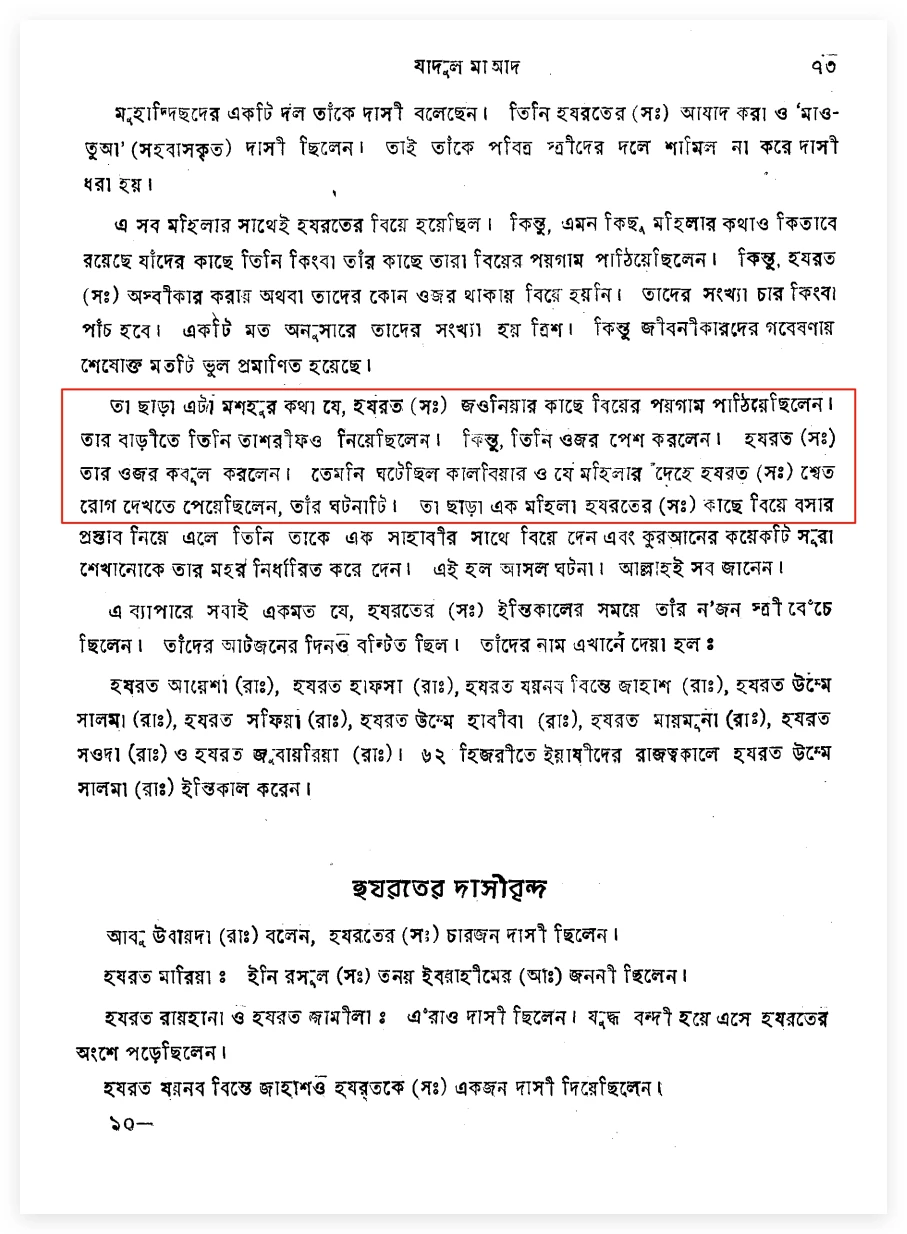
A second point comes from the way another report asks Aisha which of Muhammad’s wives he separated from without consummating the relationship. When the narrator’s question and Aisha’s answer are examined carefully, they do not by themselves prove beyond dispute that the woman called Jauniyya had been married to Muhammad through an ordinary contract. Muhammad’s recorded words to the woman were instead a request that she “give herself” to him. The legal meaning of hiba requires separate discussion. Before turning to that, consider a passage from the well-known Islamic scholar Ibn al-Qayyim’s Zad al-Maʿad. [31]
It is also well known that Muhammad sent a marriage proposal to Jauniyya and went to her residence. She offered an excuse, and Muhammad accepted her excuse. A similar thing occurred in the case of the Kalbiyya and the woman on whose body Muhammad saw signs of vitiligo. There was also another woman concerning marriage to Muhammad…
The Prophet’s Special Right to Marry Without a Woman’s Consent: Ibn Hajar’s Explanation
The greatest difficulty with the claim that Jauniyya was already Muhammad’s lawful wife is the woman’s own conduct. In the hadith, she refuses to give herself to Muhammad, reacts negatively when Muhammad reaches toward her, and ultimately seeks Allah’s protection from him. At least in the sequence preserved in the report, there is no scene in which this woman freely consents to marriage. This problem was not invented by modern critics. Classical Muslim commentators themselves confronted precisely this question.
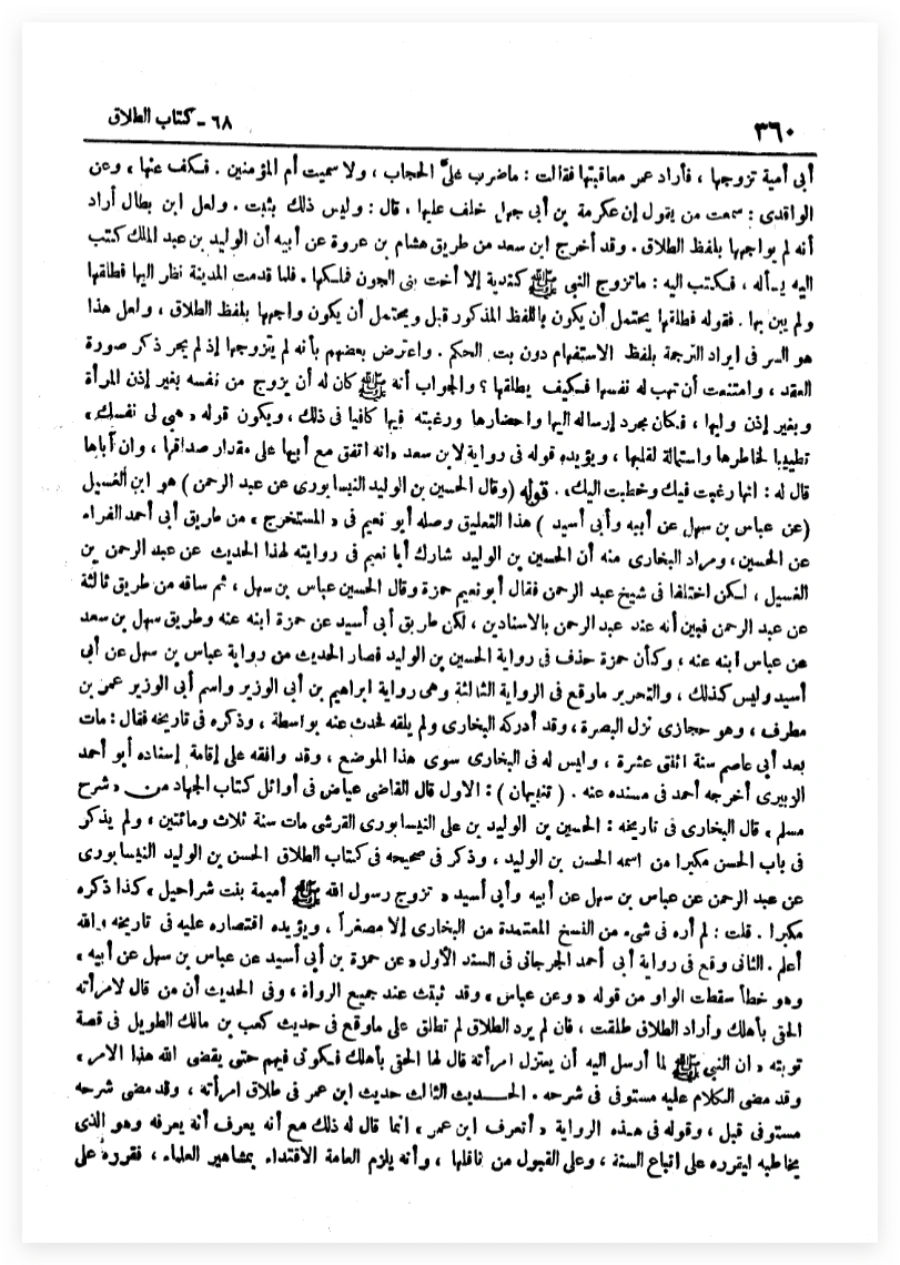
While explaining this report in Sahih al-Bukhari, Ibn Hajar al-Asqalani directly records an objection in his celebrated Fath al-Bari. The objection is straightforward: if Muhammad had not married the woman, since no form of marriage contract is described and she refused to give herself to him, how could he divorce her? Ibn Hajar does not ignore the problem. The answer he transmits instead raises an even more serious issue concerning consent. In that explanation, Muhammad possessed the special authority to marry a woman to himself “without the woman’s permission and without the permission of her guardian.” Merely sending for her, having her brought before him, and his desire for her are described as sufficient. Even his words “give yourself to me” are explained not as a request for the woman’s legal consent to the marriage, but as a means of pleasing her and drawing her heart toward him. [32]
The significance of this explanation is considerable. It is not a modern critic speculating that the woman’s consent was unnecessary. Rather, one of the most important classical commentaries on Sahih al-Bukhari resolves the problem by treating the woman’s consent as unnecessary for this special prophetic marriage. Thus, presenting the episode as consensual merely by saying “she was his wife” does not solve the problem. The very classical explanation used to establish her status as a wife also says that, in Muhammad’s case, her permission was not required in order for that status to arise.
It is also notable that Ibn Hajar cites another report through Ibn Saʿd in which Muhammad is said to have agreed with the woman’s father on the amount of her mahr, and the father claimed that his daughter desired Muhammad. Yet against this second-hand paternal claim stands the woman’s own conduct in the direct narrative: she rejects Muhammad’s proposal, dislikes his physical advance, and seeks Allah’s refuge from him. It is therefore unreasonable to place the father’s alleged statement above the woman’s own direct behavior and treat it as proof of her consent. The episode instead illustrates how a woman’s personal consent and patriarchal authority could be evaluated according to different standards within this conception of marriage. The relevant passage from Fath al-Bari is reproduced below. [33]
Arabic original:
أَبِي أُمَيَّةَ تَزَوَّجَهَا، فَأَرَادَ عُمَرَ مُعَاقَبَتَهَا فَقَالَتْ: مَا ضُرِبَ عَلَيَّ الْحِجَابُ، وَلَا سُمِّيتُ أُمَّ الْمُؤْمِنِينَ. فَكَفَّ عَنْهَا وَعَنِ الْوَاقِدِيِّ: سَمِعْتُ مَنْ يَقُولُ إِنَّ عِكْرِمَةَ بْنَ أَبِي جَهْلٍ خَلَفَ عَلَيْهَا، قَالَ: وَلَيْسَ ذَلِكَ بِثَبْتٍ. وَلَعَلَّ ابْنَ بَطَّالٍ أَرَادَ أَنَّهُ لَمْ يُوَاجِهْهَا بِلَفْظِ الطَّلَاقِ. وَقَدْ أَخْرَجَ ابْنُ سَعْدٍ مِنْ طَرِيقِ هِشَامِ بْنِ عُرْوَةَ عَنْ أَبِيهِ أَنَّ الْوَلِيدَ بْنَ عَبْدِ الْمَلِكِ كَتَبَ إِلَيْهِ يَسْأَلُهُ، فَكَتَبَ إِلَيْهِ: مَا تَزَوَّجَ النَّبِيُّ ﷺ كِنْدِيَّةً إِلَّا أُخْتَ بَنِي الْجَوْنِ فَمَلَكَهَا. فَلَمَّا قَدِمَتِ الْمَدِينَةَ نَظَرَ إِلَيْهَا فَطَلَّقَهَا وَلَمْ يَبْنِ بِهَا. فَقَوْلُهُ فَطَلَّقَهَا يَحْتَمِلُ أَنْ يَكُونَ بِاللَّفْظِ الْمَذْكُورِ قَبْلُ، وَيَحْتَمِلُ أَنْ يَكُونَ وَاجَهَهَا بِلَفْظِ الطَّلَاقِ، وَلَعَلَّ هَذَا هُوَ السِّرُّ فِي إِيرَادِ التَّرْجَمَةِ بِلَفْظِ الِاسْتِفْهَامِ دُونَ بَتِّ الْحُكْمِ.
وَاعْتَرَضَ بَعْضُهُمْ بِأَنَّهُ لَمْ يَتَزَوَّجْهَا إِذْ لَمْ يَجْرِ ذِكْرُ صُورَةِ الْعَقْدِ، وَامْتَنَعَتْ أَنْ تَهَبَ لَهُ نَفْسَهَا فَكَيْفَ يُطَلِّقُهَا؟ وَالْجَوَابُ أَنَّهُ ﷺ كَانَ لَهُ أَنْ يُزَوِّجَ مِنْ نَفْسِهِ بِغَيْرِ إِذْنِ الْمَرْأَةِ وَبِغَيْرِ إِذْنِ وَلِيِّهَا، فَكَانَ مُجَرَّدُ إِرْسَالِهِ إِلَيْهَا وَإِحْضَارِهَا وَرَغْبَتِهِ فِيهَا كَافِيًا فِي ذَلِكَ، وَيَكُونُ قَوْلُهُ هَبِي لِي نَفْسَكِ تَطْيِيبًا لِخَاطِرِهَا وَاسْتِمَالَةً لِقَلْبِهَا، وَيُؤَيِّدُهُ قَوْلُهُ فِي رِوَايَةٍ لِابْنِ سَعْدٍ إِنَّهُ اتَّفَقَ مَعَ أَبِيهَا عَلَى مِقْدَارِ صَدَاقِهَا، وَأَنَّ أَبَاهَا قَالَ لَهُ: إِنَّهَا رَغِبَتْ فِيكَ وَخُطِبَتْ إِلَيْكَ.
٥٢٥٦، ٥٢٥٧ – وَقَالَ الْحُسَيْنُ بْنُ الْوَلِيدِ النَّيْسَابُورِيُّ، عَنْ عَبْدِ الرَّحْمَنِ، عَنْ عَبَّاسِ بْنِ سَهْلٍ، عَنْ أَبِيهِ، وَأَبِي أُسَيْدٍ، قَالَا: تَزَوَّجَ النَّبِيُّ ﷺ أُمَيْمَةَ بِنْتَ شَرَاحِيلَ، فَلَمَّا أُدْخِلَتْ عَلَيْهِ بَسَطَ يَدَهُ إِلَيْهَا، فَكَأَنَّهَا كَرِهَتْ ذَلِكَ، فَأَمَرَ أَبَا أُسَيْدٍ أَنْ يُجَهِّزَهَا وَيَكْسُوَهَا ثَوْبَيْنِ رَازِقِيَّيْنِ.
حَدَّثَنَا عَبْدُ اللَّهِ بْنُ مُحَمَّدٍ، حَدَّثَنَا إِبْرَاهِيمُ بْنُ أَبِي الْوَزِيرِ، حَدَّثَنَا عَبْدُ الرَّحْمَنِ، عَنْ حَمْزَةَ، عَنْ أَبِيهِ، وَعَنْ عَبَّاسِ بْنِ سَهْلِ بْنِ سَعْدٍ، عَنْ أَبِيهِ بِهَذَا.
قَوْلُهُ (وَقَالَ الْحُسَيْنُ بْنُ الْوَلِيدِ النَّيْسَابُورِيُّ، عَنْ عَبْدِ الرَّحْمَنِ) هُوَ ابْنُ الْغَسِيلِ (عَنْ عَبَّاسِ بْنِ سَهْلٍ عَنْ أَبِيهِ وَأَبِي أُسَيْدٍ) هَذَا التَّعْلِيقُ وَصَلَهُ أَبُو نُعَيْمٍ فِي الْمُسْتَخْرَجِ مِنْ طَرِيقِ أَبِي أَحْمَدَ الْفَرَّاءِ، عَنِ الْحُسَيْنِ، وَمُرَادُ الْبُخَارِيِّ مِنْهُ أَنَّ الْحُسَيْنَ بْنَ الْوَلِيدِ شَارَكَ أَبَا نُعَيْمٍ فِي رِوَايَتِهِ لِهَذَا الْحَدِيثِ عَنْ عَبْدِ الرَّحْمَنِ بْنِ الْغَسِيلِ، لَكِنِ اخْتَلَفَا فِي شَيْخِ عَبْدِ الرَّحْمَنِ فَقَالَ أَبُو نُعَيْمٍ: حَمْزَةُ، وَقَالَ الْحُسَيْنُ: عَبَّاسُ بْنُ سَهْلٍ، ثُمَّ سَاقَهُ مِنْ طَرِيقٍ ثَالِثَةٍ عَنْ عَبْدِ الرَّحْمَنِ فَبَيَّنَ أَنَّهُ عِنْدَ عَبْدِ الرَّحْمَنِ بِالْإِسْنَادَيْنِ، لَكِنْ طَرِيقُ أَبِي أُسَيْدٍ، عَنْ حَمْزَةَ ابْنِهِ عَنْهُ، وَطَرِيقُ سَهْلِ بْنِ سَعْدٍ، عَنْ عَبَّاسٍ ابْنِهِ عَنْهُ، وَكَأَنَّ حَمْزَةَ حُذِفَ فِي رِوَايَةِ الْحُسَيْنِ بْنِ الْوَلِيدِ فَصَارَ الْحَدِيثُ مِنْ رِوَايَةِ عَبَّاسِ بْنِ سَهْلٍ، عَنْ أَبِي أُسَيْدٍ وَلَيْسَ كَذَلِكَ، وَالتَّحْرِيرُ مَا وَقَعَ فِي الرِّوَايَةِ الثَّالِثَةِ وَهِيَ رِوَايَةُ إِبْرَاهِيمَ بْنِ أَبِي الْوَزِيرِ وَاسْمُ أَبِي الْوَزِيرِ عُمَرُ بْنُ مُطَرِّفٍ، وَهُوَ حِجَازِيٌّ نَزَلَ الْبَصْرَةَ، وَقَدْ أَدْرَكَهُ الْبُخَارِيُّ وَلَمْ يَلْقَهُ فَحَدَّثَ عَنْهُ بِوَاسِطَةٍ، وَذَكَرَهُ فِي تَارِيخِهِ فَقَالَ: مَاتَ بَعْدَ أَبِي عَاصِمٍ سَنَةَ اثْنَتَيْ عَشْرَةَ، وَلَيْسَ لَهُ فِي الْبُخَارِيِّ سِوَى هَذَا الْمَوْضِعِ، وَقَدْ وَافَقَهُ عَلَى إِقَامَةِ إِسْنَادِهِ أَبُو أَحْمَدَ الزُّبَيْرِيُّ. أَخْرَجَهُ أَحْمَدُ فِي مُسْنَدِهِ عَنْهُ.
تَنْبِيهَانِ:
الْأَوَّلُ: قَالَ الْقَاضِي عِيَاضٌ فِي أَوَائِلِ كِتَابِ الْجِهَادِ مِنْ شَرْحِ مُسْلِمٍ: قَالَ الْبُخَارِيُّ فِي تَارِيخِهِ: الْحُسَيْنُ بْنُ الْوَلِيدِ بْنِ عَلِيِّ النَّيْسَابُورِيُّ الْقُرَشِيُّ مَاتَ سَنَةَ ثَلَاثٍ وَمِائَتَيْنِ، وَلَمْ يَذْكُرْ فِي بَابِ الْحَسَنِ مُكَبَّرًا مِنِ اسْمِهِ الْحَسَنَ بْنَ الْوَلِيدِ، وَذَكَرَ فِي صَحِيحِهِ فِي كِتَابِ الطَّلَاقِ الْحَسَنَ بْنَ الْوَلِيدِ النَّيْسَابُورِيَّ عَنْ عَبْدِ الرَّحْمَنِ، عَنْ عَبَّاسِ بْنِ سَهْلٍ عَنْ أَبِيهِ وَأَبِي أُسَيْدٍ تَزَوَّجَ رَسُولُ اللَّهِ ﷺ أُمَيْمَةَ بِنْتَ شَرَاحِيلَ كَذَا ذَكَرَهُ مُكَبَّرًا. قُلْتُ: لَمْ أَرَهُ فِي شَيْءٍ مِنَ النُّسَخِ الْمُعْتَمَدَةِ مِنَ الْبُخَارِيِّ إِلَّا مُصَغَّرًا، وَيُؤَيِّدُهُ اقْتِصَارُهُ عَلَيْهِ فِي تَارِيخِهِ، وَاللَّهُ أَعْلَمُ.
الثَّانِي: وَقَعَ فِي رِوَايَةِ أَبِي أَحْمَدَ الْجُرْجَانِيِّ فِي السَّنَدِ الْأَوَّلِ عَنْ حَمْزَةَ بْنِ أَبِي أُسَيْدٍ، عَنْ عَبَّاسِ بْنِ سَهْلٍ عَنْ أَبِيهِ وَهُوَ خَطَأٌ سَقَطَتِ الْوَاوُ مِنْ قَوْلِهِ وَعَنْ عَبَّاسٍ وَقَدْ ثَبَتَتْ عِنْدَ جَمِيعِ الرُّوَاةِ.
وَفِي الْحَدِيثِ أَنَّ مَنْ قَالَ لِامْرَأَتِهِ الْحَقِي بِأَهْلِكِ وَأَرَادَ الطَّلَاقَ طَلُقَتْ، فَإِنْ لَمْ يُرِدِ الطَّلَاقَ لَمْ تَطْلُقْ عَلَى مَا وَقَعَ فِي حَدِيثِ كَعْبِ بْنِ مَالِكٍ الطَّوِيلِ فِي قِصَّةِ تَوْبَتِهِ أَنَّ النَّبِيَّ ﷺ لَمَّا أَرْسَلَ إِلَيْهِ أَنْ يَعْتَزِلَ امْرَأَتَهُ قَالَ لَهَا: الْحَقِي بِأَهْلِكِ، فَكُونِي فِيهِمْ حَتَّى يَقْضِيَ اللَّهُ هَذَا الْأَمْرَ. وَقَدْ مَضَى الْكَلَامُ عَلَيْهِ مُسْتَوْفًى فِي شَرْحِهِ.
الْحَدِيثُ الثَّالِثُ: حَدِيثُ ابْنِ عُمَرَ فِي طَلَاقِ امْرَأَتِهِ، وَقَدْ مَضَى شَرْحُهُ مُسْتَوْفًى قَبْلُ، وَقَوْلُهُ فِي هَذِهِ الرِّوَايَةِ أَتَعْرِفُ ابْنَ عُمَرَ إِنَّمَا قَالَ لَهُ ذَلِكَ مَعَ أَنَّهُ يَعْرِفُ أَنَّهُ يَعْرِفُهُ وَهُوَ الَّذِي يُخَاطِبُهُ؛ لِيُقَرِّرَهُ عَلَى اتِّبَاعِ السُّنَّةِ، وَعَلَى الْقَبُولِ مِنْ نَاقِلِهَا، وَأَنَّهُ يَلْزَمُ الْعَامَّةَ الِاقْتِدَاءُ بِمَشَاهِيرِ الْعُلَمَاءِ، فَقَرَّرَهُ عَلَى
English translation:
…Abu Umayya married her. Umar intended to punish her, but she said, “The veil was never imposed upon me, nor was I called ‘Mother of the Believers.’” Umar therefore refrained from taking action against her.
Al-Waqidi reported: I heard someone say that Ikrima ibn Abi Jahl later married her. He added, however, that this report is not firmly established.
Perhaps Ibn Battal meant that Muhammad did not address her directly with the explicit word “divorce.”
Ibn Saʿd transmitted through Hisham ibn Urwa, from his father, that al-Walid ibn Abd al-Malik wrote to him asking about the matter. He replied: “Muhammad did not marry any Kindi woman other than the sister of Banu al-Jaun. He took her into his marital possession. When she came to Medina, he looked at her, then divorced her without consummating the marriage.”
The expression “then he divorced her” may refer to the wording mentioned earlier, or it may mean that he addressed her explicitly with the word divorce. Perhaps this is why the chapter heading is phrased as a question rather than as a categorical ruling.
Some objected that Muhammad had not in fact married her, since no form of marriage contract is mentioned and the woman refused to give herself to him. How, then, could he divorce her?
The answer is that Muhammad had the special right to marry a woman to himself without the woman’s permission and without the permission of her guardian. Thus, merely sending for her, having her brought before him, and his desire for her were sufficient in this case.
His statement, “Give yourself to me,” would then have been intended to please her and incline her heart toward him.
A report of Ibn Saʿd supports this explanation: Muhammad is said to have agreed with her father on the amount of her mahr, while her father told Muhammad, “She desires you, and she has been proposed to you.”
5256–5257: al-Husayn ibn al-Walid al-Naysaburi transmitted from Abd al-Rahman, from Abbas ibn Sahl, from his father and Abu Usaid. They said: “Muhammad married Umayma bint Sharahil. When she was brought in to him, he stretched his hand toward her, and it appeared that she disliked it. Muhammad then instructed Abu Usaid to prepare her for departure and clothe her in two Raziki garments.”
Abdullah ibn Muhammad narrated to us; Ibrahim ibn Abi al-Wazir narrated to us; Abd al-Rahman narrated from Hamza, from his father, and from Abbas ibn Sahl ibn Saʿd, from his father, the same report.
The phrase “al-Husayn ibn al-Walid al-Naysaburi, from Abd al-Rahman” refers to Abd al-Rahman ibn al-Ghasil. Bukhari’s suspended report, “from Abbas ibn Sahl, from his father and Abu Usaid,” was connected by Abu Nuʿaym in his Mustakhraj through Abu Ahmad al-Farra, from al-Husayn. Bukhari’s purpose was to show that al-Husayn ibn al-Walid and Abu Nuʿaym both transmitted this hadith from Abd al-Rahman ibn al-Ghasil.
They differed, however, concerning Abd al-Rahman’s shaykh. Abu Nuʿaym named Hamza, whereas al-Husayn named Abbas ibn Sahl.
Bukhari then gives a third route from Abd al-Rahman, showing that Abd al-Rahman possessed the hadith through both chains.
The Abu Usaid route is: his son Hamza → Abu Usaid.
The Sahl ibn Saʿd route is: his son Abbas → Sahl ibn Saʿd.
It appears that the name “Hamza” dropped out in the transmission of al-Husayn ibn al-Walid, making the report appear as though Abbas ibn Sahl narrated directly from Abu Usaid, which is not the case.
The accurate arrangement is the one found in the third route, the narration of Ibrahim ibn Abi al-Wazir.
Abu al-Wazir’s name was Umar ibn Mutarrif. He was from the Hijaz and later settled in Basra. Bukhari lived in his period but did not meet him, and therefore narrated from him through an intermediary.
Bukhari mentioned him in his Tarikh and said, “He died after Abu Asim in the year 212 AH.” There is no other report from him in Sahih al-Bukhari at this location. Abu Ahmad al-Zubayri agreed with him in preserving the chain correctly, and Ahmad transmitted the hadith from him in his Musnad.
Two observations:
First, Qadi Iyad said near the beginning of the Book of Jihad in his commentary on Muslim:
“Bukhari said in his Tarikh: al-Husayn ibn al-Walid ibn Ali al-Naysaburi al-Qurashi died in 203 AH. Under the entry for ‘al-Hasan’ he did not mention a Hasan ibn al-Walid. Yet in the Book of Divorce in his Sahih, he transmitted from ‘al-Hasan ibn al-Walid al-Naysaburi,’ from Abd al-Rahman → Abbas ibn Sahl → his father and Abu Usaid, that the Messenger of Allah married Umayma bint Sharahil. There the name was given in the form ‘Hasan.’”
I [Ibn Hajar] say: I have not seen the name in any reliable manuscript of Bukhari except in the diminutive form “Husayn.” Bukhari’s Tarikh likewise contains only “Husayn,” which supports this reading. Allah knows best.
Second, the first chain in the transmission of Abu Ahmad al-Jurjani appears as “Hamza ibn Abi Usaid → Abbas ibn Sahl → his father.” This is an error: the conjunction wa, “and,” dropped out from “and from Abbas.” It is preserved in the transmissions of all the other narrators.
The hadith also indicates that when a man tells his wife, “Go back to your family,” intending divorce, divorce takes effect; if he does not intend divorce, it does not. A comparable expression occurs in the long hadith concerning the repentance of Kaʿb ibn Malik. When Muhammad sent him an instruction to separate from his wife, Kaʿb told her, “Go back to your family and remain with them until Allah decides this matter.” This has already been discussed fully in its commentary.
The third hadith concerns Ibn Umar’s divorce of his wife, which has also been explained earlier. The expression in this narration, “Do you know Ibn Umar?” was said even though the speaker knew that the addressee knew him and Ibn Umar himself was speaking to him. Its purpose was to make him affirm adherence to the Sunnah, acceptance of a trustworthy transmitter of it, and the obligation of ordinary people to follow renowned scholars. Thus he made him acknowledge that…
If this explanation is accepted, the situation becomes more troubling rather than less. The argument can no longer be that “the woman voluntarily married Muhammad and later changed her mind.” Instead, the explanation becomes: Muhammad could treat her as his wife without her consent; when she then reacted negatively to his touch and sought Allah’s protection from him, she was sent back. The claim that “a marriage had taken place” therefore does not remove the problem of consent. According to this interpretation in Fath al-Bari, the marriage itself could be treated as legally effective without the woman’s permission.
By modern ethical standards, that principle directly conflicts with the basic requirements of personal autonomy and sexual and marital consent. A man’s desire, a father’s approval, or a religious privilege cannot substitute for a woman’s personal consent. The fundamental question in evaluating this episode is therefore not merely whether a marriage technically existed, but whether the woman herself wanted the relationship. Her own conduct in the preserved reports gives a strikingly clear answer.
Is This Merely an Isolated Interpretation by Ibn Hajar?
In the previous section we saw Ibn Hajar al-Asqalani state, in explaining the Jauniyya or Umayma episode, that the permission of the woman and the permission of her guardian were not indispensable for Muhammad to marry a woman to himself. The natural question is whether this was merely an isolated opinion devised to explain one troublesome report, or whether the idea of special marital rights for Muhammad was more widely recognized in classical Islamic jurisprudence. The classical texts show that the matter was not confined to a single sentence in Ibn Hajar. In discussions of Muhammad’s marital khaṣāʾiṣ, special rules that did not apply to ordinary Muslims, several influential jurists explicitly mention comparable privileges.
First, another important part of Ibn Hajar’s discussion deserves attention because it directly complicates attempts to harmonize Jauniyya and Umayma into one simple story of marriage and divorce. While comparing different reports in Fath al-Bari, Ibn Hajar observes differences between the narration of Abu Usaid and that of Sahl ibn Saʿd that make the possibility of multiple incidents stronger. He then states that a marriage contract had been concluded with Umayma, whereas no contract had been concluded with the other woman; Muhammad had only come to propose marriage to her. [34]
وَالْقِصَّةُ الَّتِي فِي حَدِيثِ أَبِي أُسَيْدٍ فِيهَا أَشْيَاءُ مُغَايِرَةٌ لِهَذِهِ الْقِصَّةِ، فَيَقْوَى التَّعَدُّدُ، وَيَقْوَى أَنَّ الَّتِي فِي حَدِيثِ أَبِي أُسَيْدٍ اسْمُهَا أُمَيْمَةُ وَالَّتِي فِي حَدِيثِ سَهْلٍ اسْمُهَا أَسْمَاءُ وَاللَّهُ أَعْلَمُ. وَأُمَيْمَةُ كَانَ قَدْ عَقَدَ عَلَيْهَا ثُمَّ فَارَقَهَا وَهَذِهِ لَمْ يُعْقَدْ عَلَيْهَا بَلْ جَاءَ لِيَخْطُبَهَا فَقَطْ.
English translation: The episode in Abu Usaid’s hadith contains features different from the other episode. Accordingly, the possibility that the incidents were multiple becomes stronger, as does the possibility that the woman in Abu Usaid’s report was named Umayma and the woman in Sahl’s report was named Asma. Allah knows best. A marriage contract had been concluded with Umayma and he later separated from her; but no contract had been concluded with this woman. He had only come to propose marriage to her.
This statement matters for two reasons. First, Jauniyya, Asma, and Umayma cannot simply be declared the same woman on the basis of a later harmonized narrative. Ibn Hajar himself says فَيَقْوَى التَّعَدُّدُ, “the possibility of multiplicity becomes stronger.” Second, regarding one of the women, his own analysis explicitly says لَمْ يُعْقَدْ عَلَيْهَا, “no marriage contract was concluded with her.” Thus, the simple argument that “the hadith appears in the Book of Divorce, therefore every woman involved must already have been Muhammad’s wife” is inconsistent with Ibn Hajar’s own analysis.
The more important question, however, is how the woman’s consent was treated in cases where a commentator did regard a marriage as having taken place. Here Imam al-Nawawi’s Rawdat al-Talibin becomes particularly important. Near the beginning of the work, al-Nawawi discusses Muhammad’s khaṣāʾiṣ, provisions that applied specifically to him. In the discussion of marital privileges, he first states that the Prophet’s marriage could be contracted through the meaning of hiba, a woman giving herself to him. More significantly, he says that if Muhammad desired to marry an unmarried woman, then according to the sound view she was obliged to respond positively. He then states even more directly the privilege of marrying without the permission of the woman or her wali. [35]
قَالَ الْأَصْحَابُ: وَيَنْعَقِدُ نِكَاحُهُ ﷺ بِمَعْنَى الْهِبَةِ… وَمِنْهُ أَنَّهُ ﷺ لَوْ رَغِبَ فِي نِكَاحِ امْرَأَةٍ، فَإِنْ كَانَتْ خَلِيَّةً، لَزِمَهَا الْإِجَابَةُ عَلَى الصَّحِيحِ… وَكَانَ لَهُ ﷺ تَزْوِيجُ الْمَرْأَةِ مِمَّنْ شَاءَ بِغَيْرِ إِذْنِهَا وَلَا إِذْنِ وَلِيِّهَا، وَتَزَوَّجَهَا لِنَفْسِهِ، وَتَوَلَّى الطَّرَفَيْنِ بِغَيْرِ إِذْنِهَا وَلَا إِذْنِ وَلِيِّهَا.
English translation: The jurists said that Muhammad’s marriage could be contracted through the meaning ofhiba… Among his privileges was that, if he desired to marry a woman and she was unmarried, then according to the sound view she was obliged to answer him affirmatively. … He also had the right to marry a woman to whomever he wished without her permission or the permission of her wali; he could marry her to himself and act for both sides of the marriage without the permission of either the woman or her guardian.
This passage is especially significant for the Jauniyya episode because it is not an improvised explanation designed to rescue one particular hadith. Al-Nawawi is listing Muhammad’s special marital rights, or khaṣāʾiṣ, in a separate legal discussion. On the one hand, his marriage could be concluded through hiba; on the other, an unmarried woman was, according to the sound view, obliged to respond if he wished to marry her; and in still more explicit terms, he could marry a woman to himself without the permission of either the woman or her wali. Within this structure of classical fiqh, therefore, “the woman was his wife” and “the woman voluntarily accepted him as her husband” are two distinct questions. Even if the first is legally true, the second does not follow automatically.
This privilege was not confined to al-Nawawi’s Shafiʿi legal work. Ibn Qudama, one of the major Hanbali jurists, mentions Muhammad as a direct exception while discussing the requirement of a wali and witnesses for the marriages of ordinary Muslims in al-Mughni. [36]
فَأَمَّا نِكَاحُ النَّبِيِّ ﷺ بِغَيْرِ وَلِيٍّ وَغَيْرِ شُهُودٍ، فَمِنْ خَصَائِصِهِ فِي النِّكَاحِ، فَلَا يَلْحَقُ بِهِ غَيْرُهُ.
English translation: As for Muhammad’s marriage without a wali and without witnesses, this was among his special privileges in marriage, and no one else is placed on the same footing with him in that respect.
The significance of Ibn Qudama’s statement is clear. A procedural condition treated as essential to the validity of an ordinary person’s marriage is explicitly subject to an exception in Muhammad’s case. One therefore cannot simply impose the rules of ordinary Muslim marriage on Muhammad’s marriages and reason: “there must have been a wali, there must have been a normal contract, therefore the woman must have consented.” Classical fiqh itself discusses the Prophet’s nikah as a legally distinct category.
Ibn Kathir likewise describes the same special status while commenting on Qur’an 33:50. In explaining the difference between a woman who gives herself to the Prophet and marriage to an ordinary Muslim man, he states that in the ordinary case an equivalent mahr would become due if the marriage were consummated; Muhammad’s case was different because he could marry without mahr, wali, or witnesses. [37]
فَأَمَّا هُوَ عَلَيْهِ السَّلَامُ، فَإِنَّهُ لَا يَجِبُ عَلَيْهِ لِلْمُفَوِّضَةِ شَيْءٌ وَلَوْ دَخَلَ بِهَا؛ لِأَنَّ لَهُ أَنْ يَتَزَوَّجَ بِغَيْرِ صَدَاقٍ وَلَا وَلِيٍّ وَلَا شُهُودٍ.
English translation: In his case, nothing was due to the woman who had given herself to him, even if he consummated the marriage with her, because he was permitted to marry without mahr, without a wali, and without witnesses.
The word hiba therefore cannot simply be treated as ordinary marital language. In classical tafsir and fiqh, it is connected to a special marital arrangement for Muhammad under which several conditions of ordinary nikah did not apply. Muhammad’s words to Jauniyya, هبي نفسك لي, “give yourself to me,” are significant for precisely that reason. This is not a sexualized translation invented by a modern critic; classical Islamic jurisprudence itself discusses هبة as a distinct mechanism connected with the Prophet’s marriages.
The contrast becomes even clearer when these privileges are compared with the rules stated for ordinary Muslim marriages. The contemporary fatwa institution IslamQA, in explaining the conditions of a valid ordinary nikah, explicitly lists the consent of both spouses, the woman’s wali, and witnesses among the requirements. [38]
وَمِنْ شُرُوطِ النِّكَاحِ: تَعْيِينُ الزَّوْجَيْنِ، وَرِضَاهُمَا، وَأَنْ يَعْقِدَهُ الْوَلِيُّ أَوْ وَكِيلُهُ، وَوُجُودُ شَاهِدَيْ عَدْلٍ مِنَ الْمُسْلِمِينَ.
English translation: Among the conditions of marriage are identifying the two spouses, the consent of both, conclusion of the contract by the woman’s wali or his representative, and the presence of two upright Muslim witnesses.
The basic contrast is now clear. For ordinary Muslims, the same Islamic legal tradition discusses the woman’s consent, the wali, and witnesses as important elements in the validity of nikah. Yet in discussions of Muhammad’s special privileges, classical jurists state that his marriage could be concluded through hiba, without a wali or witnesses, and, according to the fiqhi opinion cited by al-Nawawi, he could marry a woman to himself without the permission of either the woman or her wali. Rawdat al-Talibin goes further by saying that when he wished to marry an unmarried woman, she was obliged, “according to the sound view,” to respond.
Accordingly, the argument “he married her, therefore the question of consent does not arise” does not answer the central issue in the Jauniyya or Umayma reports. Once these classical fiqhi texts are placed on the table, the opposite question becomes more urgent: did the woman herself freely consent to that marriage? The legal framework invoked to establish her as Muhammad’s wife belongs to the same tradition that recognized special prophetic marriage rules under which the woman’s permission, her wali’s permission, witnesses, or other requirements of ordinary nikah could fall away one by one.
Jauniyya’s own conduct therefore remains the most important testimony. She rejects Muhammad’s proposal of hiba, disparages him as a “bazaaria” or market commoner, and when Muhammad reaches toward her she ultimately says أعوذ بالله منك, “I seek refuge with Allah from you,” thereby unmistakably withdrawing herself. If a later fiqhi explanation says that Muhammad’s own desire could be sufficient to make a marriage legally effective, that does not demonstrate Jauniyya’s consent. Rather, it explains the legal structure by which a woman could be classified as a “wife” despite her direct unwillingness.
For that reason, the central question is not simply whether a contract existed. Even if one did, the classical rules of prophetic privilege mean that the contract itself would not establish the woman’s independent consent. And according to Ibn Hajar’s other analysis, at least one of the relevant women had no marriage contract with Muhammad at all. Whichever possibility is accepted, Jauniyya’s own rejection does not disappear. When the matn of the early reports, Ibn Hajar’s commentary, al-Nawawi’s fiqh, Ibn Qudama’s ruling, and Ibn Kathir’s tafsir are read together, one point becomes unmistakable: the Islamic concept of Muhammad’s special marital privileges was not identical to the consent and procedural conditions applied to ordinary marriages. The mere use of the word “marriage” therefore cannot automatically prove that the relationship was voluntary, either historically or within the logic of classical fiqh.
Are Hadith Chapter Titles Always Literally Applicable?
The fact that a report in a hadith collection has been placed under a particular chapter does not mean that every word in that chapter title must be treated as the literal historical identity of the event described. Hadith compilers often placed reports under particular chapters in order to establish a fiqhi ruling, draw an analogy, address a legal question, or express their own interpretation. Consequently, a chapter title and the historical information contained in the matn of a hadith are not the same thing.
A single example from Sahih al-Bukhari makes this especially clear. In the Islamic Foundation edition, hadith 2813, international number 3022, appears under the following chapter: [39]
باب قَتْلِ النَّائِمِ الْمُشْرِكِ
“Killing a Sleeping Mushrik”
Yet the event narrated under this heading is not the killing of an Arab polytheist. The person killed is Abu Rafi, and the report states that Muhammad sent a group of the Ansar to kill him. At night, one of the men entered his fort, locked the doors after the occupants had gone inside, reached Abu Rafi while he was asleep, and attacked him with a sword. The corresponding description explicitly identifies the target as “Abu Rafi, the Jew.”
Thus, although the chapter heading places the report under a category concerning a “mushrik”, the person described in the report was a Jew. A Jew and an Arab polytheist are not the same historical religious identity. It therefore does not follow that a person must historically have been a polytheist merely because a report about him appears beneath a chapter headed “killing a mushrik.” Here the chapter title functions as the compiler’s fiqhi classification, not as a literal description of the victim’s religious identity.
This illustrates an important methodological point. In analyzing hadith, at least three questions need to be kept distinct:
1. What does the matn of the hadith itself actually say?
2. How is the event identified in parallel or related reports?
3. For what fiqhi purpose did the compiler place the report under a particular chapter?
Conflating these three can easily produce a false conclusion.
The same problem arises in the reports about Jauniyya and Umayma. The episode appears in Kitab al-Talaq, under a chapter discussing how a husband may divorce his wife. But the chapter title by itself cannot establish that the woman in question must therefore have been Muhammad’s valid and consenting wife. Such a conclusion requires evidence of marriage and consent in the report itself and in the related evidence.
Instead, the relevant reports show a woman refusing to give herself to Muhammad, disliking his physical advance, and seeking refuge with Allah from him. More importantly, Ibn Hajar himself records the objection raised by some scholars: if no form of marriage contract is mentioned and the woman refused to give herself to Muhammad, how could he divorce her? In other words, even classical commentators encountered a problem when marriage was simply assumed from the chapter heading.
The argument that “the hadith occurs in the chapter on divorce, therefore the woman must have been his wife” does not hold. Applied consistently, the same method would require Abu Rafi to be identified as a polytheist merely because his killing appears under the heading “Killing a Sleeping Mushrik,” even though the report identifies him as a Jew. Therefore, a chapter title is not the final proof of the historical identity of an event; the primary evidence is the matn of the hadith together with the relevant parallel reports.
The Same Conduct Toward Umayma
The following reports state that, after the unsuccessful encounter with Jauniyya, Muhammad displayed the same kind of conduct toward Umayma at the same location. The next report reads as follows: [40]
Sahih al-Bukhari
68/ Divorce
Chapter 68/3: Should a husband pronounce divorce directly in front of his wife?
5256. Narrated Sahl and Abu Usaid: The Prophet (ﷺ) married Umaima bint Sharahil, and when she was brought to him, he stretched his hand towards her. It seemed that she disliked that, whereupon the Prophet (ﷺ) ordered Abu Usaid to prepare her and to provide her with two white linen dresses.
Reference: Sahih al-Bukhari 5256, Book 68, Hadith 6.
Hadith grade: Sahih
Narrators: Sahl ibn Sa‘d and Abu Usaid
Were Jauniyya and Umayma the Same Woman or Different Women?
To clarify this issue, it is necessary to look closely at the wording of the report itself. In Sahih al-Bukhari 5255, Abu Usaid reports:
“…then Jauniyya was brought to a house in a date-palm garden associated with Umayma, the daughter of al-Nu‘man ibn Sharahil. There was also a nurse attending her. When the Prophet came to her, he said, ‘Give yourself to me’…”
On a literal reading, the wording presents two names and two identities: Jauniyya, the woman who is brought into the garden house, and Umayma bint al-Nu‘man ibn Sharahil, whose name appears in the description of the house in the date-palm garden. The report literally says that Jauniyya was “brought to the house in Umayma’s date-palm garden.” The wording therefore naturally creates the impression of two women, one being brought to a place associated with the other.
Later Islamic scholars and commentators, including writers at IslamQA, SeekersGuidance, and al-Iqra, have attempted to harmonize the names by treating them as references to the same woman. Their argument is that “Jauniyya” is a tribal attribution and that Umayma herself was the woman from the Jawn tribe. But the Arabic wording of the Bukhari report, فَأُنْزِلَتْ فِي بَيْتٍ فِي نَخْلٍ فِي بَيْتِ أُمَيْمَةَ بِنْتِ النُّعْمَانِ بْنِ شَرَاحِيلَ, does not make that harmonization self-evident. If the two references designate the same person, the resulting wording would amount to saying that “Umayma was brought to Umayma’s own house,” which is unusually circular. The linguistic separation in the report therefore leaves genuine room for reading them as two women.
The subsequent exchange is familiar. Muhammad tells Jauniyya, “Give yourself to me” (هبي نفسك لي). She replies, “Does a princess give herself to a market commoner?” Muhammad reaches toward her, and she says, “I seek refuge with Allah from you.” Muhammad replies, “You have sought refuge with the Mighty.” He then leaves and instructs Abu Usaid to give her two garments and return her to her family.
A closely related report appears in Sahih al-Bukhari 5256–5257 and explicitly names Umayma bint Sharahil. Given the linguistic separation in 5255 and the existence of several closely related reports, there is substantial reason not to treat the identification of all these women as unquestionably settled. Later scholars have offered a harmonizing interpretation, but the literal wording and narrative structure do not make that harmonization inevitable. Ibn Hajar himself, as shown above, considered the possibility of multiple incidents to be strong. Whether these reports concern one woman or more than one, however, does not alter the central issue of this article.
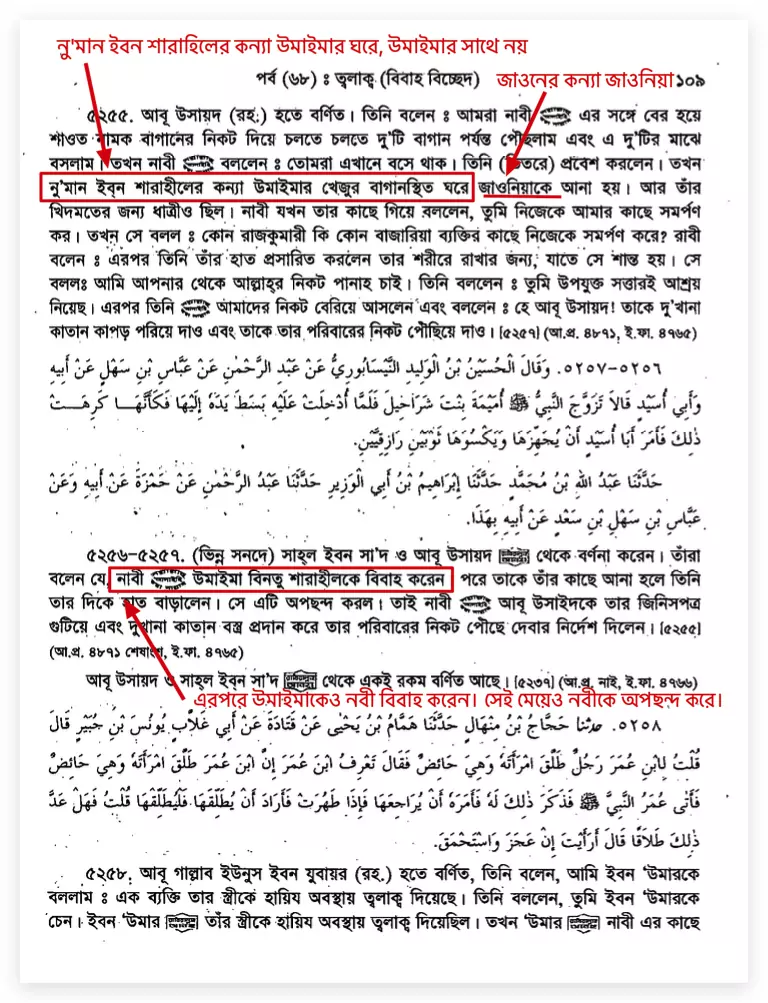
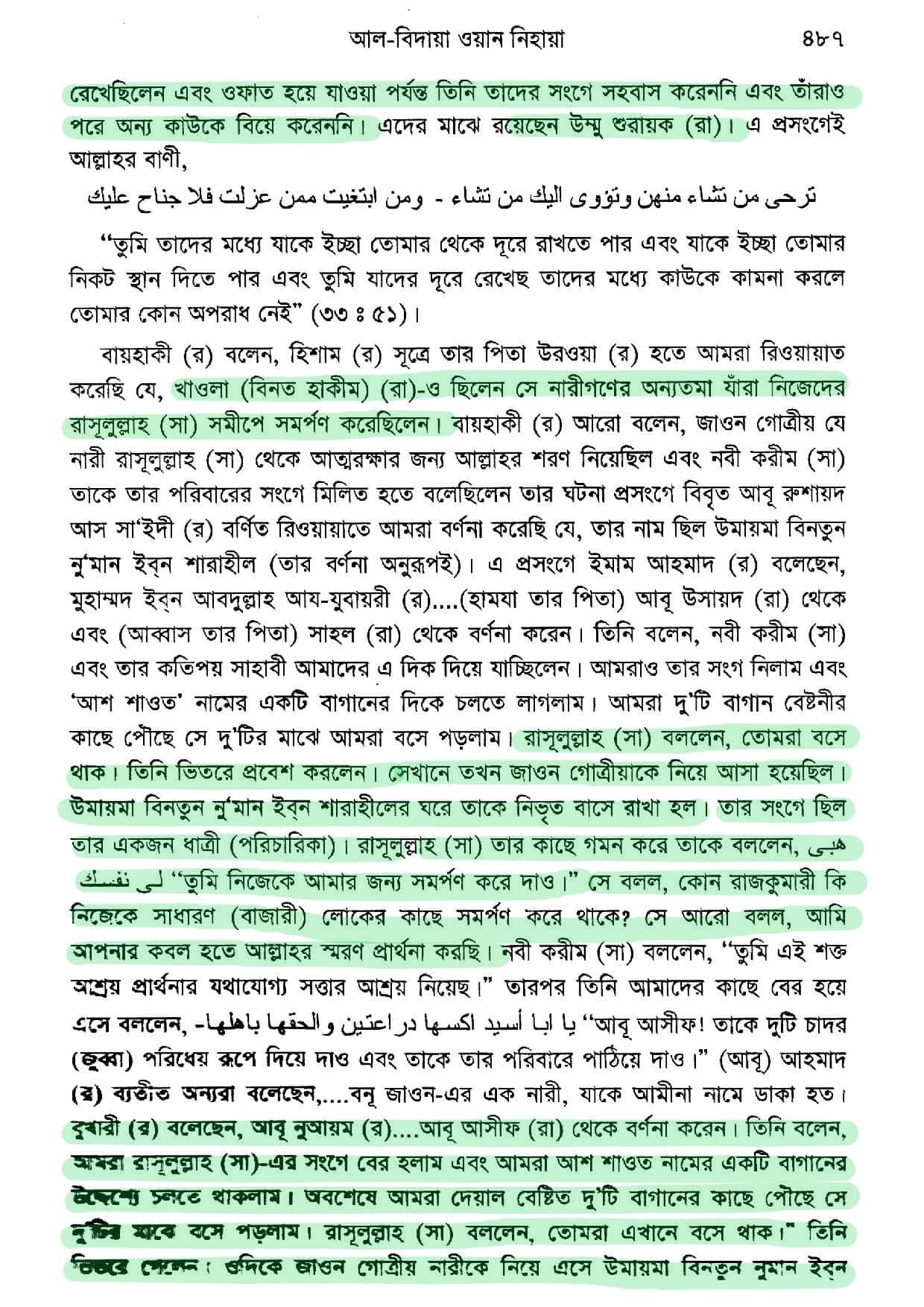
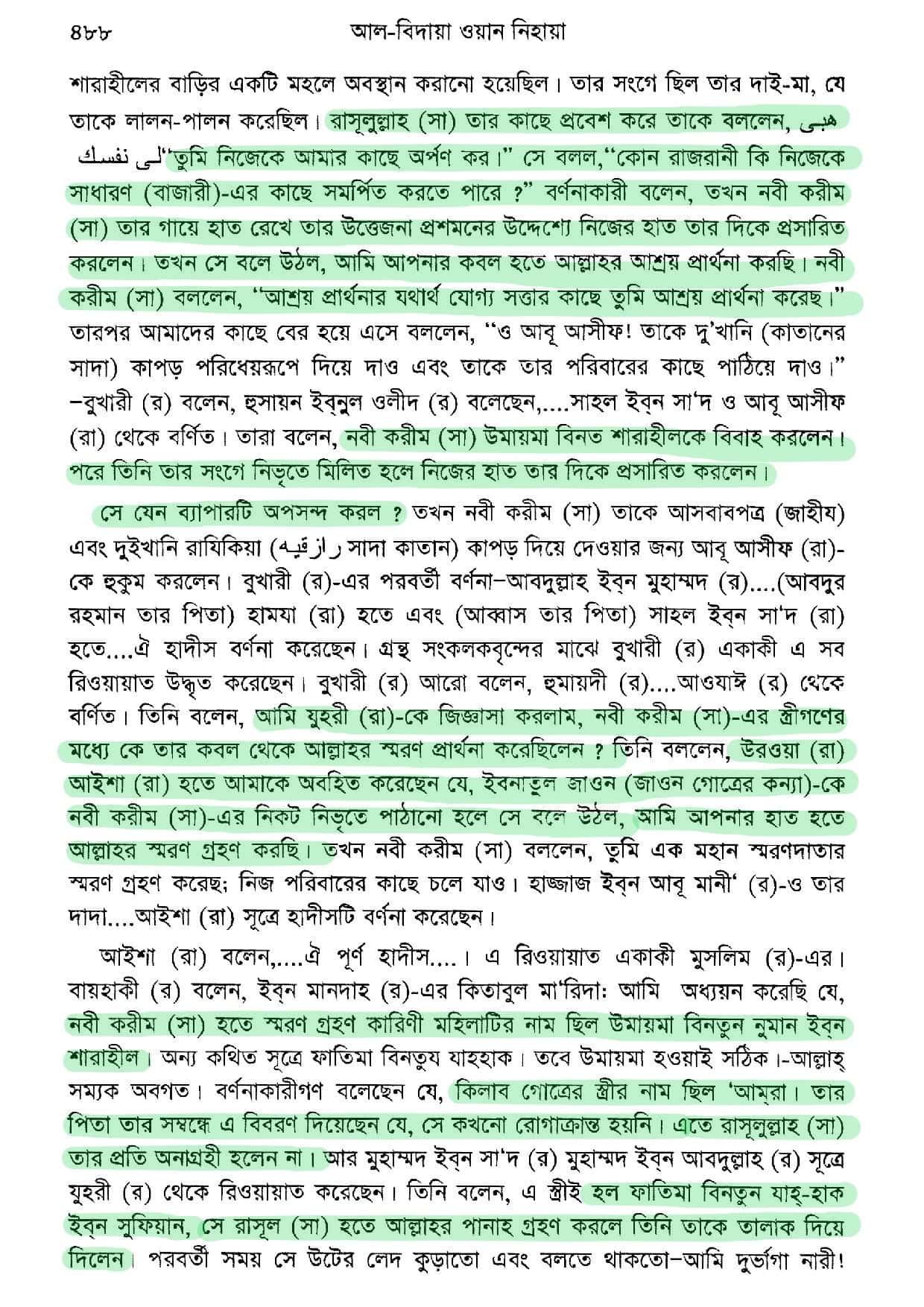
For clarity, the relevant pages are reproduced below. The images are taken directly from the printed edition [41]:
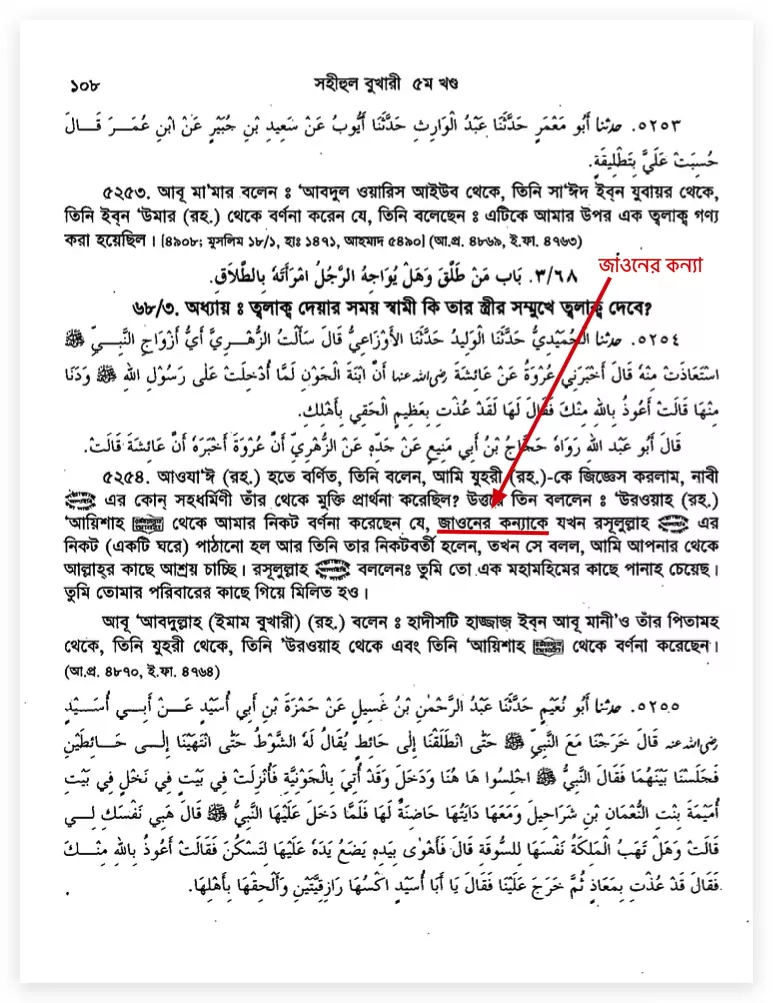
Now consider the next report [42]. Notice the wording carefully: Umayma, the daughter of Nu‘man ibn Sharahil, and Jauniyya, the daughter of al-Jawn, are presented in a way that can be read as referring to two different women. One report states that Muhammad married Umayma, whereas there is no equally explicit statement in the relevant Jauniyya report establishing that he had contracted marriage with her. On the article’s reading of the sequence, Jauniyya was brought to the garden house for Muhammad, and her reaction makes clear that she did not welcome the encounter. If she had voluntarily entered a marriage with Muhammad, such a reaction would require explanation.
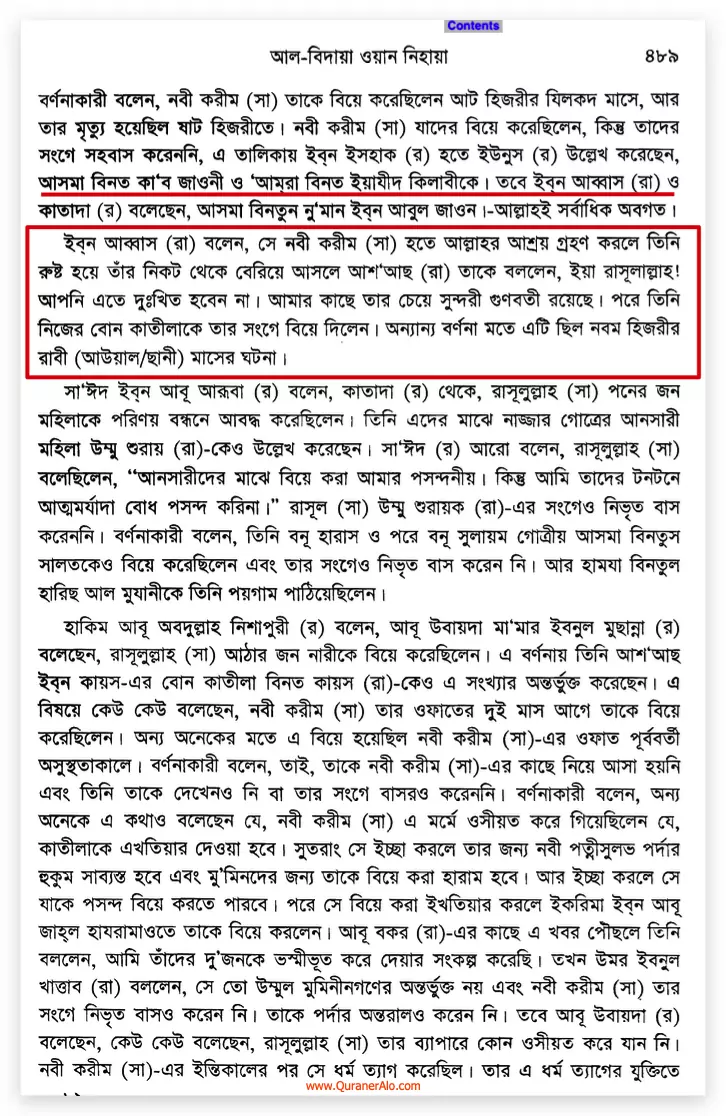
A Companion’s Proposal After the Prophet’s Failed Sexual Advances
After making advances toward two women in succession and failing to obtain the sexual relationship he wanted, Muhammad would hardly have been pleased. What happened next is described in al-Bidaya wa al-Nihaya [43]. According to the report, when the woman sought refuge with Allah from Muhammad and he came out angry or distressed, one of his companions tried to console him. The companion told Muhammad not to be upset and offered him his own sister, describing her as even more beautiful and virtuous. He then presented his sister Qutayla for marriage. The social logic is striking: if one woman refuses, another woman is immediately offered in her place, with the sister’s beauty used as an inducement to soothe the offended man. What remarkable devotion: if one woman is unavailable, offer another; if not her, then another, as though any female body will do. Some sources later associate this companion and his sister Qutayla with apostasy, a separate issue that can be discussed elsewhere. The relevant passage reads:
The narrator states that the Prophet married her in Dhu al-Qa‘dah of 8 AH, and that she died in 60 AH. Among the women whom the Prophet married but with whom he did not consummate the marriage, Yunus, transmitting from Ibn Ishaq, mentioned Asma bint Ka‘b al-Jawni and ‘Amra bint Yazid al-Kilabi. Ibn ‘Abbas and Qatada, however, said that she was Asma bint al-Nu‘man ibn Abi al-Jawn. Allah knows best.
Ibn ‘Abbas said that when she sought refuge with Allah from the Prophet, he left her in anger. Al-Ash‘ath then said to him, “O Messenger of Allah, do not be saddened by this. I have someone more beautiful and more virtuous than she.” He then gave his sister Qutayla to him in marriage. According to other reports, this took place in Rabi‘ al-Awwal or Rabi‘ al-Thani of 9 AH.
The same episode is also presented in the fifth volume of the well-known Islamic historical work al-Bidaya wa al-Nihaya. The report describes Muhammad asking a woman to give herself to him. She refuses him, disparages him as a low-status market commoner, and makes clear that she does not wish to submit herself to him. Muhammad then reaches toward her, but she invokes Allah for protection from him. After she seeks Allah’s refuge, he does not continue the advance [44].
Dissecting Power, Dissent, and Gender Politics
This brief but conflict-laden episode involving Muhammad and Jauniyya is not merely a story of separation. It is also a revealing document of power, the violation of women’s consent, and gender politics in its social setting. The episode shows how religious and political authority can become one-sided within intimate relationships and how female autonomy can be displaced by male power. The points below examine the report from historical, social, psychological, and ethical perspectives.
هبي لي نفسك), meaning, “Give yourself to me” [45]. The article connects this language with the Prophet-specific provision of Qur’an 33:50 concerning a believing woman who offers herself to the Prophet. In classical fiqh, hiba in this context belongs to Muhammad’s special marital privileges and is not simply the language of an ordinary marriage between two Muslims. The article therefore treats the demand that the woman “give herself” as an assertion of a special religious privilege over access to a woman’s body.
أَهْوَى بِيَدِهِ عَلَيْهَا, and the parallel material discussed earlier preserves an explicit version in which he moves toward her to kiss her. Under modern standards of sexual consent, continuing a physical advance after an explicit rejection is a violation of bodily autonomy. The article therefore interprets this moment as the point at which the power imbalance becomes physical rather than merely verbal.
أَعُوذُ بِاللَّهِ مِنْكَ), “I seek refuge with Allah from you” [45]. In the narrative, this is the strongest possible verbal refusal available to her. The article reads it as a final appeal for protection in which religious language itself is invoked against the man who possessed religious authority.
اکْسُهَا رَازِقِيَّتَيْنِ, that she be clothed in two Raziqi garments and returned to her family [45]. The article draws attention to the verb rendered “clothe her” rather than simply “give her garments” and raises a further possibility: in a tense physical encounter involving resistance, clothing could have become displaced. It therefore treats the wording as a possible, indirect indication of physical struggle or disordered clothing. The hadith itself does not explicitly say that her clothes were removed, so this remains an inference rather than a stated fact.
Psychologically, the article first reads this as an extreme form of deference to charismatic authority. The follower regards the leader’s emotional state as so important that he anticipates the leader’s desires and acts before being asked. This resembles what may be called anticipatory obedience: the subordinate attempts to read and manage the authority figure’s mood in order to preserve his own standing. In Freudian language, the article compares this to a form of father-complex behavior, in which loyalty to the paternal authority becomes strong enough that even a close female relative can be offered to compensate for the leader’s humiliation.
Second, the sister is sexually objectified. The companion advertises her as more beautiful and presents her as a substitute or consolatory offering. Her own consent, preferences, and dignity disappear from the exchange as narrated. She is valued primarily for her capacity to satisfy the emotional and sexual expectations of a powerful man. The article treats this as evidence of a gendered political order in which women could be used to regulate male prestige, desire, and mood.
Third, the article connects this behavior with the dynamics of groupthink and highly personalized authority. A follower who believes that his social position, safety, or even religious standing depends on maintaining the leader’s favor has a strong incentive to perform “damage control” when the leader is rejected. In that environment, family bonds and ordinary moral hesitation can become subordinate to loyalty toward the authority figure, while the woman is reduced to the description “beautiful sister,” valued principally through physical desirability.
Taken as a whole, the episode illustrates how a psychological environment organized around concentrated authority can erode ordinary concern for female autonomy. Jauniyya protects herself by refusing, while another woman is immediately proposed as a replacement. The article therefore treats the companion’s offer as the counterpart to Jauniyya’s resistance: one woman successfully refuses access to her body, and another is offered to the same authority as a means of restoring his satisfaction.
This analysis therefore treats the Jauniyya episode not as a merely awkward private moment, but as a complex record of power, consent, and gendered control.
Selective Preservation of Uncomfortable Material in the Earliest Sira Tradition
The tendency to reinterpret or harmonize uncomfortable material in Islamic historical tradition is not merely a modern phenomenon. Ibn Hisham’s own statement about his editorial method shows that, already at the stage of preserving and editing the early sira, social and religious discomfort could be among the considerations determining what material was retained and what was omitted. While editing Ibn Ishaq’s sira, Ibn Hisham explicitly says that he would omit material of which بَعْضُهَا يَشْنُعُ الْحَدِيثُ بِهِ، وَبَعْضٌ يَسُوءُ بَعْضَ النَّاسِ ذِكْرُهُ, that is, material some of which would make the account objectionable or offensive and some of which would distress certain people if mentioned. Separately, he also mentions reports that al-Bakka’i did not authorize him to transmit. Thus Ibn Hisham himself distinguishes between omission for reasons connected with transmission and omission because material was objectionable or displeasing to people [46].
Arabic original:
[ نهج ابن هشام في هذا الكتاب ] قال ابن هشام : وأنا إن شاء الله مبتدئ هذا الكتاب بذكر إسماعيل بن إبراهيم ، ومن ولد رسول الله صلى الله عليه وآله وسلم من ولده ، وأولادهم لأصلابهم الأول فالأول ، من إسماعيل إلى رسول الله صلى الله عليه وآله وسلم ، وما يعرض من حديثهم ، وتارك ذكر غيرهم من ولد إسماعيل ، على هذه الجهة للاختصار ، إلى حديث سيرة رسول الله صلى الله عليه وسلم ، وتارك بعض ما ذكره ابن إسحاق في هذا الكتاب ، مما ليس لرسول الله صلى الله عليه وآله وسلم فيه ذكر ، ولا نزل فيه من القرآن شيء ، وليس سببا لشيء من هذا الكتاب ، ولا تفسيرا له ، ولا شاهدا عليه ، لما ذكرت من الاختصار ، وأشعارا ذكرها لم أر أحدا من أهل العلم بالشعر يعرفها ، وأشياء بعضها ، يشنع الحديث به ، وبعض يسوء بعض الناس ذكره ، وبعض لم يقر لنا البكائي بروايته ومستقص إن شاء الله تعالى ما سوى ذلك منه بمبلغ الرواية له ، والعلم به .
English translation:
Ibn Hisham says:
God willing, I shall begin this book by mentioning Ishmael son of Abraham and those among his descendants from whom the Messenger of Allah descended, generation after generation, from Ishmael down to the Messenger of Allah, together with the reports concerning them.
For the sake of brevity, I shall omit the other descendants of Ishmael and proceed in this manner until the account of the life of the Messenger of Allah.
I shall also omit some of what Ibn Ishaq included in this book, namely material in which the Messenger of Allah is not mentioned, concerning which nothing of the Qur’an was revealed, and which is neither a cause of, an explanation of, nor evidence for anything in this book, for the reason of brevity already mentioned.
I shall also omit poems that he cited which I have not found recognized by anyone knowledgeable in poetry.
There are also matters some of which would make the account objectionable, some of which would distress certain people if mentioned, and some of which al-Bakka’i did not authorize us to transmit.
God willing, apart from these, I shall present the remainder of Ibn Ishaq’s material as fully as the transmitted material that has reached us and our knowledge of it permit.
This statement does not justify the conclusion that Ibn Hisham specifically concealed a report about Jauniyya or Umayma. It does, however, establish an important historical point: from the earliest stages of sira preservation, purely mechanical and neutral preservation was not the only editorial principle governing uncomfortable material. Some material was omitted. In later centuries, uncomfortable reports were often retained but reconstructed through additional stories, harmonizing explanations, fiqhi privileges, or character-based explanations. Later interpretations of the Jauniyya and Umayma episodes can therefore also be examined against this broader background of Islamic interpretive practice.
Ad Hoc Explanations and “Rescue Hypotheses”: A Dissection
When Islamic scholars and modern apologists confront this report, the article argues that they often attempt to neutralize its uncomfortable core, a woman’s clear and forceful rejection followed by an unwanted physical advance, by introducing various “rescue hypotheses” or ad hoc explanations. These explanations were developed after the period of the reported event and are not part of the central Bukhari narration itself. The article argues that even by Islam’s own chain-of-narration standards, these damage-control explanations lack a reliable source. It therefore examines them as later attempts at damage control, asking whether they possess independent evidentiary support and whether they actually fit the wording of the report. The principal explanations are analyzed below in light of the text, historical context, linguistic detail, and logical coherence.
هبي لي نفسك), “Give yourself to me” [45]. The article argues that if an ordinary, mutually accepted marriage had already been completed, a fresh request that the woman give herself to him requires explanation. Within the Prophet-specific fiqh discussed earlier, hiba belongs to a special legal category rather than merely functioning as routine language between husband and wife. Treating the episode as an uncomplicated marital encounter therefore does not resolve the tension created by the report’s own wording and by the woman’s explicit refusal.
Conclusion
An examination of Muhammad’s sexual life and relationships with women brings an uncomfortable pattern into view: in many of these accounts, women’s consent or independent choice is secondary, while power and the politics of conquest are primary. Women such as Jauniyya, who were able to resist openly, escaped the relationship by invoking Allah for protection. Captive women such as Safiyya or Rayhana had no comparable position from which to refuse; the question of their consent was not treated as decisive.
These historical episodes show that the social structures of seventh-century Arabia and Muhammad’s personal decisions do not meet modern standards of human rights, meaningful consent, or gender equality.
The proper task of critical inquiry is to assess such evidence through reason rather than exempting it from scrutiny because of ideological reverence. These events are not confined to the past. For anyone who presents Muhammad as a universal moral exemplar, they leave a serious question that remains directly relevant today: can power ever override consent?
References
- Sahih al-Bukhari 5255 ↩︎
- Sahih al-Bukhari 5254 ↩︎
- Ibn Saʿd, al-Tabaqat al-Kubra, vol. 8, online edition ↩︎
- al-Baladhuri, Ansab al-Ashraf, vol. 1, Internet Archive PDF ↩︎
- Ibn Hajar al-Asqalani, Fath al-Bari, IslamWeb ↩︎
- Sahih al-Bukhari 5256–5257 ↩︎
- Ibn Hajar, Fath al-Bari, IslamWeb ↩︎
- Ibn Hajar, Fath al-Bari, vol. 9, Maktaba Shamela ↩︎
- Imam al-Nawawi, Rawdat al-Talibin, IslamWeb ↩︎
- Ibn Qudama, al-Mughni, IslamWeb ↩︎
- Ibn Kathir, tafsir of Qur’an 33:50, IslamWeb ↩︎
- Qur’an 33:50 ↩︎
- Ibn Kathir, Tafsir on 33:50 ↩︎
- Sahih al-Bukhari 4788 ↩︎
- Sahih al-Bukhari, international no. 3022 ↩︎
- Ibn Kathir, al-Bidaya wa al-Nihaya, vol. 5, p. 489 ↩︎
- Ibn Hajar, Fath al-Bari ↩︎
- Ibn Saʿd, al-Tabaqat ↩︎
- Ibn Hisham, al-Sira al-Nabawiyya, IslamWeb ↩︎
- Marital Rape in Islam ↩︎
- The Legality of Rape of Female War Captives or Slave Women in Islam: Is a Slave Woman’s Consent Necessary? ↩︎
- Sahih al-Bukhari 5255, Sunnah.com; Bengali edition: Tawheed Publications, hadith 5255, HadithBD ↩︎
- Sahih al-Bukhari 5254, Sunnah.com; Bengali edition link: HadithBD ↩︎
- Ibn Saʿd, al-Tabaqat al-Kubra, vol. 8, p. 146, online edition ↩︎
- Ibn Hajar al-Asqalani, Fath al-Bari Sharh Sahih al-Bukhari, vol. 9, IslamWeb ↩︎
- Abu Nuʿaym al-Isfahani, Maʿrifat al-Sahaba, hadith 7461, online text ↩︎
- Maʿrifat al-Ṣaḥāba, 6/3238 ↩︎
- al-Baladhuri, Ansab al-Ashraf, Maktaba Shamela PDF ↩︎
- Sahih Muslim 2451, Sunnah.com; Bengali Islamic Foundation edition: hadith 6093, HadithBD ↩︎
- Sahih Muslim 671, Sunnah.com; Bengali Hadith Academy edition: hadith 1414, HadithBD ↩︎
- Ibn al-Qayyim, Zad al-Maʿad, vol. 1, Islamic Foundation Bangladesh, p. 73 ↩︎
- Ibn Hajar al-Asqalani, Fath al-Bari bi-Sharh Sahih al-Bukhari, vol. 9, p. 360, Maktaba Shamela ↩︎
- فهرس الكتاب ٦٨ – كتاب الطلاق ٣ – باب من طلق وهل يواجه الرجل امرأته بالطلاق ↩︎
- Ibn Hajar al-Asqalani, Fath al-Bari Sharh Sahih al-Bukhari, Kitab al-Talaq, chapter: من طلق وهل يواجه الرجل امرأته بالطلاق, IslamWeb ↩︎
- Imam Yahya ibn Sharaf al-Nawawi, Rawdat al-Talibin wa Umdat al-Muftin, vol. 7, Kitab al-Nikah, chapter: خصائص رسول الله ﷺ, IslamWeb ↩︎
- Ibn Qudama al-Maqdisi, al-Mughni, Kitab al-Nikah, فصل: النكاح لا ينعقد إلا بشاهدين, IslamWeb ↩︎
- Ibn Kathir, Tafsir al-Qur’an al-Azim, tafsir of al-Ahzab 33:50, IslamWeb ↩︎
- Islam Question & Answer, question no. 154356, “هل يجوز الزواج بدون شهود أو ولي”, IslamQA ↩︎
- Sahih al-Bukhari, Islamic Foundation, hadith 2813, international no. 3022, Sunnah.com; Bengali edition link: HadithBD ↩︎
- Sahih al-Bukhari, Tawheed Publication, hadith 5256–5257, HadithBD ↩︎
- Sahih al-Bukhari, vol. 5, p. 108 ↩︎
- Sahih al-Bukhari, vol. 5, pp. 108–109 ↩︎
- al-Bidaya wa al-Nihaya, vol. 5, p. 489 ↩︎
- al-Bidaya wa al-Nihaya, vol. 5, p. 487 ↩︎
- Sahih al-Bukhari, hadith 5255 1 2 3 4 5 6
- السيرة النبوية (ابن هشام) ↩︎
- Fath al-Bari, vol. 9, p. 358 ↩︎