
Child marriage, pedophilia and Islam – Did Aisha reach puberty at the age of 9?
Summary
This article is primarily an objective analysis of the prevailing debates regarding the age at which Aisha, the Prophet’s underage wife, was married, in light of historical and theological information. Taking the Qur’an, renowned works of tafsir, and narrations from authentic hadith as its principal basis, while also examining various rulings of Islamic fiqh, it demonstrates that the information that Aisha was 6 years old at the time of marriage and 9 years old when her sexual relationship with her husband began is accepted by Islam’s most reliable sources. At the same time, the various historical calculations and questions regarding the reliability of narrators raised by many modern interpreters in order to portray her as older are refuted on the basis of academic and logical evidence.
Another important aspect of the article is that it examines the issue of child marriage not merely as a historical event or as a decision made within the context of that period, but within the framework of Islamic law or fiqh. It clarifies that the ruling permitting the marriage and sexual relations of underage or child girls was not merely an isolated incident in the personal life of Muhammad, but was incorporated into the fiqh of the four madhhabs as an established ruling in light of the Qur’an and Sunnah. The article presents, on the basis of arguments, facts, and evidence, the social and human-rights crisis that is emerging in the modern world around this religious validity.
Numerous narrations in Bukhari and Muslim, Islam’s most reliable hadith collections, prove that Hazrat Aisha was 6 years old at the time of marriage and 9 years old when her sexual relationship began. No strong historical dissenting view against this information can be found in the books of the early period.
Aisha’s playing with dolls and running around with her female friends like children even after the beginning of her sexual relationship proves that she was a child not only in terms of age but also mentally and behaviorally. Islamic textual evidence also demonstrates that classical Islamic scholars themselves identified Aisha as a child at that time.
To avoid moral criticism in the present day, many claim that she was 19 years old. However, these modern arguments concerning Asma’s age or the reliability of the narrators are extremely weak and self-contradictory from a historical and academic perspective. Islamic scholars themselves have responded to this falsehood.
According to Islamic Sharia or fiqh, arranging the marriage of underage girls and having sexual relations with them is an acknowledged and lawful matter. It is not merely an event from Muhammad’s personal life; rather, it has been regarded as a permanent ruling applicable to ordinary Muslims.
Verse 4 of Surah At-Talaq describes the rules for observing the iddah of underage girls or those who have not menstruated. Alongside this, the ruling that no iddah is required if sexual relations have not taken place with the wife clearly establishes, in religious terms, the legal validity in Islam of the marriage and divorce of children.
The practice of child marriage continues in present-day Muslim societies by using these narrations and legitimations from religious books as a shield. This is a major obstacle in the struggle to protect modern human rights and child health.
No famous person in the world is actually regarded as an exemplary model of life for all time. Every person can be judged according to their place and time. Muhammad is the exception in this regard. He turned his model of life into an unchangeable provision of Islamic law until the end of time. Therefore, the example of anyone else has no bearing in this case.
It is impossible for a 6- or 9-year-old child to protest against a marriage arranged by her guardian or father. Within the social structure of that time, there was no room for children’s own opinions or consent. The descriptions of her playing with dolls or running around with her friends prove that she was not mentally mature enough to understand the significance or consequences of a marital relationship. Therefore, interpreting her silence as ‘consent’ in the modern sense is a logical inconsistency and a deprivation of the child’s human rights.
Introduction: Context and Importance of the Review
One of the most important figures in Islam is the Prophet’s wife, Hazrat Aisha. Since the rules of Islamic Sharia depend on the personal life of the Prophet Muhammad, it is essential to establish with certainty how old Aisha was when she married the Prophet, and exactly when sexual intercourse took place. Islamic principles, ethics, and laws concerning this matter depend on these facts. When discussing the age at which Aisha’s child marriage and regular sexual life began, one now encounters a kind of embarrassed-looking Muslim who attempts, through various tactics, either to conceal the issue of child marriage in Islam or to fabricate claims about it. They often try to argue that even though child marriage existed in Islam, the female child had to be an adult or mature for sexual activity! To present this argument, they say that Hazrat Aisha had reached puberty at the age of 9 because, supposedly, girls reached puberty at a very young age at that time. This claim is entirely baseless. There is no specific age limit for the marriage of child girls in Islam, and there is no restriction on sexual activity with a girl while she is underage, even if she has not reached puberty. We will also see that before Islam, child marriage existed in a limited form in Arabia, and that the emergence of Islam did not prohibit this horrific evil practice but instead institutionalized it, incorporating it into Islamic Sharia or fiqh and granting it legal validity. All these issues will be discussed in detail in this article. I hope readers will verify all the evidence and information and reach their own conclusions.
At the very beginning of this discussion, let us watch a video from Bangladesh, the viewing of which is extremely important for this discussion,
Child Marriage: Definition and Modern Legal Standards
In this section, we will learn about the definition of child marriage and its multifaceted social, legal, and biological effects. It will provide a logical explanation of the scientific difference between puberty and actual adulthood, the strict provisions of Bangladesh’s 2017 Child Marriage Restraint Act, and why, according to international standards, a child’s inability to make an informed decision is regarded globally as ‘rape.’ In addition, the extreme health risks and biological horrors resulting from child marriage have also been discussed in detail in light of UNICEF’s observations.
One of the most harmful old practices of human civilization is marrying child girls to adult men. In this article, child marriage—or the marriage and sexual relationship between a girl child and an adult man—is being defined as child marriage or marriage to children. Although incidents such as families marrying off two underage boys and girls should be socially rejected and prohibited, they do not fall within the primary framework of this discussion.
Who Is Considered an Adult?
First of all, it must be specifically noted that reaching puberty and becoming an adult are different matters. Puberty is an initial stage of becoming an adult, or like the first step of a staircase; it does not actually mean becoming an adult. In Islam, however, reaching puberty is assumed to mean becoming mature or an adult. Although this is not true according to modern scientific concepts, puberty is the beginning of the signs of adulthood. An adult is a person who has reached a comparatively mature age, which is associated with attaining sexual maturity and the ability to reproduce. A woman does not attain the maturity to give birth to a child as soon as she reaches puberty. After reaching puberty, her body only begins to become suitable for bearing children. This process reaches completion in some people in 3 years and in others in 5 years. But according to Islamic Sharia, even reaching puberty is not necessary for sexual activity with girls. This matter will be proven in this article.
Child Marriage Restraint Act – 2017
Child marriage is a punishable offense under Bangladeshi law. The definition in this law and the punishment for arranging a child marriage are clearly specified. [3] [4] [5]
Definition
(1) “Underage” means, in relation to marriage, any male who has not completed 21 (twenty-one) years and any female who has not completed 18 (eighteen) years;
(2) “Guardian” means a guardian appointed or declared under the Guardians and Wards Act, 1890 (Act No. VIII of 1890), and also includes a person responsible for the maintenance of an underage person;
(3) “Adult” means, in relation to marriage, any male who has completed 21 (twenty-one) years and any female who has completed 18 (eighteen) years;
(4) “Child marriage” means a marriage in which either one party or both parties are underage;
Punishment for contracting a child marriage
7. (1) If any adult female or male contracts a child marriage, it shall constitute an offense, and for this they shall be punishable with imprisonment for a term not exceeding 2 (two) years, or a fine not exceeding 1 (one) lakh taka, or both, and, in default of payment of the fine, with imprisonment for a term not exceeding 3 (three) months.
(2) If any underage female or male contracts a child marriage, they shall be punishable with detention for a term not exceeding 1 (one) month, or a fine not exceeding 50,000 (fifty thousand) taka, or both types of punishment:
Provided that if a case is filed against, or punishment is imposed upon, any person under section 8, the underage female or male concerned shall not be punished.
(3) In the trial and imposition of punishment under sub-section (2), the provisions of the Children Act, 2013 (Act No. 24 of 2013) shall apply.
Punishment of parents and other persons involved in a child marriage
8. If a parent, guardian, or any other person, whether lawfully or unlawfully, exercises authority over any underage person and does anything to solemnize a child marriage, or grants permission or gives directions to do so, or fails to prevent the marriage because of their own negligence, it shall constitute an offense, and for this they shall be punishable with imprisonment for a term not exceeding 2 (two) years and not less than 6 (six) months, or a fine not exceeding 50 (fifty) thousand taka, or both, and, in default of payment of the fine, with imprisonment for a term not exceeding 3 (three) months.
Sexual Conduct with a Child Is ‘Rape’
From the definition of rape, we know that
Sexual intercourse or any other form of sexual penetration with a person, generally without their consent, is called rape. Rape may be committed through physical force, other forms of coercion, or abuse of authority. Engaging in sexual intercourse with a person incapable of giving consent (such as an unconscious, disabled, mentally impaired, or underage person) also falls within the scope of rape [6] [7] [8]। Rape and the use of prisoners of war as sex slaves during conflicts or wars between two parties have also been identified as crimes against humanity and war crimes. This type of rape is also recognized as an element of genocide.
Since a child lacks the understanding or knowledge necessary to give consent, the entire civilized world has established an age at which children may give consent. This age is called the age of consent or the age for giving consent[9] . Before reaching this age, whether the child says yes or no to any sexual activity, the matter must be treated as a no in either case. This is because the child is still incapable of reaching an informed decision about the act through knowledge and awareness. Consent can be given only when the person is an adult; only when they make a voluntary and conscious decision at that point can it be regarded as consent. Whether the child says yes or no before that makes no difference. It is easy for an adult to deceive a child. Since a child does not possess mature awareness or the ability to consider all aspects, they cannot give an opinion regarding sexual activity or the selection or choice of a sexual partner. Therefore, sexual activity with a child is directly identified as rape throughout the civilized world. Let us see what an informed decision means,
An informed decision is a choice made based on a thorough understanding of all relevant facts, data, and possible outcomes. It involves gathering accurate information, considering different perspectives, analyzing potential risks and benefits, and then making a well-reasoned judgment. For example, if someone is deciding whether to buy a house, an informed decision would involve researching market prices, mortgage rates, neighborhood conditions, and future resale value before making a final choice.
Suppose an adult man lured a child girl with chocolate and touched various parts of her body. Or suppose a schoolteacher called her into his room by tempting her with the promise of good marks in an examination. The child girl did not tell anyone anything about the matter, whether out of fear, because of the chocolate, or for some other reason. Rather, it might apparently seem that she carried out the act voluntarily. Even in such a situation, it must be assumed that the girl did not consent to the act. Because the girl is still a child, she does not possess the understanding necessary to give consent. In such an incident, the adult man must be identified as a rapist and punished. Although the child girl may not understand, he is an adult, and therefore he must understand.
Child Marriage Is a ‘Death Sentence’ for Girls
UNICEF has declared child marriage to be a form of death sentence for girls [10] . Why did they make such a declaration? To analyze the reason, several matters need to be understood properly.
Many of us hold the deeply rooted misconception that girls reach puberty quickly in hot countries! You will also see many mullahs saying at religious gatherings that, just as mangoes and jackfruits ripen quickly in hot countries, girls also mature at a young age in hot countries. But this is an entirely mistaken notion. First, girls are not mangoes or jackfruits. Second, no scientific evidence has so far been found that girls reach puberty earlier in tropical countries and gradually later in cold countries. Puberty may arrive somewhat earlier in some girls, due to several important factors. There is no scientific evidence that these factors depend on the temperature of the country.
The first thing we need to know is how puberty occurs in girls. We all know and understand more or less what puberty is. Many of us also know that during puberty a person undergoes various hormonal changes, and that these hormonal changes make various kinds of changes in the body and mind noticeable. It should be remembered that puberty is not a sudden event; it is a time-consuming process. This process has several stages, and those stages need to be completed.
At the age of 8–10, the hypothalamus in a girl’s brain begins secreting a hormone called gonadotropin. This hormone causes luteinizing hormone and follicle-stimulating hormone to begin being secreted into her bloodstream. When these hormones reach her ovaries, the ovaries become activated to produce estrogen.
At this time, the process of making their bodies suitable for pregnancy begins. Alongside this, several other hormones continue to be secreted, causing physical and psychological changes in girls. Sometimes this process may begin earlier than expected for their age. This is called precocious puberty. However, if this occurs, it is essential to consult a doctor. The main causes of this condition are various illnesses, infections, and radiation. Alongside these, another major cause is being subjected to sexual abuse. Or being married off.[11]
When a girl is subjected to sexual abuse at a very young age, it can often be seen that she is being sexually abused by her maternal or paternal uncles, or that she is being married off. At that time, some incorrect messages reach her brain. The human brain does not know whether this is sexual abuse or consensual sex. The brain then becomes active in this regard and begins secreting the hormones necessary to rapidly make the body suitable for sex. This can destroy the girl’s future life.
As a girl grows older, the bones in her body continue to develop along with her growth. A child’s body contains more than 300 bones, but when a person reaches full adulthood, they have 206 bones. These bones develop until adulthood. That is, they do not suddenly become fully formed one day. Nor do the bones become fully developed as soon as menstruation begins. They gradually develop during puberty. In a girl’s case, the pelvic floor develops during this period, playing an important role in childbirth.
It is not the case that a girl begins menstruating one day and immediately becomes suitable for sex and childbirth. The entire process is a gradual one, with several stages. Each stage is connected to the next. But if a girl is married off at a very young age, is regularly sexually abused, or is required to satisfy her husband’s sexual demands through intercourse, her brain begins preparing her body for sex very rapidly. The problem that arises at this time, however, is that the body often stops secreting the hormones necessary for the girl’s physical growth. The human brain then assumes that the girl has grown sufficiently, has become capable of bearing children, and no longer needs hormones for physical growth.
It has been observed in many brothels in India that young girls are given various medicines and injections in an attempt to induce puberty rapidly in their bodies. The breasts and other parts of these girls’ bodies begin growing very quickly, but the growth of their bones stops. For this reason, girls of this kind are often short in stature. In our rural areas, you will often hear grandmothers say that girls who go through puberty early do not grow very tall.
Even greater problems await them as they grow older or during childbirth. Because the hormones responsible for bodily growth stop before the pelvic floor has developed properly, childbirth becomes a horrifying experience for them. Numerous complications and terrible situations may arise when girls of this kind give birth. Experiencing pain of a kind that no man could ever imagine is entirely normal. The same thing can happen even when the girl reaches adulthood and attempts to give birth. This is because puberty began before her body had finished growing; she passed through puberty extremely quickly, and the body’s natural growth process came to an end.
Girls of this kind quite naturally suffer from problems such as long-term spinal pain, knee pain, and deterioration of the knee joints. Their children may be intellectually disabled or have various other disabilities. Because their bodies did not undergo normal growth, these girls may also be unable to provide adequate nutrition to their children during pregnancy. Their children’s immune systems may also be much weaker in fighting diseases. [12]
Therefore, child marriage and regular sexual relations during childhood do not merely destroy a girl’s later life; they destroy an entire generation. The life of a five- or six-year-old girl should be beautiful and colorful. She should laugh, play, and study. She should run across fields, swim, jump, and leap. Her body should gradually develop. She should eat nutritious food, and the bones in her body should gradually become stronger. At the age of 9–10, various changes will become noticeable in her body. These changes will occur gradually. At a certain point, she will begin growing taller very rapidly. Then, at another point, the brain will understand that the bones in the body have developed properly. After that, her rate of growth will begin to decline, and feminine expressions will begin to appear on her face. This entire process will continue until the age of 18–19, as long as she continues to grow taller. During this period, her body will gradually adapt to the new hormones, and somewhat before that, she will become ready for sex. However, care must be taken to ensure that she does not become pregnant at this age. This is not the appropriate time for pregnancy either. That time comes later.[13]

Some Global Examples of Child Marriage
Hidden Incidents of Child Marriage in Bangladesh
In Bangladesh’s conservative religious society, the practice of marrying off child girls still continues secretly. Because of social pressure, poverty, excessive religiosity, and superstition, many families are compelled to marry off their daughters at an early age. This process not only deprives them of their childhood but also has a devastating impact on their physical and mental well-being. Just as the risk of pregnancy at an immature age increases, many girls also suffer severe physical complications as a result of being forced into sexual relations on their wedding night. In many cases, this leads to fatal consequences, which become even more serious in the absence of medical treatment.
Child marriage does not merely darken one moment in a girl’s life; it pushes her entire future into darkness. Once married, most girls are forced to discontinue their education, closing off their path to self-reliance. Forced to depend financially on their husbands, they lose the opportunity to express their opinions, which harms their personal freedom and self-respect. As a result, they cannot escape the vicious cycle of poverty, and it remains a curse for the next generation as well. To end this kind of discriminatory social practice, it is essential to expand education, enforce the law more strictly, and increase public awareness, so that every child’s childhood remains protected and they can build their own futures.
The Pressure of a Mullah-Dominated Religious-Fanatical Society
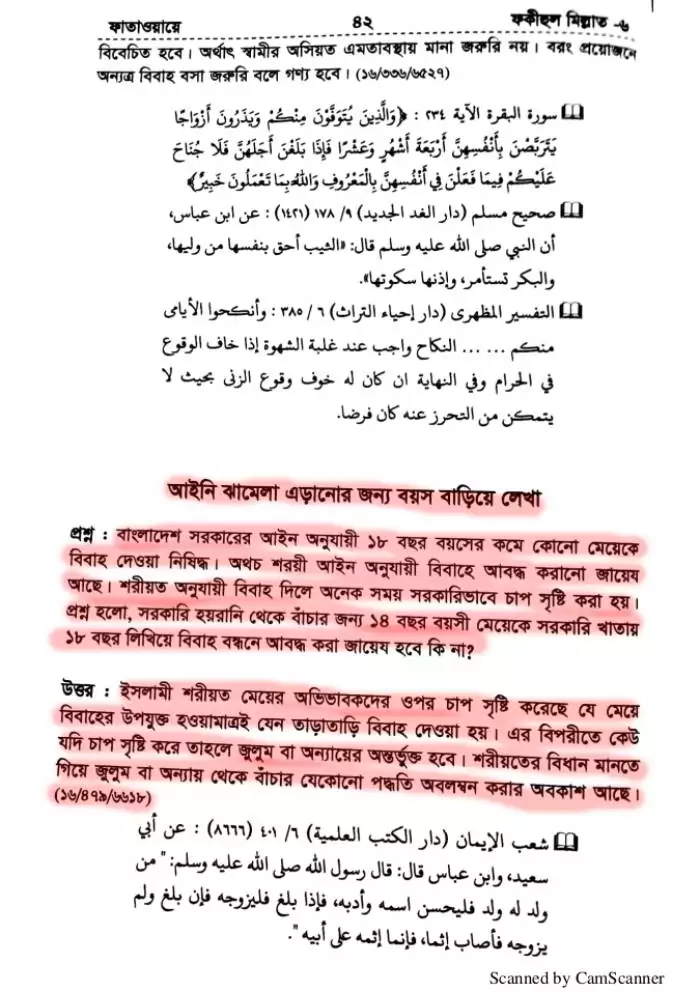
Many Islamic fatwa books clearly promote the idea that deception and lying are permissible in order to marry off child girls. In other words, lying in violation of Bangladeshi law is also permissible in this matter [14] –
Writing an older age to avoid legal complications
Question: According to the law of the Government of Bangladesh, it is prohibited to marry off a girl under the age of 18. Yet, according to Sharia law, it is permissible to marry her off. When a marriage is conducted according to Sharia, government pressure is often exerted. The question is whether it would be permissible to have a 14-year-old girl’s age recorded as 18 in the government register and marry her in order to avoid government harassment.
Answer: Islamic Sharia has placed pressure on the girl’s guardians to marry her quickly as soon as she becomes suitable for marriage. If anyone exerts pressure to the contrary, it would constitute oppression or wrongdoing. In order to follow the provisions of Sharia, one may adopt any method to avoid oppression or wrongdoing. (16/479/6618)
The Terrible Horror of Child Marriage
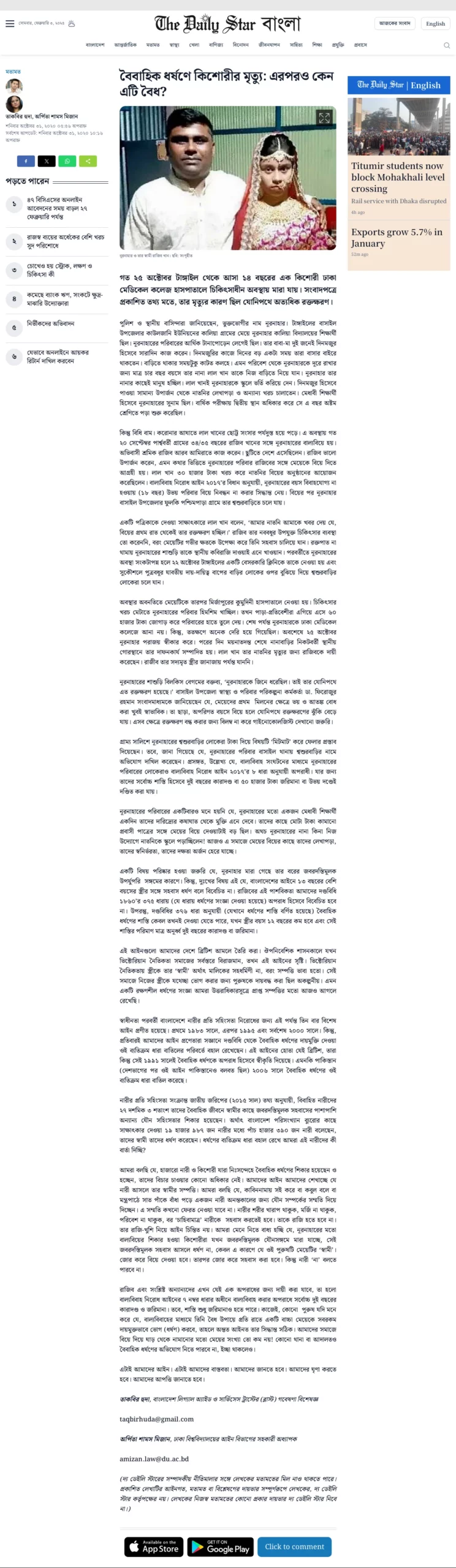
Let us read a news report, [15] [16]
Adolescent dies from marital rape: Why is it still legal?
Photo: Nur Nahar and her husband Rajib Khan.
On 25 October, a 14-year-old adolescent from Tangail died while receiving treatment at Dhaka Medical College Hospital. According to information published in newspapers, the cause of her death was excessive vaginal bleeding.
Police and local residents said that the victim’s name was Nur Nahar. Nur Nahar, a girl from the village of Kalia in Kauljani Union of Basail Upazila, Tangail, was a student at Kalia School. Nur Nahar’s family was constantly struggling financially. Both her parents worked all day as day laborers. They spent much of the day outside the home doing day labor. The time they spent at home was filled with conflict. To keep Nur Nahar away from such an environment, her maternal grandfather Lal Khan took her to his own home when she was only four years old. Nur Nahar was raised by her grandfather. Lal Khan was the one who enrolled Nur Nahar in school. He covered his granddaughter’s educational and other expenses from his meager earnings as a day laborer. Nur Nahar was known as a bright student. After securing second place in the annual examination, she had begun studying in the eighth grade that year.
But fate intervened. The small household of Lal Khan was devastated by the blow of COVID-19. In this situation, on 20 September, Nur Nahar was married off to 34- or 35-year-old Rajib Khan from a neighboring village. Rajib, a migrant worker, worked in the United Arab Emirates. He had returned home on leave. Based on the belief that Rajib earned well, Nur Nahar’s family became interested in marrying their daughter to him. Lal Khan spent 30,000 taka arranging the wedding ceremony for his granddaughter. Under the provisions of the Child Marriage Restraint Act 2017, since Nur Nahar was below the legal marriageable age of 18, both families decided not to register the marriage. After the marriage, Nur Nahar moved to her in-laws’ home in Phulki Paschimpara village of Basail Upazila.
In an interview with a newspaper, Lal Khan said, ‘My granddaughter informed me that she had been bleeding since the first night of the marriage.’ Rajib did not arrange appropriate medical treatment for his new bride; instead, ignoring the girl’s severe injuries, he continued having intercourse with her. When the bleeding did not stop, Nur Nahar’s mother-in-law gave her traditional herbal medicine obtained from a local practitioner. Later, when Nur Nahar’s condition became critical, she was taken to a private clinic in Tangail on 22 October, and the members of her husband’s family skillfully shifted all responsibility for their daughter-in-law onto her parental family and left.
As her condition deteriorated, the girl was then taken to Kumudini Hospital in Mirzapur. Nur Nahar’s family was struggling to pay the medical expenses. At that point, neighbors came forward, collected 60,000 taka, and handed it to the family. In the end, Nur Nahar was not brought to Dhaka Medical College. But by then, it was too late. Finally, on 25 October, Nur Nahar succumbed. After the autopsy the following day, she was buried in the local cemetery near her maternal grandparents’ home. Lal Khan blamed Rajib for his granddaughter’s death. Rajib did not even attend his recently deceased wife’s funeral prayer.
According to Nur Nahar’s mother-in-law, Bilkis Begum, ‘Nur Nahar had been possessed by a jinn. That is why she experienced so much bleeding from her vagina.’ Dr. Firozur Rahman, the Health and Family Planning Officer of Basail Upazila, told the media that it is entirely normal for girls to feel fear and terror during their first intercourse. Furthermore, when a marriage takes place at an immature age, the risk of vaginal bleeding increases. In such cases, it is essential to see a gynecologist without delay in order to stop the bleeding.
At a village arbitration meeting, the members of Nur Nahar’s husband’s family offered to pay money to ‘settle’ the matter. However, it has been learned that Nur Nahar’s family filed a complaint against her in-laws at Basail Police Station. It should be noted in this context that Nur Nahar’s family members were also offenders under Section 8 of the Child Marriage Restraint Act 2017 for arranging the child marriage. For this, they may be sentenced to a maximum of two years’ imprisonment, a fine of 50,000 taka, or both.
It never seemed to occur to anyone in Nur Nahar’s family that a bright student like Nur Nahar might one day free them from the blows of poverty. For them, marrying their daughter to a migrant groom who earned a large amount of money was more important. And yet Nur Nahar’s grandfather had been educating his granddaughter at school through his own initiative! Even today, in this society, girls’ education, self-reliance, and acquisition of skills continue to lose out to marriage.
It is important to make one thing clear: Nur Nahar died because of her husband’s repeated, forcible intercourse. But unfortunately, under Bangladeshi law, intercourse with a wife over the age of 13 is not considered rape. Rajib’s brutality will not be considered a crime under Section 375 of the Penal Code 1860, the section that defines rape. Furthermore, under Section 376 of the Penal Code, which describes the punishment for rape, punishment for marital rape can be imposed only when the wife is under 12 years of age, and even then the punishment is only imprisonment for a term not exceeding two years or a fine.
These laws were created in our country during the British period. They were created during the colonial period, when Victorian morality prevailed at every level of society. Under Victorian morality, a wife was regarded not as the life partner of her ‘husband,’ meaning her owner, but as property. In that society, holding a man accountable for using his own wife as he pleased was unimaginable. We have continued to protect such a conservative definition of rape even today, like inherited property.
Since independence, Bangladesh has enacted special laws three times to prevent violence against women: first in 1983, then in 1995, and most recently in 2000. Yet each time, our lawmakers consciously retained the exception that grants immunity from liability for marital rape in the Penal Code instead of abolishing it. The British, who were the authors of this law, recognized marital rape as a crime as early as 1991. Even Pakistan—where this law also remained in force after Partition—abolished that exception for marital rape in 2006.
According to the National Survey on Violence Against Women conducted in 2015, 27.3 percent of married women experienced forced intercourse and other forms of sexual violence by their husbands during their married lives. In other words, among the 19,987 women interviewed by the Bangladesh Bureau of Statistics, 5,390 women said that their husbands had raped them. By retaining the exception to the definition of rape, what message are we sending to these women?
We are saying that the thousands of women and adolescent girls who have undoubtedly been and continue to be victims of marital rape have no right to seek justice. Our law is teaching us that a woman is actually her husband’s property. We are saying that by signing a marriage contract, saying that she accepts the marriage, or being bound by seven circles of wedding vows, a woman gives lifelong consent to sexual relations. This consent can never be withdrawn. Whether the woman is physically unwell, unwilling, or in an unsuitable environment, she must have intercourse whenever the husband ‘demands’ it. She does not have to agree. The law is not concerned with whether she is willing or consenting. We are being forced to accept that when adolescent girls who have been subjected to child marriage, like Nur Nahar, die from forced intercourse, that forced intercourse is not actually rape simply because the man is the girl’s ‘husband.’ She will be forced into marriage. Then she will be forced into intercourse. But the woman will not be allowed to say ‘no.’
The only offense for which Rajib and the others concerned can now be held responsible is the offense of contracting a child marriage under Section 7 of the Child Marriage Restraint Act, punishable by a maximum of two years’ imprisonment and a fine. However, the punishment may consist solely of a fine. Therefore, if a man believes that through child marriage he can lawfully sexually use (rape) a child girl every night without any liability whatsoever, then at least legally his decision is correct. There is no shortage of girls in our society who can be married off to get them off one’s hands! No police station or court can accept a complaint of marital rape, even if it wishes to.
This is our law. This is our reality. We must know it. We must hate it. We must object to it.
Takbir Huda, Research Specialist at Bangladesh Legal Aid and Services Trust (BLAST)
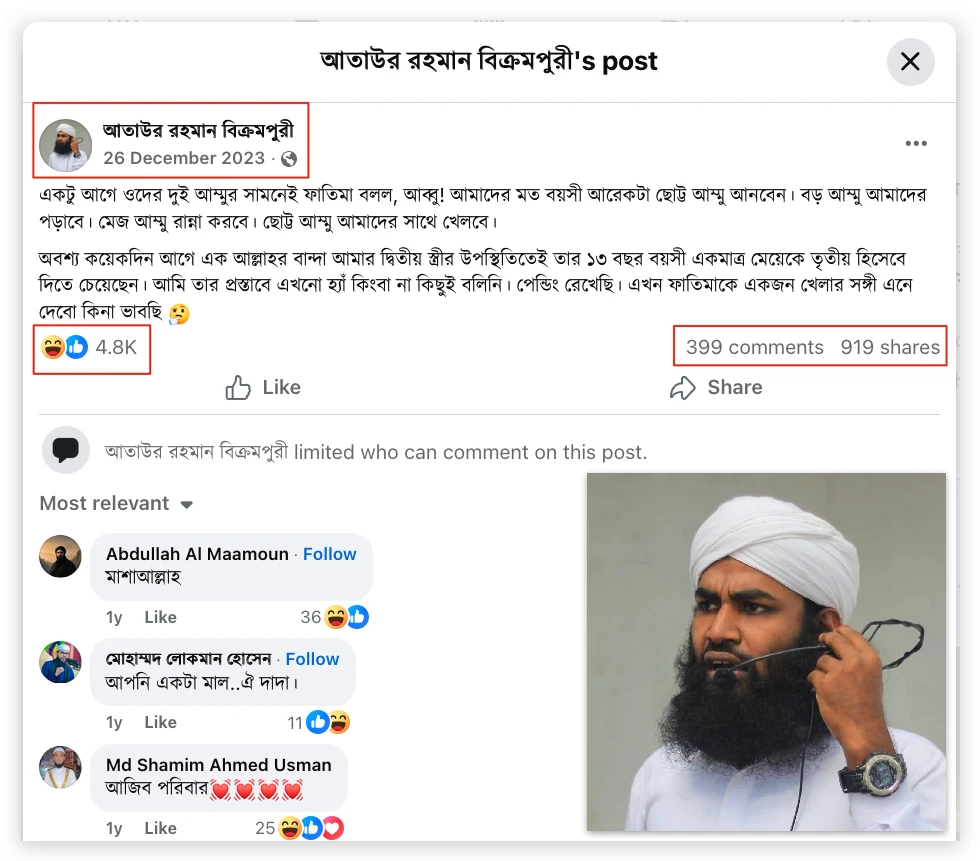
Now let us look at a Facebook status. It should be noted that there are countless Facebook statuses of this kind,
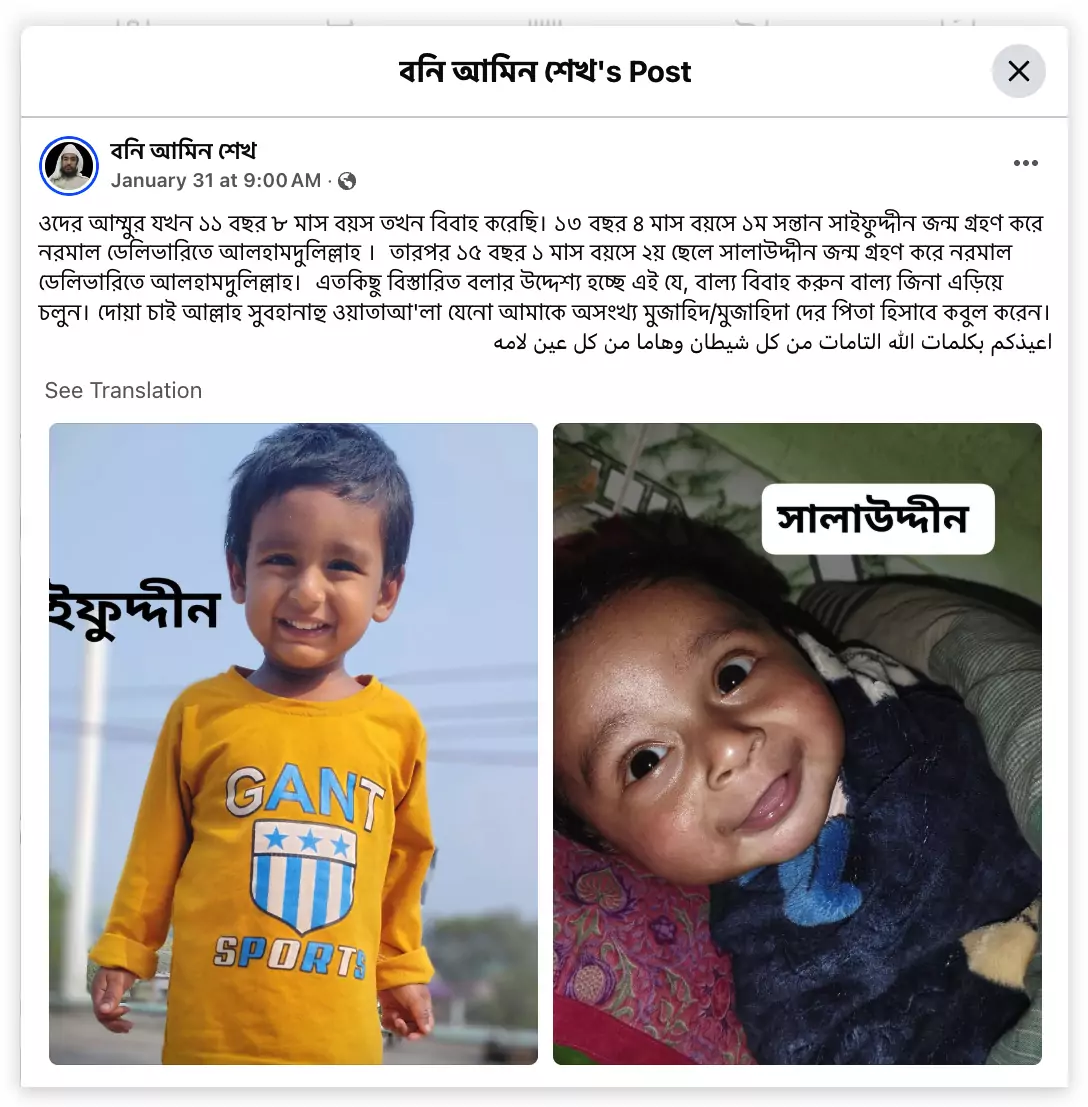
Let us look at another one,
Movement in Support of Sunnah Child Marriage
For many years, Islamists in Bangladesh have been campaigning in support of child marriage. In the slogans of this movement, they claim that since it is the Prophet’s Sunnah, it cannot be prohibited. Apparently, believing brothers have the right to contract child marriages and marry off their girl children. The Awami League’s affiliated organization, the Ulama League, has been agitating over this issue for a long time. Their demand is that Sunnah child marriage must be granted legal validity so that they can freely continue practicing pedophilia! [17]
Even more embarrassing is the news that in Saudi Arabia, Saudi Islamic scholars have instructed that even baby girls must wear the burka. They stated that the reason is that apparently they experience sexual arousal even when they see baby girls! [18] [19]



Every day, sermons are also delivered in various regions of the country to garner public support for issues such as child marriage and having more children, and this has assumed a frightening scale. Let us listen to some video statements on this subject:
Now let us listen to another sermon:
Militant Threats for Opposing Child Marriage
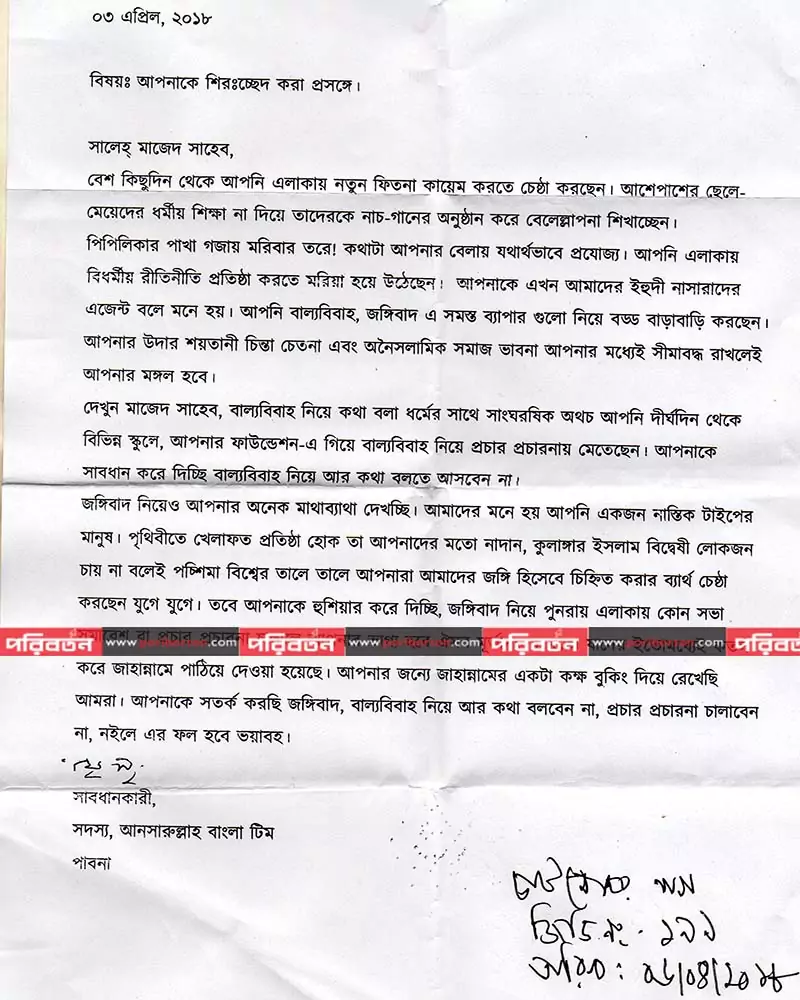
Ansarullah Bangla Team sent a threatening letter to social worker Abu Saleh Md. Abdul Majed, son of the late Foyez Uddin Sarker of Dhanbila village in Dibigram Union, because he spoke out against child marriage. Frightened, Abdul Majed also filed a general diary regarding the matter. Let us see why extremist Islamists threatened this man, [20]
3 April 2018
Subject: Regarding beheading you.
Mr. Saleh Majed,
For quite some time, you have been trying to establish a new fitna in the area. Instead of providing religious education to the boys and girls around you, you are teaching them indecency through dance and music programs. An ant grows wings only to die! The saying applies to you quite aptly. You have become desperate to establish irreligious customs in the area. You now appear to us to be an agent of our Jewish and Christian enemies. You are going far too far regarding child marriage, militancy, and such matters. It will be in your best interest if you keep your liberal satanic thoughts and ideas and your un-Islamic social views confined to yourself.
Look, Mr. Majed, speaking about child marriage is incompatible with religion, yet for a long time you have been engaged in campaigning and propagating against child marriage by visiting various schools and your foundation. I am warning you: do not come to speak about child marriage anymore.
I also see that you are greatly troubled by militancy. We think you are an atheist-type person. Since ignorant, degenerate, Islam-hating people like you do not want a caliphate to be established on earth, you have repeatedly made failed attempts to label us as militants in accordance with the Western world. But I am warning you: if you hold any meeting, rally, or campaign in the area about militancy again, your fate will be like that of those apostates who were slaughtered and sent to Hell. We have booked a chamber of Hell for you. We warn you: do not speak or conduct campaigns about militancy or child marriage anymore, or the consequences will be terrible.
The one issuing the warning,
Member,
Ansarullah Bangla Team
Pabna
Now let us listen to a statement by Abdur Razzaq bin Yusuf:
Physical Maturity versus Historical Narratives: Had Aisha Reached Puberty?
This section presents a close analysis of the timing of Aisha’s marriage and her physical and mental condition on the basis of various historical documents and reliable sources. By determining the difference between the Arabian lunar-year calculation and the current solar-year calculation, her actual age has been calculated as 5 years, 10 months at the time of marriage and 8 years, 8 months, and 26 days at the time of consummation. Other important aspects of the discussion include Muhammad’s dream about the child Aisha immediately after Khadijah’s death (within a few days), the legal validity of this marriage without any form of permission from Aisha, and evidence of behavioral and mental immaturity even after consummation, such as Aisha’s playing with dolls or running around with her companions. Finally, by reviewing the timing of historical battles, such as Khaybar and Tabuk, and accounts of the beginning of Aisha’s menstruation, it has been demonstrated that she was not biologically or, from the perspective of Islamic Sharia, religiously “baligha,” or an adult, until a long time after sexual relations with Muhammad had begun.
At the time of the marriage, Aisha had no opportunity to give any form of consent or informed opinion regarding the marriage; indeed, within the social structure of the time, she had not even the slightest idea of what was actually going to happen to her. Not only that, at the time of the first sexual intercourse, Aisha had not begun menstruating—not only according to the standards of modern science, but even according to the provisions of Islamic jurisprudence itself. In other words, she had not yet attained the qualification to be considered an adult even according to the Islamic definition. This section will establish that matter through a meticulous analysis of Islam’s historical information and Islamic textual evidence itself.
How Were Years Calculated in Arabia?
In ancient Arabia, people counted years according to lunar years. In English, a lunar year is called a Lunar Year, while the way we calculate years today is called a solar year, or Solar Year. During the time of the Prophet Muhammad, people’s ages were calculated according to lunar years. The problem is that a lunar year consists of 354 days, whereas a solar year currently consists of approximately 365 days, 5 hours, 48 minutes, and 47 seconds. However, according to the commonly used Gregorian calendar, a year is calculated as 365 days.
A lunar year has approximately 354 days. A solar year has 365 days. [21]
- Therefore, according to the hadith, Aisha being 6 years old means that her actual age was 6 X 354 = 2,124 days.
- Accordingly, in terms of the current solar year, Aisha’s age at that time was 2,124 ÷ 365 = 5 years and 10 months.
- Again, according to the hadith, Aisha being 9 years old means that her actual age was 9 X 354 = 3,186 days.
- Accordingly, in terms of the current solar year, Aisha’s age at that time was 3,186 ÷ 365 = 8 years, 8 months, and 26 days.
In What Year Was Aisha Born?
It is known from authentic hadith that Aisha was 18 years old when the Prophet Muhammad died. [22] The Prophet Muhammad died in 632 CE. Accordingly, Aisha was born in 613 or 614 CE.
Sahih Muslim (Hadith Academy)
17. Marriage
Section: 10. A father may give an underage virgin daughter in marriage
3373-(72/…) Yahya ibn Yahya, Ishaq ibn Ibrahim, Abu Bakr ibn Abu Shaybah, and Abu Kurayb (may Allah have mercy on them) … Narrated from Aisha (may Allah be pleased with her). She said that the Messenger of Allah (peace and blessings of Allah be upon him) married her when she was six years old, and consummated the marriage with her when she was nine years old, and he died when she was eighteen years old. (Islamic Foundation 3347, Islamic Center 3346)
Hadith grade: Sahih (Sahih)
Narrator: Aisha (may Allah be pleased with her)
The year of Aisha’s birth is stated even more clearly, together with several pieces of evidence, in the book The Lives of the Companions of the Messenger [23]—
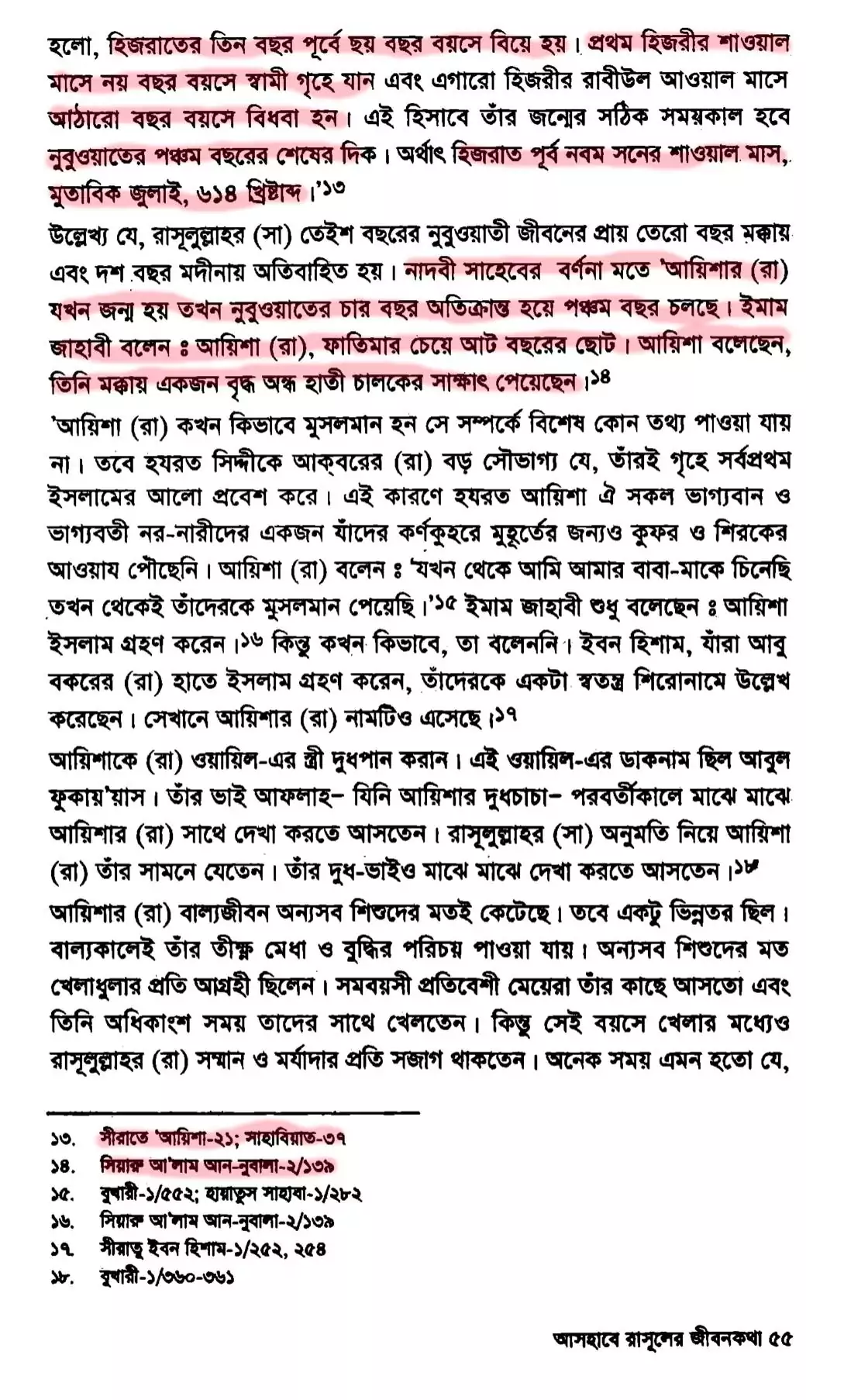
She was married three years before the Hijrah, at the age of six. In the month of Shawwal of the first Hijri year, she went to her husband’s household at the age of nine, and in the month of Rabi al-Awwal of the eleventh Hijri year, she became a widow at the age of eighteen. According to this calculation, the exact period of her birth would be toward the end of the fifth year of prophethood. That is, the month of Shawwal in the ninth year before the Hijrah, corresponding to May 614 CE.
It should be noted that of the Prophet’s (peace be upon him) twenty-three-year prophetic life, approximately thirteen years were spent in Mecca and ten years in Medina. According to Nadwi Sahib’s account, when Aisha (may Allah be pleased with her) was born, four years of prophethood had passed and the fifth year was underway. Imam al-Dhahabi says: Aisha (may Allah be pleased with her) was eight years younger than Fatima. Aisha said that she encountered an old blind elephant driver in Mecca.
Let us examine the entire matter with the help of a diagram:
Khadijah’s Death and Marriage to Aisha
Here a question may naturally arise in our minds: how long after the death of Khadijah, who had always supported the Prophet and whom the Prophet loved so much, did he marry Aisha? Usually, when our beloved husband or wife dies, many of us remain in mourning for years. During that period, the thought of another marriage does not even enter our minds. After many years have passed and grief has perhaps diminished with time, some of us may think about marrying again. One important consideration here is whether there are children in the family. If there are children, many may marry again quite quickly, because a new wife can provide those children with a mother’s affection. But even that was not possible in Aisha’s case, because Aisha herself was a child. It was not possible for her to care for another child or provide maternal affection. So let us see, according to researchers of Islam, how long after Khadijah’s death Muhammad married Aisha [24]—
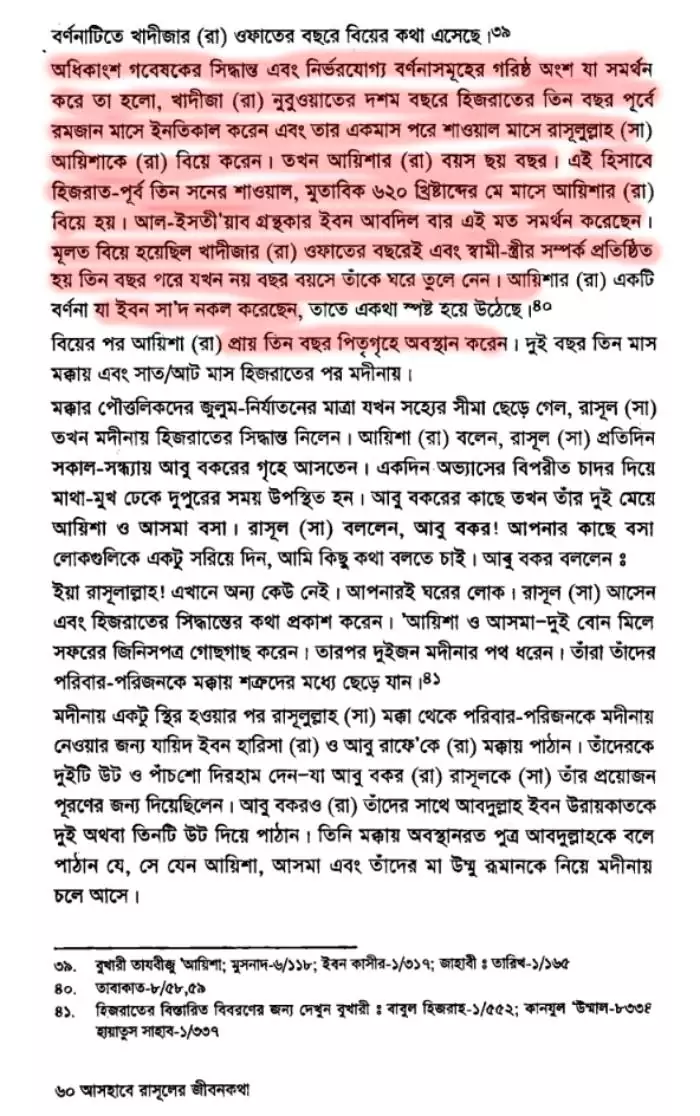
The conclusion of most researchers, and the position supported by the majority of reliable accounts, is that Khadijah (may Allah be pleased with her) died in Ramadan of the tenth year of prophethood, three years before the Hijrah, and one month later, in the month of Shawwal, the Messenger of Allah (peace be upon him) married Aisha (may Allah be pleased with her). Aisha (may Allah be pleased with her) was then six years old. According to this calculation, Aisha (may Allah be pleased with her) was married in Shawwal of the third year before the Hijrah, corresponding to May 620 CE. Ibn Abd al-Barr, the author of Al-Isti‘ab, supported this view. In fact, the marriage took place in the same year as Khadijah’s (may Allah be pleased with her) death, while the marital relationship was established three years later, when he brought her into his household at the age of nine.
Muhammad Dreamed of the Child Aisha
The Prophet Muhammad saw the child Aisha in dreams before marrying her [25]. The dreams are also highly intriguing. If I were to have such a dream about a little girl—although I would not have such a dream—marriage would never have entered my mind, even remotely. Perhaps I would have regarded the girl as my own daughter. But how Muhammad understood from this dream that Allah was commanding him to marry that child is also a remarkable matter!
Sahih Bukhari (Islamic Foundation)
54/ Marriage
Section: 2434. Regarding marrying a virgin girl. Ibn Abi Mulaika (may Allah have mercy on him) said: Ibn Abbas (may Allah be pleased with him) told Aisha (may Allah be pleased with her), “The Prophet (peace be upon him) married no virgin other than you.”
4707. Ubaydullah ibn Ismail (may Allah have mercy on him) … Narrated from Aisha (may Allah be pleased with her). She said, The Messenger of Allah (peace and blessings of Allah be upon him) said, “You were shown to me in a dream twice.” A man was carrying you wrapped in a silk cloth. When he saw me, he said, “This is your wife.” Then I uncovered your face and saw that it was you. Then I said, “If this dream is from Allah, He will make it come true.”
Hadith grade: Sahih (Sahih)
Narrator: Aisha (may Allah be pleased with her)
Now let us listen to a statement by Mizanur Rahman Azhari. This article will show that Muhammad married Aisha within one month of Khadijah’s death. Muhammad was then over 50, while Aisha was under 6. In other words, about a week after Khadijah’s death, Muhammad began seeing Aisha in his dreams, and seeing this child generated in him an interest in marrying her. How could the thought of marriage or love arise in the mind of a man so old upon seeing a little girl?
Was Aisha’s Permission Obtained?
It is very clear from the hadiths that, at the time of this marriage, Aisha had no idea what was happening to her. She knew nothing about what marriage was or what sexual relations meant. No one felt any need to obtain her permission. Let us read the hadiths, [26]
Sahih Muslim (Hadith Academy)
Chapter: 17. Marriage
Section: 10. A father may give an underage virgin daughter in marriage
3370-(69/1422) Abu Kurayb Muhammad ibn al-‘Ala and Abu Bakr ibn Abi Shaybah (may Allah have mercy on them) … Narrated from Aisha (may Allah be pleased with her). She said, The Messenger of Allah (peace and blessings of Allah be upon him) married me when I was six years old. When he took me to the bridal chamber, I was nine years old. Aisha (may Allah be pleased with her) said: After we migrated and reached Medina, I suffered from a fever for one month, and my hair fell out, leaving some around my ears. Umm Ruman, my mother, came to me while I was on a swing and my playmates were with me. She called me loudly, and I went to her.
I did not understand what she intended to do with me. She took my hand and brought me to the doorway, where I stood. I was saying, “Ah, ah.” Eventually my anxiety disappeared. She took me into a room where some women of the Ansar were present. They all prayed for my welfare and blessings and wished me good fortune. She entrusted me to them. They washed my head and adorned me. I was not frightened or alarmed by anything. At the time of Duha, the Messenger of Allah (peace and blessings of Allah be upon him) came, and they entrusted me to him. (Islamic Foundation 3344, Islamic Center 3343)
Hadith grade: Sahih (Sahih)
Narrator: Aisha (may Allah be pleased with her)
Now let us look at a fatwa on this matter. The fatwa is in Arabic, and its English and Bengali translations are also provided below (AI assistance was used for the translations) [27] –
الدليل على جواز تزويج الأب البنت الصغيرة دون إذنها أو رضاها
رقم الفتوى: 230518
السؤال
هل يوجد دليل في النصوص الشرعية يقول بجواز إجبار البكر الصغيرة على الزواج؟.
الإجابــة
الحمد لله والصلاة والسلام على رسول الله وعلى آله وصحبه، أما بعد:
فقد حكى بعض العلماء الإجماع على أن للأب تزويج ابنته البكر الصغيرة بغير رضاها، ولا يشترط إذنها، ونعني بالصغيرة من ليست بالغة، جاء في المغني لابن قدامة: أما البكر الصغيرة: فلا خلاف فيها، قال ابن المنذر: أجمع كل من نحفظ عنه من أهل العلم أن نكاح الأب ابنته البكر الصغيرة جائز, إذا زوجها من كفء. اهـ.
ومستند هذا الإجماع أن أبا بكر زوج عائشة ـ رضي الله عنها ـ من رسول الله صلى الله عليه وسلم ولم يشاورها، قال ابن عبد البر: أجمع العلماء على أن للأب أن يزوج ابنته الصغيرة ولا يشاورها، لتزويج رسول الله صلى الله عليه وسلم عائشة وهي بنت ست سنين…. اهـ.
ولمزيد الفائدة نرجو مراجعة الفتويين رقم: 223414، ورقم: 172491
والله أعلم.
Title: Evidence that a father may marry off his young virgin daughter without her permission or consent
Fatwa Number: 230518
Publication Date: Thursday, 2 Safar 1435 AH – 5 December 2013
Question:
Is there any evidence in the Sharia texts that it is permissible to compel a virgin to marry?
Answer:
Praise be to Allah, and may blessings and peace be upon the Messenger of Allah, his family, and his companions.
Some scholars have reported a consensus (ijma‘) that a father may marry off his young virgin daughter without her permission or consent. By “young” we mean one who has not yet reached puberty(adulthood). It is understood that such a marriage is permissible provided that the husband is suitable (kuf’) for her.
This consensus is based on the fact that Abu Bakr married off his daughter ‘Aishah, may Allah be pleased with her, to the Messenger of Allah, peace and blessings be upon him, without consulting her. Ibn ‘Abd al-Barr said: “The scholars are unanimously agreed that a father has the right to marry off his young daughter without consulting her, as evidenced by the marriage of the Messenger of Allah, peace and blessings be upon him, to ‘Aishah when she was six years old.”
For further details, please see Fatwas No. 223414 and No. 172491.
And Allah knows best.
Bengali translation:
Title: Evidence that a father may marry off his virgin daughter without her permission or consent
Fatwa Number: 230518
Publication Date: Thursday, 2 Safar 1435 AH – 5 December 2013
Question:
Is there any evidence in the Sharia texts that it is permissible to compel a virgin to marry?
Answer:
Praise be to Allah, and may blessings and peace be upon the Messenger of Allah, his family, and his companions.
Some scholars have reported a consensus (ijma‘) that a father may marry off his underage virgin daughter without her permission or consent. By “underage” we mean someone who has not yet reached puberty. The condition is that the prospective husband must be suitable (kufu’) for her.
This consensus is based on the fact that Abu Bakr (may Allah be pleased with him) married off his daughter Aishah (may Allah be pleased with her) to the Messenger of Allah (peace and blessings be upon him) without consulting her. Ibn Abd al-Barr said: “The scholars are unanimously agreed that a father has the right to marry off his underage daughter without consulting her; the evidence is the marriage of the Messenger of Allah (peace and blessings be upon him) to Aishah (may Allah be pleased with her) when she was six years old.”
For further details, see Fatwa No. 223414 and No. 172491.
Allah knows best.
Aishah’s Age at the Time of Marriage and Consummation
Through various sahih hadiths, we learn that Aishah was six years old when she married Muhammad and nine years old when she had sexual intercourse with him. At the age of nine, she had sexual intercourse with Muhammad [28] –
Narrated from Hisham’s father, he said: Khadijah died three years before the Prophet (peace and blessings be upon him) departed for Medina. Then, after two years or thereabouts had passed, he married Aishah (may Allah be pleased with her), when she was a girl of six years. Then he consummated the marriage when she was nine years old.
Narrated Hisham’s father: Khadija died three years before the Prophet (ﷺ) departed to Medina. He stayed there for two years or so and then he married `Aisha when she was a girl of six years of age, and he consumed that marriage when she was nine years old.
Sahih Bukhari (Tawhid) 3896
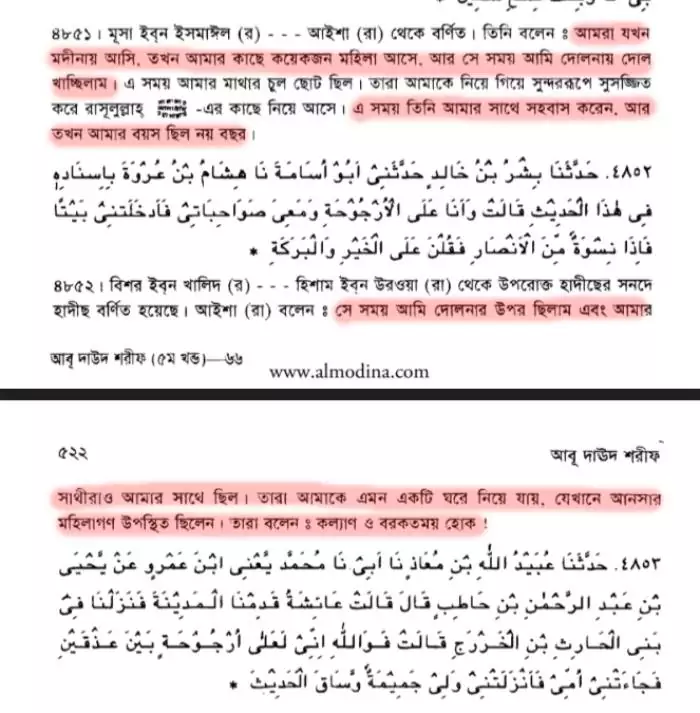
Sunan Abu Dawud states even more clearly that she had sexual intercourse with the Prophet immediately after arriving in Medina.[29] [30]
Sunan Abu Dawud (Islamic Foundation)
36/ Etiquette
Chapter: 61. Regarding riding on a swing.
4851. Musa ibn Ismail (may Allah have mercy on him) …. Narrated from Aishah (may Allah be pleased with her). She said: When we arrived in Medina, several women came to me, and at that time I was swinging on a swing. At that time, my hair was short. They took me, beautifully dressed me, and brought me to the Messenger of Allah (peace and blessings be upon him). At that time, he had sexual intercourse with me, and I was nine years old then.
Hadith grade: Sahih (Sahih)
Narrator: Aishah bint Abu Bakr al-Siddiq (may Allah be pleased with her)
Sunan al-Nasa’i also states this, [31]
Sunan al-Nasa’i (Islamic Foundation)
26/ Nikah (Marriage)
Chapter: 78. nine years at the age of consort
3381. Muhammad ibn Adam (may Allah have mercy on him) … Narrated from Aishah (may Allah be pleased with her). She said, The Messenger of Allah (peace and blessings be upon him) married me when I was six years old and consummated the marriage when I was nine years old, and at that time I used to play with the girls.
Verification: Sahih.
Hadith grade: Sahih (Sahih)
Narrator: Aishah (may Allah be pleased with her)
It should be noted that the phrase “consummating the marriage” means consummating the marriage through sexual intercourse [26] [32]-
Sahih Muslim (Hadith Academy)
Chapter: 17. Marriage
Section: 10. A father may marry off an underage virgin daughter
3370-(69/1422) Abu Kurayb Muhammad ibn al-‘Ala and Abu Bakr ibn Abu Shaybah (may Allah have mercy on them) … Narrated from Aishah (may Allah be pleased with her). She said, The Messenger of Allah (peace and blessings be upon him) married me when I was six years old. He took me into the bridal chamber when I was nine years old. Aishah (may Allah be pleased with her) said: After we migrated and arrived in Medina, I suffered from fever for a month, and my hair fell out, leaving only some hair near my ears. Umm Ruman, my mother, came to me while I was on a swing and my playmates were with me. She called me loudly, and I went to her.
I did not understand what she intended to do with me. She took me by the hand and made me stand at the door. I was saying, “Ah, ah.” Finally, my anxiety went away. She took me into a room where some Ansari women were present. They all prayed for my well-being and blessings and wished me good fortune. My mother handed me over to them. They washed my head and adorned me. I was not frightened or afraid of anything. The Messenger of Allah (peace and blessings be upon him) came at the time of Duha, and they handed me over to him. (Islamic Foundation 3344, Islamic Center 3343)
Hadith grade: Sahih (Sahih)
Narrator: Aishah (may Allah be pleased with her)
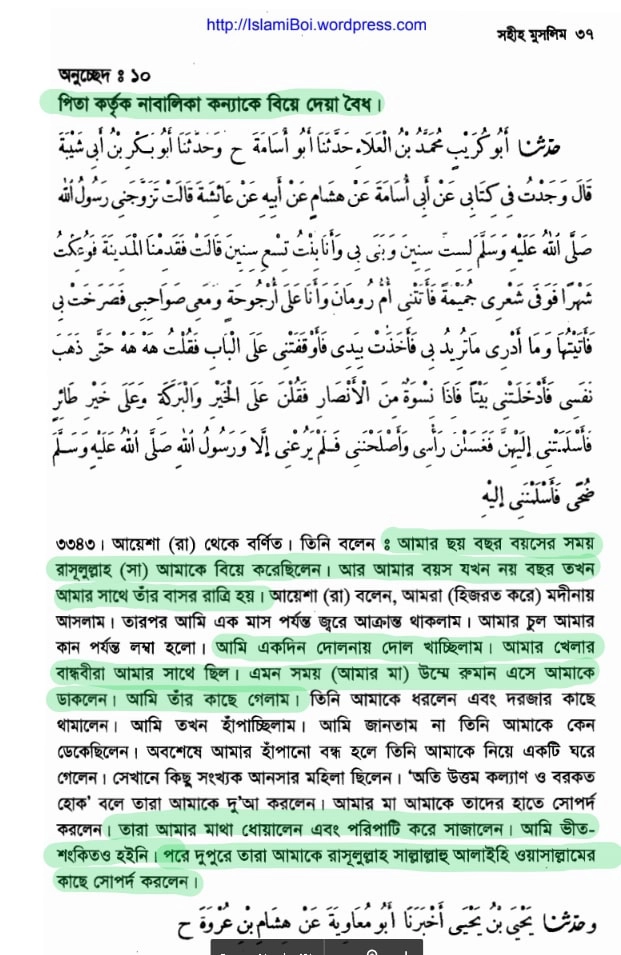
Let us learn the above hadith from several other narrators as well, [33] [34] [22]
Sahih Muslim (Hadith Academy)
17. Marriage
Section: 10. A father may marry off an underage virgin daughter
3371-(70/…) Yahya ibn Yahya and Ibn Numayr (may Allah have mercy on them) ….. Narrated from Aishah (may Allah be pleased with her). She said, The Messenger of Allah (peace and blessings be upon him) married me when I was six years old, and he consummated the marriage with me when I was nine years old. (Islamic Foundation 3345, Islamic Center 3344)
Hadith grade: Sahih (Sahih)
Narrator: Aishah (may Allah be pleased with her)
Sahih Muslim (Hadith Academy)
17. Marriage
Section: 10. A father may marry off an underage virgin daughter
3372-(71/…) Abd ibn Humayd (may Allah have mercy on him) …..It is narrated from Aishah (may Allah be pleased with her) that the Messenger of Allah (peace and blessings be upon him) married her when she was seven years old. She was taken into his household as a bride when she was nine* years old, and her dolls were with her. The Messenger of Allah (peace and blessings be upon him) died when she was eighteen years old. (Islamic Foundation 3346, Islamic Center 3345)
* She says that the Messenger of Allah (peace and blessings be upon him) married her when she was six years old. It can be observed that some hadiths state that Aishah (may Allah be pleased with her) was six years old when she married, while others state that she was seven. According to hadith commentators, at that time Aishah (may Allah be pleased with her) had passed six and was in her seventh year. Thus, in some hadiths, the additional period beyond six years was omitted and her age was counted as six, while in others the additional period was counted as a complete year and her age was counted as seven.
Hadith grade: Sahih (Sahih)
Narrator: Aishah (may Allah be pleased with her)
Sahih Muslim (Hadith Academy)
17. Marriage
Section: 10. A father may marry off an underage virgin daughter
3373-(72/…) Yahya ibn Yahya, Ishaq ibn Ibrahim, Abu Bakr ibn Abu Shaybah, and Abu Kurayb (may Allah have mercy on them) … Narrated from Aishah (may Allah be pleased with her). She said that the Messenger of Allah (peace and blessings be upon him) married her when she was six years old; when she was nine years old, he consummated the marriage with her, and he died when she was eighteen years old. (Islamic Foundation 3347, Islamic Center 3346)
Hadith grade: Sahih (Sahih)
Narrator: Aishah (may Allah be pleased with her)
Some Muslims today try to argue that Muhammad had sexual intercourse with Aishah at the age of nine only after she had reached puberty, and that Islam prohibits sexual intercourse before puberty. However, no such prohibition can be found in the Qur’an, hadith, or statements of early scholars. Rather, it can be seen that intercourse with underage female sex slaves was a common occurrence among the Companions [35]. Let us hear Abd al-Razzaq bin Yusuf’s statement about Aishah’s marriage,
But Aishah Was Not the Only One
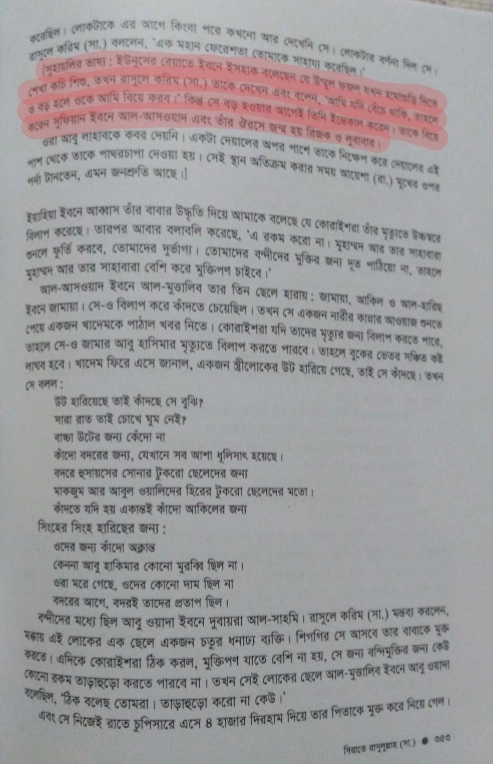
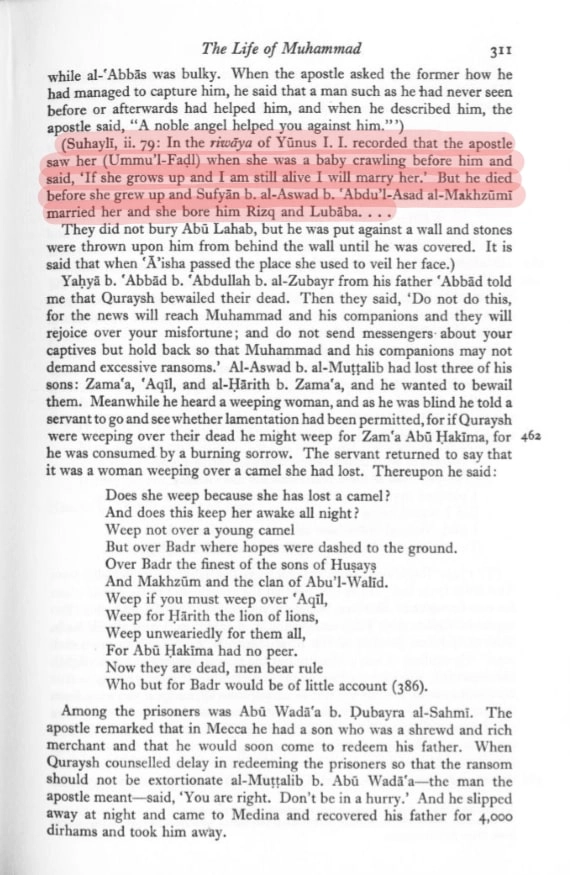
It is not the case that Muhammad was attracted only to the underage Aishah. He even expressed a desire to marry a young child who was crawling. In other words, seeing a crawling infant awakened in him the desire for marriage. A reference to this can be found in Ibn Ishaq’s work. [36] .
You will find the same point in Guillaume’s biographical work [37]
Musnad Ahmad is a vast collection of hadith compiled by Ahmad ibn Hanbal, the principal imam of the Hanbali madhhab and a renowned Islamic scholar. His work states, [38]
حدثنا يعقوب قال حدثنا أبي عن ابن إسحاق قال وحدثني حسين بن عبد الله بن عباس عن عكرمة مولى عبد الله بن عباس عن عبد الله بن عباس عن أم الفضل بنت الحارث أن رسول الله صلى الله عليه وسلم رأى أم حبيبة بنت عباس وهي فوق الفطيم قالت فقال لئن بلغت بنية العباس هذه وأنا حي لأتزوجنها
The translation of this hadith is provided: [39]
Muhammad saw Um Habiba, the daughter of Abbas while she was fatim (age of nursing) and he said, “If she grows up while I am still alive, I will marry her.
Musnad Ahmad, Number 25636
Bengali translation,
Abdullah ibn Abbas narrated from Umm al-Fadl bint al-Harith: The Messenger of Allah (peace and blessings be upon him) saw Abbas’s daughter while she was a ‘nursing infant’ and said, if Abbas’s daughter reaches adulthood and I remain alive until then, I will certainly marry her.
This time I am presenting a hadith directly from Sahih Bukhari; readers, read the hadith carefully. It is narrated in the hadith that the Prophet ordered a princess to surrender herself to him. The princess said that she could not surrender herself to any common marketplace man. Then the Prophet placed his hand on her. At that point, the princess sought to protect herself from the Prophet by invoking Allah. After she invoked Allah, the Prophet let her go. If this hadith had occurred in the present day, Muhammad would certainly have faced a lawsuit for pressuring a woman for sex. But the notable point is that the girl was very young. Her wet nurse—that is, the woman who breastfeeds a child in place of its mother—was also with her. Why would a wet nurse accompany an adult princess? [40]
Reference : Sahih al-Bukhari 5255
In-book reference : Book 68, Hadith 5
USC-MSA web (English) reference : Vol. 7, Book 63, Hadith 182
Narrated Abu Usaid:
We went out with the Prophet (ﷺ) to a garden called Ash-Shaut till we reached two walls between which we sat down. The Prophet (ﷺ) said, “Sit here,” and went in (the garden). The Jauniyya (a lady from Bani Jaun) had been brought and lodged in a house in a date-palm garden in the home of Umaima bint An- Nu`man bin Sharahil, and her wet nurse was with her.
When the Prophet (ﷺ) entered upon her, he said to her, “Give me yourself (in marriage) as a gift.” She said, “Can a princess give herself in marriage to an ordinary man?” The Prophet (ﷺ) raised his hand to pat her so that she might become tranquil. She said, “I seek refuge with Allah from you.” He said, “You have sought refuge with One Who gives refuge. Then the Prophet (ﷺ) came out to us and said, “O Abu Usaid! Give her two white linen dresses to wear and let her go back to her family.”
Arabic : حَدَّثَنَا أَبُو نُعَيْمٍ ، حَدَّثَنَا عَبْدُ الرَّحْمَنِ بْنُ غَسِيلٍ ، عَنْ حَمْزَةَ بْنِ أَبِي أُسَيْدٍ ، عَنْ أَبِي أُسَيْدٍ ـ رضى الله عنه ـ قَالَ خَرَجْنَا مَعَ النَّبِيِّ صلى الله عليه وسلم حَتَّى انْطَلَقْنَا إِلَى حَائِطٍ يُقَالُ لَهُ الشَّوْطُ، حَتَّى انْتَهَيْنَا إِلَى حَائِطَيْنِ فَجَلَسْنَا بَيْنَهُمَا فَقَالَ النَّبِيُّ صلى الله عليه وسلم ” اجْلِسُوا هَا هُنَا ”. وَدَخَلَ وَقَدْ أُتِيَ بِالْجَوْنِيَّةِ، فَأُنْزِلَتْ فِي بَيْتٍ فِي نَخْلٍ فِي بَيْتٍ أُمَيْمَةُ بِنْتُ النُّعْمَانِ بْنِ شَرَاحِيلَ وَمَعَهَا دَايَتُهَا حَاضِنَةٌ لَهَا، فَلَمَّا دَخَلَ عَلَيْهَا النَّبِيُّ صلى الله عليه وسلم قَالَ ” هَبِي نَفْسَكِ لِي ”. قَالَتْ وَهَلْ تَهَبُ الْمَلِكَةُ نَفْسَهَا لِلسُّوقَةِ. قَالَ فَأَهْوَى بِيَدِهِ يَضَعُ يَدَهُ عَلَيْهَا لِتَسْكُنَ فَقَالَتْ أَعُوذُ بِاللَّهِ مِنْكَ. فَقَالَ ” قَدْ عُذْتِ بِمَعَاذٍ ”. ثُمَّ خَرَجَ عَلَيْنَا، فَقَالَ ” يَا أَبَا أُسَيْدٍ اكْسُهَا رَازِقِيَّتَيْنِ وَأَلْحِقْهَا بِأَهْلِهَا” .
Look at the English translation:
Narrated Abu Usaid:
We went out with the Prophet (ﷺ) to a garden called Ash-Shaut till we reached two walls between which we sat down. The Prophet (ﷺ) said, “Sit here,” and went in (the garden). The Jauniyya (a lady from Bani Jaun) had been brought and lodged in a house in a date-palm garden in the home of Umaima bint An- Nu`man bin Sharahil, and her wet nurse was with her. When the Prophet (ﷺ) entered upon her, he said to her, “Give me yourself (in marriage) as a gift.” She said, “Can a princess give herself in marriage to an ordinary man?” The Prophet (ﷺ) raised his hand to pat her so that she might become tranquil. She said, “I seek refuge with Allah from you.” He said, “You have sought refuge with One Who gives refuge. Then the Prophet (ﷺ) came out to us and said, “O Abu Usaid! Give her two white linen dresses to wear and let her go back to her family.”
There are several other narrations of this hadith. Let us read those hadiths as well. Before reading them, it must be remembered that in Islam, a girl’s consent is required when an adult girl is married. A minor girl may be married off whenever her father or guardian wishes, whether or not the daughter consents to it. Evidence concerning this matter will be presented later in this article. These hadiths must be read with this in mind, because they make it clear that the Prophet’s marriage to the girl took place against her will. A marriage can take place against a girl’s will only when she is a minor. According to Islamic Sharia, a girl’s consent is required when an adult girl is married. Therefore, this hadith indicates that the Prophet married yet another child. But this child did not surrender herself to the Prophet in any way. Instead, she insulted the Prophet by calling him a lowly marketplace man and sought refuge with Allah. For this reason, the Prophet was forced to divorce her and send her back without having intercourse with her [41] [42] –
Sahih Bukhari (Islamic Foundation)
55/ Divorce
Section: 2042. Should the husband pronounce divorce face-to-face with his wife when giving divorce?
Islamic Foundation number: 4877, International number: 5254
4877. Humaydi (RA) … narrated from Al-Awza’i (RA), who said: I asked Az-Zuhri (RA), did any of the wives of the Prophet (ﷺ) seek protection from him? He replied: Urwa narrated to me from Aisha (RA) that, when the daughter of Al-Jaun was sent to the Messenger of Allah (ﷺ) in a room and he approached her, she said: I seek refuge with Allah from you. The Messenger of Allah (ﷺ) said: You have sought refuge with a Great Being; go to your family.
Abu Abdullah (Imam Bukhari) (RA) said: The hadith was also narrated by Hajjaj ibn Abi Mani from his grandfather, from Az-Zuhri, from Urwa, from Aisha (RA).
Hadith grade: Sahih (Sahih)
Narrator: Al-Awza’i (RA)
Sahih Bukhari (Islamic Foundation)
55/ Divorce
Section: 2042. Should the husband pronounce divorce face-to-face with his wife when giving divorce?
Islamic Foundation number: 4878, International number: 5255 – 5257
4878. Abu Nu’aym (RA) … narrated from Abu Usaid (RA). He said: We went out with the Prophet (ﷺ), and while passing near a garden called Ash-Shaut, we reached two gardens and sat between them. The Prophet (ﷺ) said: You stay here. He entered inside. At that time, Juwayna, the daughter of Nu’man ibn Sharahil, was brought to the house in Umaima’s date-palm garden. A wet nurse was also with her to serve her. When the Prophet (ﷺ) went to her, he said: Surrender yourself to me. Then she said: Does a princess surrender herself to a marketplace (lowly) person?
The narrator says: Then he extended his hand to place it on her body so that she might become calm. She said: I seek refuge with Allah from you. He said: You have sought refuge with the One worthy of granting refuge. Then he came out to us and said: O Abu Usaid! Dress her in two linen garments and take her to her family.
Husayn ibn Walid Nishapuri (RA) … narrated from Sahl ibn Sa’d and Abu Usaid (RA). They said that, the Prophet (ﷺ) married Umayya bint Sharahil. Later, when she was brought to him, he extended his hand toward her. She disliked this. Then he instructed Abu Usaid to gather her belongings, dress her in two linen garments, and take her to her family.
Hadith grade: Sahih (Sahih) Narrator: Abu Usaid (RA)
Abu Bakr Embarrassed by the Marriage Proposal
It is known from authentic hadith that the Prophet Muhammad proposed to Abu Bakr for Aisha’s hand in marriage. Abu Bakr was immediately very embarrassed upon hearing this, as can be understood from his statement. Read the authentic hadith: [43]
Reference : Sahih al-Bukhari 5081
In-book reference : Book 67, Hadith 19
USC-MSA web (English) reference : Vol. 7, Book 62, Hadith 18
Chapter: The marrying of young lady to an elderly man
Narrated ‘Urwa:
The Prophet (ﷺ) asked Abu Bakr for `Aisha’s hand in marriage. Abu Bakr said “But I am your brother.” The Prophet (ﷺ) said, “You are my brother in Allah’s religion and His Book, but she (Aisha) is lawful for me to marry.”
Arabic : حَدَّثَنَا عَبْدُ اللَّهِ بْنُ يُوسُفَ ، حَدَّثَنَا اللَّيْثُ ، عَنْ يَزِيدَ ، عَنْ عِرَاكٍ ، عَنْ عُرْوَةَ ، أَنَّ النَّبِيَّ صلى الله عليه وسلم خَطَبَ عَائِشَةَ إِلَى أَبِي بَكْرٍ فَقَالَ لَهُ أَبُو بَكْرٍ إِنَّمَا أَنَا أَخُوكَ، فَقَالَ ” أَنْتَ أَخِي فِي دِينِ اللَّهِ وَكِتَابِهِ وَهْىَ لِي حَلاَلٌ ”.
(11)Chapter: The marrying of young lady to an elderly man(11)
Narrated ‘Urwa:
The Prophet (ﷺ) asked Abu Bakr for `Aisha’s hand in marriage. Abu Bakr said “But I am your brother.” The Prophet (ﷺ) said, “You are my brother in Allah’s religion and His Book, but she (Aisha) is lawful for me to marry.”
Reference : Sahih al-Bukhari 5081
In-book reference : Book 67, Hadith 19
USC-MSA web (English) reference : Vol. 7, Book 62, Hadith 18
(deprecated numbering scheme)
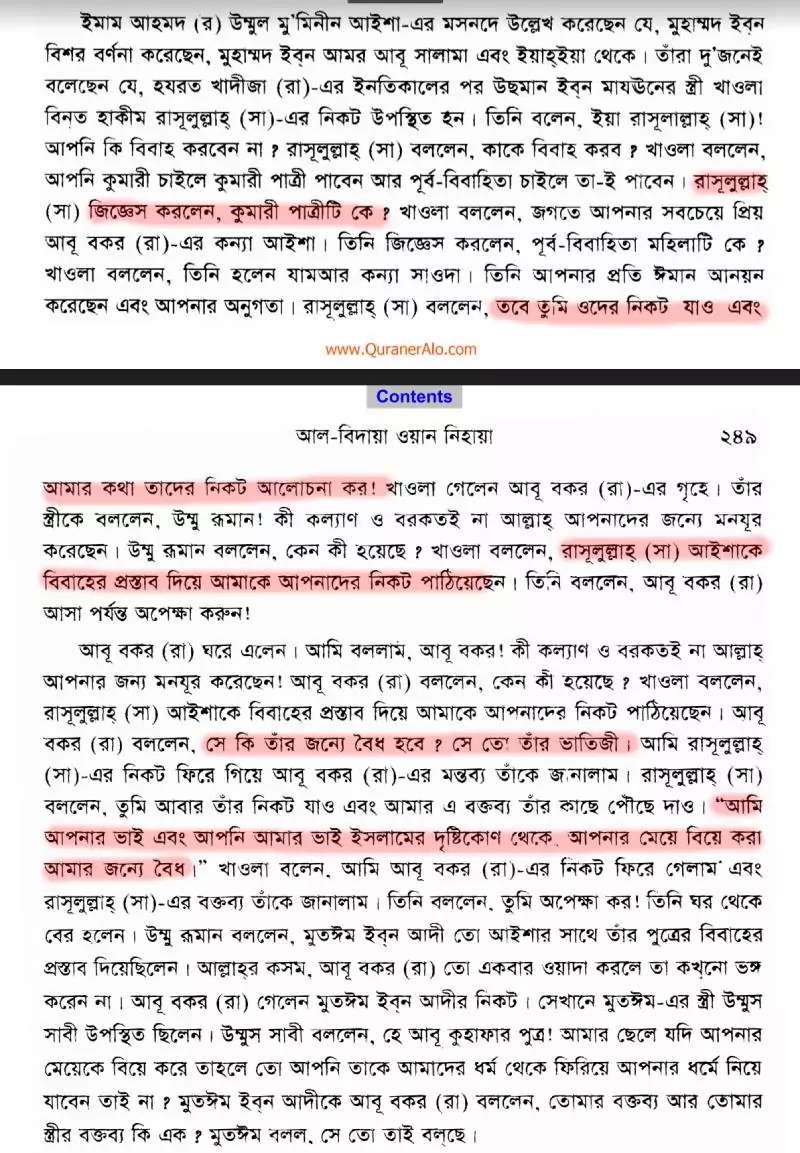
Now let us learn about this marriage proposal from the book Al-Bidaya wa’l-Nihaya [44] –
The Prophet: “Do as I Say, Not as I Do”
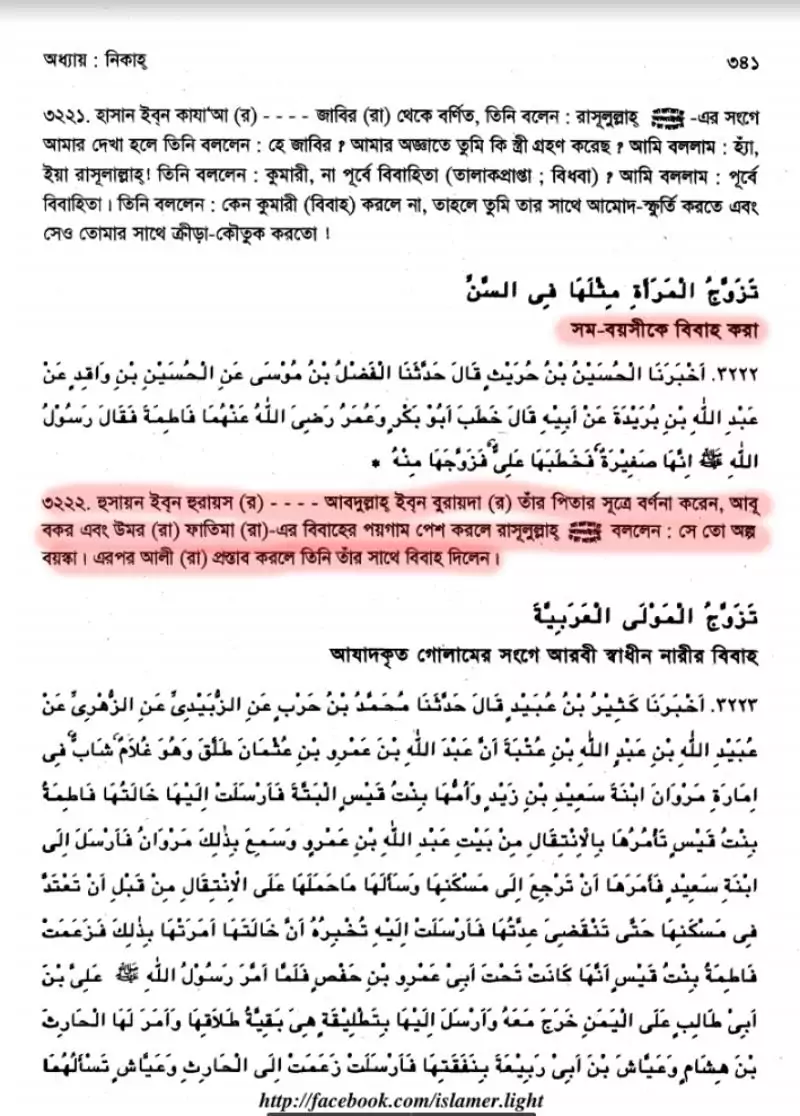
A Bengali proverb says, “Drunk by nature, proper in conduct.” Although Abu Bakr wanted to marry Muhammad’s young daughter, when Abu Bakr and Umar wanted to marry Muhammad’s daughter Fatima, Muhammad did not give her in marriage to them because they were older. He gave her in marriage to the young Ali. In other words, when it came to his own daughter, he understood perfectly well that it would not be right to marry her to a man so much older. Think about it: in his own case, he was perfectly proper [45] [46]
Many people claim that 1,400 years ago it was normal for girls to be married at a young age. That is certainly true, but even then it was normal for young girls to be married to young boys. Parents who were conscious of their responsibilities would not accept the marriage of a young girl to an older man. The Prophet himself did not accept this, as this hadith proves. Yet, despite being older himself, he married Aisha.
Sunan an-Nasa’i (Islamic Foundation)
26/ Nikah (Marriage)
Section: 7. Marrying someone of a similar age
3224. Husayn ibn Hurayash (RA) … Abdullah ibn Burayda (RA) narrated from his father that, when Abu Bakr and Umar (RA) sent proposals for the marriage of Fatima (RA), the Messenger of Allah (ﷺ) said: She is still young. Then, when Ali (RA) proposed, he married her to him.
Verification: Sahih.
Hadith grade: Sahih (Sahih)
Narrator: Abdullah ibn Burayda (RA)
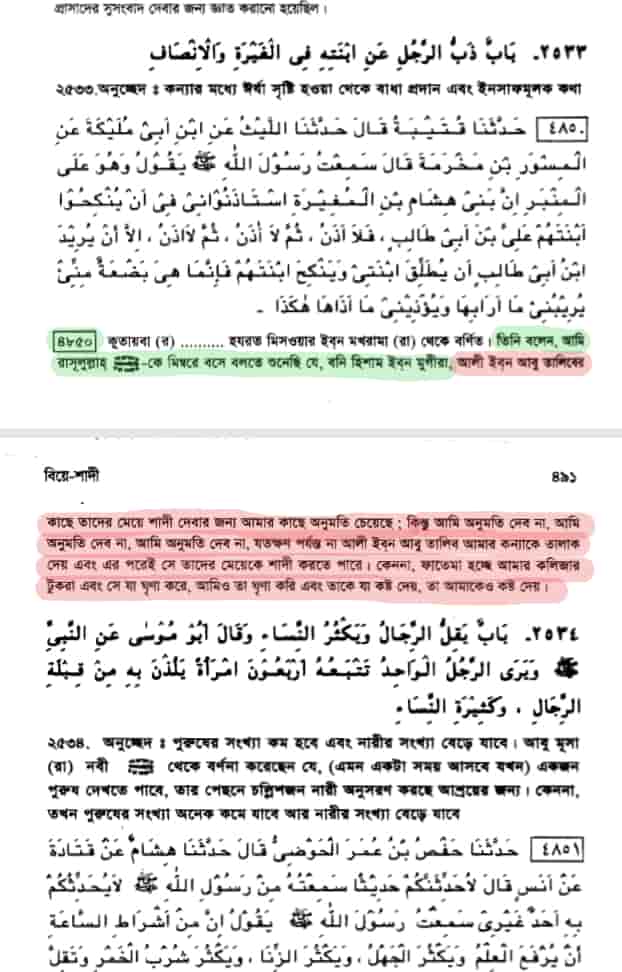
There is more. Muhammad himself contracted many marriages and had sexual relations with female slaves as well. He and his wives and slave women often became involved in serious quarrels, and verses—even including threats from Allah—had to be revealed to deal with them. It is universally known that the Prophet Muhammad loved his young child-wife Aisha more than the others. The amusing thing is that although he himself married so many times, he did not allow his own son-in-law to marry anyone else. There he was “drunk by nature, proper in conduct.” After all, he was a father! How could he allow another wife to be brought in for his daughter? Yet he forgot that the women he married were also someone else’s daughters. He did not consider that they too would suffer when a co-wife entered their household [47] [48].
Sahih Bukhari (Islamic Foundation)
Chapter: 54/ Marriage
Section: 2533. Prohibiting the creation of jealousy among daughters and speaking justly
4850. Qutayba (RA) … narrated from Al-Miswar ibn Makhrama (RA). He said: I heard the Messenger of Allah (ﷺ) say from the pulpit that the Banu Hisham ibn al-Mughira, have asked me for permission to marry their daughter to Ali ibn Abi Talib; but I will not give permission, I will not give permission, I will not give permission, unless Ali ibn Abi Talib divorces my daughter, and only then may he marry their daughter. For Fatima is a part of me, and whatever she hates, I hate too, and whatever causes her pain causes me pain as well.
Hadith grade: Sahih (Sahih)
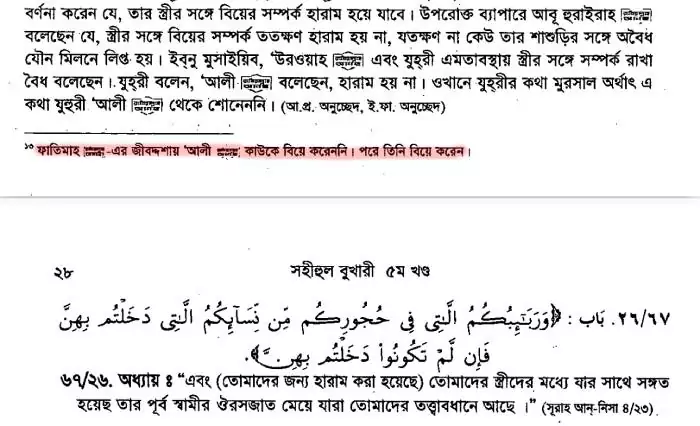
Some will claim that Muhammad prohibited Ali from marrying again because Ali’s marriage proposal had come from an infidel family. This information is also completely false. Ali could not marry anyone else until Fatima’s death because of the Prophet’s prohibition. The Prophet kept a strict watch to ensure that his beloved daughter would not have a co-wife. [49]
Did the Prophet Wait for Aisha?
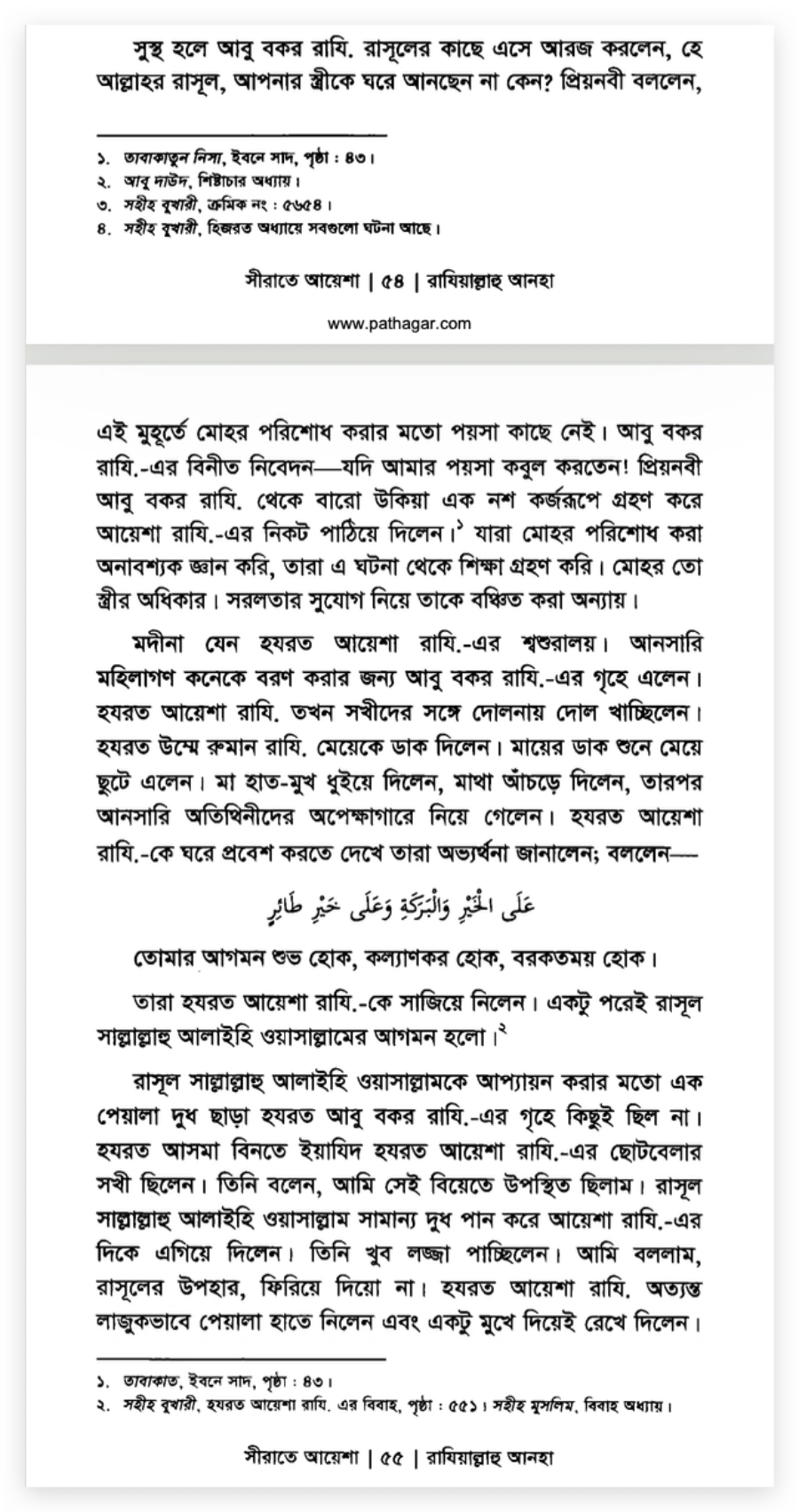
Many Islamists nowadays claim that the Prophet Muhammad married Aisha when she was six years old and then waited three years for her to become an adult. But this statement is completely false. We find evidence for this in Ibn Sa’d’s Tabaqat [50]. The truth is that at that time the Prophet did not have enough money to pay the dower , so he borrowed money from Abu Bakr and brought Aisha into his household.
After the Hijra, Abu Bakr (RA) came to the Messenger and asked, “O Messenger of Allah! Why are you not bringing your wife into your home?” The beloved Prophet said, “At this moment, I do not have the money to pay the dower. Abu Bakr (RA) requested: “Would you accept my money?” The Messenger then borrowed money from Abu Bakr (RA) and sent for Aisha (RA).
Now let us see what is stated in the book Sirat Aisha Radiyallahu Anha, written by Sayyid Sulaiman Nadwi (RA) [51]
After recovering, Abu Bakr (RA) came to the Messenger and asked, “O Messenger of Allah, why are you not bringing your wife into your home?” The beloved Prophet said,
1. Tabaqat al-Nisa, Ibn Sa’d, p. 43.
2. Abu Dawud, Book of Etiquette.
3. Sahih Bukhari, serial no.: 5654.
4. All the events are recorded in Sahih Bukhari, in the chapter on the Hijra.
Sirat Aisha | 54 | Radiyallahu Anha
“I do not have the money with me to pay the dower at this moment.” Abu Bakr (RA) humbly requested: “Would you accept my money?” The beloved Prophet accepted twelve uqiyyas and one nash from Abu Bakr (RA) as a loan and sent for Aisha (RA). Those who consider payment of the dower unnecessary should learn from this incident. The dower is the wife’s right. Taking advantage of her simplicity and depriving her of it is unjust.
Medina was like Aisha’s in-laws’ home. The Ansari women came to Abu Bakr’s (RA) house to welcome the bride. At that time, Aisha (RA) was swinging on a swing with her friends. Umm Ruman (RA) called her daughter. Hearing her mother’s call, the girl came running. Her mother washed her hands and face and combed her hair, then took her to the waiting room where the Ansari guests were. When they saw Aisha (RA) enter the room, they welcomed her and said—
عَلَى الْخَيْرِ وَالْبَرَكَةِ وَعَلَى خَيْرٍ طَائِرٍ
May your arrival be auspicious, beneficial, and blessed.
They adorned Aisha (RA). A little later, the Messenger of Allah (ﷺ) arrived.’
There was nothing in Abu Bakr’s (RA) house with which to entertain the Messenger of Allah (ﷺ) except a cup of milk. Asma bint Yazid was Aisha’s (RA) childhood friend. She said, “I was present at that wedding. The Messenger of Allah (ﷺ) drank a little milk and offered the cup to Aisha (RA). She was very shy. I said, ‘It is a gift from the Messenger; do not refuse it.’ Aisha (RA) took the cup very shyly, put it to her lips, and then set it down.”
1. Tabaqat, Ibn Sa’d, p. 43.
2. Sahih Bukhari, The Marriage of Aisha (RA), p. 551. Sahih Muslim, Book of Marriage.
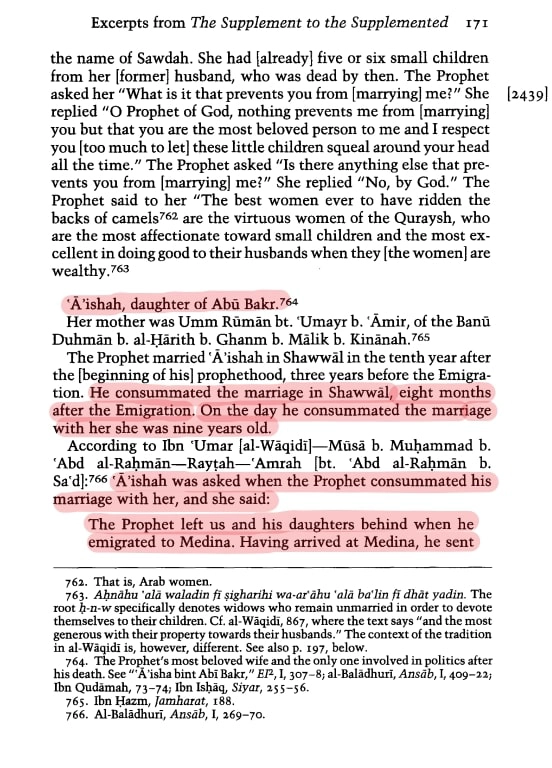
This account is also found in al-Tabari’s History [52]
A’ishah, daughter of Abu Bakr.
Her mother was Umm Ruman bt. ‘Umayr b. ‘Amr, of the Banu Duhman b. al-Harith b. Ghanm b. Malik b. Kinanah.
The Prophet married ‘A’ishah in Shawwal in the tenth year after the (beginning of his) prophethood, three years before Emigration. He consummated the marriage in Shawwal, eight months after Emigration. On the day he consummated the marriage with her she was nine years old.
According to Ibn ‘Umayr (al-Waqidi)- Musa b. Muhammad b. ‘Abd al-Rahman- Raytah- ‘Amrah (bt. ‘Abd al-Rahman b. Sa’d): ‘A’ishah was asked when the Prophet consummated his marriage with her, and she said:
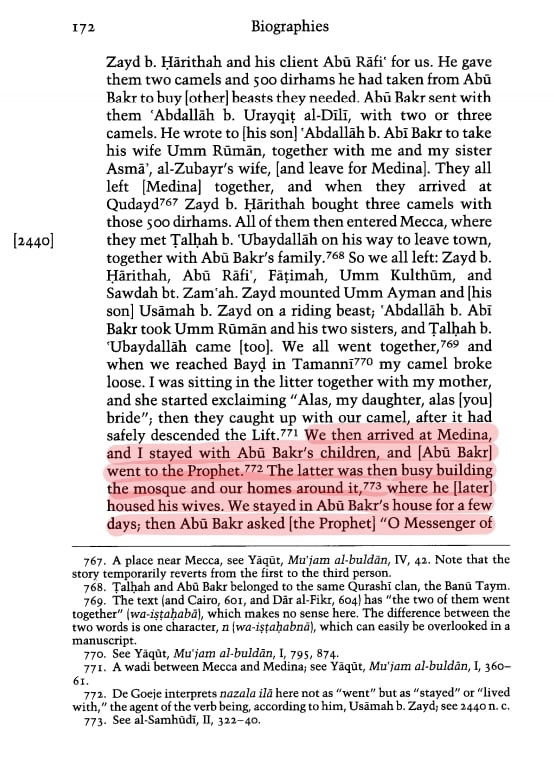
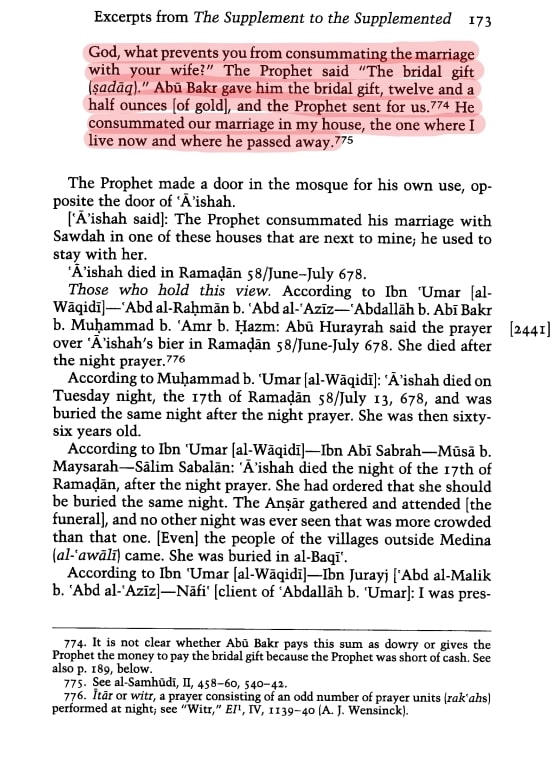
The Prophet left us and his daughters behind when he emigrated to Medina. Having arrived at Medina, he sent Zayd b. Harithah and his client Abu Rafi’ for us. He gave them two camels and 500 dirhams he had taken from Abu Bakr to buy (other) beasts they needed. Abu Bakr sent with them ‘Abdallah b. Urayqit al-Dili, with two or three camels. He wrote to (his son) ‘Abdallah b. Abi Bakr to take his wife Umm Ruman, together with me and my sister Asma’, al-Zubayr’s wife, (and leave for Medina). They all left (Medina) together, and when they arrived at Qudayd Zayd b. Harithah bought three camels with those 500 dirhams. All of them then entered Mecca, where they met Talhah b. ‘Ubaydallah on his way to leave town, together with Abu Bakr’s family. So we all left: Zayd b. Harithah, Abu Rafi’, Fatimah, Umm Kulthum, and Sawdah bt. Zam‘ah. Ayd mounted Umm Ayman and (his son) Usamah b. Zayd on a riding beast; ‘Abdallah b. Abi Bakr took Umm Ruman and his two sisters, and Talhah b. ‘Ubaydallah came (too). We all went together, and when we reached Bayd in Tamanni my camel broke loose. I was sitting in the litter together with my mother, and she started exclaiming “Alas, my daughter, alas (you) bride”; then they caught up with our camel, after it had safely descended the Lift. We then arrived at Medina, and I stayed with Abu Bakr’s children, and (Abu Bakr) went to the Prophet. The latter was then busy building the mosque and our homes around it, where he (later) housed his wives. We stayed in Abu Bakr’s house for a few days; then Abu Bakr asked (the Prophet) “O Messenger of God, what prevents you from consummating the marriage with your wife?” The Prophet said “The bridal gift (sadaq).” Abu Bakr gave him the bridal gift, twelve and a half ounces (of gold), and the Prophet sent for us. He consummated our marriage in my house, the one where I live now and where he passed away.
Had Aisha Reached Puberty?
To begin, let us read two hadiths and the explanations of those two hadiths, [53] [54] [55]
Mishkat al-Masabih (Mishkat)
Part 13: Marriage
Chapter: 10. First Section — Kind treatment of wives and matters relating to the mutual rights and duties of each spouse
3243-[6] Narrated from Aisha (RA). She said, I used to play with my dolls with my companions in the house of the Prophet (peace and blessings of Allah be upon him) (when she was only 9 years old). When the Messenger of Allah (peace and blessings of Allah be upon him) entered the house, they would hide. Then he (peace and blessings of Allah be upon him) would send them to me to play, and they would play with me. (Bukhari and Muslim)[1]
[1] Sahih: Bukhari 6130, Muslim 2440, Sahih Ibn Hibban 5863.
Hadith grade: Sahih (Sahih)
Narrator: Aisha bint Abu Bakr al-Siddiq (RA)
Mishkat al-Masabih (Mishkat)
Part 13: Marriage
Chapter: 10. First Section — Kind treatment of wives and matters relating to the mutual rights and duties of each spouse
3244-[7] Narrated by the aforementioned narrator [Aisha (RA)]. She said, By Allah! I saw the Prophet (peace and blessings of Allah be upon him) standing at the door of my room. (On the day of Eid,) when the Abyssinian youths were playing with spears in the courtyard of the mosque, the Messenger of Allah (peace and blessings of Allah be upon him) covered me with his cloak so that I could watch their performance through the space between his neck and ear, and he continued standing there out of his affection for me until I willingly returned. Thus, it may be inferred how long the natural desire of a young girl to watch a performance can last. (Bukhari and Muslim)[1]
[1] Sahih: Bukhari 5236, Muslim 892, Nasai 1595, Ahmad 16101, Irwa 1805.
Hadith grade: Sahih (Sahih)
Narrator: Aisha bint Abu Bakr al-Siddiq (RA)
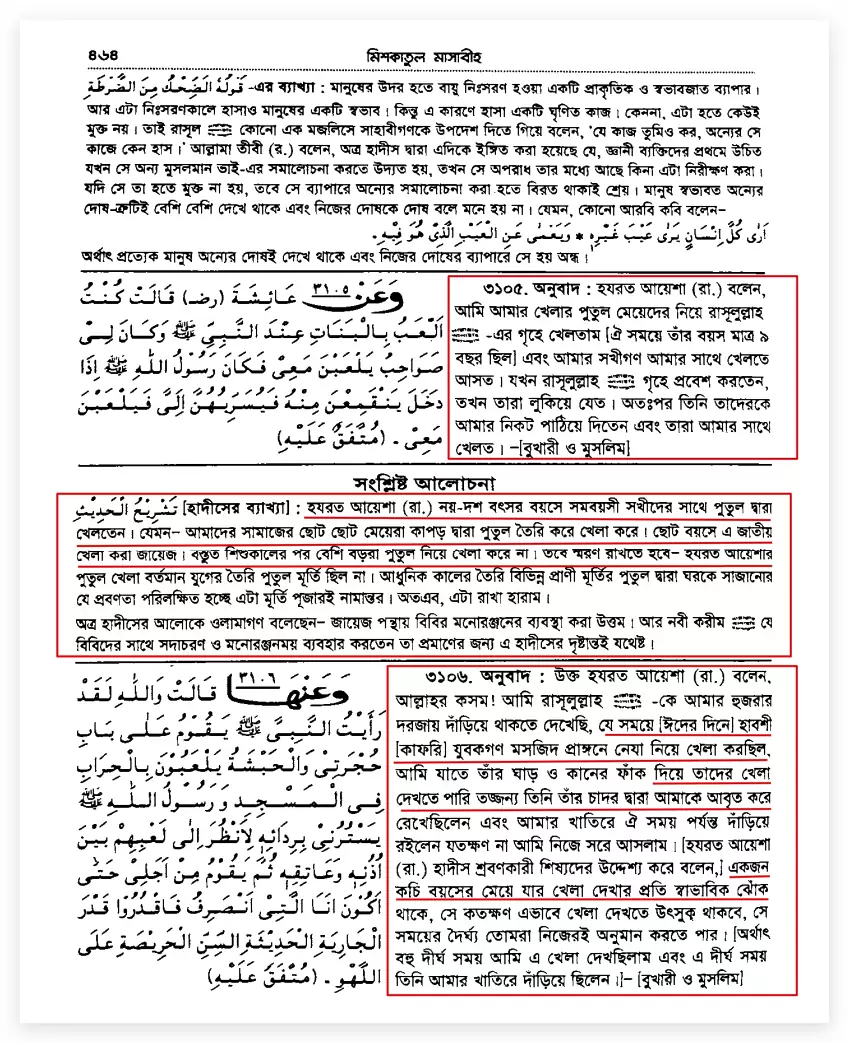
In this context, I would request readers to imagine that scene. Watching the Ethiopian or Abyssinian Habashi slaves of that time perform spear exercises and physical games was very attractive to Aisha. It is easy to understand what the physical build of such slaves would generally have been like. Everyone knows how people in hot countries play these games. Let us look at a picture to understand the matter clearly. Watching the physical exercises of such people is completely forbidden for adult women in Islam. It is halal for underage or child girls. So how was Aisha watching them? If Aisha had been an adult woman at that time, how could she have watched this performance? And that too under the direct supervision of the Prophet Muhammad? At the same time, the same question arises regarding playing with dolls.

Now let us see what is stated in the hadith collection Sunan Abu Dawud and in its sharh, or explanatory work: the Prophet had intercourse with Aisha when she was nine years old [56]-
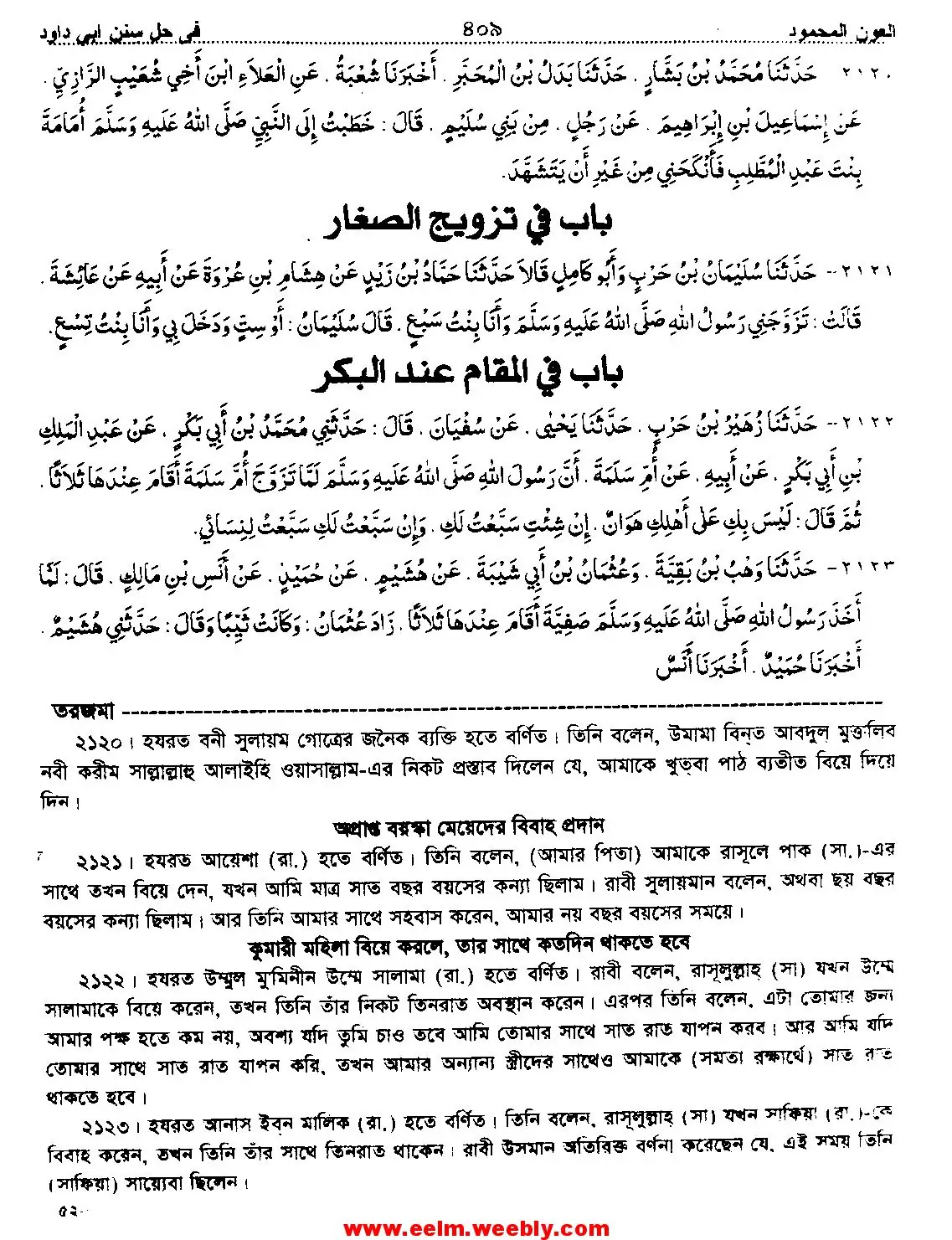
A hadith in Sahih Muslim narrated by Aisha also states that Aisha entered Muhammad’s household at the age of nine, and that at that time she had her dolls with her [57] [58] [59]. A similar hadith is also found in Sahih Bukhari [60]
Notice the following hadiths. Even after Aisha went to Muhammad’s household, Aisha continued to play with dolls. This was because Aisha had not yet begun menstruating. For that reason, cloth dolls were halal for her.
Sahih Bukhari (Islamic Foundation)
Chapter: 65/ Manners and Conduct
Section: 2514. Associating with people cheerfully. Ibn Mas’ud (RA) said, Associate with people in such a way that it does not harm your religion. And joking with one’s family.
5700. Muhammad (RAH) … Narrated from Aisha (RA). She said, I used to make dolls and play in front of the Messenger of Allah (peace and blessings of Allah be upon him). My girlfriends would also play with me. When the Messenger of Allah (peace and blessings of Allah be upon him) entered the house, they would run away. He would then call them and send them to me, and they would play with me.
Hadith grade: Sahih (Sahih)
Narrator: Aisha (RA)
Narrated `Aisha:
I used to play with the dolls in the presence of the Prophet, and my girl friends also used to play with me. When Allah’s Messenger (ﷺ) used to enter (my dwelling place) they used to hide themselves, but the Prophet would call them to join and play with me. (The playing with the dolls and similar images is forbidden, but it was allowed for `Aisha at that time, as she was a little girl, not yet reached the age of puberty.)
Sahih Muslim (Hadith Academy)
17. Marriage
Section: 10. A father may marry off his underage virgin daughter
Hadith Academy number: 3372, International number: 1422
3372-(71/…) It was narrated from Abd ibn Humayd (RAH) ….. from Aisha (RA), that the Messenger of Allah (peace and blessings of Allah be upon him) married her when she was seven years old. She was taken to his household as a bride when she was nine years old,* and her dolls were with her. The Messenger of Allah (peace and blessings of Allah be upon him) died when she was eighteen years old. (Islamic Foundation 3346, Islamic Center 3345)
* She said that the Messenger of Allah (peace and blessings of Allah be upon him) married her when she was six years old. It may be observed that in some hadiths Aisha (RA) is said to have been six years old at the time of her marriage, while in others she is said to have been seven. According to the commentators on the hadith, Aisha (RA) had passed six and was in her seventh year at that time. Consequently, in some hadiths the additional period beyond six years was excluded and her age was counted as six, while in others the additional period was counted as a complete year and her age was counted as seven.
Hadith grade: Sahih (Sahih)
Narrator: Aisha bint Abu Bakr al-Siddiq (RA)
Reference : Sahih al-Bukhari 6130
In-book reference : Book 78, Hadith 157
USC-MSA web (English) reference : Vol. 8, Book 73, Hadith 151
Narrated `Aisha:
I used to play with the dolls in the presence of the Prophet, and my girl friends also used to play with me. When Allah’s Messenger (ﷺ) used to enter (my dwelling place) they used to hide themselves, but the Prophet would call them to join and play with me. (The playing with the dolls and similar images is forbidden, but it was allowed for `Aisha at that time, as she was a little girl, not yet reached the age of puberty.) (Fath-ul-Bari page 143, Vol.13)
Arabic : حَدَّثَنَا مُحَمَّدٌ ، أَخْبَرَنَا أَبُو مُعَاوِيَةَ ، حَدَّثَنَا هِشَامٌ ، عَنْ أَبِيهِ ، عَنْ عَائِشَةَ ـ رضى الله عنها ـ قَالَتْ كُنْتُ أَلْعَبُ بِالْبَنَاتِ عِنْدَ النَّبِيِّ صلى الله عليه وسلم وَكَانَ لِي صَوَاحِبُ يَلْعَبْنَ مَعِي، فَكَانَ رَسُولُ اللَّهِ صلى الله عليه وسلم إِذَا دَخَلَ يَتَقَمَّعْنَ مِنْهُ، فَيُسَرِّبُهُنَّ إِلَىَّ فَيَلْعَبْنَ مَعِي.
Sunan Abu Dawud (verified)
Chapter: 36/ Etiquette
Section: 60. Regarding playing with cloth dolls.
4849. Narrated by Musaddad (RAH) ………. Narrated from Aisha (RA). She said: I used to play with cloth dolls made in the form of wives. Most of the time, the Messenger of Allah (peace and blessings of Allah be upon him) would come to me when the other girls were present with me. When he entered the house, they would leave, and when he went outside, they would come back.
Hadith grade: Sahih (Sahih)
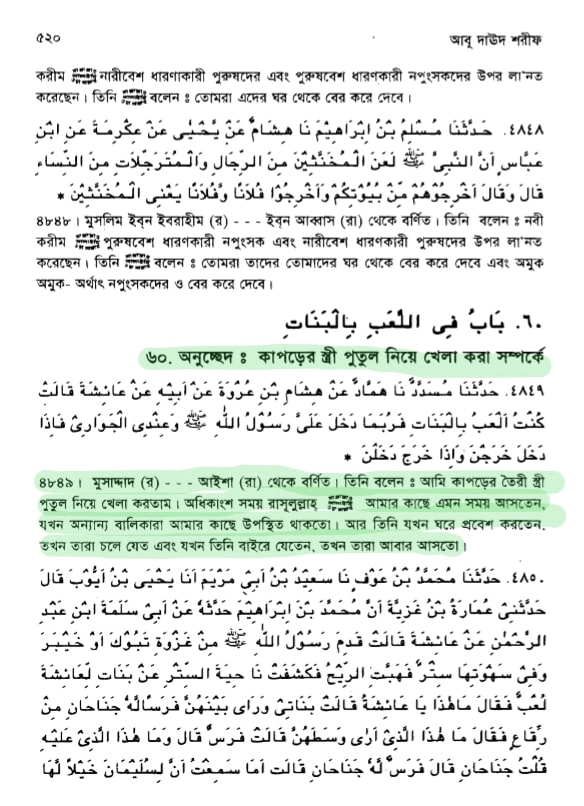
Now let us look at another reference, [61]
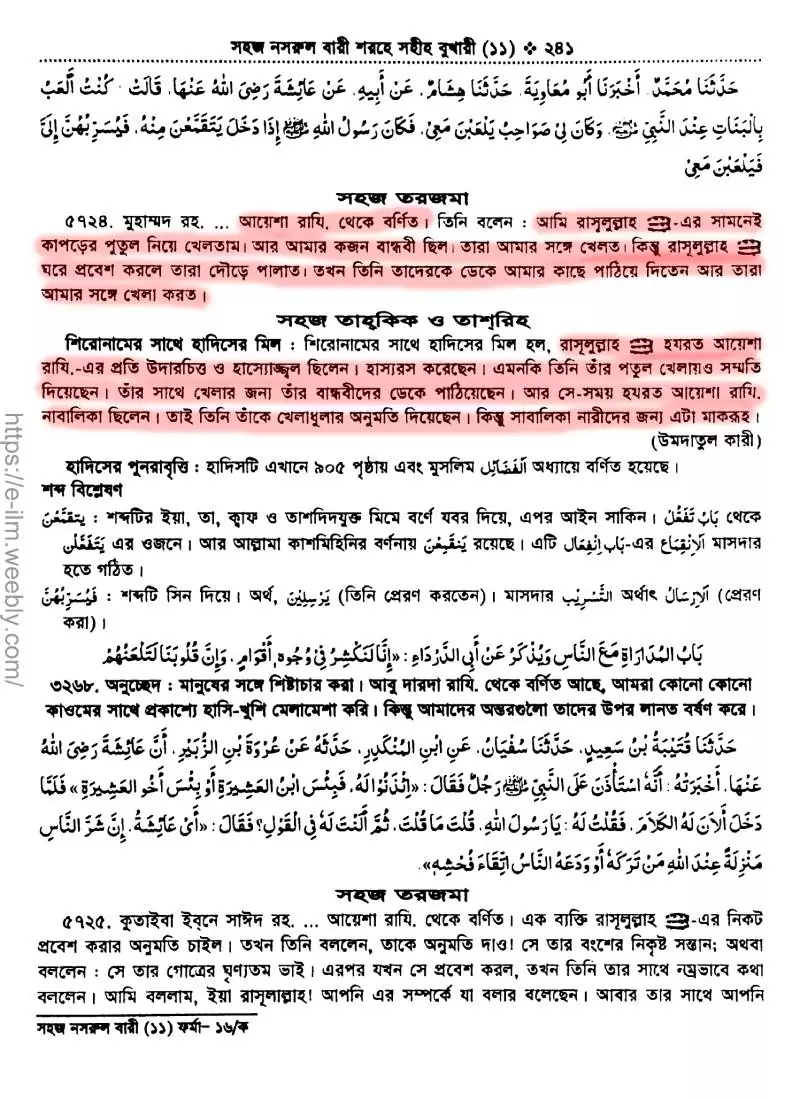
In explaining this hadith, the commentary on Sahih Bukhari, Nasrul Bari, states—“At that time, Hazrat Aisha was underage. Therefore, he (Muhammad) permitted her (Aisha) to play. But this is makruh for adult women.” [62]
Let us hear the statements of several Islamic scholars,
Let us read another hadith [63] –
Sunan Abu Dawud (verified)
36/ Etiquette
Section: 62. Playing with dolls
4932. Narrated from Aisha (RA). She said, the Messenger of Allah (peace and blessings of Allah be upon him) returned from the Battle of Tabuk or Khaybar . A curtain was hanging over a shelf in the house. Due to the airflow, one side of it moved aside, making her dolls visible. He (peace and blessings of Allah be upon him) saw the dolls and said, O Aisha! What are these? She replied, These are my daughters. Among them, he also saw a cloth horse with two wings.
He asked, What is that I see among them? She said, A horse. He (peace and blessings of Allah be upon him) said, And what is that on it? She said, Two wings. He said, What kind of horse is this, that has wings? I said, Have you not heard that Solomon (peace be upon him) had horses with several wings? Aisha (RA) said, Upon hearing this, the Messenger of Allah (peace and blessings of Allah be upon him) laughed so broadly that I could see his front teeth.(1)
Sahih.
(1). Bayhaqi.
Hadith grade: Sahih (Sahih)
Narrator: Aisha (RA)
Thus, it appears that Aisha was underage at the age of nine when Muhammad had sexual intercourse with her. The same thing is also stated in the Sahih Bukhari translation published by Darussalam—
“The playing with the dolls and similar images is forbidden, but it was allowed for `Aisha at that time, as she was a little girl, not yet reached the age of puberty.” [64]
Let us look at this page from the Bukhari Sharif printed by Darussalam Publications [65] –
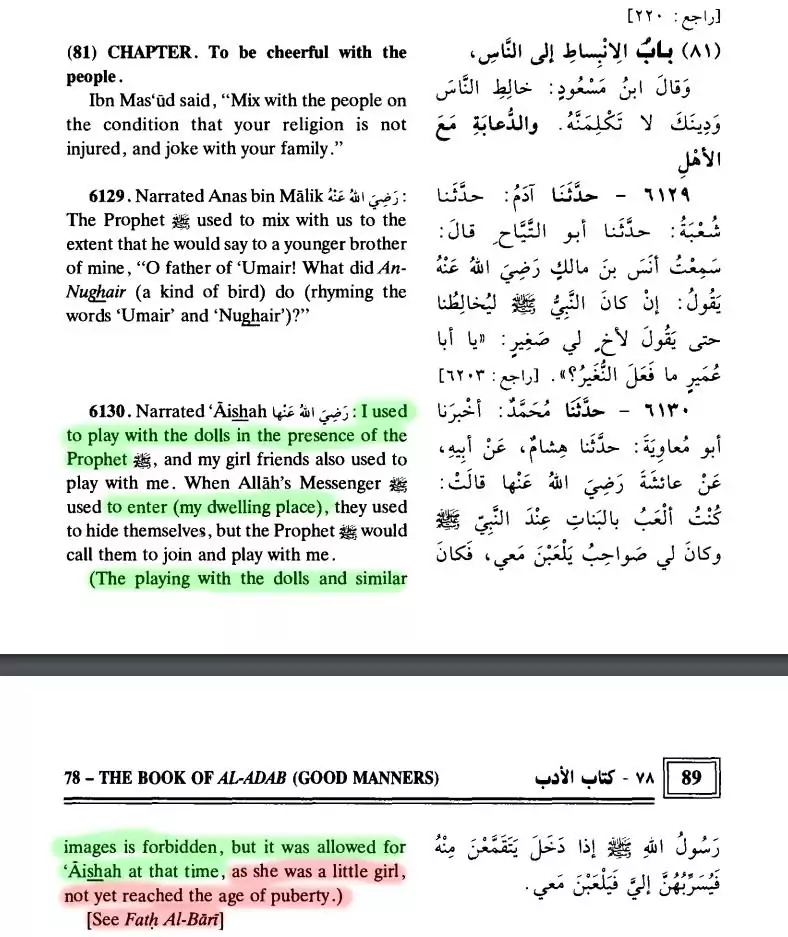
While explaining this hadith, Ibn Hajar al-Asqalani says—
“Abu Dawud [66] and al-Nasai [67] narrated from Aisha: ‘The Messenger of Allah returned from the Battle of Tabuk or Khaybar. A curtain was hanging over a shelf in the house. Due to the airflow, one side of it moved aside, making her dolls visible. He saw the dolls and said, O Aisha! What are these? She replied, These are my daughters. Among them, he also saw a cloth horse with two wings. He asked, What is that I see among them? She said, A horse. He said, And what is that on it? She said, Two wings. He said, What kind of horse is this, that has wings? I said, Have you not heard that Solomon had horses with several wings? Aisha said, Upon hearing this, the Messenger of Allah laughed so broadly that I could see his front teeth.'” Al-Khattabi said, “The only reason Aisha was permitted to play with dolls was that she had not yet reached puberty.” I (Ibn Hajar) say, “It is not beyond question whether this was indeed the occasion, but it may have happened, because Aisha was fourteen years old at the time of the Battle of Khaybar…” [68]
The website Islamweb has also translated this explanation into English [69]
Thus, this discussion shows that there is no hadith proving that Aisha had reached puberty at the age of nine. Rather, authentic hadiths show that Aisha continued to play with dolls even during the Battle of Khaybar, although in Islam playing with dolls is forbidden after reaching puberty. This indicates that even at the age of fourteen, according to the Islamic rules concerning adulthood, she was still underage. Therefore, the claim made by some Muslims today that Aisha had reached puberty or adulthood at the age of nine is completely baseless. If there had been any such hadith, Ibn Hajar al-Asqalani could have cited it and proven Ibn Khattab’s opinion wrong; but instead, he acknowledged the possibility that Aisha reached puberty at the age of fourteen.
It should also be remembered that, whether adult or underage, it is obligatory for all women to fulfill their husbands’ sexual desires. Islam permits marrying off an underage minor girl. This is proven by the hadiths above. [70] [71] [72]
Sahih Muslim (Hadith Academy)
Chapter: 17. Marriage
Section: 20. It is forbidden for a wife to refuse her husband’s bed
3433-(122/…) Abu Bakr ibn Abi Shaybah, Abu Kurayb, Abu Sa’id al-Ashajj and Zuhayr ibn Harb (may Allah have mercy on them) ….. Narrated from Abu Hurairah (RA) that the Messenger of Allah (peace and blessings of Allah be upon him) said: When a husband calls his wife to bed and she does not come, and her husband spends the night angry with her, the angels continue to curse her until morning. (Islamic Foundation 3406, Islamic Center 3405)
Hadith grade: Sahih (Sahih)
Sunan Ibn Majah
Publisher: Tawhid Publication
Chapter: 9/ Marriage
2/1853. Narrated from Abdullah ibn Abu Awfa (RA). He said, Muadh (RA) returned from Syria and prostrated before the Prophet (peace and blessings of Allah be upon him). The Prophet (peace and blessings of Allah be upon him) said: O Muadh! What is this? He said, I went to Syria and saw that the people there prostrated before their religious leaders and rulers. So I hoped in my mind that I would do the same before you. The Messenger of Allah (peace and blessings of Allah be upon him) said: Do not do that. For if I were to command anyone to prostrate before anyone other than Allah, I would command a wife to prostrate before her husband. By the One in Whose Hand is the soul of Muhammad, a wife cannot fulfill her obligation to her Lord until she fulfills her husband’s due right. If a husband wishes to fulfill his sexual desire with his wife while she is on a howdah, it is improper for her to refuse him.
Hadith grade: Hasan (Hasan)
It was narrated that: Abdullah bin Abu Awfa said “When Muadh bin Jabal came from Sham, he prostrated to the Prophet who said: ‘What is this, O Muadh?’ He said: ‘I went to Sham and saw them prostrating to their bishops and patricians and I wanted to do that for you.’ The messenger of Allah said: ‘Do not do that. If I were to command anyone to prostrate to anyone other than Allah, I would have commanded women to prostrate to their husbands. By the One in Whose Hand is the soul of Muhammad! No woman can fulfill her duty towards Allah until she fulfills her duty towards her husband. If he asks her (for intimacy) even if she is on her camel saddle, she should not refuse.’ ”
Mishkat al-Masabih (Mishkat)
Chapter: Part 13: Marriage
Publisher: Hadith Academy
Section: 10. Second subsection – Concerning kind treatment of wives and the mutual rights and entitlements of each of them (husband and wife)
3255-(18) Narrated by Abu Hurairah (RA). He said, the Messenger of Allah (peace and blessings be upon him) said: If I were to command any human being to prostrate before another human being, I would command the wife to prostrate before her husband in prostration . (Tirmidhi)(1)
Hadith grade: Hasan (Hasan)
Aisha, Young and Slight in Build
This time we will read several more hadiths in which it is clear that Aisha was in the Prophet’s household at that time, and according to Aisha’s own statement, she was then only a young girl. In these hadiths, she also advised people to value the wishes and interests of young girls. [73] [74]
Sahih Muslim (Hadith Academy)
9. The Prayer of the Two Eids
Section: 4. Allowance for amusement and entertainment during the days of Eid, provided that it does not involve disobedience to Allah
1948-(17/…) Narrated by Harun ibn Sa‘id al-Ayli (RA) ….. from Aisha (RA). Abu Bakr (RA) came to Aisha (RA) during the days of Tashriq and saw that two young girls were singing and playing the tambourine in her presence. The Messenger of Allah (peace and blessings be upon him) was lying there with his head covered by a cloak. Seeing this, Abu Bakr (RA) sternly rebuked or scolded the two girls. The Messenger of Allah (peace and blessings be upon him) then removed the cloth from his face and said, “O Abu Bakr! Leave them. These are the days of Eid.” Aisha (RA) further said, “I saw the Messenger of Allah (peace and blessings be upon him) covering me with his cloak while I watched the spectacle of the Abyssinian youths (black men) playing. At that time I was only a young girl. Therefore, you should value the interests of young girls. Young girls remain engrossed in amusement and entertainment for a long time.” (Islamic Foundation 1933, Islamic Center 1940)
Hadith grade: Sahih (Sahih)
Narrator: Aisha (RA)
Sahih Muslim (Hadith Academy)
9. The Prayer of the Two Eids
Section: 4. Allowance for amusement and entertainment during the days of Eid, provided that it does not involve disobedience to Allah
1949-(18/…) Abu Tahir (RA) ….. narrated from Aisha (RA). She said, “By Allah, I saw the Messenger of Allah (peace and blessings be upon him) standing at the door of my apartment while the black youths were displaying their combat techniques with their weapons in the Prophet’s Mosque. The Messenger of Allah (peace and blessings be upon him) was shielding me with his cloak so that I could watch their performance. He (peace and blessings be upon him) continued standing there for me until I left of my own accord. Therefore, young girls’ desire for games and amusement should be valued (their interests should be fulfilled).” (Islamic Foundation 1934, Islamic Center 1941)
Hadith grade: Sahih (Sahih)
Narrator: Aisha (RA)
Sahih Muslim (Hadith Academy)
9. The Prayer of the Two Eids
Section: 4. Allowance for amusement and entertainment during the days of Eid, provided that it does not involve disobedience to Allah
1950-(19/…) Harun ibn Sa‘id al-Ayli and Yunus ibn Abd al-A‘la (RA) (Harun’s wording) …… narrated from Aisha (RA). She said, “Once the Messenger of Allah (peace and blessings be upon him) entered the house and found two girls singing songs about the Battle of Bu‘ath, which had taken place during the Age of Ignorance. He lay down on the bed, turning his face away. At that moment Abu Bakr (RA) entered. Seeing this, he rebuked me and said, ‘Are Satan’s musical instruments being played in the presence of the Messenger of Allah (peace and blessings be upon him)?’ Hearing this, the Messenger of Allah (peace and blessings be upon him) turned toward him and said, ‘O Abu Bakr! Leave them.’ Then, when he became inattentive, I gently nudged the two girls. They went out and left. This occurred on the day of Eid. The black youths were performing military techniques and playing with shields and spears. Perhaps I requested the Messenger of Allah (peace and blessings be upon him) to let me watch, or he asked me, ‘Would you like to see it?’ I said, ‘Yes.’ He (peace and blessings be upon him) then positioned me behind him in such a way that my cheek was touching his cheek. He (peace and blessings be upon him) called out to them, ‘O Banu Arfidah! Continue your performance.’ After a long while, when I began to feel somewhat bored, he asked me, ‘Have you had enough?’ I said, ‘Yes.’ He said, ‘Then go now.’” (Islamic Foundation 1935, Islamic Center 1942)
Hadith grade: Sahih (Sahih)
Narrator: Aisha (RA)
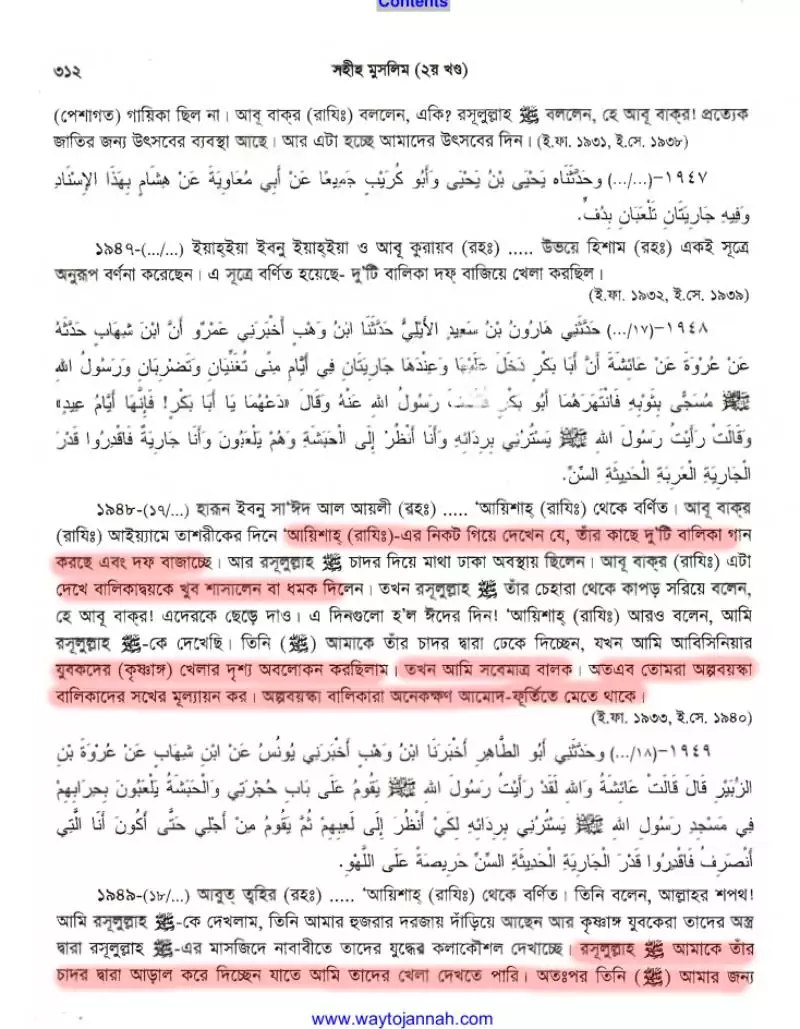
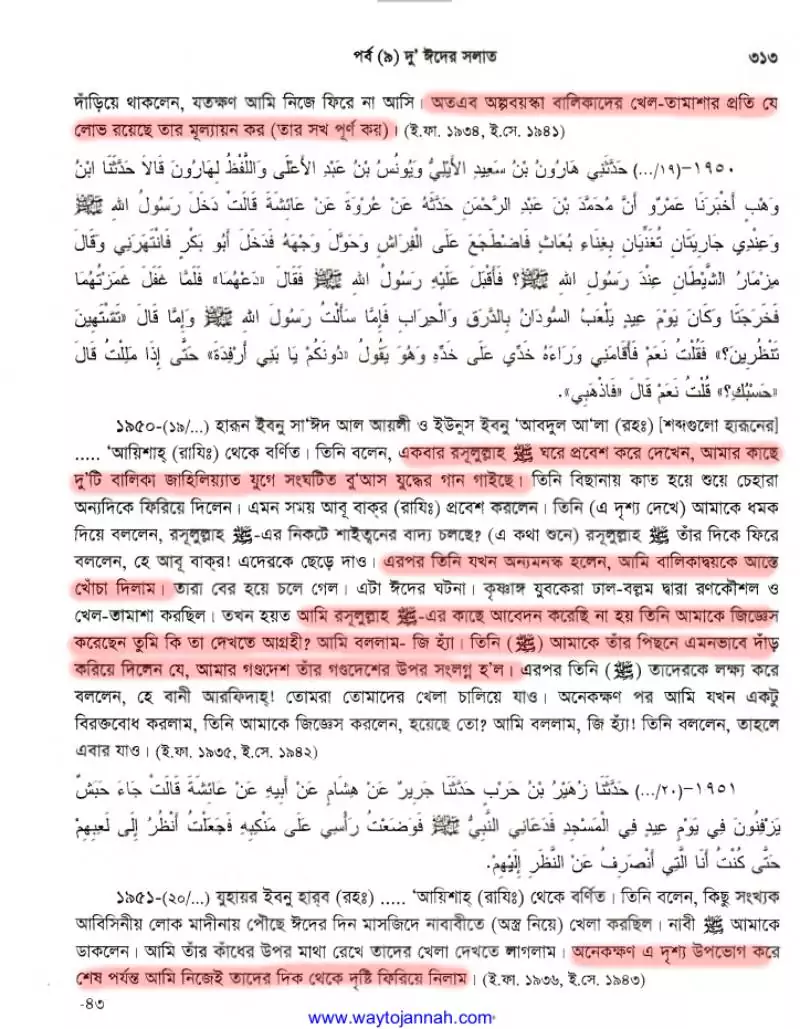
Now let us read some more hadiths describing events that took place long after Aisha’s marriage to the Prophet. This incident is very important in Islam because Aisha was accused of having an extramarital affair. Revelation from Allah concerning this matter came later. Notice what Aisha says about herself: that she was thin and slight and young in age. (As this is a very long hadith, some parts have been omitted; interested readers may follow the link and read it.) [75] [76]
Sahih al-Bukhari (Islamic Foundation)
44/ Testimony
Section: 1656. A woman testifying to the honesty of another woman
2485. Narrated by Abu Rabi‘ Sulayman ibn Dawud (RA) … from Aisha (RA), the wife of the Prophet (peace and blessings be upon him), when the slanderers spread allegations about her and Allah declared her innocence. The narrators say that Aisha (RA) stated, “Whenever the Messenger of Allah (peace and blessings be upon him) intended to travel, he would select a travel companion from among his wives by drawing lots…”
I would be placed inside the howdah on the camel, and would be taken down while still inside the howdah. In this way we continued traveling. When the Messenger of Allah (peace and blessings be upon him) returned after completing that military expedition and we had reached near Medina, one night he announced that the caravan would depart. When this announcement was made, I got up, went ahead of the army, relieved myself, and returned to the howdah. I then felt my chest and found that a necklace of mine made of black-and-white stones from the land of Azfar had broken and fallen off. I went back in search of my necklace, and the search delayed me. Meanwhile, those who used to lift my howdah picked it up, placed it on the back of the camel on which I rode, and departed, assuming that I was inside the howdah. The women of that time were light and thin, not large and heavy, because they ate very little. Thus, when they lifted the howdah, they did not find its weight unusual.
Moreover, at that time I was a young adolescent girl and they lifted the howdah and drove the camel away.” Meanwhile, after the army had departed, I found my necklace. But when I returned to their location, I found no one there. So I decided to remain seated in my place…
The Messenger of Allah (peace and blessings be upon him) then called Barirah (the slave girl) and asked her, “O Barirah! Have you noticed anything suspicious about her?” Barirah replied, “By the One who sent you with the truth, no, I have not seen anything of that sort. The only thing I have seen is that she is a young adolescent girl; when she goes to knead dough for the family, she falls asleep, and in the meantime a goat comes and eats it.” That same day, the Messenger of Allah (peace and blessings be upon him) stood to deliver a sermon in the mosque and asked how to deal with the conspiracy of Abdullah ibn Ubayy ibn Salul. The Messenger of Allah (peace and blessings be upon him) said, “Who will take action against the man who has troubled me concerning my family? By Allah, I know nothing about my wife except good. Yet they have brought up the matter involving a man about whom I know nothing except good, and he never entered my house except when he was with me…”
At that time I was a young adolescent girl! I had not read much of the Qur’an either. Nevertheless, I said, “By Allah, I have come to know that you have heard what people are spreading and that it has settled in your minds, so you have believed it. Now, if I tell you that I am innocent—and Allah knows that I am certainly innocent—you will not believe me. But if I confess something to you, while Allah knows that I am innocent, you will certainly believe me. By Allah, I can find no example for you except the father of Yusuf (peace be upon him), when he said: ‘Patience is most fitting for me. And Allah is the One whose help is sought against what you assert.’”
Abu Rabi‘ (RA) … narrated a similar hadith from Aisha and Abdullah ibn al-Zubayr (RA). Fulayh (RA) … narrated a similar hadith from al-Qasim ibn Muhammad ibn Abu Bakr (RA).
Hadith grade: Sahih (Sahih)
Narrator: Aisha (RA)
Sahih al-Bukhari (Islamic Foundation)
44/ Testimony
Section: 1643. If someone says, for the purpose of proving another person’s honesty, “I know nothing about this person except good,” or says, “I know nothing about him except good.”
1462. Section: Evidence must be presented from the left side.
The word of Almighty Allah: “O believers! When you contract a debt for a fixed period, write it down …” (2:282)
And the word of Almighty Allah: “O believers! Stand firm for justice as witnesses for Allah, even if it is against yourselves, your parents, or close relatives … Allah is All-Aware of what you do.” (4:135)
2461. Hajjaj (RA) … narrated from Ibn Shihab (RA), who said, “Urwah, Ibn al-Musayyab, Alqamah, Ibn Waqqas, and Ubaydullah (RA) narrated reports to me concerning the incident involving Aisha (RA). Parts of their narrations corroborate one another regarding what the slanderers had spread about Aisha (RA). Meanwhile, revelation was delayed. The Messenger of Allah (peace and blessings be upon him) summoned Ali and Usamah (RA) to consult them about separating from his wife. Usamah (RA) said, ‘We know nothing about your wife except good.’ And Barirah (RA) said, ‘I know only one thing about her, namely that, because she is young, she falls asleep while kneading dough for the members of the household, and in the meantime a goat comes and eats it.’” The Messenger of Allah (peace and blessings be upon him) then said, “Who will help me against the person whose harassment concerning my family has wounded me? By Allah, I know nothing about my wife except good. And they speak about a person concerning whom I know nothing except good.”
Hadith grade: Sahih (Sahih)
Narrator: Ibn Shihab al-Zuhri (RA)
Aisha’s Menstruation, Fear, Doll Play, and a Realistic Picture of Her Age
However much modern Islamic apologists try to wash away the uncomfortable facts concerning Aisha’s age and make them appear polite and acceptable, the classical Islamic sources repeatedly present a picture of an Aisha who was not a mature woman when she entered the Prophet’s household; rather, she was very young, childlike, and a girl at the early stage of adolescence both physically and psychologically. The hadith concerning menstruation in Sahih al-Bukhari and the hadith concerning playing with dolls in Sunan Abu Dawud make this picture even clearer.
In a hadith in Sahih al-Bukhari, Aisha says that they set out intending to perform Hajj. When they reached a place called Sarif, she began menstruating. The Messenger came and saw her crying and asked, “What is wrong with you? Have you begun menstruating?” Aisha said, “Yes.” The Messenger then said, “This is something Allah has decreed for the daughters of Adam. Complete all the rites of Hajj except circumambulating the House of Allah.” [77]
Sahih al-Bukhari (Islamic Foundation)
6/ Menstruation
Section: 203. The account of the beginning of menstruation.
And the word of Allah: “They ask you about menstruation. Say, ‘It is a state of impurity, so keep away from women during menstruation and do not approach them until they are purified. When they are purified, then approach them as Allah has commanded you. Indeed, Allah loves those who constantly repent and loves those who purify themselves.’” (2:222)
The Prophet (peace and blessings be upon him) said: “This is something that Allah the Exalted has decreed for the daughters of Adam.” Some say that menstruation first began among the women of the Children of Israel. Abu Abdullah al-Bukhari (RA) said, “The hadith of the Prophet (peace and blessings be upon him) is the one that should be accepted.”
290. Ali ibn Abdullah (RA) …. narrated from Aisha (RA), who said: We set out (from Medina) with the intention of performing Hajj. When we reached a place called Sarif, I began menstruating. The Messenger of Allah (peace and blessings be upon him) came and saw me crying; he said, “What is wrong with you?” Have you begun menstruating? I said, “Yes.” He said: “This is something that Allah the Exalted has decreed for the daughters of Adam. Therefore, perform all the remaining rites of Hajj except circumambulating the House of Allah.” Aisha (RA) said: “The Messenger of Allah (peace and blessings be upon him) sacrificed a cow on behalf of his wives.”
Hadith grade: Sahih (Sahih)
Narrator: Aisha (RA)
Simply observing the scene in this hadith makes it clear that Aisha’s reaction here was one of fear, crying, discomfort, and helplessness. Experiences of this kind—fear, shame, embarrassment, guilt, or discomfort—are commonly seen during girls’ early periods. This is because the bodily change is new, unexpected, and psychologically uncomfortable for them. Later, when menstruation becomes a regular experience, most girls gradually become accustomed to this reality. Therefore, it is not unusual to think, upon seeing Aisha’s crying and panic at Sarif, that menstruation was still a new experience for her, or that her periods had begun around that time.
The heading of the Bukhari section is also noteworthy: باب كيف كان بدء الحيض—“How menstruation began” or “The account of the beginning of menstruation.” This heading does not directly prove that it was Aisha’s first menstruation; however, the fact that Bukhari placed this hadith under a discussion concerning the beginning of menstruation presents the incident not merely as ordinary information about a menstrual period, but as part of a fundamental discussion of menstruation. An even greater problem arises with the hadith about playing with dolls. In Sunan Abu Dawud, Aisha says that after returning from the expedition to Tabuk or Khaybar, the Messenger found her dolls. Among the dolls was also a winged horse made of cloth. When the Messenger asked about them, Aisha said that they were her daughters; regarding the winged horse, she said that Sulayman’s horse also had wings. Hearing this, the Messenger laughed. [78]
At the same time, the Battle of Khaybar took place in May–June 628 CE. The Battle of Tabuk took place later. It is also known from the hadith that Aisha was still playing with dolls at that time—that is, according to the Islamic ruling concerning playing with dolls, she had not yet begun menstruating [79]. This means that Aisha, who was 14 years old, had not menstruated by 628 CE. Thus, it can be stated emphatically that her menstruation began at approximately 15 years of age, in 629 CE, at the time of the first Hajj mentioned in the earlier account. This is not claiming with absolute certainty that menstruation began precisely at that time; the claim is that it would have begun around this period.
Sunan Abu Dawud (verified edition)
36/ Etiquette
Section: 62. Playing with dolls
4932. Narrated from Aisha (RA). She said, the Messenger of Allah (peace and blessings be upon him) returned from the expedition to Tabuk or Khaybar . A curtain was hanging over a shelf in the house. Due to the flow of air, one side of it moved aside, causing her dolls to become visible. He (peace and blessings be upon him) saw the dolls and said, “O Aisha! What are these?” She replied, “These are my daughters.” Among them he also saw a horse made of cloth with two wings.
He asked, “What is that I see among them?” She replied, “A horse.” He (peace and blessings be upon him) asked, “And what is that on it?” She replied, “Two wings.” He said, “What kind of horse is this that has wings?” I said, “Have you not heard that Sulayman (peace be upon him) had horses with several wings?” Aisha (RA) said, “Hearing this, the Messenger of Allah (peace and blessings be upon him) laughed, so that I could see his front teeth.”(1)
Sahih.
(1). Bayhaqi.
Hadith grade: Sahih (Sahih)
Narrator: Aisha (RA)
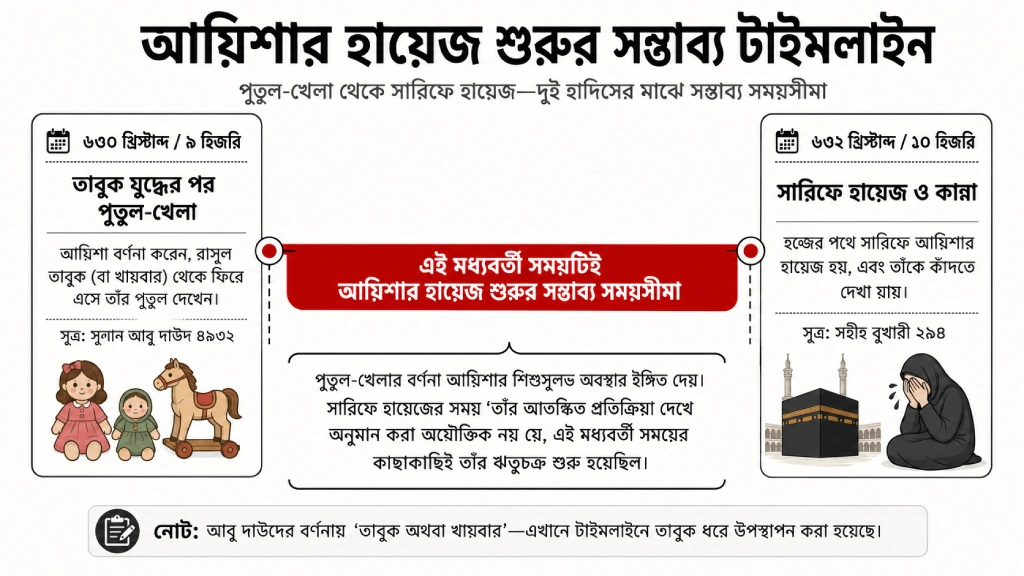
Evidence for the Legality of Child Marriage in Islam
This section compiles in detail the evidence for the legal and theological basis of child marriage in Islam, in light of the Qur’an, Sunnah, and classical works of Islamic jurisprudence. At the outset, a combined analysis of verse 4 of Surah al-Talaq and verse 49 of Surah al-Ahzab demonstrates that the provision requiring minors or those who have not begun menstruating to observe an iddah essentially establishes the legality of marriage and sexual relations with them. Subsequently, interpretations by prominent historical exegetes such as Ibn Kathir, Mufti Shafi Usmani, and Sayyid Abul A‘la Maududi are used to demonstrate that marriage and sexual relations with underage girls are not a hidden matter in Islam, but rather a recognized ruling. The detailed legal framework concerning the iddah of an underage wife, compensation for physical harm during intercourse, and sexual relations with underage slave girls is presented here from the principal sourcebooks of jurisprudence, such as al-Hidayah, Fatawa Alamgiri, and Fiqh al-Sunnah. Finally, through the consensus of prominent scholars including Imam Malik and Ibn Hajar al-Asqalani, as well as the current rulings of Saudi Arabia’s highest fatwa board and grand muftis, it is made clear that the legality of child marriage was not specific to the Prophet, but rather remains a permanent religious law for the Muslim ummah. The context of observing this ruling through deception or lying to avoid legal obstacles is also discussed here.
The Qur’anic Ruling on Divorce and Iddah Before Intercourse
According to the Quranic ruling, there is no waiting period if a woman is divorced before intercourse. Let us first look at the relevant verse [80] –
Quran reference : Surah Al-Ahzab, 33:49
Arabic : يَـٰٓأَيُّهَا ٱلَّذِينَ ءَامَنُوٓا۟ إِذَا نَكَحْتُمُ ٱلْمُؤْمِنَـٰتِ ثُمَّ طَلَّقْتُمُوهُنَّ مِن قَبْلِ أَن تَمَسُّوهُنَّ فَمَا لَكُمْ عَلَيْهِنَّ مِنْ عِدَّةٍۢ تَعْتَدُّونَهَا ۖ فَمَتِّعُوهُنَّ وَسَرِّحُوهُنَّ سَرَاحًۭا جَمِيلًۭا ٤٩
Translation — Dr. Mustafa Khattab, The Clear Quran : O believers! If you marry believing women and then divorce them before you touch them, they will have no waiting period for you to count, so give them a ˹suitable˺ compensation, and let them go graciously.
Translation — Saheeh International : O you who have believed, when you marry believing women and then divorce them before you have touched them [i.e., consummated the marriage], then there is not for you any waiting period to count concerning them. So provide for them and give them a gracious release.
Let us understand the matter more clearly from Dr. Manzur Elahi himself,
In other words, it is clear that when a husband divorces his wife before intercourse, observing a waiting period is not necessary. Now let us read verse 4 of Surah al-Talaq, which states that the waiting period for wives who have not yet reached the age of menstruation is three months [81] –
Quran reference : Surah At-Talaq, 65:4
Arabic : وَٱلَّـٰٓـِٔى يَئِسْنَ مِنَ ٱلْمَحِيضِ مِن نِّسَآئِكُمْ إِنِ ٱرْتَبْتُمْ فَعِدَّتُهُنَّ ثَلَـٰثَةُ أَشْهُرٍۢ وَٱلَّـٰٓـِٔى لَمْ يَحِضْنَ ۚ وَأُو۟لَـٰتُ ٱلْأَحْمَالِ أَجَلُهُنَّ أَن يَضَعْنَ حَمْلَهُنَّ ۚ وَمَن يَتَّقِ ٱللَّهَ يَجْعَل لَّهُۥ مِنْ أَمْرِهِۦ يُسْرًۭا ٤
Translation — Dr. Mustafa Khattab, The Clear Quran : As for your women past the age of menstruation, in case you do not know, their waiting period is three months, and those who have not menstruated as well. As for those who are pregnant, their waiting period ends with delivery. And whoever is mindful of Allah, He will make their matters easy for them.
Translation — Saheeh International : And those who no longer expect menstruation among your women – if you doubt, then their period is three months, and [also for] those who have not menstruated. And for those who are pregnant, their term is until they give birth. And whoever fears Allah – He will make for him of his matter ease.
Now let us learn the exegesis of this verse from Shayekh Matiur Rahman Madani,
Thus, it is evident that since a waiting period has been prescribed for those who have not reached the age of menstruation, permission for intercourse has necessarily also been granted. Otherwise, there would have been no instruction regarding a waiting period. After all, without intercourse, there is no need for a waiting period.
Sahih al-Bukhari Regarding Surah al-Talaq
In Imam Bukhari’s work Sahih al-Bukhari, the meaning of verse 4 of Surah al-Talaq has been stated quite clearly [82] [83]
Sahih al-Bukhari (Tawhid)
67/ Marriage
Chapter: 67/39. For whom it is lawful to arrange marriages for young children.
لِقَوْلِهِ تَعَالَى: وَاللاَّئِي لَمْ يَحِضْنَ) فَجَعَلَ عِدَّتَهَا ثَلاَثَةَ أَشْهُرٍ قَبْلَ الْبُلُوغِ
Taking as evidence the word of Allah, the Exalted, “and those who have not menstruated” (Surah al-Talaq: 4), the waiting period of a minor has been set at three months.
5133. It is narrated from ‘A’ishah (may Allah be pleased with her) that when the Prophet (peace and blessings of Allah be upon him) married her, she was six years old, and at the age of nine, the Messenger of Allah (peace and blessings of Allah be upon him) consummated the marriage with her and she remained in his company for nine years. (3894) (Modern Publication—4754, Islamic Foundation—4757)
Hadith grade: Sahih (Sahih)
Narrator: A’ishah (may Allah be pleased with her)
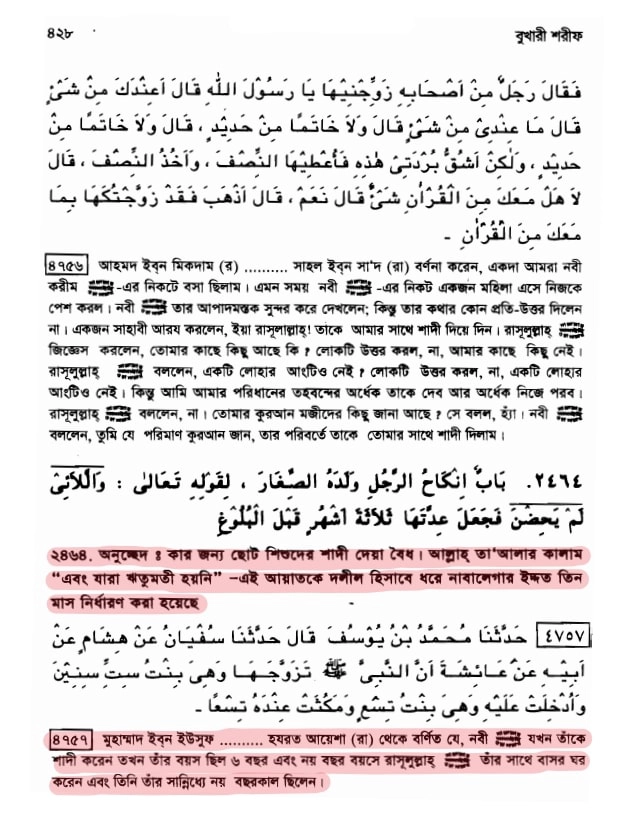
Tafsir Ibn Kathir Regarding Surah al-Talaq
Tafsir Ibn Kathir states the following regarding an underage girl [84] –
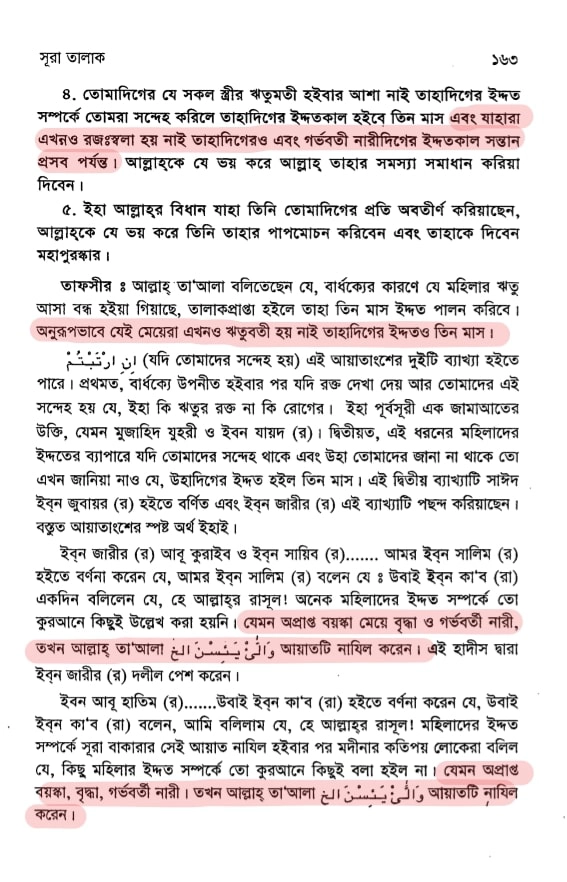
Tafsir al-Jalalayn Regarding Surah al-Talaq
Tafsir al-Jalalayn also discusses girls who have not reached puberty because they are underage [85] –
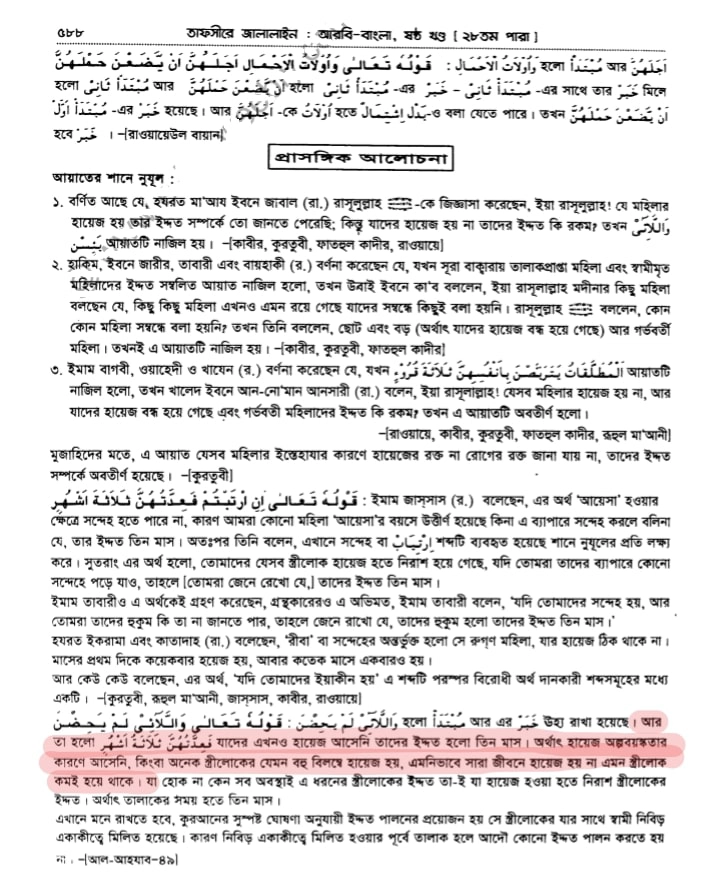
In other words, the waiting period for those who have not reached the age of menstruation, or for underage girls, is three months.
Tafsir al-Mazhari Regarding Surah al-Talaq
Qadi Muhammad Sanaullah Panipati was a renowned Islamic scholar whose written exegetical work is called Tafsir al-Mazhari. He was a qadi (judge), hadith scholar, researcher, and prominent mufassir—that is, a commentator on the Quran—of his time. Now let us examine Tafsir al-Mazhari [86]:
Ma’ariful Quran Regarding Surah al-Talaq
Mufti Muhammad Shafi Usmani, a descendant of the third caliph, Hazrat Uthman, was a renowned religious scholar and intellectual. He served at Darul Uloom Deoband and, after the partition of the country, became Pakistan’s Mufti-e-Azam, or chief mufti (Grand Mufti). His world-famous exegetical work, “Ma’ariful Quran,” has been translated into many languages. Now let us examine Ma’ariful Quran [87] –
…In the terminology of the Shariah, the period during which a woman remains prohibited from marrying another man after leaving one husband’s marriage is called iddah. There are two ways of leaving a husband’s marriage. One: when the husband dies. This waiting period is called ‘iddat al-wafat’. For women who are not pregnant, this waiting period is four months and ten days. Two: the second way of leaving a marriage is divorce. According to Imam Abu Hanifa (may Allah have mercy on him) and several other imams, the waiting period after divorce for women who are not pregnant consists of three complete menstrual cycles. According to Imam al-Shafi‘i (may Allah have mercy on him) and several other imams, the waiting period after divorce consists of three tuhrs (periods of purity). In summary, no specific number of days or months is prescribed for this; rather, however many months it takes to complete three menstrual cycles or three periods of purity constitutes the waiting period after divorce. The ruling for women who have not yet menstruated because they are young, or whose menstruation has ceased because of advanced age, is described separately below, and the waiting period for pregnant wives is also described later. ….
This ruling applies only to wives for whom it is necessary to complete the waiting period through menstruation or periods of purity. In contrast, a wife with whom the husband has not yet had seclusion has no waiting period at all; therefore, it is permissible to divorce her while she is menstruating. Likewise, wives who do not menstruate because of their young or advanced age may be divorced in any condition, even after intercourse. This is because their waiting period is calculated as three months. This will be explained in the subsequent verses. (Mazhari)
Tafhim al-Quran Regarding Surah al-Talaq
The renowned Islamic scholar Syed Abul A’la Maududi received the King Faisal International Prize in 1979 for his contributions to Islam [88]। । Not only that, he is the most renowned Islamic scholar of the modern era. At the same time, he was the second person in history whose absentee funeral prayer was performed at the Kaaba [89]। This means that his written exegesis is renowned throughout the world. In Syed Abul A’la Maududi’s work Tafhim al-Quran, the explanation of this verse from Surah al-Talaq states [90] –
13. If menstruation has not occurred because of young age, or because it occurs much later in some women, and in rare cases a woman never menstruates throughout her life, then in all such cases the waiting period for these women is the same as that for elderly women whose menstruation has ceased. That is, their waiting period is three months from the time of divorce. It should be remembered in this regard that, according to the clear statement of the Quran, the question of observing a waiting period arises only in the case of a wife with whom her husband has had seclusion. For if divorce occurs before seclusion, no waiting period is required at all. (Al-Ahzab, 49) Thus, the explicit mention of the waiting period for girls who have not yet begun menstruating clearly proves that marriage for girls of this age is not merely permissible, but that seclusion and intimacy with their husbands are also permissible. It is now clear that no Muslim has the authority to declare prohibited something that the Quran has declared permissible.
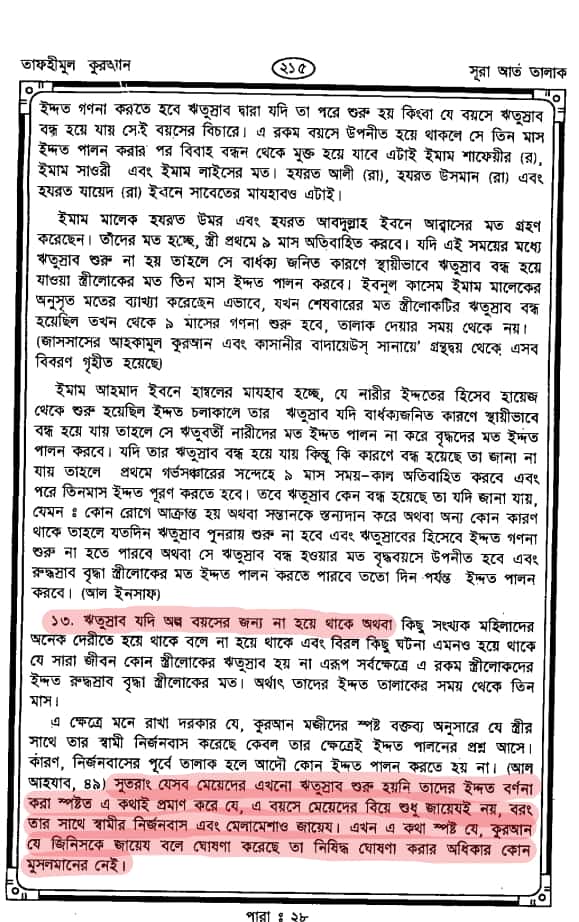
Tawzih al-Quran Regarding Surah al-Talaq
I hope all Muslims in Bangladesh, India, and Pakistan are familiar with the renowned Pakistani Islamic scholar Allama Muhammad Taqi Usmani. Justice Maulana Mufti Muhammad Taqi Usmani (born: 1943) is a renowned Islamic figure in Pakistan. He is an expert in hadith, Islamic jurisprudence, Sufism, and economics. He was selected as the most influential Muslim person in the world [91]। Let us examine the explanation of this verse in his written Quranic exegesis, Tawzih al-Quran [92] –
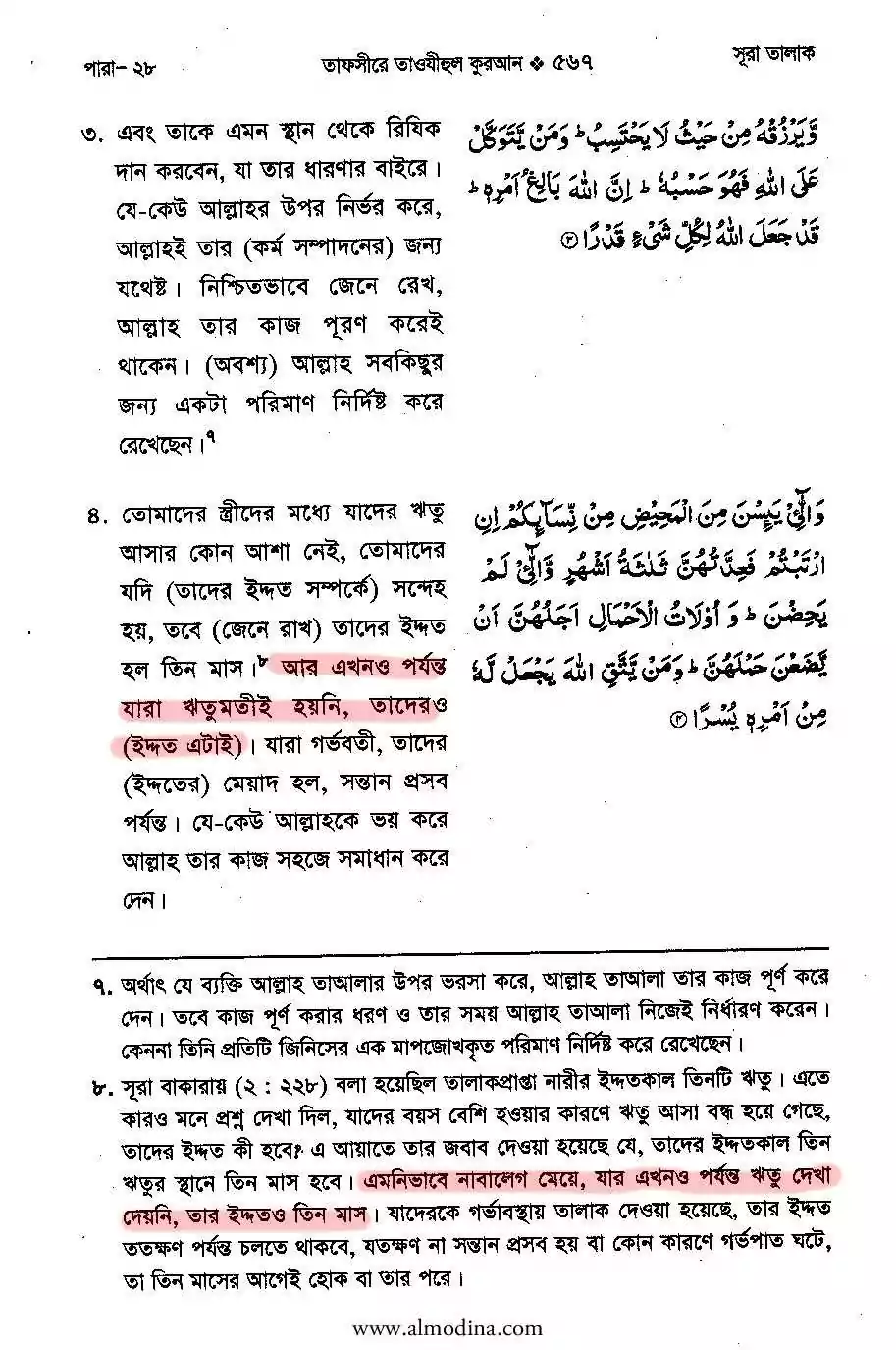
Ahkam al-Quran Regarding Surah al-Talaq
The same subject can also be found in Ahkam al-Quran, written by the renowned Hanafi jurist Imam Ahmad ibn Ali Abu Bakr al-Razi al-Jassas [93] –
It is stated even more clearly in the third volume of the same work that all earlier and later scholars are in agreement on this matter: it is completely permissible in Islam for all guardians to arrange the marriage of an underage girl. There is consensus, or ijma, among earlier and later scholars on this issue [94] –
This verse also proves that a father has the right to arrange the marriage of his young daughter, on the basis that this is permissible for all guardians. The father is the closest guardian of all of them. And we know of no disagreement among jurists from earlier or later periods in various countries regarding its permissibility. However, Bashar ibn al-Walid has transmitted from Shibramata that it is not permissible even for a father to arrange the marriage of young boys and girls. This is the doctrine of al-Assam. We have already stated that this doctrine is invalid. Moreover, this verse itself proves the invalidity of that doctrine.
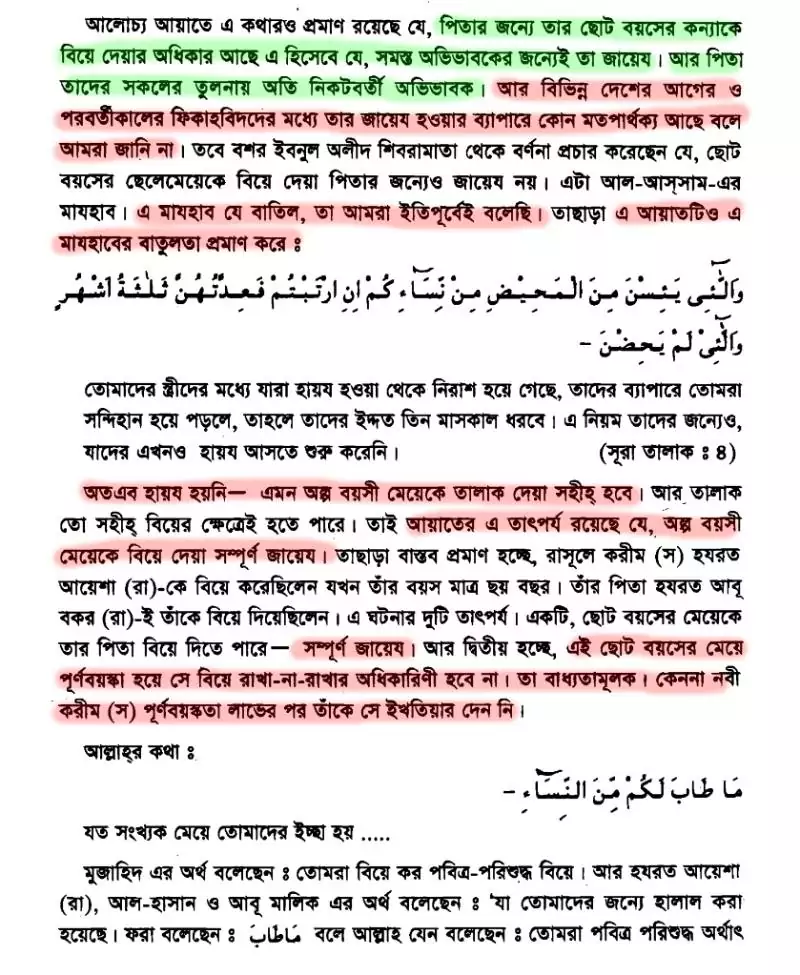
Ahkam al-Hadith Regarding Surah al-Talaq
Ahkam al-Hadith is an important work on hadith and Islamic jurisprudence. Let us see what this work says about verse 4 of Surah al-Talaq [95]
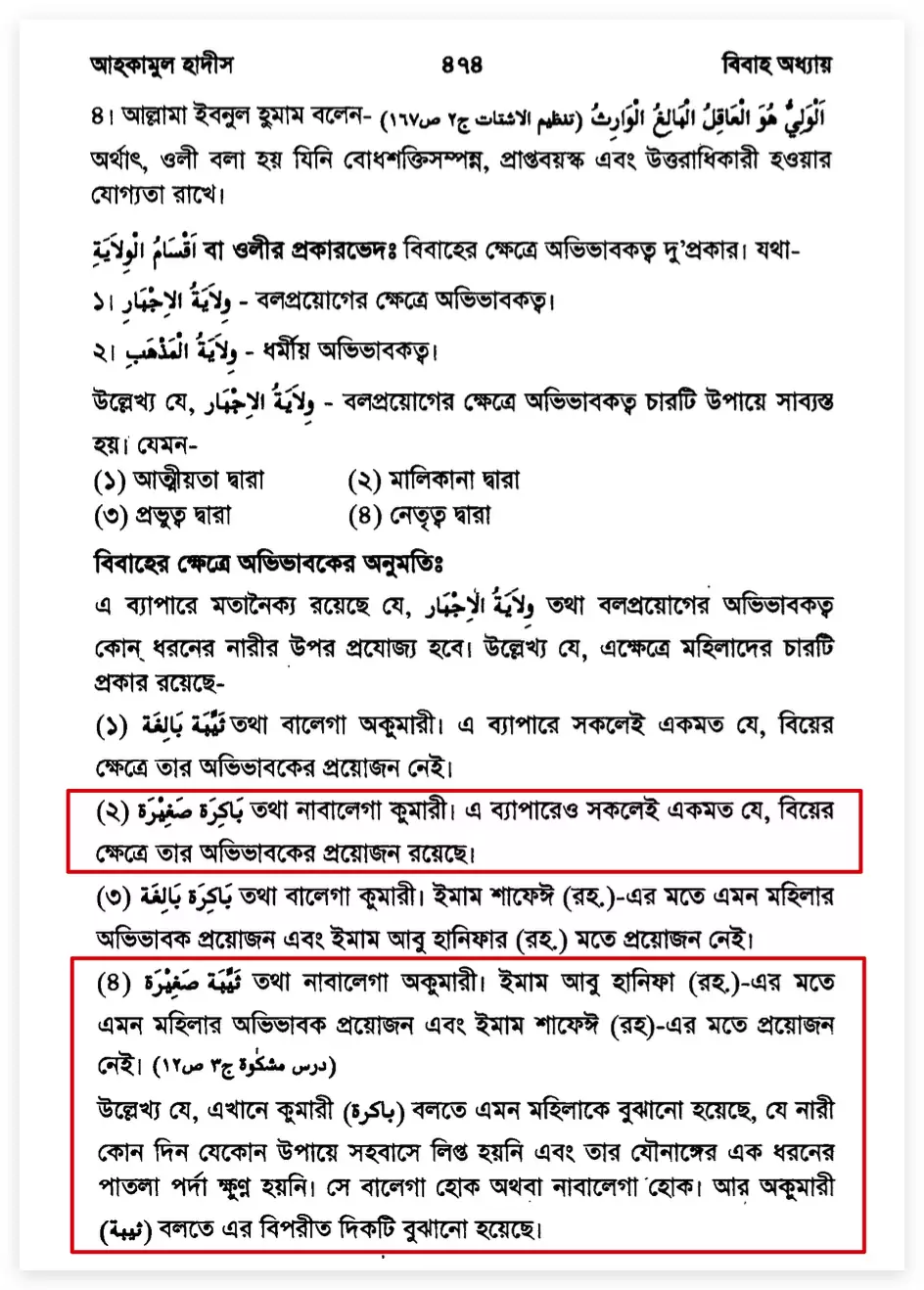
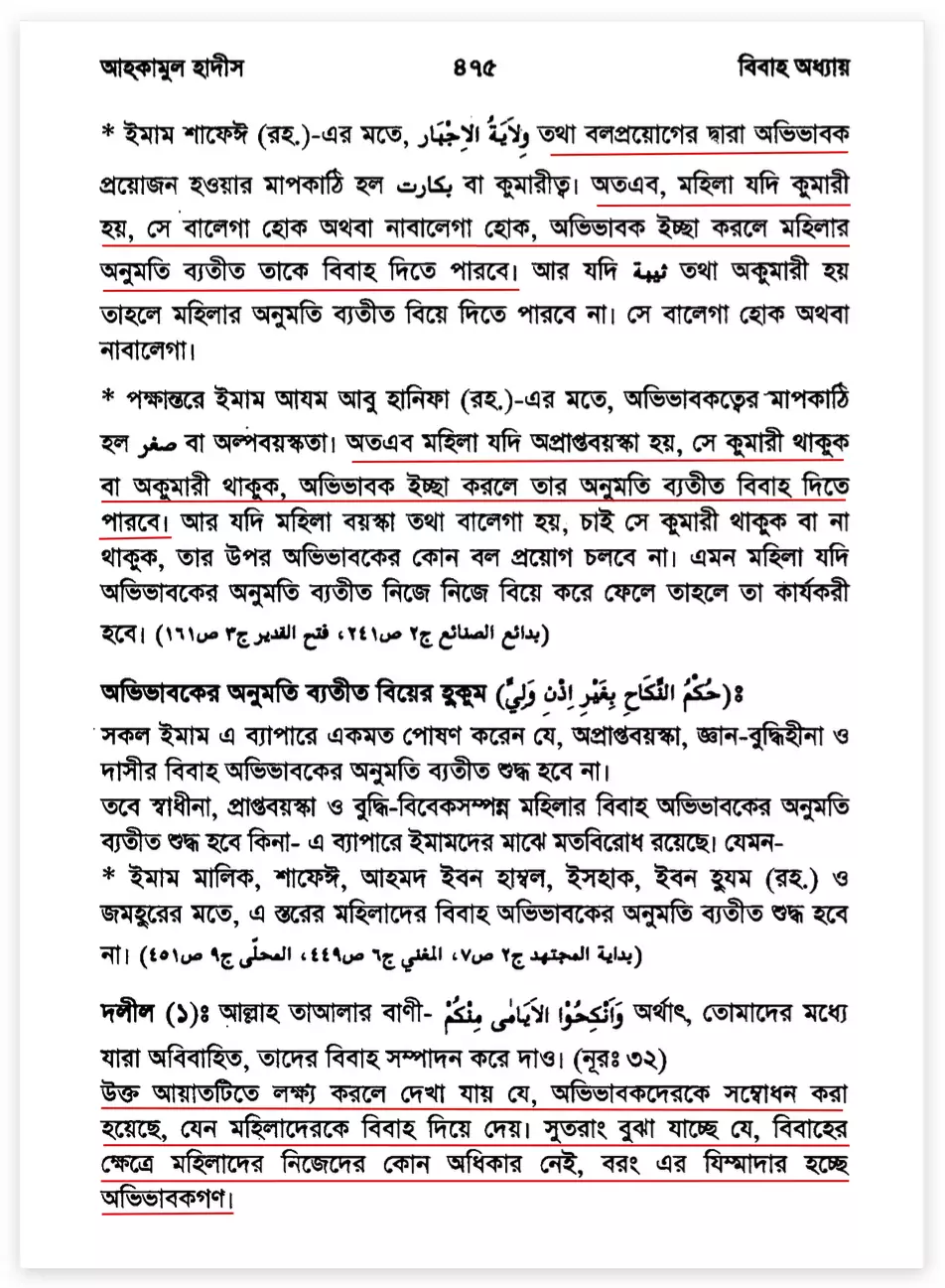
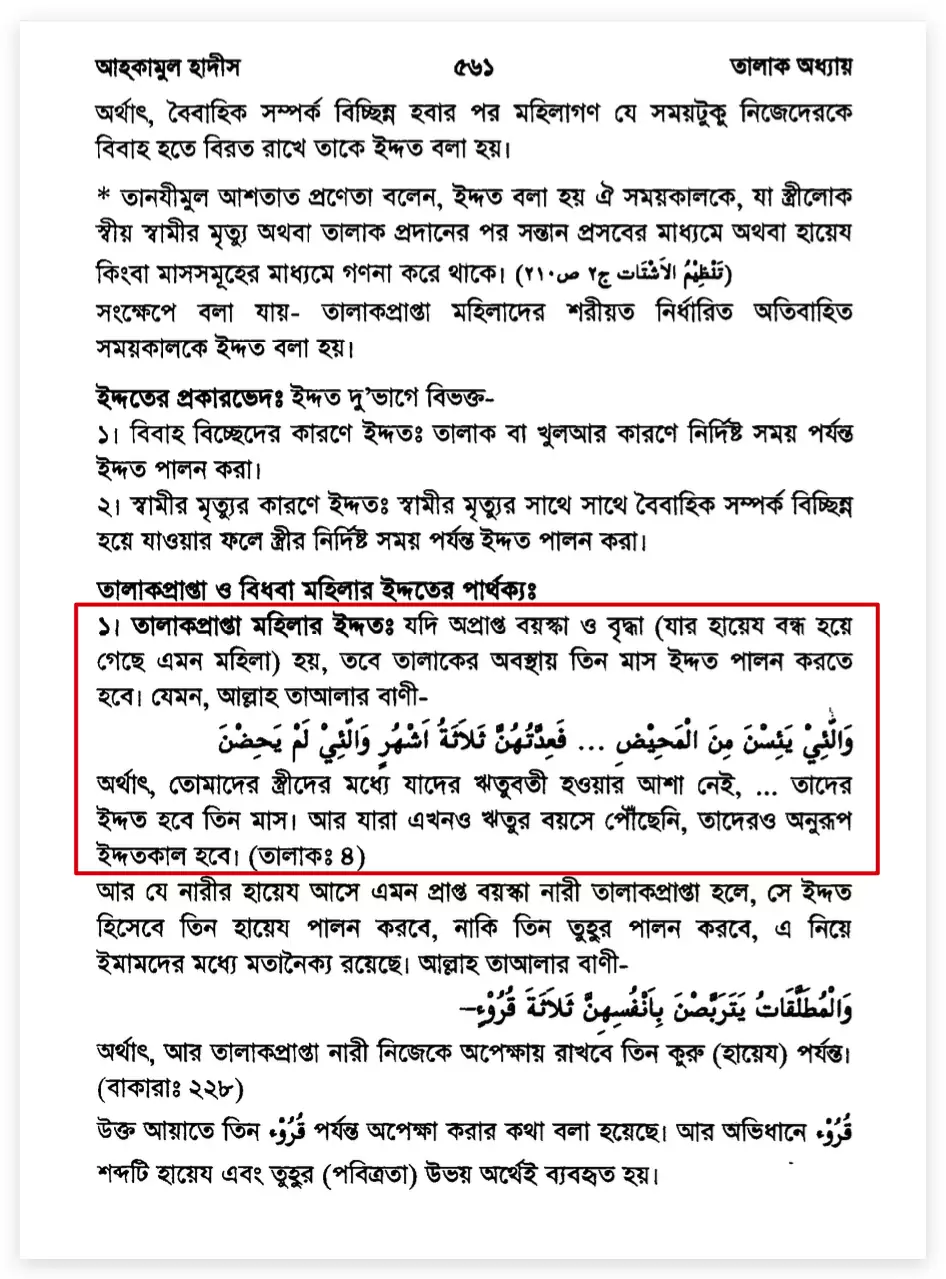
The Law of the Fiqh Work al-Hidayah
Let us also examine what the renowned Hanafi fiqh work al-Hidayah says on this subject [96] –
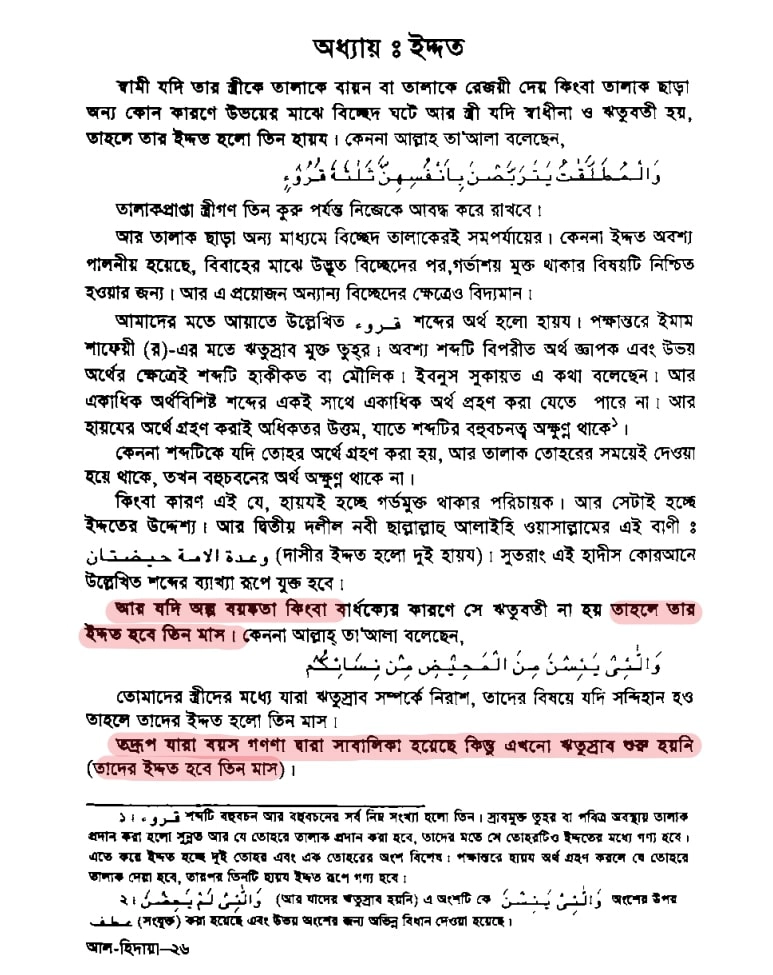
The Law of the Fiqh Work Ashraful Hidayah
Ashraful Hidaya is a highly important work in Hanafi jurisprudence. Let us see what is stated on this subject in Ashraful Hidaya, directed by Maulana Muhammad Ishaq Faridi and translated by several renowned scholars [97] –
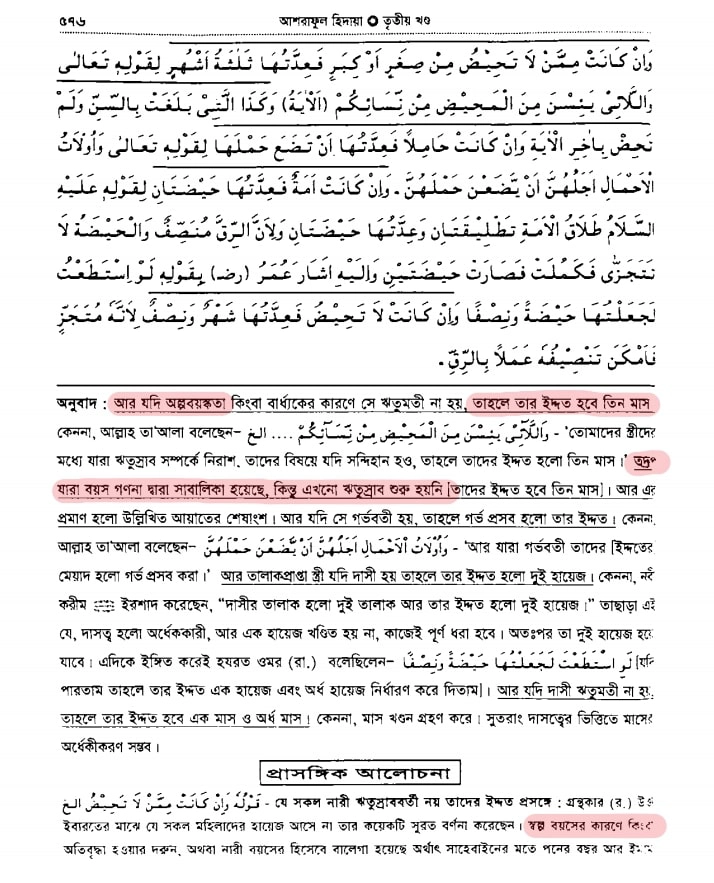
Bukhari’s commentary regarding Surah At-Talaq
Further evidence can be found in the commentary on Sahih Bukhari [98] –
Marriage of an underage girl
Allah the Exalted has said:
وَالَّتِي يَئِسْنَ مِنَ الْمَحِيضِ …… وَالَّتِي لَمْ يَعِضُنَ
“Those women who have passed the age at which menstruation may be expected and those women who have not yet menstruated—the waiting period (`iddah) for both after divorce is three months. (Part 28—Surah At-Talaq)
This verse describes the waiting period after divorce for women who have not begun menstruating. Thus, it is perfectly clear that there is also an allowance for their marriage; otherwise, where would divorce and its waiting period come from?
2026. Hadith: It is narrated from Aisha (may Allah be pleased with her) that when the Prophet (peace and blessings of Allah be upon him) married her, she was six years old, and her rukhsati—that is, the beginning of her married life—took place when she was nine years old. She had the opportunity to live with the Prophet for nine years. (Accordingly, the Prophet passed away when she was eighteen years old.)
Commentary: Declaring lawful what the Sharia has permitted to be illegal, and permitting what the Sharia has declared illegal, is called tahrif, or distortion of the Sharia, which was practiced by the Jews and Christians.
Allah the Exalted is All-Knowing; He has known everything, past and future, from eternity! The system of laws given by Him is called the Sharia. To distort or alter the Sharia by repeating arguments about benefits, harms, and the like
Sahih Bukhari, p. 197
is tantamount to attributing fault to the knowledge of Allah the All-Knowing.
Regarding the marriage of underage boys and girls, Imam Bukhari (may Allah have mercy on him) established the Sharia’s approval through the Qur’an and Hadith. Declaring this illegal is, in reality, interference in and distortion of the Sharia—that system of laws given by Allah the Exalted as a way of life for His servants. Since the Messenger of Allah himself acted upon this permission, declaring this permission objectionable is tantamount to declaring the Messenger’s action objectionable!
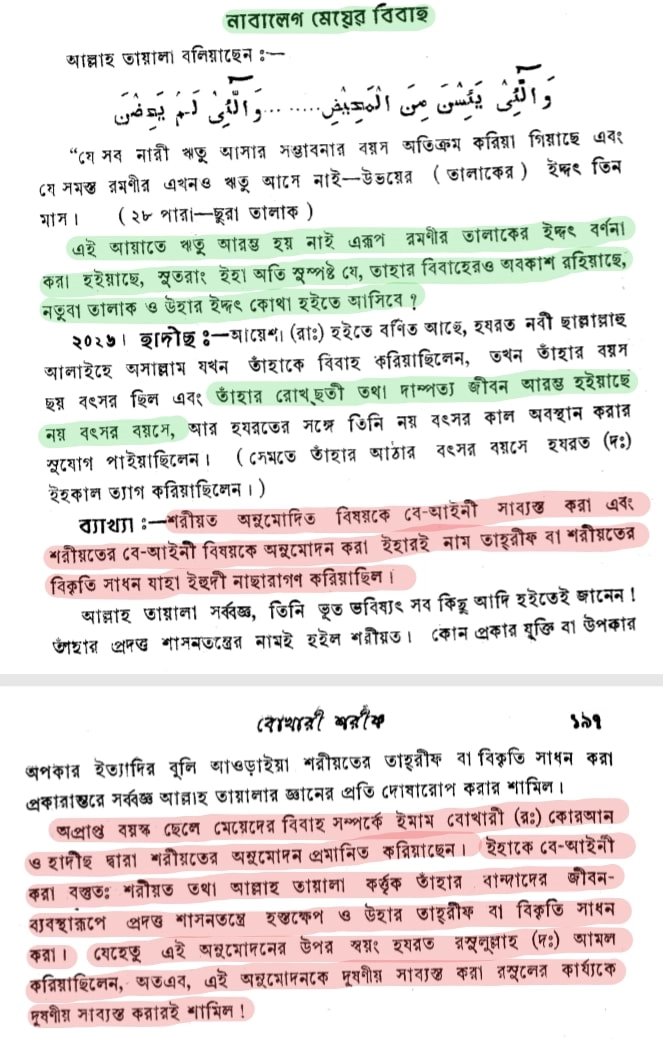
Fiqh al-Sunnah on intercourse with an underage girl
Fiqh al-Sunnah, written by Sayyid Sabiq, a renowned scholar of Al-Azhar University and an expert in Sharia law, is an important work on Islamic law. This book states quite clearly how long the `iddah of an underage girl is. And we know that in Islam, `iddah is possible only when sexual intercourse has taken place [99] –
The `iddah of a woman who has not menstruated: If a wife has not menstruated, her `iddah is three months. This applies both to an underage girl and to an elderly woman who has passed the age of menstruation, whether she has never menstruated at all or whether menstruation began and then ceased. The evidence for this is the previously mentioned verse 4 of Surah At-Talaq.
Ibn Abi Hashim has mentioned in his tafsir that Ubayy ibn Ka‘b said: I
said: O Messenger of Allah, some people in Medina say various things because Allah has not mentioned anything in the Qur’an regarding the `iddah of underage girls, elderly women, and pregnant women. Then Allah revealed verse 4 of Surah At-Talaq. It states in that verse that the `iddah of a pregnant woman lasts until she gives birth. When she gives birth, her `iddah ends.
The wording of Jarir’s narration is as follows: “I said: O Messenger of Allah, regarding the `iddah of women,
after the verse of Surah Al-Baqarah was revealed, some people in Medina said: The `iddah of certain women has not been mentioned in the Qur’an. They are underage girls, elderly women who have passed the age of menstruation, and pregnant women. Then Allah revealed verse 4 of Surah At-Talaq.
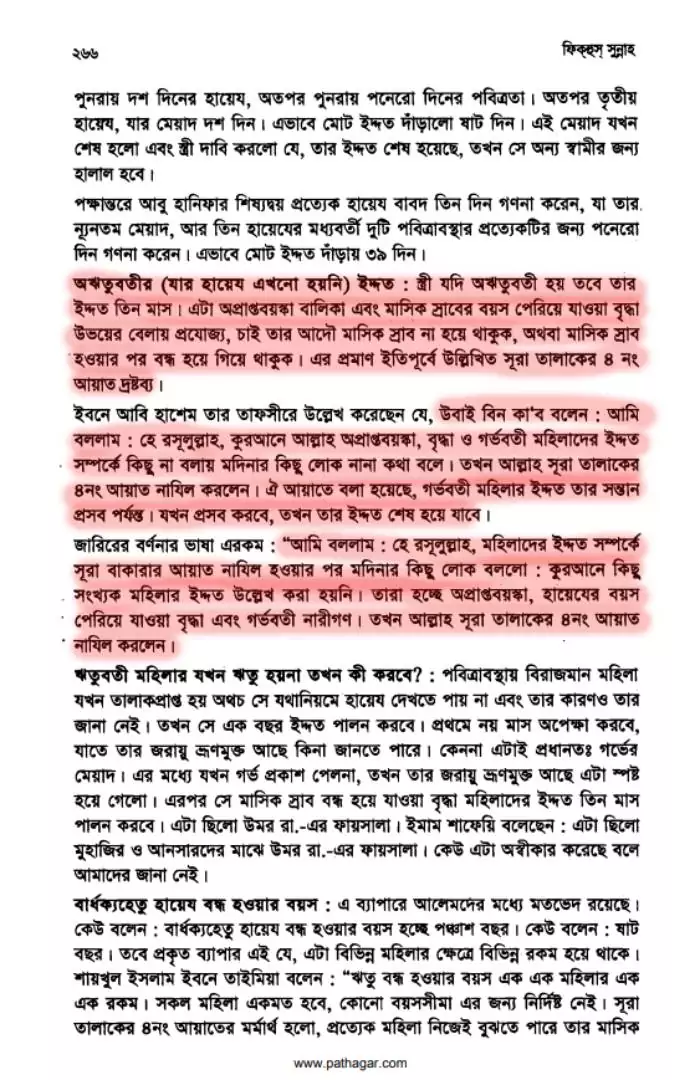
This same book states that if a girl’s vaginal passage tears during intercourse with an underage girl, the husband is required to pay compensation. However, the condition here is that this compensation applies only if the vaginal passage and the anus become one because of the tearing. If any barrier remains between them, no compensation is required. Although these were additions by the imams long after Muhammad, they nevertheless provide evidence that Islam has very clearly legalized pedophilia. In other words, believers must ensure that the underage child’s vaginal passage and anus do not tear and become one. As long as they do not do that, everything is fine. And if it does happen, they can simply pay a small amount of compensation! [100] –
1. If the wife’s vagina becomes torn and widened through intercourse with her husband: If a person, while having intercourse with his wife, tears and widens her vaginal passage, then if the wife is an adult with whom intercourse is ordinarily possible for a woman of her age, no compensation will be required. This is the opinion of Imam Abu Hanifa and Ahmad. According to al-Shafi‘i and Malik, blood money must be paid. However, according to Malik’s more famous opinion, the matter will be decided through arbitration. But if she is an underage girl with whom intercourse is not ordinarily possible for a girl of her age, blood money is obligatory. It should be noted that this ruling applies only when the vaginal passage is torn and becomes one with the anus, with no barrier remaining between these two organs.
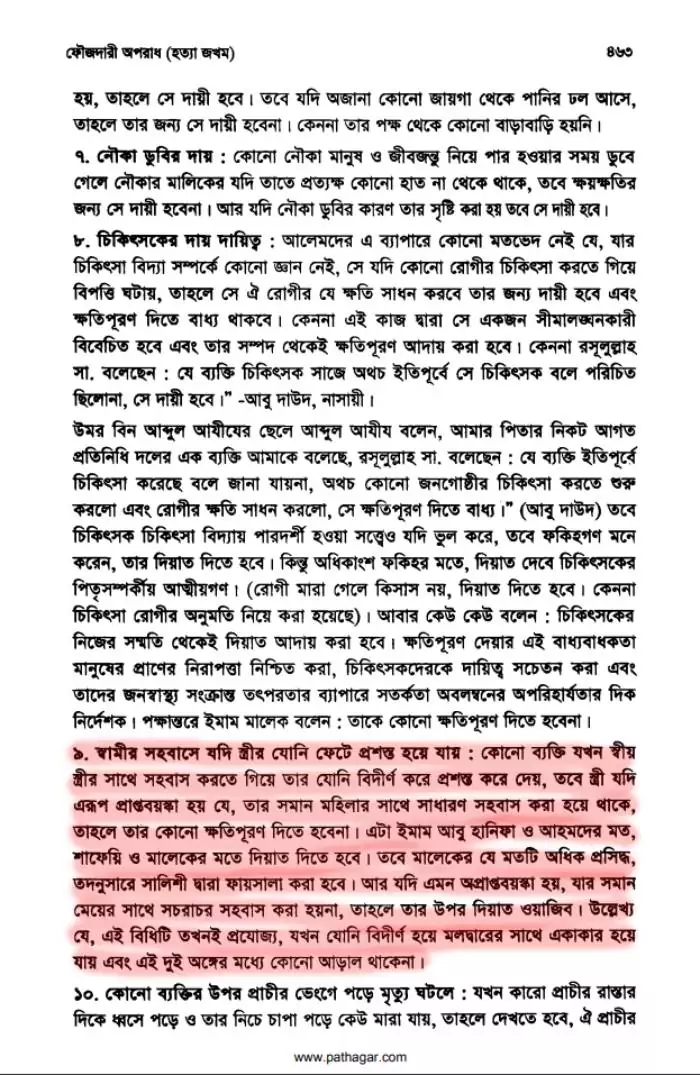
Sharia law in India: Fatawa-e-Alamgiri
The renowned Islamic work of the subcontinent, Fatawa-e-Alamgiri, also describes in detail the subjects of intercourse with an underage wife and divorce [101] –
20. Mas’ala: It is mentioned in the book Adab al-Qadi that if a husband has intercourse with an underage wife who has not yet begun menstruating, and if she is of an age at which intercourse is ordinarily possible with girls of her age, then after divorce her `iddah will be three months. Shaykh Abu Ali Nasafi (may Allah have mercy on him) says that this ruling applies only if she has not reached an age close to puberty, that is, murahiqah. On the other hand, if she has reached an age close to puberty, then according to Abu al-Fadl (may Allah have mercy on him), her `iddah will not be completed according to the calculation of months. Rather, the matter will remain pending until it becomes clear whether she has become pregnant through that intercourse. (Tamartashi) If a husband divorces an underage girl and one day less than three months passes, after which she begins menstruating, her `iddah will not be complete until three menstrual cycles have passed. If a man gives his wife a revocable divorce and she observes `iddah for one day less than three menstrual cycles, after which her husband dies, observing an `iddah of four months and ten days will again become obligatory for her. (Ghayat al-Bayan)
21. Mas’ala: If a divorced woman begins observing `iddah through menstruation, and then after one or two menstrual cycles her menstruation ceases, she will not be released from `iddah until she reaches menopause. When she reaches menopause, she will again observe `iddah from the beginning according to the calculation of months—that is, three months. (Fatawa Qadi Khan) If a married female slave is given a revocable divorce by her husband and her master sets her free while she is observing `iddah, then her `iddah will change from the time of her emancipation and will become like the `iddah of free women. That is, if she is a menstruating woman, her `iddah will be three menstrual cycles. If she is not menstruating, her `iddah will be three months. However, if the husband gives her an irrevocable divorce or three divorces, or dies while leaving his wife behind and she is then emancipated during her `iddah, her `iddah will not change to become like the `iddah of a free wife. Therefore, it will be obligatory for her to observe `iddah according to her circumstances for two menstrual cycles, one and a half months, or two months and five days. (Ghayat al-Bayan) If an underage female slave is divorced after intercourse, her `iddah will be one and a half months. If she begins menstruating when her `iddah is nearing completion, her `iddah will change and become the `iddah of a menstruating woman.
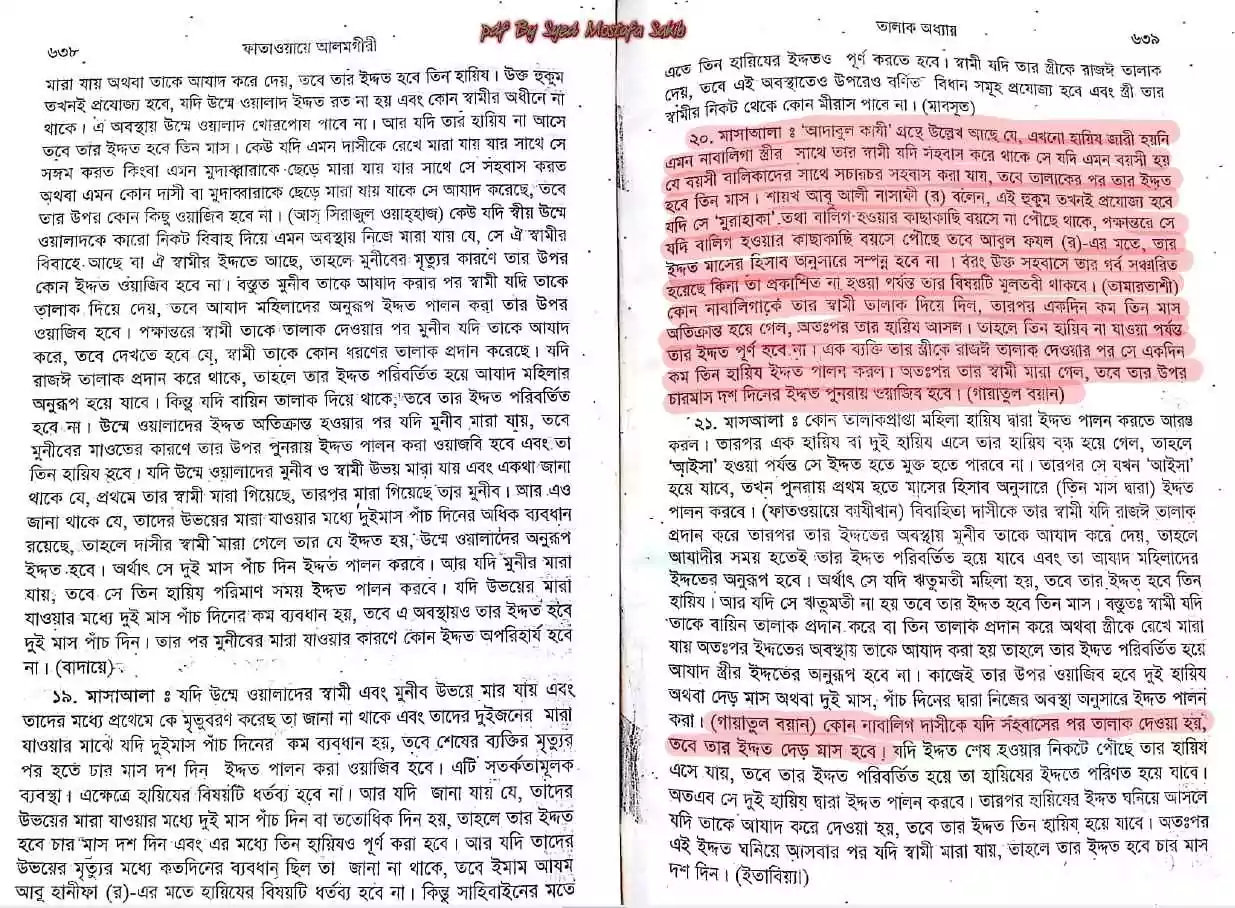
Scholarly consensus on child marriage
There is scholarly consensus, or ijma, among Islamic scholars regarding the marriage of children. It is mentioned below.
Imam Ibn Abd al-Barr (may Allah have mercy on him; died 423 AH) wrote: أجمع العلماء على أن للأب أن يزوج ابنته الصغيرة ولا يشاورها ، لتزويج رسول الله صلى الله عليه وسلم عائشة وهي بنت ست سنين …انتهى – The scholars are unanimously agreed on this matter: a father may marry off his underage child without consulting her. This is because the Messenger of Allah married Aisha when she was six years old. (At-Tamhid, Ibn Abd al-Barr—19/94)
Imam Malik (may Allah have mercy on him; died 179 AH) said: وإنكاح الأب جائز على الصغار من ولده ، ذكراً كان أو أنثى– It is permissible for a father to marry off any of his underage children—whether the child is a boy or a girl. (At-Tamhid, Ibn Abd al-Barr—19/98)
Imam Isma‘il ibn Ishaq (may Allah have mercy on him) said: والأب له أن يزوج الصغيرة بإجماع من المسلمين– The Muslim ummah is unanimously agreed on this matter: a father may marry off his underage child. (At-Tamhid, Ibn Abd al-Barr—19/84)
Imam Ibn al-Mundhir al-Nishapuri (may Allah have mercy on him; died 318 AH) said: أجمع كل من نحفظ عنه من أهل العلم أن نكاح الأب ابنته الصغيرة جائز إذا زوجها من كفء– The scholars recognized as authorities are unanimously agreed on this matter: a father may marry off his underage child—provided that he marries her to a suitable match. (At-Tamhid, Ibn al-Barr—19/84; Al-Mughni, Ibn Qudamah—9/398)
Imam Hafiz Ibn Hajar al-Asqalani (may Allah have mercy on him; died 852 AH) cited the opinion of Ibn Battal (may Allah have mercy on him): يجوز تزويج الصغيرة بالكبير إجماعاً ، ولو كانت في المهد– According to all the recognized authorities, it is permissible to marry an underage girl to an adult man—even if the girl is still an infant. (Fath al-Bari, Ibn Hajar—9/123)
Imam Ibn Hazm (may Allah have mercy on him; died 456 AH) wrote: الحجة في إجازة إنكاح الأب ابنته الصغيرة البكر ، إنكاح أبي بكر رضي الله عنه النبي صلى الله عليه وسلم من عائشة رضي الله عنها وهي بنت ست سنين– The evidence that it is permissible for a father to marry off his underage virgin daughter is that Abu Bakr (may Allah be pleased with him) married Aisha (his underage daughter) to the Messenger of Allah (peace and blessings of Allah be upon him) when Aisha was a six-year-old girl. (Al-Muhalla, Ibn Hazm—9/458)
Islamweb’s fatwa
Islamweb.net is a rich repository of fatwas on Islamic matters. Let us look at a fatwa on this subject from the website. The fatwa is in Arabic, and its English and Bengali translations are provided below (translated by AI) [27] –
الدليل على جواز تزويج الأب البنت الصغيرة دون إذنها أو رضاها
رقم الفتوى: 230518
السؤال
هل يوجد دليل في النصوص الشرعية يقول بجواز إجبار البكر الصغيرة على الزواج؟.
الإجابــة
الحمد لله والصلاة والسلام على رسول الله وعلى آله وصحبه، أما بعد:
فقد حكى بعض العلماء الإجماع على أن للأب تزويج ابنته البكر الصغيرة بغير رضاها، ولا يشترط إذنها، ونعني بالصغيرة من ليست بالغة، جاء في المغني لابن قدامة: أما البكر الصغيرة: فلا خلاف فيها، قال ابن المنذر: أجمع كل من نحفظ عنه من أهل العلم أن نكاح الأب ابنته البكر الصغيرة جائز, إذا زوجها من كفء. اهـ.
ومستند هذا الإجماع أن أبا بكر زوج عائشة ـ رضي الله عنها ـ من رسول الله صلى الله عليه وسلم ولم يشاورها، قال ابن عبد البر: أجمع العلماء على أن للأب أن يزوج ابنته الصغيرة ولا يشاورها، لتزويج رسول الله صلى الله عليه وسلم عائشة وهي بنت ست سنين…. اهـ.
ولمزيد الفائدة نرجو مراجعة الفتويين رقم: 223414، ورقم: 172491
والله أعلم.
Title: Evidence that a father may marry off his young virgin daughter without her permission or consent
Fatwa Number: 230518
Publication Date: Thursday, 2 Safar 1435 AH – 5 December 2013
Question:
Is there any evidence in the Sharia texts that it is permissible to compel a virgin to marry?
Answer:
Praise be to Allah, and may blessings and peace be upon the Messenger of Allah, his family, and his companions.
Some scholars have reported a consensus (ijma‘) that a father may marry off his young virgin daughter without her permission or consent. By “young” we mean one who has not yet reached puberty(adulthood). It is understood that such a marriage is permissible provided that the husband is suitable (kuf’) for her.
This consensus is based on the fact that Abu Bakr married off his daughter ‘Aishah, may Allah be pleased with her, to the Messenger of Allah, peace and blessings be upon him, without consulting her. Ibn ‘Abd al-Barr said: “The scholars are unanimously agreed that a father has the right to marry off his young daughter without consulting her, as evidenced by the marriage of the Messenger of Allah, peace and blessings be upon him, to ‘Aishah when she was six years old.”
For further details, please see Fatwas No. 223414 and No. 172491.
And Allah knows best.
Bengali translation:
Title: Evidence that a father may marry off his virgin daughter without her permission or consent
Fatwa Number: 230518
Publication Date: Thursday, 2 Safar 1435 AH – 5 December 2013
Question:
Is there any evidence in the Sharia texts that it is permissible to compel a virgin to marry?
Answer:
Praise be to Allah, and may blessings and peace be upon the Messenger of Allah, his family, and his companions.
Some scholars have reported a consensus (ijma‘) that a father may marry off his underage virgin daughter without her permission or consent. By “underage” is meant someone who has not yet reached puberty. The condition is that the groom must be suitable (kufu’) for her.
The basis of this consensus is that Abu Bakr (may Allah be pleased with him) married his daughter Aisha (may Allah be pleased with her) to the Messenger of Allah (peace and blessings of Allah be upon him) without consulting her. Ibn Abd al-Barr said: “The scholars are unanimously agreed that a father has the right to marry off his underage daughter without consulting her; the evidence for this is the marriage of Aisha (may Allah be pleased with her) to the Messenger of Allah (peace and blessings of Allah be upon him) when she was six years old.”
For further details, see Fatwas No. 223414 and 172491.
Allah knows best.
The Saudi government’s and Grand Mufti’s fatwa
A direct official website published from Saudi Arabia clearly states in this fatwa that child marriage is completely halal, that intercourse is also halal, and that this is halal not only for the Prophet but for everyone. This fatwa was authenticated by Saudi Arabia’s highest-ranking scholars, including former Grand Mufti Abd al-Aziz ibn Baz and the current Grand Mufti Shaykh Abd al-Aziz Al al-Shaykh, as well as one of the country’s foremost Islamic scholars, Shaykh Salih al-Fawzan, and the Ifta Committee. Let us look at it as well—[102]
The first question of Fatwa no. 18734
Q 1: Is it true that the Prophet’s marriage to `A’ishah while still young was one of his particularities or was it a legislation for the whole Ummah?
Is it permissible to consummate marriage with immature girl? If not, how then should she observe three months as `Iddah (waiting period)?
A: The Prophet (peace be upon him) betrothed `Aishah (may Allah be pleased with her) while she was six years old. He consummated the marriage in Al-Madinah when she was nine years old. Actually, this is not a particularity just for him. Thus, it is permissible to contract the marriage of an immature girl and consummate it.
(Part No. 18; Page No. 125)
even before maturity if she is able to. As for the `Iddah of an immature girl, Allah (Glorified and Exalted be He) defined the `Iddah of those who have passed the age of monthly courses and those who are still immature to be three months. Allah (Exalted be He) said, And those of your women as have passed the age of monthly courses, for them the ‘Iddah (prescribed period), if you have doubt (about their periods), is three months; and for those who have no courses (i.e. they are still immature) In fact, immature girls are included under the category: …and for those who have no courses (i.e. they are still immature) their ‘Iddah (prescribed period) is three months likewise, except in case of death). May Allah grant us success. May peace and blessings be upon our Prophet Muhammad, his family, and Companions.
The Permanent Committee for Scholarly Research and Ifta’
Member: Bakr Abu Zayd Member: Salih Al-Fawzan Deputy Chairman: `Abdul-`Aziz Al Al-Shaykh Chairman:`Abdul-`Aziz ibn `Abdullah ibn Baz
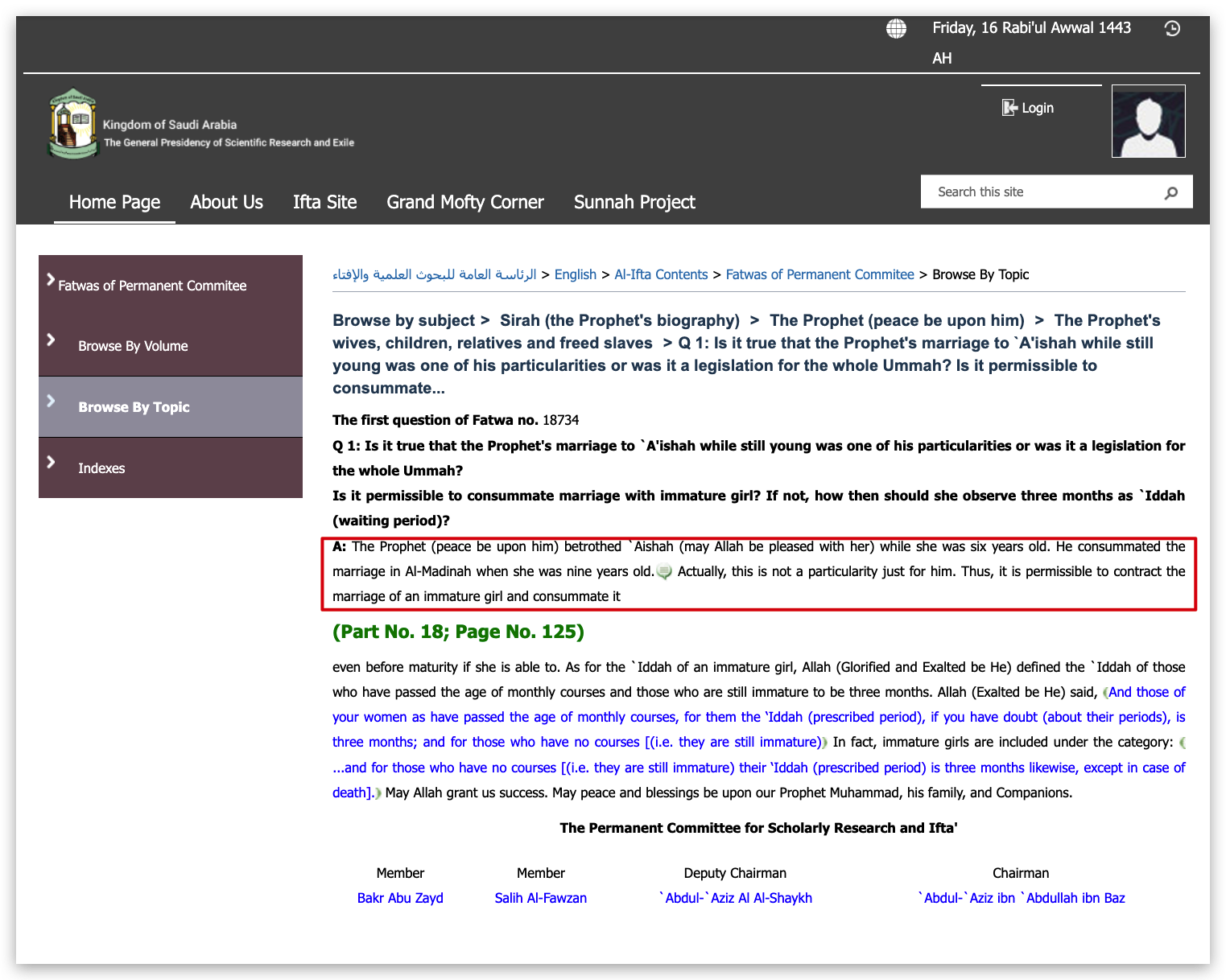
Now let us examine a book by Dr. Saleh Al-Fawzan published by the Saudi government, a Bengali translation of which is available from Islam House. It was translated by Dr. Abu Bakr Muhammad Zakaria [103]
Special Rulings for Believing Women
Marry her off, and if you do not, there will be fitnah and corruption on earth.”¹
Obtaining a Woman’s Consent in Marriage
There are three types of women eligible for marriage:
a. An underage, unmarried girl.
b. An adult, unmarried woman.
c. A married woman.
There are separate rulings for each type of woman.
1. The father may marry off a minor girl without obtaining her consent; there is no disagreement on this. This is because she has not yet acquired the authority to give consent. Secondly, Abu Bakr, may Allah be pleased with him, married his young daughter Aisha to the Messenger of Allah, peace and blessings be upon him, when she was only six years old, and sent her to the bridal chamber when she reached the age of nine.²
Imam Al-Shawkani, may Allah have mercy on him, says in his book Nayl al-Awtar (6/128–129): “This hadith proves that it is permissible for a father to marry off his daughter before she reaches adulthood. He further says: This hadith proves that it is permissible to marry a young girl to an adult man. Imam Bukhari composed a chapter on this issue and cited the hadith of Aisha therein. Ibn Hajar al-Asqalani, may Allah have mercy on him, has reported the consensus of the ummah on this issue in Fath al-Bari.” End.
Ibn Qudamah says in Al-Mughni (6/487): Ibn al-Mundhir said: “Everyone from whom we acquired knowledge agrees that it is permissible for a father to marry off his young daughter, provided that she is married to a man of equal status.” End.
I, the author, say: Abu Bakr, may Allah be pleased with him, married his young daughter
Aisha to the Prophet, peace and blessings be upon him, when she was only six years old. This incident casts into the rubbish heap those who deny the marriage of a young girl to an older man, spread confusion, and consider it a crime. This may be due to their ignorance, or it may be part of a self-interested foreign conspiracy.
1 Tirmidhi, hadith no. 1085
2 Sahih Bukhari and Muslim.
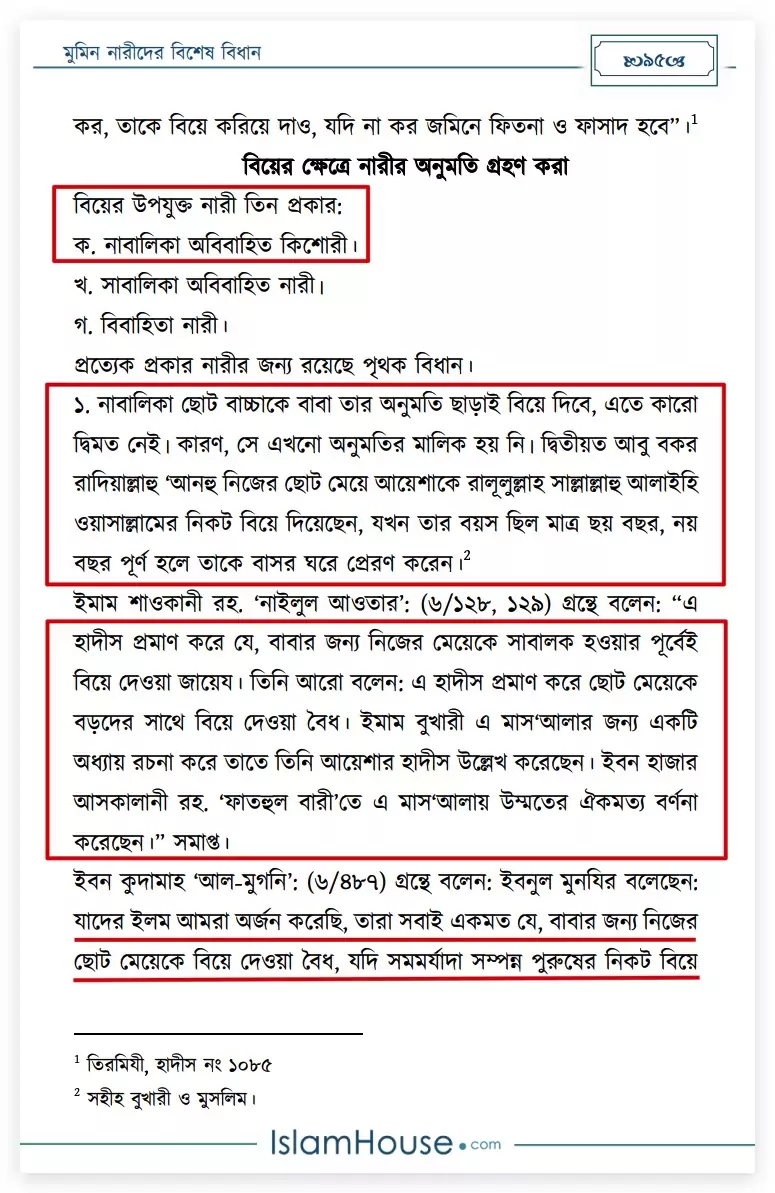
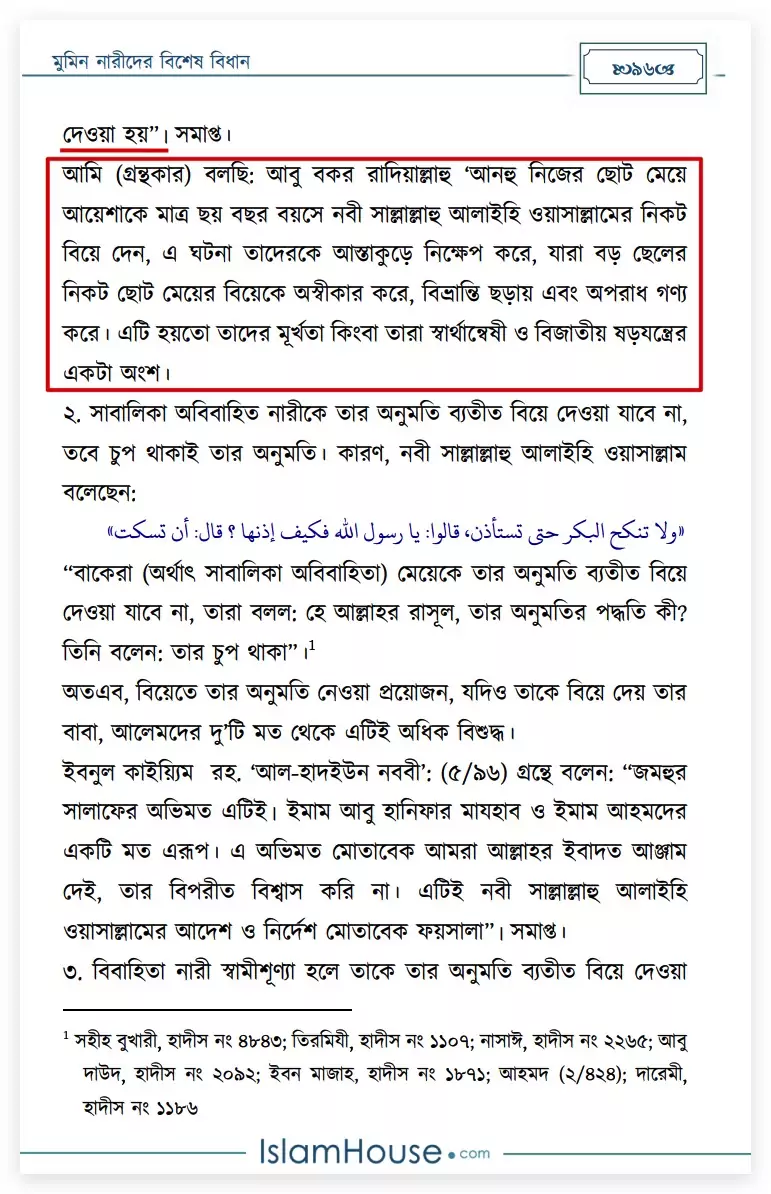
The Fatwa Permitting Deception to Arrange Marriage at a Young Age
The above sources make it very clear that Islam encourages the marriage of young girls. The jurisprudential book Fatawa-ye Faqihul Millat also states that Islam not only permits marriage at a young age, but also permits lying in violation of Bangladeshi law for this purpose [104] –
Increasing the age on paper to avoid legal trouble
Question: According to the law of the Government of Bangladesh, it is prohibited to give a girl under the age of 18 in marriage. However, according to Islamic law, it is permissible to marry her. When a marriage is conducted according to Islamic law, government pressure is often imposed. The question is: To avoid government harassment, is it permissible to enter a 14-year-old girl into marriage by recording her age as 18 in government records?
Answer: Islamic law has placed pressure on the girl’s guardians to marry her quickly as soon as she becomes suitable for marriage. If anyone exerts pressure to the contrary, it will constitute oppression or wrongdoing. In order to follow the ruling of Islamic law, one may adopt any method necessary to avoid oppression or wrongdoing.
(16/479/6618)
Other Relevant Islamic Rulings
This section discusses certain ancillary laws, theoretical concepts, and historical examples from Islamic Shariah that further establish the legitimacy of child marriage within the religious framework. By presenting the Prophet’s decisions as the final and immutable standard for believers, it is shown that considering any act he approved of or practiced (such as child marriage) to be unlawful or harmful is regarded in Islam as bid‘ah or deviation. The issue of the Prophet Muhammad’s special attraction to virgins and very young girls, as well as the Companions’ encouragement of marriage to similarly young virgins, is analyzed on the basis of evidence from various sahih hadiths. As historical documentation, this section includes the forced marriage of Umm Kulthum, the underage daughter of Ali, to the second caliph Umar, as well as the widespread practice of such marriages among the Companions and the scholars’ consensus, or ijma, on the matter. As an even more horrifying aspect, it describes in detail the Islamic legal permissibility of sexual relations with underage female slaves who were captives of war or purchased in the market, as well as the concept of the husband’s absolute ownership of his wife’s sexual organs through the marriage contract, known as milk al-bud‘. Finally, it discusses the distinction in Islamic jurisprudence between bulugh, or physical capability, and rushd, or mental maturity, and how physical signs alone have been treated as the sole criterion of adulthood. It also explains, with evidence, the linguistic and theoretical aspects of including children and adult women within the same legal definition through the use of the word nisa in the Quran.
Can Anyone Else Declare the Prophet’s Actions Unlawful?
The clear ruling of Islam is that submitting oneself completely to the Prophet’s decision, without the slightest hesitation, is what faith means. [105]
Quran reference : Surah An-Nisa, 4:65
Arabic : فَلَا وَرَبِّكَ لَا يُؤْمِنُونَ حَتَّىٰ يُحَكِّمُوكَ فِيمَا شَجَرَ بَيْنَهُمْ ثُمَّ لَا يَجِدُوا۟ فِىٓ أَنفُسِهِمْ حَرَجًۭا مِّمَّا قَضَيْتَ وَيُسَلِّمُوا۟ تَسْلِيمًۭا ٦٥
Translation — Dr. Mustafa Khattab, The Clear Quran : But no! By your Lord, they will never be ˹true˺ believers until they accept you ˹O Prophet˺ as the judge in their disputes, and find no resistance within themselves against your decision and submit wholeheartedly.
Translation — Saheeh International : But no, by your Lord, they will not [truly] believe until they make you, [O Muhammad], judge concerning that over which they dispute among themselves and then find within themselves no discomfort from what you have judged and submit in [full, willing] submission.
At the same time, no Muslim can prohibit an act that the Prophet did not prohibit. Let us examine a hadith from Sahih Bukhari on this matter [106] [107]
Sahih Bukhari (Islamic Foundation)
85/ Holding Firmly to the Quran and Sunnah
Chapter: 3097. The fact that the Prophet (peace be upon him) did not reject something is proof of its permissibility. Another person’s rejection is not proof of its impermissibility
6853. Narrated by Hammad ibn Humayd (may Allah have mercy on him) … from Muhammad ibn al-Munkadir (may Allah have mercy on him). He said: I heard Jabir ibn Abdullah (may Allah be pleased with him) swear by Allah that Ibn Sayyad was certainly a Dajjal. I asked him, “Are you swearing by Allah?” He replied: I heard Umar (may Allah be pleased with him) swear to this in the presence of the Prophet, peace and blessings be upon him. The Prophet, peace and blessings be upon him, did not reject this statement.
Hadith grade: Sahih (Sahih)
Narrator: Muhammad ibn al-Munkadir (may Allah have mercy on him)
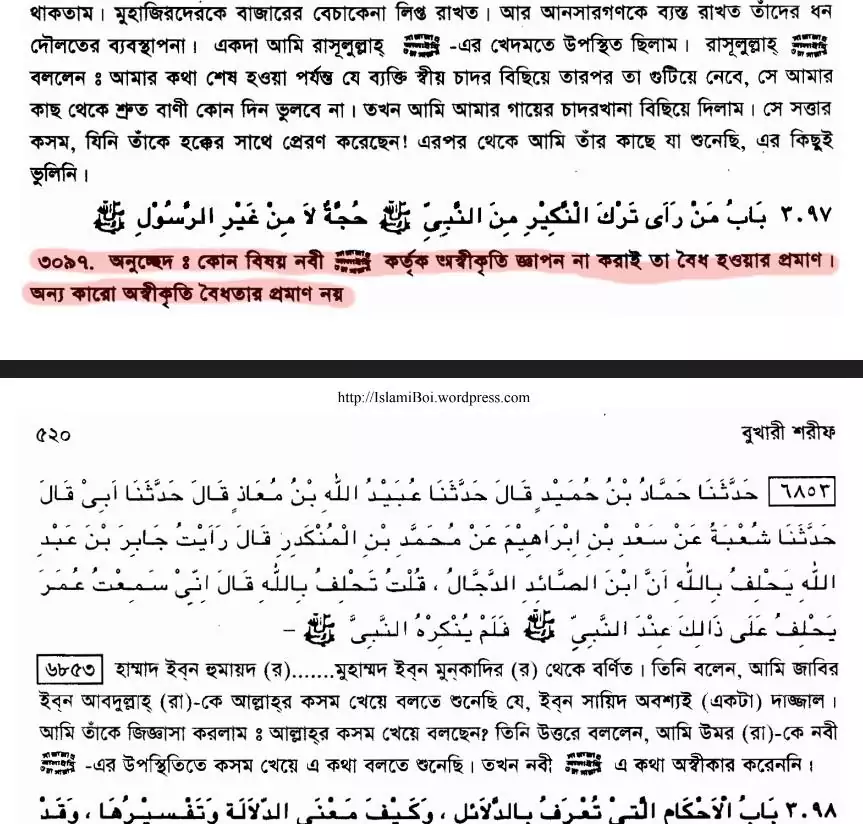
Now let us read the explanation of this hadith from Nasrul Bari [108]
3858. Section: The fact that the Messenger of Allah did not reject something is proof of its permissibility. Another person’s rejection is not proof of its permissibility.
What is meant by this: What is meant is that the Messenger’s tacit approval is proof, because it is an act of the Messenger; if the Messenger had rejected it, he would certainly have prevented it. There is no disagreement among the scholars on the matter that if anyone from the Messenger’s ummah committed an unjust act or spoke an unjust word, it would not be permissible for the Messenger to hear or see it and approve of it. This is because Allah the Exalted made it obligatory upon the Messenger to prevent wrongdoing.
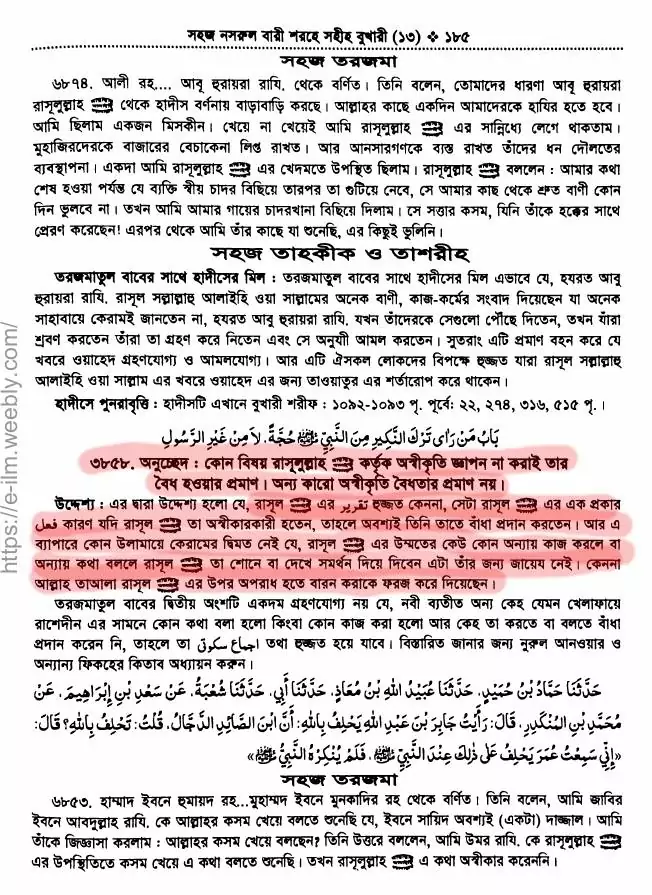
It is clear from this hadith that no matter how great an Islamic scholar someone may be in a later period, if the Prophet made something lawful—or even did not declare it unlawful or reject it—that person has no authority to declare it unlawful.
Is It Permissible in Islam to Call Child Marriage Harmful?
A very important question is whether Islam permits considering an act performed by the Prophet himself to be unlawful or harmful. In this context, a hadith must be cited which states that every newly invented matter is bid‘ah [109] –
Sunan Abu Dawud (verified edition)
35/ Sunnah
Chapter: 6. The Obligation to Follow the Sunnah
4607. Abdur Rahman ibn Amr al-Sulami and Hujr ibn Hujr (may Allah be pleased with them) said: One day we came to al-Irbad ibn Sariyah (may Allah be pleased with him). He was among those concerning whom this verse was revealed: “Nor is there any blame upon those who came to you so that you could provide them with mounts, and you said, ‘I cannot find anything on which to carry you.’” (Surah At-Tawbah: 92).
We greeted him and said, “We have come to see you, visit you during your illness, and acquire something from you.” Al-Irbad (may Allah be pleased with him) said: One day the Messenger of Allah, peace and blessings be upon him, led us in prayer, then turned toward us and delivered an eloquent sermon. It brought tears to our eyes and softened our hearts.
Then a man said, “O Messenger of Allah! This sounds like a farewell sermon. So what do you instruct us?” He said: “I advise you to fear Allah and to listen and obey, even if he is an Abyssinian slave.” For those of you who live after me will soon witness much disagreement. At that time, you must follow my Sunnah and the Sunnah of my rightly guided caliphs, holding fast to it with your teeth.Beware of newly invented matters in religion! For every newly invented matter is bid‘ah, and every bid‘ah is misguidance.[1]
Sahih.
[1]. Tirmidhi, Ahmad.
Hadith grade: Sahih (Sahih)
Attraction to Virgins
The Prophet Muhammad had an excessive attraction to virgin girls. For this reason, when he stayed three nights with a non-virgin wife, he would stay seven nights with a virgin wife. [110]
Sahih Bukhari (Tawhid)
67/ Marriage
Chapter: 67/101. When someone marries a virgin while already having a previously married wife.
67/100. Chapter: Maintaining justice among one’s wives.
Allah says, “You will never be able to maintain equality between wives, even if you strive intensely…. Allah is All-Encompassing, All-Wise.” (Surah An-Nisa 4/129–130)
5213. Narrated by Anas (may Allah be pleased with him). He said: It is the Sunnah of the Prophet, peace and blessings be upon him, that if someone marries a virgin girl, he should stay with her for seven days and nights, and if someone marries a widow, he should stay with her for three days. (5214; Muslim 17/12, hadith: 1461, Ahmad 12970) (Modern Publication: 4830, Islamic Foundation: 4833)
Hadith grade: Sahih (Sahih)
Narrator: Anas ibn Malik (may Allah be pleased with him)
Virgins’ Vaginas Are Warm
Muhammad said that virgin girls’ vaginas are comparatively warmer. Therefore, he advised marrying virgins. It is astonishing to think how horrifying a mentality someone must have to say such a thing! [111] [112]
Hadith Collection
Chapter: 24/ Marriage and Married Life
Section: Choosing a Wife
(2558) Narrated by several Companions, the Prophet, peace and blessings be upon him, said: Marry virgins. For virgins have sweeter mouths, are more fertile, their vaginas are warmer, are less deceitful, and are more content with little.
(Ibn Majah 1861, Ibn al-Sunni, Tabarani, Silsilah Sahihah 623, Sahih al-Jami‘ hadith no. 4053)
Hadith grade: Sahih (Sahih)
Sunan Ibn Majah
9/ Marriage
Chapter: 9/7. Marrying a Virgin Woman.
2/1861. Narrated from Utbah ibn ‘Uwaym ibn Sa‘idah al-Ansari (may Allah have mercy on him), through his father and grandfather. He said: The Messenger of Allah said: You should marry virgin girls, for they have sweet mouths, pure wombs and are content with little. Hasan.
This hadith was narrated exclusively by Imam Ibn Majah. Sahihah 623.
Hadith grade: Hasan (Hasan)
Advice to Marry Young Girls
The Prophet Muhammad encouraged his Companions to marry young virgin girls. There are several hadiths on this subject. [113] [114]
Sahih Bukhari (Tawhid)
67/ Marriage
Chapter: 67/10. Marrying a Divorced or Widowed Woman.
5080. Narrated by Jabir ibn Abdullah (may Allah be pleased with him). He said: When I got married, the Messenger of Allah, peace and blessings be upon him, asked me, “What kind of girl have you married?” I replied, “I have married a previously married woman.” He said, “Did you not want a virgin girl and to play with her?” (The narrator Muhajir said) When I related this incident to Amr ibn Dinar (may Allah be pleased with him), he said: I heard Jabir ibn Abdullah (may Allah be pleased with him) say that the Prophet, peace and blessings be upon him, said to me, “Why did you not marry a virgin girl with whom you could play and who could play with you?” (443) (Modern Publication: 4707, Islamic Foundation: 4709)
Hadith grade: Sahih (Sahih)
Narrator: Jabir ibn Abdullah al-Ansari (may Allah be pleased with him)
Sunan al-Tirmidhi (verified edition)
9/ Marriage
Chapter: 13. Marrying a Virgin Girl
1100. Narrated by Jabir ibn Abdullah (may Allah be pleased with him). He said: I married a woman and went to the Messenger of Allah, peace and blessings be upon him. He said: “O Jabir! Have you married?” I said, “Yes.” He said: “A virgin or a previously married woman?”
I said, “No, rather a previously married woman.” He said: “Why did you not marry a virgin girl?” Then you could have enjoyed yourself with her, and she could have enjoyed herself with you. I said, “O Messenger of Allah! At the time of his death, Abdullah, my father, left behind seven or nine daughters. Therefore, I brought a woman who could take care of them.” He then supplicated for me.
— Sahih, Irwa (178), Bukhari, Muslim
Hadiths have also been narrated in this section from Ubayy ibn Ka‘b and Ka‘b ibn Ujrah (may Allah be pleased with them). Abu Isa declared the hadith of Jabir to be Hasan Sahih.
Hadith grade: Sahih (Sahih)
Narrator: Jabir ibn Abdullah al-Ansari (may Allah be pleased with him)
Let us also examine the hadiths directly from the book Ibn Majah [115]
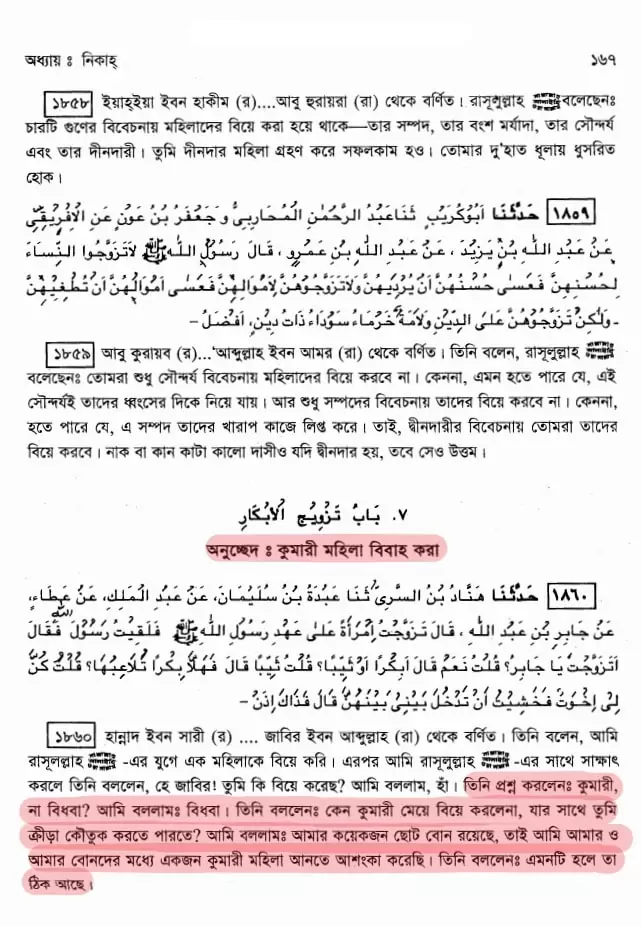
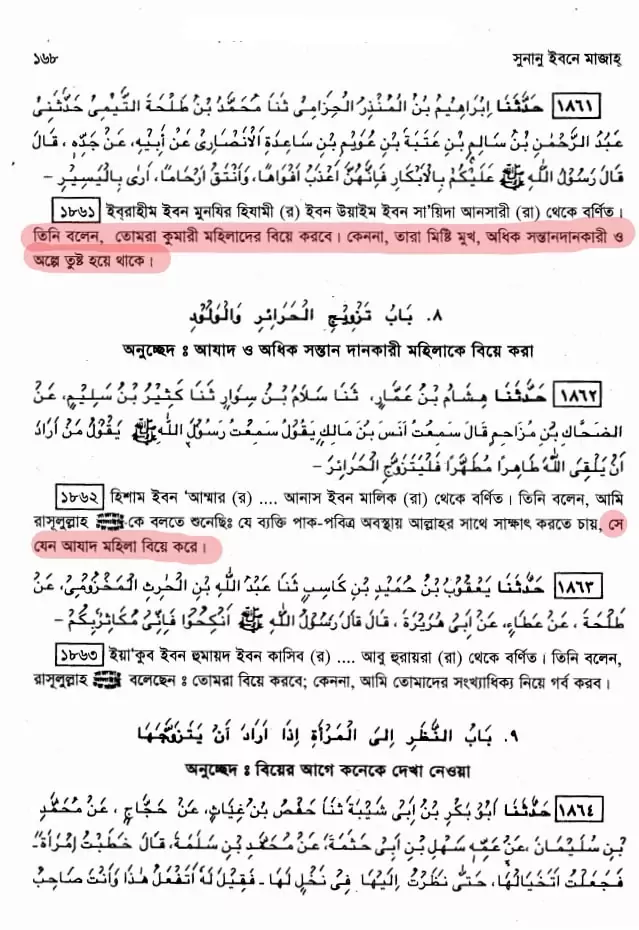
Caliph Umar’s Marriage to a Minor
It was not only the Prophet Muhammad in Islamic history who had this kind of lust for underage girls. Many Companions had the same character. The same information is known about Umar, the second caliph of Islam: he too married an underage girl whose period had not yet begun. The girl’s father was Ali. It is known from Ibn Sa‘d’s Kitab al-Tabaqat al-Kabir that Umar insisted on marrying Ali’s underage daughter Umm Kulthum [116]۔
Umm Kulthum bint ‘Ali ibn Abi Talib
Her mother was Fatima, the daughter of the Prophet. She married ‘Umar ibn al-Khattab when she was a young girl who had not yet reached puberty. She remained with him until he was killed and bore him Zayd and Ruqayya. Then she married ‘Awn ibn Ja’far ibn Abi Talib, but he died. Then she married his brother, Muhammad ibn Ja’far, and he died. Then she married his brother, ‘Abdullah ibn Ja’far, after her sister, Zaynab bint ‘Ali. Umm Kulthum said, “I was not shy with Asma’ bint ‘Umays. Two of her sons died while married to me, but I did not fear this for the third.” She died while married to him. She did not bear children to any of them.
It is related that ‘Umar ibn al-Khattab asked ‘Ali ibn Abi Talib for the hand of his daughter, Umm Kulthum. ‘Ali said, “I am keeping my daughters for the sons of Ja’far.” “Umar said, “Marry her to me, ‘Ali. By Allah, there is no man on the face of the earth who will treat her better than I will.” ‘Ali said, “I have done it.” “Umar went to the assembly of the Muhajirun sitting between the grave and the minbar. They were ‘Ali, ‘Uthman, az-Zubayr, Talha and ‘Abdu’r-Rahman ibn ‘Awf. When anything came to ‘Umar from abroad, he would come to them and inform them about that and consult with them about it. “Umar came and said, “Congratulate me” They congratulated him and said, “To whom, Amir al-Mu’minin?” He said, “To the daughter of ‘Ali ibn Abi Talib.” Then he told them that the Prophet صلعم said, “Every lineage and means will be cut off on the Day of Rising except my lineage and means.” Then he added, “I accompanied him, and I wanted to have this as well.”
When ‘Umar ibn al-Khattab asked to marry ‘Ali’s daughter, Umm Kulthum, he said, “Amir al-Mu’minin, she is still a child.” He said. “By Allah, that is not your intention. We know what your intention is.” Ali commanded that she be prepared and then commanded that a striped garment be wrapped up. He said, “Take this to the Amir al-Mu’minin and say, ‘My father has sent me to greet you. He says, “If you are pleased with the garment, keep it. If it displeases you, retum it.”” When she went to ‘Umar, he said, “May Allah bless you and your father. We are pleased.” She went back to her father and said, “He did not undo the garment nor look at anything except at me.” So he married her to him and she bore him a son called Zayd.
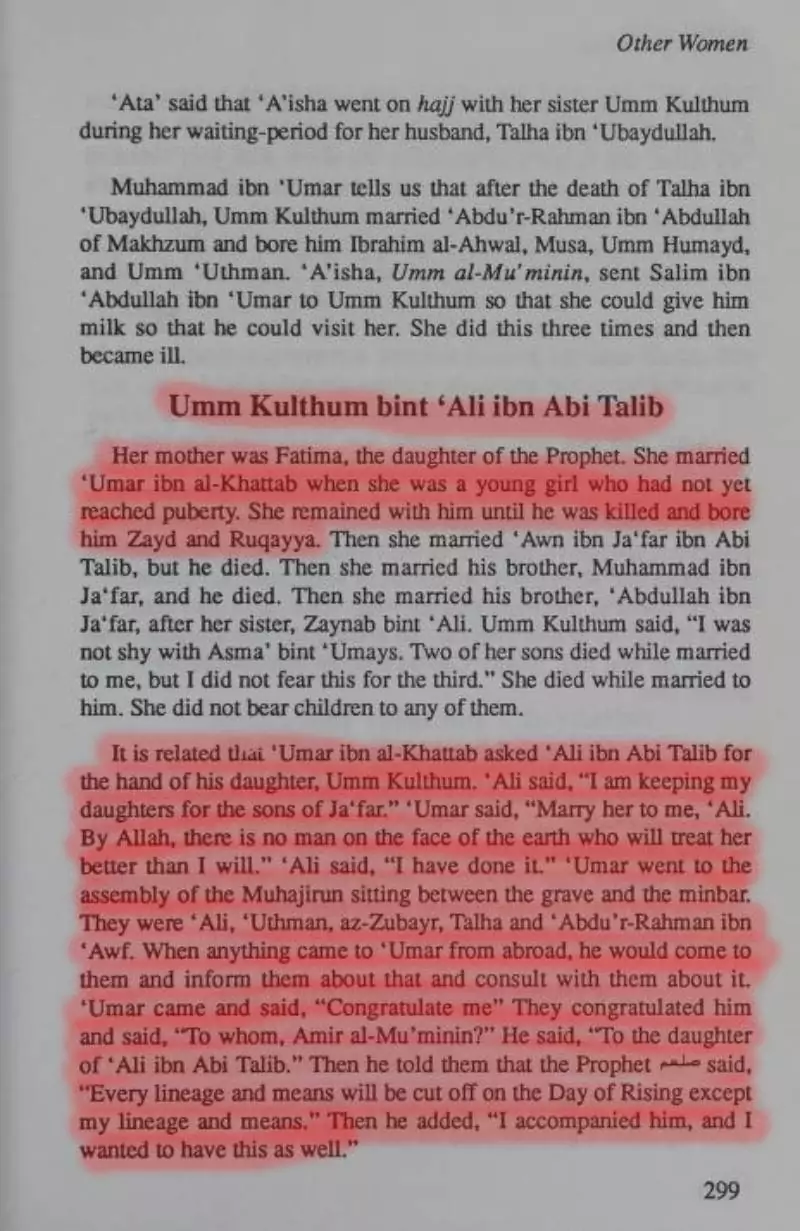
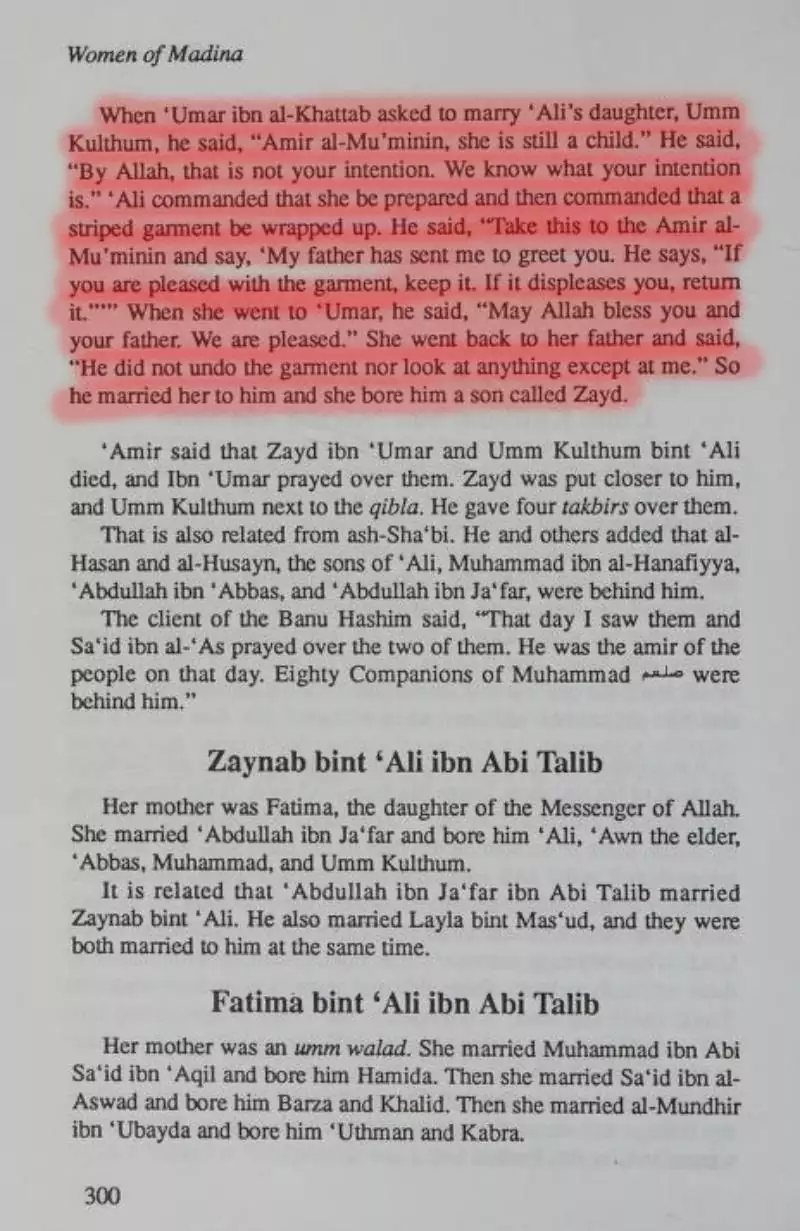
It was not limited to marriage alone. Hazrat Umar also had sexual intercourse with the underage girl Umm Kulsum (born in 627 CE) in November–December 638 [117] –
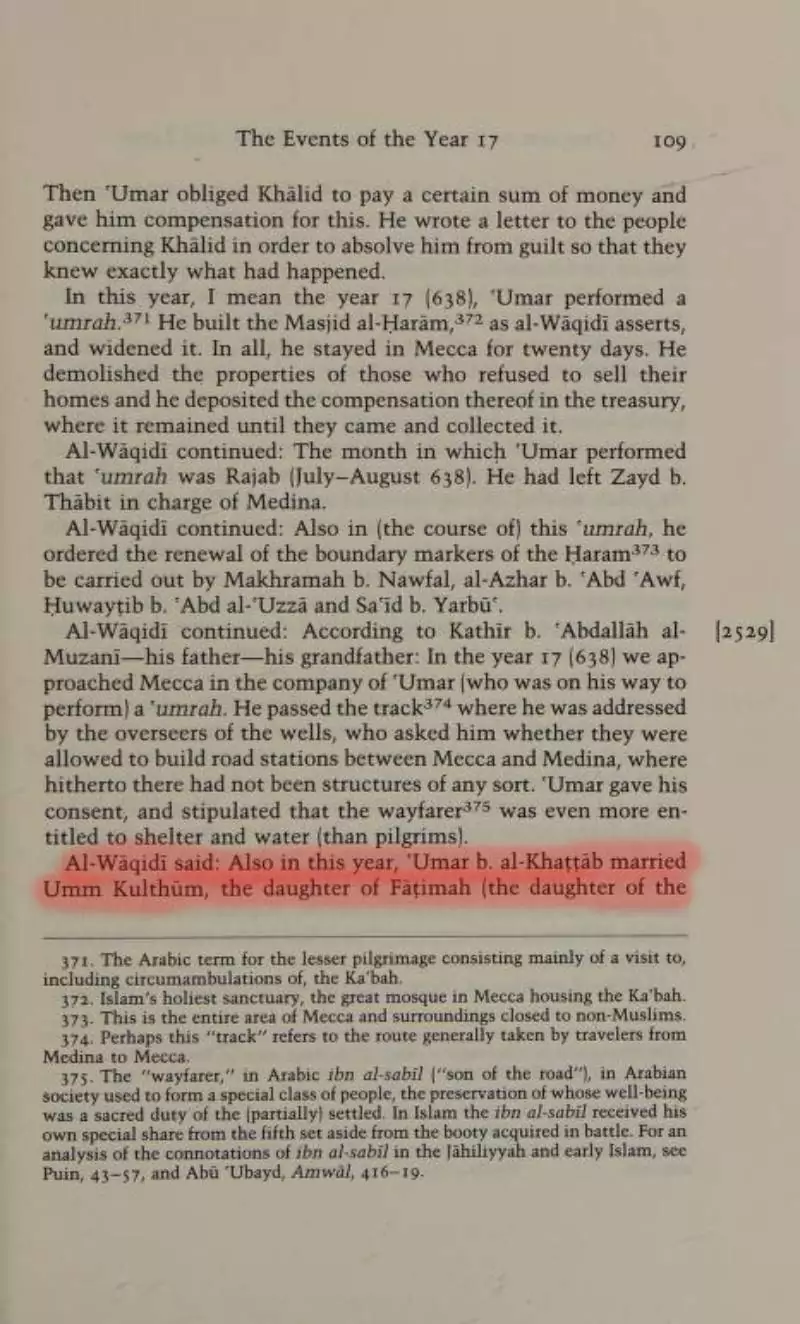
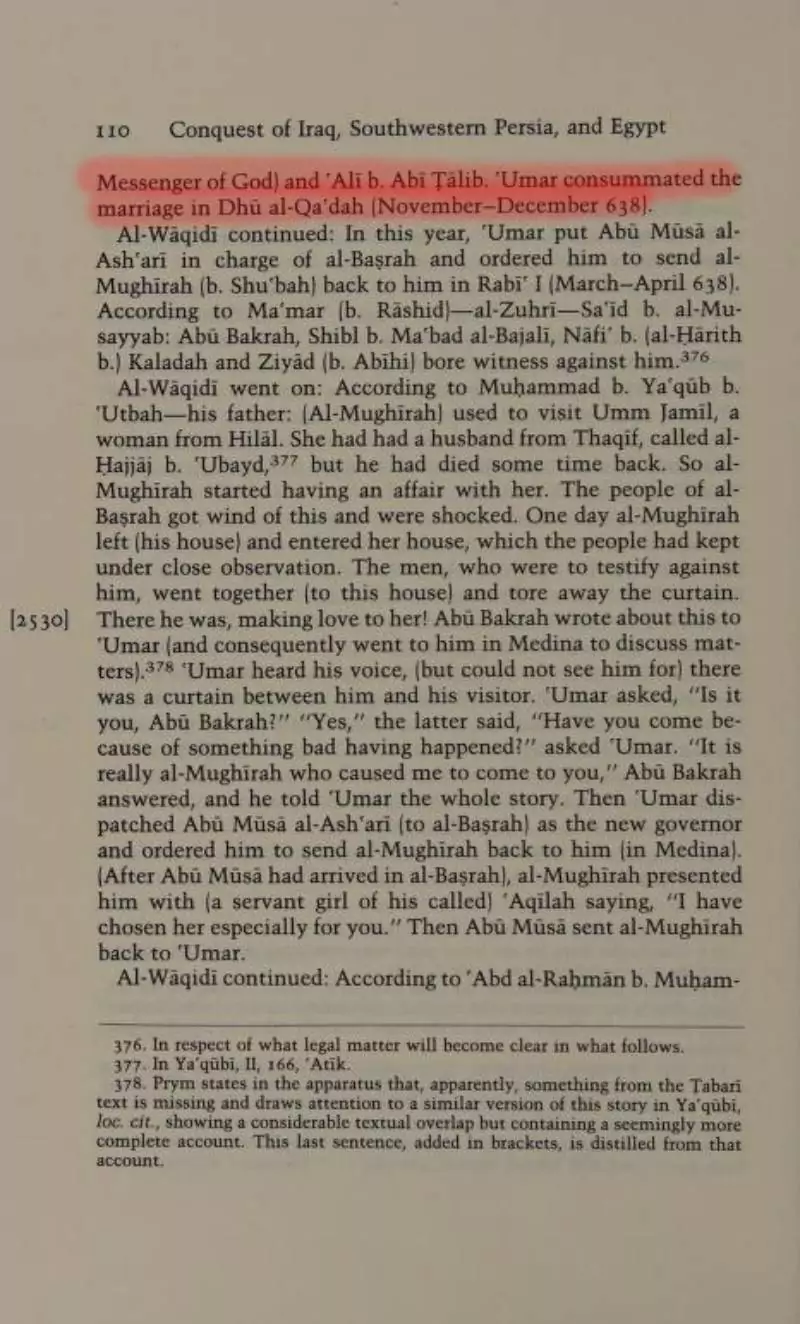
Let us examine this account from the book Hayatus Sahabah [118] –
The marriage of Hazrat Ali’s own daughter Umm Kulsum to Hazrat Umar
Hazrat Abu Ja’far said that Hazrat Umar proposed to Hazrat Ali for his daughter. He said, “She is still young.” Someone told Hazrat Umar that Hazrat Ali had said this with the intention of refusing to marry her off. When he spoke to him again, Hazrat Ali said, “I will send her to you. If she agrees, she will become your wife.” He sent the girl to him. Hazrat Umar lifted the cloth covering her legs (in order to examine her). The girl said, “Leave me. If you were not the Commander of the Faithful, I would have gouged out your eyes.” (Kani)
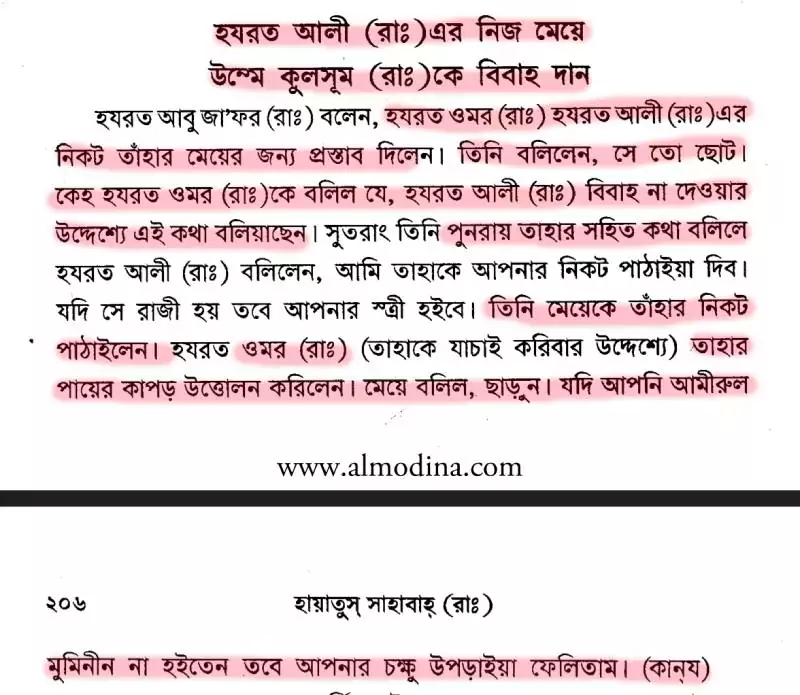
Child Marriage by the Companions and Consensus
It was not only Muhammad; many of Muhammad’s Companions also married young girls. At the same time, there is an ijma, or consensus, among the scholars that marrying young girls is completely lawful in Islam [119] –
Legal ruling and fatwa concerning the proof that child marriage is a specific Sunnah and related matters
Meaning: “Hazrat Ibn Ulayya, may Allah’s mercy be upon him, narrates from Hazrat Yunus, may Allah’s mercy be upon him, and he narrates from Hazrat Hasan Basri, may Allah’s mercy be upon him. Indeed, Hazrat Faruq-e-Azam, peace be upon him, proposed to Hazrat Ali, may Allah ennoble his face, for the nisbatul azim, or blessed marriage, of his granddaughter (daughter), Hazrat Umm Kulsum, peace be upon her. Hazrat Ali, may Allah ennoble his face, said, ‘O Commander of the Faithful! My granddaughter (daughter) is still young (of a tender age/a minor). Therefore, send word and see her.’ He then sent word to her and spoke pleasantly with her. Hazrat Umm Kulsum, peace be upon her, said, ‘If you were not the leader of the community and the Commander of the Faithful (I would not have agreed).’ Thereafter, he became extremely eager to complete the nisbatul azim, or blessed marriage, with her. Thus, he proposed to her and completed the nisbatul azim, or blessed marriage.” Subhanallah!
Many among the other noble Companions, may Allah be pleased with them, gave their children in child marriage and married at a young age.
In this regard, the famous fiqh book “Al-Mabsut li-Sarakhsi” states:
If I die, she will be my best heiress. And if I remain alive, she will be the daughter of Hazrat Zubayr, may Allah be pleased with him—that is, I will be her heir. Subhanallah! Hazrat Abdullah ibn Umar, may Allah be pleased with him, married one of his minor daughters to Hazrat Urwah ibn Zubayr, may Allah be pleased with him. Hazrat Urwah ibn Zubayr, may Allah be pleased with him, married his brother’s daughter to his sister’s son. At that time, both of them were minors. Similarly, a man married his minor daughter to Hazrat Abdullah ibn Hasan, may Allah be pleased with him. Hazrat Ali, may Allah ennoble his face, approved of this. The wife of Hazrat Ibn Masud, may Allah be pleased with him, married her minor daughter to the son of Hazrat Musayyib ibn Nukhba, may Allah be pleased with him. Hazrat Abdullah ibn Masud, the jurist of the community, may Allah be pleased with him, personally approved of this. Subhanallah!
Ijma, or consensus, has been established among all the imam-mujtahids regarding the permissibility or lawfulness of child marriage.
In this regard, volume 2, page 364, of “Tafsir Ahkam al-Qur’an by al-Jassas” states—
وَفِي هَذِهِ الْآيَةِ دَلَالَةٌ أَيْضًا عَلَى أَنَّ لِلْآبِ تَزْوِيْحَ ابْنَتِهِ الصَّغِيرَةِ مِنْ حَيْثُ دَلَّتْ عَلَى جَوَارٍ تَزْوِيْجَ سَائِرِ الْأَوْلِيَاءِ إِذْ كَانَ هُوَ أَقْرَبُ الْأَوْلِيَاءِ وَلَا نَعْلَمُ فِي جَوَازِ ذلِكَ خِلَافًا بَيْنَ السَّلَفِ وَالْخَلَفِ مِنْ فُقَهَاءِ الْأَمْصَارِ
Meaning: “This noble verse also indicates that a father has the authority to marry off his minor daughter. For this noble verse indicates the permissibility of all guardians arranging marriages. Since the father is the closest of the guardians, he has this authority even more so. We know of no disagreement on this matter among the jurists of any land, whether from earlier or later generations. In other words, everyone has expressed ijma, or consensus, on this matter.” Subhanallah!
Intercourse with a Minor Slave Girl
Islam has not merely prescribed marriage and sexual relations with underage girls; it contains even more serious and repulsive provisions. One of them is the provision permitting intercourse with an underage slave girl or female war captive. This extremely horrifying Islamic rule—one capable of driving any sane, normal person out of their mind—allows Muslims to purchase little girls from the market or acquire them as war captives and engage in sexual activity with them in a supposedly lawful manner. I do not know what could be more shamelessly cruel and pathological than this provision! This rule provides a golden opportunity for pedophiles or child abusers. They can satisfy their sexual attraction to children at will by following this rule. It is deeply painful to think of all those underage girls who, becoming victims of this inhumane Islamic rule, were raped day after day. Before reviewing this rule, let us read several hadiths. It should be noted that these three hadiths are interrelated. Therefore, they are presented together [120] [120] [121] –
Reference : Sunan ad-Darimi, Book 1, Hadith 1158
In-book reference : Book 1, Hadith 1158
A man bought a slave girl who had not yet reached menstruation and was not of an age at which she could become pregnant. How long should he refrain from intercourse with her? He said: Three months.
Arabic : أَخْبَرَنَا مُحَمَّدُ بْنُ الْمُبَارَكِ ، عَنْ عُمَرِ بْنِ عَبْدِ الْوَاحِدِ ، عَنْ الْأَوْزَاعِيِّ ، قَالَ سَأَلْت الزُّهْرِيَّ عَنْ الرَّجُلِ يَبْتَاعُ الْجَارِيَةَ لَا تَبْلُغْ الْمَحِيضَ وَلَا تَحْمِلُ مِثْلَهَا، كَمْ يَسْتَبْرِئُهَا؟، قَالَ : ” ثَلَاثَةُ أَشْهُرٍ “
Grade: Sahih
Reference : Sunan ad-Darimi, Book 1, Hadith 1158
In-book reference : Book 1, Hadith 1158
Yahya ibn Abi Kathir said: Forty-five days.
Arabic : وَقَالَ يَحْيَى بْنُ أَبِي كَثِيرٍ : ” بِخَمْسَةٍ وَأَرْبَعِينَ يَوْمًا “
Grade: Sahih
Reference : Sunan ad-Darimi, Book 1, Hadith 1159
In-book reference : Book 1, Hadith 1159
Yahya ibn Bashir reported that Ikrimah said: One month. Abdullah was asked: Which of the two opinions do you hold? He said: Three months is more reliable, and one month is sufficient.
Arabic : أَخْبَرَنَا الْهَيْثَمُ بْنُ جَمِيلٍ ، عَنْ ابْنِ الْمُبَارَكِ ، عَنْ يَحْيَى بْنِ بِشْرٍ ، عَنْ عِكْرِمَةَ ، قَالَ : ” بِشَهْرٍ ” ، سُئِلَ عَبْد اللَّهِ : بِأَيِّهِمَا تَقُولُ؟، قَالَ : ” ثَلَاثَةُ أَشْهُرٍ أَوْثَقُ، وَشَهْرٌ يَكْفِي “
Grade: Sahih
Hazrat Ali, Muhammad’s son-in-law and also his first cousin, was likewise a colorful character. Along with enjoying numerous wives and slave girls himself, the Prophet Muhammad did not hesitate in the slightest to distribute female war captives among his sons-in-law. He generously distributed to Hazrat Ali a share of the khums obtained from the spoils of war. It should be noted that the Prophet himself took one-fifth of the spoils of war. This one-fifth is called khums. Women and children were also included among the spoils of war [122]. The Prophet’s son-in-law, Hazrat Ali—the Lion of God and husband of Hazrat Fatema—was having sex with an underage female captive whom he had received as a gift from his father-in-law. For more details on this matter, you may read this article [123].
Fiqh rulings concerning the complete lawfulness of having intercourse with an underage child when the female war captive or slave is a minor can also be found in Fatawa-e-Alamgiri. Some have opined that intercourse with an underage female war captive is permissible without distribution of the spoils or observing iddah (the period prescribed to clear the womb), as Hazrat Ali did. Other scholars have said that sexual activity with an underage child becomes lawful after waiting one and a half months. Let us read from Fatawa-e-Alamgiri [124] –
( Ghayat al-Bayan ) If a minor slave girl is divorced after intercourse, her iddah will be one and a half months.
Further evidence of the permissibility of intercourse with an underage slave girl who is incapable of intercourse, after istibra—that is, after clearing the womb— can also be found in the book Ashraful Hidaya [125] –
Performing istibra is obligatory upon the buyer, not the seller. This is because its fundamental reason is the intention to have intercourse with the slave girl. It is the buyer who has this intention, not the seller. Therefore, it is the buyer upon whom istibra—that is, purifying the womb—is obligatory. However, the intention to have intercourse is a hidden matter, so the ruling of istibra will revolve around its legal cause. That cause is the lawful authority to have intercourse. This authority is established through ownership and possession. Therefore, authority has been established as the cause or sabab, and for the sake of making the matter easy, the ruling revolves around that authority. Thus, the sabab for performing istibra is ownership of the slave girl’s person, strengthened through possession. This ruling extends to the other causes of ownership. [ Other causes of ownership ] include purchase, gift, bequest, inheritance, khula, and kitabat, among others. Similarly, istibra will be obligatory upon the buyer if he purchases the slave girl from the property of a child or a woman, or from a slave [who is permitted to engage in business], or from a person for whom intercourse with that slave girl is not lawful. Similarly, even if the purchased slave girl is an immature virgin incapable of intercourse, [performing istibra will still be obligatory]; because the cause is present. Rulings revolve around their causes, not their wisdoms or underlying reasons, because wisdoms remain hidden. Therefore, even the slight possibility of semen remaining in the womb will be considered sufficient to establish the cause.
The author says that among those slave girls who must observe iddah by counting months—that is, those whose menstruation has not yet begun because of their young age or those whose menstruation has stopped because of advanced age—if such a slave girl comes into someone’s possession, her womb will be deemed purified after one month has elapsed. This is because, in the case of these women, one month has been established as equivalent to one menstrual period and three months as equivalent to three menstrual periods.
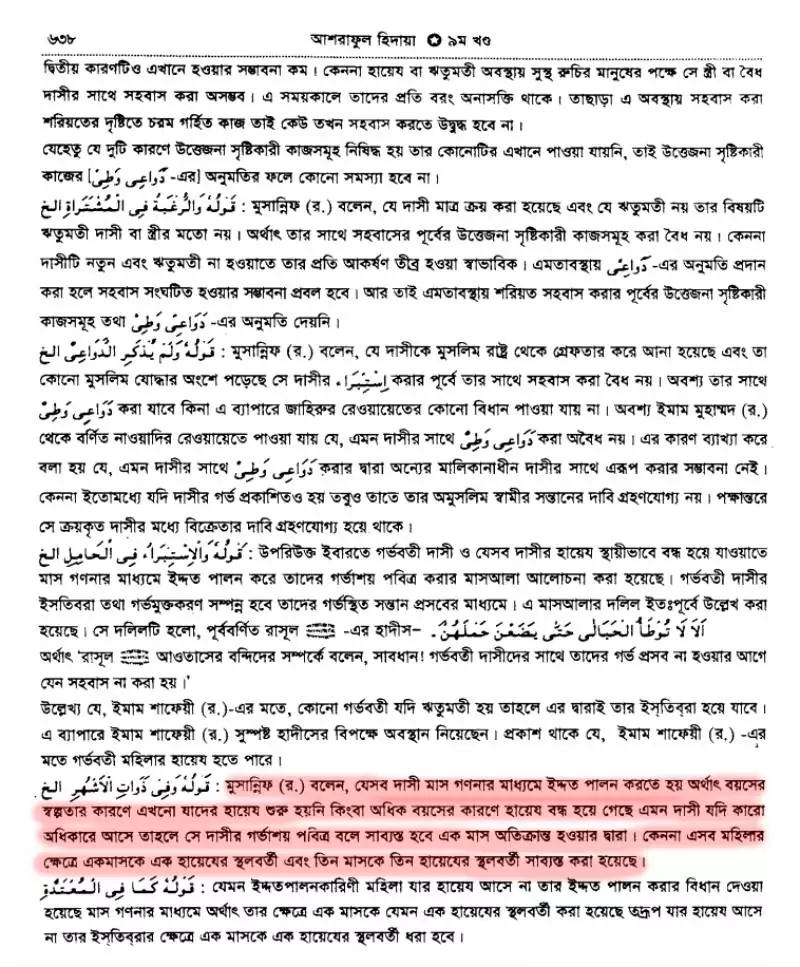
Ownership of the Wife’s Sexual Organ
In Islamic Sharia, the marital contract is called the nikah contract, whose literal meaning is a sexual contract. As soon as a marriage takes place, a husband acquires ownership of his wife’s sexual organ. In fact, unless there is some physical illness or she is menstruating, a husband has the right to have intercourse with his wife in any position. The wife’s being underage has not been regarded as a valid excuse or justification in any Quranic or hadith evidence. The husband is required to pay the dower as the price for enjoying his wife’s vagina; this is clearly stated in numerous Islamic books. This means that, upon the nikah contract and payment of the dower, a husband becomes entitled to enjoy his wife’s sexual organ—in other words, he may immediately have intercourse with it. Before discussing this matter, let us first learn what dower means from the book Sharh Abu Dawud: [126] –
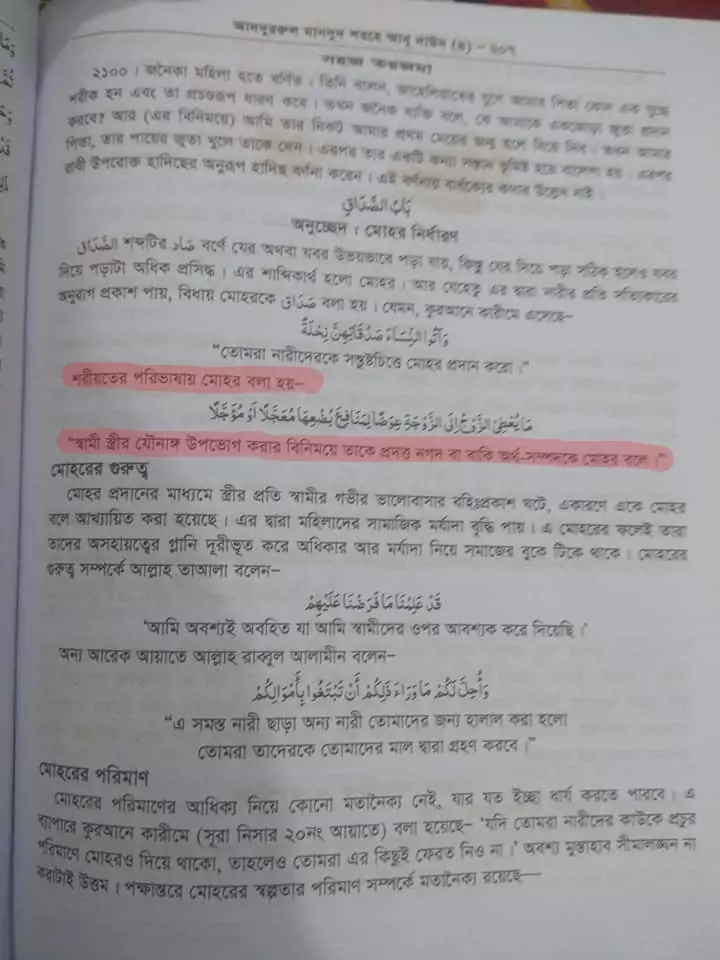
It is stated even more clearly in the book Ahkam al-Qur’an that the husband is considered the owner of his wife’s sexual organ [127] –
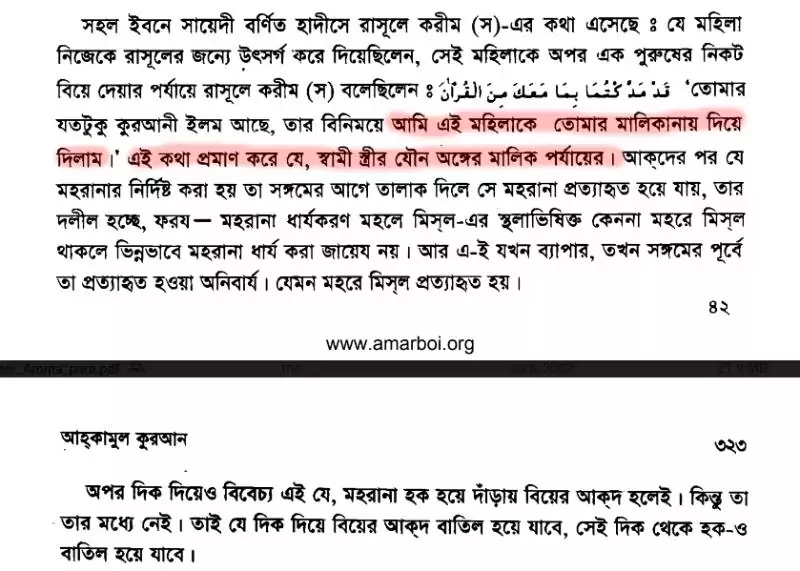
Read the following hadiths [128] [129] –
Reference : Mishkat al-Masabih 3131
In-book reference : Book 13, Hadith 52
‘A’isha reported God’s Messenger as saying, “If any woman marries without the consent of her guardian her marriage is void, her marriage is void, her marriage is void. If there is cohabitation she gets her dower for the intercourse her husband has had. If there is a dispute*, the sultan is the guardian of one who has none.” * i.e., among guardians, Mirqat iii. 418 says that if their dispute would keep a woman from being married, they are treated as non-existent. Ahmad, Tirmidhi, Abu Dawud, Ibn Majah and Darimi transmitted it.
Arabic : وَعَنْ عَائِشَةَ أَنَّ رَسُولَ اللَّهِ صَلَّى اللَّهُ عَلَيْهِ وَسَلَّمَ قَالَ: «أَيُّمَا امْرَأَةٍ نَكَحَتْ بِغَيْرِ إِذْنِ وَلَيِّهَا فَنِكَاحُهَا بَاطِلٌ فَنِكَاحُهَا بَاطِلٌ فَنِكَاحُهَا بَاطِلٌ فَإِنْ دَخَلَ بِهَا فَلَهَا الْمَهْرُ بِمَا اسْتَحَلَّ مِنْ فَرْجِهَا فَإِنِ اشْتَجَرُوا فَالسُّلْطَانُ وَلِيُّ من لَا ولي لَهُ» . رَوَاهُ أَحْمَدُ وَالتِّرْمِذِيُّ وَأَبُو دَاوُدَ وَابْنُ مَاجَهْ والدارمي
Grade: Sahih (al-Albani)
Reference : Sahih Muslim 1493c
In-book reference : Book 19, Hadith 6
Ibn Umar (Allah be pleased with them) reported Allah’s Messenger (ﷺ) saying to the invokers of curse: Your account is with Allah. One of you must be a liar. You have now no right over this woman. He said: Messenger of Allah, what about my wealth (dower that I paid her at the time of marriage)? He said: You have no claim to wealth. If you tell the truth, it (dower) is the recompense for your having had the right to intercourse with her. Zuhair said in his narration: Sufyan reported to us on the authority of ‘Amr that he had heard Sa’id b Jubair saying: I heard Ibn Umar (Allah be pleased with them) saying that Allah’s Messenger (ﷺ) had said it.
Arabic : وَحَدَّثَنَا يَحْيَى بْنُ يَحْيَى، وَأَبُو بَكْرِ بْنِ أَبِي شَيْبَةٍ وَزُهَيْرُ بْنِ حَرْبٍ – وَاللَّفْظُ لِيَحْيَى – قَالَ يَحْيَى أَخْبَرَنَا وَقَالَ الآخَرَانِ، حَدَّثَنَا سُفْيَانُ بْنُ عُيَيْنَةٍ، عَنْ عَمْرٍو، عَنْ سَعِيدِ بْنِ، جُبَيْرٍ عَنِ ابْنِ عُمَرَ، قَالَ قَالَ رَسُولُ اللَّهِ صلى الله عليه وسلم لِلْمُتَلاَعِنَيْنِ ” حِسَابُكُمَا عَلَى اللَّهِ أَحَدُكُمَا كَاذِبٌ لاَ سَبِيلَ لَكَ عَلَيْهَا ” . قَالَ يَا رَسُولَ اللَّهِ مَالِي قَالَ ” لاَ مَالَ لَكَ إِنْ كُنْتَ صَدَقْتَ عَلَيْهَا فَهْوَ بِمَا اسْتَحْلَلْتَ مِنْ فَرْجِهَا وَإِنْ كُنْتَ كَذَبْتَ عَلَيْهَا فَذَاكَ أَبْعَدُ لَكَ مِنْهَا ” . قَالَ زُهَيْرٌ فِي رِوَايَتِهِ حَدَّثَنَا سُفْيَانُ عَنْ عَمْرٍو سَمِعَ سَعِيدَ بْنَ جُبَيْرٍ يَقُولُ سَمِعْتُ ابْنَ عُمَرَ يَقُولُ قَالَ رَسُولُ اللَّهِ صلى الله عليه وسلم .
Let us also read from Sahih al-Bukhari on this subject [130]—
Sahih al-Bukhari (Islamic Foundation)
Book: 55/Divorce
Chapter: 2072. The Imam’s statement to the two parties involved in li‘an: “Surely one of you two is a liar; so will one of you repent?”
5312. Reference: Sahih al-Bukhari 5312
In-book reference: Book 68, Hadith 61
English translation: Vol. 7, Book 63, Hadith 232
Narrated Sa`id bin Jubair: I asked Ibn `Umar about those who were involved in a case of Lien. He said, “The Prophet (ﷺ) said to those who were involved in a case of Lien, ‘Your accounts are with Allah. One of you two is a liar, and you (the husband) have no right over her (she is divorced).” The man said, ‘What about my property (Mahr) ?’ The Prophet (ﷺ) said, ‘You have no right to get back your property. If you have told the truth about her then your property was for the consummation of your marriage with her; and if you told a lie about her, then you are less rightful to get your property back.’ ” Sufyan, a sub-narrator said: I learned the Hadith from `Amr. Narrated Aiyub: I heard Sa`id bin Jubair saying, “I asked Ibn `Umar, ‘If a man (accuses his wife for an illegal sexual intercourse and) carries out the process of Lian (what will happen)?’ Ibn `Umar set two of his fingers apart. (Sufyan set his index finger and middle finger apart.) Ibn `Umar said, ‘The Prophet (ﷺ) separated the couple of Bani Al-Ajlan by divorce and said thrice, “Allah knows that one of you two is a liar; so will one of you repent?” ‘ ” Sufyan said: I learned it from `Amr and Aiyub exactly as I have narrated it to you.
Arabic: حَدَّثَنَا عَلِيُّ بْنُ عَبْدِ اللَّهِ ، حَدَّثَنَا سُفْيَانُ ، قَالَ عَمْرٌو سَمِعْتُ سَعِيدَ بْنَ جُبَيْرٍ ، قَالَ سَأَلْتُ ابْنَ عُمَرَ عَنِ الْمُتَلاَعِنَيْنِ،، فَقَالَ قَالَ النَّبِيُّ صلى الله عليه وسلم لِلْمُتَلاَعِنَيْنِ ” حِسَابُكُمَا عَلَى اللَّهِ أَحَدُكُمَا كَاذِبٌ، لاَ سَبِيلَ لَكَ عَلَيْهَا ”. قَالَ مَالِي قَالَ ” لاَ مَالَ لَكَ، إِنْ كُنْتَ صَدَقْتَ عَلَيْهَا، فَهْوَ بِمَا اسْتَحْلَلْتَ مِنْ فَرْجِهَا، وَإِنْ كُنْتَ كَذَبْتَ عَلَيْهَا، فَذَاكَ أَبْعَدُ لَكَ ” . قَالَ سُفْيَانُ حَفِظْتُهُ مِنْ عَمْرٍو. وَقَالَ أَيُّوبُ سَمِعْتُ سَعِيدَ بْنَ جُبَيْرٍ قَالَ قُلْتُ لاِبْنِ عُمَرَ رَجُلٌ لاَعَنَ امْرَأَتَهُ فَقَالَ بِإِصْبَعَيْهِ ـ وَفَرَّقَ سُفْيَانُ بَيْنَ إِصْبَعَيْهِ السَّبَّابَةِ وَالْوُسْطَى ـ فَرَّقَ النَّبِيُّ صلى الله عليه وسلم بَيْنَ أَخَوَىْ بَنِي الْعَجْلاَنِ، وَقَالَ ” اللَّهُ يَعْلَمُ إِنَّ أَحَدَكُمَا كَاذِبٌ فَهَلْ مِنْكُمَا تَائِبٌ ”. ثَلاَثَ مَرَّاتٍ. قَالَ سُفْيَانُ حَفِظْتُهُ مِنْ عَمْرٍو وَأَيُّوبَ كَمَا أَخْبَرْتُكَ.
Grade: Sahih
Now let us read another one [131]—
Sunan an-Nasa’i (Islamic Foundation)
Book: 26/Marriage (Nikah)
Chapter: 42. Conditions in Marriage
3281. Reference: Sunan an-Nasa’i 3281
In-book reference: Book 26, Hadith 86
English translation: Vol. 4, Book 26, Hadith 3283
It was narrated from ‘Utbah bin ‘Amir that the Messenger of Allah said: “The conditions that are most deserving of fulfillment, are those by means of which the private parts become allowed to you.”
Arabic: أَخْبَرَنَا عِيسَى بْنُ حَمَّادٍ، قَالَ أَنْبَأَنَا اللَّيْثُ، عَنْ يَزِيدِ بْنِ أَبِي حَبِيبٍ، عَنْ أَبِي الْخَيْرِ، عَنْ عُقْبَةَ بْنِ عَامِرٍ، عَنْ رَسُولِ اللَّهِ صلى الله عليه وسلم قَالَ ” إِنَّ أَحَقَّ الشُّرُوطِ أَنْ يُوَفَّى بِهِ مَا اسْتَحْلَلْتُمْ بِهِ الْفُرُوجَ ” .
Verification: Sahih. Ibn Majah 1954, Mukhtasar Muslim 804, Sahih al-Jami’ as-Saghir 1547.
Grade: Sahih
Sexual Intercourse with One’s Wife in Islam: Sexual Ownership and the Absence of Consent
In the language of modern human rights and gender studies, the conscious consent of both parties, or “consent,” is an indispensable condition for sexual relations. However, a review of the legal framework of Islamic Sharia and classical jurisprudence shows that a wife’s sexual consent has no legal standing there. Rather, Islam treats marriage less as a spiritual bond than as a “contract of exchange” (Contract of Exchange or Mu’awadah), in which the husband acquires absolute usufructuary rights over the wife’s body in exchange for paying the dower. All the information and evidence on this subject have been compiled in a separate article; interested readers may read it [132] . Here, only a summary of the subject is presented, without that data and evidence.
1. The Legal Nature of Marriage: “Milk al-Bud‘” or Ownership of the Genitals
In the principal source works of Islamic jurisprudence, marriage has been defined as “milk al-bud‘,” or a means of acquiring ownership over the wife’s genitals. The authoritative Hanafi work Al-Hidaya states that marriage is a contract whose purpose is to confer ownership of sexual use. Imam al-Kasani, in his work Bada’i al-Sana’i, compared marriage to a contract of sale, in which the husband is the buyer and the dower is the exchange value of the commodity—use of the genitals. In other words, the dower is not a gift; rather, it is the legal compensation for enjoying the wife’s genitals.
2. The Absence of the Concept of Marital Rape
Since the husband “purchases” legal ownership of the right to enjoy his wife’s genitals through marriage, the term “marital rape” is entirely absent and irrelevant in Islamic Sharia. According to the jurisprudential logic, when a person obtains the right to use something through a contract, fresh consent is not required each time it is used. The husband is considered to be exercising his “right” or haqq; consequently, coercion or force is viewed not as a crime but as the husband’s legal right.
3. A Wife’s Refusal of Intercourse and Divine Cursing
According to accounts in authentic hadith, if a wife rejects her husband’s sexual invitation and he spends the night angry with her, the angels continue to curse her throughout the night. Another narration even states that the Master of the heavens, Allah, remains angry with her until she responds to her husband’s call. This religious ruling directly identifies a wife’s personal unwillingness as a serious sin or transgression.
4. “Tamkin” and “Nushuz” (Disobedience)
In jurisprudence, a wife’s primary duty is “tamkin” (Submission), or keeping herself continually available to her husband. If a wife refuses her husband without a reasonable Sharia-based excuse, such as menstruation, an obligatory fast, or serious illness, she is considered a “nashizah,” or disobedient woman. As a result, she loses her legal right to maintenance (Nafaqah). The Quran even provides authorization for physically beating or striking a disobedient wife in order to bring her under control. [133]
5. Obligation in All Circumstances
According to Islamic rules and regulations, a wife is obliged to satisfy her husband’s sexual needs regardless of her circumstances or whether she is occupied with an important task. Even if she is cooking beside the stove or riding on the back of a camel, she must surrender herself as soon as she receives her husband’s call. Islamic history even contains accounts in which the Companion Umar would forcefully mount his sleeping wife, and the Prophet, despite learning of this, did not declare it unlawful.
6. The Status of the Wife: Equivalent to a Slave
The renowned Muslim philosopher Imam al-Ghazali directly stated in his work Ihya Ulum al-Din that marriage is actually a form of slavery and that a wife is like her husband’s female slave. Therefore, a wife should accept her husband’s domination in every matter, live like a slave, and give the highest priority to her husband’s sexual needs.
In conclusion, according to the language of Islamic jurisprudence and hadith, a woman’s body has been regarded as a “field” for her husband. Here, the wife’s body is not her own; rather, through marriage it becomes her husband’s property, causing a woman’s right to “consent” or to say “no” in married life to be religiously and legally abolished. Let us hear the statements of some prominent scholars.
Bulugh and Rushd: The Dual Standard of Adulthood in Islamic Jurisprudence
In Islamic Sharia, “legal maturity” primarily refers to two distinct concepts—bulugh (بلوغ) and rushd (رشد).
These two concepts theoretically carry distinct meanings in the Quran and jurisprudence, but in the application of Islamic law—that is, in practical terms—this distinction has nearly disappeared. As a result, the marriage and sexual intercourse of underage girls have been made legally permissible. The matter needs to be understood clearly.
Bulugh: Physical Change as the Standard of Legality
In jurisprudence, “bulugh” means an age or physical change indicating that someone has become sexually capable. Most jurists have determined it through physical signs, such as the onset of menstruation or nocturnal emission, or through a specified age limit. Ibn Qudamah says, [134]
“The attainment of puberty (bulugh) occurs through nocturnal emission or reaching the age of fifteen.”
Imam al-Nawawi says, [135]
“If a girl reaches puberty, even at nine, she is marriageable (jawāz al-nikāh).”
In other words, according to the jurisprudential interpretation, bulugh itself means permission for marriage or sexual intercourse, even if the girl is mentally still a child. In this case, rushd (رشد) is not taken into consideration. In jurisprudence, this concept is called nikāh al-saghīrah—that is, “the marriage of a minor girl.” Both the Hanafi and Shafi‘i schools have regarded it as valid; only the guardian’s permission has been imposed as a condition. References to authentic hadith related to this have been provided above. Therefore, they are not mentioned again here.
Al-Hidaya states, [136]
“A guardian may give in marriage a minor girl; if the husband consummates the marriage, the marriage is valid.”
That is, as soon as physical changes appear, she is considered “marriageable”—the individual’s mental preparedness or consent has no value here.
Rushd: Intellectual Maturity and the Quranic Standard
In the Quran, the word “rushd” denotes mental and intellectual maturity, which makes a person responsible and self-sufficient. Surah al-Nisa 4:6 states, [137]
Quran reference: Surah an-Nisa, 4:6
Arabic: وَٱبْتَلُوا۟ ٱلْيَتَـٰمَىٰ حَتَّىٰٓ إِذَا بَلَغُوا۟ ٱلنِّكَاحَ فَإِنْ ءَانَسْتُم مِّنْهُمْ رُشْدًۭا فَٱدْفَعُوٓا۟ إِلَيْهِمْ أَمْوَٰلَهُمْ ۖ وَلَا تَأْكُلُوهَآ إِسْرَافًۭا وَبِدَارًا أَن يَكْبَرُوا۟ ۚ وَمَن كَانَ غَنِيًّۭا فَلْيَسْتَعْفِفْ ۖ وَمَن كَانَ فَقِيرٗا فَلْيَأْكُلْ بِٱلْمَعْرُوفِ ۚ فَإِذَا دَفَعْتُمْ إِلَيْهِمْ أَمْوَٰلَهُمْ فَأَشْهِدُواْ عَلَيْهِمْ ۚ وَكَفَىٰ بِٱللَّهِ حَسِيبًۭا ٦
Translation — Dr. Mustafa Khattab, The Clear Quran: Test ˹the competence of˺ the orphans until they reach a marriageable age. Then if you feel they are capable of sound judgment, return their wealth to them. And do not consume it wastefully and hastily before they grow up ˹to demand it˺. If the guardian is well-off, they should not take compensation; but if the guardian is poor, let them take a reasonable provision. When you give orphans back their property, call in witnesses. And sufficient is Allah as a ˹vigilant˺ Reckoner.
Translation — Saheeh International: And test the orphans until they reach marriageable age. Then if you perceive in them sound judgement, release their property to them. And do not consume it excessively and quickly, [anticipating] that they will grow up. And whoever, [when acting as guardian], is self-sufficient should refrain [from taking a fee]; and whoever is poor – let him take according to what is acceptable. And when you release their property to them, take witnesses in their presence; and Allah is enough as a Reckoner.
Here, the Quran clearly identifies two separate stages—“reaching the age of marriage” and “attaining rushd.” In other words, physical change alone is not sufficient for assuming economic responsibility or receiving an inheritance; responsibility should not be entrusted until mental and social competence has developed. However, the concept of rushd has no real application in Islamic jurisprudence. The prohibition on entrusting property until intellectual maturity is attained applies only to orphan girls.
Rushd Disregarded; Bulugh as the “Legal Age”
During the Abbasid period, when Sharia law was being codified, jurists adopted “bulugh” rather than “rushd” as the legal standard. This was influenced by the Salaf’s and early scholars’ interpretations of Surah al-Talaq, as well as the widespread practice of child marriage in the Islamic world. As a result, child marriage gained complete religious and legal legitimacy. In his commentary on Surah al-Talaq 65:4, Ibn Kathir says, [138]
“واللائي لم يحضن – that is, because of their young age.”
In other words, the Quranic verse on divorce establishes the waiting period for girls who have not yet reached puberty. Consequently, in Islamic law, both child marriage and sexual intercourse have been regarded as religiously permissible. As a result of this interpretation by the Prophet’s Companions, the Tabi‘un, and the early Salaf, the concept of rushd became secondary from a jurisprudential perspective, while physical change became the sole criterion for becoming an “adult.”
Sayyid Sabiq’s Fiqh al-Sunnah likewise states, [139]
“If the girl attains puberty, she is eligible for marriage and consummation.”
Thus, Islamic jurisprudence has disregarded a child’s mental incapacity and established sexual capacity alone as proof of legal validity.
Modern Effects: The Same Standard in Sharia-Based States
The same concept is still reflected in the laws of many Sharia-based states. The table below makes this clear:
| Country | Determination of Bulugh | Minimum Marriage Age | Actual Situation |
|---|---|---|---|
| Iran | 9 Hijri years (≈ 8.7 solar years) | 13 (a lower age may also be approved by a court) | Bulugh is the standard on the basis of Sharia |
| Yemen | Not specified | Any age with a judge’s permission | Child marriage is widely practiced |
| Saudi Arabia | 18 under the new law (though a lower age may be valid with the guardian’s permission) | The same | “Guardianship” remains in place under the new Personal Status Law |
| Afghanistan | 15 years or proof of bulugh | Not specified | Child marriage has been revived under the Taliban |
Theoretical Inconsistencies in Modern Interpretations and Academic Refutation
In this section, various claims presented by modern apologists (theological interpreters) or Islamic commentators in defense of the religious validity of child marriage are closely refuted on the basis of scientific, historical, and theoretical evidence. Citing research from modern medical science, it has been demonstrated here that the claim that girls reached puberty early—at the age of seven to nine—in warm climates or in ancient times is entirely unfounded; rather, girls are reaching puberty earlier today because of improved nutrition and healthcare. An analysis of the historical context shows that, long before Muhammad’s birth, the advanced Roman civilization had set the minimum marriage age for girls at twelve and had legally recognized the necessity of consent from both parties. In response to the question of why Aisha did not protest, the invisible influence of power, social stigma, economic dependence, and the severe consequences of criticizing the Prophet under the laws of that period, such as the death penalty, are discussed in detail. At the same time, examples of physical discipline inflicted on Aisha by her father Abu Bakr, as well as how the limitations of Islamic law deny a woman the right to annul her marriage even after reaching adulthood, are clarified here. Through linguistic analysis, evidence is presented of the use of the word “nisa” in the Quran and the falsification involved in rendering the word “enlightenment” (Aqal) as “puberty” in modern English translations. Finally, by analyzing the medical definition of pedophilia in the standards of the DSM-IV, this section demonstrates why attempting to justify the Prophet’s actions by citing the child marriages of Rabindranath Tagore or Sheikh Mujibur Rahman constitutes an extreme moral and logical inconsistency.
Did Girls Reach Puberty Earlier in the Middle Ages?
Many Islamic scholars claim that girls reached puberty earlier in ancient times or during the Middle Ages. As evidence, they say that their grandmothers became mothers at a young age, that Rabindranath or Bankim Chandra married young, and that many of those women became mothers; supposedly, these things prove that girls reached puberty earlier in the past. In other words, they claim that girls became physiologically mature for regular sexual activity and childbirth at the age of seven or eight. They mean to say that girls became adults much earlier. However, reaching puberty does not mean becoming an adult. Puberty is a physiological process lasting several years. At this age, boys and girls are highly emotional, unable to control themselves, and frequently make poor decisions.
This means that they claim that if girls in a region today reach puberty at the age of twelve, in the past they reached it at seven or eight. Yet various contemporary research papers show precisely the opposite. Modern research has established that, in the past, girls menstruated later because of food shortages and malnutrition. Today, balanced diets, nutritional monitoring, various vitamins, and other medicines have improved nutritional standards among girls. This can easily be demonstrated by examining the maternal mortality rate over the past fifty years. The maternal mortality rate in Bangladesh has now declined considerably compared with the past. This is because medical facilities, nutritious food, vitamins, and other resources have become more accessible than before. For these reasons, menstruation is actually occurring earlier in the present era. In countries where girls receive adequate nutrition, food, and medicine, they are reaching puberty even earlier. The following studies demonstrate this matter quite clearly. Several research papers are included; interested readers may read them when they have time. [140] [141] [142] [143] [144] [145] [146] [147] [148]
At the same time, another claim made by several Islamic scholars is that, just as mangoes and jackfruits ripen earlier in hot countries, girls supposedly “ripened” earlier as well. This claim is also false. No research has found any relationship between heat and puberty, or any influence of high temperatures on the onset of puberty. On the contrary, researchers have found abundant evidence that there is no relationship between warmth and puberty.
However, these Islamists often fail to understand that this false claim actually contradicts Islam itself. According to Islamic belief, people in ancient times lived for 1,000 or 950 years. The Quran itself says that the Prophet Noah lived for 950 years. At the same time, Islamic mythology holds that, in that ancient era, there were supposedly infants who remained in the cradle for 300 years. Thereafter, human lifespans supposedly gradually declined until reaching their present condition. If we accept this absurd Islamic claim as true, then the believers’ claim does not hold. For if it were true, the age at which humans reached puberty would have decreased from ancient times to the present, not increased. In other words, if this Islamic claim were actually true, people in earlier eras would have reached puberty at an older age, while puberty would occur at a younger age today. Let us watch a video.

What Was the Age of Marriage in Ancient Rome and Greece?
Many Islamic preachers and scholars claim that child marriage was practiced in every society throughout the world fourteen hundred years ago! In some cases, it is true that child marriage was practiced in many ancient uncivilized or semi-civilized societies, but this involved marriage between a boy and a girl who were both children. The truth is that the marriage of a girl child to an adult man was viewed negatively even in advanced ancient civilizations. Let us examine ancient Roman law. Many years before Muhammad’s birth, marriage for girls under the age of twelve had already been prohibited in ancient Rome, taking into consideration the safety of female children. At the same time, the law required the consent of both parties at the time of marriage [149]. The regulations were even stricter in ancient Sparta. There, girls married after reaching the age of eighteen. Since uncivilized Saudi Arabia had not developed any advanced civilization, primitive barbaric customs were prevalent in those regions. Islam turned those customs of barbaric Arabia into law and granted them legitimacy until the Day of Judgment.
The Roman Family 21
First marriages, at least, were normally arranged by the
parents of the couple. Although these marriages must often have
been intended to suit the interests or ambitions of the parents
rather than the inclinations of the couple, the law required that
when betrothal and marriage took place both partners should be
old enough to understand the vows and both should consent.
Since boys were normally older than girls at marriage (a five-year
difference was probably most common) and would already have
begun some of the activities of a citizen, a son’s wishes may have
been taken more seriously than a daughter’s. The grounds on
which a daughter could withhold her consent were severely
restricted: she had to claim (and prove?) that the proposed
husband was of bad moral character. One suspects that
sometimes the young rakes were more attractive potential
partners to young women than were sounder, duller men, and
that they would not necessarily withhold their consent from such
matches. Cicero’s daughter Tullia and her mother chose the
dissolute Dolabella for Tullia’s third husband when Cicero was
safely out of the way in his province in 51 BC. Cicero probably
disapproved, and foresaw the unhappiness that this marriage
would bring his daughter, but he was a fond enough father to
hope that the women’s judgement would be justified.60 Tullia had
had two previous marriages arranged for her by her father, and
they may have given her no reason to associate soundness of
character with the ability to make a wife happy.
Moreover, at a girl’s first betrothal she was probably very
young and not in a strong position to press her preferences
against those of her parents. The legal minimum age of marriage
was 12 for girls and 14 for boys, and betrothal could take place
some time before that: Augustus fixed the minimum age for
betrothal at 10. In exceptional circumstances, such as the need to
make dynastic arrangements in the imperial family, betrothal did
sometimes take place in infancy. Claudius’s daughter Octavia was
only one or two years old when her engagement to Lucius Iunius
Silanus was announced in AD 41 (the boy was probably in his
early teens). But there was no question of contracting any sort of
marriage until Octavia reached an age probably associated with
puberty. In fact, several years later the engagement was broken
because Claudius, a loving father, was persuaded that Silanus was
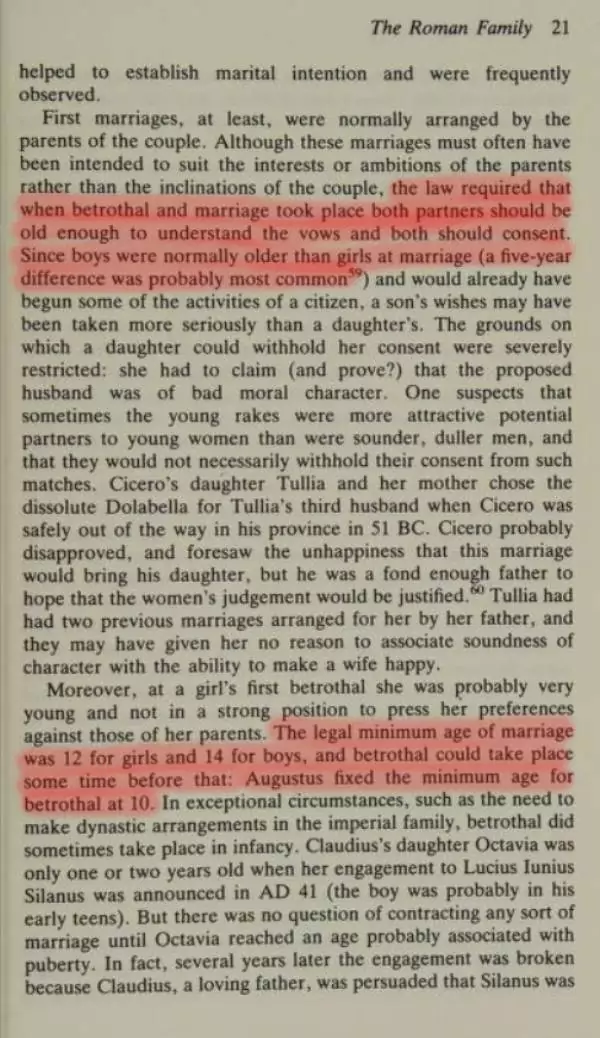
Can she make a decision after reaching adulthood?
The question is whether a minor girl has the right to annul a marriage arranged by her father after she reaches adulthood. It is important to examine what has been stated about this in the book Ahkamul Quran [150] –
If you are in doubt concerning those of your women who have despaired of menstruation, then their waiting period shall be three months; and also for those who have not yet begun to menstruate.
(Surah At-Talaq: 4)
Therefore, divorcing a young girl who has not menstruated is valid. Divorce can only take place in the case of a valid marriage. Thus, the significance of the verse is that marrying off a young girl is entirely permissible. Moreover, the practical evidence is that the Noble Messenger (peace be upon him) married Aisha (may Allah be pleased with her) when she was only six years old. Her father, Abu Bakr (may Allah be pleased with him), was the one who married her off. This incident has two implications. First, it is entirely permissible for a girl’s father to marry off a young girl. Second, after reaching adulthood, this young girl does not have the right to decide whether to remain in or leave the marriage. It is compulsory. This is because the Noble Prophet (peace be upon him) did not grant her that option after she reached adulthood.
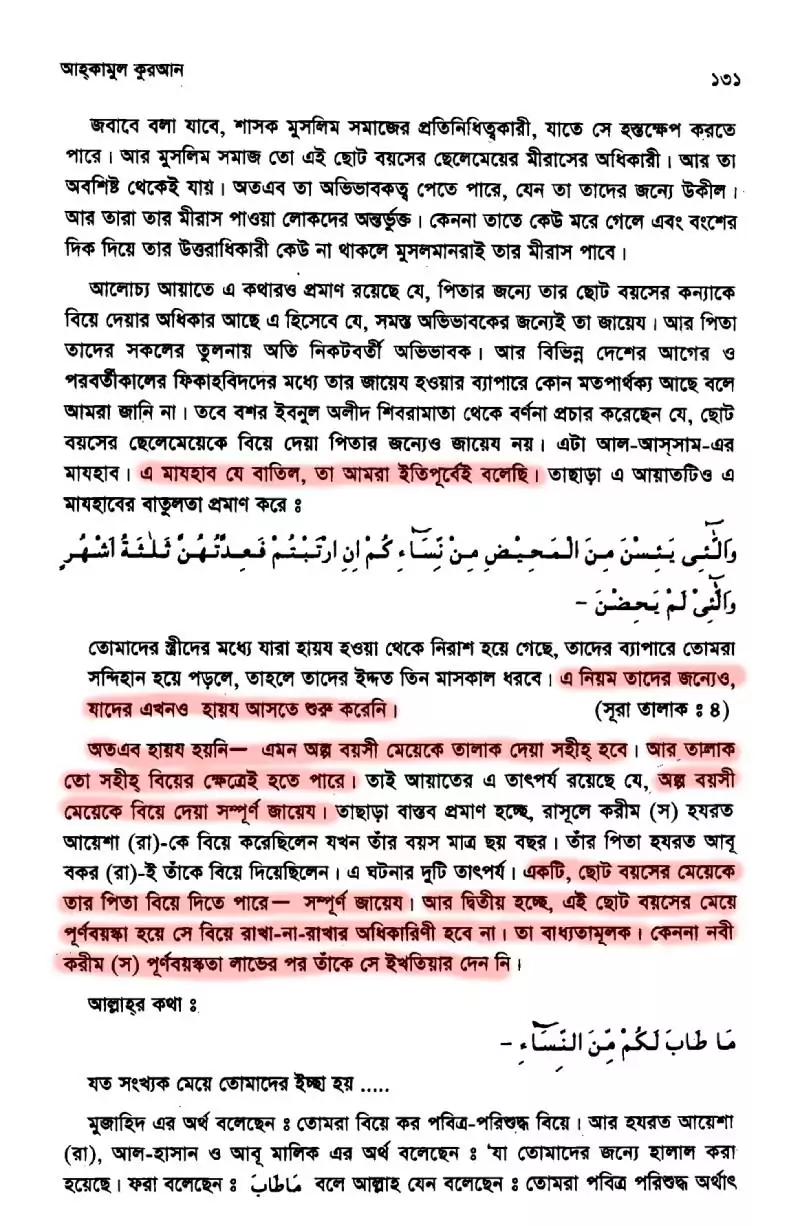
Why did Aisha not protest?
It is important to remember that in all societies, the possibility that a wife or wives of a socially and politically powerful man will bring any allegation of abuse or oppression against their husband is extremely low; in conservative societies, it is even lower. In such a conservative society, a woman is influenced in many ways. Thus, quite naturally, she has little opportunity to make a complaint. If that husband is also religiously powerful, the possibility comes very close to zero. The factors that play a role in this include:
A socially powerful man generally has profound social and economic influence in his particular society, which continues long after his death. Within a relationship, this creates an invisible sphere of power that keeps the wife psychologically vulnerable. Fear of the consequences, concern about losing social respect, and anxiety about financial insecurity prevent the woman from taking any kind of revolutionary action.
Because of the networks surrounding especially powerful individuals, a constant form of social pressure is maintained upon the woman who has been victimized. Society views bringing an allegation against a powerful husband negatively, and this can take the form of everything from harsh comments to various kinds of social harassment. This hostile environment prevents the woman from making a complaint, because under continuous pressure she loses confidence in her own self-respect.
In conservative societies, most women are not financially independent, and their opportunities for education or business are limited. As a result, they must depend entirely on their husband’s financial capacity. Even after the husband’s death, if the influence of his power remains intact in society, any kind of protest or rebellion by the wife can directly damage her economic stability. Most women do not want to take this risk to their livelihood.
A powerful husband generally has countless supporters and allies, and legal institutions are often determined to protect that husband’s reputation. In opposition to this vast power network, a wife feels completely alone and helpless. With no strong supporter by her side, she suffers from a profound sense of isolation, which severely discourages her from taking legal action.
Human relationships and emotions are extremely complex matters. It can be seen that even after suffering extreme abuse, many wives continue to feel a kind of deep emotional attachment or loyalty toward their husbands. This is particularly visible among ordinary people in our country. Even after enduring daily abuse, because of love or loyalty, the woman makes it difficult for herself to take legal action against her husband and remains silent.
Women are burdened with an unwritten and weighty responsibility to preserve the family’s honor and lineage-based aristocracy. Particularly in the case of powerful families, the victim’s paternal relatives often force her to remain silent out of fear that any kind of rebellion or complaint could tarnish the family’s long-established image. Protecting the family’s ‘honor’ then becomes more important than her personal rights or suffering, compelling her to remain silent.
To justify this barbaric child sexual abuse in Islam, many Muslims claim that Aisha never brought any allegation of rape or any other accusation against the Prophet. So why are atheists making accusations? But this kind of statement is nothing more than a particularly low-grade deception. Many crimes take place in the world in which no complaint from the victim is found. To say that a crime did not occur simply because no complaint was made by the victim is not only ridiculous but also deceptive. Many of the grandmothers and grandfathers in our country suffered abuse at the hands of their husbands throughout their lives. After their husbands’ deaths, none of them brought accusations against their husbands. Taking into consideration the family’s honor, the prestige of the lineage, their own dignity, and all such matters, most abused women never bring any complaint against their abusive husbands. This does not prove that their husbands were very good people or that they were never abused. Many madrasa students in our country are also raped by their teachers. But most of them are unable to speak about it openly. They spend their lives accepting it as their fate. That does not mean that nothing happened to them!
Since a child has not reached the age at which they can give consent, any sexual conduct with them constitutes rape, whether or not that child makes a complaint. If we can prove that such conduct took place, whether or not the child complained is irrelevant. Moreover, if her husband is a highly influential person, it is inconceivable that his wife would make an allegation against him. In our own area, a very powerful political leader abducted a girl from her home and forcibly married her. During the first few months of the marriage, the girl was unhappy. Gradually, she began to accept everything, and several years later she even began to love her husband. But that does not mean that abducting her and forcibly marrying her became a moral act!
There are many parents in the world who do not hesitate to sell their own children for the lure of a small amount of money or to obtain some advantage. Giving a daughter in marriage to a powerful local person is still very common in rural areas. We read countless reports of this in the newspapers almost every day. Many devotees of a pir are also seen giving their daughters in marriage to the pir sahib—for the lure of Paradise or for some worldly gain. Therefore, if Abu Bakr married Aisha to the Prophet with the expectation of becoming caliph in the future, there is nothing particularly surprising about it. A very important issue in Muhammad’s marriage to Aisha is the relationship between Aisha and Abu Bakr. We must also take these matters into consideration. Let us listen to a waaz by Mizanur Rahman Azhari, from which an understanding of the relationship between Abu Bakr and Aisha can be gained:
Believers may ask: if Aisha grew up, why did she not file a complaint against Muhammad? This too is a particularly low-grade deception. According to the provisions of Islamic Sharia, anyone who criticizes the Prophet Muhammad is considered a Shatim al-Rasul [151] and is a person deserving of the death penalty. Even if Aisha had dared to make an accusation against the Prophet, would she have been allowed to remain alive? Did Aisha not know what the consequences of making an accusation against the Prophet could be? Who were the caliphs at that time? Her father Abu Bakr, Umar, Uthman, and Ali. All of them were very close to the Prophet, and it was in the Prophet’s name that they had the opportunity to expand their empire and become leaders of the caliphate. Would they have tolerated such statements? Could anyone freely make an accusation against the person in whose name their caliphate, rule, and power existed? Let us see what the punishment was, according to Abu Bakr’s own statement during Abu Bakr’s rule, for speaking ill of the Prophet! [152] [153]
Sunan an-Nasa’i (Islamic Foundation)
38/ The Prohibition of Unlawful Killing
Chapter: 16. The Punishment for Speaking Ill of the Messenger of Allah
4072. Amr ibn Ali (may Allah have mercy on him) … narrated from Abu Barza al-Aslami (may Allah be pleased with him). He said, when a man spoke ill of Abu Bakr al-Siddiq (may Allah be pleased with him), I said: Should I kill him? He reprimanded me and said: This distinction belongs to no one except the Messenger of Allah, peace and blessings be upon him.
Verification: Sahih.
Hadith grade: Sahih (Sahih)
Narrator: Abu Barza (may Allah be pleased with him)
Narrated from Ali (may Allah be pleased with him), the Messenger (ﷺ) said—
“Kill whoever insults me, and beat whoever insults my Companion.” (Jameul Ahadis, Hadith no. 22366, Jameul Jawami, Hadith no. 5097, Daylami, 3/541, Hadith no. 5688, As-Sarim al-Maslul-92)
You will find this hadith on the renowned Islamic fatwa website Islamweb.net [154]
ما روي عن علي بن أبي طالب رضي الله عنه قال : قال رسول الله صلى الله عليه وسلم : ” من سب نبيا قتل ، ومن سب أصحابه جلد ” .
It is also known from authentic hadith that both Abu Bakr and Umar would regularly beat Aisha and Hafsa for the slightest disrespect toward the Prophet. When the Prophet Muhammad decided to divorce Aisha and Hafsa, Abu Bakr and Umar also pleaded on the Prophet’s behalf. They did not stand by their own daughters. At that time, Aisha and Hafsa had demanded maintenance from the Prophet. Because of this demand, Abu Bakr and Umar punched Aisha and Hafsa in the very presence of the Prophet. How could those girls, whose own fathers beat them because they had disagreed even slightly with their husband, the Prophet Muhammad, or made a legitimate demand, bring a complaint about their dead husband under their fathers’ rule? Is that ever possible? Let us read the hadiths [155] –
Sahih Muslim (Islamic Foundation)
19/ Divorce
Chapter: 4. Granting the option does not constitute divorce without the intention of divorce
3557. Zuhayr ibn Harb (may Allah have mercy on him) … narrated from Jabir ibn Abdullah (may Allah be pleased with him). He said: Abu Bakr (may Allah be pleased with him) came and requested permission to enter upon the Messenger of Allah, peace and blessings be upon him. He found many people sitting at his door, but none of them had been given permission to enter. He said: Then Abu Bakr (may Allah be pleased with him) was given permission to enter, and he entered. Then Umar (may Allah be pleased with him) came and requested permission, and he too was given permission to enter. He found the Prophet, peace and blessings be upon him, sitting silently and worried, while his wives were sitting around him.
He (the narrator, Jabir ibn Abdullah (may Allah be pleased with him)) said: Umar (may Allah be pleased with him) said: Surely I will say something to the Prophet, peace and blessings be upon him, that will make him laugh. Then he said: O Messenger of Allah! If only you had seen the daughter of Kharija (Umar’s wife) asking me for maintenance. I rose toward her and punched her on the neck. At this, the Messenger of Allah, peace and blessings be upon him, laughed and said: These women whom you see around me are demanding maintenance from me.
Immediately, Abu Bakr (may Allah be pleased with him) rushed toward Aisha (may Allah be pleased with her) and punched her on the neck. Umar (may Allah be pleased with him) also stood up and moved toward Hafsa (may Allah be pleased with her) and punched her on the neck. They both said: You are demanding from the Messenger of Allah, peace and blessings be upon him, something that he does not possess. Then they said (the wives of the Prophet, peace and blessings be upon him): By Allah, we will never again ask the Messenger of Allah, peace and blessings be upon him, for anything that he does not possess.
After that, he remained separated from them (his wives) for a month or twenty-nine days. Then this verse was revealed to him: “O Prophet! Tell your wives: If you desire the enjoyment of this worldly life and its luxury, then come, I will provide for you and release you graciously. But if you desire Allah, His Messenger, and the Hereafter, then Allah has prepared a great reward for those among you who do good.” (Al-Ahzab: 28–29)
He [Jabir (may Allah be pleased with him)] said: He (the Messenger of Allah, peace and blessings be upon him) began with Aisha (may Allah be pleased with her). He said: O Aisha! I wish to discuss an important matter with you. However, I would prefer that you not make a hasty decision about it without consulting your parents.
She said: O Messenger of Allah! May I know what the matter is? He then recited this verse to her. She said: O Messenger of Allah! Do I need to consult my parents about you? (There is no need.) No, rather I choose Allah, His Messenger, and the Hereafter. However, I earnestly request that you not mention to any of your other wives what I have said. He said: If any of them asks me about it, I will certainly tell her, because Allah sent me not as one who imposes hardship or acts obstinately, but as one who teaches through ease.
Hadith grade: Sahih (Sahih)
Narrator: Jabir ibn Abdullah al-Ansari (may Allah be pleased with him)
Not only that, the hadith also describes an incident in which Abu Bakr struck Aisha on the waist because she was late in arranging water for the Prophet Muhammad and his followers [156] [157] –
Sahih al-Bukhari (Tawhid Publication)
86/ Punishments
Chapter: 86/40. If someone other than a ruler disciplines his own family or someone else.
وَقَالَ أَبُو سَعِيدٍ عَنْ النَّبِيِّ صَلَّى اللَّهُ عَلَيْهِ وَسَلَّمَ إِذَا صَلَّى فَأَرَادَ أَحَدٌ أَنْ يَمُرَّ بَيْنَ يَدَيْهِ فَلْيَدْفَعْهُ فَإِنْ أَبَى فَلْيُقَاتِلْهُ وَفَعَلَهُ أَبُو سَعِيدٍ
Abu Sa’id (may Allah be pleased with him) narrated from the Prophet (peace and blessings be upon him) that when someone is offering prayer and another person intends to pass in front of him, he should prevent him. If he does not accept being stopped, then he should fight him. Abu Sa’id (may Allah be pleased with him) did this.
6844. Narrated ‘Aishah (may Allah be pleased with her). She said, Once Abu Bakr (may Allah be pleased with him) came. At that time, the Messenger of Allah (peace and blessings be upon him) was resting with his head on my thigh. He said, “You have detained the Messenger of Allah (peace and blessings be upon him) and the people, while they have no water.” He reprimanded me and began striking my waist with his hand. It was the position of the Messenger of Allah (peace and blessings be upon him) that prevented me from moving. Then Allah Most High revealed the verse of tayammum.[1] [334] (Modern Publication- 6367, Islamic Foundation- 6380)
[1] One of the mercies that Allah Most High has bestowed upon the Ummah of Muhammad (peace be upon him) is the ruling regarding tayammum. Had Allah not instituted the ruling of tayammum, worship and religious devotion would often have become exceedingly difficult.
Grade of the hadith: Sahih (Sahih)
Narrator: ‘Aishah bint Abu Bakr as-Siddiq (may Allah be pleased with her)
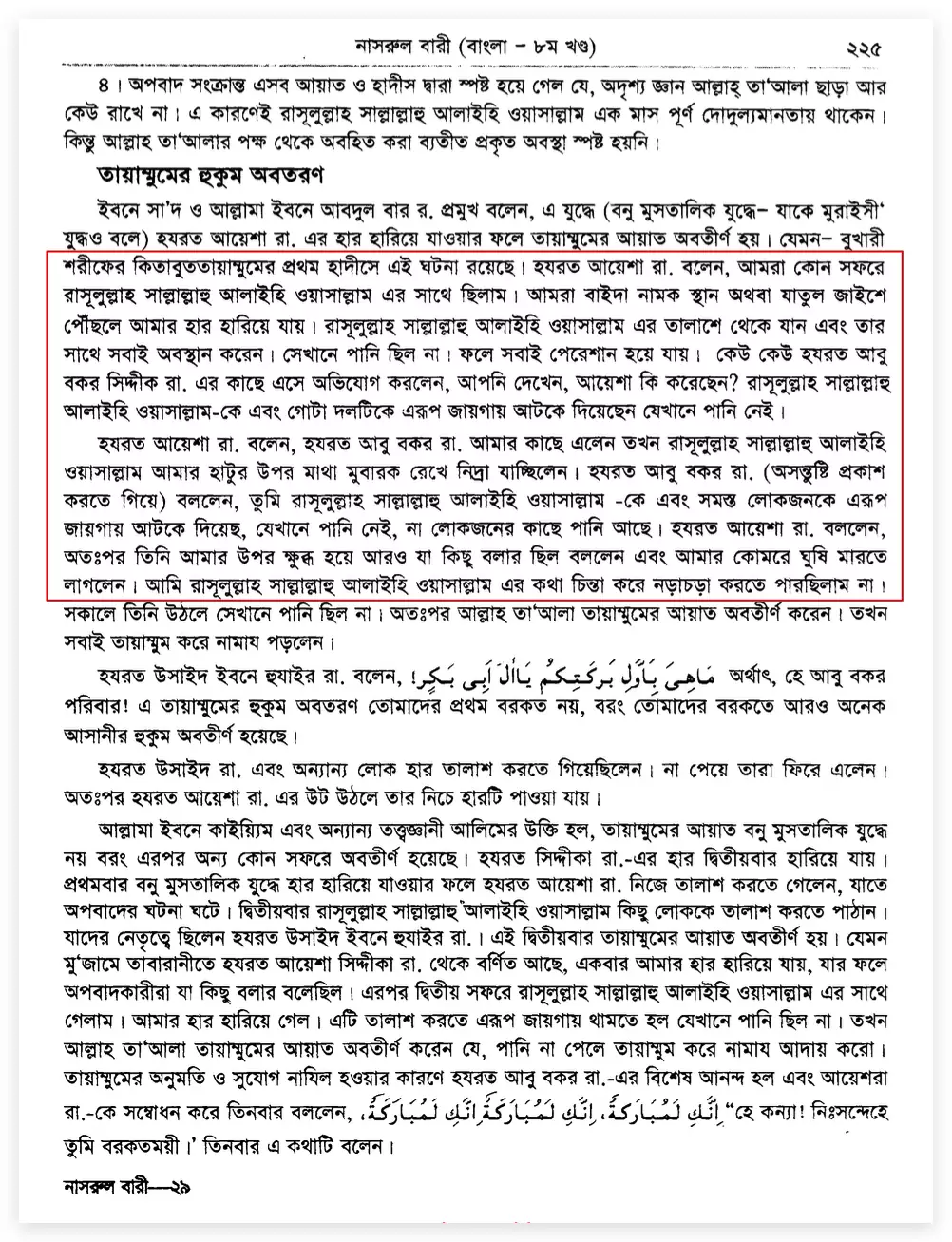
It is even reported that Abu Bakr slapped Aisha extremely hard merely because she had caused the Prophet annoyance by losing a necklace. It is laughable even to imagine that this girl, whose father was such a devoted follower of the Prophet, would complain to her father about the Prophet during her father’s caliphate [158] [159] –
Sahih al-Bukhari (Islamic Foundation)
52/ Tafsir
Chapter: 2355. The Word of Allah: “And if you do not find water, then perform tayammum with pure earth” (5:6)
Islamic Foundation number: 4253, International number: 4608
4253. Yahya ibn Sulayman (may Allah have mercy on him) … Aisha (may Allah be pleased with her) said, “While entering Medina, my necklace fell at a place called al-Baida.” Then the Prophet (peace and blessings be upon him) made his camel sit there and stayed. He had been resting with his head on my lap. Abu Bakr (may Allah be pleased with him) came and slapped me hard and said, ‘You have detained all the people because of a lost necklace.’ On the one hand, he had caused me pain; on the other, the Messenger of Allah (peace and blessings be upon him) was in this condition, and I was suffering the agony of death. Then the Messenger of Allah (peace and blessings be upon him) awoke. It was time for the Fajr prayer, and water could not be found after it was sought. Then the following was revealed: يَا أَيُّهَا الَّذِينَ آمَنُوا إِذَا قُمْتُمْ إِلَى الصَّلاَةِ الآيَةَ O believers, when you prepare for prayer, wash your faces and your hands up to the elbows. (5:6)
Then Usayd ibn Hudayr said, “O descendants of Abu Bakr! Allah Most High has sent down blessings upon people because of you. From head to toe, you are blessings for them.”
Grade of the hadith: Sahih (Sahih)
Narrator: Aishah bint Abu Bakr as-Siddiq (may Allah be pleased with her)
Sahih al-Bukhari (Tawhid Publication)
65/ Tafsir of the Noble Qur’an
Chapter: 65/5/3. The Word of Allah: “If you do not find water, then perform tayammum with pure earth.” (Surah al-Ma’idah 5:6)
4608. Aishah (may Allah be pleased with her) said, “While entering Medina, my necklace fell at a place called al-Baida.” Then the Prophet (peace and blessings be upon him) made his camel sit there and stayed. He had been resting with his head on my lap. Abu Bakr (may Allah be pleased with him) came and slapped me hard and said, ‘You have detained all the people because of a lost necklace.’ On the one hand, he had caused me pain; on the other, the Messenger of Allah (peace and blessings be upon him) was in this condition, and I was suffering the agony of death.” Then the Messenger of Allah (peace and blessings be upon him) awoke. It was time for the Fajr prayer, and water could not be found after it was sought. Then the following was revealed: يٓٓأَيُّهَا الَّذِيْنَ اٰمَنُوْآ إِذَا قُمْتُمْ إِلَى الصَّلَاةِ فَاغسْلُوْا وَجُوْهكُم …..O you who believe! When you intend to stand for prayer, wash your faces and your hands up to the elbows. (Surah al-Ma’idah 5:6)
Then Usayd ibn Hudayr said, “O descendants of Abu Bakr! Allah Most High has sent down blessings upon people because of you. You are goodness and goodness for people.” [334] (Modern Publication: 4247, Islamic Foundation: 4250)
Grade of the hadith: Sahih (Sahih)
Narrator: Aishah bint Abu Bakr as-Siddiq (may Allah be pleased with her)
Another hadith states that Abu Bakr also punched Aisha because she had lost the necklace [160]. The question is, would Aisha bring a complaint against the Prophet before someone who was so devoted to the Prophet and blindly believed in him? –
Sahih al-Bukhari (Tawhid Publication)
86/ Punishments
Chapter: 86/40. If someone other than a ruler disciplines his own family or someone else.
6845. Narrated Aishah (may Allah be pleased with her). She said, “Once Abu Bakr (may Allah be pleased with him) came and punched me very hard and said, ‘You have detained the people because of a necklace.’ I was as though dying because of the condition of the Messenger of Allah (peace and blessings be upon him). Yet it caused me great pain. A similar hadith has been narrated previously. لَكَزَ- وَوَكَزَ have the same meaning. [443] (Modern Publication- 6368, Islamic Foundation- 6381)
Grade of the hadith: Sahih (Sahih)
Narrator: Aishah bint Abu Bakr as-Siddiq (may Allah be pleased with her)
The Meaning and Usage of the Word Nisa
Out of embarrassment, many Islamic apologists deny the legitimacy of child marriage and child sexual activity in Islam by claiming that the word nisa in the Qur’an refers only to adult women; accordingly, they claim that verse 4 of Surah al-Talaq speaks only of the waiting period of adult women. But this statement is entirely false. First, all the tafsirs show that one of the principal reasons for the revelation of this verse was a question concerning the waiting period of underage girls. Second, verse 127 of Surah an-Nisa mentions the expression yatama an-nisa ( فِى يَتَـٰمَى ٱلنِّسَآءِ ), which means orphans among women. This means that the word nisa is used generally for all women, including girl children. Otherwise, the phrase “orphans among women” would not have been used. According to Islamic law, we know that only underage females can be orphans. An adult woman can never be an orphan. The proof of this is given below. First, let us look at verse 127 of Surah an-Nisa,
وَيَسْتَفْتُونَكَ فِى ٱلنِّسَآءِ ۖ قُلِ ٱللَّهُ يُفْتِيكُمْ فِيهِنَّ وَمَا يُتْلَىٰ عَلَيْكُمْ فِى ٱلْكِتَـٰبِ فِى يَتَـٰمَى ٱلنِّسَآءِ ٱلَّـٰتِى لَا تُؤْتُونَهُنَّ مَا كُتِبَ لَهُنَّ وَتَرْغَبُونَ أَن تَنكِحُوهُنَّ وَٱلْمُسْتَضْعَفِينَ مِنَ ٱلْوِلْدَٰنِ وَأَن تَقُومُوا۟ لِلْيَتَـٰمَىٰ بِٱلْقِسْطِ ۚ وَمَا تَفْعَلُوا۟ مِنْ خَيْرٍۢ فَإِنَّ ٱللَّهَ كَانَ بِهِۦ عَلِيمًۭا ١٢٧
The definition of yatim in the Lisan al-Arab dictionary states,
اليتيم: الذي يموت أبوه حتى يبلغ الحلم، فإذا بلغ زال عنه اسم اليتيم، واليتيمة ما لم تتزوج، فإذا تزوجت زال عنها اسم اليتيمة
Meaning: Yatim refers to a child whose father has died; the child is regarded as an orphan until reaching puberty, and after reaching puberty the designation “orphan” is removed from him. A girl is regarded as an orphan until she marries; after marriage, she is no longer called an orphan. [161]
At the same time, there are numerous authentic hadiths on this subject which clearly state that after reaching puberty no one remains an orphan. In other words, the word yatim is used only for minors.
There is no orphanhood after reaching puberty. [162]
Now let us look at an important hadith from a book [163] [164] –
Sunan Abu Dawud (verified edition)
Chapter: 12/ Regarding wills
Publisher: Allama Albani Academy
Section: 9. When does the period of orphanhood end?
2873. Ali ibn Abu Talib (may Allah be pleased with him) said, “I heard and memorized from the Messenger of Allah (peace and blessings be upon him): ‘There is no orphanhood after reaching puberty and it is not permissible to remain silent from morning until night.’” (1)
(1). Sahih.
Grade of the hadith: Sahih (Sahih)
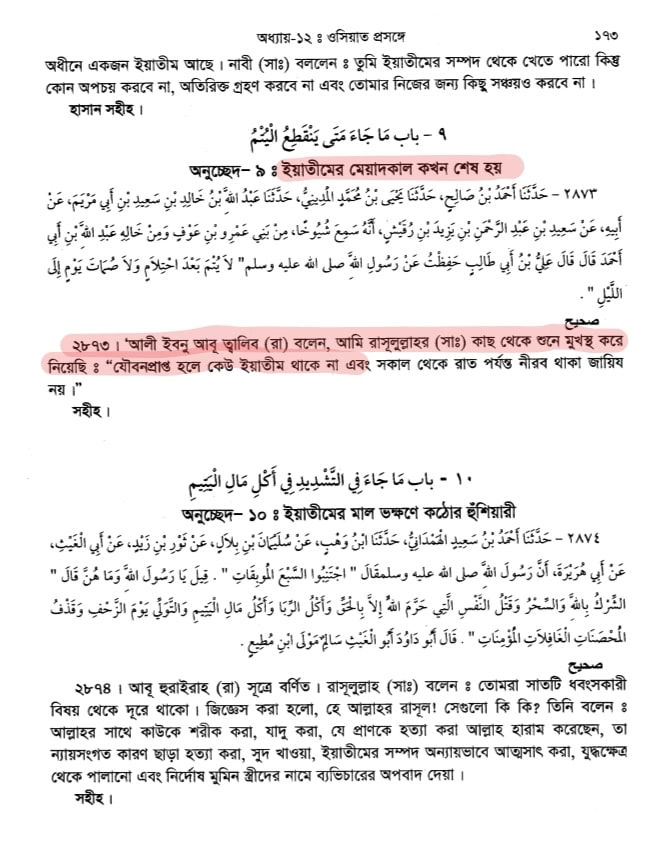
Do Girls Become Women at Nine?
Hearing this vomit-inducing ruling of Islam, many Muslims in the modern era try to say with embarrassed faces that girls in Arabia became adults at the age of nine! Yet there is no evidence anywhere that girls in any particular region became adults at a specific age. Rather, in various cultures, people of that time designated certain ages for girls to reach puberty according to their customs and culture, for the purpose of establishing when their rights to property would take effect. But the fact that no such age was socially or legally designated does not mean that girls actually became fit for sexual activity upon reaching that age! In this regard, believers try to cite part of a hadith, claiming that at the end of one hadith Aisha allegedly said that when a girl reaches nine years of age, she is a woman. With this hadith, they attempt to legitimize the ugly practice of child marriage. Therefore, it is necessary to examine how authentic this hadith actually is. However, even if this hadith is authentic, it cannot be accepted that girls become fit for sexual activity at nine! This is nothing but an ignorant and foolish statement. If anyone has said such a thing, they said it mistakenly out of ignorance. Nevertheless, purely for the sake of argument, let us examine the chain of transmission of that hadith. The Islamqa.info website has an article on this subject; let us read the article and its translation together [165] [166] –
خبر عائشة: إذا بلغت الجارية تسع سنين، فهي امرأة.
324575
تاريخ النشر : 11-02-2020
المشاهدات : 11432
السؤال
عن عائشة أنها قالت: “إذا بلغت الجارية تسع سنين فهي امرأة” ورد في سنن الترمذي، فهل هذا القول صحيح؟
ملخص الجواب
هذا الخبر، سواء ثبت عن عائشة، أو لم يثبت : ليسا عاما ، بظاهره ، لجميع من بلغت التاسعة؛ وإنما معناه : أن من بلغتها ، وحاضت، كما قد يحصل في بلاد العرب : فإنها تكون امرأة ، يحكم لها بحكم البالغات .
الجواب
الحمد لله.
هذا الأثر رغم كثرة تداول الفقهاء له؛ إلا أنه ورد في المصنفات الحديثية معلقا من غير إسناد.
حيث قال الترمذي رحمه الله تعالى:
” وَقَدْ قَالَتْ عَائِشَةُ: إِذَا بَلَغَتِ الجَارِيَةُ تِسْعَ سِنِينَ فَهِيَ امْرَأَةٌ ” انتهى من “السنن” (3 / 409).
وقال البيهقي رحمه الله تعالى:
” ورُوِّينا عن عائشةَ أنَّها قالَت: إذا بَلَغَتِ الجاريَةُ تِسعَ سِنينَ فهِىَ امرأَةٌ ” انتهى من “السنن الكبرى” (2 / 433).
وقد تتبعه كثير من الباحثين فلم يقفوا له على إسناد.
قال الشيخ الألباني رحمه الله تعالى:
” رواه الترمذي، والبيهقي تعليقا بدون إسناد…
قلت: وقد روي مرفوعا من حديث ابن عمر كما سيأتي في “النكاح” وبلفظه: ( إذا أتى على الجارية تسع سنين فهي امرأة ).
أخرجه أبو نعيم في “أخبار أصبهان” وعنه الديلمي في “المسند” عن عبيد بن شريك، حدثني سليمان بن شرحبيل، حدثنا عبد الملك بن مهران، حدثنا سهل بن أسلم العدوى، عن معاوية بن قرة قال: سمعت ابن عمر به.
قلت: وهذا سند ضعيف، عبد الملك بن مهران قال ابن عدى: “مجهول”.
وقال العقيلي: ” صاحب مناكير، غلب عليه الوهم، لا يقيم شيئا من الحديث “.
قلت: ومن دونه لم أعرفهم … ” انتهى من “إرواء الغليل” (1 / 199).
فالحاصل؛ أن هذا الخبر لا يعلم له إسناد صحيح.
لكن مع عدم وجود إسناد صحيح له؛ إلا أن معناه له وجه من الصواب؛ وهو أن الجارية في بلاد العرب ربما حاضت في سن التاسعة.
وأشار إلى هذا المعنى البيهقي رحمه الله تعالى؛ حيث قال عقب الخبر المنسوب لعائشة رضي الله عنها:
” تعني والله أعلم: [إذا بلغت تسع سنين] ، فحاضَت : فهِي امرأَةٌ ” انتهى من”السنن الكبرى” (2 / 433).
وأشار إليه أيضا البغوي رحمه الله تعالى؛ حيث قال:
” وذهب أحمد، إلى أن اليتيمة إذا بلغت تسع سنين، جاز لغير الأب والجد تزويجها برضاها، ولا خيار لها.
ولعله قال ذلك، لما عُلم أن كثيرا من نساء العرب يدركن إذا بلغن هذا السن، قالت عائشة: ( وإذا بلغت الجارية تسع سنين، فهي امرأة ) ” انتهى من “شرح السنة” (9 / 37).
والحيض علامة على البلوغ ، وتنتقل به البنت من الطفولة فتصبح امرأة.
قال ابن القطان رحمه الله تعالى:
” واتفق أهل العلم إلا من شذ، ممن لا يعد خلافه: على أن الاحتلام ، والحيض : بلوغ.
وأجمع أهل العلم على أن المرأة إذا حاضت ، وجبت عليها الفرائض ” انتهى من “الإقناع” (1 / 125).
والحاصل:
أن هذا الخبر، سواء ثبت عن عائشة، أو لم يثبت : ليسا عاما ، بظاهره ، لجميع من بلغت التاسعة؛ وإنما معناه : أن من بلغتها ، وحاضت، كما قد يحصل في بلاد العرب : فإنها تكون امرأة ، يحكم لها بحكم البالغات .
والله أعلم.
هل انتفعت بهذه الإجابة؟
Aisha’s narration: When a slave girl reaches the age of nine, she is a woman/adult female.
Question: It is mentioned in Sunan al-Tirmidhi that Aisha (may Allah be pleased with her) said: “When a slave girl reaches the age of nine, she is a woman/adult female.” Is this report correct?
Summary of the answer: Whether this report is established as coming from Aisha or not, in its general or apparent meaning it does not apply to every nine-year-old slave girl. Rather, it refers to a girl who has reached adulthood and begun menstruating, as may occur in the Arab lands. She is then considered an adult woman, and the rulings applicable to adult women apply to her.
(Detailed) answer: All praise belongs to Allah. Although jurists have circulated this report extensively, it was recorded in hadith compilations without a chain of transmission. It is also narrated by later writers without mentioning its chain. It is narrated from al-Tirmidhi (may Allah have mercy on him):
“When a slave girl reaches the age of nine, she is an adult woman.” (Quoted from the end of al-Sunan (3/409))
Imam al-Bayhaqi (may Allah have mercy on him) also said:
“It is narrated from Aisha that she said: When a slave girl reaches the age of nine, she is an adult woman.” (Quoted from the end of al-Sunan al-Kubra (2/433))
Many researchers followed Imam al-Bayhaqi, but they did not agree regarding the chain of transmission.
Shaykh al-Albani (may Allah have mercy on him) said: “Imam al-Tirmidhi and Imam al-Bayhaqi narrated this hadith without including any chain of transmission.”
(The respondent) I say: Yes, that is correct. It was narrated as a marfu’ hadith from Ibn Umar, and it is narrated with exactly these words in the chapter on “Marriage”: “When a slave girl reaches the age of nine, she is an adult woman.”
Available chain:
——–
It was narrated by Abu Nu’aym in “Akhbar Isfahan,” and al-Daylami narrated it in his “Musnad,” from Ubaydullah ibn Sharik. He said: Sulayman ibn Surahbil narrated to me as follows: Abd al-Malik ibn Mihran narrated to us; Sahl ibn Aslam al-Adawi narrated to us from Mu’awiyah ibn Qurrah, who said that he heard it from Ibn Umar.
(The respondent) I say: This is a weak chain. Regarding Abd al-Malik ibn Mihran, Ibn Adi said that he was “unknown.”
Al-Uqayli said: What is narrated from someone who has criticized anyone or fallen into confusion is not considered part of hadith.
(The respondent) I say: “Apart from al-Uqayli’s comment, they are not known individuals either. (Therefore, the chain narrated from them is not authentic.)
In short, no authentic chain of transmission is known for this hadith.”
However, although it does not have an authentic chain, the statement has a correct interpretation. That is: In this hadith, the slave girl is understood to mean a slave girl from the Arab region, among whom menstruation may begin at the age of nine. Imam al-Bayhaqi pointed toward this interpretation in his explanation of Aisha’s narration.
“This is my interpretation of this report. Allah knows the correct interpretation best.
Sections: ‘If a slave girl reaches nine years of age and menstruates,’ al-Sunan al-Kubra (2/433)
Al-Baghawi also indicated the above interpretation. For example, he said:
“Imam Ahmad also said that when an orphan girl reaches the age of nine, it is permissible to marry her, with her consent, without the permission of her father or grandfather. ‘And this girl has no option of consent.’”
Perhaps he also said that when most Arab women reached the age of maturity, Aisha (may Allah be pleased with her) said, “When she reaches the age of nine, she is an adult woman.” (Quoted from the end of Sharh as-Sunnah (9/37))
Menstruation is a sign of adulthood. It is through menstruation that a girl passes from childhood into adulthood.
Ibn Qatran (may Allah have mercy on him) said:
Everyone except misguided scholars agreed that nocturnal emission and menstruation constitute adulthood.
The majority of scholars also agreed that when a girl begins menstruating, the rulings of the Shariah become obligatory upon her.
In short, whether this report is established as coming from Aisha or not, in its general or apparent meaning it does not apply to every nine-year-old slave girl. Rather, it refers to a girl who has reached adulthood and begun menstruating, as may occur in the Arab lands. She is then considered an adult woman, and the rulings applicable to adult women apply to her.
Two Hadiths in Favor of the Apologists
When discussing Aisha’s age, people defending Islam try to prove through two hadiths that Aisha had reached puberty at that time. One is from Sahih al-Bukhari, and the other is from Sunan Abu Dawud. Let us examine these two hadiths and see how authentic they actually are. First, let us look at the English translation of the hadith from the renowned website Sunnah.com:
(86)Chapter: (If) a mosque (is built) on a road, it should not be a cause of harm for the people
Narrated `Aisha:
(the wife of the Prophet) I had seen my parents following Islam since I attained the age of puberty. Not a day passed but the Prophet (ﷺ) visited us, both in the mornings and evenings. My father Abu Bakr thought of building a mosque in the courtyard of his house and he did so. He used to pray and recite the Qur’an in it. The pagan women and their children used to stand by him and look at him with surprise. Abu Bakr was a Softhearted person and could not help weeping while reciting the Qur’an. The chiefs of the Quraish pagans became afraid of that (i.e. that their children and women might be affected by the recitation of Qur’an).
Reference : Sahih al-Bukhari 476
In-book reference : Book 8, Hadith 124
USC-MSA web (English) reference : Vol. 1, Book 8, Hadith 465
(deprecated numbering scheme)
Reader, note that in this hadith, the translator of the hadith, Muhsin Khan, very cleverly translated the word أَعْقِلْ as “Age of Puberty”; whereas the correct meaning of this word is “Age of Reason,” that is, from the age when one acquires understanding. When translating this hadith into Bengali, the Bengali translator once again provided the correct translation. Let us see the Bengali translation of the hadith:
Sahih al-Bukhari (Tawhid)
Chapter: 8/Prayer
Section: 8/86. It is permissible to build a mosque on a road if this does not cause inconvenience to people.
Hasan al-Basri, Ayyub, and Malik (may Allah have mercy on them) said likewise.
476. ‘Urwah ibn az-Zubayr narrated that it was reported from ‘Aishah (may Allah be pleased with her), the wife of the Prophet (peace and blessings of Allah be upon him). She said: As far as I can remember, I always saw my parents following the religion. Not a single day passed without Allah’s Messenger (peace and blessings of Allah be upon him) coming to us at both ends of the day, morning and evening. Then the need arose for Abu Bakr (may Allah be pleased with him) to build a mosque. He built a mosque in the courtyard of his house. He used to pray and recite the Qur’an there. The women and children of the polytheists would stand there and look at him in amazement. Abu Bakr (may Allah be pleased with him) was a person who wept excessively. Whenever he began reciting the Qur’an, he could not restrain his tears. This condition of his alarmed the leaders of the prominent polytheists of Quraysh. (2138, 2263, 2264, 2297, 3905, 4093, 5807, 6079) (Modern Publication: 456, Islamic Foundation: 462)
Hadith grade: Sahih (Sahih)
Narrator: ‘Urwah ibn az-Zubayr (may Allah have mercy on him)
Narrated `Aisha:
(the wife of the Prophet) I had seen my parents following Islam since I attained the age of puberty. Not a day passed but the Prophet (ﷺ) visited us, both in the mornings and evenings. My father Abu Bakr thought of building a mosque in the courtyard of his house and he did so. He used to pray and recite the Qur’an in it. The pagan women and their children used to stand by him and look at him with surprise. Abu Bakr was a Softhearted person and could not help weeping while reciting the Qur’an. The chiefs of the Quraish pagans became afraid of that (i.e. that their children and women might be affected by the recitation of Qur’an).
Notice the extent to which the translator of the hadith resorted to fraud in the English translation. Why this fraud—to cleanse the character of the Prophet Muhammad? Another hadith is found in the noble Sunan Abu Dawud:
General Behavior (Kitab Al-Adab)
(63)Chapter: About swings
Narrated Aisha, Ummul Mu’minin:
The Messenger of Allah (ﷺ) married me when I was seven or six. When we came to Medina, some women came. according to Bishr’s version: Umm Ruman came to me when I was swinging. They took me, made me prepared and decorated me. I was then brought to the Messenger of Allah (ﷺ), and he took up cohabitation with me when I was nine. She halted me at the door, and I burst into laughter.
Abu Dawud said: That is to say: I menstruated, and I was brought in a house, and there were some women of the Ansari in it. They said: With good luck and blessing. The tradition of one of them has been included in the other.
Grade : Sahih (Al-Albani)
Reference : Sunan Abi Dawud 4933
In-book reference : Book 43, Hadith 161
English translation : Book 42, Hadith 4915
Now let us read it in Bengali:
حَدَّثَنَا مُوسَى بْنُ إِسْمَاعِيلَ، حَدَّثَنَا حَمَّادٌ، ح وَحَدَّثَنَا بِشْرُ بْنُ خَالِدٍ، حَدَّثَنَا أَبُو أُسَامَةَ، قَالاَ حَدَّثَنَا هِشَامُ بْنُ عُرْوَةَ، عَنْ أَبِيهِ، عَنْ عَائِشَةَ، قَالَتْ إِنَّ رَسُولَ اللَّهِ صلى الله عليه وسلم تَزَوَّجَنِي وَأَنَا بِنْتُ سَبْعِ سِنِينَ فَلَمَّا قَدِمْنَا الْمَدِينَةَ أَتَيْنَ نِسْوَةٌ – وَقَالَ بِشْرٌ فَأَتَتْنِي أُمُّ رُومَانَ – وَأَنَا عَلَى أُرْجُوحَةٍ فَذَهَبْنَ بِي وَهَيَّأْنَنِي وَصَنَعْنَنِي فَأُتِيَ بِي رَسُولُ اللَّهِ صلى الله عليه وسلم فَبَنَى بِي وَأَنَا ابْنَةُ تِسْعٍ فَوَقَفَتْ بِي عَلَى الْبَابِ فَقُلْتُ هِيهْ هِيهْ – قَالَ أَبُو دَاوُدَ أَىْ تَنَفَّسَتْ – فَأُدْخِلْتُ بَيْتًا فَإِذَا فِيهِ نِسْوَةٌ مِنَ الأَنْصَارِ فَقُلْنَ عَلَى الْخَيْرِ وَالْبَرَكَةِ . دَخَلَ حَدِيثُ أَحَدِهِمَا فِي الآخَرِ .
Narrated from ‘Aishah (may Allah be pleased with her):
She said: He (the Messenger of Allah, peace and blessings of Allah be upon him) married me when I was six or seven years old. When we arrived in Medina, a group of women came. According to Bishr’s narration, my mother, Umm Ruman (may Allah be pleased with her), came to me while I was swinging on a swing. She took me away, prepared me, dressed me, and adorned me. Then I was presented to the Messenger of Allah (peace and blessings of Allah be upon him). He consummated the marriage with me when I was nine years old. My mother made me stand at the door of the house, and I burst into loud laughter. Imam Abu Dawud (may Allah have mercy on him) said, “That is, I had begun menstruating. I was brought into a house.” A group of women from the Ansar were present there. They prayed for goodness and blessing for me.
Sunan Abu Dawud, Hadith no. 4933
Hadith grade: Sahih
Reader, note that the statement that ‘Aishah had begun menstruating is merely Abu Dawud’s opinion. He did not hear this from ‘Aishah, nor from anyone who had heard it directly from ‘Aishah. Abu Dawud’s opinion alone is certainly not acceptable.
Now let us read the clear statement on this subject by Shaykh Salih al-Munajjid, one of the most famous Islamic scholars of the present era, from the renowned website IslamQA. The link to the original article is provided [167], along with the translation. The translation was prepared by Abu’l Fazl Bhai of the Shongshoy family.
Question:
While conversing with others in an internet chat room, I came across something astonishing. I would like someone with comprehensive knowledge of the seerah, or biography, of the Messenger Muhammad to explain this matter to me. A journalist researched the matter mentioned in Sahih al-Bukhari—namely, that the Messenger Muhammad entered into a marriage contract with ‘Aishah when she was six years old and consummated the marriage through intercourse when she was nine—and expressed doubts about the authenticity of this hadith from al-Bukhari. The researcher not only assessed the hadith’s account on the basis of numbers and dates, but also reconsidered the basis of the hadith mentioned in al-Bukhari and Muslim, namely its isnad. In both cases, he attempted skillfully to prove his doubts.
Answer:
First:
The entire matter of how old ‘Aishah was when the Messenger Muhammad entered into a marriage contract with her, and how old she was when he consummated the marriage through intercourse, does not depend at all on the personal opinions of Islamic scholars, such that someone might argue over whether the matter was right or wrong. Rather, this is a historical account established unequivocally through evidence, which must be accepted. There are many reasons for this—
1.
‘Aishah herself stated her age. It is not the case that someone else spoke about her, or that we learned her age from the account of a historian or hadith scholar. Rather, we learned her age from a context in which ‘Aishah herself was speaking about herself. What she said appears directly in the narrations of hadith 3894 of Sahih al-Bukhari and hadith 1422 of Sahih Muslim—
“Narrated from ‘Aishah (may Allah be pleased with her), she said: When the Prophet (peace and blessings of Allah be upon him) married me, I was six years old. Then we came to Medina and stayed among the Banu al-Harith. There I fell ill with fever. As a result, my hair fell out. Later, when the hair at the front of my head had grown back, I was one day playing on a swing with my friends. My mother, Umm Ruman, called me loudly. I went to her, not understanding what she wanted. She took me by the hand and brought me to the door of the house, where she made me stand. I was panting. Eventually my breathing calmed somewhat. She then took some water and wiped my face and head with it. After that she brought me inside the house. Several women from the Ansar were there. They said, ‘May it be auspicious, blessed, and fortunate.’ She handed me over to them. They arranged me, and it was shortly before noon. Suddenly, when I saw the Messenger of Allah (peace and blessings of Allah be upon him), I became bewildered. They handed me over to him. At that time I was a girl of nine.”
2.
This account of ‘Aishah appears in two books regarded as the most reliable books after the Qur’an—Sahih al-Bukhari and Sahih Muslim.
3.
Although some ignorant people claim that this hadith has only one isnad, or chain of narration, in fact, this hadith has multiple isnads.
The most widespread chain of narration is from Hisham ibn ‘Urwah ibn al-Zubayr, who heard it from his father, ‘Urwah ibn al-Zubayr, and ‘Urwah ibn al-Zubayr heard it directly from ‘Aishah. This is one of the most accurate narrations, because ‘Urwah ibn al-Zubayr was one of the people closest to ‘Aishah by family ties; ‘Aishah was his maternal aunt.
The chain of the narration of hadith 1422 in Sahih Muslim is another one: al-Zuhri heard it from ‘Urwah ibn al-Zubayr, and ‘Urwah ibn al-Zubayr heard it directly from ‘Aishah.
Another chain is al-A‘mash, who heard it from Ibrahim, who heard it from al-Aswad, who heard it directly from ‘Aishah. What he heard is reported in the narration of hadith 1422 in Sahih Muslim as follows: It was narrated from ‘Aishah (may Allah be pleased with her) that she said: The Messenger of Allah (peace and blessings of Allah be upon him) married her when she was six years old, consummated the marriage with her when she was nine, and he died when she was eighteen.
There is also another chain containing the statement about her age: from Muhammad ibn ‘Amr, who heard it from Yahya ibn ‘Abd al-Rahman ibn Hatib, who heard it directly from ‘Aishah. This is mentioned in hadith 4937 of Sunan Abu Dawud.
Shaykh Abu Ishaq al-Huwayni performed an important task. He prepared a list of those who narrated this hadith after hearing it from ‘Urwah ibn al-Zubayr. The list is as follows: al-Aswad ibn Yazid, al-Qasim ibn ‘Abd al-Rahman, al-Qasim ibn Muhammad ibn Abi Bakr, ‘Amrah bint ‘Abd al-Rahman, and Yahya ibn ‘Abd al-Rahman ibn Hatib.
He also prepared a list of those who narrated this hadith after hearing it from Hisham ibn ‘Urwah. They were Ibn Shihab al-Zuhri and Abu Hamzah Maymun, the freedman of ‘Urwah.
In addition, Shaykh Abu Ishaq al-Huwayni prepared a list of the Islamic scholars of Medina who followed Hisham ibn ‘Urwah in narrating this hadith. They were Abu Zinad ‘Abdullah ibn Dhakwan, his son ‘Abd al-Rahman ibn Abi Zinad, and ‘Abdullah ibn Muhammad ibn Yahya ibn ‘Urwah. It is worth remembering that this hadith was one of the hadiths narrated by Hisham in Medina.
Among the Islamic scholars of Mecca, Sufyan ibn ‘Uyaynah narrated this hadith. In addition, the Ray-based Islamic specialist Jarir ibn ‘Abd al-Hamid al-Dubbi was one of those who narrated this hadith.
Among the Islamic scholars of Basra who narrated this hadith were Hammad ibn Salamah, Hammad ibn Zayd, Wuhaib ibn Khalid, and others.
Those who know Arabic may click on the two links below and listen to Shaykh Abu Ishaq al-Huwayni’s statement in Arabic ( 1 ) ( 2 )
All of these lists are mentioned in order to ward off the specious argument of some ignorant people who say that Hishaam ibn ‘Urwah was the only one who narrated it. Even if we accept [?} that Hishaam became confused at the end of his life, the correct view is that this accusation was made only by Abu’l-Hasan ibn al-Qattaan in Bayaan al-Wahm wa’l-Eehaam, and he was mistaken in doing so.
These lists were prepared specifically to refute the argument of those ignorant people who, without knowing the facts, comment that Hisham ibn ‘Urwah was the sole narrator of this hadith. Even if, for the sake of argument, we accept that Hisham ibn ‘Urwah suffered memory loss in old age, this false accusation was made only by Abu’l-Hasan ibn al-Qattan, an Islamic researcher from the Almohad Muslim empire of North Africa, and it appears only in his book Bayaan al-Wahm wa’l-Eehaam al-Waaqi‘een fi Kitaab al-Ahkaam.
Later, the famous Syrian-Turkmen Islamic scholar Shams al-Din al-Dhahabi wrote in section 4/301–302 of his famous book Mizan al-I‘tidal:
“Hisham ibn ‘Urwah was one of the foremost figures among the scholars of Islam. Although his memory sometimes became hazy in old age, he did not completely lose his bearings and become doubtful. Therefore, I can find nothing reasonable in Abu’l-Hasan ibn al-Qattan’s allegation that Hisham ibn ‘Urwah and Suhail ibn Abi Salih became completely unreliable because they grew old. Yes, he may have changed somewhat because of old age, his memory may have weakened somewhat, and he may have forgotten some things, but so what? He was not infallible. Even when he came to Iraq at the end of his life, he imparted much knowledge among his students, including some hadiths that he could not remember properly. Many reliable hadith narrators, including Malik, Shu‘bah, and Waki‘, experienced this problem in old age. I believe that Abu’l-Hasan ibn al-Qattan’s ridiculous claim, in which he confused reliable Islamic scholars with weak narrators or narrators who suffered memory loss due to old age, should simply be disregarded. Hisham ibn ‘Urwah was truly a Shaykh al-Islam. May Allah protect us from the effect of what Ibn al-Qattan said against him, and also from what ‘Abd al-Rahman ibn Kharash said—Malik disliked him because he was angry with him for narrating hadith in Iraq.”
4.
It is not the case that ‘Aishah alone stated that she was nine years old when she married the Messenger Muhammad. Many of ‘Aishah’s contemporaries narrated this hadith, people who knew ‘Aishah more closely than others did. One such narration is as follows:
Imam Ahmad ibn Hanbal narrated in his Musnad Ahmad, 6/112, through Muhammad ibn Bashir, that Muhammad ibn Bashir said: Muhammad ibn ‘Amr told us, and Abu Salamah and Yahya said: When Khadijah died, Khawlah bint Hakim, the wife of ‘Uthman ibn Maz‘un, came to the Messenger and asked, “Why are you not marrying again?” The Messenger asked in response, “Whom?” Khawlah bint Hakim said, “If you wish, a virgin, or a widow.” The Messenger asked, “Who is the virgin?” Khawlah bint Hakim replied, “The person dearest to you among Allah’s creation, the daughter of your friend Abu Bakr, ‘Aishah bint Abi Bakr…” The narration then continues in detail in Musnad Ahmad, where it is stated that the marriage contract was made when ‘Aishah was six years old, and that the marriage was consummated through sexual intercourse when she was nine.
5.
This narration agrees with ‘Aishah’s own narration, and the other narrators also received the account from ‘Aishah. Every historical source concerning ‘Aishah’s life contains the same account. There is no contradiction or discrepancy among the narrations. Nor does the matter depend on ijtihad or the personal opinion of any expert. When a person makes a statement about herself, no other person naturally has the right to deny that statement.
6.
The historical sources unanimously indicate that ‘Aishah was born a Muslim; that is, ‘Aishah was born four or five years after the Messenger Muhammad began preaching Islam.
Regarding the hadith, “I remember seeing only my father and mother following Islam,” Imam al-Bayhaqi wrote in his hadith collection al-Sunan al-Kubra, 6/203:
‘Aishah was born a Muslim, because her father became Muslim at the very beginning of the Messenger’s preaching mission. The hadith received through al-Aswad, which al-Aswad narrated directly from ‘Aishah, proves that the Messenger Muhammad married ‘Aishah when she was six years old, consummated the marriage through sexual intercourse when she was nine, and that ‘Aishah was eighteen when the Messenger died. Asma bint Abi Bakr, however, was born during the Age of Ignorance and became Muslim after her father became Muslim. Abu ‘Abdullah ibn Mandah narrated a chain concerning this from Ibn Abi Zinad. According to it, Asma bint Abi Bakr was ten years older than ‘Aishah, and Asma’s mother later accepted Islam. Asma said, “My mother came to me while she was still following the religion of the polytheists.” A hadith narrated by Asma indicates that her mother’s name was Qatilah and that she belonged to the Banu Malik ibn Hisal. She was not ‘Aishah’s mother. Asma became Muslim together with her father, but her mother did not become Muslim at that time. From what is known about ‘Abd al-Rahman ibn Abi Bakr, it is thought that he was a young man when his parents accepted Islam, but he did not become Muslim by following them; he accepted Islam much later. ‘Abd al-Rahman ibn Abi Bakr was Abu Bakr’s eldest child.
Shams al-Din al-Dhahabi said in his Siyar A‘lam al-Nubala, 2/139:
Among those who were born Muslim through their parents, ‘Aishah was one. She was eight years younger than Fatimah. She used to say, “I remember seeing only my father and mother following Islam.”
Al-Hafiz Ibn Hajar said in his al-Isabah, 8/16:
She, meaning ‘Aishah, was born four or five years after the beginning of the Messenger’s preaching of Islam.
This indicates that ‘Aishah was eight or nine years old at the time of the Hijrah. This information is consistent with the aforementioned hadith narrated by ‘Aishah herself.
7.
The historical sources agree that ‘Aishah was eighteen years old when the Messenger Muhammad died. Therefore, ‘Aishah was eight or nine years old at the time of the Hijrah.
8.
Biographical and historical works state that when ‘Aishah died at the age of sixty-three, it was the year 57 AH. Thus it can be understood that ‘Aishah was six years old before the Hijrah. Therefore, if you calculate the age and years according to the approximate reckoning customary in Arabia at that time, you will find that ‘Aishah was eight years old at the time of the Hijrah, and that eight months after the Hijrah, when the Messenger Muhammad took ‘Aishah into his household, she was nine years old.
9.
The account above is consistent with the views of Islamic scholars regarding the age difference between Asma bint Abi Bakr and ‘Aishah. Shams al-Din al-Dhahabi said that Asma bint Abi Bakr was ten or more years older than ‘Aishah. In his Siyar A‘lam al-Nubala, 2/188, he wrote that ‘Aishah was born four or five years after the beginning of the Messenger’s preaching of Islam. Abu Nu‘aym stated in his Mu‘jam al-Sahabah that Asma bint Abi Bakr was born ten years after the beginning of the Messenger’s preaching of Islam. Therefore, the age difference between Asma bint Abi Bakr and ‘Aishah was fourteen to fifteen years. This is the view of Shams al-Din al-Dhahabi. What we find in his direct narration has already been mentioned: namely, that Asma bint Abi Bakr was ten or more years older than ‘Aishah.
10.
Although we quote these numbers that are mentioned in the books of biography and history, what we mostly rely on is what is narrated with saheeh isnaads, not what we find in books quoted without any isnaad. But all of the reports are in accordance with the hadeeths with undoubtedly saheeh isnaads that we quoted at the beginning of this answer. Hence we quoted reports from the history books that support what we quoted above.
Although this article mentions ages found in biographical and historical books, our primary reliance is on those hadiths narrated with sahih isnads. We do not cite reports that have no isnad whatsoever. However, the ages found in these reports agree with the hadiths possessing sahih isnads, which we mentioned at the beginning of this answer. That is why we have cited accounts found in historical works that support our narration.
Second:
In response to the hostile article’s author, who cited information from certain sources in an attempt to prove that the age difference between Asma and ‘Aishah was ten years, we say:
This ten-year age difference is not established when the reliability of the isnad, or chain of narration, is considered. If its isnad is proven, it can be understood in a manner consistent with the conclusive evidence mentioned above.
When the isnad is examined, it appears that this was narrated from ‘Abd al-Rahman ibn Abi Zinad, who said that Asma bint Abi Bakr was ten years older than ‘Aishah. ‘Abd al-Rahman ibn Abi Zinad received this narration from al-Asma‘i through two isnads.
The first isnad was as follows: Ibn ‘Asakir mentioned in his Tarikh Dimashq (69/10) that he said: Abu’l-Hasan ‘Ali ibn Ahmad al-Maliki told us, Ahmad ibn ‘Abd al-Wahid al-Sulami told us, my grandfather Abu Bakr told us, Abu Muhammad ibn Jabir told us, Ahmad ibn Sa‘d ibn Ibrahim al-Zuhri told us, Muhammad ibn Abi Safwan told us, al-Asma‘i told us, Ibn Abi Zinad said… Then he narrated the report.
The second isnad was as follows: Ibn ‘Abd al-Barr narrated in his al-Isti‘ab fi Ma‘rifat al-Ashab (2/616): Ahmad ibn Qasim said, Muhammad ibn Mu‘awiyah said, Ibrahim ibn Musa ibn Jamil said, Isma‘il ibn Ishaq al-Qadi said, Nasr ibn ‘Ali said, al-Asma‘i told us, Ibn Abi Zinad said: Asma bint Abi Bakr, who was approximately ten years older than ‘Aishah, said… If an impartial researcher considers this narration, it will become clear that if its apparent meaning is accepted while disregarding all the well-established evidence presented against it, that would constitute an insult to knowledge and scholarship for the following reasons:
1.
‘Abd al-Rahman ibn Abi Zinad (100–174 AH) was the only person who stated that the age difference between Asma and ‘Aishah was ten years. On the other hand, the clear evidence mentioned above is sufficient, and those reports came from multiple Followers. It is self-evident that, in terms of acceptability, a report narrated more frequently takes precedence over one narrated fewer times.
2.
Most Islamic scholars consider the narration of ‘Abd al-Rahman ibn Abi Zinad to be da‘if, or weak. Imam Ahmad ibn Hanbal wrote about ‘Abd al-Rahman ibn Abi Zinad in his biographical work Tahdhib al-Tahdhib, 6/172, that he was mudtarib al-hadith, meaning that the hadiths he narrated were defective. What Ibn Ma‘in said about ‘Abd al-Rahman ibn Abi Zinad was that hadith experts did not use narrations received from him as evidence. ‘Ali ibn al-Madini said that what he said while he was in Medina was sahih, but after he came to Baghdad, the people of Baghdad distorted what he said. I saw ‘Abd al-Rahman—that is, Ibn Mahdi—draw lines through the hadiths narrated by ‘Abd al-Rahman ibn Abi Zinad as though cutting them out. Abu Hatim said that his hadiths could be written down, but they could not be presented as evidence. Al-Nasa’i said that his hadiths could not be presented as evidence.
Although Imam al-Tirmidhi described ‘Abd al-Rahman ibn Abi Zinad as trustworthy according to the chain of hadith no. 1755, this contradicts the criticism of the earlier critics. Criticism certainly takes precedence over praise, particularly in the case of reports narrated only by ‘Abd al-Rahman ibn Abi Zinad, especially when he says something that conflicts with reports found in famous books of Sunnah and history.
3.
According to Ibn ‘Abd al-Barr’s narration, “Asma was approximately ten years older than ‘Aishah.” This narration is more accurate than Ibn ‘Asakir’s narration because Nasr ibn ‘Ali, who narrated it from al-Asma‘i through Ibn ‘Abd al-Barr’s isnad, was recognized as trustworthy (thiqqah) by Imam Ahmad ibn Hanbal in his Tahdhib al-Tahdhib (10/431). However, no one described Muhammad ibn Abi Safwan, who narrated the hadith from al-Asma‘i through Ibn ‘Asakir’s isnad, as trustworthy.
The words in the report of Ibn ‘Abd al-Barr, “or so”, indicate that he was not certain about (the difference in age) being ten years. This makes his report weak and it is not permissible for the fair-minded researcher to reject the evidence quoted above for the sake of this uncertainty.
The phrase “approximately” in Ibn ‘Abd al-Barr’s narration indicates that he was not at all certain that the age difference was ten years. This makes his narration appear weak, and it is entirely inappropriate for an impartial researcher to reject the clear evidence mentioned above and accept this uncertain narration.
4.
Furthermore, it is possible to reconcile this narration with the other narrations by saying that Asma was born five or six years before the beginning of the Messenger Muhammad’s preaching mission, while ‘Aishah was born four or five years afterward. When Asma died in 73 AH, she was ninety-one or ninety-two years old, as narrated by Shams al-Din al-Dhahabi in his Siyar A‘lam al-Nubala (3/380): Ibn Abi Zinad said that she was ten years older than ‘Aishah. I, Shams al-Din al-Dhahabi, think that on this basis, she should have been ninety-one years old at the time of her death. On the other hand, according to Hisham ibn ‘Urwah, she was 101 years old when she died, yet not a single one of her teeth had fallen out because of old age.
5.
It should also be added that Asma was born fourteen years before the beginning of the Messenger Muhammad’s preaching mission—as the author himself confirmed in his earlier article—and that Asma was twenty-seven years old in the year of the Hijrah and one hundred years old when she died in 73 AH. This is consistent with the matters concerning Asma on which the historical sources agree: namely, that Asma and her son ‘Abdullah ibn al-Zubayr, who was killed in battle, both died in 73 AH, and that Asma was one hundred years old at the time of her death. Hisham ibn ‘Urwah narrated from his father: Asma lived to the age of one hundred, and even at that age not a single one of her teeth had fallen out, and she remained conscious throughout her life.
A list of the sources from which this information was obtained is given below:
Hilyat al-Awliya, 2/56
Mu‘jam al-Sahabah, by Abu Nu‘aym al-Asbahani
Al-Isti‘ab, by Ibn ‘Abd al-Barr, 4/1783
Tarikh Dimashq, by Ibn ‘Asakir, 69/8
Usd al-Ghabah, by Ibn al-Athir, 7/12
Al-Isabah, by Ibn Hajar, 7/487
Tahdhib al-Kamal, 35/125
Abu Nu‘aym al-Asbahani also mentioned that Asma was born ten years before the beginning of the Messenger Muhammad’s preaching mission. He wrote:
She, meaning Asma, was ‘Aishah’s elder sister through her father. She was older than ‘Aishah; she was born twenty-seven years before the Hijrah, that is, ten years before the beginning of the Messenger’s preaching mission. At the time of Asma’s birth, her father Abu Bakr was twenty-one years old. Asma died in Mecca in 73 AH, shortly after the death of her own son, ‘Abdullah ibn al-Zubayr. She was one hundred years old at the time of her death and had lost her eyesight.
It seems that Abu Nu‘aym intended to suggest that the Messenger Muhammad’s Meccan life lasted seventeen years, which is also the view of a small number of seerah writers. Although this is a da‘if, or weak, view, it was necessary to mention it in order to understand Abu Nu‘aym’s opinion.
Finally, to learn about the wisdom behind the marriage between the Messenger and the child ‘Aishah, see the answer to question no. 44990.
Surely Allah knows best.
Was the Prophet Not a Pedophile or Child-Lover?
The word pedophilia means sexual attraction toward children. It is a severe mental disorder. When adults feel sexual desire toward a child, that person should be understood to be pedophilic. The definition provided in the Diagnostic and Statistical Manual of Mental Disorders, Fourth Edition, along with its translation, is presented here [168]. Members of the Shongshoy community, Abul Fazal and Satyer Sandhani Bhai, assisted with the translation.
Reference : Sahih al-Bukhari 5212
In-book reference : Book 67, Hadith 145
Narrated `Aisha: Sauda bint Zam`a gave up her turn to me (`Aisha), and so the Prophet (ﷺ) used to give me (`Aisha) both my day and the day of Sauda.
Arabic : حَدَّثَنَا مَالِكُ بْنُ إِسْمَاعِيلَ، حَدَّثَنَا زُهَيْرٌ، عَنْ هِشَامٍ، عَنْ أَبِيهِ، عَنْ عَائِشَةَ، أَنَّ سَوْدَةَ بِنْتَ زَمْعَةَ، وَهَبَتْ، يَوْمَهَا لِعَائِشَةَ، وَكَانَ النَّبِيُّ صلى الله عليه وسلم يَقْسِمُ لِعَائِشَةَ بِيَوْمِهَا وَيَوْمِ سَوْدَةَ.
Grade: Sahih
Reference : Sahih al-Bukhari 5213
In-book reference : Book 67, Hadith 146
Book 67: Wedlock, Marriage (Nikaah)
Chapter: Marrying a virgin while already having a matron wife
Chapter: Marrying a matron while already having a virgin wife
Quran reference: Surah An-Nisa, 4:129–130
Arabic: وَلَن تَسۡتَطِيعُوٓاْ أَن تَعۡدِلُواْ بَيۡنَ ٱلنِّسَآءِ وَلَوۡ حَرَصۡتُمۡۖ فَلَا تَمِيلُواْ كُلَّ ٱلۡمَيۡلِ فَتَذَرُوهَا كَٱلۡمُعَلَّقَةِۚ وَإِن تُصۡلِحُواْ وَتَتَّقُواْ فَإِنَّ ٱللَّهَ كَانَ غَفُورٗا رَّحِيمٗا وَإِن يَتَفَرَّقَا يُغۡنِ ٱللَّهُ كُلّٗا مِّن سَعَتِهِۦۚ وَكَانَ ٱللَّهُ وَٰسِعًا حَكِيمٗا
Translation — Dr. Mustafa Khattab, The Clear Quran: You will never be able to maintain ˹emotional˺ justice between your wives—no matter how keen you are. So do not totally incline towards one leaving the other in suspense. And if you do what is right and are mindful ˹of Allah˺, surely Allah is All-Forgiving, Most Merciful. But if they choose to separate, Allah will enrich both of them from His bounties. And Allah is Ever-Bountiful, All-Wise.
Narrated Anas: The tradition, (of the Prophet) is that if someone marries a virgin and he has already a matron wife (with him), then he should stay with the virgin for seven days ; and if someone marries a matron (and he has already a virgin wife with him) then he should stay with her for three days.
Arabic: حَدَّثَنَا مُسَدَّدٌ، حَدَّثَنَا بِشْرٌ، حَدَّثَنَا خَالِدٌ، عَنْ أَبِي قِلاَبَةَ، عَنْ أَنَسٍ ـ رضى الله عنه ـ وَلَوْ شِئْتُ أَنْ أَقُولَ قَالَ النَّبِيُّ صلى الله عليه وسلم وَلَكِنْ قَالَ السُّنَّةُ إِذَا تَزَوَّجَ الْبِكْرَ أَقَامَ عِنْدَهَا سَبْعًا، وَإِذَا تَزَوَّجَ الثَّيِّبَ أَقَامَ عِنْدَهَا ثَلاَثًا.
Grade: Sahih
The points made clear by the article above are as follows:
- A person’s sexual attraction to or sexual activity with a child younger than 13 is considered the mental disorder known as pedophilia. However, if the age difference is less than five years, it is not considered pedophilia.
- Some pedophiles feel sexual attraction exclusively toward children, while others also feel attraction toward adults in addition to children.
- In order to find children suitable for abuse, pedophiles may establish family friendships with the children’s parents, or exploit opportunities for kinship or friendship to satisfy their pedophilic desires.
- The pedophile often attempts to fulfill the child’s various needs, making it easier to gain the child’s affection, interest, and loyalty and to prevent the child from reporting the incident.
- In many cases, after reaching middle age, many pedophiles develop a tendency toward pedophilia.
Some Islamic apologists cite research on pedophilia and claim that the Prophet Muhammad did not have a pedophilic character. In one part of the research paper, the researchers suggest that this desire toward children must be primary or exclusive. There is evidence that this sexual interest was primary in the case of the Prophet [169] [170]
Researchers recommend that these imprecise uses be avoided, because although some people who commit child sexual abuse are pedophiles, child sexual abuse offenders are not pedophiles unless they have a primary or exclusive sexual interest in prepubescent children.
Researchers recommend that the terms pedophilia and similar words should not be used indiscriminately, because although some people who sexually abuse children are pedophiles, perpetrators of child sexual abuse are not pedophiles unless they have a primary or exclusive sexual interest in prepubescent children.
Now let us examine a study of nonexclusive pedophiles—those pedophiles who simultaneously feel attraction toward adults as well, for which there is no precise Bengali term. The study shows that a U.S. survey was conducted among 2,429 adult male sex offenders, and it found that only 7% of those identified as “pedophiles” identified themselves as exclusive pedophiles. In other words, they feel sexual attraction only and exclusively toward children. The remaining 93% of pedophiles feel attraction toward children at times, while at other times they also have relationships with adults. Many of these pedophiles even have families. [170]
You will also observe this yourselves. Children are sexually abused in many madrasas. The hujurs who commit these acts have wives at home. Some even marry more than once. Their wives include women of all ages, both older and younger. Most of these men are, within their families, happy husbands who also satisfy their wives. But that does not mean that they are not pedophiles! In other words, a nonexclusive pedophile may also have sexual relationships with other adults. Having sexual relationships with other adults does not prove that they are not pedophiles.
Nevertheless, the hadiths indicate in this context that the Prophet Muhammad’s greatest interest was in the child Aisha. The hadiths relevant to this matter are mentioned once again. It is worth noting in this context that the Prophet Muhammad allotted Aisha more nights than his other wives [171]—
Reference : Sahih al-Bukhari 5212
In-book reference : Book 67, Hadith 145
Narrated `Aisha: Sauda bint Zam`a gave up her turn to me (`Aisha), and so the Prophet (ﷺ) used to give me (`Aisha) both my day and the day of Sauda.
Arabic : حَدَّثَنَا مَالِكُ بْنُ إِسْمَاعِيلَ، حَدَّثَنَا زُهَيْرٌ، عَنْ هِشَامٍ، عَنْ أَبِيهِ، عَنْ عَائِشَةَ، أَنَّ سَوْدَةَ بِنْتَ زَمْعَةَ، وَهَبَتْ، يَوْمَهَا لِعَائِشَةَ، وَكَانَ النَّبِيُّ صلى الله عليه وسلم يَقْسِمُ لِعَائِشَةَ بِيَوْمِهَا وَيَوْمِ سَوْدَةَ.
Grade: Sahih
Later, the allocation for Aisha increased further. The Prophet said that seven days would be allotted to virgin wives, while other wives were allotted three nights [172]
Reference : Sahih al-Bukhari 5213
In-book reference : Book 67, Hadith 146
Book 67: Wedlock, Marriage (Nikaah)
Chapter: Marrying a virgin while already having a matron wife
Chapter: Marrying a matron while already having a virgin wife
Quran reference: Surah An-Nisa, 4:129–130
Arabic: وَلَن تَسۡتَطِيعُوٓاْ أَن تَعۡدِلُواْ بَيۡنَ ٱلنِّسَآءِ وَلَوۡ حَرَصۡتُمۡۖ فَلَا تَمِيلُواْ كُلَّ ٱلۡمَيۡلِ فَتَذَرُوهَا كَٱلۡمُعَلَّقَةِۚ وَإِن تُصۡلِحُواْ وَتَتَّقُواْ فَإِنَّ ٱللَّهَ كَانَ غَفُورٗا رَّحِيمٗا وَإِن يَتَفَرَّقَا يُغۡنِ ٱللَّهُ كُلّٗا مِّن سَعَتِهِۦۚ وَكَانَ ٱللَّهُ وَٰسِعًا حَكِيمٗا
Translation — Dr. Mustafa Khattab, The Clear Quran: You will never be able to maintain ˹emotional˺ justice between your wives—no matter how keen you are. So do not totally incline towards one leaving the other in suspense. And if you do what is right and are mindful ˹of Allah˺, surely Allah is All-Forgiving, Most Merciful. But if they choose to separate, Allah will enrich both of them from His bounties. And Allah is Ever-Bountiful, All-Wise.
Narrated Anas: The tradition, (of the Prophet) is that if someone marries a virgin and he has already a matron wife (with him), then he should stay with the virgin for seven days ; and if someone marries a matron (and he has already a virgin wife with him) then he should stay with her for three days.
Arabic: حَدَّثَنَا مُسَدَّدٌ، حَدَّثَنَا بِشْرٌ، حَدَّثَنَا خَالِدٌ، عَنْ أَبِي قِلاَبَةَ، عَنْ أَنَسٍ ـ رضى الله عنه ـ وَلَوْ شِئْتُ أَنْ أَقُولَ قَالَ النَّبِيُّ صلى الله عليه وسلم وَلَكِنْ قَالَ السُّنَّةُ إِذَا تَزَوَّجَ الْبِكْرَ أَقَامَ عِنْدَهَا سَبْعًا، وَإِذَا تَزَوَّجَ الثَّيِّبَ أَقَامَ عِنْدَهَا ثَلاَثًا.
Grade: Sahih
Many other narrations also indicate that Aisha was the Prophet’s most beloved wife [173]
Reference : Sahih al-Bukhari 4358
In-book reference : Book 64, Hadith 384
Chapter: The Ghazwa of Dhat-us-Salasil
Islamic Foundation number: 4019, international number: 4358
Narrated Abu `Uthman: Allah’s Messenger (ﷺ) sent `Amr bin Al As as the commander of the troops of Dhat-us-Salasil. `Amr bin Al- `As said, “(On my return) I came to the Prophet (ﷺ) and said, ‘Which people do you love most?’ He replied, `Aisha.’ I said, ‘From amongst the men?’ He replied, `Her father (Abu Bakr)’. I said, ‘Whom (do you love) next?’ He replied, “`Umar.’ Then he counted the names of many men, and I became silent for fear that he might regard me as the last of them.”
Arabic: حَدَّثَنَا إِسْحَاقُ، أَخْبَرَنَا خَالِدُ بْنُ عَبْدِ اللَّهِ، عَنْ خَالِدٍ الْحَذَّاءِ، عَنْ أَبِي عُثْمَانَ، أَنَّ رَسُولَ اللَّهِ صلى الله عليه وسلم بَعَثَ عَمْرَو بْنَ الْعَاصِ عَلَى جَيْشِ ذَاتِ السَّلاَسِلِ قَالَ فَأَتَيْتُهُ فَقُلْتُ أَىُّ النَّاسِ أَحَبُّ إِلَيْكَ قَالَ ” عَائِشَةُ ”. قُلْتُ مِنَ الرِّجَالِ قَالَ ” أَبُوهَا ”. قُلْتُ ثُمَّ مَنْ قَالَ ” عُمَرُ ” . فَعَدَّ رِجَالاً فَسَكَتُّ مَخَافَةَ أَنْ يَجْعَلَنِي فِي آخِرِهِمْ.
Grade: Sahih
Narrator: Abu `Uthman
Rabindranath, Bankim, Sheikh Mujib?
Some may claim that, according to these studies on pedophilia, many people including Rabindranath, Bankim, and Sheikh Mujib could also be called pedophiles! But this argument is extremely dishonest and low-grade. Rabindranath, Bankim, and Sheikh Mujibur Rahman did not, out of personal preference, pressure their fathers into arranging marriages to children. At the time of their marriages, they themselves were also very young, and their parents arranged their marriages within the family. In those cases, they did not have much freedom in choosing their sexual partners either. But the Prophet Muhammad himself persuaded Abu Bakr and convinced him to agree to the marriage. So how can the comparison be valid?
| Name | Wife’s name | Age at marriage | Reason for marriage |
|---|---|---|---|
| Rabindranath Tagore | Mrinalini Devi | 22 years – 9 years | Marriage arranged by the family |
| Bankim Chandra Chattopadhyay | Swarnalata Devi | 11 years – 5 years | Marriage arranged by the family |
| Sheikh Mujibur Rahman | Sheikh Fazilatunnesa Mujib | 13 years – 3 years | Marriage arranged by the family |
Conclusion: The Conflict Between Religious Law and Modern Human Rights
Several matters are conclusively established by the discussion and evidence presented above. First, according to the legal framework of Islamic Sharia, the marriage of underage or child girls and the establishment of physical relations with them are not isolated incidents; rather, they constitute a well-established provision. The rule in verse 4 of Surah At-Talaq prescribing a three-month waiting period for those who have not yet begun menstruating directly proves that marriage and sexual relations were permitted at that age. This is because, according to verse 49 of Surah Al-Ahzab, no waiting period is required when sexual relations have not taken place with a wife . Therefore, the existence of a waiting-period rule for an underage wife necessarily means that sexual relations with her were legally permitted .
Second, all the claims made by modern interpreters regarding Aisha’s age at marriage fail to withstand the historical evidence. According to narrations in Sahih al-Bukhari and Sahih Muslim, she was six years old at the time of marriage and nine when her sexual life began. The narrations that she continued playing with dolls after entering her husband’s household and watched the Abyssinians’ military exercises from behind a curtain prove that she was a child not only in terms of age, but also psychologically and behaviorally. Classical Islamic scholars and jurists also acknowledged that Aisha had not reached puberty at that time, which is why playing with dolls was permissible for her.
The most troubling aspect of this discussion is its enduring legal implications. In Islam, each action of the Prophet Muhammad is not viewed merely as a contemporary event; rather, such actions are regarded as the “Sunnah”—an unchangeable model and source of law extending until the Day of Judgment । When a prophet’s actions are considered the highest standard of morality, any criticism of those actions is labeled religious blasphemy or disbelief । Consequently, in modern states, efforts to enforce child marriage prevention laws or protect human rights come into direct conflict with religious beliefs । According to the ijma, or consensus, of the imams of the four schools of Islamic jurisprudence and prominent Islamic scholars, a father may marry off his minor daughter, and a husband may have sexual relations with that child if he wishes । This religious legitimacy is being used as a shield to encourage child marriage in many cases even in present-day society ।
UNICEF has described the long-term negative effects this practice has on children physically and psychologically as a kind of “death sentence” । Pregnancy at an immature age, risks to reproductive health, and becoming a victim of marital rape constitute extreme violations of a child’s human rights । Determining the lives of twenty-first-century children according to the customs of ancient Arabia or the context of the seventh century is not merely irrational; it is inhumane.
Ultimately, child marriage is not a matter of faith or creed; it is purely a human rights and child protection crisis. Until the laws developed on the basis of religious texts and the Prophet’s actions undergo modern and humane reevaluation, protecting children’s childhoods will remain difficult । When a harmful practice is legitimized on the argument that the Prophet himself engaged in it, society loses its moral judgment । The demand of the modern world is that laws, policies, and morality must be based on evidence, science, and human rights—not on any form of ancient religious dogmatism. May every child in the world be guaranteed a beautiful, colorful childhood free from fear—let this be our sole goal.
References
- Sahih Bukhari, Hadith: 2652 ↩︎
- Sahih Muslim, Hadith: 2533 ↩︎
- Definition ↩︎
- Punishment for contracting a child marriage ↩︎
- Punishment of parents and other persons involved in a child marriage ↩︎
- “Sexual violence chapter 6” (PDF). World Health Organization। 2002। Retrieved 5 December 2015 ↩︎
- “Rape”। dictionary.reference.com। April 15, 2011 ↩︎
- “Rape”। legal-dictionary.thefreedictionary.com। April 15, 2011 ↩︎
- Age of consent ↩︎
- Child Marriage is a Death Sentence for Many Young Girls ↩︎
- Precocious puberty ↩︎
- Health Consequences of Child Marriage in Africa ↩︎
- A PDF book published by UNICEF ↩︎
- Fatawa-e Faqihul Millat, Volume Six, Faqihul Millat Foundation, Faqihul Millat Mufti Abdur Rahman, page 42 ↩︎
- Adolescent dies from marital rape: Why is it still legal? ↩︎
- Web archive link: Adolescent dies from marital rape: Why is it still legal? ↩︎
- ‘The so-called child marriage restraint law must be withdrawn … these NGOs must be banned’ ↩︎
- Saudi Arabian cleric declares babies should wear burkas ↩︎
- ‘Even BABIES must wear the burka’: Saudi cleric says newborn girls should have their faces veiled to help ward off sex attacks ↩︎
- ‘Ansarullah threatens to behead a man’ in Pabna ↩︎
- The Difference Between Solar & Lunar Years ↩︎
- Sahih Muslim, Hadith Academy, Hadith: 3373 1 2
- The Lives of the Companions of the Messenger [Mothers of the Believers], Muhammad Abdul Mamud, Volume Five, Bangladesh Islamic Center, p. 55 ↩︎
- The Lives of the Companions of the Messenger, Mothers of the Believers, Muhammad Abdul Mabud, Bangladesh Islamic Center, Volume Five, p. 39 ↩︎
- Sahih Bukhari, Islamic Foundation, Hadith: 4707 ↩︎
- Sahih Muslim, Hadith Academy, Hadith: 3370 1 2
- الدليل على جواز تزويج الأب البنت الصغيرة دون إذنها أو رضاها رقم الفتوى: 230518 1 2
- Sahih Bukhari, Tawhid Publications, Hadith: 3896 ↩︎
- Sunan Abu Dawud, Islamic Foundation, Hadith: 4851 ↩︎
- Abu Dawud Sharif, Volume Five, Islamic Foundation, pp. 521, 522 ↩︎
- Sunan al-Nasa’i, Islamic Foundation, Hadith: 3381 ↩︎
- Sahih Muslim, Volume Five, Bangladesh Islamic Center, p. 37 ↩︎
- Sahih Muslim, Hadith Academy, Hadith: 3371 ↩︎
- Sahih Muslim, Hadith Academy, Hadith: 3372 ↩︎
- Fath al-Bari 8/67 ↩︎
- The Life of the Messenger of Allah (PBUH), translated by Shahid Akhand, Prothoma Prokashan, page 353 ↩︎
- The Life Of Mohammed, page 311 ↩︎
- Hadith of Umm al-Fadl bint Abbas, the sister of Maymunah, may Allah be pleased with them ↩︎
- Musnad Ahmad, Number 25636 ↩︎
- Sahih Bukhari, Tawhid Publications, Hadith: 5255 ↩︎
- Sahih Bukhari, Islamic Foundation, Hadith: 4877 ↩︎
- Sahih Bukhari, Islamic Foundation, Hadith: 4878 ↩︎
- Sahih al-Bukhari, Tawhid Publications, Hadith: 5081 ↩︎
- Al-Bidaya wa’l-Nihaya, Ibn Kathir, Islamic Foundation Bangladesh, Vol. 3, pp. 248–249 ↩︎
- Sunan an-Nasa’i, Islamic Foundation, Hadith: 3224 ↩︎
- Sunan an-Nasa’i, Islamic Foundation, Vol. 3, p. 341, Hadith: 3224 ↩︎
- Sahih Bukhari, Islamic Foundation, Hadith: 4850 ↩︎
- Sahih Bukhari, Islamic Foundation, Vol. 8, pp. 490, 491 ↩︎
- Sahih Bukhari, Tawhid Publications, Vol. 5, p. 27 ↩︎
- Tabaqat, Ibn Sa’d, p. 43 ↩︎
- Sirat Aisha Radi., Sayyid Sulaiman Nadwi (RA), Rahnuma Publications, pp. 54, 55 ↩︎
- Al-Tabari, Vol. 39, pp. 171-173, Download link ↩︎
- Mishkat al-Masabih (Mishkat), Hadith: 3243 ↩︎
- Mishkat al-Masabih (Mishkat), Hadith: 3244 ↩︎
- Anwar al-Mishkat Sharh Mishkat al-Masabih, Volume 4, translated and written by Maulana Ahmad Maymun, Islamia Kutubkhana Publications, p. 464 ↩︎
- Al-Awn al-Ma’bud fi Halli Sunan Abi Dawud, Al Mahmud Publications, p. 409 ↩︎
- Sahih Bukhari, Islamic Foundation, Hadith: 5700 ↩︎
- Sahih Muslim (Hadith Academy), Hadith: 3372 ↩︎
- Sunan Abu Dawud, Islamic Foundation, Hadith: 4849 ↩︎
- Sahih Bukhari (Tawhid), Hadith: 6130 ↩︎
- Sahaj Nasrul Bari Sharh Bukhari, Volume 11, Al Kawser Publications, p. 241 ↩︎
- Nasrul Bari Sharh Sahih Bukhari 11/241 ↩︎
- Sunan Abu Dawud (verified), Hadith: 4932 ↩︎
- Sahih Bukhari (Darussalam) 8/88 ↩︎
- Sahih Al-Bukhari, vol. 8, Page: 88, 89, Dr. Muhammad Muhsin Khan, DARUSSALAM Publishers and Distributors, Riyadh, Saudi Arabia ↩︎
- Sunan Abu Dawud 4932 ↩︎
- Sunan al-Kubra 8901 #page-12393 ↩︎
- Fath al-Bari 10/527 ↩︎
- Meaning of hadeeth about Aa’ishah’s playing with dolls ↩︎
- Sahih Muslim, Hadith Academy, Hadith: 3433 ↩︎
- Sunan Ibn Majah, Tawhid Publication, Hadith: 1853 ↩︎
- Mishkat al-Masabih (Mishkat), Hadith Academy, Hadith: 3255 ↩︎
- Sahih Muslim, Hadith Academy, hadith: 1948, 1949, 1950 ↩︎
- Sahih Muslim, Hadith Academy, Vol. 2, pages 312, 313 ↩︎
- Sahih al-Bukhari, Islamic Foundation, hadith: 2485 ↩︎
- Sahih al-Bukhari, Islamic Foundation, hadith: 1462 ↩︎
- Sahih al-Bukhari, Islamic Foundation, hadith: 290; international number: 294 ↩︎
- Sunan Abu Dawud, verified edition, hadith: 4932 ↩︎
- Sunan Abu Dawud (verified edition), hadith: 4932 ↩︎
- Surah 33:49 ↩︎
- Surah 65:4 ↩︎
- Sahih al-Bukhari, Tawhid Publications, Hadith: 5133 ↩︎
- Sahih al-Bukhari, Islamic Foundation, Hadith: 4757 ↩︎
- Tafsir Ibn Kathir, Volume 11, Islamic Foundation, page 163 ↩︎
- Tafsir al-Jalalayn, Volume 6, Islamia Kutubkhana, page 588 ↩︎
- Tafsir al-Mazhari, Volume 11, pages 562, 563 ↩︎
- Ma’ariful Quran, Volume 8, pages 481, 483 ↩︎
- “King Faisal Prize” (in English). Accessed 2020-06-05 ↩︎
- Adams, Charles J. (1983). “Maududi and the Islamic State”. In Esposito, John L. (ed.). Voices of Resurgent Islam. Oxford University Press. ISBN 9780195033403 ↩︎
- Tafhim al-Quran, Syed Abul A’la Maududi ↩︎
- “Muhammad Taqi Usmani”। The Muslim 500 (in English). Accessed 2020-07-24. ↩︎
- In Tafsir Tawzih al-Quran, Mufti Muhammad Taqi Usmani, Volume 3, page 567 ↩︎
- Ahkam al-Quran, Imam Ahmad ibn Ali Abu Bakr al-Razi al-Jassas, translated by Maulana Muhammad Abdur Rahim, Khairun Publications, Volume 2, page 135 ↩︎
- Ahkam al-Quran, Imam Ahmad ibn Ali Abu Bakr al-Razi al-Jassas, translated by Maulana Muhammad Abdur Rahim, Khairun Publications, Volume 3, page 131 ↩︎
- Ahkam al-Hadith, author: Maulana Md. Kamrul Hasan, editor: Dr. Muhammad Fazlur Rahman, Riyad Publications, pages 474, 475, 561 ↩︎
- al-Hidayah, Volume 2, Islamic Foundation, page 201 ↩︎
- Ashraful Hidaya, Volume Three, Maulana Muhammad Ishaq Faridi, Islamia Kutubkhana Publications, p. 576 ↩︎
- Sahih Bukhari (Bengali translation and commentary), Volume 6, pp. 196–197 ↩︎
- Fiqh al-Sunnah, Volume 2, Sayyid Sabiq, Shatabdi Publications, p. 266 ↩︎
- Fiqh al-Sunnah, Volume 2, Sayyid Sabiq, Shatabdi Publications, p. 463 ↩︎
- Fatawa-e-Alamgiri, Islamic Foundation, Volume Two, p. 639 ↩︎
- It is permissible to contract the marriage of an immature girl and consummate it ↩︎
- Special Rulings for Believing Women, Dr. Saleh ibn Fawzan Al-Fawzan, Islam House, Translator: Sanaullah Nazir Ahmed, Editor: Dr. Abu Bakr Muhammad Zakaria, pp. 95, 96 ↩︎
- Fatawa-ye Faqihul Millat, Volume 6, Faqihul Millat Foundation, Faqihul Millat Mufti Abdur Rahman, p. 42 ↩︎
- Surah An-Nisa, Ayah 65 ↩︎
- Sahih Bukhari, Islamic Foundation, hadith: 6853 ↩︎
- Sahih Bukhari, Islamic Foundation, Volume 10, pp. 519, 520, hadith: 6853 ↩︎
- Easy Nasrul Bari Commentary on Bukhari, Volume 13, p. 185 ↩︎
- Sunan Abu Dawud (verified edition), hadith: 4607 ↩︎
- Sahih Bukhari, Tawhid Publications, hadith: 5213 ↩︎
- Hadith Collection, hadith: 2558 ↩︎
- Sunan Ibn Majah, hadith: 1861 ↩︎
- Sahih Bukhari, Tawhid Publications, hadith: 5080 ↩︎
- Sunan al-Tirmidhi (verified edition), hadith: 1100 ↩︎
- Sunan Ibn Majah, Islamic Foundation, Volume 2, pp. 167, 168 ↩︎
- Muhammad ibn Saad. Kitab al-Tabaqat al-Kabir Volume 8. Translated by Bewley, A. (1995). The Women of Madina. London: Ta-Ha Publishers. Page: 299, 300 ↩︎
- Muhammad ibn Jarir al-Tabari. Tarikh al-Rusul wa’l-Muluk. Translated by Juynboll, G. H. A. (1989). Volume 13: The Conquest of Iraq, Southwestern Persia, and Egypt, pp. 109-110. Albany: State University of New York Press. ↩︎
- Hayatus Sahabah, Muhammad Yusuf Sahib Kandhalvi, Darul Kitab, third volume, pp. 205–206 ↩︎
- Legal ruling and fatwa concerning the proof that child marriage is a specific Sunnah and related matters, Muhammadiya Jamia Sharif ↩︎
- Sunan ad-Darimi (Sunnah.com), Book 1, Hadith: 1158 1 2
- Sunan ad-Darimi (Sunnah.com), Book 1, Hadith: 1159 ↩︎
- Islam, the Spoils of War, and Our Humanity ↩︎
- Regarding the Treatment of Slave Girls in Islam ↩︎
- Fatawa-e-Alamgiri, Islamic Foundation Bangladesh, second volume, p. 639 ↩︎
- Ashraful Hidaya, Islamia Kutubkhana, ninth volume, pp. 615, 638 ↩︎
- Sharh Abu Dawud ↩︎
- Ahkam al-Qur’an, second volume, p. 42 ↩︎
- Mishkat al-Masabih (Sunnah.com), Hadith: 3131 ↩︎
- Sahih Muslim (Sunnah.com), Hadith: 1493c ↩︎
- Sahih al-Bukhari, Islamic Foundation, Hadith: 4929 ↩︎
- Sunan an-Nasa’i, Islamic Foundation, Hadith: 3284 ↩︎
- The Authorization of Marital Rape in Islam ↩︎
- Rape of Female Slaves in Islam: Is Consent Necessary for Intercourse with a Female Slave? ↩︎
- Al-Mughni, vol. 9, p. 38 ↩︎
- Sharh Sahih Muslim, Hadith: 1422 ↩︎
- The Hidaya (Hamilton’s English Translation, Book of Marriage, vol.1, p.41–42 ↩︎
- Quran 4:6 ↩︎
- Tafsir Ibn Kathir, 65:4 ↩︎
- Fiqh al-Sunnah, Vol. 2 ↩︎
- Girls beginning puberty almost a year earlier than in 1970s ↩︎
- Menstruation in Girls and Adolescents: Using the Menstrual Cycle as a Vital Sign ↩︎
- International Variability of Ages at Menarche and Menopause: Patterns and Main Determinants ↩︎
- Recent Decline in Age at Menarche: The Fels Longitudinal Study ↩︎
- Commentary: The decreasing age of puberty— as much a psychosocial as biological problem? ↩︎
- AGE AT MENARCHE AMONG IN-SCHOOLADOLESCENTS IN SAWLA TOWN, SOUTH ETHIOPIA ↩︎
- Secular trends in age at menarche among women born between 1955 and 1985 in Southeastern China ↩︎
- Declining age at menarche in Indonesia: a systematic review and meta-analysis ↩︎
- Decline in menarcheal age among Saudi girls ↩︎
- The Family in ancient Rome : new perspectives, Beryl Rawson, page 21 ↩︎
- Ahkamul Quran, Imam Ahmad ibn Ali Abu Bakr al-Razi al-Jassas, translated by Maulana Muhammad Abdur Rahim, Khairun Publications, volume three, page 131 ↩︎
- Sharia ruling concerning Shatim al-Rasul ↩︎
- Sunan an-Nasa’i, Islamic Foundation, Hadith: 4072 ↩︎
- Jameul Ahadis, Hadith no. 22366, Jameul Jawami, Hadith no. 5097, Daylami, 3/541, Hadith no. 5688, As-Sarim al-Maslul-92 ↩︎
- فصل سب النبي أو الأصحاب ↩︎
- Sahih Muslim, Islamic Foundation, Hadith: 3557 ↩︎
- Sahih al-Bukhari, Tawhid Publication, Hadith: 6844 ↩︎
- Sahaj Nasrul Bari, Sharh Sahih al-Bukhari, volume 8, Arabic-Bengali, easy translation and detailed explanation and analysis, Hazrat Maulana Muhammad Usman Gani, Al-Kawsar Publications, page 225 ↩︎
- Sahih al-Bukhari, Islamic Foundation, Hadith: 4253 ↩︎
- Sahih al-Bukhari, Tawhid Publications, Hadith: 4608 ↩︎
- Sahih al-Bukhari, Tawhid Publication, Hadith: 6845 ↩︎
- Lisan al-Arab 12/645 ↩︎
- Abu Dawud Sharif 2875, Sunan al-Kubra by al-Bayhaqi 6/57, Hadith 11642, Mu’jam al-Kabir by al-Tabarani 3422, Sunan al-Saghir li al-Bayhaqi 2049, Sharh as-Sunnah 9/200, Fath al-Bari 2/346, Umdat al-Qari 21/107, Kanz al-Ummal 6046 ↩︎
- Sunan Abu Dawud (verified edition), Allama Albani Academy, Hadith: 2873 ↩︎
- Sunan Abu Dawud, verification: Allama Albani, Husain al-Madani Publications, Volume Four, page 173, Hadith: 2873 ↩︎
- خبر عائشة: إذا بلغت الجارية تسع سنين، فهي امرأة. ↩︎
- خبر عائشة: إذا بلغت الجارية تسع سنين، فهي امرأة. Web archive link ↩︎
- Age of the Mother of the Believers ‘Aa’ishah (may Allah be pleased with her) when the Prophet (blessings and peace of Allah be upon him) married her ↩︎
- Diagnostic and Statistical Manual of Mental Disorders, Fourth Edition ↩︎
- Fagan PJ, Wise TN, Schmidt CW, Berlin FS (November 2002). “Pedophilia”. JAMA. 288 (19): 2458–65. doi:10.1001/jama.288.19.2458. PMID 12435259. Retrieved 2008-09-05 ↩︎
- Hall RC, Hall RC (2007). “A profile of pedophilia: definition, characteristics of offenders, recidivism, treatment outcomes, and forensic issues”. Mayo Clin. Proc. 82 (4): 457–71. doi:10.4065/82.4.457. PMID 17418075 1 2
- Sahih al-Bukhari, Tawhid Publication, Hadith: 5212 ↩︎
- Sahih al-Bukhari, Tawhid Publications, Hadith: 5213 ↩︎
- Sahih al-Bukhari, Islamic Foundation, Hadith: 4019 ↩︎
About This Article
Genre: Semi-Academic Historical, Legal, Ethical, and Human Rights Critique
Epistemic Position: Secular Humanist Ethics, Source-Based Islamic Criticism, Child Rights Reasoning, and Anti-Apologetic Analysis
This article critically examines the marriage of Aisha to Muhammad, the reported age of marriage and consummation, and the broader legal and ethical implications of child marriage in Islamic sources, classical tafsir, hadith literature, and traditional fiqh.
Its purpose is not devotional interpretation, prophet-protection, or apologetic damage control. The article asks whether the claim that Aisha was six at marriage and nine at consummation is supported by Islamic sources, and whether the resulting legal tradition can be morally defended under modern standards of child protection, consent, bodily autonomy, and human rights.
This article does not treat childhood, puberty, silence, parental approval, social custom, or religious authority as valid substitutes for informed consent. A child cannot meaningfully consent to marriage or sexual access by an adult, regardless of whether the act is defended through scripture, hadith, custom, fiqh, or prophetic precedent.
Modern apologetic attempts to raise Aisha's age, reinterpret clear reports, dismiss sahih narrations selectively, or hide the fiqhi consequences of child marriage are not accepted by default. Such claims must be tested against the strongest Islamic sources, including Bukhari, Muslim, classical tafsir, juristic rulings, and the established positions of traditional scholars.
Special attention is given to the distinction between biological puberty and adult maturity, the legal meaning of consent, the Quranic discussion of waiting periods for girls who have not menstruated, the use of Aisha's marriage as a fiqhi precedent, and the continuing social harm caused when religious texts are used to legitimize child marriage.
This article also distinguishes historical explanation from moral justification. Saying that child marriage existed in past societies may explain a practice, but it does not make the practice morally acceptable, nor does it justify turning that practice into timeless religious law.
Strong criticism in this article should not be mistaken for bias, hatred, or disrespect. When a religious figure is presented as the perfect moral model for all times, and when his personal conduct becomes a source of permanent legal authority, that conduct deserves stricter ethical scrutiny—not immunity from criticism.
This article should be evaluated through source transparency, consistency in hadith and fiqh analysis, legal clarity, scientific understanding of childhood and puberty, human rights reasoning, and protection of children—not through theological sensitivity, inherited reverence, apologetic embarrassment, prophet-protection reflexes, or attempts to soften child marriage through modern moral discomfort.