Punishment for Rape under Islamic Sharia: The Dangerous Four-Witness Rule
Abstract
Islam’s fundamental claim is that Sharia, or Islamic law, is a perfect and immutable code of life for humanity, sent by Allah, and therefore requires no revision or reform in response to time, place or circumstances until the Day of Judgment. Yet, by analysing the many complexities of classical fiqh and hudud law, this article shows that, when confronted with practical problems arising in Muslim societies over the ages, these laws have repeatedly been forced to change and undergo revision. In particular, Sharia does not define rape as an independent crime, but treats it as a subcategory of the moral offence called “zina bil-ikrah”, or coercive zina, prioritising the protection of patriarchal moral standards over the victim’s individual freedom and rights.
The article identifies unrealistic standards of proof as a principal limitation of classical fiqh. Under hudud law, establishing zina, or rape as zina bil-jabr, at the level required for a hadd punishment requires the direct eyewitness testimony of four upright men or the accused’s own oral confession—conditions that are almost impossible to meet in real life. At the same time, a woman’s own testimony is not treated as full evidence in these proceedings, and modern scientific evidence such as DNA tests or forensic reports is explicitly excluded from establishing a hadd offence. Consequently, even after being raped, a woman who cannot produce four male witnesses may herself face the terrible legal risk of qadhf, or flogging for a false accusation, as demonstrated by historical case studies involving Pakistan’s Hudood Ordinances.
To avert the practical failures and humanitarian disasters of this classical framework, modern Islamic jurists and apologists, under sustained pressure from human rights organisations, are attempting through ijtihad to place rape under “hirabah” or “ta’zir”. This conflicts with Islam’s fundamental principles: according to the explicit textual ruling in authentic hadith, the maximum punishment for any ta’zir offence outside the hudud is ten lashes. Bypassing the plain meaning of the Prophet’s direct statement and increasing punishments through jurists’ later interpretations effectively concedes that divine law changes in response to human experience and social needs. It must be emphasised that, if the ijtihad of all Muslims conflicts with a single authentic hadith of the Prophet, that authentic hadith must be regarded as Islam’s standard. Finally, the article raises a fundamental question: if Sharia is reformable, and classical law must continually be changed through new ijtihad, while modern laws based on human rights and individual freedom are far more advanced and scientific, why does society need Sharia at all?
Introduction: Why Sharia Is Dangerous
How rape is defined, adjudicated and proved under Islamic Sharia is a question that extends beyond theology to human rights and women’s safety. In modern law, rape is a crime in which the victim’s wishes, consent, autonomy over their own body and human rights are indispensable considerations. In the classical Islamic legal system, however, sexual offences revolve around “zina”, or “unlawful sexual intercourse”—a medieval classification that does not establish forced sexual violence against women as an independent offence grounded in modern concepts of consent and autonomy. Instead, it usually pushes it into a complex juristic cage of zina, zina bil-jabr, hadd, qadhf, ta’zir and, in some cases, hirabah. When that cage proves unworkable in practice, modern apologists even attempt to bypass the plain meaning of the Prophet’s authentic texts through jurists’ later interpretations. In Islamic fiqh, zina is a moral offence, rather than sexual violence: the state’s concern is the protection of patriarchal moral standards rather than women’s safety. In a patriarchal society, a woman’s sexual honour is treated as a matter of male prestige.
This article will show that Islam has never treated rape as rape in the modern, humane sense; instead, it classifies it as “forced zina”, under a framework that makes justice virtually impossible for the victim. Four male eyewitnesses, strict testimonial requirements, the inadmissibility of women’s testimony, the treatment of modern forensic evidence—including DNA—as insufficient or inadmissible for establishing hudud offences, the legality of marital rape, the declaration of female captives’ bodies as war booty, and the legality of sexual relations with underage children—all combine to create legal advantages for perpetrators, terrible legal risks for victims, and a cruel spectacle of testimonial formalities in place of the search for truth, rather than guaranteeing victims protection.
Islamic Sharia law has not defined “rape” as an independent crime. It is fundamentally not violence committed against a person’s will, but a subcategory of the moral offence called “zina”, and the victim herself may face accusations of qadhf or zina if she cannot satisfy Sharia’s extraordinarily strict standards of proof. Historically, these laws have punished and defamed countless women while providing actual rapists with social, religious and legal protection.
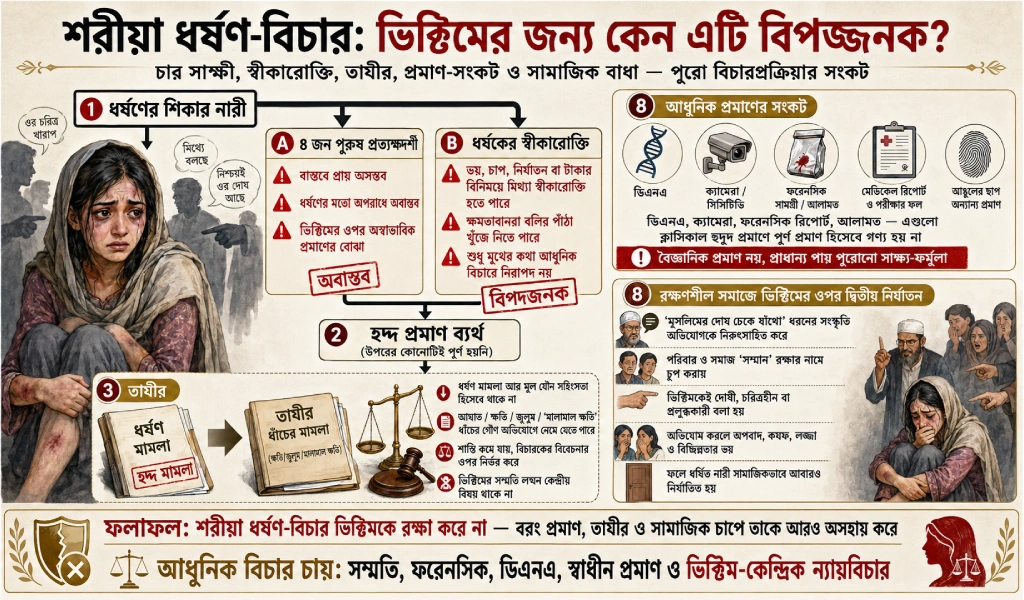
This article will examine every contradiction, loophole and inhumane rule in depth, with evidence from authentic hadith, the Quran and classical tafsir. Its purpose is not sensationalism, but to demonstrate to readers that the adjudication of rape under medieval Sharia law is a complete failure, inhumane, and fundamentally incompatible with modern human rights.
The Modern Definition of Rape
In modern criminology and human rights law, “rape” means forcibly or coercively sexually penetrating a person’s body in disregard of their wishes, consent and bodily autonomy. The victim’s explicit consent is a fundamental condition of any sexual relationship. When that consent is absent—whether because of physical force, deception, abuse of power, blackmail, psychological coercion or the victim’s inability to consent, as in unconsciousness, childhood or disability—the offence is regarded as rape.
According to the World Health Organization (WHO), the international human rights commission and contemporary legal opinion, informed consent—that is, voluntary agreement based on understanding—is central to the definition of rape, because sexual relations concern the highest degree of individual freedom over the human body. If a woman or man does not consent, or lacks the legal and mental capacity to consent, any sexual penetration is therefore considered rape. This principle is central to modern criminal law based on human rights: the lawfulness of sexual relations depends on a person’s free, informed and revocable consent, rather than religious morality, family honour or a woman’s supposed character. It is a framework organised around the victim’s rights, safety, dignity and recognition as a human being. In the following sections, however, we will see that Islamic Sharia’s definition of rape directly conflicts with these fundamental humane principles.
In ordinary language, rape is sexual assault. Sexual intercourse or any other form of sexual penetration with a person without their wishes and permission is called rape. It may involve physical force, other forms of pressure, intimidation, blackmail or abuse of power or authority. Sexual intercourse under any circumstances with someone considered incapable of giving consent—for example, an unconscious person, a person with a physical or intellectual disability, or a minor—also falls within this definition. [3] [4] [5]
The definition of rape outlined above makes clear that two adults may engage in sexual activity entirely of their own free will and with their consent. Everyone has the right to choose a partner according to their own wishes and to pursue romance, love or a sexual relationship with that person. No punitive measures may be taken against them for doing so. Apart from these circumstances, sexual activity without a person’s wishes or consent, through intimidation, the threat of harm, pressure, blackmail or abuse of power or authority, or with an unconscious person, a person with a physical or intellectual disability, or a minor considered incapable of consenting, must be regarded as rape.
Rape in Classical Fiqh: A Coercive Form of Zina Rather Than an Independent Crime
In modern law, rape is an independent form of sexual violence whose central questions are consent, individual freedom and autonomy over one’s body. Classical Islamic fiqh, however, did not construct rape as an independent offence in this way. Jurists generally discussed it as “zina bil-ikrah”, “zina bil-jabr”, “istikrah ‘ala al-zina” or “ightisab”—that is, zina through coercion. This terminology exposes the fundamental problem: the primary category of offence is “zina”, rather than “sexual violence”; coercion is merely a particular circumstance of that zina. When adjudicating rape, the juristic framework therefore asks first whether unlawful sexual intercourse occurred, and only then whether it was voluntary or forced. This construction places the religious lawfulness or unlawfulness of extramarital sexual relations, rather than the victim’s bodily autonomy, at the centre of proceedings. Modern research likewise describes rape in classical Islamic law as a coercive form of zinā. [6]
This position is not confined to one madhhab or an isolated jurist. In the classical discussions of all four schools, rape is ultimately adjudicated through the terminology of zina, coercion, hadd, testimony, confession, mahr and ta’zir. Although punishment, compensation and application differ between schools, the fundamental frame is the same: rape is treated as a coercive form of zina, rather than an independent crime based on consent and autonomy in the modern sense. The classical sources below make this framework clearer.
This frame is also evident in Sahih al-Bukhari’s Book of Coercion. Its chapter heading is: “If a woman is forced to commit illegal sexual intercourse against her will, then no legal punishment is inflicted upon her”—“Idha ustukrihat al-mar’atu ‘ala al-zina, fa-la hadda ‘alayha.” The wording is significant: it does not employ the modern legal formulation that a woman “was raped”, but says that she “was forced into zina”. The account describes Umar declining to punish a slave woman because a male slave had forced unlawful sexual intercourse upon her; yet the offence remains expressed through the terminology of “zina” and “hadd”. [7]
The same fundamental framework appears beyond hadith chapter headings in the classical juristic discussions of all four schools. The Hanafi works Al-Hidayah, Mukhtasar al-Quduri and Bada’i al-Sana’i discuss coercive sexual intercourse under zina and hudud, rather than as an independent offence of “rape”. Their central questions are whether sexual penetration occurred, whether it was voluntary or forced, and whether Sharia-recognised evidence sufficient to impose the hadd has been established. Although they recognise that a coerced woman incurs no hadd, the criminological language of rape remains confined to the zina–coercion framework. The woman is exempted from punishment, but rape is not constructed as an independent offence based on consent and autonomy. [8] [9] [10]
The position is even clearer in Maliki fiqh. Imam Malik’s Al-Muwatta and later Maliki discussions address the hadd and compensation owed by a male rapist and recognise that the coerced woman should not be punished. Here too, however, rape is regarded as a coercive form of zina, rather than an independent offence against an individual’s bodily autonomy in the modern sense. The historical Maliki tendency to treat an unmarried woman’s pregnancy as evidence of zina makes the problem more dangerous: even a woman made pregnant through rape may face pressure to prove herself free of a zina accusation. [11] [12]
The same fundamental framework persists in Shafi’i and Hanbali fiqh. Imam al-Shafi’i’s Al-Umm and al-Nawawi’s Al-Majmu’ address coercive sexual intercourse within discussions of zina, coercion and hudud. Ibn Qudamah’s Al-Mughni similarly discusses trying the rapist as a perpetrator of zina, while exempting the coerced woman from the hadd. None constructs rape as an autonomous sexual offence based on consent in the manner of modern law. In every case, the central terminology remains zina, coercion, hadd, doubt, testimony, confession, mahr and ta’zir. Although the four schools differ on punishment, compensation, proof and judicial application, their basic frame is the same: rape is a coercive subcategory of zina, rather than an independent violation of human rights. [13] [14] [15]
The important conclusion from these sources is that classical fiqh often exempts a raped woman from the hadd for zina, but this is not equivalent to recognising rape as an independent crime. Rather, it demonstrates that Sharia’s criminological thinking evaluates sexual violence through unlawful sexual intercourse, morality, preservation of lineage and social order, rather than the victim’s consent, bodily rights and individual freedom. This is why, in rape proceedings, the formalities of proving zina displace the victim’s human rights. The entire set of problems involving four witnesses, confession, qadhf, pregnancy, ta’zir and the rejection of forensic evidence arises from this starting point.
Here lies classical Sharia’s fundamental limitation. Classical fiqh often exempts a coerced woman from the hadd for zina, but this is not recognition of rape as an independent violation of human rights in the modern sense. It is a juristic means of exempting the victim from the zina punishment. The legal system’s backbone therefore remains a fragmented framework of proving zina, hadd, confession, testimony, qadhf, mahr, ta’zir and hirabah. The woman is initially treated as a potential participant in an “unlawful sexual incident”, rather than as a person who has been attacked, and must subsequently prove that she did not consent. This inverted framework makes rape adjudication revolve around religious morality rather than the victim.
For this reason, despite some apparently humane statements about rape in classical fiqh, its underlying structure is dangerous. The problem concerns the definition of the crime itself, as well as the severity of punishment. In modern law, the question is: “Did the woman consent?” In classical fiqh, it becomes: “Did zina occur, and has the claim of coercion been established through Sharia-recognised evidence?” These questions have entirely different moral and legal consequences. The first sees the victim as a human being; the second places her under the shadow of a zina accusation. From here emerge the terrible problems that follow: four witnesses, confession, the risk of qadhf, pregnancy used as evidence of zina, and the tendency to exclude modern forensic evidence from the hudud framework.
The Evolution of the Definition of Rape and Confusion over Reporting
The definition of rape has never been fixed or immutable throughout history. It has changed alongside societies, legal systems, morality, structures of power and attitudes towards gender. Modern criminology defines rape as sexual penetration of a person’s body against their wishes and without their consent, through force, coercion, abuse of power, deception or exploitation of their inability to consent—for example, because of unconsciousness, childhood or intellectual disability. Against the long history of human civilisation, however, this is a very recent understanding that only became predominant in the twentieth century. For centuries, rape was treated variously as a moral offence, an attack on male “property”, a violation of “female purity”, or a transgression of ethnic and racial boundaries. The evolution of its definition therefore reflects more than changes in legal texts: it mirrors changing views of women’s position and human dignity within society.
Western legal systems provide an example. In 1976, the US state of Nebraska explicitly recognised for the first time that a husband could rape his wife and criminalised marital rape. Previously, prevailing law assumed that a wife had given “consent” once through marriage and thereafter had no separate right to say “no”; her husband’s sexual penetration would not legally constitute rape. By 1993, every US state recognised marital rape as an offence under at least one sexual-offence law, although many still retained special exceptions or limitations for marital rape. Before then, however, rape of a wife by her husband had not been a legally recognised crime in most places. A woman’s bodily autonomy within marriage was thus denied in law, as was a person’s right to withdraw consent whenever they wished.
Similarly, racist anti-miscegenation laws remained in force in many US states into the 1950s, criminalising marriage between white and Black people and, in many cases, their consensual sexual relations. In the South’s racist social and judicial culture, consensual sexual relations between a Black man and a white woman were also frequently described in moral language equating them with rape. The supposed offence was not the absence of consent, but the violation of “racial purity” and a challenge to racial structures of power. The conception of sexual offences has therefore long been controlled by political, social and religious authority, while the consent and autonomy of those involved often remained secondary.
The long shadow of such distorted definitions and victim blaming also extends into Asia. Bangladesh’s law likewise retained this colonial barbarity for many years. The former section 155(4) of the Evidence Act, 1872 allowed a man accused of rape or attempted rape to show that the complainant “was of generally immoral character”. This provision is quoted verbatim on page 674 of the book on evidence law edited by Siddiqur Rahman Mia—
When a man is prosecuted for rape or an attempt to ravish, it may be shown that the prosecutrix was of generally immoral character.
This notion is appallingly misogynistic because it places the burden of proving her character on the victim herself. It implies that, if a woman is “immoral”, the violence committed against her ceases to be violence: she becomes a “deserving victim” who has no right to protection! In no modern, humane legal system can a victim’s moral standing—whether she is a sex worker, has another relationship, or changes partners frequently—be relevant to rape. The sole fundamental condition of sexual relations is consent. A sex worker may voluntarily have sex with ten clients a day, but if she explicitly says “no” to even one and he nevertheless forces her, that is unquestionably rape. Section 155(4) was repealed through the Evidence (Amendment) Act, 2022, demonstrating how inhumane the old law was. The problem has not entirely disappeared, however: the current law still permits questions about the victim’s character or previous sexual behaviour with the court’s permission. The colonial framework of victim blaming has therefore been partly removed from the wording of the law, but has not been completely erased from judicial culture.
By contrast, enormous pressure from human rights movements, feminist politics and legal reform worldwide has gradually established a comparatively progressive definition centred on the victim. In the definitions used by the United Nations, the World Health Organization (WHO), Interpol and the International Criminal Court (ICC), consent is the central determinant of rape. Without consent, any sexual relationship is an offence, whether within marriage or outside it, across racial boundaries or within them; the woman’s “character” is entirely irrelevant.
In Islamic Sharia, however, “rape” did not develop as a distinct and independent crime. Instead, it became a subcategory of the moral offence called “zina”. The question concerns whether “extramarital sexual relations” occurred, rather than the victim’s rights. Many Islamic scholars hold that the definition confined to juristic books in the context of seventh-century Arabian society will remain unchanged until the Day of Judgment: in their view, “reforming” Quran- and hadith-supported juristic rulings through human decisions contradicts faith. Consequently, while modern legal systems define rape from the victim’s perspective and on the basis of consent, Islamic Sharia’s definition remains primarily that of a moral offence in which the victim herself risks becoming the accused.
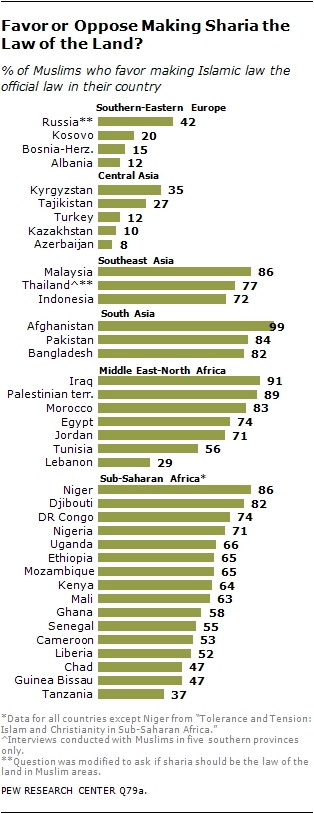
PEW Research Center surveys show that large proportions of ordinary Muslims in many Muslim-majority countries want Sharia implemented as the state’s official law. Yet substantial numbers do not know how complex and hostile to victims rape proceedings can become within classical Sharia’s frameworks of zina, hudud, qadhf, testimony and ta’zir, or what inhumane obstacles and risks women actually face under these laws. [16].
While the definition of rape has evolved worldwide in line with modern concepts of human rights and individual freedom, in Islam it has remained unchanged for centuries. This has produced a fundamental conflict between modern justice systems and Islamic Sharia—a conflict whose principal cost is borne by raped women, children and marginalised people.
Another major problem in religiously conservative societies is their belief that the laws Allah and his Messenger laid down in seventh-century Arabia are final and immutable. In their view, “updating” these laws, “reforming” them to suit new social realities, or adapting them to new moral standards amounts to distortion or “bid’ah”. Changing Allah’s law is, moreover, outright disbelief. Defining rape as a modern human rights offence from a rational perspective grounded in consent therefore amounts to heresy in their eyes. This blind adherence to doctrine creates an environment in which many forms of sexual violence are not even considered rape under religious interpretation: marital rape, abuse of power, sexual abuse of children, forced sexual relations with female captives, or sexual exploitation under religiously sanctioned slavery are not classified by this theology as “rape”.
Consequently, in conservative countries controlled by religious fanatics, actual rape is not less frequent; rather, fewer cases are recorded on paper. Fear of religious punishment, social narrow-mindedness, false notions of chastity and honour, family prestige and a culture that turns the victim into the offender all make women afraid to complain. In most cases, the raped woman herself is accused of “bad character”, “unchastity”, “inappropriate clothing”, or “trying to seduce men”. Even her family may refuse to take her to the police for fear of social disgrace. Statistics in conservative countries therefore never reveal the actual reality.
By contrast, in Western countries—where states have built their laws around human rights and individual freedom—women are comparatively freer, more confident and better able to complain to the police. If sexual harassment or assault occurs on public transport, at work or in educational institutions, they report it. Fear of society does not stop them. Society protects victims rather than blaming them. Although recorded numbers may consequently appear higher, this does not in itself establish whether crime is more or less prevalent; rather, it demonstrates a stronger reporting system.
Religious fanatics deliberately ignore this distinction. They circulate the claim that “rape is supposedly more common in the West”, whereas the reality is:
The claim that rape occurs less frequently in conservative religious societies is not statistically sound; rather, severe underreporting is normal in conservative societies because of social stigma, fear of religious punishment, family honour, distrust of the police and a culture of victim blaming. Through this false comparison, they attempt to impose further control over women, particularly their clothing, movements, freedom and presence in public. It is as though the woman, rather than the offending man, were the root of the problem, and controlling her would supposedly reduce rape.
It is therefore entirely wrong to compare rape statistics across these societies without considering definitions, reporting mechanisms, social stigma, the state’s role and the influence of religious rules. Societies cannot be measured on one scale when their legal systems, social pressures, reporting processes, notions of shame and human rights frameworks differ. Looking only at the numbers and declaring “rape is less common in religious societies and more common in the West” is deliberately misleading, distorts information and serves political purposes; it has no scientific basis.
Conservative Social Conceptions of Women
Criminology, psychology and feminist theory largely agree that rape concerns “satisfying sexual desire” far less than the display of power, the assertion of dominance and the imposition of entitlement. A patriarchal mentality operates here: “I am a man, so I am powerful; a woman’s wishes are secondary to my body, my desires and my will.” Imagining women primarily as servants and objects created to provide men with “satisfaction and comfort”, rather than as human beings, is one of rape’s principal and fundamental roots.
The most important context for rape therefore extends beyond individual morality to social and religious conceptions of women. When society continually portrays half its population—women—as “commodities”, “helpless”, “incapable”, “weak”, “dependent”, “devious”, “incomplete”, “subordinate” and, above all, “less than human”, it creates an environment in which sexual violence becomes normalised. The image of women presented in classical Islamic educational material in Muslim societies is deeply degrading and disrespectful. Viewed impartially, these religious and social conceptions provide an important psychological foundation for morally justifying crimes such as rape, or at least regarding them as normal.
When a child is taught from a very early age that “women were created to relieve men’s loneliness”, “a wife is a source of her husband’s pleasure”, and “women are men’s entertainment, farmland and reproductive machinery”, these do not remain mere religious statements; they gradually form a deep psychological structure. In his eyes, a woman becomes a toy—a field to be “cultivated” however he pleases, a body whose principal “function” is to produce children and ensure men’s sexual satisfaction. He does not naturally learn to befriend her, see her as a playmate, or imagine her as an equal partner.
Society thus establishes that women’s place is inside the home, in the inner quarters, kitchen and bed, while men’s place is in the outside world, on the streets, in offices and at the centres of power. Men are taught that they may “beat”, “discipline” and “control” their wives; women must cover their bodies, lower their heads and display “modesty” at all times. Teaching generation after generation that women must always be kept under control becomes more than a social practice: it turns into tacit approval of sexual violence. Someone taught from childhood that “you are naturally above women; you are their protector and predator; they are objects of consumption, so you are superior” will exercise that supposed superiority in various ways as an adult.
A girl has the right to choose her own life, wear the clothes she wishes and form a relationship with the person she chooses. Conservative religious and social attitudes, however, do not recognise these rights. If a woman wears shorts or clothing that reveals her physical beauty, many religiously fanatical men automatically assume: “This girl must be immoral or a whore.” They consequently treat her right to say “no” as invalid in their minds.
Such men are taught that “women dress up primarily to attract men”, and “if she wears revealing clothes, she must want someone to approach her”. This creates a sense of sexual entitlement: he begins to think, “I can have her if I want; she ought to respond to my advances.” When she rejects him, he does not perceive a simple “no”, but an injury to his masculinity.
From childhood, he has been taught: “You are a man, so you are superior; having a penis makes you powerful.” When this irrational pride and sense of male superiority combine with a wounded ego, he uses a woman’s body to prove his “manhood”. Rape becomes more than “sexual gratification”: it becomes “proving himself” and “showing her” how completely he can dominate her.
Let us now examine how Islamic teachings frame women. Beyond commonplace social attitudes, the religious texts themselves construct an image of women as subordinate, consumable and dangerous beings. For a detailed discussion, see this article. [17] [18] [19] [20] [21] [22] [23]
Arabic (2:223): نِسَآؤُكُمْ حَرْثٌ لَّكُمْ فَأْتُوا۟ حَرْثَكُمْ أَنَّىٰ شِئْتُمْ ۖ وَقَدِّمُوا۟ لِأَنفُسِكُمْ ۚ وَٱتَّقُوا۟ ٱللَّهَ وَٱعْلَمُوٓا۟ أَنَّكُم مُّلَـٰقُوهُ ۗ وَبَشِّرِ ٱلْمُؤْمِنِينَ — Your wives are like farmland for you, so approach them ˹consensually˺ as you please. And send forth something good for yourselves. Be mindful of Allah, and know that you will meet Him. And give good news to the believers. — Dr. Mustafa Khattab, The Clear Quran (Bengali source: Taisirul Quran)
Your wives are a place of cultivation [i.e., sowing of seed] for you, so come to your place of cultivation however you wish and put forth [righteousness] for yourselves. And fear Allāh and know that you will meet Him. And give good tidings to the believers. — Saheeh International (Bengali source: Sheikh Mujibur Rahman)
Your women are a tilth for you (to cultivate) so go to your tilth as ye will, and send (good deeds) before you for your souls, and fear Allah, and know that ye will (one day) meet Him. Give glad tidings to believers, (O Muhammad). — Marmaduke Pickthall (Bengali source: Rawai Al-bayan)
Your wives are as a tilth unto you; so approach your tilth when or how ye will; but do some good act for your souls beforehand; and fear Allah. And know that ye are to meet Him (in the Hereafter), and give (these) good tidings to those who believe. — Abdullah Yusuf Ali (Bengali source: Dr. Abu Bakr Muhammad Zakaria)
[ Surah al-Baqarah, verse 223 ]
Arabic (7:189): ۞ هُوَ ٱلَّذِى خَلَقَكُم مِّن نَّفْسٍ وَٰحِدَةٍ وَجَعَلَ مِنْهَا زَوْجَهَا لِيَسْكُنَ إِلَيْهَا ۖ فَلَمَّا تَغَشَّىٰهَا حَمَلَتْ حَمْلًا خَفِيفًا فَمَرَّتْ بِهِۦ ۖ فَلَمَّآ أَثْقَلَت دَّعَوَا ٱللَّهَ رَبَّهُمَا لَئِنْ ءَاتَيْتَنَا صَـٰلِحًا لَّنَكُونَنَّ مِنَ ٱلشَّـٰكِرِينَ — He is the One Who created you from a single soul, then from it made its spouse so he may find comfort in her. After he had been united with her, she carried a light burden that developed gradually. When it grew heavy, they prayed to Allah, their Lord, “If you grant us good offspring, we will certainly be grateful.” — Dr. Mustafa Khattab, The Clear Quran (Bengali source: Taisirul Quran)
It is He who created you from one soul and created from it its mate that he might dwell in security with her. And when he [i.e., man] covers her, she carries a light burden [i.e., a pregnancy] and continues therein. And when it becomes heavy, they both invoke Allāh, their Lord, “If You should give us a good [child], we will surely be among the grateful.” — Saheeh International (Bengali source: Sheikh Mujibur Rahman)
He it is Who did create you from a single soul, and therefrom did make his mate that he might take rest in her. And when he covered her she bore a light burden, and she passed (unnoticed) with it, but when it became heavy they cried unto Allah, their Lord, saying: If thou givest unto us aright we shall be of the thankful. — Marmaduke Pickthall (Bengali source: Rawai Al-bayan)
It is He Who created you from a single person, and made his mate of like nature, in order that he might dwell with her (in love). When they are united, she bears a light burden and carries it about (unnoticed). When she grows heavy, they both pray to Allah their Lord, (saying): “If Thou givest us a goodly child, we vow we shall (ever) be grateful.” — Abdullah Yusuf Ali (Bengali source: Dr. Abu Bakr Muhammad Zakaria)
[ Surah 7, verse 189 ]
Sahih Muslim (Islamic Foundation)
Book: 18 / Suckling
Section: 9. Advice concerning women
3512. Muhammad ibn Abd Allah ibn Numayr al-Hamdani (may Allah have mercy on him) … ‘Abdullah b. Amr reported Allah’s Messenger (ﷺ) as saying: The whole world is a provision, and the best object of benefit of the world is the pious woman.
Hadith grade: Sahih
Sahih Muslim (Islamic Foundation)
Book: 18 / Suckling
Section: 9. Advice concerning women
3513. Harmalah ibn Yahya (may Allah have mercy on him) … Abu Huraira (Allah be pleased with him) reported: Allah’s Messenger (ﷺ) said: Woman is like a rib. When you attempt to straighten it, you would break it. And if you leave her alone you would benefit by her, and crookedness will remain in her.
Zuhayr ibn Harb and Abd ibn Humayd (may Allah have mercy on them) … through al-Zuhri’s nephew from his uncle, Ibn Shihab, reported exactly the same narration through a similar chain.
Hadith grade: Sahih
Sunan Ibn Majah
Book: 30 / Tribulations
Publisher: Tawhid Publication
Section: 30/19. The tribulation of women
1/3998. It was narrated from Usamah bin Zaid that the Messenger of Allah (ﷺ) said: “I am not leaving behind me any tribulation that is more harmful to men than women.”
Sahih al-Bukhari 5096, Muslim 2840, 2841, al-Tirmidhi 2880, Ahmad 21239, 21322, al-Sahihah 2701. Al-Albani’s assessment: Sahih.
Hadith grade: Sahih
Sahih al-Bukhari (Islamic Foundation)
Book: 2 / Faith
Section: 21 / Ingratitude to one’s husband
28. Abd Allah ibn Maslamah (may Allah have mercy on him) … Narrated Ibn ‘Abbas: The Prophet (ﷺ) said: “I was shown the Hell-fire and that the majority of its dwellers were women who were ungrateful.” It was asked, “Do they disbelieve in Allah?” (or are they ungrateful to Allah?) He replied, “They are ungrateful to their husbands and are ungrateful for the favors and the good (charitable deeds) done to them. If you have always been good (benevolent) to one of them and then she sees something in you (not of her liking), she will say, ‘I have never received any good from you.”
Hadith grade: Sahih
Are Women’s Clothes—or Women Themselves—to Blame for Rape?
After almost every rape, a familiar kind of “expert” appears: the old uncles at the neighbourhood tea stall, the self-appointed moralists occupying bus seats, or the supposedly respectable commentators on social media. With great confidence, they declare: “The girl is also to blame”, “Her behaviour wasn’t right”, “Why was she out on the streets so late?”, or “She hangs around with boys; why else would she be raped?”—as though a girl’s lifestyle, clothing, social position or presence outside at night made rape a “justified” punishment. In this mentality, the raped woman becomes the real offender rather than the rapist.
From tea-stall benches, bus seats and television studios, they present themselves as “impartial” judges—and receive public applause. Sometimes they say, “Yes, the rapist is guilty, but the girl was also at fault”; sometimes they say, “If she goes out dressed like that, of course men will lose control”—as though a man’s desire to rape were the woman’s responsibility rather than his own. Facebook, YouTube and television talk shows repeat the same victim blaming, wrapped in the language of “culture”, “religion”, “restraint” and “modesty”. By seating rapist and victim on the same bench and declaring “both are guilty”, they make the matter appear balanced while effectively granting the actual perpetrator a social licence.
In reality, a woman is not raped just once: she seems to suffer rape repeatedly, layer upon layer. First, the rapist physically attacks her—a criminal man at whose hands she suffers direct violence. A second stage of symbolic and psychological rape then begins within her own home, through the comments and accusations of parents, relatives and neighbours. When parents blame their daughter directly or by implication—“You didn’t wear a burqa”, “You didn’t keep yourself in check”, “Why did you go outside?”—they place the burden of the crime on her. The girl already violated by the rapist is humiliated and psychologically crushed a second time by her family’s language and attitudes.
If she somehow gathers the courage to go to the police, a third layer of “institutional rape” awaits. Police officers, doctors, investigators and lawyers seem collectively to operate on her body and memories once again. She is interrogated about where the rape occurred, how long it lasted, how many times, in what positions, which parts of her body were touched with hands or mouth, whether she screamed, and how her body reacted. Many questions are posed as though asking: “Didn’t you secretly enjoy being raped?”
If the media learns of the incident, a fourth layer of collective rape begins. Reports are “sexualised” through descriptions such as “all night”, “repeatedly”, “continuously”, “through different routes” and “stripped naked”, and served to readers to arouse sexual fantasies rather than convey the victim’s suffering. Readers then mentally “rape” the girl again as they consume the report. Although physically raped once, she seems to be raped repeatedly and many times over through social and institutional practices. The whole society—family, police, courts and media—thus joins in punishing the victim again, while diminishing and concealing the rapist’s crime.
The fundamental cause of rape is therefore not women’s clothing, but the patriarchal mentality formed under patriarchy and the social structures that nourish it. Consider how we distinguish boys’ and girls’ toys from childhood: guns, cars, planes and robots for boys; pots and pans, Barbie dolls, kitchen sets and beauty accessories for girls. This distribution is not innocent play, but a subtle social message that installs concepts of power and gender roles in children’s minds. Boys are taught to conquer the world, fight, win and lead. Girls are taught to manage the home, cook, bear children, dress up and look beautiful to others.
Growing up this way, a boy develops a seemingly natural mentality of possession: he learns that he holds authority and control, while women are subordinate instruments of service. When this mentality combines with religious interpretations presenting women’s “modesty”, “awrah” and “submission” as God’s commands, rape is no longer regarded as exceptional violence. Instead, it is recast as “punishment for a woman’s transgression”, “a man’s natural reaction”, or a “religiously understandable” event. The rapist then blames the woman’s clothing, movements or lifestyle for his actions, and society legitimises his excuse.
In other words, in our society, rape is not merely the act of an isolated, disturbed individual. It results from a long process of social formation rooted in power and gender inequality, extending from children’s toys to religious narratives. Responsibility therefore lies beyond “a few men”, in the deliberately constructed patriarchal mentality transmitted across generations through family, religion, education and culture.
In Muslim societies, religious texts themselves further reinforce this victim-blaming mentality. The Quran foregrounds women’s clothing as a principal factor in their being harassed, rather than directly focusing on men’s behaviour or mentality. Verse 59 of Surah al-Ahzab [24] states that, if women draw their jilbabs over their bodies, they will be “recognised” and “not harassed”. The underlying logic is that responsibility for being harassed depends on how much of a woman’s body is covered, rather than men’s conduct. No unconditional command is directed at men here—“You must not harass her, whatever she wears.” Instead, the message falls upon women’s bodies, as though insufficient covering made harassment their own fault.
Arabic (33:59): يَـٰٓأَيُّهَا ٱلنَّبِىُّ قُل لِّأَزْوَٰجِكَ وَبَنَاتِكَ وَنِسَآءِ ٱلْمُؤْمِنِينَ يُدْنِينَ عَلَيْهِنَّ مِن جَلَـٰبِيبِهِنَّ ۚ ذَٰلِكَ أَدْنَىٰٓ أَن يُعْرَفْنَ فَلَا يُؤْذَيْنَ ۗ وَكَانَ ٱللَّهُ غَفُورًا رَّحِيمًا — O Prophet! Ask your wives, daughters, and believing women to draw their cloaks over their bodies. In this way it is more likely that they will be recognized ˹as virtuous˺ and not be harassed. And Allah is All-Forgiving, Most Merciful.
— Dr. Mustafa Khattab, The Clear Quran (Bengali source: Taisirul Quran)
O Prophet, tell your wives and your daughters and the women of the believers to bring down over themselves [part] of their outer garments. That is more suitable that they will be known and not be abused. And ever is Allāh Forgiving and Merciful.
— Saheeh International (Bengali source: Sheikh Mujibur Rahman)
O Prophet! Tell thy wives and thy daughters and the women of the believers to draw their cloaks close round them (when they go abroad). That will be better, so that they may be recognised and not annoyed. Allah is ever Forgiving, Merciful.
— Marmaduke Pickthall (Bengali source: Rawai Al-bayan)
O Prophet! Tell thy wives and daughters, and the believing women, that they should cast their outer garments over their persons (when abroad): that is most convenient, that they should be known (as such) and not molested. And Allah is Oft-Forgiving, Most Merciful.
— Abdullah Yusuf Ali (Bengali source: Dr. Abu Bakr Muhammad Zakaria)
Such religious narratives send society a terrible message: “The principal cause of harassment is women’s clothing rather than men’s lack of self-control.” Men consequently feel absolved of responsibility, while women feel guilty even for the violence inflicted upon them. This is classic victim blaming: putting the victim’s behaviour and clothing on trial in place of the perpetrator. Unless society escapes these medieval ideas, it will never confront the actual causes of rape and sexual violence—power, patriarchy and gender inequality.
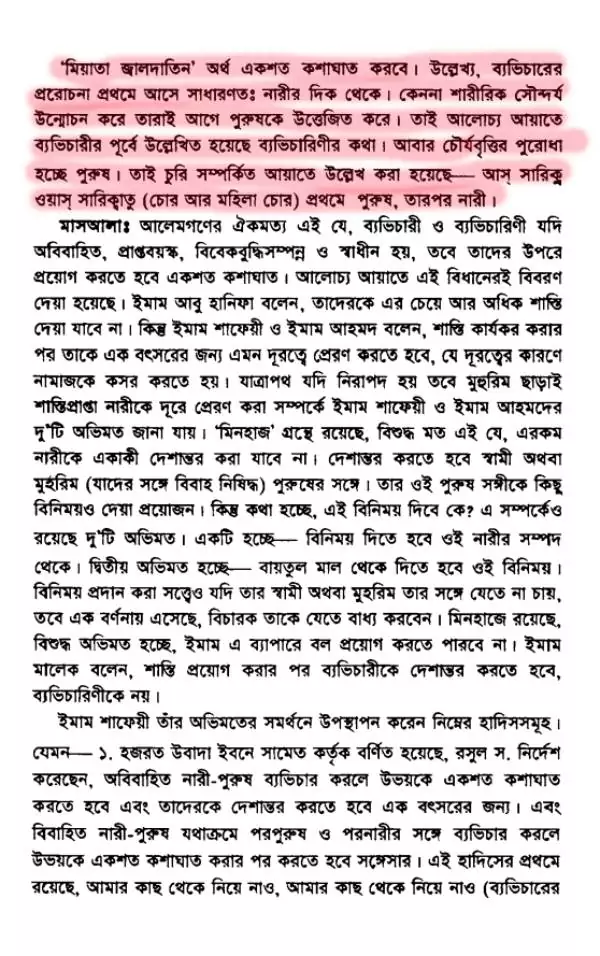
Let us now examine a passage from an important tafsir that more directly blames women as the primary cause of zina and moral deviation [25]—as though men’s desire, lust and violence were entirely innocent, while women’s presence and bodies were themselves “fitnah”.
“Mi’ata jaldatin” means one hundred lashes. It should be noted that the initial inducement to zina generally comes from women, since they are the first to arouse men by revealing their physical beauty. This is why the woman who commits zina is mentioned before the man in the verse under discussion. Men, on the other hand, take the lead in theft. The verse concerning theft therefore mentions “al-sariqu wa-l-sariqatu”—the male thief and the female thief—with the man first and the woman second.
Let us now watch a film excerpt showing how women themselves are blamed for rape in religiously conservative societies:
Punishment for Rape and the Death Penalty: What Does Modern Research Show?
A very common and dangerous myth in our society is that barbaric and harsh punishments reduce crime. Especially for sexual crimes such as rape, many believe that execution, beheading or public hanging will frighten offenders and reduce rape. Modern criminology, sociology and statistics, however, have all firmly demonstrated that this idea is entirely wrong. In practice, countries with extremely harsh punishments—particularly violent punishments sanctioned by the state—do not experience a consistently declining crime rate; in many cases, crime becomes more organised, more brutal and more hidden.
Extensive research on crime prevention consistently shows that the certainty of being caught and punished is a much more effective deterrent than the severity of punishment. Reliable research has not established the claim that capital punishment produces an additional deterrent effect compared with other punishments. Instead, when states themselves use violence, its social acceptability increases and offenders begin taking risks in more unpredictable ways [26] [27]. Extensive research by the US National Academy of Sciences likewise shows that claims about the death penalty’s “deterrence effect” are scientifically unfounded [28]. Meanwhile, in many developed countries, such as the Netherlands and the Nordic countries, where capital punishment has been abolished and prison systems made more humane, crime rates have fallen so far that some prisons have had to close [29] [30].
These examples clearly show that the brutality of a justice system does not reduce crime; certainty of justice, social equality, good education and protection of victims do. In rape cases, the death penalty’s effects are even more dangerous and complex. A rapist generally does not think about punishment while committing the crime; he assumes he may escape detection. If rape carries an automatic death sentence, however, the perpetrator’s calculations change completely. Several international studies have found a brutal psychological response to the threat of severe punishment: rapists try to conceal the evidence by killing their victims. The victim becomes “potential evidence” in the perpetrator’s eyes. Fearing that she will testify if she survives, he may wish to kill her immediately after the rape.
Criminologists explain that the first instinct after committing a crime is to “destroy the evidence”. If the law itself makes the existence of evidence a threat to the perpetrator’s life, this instinct becomes more intense and terrible. In practice, therefore, where rape is punishable by death, victims’ chances of survival also decline significantly.
Research reports contain countless examples from Saudi Arabia, Iran, Pakistan, Afghanistan and even various Indian states of rapists killing victims in “subconscious terror” after harsh penalties were introduced. Psychological observations indicate that fear of punishment disrupts the rapist’s cognitive function: terror and panic force him towards an immediately violent decision. A woman he might previously have released after the rape can consequently no longer reach court alive. It thus becomes clear that, rather than reducing rape, the death penalty reduces victims’ chances of survival. Killing the victim complicates investigation, destroys evidence, deprives families of justice and increases insecurity in society.
The unanimous view of criminologists and sociologists is that the death penalty does not prevent rape; rather, it damages the judicial process and increases the risk that victims will be killed. Effective prevention requires ensuring victims’ safety, prompt trials, strong investigative structures, wider sex education, greater freedom for women, and a policy of zero tolerance towards social and psychological violence.
Barbarity never produces justice; it increases violence. Capital punishment is therefore no effective solution to preventing rape.
Forms of Rape Made Halal under Islam’s Divine Law
Modern criminology and law based on human rights define rape very clearly: sexual penetration of any person’s body against their wishes and without their consent, whether within marriage, outside it, or within “slavery” or another structure of power. Examining Islamic rules with this definition in mind reveals several kinds of sexual conduct that plainly constitute rape under the modern definition, yet are legitimised in Islamic fiqh as “halal”, “permissible” or “the husband’s/master’s right”.
If readers keep the modern definition discussed above in mind while reading the following sections, they will readily see where Islamic Sharia legitimises sexual relations without wishes or consent, and how certain forms of rape receive religious standing under the cover of the word “halal”.
Marital Rape Is Halal in Islam
Modern law calls forced sexual relations with a husband or wife without their explicit consent marital rape. Civilised law based on human rights now recognises that a marriage certificate is no permanent, unlimited “sexual licence”. Even within marriage, every person retains full rights over their own body; neither husband nor wife may compel sexual activity without their partner’s wishes and consent.
In other words, you cannot have sex with your spouse without their wishes and consent. Your partner is no “sexual object” expected to provide pleasure whenever you want it. This concerns mutual agreement rather than a unilateral entitlement. Tiredness, being busy, emotional distress or simply “not being in the mood” are all valid reasons. You may try to persuade your partner through discussion and affection, but dragging them into bed after refusal through pressure, intimidation or fear of religious punishment directly violates human rights.
In December 1993, the United Nations High Commissioner for Human Rights published the “Declaration on the Elimination of Violence Against Women”, which explicitly identifies marital rape as a form of violence against women and a violation of human rights [31]. Subsequent legal changes in various countries likewise made marital rape punishable and placed “consent” at the centre of marital relations [32].
Article Two:
Violence against women shall be understood to encompass, but not be limited to, the following:
(a) Physical, sexual and psychological violence occurring in the family, including battering, sexual abuse of female children in the household, dowry-related violence, marital rape, female genital mutilation and other traditional practices harmful to women, non-spousal violence and violence related to exploitation;
Classical Islamic fiqh, however, does not recognise marital rape as rape at all. It conceives marital sexual relations as the “husband’s right” (haqq) and the wife’s “duty”. Under these rules, constructed on the basis of the Quran and hadith, the wife is framed as obliged to appear whenever her husband calls her to bed; refusal brings not merely an accusation of “disobedience”, but the threat of angels’ curses, displeasure from heaven and punishment in the hereafter.
While modern human rights law recognises that a wife’s “no” means no, Islamic fiqh treats her refusal as an offence or sin in itself. Apart from a few limited exceptions involving illness, menstruation or complete physical incapacity, rejecting her husband’s sexual summons is regarded as equivalent to “disobeying Allah”. Giving religious legitimacy to the husband’s sexual wishes while making the wife’s refusal a religious offence creates a structural sanction for marital rape [33] [34] [35] [36].
Sahih Muslim (Hadith Academy)
Book: 17. Marriage
20. It is unlawful for the wife to refuse to come to her husband’s bed
3433-(122/…) Abu Bakr ibn Abi Shaybah, Abu Kurayb, Abu Sa’id al-Ashajj and Zuhayr ibn Harb (may Allah have mercy on them) … Abu Huraira reported Allah’s Messenger (ﷺ) as saying: When a man invites his wife to his bed and she does not come, and he (the husband) spends the sight being angry with her, the angels curse her until morning. (Islamic Foundation 3406, Islamic Centre 3405)
Hadith grade: Sahih
Sahih Muslim (Hadith Academy)
Book: 17. Marriage
20. It is unlawful for the wife to refuse to come to her husband’s bed
3432-(121/…) Ibn Abi Umar (may Allah have mercy on him) … Abu Huraira reported Allah’s Messenger (ﷺ) as saying: By Him in Whose Hand is my life, when a man calls his wife to his bed, and she does not respond, the One Who is in the heaven is displeased with her until he (her husband) is pleased with her. (Islamic Foundation 3405, Islamic Centre 3404)
Hadith grade: Sahih
Mishkat al-Masabih (Mishkat)
Book: Part 13 / Marriage
3257-(20) Talq b. ‘Ali reported God’s Messenger as saying, “When a man calls his wife to satisfy his desire she must go to him even if she is occupied at the oven.” Tirmidhi transmitted it.(1)
Hadith grade in the Bengali edition: Sahih
Sunan Ibn Majah
Publisher: Tawhid Publication
Book: 9 / Marriage
2/1853. It was narrated that: Abdullah bin Abu Awfa said “When Muadh bin Jabal came from Sham, he prostrated to the Prophet who said: ‘What is this, O Muadh?’ He said: ‘I went to Sham and saw them prostrating to their bishops and patricians and I wanted to do that for you.’ The messenger of Allah said: ‘Do not do that. If I were to command anyone to prostrate to anyone other than Allah, I would have commanded women to prostrate to their husbands. By the One in Whose Hand is the soul of Muhammad! No woman can fulfill her duty towards Allah until she fulfills her duty towards her husband. If he asks her (for intimacy) even if she is on her camel saddle, she should not refuse.’ ”
Hadith grade: Hasan
It was narrated that: Abdullah bin Abu Awfa said “When Muadh bin Jabal came from Sham, he prostrated to the Prophet who said: ‘What is this, O Muadh?’ He said: ‘I went to Sham and saw them prostrating to their bishops and patricians and I wanted to do that for you.’ The messenger of Allah said: ‘Do not do that. If I were to command anyone to prostrate to anyone other than Allah, I would have commanded women to prostrate to their husbands. By the One in Whose Hand is the soul of Muhammad! No woman can fulfill her duty towards Allah until she fulfills her duty towards her husband. If he asks her (for intimacy) even if she is on her camel saddle, she should not refuse.’ ”
Taken together, these hadith convey a stern message: satisfying the husband’s sexual demands is the wife’s religious duty, and refusal brings angels’ curses, displeasure from heaven and disobedience to Allah upon her. Her emotional state, physical exhaustion, pain, trauma or simply “not wanting to” for no particular reason consequently receives no real importance under Islamic Sharia. In practice, this is the religious framework that makes marital rape “halal”: even if a husband compels intercourse through pressure, intimidation and threats of religious punishment, fiqh stands with him rather than his wife [37].
Let us now examine statements by several contemporary scholars who explicitly repeat these juristic concepts—and demonstrate that, in Islam’s eyes, marital rape is no crime at all, but “the husband’s right”.
The relationship between marital rape and economic dependence also becomes clear here. Islam designates men as family providers and earners; earning an income is not a religious obligation for women. Instead, confinement to housekeeping, childrearing and domestic work is presented as the ideal model of a woman’s life. Consequently, many Islamist families regard girls’ higher education, professional skills and economic independence as “unnecessary luxuries” or “waste”. Using the logic that “a girl will ultimately go to someone else’s home”, many parents deliberately raise her in economic incapacity.
If she experiences marital rape, she then lacks the practical power to resist, leave her husband and live independently, or take legal action. The man is both her husband and her sole financial support. The Islamic social structure raises her from the outset as a kind of “dependent parasite”, denying her ground to stand on and preventing her from learning to imagine an existence without her husband.
Islamists proudly proclaim: “Look how much honour Islam gives women: they are not obliged to work; they can put their feet up and be fed, while their husbands take all responsibility!” Yet the long-term trap concealed behind this claim is enslavement through lifelong dependence. When a woman is deprived of educational, economic and social power, her right to say “no” effectively becomes a right on paper alone. Pressure from her husband, family and society, combined with fear of religious punishment, keeps her silent even about marital rape.
Arguments such as “women need not work”, “the husband will earn” and “the wife will live comfortably at home” form a far-reaching design that prevents women from becoming self-reliant people capable of independent decisions. Until they have economic freedom, they cannot achieve real freedom over their bodies, opinions and sexual consent. [38] [39]
Marriage to and Rape of Young Girls Are Legal in Islam
A fundamental principle has been established in modern legal systems worldwide: “consent” does not apply to sexual relations with an underage child, because a child lacks the mental and intellectual capacity to give informed consent to such a complex matter. Thus, sexual activity with an underage girl, whether ostensibly consensual or non-consensual, is prohibited and punishable throughout the civilised world. This is now an international standard for children’s rights, human rights and the prevention of violence against children.
Classical Islamic fiqh takes the opposite position. Islam legitimises both marriage to underage girls and marital intercourse with them, directly invoking Muhammad’s marriage to Aisha and its consummation. This declaration of “permissibility” goes beyond a personal incident and becomes a legal principle: a father may marry off his underage virgin daughter, and the husband may have intercourse with her. What modern law plainly regards as child rape becomes lawful in Islamic law under the names “marriage” and “the husband’s right”. For a detailed discussion, see this article [40] [41].
Sahih Muslim (Hadith Academy)
Book: 17. Marriage
Section: 10. It is permissible for a father to arrange the marriage of a young virgin
3370-(69/1422) Abu Kurayb Muhammad ibn al-‘Ala’ and Abu Bakr ibn Abi Shaybah (may Allah have mercy on them) … ‘A’isha (Allah be pleased with her) reported: Allah’s Messenger (ﷺ) married me when I was six years old, and I was admitted to his house at the age of nine. She further said: We went to Medina and I had an attack of fever for a month, and my hair had come down to the earlobes. Umm Ruman (my mother) came to me and I was at that time on a swing along with my playmates. She called me loudly and I went to her and I did not know what she had wanted of me.
She took hold of my hand and took me to the door, and I was saying: Ha, ha (as if I was gasping), until the agitation of my heart was over. She took me to a house, where had gathered the women of the Ansar. They all blessed me and wished me good luck and said: May you have share in good. She (my mother) entrusted me to them. They washed my head and embellished me and nothing frightened me. Allah’s Messenger (, may peace be upon him) came there in the morning, and I was entrusted to him. (Islamic Foundation 3344, Islamic Centre 3343)
Hadith grade: Sahih
Narrator: Aisha (may Allah be pleased with her)
Raping Female Captives Is Halal in Islam
All modern international law—particularly the Geneva Conventions and human rights instruments—unequivocally declares the rape of female captives or women in occupied territories a war crime. Slavery and the distribution of captured women as “war booty” are explicitly prohibited and criminalised in today’s civilised world. Under Islamic Sharia, however, slavery is not merely lawful but “Allah’s divine ordinance”, and the “right to sexually enjoy” female captives remains lawful until the Day of Judgment in the pages of fiqh [42].
The Quran and authentic hadith legitimise sexual relations with female captives through the concept of “owned slave women” (ما ملكت أيمانكم). The woman’s consent does not enter the question: a woman placed in a Muslim soldier’s hands as war booty is no longer a free human being, and sexual rights over her have been established. She cannot protest, say “no”, or dissolve the marriage and leave. In modern legal language, all of this plainly constitutes the sanction of systematic rape. [43] [44] [45].
Sahih al-Bukhari (Islamic Foundation)
Book: 51 / Military Expeditions
Section: 2196. The expedition against Banu al-Mustaliq, a branch of Khuza’ah, also called the expedition of al-Muraysi’. Ibn Ishaq places it in 6 AH; Musa ibn Uqbah in 4 AH. Nu’man ibn Rashid narrated from al-Zuhri that the incident of al-Ifk occurred during the expedition of al-Muraysi’.
3832. Qutaybah ibn Sa’id (may Allah have mercy on him) … Narrated Ibn Muhairiz: I entered the Mosque and saw Abu Sa`id Al-Khudri and sat beside him and asked him about Al-Azl (i.e. coitus interruptus). Abu Sa`id said, “We went out with Allah’s Messenger (ﷺ) for the Ghazwa of Banu Al-Mustaliq and we received captives from among the Arab captives and we desired women and celibacy became hard on us and we loved to do coitus interruptus. So when we intended to do coitus interrupt us, we said, ‘How can we do coitus interruptus before asking Allah’s Messenger (ﷺ) who is present among us?” We asked (him) about it and he said, ‘It is better for you not to do so, for if any soul (till the Day of Resurrection) is predestined to exist, it will exist.”
Hadith grade: Sahih
Narrator: Abd Allah ibn Muhayriz (may Allah have mercy on him)
Sahih al-Bukhari (Tawhid)
Book: 97 / Tawhid
Section: 97/18. Allah’s statement: “He is Allah, the Creator, the Inventor of all things, the Bestower of forms…” (Surah al-Hashr 59:24)
7409. Narrated Abu Sa`id Al-Khudri: That during the battle with Bani Al-Mustaliq they (Muslims) captured some females and intended to have sexual relation with them without impregnating them. So they asked the Prophet (ﷺ) about coitus interrupt us. The Prophet (ﷺ) said, “It is better that you should not do it, for Allah has written whom He is going to create till the Day of Resurrection.” Qaza’a said, “I heard Abu Sa`id saying that the Prophet (ﷺ) said, ‘No soul is ordained to be created but Allah will create it.” (2229) (Adhunik Prakashani 6993, Islamic Foundation 6905)
Hadith grade: Sahih
The Prevalence of Rape of Young Boys in Madrasas
We often encounter reports in newspapers, online and on social media of a young boy raped in a madrasa, or a “huzur”, “teacher” or “mullah” summoning a child to his room and doing whatever he wishes. Such incidents seem to fill the daily news. Many children are sexually abused through promises of higher marks, the pretext of Quran lessons, or threats of beatings and religious punishment. What, however, does Islamic Sharia actually say about controlling, preventing or punishing these incidents?
In classical fiqh, various scholars prescribe brutal punishments for same-sex sexual acts or anal intercourse, including “killing”, “stoning” and “throwing from a high place”. The hadith cited above explicitly states: “If you find anyone doing as Lot’s people did, kill the one who does it, and the one to whom it is done” [46]. Although classical fiqh does not apply hudud punishments to underage children, sweeping hadith of this kind calling for “both to be killed” are socially and psychologically misused. Influential offending teachers in madrasas use the spectre of religious punishment and fear of “sin” to silence children who do not understand. The child experiences sexual abuse while losing the courage to complain through legal and religious terror.
The child is told: “If you tell anyone, you too are sinful and will face terrible punishment.” Fear consequently silences him. In practice, a hadith-based outlook that declares the adult male offender—an influential teacher or religious figure—and the helpless child equally guilty doubles the abuse of the child victim: he is sexually abused and cannot complain for fear of religious punishment. By invoking Islamic rules, “Allah’s wrath” and “killing”, the very people raping children use religion to conceal their crimes.
Sunan Abi Dawud (Islamic Foundation)
Book: 33 / Prescribed Punishments
4403. Abd Allah ibn Muhammad (may Allah have mercy on him) … Narrated Abdullah ibn Abbas: The Prophet (ﷺ) said: If you find anyone doing as Lot’s people did, kill the one who does it, and the one to whom it is done.
Hadith grade: Hasan
What Is Zina in Islam?
Derived from the Arabic زِنَاء / زِنًى, zina in Islamic Sharia means sexual intercourse between a man and a woman over whom he has no lawful ownership—a woman who is neither his wife nor an owned slave woman (ma malakat aymanukum). In classical fiqh, sexual relations with any woman other than one’s wife or slave woman therefore constitute zina, whether within a romantic relationship, with the full consent of both parties, or through forcible rape. The central issue is “legal ownership”; the woman’s consent, wishes and human autonomy have no importance. Let us examine the definition of zina in the terminology of Islamic Sharia. [47]
Section: Which Intercourse Makes the Hadd Obligatory, and Which Does Not?
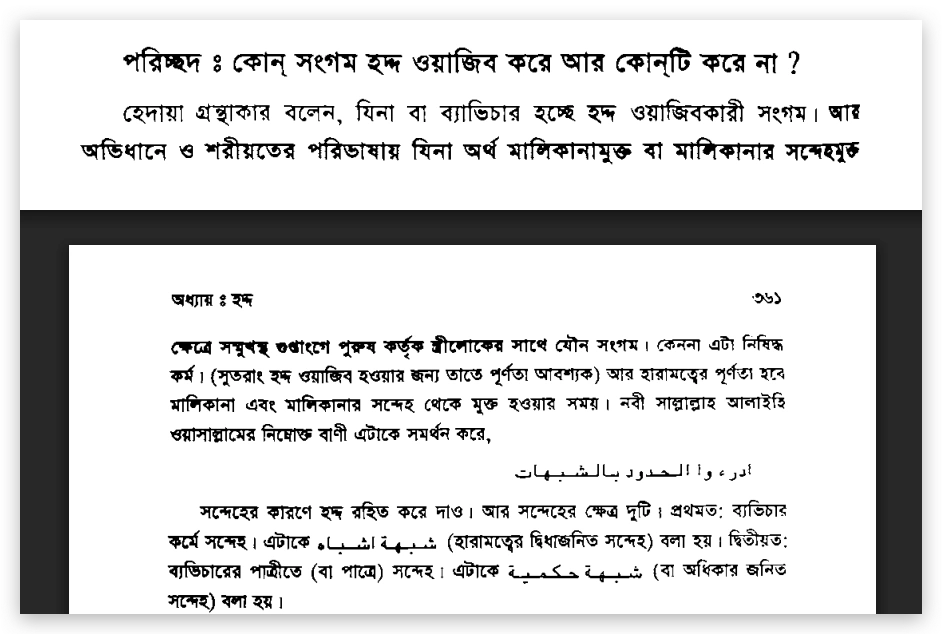
The author of Al-Hidayah states: Zina, or unlawful intercourse, is intercourse that makes the hadd obligatory. In both ordinary language and Sharia terminology, zina means a man’s sexual intercourse with a woman in her front private part where neither ownership nor a doubt of ownership exists, because this is a prohibited act. Complete prohibition is therefore necessary for the hadd to become obligatory, and prohibition is complete when ownership and doubt of ownership are absent. The following statement of the Prophet (peace and blessings be upon him) supports this:
أدرء وا الحدود بالشبهات
Ward off hudud because of doubts. Doubt has two forms: first, doubt concerning the act of zina, called شبهة اشياء (doubt arising from uncertainty about prohibition); second, doubt concerning the person with whom zina is committed, called شبهة حكمية (doubt concerning legal entitlement).
Hadith do not confine zina to physical intercourse; the concept extends to the eyes, tongue and mind. Looking lustfully at a forbidden woman or man is called “zina of the eyes”, obscene speech or gestures “zina of the tongue”, and actual intercourse through the private parts is described as its consummation. No part of the body is excluded from this definition of moral wrongdoing [48].
Sahih al-Bukhari (Islamic Foundation)
70 / Divine Decree
Section: 2742. Allah’s statement: “And a ban is laid on every town which We have destroyed that they shall not return.” (21:95). Allah’s statement: ” … None of your people will believe, except those who have believed, already …” (11:36). Allah’s statement: ” … And they will beget none but wicked disbelievers.” (71:27). Mansur ibn Nu’man … Ibn Abbas reportedly explained that حرم means “obligatory” in the Abyssinian language.
Islamic Foundation number: 6159; international number: 6612
6159. Mahmud ibn Ghaylan (may Allah have mercy on him) … Narrated Ibn `Abbas: I did not see anything so resembling minor sins as what Abu Huraira said from the Prophet, who said, “Allah has written for the son of Adam his inevitable share of adultery whether he is aware of it or not: The adultery of the eye is the looking (at something which is sinful to look at), and the adultery of the tongue is to utter (what it is unlawful to utter), and the innerself wishes and longs for (adultery) and the private parts turn that into reality or refrain from submitting to the temptation.” Shababah (may Allah have mercy on him) … likewise transmitted it from Abu Hurairah from the Prophet (ﷺ).
Hadith grade: Sahih
Narrator: Abd Allah ibn Abbas (may Allah be pleased with him)
In Islamic doctrine, zina is a major sin—a grave transgression—yet it is also framed as a forgivable offence. The idea is that Allah may forgive it if a person sincerely repents or dies with “correct belief” and faith. Consequently, however severe the punishments described—flogging, stoning (rajm) and so forth—uttering the declaration of faith ultimately takes precedence over all moral offences.
The hadith above explicitly states that someone who dies sincerely affirming “La ilaha illallah” will ultimately enter Paradise even if he steals, commits zina or engages in major sins. Justice for victims and moral accountability are thus displaced by “correct faith” and group identity as the central determinants of one’s fate in the hereafter [49].
Mishkat al-Masabih (Mishkat)
Part 1 / Faith
Section: First Section
26-(25) Abu Dharr said: I came to the Prophet and found him asleep under a white sheet. When I came back to him after he had awakened he said, “If anyone says there is no god but God and dies in that belief, he will enter paradise.” I asked, “Even if he commits fornication and even if he steals?” He replied, “Even if he commits fornication and even if he steals.” I asked, “Even if he commits fornication and even if he steals?” He replied, “Even if he commits fornication and even if he steals.” I asked, “Even if he commits fornication and even if he steals?” He replied, “Even if he commits fornication and even if he steals, in spite of Abu Dharr.” When Abu Dharr told this he said, “Even if Abu Dharr’s pride is humbled.” (Bukhari and Muslim.)(1)
(1) Sahih: al-Bukhari 5827, Muslim 94, Ahmad 21466, Sahih al-Jami’ 5733.
Hadith grade: Sahih
Does the Islamic Definition Include Rape within Zina?
Although Islamic jurisprudence sometimes uses distinct terms for rape, such as ightisab (taking forcibly) or zina bil-jabr (forced zina), it consistently treats it as a subcategory of zina. The basic framework is clear: if a man has sexual relations with a woman other than his wife or owned slave woman, whether “voluntarily” or “forcibly”, juristic language calls it zina. No separate conception of an independent crime called “rape” developed. Some jurists attempted to bring rape under “hirabah”, “highway robbery” or “fasad fi al-ard” when coercion, abduction, weapons, public fear or social terror were involved, but no framework of independent legal protection or humane rights was created for the woman.
On paper, Islam supposedly does not permit forced sex with anyone other than one’s own wife or slave woman. The rapist is said to receive the same hadd punishment as for zina—stoning if married, flogging if unmarried—while the raped woman incurs no punishment. In practice, however, this apparent “severity” conceals an enormous sleight of hand: an impenetrable safety net for the rapist and an almost impossible burden of proof for the victim.
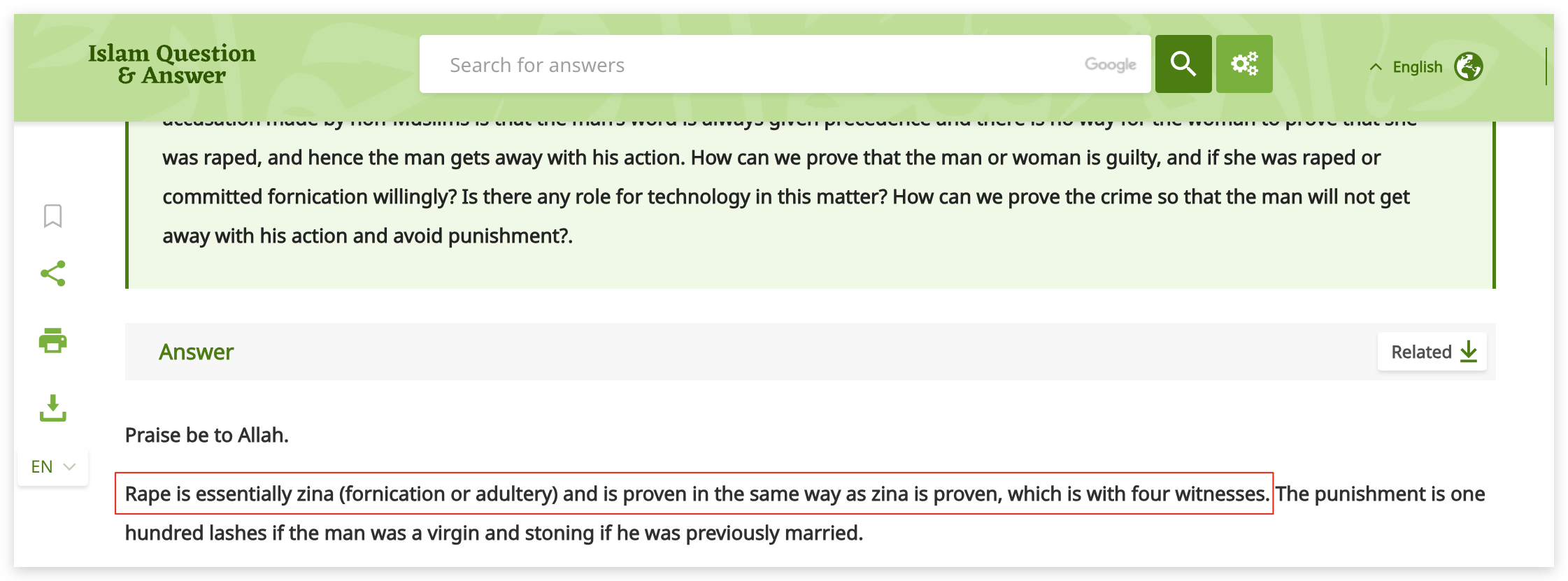
Within Islam’s hudud framework, rape adjudication is not independent of the evidentiary rules for zina; contemporary Islamic fatwas acknowledge this very clearly. IslamQA explicitly defines rape as “ikrah ‘ala al-zina”—compulsion to commit zina—and requires the accused’s confession or four male witnesses to impose the hadd for zina in rape cases without weapons or abduction. IslamWeb states even more directly that “rape is essentially zina, but accompanied by coercion”; witnesses must see the penis enter the vagina, and modern medical examinations, signs of resistance on the body or injuries to the accused cannot replace the evidence required to establish the hadd for zina. Another IslamQA fatwa likewise begins by stating that rape is essentially zina and is proved in the same way—through four witnesses. DNA, semen, medical reports, injuries and other scientific evidence may therefore provide exceptionally strong information about what occurred, yet cannot replace four eyewitnesses in establishing the hadd for zina. The conflict between modern forensic justice and classical Sharia becomes stark: a specific medieval testimonial formula receives legal priority over science’s ability to uncover the truth. [50] [51] [52]
IslamQA: الاغتصاب يراد به: الإكراه على الزنا
That is, “Rape means compulsion to commit zina.”
IslamWeb: فحقيقة الاغتصاب أنه زنى، إلا أنه مقترن بالإكراه
That is, “Rape is essentially zina, but accompanied by coercion.”
The same fatwa states concerning modern medical evidence: وإثبات الاغتصاب بالوسائل الطبية الحديثة … لا يصح—establishing rape as a hadd offence of zina through modern medical methods is not accepted.
Is Rape Zina or Fitnah–Fasad in Islam?
The Quran, Muslims’ holy book, contains no explicit, independent legal term denoting rape; the concept of rape in today’s sense is entirely absent. While it provides rules on theft, zina, drinking, and even detailed provisions concerning inheritance and divorce, its lack of a single direct term for so serious a crime as forced sexual violence against women constitutes a profound silence—a silence paid for by women’s bodies, testimony and safety. Hadith contain only one notable account describing “forced zina”, and later fiqh used that incident to draw rape variously into zina or fitnah–fasad [53].
Most prominent Islamic scholars place rape directly within zina and hold that its hadd punishment applies. According to this view, a married rapist is stoned to death—rajm—while an unmarried rapist receives one hundred lashes and sometimes exile. In the account of a woman subjected to forced zina during Muhammad’s lifetime, she is absolved and the rapist, described as married, is ordered to be stoned; yet the narrative suggests that he was ultimately not actually stoned. There is therefore severe theoretical punishment alongside hesitation and ambiguity in its actual implementation, creating an excuse for “spiritual leniency” in place of criminal justice.
Contemporary researchers have shown that classical fiqh initially framed rape as a crime of sexual morality, within a continuing misogynistic moral outlook. The victim’s rights and physical and psychological trauma are not central; Allah’s rights, society’s moral purity and patriarchal honour take precedence [54].
Some jurists, particularly within the Maliki school, have instead attempted to view rape as the plundering of honour and security, rather than directly calling it “zina”. They argue that it goes beyond a private sexual offence to generate public fear, insecurity and social instability, and can therefore fall under “fitnah–fasad” or “fasad fi al-ard”. Several prominent jurists and scholars—including Muhammad ibn Jarir al-Tabari, Abu Bakr ibn al-Arabi and Egypt’s highest Sharia council—have attempted to classify rape as a crime related to “waging war against Allah and His Messenger” and “spreading corruption on earth”, rather than as a subcategory of zina.
They invoke verse 33 of Surah al-Ma’idah, which describes waging war against Allah and his Messenger and spreading disorder, terrorism, robbery and fear as grave offences, prescribing killing, crucifixion, the amputation of opposite hands and feet, or banishment. Applying this verse to rape theoretically opens the way to severe punishment, but the fundamental problem has two levels:
1) Islam has already defined women as commodities or “objects of enjoyment” [20], so many scholars view rape as the plundering of “property and honour”, akin to looting, robbery or terrorism; once again, the victim as an autonomous person disappears from view.
2) Immediately after the theoretical severe punishments in this passage of Surah al-Ma’idah, the next verse explicitly states that Allah may forgive those who repent before being apprehended [55].
However weightily rape is dressed up as “fitnah–fasad” through juristic reclassification, the Quranic framework ultimately places it among offences forgivable upon repentance. Once again, the offender’s fate in the hereafter and Allah’s pleasure or displeasure occupy centre stage, while earthly justice, rehabilitation and redress for the woman become secondary behind the spiritual excitement of “repentance”.
Arabic (5:33): إِنَّمَا جَزَٰٓؤُا۟ ٱلَّذِينَ يُحَارِبُونَ ٱللَّهَ وَرَسُولَهُۥ وَيَسْعَوْنَ فِى ٱلْأَرْضِ فَسَادًا أَن يُقَتَّلُوٓا۟ أَوْ يُصَلَّبُوٓا۟ أَوْ تُقَطَّعَ أَيْدِيهِمْ وَأَرْجُلُهُم مِّنْ خِلَـٰفٍ أَوْ يُنفَوْا۟ مِنَ ٱلْأَرْضِ ۚ ذَٰلِكَ لَهُمْ خِزْىٌ فِى ٱلدُّنْيَا ۖ وَلَهُمْ فِى ٱلْـَٔاخِرَةِ عَذَابٌ عَظِيمٌ — Indeed, the penalty for those who wage war against Allah and His Messenger and spread mischief in the land is death, crucifixion, cutting off their hands and feet on opposite sides, or exile from the land. This ˹penalty˺ is a disgrace for them in this world, and they will suffer a tremendous punishment in the Hereafter. — Dr. Mustafa Khattab, The Clear Quran (5:33).
The very next verse states in the same context that Allah is forgiving and merciful towards those who repent before being apprehended [56]. Personal repentance thus remains the final recourse even for offences described as fitnah–fasad, terrorism and disorder. In practice, this means that a rapist or armed terrorist who sincerely performs religious rituals and expresses remorse before being caught by the police retains an “open door to forgiveness” in the hereafter. The victim’s continuing life, psychological devastation and social humiliation virtually disappear from this Quranic framework; the main focus is whether the offender has repaired his relationship with Allah.
Whether rape is classified as zina or fitnah–fasad, the structure of Islamic law therefore creates an ideological basis for treating the perpetrator leniently by opening a spiritual path of “repentance and forgiveness”, rather than standing with the raped woman. From the perspective of modern criminal philosophy based on human rights, this is a medieval religious framework providing rapists spiritual and legal protection, rather than a system of justice against rape.
Arabic (5:34): إِلَّا ٱلَّذِينَ تَابُوا۟ مِن قَبْلِ أَن تَقْدِرُوا۟ عَلَيْهِمْ ۖ فَٱعْلَمُوٓا۟ أَنَّ ٱللَّهَ غَفُورٌ رَّحِيمٌ — As for those who repent before you seize them, then know that Allah is All-Forgiving, Most Merciful. — Dr. Mustafa Khattab, The Clear Quran (5:34).
An Example of Punishment for Rape during the Prophet’s Lifetime
One of the most frequently cited examples concerning Islamic rape law appears in Sunan Abi Dawud. It describes a woman forcibly raped by a man while going to prayer during Prophet Muhammad’s lifetime. She screams; the wrong man is initially identified; the actual rapist then stands before Muhammad and confesses. No doubt about the offence remained: the rapist himself admitted his crime. What follows, however, exposes the most horrifying aspect of this system. The raped woman is told: “Go away, for Allah has forgiven you.” What was there to forgive? The crime was committed against her; she committed no offence. By contrast, for the man who seized a woman on the road, forcibly raped her and confessed, the most significant outcome of the critically assessed narration is precisely the reverse: the words “Stone him to death” are identified as a weak portion and excluded, and the preferred conclusion is that he was not stoned. Praise for his repentance nevertheless remains: he supposedly repented so profoundly that, had all the people of Medina repented likewise, their repentance would have been accepted. Where the reliable basis for an actual punishment for rape breaks down, what survives for the rapist is his “extraordinary repentance”. After such a grave violent offence against a woman, religious remorse displaces justice and punishment; instead of the social and human harm caused by the rapist, the narrative’s ultimate glory becomes the beauty of his return to Allah. This goes beyond impunity: it is a perverse moral framework that removes the victim from the centre of the crime and replaces her with the perpetrator’s spiritual salvation. The account gives no description of redress for the woman’s harm, her safety, or justice owed to her by the perpetrator; ultimately it religiously glorifies the man who raped her through the greatness of his repentance. If earthly punishment for such a grave offence becomes uncertain or absent from the reliable narration and praise for repentance takes its place, repentance ceases to be merely personal remorse: it becomes a means of displacing actual punishment and showing the perpetrator a path to spiritual liberation. [57] [58] [59].
Sunan Abi Dawud (Islamic Foundation)
33 / Prescribed Punishments
Section: 7. Regarding one deserving of the punishment coming to confess
4328. Muhammad ibn Yahya (may Allah have mercy on him) … Narrated Wa’il ibn Hujr, through Alqamah from his father: When a woman went out in the time of the Prophet (ﷺ) for prayer, a man attacked her and overpowered (raped) her. She shouted and he went off, and when a man came by, she said: That (man) did such and such to me. And when a company of the Emigrants came by, she said: That man did such and such to me. They went and seized the man whom they thought had had intercourse with her and brought him to her.
She said: Yes, this is he. Then they brought him to the Messenger of Allah (ﷺ). When he (the Prophet) was about to pass sentence, the man who (actually) had assaulted her stood up and said: Messenger of Allah, I am the man who did it to her. He (the Prophet) said to her: Go away, for Allah has forgiven you. But he told the man some good words (AbuDawud said: meaning the man who was seized), and of the man who had had intercourse with her, he said: Stone him to death. He also said: He has repented to such an extent that if the people of Medina had repented similarly, it would have been accepted from them.
Abu Dawud said: Asbat bin Nasr has also transmitted it from Simak.
Hadith grade: Hasan except for “Stone him to death”; the preferred view is that he was not stoned (al-Albani). The Bengali Islamic Foundation edition labels it Hasan.
Narrator: Wa’il ibn Hujr, through Alqamah
Sunan Abi Dawud (critically assessed)
33 / Crimes and Their Punishments
Section: 7. Regarding one deserving of the punishment coming to confess
4379. Narrated Wa’il ibn Hujr, through Alqamah ibn Wa’il from his father: When a woman went out in the time of the Prophet (ﷺ) for prayer, a man attacked her and overpowered (raped) her. She shouted and he went off, and when a man came by, she said: That (man) did such and such to me. And when a company of the Emigrants came by, she said: That man did such and such to me. They went and seized the man whom they thought had had intercourse with her and brought him to her.
She said: Yes, this is he. Then they brought him to the Messenger of Allah (ﷺ). When he (the Prophet) was about to pass sentence, the man who (actually) had assaulted her stood up and said: Messenger of Allah, I am the man who did it to her. He (the Prophet) said to her: Go away, for Allah has forgiven you. But he told the man some good words (AbuDawud said: meaning the man who was seized), and of the man who had had intercourse with her, he said: Stone him to death. He also said: He has repented to such an extent that if the people of Medina had repented similarly, it would have been accepted from them.[1]
Hasan, except for “Stone him to death”; the preferred view is that he was not stoned.
[1] Al-Tirmidhi, Ahmad. Imam al-Tirmidhi describes this hadith as hasan, gharib and sahih.
Hadith grade: Hasan
Narrator: Wa’il ibn Hujr, through Alqamah ibn Wa’il al-Hadrami. Abu Dawud said: Asbat bin Nasr has also transmitted it from Simak.
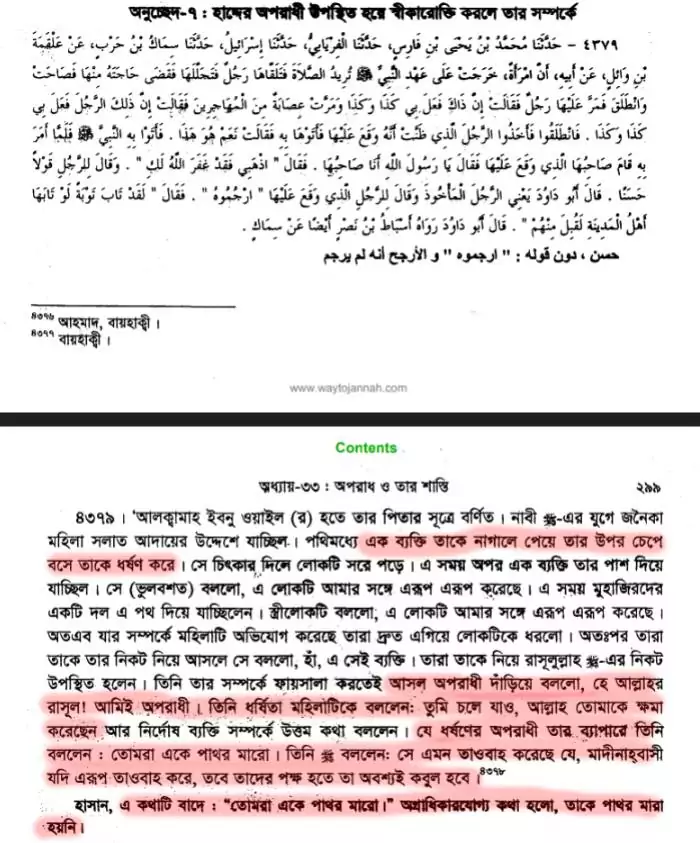
“Forgiving” the Raped Woman: The Divine Psychology of Victim Blaming
Another profound and dangerous aspect of Islamic accounts of rape is their tendency to view even the person subjected to sexual violence through a kind of moral and religious contamination. A brutal indication of this mentality appears in hadith concerning intercourse with animals. A report from Ibn Abbas commands that anyone who has intercourse with an animal be killed along with the animal. When asked what the animal’s offence was, Ibn Abbas says he heard no separate explanation from the Prophet, but supposes that the Prophet disliked its meat being eaten or any benefit being derived from it because this act had been done to it [60] [61]. This is a primitive and cruel example of direct victim blaming—punishing the abused.
Sunan Abi Dawud (Islamic Foundation)
Book: 33 / Prescribed Punishments
Section: 28. The punishment for intercourse with an animal
4405. Abd Allah ibn Muhammad (may Allah have mercy on him) … Narrated Abdullah ibn Abbas: The Prophet (ﷺ) said: If anyone has sexual intercourse with an animal, kill him and kill it along with him. I (Ikrimah) said: I asked him (Ibn Abbas): What offence can be attributed to the animal/ He replied: I think he (the Prophet) disapproved of its flesh being eaten when such a thing had been done to it.
Hadith grade in the Bengali edition: Hasan. Canonical source annotation: Abu Dawud said: This is not a strong tradition. Al-Albani’s grade: Hasan Sahih.
Mishkat al-Masabih (Mishkat)
Part 17 / Prescribed Punishments
Section: Second Section
3576-[22] Ibn ‘Abbas reported God’s Messenger as saying, “If anyone has sexual intercourse with an animal, kill him and kill it along with him.” Ibn ‘Abbas was asked what offence could be attributed to the animal and replied, “I did not hear anything about that from God’s Messenger, but I think he disapproved of its flesh being eaten or of any use being made of it when such a thing had been done to it.” Tirmidhi, Abu Dawud and Ibn Majah transmitted it.[1]
[1] Sahih: Abu Dawud 4464, al-Tirmidhi 1455, Ibn Majah 2664, Irwa’ 2348, Sahih al-Jami’ 5938, Sahih al-Targhib 2423.
Hadith grade in the Bengali edition: Sahih
Narrator: Abd Allah ibn Abbas (may Allah be pleased with him)
An uncomfortable point becomes clear in the above account: even an animal incapable of moral responsibility for the sexual act becomes subject to killing and a prohibition on use afterwards. Ibn Abbas reports no direct explanation from the Prophet, but supposes that eating its meat or deriving benefit from it was disliked because such an act had been done to it. The problem goes beyond killing animals to a deeper psychological issue. An animal cannot consent, commit a moral offence or bear responsibility for sin. Yet killing it after sexual violence and regarding its meat or use as abhorrent reveals a religious and legal imagination in which “sexual contact” imprints impurity on the victim’s body as well as constituting the offender’s crime. If someone forcibly rapes it, it too becomes impure!
The same mentality appears towards raped women when the Prophet says in Abu Dawud’s account: “Go away, for Allah has forgiven you.” The question is fundamental: what is there to forgive a raped woman for? If rape is violence committed against her, if she is not the offender and did not consent, how can “forgiveness” apply? A modern sense of justice should tell her that she bears no blame, that the perpetrator alone is responsible, and that the state and society stand beside her. Instead, the hadith’s language expresses a vile idea in the Prophet’s psychology. It places the victim before a religious tribunal where, even after suffering violence, she needs “Allah’s forgiveness”. This language regards the innocent victim as a body contaminated by a sexual incident, rather than a free citizen. Rape adjudication becomes confined to a religious framework of sin, forgiveness, zina, hudud, qadhf and sexual purity, rather than expressed through the victim’s rights, trauma, consent, bodily autonomy or social rehabilitation. “Forgiving” a raped woman is consequently no humane consolation, but a sign of a terrible moral catastrophe: the perpetrator’s violence may mark the victim’s body with religious stigma, and the justice system makes her a recipient of divine forgiveness instead of recognising her as wholly innocent. The problem in Sharia-based discussions of rape therefore extends beyond four witnesses or weak evidentiary rules into a deep philosophy of sexual morality, where even a person subjected to non-consensual violence cannot fully escape primitive religious notions of purity and impurity.
Four Male Witnesses Are Required to Prove Zina
Behind the notorious requirement for “four male witnesses”, repeatedly invoked in proving rape under Islamic law, lies a political and family scandal involving the Prophet’s wife Aisha, called “Hadith al-Ifk” in Muslim tradition. On the return from a military expedition, rumours spread that Aisha had had an unlawful relationship with a Companion. Some Companions and politically influential people participated in the accusation; even Ali ibn Abi Talib is reported to have advised divorcing her and marrying another woman. Quranic verses subsequently declared Aisha “pure”, and it was in this context that a rule was given treating anyone accusing another of zina without four male witnesses as a liar and offender. Verses 15–16 of Surah al-Nisa initially provided a preliminary framework for accusations and punishment of zina, explicitly requiring four witnesses [62].
Arabic (4:15–16): وَٱلَّـٰتِى يَأْتِينَ ٱلْفَـٰحِشَةَ مِن نِّسَآئِكُمْ فَٱسْتَشْهِدُوا۟ عَلَيْهِنَّ أَرْبَعَةً مِّنكُمْ ۖ فَإِن شَهِدُوا۟ فَأَمْسِكُوهُنَّ فِى ٱلْبُيُوتِ حَتَّىٰ يَتَوَفَّىٰهُنَّ ٱلْمَوْتُ أَوْ يَجْعَلَ ٱللَّهُ لَهُنَّ سَبِيلًا وَٱلَّذَانِ يَأْتِيَـٰنِهَا مِنكُمْ فَـَٔاذُوهُمَا ۖ فَإِن تَابَا وَأَصْلَحَا فَأَعْرِضُوا۟ عَنْهُمَآ ۗ إِنَّ ٱللَّهَ كَانَ تَوَّابًا رَّحِيمًا — ˹As for˺ those of your women who commit illegal intercourse—call four witnesses from among yourselves. If they testify, confine the offenders to their homes until they die or Allah ordains a ˹different˺ way for them. And the two among you who commit this sin—discipline them. If they repent and mend their ways, relieve them. Surely Allah is ever Accepting of Repentance, Most Merciful. — Dr. Mustafa Khattab, The Clear Quran.
Verses 12–16 of Surah al-Nur later declared the accusation against Aisha an “outright lie” and explicitly reiterated that anyone unable to produce four witnesses when accusing a woman of zina would himself be a liar before Allah [63]. Although widely invoked, these verses conceal an embarrassing reality: a rule created to protect a powerful political and religious family from scandal became an insurmountable legal wall for countless rape victims in later history. Producing four male “live witnesses” to rape is practically impossible, and maintaining this unreasonable standard creates opportunities to silence victims.
Verse 2 of Surah al-Nur prescribes one hundred lashes for the man and woman accused of zina, and requires a group of believers to witness the punishment, turning it into a public moral spectacle [64]. There is no separate discussion of rape or protection of victims: the entire framework treats zina as a “moral offence”, principally seeking to “protect society’s purity” rather than the victim’s human rights.
Verses 4–5 of Surah al-Nur go further: those who accuse innocent women of zina without producing four witnesses are to receive eighty lashes, and their testimony is never to be accepted thereafter [65]. At first sight this may appear to “protect women’s honour”, but in rape cases it creates a terrible threat to the victim: if she cannot produce four male witnesses, her complaint may itself be treated as “false slander”. The Quranic framework thereby pushes her towards the risk of qadhf, while providing the rapist a comfortable route of denial and escape.
Classical commentaries such as Tafsir Zakaria explicitly explain that four male witnesses are fundamental to proving zina, and that failure to satisfy the condition makes the accuser an offender [66]. Across the Quran, hadith and tafsir, a framework has thus developed in which rape can almost never be legally proved; instead, keeping the victim silent is established as the safe course “in Sharia’s interests”.
(2) This passage describes the punishment of men and women who commit the shameless act of zina. It states that four male witnesses must be called to prove such misconduct by women. Judges before whom the case is brought must summon four qualified witnesses, and it is essential that these witnesses be men. Women’s testimony is inadmissible here. Sharia imposes two strict conditions on witnesses to zina because the matter is extremely serious, affecting honour, reputation and family dignity. First, it requires that only men may testify in such cases; women’s testimony does not count. Second, four men are necessary. Needless to say, this is an extremely strict condition that can be met only rarely and by chance. It is imposed to prevent a woman’s husband, mother, another wife, or siblings from making baseless accusations out of personal vengeance, or other ill-wishers from daring to accuse her out of enmity. Testimony to zina by fewer than four men is inadmissible.
In such circumstances, the complainant and witnesses are all deemed liars and must undergo “hadd al-qadhf”, the punishment for slander, for defaming a Muslim’s character.
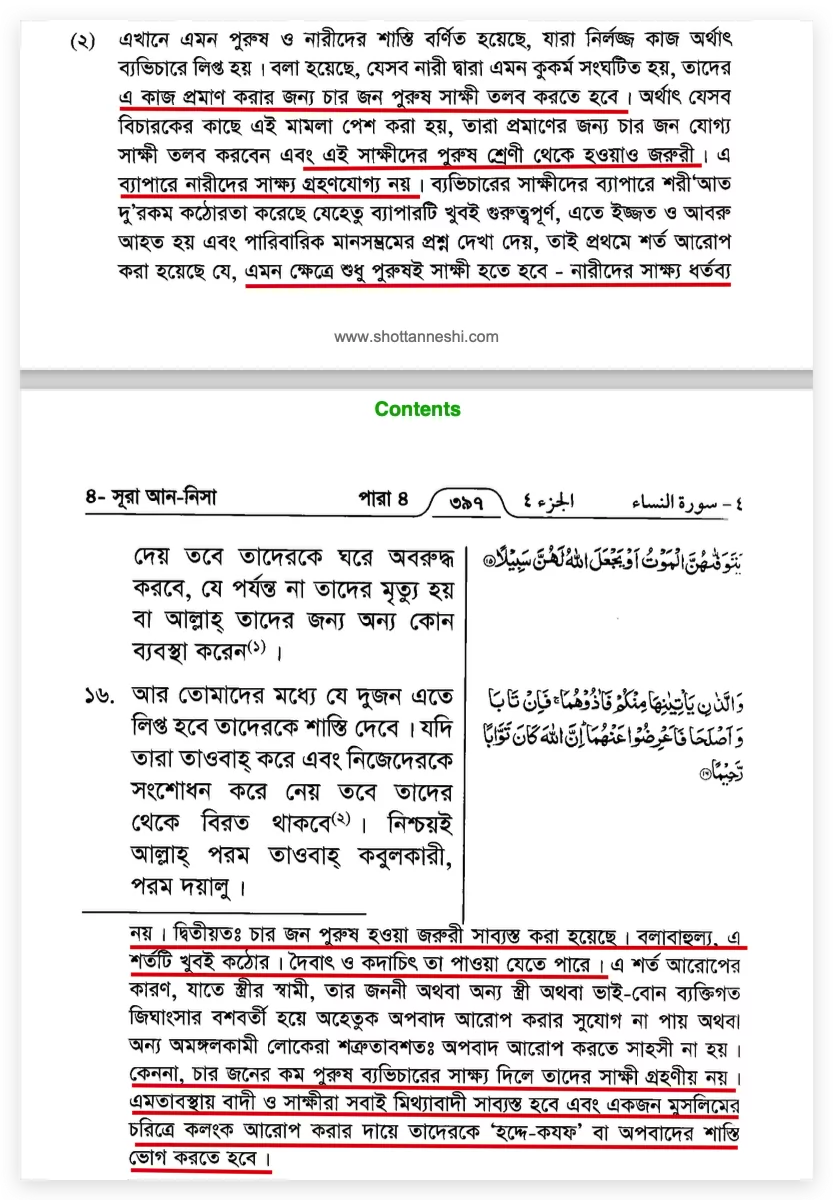
Women’s Testimony Is Inadmissible in Proving Rape
Islamic Sharia’s fundamental presumption is that women constitute a class “deficient” or “impaired” in intelligence, memory and religious responsibility compared with men, and their testimony consequently does not count as full testimony in legal proceedings. This discriminatory position is explicitly recorded in both the Quran and authentic hadith. Verse 282 of Surah al-Baqarah requires “one man and two women” as witnesses to debt transactions if “two men” are unavailable: two women replace one man in this Quranic provision, yielding the direct testimonial equation woman = ½ man. In the famous hadith in Sahih al-Bukhari, the Prophet himself declares women “deficient in intelligence and religion”, citing as proof that a woman’s testimony is half a man’s, and that refraining from prayer and fasting during menstruation constitutes a deficiency in their “religion” [67] [68].
Arabic (2:282, excerpt): وَٱسْتَشْهِدُوا۟ شَهِيدَيْنِ مِن رِّجَالِكُمْ ۖ فَإِن لَّمْ يَكُونَا رَجُلَيْنِ فَرَجُلٌ وَٱمْرَأَتَانِ — Call upon two of your men to witness. If two men cannot be found, then one man and two women (excerpt; Dr. Mustafa Khattab, The Clear Quran).
[ Surah al-Baqarah, verse 282 ]
Sahih al-Bukhari (Islamic Foundation)
6 / Menstruation
Section: 208. A menstruating woman should refrain from fasting
Islamic Foundation number: 298; international number: 304
298. Sa’id ibn Abi Maryam (may Allah have mercy on him) … Narrated Abu Sa`id Al-Khudri: Once Allah’s Messenger (ﷺ) went out to the Musalla (to offer the prayer) of `Id-al-Adha or Al-Fitr prayer. Then he passed by the women and said, “O women! Give alms, as I have seen that the majority of the dwellers of Hell-fire were you (women).” They asked, “Why is it so, O Allah’s Messenger (ﷺ) ?” He replied, “You curse frequently and are ungrateful to your husbands. I have not seen anyone more deficient in intelligence and religion than you. A cautious sensible man could be led astray by some of you.”
The women asked, “O Allah’s Messenger (ﷺ)! What is deficient in our intelligence and religion?” He said, “Is not the evidence of two women equal to the witness of one man?” They replied in the affirmative. He said, “This is the deficiency in her intelligence. Isn’t it true that a woman can neither pray nor fast during her menses?” The women replied in the affirmative. He said, “This is the deficiency in her religion.”
Hadith grade: Sahih
Narrator: Abu Sa’id al-Khudri (may Allah be pleased with him)
From this direct Quranic and hadith foundation, classical fiqh developed a brutal reality: women’s testimony is legally inadmissible in grave cases involving hadd and qisas, such as zina, rape, murder and serious bodily injury. At most, it is treated as “supporting” or “indirect” information, rather than principal legal evidence. If a woman describes her own rape in court—what she experienced and saw with her own eyes—the classical Sharia framework does not treat her statement as full legal testimony, solely because she is a woman. The quarterly fiqh journal Islami Ain O Bichar explicitly states that women’s testimony is inadmissible in hadd and qisas cases; being male, Muslim and “upright” are fundamental testimonial conditions [69].
The issue goes beyond “half testimony” to rendering a woman’s own voice entirely ineffective in a crime such as rape. She experiences rape and is then legally treated as “half a human being” in the process of proving it. Her eyes, memory and account of violence against her body are systematically subordinated to male testimony. Victim blaming, silence and protection of the perpetrator all emerge as natural consequences.
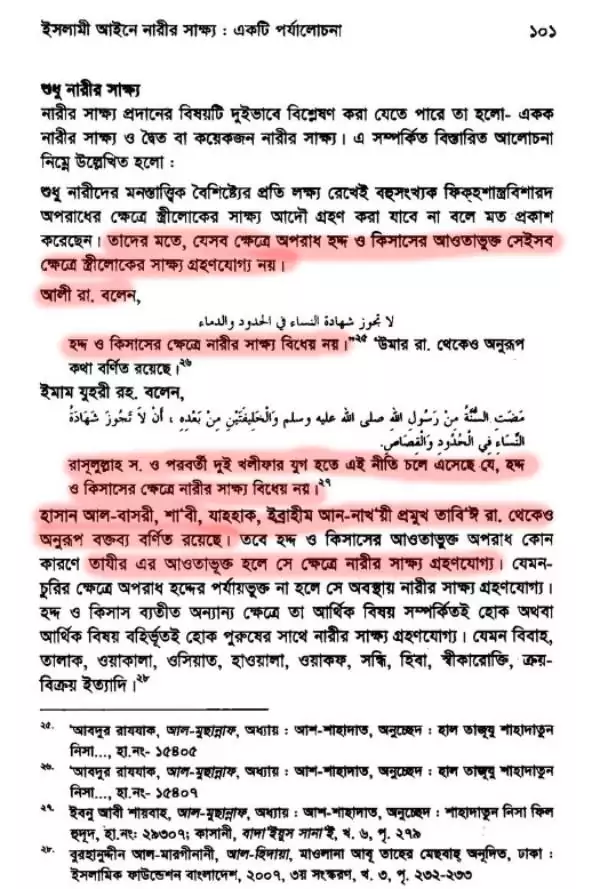
Conditions for Giving Evidence in Rape Cases in Islam
Islamic Sharia imposes virtually impossible conditions for proving sexual offences such as zina or rape. It essentially provides only two routes to establishing zina, both of which work against the rape victim in practice.
- a. The perpetrator’s own confession;
- b. Four Muslim, truthful, upright adult male witnesses who saw the incident with their own eyes.
Under Islamic Sharia, the hadd punishment for zina is one hundred lashes for an unmarried person and stoning to death (rajm) for a married person. Yet the preconditions for applying it are constructed so that the offence can almost never be legally established and punished in practice—unless the accused repeatedly comes forward and insists on confessing. Otherwise, four male eyewitnesses must appear together, having seen not merely “physical proximity” but clear penetration “like a kohl applicator entering its container”. Hadith even specify this level of detailed sexual description [70].
Sunan Abi Dawud (critically assessed)
33 / Crimes and Their Punishments
Section: 26. The stoning of the two Jews
4452. Jabir b. ‘Abd Allah said: The Jews brought a man and a woman of them who had committed fornication. He said: Bring me two learned men or yours. So they brought the two sons of Suriya.
He adjured them and said: How do you think about the matter if these two persons bear witness to the effect that they have seen his sexual organ in her female organ (penetrated) like a collyrium stick when enclosed in its case, they will be stoned to death.
He asked: What is there which prevents you from stoning them: They replied : Our rule has gone, so we disapproved of killing.
The Messenger of Allah (ﷺ) then called four witnesses. They brought four witnesses. Who testified that they had seen his sexual organ (penetrated) in her female organ like a collyrium stick when enclosed in its case. The Prophet (ﷺ) then gave orders for stoning them.(1)
Sahih.
(1) Ibn Majah, al-Daraqutni.
Hadith grade: Sahih
Narrator: Jabir ibn Abd Allah al-Ansari (may Allah be pleased with him)
There is no need to explain afresh how unrealistic this standard is for rape. Rape generally occurs in secluded places amid fear and unequal power. Four “upright Muslim men” watching penetrative intercourse before their eyes, withholding intervention and then proudly describing it in court the following day is an unimaginable situation in practice. Islamic law therefore sets the legal requirements for proving rape so high from the outset that justice becomes virtually impossible for the victim. The perpetrator can confidently ask: “Where are the witnesses?”
Another dimension of juristic rigidity emerges here. Classical Hanafi works, including Fatawa ‘Alamgiri, discuss in detail who may testify, the character witnesses must possess, the offences that invalidate their testimony and the categories whose testimony is inadmissible [71]. Women, non-Muslims, slaves, “fasiqs” and anyone whose character the clerical establishment doubts are systematically devalued as witnesses. This directly affects rape cases, where victims are usually women and often poor and powerless.
Chapter: Hudud (Penal Provisions), p. 379
3. Ruling: Zina is generally established only when four people appear
before the judge in court and testify that a particular person committed zina. The word “intercourse” )جماع – وطى( is insufficient; zina is not established through such terms (Tabyin). When four people testify to someone’s zina in the same sitting, the judge asks what zina is and where it occurred. If they state that he actually committed zina and that they saw his sexual organ entering a particular woman’s vagina like a stick entering a kohl container, the judge again asks how he committed zina. After they describe its manner, he asks when it occurred. If they specify a time indicating no substantial lapse, he questions the woman with whom zina was committed. He then asks the witnesses where it happened. Once they describe the place, if he knows their ‘adalah (1)—uprightness and trustworthiness—he questions the مشهود عليه )person against whom they testify) about احصان, whether he contracted marriage according to Sharia. If the person )مشهود عليه( says “I am محصن )married)”, or says “I am not محصن )married)” but witnesses testify that he is married, the judge asks him )مشهود عليه( to define احصان. If he defines it correctly, he is stoned. If he )مشهود عليه( denies being محصن )married) but witness evidence establishes marriage, the witnesses are asked to define ihsan. If they explain it correctly, stoning is likewise obligatory. If he denies being married and the witnesses cannot establish marriage, he is flogged. If the judge does not know the witnesses’ uprightness and trustworthiness, the accused man ا مشهود عليه is detained until their trustworthiness becomes clear (Muhit).
4. Ruling: If, after four witnesses testify to someone’s zina and are asked about its nature, reality and manner, they reply, “We cannot tell you
more than this”, their testimony is inadmissible. However, the hadd for slander )حد فذف( cannot be applied to them because the necessary number of witnesses is present. Their complete number prevents the hadd for qadhf from becoming obligatory. Likewise, four women who testify to someone’s zina do not receive the hadd for qadhf. If some witnesses describe zina’s true definition and manner but others do not, neither the accused nor the witnesses receive the hadd (Mabsut).
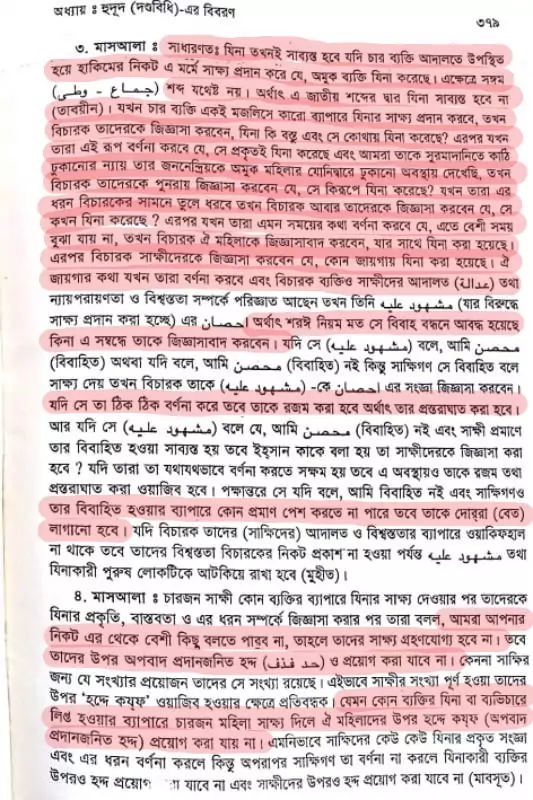
As the scans above show, Islamic law further narrows the raped woman’s legal path through rigid lists of who may and may not testify. The simple human act of “standing in court and telling the truth” becomes a technically complex game in which the victim’s voice is virtually dismissed from the outset. Dr. Ahmad Ali’s Islam’s Penal Law repeats similar strict criteria: witnesses in hadd cases must satisfy a host of requirements, including being male, Muslim, adult, free, honest and Sunni. Women and non-Muslims are automatically deprived of this “opportunity” [72].
Methods of Proving Zina:
Zina may be proved by any one of the following three methods:
1. Oral Confession
If a man or woman personally admits committing zina, zina is established. Certain conditions nevertheless apply.
They are:
a. Conditions Relating to the Person Confessing
1. The person must be an adult. A minor’s confession does not result in the hadd.
2. The person must be of sound mind. A mentally unsound or intoxicated person’s confession is disregarded.
3. The person must be able to speak. Confessions by gesture or writing are not equivalent to oral confession. The Hanafis do not accept a mute person’s confession. The other three imams accept writing or gestures from a mute person if the gestures indicate zina. 94
4. The person must possess complete freedom and discretion. A confession obtained through coercion is inadmissible.
b. Conditions Relating to the Confession
1. There must be four confessions. This is the Hanafi and Hanbali position: fewer than four do not permit the zina punishment. Ma’iz (may Allah be pleased with him) came to the Messenger of Allah (peace and blessings be upon him) and confessed to zina, but the Messenger turned away. He confessed four times, and the Messenger turned away the first three times, acting upon the fourth. If one confession sufficed for the hadd, why did the Messenger wait for the fourth? 95 The Malikis and Shafi’is hold that four confessions are unnecessary; one suffices to impose punishment. 96
2. Confessions must be made in separate sittings. Among imams requiring four confessions, most Hanafis require four separate court sittings; others regard four confessions in one sitting as sufficient. 97
94. Al-Sarakhsi, Al-Mabsut, Vol. 9, p. 98; al-Zayla’i, Tabyin, Vol. 3, p. 166; al-Ansari, Asna al-Matalib, Vol. 4, p. 131; Ibn Qudamah, Al-Mughni, Vol. 9, pp. 62–63
95. Sahih Muslim, Kitab al-Hudud, Hadith nos. 1691, 1692; Abu Dawud, Kitab al-Hudud, Hadith no. 4419
96. Al-Sarakhsi, Al-Mabsut, Vol. 9, pp. 89–92; al-Kasani, Bada’i, Vol. 7, pp. 50–51; Malik, Al-Mudawwanah, Vol. 4, p. 472; al-Shafi’i, Al-Umm, Vol. 7, p. 132; Ibn Qudamah, Al-Mughni, Vol. 9, p. 60
97. Al-Sarakhsi, Al-Mabsut, Vol. 9, pp. 89–92; al-Kasani, Bada’i, Vol. 7, pp. 50–51; al-Shafi’i, Al-Umm, Vol. 7, p. 132; Ibn Qudamah, Al-Mughni, Vol. 9, p. 61
3. The confession must be made before the judge. 98
4. It must be explicit and detailed. An ambiguous confession is inadmissible. It must specify when, with whom, where, in what circumstances and how intercourse occurred. 99
5. The person must maintain the confession. If the man or woman retracts it at any stage, the hadd cannot be imposed. Even if withdrawal occurs while the punishment is being carried out, its remainder cannot be executed. It is reported that Ma’iz (may Allah be pleased with him), unable to bear the stones, began fleeing. People pursued and caught him, and he eventually died from the stoning. When the Messenger of Allah (peace and blessings be upon him) learned of it, he said: هَلَّا تَرَكْتُمُوهُ لَعَلَّهُ أَنْ يَتُوبَ فَيَتُوبَ اللَّهُ عَلَيْهِ—”Why did you not leave him alone. Perhaps he might have repented and been forgiven by Allah.” 100 This shows that the hadd cannot be executed after withdrawal of a confession. Retraction creates doubt, and the hadd cannot be applied in such circumstances. 101
c. Confession Long after the Offence
Most imams hold that a confession made long after zina is still accepted and the hadd imposed. Imam Muhammad reportedly said: even if someone comes and confesses forty years later, I will impose the hadd. 102
98. Al-Shafi’i, Al-Umm, Vol. 7, p. 132; Mulla Khusraw, Durar al-Hukkam, Vol. 2, p. 74
99. Al-Zayla’i, Tabyin, Vol. 3, p. 166; Ibn al-Humam, Fath al-Qadir, Vol. 5, p. 233; Ibn Qudamah, Al-Mughni, Vol. 9, p. 61
100. Abu Dawud, Kitab al-Hudud, Hadith no. 4419
101. Ibn al-Humam, Fath al-Qadir, Vol. 5, pp. 222–223; Ibn ‘Abidin, Radd al-Muhtar, Vol. 4, p. 10; al-Bujayrimi, Al-Tajrid, Vol. 4, p. 213
102. Al-Sarakhsi, Al-Mabsut, Vol. 9, p. 17; al-Kasani, Bada’i, Vol. 7, p. 51
d. Encouraging the Confessor to Withdraw the Statement
Most imams hold that a judge may encourage someone who voluntarily confesses to zina to retract the statement. The Shafi’is consider this permissible; the Hanafi and Hanbali imams consider it recommended for the judge. They cite the report that, after Ma’iz confessed, the Messenger of Allah (peace and blessings be upon him) said that perhaps he had only kissed, embraced or looked at her. 103 This indicates that a judge should encourage the confessor to retract. 104
One Person’s Confession and the Other’s Denial:
If one confesses to zina while the other denies it, the confessor receives the hadd and the denier escapes punishment. For example, if a man commits zina with a woman and admits the offence while she denies it, the person confessing receives the hadd and the person denying it escapes. 105 Sahl ibn Sa’d reported: “A man came to the Prophet (ﷺ) and confessed before him that he had committed fornication with a woman whom he named. The Messenger of Allah (ﷺ) sent for the woman and asked her about it. But she denied that she had committed fornication. So he inflicted the prescribed punishment of flogging on him, and let her go.” 106
103. Abu Dawud, Kitab al-Hudud, Hadith nos. 4419, 4427
104. Al-Zayla’i, Al-Tabyin, Vol. 3, p. 167; al-Babarti, Al-‘Inayah, Vol. 5, p. 223; al-Buhuti, Kashshaf, Vol. 6, p. 103; Ibn Qudamah, Al-Mughni, Vol. 9, p. 74
105. This is the position of the Sahibayn and other imams. Imam Abu Hanifah holds that the confessor receives the hadd in such circumstances. If, however, the woman alleges false accusation against the man who confessed and he cannot produce four witnesses, the hadd for qadhf rather than zina is imposed on him. (Al-Zayla’i, Al-Tabyin, Vol. 3, p. 184; Ibn ‘Abidin, Radd al-Muhtar, Vol. 4, p. 29; Ibn Qudamah, Al-Mughni, Vol. 9, p. 61)
106. Abu Dawud, Kitab al-Hudud, Hadith no. 4437
Similarly, someone who commits zina but denies it cannot receive the hadd unless testimony establishes the offence. If the offence has not become public, it is preferable to conceal it.
2. Witness Testimony
The second method of proving zina is witness testimony. The imams unanimously agree that zina may be established through testimony, subject to several conditions.
These include:
a. Conditions Relating to Witnesses
1. Witnesses must be Muslim.
Non-Muslim testimony is inadmissible in zina cases. Every witness must be Muslim; even one non-Muslim prevents completion of the required number. Allah says: فَاسْتَشْهِدُوا عَلَيْهِنَّ أَرْبَعَةً مِنْكُمْ—”call four witnesses from among yourselves.” (Dr. Mustafa Khattab, The Clear Quran, 4:15, excerpt) 107 By مِنْكُمْ (from among yourselves), Allah means only Muslims.
2. Witnesses must be adults of sound mind.
The testimony of minors and mentally unsound people is inadmissible for zina, as is that of intoxicated people.
3. Witnesses must be upright.
A fasiq’s testimony is inadmissible. Every witness must be upright. Allah says: وَأَشْهِدُوا ذَوَيْ عَدْلٍ مِنْكُمْ—”And call two of your reliable men to witness” (Dr. Mustafa Khattab, The Clear Quran, 65:2, excerpt). 108
4. Witnesses must be male.
According to the imams of all four schools, each of the four zina witnesses must be male. Women’s testimony is inadmissible. 109 Allah says: فَاسْتَشْهِدُوا عَلَيْهِنَّ أَرْبَعَةً مِنْكُمْ—”call four witnesses from among yourselves.” (Dr. Mustafa Khattab, The Clear Quran, 4:15, excerpt) 110 This verse specifically addresses men, indicating that only men’s testimony establishes zina.
5. There must be four witnesses.
Four witnesses are necessary. Even one fewer means zina is unproved under Sharia; moreover, those who testify receive the hadd for slander. Allah says: وَالَّذِينَ يَرْمُونَ الْمُحْصَنَاتِ ثُمَّ لَمْ يَأْتُوا بِأَرْبَعَةِ شُهَدَاءَ فَاجْلِدُوهُمْ ثَمَانِينَ جَلْدَةً—”Those who accuse chaste women ˹of adultery˺ and fail to produce four witnesses, give them eighty lashes ˹each˺.” (Dr. Mustafa Khattab, The Clear Quran, 24:4, excerpt) 111
6. Witnesses must be able to speak.
A mute person’s testimony is inadmissible for zina because he cannot testify directly except through gestures. 112
107. Al-Quran, 4 (Surah al-Nisa): 15
108. Al-Quran, 65 (Surah al-Talaq): 2
109. Al-Zayla’i, Al-Tabyin, Vol. 3, p. 164; Ibn Nujaym, Al-Bahr al-Ra’iq, Vol. 5, p. 4; Ibn Qudamah, Al-Mughni, Vol. 9, p. 64
110. Al-Quran, 4 (Surah al-Nisa): 15
111. Al-Quran, 24 (Surah al-Nur): 4
112. Al-Sarakhsi, Al-Mabsut, Vol. 16, p. 130; al-Kasani, Bada’i, Vol. 6, p. 267; Ibn Qudamah, Al-Mughni, Vol. 10, pp. 185–186
b. Conditions Relating to the Testimony
1. The four witnesses must testify in the same sitting.
Most imams require testimony in the same sitting. If witnesses appear separately, individually, in pairs, or three together and one separately, their testimony is inadmissible and all receive the punishment for accusing others of zina. The Shafi’is do not require this condition: testimony is accepted jointly or separately, in one sitting or different sittings. 113
113. Al-Sarakhsi, Al-Mabsut, Vol. 9, p. 90; al-Kasani, Bada’i, Vol. 7, p. 267; Ibn Qudamah, Al-Mughni, Vol. 9, p. 66, Vol. 10, p. 220; al-Baji, Al-Muntaqa, Vol. 7, p. 144
2. Testimony must be explicit and detailed.
Witnesses must explicitly state that they saw the penis inside the woman’s vagina like a kohl applicator inside its container. They may otherwise mistake acts that are not zina for zina; a precise description is therefore essential. They must also specify with whom, in what circumstances, when and where it occurred. 114 The statement “the two committed zina” is consequently insufficient to impose the hadd.
3. Testimony must be original.
Most imams require original testimony in zina cases, meaning only eyewitness accounts are accepted. Testimony based on hearing other witnesses is inadmissible. 115
4. Testimony must agree completely.
Any discrepancy makes testimony inadmissible. For example, two witnesses saying zina occurred on Friday and two saying Saturday renders their testimony inadmissible, as does disagreement about the time of day. Discrepancies among witnesses additional to the required four do not count. Withdrawal by one witness likewise prevents proof of zina, unless that witness is additional to the necessary four. 116
114. Al-Kasani, Bada’i, Vol. 7, p. 267; al-Babarti, Al-‘Inayah, Vol. 5, pp. 215–217; al-Shafi’i, Al-Umm, Vol. 7, p. 46; Ibn Qudamah, Al-Mughni, Vol. 9, p. 65
115. Al-Sarakhsi, Al-Mabsut, Vol. 9, p. 66; Ibn al-Humam, Fath al-Qadir, Vol. 5, pp. 291–292
116. Al-Sarakhsi, Al-Mabsut, Vol. 9, pp. 61–66; Ibn al-Humam, Fath al-Qadir, Vol. 5, pp. 284–286; Ibn Qudamah, Al-Mughni, Vol. 10, pp. 219–220; al-Ramli, Nihayat al-Muhtaj, Vol. 7, p. 432
5. Testimony must not be delayed.
The Hanafis reject testimony given long after zina. An eyewitness has the choice to testify solely for Allah’s pleasure, for society’s peace and order, 117 or to conceal the offence. 118 Long silence means he chose the second course; later testimony indicates an ulterior motive or malice. Testimony known to have been given with an improper motive is inadmissible. 119 Umar (may Allah be pleased with him) said: أَيُّمَا قَوْمٍ شَهِدُوا عَلَى حَدٍّ لَمْ يَشْهَدُوا عِنْدَ حَضْرَتِهِ فَإِنَّمَا شَهِدُوا عَنْ ضِغْنٍ وَلَا شَهَادَةَ لَهُمْ—”People who testify to a hadd offence at a later time rather than when it occurs must be understood as testifying out of rancour; their testimony is inadmissible.” 120
Other imams accept testimony long after zina, explaining that reasonable circumstances may delay testimony. 121, 122
117. Allah says: وَأَقِيمُوا الشَّهَادَةَ لِلَّهِ—”and ˹let the witnesses˺ bear true testimony for ˹the sake of˺ Allah.” — Surah al-Talaq: 2 (Dr. Mustafa Khattab, The Clear Quran, excerpt)
118. The Messenger of Allah (peace and blessings be upon him) said: مَنْ سَتَرَ مُسْلِمًا سَتَرَهُ اللَّهُ فِي الدُّنْيَا وَالْآخِرَةِ—“Whoever covers (the sin of) a Muslim, Allah will cover him (his sin) in this world and in the Hereafter.” (Ibn Majah, Kitab al-Hudud, Hadith no. 2544; Abd al-Razzaq, Al-Musannaf, Hadith no. 18936)
119. Al-Sarakhsi, Al-Mabsut, Vol. 9, pp. 97, 115; al-Kasani, Bada’i, Vol. 7, p. 46
120. Al-Sarakhsi, Al-Mabsut, Vol. 10, p. 151; al-Kasani, Bada’i, Vol. 7, p. 46
121. For example, illness or necessary travel to a distant place.
122. Al-Ansari, Asna al-Matalib, Vol. 4, p. 132; Ibn Qudamah, Al-Mughni, Vol. 9, p. 71
c. Conditions Relating to Those against Whom Testimony Is Given
1. Those accused of zina must be adults and capable of intercourse. If the girl named in the zina testimony is proved young and incapable of intercourse, the hadd for zina cannot be imposed on her. To establish whether the girl is young—
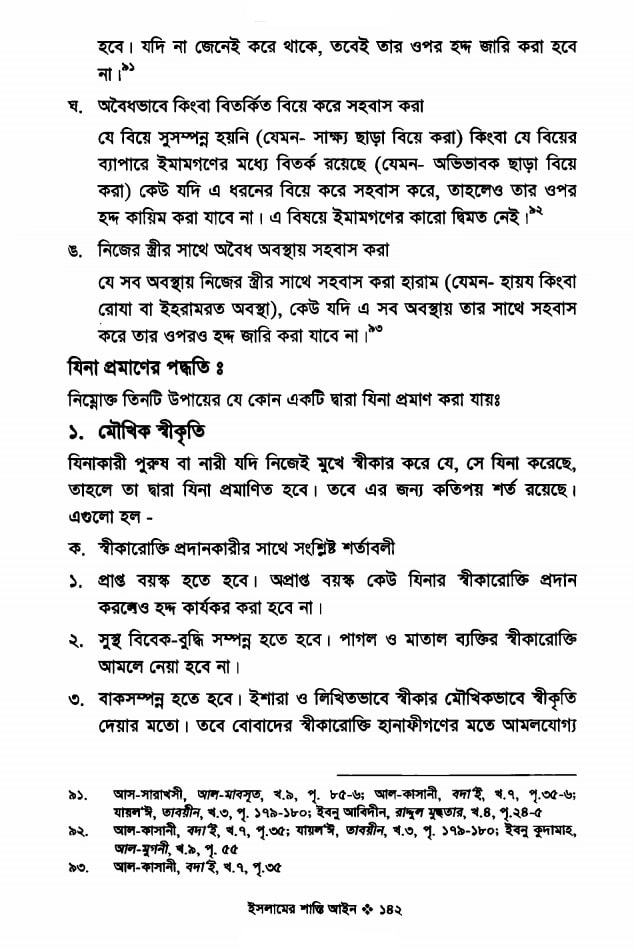
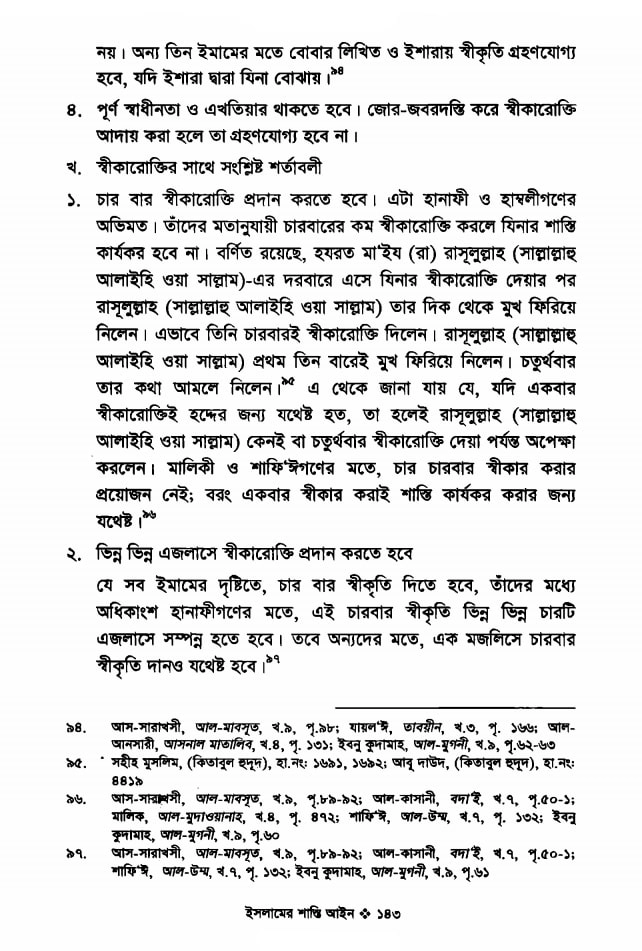
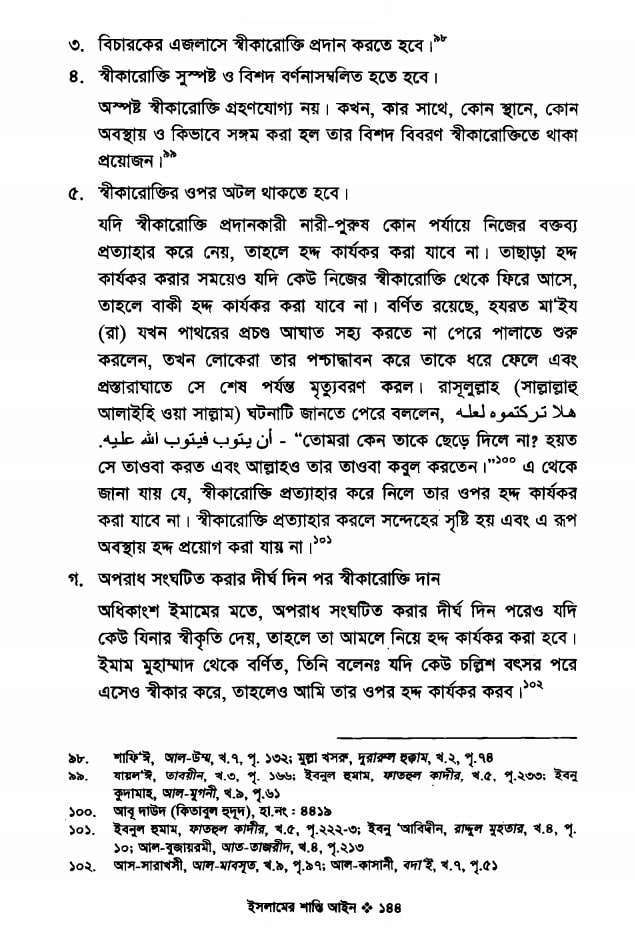
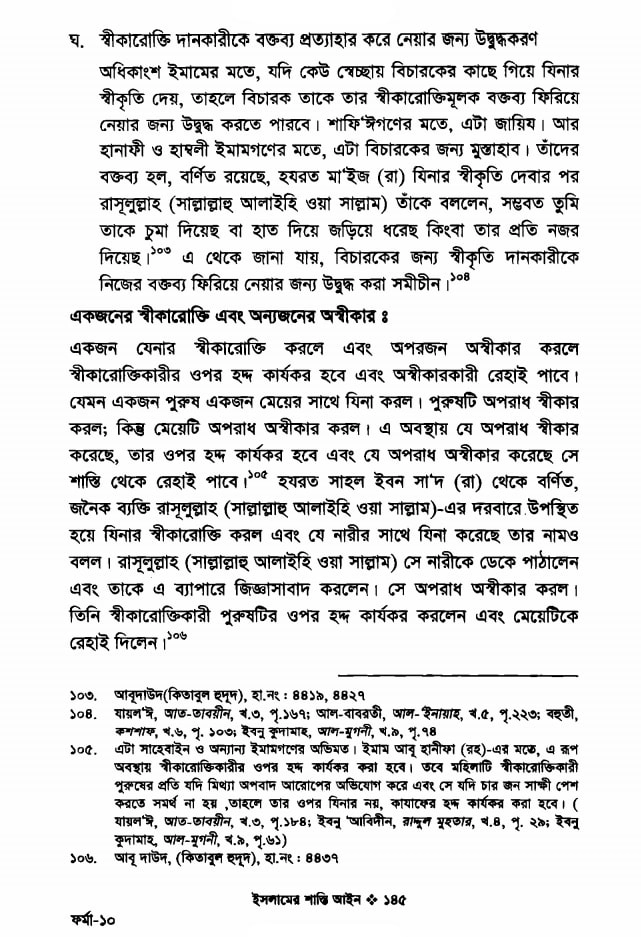
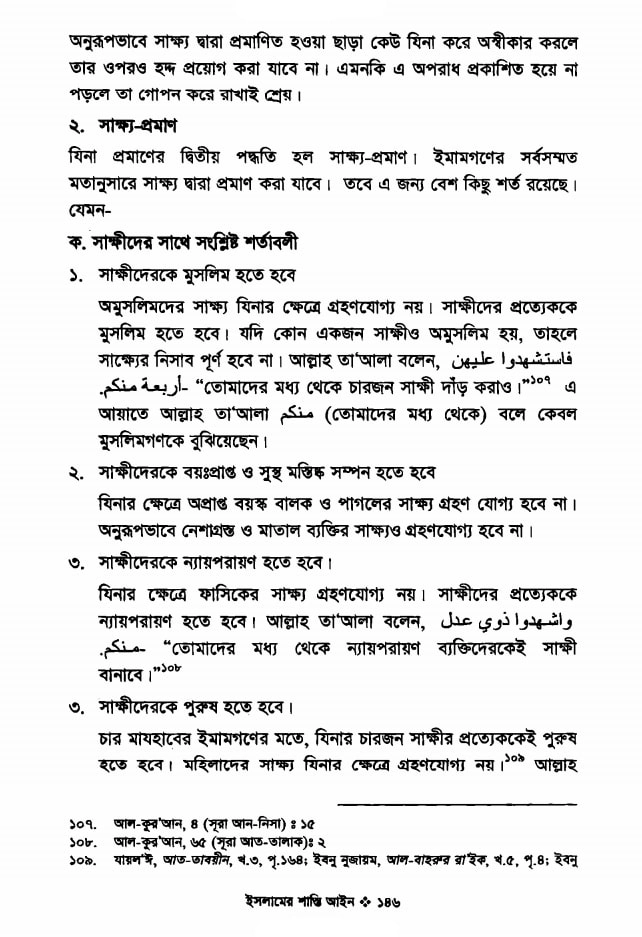
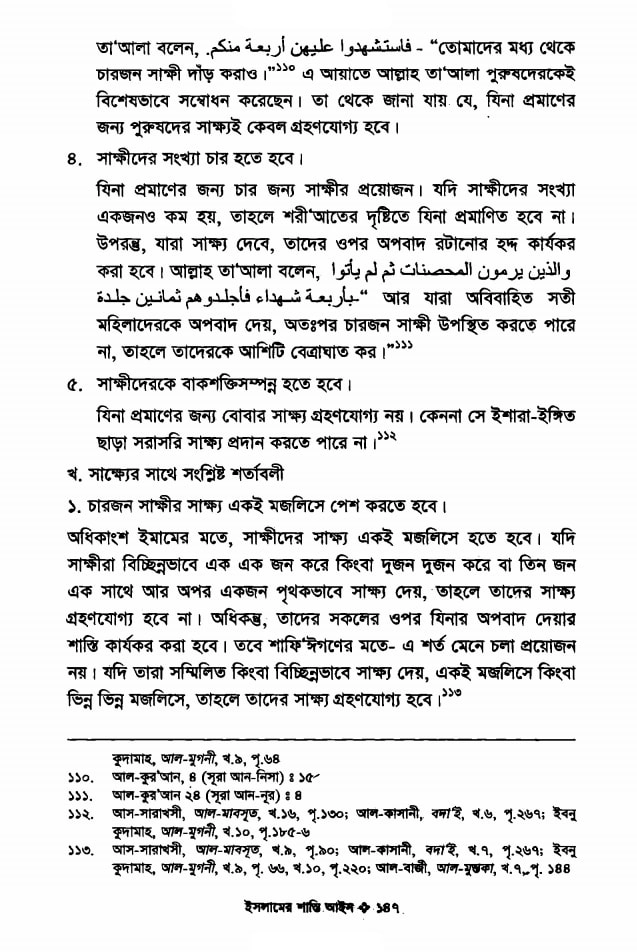
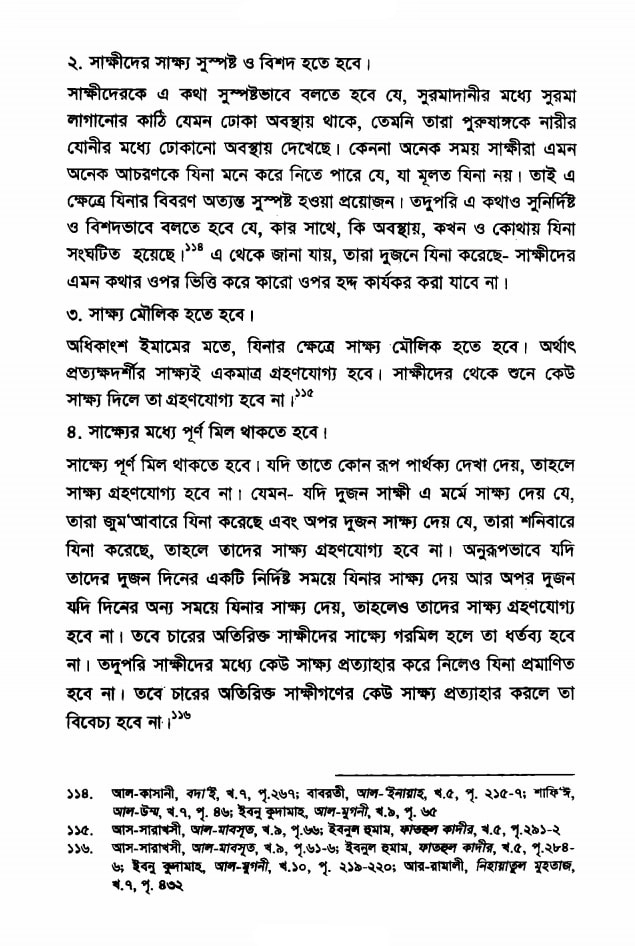
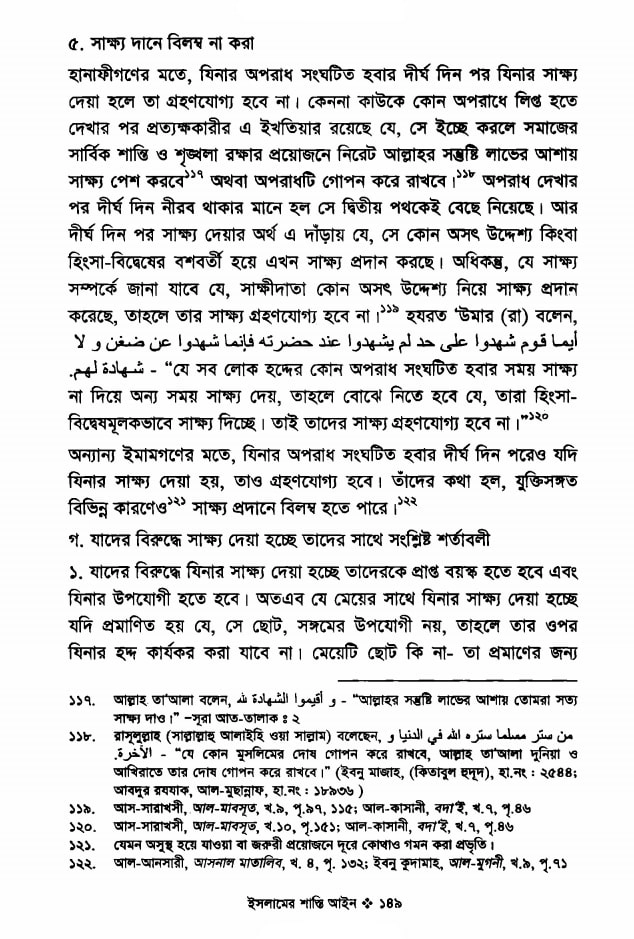
DNA Tests Are Inadmissible in Proving Rape
In the classical framework of Islamic Sharia, no modern scientific evidence—audio, video, DNA or any medical test—counts as principal evidence for establishing hadd offences. Forensic reports, DNA profiles, CCTV footage and audiovisual recordings are not equivalent to four male eyewitnesses or a confession as “hadd evidence” in a Sharia court. Even scientifically established truth is kept outside the door of hudud proof. Only methods approved as “Sharia evidence” within the traditional fiqh framework of the four schools are recognised, such as four adult Muslim male eyewitnesses, the accused’s direct confession, or an unmarried woman’s pregnancy. All other scientific, medical or technological evidence is regarded as inadmissible for hadd purposes in Islamic Sharia courts [73].
Question:
I know that in the past if someone has committed adultery, they had to bring 4 witnesses . My question is can we prove that today by using latest scientific methods as the DNA test, instead of bringing 4 witnesses.
Answer:
Praise be to Allah.
According to Islamic sharee’ah, zinaa can only be proven by clear evidence, namely the testimony of four trustworthy and sound witnesses who saw it actually happen, or by confession of guilt, or by the woman becoming pregnant. It cannot be proven by DNA testing or by use of cameras and videos in place of the things mentioned above. And Allaah knows best.
[74]
Question
I know that in the past if someone has committed adultery, they had to bring 4 witnesses .
My question is can we prove that today by using latest scientific methods as the DNA test, instead of bringing 4 witnesses.
Answer
Praise be to Allah.
According to Islamic sharee’ah, zinaa can only be proven by clear evidence, namely the testimony of four trustworthy and sound witnesses who saw it actually happen, or by confession of guilt, or by the woman becoming pregnant. It cannot be proven by DNA testing or by use of cameras and videos in place of the things mentioned above. And Allaah knows best.
Source: Sheikh Muhammed Salih Al-Munajjid
The point is clear: Islamic courts deliberately keep the evidentiary standards for hadd offences such as zina and rape outside modernity, confined to seventh- and eighth-century judicial culture. DNA testing, now among the strongest forms of evidence in almost all modern criminal systems, is regarded by Islamic fiqh as merely an “indirect, uncertain” indication with no value comparable to four male eyewitnesses. Even if a poor woman produces one hundred per cent conclusive proof through DNA and medical tests, a Sharia-based hadd court will not impose the hadd on the rapist on that basis, because DNA is not recognised as “Sharia evidence”.
Let us now examine the position of another widely used online fatwa platform, IslamWeb, on the same issue [75].
Fatwa Title: Proving Rape by Modern Medical Means
Fatwa No: 70220
Fatwa Date: 01/05/2017
As for proving rape by modern medical means, this is impermissible because Allah, the Exalted, enjoined that for zina to be proven, four witnesses must give their testimony, and He identified specific conditions for the testimony to be accepted. Such restrictions are set forth by the sharia in order to conceal people’s sins and safeguard their honor. It is impermissible to renounce these conditions and seek other means that may fail to prove that which is simpler than zina.
Moreover, it is untrue that the factor of witnesses is usually lacking in rape crimes. On the contrary, it is more likely that there are witnesses for rape as the victim would scream and seek help, unlike zina, where both the man and the woman are keen to hide themselves from people.
If we assume that a woman screamed and sought help while being raped and the rapist is caught, then the concerned authority should interrogate him. If he confessed his crime, then his confession is enough and no witnesses are needed in this case. Confession of the perpetrator is the strongest evidence.
Allah knows best.
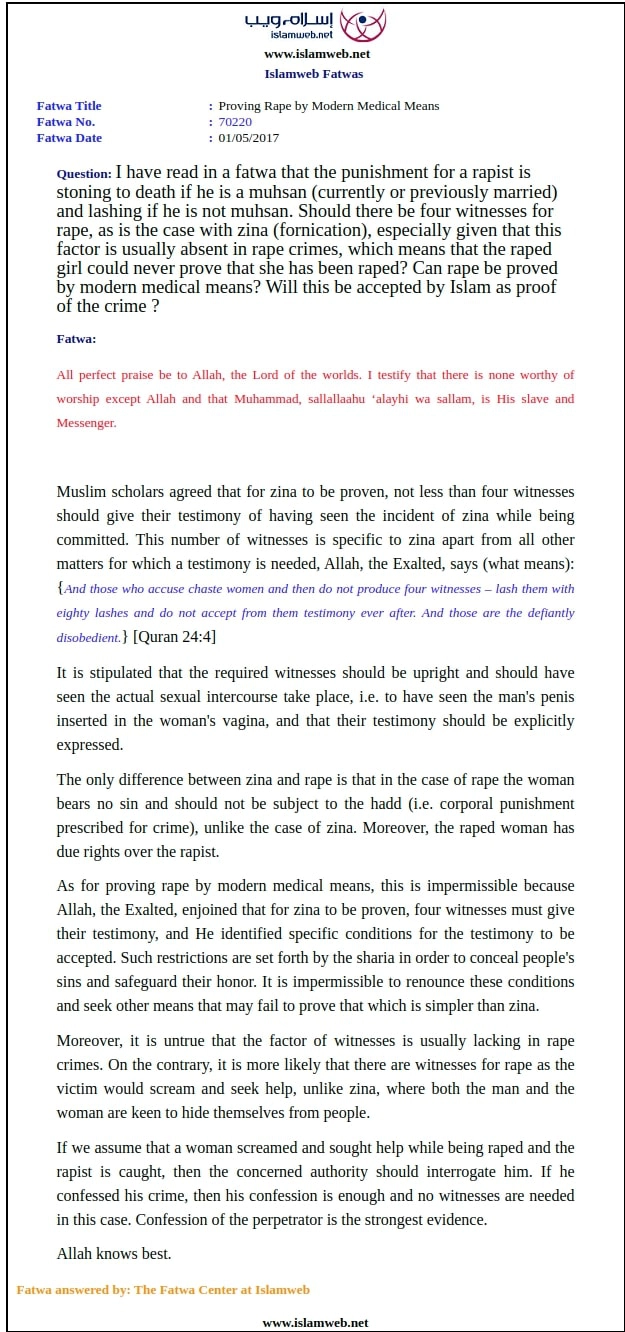
Several extremely problematic claims appear in this fatwa:
1. “Proving rape through DNA and medical evidence is haram/impermissible”, because it “disregards” Allah’s requirement of four witnesses. The most reliable real-world evidence—forensics—is thus declared contrary to Allah’s command.
2. The practical observation that “rape cases lack witnesses” is rejected. The fatwa instead claims witnesses are more likely in rape because the woman will scream! In reality, most rapes take place in secluded locations, through intimidation by power or relational blackmail, where even screaming offers virtually no chance of safe witnesses appearing.
3. The principal objective becomes “concealing sins” and “protecting honour”: protecting Muslim society’s reputation and preventing “the spread of indecency” are treated as more important than bringing the offender to justice and securing justice for the victim. The fatwa itself admits that these strict conditions seek to conceal people’s sins rather than protect them; in practice, the rape victim’s voice is concealed as well.
Oral Confession: A Dangerous Medieval Shortcut in Place of Justice
Another extremely dangerous feature is treating confession as a supreme form of evidence. Under Islamic hudud law, the two principal routes to proving offences such as zina or rape are four male eyewitnesses and the accused’s own confession. At first sight this may appear very “fair”: if someone admits the crime, what problem remains? Modern legal science and criminology, however, recognise an extremely dangerous conception contrary to justice. A confession is not always synonymous with truth. People may confess through fear, torture, social pressure, family threats, political influence, religious guilt, mental illness, poverty, ignorance, police interrogation or payment. Where punishments involve execution, stoning, amputation or flogging, taking a person’s life solely on spoken words is no justice; it is the state playing a lottery in the name of the judicial system.
Little imagination is needed to understand how inequalities of wealth and power distort justice in the real world. Wealthy, influential or politically powerful people can pay the poor, indebted, socially vulnerable or marginalised to confess to crimes they themselves committed. A family may be paid, a worker promised employment or safety, or a poor young man told: “Confess to the crime and your family will receive money.” Confessions can also be obtained through direct intimidation: threats to kill relatives, public humiliation, police torture, pressure from religious leaders or interrogation by state forces. In a society where confronting the powerful is itself difficult, confession never guarantees impartial truth; it opens a terrible door through which the powerful can purchase responsibility for their crimes. “The offender confessed” may therefore signify a joint product of power, money and fear rather than a declaration of truth.
Modern criminal justice therefore seeks to avoid relying solely on confession. It checks confessions against independent evidence, forensic analysis, DNA, medical reports, CCTV, digital records, direct and circumstantial testimony, crime-scene evidence, the victim’s statement, evidence of the accused’s whereabouts and the lawfulness of interrogation. A fundamental modern legal principle is that evidence must be as objective, verifiable and multidimensional as possible before the state is entrusted with a person’s life. A truthful confession will fit the forensic facts; if it does not, a court can recognise that fear, torture, inducement or conspiracy may be involved. The medieval hudud framework, however, treats a person’s spoken words as the ultimate form of truth. This is no childish innocence; it is a legal catastrophe. People can lie, break down, be bought or intimidated, and be compelled by state interrogation to incriminate themselves.
A deep inconsistency in Islamic hudud evidentiary theory emerges here. DNA, medical tests, injuries, video and crime-scene findings—the objective evidence of modern science—do not receive full status as hudud proof, yet an accused person’s oral confession can justify stoning or execution. Sharia thus gives ancient legal rituals priority over factual truth. Verifiable scientific evidence stays outside the door, while spoken words potentially produced by fear, money, torture or psychological collapse open the door to execution. It is difficult to imagine a more dangerous theory of evidence. A system that doubts DNA but regards the words of a frightened, poor or influenced person as sufficient grounds for execution embodies the cruelty of medieval formalism rather than justice.
A still greater problem is the special protection confession-based proceedings give powerful offenders. Four male eyewitnesses are virtually impossible to find; forensic evidence is insufficient at the hudud level; confession therefore becomes the only effective route. Will a genuinely powerful offender voluntarily confess? No. He can buy a substitute culprit, intimidate others, exert influence and turn a poor person into a scapegoat. The actual perpetrator may escape while someone socially vulnerable is crushed by the state’s machinery of punishment. Confession-based hudud proceedings are consequently dangerous for victims and a deathtrap for innocent poor people. The judicial system can become an instrument for transferring the powerful person’s crime rather than uncovering truth.
Modern law therefore views execution based solely on oral confession with deep suspicion. Any confession must be video-recorded, made with a lawyer present in an environment free of pressure, subject to withdrawal, and supported by independent evidence. Entrusting the state with a human life is the highest legal responsibility, not a religious performance. Yet the hudud framework deploys “he confessed” as though the human mind, power, money, fear, torture, interrogation and social pressure did not exist. This simplification is dangerous as well as outdated. It grounds justice in spoken words rather than truth. A system that places spoken words above science, forensics and the totality of evidence is a bloody remnant of medieval legal ritual rather than modern justice based on human rights.

Confession-based hudud proceedings therefore form no part of superior divine justice. They are a medieval judicial technique that is blind and irrational in evidentiary science, dangerous in the politics of power, and entirely unacceptable from a human rights perspective.
Islam’s Rule: Conceal a Muslim’s Faults
Another popular Islamic idea concerning concealment of wrongdoing is: “If you conceal your Muslim brother’s faults, Allah will conceal yours in the hereafter.” This hadith is repeatedly quoted in Riyad al-Salihin and other works, and frequently heard in sermons and speeches. In practice, it encourages a Muslim who witnesses another Muslim’s crime, moral transgression or even sexual offence to remain silent under the principle of “concealing sins”. The following hadith provides a classic example [76].
Riyad al-Salihin
1 / Miscellany. Section: 28: Concealing Muslims’ faults is necessary and publicising them without need is prohibited
Allah says: “Indeed, those who love to see indecency spread among the believers will suffer a painful punishment in this life and the Hereafter. Allah knows and you do not know.” (Surah al-Nur 24:19; Dr. Mustafa Khattab, The Clear Quran)
1/245. Abu Huraira reported Allah’s Apostle (ﷺ) as saying: The servant (who conceals) the faults of others in this world, Allah would conceal his faults on the Day of Resurrection. (Muslim) (1)
(1) Muslim 2590, Ahmad 27484, 8995
Hadith grade: Sahih
Combining hadd law, the requirement of four male witnesses and the inadmissibility of DNA with hadith such as “conceal faults and Allah will conceal yours” produces a terrible social result: hiding a Muslim offender’s crime becomes a religiously virtuous act, while the victim’s right to seek justice conflicts with religious morality. If someone witnesses rape but conceals the rapist’s wrongdoing in hope of “the reward promised by this hadith”, obtaining even one truthful witness becomes virtually impossible, let alone four.
Another example appears in the hadith in which a Companion lies to a young woman to bring her into a house and kisses her without permission, then repeatedly receives advice to conceal it. He is explicitly told: “Keep it to yourself, repent and tell no one.” Even when the Prophet learns of the incident, he imposes no specific earthly punishment; instead, he recites a Quranic verse stating that “good deeds erase bad deeds” [77].
Jami’ al-Tirmidhi (Islamic Foundation)
50 / Quranic Exegesis
Section: Surah Hud
3115. Abd Allah ibn Abd al-Rahman (may Allah have mercy on him) … Narrated Musa bin Talhah, that Abu Al-Yasar said: “A woman came to me selling dates. I said to her: ‘There are better dates than these in the house.’ So she entered the house with me. I had an urge for her so I began kissing her. I went to Abu Bakr and mentioned that to him, so he said: ‘Cover what you have done, repent, do not inform any one, and never do it again.’ So I went to ‘Umar and mentioned that to him. He said: ‘Cover what you have done, repent, do not inform any one, and never do it again.’
Then I went to the Prophet (ﷺ) and mentioned it to him.” He said: ‘Is this how you take care of the wife of someone who is away fighting in Allah’s cause?” Such that he had wished he had not accepted Islam until that very time, and he thought that he must be one of the people of the Fire.” He said: “The Messenger of Allah (ﷺ) bowed his head for a long time, until Allah revealed to him:
أَقِمِ الصَّلاَةَ طَرَفَيِ النَّهَارِ وَزُلَفًا مِنَ اللَّيْلِ
And perform the Salat, at the two ends of the day and in some hours of the night. Verily, the good deeds remove the evil deeds. That is a reminder for the mindful (11:114).
Abu Al-Yasar said: “So I went to him and the Messenger of Allah (ﷺ) recited it for me. A companion of his said: “O Messenger of Allah! Is this specific, or is it for the people in general?” He said: “Rather it is for the people in general.”
This hadith is hasan-sahih-gharib. Waki’ and other hadith scholars considered Qays ibn al-Rabi’ weak. Sharik also narrated it from Uthman ibn Abd Allah similarly to Qays ibn al-Rabi’. Related reports exist from Abu Umamah, Wathilah ibn al-Asqa’ and Anas ibn Malik. Abu al-Yasar’s name was Ka’b ibn Amr.
Hasan, al-Tirmidhi Hadith: 3115 [Al-Madani Prakashani]
Hadith grade: Hasan
In the context of rape and sexual violence, this principle has a grave effect: the victim can be told to remain silent to protect a Muslim offender’s reputation and “honour”, while her complaint can easily be dismissed through the arguments of four male witnesses and inadmissible DNA. “Conceal it and Allah will conceal yours” thus gradually becomes a religious shield protecting rapists and abusers.
Punishing the Raped Woman When Zina Cannot Be Proved: The Trap of Qadhf and Pregnancy
A rape complaint within Sharia’s zina framework is no safe exercise of a citizen’s right: it is entry into a dangerous legal territory. Treating rape as “forced zina” rather than independent sexual violence effectively requires the complainant to prove that intercourse occurred without her consent. Yet the Sharia-recognised routes to establishing zina are extremely narrow: four male eyewitnesses or the accused’s confession. Failure to meet these requirements does not merely leave “unproved rape”; it can lead towards an unproved accusation of zina, qadhf, or—in pregnancy—suspicion of zina against the woman herself. This is Sharia’s most dangerous trap: a woman seeking state protection is first pushed into having to prove her own innocence.
Quran 24:4 prescribes eighty lashes for accusers who cannot produce four witnesses to a zina allegation. Although this provision concerns ordinary zina accusations, framing rape as coercive zina brings the problem directly into rape cases. A woman saying “that man forced sexual intercourse upon me” makes both an allegation of intercourse and a claim of coercion in Sharia’s zina terminology. If the court does not accept coercion as proved, or the required testimony or confession is unavailable, she may be regarded as the bearer of an unproved zina accusation rather than a protected victim. This framework is designed to frighten victims away from complaining rather than give them justice. [78] [79] [80]
The apparently humane statement “There is no hadd for the raped woman” therefore does not resolve the problem. The actual question arises earlier: on what evidence will the court first recognise her as “a raped woman”? If her own statement does not establish coercion, “a raped woman will not be punished” becomes a conditional proposition. Various classical juristic sources show that failure to secure this recognition can expose the complainant herself to qadhf or the hadd for zina.
First, consider Ibn Hazm’s Al-Muhalla. The heading itself is significant: “A woman who claims that a certain man forced her into zina”. This directly concerns an allegation of coercive intercourse rather than an ordinary discussion of qadhf. Ibn Hazm quotes al-Zuhri and Qatadah: if a woman accuses a man of forcing himself upon her, he denies it, and she has no bayyinah or evidence, she is to receive the hadd for qadhf. [81]
Ibn Hazm, Al-Muhalla:
عَنْ الزُّهْرِيِّ، وَقَتَادَةَ قَالَا جَمِيعًا: فِي امْرَأَةٍ قَذَفَتْ رَجُلًا بِنَفْسِهَا أَنَّهُ غَلَبَهَا عَلَى نَفْسِهَا، وَالرَّجُلُ يُنْكِرُ ذَلِكَ، وَلَيْسَ لَهَا بَيِّنَةٌ: فَإِنَّهَا تُضْرَبُ حَدَّ الْفِرْيَةِ
That is, al-Zuhri and Qatadah both said concerning a woman who accuses a man of forcing himself upon her, while he denies it and she has no evidence: she is to receive the hadd for slander.
The matter goes beyond “rape cannot be proved without four witnesses”: if the complaint fails, the complainant herself becomes liable to punishment. Significantly, Ibn Hazm preserves different juristic positions in the same discussion. A view attributed to Malik holds that the complainant may incur the hadd if the accused is not known for such misconduct; if he is publicly known as a fasiq, his social reputation may affect the judicial outcome. Determining the truth of her complaint thus depends on the accused man’s social reputation as well as evidence of the incident.
The View Attributed to Malik in Al-Muhalla:
إنْ كَانَ لَيْسَ مِمَّا يُشَارُ إلَيْهِ بِذَلِكَ؛ جُلِدَتْ الْحَدَّ، وَإِنْ كَانَ مِمَّا يُشَارُ إلَيْهِ بِالْفِسْقِ نُظِرَ فِي ذَلِكَ
That is, if the accused is not known for such misconduct, the woman is to receive the hadd; if he is known as a fasiq, the matter is to be considered differently.
Now consider the contemporary fatwa institution IslamWeb. Fatwa 323002 asks whether a woman who alleges rape, but has neither four witnesses nor the accused’s confession, will receive the punishment for qadhf. Quoting the Hanafi works Al-‘Inayah Sharh al-Hidayah and Al-Lubab, IslamWeb directly states that a woman who accuses a man of forcing her into zina without producing four witnesses may be liable to the hadd for qadhf. [82]
IslamWeb:
“If a woman accused a man of forcing her into committing zina and did not bring forth four witnesses to substantiate her claim, then she is liable for the hadd (prescribed punishment) of slander.”
IslamWeb does not stop there. Its quotation from al-Kharashi sets out still harsher possibilities. A woman who alleges coercion by a man known as pious or upright, but cannot produce witnesses or visible evidence, may face the hadd for qadhf. In some circumstances, such as pregnancy, the hadd for zina may also be added against her. If the accused is publicly known as a fasiq, different rules may apply. The same accusation thus makes the man’s religious and social reputation a legal variable alongside the woman’s evidence.
IslamQA 158282 raises a separate problem. It begins by stating that “Rape is essentially zina” and is proved essentially as zina is, through four witnesses. It then says the woman’s claim of coercion must be established through evidence or strong circumstantial indications; otherwise, she is to receive the hadd as a perpetrator of zina. [83]
IslamQA:
“Rape is essentially zina (fornication or adultery) and is proven in the same way as zina is proven, which is with four witnesses.”
Concerning the woman’s claim of coercion:
“If there is no such evidence, then the hadd punishment is to be carried out on her as it is carried out on the zaani.”
This is extremely important because the problem goes beyond qadhf. The woman says “I was forced”, but if she cannot establish coercion through Sharia-recognised evidence, the same intercourse may become a zina offence against her. A failed rape complaint may therefore result in more than “the rapist’s acquittal”: under particular juristic positions, the complainant herself may become the accused in a qadhf case or, under others, the accused in a zina case. “There is no hadd for the raped woman” is thus misleadingly incomplete; the central problem is who will first recognise her as raped, how, and on what evidence.
The Quranic basis of this qadhf framework also requires separate consideration. Quran 24:4 prescribes eighty lashes for accusing chaste women of zina without producing four witnesses. The discussion in Tafsir al-Qurtubi preserved in the Shongshoy Islam Archive explains the four-witness and eighty-lash rules in detail. When a rape complaint becomes an accusation of zina against a particular man in juristic language, this qadhf framework creates a route for turning it against the complainant. [84]
Surah al-Nur 24:4 / Tafsir al-Qurtubi:
ثُمَّ لَمْ يَأْتُوا بِأَرْبَعَةِ شُهَدَاءَ فَاجْلِدُوهُمْ ثَمَانِينَ جَلْدَةً
That is, accusers who cannot produce four witnesses are to receive eighty lashes.
Now examine the Maliki position on pregnancy more directly. Imam Malik’s Al-Muwatta, in “Bab Ma Ja’a fi al-Mughtasabah”—the chapter concerning raped women—provides a ruling on a pregnant woman without a husband. If she says she was forced, her statement alone is not accepted. She must produce bayyinah establishing coercion, be found bleeding if a virgin, cry for help so that people find her in the circumstances of the incident, or provide comparable visible indications. Without such evidence, she is to receive the hadd and her claim of coercion is rejected. [85] [86]
Al-Muwatta, Imam Malik:
إِنَّ ذَلِكَ لَا يُقْبَلُ مِنْهَا، وَإِنَّهَا يُقَامُ عَلَيْهَا الْحَدُّ، إِلَّا أَنْ يَكُونَ لَهَا عَلَى مَا ادَّعَتْ … بَيِّنَةٌ
That is, her claim is not accepted and she is to receive the hadd unless she has evidence supporting it.
Malik then states:
فَإِنْ لَمْ تَأْتِ بِشَيْءٍ مِنْ هَذَا أُقِيمَ عَلَيْهَا الْحَدُّ، وَلَمْ يُقْبَلْ مِنْهَا مَا ادَّعَتْ مِنْ ذَلِكَ
That is, if she produces none of these, she is to receive the hadd and her claim of coercion is not accepted.
The importance of this ruling is immense. Pregnancy is factual evidence that intercourse occurred, but the woman’s statement that it was forced is insufficient in itself: she must separately establish coercion. Her pregnancy can thus serve as an indication of zina against her, while her claim of coercion inflicted upon the same body receives no automatic judicial standing. The burden of proof is disproportionately heavy on one side, and failure is paid for directly with the hadd.
Ibn Abd al-Barr’s Al-Istidhkar preserves the same statement by Malik. This is therefore no modern translator’s interpretation or isolated secondary quotation: the ruling is reproduced within the Maliki school’s own authoritative tradition. [87]
Ibn Abd al-Barr, Al-Istidhkar:
إِنَّ ذَلِكَ لَا يُقْبَلُ مِنْهَا، وَإِنَّهَا يُقَامُ عَلَيْهَا الْحَدُّ … فَإِنْ لَمْ تَأْتِ بِشَيْءٍ مِنْ هَذَا أُقِيمَ عَلَيْهَا الْحَدُّ، وَلَمْ يُقْبَلْ مِنْهَا مَا ادَّعَتْ مِنْ ذَلِكَ
That is, the woman’s claim is not accepted and the hadd is imposed unless she produces the specified evidence or indications of coercion.
Taken together, these sources make the framework very clear. The al-Zuhri–Qatadah opinion preserved by Ibn Hazm prescribes the hadd for qadhf when the complaint fails; Malik’s view changes the outcome according to the accused’s reputation; IslamWeb confirms the same qadhf risk through Hanafi and Maliki sources; IslamQA prescribes even the hadd for zina if coercion is unproved; and Muwatta Malik directly prescribes the hadd when a pregnant woman’s claim of coercion lacks evidence. No imaginary fears need to be manufactured. Islamic fiqh’s own sources show that failure to prove a rape complaint can deprive a woman of justice and, under particular juristic conditions, put her in the offender’s seat.
| Source / Opinion | The Woman’s Claim | Consequence if Proof Fails | Principal Problem |
|---|---|---|---|
| Al-Zuhri and Qatadah Ibn Hazm, Al-Muhalla | A woman claims that a man forced her into zina | Hadd for qadhf | The rape complainant may herself become liable to punishment for slander |
| Malik’s View Quoted in Al-Muhalla | A woman alleges coercion | Hadd for the woman if the accused is upright; separate consideration if he is known as a fasiq | The accused man’s social reputation affects the outcome alongside evidence of the incident |
| Hanafi Fiqh IslamWeb, Al-‘Inayah, Al-Lubab | A woman says a man forced her into zina | Failure to produce four witnesses may incur the hadd for qadhf | A failed rape complaint may turn against the complainant |
| IslamQA | A woman claims the intercourse was coerced | Without evidence or strong indications of coercion, the hadd for zina may be imposed on her | Failure to establish coercion can turn the victim into a perpetrator of zina |
| Imam Malik Al-Muwatta | A pregnant woman without a husband says she was forced | Without bayyinah or visible indications of coercion, the hadd is imposed and the claim rejected | Pregnancy is evidence of intercourse against the woman, while her own claim of coercion is insufficient |
| Ibn Abd al-Barr Al-Istidhkar | Malik’s same ruling concerning a raped woman | An unsupported claim of coercion is not accepted; the hadd is imposed | The ruling is preserved within authoritative Maliki fiqh, rather than an isolated translation |
| Quran 24:4 / Al-Qurtubi | An accusation of zina | Qadhf: eighty lashes without four witnesses | Not specific to rape, but the general Quranic framework for applying qadhf against a rape allegation |
The table makes one point clear: “There is no hadd for the raped woman” operates only when the legal system first recognises her as raped. If she fails that test, different juristic traditions may turn the same woman into a qadhf defendant, a zina defendant, or someone directly facing the hadd. This is no exceptional misapplication; the problem is built into the framework of proof and classification.
Muwatta Malik
41. Hudud
Section: 4.The ruling concerning a woman who is seized and forced into intercourse
Malik said: “The position with us about a woman who is found to be pregnant and has no husband and she says, ‘I was forced,’ or she says, ‘I was married,’ is that it is not accepted from her and the hadd is inflicted on her unless she has a clear proof of what she claims about the marriage or that she was forced or she comes bleeding if she was a virgin or she calls out for help so that someone comes to her and she is in that state or what resembles it of the situation in which the violation occurred.” He said, “If she does not produce any of those, the hadd is inflicted on her and what she claims of that is not accepted from her.”
Malik said, “A raped woman cannot marry until she has restored herself by three menstrual periods.” He said, “If she doubts her periods, she does not marry until she has freed herself of that doubt.”
Hadith grade in the Bengali edition: Awaiting assessment
Narrator: Malik ibn Anas (may Allah have mercy on him)
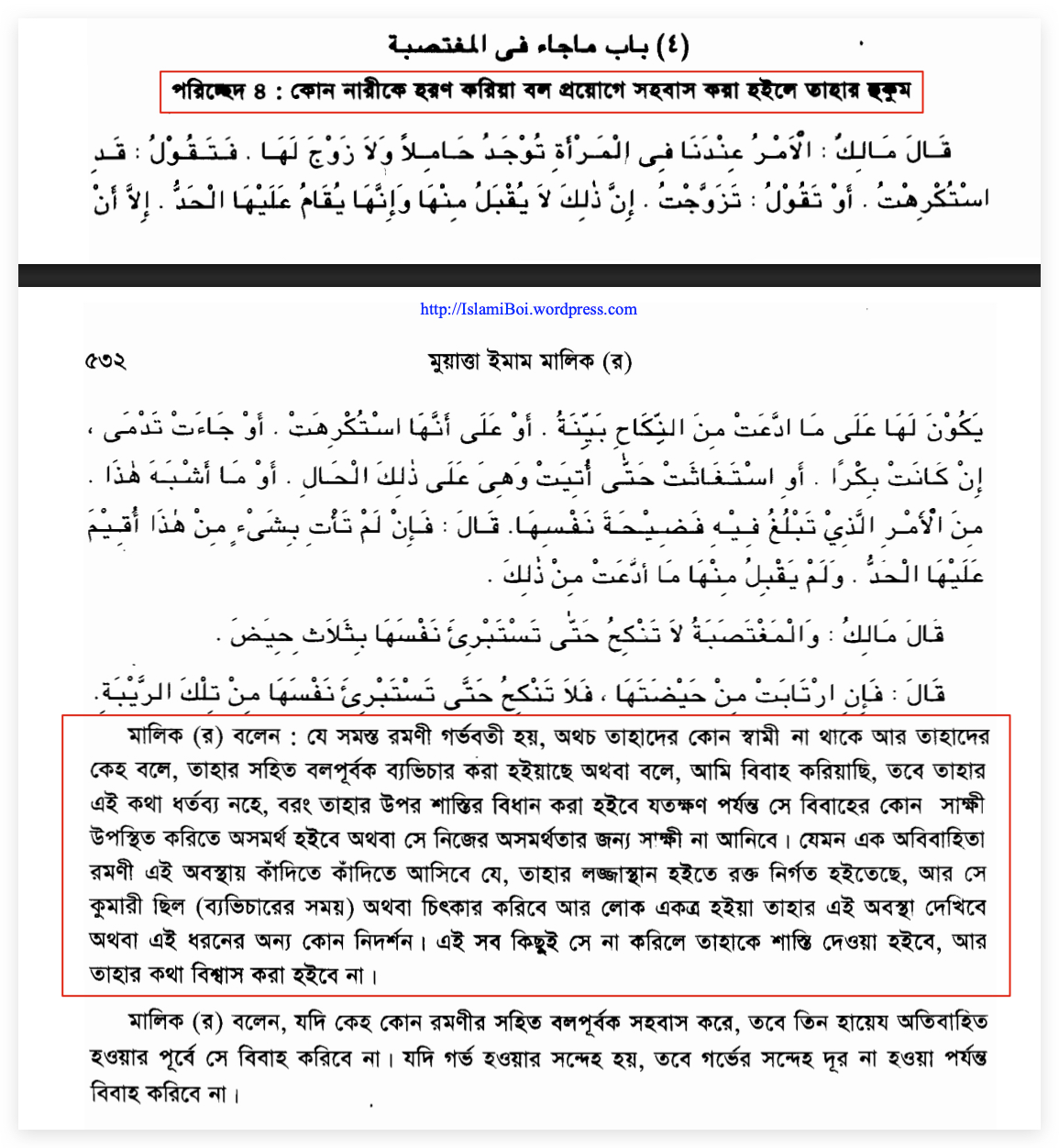
Within this Maliki position, an unmarried pregnant woman is not believed solely on her statement that she was raped or secretly married. To avoid punishment for zina, she must meet nearly impossible conditions: screaming during the act, gathering people while bleeding, and so forth. Without such dramatic “live evidence”, she is treated as an offender. The focus is clearly on finding a process to punish the woman under maximum suspicion, rather than proving the rapist’s crime.
Let us now examine the Quran’s own conditions for establishing a zina accusation and the prescribed consequences for accusers who fail them. Verse 13 of Surah al-Nur states that those who allege zina without producing four witnesses are liars in Allah’s eyes [88].
Arabic (24:13): لَّوْلَا جَآءُو عَلَيْهِ بِأَرْبَعَةِ شُهَدَآءَ ۚ فَإِذْ لَمْ يَأْتُوا۟ بِٱلشُّهَدَآءِ فَأُو۟لَـٰٓئِكَ عِندَ ٱللَّهِ هُمُ ٱلْكَـٰذِبُونَ — Why did they not produce four witnesses? Now, since they have failed to produce witnesses, they are ˹truly˺ liars in the sight of Allah. (English: Dr. Mustafa Khattab, The Clear Quran; Bengali source: Al-Bayan)
Why did they not produce four witnesses? Since they produce not witnesses, they verily are liars in the sight of Allah. (English: Marmaduke Pickthall; Bengali source: Taisirul)
Why did they not bring four witnesses to prove it? When they have not brought the witnesses, such men, in the sight of Allah, (stand forth) themselves as liars! (English: Abdullah Yusuf Ali; Bengali source: Mujibur Rahman)
Why did they (who slandered) not produce for it four witnesses? And when they do not produce the witnesses, then it is they, in the sight of Allah, who are the liars. ( Sahih International )
Tafsir literature repeatedly explains that anyone making a zina allegation without four witnesses is punishable as a perpetrator of “qadhf”, or false accusation. Classical commentaries such as al-Jalalayn and al-Mazhari explicitly state that anyone alleging zina without four witnesses is a liar under Allah’s law and subject to prescribed punishment [89] [90].
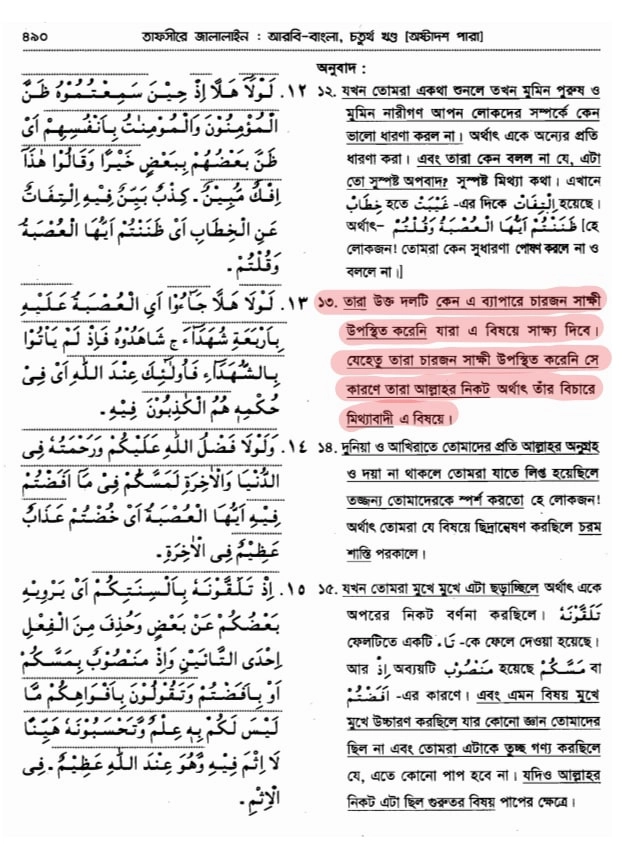
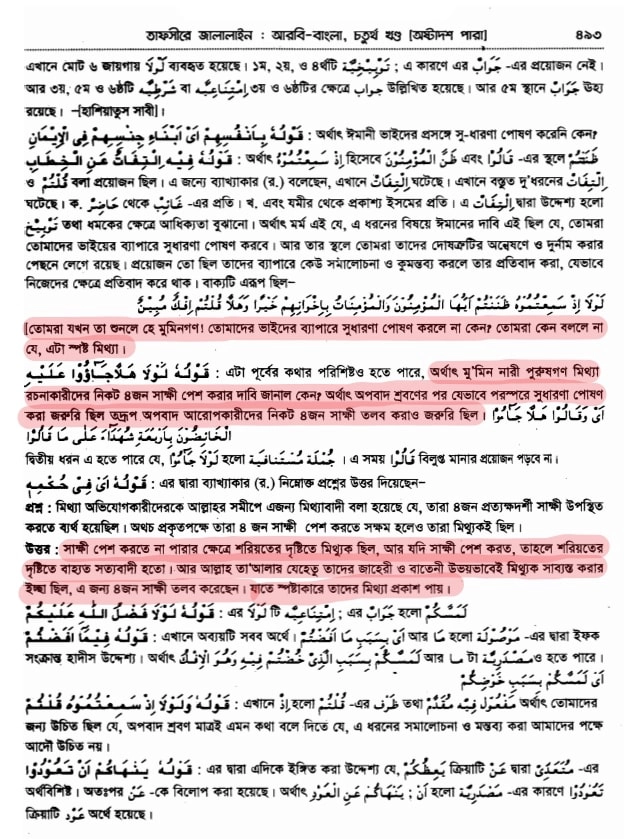
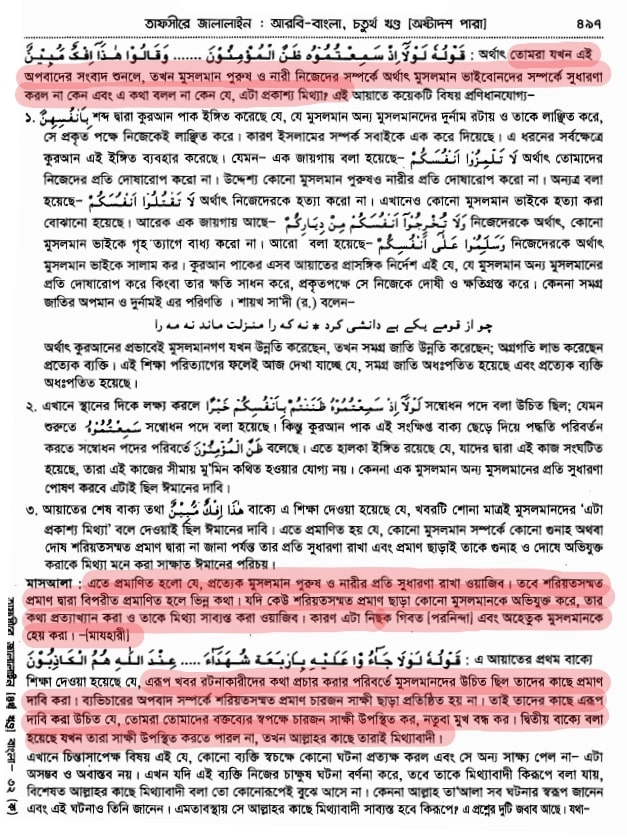
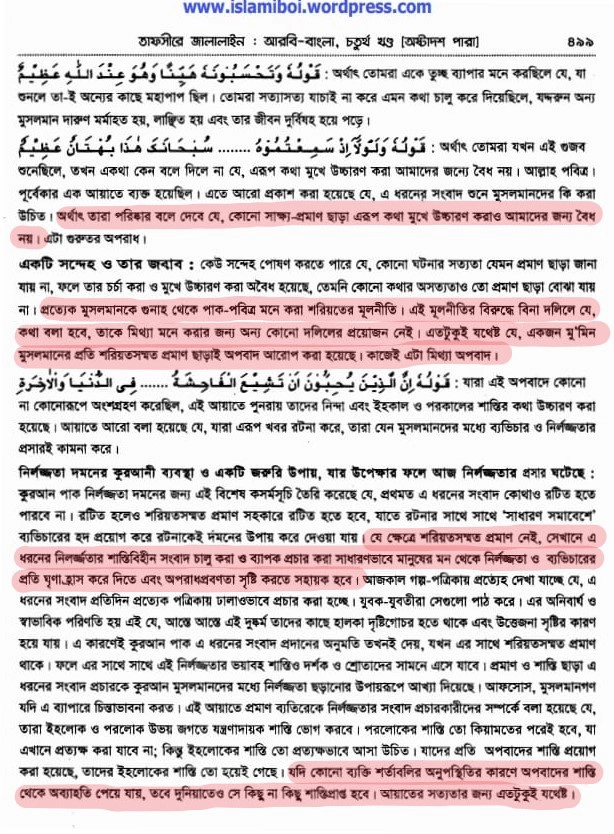
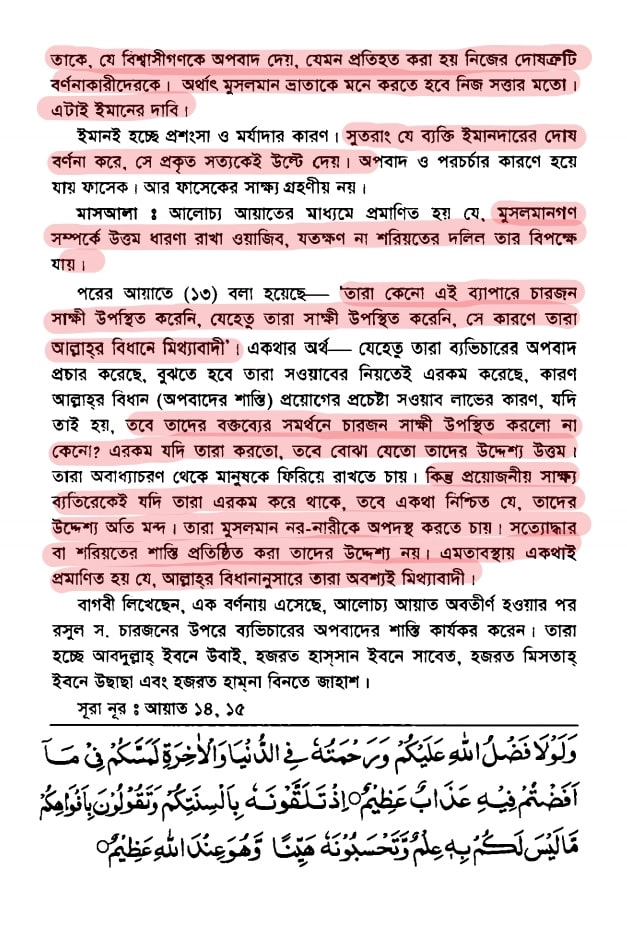
Another condition compounds this: DNA, audiovisual material and medical reports do not count as hadd evidence. A complaint of rape or forced zina without four male witnesses therefore renders modern forensic evidence worthless to the court; the accuser herself may face the punishment for “qadhf”, or false accusation. A hadith in Sahih al-Bukhari clearly illustrates the principle: “Without proof, the accuser’s own back receives the lashes” [91].
Sahih al-Bukhari (Islamic Foundation)
44 / Testimony
Section: 1663. If someone makes a claim or accusation, he must produce evidence and go in search of it
2493. Muhammad ibn Bashshar (may Allah have mercy on him) … Narrated Ibn `Abbas: Hilal bin Umaiya accused his wife before the Prophet (ﷺ) of committing illegal sexual intercourse with Sharik bin Sahma.’ The Prophet (ﷺ) said, “Produce a proof, or else you would get the legal punishment (by being lashed) on your back.” Hilal said, “O Allah’s Messenger (ﷺ)! If anyone of us saw another man over his wife, would he go to search for a proof.” The Prophet (ﷺ) went on saying, “Produce a proof or else you would get the legal punishment (by being lashed) on your back.” The Prophet (ﷺ) then mentioned the narration of Lian (لعان) (as in the Holy Book).
Hadith grade: Sahih
Narrator: Abd Allah ibn Abbas (may Allah be pleased with him)
Fully implementing this principle doubles the rape victim’s legal risk. She suffers rape and, if unable to produce four male eyewitnesses, may herself face eighty lashes or imprisonment and a fine for “false accusation”. The former provisions of Pakistan’s Hudood Ordinances turned this outlook into law: a woman who failed to prove rape could herself become a qadhf defendant [92].
“The Offence of Qazf (Enforcement of Hudood) Ordinance of 1979”. It described the offence of false accusation of Zina (fornication and adultery) either written, verbal or “by visible representations”, with intent to cause harm, and without producing four witnesses in support of the accusation before the Court, or who “according to the finding of the Court”, a witness has given false evidence of the commission of zina or rape, or when a complainant has made a false accusation of rape;
– Proof of “qazf liable to hadd” includes the accused confessing to it in court, the accused committing qazf in court, or if two Muslim adult male witnesses (other than the victim of the qazf) testify that the defendant committed qazf. (If the accused is a non-Muslim, the witnesses may be non-Muslims.)
– Punishment of “qazf liable to hadd” will be a whipping numbering 80 stripes.
– “Qazf liable to Tazir” applies whenever
– proof in any of the forms mentioned above is not available,
– or when the perpetrator has committed ‘qazf’ against any of his descendants,
– or when the victim of qazf has died during the “pendency of the proceedings”;
– punishment of “qazf liable to tazir” shall be imprisonment for up to two years, a whipping of up to 40 stripes, and may also include a fine.
Islamic hadd law, the four-male-witness requirement, the inadmissibility of DNA, encouragement to conceal sins and the punishment for qadhf together create a framework with numerous shields for rapists. The path to justice is almost closed to raped women, while fear of legal retaliation hangs perpetually over their heads like a sword.
When Four Witnesses Are Not Available, Those Who Testify Are Also Punished
The same trap strikes witnesses as well as complainants. Several influential classical juristic traditions prescribe the hadd for qadhf when the requirement of four fully qualified witnesses fails. In Al-Muhalla, Ibn Hazm devotes a separate ruling to “When the witnesses to zina do not number four”, recording the opinion that fewer than four witnesses receive the hadd for qadhf and then mentioning the famous incident involving Abu Bakrah, Nafi’, Shibl and Ziyad. Tafsir al-Qurtubi in the Shongshoy Islam Archive is still more specific: according to Malik, even if four people testify to zina, if one is inadmissible or a slave, all four are to be flogged; an opinion prescribing flogging for four blind witnesses is also quoted. Contemporary IslamQA likewise spells out the cruel logical consequence: someone who sees zina with complete clarity cannot testify without three additional witnesses; if he speaks of it, he is a slanderer liable to the hadd for qadhf. Seeing an actual event with one’s own eyes and lawfully describing it in a Sharia court are therefore different things. Without the quota of four witnesses, even a truthful eyewitness can become a slanderer under Sharia. [93] [94] [95] [96]
Al-Muhalla: إذَا لَمْ يُتِمَّ الشُّهُودُ أَرْبَعَةً حُدُّوا حَدَّ الْقَذْفِ
That is, the opinion that witnesses receive the hadd for qadhf if their number falls short of four.
Tafsir al-Qurtubi: فإن كان أحدهم … عبداً يُجلدون جميعاً
That is, according to Malik, all four are flogged if one witness is unqualified or a slave.
IslamQA: فإن تكلم عنها بذلك … فهو قاذف، يجب حده حد القذف
That is, someone who speaks without the complete number of four witnesses is a slanderer liable to the hadd for qadhf.
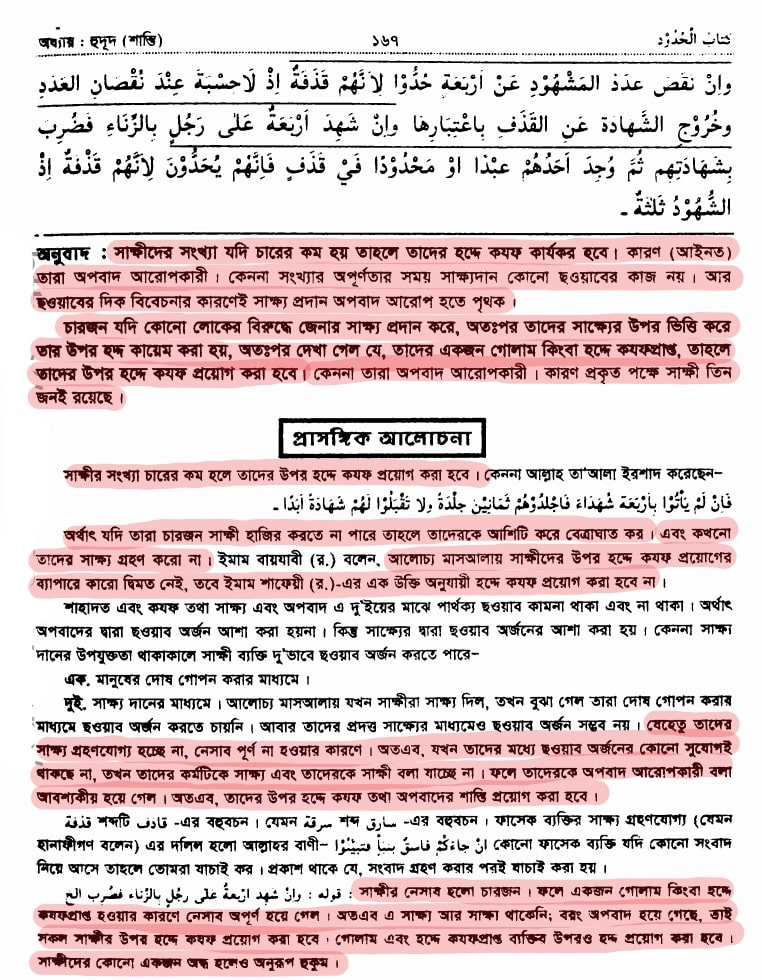
An Example of Four Witnesses during Umar’s Rule
During Caliph Umar ibn al-Khattab’s reign, al-Mughirah ibn Shu’bah was one of the Muslim empire’s influential governors. He served at different times as governor of Bahrain, Basra and Kufa, and later governed Kufa under Mu’awiyah. Umar’s assassin, Abu Lu’lu’, was al-Mughirah’s slave—an indication of al-Mughirah’s powerful political and social position.
Al-Bidayah wa-l-Nihayah records that al-Mughirah ibn Shu’bah was at one point accused of an explicitly unlawful sexual relationship. Judicial proceedings followed, putting the “four witnesses” rule to a practical test. Under Islamic Sharia, four male witnesses must see intercourse clearly enough to observe the man’s sexual organ penetrating exactly like a kohl applicator entering its container. According to Al-Bidayah wa-l-Nihayah, four people were present at the scene of the allegation against al-Mughirah. Three swore they had directly seen intercourse in precisely this way. The fourth, however, admitted he had not seen clearly enough at such close range and would not testify with the same certainty as the others.
What happened? Under Sharia’s strict formula, zina was not deemed established because there were no “four eyewitnesses at the kohl-applicator-and-container level”. Al-Mughirah ibn Shu’bah therefore received no hadd or stoning punishment. Yet Umar’s comments and behaviour afterwards make clear that he inwardly fully believed al-Mughirah had engaged in unlawful sex. Reading Al-Bidayah wa-l-Nihayah reveals how four witnesses and the slight hesitation of one overturned the entire case. [97]
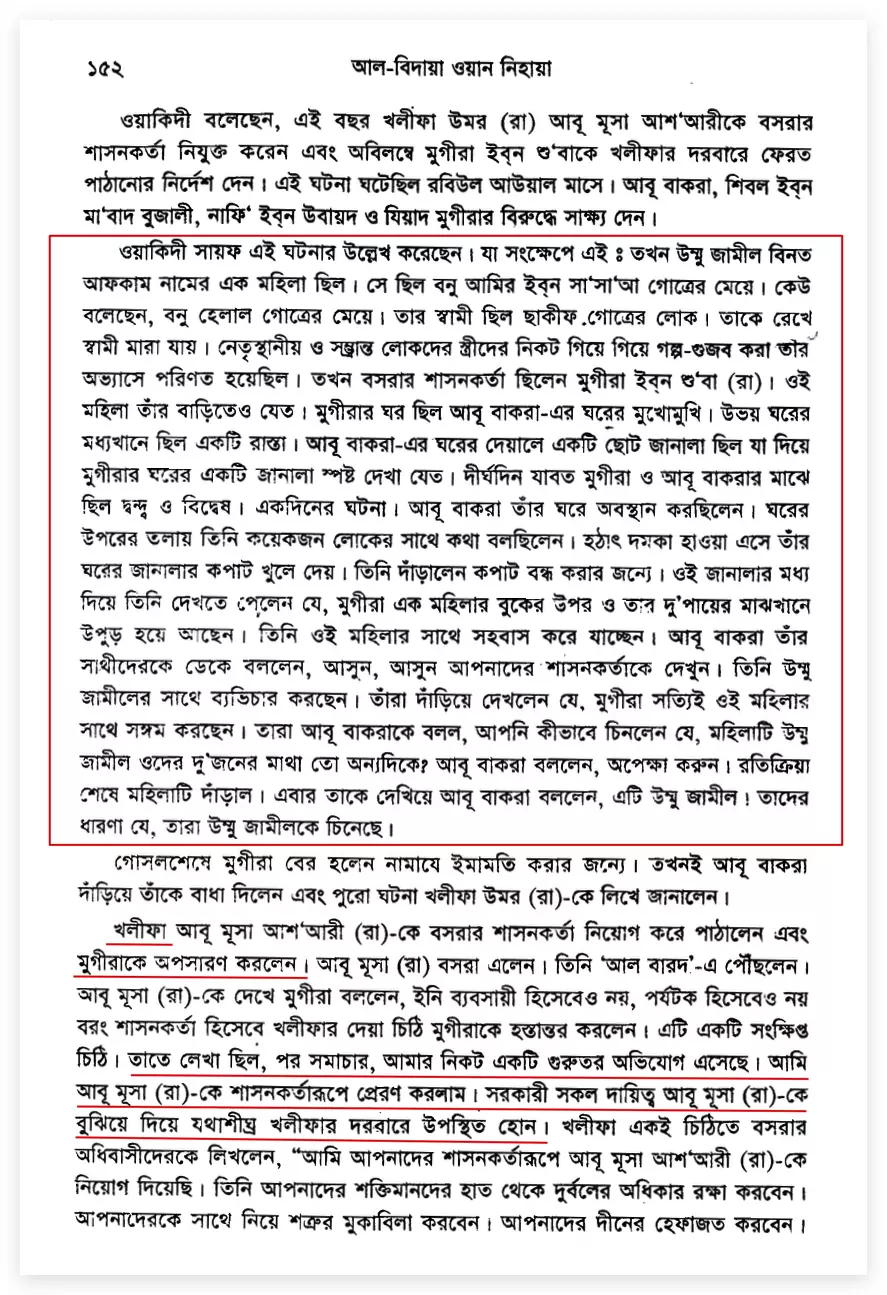
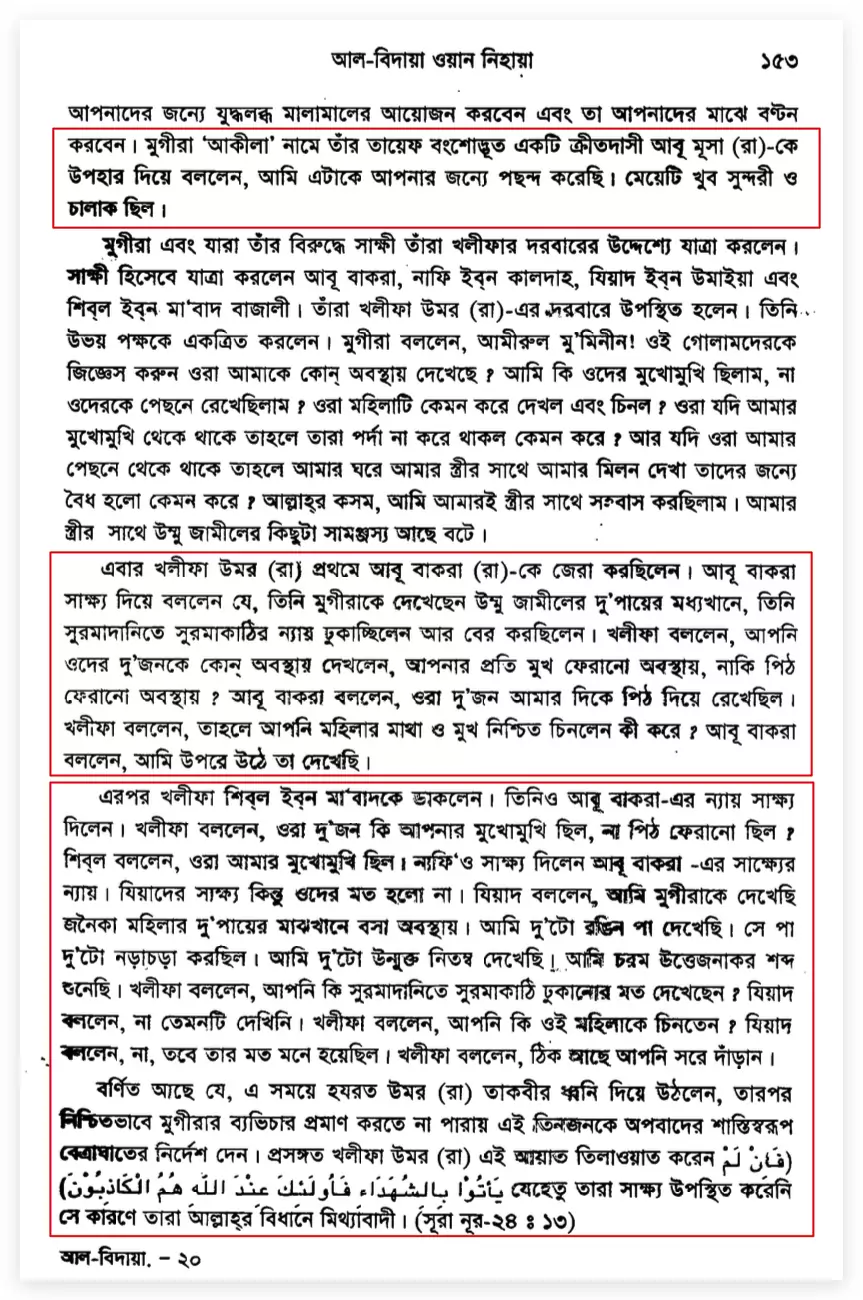
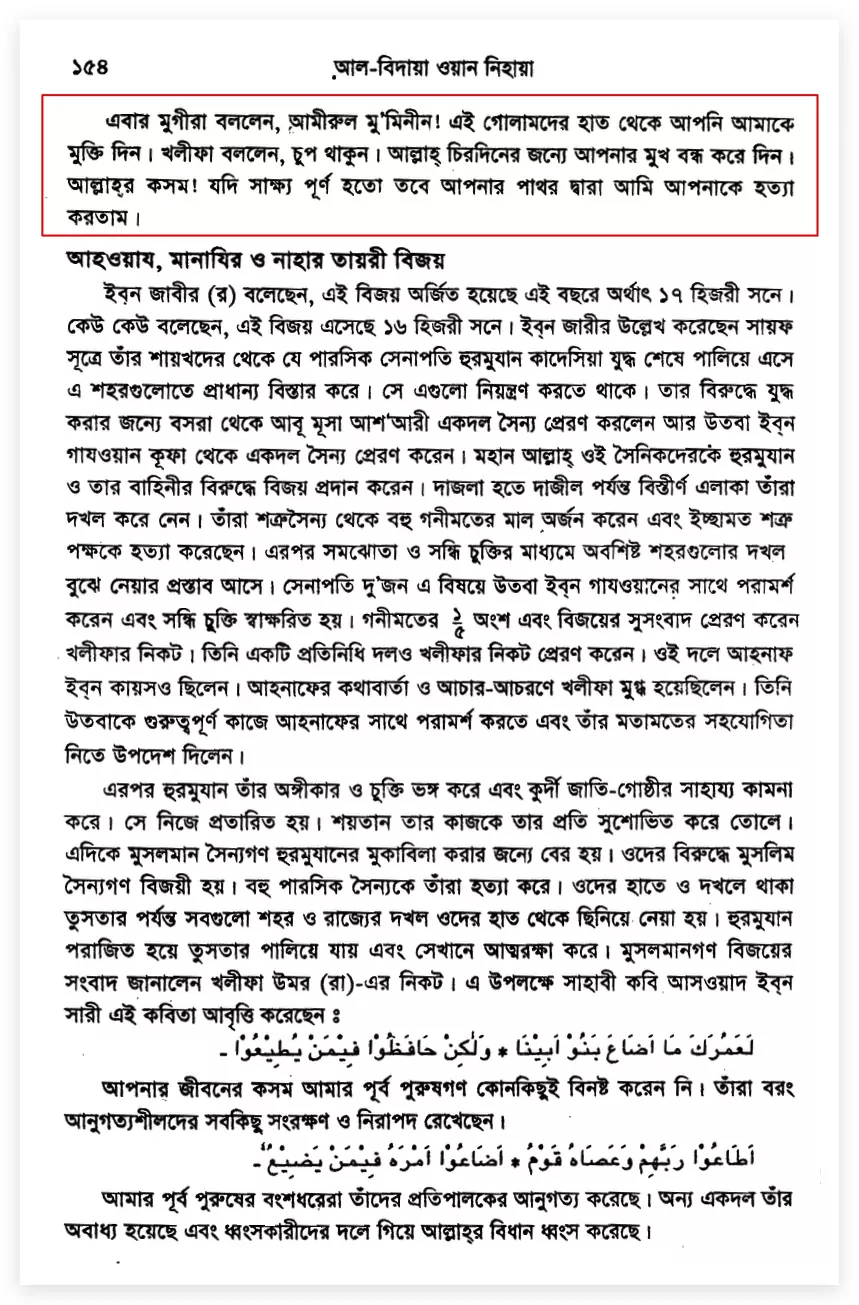
Ta’zir Punishment: Scriptural Text versus Juristic Rescue Strategies
Islamic fiqh generally divides criminal punishments into several categories. Hadd is claimed to be fixed, immutable and prescribed by Allah; qisas is retaliatory or equivalent retributive punishment; ta’zir is variable punishment at the judge’s discretion. Hadd and qisas comparatively specify both offences and punishments, leaving the judge principally to apply them on the evidence. The entire ta’zir framework, however, depends on the judge’s ijtihad, state power, social context and personal judgment. Here Sharia’s judicial theory becomes deeply unsafe for grave crimes such as rape. Justice for the victim is no guaranteed right, but depends on the judge’s mentality, school-specific interpretation, local social pressure, the accused’s influence, the victim’s vulnerability through class and gender, and state interests.
Modern apologists commonly argue: “If hudud proof fails, there is no problem, because ta’zir exists.” This theory is an admission of the failure of Sharia’s central hudud framework rather than a strength. If proving rape requires four male eyewitnesses or the accused’s confession, conditions almost never fulfilled in real life, the hadd framework cannot effectively adjudicate rape. If actual justice ultimately depends on ta’zir, it must be admitted that the principal punitive framework claimed to be divinely given cannot adjudicate a real human crime such as rape.
In rape allegations, if four male witnesses cannot be produced and the accused does not orally confess, “zina” is unproved under Sharia. If the raped woman or someone else produces circumstantial evidence—physical signs of abuse, bleeding, serious injury or another indication clearly showing force—the incident may be considered “oppression”, “injury” or “criminal violence”, rather than “zina”. This opens a possibility of limited punishment under ta’zir instead of hadd. The fundamental problem is that the crime then ceases to be recognised as rape and is reduced to injury, abuse, a breach of discipline or a lesser offence at the judge’s discretion. Violation of the victim’s consent no longer stands at the centre; peripheral questions about injuries, indications of oppression or social disorder take its place. Here lies Sharia’s fundamental dishonesty: if rape cannot be proved, the victim’s wounds may be considered, but the violation of her bodily autonomy is not treated as an independent crime.
More seriously, ta’zir is itself uncertain and centred on power. Intercession, lobbying, pleas for mercy and social influence have limited scope under hadd, but judicial discretion plays a much larger role in ta’zir. One judge may punish severely, another lightly, while elsewhere social compromise or an influential person’s intervention may allow near-complete escape. Moreover, under Sharia, the judge may consider recommendations from influential or prominent Muslims in ta’zir cases; an influential person may recommend reducing or entirely waiving the accused’s punishment. Such recommendations, lobbying and pleas to “please forgive him” are not religiously permissible for hadd punishments. When rape therefore falls from hadd into ta’zir because the former cannot be established, justice becomes more uncertain and dependent on power and class.
What maximum punishment, then, can a rape defendant receive when the failure to produce four witnesses takes him outside hadd and into ta’zir? Here a major conflict emerges within Islamic fiqh. Authentic hadith limit ta’zir to ten lashes. Imam Ahmad ibn Hanbal and a group of scholars follow the hadith’s plain meaning, or explicit text, holding that more than ten lashes for an offence outside a prescribed hadd are contrary to Sharia. Many other jurists expand the meaning of “hudud Allah” to permit heavier ta’zir punishments, imprisonment, banishment and even execution in special cases. This expanded interpretation, however, effectively disables the Prophet’s hadith rather than preserving its plain meaning. Even by Islam’s own legal principles, juristic ijtihad cannot supersede the Prophet’s authentic explicit text. Expanded ta’zir theory is therefore later legal patchwork concealing Sharia’s ineffectiveness, rather than Sharia’s justice.
This conflict is preserved directly in classical Islamic works, rather than invented by a modern critic. Mulla Ali al-Qari’s Mirqat al-Mafatih, in “Bab al-Ta’zir”, first cites Abu Burdah’s hadith as “muttafaqun ‘alayh”, meaning reported by both al-Bukhari and Muslim. It then describes how various jurists departed from this direct text: some declared it “abrogated”; Malik and his followers denied any fixed maximum for ta’zir lashes; Abu Yusuf, Muhammad and others set various higher limits. The same work directly quotes Ahmad ibn Hanbal, Ashhab al-Maliki and other scholars holding that more than ten lashes are unlawful. The authentic text thus stands on one side and later juristic constructions for exceeding it on the other. [98]
Mirqat al-Mafatih:
لَا يُجْلَدُ فَوْقَ عَشْرِ جَلَدَاتٍ إِلَّا فِي حَدٍّ مِنْ حُدُودِ اللَّهِ
That is, “No more than ten lashes may be inflicted except in a hadd prescribed by Allah.” Immediately afterwards, the work states “muttafaqun ‘alayh”, meaning reported by both al-Bukhari and Muslim.
Discussing juristic disagreement, it then states:
وقال أحمد بن حنبل وأشهب المالكي وبعض أصحابنا: لا تجوز الزيادة على عشرة
That is, “Ahmad ibn Hanbal, Ashhab al-Maliki and some of our scholars said that increasing the number beyond ten is unlawful.”
Ibn Hazm’s Al-Muhalla presents the dispute still more decisively. He discusses different views of the maximum ta’zir punishment, including reports attributed to Umar of twenty, thirty, one hundred or more lashes. Resolving the conflict, he makes the Prophet’s authentic hadith decisive rather than the Companions’ administrative precedents. After quoting it, he concludes: “This is a clear explanation which no one may lawfully overstep.” Ibn Hazm thus explicitly rejects using Umar’s or another Companion’s administrative decisions to exceed the Prophet’s authentic statement. No report from Umar can therefore be placed above the Prophet’s text to increase ta’zir limits; doing so reverses Islam’s own hierarchy of sources. [99] [100]
المحلى بالآثار
ابن حزم الأندلسي – علي بن أحمد بن سعيد بن حزم
جزء
12
صفحة
422
إظهار / إخفاء التشكيل بحث في الكتاب
. 3209 – مسألة : التعزير ؟ قال أبو محمد رحمه الله : اختلف الناس في مقدار التعزير : فقالت طائفة : ليس له مقدار محدود ، وجائز أن يبلغ به الإمام ما رآه ، وأن يجاوز به الحدود – بالغا ما بلغ – وهو قول مالك – وأحد أقوال أبي يوسف وهو قول أبي ثور ، والطحاوي من أصحاب أبي حنيفة .
وقالت طائفة : التعزير مائة جلدة فأقل .
وقالت طائفة : أكثر التعزير مائة جلدة إلا جلدة .
وقالت طائفة : أكثر التعزير تسعة وسبعون سوطا فأقل – هو أحد أقوال أبي يوسف .
وقالت طائفة : أكثر التعزير خمسة وسبعون سوطا فأقل – وهو قول ابن أبي ليلى ، وأحد أقوال أبي يوسف .
وقالت طائفة : أكثر التعزير ثلاثون سوطا . [ ص: 422 ]
وقالت طائفة : أكثر التعزير عشرون سوطا .
وقالت طائفة : لا يتجاوز بالتعزير تسعة – وهو قول بعض أصحاب الشافعي .
وقالت طائفة : أكثر التعزير عشرة أسواط فأقل ، لا يجوز أن يتجاوز به أكثر من ذلك – وهو قول الليث بن سعد ، وقول أصحابنا ؟ قال أبو محمد رحمه الله : فمما روي في القول الأول : ما ناه أحمد بن عمر بن أنس نا الحسن بن يعقوب نا سعد بن فلحون نا يوسف بن يحيى نا عبد الملك بن حبيب قال : قال لي مطرف بن عبد الله ثقة : أتي هشام بن عبد الله المخزومي – وهو قاضي المدينة ومن صالح قضاتها – برجل خبيث معروف باتباع الصبيان قد لصق بغلام في ازدحام الناس حتى أفضى ، فبعث به هشام إلى مالك ، وقال : أترى أن أقتله ؟ قال : وكان هشام شديدا في الحدود ، فقال مالك : أما القتل فلا ، ولكن أري أن تعاقبه عقوبة موجعة ، فقال : كم ؟ قال : ذلك إليك ، فأمر به هشام فجلد أربع مائة سوط ، وأبقاه في السجن ، فما لبث أن مات ، فذكروا ذلك لمالك ، فما استنكر ، ولا رأى أنه أخطأ ؟ قال أبو محمد رحمه الله : وذكر محمد بن سحنون بن سعيد في كتابه الذي جمع فيه أحكام أبيه أيام ولايته قضاء مدينة القيروان لابن الأغلب ، قال : شكا إلى أبي رجل يأتي زوجته أنه غيب عنه ابنته ، وحال بينه وبينها ؟ فبعث في أبي الجارية ، قال : أين ابنتك امرأة هذا ؟ فقال : والله ما أتتني ولا أدري أين هي ؟ ولا لها عندي علم ، قال : فأمر به فحمله إلى وسط السوق ، وضرب مائة سوط ، ثم سجنه ، ثم أخرجه مرة ثانية وجلده في وسط السوق مائة سوط – ثم أنا أشك أذكر الثالثة أو الرابعة أم لا ؟ قال : فمات الرجل من الضرب في السجن ، ثم وجد ابنته في بعض الشعاب عند قوم من أهل الفساد .
وأما القول الثاني – فكما نا حمام نا ابن مفرج نا ابن الأعرابي نا الدبري نا عبد الرزاق عن ابن جريج أخبرني هشام بن عروة عن أبيه أن يحيى بن عبد الرحمن بن حاطب حدثه ، قال : توفي عبد الرحمن بن حاطب وأعتق من صلى من رقيقه وصام ، وكانت له نوبية قد صلت وصامت وهي أعجمية لم تفقه ، فلم يرعه إلا حملها وكانت ثيبا ، فذهب إلى عمر فزعا فحدثه ؟ فقال : أنت الرجل لا تأتي بخير ، فأرسل إليها عمر [ ص: 423 ] فسألها ، فقال : أحبلت ؟ قالت : نعم ، من مرعوش بدرهمين ، فصادف ذلك عنده : عثمان ، وعليا ، وعبد الرحمن بن عوف ، فقال : أشيروا علي وكان عثمان جالسا فاضطجع ، فقال علي ، وعبد الرحمن : قد وقع عليها الحد ، فقال : أشر علي يا عثمان ؟ قال : قد أشار عليك أخواك ، قال : أشر علي أنت ، قال عثمان : أراها تستهل به كأنها لا تعرفه ، فليس الحد إلا على من علمه ، فأمر بها عمر فجلدت مائة ثم غربها ، ثم قال : صدقت ، والذي نفسي بيده ما الحد إلا على من علمه .
وبه – إلى عبد الرزاق عن محمد بن راشد قال : سمعت مكحولا يحدث أن رجلا وجد في بيت رجل بعد العتمة ملففا في حصير ، فضربه عمر مائة .
وبه – إلى عبد الرزاق نا ابن جريج نا جعفر بن محمد عن أبيه عن علي أنه كان إذا وجد الرجل مع المرأة في لحاف واحد ، جلدهما مائة كل إنسان منهما .
وبه – إلى عبد الرزاق عن سفيان بن عيينة عن الأعمش عن القاسم بن عبد الرحمن بن عبد الله بن مسعود عن أبيه قال : أتي ابن مسعود برجل وجد مع امرأة في لحاف ، فضربهما لكل واحد منهما أربعين سوطا ، فذهب أهل المرأة وأهل الرجل فشكوا ذلك إلى عمر بن الخطاب ؟ فقال عمر لابن مسعود ما يقول هؤلاء ؟ قال : قد فعلت ذلك .
وأما القول الثالث – فروينا عن سعيد بن المسيب ، ورويناه أيضا عن ابن شهاب قال : إن عمر بن الخطاب ضرب رجلا دون المائة وجد مع امرأة في العتمة .
وأما من قال ثلاثون سوطا فلما رويناه عن سفيان بن عيينة عن جامع عن شقيق قال : كان لرجل على أم سلمة أم المؤمنين حق فكتب إليها يخرج عليها فأمر عمر بأن يجلد ثلاثين جلدة .
وأما من قال عشرون سوطا – فكما روينا عن وكيع ، وعبد الرحمن ، ثم اتفقا كلاهما عن سفيان الثوري عن حميد الأعرج عن يحيى بن عبد الله بن صيفي أن عمر بن الخطاب كتب إلى أبي موسى لا يجلد في تعزير أكثر من عشرين سوطا ؟ قال أبو محمد رحمه الله : فلما اختلفوا كما ذكرنا وجب أن ننظر في ذلك : – فنظرنا في قول من أسقط التعزير جملة ، ومن رأى أنه يزاد فيه عشر جلدات ، إذ [ ص: 424 ] لم يبق غير هذين القولين ، إذ سائر الأقوال قد سقط التعلق بها جملة واحدة .
فوجدنا المنع منه جملة ، كما جاء عن عمر بن الخطاب ، وعن عطاء هو كان الأصل لقول رسول الله صلى الله عليه وسلم { إن دماءكم وأموالكم وأعراضكم وأبشاركم عليكم حرام } .
لكن لما قال رسول الله صلى الله عليه وسلم { من رأى منكم منكرا فليغيره بيده إن استطاع فإن لم يستطع فبلسانه } كان ذلك مطلقا لتغيير المنكر باليد ، فكان هذا أمرا مجملا ، لا ندري كيفية ذلك التغيير باليد كيف هو ؟ لأن التغيير باليد يكون بالسيف ، وبالحجر ، ويكون بالرمح ، ويكون بالضرب – وهذا لا يقدم عليه إلا ببيان من الله تعالى على لسان رسوله عليه السلام .
ثم نظرنا في قول مالك : فوجدناه أبعد الأقوال من الصواب ، لأنه لم يتعلق بقرآن ، ولا بسنة ، ولا بدليل إجماع ، ولا بقول أحد من الصحابة رضي الله عنهم ، ولا برأي سديد : فنظرنا في ذلك ، فوجدنا : ما نا عبد الرحمن بن عبد الله بن خالد نا إبراهيم بن أحمد نا الفربري نا البخاري نا عبد الله بن يوسف نا الليث هو ابن سعد – ني يزيد بن أبي حبيب عن بكير بن عبد الله عن سليمان بن يسار عن عبد الرحمن بن جابر بن عبد الله بن أبي بردة قال : كان رسول الله صلى الله عليه وسلم يقول { لا يجلد فوق عشر جلدات إلا في حد من حدود الله تعالى } فكان هذا بيانا جليا لا يحل لأحد أن يتعداه .
وقد روينا – عن سفيان الثوري عن أبي حصين عن أبي عامر قال : أتي علي بن أبي طالب برجل وجد تحت فراش امرأة ، فقال : اذهبوا به فقلبوه ظهرا لبطن في مكان منتن ، فإنه كان في مكان شر منه .
ومن طريق محمد بن المثنى نا الضحاك بن مخلد عن سفيان الثوري عن أبي إسحاق الشيباني عن رجل : أن رجلا جاء إلى علي بن أبي طالب بمستعد عليه ، فقال : هذا احتلم على أمي البارحة ؟ فقال له علي : اذهب فأقمه في الشمس واضرب ظله ؟ [ ص: 425 ] قال أبو محمد رحمه الله : ومن أتى منكرات جمة ، فللحاكم أن يضربه لكل منكر منها عشر جلدات فأقل – بالغا ذلك ما بلغ – لأن الأمر في التعزير جاء مجملا فيمن أتى منكرا أن يغير باليد ، وليس هذا بمنزلة الزاني الذي قد صح الإجماع والنص أن الإيلاج والتكرار سواء – ولا كالشرب الذي قد صح الإجماع والنص على أن الجرعة والسكر سواء – ولا كالسرقة التي قد صح الإجماع بأن سارق ربع دينار وسارق أكثر من ذلك سواء – ولا كالقذف الذي قد صح النص بأن قاذف واحد أو أكثر من واحد سواء – وبالله تعالى التوفيق .
Al-Muhalla bi-l-Athar
Ibn Hazm al-Andalusi — Ali ibn Ahmad ibn Sa’id ibn Hazm
Vol. 12, pp. 422–425
Ruling 3209: What Is the Extent of Ta’zir?
Abu Muhammad Ibn Hazm (may Allah have mercy on him) says:
People disagree about the extent of ta’zir.
One group says it has no fixed limit: the imam or ruler may impose whatever punishment he considers appropriate, even exceeding the prescribed hudud, however great the amount. This is Malik’s opinion, one opinion of Abu Yusuf, and the opinions of Abu Thawr and al-Tahawi among Abu Hanifah’s followers.
Another group says ta’zir may reach one hundred lashes at most.
Another says its maximum is one fewer than one hundred—ninety-nine lashes.
Another says its maximum is seventy-nine lashes, one of Abu Yusuf’s opinions.
Another says its maximum is seventy-five lashes, the opinion of Ibn Abi Layla and one of Abu Yusuf’s opinions.
Another says its maximum is thirty lashes.
[Page 422]
Another says its maximum is twenty lashes.
Another says ta’zir must not exceed nine lashes, the view of some followers of al-Shafi’i.
Another says its maximum is ten lashes and exceeding this is never lawful. This is the view of al-Layth ibn Sa’d and our companions.
Abu Muhammad Ibn Hazm (may Allah have mercy on him) says:
Among reports supporting the first opinion is the following: Ahmad ibn Umar ibn Anas narrated to us from al-Hasan ibn Ya’qub, from Sa’d ibn Falhun, from Yusuf ibn Yahya, from Abd al-Malik ibn Habib, who said:
The trustworthy Mutarrif ibn Abd Allah told me: a notorious wicked man known for pursuing boys was brought before Hisham ibn Abd Allah al-Makhzumi, a judge of Medina. In a crowd he had pressed himself against a boy and engaged in indecent conduct with him. Hisham sent to Malik asking:
“Do you think I should kill him?”
Hisham was very strict in applying hudud.
Malik said:
“Not killing. But I think you should give him a painful punishment that hurts him severely.”
Hisham asked:
“How much?”
Malik said:
“That is for you to decide.”
Hisham ordered four hundred lashes and kept him imprisoned. Before long, the man died.
When the incident was mentioned to Malik, he did not object or consider Hisham mistaken.
Abu Muhammad Ibn Hazm says:
Muhammad ibn Sahnun ibn Sa’id mentioned another incident in the book collecting his father’s judgments while serving as judge of Qayrawan under Ibn al-Aghlab.
He says:
A man complained to my father that his wife’s father had hidden his daughter—the complainant’s wife—from him and prevented him from reaching her.
My father summoned the girl’s father and asked:
“Where is your daughter, this man’s wife?”
The man replied:
“By Allah, she has not come to me. I do not know where she is and have no information about her.”
He ordered the man taken to the middle of the market and given one hundred lashes, then imprisoned.
Later he was brought out a second time and given another hundred lashes in the middle of the market.
The narrator says: I am uncertain whether this happened a third or fourth time as well.
The man eventually died in prison from the flogging.
His daughter was then found with some corrupt people in a mountain pass.
The report supporting the second opinion is as follows:
Hammam narrated to us from Ibn Mufarrij, from Ibn al-A’rabi, from al-Dabari, from Abd al-Razzaq, from Ibn Jurayj, who said: Hisham ibn Urwah informed me from his father that Yahya ibn Abd al-Rahman ibn Hatib told him:
When Abd al-Rahman ibn Hatib died, he had freed those of his slaves who prayed and fasted. He had a Nubian slave woman who also prayed and fasted, but she was non-Arab and did not understand Sharia’s rules well.
Suddenly she was found pregnant, although she had previously been married.
Yahya went to Umar in alarm and reported the matter.
Umar said:
“You are a man who never brings good news!”
Umar then summoned the woman.
[Page 423]
He questioned her.
He asked the woman:
“Are you pregnant?”
She said:
“Yes. By Mar’ush, in return for two dirhams.”
Uthman, Ali and Abd al-Rahman ibn Awf were present with Umar.
Umar said:
“Advise me.”
Uthman had been sitting; he reclined.
Ali and Abd al-Rahman said:
“She has incurred the hadd.”
Umar said:
“Uthman, advise me.”
Uthman said:
“Your two brothers have already advised you.”
Umar said:
“You advise me as well.”
Uthman said:
“She seems to speak of it so innocently that she does not know its ruling. The hadd applies only to someone who knows it.”
Umar ordered one hundred lashes and banished her.
Umar then said:
“You have spoken truly. By Him in whose hand is my life, the hadd applies only to someone who knows its ruling.”
Through the same chain, Abd al-Razzaq narrated from Muhammad ibn Rashid, who said: I heard Makhul relate:
A man was found after the night prayer wrapped in a mat in another man’s house. Umar gave him one hundred lashes.
Through the same chain, Abd al-Razzaq narrated from Ibn Jurayj, from Ja’far ibn Muhammad, from his father, from Ali:
When Ali found a man and woman under the same blanket, he gave each one hundred lashes.
Through the same chain, Abd al-Razzaq narrated from Sufyan ibn ‘Uyaynah, from al-A’mash, from al-Qasim ibn Abd al-Rahman ibn Abd Allah ibn Mas’ud, from his father:
A man found under a blanket with a woman was brought to Ibn Mas’ud, who gave each forty lashes.
Both families then complained to Umar ibn al-Khattab.
Umar asked Ibn Mas’ud:
“What are these people saying?”
Ibn Mas’ud replied:
“That is what I did.”
For the third opinion, we narrated from Sa’id ibn al-Musayyab, and also from Ibn Shihab, that:
Umar ibn al-Khattab gave fewer than one hundred lashes to a man found with a woman in the darkness of night.
Those prescribing thirty lashes rely on a report narrated to us from Sufyan ibn ‘Uyaynah, from Jami’, from Shaqiq:
A man had a right or claim against Umm Salamah, Mother of the Believers, and wrote offensively to her. Umar ordered thirty lashes.
Those prescribing twenty rely on a report from Waki’ and Abd al-Rahman, both narrating from Sufyan al-Thawri, from Humayd al-A’raj, from Yahya ibn Abd Allah ibn Sayfi:
Umar ibn al-Khattab wrote to Abu Musa:
“Do not give more than twenty lashes in ta’zir.”
Abu Muhammad Ibn Hazm (may Allah have mercy on him) says:
With their disagreement as described, we were obliged to examine the matter.
[Page 424]
We examined the view abolishing ta’zir entirely and the view permitting up to ten lashes; no opinions other than these two remained, because the basis for relying on all the others had wholly collapsed.
We found that the complete prohibition reported from Umar ibn al-Khattab and ‘Ata’ rested originally on this statement of the Messenger of Allah (peace be upon him):
“Your blood, your property, your honour and your bodies are inviolable to one another.”
But when the Messenger of Allah (peace be upon him) said:
“He who amongst you sees something abominable should modify it with the help of his hand; and if he has not strength enough to do it, then he should do it with his tongue,”
this gave general permission to change wrongdoing by hand.
The command was general and unspecified: we did not know how changing by hand should occur. It may involve a sword, a stone, a spear or beating.
None of these is lawful to undertake without a clear explanation from Allah through his Messenger.
We then examined Malik’s opinion and found it the furthest from correctness.
It rests on no Quranic evidence, no Sunnah, no proof of consensus, no Companion’s statement and not even sound reasoning.
Our investigation then found the following:
Abd al-Rahman ibn Abd Allah ibn Khalid narrated to us from Ibrahim ibn Ahmad, from al-Firabri, from al-Bukhari, from Abd Allah ibn Yusuf, from al-Layth ibn Sa’d, from Yazid ibn Abi Habib, from Bukayr ibn Abd Allah, from Sulayman ibn Yasar, from Abd al-Rahman ibn Jabir ibn Abd Allah ibn Abi Burdah, that:
The Messenger of Allah (peace be upon him) used to say:
“Nobody should be flogged more than ten stripes except if he is guilty of a crime, the legal punishment of which is assigned by Allah.”
This is therefore a completely clear explanation which no one may lawfully overstep.
We also narrated from Sufyan al-Thawri, from Abu Husayn, from Abu Amir:
A man found beneath a woman’s bed was brought before Ali ibn Abi Talib.
Ali said:
“Take him and roll him over and over in a foul-smelling place, for he was in a place worse than that.”
Through Muhammad ibn al-Muthanna, we received a report from al-Dahhak ibn Makhlad, from Sufyan al-Thawri, from Abu Ishaq al-Shaybani, from a man:
A man came to Ali ibn Abi Talib complaining against another man, saying:
“This man had a wet dream about my mother last night.”
Ali told him:
“Go, stand him in the sun and beat his shadow.”
[Page 425]
Abu Muhammad Ibn Hazm (may Allah have mercy on him) says:
If someone commits many distinct wrongs, the judge may give ten lashes or fewer for each separate wrong, however great the resulting total.
The command concerning ta’zir is that wrongdoing should be changed by hand; each distinct wrong may therefore receive separate ta’zir.
This differs from zina, where explicit text and consensus establish that one penetration and repeated penetration incur the same hadd.
It differs from drinking, where explicit text and consensus establish that one sip and intoxication fall under the same hadd offence.
It differs from theft, where consensus establishes the same hadd for stealing a quarter-dinar or a greater amount.
It also differs from qadhf, or accusing someone of zina, where explicit text establishes the same prescribed ruling for slandering one person or several.
Allah grants success.
Umar’s role is particularly significant here. In authentic hadith, Prophet Muhammad explicitly states that no more than ten lashes may be inflicted except in a hadd prescribed by Allah. Yet several reports attributed to Umar preserve ta’zir punishments exceeding this limit. This goes beyond later juristic disagreement: Umar’s own punitive policy stands against the Prophet’s direct command. Under Islam’s own principle of obedience, an ordinary Muslim who exceeded the Messenger’s explicit instruction to implement his own rule would be accused of disobeying the Messenger, changing Sharia and committing an act of disbelief. In Umar’s case, however, the same action is polished as “ijtihad”, “administrative necessity” or “juristic wisdom”. Applying the same standard used throughout this article, it must therefore be counted as another act of disbelief by Umar. [101]
This is no isolated instance in Umar’s life. Prohibiting mut’ah marriage that was lawful or practised during the Prophet’s lifetime, imposing an administrative prohibition on hajj al-tamattu’ contrary to the Quran and the Messenger’s practice, introducing ‘awl to address Quranic inheritance arithmetic, changing the rule permitting the sale of an umm walad, restricting the Prophetic rule on adult suckling, and effectively preventing the Prophet’s final written instruction in the pen-and-paper incident form a long series of interventions against explicit texts. Exceeding the Prophet’s “no more than ten” instruction in ta’zir belongs to the same broader pattern: the Prophet’s rules on one side, and Umar’s political and administrative lawmaking on the other. The theological language that would describe the same acts by an ordinary Muslim should apply equally to Umar.
This disagreement exposes the problem rather than resolves it. Following the text’s plain meaning limits ta’zir for a grave crime such as rape to ten lashes—a laughably inadequate punishment. Following jurists’ expanded interpretations instead concedes that the Prophet’s authentic statement is insufficient for actual rape adjudication and has required expansion through later scholars’ interpretations. Either position challenges Sharia’s claim to be a “final, perfect, divinely given system of justice”. Unrealistic hudud proof, inadequate ta’zir when hadd proof fails, and the need to bypass the text’s plain meaning to make ta’zir effective: these three levels of crisis expose Sharia’s fundamental failure in rape adjudication.

The crucial point is that, if the plain text limits ta’zir to ten lashes, rape adjudication becomes terribly ineffective; if jurists’ expanded interpretations are adopted, justice depends on bypassing the hadith’s plain reading and reforming divine law through human reasoning in response to circumstances. Either approach challenges Sharia’s claimed “perfect, God-given justice”. Islamic apologists commonly offer an escape route: “If hadd cannot be proved, ta’zir exists.” Yet this theory reveals another major crisis. Authentic hadith explicitly state that no more than ten lashes may be inflicted for offences outside Allah’s prescribed hudud. This is neither a weak narration nor an ambiguous hint; it is a direct text. If rape is unproved as a hadd offence and falls into ta’zir, the text therefore limits punishment to ten lashes. Saying that jurists authorised greater ta’zir punishments effectively admits placing later juristic interpretations above the Prophet’s direct statement in order to adjudicate rape. Islam’s own claims render this unacceptable: a jurist’s ijtihad cannot invalidate the explicit text.
The following hadith clearly demonstrates this boundary: [102]
Sahih Muslim (Hadith Academy)
30. Prescribed Punishments
Section: 9. Number of lashes in the case of ta’zir
4352-(40/1708) Ahmad ibn Isa (may Allah have mercy on him) … Abu Barda Ansari reported Allah’s Messenger (ﷺ) as saying: None should be given more than ten lashes, but in case of any Hadd out of the Huded of Allah.
(Islamic Foundation 4311, Islamic Centre 4312)
(Punishment for an offence that does not incur a prescribed hadd is called ta’zir.)
Hadith grade: Sahih
Narrator: Abu Burdah (may Allah have mercy on him)
The hadith’s plain meaning is clear: no more than ten lashes may be inflicted for offences outside Allah’s prescribed hudud. Applying this text to rape adjudication makes Sharia’s crisis clearer. A rape allegation not established as zina or zina bil-jabr through four male eyewitnesses or the accused’s confession falls outside hadd and towards ta’zir. Yet this authentic text limits ta’zir to ten lashes. Following its plain meaning therefore allows a rape defendant outside hadd to face, at most, a limited punishment such as ten lashes—and even that depends on the judge’s goodwill and interpretation. This is a framework pushing rape towards almost trivial punishment when hadd proof fails, rather than justice centred on the victim.
Apologists generally respond: “But jurists authorised heavier ta’zir punishments.” This answer defeats itself. If a jurist can increase punishment contrary to the Prophet’s authentic explicit text, Sharia’s final authority rests in later scholars’ need-driven interpretations rather than the Prophet’s statement. Can jurists revise that statement when practical problems make it inadequate or unsuitable? If “yes”, Sharia is not eternal and immutable, but must change with social pressure, state needs and moral evolution. If “no”, ta’zir remains limited to ten lashes. Either answer weakens the apologists’ position. Let us examine the image below:
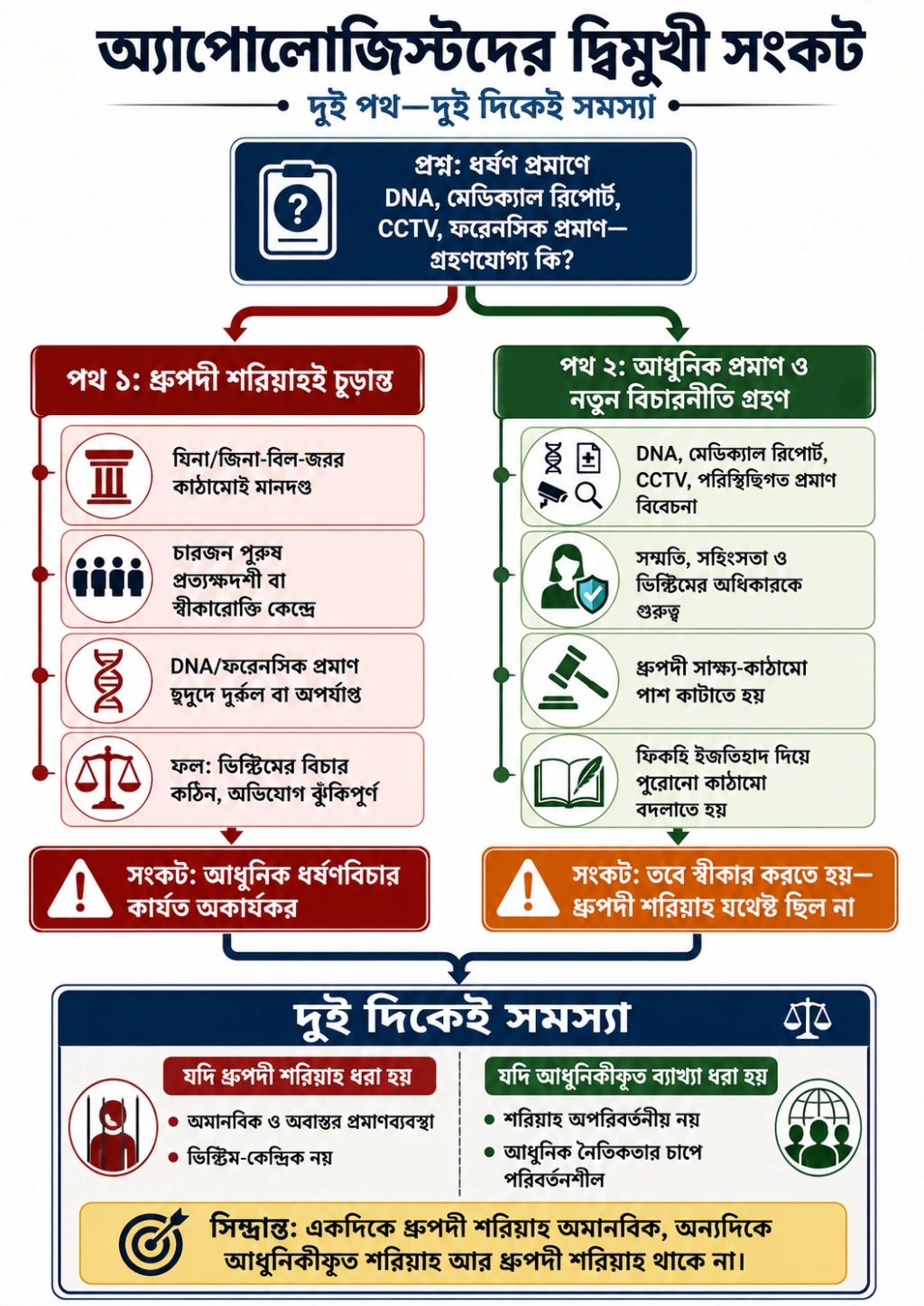
Consider further authentic hadith reiterating the same limit: [103] [104] [105] [106] [107]
Sahih al-Bukhari (Islamic Foundation)
75 / Accounts of Unbelievers and Apostate Rebels
Section: 2862. The extent of punishment and discipline
6384. Abd Allah ibn Yusuf (may Allah have mercy on him) … Narrated Abu Burda: The Prophet (ﷺ) used to say, “Nobody should be flogged more than ten stripes except if he is guilty of a crime, the legal punishment of which is assigned by Allah.”
Hadith grade: Sahih
Narrator: Abu Burdah ibn Niyar (may Allah be pleased with him)
Sahih al-Bukhari (Islamic Foundation)
75 / Accounts of Unbelievers and Apostate Rebels
Section: 2862. The extent of punishment and discipline
6386. Yahya ibn Sulayman (may Allah have mercy on him) … Narrated Abu Burda Al-Ansari: I heard the Prophet (ﷺ) saying, “Do not flog anyone more than ten stripes except if he is involved in a crime necessitating Allah’s legal Punishment.”
Hadith grade: Sahih
Narrator: Abu Burdah ibn Niyar (may Allah be pleased with him)
Sahih Muslim (Islamic Foundation)
30 / Prescribed Punishments
Section: 8. Number of lashes in the case of ta’zir
4311. Ahmad ibn Isa (may Allah have mercy on him) … Abu Barda Ansari reported: Allah’s Messenger (ﷺ) said: None should be given more than ten lashes, but in case of any Hadd out of the Huded of Allah.
Hadith grade: Sahih
Narrator: Abu Burdah ibn Niyar (may Allah be pleased with him)
Sunan Abi Dawud (Islamic Foundation)
33 / Prescribed Punishments
Section: 38. Concerning punishment
4432. Qutaybah ibn Sa’id (may Allah have mercy on him) … Abu Burdah reported the Messenger of Allah (ﷺ) as saying: No more than ten lashes are to be given, except in the case of one of the punishment prescribed by Allah, the Exalted.
Hadith grade: Sahih
Narrator: Abu Burdah ibn Niyar (may Allah be pleased with him)
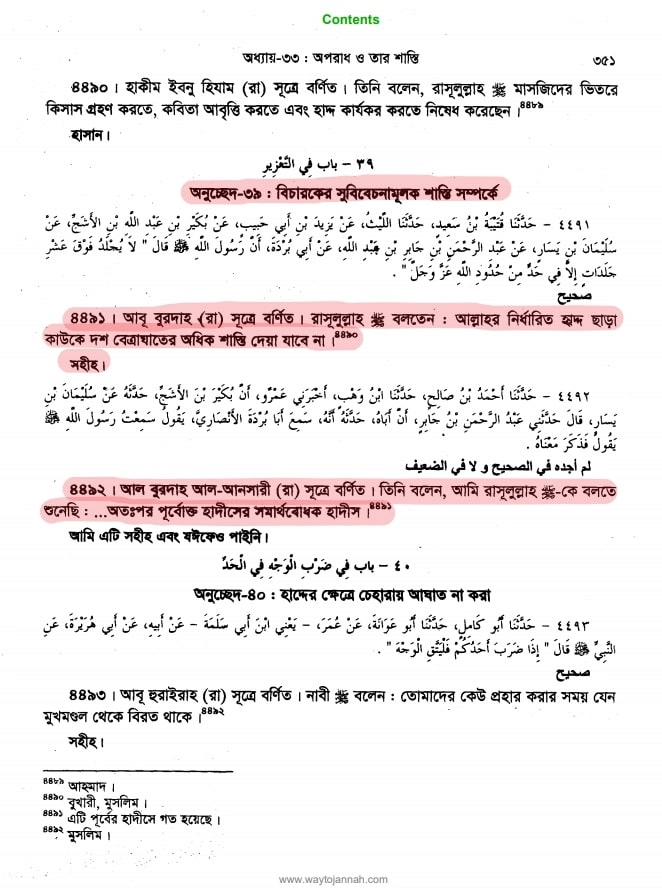
Together, these accounts show how weak it is to present ta’zir as a rescue route for rape adjudication. Ta’zir does not transform rape into an independent consent-based offence. Saying that a judge can impose ta’zir when hadd proof fails does not mean Sharia recognises rape as an offence against a person’s body, consent and autonomy. The underlying theory remains unchanged: proceedings begin within zina; no hadd is imposed without four witnesses or confession; ta’zir then becomes possible at the judge’s discretion. Only the category of punishment changes, not the language of the offence. In modern law, rape is rape from the outset; in this Sharia framework, it begins as zina bil-jabr and becomes a ta’zir offence for lack of proof. This is a fundamental criminological difference rather than a minor linguistic one.
Ta’zir as punishment for rape is therefore no rescue; it is the name of Sharia’s judicial failure. Hadd requires four male witnesses, making proof of rape practically impossible. Failure leads to ta’zir, where the Prophet’s text sets a limit of ten lashes. Avoiding that limit requires jurists’ interpretations, which in turn requires bypassing the text. Sharia’s rape adjudication is a dead end: unrealistic testimony on one side, ineffective ta’zir on the other, and the victim’s body, life, honour and right to justice trapped between them.
The Theory in History and Practice: A Case Study of Pakistan’s Hudood Ordinances
Pakistan’s Hudood Ordinances provide the most instructive modern example of the practical consequences of adjudicating rape within classical Sharia’s “zina” framework. Issued in 1979 under General Zia-ul-Haq’s military regime as part of Pakistan’s Islamisation project, they included The Offence of Zina (Enforcement of Hudood) Ordinance, 1979, which placed adultery, extramarital sexual relations and forced intercourse, or zina-bil-jabr—rape—within the same broader zina-centred framework. Previously, rape had been an independent criminal offence under the Pakistan Penal Code; the Hudood Ordinances pushed it into a Sharia-based system of proof for zina. Establishing rape at the “hadd” level required the accused’s confession or at least four adult, Muslim, upright male eyewitnesses who satisfied the court that they had directly witnessed “penetration”. [108]
This created the central trap of legal cruelty. Rape generally occurs in secrecy, coercion, abuse of power or violence; requiring four upright male eyewitnesses is almost mockingly at odds with reality. A woman’s burden of proving her complaint was tied to an impossible standard, failure to meet which exposed her to accusations of zina, false allegation or social humiliation. Human Rights Watch’s 1992 report Double Jeopardy: Police Abuse of Women in Pakistan found that 50%–80% of women prisoners were detained under the Hudood Ordinances. Before 1979, only seventy women were imprisoned throughout Pakistan; by 1991, more than two thousand were imprisoned under hudud laws alone. [109]
Terrible on paper, the law became still more inhumane in practice. Courts and police frequently used rape complaints as admissions of sexual intercourse against the victims themselves. A woman said “I was raped”, while the Sharia-based zina framework asked: “Can you prove through four male eyewitnesses that it was forced?” Failure opened the way to using her pregnancy, her statement or social rumours as evidence of “extramarital sexual relations” against her. Amnesty International’s 1995 Pakistan report explicitly stated that the law exposed raped women to imprisonment, public flogging and even stoning to death, while their own testimony was inadmissible for the maximum punishment. [110]
The Safia Bibi Case: From Rape Victim to Zina Defendant
The best-known example of the cruelty of Pakistan’s hudud law is Mst. Safia Bibi v. The State, PLD 1985 FSC 120. Safia Bibi was a poor domestic worker, a severely visually impaired or almost blind young woman who alleged rape by her employer and his son. She became pregnant and gave birth; the child died shortly afterwards. When her father filed a rape complaint, rape was not established against the men, while Safia’s pregnancy was used as evidence of zina against her. The trial court sentenced her to three years’ imprisonment, fifteen lashes and a fine. [111]
The case shows how the hudud framework harms a rape victim from two directions. She receives no justice against the rapists because the Sharia-based standard is almost impossible to meet; she then becomes the accused because the court may read pregnancy resulting from rape as “unlawful sexual relations”. The Federal Shariat Court later acquitted Safia Bibi under pressure from public opinion, women’s rights movements and international criticism. The acquittal, however, demonstrates that the law’s normal operation was so inhumane that the court ultimately had to repair its damage, rather than proving the law humane. An almost blind, poor and powerless woman faced imprisonment and flogging for complaining of rape. This is a structural consequence of zina-centred rape adjudication rather than an isolated “wrong judgment”.
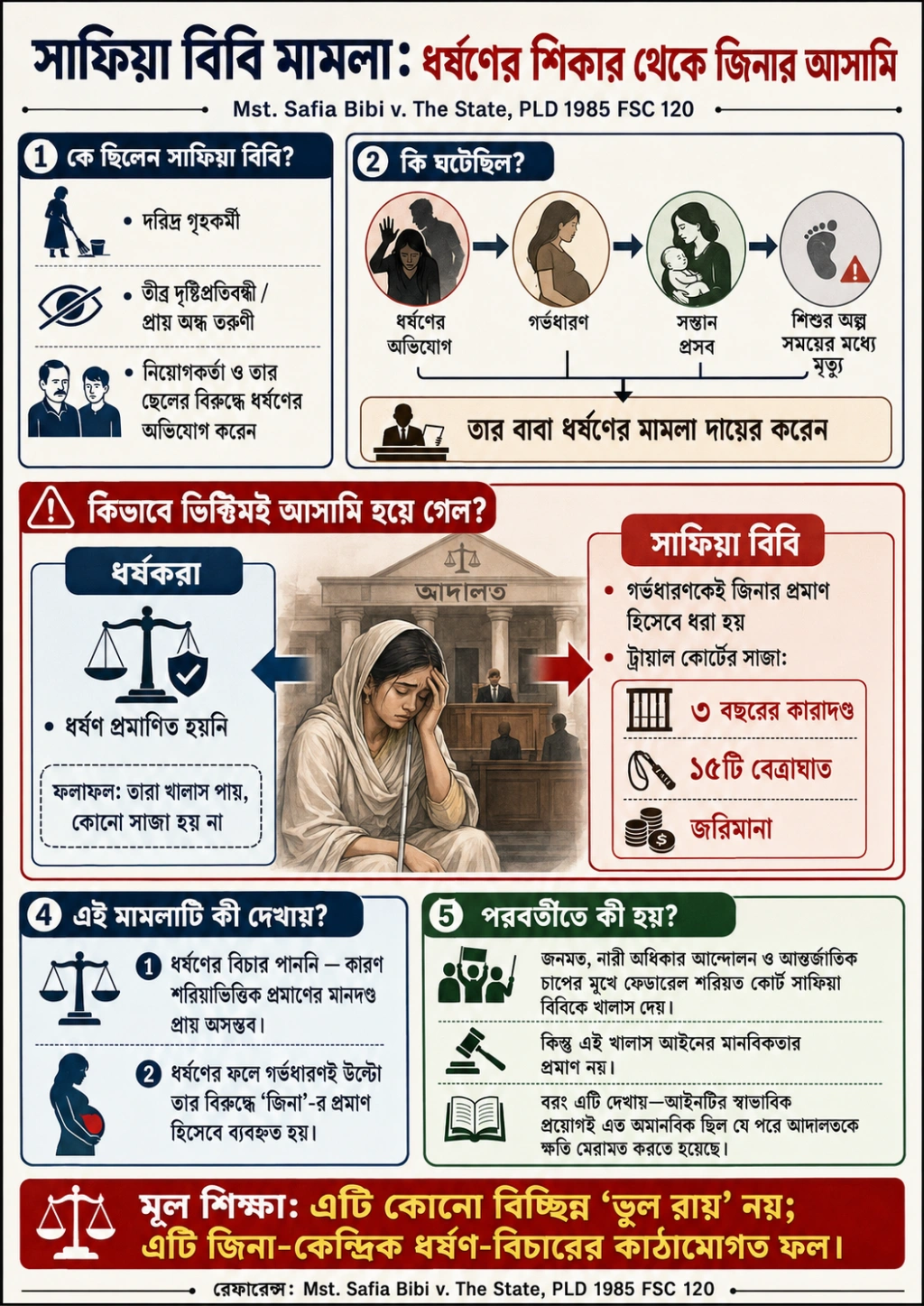
The Jehan Mina Case: Turning an Underage Victim’s Pregnancy into Evidence of Crime
Before Safia Bibi came another terrible case: Mst. Jehan Mina v. The State, PLD 1983 FSC 183. Jehan Mina was a girl of approximately fifteen or sixteen who alleged that rape by her uncle and cousin or relative had made her pregnant. Rape was not established against the accused; meanwhile, her pregnancy and statement were redirected towards proving zina. Reported analyses describe the court treating pregnancy as clear evidence of intercourse while placing the burden of proving that it was forced upon the adolescent victim. [112]
The case’s cruelty goes deeper than the judicial system’s failure to protect an underage girl. Jehan Mina sought state protection by reporting rape; the state transformed her complaint into evidence against her that “intercourse occurred”. The Sharia-based zina framework asked, rather than “Did she consent?”, “Did intercourse occur, and can she establish force through four male witnesses?” Consent is central to modern rape adjudication; here, the central question became whether intercourse occurred outside lawful marriage. This is why even a raped adolescent can become an offender in the state’s eyes.
The Zafran Bibi Case: From a Rape Complaint to a Sentence of Stoning to Death
The 2002 case Mst. Zafran Bibi v. The State, PLD 2002 FSC 1 shows that the hudud framework’s danger was not merely early judicial confusion in the 1980s: the same logic was still being used against women two decades later. Zafran Bibi was married, and her husband was in prison. She alleged that rape by a relative or brother-in-law had made her pregnant. The trial court nevertheless treated her pregnancy as proof of zina and sentenced her to stoning to death. The Federal Shariat Court later changed the ruling, but the framework’s horror was already clear: a woman reporting rape could herself become the defendant facing execution. [113]
Zafran Bibi’s case is particularly significant because the court used the biological fact of “pregnancy” as though it established consent. Pregnancy never proves consent; it is merely a possible consequence of sexual penetration. It may result from rape, assault while unconscious, or coerced relations through abuse of power or threats. Making pregnancy evidence of zina turns the victim’s body into a witness against her—state victim blaming rather than justice.
Structural Failure: Why the Law Worked for Rapists and against Victims
The horror of the Hudood Ordinances is structural rather than the personal cruelty of a particular judge. Zina—the moral offence of extramarital sexual intercourse—stood at their centre. Rape was classified as forced zina, rather than independently constructed as violence against consent or individual freedom. The woman first had to establish intercourse and then lack of consent; at the hadd level, she faced unrealistic conditions such as four male eyewitnesses. A rapist knew that a private setting, the absence of four eyewitnesses, or a victim who was poor, female, a child, a domestic worker or otherwise vulnerable provided plentiful routes of legal escape. Every step, however, was dangerous for the victim.
Human Rights Watch, Amnesty International, women’s rights organisations and Pakistani human rights activists therefore campaigned against the hudud laws for years. Human Rights Watch documented an enormous increase in women prisoners, with poor women, domestic workers and those without social power suffering most. Amnesty International explicitly noted that even raped women could face punishment under the Zina Ordinance because their own testimony did not count as evidence for the maximum penalty. [114]
The 2006 Amendment: State Recognition of the Sharia-Based Framework’s Failure
Following prolonged campaigning, international criticism and pressure from Pakistan’s own women’s rights movement, the Protection of Women (Criminal Laws Amendment) Act, 2006 was passed. It returned rape to sections 375 and 376 of the Pakistan Penal Code, moving it from the religious testimonial conditions of the zina–hudud framework into ordinary criminal law. The 2006 Act restored the definition and punishment of rape to the Penal Code and sought substantially to close the old hudud trap of directly using a rape complaint as a confession of zina. [115]
The 2006 law removed rape from the hudud framework and returned it to the Pakistan Penal Code, treating DNA as part of ordinary criminal evidence rather than “sole and conclusive proof”. Modern forensic evidence, medical reports, circumstantial evidence and the victim’s statement can form part of ordinary criminal proceedings. The 2016 Criminal Law (Amendment) (Offences Relating to Rape) Act later added provisions including sections 53A, 164A and 164B to the Code of Criminal Procedure, strengthening procedures for medical examinations, examinations of the accused and DNA in rape cases. Pakistan’s legal evolution itself therefore demonstrates that effective rape adjudication requires leaving the medieval four-male-witness framework behind and moving towards consent, forensic evidence and ordinary criminal procedure.
Pakistan’s Hudood Ordinances are therefore more than one country’s bad laws: they are a practical laboratory of Sharia-based, zina-centred rape adjudication. Problems that many Islamic apologists dismiss in theory as “misinterpretation”, “misapplication” or “not real Islam” became flesh-and-blood realities in Pakistan’s courts, prisons and police stations, and in the lives of Safia Bibi, Jehan Mina and Zafran Bibi. Trying rape within classical zina law centres the woman’s sexuality, pregnancy, character, testimonial capacity and impossible burden of producing “four men”, rather than her consent and bodily freedom. Its outcome is protection for rapists, silence for victims and state-organised victim blaming, rather than justice.
Pakistan’s experience thus offers a difficult but clear historical lesson: treating rape as a subcategory of zina or moral sexual wrongdoing rather than independent violence turns the law into a mechanism for punishing victims instead of perpetrators. Modern justice based on human rights asks whether consent, force or coercion existed and whether bodily autonomy was violated. The Sharia-based zina framework instead asks whether extramarital intercourse occurred and whether four male witnesses exist. The difference between these judicial philosophies determines whether the state stands with a raped woman or subjects her to rape once again through its own justice system.
Modern Ijtihad, DNA and Sharia’s Changing Morality
Pakistan’s Hudood Ordinances demonstrate clearly that classical Sharia’s zina framework is ineffective for actual rape adjudication. Placing complaints within zina bil-jabr, centring four male eyewitnesses or confession as standards of proof, and allowing pregnancy to serve as evidence of zina against victims turn the system against the raped woman rather than the rapist. This practical failure has led some modern Muslim states and scholars gradually to emphasise DNA, medical reports, forensic findings, victims’ statements, circumstantial evidence, digital records and CCTV. Presenting this change as Sharia’s “eternal justice” is intellectually dishonest: it demonstrates that classical Sharia’s evidentiary theory could not withstand modern humane justice.
The fundamental question is this: if a law claimed to come from Allah is truly sufficient, complete and immutable for all time, why did a need arise for modern forensics, DNA tests, medical reports, video, digital data and investigations centred on victims? Why did the classical framework of four male eyewitnesses and confession prove inadequate? Why must modern Islamic jurists say that DNA may at least be considered for ta’zir, medical reports may assist, and judges may examine circumstantial evidence? There is only one answer: Sharia’s classical framework has failed to meet modern justice’s demands.
Modern apologists generally present this change as “Islam’s flexibility”. They argue that Sharia allows ijtihad, so new forms of evidence pose no problem in a new age. This argument itself weakens the claim to Sharia’s timelessness. If ijtihad reaches the point of requiring judicial importance for modern forensic evidence in place of classical hudud testimony in rape cases, it is a fundamental shift in Sharia’s judicial theory rather than merely “a change in application”. The question changes from “Has zina been established by four witnesses or confession?” to “Does the evidence as a whole indicate coercive sexual assault?” This changes the definition of the offence, the nature of proof and the victim’s position, rather than making a minor juristic adjustment.
DNA and forensic evidence sharpen the conflict. Scientific investigation is not central to the testimonial formalities classical fiqh constructed for proving zina; specified forms of testimony and confession are. Modern criminology, however, recognises that rape generally happens in secrecy, making four eyewitnesses virtually impossible. Modern law therefore responds to reality by considering the victim’s statement, medical tests, DNA, injuries, crime-scene evidence, the accused’s behaviour, threats, power relations and digital communications together. Classical Sharia failed to grasp this reality. Modern Muslim jurists’ attempts to accept DNA and forensic evidence consequently make Sharia indebted to modern legal science.
Another important dimension is moral evolution. Classical Sharia centred zina, lineage, patriarchal honour, women’s chastity and social morality; modern law centres consent, individual freedom, bodily autonomy and victims’ rights. Modern ijtihad’s attempts to regard rape as a separate violent crime rather than merely a subcategory of zina therefore reflect Sharia’s adaptation under pressure from modern human rights morality, rather than rediscovery of Islam’s original moral framework. Sharia did not discover women’s bodily freedom by itself: modern human rights, feminist movements, international law, state pressure and social change compelled Muslim legal thought to borrow a new language.
Apologists face a dilemma. Declaring the classical hudud framework final places DNA, forensics, investigations centred on victims and much of modern rape law outside Sharia. Accepting modern evidence and new judicial principles instead concedes that seventh-century Arabian Sharia was insufficient to adjudicate modern sexual violence and must therefore be revised, expanded or reinterpreted. Both positions undermine the claim that “Sharia is complete and immutable for all time”. Classical Sharia is inhumane on one side; modernised Sharia ceases to be classical Sharia on the other.
The tendency to accept DNA and modern evidence therefore cannot demonstrate Islamic law’s superiority. It documents classical Sharia’s limitations. A law requiring four male eyewitnesses to prove actual rape, exposing victims to qadhf or zina and turning pregnancy into evidence against them would naturally be forced to change under pressure from modern justice. This change demonstrates that morality is not a fixed object descended from heaven: it improves through human experience, victims’ voices, scientific knowledge, human rights movements and social struggle. Sharia is no source of that improved morality; in many cases, it obstructs it, then changes its language under pressure as an old legal framework.
The Apologists’ Strategy: “Hirabah” Theory and Retrospective Rationalisation
The judicial inadequacy of rape law in Islamic jurisprudence—particularly defining rape as “zina bil-jabr” (forced zina), imposing the impossible condition of four male witnesses and giving no legal importance to the victim’s consent—directly conflicts with modern human rights and justice. Since the late twentieth century, some modern Muslim jurists and reformist researchers have sought to move rape’s punishment from “zina” (adultery/fornication) to “hirabah” (banditry) or “fasad fi al-ard” (corruption on earth). Later juristic precedents exist for a hirabah interpretation, but they did not alter rape’s basic zina-centred framework. Modern apologists selectively foreground these limited, conditional interpretations as though rape adjudication had not been fundamentally centred on zina. This is a selective juristic rescue operation concealing fundamental problems in zina testimony, qadhf, women’s testimony, marital rape, sexual access to slave women and the absence of consent.
Verse 33 of Surah al-Ma’idah states: “Indeed, the penalty for those who wage war against Allah and His Messenger and spread mischief in the land is death, crucifixion, cutting off their hands and feet on opposite sides, or exile from the land.…” [116]. Classical commentators such as Ibn Kathir, al-Tabari and al-Qurtubi agree that this verse principally addressed armed banditry, highway robbery and war against society in seventh-century Arabia. It contains no separate or explicit reference to rape. Major schools such as the Hanafi, Shafi’i and Hanbali have historically treated rape as a subcategory of zina, applying four eyewitnesses as the evidentiary standard and one hundred lashes or stoning to death (rajm) as punishment. Only a handful of jurists, such as Ibn al-Arabi of the Maliki school and Ibn Hazm of the Zahiri school, suggested applying hirabah to rape, and only when armed intimidation or widespread public terror was involved.
In modern times, Egypt’s Dar al-Ifta, certain decisions of Pakistan’s Federal Shariat Court, and researchers such as Asifa Quraishi (1999) argue that rape creates fear in society and therefore falls under hirabah, warranting its hadd punishment—execution or crucifixion. Yet International Islamic University Malaysia (IIUM) researcher Azman Mohd Noor acknowledges in his 2010 paper, Punishment for Rape in Islamic Law, that this is essentially a “modern tendency” aimed at presenting Sharia as modern and “woman-friendly” by avoiding the impossible evidentiary conditions applicable to zina.
This modern claim is historically unfounded and contrary to Sharia during Muhammad’s lifetime. An authentic (hasan) hadith in Sunan Abi Dawud provides incontrovertible evidence in its account of a woman raped while going to the mosque [57]. Muhammad announced the zina punishment on the woman’s allegation and the actual offender’s later confession. Significantly, the account does not mention hirabah’s prescribed punishments—crucifixion, amputation or banishment. One version orders stoning, a zina-framework punishment; the critically assessed version, however, identifies “Stone him to death” as weak, and the preferred opinion is that he was not stoned. This poses a serious problem for apologists’ hirabah theory: this direct Prophetic account of rape contains no mention of hirabah’s prescribed punishment; no one mentions it even by mistake. The stoning order in one version belongs to the zina framework, and that very portion is identified as weak in the critically assessed edition.
Sunan Abi Dawud (Islamic Foundation)
33 / Prescribed Punishments
Section: 7. Regarding one deserving of the punishment coming to confess
4328. Muhammad ibn Yahya (may Allah have mercy on him) … Narrated Wa’il ibn Hujr, through Alqamah from his father: When a woman went out in the time of the Prophet (ﷺ) for prayer, a man attacked her and overpowered (raped) her. She shouted and he went off, and when a man came by, she said: That (man) did such and such to me. And when a company of the Emigrants came by, she said: That man did such and such to me. They went and seized the man whom they thought had had intercourse with her and brought him to her.
She said: Yes, this is he. Then they brought him to the Messenger of Allah (ﷺ). When he (the Prophet) was about to pass sentence, the man who (actually) had assaulted her stood up and said: Messenger of Allah, I am the man who did it to her. He (the Prophet) said to her: Go away, for Allah has forgiven you. But he told the man some good words (AbuDawud said: meaning the man who was seized), and of the man who had had intercourse with her, he said: Stone him to death. He also said: He has repented to such an extent that if the people of Medina had repented similarly, it would have been accepted from them.
Abu Dawud said: Asbat bin Nasr has also transmitted it from Simak.
Hadith grade: Hasan except for “Stone him to death”; the preferred view is that he was not stoned (al-Albani). The Bengali Islamic Foundation edition labels it Hasan.
Narrator: Wa’il ibn Hujr, through Alqamah
Sunan Abi Dawud (critically assessed)
33 / Crimes and Their Punishments
Section: 7. Regarding one deserving of the punishment coming to confess
4379. Narrated Wa’il ibn Hujr, through Alqamah ibn Wa’il from his father: When a woman went out in the time of the Prophet (ﷺ) for prayer, a man attacked her and overpowered (raped) her. She shouted and he went off, and when a man came by, she said: That (man) did such and such to me. And when a company of the Emigrants came by, she said: That man did such and such to me. They went and seized the man whom they thought had had intercourse with her and brought him to her.
She said: Yes, this is he. Then they brought him to the Messenger of Allah (ﷺ). When he (the Prophet) was about to pass sentence, the man who (actually) had assaulted her stood up and said: Messenger of Allah, I am the man who did it to her. He (the Prophet) said to her: Go away, for Allah has forgiven you. But he told the man some good words (AbuDawud said: meaning the man who was seized), and of the man who had had intercourse with her, he said: Stone him to death. He also said: He has repented to such an extent that if the people of Medina had repented similarly, it would have been accepted from them.[1]
Hasan, except for “Stone him to death”; the preferred view is that he was not stoned.
[1] Al-Tirmidhi, Ahmad. Imam al-Tirmidhi describes this hadith as hasan, gharib and sahih.
Hadith grade: Hasan
Narrator: Wa’il ibn Hujr, through Alqamah ibn Wa’il al-Hadrami. Abu Dawud said: Asbat bin Nasr has also transmitted it from Simak.
This incident unequivocally demonstrates that the Prophet regarded rape as a form of zina rather than hirabah or an offence against the state. Modern reformers’ hirabah theory consequently directly conflicts with the principal Islamic sources and merely attempts unsuccessfully to conceal zina law’s internal weaknesses. Adjudicating rape within models of zina or robbery instead of recognising an offence based on consent in the modern legal sense demonstrates that this fourteen-century-old legal framework remains primitive and ineffective by modern standards of justice and gender equality.
Changing Explicit Texts through Human Revision: No Isolated Incident
One point deserves particular attention: effectively changing, restricting or reconstructing a text’s plain rule through juristic interpretation, ijtihad, administrative decisions or new classification after it conflicts with reality is no isolated phenomenon in Islamic history. In rape cases, the Prophet’s authentic text limits ta’zir to ten lashes; when that limit proves ineffective in actual criminal proceedings, later jurists expand its language to permit much greater punishments. Modern attempts likewise move rape towards hirabah, ta’zir or modern forensic adjudication to avoid the evidentiary crisis of the zina-centred framework. The same pattern recurs: first, a claim to divine and immutable law; then conflict with reality; finally, human ijtihad to repair the conflict.
The pattern also appears in other Islamic rules. Numerous examples surrounding Umar’s decisions show provisions practised during the Prophet’s lifetime or direct religious commands subsequently changed, restricted or reapplied through administrative and juristic decisions. Conflicts concerning mut’ah, hajj al-tamattu’, the umm walad, Ramadan rules and other matters have been discussed elsewhere in detail. [101]
One of the clearest examples is the ‘awl method in Quranic inheritance law. Although the Quran directly assigns heirs specific fractions, in some cases their sum exceeds the entire estate. To make distribution possible, the later ‘awl method proportionately reduces each heir’s Quran-assigned share. Keeping the Quran’s specified numbers unchanged makes the rule unworkable in some cases; making it work requires a human-devised method that changes those shares. The problem is discussed in detail here: [117].
Overcoming textual limitations through ta’zir or hirabah in rape cases cannot therefore be presented as exceptional “Islamic flexibility”. It repeats an old problem: a rule initially claimed to be perfect, complete, final and divinely immutable until the Day of Judgment must be repaired through human reason, ijtihad and new interpretation whenever it conflicts with reality. If human revision is necessary, the original rule was incomplete; if the original rule truly is complete and immutable, no revision should be legitimate. Both claims cannot be true simultaneously.
Conclusion
Putting the discussion together makes one thing obvious: no woman in the real world goes to be raped accompanied by “four upright Muslim male witnesses”. Suppose four men happen to witness the incident closely; the hadith requires them to observe penetration as clearly as a kohl applicator entering its container. If someone stands close enough to watch this, is he really an impartial witness, or effectively part of the criminal group? If four men merely stand silently “watching” without trying to intervene, how can they be regarded as anything but the rapist’s accomplices?
Then come the lengthy qualifications: witnesses must be Muslim, male, upright and truthful, neither fasiq nor disreputable, and must describe the incident in matching terms. Meeting all these conditions together is practically impossible. Proving rape within this legal framework is consequently exceptionally rare. Most rape cases never reach court; those that do remain trapped in evidentiary obstacles. The raped woman, her family and society all consider silence safer than “taking on trouble”.
Women in conservative religious societies already live with numerous social obstacles and informal restrictions on movement, clothing, careers and financial independence. If, after the trauma of rape, merely complaining exposes them to flogging, social shame and being branded “liars”, what woman would voluntarily stand before a court? Such laws do not reduce rape; they create a safe refuge for rapists and force victims to remain silent.
What, then, should we actually do? First, families must communicate a different message to children: dismantle the old religious and social tale that “women are weak, incapable and helpless”, and teach that neither sex is lesser as human beings. Everyone has the right to make decisions about their own body, dignity and life. Far more important than keeping your daughter boxed away is teaching your son never to do anything that forces his mother, sister or friend to bow her head in shame.
Second, schools and colleges need sex education grounded in science and humane principles. Children should grow up with open, factual knowledge about their bodies, boundaries, consent, abuse and safety, and feel neither shame nor guilt in telling trusted adults—parents or teachers—when something is wrong. The terrible idea that a rape victim is herself guilty must be dismantled. Laws must also reform discriminatory provisions, testimonial rules and unreasonable evidentiary obstacles so that victims’ accounts carry weight and sympathy is directed towards them rather than perpetrators.
Psychological research shows that we have fewer inhibitions about violence towards groups whom we have not learned to imagine as “fully human”, or whom we do not know closely. Constantly describing women as “someone else’s daughter”, “someone else’s honour”, “half-witted” or “deficient in religion” makes it difficult both to grant them equal human dignity and to see attacks upon them as crimes. Covering the problem with barbaric punishments such as execution leaves its underlying social and psychological structure intact. We need scientific analysis of why rapists rape and how they weaponise power, religion, shame and silence, followed by dismantling that psychology through education, culture and law together.
The discussion yields two central points. First, research and statistics show that harsh punishments, particularly execution, do not effectively deter rape; in many cases they increase the risks of filing a case and silence victims further. Second, the judicial framework created by placing rape within classical Sharia’s zina-centred evidentiary system provides a safer refuge for offenders than for victims, directly conflicting with modern human rights, forensic science and even minimal standards of justice.
The question is therefore straightforward: do you want laws and a judicial system where proving rape is almost impossible, giving testimony exposes you to flogging and imprisonment, and rapists escape behind bizarre conditions involving “four witnesses” and “a kohl applicator and its container”? Or do you want a law that seeks justice by considering the victim’s account, forensic evidence, DNA tests, medical reports, CCTV footage and psychological trauma together? The decision lies with the reader: which kind of judicial system do you consider safe for your country, your society and your children’s future?
References
- Sahih al-Bukhari, Hadith: 2652 ↩︎
- Sahih Muslim, Hadith: 2533 ↩︎
- “Sexual violence chapter 6” (PDF). World Health Organization. 2002. Retrieved 5 December 2015 ↩︎
- “Rape”. dictionary.reference.com. April 15, 2011 ↩︎
- “Rape”. legal-dictionary.thefreedictionary.com. April 15, 2011 ↩︎
- Azman Mohd Noor, “Punishment for Rape in Islamic Law”, Arab Law Quarterly, Vol. 24, 2010, pp. 52–53 ↩︎
- Sahih al-Bukhari, Kitab al-Ikrah, Hadith 6949 ↩︎
- Burhan al-Din al-Marghinani, Al-Hidayah fi Sharh Bidayat al-Mubtadi, Kitab al-Hudud, Bab al-Zina ↩︎
- Al-Quduri, Mukhtasar al-Quduri, Kitab al-Hudud, Bab al-Zina ↩︎
- Ala al-Din al-Kasani, Bada’i al-Sana’i fi Tartib al-Shara’i, Kitab al-Hudud, Fasl fi Hadd al-Zina ↩︎
- Malik ibn Anas, Al-Muwatta, Kitab al-Hudud, Bab Ma Ja’a fi al-Rajm wa al-Hudud ↩︎
- Ibn Rushd, Bidayat al-Mujtahid wa Nihayat al-Muqtasid, Kitab al-Hudud, Bab al-Zina ↩︎
- Al-Shafi’i, Al-Umm, Kitab al-Hudud ↩︎
- Al-Nawawi, Al-Majmu’ Sharh al-Muhadhdhab, Kitab al-Hudud ↩︎
- Ibn Qudamah, Al-Mughni, Kitab al-Hudud, Bab Hadd al-Zina ↩︎
- Sharia as the Official Law of the Land ↩︎
- The Highest Honour and the Greatest Dignity! ↩︎
- Surah al-Baqarah, verse 223 ↩︎
- Surah al-A’raf, verse 189 ↩︎
- Sahih Muslim, Islamic Foundation, Hadith: 3512 1 2
- Sahih Muslim, Islamic Foundation, Hadith: 3513 ↩︎
- Sunan Ibn Majah, Tawhid Publications, Hadith: 3998 ↩︎
- Sahih al-Bukhari, Islamic Foundation, Hadith: 28 ↩︎
- Surah al-Ahzab, verse 59 ↩︎
- Tafsir al-Mazhari, Vol. 8, p. 279 ↩︎
- A CLEAR SCIENTIFIC CONSENSUS THAT THE DEATH PENALTY DOES NOT DETER ↩︎
- DOES THE DEATH PENALTY DETER CRIME? GETTING THE FACTS STRAIGHT ↩︎
- Deterrence and the Death Penalty (2012) ↩︎
- No Criminals: Prisons Are Closing in the Netherlands! ↩︎
- Fewer Criminals, So Prisons Are Closing ↩︎
- Declaration on the Elimination of Violence Against Women ↩︎
- Marital Rape: Consent, Marriage, and Social Change in Global Context ↩︎
- Sahih Muslim, Hadith Academy, Hadith: 3433 ↩︎
- Sahih Muslim, Hadith Academy, Hadith: 3432 ↩︎
- Mishkat al-Masabih (Mishkat), Hadith: 3257 ↩︎
- Sunan Ibn Majah, Tawhid Publication, Hadith: 1853 ↩︎
- The Sanction of Marital Rape in Islam ↩︎
- Can the Legality of Marital Rape in Islam Be Denied? ↩︎
- The Legality of Marital Rape in Islam ↩︎
- Had Aisha Reached Puberty at the Age of Nine? ↩︎
- Sahih Muslim, Hadith Academy, Hadith: 3370 ↩︎
- On the Legality of Raping Female Captives or Slave Women in Islam: Is a Slave Woman’s Consent Necessary? ↩︎
- Inhumane Slavery in Islam ↩︎
- Sahih al-Bukhari, Islamic Foundation, Hadith: 3832 ↩︎
- Sahih al-Bukhari, Tawhid Publications, Hadith: 7409 ↩︎
- Sunan Abi Dawud, Islamic Foundation, Hadith: 4403 ↩︎
- Al-Hidayah, Vol. 2, Islamic Foundation, pp. 361, 362 ↩︎
- Sahih al-Bukhari, Islamic Foundation, Hadith: 6159 ↩︎
- Mishkat al-Masabih (Mishkat), Hadith: 26 ↩︎
- IslamQA, Fatwa 453751 — ما عقوبة المغتصب في الشريعة؟ ↩︎
- IslamQA, Fatwa 158282 — Rape and modern methods of proof ↩︎
- IslamWeb, Fatwa 397813 — إثبات الاغتصاب بالوسائل الطبية الحديثة أو آثار المقاومة ↩︎
- The Goal of Islamic Jihad: Offensive Jihad and Qital Must Continue until the Day of Judgment, until Shirk Is Eradicated ↩︎
- Noor, Azman Mohd (1 January 2010). “Rape: A Problem of Crime Classification in Islamic Law”. Arab Law Quarterly. 24 (4): 417–438. doi:10.1163/157302510X526724 ↩︎
- Surah al-Ma’idah, verses 33–34 ↩︎
- Surah al-Ma’idah, verse 34 ↩︎
- Sunan Abi Dawud, Islamic Foundation, Hadith: 4328 1 2
- Sunan Abi Dawud (critically assessed), Hadith: 4379—Hasan except for “Stone him to death”; the preferred opinion is that he was not stoned ↩︎
- Sunan Abi Dawud (critically assessed), Allama Albani Academy, Vol. 5, pp. 298–299, Hadith: 4379 ↩︎
- Sunan Abi Dawud, Islamic Foundation, Hadith: 4405 ↩︎
- Mishkat al-Masabih (Mishkat), Hadith: 3576 ↩︎
- Surah al-Nisa, 15–16 ↩︎
- Surah al-Nur, 12–16 ↩︎
- Surah al-Nur, verse 2 ↩︎
- Surah al-Nur, verses 4–5 ↩︎
- Tafsir Zakaria, Dr. Abu Bakr Muhammad Zakaria, published by the Saudi government, Vol. 1, pp. 396–397 ↩︎
- Quran, Surah al-Baqarah, verse 282 ↩︎
- Sahih al-Bukhari, Islamic Foundation, Hadith: 298 ↩︎
- Islami Ain O Bichar, quarterly research journal, Islamic Law Research Center and Legal Aid Bangladesh, Year 10, No. 37, January–March 2014, p. 101 ↩︎
- Sunan Abi Dawud (critically assessed), Hadith: 4452 ↩︎
- Fatawa ‘Alamgiri, Emperor Abu al-Muzaffar Muhammad Muhi al-Din Aurangzeb Alamgir, Islamic Foundation, Vol. 3, p. 379 ↩︎
- Islam’s Penal Law, by Dr. Ahmad Ali. Publisher: Bangladesh Co-operative Book Society Ltd. ↩︎
- How can zinaa be proven? ↩︎
- Source: Sheikh Muhammed Salih Al-Munajjid ↩︎
- Proving Rape by Modern Medical Means ↩︎
- Riyad al-Salihin, Hadith: 245 ↩︎
- Jami’ al-Tirmidhi, Islamic Foundation, Hadith: 3115 ↩︎
- Surah al-Nur, verse 4 ↩︎
- Al-Marghinani, Al-Hidayah fi Sharh Bidayat al-Mubtadi, Kitab al-Hudud, Bab al-Qadhf ↩︎
- Al-Quduri, Mukhtasar al-Quduri, Kitab al-Hudud, Bab al-Qadhf ↩︎
- Ibn Hazm, Al-Muhalla bi-l-Athar, Vol. 12, p. 259 — فيمن ادعت أن فلانا استكرهها على الزنا بها ↩︎
- IslamWeb, Fatwa 323002 — Failing to produce four witnesses in accusation of rape ↩︎
- IslamQA, Fatwa 158282 — ruling on rape and modern methods of proof ↩︎
- Shongshoy Islam Archive — Tafsir al-Qurtubi, Vol. 12, pp. 171–175 ↩︎
- Muwatta Malik — Rulings Concerning a Raped Woman ↩︎
- IslamWeb Library — Muwatta Malik, كتاب الحدود، باب ما جاء في المغتصبة ↩︎
- Ibn Abd al-Barr, Al-Istidhkar — باب ما جاء في المغتصبة ↩︎
- Surah al-Nur, verse 13 ↩︎
- Tafsir al-Jalalayn, Vol. 4, pp. 490, 493, 497, 499 ↩︎
- Tafsir al-Mazhari, Vol. 8, pp. 360, 361 ↩︎
- Sahih al-Bukhari, Islamic Foundation, Hadith: 2493 ↩︎
- THE OFFENCE OF QAZF (ENFORCEMENT OF HADD) ORDINANCE (VIII OF 1979) ↩︎
- Ibn Hazm, Al-Muhalla bi-l-Athar, Vol. 12, p. 209 — إذا كان الشهود في الزنى لا يتمون أربعة ↩︎
- Shongshoy Islam Archive — Tafsir al-Qurtubi, Vol. 12, pp. 176–180 ↩︎
- IslamQA, Fatwa 192233 — Qadhf for Reporting Zina Seen Directly without Four Witnesses ↩︎
- Ashraf al-Hidayah, Islamia Kutubkhana, Vol. 4, p. 167 — scan ↩︎
- Al-Bidayah wa-l-Nihayah, Vol. 7, Islamic Foundation, pp. 152–155 ↩︎
- Mulla Ali al-Qari, Mirqat al-Mafatih, Kitab al-Hudud, Bab al-Ta’zir, Vol. 6, pp. 2379–2380 ↩︎
- Ibn Hazm, Al-Muhalla bi-l-Athar, Vol. 12, ruling: مقدار التعزير, pp. 424–425 ↩︎
- Shamela — Ibn Hazm, Al-Muhalla, Vol. 12, the Amount of Ta’zir ↩︎
- A List of Umar’s Direct Acts of Disbelief 1 2
- Sahih Muslim, Hadith Academy, Hadith: 4352 ↩︎
- Sahih al-Bukhari, Islamic Foundation, Hadith: 6384 ↩︎
- Sahih al-Bukhari, Islamic Foundation, Hadith: 6386 ↩︎
- Sahih Muslim, Islamic Foundation, Hadith: 4311 ↩︎
- Sunan Abi Dawud, Islamic Foundation, Hadith: 4432 ↩︎
- Sunan Abi Dawud, critically assessed by Allama Nasir al-Din al-Albani, Allama Albani Academy, Vol. 5, p. 351 ↩︎
- The Offence of Zina (Enforcement of Hudood) Ordinance, 1979, Sections 6–8 ↩︎
- Human Rights Watch, Double Jeopardy: Police Abuse of Women in Pakistan, 1992 ↩︎
- Amnesty International, Women in Pakistan: Disadvantaged and Denied Their Rights, 1995 ↩︎
- Mst. Safia Bibi v. The State, PLD 1985 FSC 120 ↩︎
- Mst. Jehan Mina v. The State, PLD 1983 FSC 183 ↩︎
- Mst. Zafran Bibi v. The State, PLD 2002 FSC 1 ↩︎
- Human Rights Watch, Double Jeopardy, 1992; Amnesty International, Women in Pakistan, 1995 ↩︎
- Protection of Women (Criminal Laws Amendment) Act, 2006 ↩︎
- Surah al-Ma’idah, verse: 33; Dr. Mustafa Khattab, The Clear Quran, excerpt ↩︎
- The ‘Awl Method: An Error in Quranic Inheritance Law ↩︎
About This Article
Genre: Islamic Law Critique, Rape Law, Hudud and Zina Analysis, Classical Fiqh, Sharia Criminal Law, Gender and Consent, Evidentiary Law, Human Rights, and Pakistan Hudood Case Study
Epistemic Position: Secular Humanism, Historical Criticism, Internal Critique, Textual Analysis, Legal-Historical Analysis, Evidence-Based Reasoning, Consent-Based Ethics, and Philosophical Skepticism
This article critically examines how rape is defined, proven, and punished in classical Islamic law. Using the Quran, canonical hadith, classical fiqh, tafsir, fatwas, legal history, and modern Islamic jurisprudence, it analyzes the treatment of rape as zina bi al-ikrah or forced zina rather than as an independent consent-based crime against bodily autonomy.
Major topics include the four-witness requirement, confession, qadhf or false-accusation liability, women's testimony, pregnancy as evidence, DNA and forensic evidence, ta'zir punishment, the ten-lash hadith, later juristic disagreement, and modern attempts to reclassify rape as hirabah or fasad fi al-ard.
The article also examines marital sexual coercion, slavery and captive women, minors and consent, and the wider difference between classical sexual-morality law and modern victim-centered rape law. A major case study covers Pakistan's Hudood Ordinances and the cases of Safia Bibi, Jehan Mina, and Zafran Bibi, showing the practical consequences of processing rape through a zina-centered legal framework.
The broader argument concerns the claim that Sharia is a perfect, complete, and permanently sufficient divine legal system. When later jurists and states must expand ta'zir, reinterpret hirabah, incorporate forensic science, or remove rape from the classical zina framework, the article asks whether this demonstrates divine perfection or subsequent human legal correction.
This article should be evaluated through primary Islamic texts, classical jurisprudence, legal history, forensic evidence, criminology, human-rights law, consent theory, burden of proof, and internal consistency—not through retrospective apologetics or the assumption that later reinterpretation automatically resolves contradictions within the earlier legal structure.