
Introduction
At the heart of Islamic creed, Allah is presented as an absolutely sovereign, omnipotent, and all-controlling being, beyond whose will not even a speck of dust in the universe can move. According to Islamic theology, Allah is not merely the Creator; He is also the ultimate controller of every event, every cause, every effect, and every visible and invisible force. His power depends on no medium, instrument, natural law, magical rite, or worldly process. In Qur’anic language, the essence of His power is “Kun fayakun”: when He commands something to be, it comes into being. Within this framework of belief, then, Allah is not a weak being who must untie a magical knot, recover hair and a comb from a well, or perform a counter-ritual in order to carry out His own decision.
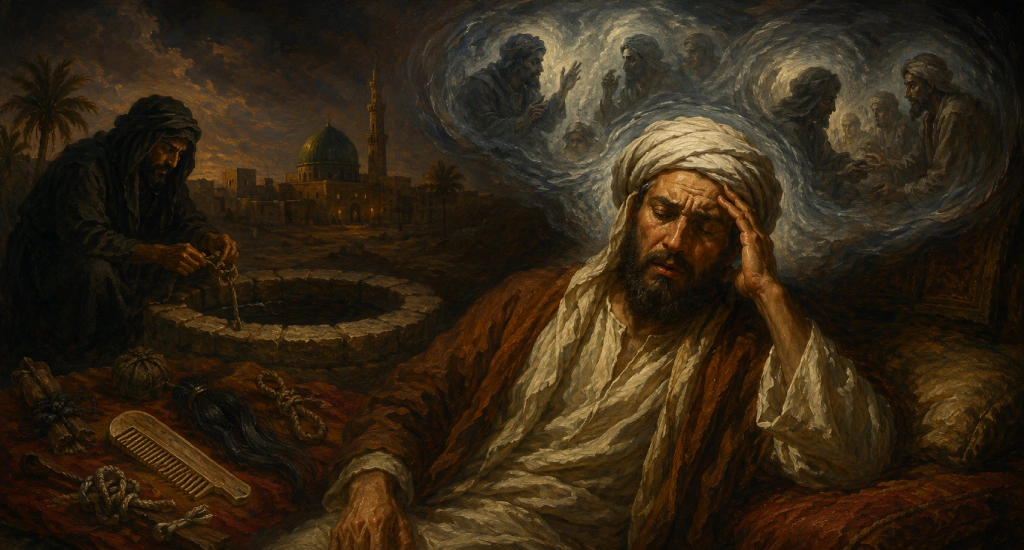
Yet the hadith tradition regarded as the most reliable in Islam preserves an episode that directly throws this concept of absolute sovereignty into intellectual crisis. According to the report, a Jewish sorcerer in Medina named Labid ibn al-A‘sam cast a spell on Muhammad. Under its influence, Muhammad became so mentally confused that he thought he had done things he had not done; he even believed that he had had sexual relations with his wives when he had not. This is neither trivial nor peripheral, because it directly concerns the Prophet’s memory, consciousness, judgment, and ability to distinguish reality from unreality.
Stranger still, the spell was supposedly not removed at once by a direct command from Allah. Instead, angels disclosed where the magical materials had been placed—which well, beneath which stone, and among what hair, comb, date-palm spathe, and other physical objects associated with the well. Muhammad is then said to have recovered through an object-dependent process characteristic of folk belief in magic: identifying or retrieving those objects. The question is precisely this: If Allah is truly omnipotent, why did freeing His most beloved Prophet from a sorcerer’s object-dependent attack require such a primitive, mechanical, counter-magical procedure? Is an almighty God methodologically held hostage by hair and a comb buried beneath a well?
It is easy to cover this narrative with ordinary religious sentiment, but when tested against logic, the problem lies starkly exposed. If magic possessed no power of its own and Allah Himself made it effective, then why did Allah confuse His Prophet’s consciousness in a way that places his prophethood, ‘ismah, and the reliability of revelation itself under suspicion? If, on the other hand, magic possessed an efficacy of its own and genuinely affected Muhammad, then the claim of Allah’s exclusive power, protection, and sovereignty collapses. The problem cannot be avoided in either case. This article will therefore analyze the episode not through the emotions of faith but in the light of philosophy, science, psychology, history, and textual criticism, showing the grave contradictions that the story of Muhammad’s bewitchment creates within Islamic theology.
The Hadith Accounts: Muhammad’s Bewitchment
Let us read the hadiths: [1] [2] [3]
Sahih al-Bukhari (Tawheed Publications)
76/ Medicine
Chapter: 76/49. May a bewitched person be treated?
وَقَالَ قَتَادَةُ قُلْتُ لِسَعِيدِ بْنِ الْمُسَيَّبِ رَجُلٌ بِه„ طِبٌّ أَوْ يُؤَخَّذُ عَنْ امْرَأَتِه„ أَيُحَلُّ عَنْه“ أَوْ يُنَشَّرُ قَالَ لاَ بَأْسَ بِه„ إِنَّمَا يُرِيدُونَ بِهِ الإِصْلاَحَ فَأَمَّا مَا يَنْفَعُ النَّاسَ فَلَمْ يُنْهَ عَنْهُ.
Qatadah (may Allah have mercy on him) said: I asked Sa‘id ibn al-Musayyib (may Allah have mercy on him) about a man who had been bewitched, or who had been prevented by magic from approaching his wife: could the spell be removed from him, or could he be treated with nushrah? Sa‘id said: There is no harm in it. They intend only to set matters right, and that which benefits people has not been forbidden.
5765. Narrated Aisha: Magic was worked on Allah’s Messenger (ﷺ) so that he used to think that he had sexual relations with his wives while he actually had not (Sufyan said: That is the hardest kind of magic as it has such an effect). Then one day he said, “O ‘Aisha, do you know that Allah has instructed me concerning the matter I asked Him about? Two men came to me and one of them sat near my head and the other sat near my feet. The one near my head asked the other, ‘What is wrong with this man?’ The latter replied, ‘He is under the effect of magic.’ The first one asked, ‘Who has worked magic on him?’ The other replied, ‘Labid bin Al-A‘sam, a man from Bani Zuraiq who was an ally of the Jews and was a hypocrite.’ The first one asked, ‘What material did he use?’ The other replied, ‘A comb and the hair stuck to it.’ The first one asked, ‘Where is that?’ The other replied, ‘In a skin of pollen of a male date-palm tree kept under a stone in the well of Dharwan.’ So the Prophet (ﷺ) went to that well and took out those things and said, ‘That was the well which was shown to me in a dream. Its water looked like the infusion of henna leaves and its date-palm trees looked like the heads of devils.’ The Prophet (ﷺ) added, ‘Then that thing was taken out.’ I said to the Prophet (ﷺ), ‘Why do you not treat yourself with Nashra?’ He said, ‘Allah has cured me; I dislike to let evil spread among my people.’ [3175; Muslim 39/17, hadith 2189; Ahmad 24354] (Modern Publications: 5344; Islamic Foundation: 5240)
Hadith grade: Sahih
Narrator: ‘Aisha bint Abi Bakr al-Siddiq (may Allah be pleased with her)
Sahih al-Bukhari (Tawheed Publications)
59/ Beginning of Creation
Chapter: 59/11. The characteristics of Iblis and his forces.
وَقَالَ مُجَاهِدٌ يُقْذَفُوْنَ يُرْمَوْنَ دُحُوْرًا مَطْرُوْدِيْنَ وَاصِبٌ دَائِمٌ وَقَالَ ابْنُ عَبَّاسٍ مَدْحُوْرًا مَطْرُوْدًا يُقَالُ مَرِيْدًا مُتَمَرِّدًا بَتَّكَهُ قَطَّعَهُ وَاسْتَفْزِزْ اسْتَخِفَّ بِخَيْلِكَ الْفُرْسَانُ وَالرَّجْلُ الرَّجَّالَةُ وَاحِدُهَا رَاجِلٌ مِثْلُ صَاحِبٍ وَصَحْبٍ وَتَاجِرٍ وَتَجْرٍ لَاحْتَنِكَنَّ لَاسْتَأْصِلَنَّ قَرِيْنٌ شَيْطَانٌ
Mujahid (may Allah have mercy on him) said: يُقْذَفُوْنَ means “they will be hurled”; دُحُوْرًا means “driven away”; وَاصِبٌ means “lasting.” Ibn ‘Abbas (may Allah be pleased with him) said: مَدْحُوْرًا means “driven away”; مَرِيْدًا means “rebellious”; بَتَّكَهُ means “he cut it”; وَاسْتَفْزِزْ means “incite”; بِخَيْلِكَ means “your cavalry”; and وَالرَّجْلُ means “the infantry.” Its singular is رَاجِلٌ, just as صَحْب is the plural of صَاحِب and تَجْرٍ is the plural of تَاجِر. لَاحْتَنِكَنَّ means “I will surely eradicate,” and قَرِيْنٌ means “a devil.”
3268. Narrated ‘Aisha: Magic was worked on the Prophet (ﷺ) so that he began to fancy that he was doing a thing which he was not actually doing. One day he invoked Allah for a long period and then said, “I feel that Allah has inspired me as how to cure myself. Two persons came to me in my dream and sat, one by my head and the other by my feet. One of them asked the other, ‘What is the ailment of this man?’ The other replied, ‘He has been bewitched.’ The first asked, ‘Who has bewitched him?’ The other replied, ‘Lubaid bin Al-A‘sam.’ The first one asked, ‘What material has he used?’ The other replied, ‘A comb, the hair gathered on it, and the outer skin of the pollen of the male date-palm.’ The first asked, ‘Where is that?’ The other replied, ‘It is in the well of Dharwan.’ So the Prophet (ﷺ) went out towards the well and then returned and said to me on his return, ‘Its date-palms are like the heads of the devils.’ I asked, ‘Did you take out those things with which the magic was worked?’ He said, ‘No, for I have been cured by Allah and I am afraid that this action may spread evil amongst the people.’ Later on the well was filled up with earth. (3175) (Modern Publications: 3027; Islamic Foundation: 3037)
Hadith grade: Sahih
Narrator: ‘Aisha bint Abi Bakr al-Siddiq (may Allah be pleased with her)
Sahih Muslim (Hadith Academy)
40. The Book of Greetings
Chapter: 17. Witchcraft
Hadith Academy number: 5596; international number: 2189
5596-(43/2189) Abu Kuraib (may Allah have mercy on him) … narrated from ‘Aisha (may Allah be pleased with her), who said: A Jew from among the Jews of Banu Zuraiq who was called Labid b. al-A‘sam cast a spell upon Allah’s Messenger (ﷺ), with the result that he, under the influence of the spell, felt that he had been doing something whereas in fact he had not been doing that. This state of affairs lasted until one day or during one night Allah’s Messenger (ﷺ) made supplication to dispel its effects. He again made a supplication and he again did this, and said to ‘Aisha: “Do you know that Allah has told me what I had asked Him?
There came to me two men, and one amongst them sat near my head and the other one near my feet. He who sat near my head said to the one who sat near my feet—or the one who sat near my feet said to the one who sat near my head—‘What is the trouble with the man?’ He said, ‘The spell has affected him.’ He said, ‘Who has cast that?’ He, the other one, said, ‘It was Labid b. A‘sam who has done it.’ He said, ‘What is the thing by which he transmitted its effect?’ He said, ‘By the comb and by the hair stuck to the comb and the spathe of the date-palm.’ He said, ‘Where is that?’ He replied, ‘In the well of Dhi Arwan.’
‘Aisha said: Allah’s Messenger (ﷺ) sent some of the persons from among his Companions there and then said: “‘Aisha, by Allah, its water was yellow like henna and its trees were like heads of the devils.” She said that she asked Allah’s Messenger (ﷺ) why he did not burn it. He said: “No, Allah has cured me and I do not like that I should induce people to commit any high-handedness in regard to one another, but I only commanded that it should be buried.” (Islamic Foundation: 5515; Islamic Center: 5540)
Hadith grade: Sahih
Narrator: ‘Aisha bint Abi Bakr al-Siddiq (may Allah be pleased with her)
The Mu‘tazilite Position and the Rational Basis for Rejecting the Hadith
This troubling account of Muhammad’s bewitchment was not accepted without dispute in every period of Islamic history. In particular, the Mu‘tazila—the early rationalist theological school of Islam—and some later usuli thinkers regarded the report not merely as weak or problematic, but as dangerous to the very foundations of prophethood. Their objection was simple yet profound: if a report conflicts with the Prophet’s mental reliability, the security of revelation, and the Qur’an’s direct statements, it cannot be accepted solely because of the apparent strength of its chain of transmission. In Islamic epistemology, the Prophet is not merely an ordinary historical figure; he is the bearer of revelation, the source of Sharia, and the principal witness to religious truth. If his perception, memory, and sense of reality can be distorted by an unseen influence such as magic, then the epistemological security of revelation itself becomes doubtful.
In Mu‘tazilite thought, one condition for accepting prophethood was the Prophet’s intellectual and moral reliability. In their view, a prophet could not be someone whose consciousness, memory, or sense of reality became so disturbed that he lost the ability to distinguish between what he had and had not done. Human trust in a prophet does not rest upon blind obedience; it rests on the belief that he can reliably distinguish truth from falsehood, reality from unreality, and revelation from imagination. If, as the hadith reports, Muhammad entered a state in which he believed he had visited his wives when he had not, then a question follows: when that same consciousness claims to have seen an angel, received revelation, or heard a divine command, on what basis can the claim be deemed infallible? This was the heart of the Mu‘tazilite objection.
The conflict with the Qur’anic text is even more serious. In the Qur’an, Muhammad’s opponents accuse him of being a “bewitched man,” and the allegation is presented as a misguided, unjust, and unbelieving statement. Surah Bani Isra’il, for example, says that the wrongdoers would confer in secret and say: “You would only be following a bewitched man.” —Dr. Mustafa Khattab, The Clear Quran [4] A similar allegation appears in Surah al-Furqan. [5] In the Qur’anic account, this is the enemies’ slander against the Prophet; yet in the hadiths of Bukhari and Muslim, a concrete form of that allegation effectively becomes true—Muhammad really was confused under the influence of magic. The problem, therefore, is not merely “whether magic occurred”; it is that the hadith tradition establishes as an event in the Prophet’s life what the Qur’an rejects as his opponents’ slander.
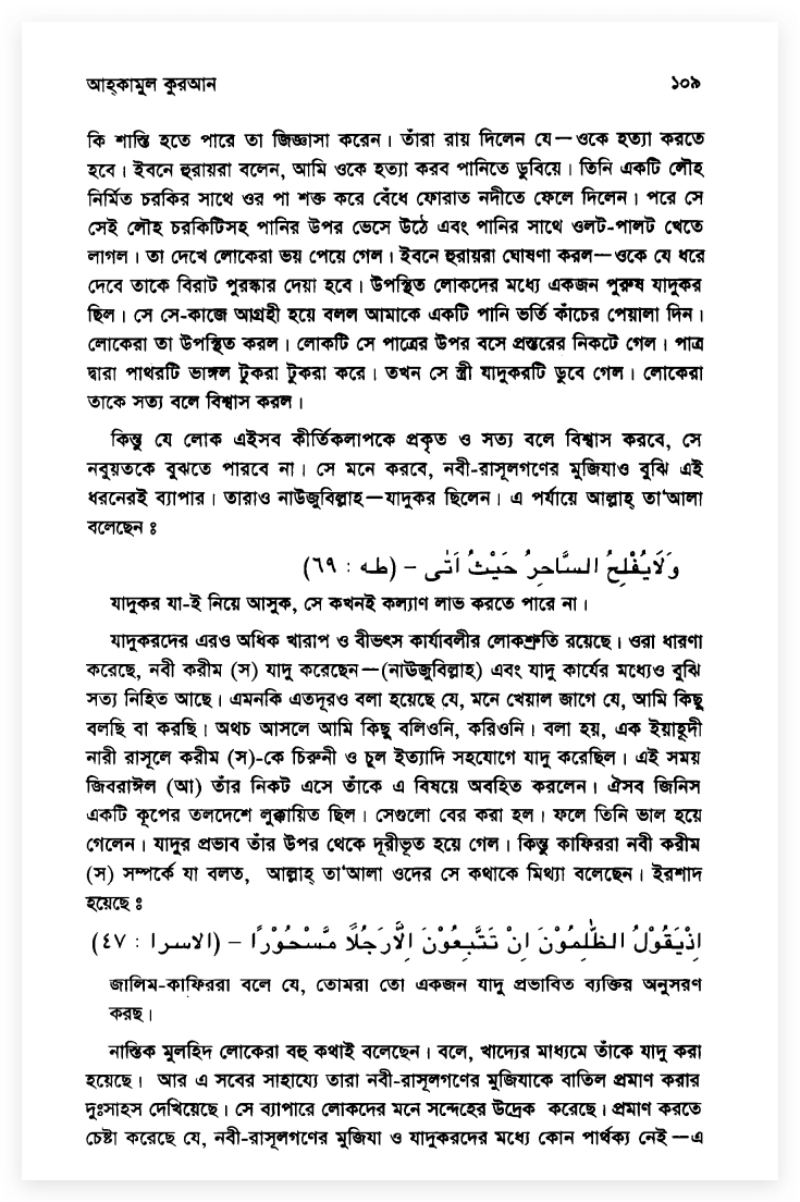
For this reason, even a Hanafi usuli jurist such as Abu Bakr al-Jassas raised strong objections to accepting the report. While discussing the nature of magic in his Ahkam al-Qur’an, al-Jassas explains it primarily as deception, illusion, sleight of sight, and a technique for making reality appear distorted. He interprets the episode of Pharaoh’s magicians from the same perspective: their ropes and staffs did not literally become snakes; rather, they appeared like snakes to the observers. [6] From this reasoning, the objection to the hadith about the Prophet’s bewitchment is clear: if magic is fundamentally illusion and deception, saying that the Prophet himself fell victim to that illusion conflicts with the dignity and reliability of prophethood; and if magic actually distorted the Prophet’s memory and sense of reality, then both prophetic ‘ismah and the security of revelation become questionable.[7]
There are popular tales of still worse and more grotesque deeds by sorcerers. They have claimed that the Noble Prophet (peace be upon him) was bewitched—God forbid—and that magic itself therefore contains some truth. It has even been said that the thought arose in his mind that he was saying or doing something when, in fact, he had neither said nor done it. It is said that a Jewish woman bewitched the Noble Messenger (peace be upon him) by means of a comb, hair, and similar objects. At that time Jibril (peace be upon him) came to him and informed him of the matter. Those objects had been concealed at the bottom of a well. They were taken out, whereupon he recovered and the spell’s effect departed from him. Yet Allah Most High declared false what the disbelievers used to say about the Noble Prophet (peace be upon him). It was revealed:
نَّحْنُ أَعْلَمُ بِمَا يَسْتَمِعُونَ بِهِۦٓ إِذْ يَسْتَمِعُونَ إِلَيْكَ وَإِذْ هُمْ نَجْوَىٰٓ إِذْ يَقُولُ ٱلظَّـٰلِمُونَ إِن تَتَّبِعُونَ إِلَّا رَجُلًۭا مَّسْحُورًا ٤٧
“We know best how they listen to your recitation and what they say privately—when the wrongdoers say, ‘You would only be following a bewitched man.’” —Dr. Mustafa Khattab, The Clear Quran (Al-Isra 17:47)
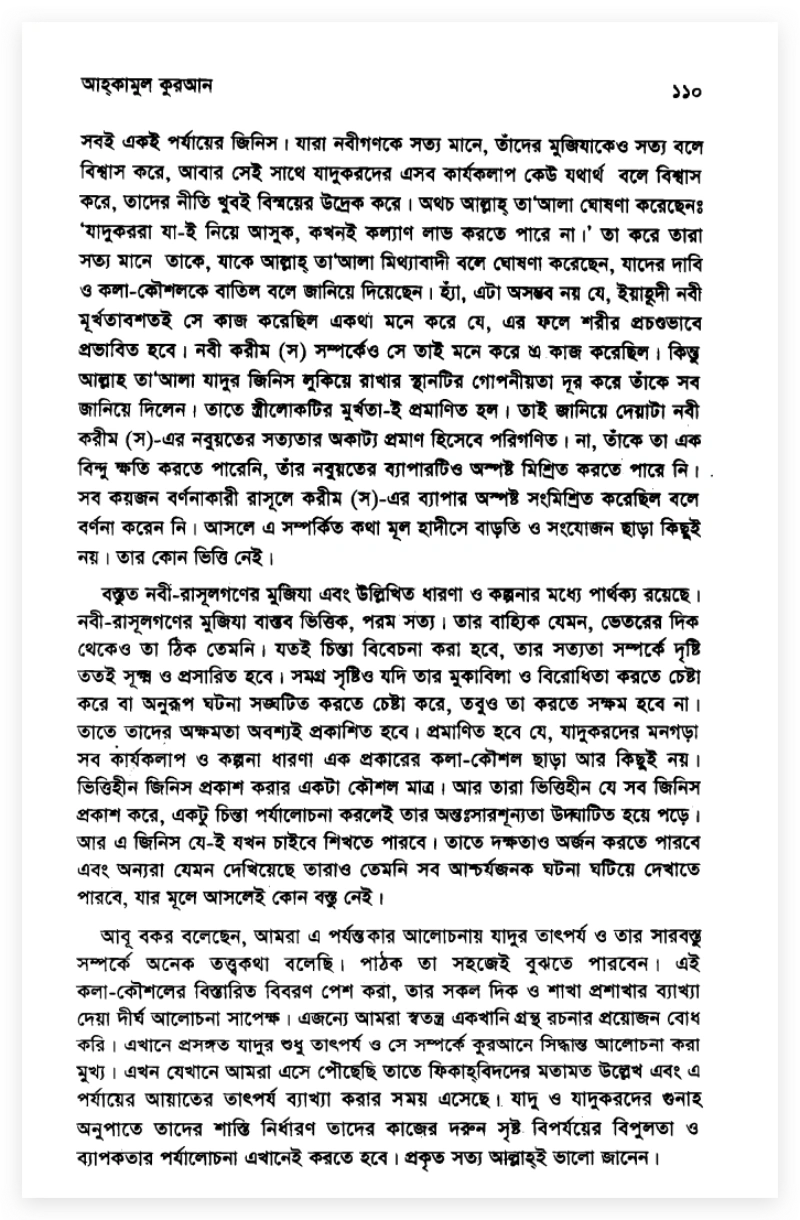
Atheists and heretics have said many things. They say that he was bewitched through food, and by means of such claims they have dared to invalidate the miracles of the prophets and messengers. They have sown doubts in people’s minds and tried to prove that there is no difference between the miracles of the prophets and the works of sorcerers—that all belong to the same category. The position of those who affirm the prophets as truthful and believe their miracles to be true, while at the same time accepting the acts of sorcerers as real, is astonishing. Allah Most High has declared, however, that “And magicians can never succeed wherever they go.” —Dr. Mustafa Khattab, The Clear Quran (Ta-Ha 20:69) Thus they affirm as true those whom Allah has declared false and whose claims and devices He has pronounced invalid. Yes, it is not impossible that the Jewish woman, in her ignorance, performed this act believing that it would severely affect his body. She acted against the Noble Prophet (peace be upon him) on that assumption. But Allah Most High disclosed to him the secret place where the magical objects had been hidden and informed him of everything. This proved only the woman’s ignorance. The disclosure is therefore an incontrovertible proof of the truth of the Noble Prophet’s prophethood. No, the act could not harm him in the least, nor could it confuse or obscure his prophethood. Not all the transmitters reported that the Noble Messenger’s affairs became confused. In fact, the relevant wording is nothing more than an addition interpolated into the original hadith and has no foundation.
There is, in truth, a difference between the miracles of the prophets and the notions and fantasies described above. The prophets’ miracles are grounded in reality and are absolutely true. Their inward reality corresponds to their outward appearance. The more carefully they are considered, the subtler and broader one’s perception of their truth becomes. Even if all creation tried to oppose them or produce something comparable, it would be unable to do so; its incapacity would necessarily become evident. It would thereby be established that the fabricated acts and imagined effects of sorcerers are nothing more than forms of artifice—techniques for making something groundless appear to exist. A little reflection and examination exposes the emptiness of whatever baseless things they display. Anyone can learn these techniques whenever they wish, acquire skill in them, and produce the same astonishing effects others have shown, though no real substance lies behind them.
Abu Bakr said: In the discussion thus far, we have presented many points concerning the meaning and essence of magic, which the reader can readily understand. A detailed account of these techniques, with explanations of all their aspects and branches, would require a lengthy discussion; for that reason, we consider a separate book necessary. Our principal concern here is only the meaning of magic and the Qur’an’s ruling concerning it. Having reached this point, it is now time to cite the jurists’ opinions and explain the meaning of the relevant verses. Here we must examine the punishment prescribed for sorcerers in proportion to their sins, and the magnitude and extent of the disorder caused by their deeds. Allah knows the truth best.
Here the methodological significance of the Mu‘tazilite and rationalist usuli approach becomes clear. They did not restrict hadith criticism to the chain of transmitters, or isnad; they also treated as indispensable the question of whether the report’s content, or matn, agreed with the Qur’an, reason, the fundamental conditions of prophethood, and theology. In their view, if a report destroys the Prophet’s epistemological authority, it cannot be accepted merely because it is preserved in a celebrated collection. Without trust in the Prophet, there is no basis for trusting hadith at all. The acceptability of hadith rests on the Prophet’s reliability; the Prophet’s reliability does not rest on hadith. Thus a hadith that casts doubt on the Prophet’s own sense of reality cannot preserve prophethood by being accepted; it weakens prophethood at its very foundation.
The classical hadithist position generally replies that the magic did not affect revelation; its effects were confined to Muhammad’s private or marital life. But this answer is itself an unproved, ad hoc division. Nothing independently verifiable in the hadith report demonstrates that one part of Muhammad’s cognitive capacity was affected by magic while the part responsible for receiving revelation remained wholly intact. It is not logically sustainable to divide human consciousness, memory, perception, and decision-making into two sections for theological convenience, declaring one confused and the other infallible. If the intellectual apparatus through which a person understands daily actions, dreams, experiences, visions, and heard speech is subject to delusion, then saying “the revelatory part was separate” is not evidence; it is a theological assumption devised to protect a predetermined belief.
The objections of the Mu‘tazila and al-Jassas, therefore, are not anti-hadith or anti-Islamic statements; they are attempts to defend the rational basis of prophethood. Their argument was that protecting the Prophet requires rejecting reports that destroy his credibility. If Muhammad truly lost the ability to distinguish his real actions from imagined ones under the influence of magic, then the infallibility of his revelatory experience is no longer secured by reason; it becomes a mere declaration of faith. And if, according to the Qur’an, the allegation that he was “bewitched” was false, then the status of this account preserved in Bukhari and Muslim must be reconsidered. Herein lies the strength of the Mu‘tazilite position: they placed the epistemological security of prophethood above the sanctity of the chain of transmission, because if the Prophet’s consciousness is open to doubt, no report transmitted in his name is ultimately secure.
The Philosophical Problem of Allah’s Sovereignty
The central claim of Islamic metaphysics is that Allah is the ultimate cause of all causes. No event, change, harm, illness, or death in the universe—not even human will and action—can occur outside His knowledge, will, and permission. In the language of the Qur’an, no calamity befalls the earth or human beings themselves without already having been written in a Record. [8] If this framework is accepted, the account of Muhammad’s bewitchment is no ordinary folktale or description of an isolated illness; it creates a severe philosophical dilemma concerning Allah’s sovereignty and moral character, and the security of prophethood.
The first possibility is that Labid ibn al-A‘sam’s magic possessed no independent power of its own; Allah, by His own will, allowed its effects to operate upon Muhammad. Yet accepting this explanation calls Allah’s moral character into question. Here an omnipotent God subjects His own messenger to mental confusion so severe that the Prophet forms false beliefs about his everyday actions and marital life. If the consciousness and memory of the man presented as humanity’s model, lawgiver, and bearer of the divine message can be disrupted in this way with Allah’s permission, what is that God’s purpose? Is this a test, or a divine assault on the credibility of His own Prophet? No rational theology can simply evade this question.
The second possibility is still more dangerous. If magic possesses an invisible power or operative mechanism of its own, capable of affecting the human brain, memory, and behavior, then Islam’s conception of tawhid is directly undermined. One must then concede that the universe contains an effective power beyond Allah’s will and protection, a power capable of harming even His chosen Prophet. If some hair, a comb, and a knot in the hands of a Jewish sorcerer could distort the Prophet’s consciousness for months, where was Allah’s protection? Where was His absolute control? And how effective, in practice, was the supposed divine guardianship over the Prophet?
Neither possibility leaves Islamic theology secure. Under the first explanation, Allah Himself becomes the effective cause of the Prophet’s mental breakdown; under the second, magic appears as an independent force alongside Allah’s sovereign power. In one case God’s morality is compromised; in the other, His omnipotence. Thus, however sound the chain through which the hadith of Muhammad’s bewitchment is transmitted, its internal logic drives Allah’s absolute power and the security of prophethood into an intellectual crisis from which there is no easy escape.
Methodological Inconsistency: Mechanical Counter-Magic in Place of an Almighty God
The most serious problem with the story of Muhammad’s bewitchment is not merely that a prophet supposedly suffered mental confusion under the influence of magic. The greater problem is that the very method of release from that magic destroys the idea of Allah’s sovereignty. If, according to Islamic belief, Allah is the ultimate controller of all things, then magic should have no effect without His will. For Labid ibn al-A‘sam’s spell to have worked on Muhammad, Islamic theology’s own logic requires that Allah Himself approved its efficacy, or at least permitted it to operate. The question then becomes acute: why would the One who allowed the effect to occur direct its removal through an entirely object-dependent procedure closely resembling folk magic—through a well, hair, a comb, a date-palm spathe, and a thread?
With an almighty God, the natural expectation is that He could instantly neutralize the effect of magic if He wished. No object would have to be recovered, no well located, no knot untied, and no particular material destroyed. If He is truly the God of “Kun fayakun,” a single act of His will should have sufficed to remove the spell’s effect from Muhammad. Even if Muhammad had prayed to Allah and Allah had healed him directly, the account would have retained some consistency with Islamic theology’s internal logic. But the hadith narrative does not proceed that way. Instead, the solution comes from Allah as though the spell were an independent machine whose effect could not stop until a specific component was removed. [9]
Allah’s role here is not that of an omnipotent sovereign, but that of a detective or folk exorcist. He reveals where the magical object was placed, which well contains it, what lies above it, and which materials were used. But why was this information necessary? If magic’s efficacy rests in Allah’s hands, recovering the objects was unnecessary. If the spell could not be broken without recovering them, however, then its efficacy depended not on Allah’s direct will but on some material or supernatural mechanism. In that case Allah is no longer the absolute controller of magic; He becomes a being who knows its rules but, rather than overriding them, provides a remedy that follows them.
The narrative’s methodological weakness is clearest at this point. The sorcerer initiates a process; rather than cancelling it, Allah discloses a counter-process. The sorcerer uses physical materials; Allah reveals their location. The sorcerer hides an object; Allah shows how to identify or recover it. The sorcerer employs a folk ritual; the account portrays Allah as authorizing another object-dependent remedial procedure against it. The episode therefore ceases to be a miraculous divine cure and becomes counter-magic deployed against magic. Allah’s power appears not as absolute metaphysical power, but as something operating within the same rule-bound structure of magical belief found in ancient societies.
A still larger question is why Allah did not simply tell Muhammad to seek refuge in Him. Why did He not say, “I have cured you”? Why was the solution instead to go to a particular well and identify or recover particular objects? Although Islamic theology repeatedly speaks of prayer, tawakkul, and reliance upon Allah, the solution at the critical moment in this account is not prayer-dependent; it is object-dependent, ritual-dependent, and mechanical. The resulting theological picture suggests that Allah Himself concedes that removing a spell requires entry into the material system created by the sorcerer. It is not Allah’s direct will but identifying or recovering the objects beneath the well that becomes the account’s central event.
This reasoning confronts Islamic sovereignty with a difficult question. If the spell was under Allah’s control, He could have stopped it Himself; there was no need to disclose a counter-ritual. If, however, magic is an operative power governed by particular materials and rules, and if it does not cease until those materials are destroyed or a knot is untied, then magic possesses at least some independent efficacy outside Allah’s control. Allah’s sovereignty would no longer be absolute but conditional. He would not be an omnipotent ruler, but a being who follows the rules of another invisible mechanism.
Theologically, this position is extremely dangerous because it recognizes magic not merely as superstition but as an effective metaphysical force. If a knot-dependent procedure employed by a sorcerer can distort the consciousness of Muhammad, Islam’s central prophetic figure, that power cannot be dismissed as trivial. If it operates with Allah’s permission, then Allah subjected His own Prophet to a humiliating mental breakdown. In either case Islamic theology reaches an uncomfortable conclusion: either Allah Himself was the effective cause of the Prophet’s confusion, or magic was a force capable of penetrating Allah’s protection.
The method of cure in this account is therefore no minor narrative problem; it strikes at the heart of Islamic theology. An almighty God should possess the direct power to nullify magic, yet in the hadith account He does not do so. Instead, He identifies the spell’s materials, permits the magical knot to be undone, treats the spell’s mechanical structure as effective, and sets another procedure against it. For this reason, the story of Muhammad’s bewitchment not only calls the Prophet’s mental state into question; it reduces Allah’s absolute sovereignty, omnipotence, and “Kun fayakun” to the level of ancient folk belief in magic.
“To Teach People”—But What, Exactly, Was Taught?
A widely used defensive explanation offered by traditionalist Muslim apologists for the hadith of Muhammad’s bewitchment is that Allah allowed the event to happen in order to teach people. They claim that Muslims were thereby taught that magic is real and can be escaped; later explanations have also connected the episode with seeking refuge in Allah by reciting Surah al-Falaq and Surah al-Nas. Although this interpretation may initially sound religiously convenient, even a brief analysis shows it to be a weak ad hoc explanation—a patch devised after the event to rescue the story. For an explanation to be genuinely acceptable, it must fit the event’s actual structure, purpose, and outcome. Here it does not.
The first problem is that ordinary Muslims can learn no reproducible method from the episode. In the hadith account, Muhammad himself did not know where the magical materials were. An angel came and told him where the spell had been placed, which well contained it, what it lay beneath, and which objects had been used. [9] Revelation ceased after Muhammad’s death, however. Jibril will not come to an ordinary Muslim and say, “A spell has been cast on you; it is in such-and-such a place, in such-and-such a well, beneath such-and-such a stone.” How, then, is this event a lesson for ordinary people? A procedure whose central source of information is available to no one else cannot be called practical instruction for humanity. It resembles medical advice that says a medicine will work, but its name and location can be learned only if an angel reveals them.
The second problem is that although apologists use the language of “instruction,” the episode’s actual lesson is not direct tawakkul—reliance upon Allah—but a folk belief in material amulets, knots, hair, wells, and counter-rituals. If the real purpose had been to teach reliance upon Allah, the narrative could have been simple: Muhammad became ill, prayed to Allah, and Allah healed him. The lesson would then have been that Allah is humanity’s refuge from supernatural fear, magic, and every unknown danger. But the hadith does not teach that. Instead, its lesson becomes that breaking a spell requires finding the magical objects, untying knots, identifying particular materials, and completing a counter-mechanical procedure. This is not tawakkul; it is a religious version of folk exorcism.
The third problem is that this interpretation also calls Allah’s wisdom into question. If an omniscient God wished to instruct humanity, would He choose a teaching method whose essential components lie almost entirely beyond ordinary people’s reach? An ordinary Muslim would not know whether he had actually been bewitched, who had done it, which object had been used, where it had been hidden, or which knot had to be untied. In Muhammad’s case, however, all this information was supplied directly by angels. The episode therefore provides no workable method for an ordinary Muslim; it is a special, prophetic, angel-dependent, one-time event. Calling an event that is neither reproducible nor verifiable nor applicable in an ordinary follower’s life an “educational model” is intellectually dishonest.
The fourth problem is that the story risks strengthening superstition in Muslim society instead of rational treatment and evidence-based investigation. If someone becomes ill, experiences mental confusion or memory distortion, or behaves abnormally in family life, this story may push that person toward magic, amulets, knots, ritual blowing, blessed water, exorcism, and suspicion-based accusations instead of medical care. If the narrative of magic, hair, a comb, and knots must be accepted as true in the Prophet’s case, the same sort of explanation becomes acceptable to an ordinary Muslim. Mental illness then ceases to be a matter for medicine and becomes the work of a sorcerer, an enemy’s conspiracy, or an invisible attack.
Apologists may respond that the real lesson was to recite Surah al-Falaq and Surah al-Nas. But this explanation does not solve the problem either. According to the hadith narrative, the problem was not resolved solely through prayer or seeking refuge; it was also connected to identifying the magical materials, locating the well, and recovering or burying the objects. If reciting the surahs alone was sufficient, why was the dramatic description of the well, hair, comb, date-palm spathe, and hidden materials necessary? If those things were necessary, where is an ordinary Muslim to obtain the corresponding information? The contradiction cannot be avoided. An explanation centered on reciting the surahs renders the spell’s material mechanism unnecessary; treating that mechanism as indispensable makes it difficult to claim that prayer or seeking refuge alone was sufficient.
A further fundamental question remains: would Allah really confuse His Prophet’s consciousness in order to teach people? What kind of wisdom teaches humanity by calling into question the mental reliability of a prophet who is the bearer of revelation, the moral exemplar, the source of Sharia, and the principal witness to religious truth? If an example was required, Allah could have used an event involving an ordinary person, a symbolic account, or a direct command. Teaching by damaging His own Prophet’s memory and sense of reality is not only unnecessary but suicidal for the very idea of prophethood. In receiving this alleged lesson, followers acquire a still greater doubt: on what basis can the revelatory experiences of someone who could become confused about his own actions be called infallible?
The explanation “to teach people,” then, does not solve the problem; it intensifies it. It protects neither Allah’s sovereignty nor the Prophet’s ‘ismah, and it offers ordinary Muslims no usable procedure. Instead, it declares magic real and effective, interprets mental confusion as supernatural attack, and legitimizes secret objects, knots, and folk-ritual remedies in place of direct reliance upon Allah. An explanation that fails in all three respects—divine omnipotence, prophetic credibility, and practical application for ordinary people—cannot be called rational; it is merely a weak apologetic patch designed to conceal religious discomfort.
Delusion-Like Experiences and the Epistemological Crisis of Revelation
The most serious aspect of the hadith of Muhammad’s bewitchment is not merely the claim that a prophet was affected by magic. The greater problem is that the effect is described as falling directly upon his memory, sense of reality, and self-awareness. Bukhari reports that he imagined he had gone to his wives when in fact he had not. [10] Another report says he thought he had done something when he had not. [11] Muslim preserves the same kind of statement: he believed he was performing some worldly act when in reality he was not. [9] The problem, therefore, is not an ordinary physical illness, headache, or weakness; it is an explicit claim of cognitive confusion. The Prophet’s own mind was constructing a false reality concerning his actions, and that claim throws the entire doctrine of prophethood into epistemological crisis.
In modern psychological language, this condition may be compared with a delusion-like experience, memory distortion, confabulation, or hallucination. No modern clinical diagnosis is being imposed here; rather, the epistemological significance of the experience described in the hadith is being analyzed. “Delusion” is used not as an insult but in an analytical sense: a person accepts as true a belief or experience that does not correspond to what actually occurred. If someone firmly believes that he performed an act when he did not, this is a failure of reality testing. If such a failure truly occurred in a prophet, the question no longer remains within the bounds of medicine; it becomes a direct problem for religious epistemology. Prophetic authority rests upon the belief that the Prophet’s experiences are true, his perception is reliable, and his claims are not products of imagination or delusion.
According to the hadith, Muhammad did not independently understand the nature of his confusion. He did not know who had bewitched him, what materials had been used, where they were kept, or what caused his mental confusion. Later, two beings came to him in a dream or supernatural vision: one sat near his head and the other near his feet. Through their conversation he learned that Labid ibn al-A‘sam had bewitched him and that the materials were stored in a particular well. [10] Here the central paradox arises. How could someone unable to distinguish his actual actions from imagined ones be certain that this dream vision or conversation between angels was not simply another layer of the earlier delusion?
This question is central because the hadith story itself presents Muhammad’s cognitive faculties as unstable. If his mind could produce an experience in which he believed he had visited his wives when in fact he had not, why could that same mind not produce an experience in which two angels appeared and explained the cause of his illness? One mistaken experience is labelled “the effect of magic,” while another invisible experience is labelled “true information from Allah.” What independent criterion justifies that distinction? Assuming the second experience to be true merely because it is religiously convenient is not an argument; it is circular reasoning grounded in a predetermined belief.
The epistemological problem becomes more acute because claims of revelation also depend on similar private, supernatural experiences. When Muhammad said that Jibril had come to him, delivered Allah’s words, or brought a command from an unseen source, ordinary people could not directly verify the experience. They depended upon Muhammad’s own claim, memory, perception, and truthfulness. But if the hadith says that at a certain time his memory and sense of reality were distorted by magic, how can revelatory experiences mediated by that same cognitive system be treated as entirely infallible? If the Prophet’s consciousness could generate delusions about worldly events, the claim that such delusion was completely impossible in relation to invisible angels, dreams, visions, and revelation cannot be accepted without evidence.
Classical interpreters generally say that the effect of magic was confined to marital or worldly affairs and did not affect revelation. This answer does not solve the problem; it makes the problem clearer. It assumes without evidence that one part of Muhammad’s mind could be confused while the part receiving revelation remained miraculously intact. Human memory, language, hearing, vision, dreams, emotion, decision-making, and meaning-making do not operate in separately sealed boxes. The same consciousness that formed false beliefs about marital acts also communicated with unseen beings, dreamed, remembered revelatory words, and proclaimed religious law. Thus the claim that “revelation was not affected” is not an argument; it is an apologetic assumption devised to save both hadith and prophethood.
A still greater inconsistency is that, according to the hadith story, the information leading to release from the spell also came through a dream or supernatural vision. In other words, another experience produced by the same cognitive system previously acknowledged to be confused is accepted as the true source of the cure. The reasoning is circular: the Prophet was confused, but he knew how the confusion arose because he learned it in a dream; the dream was true because it was the Prophet’s dream. There is no independent verification. The only basis for deciding whether the angels’ conversation was real is the Prophet’s own experience, yet the reliability of that experience is precisely what is in question. The argument cannot stand on its own; it simply declares itself true.
Even if it is said that “the magical objects were later found in the well,” the crisis is not fully resolved. First, the reports differ over whether the objects were removed. One says that he took them out; another says that he did not, and that the well was instead filled in. [10] [11] Second, even if hair, a comb, or date-palm fibre was found in a well, that would not prove that those objects had remotely caused delusions in Muhammad’s mind. At most, it would establish that certain objects were found and interpreted as magical instruments. Interpretation and proof are not the same thing. In a pre-scientific society, finding suspicious objects may have been treated as evidence of magic; by modern standards of reasoning, it does not establish causation.
The epistemological crisis of revelation comes into sharpest focus in this question: what reliable method distinguishes Muhammad’s claimed experiences that were delusory from those that were true? If the Qur’an itself is cited as proof that the revelation was true, the reasoning is again circular, since accepting the Qur’an as revelation already depends on Muhammad’s claim. Saying that he was truthful does not end the problem, because the issue is not deliberate lying but involuntary delusion. A person may be entirely honest and still see, hear, remember, or interpret something incorrectly. If the hadith itself admits the possibility of such mistaken perception, truthfulness alone cannot guarantee the infallibility of revelation.
For this reason, the account of Muhammad’s bewitchment becomes a self-destructive document for prophethood. If the hadith is true, the Prophet’s cognitive reliability broke down for at least one period. If revelation is said to have remained safe even then, independent evidence is required; a religious assertion alone is insufficient. If, on the other hand, the hadith is rejected in order to preserve the Prophet’s cognitive reliability, the textual acceptability of an important report in Sahih al-Bukhari and Sahih Muslim becomes questionable. Islamic epistemology faces difficulty either way: accepting the hadith harms the Prophet’s mental reliability, while rejecting it harms the supposedly unimpeachable status of the sahih hadith tradition.
Ultimately, this account pushes the entire structure of revelation into psychological uncertainty. When a person’s consciousness can generate delusions about immediate, everyday, physical reality, claims about an unseen world, angels, divine messages, and supernatural instruction demand still more rigorous verification. The hadith tradition provides no such verification; within the narrative of delusion, it presents another supernatural experience as the solution. The story of release from the spell therefore rests upon the very problem it seeks to solve. It does not secure the epistemological foundations of prophethood; instead, it shows a belief system ultimately dependent on a private experience for which there is no independent method of clearly separating delusion, dream, supernatural claim, and reality.
Science, History, and the Epistemological Crisis of Prophethood
An analysis that treats Muhammad’s alleged bewitchment only as a theological inconsistency remains incomplete. The report simultaneously calls into question psychology, medicine, history, sociology, and the epistemological foundations of revelation. According to the hadith, Muhammad entered a state in which he believed he had performed actions he had not performed; more specifically, he believed he had visited his wives when he had not. [10] [11] In the light of modern psychology and neuroscience, this is not evidence of magic; it is comparable to mental states involving memory distortion, confabulation, hallucination, or a temporary breakdown in the sense of reality. Pre-scientific societies naturally interpreted such symptoms as jinn, magic, spirits, or a hidden attack by enemies. In modern epistemology, however, such an explanation is not evidence but the social language of ignorance.
The problem does not end there. If Muhammad’s consciousness became so confused that he could not distinguish his real physical actions from imagined ones, then the reliability of his revelatory experiences also becomes an epistemological question. The human mind is not a set of watertight chambers in which one part hallucinates while another preserves divine truth with absolute infallibility; such an idea is neither scientifically nor philosophically sustainable. On what basis are the claims of someone who may be confused about worldly experience—claims of seeing invisible angels, hearing otherwise inaudible words, or receiving divine instructions—to be declared infallible? Apologists say that magic affected only his private life and not revelation. But this is merely an assertion, supported by no independently verifiable criterion. Artificially dividing the same mind, consciousness, memory, and experiential system into two parts—one confused and the other infallible—is not reasoning but religious expediency.
The account’s basis is also scientifically weak. There is no testable explanation of how hair, a comb, date-palm fibre, or knotted thread buried in a well could produce an effective chemical or neurological change in the brain of someone far away. No established principle of physics, biology, neuroscience, or medicine demonstrates such remote magical efficacy. Poisoning, infection, stress, neurological illness, or psychological crisis would at least open a field for natural explanation. The claim that hair, a comb, and knots can produce delusions in a distant brain instead resembles primitive sympathetic magic or contact magic; modern science assigns it no evidentiary value.
The historical and anthropological context clarifies the account further. Seventh-century Arab society was a pre-scientific culture saturated with beliefs about jinn, magic, the evil eye, amulets, soothsayers, and secret rituals. The belief that a person could be influenced through hair, nails, used objects, or other bodily materials was widespread in many ancient societies. The materials in the account of Muhammad’s bewitchment fit this pattern of folk contact magic. The episode is therefore not evidence of a cosmic truth, but a religiously framed expression of contemporary superstition, limited explanations of illness, and folk belief in magic. Early Muslim transmitters did not stand outside that cultural world, and folklore consequently became part of religious history over time.
The account’s political and sociological dimensions cannot be ignored. It specifically identifies a Jew—Labid ibn al-A‘sam—as the sorcerer. [10] In Medina’s political circumstances, conflict between the Jewish tribes and the Muslim community was intense. Against that background, blaming a Jew for the Prophet’s mental or physical crisis produced a socially convenient narrative. Group psychology recognizes this process: when a leader appears weak, the cause is sought not within the group but in a hostile out-group’s conspiracy. This preserves followers’ faith, increases suspicion toward the enemy, and stops rational inquiry into the actual cause of illness or mental confusion.
This is compounded by the textual conflict between the Qur’an and hadith. The Qur’an presents the allegation that Muhammad was bewitched as slander voiced by the disbelievers. [5] [12] In the Qur’anic account, the allegation belongs to the Prophet’s opponents and expresses their ridicule and disbelief. In the later hadith tradition, however, the same kind of allegation is effectively transformed into truth: Muhammad really was confused under the influence of magic. This exposes a major internal problem within the Islamic textual tradition: hadith establishes as a historical event the accusation that the Qur’an rejects. The conflict cannot be dismissed as merely a “difference of interpretation,” because it directly concerns the Prophet’s mental condition and the truth of his opponents’ allegation.
This problem was also recognized in Islam’s early intellectual history. Many rationalist thinkers considered such reports dangerous to the status of prophethood and the reliability of revelation. Their objection was straightforward: if the Prophet could suffer delusions about reality, how could his prophetic claim remain secure? In later periods, however, an isnad-centered hadithist method took precedence over reason. A strong chain of transmitters encouraged the report’s philosophical, ethical, and epistemological problems to be overlooked. The result was the survival of a narrative that weakens the foundations of prophethood instead of protecting the Prophet.
The report’s conflict with the doctrine of ‘ismah, or divine protection of the prophets, is equally clear. Islamic theology generally treats prophets as protected figures who cannot be subjected to a mental disturbance that destroys their credibility, intellectual stability, and religious authority. Accepting this hadith, however, requires admitting that the Prophet was confused about his marital life and his own actions. That cannot be minimized, because the Prophet’s personal consciousness, memory, and judgment were the vehicles of his religious experience. If those vehicles were subject to magic or mental confusion, the infallibility of revelation remains a claim of faith rather than a truth established by reason.
Taken as a whole, the account collapses on several levels. Science does not support it; psychology can interpret it through delusion or memory distortion rather than magic; history can read it as a continuation of Arabian folk superstition; sociology can understand it as a political narrative that blames a hostile group; and textual criticism exposes tension between the Qur’an and hadith. The story of Muhammad’s bewitchment is therefore more than an uncomfortable hadith. It is a central example exposing multiple weaknesses within Islamic theology. Allah’s sovereignty, prophetic ‘ismah, the reliability of revelation, the reality of magic, and Qur’an-hadith consistency are all called into question at once.
Conclusion: A Theology Entangled in a Magical Knot
The account of Muhammad’s bewitchment is not a minor debate about hadith; it is a profound philosophical, epistemological, and scientific problem that strikes at the heart of Islamic theology. If the story is accepted as true, several major claims collapse together: Allah’s absolute sovereignty, the Prophet’s ‘ismah, the reliability of revelation, the nature of magic, and the internal consistency of the Qur’an and hadith. An account that calls the principal pillars of a religious system into question cannot be covered over merely with the labels “test,” “wisdom,” or “instruction for humanity.” That is not an explanation; it is a religious technique for concealing the problem.
The episode’s greatest inconsistency is that Allah appears not as an almighty God but as a limited being who follows the rules of magic. If magic cannot operate without Allah’s permission, then Allah Himself confused His Prophet’s consciousness. If magic can operate outside Allah’s permission or direct control, then Allah’s sovereignty is no longer absolute. Neither possibility protects Islamic theology. The first compromises God’s morality; the second compromises His omnipotence.
Then comes the problem of the cure. A God of “Kun fayakun” could have healed Muhammad directly if He wished. Yet in the hadith account the solution involves a well, hair, a comb, date-palm fibre, knotted thread, and particular recitations. Rather than directly nullifying the spell’s effect, Allah appears to recognize magic’s mechanical structure and provide a countermeasure within it. This is not a demonstration of miraculous divine power but a religious version of ancient folk belief in magic. Here it is not prayer to Allah but untying a knot that proves effective; what matters is not Allah’s direct command but recovering materials buried in a well. This picture is fundamentally inconsistent with Islam’s conception of an almighty God.
The apologists’ explanation that the event occurred “to teach people” does not resolve the crisis either. In Muhammad’s case Jibril came and revealed where the magical object was, how it had been placed, and how it was to be recovered. But Jibril will not come to an ordinary Muslim; revelation ended with Muhammad. How, then, can this procedure instruct ordinary people? If someone today claims to have been bewitched, how will that person know which well, stone, or knot conceals the magical object? The story does not actually teach Muslims to rely upon Allah. Instead, it supplies a mental framework for belief in superstition, amulets, exorcism, knots, blessed water, and conspiracies by unseen enemies.
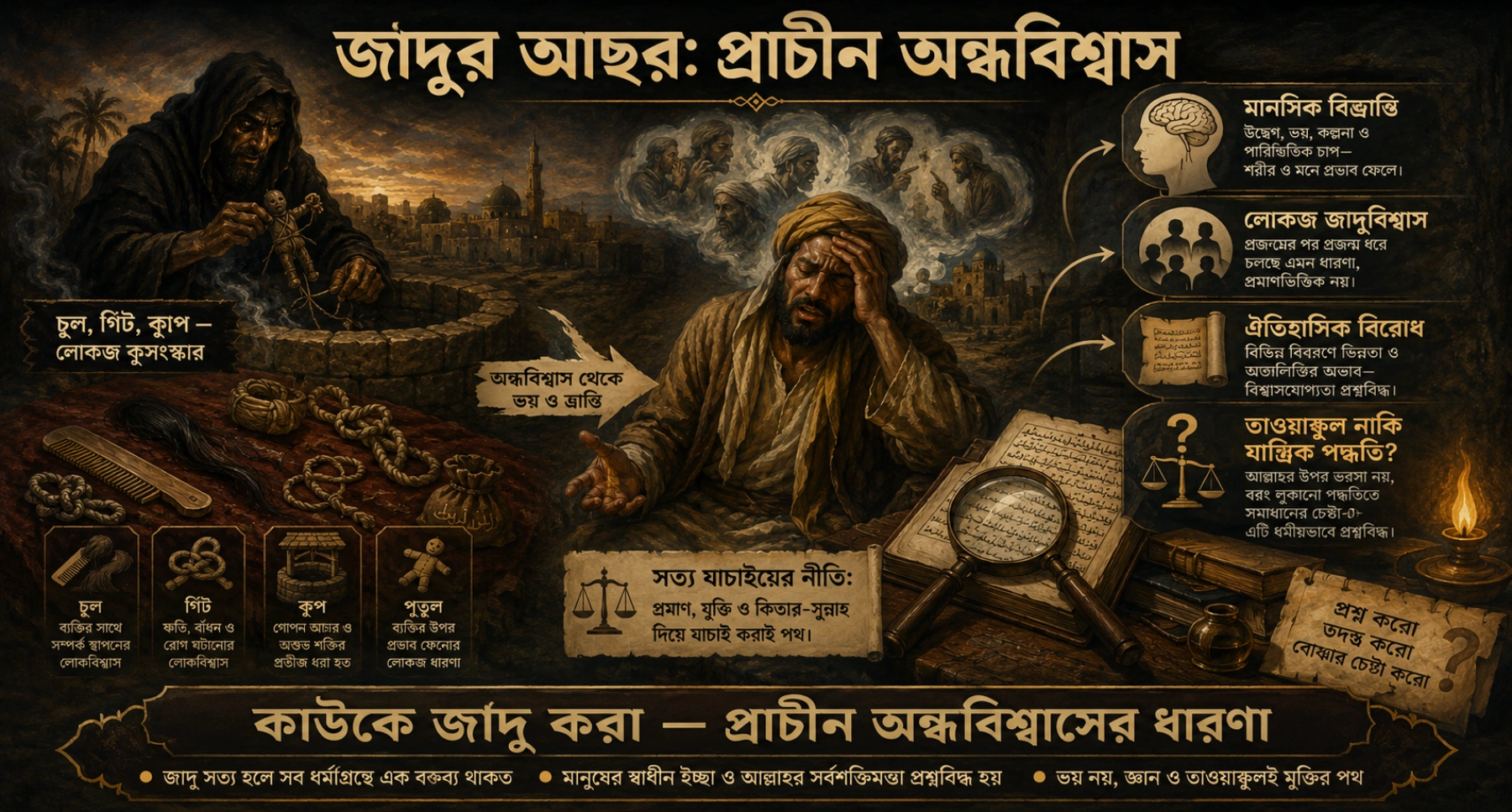
From a psychological perspective, the episode is more troubling still. According to the hadith, Muhammad believed he had performed actions that he had not actually performed. This is comparable to mental states involving memory distortion, confabulation, or hallucination. The problem is that the Prophet’s consciousness and memory were also the vehicles of his revelatory experiences. How can a consciousness capable of confusion about everyday reality be treated, without verification, as infallible when it claims to see invisible angels and hear God’s words? The assertion that “magic affected only worldly life, not revelation” is not evidence; it is merely a convenient distinction invented in response to the problem. The human mind cannot be divided into two according to theological convenience.
Science does not support the account either. There is no testable evidence that hair, a comb, or a knot buried in a well can remotely cause chemical or neurological changes in a person’s brain. The claim instead corresponds to primitive contact magic, in which objects associated with a person’s body were superstitiously believed to provide power over that person. Such explanations were socially intelligible in pre-scientific Arabia, but in the light of modern knowledge they do not explain the actual causes of illness, delusion, or mental crisis; they merely give ignorance a supernatural vocabulary.
Historically, the account is also questionable. The Qur’an presents the allegation that Muhammad was bewitched as the slander of his opponents, yet the hadith tradition accepts a version of that allegation as a true event. This weakens the Qur’anic defence. If Muhammad truly was bewitched and lost the ability to distinguish reality from unreality, how can the opponents’ allegation be called entirely false? If, according to the Qur’an, he was not bewitched, what status should be assigned to this report in Bukhari and Muslim? The contradiction exposes a serious tension within the Islamic textual tradition.
In the final analysis, the story of Muhammad’s bewitchment creates a fracture within the Islamic system of belief that cannot be repaired by ordinary sentiment, reliance upon chains of transmission, or apologetic interpretation. If the story is true, Allah’s sovereignty, the Prophet’s mental reliability, and the epistemological basis of revelation are all questionable. If it is false, the reliability of the sahih hadith tradition is questionable. In either case the problem arises not from outside Islam but from Islam’s own sources. That is the account’s real significance: it is not a problem manufactured by an external critic, but a philosophical disaster generated by the Islamic textual tradition itself.
When this account is placed on the touchstone of reason, science, and textual criticism, it is clearly neither an example of cosmic truth, nor proof of an almighty God’s wisdom, nor a demonstration of prophetic miraculous glory. It is a complex religious document formed from seventh-century Arabian folk belief in magic, ignorance in the explanation of illness, group hostility, and the later process of hadith compilation. If the universe is said to have been created by a single divine command, yet God must identify or recover magical materials hidden beneath a well in order to heal His Prophet, then the problem is no longer magic. The problem is a theology that fails, within its own story, to sustain its proclaimed omnipotence.
References
- Sahih al-Bukhari, Tawheed Publications, hadith: 5765 ↩︎
- Sahih al-Bukhari, Tawheed Publications, hadith: 3268 ↩︎
- Sahih Muslim, Hadith Academy, hadith: 5596 ↩︎
- Qur’an, Surah Bani Isra’il, verse: 47 ↩︎
- Qur’an, Surah al-Furqan, verse: 8 1 2
- Abu Bakr al-Jassas, Ahkam al-Qur’an, Bab al-Sihr wa Hukm al-Sahir ↩︎
- Ahkam al-Qur’an, Volume One, Khairun Publications, ‘Allamah Abu Bakr Ahmad al-Jassas (may Allah have mercy on him), translated by Mawlana Muhammad Abdur Rahim (may Allah have mercy on him), pages 109, 110 ↩︎
- Qur’an, Surah al-Hadid, verse: 22 ↩︎
- Sahih Muslim, hadith: 2189 1 2 3
- Sahih al-Bukhari, hadith: 5765 1 2 3 4 5
- Sahih al-Bukhari, hadith: 3268 1 2 3
- Qur’an, Surah Bani Isra’il, verses: 47–48 ↩︎