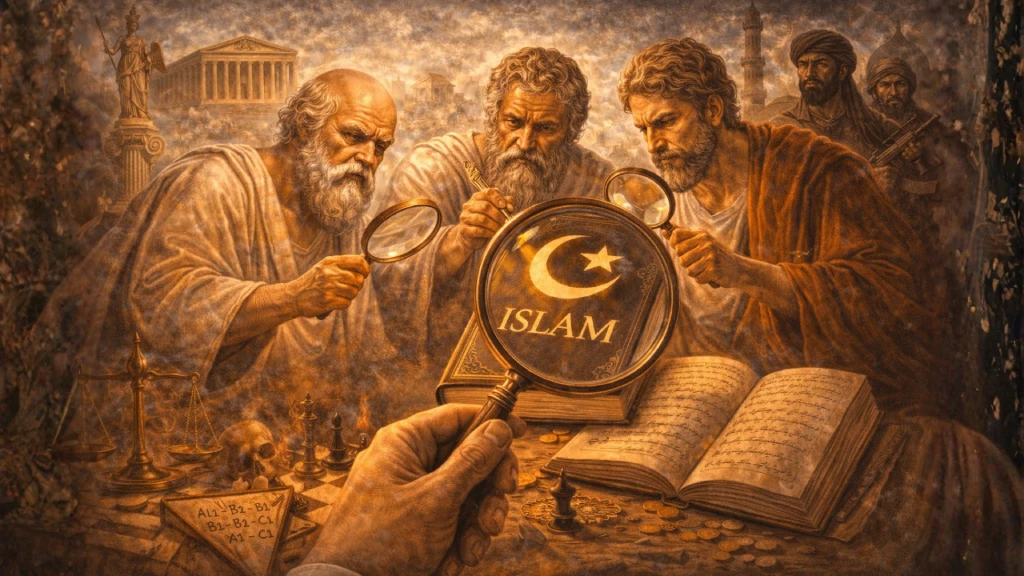
Does Islam Allow Critical Examination?
Summary
This article analyzes Islam’s supposed claim of providing an “opportunity for verification” according to psychological, theoretical, and legal standards. It begins by examining how cognitive bias influences people’s tendency to cling to the religion inherited from their families. It then draws upon various passages from the Quran and hadith to argue that Islam leaves no room for independent judgment or reasoning; rather, a believer is expected to be like “a camel with a ring in its nose”, compelled to go wherever it is led. According to Islamic aqidah, raising rational questions about the existence or origin of Allah is classified as satanic waswasah and the inquiry is shut down, while the study of logic or philosophy has been directly declared “haram” or associated with “kufr.” Furthermore, strict prohibitions on reading the scriptures of other religions and the death penalty for leaving Islam demonstrate that it operates as a Closed System in which the free flow of information and freedom of thought are suppressed through a culture of fear. Although, after accepting the Quran and hadith without evidence, a very limited use of reason or ‘aql may be permitted in certain areas on the basis of those texts, this is no longer independent logic or independent philosophical thought. In practical terms, Islam provides no opportunity to question the authority of the Quran and hadith; the use of reason at that foundational level is effectively prohibited, which directly conflicts with the fundamental principles of logic and philosophy. Finally, this article concludes that Islam does not provide an opportunity for genuine verification; rather, it imposes a form of obedience through coercion and intellectual submission.
Introduction
These days, many Muslims can be heard claiming that although they were born into Muslim families, they later conducted extensive research and verification and only then became convinced of the truth of Islam. Devout Hindus often make precisely the same claim in debates: they too say that although they were born into Hindu families, they carefully investigated, researched, and verified matters before discovering the truth of Hinduism. Christians, Jews, and Buddhists say the same thing. Most people apparently investigate, verify, and conduct research, and remarkably enough, they end up discovering that the religion inherited from their parents is the true one. The situation is both amusing and tragic. Before discussing this issue, it is necessary to explain briefly what cognitive bias means.
Cognitive bias means a cognitive prejudice or systematic error in inductive reasoning. Human emotions, pre-existing beliefs, inherited religion, and convictions instilled since childhood all exert psychological influence on how a person accepts or rejects the evidence placed before them. In other words, people unconsciously become biased toward the kinds of evidence they want to hear, that make them happy, or that provide comfort to their existing beliefs. When a person selectively gathers or remembers information, they tend to favour material that conforms to their prior assumptions, conditioning, or beliefs. They feel an impulse to prove that the doctrines or convictions they already hold are true. Only evidence supporting those convictions begins to appear to them as genuine evidence. By contrast, evidence that contradicts their ideology or belief—however strong or explicit—tends to be avoided or subjected to attempts at rejection. They use and remember those portions of the evidence that favour their position in order to reinforce their beliefs or ideology more strongly. This tendency is known as “confirmation bias,” an important form of the broader phenomenon of “cognitive bias.” This bias is particularly powerful in the preservation of religious belief because, in such cases, people often become more interested in protecting beliefs learned beforehand than in discovering what is actually true.
Scientific research has shown that the human brain is a pattern-recognition machine; it is constantly searching for patterns. When a person looks at clouds, they may sometimes perceive a horse, an elephant, or a human figure. The cloud itself may not actually resemble a horse, elephant, or human being. But because the brain looks for patterns, it manages to identify some familiar form within the clouds. Similarly, when reinforcing your beliefs, the brain repeatedly brings to mind those memories that give you pleasure. Once this provides emotional satisfaction, the brain learns the process and repeats it in an attempt to reward itself. Consequently, when you encounter a large body of evidence, the memories most frequently accessed by your brain tend to be those you have repeatedly recalled. This is one of the ways confirmation bias develops within you.
In any case, the subject of today’s discussion is whether Islam actually permits people to examine other religions, use reason and judgment, and then choose whichever religion they conclude to be correct.
Inherited Family Beliefs Are Not a Measure of Truth
Almost all of us are born into a particular society and family. Naturally, we grow up with the religious beliefs of that family. If our parents teach us that Allah is the only God and the Quran is the only truth, we grow up believing precisely those things. If our parents are Hindu, we grow up with Hindu religious beliefs. Whatever religious teachings they give us become the basis upon which our minds and outlook are formed. Our parents largely shape our earliest conceptions of God and religion: what God should be like, whether God should or should not have an image, whether there is one God or several, and what religion ought to contain. Then friends in the neighbourhood, relatives, grandparents, uncles, aunts, and other family members tell us various religious stories. Schoolteachers tell us stories about figures from our religion. Our psychology and concepts are constructed upon all of this. A person born into a Muslim family in Bangladesh and raised in a Muslim-majority environment will mostly hear from everyone around them that Islam is true and that other religions are false and corrupted. A person born into a Hindu family in India and raised in a Hindu-majority environment will mostly hear how ancient and correct Hinduism is. The same pattern exists in virtually every country.
Similarly, if Muslims constitute the majority in a country, newspapers, radio, television, and other media will tend to broadcast dramas and films that appeal to Muslim audiences. If Hindus constitute the majority, television will broadcast the Ramayana or the Mahabharata. The same applies in Christian, Jewish, or Buddhist societies. Growing up surrounded by such material, people naturally tend to regard these things as true. Childhood education leaves an extremely deep impression on the human mind. Even very ordinary things learned in childhood remain in our memories for decades.
If almost everyone around us teaches that gods and goddesses exist, we learn to think within that framework. If they teach us that Allah or Yahweh exists, those beliefs likewise appear true to us. If we are taught from childhood to worship idols, that practice appears logical and normal. Then, if our Muslim friends tell us that their Allah cannot even be seen, we may find it amusing. We might think: what kind of God is that—one who cannot even be seen? How does one worship a God who is nowhere to be seen?
Conversely, if we are born into a Muslim family, we are taught that God, or Allah, cannot be seen. When our Hindu friends show us images of gods and goddesses, or when we see idols somewhere, we may find them amusing. We think to ourselves: what sort of gods are these? Their gods can actually be seen! Some have four arms, some have two heads, some even have an elephant’s head—how ridiculous! These gods look exactly like human beings or animals. And apart from the elephant-headed one, some look even more bizarre: ten arms, three heads—what an absurd religion!
Yet if we ourselves had happened to be born into families belonging to that religion, we would have received precisely those teachings from childhood, and those very things would have seemed normal to us. For example, I was born into a Bengali family. Bengali seems very easy to me, and languages like it feel perfectly natural. When I began learning German, I used to think: what an absurd language! Yet when a German begins learning Bengali, Bengali may appear equally strange to them. Or consider our culture: wearing a panjabi on Eid and visiting other people’s homes is completely normal to us. In other countries or cultures, people may celebrate festivals by going out into the streets to dance and sing. Their behaviour may seem strange to us. When they observe our customs and behaviour, ours may seem equally strange to them. The reason is simple: the culture in which we grow up from childhood becomes our standard of normality.
From time to time, various questions about religion arise in our minds. We ask our own religious leaders, schoolteachers, or elders about them. Whatever answers we receive—whether satisfactory or irrational—we are generally expected to accept them. They may use falsehoods, evasions, or various forms of patchwork reasoning to convince us that whatever religion teaches must be correct. Suppose, for example, that we are born Hindu, worship idols, and visit temples. Sometimes followers of another religion may come and destroy our idols. We may then wonder whether the idols we worship actually possess any power. If they do, how were outsiders able to destroy both the idols and the temples? Our religious leaders may then offer various convoluted explanations. However irrational those explanations may be, we are expected to accept them.
Likewise, if we are born into Muslim or Christian families, outsiders may sometimes demolish our mosques or burn copies of the Quran. Even the Kaaba has been attacked numerous times, and there have also been occasions when natural disasters damaged or destroyed parts of it. Questions then arise in our minds: does Allah actually possess any power? If He does, how can these things happen? When we take such questions to religious authorities, they too explain matters through religious narratives in much the same way. However irrational the answers may be, once religious authorities have pronounced them, there is often little practical room left for us to reject them.
This means that, in most cases, whatever family we are born into, we ultimately end up following—or are compelled to follow—the religious rules of that family. Occasionally some people leave their religion, adopt another religion, or become atheists. This is as true of Islam as it is of other religions.
At this point, let us introduce a relevant example concerning what it might mean to examine matters neutrally by suspending all prior assumptions and beliefs. Ordinarily, we understand that judging people on the basis of the family into which they were born, the education they received, or the environment in which they grew up is a contemptible practice. But were Allah and His Prophet free of this fault? Let us see what the hadith says [3] [4]
Reference : Mishkat al-Masabih 111
In-book reference : Book 1, Hadith 104
Chapter : Belief in the Divine Decree – Section 2
‘A’isha said:
I asked, “Messenger of God, what happens to the offspring of believers?’’ He replied, “They are joined to their parents.” I asked, “Although they have done nothing, messenger of God” He replied, “God knows best what they were doing.” I asked, “What happens to the offspring of polytheists?” He replied, “They are joined to their parents.” I asked, “Although they have done nothing?” He replied, “God knows best what they were doing.” Abu Dawud transmitted it.
Arabic : وَعَنْ عَائِشَةَ رَضِيَ اللَّهُ عَنْهَا قَالَتْ: قُلْتُ: يَا رَسُولَ اللَّهِ ذَرَارِيُّ الْمُؤْمِنِينَ؟ قَالَ: «مِنْ آبَائِهِمْ» . فَقُلْتُ: يَا رَسُولَ اللَّهِ بِلَا عَمَلٍ؟ قَالَ: «اللَّهُ أَعْلَمُ بِمَا كَانُوا عَامِلِينَ» . قُلْتُ فذاراري الْمُشْرِكِينَ؟ قَالَ: «مِنْ آبَائِهِمْ» . قُلْتُ: بِلَا عَمَلٍ؟ قَالَ: «اللَّهُ أَعْلَمُ بِمَا كَانُوا عَامِلِينَ» . رَوَاهُ أَبُو دَاوُد
Grade: Isnād Sahīh (Zubair `Aliza’i)
Reference : Sunan Abi Dawud 4717
In-book reference : Book 42, Hadith 122
English translation : Book 41, Hadith 4699
Chapter : The Offspring Of Polytheists
‘Amir reported the Messenger of Allah (May peace be upon him) as saying :
The woman who buries alive her new-born girl and the girl who is buried alive both will go to Hell. This tradition has also been transmitted by Ibn Mas’ud from the Prophet (May peace be upon him) to the same effect through a different chain of narrators.
Arabic : حَدَّثَنَا إِبْرَاهِيمُ بْنُ مُوسَى الرَّازِيُّ، حَدَّثَنَا ابْنُ أَبِي زَائِدَةَ، قَالَ حَدَّثَنِي أَبِي، عَنْ عَامِرٍ، قَالَ قَالَ رَسُولُ اللَّهِ صلى الله عليه وسلم ” الْوَائِدَةُ وَالْمَوْءُودَةُ فِي النَّارِ ” . قَالَ يَحْيَى بْنُ زَكَرِيَّا قَالَ أَبِي فَحَدَّثَنِي أَبُو إِسْحَاقَ أَنَّ عَامِرًا حَدَّثَهُ بِذَلِكَ عَنْ عَلْقَمَةَ عَنِ ابْنِ مَسْعُودٍ عَنِ النَّبِيِّ صلى الله عليه وسلم .
Grade: Sahih (Al-Albani)
Now let us read a verse from the Quran stating that Allah does not guide wrongdoing people. Then whom does He guide? Those who are already good? Why would they need Allah’s guidance in the first place? There is a Bengali saying that literally means “pouring oil on an already-oily head”—giving more to those who already have enough. Why deny guidance to those who supposedly need it while giving additional guidance to those who do not? At the same time, why make such a statement concerning entire communities of Jews and Christians? Women, children, elderly people, and people with disabilities also belong to those communities. What crime have they committed? [5]
Quran reference : Surah Al-Ma’idah, 5:51
Arabic : ۞ يَـٰٓأَيُّهَا ٱلَّذِينَ ءَامَنُوا۟ لَا تَتَّخِذُوا۟ ٱلْيَهُودَ وَٱلنَّصَـٰرَىٰٓ أَوْلِيَآءَ ۘ بَعْضُهُمْ أَوْلِيَآءُ بَعْضٍۢ ۚ وَمَن يَتَوَلَّهُم مِّنكُمْ فَإِنَّهُۥ مِنْهُمْ ۗ إِنَّ ٱللَّهَ لَا يَهْدِى ٱلْقَوْمَ ٱلظَّـٰلِمِينَ ٥١
Translation — Saheeh International : O you who have believed, do not take the Jews and the Christians as allies. They are [in fact] allies of one another. And whoever is an ally to them among you – then indeed, he is [one] of them. Indeed, Allāh guides not the wrongdoing people.
Translation — M. Pickthall : O ye who believe! Take not the Jews and the Christians for friends. They are friends one to another. He among you who taketh them for friends is (one) of them. Lo! Allah guideth not wrongdoing folk.
Using Logic to Question the Existence of Allah Is Forbidden
According to Islam, a person may look at the earth, plants, animals, planets, and stars, become astonished, and then believe in the existence of Allah and accept faith without any evidence, simply through unquestioning belief. But that person is not permitted to employ deep reasoning, formal logic, or philosophical inquiry regarding Allah’s existence or attributes. This is a foundational principle of Islamic aqidah. People are strongly discouraged from employing such reasoning. Let us listen to a statement by the well-known Islamic scholar Assim al-Hakeem,
The Quran’s Declaration on Examining Other Religions
The Quran states clearly that whoever seeks or searches for a religion other than Islam will be among the losers [6] –
Quran reference : Surah Ali ‘Imran, 3:85
Arabic : وَمَن يَبْتَغِ غَيْرَ ٱلْإِسْلَـٰمِ دِينًۭا فَلَن يُقْبَلَ مِنْهُ وَهُوَ فِى ٱلْـَٔاخِرَةِ مِنَ ٱلْخَـٰسِرِينَ ٨٥
Translation — Saheeh International : And whoever desires other than Islām as religion – never will it be accepted from him, and he, in the Hereafter, will be among the losers.
Translation — M. Pickthall : And whoso seeketh as religion other than the Surrender (to Allah) it will not be accepted from him, and he will be a loser in the Hereafter.
[ Surah Ali ‘Imran, verse 85 ]
In Islam, Any Rational Doubt or Uneasiness Is a Sin
In Islamic discourse, doubt, uncertainty, and inner uneasiness are repeatedly framed in the language of sin, kufr, or satanic suggestion. The question therefore ceases to function as an inquiry into truth and falsehood; instead, from the outset, it is classified as a moral offence or a weakness of faith [7] –
Reference : Riyad as-Salihin 590
In-book reference : Introduction, Hadith 590
Wabisah bin Ma’bad (May Allah be pleased with him) reported:
I went to Messenger of Allah (ﷺ) and he asked me, “Have you come to inquire about piety?” I replied in the affirmative. Then he said, “Ask your heart regarding it. Piety is that which contents the soul and comforts the heart, and sin is that which causes doubts and perturbs the heart, even if people pronounce it lawful and give you verdicts on such matters again and again.”
[Ahmad and Ad-Darmi].
Arabic : وعن وابصة بن معبد رضي الله عنه قال: أتيت رسول الله صلى الله عليه وسلم فقال: “جئت تسأل عن البر؟” قلت نعم، فقال: ”استفت قلبك البر ما اطمأنت إليه النفس، واطمأن إليه القلب، والإثم ما حاك فى النفس وتردد فىالصدر، وإن أفتاك الناس وأفتوك” ((حديث حسن، رواه أحمد والدارمي فى مسنديهما)).
Grade: Hasan, as stated in the Sunnah.com text
At the same time, another hadith states that disputing concerning the Quran is disbelief [8] –
Reference : Sunan Abi Dawud 4603
In-book reference : Book 42, Hadith 8
English translation : Book 41, Hadith 4586
Chapter : Prohibition Of Controversy About The Qur’an
Narrated AbuHurayrah:
The Prophet (ﷺ) said: Controverting about the Qur’an is disbelief.
Arabic : حَدَّثَنَا أَحْمَدُ بْنُ حَنْبَلٍ، حَدَّثَنَا يَزِيدُ، – يَعْنِي ابْنَ هَارُونَ – أَخْبَرَنَا مُحَمَّدُ بْنُ عَمْرٍو، عَنْ أَبِي سَلَمَةَ، عَنْ أَبِي هُرَيْرَةَ، عَنِ النَّبِيِّ صلى الله عليه وسلم قَالَ ” الْمِرَاءُ فِي الْقُرْآنِ كُفْرٌ ” .
Grade: Hasan Sahih (Al-Albani)
Now let us examine the Islamic aqidah on this subject from a book written by Dr. Khondkar Abdullah Jahangir [9] –
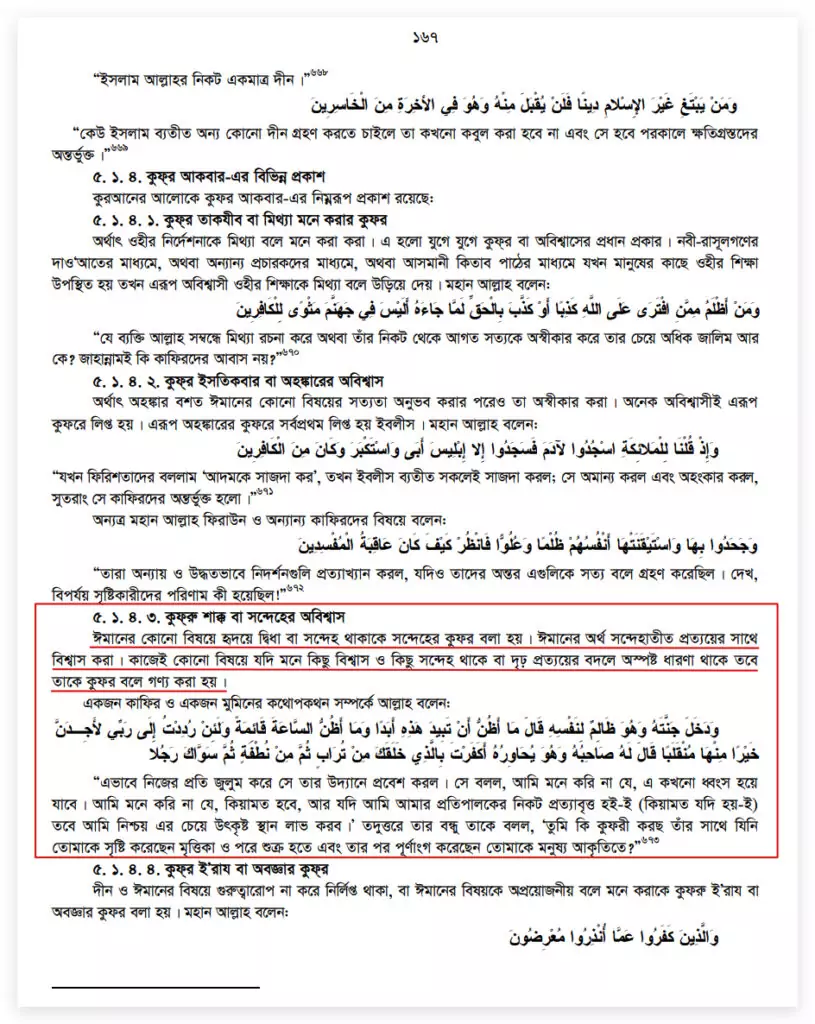
Now let us listen to several Islamic scholars on this subject,
The Believer Is Like a Camel with a Ring in Its Nose
Now let us read a Quranic verse describing how a believer is expected to think. The prescribed method is: we hear and we obey [10] –
Quran reference : Surah An-Nur, 24:51
Arabic : إِنَّمَا كَانَ قَوْلَ ٱلْمُؤْمِنِينَ إِذَا دُعُوٓا۟ إِلَى ٱللَّهِ وَرَسُولِهِۦ لِيَحْكُمَ بَيْنَهُمْ أَن يَقُولُوا۟ سَمِعْنَا وَأَطَعْنَا ۚ وَأُو۟لَـٰٓئِكَ هُمُ ٱلْمُفْلِحُونَ ٥١
Translation — Saheeh International : The only statement of the [true] believers when they are called to Allah and His Messenger to judge between them is that they say, “We hear and we obey.” And those are the successful.
Translation — M. Pickthall : The saying of (all true) believers when they appeal unto Allah and His messenger to judge between them is only that they say: We hear and we obey. And such are the successful.
Now let us listen to a statement by the well-known Islamic scholar Mufti Ibrahim,
Now let us listen to a statement by Ahmadullah,
An authentic hadith states that a believer should be like a camel with a ring in its nose: wherever it is led, it complies. This means blindly believing in and obeying Islamic injunctions. Islam does not support independently examining them, reasoning through evidence, and then deciding whether to accept or reject them. It leaves no room for verification through independent reasoning, information, and evidence [11] –
Reference : Sunan Ibn Majah 43
In-book reference : Introduction, Hadith 43
English translation : Vol. 1, Book 1, Hadith 43
It was narrated from ‘Abdur-Rahman bin ‘Amr As-Sulami that:
He heard Al-‘Irbad bin Sariyah say: “The Messenger of Allah (ﷺ) delivered a moving speech to us which made our eyes flow with tears and made our hearts melt. We said: ‘O Messenger of Allah. This is a speech of farewell. What did you enjoin upon us?’ He said: ‘I am leaving you upon a (path of) brightness whose night is like its day. No one will deviate from it after I am gone but one who is doomed. Whoever among you lives will see great conflict. I urge you to adhere to what you know of my Sunnah and the path of the Rightly-Guided Caliphs, and cling stubbornly to it. And you must obey, even if (your leader is) an Abyssinian leader. For the true believer is like a camel with a ring in its nose; wherever it is driven, it complies.”
Arabic : حَدَّثَنَا إِسْمَاعِيلُ بْنُ بِشْرِ بْنِ مَنْصُورٍ، وَإِسْحَاقُ بْنُ إِبْرَاهِيمَ السَّوَّاقُ، قَالاَ حَدَّثَنَا عَبْدُ الرَّحْمَنِ بْنُ مَهْدِيٍّ، عَنْ مُعَاوِيَةَ بْنِ صَالِحٍ، عَنْ ضَمْرَةَ بْنِ حَبِيبٍ، عَنْ عَبْدِ الرَّحْمَنِ بْنِ عَمْرٍو السَّلَمِيِّ، أَنَّهُ سَمِعَ الْعِرْبَاضَ بْنَ سَارِيَةَ، يَقُولُ وَعَظَنَا رَسُولُ اللَّهِ ـ صلى الله عليه وسلم ـ مَوْعِظَةً ذَرَفَتْ مِنْهَا الْعُيُونُ وَوَجِلَتْ مِنْهَا الْقُلُوبُ فَقُلْنَا يَا رَسُولَ اللَّهِ إِنَّ هَذِهِ لَمَوْعِظَةُ مُوَدِّعٍ فَمَاذَا تَعْهَدُ إِلَيْنَا قَالَ “ قَدْ تَرَكْتُكُمْ عَلَى الْبَيْضَاءِ لَيْلُهَا كَنَهَارِهَا لاَ يَزِيغُ عَنْهَا بَعْدِي إِلاَّ هَالِكٌ مَنْ يَعِشْ مِنْكُمْ فَسَيَرَى اخْتِلاَفًا كَثِيرًا فَعَلَيْكُمْ بِمَا عَرَفْتُمْ مِنْ سُنَّتِي وَسُنَّةِ الْخُلَفَاءِ الرَّاشِدِينَ الْمَهْدِيِّينَ عَضُّوا عَلَيْهَا بِالنَّوَاجِذِ وَعَلَيْكُمْ بِالطَّاعَةِ وَإِنْ عَبْدًا حَبَشِيًّا فَإِنَّمَا الْمُؤْمِنُ كَالْجَمَلِ الأَنِفِ حَيْثُمَا قِيدَ انْقَادَ ” .
Grade: Sahih (Darussalam)
A Religion in Which Ignorance Is Sunnah or an Exemplary Ideal
Let us listen to a statement by the prominent Bangladeshi Islamic scholar Kazi Ibrahim, from which we may judge whether Islam emphasizes knowledge, science, research, and verification, or ignorance and remaining uneducated,
Even Asking for Evidence Against Islamic Aqidah Is Kufr
More than 4,200 religions and belief systems currently exist in the world, each with its own foundational beliefs, claims, and divine or philosophical premises. The moral and intellectual responsibility of a rational and thoughtful person is to question every claim, investigate what evidence or arguments have been offered in its support, assess the validity of that evidence, and distinguish truth from falsehood in light of the available information. In science, philosophy, and logic alike, this process is regarded as an indispensable stage in the advancement of knowledge.
Yet within the framework of Islamic Sharia and aqidah, there exists a principle that is entirely the opposite. Not only criticism or rejection of religious beliefs, but even asking for evidence for a proposition that contradicts those beliefs is prohibited. According to Islamic jurisprudence and the literature of aqidah, if a person hears a statement contrary to an established Islamic belief—such as the existence of Allah, the divine origin of the Quran, Muhammad’s prophethood, or the inevitable coming of the Day of Judgment—and, out of curiosity or intellectual honesty, asks for evidence supporting that contrary claim, the very act may be treated as direct “kufr,” one of the gravest religious offences.
In other words, from this Islamic perspective, even requesting evidence in order to examine a proposition that contradicts aqidah is regarded as a violation of Islam’s foundational principle of submission. Instead of encouraging open inquiry in order to distinguish truth from falsehood, the act of questioning is classified in advance as an affront to religion and an abandonment of faith. Consequently, for a Muslim, independently investigating knowledge and adopting a critical attitude toward belief can become punishable in both religious and legal terms.
Iman Is Essentially the Islamic Term for Blind Faith
The lexical meaning of the word iman is to acknowledge, affirm, or, according to another usage, to hold a firm belief. In Islam, iman means accepting all of the following without doubt and firmly believing in them without any evidence.
- Believing in Allah as the sole Creator.
- Believing in the angels of Allah.
- Believing in the revealed scriptures.
- Believing in the prophets and messengers.
- Believing in taqdir, or that Allah has power over good and evil.
- Believing in the Akhirah, or afterlife.
- Believing in resurrection after death.
On this subject, it is extremely important to listen to and understand this statement by Dr. Abu Bakr Muhammad Zakaria.
Now let us hear what Abu Taha Adnan, a popular Bangladeshi Islamic speaker, says on this subject,
The hadith also states very clearly that regarding grave doubts as too serious even to express is itself a manifestation of faith [12] –
Reference : Mishkat al-Masabih 64
In-book reference : Book 1, Hadith 58
Chapter : Evil Promptings – Section 1
Abu Huraira reported that some of the companions of God’s messenger came to the Prophet to consult him saying, “We have thoughts which none of us dare to talk about.” He said, “Have you experienced that?” and when they replied that they had, he said, “That is clear faith.” Muslim transmitted it.
Arabic : وَعَنْ أَبِي هُرَيْرَةَ رَضِيَ اللَّهُ عَنْهُ قَالَ: جَاءَ نَاسٌ مِنْ أَصْحَابِ رَسُولِ اللَّهِ صَلَّى اللَّهُ عَلَيْهِ وَسَلَّمَ إِلَى النَّبِيِّ صَلَّى اللَّهُ عَلَيْهِ وَسَلَّمَ فَسَأَلُوهُ: إِنَّا نَجِدُ فِي أَنْفُسِنَا مَا يَتَعَاظَمُ أَحَدُنَا أَنْ يَتَكَلَّمَ بِهِ. قَالَ: «أَو قد وجدتموه» قَالُوا: نعم. قَالَ: «ذَاك صَرِيح الْإِيمَان» . رَوَاهُ مُسلم
Grade: Sahīh (Zubair `Aliza’i)
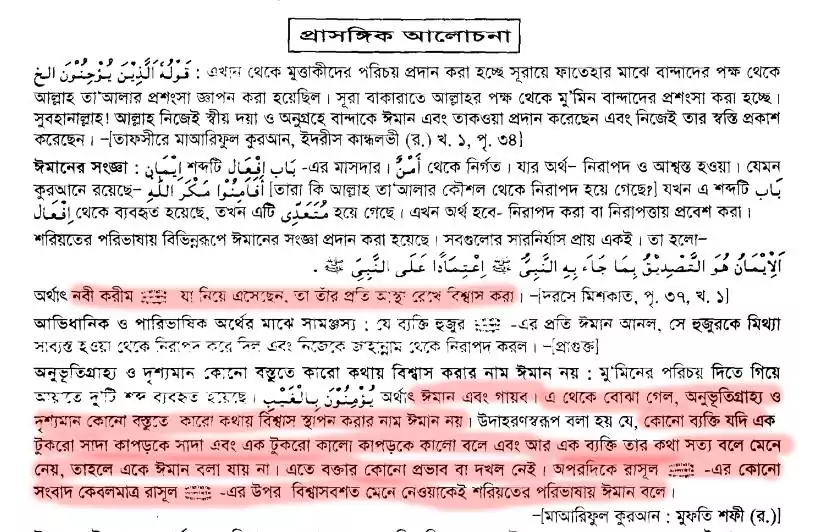
In Bengali, the meaning of blind faith is accepting something without using reason or exercising judgment. The interesting point is that the definition of iman in Islam is presented in almost exactly the same terms. Tafsir al-Jalalayn defines iman as follows [13]
To believe in what the Noble Prophet has brought, on the basis of trust in him.
Believing someone’s statement concerning an object that is perceptible to the senses and visible is not called iman: Two words have been used in the verse to identify the believer: iman and the unseen. From this it is understood that believing someone’s statement concerning an object that is perceptible to the senses and visible is not called iman. For example, if a person says that a piece of white cloth is white and a piece of black cloth is black, and another person accepts his statement as true, this cannot be called iman. The speaker has no particular influence or authority in such a case. On the other hand, in the terminology of the Sharia, iman means accepting a report of the Messenger solely on the basis of one’s trust in the Messenger.
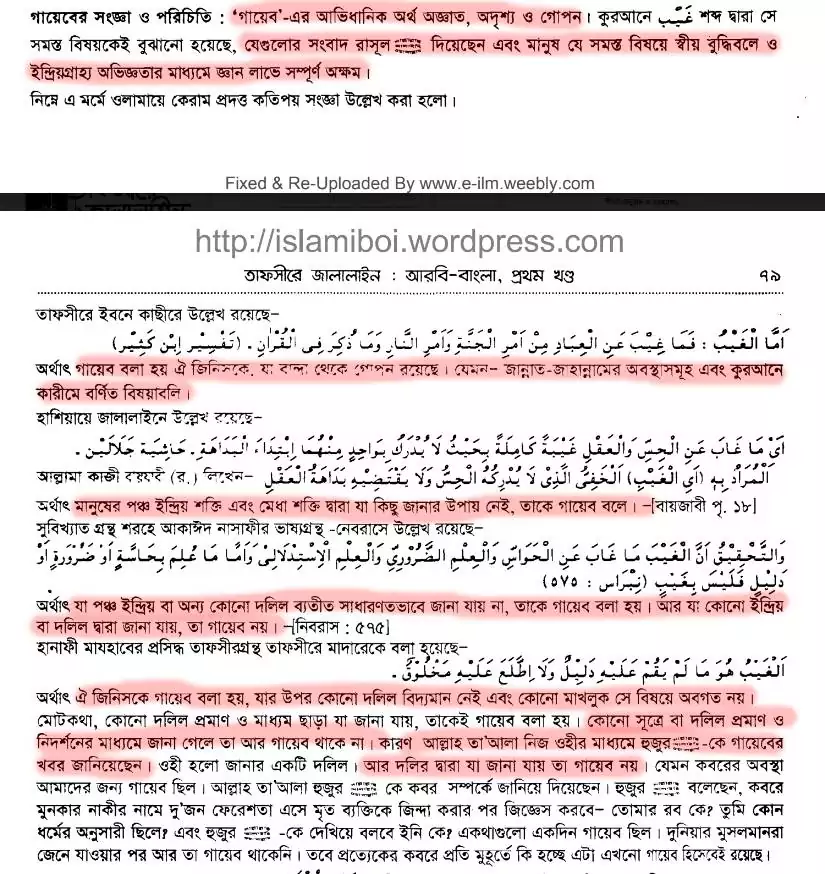
Tafsir al-Jalalayn further states that iman itself means belief in the unseen. The unseen is described as that about which nothing can be known through reason and intellect [14] –
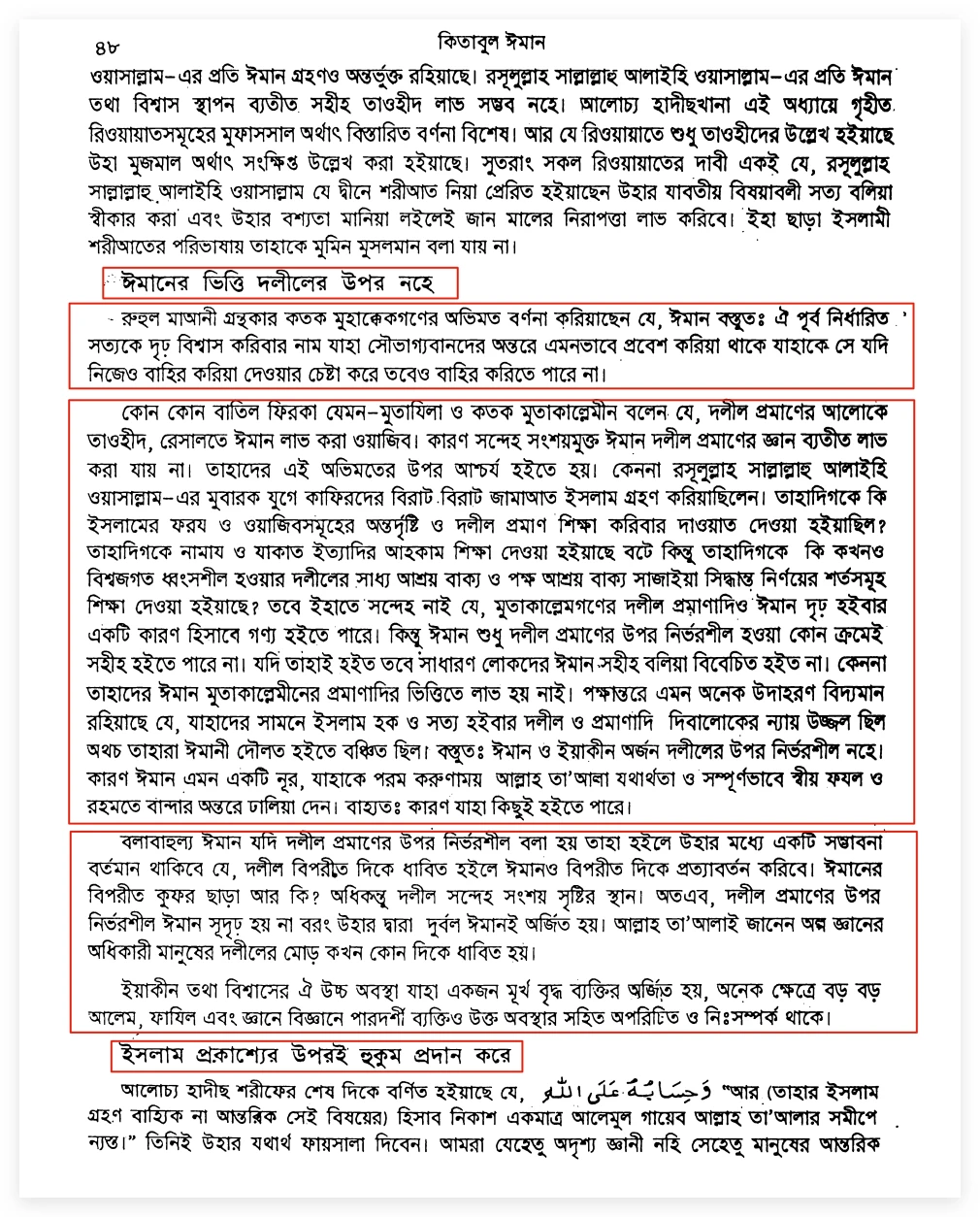
Now let us read a chapter concerning iman from the book Sharh Muslim [15]
How Does a Muslim Bear Witness in the Second Kalima?
In the fundamental declaration of faith required to become a Muslim, the shahadah, or testimony, demands a form of witness concerning the existence of Allah and the messengership of Muhammad that is not based on direct observation, testing, or independent verification in the ordinary meaning of real testimony. The word “testimony” is associated with actually being a witness. Yet in Islam one is required to give this false testimony without having seen it with one’s own eyes, without observation, and without having obtained evidence. Thus, at the very entrance to Islam, a person is taught to give an untrue “testimony”: although the language of witnessing is used, what is actually involved is not independent firsthand knowledge but a declaration of unquestioning submission.
أَشْهَدُ أَنْ لَا إِلَٰهَ إِلَّا ٱللَّٰهُ وَحْدَهُ لَا شَرِيكَ لَهُ وأَشْهَدُ أَنَّ مُحَمَّدًا عَبْدُهُ وَرَسُولُهُ
I bear witness that there is no deity except Allah. He is One, without partner; and I further bear witness that Muhammad is His servant and His Messenger.
The Prophet Strongly Disliked Logical Argumentation
The Prophet prohibited logical discussion, argument, and debate concerning many matters in Islam. He became intensely angry when people discussed such issues. He wanted his followers to accept these matters without questioning them. As a means of intimidation, he warned that people had been destroyed for debating such matters [16] –
Reference : Jami‘ at-Tirmidhi 2133
In-book reference : Book 32, Hadith 1
English translation : Vol. 4, Book 6, Hadith 2133
Chapter : What Has Been Related About The Severity Of Delving Into Al-Qadar
Abu Hurairah narrated:
“The Messenger of Allah(s.a.w) came out to us while we were discussing about Al-Qadar. He became angry such that his face became red, as if a pomegranate was bursting through his cheeks. He said: ‘Is this what I ordered you to do?’ – or: ‘Is this what I have been sent to you with? The people before you were only ruined when they differed about this matter. I order you [I order you] to not debate about it.’”. (Daif)
Arabic : حَدَّثَنَا عَبْدُ اللَّهِ بْنُ مُعَاوِيَةَ الْجُمَحِيُّ الْبَصْرِيُّ، قَالَ حَدَّثَنَا صَالِحٌ الْمُرِّيُّ، عَنْ هِشَامِ بْنِ حَسَّانَ، عَنْ مُحَمَّدِ بْنِ سِيرِينَ، عَنْ أَبِي هُرَيْرَةَ، قَالَ خَرَجَ عَلَيْنَا رَسُولُ اللَّهِ صلى الله عليه وسلم وَنَحْنُ نَتَنَازَعُ فِي الْقَدَرِ فَغَضِبَ حَتَّى احْمَرَّ وَجْهُهُ حَتَّى كَأَنَّمَا فُقِئَ فِي وَجْنَتَيْهِ الرُّمَّانُ فَقَالَ “ أَبِهَذَا أُمِرْتُمْ أَمْ بِهَذَا أُرْسِلْتُ إِلَيْكُمْ إِنَّمَا هَلَكَ مَنْ كَانَ قَبْلَكُمْ حِينَ تَنَازَعُوا فِي هَذَا الأَمْرِ عَزَمْتُ عَلَيْكُمْ أَلاَّ تَتَنَازَعُوا فِيهِ ” . قَالَ أَبُو عِيسَى وَفِي الْبَابِ عَنْ عُمَرَ وَعَائِشَةَ وَأَنَسٍ . وَهَذَا حَدِيثٌ غَرِيبٌ لاَ نَعْرِفُهُ إِلاَّ مِنْ هَذَا الْوَجْهِ مِنْ حَدِيثِ صَالِحٍ الْمُرِّيِّ . وَصَالِحٌ الْمُرِّيُّ لَهُ غَرَائِبُ يَنْفَرِدُ بِهَا لاَ يُتَابَعُ عَلَيْهَا .
Grade: Da’if, as shown on Sunnah.com
Abu Bakr’s Physical Assault in Response to a Rational Question
Alongside Muhammad, Abu Bakr also became involved in various theological disputes with Jews. Unfortunately, in many of these disputes, it was the Muslims who resorted to physically attacking the Jews. The culture of answering argument with argument, debate with debate, and words with words appears to have been absent among Muslims from the very beginning. Thus we find Abu Bakr physically striking someone in response to a theological challenge [17]
Abu Bakr Enters a Jewish School
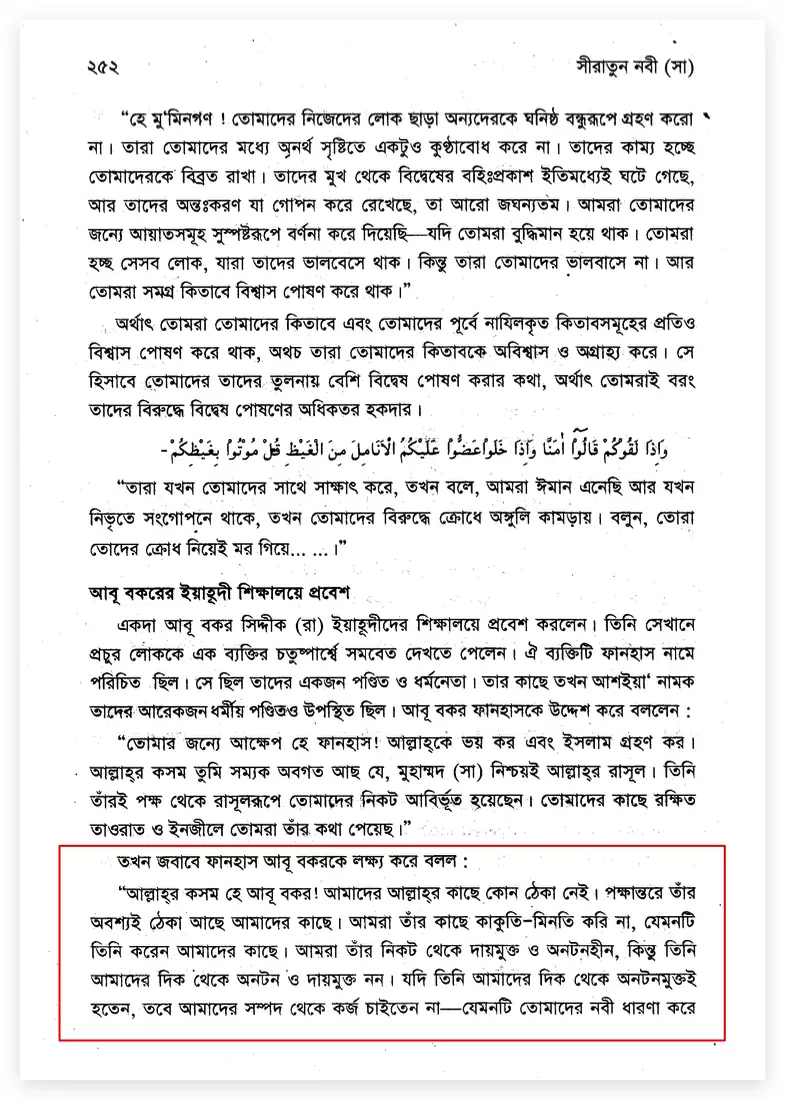
One day Abu Bakr al-Siddiq entered a Jewish school. There he found a large number of people gathered around a man known as Finhas, one of their scholars and religious leaders. Another of their religious scholars, named Ashya, was also present with him.
Abu Bakr addressed Finhas and said:
Woe to you, O Finhas! Fear Allah and embrace Islam.
By Allah! You certainly know that Muhammad is the Messenger of Allah. He has come to you as a messenger from Allah. In the Torah and Gospel preserved among you, you have found clear information concerning him.”
Finhas then replied to Abu Bakr:
“By Allah, O Abu Bakr! We have no need of Allah; rather, He needs us. We do not implore Him; rather, He implores us. We are not dependent upon Him; rather, He is dependent upon us. If He were not dependent upon us, He would not ask us for a loan from our wealth—as your prophet claims. He forbids us from taking interest, yet He Himself takes it from us.”
Abu Bakr’s Angry Reaction
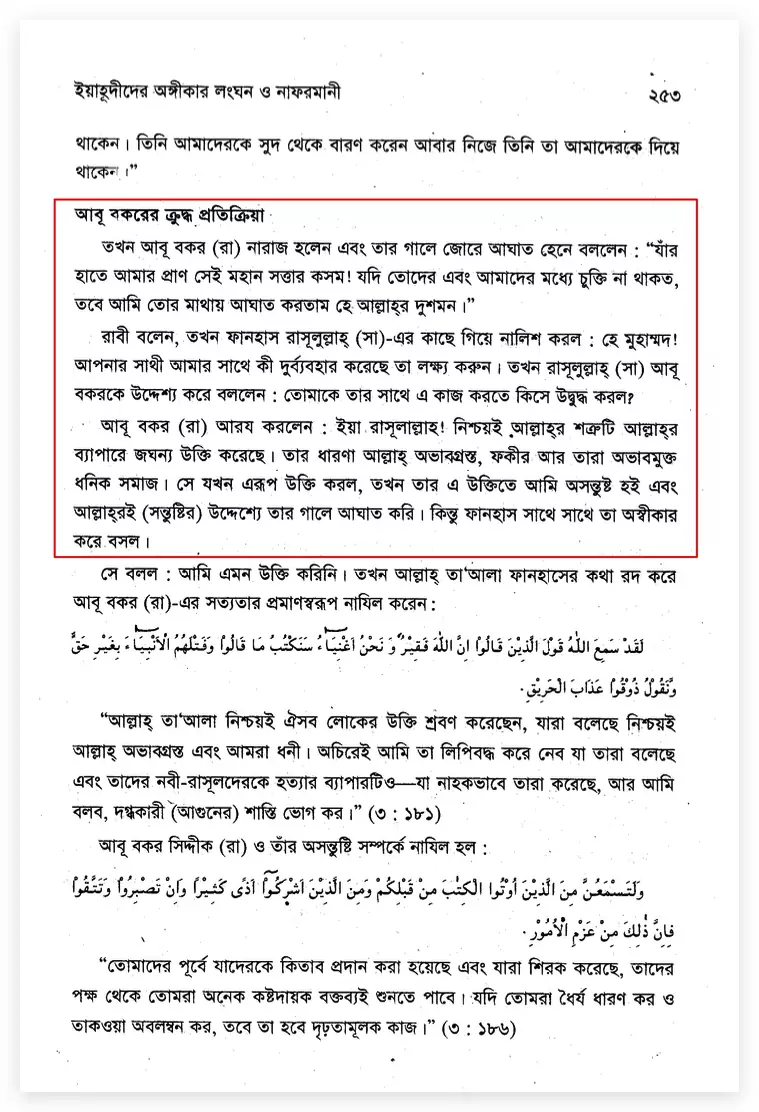
Upon hearing this, Abu Bakr became angry and struck Finhas forcefully on the cheek. He said:
“By Him in whose hand is my soul, had there not been a treaty between us and you, I would have smashed your head, O enemy of Allah!”
The narrator states that Finhas then went to the Messenger of Allah and complained:
“O Muhammad! Your companion has treated me badly. Please take notice of what he has done.”
The Messenger of Allah then asked Abu Bakr:
“Why did you treat him in that manner?”
Abu Bakr replied:
“O Messenger of Allah! This enemy of Allah made an atrocious statement about Allah. He said that Allah is poor while they are rich. I became angry at his words and struck him on the cheek for the sake of Allah.”
Finhas immediately denied having made the statement.
Let us also examine why the Jews raised this issue. Their question appears to have been entirely logical. In Islam, Allah is presented as omnipotent, self-sufficient, and the Creator—one who possesses power over all creation and depends upon no one. This conception of Allah presents Him as completely independent, perfect, and free from every kind of need. Yet several Quranic verses contain statements that appear directly inconsistent with this position and with Islam’s foundational conception of God. For example, Surah Muhammad 47:7, Surah Al-Baqarah 2:245, Surah Al-Hadid 57:11 and 57:18, and Surah At-Taghabun 64:17 speak of humans helping Allah or lending Allah a loan. If Allah truly is the Creator and owner of everything, why would He need to ask insignificant human beings for a “loan”? A being for whom everything supposedly comes into existence merely by saying “Be” is portrayed as appealing to human beings for a loan; the idea is profoundly absurd. Such statements create a logical tension with the claim that Allah is a completely self-sufficient being and raise a serious philosophical question: does an omnipotent being asking human beings for a loan not reveal some limitation in the conception of His nature? Let us read the verses that can naturally give rise to these questions in the mind of any rational person [18] [19] [20] [21] [22]
Quran reference : Surah Muhammad, 47:7
Arabic : يَـٰٓأَيُّهَا ٱلَّذِينَ ءَامَنُوٓا۟ إِن تَنصُرُوا۟ ٱللَّهَ يَنصُرْكُمْ وَيُثَبِّتْ أَقْدَامَكُمْ ٧
Translation — Saheeh International : O you who have believed, if you support Allāh, He will support you and plant firmly your feet.
Translation — M. Pickthall : O ye who believe! If ye help Allah, He will help you and will make your foothold firm.
Quran reference : Surah Al-Baqarah, 2:245
Arabic : مَّن ذَا ٱلَّذِى يُقْرِضُ ٱللَّهَ قَرْضًا حَسَنًۭا فَيُضَـٰعِفَهُۥ لَهُۥٓ أَضْعَافًۭا كَثِيرَةًۭ ۚ وَٱللَّهُ يَقْبِضُ وَيَبْصُۜطُ وَإِلَيْهِ تُرْجَعُونَ ٢٤٥
Translation — Saheeh International : Who is it that would loan Allāh a goodly loan so He may multiply it for him many times over? And it is Allāh who withholds and grants abundance, and to Him you will be returned.
Translation — M. Pickthall : Who is it that will lend unto Allah a goodly loan, so that He may give it increase manifold? Allah straiteneth and enlargeth. Unto Him ye will return.
Quran reference : Surah Al-Hadid, 57:11
Arabic : مَّن ذَا ٱلَّذِي يُقۡرِضُ ٱللَّهَ قَرۡضًا حَسَنٗا فَيُضَٰعِفَهُۥ لَهُۥ وَلَهُۥٓ أَجۡرٞ كَرِيمٞ ١١
Translation — Saheeh International : Who is it that would loan Allāh a goodly loan so He will multiply it for him and he will have a noble reward?
Translation — M. Pickthall : Who is he that will lend unto Allah a goodly loan, that He may double it for him and his may be a rich reward?
Quran reference : Surah Al-Hadid, 57:18
Arabic : إِنَّ ٱلْمُصَّدِّقِينَ وَٱلْمُصَّدِّقَـٰتِ وَأَقْرَضُوا۟ ٱللَّهَ قَرْضًا حَسَنًۭا يُضَـٰعَفُ لَهُمْ وَلَهُمْ أَجْرٌۭ كَرِيمٌۭ ١٨
Translation — Saheeh International : Indeed, the men who practice charity and the women who practice charity and [they who] have loaned Allāh a goodly loan – it will be multiplied for them, and they will have a noble reward.
Translation — M. Pickthall : Lo! those who give alms, both men and women, and lend unto Allah a goodly loan, it will be doubled for them, and theirs will be a rich reward.
Quran reference : Surah At-Taghabun, 64:17
Arabic : إِن تُقْرِضُوا۟ ٱللَّهَ قَرْضًا حَسَنًۭا يُضَـٰعِفْهُ لَكُمْ وَيَغْفِرْ لَكُمْ ۚ وَٱللَّهُ شَكُورٌ حَلِيمٌ ١٧
Translation — Saheeh International : If you loan Allāh a goodly loan, He will multiply it for you and forgive you. And Allāh is [most] Appreciative and Forbearing.
Translation — M. Pickthall : If ye lend unto Allah a goodly loan, He will double it for you and will forgive you, for Allah is Responsive, Clement,
The Prophet’s Anger When Asked Who Created Allah
There is an extremely important question that naturally occurs to many people: if Allah exists, then who created Allah? Yet according to the account below, when the Prophet was asked this question, he became intensely angry [23]
The Jews’ Audacious Questions Concerning the Essence of Allah
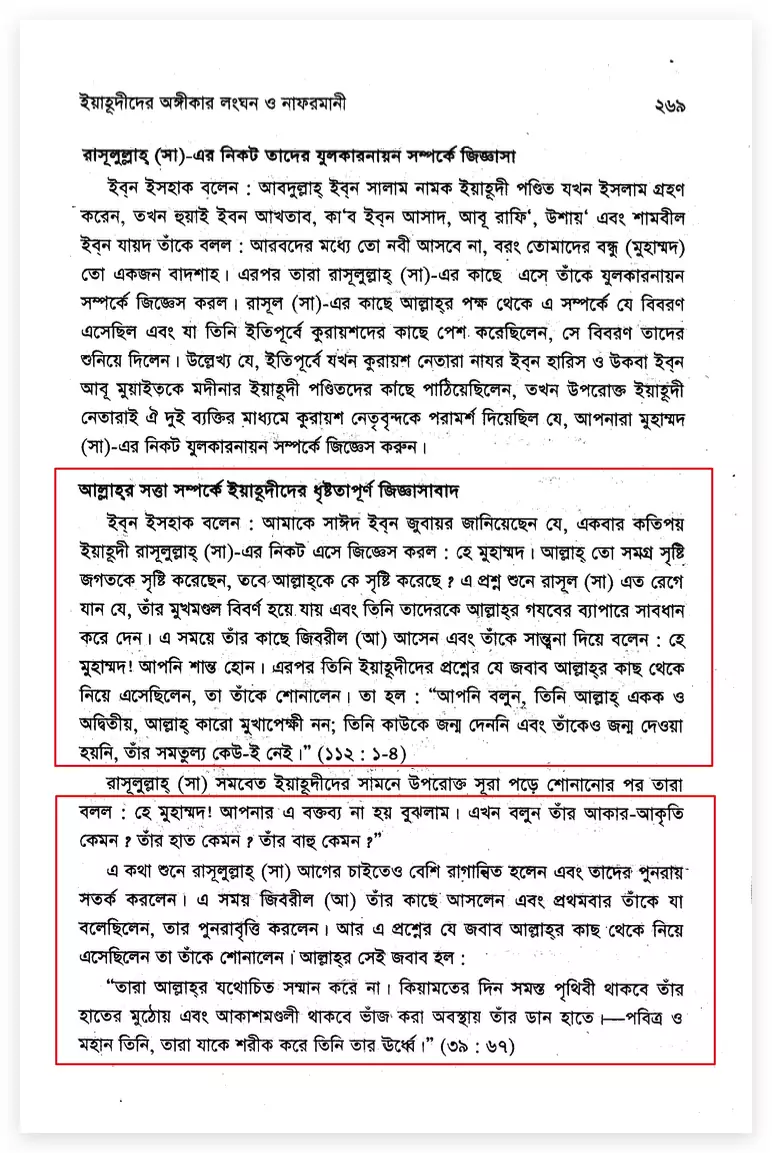
Ibn Ishaq says: Sa‘id ibn Jubayr informed me that on one occasion a number of Jews came to the Messenger of Allah and asked, “O Muhammad, Allah created the whole of creation, but who created Allah?”
Upon hearing this question, the Messenger became so angry that the colour of his face changed, and he warned them of Allah’s wrath. At that moment Jibril came to him and consoled him, saying, “O Muhammad, calm yourself.” He then recited to him the answer he had brought from Allah in response to the Jews’ question:
Quran reference : Surah Al-Ikhlas, 112:1–4
Arabic : قُلْ هُوَ ٱللَّهُ أَحَدٌ ١
ٱللَّهُ ٱلصَّمَدُ ٢
لَمْ يَلِدْ وَلَمْ يُولَدْ ٣
وَلَمْ يَكُن لَّهُۥ كُفُوًا أَحَدٌۢ ٤
Translation — Dr. Mustafa Khattab, The Clear Quran : “Say, ˹O Prophet,˺ ‘He is Allah—One ˹and Indivisible˺; Allah—the Sustainer ˹needed by all˺. He has never had offspring, nor was He born. And there is none comparable to Him.’”
After the Messenger of Allah recited this surah before the assembled Jews, they said, “O Muhammad! Very well, we understand what you have said. Now tell us: what is His form and appearance? What are His hands like? What are His arms like?”
Upon hearing this, the Messenger of Allah became even angrier than before and again warned them. At that moment Jibril came to him and repeated what he had said the first time. He then recited to him the answer he had brought from Allah to this question. Allah’s answer was:
Quran reference : Surah Az-Zumar, 39:67
Arabic : وَمَا قَدَرُواْ ٱللَّهَ حَقَّ قَدْرِهِۦ وَٱلْأَرْضُ جَمِيعًا قَبْضَتُهُۥ يَوْمَ ٱلْقِيَـٰمَةِ وَٱلسَّمَـٰوَاتُ مَطْوِيَّـٰتٌۢ بِيَمِينِهِۦ ۚ سُبْحَـٰنَهُۥ وَتَعَـٰلَىٰ عَمَّا يُشْرِكُونَ ٦٧
Translation — Dr. Mustafa Khattab, The Clear Quran : “They have not shown Allah His proper reverence—when on the Day of Judgment the ˹whole˺ earth will be in His Grip, and the heavens will be rolled up in His Right Hand. Glorified and Exalted is He above what they associate ˹with Him˺!”
Thinking About Who Created Allah Is Forbidden
An inseparable part of natural human curiosity and rational thought is the search for a “causal relationship,” or the Law of Causality. When we observe that every created thing has a creator or cause behind it, an extremely fundamental and ancient philosophical question naturally arises: “If everything has a creator, then who created that creator?” Or, “If God is the first cause of everything, how did God Himself begin?”
Within logic and free thought, this is an extremely important question that demands theoretical examination. Islamic aqidah or theology, however, approaches the question in a completely different way. According to Islamic scripture, when human thought begins to question the Creator’s own origin or essence, that line of inquiry is classified as a “prompting of Satan,” or waswasah. Instead of allowing the reasoning process to continue freely, the believer is instructed to shut down that line of thought.
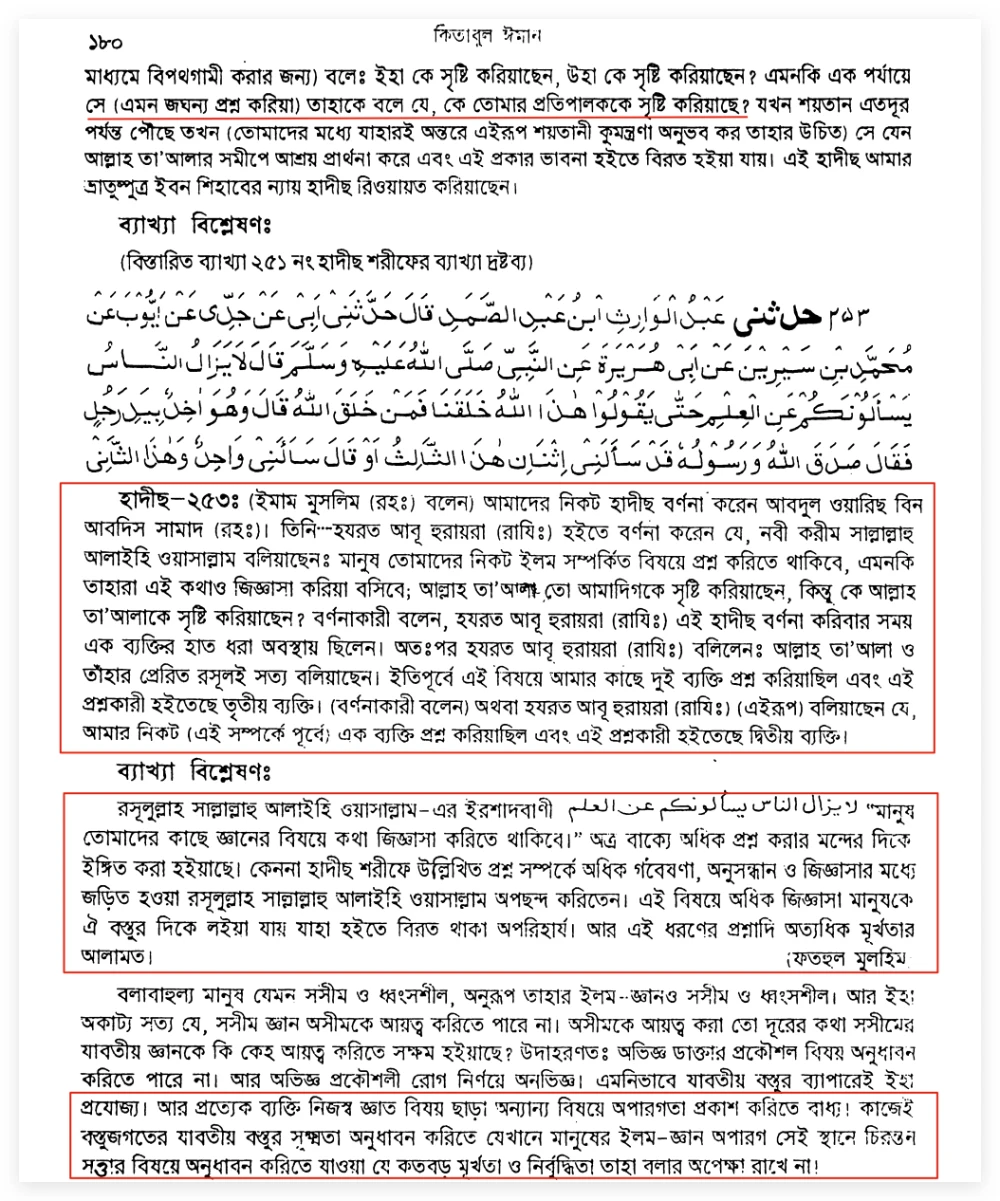
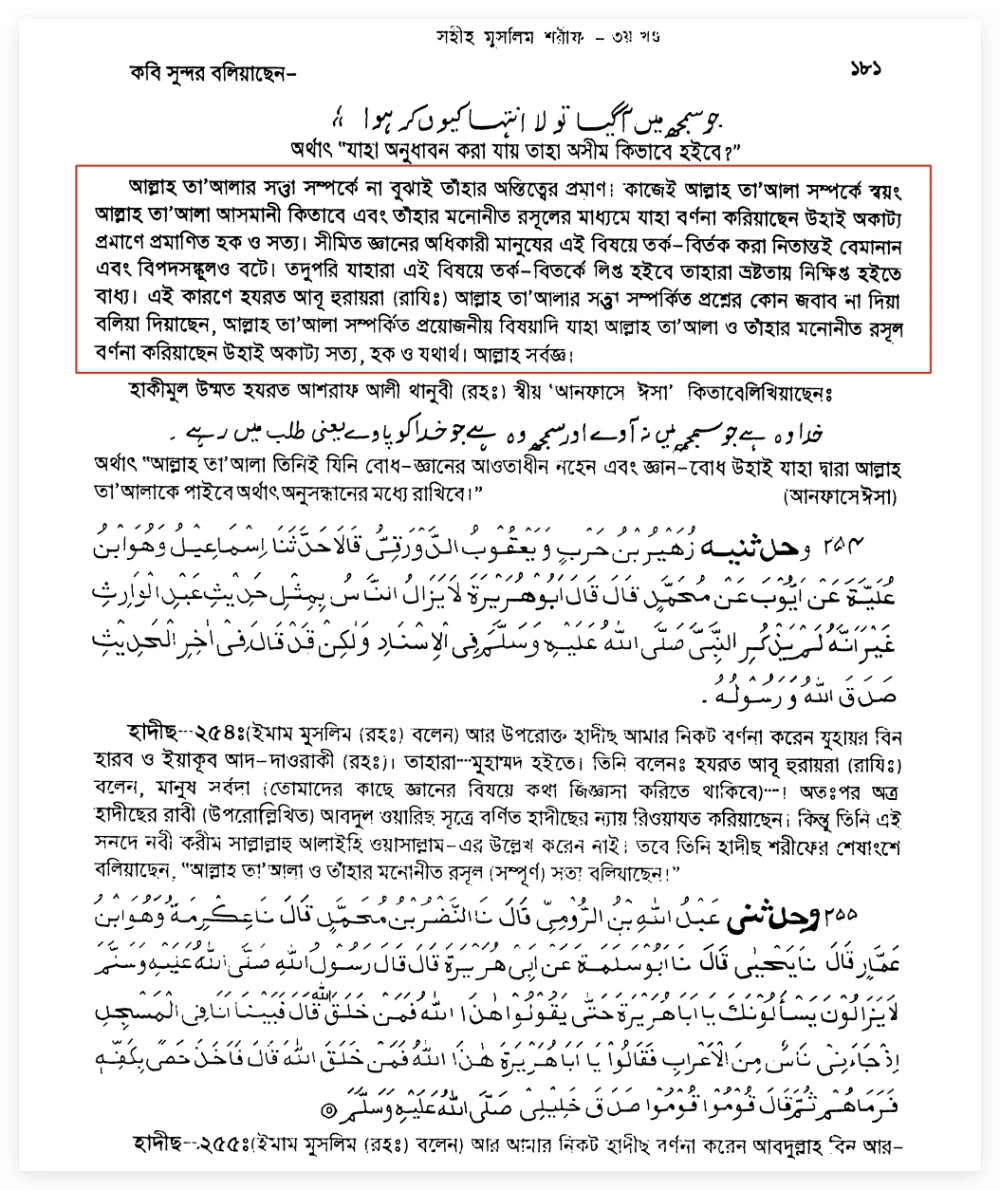
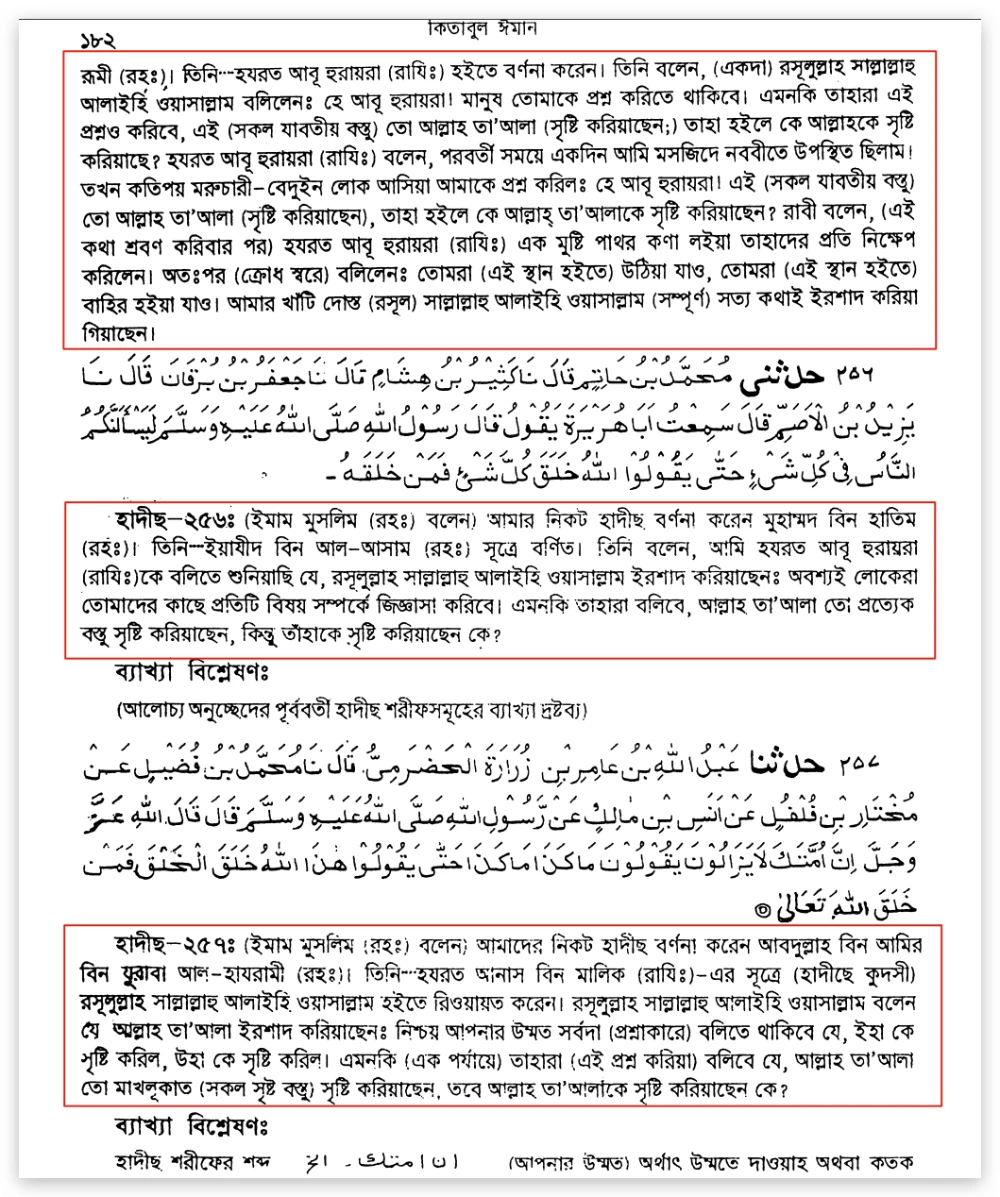
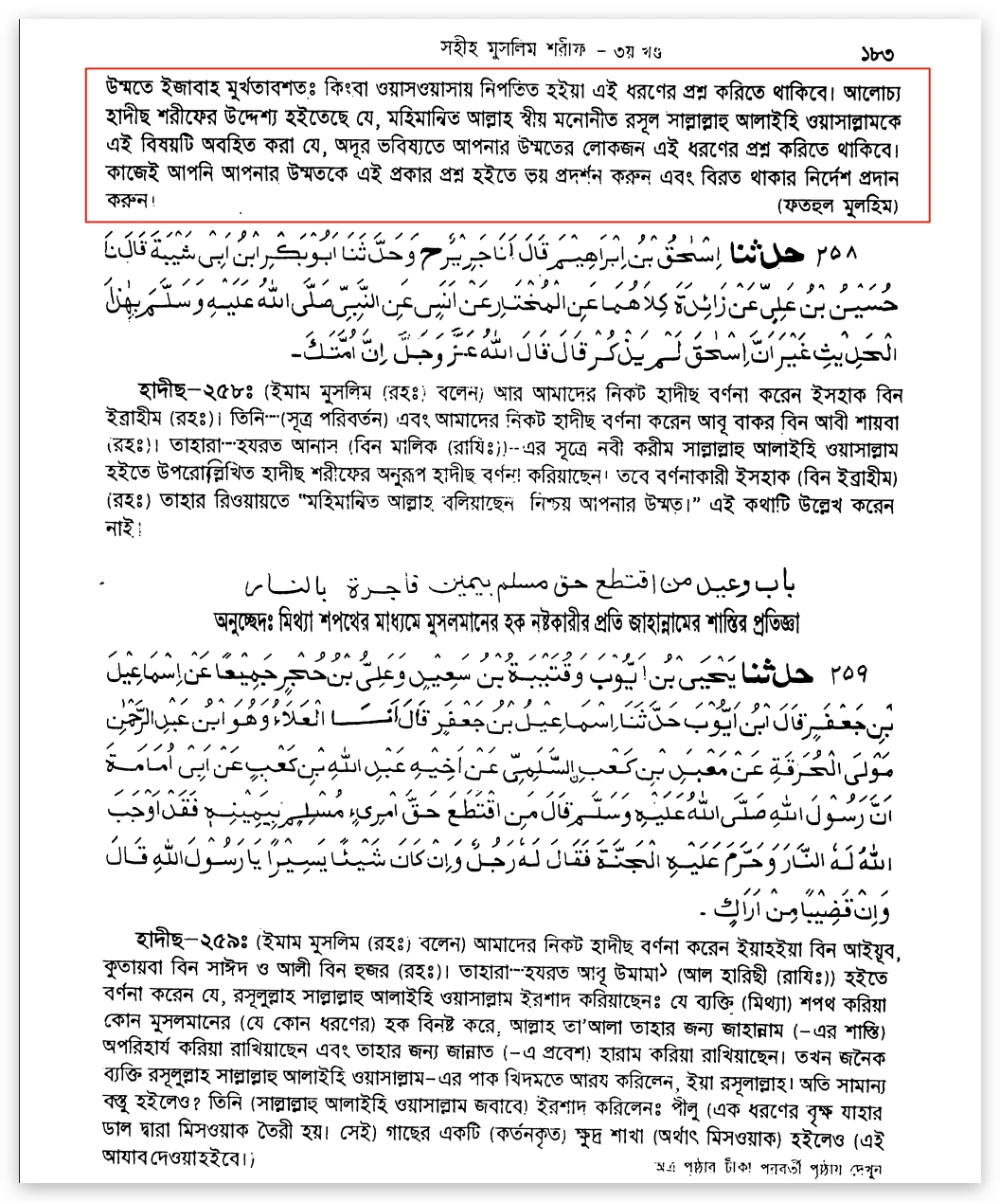
An examination of several hadiths in Sahih Muslim shows that Muhammad instructed his followers not to pursue such fundamental questions. Instead of responding to the questioner with an argument, the instruction is to stop thinking as soon as the question arises and seek refuge in Allah. In other words, where reasoning would ordinarily be expected to operate, “belief” and the cessation of thought are presented as the solution. Let us examine the relevant hadiths [24] [25] [26]
Reference : Sahih Muslim 135c
In-book reference : Book 1, Hadith 256
USC-MSA web (English) reference : Book 1, Hadith 248
Chapter : Clarifying the Waswasah (Whispers, Bad Thoughts) with regard to faith, and what the one who experiences that should say
Abu Huraira reported:
The Messenger of Allah (ﷺ) said to me: they (the people) till constantly ask you, Abu Huraira, (about different things pertaining to religion) the they would say: Well, there is Allah, but after all who created Allah? He (Abu Huraira) narrated: Once we were in the mosque that some of the Bedouins came there and said: Well, there is Allah, but who created Allah? He (the narrator) said: I took hold of the pebbles in my fist and flung at them and remarked: Stand up, stand up (go away) my friend (the Holy Prophet) told the truth.
Arabic : وَحَدَّثَنِي عَبْدُ اللَّهِ بْنُ الرُّومِيِّ، حَدَّثَنَا النَّضْرُ بْنُ مُحَمَّدٍ، حَدَّثَنَا عِكْرِمَةُ، – وَهُوَ ابْنُ عَمَّارٍ – حَدَّثَنَا يَحْيَى، حَدَّثَنَا أَبُ سَلَمَةَ، عَنْ أَبِي هُرَيْرَةَ، قَالَ قَالَ لِي رَسُولُ اللَّهِ صلى الله عليه وسلم ” لاَ يَزَالُونَ يَسْأَلُونَكَ يَا أَبَا هُرَيْرَةَ حَتَّى يَقُولُوا هَذَا اللَّهُ فَمَنْ خَلَقَ اللَّهَ ” قَالَ فَبَيْنَا أَنَا فِي الْمَسْجِدِ إِذْ جَاءَنِي نَاسٌ مِنَ الأَعْرَابِ فَقَالُوا يَا أَبَا هُرَيْرَةَ هَذَا اللَّهُ فَمَنْ خَلَقَ اللَّهَ قَالَ فَأَخَذَ حَصًى بِكَفِّهِ فَرَمَاهُمْ ثُمَّ قَالَ قُومُوا قُومُوا صَدَقَ خَلِيلِي .
Reference : Sahih Muslim 134a
In-book reference : Book 1, Hadith 250
USC-MSA web (English) reference : Book 1, Hadith 242
Chapter : Clarifying the Waswasah (Whispers, Bad Thoughts) with regard to faith, and what the one who experiences that should say
It is narrated on the authority of Abu Huraira that the Messenger of Allah (ﷺ) said:
Men will continue to question one another till this is propounded: Allah created all things but who created Allah? He who found himself confronted with such a situation should say: I affirm my faith in Allah.
Arabic : حَدَّثَنَا هَارُونُ بْنُ مَعْرُوفٍ، وَمُحَمَّدُ بْنُ عَبَّادٍ، – وَاللَّفْظُ لِهَارُونَ – قَالاَ حَدَّثَنَا سُفْيَانُ، عَنْ هِشَامٍ، عَنْ أَبِيهِ، عَنْ أَبِي هُرَيْرَةَ، قَالَ قَالَ رَسُولُ اللَّهِ صلى الله عليه وسلم ” لاَ يَزَالُ النَّاسُ يَتَسَاءَلُونَ حَتَّى يُقَالَ هَذَا خَلَقَ اللَّهُ الْخَلْقَ فَمَنْ خَلَقَ اللَّهَ فَمَنْ وَجَدَ مِنْ ذَلِكَ شَيْئًا فَلْيَقُلْ آمَنْتُ بِاللَّهِ ” .
Reference : Sahih Muslim 134c
In-book reference : Book 1, Hadith 252
USC-MSA web (English) reference : Book 1, Hadith 244
Chapter : Clarifying the Waswasah (Whispers, Bad Thoughts) with regard to faith, and what the one who experiences that should say
It is narrated on the authority of Abu Huraira that the Messenger of Allah (ﷺ) observed:
The Satan comes to everyone. of you and says: Who created this and that? till he questions: Who created your Lord? When he comes to that, one should seek refuge in Allah and keep away (from such idle thoughts).
Arabic : حَدَّثَنِي زُهَيْرُ بْنُ حَرْبٍ، وَعَبْدُ بْنُ حُمَيْدٍ، جَمِيعًا عَنْ يَعْقُوبَ، قَالَ زُهَيْرٌ حَدَّثَنَا يَعْقُوبُ بْنُ إِبْرَاهِيمَ، حَدَّثَنَا ابْنُ أَخِي ابْنِ شِهَابٍ، عَنْ عَمِّهِ، قَالَ أَخْبَرَنِي عُرْوَةُ بْنُ الزُّبَيْرِ، أَنَّ أَبَا هُرَيْرَةَ، قَالَ قَالَ رَسُولُ اللَّهِ صلى الله عليه وسلم ” يَأْتِي الشَّيْطَانُ أَحَدَكُمْ فَيَقُولُ مَنْ خَلَقَ كَذَا وَكَذَا حَتَّى يَقُولَ لَهُ مَنْ خَلَقَ رَبَّكَ فَإِذَا بَلَغَ ذَلِكَ فَلْيَسْتَعِذْ بِاللَّهِ وَلْيَنْتَهِ ” .
Let us now examine Sahih al-Bukhari itself. The Prophet’s instruction was that when various questions about God or Allah arise in one’s mind, rather than searching for answers, one should stop thinking about those questions [27] [28] –
Reference : Sahih al-Bukhari 3276
In-book reference : Book 59, Hadith 85
USC-MSA web (English) reference : Vol. 4, Book 54, Hadith 496
Chapter : The characteristics of Iblis (Satan) and his soldiers
Narrated Abu Huraira:
Allah’s Messenger (ﷺ) said, “Satan comes to one of you and says, ‘Who created so-and-so?’ till he says, ‘Who has created your Lord?’ So, when he inspires such a question, one should seek refuge with Allah and give up such thoughts.”
Arabic : حَدَّثَنَا يَحْيَى بْنُ بُكَيْرٍ، حَدَّثَنَا اللَّيْثُ، عَنْ عُقَيْلٍ، عَنِ ابْنِ شِهَابٍ، قَالَ أَخْبَرَنِي عُرْوَةُ، قَالَ أَبُو هُرَيْرَةَ ـ رضى الله عنه ـ قَالَ رَسُولُ اللَّهِ صلى الله عليه وسلم ” يَأْتِي الشَّيْطَانُ أَحَدَكُمْ فَيَقُولُ مَنْ خَلَقَ كَذَا مَنْ خَلَقَ كَذَا حَتَّى يَقُولَ مَنْ خَلَقَ رَبَّكَ فَإِذَا بَلَغَهُ فَلْيَسْتَعِذْ بِاللَّهِ، وَلْيَنْتَهِ ”.
Reference : Sahih al-Bukhari 3276
In-book reference : Book 59, Hadith 85
USC-MSA web (English) reference : Vol. 4, Book 54, Hadith 496
Chapter : The characteristics of Iblis (Satan) and his soldiers
Narrated Abu Huraira:
Allah’s Messenger (ﷺ) said, “Satan comes to one of you and says, ‘Who created so-and-so?’ till he says, ‘Who has created your Lord?’ So, when he inspires such a question, one should seek refuge with Allah and give up such thoughts.”
Arabic : حَدَّثَنَا يَحْيَى بْنُ بُكَيْرٍ، حَدَّثَنَا اللَّيْثُ، عَنْ عُقَيْلٍ، عَنِ ابْنِ شِهَابٍ، قَالَ أَخْبَرَنِي عُرْوَةُ، قَالَ أَبُو هُرَيْرَةَ ـ رضى الله عنه ـ قَالَ رَسُولُ اللَّهِ صلى الله عليه وسلم ” يَأْتِي الشَّيْطَانُ أَحَدَكُمْ فَيَقُولُ مَنْ خَلَقَ كَذَا مَنْ خَلَقَ كَذَا حَتَّى يَقُولَ مَنْ خَلَقَ رَبَّكَ فَإِذَا بَلَغَهُ فَلْيَسْتَعِذْ بِاللَّهِ، وَلْيَنْتَهِ ”.
An analysis of Sahih Muslim 135c shows that when a group of Bedouins raised the rational and philosophical question, “Who created Allah?”, Abu Huraira, one of Muhammad’s most famous Companions, did not attempt to provide any theoretical or logical answer. Instead, his response was physical and contemptuous: he took pebbles in his hand, threw them at the questioners, and drove them away. This incident exposes several important features:
- Silencing through the use of physical force: One of the principal requirements of free thought or philosophy is to respond to a question with an answer. Here, however, when the questioners express a fundamental doubt, the respondent throws stones instead of answering. This indicates that such questions were not merely regarded as religiously objectionable; socially, too, they could be treated as extreme insolence or misconduct, to be answered through intimidation.
- Using the question to validate a prophecy: After throwing the pebbles, Abu Huraira said, “My friend [Muhammad] told the truth.” In other words, Muhammad had previously said that people would eventually ask precisely such a question. Consequently, the moment the question was raised, Abu Huraira interpreted its occurrence as confirmation of Muhammad’s prediction. The logical significance of the question itself was thereby displaced, while its appearance was transformed into confirmation of an anticipated religious warning.
- Closing the path to open discussion: The treatment of the Bedouins in a place such as the Prophet’s Mosque, a setting associated with religious instruction, illustrates the limits placed upon the supposed Islamic opportunity to “verify everything.” In particular, when questions reach the existence or origin of the Creator, the door to rational inquiry is effectively closed. The throwing of pebbles functions here as a symbolic barrier: beyond this boundary, the question is no longer to be pursued.
- Psychological pressure and exclusion: The statement recorded in the hadith—“Stand up, stand up (go away)”—shows the questioners being expelled rather than answered. They leave not only without a substantive answer but after being publicly humiliated. Such treatment can create a strong psychological warning for believers: pursuing comparable questions may expose them to similar rejection and humiliation.
In summary: Abu Huraira’s throwing of pebbles reflects a system in which, when reason collides with the boundary of belief, the response is not necessarily to refute the reasoning but to suppress the questioner. This illustrates clearly the limits of Islam’s supposed “opportunity for verification.” Now let us read the explanations of these hadiths from Sharh Muslim [29]
Studying Philosophy or Logic Is Haram
The word philosophy literally means “love of wisdom.” More precisely, philosophy is the study of general and fundamental questions concerning human existence, knowledge, morality, values, causation, mind, and language. Throughout human history, nearly every branch of knowledge has emerged from philosophy. The highest academic degree awarded in virtually any field is the PhD, meaning Doctor of Philosophy. In that sense, advanced study in any discipline ultimately involves philosophical inquiry. Philosophy is, in fact, the mother of human knowledge. Philosophy underwent major development in ancient Greece, where great thinkers such as Socrates, Plato, and Aristotle laid much of the foundation of modern philosophy. The basic principles upon which formal logic throughout the world still depends owe much to Aristotle. Greek philosophers likewise made foundational contributions to understanding how thought must be structured in order to be logical. But what is the Islamic position on studying philosophy or logic?
Philosophy and Rationalism Are Haram: Statements of Islamic Scholars
First, let us listen to a discussion by Dr. Abu Bakr Muhammad Zakaria, one of the prominent contemporary Islamic scholars of Bangladesh, in which he discusses whether Muslims should or should not study logic and philosophy,
Now let us listen to two statements by the internationally renowned Islamic scholar Assim al-Hakeem,
Let us also hear what another Bangladeshi Islamic scholar, Shaykh Muzaffar bin Muhsin, says on this subject,
Sharh al-‘Aqidah al-Tahawiyyah
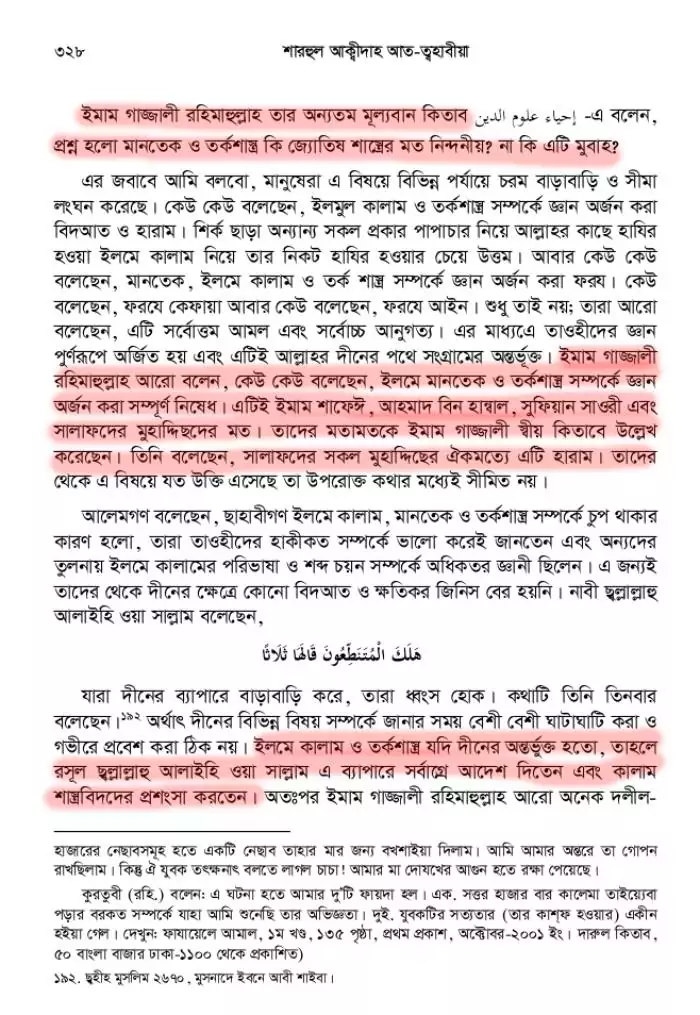
Sharh al-‘Aqidah al-Tahawiyyah is a highly renowned work on Islamic creed, written by Imam Ibn Abi al-‘Izz al-Hanafi. Let us examine what he states in his book concerning the Islamic creed on this subject and the position of the Salaf [30] –
Al-Fiqh al-Akbar
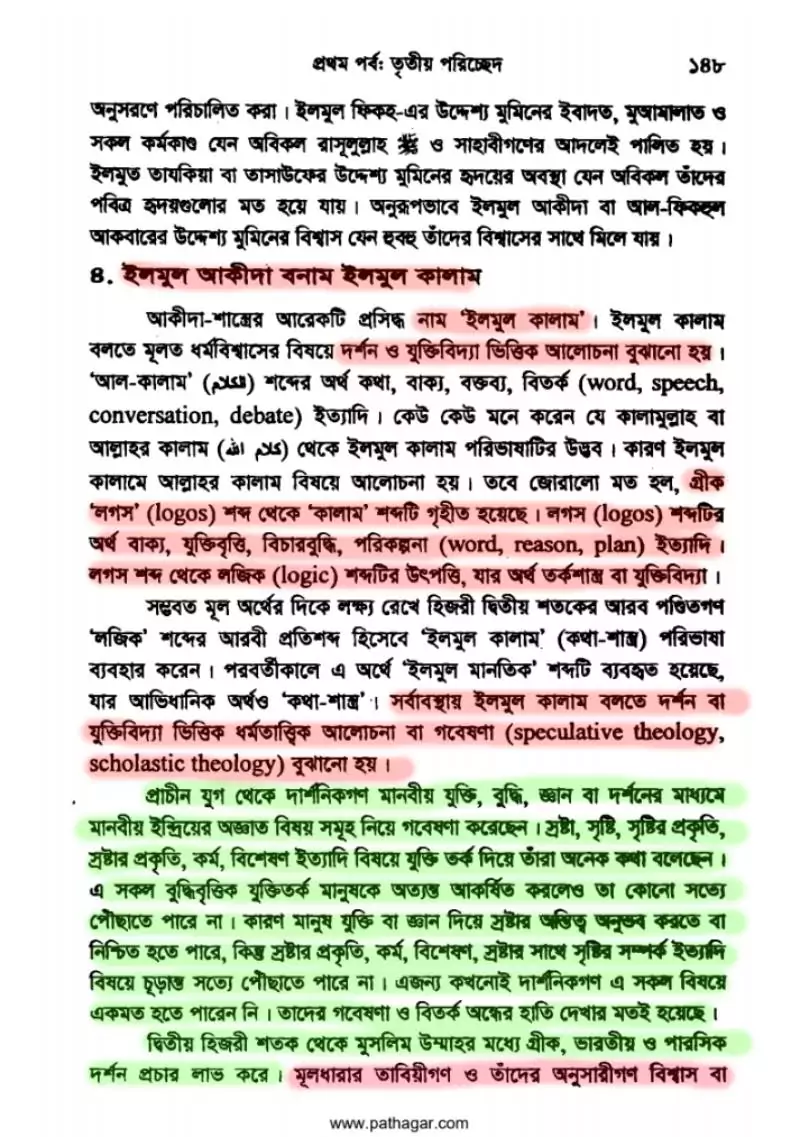
Al-Fiqh al-Akbar is an early Islamic work on aqidah. It is one of the works attributed to Imam Abu Hanifa that has survived. Let us read the chapter concerning philosophy from the Bengali translation and commentary by Dr. Khondkar Abdullah Jahangir [31] –
Another well-known name for the discipline of aqidah is ‘ilm al-kalam. ‘Ilm al-kalam essentially refers to philosophical and logical discussion concerning matters of religious belief. The Arabic word al-kalam (الكلام) means word, speech, conversation, debate, and so forth. Some believe that the technical term ‘ilm al-kalam originated from kalam Allah, or the speech of Allah (كلام الله), because ‘ilm al-kalam discusses the speech of Allah. The stronger view, however, is that the term kalam was adopted from the Greek word logos. The word logos means word, reason, rational faculty, plan, and so forth. The word logic is derived from logos, and means the science of reasoning or logic.
Probably with this original meaning in mind, Arab scholars of the second century AH used the term ‘ilm al-kalam, or “the science of discourse,” as the Arabic equivalent of logic. Later the term ‘ilm al-mantiq came to be used in this sense, whose literal meaning is likewise “the science of discourse.” In any case, ‘ilm al-kalam refers to philosophical or logic-based theological discussion and investigation—speculative theology or scholastic theology.
From ancient times, philosophers used human reason, intellect, knowledge, and philosophy to investigate matters beyond the reach of the human senses. They advanced many arguments concerning the Creator, creation, the nature of creation, the nature of the Creator, His actions, attributes, and related matters. Although such intellectual arguments and debates greatly attract human beings, they cannot lead to any ultimate truth. This is because human beings may perceive or become convinced of the existence of the Creator through reason or knowledge, but they cannot reach ultimate truth regarding the nature, actions, or attributes of the Creator, or the relationship between the Creator and creation. This is why philosophers have never been able to agree upon these matters. Their investigations and debates have resembled the story of blind men examining an elephant.
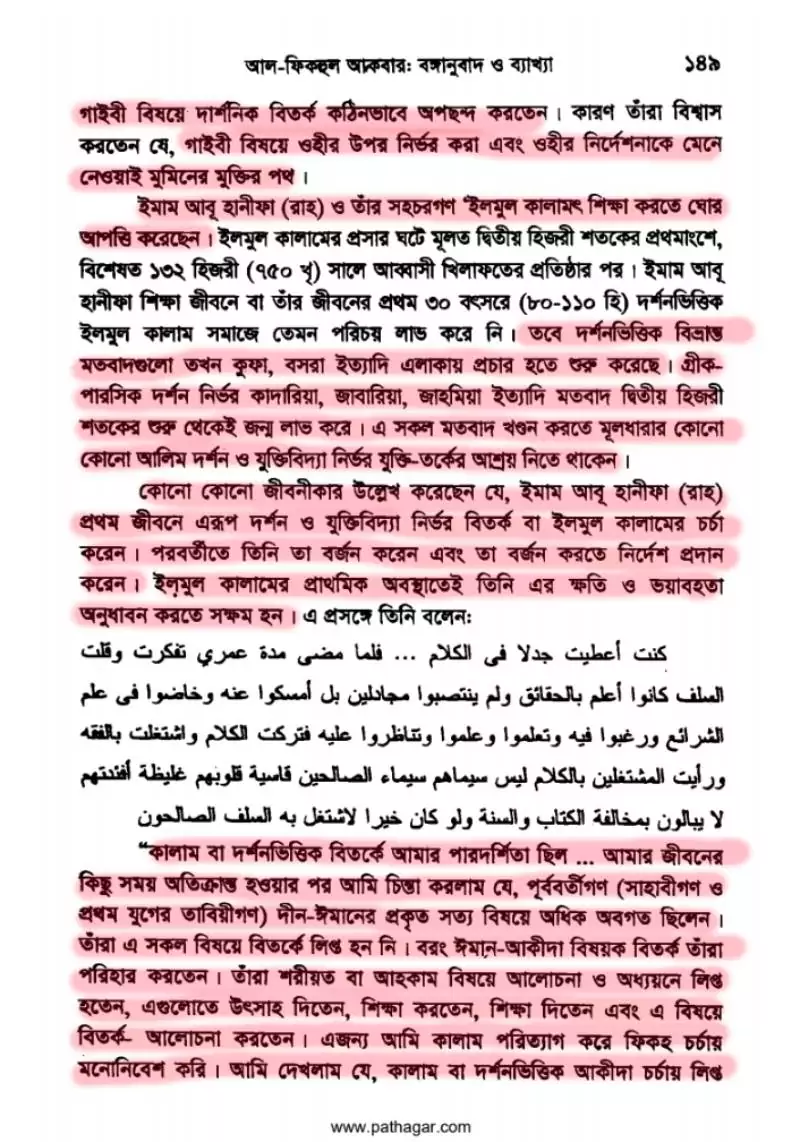
From the second century AH onward, Greek, Indian, and Persian philosophy began to spread among the Muslim Ummah. The mainstream Tabi‘un and their followers strongly disliked philosophical debate concerning matters of belief and the unseen. They believed that relying upon revelation concerning matters of the unseen and submitting to the guidance of revelation constituted the believer’s path to salvation.
Imam Abu Hanifa and his companions strongly objected to studying ‘ilm al-kalam. The spread of ‘ilm al-kalam occurred primarily during the first half of the second century AH, particularly after the establishment of the Abbasid Caliphate in 132 AH (750 CE). During Imam Abu Hanifa’s student years, or the first thirty years of his life (80–110 AH), philosophically based ‘ilm al-kalam had not yet become widely established in society. Philosophically influenced heterodox doctrines, however, such as the Qadariyyah, Jabariyyah, and Jahmiyyah, began to spread in Kufa, Basra, and other regions from the beginning of the second century AH. In order to refute these doctrines, some mainstream scholars began employing arguments derived from philosophy and logic.
Some biographers state that in his early life Imam Abu Hanifa himself participated in philosophical and logical debates or practised ‘ilm al-kalam. Later he abandoned it and instructed others to abandon it as well. He was able to recognize the damage and danger of ‘ilm al-kalam even during its earliest phase. Concerning this, he said:
كنت أعطيت جدلا فى الكلام … فلما مضى مدة عمري تفكرت وقلت السلف كانوا أعلم بالحقائق ولم ينتصبوا مجادلين بل أمسكوا عنه وخاضوا فى علم الشرائع ورغبوا فيه وتعلموا وعلموا وتناظروا عليه فتركت الكلام واشتغلت بالفقه ورأيت المشتغلين بالكلام ليس سيماهم سيماء الصالحين قاسية قلوبهم غليظة أفئدتهم لا يبالون بمخالفة الكتاب والسنة ولو كان خيرا لاشتغل به السلف الصالحون
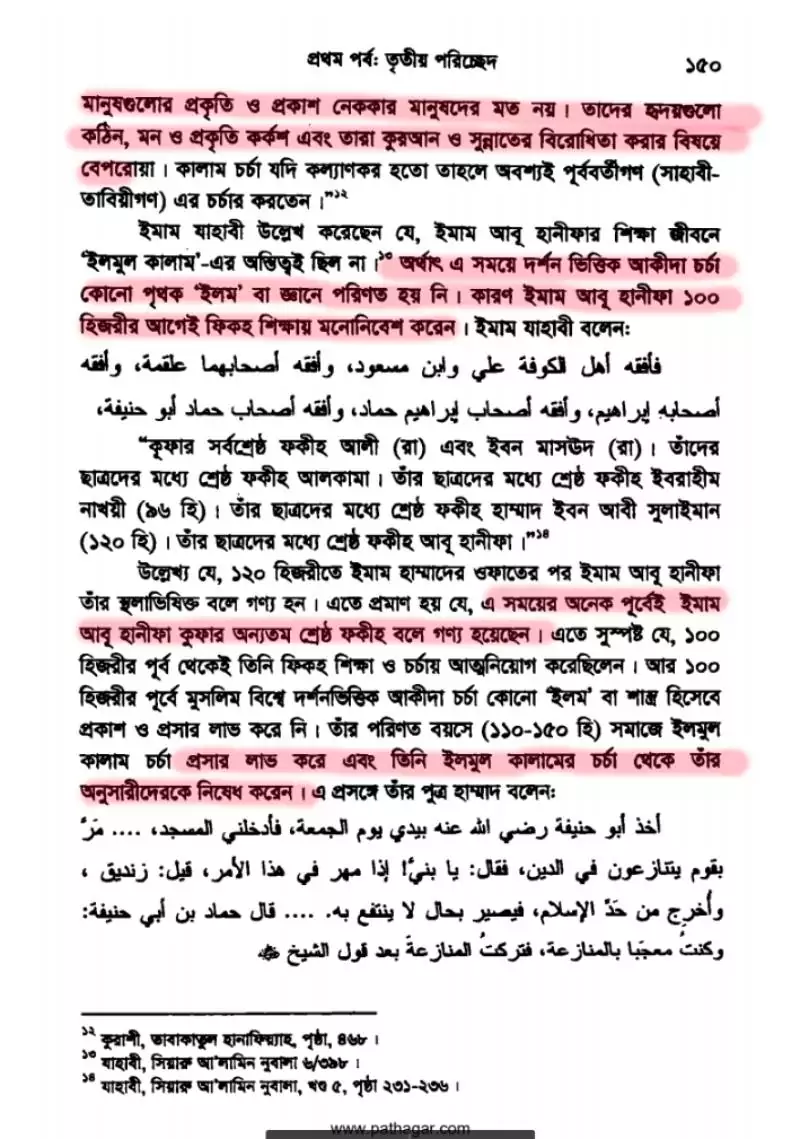
“I had acquired skill in kalam, or philosophical debate … After a period of my life had passed, I reflected and said that the predecessors—the Companions and the earliest Tabi‘un—were more knowledgeable concerning the realities of religion and faith. Yet they did not establish themselves as disputants in these matters; rather, they abstained from debates concerning faith and aqidah. They devoted themselves to studying the Sharia and its rulings, encouraged others to do so, learned and taught them, and engaged in discussion regarding those matters. Therefore, I abandoned kalam and devoted myself to fiqh. I observed that the character and outward conduct of those engaged in kalam or philosophically based aqidah were unlike those of righteous people. Their hearts were hard, their dispositions harsh, and they were unconcerned about contradicting the Quran and Sunnah. Had the practice of kalam been beneficial, the righteous predecessors—the Companions and Tabi‘un—would certainly have practised it.”[1]
Imam al-Dhahabi mentioned that during Imam Abu Hanifa’s period of education, ‘ilm al-kalam did not even exist as an established discipline.[2] That is, philosophically based inquiry into aqidah had not yet become an independent field of knowledge. Imam Abu Hanifa had already devoted himself to the study of fiqh before 100 AH. Imam al-Dhahabi states:
فأفقه أهل الكوفة علي وابن مسعود، وأفقه أصحابهما علقمة، وأفقه أصحابه إبراهيم، وأفقه أصحاب إبراهيم حماد، وأفقه أصحاب حماد أبو حنيفة،
“The greatest jurists of Kufa were Ali and Ibn Mas‘ud. The greatest jurist among their students was Alqamah. The greatest jurist among his students was Ibrahim al-Nakha‘i (d. 96 AH). The greatest jurist among his students was Hammad ibn Abi Sulayman (d. 120 AH). And the greatest jurist among the students of Hammad was Abu Hanifa.”[3]
It should be noted that after Imam Hammad’s death in 120 AH, Imam Abu Hanifa was regarded as his successor. This demonstrates that long before that time Abu Hanifa had already been regarded as one of the foremost jurists of Kufa. It is therefore clear that he had dedicated himself to the study and practice of fiqh before 100 AH. Before 100 AH, philosophically based aqidah had not yet emerged and spread throughout the Muslim world as an independent “science” or discipline. During the later period of his life (110–150 AH), the practice of ‘ilm al-kalam became widespread in society, and he prohibited his followers from practising it. Concerning this, his son Hammad states:
أخذ أبو حنيفة رضي الله عنه بيدي يوم الجمعة، فأدخلني المسجد، …. مَرَّ بقوم يتنازعون في الدين، فقال: يا بنيَّ! إذا مهر في هذا الأمر، قيل: زنديق ، وأُخرِج من حَدِّ الإسلام، فيصير بحال لا ينتفع به. …. قال حماد بن أبي حنيفة: وكنتُ معجَبا بالمنازعة، فتركتُ المنازعةَ بعد قول الشيخ
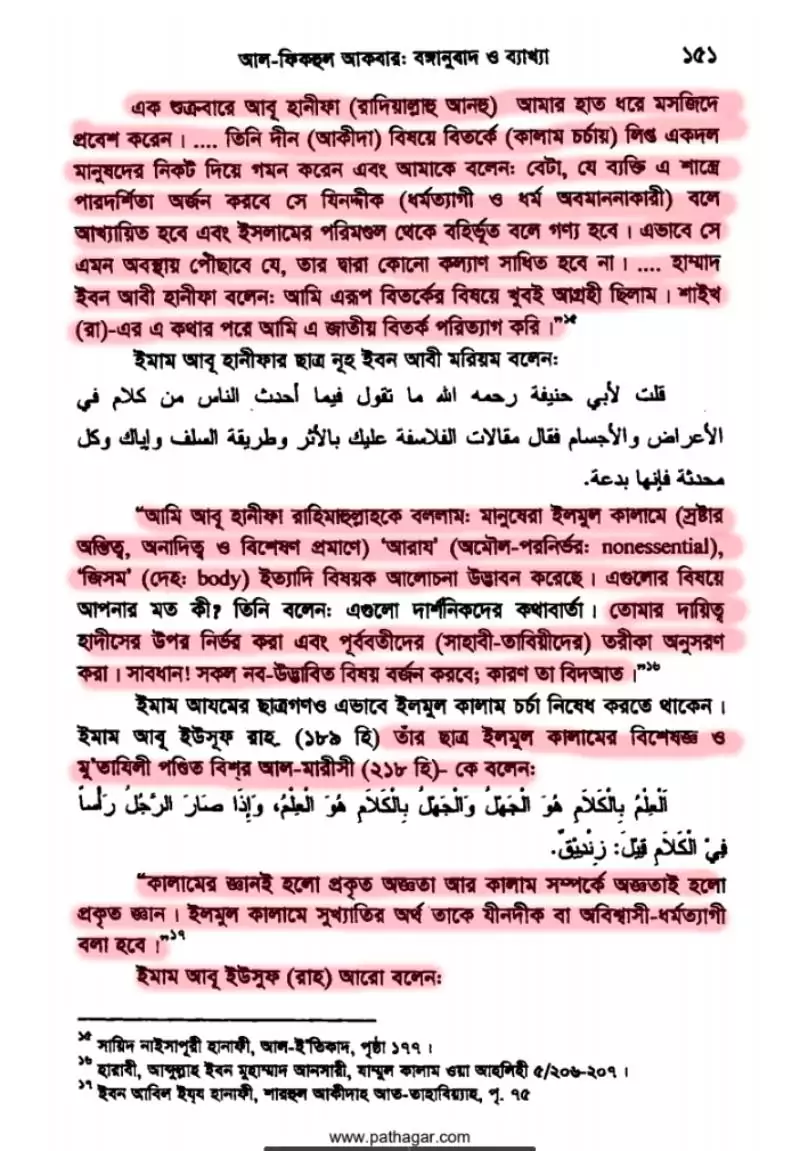
“One Friday Abu Hanifa took me by the hand and entered the mosque with me. … He passed by a group of people disputing concerning religion and aqidah, engaged in the practice of kalam. He said to me: ‘My son, whoever becomes proficient in this discipline will be called a zindiq—a heretic and apostate—and will be regarded as having left the bounds of Islam. He will reach such a condition that no benefit will come from him.’ … Hammad ibn Abi Hanifa said: ‘I was deeply interested in such disputation, but after hearing this statement of the Shaykh, I abandoned such debates.’”[4]
Nuh ibn Abi Maryam, a student of Imam Abu Hanifa, states:
قلت لأبي حنيفة رحمه الله ما تقول فيما أحدث الناس من كلام في الأعراض والأجسام فقال مقالات الفلاسفة عليك بالأثر وطريقة السلف وإياك وكل محدثة فإنها بدعة.
“I asked Abu Hanifa: People have introduced into ‘ilm al-kalam discussions concerning ‘arad (accident/non-essential and dependent property), jism (body), and similar matters in order to establish the existence, eternality, and attributes of the Creator. What is your opinion concerning these matters? He replied: ‘These are the statements of philosophers. Your responsibility is to rely upon hadith and follow the path of the predecessors—the Companions and Tabi‘un. Beware of every newly introduced matter, for it is bid‘ah.’”[5]
The students of the Great Imam likewise continued prohibiting the practice of ‘ilm al-kalam. Imam Abu Yusuf (d. 189 AH) said to his student Bishr al-Marisi (d. 218 AH), an expert in ‘ilm al-kalam and a Mu‘tazili scholar:
اَلْعِلْمُ بِالْكَلاَمِ هُوَ الْجَهْلُ وَالْجَهْلُ بِالْكَلاَمِ هُوَ الْعِلْمُ، وَإِذَا صَارَ الرَّجُلُ رَأْساً فِيْ الْكَلاَمِ قِيْلَ: زِنْدِيْقٌ.
“Knowledge of kalam is true ignorance, while ignorance of kalam is true knowledge. When a person becomes renowned in ‘ilm al-kalam, he will be called a zindiq—a heretic or apostate.”[6]
Imam Abu Yusuf further stated:
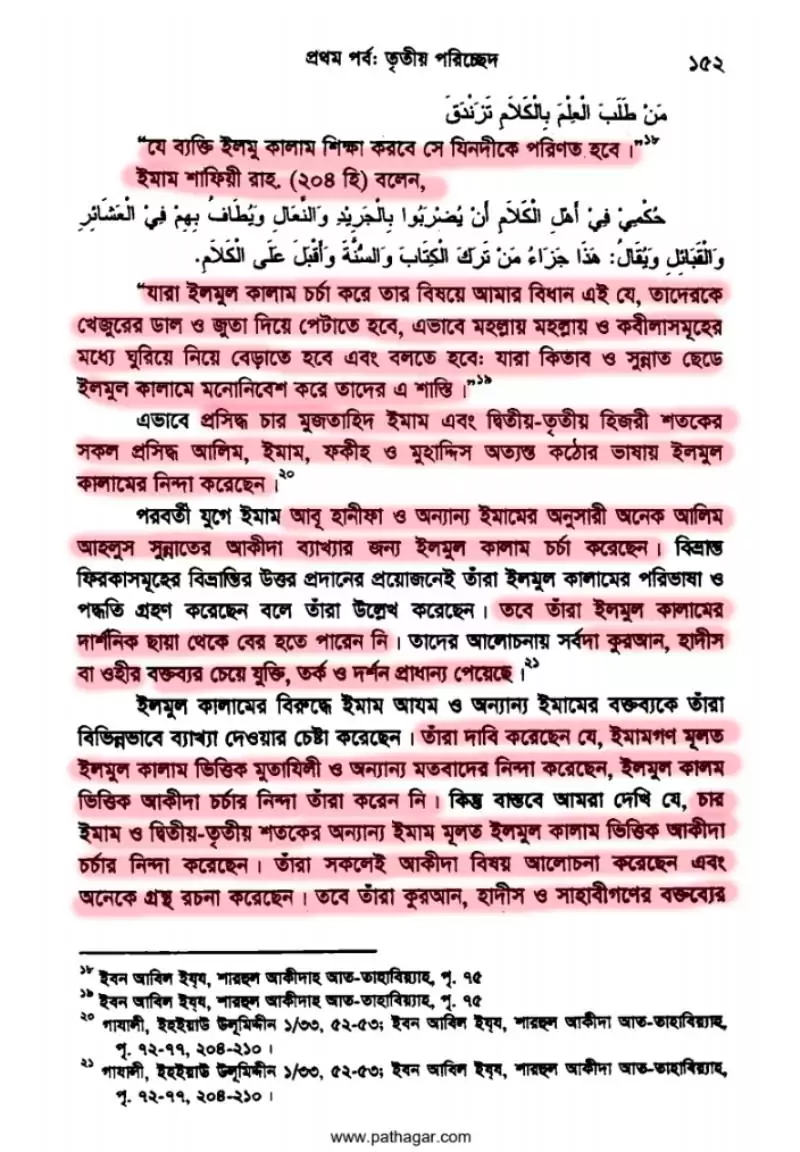
مَنْ طَلَبَ الْعِلْمَ بِالْكَلاَمِ تَزَنْدَقَ
“Whoever seeks knowledge through ‘ilm al-kalam becomes a zindiq.”[7]
Imam al-Shafi‘i (d. 204 AH) said:
حُكْمِيْ فِيْ أَهْلِ الْكَلاَمِ أَنْ يُضْرَبُوا بِالْجَرِيْدِ وَالنِّعَالِ وَيُطَافُ بِهِمْ فِيْ الْعَشَائِرِ وَالْقَبَائِلِ وَيُقَالُ: هَذَا جَزَاءُ مَنْ تَرَكَ الْكِتَابَ وَالسُّنَّةَ وَأَقْبَلَ عَلَى الْكَلاَمِ.
“My ruling concerning those who practise ‘ilm al-kalam is that they should be beaten with palm branches and sandals, then paraded through the neighbourhoods and tribes while it is proclaimed: ‘This is the punishment of those who abandon the Book and Sunnah and devote themselves to ‘ilm al-kalam.’”[8]
In this manner, the four famous mujtahid Imams, together with the renowned scholars, Imams, jurists, and hadith scholars of the second and third centuries AH, condemned ‘ilm al-kalam in extremely severe language.[9]
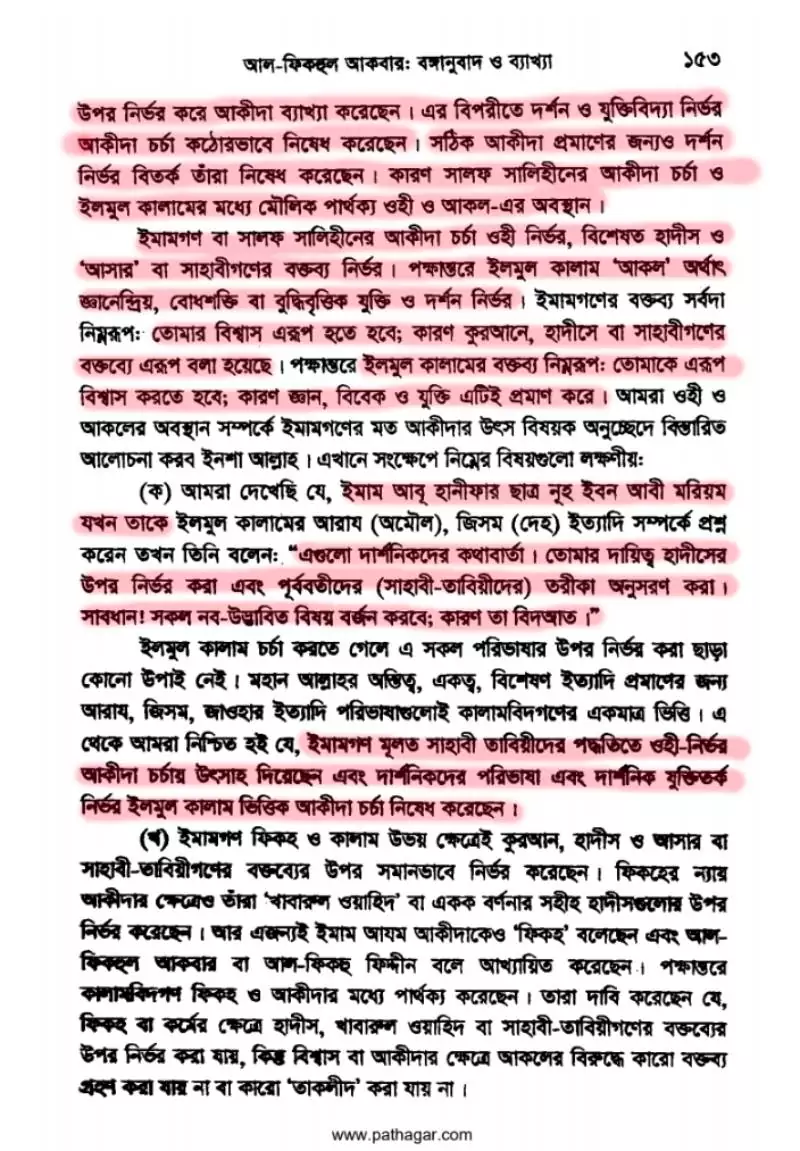
In later centuries, many scholars who followed Imam Abu Hanifa and the other Imams practised ‘ilm al-kalam in order to explain the creed of Ahl al-Sunnah. They stated that they adopted the terminology and methodology of ‘ilm al-kalam because it was necessary to respond to the deviations of heterodox sects. Nevertheless, they could not escape the philosophical influence of ‘ilm al-kalam. In their discussions, reasoning, debate, and philosophy repeatedly received greater emphasis than statements from the Quran, hadith, or revelation.[10]
They attempted to explain in various ways the statements of the Great Imam and the other Imams against ‘ilm al-kalam. They claimed that the Imams had primarily condemned Mu‘tazili and other doctrines based on ‘ilm al-kalam, rather than condemning the use of ‘ilm al-kalam itself in the study of aqidah. In reality, however, we find that the four Imams and other Imams of the second and third centuries primarily condemned the practice of aqidah based upon ‘ilm al-kalam. All of them discussed matters of aqidah, and many wrote books on the subject. But they explained aqidah by relying upon the Quran, hadith, and statements of the Companions. In contrast, they strictly prohibited the practice of aqidah based upon philosophy and logic. They even prohibited philosophical argumentation for the purpose of proving correct aqidah. This was because the fundamental difference between the methodology of the Salaf al-Salih and ‘ilm al-kalam concerned the respective positions of revelation and reason.
The aqidah methodology of the Imams and the Salaf al-Salih was based upon revelation, particularly hadith and athar, or statements of the Companions. By contrast, ‘ilm al-kalam was based upon ‘aql—that is, the cognitive faculties, intellectual reasoning, and philosophy. The position of the Imams was consistently of the following form: you must believe this because the Quran, hadith, or statements of the Companions say so. By contrast, the position of ‘ilm al-kalam was: you must believe this because knowledge, reason, and logic demonstrate it. We shall discuss the respective positions of revelation and reason in greater detail, Allah willing, in the section concerning the sources of aqidah. Here the following points should be noted briefly:
(a) We have seen that when Nuh ibn Abi Maryam, a student of Imam Abu Hanifa, asked him about such concepts in ‘ilm al-kalam as ‘arad (accident) and jism (body), he replied: “These are statements of philosophers. Your responsibility is to rely upon hadith and follow the path of the predecessors—the Companions and Tabi‘un. Beware of every newly introduced matter, for it is bid‘ah.”
It is impossible to practise ‘ilm al-kalam without relying upon these technical terms. To establish the existence, unity, and attributes of Allah, terms such as ‘arad, jism, and jawhar constituted the principal foundations of the theologians’ arguments. From this we may conclude that the Imams encouraged an approach to aqidah based upon revelation and the methodology of the Companions and Tabi‘un, while prohibiting the philosophical terminology and philosophically reasoned approach to aqidah represented by ‘ilm al-kalam.
(b) In both fiqh and kalam, the Imams relied equally upon the Quran, hadith, and athar, or statements of the Companions and Tabi‘un. In aqidah, just as in fiqh, they relied upon authentic solitary reports, or khabar al-wahid. It is for this reason that the Great Imam also called aqidah “fiqh,” describing it as al-fiqh al-akbar or al-fiqh fi al-din. By contrast, the theologians distinguished between fiqh and aqidah. They claimed that in matters of fiqh or practice, one may rely upon hadith, khabar al-wahid, or the statements of the Companions and Tabi‘un, but in matters of belief or aqidah no statement may be accepted against reason, nor may anyone be followed through taqlid.
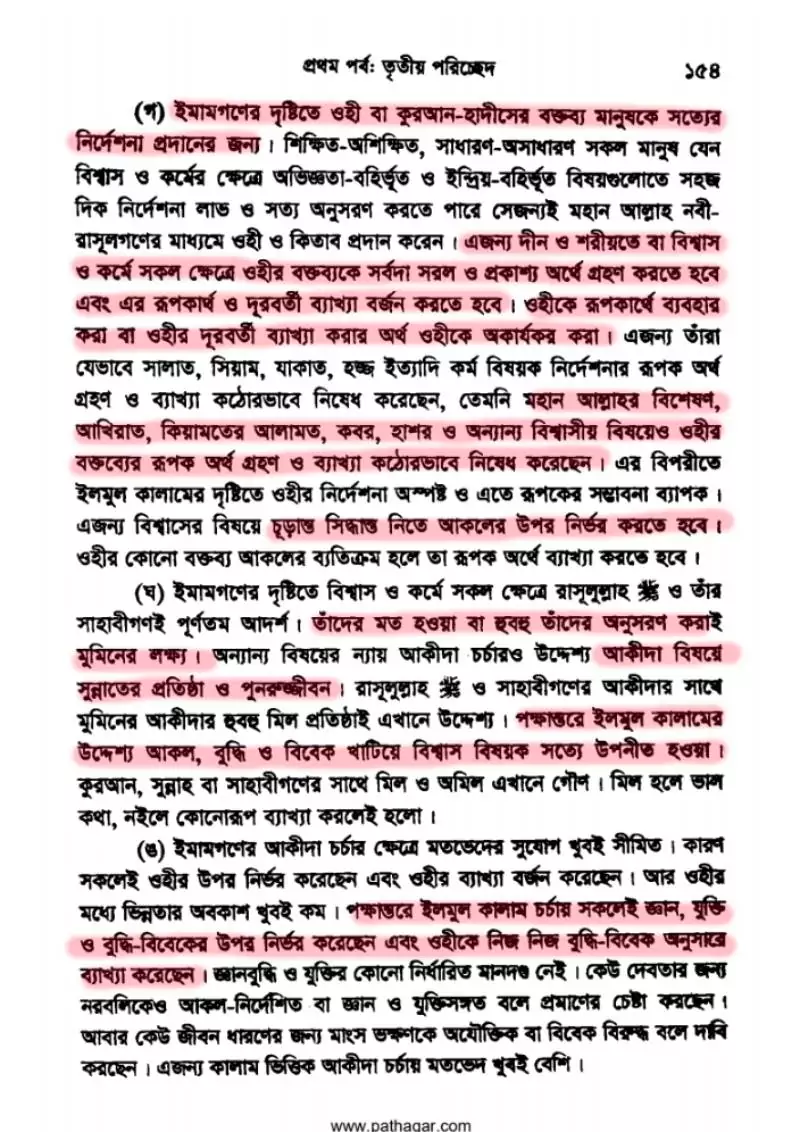
(c) In the view of the Imams, revelation—the Quran and hadith—was intended to guide people toward truth. Allah provided revelation and scripture through the prophets and messengers so that educated and uneducated people alike, ordinary and extraordinary, could receive simple guidance and follow the truth concerning matters of belief and practice that lie beyond experience and sensory perception. Therefore, in all matters of religion and Sharia, belief and practice, the words of revelation must always be accepted according to their plain and apparent meanings, while metaphorical or remote interpretations must be rejected. To interpret revelation metaphorically or adopt remote interpretations of revelation is to render revelation ineffective. Thus, just as they strictly prohibited metaphorical interpretations of instructions concerning salah, fasting, zakat, Hajj, and other practices, they likewise strictly prohibited metaphorical interpretation of statements in revelation concerning Allah’s attributes, the afterlife, signs of the Day of Judgment, the grave, resurrection, and other matters of belief. In contrast, according to ‘ilm al-kalam, the guidance of revelation is ambiguous and extensively open to metaphorical interpretation. Therefore, final decisions concerning belief must depend upon reason. If a statement in revelation appears contrary to reason, it must be interpreted metaphorically.
(d) In the view of the Imams, the Messenger of Allah and his Companions constitute the most complete models in all matters of belief and practice. The believer’s objective is to become like them and follow them exactly. As in other matters, the purpose of studying aqidah is to establish and revive the Sunnah concerning belief. The objective is to make the believer’s aqidah correspond exactly to that of the Messenger of Allah and the Companions. By contrast, the purpose of ‘ilm al-kalam is to employ reason, intellect, and judgment in order to arrive at truth concerning matters of belief. Whether the resulting conclusion agrees or disagrees with the Quran, Sunnah, or Companions is secondary. If it agrees, well and good; if not, some interpretation can be devised.
(e) Within the aqidah methodology of the Imams, the scope for disagreement is extremely limited. This is because all relied upon revelation and rejected interpretive alteration, while revelation itself leaves relatively little scope for variation. By contrast, practitioners of ‘ilm al-kalam relied upon knowledge, logic, reason, and intellectual judgment, interpreting revelation according to their own reasoning. There is no single fixed standard of human reason and judgment. Some may attempt to prove human sacrifice to a deity rationally justified, while others may claim that eating meat for survival is irrational or contrary to conscience. Consequently, disagreement is extremely widespread within kalam-based approaches to aqidah.
[1] Al-Qurashi, Tabaqat al-Hanafiyyah, p. 468.
[2] Al-Dhahabi, Siyar A‘lam al-Nubala’, 6/398.
[3] Al-Dhahabi, Siyar A‘lam al-Nubala’, vol. 5, pp. 231–236.
[4] Sayyid al-Naysaburi al-Hanafi, Al-I‘tiqad, p. 177.
[5] Al-Harawi, Abdullah ibn Muhammad al-Ansari, Dhamm al-Kalam wa Ahlihi, 5/206–207.
[6] Ibn Abi al-‘Izz al-Hanafi, Sharh al-‘Aqidah al-Tahawiyyah, p. 75.
[7] Ibn Abi al-‘Izz, Sharh al-‘Aqidah al-Tahawiyyah, p. 75.
[8] Ibn Abi al-‘Izz, Sharh al-‘Aqidah al-Tahawiyyah, p. 75.
[9] Al-Ghazali, Ihya’ ‘Ulum al-Din, 1/33, 52–53; Ibn Abi al-‘Izz, Sharh al-‘Aqidah al-Tahawiyyah, pp. 72–77, 204–210.
[10] Al-Ghazali, Ihya’ ‘Ulum al-Din, 1/33, 52–53; Ibn Abi al-‘Izz, Sharh al-‘Aqidah al-Tahawiyyah, pp. 72–77, 204–210.
Ibn al-Salah: Philosophy and Logic Are Prohibited
An even stronger example of the classical Islamic position against philosophy and logic is found in the fatwa of the renowned Shafi‘i jurist and hadith scholar Ibn al-Salah al-Shahrazuri. He was directly asked whether studying or teaching philosophy and logic was permissible under the Sharia, whether the Companions, Tabi‘un, and earlier Imams had permitted their study, and whether the terminology of logic could legitimately be used in deriving rulings of the Sharia. In response, he described philosophy as a source of confusion and religious deviation and rejected logic as the gateway to philosophy [32].
Ibn al-Salah says:
الفلسفة رأس السفه والانحلال، ومادة الحيرة والضلال، ومثار الزيغ والزندقة
That is, in his view philosophy is the foundation of foolishness and dissolution, the substance of confusion and misguidance, and a source of deviation and heresy.
Regarding logic, he then says:
وأما المنطق فهو مدخل الفلسفة ومدخل الشر شر
That is, logic is the gateway to philosophy; and a gateway that leads to evil is itself evil.
Ibn al-Salah did not stop there. He explicitly states that the Sharia did not permit the study or teaching of logic and that none of the Companions, Tabi‘un, mujtahid Imams, or Salaf practised it. He further declares that there is no need to employ the terminology of logic when explaining the rulings of the Sharia. According to his argument, the Sharia and its sciences had already reached completion at a time when Islamic scholarship had no need for philosophy or logic [33].
The significance of this fatwa is not merely that Ibn al-Salah personally disliked philosophy and logic. He also called for state authority to be employed in suppressing such intellectual practices. His fatwa includes instructions to remove practitioners of philosophy from educational institutions, punish them, and take strict measures against those who propagate philosophically based doctrines of aqidah. Thus, what appears here is not merely a theological objection to reason and philosophy but an explicit framework for institutional repression [34].
Institutional Endorsement: Prominent Fatwas Against Philosophy and Logic
This aversion to philosophy is not merely the personal opinion of a handful of scholars; it is also a systematic institutional position adopted by influential contemporary Islamic fatwa boards. On IslamQA.info, one of the world’s most popular and widely consulted Islamic fatwa portals, the practice of philosophy is characterized as a “deadly poison.” According to its fatwa, philosophy consists of misleading human speculation that seeks to extinguish the light of revelation. The fatwa states explicitly: [35]
Ruling on studying philosophy
Question: 88184
What is the ruling on studying philosophy? Please note that studying it is compulsory for us in Algeria.
Answer
Praise be to Allah, and blessings and peace be upon the Messenger of Allah:
Firstly:
It should be understood what philosophy is and what its principles are, before stating what the ruling on studying it is, because passing a ruling on something is usually based on the way it is viewed.
Al-Ghazaali said in al-Ihya’ (1/22): Philosophy is not one branch of knowledge, it is actually four:
1 – Geometry and mathematics: these are permissible as stated above, and there is no reason why they should not be studied unless there is the fear that one may overstep the mark and indulge in forbidden branches of knowledge, because most of those who study them overstep the mark and go on to innovations, thus the weak should be protected from them.
2 – Logic, which deals with the way in which evidence is to be used, the conditions of evidence being valid, the definition of what constitutes evidence and guidelines on the use of evidence. These come under the heading of ‘ilm al-kalaam.
3 – Theology, which is discussion of the essence and attributes of Allaah, which also comes under the heading of ‘ilm al-kalaam. The philosophers did not have any other kind of knowledge that was unique to them, rather they had some views and ideas which were unique to them, some of which constitute kufr and some bid’ah (innovation).
4 – Natural sciences, some of which go against sharee’ah, Islam and truth, so it is ignorance, not knowledge that may be mentioned alongside the other branches of knowledge. Some of it involves the discussion of the attributes of different elements and how one can be changed to another. This is similar to the way in which doctors examine the human body in particular, from the point of view of what makes it sick and what makes it healthy. They look at all the elements to see how they change and move. But medicine has an edge over the physical body in that it is needed, but there is no need for the study of nature. End quote.
In al-Mawsoo’ah al-Muyassarah fi’l-Adyaan wa’l-Madhaahib al-Mu’aasirah (2/1118-1121) it says:
Philosophy is a Greek word composed of two words. Philo originally meant selflessness, but Pythagoras turned it to mean love; and sophia which means wisdom. The word philosopher is derived from philosophy and means the lover of wisdom. But the meaning changed and came to mean wisdom.
Then the philosopher came to be called a wise man (hakeem). In the past the word philosophy referred to study of the basic principles, viewing knowledge as something based on rationality, the goal of which was the search for truth. For its supporters, philosophy is, as Dr. Tawfeeq al-Taweel described it: Rational examination, free from any restrictions and authority imposed on it from outside, and with the ability to go all the way on the basis of logic, propagating his view regardless of the difference between these (philosophical) views and what is customarily known, religious beliefs and the dictates of tradition, without being confronted or resisted or punished by any authority. In Aristotle’s view, the philosopher is of a higher status than a prophet, because the prophet understands things by means of imagination whereas the philosopher understands things by means of reason and contemplation. In their view, imagination is of a lower status than contemplation. Al-Faraabi agreed with Aristotle in viewing the philosopher as being of higher status than a prophet.
In this sense philosophy is opposed to wisdom, which in Islamic terminology refers to the Sunnah as defined by the majority of muhadditheen and fuqaha’, and in the sense of judgement, knowledge and proficiency, alongside moral guidelines which control the whims and desires of the self and keep it from doing haraam things. The wise man is the one who has these characteristics, hence philosophy, as defined by the philosophers, is one of the most dangerous falsehoods and most vicious in fighting faith and religion on the basis of logic, which it is very easy to use to confuse people in the name of reason, interpretation and metaphor that distort the religious texts.
Imam al-Shaafa’i said: The people did not become ignorant and begin to differ until they abandoned Arabic terminology and adopted the terminology of Aristotle. Even though philosophy existed in the ancient civilizations of Egypt, India and Persia, it became most famous in Greece and became synonymous with that land, the reason being that the Greek philosophers were interested in transmitting it from the legacy of idolatrous peoples and the remnants of the divinely-revealed religions, benefiting from the scriptures of Ibraaheem and Moosa (peace be upon them) after the Greek victory over the Hebrews after the captivity in Babylon, and benefiting from the religion of Luqmaan the Wise. So there was a mixture of views that confirmed the divinity and Lordship of the Creator that was contaminated with idolatry. Therefore the Greek philosophy was in some ways a revival more than an innovation.
Ibn Abi’l-‘Izz, the commentator on al-Tahhaawiyyah, summed up the schools of philosophical thought about the five basic principles of religion in their view, as follows:
That God does exist but He has no reality or essence, and He does not know the details of His creation, but He does know about its general terms, thus they denied that He creates the deeds of His slaves. They also did not believe in His Books, as in their view God does not speak or talk, and the Qur’aan is just something that shines from active reasons into purified human hearts. Exalted be Allaah far above what they ascribe to Him. There is no separate entity that ascends or descends, rather in their view it is all ideas in the mind that do not exist in reality. The philosophers are the one who most deny the Last Day and its events. In their view Paradise and Hell are no more than parables for the masses to understand, but they have no reality beyond people’s minds.
The Greek philosophers still have an impact on all western philosophies and ideologies, ancient and modern. Indeed, most of the Islamic kalaami groups were influenced by them. The terminology of Islamic philosophy did not emerge as a branch of knowledge that is taught in the curriculum of Islamic studies until it was introduced by Shaykh Mustafa ‘Abd al-Razzaaq – the Shaykh of al-Azhar – as a reaction to western attacks on Islam based on the idea that Islam has no philosophy. But the fact of the matter is that philosophy is an alien entity in the body of Islam. There is no philosophy in Islam and there are no philosophers among Muslims in this deviant sense. Rather in Islam there is certain knowledge and prominent scholars who examine matters. Among the most famous philosophers who were nominally Muslims were al-Kindi, al-Faraabi, Ibn Sina (Avicenna) and Ibn Rushd (Averroes). End quote.
Secondly:
The majority of fuqaha’ have stated that it is haraam to study philosophy. Among their comments on that are the following:
1 – Ibn Nujaym (Hanafi) said in al-Ashbaah wa’l-Nazaa’im: Acquiring knowledge may be an individual obligation, which is as much as one needs for religious commitment to be sound; or it may be a communal obligation, which is in addition to the previous and is done for the benefit of others; or it may be recommended, which is studying fiqh and ‘ilm al-qalb (purification of the heart) in depth; or it may be haraam, which is learning philosophy, magic (sleight of hand), astrology, geomancy, natural science and witchcraft. End quote from al-Ashbaah wa’l-Nazaa’ir ma’a Sharhiha: Ghamaz ‘Ayoon al-Basaa’ir by al-Hamawi (4/125).
2 – al-Dardeer (Maaliki) said in al-Sharh al-Kabeer, discussing the kind of knowledge which is a communal obligation: Such as studying sharee’ah, which is not an individual obligation, and which includes fiqh, tafseer, hadeeth and ‘aqeedah, and things that help with that such as (Arabic) grammar and literature, tafseer, mathematics and usool al-fiqh – not philosophy, astrology or ‘ilm al-kalaam, according to the most sound opinion.
Al-Dasooqi said in his Haashiyah (2/174): His phrase “according to the most sound opinion” means that it is forbidden to read the books of al-Baaji, Ibn al-‘Arabi and ‘Iyaad, unlike the one who says that it is essential to learn it in order to understand ‘aqeedah and basic religious issues. But al-Ghazaali said that the one who has knowledge of ‘ilm al-kalaam knows nothing of religious beliefs except the beliefs that the common people share, but they are distinguished by their ability to argue and debate.
3 – Zakariya al-Ansaari (Shaafa’i) said in Asna al-Mataalib (4/182): As for learning philosophy, magic (sleight of hand), astrology, geomancy, natural science and witchcraft, it is haraam. End quote.
4 – al-Bahooti (Hanbali) said in Kashshaaf al-Qinaa’ (3/34): The opposite of shar’i knowledge is knowledge that is haraam or makrooh. Haraam knowledge is like ‘ilm al-kalaam in which they argue on the basis of pure reason or speak in a manner that contradicts sound, unambiguous reports. If they speak on the basis of reports only or on the basis of texts and rational thought that is in accordance with them, then this is the basis of religion and the way of ahl al-sunnah. This is what is meant by the words of Shaykh Taqiy al-Deen. In his commentary he explains that even better. [Haraam knowledge also includes] philosophy, magic (sleight of hand), astrology and geomancy, as well as alchemy and natural sciences. End quote.
It should be noted that an exception from this prohibition is made for those who study it as a speciality in order to explain its deviations and refute the falsehoods that they stir up.
Thirdly:
If studying philosophy is compulsory, then you must beware of believing in any of its falsehoods or admiring its people. You should strive hard to acquire shar’i knowledge, especially that which has to do with ‘aqeedah (belief), so that you will develop immunity and resistance to specious arguments.
We ask Allaah to help and guide you.
And Allaah knows best.
Now let us provide an interpretive translation of this fatwa. It should be noted that AI assistance was used in preparing the original Bengali translation, and rather than translating it literally, only the substantive meaning was retained.
English rendering of the Bengali interpretive translation:
All praise belongs to Allah, and may peace and mercy be upon the Messenger of Allah.
Firstly:
Before stating the ruling on studying philosophy, it is necessary to understand what philosophy is and what its fundamental principles are. This is because the ruling on something depends upon how that thing is understood.
Imam al-Ghazali says in his Al-Ihya’ (1/22): Philosophy is not merely a single branch of knowledge; it is essentially divided into four categories:
1. Geometry and mathematics: According to the ruling described above, these are permissible. There is no objection to studying them, although care must be taken that they do not lead a person beyond the proper limits into prohibited branches of knowledge. Many who study mathematics subsequently move toward bid‘ah or erroneous innovations, and therefore those whose faith is weak should be protected from such dangers.
2. Logic: This concerns methods of using evidence, the conditions under which evidence is valid, and the definition and proper use of proof. These matters fall within the scope of ‘ilm al-kalam.
3. Theology: This concerns the essence and attributes of Allah. It also falls within ‘ilm al-kalam. Philosophers possessed no special body of knowledge unique to themselves; rather, they held certain distinctive views and ideas, some of which constitute kufr and others bid‘ah.
4. Natural sciences: Some portions of these contradict the Sharia, Islam, and truth. Accordingly, they should be regarded as ignorance rather than knowledge. Other portions examine the characteristics of various elements and the transformation of one element into another. This is somewhat comparable to the way physicians examine the human body to discover the causes of illness and health. Medicine, however, is necessary, whereas this philosophical investigation of nature is not. (End quote)
Al-Mawsu‘ah al-Muyassarah fi al-Adyan wa al-Madhahib al-Mu‘asirah (2/1118–1121) states:
Philosophy is a Greek word composed of two terms. Philo originally referred to selflessness, although Pythagoras used it in the sense of “love”; sophia means “wisdom.” The word “philosopher” derives from philosophy and means “lover of wisdom.” Over time, however, its meaning changed and the term came to denote wisdom itself.
Later, the philosopher came to be called a hakim, or wise man. Historically, philosophy referred to the study of fundamental principles, in which knowledge was regarded as rationally grounded and the objective was the search for truth. For its advocates, philosophy is—as Dr. Tawfiq al-Tawil described it—rational investigation free from restrictions or external authority, possessing the freedom to pursue logic to its ultimate conclusions. A philosopher may advance his views regardless of whether they conflict with prevailing customs, religious beliefs, or inherited traditions, without being obstructed or punished by any authority. According to Aristotle, the philosopher occupies a higher position than the prophet because the prophet understands things through imagination, while the philosopher understands them through reason and contemplation. In their view, imagination occupies a lower position than contemplation. Al-Farabi likewise agreed with Aristotle in placing the philosopher above the prophet.
In this sense, philosophy stands in opposition to “wisdom,” or hikmah, which in Islamic terminology refers to the Sunnah according to the majority of hadith scholars and jurists. It also signifies judgment and knowledge accompanied by moral guidance that disciplines personal desires and keeps a person away from what is haram. A hakim, or wise person, is one who possesses these qualities. Thus, philosophy as defined by philosophers is among the most dangerous and reprehensible forms of falsehood in its conflict with faith and religion, because in the name of reason, interpretation, and metaphor it can easily confuse people and distort religious texts.
Imam al-Shafi‘i said: “People did not become ignorant and begin disagreeing until they abandoned Arabic terminology and adopted the terminology of Aristotle.” Although philosophy existed in the ancient civilizations of Egypt, India, and Persia, it became most famous in Greece. Greek philosophers gathered and transmitted material from the traditions of idolatrous peoples and remnants of revealed religions. In particular, after the Babylonian captivity they benefited from the scriptures of Ibrahim and Musa and from the wisdom associated with Luqman the Wise. Consequently, a mixture of doctrines arose in which affirmations of the Creator’s divinity and lordship were contaminated with paganism. In this sense, Greek philosophy constituted more a revival of ancient pagan ideas than an entirely new innovation.
Ibn Abi al-‘Izz, the commentator on Al-Tahawiyyah, summarized philosophical positions concerning the fundamental doctrines of religion as follows:
1. They hold that God exists but possesses no actual reality or essence. He does not know the details of His creation but knows only general matters. Consequently, they deny that Allah creates the actions of His servants.
2. They do not believe in His scriptures. In their view God does not speak, and the Quran is merely a light reflected from active intellects into purified human hearts. Allah is far exalted above what they attribute to Him.
3. Nothing literally descends from or ascends to heaven; rather, in their view, these are merely ideas in the mind without objective existence.
4. Philosophers are among those who most strongly deny the afterlife and its events. According to them, Paradise and Hell are merely metaphorical stories intended to make matters intelligible to ordinary people and possess no reality outside the human mind.
Greek philosophers continue to influence Western philosophies and ideologies, both ancient and modern. Many Islamic theological groups were likewise influenced by them. “Islamic philosophy” did not emerge as an independent branch of knowledge within Islamic educational curricula until Shaykh Mustafa Abd al-Razzaq, Shaykh of al-Azhar, introduced it in response to Western criticisms claiming that Islam possessed no philosophy of its own. The reality, however, according to this view, is that philosophy is a foreign body within Islam. Islam contains no “philosophy,” nor are there Muslim “philosophers” in this deviant sense. Rather, Islam contains certain knowledge and distinguished scholars. Among the most famous thinkers nominally regarded as Muslim philosophers were al-Kindi, al-Farabi, Ibn Sina, and Ibn Rushd. (End quote)
Secondly:
The majority of jurists have stated that studying philosophy is haram. Some of their statements are as follows:
1. Ibn Nujaym, the Hanafi scholar, states in Al-Ashbah wa al-Naza’ir: “Acquiring knowledge may sometimes be an individual obligation—as much as a person requires in order to fulfil his religious duties properly; sometimes a communal obligation—additional knowledge acquired for the benefit of others; sometimes recommended—such as advanced study of fiqh and spiritual knowledge; and sometimes haram—such as studying philosophy, magic, astrology, geomancy, natural science, and witchcraft.” (Quoted from al-Hamawi’s Ghamz ‘Uyun al-Basa’ir, 4/125)
2. Al-Dardir, the Maliki scholar, states in Al-Sharh al-Kabir, while discussing knowledge that constitutes a communal obligation: “Acquiring knowledge of the Sharia—including fiqh, tafsir, hadith, and aqidah, together with auxiliary disciplines such as Arabic grammar and literature, mathematics, and usul al-fiqh—is a communal obligation. Philosophy, astrology, and ‘ilm al-kalam, however, according to the soundest opinion, do not fall within this category.”
Al-Dasuqi states in his Hashiyah (2/174): The phrase “according to the soundest opinion” means that even reading the books of scholars such as al-Baji, Ibn al-‘Arabi, and ‘Iyad is prohibited, contrary to those who maintain that such study is necessary for understanding aqidah and fundamental religious doctrines. Imam al-Ghazali, however, stated that those knowledgeable in ‘ilm al-kalam know nothing concerning religious belief beyond what ordinary people already believe; their distinction consists merely in their capacity to argue and debate.
3. Zakariya al-Ansari, the Shafi‘i scholar, states in Asna al-Matalib (4/182): “Studying philosophy, magic, astrology, geomancy, natural science, and witchcraft is haram.”
4. Al-Bahuti, the Hanbali scholar, states in Kashshaf al-Qina‘ (3/34): “The opposite of Sharia knowledge is knowledge that is haram or makruh. Haram knowledge includes ‘ilm al-kalam in which arguments are based purely upon reason or statements are made that contradict clear and authentic textual evidence. If arguments rely solely upon transmitted evidence, or upon texts together with reasoning that remains subordinate to them, then this constitutes the foundation of religion and the methodology of Ahl al-Sunnah. Philosophy, magic, astrology, and related disciplines likewise fall within prohibited knowledge.” (End quote)
It should be noted that an exception to this prohibition is made for specialists who study these subjects in order to expose their deviations and refute the false arguments associated with them.
Thirdly:
If studying philosophy is compulsory within an educational institution, the student must be extremely careful not to believe any of its false doctrines or develop admiration for philosophers. The student should strive to acquire Sharia knowledge, particularly knowledge of aqidah, so that they develop resistance to misleading arguments.
We ask Allah to help and guide you.
Allah knows best.
Similarly, IslamWeb.net, in one of its fatwas, cites numerous examples of early Islamic scholars who prohibited the study of philosophy and treated philosophical theology with extreme suspicion [36]. An analysis of these institutional positions makes one point clear: religious institutions have repeatedly regarded independent intellectual inquiry as a “dangerous opponent.” From this perspective, reason resembles an unruly horse that, unless restrained, may cross the boundaries of faith and reveal an entirely different horizon of truth—thereby posing a threat to religious authority. The message conveyed by such censorship is essentially: “Do not think; simply submit.”
Why some scholars studied Kalaam theology though prohibited by the Salaf
Question
Shaykh, i have read some sayings of the scholars of Salaf that they had forbidden teaching and taking with ilm al-kalam. But in other hand we see that many of great scholars have teached ilm al-kalam. My question is: Why scholars like Shaykhul Islam Ibn Taymiyyah, Hafiz Al-Iraqi, Shaah Waliyyullaah Ad-Dahlawi and Mohammad Shah Anwar Kashmiri teached and were taking with ilm al-kalam?May Allah reward you Shaykh.
Answer
All perfect praise be to Allaah, The Lord of the Worlds. I testify that there is none worthy of worship except Allaah, and that Muhammad sallallaahu `alayhi wa sallam ( may Allaah exalt his mention ) is His slave and Messenger.
Indeed, it has been reported that many scholars among the Salaf (righteous predecessors) dispraised ‘Ilm al-Kalaam (discursive theology) and Kalaam theologians and strongly warned against it. The most famous statements about this is a statement from Ash-Shaafi‘i who said: “My judgment concerning Kalaam theologians is that they should be taken around the community and beaten with palm branches and slippers and it will be said to them: this is the punishment for leaving the Words of Allaah and the words of the Messenger of Allaah, sallallaahu ‘alayhi wa sallam.”
Ismaa‘eel Al-Harawi authored a book entitled Thamm Al-Kalaam (The Dispraise of Kalaam Theology), and Ibn Qudaamah authored a book entitled Tahreem An-Nathar fi Kutub Al-Kalaam (The Prohibition of Reading Books on Kalaam Theology), based on it being a discipline that is based on philosophical principles that contradict the revelation presented in the Book of Allaah and the Sunnah of the Prophet, sallallaahu ‘alayhi wa sallam.
Nonetheless, some scholars said it is permissible to study and teach it if one is secure from deviating from the right path.
In our view, there is no good in studying this science as it confuses the person no matter how intelligent he is. Al-Ghazaali may Allaah have mercy upon him who was an expert in Kalaam theology, said: “As regards its benefits (i.e. the benefits of Kalaam theology), it may be said that it leads to the truth (i.e. knowedge about Allaah in a correct manner); but how preposterous! There is no fulfillment of this noble objective in Kalaam; the most it comprises is a dramatization … So listen to this from someone who is and expert in Kalaam theology, and who came to the same conclusion as that of the Kalaam theologians, and then exceeded that and delved deeper into other sciences that suit Kalaam theology (i.e. philosophy), and then realized that the path to knowledge from these means has been obstructed.” [End of quote]
Moreover, Ash-Shahristaani, author of Al-Milal wan-Nihal, Al-Aamidi, and the Imaam Al-Haramayn have all made profound statements at the end of their lives about it.
Some scholars may be interested in studying and teaching logic since the science of logic is in principle an instrumental science, and some scholars clarified the importance of studying it as an instrument to understand some branches of knowledge, because much of the literature was formulated in a logical mould, so the only way to become versed in it is by studying logic. This is in addition to the need for logic in debating with Kalaam theologians and philosophers, which is what Shaykhul-Islam Ibn Taymiyyah and other scholars did. Hence, some well-versed scholars may study scholastic theology and philosophy for this purpose.
Finally, it is worth mentioning that the science of logic itself has not been spared from being mixed with some philosophy, and this is what some scholars referred to when they mentioned the difference of opinion regarding the judgment on learning it. They said: the difference of opinion has only to do with the kind of logic that has been mixed with the statements of the philosophers. As regards pure logic that is not mixed with the statements of philosophers, then no one is prohibited from studying it and teaching it.
Allaah Knows best.
Question:
Shaykh, I have read many statements from the Salaf—the early scholars—in which they prohibited teaching or engaging in ‘ilm al-kalam, or philosophical theology. On the other hand, we find that many prominent scholars themselves taught ‘ilm al-kalam. My question is: why did scholars such as Shaykh al-Islam Ibn Taymiyyah, Hafiz al-Iraqi, Shah Waliullah al-Dahlawi, and Muhammad Shah Anwar Kashmiri teach or engage with ‘ilm al-kalam? May Allah reward you.
Answer:
All perfect praise belongs to Allah, Lord of the Worlds. I testify that none is worthy of worship except Allah and that Muhammad ﷺ is His servant and Messenger.
It has indeed been reported that many scholars among the Salaf condemned ‘ilm al-kalam and its practitioners and issued severe warnings against it. One of the most famous statements in this regard is that of Imam al-Shafi‘i, who said:
“My judgment concerning the practitioners of kalam is that they should be beaten with palm branches and sandals and paraded throughout the tribes and neighbourhoods, while it is proclaimed: this is the punishment of one who abandons the words of Allah and the words of the Messenger of Allah ﷺ and devotes himself to kalam.”
Isma‘il al-Harawi wrote a book on this subject entitled Dhamm al-Kalam (Condemnation of Kalam), while Ibn Qudamah wrote a book entitled Tahrim al-Nazar fi Kutub al-Kalam (The Prohibition of Reading Books of Kalam). They issued these prohibitions because this discipline rests upon philosophical principles that contradict the revelation presented in the Book of Allah and the Sunnah of the Prophet ﷺ.
Nevertheless, some scholars stated that studying or teaching it may be permissible if a person is secure from deviating from the correct path.
In our view, there is no benefit in studying this science because it confuses a person no matter how intelligent he may be. Imam al-Ghazali, himself an expert in ‘ilm al-kalam, stated concerning its alleged benefits:
“Regarding its benefits, it may be claimed that it leads to truth—that is, correct knowledge concerning Allah—but how preposterous! This noble objective cannot be attained through kalam. At most, kalam consists of a form of dramatization … So hear this from someone who was himself an expert in kalam, who reached the conclusions reached by the theologians, then went beyond them and penetrated more deeply into the other sciences associated with kalam—that is, philosophy—and ultimately realized that the path to knowledge through these means had been blocked.” (End quote)
Furthermore, al-Shahristani, author of Al-Milal wa al-Nihal, al-Amidi, and Imam al-Haramayn all made profound statements toward the end of their lives expressing serious disappointment concerning this discipline.
Some scholars, however, may take an interest in studying or teaching logic because logic is fundamentally an instrumental science. Some scholars have explained its importance as a tool for understanding other branches of knowledge, since much classical literature was formulated within logical structures, and understanding such works may require knowledge of logic. Logic may likewise be required in order to debate theologians and philosophers, as Shaykh al-Islam Ibn Taymiyyah and other scholars did. Consequently, some deeply learned scholars may study scholastic theology and philosophy for these specific purposes.
Finally, it should be noted that logic itself has not remained entirely free from philosophical influence. When some scholars referred to disagreement concerning the ruling on studying logic, they were referring primarily to this issue. According to them, disagreement concerns logic that has been mixed with the statements of philosophers. As for pure logic that is not mixed with the erroneous doctrines of philosophers, no one prohibits its study or teaching.
Allah knows best.
Islam and Secular Knowledge
Science is essentially a body of systematic and regulated secular knowledge whose principal objective is to discover truth, address worldly problems, and protect human interests in this life. For example, scientists investigate diseases and medicines precisely with human welfare in worldly life in mind. Science is the systematic and methodical investigation of everything in the physical world that is observable, testable, and verifiable, together with the body of knowledge produced through such investigation. At the same time, all branches and sub-branches of science are concerned with interests related to worldly life—with addressing human hunger and disease or making human life in this world easier. Worldly matters are therefore central to science; questions concerning the afterlife or pleasing Allah are not considerations within science at all. Let us therefore examine Islam’s position on this issue [37] [38] –
Reference : Sunan Ibn Majah 252
In-book reference : Introduction, Hadith 252
English translation : Vol. 1, Book 1, Hadith 252
Chapter : Gaining benefit from knowledge and acting in accordance with it
It was narrated that Abu Hurairah said:
“The Messenger of Allah said: ‘Whoever acquires knowledge by which the pleasure of Allah is sought, but he only acquires it for the purpose of worldly gain, will not smell the fragrance of Paradise on the Day of Resurrection.'” (Hasan) Another chain with similar wording.
Arabic : حَدَّثَنَا أَبُو بَكْرِ بْنُ أَبِي شَيْبَةَ، حَدَّثَنَا يُونُسُ بْنُ مُحَمَّدٍ، وَسُرَيْجُ بْنُ النُّعْمَانِ، قَالاَ حَدَّثَنَا فُلَيْحُ بْنُ سُلَيْمَانَ، عَنْ عَبْدِ اللَّهِ بْنِ عَبْدِ الرَّحْمَنِ بْنِ مَعْمَرٍ أَبِي طُوَالَةَ، عَنْ سَعِيدِ بْنِ يَسَارٍ، عَنْ أَبِي هُرَيْرَةَ، قَالَ قَالَ رَسُولُ اللَّهِ ـ صلى الله عليه وسلم ـ “ مَنْ تَعَلَّمَ عِلْمًا مِمَّا يُبْتَغَى بِهِ وَجْهُ اللَّهِ لاَ يَتَعَلَّمُهُ إِلاَّ لِيُصِيبَ بِهِ عَرَضًا مِنَ الدُّنْيَا لَمْ يَجِدْ عَرْفَ الْجَنَّةِ يَوْمَ الْقِيَامَةِ ” . يَعْنِي رِيحَهَا . قَالَ أَبُ الْحَسَنِ أَنْبَأَنَا أَبُو حَاتِمٍ، حَدَّثَنَا سَعِيدُ بْنُ مَنْصُورٍ، حَدَّثَنَا فُلَيْحُ بْنُ سُلَيْمَانَ، فَذَكَرَ نَحْوَهُ .
Grade: Hasan (Darussalam)
Reference : Riyad as-Salihin 1391
In-book reference : Book 12, Hadith 16
Chapter : Virtues of Knowledge which is Learnt and Taught for the sake of Allah
Abu Hurairah (May Allah be pleased with him) reported:
The Messenger of Allah(ﷺ) said, “He who does not acquire knowledge with the sole intention of seeking the Pleasure of Allah but for worldly gain, will not smell the fragrance of Jannah on the Day of Resurrection.”
[Abu Dawud].
Arabic : وعنه قال: قال رسول الله صلى الله عليه وسلم : “من تعلم علمًا مما يبتغى به وجه الله عز وجل لا يتعلمه إلا ليصيب به غرضًا من الدنيا لم يجد عرف الجنة يوم القيامة” ((يعني ريحها))، ((رواه أبو داود بإسناد صحيح. )).
Reference : Sunan Abi Dawud 3664
In-book reference : Book 26, Hadith 24
English translation : Book 25, Hadith 3656
Chapter : Regarding seeking knowledge for other than (the sake of) Allah
Narrated Abu Hurayrah:
The Prophet (ﷺ) said: If anyone acquires knowledge that should be sought seeking the Face of Allah, but he acquires it only to get some worldly advantage, he will not experience the arf, i.e. the fragrance, of Paradise.
Arabic : حَدَّثَنَا أَبُو بَكْرِ بْنُ أَبِي شَيْبَةَ، حَدَّثَنَا سُرَيْجُ بْنُ النُّعْمَانِ، حَدَّثَنَا فُلَيْحٌ، عَنْ أَبِي طُوَالَةَ عَبْدِ اللَّهِ بْنِ عَبْدِ الرَّحْمَنِ بْنِ مَعْمَرٍ الأَنْصَارِيِّ، عَنْ سَعِيدِ بْنِ يَسَارٍ، عَنْ أَبِي هُرَيْرَةَ، قَالَ قَالَ رَسُولُ اللَّهِ صلى الله عليه وسلم ” مَنْ تَعَلَّمَ عِلْمًا مِمَّا يُبْتَغَى بِهِ وَجْهُ اللَّهِ عَزَّ وَجَلَّ لاَ يَتَعَلَّمُهُ إِلاَّ لِيُصِيبَ بِهِ عَرَضًا مِنَ الدُّنْيَا لَمْ يَجِدْ عَرْفَ الْجَنَّةِ يَوْمَ الْقِيَامَةِ ” . يَعْنِي رِيحَهَا .
Grade: Sahih (Al-Albani)
Now let us hear from some madrasa students in India what they are taught in their madrasas concerning secular knowledge and science,
The Use of Personal Reason and Judgment Is Prohibited in Islam
In matters of religion, Islam directly discourages reliance upon personal opinion, conscience, and independent judgment. A report attributed to Ali in Sunan Abi Dawud states that religion cannot be measured by human opinion or personal reasoning; what matters is following the prescribed instruction [39] –
Reference : Sunan Abi Dawud 164
In-book reference : Book 1, Hadith 164
English translation : Book 1, Hadith 164
Chapter : How Should One Wipe
A ‘mash transmitted this tradition saying:
If religion were based on opinion, it would be more proper to wipe the under part of the feet than the upper. The Prophet (ﷺ) wiped over the upper part of his shoes.
The narrator Waki’ said: I saw ‘ Ali perform ablution and wash the upper part of his feet, and say : Had I not seen the Messenger of Allah(ﷺ) doing like this –and he narrated the tradition in full.
Arabic : حَدَّثَنَا مُحَمَّدُ بْنُ الْعَلاَءِ، حَدَّثَنَا حَفْصُ بْنُ غِيَاثٍ، عَنِ الأَعْمَشِ، بِهَذَا الْحَدِيثِ قَالَ لَوْ كَانَ الدِّينُ بِالرَّأْىِ لَكَانَ بَاطِنُ الْقَدَمَيْنِ أَحَقَّ بِالْمَسْحِ مِنْ ظَاهِرِهِمَا وَقَدْ مَسَحَ النَّبِيُّ صلى الله عليه وسلم عَلَى ظَهْرِ خُفَّيْهِ وَرَوَاهُ وَكِيعٌ عَنِ الأَعْمَشِ بِإِسْنَادِهِ قَالَ كُنْتُ أُرَى أَنَّ بَاطِنَ الْقَدَمَيْنِ أَحَقُّ بِالْمَسْحِ مِنْ ظَاهِرِهِمَا حَتَّى رَأَيْتُ رَسُولَ اللَّهِ صلى الله عليه وسلم يَمْسَحُ عَلَى ظَاهِرِهِمَا . قَالَ وَكِيعٌ يَعْنِي الْخُفَّيْنِ . وَرَوَاهُ عِيسَى بْنُ يُونُسَ عَنِ الأَعْمَشِ كَمَا رَوَاهُ وَكِيعٌ وَرَوَاهُ أَبُو السَّوْدَاءِ عَنِ ابْنِ عَبْدِ خَيْرٍ عَنْ أَبِيهِ قَالَ رَأَيْتُ عَلِيًّا تَوَضَّأَ فَغَسَلَ ظَاهِرَ قَدَمَيْهِ وَقَالَ لَوْلاَ أَنِّي رَأَيْتُ رَسُولَ اللَّهِ صلى الله عليه وسلم يَفْعَلُهُ . وَسَاقَ الْحَدِيثَ .
Grade: Sahih (Al-Albani)
Let us read another hadith [40] –
Reference : Sahih al-Bukhari 7308
In-book reference : Book 96, Hadith 39
USC-MSA web (English) reference : Vol. 9, Book 92, Hadith 411
Chapter : Judging made on the basis of opinion or Qiyas
Narrated Al-A`mash:
I asked Abu Wail, “Did you witness the battle of Siffin between `Ali and Muawiya?” He said, “Yes,” and added, “Then I heard Sahl bin Hunaif saying, ‘O people! Blame your personal opinions in your religion. No doubt, I remember myself on the day of Abi Jandal; if I had the power to refuse the order of Allah’s Messenger (ﷺ), I would have refused it. We have never put our swords on our shoulders to get involved in a situation that might have been horrible for us, but those swords brought us to victory and peace, except this present situation.’ ” Abu Wail said, “I witnessed the battle of Siffin, and how nasty Siffin was!”
Arabic : حَدَّثَنَا عَبْدَانُ، أَخْبَرَنَا أَبُو حَمْزَةَ، سَمِعْتُ الأَعْمَشَ، قَالَ سَأَلْتُ أَبَا وَائِلٍ هَلْ شَهِدْتَ صِفِّينَ قَالَ نَعَمْ. فَسَمِعْتُ سَهْلَ بْنَ حُنَيْفٍ، يَقُولُ ح وَحَدَّثَنَا مُوسَى بْنُ إِسْمَاعِيلَ، حَدَّثَنَا أَبُو عَوَانَةَ، عَنِ الأَعْمَشِ، عَنْ أَبِي وَائِلٍ، قَالَ قَالَ سَهْلُ بْنُ حُنَيْفٍ يَا أَيُّهَا النَّاسُ اتَّهِمُوا رَأْيَكُمْ عَلَى دِينِكُمْ، لَقَدْ رَأَيْتُنِي يَوْمَ أَبِي جَنْدَلٍ وَلَوْ أَسْتَطِيعُ أَنَّ أَرُدَّ أَمْرَ رَسُولِ اللَّهِ صلى الله عليه وسلم لَرَدَدْتُهُ، وَمَا وَضَعْنَا سُيُوفَنَا عَلَى عَوَاتِقِنَا إِلَى أَمْرٍ يُفْظِعُنَا إِلاَّ أَسْهَلْنَ بِنَا إِلَى أَمْرٍ نَعْرِفُهُ غَيْرَ هَذَا الأَمْرِ. قَالَ وَقَالَ أَبُ وَائِلٍ شَهِدْتُ صِفِّينَ وَبِئْسَتْ صِفُّونَ.
Now let us read its explanation as well [41] –
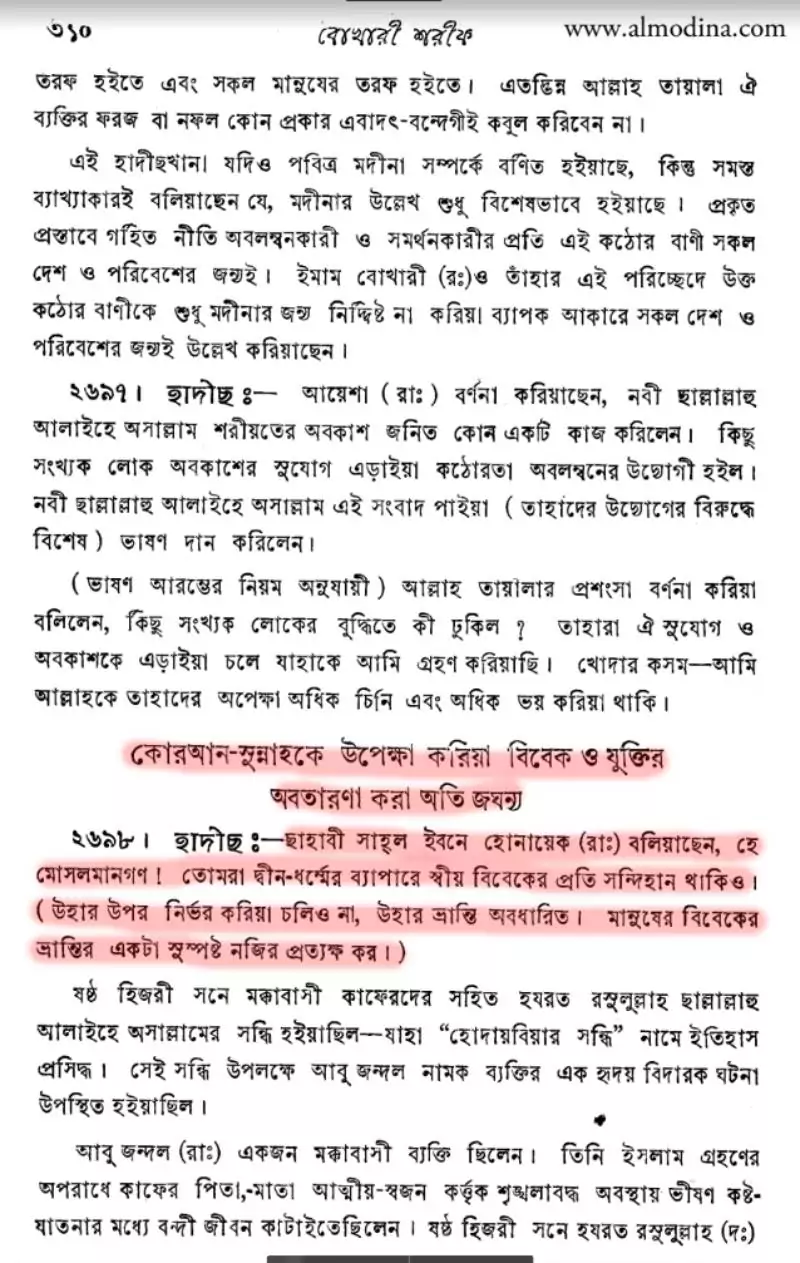
Now let us examine what the aqidah books of Ahl al-Sunnah wa’l-Jama‘ah state on this subject. Sharh al-‘Aqidah al-Tahawiyyah is a highly renowned work on creed, written by Imam Ibn Abi al-‘Izz al-Hanafi. In his book, the discussion concerning matters explicitly stated in the Quran and hadith prohibits the Ummah from entertaining doubt about them, independently verifying them, or using personal judgment and reason against them. This is because, in the statements of many influential scholars of the Salafi-Athari tradition and classical jurisprudence, philosophy, logic, and dialectical reasoning are identified as dangerous, misleading, and prohibited forms of knowledge in matters of faith [42] –
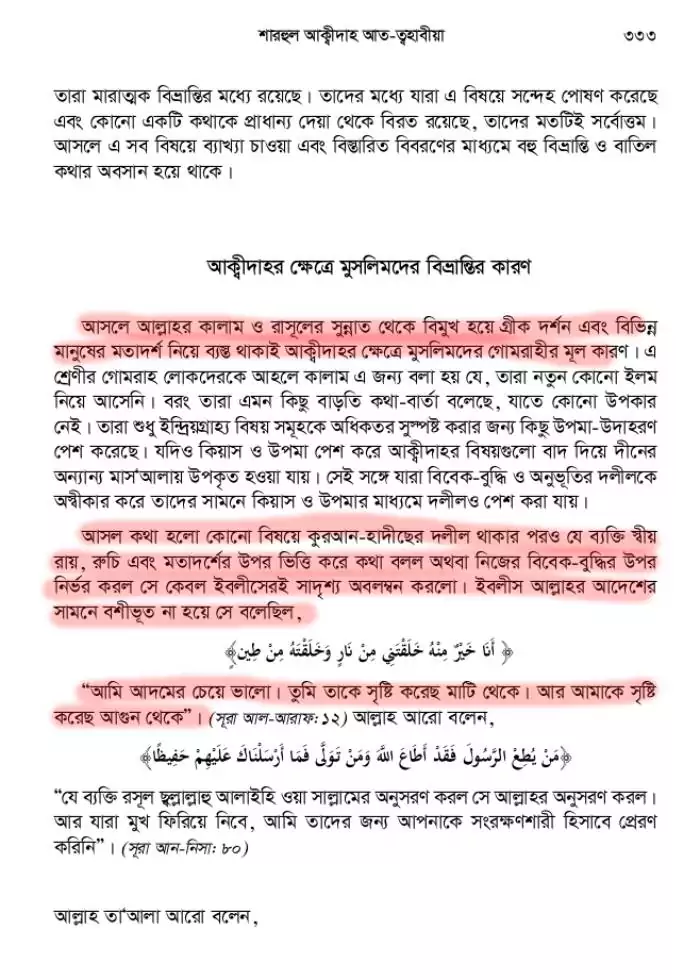
Is It Permissible in Islam to Read the Scriptures of Other Religions?
To determine whether another religion is false or its scriptures corrupted, and whether my own religion alone is true, it is essential to read and examine the scriptures of other religions for oneself. If I do not read them myself, how can I verify anything? Suppose a shopkeeper claims that Milk Vita milk is the finest and best milk in the world and that every other brand of milk is adulterated. As evidence, he presents an advertisement issued by the Milk Vita company itself declaring that Milk Vita is the best and that all other milk is adulterated. To determine whether the shopkeeper’s claim is true or false, I would have to purchase milk from other sellers and test it, would I not? Or should Milk Vita automatically become the best milk merely because the shopkeeper says so, or because a Milk Vita advertisement declares that Milk Vita is the best and every other milk adulterated? That would be an absurd fallacy.
‘Umar Was Prohibited from Reading the Torah
Islam prohibits the process of examining other religions, reading their scriptures, understanding them, and then reaching an informed decision. Let us first read two reports on this subject [43] [44] [45] [46] –
Reference : Mishkat al-Masabih 194
In-book reference : Book 1, Hadith 186
Chapter : Reliance on the Book and the Sunnah – Section 3
Jabir told how ‘Umar b. al-Khattab brought God’s messenger a copy of the Torah saying, “Messenger of God, this is a copy of the Torah.” When he received no reply he began to read to the obvious displeasure of God’s messenger, so Abu Bakr said, “Confound you, do you not see how God’s messenger is looking?” So ‘Umar looked at God’s messenger’s face and said, “I seek refuge in God from the anger of God and His messenger. We are satisfied with God as Lord, with Islam as religion, and with Muhammad as Prophet.” Then God’s messenger said, “By Him in whose hand Muhammad’s soul is, were Moses to appear to you and you were to follow him and abandon me, you would err from the right way. Were he alive and came in touch with my prophetic mission he would follow me.”
Arabic : وَعَنْ جَابِرٍ أَنَّ عُمَرَ بْنَ الْخَطَّابِ أَتَى رَسُولَ اللَّهِ صَلَّى اللَّهُ عَلَيْهِ وَسَلَّمَ بِنُسْخَةٍ مِنَ التَّوْرَاةِ فَقَالَ: يَا رَسُولَ اللَّهِ هَذِهِ نُسْخَةٌ مِنَ التَّوْرَاةِ فَسَكَتَ فَجَعَلَ يَقْرَأُ وَوَجْهُ رَسُولِ اللَّهِ صَلَّى اللَّهُ عَلَيْهِ وَسَلَّمَ يَتَغَيَّرُ فَقَالَ أَبُو بَكْرٍ: ثَكِلَتْكَ الثَّوَاكِلُ مَا تَرَى مَا بِوَجْهِ رَسُولِ اللَّهِ صَلَّى اللَّهُ عَلَيْهِ وَسَلَّمَ؟ فَنَظَرَ عُمَرُ إِلَى وَجْهِ رَسُولِ اللَّهِ صَلَّى اللَّهُ عَلَيْهِ وَسَلَّمَ فَقَالَ: أَعُوذُ بِاللَّهِ مِنْ غَضَبِ اللَّهِ وَغَضَبِ رَسُولِهِ رَضِينَا بِاللَّهِ رَبًّا وَبِالْإِسْلَامِ دِينًا وَبِمُحَمَّدٍ نَبِيًّا فَقَالَ رَسُولُ اللَّهِ صَلَّى اللَّهُ عَلَيْهِ وَسَلَّمَ: «وَالَّذِي نَفْسُ مُحَمَّدٍ بِيَدِهِ لَوْ بَدَا لَكُمْ مُوسَى فَاتَّبَعْتُمُوهُ وَتَرَكْتُمُونِي لَضَلَلْتُمْ عَنْ سَوَاءِ السَّبِيلِ وَلَوْ كَانَ حَيًّا وَأَدْرَكَ نُبُوَّتِي لَاتَّبَعَنِي»
Reference : Mishkat al-Masabih 177
In-book reference : Book 1, Hadith 169
Chapter : Reliance on the Book and the Sunnah – Section 2
Jabir told that when ‘Umar came to the Prophet saying, “We hear from Jews traditions which charm us, so do you think we should write down some of them ?” he replied, “Are you in a state of confusion as the Jews and the Christians were? I have brought them to you white and pure, and if Moses were alive he would feel it absolutely necessary to follow me.” Ahmad transmitted it, and also Baihaqi in Shu’ab al-iman.
Arabic : وَعَنْ جَابِرٌ عَنِ النَّبِيِّ صَلَّى اللَّهُ عَلَيْهِ وَسَلَّمَ حِينَ أَتَاهُ عُمَرُ فَقَالَ إِنَّا نَسْمَعُ أَحَادِيثَ مِنْ يَهُودَ تُعْجِبُنَا أَفْتَرَى أَنْ نَكْتُبَ بَعْضَهَا؟ فَقَالَ: «أَمُتَهَوِّكُونَ أَنْتُمْ كَمَا تَهَوَّكَتِ الْيَهُودُ وَالنَّصَارَى؟ لَقَدْ جِئْتُكُمْ بِهَا بَيْضَاءَ نَقِيَّةً وَلَوْ كَانَ مُوسَى حَيًّا مَا وَسِعَهُ إِلَّا اتِّبَاعِي» . رَوَاهُ أَحْمد وَالْبَيْهَقِيّ فِي كتاب شعب الايمان
Grade: Isnād Da’īf (Zubair `Aliza’i)
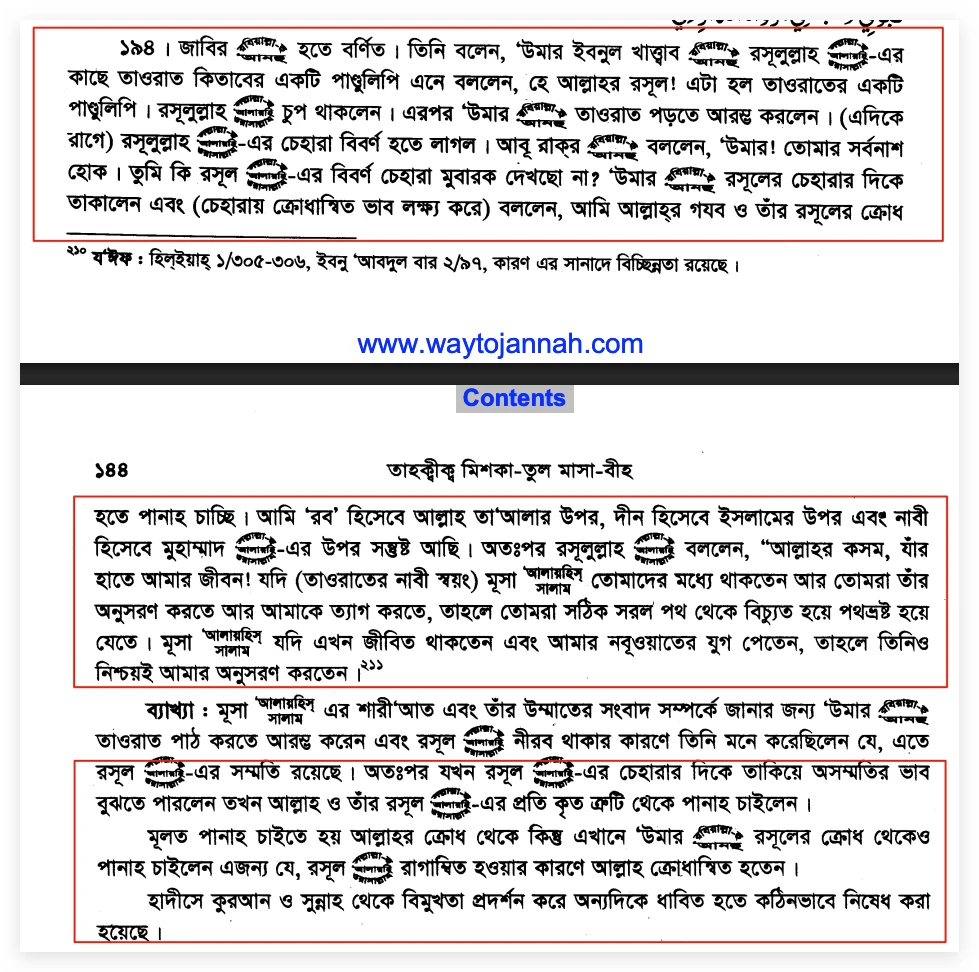
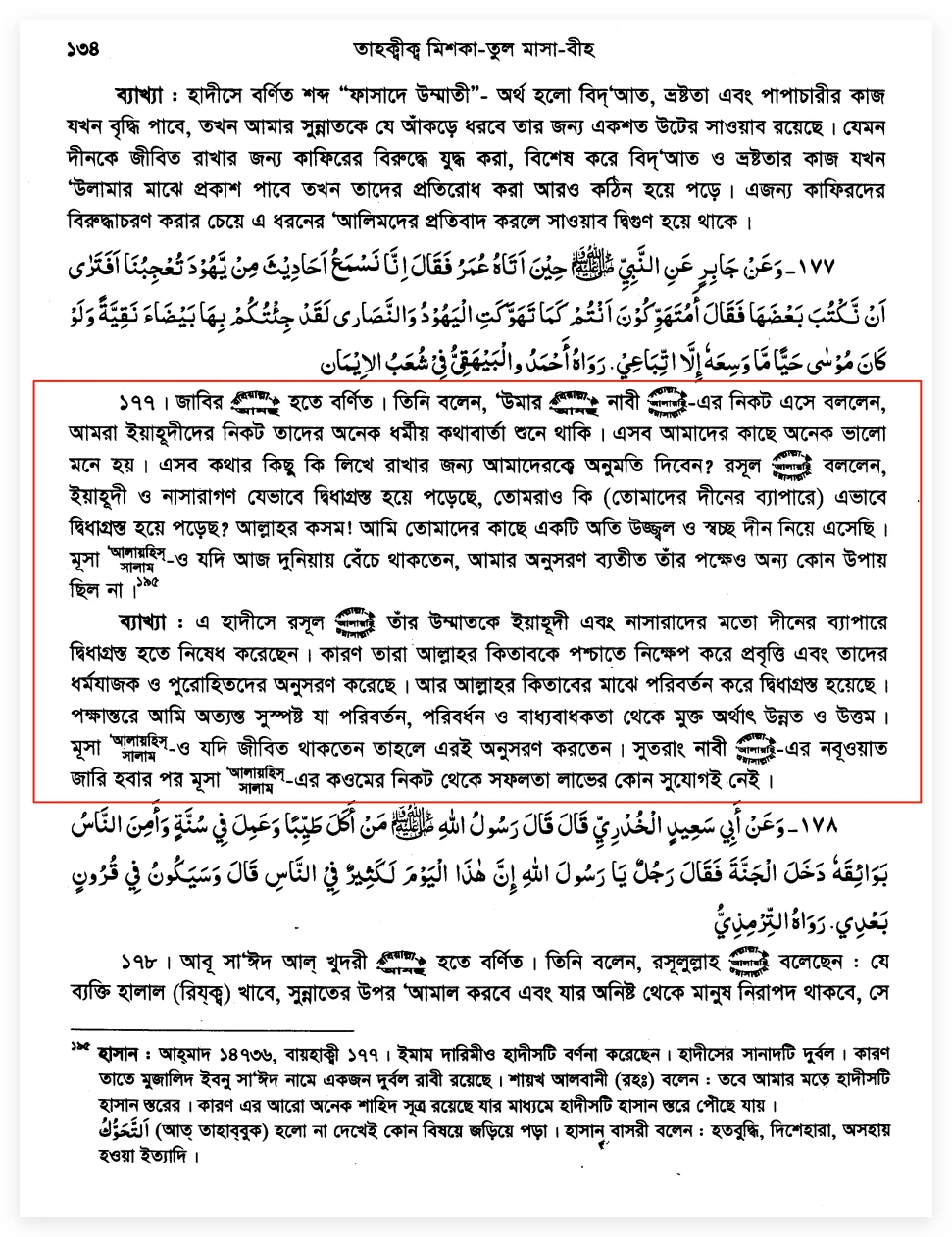
Ibn Baz’s Fatwa: Reading Other Religious Scriptures Is Haram
Abd al-Aziz bin Abdullah Ibn Baz was a renowned Saudi Islamic scholar and a leading figure of the Salafi tradition. From 1993 until his death, he served as the Grand Mufti of Saudi Arabia. Let us read a fatwa on this issue from his official website [47] –
حكم القراءة في كتب الأديان
السؤال:
في آخر أسئلة هذه السائلة تقول: هل يجوز لنا أن نقرأ في كتب الأديان الأخرى غير الإسلام من باب حب الاستطلاع والتعرف على الديانات الأخرى؟
الجواب:
لا ينبغي لا، لا ينبغي قراءة التوراة ولا الإنجيل ولا غيرها؛ لأنها قد تورث شكًا وشبهة، والرسول روي عنه ﷺ أنه لما رأى عمر يقرأ في شيء من التوراة قال: أفي شك يا ابن الخطاب؟ لقد جئتكم بها بيضاء نقية، لو كان موسى حيًا ما وسعه إلا اتباعي.
المقصود: أنه لا ينبغي للمسلم أن يقرأ الكتب الأخرى من التوراة والإنجيل وغيرها، إلا من تدعو الحاجة إلى قراءته كالعلماء الذين يريدون أن يردوا على اليهود والنصارى من كتبهم، فإذا دعت الحاجة للعالم الذي يرد عليهم ويبين أباطيلهم أن يراجع كتبهم حتى يرد عليهم منها فلا بأس عند الحاجة لأهل العلم والبصيرة. نعم.
المقدم: أحسن الله إليكم.
Interpretive English translation,
Question:
Is it permissible for us, out of curiosity, to read the scriptures of religions other than Islam?
Answer:
A Muslim should not read the Torah, the Bible, or any other religious scripture, because doing so may give rise to doubt and uncertainty. It has also been narrated from the Messenger ﷺ that when he saw ‘Umar reading something from the Torah, he said: “Are you in doubt, O Ibn al-Khattab?” I have brought it to you white and pure; if Moses were alive, he would have no option but to follow me.
The point is that other religious scriptures should be read only by scholars who need to consult them in order to expose and refute the falsehoods of other religions.
Salih al-Munajjid: Reading Other Religious Scriptures Is Haram
On the renowned IslamQA website associated with Muhammad Salih al-Munajjid, one of the most prominent contemporary Islamic scholars, an answer has been published on this subject and presented as reflecting the rulings of senior Saudi scholars. Let us read the answer. The Bengali translation reproduced in the source article was translated by Shahed Khan [48] –
Ruling on studying the books of the People of the Book for the purpose of da‘wah (calling them to Islam), and the ruling on studying comparative religion.
Question
What ruling on studying the books of the People of the Book for the purpose of da‘wah (calling them to Islam), and the ruling on studying comparative religion?
Answer
Praise be to Allah.
Firstly:
The Torah and Gospel were originally from Allah, may He be exalted, and we are obliged to believe in them because Allah, may He be exalted, says (interpretation of the meaning):
“Say (O Muslims), ‘We believe in Allah and that which has been sent down to us and that which has been sent down to Ibraaheem (Abraham), Ismaa‘eel (Ishmael), Ishaaq (Isaac), Ya‘qoob (Jacob), and to Al-Asbaat (the twelve sons of Ya‘qoob (Jacob)), and that which has been given to Moosa (Moses) and ‘Eesa (Jesus), and that which has been given to the Prophets from their Lord. We make no distinction between any of them, and to Him we have submitted (in Islam)’”
(al-Baqarah 2:136)
“O you who believe! Believe in Allah, and His Messenger (Muhammad (blessings and peace of Allah be upon him)), and the Book (the Quran) which He has sent down to His Messenger, and the Scripture which He sent down to those before (him), and whosoever disbelieves in Allah, His Angels, His Books, His Messengers, and the Last Day, then indeed he has strayed far away”
(an-Nisa’ 4:136).
But the Torah and Gospel were subjected to distortion and changes. Allah, may He be exalted, says (interpretation of the meaning):
“Then woe to those who write the Book with their own hands and then say, “This is from Allah,” to purchase with it a little price! Woe to them for what their hands have written and woe to them for that they earn thereby”
(al-Baqarah 2:79).
Because of this distortion and the mixing of truth with falsehood in these two Scriptures, it is prohibited to study them.
It was narrated from Jaabir ibn ‘Abdullah (may Allah be pleased with him) that ‘Umar ibn al-Khattaab (may Allah be pleased with him) came to the Prophet (blessings and peace of Allah be upon him) with some written material he had got from one of the people of the Book. He read it to the Prophet (blessings and peace of Allah be upon him), and he got angry and said: “Are you confused (about your religion), O son of al-Khattaab? By the One in Whose hand is my soul, I have brought it (the message of Islam) to you clear and pure. Do not ask them about anything, lest they tell you something true and you disbelieve it, or they tell you something false and you believe it. By the One in Whose hand is my soul, if Moosa were alive, he would have no option but to follow me.”
Narrated by Ahmad (14736); classed as hasan by al-Albaani in Irwa’ al-Ghaleel, 6/34
Al-Haafiz Ibn Hajar (may Allah have mercy on him) said, after mentioning the isnaads of this hadith:
These are all the isnads of this hadith; even though it does not reach such a standard that it may be relied upon as evidence, when they are all taken into consideration, this implies that there is a basis for this report.
End quote from Fath al-Baari (13/525)
Moreover, the truth that we have in the Holy Qur’an means that there is no need for whatever truth may be in the Torah and Gospel.
Allah, may He be exalted, says (interpretation of the meaning):
“Is it not sufficient for them that We have sent down to you the Book (the Quran) which is recited to them? Verily, herein is mercy and a reminder (or an admonition) for a people who believe”
(al-‘Ankaboot 29:51).
Ibn Taymiyah (may Allah have mercy on him) said:
Because the Qur’an is the best of speech, they were prohibited to follow anything else. Allah, may He be exalted, says (interpretation of the meaning):
“Is it not sufficient for them that We have sent down to you the Book (the Quran) which is recited to them? Verily, herein is mercy and a reminder (or an admonition) for a people who believe”
(al-‘Ankaboot 29:51).
An-Nasaa’i and others narrated from the Prophet (blessings and peace of Allah be upon him) that he saw a page of the Torah in the hand of ‘Umar ibn al-Khattaab (may Allah be pleased with him). He said: “If Moosa were alive, and you were to follow him and leave me, you would go astray.” According to another report: “… he would have no option but to follow me.” According to another version: The face of the Prophet (blessings and peace of Allah be upon him) changed when ‘Umar showed that to him, and one of the Ansaar said to him: O son of al-Khattaab, do you not see the face of the Messenger of Allah (blessings and peace of Allah be upon him)? ‘Umar said: I am content with Allah as my Lord, Islam is my religion, and Muhammad as my Prophet.
Hence the Sahaabah forbade the study of any book other than the Qur’an.
End quote from Majmoo‘ al-Fataawa (17/41-42)
Hence Ibn ‘Abbaas (may Allah be pleased with him) used to say:
How can you ask the people of the Book about anything, when your Book that was revealed to the Messenger of Allah (blessings and peace of Allah be upon him) is more recent, and you read it pure and not tampered with? And He has told you that the People of the Book altered the Book of Allah and changed it, and they wrote the Book with their own hands, and said that it is from Allah, to purchase with it a little price. Does not the knowledge that has come to you forbid you to ask them about anything? No, by Allah, we have not seen any man among them ask you about that which was revealed to you.
Narrated by al-Bukhaari (7363).
Moreover, focusing on the Torah and Gospel is a distraction from that which will benefit the Muslim with regard to his Hereafter.
Al-Qurtubi (may Allah have mercy on him) said:
If the one who reads it – namely the Qur’an – will have a tenfold reward or more for each letter, according to what we mentioned in the introduction to this book, then turning away from it and towards other Books is misguidance and loss, and it is a bad deal and waste of time.
End quote from al-Jaami‘ li Ahkaam al-Qur’an (16/37 8)
Secondly:
Based on the above, the scholars (may Allah have mercy on them) are of the view that those who study these books – the books of the Jews and Christians – may be divided into two groups:
-1-
The first group is ordinary people, those who have no knowledge and those who are weak in faith. They are not allowed to study these books so that they will not be confused by that which has been introduced into them of falsehood, and so that they will not be distracted by something that is of no benefit.
Al-Haafiz Ibn Hajar (may Allah have mercy on him) said:
With regard to this matter, it is important to note that in the case of those who are not well-versed in knowledge and are lacking in faith, it is not permissible for them to read any of those books.
End quote from Fath al-Baari (13/525)
With regard to this group – ordinary people and those who come under the same heading, or those who seek to benefit in spiritual terms from those books – these are the ones who the scholars stated should not be allowed to read the Torah and Gospel.
It says in Mataalib Ooli an-Nuha (1/607):
It is not permissible to study the books of the people of the Book, based on textual evidence, because the Prophet (blessings and peace of Allah be upon him) got angry when he saw ‘Umar (may Allah be pleased with him) carrying a page of the Torah. … And they should not read books that contain both truth and falsehood, or narrate what they learn from them, because that may be detrimental to belief. End quote.
An-Nawawi (may Allah have mercy on him) said:
The books of the Torah and Gospel are among the things that it is prohibited to seek benefit therein, because they changed and altered them.
End quote from Rawdat at-Taalibeen (10/259)
Shaykh ‘Abd al-‘Azeez ibn Baaz (may Allah have mercy on him) said:
Every Muslim is obliged to believe in them and that they (originally) came from Allah: the Torah, the Gospel and the Psalms (Zaboor). So he believes that Allah sent down the Books to the Prophets, and He sent down to them Scriptures containing commands and prohibitions, exhortation and reminders, stories of some events in the past, descriptions of Paradise and Hell, and so on. But he should not read them, because distortions, alterations and changes have been introduced into them. So he should not keep copies of the Torah, Gospel or Psalms, or read them, because doing that is risky, as it may lead to him disbelieving something that is true or believing something that is false. That is because these books have been distorted and changed, and those Jews, Christians and others have introduced alterations and distortions into them, changing the order of things in some cases. Allah has given us a great Book which means that we have no need of them, namely the Holy Qur’an.
End quote from Fataawa Noor ‘ala ad-Darb (1/9)
Shaykh Ibn ‘Uthaymeen (may Allah have mercy on him) was asked:
is it permissible for a Muslim to keep a copy of the Gospel in order to find out what Allah said to His slave and Messenger ‘Eesa (peace be upon him)?
He replied:
It is not permissible to keep anything of the Scriptures that came before the Qur’an, be it the Gospel, Torah or anything else, for two reasons:
1. because everything in them that is beneficial Allah, may He be glorified and exalted, has explained it in the Holy Qur’an;
2. there is no need for any of these books because we have the Qur’an. Allah, may He be exalted, says (interpretation of the meaning): “It is He Who has sent down the Book (the Quran) to you (Muhammad SAW) with truth, confirming what came before it” (Aal ‘Imraan 3:3) and “And We have sent down to you (O Muhammad (blessings and peace of Allah be upon him)) the Book (this Quran) in truth, confirming the Scripture that came before it and Muhayminan (trustworthy in highness and a witness) over it (old Scriptures). So judge between them by what Allah has revealed” (al-Maa’idah 5:48). Whatever of good there is in the previous scriptures is also to be found in the Qur’an.
With regard to the questioner saying that he wants to find out what Allah said to His slave and Messenger ‘Eesa, we can find what is most beneficial of that in what Allah has told us in the Qur’an, so there is no need to look elsewhere. Moreover, the Gospel as it exists at present has been distorted. The evidence for that is that there are four Gospels which differ from one another; there is not one single Gospel, therefore it cannot be relied upon.
End quote from Majmoo‘ Fataawa wa Rasaa’il Ibn ‘Uthaymeen (1/32-33)
-2-
The second category of people is those who are well versed in knowledge, who use these books to debate with the Jews and Christians, and to establish proof against them.
In this case the fear of confusion is less, because the one who is well versed in knowledge has the ability to recognise the falsehood that has been introduced into these books and to be cautious of it, and to refute it and warn others against it. Moreover, by refuting the people of the Book and their falsehood, he is serving an important shar‘i interest that must be served.
Hence many scholars read these books for the purpose of debating with the Jews and Christians. Among the most famous of those who refuted the Jews and Christians by quoting their own books to them were: Ibn Taymiyah, in his book al-Jawaab as-Saheeh liman baddala Deen al-Maseeh (The Correct Response to those who altered the Religion of the Messiah); Ibn al-Qayyim in his book Hidaayat al-Hayaara fi Ajwibat al-Yahood wa’n-Nasaara (Guiding to the Confused in Refuting the Jews and Christians); Ibn Hazm in his book al-Fasl fi’l-Milal wa’l-Ahwa’ wa’n-Nahl (Discussion of the Views of Different Religions, Groups and Sects); al-Qurtubi in his book al-I‘laam bima fi Deen an-Nasaara min al-Fasaad wa’l-Awhaam (Highlighting what the Religion of the Christians contains of Corruption and Myths); and many others.
Al-Haafiz Ibn Hajar (may Allah have mercy on him) said:
… unlike the one who is well versed in knowledge. For him it is permissible to read in the Torah and Gospel, especially when he needs to refute an opponent. This is indicated by the fact that the imams (leading scholars), both in the past and more recently, quoted from the Torah to prove to the Jews that they should believe in Muhammad (blessings and peace of Allah be upon him) on the basis of what they found in their book. If they did not believe that it was permissible to read it, they would not have done that and persisted in doing so, generation after generation.
End quote from Fath al-Baari (13/525-526)
Ibn Taymiyah (may Allah have mercy on him) said:
If it so happens that there are some of the people of the Book who convert to Islam, and they have knowledge of what they have in their language and can translate it to us in Arabic, that may be useful when debating with the Jews and Christians or talking to them, as ‘Abdullah ibn Salaam, Salmaan al-Faarisi, Ka‘b al-Ahbaar and others did; they transmitted what they had of knowledge. In that case we may quote what they have that is in harmony with what the Messenger brought, and that will be proof against them in some ways and against others in other ways, as we have explained elsewhere.
End quote from Majmoo‘ al-Fataawa (4/109-110)
In Mataalib Ooli an-Nuha (1/607-608), which is a Hanbali book, it says:
The idea of it being permissible to read in the books of the innovators may be applicable for one who is well versed in the Qur’an and Sunnah, if he is also very steadfast, strong in faith, smart and alert, very intelligent, and able to derive evidence in order to refute them, discover their secrets and expose them, so that ignorant people will not be taken in by their deceiving arguments and thus become confused. This was done by leading scholars among the best of the Muslims, and they presented strong arguments against the innovators that the latter could not find an answer to. Similarly, they looked in the Torah and found in it mention of our Prophet in many locations; the permissibility of looking in their Book is also applicable in that case. End quote.
The Standing Committee for Academic Research and Issuing Fatwas was asked: what is the ruling on reading the Gospel?
They replied:
The earlier divinely revealed Books have been subjected to a great deal of distortion, additions and subtractions, as Allah has told us. Hence it is not permissible for the Muslim to read them and study them, unless he is one of those who are well versed in knowledge and wants to highlight the distortions and contradictions in those books.
End quote from Fataawa al-Lajnah ad-Daa’imah – vol. 1 (3/311)
Shaykh ‘Abd al-‘Azeez ibn Baaz (may Allah have mercy on him) said:
It is permissible for the well versed scholar to read them in order to refute the opponents of Islam among the Jews and Christians, as the Prophet (blessings and peace of Allah be upon him) called for the Torah when the Jews denied the ruling of stoning, so that he could look at it, and after that they admitted it.
The point is that the scholars who have knowledge of Islam may need to look at the Torah, Gospel or Psalms for an Islamic purpose, such as refuting the enemies of Allah, or highlighting the virtue of the Qur’an and what it contains of truth and guidance. As for the common folk and others like them, they should not do any such thing. Rather if they have anything of the Torah, Gospel or Psalms, they must bury it in a clean place or burn it, so that no one will be led astray by it.
End quote from Fataawa Noor ‘ala ad-Darb (1/10)
Shaykh Ibn ‘Uthaymeen (may Allah have mercy on him) said:
As for the seeker of knowledge who has sufficient knowledge that enables him to distinguish truth from falsehood, there is nothing wrong with him learning about them – namely the Gospels – in order to refute what they contain of falsehood and establish proof against their followers.
End quote from Majmoo‘ Fataawa wa Rasaa’il Ibn ‘Uthaymeen (1/33)
To sum up, for the daa‘iyahs who call people to Allah, may He be exalted, to use the texts of the Torah and Gospel in order to refute the Jews and Christians and highlight their misguidance, this is something that is prescribed and is not an innovation. Rather it is a matter for which there is a basis in the Qur’an and Sunnah.
Ibn Taymiyah (may Allah have mercy on him) said:
If someone among them is disputing and wants to quote something to undermine the Qur’an on a textual or rational basis, such as quoting something from their books about the Prophets that is contrary to what was brought by Muhammad (blessings and peace of Allah be upon him), or is contrary to what Allah said in their Books, such as when they told the Prophet (blessings and peace of Allah be upon him) that Allah had commanded them to blacken the face of the adulterer, and not stone him, the Prophet (blessings and peace of Allah be upon him) and the believers were able to ask for the Torah and for a trustworthy translator who could read it and translate it into Arabic, such as ‘Abdullah ibn Salaam and others like him. When he said to their rabbi: “Lift up your hand and expose the verse of stoning,” the verse became visible, and the Prophet (blessings and peace of Allah be upon him) stoned the two Jewish adulterers, after having established proof against them from their own book that was in accordance with what Allah had revealed to him about stoning.
Likewise, it is possible to read from a translation of it in order to learn what they have, via a trustworthy Muslim translator or those among us who know their language, as in the case of Zayd ibn Thaabit and others like him. … Hence Allah, may He be exalted, said (interpretation of the meaning): “All food was lawful to the Children of Israel, except what Israel made unlawful for himself before the Tawraat (Torah) was revealed. Say (O Muhammad (blessings and peace of Allah be upon him)): “Bring here the Tawraat (Torah) and recite it, if you are truthful” (Aal ‘Imraan 3:93).
Allah has instructed us to ask them to bring the Torah and recite it, if they are being truthful in quoting something that is contrary to that. For they used to “distort the Book with their tongues (as they read), so that you may think it is from the Book, but it is not from the Book” (Aal ‘Imraan 3:78), and “write the Book with their own hands and then say, ‘This is from Allah’” (al-Baqarah 2:79). So they used to lie in what they said and what they wrote; hence a translation can only be accepted from one who is trustworthy.
If one of them quotes a report from the previous Messengers as evidence for something that is contrary to the Qur’an, such as those who say that Moosa said, “Adhere to observance of the Sabbath so long as heaven and earth endure,” we can say to them: “In which book is this? Bring it (and show us).” For we know that this is not in their Books; rather it is nothing but a fabrication.
End quote from Majmoo‘ al-Fataawa (4/110-112)
And Allah knows best.
The Bengali translation reproduced below in the source article was prepared by Shahed Khan. Its English rendering corresponds to the original English fatwa above.
Praise be to Allah.
Firstly:
The Torah and Gospel were originally from Allah, may He be exalted, and Muslims are obliged to believe in their original revelation. However, according to this fatwa, those scriptures were subsequently distorted and altered, and truth became mixed with falsehood within them. For this reason, the fatwa states that studying them is prohibited for ordinary Muslims.
It cites the report concerning ‘Umar ibn al-Khattab reading material from the People of the Book and Muhammad becoming angry, followed by the statement that if Moses were alive he would have no option but to follow Muhammad. It further argues that the Quran renders whatever truth may remain in the Torah and Gospel unnecessary for Muslims.
According to the cited discussion from Ibn Taymiyyah, the Companions therefore prohibited studying any book other than the Quran.
The fatwa also cites Ibn ‘Abbas’ statement recorded in Sahih al-Bukhari 7363, asking why Muslims should question the People of the Book when their own scripture is regarded as more recent, pure, and unaltered, while Jewish and Christian scriptures are said to have been changed.
Al-Qurtubi is then cited as saying that turning away from the Quran toward other scriptures constitutes misguidance, loss, a bad bargain, and a waste of time.
Secondly:
The fatwa divides readers of Jewish and Christian scriptures into two categories.
1 –
The first category consists of ordinary people, those without sufficient knowledge, and those weak in faith. They are not permitted to study these books lest they be confused by falsehood contained within them or distracted by something from which there is no benefit.
Ibn Hajar is quoted as stating that those who are not firmly grounded in knowledge and faith are not permitted to read such books.
Regarding ordinary Muslims and those seeking spiritual benefit from these books, the scholars cited in the fatwa state that they are not permitted to read the Torah and Gospel.
Matalib Uli al-Nuha is cited as stating that studying the books of the People of the Book is impermissible on the basis of textual evidence, including Muhammad’s anger upon seeing ‘Umar with a page of the Torah. It further warns against books containing a mixture of truth and falsehood because they may damage belief.
Al-Nawawi is cited as saying that the Torah and Gospel are among the books from which seeking benefit is prohibited because they have been altered.
Ibn Baz is then quoted as saying that Muslims must believe that the Torah, Gospel, and Psalms originally came from Allah, but they should not read or keep copies of them because alterations have been introduced into them and reading them may lead a person to reject something true or believe something false. According to him, the Quran eliminates the need for these scriptures.
Ibn ‘Uthaymeen is likewise quoted as stating that it is not permissible to keep any scripture revealed before the Quran, whether the Gospel, Torah, or any other such book. He gives two reasons: whatever is beneficial in them has been explained in the Quran, and Muslims have no need of those books because they possess the Quran.
According to him, whatever is most beneficial among what Allah said to His servants and to Jesus can already be found in the Quran, so there is no need to search elsewhere.
2 –
The second category consists of those possessing sufficient religious knowledge, who may use these scriptures to debate Jews and Christians and to establish arguments against them.
The fatwa argues that the risk of confusion is lower for such scholars because they are capable of identifying what they regard as falsehood and refuting it. It therefore notes that many Islamic scholars have read Jewish and Christian scriptures specifically for the purpose of debating Jews and Christians. Among those named are Ibn Taymiyyah, Ibn al-Qayyim, Ibn Hazm, and al-Qurtubi.
Ibn Hajar is cited as distinguishing such scholars from ordinary readers: one firmly grounded in knowledge may read the Torah and Gospel, particularly when necessary to refute an opponent.
Ibn Taymiyyah similarly states that material preserved by converts from the People of the Book may be useful when debating Jews and Christians, provided it can be translated and used in a manner consistent with Muhammad’s message.
IslamWeb: Reading Other Religious Scriptures Is Haram
IslamWeb is another prominent fatwa website. Let us examine a fatwa on this subject from that website [49] –
How ‘Umar read the Torah
Fatwa No: 126061
Fatwa Date:11-8-2009
Question
Salamualaikum
Dear Scholar I would like to ask based on the Hadith in which Hazrat Umar( R.A) was reading the Torah and the Prophet forbade him.So my question is how come Umar(R.A) was reading the Torah whose language was Arabic and the first Bible came after him?
Answer
All perfect praise be to Allaah, The Lord of the Worlds. I testify that there is none worthy of worship except Allaah, and that Muhammad, sallallaahu ‘alayhi wa sallam, is His Slave and Messenger.
Apparently, ‘Umar may Allaah be pleased with him was reading a copy of the Torah translated into Arabic, as the Jews used to translate the Torah into Arabic. Abu Hurayrah may Allaah be pleased with him said, “The people of the Scripture (Jews) used to recite the Torah in Hebrew and explain it in Arabic to the Muslims. On that, the Messenger of Allaah, sallallaahu ‘alayhi wa sallam, said, “Do not believe the people of the Scripture or disbelieve them, but say: {We believe in Allaah and what is revealed to us.}(Quran 2:136).” (Al-Bukhari)
This was explicitly stated in another version of this Hadeeth narrated by Al-Bazzaar on the authority of Jaabir may Allaah be pleased with him. He said, “‘Umar copied part of the Torah in Arabic, brought it to the Prophet, sallallaahu ‘alayhi wa sallam, and began to read it to him. As he read, the Prophet’s face changed color. One of the men of the Ansaar said, “Woe to you Ibn Al-Khattaab! Can you not see the face of the Messenger of Allaah?’ Thereupon, the Prophet, sallallaahu ‘alayhi wa sallam, said, ‘Do not ask the People of the Book about anything for they will not guide you when they have gone astray. (If you listen to them) You will either disbelieve in what is right or believe in what is false. By Allaah, if Moses had been alive today, he would have been obliged to follow me.’” (Al-Haafith Ibn Hajar may Allaah have mercy upon him said that one of its narrators is Jaabir Al-Ju‘fi and he is a weak narrator) For more benefit, see Fatwa 83344.
Allaah Knows best.
Is Freedom of Thought Permissible in Islam?
Now let us examine a well-known fatwa by Shaykh Muhammad bin Salih al-‘Uthaymeen concerning freedom of thought in Islam [50] –
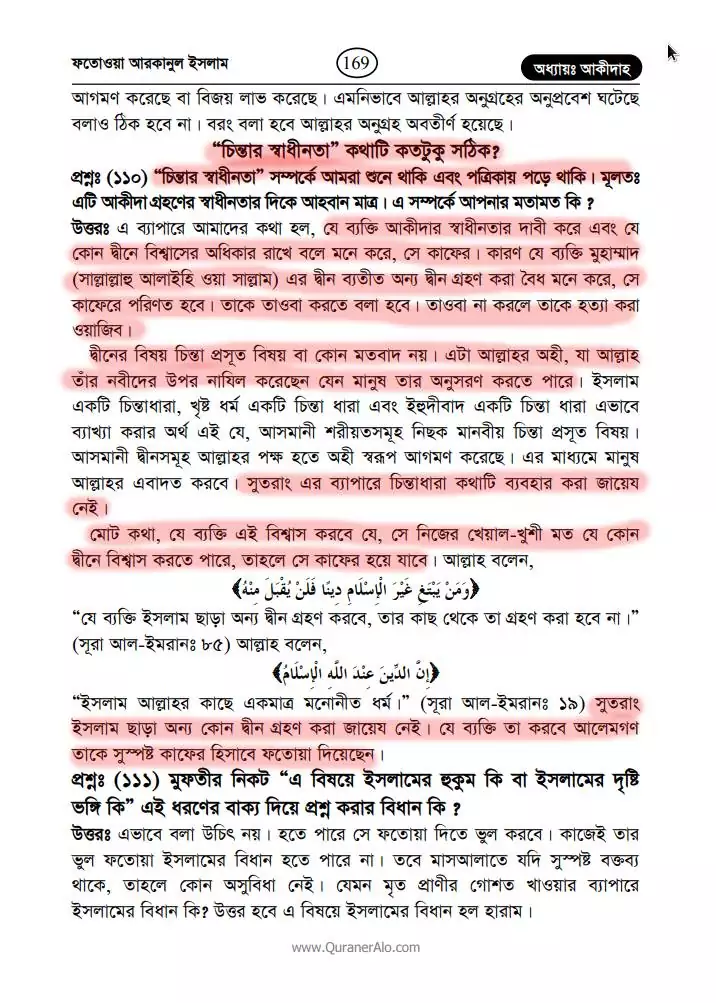
Teaching Children About Other Religions Is Haram
Children are the embodiment of our hopes for the future. They learn what we teach them. If a child is born into a Muslim family, their parents naturally initiate them into Islam. If the child is born into a Hindu family, they are taught Hindu beliefs and practices. Ordinarily, no child actually knows which religion is true and which is false. A child does not possess the maturity required to investigate religions and determine the truth through knowledge, reason, and judgment. If the child’s parents teach that Hinduism is true and Islam false, that child will grow up with precisely that education. Yet a child should have the right to learn about religions, understand them, and examine them. Then, upon reaching adulthood, they should be able to make a decision through their own reasoning and judgment. If the parents’ religion is simply imposed upon the child and the child is denied the opportunity to decide independently, that infringes upon the child’s rights.
The parents may be Jewish, for example, but if after investigation the child concludes through their own knowledge and reasoning that Islam is true, the child should possess the right to embrace Islam. The same principle applies universally. Imposing one’s own religious beliefs upon children is unjust. They should be allowed an opportunity to investigate. Yet although Muslims seek to teach Islam to the children of Hindus, Christians, Buddhists, and Jews, they are unwilling to allow Muslim children to learn about other religions [51] –
Ruling on teaching false religions to children
217084
Publication : 07-06-2014
Question
Im a student, becoming a teacher in religion to teach children. I live in Europe, in a Christian country, but my studies teaches the five main world religions (Islam, Christianity, Judaism, Hinduism and Buddhism). I’ve never thought that it could be haram to teach other religions to children, because I don’t see non-Islamic religions as the truth and I will never tell it is. I believe children need to know what other people believe in this world.
However, many people have been telling me my studies are haram and it’s definitely haram to teach to other children, especially muslim children. I’ve been searching, but I couldn’t find any source clarifying anything. I hope you can clarify it. Thank you very much in advance!
Answer
Praise be to Allah.
The basic principle is that it is not permissible to study or teach the distorted Scriptures, false religions or schools of thought that are contrary to the truth, unless that is done with the aim of teaching people that they are corrupt and false, and that they are contrary to reason and common sense, and contrary to the religion of truth which Allah, may He be glorified, has chosen for His slaves, namely Islam. In addition to that, the one who is studying that should also have sound knowledge of the truth and the ability to distinguish truth from falsehood, error from right guidance, and there should be no fear that he will be tempted or confused by that. This kind of study should be limited to specialists who it is hoped will play a role in combatting these distorted and devilish religions; the door should not be left open to everyone, especially the common folk and children, lest that create in them doubts and uncertainty about their religion. It says in Haashiyat Ibn ‘Aabideen (1/175): We were instructed not to look into any of that, whether it was transmitted to us by the disbelievers or by those among them who became Muslim. End quote.
In Kashshaaf al-Qinaa‘ ‘an Matn al-Iqnaa‘ (1/434) it says: It is not permissible to read the books of the People of the Book – this was stated by Imam Ahmad – because the Prophet (blessings and peace of Allah be upon him) got angry when he saw ‘Umar carrying a page of the Torah, and he said to him: “Are you doubting, O son of al-Khattab?” … It is not permissible to read the books of those who follow innovation or the books that contain both truth and falsehood, or to narrate them, because that comes under the heading of corrupting beliefs. End quote.
Al-Haafiz Ibn Hajar (may Allah have mercy on him) said, when discussing this issue – namely reading the books of the People of the Book: With regard to this issue, it is more appropriate to differentiate between the one whose faith is not deeply-rooted, in which case it is not permissible for him to read any of those books, in contrast to the one whose faith is deeply rooted, for whom it is permissible to do so, especially when there is a need to refute the arguments of those whose view is opposed to the truth. That is indicated by the fact that the imams (leading scholars) of the past and present quoted from the Torah and challenged the Jews to believe in Muhammad (blessings and peace of Allah be upon him) on the basis of what they quoted from their books. If they did not believe that it is permissible to read it, they would not have done that and they would all have reiterated this view.
End quote from Fath al-Baari by Ibn Hajar, 13/525
Shaykh Ibn Baaz (may Allah have mercy on him) was asked: Is it permissible for us to read the books of religions other than Islam, out of a desire to study and learn about other religions? He replied: That is not appropriate. It is not appropriate to read the Torah or the Gospel or any other books, because that may lead to doubt, and it was narrated from the Messenger (blessings and peace of Allah be upon him) that when he saw ‘Umar reading a page of the Torah, he said: “Are you doubting, O son of al-Khattab? I have brought it to you white and pure; if Moosa were alive he could not but follow me.” What is meant is that the Muslim should not read other books, such as the Torah, the Gospel or any others, except in the case of those who need to read them, such as scholars who want to refute the Jews and Christians from their own books. If there is a need to do so, the scholar who is refuting them and highlighting their falsehood may read their books so that he may refute them on that basis. In that case there is nothing wrong with doing that when there is a need for it, in the case of those who have knowledge and insight.
End quote from the Shaykh’s website
http://www.binbaz.org.sa/mat/10748
If this is the ruling for adults, then it is more applicable in the case of children, because their reasoning is still immature, so teaching them these religions is a wrong action in which there is nothing good. You will never be allowed, whilst teaching, to criticize these false religions and highlight their falseness; even if this is allowed, children will never be able to understand that, because specious arguments and refutation thereof will be above their level of understanding.
And Allah knows best.
A partial translation of this answer was provided in the Bengali source. Translator: Farhan Chowdhury.
Ruling on Teaching False Religions to Children
Question
I am a student training to become a religion teacher for children. I live in Europe, in a Christian country, but my curriculum includes the five major world religions—Islam, Christianity, Judaism, Hinduism, and Buddhism. I never thought teaching children about other religions could be harmful, because I do not regard religions other than Islam as true and would never present them as such. I believe children should know what other people in the world believe.
However, many people have told me that my course of study is haram and that teaching these religions to other children—especially Muslim children—is definitely haram. I have searched but have not found a clear source explaining the matter. I hope you can clarify it in detail. Thank you in advance.
Answer
Praise be to Allah.
The basic principle is that it is not permissible to study or teach distorted scriptures, false religions, or schools of thought that are contrary to the truth, unless the purpose is to demonstrate to people that they are corrupt and false, contrary to reason and common sense, and contrary to the true religion—Islam—which Allah has chosen for His servants. Furthermore, the person studying such matters must possess sound knowledge of the truth, be capable of distinguishing truth from falsehood and right guidance from error, and there must be no fear that the material will tempt or confuse them. Such study should therefore be restricted to specialists who are expected to play a role in combating these distorted and satanic religions. The door should not be opened to everyone, especially ordinary people and children, lest doubts and uncertainties concerning their religion arise in their minds.
It is stated in Hashiyat Ibn ‘Abidin (1/175): “We have been instructed not to look into any of these matters, whether transmitted to us by disbelievers or by those among them who became Muslims.”
Kashshaf al-Qina‘ ‘an Matn al-Iqna‘ (1/434) states that the books of the People of the Book may not be read—this was the position of Imam Ahmad—because the Prophet became angry when he saw ‘Umar carrying a page of the Torah and said to him: “Are you in doubt, O son of al-Khattab?” It further states that books belonging to innovators and books containing both truth and falsehood may not be read or transmitted because they may corrupt belief.
Al-Hafiz Ibn Hajar, while discussing the reading of the books of the People of the Book, states that a distinction should be made between those whose faith is not deeply rooted and those whose faith is firmly established. The former are not permitted to read such books, whereas those firmly grounded in faith may do so, particularly when there is a need to refute arguments opposed to what they regard as truth. He notes that earlier and later Imams quoted the Torah in order to challenge Jews to believe in Muhammad on the basis of their own scriptures. Had they regarded reading those scriptures as universally forbidden, they would not have done so.
End quote from Fath al-Bari, 13/525.
Children Must Be Compelled to Practise Religion Through Beating!
A child is not sufficiently mature to make a major determination concerning which religion is true and which is false. A child learns what their parents teach them. Yet before reaching an age at which they can make an informed decision, Islam effectively compels the child to accept and practise the religion. Circumcision is relevant here: it is performed without obtaining the child’s consent. In a civilized society, inflicting bodily injury upon someone without consent is an offence. At the same time, hadith reports state that Muhammad instructed parents to beat children if they did not perform prayer [52] [53] –
Reference : Sunan Abi Dawud 495
In-book reference : Book 2, Hadith 105
English translation : Book 2, Hadith 495
Chapter : When A Boy Should Be Ordered To Offer As-Salat
Narrated Abdullah ibn Amr ibn al-‘As:
The Messenger of Allah (ﷺ) said: Command your children to pray when they become seven years old, and beat them for it (prayer) when they become ten years old; and arrange their beds (to sleep) separately.
Arabic : حَدَّثَنَا مُؤَمَّلُ بْنُ هِشَامٍ، – يَعْنِي الْيَشْكُرِيَّ – حَدَّثَنَا إِسْمَاعِيلُ، عَنْ سَوَّارٍ أَبِي حَمْزَةَ، – قَالَ أَبُو دَاوُدَ وَهُوَ سَوَّارُ بْنُ دَاوُدَ أَبُو حَمْزَةَ الْمُزَنِيُّ الصَّيْرَفِيُّ – عَنْ عَمْرِو بْنِ شُعَيْبٍ، عَنْ أَبِيهِ، عَنْ جَدِّهِ، قَالَ قَالَ رَسُولُ اللَّهِ صلى الله عليه وسلم ” مُرُوا أَوْلاَدَكُمْ بِالصَّلاَةِ وَهُمْ أَبْنَاءُ سَبْعِ سِنِينَ وَاضْرِبُوهُمْ عَلَيْهَا وَهُمْ أَبْنَاءُ عَشْرِ سِنِينَ وَفَرِّقُوا بَيْنَهُمْ فِي الْمَضَاجِعِ ” .
Grade: Hasan Sahih (Al-Albani)
Reference : Sunan Abi Dawud 494
In-book reference : Book 2, Hadith 104
English translation : Book 2, Hadith 494
Chapter : When A Boy Should Be Ordered To Offer As-Salat
Narrated As-Saburah:
The Prophet (ﷺ) said: Command a boy to pray when he reaches the age of seven years. When he becomes ten years old, then beat him for prayer.
Arabic : حَدَّثَنَا مُحَمَّدُ بْنُ عِيسَى، – يَعْنِي ابْنَ الطَّبَّاعِ – حَدَّثَنَا إِبْرَاهِيمُ بْنُ سَعْدٍ، عَنْ عَبْدِ الْمَلِكِ بْنِ الرَّبِيعِ بْنِ سَبْرَةَ، عَنْ أَبِيهِ، عَنْ جَدِّهِ، قَالَ قَالَ النَّبِيُّ صلى الله عليه وسلم ” مُرُوا الصَّبِيَّ بِالصَّلاَةِ إِذَا بَلَغَ سَبْعَ سِنِينَ وَإِذَا بَلَغَ عَشْرَ سِنِينَ فَاضْرِبُوهُ عَلَيْهَا ” .
Grade: Hasan Sahih (Al-Albani)
Punishment for Apostasy in Islam
That Islam imposes itself through force, compels belief, and creates fear or terror without leaving any genuine opportunity for examination becomes even clearer when the Islamic punishment for apostasy is brought into the discussion. If someone is told that they will be killed for leaving a particular group, then whether that group’s claims are true or false, good or bad, becomes practically irrelevant. There is no longer any genuine opportunity to accept or reject the group’s ideology. Belief is a matter of the human mind. A person believes when they are convinced; forcing someone who does not believe cannot produce genuine belief. Moreover, when someone is born into a Muslim family, nobody asks which religion they would like to choose. In other words, before reaching an age at which they can observe, understand, form an opinion, and make an informed choice, they are already classified as Muslim. But what happens if they later want to leave Islam? What if they want to choose another religion? What if they become an atheist? What is the punishment for leaving Islam? What does the Sharia prescribe on this matter? Let us examine the following hadiths. First, let us listen to a statement by the prominent Islamic scholar Mahmudul Hasan Gunavi,
Now let us examine several hadiths [54] [55] –
Reference : Sunan Abi Dawud 4351
In-book reference : Book 40, Hadith 1
English translation : Book 39, Hadith 4337
Chapter : Ruling on one who apostatizes
‘Ikrimah said:
[Insert the complete English translation published on Sunnah.com for Sunan Abi Dawud 4351 here, verbatim.]
Kill those who change their religion.
Arabic : حَدَّثَنَا أَحْمَدُ بْنُ مُحَمَّدِ بْنِ حَنْبَلٍ، حَدَّثَنَا إِسْمَاعِيلُ بْنُ إِبْرَاهِيمَ، أَخْبَرَنَا أَيُّوبُ، عَنْ عِكْرِمَةَ، أَنَّ عَلِيًّا، عَلَيْهِ السَّلاَمُ أَحْرَقَ نَاسًا ارْتَدُّوا عَنِ الإِسْلاَمِ فَبَلَغَ ذَلِكَ ابْنَ عَبَّاسٍ فَقَالَ لَمْ أَكُنْ لأَحْرِقَهُمْ بِالنَّارِ إِنَّ رَسُولَ اللَّهِ صلى الله عليه وسلم قَالَ ” لاَ تُعَذِّبُوا بِعَذَابِ اللَّهِ ” . وَكُنْتُ قَاتِلَهُمْ بِقَوْلِ رَسُولِ اللَّهِ صلى الله عليه وسلم فَإِنَّ رَسُولَ اللَّهِ صلى الله عليه وسلم قَالَ ” مَنْ بَدَّلَ دِينَهُ فَاقْتُلُوهُ ” . فَبَلَغَ ذَلِكَ عَلِيًّا عَلَيْهِ السَّلاَمُ فَقَالَ وَيْحَ ابْنَ عَبَّاسٍ .
Grade: Sahih (Al-Albani)
Reference : Sunan Abi Dawud 4352
In-book reference : Book 40, Hadith 2
English translation : Book 39, Hadith 4338
Chapter : Ruling on one who apostatizes
`Abd Allah (b. Mas`ud) reported the Messenger of Allah (peace be upon him) as saying:
[Insert the complete English translation published on Sunnah.com for Sunan Abi Dawud 4352 here, verbatim.]
one who deserts his religion separating himself from the community.
Arabic : حَدَّثَنَا عَمْرُو بْنُ عَوْنٍ، أَخْبَرَنَا أَبُو مُعَاوِيَةَ، عَنِ الأَعْمَشِ، عَنْ عَبْدِ اللَّهِ بْنِ مُرَّةَ، عَنْ مَسْرُوقٍ، عَنْ عَبْدِ اللَّهِ، قَالَ قَالَ رَسُولُ اللَّهِ صلى الله عليه وسلم ” لاَ يَحِلُّ دَمُ رَجُلٍ مُسْلِمٍ يَشْهَدُ أَنْ لاَ إِلَهَ إِلاَّ اللَّهُ وَأَنِّي رَسُولُ اللَّهِ إِلاَّ بِإِحْدَى ثَلاَثٍ الثَّيِّبُ الزَّانِي وَالنَّفْسُ بِالنَّفْسِ وَالتَّارِكُ لِدِينِهِ الْمُفَارِقُ لِلْجَمَاعَةِ ” .
Grade: Sahih (Al-Albani)
Let us verify these reports directly from Sahih al-Bukhari as well [56] [57] –
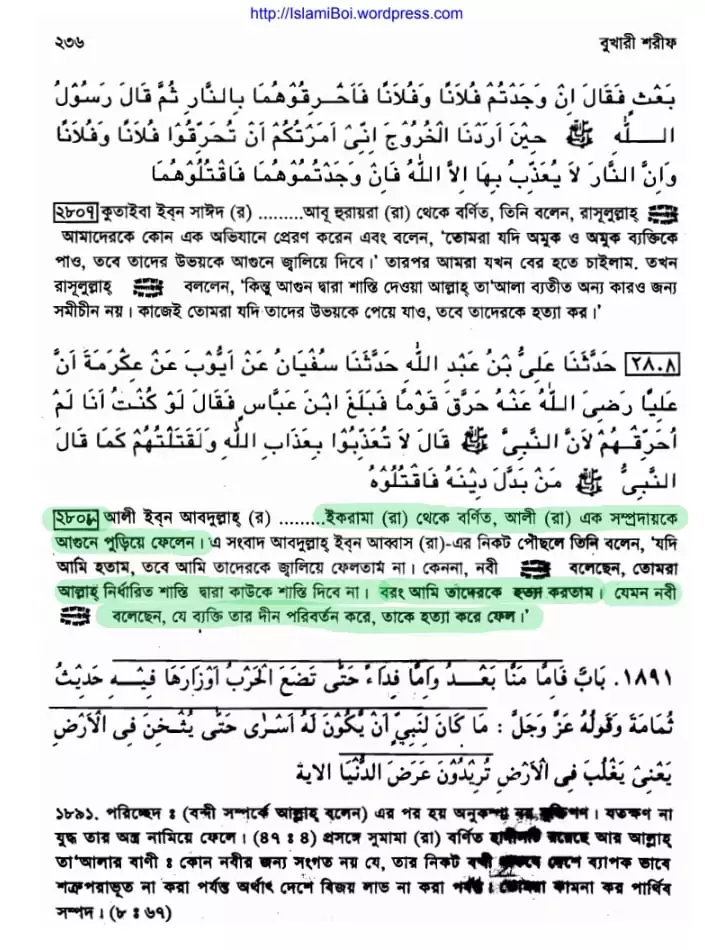
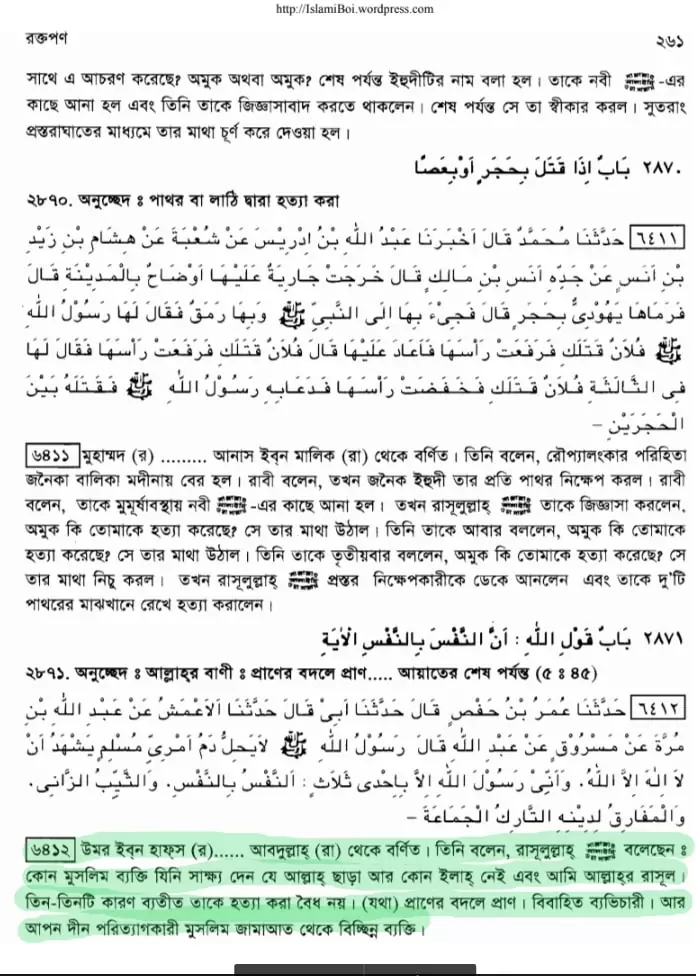
Now let us examine what punishment for an apostate is found in Al-Muwatta of the renowned hadith compiler Imam Malik. The report can be found on pages 406–407 of the second volume of the Islamic Foundation edition of Muwatta Imam Malik. [58] –
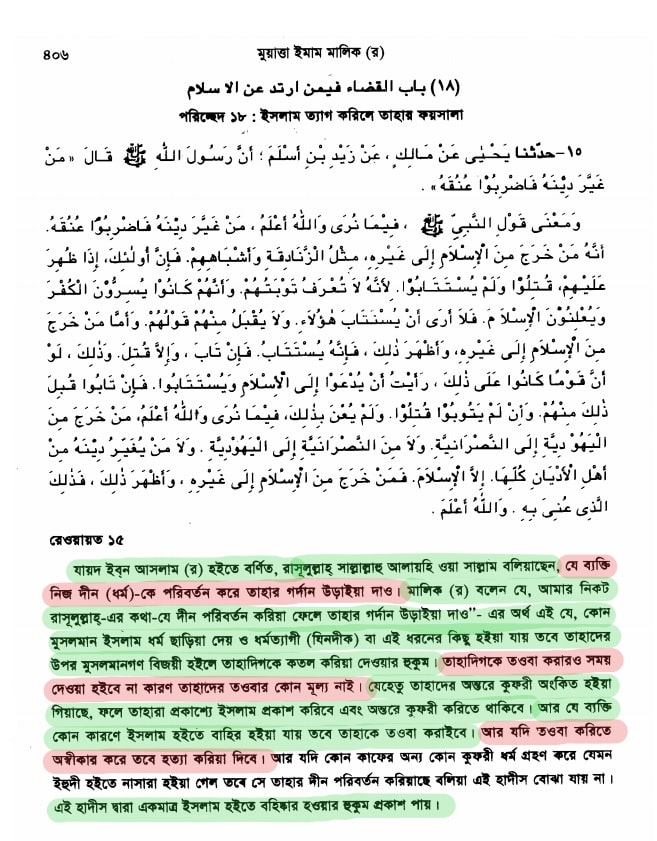
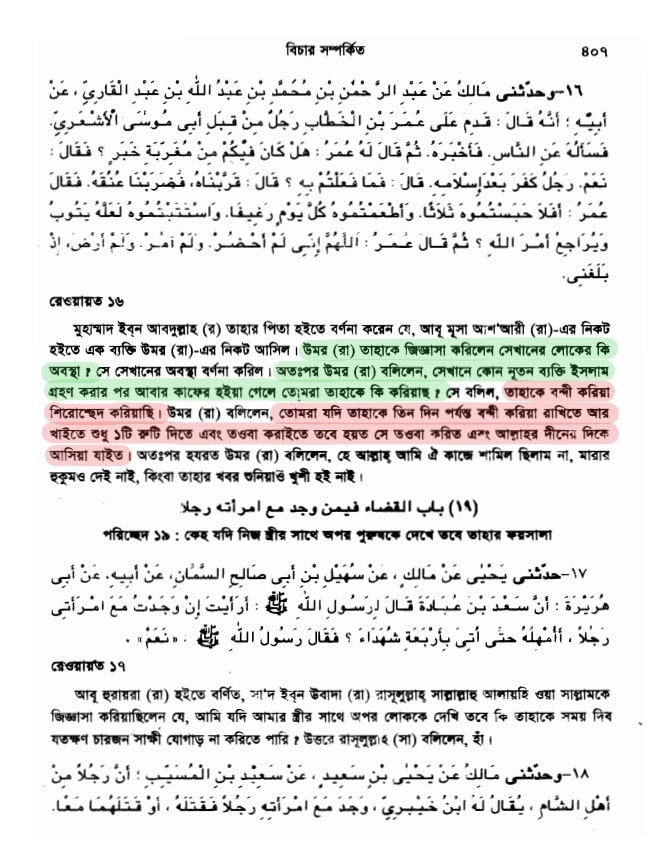
An even more inhumane provision is that if someone kills an apostate, the killer is not subject to the death penalty for that killing. This provision is included in Codified Islamic Law, vol. 1 [59] –
At the same time, Islamic law also provides for the seizure of an apostate’s property [60] –
The Islamic Ruling on Killing Those Who Do Not Pray
Islam grants only the freedom to accept belief; it does not grant the freedom to doubt that belief, question it, or withdraw from it. Yet genuine freedom requires that a person possess the right to choose belief or unbelief according to their own thought and conscience. When personal decisions such as changing religion, abandoning prayer, or refusing to pay zakat are treated as offences punishable by death, the ugliness of this religious system becomes evident.
Islamists often attempt to explain this by arguing that Islam does not execute apostates in order to destroy religious freedom, but rather in order to protect the security of the state and society. According to this argument, the apostate is supposedly a traitor to the state, an ally of the enemy, or someone who undermines the unity of Muslim society. But this argument is untenable: if merely abandoning a personal belief is itself classified as treason, then no freedom of thought remains. If a state can kill a person simply because their inner convictions have changed, the statement “There is no compulsion in religion” becomes practically false. This constitutes structural coercion in which people are compelled to remain Muslim through fear of punishment. Thus these two Islamic positions—on the one hand, “There is no compulsion in religion,” and on the other, “The punishment for the apostate and for abandoning prayer or zakat is death”—create a profound internal contradiction. Below is a video in which the prominent Bangladeshi scholar Shaykh Dr. Muzaffar bin Muhsin discusses this matter.
What Would Have Happened If Islam Had No Rule for Killing Apostates?
One important provision of Islamic Sharia is the ruling that an apostate, or someone who leaves Islam, is to be killed. A large number of Islamic scholars openly acknowledge that without the ruling prescribing the killing of apostates, the religion known as Islam would not have continued to exist. According to this argument, it would have disappeared immediately after Muhammad’s death. Let us listen to a statement by a prominent scholar from Egypt’s Al-Azhar University,
Coercion of Thought: The Degradation of Human Knowledge
If the entire discussion above is summarized, the barriers confronting any attempt to “verify Islam” may be divided into three levels.
First, Cognitive barriers (epistemic barriers)—questions are framed as suspicious, sinful, or kufr; independent logical and philosophical examination of the concept of God or religious claims is discouraged; and merely “asking for evidence” can be transformed into a moral offence, fixing the boundaries of thought in advance.
Second, Information barriers—access to the scriptures of other religions, alternative doctrines, or critical sources is limited or prohibited. In the case of children, this control of information becomes even stricter by reducing their exposure to alternatives. Thus, although they may supposedly make a decision later, the actual range within which that decision can be made has already been narrowed.
Third, Coercive barriers (fear/punishment/pressure)—the punishment or fear associated with apostasy, social and familial pressure to perform mandatory religious practices, and punitive laws or threats cause people to follow the path of safety rather than the path of reason. The question of “truth or falsehood” is consequently buried beneath the question of “survival and security.”
Working together at all three levels, these mechanisms create an environment in which verification remains a theoretical word, while in practice belief is sustained through a combined structure of prohibition, information control, fear, and coercion.
Believe First, Then Think in Order to Strengthen the Belief
In many places, the Quran encourages people with expressions such as “think,” “reflect,” and “look.” For example, Surah Al-Baqarah 2:164 describes the creation of the heavens and the earth, the alternation of night and day, ships sailing at sea, rain, the revival of dead land, the dispersal of living creatures, changing winds, and clouds as “signs” for “people who understand.” Surah Al-‘Ankabut 29:20 tells people to travel through the earth and observe how creation began. Surah Ali ‘Imran 3:190–191 speaks of “people of reason” who remember Allah while standing, sitting, and lying down and reflect upon creation, reaching the conclusion that it was not created “without purpose.” Surah Ar-Ra‘d 13:3–4 similarly presents the spread of the earth, mountains and rivers, pairs of fruits, and the covering of night as “signs for those who reflect.” Even Surah An-Nisa 4:82 calls upon people to reflect upon the Quran and claims that, had it come from anyone other than Allah, they would have found within it “many inconsistencies.”
Yet when these verses are examined more deeply, “thinking” here does not function as free inquiry; it operates instead as guided or conditioned thinking. The destination of thought has already been determined. When confronted with the vastness, complexity, beauty, and regularity of nature, the conclusion one is expected to reach has already been prescribed: “These are signs of Allah,” “Allah is the Creator,” and “He did not create these things without purpose.” Thus, “think” effectively means: look at nature and then submit to the designated conclusion. This is thought directed not toward testing evidence but toward securing obedience.
This distinction is crucial. Genuine logic or scientific investigation begins with open inquiry and open questions: “What is the cause?”, “What alternative explanations exist?”, “Which explanation is more probable?”, “What observation would falsify a particular hypothesis?”, and “What experimental result would require us to change our conclusion?” By contrast, this Quranic form of “thinking” works with a closed question: “Do you see the sign? Then believe.” It is therefore not a process of gathering information and arriving at a conclusion; rather, it begins by retaining the conclusion and fitting the information into it. In modern terminology, this may be described as a religious structure of confirmation bias: first the conclusion, then the “signs.”
Free inquiry means that the answer to the question is not predetermined; alternative explanations remain equally available for consideration; and the criteria by which evidence or observation could falsify a particular explanation are explicitly defined. Here, however, the destination of “thought” is fixed in advance: once nature is observed, it must be treated as a “sign” pointing toward a particular conclusion. There is consequently no genuine place for competing hypotheses, sceptical testing, falsification, or suspension of judgment. This is not inquiry; it is a one-way process of searching for arguments in support of a prior assumption.
Another psychological mechanism operates here as well: emotion is substituted for reason. Human beings naturally experience awe when contemplating the sky, stars, day and night, rain, rivers, fruit, and animals. But awe itself is not evidence; awe is an emotion. These verses arrange that sense of wonder in such a way that the person moves along a sliding path from awe to “reverence,” from reverence to “devotion,” and from devotion to “obedience.” “Thinking” thereby becomes a form of devotional reflection whose objective is not the verification of truth but the production of belief.
Even when the Quran, as in 4:82, invites readers to consider whether there are inconsistencies, this still does not occur within an unconditional process of inquiry. At the same time, the Quranic and wider religious environment contains moral and social structures in which doubt, questioning, and criticism may be presented as dangerous, sinful, or deviant. Consequently, although the instruction to “think” may sound rationalistic on the surface, the permissible range of thought and the acceptable conclusions are already restricted. In a single sentence: you are told to think, but the conclusion you are permitted to reach has already been determined.
Thus, treating these Quranic exhortations to “think” as evidence of free thought would be mistaken. The form of thinking involved does not liberate the intellect; instead, it places the intellect in the service of a predetermined belief. “Reason” here is not an instrument for discovering truth; it functions as an ornament used to decorate belief. Its most important function is to bring a person into a psychological state in which they stand overwhelmed by awe and ultimately kneel—surrendering their capacity to question in the name of “reverence” or “devotion.”
Two paths are shown: (1) how free inquiry operates, and (2) how the language of “signs” directs thought toward a predetermined conclusion.
“What is the cause?” “What alternative explanations exist?”—the answer is not predetermined.
Multiple explanations are considered side by side to determine which is more probable.
A conclusion is reached by examining the type and quality of the evidence.
It is specified what observations would demonstrate that a particular idea is false.
The conclusion remains open to revision when new information appears.
Thinking begins by treating the conclusion “Allah is the Creator” as already true.
The heavens and earth, night and day, rain and life are all arranged as evidence for the belief.
Other hypotheses receive little consideration while one explanation is made to appear “natural.”
Awe is transformed not into reasoning but into devotional submission.
The objective of thinking is not to test truth but to strengthen belief.
Where genuine inquiry subjects conclusions to evidence, here evidence is subordinated to the conclusion. Thus “think” sounds rationalistic while functioning in practice as a mechanism for preserving belief.
Tabula Rasa: Why the First Writing on the “Blank Slate” Becomes the Strongest
“Tabula Rasa” is a familiar thesis in epistemology and psychology according to which, at birth, the human mind is in one sense comparable to a “blank slate” with respect to the content of ideas and knowledge. Sensory experience, education, social environment, habit, punishment, and reward subsequently write upon that slate. [61] An important qualification, however, is that John Locke himself did not regard the human being as completely devoid of innate capacities. In his view, we possess certain faculties or capacities from birth—such as receiving, comparing, and combining ideas—while specific “ideas” or content are not already inscribed upon the mind. [62] [63]
Viewed through this framework, the relationship between religious socialization and the “verification of truth” becomes clearer. If, from childhood, (a) access to alternative religions, philosophies, science, and critical literature is blocked, (b) one particular belief is taught as the only legitimate truth, and (c) disagreement is associated with fear, sin, or social catastrophe, then both the inputs available to the child’s thinking and the reinforcement structure of reward and punishment become tilted in a single direction. The capacity to think may remain, but the questions that may be asked, the paths along which thought may proceed, and the conclusions that are considered “safe” have already been conditioned.
Within this framework, Quranic verses that say “think” or “look at the signs” may be understood differently. They do not create open questions for free inquiry; rather, they use the wonder of nature to normalize and make compulsory a predetermined conclusion—that Allah is the Creator. “Thinking” consequently comes to mean matching the conclusion already learned with observations of nature, while the space for making a genuinely free decision steadily disappears.
At the same time, it should be recognized that although the concept of Tabula Rasa has been highly influential in the history of philosophy, modern cognitive science contains strong arguments against treating human beings as completely “blank.” Within the debate over innateness, many scholars argue that certain basic cognitive structures or predispositions may themselves be innate [64] [65]. Even if some basic human capacities are innate, however, the specific content of belief—what counts as “true,” what is “haram,” what is “terrifying,” and what questions constitute “kufr”—is substantially socially learned, and control over information together with structures of punishment and reward exerts enormous influence upon that learning. Thus, however frequently someone is told to “think,” if the intellectual ground has been tilted in a single direction since childhood, adult “thinking” may frequently function not as independent inquiry but as a strategy for defending conclusions learned earlier—confirmation bias.
An Anatomy of Intellectual Slavery and Epistemological Authoritarianism
Islam’s supposed “free inquiry” is in reality a form of Epistemological Authoritarianism in which the means of knowing “truth” is revealed revelation whose truth has already been determined and is treated as immutable. Here, “verification” does not mean discovering some new truth; it becomes merely an exhausting mental exercise in accepting a predetermined divine statement as the boundary of one’s own intellect. When evidence is requested against any foundational Islamic doctrine, that request can itself be classified as “kufr,” closing the path of inquiry. Consequently, for a Muslim, independent reason is displaced by blind obedience resembling “a camel with a ring in its nose”, elevated as an ideal of faith.
To preserve this closed system, a culture of fear and a method of Control of Thought through Fear have acquired institutional form. On the one hand, children are disciplined into prayer through physical punishment; on the other, the threat of the “death penalty” for apostasy hangs over adulthood. This demonstrates that the ideology does not permit its authority to depend solely upon rational evaluation. If reason itself were sufficient as the criterion of truth, there would be no need to throw stones at questioners or issue rulings prescribing beatings with sandals for practitioners of logic and dialectical theology.
Remarkably, Islam describes Allah as self-sufficient and omnipotent while several Quranic verses employ language in which human beings are asked to “help” Allah or give Him a “loan” (qard hasan). Such language produces a serious philosophical tension when considered alongside the doctrine of absolute divine self-sufficiency. It creates an anthropomorphic image in which a supposedly self-sufficient Creator is described in the language of dependence associated with created beings.
Fear of free thought and unrestricted information constitutes another weakness in this structure. Ordinary Muslims are prohibited by influential scholars from reading the scriptures of other religions lest doubt or uncertainty arise in their minds. This indicates an effort to confine followers within a controlled echo chamber where no independent second source is available for comparing claims of truth and falsehood. It resembles a prison whose walls are constructed from fear and whose windows are sealed through information censorship.
Epistemological Authoritarianism Diagram
Question → Examine evidence/reasoning → Compare alternative explanations → Reach a conclusion
Result: even before verification begins, the permissible range of questions, sources, and methods is narrowed or controlled
When curiosity is transformed into an offence, a “stop” signal appears at the very first stage of verification.
The boundaries of what may be investigated are determined in advance.
If the tools of verification themselves are treated as a “risk,” the methodology collapses.
When cross-checking is blocked, comparative evaluation becomes impossible.
Reducing exposure to alternatives from the outset means that later “choice” is no longer genuinely free.
Verification ceases to mean discovering truth and becomes a test of obedience or agreement.
In some legal, state, or judicial frameworks, apostasy is treated as a punishable offence; fear therefore controls the decision.
The labels of unbeliever or apostate, loss of employment, relationships or community, and threats make “survival,” rather than “truth,” the dominant concern.
Family breakdown, punishment within marriage or relationships, inheritance restrictions, and economic pressure may render independent decision-making practically ineffective.
Coercion may produce behavioural obedience, but verification or genuine belief does not arise naturally through force.
As the cost and risk to the individual increase, people choose security rather than reason.
Labelling doubt as “wrong thinking” produces self-censorship and brings verification to a halt.
When questions, methodology, and sources are all controlled, “neutral verification” cannot function in practice.
When prohibition, fear, and authority operate together, the decision has already been made; the cost of reaching a different conclusion becomes excessively high.
The verification process becomes trapped by its own conditions, and obedience replaces reason as the dominant principle.
The Suppression of ‘Aql: Recognizing Revelation vs. Evaluating Revelation
The claim frequently made in Islamic theology that ‘aql, or reason, is used contains a clear but subtle epistemological deception: on one side is “recognizing revelation” (Reason as a Tool for Recognition), while on the other is “evaluating revelation” (Reason as a Tool for Judgment). Within influential Sunni orthodox frameworks—Salafi, Athari, and Ash‘ari, despite differences among them—the role of reason is generally permitted only up to the first stage. A person may read or hear claims of miracles, traditions, accounts of a messenger’s truthfulness, or descriptions of his personal influence and then reach the conclusion: “Yes, this message has come from God—I have heard and I obey.” In simple terms, you are expected to look upon the immensity of the universe, rivers, oceans, mountains, flowers, fruits, and plants, become overwhelmed with wonder, and conclude that none of this could have been produced by anyone except Allah. At the same time, you hear from people and read in books about the truthfulness of the Prophet Muhammad. Impressed by these accounts, you conclude that he therefore could not have been lying. Such use of reasoning is conditionally accepted within Islam. This is sometimes framed as the maqam al-‘aql, or the “limited role of the intellect,” while iman bil-ghayb requires that matters such as the Creator, angels, and the afterlife ultimately be accepted beyond empirical proof and believed without objection.
But once this conclusion has been accepted as “iman,” the second function of reason—the independent re-evaluation of whether the revelation is true or false, morally coherent, or consistent with reality—becomes effectively prohibited. One may accept revelation as a fixed truth and use it as the basis for deriving legal rulings and extending jurisprudential doctrines, but the foundational claim—“Is this revelation really revelation?”—is prevented from being returned to the scales of independent reason.
The language of classical scholars can be particularly useful in illustrating this boundary. In reasoning associated with the tradition of Imam al-Ghazali, the human intellect may be compared to a guide who can lead you as far as the gates of the Sultan’s palace; once you have entered the palace, however, that guide no longer possesses the authority to speak—the Sultan’s command alone is supreme. This reveals the trap within the language of “verification.” Genuine verification is an open process in which the judge—the intellect—may revise its conclusion in light of new evidence or arguments. Here, by contrast, once “recognition” has been completed, the power of “evaluation” is removed, as though changing the conclusion were itself an offence. Thus, when some revealed teaching—such as the Mi‘raj, jinn and angels, or slavery—conflicts with moral intuition, ordinary reasoning, experience, or observed reality, the problem is not resolved by permitting reason to question revelation. Instead, reason itself is declared inadequate, while “pure faith” is glorified. Ideas such as “you must accept it even if you cannot understand it” or “revelation cannot be judged by limited human reason” become virtues in themselves.
Historically, rationalist tendencies in early Islam, such as the Mu‘tazilah, at one stage attempted to explain and evaluate theology according to rational criteria; the Mihna provides a severe example of how such a tendency could itself become an instrument of ideological repression once combined with political power. In reaction to this experience, another tendency grew stronger among many mainstream scholars, in which rational debate concerning matters of the unseen was pushed into categories such as suspicious, dangerous, or heretical. Consequently, the intellectual inheritance associated with figures such as Imam Ahmad ibn Hanbal and Imam Abu Hanifa—especially regarding the unseen and aqidah—came to be expressed through the principle that “reliance upon revelation in matters of the unseen is the believer’s path to salvation, whereas philosophical disputation in such matters is kufr or bid‘ah.” [66] [67]
Thus, the idea of “verifying” Islam through the use of your intellect resembles entering a laboratory whose entrance bears the notice: “If the results of your observations inside do not agree with our manual, then your observations are wrong, and publishing them is a punishable offence.” In a system where the right to say “no” has already been restricted through fear of legal, social, and otherworldly punishment, “verification” becomes a one-way process in practice: not the freedom to reach a conclusion, but an exercise in using reason to legitimize a conclusion that has already been predetermined. Such a structure pushes human beings toward the condition of the “camel with a ring in its nose”, where their sole responsibility is to abandon independent judgment and move blindly toward a predetermined destination.
Conclusion
Ultimately, it becomes clear that Islam is not an open or genuinely verifiable system, but rather a comprehensive coercive structure. The free flow of information is obstructed, while doubt and questioning are classified as sins, permanently restricting the path of intellectual development. The unconditional obedience demanded in the name of iman or faith amounts fundamentally to a denial of the individual’s independent agency.
A person’s right to make an independent decision is meaningful only when they can safely choose among alternatives. But when leaving Islam carries the consequence of death, belief loses its moral and intellectual value as a free choice. A vote cast with a knife held to one’s throat cannot possibly represent free public opinion; likewise, claiming to offer someone an “opportunity for verification” while preserving the threat of punishment and censorship of information is an extreme deception. Therefore, on the basis of the Quran, hadith, classical aqidah, jurisprudential rulings, and Salafi-Athari interpretations cited throughout this discussion, the conclusion presented here is that Islam is not a religion of reason-based free inquiry; rather, it is a coercively imposed authoritarian belief system in which preserving obedience takes precedence over independently verifying truth.
References
- Sahih al-Bukhari 2652 ↩︎
- Sahih Muslim 2533a ↩︎
- Mishkat al-Masabih 111 ↩︎
- Sunan Abi Dawud 4717 ↩︎
- Surah Al-Ma’idah, verse 51 ↩︎
- Surah Ali ‘Imran, verse 85 ↩︎
- Riyad as-Salihin 590; corresponding Bengali compilation reference: Hadith Sambhar 3797 ↩︎
- Sunan Abi Dawud 4603 ↩︎
- Islamic Aqidah in the Light of the Quran and Sunnah, author: Dr. Khondkar Abdullah Jahangir, publisher: Islam House, p. 167 ↩︎
- Surah An-Nur, verse 51 ↩︎
- Sunan Ibn Majah 43 ↩︎
- Mishkat al-Masabih 64 ↩︎
- Tafsir al-Jalalayn, vol. 1, Islamia Kutubkhana, p. 77 ↩︎
- Tafsir al-Jalalayn, vol. 1, Islamia Kutubkhana, pp. 78–79 ↩︎
- Sharh Muslim, Bengali Translation with Necessary Explanations, vol. 2, p. 48 ↩︎
- Jami‘ at-Tirmidhi 2133 ↩︎
- Sirat al-Nabi, Ibn Hisham, vol. 2, pp. 252–253 ↩︎
- Surah Muhammad, verse 7 ↩︎
- Surah Al-Baqarah, verse 245 ↩︎
- Surah Al-Hadid, verse 11 ↩︎
- Surah Al-Hadid, verse 18 ↩︎
- Surah At-Taghabun, verse 17 ↩︎
- Sirat al-Nabi, Ibn Hisham, vol. 2, p. 269 ↩︎
- Sahih Muslim 135c; Islamic Foundation edition, Hadith: 248 ↩︎
- Sahih Muslim 134a; Islamic Foundation edition, Hadith: 243 ↩︎
- Sahih Muslim 134c; Islamic Foundation edition, Hadith: 245 ↩︎
- Sahih al-Bukhari 3276; Islamic Foundation edition, Hadith: 3046 ↩︎
- Sahih al-Bukhari 3276; Tawheed Publications edition, Hadith: 3276 ↩︎
- Sahih Muslim Sharif, Bengali Translation with Necessary Explanations, vol. 3, pp. 180–183 ↩︎
- Sharh al-‘Aqidah al-Tahawiyyah, author: Imam Ibn Abi al-‘Izz al-Hanafi, publisher: Maktabatus Sunnah, p. 328 ↩︎
- Al-Fiqh al-Akbar: Bengali Translation and Commentary—The Fundamental Beliefs of Islam, Jahangir, Dr. Khondkar Abdullah, As-Sunnah Publications, pp. 148–154 ↩︎
- Fatawa Ibn al-Salah, vol. 1, pp. 209–211, Fatwa no. 55 ↩︎
- Fatawa Ibn al-Salah, vol. 1, pp. 210–211 ↩︎
- Fatawa Ibn al-Salah, vol. 1, p. 211 ↩︎
- Ruling on studying philosophy ↩︎
- Why some scholars studied Kalaam theology though prohibited by the Salaf ↩︎
- Sunan Ibn Majah 252 ↩︎
- Riyad as-Salihin 1391 ↩︎
- Sunan Abi Dawud 164 ↩︎
- Sahih al-Bukhari 7308; Islamic Foundation edition, Hadith: 6810 ↩︎
- Sahih al-Bukhari: Bengali Translation and Commentary, vol. 7, p. 310 ↩︎
- Sharh al-‘Aqidah al-Tahawiyyah, author: Imam Ibn Abi al-‘Izz al-Hanafi, publisher: Maktabatus Sunnah, p. 333 ↩︎
- Mishkat al-Masabih 194; corresponding Bengali compilation reference: Hadith Sambhar 1507 ↩︎
- Mishkat al-Masabih 177; corresponding Bengali compilation reference: Hadith Sambhar 1506 ↩︎
- Tahqiq Mishkat al-Masabih, vol. 1, pp. 143–144 ↩︎
- Tahqiq Mishkat al-Masabih, vol. 1, p. 134 ↩︎
- حكم القراءة في كتب الأديان ↩︎
- Ruling on studying the books of the People of the Book for the purpose of da‘wah (calling them to Islam), and the ruling on studying comparative religion. ↩︎
- How ‘Umar read the Torah ↩︎
- Fatawa Arkan al-Islam, Shaykh Muhammad bin Salih al-‘Uthaymeen, p. 169 ↩︎
- Ruling on teaching false religions to children ↩︎
- Sunan Abi Dawud 495 ↩︎
- Sunan Abi Dawud 494 ↩︎
- Sunan Abi Dawud 4351; Islamic Foundation edition, Hadith: 4300 ↩︎
- Sunan Abi Dawud 4352; Islamic Foundation edition, Hadith: 4301 ↩︎
- Sahih al-Bukhari, vol. 5, p. 236 ↩︎
- Sahih al-Bukhari, vol. 10, p. 261 ↩︎
- Muwatta Imam Malik, vol. 2, pp. 406–407. Download link ↩︎
- Codified Islamic Law, Islamic Foundation, vol. 1, p. 257 ↩︎
- Codified Islamic Law, Islamic Foundation, vol. 1, p. 246 ↩︎
- Britannica—Tabula Rasa ↩︎
- SEP—Locke ↩︎
- IEP—Locke ↩︎
- SEP—Innateness: history ↩︎
- SEP—Innateness and cognition ↩︎
- Abbasid Caliphate: The Golden Mirage of History and the Chessboard of Power ↩︎
- Islamic Golden Age: Searching for the Light of Knowledge Beneath the Dust of Oblivion ↩︎
About This Article
Genre: Source-Based Critical Analysis of Islamic Epistemology, Faith, Doubt, and Freedom of Thought
Epistemic Position: Secular Humanism, Evidentialism, Scientific Skepticism, Cognitive Bias Analysis, Freedom of Conscience, and Source-Internal Islamic Critique
This article examines the claim that Islam allows free inquiry, independent verification, and rational evaluation of religious truth-claims.
Its scope is doctrinal, epistemological, and legal. The article focuses on Islamic sources, classical creed, hadith, fatwa literature, scholarly statements, apostasy law, restrictions on doubt, and limits placed on philosophy, logic, and comparison with other religions.
The central claim is that Islam does not offer open-ended verification in the modern rational sense; rather, it demands prior submission to Qur'an, hadith, prophetic authority, and inherited creed before any limited use of reason is permitted.
The discussion covers cognitive bias, inherited religion, confirmation bias, blind faith, the meaning of iman, prohibition of doubt, hostility toward philosophical reasoning, restrictions on reading other scriptures, punishment for apostasy, coercive religious discipline, and epistemological authoritarianism.
This article should be evaluated through source accuracy, logical consistency, epistemic fairness, human-rights reasoning, freedom of conscience, and the distinction between genuine inquiry and obedience-based belief—not through religious sensitivity, apologetic expectation, inherited reverence, fear of blasphemy, or the demand that faith-based authority be treated as equal to independent evidence and reason.