Racism and Caste Discrimination in Islam: Hereditary Privilege and Institutional Inequality
Abstract
It is often claimed that Islam contains no racism, caste hierarchy, or hereditary discrimination. Supporters of this claim frequently cite Qur’an 49:13 and Muhammad’s well-known declaration that neither an Arab has superiority over a non-Arab nor a white person over a black person, except through piety. These statements undeniably reject the idea that ancestry or skin color alone establishes human superiority. Yet the same Islamic scriptures, hadith literature, commentaries, and classical jurisprudence contain numerous provisions and ideas that make a person’s birth, lineage, tribe, skin color, social position, and religious beliefs determinants of honor, political authority, social rights, and status. This produces a profound inconsistency between Islam’s proclamations of human equality and its actual religious and legal framework.
The clearest example is the Quraysh tribe’s monopoly over political leadership. Although Islam declares that Arabs possess no inherent superiority over non-Arabs, several hadiths reserve the caliphate for the Quraysh. Classical Islamic political theory then establishes Quraysh ancestry as a qualification for supreme political leadership. Thus, however capable, knowledgeable, just, and effective a person may be, birth outside the Quraysh can exclude that person from the highest office. Likewise, the instruction to obey an Abyssinian slave is often cited as proof of racial equality, yet the wording of the relevant hadith and its classical interpretations reveal how enslavement, black identity, and physical appearance are invoked as symbols of low social status and supposed incompetence. Reports claiming that God specially chose and honored Muhammad’s own lineage further express the notion of superiority by birth.
Such discriminatory thinking is not confined to political power. Hadiths contain a prohibition on accepting a rural person’s testimony against a townsperson, curses calling for famine upon particular tribes, special blessings for certain regions and peoples, and associations between other places and misfortune. These accounts make collective identity, rather than an individual’s conduct and character, a basis for judgment. The symbolic use of black and white in Islamic narratives also merits examination. Reports describe the Black Stone turning black because of human sin, black marks forming on the human heart through wrongdoing, the faces of the condemned becoming black while those of the rewarded become bright, a black woman appearing in a dream as the embodiment of an epidemic, and black dogs being called devils. Blackness is repeatedly associated with sin, danger, and evil, while whiteness and brightness symbolize purity, beauty, and reward. The relationship between these religious symbols and social prejudices about human complexion, beauty, and self-worth deserves close scrutiny.
Alongside lineage and complexion, religious identity is another basis for profound divisions within Islamic law. The Qur’an describes unbelievers as the worst of creation, the worst living beings, or even lower than livestock. Hadiths instruct Muslims not to initiate greetings to Jews and Christians, to force them toward the narrower side of the road, discourage living among polytheists, and call for the expulsion of non-Muslims from the Arabian Peninsula. Classical Sharia also contains unequal provisions concerning Muslims’ and non-Muslims’ civic status, admissibility of testimony, punishment for homicide, freedom of religion, and political standing. Shongshoy’s separate studies on jizya and the subordinate status of non-Muslims, the legal rights of non-Muslims, and expulsion and destruction based on religious identity examine these institutional and historical forms of discrimination in depth.
Where someone was born, who their ancestors were, what color their skin is, which tribe they belong to, or what religion they believe in proves nothing about their inherent superiority or inferiority. Nor can these identities legitimately justify unequal political rights, legal protection, social standing, or human dignity. Nevertheless, the Islamic theological and legal provisions discussed here plainly display hereditary privileges, group hierarchies, and subordination based on religious identity. The presence of some declarations of racial equality in Islam does not erase these discriminatory rules. Together they expose a fundamental limitation of Islam’s claim to equality: to proclaim that human beings possess equal dignity while assigning them unequal rights on the basis of birth, ancestry, and religious belief is to uphold contradictory principles.
Introduction
As a child, there was a Hindu household in our neighborhood. I had a friend there, and we used to play together. Whenever the family held a puja, I would sometimes visit, tempted by the delicious food. They offered various fruits and laddus. I noticed with surprise that while the other Hindu children received food in bowls, mine was served on a banana leaf. I could not understand why at the time, but even as a child it hurt my self-respect. I later learned that, because I was born into a Muslim family, they regarded me as belonging to a lower caste. They were Brahmins, the highest-ranked group in the traditional Hindu varna hierarchy. According to a traditional Hindu account, Brahmins originated from Brahma’s mouth. In their ideas about caste and ritual pollution, if I used their dishes, or merely touched them, those utensils would become impure. I was allegedly so impure that even my shadow must not fall upon them. There were many more such stories—expressions of profoundly sectarian and degrading attitudes. At that time, I thought these were Hindu superstitions and that Islam had nothing of the sort. Rules that determine a person’s honor and dignity according to where they were born, which family they belong to, and what religion their parents practice are deeply inhumane and should shame us as human beings. No child chooses a religion, lineage, caste, tribe, or skin color before entering this world. Yet society immediately imposes identities upon the child that become grounds for honor or humiliation. A child who has committed no crime or wrongdoing is judged impure or inferior merely for being born into a particular family. What could be more irrational or inhumane as a social system?
It is certainly true that Islam does not have the particular fourfold religious caste hierarchy of Brahmins, Kshatriyas, Vaishyas, and Shudras found in Hindu tradition. In this respect, Islam is relatively free of such divisions. It also contains important statements opposing superiority among Muslims based on race, tribe, lineage, or skin color. For many Dalits and lower-caste Hindus oppressed by caste hierarchies for centuries in the Indian subcontinent, Islam’s promise of equality was appealing. The desire to escape humiliation and hereditary subordination also played a part in some conversions to Islam. At the same time, however, the poison of caste-like hierarchy, hereditary superiority, and group discrimination is very much present within Islam itself. While certain Islamic statements affirm human equality, others identify specific lineages as entitled to govern, certain communities as especially honored, and people with particular religious beliefs as inferior or subordinate. Promoting only the egalitarian statements and portraying Islam as wholly free of racism and discrimination thus conceals an important part of the religion.
The problem becomes more serious when ideas of superiority and inferiority cease to be matters of personal preference and become foundations of religious law and state power. How can equality be reconciled with a person’s having a special claim to the caliphate simply because they were born into the Quraysh, while another, more capable individual is denied the same eligibility for being born elsewhere? A black Abyssinian slave is presented as someone whose authority must be obeyed, yet the slave’s identity and physical features are described in a manner that casts him as exceptionally unqualified and insignificant. Elsewhere, distinctions are drawn between urban and rural witnesses, famine is invoked upon entire tribes, and groups are assigned different legal and social status based on their religion. Beneath these cases lies the same problem: using birth or membership in a group, rather than an individual’s merit, conduct, character, or actions, as a basis for privilege or deprivation.
Racism is not limited to openly calling someone inferior. Declaring one community inherently superior, reserving political authority for a particular lineage, using someone’s physical features as a symbol of contempt, or assigning rights and status according to religion can all express discriminatory thinking. Racial, hereditary, and religious discrimination are not identical, but each can produce artificial hierarchies among human beings. Religious stories, metaphors, and symbols can also reflect the values and preconceptions of a society. This is why it matters that blackness is repeatedly associated with sin, danger, impurity, and punishment while whiteness is linked to purity, beauty, and reward. The possible influence of such ideas on the human imagination can also be examined through the beauty standards, literature, media, and ordinary language of our societies.
The central question is what human equality actually means. Is equality achieved merely by prohibiting insults about someone’s skin color, lineage, or ethnicity if another rule simultaneously restricts eligibility for supreme political leadership because of ancestry? If pride in lineage is condemned but the same religious system declares a particular lineage divinely chosen and especially honorable, has hereditary superiority truly disappeared? If all humanity is described as descended from common ancestors, yet certain people are pronounced the worst of creation because of their beliefs, what remains of the moral foundation of that equality? Claims of equal human dignity conflict with provisions assigning unequal rights by identity. The notion of superiority by birth does not become valid merely because it is attributed to scripture, a prophet, or a religious jurist.
I still remember receiving food on a banana leaf at that Hindu friend’s home in my childhood. Back then, I assumed that such inhumane humiliation based on birth existed only in other religions. Later, however, as I read Islamic scripture, hadith, tafsir, and Sharia provisions, I came to recognize the deep presence of hereditary privilege, tribal pride, religious discrimination, and hierarchical divisions among people in Islam too. Some may regard these as sacred religious commands, but calling a discriminatory rule sacred does not make it just. The injustice of judging someone by ancestry, skin color, or religion rather than their own actions is injustice whether it occurs under Brahmin caste rules or under the hereditary privileges of the Quraysh. There cannot be one moral standard for one religion, race, lineage, or tribe and another standard for everyone else.
What Are Caste Discrimination and Racism?
Racism is a way of thinking, a belief, a social system, or a practice in which human beings are divided into groups by skin color, ethnicity, ancestry, or descent, and some groups are considered inherently superior or inferior to others. According to this outlook, some populations are supposedly born more intelligent, competent, civilized, or fit to govern, while others are said to be less capable, subordinate, or suited to being governed. Racism may be organized around skin color, ethnic origin, lineage or tribe, or inherited social status. Its defining characteristic is the determination of someone’s honor, dignity, rights, and social position not by their personal abilities, character, intelligence, or actions but by the group or family into which they were born. Giving a particular population an inherited right to rule others, imposing its authority over other groups, or distributing legal and political rights by ancestry are expressions of this discriminatory way of thinking.
Racism, caste discrimination, tribalism, and religious discrimination are related, but they do not mean precisely the same thing. Racism generally involves claims of superiority or inferiority based on purported racial, ethnic, or hereditary traits. Caste discrimination refers to a hierarchy fixed by birth, in which family and descent may determine a person’s status, marriage prospects, occupation, or rights. Tribalism involves favoring one’s own tribe with special privileges, loyalty, or power over others. Religious discrimination, by contrast, means assigning unequal rights, opportunities, or standing because of someone’s beliefs or religious identity. Denying a black person a job because of skin color is racial discrimination; treating a Dalit as untouchable because of birth is caste discrimination; reserving supreme state leadership for a particular lineage is hereditary privilege; and granting a non-Muslim fewer legal rights than a Muslim solely because of religion is religious discrimination. These are different categories, but they share the same ethical problem: allocating unequal rights and status by group membership instead of individual merit.
The United Nations’ 1965 International Convention on the Elimination of All Forms of Racial Discrimination includes distinctions, exclusions, restrictions, or preferences based on race, color, descent, or national or ethnic origin that have the purpose or effect of impairing the equal enjoyment of human rights and fundamental freedoms. Thus, identifying racial discrimination does not require open hatred, abuse, or physical violence. A law that reserves special political rights for one group, or excludes another group from those rights because of ancestry, can itself establish discrimination. In its preamble, the convention describes theories of racial superiority as scientifically false, morally condemnable, socially unjust, and dangerous. [1]
Any doctrine of superiority based on racial differentiation is scientifically false, morally condemnable, socially unjust and dangerous.
English translation: Any doctrine that claims superiority on the basis of racial distinctions is scientifically false, morally condemnable, socially unjust, and dangerous.
Modern biology likewise does not support dividing humanity into separate, pure, inherently higher and lower races. There is genetic and physical diversity among human populations, but it does not follow the boundaries of conventional racial classifications. Neither skin color, hair type, facial appearance, nor regional ancestry determines an individual’s intelligence, morality, or suitability to govern. Variation in human complexion reflects evolution, adaptation to environmental conditions, and genetic inheritance. Darker skin does not make a population less intelligent or civilized, just as lighter skin does not make people more just or capable of leadership. In a statement published in 2019, the American Association of Biological Anthropologists explained that popular racial categories do not accurately represent the actual biological diversity of our species. [2]
Humans are not divided biologically into distinct continental types or racial genetic clusters.
English translation: Biologically, human beings do not fall into distinct continental types or separate racial genetic clusters.
Another important aspect of racism is that it does not have to take the form of public insults or attacks. Someone may believe that members of their lineage are inherently more honorable or specially selected to lead. They may harbor no overt hatred toward other families and may maintain normal social relations with them. But if they also believe that only their own lineage has the right to occupy the highest position of government, their outlook embodies hereditary privilege, because ancestry has been made more important than individual competence. Discrimination is not created only by declaring one group inferior; it is also created by declaring another group inherently more entitled to rights because of birth. Similarly, a law or institution can be discriminatory without personal hatred toward those whom it disadvantages, if it creates unjustified privileges for some groups and barriers for others.
Consider a simple example. Suppose a country’s constitution declares that the prime minister must come from a particular family, because members of that family are inherently better suited to rule. However educated, experienced, intelligent, or just someone from another family might be, they would be ineligible. Such a provision is undeniably hereditary discrimination. Membership in a particular family has no logical connection to the qualifications required for the office of prime minister. Leadership, administrative experience, judgment, and fairness cannot be proved by genealogy. The problem remains exactly the same if a certain tribe is described as a divinely chosen ruling class. A political privilege does not become rational simply because someone attributes it to God; the claim requires independent evidence and an ethical justification.
A fundamental distinction must be made between genuine differences in personal qualifications and a hierarchy imposed by birth. One person may be better educated or more experienced than another, or more capable of performing a particular responsibility. These are real differences that can be evaluated with evidence. Assigning medical work to a qualified physician or bridge construction to a trained engineer is reasonable because the relevant competence directly relates to the task. But a physician’s child does not automatically become a competent doctor, nor does a judge’s child inherit an inborn ability to administer justice. The child of an able person may be incapable, while a child from a marginalized family may display extraordinary talent. Hereditary privilege rejects this elementary truth: it makes ancestral identity, rather than the individual’s own achievements, a foundation of rights and power.
One of history’s most horrific illustrations of racism is Hitler’s Nazi Germany. Hitler and the Nazis believed that the German people, whom they classified within a supposedly Aryan racial group, possessed pure blood and were inherently superior to others. In their ideology, intelligence, creativity, moral character, and the capacity to build civilization depended on inherited racial characteristics. They portrayed themselves as pure descendants of the Aryans and regarded other ethnic groups as threats to their supposed racial purity. Jews, in particular, were categorized as a separate and inferior race. Nazi antisemitism was not merely a disagreement over religion: ancestry was used to assign Jews a permanent racial identity. Thus, under Nazi racial classifications, a Jewish person did not lose the imposed identity merely by abandoning religious observance or converting to another faith.
The Nazis turned this racist ideology into state law and administrative policy. Under the Nuremberg Laws of 1935, Jews were deprived of full citizenship and political rights, and marriages and sexual relationships between Jews and people classified as having German blood were prohibited. In other words, the state determined whose ancestors belonged to which category and, on that basis, who could be a full citizen and whom they were allowed to marry. Jews and other persecuted groups were subsequently excluded from public life, deprived of property and livelihoods, uprooted from their homes, and eventually subjected to mass murder. Nazi racism thus reached its most terrifying consequences. The central point is that the legal distribution of rights was made to depend on a person’s ancestry rather than their conduct or competence. When hierarchies of human worth based on birth acquire state power, they cease to be merely private prejudices and become instruments exercising direct control over people’s freedom, security, and lives. [3]
The Nuremberg Race Laws defined Jews in racial terms. The laws proclaimed that Jews could not be citizens and restricted who Jews could marry.
English translation: These laws defined Jews in racial terms, excluded them from citizenship, and restricted their choice of marriage partners.
For thousands of years, people in the Indian subcontinent have also endured hereditary discrimination within the Hindu caste order. Traditional Hindu society assigned Brahmins the highest religious standing and associated Kshatriyas with royal and military authority. Vaishyas and Shudras occupied different social and occupational positions. A person’s status and many of their rights could depend on which family, varna, or lineage they were born into. The honors and privileges accorded to Brahmins were not equally extended to Shudras or groups stigmatized as untouchable. Ancestry became a major factor in religious practices, social interaction, marriage, education, and employment. Most inhumanly, a person’s inherited position was treated as a measure of purity or pollution. What someone had done, how honest or intelligent they were, or what their character was like became less important than whose child they happened to be.
One of the most brutal consequences of the caste system is untouchability. Treating human beings as unfit to touch, impure, or socially inferior solely because of birth directly attacks their fundamental dignity. Beliefs that a higher-caste person becomes polluted through contact with someone else, that sharing a plate contaminates ritual purity, or that certain groups must be excluded from temples, wells, and public institutions manufacture artificial divisions of high and low. The individual’s conduct or morality is irrelevant. Even a newborn can be assigned inferior status solely for entering the world in a supposedly lower-caste family. Nobody chooses their parents before birth, yet society may already have decided their position. Such a system rewards and punishes people not for their own actions but for their ancestors’ identities. It is the opposite of justice.
Dr. Bhimrao Ramji Ambedkar was one of the most important figures in the long social and political struggle against this inhumane caste hierarchy in the Indian subcontinent. A Dalit himself, he had direct experience of the cruelty of discrimination by birth. As chairman of the Drafting Committee of the Indian Constitution, he played a central role in constructing the constitutional framework of independent India. Article 15 prohibits the state from discriminating against citizens on grounds of religion, race, caste, sex, or place of birth. The article also addresses discrimination in access to shops, restaurants, hotels, and certain places of public use. It therefore establishes an important constitutional principle against a social order in which a person’s ancestry determines their civil and social rights. [4]
(1) The State shall not discriminate against any citizen on grounds only of religion, race, caste, sex, place of birth or any of them.
English translation: The state must not discriminate against any citizen solely on the basis of religion, race, caste, sex, place of birth, or any of these characteristics.
Article 17 of the Indian Constitution explicitly abolishes untouchability and forbids its practice in any form. Imposing disabilities arising from untouchability is made an offense punishable by law. This represents a fundamental change of moral principle: in a society where touching certain people was once considered polluting, the constitutional order declares the very practice of untouchability unlawful. Nobody has the right to declare another human being untouchable because of birth. A religious custom may be centuries old, yet it can still be denied legal legitimacy if it violates fundamental human rights. [5]
“Untouchability” is abolished and its practice in any form is forbidden.
English translation: Untouchability is abolished, and practising it in any form is prohibited.
The modern human-rights case against racism and caste discrimination begins with the principle that every human being possesses equal dignity from birth. This does not make the scientifically untenable assertion that everyone has identical intelligence, physical strength, skills, experience, or character. There are many real differences between individuals, and there always will be. But none justifies declaring an entire population born to rule and another born to be ruled. Skin color, parents’ religion, family name, or ancestry does not automatically render anyone more honorable or inferior. Eligibility for political leadership, protection under law, social respect, and fundamental freedoms ought to be recognized equally. Measures designed to help historically excluded communities overcome real disadvantages are not the same as proclaiming one lineage inherently superior. The first aims to reduce unequal opportunities; the second turns birth into a source of special entitlement.
Racism is expressed not only in law, government, and institutions but also in language, culture, religious stories, and everyday interactions. Repeatedly presenting the physical features of a group as symbols of insignificance, incompetence, or ugliness can reinforce negative social assumptions about its members. Skin color bears no relation to a person’s moral character, yet attaching ideas of hatred, danger, or impurity to particular colors can have social significance. Likewise, if one lineage is repeatedly treated as possessing supreme honor and all others as less worthy, hereditary pride may eventually come to seem natural. The meaning of these expressions must therefore be examined in light of their literal wording, social use, relationships of power, and potential effects on conduct.
Whether a religion or ideology opposes racism and caste discrimination cannot be determined by selecting only one or two attractive statements from it. If the same system that declares human equality reserves political authority for a particular lineage, hereditary privilege remains. If it forbids superiority based on skin color while using the physical characteristics of a group as symbols of inferiority, its language may still contain degrading assumptions. And if it declares humanity descended from common ancestors but assigns unequal legal rights and standing on the basis of belief, religious discrimination is present. The real test of equality is whether a person’s birth, ancestry, tribe, complexion, or religion makes them inherently entitled to greater power, rights, or human dignity than others. Approval by a religious or political authority does not make such inequality just.
Racist Mentality: Proclaiming Equality While Institutionalizing Discrimination
When people speak of racism or caste discrimination, they usually mean someone hating another person because of skin color, ancestry, tribe, or birth, insulting them as lower caste, or openly discriminating against them. But a racist mindset is not always so explicit. People may verbally oppose racism, declare all human beings equal, and even condemn boasting about lineage, while subtle assumptions of superiority and inferiority by birth continue to operate within their beliefs, values, language, behavior, and ideas about the distribution of power. They may assume that a certain lineage is naturally better suited to leadership, that members of one community are especially honorable, or that the subordinate position of people with another social identity is normal. Such beliefs can produce hierarchies of higher and lower without overt expressions of hatred. When recognized by social institutions, laws, or religious rules, these hierarchies move beyond individual prejudice and become institutional discrimination.
An essential point is that a racist mentality does not require overt hatred, and a racist institution does not need every one of its members to be personally racist in order to survive. Someone may bear no personal hostility toward a community yet support a system that restricts that community’s rights. They may befriend its members, help them, and express sympathy for them in private, while refusing to acknowledge equal rights when questions of political authority, justice, or social standing arise. There is therefore a profound difference between personal courtesy and institutional equality. Claiming to love someone is not the same as recognizing that person’s equal rights. A slave owner may treat an enslaved person kindly, offer them good food, and arrange medical care when they fall ill. Such kindness does not abolish the unequal power relationship between owner and enslaved person. Similarly, a higher-caste individual may be personally considerate toward someone of a lower caste; if they still regard the hereditary caste order as legitimate, their support sustains discrimination by birth.
Psychological research has examined how these subtle preconceptions operate. We may not consciously regard a population as inferior, yet longstanding social education, familiar stories, family environments, religious beliefs, language, and media can produce automatic associations about its members. Psychologists call this implicit bias. A person’s complexion, facial features, language, or social identity may immediately evoke judgments about intelligence, honesty, competence, or character, although we know nothing about that individual. The American Psychological Association describes such biases as attitudes that a person may not consciously recognize in themselves. These implicit associations can influence perception and behavior. [6]
Individuals’ perceptions and behaviors can be influenced by the implicit biases they hold, even if they are unaware they hold such biases.
English translation: A person’s implicit biases can influence their perceptions and behavior even when they do not realize they possess those biases.
Suppose someone believes that black and fair-skinned people deserve equal respect. Yet the sight of a fair-skinned person automatically evokes ideas of beauty, politeness, or high social standing, whereas the sight of a black person does not trigger the same positive associations. They may neither insult anyone openly nor formally exclude people because of complexion, but they are still applying different standards of judgment. If such preconceptions repeatedly influence decisions, they can produce unequal treatment in employment, promotion, marriage, social relationships, and the selection of leaders. Those who experience this prejudice may also internalize feelings of inferiority. A black child repeatedly told that fairness equals beauty may grow up believing their own natural complexion is unattractive. Discrimination then affects not only other people’s behavior but also the self-image and self-respect of those targeted by it.
Another important aspect of this mentality is the tendency to regard socially established inequality as natural, just, or unchangeable. In a society ruled for centuries by a particular lineage, people may come to assume that the right to govern naturally belongs to that family. In a society where a certain caste has traditionally performed religious rituals, people may believe that allowing another caste to perform them would violate religious order. Where one group has long been subordinate, its subordination can begin to appear normal. In this way, historical relationships of power are misrepresented as inherent human characteristics. The fact that a lineage has held power for a long time does not logically prove that its members were born better qualified. Rather, longstanding control of power, education, wealth, and social opportunities may provide its descendants with exceptional advantages. The results of those advantages can then be offered as evidence of natural superiority. This is a self-reinforcing cycle of discrimination.
The problem becomes more serious when a discriminatory mentality gains religious or political authority. If an ordinary person claims their lineage is superior to others, the claim can be challenged with evidence and logic. But when the same claim is presented as a sacred scripture, the words of a prophet, a religious law, or a command from God, hereditary superiority may be treated not merely as a social custom but as a religious duty. Declaring a group divinely chosen, especially honored, or designated to rule attaches religious legitimacy to inherited privileges. Maintaining those privileges can then be regarded as obedience to religion rather than injustice. Yet a person’s ancestral identity is not evidence of acquired moral virtue or political competence. Religious authority does not resolve the logical defect of a claim of hereditary superiority.
The distinction between verbal declarations of equality and the actual allocation of power is therefore crucial. A religious order may say that all lineages are equal, that boasting about ancestry is wrong, and that moral worth should not be judged by birth. But if the same system requires membership of a particular lineage for the highest political leadership, it effectively grants that lineage exclusive rights. Equality is proclaimed in words, while inequality survives in the distribution of power. Similarly, a command to respect others may coexist with language that uses their collective identity as an example of incompetence, insignificance, or low status; such expressions may reproduce established social hierarchies. A system does not become egalitarian merely by announcing that “all people are equal.” Its actual nature is revealed by who may govern, who receives legal protection, whose testimony is admitted, who is specially honored, and who is deprived of rights because of birth.
Language also reveals these subtle social assumptions. Consider the descriptions, “He comes from a lower caste, but he is very polite,” or “She is black, yet beautiful.” Here the words “but” and “yet” set up a contrast with an assumed expectation. The underlying social assumption is that politeness in a lower-caste person or beauty in a black person is somehow surprising. Similar expressions may treat it as unexpected that someone belonging to a particular group should hold an important office. Understanding such language requires more than its dictionary meaning: we must examine the social context, the purpose of the comparison, and the group’s customary status. Why was this identity selected as the basis of comparison? What attitudes were associated with it? How does the sentence make use of those attitudes? The answers may expose assumptions embedded in apparently ordinary language.
In Article 2 of its 1978 Declaration on Race and Racial Prejudice, the United Nations Educational, Scientific and Cultural Organization (UNESCO) did not confine racism to open hatred or personal hostility. It identified racist ideologies, prejudiced attitudes, discriminatory conduct, social structures, and institutional practices as elements of racism. Racism can therefore operate at different levels, from individual thought to social organization. A discriminatory practice may come to seem normal after a long history, but longstanding acceptance does not make injustice just. [7]
Racism includes racist ideologies, prejudiced attitudes, discriminatory behavior, structural arrangements and institutionalized practices resulting in racial inequality […]
English translation: Racism encompasses racist ideologies, prejudiced attitudes, discriminatory conduct, structural arrangements, and institutional practices that produce racial inequality […]
Research on social discrimination distinguishes between individual prejudice, institutional racism, and structural racism. Individual prejudice appears in personal beliefs, conduct, and social interactions. Institutional racism occurs when an institution’s rules, policies, or habitual procedures systematically advantage or disadvantage particular groups. Structural racism describes the persistence of inequality through interactions among several institutions, including the legal system, economy, education, politics, and culture. A 2023 report by the National Academies of Sciences, Engineering, and Medicine draws this distinction between institutional and structural racism. Discrimination operating through one institution’s procedures and discrimination sustained through the combined operation of many institutions are different levels of the same broader problem. [8]
The key difference between institutional and structural racism is that structural racism happens across institutions, while institutional racism happens within institutions.
English translation: Structural racism operates across several institutions; institutional racism operates within individual institutions.
It also matters how a discriminatory institution survives from generation to generation. First, a group is declared specially entitled to honor or power. Laws, customs, or religious rules are established upon that assumption. Under those rules, members of the favored group acquire greater access to education, property, social respect, and political authority. Their children inherit the advantages. Those excluded remain deprived of the same opportunities. Eventually, the favored group’s greater power and established position are cited as proof of its supposedly natural ability. The privileges originally created by the discriminatory belief then reinforce the belief itself. The hierarchy reproduces itself. Every new generation need not display open racism; continuing to follow inherited discriminatory rules can preserve the earlier inequality.
Religious and social education play a major role in this process. If children grow up hearing that one lineage is more honorable, one population has a birthright to lead, or people of another identity naturally belong lower in society, those propositions may become part of their ordinary values. They may never think of themselves as racist; the hierarchy simply appears to them to be the proper order of things. Later, when they form relationships, choose leaders, or support social rules, these childhood assumptions may shape their decisions. Discrimination passes from the private beliefs of one generation into the social habits of the next. When such classifications are backed by religious authority, children may also be taught to accept them as unquestionable truths.
One of the most subtle forms of discriminatory thinking is to acknowledge other groups as equally human while refusing to recognize their equal claim to power. Charity, assistance, courteous treatment, and sympathy may all be virtues, but none substitutes for acknowledging equal rights. A master may be kind to a subordinate without ending the unequal relationship between them. A ruler may guarantee protection to members of another religion while granting them fewer political rights than members of his own. A higher-caste person may show an individual of a lower caste respect while seeking to preserve privileges reserved for the higher caste. In each case, personal kindness leaves discriminatory relations of power intact. Benevolence and unequal authority may even coexist as parts of the same system.
Here lies the most basic logical problem with racism, caste hierarchies, and hereditary superiority. The family into which someone is born is not their own achievement. They did not choose their ancestors, complexion, or birthplace. If an individual is granted greater honor, competence, or authority on the basis of those unchosen characteristics, the privilege rests on identity at birth rather than personal accomplishment. If another individual receives fewer rights for the same reason, they are punished despite committing no wrongdoing. Inherited advantage and inherited disadvantage are thus two sides of one discriminatory structure. Privileges reserved for one group create inequality with those excluded. It is logically inconsistent to uphold hereditary superiority while claiming complete political equality regardless of ancestry.
One final point follows. To determine whether a religion, society, or political ideology contains racist or discriminatory assumptions, examining its formal declarations is not enough. Its customary language, treatment of others, legal rights, social hierarchy, qualifications for leadership, and rules for distributing power also matter. A system that proclaims human equality while reserving authority for a particular lineage contains hereditary discrimination. A system that condemns pride in ancestry while treating a particular birth identity as a mark of higher honor retains the notion of inherent superiority. A system that commands people to love others but assigns them unequal civil rights by group membership institutionalizes discrimination. The significance of an anti-racist declaration depends on its consistency with the society’s actual laws and practices. When hereditary superiority, exclusive privileges, and group subordination persist behind verbal proclamations of equality, the claim of equality is incomplete and internally contradictory.
Anti-Racist Statements in Islam
Islam contains contradictory statements concerning racism, caste, lineage, and tribal rank. Some Qur’anic verses and hadiths oppose racial and hereditary discrimination, while others support distinctions based on lineage and inherited status. Among the Qur’an’s statements against racial superiority is verse 13 of Surah al-Hujurat, which says: [9]
يَا أَيُّهَا النَّاسُ إِنَّا خَلَقْنَاكُم مِّن ذَكَرٍ وَأُنثَىٰ وَجَعَلْنَاكُمْ شُعُوبًا وَقَبَائِلَ لِتَعَارَفُوا ۚ إِنَّ أَكْرَمَكُمْ عِندَ اللَّهِ أَتْقَاكُمْ ۚ إِنَّ اللَّهَ عَلِيمٌ خَبِيرٌ
English translations:
O humanity! We created you from a man and a woman and divided you into different nations and communities so that you may know one another. The most honorable of you in Allah’s sight is the one most mindful of Him. Allah knows all things and is fully aware.
Taisirul Quran (translated from the Bengali edition)
O humanity! We created you from one man and one woman, then divided you into nations and tribes so that you could recognize one another. The most honorable among you before Allah is the most pious. Allah knows everything and is aware of all things.
Sheikh Mujibur Rahman (translated from the Bengali edition)
O humanity, We created you from one woman and one man, and divided you into various nations and tribes so that you might know one another. The most honored before Allah is the most God-fearing among you. Surely Allah is All-Knowing, All-Aware.
Rawai al-Bayan (translated from the Bengali edition)
O humanity! We created you from a man and a woman (1) and divided you into nations and tribes so that you could become acquainted with one another (2). The one among you most honored before Allah is the one most mindful of Him. Surely Allah is All-Knowing, All-Aware.
Dr. Abu Bakr Muhammad Zakaria (translated from the Bengali edition)
In the Qur’anic verse above, Allah speaks against hereditary racial superiority by declaring that all human beings were created from the same man and woman. Although the religious claim that humanity descended from a single original couple is inconsistent with modern human evolution and population genetics, the verse’s social message rejects pride in ancestry. Differences of nation and tribe are presented as a means of recognizing one another, not as grounds for superiority by birth. Particularly important is that the verse does not make birth into a particular lineage, complexion, ethnicity, or ancestral status the criterion of honor; instead it names taqwa, or religious conscientiousness, as the standard. It therefore expressly opposes the idea that a person is inherently more honorable simply because of family ancestry.
Likewise, verse 22 of Surah al-Rum presents the diversity of human languages and complexions as one of God’s signs. Differences of skin color are not described there as marks of impurity, inferiority, or incompetence. Rather, the verse treats such diversity as a normal aspect of humanity. It is therefore relevant to Islam’s anti-racist statements. [10]
وَمِنْ آيَاتِهِ خَلْقُ السَّمَاوَاتِ وَالْأَرْضِ وَاخْتِلَافُ أَلْسِنَتِكُمْ وَأَلْوَانِكُمْ ۚ إِنَّ فِي ذَٰلِكَ لَآيَاتٍ لِلْعَالِمِينَ
English translation: Among His signs are the creation of the heavens and the earth and the diversity of your languages and colors. Surely in this are signs for those who possess knowledge.
Several hadiths attributed to Muhammad also speak directly against hereditary pride and insults directed at another person’s ancestry. The following hadith identifies boasting about one’s lineage and disparaging another person’s ancestry as practices of the pre-Islamic age of ignorance. This is significant because genealogical identity was a primary basis of honor, power, and rank in tribal Arabian society. Condemning pride in ancestry and insults based on someone’s forebears in such a society is an unmistakably positive position. [11]
Sahih Muslim (Hadith Academy edition)
Book 12: Funerals
Chapter 10: Warning against ritual wailing
2049-(29/934) Abu Bakr ibn Abi Shaybah and Ishaq ibn Mansur (the wording is his) … narrated from Abu Malik al-Ash‘ari that the Messenger of Allah said: “There are four practices of the pre-Islamic age of ignorance among my community which they will not abandon: (1) boasting about noble lineage, (2) slandering another person’s ancestry, (3) seeking rain through the stars, and (4) wailing over the dead.” He also said that if a professional mourner does not repent before death, she will be raised on the Day of Resurrection wearing a garment of pitch and a cloak of scabies. (Islamic Foundation 2028; Islamic Centre 2034)
Hadith classification: Sahih
Narrator: Abu Malik al-Ash‘ari
The ethical significance of this report is that claiming personal superiority merely because of one’s ancestors, without any achievement of one’s own, and humiliating others because of their ancestry are condemned. A person cannot choose the lineage into which they are born; it provides no logical basis for asserting individual superiority. In this respect, the report stands against genealogical arrogance and tribal prejudice.
Another hadith in Musnad Ahmad rejects claims of birth-based superiority among Arabs and non-Arabs and among people of different complexions even more explicitly. It is especially important among Islamic statements opposing racial superiority. [12]
Abu Nadrah reported that the Messenger of Allah said during the days of Tashriq at the end of the pilgrimage: “O people! Your Lord is one and your father Adam is one. No Arab has superiority over a non-Arab, nor a non-Arab over an Arab; neither a white person over a black person, nor a black person over a white person, except through piety. Have I delivered the message?” The people replied, “The Messenger of Allah has delivered the message.” He instructed those present to convey it to those absent.
Source: Musnad Ahmad 5/411; 23489
Abu Nadrah reported: The Messenger of Allah, peace and blessings be upon him, said during the middle of the days of Tashriq at the end of the pilgrimage, “O people, your Lord is one and your father Adam is one. There is no superiority of an Arab over a foreigner, nor a foreigner over an Arab, and neither a white person over a black person nor a black person over a white person, except by righteousness. Have I not delivered the message?” They said, “The Messenger of Allah has delivered the message.”
Source: Musnad Ahmad 23489
Grading: Sahih according to Shu‘ayb al-Arna’ut
عَنْ أَبِي نَضْرَةَ قَالَ قَالَ رَسُولُ اللَّهِ صَلَّى اللَّهُ عَلَيْهِ وَسَلَّمَ فِي وَسَطِ أَيَّامِ التَّشْرِيقِ فَقَالَ يَا أَيُّهَا النَّاسُ أَلَا إِنَّ رَبَّكُمْ وَاحِدٌ وَإِنَّ أَبَاكُمْ وَاحِدٌ أَلَا لَا فَضْلَ لِعَرَبِيٍّ عَلَى أَعْجَمِيٍّ وَلَا لِعَجَمِيٍّ عَلَى عَرَبِيٍّ وَلَا لِأَحْمَرَ عَلَى أَسْوَدَ وَلَا أَسْوَدَ عَلَى أَحْمَرَ إِلَّا بِالتَّقْوَى أَبَلَّغْتُ قَالُوا بَلَّغَ رَسُولُ اللَّهِ صَلَّى اللَّهُ عَلَيْهِ وَسَلَّمَ
23489 مسند أحمد باقي مسند الأنصار
23489 المحدث شعيب الأرناؤوط خلاصة حكم المحدث إسناده صحيح في تخريج المسند
The hadith does not merely forbid Arabs to boast: it denies superiority both of an Arab over a non-Arab and of a non-Arab over an Arab. The same reciprocal principle is applied to differences in complexion. In other words, it rejects the idea that either group is inherently superior because of ethnicity or skin color. That is important because an anti-racist position means more than sympathy for an oppressed group; it rejects any group’s claim to superiority on the basis of birth. On that specific question, the hadith’s message is plainly positive.
Another hadith in Sahih Muslim rejects external appearance and wealth as criteria in God’s judgment, emphasizing a person’s heart and actions instead. This is also relevant because it places individual conduct and moral qualities above physical appearance, complexion, and possessions. [13]
حَدَّثَنَا عَمْرٌو النَّاقِدُ، حَدَّثَنَا كَثِيرُ بْنُ هِشَامٍ، حَدَّثَنَا جَعْفَرُ بْنُ بُرْقَانَ، عَنْ يَزِيدَ بْنِ الْأَصَمِّ، عَنْ أَبِي هُرَيْرَةَ، قَالَ قَالَ رَسُولُ اللَّهِ صلى الله عليه وسلم ” إِنَّ اللَّهَ لاَ يَنْظُرُ إِلَى صُوَرِكُمْ وَأَمْوَالِكُمْ وَلَكِنْ يَنْظُرُ إِلَى قُلُوبِكُمْ وَأَعْمَالِكُمْ ”.
English translation: Abu Hurayrah reported that the Messenger of Allah said, “Allah does not look at your outward appearances or your possessions, but He looks at your hearts and your deeds.”
Undoubtedly, the Qur’anic verses above [14] and the hadith reports [15] present meaningful and commendable statements against racism and pride in ancestry. If Muhammad actually uttered those words, he spoke well. To make such a declaration in a society marked by tribal pride and repeated conflicts over ancestral honor almost fourteen centuries ago was a courageous and progressive act. There is no denying its significance. In a society where lineage was a major source of social respect, loyalty, and political status, denying any inherent superiority between Arabs and non-Arabs or between people of different complexions carried real social meaning. At least these statements place individual moral behavior above birth identity.
Bilal, one of Islam’s most important muezzins, was also a black enslaved man. Abu Bakr freed him, and he later assumed responsibility for the call to prayer. This was unquestionably commendable. For a formerly enslaved person to receive an important religious role represented a significant change in social standing. Sahih al-Bukhari even records Umar describing both Abu Bakr and Bilal honorifically as “our master.” Honoring a former slave in this fashion provides an important example running against conventional hierarchies of inherited status at the time. [16]
حَدَّثَنَا أَبُو نُعَيْمٍ، حَدَّثَنَا عَبْدُ الْعَزِيزِ بْنُ أَبِي سَلَمَةَ، عَنْ مُحَمَّدِ بْنِ الْمُنْكَدِرِ، أَخْبَرَنَا جَابِرُ بْنُ عَبْدِ اللَّهِ ـ رضى الله عنهما ـ قَالَ كَانَ عُمَرُ يَقُولُ أَبُو بَكْرٍ سَيِّدُنَا، وَأَعْتَقَ سَيِّدَنَا. يَعْنِي بِلاَلاً.
English translation: Jabir ibn Abdullah reported that Umar used to say, “Abu Bakr is our master, and he freed our master,” meaning Bilal.
It is also true that promises of social freedom and respect would have been especially appealing to people as helpless and deprived of rights as slaves. Support from oppressed and disenfranchised communities could provide the early Islamic movement with considerable social strength. Many such people later fought for Islam and helped establish a new political community. Throughout history, people driven to desperation have formed the core of powerful social and political movements. Establishing that recruitment of these people was Muhammad’s sole or primary objective, however, would require separate historical evidence. That is a subject for another discussion. The subject here is racism and caste discrimination.
The verses and hadiths cited so far establish that Islamic religious literature contains genuine statements opposing pride in ancestry, ethnic supremacy, and the treatment of people as inferior because of skin color. There is no reason to deny their positive significance. But the presence of anti-racist statements within a religion is not the same as the establishment of racial and hereditary equality throughout all its social, political, and legal rules. The former can be shown through a few specific declarations; the latter requires examination of the entire system of law, the allocation of power, social classifications, and rights. If a particular lineage is assigned political authority by birth, or the identity of a population is used as a symbol of incompetence and contempt, those provisions must be compared with the declarations of equality. Islamic rules and hadiths beyond this selection must therefore be examined before reaching a conclusion about racism and caste in Islam. A one-sided selection cannot provide a complete account of the religion’s social and political framework.
Can an Abyssinian Slave Become a Ruler?
Many Muslims proudly cite a hadith as evidence that Islam has no racism, because it commands obedience even if an Abyssinian slave is appointed as ruler. Sometimes this is presented as proof that a black enslaved person enjoyed equal political rights. Yet the hadith commands obedience after someone has been appointed to authority; it does not declare that people of every lineage have an equal right to be elected supreme caliph. More importantly, we must examine both the significance of choosing an Abyssinian slave as the example and how classical commentators understood that example. Together they reveal the social assumptions behind the wording.
Imagine that a supporter of the Awami League says to their friends in the neighborhood:
If even a dog stands as a candidate for the Awami League, you must vote for that dog.
Is the dog being honored by that statement? Or is “dog” a metaphor for something despised or inferior? Consider the speaker’s intention. Is the point to respect the animal or to use it as an extreme example of a supposedly contemptible candidate? When do we use words such as “even if,” “although,” and “nevertheless”? Do they not disclose the speaker’s assumption that this is an exceptional, low-status case? Now consider what the hadith actually says: [17] [18] [19] [20]
Mishkat al-Masabih
Part 18: Administration and Judicial Affairs
Chapter: First section
3663-(3) Anas narrated that the Messenger of Allah said: “Listen and obey, even if an Abyssinian slave is appointed ruler over you, whose head is like a raisin.” (Al-Bukhari) (1)
(1) Sahih: al-Bukhari 7142, Ibn Majah 2860, Ahmad 12126, Sahih al-Jami‘ 985.
Hadith classification: Sahih
Narrator: Anas ibn Malik
Sahih al-Bukhari (Islamic Foundation edition)
Book 82: Judgments (Ahkam)
Chapter 3008: Hearing and obeying the ruler unless ordered to disobey God
6657 Musaddad … narrated from Anas ibn Malik that the Messenger of Allah said: “If even such an Abyssinian slave is appointed ruler over you, whose head resembles a raisin, nevertheless listen to him and obey him.”
Hadith classification: Sahih
Narrator: Anas ibn Malik
Hadith Sambhar (Hadith Collection)
Part 18: Government
Chapter: Obedience to rulers in lawful matters is obligatory and obedience in unlawful matters is forbidden
(1828) Anas said that the Messenger of Allah said: “Listen to and obey (your rulers), even if a Negro slave is appointed (as leader) over you, whose head is like a raisin (that is, small and ugly like a raisin); nevertheless obey him!”
(Al-Bukhari 693, 696, 7142)
Hadith classification: Sahih
Narrator: Anas ibn Malik
Riyad al-Salihin
Miscellaneous
Chapter 80: Obedience to rulers in lawful matters is obligatory and disobedience to them in unlawful matters is obligatory
4/671 Anas narrated that the Messenger of Allah said: “Listen and obey (your rulers), even if a Negro slave is appointed as leader over you, with a head like a raisin (meaning small and ugly like a raisin); nevertheless obey him!” (Al-Bukhari) [1]
[1] Sahih al-Bukhari 693, 696, 7142; Ibn Majah 2860; Ahmad 11726, 12341.
Hadith classification: Sahih
Now consider the explanation of this hadith in Easy Lessons on Ibn Majah (Sahaj Darse Ibn Majah), pages 122–123: [21]
Definition of taqwa
Ibn Kathir cited a definition of taqwa attributed to Ubayy ibn Ka‘b, given in reply to a question by Umar. Umar once asked Ubayy what taqwa meant. Ubayy replied, “When you pass through a forest full of thorns, how do you walk?” Umar answered, “I walk so that not a single thorn scratches me.” Ubayy said that taqwa means walking through life in such a way that not a single thorn of irreligion touches you. There are five levels of taqwa.
(1) ى الإِنْقَاء عَنِ الشَّرْكِ — avoiding association of partners with God (shirk).
(2) الْإِيِّقَاءُ عَنِ الْكَبَائِرِ — avoiding major sins.
(3) )اقَاءُ عَنِ السَّيِّئَاتِ (٥ — avoiding minor sins.
(4) الانْقَاء عَنِ الْمُبَاحَاتِ وَالشُّبُهَاتِ حَيْرًا عَنِ الْوُقُوعِ فِي الْمُحْرمَاتِ — refraining even from permissible and doubtful things out of fear of falling into forbidden acts.
(5) الإغراضُ عَمَّاسِوَى اللَّهِ — turning entirely away from everything except God. The last stage of taqwa is not intended for ordinary people, but for prophets, the truthful, and select groups within the community.
الا وَإِنْ كَانَ عَبْدًا حَبَشِيا
A question and its answer
A question arises here. The hadith commands everyone to accept and obey the leadership of an Abyssinian slave if one is appointed. Yet another well-known hadith says, الأَئِمَّةُ مِن قريش — “The leaders are from the Quraysh.” This means that being from the Quraysh is required to be caliph or leader. At first sight the two hadiths appear to contradict one another. How is that contradiction resolved?
Answer: To resolve the apparent contradiction, the report الأئمة من قريش must be retained in its outward meaning: yes, belonging to the Quraysh is required for the caliphate. The hadith in this chapter, حَدِيثُ الْبَابِ, must therefore be explained in one of three ways.
(1) Its purpose is to place special emphasis on obedience to a ruler. In other words, suppose even an Abyssinian slave, who does not possess the qualifications to be a ruler, is placed in authority over you: obeying him would still be necessary. Under this interpretation, the hadith does not prove that a slave is legally qualified to become an amir, so it does not conflict with the report about leadership belonging to the Quraysh (الأ من قرنين).
(2) An enslaved person ordinarily cannot be an amir. But if he forcibly becomes your amir, obedience to him remains obligatory; otherwise there would be civil strife (fitna).
(3) In the hadith, the reference to an Abyssinian slave is not meant literally; rather it figuratively refers to someone possessing very little knowledge, intelligence, or ability. The comparison also denotes someone ugly and misshapen. The meaning is therefore this: even if a person lacking both outward and inward qualifications is appointed over you—someone as ugly in appearance as he is limited in intelligence—you must continue obeying him and may not begin an uprising to remove him, because doing so would cause disorder.
وَسَتَرُونَ مِنْ بَعْدِي اخْتِلَافًا شَدِيدًا
Through this sentence, the Prophet is said to have foretold the appearance of various deviant sects after his death and the different doctrines and paths that they would develop; or he predicted the conflicts that would erupt over the seizure of kingship and the resulting disunity within the community. The differences referred to here are not disagreements among the jurists and mujtahids on subsidiary legal issues, since such disagreements are presented as a mercy for the community, as indicated in some hadiths.
RICH CAT HD : السُنَّةَ الْخُلْفَاءِ الرَّاشِدِينَ — this can be interpreted in two ways. (1) Its literal and broad meaning includes all scholars of the community who fully modeled their lives on the blessed example of the Prophet. According to this interpretation, خُلْنَا رَاشِدِينِ includes not only the four famous caliphs but also the four imams and other jurists, hadith scholars, mujtahids, and learned persons. Some scholars interpret خلف لا نَبِيَّ بَعْدِي وَ سَيَكُونُ راشدين خُلَفَاهُ كَثِيرُونَ to mean, “No prophet will come after me, but there will be many caliphs.” They argue that this statement supports their interpretation.
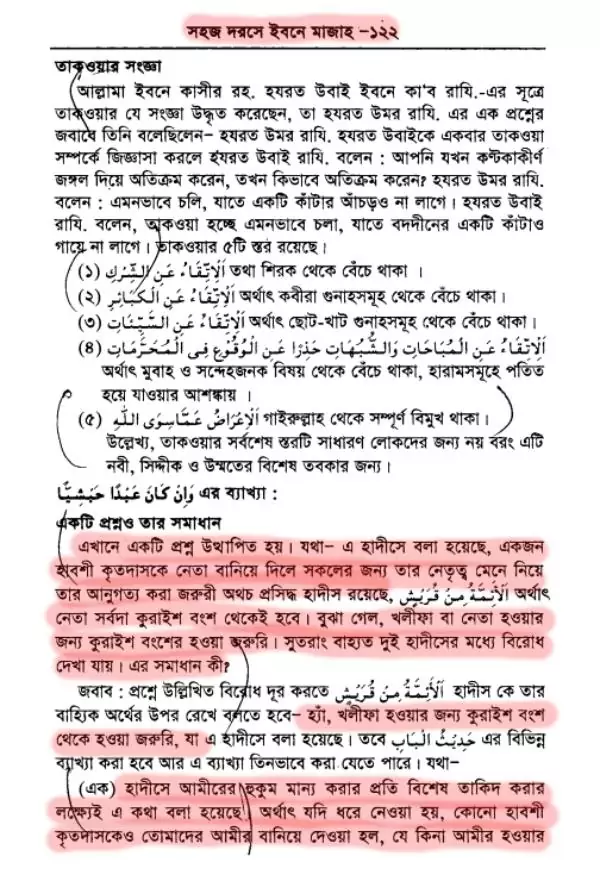
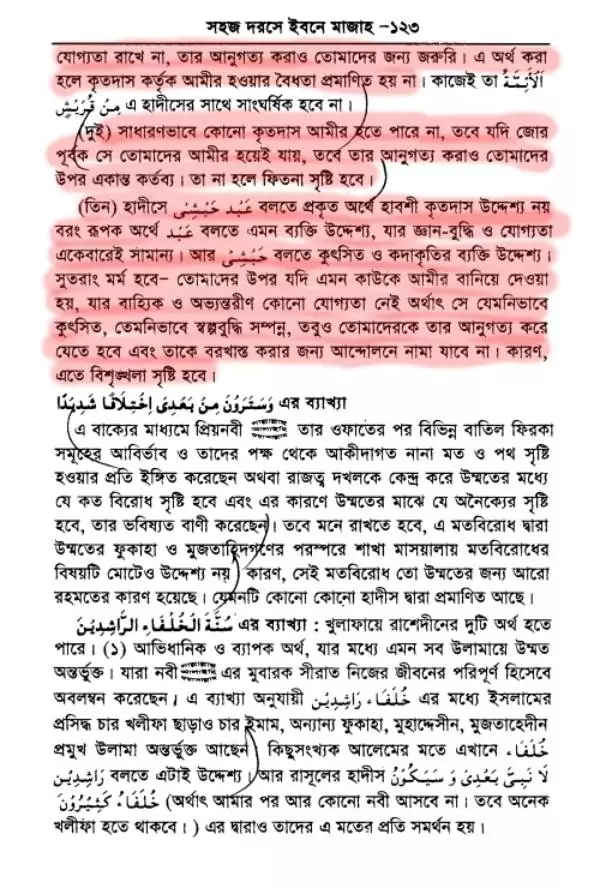
Notice the explanation in the commentary: its third interpretation says that “Abyssinian slave” is not meant as a literal reference to such a person but is a metaphor for somebody with almost no knowledge, intelligence, or qualifications, and for somebody physically ugly and misshapen. In this reading, the Abyssinian slave becomes a representation of incompetence, insignificance, and ugliness. Whether that usage honors black people or disparages them is left to the reader’s judgment.
Obedience to an Abyssinian Slave Versus Eligibility for Political Leadership
The hadith says that even if someone like an Abyssinian slave is put in authority over you, you must obey. Its immediate instruction concerns obedience to an existing ruler. The condition that the supreme caliph must belong to the Quraysh is a separate rule of political eligibility. Permission to serve as a subordinate administrator, military commander, or appointed amir is not the same as the right to compete for supreme leadership regardless of ancestry. Erasing that distinction turns an injunction to obey into a misleading declaration of equal political rights.
In his Jami‘ al-‘Ulum wa al-Hikam, Ibn Rajab al-Hanbali discussed the injunction to obey an Abyssinian slave alongside the hadiths reserving the caliphate for the Quraysh. He explained that a slave could exercise authority through appointment by a Quraysh imam; obedience to such an appointee therefore did not imply that the Quraysh ancestry requirement had been abolished. In other words, classical Islamic interpretation itself distinguished the qualifications of the supreme caliph from the position of a subordinate governor appointed by him. [22]
لِأَنَّ وِلَايَةَ الْعَبِيدِ قَدْ تَكُونُ مِنْ جِهَةِ إِمَامٍ قُرَشِيٍّ، وَيَشْهَدُ لِذَلِكَ مَا خَرَّجَهُ الْحَاكِمُ مِنْ حَدِيثِ عَلِيٍّ.
English translation: For the authority exercised by slaves may come through their appointment by a Quraysh imam. This is also supported by what al-Hakim transmitted from the hadith of Ali.
Ibn Uthaymin, a modern interpreter in the classical tradition, likewise distinguished between these kinds of authority. His remarks preserved by Islamweb differentiate the condition of selecting a caliph from the Quraysh and the obligation to obey an Abyssinian slave who has come to power by force. The mention of the Abyssinian slave therefore cannot serve as an unrestricted declaration of political equality. Birth-based qualifications for access to supreme authority remain intact. [23]
The question can now be put more directly: why were an individual’s complexion and enslaved status chosen as the most extreme examples in a command about obedience? The existing Bengali commentaries use the raisin-shaped head to evoke ugliness, incompetence, and low intelligence. That is not a word-for-word translation of every expression in the original hadith; it is the commentators’ own interpretation. But their language demonstrates that they perceived a meaning of low social status and contempt in the example. An injunction to obey despite the person’s social identity did not thereby abolish the underlying assumptions of subordination invoked by the image.
The Status of the Quraysh Lineage and Tribe
As explained in the definition of racism above, discriminatory birth-based hierarchies exist not only when one group is called inferior, but also when another is granted an exclusive right to govern because of ancestry rather than demonstrated ability, intelligence, merit, or leadership. The Nazis considered themselves the possessors of supposedly pure blood and the rightful rulers of other peoples. Traditional Hindu caste ideology likewise associated hereditary Kshatriya status with rulership, after the religious supremacy accorded to Brahmins. In Islam, the Quraysh are also described as a specially honored lineage with a claim to the caliphate. Many hadiths locate the political leadership of the Muslim community among the Quraysh. The question is not whether every individual member of the Quraysh was personally incompetent or whether every non-Quraysh individual was competent. It is that ancestry is used to exclude otherwise qualified candidates. A capable Bengali, for example, would be disqualified from the highest office if Quraysh descent were mandatory. If Sheikh Hasina inserted a provision into Bangladesh’s constitution saying that only members of the Sheikh family born in Gopalganj could become prime minister, it would be an indefensible hereditary restriction. The principle is no more defensible when the favored lineage is called Quraysh. Consider the following reports: [24] [25] [26] [27]
Sahih Muslim (Islamic Foundation edition)
Book 34: Government and Administration
Chapter 1: The people follow the Quraysh, and the caliphate belongs to the Quraysh
4550 Abdullah ibn Maslamah ibn Qa‘nab, Qutaybah ibn Sa‘id, Zuhayr ibn Harb, and Amr al-Naqid … narrated from Abu Hurayrah, who said: The Messenger of Allah said, “In this matter [of government], people follow the Quraysh: the Muslims among them follow the Muslims among the Quraysh, and the unbelievers among them follow the unbelievers among the Quraysh.”
Hadith classification: Sahih
Narrator: Abu Hurayrah
Sahih Muslim (Hadith Academy edition)
Book 34: Government and Leadership
Chapter 1: The people follow the Quraysh and the caliphate is restricted to the Quraysh
4597-(3/1819) Yahya ibn Habib al-Harithi … narrated from Jabir ibn Abdullah, who said: The Prophet said, “In matters both good and bad, the people follow the Quraysh.” (Islamic Foundation 4552; Islamic Centre 4555)
Hadith classification: Sahih
Narrator: Jabir ibn Abdullah al-Ansari
Sahih al-Bukhari (Islamic Foundation edition)
Book 82: Judgments
Chapter 3006: The ruler is to be from the Quraysh
6654 Abu al-Yaman … narrated from Muhammad ibn Jubayr ibn Mut‘im that he was present with a delegation of Quraysh before Mu‘awiyah. Mu‘awiyah received word that Abdullah ibn Amr had reported that a king from the tribe of Qahtan would arise in the near future. Hearing this, Mu‘awiyah became angry, stood up, and praised Allah. He then said: “Now then! I have heard that some of you are saying things that are neither in the Book of Allah nor narrated from the Messenger of Allah. Such people are the most ignorant among you. Beware of these invented claims that lead the speaker astray. I heard the Messenger of Allah say, ‘This matter [the caliphate] will remain among the Quraysh as long as they uphold the religion. Anyone who opposes them will be cast down face-first by Allah.’” Nu‘aym followed Shu‘ayb in narrating from Muhammad ibn Jubayr.
Hadith classification: Sahih
Narrator: Jubayr ibn Mut‘im
Sahih al-Bukhari (Islamic Foundation edition)
Book 82: Judgments
Chapter 3006: The ruler is to be from the Quraysh
6655 Ahmad ibn Yunus … narrated from Ibn Umar, who said: The Messenger of Allah said, “This matter [the caliphate] will remain with the Quraysh as long as even two of them are alive.”
Hadith classification: Sahih
Narrator: Abdullah ibn Umar
Besides the hadiths cited here concerning the Quraysh and the caliphate, another report is relevant to obedience to rulers in general. Sahih al-Bukhari 6658 instructs people to remain patient even when they witness conduct they dislike from the ruler in power. This narration does not itself name the Quraysh; their special political standing is established by the preceding reports specifically concerning that lineage and by classical legal rules governing the caliphate. [28]
Sahih al-Bukhari (Islamic Foundation edition)
Book 82: Judgments
Chapter 3008: Obedience to the imam unless ordered to disobey God
6658 Sulayman ibn Harb … narrated from Ibn Abbas, who said: The Prophet said, “Whoever sees something from his ruler that he dislikes should remain patient. Whoever separates from the community by even a handspan and dies in that state dies a death of the Age of Ignorance.”
Hadith classification: Sahih
Narrator: Abdullah ibn Abbas
Racism does not consist only in describing a lineage, tribe, or people as inferior. Declaring any group superior to another by inherited identity also constitutes a discriminatory hierarchy. Numerous hadiths praise Muhammad’s ancestry and confer a particularly high status upon his lineage. Consider the following reports: [29] [30]
Sunan al-Tirmidhi (critical edition)
Book 46: Virtues of the Messenger and His Companions
Chapter 66: The merits of the Ansar and the Quraysh
3905 Muhammad ibn Sa‘d narrated from his father that the Messenger of Allah said, “Whoever wishes to disgrace the Quraysh, Allah will disgrace him.”
Sahih: al-Sahihah (1178).
Abu Isa stated that this report is gharib through this chain. Abd ibn Humayd narrated through Ya‘qub ibn Ibrahim ibn Sa‘d, from his father, from Salih ibn Kaysan, from Ibn Shihab, with a similar chain.
Hadith classification: Sahih
Sahih Muslim (Hadith Academy edition)
Book 44: Virtues
Chapter 1: The merit of the Prophet’s lineage, and the incident of a stone greeting him before prophethood
5832-(1/2276) Muhammad ibn Mihran al-Razi and Muhammad ibn Abd al-Rahman ibn Sahm … narrated from Abu Ammar Shaddad, who heard Wathilah ibn al-Asqa‘ report that the Messenger of Allah said: “Allah chose Kinanah from among the children of Ishmael, chose the Quraysh from Kinanah, chose Banu Hashim from the Quraysh, and chose me from Banu Hashim.” (Islamic Foundation 5739; Islamic Centre 5770)
Hadith classification: Sahih
Another report assigns kingship to the Quraysh, judgment to the Ansar, the call to prayer to the Abyssinians, and trustworthiness to the people of Yemen. This illustrates the allocation of distinct social roles to different communities. Al-Tirmidhi records a version attributed to Muhammad, but the same statement also appears as the personal statement of Abu Hurayrah, and al-Tirmidhi judged that Companion-level version more reliable. This particular report therefore need not be treated unconditionally as Muhammad’s own direct words. It nevertheless reveals notions of tribal honor and the distribution of social functions in early Muslim society. Suppose a Bengali person is more qualified to govern. Excluding that person from supreme leadership merely for being born outside the Quraysh is still a restriction of political rights by birth. [31]
Sunan al-Tirmidhi (critical edition)
Book 46: Virtues of the Messenger and His Companions
Chapter 72: The Virtues of Yemen
3936 Abu Hurayrah narrated: The Messenger of Allah said, “Kingship is among the Quraysh, judgment among the Ansar, the call to prayer (in a melodious voice) among the Abyssinians, and trustworthiness among the Azd, that is, the people of Yemen.”
Sahih: al-Sahihah (1083).
Muhammad ibn Bashshar also narrated it from Abd al-Rahman ibn Mahdi, from Mu‘awiyah ibn Salih, from Abu Maryam al-Ansari, from Abu Hurayrah, with the same content, but not raised to the Prophet (not marfu‘). This version is much more reliable than the narration of Zayd ibn Hubab.
Hadith classification: Sahih
Narrator: Abu Hurayrah
The Quraysh Lineage as a Condition of State Leadership: Al-Mawardi’s Jurisprudence
The Quraysh’s special political rights did not remain confined to a few hadiths. In his Al-Ahkam al-Sultaniyyah, Abu al-Hasan al-Mawardi listed seven qualifications for the supreme imam or caliph. In addition to legal judgment, knowledge, physical ability, administrative competence, and courage, he explicitly made Quraysh ancestry the seventh condition. Ancestry is not a personal achievement; it is inherited from one’s forebears. Classical Islamic jurisprudence thus made an unchosen identity at birth a condition of access to the highest political office. [32]
وَالسَّابِعُ: النَّسَبُ، وَهُوَ أَنْ يَكُونَ مِنْ قُرَيْشٍ، لِوُرُودِ النَّصِّ فِيهِ وَانْعِقَادِ الْإِجْمَاعِ عَلَيْهِ.
English translation: The seventh condition is lineage: he must be from the Quraysh, because an explicit religious text has been transmitted on this matter and consensus has been established upon it.
Al-Mawardi also referred to the events at the Saqifah in the same discussion. According to his account, Abu Bakr invoked the statement “the leaders are from the Quraysh” against the Ansar’s claim to the caliphate. In that dispute, birth identity was not merely a matter of social prestige; it became the basis on which the controversy over possession of state power was settled. Quraysh ancestry was given priority when the Ansar’s competing claim was rejected. The event illustrates the conversion of lineage into a political argument.
The Fundamental Conflict Between Hereditary Status and Individual Merit
Being born into the Quraysh does not confer leadership skills, just as being born outside the Quraysh does not destroy them. Adding an ancestry requirement to a list of qualifications that includes knowledge and justice can exclude a capable non-Arab or a non-Quraysh Arab from the highest office. The reason for that person’s exclusion is neither misconduct nor incompetence, but birth. This is hereditary political privilege. Qur’an 49:13 presents tribes as a way for people to know one another; in this legal framework, tribal identity instead becomes a mandatory condition of political eligibility.
City Dwellers and Rural People
Islamic hadith literature also contains unequal rules concerning testimony by Bedouin nomads and residents of settled towns. A report in Abu Dawud says that the testimony of a Bedouin or desert dweller against a townsperson or resident of a settled community is not admissible. Rather than examining only the honesty of the two individuals or their capacity to witness the event, the rule links admissibility of evidence to residence and social identity. There is a serious problem of justice in treating someone’s way of life as an obstacle to giving testimony even when the nomad is honest and witnessed the events directly. [33] [34]
Sunan Abu Dawud (Islamic Foundation edition)
Book 18: Judgments
Chapter 401: Testimony of rural people against townspeople
3563 Ahmad ibn Sa‘id … narrated from Abu Hurayrah that he heard the Messenger of Allah state that testimony given by a Bedouin against a townsperson is not permissible.
Hadith classification: Sahih
Narrator: Abu Hurayrah
Residence as a Criterion for Accepting Testimony: Maliki and Shafi‘i Interpretations
Classical jurists disagreed over the legal application of this hadith. In Al-Hawi al-Kabir, al-Mawardi reported that Malik generally did not accept the testimony of a Bedouin against a resident of a settled community, although he made exceptions in cases of injury. In contrast, al-Shafi‘i and al-Mawardi held that the Bedouin’s and townsperson’s testimony were equally admissible where the witness’s integrity had been established. Thus the idea of disqualifying a witness by residence did acquire legal force in some juristic positions; it would be incorrect to represent it as the rule of every school. [35]
قَالَ الْمَاوَرْدِيُّ: إِذَا كَانَ الْبَدَوِيُّ عَدْلًا قُبِلَتْ شَهَادَتُهُ عَلَى الْقَرَوِيِّ، كَمَا تُقْبَلُ شَهَادَةُ الْقَرَوِيِّ عَلَى الْبَدَوِيِّ.
English translation: Al-Mawardi said: If a Bedouin is a person of integrity, his testimony against a resident of a settlement is accepted, just as the testimony of a resident of a settlement against a Bedouin is accepted.
This raises a problem of social hierarchy comparable to discrimination based on ancestry. The right to testify should depend on an individual’s firsthand knowledge, honesty, and the reliability of the evidence. Living in the desert does not deprive someone of the ability to tell the truth. If the hadith becomes a legal rule, a witness’s social identity can count against them before the truth of their testimony is even examined.
Regional and Tribal Prejudice
Famine is a terrible calamity. As a civilized human being, I cannot wish it even upon my worst enemy. When famine strikes a region, children die in large numbers, as do women, elderly people, and people with disabilities. Even if somebody is a known criminal, I would never wish for them to starve slowly to death. If my bitterest enemy came to me asking for food during a famine, I would give them food if I had any. I would not decide whether to help according to their religion; I would not care what they believed. Wishing famine upon their entire region, let alone calling down such a curse, would be unthinkable. Consider the two hadiths below, in which Muhammad invokes a curse upon the tribe of Mudar, asking that famine strike them. For the sake of argument, suppose one or more members of Mudar committed serious wrongs. How could the deeds of those individuals justify calling down famine upon an entire tribe, including women, children, elderly people, and people with disabilities, so that they all suffer for want of food and slowly starve? I do not understand how a person of sound mind could regard that as justified. [36] [37]
Sahih al-Bukhari (Islamic Foundation edition)
Book 15: Prayers for Rain
Chapter 636: The Prophet’s supplication that they suffer years of famine like the years of Joseph
952 Qutaybah ibn Sa‘id … narrated from Abu Hurayrah that when the Prophet raised his head from the last rak‘ah, he said: “O Allah! Deliver Ayyash ibn Abi Rabi‘ah. O Allah! Deliver Salamah ibn Hisham. O Allah! Protect al-Walid ibn al-Walid. O Allah! Deliver the weak believers. O Allah! Intensify Your punishment upon the tribe of Mudar. O Allah! Send upon them years of famine like the years of famine in the time of Joseph.” The Prophet also said: “As for Ghifar, may Allah forgive them; and as for Aslam, may Allah keep them safe.” Ibn Abi al-Zinad narrated from his father that all these supplications were made during the dawn prayer.
Hadith classification: Sahih
Narrator: Abu Hurayrah
Sahih al-Bukhari (Islamic Foundation edition)
Book 15: Prayers for Rain
Chapter 636: The Prophet’s supplication that they suffer years of famine like the years of Joseph
953 Al-Humaydi and Uthman ibn Abi Shaybah … narrated from Abdullah, who said: When the Prophet saw that the people were turning away from Islam, he prayed: “O Allah! Send upon them seven years of famine like the seven years in the time of Joseph.” A famine then afflicted them so severely that it destroyed everything. People even began to eat hides, carrion, and decaying animals. Hunger became so extreme that when a person looked toward the sky they would see what appeared to be smoke. In that condition Abu Sufyan, before embracing Islam, came to the Prophet and said: “Muhammad! You command people to obey Allah and maintain family ties, but your people are dying. Pray to Allah on their behalf.” Regarding this, Allah said:
فَارْتَقِبْ يَوْمَ تَأْتِي السَّمَاءُ بِدُخَانٍ مُبِينٍ إِلَى قَوْلِهِ عَائِدُونَ * يَوْمَ نَبْطِشُ الْبَطْشَةَ الْكُبْرَى
“Wait for the day when the sky will be covered by clear smoke … the day when We seize with the mighty seizure” (44:10–16). Abdullah said that the day of the great blow was the day of the Battle of Badr. The smoke had appeared, and so had the blow; the prophecy of the death and capture of Meccan polytheists had come true. So had the verse of Surah al-Rum predicting that the Romans would defeat the Persians again within ten years.
Hadith classification: Sahih
Narrator: Abdullah ibn Mas‘ud
There are also accounts of collective prayers for blessings upon certain regions or tribes, while other regions are associated with disasters. The people of any region do not all possess the same character, competence, or moral qualities. Being born into a particular region does not make someone’s individual conduct or fate identical to everyone else’s there. Wishing a community well is not itself wrong. But identifying a region as specially honored or ominous on religious grounds can encourage stereotypes about its people. The following report in al-Tirmidhi contains prayers for blessings upon Syria and Yemen alongside a warning of calamities associated with Najd. [38]
Sunan al-Tirmidhi (critical edition)
Book 46: Virtues of the Messenger and His Companions
Chapter 75: The Virtues of Syria and Yemen
3953 Ibn Umar narrated that the Messenger of Allah said, “O Allah! Bless our region of Syria. O Allah! Bless our Yemen.” The people said, “And our Najd?” He repeated, “O Allah! Bless our Syria and bless our Yemen.” They again asked, “And our Najd?” He replied, “There are earthquakes, disturbances, or calamities there,” or he said, “From there the horn of Satan will appear.”
Sahih: Takhrij Fada’il al-Sham (8), al-Sahihah (2246).
Abu Isa stated that through this chain the report is hasan sahih, and gharib in relation to Ibn Awn’s narration. It has also been transmitted from Salim ibn Abdullah ibn Umar, from his father, from the Prophet.
Hadith classification: Sahih
Narrator: Abdullah ibn Umar
Collective Punishment and the Responsibility of the Innocent
The principal moral issue in the prayer for famine upon Mudar is the imposition of collective responsibility. Even if some members of the tribe opposed Muhammad or participated in a conflict, it cannot follow that every child, elderly person, and unarmed member committed the same acts. A famine does not strike an isolated offender; it threatens an entire population dependent on food, water, health, and the means of survival. The second report in al-Bukhari describes people being reduced to eating carrion and decomposing animals. Treating the invocation merely as stern language against opponents conceals the actual human consequences of famine.
The report concerning Syria, Yemen, and Najd illustrates a different issue. Rather than judging particular acts, it links one region to a blessing and another to predictions of catastrophe. Dishonest individuals may live in the first region and virtuous people in the second; a person’s birthplace does not determine their character. A prayer for blessings is not equivalent to imposing punishment, but attaching religious authority to regional classifications of good and ill fortune has social consequences.
Black, Yet Beautiful?
From childhood onward, we grow up listening to fairy tales and stories told by our grandmothers. They profoundly influence the formation of our attitudes. Many of us do not even realize that racist assumptions are being taught to us from an early age. I remember a story about a dark-skinned queen who was terribly unhappy with her appearance. One day she received a magical blessing: if she immersed herself in a particular pond, her skin would become fair. She dived into the water and immediately became fair-skinned. The queen had a co-wife who was already fair. On learning what happened, the co-wife went to the pond and dived in again and again, wanting to become even fairer. Instead, after repeatedly immersing herself, her complexion turned dark. The story was meant to teach us not to be excessively greedy. But it simultaneously taught us that fairness was beauty—that fair meant beautiful and dark meant ugly. That was an appalling racist assumption.
As I grew older, I saw much the same message in television commercials, newspapers, and other media. A dark-skinned girl attends a job interview and is rejected. She buys Fair & Lovely, applies it, and becomes fair-skinned within two weeks. Then she gets the job. Everyone who sees her wants to fall in love with her. What an astonishing transformation! These advertisements subtly implant the notion that dark skin is ugly and fairness is beautiful. Look closely at literature, art, songs, and films and you will often find the villain or evil character portrayed with dark skin while the good character is fair. Black cats have long been treated as bad omens in our society. When we imagine witches, female spirits, or ogresses, we are often conditioned to picture a dark-skinned figure. We assume it without even thinking. By contrast, imagining an angel, divine messenger, or god may bring to mind a glowing, fair-skinned figure in white clothing, sometimes with a white beard. Such ideas are planted in our minds so early that escaping these racist patterns of thought can be extraordinarily difficult.
Some time ago, Bangladesh’s leading newspaper Prothom Alo published a feature titled “Black, Yet Beautiful.” Notice how the word “yet” expresses a deeply prejudiced assumption about people with dark complexions. We understand perfectly well how words such as “although,” “yet,” “nevertheless,” and “even” function. The headline meant: she is black, and yet she is beautiful! As if dark-skinned people are ordinarily ugly, but these particular women manage to be attractive despite their complexion. The feature received widespread criticism for its offensive, degrading premise, and the newspaper subsequently changed the headline. See the BBC’s coverage of the controversy: [39]

Research has also produced evidence of how children can absorb negative assumptions about dark skin without knowing anything else about the people concerned. Consider the video below, which shows an experiment involving children. Even some dark-skinned children identified the darker dolls as ugly or bad. A central explanation is that children learn such associations from the social world around them ( Clark Doll Experiments ).
From Childhood Prejudices to Social Discrimination
Fairy tales, advertising, and newspaper headlines all illustrate the same psychological process. A particular physical characteristic is first made a symbol of beauty or inferiority. The association is then repeated until it begins to seem like a natural fact. Even someone who consciously opposes racism may unknowingly prioritize complexion when judging beauty, eligibility for marriage, or competence. The phrase “black, yet beautiful” casts beauty in a dark-skinned person as unexpected, as though dark complexion were normally the opposite of attractiveness. Such seemingly small choices of language reproduce broader social assumptions.
In different versions of the doll experiments conducted by Kenneth and Mamie Clark, researchers studied children’s preferences and judgments according to the dolls’ colors. The experiments provide important evidence of color-related prejudice in particular periods and social environments; they do not prove an inborn psychological trait shared by every child in the world. Their significance is that children can internalize standards of beauty and status learned from society. Religious metaphors, folk stories, and ordinary social language can all form part of that wider cultural education.
Muhammad’s Skin Color
A question that may arise is what Muhammad himself looked like. What was the color of his skin? Consider the following hadiths: [40] [41]
Sahih Muslim (Islamic Foundation edition)
Book 45: Virtues
Chapter 28: The Prophet possessed an attractive, fair complexion with a reddish tint
5862 Sa‘id ibn Mansur … narrated from Abu al-Tufayl. Al-Jurayri said, “I asked him, ‘Did you see the Messenger of Allah?’” He replied, “Yes. He was fair-complexioned and had an attractive face.” Muslim ibn al-Hajjaj stated that Abu al-Tufayl died in the year 100 AH; he was the last of the Prophet’s Companions to die.
Hadith classification: Sahih
Narrator: Abu al-Tufayl
Sahih Muslim (Islamic Foundation edition)
Book 45: Virtues
Chapter 28: The Prophet’s attractive, fair complexion with a reddish tint
5863 Ubaydullah ibn Umar al-Qawariri … narrated from Abu al-Tufayl that he said, “I saw the Messenger of Allah. Nobody remains alive today except me who has seen him.” The narrator asked, “What did he look like?” He replied, “He was fair, handsome, and of medium stature.”
Hadith classification: Sahih
Narrator: Abu al-Tufayl
These reports do not directly declare people of other complexions inferior. They combine physical descriptions of Muhammad with adjectives conveying beauty and attractiveness. Being personally fair-skinned, or describing someone’s complexion as fair, is not in itself racism. But the physical features repeatedly associated with the beauty of a revered religious figure can be compared with wider social ideals of attractiveness. Instead of treating this observation alone as proof of racism, it should be considered alongside the following reports connecting blackness and whiteness with sin, evil, punishment, and paradise.
Is the Color of Sin Black?
Several reports attributed to Muhammad use blackness as the result of sin and whiteness as the symbol of a condition free from sin. Regarding the Black Stone, or Hajar al-Aswad, it is said that when the stone descended from Paradise it was whiter than milk; human sins subsequently turned it black. The color change itself marks a change in moral status. The picture of a white stone made black by sin constructs a symbolic opposition between whiteness and blackness, virtue and wrongdoing. [42]
Sunan al-Tirmidhi (Islamic Foundation edition)
Book 9: Hajj
Chapter: The Virtues of the Black Stone, the Corner, and the Station of Abraham
878 Qutaybah … narrated from Ibn Abbas, who said: The Messenger of Allah said, “When the Black Stone descended from Paradise, it was whiter than milk. The sins of human beings have turned it black.”
References: Mishkat 2577; Ta‘liq al-Raghib 2/123; al-Hajj al-Kabir; Tirmidhi 877 (al-Madani edition).
Reports on this subject also exist from Abdullah ibn Amr and Abu Hurayrah. Abu Isa described the report of Ibn Abbas as hasan sahih.
Hadith classification: Sahih
Narrator: Abdullah ibn Abbas
Several other hadiths similarly associate sin with blackness and virtue or purity with whiteness: [43] [44] [45].
Sunan Ibn Majah
Book 31: Abstinence from Worldly Pleasures
Chapter 31/29: Remembering Sin
3/4244 Abu Hurayrah narrated that the Messenger of Allah said: “When a believer commits a sin, a black spot appears on the heart.” If the person repents, abandons the sin, and asks forgiveness, the heart is purified. “If they commit further sins, the black spot grows.” This is the rust mentioned by Allah in His Book: “No! Rather, what they have earned has covered their hearts with rust” (Surah al-Mutaffifin 83:14).
References: al-Tirmidhi 3334; Ahmad 7892; al-Ta‘liq al-Raghib 2/268, 4/74. Al-Albani’s classification: Hasan.
Hadith classification: Hasan
Sunan al-Tirmidhi (Islamic Foundation edition)
Book 50: Qur’anic Exegesis
Chapter: Surah al-Mutaffifin
3334 Qutaybah … narrated from Abu Hurayrah that the Messenger of Allah said, “When a servant commits a sin, a black spot appears on their heart. If they desist, ask forgiveness, and repent, their heart becomes bright again. But if they repeat the sin, the black spot increases,” until it covers the heart. Allah describes this state as ran (rust): (كلاَّ بَلْ رَانَ عَلَى قُلُوبِهِمْ مَا كَانُوا يَكْسِبُونَ) — “No! Rather, the deeds they used to perform have covered their hearts with rust” (83:14).
Hasan; al-Ta‘liq al-Raghib 2/268; Tirmidhi 3334 (al-Madani edition).
Abu Isa described the report as hasan sahih.
Hadith classification: Hasan
Narrator: Abu Hurayrah
Sahih Muslim (Islamic Foundation edition)
Book 1: Faith
Chapter 63: The Removal of Faith and Trustworthiness from Some Hearts and the Emergence of Tribulations in Hearts
267 Muhammad ibn Abdullah ibn Numayr … narrated from Hudhayfah, who said: One day we were sitting with Umar. He asked, “Who among you has heard the Messenger of Allah speak about tribulations (fitan)?” A group present said they had heard him. Umar replied, “Perhaps you are thinking of trials involving a person’s family and neighbors.” They answered, “Yes.” He said that prayers, fasting, and charity atone for those. But Umar explained that he meant the great tribulations the Messenger had spoken of, which would come like the waves of the sea.
Hudhayfah said everyone fell silent. He answered, “I have heard.” Umar said, “You have heard? May Allah bless you.” Hudhayfah continued: I heard the Messenger of Allah say: “Tribulations are presented to human hearts one after another, like the strands of a woven mat. Every heart that absorbs them receives a black mark, and every heart that rejects them receives a white mark. Thus hearts become of two kinds: one white like a stone, which no tribulation can harm as long as the heavens and the earth endure; the other blackened, like an overturned vessel, recognizing neither good nor evil except what its desires have impressed upon it.”
Hudhayfah said: I further told Umar that a closed door stood between him and those tribulations, and that it would soon be broken. Umar exclaimed, “Will it really be broken? If it were opened rather than broken, perhaps it could be closed again.” Hudhayfah replied, “No, it will be broken.” He told Umar that this door represented a man who would be killed or would die naturally. He stressed that this was not merely a story but a report from the Messenger of Allah. The narrator Abu Khalid said: I asked Sa‘d what أَسْوَدُ مُرْبَادًّا meant. He replied, “A blackish color mixed with whitishness.” I asked what الْكُوزُ مُجَخِّيًا meant. He answered, “An overturned vessel.”
Hadith classification: Sahih
Narrator: Hudhayfah
Blackened and Whitened Faces on Judgment Day: The Qur’an’s Explicit Language
This symbolism is not confined to hadith. Verses 106 and 107 of Surah Al Imran describe how, on Judgment Day, some faces will turn black while others turn white. Blackened faces are linked with punishment, and whitened faces with Allah’s mercy. The contrast between colors as signs of moral condemnation and reward is present in the wording of the verses themselves. [46]
يَوْمَ تَبْيَضُّ وُجُوهٌ وَتَسْوَدُّ وُجُوهٌ ۚ فَأَمَّا الَّذِينَ اسْوَدَّتْ وُجُوهُهُمْ أَكَفَرْتُمْ بَعْدَ إِيمَانِكُمْ فَذُوقُوا الْعَذَابَ بِمَا كُنْتُمْ تَكْفُرُونَ
English translation: On the Day when some faces turn white and other faces turn black, those whose faces have blackened will be told, “Did you disbelieve after having believed? Then taste the punishment for your disbelief.”
The next verse continues by describing those with whitened faces as recipients of lasting divine mercy. [47]
وَأَمَّا الَّذِينَ ابْيَضَّتْ وُجُوهُهُمْ فَفِي رَحْمَةِ اللَّهِ هُمْ فِيهَا خَالِدُونَ
English translation: As for those whose faces have turned white, they will be in Allah’s mercy, where they will remain forever.
Surah al-Zumar 39:60 states that the faces of those who lied about Allah will be blackened. Here again, blackened faces serve as an image of punishment and moral condemnation. [48]
وَيَوْمَ الْقِيَامَةِ تَرَى الَّذِينَ كَذَبُوا عَلَى اللَّهِ وُجُوهُهُمْ مُسْوَدَّةٌ أَلَيْسَ فِي جَهَنَّمَ مَثْوًى لِلْمُتَكَبِّرِينَ
English translation: On the Day of Resurrection, you will see those who lied about Allah with their faces blackened. Is there not in Hell an abode for the arrogant?
These Qur’anic verses do not present natural, inborn dark skin as proof that someone is a criminal; they describe the faces of the condemned turning black. Symbolic language, however, has social meanings of its own. When a culture uses blackness to portray impurity, sin, and punishment, those associations may help create or strengthen negative values attached to that color. Direct evidence of racial discrimination against people and evidence of negative cultural symbolism involving colors are related but distinct forms of evidence.
Blackness as an Image of Epidemic and Evil
Muhammad described a dream of a disheveled, dark-skinned woman. The woman represented an epidemic. Thus, to portray a dangerous and ominous force, his dream employed the appearance of a black woman, and the dream was interpreted as the movement of an epidemic. This raises the question of why this particular image was selected to embody an evil associated with disease. [49] [50]
Sunan al-Tirmidhi (critical edition)
Book 32: Dreams and Their Meanings
Chapter 10: The Prophet’s Dream of the Balance and the Bucket
2290 Abdullah ibn Umar narrated concerning the Prophet’s dream: “I saw a black woman with disheveled hair leaving Medina and standing at Mahya‘ah.” Mahya‘ah is al-Juhfah. He then said: “I interpreted it to mean that the epidemic of Medina had moved to al-Juhfah.”
Sahih: Ibn Majah 3924; al-Bukhari.
Abu Isa stated that the report is sahih gharib.
Hadith classification: Sahih
Narrator: Abdullah ibn Umar
Sahih al-Bukhari (Tawhid Publications edition)
Book 91: Interpretation of Dreams
Chapter 91/42: Seeing a black woman in a dream
7039 Abdullah ibn Umar narrated a report about the Prophet’s dream concerning Medina. The Prophet said: “I saw a black woman with disheveled hair leaving Medina.” She stopped at a place called Mahya‘ah. “I interpreted that as meaning that the epidemic of Medina had moved to Mahya‘ah, also called al-Juhfah.” (7038; Modern Publications 6549; Islamic Foundation 6562)
Hadith classification: Sahih
Narrator: Abdullah ibn Umar
Both hadiths describe the same dream; they should not be counted as evidence of two independent events. A disheveled black woman is interpreted in the narration as a symbol of an epidemic moving elsewhere. Nothing in the report establishes that an actual black woman spread the disease. The significant point is the image chosen to represent a terrifying and deadly danger. The report raises the question of how blackness and the frightening image of a woman may become associated with evil in a society’s imagination.
The Black Dog Is Satan
Muhammad reportedly said that the black dog is a devil [51] [52], and also instructed that such dogs be killed [53]. Human history contains countless examples of black dogs saving people’s lives. I have personally witnessed several such incidents. If those dogs are devils, why have they saved so many human lives? Why should every black dog be deemed satanic, ominous, evil, or deserving of death merely for its color? I leave the implications to the reader. [54]
Sahih Muslim (Islamic Foundation edition)
Book 4: Prayer
Chapter 50: The Size of the Sutrah in Front of a Person Praying
1020 Abu Bakr ibn Abi Shaybah and Zuhayr ibn Harb … narrated from Abu Dharr that the Messenger of Allah said: “When one of you stands for prayer, let him place something before him as high as the rear of a riding saddle. If he has nothing of that kind, his prayer is interrupted if a donkey, a woman, or a black dog passes in front of him.”
The narrator Ibn al-Samit said: I asked Abu Dharr, “What distinguishes the black dog from the red or yellow dog?” He replied, “My nephew, I asked the Messenger of Allah the same question that you have asked me.” He said, “The black dog is a devil.”
Hadith classification: Sahih
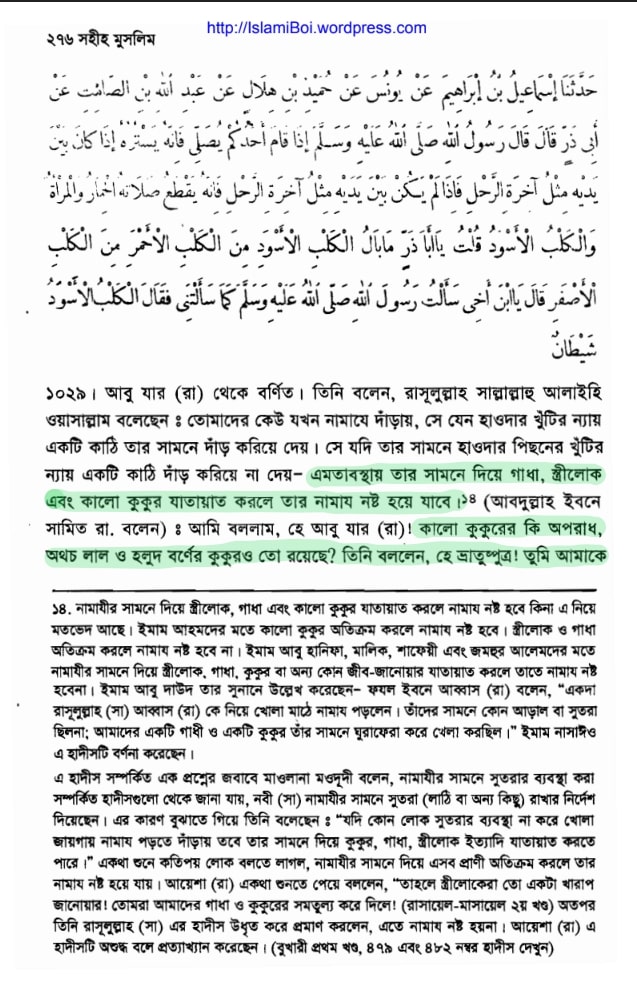
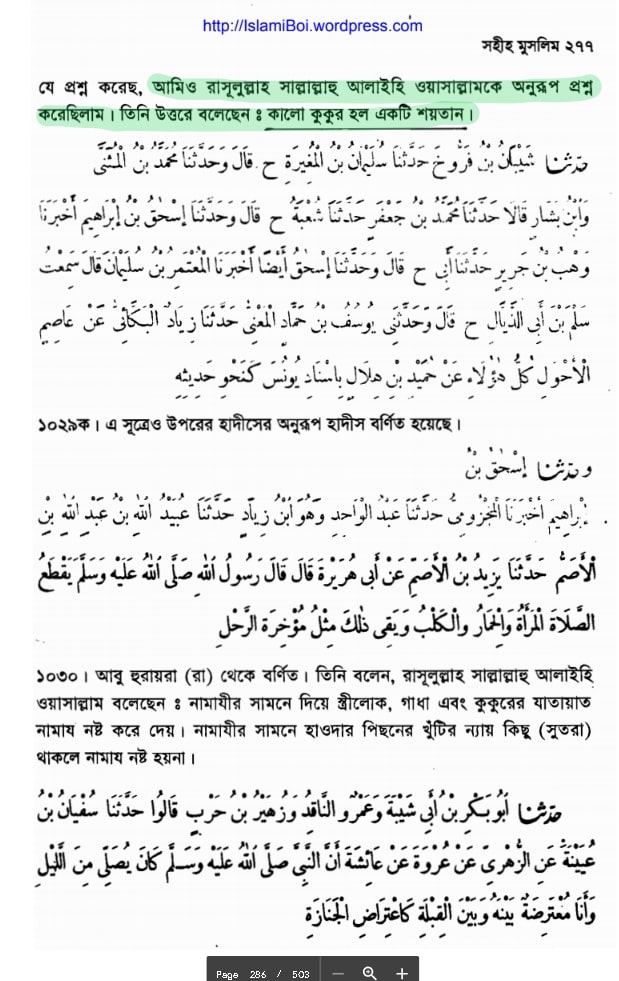
Sunan Abu Dawud (Islamic Foundation edition)
Book 11: Hunting
Chapter 99: Keeping Dogs for Hunting or Other Purposes
2836 Musaddad … narrated from Abdullah ibn Mughaffal, who said: The Messenger of Allah stated, “Were dogs not one community among the communities created by Allah, I would have commanded that they be killed. Now kill only the black dogs among them.”
Hadith classification: Sahih
The effect of this account is not limited to metaphor. The hadith in Abu Dawud also instructs people to kill dogs of a particular color. In other words, instead of judging the animal’s behavior—whether it has attacked someone, transmitted disease, or harmed human beings—its outward color becomes the criterion for treatment as final as death. Calling a black dog a devil is not a racial law directed against human beings, but it is a concrete example of a religious tendency to associate the same color with ominous identity. An animal’s coat color is not scientific evidence of its morality or dangerousness. Additional references and analysis concerning the killing of black dogs appear in the article [54].
Will Skin Color Be Fair in Paradise?
Descriptions of paradise give special emphasis to whiteness and brightness. The following hadiths in al-Bukhari compare the faces of those entering paradise with the full moon and luminous stars. Brightness of the face is not identical to natural skin complexion, so these two hadiths alone do not establish that every inhabitant of paradise will become fair-skinned. A subsequent account, however, explicitly describes people becoming blackened by Hellfire and turning white after bathing in the waters of paradise. Another account preserved in Ibn Kathir’s tafsir speaks of a black person being given a white color in paradise. These texts offer a more specific basis for examining how whiteness is associated with religious reward. [55] [56]
Sahih al-Bukhari (Islamic Foundation edition)
Book 50: The Prophets
Chapter 2000: The Creation of Adam and His Children
3092 Qutaybah ibn Sa‘id … narrated from Abu Hurayrah that the Messenger of Allah said: “The faces of the first group to enter paradise will shine like the moon on the night when it is full. Those entering after them will have faces like the brightest stars in the sky.” They will neither urinate nor defecate. They will have no need to spit, and no mucus will come from their noses. Their combs will be of gold. Their sweat will smell like musk. Their incense burners will be made of fragrant sandalwood. Their wives will be wide-eyed houris. All will have the same bodily form, resembling their forefather Adam, and each will be sixty cubits tall.
Hadith classification: Sahih
Narrator: Abu Hurayrah
Sahih al-Bukhari (Tawhid Publications edition)
Book 59: Beginning of Creation
Chapter 59/8: Reports Concerning Paradise and That It Has Already Been Created
3254 Abu Hurayrah narrated that the Prophet said: “The faces of the first group to enter paradise will shine like the moon on the night of the full moon; the faces of those who follow will be still more beautiful and luminous, like the brightest stars in the sky.” Their hearts will be like one heart; there will be neither hatred nor jealousy between them. Each will have two wives with large eyes, whose leg bones and marrow will be visible through their flesh. (Modern Publications 3013; Islamic Foundation 3023)
Hadith classification: Sahih
Narrator: Abu Hurayrah
The next hadith says that some sinners become blackened in Hell and later turn white when admitted to paradise. [57]
Sahih Muslim (Islamic Foundation edition)
Book 1: Faith
Chapter 80: The Lowest-Ranking Inhabitants of Paradise
369 Hajjaj ibn al-Sha‘ir … narrated from Yazid al-Faqir, who said: I was strongly attracted to one of the views of the Kharijites. Once we set out in a group, intending to perform the Hajj and then meet people. While passing through Medina, we saw Jabir ibn Abdullah sitting beside a pillar, narrating hadiths of the Messenger of Allah. As we listened further, he began discussing people who had entered Hell. I said, “Companion of the Messenger! What are you saying? Allah has declared, ‘Whoever You admit to the Fire, You have surely disgraced him’ (3:112), and He has said, ‘Whenever they try to leave Hell, they will be returned to it’ (32:25).”
Jabir asked, “Do you recite the Qur’an?” I said, “Yes.” He replied, “Then have you not heard about the honored station of Muhammad mentioned in the Qur’an, the station upon which Allah will seat him on the Day of Resurrection?” I said, “Yes.” Jabir explained that this was the Maqam Mahmud, through which Allah would bring out of Hell those whom He wished to remove. The narrator then described Jabir’s account of the Bridge (Sirat) being erected and people crossing over it.
The narrator further said: I fear that I did not retain the full discussion. But he definitely mentioned that certain people would be taken out after spending some time in Hell. “The fire of Hell will have burned them until they become black like a sun-scorched sesame plant. Then they will be taken out and bathe in a river of paradise. They will rise from that river white and bright as paper.” Yazid said: We returned to our region with this report and told everyone, “Woe to you! Do you think this old man, Jabir, could falsely attribute something to the Messenger of Allah?” Eventually all of us abandoned that mistaken belief. By Allah, only one among us failed to abandon it, or words to that effect, as related by Abu Nu‘aym.
Hadith classification: Sahih
Narrator: Yazid al-Faqir
Tafsir Ibn Kathir contains another reported tradition in which a black person is promised a fair complexion in paradise. [58]
… “… has been given superiority over us. Now tell me: if I believe in the One in whom you believe, and practice what you practice, may I be with you in paradise?” The Messenger of Allah replied: “By Him in whose hand is my soul! In paradise a black person will be given such whiteness that it will be visible from the distance of a thousand years’ journey!” Then the Messenger of Allah
said: “Whoever says ‘There is no god but Allah’ receives Allah’s covenant or promise; and whoever says ‘Glory and praise be to Allah’ has one hundred and twenty-four thousand good deeds recorded for them.” The man then said: “Messenger of Allah! How, after this, can we be destroyed?” The Messenger of Allah …
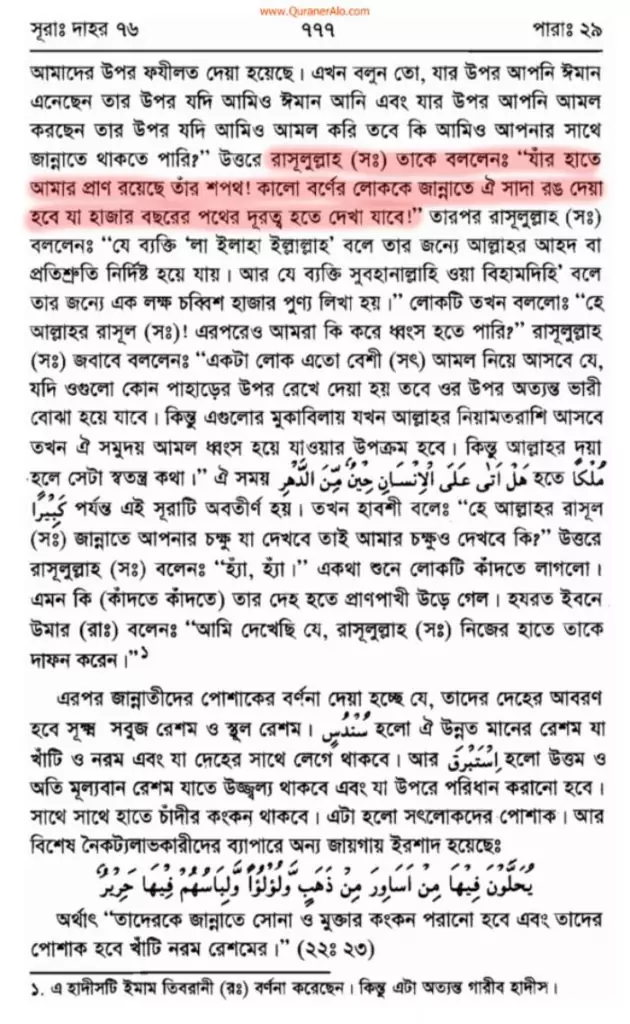
The description of people emerging from Hell, blackened by fire and then turning white through bathing, connects physical transformation with release from punishment for sin. In that account the blackening is principally a result of burning, while the subsequent whiteness represents purification. The account of a black person quoted in Ibn Kathir’s tafsir addresses natural skin complexion more directly. Together these statements provide grounds for asking how far the imagination of religious reward presents whiteness as a desirable condition. There is no need to make additional claims about the inherited skin color of every inhabitant of paradise beyond what the scriptures and hadiths actually say.
What Is Anti-Jewish Hatred?
Anti-Jewish hatred, or antisemitism, means hostility, prejudice, or discrimination directed toward Jews as a people, community, or religious group. It ranges from individual animosity to organized mass murder. Although the term “Semitic” also describes a family of languages that includes Arabic as well as Hebrew, “antisemitism” in contemporary usage specifically denotes hostility toward Jews. Anti-Jewish prejudice has a long history, but it reached a particularly horrific extreme under Hitler’s rule in Germany. As a religious minority in Christian-dominated Europe, Jewish communities were subjected at different times to religious hatred, persecution, and violence, including restrictions on worship, forced conversions, and expulsion. During World War II, Nazi Germany used state law and power to seize property and businesses from Jewish families who had lived there for generations, deport them to concentration and extermination camps, and systematically murder them. Approximately six million Jews were killed. This event is known as the Holocaust. Now consider instructions concerning expulsion on the basis of religious identity found in historical Islamic sources. [59] [60]
Sahih al-Bukhari (Islamic Foundation edition)
Book 85: Holding Firmly to the Qur’an and Sunnah
Chapter 3092: The Word of Allah: “Human beings are most argumentative” (18:54); and “Do not dispute with the People of the Book except in the best manner” (29:46)
6847 Qutaybah … narrated from Abu Hurayrah, who said: One day we were in the Prophet’s Mosque. The Messenger of Allah came out of the mosque and said to us, “Come, let us go to the Jews.” We went with him until we reached Bayt al-Midras, their place of learning. The Prophet stood before them and said, “O Jews! Embrace Islam and you will be safe.” They replied, “Abu al-Qasim, you have delivered your message.” He said again, “I want you to embrace Islam and live in peace.” They again replied, “Abu al-Qasim, you have delivered your message.” The Messenger of Allah said, “That is what I desire.” He repeated the same thing a third time. Finally he said: “Know that the land belongs to Allah and His Messenger. I wish to expel you from this area. Whoever among you owns property should sell it. Otherwise, know that the land belongs to Allah and His Messenger.”
Hadith classification: Sahih
Narrator: Abu Hurayrah
Sunan Abu Dawud (critical edition)
Book 14: Taxes, Fay’, and Administration
3003 Abu Hurayrah narrated: We were present in the mosque. The Messenger of Allah came out to us and said, “Come to the Jewish quarter.” We went with him and arrived there. He stood and called out to them: “O Jews! Embrace Islam and you will live in peace.” They replied, “Abu al-Qasim, you have conveyed the message.” The Messenger of Allah said again, “Embrace Islam and you will have security.” They responded, “Abu al-Qasim, you have conveyed the message.” He said, “My intention was to convey this invitation.” He repeated the words for a third time and said, “Know that this land belongs to Allah and His Messenger. I wish to expel you from this territory. Therefore, if you are able to sell anything, sell it. Otherwise know that the owner of this land is Allah and His Messenger.”
Hadith classification: Sahih
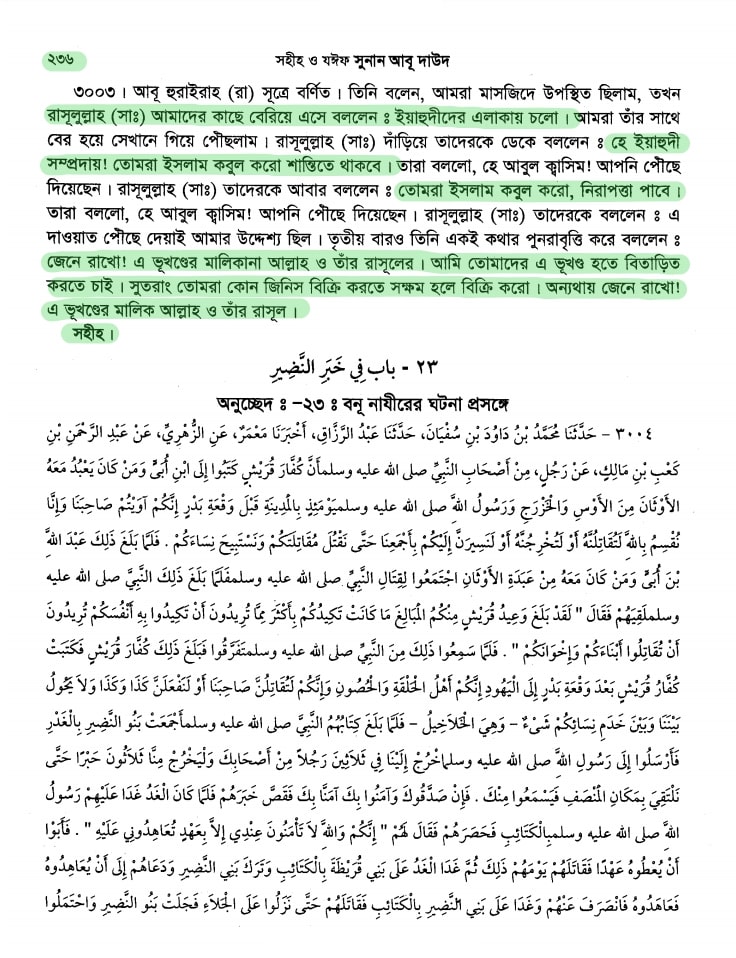
Numerous other hadiths likewise attribute to Muhammad declarations concerning the expulsion of Jews and Christians as religious communities from the Arabian Peninsula. [61] [62] [63] [64]
Sahih Muslim (Islamic Foundation edition)
Book 33: Jihad and Its Principles
Chapter 21: Expelling Jews and Christians from the Arabian Peninsula
4442 Zuhayr ibn Harb and Muhammad ibn Rafi‘ … narrated from Jabir ibn Abdullah, who said: Umar ibn al-Khattab told me that he heard the Messenger of Allah say, “I shall certainly expel the Jews and Christians from the Arabian Peninsula. In the end, I shall permit none but Muslims to remain here.”
Hadith classification: Sahih
Sahih Muslim (Hadith Academy edition)
Book 33: Jihad and Travel
Chapter 21: Expelling Jews and Christians from the Arabian Peninsula
4486-(63/1767) Zuhayr ibn Harb and Muhammad ibn Rafi‘ … narrated from Jabir ibn Abdullah, who said: Umar ibn al-Khattab told me that he had heard the Messenger of Allah say, “I shall certainly expel the Jews and Christians from the Arabian Peninsula. I shall allow nobody but Muslims to live here.” (Islamic Foundation 4442; Islamic Centre 4444).
Zuhayr ibn Harb and Salamah ibn Shabib also transmitted similar narrations through Abu al-Zubayr using the same chain (Islamic Foundation 4442; Islamic Centre 4445).
Hadith classification: Sahih
Sunan al-Tirmidhi (critical edition)
Book 19: Military Expeditions
Publisher: Husayn al-Madani
Chapter 43: Expelling Jews and Christians from the Arabian Peninsula
1607 Umar ibn al-Khattab narrated that he heard the Messenger of Allah say, “I will certainly expel the Jews and Christians from the Arabian Peninsula. I shall not permit anyone other than Muslims to reside there.”
Sahih; al-Sahihah 1134; Sahih Abu Dawud; Muslim.
Abu Isa called this hadith hasan sahih.
Hadith classification: Sahih
Chapter 370: Concerning the Dajjal and the Signs of the Last Hour
13/1829 Abu Hurayrah narrated that the Messenger of Allah said: “The Hour will not take place until Muslims fight the Jews. Even if a Jew hides behind a rock or a tree, the rock or tree will say, ‘Muslim! There is a Jew behind me. Come and kill him.’” The gharqad tree, however, will not say this, because it is the tree of the Jews. (Al-Bukhari and Muslim)
(1) Sahih al-Bukhari 2926; Muslim 157, 2922; Ahmad 8921, 10476, 20502.
Hadith classification: Sahih
The reports directly establish instructions for expelling Jews and Christians from the Arabian Peninsula on the basis of religious identity, together with a prediction of a violent war between Muslims and Jews. These narratives are not factually identical to the Nazi genocide: one concerns commands to expel particular communities, while the other concerns the history of systematic mass murder by a modern state. Nevertheless, the moral issue of uprooting a community from its homeland because of religion or ancestry is relevant in both contexts. For detailed history and jurisprudential sources on the expulsion of Jews and other non-Muslims, Khaybar, and the Arabian Peninsula, see [65].
Forcing Jews and Christians to the Narrowest Part of the Road
Islamic reports attribute to Muhammad the instruction not to initiate greetings toward Jews and Christians and to make them walk on the narrow side of the road rather than occupy its central space. [66] [67] [68]
Sahih Muslim (Hadith Academy edition)
Book 40: Greetings
Chapter 4: Prohibition of Initiating Greetings to the People of the Book (Jews and Christians), and How to Reply to Their Greetings
5554-(13/2167) Qutaybah ibn Sa‘id … narrated from Abu Hurayrah that the Messenger of Allah said, “Do not initiate greetings of peace to Jews or Christians, and when you meet one of them on the road, force them to its narrower side.” (Islamic Foundation 5476; Islamic Centre 5498)
Hadith classification: Sahih
Narrator: Abu Hurayrah
Sunan al-Tirmidhi (critical edition)
Book 19: Military Expeditions
Publisher: Husayn al-Madani
Chapter 41: Greetings to the People of the Book
1602 Abu Hurayrah narrated that the Messenger of Allah said, “Do not greet Jews and Christians first. If you meet one of them while walking on the road, force them to the side of the road.”
Sahih; al-Sahihah 704; Irwa’ 1271; Muslim; al-Bukhari, al-Adab al-Mufrad; discussion of hadith 2855 follows.
Reports on this subject also come from Ibn Umar, Anas, and Abu Basrah al-Ghifari. Abu Isa described the report as hasan sahih.
Hadith classification: Sahih
This instruction is not conditional on whether the non-Muslim has harmed anyone. Unequal treatment in public space follows from religious identity itself. The combined injunctions against initiating greetings and against allowing equal use of the road exemplify an unequal distribution of social respect in public. The ways classical commentators linked such distinctions to legal standing and social rank are discussed at length in [69].
Food, Friendship, and Religious Preferences
Instructions favoring people on religious grounds also appear in matters of companionship and sharing food. In the hadith attributed to Muhammad below, people are told not to take close companions from outside the believers and to let the God-fearing eat their food. The wording does not directly establish an absolute legal prohibition on feeding a non-Muslim under every circumstance; it does, however, clearly makes religious allegiance a criterion in selecting companions and recipients of hospitality. This connects with the ethical question raised by my childhood experience of receiving food from a Hindu family: should we choose whom to associate with and feed according to their conduct and needs, or should their religion be the dominant consideration? [70] [71]
Mishkat al-Masabih
Part 25: Etiquette
Chapter 16: Second section — Love for Allah and Love for a Person for Allah’s Sake
5018-(16) Abu Sa‘id narrated that he heard the Prophet say, “Do not take anyone except a believer as your close companion, and let none but a God-fearing person eat your food.” (Al-Tirmidhi, Abu Dawud, al-Darimi) (1)
(1) Hasan: al-Tirmidhi 2395; Abu Dawud 4832; Sahih al-Jami‘ 7341; Sahih al-Targhib 3036; Sahih Ibn Hibban 554; Ahmad 11337; Abu Ya‘la 1315; al-Darimi 2057; Shu‘ab al-Iman 9382; Hilyat al-Awliya 7/74; al-Mu‘jam al-Awsat 3136; al-Mustadrak 7169.
Hadith classification: Hasan
Narrator: Abu Sa‘id al-Khudri
Sunan Abu Dawud (critical edition)
Book 36: Etiquette
Chapter 19: People with Whom One Should Associate
4832 Abu Sa‘id narrated that the Prophet said, “Do not associate closely with anyone other than a believer, and let only the God-fearing eat your food.” (1)
Hasan.
(1) Al-Tirmidhi; Ahmad.
Hadith classification: Hasan
The phrase “let the God-fearing eat your food” particularly constructs a sphere of religious intimacy. There is a difference between the right to food, helping somebody who is hungry, and choosing close friends. Nevertheless, the tendency to select people by belief is present here as well. A hungry person’s human need does not depend on religion, and prioritizing a person’s religious identity when deciding whether to welcome them as an honored guest can reinforce unequal social relationships.
Living with Non-Muslims and Social Segregation
Reports also contain instructions regarding social separation from non-Muslims. The following narration in Abu Dawud describes living among polytheists and keeping their company as grounds for sharing their identity. It matters what kind of suspicion or distance such a statement encourages toward coexistence between Muslims and non-Muslims. Classical and modern legal opinions on the permissibility of a Muslim living in a non-Muslim-majority country are explored in [72]. The question relevant here is what happens to coexistence on equal terms when social separation by religion is elevated to the status of sacred law. [73]
Sunan Abu Dawud (critical edition)
Book 9: Jihad
Chapter 182: Residing in the Territory of Polytheists
2787 Samurah ibn Jundub narrated that the Messenger of Allah said, “Whoever keeps company with a polytheist and lives with them is like them.” (1)
(1) Sahih.
Hadith classification: Sahih
Non-Muslims in the Eyes of Allah
After reading these accounts, one might ask: how does Allah actually view non-Muslims? Consider these verses from the Qur’an: [74] [75] [76] [77] [78]
Those who disbelieve among the People of the Book and the polytheists will remain forever in the fire of Hell. They are the worst of creation.
Qur’an 98:6
Indeed, the worst living beings in the sight of Allah are those who have disbelieved and refuse to believe.
Qur’an 8:55
Indeed, those who disbelieve and die as unbelievers are subject to the curse of Allah, the angels, and all humanity.
Qur’an 2:161
The example of those who disbelieve is like that of someone calling to creatures that hear nothing except shouts and cries; they are deaf, mute, and blind, and so they do not understand.
Qur’an 2:171
We have created many jinn and human beings for Hell. They have hearts but do not understand with them, eyes but do not see with them, and ears but do not hear with them. They are like cattle; indeed, they are even further astray. They are the heedless.
Qur’an 7:179
Consider what authoritative classical tafsir works say in explaining these verses. The commentaries of Ibn Kathir [79] and al-Jalalayn [80] are reproduced below.
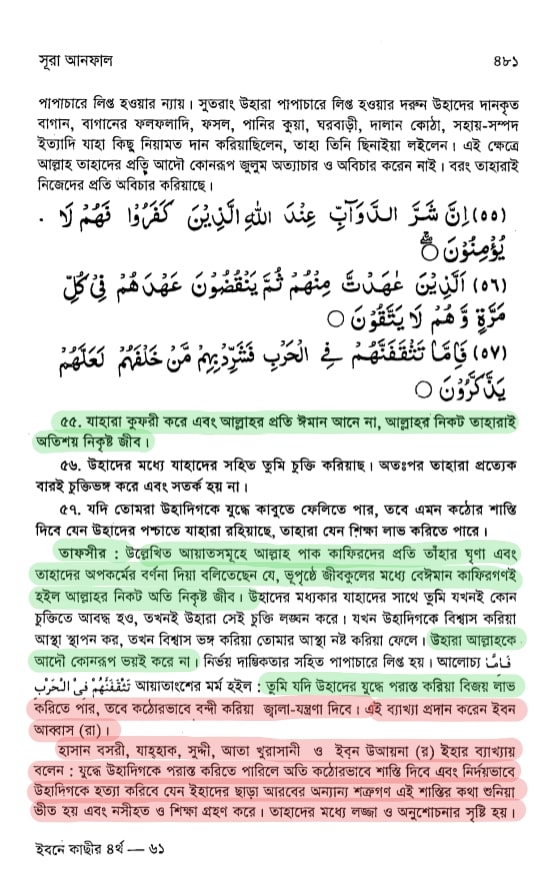
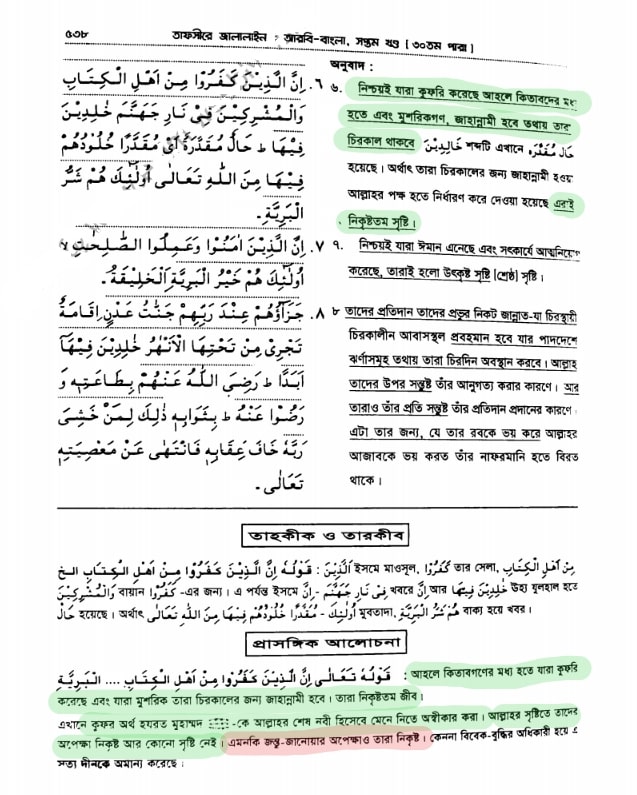
What do these commentaries reveal about the attitudes toward non-Muslim communities expressed in Islamic religious literature?
These verses do not all make identical statements about people’s inborn complexion or tribal membership. Here the defining distinction is religious belief. But describing a group as “the worst of creation,” “the worst living beings,” or worse than livestock on account of belief establishes a language of collective denigration. It clearly evaluates people through their identity as believers or unbelievers rather than through any particular individual offense or action.
The comparison in Qur’an 2:171 invokes animals and images of deafness, muteness, and blindness. In Ibn Kathir’s tafsir, the metaphor is explained with reference to animals that do not understand the meaning of the shepherd’s call. It is therefore not merely an unspecified moral criticism; it portrays the understanding and reasoning capacity of an unbelieving group through degrading imagery. [81]
Another important example of this kind of disparaging classification taking institutional form is the jizya provision in Qur’an 9:29. The detailed exegesis and jurisprudence of jizya collection and the subordinate status of non-Muslims are discussed in [82]. Making a person’s political rank unequal because of religion and reserving the caliphate by ancestry are two distinct forms of institutional privilege based on identity.
Institutional Subordination Based on Religion: Jizya and Unequal Rights
A fundamental similarity emerges between hereditary privilege and unequal rights on religious grounds. In both cases, people are given different rights or status not because of their own abilities or an individual offense, but because they belong to a particular group. For Quraysh rulers, descent is made a condition of political authority. For dhimmis and non-Muslims, religious identity has served as a basis for subordination in society and the state. Qur’an 9:29 and its treatment of jizya, along with classical juristic interpretations, demonstrate that subordinate status.
Treating jizya merely as an ordinary fiscal policy can conceal the religious distinction in civic status at its center. Who is subject to the tax, why they must pay a separate levy, and what political position they occupy are all questions addressed by jizya jurisprudence. The full source quotations and analysis appear in Shongshoy’s article [82]. More detailed historical treatment of jihad and expulsion provisions can be found in [83]. Hereditary privilege tied to lineage and legal subordination based on religious identity are different forms of discrimination, but both place limits on the principle of equal human rights.
Muhammad’s Final Instructions Before His Death
Even while suffering the agony of his final illness, Muhammad left behind a profoundly sectarian instruction: to expel non-Muslim polytheists from Arabia. Even at the end of his life, he had not abandoned this communal exclusion. [84]
Sahih al-Bukhari (Islamic Foundation edition)
Book 48: Jihad
Chapter 1917: Giving Gifts to Visiting Delegations
Chapter 1916: Interceding for Dhimmis and How to Treat Them
2838 Qabisah … narrated from Ibn Abbas, who once exclaimed, “Thursday! Oh, Thursday!” He began to weep until his tears wet the pebbles on the ground. He said: On Thursday the illness of the Messenger of Allah became more severe. He then said, “Bring me writing materials so that I may dictate something for you, after which you will never go astray.” The Companions disagreed among themselves, although disputing in the Prophet’s presence was not appropriate. Some said, “Has the Messenger of Allah left this world?”
He replied, “Leave me as I am. The condition in which I am now is better than what you are calling me toward.” At the time of his death, he gave three instructions: (1) Expel the polytheists from the Arabian Peninsula; (2) give gifts to delegations as I have given them. The narrator said, “I have forgotten the third instruction.” Abu Abdullah said: Ibn Muhammad and Ya‘qub related that I asked al-Mughirah ibn Abd al-Rahman about the Arabian Peninsula. He replied, “It consists of Mecca, Medina, Yamamah, and Yemen.” Ya‘qub said, “Tihamah begins from al-Arj.”
Hadith classification: Sahih
Narrator: Abdullah ibn Abbas
In this report in al-Bukhari, the instruction to remove communities other than Muslims from the Arabian Peninsula appears among Muhammad’s final bequests. It is not a judgment on the wrongdoing of any particular person; it assigns residence rights across a broad territory by religious identity. Read alongside the earlier reports commanding the expulsion of Jews and Christians, it shows an intention to establish religious boundaries on who may live in that region. Detailed evidence concerning the geographical limits of the Arabian Peninsula, the Jewish communities of Khaybar, and the actual implementation of expulsions under later rulers can be found in [65].
Conclusion
The preceding discussion makes it unmistakably clear that Islam contains some valuable statements opposing caste, genealogical pride, and racism, but it also contains numerous statements and rules that establish superiority by birth, tribal privileges, social subordination, and discrimination based on religious identity. Surah al-Hujurat describes differences of lineage and tribe as means of recognizing one another. A hadith attributed to Muhammad denies that an Arab is superior to a non-Arab or a white person to a black person. Pride in ancestry and insulting another person’s family are condemned as customs of the pre-Islamic age of ignorance. These are undeniably positive declarations. Yet when the same religious order reserves supreme political authority for the Quraysh, proclaims Muhammad’s own lineage divinely selected and especially honored, and denies people of other ancestries the same political eligibility, a fundamental inconsistency emerges between the declaration of equality and the actual rule. Denying inherent superiority by birth while assigning special authority and honor on the basis of birth are contradictory principles.
The most significant feature of this inconsistency is that racism and caste hierarchy do not always depend on overt hatred, insult, or persecution. A system can proclaim human equality while maintaining a social and political structure in which one lineage enjoys a greater claim to rights and power. The instruction to obey an Abyssinian slave does not logically mean that the slave has acquired an equal right to supreme political leadership. Particularly when the commentary on that hadith employs the image of an Abyssinian slave as a metaphor for incompetence, limited intelligence, and unattractive appearance, existing social assumptions become evident. Commanding obedience to someone exercising authority and granting people of all ancestries equal eligibility to be selected as rulers are entirely different things. By making Quraysh ancestry a condition of the caliphate, classical Islamic state theory converted this discrimination from an individual attitude into an institutional rule of political eligibility. A system that makes birth into a particular lineage mandatory for political office, alongside intelligence, justice, and leadership ability, contains hereditary discrimination. Verbal declarations of equality do not remove that discrimination.
Similar group-based thinking appears in other reports. The prohibition on the testimony of a rural witness against a townsperson, a curse calling for famine upon a tribe, special prayers for blessings upon certain places and peoples, and predictions of misfortune associated with particular regions all treat group identity as relevant to judging people in place of individual conduct. A rural person does not become an unreliable witness simply because they live in the countryside. Likewise, if some members of a tribe do wrong, its women, children, elderly people, and other innocent members do not thereby deserve to suffer famine. Nobody chooses their birthplace or tribe. Such identities provide no moral justification for privileges, deprivation, or collective punishment. Responsibility for wrongdoing is individual, not hereditary. Personal qualifications, too, must be evaluated individually rather than inferred from ancestry.
Another subtle aspect of discriminatory mentality lies in the assumptions embedded in language, religious imagination, beauty standards, and symbols of good and evil. In a range of Islamic reports, blackness is associated with sin, misfortune, darkness, punishment, and danger. The Black Stone is said to have turned black through human sin; wrongdoing leaves a black mark on the heart; an epidemic appears in the form of a black woman; a black dog is called a devil; and the faces of those condemned to punishment become blackened. Whiteness and brightness, meanwhile, repeatedly symbolize purity, beauty, divine favor, and reward. A person’s natural skin complexion is not the same as the symbolic use of color in religious texts. But in societies that already treat dark skin as unattractive and fair skin as the standard of beauty, repeated associations between blackness and evil or inferiority may reinforce existing prejudice. Where religious stories and metaphors are taught as sacred and unquestionable, their symbolic values can also become part of people’s unexamined assumptions.
Beyond hereditary status and complexion, Islam also contains explicit provisions that discriminate on the basis of religion. The Qur’an describes unbelievers as the worst of creation or even worse than cattle. Hadiths prohibit greeting Jews and Christians first, instruct Muslims to force them toward the narrower side of the road, and contain restrictions concerning social relations and residence among non-Muslims. There are also commands to expel polytheists, Jews, and Christians from the Arabian Peninsula. Classical Sharia makes distinctions between Muslims and non-Muslims in political rights, social status, judicial protection, and religious liberty. Not every such distinction is racism in the modern sense; many are directly instances of religious discrimination. Their moral problem, however, is clear in terms of equal dignity and equal rights. The fact that one person was born to Muslim parents and another to Hindu, Christian, or Jewish parents does not provide a rational justification for unequal fundamental dignity or citizenship rights.
The crucial distinction here is between personal kindness and institutional equality. A ruler may treat people of another religion kindly; a slave owner may be sympathetic toward an enslaved person; a higher-caste individual may befriend someone from a lower caste. None of these actions abolishes the unequal distribution of power and rights within the relevant system. Showing compassion to another person is not the same as recognizing them as an equal rights-holder. Likewise, the existence of a few Qur’anic verses or hadiths condemning pride in ancestry does not erase all birth-based privileges within Islamic law and society. A religious system’s actual commitment to equality is revealed by its laws, qualifications for ruling, social relations, and rules allocating rights. When ancestry, tribe, or religion outweigh an individual’s competence and actions, discrimination is present.
In the modern world, Islam’s anti-racist verses and hadiths are widely publicized. But an account of Islamic equality that omits the Quraysh’s hereditary political privileges, the degrading explanations of the Abyssinian slave, social classifications based on religion, and provisions restricting non-Muslims’ rights is incomplete. Selecting only commendable statements for publicity does not make discriminatory statements and rules cease to exist. Where contradictory principles occur within the same religious tradition, the contradiction is real and can be examined logically. Declaring a scriptural claim sacred, assigning a hadith the traditional classification of sahih, or following a rule for centuries does not prove that it is ethically justifiable. If hereditary discrimination is wrong, it remains wrong when instituted in the name of the Quraysh. If making somebody subordinate because of religion is wrong, it remains wrong when presented as a Sharia rule. Ethical standards cannot change depending on the identity of the person or institution involved.
I return once again to my childhood experience of receiving food on a banana leaf at my Hindu friend’s home. Because I was born into a Muslim family, I was regarded as belonging to a lower caste. My objection to that humiliation was simple: I had committed no wrongdoing; my identity at birth was not my choice; and nobody had a right to regard me as inferior merely because of it. The same reasoning applies equally to Islam. Being born into the Quraysh cannot give someone inherently greater political rights than people of other ancestries. Being Abyssinian or black cannot make a person’s identity a symbol of incompetence or ugliness. Being a non-Muslim does not diminish a person’s human dignity. A claim of inherent Brahmin superiority is as irrational as a claim of inherent Quraysh superiority. Condemning the former while accepting the latter in the name of religious sanctity is a blatant double standard.
Skin color, ancestry, tribe, birthplace, and parents’ religion prove nothing about anyone’s moral character. Nor is any of them a qualification that the individual personally earned. People can be judged by their own actions, conduct, and demonstrated abilities, but they cannot be declared inherently superior or inferior because of their ancestors. Similarly, someone’s beliefs can be criticized through logic and evidence without stripping them of fundamental human rights because of those beliefs. Equal rights cannot depend on the permission of a particular religion, the command of a prophet, or the favor of an ancestral clan. A society that values people’s abilities, freedom, and equal human dignity above inherited identities takes a just position against caste and hereditary discrimination. A system that proclaims equality on one hand while preserving inherent superiority and identity-based privileges on the other contradicts itself through its own rules. Every form of racism, caste hierarchy, tribal arrogance, and religious discrimination must be open to criticism in the interests of truth. Whose approval is won or whose religious sentiments are offended is not a criterion for determining truth and justice.
References
- International Convention on the Elimination of All Forms of Racial Discrimination, Preamble and Article 1 ↩︎
- American Association of Biological Anthropologists, Statement on Race and Racism, 2019 ↩︎
- United States Holocaust Memorial Museum — The Nuremberg Race Laws ↩︎
- Constitution of India — Article 15: Prohibition of Discrimination ↩︎
- Constitution of India — Article 17: Abolition of Untouchability ↩︎
- American Psychological Association — Implicit Bias ↩︎
- UNESCO — Declaration on Race and Racial Prejudice, Article 2, 1978 ↩︎
- National Academies of Sciences, Engineering, and Medicine — Federal Policy to Advance Racial, Ethnic, and Tribal Health Equity, 2023 ↩︎
- Qur’an 49:13 ↩︎
- Qur’an 30:22 ↩︎
- Sahih Muslim, Hadith Academy edition, hadith 2049 ↩︎
- Farewell Sermon: Your Lord is one, your father Adam is one ↩︎
- Sahih Muslim 2564c ↩︎
- the history of the compilation and revision of the Qur’an ↩︎
- the importance and necessity of hadith in Islam ↩︎
- Sahih al-Bukhari 3754 ↩︎
- Mishkat al-Masabih, hadith 3663 ↩︎
- Sahih al-Bukhari, Islamic Foundation edition, hadith 6657 ↩︎
- Hadith Sambhar, hadith 1828 ↩︎
- Riyad al-Salihin, hadith 671 ↩︎
- Sahaj Darse Ibn Majah , pp. 122–123 ↩︎
- Ibn Rajab, Jami‘ al-‘Ulum wa al-Hikam, commentary on obedience to an Abyssinian slave ↩︎
- Ibn Uthaymin on Quraysh caliphs and an Abyssinian ruler ↩︎
- Sahih Muslim, Islamic Foundation 4550 ↩︎
- Sahih Muslim, Hadith Academy 4597 ↩︎
- Sahih al-Bukhari, Islamic Foundation 6654 ↩︎
- Sahih al-Bukhari, Islamic Foundation 6655 ↩︎
- Sahih al-Bukhari, Islamic Foundation edition, hadith 6658 ↩︎
- Sunan al-Tirmidhi (critical edition), hadith 3905 ↩︎
- Sahih Muslim, Hadith Academy edition, hadith 5832 ↩︎
- Sunan al-Tirmidhi 3936 ↩︎
- Al-Mawardi, Al-Ahkam al-Sultaniyyah, seventh qualification for the caliphate ↩︎
- Sunan Abu Dawud, Islamic Foundation edition, 3563 ↩︎
- Sunan Abu Dawud, international numbering 3602 ↩︎
- Al-Mawardi, Al-Hawi al-Kabir, testimony of Bedouins and townspeople ↩︎
- Sahih al-Bukhari, Islamic Foundation edition, hadith 952 ↩︎
- Sahih al-Bukhari, Islamic Foundation edition, hadith 953 ↩︎
- Sunan al-Tirmidhi 3953 ↩︎
- Black or Fair: Why Does Skin Color Determine Beauty in Bangladesh? ↩︎
- Sahih Muslim, Islamic Foundation edition, hadith 5862 ↩︎
- Sahih Muslim, Islamic Foundation edition, hadith 5863 ↩︎
- Sunan al-Tirmidhi, Islamic Foundation edition, 878 ↩︎
- Sunan Ibn Majah, hadith 4244 ↩︎
- Sunan al-Tirmidhi, Islamic Foundation edition, hadith 3334 ↩︎
- Sahih Muslim, Islamic Foundation edition, hadith 267 ↩︎
- Qur’an 3:106–107 ↩︎
- Qur’an 3:107 ↩︎
- Qur’an 39:60 ↩︎
- Sunan al-Tirmidhi (critical edition), hadith 2290 ↩︎
- Sahih al-Bukhari, Tawhid Publications edition, hadith 7039 ↩︎
- Sahih Muslim, Islamic Foundation edition, hadith 1020 ↩︎
- Sahih Muslim, vol. 2, Islamic Centre Publications; see download link ↩︎
- Sunan Abu Dawud, Islamic Foundation edition, hadith 2836 ↩︎
- The Inhumane Provisions for Killing Helpless Animals in Islamic Sharia 1 2
- Sahih al-Bukhari (Islamic Foundation), 3092 ↩︎
- Sahih al-Bukhari (Tawhid), 3254 ↩︎
- Sahih Muslim, Islamic Foundation edition, hadith 369 ↩︎
- Tafsir Ibn Kathir, Tafsir Publications Committee, vol. 17, ninth edition, p. 777 ↩︎
- Sahih al-Bukhari, Islamic Foundation edition, hadith 6847 ↩︎
- Sunan Abu Dawud, critical edition, al-Albani Academy, hadith 3003 ↩︎
- Sahih Muslim, Islamic Foundation edition, hadith 4442 ↩︎
- Sahih Muslim, Hadith Academy edition, hadith 4486 ↩︎
- Sunan al-Tirmidhi, critical edition, hadith 1607 ↩︎
- Riyad al-Salihin, hadith 1829 ↩︎
- Expulsion of Unbelievers, Ethnic Cleansing, and Ethnic Destruction in Islam 1 2
- Forcing and Humiliating Non-Muslims at the Edge of the Road: An Islamic Rule ↩︎
- Sahih Muslim, Hadith Academy edition, hadith 5554 ↩︎
- Sunan al-Tirmidhi, critical edition, hadith 1602 ↩︎
- The Islamic Rule of Forcing and Humiliating Non-Muslims at the Edge of the Road ↩︎
- Mishkat al-Masabih 5018 ↩︎
- Sunan Abu Dawud 4832 ↩︎
- Is It Forbidden for Muslims to Live Among Non-Muslims in Non-Muslim Countries? ↩︎
- Sunan Abu Dawud 2787 ↩︎
- Qur’an 98:6 ↩︎
- Qur’an 8:55 ↩︎
- Qur’an 2:161 ↩︎
- Qur’an 2:171 ↩︎
- Qur’an 7:179 ↩︎
- Tafsir Ibn Kathir, Islamic Foundation edition, vol. 4, p. 481 ↩︎
- Tafsir al-Jalalayn, vol. 7, p. 538 ↩︎
- Tafsir Ibn Kathir on Qur’an 2:171 ↩︎
- Humiliating Jizya: Taxation for the Subordination of Unbelievers 1 2
- Shongshoy’s articles on jihad ↩︎
- Sahih al-Bukhari, Islamic Foundation edition, hadith 2838 ↩︎
About This Article
Genre: Semi-Academic Skeptical Analysis
Epistemic Position: Scientific Skepticism and Secular Humanist Ethics
This article belongs to the skeptical-rationalist analytical tradition of Shongshoy.com.
Its purpose is evidence-based critical examination of religious, philosophical, moral, and historical claims.