
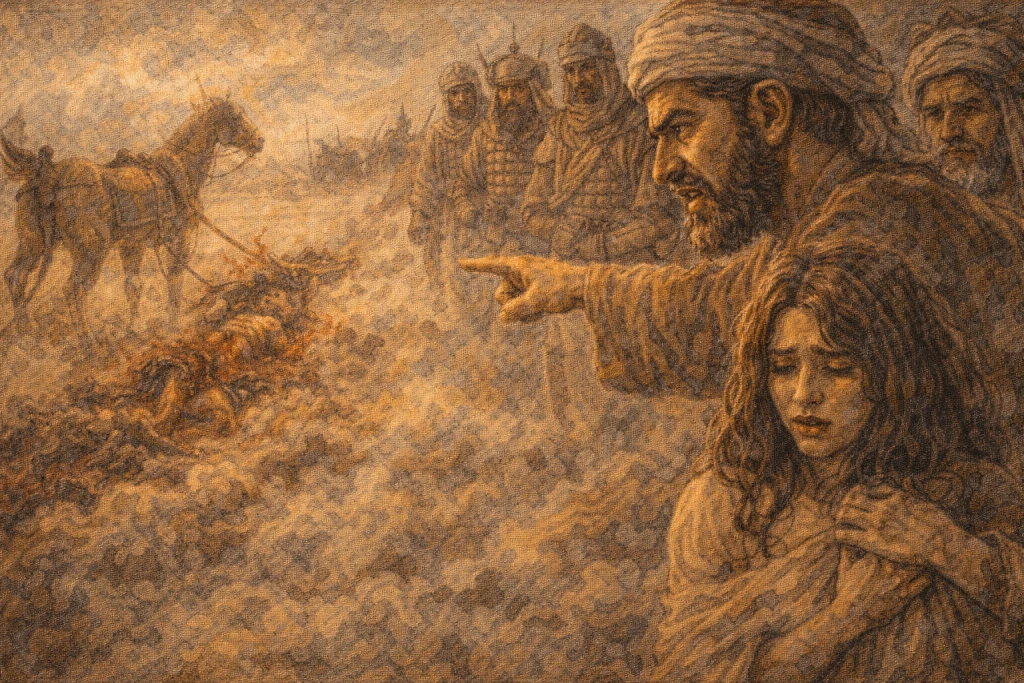
Summary
The killing of Umm Qirfa al-Fazariyya is one of the widely discussed episodes preserved in early Islamic sira and historical literature. Islamic sources do not preserve only one simple narrative of the event; several strands of transmission exist side by side. In the Ibn Ishaq–al-Tabari strand, during Muhammad’s lifetime Umm Qirfa was captured in Zayd ibn Haritha’s expedition against Banu Fazara, Zayd ordered Qays ibn al-Musahhar to kill her, and one report states that her two legs were tied to two camels and her body was torn apart. Ibn Hajar later wrote in Fath al-Bari that Umm Qirfa was killed and that “it is said” she was tied to the tails of two horses and torn apart as they were driven away. A separate strand preserved by al-Bayhaqi and al-Daraqutni places the killing of an Umm Qirfa during Abu Bakr’s caliphate in connection with apostasy. The Zayd narrative from Muhammad’s lifetime and the apostasy narrative from Abu Bakr’s caliphate therefore belong to two distinct chronological strands.
Sahih Muslim preserves another expedition against Banu Fazara narrated by Salama ibn al-Akwa’, in which Abu Bakr was the commander. Umm Qirfa is not named in that hadith. It describes the capture of a woman from Banu Fazara wearing a leather garment and her exceptionally beautiful daughter. Abu Bakr gave the daughter to Salama as an additional share of war booty; Salama said that she had attracted him and that he had not yet “uncovered her garment.” Muhammad later asked him for the woman and sent her to Mecca in exchange for Muslim prisoners. Al-Nawawi explicitly explains the phrase “I had not uncovered her garment” as an indirect expression for sexual intercourse. Some later sira and commentary works identify the unnamed woman in Sahih Muslim as Umm Qirfa, while also preserving inconsistencies over the commander, chronology, and what later happened to the daughter.
Islamic sources themselves preserve the capture of Umm Qirfa, the order to kill her, and the report that her body was torn apart after being tied between two camels or horses. The claim that “the story of Umm Qirfa’s brutal killing was invented by anti-Islamic critics” is therefore false. Sahih Muslim, meanwhile, preserves the capture of women and children in the same Banu Fazara setting, the transfer of an exceptionally beautiful captive woman to a Companion as war booty, that Companion’s statement that he had not yet “uncovered her garment”—that is, had not yet had sexual intercourse with her—and Muhammad’s subsequent use of the captive in a prisoner exchange. On one side is the reported dismemberment of an elderly female leader; on the other is the conversion of a beautiful woman from her family into transferable sexual war booty. Together, these reports expose the brutal structure of early Islamic warfare.
Introduction
The story of Umm Qirfa is one of the most brutal narratives preserved from the early military history of Islam. Sira and historical works describe this elderly female leader of Banu Fazara being captured, then killed on the order of Zayd ibn Haritha, with one strand stating that her two legs were tied to two camels or horses driven in opposite directions until her body was torn apart. Within the same historical setting, her beautiful daughter is described as being captured and handed to a Companion as war booty [1] [2]. In Sahih Muslim’s report of a Fazara expedition, the Companion who received that beautiful captive woman says directly that she had greatly attracted him and that he had not yet “uncovered her garment”; al-Nawawi makes the meaning explicit by explaining the phrase as a euphemism for sexual intercourse. This is therefore not merely a story of killing. It also reveals a system in which female war captives could be distributed as private property for sexual use.
In the Ibn Ishaq–al-Tabari strand concerning Zayd ibn Haritha’s expedition during Muhammad’s lifetime, Zayd is said to have returned against Banu Fazara after recovering from an earlier attack. Umm Qirfa, her daughter, and others were captured; Zayd ordered Umm Qirfa’s execution; and one detailed account states that ropes were tied to her two legs, attached to two camels, and the animals were driven in opposite directions until her body split apart. IslamQA itself reproduces the Arabic account in full while attempting to reject it through isnad objections, including disconnection in the chain, Ibn Ishaq’s tadlis, and criticism of Salama ibn al-Fadl and Muhammad ibn Humayd. The same answer separately mentions another Umm Qirfa report connected to apostasy during Abu Bakr’s caliphate. Both narrative strands are therefore preserved inside Islamic sources. Modern fatwa sites may attempt to reject particular reports through isnad criticism, but they cannot erase the fact that the command to kill Umm Qirfa, her violent death, and the report of her dismemberment are all part of early Islamic literature [3]
فَأَمَرَ زَيْدُ بْنُ حَارِثَةَ أَنْ يَقْتُلَ أُمَّ قِرْفَةَ، فَقَتَلَهَا قَتْلًا عَنِيفًا … حَتَّى شَقَّاهَا
English translation: Zayd ibn Haritha ordered that Umm Qirfa be killed; she was killed with extreme violence … until the two camels tore her body apart.
Sahih Muslim, by contrast, describes an expedition commanded by Abu Bakr and does not name Umm Qirfa. It directly records women and children being taken captive in a Banu Fazara expedition ordered by Muhammad, a beautiful female captive being given to Salama as his personal additional share of booty, Salama’s statement that he had not yet had sexual intercourse with her, and Muhammad later taking the woman and using her in exchange for Muslim prisoners in Mecca. Later commentaries and sira works identify the unnamed woman as Umm Qirfa, while differences remain concerning the commander and other details. What Sahih Muslim states directly, what sira and historical works add, and how later Muslim commentators connected the accounts can therefore be distinguished without erasing the substance of the reports.
A Concise Account of the Event (Commentary on Sahih al-Bukhari)
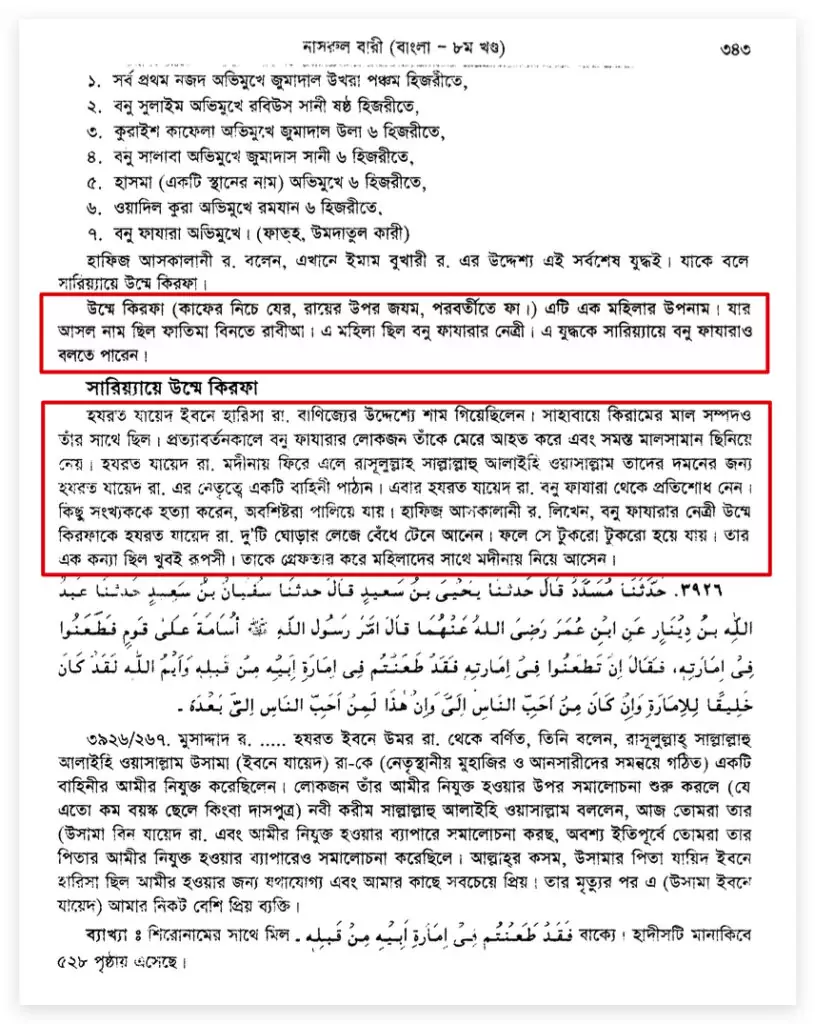
A concise account of the incident appears in the Bengali commentary Sahaj Nasrul Bari [4]:
Hafiz al-‘Asqalani states that Imam al-Bukhari intended this later expedition here, known as the expedition of Umm Qirfa. Umm Qirfa was the kunyah of a woman whose name was Fatima bint Rabi’a. She was the female leader of Banu Fazara, and the expedition may also be called the expedition of Banu Fazara.
Zayd ibn Haritha had travelled to Syria for trade, carrying property belonging to other Companions as well. On his return, men from Banu Fazara attacked and wounded him and seized the goods. After Zayd returned to Medina, Muhammad sent a force under his command against them. Zayd then took revenge on Banu Fazara, killing some while the rest fled. Hafiz al-‘Asqalani writes that Zayd tied Umm Qirfa, the female leader of Banu Fazara, to the tails of two horses and dragged her until she was torn to pieces. She had a very beautiful daughter, who was captured and taken to Medina with the other women.
Online Arabic source: In his discussion of the Banu Fazara expedition, Ibn Hajar al-‘Asqalani states directly that Umm Qirfa was killed, then records the well-known report that her two legs were tied to the tails of two horses and she was torn apart as they were driven off. In the same passage, he mentions the capture of Umm Qirfa’s beautiful daughter and explicitly states that Sahih Muslim preserves part of this incident through Salama ibn al-Akwa’. The connection between Sahih Muslim’s story of the captive mother and daughter and the Umm Qirfa episode in sira literature is therefore not an invention of modern critics; Ibn Hajar himself makes that connection [5]
فَأَوْقَعَ بِهِمْ وَقَتَلَ أُمَّ قِرْفَةَ … فَيُقَالُ: رَبَطَهَا فِي ذَنَبِ فَرَسَيْنِ … وَقَدْ ذَكَرَ مُسْلِمٌ طَرَفًا مِنْهَا
English translation: He fell upon them and killed Umm Qirfa … and it is said that he tied her to the tails of two horses … Muslim has mentioned part of this account.
The Account in Sahih Muslim
The following hadith describes the Banu Fazara expedition, a woman wearing a leather garment, and her exceptionally beautiful daughter. The Bengali edition previously quoted here is replaced in this English version with the corresponding international reference: [6]
Sahih Muslim 1755 — The Book of Jihad and Expeditions
Salama ibn al-Akwa’ reported that the Muslims fought Banu Fazara under the command of Abu Bakr, whom Muhammad had appointed over them. They attacked near the enemy’s water source, killed some people and took others captive. Salama saw a group that included women and children and prevented them from reaching the mountain by shooting an arrow between them and it. He then drove the group back as captives.
Among them was a woman of Banu Fazara wearing a leather garment, accompanied by her daughter, who was described as one of the most beautiful women of Arabia. Salama brought them to Abu Bakr, who gave the daughter to him as an additional share of war booty. They returned to Medina, and Salama said that he had not yet uncovered her garment.
Muhammad later met Salama and asked him to give the woman to him. Salama replied that she had greatly attracted him and again said that he had not uncovered her garment. Muhammad repeated the request the next day. Salama then gave her to him, once more stating that he had not uncovered her garment. Muhammad subsequently sent the woman to Mecca and exchanged her for Muslims who were being held prisoner there.
Explanation from the Commentary on Sahih Muslim
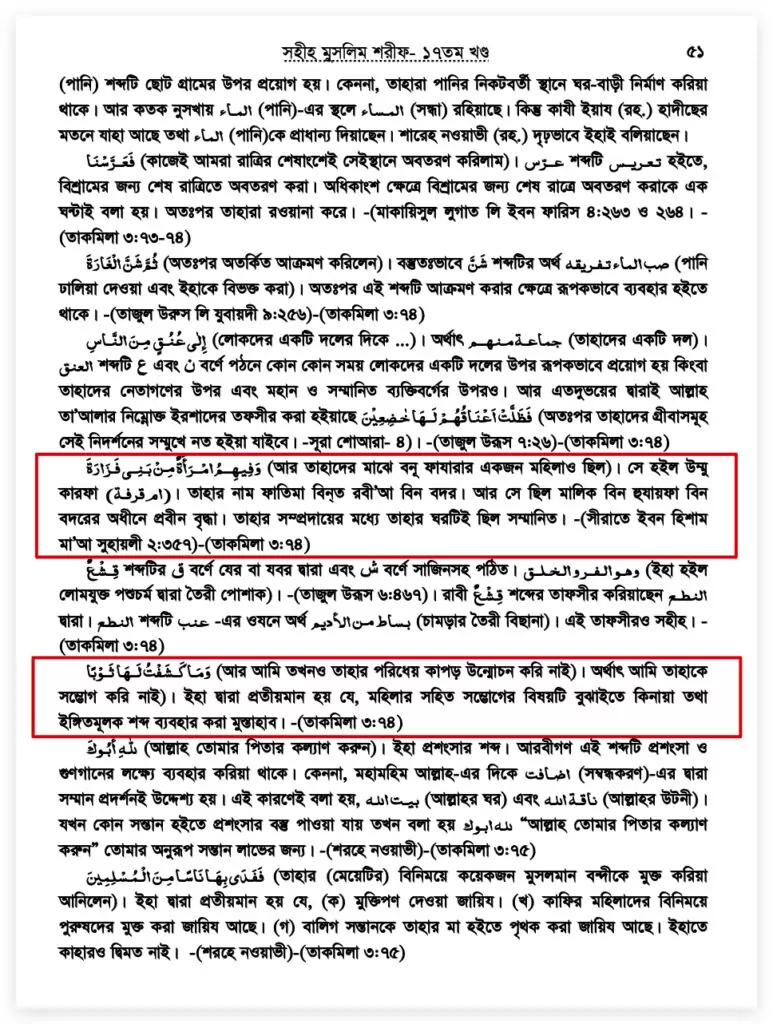
The hadith above describes a Banu Fazara woman wearing a leather garment and her exceptionally beautiful daughter being taken captive together. A Bengali commentary on Sahih Muslim identifies this mother as Umm Qirfa and explicitly explains the phrase about not uncovering the daughter’s garment as a reference to sexual intercourse [7]:
“Among them was a woman from Banu Fazara.” She was Umm Qirfa. Her name was Fatima bint Rabi’a ibn Badr. She was an elderly woman of high standing among her people.
“I had not yet uncovered her garment.” That is: I had not yet had intercourse with her. This shows that it is recommended to use indirect or euphemistic language when referring to sexual intercourse.
Online Arabic source: Al-Nawawi explicitly explains Sahih Muslim’s phrase “I had not yet uncovered her garment” as indirect language referring to sexual intercourse. In the same discussion, he also addresses the use of a female captive in exchange for male Muslim prisoners and the permissibility of separating an adult mother from her child. His commentary leaves no basis for reducing “I had not uncovered her garment” to a neutral remark about clothing or changing garments [8]
قَوْلُهُ: «وَمَا كَشَفْتُ لَهَا ثَوْبًا» فِيهِ اسْتِحْبَابُ الْكِنَايَةِ عَنِ الْوِقَاعِ بِمَا يُفْهِمُهُ
English translation: His statement, “I had not uncovered her garment,” contains the use of indirect language for sexual intercourse in a form whose meaning is understood.
From Ar-Raheeq al-Makhtum
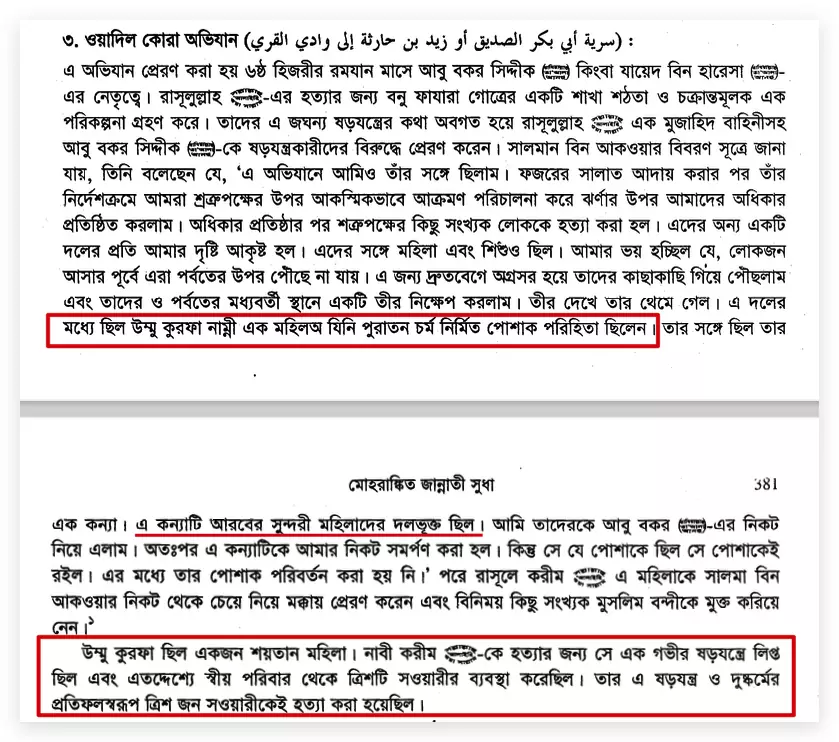
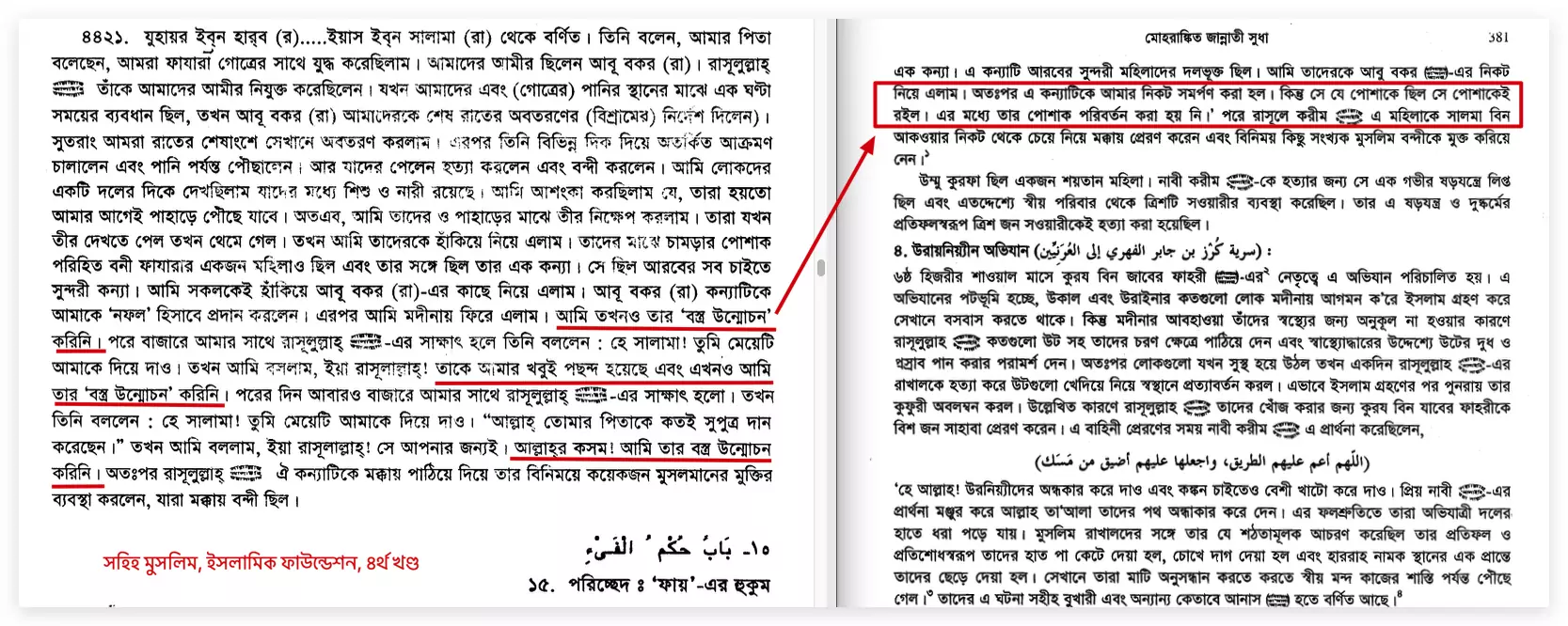
Although Sahih Muslim does not name the woman directly, the Bengali edition of Ar-Raheeq al-Makhtum identifies her as Umm Qirfa. The same description of the leather garment and the exceptionally beautiful daughter also appears there [9]:
Salama ibn al-Akwa’ is reported to have said that he took part in the expedition. After the dawn prayer, the Muslims launched a surprise attack and seized control of the spring. Some of the opposing force were killed. Salama then noticed another group containing women and children and feared they would reach the mountain before he could stop them. He advanced rapidly and shot an arrow between them and the mountain, causing them to stop.
Among them was a woman named Umm Qirfa, wearing an old leather garment. With her was her daughter, who was counted among the most beautiful women of Arabia. Salama brought them to Abu Bakr, and the daughter was handed over to him. The Bengali edition then states that she remained in the same clothes and that her clothes had not been changed.
Muhammad later asked Salama for the woman and sent her to Mecca, where she was exchanged for a number of Muslim prisoners. The same Bengali edition describes Umm Qirfa as an evil woman who had allegedly conspired to kill Muhammad and had prepared thirty riders from her own family for that purpose.
Erasing the sexual meaning in translation: The Bengali version of Ar-Raheeq al-Makhtum substantially changes the sexual implication of Sahih Muslim’s wording. The original statement is “I had not yet uncovered her garment,” and al-Nawawi explicitly explains it as a euphemism for not yet having had sexual intercourse. The Bengali sira, however, turns this into statements such as “she remained in the same clothes” and “her clothes had not been changed.” This is not a minor stylistic variation. It changes the meaning. The uncomfortable point in the original report—that after receiving the beautiful female captive Salama had still not yet had intercourse with her—is converted into an innocuous remark about clothing [10]
وَمَا كَشَفْتُ لَهَا ثَوْبًا … فِيهِ اسْتِحْبَابُ الْكِنَايَةِ عَنِ الْوِقَاعِ بِمَا يُفْهِمُهُ
English translation: “I had not uncovered her garment” … this is an indirect expression for sexual intercourse whose meaning is understood.
From Sirat Rasul Allah
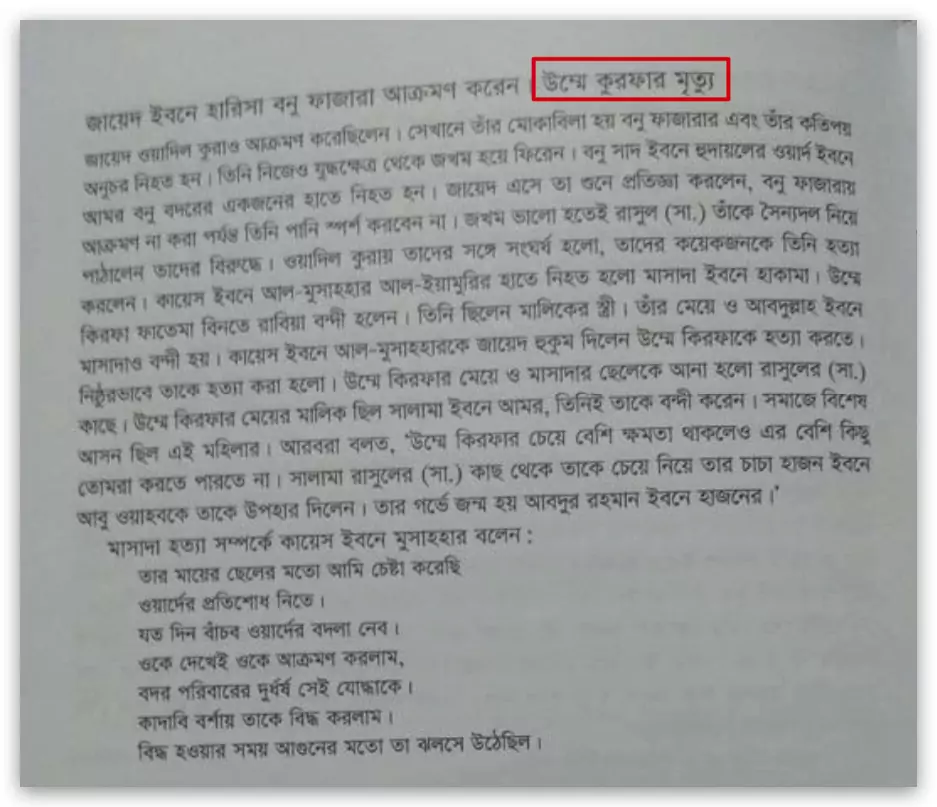
The following account of Umm Qirfa’s death appears in the Bengali translation of Ibn Ishaq’s Sirat Rasul Allah [11]:
Zayd ibn Haritha attacked Banu Fazara.
The death of Umm Qirfa.
Zayd had previously attacked Wadi al-Qura, where he encountered Banu Fazara. Some of his men were killed and he himself returned wounded. When he recovered, Muhammad sent him with troops against them. They fought at Wadi al-Qura and Zayd killed a number of them.
Umm Qirfa, Fatima bint Rabi’a, was captured. She was the wife of Malik. Her daughter and Abdullah ibn Mas’ada were also captured. Zayd ordered Qays ibn al-Musahhar to kill Umm Qirfa. She was killed brutally. Umm Qirfa’s daughter and Mas’ada’s son were then brought to Muhammad.
The account continues that Salama ibn ‘Amr had possession of Umm Qirfa’s daughter after capturing her. The woman was of high social standing. The Arabs reportedly used Umm Qirfa as a proverb for power and status. Salama asked Muhammad for the daughter and then gave her to his uncle Hazn ibn Abi Wahb; she later bore ‘Abd al-Rahman ibn Hazn.
The same killing narrative in multiple Islamic sira and historical works: The preserved Ibn Ishaq tradition records the capture of Umm Qirfa, Zayd’s order to kill her, and her violent death at the hands of Qays ibn al-Musahhar. Islamweb’s sira compilation places reports from Ibn Ishaq, Muhammad ibn ‘Umar, Ibn Sa’d, and Ibn ‘A’idh side by side and also preserves the account that Umm Qirfa was tied between two camels and torn apart. This is therefore not a modern anti-Islamic invention; it has circulated within Muslim sira and historical literature for centuries. The fact that multiple works preserve the report and the separate question of whether every chain meets later hadith criteria are not the same claim [12] [13]
فَأَمَرَ زَيْدُ بْنُ حَارِثَةَ بِقَتْلِ أُمِّ قِرْفَةَ … فَقُتِلَتْ قَتْلًا عَنِيفًا
English translation: Zayd ibn Haritha ordered that Umm Qirfa be killed … and she was killed violently.
وَعَمَدَ قَيْسُ بْنُ الْمُحَسَّرِ إِلَى أُمِّ قِرْفَةَ … فَقَتَلَهَا قَتْلًا عَنِيفًا … بَيْنَ بَعِيرَيْنِ
English translation: Qays ibn al-Musahhar went to Umm Qirfa … and killed her violently … between two camels.
From “I Had Not Uncovered Her Garment” to “Her Clothes Had Not Been Changed”: How the Meaning Was Altered
In Sahih Muslim’s report, the beautiful female captive is not treated as an independent party with control over what happens to her. Abu Bakr transfers her to Salama ibn al-Akwa’ as war booty. Salama says that her beauty attracted him and repeatedly emphasizes: “I had not yet uncovered her garment.” Al-Nawawi removes any ambiguity about the phrase: it is a euphemism for sexual intercourse. The straightforward meaning is therefore that the captive woman had come under Salama’s sexual authority, he desired her, but he had not yet had intercourse with her. Her consent, preference, or refusal has no operative role in the narrative. She is war booty that can be assigned to one man, removed from him, and then used for another political purpose. Muhammad later takes her from Salama and uses her to secure the release of Muslim prisoners in Mecca.
The Bengali rendering in Ar-Raheeq al-Makhtum is therefore seriously misleading. Instead of retaining the sexual meaning of “وما كشفت لها ثوباً,” it says that the woman remained in the same clothes or that her clothes had not been changed. These statements are not equivalent. “I have not yet had sexual intercourse with her” and “her clothes were not changed” communicate entirely different facts. Read alongside the Arabic hadith and al-Nawawi’s commentary, the Bengali wording removes the central sexual implication and changes how the reader understands the episode.
Sahih Muslim’s wording and al-Nawawi’s explanation leave no ambiguity on this point [14]
وَاللَّهِ لَقَدْ أَعْجَبَتْنِي وَمَا كَشَفْتُ لَهَا ثَوْبًا
English translation: By God, she greatly attracted me, and I had not yet uncovered her garment.
فِيهِ اسْتِحْبَابُ الْكِنَايَةِ عَنِ الْوِقَاعِ بِمَا يُفْهِمُهُ
English translation: This is an indirect expression for sexual intercourse in wording whose meaning is understood.
Theological Restrictions on Criticizing the Companions
There is another methodological problem in evaluating episodes such as the killing of Umm Qirfa: Sunni theology assigns the Companions a predetermined moral status. In historical inquiry, a person’s religious prestige cannot make criticism of that person’s actions illegitimate; if evidence exists, the conduct has to be judged by the same evidentiary standard applied to anyone else. Yet many Sunni creedal works and modern fatwas instruct believers not to denigrate the Companions, not to draw negative conclusions about them, and in some cases to refrain from discussing their internal conflicts critically. This creates a genuine epistemic constraint: when an uncomfortable report concerns a Companion, a prior religious obligation to defend his standing can influence how the evidence is evaluated.
This is not an invented accusation. IslamQA explicitly states that it is not permissible to “impugn or criticise” a Companion and, in another answer, advises believers to “refrain from discussing” the conflicts among the Companions. Islamweb is even more explicit: insulting the Companions is prohibited, and some jurists classified such denunciation as fisq, as kufr in certain circumstances, or as an offence deserving punishment. This theological framework does not by itself determine whether a particular historical report is true or false, but it plainly creates an ideological constraint on critical examination of the Companions [15] [16] [17] [18]
it is not permissible to impugn him or criticise him
English translation: It is not permissible to attack or criticize him.
we should refrain from discussing it
English translation: We should refrain from discussing it.
فَلَا خِلَافَ بَيْنَ الْعُلَمَاءِ فِي أَنَّهُ يَحْرُمُ سَبُّ الصَّحَابَةِ
English translation: There is no disagreement among the scholars that insulting the Companions is forbidden.
Tied to Two Camels or Horses and Torn Apart Alive: Exemplary Violence Designed to Terrorize
The report that Umm Qirfa was tied between two camels or horses and torn apart as the animals were driven in opposite directions is not merely a description of execution; it is a description of demonstrative torture. If killing alone had been the sole objective, numerous quicker methods were available. Binding the legs of an elderly captive female leader to two animals and tearing her body apart alive turns the manner of death itself into the message. The destruction of the body is not incidental to the punishment; it is its defining feature. The social function of such exemplary violence is terror: one leader is destroyed in a spectacularly brutal way so that the fate itself becomes a warning to others.
The political language of the punishment is equally clear. The point is not simply to remove an opponent but to destroy that opponent in a way that becomes memorable, terrifying, and exemplary. Umm Qirfa was a prominent female leader of Banu Fazara. A report in which she is not merely killed but torn apart between two animals communicates power, revenge, and intimidation at the same time. In the language of medieval coercive violence, this is exemplary violence: punishment inflicted on one person in a manner intended to make the consequence visible and unforgettable to many others.
The Killing Is Preserved in Islamic Sources: The Limits of Modern Denial
The most important distinction in the Umm Qirfa material is between the existence of the narrative and later religious judgments about its isnad. The Ibn Ishaq–al-Tabari strand preserves Umm Qirfa’s name, Zayd’s expedition, her capture, the order for her execution, and the detailed account of her body being torn apart using two camels. Ibn Hajar likewise records her killing in Fath al-Bari, mentions the report that she was tied to two horses and dismembered, and states that Sahih Muslim preserves “part of this account” through Salama ibn al-Akwa’. The claim that no Islamic source contains the killing or dismemberment of Umm Qirfa is therefore simply false. The narrative is preserved inside Islamic sira, maghazi, and historical literature.
Modern IslamQA attempts to escape the report primarily through internal hadith criticism: it cites Ibn Ishaq’s tadlis, weaknesses attributed to Salama ibn al-Fadl and Muhammad ibn Humayd, and disconnection in the chain. But those objections cannot erase a basic historical fact: the report that Umm Qirfa was tied between two camels and torn apart belongs to the transmitted heritage of Muslim sira and historiography. IslamQA itself has to reproduce the report in detail in order to reject it. The dispute is therefore not over whether the report exists in Islamic literature; it plainly does. The dispute is over whether a modern religious authority chooses to accept it after applying its own internal isnad criteria [19]
وَأَسَانِيدُ هَذِهِ الْقِصَّةِ كُلُّهَا ضَعِيفَةٌ لَا تَصِحُّ … وَمَا ذُكِرَ مِنَ التَّمْثِيلِ بِهَا وَشَقِّهَا نِصْفَيْنِ فَفِيهِ نَكَارَةٌ ظَاهِرَةٌ
English translation: The chains of transmission for this story are all weak and invalid … and the report that she was mutilated and split into two contains an obvious objection.
Modern Islamic apologetic sources do not even agree among themselves. IslamQA attempts to discard the entire killing narrative through isnad criticism, while a separate Islamweb fatwa accepts that Umm Qirfa was killed and rejects only the specific method of dismemberment. In other words, Islamweb itself closes the door on the claim that her killing is merely an anti-Islamic fabrication. Its own wording is explicit: “the correct view is that she was killed.” [20]
بَلِ الصَّحِيحُ هُوَ قَتْلُهَا فَحَسْبُ وَكَانَتْ مُقَاتِلَةً، وَالْمَرْأَةُ إِذَا قَاتَلَتْ تُقْتَلُ
English translation: Rather, what is correct is simply that she was killed; she was a combatant, and when a woman fights, she is killed.
Sahih Muslim provides another, distinct level of evidence. It directly records an expedition against Banu Fazara, the capture of women and children, a woman in a leather garment, her exceptionally beautiful daughter, Abu Bakr’s transfer of the daughter to Salama as an additional share of booty, Salama’s statement that he had not yet had sexual intercourse with her, and Muhammad’s later use of the woman in a prisoner exchange. The hadith does not name either mother or daughter as Umm Qirfa, and its commander is Abu Bakr. Later sira writers and commentators nevertheless identify the woman with Umm Qirfa, while others attempt to reconcile the material as separate expeditions. It would therefore be wrong to claim that Sahih Muslim itself names Umm Qirfa; it would be equally wrong to claim that the connection between Sahih Muslim’s Fazara report and the Umm Qirfa tradition is a modern invention.
Ibn Hajar’s direct connection: after describing Zayd’s expedition against Banu Fazara, the killing of Umm Qirfa, and the capture of her beautiful daughter, Ibn Hajar writes that Muslim preserved “part of this account” through Salama ibn al-Akwa’. The connection between Sahih Muslim’s Fazara expedition and the Umm Qirfa episode therefore exists inside classical Muslim commentary itself. [21]
وَقَتَلَ أُمَّ قِرْفَةَ … وَأَسَرَ بِنْتَهَا وَكَانَتْ جَمِيلَةً … وَقَدْ ذَكَرَ مُسْلِمٌ طَرَفًا مِنْهَا
English translation: He killed Umm Qirfa … captured her daughter, who was beautiful … and Muslim has mentioned part of this account.
Conclusion
The account of Umm Qirfa’s killing does not come from hostile literature outside Islam. It is preserved within Muslim sira, maghazi, historical, and commentary traditions themselves. Those sources contain the capture of an elderly female leader, the order to kill her, and the horrifying report that she was tied between two camels or horses and torn apart. Ibn Hajar records her killing and connects the Salama narrative in Sahih Muslim with the same historical complex. Modern Muslim apologetics can raise isnad objections, but it cannot erase the Islamic provenance of the material.
The Sahih Muslim material is even more direct on the treatment of captive women. Women and children of Banu Fazara are captured; an exceptionally beautiful daughter is given by Abu Bakr to Salama as his personal share of war booty; Salama says that she had greatly attracted him and that he had not yet “uncovered her garment”; and al-Nawawi explains that this means he had not yet had sexual intercourse with her. The captive woman’s independent sexual consent is not operative in the narrative. She is handed to a male fighter as property, her sexual use is treated as an accepted consequence of ownership, and Muhammad later takes her back and uses her as an instrument in a prisoner exchange. The structure in which a female captive is treated as transferable war booty is explicit within the hadith tradition itself.
Modern defensive literature is internally inconsistent. IslamQA rejects the killing and dismemberment reports by invoking weaknesses in transmission; Islamweb rejects the method of dismemberment but accepts the killing itself as correct. There is therefore no single unified “Islamic position” on how much of the narrative should be accepted. Early sira writers, later hadith commentators, historians, and modern fatwa sites draw the line at different places. What they cannot plausibly deny is that the material itself is embedded in the Islamic textual tradition.
The story of Umm Qirfa brings two brutal dimensions of early Islamic warfare into the same frame. The first is exemplary violence: the report of a captive female leader being killed not by an ordinary execution but by having her body torn apart in a manner whose horror itself becomes a message to the enemy. The second is the sexual and economic ownership of female captives: a beautiful daughter is assigned to a Companion as personal booty, sexual access to her is assumed within the structure of ownership, and she is later transferred again for use in a prisoner exchange. On one side stands the dismembered body of a defeated woman; on the other, the transferable body of a captive woman. In both cases, the victorious side exercises near-total control over the bodies of defeated women. Reducing this history to the normality of warfare or to technical disputes over isnad does not answer the moral content of the sources; it merely obscures it.
References
- Slave Markets and the Buying and Selling of Female Slaves in Islam: The Open Auction of Women’s Bodies ↩︎
- The Legality of Sex with Female War Captives or Slave Women in Islam: Is the Slave Woman’s Consent Required? ↩︎
- IslamQA: Reports Concerning the Killing of Umm Qirfa ↩︎
- Sahaj Nasrul Bari, Vol. 8, p. 343 ↩︎
- Fath al-Bari, Kitab al-Maghazi, Chapter on the Expedition of Zayd ibn Haritha — Islamweb ↩︎
- Sahih Muslim 1755 — Sunnah.com ↩︎
- Sahih Muslim Sharif, Bengali translation with commentary, Maktabatul Hadith, Vol. 17, p. 51 ↩︎
- Al-Nawawi, Commentary on Sahih Muslim, Hadith 1755 — Islamweb; Sahih Muslim 1755 ↩︎
- Safiur Rahman Mubarakpuri, Ar-Raheeq al-Makhtum, Tawheed Publications, pp. 380–381 ↩︎
- Al-Nawawi’s Commentary — Islamweb ↩︎
- Bengali translation by Shahid Akhand, Prothoma Prokashon, p. 706 ↩︎
- Ibn Hisham — Shamela; Encyclopaedia of Sira — Islamweb ↩︎
- al-Muntazam — Islamweb; al-Bidaya wa al-Nihaya — Islamweb ↩︎
- Sahih Muslim 1755 — Sunnah.com; Al-Nawawi’s Commentary — Islamweb ↩︎
- IslamQA: Criticizing a Companion Is Not Permissible ↩︎
- IslamQA: Refraining from Discussion of Conflicts among the Companions ↩︎
- Islamweb: Ruling on Denigrating the Companions ↩︎
- Islamweb: Punishment for Denigrating a Companion ↩︎
- IslamQA 333281 ↩︎
- Islamweb: The Killing of Umm Qirfa and the Report of Mutilation ↩︎
- Fath al-Bari — Islamweb ↩︎