The Historical Foundations of Islam: Jewish–Christian Traditions, Pagan Rituals, and Ancient Myths
Summary
The rituals, religious narratives, and worldview of Islam developed through contact with the worship practices of pre-Islamic Arabia and with Jewish, Christian, and Iranian religious traditions. The familiar world of the Kaaba, Zamzam, pilgrimage, tawaf, ihram, sacred stones, fasting, and animal sacrifice existed before Muhammad’s birth. Islam adopted various practices from that world, prohibited some, modified others, and placed the authority to determine their legitimacy under the commands of Allah and the Prophet. New religious identities, rewards, punishments, and obligations were attached to familiar places of worship and bodily rituals. Alongside the adoption of rituals, a distinct religious community was formed by replacing older festivals, setting times for worship, establishing a call to the community, and exercising control over family law.
The Quran’s narratives also have an earlier literary history. Jesus bringing clay birds to life appears in Christian infancy narratives; the fratricide involving Habil and Kabil and the statement comparing a single life to the entire world appear in Jewish scripture and rabbinic interpretation; and the long sleep and awakening of the People of the Cave appear in the Christian legend of Ephesus. Behind Noah’s great flood lie Mesopotamian flood literature and its Abrahamic retellings. The command to prostrate before Adam, Satan’s refusal, and the debate over the superiority of fire and clay also appear in earlier Adam literature and Christian narratives. Connections between these texts can also be traced in specific dialogues, sequences of events, and the use of narratives to establish religious conclusions. In Islamic retellings, those familiar elements acquired the status of direct declarations from Allah, signs of prophethood, and evidence of the afterlife.
Accounts of the Sabians, the star-worshippers of Harran, and the Mandaeans reveal the extensive contacts within the ancient religious world. Discussions of Harut and Marut, angels, Satan, ascents to heaven, punishment in the grave, and the bridge of judgment in the afterlife provide examples of elements adopted and rearranged from different traditions. In cosmology, too, earlier imaginings of humans made from clay, giant primordial ancestors, a primordial world of water, creation in six days, layered heavens, and the sun and moon directed by divine command found a place in the Islamic worldview. The historical antecedents of these accounts and the accuracy of their claims about nature are separate questions. Ancient religious texts demonstrate that a concept circulated; the truth of claims about the actual earth and universe is determined by observation and scientific evidence.
Islamic sources, earlier religious literature, and modern scholarship together reveal a human history of adoption, rejection, revision, and the establishment of new authority. In some cases, the same ritual was retained while the basis of its authorization changed; in others, the characters and dialogues of older religious narratives were recast in the language of a new faith; elsewhere, the statements of neighboring communities subsequently became part of revelation and doctrine. The central process in this reconstruction was the selection of familiar elements and their establishment as Allah’s commands and true accounts of the unseen world. Human society, language, memory, political power, and religious authority played direct roles in this history of Islam’s formation.
Claims that a pilgrimage site’s sanctity derives from Abraham also appear beyond the Kaaba, in the traditions of Mamre and Gerizim. Accounts of pilgrimage, offerings, and special ritual states existed at the Arabian worship centers of Manat, Uzza, Lat, and Dhul-Khalasa. The destruction of rival centers and the retention of the Kaaba under the new religion centralized religious power. Specific connections with earlier religious literature can also be traced in Baal and Elijah, the Tower of Babel and Haman, Mary’s life in the Temple, Abraham’s destruction of idols, Moses’s rescue from the river, and Dhul-Qarnayn’s expeditions. These connections operate at several levels: the performance of rituals, the sequence of narrative events, legal language, and the authority to establish sanctity.
Himyarite inscriptions from South Arabia, long before Muhammad, attest to the use of the designations Lord of Heaven and Earth, Īlān, and Raḥmānān, and to monotheistic places of worship. The name Raḥmānān remained in use in later Christian royal invocations. Islam adopted the existing Arabian religious calendar of twelve months and four sacred months, while rejecting the practice of postponing a month’s sanctity through nasīʾ. This history of divine names, institutions of worship, and sacred time reveals specific processes through which earlier elements were adopted and new regulations imposed upon them.
Map of the Article at a Glance
| Field of Discussion | Included Topics | Main Findings of the Evidence and Analysis |
|---|---|---|
| Idolatry and Social Identity | Meaning of idolatry, difference between nomadic and settled people. | The role of language, settlement, and power behind the formation of religious identity and social class. |
| The Sacred Center of Mecca | Desert Arabia, Zamzam, the Haram area, and the Kaaba. | Establishment of a religious center based on water sources, security, pilgrimage, and tribal rights. |
| Social Foundation of the New Religion | Necessity of the new religion, Muhammad’s lineage and adolescence. | The rise of Islam amidst previous Arabian society and family religious life. |
| Exchange of Religious Narratives | Stories of previous prophets in the Quran; research of Reynolds and Crone. | The position of Quranic narratives among familiar religious literature and oral traditions. |
| Babylonian Exile and the Transmission of Stories | Exiled society, subsequent Gnosticism, books of the People of the Book, the sahifa of Wahb ibn Munabbih, and the accounts of Ibn Taymiyyah. | Movement of stories through people, books, oral interpretations, and religious re-selection; preservation of previous cosmological narratives in tafsir. |
| Transmission of Knowledge from People | Harith ibn Kalada’s medical knowledge, learning abroad, allegations of instruction, linguistic objections, and oral communication. | The practical paths of disseminating religious and practical information through professional education, reading, listening, and translation. |
| Pre-Islamic Allah | The name Allah, Arabic poetry, family names, and the concept of the Creator. | Establishing Allah, known before Muhammad, as the exclusive deity of the new religion. |
| Arabian and Neighboring Deities | Hubal, other gods and goddesses, mediation, and the declaration of the supreme deity. | The relationship of Islam with the old world of worship and the concept of supreme divine authority. |
| Baal and Elias | Artifacts of Ugarit, Bel-Marduk, the Bible, and al-Tabari. | Islamic retellings of earlier prophetic narratives against ancient deities. |
| Pre-Islamic Monotheism | Abu Dharr, Zayd ibn Amr, and the worship of Allah known in Mecca before Muhammad. | The presence of monotheistic religious practice and knowledge associated with biblical traditions in local society before the proclamation of prophethood. |
| Himyarite Monotheism and Raḥmānān | Pre-Islamic South Arabian inscriptions; the Lord of Heaven, Īlān, Raḥmānān, and Christian invocations. | Material evidence of monotheistic institutions and religious vocabulary in Arabia before Muhammad. |
| Sabians, Harran, and Mandaeans | Religious identity, star-worship, the story of Adam, the world of light, and Iranian influence. | The environment of exchange of stories and rituals among distinct religious communities. |
| Tribe and Social Organization | Status of the Quraysh, lineage, and Hilf al-Fudul. | Relationship of the new religion with previous tribal institutions and social values. |
| Hira, Waraqa, and the First Revelation | Religious practice in the cave, the first instruction, illiteracy and pressure; the role of Waraqa, his death, and the pause in revelation. | The social background of the account of prophethood’s beginnings, contact with people familiar with biblical traditions, and internal inconsistencies. |
| The Satanic Verses | Preserved accounts regarding the goddesses of Arabia. | Conflict between the position of old deities and the new monotheistic declaration. |
| The Story of the Kaaba’s Establishment and Cultural Memory | Pre-Islamic Kaaba, claims of construction, images of Abraham and Mary, and Bible-like utterances. | Multi-religious memories of the prevailing worship center and the claim of validity of the subsequent construction narrative. |
| Abraham-centric Sacred Geography | Mamre, Gerizim, altars, annual festivals, and claims concerning sacred ancestors. | Comparative history of establishing the authority of pilgrimage in the name of religious ancestors beyond the Kaaba. |
| Regional Pilgrimages of Arabia | Manat, Uzza, Lat, Dhul-Khalasa, ihram, shaving the head, and preserved sacred areas. | The multi-centric pilgrimage system of pre-Islamic Arabia and the continuity of rituals. |
| Sacred Months and Nasīʾ | Twelve months, four sacred months, the herald of Kinana, and descriptions of postponing the sanctity of the month. | The religious calendar received by inheritance and the authority to determine its regulations. |
| The Old Structure of Hajj | Pilgrimage, privileges of the Hums, trade, entry points, and travel time. | Adoption, rejection, and reconstruction of the pre-Islamic pilgrimage system into new regulations. |
| Tawaf and Raml | Seven circuits, the gait of demonstrating strength, and subsequent fiqhi obligations. | Transformation of old circumambulation and situation-dependent behavior into permanent religious regulations. |
| Ihram | Old relationship with Manat, clothing, perfume, hair and nails, and fidya. | New permissions, prohibitions, and compensation regulations upon inherited rituals. |
| Pilgrimage Clothing and Men and Women | Prohibitions on clothing, tawaf at the same time, and conflicts of administrative control. | Separate analysis of special pilgrimage regulations and religious authority over the body. |
| The Black Stone | Touching the stone, kissing, atonement of sins, and descriptions of testimony in the afterlife. | Relationship between the old status of the sacred object and new miraculous powers and rewards. |
| Oaths by the Kaaba and the Authority of the Qibla | Swearing by the Kaaba, correction by a Jewish person, and the change in the direction of worship. | New religious validity of the familiar sacred center and the power to determine the direction of worship. |
| Destruction of Places of Worship and Control of Memory | Military attacks on temples, idols, priests, and worshippers. | Religious hegemony and the elimination of the material and social foundations of old worship. |
| Wudu and Salat | Previous rituals of purification, prayer, and Islamic worship methods. | Continuity with previous worship practices and the establishment of new religious rules. |
| Comparative Methods of Prayer | Time, purification, direction, and body posture of the Sabians, Harranians, and Mandaeans. | Comparison between previous worship methods and specific elements of Muslim prayer. |
| Origin of the Adhan | Proposals of the horn, bell, and fire; dreams, pronunciation, and the additional call. | The construction and modification of the distinct Muslim call amidst discussions of known calling methods. |
| Salam and Religious Identity | Shalom, Syriac-Christian greetings, and the Islamic Salam. | The religious codification of previously known greetings of peace. |
| Fasting | Ashura, the covering of the Kaaba, Jewish contact, Ramadan, and the modification of regulations. | The adoption of previous fasts and the establishment of new schedules and obligations. |
| Eid and the Religious Calendar | Replacement of old festivals, Eid gatherings, prohibitions on fasting, and festive gifts. | The formation of community boundaries and religious authority through the determination of days of joy. |
| Zakat, Charity, and Self-Purification | Jewish laws of charity, Christian charity, and Islamic financial rituals. | The previous history of linking charity with religious duty and the expiation of sins. |
| Circumcision and Aqiqah | Old customs of bodily marks, childbirth, and animal sacrifice. | The Islamic approval and modification of pre-existing familial and physical rituals. |
| Marriage Laws | Dower and the system of having multiple wives. | New religious limits and validity imposed upon existing social relations and transactions. |
| Qisas and Dietary Prohibitions | Relevant laws in Exodus, Leviticus, Deuteronomy, and the Quran. | The adoption of previous Abrahamic legal language and new religious validity. |
| The Creation of Adam from Clay | Enki and Ninmah, Genesis, the imparting of life, and Islamic accounts of human creation. | The continuity of old narratives regarding the construction of clay humans by a divine craftsman. |
| Prostration before Adam, Satan, and Comparisons with Rebellious Beings | Isaiah, Ezekiel, Adam literature, Bartholomew, and Syriac Christian narratives; comparisons with Prometheus and Loki. | The command to bow, claims of superiority, the comparison of fire and clay, the previous literary history of expulsion, and mythological comparisons of the rebel entity. |
| The Giant Adam | Jewish Aggadic stories and the height of Adam and the shrinking of humans in hadith. | The comparative history of the giant primordial ancestor and physiological and evolutionary problems. |
| Habil-Kabil and the Value of a Single Life | Genesis, Mishnah Sanhedrin, and the verses of al-Ma’idah. | The Quranic rearrangement of the story of fratricide with the specific ethical interpretations of the Rabbis. |
| Noah’s Great Flood | Sumerian flood stories, Atrahasis, Gilgamesh, Genesis, and Islamic accounts. | The continuous reconstruction of Mesopotamian flood literature elements within Abrahamic religious narratives. |
| Abraham’s Breaking of Idols and the Fire | The sequence of events in Genesis Rabbah and Surah Al-Anbiya. | Earlier narratives of blaming the largest idol, the powerlessness of idols, and miraculous rescue. |
| The Birth Stories of Moses and Sargon | Ancient tablets, baskets, rivers, rescue, and the intermediate accounts of the Bible. | The narrative pattern of an endangered infant becoming a future religious and political hero. |
| Babel and Haman | Ziggurats, towers reaching toward heaven, fired bricks, and figures in royal courts. | The rearrangement of religious narrative elements and characters in a new geography. |
| Mary’s Temple Life | The Protoevangelium of James, vows, special food, and the selection of a guardian. | The Quranic reconstruction of previous Christian childhood stories. |
| Jesus’s Clay Bird | Christian childhood stories, ancient manuscripts, the Quran, and tafsir. | The transformation of previous Christian miracles into signs of Allah-approved prophethood. |
| The People of the Cave | The Christian youths of Ephesus, long sleep, coins, and resurrection. | The specific sequence of events from Christian narratives used as evidentiary stories for Islamic faith. |
| Moses’s Companion and the Water of Life | The unusual event of the fish, Alexander-related poetry, and claims of special knowledge. | Familiar narrative elements and the neutralization of ethical objections by invoking hidden purposes. |
| Dhul-Qarnayn and Alexander | The horn, world travel, the iron-copper barrier, and Yajuj-Majuj. | Comparison of specific event clusters and compositional layers with Syriac Christian narratives. |
| Jinn and Angels | Supernatural beings, the identities of angels, and their duties as messengers, bearers, and more. | The workforce of the unseen world and the Islamic rearrangement of previous religious beings. |
| I-We and the Divine Council | Research by Sinai and Smith, the biblical divine council, and the consultation of angels in the creation of Adam. | The reconfiguration of a heavenly court populated by multiple beings and of exclusive divine rule. |
| Harut and Marut | Babylon, magic, fallen angels, Enochian literature, and Iranian elements. | The mixture of elements from various religious traditions in the Quran and subsequent tafsir. |
| Water and the Days of Creation | Thales, the Bible, the primordial world of water, and the six-day creation sequence. | Connections between elements of ancient creation thought and the Islamic worldview. |
| Water, the Throne, and Early Exegetes | Accounts of water and vapor from Ibn Abbas, al-Suddi, Mujahid, Qatadah, Ka’b, and Ibn Taymiyyah. | The expansion of the Quranic worldview, the relationship with previous narratives, and preserved channels of transmission. |
| The Seven Heavens and Mi’raj | The layered universe, seven earths, and the story of the ascension to heaven. | The religious rearrangement of old cosmological architecture and upward journeys. |
| The Shape and Stability of the Earth | The stationary earth, mountains, flatly spread land, and the distance of the sky. | The conflict between ancient world models and modern geosciences and astronomy. |
| The Sun and the Moon | The nocturnal journey of the sun, prostration, moonlight, and surface spots. | Scientific problems with the religious narrative-based explanation of natural phenomena. |
| The Torment of the Grave | Statements of Jewish women, Muhammad’s reaction, and the declaration of subsequent revelation. | The narrated sequence of events from the statements of neighboring communities to approval in Muslim belief. |
| Chinwat and Sirat | The Iranian bridge of judgment, crossing according to one’s deeds, and accounts of the Islamic bridge. | Comparison between the pre-Islamic history of the perilous judgment journey and the Islamic rearrangement. |
| Qiyamah and the End Times | Christian apocalyptic imagery, the proximity of Qiyamah, timeframes regarding the boy, and subsequent interpretations. | The continuity of old apocalyptic imaginings and the conflict between the declared time and reality. |
| Source Chronology and the Evidence Table | Differences in composition time, manuscripts, artifacts, and subsequent compilations. | Viewing previous sources, ritual continuity, and comparative evidence of narratives together. |
| Integrated Conclusion | The combined history of rituals, stories, worldview, and religious laws. | The human construction of Islam through the adoption and modification of previous elements and the establishment of sacred authority. |
Introduction
Islam’s religious life did not develop in isolation from the earlier society of Arabia. Pre-Islamic Arabia was directly connected to the Kaaba, pilgrimage, sacred months, fasting, sacrifice, the special status of particular stones, and lineages centered on Abraham. Figures from Jewish and Christian scripture, creation narratives, accounts of prophets, and the concept of final judgment were also present in Islam’s familiar world. The society into which Muhammad was born included followers of these religions, practitioners of different forms of worship, and monotheists who rejected the prevailing gods. Islam’s origins therefore have a concrete history: the adoption of older religious elements, the rejection of some, the retention of certain rituals under new interpretations, and their organization under a new authority. Presenting every practice as an entirely new divine invention obscures that history. A major key to Islam’s formation lies in making familiar customs obligatory under a new religious identity.
Islamic interpretations describe many practices of the earlier Arabs as remnants of Abraham’s religion. This explanation acknowledges that the rituals existed before Islam and links their origins to a still earlier prophet. Yet attributing a custom to Abraham and possessing contemporary historical evidence for that attribution are two separate matters. Rituals such as circumambulating the Kaaba and kissing the Black Stone were known before Muhammad. Islam adopted them and placed them within a new framework of religious rewards and obligations. Declaring an existing custom the inheritance of an earlier prophet creates a claim of ancient sanctity for the new regulation. Performing the familiar act can then be established as obedience to Allah’s command as well as adherence to ancestral custom. The Abrahamic explanation thus asserts the practice’s religious legitimacy and provides a basis for establishing the Muslim community as its authorized heir. The historical accuracy of that claim depends on evidence of the practice’s origins, circulation, and preservation.
A specific process of adoption and rejection can be traced in the removal of idols from the Kaaba alongside the retention of Kaaba-centered pilgrimage, a special stone, circumambulation, and religious acts at particular sites. The old sacred center was placed under new regulations that determined the legitimate forms of worship. The same structure and familiar bodily rituals acquired a new relationship of allegiance: whose commands govern the act, which beliefs determine its value, and what religious outcome is expected in return. Even when classified as worship, imitation, or symbolic ritual, actual human practices reveal continuity in place, object, and repeated movement. Circling a center, touching a special stone, or performing rituals at particular locations were part of people’s familiar religious life; Islam gave these acts new authorization and codified status. Evidence of this adoption and reconstruction is preserved in Islamic literature itself. Religious institutional power operates here by determining the meaning and legitimacy of familiar rituals.
To understand the blending of religious traditions, personal encounters, oral hearing, family environment, commercial communication, and ritual inheritance are together important. Even if a person cannot read a scripture themselves, they may hear its stories, teachings, or beliefs from others. A new religion may occupy an old temple and interpret its rituals within a new theology. Again, a story prevalent in the same society may be reconstructed by multiple communities in their respective languages. Documents of direct adoption, the prior existence of the same ritual, and similarities in narratives—these are different types of evidence. By combining these testimonies found in the Quran, hadith, and Sira, a specific examination of the claim of Islam’s uniqueness is possible: which is a new proclamation, which is a transformation of previously known elements, and which claim of a supernatural source rests solely on faith.
The Social Background of Religious Inheritance
What does paganism mean?
The Bengali word ‘pouttolik’ is related to ‘puttoli’ or idol; in the dictionary, it means idol-worshipper. The English ‘pagan’ comes from the Latin ‘paganus’, whose old meaning included rural residents and non-military persons. In later Christian usage, the word became established as an identity for religious outsiders. Words from two languages are often used side-by-side in translation, but their etymologies are not the same. The beliefs of all today’s villagers cannot be determined from the original meaning of a word used to denote religious identity. The history of words must be examined separately from the history of religious practices. [1] [2]
In the case of idol worship, a visible object is accepted as a god, a representative of a god, or a medium of supernatural help. Vows, atonement for sins, rewards in the afterlife, or the influence of an invisible power may be expected around a stone, a wooden idol, or a sacred pillar. This expectation creates religious meaning. Placing flowers on Rabindranath’s sculpture or burning an effigy of a politician involves the use of human symbols; the question of belief in supernatural power depends on what claim is attached to the associated act. The real subject of religious criticism is not whether the object is stone or wood, but whether a supernatural role for the object has been attributed to human destiny. By this specific criterion, the testimony of the black stone, atonement through touch, or claims of supernatural rewards for rituals in specific places face difficult questions.
Not all worship of the pre-Islamic Arabs was the same. For some, the idol was a symbol of a specific god; in some religious interpretations, it was a medium of intercession to the Supreme Being. The Quran itself says through the mouths of opponents that they go to those idols to attain proximity to Allah. Therefore, compared to Islam, the question regarding paganism is not limited only to “who called whom the creator”; intercession, recommendation, the status of sacred objects, and the efficacy of religious rituals are also under consideration. [3]
أَلَا لِلَّهِ الدِّينُ الْخَالِصُ ۚ وَالَّذِينَ اتَّخَذُوا مِن دُونِهِ أَوْلِيَاءَ مَا نَعْبُدُهُمْ إِلَّا لِيُقَرِّبُونَا إِلَى اللَّهِ زُلْفَىٰ إِنَّ اللَّهَ يَحْكُمُ بَيْنَهُمْ فِي مَا هُمْ فِيهِ يَخْتَلِفُونَ ۗ إِنَّ اللَّهَ لَا يَهْدِي مَنْ هُوَ كَاذِبٌ كَفَّارٌ
English translation:
Know that the religion of sincerity is for Allah alone. Those who take guardians other than Him say: We worship them only so that they may bring us closer to Allah. Regarding that over which they differ, Allah will judge between them. He does not guide the one who is a liar and ungrateful.
Settlement, Nomadic Identity, and Social Status
In Islamic sources, the type of settlement and lifestyle have become the basis for creating differences in judicial status. It is stated in the hadith of Abu Dawud that the testimony of a Bedouin is not acceptable against the residents of a permanent settlement. The Arabic ‘Bedouin’ refers to people leading a nomadic desert life and ‘sahibu qaryah’ refers to the inhabitants of a settlement; the terms “villager” and “city-dweller” used in the Bengali translation do not fully express this distinction. The statement of the hadith is to make one class unacceptable as a witness in advance. Before proving what flaw exists in whose testimony, their lifestyle identity has been made a judicial barrier. Giving this status to social identity instead of verifying the truth of the testimony is discriminatory. [4] [5]
Sunan Abu Dawud (Islamic Foundation)
18/ Judgment
Chapter: 401. The giving of testimony by villagers over city-dwellers.
3563. Ahmad ibn Sa’id (rh) ….. narrated from Abu Hurayrah (ra). he heard Rasulullah sallallahu alayhi wasallam describe it thus that, it is not permissible for villagers to give testimony over city-dwellers.
Hadith grade: Sahih
Narrator: Abu Hurayrah (ra)
The original Arabic sentence is brief and directly imposes a restriction on the acceptance of testimony. [6]
عَنْ أَبِي هُرَيْرَةَ أَنَّهُ سَمِعَ رَسُولَ اللَّهِ صَلَّى اللَّهُ عَلَيْهِ وَسَلَّمَ يَقُولُ: «لَا تَجُوزُ شَهَادَةُ بَدَوِيٍّ عَلَى صَاحِبِ قَرْيَةٍ».
English translation:
Narrated from Abu Hurairah, he heard the Messenger of Allah say: The testimony of any Bedouin is not acceptable against the residents of a settlement.
This ruling reveals the power difference between the settlement-dwellers at the center of society and the nomads at the periphery. When a person’s statement is made a cause for suspicion based on their social class instead of being verified on the basis of direct knowledge, consistency, and truthfulness, the judgment shifts from the individual to the class. Later commentators differed regarding its application: some raised questions of suspicion in specific transactions, some spoke of acceptance based on the witness’s known honesty. From the general prohibition of the original text and its subsequent contraction, it is understood that a small religious sentence can have a large impact on a person’s right to receive justice. The criticism of this discrimination is established on social and judicial grounds; no imaginary linguistic lineage between the Latin word and the Arabic ruling is required. [7]
Desert Arabia and the Importance of the Zamzam Well
In desert regions, the importance of water, shelter, and safe travel was related to life and death. Amidst tribal rivalry, blood feuds, and commercial travel, a safe center would create special advantages for people. This matter of security is directly present in the identity of the Haram or sanctuary of Mecca. In the language of the Quran, Mecca is called a safe Haram in contrast to people being attacked and abducted nearby. That is, at the time of the emergence of Islam, a known social advantage was presented as the grace of Allah in a new religious discourse. Such a safe area near water sources and places of worship would facilitate the gathering of pilgrims, local families, and merchants. When religious status was linked with security, the group maintaining it also gained social influence.
A pilgrimage center does not only give people the opportunity for prayer; various groups meet there, needs for food and water arise, goods are bought and sold, and the authority to serve guests is developed. The sanctity of the place of worship can work in favor of the security of that center. Simultaneously, access, the arrangement of services, and a large portion of honor are concentrated in the hands of the family controlling the sacred site. Within a tribal society, the economic results of such an institution naturally gain political importance. This relationship between religion and social power is visible in the descriptions of water distribution centered on Zamzam and the organization of pilgrimage centered on the Kaaba. Security, sanctity, public gathering, and family authority have strengthened each other.
In the Quran’s Surah Quraish, along with the journeys of winter and summer, the attainment of food from hunger and security from fear are mentioned. The instruction to worship the Lord of the House, around which the religious identity of this group was built, appears in the same statement. Religious allegiance here is directly linked with the advantages of livelihood and security. This recognition is extremely significant for understanding the social importance of the Kaaba. Without making large claims about the volume of Mecca’s trade or the extent of its international expansion, the economic role of the local pilgrimage center can be explained: visitors come, the responsibility to feed and provide water to them arises, that responsibility brings special status, and status strengthens tribal leadership. This clue to understanding the wealth and authority of religious institutions directly matches the relevant sources.
In the Seerah of Muhammad, an account of the digging of Zamzam by his grandfather Abd al-Muttalib is found. In the narrative, the well appears as a previously known and buried source; his role was its recovery. After finding the well, other clans of the Quraysh also claimed a share, and a dispute arose over the right to distribute the water. This dispute simultaneously expresses the questions of control and inheritance alongside religious sanctity. The status of the family that bore the responsibility of providing water to the pilgrims increased through that service. The recovery of the well, the claim of right over it, and the rivalry over the authority of water supply are the main events of this narrative. The interests of the family and social power are directly linked here with the service of the holy site. [8] [9]
Bengali text:
জমজম খনন
হুজরায়১ ঘুমাচ্ছিলেন আবদুল মুত্তালিব। তখনই দৈবাদেশ পেলেন জমজম খনন করার। জমজমের কাহিনি পাওয়া গেছে আলা ইবনে আবু তালিব (রা.)-এর কাছ থেকে। আবদুল্লাহ ইবনে জুবায়ের আল-গাফাকি থেকে মার্তাদ ইবনে আবদুল্লাহ আল-ইয়াজানি এবং মার্তাদ থেকে ইয়াজিদ ইবনে আবু হাবিব আল-মিসরি আমাকে বলেছেন, তিনি আলী ইবনে আবু তালিবকে (রা.) এই কাহিনি বলতে শুনেছেন।
তিনি বলেছেন যে আবদুল মুত্তালিব বলেছেন, একদিন হুজরায় আমি ঘুমাচ্ছিলাম, তখন একজন অলৌকিক মেহমান এসে আমাকে বললেন, ‘তিবা খনন করো।’
আমি বললাম, ‘তিবা কী জিনিস?’
তিনি চলে গেলেন।
পরদিনও আমি ওখানে ঘুমাচ্ছিলাম।
তিনি আবার এলেন, বললেন, ‘বাররা খনন করো।’
আমি জিজ্ঞেস করলাম, ‘বাররা কী?’
তিনি চলে গেলেন।
তার পরদিন তিনি এলেন, বললেন, ‘মাদনুনা খনন করো।’
আমি প্রশ্ন করলাম, ‘মাদনুনা কী?’ তিনি এবারও চলে গেলেন।
পরদিন আমি যখন ঘুমাচ্ছিলাম, তিনি আবার এলেন। বললেন, ‘জমজম খনন করো।’
আমি বললাম, ‘জমজম কী?’
তিনি বললেন,
‘সে কোনো দিন ব্যর্থকাম হবে না অথবা শুকাবে না কোনো দিন
সে পানি দেবে সব হাজিকে
সে আছে গোবর আর রক্তাক্ত মাংসের মাঝখানে
যে বাসায় উড়ে আসে শ্বেত-পক্ষ দাঁড়কাক, তার পাশে,
যে বাসায় যাতায়াত পিঁপড়ার তার পাশে।’
যখন ঠিক জায়গার সন্ধান তাঁকে দেওয়া হলো, তিনি বুঝলেন, বাস্তব ঘটনার সঙ্গে এর মিল আছে। আল-হারিস তখন ছিলেন তাঁর একমাত্র ছেলে। তিনি তাঁকে নিয়ে গেলেন সেই নির্দেশ-করা জায়গায় খস্তা নিয়ে। তারপর খুঁড়তে শুরু করলেন।
কুয়ার মুখ যেই বেরিয়ে পড়ল, অমনি তিনি চিৎকার করে উঠলেন, ‘আল্লাহু আকবার।’
কোরাইশরা বুঝতে পারল, যা তিনি খুঁজছিলেন, তা তিনি পেয়ে গেছেন। সবাই ছুটে এল তাঁর কাছে। বলল, ‘এই কুয়া আমাদের বাবা ইসমাইলের (আ.)। এতে আমাদের সবার অধিকার আছে। কাজেই আমাদের এর অংশ দিন।’
তিনি জবাব দিলেন, ‘না, দেব না। এর কথা বিশেষ করে আমার কাছে বলা হয়েছে, আপনাদের কাছে বলা হয়নি। আর এটা দেওয়া হয়েছে আমাকে।’
সবাই বলল, ‘আমাদের প্রতি সুবিচার করুন। এ বিষয়ে বিচার করে রায় না হওয়া পর্যন্ত আপনাকে আমরা ছাড়ব না।’
তিনি বললেন, ‘ঠিক আছে, আপনাদের যাঁকে খুশি বানান বিচারক।’ সিরিয়ার কাছে এক পাহাড়ি অঞ্চলে থাকতেন বনু সাদ হুদায়মের এক মহিলা ভবিষ্যদ্বক্তা। তাঁকে বিচারক মানতে রাজি হলেন তিনি।
কতিপয় আত্মীয় এবং কোরাইশদের সব বংশের একজন করে প্রতিনিধি নিয়ে আবদুল মুত্তালিব ঘোড়া ছুটিয়ে চললেন সেই ভবিষ্যদ্বক্তার অন্বেষণে। সিরিয়া আর হিজাজের মাঝখানে জনহীন প্রান্তরের ভেতর দিয়ে তাঁরা যাচ্ছিলেন, যেতে যেতে একসময় আবদুল মুত্তালিবের দলের পানি ফুরিয়ে গেল। অবস্থা এমন, ওদের ভয় হলো, ওরা বুঝি তৃষ্ণায় মারা যাবে।
কোরাইশদের বিভিন্ন বংশের যাদের নিয়ে গিয়েছিলেন, তাদের কাছে তিনি পানি চাইলেন। কিন্তু তারা পানি দিল না। তারা বলল, তাদের পানি দিয়ে দিলে তারাও তো তৃষ্ণায় মরবে। আবদুল মুত্তালিব তখন মরিয়া হয়ে উঠেছেন। কী করা যায় সঙ্গীদের সঙ্গে পরামর্শ করলেন। তাঁরা কেউ কোনো পরামর্শ দিতে পারলেন না। বললেন, তাঁরা অতশত বোঝেন না। আবদুল মুত্তালিব যা বলবেন, তা-ই হবে।
আবদুল মুত্তালিব বললেন, আমার মনে হয় দেহে জোর থাকতে থাকতে প্রত্যেকের একটা করে গর্ত খুঁড়ে রাখা উচিত। কেউ মারা গেলে তার সঙ্গীরা তাকে কবর দেবে। এমন করে শেষ ব্যক্তি ছাড়া সবার কবর দেওয়া হয়ে যাবে। মরার পর সবার কবর না হওয়ার চেয়ে একজনের কবর না হওয়া অনেক ভালো হবে।
সবাই তার প্রস্তাব করল। সবাই নিজেদের জন্য একটা একটা করে গর্ত খুঁড়ে রাখল। তারপর তারা বসে রইল, তৃষ্ণায় মরার জন্য অপেক্ষা করতে লাগল।
কিছুক্ষণ পর আবদুল মুত্তালিব আবার বললেন, আল্লাহর দোহাই, পানির জন্য আশপাশে তালাশ না করে এমনি করে মৃত্যুর কাছে নিজেদের সঁপে দেওয়া-এটা নিছক পাগলামো। এতে প্রমাণিত হয় আমরা একেবারে অপদার্থ। চলো, খুঁজে দেখি আল্লাহ কোথাও আমাদের হয়তো পানি দেবেন। সবাই ওঠে ঘোড়ায়।
সবাই রওনা হওয়ার জন্য ঘোড়া প্রস্তুত করতে লেগে গেল। কোরাইশরা তাদের চেয়ে চেয়ে দেখতে লাগল। আবদুল মুত্তালিব গেলেন নিজের ঘোড়ার কাছে। তার পিঠে চড়ে বসলেন। ভাঙা হাঁটু সোজা করে উঠে দাঁড়াতেই তাঁর পায়ের নিচ থেকে ছলাৎ করে উঠল পানি। আবদুল মুত্তালিব এবং তাঁর সঙ্গীরা ‘আল্লাহু আকবার’ বলে চিৎকার করে উঠলেন। ঘোড়া থেকে নামলেন, আকণ্ঠ পানি পান করলেন এবং সবার ভিত্তি ভরে পানি নিলেন।
তাঁরা কোরাইশদের ডাকলেন। তারা এসে যত খুশি পানি পান করতে পারে। এই পানি তাঁদের দিয়েছেন আল্লাহ। তাঁরা সবাই এসে তৃষ্ণা নিবারণ করলেন, ভিস্তি (পানি রাখার জন্য চামড়ার থলে।
ভরলেন। তারপর বললেন, আল্লাহর দোহাই, রায় আপনার পক্ষে হয়ে গেছে, আবদুল মুত্তালিব। জমজমে আপনার মালিকানা নিয়ে আমরা আর কেনো দিন প্রশ্ন করব না। এই দিকচিহহীন প্রান্তরে যিনি আপনাকে পানি দিলেন, তিনিই আপনাকে জমজম দিয়েছেন। হাজিদের পানি দেওয়ার জন্য আপনার পদে আপনি ফিরে যান, শান্তিমতো কাজ করুন।
“ওঁরা সবাই ফিরে গেলেন। ভবিষ্যদ্বক্তার কাছে আর যাওয়ার দরকার হলো না।
এই হলো জমজমের কাহিনি। এই কাহিনি আমি শুনেছি আলী ইবনে আবু তালিবের (রা.) কাছে।
আবদুল মুত্তালিবের বরাত দিয়ে বলা আরেকটা বিবরণ আমি শুনেছি। সেটি হলো, জমজম খনন করার
জন্য তাঁকে যখন হুকুম দেওয়া হলো, তখন তাঁকে বলা হয়েছিল: তারপর স্ফটিক স্বচ্ছ পানির জন্য তুমি প্রার্থনা করো
তাদের শ্রদ্ধার স্থানে আসা আল্লাহর হাজিদের পানি দেওয়ার জন্য যত দিন জমজম আছে
তত দিন তোমার ভয়ের কোনো কারণ নেই।
এ কথা শুনে আবদুল মুত্তালিব গেলেন কোরাইশদের কাছে। বললেন, ‘আপনারা জেনে রাখুন, জমজম খনন করার জন্য আমাকে আদেশ করা হয়েছে।’ তাঁরা জিজ্ঞেস করলেন, ‘কিন্তু কোথায় রুমনাজম আছে, তা কি আপনাকে বলা হয়েছে?’
তিনি জবাব দিলেন, তা অবশ্য তাঁকে বলা হয়নি। তাঁরা তাঁকে পরামর্শ দিলেন, যেখানে ঘুমানোর সময় তিনি এই আদেশ পেয়েছেন, সেখানে গিয়ে তিনি আবার শুয়ে থাকবেন। এই আদেশ আল্লাহর কাছ থেকে এসে থাকলে বিষয়টা আবার পরিষ্কার করা হবে। আর যদি এই আদেশ শয়তানের কাছ থেকে এসে থাকে, তাহলে সে আর ফিরে আসবে না।
আবদুল মুত্তালিব নিজের বিছানায় ফিরে গেলেন। ঘুমালেন এবং নিম্নোক্ত বার্তা পেলেন:
জমজম খনন করো, এ তোমার আশাকে মিথ্যে করবে না,
এটা তোমাকে তোমার পিতা দিলেন চিরকালের জন্য।
এ কোনো দিন ব্যর্থকাম হবে না অথবা শুকাবে না কোনো দিন,
হাজিদের সে পানি দেবে অসট্রিক পাখি যেমন আপন দলকে দেখে,
তাদের কন্ঠ আল্লাহ শোনেন সাগ্রহে,
সুদূর অতীত থেকে চুক্তি আছে এক নিশ্চিত,
অদৃশ্য, তাকে কোনো দিন দেখতে পাবে না তুমি:
এ আছে গোবর আর রক্তাক্ত মাংসের মাঝখানে।
বলা হয়ে থাকে, এই আদেশ যখন তাঁকে দেওয়া হলো, তিনি প্রশ্ন করেছিলেন, জমজম কোথায় আছে? তাঁকে বলা হয়েছিল, জমজম আছে পিঁপড়ার বাসার পাশে, যেখানে আগামীকাল বাজপাখি ঠোকরাবে। এ কথা কতটুকু সত্য, তা একমাত্র আল্লাহ জানেন। পরদিন আবদুল মুত্তালিব তাঁর একমাত্র ছেলে আল-হারিসকে নিয়ে ওখানে যান। তখন তাঁর একটিই ছেলে ছিল। গিয়ে দেখলেন, ঠিক পিঁপড়ার বাসার পাশে দুই দেবমূর্তি ইসাফ আর নাখলার মাঝখানে যেখানে কোরাইশরা গবাদিপশু কোরবানি দিত, ওখানে একটি জায়গায় একটা বাজপাখি ঠিকই ঠোকরাচ্ছে। তিনি একটা ঘড়া নিয়ে এসে সেই জায়গায় খুঁড়তে শুরু করলেন। কোরাইশরা তা দেখল। কাছে এগিয়ে এসে তাঁকে বাধা দিল। দুই দেবমূর্তির মাঝখানে ওরা কোরবানি দেয়। ওখানে গর্ত করতে তারা তাঁকে দেবে না। আবদুল মুত্তালিব যেতে থাকলেন। কারণ, যে আদেশ তিনি পেয়েছেন, তা পালন করতে তিনি বদ্ধপরিকর। তারা দেখজ তখন তাঁর ছেলেকে ওখানে দাঁড়িয়ে কিছু হলে তাকে রক্ষা করতে বললেন এবং নিজে মাটিতে পা সং তাঁকে নিরস্ত করা যাবে না। তারা চলে গেল। বেশি দূর গর্ত করতে হলো না। ভেসে উঠল কুয়ার পাথরের মুখ। আল্লাহর প্রতি তিনি কৃতজ্ঞতা প্রকাশ করলেন। সঠিক তথ্যই তাঁকে দেওয়া হয়েছে। আরও বিয়ের গর্ত করার পর তিনি পেলেন দুটি সোনার গাজলা হরিণ। মক্কা ত্যাগের আগে জরতম ওগুলো দেখ গিয়েছিলেন। আরও গেলেন কয়েকটা তরবারি, কালার কয়েকটা বর্মকোট ঐ
পুঁতে রেখে কোরাইশরা দাবি করে বসল, এসব জিনিসে তাদের হক আছে। আবদুল মুত্তালিব মানলেন বা তবে পবিত্র নামে লটারি দিয়ে যা স্থির হয়, তা তিনি মেনে নেবেন। বললেন, তিনি দুটি তির বাদাতে কাবার নামে। দুটি তাদের নামে আর দুটি নিজের নামে। তণীর থেকে যে দুটি তির বেরিয়ে প প্রথম, তাদেরই হবে এই সম্পদ। সবাই এতে রাজি হলো। তিনি দুটি হলুদ রঙের তির বানালেন কাবাঘরের নামে, দুটি কালো বানালেন নিজের নামে আর দুটি সাদা বানালেন কোরাইশদের নামে। কিছু পবিত্র ঐশী তির নিক্ষেপ করা হয় হুবালে। সেই তিরের দায়িত্বে থাকেন যে পুরোহিত, তাঁর কাছে দিয়ে তিরগুলো। (হুবাল কাবার মাঝখানে অবস্থিত একটি প্রতিমা, বস্তুত এটিই ছিল সর্ববৃহৎ প্রতিমা উহলে যুদ্ধে আবু সুফিয়ান ইবনে হারব চিৎকার করে উঠেছিলেন, ‘আরিসে হুবাল’, অর্থাৎ তোমার ধর্মকে জণী। করো। এটা সেই হুবাল।)
আবদুল মুত্তালিব আল্লাহর কাছে প্রার্থনা করতে লাগলেন, পুরোহিত তির নিক্ষেপ করলেন। পড়ল হরিণের জন্য দুটি হলুদ তির পড়ল এসে কাবার নামে। কালো দুটি তির তরবারি আর বর্মকোট এনে দিল আবদুল মুত্তালিবকে। কোরাইশদের তির দুটি পেছনে পড়ে রইল। আবদুল মুত্তালিব তরবারিগুলে কাবাঘরের একটি দরজার ভেতরের দিকে লাগিয়ে রাখলেন, আর দরজার ওপরে লাগিয়ে রাখলেন সোনার হরিণ দুটি। এ-ই ছিল প্রথম স্বর্ণালংকার। অন্তত সবাই তা-ই বলে থাকে। আবদুল মুত্তালিব অতঃপর হাজিদের জমজমের পানি সরবরাহ করার দায়িত্ব গ্রহণ করলেন।
English translation:
The Digging of Zamzam
Abd al-Muttalib was sleeping in the chamber1 when he received a divine command. He was ordered to dig Zamzam. The account of Zamzam was related by Ali ibn Abi Talib (may Allah be pleased with him). Yazid ibn Abi Habib al-Misri told me, on the authority of Marthad ibn Abdullah al-Yazani, who reported from Abdullah ibn Zubayr al-Ghafiqi, that he had heard Ali ibn Abi Talib (may Allah be pleased with him) relate this account.
He said that Abd al-Muttalib had related: One day, while I was sleeping in the chamber, a supernatural visitor came and told me, ‘Dig Tiba.’
I asked, ‘What is Tiba?’
He went away.
The next day I was again sleeping there.
He returned and said, ‘Dig Barra.’
I asked, ‘What is Barra?’
He went away.
The following day he came and said, ‘Dig Madnuna.’
I asked, ‘What is Madnuna?’ Again he went away.
The next day, while I was sleeping, he returned. He said, ‘Dig Zamzam.’
I asked, ‘What is Zamzam?’
He said,
‘It will never fail, nor will it ever run dry
It will give water to all the pilgrims
It lies between dung and bloodied flesh
Beside the nest to which the white-winged raven flies,
Beside the nest frequented by ants.’
When he was shown the precise location, he realized that the description corresponded to the actual place. Al-Harith was then his only son. Taking him and a pickaxe, he went to the place indicated. Then he began digging.
As soon as the mouth of the well appeared, he cried out, ‘Allahu Akbar.’
The Quraysh realized that he had found what he was seeking. They all hurried over to him. They said, ‘This is the well of our father Ishmael (peace be upon him). We all have a right to it. So give us a share in it.’
He replied, ‘No, I will not. I was told about it specifically; you were not. And it has been given to me.’
They all said, ‘Deal fairly with us. We will not leave you alone until this matter has been judged and a ruling given.’
He said, ‘Very well, choose whomever you wish as an arbitrator.’ A female soothsayer of Banu Sa’d Hudhaym lived in a mountainous region near Syria. He agreed to accept her as arbitrator.
Abd al-Muttalib rode off in search of the soothsayer, accompanied by some relatives and a representative from each clan of the Quraysh. They were crossing uninhabited country between Syria and the Hijaz when Abd al-Muttalib’s party ran out of water. Their situation became so desperate that they feared they would die of thirst.
He asked the representatives of the other Quraysh clans who had accompanied him for water. But they refused to give him any. They said that if they gave away their water, they too would die of thirst. Abd al-Muttalib was now desperate. He consulted his companions about what they should do. None of them could offer any advice. They said they did not understand such matters. They would do whatever Abd al-Muttalib decided.
Abd al-Muttalib said: I think each of us should dig a pit while we still have strength in our bodies. When one of us dies, his companions will bury him. In this way, everyone except the last man will be buried. It is much better for one man to remain unburied after death than for all of us to remain unburied.
They all accepted his proposal. Each dug a pit for himself. Then they sat down and waited to die of thirst.
After a while Abd al-Muttalib spoke again: By Allah, surrendering ourselves to death like this without searching the surrounding area for water is sheer madness. It shows that we are utterly incapable. Let us search; perhaps Allah will provide water for us somewhere. Everyone, mount your horses.
They all began preparing their horses to depart. The Quraysh watched them. Abd al-Muttalib went to his horse. He mounted it. As it straightened its bent knees and rose, water suddenly gushed out from beneath its feet. Abd al-Muttalib and his companions cried out, ‘Allahu Akbar’. They dismounted, drank their fill, and filled all their waterskins.
They called the Quraysh. They could come and drink as much as they wished. Allah had provided this water for them. They all came and quenched their thirst; their waterskins were leather bags for carrying water.
These they filled. Then they said: By Allah, judgment has been given in your favor, Abd al-Muttalib. We will never again question your ownership of Zamzam. The one who gave you water in this trackless wilderness is the one who gave you Zamzam. Return to your office of supplying water to the pilgrims and carry on your work in peace.
They all went back. There was no longer any need to visit the soothsayer.
This is the account of Zamzam. I heard this account from Ali ibn Abi Talib (may Allah be pleased with him).
I have heard another account related on the authority of Abd al-Muttalib. It states that when he was ordered to dig Zamzam,
he was told: Then pray for crystal-clear water,
To give water to Allah’s pilgrims coming to their place of reverence
As long as Zamzam exists, you have nothing to fear.
On hearing this, Abd al-Muttalib went to the Quraysh. He said, ‘Know that I have been ordered to dig Zamzam.’ They asked, ‘But have you been told where Zamzam is?’
He replied that he had not. They advised him to return to the place where he had received the command while sleeping and lie down there again. If the command had come from Allah, the matter would be made clear again. But if the command had come from Satan, he would not return.
Abd al-Muttalib returned to his bed. He slept and received the following message:
Dig Zamzam; it will not disappoint your hopes,
Your father has given it to you forever.
It will never fail, nor will it ever run dry,
It will give the pilgrims water as an ostrich watches over its flock,
Allah listens eagerly to their voices,
From the distant past there is a sure covenant,
Unseen; you will never be able to see it:
It lies between dung and bloodied flesh.
It is said that when this command was given to him, he asked where Zamzam was; he was told that Zamzam lay beside an ants’ nest, where a hawk would peck the following day. Allah alone knows how true this is. The next day Abd al-Muttalib went there with his only son, al-Harith. He had only one son at the time. He saw a hawk pecking at a spot beside the ants’ nest, between the two idols Isaf and Nakhla, where the Quraysh sacrificed cattle. He brought a pickaxe and began digging at that spot. The Quraysh saw him. They came over and tried to stop him. They made their sacrifices between the two idols. They would not allow him to dig a pit there. Abd al-Muttalib continued his work. For he was determined to obey the command he had received. He told his son to stand there and protect him if anything happened, while he stood his ground and continued working; they realized that he could not be dissuaded. They went away. He did not have to dig much farther. The stone mouth of the well appeared. He expressed his gratitude to Allah. He had indeed been given accurate information. After digging farther, he found two golden gazelles. Jurhum had buried them there before leaving Mecca. He also found several swords and coats of mail
The Quraysh demanded a share, saying that they had a right to these objects. Abd al-Muttalib refused, but said he would accept whatever was decided by drawing lots in the sacred names. He said he would make two arrows in the name of the Kaaba,.two in their names, and two in his own. Whoever’s two arrows came out of the quiver first would receive the property. They all agreed. He made two yellow arrows for the Kaaba, two black arrows for himself, and two white arrows for the Quraysh. Sacred divining arrows were cast before Hubal. He handed the arrows to the priest who was responsible for them. (Hubal was an idol standing in the middle of the Kaaba; indeed, it was the largest idol; at the Battle of Uhud, Abu Sufyan ibn Harb cried out, ‘Arise, Hubal!’.That meant, ‘Make your religion triumph’.This was that Hubal.)
Abd al-Muttalib began praying to Allah while the priest cast the arrows. The two yellow arrows fell to the Kaaba for the gazelles. The two black arrows awarded the swords and coats of mail to Abd al-Muttalib. The Quraysh’s two arrows were left behind. Abd al-Muttalib attached the swords to the inside of a door of the Kaaba and placed the two golden gazelles above the door. This was its first gold ornamentation. At least, that is what everyone says. Abd al-Muttalib then assumed responsibility for supplying Zamzam water to the pilgrims.


The security of Mecca was a practical advantage in the lives of pre-Islamic worshippers—this statement of the Quran establishes that advantage even before the establishment of Islam. [10]
أَوَلَمْ يَرَوْا أَنَّا جَعَلْنَا حَرَمًا آمِنًا وَيُتَخَطَّفُ النَّاسُ مِنْ حَوْلِهِمْ ۚ أَفَبِالْبَاطِلِ يُؤْمِنُونَ وَبِنِعْمَةِ اللَّهِ يَكْفُرُونَ
English translation:
Have they not seen that We have made this a secure sanctuary, while people are snatched away from around them? Do they then believe in falsehood and deny the grace of Allah?
In the account of Ibn al-Athir, the conflict between Abd al-Muttalib and the Quraysh over rights after the recovery of Zamzam is clear. In the complete related conversation, religious lineage was used in favor of collective rights to the property. [11]
فلما بدا له الطوي كبر، فعرفت قريش أنه قد أدرك حاجته، فقاموا إليه فقالوا: بئر أبينا إسماعيل، وإن لنا فيها حقا فأشركنا معك. قال: ما أنا بفاعل، هذا أمر خصصت به دونكم، قالوا: فإنا غير تاركيك حتى نخاصمك فيها، قال: فاجعلوا بيني وبينكم من شئتم. قالوا: كاهنة بني سعد بن هذيم، وكانت بمشارف الشام.
English translation:
When the lined part of the well became visible, he uttered the takbir. The Quraysh understood that he had found the object of his desire. They came to him and said: This is the well of our father Ishmael; we also have a right to it. Therefore, make us partners with you. He said: I will not do that; I have been given a special right regarding this separately from you. They said: We will not leave you alone; we will dispute with you over this. He said: Appoint whoever you wish as a judge between me and you. They said: The female diviner of Banu Sa’d ibn Huzayma; she was in the border region of Syria.
In the same narrative, the miraculous dream, the special right over the well, and the initiative to resolve the dispute before the diviner are present together. These elements demonstrate the relationship between water and authority within the religious life of Mecca. Abd al-Muttalib’s claim of special right faced the partnership claims of other groups. Subsequent Islamic leadership also utilized the historical status of the Kaaba and Zamzam. While maintaining the institution, its ownership, religious interpretation, and rules of entry were redefined. Consequently, the most visible aspect in the history of the Kaaba and Zamzam is the continuity of authority surrounding the old sacred center and its political restructuring.
The Necessity of a New Religion
In the few centuries before the advent of Islam, large empires, religious communities, and commercial relations were active around Arabia. The emperor of the Western Roman Empire, Romulus Augustulus, was deposed in 476 CE; 410 the looting of the city of Rome was an even earlier event. The Eastern Roman or Byzantine Empire was still intact and later became embroiled in a long war with Sasanian Persia. The Arabs of the seventh century were neighbors to this larger world. Organizing multiple tribes under a single religious identity, demanding regular allegiance, collecting resources, and conducting war under one center could be effective ways of expanding power. These factors became directly important in the state-building of Islam. Religious authority can compel people to accept decisions that would not have been effective through the personal request of an ordinary tribal chief. When the Prophet’s instructions are made the instructions of Allah and political allegiance is made a part of faith, opposition also becomes a religious crime. In this structure, provisions declared in the name of a single God concentrate authority over law, resources, and war in the hands of a central leadership.
In Arabia, during the time of Muhammad and immediately after his death, several individuals claimed prophethood. Links are found between them and tribal leadership, religious declarations, military followers, and regional control. A large part of the wars against rivals took place during the time of Abu Bakr. Some movements were suppressed, some were killed, and some later joined the victorious Muslim system. These events show that the declaration of prophethood had become a familiar language for organizing social and political allegiance. In the conflict of power, military outcomes also played a role in determining which claim would be established and which would be defeated. If the identities and fates of the individuals discussed in conventional accounts are kept separate, the nature of religious competition and political conflict becomes clear.
| Person | Religious or Political Identity | Outcome and Relevant Document |
|---|---|---|
| Tulayha ibn Khuwaylid al-Asadi | Claimant of prophethood from Banu Asad; his rise occurred in the latter part of Muhammad’s life. | He fled after being defeated by Khalid’s forces during the time of Abu Bakr. There are accounts of his later acceptance of Islam and participation in Muslim wars. [12] |
| Sajah bint al-Harith | A female claimant of prophethood associated with Banu Tamim; her leadership is specifically discussed during the Ridda. | There are descriptions of her joining and marrying Musaylima. Accounts of her subsequent acceptance of Islam, residence in Basra, and death approximately in 55 AH/675 CE are also preserved. [13] |
| Malik ibn Nuayra | Leader and poet of Banu Tamim; a person of conflict regarding zakat, political allegiance, and relationship with Sajah. | He was captured and killed in Khalid’s campaign. In Ibn Kathir’s account, there is dispute among the Muslims regarding his performance of salat and the decision to kill him. [14] |
| Al-Aswad al-Ansi | He claimed prophethood in Yemen and established political authority. | He was killed in the campaign of Firuz Daylami and his associates in the latter part of Muhammad’s life. [15] |
| Musaylima | Claimant of prophethood from Banu Hanifa; there are accounts of correspondence with Muhammad and proposals for political partnership. [16] | He was killed in the Battle of Yamama during the time of Abu Bakr. In Bukhari, Wahshi provided the account of his spear thrust. [17] |
In the account preserved by Ibn Kathir regarding Tulayha’s defeat and subsequent position, there is mention of the rival religious leader re-joining the Muslim military system. [18]
وأما طليحة فإنه راجع الإسلام بعد ذلك أيضا، وذهب إلى مكة معتمرا أيام الصديق واستحيا أن يواجهه مدة حياته، وقد رجع فشهد القتال مع خالد، وكتب الصديق إلى خالد أن استشره في الحرب ولا تؤمره، يعني معاملته له بنقيض ما كان قصده من الرياسة في الباطل. وهذا من فقه الصديق، رضي الله عنه وأرضاه.
English translation:
Tulayha also later returned to Islam. During the time of Abu Bakr, he went to Mecca for Umrah and felt ashamed to go before Abu Bakr as long as Abu Bakr remained alive. Upon returning, he participated in war with Khalid. Abu Bakr wrote to Khalid: Take his advice on matters of war, but do not appoint him commander. That is, the opposite of the leadership he had previously desired was applied. The author called this an example of Abu Bakr’s prudence.
In the competition for prophethood, whether the leader of one tribe would acknowledge allegiance to the leader of another tribe was also an effective question. In the same discussion by Ibn Kathir, a statement comes from Uyayna ibn Hisn preferring the prophet of Banu Asad over the prophet of Banu Hashim. This description of supporting one’s own tribal leadership in religious language is a direct expression of tribal bias. The victorious side preserved the rival in history as a “liar” and explained its own leadership as the result of Allah’s selection. Behind that naming was a real conflict of individuals, followers, armies, and resources. Therefore, the presence of defeated leaders is important for understanding the social power of religious claims.
In Musaylima’s letter, partnership in territory was directly linked to the religious title. The political content of the claim to prophethood is revealed in the entire language of the letter. [19]
من مسيلمة رسول الله، إلى محمد رسول الله: سلام عليك؛ أما بعد، فإني قد أشركت في الأمر معك، وإن لنا نصف الأرض، ولقريش نصف الأرض، ولكن قريشا قوم يعتدون.
English translation:
Messenger of Allah from Musaylima to Messenger of Allah Muhammad. Peace be upon you. Now I say, I have been made a partner with you in this matter. Half of the land is ours, and half is for the Quraysh. But the Quraysh are a people who exceed limits.
By linking the claim of half the land with the identification of himself as the Messenger of Allah, the material goal of religious authority has become clear. The statement in the letter does not only contain freedom of personal worship; it contains a claim for a share for another group against the Quraysh. This religious competition must be seen as a question of territory, allegiance, and rule, alongside the faith of the followers. The role of military power in the fate of rivals and the stability of the victorious religious identity have been linked within the same history.
Paths of Transmission of Religious Narratives and Knowledge
Dating the Sources and the Nature of the Evidence
The time of the events of a religious narrative, the time of the narrative’s composition, and the time of the available manuscript are three separate times. The preserved tablet of Sargon’s birth narrative was written long after his reign; the composition time of the Christian childhood narratives of Mary and the age of the surviving manuscripts are also different. Many descriptions of pre-Islamic Arabian practices are preserved in later Muslim compilations. By comparing the statements of those sources with inscriptions, artifacts, and earlier religious literature, the continuity of narratives and practices can be judged.
The types of relationships are also separately identifiable. In the case of Qisas, the Quran itself mentions previous provisions of the Torah. In the case of the ihram of Manat, the hadith provides a direct description of previous pagan practices. In the cases of Mary, Abraham, and the People of the Cave, there is previous literary evidence of specific sequences of events. In the case of Alexander, research on different versions and dates of the narrative is important in determining the history of the relationship. Together, these manifold evidences reveal the active role of pre-existing practices, laws, and narratives in the formation of Islam.
Precursors to Qur’anic Narratives: Textual Analysis by Reynolds and Crone
To become acquainted with a religious story, it is not essential to read the book of that story with one’s own hand. People hear stories, remember them, tell them to others, and reconstruct them in their own language. The illiteracy of a speaker does not block their ability to hear the knowledge, conversations, and religious narratives of the people around them. Similarly, if an old story is told in a new language, the age of the story does not become new. Names of characters, types of danger, divine intervention, rescue, and the destruction of the unbeliever—these elements can be rearranged within a new discourse. Consequently, there is a large logical leap in concluding that supernatural knowledge reached Muhammad from the fact that he knew the stories of previous prophets. When that which can be explained by the general process of human knowledge acquisition is declared a special sign of miraculous knowledge, faith is placed in the position of evidence.
Regarding the relationship between the Quran and previous religious literature, the introduction of Gabriel Said Reynolds’ The Qur’an and Its Biblical Subtext book is particularly relevant. In his usage, biblical-adjacent literature refers to non-canonical religious narratives and Jewish-Christian exegetical works alongside the Bible. Various hints in the Quran lead listeners toward familiar traditions and express religious statements based on that familiarity—this is the center of his reading method. The book’s table of contents contains separate case studies on the prostration of the angels, Abraham, the laughter of Abraham’s wife, the birth of Mary, and the People of the Cave. That is, the elements of comparison are not just the names of old characters; the relationship between specific narratives, commentaries, and religious usages is also searchable. On the second page of the book’s introduction, Reynolds wrote: [20]
The audience must follow the Qur’an’s lead to some subtext of traditions.
English translation:
Listeners must follow the hints of the Quran to reach the underlying tradition.
Examples of how hints toward familiar stories work can be found in ordinary conversation. If someone mentions a character or a famous event from a familiar story, the listener can recall the long sequence of events behind that brief mention. The speaker then does not have to introduce the identity, lineage, and beginning of every character anew. This familiarity is also useful in religious discourse. By bringing a specific scene from an old story to the fore, the speaker can frighten the people of their time, demand obedience, or announce the fate of their opponents. Here, old stories become assets for new propagation. Using events familiar to listeners as evidence for a new message is an understandable human strategy for establishing religious authority. In the analysis of this usage, both the previous form of the story and its role in the new discourse become visible.
In Reynolds’ subsequent The Qur’an and the Bible: Text and Commentary book, the relationship between the Quran and Jewish-Christian literature is presented through verse-by-verse commentary. The Yale University Press introduction mentions specific examples such as the prostration of the angels to Adam and the infant Jesus speaking. The book contains portions of previous religious texts alongside translations of the Quran. In this type of comparison, the related events, scenes, and styles of description can be matched alongside the names of characters. It then becomes possible to follow, based on specific texts, what status the same narrative has received in a new religious framework and which of its elements have changed. [21]
Crone’s Research: A Familiar Allah and a Religious Environment Close to Biblical Traditions
In Patricia Crone’s research ‘The Religion of the Qurʾānic Pagans: God and the Lesser Deities’, the religious concepts of the Quran’s opponents have been reconstructed from the statements of the Quran itself. In her observation, the opponents of Muhammad’s preaching recognized the name Allah and acknowledged His authority as the Creator. Crone further noted that the brief mentions of various biblical-adjacent narratives in the Quran suggest an audience to whom those stories were familiar. According to her, this familiarity indicates that biblical-adjacent elements were prevalent even among the opponents. The religious environment cannot be understood by a picture suggesting that ‘an illiterate person spoke of a completely unknown past’; there were disputes regarding a known God, prevalent narratives, and their authority. On page 153 of the research paper, Crone wrote: [22]
The Messenger and his pagan opponents worshipped the same God.
English translation:
The Prophet and his pagan opponents worshipped the same God.
The question of establishing new authority over familiar religious elements is important here. When a preacher speaks in the name of a familiar God, the first dispute is not about announcing the name of God; the dispute is over the right to interpret the will of that God. Similarly, while telling the stories of old prophets, the speaker can place themselves in the succession of those prophets and place their opponents in the position of the old disbelievers. Through this, stories of the past are transformed into the language of demanding present obedience. The deities, prophets, and divine punishments of previous stories become elements that support the claims of the new preacher. The people’s respect for the story then works in favor of the speaker’s own statement. Analyzing this process of establishing authority clarifies the relationship between the familiarity of the story, its reuse, and new religious claims.
Confirmation of Old Scriptures and the New Authority of Stories
The Quran has linked its own stories with previous scriptures. In the final verse of Surah Yusuf, taking lessons from previous stories and the confirmation of previous books are placed side by side. That is, the religious past here is part of the identity and acceptability of the new proclamation. The relationship with previous stories is present in the Quran’s own statements. The complete verse is: [23]
لَقَدْ كَانَ فِي قَصَصِهِمْ عِبْرَةٌ لِّأُولِي الْأَلْبَابِ ۗ مَا كَانَ حَدِيثًا يُفْتَرَىٰ وَلَٰكِن تَصْدِيقَ الَّذِي بَيْنَ يَدَيْهِ وَتَفْصِيلَ كُلِّ شَيْءٍ وَهُدًى وَرَحْمَةً لِّقَوْمٍ يُؤْمِنُونَ
English translation:
Indeed, in their stories there is a lesson for people of understanding. It is not a fabricated narrative; rather, it is a confirmation of the scriptures that came before it, a detailed explanation of all things, and guidance and mercy for the believing community.
Al-Tabari explained this ‘confirmation’ as the recognition of the books revealed to previous prophets and mentioned the names of the Torah, Gospel, and Psalms. The relevant full paragraph of his explanation is: [24]
وقوله: ( ولكن تصديق الذي بين يديه ) ، يقول: ولكنه تصديق الذي بين يديه من كتب الله التي أنـزلها قبله على أنبيائه , كالتوراة والإنجيل والزبور , يصدِّق ذلك كله ويشهد عليه أنّ جميعه حق من عند الله، كما:-
20043 – حدثنا بشر , قال: حدثنا يزيد , قال: حدثنا سعيد , عن قتادة: ( ولكن تصديق الذي بين يديه ) ، والفرقان تصديق الكتب التي قبله , ويشهد عليها.
English translation:
His statement, ‘rather, it is a confirmation of the scriptures that came before it’—means: it is the confirmation of the scriptures that Allah revealed to His prophets before it, such as the Torah, Gospel, and Psalms. It acknowledges all of those as true and testifies that they are all truths coming from Allah; for example—
20043—Bishr narrated to us. he says, Yazid narrated to us. he says, Sa’id narrated to us from Qatadah: ‘rather, it is a confirmation of the scriptures that came before it’—the Furqan is the confirmation of the scriptures before it and testifies in their favor.
Declaring previous scriptures as true is a religious position; how the stories of those scriptures are used in the new announcement is a matter of textual comparison. If the Quran accepts previous stories as truths coming from Allah, a religious explanation for that claim is found. The question of the historical origin of the story must still be followed using the relevant text, its date of composition, and evidence of its circulation. Re-presenting the characters and events of an old story as true in a new announcement is not itself independent evidence of new divine communication. Two religious versions of the same story may carry claims of each other’s truth; such mutual claims do not create proof that the events of the story occurred in history. Merging these two distinct questions—the recognition of previous tradition and the proof of a supernatural source—creates the opportunity to use faith as evidence.
In Surah Ash-Shu’ara, the mention of the books of the predecessors and the fact that the scholars of the Children of Israel were aware of them have also been presented as signs. In establishing the acceptability of religious claims, the recognition of previous books and the people knowledgeable in them plays an effective role here. The complete text of the two verses is: [25] [26]
وَإِنَّهُ لَفِي زُبُرِ الْأَوَّلِينَ أَوَلَمْ يَكُن لَّهُمْ آيَةً أَن يَعْلَمَهُ عُلَمَاءُ بَنِي إِسْرَائِيلَ
English translation:
And indeed, it is in the scriptures of the predecessors. The scholars of the Children of Israel know it—is this not a sign for them?
The use of the same religious past performs two functions here. Familiar stories make the new propagation intelligible to the listener and provide the opportunity to use previous religious status in favor of the new claim. The story of a familiar prophet’s hardship and eventual victory can provide hope to the followers of the new preacher; the event of the destruction of disbelievers can become a threat against his opponents. In this way, stories of the past become instruments for establishing authority and obedience in the present society. By aligning his position with predecessor prophets, the preacher also constructs a sacred lineage for his followers: just as opposing the previous prophet was a sin, opposing him is presented as a continuation of that sin. This process of turning old religious memories into the basis for new obedience is traceable within the relationship between human language, belief, and power.
The Movement of Stories from the Babylonian Exile to Subsequent Religious Literature
The Babylonian Exile is a real historical field of connection between Mesopotamian stories and subsequent Jewish-Christian literature. In the sequence of events in 597 and 586 BCE, many inhabitants of Judah were forcibly moved to Babylon. The royal family of Jerusalem, artisans, and the administrative class were also part of this displacement. In Ira Spar’s discussion, evidence of the presence of the exiles appears in Babylonian records and subsequent economic documents alongside biblical accounts. As a result of losing the temple, living under the rule of a foreign empire, and building an economic life in the same region for several generations, this population was in long-term contact with Mesopotamian culture. Therefore, the journey of religious stories is not a contact imagined merely by seeing similarities between two books from a distance; the history of real human displacement and coexistence is also behind it. [27]
The religious memory of exile is preserved in the Psalms through scenes of weeping by the rivers of Babylon, captivity, and the inability to sing the songs of one’s own religion in a foreign land. This poem itself is a literary testimony of an exiled identity. While the historicity of each of its specific scenes is a matter for separate verification, its central situation aligns with the data regarding the residence of the Jewish community in Babylon. [28]
English text:
1 By the rivers of Babylon, there we sat down, yea, we wept, when we remembered Zion.
2 We hanged our harps upon the willows in the midst thereof.
3 For there they that carried us away captive required of us a song; and they that wasted us required of us mirth, saying, Sing us one of the songs of Zion.
4 How shall we sing the LORD’s song in a strange land?
English translation:
1. By the rivers of Babylon, there we sat down; we wept, when we remembered Zion.
2. There we hanged our harps upon the willows.
3. For there they that carried us away captive required of us a song; and they that spoiled us, they required of us joy, saying, Sing us one of the songs of Zion.
4. How shall we sing the Lord’s song in a strange land?
Forced exile, the burden of labor and taxes on state-owned land, technical work, and subsequent commercial establishment—the documents reveal various social conditions of the exiles. The Jewish community lived for a long time under Babylonian and later Persian rule. Settlement over several generations in the same region created a practical environment for the movement of language, customs, and religious narratives. In the case of creation narratives, examples of textual similarity, chronology, and reconstruction are added to that communication. Exile marks the human journey; the literature of various religions preserves the forms of stories that traveled with those people. [29]
Exile and Gnosticism: Traditions Developed Centuries Apart
The Babylonian exile is an event of the sixth century BCE. The extensive form of reinterpretation of Jewish scriptures found in later Gnostic literature is part of a religious world many centuries later. Philip Alexander, in The Cambridge History of Judaism, discussed Jewish elements in Gnostic literature and magic around 70–270 CE. In his discussion, direct quotations and allusions to the Old Testament are one type of evidence, while similarities in concepts and stories with post-biblical Jewish literature are another type of evidence. The presence of biblical elements in Gnostic writings is established; it must be judged in specific cases whether they came through Christian mediation, direct Jewish contact, or older interpretive traditions. [30]
In this movement of religious narratives, names and evaluations also change. A character who is a source of knowledge in one work may be a deceiver in another; the same story of Adam becomes an ideal of obedience in one place, and a disaster of gaining knowledge or the beginning of liberation in another. The ability to use old stories under new religious doctrines is an important feature of this literature. Therefore, the relationship between Mesopotamia, Judaism, Christian interpretation, Iranian streams, and later Arabic religious literature is found as a long process of transmission. Many religious interpretive streams developed over several centuries between the Babylonian exile and later Gnostic literature. The long history of communication shows that a story can acquire a new religious identity and simultaneously carry its old structure.
Regarding the question of influence on the Islamic creation account, more direct evidence is added to this long background: descriptions of collecting books of the People of the Book, receiving narratives from individuals known as carriers of Jewish tradition, and discussions on how those narratives became attributed to a Companion, Successor, or the Prophet. There, the matter of transmission is not just a modern comparison of similar stories; the process of the carrier and the reception of stories has been identified in the accounts of Islamic scholars themselves. If the explanations of primordial waters, steam, and the layered earth and heavens are kept within that world of actual descriptions, their history becomes clear.
Harith ibn Kaladah: Medical knowledge and contact with external education
Harith ibn Kaladah is known in Arabic medical history as a physician during the time of Muhammad. Later physician-biographies mention his travel to Persia and learning medicine in the Gundeshapur region. The identity of this physician from Taif is an example of the contact between Arabia and external intellectual pursuits. Concepts of medicine, dietary restriction, disease, and cure spread through human experience in society, professional apprenticeship, and travel. If Muhammad’s environment is placed outside all human knowledge related to medicine or anatomy, this professional world is excluded. In the following fatwa, a widely circulated saying is identified as the statement of Harith instead of a hadith of Muhammad.
2199. Question
I heard a scholar cite the following hadith while explaining the importance of preserving health.
المعدة بيت الداء، والحمية رأس الدواء، وأعط كل بدن ما عودته
(meaning) The stomach is the center of all diseases. and dietary restriction is the great medicine for all diseases. Give the body that to which you have accustomed it. The matter to be known is, is this a hadith. If it is a hadith, in which book is it? Please inform me for my benefit.
Answer
Although the mentioned words are mentioned as a hadith in some places, hadith experts have said that it is not proven as a hadith of the Messenger of Allah, sallallahu alayhi wa sallam; rather, it is the statement of the famous physician of Arabia, Harith ibn Kaladah.
Therefore, it cannot be narrated as a hadith.
-Al-Maqasid al-Hasanah p. 611; Kashf al-Khafa 2/93; Al-Durar al-Muntathirah 168; Al-Laʾali al-Manthurah 145; Al-Fawaid al-Majmu’ah 166; Zad al-Masir 3/188; Ruh al-Ma’ani 5/110; Tafsir al-Qurtubi 7/192
The account of sending someone to receive treatment from Harith is also preserved in Abu Dawud and Mishkat. In the relevant collection, its chain of transmission is called da’if; at the same time, the professional role of the physician is recognized within the story. A statement regarding dietary restriction being circulated sometimes as a physician’s advice and sometimes as the Prophet’s word shows the path of giving religious authority to human knowledge. Even if the subject matter of the same sentence remains unchanged, if the identity of the speaker changes, its status changes. If an experience-based comment of a physician is attributed to the Prophet, it turns from general advice into a matter of religious following. In the long descriptions below, several elements of this medical world are clearly found.
Mishkat al-Masabih (Mishkat)
Book 21: Food
Chapter: Second Section
4224-[66] Narrated from Sa’d (ra). he said, at one time I became severely ill. The Prophet, sallallahu alayhi wa sallam, came to inquire about me. He (sallallahu alayhi wa sallam) placed his hand between my two breasts (on the chest). In that, I felt a coolness in my liver. Then he (sallallahu alayhi wa sallam) said: You are a patient of heart-pain. Therefore, as for the man of Thaqif Harith ibn Kaladah—go to him. He is a physician. Later he (sallallahu alayhi wa sallam) said: He should certainly crush seven ‘Ajwah dates of Medina with their seeds and pour them into your mouth. (Abu Dawud)[1]
[1] Da’if: Abu Dawud 3875, Da’if al-Jami’ al-Saghir 2033, Al-Mu’jam al-Kabir by al-Tabarani 5346, Da’if al-Jami’ 2033.
The reason the hadith is da’if is that Mujahid’s narration from Sa’d is mursal. Abu Zur’ah al-Razi has said as much. For details see- ‘Awn al-Ma’bud 10/255 p., hadith 3875.
Hadith grade: Da’if
Narrator: Sa’d bin Abu Waqqas (ra)
Sunan Abu Dawud (Islamic Foundation)
22/ Medicine
Chapter: 12. Regarding Ajwa dates.
3835. Ishaq ibn Ismail (rh) …. narrated from Sa’d (ra). he said: Once when I was ill, the Messenger of Allah, sallallahu alayhi wa sallam, came to see me. At this time, when he placed his hand on my chest, I felt his coolness in my heart. Then he said: You are a heart patient. Therefore, you go to the inhabitant of the Thaqif tribe Harith ibn Kaladah. because he is an experienced physician. And he should take seven Ajwa dates of Medina, crush them with their seeds, and make seven pills for you from that.
Hadith grade: Da’if
Narrator: Sa’d bin Abu Waqqas (ra)
In Ibn Abi Usaibia’s physician-biography, the relationship between Harith’s education and Persia and Gundeshapur is directly mentioned. [31]
هو الحارث بن كلدة بن عمرو بن علاج الثقفي وثقيف من بقايا عاد، وكان الحارث من الطائف، وسافر البلاد وتعلم الطب بناحية فارس ومن أهل جنديسابور وتمرن هناك وعرف الداء والدواء، وكان يضرب بالعود تعلم ذلك أيضا بفارس واليمن. وبقي الحارث أيام رسول الله صلى الله عليه وسلم وأيام أبي بكر وعمر وعثمان وعلي بن أبي طالب ومعاوية. ولما كان بفارس كان يطب هناك ويعتمد أهلها عليه، وشاع اسمه بينهم بالفضيلة والعلم، وكان قد عالج بعض أجلائهم فبرأ وأعطاه مالا وجارية سماها الحارث سمية. ثم إن نفس الحارث اشتاقت إلى بلاده فرجع إلى الطائف واشتهر طبه بين العرب فكان يأتيه منهم الجم الغفير.
English translation:
He is Harith ibn Kaladah ibn Amr ibn Ilaj al-Thaqafi. In the author’s genealogy, Thaqif is called the remaining lineage of Ad. Harith was an inhabitant of Taif. He traveled to various countries, learned medicine in the Persian region and from the people of Gundeshapur, practiced there, and gained knowledge about diseases and medicines. He also played the lute; he learned that in Persia and Yemen. According to the author’s description, he was alive during the time of the Messenger and until the times of Abu Bakr, Umar, Uthman, Ali, and Muawiyah. While staying in Persia, he practiced medicine and the people there relied on him. His name spread for his knowledge and virtue. When he treated a prominent person there, he recovered and gave him money and a female slave; Harith named her Sumayya. Later, longing for his homeland, he returned to Taif. His fame for medicine spread among the Arabs and many people came to him.
This biography is part of a medical history written several centuries after Muhammad. The most relevant point in its statement is the path of gaining knowledge: travel, education, practice, and treating patients. These paths are entirely human for the spread of medical concepts. As the name of the physician, his advice, and the story of going to him are preserved in religious literature, the intellectual world of Arabia cannot be shown as a void. When familiar statements about the body, food, and disease enter religious discourse, the evaluation of their content must also be done by comparing them with that previous medical practice. This is where the need arises to search for the worldly precursors of a statement propagated in the name of the Prophet.
The limit of linguistic objection to the accusation of learning from humans
In the explanation of Ibn Kathir for An-Nahl 16:103, in the narration given by Ibn Ishaq, Muhammad’s sitting with Jabir and the opponent’s accusation are present side by side. [32]
قال محمد بن إسحاق بن يسار في السيرة: كان رسول الله صلى الله عليه وسلم — فيما بلغني — كثيرا ما يجلس عند المروة إلى مبيعة غلام نصراني، يقال له جبر، عبد لبعض بني الحضرمي، فكانوا يقولون: والله ما يعلم محمدا كثيرا مما يأتي به إلا جبر النصراني غلام بني الحضرمي. فأنزل الله: ﴿وَلَقَدْ نَعْلَمُ أَنَّهُمْ يَقُولُونَ إِنَّمَا يُعَلِّمُهُ بَشَرٌ لِسَانُ الَّذِي يُلْحِدُونَ إِلَيْهِ أَعْجَمِيٌّ وَهَذَا لِسَانٌ عَرَبِيٌّ مُبِينٌ﴾.
English translation:
Muhammad ibn Ishaq ibn Yasir stated in the Sira: according to reports that reached me, the Messenger often used to sit at the selling place of a Christian slave named Jabir near Marwa. he was a slave of someone from Banu Hadramawt. people used to say: by Allah, many of the things that Muhammad brings, the Christian slave of Banu Hadramawt, Jabir, teaches him. then this verse was revealed: We know that they say—a human teaches him. the one they are referring to, his language is non-Arabic; and this is clear Arabic language.
It is a completely natural human act to tell a story in Arabic after hearing it from someone who speaks a non-Arabic language. the subject matter of a story and the language in which that story is expressed are not the same thing. someone may hear the stories of Adam, Noah, or Abraham from Syrian or Hebrew traditions and tell them in their own language; the Arabic beauty of their sentences is not the final proof in determining whether the core message came from another. in the verse of An-Nahl, the non-Arabic language of a specific person was used as a response to the allegation. but the possibility of ideas coming from non-Arabic sources into Arabic compositions is not removed due to the difference in language. if there are recognized social practices of translation and interpretation, there are ways to cross linguistic gaps.
The account in Bukhari of explaining the Hebrew Torah of the People of the Book in Arabic establishes this matter more directly. that it was not necessary for all listeners of the scripture to know Hebrew; an interpreter was creating a bridge between the two languages. similarly, for Muhammad to become acquainted with a story, it was not necessary for him to read the original written text with his own hand. in the history of social communication, education is not limited only to schools, manuscripts, and formal teaching. sitting in the market, conversations with acquaintances, religious discussions within the family, and listening to the public recitation of scriptures—these are also paths to acquiring knowledge. it is logically incorrect to deny these paths using the argument of illiteracy. [33]
When examining the relationship of the religious stories in the Quran with previous ones, the reiteration of the same source and multiple independent testimonies also remain distinct. the fact that Ibn Kathir later quoted Ibn Ishaq’s account does not create a new independent eyewitness. but its use in later authoritative tafsir shows that the event was known in the stream of Islamic interpretation and was accepted as an element to explain the verse. the history of this acceptance is significant: even within the interpretations written to prove the Quran isolated from human teaching, descriptions of contact with humans, translation, and the presence of previous religions survive.
Ibn Taymiyyah’s recognized path of transmission: from the books of the People of the Book to Islamic narratives
While discussing the sources of tafsir, Ibn Taymiyyah linked some accounts prevalent in the names of Ibn Masud and Ibn Abbas, via al-Suddi, with the quoting of statements from the People of the Book. in the same paragraph, he wrote about Abdullah ibn Amr obtaining two camel-loads of books from the People of the Book during the time of Yarmuk and narrating from them. here, specific mediums for the entry of old religious elements into Islamic literature are found: the collection of books, the reading and dissemination by a Muslim narrator, and then preservation within the narrative tradition of tafsir. his subsequent classification shows that he judged these elements through a method of acceptance, rejection, or suspension of decision by comparing them with the recognized statements of Islam. [34]
Arabic:
ولهذا غالب ما يرويه إسماعيل بن عبد الرحمن السدي الكبير في تفسيره عن هذين الرجلين : ابن مسعود وابن عباس ولكن في بعض الأحيان ينقل عنهم ما يحكونه من أقاويل أهل الكتاب التي أباحها رسول الله صلى الله عليه وسلم حيث قال : ” { بلغوا عني ولو آية وحدثوا عن بني إسرائيل ولا حرج ومن كذب علي متعمدا فليتبوأ مقعده من النار } ” رواه البخاري عن عبد الله بن عمرو ; ولهذا كان عبد الله بن عمرو قد أصاب يوم اليرموك زاملتين من كتب أهل الكتاب فكان يحدث منهما بما فهمه من هذا الحديث من الإذن في ذلك ولكن هذه الأحاديث الإسرائيلية تذكر للاستشهاد لا للاعتقاد فإنها على ثلاثة أقسام : ” أحدها ” ما علمنا صحته مما بأيدينا مما يشهد له بالصدق فذاك صحيح .
و ” الثاني ” ما علمنا كذبه بما عندنا مما يخالفه .
و ” الثالث ” ما هو مسكوت عنه لا من هذا القبيل ولا من هذا القبيل فلا نؤمن به ولا نكذبه وتجوز حكايته لما تقدم وغالب ذلك مما لا فائدة فيه تعود إلى أمر ديني ولهذا يختلف علماء أهل الكتاب في مثل هذا كثيرا ويأتي عن المفسرين خلاف بسبب ذلك كما يذكرون في مثل هذا أسماء أصحاب الكهف ولون كلبهم وعدتهم وعصا موسى من أي الشجر كانت ؟ وأسماء الطيور التي أحياها الله لإبراهيم وتعيين البعض الذي ضرب به القتيل من البقرة ونوع الشجرة التي كلم الله منها موسى إلى غير ذلك مما أبهمه الله في القرآن مما لا فائدة في تعيينه تعود على المكلفين في دنياهم ولا دينهم ولكن نقل الخلاف عنهم في ذلك جائز كما قال تعالى : { سيقولون ثلاثة رابعهم كلبهم ويقولون خمسة سادسهم كلبهم رجما بالغيب ويقولون سبعة وثامنهم كلبهم قل ربي أعلم بعدتهم ما يعلمهم إلا قليل فلا تمار فيهم إلا مراء ظاهرا ولا تستفت فيهم منهم أحدا } .
English translation:
For this reason, most of what Ismail ibn Abdur Rahman as-Suddi al-Kabir narrates in his tafsir is from these two people—Ibn Masud and Ibn Abbas. however, sometimes he narrates through them statements of the People of the Book, which they used to quote. the Messenger permitted these narratives when he said: “Convey from me even if it is one verse; narrate from the Children of Israel, there is no harm in it; and whoever intentionally lies in my name, let him reserve his seat in Hell.” Bukhari narrated this from Abdullah ibn Amr. for this reason, Abdullah ibn Amr had obtained two camel-loads of books from the People of the Book on the days of Yarmouk and, understanding the permission from this hadith, used to narrate from them. however, these Israiliyyat narratives are mentioned as testimony, not for establishing belief. these are of three types. First: those whose truth is known through matters supporting the truth we possess; those are true.
Second: those whose falsehood is known through matters opposing what we possess.
Third: those regarding which there is silence; they are of neither the first nor the second category. we neither believe them nor call them false; they can be narrated according to the previous statement. in most of these, there is no benefit that returns to religious matters. for this reason, the scholars of the People of the Book have many differences of opinion on such matters, and from there, differences of opinion arise among the mufassirun. such as the names of the People of the Cave, the color of their dog, and their number; what tree the staff of Moses was made of; the names of the birds that Allah brought back to life for Abraham; with which part of the cow the killed person was struck; the type of tree from which Allah spoke with Moses, and other matters that Allah has left unspecified in the Quran. in specifying these, there is no benefit to the world or religion for the religiously responsible person. however, it is permissible to narrate their differences of opinion on these matters. as Allah said: “They will say, they were three, the fourth being their dog. and they will say, they were five, the sixth being their dog—guessing about the unseen. and they will say, they were seven, the eighth being their dog. Say, my Lord knows best their number; none knows them except a few. so do not argue about them except a superficial discussion and do not ask anyone about them.”
In Ibn Taymiyyah’s account, the human path of element transmission is clear. Muslim narrators knew previous religious books and stories, took information from them, and used them in religious interpretation. after acceptance, the information was arranged according to the standards of the new faith: if it matches, it is true; if it contradicts, it is false; if there is no decision, it is narratable. through this method, old stories get the opportunity for re-sorting within Islamic authority. as a result, the acceptance of elements of previous religions and the declaration of the superiority of the new religion proceed simultaneously. in this process of selection and rearrangement, new religious knowledge is constructed using old materials.
Stories of material transformation preserved in the names of Companions, the stratification of the Successors, Kab’s questions and answers about the underworld, and the recognition of taking narratives from books—these testimonies together establish the direct influence of previous religious elements in Islamic tafsir and cosmogony. the evaluation related to Kab–Abu Hurayra in the discussion of creation in six days shows another step: after accepting an element, the identity of its speaker may change and it may become prevalent in the name of the Prophet. at the same time, the primordial water, smoke, separation of heaven and earth, and the divine Throne in the Quran bear textual relationships with previous religious world-pictures. ancient elements have received new status here by the command of the one Allah; multiple signs of that rearrangement remain in the historical narrative flow.
There are more extensive proofs regarding taking water as the source of all creation, the formation of the heavens from its vapor, and the presence of the Throne before the heavens and earth In the discussion of the first created matter and primordial water-y. these narratives together present a human-made history of a religious universe: old materials, new authority, exaggerated explanations of familiar nature, and the increasingly detailed form of the stories. although the religious identities of the Quran, hadith, and tafsir are separate, the historical relationship of these elements moving between them can be followed. contrary to the claim of a miraculous source, the expansion of religious knowledge occurred here through identifiable language, literature, persons, and books.
Wahb ibn Munabbih: The Written Collections of the People of the Book and the Subterranean Cosmos
Wahb ibn Munabbih provides another specific example of acquiring knowledge from earlier religious literature and circulating it within Islamic exegesis. Detailed accounts of the world beneath the earth also circulated in his name. Al-Dhahabi’s biographical work directly identifies the sources of his learning. Al-Dhahabi writes that relatively few reports with chains reaching the Prophet came from Wahb; his extensive knowledge consisted of Israʾiliyyat and material from the written collections of the People of the Book. The transmission of religious narratives is connected here to the work of a named collector and disseminator. The cosmological accounts preserved in his name form part of the exegetical tradition of a man whose interests and knowledge centred heavily on earlier religious literature. [35]
وروايته للمسند قليلة؛ وإنما غزارة علمه في الإسرائيليات، ومن صحائف أهل الكتاب.
English translation:
Relatively few musnad reports came from him; his extensive knowledge lay primarily in Israʾiliyyat and material from the written collections of the People of the Book.
In his explanation of the phrase “what is beneath the soil” in Surah Ta-Ha, al-Qurtubi preserves in Wahb’s name an interconnected structure comprising seven earths, the seas between them, and Hell below. In this account, the lowest sea protects the world above from the heat of Hell. Below it, the positions of wind, a veil of darkness, and moist soil are also specified. In explaining the Qur’an’s brief statement, the storyteller has installed an entire invisible cosmos here. The account preserved in Wahb’s name reads: [36]
وقال وهب بن منبه: على وجه الأرض سبعة أبحر، والأرضون سبع، بين كل أرضين بحر، فالبحر الأسفل مطبق على شفير جهنم، ولولا عظمه وكثرة مائه وبرده لأحرقت جهنم كل من عليها، قال: وجهنم على متن الريح، ومتن الريح على حجاب من الظلمة، لا يعلم عظمه إلا الله تعالى، وذلك الحجاب على الثرى، وإلى الثرى انتهى علم الخلائق.
English translation:
Wahb ibn Munabbih said: On the surface of the earth are seven seas, and there are also seven earths. Between every two earths is a sea. The lowest sea encloses the edge of Hell. Were it not for that sea’s vastness, abundant water, and coldness, Hell would burn everyone above it. He said: Hell rests upon the wind, and the wind rests upon a veil of darkness. No one but Allah knows the vastness of that veil. The veil rests upon moist soil, and the knowledge of created beings extends only as far as that soil.
In this picture of the world, the place of punishment in the afterlife and the earth’s physical foundation belong to the same architecture. The seas between the seven earths do more than fill gaps between their positions; their cold water also protects the inhabitants above from the fire of Hell. Water, fire, wind, and darkness are thus arranged as successive components sustaining the world inhabited by human beings. In Kaʿb’s account, a fish and an angel bear the earth’s weight; in Wahb’s account, a cold sea controls the fire below. Both narratives explain the existence of the upper world by placing an invisible arrangement of layers beneath familiar nature. The religious narrator offers both a map of that lower world and claims about how it operates.
Al-Dhahabi’s biography and al-Qurtubi’s compilation together clarify the place within Islamic exegesis of people who acquired knowledge from earlier religious literature. A cosmological narrative is preserved within the interpretation of Qur’anic verses in the name of a transmitter particularly familiar with the written collections of the People of the Book and Israʾiliyyat. An identifiable relationship thus emerges between books, collectors of stories, circulated accounts, and later exegesis. The Qur’anic phrase “beneath the soil” provided a place to insert that narrative; familiarity with earlier religious literature supplied the interpreter with authority for detailed descriptions of the invisible world. This expansion of religious knowledge took place through human collection, reading, memory, and interpretation. More detailed arrangements of layers and related accounts appear in the discussion of fish, seas, and other bearers beneath the earth.
Pre-Islamic Deities and the Monotheistic Environment
Who was Allah before Islam?
In pre-Islamic Arabia, Allah was a known name for a deity. Long before the birth of Muhammad, people swore by this name, named their children, and addressed the Creator. The Quran contains descriptions that even among the polytheistic Arabs, Allah was recognized as the creator of the heavens and the earth. Consequently, at the beginning of Muhammad’s preaching, he did not have to teach his listeners the name of a completely unknown god. The center of the new religious claim was to reject the authority of other deities in the name of the known Allah, to forbid the recognition of partners with Him, and to establish his own position as His sole authorized spokesperson. The prior existence of a deity’s name and the subsequent establishment of an exclusive mandate for His worship are two distinct stages of religious history.
The Quran says regarding the opponents in Mecca that on the question of creation, they too will name Allah. Therefore, the dispute with them was not about the unfamiliarity of the Creator’s name; the dispute was over the status of other deities, the right of worship, and the declared authority of Muhammad. [37]
وَلَئِن سَأَلْتَهُم مَّنْ خَلَقَ السَّمَاوَاتِ وَالْأَرْضَ وَسَخَّرَ الشَّمْسَ وَالْقَمَرَ لَيَقُولُنَّ اللَّهُ ۖ فَأَنَّىٰ يُؤْفَكُونَ
English translation:
If you ask them, who created the heavens and the earth and appointed the sun and the moon, they will surely say: Allah. then how are they being led astray!
The significance of this admission is clear. In the religious treasury of pre-Islamic Arabia, the Creator Allah was present; in Islam, that known name became the center of a new claim of exclusive obedience. The Quran rejected an old religious relationship and made another relationship mandatory. The temples, idols, and places of mediation of the old deities were abolished, and the mandates declared in the name of Allah gained authority over society and politics. Making a known name the sole source of supreme religious power is a process followable in human history. Even if a declaration of miraculous origin is placed upon it, the evidence of previous worship does not disappear.
Semitic Languages, Divine Names, and Historical Connections
The Arabic Ilah, Hebrew El and Eloah, and Aramaic-Syriac Alaha are related to the same Semitic language family’s vocabulary for God. Similar sounds and meanings have persisted throughout the long history of these languages. Among ancient Arabic linguists, there are those who explain Allah as a contracted form of “al-Ilah”. Ibn Kathir mentioned this explanation by al-Kisa’i and al-Farra. There are disagreements among Islamic scholars themselves regarding the etymology of the word Allah; this disagreement is also part of the history of subsequent religious interpretations of the word. The religious vocabulary of Arabia was connected to the previous Semitic world—this relationship is historically important. [38]
| Language or Tradition | Word | Meaning and Usage | Historical Relationship |
|---|---|---|---|
| Canaanite and North-West Semitic | El / ʾil | Word for God; in Ugaritic religion, El is also the name of a specific deity. | There are two levels of use: as a general title and as a personal name. |
| Hebrew | Eloah / Elohim | Eloah is singular; Elohim is morphologically plural, but is also used in the singular sense to denote the God of Israel. | The number of gods in each sentence is not determined by the grammatical form of the word. |
| Aramaic and Syriac | Elāhā / Alāhā | God; also used in the Syriac Christian language. | It has Semitic linguistic kinship with the Arabic Ilah. |
| Arabic | Ilāh / al-ilāh / Allāh | Ilah means deity; Allah is an established divine name. | There is nominal continuity between pre-Islamic usage and usage in Islam. |
The kinship of deities’ names within the same language family is a common historical phenomenon. Human language, naming, and religious concepts develop in connection with neighboring societies. In the case of the word Allah, this human history of the Arabic religious language comes directly to the fore. To explain the existence of the word, an assumption that a completely new name descended from heaven is not necessary. New theology can be attached to old words, such as changing the status of a previously known deity and declaring Him the only acceptable deity. Along with linguistic kinship, the history of separate stories, rituals, and social institutions of the gods remains attached.
Among the classical research on Canaanite conceptions of deity, the religious environment of Arabia, and Arabia’s relationship with the Bible, those of Frank Moore Cross Canaanite Myth and Hebrew Epic, James Montgomery Arabia and the Bible, and Wellhausen Reste Arabischen Heidentums are notable. In these discussions, language, deity names, tribes, and rituals come together. If the full identity of every deity is declared identical based on the phonetic similarity of a name, that specific history is lost. The most direct materials for establishing the pre-Islamic use of the Arabic Allah are Arabia’s own names, poetry, inscriptions, and descriptions of previous worship preserved in Islamic sources.
Similarity in Religious Structure
A supreme deity, powers subordinate to Him, a divine council, messengers, and entities mediating with humans—this type of religious arrangement is found in many ancient societies. Calling one deity the greatest does not mean declaring the non-existence of all other supernatural entities. Rather, His superiority is often expressed within the presence of subordinate deities and powers. The relationship between the Allah of pre-Islamic Arabia and other deities also raises this question: why did people go to other gods even after recognizing Allah as the Creator? The answer from Islamic sources is that they sought mediation, proximity, and intercession. That is, in their religious life, the roles of the Creator and local deities existed side by side.
| Religious Structure | Canaanite Tradition | Mesopotamian Tradition | Descriptions of pre-Islamic Arabia |
|---|---|---|---|
| Supreme Authority | The father-like status of El and the divine council. | The celestial status of Anu; the primacy of Marduk in the religion of Babylon. | Mention in the Quran of opponents recognizing Allah as the Creator. |
| Subordinate Powers | Responsibilities and familial relationships of multiple deities. | Separate deities and their powers in the divine council. | Worship of local deities, goddesses, and mediation. |
| Religion and Institution | Places of worship, priests, and royal patronage. | The political identity of Babylon along with the status of Marduk. | Kaaba, tribal deities, pilgrimage, and maintenance of temples. |
| Rearrangement of Authority | Change in the status of deities in different times and regions. | Establishment of Marduk’s power through the divine council in Enuma Elish. | Establishment of the exclusive worship of Allah in Islam by abolishing the rights of other deities. |
The Quran itself mentions calling upon Allah exclusively during the dangers of a sea voyage and making other deities partners upon returning safely. Allah, therefore, was not a name completely absent from daily religious life. the practice of seeking His help in special situations of danger was part of religious behavior. [39]
فَإِذَا رَكِبُوا فِي الْفُلْكِ دَعَوُا اللَّهَ مُخْلِصِينَ لَهُ الدِّينَ فَلَمَّا نَجَّاهُمْ إِلَى الْبَرِّ إِذَا هُمْ يُشْرِكُونَ
English translation:
When they board a ship, they call upon Allah, making their obedience to Him sincere. Then, when He delivers them to land safely, they set up partners.
The specific point of religious change is right here. A dispute arose over what the relationship with other deities would be for the Creator to whom people sought help in danger. Islam closed the space for coexistence within that relationship. Whether a tribe would accept its old deity as an intercessor or reject it according to the mandates declared by Muhammad—this decision later became a test of religious loyalty and political subordination. The question of theology then merged with the questions of temples, wealth, tribal status, and whose orders would be effective in society.
The Position of Allah in Pre-Islamic Poetry
In Ibn Kalbi’s Kitab al-Asnam, a line of an oath in the name of Aws ibn Jahash is preserved. There, an oath is taken by Allah alongside al-Lat and al-Uzza, and He is called greater than those goddesses. In the same statement, the recognition of multiple deities and the difference in status among them is clear. [40]
وقال أوس بن حجر يحلف باللات:
وباللات والعزى ومن دان دينها ** وبالله إن الله منهن أكبر
English translation:
Aws ibn Hazir swore by al-Lat, saying:
By al-Lat, al-Uzza, and those who follow their religion; and by Allah, surely Allah is greater than them.
The religious language of the line is particularly significant. to acknowledge the supremacy of Allah, the poet did not have to deny the existence or worship of al-Lat and al-Uzza. the sentence is meaningful in the arrangement where one is great among the divine council and others are small. in later Islam, where the name Allah became the identity of the only valid deity, in this poetic memory, that name exists within the same sphere of oath as other goddesses. from such elements, it can be understood what the social life of the name was before the establishment of the mandate of exclusive worship.
Research on inscriptions has also linked the antiquity of the name to independent material elements. in the summary of Ahmad Al-Jallad’s 2025 research Ancient Allāh: An Epigraphic Reconstruction, there is a discussion of Safaitic writings from the MH09 installations of the Harra region in northeastern Jordan. the researcher identified Allah in that text as the light-giving Creator and the entity invoked against death-darkness. [41]
This complex text proffers strong evidence for Allāh’s role as a light-giving creator deity, called upon to act against death, represented by darkness.
English translation:
This complex text provides strong testimony in favor of the role of Allah as the light-giving Creator deity; He has been invoked to act against death presented through darkness.
The importance of this testimony lies in the nature of the material source. the ancestral stories of later Muslim writers and ancient invocations carved in stone are not the same type of source. questions can be raised regarding the specific location, script, and archaeological context of the inscription; in the case of poetry, the history of text preservation and later compilation can be examined. both types of elements enrich the discussion of the pre-Islamic presence of the name Allah. it is therefore historically incorrect to equate the origin of the name with the appearance of Muhammad. Islam organized an existing religious term and a known conception of the Creator under its own exclusive mandate.
Declaration of the supremacy of Mesopotamian gods
| Deity | Religious identity | Image of power |
|---|---|---|
| Anu | Mesopotamian sky god | An ancient measure of the high status of gods. |
| Marduk | Chief deity of Babylon | Establishing supremacy through the divine council, sovereignty, and the destruction of enemies. |
In the Babylonian creation epic Enuma Elish, the divine council, approval, war against the enemy, and the right to world rule converged to establish the primacy of Marduk. the gods are declaring Him as their chief. these words are on the fourth tablet of L.W. King’s 1902 translation. [42]
Thou art chiefest among the great gods,
Thy fate is unequaled, thy word is Anu!
English translation:
You are the chief among the great gods;
your destiny is peerless, your command is the command of Anu!
The subsequent declaration directly grants the right of power over the earth. the religious supremacy of the deity is expressed in the language of royal sovereignty. [43]
We give thee sovereignty over the whole world.
English translation:
We grant you sovereignty over the entire world.
In the seventh tablet, the language of unrivaled status is even more intense. [44]
None among the gods can rival him!
English translation:
None among the gods can be His rival!
The image of a shepherd and a flock was used to denote the relationship with subordinate gods. [45]
He shepherded all the gods like sheep!
English translation:
He has led all the gods like a flock of sheep!
In this language, the images of the deity and the ruler merge into one another. the command of the supreme deity cannot be disobeyed, He has no rival, others are subordinate to Him, and His victory establishes cosmic order. the council, kingdom, military power, and loyalty of the political world in which humans lived have extended to the divine realm. the existence of multiple supernatural entities was not an obstacle to the claim of the deity’s supremacy; the presence of subordinates became the means of demonstrating the chief’s power.
The declaration of exclusive worship in Islam is:
Lā ilāha illā Allāh.” — There is no god but Allah.
In Marduk’s declaration, other gods remain, but they cannot be equal to the chief. in the Islamic declaration, the right of anyone other than Allah to be a valid deity is rejected. the similarity in the arrangement of supreme authority and the difference in the boundaries of worship in the two systems are specific. in one, the primacy of one god over other gods; in the other, the exclusive right of one entity over worship. in both cases, an authority is placed before the believer above whose command there is no further religious appeal. the description of this authority does not itself prove its supernatural truth; it expresses the language of religious power of the respective society.
Muhammad’s family were servants of Allah
The name of Muhammad’s father was Abdullah ibn Abd al-Muttalib. Abdullah means servant of Allah. the identity of Allah was present within his family names even before the declaration of prophethood. having a name denoting servitude to a deity in the family means that deity was part of their known religious world. names like Abd Manaf and Abd al-Uzza were also prevalent in the same society. naming a child as a servant of some deity was a familiar custom in the religious life of Arabia; the name Allah was not some later discovery outside that custom.
A direct account of how the relationship of partners with Allah was imagined in the talbiya of the polytheists’ pilgrimage is in Sahih Muslim. they acknowledged the partner as being subject to the ownership of Allah. [46]
عَنِ ابْنِ عَبَّاسٍ، قَالَ كَانَ الْمُشْرِكُونَ يَقُولُونَ لَبَّيْكَ لاَ شَرِيكَ لَكَ – قَالَ – فَيَقُولُ رَسُولُ اللَّهِ صلى الله عليه وسلم ” وَيْلَكُمْ قَدْ قَدْ ” . فَيَقُولُونَ إِلاَّ شَرِيكًا هُوَ لَكَ تَمْلِكُهُ وَمَا مَلَكَ . يَقُولُونَ هَذَا وَهُمْ يَطُوفُونَ بِالْبَيْتِ .
English translation:
Narrated from Ibn Abbas: the polytheists used to say, O Allah, we are present; You have no partner. then the Messenger would say, woe to you, only this far, only this far. they would say, except for such a partner who is subordinate to You; You are the owner of him and the owner of whatever he owns. they said this while performing tawaf around the Kaaba.
This talbiya shows that the Arabs who acknowledged partners regarded Allah as one among other deities of the same level—such a simple picture is not sufficient. here He is also the owner of the partner. while acknowledging the subordinate deity, His supreme ownership was being accepted. the Islamic change withdrew the approval of these subordinate deities. keeping the name servant of Allah in the family, calling Him during the tawaf of the Kaaba, and calling other deities subordinate to Him are interconnected elements of the same religious environment. this environment was prepared before Muhammad’s religious language was formed.
The creator deity named Allah of Arabia
The history of the word Allah is older than Islam. Elohim of the Hebrew Bible is also an old god-term; its letters are aleph, lamed, he, yod, and mem. the relationship of god-terms in Semitic languages is found in their regular word-forms, meanings, and history of use. to this relationship of Arabic, Hebrew, and other Semitic languages, the testimony of Arabia’s own personal names, poetry, and inscriptions is added. the pre-Islamic presence of the name Allah is established in those specific Arabic elements. the process by which a common deity-name gains the identity of the exclusive deity in a later religion can be followed through the previous use of the word and the sequence of new religious claims.

Hebrew Eloah is singular and Elohim is morphologically plural; in the Bible, Elohim is also used to denote a single God. these words have a Semitic kinship with the Arabic Ilah. in the religious life of Mecca, believing in Allah as the Creator and seeking help from multiple deities existed side by side. to the two questions of who created the world and through whom human prayers would be accepted—their answers were not limited to a single entity. such an arrangement of a supreme entity, distinct functions of various deities, and local worship is seen in other religions as well. just as the relationship between Brahman, Brahma, Vishnu, and Shiva is explained separately in different traditions of Hinduism, descriptions of specific tribes and sources are necessary for the conception of deities in Arabia. the conclusion that every person in Mecca followed the same theology does not arise from calling Allah the Creator.
In the story of Abraha’s expedition, the relationship of Abd al-Muttalib with the Lord of the Kaaba is specially revealed. in the accounts of Sira, Abraha’s people took his two hundred camels. he asked Abraha to return the camels. Abraha then asked why he was only talking about camels when the center of his and his ancestors’ religion was about to be destroyed? Abd al-Muttalib’s answer was that he was the owner of the camels, and the House also has a Lord who will protect it. the conversation was with Abraha; the event was not narrated as an answer to the questions of common people while leaving the Kaaba. this story in the Islamic Sira establishes the conception of the Lord of the Kaaba in Muhammad’s family world before the prophethood. [47]
There are accounts of the parties addressing Allah and claiming the status of their own deities in the conflicts of Badr and Uhud. the Meccan army at Badr was led by Quraysh leaders including Abu Jahl; Abu Sufyan was then leading the caravan. the shouts of victory for Hubal by Abu Sufyan at Uhud and the declaration of the supremacy of Allah in response by the Muslims are preserved in Sahih Bukhari. the presence of the name of Allah in the oaths and prayers of the Quraysh was a pre-familiar element of their religious language. even while pronouncing the same name, the mandates of worship and political loyalty of the two parties could be contradictory. [48] [49]
Bengali text:
আবূ সুফইয়ানের বাণিজ্য কাফেলা নিয়ে নিরাপদে চলে যাওয়া
এদিকে আবূ সুফইয়ান ইবন হাব সতর্কতার খাতিরে কাফেলা পেছনে রেখে নিজে আগে আগে এল। সে জলাশয়ের কাছে গিয়ে মাজদী ইব্ন ‘আমরকে জিজ্ঞেস করল কারো আনাগোনা টের পেয়েছ কি? সে বলল সন্দেহজনক কাউকে দেখিনি। তবে দু’জন উট সওয়ারকে দেখলাম এ টিলাটার কাছে এসে উট থেকে নামল। তারপর মশকে পানি ভরে নিয়ে চলে গেল। এ কথা শুনে আবু সুফইয়ান বাস্বাস্ ও ‘আদী (রা)-এর উট বসাবার জায়গাটিতে উপস্থিত হল। সেখানে তাদের উটদ্বয়ের খানিকটা গোবর পেয়ে তা তুলে নিয়ে সেটা ভেঙ্গে ফেলল। তার ভেতরে সে কতকগুলো খেজুরের আঁটি পেল। ঐ আঁটি দেখে সে বলল: আল্লাহর কসম! এটা ইয়াসরিবের পশুর গোবর। সে দ্রুতবেগে নিজের কাফেলার কাছে ছুটে গেল। সে কাফেলাকে ভিন্নপথে পরিচালিত করল এবং বদর প্রান্তর বামে রেখে, সমুদ্র কিনারের পথ ধরে দ্রুত চলে গেল।
ওদিকে কুরায়শরা অগ্রসর হয়ে জুহফাতে যাত্রা বিরতি করল। তখন তাদের দলের জুহায়ম ইন্ন সান্ত ইন্ন মাখরামা ইব্ন আবদুল মুত্তালিব ইব্ন ‘আব্দ মানাফ স্বপ্নে দেখল, যেন একটি লোক ঘোড়ার পিঠে চড়ে এসে থামল। তার সাথে একটা উটও ছিল। তারপর সে বলল: উত্তা ইব্ন রবী’আ, শায়বা ইব্ন রবী’আ, আবুল হাকাম ইব্ন হিশাম (আবু জাহল), উমাইয়া ইব্ন খাল্ল্ফ এবং অমুক অমুক নিহত হয়েছে। এভাবে বদরের যুদ্ধে কুরায়শের যে সব নেতা নিহত হয়েছিল, তাদের নাম সে উল্লেখ করল। এরপর আমি দেখলাম, সে ব্যক্তি তার *উটটিকে রক্তাক্ত করে কুরায়শ বাহিনীর মধ্যে ছেড়ে দিল। বাহিনীর কোন একটি শিবিরও অবশিষ্ট থাকল না, যাকে সে নিজের রক্তে রঞ্জিত করল না। জুহায়ম ইব্ন সালত তার এই স্বপ্নের বিষয় আবু জাহলের কাছে বর্ণনা করলে সে বলল: এ দেখি মুত্তালিব গোষ্ঠীর আর এক নবী! যদি মুকাবিলা হয় তবে কালই জানা যাবে কে নিহত হয়।
আবু জাহলের হঠকারিতা
ইবন ইসহাক বলেন: আবু সুফইয়ান যখন নিশ্চিত হল যে, তার কাফেলাকে সে বাঁচিয়ে নিয়ে এসেছে, তখন সে কুরায়শ বাহিনীর কাছে এ মর্মে বার্তা পাঠাল যে, তোমরা তো তোমাদের বাণিজ্যিক কাফেলা, লোকজন ও ধনসম্পদকে রক্ষা করার জন্যই এসেছিলে। এখন এগুলোকে আল্লাহ্ রক্ষা করেছেন। কাজেই তোমরা ফিরে যাও। কিন্তু আবু জাহল ইব্ন হিশাম বলল: আল্লাহর কসম! বদরে না গিয়ে ফিরব না। ওখানে তিন দিন থাকব, পশু যবেহ করে খাওয়াব, মদ পান করাব, গায়িকারা বাদ্য বাজিয়ে গান গাইবে, আরবে আমাদের খ্যাতি ছড়িয়ে পড়বে। আমাদের সমাবেশ ও আভিযানের কথা প্রচারিত হবে; ফলে তাদের মনে আমাদের ভীতি ও প্রতাপ চিরদিনের জন্য বদ্ধমূল হয়ে যাবে। অতএব তোমরা চল।
English translation:
Abu Sufyan’s safe departure with the trade caravan
Meanwhile, Abu Sufyan ibn Harb, as a precaution, left the caravan behind and came forward himself. Upon reaching the watering hole, he asked Majdi ibn ‘Amr if he had noticed anyone coming or going. He replied that he had seen no one suspicious. However, he saw two camel riders who came to this hill and dismounted from their camels. Then they filled their water skins and left. Hearing this, Abu Sufyan arrived at the place where Baswas and ‘Adi (ra) had stationed their camels. There he found some camel dung, which he picked up and broke open. Inside, he found several date pits. Seeing those pits, he said: By Allah! This is the dung of animals from Yathrib. He rushed quickly back to his caravan. He directed the caravan via a different route and, leaving the plain of Badr to the left, moved swiftly along the coast of the sea.
Meanwhile, the Quraysh advanced and halted their journey at Zuhfat. Then Zuhaym ibn Salt ibn Makhrama ibn Abd al-Muttalib ibn ‘Abd Manaf of their group saw in a dream as if a man arrived on horseback and stopped. He also had a camel with him. Then he said: ‘Utba ibn Rabi’ah, Shayba ibn Rabi’ah, Abu al-Hakam ibn Hisham (Abu Jahl), Umayya ibn Khalaf, and so-and-so have been killed. In this way, he mentioned the names of the Quraysh leaders who had been killed in the Battle of Badr. Then I saw that the man released his *camel, bloodied, among the Quraysh army. Not a single camp of the army remained that he did not stain with his blood. When Zuhaym ibn Salt described this dream to Abu Jahl, he said: Look, another prophet from the clan of Muttalib! If there is a confrontation, it will be known tomorrow who is killed.
The Recklessness of Abu Jahl
Ibn Ishaq says: When Abu Sufyan became certain that he had saved his caravan, he sent a message to the Quraysh army stating that you had come only to protect your trade caravan, people, and wealth. Now Allah has protected these. Therefore, you should return. But Abu Jahl ibn Hisham said: By Allah! I will not return without going to Badr. I will stay there for three days, slaughter animals for food, serve wine, singers will play instruments and sing, and our fame will spread across Arabia. Our gathering and expedition will be publicized; as a result, our fear and prestige will be permanently ingrained in their minds. Therefore, let us move.

The relevant complete conversation of Abd al-Muttalib has been quoted from the Sira of Ibn Kathir. [50]
فلما قال له ذلك، قال أبرهة لترجمانه: قل له: لقد كنت أعجبتني حين رأيتك، ثم قد زهدت فيك حين كلمتني، أتكلمني في مائتي بعير أصبتها لك، وتترك بيتا هو دينك ودين آبائك، قد جئت لأهدمه لا تكلمني فيه! ؟ فقال له عبد المطلب: إني أنا رب الإبل، وإن للبيت ربا سيمنعه. فقال: ما كان ليمتنع مني. قال: أنت وذاك.
English translation:
When he said this, Abraha said to the interpreter: Tell him, I was initially impressed by you, but hearing your words, that impression has diminished. I have taken your two hundred camels, and you speak to me about that; yet you say nothing about the House which is the center of the religion of you and your ancestors, which I have come to destroy! Abd al-Muttalib said: I am the owner of the camels; the House also has a Lord, and He will protect it. Abraha said: It will not be protected from my hand. He said: You and He should settle it between yourselves.
In the religious arrangement of this conversation, the Kaaba, the religion of the ancestors, and the Lord of the House are tied together. The Sira that seeks to establish the prophethood of Muhammad has placed the concept of a supernatural protector of the House in the mouth of his grandfather within the context of previous religious life. The identity of Allah in Mecca was not first created with the declaration of prophethood; this continuity exists within Islamic memory. Therefore, the struggle for authority over the Kaaba was not just about a structure; whose claim would be effective in the name of its Lord also became a question of religious and social power.
Who was the deity Hubal?
Hubal was a primary deity of pre-Islamic Mecca. Ibn Kalbi wrote about his anthropomorphic idol inside the Kaaba and the placement of fate-determining arrows before it. These arrows were used to resolve matters of birth identity, marriage, death, travel, and disputes. Consequently, the worship of Hubal was not limited to personal prayer; it had an institutional influence on important decisions of the family and tribe. When the result of the arrow was accepted as the deity’s decision, the actual rights of human life passed into the hands of religious divine lot. Who would be recognized as whose child, whose plan would be approved, and what decision would be made in which dispute—the priesthood exercised effective authority in these matters in the name of the deity.
630 After the conquest of Mecca in CE, Muhammad broke 360 idols, including Hubal, which was kept in the Kaaba. In the book Al-Asnam (Book of Idols) written by Hisham ibn al-Kalbi, it is described that the right hand of Hubal’s idol was broken and had been replaced with a hand of gold. More detailed information on this is written in this piece [51]


Among pre-Islamic Arabs, there were multiple conceptions regarding the relationship between Allah and other deities. The Quran mentions the concept of daughters with goddesses, claims of lineage between Allah and jinn, and calling upon Allah exclusively in times of distress. In the description of Uhud, the names of Hubal and Allah appear in separate slogans: Abu Sufyan is proclaiming the dignity of Hubal, while Muslims are told to proclaim the superiority of Allah in response. In this source, Hubal is not directly called another name for Allah. The specific subject of the description is the conflict over the position and status of multiple deities within the same religious environment. [52]
Before Muhammad’s preaching, Zayd ibn Amr spoke of the worship of the God of Abraham. Within the Kaaba-centric society, there was a trend of rejecting prevalent deities and claiming a pure version of the ancestral religion. Muhammad established the exclusive worship of Allah within that familiar religious world. Islamic sources contain descriptions such as the hand, foot, and position on the Throne of Allah; various views have developed in Muslim theology regarding the interpretation of these. The questions of a deity’s status, gestural language, and supernatural powers that arise in the case of other religions must also be examined for accuracy in the case of Islamic narratives. The religious name of a supernatural entity does not itself provide proof of its existence. [53]
Sahih Bukhari (Islamic Foundation)
48/ Jihad
Chapter: 1905. Quarreling and disagreement on the battlefield is disliked. The punishment for someone who is disobedient to the Imam. Allah Ta’ala says: And do not quarrel, otherwise you will lose courage and your strength will vanish. (8: 46) الرِّيحُ meaning war
Islamic Foundation Number: 2825, International Number: 3039
2825. Amr ibn Khalid (rh) … narrated from Bara ibn Azib (ra), who said, on the day of the Battle of Uhud, the Messenger of Allah (peace be upon him) appointed Abdullah ibn Zubayr (ra) as the amir over fifty infantry warriors and said, see who among us is being snatched away by birds, yet you shall not leave your position without sending news to me. And if you see that we have defeated the enemy and we have trampled them, even then you shall not leave your position without sending news from me. Then the Muslims defeated the disbelievers in battle. Bara (ra) says, by Allah! I saw the women of the mushrikeen fleeing with their garments lifted up. so that their ankle ornaments and lower legs were exposed.
Then the associates of Abdullah ibn Zubayr (ra) began to say, ‘O people! Now collect the spoils of war. Your companions have achieved victory. What are you waiting for?’ Then Abdullah ibn Zubayr (ra) said, ‘Have you forgotten what the Messenger of Allah (peace be upon him) told you?’ They said, ‘By Allah, we will join the people and participate in collecting the spoils of war.’ Then when they left their position and reached their people, they were turned back (by the disbelievers) and they began to flee defeated. This was at a time when the Messenger of Allah (peace be upon him) was calling them from behind.
Then no one remained with the Prophet (peace be upon him) except twelve people. The disbelievers took this opportunity to martyr seventy Muslims. Before this, in the Battle of Badr, the Prophet (peace be upon him) and his companions captured seventy and killed seventy of the mushrikeen. At this time Abu Sufyan shouted three times, ‘Is Muhammad alive among the people?’ The Messenger of Allah (peace be upon him) forbade them from answering him. He shouted three times again, ‘Is the son of Abu Quhafa (Abu Bakr (ra) alive among the people?’ He shouted three times again, ‘Is the son of Khattab (Umar (ra) alive among the people?’ Then he went to his people and said, ‘They have all been killed.’ At this time Umar (ra) could not remain patient. He cried out, ‘O enemy of Allah! By Allah, you have lied. Those whose names you have mentioned are all alive. A dire end awaits you.’
Abu Sufyan said, today is the revenge for the day of Badr. War is like a bucket. You will see noses and ears severed among your people; I did not order it, but I did not dislike it either. Then he began to say, ‘O Hubal (idol)! Be proud.’ Then the Messenger of Allah (peace be upon him) said to the Companions, ‘Will you not answer him?’ They said, ‘O Messenger of Allah! What shall we say?’ He said, ‘Say, Allah Ta’ala is the Most High, He is the Most Glorious.’ Abu Sufyan said, we have Uzza (deity), you have no Uzza. The Messenger of Allah (peace be upon him) said, ‘Will you not answer him?’ Bara (ra) says, ‘The Companions said, ‘O Messenger of Allah! What shall we say?’ The Messenger of Allah (peace be upon him) said, ‘Say, Allah is our helping friend, you have no helping friend.
Hadith Grade: Sahih
Narrator: Bara’ ibn Azib (ra)
In Ibn Kalbi’s description, the material of the idol, the broken hand, and the use of arrows appear together. This description is important for understanding the actual social power of religious institutions. [54]
وكان فيما بلغني من عقيق أحمر على صورة الإنسان، مكسور اليد اليمنى. أدركته قريش كذلك، فجعلوا له يدا من ذهب. وكان أول من نصبه خزيمة بن مدركة بن اليأس بن مضر. وكان يقال له هبل خزيمة. وكان في جوف الكعبة، قدامه سبعة أقدح. مكتوب في أولها: «صريح» والآخر: «ملصق». فإذا شكوا في مولود، أهدوا له هدية ثم ضربوا بالقداح. فإن خرج «صريح» ألحقوه، وإن خرج «ملصق» دفعوه، وقدح على الميت، وقدح على النكاح، وثلاثة لم تفسر لي على ما كانت.
English translation:
According to the accounts that reached me, it was a human-shaped idol of red agate stone, whose right hand was broken. The Quraysh found it in that state and attached a hand of gold. The first person to install it was Khuzayma ibn Mudrika ibn Ilyas ibn Mudar. It was also called Khuzayma’s Hubal. It was inside the Kaaba; in front of it were seven arrows. On the first one was written “pure-born”, on another “affiliated”. If there was doubt regarding a child’s lineage, they would draw an arrow by giving a gift. If “pure-born” came up, the child was added to the lineage; if “affiliated” came up, they were rejected. One arrow was for a deceased person, one for a marriage; the use of the remaining three was not explained to me.
Humans made the idol’s hand out of gold, yet the arrows placed before that idol determine human lineage. This inverse relationship clarifies the social power of superstition. The object depends on human construction and renovation, yet human rights are determined in its name. Accepting the result of an arrow as final instead of verifiable evidence regarding a child’s identity is logically baseless and socially cruel. The ritual of determining fate before Hubal is an example of that religious structure where a human-made method is declared as the decision of an invisible deity and raised above question.
Other Ancient Deities
One point of comparison between the Allah of Arabia, the Greek Zeus, the Roman Jupiter, and the Egyptian Amun is the concept of supreme religious status. Although the names, stories, and responsibilities of deities differ across separate civilizations, a distribution of a chief deity and subordinate powers is found. Local populations created relationships between deities and their places of worship, lifestyles, and political institutions. In the case of Arabian deities, the role of tribes, pilgrimages, offerings, and sacred sites was also important. If this diversity is understood as the unique religious history of pre-Islamic Arabia, the actual field of establishing subsequent religious authority becomes clear.
The idol of Hubal, an important deity of Mecca, was inside the Kaaba and rituals for divination were performed before it. It is also mentioned in Bukhari that there were three hundred and sixty idols around the Kaaba. There is no evidence from this number to conclude that there was one deity for every day of the year. However, the presence of the idols shows the Kaaba as a religious center of polytheism. After Muhammad’s conquest of Mecca, exclusive Islamic authority was established over that polytheistic center. Keeping the same holy site while changing the boundaries of its permitted worship is a direct example of religious transformation. [55]
Manaf is another Arabian deity name. Ibn Kalbi stated that the name Abd Manaf was given among the Quraysh in relation to this name. He also clarified his own ignorance regarding the location of Manaf and its first installer. In the same discussion, there is mention of the general rule that menstruating women should not go near the idols and not touch them. It is a mistake to make Manaf the deity of menstruation based on that prohibition for women. The relevant issue here is the religious division of purity and impurity and the naming of families in the name of a deity. The name Abd Manaf is also found in the lineage of Muhammad’s paternal and maternal lines. [56]
| Person | Relationship with Muhammad | Significance of the Name |
|---|---|---|
| Abd Manaf ibn Qusay | Senior paternal ancestor | Abd Manaf means servant of Manaf. |
| Hashim ibn Abd Manaf | Great-grandfather | The name of Hashim’s father is Abd Manaf; the meaning of Hashim’s own name is not servant of Manaf. |
| Wahb ibn Abd Manaf | Maternal grandfather; father of Amina | The name Abd Manaf also exists in the maternal lineage. |

al-Lat, al-Uzza, and Manat were three important goddesses of Arabia. Their places of worship were not in the same place: the center of al-Lat was Taif, the famous place of worship for al-Uzza was Nakhlah, and the place of Manat was associated with the al-Mushallal region near Qudaid. They were related to the conclusion of pilgrimage, vows, offerings, and tribal identity. Descriptions of destroying these worship centers after the establishment of Islam are preserved in Muslim sources. Consequently, religious change was not just an event of individuals changing their personal opinions; visible institutions of rival worship were also removed by force.
| Goddess | Identity of Worship | Location and Subsequent Events |
|---|---|---|
| al-Lat — اللات | In Ibn Kalbi’s account, a square stone and a worship center built upon it; a respected goddess of the Thaqif and other Arabs. | Taif; there is an account of it being destroyed by Mugira ibn Shu’ba after the Thaqif embraced Islam. |
| al-Uzza — العزى | A highly esteemed goddess of the Quraysh; gifts and offerings were given. | Nakhlah; there is an account of the worship center being destroyed during Khalid ibn al-Walid’s campaign. |
| Manat — مناة | A goddess associated with the pilgrimage of the Aus and Khazraj and the ritual of shaving the head. | A seaside location near Qudaid; the destruction of the idol during Muslim campaigns has appeared in various accounts. |

The very language of Ibn Kalbi’s statement about Manaf clarifies the relationship between deity names and the purity rules for women. [57]
قال: وكان لهم أيضا مناف. فبه كانت تسمى قريش عبد مناف. ولا أدري أين كان ولا من نصبه. ولم تكن الحيض من النساء تدنو من أصنامهم ولا تمسح بها. إنما كانت تقف ناحية منها.
English translation:
He says: They also had a deity named Manaf. In his name, the Quraysh gave the name Abd Manaf. I do not know where it was and who installed it. Menstruating women did not go near their idols and did not touch them. They would stand aside away from them.
Naming as a servant of a deity links a child to the family’s religious identity at the time of birth. Obedience is embedded in their identity before they can choose an opinion themselves. The control of women’s entry and touch before the temple similarly makes physical condition a measure of religious status. Consequently, in the history of ancient worship, there is not just a list of deity names; there is a social system of authority in the family, restrictions on women, and who can enter the sphere of purity. This system is an important comparative field for judging subsequent religious laws and rituals.
The worship of al-Lat and al-Uzza has been identified outside northern Arabia in the Nabataean region and in the inscriptions of Bosra. In the archaeological reports of the French Ministry of Culture, the mention of al-Uzza and al-Lat as goddesses of Bosra, the predominance of Dushara, and evidence of the worship of sacred stones placed on platforms have been discussed. Separate cities and tribes organized their identities in the names of goddesses and gods. Those who are called merely “false idols” in the language of a religion become part of the real worship, architecture, and memory of real people in archaeology. [58]
Other Important Deities
| Deity | Identity | Type of Evidence |
|---|---|---|
| Wadd — ود | Deity of the Kalb tribe of Dumat al-Jandal; Ibn Kalbi provided a description of a weapon-bearing human-shaped idol. | Ibn Kalbi; statement of Ibn Abbas in Bukhari. |
| ʿAmm — ʿAmm | Chief deity of the Qataban kingdom of South Arabia. | His worship is discussed in research on South Arabian inscriptions. |
| Talab Riyam — تألب ريام | Deity associated with the Samai region of South Arabia; there are accounts of temples, offerings, and divine consultation. | South Arabian inscriptions and evidence of Riyam’s worship center. |
| Dhul-Khalasa — ذو الخلصة | Worship center of the Tabala region; associated with stones and rituals for determining fate. | Account of Ibn Kalbi; hadith regarding the campaign of destruction. |
| Shay al-Qawm — شيع القوم | Deity of the Nabataean environment; known as the protector of caravans. | Votive inscriptions from 132 CE and other inscriptions from Palmyra. |
| Dushara — ذو الشرى | Chief deity of the Nabataeans of Petra; name related to the Shara region. | Nabataean inscriptions, idols, sacred stones, and worship centers. |
Descriptions of Arabian tribe-based worship of Wadd, Suwa, Yaghuth, Ya’uq, and Nasr are in Bukhari as the statement of Ibn Abbas. The same account linked the origin of the deities to the memory of righteous people of Noah’s people. The first part contains the identity of specific Arabian locations and tribes, and the second part contains the religious origin story of that worship. [59]
صَارَتِ الأَوْثَانُ الَّتِي كَانَتْ فِي قَوْمِ نُوحٍ فِي الْعَرَبِ بَعْدُ، أَمَّا وُدٌّ كَانَتْ لِكَلْبٍ بِدَوْمَةِ الْجَنْدَلِ، وَأَمَّا سُوَاعٌ كَانَتْ لِهُذَيْلٍ، وَأَمَّا يَغُوثُ فَكَانَتْ لِمُرَادٍ ثُمَّ لِبَنِي غُطَيْفٍ بِالْجُرْفِ عِنْدَ سَبَا، وَأَمَّا يَعُوقُ فَكَانَتْ لِهَمْدَانَ، وَأَمَّا نَسْرٌ فَكَانَتْ لِحِمْيَرَ، لآلِ ذِي الْكَلاَعِ. أَسْمَاءُ رِجَالٍ صَالِحِينَ مِنْ قَوْمِ نُوحٍ، فَلَمَّا هَلَكُوا أَوْحَى الشَّيْطَانُ إِلَى قَوْمِهِمْ أَنِ انْصِبُوا إِلَى مَجَالِسِهِمُ الَّتِي كَانُوا يَجْلِسُونَ أَنْصَابًا، وَسَمُّوهَا بِأَسْمَائِهِمْ فَفَعَلُوا فَلَمْ تُعْبَدْ حَتَّى إِذَا هَلَكَ أُولَئِكَ وَتَنَسَّخَ الْعِلْمُ عُبِدَتْ.
English translation:
The idols of Noah’s people later came among the Arabs. Wadd belonged to the Kalb tribe in Dumat al-Jandal; Suwa belonged to the Huzayl; Yaghuth first to the Murad, later to Jurf of Banu Ghutayf near Saba; Ya’uq belonged to the Hamdan and Nasr belonged to the Zu-Kala family of Himyar. These were the names of some righteous people of Noah’s people. When they died, Satan prompted their people to establish memorials where they used to sit and name them after them. They did so. At first, they were not worshipped; later, when those people also died and knowledge was lost, their worship began.
In the religious origin story, there is an explanation of deities being created from monuments. Within this, a human process is acknowledged: humans place an object, give it a name, the next generation changes the status of that object, and rituals are created. Instead of proving the supernatural existence of deities, the history of how religious status is established through human behavior is important here. The different deities and sacred centers of the Arabian tribes show that Muhammad’s society was already a field of rich religious competition. The new religion entered among them and, after victory, revoked the legitimacy of other worship centers.
In an inscription from Palmyra 132 CE, there is mention of a Nabataean cavalryman’s altar offering to Shay al-Qawm. Teixidore discussed that deity’s identity as a caravan-protector and the worship of messenger or auxiliary entities of deities in ancient Semitic regions. This world of religious communication does not allow for viewing Arabian worship as isolated islands. Along with trade routes, travel, military service, and tribal communication, the concepts of deity names and protector entities also moved. [60]
In the dedicatory inscriptions to Talab Riyam of South Arabia, there are appeals for protection from poor harvests, winter, loss, magic, insects, and enemy attacks. The research also discusses descriptions of the dedication of a bull statue and a replica of the right hand. Practical concerns regarding agriculture, the body, and security are linked to the help of the deity. Through ritual objects and divine oracles, a specific place of worship gains authority in human life. In this religious history of Arabia, the concepts of prayer, dedication, and supernatural protection were already integrated. [61]
Baal and Elias: An Islamic Recounting of Biblical Stories Against Ancient Deities
Baal is the name and title of a well-established deity of the ancient Levant. A stele of Baal with a thunderbolt found at Ugarit is now preserved in the Louvre. The artifact depicts the deity with symbols of weapons and thunder; the museum has dated it between the Middle and Late Bronze Ages. Consequently, Baal is not a name imagined by some later Muslim author; material evidence of his worship exists long before the Quran. [62]
Baal, Bel, and Marduk: Titles and Identities of Local Deities
The West Semitic word Baal and the Akkadian word Belu are associated with the meaning of lord or owner. In Babylonian usage, Bel was an important title of Marduk. Research by George Smith-White shows that the use of the names Marduk and Bel could differ based on the deity’s role and manifestation; specifically, Bel was used to identify the protector deity of Babylon and his primary statue. Thus, the deity’s name, title, relationship with the city, and the temple statue together formed a religious identity. The true diversity of ancient theology is understood only if the local histories of the Baal of Ugarit and the Marduk of Babylon are followed separately. [63]
The Anti-Baal Campaign of Elias in the Quran
In Surah as-Saffat, Elias is presented as one who calls for the abandonment of the worship of Baal. Here, the name of the previous deity and the prophet’s conflict against him are directly part of the Quranic narrative. [64]
Arabic text of the Quran:
(123) وَإِنَّ إِلۡیَاسَ لَمِنَ ٱلۡمُرۡسَلِینَ
(124) إِذۡ قَالَ لِقَوۡمِهِۦۤ أَلَا تَتَّقُونَ
(125) أَتَدۡعُونَ بَعۡلࣰا وَتَذَرُونَ أَحۡسَنَ ٱلۡخَـٰلِقِینَ
(126) ٱللَّهَ رَبَّكُمۡ وَرَبَّ ءَابَاۤىِٕكُمُ ٱلۡأَوَّلِینَ
(127) فَكَذَّبُوهُ فَإِنَّهُمۡ لَمُحۡضَرُونَ
(128) إِلَّا عِبَادَ ٱللَّهِ ٱلۡمُخۡلَصِینَ
(129) وَتَرَكۡنَا عَلَیۡهِ فِی ٱلۡـَٔاخِرِینَ
(130) سَلَـٰمٌ عَلَىٰۤ إِلۡ یَاسِینَ
(131) إِنَّا كَذَ ٰلِكَ نَجۡزِی ٱلۡمُحۡسِنِینَ
(132) إِنَّهُۥ مِنۡ عِبَادِنَا ٱلۡمُؤۡمِنِینَ
English translation:
(123) Indeed, Elias was among the messengers. (124) When he said to his people, “Will you not fear? (125) Do you call upon Baal and leave the best of creators? (126) Allah—who is your Lord and the Lord of your forefathers”. (127) They denied him; therefore, they shall surely be brought, (128) except for the chosen servants of Allah. (129) Among the later ones, I have left for him a remembrance. (130) Peace be upon Elias. (131) Thus I reward the doers of good. (132) Indeed, he was among My believing servants.
In the biblical story of Elijah, there are extensive events regarding the conflict with the worshippers of Baal, drought, rain, and the testing of the deity’s efficacy. At the end of the eighteenth chapter of First Kings, the sequence of Elijah’s prayer, looking toward the sea, a small cloud, and heavy rain is found. [65]
King James Version; full 41–45 verse:
And Elijah said unto Ahab, Get thee up, eat and drink; for there is a sound of abundance of rain.
So Ahab went up to eat and to drink. And Elijah went up to the top of Carmel; and he cast himself down upon the earth, and put his face between his knees,
And said to his servant, Go up now, look toward the sea. And he went up, and looked, and said, There is nothing. And he said, Go again seven times.
And it came to pass at the seventh time, that he said, Behold, there ariseth a little cloud out of the sea, like a man's hand. And he said, Go up, say unto Ahab, Prepare thy chariot, and get thee down that the rain stop thee not.
And it came to pass in the mean while, that the heaven was black with clouds and wind, and there was a great rain. And Ahab rode, and went to Jezreel.
English translation:
Then Elijah said to Ahab, Go up, eat and drink; for there is the sound of abundance of rain. So Ahab went up to eat and to drink. And Elijah went up to the top of Carmel; and he bowed himself down upon the earth, and put his face between his knees. And he said to his servant, Go up now, look toward the sea. And he went up, and looked, and said, There is nothing. And he said, Go again—thus seven times. And it came to pass at the seventh time, that he said, Behold, there is a little cloud rising out of the sea, like a man’s hand. And he said, Go tell Ahab, Prepare thy chariot, and get thee down, lest the rain stop thee. And it came to pass in a little while, that the heaven grew black with clouds and wind: and there was a great rain. And Ahab rode on his chariot to Jezreel.
In al-Tabari’s commentary, the same narrative world has been further expanded. There, the story of King Ahab, the worship of Baal, the preaching of Elias, and the subsequent cessation and return of rain is present. In the very first relevant paragraph, the name of Wahb ibn Munabbih appears through the path of narration. [66]
Full relevant paragraph of al-Tabari:
وكان من قصته وقصة قومه فيما بلغنا، ما حدثنا ابن حميد، قال: ثنا سلمة، عن محمد بن إسحاق، عن وهب بن منبه، قال: إن الله قبض حِزْقيل، وعظمت في بني إسرائيل الأحداث، ونُسوا ما كان من عهد الله إليهم، حتى نصبوا الأوثان وعبدوها دون الله، فبعث الله إليهم إلياس بن ياسين بن فنحاص بن العيزار بن هارون بن عمران نبيا. وإنما كانت الأنبياء من بني إسرائيل بعد موسى يُبعثون إليهم بتجديد ما نُسوا من التوراة، فكان إلياس مع ملك من ملوك بني إسرائيل، يقال له: أحاب، كان اسم امرأته: أربل، وكان يسمع منه ويصدّقه، وكان إلياس يقيم له أمره، وكان سائر بني إسرائيل قد اتخذوا صنما يعبدونه من دون الله يقال له بعل.
English translation:
What has reached us regarding the story of him and his people is that: Ibn Humayd narrated to us; Salama narrated to us; Muhammad ibn Ishaq narrated from Wahb ibn Munabbih. He says: After Allah took Ezekiel, injustice increased among the Children of Israel. They forgot their covenant with Allah, set up idols, and began to worship them instead of Allah. Then Allah sent Elias ibn Yasin ibn Phinehas ibn Al-Yazar ibn Harun ibn Imran as a prophet. After Moses, prophets were sent to the Children of Israel to revive the forgotten teachings of the Torah. Elias was with a king of the Children of Israel named Ahab; his wife’s name was Arbal. The king used to listen to him and believe him, and Elias managed his affairs. Others among the Children of Israel had accepted an idol named Baal as their deity instead of Allah.
In the subsequent detailed description, there are events of rain stopping for three years, the misery of humans and animals, Elias’s hiding, searching for the smell of food in his refuge, and later calling for the testing of the deities. Finally, a cloud like a shield appears over the sea and rain falls. In the Bible, the cloud is like a man’s hand; in al-Tabari, it is like a shield. The description has been reconstructed while maintaining the familiar center of the sequence of events. The brief anti-Baal statement of the Quran and the detailed Bible-adjacent narrative of the tafsir are readings of different levels; at both levels, the characters, deities, and conflicts of the previous religious world have been placed under a new authority.
The religious power of the story lies in the claim of control over rain and food. The validity of a deity is determined by the question of which deity can actually provide rain. Yet the punishment of stopping the rain affects animals, birds, and trees as well as humans. Al-Tabari’s account mentions this widespread loss. Establishing the prophet’s authority by framing the laws of nature as rewards and punishments for religious obedience is the central function of the narrative here. Stories against the deities of previous societies entered Islamic literature while simultaneously carrying explanations of prophethood, obedience, and divine punishment.
Monotheists of Pre-Islamic Mecca
Descriptions are found of the rejection of deities prevalent in pre-Islamic Mecca and the search for the religion of Abraham. In Ibn Ishaq’s account, four individuals—Waraqa ibn Nawfal, Ubaydullah ibn Jahsh, Uthman ibn Huwayris, and Zayd ibn Amr ibn Nufayl—separated themselves from a festival and questioned the worship of their tribes. Ubaydullah’s mother was Umayma bint Abd al-Muttalib; Muhammad’s wife Zaynab bint Jahsh was his sister. These identities show that new religious inquiries were taking place very close to Muhammad’s family and social circle. Zayd’s son, Said, later became among the followers of Muhammad. Abu Dharr, in his own account, mentioned praying to Allah three years before meeting Muhammad. Monotheism, the search for Abraham, and the criticism of prevalent deities were not the sole discovery of Muhammad in Arabia. [67]
In the stories of the Sira, the center of the four individuals’ discourse is the incapacity of stones and the accusation of deviation from the religion of the ancestor Abraham. Both these arguments later became important in the anti-idolatry discourse of Islam. [68]
فقال بعضهم لبعض: تعلموا والله ما قومكم على شيء، لقد أخطئوا دين أبيهم إبراهيم، ما حجر نطيف به، لا يسمع ولا يبصر، ولا يضر ولا ينفع، يا قوم التمسوا لأنفسكم دينا، فإنكم والله ما أنتم على شيء. فتفرقوا في البلدان يلتمسون الحنيفية، دين إبراهيم.
English translation:
They said to one another: By Allah, your tribe is not on a correct path. They have deviated from the religion of their father Abraham. What is this stone that we circle? It neither hears, nor sees, nor can it harm, nor can it benefit. O people, seek a religion for yourselves; by Allah, you are not on a correct path. Thereafter, they spread to various countries to search for the hanifiyya, the religion of Abraham.
This account is important evidence against portraying Mecca as an isolated settlement submerged in complete religious darkness. Criticism of deities, interest in the texts of other religions, and the search for different beliefs were occurring within its own society. Waraqa became interested in Christianity, Zayd claimed to follow the monotheism of Abraham, and others proceeded on separate paths. In such an environment, the conceptual materials for any new religious proclamation were already present. Therefore, to verify the claim of novelty, if the role of these previous seekers is omitted, a large part of the source itself is lost.
Abu Dharr’s Worship of Allah Before Meeting Muhammad
Abu Dharr’s account of his earlier prayers in Sahih Muslim names Allah and describes worship without a fixed direction. Meeting the Prophet was not the starting point of his religious search. [69]
وَقَدْ صَلَّيْتُ يَا ابْنَ أَخِي قَبْلَ أَنْ أَلْقَى رَسُولَ اللَّهِ صَلَّى اللَّهُ عَلَيْهِ وَسَلَّمَ بِثَلَاثِ سِنِينَ. قُلْتُ: لِمَنْ؟ قَالَ: لِلَّهِ. قُلْتُ: فَأَيْنَ تَوَجَّهُ؟ قَالَ: أَتَوَجَّهُ حَيْثُ يُوَجِّهُنِي رَبِّي، أُصَلِّي عِشَاءً حَتَّى إِذَا كَانَ مِنْ آخِرِ اللَّيْلِ أُلْقِيتُ كَأَنِّي خِفَاءٌ حَتَّى تَعْلُوَنِي الشَّمْسُ.
English translation:
He said: O nephew, I used to pray three years before meeting the Messenger of Allah. I asked: For whose sake? He said: For the sake of Allah. I said: Which direction did you face? He said: I faced whichever way my Lord guided me. I prayed at night; when the last part of the night came, I would lie like a sheet until the sun rose over me.
This testimony places the conception of Allah and personal worship directed toward Him in a prior life separate from Muhammad’s teachings. it directly clashes with the simplistic picture that society consisted only of polytheists and Muhammad was the first to speak of one God. in the words of Abu Dharr, there was already a tradition of religious inquiry and worship; later he joined Muhammad’s movement. the establishment of a new prophet-centric allegiance over pre-existing concepts is not an event of creating the concept for the first time. this testimony of prior worship is quite significant in the history of the formation of Islam.
Zayd ibn Amr
It is narrated in Islamic texts that Zayd ibn Amr ibn Nufayl opposed the prevailing deities of Mecca and the sacrifices offered to them even before Muhammad announced his prophethood. His son Sa’id later became a prominent follower of Muhammad. The Sira literature also contains accounts of Zayd being raised as a single Ummah in the hereafter. Waraqa ibn Nawfal and Zayd are placed within the same environment of religious inquiry; Waraqa’s elegy upon Zayd’s death is also preserved. These connections show the link between Muhammad’s family circle and earlier monotheistic inquiries. More direct accounts of Zayd’s meeting with Muhammad are also found in Bukhari. [70]
Bengali text:
একদিন যায়দ ইব্ন আমর রাসূলুল্লাহ (সা)-এর নিকট আসেন। রাসূলুল্লাহ (সা) তখন যায়দ ইব্ন হারিছাকে সঙ্গে নিয়ে একটি খাঞ্চা থেকে আহার করছিলেন। যায়দ ইব্ আমরকে খেতে আহ্বান করা হলে তিনি বললেন, ভাতিজা! আমি দেবতার নামে বলি দেওয়া পশু খাই না। “১
মুহাম্মদ ইব্ন সা’দ হিজর ইব্ন আবু ইহাব থেকে বর্ণনা করেছেন যে, হিজর বলেন, যায়দ ইব্ন আমর সিরিয়া থেকে ফিরে আসার পর একদিন আমি দেখতে পেলাম যে, তিনি সূর্যের দিকে লক্ষ্য রাখছেন। আমি তখন বুওয়ানা মূর্তির কাছে দাঁড়িয়ে। সূর্য পশ্চিম দিকে ঢলে পড়লে কিবলার দিকে মুখ করে তিনি দু’সিজদায় এক রাকাত নামায আদায় করেন। তারপর বলেন: এই হলো ইবরাহীম ও ইসমাঈলের কিবলা। আমি পাথরের পূজাও করি না এবং পাথরের উদ্দেশ্যে নামাযও পড়ি না। মূর্তির নামে বলি দেওয়া পশু খাই না, লটারীর মাধ্যমে ভাগ্য নির্ণয় করি না। মরণ পর্যন্ত আমি এই ঘরের দিকে মুখ করে নামায পড়ে যাব।
[ ১. সম্ভবত রসূলুল্লাহ (সা)-যে দেবতার নামে যবাইকৃত পশু গোশত আহার করতেন না, তা তাঁর জানা ছিল না। ]
যায়দ ইব্ন আমর হজ্জ করতেন এবং আরাফায় অবস্থান করতেন। তিনি তালবিয়া পড়তেন এবং তাতে বলতেন, “তোমার দরবারে আমি হাজির। তোমার কোনো অংশীদার নেই। নেই কোন সমকক্ষ।” অতঃপর লাব্বাইক বলতে বলতে পায়ে হেঁটে আরাফ’ থেকে ফিরে আসতেন।
ইমাম বুখারী (র) আব্দুল্লাহ ইবন আমর (রা) থেকে বর্ণনা করেন যে, ইবন উমর (রা) বলেন, ওহী অবতরণ শুরু হওয়ার আগে একদিন বালদাহ-এর নিম্নাঞ্চলে যায়দ ইব্ন আমর-এর সঙ্গে নবী করীম (সা)-এর সাক্ষাত হয়। আমি তাঁর সামনে খাঞ্চা এগিয়ে দিই। কিন্তু তিনি তা খেতে অস্বীকার করেন। তখন যায়দ বলে উঠলেন: আমিও তোমাদের দেবতার নামে বলি দেওয়া পশু খাই না এবং সে পশুও আমি মুখে দেই না, যা তোমরা গাইরুল্লাহ্ নামে যবাই কর। উল্লেখ্য যে, যায়দ ইব্ন আমর যবাইর ব্যাপারে কুরাইশদের সমালোচনা করে বলতেন: বকরী সৃষ্টি করেছেন আল্লাহ। আল্লাহই আকাশ থেকে পানি অবতারণ করে ঘাস উৎপন্ন করে এর খাদ্যের ব্যবস্থা করেছেন। আর কুরাইশের লোকেরা কিনা তা যবাই করে গাইরুল্লাহর নামে!
মূসা ইবন উব্বা বর্ণনা করেন যে, যায়দ ইবন ‘আমর ইবন নুফায়ল একবার দীনের সন্ধানে সিরিয়ার উদ্দেশ্যে রওয়ানা হন। পথে এক ইহুদী আলিমের সাক্ষাত পেয়ে তাকে তাদের দীন সম্পর্কে জিজ্ঞাসা করেন এবং বলেন, আমি আপনাদের দীন গ্রহণ করতে আগ্রহী। অতএব এ সম্পর্কে আমাকে অবহিত করুন। জবাবে তিনি বললেন, আমাদের দীনে আসতে হলে তোমাকে আল্লাহর গযবের ভার মাথায় নিয়ে আসতে হবে। এ কথা শুনে যায়দ বললেন, আমি তো আল্লাহর গযব থেকেই পালিয়ে এসেছি আল্লাহর গযবের সামান্যও আমি বহন করতে পারব না, সে সাধ্যও আমার নেই। সম্ভব হলে আমাকে অন্য কোন দীনের সন্ধান দিন। ইহুদী আলিম বললেন, আমার বিবেচনায় তুমি ‘হানীফ’ হতে পার। যায়দ জিজ্ঞাসা করলেন, ‘হানীফ’ আবার কি? তিনি বললেন, হানীফ হলো ইবরাহীম (আ)-এর দীন, যিনি ইহুদীও ছিলেন না, খৃষ্টানও ছিলেন না। তিনি আল্লাহ ছাড়া আর কারো ইবাদত করতেন না। ইহুদী পণ্ডিতের বক্তব্য শুনে যায়দ বেরিয়ে এলেন। তারপর দু’হাত উপরে তুলে বলে উঠেন, “আল্লাহ! তুমি সাক্ষী, আমি ইবরাহীমের দীন গ্রহণ করলাম।”
লায়ছ বলেন, আস্থা বিনতে আবু বকর (রা) বলেছেন আমি একদিন দেখলাম যে, যায়দ কা’বার সাথে হেলান দিয়ে দাঁড়িয়ে বলছেন, “হে কুরাইশ সম্প্রদায়! তোমাদের মধ্যে একমাত্র আমিই ইবরাহীমের দীনের অনুসারী।”
English translation:
One day Zayd ibn Amr came to the Messenger of Allah (pbuh). The Messenger of Allah (pbuh) was then eating from a khancha (food tray) with Zayd ibn Harithah. When Zayd ibn Amr was invited to eat, he said, Nephew! I do not eat animals sacrificed in the name of deities. “1
Muhammad ibn Sa’d narrated from Hijr ibn Abu Ihab that Hijr said, after Zayd ibn Amr returned from Syria, one day I saw that he was observing the sun. I was then standing near the idol of Buwana. When the sun declined toward the west, facing the Qibla, he performed one rakat of prayer with two prostrations. Then he said: This is the Qibla of Abraham and Ishmael. I neither worship stones nor do I pray toward stones. I do not eat animals sacrificed in the name of idols, nor do I determine fate through lotteries. Until death, I shall continue to pray facing this House.
[ 1. Perhaps the Messenger of Allah (pbuh) was not aware that he did not eat the meat of animals slaughtered in the name of deities. ]
Zayd ibn Amr performed Hajj and stayed at Arafat. He recited the talbiya and said in it, “I am present at Your court. You have no partner. There is none equal to You.” Then, saying Labbayk, he returned from Arafat on foot.
Imam Bukhari (r) narrates from Abdullah ibn Amr (ra) that Ibn Umar (ra) said, one day before the revelation began, the Prophet (pbuh) met Zayd ibn Amr in the lower part of Baldah. I pushed the khancha forward before him. But he refused to eat it. Then Zayd exclaimed: I also do not eat animals sacrificed in the name of your deities, nor do I put in my mouth that which you slaughter in the name of ghayr-Allah. Notably, Zayd ibn Amr, criticizing the Quraysh regarding slaughter, used to say: Allah created the goat. Allah sent down water from the sky to produce grass and provided its food. And the people of Quraysh slaughter it in the name of ghayr-Allah!
Musa ibn Ubba narrates that Zayd ibn Amr ibn Nufayl once set out for Syria in search of the Deen. On the way, he met a Jewish scholar, asked him about their Deen, and said, I am interested in accepting your Deen. Therefore, inform me about this. In response, he said, to come to our Deen, you must take the burden of Allah’s wrath upon your head. Hearing this, Zayd said, I have fled from the wrath of Allah; I cannot bear even a fraction of Allah’s wrath, I do not have that capacity. If possible, give me information about some other Deen. The Jewish scholar said, in my view, you could be a ‘Hanif’. Zayd asked, what is a ‘Hanif’? He said, Hanif is the Deen of Abraham (as), who was neither a Jew nor a Christian. He worshipped none other than Allah. After hearing the Jewish scholar’s statement, Zayd stepped out. Then raising both hands, he exclaimed, “Allah! You are witness, I have accepted the Deen of Abraham.”
Layth says, Astha bint Abu Bakr (ra) said I saw one day that Zayd was standing leaning against the Kaaba, saying, “O community of Quraysh! Among you, I alone am a follower of the Deen of Abraham.”


The incident of Zayd ibn Amr is also narrated in Bukhari and Nasai Sharif [71] –
Sahih Bukhari (Tawhid Publication)
72/ Slaughter and Hunting
Chapter: 72/16. Animals slaughtered in the name of gods and goddesses and idols.
5499. Abdullah ibn Umar (ra) narrates from the Messenger of Allah (pbuh) that the Messenger of Allah (pbuh) met Zayd ibn Amr ibn Nufayl in the lower part of ‘Baldah’. This was an event before the revelation descended upon the Messenger of Allah (pbuh). Then a tablecloth was spread before the Messenger of Allah (pbuh). There was meat in it. Then Zayd ibn Amr refused to eat from it. Then he said: I do not eat from that which you slaughter in the name of your gods and goddesses. I only eat that which has been slaughtered in the name of Allah. (Modern Publication- 5093, Islamic Foundation- 4990)
Hadith Grade: Sahih
Narrator: Abdullah ibn Umar (ra)
The Arabic account in Bukhari mentions that Muhammad offered meat to Zayd; Zayd rejected it and explained his religious position. in the existing Bengali translation, the sentence regarding the offering of food appears in the passive voice. in the active voice of the Arabic original, Muhammad’s role in the event is more explicit. [72]
أَنَّهُ لَقِيَ زَيْدَ بْنَ عَمْرِو بْنِ نُفَيْلٍ بِأَسْفَلِ بَلْدَحٍ، وَذَاكَ قَبْلَ أَنْ يُنْزَلَ عَلَى رَسُولِ اللَّهِ صَلَّى اللَّهُ عَلَيْهِ وَسَلَّمَ الْوَحْيُ، فَقَدَّمَ إِلَيْهِ رَسُولُ اللَّهِ صَلَّى اللَّهُ عَلَيْهِ وَسَلَّمَ سُفْرَةً فِيهَا لَحْمٌ، فَأَبَى أَنْ يَأْكُلَ مِنْهَا، ثُمَّ قَالَ: إِنِّي لَا آكُلُ مِمَّا تَذْبَحُونَ عَلَى أَنْصَابِكُمْ، وَلَا آكُلُ إِلَّا مِمَّا ذُكِرَ اسْمُ اللَّهِ عَلَيْهِ.
English translation:
He met Zayd ibn Amr ibn Nufayl in the lower part of Baldah. The event was before the revelation descended upon the Messenger of Allah. The Messenger offered a food arrangement containing meat before him. Zayd refused to eat it. Then he said: I do not eat what you slaughter at your altars. I only eat that animal upon which the name of Allah has been pronounced.
In this event, Zayd is present as an active religious critic. There is no sequence where he rejects slaughter for deities after hearing new injunctions from Muhammad. His refusal is an expression of his own previously formed belief. His statements regarding the name of Allah, opposition to altars, and the religious legitimacy of food match the familiar language of later Islam. This meeting directly shows that a person of his society was already presenting such arguments before Muhammad. When questions arise about the historical priority of monotheistic criticism, Zayd’s position cannot be bypassed.
If the role of earlier critics is obscured in religious history, the founder of the later successful movement may seem to be the sole source of all concepts. Zayd’s account is a specific example against that notion. The impotence of idols, the rejection of specific sacrifices, and the search for the religion of Abraham were associated with him. In Muhammad’s proclamation, these elements later became part of a larger community of followers, scripture, and political system. If the success in promoting a concept is conflated with the first invention of that concept, this prior presence is erased.
Himyarite Monotheism: The Lord of Heaven and Earth and Raḥmānān in Inscriptions
Written evidence of monotheistic religious language, places of worship, and state patronage in the South Arabian kingdom of Himyar long predates Muhammad. In this region of present-day Yemen, the public religious language of inscriptions underwent a major change in the late fourth century: references to the Lord of Heaven and the Lord of Heaven and Earth became predominant in place of the names of older deities. The names Ilan, Ilahan, and Raḥmānān occur in the fifth century. Christian Julien Robin’s research connects these elements with Himyarite Judaism and Judaizing monotheism, and with subsequent Christian rule. The sovereignty of one God over heaven and earth, allegiance to his name, and prayers to him for well-being were already established features of public religious life in Arabia. [73]
These inscriptions are particularly important to religious history because they name builders, places of worship, rulers, months, and the local calendar. Buildings are being erected for worship, the welfare of a dynasty is being sought, and prayers are being offered for the lives of families and dependants. Monotheism’s presence is therefore not confined here to the beliefs of a few isolated individuals; its relationship with places of worship, local leadership, families, and political authority is also visible. Dated August 433 CE, the inscription Ry 534 + Rayda 1 records the construction of a sanctuary named Barik, Ilan as Lord of Heaven and Earth, and the contemporary Himyarite kings. Roughly three decades later, Ry 520 places Raḥmānān within the same kind of institutional religious life. [74]
Raḥmānān’s Sanctuary and Prayers for a Just Life and the Family
The inscription Ry 520 dates to the year 574 of the Himyarite calendar, conventionally converted to approximately 465 CE. It combines the construction of a sanctuary with requests to Raḥmānān for well-being in life and death and for children. Raḥmānān is explicitly called the Lord of Heaven. Local leaders are building a religious structure in his name and linking their families’ future to his approval and favour. The complete Sabaic text of this ten-line building inscription follows: in the transcription, an equals sign indicates the continuation of the same word on the next line. [75]
Transcription of the Sabaic original:
1 Ḥrm ʾwšk ḏ-Kbsyn w-ḏ-Wdnm w-ḏ-Bnnr w=
2 Smyṯʿ w-ḏ-Sdn ʾqwl ʾšʿbn Tnʿmm w-Wmʿ=
3 m w-Mdʾl w-Nymn w-ʾyṯʿn w-Ḥlmlm hqšb=
4 w mkrbn Yʿq b-hgr-hmw Ḍlʿm l-mrʾ-hm=
5 w Rḥmnn bʿl smyn l-ḫmr-hmw w-ʾḥškt=
6 hw w-wld-hw Rḥmnn ḥyy ḥyw ṣdqm w=
7 mwt mwt ṣdqm w-l-ḫmr-hw Rḥmnn wld=
8 m ṣlḥm sbʾm l-sm-Rḥmnn w-hqšbw hw=
9 t mkrbn Yʿwq bn mwṯr-hw ʿdy tfrʿ-hw w-mśwd-hw w-ʾsq=
10 f-hw wrḫ-hw ḏ-Dʾwn ḏ-l-ḫryfn ḏ-l-ʾrbʿt w-sbʿy w-ḫms mʾtm
English translation:
Harim Awshak, Dhu-Kabsiyan, Dhu-Wadanum, Dhu-Bananar, Sumyathaʿ, and Dhu-Saddan—the chiefs of the groups Tanʿimum, Wamʿum, Madʾil, Nayman, Aythaʿan, and Halmalum—have built the Yaʿq sanctuary in their town of Dilaʿm for their Lord Raḥmānān, Lord of Heaven, so that Raḥmānān may grant them, their wives, and their children the favour of living a just life and dying a just death. May Raḥmānān grant them healthy children who will strive for the name of Raḥmānān. They have built this Yaʿuq sanctuary from its foundations to its summit, including its assembly hall and roofs. In the month of Dhu-Daʾwan of the year five hundred and seventy-four.
The subjects of this prayer are notable: a supreme Lord, his authority over heaven, a sanctuary in his name, a righteous life and death, and the religious allegiance of the next generation. In other words, the work of morally ordering human life under one God and making the family a bearer of that religious identity was already taking place in South Arabia in the fifth century. Religious institutions and social organization are present together in Himyarite monotheism. The sanctuary’s building inscription identifies people as members of the community of a named God; it connects the construction undertaken by a ruler or local chief with obtaining divine favour; and it expresses the desire to dedicate future children to his name as well. Before the language of living in the Lord’s name, forming families for his pleasure, and expanding the religious community appeared in later Islam, comparable religious social organization was already established in this part of Arabia.
Raḥmānān, His Messiah, and the Holy Spirit in Abraha’s Inscription
The name Raḥmānān remained in use under sixth-century Christian rule. In 548 CE, Abraha’s inscription CIH 541, erected at the Maʾrib dam, opened with an invocation seeking the help of Raḥmānān, his Messiah, and the Holy Spirit. Its extensive account includes royal authority, the suppression of revolt, repairs to the dam, religious ceremonies, and the presence of envoys from other powers. The name Raḥmānān was therefore also being used in Christian declarations of state. The complete invocation preserved in the inscription’s first three lines reads: [76] [77]
Transcription of the original Sabaic invocation:
b-ḫyl w-[r]dʾ w-rḥmt Rḥmnn w-Ms¹ḥ-hw w-Rḥ [Q]ds¹
English translation:
Through the power, assistance, and mercy of Raḥmānān, his Messiah, and the Holy Spirit.
The connection between Raḥmānān and the Messiah is highly specific here. The Christian God, his Messiah, and the Holy Spirit are addressed within the same invocation. The name Raḥmānān therefore circulated among several monotheistic communities within the religious tradition of the same region and language. A name used in Jewish or Judaizing settings entered Christian royal language; the familiar designation of God was retained while his relationship with the Messiah and the Holy Spirit was proclaimed. The continuity of a religious name and changes in the doctrine surrounding that name are documented side by side. A change in the state’s religion did not eliminate every name of God; a previously familiar name became a vehicle for new religious authority and belief.
The Qur’anic al-Raḥmān and Earlier Arabian Religious Language
Al-Raḥmān is also a principal designation of God in the Qur’an. Surah al-Isra instructs people to pray using Allah and al-Raḥmān as two names for the same deity. South Arabian inscriptions are particularly significant in comparison with this designation: long before the Qur’an was proclaimed, people there prayed to Raḥmānān, called him the Lord of Heaven, and established sanctuaries and declarations of state in his name. The relevant Qur’anic verse reads: [78]
قُلِ ادْعُوا اللَّهَ أَوِ ادْعُوا الرَّحْمَٰنَ ۖ أَيًّا مَا تَدْعُوا فَلَهُ الْأَسْمَاءُ الْحُسْنَىٰ ۚ وَلَا تَجْهَرْ بِصَلَاتِكَ وَلَا تُخَافِتْ بِهَا وَابْتَغِ بَيْنَ ذَٰلِكَ سَبِيلًا
English translation:
Say: Call upon Allah or call upon al-Raḥmān; whichever name you invoke, the beautiful names belong to him. Do not recite your prayer too loudly or too quietly; follow a way between the two.
The Himyarite documents reveal an established continuity in Arabia’s religious history. Before Muhammad, worship of the Lord of Heaven and Earth was practised; buildings were erected for that worship; divine favour was sought for the welfare of families, society, and the kingdom; and different monotheistic communities had adopted the name Raḥmānān. The Qur’an’s language of al-Raḥmān, the Messiah, worship, and the sovereignty of one God uses familiar elements of this wider religious world. The particular combination of those elements and the claim to authority acquired a distinct form in Islam. South Arabian inscriptions preserve that earlier religious vocabulary and institutional setting together with their dates.
Sabians, Harranians, and Mandaeans: Religious Identity and the Transmission of Myths
In the religious world of the Quran, alongside Muslims, Jews, and Christians, the names of the Sabians and Magians also appear. In a verse of Surah al-Hajj, these groups are mentioned separately. These names bear witness to the religious plurality of a region where multiple communities coexisted with their own claims regarding worship, purification, scriptures, and the afterlife. The preaching of the new religion categorized the known groups of that society according to the standards of its own faith and placed them under the final judgment. Consequently, the presence of previous religious communities is evident within the social background of the Quranic discourse. The full text of the relevant verse is: [79]
إِنَّ الَّذِينَ آمَنُوا وَالَّذِينَ هَادُوا وَالصَّابِئِينَ وَالنَّصَارَىٰ وَالْمَجُوسَ وَالَّذِينَ أَشْرَكُوا إِنَّ اللَّهَ يَفْصِلُ بَيْنَهُمْ يَوْمَ الْقِيَامَةِ ۚ إِنَّ اللَّهَ عَلَىٰ كُلِّ شَيْءٍ شَهِيدٌ
English translation:
Indeed, those who believe, those who have become Jews, the Sabians, the Christians, the Magians, and those who have associated others with Allah—Allah will judge between them on the Day of Resurrection. Indeed, Allah is witness to all things.
In the history of the name ‘Sabians’, the identities of multiple communities have been linked. Muslim writers have used this name at various times for the group mentioned in the Quran, the religious community of Harran, and the Mandaeans of southern Iraq. In Alena Kulinich’s research, the relationship between the differences in identity-related opinions in tafsir, religious accounts, and the legal positions of the groups is analyzed. Linked to the explanation of the name was the question of who would be considered People of the Book and what kind of relationship with them would be permitted. Consequently, in this history of identity determination, social power and law were effective alongside belief. [80]
Comparisons are found between the time-fixed worship of Harran and the detailed methods of purity and prayer of the Mandaeans and the Muslim salat In the discussion of the prayer methods of the Sabians and neighboring religions. By matching the sources of identity with the sources of those rituals, the relationship between the institutions and daily practices of religious communities can be followed.
The Sabians in Tafsir: Prayer, Scripture, and Jizya
In the tenth-century compilation of al-Tabari, there are contradictory accounts regarding the identity of the Sabians. In some accounts they are called monotheists, in others worshippers of angels; in some places it is said they have no scripture, while elsewhere there is mention of the reading of the Zabur. These differences reveal the practical problem for Muslim commentators in determining the meaning of the name and the identity of the associated people. In an account preserved in the name of Ibn Zayd, there is mention of such a community in the Musul region who would say ‘There is no deity but Allah’. The same account mentions the addressing of Muhammad and his followers as ‘Sabians’: [81]
1107 – وحدثني يونس بن عبد الأعلى قال، أخبرنا ابن وهب قال، قال ابن زيد في قوله: ” والصابئين ” قال: الصابئون، [أهل] دين من الأديان كانوا بجزيرة الموصل يقولون: لا إله إلا الله, وليس لهم عمل ولا كتاب ولا نبي، إلا قول لا إله إلا الله. قال: ولم يؤمنوا برسول الله, فمن أجل ذلك كان المشركون يقولون للنبي صلى الله عليه وسلم وأصحابه: ” هؤلاء الصابئون “، يشبهونهم بهم.
English translation:
1107—Yunus ibn Abd al-A’la narrated to me. he said, Ibn Wahb informed us. he said, regarding the statement ‘And the Sabians’, Ibn Zayd said: The Sabians are a religious community who lived in the Jazira region of Mosul. they used to say, ‘There is no deity but Allah’. other than saying this, they had no practice, book, or prophet. he said, they did not believe in the Messenger of Allah. For this reason, the polytheists used to say about the Prophet (peace be upon him) and his Companions, ‘These are those Sabians’—they compared them to those.
In subsequent narrations of the same tafsir, descriptions are found of the Sabians’ qibla-oriented prayer, performing prayer five times, and the reading of the Zabur. In an event preserved in the name of Ziyad, there is the context of the desire to waive their jizya and the subsequent report of their worship of angels. The similarity in religious behavior here reached the question of tax collection. Therefore, the determination of identity could have a direct impact on the economic condition of the people. The full text of two consecutive narrations is: [82]
1108 – حدثنا محمد بن عبد الأعلى قال، حدثنا المعتمر بن سليمان, عن أبيه, عن الحسن قال: حدثني زياد أن الصابئين يصلون إلى القبلة، ويصلون الخمس. قال: فأراد أن يضع عنهم الجزية. قال: فخبر بعد أنهم يعبدون الملائكة.
1109 – وحدثنا بشر بن معاذ قال، حدثنا يزيد قال، حدثنا سعيد, عن قتادة قوله: (والصابئين) قال: الصابئون قوم يعبدون الملائكة, يصلون إلى القبلة, ويقرءون الزبور.
English translation:
1108—Muhammad ibn Abd al-A’la has narrated to us. he said, Mu’tamir ibn Sulayman narrated to us from his father from Hasan. Hasan said: Ziyad informed me that the Sabians pray toward the qibla and pray five times. he said, therefore he wanted to waive their jizya. he said, later he was informed that they worship angels.
1109—Bishr ibn Mu’adh has narrated to us. he said, Yazid narrated to us. he said, Sa’id narrated to us from Qatadah regarding the statement ‘And the Sabians’: the Sabians are such a community who worship angels, pray toward the qibla, and read the Zabur.
In these accounts, elements such as worship, facing a specific direction, repetitive prayer, reading of scriptures, and monotheistic declarations have also been used to identify groups outside of Muslims. The presence of the same rituals may initially bring people into a closer category; however, they may be pushed away based on the status accorded to a supernatural entity. This is how religious boundaries are created. Claims of a new identity are based on the timing of prayer, the direction of facing, or similarities in the recited book; if one falls outside the recognized beliefs, the same person becomes subject to a different legal status. In al-Tabari’s citations, this human process of classification is directly visible: the ruler receives news, judges the identity, and considers the matter of tax exemption. Identities declared in the name of the unseen world become a means of controlling human wealth and rights on earth.
Worship of the Moon God and planets-stars of Harran
In the religious history of Harran in Northern Mesopotamia, there was a place for the Moon God Sin and other celestial deities. In Tamara Green’s The City of the Moon God book, evidence from pre-Islamic Syriac writings is also discussed. In the Doctrine of Addai of the late fourth century, there is mention of the sun-moon worship of the people of Harran, and the works of Jacob of Serugh contain the names of local gods including Sin. Consequently, pre-Islamic literary evidence is found in favor of the old religious elements of Harran. In the same region, there was a long coexistence of local deities, celestial bodies, and various religious interpretations. [83]
In the twelfth-century Shahrastani’s al-Milal wa al-Nihal, in the discussion of various views of the Sabians, the relationship between planets, spiritual entities, and visible idols is explained. In his account, humans first seek a medium to reach the unseen entity, then make visible celestial vessels and idols the means of that communication. Since celestial bodies are not always visible, the need for idols placed in front is explained. The full part of the relevant statement regarding the ‘Ashab al-Ashkhas’ is: [84]
وأما أصحاب الأشخاص فقالوا: إذا كان لا بد من متوسط يتوسل به وشفيع يتشفع إليه والروحانيات وإن كانت هي الوسائل لكنا إذا لم نرها بالأبصار ولم نخاطبها بالألسن: لم يتحقق التقرب إليها بهياكلها.
ولكن الهياكل قد ترى في وقت ولا ترى في وقت لأن لها طلوعاً وأفولاً وظهوراً بالليل وخفاءً بالنهار فلم يصف لنا التقرب بها والتوجه إليها.
فلا بد لنا من صور وأشخاص موجودة قائمة منصوبة نصب أعيننا نعكف عليها ونتوسل بها إلى الهياكل فنتقرب بها إلى الروحانيات ونتقرب بالروحانيات إلى الله سبحانه وتعالى فنعبدهم: ليقربونا إلى الله زلفى.
English translation:
The idolaters said: When such an intermediary is essential, through whom one can approach, and such a recommender is needed, from whom recommendation can be sought—even if the spiritual entities are those mediums—yet unless we see them with our eyes and speak with them in spoken language, proximity to them through their celestial vessels is not ensured.
But those celestial vessels are sometimes visible, and sometimes not; for they have rising and setting, manifestation at night and concealment by day. consequently, the opportunity to approach through them and to concentrate upon them is not uninterrupted.
Therefore, we need such images and idols, which will remain present and established before our eyes. we shall remain absorbed in them and through them reach the celestial vessels; through them we shall go to the spiritual entities, and through the spiritual entities we shall become close to Allah Subhanahu wa Ta’ala. Thus we worship them, so that they may take us closer to Allah.
In this religious arrangement, a relationship is constructed between idols, celestial bodies, and unseen entities. An idol established on earth remains before the eyes; a relationship is claimed between it and some power in the sky; that power is again called a medium to reach a higher entity. In reality, what remains visible are man-made objects and man-made worship. That there is unseen power within the object and that it delivers prayer to the upper world—this part is a claim of faith. The social result of this claim is real: people go to temples, collect offerings, and follow the relevant rituals. The concept of supernatural communication thus gives power to specific structures, symbols, and religious authority in human life. In Shahrastani’s account, the steps of that communication are arranged sequentially.
In the same book, there are descriptions of temples of different geometric shapes in the names of various celestial bodies. The relationship of which temple will be linked to which deity or celestial power is embedded within the architecture. Here the word ‘haykal’ is used in the sense of a place of worship or temple. The full relevant paragraph of Shahrastani is: [85]
وأما الهياكل التي بناها الصابئة على أسماء الجواهر العقلية الروحانية وأشكال الكواكب السماوية فمنها هيكل العلة الأولى ودونها هيكل العقل وهيكل السياسة وهيكل الصورة وهيكل النفس مدورات الشكل وهيكل زحل مسدس وهيكل المشتري مثلث وهيكل المريخ مربع مستطيل وهيكل الشمس مربع وهيكل الزهرة مثلث في جوف مربع وهيكل عطارد مثلث في جوفه مربع مستطيل وهيكل القمر مثمن
English translation:
According to the names of the intellectual-spiritual entities and the shapes of the celestial bodies, the temples that the Sabians have constructed include the temple of the First Cause and below it the temple of Intellect, the temple of Governance, the temple of Form, and the temple of Soul—these are circular. The temple of Saturn is hexagonal, the temple of Jupiter is triangular, the temple of Mars is rectangular, the temple of the Sun is quadrilateral, the temple of Venus is a triangle within a quadrilateral, the temple of Mercury is a rectangle within a triangle, and the temple of the Moon is octagonal.
Such a relationship between the shape of the temple and the power of the sky is a symbolic system constructed by humans. Architecture here makes the religious hierarchy visible: which house for which celestial body, where the status of which entity lies, and before which symbol worship will be performed. After linking the name of the deity with the geometric shape, that relationship is propagated as a sacred rule. Humans construct the shape, humans explain its relationship with the deity, and then worship proceeds according to that explanation. In this process of establishing a relationship between sacred structures and supernatural power, human craftsmanship, imagination, and religious organization work together. Even if the same celestial body is visible in the sky, building a temple in its name and declaring it a vessel of special religious power is a social and theological decision.
Mandaean stories of Adam, the world of light, and the liberation of the soul
The Mandaeans of southern Iraq and Iran have their own language, scriptures, and rituals. Among their primary texts, the Ginza and the prayer collection Kolasta are notable. In Kurt Rudolph’s account, at the center of Mandaean myth are found the conflict between light and darkness, the separate sources of Adam’s body and his living essence, and the story of rescuing the soul to the upper world. Religious immersion in running water is also an important ritual for them. Here, the familiar Adam story has gained new meaning within a distinct cosmology. Rudolph wrote of the liberation of the soul as the central theme of this religion: [86]
The salvation of souls is the main concern of the Mandaean religion.
English translation:
The primary consideration of the Mandaean religion is the liberation of the soul.
If a dangerous unseen world is imagined for the soul, the means of delivering it safely also becomes part of religious authority. The worshiper cannot personally witness the path after their death; they receive the identity of that path, the dangers, and instructions for rescue through religious narratives. Consequently, the claim of unseen danger and its remedy are created within the same belief system. The need for religious rituals then extends beyond the limits of visible life to after death. In such stories, human existence, fear regarding death, and the desire to know the fate of loved ones are linked with worship and the priestly system. The map of the afterlife is therefore not just a picture of the macrocosm; it is also a powerful means of organizing human rituals and obedience on earth.
Evidence of the adoption of Iranian myths and rituals in the Mandaean religion
Rudolph has discussed specific examples of the exchange between Mandaeans and the Iranian religious tradition. The Mandaean Abatur judges the soul through a scale; in the Zoroastrian tradition, Rashnu also has the role of a judge. Referring to the text of the Ginza, Rudolph mentioned the equation of these two characters. He also linked the presence of the name Bihram in Mandaean ritual immersion formulas with the Iranian deity Verethraghna–Bahram. The elements for searching for the relationship here are specific names, functions, and textual readings. Regarding Abatur and Rashnu, he wrote: [87]
Both are expressly placed on an equal level.
English translation:
Both have been clearly placed on the same level.
When a religious entity enters a new community, its identity adapts to the new system. A name may be used in a new mantra of worship, a judge-character may receive responsibility in a new afterlife story, or elements of an old ritual may gain a new theological explanation. Then the sanctity of the element is explained in the language of the new religion. After long practice, it seems to the follower as a natural part of their own religion. Comparison of names, roles, and old texts helps recover the history of that adoption process. In this example of Mandaean and Iranian traditions, the actual path of the movement of religious ideas is visible: through neighboring societies, long residence in the same region, religious language, and rituals, elements of one tradition have found a place within another.
Relationship between the name Sabian, the associated group, and myths:
| Identity or Tradition | Matters preserved in the source | Historical Significance |
|---|---|---|
| The Sabians of the Quran | An unnamed religious group; multiple views in tafsir regarding worship, book, and identity. | Religious classification and legal status have been linked to the explanation of the name. |
| Religious tradition of Harran | Local deities including Sin, sun-moon worship, and descriptions of planet-related temples in later texts. | The history of ancient celestial worship and its subsequent interpretations can be followed. |
| Mandaean tradition | World of light, stories of Adam and the liberation of the soul, religious immersion, and judgment of the soul. | Known characters and religious concepts have been rearranged within a distinct cosmology. |
| Mandaean–Iranian exchange | The equation of Abatur–Rashnu and the presence of Iranian names in religious rituals. | Evidence of specific names and textual relationships is found in favor of the adoption of religious elements. |
In this religious treasury surrounding Islam, various ideas regarding worship, mediation, purification, scriptures, the story of Adam, and judgment after death were present. New religious narratives were propagated among the people, words, stories, and beliefs of that region. Later Muslim writers recorded the identities of neighboring religions within their own religious and legal classifications. In al-Tabari’s account, the identity of the prayer and deity of the same group is linked to the question of tax; in Shahrastani’s account, the means of reaching the unseen entity explains the need for temples and idols; regarding the Mandaean-Iranian, the adoption of specific characters and rituals is seen. Although their social functions were different, in every case, humans are explaining religious identity, building systems of worship, and legitimizing that system in the name of supernatural power.
Muhammad’s religious environment and the beginning of prophethood
Muhammad’s polytheistic lineage
The presence of previous religions in Mecca is clear even in the descriptions of Islamic hadith regarding Muhammad’s family environment. In the event of Abu Talib’s deathbed, a choice was placed before him between the “religion of Abd al-Muttalib” and Muhammad’s kalima. There is a mention of loyalty to the grandfather’s religion as the uncle’s final position. In the same story, the verse prohibiting seeking forgiveness for polytheist relatives is added. These descriptions place the family’s previous religious identity outside the new Islam. The religion of the members of the family who provided him shelter and social protection has been identified as the cause for punishment in the afterlife by the new proclamation. This familial and religious tension is clearly present in the following quotations.
Sahih Bukhari (Islamic Foundation)
20/ Janaza
Chapter: 863. If a mushrik person utters (Kalima-i-Tawhid) La-ilaha-illallahu at the time of death.
1277. Ishaq (rh) … narrated from Sa’id ibn al-Musayyib (rh), who said, when the time of Abu Talib’s death arrived, the Messenger of Allah sallallahu alayhi wasallam came to him. he found Abu Jahl ibn Hisham and Abdullah ibn Umayya ibn Mugira present there. (the narrator says) the Messenger of Allah sallallahu alayhi wasallam said to Abu Talib, O uncle! Recite the kalima ‘La-ilaha illallah’, then by means of this I will be able to testify for you before Allah.
Abu Jahl and Abdullah ibn Abu Umayya exclaimed, O Abu Talib! will you turn away from the religion of Abd al-Muttalib ? Then the Messenger of Allah sallallahu alayhi wasallam continued to present the kalima to him, and those two continued to repeat their statement. finally, the last word Abu Talib spoke before them was that he remains steadfast upon the religion of Abd al-Muttalib, he remains steadfast upon the religion of Abd al-Muttalib, he refused to say ‘La-ilaha illallah’.
The Messenger sallallahu alayhi wasallam said, By Allah! Still I will continue to seek forgiveness for you, until I am forbidden from it. in this regard Allah the Almighty revealed, مَا كَانَ لِلنَّبِيِّ الآيَةَ It is not for the Prophet … (Surah Tawbah: 113).
(It is not for the Prophet and those who have believed to seek forgiveness for the mushriks, even if they are close relatives, when it has become clear that they are certainly inhabitants of the blazing Fire. )
Hadith grade: Sahih
Narrator: Sa’id ibn Musayyib (rh)
Sahih Muslim (Islamic Foundation)
1/ Kitab al-Iman
Chapter: 9. Evidence regarding the acceptance of faith until the onset of death throes, the cessation of istighfar (seeking forgiveness) for mushriks, and that one who dies in a state of mushrik is an inhabitant of Hell and there is no salvation for them whatsoever.
39. Hamala ibn Yahya al-Tujibi (rh) … narrates through Sa’id ibn Musayyib (rh) from his father that at the time of Abu Talib’s death, the Messenger of Allah sallallahu alayhi wasallam was present with him. there he saw Abu Jahl and Abdullah ibn Abu Umayya ibn Mugira. The Messenger of Allah sallallahu alayhi wasallam said, O uncle! Say the kalima La ilaha illallah. I will testify for you before Allah (by means of this). Abu Jahl and Abdullah ibn Abu Umayya said, O Abu Talib! Will you turn your face away from the din of Abd al-Muttalib ? The Messenger of Allah sallallahu alayhi wasallam was repeatedly repeating those words.
Abu Talib said as his final word that he remains upon the din of Abd al-Muttalib. he refused to say La ilaha illallah. Then the Messenger of Allah sallallahu alayhi wasallam said, By Allah! I will certainly continue to perform istighfar for you, until I am forbidden from it; in this context Allah Ta’ala revealed: (meaning) It is not for the Prophet and the believers to seek forgiveness for the mushriks, even if they are close relatives, when it has become clear that they are inhabitants of Hell. (Surah Tawbah: 113) And Allah Ta’ala specifically revealed regarding Abu Talib, addressing the Messenger of Allah sallallahu alayhi wasallam: (meaning) (O Messenger) You cannot guide whom you wish, but Allah guides whom He wills. and He knows well who is destined for guidance.
Hadith grade: Sahih
Narrator: Sa’id ibn Musayyib (rh)
Al-Lulu wal Marjan
1/ Iman
Chapter: 1/9. Saying ‘la-ilaha illallah’ is the first step of faith.
16. Musayyib ibn Hazn says, when the death of Abu Talib approached, Rasulullah sallallahu alayhi wa sallam came to him and found Abu Jahl bin Hisham and Abdullah ibn Abu Umayyah ibn Mugira with him. Rasulullah sallallahu alayhi wa sallam said to Abu Talib, O Uncle! Say the kalima la-ilaha-illallah, I will testify for you before Allah Ta’ala on the Day of Resurrection. Abu Jahl and Abdullah ibn Abu Umayyah said, O Abu Talib! Will you turn away from the din of Abd al-Muttalib ? Rasulullah sallallahu alayhi wa sallam continued to present that kalima to him repeatedly and those two continued to repeat those words repeatedly and Abu Talib’s final words were that he (died) upon the religion of Abd al-Muttalib and he refused to say la-ilaha-illallah. Rasulullah sallallahu alayhi wa sallam said, I will certainly continue to seek forgiveness for you. until I am forbidden from this. Then Great Allah Ta’ala revealed this verse.
Sahih al-Bukhari, Volume 23: Janaza, Chapter 81, Hadith 1360; Muslim, Volume 1: Iman, Hadith 24
Hadith grade: Sahih
Narrator: Sa’id ibn Musayyab (rh)
In the account of Sahih Muslim regarding the father, a direct declaration of Hell has come. In the event of the mother’s grave, there is a mention of not receiving permission to seek forgiveness for her. The sentence used regarding the father and the sentence used regarding the mother are different; the religious significance of both is to place the family outside the acceptable beliefs of Islam. The new religious boundary has become effective here even over the closest kinship relations.
Sahih Muslim (IF)
Chapter: 1/ Kitab al-Iman
Section: 82. One who dies in a state of disbelief is an inhabitant of Hell; he will receive no shafa’at and kinship relations with a servant close to Allah will not benefit him
394. Abu Bakr ibn Abu Shayba (rh) … narrated from Anas (ra). A certain person asked Rasulullah sallallahu alayhi wa sallam, O Messenger of Allah! Where is my father (in Paradise or Hell)? Rasulullah sallallahu alayhi wa sallam said: In Hell. The narrator says, when the man was turning back, then he called and said: My father and your father are in Hell.”
Hadith grade: Sahih
Sunan Ibn Majah
Chapter: 6/ Janaza
Publisher: Tawhid Publication
Section: 6/48. Visiting the graves of mushriks.
1/1572. Narrated from Abu Hurairah (ra). he said, the Prophet sallallahu alayhi wasallam visited the grave of his mother. he wept and made those with him weep. then he said: When I sought permission from my Lord for seeking forgiveness for her, He did not grant me permission. When I sought permission from my Lord to visit her grave, He granted me permission. therefore, visit graves. because it reminds you of death.
Muslim 976; Nasa’i 2034; Abu Dawud 3234; Ahmad 9395 Irwah 772. Tahqiq Albani: Sahih.
Hadith grade: Sahih
Sunan Nasa’i (IF)
Chapter: 21/ Janaza
Section: 101/ Visiting the grave of a polytheist
2038. Qutayba (rh) … narrated from Abu Hurairah (ra). he said, Rasulullah sallallahu alayhi wa sallam wept while visiting the grave of his mother, and everyone around him also wept. Rasulullah sallallahu alayhi wa sallam said: I asked for permission for her maghfirat but permission was not granted to me. Then when I asked for permission to visit her grave, permission was granted. Therefore, you visit graves, because it reminds you of your death.
(Sahih. Ibn Majah 1572, Irwa al-Ghalil 772)
Hadith grade: Sahih
These familial accounts place Muhammad’s childhood and youth within the prevailing religious society of Mecca. The name of Abd al-Muttalib, the family’s relationship with the service of the Kaaba, the religion of Abu Talib, and Muhammad’s own participation in the construction of the Kaaba are different aspects of the same social continuity. Many elements of the later holy center of Islam, familial status, and tribal identity have come from this environment. It was possible to accept the holy establishment and ancestral honor even while rejecting the prevailing religion of his own tribe. Consequently, religious separation and institutional continuity are found side by side in the same biography.
The Bengali description quoted regarding the father directly matches the Arabic original text of Sahih Muslim. [88]
عَنْ أَنَسٍ، أَنَّ رَجُلًا قَالَ: يَا رَسُولَ اللَّهِ أَيْنَ أَبِي؟ قَالَ: «فِي النَّارِ». فَلَمَّا قَفَّى دَعَاهُ فَقَالَ: «إِنَّ أَبِي وَأَبَاكَ فِي النَّارِ».
English translation:
Narrated from Anas, a man said: O Messenger of Allah, where is my father? He replied: In the Fire. As the man began to turn away, he called him and said: My father and your father are in the Fire.
Calling a kin inhabitant of eternal punishment due to a religious identity acquired by birth reveals the rigid character of religious allegiance. Affection of family, shelter, or any lifelong benefit did not become the primary criterion for this announcement; the primary criterion was the identity of faith. In the case of Abu Talib, the matter is more intense: despite his role in protecting Muhammad, his final religious position has come to the center of the narrative. There is an ethical problem with this policy of subordinating the value of human actions to allegiance to a specific doctrine. At the same time, these documents preserve a known piece of information about the sources of Islam: the family of its founder was already part of a separate religious culture, and that culture formed an inseparable environment for his way of life.
Muhammad’s Adolescence and Paganism
The resolution of the dispute over the placement of the Hajre Aswad during the reconstruction of the Kaaba and the treaty of Hilf al-Fudul are two separate events in Muhammad’s life. The first involved rivalry among tribes over the honor of placing the stone, while the second was a social commitment to restore the rights of those victimized by injustice. Both events occurred within the pre-existing society of Mecca. The hadith regarding Muhammad’s participation in the construction of the Kaaba shows his direct relationship with that institution. The house that he would later make the center of Muslim worship was the center of tribal religious life even before his announcement of prophethood. Like his family, his own life was linked to the Kaaba; the relationship of this place with the new religion did not begin with Muhammad’s announcement. Subsequent events such as the change of Qibla and the conquest of Mecca stand as steps in establishing new authority over the same center.
Sahih Muslim (Islamic Foundation)
3/ Haiz
Chapter: 19. Being specially cautious about covering the satar
664. Narrated from Ishaq ibn Ibrahim al-Hanzali and Muhammad ibn Hatim ibn Maymun, Ishaq ibn Mansur and Muhammad ibn Rafi’ (rh)… from Jabir ibn Abdullah (ra). he said, when the Kaaba was being constructed, the Messenger of Allah (saw) and Abbas (ra) were carrying stones. Abbas (ra) said to the Messenger of Allah (saw), lift your lungi over your shoulder for ease of carrying the stone. Then he did so. Immediately he (fainted) and fell to the ground. and both his eyes were fixed toward the sky. Then he stood up and said, my lungi! my lungi! After that, his lungi was put back on him. Ibn Rafi mentioned the neck instead of the shoulder in his narration.
Hadith grade: Sahih
Narrator: Jabir ibn Abdullah Ansari (ra)

In the description of carrying the stones of the Kaaba, Muhammad and Abbas are seen engaged in the same task. This labor was part of the social maintenance of a place of worship. The Kaaba was not then the exclusive institution of Islam; there was rivalry among various families of the Quraysh over its status and the right to serve it. Later, as mandatory Muslim religious practices developed around this house, the previous spatial status transformed into a more extensive institution. When a new religion accepts an old sacred center, the habits of the worshippers, the familiarity of the place, and the social relationships built around it also work in favor of the new system. The long pre-existing position of the Kaaba provided a symbolic foundation ready for the propagation and establishment of Islam.
Lineage, the honor of placing the stone, service to pilgrims, and the construction of the Kaaba—these matters together show the social production of sanctity. The status of a structure does not reside only in its walls or stones; it is carried through the behavior of many people, claims of lineage, and narratives. Islam transformed this old status into a broader religious obligation. Therefore, events prior to prophethood are elements for understanding the actual prerequisites of the subsequent religious institution. Family inheritance and tribal authority are clearly visible in the history of this institution.
The Quraysh Clan and the Prophet’s Love for Lineage
In the description of the Battle of Hunayn, alongside the announcement of his prophethood, Muhammad identified himself saying, “I am the son of Abd al-Muttalib”. In the use of Arabic lineage, the grandfather’s name is used here to denote his own clan identity. The departure from the religion of Abd al-Muttalib, which was made a condition for entering Islam during the event of Abu Talib’s deathbed, was used on the battlefield as a declaration of identity and status through the name of that same Abd al-Muttalib. Even though religious separation occurred, the use of family prestige remained intact.
Sahih Muslim (Islamic Foundation)
33/ Jihad and its Principles
Chapter: 28. The Battle of Hunayn
4465. Narrated from Ahmad ibn Janab Missisi (rh) … Abu Ishaq (rh). who said, a certain person came to Bara (ra) and asked, ‘Did you flee on the day of Hunayn?’ Then he replied, ‘I testify that he did not flee. but a few very busy and unarmored people had gone towards the Hawayin tribe. and they were the archers. they shot arrows at them in swarms, as if they were the legs of locusts. then they retreated. and the people advanced toward the Messenger of Allah sallallahu alayhi wasallam. Abu Sufyan ibn Harith (ra) was pulling his mule. he dismounted and prayed to Allah for help and he said: I am certainly the Prophet of Allah, this is not a lie. I am the son of Abd al-Muttalib. “O Allah! Send down Your help”.
Bara (ra) said: By Allah! When the intensity of the battle became severe, we would protect ourselves through him. Indeed, the bravest among us was he who dared to stand in front of him, meaning the Prophet sallallahu alayhi wasallam, in battle.
Hadith grade: Sahih
Narrator: Abu Ishaq (rh)
Sahih Bukhari (Tawhid Publication)
56/ Jihad and Rituals during War
Chapter: 56/97. Lining up companions during defeat, dismounting from one’s mount and praying for Allah’s help.
2930. Narrated from Bara’ (ra). a man asked him, O Abu Umara! Did you flee on the day of Hunayn? He said, No, by Allah, the Messenger of Allah (saw) did not flee. Rather, a number of his young companions had advanced without weapons. They encountered the skilled archers of the Banu Hawazin and Banu Nasr tribes. None of their arrows missed the mark. They rained arrows upon them such that none of their arrows failed. From there, they came and presented themselves before the Prophet (saw). The Prophet (saw) was then on the back of his white mule and his cousin Abu Sufyan ibn Harith ibn Abd al-Muttalib was holding its reins. Then he dismounted and prayed for Allah’s help. Then he said, I am the Prophet, this is not a lie. I am the son of Abd al-Muttalib. Then he lined up the companions. (2864) (Muslim 32/28 Hadith 1776, Ahmad 18495) (Modern Publication: 2715, Islamic Foundation: 2726)
Hadith grade: Sahih
Narrator: Bara’ ibn Azib (ra)
In the case of the Quraysh, this lineage status extended beyond personal identity to the question of state power. In multiple hadiths, it is mentioned that the Caliphate should remain among the Quraysh; in one narration, there is language stating this right remains even if only two persons are left. If birth identity is made a condition for eligibility for governing power, non-Quraysh people are excluded solely because of lineage. Even if a non-Quraysh person is ahead in knowledge, experience, and administrative skill, he cannot change his birth identity. In this way, hereditary right closes the highest door of the state for a group before skill is even verified. The previous pagan identity of the Quraysh did not abolish their political privilege in the new religion. [89] [90]
Sahih Muslim (Islamic Foundation)
34/ State Power and Administration
Chapter: 1. The people are followers of the Quraysh and the Caliphate is for the Quraysh
4550. Abdullah ibn Maslama ibn Qanab, Qutayba ibn Sa’id, Zuhayr ibn Harb and Amr an Naqid (rh)… narrated from Abu Hurayra (ra). he said, the Messenger of Allah (saw) said: “The people are followers of the Quraysh in this matter (administrative matters). Muslims follow their Muslims and the disbelievers follow their disbelievers.
Hadith grade: Sahih
Narrator: Abu Hurayra (ra)
Sahih Muslim (Hadith Academy)
34. Administration and Leadership
Chapter: 1. The people are followers of the Quraysh and the Caliphate is limited among the Quraysh
4597-(3/1819) Yahya ibn Habib Harisi (rh)….. narrated from Jabir ibn Abdullah (ra). he said that, the Prophet (saw) said: People are followers of the Quraysh in both good and bad matters. (Islamic Foundation 4552, Islamic Center 4555)
Hadith grade: Sahih
Narrator: Jabir ibn Abdullah Ansari (ra)
Sahih Bukhari (Islamic Foundation)
82/ Ahkam
Chapter: 3006. The leader will be from the Quraysh
6654. Abu al-Yaman (rh) … narrated from Muhammad ibn Zubayr ibn Mut’im (ra). he narrates that they were with Mu’awiyah (ra) along with a delegation of the Quraysh. then news reached Mu’awiyah (ra) that Abdullah ibn Amr (ra) narrates that soon a king will emerge from the Qahtan tribe. hearing this, he became angry and stood up. then he praised Allah the Almighty as is fitting, then he said, whatever it may be! News has reached me that some of you say things which are not in the Book of Allah and which are not narrated from the Messenger of Allah (peace be upon him). these are the most ignorant among you. therefore, be cautious of all such fabricated words which mislead the speaker himself. I have heard the Messenger of Allah (peace be upon him) say that this matter (of the Caliphate) will remain among the Quraysh as long as they remain steadfast upon the religion. whoever opposes them, Allah the Almighty will cast him face down. Nu’aym (rh) followed Shu’ayb via Muhammad ibn Zubayr (rh).
Hadith Grade: Sahih
Narrator: Zubayr ibn Mut’im (ra)
Sahih Bukhari (Islamic Foundation)
82/ Ahkam
Chapter: 3006. The leader will be from the Quraysh
6655. Ahmad ibn Yunus (rh) … narrated from Ibn Umar (ra). he says, the Messenger of Allah (peace be upon him) said: this matter (of the Caliphate) will always remain among the Quraysh as long as two men from them remain.
Hadith Grade: Sahih
Narrator: Abdullah ibn Umar (ra)
Even if undesirable behavior is seen in the description of state obedience, there is an instruction to be patient regarding the leader. The following hadith generally speaks of separation from the leader and the jama’at. When placed alongside the descriptions of the political prerogative of the Quraysh, two levels of power are found: the right of a specific lineage to leadership and the religious pressure to remain under established leadership. This relationship between objection to the ruler’s decision and religious obedience defines the limits of political accountability. [91]
Sahih Bukhari (Islamic Foundation)
82/ Ahkam
Chapter: 3008. Obedience and submission to the Imam, as long as it is not an act of disobedience
6658. Sulayman ibn Harb (rh) … narrated from Ibn Abbas (ra). he says, the Prophet (peace be upon him) said: if anyone sees something from his amir (ruler) that he dislikes, then he should exercise patience. because whoever dies moving even a handspan away from the jama’at, his death will be a death of jahiliyyah.
Hadith Grade: Sahih
Narrator: Abdullah ibn Abbas (ra)
The religious status of the lineage has also been declared in the language of Allah’s special selection. The description of the selection of the Quraysh from Kinana, Banu Hashim from the Quraysh, and Muhammad from Banu Hashim creates a hierarchical lineage status. Before the evaluation of any person’s individual deeds, this sequence places their birth identity in a distinct position. [92] [93]
Sunan at-Tirmidhi (Verified)
46/ The Status of the Messenger of Allah ﷺ and his Companions
Chapter: 66. The Status of the Ansar and the Quraysh
3905. It is narrated from Muhammad ibn Sa’d (rh) in his father’s chain, he says, the Messenger of Allah (peace be upon him) said: whoever desires to humiliate the Quraysh, Allah will humiliate him.
Sahih: Sahihah (1178).
Abu Isa says, this hadith is gharib via this chain. Abd ibn Humayd-Yaqub ibn Ibrahim ibn Sa’d, from his father, from Salih ibn Qa’isan, from Ibn Shihab (rh) narrated similarly in the same chain.
Hadith Grade: Sahih
Sahih Muslim (Hadith Academy)
44. Virtues
Chapter: 1. The virtue of the lineage of the Prophet (peace be upon him) and the matter of stones offering salutations to (him) before receiving prophethood
5832-(1/2276) Muhammad ibn Mihran ar-Razi and Muhammad ibn Abdur Rahman ibn Sahm (rh) …… narrated from Abu Ammar Shaddad (rh). he heard Wasilah ibn Aska (rh) say that the Messenger of Allah (peace be upon him) used to say: Allah the Almighty chose Kinanah from the children of Ishmael (as), and from the lineage of Kinanah, He chose the Quraysh, and from the Quraysh lineage He chose Banu Hashim, and from Banu Hashim He chose me. (Islamic Foundation 5739, Islamic Center 5770)
Hadith Grade: Sahih
Separate roles for the Quraysh, Ansar, Abyssinians, and Azd are found in another hadith. In this, kingship is linked to the Quraysh, judiciary to the Ansar, the adhan to the Abyssinians, and trustworthiness to the Azd. Identifying different groups with separate tasks in this way also reveals a division of social status. The condition of the Quraysh lineage in the case of the Caliphate later found a place in fiqh as well. Consequently, before the question of individual merit, the lineage of any Bengali, Persian, or African Muslim may keep them outside the highest state position. [94]
Sunan at-Tirmidhi (Verified)
46/ The Status of the Messenger of Allah ﷺ and his Companions
Chapter: 72. The Status of Yemen
3936. It is narrated from Abu Hurairah (ra), he says, the Messenger of Allah (peace be upon him) said: Kingship is among the Quraysh, judiciary among the Ansar, (melodious) adhan among the Abyssinians, and trustworthiness among the Azd, meaning the inhabitants of Yemen.
Sahih: Sahihah (1083).
Muhammad ibn Bashshar from Abdur Rahman ibn Mahdi, from Mu’awiyah ibn Salih, from Abu Maryam al-Ansari, from Abu Hurairah (ra) narrated the above hadith similarly in this chain, but not as marfu. This hadith is much more sahih compared to the hadith narrated by Zayd ibn Hubab.
Hadith Grade: Sahih
Narrator: Abu Hurairah (ra)
In Nabawi’s Minhajut Talibin, being Qurayshi is directly included among the conditions for the Imam. The specific sentence of the condition is: [95]
شَرْطُ الْإِمَامِ كَوْنُهُ مُسْلِمًا مُكَلَّفًا حُرًّا ذَكَرًا قُرَشِيًّا مُجْتَهِدًا شُجَاعًا ذَا رَأْيٍ وَسَمْعٍ وَبَصَرٍ وَنُطْقٍ.
English translation:
The condition for the Imam is: he must be Muslim, legally qualified under Sharia, free, male, Qurayshi, a mujtahid, courageous, possessing sound judgment, and possessing the powers of hearing, sight, and speech.
In this regulation, “Qurayshi” is not a test of actual competence; it is a test of lineage identity. Someone can acquire education, demonstrate courage, or gain administrative experience; but one cannot change their lineage after birth. Making that immutable identity a condition for the highest post of the state is a clear form of political dynasticism. The old status of the Quraysh has been re-established here in religious language. The preservation of the political prerogative of the tribe that was the custodian of the religious center, alongside the rejection of the deities of previous religions, reveals the power structure of the new system.
Abolishing the religion of one’s own tribe and maintaining the ruling authority of one’s own tribe are two results of the same change. One declaration centralized the authority of faith; the other kept the opportunity for leadership within a hereditary boundary. Consequently, the claim that all levels of the old society were broken and equal political rights were established does not align with the relevant regulation. Although the religious identity expanded to include various populations into one community, the advantage of birth origin remained in the highest dignity of governance. The tribal origin of Islam is therefore not limited to the identity of a name or family; its presence exists in the regulations of subsequent state-thought as well.
Hilf al-Fudul organization
Hilf al-Fudul was a pact in Mecca before the declaration of Muhammad’s prophethood to stand by people who were victims of injustice. There is a description of the initiative of Muhammad’s uncle Zubayr ibn Abd al-Muttalib, and the pact was executed at the house of Abdullah ibn Jud’an with the participation of various tribes. Muhammad participated in this. The roles of the proposer of the pact, the organizing tribes, and one participant are distinct. Attributing the credit of the entire institution solely to Muhammad, ignoring the initiative of Zubayr and his contemporaries, distorts history. Its previous social foundation is preserved in Islamic texts themselves. [96] [97] [98] [99]
Bengali text:
হাফিজ বায়হাকী বর্ণনা করেন যে, জুবায়র ইবনে মুতইম (রা) বলেন, রাসূলুল্লাহ (সা) বলেছেন, “আমি আমার চাচাদের সঙ্গে ‘হিলফুল মুতায়্যিবীনে ‘উপস্থিত ছিলাম। এখন আমি তা’ ভঙ্গ করা পছন্দ করি না; বিনিময়ে বহমূল্য লাল উট দিলেও নয়।”
হযরত আবূ হুরায়রা (রা) বর্ণিত হাদীসে আছে: রাসূলুল্লাহ (সা) বলেছেন, “হিলফুল মুতায়্যিবীন ছাড়া আমি কুরায়শদের কোন চুক্তিতে উপস্থিত ছিলাম না। এখন বিনিময়ে আমাকে লাল উট দেয়া হলেও আমি তা ভঙ্গ করা পছন্দ করি না।” আবূ হুরায়রা (রা) বলেন, মুতায়্যিবীন বলতে বোঝানো হয়েছে হাশিম, উমাইয়া, যুহরা ‘ও মাখযুমকে। বায়হাকী বলেন, হাদীসের এই ব্যাখ্যাটি মুদরাজ বা রাবীর বাড়তি বর্ণনা। এ রাবীর পরিচয়ও অজ্ঞাত। কোন কোন সীরাত বিশেষজ্ঞদের ধারণা, এখানে ‘হিলফুল মুতায়্যিবীন’ বলতে হিলফুল ফুযুল বোঝান হয়েছে। কেননা রাসূলুল্লাহ (সা) হিলফুল মুতায়্যিবীন-এর সময়কাল পাননি।
আমার মতে, এ ব্যাপারে কোন সন্দেহ নেই। তার কারণ কুরায়শরা অঙ্গীকারাবদ্ধ হয়েছিল কুসাই-এর মৃত্যুর পর। কুসাই কর্তৃক তাঁর পুত্র আব্দুদ্দারকে সিকায়া, রিফাদা, লিওয়া, নাদওয়া ও হিজাবার দায়িত্ব প্রদানকে কেন্দ্র করে বিরোধ ছিল। এই সিদ্ধান্তে বনু ‘আব্ব্দে মানাফের আপত্তি ছিল। কুরায়শের সকল গোত্র এ ব্যাপারে সোচ্চার হয় এবং নিজ নিজ পক্ষের সহযোগিতা করার ব্যাপারে পরস্পর অঙ্গীকারাবদ্ধ হয়। এ খবর শুনে আব্দে মানাফের গোত্রের লোকরা একটি পাত্রে সুগন্ধি রেখে তাতে হাত রেখে তারাও অঙ্গীকার ব্যক্ত করে। বৈঠক থেকে উঠে তারা বায়তুল্লাহ্র খুঁটিতে হাত মুছে। এ কারণে তাঁদেরকে ‘মুতায়্যিবীন’ বা সুগন্ধিওয়ালা নাম দেয়া হয়। এ ঘটনাটি প্রাচীন আমলের। কাজেই প্রমাণিত হয় যে, আলোচ্য অঙ্গীকার দ্বারা হিলফুল ফুযুল বোঝানো হয়েছে। হিলফুল ফুযুল সম্পাদিত হয়েছিল আব্দুল্লাহ ইব্ন জাদ’আনের ঘরে। যেমন হুমায়দী বর্ণনা করেন যে, রাসূলুল্লাহ (সা) বলেছেন, “আমি আব্দুল্লাহ ইবনে জাদ’আনের ঘরে একটি অঙ্গীকার অনুষ্ঠানে উপস্থিত হয়েছিলাম। ইসলামের যুগেও যদি আমাকে তেমন অঙ্গীকারের প্রতি আহ্বান করা হতো, আমি তাতে সাড়া দিতাম।” উপস্থিত ব্যক্তিবর্গ তাতে নগরবাসীর ওপর অত্যাচার ও অন্যায়ের প্রতিরোধ করার শপথ নিয়েছিলেন।
ঐতিহাসিকগণ বলেন, হিলফুল ফুযুল সম্পাদিত হয়েছিল রাসূলুল্লাহ (সা)-এর নবুয়ত লাভের কুড়ি বছর আগে যুলকা’দা মাসে, ফিজার যুদ্ধের চার মাস পরে। ফিজার সংঘটিত হয়েছিল একই বছরের শাবান মাসে।
হিলফুল ফুযুল ছিল আরবের ইতিহাসে সবাপেক্ষা শ্রেষ্ঠ শপথ। এ ব্যাপারে সর্বপ্রথম যিনি মুখ খুলেন এবং যিনি এর প্রস্তাব উত্থাপন করেন, তিনি হলেন যুবায়র ইবনে আব্দুল মুত্তালিব।
English translation:
Hafiz Bayhaqi narrates that Zubayr ibn Mutayyim (ra) said, the Messenger of Allah (sa) said, “I was present with my uncles in the ‘Hilf al-Mutayyibin’ . and now I would not prefer to break it . even if I were given precious red camels in exchange”
In a hadith narrated by Hazrat Abu Hurayra (ra): the Messenger of Allah (sa) said, “I was not present in any treaty of the Quraysh except for Hilf al-Mutayyibin . and now I would not prefer to break it even if I were given red camels in exchange .” Abu Hurayra (ra) says, by Mutayyibin it is meant Hashim, Umayya, Zuhra and Makhzum . Bayhaqi says, this explanation of the hadith is mudraj or an additional narration by the narrator . and the identity of this narrator is also unknown . Some sirat specialists believe that ‘Hilf al-Mutayyibin’ here refers to Hilf al-Fudul . because the Messenger of Allah (sa) did not live through the period of Hilf al-Mutayyibin .
In my opinion, there is no doubt about this . The reason is that the Quraysh became bound by a pledge after the death of Qusay . There was a dispute centered on Qusay assigning the responsibilities of siqaya, rifada, liwa, nadwa and hijaba to his son Abduddar . The Banu Abd Manaf objected to this decision . All clans of the Quraysh became vocal about this and pledged to support their respective sides . Hearing this news, the people of the Abd Manaf clan placed perfume in a vessel, placed their hands in it, and expressed their pledge . After rising from the meeting, they wiped their hands on the pillar of the Baytullah . For this reason, they were given the name ‘Mutayyibin’ or the perfumed ones . This event is from ancient times . thus it is proven that the pledge in question refers to Hilf al-Fudul . Hilf al-Fudul was executed in the house of Abdullah ibn Jad’an . as Humaydi narrates that the Messenger of Allah (sa) said, “I was present at a pledge ceremony in the house of Abdullah ibn Jad’an . even in the era of Islam, if I were called to such a pledge, I would respond to it .” The persons present took an oath to resist oppression and injustice against the city dwellers .
Historians say, Hilf al-Fudul was executed twenty years before the prophethood of the Messenger of Allah (sa) in the month of Dhu al-Qa’dah, four months after the Fijar war . Fijar occurred in the month of Sha’ban of the same year .
Hilf al-Fudul was the greatest oath in the history of Arabia . The first person to speak on this and who proposed it was Zubayr ibn Abd al-Muttalib .


In the narration of Ibn Ishaq, both the member groups of the treaty and the objective have come in detail . [100]
تداعت قبائل من قريش إلى حلف، فاجتمعوا له في دار عبد الله بن جدعان بن عمرو بن كعب بن سعد بن تيم بن مرة بن كعب بن لؤي، لشرفه وسنه، فكان حلفهم عنده: بنو هاشم، وبنو المطلب، وأسد بن عبد العزى، وزهرة بن كلاب، وتيم بن مرة، فتعاقدوا وتعاهدوا على أن لا يجدوا بمكة مظلوما من أهلها وغيرهم ممن دخلها من سائر الناس إلا قاموا معه، وكانوا على من ظلمه حتى ترد عليه مظلمته، فسمت قريش ذلك الحلف حلف الفضول.
English translation:
Several clans of the Quraysh gathered at the call of a treaty . Due to the status and age of Abdullah ibn Jud’an ibn Amr ibn Ka’b ibn Sad ibn Taym ibn Murrah ibn Ka’b ibn Lu’ay, they assembled at his house . Banu Hashim, Banu Muttalib, Asad ibn Abd al-Uzza, Zuhra ibn Kilab and Taym ibn Murrah participated in the treaty there . They pledged that if injustice were done to any person, whether a local resident of Mecca or someone arriving from outside, they would stand by him . They would take a stand against the oppressor until his rights were restored . The Quraysh named this treaty Hilf al-Fudul .
The basis for protecting the victim’s rights in this pledge is the injustice committed against them . In the language of the treaty, both local people of Mecca and people arriving from outside are included . Consequently, the presence of a sense of justice and social cooperation cannot be explained solely as the result of the new prophethood . The people of the society before Muhammad themselves identified injustice, determined the method of collective resistance, and pledged to restore rights . This institution grew within the very society that is collectively called a moral darkness . Muhammad acknowledged its benefit and status and later remembered that experience .
Participation in the treaty may be a cause for moral praise; the history of the proposal and organization is also part of that praise . Making a single participant the sole founder erases the initiative of others . When such credit is centralized in religious biographies, human cooperation in society is used as evidence of the supernatural glory of one individual . In the own account of Hilf al-Fudul, the protection of human rights, tribal reconciliation, and a joint stand against the oppressor were what was effective . This human sense of justice was active in the society before Islam, and Muhammad was associated with it as a part of that society .
In Ibn Kathir’s statement regarding Zubayr’s initiative, the incident of standing by a merchant deprived of his dues is also specifically mentioned . [101]
فقام في ذلك الزبير بن عبد المطلب، وقال: ما لهذا مترك. فاجتمعت هاشم وزهرة وتيم بن مرة في دار عبد الله بن جدعان فصنع لهم طعاما، وتحالفوا في ذي القعدة في شهر حرام، فتعاقدوا وتعاهدوا بالله: ليكونن يدا واحدة مع المظلوم على الظالم حتى يؤدي إليه حقه ما بل بحر صوفة وما رسى ثبير وحراء مكانهما، وعلى التأسي في المعاش. فسمت قريش ذلك الحلف حلف الفضول، وقالوا: لقد دخل هؤلاء في فضل من الأمر. ثم مشوا إلى العاص بن وائل فانتزعوا منه سلعة الزبيدي فدفعوها إليه.
English translation:
Then Zubayr ibn Abd al-Muttalib took the initiative and said: this matter cannot be left . Hashim, Zuhra and Taym ibn Murrah assembled at the house of Abdullah ibn Jud’an . He gave them food . In the holy month of Dhu al-Qa’dah, they pledged in the name of Allah: as long as the sea wets wool and as long as the mountains of Sabir and Hira remain in their places, they would remain as one hand against the oppressor until the rights of the victim of injustice were restored . They also pledged regarding the sharing of livelihood . The Quraysh called that treaty Hilf al-Fudul and commented that they have entered into a noble deed . Then they went to As ibn Wa’il, recovered the goods of the Zubaydi merchant, and returned them to him .
In every step of the story’s effective initiative, assembly, and recovery of rights, multiple people have roles . The institution worked through Zubayr’s proposal, Ibn Jud’an’s organization, and the joint resistance of various clans . The ability to identify injustice done to humans and the moral will to remedy it, outside of religious identity, is present in this account . Against the propaganda that people had no sense of justice before Islam, this is a witness to a specific social event .
Pagan prayer in Hira cave
Muhammad’s solitary position in Hira is described as being linked to the preparation for the first revelation . He would take food, stay there for several nights or a specific period, and later return home . The word used for this practice is ‘tahannus’ . But this custom of solitary worship did not start for the first time after the declaration of his prophethood . In Ibn Ishaq’s account, it has a direct relationship with the pre-Islamic practices of the Quraysh . A previously known religious custom has been used as the starting point for the subsequent story of prophethood .
In Bengali sirat discussions, solitary worship in Hira has also been mentioned as a custom of the Jahiliyya era . The relationship of this practice with Abd al-Muttalib is also mentioned there . Combining the previous religious environment of the family, the connection with the Kaaba, and the custom of staying in Hira, a social continuity of Muhammad’s religious search is found . The ritual preparation for the solitary position at the end of which the claim of new revelation came was within the previous society . [102]
Bengali text:
প্রায় ছয় মাস। যা ছিল ২৩ বছরের নবুঅতকালের ৪৬ ভাগের এক ভাগ। হাদীছে সম্ভবতঃ একারণেই সত্যস্বপ্নকে নবুঅতের ৪৬ ভাগের এক ভাগ বলা হয়েছে।৮৫
এসে গেল রামাযান মাস। পূর্বের ন্যায় এবারেও তিনি পুরা রামাযান সেখানে ই’তিকাফে কাটানোর সিদ্ধান্ত নিলেন। স্বগোত্রীয় লোকদের পৌত্তলিক ও বস্তুবাদী ধ্যান-ধারণা তাঁকে পাগল করে তুলত। কিন্তু তাদের ফিরানোর কোন পথ তাঁর জানা ছিল না।
মূলতঃ হেরা গুহায় নিঃসঙ্গ অবস্থানের বিষয়টি ছিল আল্লাহর দূরদর্শী পরিকল্পনা ও মহতী ব্যবস্থাপনারই অংশ। ইবনু আবী জামরাহ )ابن أبي جمرة বলেন, এর মধ্যে তিনটি ইবাদত এক সাথে ছিল। (১) নির্জনবাস (২) আল্লাহর ইবাদত এবং (৩) সেখান থেকে কা’বাগৃহ দেখতে পাওয়া। ইবনু ইসহাক বলেন, ‘এভাবে নিঃসঙ্গ ইবাদত জাহেলিয়াতের রীতি ছিল। তাঁর কওম পূর্ব থেকেই যেমন আশূরার ছিয়াম পালন করত, তেমনি হেরা গুহায় নিঃসঙ্গ ইবাদত করত। আব্দুল মুত্ত্বালিব এটি প্রথম করেন’। বরং এটি ছিল ইবরাহীমী ইবাদতের )فَالتَّحَنُّتْ مِنْ بَقَايَا الْإِبْرَاهِيمية অবশিষ্টাংশ’ (সীরাহ ছহীহাহ ১/১২৩-টীকা)। যার মাধ্যমে আল্লাহভীরু বান্দার মধ্যে অধ্যাত্ম চেতনার সর্বোচ্চ বিকাশ ঘটা সম্ভব হয়। এভাবে হেরা গুহায় থাকা অবস্থায় একদিন আল্লাহর পক্ষ থেকে অহী নিয়ে জিব্রীল (আঃ) এসে হাযির হন।
শিক্ষণীয় বিষয়সমূহ-২ )۲ – العبر( :
(১) শ্রেষ্ঠ বংশের জগতশ্রেষ্ঠ রাসূল ইয়াতীম অবস্থায় জন্মগ্রহণ করেন। এর দ্বারা আল্লাহ তাঁকে ইয়াতীম ও অসহায় শ্রেণীর দুঃখ-বেদনা অনুভবের অভিজ্ঞতা অর্জন করান।
(২) তাঁকে উম্মী বা নিরক্ষর নবী করা হয়। যাতে কেউ বলতে না পারে যে, তিনি নিজের ইলম দিয়ে কুরআন তৈরী করেছেন। এছাড়া দুনিয়ার কোন মানুষ যেন তাঁর উস্তাদ হওয়ার বড়াই করতে না পারে।
(৩) ভবিষ্যতে তিনি যে নবী হবেন, তার নমুনা দুগ্ধপানকাল থেকেই বিভিন্ন মু’জেযা ও শুভ লক্ষণের মাধ্যমে ফুটে ওঠে। যাবতীয় কুসংস্কার ও অন্যায়-অনাচারের প্রতি ঘৃণাবোধ, যুলুম প্রতিরোধে ‘হিলফুল ফুযুল’ সংগঠন প্রতিষ্ঠা, কা’বাগৃহ পুনর্নির্মাণকালে সাক্ষাৎ রক্তারক্তি থেকে সম্প্রদায়কে রক্ষা, সর্বত্র আল-আমীন হিসাবে প্রশংসিত হওয়া, অতঃপর মানুষের মঙ্গল চিন্তায় নিঃসঙ্গপ্রিয়তা ও হেরা গুহায় আল্লাহর ধ্যানে মগ্ন হওয়া ও সত্যস্বপ্ন লাভ প্রভৃতি ছিল ভবিষ্যৎ নবুঅত প্রাপ্তির অভ্রান্ত পূর্ব নিদর্শন। এতে প্রমাণিত হয় যে, শ্রেষ্ঠতম আমানত সমর্পণের জন্য শ্রেষ্ঠতম ব্যক্তি আবশ্যক।
৮৫. বুখারী ফৎসহ হা/৬৯৮৩-এর আলোচনা দ্রষ্টব্য।
৮৬. বুখারী ফৎহসহ হা/৬৯৮২-এর আলোচনা; ইবনু হিশাম ১/২৩৫।
English translation:
Approximately six months., which was 23 one 46 part . of the years of the period of prophethood; perhaps for this reason in the hadith true dreams are called 46 one part .85
the month of Ramadan arrived. As before, this time too he decided to spend the entire Ramadan in i’tikaf there. The idolatrous and materialistic ideas of his kinsmen would drive him to distraction., but he knew of no way to bring them back.
. Essentially, the matter of staying in solitude in the cave of Hira was part of Allah’s far-sighted plan and noble arrangement. Ibn Abi Jamrah ابن أبي جمرة says, three acts of worship were combined in this.: (1) seclusion, (2) worship of Allah, and (3) being able to see the Kaaba from there. Ibn Ishaq says, ‘Such solitary worship was a custom of the Jahiliyyah. Just as his people had previously observed the fast of Ashura, they also practiced solitary worship in the cave of Hira.; Abd al-Muttalib was the first to do this’. Rather, it was a فَالتَّحَنُّتْ مِنْ بَقَايَا الْإِبْرَاهِيمية remnant of Abrahamic worship’ (Sirat Sahihah 1/123-note)., through which the highest development of spiritual consciousness is possible within a God-fearing servant. Thus, while staying in the cave of Hira, one day Gabriel (as) appeared bringing revelation from Allah.
Lessons-2 )۲ – العبر( :
(1) The world’s greatest Messenger from the noblest lineage was born an orphan. Through this, Allah granted him the experience of feeling the grief and sorrow of the orphan and helpless classes.
(2) He was made an ummi or illiterate prophet. so that no one could claim that he created the Quran with his own knowledge. Furthermore, so that no human in the world could boast of being his teacher.
(3) That he would be a prophet in the future was manifested from the period of breastfeeding through various miracles and auspicious signs. A sense of hatred toward all superstitions and injustices, the establishment of the ‘Hilf al-Fudul’ organization to prevent oppression, saving the community from direct bloodshed during the reconstruction of the Kaaba, being praised everywhere as al-Amin, and subsequently, a preference for solitude for the welfare of humanity, being absorbed in the meditation of Allah in the cave of Hira, and attaining true dreams were all unerring precursors to the future attainment of prophethood. This proves that the most excellent person is necessary for the delivery of the most excellent trust.
85. See the discussion in Bukhari Fath ha/6983.
86. Discussion in Bukhari Fath ha/6982; Ibn Hisham 1/235.

Regarding the pre-Islamic identity of tahannus, the statement of Ubayd ibn Umayr from the source of Ibn Ishaq can be directly quoted . [103] [104]
قال ابن إسحاق: وحدثني وهب بن كيسان، مولى آل الزبير، قال: سمعت عبد الله بن الزبير وهو يقول لعبيد بن عمير بن قتادة الليثي: حدثنا يا عبيد كيف كان بدء ما ابتدئ به رسول الله صلى الله عليه وسلم من النبوة، حين جاءه جبريل عليه السلام؟ قال: فقال عبيد — وأنا حاضر يحدث عبد الله بن الزبير ومن عنده من الناس —: كان رسول الله صلى الله عليه وسلم يجاور في حراء من كل سنة شهرا، وكان ذلك مما تحنث به قريش في الجاهلية.
English translation:
Ibn Ishaq says: Wahb ibn Qaysan, a freed slave of the Zubayr family, told me, I heard Abdullah ibn Zubayr say to Ubayd ibn Umayr ibn Qatada al-Laythi: O Ubayd, tell us how the prophethood of the Messenger began at the time of Gabriel’s arrival . Wahb says: I was present there; Ubayd told Abdullah ibn Zubayr and the people present, the Messenger used to stay in Hira for one month every year . This was part of the custom of tahannus of the Quraysh in the Jahiliyya era .
In the same account preserved in al-Tabari, there is also mention of going to the Kaaba to perform tawaf seven times or as desired after finishing the stay at Hira and before returning home., as a result, solitary meditation and Kaaba-centric rituals did not remain separate events; they came as continuous actions of the same religious life. this link is particularly significant. the story claims that Muhammad’s experience occurred within a custom of pre-Islamic society, and that experience was later established as the source of the new religion. novelty came in the religious identity of the experience and the declaration of its authority; the previous foundation of place, solitary stay, and worship practice was present in his society.
If an old custom is later called the following of Abraham, a new interpretation is placed upon it. but its specific identity preserved as a previous practice of the Quraysh is a factual element of history. the story of Muhammad’s first experience is situated within that familiar world—the mountain his own people visited, the way they stayed in solitude, and the religious life they conducted centering on the Kaaba. therefore, the claim of revelation did not emerge on a void stage outside of human culture. previous religious practices provided a large part of its place, practice, and social meaning.
Instructions of the First Revelation: Illiteracy, Coercion, and Inconsistency
In the account of the first revelation, there are events of the visitor’s command to “read” and the repeated act of squeezing tightly after Muhammad’s answer “I am not a reader”. if an illiterate person is told to read, the answer to his inability could be teaching; physical pressure does not teach him to recognize letters or understand writing. yet in the story, the same answer comes after the first and second pressures, and after the third time, the text is dictated. when attempting to explain this method as a planned communication from an omniscient being, a fundamental inconsistency appears: there is no harmony between the command and the recipient’s known capacity, nor is an effective relationship shown between the physical method used and the act of teaching. the result in the story is intense pain, fear, and later the need for reassurance from known people.
Sahih Bukhari (Tawhid Publication)
91/ Chapter on the Interpretation of Dreams
: 91/1. The revelation of the Messenger of Allah (sallallahu alayhi wasallam) began through good dreams.
6982. Narrated by ‘Aisha (ra): . she said, the revelation of the Messenger of Allah (sallallahu alayhi wasallam) began through good dreams during sleep. whatever dream he saw would be as clear as the light of dawn. he would go to the cave of Hira and spend several nights there in worship, and for this purpose, he would take food with him. then he would return to Khadija (ra) and she would prepare such food for him. finally, the word of truth (wahy) came to him. and at that time he was in the cave of Hira.
there the angel came to him and said, Read, the Messenger of Allah (sallallahu alayhi wasallam) said, I said: I am not a reader. then he embraced me and squeezed me tightly. so much so that I suffered great distress. then he released me and said, Read. I said, I am not a reader. he squeezed me tightly a second time. again, I suffered great distress because of this. then he released me and said, Read. I said, I am not a reader. then he squeezed me tightly for a third time such that, again, I suffered great distress. then he released me and said, Read in the name of your Lord who created……which he knew not (Surah al-Alaq 96/1-5) up to this verse.
… (Adhunik Prokashoni- 6498, Islamic Foundation- 6511)
Hadith Grade: Sahih
Narrator: Aisha bint Abu Bakr Siddiq (ra)
There is no explanation for the relationship established between physical pressure and knowledge in the story. if a sentence is spoken aloud, another person can hear and repeat it; for that, there is no pedagogical need to squeeze them painfully three times first. Muhammad’s answer expresses his inability from the very first time. the repetition of the same command and pressure the next two times only made the recipient’s condition more agonizing. consequently, the truth of supernatural inspiration does not follow from the dramatic nature of the event. the identity of the unknown visitor, the purpose of the command, and the necessity of the physical ritual—these three things were established later based on religious interpretation.
In the account of Ibn Ishaq preserved in al-Tabari, the presence of a written text is more direct. there is mention of arrival with a silk cloth containing writing in a dream, and the event of applying pressure is linked with the question “what should I read”. [105]
فجاءني وأنا نائم بنمط من ديباج فيه كتاب، فقال: اقرأ، فقلت: ما أقرأ؟ فغتني حتى ظننت أنه الموت، ثم أرسلني فقال: اقرأ، فقلت: ماذا أقرأ؟
English translation:
He came to me while I was asleep. with him was a silk cloth, in which there was writing. he said: read. I said: what should I read? Then he squeezed me in such a way that I thought, this is death. later releasing me he said: read. I said: what should I read?
In this version, the mention of the cloth containing writing gives the command to read a specific material scene. in Bukhari’s version, there is no mention of that object; there, the primary focus is on his own inability to read and the suffering. this difference in scene between the two accounts raises the question of how the story of the first experience was preserved and expanded. at the same time, both contain descriptions of fear and pain centering on the visitor’s application of pressure. the religious identity of a scene is not independently verified simply because it is later named an “angel”. the truth of the narrated experience, the supernatural identity of the visitor, and the divine source of the statement declared through him—each remains a question of separate evidence.
The Role of Waraqa ibn Nawfal
Waraqa ibn Nawfal was a cousin of Khadija and a literate person who had accepted Christianity in pre-Islamic Mecca. in Bukhari’s account, there is mention of his writing in Arabic from the Injil; in other accounts, there is mention of writing in the Hebrew language. Khadija chose him to help understand Muhammad’s first experience. when Muhammad described his experience, Waraqa identified it with the Namus that came to Moses and spoke of future opposition. his previous familiarity with scriptures was effective in determining this identity. in the account, the supernatural identity of the experience was first interpreted by a person of a previous Abrahamic tradition. therefore, the meeting with Waraqa is a central event in the social acceptance and determination of the religious meaning of the new claim of prophethood. [106] [107] [108]
Sahih Bukhari (Islamic Foundation)
52/ Tafsir
Chapter: No chapter
Islamic Foundation Number: 4590, International Number: 4953 – 4954
4590. Yahya ibn Bukayr and Sa’id ibn Marwan (rh) … narrated from Aisha (ra). she said, revelation to the Prophet sallallahu alayhi wa sallam began through true dreams while sleeping. at that time, the dreams he saw were as clear as the morning light. after that, solitude became dear to him. he would go to the cave of Hira and before returning to his family he would perform tahannuth there for several consecutive days. tahannuth means worship according to special rules. for this, he would take some food. then he would return to Khadija (ra) and again take some similar food. finally, while staying in the cave of Hira, the true message suddenly reached him. the angel came to him and said, read. the Messenger sallallahu alayhi wa sallam said, I cannot read.
the Messenger of Allah sallallahu alayhi wa sallam said, then he embraced me very tightly. because of this, I felt severe pain. then he released me and said, read. I said, I cannot read. the Messenger sallallahu alayhi wa sallam said, then he embraced me very tightly for a second time. this time too, I felt severe pain. then he released me and said, read. I said, I cannot read. then he embraced me very tightly for a third time. this time too, I felt severe pain. then he released me and said, “Read in the name of your Lord, who created. created man from alak (clotted blood). Read and your Lord is the Most Glorious. who taught by the pen. taught man that which he knew not”.
then the Messenger sallallahu alayhi wa sallam returned home with these verses. at this time, the muscles of his shoulders were trembling with fear. upon reaching Khadija, he said, cover me, cover me. then everyone covered him. finally, when his fear subsided, he said to Khadija, Khadija, what has happened to me? I feel apprehensive about myself. then he told her everything in detail. hearing this, Khadija (ra) said, never. glad tidings for you. by Allah! Allah will never disgrace you. you maintain ties with relatives, speak the truth, alleviate the suffering of the helpless, provide for the destitute, entertain guests, and help people in dangers encountered on the path of truth. then Khadija took him to her cousin Waraqa ibn Nawfal. he had accepted Christianity during the Jahiliyyah era. he wrote books in Arabic. and by the will of Allah, he translated and wrote the book of Injil in Arabic. he had become very old and blind.
Khadija (ra) said to him, O my cousin! Listen to what your nephew wants to say. Waraqa said, O my nephew! What have you seen? The Prophet sallallahu alayhi wa sallam explained everything he had seen. Waraqa said, this is the same angel who was sent to Moses (alayhis salam). Ah! If only I were young. Ah! If only I were alive at that time. then he mentioned an important matter, and the Messenger sallallahu alayhi wa sallam said, truly, will they drive me away? Waraqa said, yes, they will drive you away. whoever brought the invitation you have brought has been given hardship. if I were alive during your prophethood, I would have certainly helped you strongly. but after a few days Waraqa passed away and revelation also stopped for several days, which made the Messenger sallallahu alayhi wa sallam deeply worried.
narrated from Jabir ibn Abdullah (ra), while discussing the period when revelation stopped, the Messenger sallallahu alayhi wa sallam said, once I was walking on the path, then I heard a voice from the sky. lifting my head, I saw that the angel who had come to me in the cave of Hira was sitting on a seat placed between the heaven and the earth. terrified by this, I returned home and said, cover me, cover me. so everyone covered me. then Allah revealed, “O you wrapped in garments! Arise and warn” (Surah Muddaththir, verse 01-05). Abu Salama (ra) said, in the Jahiliyyah era, Arabs used to worship those idols الرجز those idols are meant by this. the narrator says, from then on the sequence of revelation continued.
Hadith grade: Sahih
Narrator: Aisha bint Abu Bakr Siddiq (ra)
Khadija reassures Muhammad by speaking of his behavior and social virtues; Waraqa names the event using known religious history. the difference between these two roles is important. from Khadija’s statement, confidence is gained that although the experience was painful and frightening, its result will be good. Waraqa’s statement directly places the experience within the stream of prophethood. on the question of when an anxious person’s experience will be recognized as “the arrival of an angel to a prophet,” the recognition of such an exegete has a real impact. the religious identity of the event was not established as a result of any independent observation or test; it was established through the account of the experiencer and the interpretation of another believer.
Muhammad’s presence before Waraqa also shows a real path for the movement of religious ideas. the relative acquainted with books, his practice of translation, family closeness with Khadija, and going to him regarding Muhammad—each of these elements has come from Islamic sources. the claim of inability to read or write does not block this path. stories, religious terms, and interpretations of experiences can be exchanged orally. the event of communication and acceptance of opinions between them is directly present in this narrative. a picture of a person completely isolated from the outside world does not work here to understand the claim of prophethood.
while speaking of the possibility of expulsion by opponents, Waraqa uses a religious framework of opposition to previous messengers. as a result, future obstacles, instead of being testimony against the claim, may become an expected sign of prophethood. if support is found, it is religious recognition; if opposition is found, it is a repetition of the fate of previous prophets—such an interpretation makes a claim internally very strong. but every result of that interpretation again returns within the same religious concept. Waraqa’s role therefore is not limited to mere consolation; he determines the name of the experience, the history, and the meaning of potential future reactions.
Death of Waraqa and cessation of revelation
The mention of the pause in revelation after Waraqa’s death is found in the description of the first experience itself. in the sequence of Bukhari, the first experience, Khadija’s assurance, Waraqa’s recognition, his death, and the pause in revelation have come. there is no description in that sequence that revelation had been continuing regularly for a long time before this. the important relationship in the narrative is that the death of the person who provided the interpretation of prophethood and the crisis at the beginning of the new claim are preserved side by side. 6982 in the long description, along with the pain of the cessation of revelation, the mention of going with the intention of throwing oneself from a mountain is also added. the uncertainty of religious experience, the need for recognition, and the psychological reaction to the pause are strongly expressed in this part. [109] [110]
Bengali text:
সহীহ বুখারী (তাওহীদ)
হাদিস নম্বরঃ (6982)
অধ্যায়ঃ ৯১/ স্বপ্নের ব্যাখ্যা করা
পাবলিশারঃ তাওহীদ পাবলিকেশন
…এরপর কিছু দিনের মধ্যেই ওরাকার মৃত্যু হয়। আর কিছু দিনের জন্য ওয়াহীও বন্ধ থাকে। এমনকি নাবী সাল্লাল্লাহু আলাইহি ওয়াসাল্লাম এ অবস্থার কারণে অত্যন্ত চিন্তিত হয়ে পড়লেন। এমনকি আমরা এ সম্পর্কে তার থেকে জানতে পেরেছি যে, তিনি পর্বতের চূড়া থেকে নিচে পড়ে যাবার জন্য একাধিকবার দ্রুত সেখানে চলে গেছেন। যখনই নিজেকে ফেলে দেয়ার জন্য পর্বতের চূড়ায় পৌঁছতেন, তখনই জিবরীল (আঃ) তাঁর সামনে আত্মপ্রকাশ করে বলতেন, হে মুহাম্মাদ! নিঃসন্দেহে আপনি আল্লাহর রাসূল। এতে তাঁর অস্থিরতা দূর হত এবং নিজ মনে শান্তিবোধ করতেন। তাই সেখান থেকে ফিরে আসতেন। ওয়াহী বন্ধ অবস্থা যখন তাঁর উপর দীর্ঘ হত তখনই তিনি ঐরূপ উদ্দেশে দ্রুত চলে যেতেন। যখনই তিনি পর্বতের চূড়ায় পৌঁছতেন, তখনই জিবরীল (আঃ) তাঁর সামনে আত্মপ্রকাশ করে আগের মত বলতেন।
হাদিসের মানঃ সহিহ (Sahih)
English translation:
Sahih Bukhari (Tawhid)
Hadith number: (6982)
Chapter: 91/ Interpretation of dreams
Publisher: Tawhid Publication
…then after a few days Waraqa died. and for some days revelation also remained stopped. even the Prophet sallallahu alayhi wa sallam became extremely worried due to this condition.even we have learned from him regarding this that, he went quickly several times to fall down from the peak of a mountain. whenever he reached the peak of the mountain to throw himself, then Jibril (as) appeared before him and would say, O Muhammad! Undoubtedly you are the Messenger of Allah. by this, his restlessness was removed and he felt peace in his mind. therefore he would return from there. whenever the state of stopped revelation became long upon him, he would go quickly with that purpose. whenever he reached the peak of the mountain, Jibril (as) would appear before him and say as before.
Hadith grade: Sahih
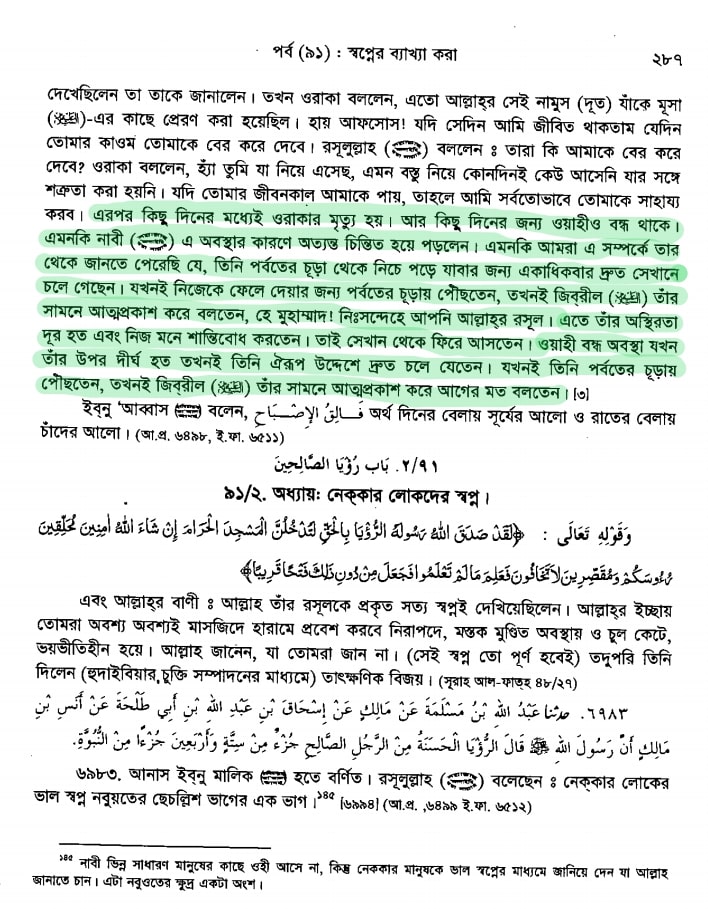
If there is a mention of a stream of experience stopping after someone’s death, an investigation into their role becomes logical. Waraqa was knowledgeable in books, he translated, he named Muhammad’s experience, and he promised support. because of these multiple roles, his absence has significance. how much external assurance, the supply of religious stories, dependence on interpretation, or questions of self-confidence worked in the stream of experience—those questions arise from the real elements of that narrative. alongside this, the uncontrolled character of the claim of the pause in revelation is also revealed: the claimant cannot produce the message at his own will in the moment of need, and that absence creates an intense crisis for him.
In the mountain-related part of description number 6982, the sentence “as has reached us” is present. Ibn Hajar identifies this as an account appended by al-Zuhri. therefore, the description of the first experience, the mention of Waraqa’s death, and the description of the mountain incident are not testimonies of the same level. this textual information is directly related to the main question: which part of the first interpretation of prophethood and the history of the pause is preserved in which source. Waraqa’s role, his death, and the mention of the pause are found together; the mountain-related part carries a separate source identity. in the sequence of religious experience, the first relationship is significant enough for the investigation of how important the presence of human assurance and the exegete was. [111]
Satanic verses in the Quran
The story of the recitation and subsequent withdrawal of praises for al-Lat, al-Uzza, and Manat is preserved in early Islamic literature, including al-Tabari’s tafsir. In these accounts, while Muhammad was reciting Surah an-Najm, he spoke of the high status and intercession of the goddesses; later, those sentences were identified as the projections of Satan. At the center of the story is the possibility of compromise with the opposing Quraysh, the recognition of their goddesses, and the subsequent cancellation of that recognition. The first Bengali version below is a free translation of that prevalent story; in the next, the word “garanik” is presented as the core. [112]
What do you think about al-Lat and al-Uzza?
And about another (goddess), Manat?
They are goddesses of a very high rank (powerful)
and help can be sought from them ( Verses influenced by Satan )
In another Bengali version of the same story, the image of cranes and the hope for intercession appear for the goddesses. In the translation of the word “garanik,” the use of high-status beings and the image of long-necked birds is found; the important religious claim in the original sentence is the expectation of their intercession.
What do you think about al-Lat and al-Uzza?
And about another (goddess), Manat?
They are those flying cranes.
therefore, their mediation can be hoped for.
In the subsequent stage of the story, the sentences praising the intercession of the goddesses are withdrawn. In the current verses of Surah an-Najm 19–23, immediately after the names of the three goddesses, the attribution of daughters and the basis of the names of the deities are rejected. This opposite relationship between the previous praise and the current rejection is the conflict of the garanik story. In the narration, the person who had previously accepted a recitation as the Prophet’s proclamation later had to hear that the source of some parts of that utterance was Satan.
What do you think about al-Lat and al-Uzza.
and about a third one, Manat?
Are the sons for you and the daughters for Allah?
In such a case, this would be a very unfair distribution.
These are but names which you and your forefathers have named. Allah has sent down no authority for this. They follow only conjecture and the desires of their souls. while guidance has come to them from their Lord. ( Corrected verses )
Detailed evidence on this matter is provided in this writing [113]।
In the first complete paragraph of a narration preserved in al-Tabari, the event of the recitation of the text appears as follows. [114]
حدثنا القاسم, قال: ثنا الحسين, قال: ثنا حجاج, عن أبي معشر, عن محمد بن كعب القرظي ومحمد بن قيس قالا جلس رسول الله صلى الله عليه وسلم في ناد من أندية قريش كثير أهله, فتمنى يومئذ أن لا يأتيه من الله شيء فينفروا عنه, فأنزل الله عليه: وَالنَّجْمِ إِذَا هَوَى * مَا ضَلَّ صَاحِبُكُمْ وَمَا غَوَى فقرأها رسول الله صلى الله عليه وسلم, حتى إذا بلغ: أَفَرَأَيْتُمُ اللاتَ وَالْعُزَّى * وَمَنَاةَ الثَّالِثَةَ الأُخْرَى ألقى عليه الشيطان كلمتين: تلك الغرانقة العلى, وإن شفاعتهنّ لترجى, فتكلم بها.
English translation:
Qasim told us, Husayn said, Hajjaj via Abu Mashar narrated from Muhammad ibn Ka’b al-Qurazi and Muhammad ibn Qays: The Messenger was sitting in a crowded assembly of the Quraysh. That day he wished that nothing should come from Allah that would make them turn away from him. Then it was revealed to him, “By the star when it goes down; your companion has not strayed, nor has he erred”. While reading it, when he reached “What do you think about al-Lat and al-Uzza and a third one, Manat,” Satan projected two sentences upon him: “These are high-status garanik; surely their intercession is expected.” He uttered it.
In this narration, the listeners did not hear the words of an unknown speaker; they heard the recitation from Muhammad’s own mouth. Yet later, that part of the utterance is declared to be from an unacceptable source. Consequently, for the listener, the criterion for accepting the first utterance and the criterion for accepting the subsequent withdrawal are trapped within the authority of the same person. If the words coming from the mouth of the announcer are first the basis for accepting revelation, the story of a wrong recitation coming through the same medium strikes the claim of the medium’s infallibility. The explanation “Satan said it” shifts the responsibility for the wrong utterance onto a supernatural opponent; it does not provide a new method of independent verification for the listener.
The social arrangement in the story—where the satisfaction of the Quraysh follows the acceptance of the praise of the goddesses and the return of conflict follows its withdrawal—is also significant. A slight change in religious wording can create or break major political relationships. Here, the relationship between the recognition of the goddesses’ status and Muhammad’s acceptability is described directly. Later, the boundary of exclusive worship is re-established. The conflict between the old gods and the new claim is therefore not just a history of abstract belief; it also involved real questions of human support, collective rituals, and the acceptance of leadership.
Kaaba, the inheritance of sacred geography and Hajj rituals
The idolatrous Kaaba as the cradle of Islam
The Kaaba in Mecca was a center of worship long before Muhammad’s birth. Islamic sources contain descriptions of numerous idols around it, pictures of Abraham and Mary inside, and the religious authority of the Quraysh. The deities of various Arab tribes and Abrahamic figures were linked to the same sacred site. Hubal was worshipped there as an important deity; al-Lat, al-Uzza, and Manat also had their own centers of worship. In the Quranic debate, the context of imagining these three goddesses as daughters of Allah appears. The Kaaba was thus a religious institution bearing the status of many deities, whose service, pilgrimage, and prestige strengthened the social position of the Quraysh. There was a plurality of deities here, and a specific tribe held authority over that plurality. The subsequent Islamic system made the same house the universal Muslim qibla, abolishing the religious rights of its previous worshippers.
In Ibn Ishaq’s Sira, there is a specific statement regarding the beginning of the conflict: after Muhammad began preaching publicly, his tribe did not initially reject him; hostility intensified after he condemned their gods. In this account of the Sira, the center of the conflict is the status of the gods, the religion of the ancestors, and the aggressive stance of the new preaching. Since the identity and social status of the groups were linked to the importance of the Kaaba, the question of rejecting their deities also became a question of power. The establishment of the new religion did not ultimately become just the arrival of an additional path of worship. After the conquest of Mecca, the idols were destroyed, participation in the pilgrimage of the old worshippers was stopped, and the Kaaba was reconstructed under a single religious identity. This outcome clarifies the political scope of the religious rivalry. Related descriptions are also found in discussions of religious defamation, communalism, and the breaking of idols. [115]
In Bukhari’s narration, it is mentioned that on the day of the conquest of Mecca, there were 360 idols around the Kaaba and Muhammad struck them. [116]
عَنْ عَبْدِ اللَّهِ رَضِيَ اللَّهُ عَنْهُ قَالَ: دَخَلَ النَّبِيُّ صَلَّى اللَّهُ عَلَيْهِ وَسَلَّمَ مَكَّةَ يَوْمَ الْفَتْحِ وَحَوْلَ الْبَيْتِ سِتُّونَ وَثَلَاثُمِائَةِ نُصُبٍ، فَجَعَلَ يَطْعُنُهَا بِعُودٍ فِي يَدِهِ وَيَقُولُ: «جَاءَ الْحَقُّ وَزَهَقَ الْبَاطِلُ، جَاءَ الْحَقُّ، وَمَا يُبْدِئُ الْبَاطِلُ وَمَا يُعِيدُ».
English translation:
Narrated from Abdullah: On the day of the conquest of Mecca, the Prophet entered Mecca. At that time, there were 360 idols around the house. He began striking them with the stick in his hand and said: Truth has come and falsehood has vanished. Truth has come; falsehood can neither start anything new nor bring it back.
The Sira’s account also clearly provides the sequence of what happened before and after the open conflict. [117]
قال ابن إسحاق: فلما بادى رسول الله صلى الله عليه وسلم قومه بالإسلام وصدع به كما أمره الله، لم يبعد منه قومه، ولم يردوا عليه — فيما بلغني — حتى ذكر آلهتهم وعابها؛ فلما فعل ذلك أعظموه وناكروه، وأجمعوا خلافه وعداوته، إلا من عصم الله تعالى منهم بالإسلام، وهم قليل مستخفون، وحدب على رسول الله صلى الله عليه وسلم عمه أبو طالب، ومنعه وقام دونه، ومضى رسول الله صلى الله عليه وسلم على أمر الله، مظهرا لأمره، لا يرده عنه شيء.
English translation:
Ibn Ishaq says: When the Messenger revealed Islam before his tribe and proclaimed it according to Allah’s command, according to the reports that reached me, his tribe did not initially distance themselves from him nor reject him—until he mentioned and condemned their gods. After he did so, they considered the matter serious, rejected him, and agreed in opposition and hostility toward him. The exception was a few who accepted Islam and remained in hiding. His uncle Abu Talib protected him with affection and stood in his defense. The Messenger continued his religious proclamation; nothing could deter him from it.
The new religion found its primary symbol and sacred geography from within the old structure established around the Kaaba. Instead of demolishing the structure and building a new center elsewhere, the same house was adopted exclusively. Facing the house, circling it, and the status of a specific stone remained; what changed were the authorized interpretations of these rituals and the identity of the participants. In verse 28 of Surah at-Tawbah, the prohibition of mushriks coming near the Masjid al-Haram is mentioned along with the fear of becoming impoverished. The economic reaction to religious exclusion is revealed in this verse. Prohibiting old pilgrims created a fear of impact on livelihoods—because the religious center was already a hub for people’s travel and the flow of wealth. [118]
Abraham and Mary in the Kaaba
It is known from Islamic evidence that at one time, in the Kaaba, the birthplace and pilgrimage site of Islam, there were pictures of Prophet Abraham and Mary, the mother of Jesus, the founder of Christianity. By this, it is proven that Judeo-Christianity was very familiar to the people of that region, and some people even practiced these religions. Therefore, knowing about the Judeo-Christian relationship certainly was not difficult for Muhammad. Let us learn about this from the hadith [119] –
Sahih Bukhari (Islamic Foundation)
50/ Prophets
Chapter: 2008. The word of Allah: And Allah took Abraham as a friend. (Surah An-Nisa 4: 125) The word of Allah: Indeed, Abraham was a community, obedient to Allah (26: 120) The word of Allah: Indeed, Abraham was tender-hearted and forbearing (9: 114). And Abu Maysarah (rh) said, in the Habshi language the word اواه is used in the sense of الرَّحِيمُ.
Islamic Foundation Number: 3114, International Number: 3351
3114. Yahya ibn Sulayman (rh) … narrated from Ibn Abbas (ra), who said, the Prophet sallallahu alayhi wasallam once entered the Kaaba. there he saw pictures of Abraham (alayhis salam) and Mary saw them. Then he said, what happened to them (the Quraysh)? Yet they have heard that in a house where there are pictures of living beings, the angels (of mercy) do not enter. Since a picture of Abraham has been made, why would he throw the arrows of divination (while engaged in gambling)!
Hadith Grade: Sahih
Narrator: Abdullah ibn Abbas (ra)
The description of the pictures of Abraham and Mary being in the same room shows that biblical characters had already entered the language of Mecca’s sanctity. The allegation of divination arrows being present in Abraham’s picture is particularly significant: an Abrahamic character has been imagined as linked with local religious practices. That is, the boundaries between deity, prophet, and religious ritual, which were later separated by strict definitions, could have been blended in previous folk customs. Muhammad’s protest also acknowledges the existence of the pictures while rejecting their religious validity. A scene of canceling old interpretations and establishing new ones centered on the same location is found here as well. [120]
The presence of Mary carries special importance because she is not a local tribal goddess of Arabia; her identity is deeply related to the Christian narrative. The description of her picture being in a place as important as the Kaaba serves as testimony to the social familiarity of that narrative. For a Meccan to know about a biblical character, it was not necessary for every piece of information to arrive separately from a distant, unknown world. Stories and ideas could travel through family connections, converted relatives, travelers, slaves, and market conversations. The presence of these characters in the very sacred center where her family was active further specifies the human cultural environment of Islam.
Description of biblical-like utterances in the Kaaba
In Ibn Ishaq’s Sira, a story is preserved regarding an inscription in the Syrian language in the Kaaba, the deciphering of it by a Jew, and a maxim about the fruit of sowing good and evil. The latter account is attributed to Layth ibn Abi Sulaym and is linked to a time forty years before the prophethood. The maxim states that a good reward cannot be obtained by doing evil deeds, just as grapes cannot be gathered from thorns. There is a clear similarity in language with the metaphor of the fruit of deeds and the fruit of good and bad trees found in the Gospel of Matthew. This similarity preserved within the Sira’s narrative shows the relationship between Abrahamic ethics and local sacred sites in Mecca’s religious memory. [121] [122]
Matthew 7:16-20 New Living Translation (NLT)
You can identify them by their fruit, that is, by the way they act. Can you pick grapes from thornbushes, or figs from thistles? A good tree produces good fruit, and a bad tree produces bad fruit. A good tree can’t produce bad fruit, and a bad tree can’t produce good fruit. So every tree that does not produce good fruit is chopped down and thrown into the fire. Yes, just as you can identify a tree by its fruit, so you can identify people by their actions.
English translation: [123]
16 By their fruits you will know them. Can anyone gather grapes from thornbushes or figs from thistles?
17 In the same way, every good tree bears good fruit, but a bad tree bears bad fruit.
18 A good tree cannot bear bad fruit, nor can a bad tree bear good fruit.
The preserved account of Ibn Ishaq regarding the Kaaba inscription is given below for comparison with Matthew’s metaphor. Just as there is mention of taking the help of a Jew to read the text written in the Syrian language, there is also a description of a maxim said to be found in the Kaaba. Multiple narratives are preserved in the same section. [124]
Bengali text:
আমাকে একজন বলেছে, যে কোণে কোরাইশরা সিরীয় ভাষায় কিছু লিপি পেয়েছিল, সে লেখা তারা পড়তে পারেনি। পেরেছিল একজন ইহুদি। ইহুদি ভদ্রলোক লেখাটা তাদের পড়ে শুনিয়েছিলেন: আমি আল্লাহ বাক্কার প্রভু, যেদিন আমি আকাশ সৃষ্টি করলাম, পৃথিবী সৃষ্টি করলাম, সূর্য আর চাঁদকে বানালাম, তাদের ঘিরে দিলাম সাতটি গুণাবান ফেরেশতা দিয়ে, সেদিনই আমি এটা সৃষ্টি করেছিলাম। এর দুটি পর্বত দণ্ডায়মান থাকবে, এটাও দণ্ডায়মান থাকবে দুধ আর পানিসহ। এ থাকবে মানুষের কাছে নিয়ামত হয়ে। আমাকে একজন বলেছে, তারা মাকামে আরেকটা লেখা পেয়েছিল এবং তা ছিল মক্কা আল্লাহর পবিত্র ঘর. এর খাদ্য আসে তিন দিক থেকে, এর লোকজন যেন প্রথমে এর অবমাননা না করে।
লায়ছ ইবনে আবু সুলায়ম দাবি করেছেন, রাসুলে করিমের (সা.) নবুয়তের ৪০ বছর আগে তারা কাবায় একটি পাথর পেয়েছিল। তাদের কথা যদি সত্যি হয়, তাহলে তাদের মতে সেই পাথরে উৎকীর্ণ লিপির পাঠ ছিলঃ যে ভালো বপন করবে, সে আনন্দদায়ক ফসল পাবে, যে মন্দ বপন করবে, সে মন্দ ফসল পাবে। তুমি কি মন্দ করে তার পুরস্কার ভালো পেতে পারো? না, যেমন কাঁটা থেকে আঙুর ফল সংগ্রহ করা যায় না।
English translation:
Someone told me that in the corner where the Quraysh found some inscriptions in the Syrian language, they could not read that writing. A Jew could. The Jewish gentleman read the writing aloud to them: I am Allah, the Lord of Bakka, the day I created the heaven, I created the earth, I made the sun and the moon, and I surrounded them with seven virtuous angels, on that very day I created this. Two of its mountains will remain standing, this too will remain standing with milk and water. This will be a blessing for mankind. Someone told me they found another writing at the Maqam, and it was: Mecca is the sacred house of Allah. Its food comes from three directions, let its people not first desecrate it.
Layth ibn Abu Sulaym claimed that 40 years before the prophethood of the Messenger of Allah (saw), they found a stone in the Kaaba. If their words are true, then according to them, the text of the inscription on that stone was: He who sows good will reap a joyful harvest, he who sows evil will reap an evil harvest. Can you do evil and receive a good reward for it? No, just as grapes cannot be gathered from thorns.

The metaphor of good fruit from good seeds, bad fruit from bad seeds, and not getting grapes from thorns is a memorable language for judging human behavior. Once this metaphor is propagated, it does not become mandatory to read the original scripture to understand its meaning. A sentence heard orally can also become part of religious propagation. This story in the Sira is therefore an element for understanding the movement of oral and translated religious language. If the question of biblical ideas reaching Arabic society is reduced only to the question of “whether Muhammad himself read the Bible,” the actual paths of communication are ignored. Hearing, interpretation, translation, and oral propagation—through each of these paths, a religious metaphor can enter a different society.
Ibn Ishaq himself used the phrase “if his account is true” during the final description. Consequently, instead of an opportunity to examine any preserved ancient stone, a literary testimony is found here: a later Muslim biographer preserved a story of biblical-like language to explain the past of the Kaaba. Stretching its history back to the day of the creation of the heaven and earth to prove the sanctity of the Kaaba and linking it with moral maxims is part of the same construction of religious memory. In this memory, the Kaaba, Allah, angels, the heavens, and moral reward have become linked to one another. The descriptive world of the new religion developed in an environment where these characters and ideas were already circulating in various streams.
Problems regarding the construction of the Kaaba
Regarding who first constructed the Kaaba, Islamic narratives provide ideas of Adam, Abraham, and even more ancient structures. The Quran calls the Kaaba the first house of worship, links Abraham and Ishmael to it, and commands salat at the Maqam of Abraham. These statements establish a sacred lineage. Independent historical evidence for the priority that the Kaaba was built before all other places of worship is not present within this religious declaration. By combining the name of the structure, the memory of Abraham, and the rules of pilgrimage, the current center of worship has been established as the center of the primordial religion of mankind. [125] [126]
And remember when I made the Kaaba a center of gathering and a sanctuary for mankind and said, ‘Take the Maqam of Abraham as a place for salat’ and I told Abraham and Ishmael, ‘Keep My House pure for those who perform tawaf, those who perform i’tikaf, and those who bow and prostrate’.
— Taisirul Quran
And when I made the Kaaba a secure place and a sanctuary for mankind, and designated the Maqam of Abraham as the place for salat; and I took a covenant from Abraham and Ishmael that you shall keep My House pure for those who perform tawaf, i’tikaf, and those who bow and prostrate.
— Sheikh Mujibur Rahman
And remember when I made the Kaaba a center of gathering and a safe place for people and (ordered that,) ‘You take the Maqam of Abraham as a place for salat’. And I gave the responsibility to Abraham and Ishmael that, ‘You keep My House pure for those who perform tawaf, i’tikaf, and those who bow and prostrate’.
— Rawai Al-bayan
And remember, when We made the Kaaba a center of gathering and a sanctuary for mankind and said, you take the Maqam of Abraham as a place for salat. And I ordered Abraham and Ishmael to keep My House pure for those who perform tawaf, i’tikaf, and those who bow and prostrate.
— Dr. Abu Bakr Muhammad Zakaria
Bengali text:
কা’বা ঘর নির্মাণের ইতিহাস
সর্বপ্রথম কা’বা শরীফ নির্মাণ সম্বন্ধে বিভিন্নরূপ উপাখ্যান বর্ণিত হইয়াছে। কথিত আছে, পৃথিবীতে হযরত আদম (আ)-এর আগমনের পূর্বে ফেরেশতাগণ কা’বা শরীফ নির্মাণ করেন। আবূ জা’ফর বাকের মুহাম্মদ ইব্ন আলী ইব্ন হুসাইন হইতে উপরোক্ত রিওয়ায়েত বর্ণিত হইয়াছে। ইমাম কুরতুবীও হাদীসটি উল্লেখ করিয়াছেন। অবশ্য উক্ত রিওয়ায়েতটি অন্য কোন হাদীস দ্বারা সমর্থিত হয় নাই। ইহাও কথিত হইয়াছে যে, ‘হযরত আদম (আ) সর্বপ্রথম কা’বা শরীফ নির্মাণ করেন।’ আতা, সাঈদ ইব্ন মুসাইয়্যেব প্রমুখ ব্যক্তি হইতে ধারাবাহিকভাবে ইন্ন জুরায়জ ও আব্দুর রায্যাক বর্ণনা করিয়াছেন:
‘হযরত আদম (আ) পাঁচটি পর্বত হইতে পাথর আনিয়া কা’বা নির্মাণ করিয়াছিলেন। উক্ত পাঁচটি পর্বত হইতেছে-হেরা, সিনাই, যায়তা )زینا(, লেবানন এবং জুদী। অবশ্য উক্ত রিওয়ায়েতও সহীহ হাদীস দ্বারা প্রমাণিত’ নহে। হযরত ইবন আব্বাস (রা), কা’ব আহবার, কাতাদাহ এবং ওয়াহাব ইব্ন মুনাব্বিহ হইতে বর্ণিত হইয়াছে: সর্বপ্রথম কা’বা শরীফ নির্মাণ করেন হযরত শীছ (আ)।’
উপরোক্ত রিওয়ায়েতসমূহ সম্ভবত ইয়াহুদী-খ্রিস্টানদের পুস্তক হইতে গৃহীত হইয়াছে। উল্লেখ্য, যতক্ষণ না কোন বিষয় সহীহ হাদীস দ্বারা সমর্থিত হয়, ততক্ষণ এইরূপ রিওয়ায়েতকে সত্য বা মিথ্যা কোনটিই বলা যায় না। অবশ্য এইরূপ রিওয়ায়েতের সমর্থনে কোন সহীহ হাদীস পাওয়া গেলে উহা অবশ্যই গ্রহণ করিতে হইবে।’
আল্লাহ্ তা’আলার কালাম:
وَإِذْ قَالَ إِبْرَاهِمْ رَبِّ اجْعَلْ هَذَا بَلَدًا آمِنًا وَارْزُقْ أَهْلَهُ مِنَ الثَّمَرَتِ مَنْ أَمَنْ مِنْهُمْ بِاللَّهِ وَالْيَوْمِ الْآخِرِ .
অর্থাৎ সেই সময়টি স্মরণযোগ্য, যখন ইবরাহীম বলিয়াছিল, ‘প্রভু হে! তুমি ইহাকে নিরাপদ জনপদ বানাইও আর উহার অধিবাসীদিগের মধ্য হইতে যাহারা আল্লাহর প্রতি ও আখিরাতের প্রতি ঈমান আনিবে, তাহাদিগকে ফলসমূহ হইতে রিযিক দিও।’
এই প্রসঙ্গে হযরত জাবির ইব্ন আব্দুল্লাহ হইতে ধারাবাহিকভাবে আবু যুবায়র, সুফিয়ান, আব্দুর রহমান ইব্ন মাহদী ইব্ন বিশার ও ইমাম আবূ জা’ফর ইবন জারীর বর্ণনা করিয়াছেন: নবী করীম (সা) বলিয়াছেন: ‘হযরত ইবরাহীম (আ) আল্লাহর ঘর (কা’বা)-কে সম্মানিত ও নিরাপদ ঘোষণা করিয়াছিলেন আর আমি মদীনা শহর অর্থাৎ উহার প্রস্তরময় দুই প্রান্ডের মধ্যবর্তী স্থানকে সম্মানিত ঘোষণা করিতেছি। উহাতে শিকার করা এবং উহার কাঁটা-বৃক্ষ কাটা যাইবে না।’
English translation:
History of the Construction of the Kaaba
Various narratives have been recounted regarding the first construction of the Kaaba Sharif. It is said that the angels constructed the Kaaba Sharif before the arrival of Prophet Adam (AS) on earth. The above narration has been reported from Abu Ja’far Bakir from Muhammad ibn Ali ibn Husayn. Imam al-Qurtubi has also mentioned this hadith. However, this narration has not been supported by any other hadith. It has also been said that, ‘Prophet Adam (AS) first constructed the Kaaba Sharif.’ Inna Jurayj and Abdur Razzaq have narrated this sequentially from individuals such as Ata, Sa’id ibn al-Musayyib, and others:
‘Prophet Adam (AS) constructed the Kaaba by bringing stones from five mountains. Those five mountains are—Hira, Sinai, Jayta زینا(, Lebanon, and Judi. However, this narration is also not proven by sahih hadith. It has been narrated from Ibn Abbas (RA), Kab al-Ahbar, Qatadah, and Wahb ibn Munabbih: Prophet Seth (AS) first constructed the Kaaba Sharif.’
The above narrations were probably taken from Jewish-Christian books. It should be noted that until a matter is supported by sahih hadith, such narrations cannot be called either true or false. However, if any sahih hadith is found in support of such narrations, it must certainly be accepted.’
The Word of Allah Ta’ala:
وَإِذْ قَالَ إِبْرَاهِمْ رَبِّ اجْعَلْ هَذَا بَلَدًا آمِنًا وَارْزُقْ أَهْلَهُ مِنَ الثَّمَرَتِ مَنْ أَمَنْ مِنْهُمْ بِاللَّهِ وَالْيَوْمِ الْآخِرِ .
That is, the time is memorable when Abraham said, ‘My Lord! Make this a secure settlement and provide sustenance of fruits to those among its inhabitants who believe in Allah and the Hereafter.’
In this context, Abu Zubayr, Sufyan, Abdur Rahman ibn Mahdi ibn Bishar, and Imam Abu Ja’far ibn Jarir have narrated sequentially from Jabir ibn Abdullah: The Holy Prophet (SAW) said: ‘Prophet Abraham (AS) declared the House of Allah (Kaaba) honored and secure, and I declare the city of Medina, that is, the area between its two stony borders, honored. No hunting shall be done there, nor shall its thorny trees be cut.’

Again, in Surah Al-Imran of the Quran, it is said, [127] [128]
Undoubtedly, the first House established for mankind was that at Mecca, which is blessed and a guide for the whole world.
— Taisirul Quran
Certainly the first house, which has been designated for mankind, is that house located in Bakka (Mecca); it is auspicious and a guide for all the people of the world.
— Sheikh Mujibur Rahman
Certainly the first house, which was established for humans, is in Mecca. which is blessed and guidance for the people of the world.
— Rawai Al-bayan
Certainly the first house that was established for the human race was in Bakka, as a blessed place and a guide for the creation.
— Dr. Abu Bakr Muhammad Zakaria
In it are clear signs (such as) Maqam Ibrahim (the place where Abraham stood). whoever enters it shall be secure. Performing Hajj to that House for Allah is obligatory for people who have the means to reach it, and whoever denies it, (let him know) undoubtedly Allah is not in need of the worlds.
— Taisirul Quran
Clear signs exist within it, Maqam Ibrahim is one of those signs. and whoever enters it attains security and performing Hajj to this House for the purpose of Allah is the duty of those people who possess the financial means to travel, and if anyone denies it, then certainly Allah is free from need of all the people of the world.
— Sheikh Mujibur Rahman
It contains clear signs, Maqam Ibrahim. and whoever enters it will become secure, and for capable people, performing Hajj to the House of Allah is farz. and whoever commits kufr, then Allah is certainly independent of the creation.
— Rawai Al-bayan
It has many clear signs, such as Maqam Ibrahim. and whoever enters there is secure. and among people, whoever has the means to go there, performing Hajj to that House for the purpose of Allah is obligatory for them. and whoever commits kufr, let them know, certainly Allah is not in need of the creation.
— Dr. Abu Bakr Muhammad Zakaria
In Bukhari and Muslim, it is stated that there was a forty-year gap between the first establishment of Masjid al-Haram and Masjid al-Aqsa. Beside the known relationship of Abraham with the Kaaba and Solomon with the construction of the Jerusalem sanctuary, this claim of timing creates a specific problem. In the internal genealogy of the Abrahamic narrative, there are many generations between Abraham and Solomon. The first temple of Jerusalem is linked to Solomon; the history of the current Al-Aqsa establishment is separate from that. Using the word “masjid” to denote the first institution of a holy site and denoting the current building are not the same question. The claim of forty years requires a specific founder, contemporary documents, or archaeological evidence; the hadith has only announced the time. [129] [130]
Sahih Bukhari (Islamic Foundation)
50/ Prophets (AS)
Chapter: 2009. يَزِفُّونَ Meaning to move fast.
Islamic Foundation Number: 3127, International Number: 3366
3127. Musa ibn Islama’i (RH) … narrated from Abu Dharr, he said, I said, O Messenger of Allah! Which mosque was first built in the world? He said, Masjid al-Haram. I said, then which one? He said, Masjid al-Aqsa. I said, what was the gap between the (construction of) both mosques? He said, forty years. (He further said) then wherever the time for salat comes for you, perform salat there. because virtue is inherent in it.
Hadith Grade: Sahih
Narrator: Abu Dharr al-Ghifari (RA)
Sahih Muslim (Hadith Academy)
5. Mosques and places of salat
Chapter: No chapter
Hadith Academy Number: 1048, International Number: 520
1048-(1/520) Abu Kamil al-Jahdari, Abu Bakr ibn Abu Shaybah, and Abu Qurayb (RH) … narrated from Abu Dharr (RA). he said, I asked, O Messenger of Allah! Which mosque was first constructed in the world? He said, Masjid al-Haram. I asked again, then which one (mosque). He said, Al-Masjid al-Aqsa or Bayt al-Maqdis. I asked again, what is the gap between the construction times of these two mosques? He said, forty years. (He further said) wherever the time for salat arrives, you should perform salat there. because that place is also a masjid.
In the hadith narrated by Abu Kamil it is mentioned, therefore wherever the time for salat comes, you should perform salat there. because it is also a masjid. (Islamic Foundation 1042, Islamic Center 1052)
Hadith Grade: Sahih
Narrator: Abu Dharr al-Ghifari (RA)
The relationship of Solomon with the construction of Bayt al-Maqdis is not merely an assumption outside the hadith. In Nasai, there is a full description of his prayer after the completion of the construction. [131]
عَنْ عَبْدِ اللَّهِ بْنِ عَمْرٍو، عَنْ رَسُولِ اللَّهِ صلى الله عليه وسلم ” أَنَّ سُلَيْمَانَ بْنَ دَاوُدَ صلى الله عليه وسلم لَمَّا بَنَى بَيْتَ الْمَقْدِسِ سَأَلَ اللَّهَ عَزَّ وَجَلَّ خِلاَلاً ثَلاَثَةً سَأَلَ اللَّهَ عَزَّ وَجَلَّ حُكْمًا يُصَادِفُ حُكْمَهُ فَأُوتِيَهُ وَسَأَلَ اللَّهَ عَزَّ وَجَلَّ مُلْكًا لاَ يَنْبَغِي لأَحَدٍ مِنْ بَعْدِهِ فَأُوتِيَهُ وَسَأَلَ اللَّهَ عَزَّ وَجَلَّ حِينَ فَرَغَ مِنْ بِنَاءِ الْمَسْجِدِ أَنْ لاَ يَأْتِيَهُ أَحَدٌ لاَ يَنْهَزُهُ إِلاَّ الصَّلاَةُ فِيهِ أَنْ يُخْرِجَهُ مِنْ خَطِيئَتِهِ كَيَوْمِ وَلَدَتْهُ أُمُّهُ ” .
English translation:
Narrated on the authority of the Messenger from Abdullah ibn Amr: After Solomon, son of David, constructed Bayt al-Maqdis, he asked Allah for three things. He asked for judgment that matches the judgment of Allah; he was granted that. He asked for a kingdom that would not belong to anyone after him; he was granted that too. After finishing the construction of the mosque, he asked Allah that whoever comes there solely for the purpose of performing salat, Allah should make him free from sin just as his mother gave birth to him.
Classical exegetes have brought the assumption of an even earlier construction to resolve this problem of timing. Ibn al-Jawzi, instead of considering Abraham and Solomon as the first builders, sought the first establishers among Adam and his children. His statement has also been quoted in Islam Q&A. [132]
الإشارة إلى أول البناء، ووضع أساس المسجدين؛ وليس أول من بنى الكعبة إبراهيم، ولا أول من بنى بيت المقدس سليمان، وفي الأنبياء والصالحين والبانين كثرة، فالله أعلم بمن ابتدأ. وقد روينا أن أول من بنى الكعبة: آدم، ثم انتشر ولده في الأرض، فجائز أن يكون بعضهم قد وضع بيت المقدس.
English translation:
Here, a hint is given toward the first construction and foundation-laying of the two mosques. Abraham was not the first builder of the Kaaba and Solomon was not the first builder of Bayt al-Maqdis. The number of prophets, righteous people, and builders is many; who started it, Allah knows best. It has been narrated to us that Adam first constructed the Kaaba. Later his children spread across the earth; therefore, some of them might have established Bayt al-Maqdis.
The phrase “might have” in the last sentence of this explanation reveals its evidentiary position. To keep the forty-year calculation established, the idea of a possible previous builder has been introduced. His name, time, contemporary inscriptions, or evidence of construction have not been provided here. Instead of verifying the number declared in the hadith, an unknown construction phase has been inserted by assuming the number to be true. Consequently, the answer to the historical problem depends on a new unproven narrative. Even if Abraham and Solomon are called rebuilders, the claim of first construction is not proven; the entire basis of the claim of priority still revolves within the religious narrative.
The claim of the Kaaba’s antiquity is also linked to the authority of subsequent Hajj regulations. If a local place of worship is called the first house of mankind, the instruction to go there gains universal status. Maqam Ibrahim, sanctity, and primality together validate the central position of Mecca. This religious importance and the actual construction date of the establishment are separate questions. A place does not become the oldest just because it is holy to millions of people. To establish specific events of the past, specific historical evidence is needed instead of the number of believers.
Sacred Geography in the name of Abraham: Claims of the same authority beyond the Kaaba
When a place of worship is linked to Abraham, the current administrators of that site acquire a powerful religious legacy. local stones, trees, wells, or altars then become markers of a chosen ancestor’s life. the general act of visiting the site transforms into following his path; animal sacrifice becomes a reenactment of an ancient ideal; and the maintainers of the pilgrimage can establish themselves as the legitimate representatives of that tradition. this method of establishing authority operates in declaring the Kaaba as the construction of Abraham and Ishmael. several other shrines in Western Asia also explain their sanctity through stories of Abraham’s residence, the construction of an altar, the arrival of divine guests, or the sacrifice of a son. multiple sacred geographies have been constructed in the name of the same ancestor.
Mamre: Abraham’s Altar, Sacred Tree, and Annual Assembly
Genesis 13:18 claims that Abraham resided at Mamre in Hebron and built an altar there for God. The story connects a particular territory with his worship. The presence of this connection in scripture does not replace independent archaeological evidence that Abraham actually lived there; it is written religious testimony explaining the place’s sanctity. [133]
Genesis 13:18; King James Version of the ancient text:
Then Abram removed his tent, and came and dwelt in the plain of Mamre, which is in Hebron, and built there an altar unto the LORD.
English translation:
And Abram removed his tent, and came, and dwelt in Hebron, in the plains of Mamre, and built there an altar unto the Lord.
The actual appearance of the annual pilgrimage built around this memory is found in the account of the fifth-century Christian historian Sozomen. In the fourth chapter of his second volume, people arriving from Palestine, Phoenicia, and the Arabian region, summer festivals, trade, prayers, and animal sacrifices are mentioned side by side. Jews, Christians, and pagans participated in the same place according to their own religious interpretations. This coordination of the memory of an ancient figure, the presence of various communities, and pilgrimage trade is particularly significant in the comparative discussion of the history of the Kaaba. [134]
Sozomen, 2.4; English translation published in the nineteenth century:
Here the inhabitants of the country and of the regions round Palestine, the Phœnicians, and the Arabians, assemble annually during the summer season to keep a brilliant feast; and many others, both buyers and sellers, resort there on account of the fair.
Indeed, this feast is diligently frequented by all nations: by the Jews, because they boast of their descent from the patriarch Abraham; by the Pagans, because angels there appeared to men; and by Christians, because He who for the salvation of mankind was born of a virgin, afterwards manifested Himself there to a godly man. This place was moreover honored fittingly with religious exercises.
Here some prayed to the God of all; some called upon the angels, poured out wine, burnt incense, or offered an ox, or he-goat, a sheep, or a cock. Each one made some beautiful product of his labor, and after carefully husbanding it through the entire year, he offered it according to promise as provision for that feast, both for himself and his dependents.
English translation:
Here the local inhabitants, people from the surrounding regions of Palestine, the Phoenicians, and the Arabs assemble every year in the summer to celebrate a magnificent festival. Due to the fair, many more people, both buyers and sellers, come there.
All communities attend this festival with interest. The Jews come because they pride themselves on being descendants of the ancestor Abraham; the pagans come because angels had appeared to humans there; the Christians come because He who was born of a virgin for the salvation of mankind later appeared there to a righteous man. The place was also honored with religious ceremonies.
Some prayed there to the God of all; some called upon the angels, poured libations, burned incense, or sacrificed bulls, goats, sheep, or cocks. Everyone prepared some beautiful fruit of their labor, kept it carefully throughout the year, and offered it for the festival according to a vow—for the use of themselves and their dependents.
In this assembly, prayer and trade were not rivals to each other. Religious attraction brought people, the presence of those people created a market, and the market increased the regional importance of the pilgrimage. Multiple communities laid their own claims upon the memory of Abraham. Sozomen also wrote in the same chapter about abstaining from sexual intercourse during the festival and throwing offerings into the well known as Abraham’s well. Consequently, the combination of specific pilgrimage behavior, sacred sites, religious prohibitions, and offerings is visible in this pre-Islamic center.
Gerizim: Rival Claims over Abraham’s Place of Sacrifice
In the Samaritans’ own religious accounts, Mount Gerizim is the sacred place chosen by God. According to their claim, Abraham and Jacob built altars there; the preparation for Abraham’s sacrifice of Isaac also took place there. On their pilgrimage route, separate memorial sites for those events are marked—the finding of the substitute animal and the altar of Isaac. Claims of altars of Adam and Noah are also added to the same mountain. In this way, the memories of multiple ancient figures are concentrated in one place to establish it as the bearer of mankind’s primordial worship. [135] [136]
In the case of Gerizim, the sacred mountain, chosen ancestor, altar, sacrifice, and specific pilgrimage route work together. In the case of the Kaaba, the sacred house, Abraham–Ishmael, the stone of the Maqam, and the rituals of Hajj create a similar religious legacy. Although the narratives of the two claims are different, the method of creating legitimacy is comparable: the status of the current site is explained by the authority of a religious ancestor from the distant past. A community’s own story establishes the existence of that community’s claim; historical evidence of the claimed ancient event is required separately.
Neighboring Shrines of the Kaaba: Polycentric Hajj and Worship in Arabia
In pre-Islamic Arabia, pilgrimage, offerings to deities, boundaries of sacred areas, the authority of custodians, and the institution of circumambulating places of worship were present in various centers. The Kaaba was a primary center of this regional religious world. When the accounts of Manat, Uzza, Lat, and Dhul-Khalasa are placed side by side, the social structure of the pilgrimage becomes clear: a place centered around a deity, a specific group in charge of the service of that place, the obedience of visitors, and the flow of wealth through gifts or sacrifices. Consequently, the history of the physical acts and social organization of Hajj began before Muhammad’s preaching.
In the account of Ibn Ishaq preserved by Ibn Hisham, the comparison of the Kaaba with other houses of worship is quite direct. Custodians, gifts, tawaf, and animal sacrifice—multiple characteristics of the same institution are mentioned side by side. [137]
Full relevant paragraph of Ibn Ishaq; Arabic original:
قال ابن إسحاق : واتخذ أهل كل دار في دارهم صنما يعبدونه ، فإذا أراد الرجل منهم سفرا تمسح به حين يركب ، فكان ذلك آخر ما يصنع حين يتوجه إلى سفره ، وإذا قدم من سفره تمسح به فكان ذلك أول ما يبدأ به قبل أن يدخل على أهله فلما بعث الله رسوله محمدا صلى الله عليه وسلم بالتوحيد ، قالت قريش : أجعل الآلهة إلها واحدا إن هذا لشيء عجاب وكانت العرب قد اتخذت مع الكعبة طواغيت وهي بيوت تعظمها كتعظيم الكعبة ، لها سدنة وحجاب ، وتهدي لها كما تهدي للكعبة ، وتطوف به كطوافها بها ، وتنحر عندها . وهى تعرف فضل الكعبة عليها ، لأنها كانت قد عرفت أنها بيت إبراهيم الخليل ومسجده .
English translation:
Ibn Ishaq says: The people of every family used to keep an idol in their house and worship it. Some would touch it before departing on a journey; this was the last thing they did when setting out for travel. Upon returning from a journey, they would first touch the idol before entering the family home. When Allah sent His Messenger Muhammad to preach monotheism, the Quraysh said, has he turned many deities into one deity? This is a strange thing! The Arabs had accepted other centers of worship alongside the Kaaba. These were houses which they honored like the Kaaba. They had custodians and gatekeepers. They gave gifts to them just as they gave to the Kaaba; they circumambulated them like the Kaaba and gave animal sacrifices to them. They also acknowledged the superiority of the Kaaba over them, because they knew the Kaaba as the house and place of worship of Abraham the Friend.
The account, on one hand, provides a religious explanation for the Abrahamic priority of the Kaaba, and on the other hand, acknowledges the existence of multiple houses with similar rituals. Separating the two statements clarifies the nature of the information: the description of polycentric worship and the belief explaining the superiority of one among those centers. The combination of custodians, tawaf, offerings, and tribal honor was a widespread religious institution in Arabia. Islam adopted important elements of that pre-existing institution and redefined its authorized deity and center.
Hajj is incomplete without visiting Manat
Ibn Kalbi described the worship of Manat through a specific ritual linked to the pilgrimage of Mecca. Although the Aus–Khazraj and their followers participated in the general pilgrimage phase, they postponed the shaving of the head. On the way back, they would go to Manat, shave their heads, and only after staying there did they consider the Hajj complete. Multiple sacred centers played a role within the same journey; the rituals of the Kaaba and the honor of Manat could be connected in the religious life of one person. [138]
Arabic original:
قال أبو المنذر هشام بن محمد: وحدثنا رجل من قريش عن أبي عبيدة بن عبد الله بن أبي عبيدة بن عمار ابن ياسر (وكان أعلم الناس بالأوس والخزرج) قال: كانت الأوس والخزرج ومن يأخذ بإخذهم من عرب أهل يثرب وغيرها فكانوا يحجون فيقفون مع الناس المواقف كلها ولا يحلقون رءوسهم. فإذا نفروا أتوه فحلقوا رءوسهم عنده وأقاموا عنده. لا يرون لحجهم تماما إلا بذلك.
English translation:
Abu Munzir Hisham ibn Muhammad says: A man of the Quraysh informed me through Abu Ubayda ibn Abdullah ibn Abu Ubayda ibn Ammar ibn Yasir—who was specifically knowledgeable about the Aus and Khazraj—that the Aus, Khazraj, and the Arabs of Yathrib and other places who followed their method, would perform Hajj and stand with the people at all the designated stations, but they would not shave their heads. On their return, they would go to Manat, shave their heads there, and stay there. Without this, they did not consider their Hajj complete.
The particular strength of this account is that the worship of Manat does not appear here as a vague belief; it appears as a condition for the completion of the pilgrimage. A visible act like shaving the head was a sign of obedience to the deity. Memories of performing ihram in the name of Manat are also preserved in Bukhari and Muslim. That is, Islamic literature itself carries testimony regarding the pre-Islamic religious use of important rituals of the Islamic Hajj.
The Sacred Area of Uzza: A Parallel System to the Haram of the Kaaba
In the Uzza-center of Nakhlah, along with visits, gifts, and animal sacrifices, mention of a preserved sacred area is also found. Ibn Kalbi directly mentioned making a region called Sukam similar to the Haram of the Kaaba. Thus, the institution of determining the boundaries of sanctity was not linked only to Mecca. [139]
Arabic original; two separate full paragraphs:
كانت بوادٍ من نخلة الشآمية يقال له حراض بإزاء الغمير عن يمين المصعد إلى العراق من مكة. وذلك فوق ذات عرقٍ إلى البستان بتسعة أميال. فبنى عليها بُسّا (يريد بيتا). وكانوا يسمعون فيه الصوت. وكانت العرب وقريش تسمي بها عبد العزى. وكانت أعظم الأصنام عند قريش. وكانوا يزورونها ويهدون لها ويتقربون عندها بالذبح.
وكانت قريش قد حمت لها شعبا من وادي حراضٍ يقال له سقام. يضاهون به حرم الكعبة.
English translation:
Uzza was in a valley named Harad in Nakhla Shamia, opposite Gumair, on the right side of the road ascending from Mecca toward Iraq. it was nine miles away from Bustan over Yatu Iraq. a house had been constructed upon it. they used to hear voices there. the Arabs and Quraysh gave it the name Abd al-Uzza. for the Quraysh, it was the most prestigious idol. they would visit it, give gifts, and seek its proximity by slaughtering animals.
The Quraysh had reserved a mountain pass named Sukam in the Harad valley for it. through this, they had established an arrangement similar to the Haram of the Kaaba.
Making Sukam a sacred area means giving a portion of land a religious status separate from daily use. when a deity, attendants, gifts, and sacrifices are associated with it, a complete institution is formed. in the discussion of the history of the Islamic Haram, this previous parallel institution is essential. the depth of religious change cannot be understood simply by a list of idol names; the authority of those worship centers over land, wealth, and human movement is also considerable.
Lat and Dhul-Khalasa: House, Attendants, and Another Kaaba
There are descriptions of the house built around the Lat of Taif and the attendants of Saqif. in the case of Dhul-Khalasa, Bukhari’s narration directly identifies it as another Kaaba. in Jarir’s account, Muhammad’s order for its destruction and the killing of the people present there are mentioned together. [140]
Bukhari 4355; Arabic original:
عَنْ جَرِيرٍ، قَالَ كَانَ بَيْتٌ فِي الْجَاهِلِيَّةِ يُقَالُ لَهُ ذُو الْخَلَصَةِ وَالْكَعْبَةُ الْيَمَانِيَةُ وَالْكَعْبَةُ الشَّأْمِيَّةُ، فَقَالَ لِي النَّبِيُّ صلى الله عليه وسلم «أَلاَ تُرِيحُنِي مِنْ ذِي الْخَلَصَةِ». فَنَفَرْتُ فِي مِائَةٍ وَخَمْسِينَ رَاكِبًا، فَكَسَرْنَاهُ وَقَتَلْنَا مَنْ وَجَدْنَا عِنْدَهُ، فَأَتَيْتُ النَّبِيَّ صلى الله عليه وسلم فَأَخْبَرْتُهُ، فَدَعَا لَنَا وَلأَحْمَسَ.
English translation:
Narrated from Jarir. he said: In the days of ignorance, there was a house which was called Dhul-Khalasa, the Yemeni Kaaba, and the Shami Kaaba. the Prophet said to me, “Will you not give me relief from Dhul-Khalasa?” I set out with one hundred and fifty horsemen. we demolished it and killed those whom we found near it. then I came to the Prophet and informed him. he prayed for us and for the tribe of Ahmas.
The reading regarding the name of the narration contains both Yemeni and Shami identities; the decisive information among them is that there was another house known as the Kaaba in the religious world of Arabia. the plurality of worship centers and the end of that plurality through the destruction of the center—both histories are preserved in the same narration. if the current exclusive position of the Kaaba of Mecca is assumed to have been equally effective in the distant past, this rival religious geography is lost.
| Center | Ritual or Institution | Historical Significance |
|---|---|---|
| Manat | Ihram; shaving the head and staying after the pilgrimage | Rituals of other deities were associated with the pilgrimage of Mecca |
| Uzza | Gifts, sacrifice, visitation; the reserved area of Sukam | Parallel sacred geography to the Haram of the Kaaba |
| Lat | House over the idol and a specific group of attendants | The role of tribal institutions in managing places of worship |
| Dhul-Khalasa | House known as the Kaaba; memories of worship and circumambulation | Prestigious pilgrimage centers outside Mecca; later military destruction |
The Sacred Months and Nasīʾ: New Authority over an Older Religious Calendar
Along with pilgrimage, a particular system of time also entered Islam. Decisions about the month of pilgrimage, the periods when warfare would cease, and the months regarded as more sacred than others involved worship, movement, tribal relations, and political power. The names of the twelve months and the institution of four sacred months were already current in pre-Islamic Arabia. Islam retained those existing months while elevating the rules of sacred time to the status of Allah’s order established at creation. Through this process of conferring cosmic legitimacy on a familiar social calendar, Arabia’s local system of religious time became a proclaimed ordinance of the creation of the world. In the Qur’an’s wording, the number of months had been fixed in Allah’s Book since the day he created the heavens and the earth, and four months are sacred. The next verse attacks the established practice of postponing a month’s sanctity. [141] [142]
إِنَّ عِدَّةَ الشُّهُورِ عِندَ اللَّهِ اثْنَا عَشَرَ شَهْرًا فِي كِتَابِ اللَّهِ يَوْمَ خَلَقَ السَّمَاوَاتِ وَالْأَرْضَ مِنْهَا أَرْبَعَةٌ حُرُمٌ ۚ ذَٰلِكَ الدِّينُ الْقَيِّمُ ۚ فَلَا تَظْلِمُوا فِيهِنَّ أَنفُسَكُمْ ۚ وَقَاتِلُوا الْمُشْرِكِينَ كَافَّةً كَمَا يُقَاتِلُونَكُمْ كَافَّةً ۚ وَاعْلَمُوا أَنَّ اللَّهَ مَعَ الْمُتَّقِينَ
إِنَّمَا النَّسِيءُ زِيَادَةٌ فِي الْكُفْرِ ۖ يُضَلُّ بِهِ الَّذِينَ كَفَرُوا يُحِلُّونَهُ عَامًا وَيُحَرِّمُونَهُ عَامًا لِّيُوَاطِئُوا عِدَّةَ مَا حَرَّمَ اللَّهُ فَيُحِلُّوا مَا حَرَّمَ اللَّهُ ۚ زُيِّنَ لَهُمْ سُوءُ أَعْمَالِهِمْ ۗ وَاللَّهُ لَا يَهْدِي الْقَوْمَ الْكَافِرِينَ
English translation:
Indeed, with Allah the number of months is twelve, in Allah’s Book since the day he created the heavens and the earth. Four of them are sacred. That is the firmly established ordinance. So do not wrong yourselves during those months. Fight the polytheists collectively, just as they fight you collectively. Know that Allah is with the God-fearing.
Nasīʾ is an additional increase in unbelief; through it those who disbelieve are led astray. They declare it lawful one year and forbidden another, to match the number of months Allah has made sacred; in this way they make lawful what Allah has forbidden. Their evil deeds have been made to seem attractive to them. Allah does not guide the disbelieving people.
The Pre-Islamic Sanctity of the Same Four Months
Al-Tabari explicitly documents the observance of these four months in the Jahiliyya. In his account, the prohibition associated with the sacred months carried such social force that a man would not attack his father’s killer even if he encountered him. This interval was a recognized arrangement for temporarily suspending tribal vengeance. The movement of people associated with pilgrimage therefore depended on the sanctity of time as well as the sanctity of the Kaaba’s location. The specific arrangement of Dhu al-Qaʿdah, Dhu al-Hijjah, and Muharram in succession, with Rajab separate, is preserved in Islamic literature as part of earlier Arabian religious life. Religious continuity can be identified at every level here: the names of the months, the number of sacred months, the sequence of three consecutive months, and the prohibition on fighting. [143]
قال أبو جعفر: يقول تعالى ذكره: إن عدة شهور السنة اثنا عشر شهرًا في كتاب الله، الذي كتبَ فيه كل ما هو كائن في قضائه الذي قضى، يوم خلق السماوات والأرض منها أربعة حرم، يقول: هذه الشهور الاثنا عشر منها أربعة أشهر حرم كانت الجاهلية تعظمهن، وتحرِّمهن، وتحرِّم القتال فيهن، حتى لو لقي الرجل منهم فيهن قاتل أبيه لم يَهِجْهُ، وهن: رجب مُضر وثلاثة متواليات، ذو القعدة، وذو الحجة، والمحرم. وبذلك تظاهرت الأخبار عن رسول الله صلى الله عليه وسلم.
English translation:
Abu Jaʿfar says: The meaning of Almighty Allah’s statement is that the number of months in the year is twelve in Allah’s Book; he recorded there everything that would occur according to the decree he had determined. Since the day the heavens and the earth were created, four of them have been sacred. That is, among these twelve months are four sacred months. The people of the Jahiliyya revered them, regarded them as sacred, and considered fighting during them forbidden. Even if one of them encountered his father’s killer during those months, he would not attack him. The months are Rajab of the tribe of Mudar and three consecutive months: Dhu al-Qaʿdah, Dhu al-Hijjah, and Muharram. Reports transmitted from Allah’s Messenger also support one another on this matter.
A proclamation preserved in Muhammad’s name connects this familiar calendar with the original order of creation. The name “Rajab of Mudar” is retained together with its tribal designation. Its position between Jumada and Shaʿban is also specified. The structure of the statement matters: the correct sequence at the time of the universe’s creation is being proclaimed through the names of existing months. A month’s religious status is not written in the shape of the moon visible in the sky; that status operates through names, sequences, and prohibitions adopted by human beings. The Islamic proclamation established those familiar Arabian months as a definitive and unalterable religious arrangement. The phrase “time has returned” simultaneously criticizes earlier alterations and authorizes the arrangement determined by Muhammad as the original truth. [144]
حَدَّثَنَا مُحَمَّدُ بْنُ الْمُثَنَّى، حَدَّثَنَا عَبْدُ الْوَهَّابِ، حَدَّثَنَا أَيُّوبُ، عَنْ مُحَمَّدِ بْنِ سِيرِينَ، عَنِ ابْنِ أَبِي بَكْرَةَ، عَنْ أَبِي بَكْرَةَ ـ رضى الله عنه ـ عَنِ النَّبِيِّ صلى الله عليه وسلم قَالَ: «الزَّمَانُ قَدِ اسْتَدَارَ كَهَيْئَتِهِ يَوْمَ خَلَقَ السَّمَوَاتِ وَالأَرْضَ، السَّنَةُ اثْنَا عَشَرَ شَهْرًا، مِنْهَا أَرْبَعَةٌ حُرُمٌ، ثَلاَثَةٌ مُتَوَالِيَاتٌ ذُو الْقَعْدَةِ وَذُو الْحِجَّةِ وَالْمُحَرَّمُ، وَرَجَبُ مُضَرَ الَّذِي بَيْنَ جُمَادَى وَشَعْبَانَ».
English translation:
Muhammad ibn al-Muthanna narrated to us; ʿAbd al-Wahhab narrated to him; Ayyub narrated to him, from Muhammad ibn Sirin, from the son of Abu Bakra, from Abu Bakra, who reported that the Prophet said: “Time has returned to the state it was in on the day the heavens and the earth were created. The year consists of twelve months. Four of them are sacred: three in succession—Dhu al-Qaʿdah, Dhu al-Hijjah, and Muharram—and Rajab of Mudar, which lies between Jumada and Shaʿban.”
Nasīʾ: Religious Power to Alter the Sanctity of Months
The accounts of nasīʾ preserved by al-Tabari bring a human institution for controlling religious time into view. In the episode attributed to Mujahid, a man of the Kinana tribe came every year during the pilgrimage season to announce which month would remain sacred and which month’s status would be postponed. His proclamation also asserted his own authority: his words could not be rejected. A month’s sanctity was thus not confined to personal belief; it operated through public proclamation, a recognized announcer, and social adherence. The system also offered the advantage of altering the times when warfare and plunder were permitted. Under the same explanation, al-Tabari preserves a report attributed to Abu Waʾil stating that when Muharram was treated as Safar, people conducted raids and obtained plunder during it. [145]
١٦٧٠٨- حدثنا ابن وكيع قال، حدثنا جرير، عن منصور، عن أبي وائل: إنما النسيء زيادة في الكفر، قال: كان النسيء رجلا من بني كنانة، وكان ذا رأي فيهم، وكان يجعل سنةً المحرمَ صفرًا، فيغزون فيه، فيغنمون فيه، ويصيبون، ويحرِّمه سنة.
١٦٧١٠- حدثنا أبو كريب قال، حدثنا إدريس قال، سمعت ليثًا، عن مجاهد قال، كان رجل من بني كنانة يأتي كلَّ عام في الموسم على حمار له، فيقول: «أيها الناس، إني لا أعاب ولا أحَابُ، ولا مَرَدَّ لما أقول، إنَّا قد حرمنا المحرَّم، وأخَّرنا صفر». ثم يجيء العام المقبل بعده فيقول مثل مقالته، ويقول: «إنا قد حرَّمنا صفر وأخَّرنا المحرَّم»، فهو قوله: ليواطئوا عدة ما حرم الله، قال: يعني الأربعة، فيحلوا ما حرم الله، لتأخير هذا الشهر الحرام.
English translation:
16708—Ibn Wakiʿ narrated to us; Jarir narrated to him, from Mansur, from Abu Waʾil, concerning the verse “Nasīʾ is an additional increase in unbelief”. He said: Nasīʾ was a man from Banu Kinana. His opinion carried weight among them. One year he treated Muharram as Safar. They would therefore conduct raids during that month, obtain war booty, and profit; another year he would make that month sacred.
16710—Abu Kurayb narrated to us; Idris narrated to him; he said: I heard Layth narrating from Mujahid. Mujahid said: A man from Banu Kinana came every year during the season riding his donkey. He would say, “O people! I cannot be censured, I cannot be accused of sin, and my declaration cannot be rejected. We have made Muharram sacred and postponed Safar.” The following year he would return, deliver a similar address, and say, “We have made Safar sacred and postponed Muharram.” This is Allah’s statement: “To match the number of months Allah has made sacred.” He said: That is, four. “In this way they make lawful what Allah has forbidden”—by postponing this sacred month.
It was possible to retain four sacred months while changing which four months were subject to the prohibition. The Qur’an’s accusation targets precisely this combination of numerical agreement and substantive alteration. Preserving the number was therefore not accepted as sufficient; the new religious authority also took control of which months would be subject to the prohibition. The public gathered before the Kinana announcer and the proclamation preserved in Muhammad’s name at the Farewell Pilgrimage offer comparable settings for the exercise of religious authority. In both cases, the status of months is proclaimed before a gathering of pilgrims. Islam rejected the earlier announcer’s authorization and established its own proclamation as Allah’s unalterable ordinance. The social consequence was a transfer of the power to determine sacred time from a tribal institution to Muhammad’s religious system.
The Thirteen-Month Account, the Timing of Pilgrimage, and Inheritance
Ancient interpretations present different forms of nasīʾ. Some accounts describe transferring Muharram’s prohibition to Safar, others describe rotating the names of months and the timing of pilgrimage, while an account attributed to Abu Malik describes making the year thirteen months long. Suspending a month’s sacred status and inserting an extra month to keep pace with the solar year are two distinct processes. A description of the first does not automatically provide the specific method of calculation for the second. Al-Tabari’s compilation preserves different explanations side by side. They address three separate matters: the status of months, the names of months, and the total number of months in the year. The complete thirteen-month account reads: [146]
١٦٧١٥- حدثنا ابن وكيع قال، حدثنا عمران بن عيينة، عن حصين، عن أبي مالك: إنما النسيء زيادة في الكفر، قال: كانوا يجعلون السنة ثلاثةَ عشر شهرًا، فيجعلون المحرَّم صفرًا، فيستحلُّون فيه الحرمات. فأنـزل الله: إنما النسيء زيادة في الكفر.
English translation:
16715—Ibn Wakiʿ narrated to us; ʿImran ibn ʿUyayna narrated to him, from Husayn, from Abu Malik, concerning the verse “Nasīʾ is an additional increase in unbelief”. He said: They used to make the year thirteen months long. They treated Muharram as Safar and considered forbidden acts lawful during it. Allah then revealed: “Nasīʾ is an additional increase in unbelief.”
The clear elements of inheritance here are the familiar Arabic months, the twelve-month framework, the four sacred months, the pilgrimage season, and the rules governing conflict during sacred periods. The change concerned authorization to alter and redefine that time. As with other pilgrimage rites, selected parts of the older arrangement were retained while the source of their legitimacy was changed. The Islamic narrative connects the months’ sanctity with the creation of the heavens and the earth; al-Tabari’s historical account describes the sanctity of those same months as already operating in pre-Islamic society. Placing the two statements together makes the process of religious transformation visible: Arabia’s existing sacred time remains in force under a new revelation, while the earlier society’s right to alter it is prohibited as unbelief.
Ancient Pagan Customs of Hajj
The pilgrimage to the Kaaba is not a custom introduced by Muhammad. various tribes of pre-Islamic Arabia came there, performed tawaf, gave offerings, and observed rituals related to their deities. Muhammad accepted a large part of this established pilgrimage system and changed its approved religious meaning and some rules. the Kaaba, the place of pilgrimage, the travel routes, and the repeated physical actions remain; the approval of other deities was withdrawn, and these were established as signs of Allah and the following of the Prophet. the religion that uses harsh language against the stone and idol-centered rituals of others is the same religion that has made kissing a specific stone, circumambulating the house, and throwing stones at a specific place a sacred duty. the logical basis for this selective approval regarding the attachment of supernatural status to an object is the fundamental problem.
Women and men participate in the same pilgrimage space during Hajj. in Bukhari, there is a description of Muhammad’s wives performing tawaf at the same time as men; it is also mentioned there that Aisha did not mix with them in the crowd. there is a specific dress code for men’s ihram, the woman’s dress is not similar to it. participation in pilgrimage, dress, and the arrangement of the crowd are separate matters of religious rules. placing the descriptions of the presence of idols and images inside the previous Kaaba alongside the subsequent Islamic anti-idol instructions makes a transfer of power clear: the status of the old sacred center has been maintained, but the right to interpret its visible deities and rituals has passed into the hands of the new community. animal sacrifice also gained religious status within the framework of qurbani in the name of Allah. a known action has been approved in a new declaration. [147] [148]
The relationship between Hajj and trade was also part of the economy of the previous society. markets like Dhul-Majaz and Ukaz remained active during the pilgrimage season. when hesitation arose regarding that trade after accepting Islam, it was maintained through religious approval. the observance of pilgrimage, water arrangements, the gathering of travelers, and the income of the markets were linked to one another. consequently, among the social results of including Hajj in Islam, the centrality of Mecca and the continuity of the associated economy fall directly. [149]
عَنِ ابْنِ عَبَّاسٍ ـ رضى الله عنهما ـ كَانَ ذُو الْمَجَازِ وَعُكَاظٌ مَتْجَرَ النَّاسِ فِي الْجَاهِلِيَّةِ، فَلَمَّا جَاءَ الإِسْلاَمُ كَأَنَّهُمْ كَرِهُوا ذَلِكَ حَتَّى نَزَلَتْ {لَيْسَ عَلَيْكُمْ جُنَاحٌ أَنْ تَبْتَغُوا فَضْلاً مِنْ رَبِّكُمْ} فِي مَوَاسِمِ الْحَجِّ.
English translation:
Narrated from Ibn Abbas: Dhul-Majaz and Ukaz were places of business for people in the Jahiliyyah era. after Islam came, they began to dislike this business. then regarding the Hajj season it was revealed: “There is no blame upon you if you seek bounty from your Lord.”
In this account, the old markets did not vanish; they entered into new religious approval. when trade is called seeking the bounty of the Lord, the economic activity also gains validity in religious language. the same pilgrimage serves simultaneously as a center of faith, a gathering of people, and a field of wealth flow. the question of whose social power and economic advantage survives as a result of maintaining a ritual is therefore within religious history itself. by maintaining the pilgrimage system of Mecca, the old importance of the place has been reproduced under new Islamic authority.
Regarding Arafat and Muzdalifah as well, there is a specific history of old travel methods and tribal privileges. in Bukhari, the Quraysh and their descendants are called Hums. they used to provide clothing for others and, instead of the general people’s journey from Arafat, they returned from Muzdalifah. later, they too were instructed to return from Arafat. [150]
قَالَ عُرْوَةُ كَانَ النَّاسُ يَطُوفُونَ فِي الْجَاهِلِيَّةِ عُرَاةً إِلاَّ الْحُمْسَ، وَالْحُمْسُ قُرَيْشٌ وَمَا وَلَدَتْ، وَكَانَتِ الْحُمْسُ يَحْتَسِبُونَ عَلَى النَّاسِ يُعْطِي الرَّجُلُ الرَّجُلَ الثِّيَابَ يَطُوفُ فِيهَا، وَتُعْطِي الْمَرْأَةُ الْمَرْأَةَ الثِّيَابَ تَطُوفُ فِيهَا، فَمَنْ لَمْ يُعْطِهِ الْحُمْسُ طَافَ بِالْبَيْتِ عُرْيَانًا، وَكَانَ يُفِيضُ جَمَاعَةُ النَّاسِ مِنْ عَرَفَاتٍ، وَيُفِيضُ الْحُمْسُ مِنْ جَمْعٍ. قَالَ وَأَخْبَرَنِي أَبِي عَنْ عَائِشَةَ ـ رضى الله عنها ـ أَنَّ هَذِهِ الآيَةَ نَزَلَتْ فِي الْحُمْسِ {ثُمَّ أَفِيضُوا مِنْ حَيْثُ أَفَاضَ النَّاسُ} قَالَ كَانُوا يُفِيضُونَ مِنْ جَمْعٍ فَدُفِعُوا إِلَى عَرَفَاتٍ.
English translation:
Urwa said: in the Jahiliyyah era, people other than the Hums used to perform tawaf naked. the Hums were the Quraysh and their descendants. the Hums provided clothing for people as an act of reward; men gave clothing for tawaf to men and women to women. whoever the Hums did not give clothing to performed the circumambulation of the Kaaba naked. ordinary people returned from Arafat, and the Hums returned from Jam, meaning Muzdalifah. Urwa said: my father informed me from Aisha that this verse was revealed regarding the Hums: “Then return from there from where the people return.” they used to return from Muzdalifah; later they were told to go to Arafat.
Control over place and clothing in pilgrimage rituals expressed tribal status. one group considered itself entitled to special rules, and the opportunity for others to receive clothing also depended on them. Islam changed some privileges of that institution, but accepted the geographical structure of the pilgrimage. this transformation is a history of restructuring laws within a previous system. there is no image in this account of rituals being created from zero; there is the event of directing a previously existing journey with new instructions.
A specific example of the change in the time of departure from Muzdalifah. instead of waiting until sunrise, the departure is made before that, but the ritual of staying in Muzdalifah and returning from there remains maintained. [151]
عَنْ عَمْرِو بْنِ مَيْمُونٍ، يَقُولُ شَهِدْتُ عُمَرَ ـ رضى الله عنه ـ صَلَّى بِجَمْعٍ الصُّبْحَ، ثُمَّ وَقَفَ فَقَالَ إِنَّ الْمُشْرِكِينَ كَانُوا لاَ يُفِيضُونَ حَتَّى تَطْلُعَ الشَّمْسُ، وَيَقُولُونَ أَشْرِقْ ثَبِيرُ. وَأَنَّ النَّبِيَّ صلى الله عليه وسلم خَالَفَهُمْ، ثُمَّ أَفَاضَ قَبْلَ أَنْ تَطْلُعَ الشَّمْسُ.
English translation:
Amr ibn Maymun said: I saw Umar performing the Fajr salat in Muzdalifah. later he stood up and said: the mushriks would not return before sunrise and would say, O Thabir, be enlightened. the Prophet acted contrary to them and departed before sunrise.
The changed time has been made a sign of distinguishing oneself from opponents. the old place and journey were kept, and the time related to sunrise was changed to create an identity of new following. such a selection shows that the religious acceptability of a custom is not determined solely by its physical form. the same journey in the same place becomes a pure ritual with the approval of a new leader. the power of religious authority is established upon the decision of which old action will be maintained and which part will be abolished.
The ruling for the Hums: Quraysh privileges in the name of sanctity
In the account of Ibn Ishaq preserved in al-Tabari, the logic for creating Quraysh privileges is detailed. by identifying themselves as descendants of Abraham, guardians of the Kaaba, and residents of Mecca, they claimed greater rights compared to other Arabs. the fear that if any place outside the Haram were given equal status, the importance of their Haram would decrease in the eyes of the Arabs is directly present in their statements. with this, rules regarding food, shelter, and clothing for tawaf were attached. the creation of rules of sanctity and the preservation of tribal status are linked to each other in the same account. [152]
3840 – حدثنا ابن حميد، قال: حدثنا سلمة، عن ابن إسحاق، عن عبد الله بن أبي نجيح، قال: كانت قريش – لا أدري قبل الفيل أم بعده – ابتدعت أمر الحمس، رأيا رأوه بينهم، قالوا: نحن بنو إبراهيم وأهل الحرمة وولاة البيت، وقاطنو مكة وساكنوها، فليس لأحد من العرب مثل حقنا ولا مثل منزلنا، ولا تعرف له العرب مثل ما تعرف لنا، فلا تعظموا شيئا من الحل كما تعظمون الحرم، فإنكم إن فعلتم ذلك استخفت العرب بحرمكم. وقالوا: قد عظموا من الحل مثل ما عظموا من الحرم، فتركوا الوقوف على عرفة، والإفاضة منها، وهم يعرفون ويقرون أنها من المشاعر والحج ودين إبراهيم، ويرون لسائر الناس أن يقفوا عليها، وأن يفيضوا منها، إلا أنهم قالوا: نحن أهل الحرم، فليس ينبغي لنا أن نخرج من الحرمة، ولا نعظم غيرها كما نعظمها نحن الحمس – والحمس: أهل الحرم.
ثم جعلوا لمن ولدوا من العرب من ساكني الحل مثل الذي لهم بولادتهم إياهم، فيحل لهم ما يحل لهم، ويحرم عليهم ما يحرم عليهم. وكانت كنانة وخزاعة قد دخلوا معهم في ذلك. ثم ابتدعوا في ذلك أمورا لم تكن، حتى قالوا: لا ينبغي للحمس أن يأقطوا الأقط، ولا يسلئوا السمن وهم حرم، ولا يدخلوا بيتا من شعر، ولا يستظلوا إن استظلوا إلا في بيوت الأدم ما كانوا حراما.
ثم رفعوا في ذلك فقالوا: لا ينبغي لأهل الحل أن يأكلوا من طعام جاءوا به معهم من الحل في الحرم، إذا جاءوا حجاجا أو عمارا، ولا يطوفون بالبيت إذا قدموا أول طوافهم إلا في ثياب الحمس، فإن لم يجدوا منها شيئا طافوا بالبيت عراة.
فحملوا على ذلك العرب فدانت به، وأخذوا بما شرعوا لهم من ذلك، فكانوا على ذلك حتى بعث الله محمدا صلى الله عليه وسلم، فأنزل الله – حين أحكم له دينه وشرع له حجه -: ثم أفيضوا من حيث أفاض الناس واستغفروا الله إن الله غفور رحيم – يعني قريشا، والناس العرب – فرفعهم في سنة الحج إلى عرفات، والوقوف عليها، والإفاضة منها. فوضع الله أمر الحمس – وما كانت قريش ابتدعت منه – عن الناس بالإسلام حين بعث الله رسوله.
English translation:
3840. Ibn Humaid narrated to us. he said, Salama narrated to us; from Ibn Ishaq, who narrated from Abdullah ibn Abi Nazih. he said: The Quraysh established a consensus among themselves to implement the system of Hums. whether before or after the event of the elephant, I do not know. they said: We are the descendants of Abraham, the inhabitants of the sacred area, the guardians of this House and the residents of Mecca. no one among the Arabs possesses rights and dignity like ours. the dignity that Arabs acknowledge for us, they acknowledge for no one else. therefore, as you honor the Haram, do not honor any place outside the Haram in the same way. if you do so, the Arabs will consider the importance of your Haram to be diminished and will say, they have honored a place outside the Haram like the Haram. consequently, they ceased staying at Arafat and returning from there. they knew and acknowledged that Arafat is a religious sign, part of the Hajj and the religion of Abraham. they thought that everyone else would stay there and return from there. but regarding themselves they said: we are the inhabitants of the Haram; it is not appropriate for us to leave our sacred area and honor another place like it. we are Hums. Hums means inhabitants of the Haram.
then they gave their kinsmen among the Arabs living outside the Haram equal rights. what was permissible for themselves became permissible for them; what was forbidden for themselves became forbidden for them. Kinana and Khuza’a also joined them in this system. then they innovated some rules that were not there before. they said: while in ihram, the Hums should not prepare akit, a kind of dried milk food, prepare ghee, or enter wool tents. if one needs shade while in ihram, shade must be taken only in leather tents.
then they created further regulations and said: inhabitants from outside the Haram, when coming for Hajj or Umrah, cannot eat food brought from their own regions within the Haram. after arrival, the first tawaf must be performed only in the garments of the Hums. if such garments are not available, the tawaf must be performed naked.
they forced the Arabs to obey these regulations. the Arabs accepted it and followed the regulations they created. they remained in this state until Allah sent Muhammad. at the time of establishing the religion for him and determining the regulations of Hajj, Allah revealed: ‘Then return from there from where the people return; and seek forgiveness from Allah. surely Allah is Forgiving, Merciful.’ here, the Quraysh are addressed and ‘people’ refers to the Arabs. in the regulations of Hajj, they were brought to the stage of going to Arafat, staying there, and returning from there. after Allah sent His Messenger, through Islam, the system of Hums and the regulations innovated by the Quraysh were lifted from the people.
In the statement of the Quraysh, the lineage of Abraham and the guardianship of the Kaaba are used as the basis for tribal superiority. to maintain their status, they turned the boundary of the sacred area into a boundary of privilege. where others would go, they would not go; they would keep themselves separate from a part of the journey mandatory for others. in the narration, the fear of their importance diminishing in the eyes of the Arabs behind this rule is clearly present. religious regulation here functions as a tool for maintaining social position. the decision of how sacred a territory is and who will behave in what manner is entwined with the status and interests of the controlling group.
Closing the opportunity for outside pilgrims to eat their own food and not allowing the first tawaf except in the garments of a specific group is a very practical system for creating dependency. even if the person has food and clothing, the religious regulation renders them unusable. obtaining the garments of the Hums then becomes the condition to protect him from public nakedness. the physical dignity of a human depends on garments supplied by one tribe. if one is a member of that group by lineage, separate rights are obtained. in this system of sanctity, instead of a person’s character or behavior toward others, birth identity, location, and approved materials determine their religious standing.
The instruction for the Hums to go to Arafat brings a specific change to the social arrangement of the pilgrimage. the Quraysh must now follow the journey already mandatory for other Arabs; the identity as guardians of the Haram no longer permits avoiding that path. while maintaining the site of Arafat and the custom of gathering, the tribe-based exemption has been revoked. the difference in mandatory tasks for different groups within the same sacred geography has changed. the claim to present the Hums at the same location now nullifies the separate position they had created based on lineage and local status. the new religious leadership, using the old path of the pilgrimage, takes the decision into its own hands regarding whether anyone will have an exemption. within this uniform obligation of presence at Arafat, both the pre-existing continuity of Hajj and the redefinition of its social rules are directly captured.
Hajj Transport Business: The Same Path for Income and Worship
The economy of Hajj was linked to passenger transport as well as the buying and selling of goods in the market. in the narration of Abu Umama Taymi, people objected that his Hajj would not be valid because he engaged in the work of renting out mounts. Ibn Umar asked him about ihram, talbiya, tawaf, returning from Arafat, and the throwing of stones, and then informed him of the decision that the Hajj is valid. then he narrated the revelation of the verse to Muhammad upon the same question. that earning from the pilgrimage and performing the rituals of the pilgrimage can proceed in the same journey is being established through religious approval. [153]
حَدَّثَنَا مُسَدَّدٌ، حَدَّثَنَا عَبْدُ الْوَاحِدِ بْنُ زِيَادٍ، حَدَّثَنَا الْعَلاَءُ بْنُ الْمُسَيَّبِ، حَدَّثَنَا أَبُو أُمَامَةَ التَّيْمِيُّ، قَالَ كُنْتُ رَجُلاً أُكْرِي فِي هَذَا الْوَجْهِ وَكَانَ نَاسٌ يَقُولُونَ لِي إِنَّهُ لَيْسَ لَكَ حَجٌّ فَلَقِيتُ ابْنَ عُمَرَ فَقُلْتُ يَا أَبَا عَبْدِ الرَّحْمَنِ إِنِّي رَجُلٌ أُكْرِي فِي هَذَا الْوَجْهِ وَإِنَّ نَاسًا يَقُولُونَ لِي إِنَّهُ لَيْسَ لَكَ حَجٌّ فَقَالَ ابْنُ عُمَرَ أَلَيْسَ تُحْرِمُ وَتُلَبِّي وَتَطُوفُ بِالْبَيْتِ وَتُفِيضُ مِنْ عَرَفَاتٍ وَتَرْمِي الْجِمَارَ قَالَ قُلْتُ بَلَى. قَالَ فَإِنَّ لَكَ حَجًّا جَاءَ رَجُلٌ إِلَى النَّبِيِّ صلى الله عليه وسلم فَسَأَلَهُ عَنْ مِثْلِ مَا سَأَلْتَنِي عَنْهُ فَسَكَتَ عَنْهُ رَسُولُ اللَّهِ صلى الله عليه وسلم فَلَمْ يُجِبْهُ حَتَّى نَزَلَتْ هَذِهِ الآيَةُ {لَيْسَ عَلَيْكُمْ جُنَاحٌ أَنْ تَبْتَغُوا فَضْلاً مِنْ رَبِّكُمْ} فَأَرْسَلَ إِلَيْهِ رَسُولُ اللَّهِ صلى الله عليه وسلم وَقَرَأَ عَلَيْهِ هَذِهِ الآيَةَ وَقَالَ «لَكَ حَجٌّ».
English translation:
Musaddad narrated to us. Abdul Wahid ibn Ziyad narrated to us. Ala ibnul Musayyab narrated to us. Abu Umama Taymi narrated to us. he said: I used to engage in the work of renting mounts on this path. people used to tell me, ‘Your Hajj will not be valid.’ I met Ibn Umar and said, ‘O Abu Abdur Rahman! I rent mounts on this path. people say my Hajj will not be valid.’ Ibn Umar said, ‘Do you not perform ihram, recite talbiya, perform tawaf of the Kaaba, return from Arafat, and throw stones at the Jamrat?’ I said, ‘Of course I do.’ he said, ‘Then your Hajj is valid. a man came to the Prophet and asked a question just like the one you asked me. the Messenger of Allah remained silent and did not answer him until this verse was revealed: “There is no blame upon you if you seek bounty from your Lord.” then the Messenger of Allah called him, read the verse to him, and said, “Your Hajj is valid.”’
The transporter’s question brings the actual infrastructure of the pilgrimage to the fore. transporting people from one region to another, arranging their mounts, and earning in exchange for that service is linked to the journey of Hajj. as long as Hajj remains, the demand for this service also remains. in both cases—the market trader and the passenger transporter—religious recognition allows existing economic activities to continue within the new community. the social result of this is the continuity of livelihoods linked to the pilgrimage and the gathering of people.
Within Ibn Umar’s questions, a behavioral checklist for the acceptance of Hajj is also found. along with earning, if a person goes to specific places, says specific phrases, and performs specific physical actions, their Hajj receives recognition. as the pilgrimage market and travel services become permanent as part of the religious arrangement, the conditions for participating in that arrangement are also determined by religious authority. in the narration, Muhammad is waiting for the verse before answering the question; through his declaration, the religious status of the economic activity is fixed. this direct connection between the livelihoods of the local pilgrimage system and new religious law is an important part of the institutional history of Hajj.
The Custom of Avoiding the Door After Hajj: Merit and Social Pressure with Ritual
Pre-Islamic pilgrimage practices influenced even daily behaviors, such as entering through the door of a house. in the narration of Bara, the Ansar, upon returning from Hajj, would not enter their houses through the door; they would enter from the back. one was rebuked for entering through the door. then, through verse 189 of Surah Al-Baqarah, the instruction to enter through the door was given, removing the entry from the back of the house from the criteria of merit. [154]
حَدَّثَنَا أَبُو الْوَلِيدِ، حَدَّثَنَا شُعْبَةُ، عَنْ أَبِي إِسْحَاقَ، قَالَ سَمِعْتُ الْبَرَاءَ ـ رضى الله عنه ـ يَقُولُ نَزَلَتْ هَذِهِ الآيَةُ فِينَا، كَانَتِ الأَنْصَارُ إِذَا حَجُّوا فَجَاءُوا لَمْ يَدْخُلُوا مِنْ قِبَلِ أَبْوَابِ بُيُوتِهِمْ، وَلَكِنْ مِنْ ظُهُورِهَا، فَجَاءَ رَجُلٌ مِنَ الأَنْصَارِ، فَدَخَلَ مِنْ قِبَلِ بَابِهِ، فَكَأَنَّهُ عُيِّرَ بِذَلِكَ، فَنَزَلَتْ {وَلَيْسَ الْبِرُّ بِأَنْ تَأْتُوا الْبُيُوتَ مِنْ ظُهُورِهَا وَلَكِنَّ الْبِرَّ مَنِ اتَّقَى وَأْتُوا الْبُيُوتَ مِنْ أَبْوَابِهَا}.
English translation:
Abul Walid narrated to us. Shuba narrated to us; from Abu Ishaq. he said, I heard Bara saying: this verse was revealed concerning us. the Ansar, upon returning from Hajj, would not enter their houses through the door; they would enter from the back. one of the Ansar came and entered his house through the door. for this, he was as if rebuked. then it was revealed: ‘There is no righteousness in entering houses from the back; righteousness is for him who fears Allah. and enter houses through their doors.’
In the incident of entering the house through the door, no matter of harm to others, deception, or violation of rights was described. the reason the individual faced social condemnation was the deviation from the prevailing religious ritual. the path of entering the house was turned into a measure of merit and non-merit. when the normal movement of ordinary people is subjected to such regulations, the members of society guard each other’s behavior. the pressure to follow the rule then reaches the entrance of a person’s house. this obligation created by linking a physical habit with religious virtue is a clear example of the social mechanism of superstition.
The claim of merit for avoiding the door of the house is withdrawn by the instruction of the verse; the normal path of entering a person’s house becomes acceptable again. How real the social pressure of this prohibition was is evident in the incident of a person being rebuked for using the door. With the end of this strange habit in this change, the religious basis for which behavior members of the neighborhood and community could condemn someone also changes. Since other physical acts remain to be performed in the same pilgrimage system, the acceptance or rejection of each ritual depends on separate instructions. The path to enter the house, the time of departure from Muzdalifah, and the rules for the presence of the Hums in Arafat—the objects of change in these three cases are different: daily movement, travel time signals, and tribal privileges. These are tied together by the power to redefine the specific rules of the ongoing Hajj. What act will be recognized as merit and which claim of merit will be canceled, the new instruction becomes its final criterion; the impact of that decision reaches as far as the follower’s entry into their own home.
Mount Thabir, Sunrise, and the Signal for Departure
The phrase ‘O Thabir, be illuminated’ was linked to the actual geography of the pilgrimage. In Ibn Hajar’s explanation, Thabir is a well-known mountain in Mecca; the falling of sunlight upon it indicated the time for departure. He also mentioned the description where the phrase ‘so that we may set out’ is attached. In the explanation of al-Tabari quoted by him, its meaning is to set out for the sacrifice of animals. The mountain, the position of the sun, the waiting crowd, and the subsequent sacrifice—together these reveal an organized sequence of the old travel method. [155]
قوله: (ويقولون: أشرق ثبير) أشرق بفتح أوله فعل أمر من الإشراق أي ادخل في الشروق، وقال ابن التين: وضبطه بعضهم بكسر الهمزة كأنه ثلاثي من شرق وليس ببين والمشهور أن المعنى لتطلع عليك الشمس، وقيل: معناه أضئ يا جبل وليس ببين أيضا. وثبير بفتح المثلثة وكسر الموحدة جبل معروف هناك وهو على يسار الذاهب إلى منى وهو أعظم جبال مكة عرف برجل من هذيل اسمه ثبير دفن فيه.
زاد أبو الوليد، عن شعبة «كيما نغير» أخرجه الإسماعيلي ومثله لابن ماجه من طريق حجاج بن أرطاة، عن أبي إسحاق، وللطبري من طريق إسرائيل، عن أبي إسحاق «أشرق ثبير لعلنا نغير» قال الطبري: معناه كيما ندفع للنحر وهو من قولهم أغار الفرس إذا أسرع في عدوه، قال ابن التين: وضبطه بعضهم بسكون الراء في (ثبير) وفي (نغير) لإرادة السجع.
English translation:
His statement is ‘They used to say: Ashriq Thabir’—here there is a fatha at the beginning of the word ‘Ashriq’; it is an imperative verb from ‘ishraq’, meaning enter into the sunlight. Ibn al-Tin said: some have read it with a kasra under the hamza, as if it is a three-letter verb formed from ‘sharaqa’; but that is not clear. The famous meaning is: may the sun rise upon you. In another explanation, it is interpreted as, O mountain, be illuminated; that is also not clear. In the word Thabir, there is a fatha on the first letter and a kasra on the second. It is a well-known mountain there; it falls on the left side while going towards Mina and is the largest mountain in Mecca. A person named Thabir from the Huzayl tribe was buried there; the mountain became known by his name.
Abu al-Walid, reporting from Shuʿbah, has transmitted the phrase ‘so that we may set out’ as an additional description; Isma’ili has compiled it. Through the path of Abu Ishaq from Hajjaj ibn Artat, Ibn Majah has also provided a similar description. Al-Tabari has from Abu Ishaq through the path of Isra’il: ‘O Thabir, be sunlit, so that we may set out.’ Tabari said: its meaning is, so that we may journey toward the sacrifice of animals. This comes from the verb used by Arabs in the phrase ‘the horse ran fast’. Ibn al-Tin said: some, for the sake of rhyme, have read the final ra of the words ‘Thabir’ and ‘nugir’ as sakin.
The waiting of the gathered people until light falls on a specific mountain is a familiar time signal of a local pilgrimage custom. In Muhammad’s departure before that signal of the old mushriks, an event of establishing a new identity within the same geography is seen. The place of position, the waiting, and the departure from there for the next ritual remain; the time of departure moves forward compared to the sunrise. This change becomes an exemplary rule for subsequent followers. Between the physical similarity of the old and new journeys, a mark of religious distinction has been placed through the interval of time.
The new standard for following Hajj: ‘Learn your rituals from me’
In Jabir’s narration, on the day of animal sacrifice, Muhammad, while throwing stones on a mount, told the followers to learn their rituals from him. In determining the performative form of the pilgrimage, his own action is declared here as the direct standard. The instruction to follow the behavior demonstrated by the new leadership on old travel routes and in familiar places turns Hajj into a regulation of imitating a specific person. [156]
حَدَّثَنَا إِسْحَاقُ بْنُ إِبْرَاهِيمَ، وَعَلِيُّ بْنُ خَشْرَمٍ، جَمِيعًا عَنْ عِيسَى بْنِ يُونُسَ، قَالَ ابْنُ خَشْرَمٍ أَخْبَرَنَا عِيسَى، عَنِ ابْنِ جُرَيْجٍ، أَخْبَرَنِي أَبُو الزُّبَيْرِ، أَنَّهُ سَمِعَ جَابِرًا، يَقُولُ رَأَيْتُ النَّبِيَّ صلى الله عليه وسلم يَرْمِي عَلَى رَاحِلَتِهِ يَوْمَ النَّحْرِ وَيَقُولُ «لِتَأْخُذُوا مَنَاسِكَكُمْ فَإِنِّي لاَ أَدْرِي لَعَلِّي لاَ أَحُجُّ بَعْدَ حَجَّتِي هَذِهِ».
English translation:
Ishaq ibn Ibrahim and Ali ibn Khashram—both narrated to us from Isa ibn Yunus. Ibn Khashram said, Isa informed us; from Ibn Jurayz. he said, Abu al-Zubayr informed me that he heard Jabir saying: I saw the Prophet sitting on his mount throwing stones on the day of animal sacrifice. he was saying, ‘Learn your rituals from me. because I do not know, perhaps after this Hajj I will not perform Hajj again.’
The instruction ‘Learn your rituals from me’ uttered during the throwing of stones links the authority of the ritual to the actions demonstrated by Muhammad himself. Where to stand, when to depart, and how to throw stones—the standard for all these becomes the sequence of events of his journey. As a result, the physical actions of a leader at a specific time become a repeatedly performable regulation for the subsequent follower. Upon reaching that familiar terrain, the pilgrim reconstructs the memory of Muhammad’s actions in their own movement. In this way, the personal example of the Prophet is permanently joined with the place of pilgrimage and the previously existing physical rituals. Where the place is, and alongside that, what he did there—the answer to this second question becomes the mold of religious purity. While keeping the ancient institution of pilgrimage intact, the power to determine the correct form of the ritual has been placed under an exemplary life. At the beginning of this system, which became a mandatory imitation for subsequent pilgrims, is the explicit instruction to follow the leader in a specific historical journey.
Performing tawaf seven times
Walking seven times around the Kaaba and traveling between Safa and Marwa are two separate actions. In both cases, religious meaning has been linked to the sacred place and the repeated motion. In Bukhari, there is a description of Muhammad walking with quick steps in the first three of the seven circuits. In other religions, rituals of circumambulation centered around fire, mounds, or sacred objects are also found. In human religious imagination, walking around a center becomes a physical expression of obedience and purity. In the case of the Kaaba, that action has been subjected to a specific number and an exemplary method. [157]
حَدَّثَنَا أَصْبَغُ بْنُ الْفَرَجِ، أَخْبَرَنِي ابْنُ وَهْبٍ، عَنْ يُونُسَ، عَنِ ابْنِ شِهَابٍ، عَنْ سَالِمٍ، عَنْ أَبِيهِ ـ رضى الله عنه ـ قَالَ رَأَيْتُ رَسُولَ اللَّهِ صلى الله عليه وسلم حِينَ يَقْدَمُ مَكَّةَ، إِذَا اسْتَلَمَ الرُّكْنَ الأَسْوَدَ أَوَّلَ مَا يَطُوفُ يَخُبُّ ثَلاَثَةَ أَطْوَافٍ مِنَ السَّبْعِ.
English translation:
Asbag ibn al-Faraj has narrated to us. Ibn Wahb informed me; from Yunus, he from Ibn Shihab, he from Salim, he from his father. He said: I saw the Messenger of Allah when he came to Mecca—after touching the corner of the Black Stone at the beginning of the tawaf, he walked with quick short steps in three of the seven circuits.
Sahih Bukhari (Islamic Foundation)
22/ Hajj
Chapter: 1040. Performing Sa’yi between Safa and Marwa.
1445. Ahmad ibn Muhammad (rh) … narrated from ‘Asim (rh), he said, I said to Anas ibn Malik (ra), did you dislike performing Sa’yi between Safa and Marwa? He said, yes. because it was a sign of the Jahiliyyah era. Finally, Allah the Almighty revealed: Indeed, Safa and Marwa are signs of Allah. So there is no blame in performing Sa’yi between these two for those performing Hajj or Umrah. (2: 158)
Hadith grade: Sahih
Narrator: ‘Asim al-Ahwal (rh)

The pre-Islamic identity of naked tawaf is also preserved in the Sira. Later, in the Islamic declaration, naked tawaf and the participation of mushriks in Hajj were prohibited. The ritual of circumambulation was kept, but the clothing and the religious identity of the participant were changed. [158] [159]
Bengali text:
হযরত সিদ্দীক আকবর (রা) কে হজ্জের আমীর নির্বাচন
৯ম হিজরীর যিলকা’দ মাসে নবী (সা) হযরত আবু বকর (রা)-কে হজ্জের আমীর নির্বাচন করে মক্কা মুকাররমা প্রেরণ করেন। মদীনা থেকে তিন’শ লোক এবং কুরবানীর জন্য বিশটি উট তাঁর সাথে প্রদান করেন, যাতে তিনি শরী’আতের বিধান অনুযায়ী লোকজনের হজ্জ আদায়ের ব্যবস্থা করতে পারেন এবং চুক্তি ভঙ্গ করার ব্যাপারে সূরা তাওবার যে চল্লিশ আয়াত নাযিল হয়েছে, তা ঘোষণা করবেন। আয়াতসমূহে এ বিষয়ে বর্ণনা ছিল যে, এ বছরের পর মুশরিকরা মসজিদে হারামে যেতে পারবে না এবং উলঙ্গ হয়ে বায়তুল্লাহ তাওয়াফ করতে পারবে না, যার সাথে নবী (সা) কোন চুক্তি করেছেন তা ঐ নির্ধারিত সময়ের মধ্যে পূর্ণ করা হবে। যাদের সাথে কোন চুক্তি করা হয়নি, তাদেরকে ‘ইয়াওমুন নাহর’ বা কুরবানীর দিন থেকে চার মাসের সুযোগ দেয়া হলো।
English translation:
Selection of Hazrat Siddiq Akbar (ra) as the Amir of Hajj
In 9 AH, during Dhu al-Qa’dah, the Prophet (sa) selected Hazrat Abu Bakr (ra) as the Amir of Hajj and sent him to Makkah Mukarramah. Three hundred people from Madinah and twenty camels for sacrifice were provided with him, so that he could arrange for the people to perform Hajj according to the provisions of the Sharia and announce the forty verses of Surah Tawbah that were revealed regarding the breach of treaties. The verses described in this regard that, after this year, the mushriks would not be able to enter the Masjid al-Haram and would not be able to perform tawaf of the Baytullah naked; those with whom the Prophet (sa) had a treaty would fulfill it within the specified time. Those with whom no treaty had been made were given a four-month opportunity starting from ‘Yawm al-Nahr’ or the day of sacrifice.

The description of Anas’s objection regarding Safa-Marwa is particularly significant. To him, the ritual was a sign of the previous religion. Later, the objection was removed by the declaration calling the same place a sign of Allah. The two places did not move, the main scene of travel did not change; what changed was its religious identity and approval. The process of placing a new sacred name upon a previously known ritual to make it exemplary is clear here. Instead of suppressing the pre-Islamic past of the ritual, the hadith itself mentions that past and speaks of its re-approval. [160]
When comparing the patterns of circumambulation in various religions, a general type of motion around a sacred center is seen. The religious stories of the fire-centered ritual in Hindu weddings and the tawaf of the Kaaba are different, but there is a similarity in the physical arrangement of expressing obedience centered around an object. In one case, what is dismissed as “superstition”, the question of what evidence is being provided in favor of a similar ritual in one’s own religion arises in the same way. Instead of an explanation of what testable moral or natural change occurs in the seventh circuit that does not occur in the sixth or eighth, the command of the legislator becomes the final reason.
In the declaration stopping naked tawaf, religious access was also changed simultaneously. In the full text of the instruction promulgated in the year of Abu Bakr’s Hajj, these two prohibitions are side by side. [161]
أَنَّ أَبَا هُرَيْرَةَ، قَالَ بَعَثَنِي أَبُو بَكْرٍ فِي تِلْكَ الْحَجَّةِ فِي مُؤَذِّنِينَ يَوْمَ النَّحْرِ نُؤَذِّنُ بِمِنًى أَنْ لاَ يَحُجَّ بَعْدَ الْعَامِ مُشْرِكٌ، وَلاَ يَطُوفَ بِالْبَيْتِ عُرْيَانٌ. قَالَ حُمَيْدُ بْنُ عَبْدِ الرَّحْمَنِ ثُمَّ أَرْدَفَ رَسُولُ اللَّهِ صلى الله عليه وسلم عَلِيًّا، فَأَمَرَهُ أَنْ يُؤَذِّنَ بِبَرَاءَةَ قَالَ أَبُو هُرَيْرَةَ فَأَذَّنَ مَعَنَا عَلِيٌّ فِي أَهْلِ مِنًى يَوْمَ النَّحْرِ لاَ يَحُجُّ بَعْدَ الْعَامِ مُشْرِكٌ، وَلاَ يَطُوفُ بِالْبَيْتِ عُرْيَانٌ.
English translation:
Abu Hurayra said: During that Hajj, Abu Bakr sent me along with other announcers. On the day of sacrifice, we announced in Mina that after this year, no mushrik shall perform Hajj and no one shall perform tawaf around the Kaaba naked. Humayd ibn Abdur Rahman said: Later the Messenger told Ali also to go and announce the bara’at. Abu Hurayra said: Ali announced with us among the people of Mina on the day of sacrifice, that after this year, no mushrik shall perform Hajj and no one shall perform tawaf around the Kaaba naked.
As a result, the right to participate in a sacred center was removed from the previous worshippers. The ritual remains, but the groups in whose history the ritual was practiced can no longer participate there with their old beliefs. The change of clothing and the exclusive control over the place of worship are joined in the same instruction. The new religion did not merely interpret the old custom; it also defined the social boundary of who would be considered its legitimate heir.
The Beginning of Raml: Demonstration of Strength before the Mushriks
This style of walking with fast, short steps during tawaf is called raml. The specific occasion for this is described in Bukhari’s chapter ‘How Raml Began’. At the time of Muhammad and his companions’ arrival in Mecca, the mushriks had said that they had become weak due to the fever of Yathrib. Subsequently, Muhammad told them to perform raml in the first three circuits and to walk normally in the section between the two corners. The reason for not ordering fast walking in all circuits is described as keeping the pressure low on the followers. Behind the addition of a specific gait to the old circumambulation, there are the comments of the opponents and the situation of presenting themselves before them. [162]
حَدَّثَنَا سُلَيْمَانُ بْنُ حَرْبٍ، حَدَّثَنَا حَمَّادٌ ـ هُوَ ابْنُ زَيْدٍ ـ عَنْ أَيُّوبَ، عَنْ سَعِيدِ بْنِ جُبَيْرٍ، عَنِ ابْنِ عَبَّاسٍ ـ رضى الله عنهما ـ قَالَ قَدِمَ رَسُولُ اللَّهِ صلى الله عليه وسلم وَأَصْحَابُهُ فَقَالَ الْمُشْرِكُونَ إِنَّهُ يَقْدَمُ عَلَيْكُمْ، وَقَدْ وَهَنَهُمْ حُمَّى يَثْرِبَ. فَأَمَرَهُمُ النَّبِيُّ صلى الله عليه وسلم أَنْ يَرْمُلُوا الأَشْوَاطَ الثَّلاَثَةَ، وَأَنْ يَمْشُوا مَا بَيْنَ الرُّكْنَيْنِ، وَلَمْ يَمْنَعْهُ أَنْ يَأْمُرَهُمْ أَنْ يَرْمُلُوا الأَشْوَاطَ كُلَّهَا إِلاَّ الإِبْقَاءُ عَلَيْهِمْ.
English translation:
Sulayman ibn Harb narrated to us. Hammad, meaning Ibn Zayd, narrated to us; from Ayyub, from Sa’id ibn Zubayr, from Ibn Abbas. He said: The Messenger of Allah and his companions arrived. The mushriks said, ‘People are coming to you who have been weakened by the fever of Yathrib.’ Then the Prophet instructed them to perform raml in three circuits and to walk in the section between the two corners. Nothing prevented him from ordering raml in all circuits except for keeping the pressure low out of compassion for them.
In a situation where appearing weak before the opponent would damage their position, body movement was used as a means of demonstrating strength. Subtle rules, such as walking fast in the first three circuits and slowing down between the two corners, were part of that day’s arrangement. The spectators, their comments, and the presence of the followers before them were effective in shaping the specific form of the ritual. Consequently, two layers can be distinguished in the history of tawaf: the previously existing circumambulation of the Kaaba and the special gait added within it by Muhammad’s instruction. The description of raml is a direct example of how an immediate decision by a new leadership creates a rule within an existing pilgrimage practice.
Raml Remains After the Need Vanishes: Umar’s Question and Decision
Umar himself questioned the necessity of raml. The reason was stated directly in his words: They performed raml to show the mushriks; now Allah has destroyed those mushriks. Even then, he maintained the practice because Muhammad had done it. At the beginning of the same narration, the following of Muhammad is also cited as the reason for touching the Black Stone. Here, the previous behavior of the leader determines the continued religious importance of two actions—touching the stone and the special gait. [163]
حَدَّثَنَا سَعِيدُ بْنُ أَبِي مَرْيَمَ، أَخْبَرَنَا مُحَمَّدُ بْنُ جَعْفَرٍ، قَالَ أَخْبَرَنِي زَيْدُ بْنُ أَسْلَمَ، عَنْ أَبِيهِ، أَنَّ عُمَرَ بْنَ الْخَطَّابِ ـ رضى الله عنه ـ قَالَ لِلرُّكْنِ أَمَا وَاللَّهِ إِنِّي لأَعْلَمُ أَنَّكَ حَجَرٌ لاَ تَضُرُّ وَلاَ تَنْفَعُ، وَلَوْلاَ أَنِّي رَأَيْتُ النَّبِيَّ صلى الله عليه وسلم اسْتَلَمَكَ مَا اسْتَلَمْتُكَ. فَاسْتَلَمَهُ، ثُمَّ قَالَ فَمَا لَنَا وَلِلرَّمَلِ إِنَّمَا كُنَّا رَاءَيْنَا بِهِ الْمُشْرِكِينَ، وَقَدْ أَهْلَكَهُمُ اللَّهُ. ثُمَّ قَالَ شَىْءٌ صَنَعَهُ النَّبِيُّ صلى الله عليه وسلم فَلاَ نُحِبُّ أَنْ نَتْرُكَهُ.
English translation:
Sa’id ibn Abi Maryam narrated to us. Muhammad ibn Ja’far informed us. He said, Zayd ibn Aslam informed me; from his father. Umar ibn al-Khattab said to the corner of the Black Stone: ‘By Allah! I know that you are a stone; you neither harm nor benefit. Had I not seen the Prophet touch you, I would not have touched you.’ Then he touched it and said, ‘What need have we now for raml? We showed the mushriks by it; Allah has destroyed them.’ Then he said, ‘This is an act that the Prophet did; therefore, we do not wish to leave it.’
In Umar’s question, the difference between the old purpose of the act and the current need is revealed. Although the need to show strength before the opponent ended, the practice survives by the merit of the founder’s action. A step that was once a strategy for facing a situation later becomes a matter of religious imitation. The new follower no longer has to stand before that opponent; he must repeat the special gait of the previous event. With time, the purpose of the ritual changes: an act of demonstrating strength turns into a ritual of following the memory and authority of the founder.
Explaining this event, Ibn Hajar said that Umar thought of leaving raml because the reason for it had ended. Later, considering the possibility that there might be some wisdom in it that he does not know, he gave priority to following over judging by meaning. Ibn Hajar also added the explanation of expressing gratitude for the strengthening of Islam by remembering the past reason. [164]
قوله: (إنما كنا راءينا) بوزن فاعلنا من الرؤية، أي أريناهم بذلك أنا أقوياء قاله عياض، وقال ابن مالك: من الرياء أي أظهرنا لهم القوة ونحن ضعفاء، ولهذا روي رايينا بياءين حملا له على الرياء وإن كان أصله الرئاء بهمزتين، ومحصله أن عمر كان هم بترك الرمل في الطواف لأنه عرف سببه وقد انقضى فهم أن يتركه لفقد سببه، ثم رجع عن ذلك لاحتمال أن تكون له حكمة ما اطلع عليها فرأى أن الاتباع أولى من طريق المعنى، وأيضا إن فاعل ذلك إذا فعله تذكر السبب الباعث على ذلك فيتذكر نعمة الله على إعزاز الإسلام وأهله.
English translation:
His statement ‘we showed them’—this is formed in the ‘fa’alna’ mold from the word meaning ‘to show’; meaning, through this we showed them that we are strong. Iyad said this. Ibn Malik said: it is from ‘riya’; meaning, even while in a weak state, we demonstrated strength before them. For this reason, the reading ‘rayayna’ with two ya’s is also narrated based on the word ‘riya’, although the original word has two hamzas. The essence of it is that Umar thought of leaving raml in tawaf because he knew its reason and that reason had ended. Since the reason was absent, he thought of leaving it. Then, considering the possibility that there might be some wisdom that he does not know, he returned from that decision and gave priority to following rather than judging based on meaning. Additionally, the person who performs the act will remember the reason behind it and remember the grace given by Allah through the strengthening of Islam and its followers.
In this explanation, the possibility of unknown wisdom is presented as the basis for maintaining the rule even after the known purpose has ended. Consequently, the path to re-evaluating the necessity of the ritual based on the change in need is narrowed. Even if the information that was once the reason for creating the rule becomes ineffective, the authority of the rule remains intact. Later, followers perform it in the new sense of remembering the reason or following the founder. In this method of stability of religious rituals, a temporary arrangement of history turns into a practice of long-term obedience.
Seven Circuits in al-Nawawi’s Jurisprudence: Even One Missing Step Invalidates Tawaf
The number seven has become a condition for the completion of the ritual in fiqh. Nawawi, explaining the Shafi’i ruling, said that seven circuits must be completed, starting from the Black Stone and returning to it. Even if one step of the seven circuits is missing, the tawaf will not be counted; the ruling does not change whether the person is in Mecca or has returned to his own country. There is also an instruction that if there is doubt about the number of circuits while walking, the lower number should be assumed and the remaining part completed. [165]
أما حكم المسألة فشرط الطواف أن يكون سبع طوفات، كل مرة من الحجر الأسود إلى الحجر الأسود، ولو بقيت خطوة من السبع لم يحسب طوافه، سواء كان باقيا في مكة أو انصرف عنها وصار في وطنه، ولا ينجبر شيء منه بالدم، ولا بغيره بلا خلاف عندنا، ولو شك في عدد الطواف أو السعي لزمه الأخذ بالأقل، ولو غلب على ظنه الأكثر لزمه الأخذ بالأقل المتيقن كما سبق في الصلاة، ولو أخبره عدل أو عدلان بأنه إنما طاف أو سعى ستا وكان يعتقد أنه أكمل السبع لم يلزمه العمل بقولهما، لكن يستحب.
هذا كله إذا كان الشك وهو في الطواف، أما إذا شك بعد فراغه فلا شيء عليه، ويحتمل أن يجيء فيه القول الضعيف في نظيره من الصلاة، وهل يشترط موالاة الطوفات السبع؟ فيه خلاف سنذكره مبسوطا إن شاء الله تعالى في أواخر أحكام الطواف حيث ذكر المصنف، والأصح أنها لا تشترط.
English translation:
The ruling on this matter is: the condition for tawaf is that it be seven circuits; each time from the Black Stone to the Black Stone. Even if one step of the seven circuits is missing, his tawaf will not be counted. Whether he remains in Mecca or returns from there to his own country, the ruling is the same. No deficiency of it can be compensated by animal sacrifice or anything else—there is no disagreement among us on this matter. If there is doubt about the number of tawaf or sa’i, the lower number must be accepted. Even if there is a strong presumption that the higher number was reached, the lower and certain number must be accepted, as previously mentioned in the discussion of salat. If one or two righteous persons say that he performed tawaf or sa’i only six times, while he believes that he completed seven, it will not be mandatory for him to act upon their words; however, doing so is mustahabb.
These rulings are for cases of doubt during tawaf. If doubt arises after finishing, there is nothing upon him. The weak opinion that exists regarding similar matters in salat may also be applicable here. There is disagreement over whether performing the seven circuits without interruption is a condition. Where the author has mentioned the matter, we will discuss it in detail, Allah willing, at the end of the rulings of tawaf. The more correct opinion is that it is not a condition.
In this ruling, the recognition of tawaf is blocked because of one incomplete step, even after a person’s long journey, labor, and completion of all other circuits. The exact completeness of the number seven determines the religious acceptability of the act here. How a person treated others or who benefited from this walking are not the criteria for fulfilling this condition. Circling the House a specific number of times is the necessary result. Instead of moral character, the precise following of place, boundary, and number has been made the standard for the completion of the ritual.
Doubt in counting circuits must also be made a matter of separate ruling, because this strict condition of completeness depends on the number. If there is doubt during tawaf whether it was six or seven, the lower number must be assumed and one must walk extra; after finishing, nothing more needs to be done for the same doubt. Although the physical path is the same, the religious obligation is determined by the follower’s memory, certainty, and when the doubt arose. The rules built upon ancient circumambulation have thus expanded into a detailed legal system of counting and doubt.
Entering Ihram in Pagan Practice
Ihram in the name of Manat and the relationship of previous worshippers with Safa-Marwa are in the long narration of Bukhari. Ihram is entering a special religious state; it is not merely the name of seamless cloth. In whose name that state is entered and which place is considered sacred was also important in the previous Arab society. The answer to the dilemma of whether previous rituals can be performed after accepting Islam has been determined through new announcements. In the narration, the dilemma of the followers of Manat was resolved through Muhammad’s instruction. [166]
Sahih Bukhari (Islamic Foundation)
22/ Hajj
Chapter: 1039. Performing sa’yi between Safa and Marwa is obligatory and has been made a sign of Allah
1541. Abu al-Yaman (rh) … narrated from ‘Urwa (rh), who said, I asked ‘Aisha (ra) regarding her opinion on this word of Allah Almighty? (Translation:) Safa and Marwa are among the signs of Allah. therefore, whoever completes Hajj or ‘Umrah at the Kaaba, there is no fault in traveling between these two. (2: 158) (My assumption is that,) there is no fault if someone does not perform sa’yi between Safa and Marwa. then she (‘Aisha (ra)) said, O nephew! What you have said is not correct. because, if the meaning of the verse were as you interpreted, then the wording of the verse would have been لاَ جُنَاحَ عَلَيْهِ أَنْ لاَ يَتَطَوَّفَ بِهِمَا there is no fault in not performing sa’yi between the two!
But the verse was revealed regarding the Ansar, who, before accepting Islam, used to worship an idol named Manat established at a place called Mushallal, and they would enter ihram in her name. those who entered ihram in the name of that idol considered performing sa’yi between Safa and Marwa to be a fault. After accepting Islam, they asked the Messenger of Allah sallallahu alayhi wasallam about this, O Messenger of Allah! Previously we considered performing sa’yi between Safa and Marwa to be blameworthy (what should we do here?) In this context, Allah Almighty (إِنَّ الصَّفَا وَالْمَرْوَةَ مِنْ شَعَائِرِ اللَّهِ) الآيَةَ revealed.
‘Aisha (ra) says, (between Safa and Marwa) performing sa’yi between both hills was mandated by the Messenger of Allah sallallahu alayhi wasallam. therefore, it is not right for anyone to abandon the sa’yi of these two. (The narrator says) this year I informed Abu Bakr ibn ‘Abd al-Rahman (ra) of the incident. then he said, I have not heard this, however except for ‘Aisha (ra), I have heard many scholars mention that those who entered ihram in the name of Manat all used to perform sa’yi between Safa and Marwa, when Allah mentioned the tawaf of the House of Allah in the Quran, but the discussion of Safa and Marwa was not in it, then the Companions began to say, O Messenger of Allah! We used to perform sa’yi between Safa and Marwa, now we see Allah has only revealed the tawaf of the House of Allah, and has not mentioned Safa. therefore, will it be a fault for us to perform sa’yi between Safa and Marwa? In this regard, Allah Ta’ala revealed (إِنَّ الصَّفَا وَالْمَرْوَةَ مِنْ شَعَائِرِ اللَّهِ) الآيَةَ
Abu Bakr (ra) further says, I have heard that the verse was revealed targeting both types of people, namely those who refrained from performing sa’yi between Safa and Marwa in the age of ignorance, and those who did perform sa’yi at that time, but became hesitant about performing sa’yi after accepting Islam. The reason for their hesitation was that Allah commanded the tawaf of the House of Allah, but did not mention Safa and Marwa? Finally, after discussing the tawaf of the House of Allah, Allah mentioned performing sa’yi between Safa and Marwa.
Hadith Grade: Sahih
Narrator: Urwah (rh)
Within Urwa’s question, there is a difference between the general language of the verse and the later established obligatory ruling. Hearing “no fault,” he understood that there is no fault even if one does not perform sa’yi. Aisha rejects this reading by explaining the previous ritualistic situation and speaks of considering Muhammad’s ruling as obligatory. Consequently, the effective law of a ritual is not determined solely by the literal meaning of the sentence; the descriptions of the past and the following of the Prophet determine that meaning. That which was previously a sacred duty to some and polluting to others was later made permissible and indispensable for all.
In the quoted Bengali translation, the meaning of a part of Abu Bakr ibn Abd al-Rahman’s statement has been reversed. In the Arabic sentence, “إِلَّا مَنْ ذَكَرَتْ عَائِشَةُ” means “except for those mentioned by Aisha”. That is, other people performed sa’yi between Safa and Marwa, excluding that group who entered ihram in the name of Manat. In the Bengali quotation, it has become “those who entered ihram in the name of Manat all performed sa’yi between Safa and Marwa”. This mistranslation creates an artificial contradiction regarding the behavior of the same group. The full statement of the relevant part in Bukhari’s original Arabic is: [167]
ثُمَّ أَخْبَرْتُ أَبَا بَكْرِ بْنَ عَبْدِ الرَّحْمَنِ، فَقَالَ إِنَّ هَذَا لَعِلْمٌ مَا كُنْتُ سَمِعْتُهُ، وَلَقَدْ سَمِعْتُ رِجَالاً مِنْ أَهْلِ الْعِلْمِ، يَذْكُرُونَ أَنَّ النَّاسَ إِلاَّ مَنْ ذَكَرَتْ عَائِشَةُ مِمَّنْ كَانَ يُهِلُّ بِمَنَاةَ، كَانُوا يَطُوفُونَ كُلُّهُمْ بِالصَّفَا وَالْمَرْوَةِ، فَلَمَّا ذَكَرَ اللَّهُ تَعَالَى الطَّوَافَ بِالْبَيْتِ، وَلَمْ يَذْكُرِ الصَّفَا وَالْمَرْوَةَ فِي الْقُرْآنِ قَالُوا يَا رَسُولَ اللَّهِ كُنَّا نَطُوفُ بِالصَّفَا وَالْمَرْوَةِ، وَإِنَّ اللَّهَ أَنْزَلَ الطَّوَافَ بِالْبَيْتِ، فَلَمْ يَذْكُرِ الصَّفَا فَهَلْ عَلَيْنَا مِنْ حَرَجٍ أَنْ نَطَّوَّفَ بِالصَّفَا وَالْمَرْوَةِ فَأَنْزَلَ اللَّهُ تَعَالَى {إِنَّ الصَّفَا وَالْمَرْوَةَ مِنْ شَعَائِرِ اللَّهِ} الآيَةَ. قَالَ أَبُو بَكْرٍ فَأَسْمَعُ هَذِهِ الآيَةَ نَزَلَتْ فِي الْفَرِيقَيْنِ كِلَيْهِمَا فِي الَّذِينَ كَانُوا يَتَحَرَّجُونَ أَنْ يَطُوفُوا بِالْجَاهِلِيَّةِ بِالصَّفَا وَالْمَرْوَةِ، وَالَّذِينَ يَطُوفُونَ ثُمَّ تَحَرَّجُوا أَنْ يَطُوفُوا بِهِمَا فِي الإِسْلاَمِ مِنْ أَجْلِ أَنَّ اللَّهَ تَعَالَى أَمَرَ بِالطَّوَافِ بِالْبَيْتِ، وَلَمْ يَذْكُرِ الصَّفَا حَتَّى ذَكَرَ ذَلِكَ بَعْدَ مَا ذَكَرَ الطَّوَافَ بِالْبَيْتِ.
English translation:
Then I informed Abu Bakr ibn Abd al-Rahman of the matter. He said, “This is a piece of information that I have not heard before. However, I have heard several knowledgeable people say that everyone except those whom Aisha mentioned as entering ihram in the name of Manat used to travel between Safa and Marwa. Then Allah mentioned the tawaf of the Kaaba in the Quran, but did not mention Safa and Marwa. Then they said, ‘O Messenger of Allah! We used to travel between Safa and Marwa. Allah has revealed the ruling for the tawaf of the Kaaba, but has not mentioned Safa. Then will it be a fault for us to travel between Safa and Marwa?’ Then Allah revealed the verse ‘Indeed Safa and Marwa are among the signs of Allah’.” Abu Bakr said, “I understand that the verse was revealed regarding both groups: those who felt hesitant to travel between Safa and Marwa in the age of ignorance, and those who traveled then, but felt hesitant upon entering Islam. The reason for their hesitation was that Allah commanded the tawaf of the Kaaba, but did not mention Safa; later, after mentioning the tawaf of the Kaaba, He also mentioned it.”
In the same long narration, there are memories of two types of rituals of previous worshippers. One group entering ihram in the name of Manat avoided Safa and Marwa; others outside them traveled there. The new ruling has brought this different behavior under one obligatory rule. The group for whom abandoning sa’yi was part of obedience to Manat had to perform sa’yi; the group that already performed sa’yi received new approval for their old behavior. The codification of the new religion has gathered the rituals of various tribes into one central directive. With the declaration of the signs of Allah, the right to distinct interpretations of local customs has shrunk, and Muhammad’s instruction has become the effective standard.
Upon entering the religious state of ihram, special restrictions are placed on a person’s clothing, sexual behavior, cutting of hair, and daily activities. This method of establishing a specific stage of a journey as a sacred space outside of normal life is a familiar structure of ancient pilgrimage systems. In Islam, its religious ownership has changed and been fixed in the name of Allah. With the change of the deity’s name, the social power of that state also passes under new leadership: who will state the rules of entry, when exiting will be valid, and what remedy must be given for which mistake, all become matters of the legislator’s authority. This authority extends even to the human body: the acceptability of wearing a common garment, cutting hair, or applying perfume is then not determined by the individual’s need; it depends on which state of pilgrimage they are in and what the religious instruction says.
Ancestral ihram in the name of Manat: New religious ownership of old rituals
In Muslim’s narration, the pre-Islamic identity of ihram is further clarified. The people of the Ansar and Ghassan tribes entered ihram in the name of Manat before accepting Islam. The narration calls this a custom established by their forefathers and directly uses the phrase “مَنْ أَحْرَمَ لِمَنَاةَ” meaning “whoever entered ihram in the name of Manat”. The system of entering ihram and linking the performance or abandonment of specific rituals to that state was already effective in their religious life. Ibn Hajar, in the explanation of this narration of Bukhari, also understood performing Hajj by “يهلون” and identified Manat as an idol of the age of ignorance. [168] [169]
وَحَدَّثَنَا حَرْمَلَةُ بْنُ يَحْيَى، أَخْبَرَنَا ابْنُ وَهْبٍ، أَخْبَرَنِي يُونُسُ، عَنِ ابْنِ شِهَابٍ، عَنْ عُرْوَةَ بْنِ الزُّبَيْرِ، أَنَّ عَائِشَةَ، أَخْبَرَتْهُ أَنَّ الأَنْصَارَ كَانُوا قَبْلَ أَنْ يُسْلِمُوا هُمْ وَغَسَّانُ يُهِلُّونَ لِمَنَاةَ فَتَحَرَّجُوا أَنْ يَطُوفُوا بَيْنَ الصَّفَا وَالْمَرْوَةِ وَكَانَ ذَلِكَ سُنَّةً فِي آبَائِهِمْ مَنْ أَحْرَمَ لِمَنَاةَ لَمْ يَطُفْ بَيْنَ الصَّفَا وَالْمَرْوَةِ وَإِنَّهُمْ سَأَلُوا رَسُولَ اللَّهِ صلى الله عليه وسلم عَنْ ذَلِكَ حِينَ أَسْلَمُوا فَأَنْزَلَ اللَّهُ عَزَّ وَجَلَّ فِي ذَلِكَ {إِنَّ الصَّفَا وَالْمَرْوَةَ مِنْ شَعَائِرِ اللَّهِ فَمَنْ حَجَّ الْبَيْتَ أَوِ اعْتَمَرَ فَلاَ جُنَاحَ عَلَيْهِ أَنْ يَطَّوَّفَ بِهِمَا وَمَنْ تَطَوَّعَ خَيْرًا فَإِنَّ اللَّهَ شَاكِرٌ عَلِيمٌ}.
English translation:
Harmala ibn Yahya narrated to us. Ibn Wahb informed us. Yunus informed me, from Ibn Shihab, who narrates from Urwa ibn Zubayr that Aisha informed him: The people of the Ansar and Ghassan used to declare ihram in the name of Manat before accepting Islam. Consequently, they felt hesitant to travel between Safa and Marwa. This was the custom of their forefathers: whoever entered ihram in the name of Manat did not travel between Safa and Marwa. After they accepted Islam, they asked the Messenger of Allah sallallahu alayhi wasallam about this. Then Allah revealed regarding this: “Indeed Safa and Marwa are among the signs of Allah. Therefore, whoever performs Hajj or Umrah at the Kaaba, there is no fault in traveling between these two. And whoever does good of his own will, surely Allah is the Rewarder, the All-Knowing.”
Entering ihram in the name of Manat cannot be compared to any ordinary travel. A traveler entered a religious state for the purpose of a deity and consequently considered traveling to other sacred places as forbidden. That is, within ihram, the selection of the deity, tribal identity, and religious control over the movement of the body worked together. The phrase “custom of forefathers” in Muslim also informs of the generational continuity of this system. Upon entering Islam, the institution of entering ihram remained, but the ancestral rule of dedication to Manat and the abandonment of sa’yi was abolished. The subsequent religion adopted an effective institution of the previous pilgrimage system and newly determined its valid deity and behavior to be followed.
In this transformation, the power to determine the religious identity of the same physical act moves to the center. If a follower of Manat avoids Safa and Marwa following his ancestral prohibition, his pilgrimage becomes incomplete according to the new ruling; if he travels there following the new instruction, that is the following of the signs of Allah. Instead of judging the moral result of the act, which authority is approving it is decisive here. The pre-Islamic presence of ihram is thus directly established: the worshippers of Manat also entered that religious state for which such detailed rulings were created in Islam. Muhammad’s ruling has reorganized that previously known system under his own religious authority.
Religious control over clothing and perfume
In Islamic ihram, ordinary clothing of humans also falls under prohibition. According to the narration of Bukhari, there is a prohibition for men regarding shirts, trousers, turbans, and clothing with coverings attached to the head. Clothing treated with saffron or wars is prohibited; for women, separate prohibitions on the niqab and gloves have been issued. Consequently, separate lists of clothing have been determined for women and men in the same state of pilgrimage. Even the detail of how far a leather sock should be cut and used if shoes are unavailable is a matter of religious instruction. A garment acceptable in general use becomes prohibited due to a specific religious state. [170]
حَدَّثَنَا عَبْدُ اللَّهِ بْنُ يَزِيدَ، حَدَّثَنَا اللَّيْثُ، حَدَّثَنَا نَافِعٌ، عَنْ عَبْدِ اللَّهِ بْنِ عُمَرَ ـ رضى الله عنهما ـ قَالَ قَامَ رَجُلٌ فَقَالَ يَا رَسُولَ اللَّهِ مَاذَا تَأْمُرُنَا أَنْ نَلْبَسَ مِنَ الثِّيَابِ فِي الإِحْرَامِ فَقَالَ النَّبِيُّ صلى الله عليه وسلم «لاَ تَلْبَسُوا الْقَمِيصَ وَلاَ السَّرَاوِيلاَتِ وَلاَ الْعَمَائِمَ، وَلاَ الْبَرَانِسَ إِلاَّ أَنْ يَكُونَ أَحَدٌ لَيْسَتْ لَهُ نَعْلاَنِ، فَلْيَلْبَسِ الْخُفَّيْنِ، وَلْيَقْطَعْ أَسْفَلَ مِنَ الْكَعْبَيْنِ، وَلاَ تَلْبَسُوا شَيْئًا مَسَّهُ زَعْفَرَانٌ، وَلاَ الْوَرْسُ، وَلاَ تَنْتَقِبِ الْمَرْأَةُ الْمُحْرِمَةُ وَلاَ تَلْبَسِ الْقُفَّازَيْنِ». تَابَعَهُ مُوسَى بْنُ عُقْبَةَ وَإِسْمَاعِيلُ بْنُ إِبْرَاهِيمَ بْنِ عُقْبَةَ وَجُوَيْرِيَةُ وَابْنُ إِسْحَاقَ فِي النِّقَابِ وَالْقُفَّازَيْنِ. وَقَالَ عُبَيْدُ اللَّهِ وَلاَ وَرْسٌ وَكَانَ يَقُولُ لاَ تَتَنَقَّبِ الْمُحْرِمَةُ، وَلاَ تَلْبَسِ الْقُفَّازَيْنِ. وَقَالَ مَالِكٌ عَنْ نَافِعٍ عَنِ ابْنِ عُمَرَ لاَ تَتَنَقَّبِ الْمُحْرِمَةُ. وَتَابَعَهُ لَيْثُ بْنُ أَبِي سُلَيْمٍ.
English translation:
Abdullah ibn Yazid narrated to us. Laith narrated to us. Nafi narrated to us, from Abdullah ibn Umar. He said: A man stood up and said, “O Messenger of Allah! What clothing are we instructed to wear in the state of ihram?” The Prophet sallallahu alayhi wasallam said, “You shall not wear shirts, trousers, turbans, or clothing with coverings attached to the head. However, if someone has no shoes, he may wear leather socks and cut them up to the ankles. He shall not wear anything treated with saffron or wars. In the state of ihram, a woman shall not wear a niqab nor shall she wear gloves.” Regarding the statement on the niqab and gloves, Musa ibn Uqba, Ismail ibn Ibrahim ibn Uqba, Juwayriya, and Ibn Ishaq followed this narration. Ubaydullah also said “not wars”. He used to say, “In the state of ihram, a woman shall not wear a niqab nor shall she wear gloves.” Malik narrated from Nafi, who narrated from Ibn Umar: “In the state of ihram, a woman shall not wear a niqab.” Laith ibn Abi Sulaym also followed him.
This relationship between the type of clothing and the validity of the pilgrimage makes a person dependent on religious permission even in meeting their own needs. A shirt covers the body, a turban covers the head, shoes or socks protect the feet; the determined ritual becomes the criterion for accepting or rejecting these uses. Special dress codes also distinguish the pilgrim visibly and remind them of their religious state at every moment. The general act of covering the body then turns into a test of obedience. The relationship of this prohibition is not with the question of whether a person is violating someone else’s rights by wearing a specific garment; selecting clothing while adhering to the instructed limits is their religious duty.
The narration regarding the arrival of revelation in response to questions about the jubba and perfume is also in Bukhari. Yala had requested Umar ibn Khattab that he be shown Muhammad when the revelation arrived. Then, when a person who had entered the ihram of Umrah while wearing perfume asked a question, Muhammad remained silent; according to the narration, after the state of revelation ended, he told him to wash off the perfume three times, remove the jubba, and perform the acts of Umrah as one does for Hajj. In this way, the ruling on the use of clothing and perfume attains the status of divine instruction. [171]
قَالَ أَبُو عَاصِمٍ أَخْبَرَنَا ابْنُ جُرَيْجٍ، أَخْبَرَنِي عَطَاءٌ، أَنَّ صَفْوَانَ بْنَ يَعْلَى، أَخْبَرَهُ أَنَّ يَعْلَى قَالَ لِعُمَرَ ـ رضى الله عنه ـ أَرِنِي النَّبِيَّ صلى الله عليه وسلم حِينَ يُوحَى إِلَيْهِ قَالَ فَبَيْنَمَا النَّبِيُّ صلى الله عليه وسلم بِالْجِعْرَانَةِ، وَمَعَهُ نَفَرٌ مِنْ أَصْحَابِهِ، جَاءَهُ رَجُلٌ فَقَالَ يَا رَسُولَ اللَّهِ كَيْفَ تَرَى فِي رَجُلٍ أَحْرَمَ بِعُمْرَةٍ، وَهْوَ مُتَضَمِّخٌ بِطِيبٍ فَسَكَتَ النَّبِيُّ صلى الله عليه وسلم سَاعَةً فَجَاءَهُ الْوَحْىُ، فَأَشَارَ عُمَرُ ـ رضى الله عنه ـ إِلَى يَعْلَى، فَجَاءَ يَعْلَى، وَعَلَى رَسُولِ اللَّهِ صلى الله عليه وسلم ثَوْبٌ قَدْ أُظِلَّ بِهِ فَأَدْخَلَ رَأْسَهُ، فَإِذَا رَسُولُ اللَّهِ صلى الله عليه وسلم مُحْمَرُّ الْوَجْهِ، وَهُوَ يَغِطُّ ثُمَّ سُرِّيَ عَنْهُ فَقَالَ «أَيْنَ الَّذِي سَأَلَ عَنِ الْعُمْرَةِ». فَأُتِيَ بِرَجُلٍ فَقَالَ «اغْسِلِ الطِّيبَ الَّذِي بِكَ ثَلاَثَ مَرَّاتٍ، وَانْزِعْ عَنْكَ الْجُبَّةَ، وَاصْنَعْ فِي عُمْرَتِكَ كَمَا تَصْنَعُ فِي حَجَّتِكَ». قُلْتُ لِعَطَاءٍ أَرَادَ الإِنْقَاءَ حِينَ أَمَرَهُ أَنْ يَغْسِلَ ثَلاَثَ مَرَّاتٍ قَالَ نَعَمْ.
English translation:
Abu Asim said: Ibn Jurayj informed us. Ata informed me that Safwan ibn Yala informed him: Yala had said to Umar, “When revelation comes upon the Prophet, show him to me.” He said: The Prophet sallallahu alayhi wasallam was staying in Jirrana with several Companions. A man came and said, “O Messenger of Allah! What is your opinion regarding a person who has entered the ihram of Umrah while wearing perfume?” The Prophet remained silent for a while. Then revelation came to him. Umar signaled to Yala. Yala came and saw that the Messenger of Allah was being shaded by a cloth. He put his head inside and saw that the face of the Messenger of Allah was red and he was making a sound like snoring. After that state passed, he said, “Where is the one who asked about Umrah?” When the man was brought, he said, “Wash off the perfume that is on your body three times. Remove your jubba. Do for Umrah as you do for Hajj.” I asked Ata, “By instructing to wash three times, did he mean to clean it completely?” He said, “Yes.”
The man’s question was a practical one: whether pilgrimage acts could be performed with this clothing and perfume. In response, he had to remove the clothing and wash off the perfume. Consequently, in determining the validity of the ritual, a completely independent formal regulatory system operates alongside the person’s intention, honesty, or behavior toward others. Even when coming to perform Umrah with good intentions, the rules for specific clothing and perfume must be followed. The instruction “as you do for Hajj” in the narration also made the established behavior of Hajj the standard for Umrah. The rules of purity here extend from one pilgrimage act to another and bring the details of the follower’s general lifestyle into the calculation of religious purity and impurity.
Cutting hair and nails and fidya: The claim of ritual over physical needs
The restrictions of ihram have tied the act of removing physical distress to religious compensation. Lice were falling from the head of Ka’b ibn Ujrah. Muhammad instructed him to shave his head and gave him the alternatives of fasting for three days, feeding six people, or sacrificing an animal. Here, the need to shave the head is recognized within the narration itself. Even after meeting that recognized need, fidya must be given. This provision for cutting hair due to illness or distress of the head has also been linked to the verse of the Quran 2:196. [172]
حَدَّثَنَا أَبُو نُعَيْمٍ، حَدَّثَنَا سَيْفٌ، قَالَ حَدَّثَنِي مُجَاهِدٌ، قَالَ سَمِعْتُ عَبْدَ الرَّحْمَنِ بْنَ أَبِي لَيْلَى، أَنَّ كَعْبَ بْنَ عُجْرَةَ، حَدَّثَهُ قَالَ وَقَفَ عَلَىَّ رَسُولُ اللَّهِ صلى الله عليه وسلم بِالْحُدَيْبِيَةِ، وَرَأْسِي يَتَهَافَتُ قَمْلاً فَقَالَ «يُؤْذِيكَ هَوَامُّكَ». قُلْتُ نَعَمْ. قَالَ «فَاحْلِقْ رَأْسَكَ ـ أَوْ قَالَ ـ احْلِقْ». قَالَ فِيَّ نَزَلَتْ هَذِهِ الآيَةُ {فَمَنْ كَانَ مِنْكُمْ مَرِيضًا أَوْ بِهِ أَذًى مِنْ رَأْسِهِ} إِلَى آخِرِهَا. فَقَالَ النَّبِيُّ صلى الله عليه وسلم «صُمْ ثَلاَثَةَ أَيَّامٍ، أَوْ تَصَدَّقْ بِفَرَقٍ بَيْنَ سِتَّةٍ، أَوِ انْسُكْ بِمَا تَيَسَّرَ».
English translation:
Abu Nu’aym narrated to us. Sayf narrated to us. He said: Mujahid narrated to me. He said: I heard Abdur Rahman ibn Abi Layla; Ka’b ibn Ujrah narrated to him: At Hudaybiyyah, the Messenger of Allah sallallahu alayhi wasallam stood before me. Lice were falling from my head. He said, “Are the insects on your head distressing you?” I said, “Yes.” He said, “Shave your head”—or simply said, “Shave.” Ka’b said: This verse was revealed regarding me: “If any of you is sick or has a distress in his head”—until the end of the verse. Then the Prophet said, “Fast for three days, or donate one faraq of food among six people, or sacrifice an animal according to your capacity.”
The relationship between the need to remove distress of the head and fasting, food donation, or animal sacrifice is religiously imposed. By shaving his head, that person did not harm anyone else; he removed the distress of his own body. Yet, he must bear a separate formal liability for that act. Food donation may help needy people, but here the reason for food donation is the exemption from the prohibition of ihram. Consequently, a claim of ritual remains over the meeting of bodily needs. Instead of a person’s illness being a sufficient reason for performing a necessary act, it opens the account for religious compensation. In this system, even normal body care is considered a permitted exception to the state of purity.
In Ibn Qudama’s al-Mughni, the question of body care and comfort appears directly in the explanation of the prohibition of cutting nails. In his words, cutting nails is the removal of a part of the body through which comfort is obtained; therefore, like the removal of hair, it is also prohibited. He distinguished the need to cut nails for broken nails, nail-specific diseases, and healing other wounds of the body. Even if cutting nails is essential to treat other wounds of the body, in his decision, fidya must be given; a contrary decision by Ibn al-Qasim on the same context is also quoted. This full discussion on the prohibition of accepting normal comfort and the determination of compensation according to the type of need is: [173] [174]
(2360) مَسْأَلَةٌ: قَالَ: (وَلَا يَقْطَعُ ظُفْرًا إلَّا أَنْ يَنْكَسِرَ) أَجْمَعَ أَهْلُ الْعِلْمِ عَلَى أَنَّ الْمُحْرِمَ مَمْنُوعٌ مِنْ قَلْمِ أَظْفَارِهِ، إلَّا مِنْ عُذْرٍ؛ لِأَنَّ قَطْعَ الْأَظْفَارِ إزَالَةُ جُزْءٍ يَتَرَفَّهُ بِهِ، فَحُرِّمَ، كَإِزَالَةِ الشَّعْرِ. فَإِنْ انْكَسَرَ، فَلَهُ إزَالَتُهُ مِنْ غَيْرِ فِدْيَةٍ تَلْزَمُهُ. قَالَ ابْنُ الْمُنْذِرِ: أَجْمَعَ كُلُّ مَنْ نَحْفَظُ عَنْهُ مِنْ أَهْلِ الْعِلْمِ، أَنَّ لِلْمُحْرِمِ أَنْ يُزِيلَ ظُفْرَهُ بِنَفْسِهِ إذَا انْكَسَرَ، وَلِأَنَّ مَا انْكَسَرَ يُؤْذِيهِ وَيُؤْلِمُهُ، فَأَشْبَهَ الشَّعْرَ النَّابِتَ فِي عَيْنِهِ، وَالصَّيْدَ الصَّائِلَ عَلَيْهِ. فَإِنْ قَصَّ أَكْثَرَ مِمَّا انْكَسَرَ، فَعَلَيْهِ الْفِدْيَةُ لِذَلِكَ الزَّائِدِ، كَمَا لَوْ قَطَعَ مِنْ الشَّعْرِ أَكْثَرِ مِمَّا يَحْتَاجُ إلَيْهِ.
وَإِنْ احْتَاجَ إلَى مُدَاوَاةِ قُرْحَةٍ، فَلَمْ يُمْكِنْهُ إلَّا بِقَصِّ أَظْفَارِهِ، فَعَلَيْهِ الْفِدْيَةُ لِذَلِكَ. وَقَالَ ابْنُ الْقَاسِمِ، صَاحِبُ مَالِكٍ: لَا فِدْيَةَ عَلَيْهِ. وَلَنَا، أَنَّهُ أَزَالَ مَا مُنِعَ إزَالَتُهُ لِضَرَرِ فِي غَيْرِهِ، فَأَشْبَهَ حَلْقَ رَأْسِهِ دَفْعًا لِضَرَرِ قَمْلِهِ. وَإِنْ وَقَعَ فِي أَظْفَارِهِ مَرَضٌ، فَأَزَالَهَا لِذَلِكَ الْمَرَضِ، فَلَا فِدْيَةَ عَلَيْهِ، لِأَنَّهُ أَزَالَهَا لِإِزَالَةِ مَرَضِهَا، فَأَشْبَهَ قَصَّهَا لِكَسْرِهَا.
English translation:
2360. Mas’ala: He said, “He shall not cut nails except if a nail is broken.” The scholars agree that without a valid excuse, it is prohibited for a person to cut their nails in the state of ihram. Because cutting nails is the removal of a part of the body through which comfort is obtained. Therefore, like the removal of hair, it has been prohibited. If a nail breaks, he may remove it; no fidya will be obligatory upon him for this. Ibn al-Mundhir said: All the scholars whose views we have preserved agree that if a person’s nail breaks in the state of ihram, he may remove it himself. Because the broken part causes him distress and pain; therefore, it is similar to a hair growing in the eye or a prey animal attacking him. But if he cuts more than the broken part, he must give fidya for that additional part; just as one must give if hair is cut more than necessary.
If treatment of a wound is necessary and it is not possible without cutting the nail, he must give fidya for that reason. Ibn al-Qasim, a follower of Malik, said: there is no fidya upon him. Our argument is that he removed something that was prohibited for him to remove in order to remove the harm of something else. Therefore, it is similar to shaving the head to remove the harm of lice. And if there is a disease in the nail itself and he removes the nail because of that disease, there is no fidya upon him. Because he removed it to eliminate the nail’s own disease; this is similar to cutting due to a broken nail.
Such fine divisions have been created within the same necessary body care to keep the ritual prohibition intact. If a nail breaks, only as much as is broken may be cut; for cutting more, fidya for the additional part. One rule for cutting due to the nail’s own disease, and according to Ibn Qudama, another rule for cutting to treat another wound. Instead of accepting the fulfillment of human needs simply, religious law has brought the body under calculation in fragments. The use of the phrase “comfort is obtained” as the reason for prohibition is also significant: the benefit of normal body care itself has become the logic for imposing the prohibition here. This strictness keeps the holy state of pilgrimage separate from the general life of humans and makes the control of the religious legislator effective even in the act of cutting a small nail.
Permission to leave ihram: The power to determine the boundaries of sin
The timing of Umrah, like that of ihram, was part of the religious prohibitions of pre-Islamic Arabia. In the narration of Ibn Abbas, they considered performing Umrah during the months of Hajj to be one of the most heinous sins on earth. Their prevailing views regarding when Umrah could be performed are also preserved in the hadith. Later, when Muhammad instructed the Companions who had arrived in the ihram of Hajj to change their journey to Umrah, the matter seemed serious to them. They wanted to know to what extent they could be released from the ihram. The answer was, completely. The permission to return to normal life from that state, just as entering the sacred state of pilgrimage, is determined by religious authority. [175]
حَدَّثَنَا مُوسَى بْنُ إِسْمَاعِيلَ، حَدَّثَنَا وُهَيْبٌ، حَدَّثَنَا ابْنُ طَاوُسٍ، عَنْ أَبِيهِ، عَنِ ابْنِ عَبَّاسٍ ـ رضى الله عنهما ـ قَالَ كَانُوا يَرَوْنَ أَنَّ الْعُمْرَةَ فِي أَشْهُرِ الْحَجِّ مِنْ أَفْجَرِ الْفُجُورِ فِي الأَرْضِ، وَيَجْعَلُونَ الْمُحَرَّمَ صَفَرًا وَيَقُولُونَ إِذَا بَرَأَ الدَّبَرْ، وَعَفَا الأَثَرْ، وَانْسَلَخَ صَفَرْ، حَلَّتِ الْعُمْرَةُ لِمَنِ اعْتَمَرْ. قَدِمَ النَّبِيُّ صلى الله عليه وسلم وَأَصْحَابُهُ صَبِيحَةَ رَابِعَةٍ مُهِلِّينَ بِالْحَجِّ، فَأَمَرَهُمْ أَنْ يَجْعَلُوهَا عُمْرَةً فَتَعَاظَمَ ذَلِكَ عِنْدَهُمْ فَقَالُوا يَا رَسُولَ اللَّهِ أَىُّ الْحِلِّ قَالَ «حِلٌّ كُلُّهُ».
English translation:
Musa ibn Isma’il narrated to us. Uhayb narrated to us. Ibn Tawus narrated to us, from his father, from Ibn Abbas. He said: they considered performing Umrah during the months of Hajj to be one of the most heinous sins on earth. They regarded Muharram as Safar and would say, “When the sores on the camel’s back heal, the marks vanish, and the month of Safar passes, then Umrah becomes permissible for the performer of Umrah.” The Prophet sallallahu alayhi wasallam and his Companions arrived on the morning of the fourth day in the ihram of Hajj. He instructed them to change it to Umrah. The matter seemed serious to them. They said, “O Messenger of Allah! To what extent is the release from prohibition?” He said, “Complete release from prohibition.”
In this dispute over whether performing Umrah in the month of Hajj is a sin, there is no question of oppression, deception, or deprivation of rights against any human being. Old religious custom called performing the same pilgrimage at a specific time a heinous sin, while the new authority approved it. The psychological impact of the old prohibition is also understood from the astonishment of the Companions. Even after accepting Islam, the old classification of rituals was so natural to them that upon hearing the new approval, they wanted to know the extent of the release from prohibition. Religious guilt here demonstrates a habituation toward prevailing prohibitions rather than a decision related to actual harm. Along with the change in prohibition, the religious evaluation of the same act also changed.
In the history of ihram, adoption, rejection, and rearrangement are all visible. There was a paternal institution of performing ihram in the name of Manat; Islam maintained ihram but determined its validity in the name of Allah. The rule of the followers of Manat regarding the rejection of sa’i has changed, the prohibition of Umrah in the month of Hajj has changed, and detailed regulations on clothing, perfume, and body care have been established. The need for permission has arisen at every step of when a pilgrim shall wear normal clothes, when they shall cut hair and nails, and when they shall be free from religious prohibitions. Within this, the continuity of the previously known Arab pilgrimage customs and the authority of the new religious leadership over those customs have been established together.
Pilgrimage clothing and the presence of women and men: The authority of ritual over the body
The dress code of Hajj was not created from general moral decisions about the body. Clothes, turbans, or pajamas usable during normal times become prohibited for men in the state of ihram. Upon entering a specific stage of pilgrimage, the religious value of a common object changes. The same clothing of the same person is permissible at one time and prohibited at another—the ritual state and the approval of the authority create the difference. In historical comparison with the power of the Hums to provide clothing, the institution of body control is particularly visible in this subsequent regulation. In the old system, the validity of tawaf clothing was determined by the authority of tribal purity; in the new system, that power has gone under the regulation of the Prophet.
In Bukhari, in response to the question of what an ihram-wearer should wear, a list of prohibited clothing and perfumes is given. [176]
Arabic original:
عَنْ عَبْدِ اللَّهِ بْنِ عُمَرَ أَنَّ رَجُلاً قَالَ يَا رَسُولَ اللَّهِ مَا يَلْبَسُ الْمُحْرِمُ مِنَ الثِّيَابِ قَالَ رَسُولُ اللَّهِ صلى الله عليه وسلم «لاَ يَلْبَسُ الْقُمُصَ وَلاَ الْعَمَائِمَ وَلاَ السَّرَاوِيلاَتِ وَلاَ الْبَرَانِسَ وَلاَ الْخِفَافَ، إِلاَّ أَحَدٌ لاَ يَجِدُ نَعْلَيْنِ فَلْيَلْبَسْ خُفَّيْنِ، وَلْيَقْطَعْهُمَا أَسْفَلَ مِنَ الْكَعْبَيْنِ، وَلاَ تَلْبَسُوا مِنَ الثِّيَابِ شَيْئًا مَسَّهُ الزَّعْفَرَانُ أَوْ وَرْسٌ».
English translation:
Narrated from Abdullah ibn Umar: a man said, O Messenger of Allah, what clothing should the ihram-wearer wear? The Messenger of Allah said, he shall not wear a shirt, turban, pajamas, a head-covering cloak, or leather socks. However, if someone cannot find shoes, he may wear leather socks; he shall cut them below the ankles. And he shall not wear any cloth that has saffron or wars on it.
No inherent harmful characteristic of the cloth is shown here. The prohibition is established around the state of pilgrimage. This framework of purity, special clothing, and temporary isolation from daily life is a familiar strategy of religious ritual. For that reason, to explain the history of ihram, showing only a picture of current clothing is not sufficient; questions about who previously determined the validity of clothing, who was forced to take clothes given by others, and into whose hands the authority of regulation later passed are also essential.
Women and men in the same tawaf area: Accounts preserved in Bukhari
The name of one chapter in Bukhari is the tawaf of women and men. There, Ata’s objection is present against the administrative initiative to stop women from performing tawaf with men. His argument was that the wives of Muhammad also performed tawaf with men. The same account mentions Aisha staying separate from the crowd and the removal of men when women entered the Kaaba. Consequently, along with participation in the same religious space, behaviors of maintaining distance are also documented. [177]
Bukhari 1618; Full Arabic account:
وَقَالَ لِي عَمْرُو بْنُ عَلِيٍّ حَدَّثَنَا أَبُو عَاصِمٍ، قَالَ ابْنُ جُرَيْجٍ أَخْبَرَنَا قَالَ أَخْبَرَنِي عَطَاءٌ، إِذْ مَنَعَ ابْنُ هِشَامٍ النِّسَاءَ الطَّوَافَ مَعَ الرِّجَالِ قَالَ كَيْفَ يَمْنَعُهُنَّ، وَقَدْ طَافَ نِسَاءُ النَّبِيِّ صلى الله عليه وسلم مَعَ الرِّجَالِ قُلْتُ أَبَعْدَ الْحِجَابِ أَوْ قَبْلُ قَالَ إِي لَعَمْرِي لَقَدْ أَدْرَكْتُهُ بَعْدَ الْحِجَابِ. قُلْتُ كَيْفَ يُخَالِطْنَ الرِّجَالَ قَالَ لَمْ يَكُنَّ يُخَالِطْنَ كَانَتْ عَائِشَةُ رَضِيَ اللَّهُ عَنْهَا تَطُوفُ حَجْرَةً مِنَ الرِّجَالِ لاَ تُخَالِطُهُمْ، فَقَالَتِ امْرَأَةٌ انْطَلِقِي نَسْتَلِمْ يَا أُمَّ الْمُؤْمِنِينَ. قَالَتْ انْطَلِقِي عَنْكِ. وَأَبَتْ. وَكُنَّ يَخْرُجْنَ مُتَنَكِّرَاتٍ بِاللَّيْلِ، فَيَطُفْنَ مَعَ الرِّجَالِ، وَلَكِنَّهُنَّ كُنَّ إِذَا دَخَلْنَ الْبَيْتَ قُمْنَ حَتَّى يَدْخُلْنَ وَأُخْرِجَ الرِّجَالُ، وَكُنْتُ آتِي عَائِشَةَ أَنَا وَعُبَيْدُ بْنُ عُمَيْرٍ وَهِيَ مُجَاوِرَةٌ فِي جَوْفِ ثَبِيرٍ. قُلْتُ وَمَا حِجَابُهَا قَالَ هِيَ فِي قُبَّةٍ تُرْكِيَّةٍ لَهَا غِشَاءٌ، وَمَا بَيْنَنَا وَبَيْنَهَا غَيْرُ ذَلِكَ، وَرَأَيْتُ عَلَيْهَا دِرْعًا مُوَرَّدًا.
English translation:
Amr ibn Ali told me: Abu Asim narrated to us. Ibn Jurayj says: Ata informed me, when Ibn Hisham forbade women from performing tawaf with men, Ata said, how does he forbid them, while the wives of the Prophet performed tawaf with men? I asked, before or after the regulation of the veil? He said, by my life, I saw it after the regulation of the veil. I asked, how did they mix with men? He said, they did not mix. Aisha performed tawaf separate from men, she did not mix with them. A woman said to her, O Mother of the Believers, come let us touch the stone. She said, you go; she herself refused to go. They would go out at night concealing their identities and perform tawaf with men. However, they would wait when entering the Kaaba; they would enter once the men were removed. I and Ubayd ibn Umayr used to go to Aisha when she was staying inside the Sabir. I asked, what was her screen? He said, she was in a covered Turkish tent; there was nothing else between us and her. I have also seen pink colored clothing on her.
In this account, there is a clear conflict regarding the power to create and apply religious regulations. An administrator wants to stop the participation of women; Ata questions him by showing established precedents. The presence of women and men in the same place of worship is itself supported by the precedent of the rituals of the Prophet’s wives. Consequently, the question of the presence of women and men in the history of pilgrimage must be explained as a conflict between old social arrangements, new religious regulations, and subsequent control. Being present in the same place and moving mixed within a crowd are separate pieces of information. Keeping this distinction, it is understood that the reality of mass gatherings at the sacred center has repeatedly challenged the demand for subsequent segregation.
Hajr al-Aswad or the Black Stone
In the criticism of rituals surrounding the Shiva Lingam, idols, or sacred stones of other religions, the argument of the incapacity of inanimate objects is used: how can a lifeless object influence a human’s sins, fate, or the afterlife? Even if the belief in the atonement of sins and its testimony at the final judgment is linked to the touching or kissing of the Hajr al-Aswad, the same question arises. It is possible to link a stone to a human’s afterlife fate without declaring the stone as the Creator directly; in these accounts, that miraculous role has been attributed. Determining a supernatural status with a separate name for one’s own stone and calling the status of another’s stone superstition is a double standard. Verifiable evidence is needed for the claim that an object can speak in the afterlife, wash away human sins, or provide miraculous benefits in exchange for special rituals. The change of religious names does not provide that evidence. In the case of throwing stones at the symbol of the devil, a relationship is established between an invisible entity and a specific place and material action, yet no real causal relationship of the throwing upon that entity has been shown. The declaration of religious validity of these rituals, historical sources, and claimed miraculous efficacy are three separate questions. Applying different standards of evidence for similar supernatural claims in different religions gives one’s own belief a special exemption beforehand.
Hajr al-Aswad is an ancient black stone attached to the Kaaba. The hypothesis of it being a meteorite is also prevalent. When a piece of rock from space passes through the Earth’s atmosphere and reaches the ground, it is called a meteorite; during entry into the atmosphere, its outer part may melt and create a black coating. The explanation of this natural phenomenon is done through the composition, structure, and trajectory of the rock. Hypothesizing that a stone came from the sky and declaring it a sacred object descended from Paradise are completely different claims. The first is a question of natural origin, the second is a claim of a religious narrative. The Islamic status of Hajr al-Aswad stands primarily on the second claim. In the hadith, accounts of its paradisiacal origin, change of color, light-emitting capacity, and testimony at the final judgment have appeared. [178]


Comparisons of the visible shape of sacred objects and the physical rituals surrounding them are found in other religions as well. The current silver-encased form of Hajr al-Aswad may seem similar to female genitalia in some eyes. In the idol of Indian Lajjagauri, the posture of giving birth, exposed genitalia, and the symbolic relationship with fertility are clear in museum descriptions. The sixth-century idol in the Metropolitan Museum has been identified as a form of the goddess of fertility. Here, there is a comparative field of the relationship between body, birth, and the purity of objects in ancient religious imagination. The specific religious identity of Hajr al-Aswad has been established in its own Kaaba-centric rituals—in the touch, kiss, and promise of afterlife testimony. [179] [180]
The story of the reconstruction of the Kaaba before Muhammad’s prophethood contains the event of resolving the dispute over the placement of the Black Stone. the pledge of Hilf al-Fudul is a separate event. the previous social importance of the stone and its relationship with Muhammad are preserved in those memories of the Sira. after prophethood, he maintained the ritual of touching and kissing the stone, and it became an exemplary behavior for his followers. as a result, a sacred object of the previous society gained central status in the new religion as well. through the preservation of this object amidst the removal of idols and the declaration of its special virtue, new boundaries of sanctity were created. claims of otherworldly reward and testimony were also added to the human emotion surrounding the stone. [181] [182]
Sunan Tirmidhi (Islamic Foundation)
9/ Hajj
Chapter: Virtue of the Black Stone, Rukn, and Maqam Ibrahim.
878. Qutayba (rh) ……. narrated from Ibn Abbas (ra),. he said, the Messenger of Allah (sallallahu alayhi wa sallam) said, the Black Stone descended from Paradise; at that time it was whiter than milk. the sins of humans have made it so black. – Mishkat 2577, Ta’liq al-Raghib 2/123, Al-Hajj al-Kabir, Tirmidhi Hadith number: 877 (Al-Madani Publication)
Hadiths are also narrated in this regard from Abdullah ibn Amr and Abu Hurayra (ra). Imam Abu Isa (rh) said, the hadith narrated by Ibn Abbas (ra) is hasan-sahih.
Hadith grade: Sahih
Narrator: Abdullah ibn Abbas (ra)
Hadith Sambhar
10/ Hajj
Chapter: Greatness of the two Rukns
(1164) Narrated from Abdullah ibn Amr (ra), he said, I heard from the Messenger of Allah (sallallahu alayhi wa sallam), he said, the Black Stone and Maqam Ibrahim are two rubies from the rubies of Paradise. Allah has dimmed the light (glow) of these two. If He had not dimmed the glow of both gems, they would have illuminated the east and the west (the horizons).
(Tirmidhi 878, Sahih al-Jami 1633)
Hadith grade: Sahih
Narrator: Abdullah ibn Amr ibn al-As (ra)
In the hadith, this stone has been made a witness for humans with eyes and a tongue on the Day of Judgment. in this, an inanimate object gains a religious memory and a judicial role. the promise that the stone will testify as to who touched it with truthfulness links the touching or kissing of the stone to a person’s otherworldly interest. consequently, the ritual does not remain merely a respect for historical memory; the expectation of gaining an advantage on the Day of Judgment also becomes attached to it. in granting such status to one’s own stone while rejecting the miraculous powers of another’s sacred object, no uniform standard of evidence is found. [183] [184]
Sunan Ibn Majah
19/ Hajj
Chapter: 19/27. Kissing the Black Stone
2/2944. Narrated from Sa’id ibn Zubayr (ra),. he said, I heard Ibn Abbas (ra) say, the Messenger of Allah (sallallahu alayhi wa sallam) said: on the Day of Resurrection, this stone will be presented. it will have two eyes, with which it will see, a tongue with which it will speak, and it will testify in favor of the person who kissed it with truthfulness.
Tirmidhi 961, Ahmad 2216, 2394, 2638, 2793, 3501, Daremi 1839, Mishkat 2578, At-Taliq ala Ibn Khuzaymah 2735, 2736.
Tahqiq Albani: Sahih.
Hadith grade: Sahih
Narrator: Sa’id ibn Zubayr (rh)
Sunan at-Tirmidhi (Verified)
7/ Hajj
Chapter: 113. Regarding the Black Stone
961. Narrated from Ibn Abbas (ra), he said, the Messenger of Allah (sallallahu alayhi wa sallam) said regarding the Black Stone: By Allah! Allah Ta’ala will raise this stone on the Day of Resurrection in such a state that it will have two eyes with which it will see and a tongue with which it will speak. this stone will testify before Allah Ta’ala regarding the person who touches it with a truthful heart.
— Sahih, Mishkat (2578), Ta’liq al-Raghib (2/122), Ta’liq ala Ibn Khuzaymah (2735)
Abu Isa has called this hadith hasan.
Hadith grade: Sahih
Narrator: Abdullah ibn Abbas (ra)
Sunan ad-Daremi
5. Hajj Chapter
Chapter: 26. Virtue of kissing the Black Stone
1876. Narrated from Ibn Abbas radiyallahu anhu, the Messenger of Allah (sallallahu alayhi wa sallam) said: on the Day of Resurrection, Allah will resurrect this stone in such a state that it will have two eyes, with which it will see, and a tongue with which it will speak, and it will provide testimony in favor of the person who kissed it properly.(1)
Salman (in his narration) said: for the person who kissed it (that is, without the word ‘properly’).
(1) Tahqiq: its isnad is sahih.
Takhrij: [185]
We have provided its full takhrij in Musnad al-Mawsili no 2719; Sahih Ibn Hibban no 3711, 3712 and Mawarid uz-Zama’an no 1005 .
Additionally, Tabarani, Al-Kabir 12/63 no 12479.
Hadith grade: Sahih
Narrator: Abdullah ibn Abbas (ra)
In Umar’s statement, the stone is described as incapable of causing harm or benefit, yet he is kissing it in imitation of Muhammad. the proven utility of the stone is not given here as the basis for the action; rather, the example of the Prophet is given. the previous narrations contain promises of otherworldly testimony and special status, while Umar’s words contain the powerlessness of an ordinary stone. the logical tension of the stone-centered ritual is clear between these two discourses. without an explanation of personal utility, the action of one person becomes a followable duty because he possesses religious authority. [186]
Sahih Muslim (Islamic Foundation)
16/ Hajj
Chapter: 37. It is mustahabb to kiss the Black Stone during tawaf
2939. Khalaf ibn Hisham, Muqaddami, Abu Kamil, and Qutayba ibn Sa’id (rh) … narrated from Abdullah ibn Sarjis (ra),. he said, I saw the bald-headed one, that is Umar ibn al-Khattab (ra), kissing the black stone, the Black Stone, and he said, By Allah! I shall certainly kiss you, and I certainly know that you are a stone, you can neither harm anyone nor benefit anyone. if I had not seen the Messenger of Allah (sallallahu alayhi wa sallam) kissing you, I would not have kissed you.
Hadith grade: Sahih
Narrator: Abdullah ibn Sarjis (ra)
Even in the explanation of becoming black, a miraculous relationship is established between human moral crimes and the visible characteristics of the rock. there is no description of how sin changes the color of a rock, how much change occurs for which crime, or what the method of measuring that change is. the declaration that a stone whiter than milk became black due to human sins has made a moral concept the cause of a material color. any claim that speaks of an effect on a rock also makes a claim about the material world. but here, religious description establishes the cause instead of observation, experimentation, and reproducible results.
A similar pattern exists in the story of dimming the light of the Rukn and Maqam. a great miraculous characteristic is attributed to the object, and then it is said that in the current state, it has been removed. as a result, the visible absence of the characteristic for which the object’s special status is claimed is explained within the story itself. observation of the current rock does not provide evidence for the claim that some rock could illuminate the east and west. stories of disappeared power increase the scope of belief, but they do not increase the opportunity to verify the supernatural identity of the object.
The relationship between touching the stone and the expiation of sins appears in another full narration by Tirmidhi. here, there is also mention of seven circumambulations, a reward equivalent to freeing a slave, and the reduction of sins at every step. [187]
عَنْ ابْنِ عُبَيْدِ بْنِ عُمَيْرٍ، عَنْ أَبِيهِ، أَنَّ ابْنَ عُمَرَ، كَانَ يُزَاحِمُ عَلَى الرُّكْنَيْنِ زِحَامًا مَا رَأَيْتُ أَحَدًا مِنْ أَصْحَابِ النَّبِيِّ صلى الله عليه وسلم يَفْعَلُهُ . فَقُلْتُ يَا أَبَا عَبْدِ الرَّحْمَنِ إِنَّكَ تُزَاحِمُ عَلَى الرُّكْنَيْنِ زِحَامًا مَا رَأَيْتُ أَحَدًا مِنْ أَصْحَابِ النَّبِيِّ صلى الله عليه وسلم يُزَاحِمُ عَلَيْهِ . فَقَالَ إِنْ أَفْعَلْ فَإِنِّي سَمِعْتُ رَسُولَ اللَّهِ صلى الله عليه وسلم يَقُولُ ” إِنَّ مَسْحَهُمَا كَفَّارَةٌ لِلْخَطَايَا ” . وَسَمِعْتُهُ يَقُولُ ” مَنْ طَافَ بِهَذَا الْبَيْتِ أُسْبُوعًا فَأَحْصَاهُ كَانَ كَعِتْقِ رَقَبَةٍ ” . وَسَمِعْتُهُ يَقُولُ ” لاَ يَضَعُ قَدَمًا وَلاَ يَرْفَعُ أُخْرَى إِلاَّ حَطَّ اللَّهُ عَنْهُ بِهَا خَطِيئَةً وَكَتَبَ لَهُ بِهَا حَسَنَةً ” .
English translation:
Ibn Ubayd ibn Umayr narrates from his father: Ibn Umar would push through the crowd toward the two Rukns in a way that I have not seen any other companion of the Prophet do. I said, O Abu Abdur Rahman, you are pushing through the crowd toward the two Rukns in a way that I have not seen any other companion do. He said: The reason I do this is that I heard the Messenger say, “Touching these two is an expiation for sins.” I also heard him say, “Whoever circumambulates this House seven times and keeps an accurate count, it is equivalent to freeing a slave.” I also heard him say, “He does not place one foot or lift another, for which Allah does not remove one of his sins and write one merit.”
The result of moral actions is usually manifested in reducing human harm, restoring rights, or providing real assistance. in this narration, the account of moral liability is reduced in exchange for touching a stone and circling a specific number of times. a reward equivalent to the real human result of freeing a slave is given for the circumambulation. as a result, the freedom of the beneficiary human and the ritual of the sacred place become exchangeable in a calculation of invisible rewards. this reward system creates a strong attraction toward the ritual; the behavioral result of that attraction is seen in the account of Ibn Umar pushing through the crowd. the basis for calling the stone-centered ritual invalid in other religions and sin-expiating here is ultimately the selected approval of the same authority.
Swearing by the Kaaba and Correction by a Jew
In the account of Nasai, a Jew came to Muhammad and accused the Muslims of associating partners with Allah in their speech. Two examples of the accusation were saying “Allah and whatever you wish” and “by the Kaaba”. Muhammad later ordered the correction of those phrases. The important point here is that an outsider is identifying an inconsistency in the language of a community claiming to establish monotheism, and their behavior changes after his objection. Separate instructions from the Prophet were needed for the common phrases used by Muslims. Despite the claim of supervision by an omniscient source, the visible occasion for correction came from human questions and criticism. [188]
Sunan an-Nasai (Islamic Foundation)
35/ Chapter on Vows and Oaths
: 8. Swearing by the Kaaba
3774. Yusuf ibn Isa (Rh.) … narrated from a woman of the Juhaynah tribe that a Jew came to the Prophet sallallahu alayhi wa sallam and said: You establish partners and equals with Allah. You say: What Allah wills and what you will. And you also say, by the Kaaba! Then Rasulullah sallallahu alayhi wa sallam instructed that when one wishes to swear, he should say: By the Lord of the Kaaba Also say: What Allah has willed. then you willed.
Verification: Sahih. Sahihah 136.
Hadith grade: Sahih
Changing the oath of the Kaaba to “by the Lord of the Kaaba” and replacing “and” with “then” between the will of Allah and humans defines the boundaries of religious language. The sanctity of the House is maintained, but the permission to swear in its name is withdrawn. Rules are gradually being formed regarding which words humans will use to express supernatural authority. This act of testing religious consistency occurred through human language, objections, and subsequently given instructions. Considering the correction of an outsider to be acceptable means acknowledging the validity of his logic; it was not necessary for him to become a Muslim before expressing that logic.
In Ibn Majah, there is another account of the same accusation by a person of the People of the Book in a dream and the subsequent correction of the statement. Even in the story of the dream, the linguistic inconsistency of the religious community is brought forward through the mouth of a person of the People of the Book. [189]
عَنْ حُذَيْفَةَ بْنِ الْيَمَانِ، أَنَّ رَجُلاً، مِنَ الْمُسْلِمِينَ رَأَى فِي النَّوْمِ أَنَّهُ لَقِيَ رَجُلاً مِنْ أَهْلِ الْكِتَابِ فَقَالَ نِعْمَ الْقَوْمُ أَنْتُمْ لَوْلاَ أَنَّكُمْ تُشْرِكُونَ تَقُولُونَ مَا شَاءَ اللَّهُ وَشَاءَ مُحَمَّدٌ . وَذَكَرَ ذَلِكَ لِلنَّبِيِّ ـ صلى الله عليه وسلم ـ فَقَالَ ” أَمَا وَاللَّهِ إِنْ كُنْتُ لأَعْرِفُهَا لَكُمْ قُولُوا مَا شَاءَ اللَّهُ ثُمَّ شَاءَ مُحَمَّدٌ ” .
English translation:
Narrated from Huzaifa ibn Yaman: A Muslim saw in a dream that he met a person of the People of the Book. He said: What a good nation you would be if you did not associate partners! You say, what Allah wills and what Muhammad wills. He informed the Prophet of this. The Prophet said: By Allah, I knew this phrase of yours. You say, what Allah wills, then what Muhammad wills.
Here, the same moral-religious objection is brought forward through the story of a dream. The subject of the accusation is the establishment of equal levels of authority in human language, and the correction is completed by changing a single conjunction. The boundary between shirk and acceptable speech is being established upon this slight linguistic change. This is a clear example of how religious rulings control even the subtle parts of human conversation. Simultaneously, these correction events show that even in the society of prophethood, the practical form of the rule was being determined through questions, objections, and subsequent instructions.
Change of Qibla to attract Jews
Before Islam, the Kaaba was a center for pilgrimage, circumambulation, sacrifice, and tribal worship. Hadiths also mention naked tawaf and customs regarding specific clothing. The journey between Safa and Marwa, the status of the Black Stone, and various acts of pilgrimage were linked to the previous religious life of Arabia. Islam accepts some of these elements, rejects some, and establishes new interpretations and authority for the accepted rituals. Consequently, making the Kaaba the Qibla did not mean creating religious importance in a completely unfamiliar place. A previously known pilgrimage center was established as the central direction for the new community. The old social importance of the place and the new religious rulings reinforced each other.
There is disagreement among the Companions and later exegetes regarding Muhammad’s first Qibla during the Meccan period. According to one view, salat was performed toward Bayt al-Maqdis from the beginning; according to another, the Qibla was the Kaaba in Mecca, Bayt al-Maqdis in Medina, and later the Kaaba again. Al-Qurtubi has mentioned both views. The event of turning toward the Kaaba after facing Bayt al-Maqdis for sixteen or seventeen months in Medina is clear in the hadiths. The explanation of facing their Qibla for the purpose of attracting Jews is directly preserved in the tafsir. This explanation establishes an operative relationship between gaining human support and religious orientation. [190]
Rituals such as charity, fasting, dietary restrictions, purity, and circumcision have relationships with Jewish and other religious traditions of Arabia. There is linguistic kinship and semantic connection between Hebrew tzedakah and Arabic sadakah; the religious value of giving to the poor was established in both societies. The distinct status of Saturday, Sunday, and Friday shows that the new community’s own day can be determined within familiar social customs. In these cases, adoption from the old religious world and the creation of a distinct identity occur side by side. The same social question arises in the change of Qibla: with which previous tradition will the new community associate itself, and through which ritual will it express its distinct authority?
Muhammad’s relationship with various Jewish groups in Medina later turned into political and military conflict. The events of expulsion, the killing of the men of Banu Qurayza, and the captivity of women and children are subjects for separate discussion. Instructions for the removal of non-Muslims from the Arabian Peninsula have also appeared in the hadiths. Amidst the group conflicts, alliances, and changes in military power in Medina, the distinct identity of the new community also became firmer. Regarding the Qibla, the religious source itself provided explanations for attraction, disappointment, and distinct identity. The primary accounts of salat facing Bayt al-Maqdis in Medina and later turning toward the Kaaba are below. [191] [192] [193] [194] [195] [196]
Sunan an-Nasai (Islamic Foundation)
5/ Regarding Salat
Chapter: 22/ Regarding the obligation of facing the Qibla
489. Muhammad ibn Bashshar (Rh.) … narrated from Bara ibn Azib (Ra.). He said: With Rasulullah sallallahu alayhi wa sallam for sixteen months or seventeen months (the narrator Sufyan is in doubt) we performed salat facing Bayt al-Muqaddas. Later he (the Prophet sallallahu alayhi wa sallam) was turned toward the Kaaba.
Sahih, Irwaul Ghalil Ha: 490, Bukhari Ha: 4492, Muslim (Islamic Center) Ha: 1066
Hadith grade: Sahih
Narrator: Bara ibn Azib (Ra.)
Sahih Muslim (Islamic Foundation)
5/ Places of Mosque and Salat
Chapter: 2. Change of Qibla from Bayt al-Muqaddas toward the Kaaba
1061. Shayban ibn Farrukh and Qutayba ibn Sa’id (Rh.) … narrated from Abdullah ibn Umar (Ra.). He said, people were performing the Fajr salat (namaz/namaj) at Quba, meanwhile a man came and said, Tonight the Quran has been revealed to Rasulullah sallallahu alayhi wa sallam and the order to face the Kaaba has been given. Therefore, you too stand facing the Kaaba. Their faces were then toward Syria. Then they turned toward the Kaaba.
Hadith grade: Sahih
Narrator: Abdullah ibn Umar (Ra.)
al-Lulu wal Marjan
5/ Description of Mosques and Places of Salat
Chapter: 5/2. Change of Qibla from Baytul Muqaddas toward the Kaaba.
304. Narrated from Abdullah ibn Umar (Ra.), he said: Once people were performing the Fajr salat at a place called Quba. At that time a person came to them and said that tonight wahi has been revealed to the Messenger of Allah sallallahu alayhi wa sallam. and he has been instructed to face the Kaaba. So you face the Kaaba. Then their faces were toward Sham (Baytul Muqaddas). Hearing this, they turned their faces toward the Kaaba.
Sahih al-Bukhari, Volume 8. Salat, Chapter 32, Ha: 403; Muslim, Volume 5 Description of Mosques and Places of Salat, Chapter 2, Ha: 526
Hadith grade: Sahih
Narrator: Abdullah ibn Umar (Ra.)
In the religious biography of the change of Qibla, this event is explained through the instruction of revelation. The event is also discussed in the short Bengali version of Ibn Qayyim’s Zad al-Ma’ad. Here, the identity of the divine instruction and the change in human practical behavior are two levels of the same account. Before the announcement of the instruction, one direction was followed, later another direction was followed; the followers had to change their position as soon as they received the new announcement. [197]
Bengali text:
কিবলা পরিবর্তনের এই ঘটনায় বড় বড় অনেকগুলো হিকমত রয়েছে এবং এটি ছিল মুসলিম, মুশরিক, ইহুদী এবং মুনাফিক সকল সম্প্রদায়ের জন্যই পরীক্ষা। মুসলিমদের তো কোন সমস্যাই ছিলনা। আল্লাহর পক্ষ হতে হিদায়াত পাওয়ার কারণে তারা বললেন- আমরা ঈমান এনেছি, সব কিছুই আল্লাহর পক্ষ হতে। তাই আমরা শুনলাম এবং মেনে নিলাম। তাদের কাছে বিষয়টি তেমন বড় ছিলনা।
মুশরিকরা বলতে লাগল, সে যেমন আমাদের কিবলার (কাবার) দিকে ফেরত এসেছে তেমন অচিরেই আমাদের দ্বীনে ফেরত আসবে। আমাদের কিবলাকে সত্য মনে করেই সেদিকে ফিরে এসেছে। ইহুদীরা বলতে লাগল- সে তাঁর পূর্বের সকল নাবীদের কিবলার বিরোধীতা করছে।
মুনাফিকরা বলতে লাগল- জানিনা, এই লোক কোথায় যাচ্ছে? প্রথম কিবলা সঠিক হয়ে থাকলে সে একটি সত্য বিষয় পরিত্যাগ করেছে। আর দ্বিতীয়টি সঠিক হয়ে থাকলে প্রথমে সে বাতিলের উপর ছিল। এ ছাড়া মূর্খরা আরও অনেক কথাই বলেছে। আল্লাহ্ তা’আলা বলেন-
وَإِنْ كَانَتْ لَكَبِيرَةً إِلَّا عَلَى الَّذِينَ هَدَى اللَّهُ )
“নিশ্চয়ই এটা (কিবলা পরিবর্তন) কঠিন বিষয়, কিন্তু তাদের জন্যে নয়, যাদেরকে আল্লাহ্ পথ প্রদর্শন করেছেন”। (সূরা বাকারা-২:১৪৩)
নিঃসন্দেহে আল্লাহ্ তা’আলার পক্ষ হতে এটি মুমিন বান্দাদের জন্য একটি কঠিন পরীক্ষাও ছিল। যাতে তিনি দেখে নেন কে রসূলের অনুসরণ করে এবং কে তা থেকে মুখ ফিরিয়ে নেয়। কিবলার বিষয়টি যেহেতু একটি বিরাট ও গুরুত্বপূর্ণ বিষয় তাই আল্লাহ্ তআলা কিবলা পরিবর্তনের পূর্বে ভূমিকা স্বরূপ নাসেখ-মানসুখ তথা শরীয়তের কোন বিষয়কে রহিত করার বিধি-বিধান বর্ণনা করেছেন। এ বিষয়ে আল্লাহ্ তা’আলা পূর্ণ ক্ষমতাবান। তিনি বলেছেন যে, কোন বিষয়কে মানসুখ (রহিত) করলে তার স্থলে আরও উত্তম হুকুম প্রদান করেন কিংবা অনুরূপ বিষয় স্থাপন করেন। এরপরই তিনি ঐ সমস্ত লোকদেরকে ধমক দিয়েছেন, যারা রসূল এর হুকুমের বিরুদ্ধে হঠকারিতা প্রদর্শন করে এবং তাঁর হুকুমের সামনে মাথা নত করেনা।
অতঃপর আল্লাহ্ তা’আলা ইহুদীদের পারস্পারিক মতভেদের কথা উল্লেখ করে বলেছেন যে, তাদের একদল অন্যদলকে দোষারোপ করে বলে থাকে যে, তোমরা সঠিক পথের উপর প্রতিষ্ঠিত নও। আল্লাহ্ তা’আলা তাঁর বান্দাদেরকে ইহুদী-খৃষ্টানদের অনুরূপ করতে এবং তাদের প্রবৃত্তির অনুসরণ করা হতে সতর্ক করেছেন। অতঃপর আল্লাহ্ তা’আলা তাদের কুফর ও শির্কের বিষয় উল্লেখ করেছেন। তারা বলে যে, আল্লাহর পুত্র সন্তান রয়েছে। তিনি এ থেকে সম্পূর্ণ পবিত্র এবং তাদের ধারণার অনেক ঊর্ধ্বে।
কিবলা পরিবর্তনের আলোচনার ধারাবাহিকতায় তিনি আরও উল্লেখ করেছেন যে, আল্লাহর জন্যই পূর্ব ও পশ্চিম তথা সকল দিক। সুতরাং তাঁর বান্দাগণ যেদিকেই মুখ ফিরাবে আল্লাহ্ সেদিকেই রয়েছেন। তার জ্ঞান অত্যন্ত ব্যাপক ও প্রশস্ত। তিনি তাঁর বড়ত্ব ও বিশালতার মাধ্যমে সকল কিছুকে বেষ্টন করে রেখেছেন বলেই বান্দা যেদিকে মুখ ফিরাবে আল্লাহ্ তা’আলা সেদিকেই রয়েছেন। অতঃপর আল্লাহ্ তা’আলা সংবাদ দিয়েছেন যে, যারা তাঁর অনুসরণ না করার কারণে এবং তাঁকে সত্যায়ন না করার কারণে জাহান্নামে যাবে তাদের সম্পর্কে তিনি তাঁর রসূলকে কিছুই জিজ্ঞেস করবেন না।
English translation:
There are many great wisdoms in this event of the change of Qibla, and it was a test for all communities—Muslims, Mushriks, Jews, and Munafiqs. The Muslims had no problem. because they received guidance from Allah, they said—we have believed, everything is from Allah. therefore we heard and we submitted. the matter was not that significant to them.
The Mushriks began to say, just as he has returned toward our Qibla (the Kaaba), he will soon return to our religion. he has returned there considering our Qibla to be the truth. The Jews began to say—he is opposing the Qibla of all his previous prophets.
The Munafiqs began to say—we do not know where this man is going? If the first Qibla was correct, he has abandoned a truth. and if the second one is correct, he was first upon falsehood. besides, the ignorant said many more things. Allah Ta’ala says-
وَإِنْ كَانَتْ لَكَبِيرَةً إِلَّا عَلَى الَّذِينَ هَدَى اللَّهُ )
“Indeed, this (change of Qibla) is a difficult matter, except for those whom Allah has guided”. (Surah Baqarah-2:143)
Undoubtedly, from Allah Ta’ala, this was also a difficult test for the believing servants. so that He might see who follows the Messenger and who turns away from it. Since the matter of the Qibla is a vast and important issue, before changing the Qibla, Allah Ta’ala described as a preamble the rules of nasikh-mansukh, namely the abrogation of any matter of the Sharia. Allah Ta’ala is fully powerful in this regard. He has stated that when He makes a matter mansukh (abrogated), He provides a better command in its place or establishes a similar matter. After this, He reprimanded those people who display recklessness against the command of the Messenger and do not bow their heads before His command.
Then Allah Ta’ala, mentioning the mutual differences of the Jews, said that one group of them accuses the other, saying that you are not established upon the right path. Allah Ta’ala warned His servants against becoming like the Jews and Christians and following their desires. Then Allah Ta’ala mentioned the matter of their kufr and shirk. they say that Allah has a son. He is completely pure from this and far above their notions.
In the continuity of the discussion on the change of Qibla, He further mentioned that the east and the west, indeed all directions, belong to Allah. Therefore, whichever direction His servants turn their faces, Allah is there. His knowledge is extremely vast and wide. Because He has encompassed everything through His greatness and magnitude, whichever direction the servant turns their face, Allah Ta’ala is there. Then Allah Ta’ala gave news that regarding those who will go to Hell because they did not follow Him and did not testify to Him, He will ask His Messenger nothing.

Tafsir Ma’ariful Quran mentions both views regarding the first Qibla and quotes the explanation of attracting the Jews. The author of the book, Mufti Muhammad Shafi, was a Hanafi scholar of the Deobandi school and the chief Mufti of Darul Uloom Deoband. In this statement of his tafsir, the objective did not come as an imagined allegation of any critic; the Muslim exegete himself mentioned it to explain the significance of the religious change. The description of making the new religion acceptable to the Jews and later not receiving results from that effort directly creates political-social causality. [198]
Bengali text:
আনুষঙ্গিক জ্ঞাতব্য বিষয়:
কা’বা শরীফ সর্বপ্রথম কখন নামাজের কিবলা হয়ঃ হিজরতের পূর্বে মক্কা মুকাররমায় যখন নামাজ ফরজ হয়, তখন কা’বাগৃহই নামাজের জন্য কিবলা ছিল, না বায়তুল মুকাদ্দাস ছিল—এ প্রশ্নে সাহাবি ও তাবেঈগণের মধ্যে মতভেদ রয়েছে। হযরত আবদুল্লাহ ইবনে আব্বাস (রা.) বলেন: শুরু থেকেই কিবলা ছিল বায়তুল মুকাদ্দাস। হিজরতের পরও ষোল-সতের মাস পর্যন্ত বায়তুল মুকাদ্দাসই কিবলা ছিল। এরপর কা’বাকে কিবলা করার নির্দেশ আসে। তবে রাসুলুল্লাহ (সা.) মক্কায় অবস্থানকালে হাজরে আসওয়াদ ও রুকনে ইয়ামানির মাঝখানে দাঁড়িয়ে নামাজ পড়তেন, যাতে কা’বা ও বায়তুল মুকাদ্দাস—উভয়টিই সামনে থাকে। মদীনায় পৌঁছার পর এরূপ করা সম্ভব ছিল না। তাই তাঁর মনে কিবলা পরিবর্তনের বাসনা দানা বাঁধতে থাকে। (ইবনে কাসীর)
অন্যদিকে, অন্যান্য সাহাবি ও তাবেঈগণ বলেন: মক্কায় নামাজ ফরজ হওয়ার সময় কা’বাগৃহই ছিল মুসলমানদের প্রাথমিক কিবলা। কেননা, হযরত ইবরাহীম ও ইসমাঈল (আ.)-এর কিবলাও তাই ছিল। মহানবী (সা.) মক্কায় অবস্থানকালে কা’বাগৃহের দিকেই মুখ করে নামাজ পড়তেন। মদীনায় হিজরতের পর তাঁর কিবলা বায়তুল মুকাদ্দাস সাব্যস্ত হয়। তিনি মদীনায় ষোল-সতের মাস পর্যন্ত বায়তুল মুকাদ্দাসের দিকে মুখ করে নামাজ পড়েন। এরপর প্রথম কিবলা—অর্থাৎ কা’বাগৃহের দিকে মুখ করার নির্দেশ অবতীর্ণ হয়। তাফসীরে কুরতুবীতে আবু আমরের বরাতে এ শেষোক্ত উক্তিকেই অধিকতর বিশুদ্ধ বলা হয়েছে। এর রহস্য বর্ণনা প্রসঙ্গে বলা হয় যে, মদীনায় আগমনের পর যখন ইহুদিদের সাথে মেলামেশা শুরু হয়, তখন মহানবী (সা.) তাদের আকৃষ্ট করার উদ্দেশ্যে আল্লাহর নির্দেশে তাদের কিবলাকেই কিবলা হিসেবে গ্রহণ করেন। কিন্তু পরে যখন অভিজ্ঞতার দ্বারা প্রমাণিত হয় যে, ইহুদিরা হঠকারিতা ত্যাগ করবে না, তখন হুজুর (সা.)-কে সাবেক কিবলার দিকে মুখ করার নির্দেশ দেওয়া হয়। কারণ, পিতৃপুরুষ হযরত ইবরাহীম ও ইসমাঈল (আ.)-এর কিবলা হওয়ার কারণে তিনি স্বভাবতই তাকে পছন্দ করতেন।
English translation:
Incidental knowledge:
When the Kaaba Sharif first became the Qibla for prayer: there is a difference of opinion among the Companions and Successors on the question of whether the Kaaba was the Qibla for prayer when prayer became obligatory in Makkah before the Hijrah, or whether it was Bayt al-Maqdis. Hazrat Abdullah ibn Abbas (ra) said: from the beginning, the Qibla was Bayt al-Maqdis. Even after the Hijrah, for sixteen to seventeen months, Bayt al-Maqdis remained the Qibla. After that, the instruction to make the Kaaba the Qibla came. However, while staying in Makkah, the Messenger of Allah (saw) used to pray standing between the Hajr al-Aswad and the Rukn al-Yamani, so that both the Kaaba and Bayt al-Maqdis were in front of him. After reaching Madinah, this was not possible. Therefore, the desire to change the Qibla began to take root in his mind. (Ibn Kathir)
On the other hand, other Companions and Successors say: at the time prayer became obligatory in Makkah, the Kaaba was the initial Qibla for the Muslims. because that was also the Qibla of Hazrat Abraham and Ishmael (as). The Prophet (saw) used to pray facing the Kaaba while staying in Makkah. After the Hijrah to Madinah, his Qibla was established as Bayt al-Maqdis. He prayed facing Bayt al-Maqdis in Madinah for sixteen to seventeen months. After that, the instruction to face the first Qibla—that is, the Kaaba—was revealed. In Tafsir al-Qurtubi, citing Abu Amr, this latter statement is said to be more authentic. Regarding the description of its mystery, it is said that after arriving in Madinah, when interaction with the Jews began, the Prophet (saw), for the purpose of attracting them, accepted their Qibla as the Qibla by the command of Allah. But later, when it was proven by experience that the Jews would not abandon their recklessness, the Prophet (saw) was instructed to face the former Qibla. Because, as it was the Qibla of the forefathers Hazrat Abraham and Ishmael (as), he naturally preferred it.

In another statement preserved in a Bengali tafsir, it is mentioned that the attempt to satisfy the Jews failed. In the quoted language, their objection is identified as malice and envy. This is the exegete’s portrayal of the opponent; at the same time, in his own description, a relationship is established between the adoption of the Qibla and the effort to win hearts. Consequently, the fulfillment of partisan support and the judgment on the character of the opponent exist side by side within the description of religious rulings. [199]
Bengali text:
৪. সাবেক কিবলা বায়তুল মুকাদ্দাস দ্বারা আহলে কিতাবদের আকৃষ্ট করা উদ্দেশ্য ছিল। কিন্তু ষোলো / সতের মাসের অভিজ্ঞতার পর সে উদ্দেশ্য ব্যর্থ হয়ে যায়। কারণ মদিনার ইহুদিরা এর কারণে ইসলামের নিকটবর্তী হওয়ার পরিবর্তে দূরেই সরে যাচ্ছিল। -[তাফসীরে মা’আরিফুল কুরআন : মুফতি শফী (র.) ও আহকামুল কুরআন থেকে সংক্ষপিত]
English translation:
4. The purpose was to attract the People of the Book by the former Qibla, Bayt al-Maqdis. But after the experience of sixteen/seventeen months, that purpose failed. Because the Jews of Madinah, instead of becoming closer to Islam due to this, were moving further away. -[Summarized from Tafsir Ma’ariful Quran: Mufti Shafi (r) and Ahkamul Quran]

Bengali text:
প্রাসঙ্গিক আলোচনা : আপনি তাদের যতই মন যুগিয়ে চলুন না কেন এবং তাদের সাথে সমবেদনা ও সহমর্মিতার আচরণই করুন না কেন তারা কিছুতেই আপনার প্রতি সন্তুষ্ট হবে না। কেননা তাদের অসন্তুষ্টির কারণ হলো বিদ্বেষ এবং হিংসা। এর কোনো চিকিৎসা নেই। আপনি তাদের মনতুষ্টির জন্য বায়তুল মুকাদ্দাসের অভিমুখী হয়ে নামাজ পড়েছেন । এতে তাদের হিংসা ও বিদ্বেষের সীমা বৃদ্ধি হওয়া ছাড়া আর কোনো ফল হয়নি। তাদের অসন্তুষ্টির কারণ তো এটা নয় যে, তারা প্রকৃত সত্যের সন্ধান করছে আর আপনি তাদের সামনে সত্য প্রকাশ করতে কৃপণতা করছেন; বরং তাদের মনোবাসনা হলো আপনিও তাদের রঙ্গে রঞ্জিত হয়ে যান। আপনিও তাদের চরিত্রে চরিত্রবান হোন। তবেই তারা আপনাকে সাহায্য-সহযোগিতা করবে। সুতরাং যারা প্রকাশ্য মুশরিক এবং ইসলামি আকিদা-বিশ্বাসে যাদের সঙ্গে কোনো স্তরেই সমদর্শিতা-সংযোগ নেই, তাদের তুষ্টি কামনা ও তাদের সঙ্গে আপস-মিল রক্ষা করে চলার চেষ্টা সম্পর্কে কি বিধান হতে পারে তা আর বলার অপেক্ষা রাখে না। [জামালাইন : খ. ১, পৃ. ২১৫]
English translation:
Relevant discussion: No matter how much you try to win their hearts and no matter how you behave with sympathy and empathy toward them, they will never be satisfied with you. because the cause of their dissatisfaction is malice and envy. there is no cure for it. For the sake of their satisfaction, you prayed facing Bayt al-Maqdis. this resulted in nothing other than increasing the limits of their envy and malice. The cause of their dissatisfaction is not that they are searching for the actual truth and you are being stingy in revealing the truth before them; rather, their desire is that you too become colored in their colors. that you too become characterized by their character. only then will they provide you with help and cooperation. Therefore, regarding those who are open Mushriks and with whom there is no commonality or connection at any level in Islamic aqidah-belief, what the ruling could be regarding seeking their satisfaction and trying to maintain compromise and harmony with them needs no further saying. [Jamalayn: Vol. 1, p. 215]

Establishing the relationship of the Kaaba with Abraham and Ishmael connects the old religious center of Makkah to the Abrahamic lineage. This connection exists in the Quranic declaration; independent contemporary evidence of Abraham’s visit to Makkah is a separate question outside of it. Muhammad’s claim of Ishmaelite lineage also gives the new religion a framework of ancient legitimacy. As a result, the Kaaba does not remain merely a tribal pilgrimage site; it is reinterpreted as the center of the primordial monotheistic religion of mankind. In this method of giving a new history to known places and rituals, religious inheritance and current leadership receive legitimacy together.
After the conquest of Makkah, Muhammad’s absolute religious authority was established in the Kaaba and the idols were removed. Followers of other deities lost the right to worship in their old sacred places as before. This contraction of religious diversity is a real shift in power. After declaring rival rituals as false, destroying their visible center stabilizes the new authority. The location, status, and centrality of the Kaaba as a pilgrimage site remained, but the right of who can perform which ritual there passed into the hands of the victorious community. In this history, the declaration of faith and political power were not isolated from each other.
The explanation of attracting the Jews is in the Arabic text of Qurtubi in this way. [200]
قال غيره: وذلك أن النبي صلى الله عليه وسلم لما قدم المدينة أراد أن يستألف اليهود فتوجه إلى قبلتهم ليكون ذلك أدعى لهم، فلما تبين عنادهم وأيس منهم أحب أن يحول إلى الكعبة فكان ينظر إلى السماء، وكانت محبته إلى الكعبة لأنها قبلة إبراهيم، عن ابن عباس. وقيل: لأنها كانت أدعى للعرب إلى الإسلام، وقيل: مخالفة لليهود، عن مجاهد.
English translation:
Another person said: The Prophet came to Madinah and sought to win over the Jews; therefore, he faced their Qibla, so that it would be more effective in attracting them. Later, when their disobedience became apparent and he became hopeless regarding them, he preferred to turn toward the Kaaba and would look toward the sky. It is said through the source of Ibn Abbas that the reason for his preference for the Kaaba was that it was the Qibla of Abraham. It is further said that it was more effective in calling the Arabs toward Islam. It is said through the source of Mujahid, to oppose the Jews.
In this paragraph, three social explanations for the change of religious direction are side by side: acceptability to the Jews, attracting the Arabs, and a separate position from the Jews. All three are goals of human society. No inherent immutable moral quality of the direction was established here. The same community stood in one direction at one time and later in another, and each position became the authorized instruction of that time. Consequently, the authority of the Qibla depends, alongside the question of which place is naturally sacred, on who can give the final order and whom the followers will obey.
| Stage or Claim | Description found in source | Social and religious significance |
|---|---|---|
| Makkah’s first Qibla | Two views regarding Kaaba and Bayt al-Maqdis. | There is also difference of opinion in later religious compilations regarding the history of initial rituals. |
| The first sixteen or seventeen months of Madinah | Salat toward Bayt al-Maqdis. | Visible connection with the center of other Abrahamic communities. |
| Return toward the Kaaba | Followers turn in response to the new instruction during salat itself. | Immediate obedience in changing rituals with the new declaration. |
| Explanation of objective in Qurtubi | Attraction, effectiveness among Arabs, and separate identity. | Relationship between direction and community formation and gaining support. |
| Explanation of changes in the Quran | The test to distinguish the followers of the Messenger from those who turn back. | Making obedience the criterion of faith. |
The Quran has linked the change of the qibla to the test of distinguishing the followers of the Messenger from those who turn back. the criterion for this obedience is contained in the complete verse. [201]
وَكَذَٰلِكَ جَعَلْنَاكُمْ أُمَّةً وَسَطًا لِّتَكُونُوا شُهَدَاءَ عَلَى النَّاسِ وَيَكُونَ الرَّسُولُ عَلَيْكُمْ شَهِيدًا ۗ وَمَا جَعَلْنَا الْقِبْلَةَ الَّتِي كُنتَ عَلَيْهَا إِلَّا لِنَعْلَمَ مَن يَتَّبِعُ الرَّسُولَ مِمَّن يَنقَلِبُ عَلَىٰ عَقِبَيْهِ ۚ وَإِن كَانَتْ لَكَبِيرَةً إِلَّا عَلَى الَّذِينَ هَدَى اللَّهُ ۗ وَمَا كَانَ اللَّهُ لِيُضِيعَ إِيمَانَكُمْ ۚ إِنَّ اللَّهَ بِالنَّاسِ لَرَءُوفٌ رَّحِيمٌ
English translation:
Thus I have made you a middle nation, that you may be witnesses over mankind and the Messenger may be a witness over you. I had only appointed the qibla you were facing so that I might know who follows the Messenger and who turns back. And it would surely have been hard for those whom Allah has guided. Allah will not let your faith be wasted. Indeed, Allah is kind and merciful to mankind.
Here, the criterion has shifted from the logic of site selection to the act of obedience. The answer to why the previous direction was acceptable and why the subsequent direction became acceptable is ultimately confined within the declared authority of the Messenger. The task of the follower is not to verify the independent truth of the new direction, but to turn around in accordance with the new command. That obedience is again used to differentiate between faith and straying. In this way, a change in ritual becomes a means of verifying devotion to leadership. The power to organize and discipline the community through religious mandates is evident here.
The subsequent verse mentions Muhammad repeatedly raising his face toward the sky and being turned toward his preferred qibla. In this, personal desire and new mandates are linked within the same narrative. The familiar center of Mecca becomes the central direction of the new religion, and that change is called the decision of Allah. This close relationship between human preference, social acceptability, and the declaration of divine approval gives the history of the qibla a political meaning as well. [202]
Destruction of places of worship and erasure of religious memory: The absolute authority of a single center
Destroying a place of worship does not only break structures of stone or wood. The opportunity to gather, the institution for teaching rituals, the livelihood of the attendants, the social organization of the worshippers, and the visible signs of the ancestral religion are all struck simultaneously. In the account of Dhul-Khalasa, the killing of people is mentioned alongside the destruction of the structure. Consequently, this is not merely an event of ideological change; it is an event of destroying the physical infrastructure of a worship system through the use of force. After that destruction, the victorious religion can establish its own approved center and rituals as the only valid system.
Destruction, deprivation of rights, and the unequal preservation of history
In the account of Ibn Kalbi, it is mentioned that the shrine of al-Lat was demolished and set on fire. Attacks on idols, houses, and regional religious institutions also destroy the actual capacity of the old worshippers to maintain their own identity. [203]
Arabic original; separate full paragraph regarding site description and destruction:
ثم اتخذوا اللات، واللات بالطائف وهي أحدث من مناة. وكانت صخرةً مربعةً. وكان يهودي يلت عندها السويق. وكان سدنتها من ثقيف بنو عتاب بن مالكٍ. وكانوا قد بنوا عليها بناءً. وكانت قريش وجميع العرب تعظمها. وبها كانت العرب تسمى زيد اللات وتيم اللات. وكانت في موضع منارة مسجد الطائف اليسرى اليوم. وهي التي ذكرها الله في القرآن فقال: {أَفَرَأَيْتُمُ اللَّاتَ وَالْعُزَّى}.
فلم تزل كذلك حتى أسلمت ثقيف فبعث رسول الله صلى الله عليه وسلم المغيرة بن شعبة فهدمها وحرقها بالنار.
English translation:
Then they accepted al-Lat. al-Lat was in Taif and was established after Manat. It was a square stone. A Jew used to apply paste there. Banu Attab ibn Malik of Thaqif was its attendant. They had constructed a building over it. The Quraysh and the Arabs honored it. In its name, the Arabs used names like Zayd al-Lat and Taym al-Lat. It was at the current location of the minaret to the left of the mosque of Taif. This is the al-Lat mentioned in the Quran as “Have you seen al-Lat and al-Uzza”.
This state continued until Thaqif accepted Islam. Then the Messenger of Allah sent Mughira ibn Shu’ba; he demolished it and burned it in fire.
The less a destroyed religious center reaches subsequent generations through its own independent records, ceremonies, and architecture, the more history depends on the narrative of the victorious religion. The meaning a holy house had in the worshippers’ own language is preserved in later literature as an example of shirk, ignorance, or defeated idolatry. This inequality is politically significant. Removing material evidence and limiting old rituals to the approved interpretations of the new religion is an effective method of establishing control over religious memory. The purpose of suppressing a multi-religious history by destroying rival places of worship was effective—the basis for this interpretation lies within the nature and results of these actions.
In the case of the Kaaba, the old structure was maintained, but the rights of its previous deities and worshippers were abolished. In the case of Dhul-Khalasa and al-Lat, the very existence of the institutions was destroyed. These two types of arrangements together cause the centralization of religious power: the selected center remains under the victorious religion, while other centers can no longer compete. Suppressing history here is not just a matter of hiding books; it also happens through the destruction of places, signs, and regular practices that carry the independent history of other religions.
The rules that remain in effect, such as the dress for Hajj, tawaf, animal sacrifice, or entering the sacred area, can then be taught as the unique identity of the new religion. If the old places of worship had remained active, other religious uses of similar rituals would have been regularly observed. Their destruction narrowed the social field for such comparisons. This process makes the adoption of ancient rituals and the absolute interpretative authority over their past part of the same history.
Prayer, purity, and the religious call
Wudu was also a pagan custom
The practice of achieving purity with water before prayer existed in the society before Islam as well. In the account of Ibn Kathir, Abd al-Muttalib made two reservoirs for Zamzam—one for drinking and the other for wudu or washing. He also mentions not allowing bathing there. There was a usage-based division of the religious site between drinking, washing, and full bathing. Consequently, the relationship between the purity of the Kaaba and the washing of water and the body was established in the society before Muhammad declared the mandates. [204] [205]
Bengali text:
আব্দুল মুত্তালিব থেকে বর্ণিত আছে যে, তিনি বলেছেন: “হে আল্লাহ! এই যমযমের পানি আমি গোসলকারীর জন্য হালাল মনে করি না। যমযমের পানি পানকারীর জন্য বৈধ।” কেউ কেউ এ উক্তিটি আব্বাস (রা)-এর বলে মত প্রকাশ করলেও বিশুদ্ধ মতে এটি আবদুল মুত্তালিবেরই উক্তি। কেননা তিনিই এটি পুনঃ খনন করেছিলেন।
উমাবী তাঁর মাগাযীতে বর্ণনা করেছেন যে, আবু উবায়দ ইয়াহইয়া ইব্ন সাঈদ ও আব্দুর রহমান ইবন হারমালাহ সূত্রে বর্ণনা করেছেন। আব্দুর রহমান ইবন হারমালা বলেন, আমি সাঈদ ইব্ন মুসায়্যাবকে বলতে শুনেছি যে, আব্দুল মুত্তালিব ইবন হাশিম যখন যমযম খনন করলেন তখন বলেছিলেন, “এই কূপ গোসলকারীর জন্য হালাল নয়, এটি কেবল পানকারীর জন্যই বৈধ।” তিনি যমযম কূপে দু’টি হাউজ তৈরি করে দিয়েছিলেন। একটি পান করার জন্য অপরটি ওজু করার জন্য। তখন তিনি বলেছিলেন, একে আমি গোসলের জন্য ব্যবহারের অনুমতি দেবে না। তাঁর উদ্দেশ্যে ছিল মসজিদকে পবিত্র রাখা।
আবু উবায়দ অন্য এক সূত্রে বর্ণনা করেছেন যে, আসিম ইব্ন আবুন্নাজদ আব্বাস (রা)-কে বলতে শুনেছেন, আমি একে গোসলকারীর জন্য হালাল করব না। এটি পানকারীর জন্য বৈধ। আব্দুর রহমান ইব্ন মাহ্দী সুফিয়ান ও আব্দুর রহমান ইব্ন আলাকামা সূত্রেও ইব্ন আব্বাস (রা) থেকে অনুরূপ বর্ণিত আছে।
মূলত যমযমের পানি দ্বারা গোসল করা নিষিদ্ধ নয়। কিন্তু আব্দুল মুত্তালিব ও আব্বাস (রা) এ কাজ থেকে মানুষকে নিরুৎসাহিত করার জন্য এমনটি বলেছিলেন বলে মনে হয়।
উল্লেখ্য যে, আব্দুল মুত্তালিব যতদিন বেঁচে ছিলেন, ততদিন পর্যন্ত তিনিই যমযমের তত্ত্বাবধানের দায়িত্ব পালন করেন। তাঁর মৃত্যুর পর সেই দায়িত্ব পুত্র আবু তালিবের উপর ন্যাস্ত হয়।
English translation:
It is narrated from Abd al-Muttalib that he said: “O Allah! I do not consider this water of Zamzam lawful for the bather. The water of Zamzam is lawful for the drinker.” Although some express the opinion that this statement belongs to Abbas (ra), the authentic view is that it is the statement of Abd al-Muttalib. because he was the one who re-dug it.
Umabi narrated in his Maghazi that Abu Ubayd narrated through Yahya ibn Sa’id and Abdur Rahman ibn Harmalah. Abdur Rahman ibn Harmalah says, I heard Sa’id ibn al-Musayyib say that when Abd al-Muttalib ibn Hashim dug Zamzam, he said, “This well is not lawful for the bather, it is lawful only for the drinker.” He had created two basins at the Zamzam well. one for drinking and the other for wudu. Then he said, I will not permit it to be used for bathing. His intention was to keep the mosque pure.
Abu Ubayd narrated through another chain that Asim ibn Abu Najd heard Abbas (ra) say, I will not make it lawful for the bather. It is lawful for the drinker. Similarly, it is narrated from Ibn Abbas (ra) through Sufyan and Abdur Rahman ibn Alaqama by Abdur Rahman ibn Mahdi.
Essentially, bathing with the water of Zamzam is not forbidden. But it seems Abd al-Muttalib and Abbas (ra) said this to discourage people from this act.
It is noted that as long as Abd al-Muttalib lived, he alone performed the responsibility of supervising Zamzam. After his death, that responsibility was entrusted to his son Abu Talib.

The description of Abd al-Muttalib’s two reservoirs is in the original Arabic. The manner of water use and the prohibition of bathing in the holy place are preserved in the same paragraph. [206]
وقد قال الأموي في مغازيه: حدثنا أبو عبيد، أخبرني يحيى بن سعيد، عن عبد الرحمن بن حرملة سمعت سعيد بن المسيب يحدث أن عبد المطلب بن هاشم حين احتفر زمزم قال: لا أحلها لمغتسل، وهي لشارب حل وبل. وذلك أنه جعل لها حوضين: حوضا للشرب، وحوضا للوضوء، فعند ذلك قال: لا أحلها لمغتسل لينزه المسجد عن أن يغتسل فيه.
English translation:
Umabi said in his Maghazi: Abu Ubayd told us, Yahya ibn Sa’id informed through Abdur Rahman ibn Harmalah: I heard Sa’id ibn Musayyib say, Abd al-Muttalib ibn Hashim, after digging Zamzam, said, I do not approve it for the bather; it is approved and open for the drinker. He had made two reservoirs for it—one for drinking and the other for wudu. To keep it free from bathing in the mosque, he then said, I do not approve it for the bather.
Cleaning the body with water and purifying oneself religiously for the performance of a ritual can have different purposes within one act. The result of the former is the removal of dirt from the body; in the latter, the mandate of pure-impure status is executed. The person determining the conditions of religious purity decides which washing is sufficient, in what state one must wash again, and who has the right to use the water. The description of the Zamzam reservoirs contains the previous social form of this control. The wudu mandates of Islam did not first teach the concept of cleanliness to that region; it established mandates for specific limbs, sequence, and the link to worship upon the known rituals of water-purity.
In biblical worship before Islam, instructions are also found to wash hands and feet before entering religious work. In the book of Exodus, there is mention of a basin of water for Moses, Aaron, and their sons and washing hands and feet before worship. This principle of linking the right of entry to a holy place with washing the body before prayer is a very old religious pattern. The general event of humans cleaning themselves with water has been transformed into a condition of divine approval and ritual eligibility. [207]
30. And he set the laver between the tent of the congregation and the altar, and put water there, to wash withal.
31. And Moses and Aaron and his sons washed their hands and their feet thereat:
32. When they went into the tent of the congregation, and when they came near unto the altar, they washed; as the Lord commanded Moses.
English translation:
30. He placed the basin for washing between the tent of meeting and the altar and put water in it for washing.
31. Moses, Aaron, and their sons washed their hands and feet there.
32. They washed when they entered the tent of meeting and when they approached the altar, as the Lord had commanded Moses.
Within this rule of washing, the relationship between the religious practitioner’s body and the sacred space has been determined. the preparation required before working in the temple is fixed by the instructions of the scriptures. In the case of Islamic wudu, cleanliness is also linked to a prescribed worshipable state. Making this old relationship between the human body, water, and purity mandatory anew is a continuous event in religious history; calling the concept of cleanliness a sole innovation of Islam distorts that history.
Namaz/salat was also a pagan custom
Standing humbly, praying with raised hands, kneeling, and placing the head on the ground existed in religious life before Islam as well. These postures express submission before a human ruler, a deity, or a sacred entity. Islam has organized them under specific utterances, times, gestures, and sequences. The physical expression of Islamic salat has a long pre-Islamic history. Similar body language is found in the prayer imagery and religious texts of previous civilizations. The elements of that postural comparison are in the video below.
Ancient prayer imagery shows postures of raising hands, kneeling, and lowering the body. The visible physical language of worship has been repeated across the boundaries of civilizations. Such imagery brings forward the old mode of expressing human submission before a sacred entity.

In this comparison of Mesopotamian prayer imagery, religious loyalty is expressed within familiar human physical rituals. The position of the hands, the bent body, and focus toward the sacred center are part of the same scene. A subsequent religion may bring that body language within its own laws to give it specific meaning and status.

In Bukhari’s long account regarding the assassination of Umar, there is mention of captives and slaves brought to Medina. The assassin had then committed suicide; later, when Ibn Abbas proposed taking action against others, Umar said in the plural, they speak in the language of Muslims, perform salat facing the qibla, and perform Hajj. The subject of this conversation is the religious and social inclusion of a community. In Medina during Umar’s time, new populations had begun to participate in the Arabic language and institutional rituals. Salat and Hajj became the public signs of that participation. In this situation, Umar rejected the proposal to take indiscriminate action against them. [208] [209]
Bengali text:
সহীহ বুখারী (ইসলামিক ফাউন্ডেশন)
৫০/ আম্বিয়া কিরাম (আঃ)
পরিচ্ছেদঃ ২০৮৭. উসমান ইবন আফফান (রাঃ) এর প্রতি বায়’আত ও তার উপর (জনগনের) ঐক্যমত হওয়ার ঘটনা এবং এতে উমর ইবন খাত্তাব (রাঃ) এর শাহাদাতের বর্ণনা
৩৪৩৫।
যখন মুসল্লীগণ চলে গেলেন, তখন উমর (রাঃ) বললেন, হে ইবনু আব্বাস (রাঃ) দেখ তো কে আমাকে আঘাত করল। তিনি কিছুক্ষণ অনুসন্ধান করে এসে বললেন, মুগীরা ইবনু শো’বা (রাঃ) এর গোলাম (আবূ লুলু)। উমর (রাঃ) জিজ্ঞাসা করলেন, ঐ কারীগর গোলামটি? তিনি বললেন, হ্যাঁ। উমর (রাঃ) বললেন, আল্লাহ তার সর্বনাশ করুন। আমি তার সম্পর্কে সঠিক সিদ্ধান্ত দিয়েছিলাম। আলহামদুলিল্লাহ, আল্লাহ আমার মৃত্যু ইসলামের দাবীদার কোন ব্যাক্তির হাতে ঘটান নি। হে ইবনু আব্বাস (রাঃ) তুমি এবং তোমার পিতা মদিনায় কাফির গোলামের সংখ্যা বৃদ্ধি পছন্দ করতে। আব্বাস (রাঃ) এর নিকট অনেক অমুসলিম গোলাম ছিল।
ইবনু আব্বাস (রাঃ) বললেন, যদি আপনি চান তবে আমি কাজ করে ফেলি অর্থাৎ আমি তাদেরকে হত্যা করে ফেলি। উমর (রাঃ) বললেন, তুমি ভুল বলছ। (তুমি তা করতে পার না) কেননা তারা তোমাদের ভাষায় কথা বলে তোমাদের কেবলামুখী হয়ে সালাত (নামায/নামাজ) আদায় করে, তোমাদের ন্যায় হাজ্জ (হজ্জ) করে।
English translation:
Sahih Bukhari (Islamic Foundation)
50/ Ambia Kiram (AS)
Chapter: 2087. The event of the bay’ah to Uthman ibn Affan (RA) and the consensus (of the people) upon him, and the description of the martyrdom of Umar ibn Khattab (RA) therein
3435.
When the worshippers left, Umar (RA) said, O Ibn Abbas (RA), see who struck me. After searching for a while, he came and said, the slave of Mugira ibn Shu’ba (RA) (Abu Lulu). Umar (RA) asked, that artisan slave? He said, yes. Umar (RA) said, may Allah destroy him. I had made the correct decision regarding him. Alhamdulillah, Allah did not cause my death at the hands of any person claiming Islam. O Ibn Abbas (RA), you and your father prefer the increase in the number of kafir slaves in Medina. Abbas (RA) had many non-Muslim slaves.
Ibn Abbas (RA) said, if you wish, I will do the work, meaning I will kill them. Umar (RA) said, you are speaking wrongly. (You cannot do that) because they speak in your language, perform salat (namaz/namaj) facing your qibla, and perform Hajj like you.

In the description of the night of Isra at Umme Hani’s house, there are also questions regarding the position prior to prayer. In the story preserved in her name in the Sira, Muhammad performs the Isha salat, sleeps, and speaks of performing salat with them in the morning. Umme Hani’s acceptance of Islam is linked to the conquest of Mecca, yet the story is set in Mecca before that. The language of Isha before Isra and the morning salat with the people of the house afterward appears in the same account. The ritual of prayer, the participation of the associated family, and the relationship with the later determined religious identity do not fit with a simple origin story here. [210] [211] [212] [213]
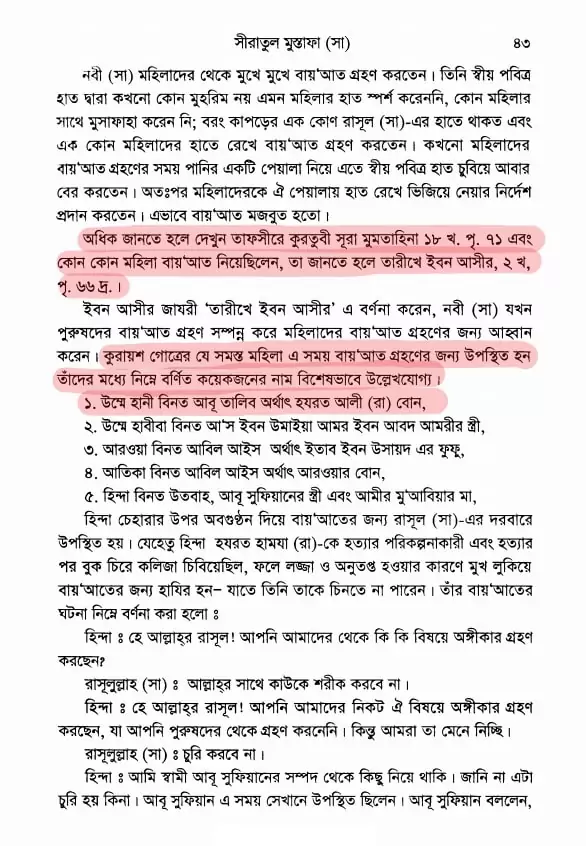
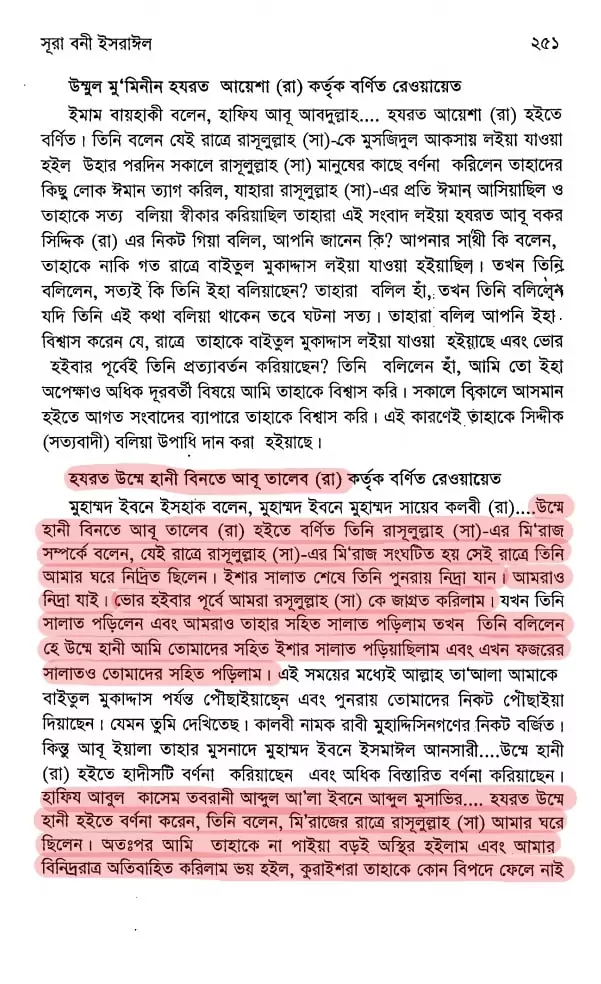
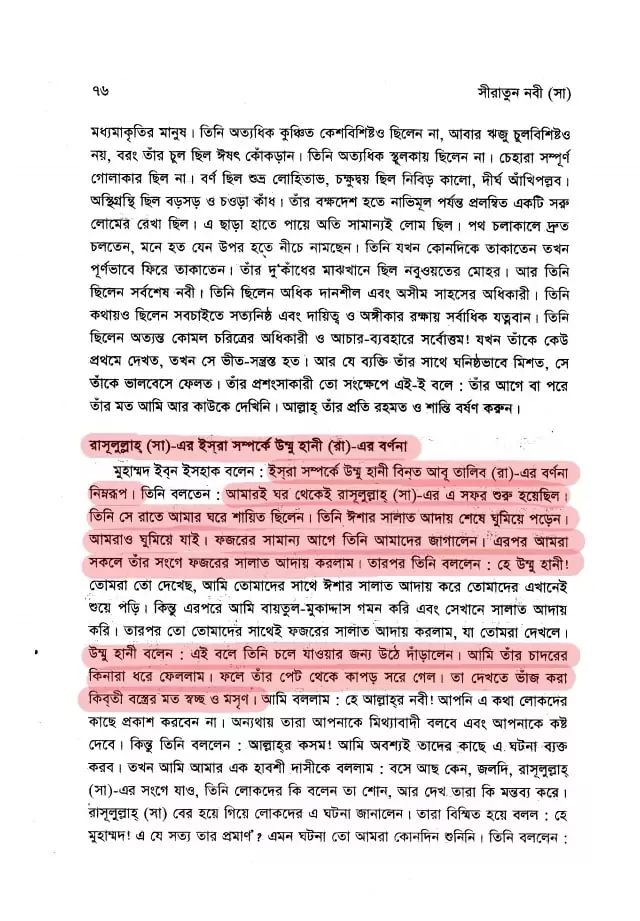
The first complete paragraph of Umme Hani’s account preserved in Ibn Hisham from the source of Ibn Ishaq has come as follows. [214]
Bengali text:
قال محمد بن إسحاق: وكان فيما بلغني عن أم هانئ بنت أبي طالب رضي الله عنها، واسمها هند، في مسرى رسول الله صلى الله عليه وسلم: أنها كانت تقول ما أسري برسول الله صلى الله عليه وسلم إلا وهو في بيتي: نائم عندي تلك الليلة في بيتي، فصلى العشاء الآخرة، ثم نام ونمنا، فلما كان قبيل الفجر أهبنا رسول الله صلى الله عليه وسلم فلما صلى الصبح وصلينا معه، قال: يا أم هانئ، لقد صليت معكم العشاء الآخرة كما رأيت بهذا الوادي، ثم جئت بيت المقدس فصليت فيه، ثم صليت صلاة الغداة معكم الآن كما ترين، ثم قام ليخرج، فأخذت بطرف ردائه، فتكشف عن بطنه كأنه قبطية مطوية، فقلت له: يا نبي الله: لا تحدث بهذا للناس فيكذبوك ويؤذوك؛ قال: والله لأحدثنهموه.
বাংলা অনুবাদ:
মুহাম্মদ ইবনে ইসহাক বলেন: আবু তালিবের কন্যা উম্মে হানি, যাঁর নাম হিন্দ, তাঁর কাছ থেকে রাসুলের রাতের সফর সম্পর্কে আমার কাছে যে বিবরণ পৌঁছেছে তা হলো: তিনি বলতেন, রাসুলকে রাতের সফরে নেওয়া হয়েছিল আমার বাড়িতে থাকা অবস্থায়। ওই রাতে তিনি আমার বাড়িতে ঘুমাচ্ছিলেন। তিনি এশার সালাত পড়লেন, তারপর তিনি ঘুমালেন এবং আমরাও ঘুমালাম। ফজরের কিছু আগে তিনি আমাদের জাগালেন। তিনি সকালের সালাত পড়লেন, আমরাও তাঁর সঙ্গে পড়লাম। তিনি বললেন: হে উম্মে হানি, তুমি দেখেছ, এই উপত্যকায় আমি তোমাদের সঙ্গে এশার সালাত পড়েছি; তারপর বায়তুল মাকদিসে গিয়ে সেখানে সালাত পড়েছি; তারপর এখন তোমাদের সঙ্গে সকালের সালাত পড়লাম, যেমন তুমি দেখছ। এরপর তিনি বের হতে উঠলেন। আমি তাঁর চাদরের প্রান্ত ধরলাম; তাঁর পেটের অংশ দেখা গেল, যেন ভাঁজ করা কিবতি কাপড়। আমি বললাম: হে আল্লাহর নবী, লোকদের এ কথা বলবেন না; তারা আপনাকে মিথ্যাবাদী বলবে ও কষ্ট দেবে। তিনি বললেন: আল্লাহর শপথ, আমি অবশ্যই তাদের বলব।
English translation:
قال محمد بن إسحاق: وكان فيما بلغني عن أم هانئ بنت أبي طالب رضي الله عنها، واسمها هند، في مسرى رسول الله صلى الله عليه وسلم: أنها كانت تقول ما أسري برسول الله صلى الله عليه وسلم إلا وهو في بيتي: نائم عندي تلك الليلة في بيتي، فصلى العشاء الآخرة، ثم نام ونمنا، فلما كان قبيل الفجر أهبنا رسول الله صلى الله عليه وسلم فلما صلى الصبح وصلينا معه، قال: يا أم هانئ، لقد صليت معكم العشاء الآخرة كما رأيت بهذا الوادي، ثم جئت بيت المقدس فصليت فيه، ثم صليت صلاة الغداة معكم الآن كما ترين، ثم قام ليخرج، فأخذت بطرف ردائه، فتكشف عن بطنه كأنه قبطية مطوية، فقلت له: يا نبي الله: لا تحدث بهذا للناس فيكذبوك ويؤذوك؛ قال: والله لأحدثنهموه.
English translation:
Muhammad ibn Ishaq says: From Umme Hani, the daughter of Abu Talib, whose name is Hind, the account that reached me regarding the Prophet’s night journey is: she used to say, the Messenger was taken on the night journey while staying at my house. That night he was sleeping at my house. He performed the Isha salat, then he slept and we also slept. A bit before Fajr, he woke us up. He performed the morning salat, and we also prayed with him. He said: O Umme Hani, you have seen, in this valley I performed the Isha salat with you; then I went to Bayt al-Maqdis and performed salat there; then now I performed the morning salat with you, as you see. After this, he rose to leave. I held the edge of his cloak; a part of his stomach was visible, like folded Coptic cloth. I said: O Prophet of Allah, do not tell people this; they will call you a liar and cause you distress. He said: By Allah, I will certainly tell them.
In this story, salat does not begin suddenly as a completely unfamiliar act at the end of an event. Before the night journey, it has a familiar name and family practice. At the end of the journey, it is said that he prayed salat with them before and has prayed again now. The center of religious wonder in the story is the rapid long-distance travel, but pre-familiar worship is also present on its stage. The question of how the time, number, and status of prayer became unified in subsequent religious history arises in this account. The position of such a story is linked to the larger historical picture that the physical and social sphere of prayer existed before Muhammad’s following.
The Quran also used the word salat for the rituals of opponents near the Kaaba. There, their prayer was undervalued in the language of whistling and clapping. Consequently, the word salat did not begin as an exclusive name for the prescribed prayer of later Muslims. Worship of the same sacred center was condemned in the language of the new religion, and another method was approved. [215]
وَمَا كَانَ صَلَاتُهُمْ عِندَ الْبَيْتِ إِلَّا مُكَاءً وَتَصْدِيَةً ۚ فَذُوقُوا الْعَذَابَ بِمَا كُنتُمْ تَكْفُرُونَ
English translation:
Their salat near the House was nothing but whistling and clapping. Therefore, taste the punishment because of your disbelief.
In Jewish religious texts, there are even older accounts of kneeling prayer several times a day facing a specific direction. In the story of Daniel, the window facing Jerusalem, kneeling three times a day, and regular prayer appear in the same passage. [216]
Now when Daniel knew that the writing was signed, he went into his house; and his windows being open in his chamber toward Jerusalem, he kneeled upon his knees three times a day, and prayed, and gave thanks before his God, as he did aforetime.
English translation:
When Daniel knew that the document had been signed, he went to his house. The windows of his room were open toward Jerusalem. As he had done before, he knelt three times a day before his God in prayer and thanksgiving.
Here, facing a place, daily repetition, and lowering the body are present together. These elements later became important in Muslim prayer as well. The specific Arabic text and full rakat-arrangement of prayer have their own history, but the previous religious world of its physical structure and time-based practice is clear. Sacred direction, repeated time, and the kneeling body—all three elements were present in human religious rituals beforehand. The long history of human prayer explains the origin of its general posture and discipline.
In Christian texts, there is also a description of Jesus praying with his face toward the ground. [217]
And he went a little farther, and fell on his face, and prayed, saying, O my Father, if it be possible, let this cup pass from me: nevertheless not as I will, but as thou wilt.
English translation:
He went a little further and fell with his face down and prayed: O my Father, if it be possible, let this cup pass from me. Yet not as I will, but as You will.
Lowering one’s body before a deity is a familiar language of human surrender. There is a common thread of loyalty between the social meaning of bowing before a ruler and bowing before a deity. Islam has bound that language to a regular schedule and specific instructions. If this is isolated from human religious history, the previous form of physical loyalty is lost. By placing new laws upon familiar body language, the human body and time have been brought under religious discipline.
The Sabians’ Five Daily Prayers: Ancient Accounts and Chronology
The time of Tabari’s compilation and the time of the events he quotes are not the same. The Ziyad who considered waiving the jizya is identified in the editorial note of the relevant edition as Ziyad ibn Abihi, the ruler of Iraq during Muawiya’s reign. Consequently, the described event is linked to the administrative situation of the first century of Islam. There, information about the Sabians’ prayer came in the context of a practical decision: upon hearing the nature of their worship, the ruler wanted to reconsider their tax status. The mention of five times prayer is also clear—’yusallunal khams’. In Qatadah’s subsequent account, there is prayer in a specific direction and recitation of the Zabur. In these two accounts, the presence of regular prayer, direction of prayer, and recitation of scripture in the religious life of a non-Muslim community is recognized. [218]
Another account of five times prayer has been preserved by Ibn Kathir from the source of Ibn Abi Hatim. In this chain of transmission, the statement comes in the name of Abu Zinad, and Kuthā is mentioned as the residence of the relevant community. Here, the direction of prayer is also specific: toward Yemen. In the same account, there is mention of fasting thirty days a year. Consequently, the regular practice of prayer and fasting is described as part of the rituals of a religious group outside Muslim society. The relevant full account is: [219]
وقال ابن أبي حاتم : حدثنا يونس بن عبد الأعلى ، أخبرنا ابن وهب ، أخبرني ابن أبي الزناد ، عن أبيه ، قال : الصابئون قوم مما يلي العراق ، وهم بكوثى ، وهم يؤمنون بالنبيين كلهم ، ويصومون من كل سنة ثلاثين يوما ويصلون إلى اليمن كل يوم خمس صلوات .
English translation:
Ibn Abi Hatim says: Yunus ibn Abd al-Ala narrated to us; Ibn Wahb informed us; Ibn Abi Zinad informed me on the authority of his father. who said: The Sabians are a community in the region adjacent to Iraq; they reside in Qutha. they believe in all the prophets, fast for thirty days every year, and perform salat five times a day facing Yemen.
Here, specific numbers, direction, and the residence of the community are found together. This account is much more specific than the general statement that ‘the Sabians used to pray’. The mention of five prayers has come through two chains of transmission: al-Tabari’s account regarding Ziyad and the statement preserved in the name of Abu Zinad. When Ibn Kathir re-quotes the same report from al-Tabari, it is a recompilation of a report; the chain of transmission and language of the account quoted in the name of Abu Zinad are distinct. That distinctness increases the importance of the information, although it cannot be determined from these texts whether the sources of information collection for the two reports were completely independent of each other.
The chronological limits of these testimonies are also specific. Ziyad’s incident is after the establishment of Islam; there is no date for the beginning of the practice in Abu Zinad’s account. Consequently, the narrative testimony of the existence of five prayers among the Sabians is clear, while the pre-Islamic prevalence of that specific number is a separate historical question. The description of the presence of a practice in the same source and the date of the origin of that practice are not the same thing. These descriptions of the ancient community’s own worship, regular schedule, and specific direction bring the multi-religious environment of prayer to the fore; determining a pre-Islamic date requires older texts or specific chronological testimony.
Harran’s Prayer: Time, Rakats, Prostrations, and Purification
In the tenth-century al-Fihrist of Ibn Nadim, there is a detailed description of their religious rituals under the title ‘Description of the doctrines of the Harranians known as Sabians’. A part of it has been presented as the statement of al-Kindi through the writings of Ahmad ibn Tayyib. There is mention of prayer facing north; then the time of prayer, the number of rakats, and the number of prostrations in each rakat are given. There is also a difference between prescribed and additional prayers. Here, prayer is an organized physical exercise: a specific number of rakats at specific times of the day, repeated prostrations within them, and purification before prayer. The full text of the relevant section on prayer is: [220]
المفترض عليهم من الصلاة في كل يوم ثلاث أولها قبل طلوع الشمس بنصف ساعة أو أقل لتنقضي مع طلوع الشمس وهي ثمان ركعات وثلاث سجدات في كل ركعة الثانية انقضاؤها مع زوال الشمس وهي خمس ركعات وثلاث سجدات في كل ركعة الثالثة مثل الثانية انقضاؤها عند غروب الشمس وإنما ألزمت هذه الأوقات لمواضع الأوتاد الثلاثة التي هي وتد المشرق ووتد وسط السماء ووتد المغرب ولم يذكر أحد منهم أن من الفرض صلاة لوقت وتد الأرض وصلواتهم النافلة التي هي بمنزلة الوتر في لزومه للمسلمين ثلاث في كل يوم الأولى في الساعة الثانية من النهار والثانية في الساعة التاسعة من النهار والثالثة في الساعة الثالثة من الليل ولا صلاة عندهم إلا على طهور
English translation:
Three prayers are prescribed for them daily. the first begins half an hour or less before sunrise, ending with the sunrise. it is eight rakats; three prostrations in each rakat. the second ends at the time the sun crosses the meridian; it is five rakats and three prostrations in each rakat. the third is like the second; it ends at the time of sunset. These times have been determined according to the positions of three ‘watad’ or pegs: the eastern peg, the meridian peg, and the western peg. No one among them has mentioned that there is any mandatory prayer at the time of the earth’s peg. Their additional prayers, which are equal in importance of performance to the witr of the Muslims, are three daily: the first in the second hour of the day, the second in the ninth hour of the day, and the third in the third hour of the night. No prayer of theirs occurs without purification.
The presence of these elements—rakats, prostrations, specific times, purification, and additional prayers beyond the prescribed ones—makes the comparison specific. In such a description, a method of organizing the human body, daily time, and religious duty together is found. Time is marked by the position of the sun; the repetition of actions is counted by rakats and prostrations; the appropriate state for prayer is determined by the condition of purification. The Muslim author himself used the words ‘rakat’, ‘sijda’, ‘nafl’, and ‘witr’ in explaining this ritual. Consequently, the worship of a non-Muslim community has been described in Muslim religious literature using these concepts. The idea that ‘namaz’ is a ritual completely isolated from human religious history is inconsistent with this information.
In this Harranian account of Ibn Nadim, there are three prescribed prayers; in other Sabian accounts preserved in the name of al-Tabari and Abu Zinad, five prayers are found. This difference in number carries the identity of the respective community and chain of transmission. The rule of eight and five rakats, three prostrations in each rakat, and ending the prayer at sunrise and sunset described for Harran is a distinct arrangement. The book is from the tenth century, and the source of al-Kindi used here is also after the establishment of Islam. Therefore, it is a detailed document of the Harranian prayer method described in the Middle Ages. To investigate its relationship with the history of pre-Islamic worship in Harran, the continuity of the ritual must be examined separately.
Mandaean Prayer Method: Rishama and Brakha
In the 2014 year guidelines of the Mandaeans’ own organization, there is a description of purification with water called ‘Rishama’ before prayer. It has specific steps for cleaning the hands, face, ears, and mouth, sprinkling water on the head, and using water on the feet. The recitation of religious sentences is also linked to various steps. Then, standing in a clean place facing north, preparation for the prayer called ‘Brakha’ is taken. The guidelines mention three daily prayers and a separate provision for Rishama for each. There are also specific rules regarding the language. This guideline is a document of recorded Mandaean practice; its publication date is 2014. The complete sentence regarding the language of the religious text is: [221]
تقرأ جميع النصوص الدينية بأللغة الأرامية المندائية ولايجوز بغيرها
English translation:
All religious texts are read in the Mandaean Aramaic language; no other language is permitted.
Purification with water, a clean place, a specific direction, and the recitation of prescribed sentences in a holy language—these together create an institutional framework for prayer. Every detail is subject to rules: which part of the body will be cleaned how during purification, which direction the face will be during prayer, and in which language the religious sentences will be uttered. Along with the purpose of prayer, this codified preparation is also a subject of comparison. The rituals recorded in modern guidelines and the medieval Harranian account of Ibn Nadim are testimonies of different communities and times; comparing the two, similarities, differences, and changes in rituals become visible.
Purification, Direction, and Posture: Comparative Framework of Prayer
The relationship between prayer and purification and a specific physical sequence is also clear in Muslim provisions. In the Quranic verses regarding wudu, there are instructions to wash the face and hands, wipe the head, and regarding the feet; an alternative of tayammum is also given if water is not found. In the Harranian account, purification is a condition for prayer, and in Mandaean practice, there is a provision to clean specific organs with water before prayer. In all three cases, a codified preparation has been imposed to enter from the daily body into a body suitable for worship. The full verse of the Islamic provision is: [222]
يَا أَيُّهَا الَّذِينَ آمَنُوا إِذَا قُمْتُمْ إِلَى الصَّلَاةِ فَاغْسِلُوا وُجُوهَكُمْ وَأَيْدِيَكُمْ إِلَى الْمَرَافِقِ وَامْسَحُوا بِرُءُوسِكُمْ وَأَرْجُلَكُمْ إِلَى الْكَعْبَيْنِ ۚ وَإِن كُنتُمْ جُنُبًا فَاطَّهَّرُوا ۚ وَإِن كُنتُم مَّرْضَىٰ أَوْ عَلَىٰ سَفَرٍ أَوْ جَاءَ أَحَدٌ مِّنكُم مِّنَ الْغَائِطِ أَوْ لَامَسْتُمُ النِّسَاءَ فَلَمْ تَجِدُوا مَاءً فَتَيَمَّمُوا صَعِيدًا طَيِّبًا فَامْسَحُوا بِوُجُوهِكُمْ وَأَيْدِيكُم مِّنْهُ ۚ مَا يُرِيدُ اللَّهُ لِيَجْعَلَ عَلَيْكُم مِّنْ حَرَجٍ وَلَٰكِن يُرِيدُ لِيُطَهِّرَكُمْ وَلِيُتِمَّ نِعْمَتَهُ عَلَيْكُمْ لَعَلَّكُمْ تَشْكُرُونَ
English translation:
O believers, when you stand for salat, wash your faces and your hands up to the elbows, wipe your heads, and wash your feet up to the ankles. And if you are in a state of impurity, then purify yourselves. If you are ill or on a journey, or one of you comes from the place of relieving himself, or you touch women and find no water, then perform tayammum with clean earth; wipe your faces and hands with it. Allah does not intend to impose hardship upon you; He intends to purify you and complete His favor upon you, so that you may be grateful.
A full description of teaching the sequence of postures is in Bukhari. There, after one person’s prayer was repeatedly declared unacceptable, he was taught the rules of takbir, recitation of the Quran, ruku, standing straight, prostration, and sitting. Through this, prayer is not limited to personal feeling or utterances at will; specific positions and sequence of the body also become conditions for its acceptance. The full text of the relevant hadith is: [223]
حَدَّثَنَا مُحَمَّدُ بْنُ بَشَّارٍ، قَالَ حَدَّثَنَا يَحْيَى، عَنْ عُبَيْدِ اللَّهِ، قَالَ حَدَّثَنِي سَعِيدُ بْنُ أَبِي سَعِيدٍ، عَنْ أَبِيهِ، عَنْ أَبِي هُرَيْرَةَ، أَنَّ رَسُولَ اللَّهِ صلى الله عليه وسلم دَخَلَ الْمَسْجِدَ، فَدَخَلَ رَجُلٌ فَصَلَّى فَسَلَّمَ عَلَى النَّبِيِّ صلى الله عليه وسلم فَرَدَّ وَقَالَ “ارْجِعْ فَصَلِّ، فَإِنَّكَ لَمْ تُصَلِّ”. فَرَجَعَ يُصَلِّي كَمَا صَلَّى ثُمَّ جَاءَ فَسَلَّمَ عَلَى النَّبِيِّ صلى الله عليه وسلم فَقَالَ “ارْجِعْ فَصَلِّ، فَإِنَّكَ لَمْ تُصَلِّ” ثَلاَثًا. فَقَالَ وَالَّذِي بَعَثَكَ بِالْحَقِّ مَا أُحْسِنُ غَيْرَهُ فَعَلِّمْنِي. فَقَالَ “إِذَا قُمْتَ إِلَى الصَّلاَةِ فَكَبِّرْ، ثُمَّ اقْرَأْ مَا تَيَسَّرَ مَعَكَ مِنَ الْقُرْآنِ، ثُمَّ ارْكَعْ حَتَّى تَطْمَئِنَّ رَاكِعًا، ثُمَّ ارْفَعْ حَتَّى تَعْتَدِلَ قَائِمًا، ثُمَّ اسْجُدْ حَتَّى تَطْمَئِنَّ سَاجِدًا، ثُمَّ ارْفَعْ حَتَّى تَطْمَئِنَّ جَالِسًا، وَافْعَلْ ذَلِكَ فِي صَلاَتِكَ كُلِّهَا”.
English translation:
Muhammad ibn Bashshar narrated to us. he said, Yahya narrated to us on the authority of Ubaydullah. he said, Sa’id ibn Abi Sa’id narrated to me on the authority of his father from Abu Hurayrah: The Messenger of Allah, sallallahu alayhi wasallam, entered the mosque. a man entered and performed salat and gave salam to the Prophet. He returned the salam and said, go back and perform salat; you have not performed salat. The man went back and performed salat as before. Then he came and gave salam to the Prophet. He said, go back and perform salat; you have not performed salat. This happened three times. The man said, by Him who sent you with the truth, I do not know how to pray better than this; teach me. He said, when you stand for salat, say takbir; then recite from the Quran whatever is easy for you. Then perform ruku and remain still in ruku. Then rise and stand completely straight. Then perform prostration and remain still in prostration. Then rise and sit and remain still in sitting. Do this in all your salat.
In al-Tabari’s report regarding Ziyad, there are five prayers; in Ibn Nadim’s detailed account about Harran, there are three prescribed prayers, rakats, and prostrations. In Muslim provisions, the mention of five daily salats is in a separate hadith of Bukhari. [224] [225] [226]
| Subject of Comparison | Ancient accounts regarding Sabians and Harranians | Muslim Prayer |
|---|---|---|
| Daily Number | Five in al-Tabari’s report number 1108 and Abu Zinad’s account; three prescribed prayers in Ibn Nadim’s Harranian account | Five mandatory salats in day and night |
| Direction | Qibla-facing in al-Tabari; Yemen-facing in Abu Zinad’s account; north-facing in Ibn Nadim’s Harranian account | Kaaba-facing |
| Purification | In Ibn Nadim’s account, no prayer occurs without purification | Wudu and ghusl as needed; provision of tayammum in cases such as not finding water |
| Countable physical exercise | In the Harranian account, the first prayer is eight rakats; the next two are five rakats each; with three prostrations in each rakat | The prescribed sequence of standing, bowing, prostrating, and sitting in rakat-based salat |
| Prayer times | In the Harranian account, the conclusion of prayer is linked to sunrise, the sun crossing the meridian, and sunset | Separate time limits for Fajr, Zuhr, Asr, Maghrib, and Isha |
| Additional worship | Mention of three more prayers beyond the prescribed three in the Harranian account | Provisions for additional salat beyond the obligatory salat |
The comparison of preparations and language documented in the modern Mandaean manual stands separately:
| Subject | Mandaean manual, 2014 | Muslim practice |
|---|---|---|
| Preparation | Purification of prescribed parts of the body with water in rishama | Provisions for wudu and related purity |
| Orientation | Northward | Toward the Kaaba |
| Language of recitation | Mandaean Aramaic | Arabic recitation of the Quran |
In these comparisons, a multi-religious framework of prayer is found: purifying the body, facing a specific direction, repeating recitations and gestures at prescribed times, and giving separate status to additional worship. In the language of the Quran, the rituals of whistling and clapping are also ‘salat’; in the language of tafsir, the worship of the Sabians is also ‘salat’; Ibn Nadim wrote the number of rakats and prostrations for the Harranians. Consequently, this concept and world of prayer rituals are widespread among multiple religious communities. In Islamic law, it has its specific arrangement, recitation, and authority. This framework of codifying body, time, purity, and language in prayer persists even under different religious identities. Islamic salat finds its place within this multi-religious history as a method of worship with specific recitations and physical sequences.
The origin of the adhan: consultation, dreams, and the construction of a distinct religious identity
The need to call people at a specific time for collective worship existed in pre-Islamic religious societies as well. When the same need arose before the Muslims of Medina, proposals were made to use the shofar of the Jews and the naqus of the Christians as familiar alternatives. The Islamic narrative of the introduction of the adhan begins with the discussion of this practical problem: how will people be gathered for worship? Later, events such as the call in a human voice, hearing specific phrases in a dream, Muhammad’s approval, and its proclamation in the voice of Bilal were added. A method of meeting a social need thus transformed into a declaration of religious identity.
Proposals for the shofar of the Jews, the naqus of the Christians, and fire
In the account of Sahih Bukhari, after arriving in Medina, Muslims would gather by estimating the time for prayer; there was no system for calling people. In the discussion, some suggested using a device similar to the naqus of the Christians, while others suggested a device similar to the shofar of the Jews. Umar proposed that a person be sent to call for prayer. Muhammad then instructed Bilal to give the call. The methods of familiar religious societies are here the direct subject of discussion for creating the Muslims’ own system. The narration is: [227] [228]
حَدَّثَنَا مَحْمُودُ بْنُ غَيْلاَنَ، قَالَ حَدَّثَنَا عَبْدُ الرَّزَّاقِ، قَالَ أَخْبَرَنَا ابْنُ جُرَيْجٍ، قَالَ أَخْبَرَنِي نَافِعٌ، أَنَّ ابْنَ عُمَرَ، كَانَ يَقُولُ كَانَ الْمُسْلِمُونَ حِينَ قَدِمُوا الْمَدِينَةَ يَجْتَمِعُونَ فَيَتَحَيَّنُونَ الصَّلاَةَ، لَيْسَ يُنَادَى لَهَا، فَتَكَلَّمُوا يَوْمًا فِي ذَلِكَ، فَقَالَ بَعْضُهُمْ اتَّخِذُوا نَاقُوسًا مِثْلَ نَاقُوسِ النَّصَارَى. وَقَالَ بَعْضُهُمْ بَلْ بُوقًا مِثْلَ قَرْنِ الْيَهُودِ. فَقَالَ عُمَرُ أَوَلاَ تَبْعَثُونَ رَجُلاً يُنَادِي بِالصَّلاَةِ. فَقَالَ رَسُولُ اللَّهِ صلى الله عليه وسلم «يَا بِلاَلُ قُمْ فَنَادِ بِالصَّلاَةِ».
English translation:
Mahmud ibn Ghaylan narrated to us. he said: Abdur Razzaq narrated to us. he said: Ibn Jurayj informed us. he said: Nafi informed me, Ibn Umar used to say: When the Muslims came to Medina, they would gather and estimate the time for prayer; there was no call for prayer. One day they discussed this matter. some of them said: Adopt a naqus like the naqus of the Christians. some said: Rather, adopt a shofar like the shofar of the Jews. Umar said: Why do you not send a man who will call for prayer? Then the Messenger of Allah, sallallahu alayhi wasallam, said: O Bilal, stand up and call for prayer.
The naqus is called a bell in common Bengali; in ancient Christian usage, a wooden signaling device sounded by striking is also known by this name. In another account of Bukhari, there is mention of fire and the naqus coming up in the discussion. After this, Bilal was instructed to say the phrases of the adhan in pairs and the phrases of the iqamah in singles. A process from the discussion of the signal for gathering to the determination of the rules of pronunciation is preserved here. The full account of Anas is: [229] [230]
حَدَّثَنَا عِمْرَانُ بْنُ مَيْسَرَةَ، حَدَّثَنَا عَبْدُ الْوَارِثِ، حَدَّثَنَا خَالِدٌ الْحَذَّاءُ، عَنْ أَبِي قِلاَبَةَ، عَنْ أَنَسٍ، قَالَ ذَكَرُوا النَّارَ وَالنَّاقُوسَ، فَذَكَرُوا الْيَهُودَ وَالنَّصَارَى، فَأُمِرَ بِلاَلٌ أَنْ يَشْفَعَ الأَذَانَ وَأَنْ يُوتِرَ الإِقَامَةَ.
English translation:
Imran ibn Maysara narrated to us. Abdul Waris narrated to us. Khalid al-Hazza narrated to us through Abu Qilaba from Anas. he said: They discussed fire and the naqus and mentioned the Jews and Christians. Then Bilal was instructed to say the adhan in pairs and the iqamah in singles.
The religious environment of Medina is directly present within this decision. The discussants knew how other communities signaled the time for worship and considered those methods for their own needs. By choosing the human voice, a distinct signal was created for the same social function. The influence of previous religions worked here to create a list of alternatives and to determine an identity distinct from them. Both the adoption and rejection of familiar methods—these two decisions were formed within the relationship with the neighboring religious society. A community is choosing the sound to announce its existence; that sound later became one of the most public signs of its daily identity.
Determination of the phrases of the adhan from the dream of Abdullah ibn Zayd
In the account of Abu Dawud, the specific phrases of the adhan were found in a dream by Abdullah ibn Zayd. At the beginning of the narration, there is mention of the instruction to make a naqus to gather people for prayer. In the dream, a man carrying a naqus teaches him a better method and tells him the phrases of the adhan and iqamah. When Abdullah informed Muhammad of the event in the morning, he accepted the dream as true and instructed him to teach it to Bilal. The excellence of his voice was mentioned as the reason for choosing Bilal. Later, Umar also claimed to have seen a similar dream. The complete narration is: [231]
حَدَّثَنَا مُحَمَّدُ بْنُ مَنْصُورٍ الطُّوسِيُّ، حَدَّثَنَا يَعْقُوبُ، حَدَّثَنَا أَبِي، عَنْ مُحَمَّدِ بْنِ إِسْحَاقَ، حَدَّثَنِي مُحَمَّدُ بْنُ إِبْرَاهِيمَ بْنِ الْحَارِثِ التَّيْمِيُّ، عَنْ مُحَمَّدِ بْنِ عَبْدِ اللَّهِ بْنِ زَيْدِ بْنِ عَبْدِ رَبِّهِ، قَالَ حَدَّثَنِي أَبِي عَبْدُ اللَّهِ بْنُ زَيْدٍ، قَالَ لَمَّا أَمَرَ رَسُولُ اللَّهِ صلى الله عليه وسلم بِالنَّاقُوسِ يُعْمَلُ لِيُضْرَبَ بِهِ لِلنَّاسِ لِجَمْعِ الصَّلاَةِ طَافَ بِي وَأَنَا نَائِمٌ رَجُلٌ يَحْمِلُ نَاقُوسًا فِي يَدِهِ فَقُلْتُ يَا عَبْدَ اللَّهِ أَتَبِيعُ النَّاقُوسَ قَالَ وَمَا تَصْنَعُ بِهِ فَقُلْتُ نَدْعُو بِهِ إِلَى الصَّلاَةِ. قَالَ أَفَلاَ أَدُلُّكَ عَلَى مَا هُوَ خَيْرٌ مِنْ ذَلِكَ فَقُلْتُ لَهُ بَلَى. قَالَ فَقَالَ تَقُولُ اللَّهُ أَكْبَرُ اللَّهُ أَكْبَرُ اللَّهُ أَكْبَرُ اللَّهُ أَكْبَرُ أَشْهَدُ أَنْ لاَ إِلَهَ إِلاَّ اللَّهُ أَشْهَدُ أَنْ لاَ إِلَهَ إِلاَّ اللَّهُ أَشْهَدُ أَنَّ مُحَمَّدًا رَسُولُ اللَّهِ أَشْهَدُ أَنَّ مُحَمَّدًا رَسُولُ اللَّهِ حَىَّ عَلَى الصَّلاَةِ حَىَّ عَلَى الصَّلاَةِ حَىَّ عَلَى الْفَلاَحِ حَىَّ عَلَى الْفَلاَحِ اللَّهُ أَكْبَرُ اللَّهُ أَكْبَرُ لاَ إِلَهَ إِلاَّ اللَّهُ قَالَ ثُمَّ اسْتَأْخَرَ عَنِّي غَيْرَ بَعِيدٍ ثُمَّ قَالَ وَتَقُولُ إِذَا أَقَمْتَ الصَّلاَةَ اللَّهُ أَكْبَرُ اللَّهُ أَكْبَرُ أَشْهَدُ أَنْ لاَ إِلَهَ إِلاَّ اللَّهُ أَشْهَدُ أَنَّ مُحَمَّدًا رَسُولُ اللَّهِ حَىَّ عَلَى الصَّلاَةِ حَىَّ عَلَى الْفَلاَحِ قَدْ قَامَتِ الصَّلاَةُ قَدْ قَامَتِ الصَّلاَةُ اللَّهُ أَكْبَرُ اللَّهُ أَكْبَرُ لاَ إِلَهَ إِلاَّ اللَّهُ فَلَمَّا أَصْبَحْتُ أَتَيْتُ رَسُولَ اللَّهِ صلى الله عليه وسلم فَأَخْبَرْتُهُ بِمَا رَأَيْتُ فَقَالَ «إِنَّهَا لَرُؤْيَا حَقٌّ إِنْ شَاءَ اللَّهُ فَقُمْ مَعَ بِلاَلٍ فَأَلْقِ عَلَيْهِ مَا رَأَيْتَ فَلْيُؤَذِّنْ بِهِ فَإِنَّهُ أَنْدَى صَوْتًا مِنْكَ». فَقُمْتُ مَعَ بِلاَلٍ فَجَعَلْتُ أُلْقِيهِ عَلَيْهِ وَيُؤَذِّنُ بِهِ – قَالَ – فَسَمِعَ ذَلِكَ عُمَرُ بْنُ الْخَطَّابِ وَهُوَ فِي بَيْتِهِ فَخَرَجَ يَجُرُّ رِدَاءَهُ وَيَقُولُ وَالَّذِي بَعَثَكَ بِالْحَقِّ يَا رَسُولَ اللَّهِ لَقَدْ رَأَيْتُ مِثْلَ مَا رَأَى. فَقَالَ رَسُولُ اللَّهِ صلى الله عليه وسلم «فَلِلَّهِ الْحَمْدُ». قَالَ أَبُو دَاوُدَ هَكَذَا رِوَايَةُ الزُّهْرِيِّ عَنْ سَعِيدِ بْنِ الْمُسَيَّبِ عَنْ عَبْدِ اللَّهِ بْنِ زَيْدٍ وَقَالَ فِيهِ ابْنُ إِسْحَاقَ عَنِ الزُّهْرِيِّ «اللَّهُ أَكْبَرُ اللَّهُ أَكْبَرُ اللَّهُ أَكْبَرُ اللَّهُ أَكْبَرُ». وَقَالَ مَعْمَرٌ وَيُونُسُ عَنِ الزُّهْرِيِّ فِيهِ «اللَّهُ أَكْبَرُ اللَّهُ أَكْبَرُ». لَمْ يُثَنِّيَا.
English translation:
Muhammad ibn Mansur at-Tusi narrated to us. Yaqub narrated through his father from Muhammad ibn Ishaq. he said: Muhammad ibn Ibrahim ibn al-Harith at-Taymi narrated to me through Muhammad ibn Abdullah ibn Zayd ibn Abdi Rabbih. he said: My father Abdullah ibn Zayd told me: When the Messenger of Allah, sallallahu alayhi wasallam, instructed to make a naqus to gather people for prayer, I saw a man come to me in my sleep. In his hand was a naqus. I said: O servant of Allah, will you sell the naqus? He said: What will you do with it? I said: We will use it to call people for prayer. He said: Shall I not show you something better than this? I said: Certainly.
He said: You shall say—Allah is the Greatest, Allah is the Greatest, Allah is the Greatest, Allah is the Greatest. I bear witness that there is no deity but Allah. I bear witness that there is no deity but Allah. I bear witness that Muhammad is the Messenger of Allah. I bear witness that Muhammad is the Messenger of Allah. Come to prayer, come to prayer. Come to success, come to success. Allah is the Greatest, Allah is the Greatest. There is no deity but Allah.
Then he moved a little away from me and said: When giving the iqamah for prayer, you shall say—Allah is the Greatest, Allah is the Greatest. I bear witness that there is no deity but Allah. I bear witness that Muhammad is the Messenger of Allah. Come to prayer. Come to success. Prayer has been established, prayer has been established. Allah is the Greatest, Allah is the Greatest. There is no deity but Allah.
When it was morning, I went to the Messenger of Allah, sallallahu alayhi wasallam, and informed him of what I had seen. He said: If Allah wills, it is certainly a true dream. Stand with Bilal and tell him what you have seen. Let him give the adhan with it; for his voice is more melodious and resonant than yours. I stood with Bilal and began to tell him the phrases, and he began to give the adhan with them. Umar ibn al-Khattab heard it while he was in his house. He came out pulling his cloak and said: O Messenger of Allah, by Him who sent you with the truth, I have seen exactly what he has seen. The Messenger of Allah, sallallahu alayhi wasallam, said: All praise is due to Allah.
Abu Dawud says: Zuhri narrated thus from Abdullah ibn Zayd through Sa’id ibn al-Musayyib. Ibn Ishaq said through Zuhri: Allah is the Greatest, Allah is the Greatest, Allah is the Greatest, Allah is the Greatest. Ma’mar and Yunus said through Zuhri: Allah is the Greatest, Allah is the Greatest. They did not repeat this pair.
In the sequence of the narration, the specific human steps of turning a personal dream into a public religious ritual are visible. Abdullah gives an account of a dream, Muhammad approves it as true, and Bilal utters those phrases. Umar’s claim of seeing the same dream comes after hearing the adhan. The information reaching others about the source of the dream is the dreamer’s own statement. After Muhammad’s recognition was added to that personal experience, the utterances became the rule for collective worship. The decision to accept the claim of a miraculous source is here in the hands of the religious leadership; the responsibility of implementing the phrases in society was given to the voice of a specific person.
The previously known signaling device is present even in the dream scene: Abdullah first wants to buy a naqus. That is, the problem discussed in the waking state created the opening scene of the dream narrative. Then, instead of the naqus, a phrase-based call is taught. The declaration of monotheism and Muhammad’s prophethood has been linked to a practical method of gathering people. As a result of choosing the words, announcing the time for worship and proclaiming faith become part of the same act. Every time the daily call is repeated, Muhammad’s religious authority is also publicly proclaimed.
The Arrangement of Utterances and the Special Fajr Phrase
In the transmission chains of the adhan, instructions are found regarding the number of pronunciations, lowering or raising the voice, and reciting additional phrases for specific prayers. In the narration of Abu Mahzura, it is mentioned to pronounce the shahada phrases first in a low voice and then again in a high voice. For Fajr, there is an instruction to say ‘prayer is better than sleep’ twice. Consequently, the adhan has transformed from a general call into a religious text determined by sound, repetition, vocal volume, and timing. The complete narration in Abu Dawud is: [232]
حَدَّثَنَا مُسَدَّدٌ، حَدَّثَنَا الْحَارِثُ بْنُ عُبَيْدٍ، عَنْ مُحَمَّدِ بْنِ عَبْدِ الْمَلِكِ بْنِ أَبِي مَحْذُورَةَ، عَنْ أَبِيهِ، عَنْ جَدِّهِ، قَالَ قُلْتُ يَا رَسُولَ اللَّهِ عَلِّمْنِي سُنَّةَ الأَذَانِ. قَالَ فَمَسَحَ مُقَدَّمَ رَأْسِي وَقَالَ «تَقُولُ اللَّهُ أَكْبَرُ اللَّهُ أَكْبَرُ اللَّهُ أَكْبَرُ اللَّهُ أَكْبَرُ تَرْفَعُ بِهَا صَوْتَكَ ثُمَّ تَقُولُ أَشْهَدُ أَنْ لاَ إِلَهَ إِلاَّ اللَّهُ أَشْهَدُ أَنْ لاَ إِلَهَ إِلاَّ اللَّهُ أَشْهَدُ أَنَّ مُحَمَّدًا رَسُولُ اللَّهِ أَشْهَدُ أَنَّ مُحَمَّدًا رَسُولُ اللَّهِ تَخْفِضُ بِهَا صَوْتَكَ ثُمَّ تَرْفَعُ صَوْتَكَ بِالشَّهَادَةِ أَشْهَدُ أَنْ لاَ إِلَهَ إِلاَّ اللَّهُ أَشْهَدُ أَنْ لاَ إِلَهَ إِلاَّ اللَّهُ أَشْهَدُ أَنَّ مُحَمَّدًا رَسُولُ اللَّهِ أَشْهَدُ أَنَّ مُحَمَّدًا رَسُولُ اللَّهِ حَىَّ عَلَى الصَّلاَةِ حَىَّ عَلَى الصَّلاَةِ حَىَّ عَلَى الْفَلاَحِ حَىَّ عَلَى الْفَلاَحِ فَإِنْ كَانَ صَلاَةَ الصُّبْحِ قُلْتَ الصَّلاَةُ خَيْرٌ مِنَ النَّوْمِ الصَّلاَةُ خَيْرٌ مِنَ النَّوْمِ اللَّهُ أَكْبَرُ اللَّهُ أَكْبَرُ لاَ إِلَهَ إِلاَّ اللَّهُ».
English translation:
Mussadad narrated to us. Harith ibn Ubayd narrated to us from Muhammad ibn Abd al-Malik ibn Abu Mahzura, from his father, from his grandfather. who said: I said, O Messenger of Allah, teach me the method of the adhan. He stroked the front of my head and said: You shall say—Allah is the Greatest, Allah is the Greatest, Allah is the Greatest, Allah is the Greatest. Say these in a high voice. Then say—I bear witness that there is no deity but Allah. I bear witness that there is no deity but Allah. I bear witness that Muhammad is the Messenger of Allah. I bear witness that Muhammad is the Messenger of Allah. Say these in a low voice. Then say the shahada phrases in a high voice—I bear witness that there is no deity but Allah. I bear witness that there is no deity but Allah. I bear witness that Muhammad is the Messenger of Allah. I bear witness that Muhammad is the Messenger of Allah. Come to prayer, come to prayer. Come to success, come to success. If it is the morning prayer, then say—prayer is better than sleep, prayer is better than sleep. Allah is the Greatest, Allah is the Greatest. There is no deity but Allah.
In the narration of Abdullah ibn Zayd’s dream, the shahada phrases were pronounced once in pairs; in Abu Mahzura’s narration, they reappear in a high voice after a low voice. The special phrase for Fajr is also added as a clear instruction in the second narration. These different patterns demonstrate the distinct narrative history of the text and performance of the religious call. The function of the adhan has expanded from merely announcing the time to gather to pronouncing the testimony of the truth of a specific religion. In Fajr, by comparing prayer with sleep, the priority of worship over bodily rest is also declared. Human daily schedules, sleep, and collective behavior—all three come under religious discipline through this call.
Propagation of Aqidah and Public Identity of the Community
Early exegetes have also clearly mentioned the religious promotional function of the adhan. In ‘Awn al-Mabud’, quoting al-Qurtubi and others, it is stated that within a few phrases, the concepts of Allah’s greatness, oneness, Muhammad’s risalah, obedience, and the hereafter are contained. Finally, announcing the time of prayer, calling for the jama’ah, and manifesting the signs of Islam are described as its functions. That is, through the adhan, specific matters of faith are publicly and repeatedly pronounced. The relevant complete paragraph is: [233]
قال القرطبي وغيره: الأذان على قلة ألفاظه مشتمل على مسائل العقيدة؛ لأنه بدأ بالأكبرية وهي تتضمن وجود الله وكماله، ثم ثنى بالتوحيد ونفى الشريك، ثم بإثبات الرسالة لمحمد صلى الله عليه وسلم ثم دعا إلى الطاعة المخصوصة عقب الشهادة بالرسالة لأنها لا تعرف إلا من جهة الرسول، ثم دعا إلى الفلاح وهو البقاء الدائم، وفيه الإشارة إلى المعاد، ثم أعاد ما أعاد توكيدا. ويحصل من الأذان الإعلام بدخول الوقت والدعاء إلى الجماعة وإظهار شعائر الإسلام.
English translation:
Al-Qurtubi and others have said: Although the number of words in the adhan is small, the matters of aqidah are included in it. Because it begins with the declaration of greatness, which includes the existence and perfection of Allah. Then oneness is declared and partners are denied. Then the risalah of Muhammad sallallahu alayhi wasallam is established. After the testimony of risalah, a call to specific obedience is made; because it cannot be known except through the Messenger. Then a call to success is made, which means eternal life; within this is an indication of the resurrection. Then the words that are repeated are for emphasis. Through the adhan, news of the entry of the time is given, the jama’ah is called, and the signs of Islam are manifested.
The social role of the adhan is clear in this explanation. The sound of a bell or a horn can signal people to gather; the phrases of the adhan propagate specific beliefs and claims of prophethood along with that call. People of the same area regularly hear those claims, and the gathering of Muslims is also organized under the same declaration. Alongside the gathering methods of known religions, the new community develops its own sonic signature. Consequently, the adhan is also a means of creating religious boundaries: which entity is to be considered the Greatest, whose prophethood is to be accepted, and which worship is to be joined—these instructions are declared in the same call.
Uthman’s Additional Call After Population Growth
There are descriptions of changes in the adhan system even after the death of Muhammad. According to the narration of Sayyib ibn Yazid in Bukhari, during the times of Muhammad, Abu Bakr, and Umar, the call was made when the Imam sat on the minbar on Friday. During Uthman’s time, as the number of people increased, an additional call was introduced at a place called Zawra in the market of Medina. In the narration, this is called the ‘third call’; in this count, the iqamah is also included with the adhan, as explained in Aynī. The number of calls for religious gatherings changed due to changes in the actual social situation. The complete narration in Bukhari is: [234] [235]
حَدَّثَنَا آدَمُ، قَالَ حَدَّثَنَا ابْنُ أَبِي ذِئْبٍ، عَنِ الزُّهْرِيِّ، عَنِ السَّائِبِ بْنِ يَزِيدَ، قَالَ كَانَ النِّدَاءُ يَوْمَ الْجُمُعَةِ أَوَّلُهُ إِذَا جَلَسَ الإِمَامُ عَلَى الْمِنْبَرِ عَلَى عَهْدِ النَّبِيِّ صلى الله عليه وسلم وَأَبِي بَكْرٍ وَعُمَرَ ـ رضى الله عنهما ـ فَلَمَّا كَانَ عُثْمَانُ ـ رضى الله عنه ـ وَكَثُرَ النَّاسُ زَادَ النِّدَاءَ الثَّالِثَ عَلَى الزَّوْرَاءِ.
قال أبو عبد الله: الزوراء موضع بالسوق بالمدينة.
English translation:
Adam narrated to us. he said: Ibn Abi Zib narrated to us from al-Zuhri from Sayyib ibn Yazid. who said: During the times of the Prophet sallallahu alayhi wasallam, Abu Bakr, and Umar radiyallahu anhuma, the call for Friday began when the Imam sat on the minbar. When Uthman radiyallahu anhur’s time came and the number of people increased, he added a third call at Zawra.
Abu Abdullah said: Zawra is a place in the market of Medina.
The hadith mentions the increase in the number of people as the reason for this addition. The system of delivering the call to people in the market was expanded according to the needs of the religious gathering. The problem of gathering people for prayer, which was present in the discussion of introducing the adhan in Medina, found a new solution for a larger population. Consequently, in determining the practical system of the call, first the discussions of Muhammad and his Companions and later the administrative decision of the Caliph became effective. In this history of religious ritual, the identification of human needs, the selection of means, and the power to change rules are directly present.
| Stage | Event found in narration | Role in the formation of the ritual |
|---|---|---|
| Need for gathering | Gathering in Medina by estimating prayer time; discussion on the system of calling. | Seeking a solution to a specific social problem. |
| Considering known religious methods | Proposals of the Jewish horn, Christian naqus, and fire. | Signaling methods of previous religious societies are present in the discussion. |
| Call by human voice | Umar’s suggestion and instruction to Bilal to call. | Selection of own means of call. |
| Acceptance of specific phrases from a dream | Abdullah ibn Zayd’s dream, Muhammad’s approval, and Bilal’s pronunciation. | Transformation of personal experience into codified public ritual. |
| Determination of text and performance | Repetition of phrases, vocal volume, and special phrases for Fajr. | Turning the call into a codified religious text. |
| Expression of aqidah | Declaration of oneness, risalah, obedience, and signs of Islam. | Linking the propagation of faith and community identity with the gathering. |
| Subsequent expansion | Additional call at Zawra during Uthman’s time. | Change in system according to population and gathering needs. |
Pre-Islamic history of the greeting of peace and the religious codification of salam
“Assalamu alaykum” means peace be upon you. Hebrew shalom, Aramaic-Syriac shlama, and Arabic salam are related words in the Semitic language family. The custom of greeting another in the language of peace, security, and well-being is present in pre-Islamic Jewish-Christian texts as well. To understand the meaning of the Arabic phrase, a concept of miraculous discovery is not required; its explanation lies in known linguistic inheritance and human social etiquette. After being established as a religious injunction, a general well-wishing phrase gained specific rules of identity, reward, and obedience.
| Language | Peace-bearing word | Example of phrasing | Meaning |
|---|---|---|---|
| Hebrew | Shalom — שלום | Shalom aleichem; in the Bible, shalom lakhem and shalom are written. | Peace to you or for you. |
| Aramaic-Syriac | Shlama — ܫܠܡܐ | Peace be with you or upon you—language of such greetings. | Wish for peace and security. |
| Arabic | Salam — سلام | Assalamu alaykum; wa alaykumus salam. | Peace be upon you; and upon you be peace. |
This is a simple example of how religious language develops within human language. The greeting of a family or neighboring society does not change into completely unfamiliar words upon adopting a new religion. Rather, known courtesy can be made part of religious life through new rules. In the case of salam, its Islamization occurred in the decision of who is to be addressed first, how to respond, and which community members are given equal status in this greeting. A general greeting then does not remain just an expression of goodwill; it also expresses the boundaries of the community.
‘Shalom Aleichem’ in Jewish Tradition
Hebrew “Shalom aleichem” and its response “Aleichem shalom” are familiar forms of peace-wishing greetings. In the Book of Genesis, phrases like “Shalom lakhem” and in the Book of Judges, “Shalom is written” exist. Although the word order and form of address vary from one place to another, the wish for peace and fearlessness performs the same social function. The presence of this meaning in pre-Islamic texts does not depend on any later Muslim explanation. It is found directly in the texts of Jewish religious literature itself.
In the complete verse of Genesis, after the greeting, an assurance of not fearing and an explanation of wealth follow. In the King James translation, the verse is: [236]
And he said, Peace be to you, fear not: your God, and the God of your father, hath given you treasure in your sacks: I had your money. And he brought Simeon out unto them.
English translation:
He said: Peace be to you, do not be afraid. your God and the God of your fathers has given you treasure in your bags; I have found your money. and he brought Simeon out to them.
In the Book of Judges, an assurance of peace has also come from the mouth of God. [237]
And the LORD said unto him, Peace be unto thee; fear not: thou shalt not die.
English translation:
The Lord said to him: Peace be to you; do not be afraid, you shall not die.
In both texts, the words of peace are linked to reducing human fear and expressing goodwill. In the first case, a person is reassuring others; in the second case, the God of a religious narrative is giving assurance in the same language. Consequently, the same greeting can function in both social and religious spheres. The fact that a sentence finds a place in a scripture does not cancel its social prehistory. When similar sentences are used in subsequent religions, this old semantic treasury is quite important for understanding their meaning. The wish for peace can be understood from human need; it does not require a claim of a new miraculous source to establish its value.
Syriac and Christian Influence
In the Syriac Christian language, the peace-bearing shlama and various forms of greeting have been used. In Christian religious texts, there are greetings of peace from the mouth of Jesus. In Greek and Latin Christian languages, similar sentences wishing peace have been linked to religious assemblies and worship. These languages do not use the same word, but they carry the social act of goodwill. Since this custom was present in the religious language of the neighboring Jewish and Christian societies of Arabia, it is wrong to present the salam as a history-less, entirely new social behavior.
In the Gospel of John, a greeting of peace follows the arrival of Jesus at the gathering of the disciples. In the King James translation, the full verse is: [238]
Then the same day at evening, being the first day of the week, when the doors were shut where the disciples were assembled for fear of the Jews, came Jesus and stood in the midst, and saith unto them, Peace be unto you.
English translation:
On that evening, the first day of the week, the doors where the disciples had gathered were closed for fear of the Jews. Then Jesus came and stood among them and said: Peace be to you.
In this narrative, the words of peace are used even in a scene of miraculous arrival. A familiar human greeting has acquired a new sacred status by being placed in the mouth of a religious figure. In Islam, an Arabic greeting of the same meaning has become part of the religious identity. To imagine the intervention of a new angel in every instance is not necessary for the spread of language and customs. Neighboring societies, heard narratives, social communication, and the vocabulary of the same language family carry familiar elements. The position of the Islamic greeting within this continuity of religious culture is easily understood.
Religious Codification of the Greeting of Peace
In Islam, the greeting of peace has received a specific rule. The Quran has instructed to give a better or equal greeting in response to a greeting. In this process of bringing social courtesy under religious instruction, a familiar sentence acquires the status of an obligation. There is a linguistic and semantic continuity between the old Semitic greetings and the Arabic salam. This familiar courtesy has received specific responses, religious rewards, and rules on with whom and how it should be used in Islam. This process of establishing religious authority over social customs can be directly followed. [239]
وَإِذَا حُيِّيتُم بِتَحِيَّةٍ فَحَيُّوا بِأَحْسَنَ مِنْهَا أَوْ رُدُّوهَا ۗ إِنَّ اللَّهَ كَانَ عَلَىٰ كُلِّ شَيْءٍ حَسِيبًا
English translation:
When you are greeted, greet with a better greeting or return it in equal measure. Surely Allah is the Reckoner of all things.
Simultaneously, in the hadith, there is an instruction not to initiate the salam to Jews and Christians. A general social sentence of wishing peace has been restricted here on the basis of religious identity. [240]
عَنْ أَبِي هُرَيْرَةَ، أَنَّ رَسُولَ اللَّهِ صلى الله عليه وسلم قَالَ ” لاَ تَبْدَءُوا الْيَهُودَ وَلاَ النَّصَارَى بِالسَّلاَمِ فَإِذَا لَقِيتُمْ أَحَدَهُمْ فِي طَرِيقٍ فَاضْطَرُّوهُ إِلَى أَضْيَقِهِ ” .
English translation:
Narrated from Abu Hurairah, the Messenger said: You shall not initiate the salam to Jews and Christians. If you meet any of them on the road, force them to the narrowest part of the path.
This instruction contains not only the language of greeting; there is also an unequal distribution of social status. The reason for not initiating peace to a person and pushing them to the narrow part of the road is their religious identity. Consequently, the custom of mutual goodwill becomes a means of communal stratification. The language of peace, semantically linked to the preceding Jewish-Christian tradition, is here subject to discriminatory provisions against them. This is a sharp example of religious assimilation: a familiar social behavior has been adopted, new authority has been placed upon it, and that authority has decided who is worthy of full courtesy.
The human value of the greeting of peace lies in mutual respect. If that respect is blocked on the basis of religious identity, a conflict arises between the peace-wishing meaning of the language and the practical application of the provision. Declaring a general social custom as sacred does not prove moral improvement. The judgeable result is found in what kind of relationship is created among people through it, who receives equal status, and who is deprived. In the history of the Islamic salam, three levels are clear: preceding linguistic inheritance, religious codification, and communal boundaries.
Fasting, Festivals, and Religious Calendars
Siyam or Fasting and Idolatry
The Ashura fast of the Quraysh as a pre-Islamic custom is clearly mentioned in Bukhari. Muhammad also observed it. Instructions were given to observe it in Medina, and later when the Ramadan fast became mandatory, the status of Ashura became optional. Descriptions of solitary religious practice or tahannuth in Ramadan are also in the Sira; long asceticism and food restriction on specific days were already present in human religious life. The religious authority of fasting was later determined within a new schedule and obligation. [241] [242]
Sahih Bukhari (Islamic Foundation)
50/ Prophets (pbuh)
Chapter: 2136. The era of Jahiliyyah (pre-Islamic)
3554. Musaddad (rh) … narrated from Aisha (ra), she said, in the Jahili era, the Quraysh and the Prophet (peace and blessings of Allah be upon him) observed sawm (fasting) on the day of Ashura. When he migrated and arrived in Medina, he himself observed the sawm of Ashura and ordered others to observe it. When the sawm of Ramadan was made obligatory, (the sawm of Ashura was made optional). then whoever wished could fast and whoever wished could not fast.
Hadith grade: Sahih
Narrator: Aisha (ra)
Sahih Bukhari (Islamic Foundation)
23/ Sawm or Fasting
Chapter: 1251. Observing sawm on the day of Ashura
Islamic Foundation Number: 1878, International Number: 2004
1878. Abu Ma’mar (rh) … narrated from Ibn Abbas (ra), he said, the Messenger of Allah (peace and blessings of Allah be upon him) upon arriving in Medina found that the Jews observe sawm (fasting) on the day of Ashura. He asked: What is the matter? (Why do you observe sawm on this day?) They said, this is a very great day, on this day Allah Ta’ala delivered the Bani Israel from the clutches of their enemy, consequently Moses (peace be upon him) observed sawm on this day. The Messenger of Allah (peace and blessings of Allah be upon him) said: I am closer to Moses than you, then he observed sawm on this day and ordered the observation of sawm.
Hadith grade: Sahih
Narrator: Abdullah ibn Abbas (ra)
In Aisha’s narration, continuity is seen in three stages: the observation by the Quraysh in the Jahili era, the observation and instruction by the Prophet in Medina, and later the optional status of Ashura with the obligation of Ramadan. The legal status of the same act changed over time. The physical act of food restriction is not new; what changed was under whose instruction and on which day it would be observed to be a religious duty. By keeping the old day of Ashura, it was placed within new religious instructions. Later, Ramadan was made the central and mandatory month of fasting.
In Ibn Abbas’s narration, there is a scene of asking the Jews of Medina about the significance of Ashura. They tell the story of Moses’ liberation, and Muhammad, claiming a greater right over Moses, orders the observation of the same fast. Here, along with adoption, there is the language of claiming inheritance. By adopting the religious memory of a community, he is declaring himself as the more legitimate representative of its main character. The relationship between a familiar custom and new leadership is thus created. [243]
In the two narrations, the sources of the fast’s identity are different: in one, the Meccan Quraysh, and in the other, the religious explanation of the Medinan Jews. These two memories bring forward multiple religious environments surrounding Islam. Muhammad’s practice of fasting did not begin in a cultureless state. It had a relationship with the days, customs, and stories of the prophets of the previous society. Later, making Ramadan mandatory established a separate annual discipline for the new community.
The Quran also linked fasting with the provisions of the predecessors. The acknowledgment that it was prescribed for previous people is present in Islam’s own religious language. [244]
يَا أَيُّهَا الَّذِينَ آمَنُوا كُتِبَ عَلَيْكُمُ الصِّيَامُ كَمَا كُتِبَ عَلَى الَّذِينَ مِن قَبْلِكُمْ لَعَلَّكُمْ تَتَّقُونَ
English translation:
O believers, fasting has been prescribed for you, as it was prescribed for those before you, so that you may become self-restrained.
The 2:183 verse of the Quran acknowledges the previous religious history of fasting and adds the new community to the continuity of that practice. The specific provisions, timing, and obedience of the followers of fasting have been determined in the new religious system. By making an old asceticism of keeping the stomach empty a sacred duty, central instructions over human daily time, diet, and sexual life have been implemented. The power to determine the answers to questions such as which day to fast, under what conditions it becomes mandatory, and when food or sexual relations are permitted, passes into the hands of the new leadership. The human prehistory of the ritual and the history of establishing new religious power over that ritual are visible here together.
The determination of fasting and festival days is linked to the sacred months and the system of nasīʾ in Arabia .Previous institutions for dividing time for Hajj, ceasefires, markets, and worship come under a specific religious authority in the new regulations.
Fasting of Ashura and the Covering of the Kaaba: Inheritance of the Meccan Religious Calendar
In another narration by Aisha, a relationship is found between the fasting of Ashura and a specific ritual of the Kaaba. She said that before Ramadan was made obligatory, people used to fast on Ashura, and on that day, the Kaaba was covered. Comparing this information with earlier accounts of the Quraysh observing Ashura reveals a familiar day in Meccan religious life, to which fasting and the formalities of the sacred site were linked. Muhammad’s practice of fasting began in continuity with that existing day. [245]
حَدَّثَنَا يَحْيَى بْنُ بُكَيْرٍ، حَدَّثَنَا اللَّيْثُ، عَنْ عُقَيْلٍ، عَنِ ابْنِ شِهَابٍ، عَنْ عُرْوَةَ، عَنْ عَائِشَةَ ـ رضى الله عنها ـ. وَحَدَّثَنِي مُحَمَّدُ بْنُ مُقَاتِلٍ، قَالَ أَخْبَرَنِي عَبْدُ اللَّهِ ـ هُوَ ابْنُ الْمُبَارَكِ ـ قَالَ أَخْبَرَنَا مُحَمَّدُ بْنُ أَبِي حَفْصَةَ، عَنِ الزُّهْرِيِّ، عَنْ عُرْوَةَ، عَنْ عَائِشَةَ ـ رضى الله عنها ـ قَالَتْ كَانُوا يَصُومُونَ عَاشُورَاءَ قَبْلَ أَنْ يُفْرَضَ رَمَضَانُ، وَكَانَ يَوْمًا تُسْتَرُ فِيهِ الْكَعْبَةُ، فَلَمَّا فَرَضَ اللَّهُ رَمَضَانَ قَالَ رَسُولُ اللَّهِ صلى الله عليه وسلم «مَنْ شَاءَ أَنْ يَصُومَهُ فَلْيَصُمْهُ، وَمَنْ شَاءَ أَنْ يَتْرُكَهُ فَلْيَتْرُكْهُ».
English translation:
Yahya ibn Bukayr narrated to us. Layth narrated to us; from Uqayl, from Ibn Shihab, from Urwa, from Aisha. Muhammad ibn Muqatil also narrated to me. He said, Abdullah, meaning Ibnul Mubarak, informed me. He said, Muhammad ibn Abi Hafsa informed us; from Zuhri, from Urwa, from Aisha. Aisha said: Before Ramadan was made obligatory, they used to fast on Ashura. On that day, the Kaaba was covered. When Allah made Ramadan obligatory, the Messenger of Allah said, ‘Whoever wishes to fast on that day, let him do so; and whoever wishes to leave it, let him leave it.’
The information regarding the covering of the Kaaba and fasting on the same day places Ashura within the collective religious calendar of Mecca. A sacred site, a specific day for its ritual care, and the food abstinence of that day—these elements are linked to one another. In Aisha’s narration, the Quraysh and Muhammad are observing the same old day. Consequently, at this stage of Islamic fasting, the inheritance is present in both the individual’s habit and the society’s determined time. The previously prevalent day finds a place in the rituals to be observed by followers under the direction of new leadership. The familiar religious time of Mecca is carried even among the community developing in Medina.
Despite the idolater identity of the Quraysh, the fasting of Ashura they observed was acceptable in Muhammad’s religious life. Here, a practical method of adopting and rearranging the practice of an old society is seen. The religious identity of the previous followers did not remain inseparable from the ritual; the new leadership approved the same day and practice within its own religious system. Later, when the month-long fasting of Ramadan gained a central position, the importance of Ashura was also newly determined. In this selection process of the religious system, the founder is simultaneously the heir to the old ritual and the determiner of its new status.
Fasting on the Ninth Day of Ashura: Religious Distinctiveness After Adoption
In another narration by Ibn Abbas, the question of becoming distinct from other religious communities arises within the practice of Ashura. After Muhammad observed the fasting of Ashura and gave instructions for it, he was told that Jews and Christians honor the day. In response, he expressed the intention to fast on the ninth day the following year. At the end of the narration, it is mentioned that he passed away before the following year arrived. Thus, here a declared plan for fasting on the ninth day is found alongside the familiar practice of the tenth day. [246]
وَحَدَّثَنَا الْحَسَنُ بْنُ عَلِيٍّ الْحُلْوَانِيُّ، حَدَّثَنَا ابْنُ أَبِي مَرْيَمَ، حَدَّثَنَا يَحْيَى بْنُ أَيُّوبَ، حَدَّثَنِي إِسْمَاعِيلُ بْنُ أُمَيَّةَ، أَنَّهُ سَمِعَ أَبَا غَطَفَانَ بْنَ طَرِيفٍ الْمُرِّيَّ، يَقُولُ سَمِعْتُ عَبْدَ اللَّهِ بْنَ عَبَّاسٍ ـ رضى الله عنهما ـ يَقُولُ حِينَ صَامَ رَسُولُ اللَّهِ صلى الله عليه وسلم يَوْمَ عَاشُورَاءَ وَأَمَرَ بِصِيَامِهِ قَالُوا يَا رَسُولَ اللَّهِ إِنَّهُ يَوْمٌ تُعَظِّمُهُ الْيَهُودُ وَالنَّصَارَى. فَقَالَ رَسُولُ اللَّهِ صلى الله عليه وسلم «فَإِذَا كَانَ الْعَامُ الْمُقْبِلُ ـ إِنْ شَاءَ اللَّهُ ـ صُمْنَا الْيَوْمَ التَّاسِعَ». قَالَ فَلَمْ يَأْتِ الْعَامُ الْمُقْبِلُ حَتَّى تُوُفِّيَ رَسُولُ اللَّهِ صلى الله عليه وسلم.
English translation:
Al-Hasan ibn Ali al-Hulwani narrated to us. Ibn Abi Maryam narrated to us. Yahya ibn Ayyub narrated to us. Ismail ibn Umayya narrated to me that he heard Abu Gatafan ibn Tarif al-Murri saying: I heard Abdullah ibn Abbas saying—when the Messenger of Allah fasted on the day of Ashura and ordered fasting, they said, ‘O Messenger of Allah! This is a day which the Jews and Christians honor.’ The Messenger of Allah said, ‘When the next year comes, if Allah wills, we shall fast on the ninth day.’ He said: The Messenger of Allah passed away before the next year arrived.
Alongside claiming a greater right over the memory of Moses by accepting it, the need to create community distinctiveness is also present in this event. In the first narration, Muhammad associates himself with the explanation of the Jews’ fasting; in the later narration, because the same day is honored by others, the intention to change the time of practice arises. Therefore, the religious meaning of the ritual also depends on the identity of the community associated with it. Through the adoption of fasting, the inheritance of old religious memories is claimed, while through the difference in timing, a path is created to identify the identity of the new community.
This principle of distinctiveness has appeared clearly within the explanation of the ninth day’s fasting in Nawawi’s book of fiqh. He called the fasting of both the ninth and tenth days mustahab, and as an explanation for adding the ninth day, he preserved the points of creating a difference from the Jews who fast only on the tenth day, attaching another day of fasting to Ashura, and avoiding errors in the date. [247]
وَذَكَرَ الْعُلَمَاءُ مِنْ أَصْحَابِنَا وَغَيْرِهِمْ فِي حِكْمَةِ اسْتِحْبَابِ صَوْمِ تَاسُوعَاءَ أَوْجُهًا: (أَحَدُهَا) أَنَّ الْمُرَادَ مِنْهُ مُخَالَفَةُ الْيَهُودِ فِي اقْتِصَارِهِمْ عَلَى الْعَاشِرِ، وَهُوَ مَرْوِيٌّ عَنِ ابْنِ عَبَّاسٍ، وَفِي حَدِيثٍ رَوَاهُ الْإِمَامُ أَحْمَدُ بْنُ حَنْبَلٍ عَنِ ابْنِ عَبَّاسٍ قَالَ: قَالَ رَسُولُ اللَّهِ صلى الله عليه وسلم «صُومُوا يَوْمَ عَاشُورَاءَ، وَخَالِفُوا الْيَهُودَ وَصُومُوا قَبْلَهُ يَوْمًا وَبَعْدَهُ يَوْمًا».
(الثَّانِي) أَنَّ الْمُرَادَ بِهِ وَصْلُ يَوْمِ عَاشُورَاءَ بِصَوْمٍ، كَمَا نُهِيَ أَنْ يُصَامَ يَوْمُ الْجُمُعَةِ وَحْدَهُ، ذَكَرَهُمَا الْخَطَّابِيُّ وَآخَرُونَ.
(الثَّالِثُ) الِاحْتِيَاطُ فِي صَوْمِ الْعَاشِرِ خَشْيَةَ نَقْصِ الْهِلَالِ، وَوُقُوعِ غَلَطٍ فَيَكُونُ التَّاسِعُ فِي الْعَدَدِ هُوَ الْعَاشِرَ فِي نَفْسِ الْأَمْرِ.
English translation:
Our followers and other scholars have mentioned several explanations regarding the significance of the fasting of Tasu’a being mustahab. The first is: Jews fast only on the tenth day; the purpose of this is to create a difference from them. This is narrated from Ibn Abbas. Imam Ahmad ibn Hanbal narrated a hadith from Ibn Abbas. He said, the Messenger of Allah said: ‘Fast on the day of Ashura, create a difference from the Jews, and fast one day before it and one day after it.’
The second is: the purpose is to attach another day of fasting to the day of Ashura; just as fasting only on Friday has been forbidden. Khattabi and others have mentioned these two explanations.
The third is: taking precaution to ensure the fasting of the tenth day due to the fear of deficiency or error in the lunar calculation; because what is being considered the ninth day in the calculation may actually be the tenth day.
In this explanation, a criterion for determining the rules of fasting is a visible difference from other religious groups. After adopting the previous practice, joining another day to its timing creates that difference. The same physical abstinence then becomes a special identity-marking ritual of a community. New boundaries are being drawn around the fasting and memory received from old customs while keeping them intact. In Nawawi’s preserved explanation, this act of creating boundaries is recognized as a religious virtue.
From the Alternative of Fidya to the Obligation of Ramadan
Descriptions of gradual changes exist even within the legal framework of the fasting of Ramadan. In the statement of Salama ibn al-Akwa, after the revelation of verse 184 of Surah al-Baqarah, the opportunity to give fidya instead of fasting was mentioned. He said that a subsequent verse came and abolished that arrangement. Consequently, alongside the shift of importance from Ashura to Ramadan, a step from an alternative arrangement to obligatory fasting within Ramadan is preserved. [248]
حَدَّثَنَا قُتَيْبَةُ، حَدَّثَنَا بَكْرُ بْنُ مُضَرَ، عَنْ عَمْرِو بْنِ الْحَارِثِ، عَنْ بُكَيْرِ بْنِ عَبْدِ اللَّهِ، عَنْ يَزِيدَ، مَوْلَى سَلَمَةَ بْنِ الأَكْوَعِ عَنْ سَلَمَةَ، قَالَ لَمَّا نَزَلَتْ {وَعَلَى الَّذِينَ يُطِيقُونَهُ فِدْيَةٌ طَعَامُ مِسْكِينٍ} كَانَ مَنْ أَرَادَ أَنْ يُفْطِرَ وَيَفْتَدِيَ حَتَّى نَزَلَتِ الآيَةُ الَّتِي بَعْدَهَا فَنَسَخَتْهَا. مَاتَ بُكَيْرٌ قَبْلَ يَزِيدَ.
English translation:
Qutaiba narrated to us. Bakr ibn Mudar narrated to us; from Amr ibn al-Harith, from Bukayr ibn Abdullah, from Yazid, the mawla of Salama ibn al-Akwa, from Salama. Salama said: When the verse ‘for those who are able, the fidya is to feed a needy person’ was revealed, whoever wished would give fidya instead of fasting. This condition continued until the subsequent verse was revealed and abolished it. Bukayr passed away before Yazid.
In the first arrangement narrated by Salama, giving food was acceptable as an alternative to fasting. The subsequent instruction withdrew that general alternative and made fasting an obligatory ritual. Although the social benefit of feeding a needy person remained intact, in the change of the ruling, that act no longer fulfills the individual’s obligation of fasting as before. The religious result of the same act by the same person is determined based on which instruction is then effective. Here, the center of religious duty is the performance of a specific behavior by following the instruction. The evaluation of human benefit and the fulfillment of religious obligation become separate.
Sleep, Food, and Sexual Relations: Actual Events of the Modification of Fasting Rules
In the early practices of fasting, Bukhari contains accounts that if one fell asleep before iftar, they would abstain from eating for that night and until the following evening. Qays ibn Sirma, after finishing the day’s work and returning home, asked for food. As there was no food at home, his wife went to collect food; during this time, he fell asleep from exhaustion. The next day at noon, he fainted. After the incident was reported to Muhammad, the narration of the revelation of the verse regarding permission for dinner and sexual relations appeared. [249]
حَدَّثَنَا عُبَيْدُ اللَّهِ بْنُ مُوسَى، عَنْ إِسْرَائِيلَ، عَنْ أَبِي إِسْحَاقَ، عَنِ الْبَرَاءِ ـ رضى الله عنه ـ قَالَ كَانَ أَصْحَابُ مُحَمَّدٍ صلى الله عليه وسلم إِذَا كَانَ الرَّجُلُ صَائِمًا، فَحَضَرَ الإِفْطَارُ، فَنَامَ قَبْلَ أَنْ يُفْطِرَ لَمْ يَأْكُلْ لَيْلَتَهُ وَلاَ يَوْمَهُ، حَتَّى يُمْسِيَ، وَإِنَّ قَيْسَ بْنَ صِرْمَةَ الأَنْصَارِيَّ كَانَ صَائِمًا، فَلَمَّا حَضَرَ الإِفْطَارُ أَتَى امْرَأَتَهُ، فَقَالَ لَهَا أَعِنْدَكِ طَعَامٌ قَالَتْ لاَ وَلَكِنْ أَنْطَلِقُ، فَأَطْلُبُ لَكَ. وَكَانَ يَوْمَهُ يَعْمَلُ، فَغَلَبَتْهُ عَيْنَاهُ، فَجَاءَتْهُ امْرَأَتُهُ، فَلَمَّا رَأَتْهُ قَالَتْ خَيْبَةً لَكَ. فَلَمَّا انْتَصَفَ النَّهَارُ غُشِيَ عَلَيْهِ، فَذُكِرَ ذَلِكَ لِلنَّبِيِّ صلى الله عليه وسلم فَنَزَلَتْ هَذِهِ الآيَةُ {أُحِلَّ لَكُمْ لَيْلَةَ الصِّيَامِ الرَّفَثُ إِلَى نِسَائِكُمْ} فَفَرِحُوا بِهَا فَرَحًا شَدِيدًا، وَنَزَلَتْ {وَكُلُوا وَاشْرَبُوا حَتَّى يَتَبَيَّنَ لَكُمُ الْخَيْطُ الأَبْيَضُ مِنَ الْخَيْطِ الأَسْوَدِ}.
English translation:
Ubaydullah ibn Musa narrated to us; from Isra’il, from Abu Ishaq, from Bara. Bara said: If any person among the Companions of Muhammad fasted and fell asleep after the time for iftar had arrived but before breaking the fast, he would not eat for that night and until the next evening. Qays ibn Sirma al-Ansari had fasted. At the time of iftar, he came to his wife and asked, ‘Do you have any food?’ The wife said, ‘No; but I will go and find food for you.’ He had worked all day, as a result, sleep overcame him. His wife returned and seeing him in this state said, ‘Your misfortune!’ The next day at noon, he fainted. The matter was reported to the Prophet. Then this verse was revealed: ‘It has been made lawful for you to have sexual relations with your wives on the nights of fasting.’ At this, they were extremely happy. It was further revealed: ‘Eat and drink until the white streak becomes distinct from the black streak to you.’
In this incident, the problem of the ruling is manifested in the body of a working person. he had fallen asleep waiting to collect food after the day’s work; that natural exhaustion placed him in a state of remaining without food for a longer period. the difference between having the opportunity to put food in the mouth before sleeping and falling asleep before getting that opportunity—the length of the next day’s fast depends on this. the result of placing such a condition on the needs of the human body is fainting the next day. in the previous arrangement, the person who fell asleep without finding food had to bear the additional starvation. within this system of additional starvation, he fainted.
Ibn Kathir, at the beginning of verse 187 of Surah Al-Baqarah, has presented the previous ruling. in his explanation, eating, drinking, and sexual intercourse were permitted until the Isha prayer or until falling asleep before that; after sleep or the Isha prayer, these became forbidden until the following night. he also mentioned that there was great hardship in this arrangement. [250]
هَذِهِ رُخْصَةٌ مِنَ اللَّهِ تَعَالَى لِلْمُسْلِمِينَ، وَرَفْعٌ لِمَا كَانَ عَلَيْهِ الْأَمْرُ فِي ابْتِدَاءِ الْإِسْلَامِ، فَإِنَّهُ كَانَ إِذَا أَفْطَرَ أَحَدُهُمْ إِنَّمَا يَحِلُّ لَهُ الْأَكْلُ وَالشُّرْبُ وَالْجِمَاعُ إِلَى صَلَاةِ الْعِشَاءِ أَوْ يَنَامَ قَبْلَ ذَلِكَ، فَمَتَى نَامَ أَوْ صَلَّى الْعِشَاءَ حَرُمَ عَلَيْهِ الطَّعَامُ وَالشَّرَابُ وَالْجِمَاعُ إِلَى اللَّيْلَةِ الْقَابِلَةِ. فَوَجَدُوا مِنْ ذَلِكَ مَشَقَّةً كَبِيرَةً. وَالرَّفَثُ هُنَا هُوَ: الْجِمَاعُ. قَالَهُ ابْنُ عَبَّاسٍ، وَعَطَاءٌ، وَمُجَاهِدٌ، وَسَعِيدُ بْنُ جُبَيْرٍ، وَطَاوُسٌ، وَسَالِمُ بْنُ عَبْدِ اللَّهِ، وَعَمْرُو بْنُ دِينَارٍ وَالْحَسَنُ، وَقَتَادَةُ، وَالزُّهْرِيُّ، وَالضَّحَّاكُ، وَإِبْرَاهِيمُ النَّخَعِيُّ، وَالسُّدِّيُّ، وَعَطَاءٌ الْخُرَاسَانِيُّ، وَمُقَاتِلُ بْنُ حَيَّانَ.
English translation:
This is a concession given by Allah to the Muslims and the withdrawal of the system prevalent in the early days of Islam. then, if any of them broke their fast, eating, drinking, and sexual intercourse remained lawful for him until the Isha prayer or until falling asleep before that. if he fell asleep or performed the Isha prayer, food, drink, and sexual intercourse became forbidden for him until the following night. because of this, they suffered great hardship. here ‘rafas’ means sexual intercourse. Ibn Abbas, Ata, Mujahid, Sa’id ibn Zubayr, Tawus, Salim ibn Abdullah, Amr ibn Dinar, Hasan, Qatadah, Zuhri, Dahhak, Ibrahim Nakha’i, Suddi, Ata Khurasani, and Muqatil ibn Hayyan have said this.
By attaching such a long prohibition on hunger, thirst, and marital sexual intercourse to sleep or the performance of prayer, the general needs of the body fall within the boundaries of religious offense. thereafter, the ruling changed and food and sexual intercourse on the same night became permitted. the human body and marital relationships remain the same; legality changes with the change of the command. the great hardship mentioned by Ibn Kathir is the practical result of the previous prohibition. the need for the subsequent concession reveals the intolerability of that system. closing the opportunity to eat after the unintentional sleep of a tired person is a clear example of severity.
Eid before Islam
In the narration of Anas, it is mentioned that there were two annual days of celebration before the arrival of Muhammad in Medina. the names of the two days are not in the original hadith; exegetes like Mulla Ali Qari have identified them as Nowruz and Meherjan. Muhammad declared Eid al-Adha and Eid al-Fitr as better days instead of those days. as a result, the social need for celebration and annual recurrence remain, but its days, names, and source of approval change. the new religion establishes its own calendar in place of old joys. [251] [252]
Mishkat al-Masabih (Mishkat)
Volume-4: Salat
Chapter: 47. Second Section – Salat of the two Eids
1439-[14] Narrated from Anas (ra), . he said, after the Prophet sallallahu alayhi wa sallam arrived in Medina they had two days. on these two days they used to play and amuse themselves. (Seeing this) he (sallallahu alayhi wa sallam) asked, what are these two days? They said that in the time of Jahiliyyah before Islam, we used to play on these two days. (Upon hearing this) the Messenger of Allah sallallahu alayhi wa sallam said, instead of these two days, Allah Ta’ala has given you two better days. one of them is the day of Eid al-Adha and the other is the day of Eid al-Fitr. (Abu Dawud)[1]
[1] Sahih: Abu Dawud 1134, Ahmad 13622, Mustadrak lil Hakim 1091.
Hadith grade: Sahih
Sunan an-Nasa’i (Islamic Foundation)
19/ Prayer of both Eids
Chapter: 1/ No chapter
1559. Ali ibn Hujr (rh) … narrated from Anas ibn Malik (ra), . he said, for the inhabitants of the Jahiliyyah era, there were two days every year in which they used to play and amuse themselves. When the Prophet sallallahu alayhi wa sallam arrived in Medina, he said, you had two days in which you used to play and amuse yourselves. now Allah Ta’ala has specified two days for you instead of those two days which are more excellent, the day of Eid al-Fitr and the day of sacrifice.
[Sahih. as-Sahihah 2021, Mishkat 1439]
Hadith grade: Sahih
Narrator: Anas ibn Malik (ra)
Sunan Abu Dawud (Islamic Foundation)
2/ Salat (Prayer)
Chapter: 251. Prayer of the two Eids.
1134. Musa ibn Ismail (rh) ………… narrated from Anas (ra), . he said, when the Messenger of Allah sallallahu alayhi wa sallam reached Medina, he saw that the inhabitants there used to play and celebrate on two days (Naymuq and Meherjan). He sallallahu alayhi wa sallam asked, what are these two days? They said, in the Jahili era we used to play and celebrate on these two days. the Messenger of Allah sallallahu alayhi wa sallam said, Allah Ta’ala has given you two other better days instead of these two days, and those are: the Eid of Sacrifice and the Eid of Fasting. (Tirmidhi, Nasa’i)
Nasa’i (Chapter: Two Eids, Hadith 1155), Ahmad (3/178), from Anas via Humaid.
Hadith grade: Sahih
Narrator: Anas ibn Malik (ra)
Sunan Abu Dawud (Verified)
2/ Salat
Chapter: 245. Prayer of the two Eids
1134. Narrated via Anas ibn Malik (ra), . he said, when the Messenger of Allah sallallahu alayhi wa sallam came to Medina, he saw that the people of Medina used to play and rejoice on two specific days. the Messenger of Allah sallallahu alayhi wa sallam asked: what are these two days? Everyone said, in the Jahili era we used to play on these two days. the Messenger of Allah sallallahu alayhi wa sallam said, Great Allah has given you two better days instead of these two days. those are, the day of Eid al-Adha and the day of Eid al-Fitr.[1]
Sahih.
Hadith grade: Sahih
Narrator: Anas ibn Malik (ra)
Sahih Bukhari (Islamic Foundation)
23/ Sawm or Fasting
Chapter: 1251. Observing Sawm on the day of Ashura
Islamic Foundation Number: 1879, International Number: 2005
1879. ‘Ali ibn ‘Abdullah (rh) … narrated from Abu Musa (ra), he said, the Jews considered the day of Ashura as an Eid. the Prophet sallallahu alayhi wa sallam said: you also observe Sawm (fasting) on this day.
Hadith grade: Sahih
Narrator: Abu Musa al-Ash’ari (ra)
The central word of the hadith is replacement. people rejoiced in the previous society; the new command has designated other days for that joy. people will gather, have time outside of work, and celebrate—this social activity has not changed. but the authority over which day will be called lawful and superior has shifted to the declaration of Muhammad in the name of Allah. controlling the calendar of joy is an effective method of controlling the life of a community. with whom one celebrates on the same day and with which memory people associate themselves, identity is also created through this.
Regarding the names of the two old days, Mulla Ali Qari has clearly stated that this identification is the opinion of the exegetes. his relevant sentences are: [253]
(يَوْمَانِ يَلْعَبُونَ فِيهِمَا): وَهُمَا: يَوْمُ النَّيْرُوزِ، وَيَوْمُ الْمِهْرَجَانِ. كَذَا قَالَهُ الشُّرَّاحُ. وَفِي الْقَامُوسِ: النَّيْرُوزُ: أَوَّلُ يَوْمِ السَّنَةِ مُعَرَّبُ نَوْرُوزٍ.
English translation:
“Two days, on which they used to play”—those are the day of Nowruz and the day of Meherjan. the exegetes have said so. it is in the dictionary: Nowruz is the first day of the year; this is the Arabicized form of the word Nowruz.
This policy of accepting the social activity of celebration and changing its old religious or cultural identity is important in the formation of Islam. instead of previous rituals disappearing completely, they are rearranged within a new structure. in the case of Eid, the joy of two days has been linked to a new cycle of fasting and a cycle of sacrifice. as a result, the natural need for celebration of people becomes bound to a specific time of religious obedience. the declaration “Allah has given better days” is a claim to the status of the days; the change in social arrangement is an event of human history.
The narration calling Ashura the Eid of the Jews also shows the old relationship between celebration and fasting. just because a day gains the status of a festival, it is not mandatory for its ritual to include a feast; fasting can also be linked to religious memory. in Islam, two types of selection have occurred—the adoption of fasting on an old day and the replacement of celebrations on two other days. what will be taken from the familiar culture and what will be changed into a new identity has been determined by the decision of a religious leadership.
Declaring a Distinct Eid: Community Boundaries in Celebration
In the narration of Aisha, on the day of Eid, two girls of the Ansar were singing about the conversations of the day of Bu’as. Abu Bakr objected to that song in Muhammad’s house, calling it ‘Satan’s music’. Muhammad then brought the identity of Eid forward and said, every community has its festival and this is their festival. in this statement, the universal social practice of celebration and the policy of identifying separate communities through it are present simultaneously. people already sang, rejoiced, and carried the memories of their lives within festivals. the new religious leadership is determining the acceptability of those familiar activities by giving the identity of its own approved festival. [254]
حَدَّثَنَا عُبَيْدُ بْنُ إِسْمَاعِيلَ، قَالَ حَدَّثَنَا أَبُو أُسَامَةَ، عَنْ هِشَامٍ، عَنْ أَبِيهِ، عَنْ عَائِشَةَ ـ رضى الله عنها ـ قَالَتْ دَخَلَ أَبُو بَكْرٍ وَعِنْدِي جَارِيَتَانِ مِنْ جَوَارِي الأَنْصَارِ تُغَنِّيَانِ بِمَا تَقَاوَلَتِ الأَنْصَارُ يَوْمَ بُعَاثَ ـ قَالَتْ وَلَيْسَتَا بِمُغَنِّيَتَيْنِ ـ فَقَالَ أَبُو بَكْرٍ أَمَزَامِيرُ الشَّيْطَانِ فِي بَيْتِ رَسُولِ اللَّهِ صلى الله عليه وسلم وَذَلِكَ فِي يَوْمِ عِيدٍ. فَقَالَ رَسُولُ اللَّهِ صلى الله عليه وسلم «يَا أَبَا بَكْرٍ إِنَّ لِكُلِّ قَوْمٍ عِيدًا، وَهَذَا عِيدُنَا».
English translation:
Ubayd ibn Isma’il narrated to us. he said, Abu Usama narrated to us; from Hisham, he from his father, he from Aisha. Aisha said: Abu Bakr entered. while there were two Ansari girls with me. they were singing about what the Ansaris had said to one another on the day of Bu’as. Aisha said: they were not professional singers. Abu Bakr said, ‘Satan’s music in the house of the Messenger of Allah!’ The day was the day of Eid. then the Messenger of Allah said, ‘O Abu Bakr! Every community has its festival, and this is our festival.’
The phrase ‘our Eid’ transforms the festival into a marker of group identity. The boundaries of the community become visible through gathering on the same day, behaving in the same manner, and declaring that day as their own. The songs commemorating Bu’as are finding a place even in the house of the new festival; Muhammad is determining their acceptability. Between Abu Bakr’s objection and Muhammad’s approval, the application of religious authority over the content of joy is also observed. The decision of which song will play and on what occasion it will play transforms from a matter of personal taste into a matter of religious approval.
In this narration, the ‘our’ identity is brought forward to establish the validity of joy. Mutual human relationships, songs, memories, and leisure already existed within festivals; the religiously recognized day organizes those activities under a new identity. Consequently, an allegiance is also attached to the festival: by observing a specific day, a person expresses which community they are part of. This annual arrangement repeatedly practices the identity. For children growing up together, the community identity becomes natural through the experience of songs, clothing, gatherings, and specific days.
Fasting is forbidden on the day of Eid: Determining the time for eating and fasting
Specific provisions for eating and fasting have also been attached to the new festival. In Umar’s speech on Eid, it is mentioned as Muhammad’s instruction that fasting is forbidden on the two days of Eid. One day is identified as the day of completing the fast and the other as the day of eating the meat of the sacrificed animal. Therefore, the names Eid al-Fitr and Eid al-Adha, along with their associated fasting and sacrifice cycles, control even the daily food intake of people. According to the specific position in the religious calendar, the same fasting becomes either a mandatory or a forbidden practice. [255]
حَدَّثَنَا عَبْدُ اللَّهِ بْنُ يُوسُفَ، أَخْبَرَنَا مَالِكٌ، عَنِ ابْنِ شِهَابٍ، عَنْ أَبِي عُبَيْدٍ، مَوْلَى ابْنِ أَزْهَرَ قَالَ شَهِدْتُ الْعِيدَ مَعَ عُمَرَ بْنِ الْخَطَّابِ ـ رضى الله عنه ـ فَقَالَ هَذَانِ يَوْمَانِ نَهَى رَسُولُ اللَّهِ صلى الله عليه وسلم عَنْ صِيَامِهِمَا يَوْمُ فِطْرِكُمْ مِنْ صِيَامِكُمْ، وَالْيَوْمُ الآخَرُ تَأْكُلُونَ فِيهِ مِنْ نُسُكِكُمْ. قَالَ أَبُو عَبْدِ اللَّهِ قَالَ ابْنُ عُيَيْنَةَ مَنْ قَالَ مَوْلَى ابْنِ أَزْهَرَ فَقَدْ أَصَابَ وَمَنْ قَالَ مَوْلَى عَبْدِ الرَّحْمَنِ بْنِ عَوْفٍ فَقَدْ أَصَابَ.
English translation:
Abdullah ibn Yusuf narrated to us. Malik informed us; from Ibn Shihab, he from Abu Ubayd, the mawla of Ibn Azhar. Abu Ubayd said: I was present with Umar ibn al-Khattab on Eid. he said, ‘The Messenger of Allah has forbidden fasting on these two days: the day you complete your fasts and break them, and the other day, when you eat from your sacrificed animals.’ Abu Abdullah said: Ibn Uyaynah said, the one who called him the mawla of Ibn Azhar was correct; and the one who called him the mawla of Abdur Rahman ibn Awf was also correct.
In this prohibition, the celebration of the festival and religious obligation are tied to each other. A prohibition is imposed on the personal desire to continue fasting on the Eid of fasting; the day of eating animal meat on the Eid of sacrifice falls under the same provision. Consequently, the acceptable expression of the festival is predetermined: fasting will end at a specific time, and the occasion for consuming the sacrificial meal will arrive at a specific time. The religious classification of the day determines the evaluation of human physical behavior. Authority over time here transforms into authority over the body.
Umar is re-announcing this prohibition at the Eid gathering. The instruction of the founder, being re-articulated publicly by the subsequent leadership, gains stability in the rules of the community. Specific days of the year become known to people by specific things to do and avoid. A festival thus links dietary habits, worship, and the instructions of leadership within the same system. These observance rules are included within the practical meaning of declaring a ‘best day’: with the adoption of a new day, people’s old sense of time and daily habits become subject to new religious instructions.
Public gathering of Eid: Collective religious identity on the same day
In the narration of Umm Atiyyah, the instruction to go out on the day of Eid includes virgins staying at home and menstruating women. They shall stand behind the people, participate in the takbir and prayers with others, and expect the blessings and sanctity of the day. The arrangement of the festival here brings a broad population into the same religious declaration at the same time. A public religious identity is created through the presence of family members, collective pronunciation, and the expectation of the day’s special sanctity. [256]
حَدَّثَنَا مُحَمَّدٌ، حَدَّثَنَا عُمَرُ بْنُ حَفْصٍ، قَالَ حَدَّثَنَا أَبِي، عَنْ عَاصِمٍ، عَنْ حَفْصَةَ، عَنْ أُمِّ عَطِيَّةَ، قَالَتْ كُنَّا نُؤْمَرُ أَنْ نَخْرُجَ يَوْمَ الْعِيدِ، حَتَّى نُخْرِجَ الْبِكْرَ مِنْ خِدْرِهَا، حَتَّى نُخْرِجَ الْحُيَّضَ فَيَكُنَّ خَلْفَ النَّاسِ، فَيُكَبِّرْنَ بِتَكْبِيرِهِمْ، وَيَدْعُونَ بِدُعَائِهِمْ يَرْجُونَ بَرَكَةَ ذَلِكَ الْيَوْمِ وَطُهْرَتَهُ.
English translation:
Muhammad narrated to us. Umar ibn Hafs narrated to us. he said, my father narrated to us; from Asim, he from Hafsa, she from Umm Atiyyah. Umm Atiyyah said: we were instructed to go out on the day of Eid. we would even bring out the virgin girl from her inner chamber and bring out the menstruating women. They would stay behind the people, say the takbir along with the takbir of others, and pray along with the prayers of others. They expected the blessings and sanctity of that day.
In this system, the social power of the festival is utilized very specifically. People who were in isolated positions inside the house are brought out on the same day; their voices are also joined in the same religious declaration in the collective takbir. Everyone witnesses the presence of others, as a result, community membership becomes mutually visible. Since the expectation of blessings and sanctity is attached to the specific day, being present there also gains religious value. Such a gathering is an effective social system for embedding religious identity into the daily experience of people.
Gifts in old festivals: From joy to accusations of kufr
In the explanation of Mulla Ali Qari, the consequence of replacing old festivals has reached as far as shopping and exchanging gifts. He mentioned the prohibition of honoring Nowruz, Meherjan, and other non-Muslim festivals in the name of Muzhir. Then, in the name of Abu Hafs al-Kabir, it was said that even gifting a single egg to a mushrik to honor the day would be kufr and would destroy one’s deeds. Citing Qadi Abul Mahasin, a distinction is made between the intention of acknowledging the religious status of the day and the intention of expressing joy or love according to prevailing habits. For the former, the ruling of kufr has come, and for the latter, the ruling of makruh due to imitation. [257]
قَالَ اللَّهُ تَعَالَى: قُلْ بِفَضْلِ اللَّهِ وَبِرَحْمَتِهِ فَبِذَلِكَ فَلْيَفْرَحُوا. قَالَ الْمُظْهِرُ: فِيهِ دَلِيلٌ عَلَى أَنَّ تَعْظِيمَ النَّيْرُوزِ وَالْمِهْرَجَانِ وَغَيْرِهِمَا أَيْ: مِنْ أَعْيَادِ الْكُفَّارِ مَنْهِيٌّ عَنْهُ. قَالَ أَبُو حَفْصٍ الْكَبِيرُ الْحَنَفِيُّ: مَنْ أَهْدَى فِي النَّيْرُوزِ بَيْضَةً إِلَى مُشْرِكٍ تَعْظِيمًا لِلْيَوْمِ فَقَدْ كَفَرَ بِاللَّهِ تَعَالَى، وَأَحْبَطَ أَعْمَالَهُ.
وَقَالَ الْقَاضِي أَبُو الْمَحَاسِنَ: الْحَسَنُ بْنُ مَنْصُورٍ الْحَنَفِيُّ: مَنِ اشْتَرَى فِيهِ شَيْئًا لَمْ يَكُنْ يَشْتَرِيهِ فِي غَيْرِهِ، أَوْ أَهْدَى فِيهِ هَدِيَّةً إِلَى غَيْرِهِ فَإِنْ أَرَادَ بِذَلِكَ تَعْظِيمَ الْيَوْمِ كَمَا يُعَظِّمُهُ الْكَفَرَةُ فَقَدْ كَفَرَ، وَإِنْ أَرَادَ بِالشِّرَاءِ التَّنَعُّمَ وَالتَّنَزُّهَ، وَبِالْإِهْدَاءِ التَّحَابَّ جَرْيًا عَلَى الْعَادَةِ، لَمْ يَكُنْ كُفْرًا لَكِنَّهُ مَكْرُوهٌ كَرَاهَةَ التَّشَبُّهِ بِالْكَفَرَةِ، حِينَئِذٍ فَيُحْتَرَزُ عَنْهُ اهـ.
English translation:
Allah said: ‘Say, let them rejoice in the grace of Allah and His mercy.’ Muzhir said: in this there is proof that honoring Nowruz, Meherjan, and other festivals of the kafirs is forbidden. The Hanafi Abu Hafs al-Kabir said: whoever gifts an egg to any mushrik to honor the day of Nowruz commits kufr against Allah and destroys his own deeds.
The Hanafi Qadi Abul Mahasin al-Hasan ibn Mansur said: whoever buys something on that day which he would not buy on other days, or gifts something to someone else on that day—if his intention in this is to honor the day like the kafirs, then he has committed kufr. But if the intention of shopping is for pleasure and enjoyment and the intention of the gift is to express mutual love according to prevailing habit, then it will not be kufr; but it will be makruh due to the imitation of the kafirs. In that case, one must abstain from it. Quote ends.
The subject of judgment in this provision is the religious identity and intention attached to the gift. There is no description of hurting anyone, seizing property, or cheating in the act of giving an egg. The gift transforms into an accusation of kufr as long as there is an intention to honor the day. The basis of such a severe verdict centered on the same object, the same donation, and the same recipient is the identity of the festival. Even a small courtesy of a person is thus made an instrument for testing religious allegiance. Imposing the fear of losing one’s entire deeds in exchange for honoring an important day of another community is direct religious pressure on social relationships.
The quote from Qadi Abul Mahasin makes the scope of this control even clearer. He called the act makruh even after separating the intention of expressing love according to prevailing custom. Consequently, the inherent value of mutual love and social courtesy is not exempt from the accusation of religious imitation. While sharing an occasion of joy with a neighbor or acquaintance, a person must think whether their behavior creates a similarity with another religion. In this provision, the interest of maintaining community division takes precedence over human relationships. Gifts, food, shopping, and leisure—every field of ordinary social life is placed under the guard of religious boundaries.
The exclusive authority of Sharia in determining festivals
Ibn Taymiyyah has placed festivals in the same legal category as the qibla, salat, and fasting. In his statement, the festival is a primary sign of religious law and identity; participation in the festivals of other religions is judged as participation in the characteristic rituals of that religion. This statement of his is quoted in the Islamweb fatwa regarding festivals. The principle of control over festivals is stated directly here: participation even in some parts of another community’s festival is identified as a similarity to some branch of kufr and is called a sin even in the minimum case. [258]
الأعياد من جملة الشرع والمناهج والمناسك، التي قال الله سبحانه: {لِكُلِّ أُمَّةٍ جَعَلْنَا مَنْسَكًا هُمْ نَاسِكُوهُ} [الحج: 67] كالقبلة، والصلاة، والصيام، فلا فرق بين مشاركتهم في العيد وبين مشاركتهم في سائر المناهج، فإن الموافقة في جميع العيد موافقة في الكفر.
والموافقة في بعض فروعه موافقة في بعض شعب الكفر، بل الأعياد هي من أخص ما تتميز به الشرائع، ومن أظهر ما لها من الشعائر، فالموافقة فيها موافقة في أخص شرائع الكفر، وأظهر شعائره ولا ريب أن الموافقة في هذا قد تنتهي إلى الكفر في الجملة بشروطه، وأما مبدؤها فأقل أحواله أن تكون معصية.
English translation:
Festivals are included in the sharia, religious paths, and rituals. regarding this Allah has said: ‘For every community I have appointed a ritual, which they observe.’ [Hajj 22:67] This is like the qibla, salat, and fasting. consequently, there is no difference between participating in their festivals and participating in their other religious methods. maintaining similarity with them in all aspects of festivals is maintaining similarity with them in kufr.
maintaining similarity with them in some branches of festivals is maintaining similarity in some branches of kufr. rather, festivals are among the most special characteristics of the distinctiveness of religious laws and among the most apparent signs. consequently, maintaining similarity with them in this is maintaining similarity with the most special laws and most apparent signs of kufr. such similarity, if the relevant conditions are met, can overall reach the level of kufr; and even its minimum initial state is a sin.
In Ibn Taymiyyah’s logic, the religious identity of the festival determines the crime of participation. The social value of building relationships among people, sharing joy, or recognizing someone’s important day is subordinate in this judgment. As a result of classifying the festival as an identity marker on the same level as salat and the qibla, sharing a festival with others becomes an accusation of crossing the boundaries of one’s own faith. The religious system thus demands exclusive loyalty even in the case of collective joy. Fear of sin and kufr is applied to the freedom of with whom and on what occasion people will meet.
Alms, family rituals, and religious laws
Zakat was a pre-Islamic custom
Alms, food for travelers, wealth for places of worship, and offerings in the name of the deity existed in the religious and social life of pre-Islamic Arabia. People gave money to the rifada of the Quraysh according to their capacity, and with that money, food and drink were arranged during the Hajj season. The responsibility for the holy center and social status were linked to this collective fundraising. Consequently, the idea of collecting wealth to hold a religious gathering and meet the needs of needy people was known before Islam. The new religion later established its own laws for mandatory zakat and sadaqah within this old social world.
In Islam, zakat has been linked to the purity of wealth and the individual. The material result of alms is the movement of wealth from one person to another; in religious interpretation, the account of sin, purity, and divine reward is also attached to it. The offerings, food distribution, and collection of wealth for the holy center in the previous Arab society were part of that economic-religious environment. The Quran also mentions the determination of portions of grain and livestock in the name of Allah and other deities by previous peoples. The religious authority regarding in whose deity’s name which portion would be given has changed, but there was a pre-history of the idea of dividing wealth for holy purposes. [259]
The nature of rifada has been specifically defined in Ibn Manzur’s Lisan al-Arab dictionary. Collective fundraising and the arrangement of food for pilgrims are the center of this definition. [260]
والرفادة: شيء كانت قريش تترافد به في الجاهلية، فيخرج كل إنسان مالا بقدر طاقته فيجمعون من ذلك مالا عظيما أيام الموسم، فيشترون به للحاج الجزر والطعام والزبيب للنبيذ، فلا يزالون يطعمون الناس حتى تنقضي أيام موسم الحج، وكانت الرفادة والسقاية لبني هاشم، والسدانة واللواء لبني عبد الدار، وكان أول من قام بالرفادة هاشم بن عبد مناف وسمي هاشما لهشمه الثريد.
English translation:
Rifada is a system through which the Quraysh helped each other in the Jahiliyyah era. Every person gave money according to their capacity. During the season, they collected a lot of money through this and used it to buy camels, food, and raisins for making nabidh for the pilgrims. They fed people until the days of the Hajj season ended. The responsibility for rifada and siqaya was in the hands of Banu Hashim; and the supervision of the temple and the responsibility for the banner were in the hands of Banu Abd al-Dar. The first to arrange the rifada system was Hashim ibn Abd Manaf; he was named Hashim because he broke bread for the sarid.
In this system, there are three real elements: people’s capacity, a collective fund, and the recipient’s food. No supernatural assumption is needed to understand the cause and result of the fundraising. When the same act is linked to religious status, the organizing family and the holy center also gain honor and influence. Consequently, alms are not only help for the poor but can also be a means of maintaining the power of the institution. The law of Islamic zakat has established new religious claims and control over wealth within this broader history. This connection between helping pilgrims and the authority of the religious center was effective in the previous Arab society as well.
The relationship between the acceptance of zakat and purity is present in the direct language of the Quran. [261]
خُذْ مِنْ أَمْوَالِهِمْ صَدَقَةً تُطَهِّرُهُمْ وَتُزَكِّيهِم بِهَا وَصَلِّ عَلَيْهِمْ ۖ إِنَّ صَلَاتَكَ سَكَنٌ لَّهُمْ ۗ وَاللَّهُ سَمِيعٌ عَلِيمٌ
English translation:
Take sadaqah from their wealth, through which you will make them pure and cleansed; and pray for them. Surely your prayer is a tranquility for them. Allah is the Hearing, the Knowing.
Here, the leadership of the wealth recipient is also linked to the religious purity of the individual. Giving money and becoming pure are tied in the same instruction; with it is the status of the leader’s prayer. Such a structure creates a strong spiritual foundation for collecting wealth. When the promise of invisible purity is attached to the giver’s real responsibility, economic authority becomes part of religious obedience. The social power of this connection is understood, but the miraculous account of purity cannot be measured independently.
Alms and social justice in Judaism
In Judaism, provisions for assisting the poor, determining portions of agricultural production, and giving wealth to religious institutions existed long before Islam. The special use of alms developed from the meaning of just behavior and righteousness of the word tzedakah. Ma’aser is the tithe, and terumah is the identity of the offering or the portion set apart. These are not all names for the same law; there were separate financial responsibilities for different recipients. The second account contains specific instructions for the allocation of the tithe of crops for the Levites, strangers, orphans, and widows. [262]
Second Account 14:22–29; King James Version:
22. Thou shalt truly tithe all the increase of thy seed, that the field bringeth forth year by year.
23. And thou shalt eat before the LORD thy God, in the place which he shall choose to place his name there, the tithe of thy corn, of thy wine, and of thine oil, and the firstlings of thy herds and of thy flocks; that thou mayest learn to fear the LORD thy God always.
24. And if the way be too long for thee, so that thou art not able to carry it; or if the place be too far from thee, which the LORD thy God shall choose to set his name there, when the LORD thy God hath blessed thee:
25. Then shalt thou turn it into money, and bind up the money in thine hand, and shalt go unto the place which the LORD thy God shall choose:
26. And thou shalt bestow that money for whatsoever thy soul lusteth after, for oxen, or for sheep, or for wine, or for strong drink, or for whatsoever thy soul desireth: and thou shalt eat there before the LORD thy God, and thou shalt rejoice, thou, and thine household,
27. And the Levite that is within thy gates; thou shalt not forsake him; for he hath no part nor inheritance with thee.
28. At the end of three years thou shalt bring forth all the tithe of thine increase the same year, and shalt lay it up within thy gates:
29. And the Levite, (because he hath no part nor inheritance with thee,) and the stranger, and the fatherless, and the widow, which are within thy gates, shall come, and shall eat and be satisfied; that the LORD thy God may bless thee in all the work of thine hand which thou doest.
English translation:
22. Of all the increase of your field, which you gather year by year, you shall surely set apart a tenth.
23. You shall eat before the Lord your God, in the place which He shall choose for the establishing of His name, your tithe of your grain, your wine, and your oil, and the firstborn of your herds and of your flocks, that you may learn to fear the Lord your God always.
24. And if the way be too long for you to carry it, after that the Lord your God has blessed you, or if the place which the Lord your God shall choose to establish His name be far from you,
25. then you shall exchange them for money, and you shall go to the place which the Lord your God shall choose.
26. And you shall buy with the money whatever your soul desires—oxen, sheep, wine, strong drink, or whatever your soul desires. And you shall eat before the Lord your God and your family, and you shall rejoice.
27. You shall not forsake the Levite who is within your gates; for he has no portion or inheritance with you.
28. At the end of every three years, you shall bring out all the tithes of your increase in that year and lay them in your storehouse.
29. That the Levite—for he has no portion or inheritance with you—and the stranger, the fatherless, and the widow, who come to you, may eat and be satisfied; that the Lord your God may bless you in all the work of your hand.
In this law, the portion of production, a specific time, and specific recipients are brought together. There is an instruction to use the portion stored locally at the end of three years for the food of landless Levites, strangers, orphans, and widows. Consequently, a religious structure for mandatory wealth distribution was present long before Islamic zakat. Divine satisfaction, the responsibility of the giver, and the needs of weak people were already linked in the same religious system. The new religion established its own rates, conditions, and collection systems for a previously known social problem. In Exodus, there is again an instruction to accept voluntary offerings for the materials of the holy sanctuary. [263]
Speak unto the children of Israel, that they bring me an offering: of every man that giveth it willingly with his heart ye shall take my offering.
English translation:
Tell the children of Israel that they shall bring an offering for Me; from everyone who is of a generous heart, they shall bring an offering for Me.
In the context of this terumah in Exodus, the following verses contain a list of materials for the holy sanctuary. Alms have been used sometimes for the livelihood of the poor, sometimes for priests or religious institutions, and sometimes for the construction of places of worship. These various sectors together create the history of religious economy. In Islam too, individual assistance, religious duty, and the collection of wealth through leadership have become linked to each other. The meaning of purity and growth in the word zakat is part of the religious evaluation of that alms; comparing it with previous customs of alms, a similar relationship between wealth and purity is found.

The instruction of the tithe is a specific form of religious authority over human livelihood. The producer is not allowed to keep all of their harvest as personal wealth; a portion must be set apart in the name of God. Where that portion goes, who will eat it, and when it will be stored is also determined in the law. The material result of the help is real: foodless people can get food. But at the same time, the claim of the religious institution is established over the giver and the producer. Thus, the social need for help and the economic role of religious authority exist side by side in one system.
Promoting the distribution of wealth as a miraculous moral innovation of a religion denies these previous laws and institutions. The need of the poor is an old reality of human society; various societies have given answers to it. To judge Islamic zakat, one must examine not only the purity of the name, but also the rules of collection, the rights of the recipient, and the result of distribution. A system can create new conditions based on pre-existing social concepts. The declaration of calling those conditions God-given is not an alternative to its previous human history.
Self-purification through alms in Christianity
In Christian religious texts, there is also a relationship between giving and self-purification, humility, and otherworldly reward. In the Gospel of Matthew, instructions are given to give in secret rather than publicizing it before people. The desire of the giver to gain social status is rejected, shifting the focus toward God’s reward. That is, alongside the act of giving wealth, the intention of the giver is also subject to religious evaluation. [264]
Matthew 6:1–4; King James Version:
1. Take heed that ye do not your alms before men, to be seen of them: otherwise ye have no reward of your Father which is in heaven.
2. Therefore when thou doest thine alms, do not sound a trumpet before thee, as the hypocrites do in the synagogues and in the streets, that they may have glory of men. Verily I say unto you, They have their reward.
3. But when thou doest alms, let not thy left hand know what thy right hand doeth:
4. That thine alms may be in secret: and thy Father which seeth in secret himself shall reward thee openly.
Bengali translation:
1. Beware of practicing your charity before others to be seen by them; otherwise, you will have no reward from your Father who is in heaven.
2. Therefore, when you give to the needy, sound no trumpet before you, as the hypocrites do in the synagogues and in the streets, to be praised by men. I tell you the truth, they have received their reward.
3. But when you give, do not let your left hand know what your right hand is doing.
4. so that your giving may be in secret; and your Father, who sees in secret, will reward you openly.
In the text of Tobit, giving is more directly linked to rescue from death and the cleansing of sins. Here, beyond the material benefit of giving, there is a claim of a miraculous return. [265]
For alms doth deliver from death, and shall purge away all sin. Those that exercise alms and righteousness shall be filled with life:
Bengali translation:
for alms deliver from death and purge away all sins. those who give alms and do just works shall be filled in their days.
The distinction between giving in secret and giving for human praise is the language of controlling the giver’s intention. Simultaneously, the promise of an otherworldly reward serves as the motivation for the act. Consequently, giving acquires two meanings: a social aid and an investment for an invisible return. Such religious moral accounting existed before the relationship established in Islam between niyyat, sadaqah, and purity. Linking self-purification with giving is therefore not a new concept without history for Islam.
The claim that giving erases sin has a clear logical problem. If a person has caused harm to another, the actual remedy for that harm is to restore rights and compensate the victim. Giving in another sector does not automatically remove previous harm. When religious accounting links giving with invisible atonement, it creates an opportunity to transform moral liability into a formal transaction. The value of helping people lies in its actual result; the promise of miraculous discharge of liability is its separate religious claim. This distinction applies to the statements regarding giving in both old and new religions.
Comparative Summary
| Tradition | Specific Practice | Religious or Social Act | Subject of Comparison with Islam |
|---|---|---|---|
| Pre-Islamic Arabia | Rifada, food and drink for pilgrims, portion of wealth in the name of deities. | Collective assistance according to capacity, responsibility of the sacred center, and tribal status. | Previous regional environment of wealth collection and distribution in the religious sphere. |
| Judaism | Ma’aser, allocation for the poor and landless, terumah for sacred establishments. | Command of God, determination of production shares, and livelihood for specific recipients. | Obligatory wealth distribution, specific recipients, and religious legitimacy. |
| Christian Texts | Secret giving and the claim of cleansing sin through giving in Tobit. | Divine reward instead of human praise; spiritual value of giving. | Relationship between sadaqah, niyyat, purity, and otherworldly return. |
| Islam | Zakat and sadaqah; declaration of purification through the taking of wealth. | Specific financial provisions, distribution, and religious obedience. | Own codified system within the environment of old religious economics. |
In this comparison, three sequential elements are found: separating wealth, delivering it to people or religious institutions, and evaluating the act in the language of purity. The needs of social deprivation and the necessity of protecting institutions give meaning to these systems. A new religion reorganizes old needs and acts within its own provisions. Consequently, the fact that giving became obligatory in a particular religion does not lead to the conclusion that that religion first discovered giving or social responsibility.
Simultaneously, it is possible to examine the actual result of the act outside of religious discipline. How much food reached, whose livelihood changed, and in whose hands the control of wealth became concentrated are visible questions. Whether sin decreased or the soul was purified are declarations of separate beliefs. In the history of giving, mutual human assistance and the establishment of religious authority over that assistance appear as two related layers.
Circumcision and the Practice of Aqiqah
Circumcision is not a practice introduced by Islam. In Bukhari’s long account regarding Heraclius, there is mention of the circumcision of Arabs. In Judaism, circumcision was already codified as a sign of the covenant with God. In Genesis, there are instructions to impose this physical mark on children, family members, and purchased slaves. Thus, the idea of making a human body a sign of inclusion in a religious community was prevalent before Muhammad. Islam gave status to that familiar practice in the language of its own fitrat and religious exercise. [266] [267] [268]
Bengali text:
ইবন নাতৃর ছিলেন জেরুযালেমের শাসনকর্তা এবং হিরাকলের বন্ধু ও সিরিয়ার খৃস্টানদের পাদ্রী। তিনি বলেন, ‘হিরাকল যখন জেরুযালেম আসেন, তখন একদিন তাঁকে অত্যন্ত বিমর্ষ দেখাচ্ছিল। তাঁর একজন বিশিষ্ট সহচর বলল, ‘আমরা আপনার চেহারা আজ বিবর্ণ দেখতে পাচ্ছি’, ইন্ন নাতুর বলেন, হিরাকল ছিলেন জ্যোতিষী, জ্যোতির্বিদ্যায় তাঁর দক্ষতা ছিল। তারা জিজ্ঞাসা করলে তিনি তাদের বললেন, ‘আজ রাতে আমি তারকারাজির দিকে তাকিয়ে দেখতে পেলাম, খতনাকারীদের বাদশাহ আবির্ভূত হয়েছেন। বর্তমান যুগে কোন্ জাতি খতনা করে’? তারা বলল, ‘ইয়াহুদী ছাড়া কেউ খতনা করে না। কিন্তু তাদের ব্যাপার যেন আপনাকে মোটেই চিন্তিত না করে। আপনার রাজ্যের শহরগুলোতে লিখে পাঠান, তারা যেন সেখানকার সকল ইয়াহুদীকে হত্যা করে ফেলে।’ তারা যখন এ ব্যাপারে ব্যতিব্যস্ত ছিল, তখন হিরাকলের কাছে এক ব্যক্তিকে উপস্থিত করা হলো, যাকে গাস্সানের শাসনকর্তা পাঠিয়েছিল। সে রাসূলুল্লাহ্-এর সম্পর্কে খবর দিচ্ছিল। হিরাকল তার কাছ থেকে খবর জেনে নিয়ে বললেন, ‘তোমরা একে নিয়ে গিয়ে দেখ, তার খতনা হয়েছে কি-না।’ তারা তাকে নিয়ে দেখে এসে সংবাদ দিল, তার খতনা হয়েছে। হিরাকল তাকে আরবদের সম্পর্কে জিজ্ঞাসা করলেন। সে জওয়াব দিল, ‘তারা খতনা করে।’ তারপর হিরাকল তাদের বললেন, ‘ইনি [রসূলুল্লাহ্। এ উম্মতের বাদশাহ। তিনি আবির্ভূত হয়েছেন।’ এরপর হিরাকল রোমে তাঁর বন্ধুর কাছে লিখলেন। তিনি জ্ঞানে তাঁর সমকক্ষ ছিলেন। পরে হিরাকল হিমস চলে গেলেন। হিমসে থাকতেই তাঁর কাছে তাঁর বন্ধুর চিঠি এলো, যা নবী -এর আবির্ভাব এবং তিনিই যে প্রকৃত নবী, এ ব্যাপারে হিরাকলের মতকে সমর্থন করছিল। তারপর হিরাকল তাঁর হিমসের প্রাসাদে রোমের নেতৃস্থানীয় ব্যক্তিদের ডাকলেন এবং প্রাসাদের সব দরজা বন্ধ করে দেওয়ার নির্দেশ দিলেন। দরজা বন্ধ করা হলো। তারপর তিনি সামনে এসে বললেন, ‘হে রোমবাসী! তোমরা কি কল্যাণ, হিদায়ত এবং তোমাদের রাষ্ট্রের স্থায়িত্ব চাও? তাহলে এই নবীর বায়’আত গ্রহণ কর।’ এ কথা শুনে তারা জংলী গাধার মত ঊর্ধ্বশ্বাসে দরজার দিকে ছুটল, কিন্তু তারা তা বন্ধ অবস্থায় পেল। হিরাকল যখন তাদের অনীহা লক্ষ্য করলেন এবং তাদের ঈমান থেকে নিরাশ হয়ে গেলেন, তখন বললেন, ‘ওদের আমার কাছে ফিরিয়ে আন।’ তিনি বললেন, ‘আমি একটু আগে যে কথা ‘বলেছি, তা দিয়ে তোমরা তোমাদের দীনের উপর কতটুকু অটল, কেবল তার পরীক্ষা করেছিলাম। এখন আমি তা দেখে নিলাম।’ একথা শুনে তারা তাঁকে সিজদা করল এবং তাঁর প্রতি সন্তুষ্ট হলো। এই ছিল হিরাকল-এর শেষ অবস্থা।
English translation:
Ibn Nasr was the governor of Jerusalem and a friend of Heraclius and a priest of the Christians of Syria. He said, ‘When Heraclius came to Jerusalem, one day he appeared extremely depressed. One of his distinguished companions said, “We see your face pale today,” Ibn Nasr said, Heraclius was an astrologer, he had skill in astronomy. When they asked, he told them, “Tonight, looking at the constellations, I saw that the king of the circumcised has appeared. Which nation in the present age practices circumcision?” They said, “None but the Jews practice circumcision. But let their matter not worry you at all. Write to the cities of your kingdom that they should kill all the Jews there.” While they were preoccupied with this, a man was brought before Heraclius, sent by the governor of Ghassan. He was giving news about the Messenger of Allah. Heraclius, having learned the news from him, said, “Take him and see whether he is circumcised or not.” They took him, checked, and reported that he was circumcised. Heraclius asked him about the Arabs. He replied, “They practice circumcision.” Then Heraclius told them, “He [the Messenger of Allah. is the king of this Ummah. he has appeared.” Then Heraclius wrote to his friend in Rome. He was his equal in knowledge. Later Heraclius went to Hims. While in Hims, he received a letter from his friend, which supported Heraclius’s opinion regarding the appearance of the Prophet and that he is the true Prophet. Then Heraclius called the leading people of Rome to his palace in Hims and ordered all the doors of the palace to be closed. The doors were closed. Then he came forward and said, “O Romans! Do you want welfare, guidance, and the stability of your state? Then accept the bay’at of this Prophet.” Hearing this, they rushed toward the doors like wild donkeys, but they found them closed. When Heraclius noticed their reluctance and became disappointed in their faith, he said, “Bring them back to me.” He said, “I was only testing how steadfast you are in your religion by the words I spoke a moment ago. Now I have seen it.” Hearing this, they prostrated to him and were pleased with him. This was the final state of Heraclius.

In Mubarakpuri’s Sira, there is also a description of Muhammad’s circumcision and naming on the seventh day through Abd al-Muttalib. In this story, the event is part of the family’s prevailing customs long before prophethood. The act that gained religious status after prophethood is present in the memories of the Sira in his own childhood. The religious identity of the child and the family’s decision on the body functioned as the custom of the previous society. [269]

Regarding aqiqah, there are direct descriptions of adopting previous customs and changing some elements. In Abu Dawud, Buraidah said that in the Jahiliyyah era, an animal was slaughtered at the birth of a child and blood was smeared on the head; after Islam, the slaughtering of the animal and shaving of the head were maintained, but saffron was used instead of blood. In Samura’s narration, there are also the compiler’s own comments regarding the smearing of blood and the wording of naming. This difference in wording regarding blood-smearing and naming bears witness to changes within the publicized description of the ritual. [270] [271]
Sunan Abu Dawud (Verified)
10/Rules of Sacrifice
Chapter: 21. Description of Aqiqah
2837. Narrated via Samurah (ra): The Messenger of Allah (peace and blessings of Allah be upon him) said: Every child remains mortgaged with his aqiqah. On the seventh day, aqiqah must be performed on his behalf, the head must be shaved, and blood must be smeared (on the head). Qatadah was asked, how should blood be smeared? He said, slaughter the aqiqah animal and using a bit of wool, smear blood from it and place it on the soft palate of the baby’s head. Then, when blood flows from the head like a thread, wash the head and shave it bald. Abu Dawud said, the word ‘blood-smearing’ is Hammam’s conceptualization, others have rejected it. Abu Dawud said, this hadith is not applicable now.[1
[1]. Sahih: However, except for the word ويدمى, it is mahfuz .و يسمى as in the following description. Irwa (1165).
Hadith Grade: Sahih
Narrator: Samurah ibn Jundub (ra)
Sunan Abu Dawud (Verified)
10/ Rules of Sacrifice
Chapter: 21. Description of Aqiqah
2843. Narrated via Buraidah (ra). he said, in the era of Jahiliyyah when a child was born to any of us, he would slaughter a goat and smear the blood of that animal on the child’s head. then when Allah brought the religion of Islam, ‘we would slaughter a goat, shave the child’s head and apply za’faran to it.[1]
[1]. Hasan Sahih.
Hadith Grade: Hasan (Hasan)
Narrator: Buraidah ibn Husayb al-Aslami (ra)
Sunan Abu Dawud (Verified)
10/ Rules of Sacrifice
Chapter: 21. Description of Aqiqah
2842. Narrated sequentially from ‘Amr ibn Shu’ayb (rh) via his father and his grandfather. he (grandfather) said, once the Prophet (peace be upon him) was asked about aqiqah, he said: Allah does not like the severing of kinship ties or disobedience. The narrator believes that he disliked the name aqiqah. he said: whoever has a child born and wishes to sacrifice an animal on their behalf, let him do so. he should slaughter two goats of equal age for a boy and one goat for a girl.
When the Prophet (peace be upon him) was asked about fara’a, he said: fara’a is permissible. if you leave it until it is adult, strong, an ibnu makhad or ibnu labun, then give it to a widow or provide it as a mount in the way of Allah, then this act will be better than slaughtering it and making its meat and hair sticky. or better than overburdening your camel and turning your milk vessel upside down.[1]
[1]. Hasan.
Hadith Grade: Hasan (Hasan)
Narrator: ‘Amr ibn Shu’ayb (rh)
Buraidah’s comparison is compiled as direct evidence of the ritual’s prior existence. He has distinguished between the previous and subsequent practices. The change is not a complete abolition of slaughtering an animal at birth; it is a change in the substance applied to the head. Understanding this selection reveals the actual method of old customs entering the new religion. One part is discarded as impure or objectionable, while another part is sanctified under new approval. The social relationship of family celebration, animal sacrifice, and religious expectation surrounding the child remains intact.
At the end of Samura’s narration, Abu Dawud’s statement is also part of the same history. He called the wording of smearing blood a mistake by Hammam and mentioned that other preserved readings contain references to naming. Consequently, the compilation itself is performing the act of acceptance and rejection among various wordings and practices. Reading Buraidah’s earlier custom of smearing blood alongside the compiler’s later identification of an unacceptable reading reveals the change in the ritual and its description. The final form of religious practice was not fixed by a single sentence; old habits, promulgated readings, and subsequent judgments determined it together.
The difference in the number of animals for boys and girls is also significant. With the instruction of two animals for a boy and one for a girl, a gender-based division in ritual expenditure and religious symbolism is created from the moment of birth. This difference is not determined based on the child’s needs or personal qualities; the number changes solely based on being a boy or a girl. The declaration that this rule is God-given does not establish its moral justification. Evaluating the arrival of two children in the same family with unequal ritual measures is consistent with old social hierarchies based on gender. [272]
The language of placing circumcision within fitra is clear in the hadith. [273]
عَنْ أَبِي هُرَيْرَةَ، رِوَايَةً ” الْفِطْرَةُ خَمْسٌ ـ أَوْ خَمْسٌ مِنَ الْفِطْرَةِ ـ الْخِتَانُ، وَالاِسْتِحْدَادُ، وَنَتْفُ الإِبْطِ، وَتَقْلِيمُ الأَظْفَارِ، وَقَصُّ الشَّارِبِ ”.
English translation:
Narrated from Abu Hurayrah: Fitra is five, or five acts are included in fitra—circumcision, cleaning the pubic hair, plucking the armpit hair, clipping the nails, and trimming the mustache.
Permanent organ excision has been placed in the same list as the care of parts that regrow, such as hair or nails. But being side-by-side in a list does not make the acts of the same nature. Establishing a religious mark on a child’s body before their own decision expresses the authority of the family and community. The identity is made permanent before the question of their dissent or consent can arise. The antiquity of the act and its religious approval are historical facts; that approval does not make the decision of others over a child’s body morally beyond question.
Dower was a pagan custom
Dower is not an invention of Islam. Descriptions of dower in the marriage to Khadija before Muhammad’s prophethood exist in the Sira. Ibn Hisham mentioned twenty young camels. In Bukhari, the description of marriages in the Jahiliyyah era regarding Aisha also preserves the custom of proposal to the guardian, giving dower, and marrying. Consequently, the known social system of attaching financial liability to marriage was adopted by Islam and placed within its regulations. This financial structure of marriage including dower was effective even in Muhammad’s own pre-prophetic marriage. [274] [275] [276] [277]
Bengali text:
খাদীজার সঙ্গে রাসূলুল্লাহ্ (সা)-এর বিয়ে
রাসূল (সা) খাদীজার এই প্রস্তাব স্বীয় চাচাদেরকে জানালেন। চাচা হামযা রাসূল (সা)-কে সাথে নিয়ে তৎক্ষণাৎ খাদীজার পিতা খুওয়ায়লিদের’ কাছে চলে গেলেন। তার সাথে দেখা করে তিনি আনুষ্ঠানিকভাবে প্রস্তাব দিলেন এবং অবিলম্বে বিয়ে সম্পন্ন হল।
ইবন হিশাম জানান, রাসূল সাল্লাল্লাহু আলায়হি ওয়া সাল্লাম খাদীজাকে বিশটি তরুণ উট মোহরানা হিসাবে দিয়েছিলেন। খাদীজাই ছিলেন রাসূলুল্লাহ্ (সা)-এর প্রথমা স্ত্রী এবং তাঁর জীবদ্দশায় তিনি আর কোন বিয়ে করেননি।
English translation:
The marriage of the Messenger of Allah (pbuh) with Khadija
The Messenger (pbuh) informed his uncles of this proposal from Khadija. Uncle Hamza immediately went with the Messenger (pbuh) to Khadija’s father, the Khuwaylids. Meeting him, he formally proposed and the marriage was completed immediately.
Ibn Hisham reports that the Messenger (peace be upon him) gave Khadija twenty young camels as dower. Khadija was the first wife of the Messenger of Allah (pbuh) and during her lifetime he did not marry anyone else.

Ibn Hisham’s complete statement regarding Khadija’s dower is also quoted in Islam Q&A. [278]
وأصدقها رسول اللّه صلى الله عليه وسلم عشرين بكرة، وكانت أوّل امرأة تزوّجها رسول اللّه صلى الله عليه وسلم، ولم يتزوّج عليها غيرها حتّى ماتت، رضي الله عنها.
English translation:
The Messenger gave her twenty young camels as dower. She was the Messenger’s first married wife. Until her death, the Messenger did not accept anyone else as his wife.
The pre-Islamic identity of dower does not depend solely on this single event of marriage. The same elements exist in the structure of the first type of marriage narrated by Aisha. The proposal went to the guardian, the dower was fixed, and then the marriage was completed. Family control, financial exchange, and the institution of legitimate sexual relations were working together. Islam has maintained that structure within new religious laws. Consequently, the mere presence of dower cannot be called evidence of a woman’s equal freedom in the entire marriage system. The provision for receiving money and equal authority over one’s own body and life in marriage are separate questions.
The relationship between marriage conditions and the legitimacy of enjoying the private parts is in the direct language of Bukhari. [279]
عَنْ عُقْبَةَ بْنِ عَامِرٍ ـ رضى الله عنه ـ قَالَ قَالَ رَسُولُ اللَّهِ صلى الله عليه وسلم ” أَحَقُّ الشُّرُوطِ أَنْ تُوفُوا بِهِ مَا اسْتَحْلَلْتُمْ بِهِ الْفُرُوجَ ”.
English translation:
Narrated from Uqba ibn Amir: The Messenger said, the conditions through which you have made the enjoyment of private parts legitimate are the most deserving of being fulfilled.
In this language, the financial and contractual conditions of marriage are linked to the legitimacy of sexual relations. Calling dower merely an abstract gift ignores that institutional relationship. At the same time, the remaining unequal provisions of the relationship do not become just simply because a woman receives money. The moral question is, how effective is her consent, whether she can exit the relationship on equal terms, and what is the dignity of her own decision in sexual relations. Placing religious approval over an old financial custom is not the answer to those questions.
Having Four Wives Simultaneously
There were discussions in religious laws before Islam regarding keeping multiple wives simultaneously and their numerical limit. In the Babylonian Talmud, there was advice to be limited to four wives and discussions on the financial capacity to maintain multiple wives. The context of Yevamot 44a is the responsibility of marrying the widows of deceased brothers; there, good advice was given not to take more than four, so that each has their marital time. This statement came not in the language of a universal prohibition, but in the language of advice. Still, the use of the number four and the logic of polygamy based on capacity exist in texts long before Islam. Making the determination of a number while maintaining polygamy synonymous with women’s equal rights is an even greater logical problem. [280] [281]
Yevamot 44a; Original Hebrew-Aramaic text:
ושבקי ליה והתניא (דברים כה, ח) וקראו לו זקני עירו הן ולא שלוחן ודברו אליו מלמד שמשיאין לו עצה הוגנת לו שאם היה הוא ילד והיא זקנה הוא זקן והיא ילדה אומרין לו מה לך אצל ילדה מה לך אצל זקנה כלך אצל שכמותך ואל תשים קטטה בביתך לא צריכא דאפשר ליה א”ה אפילו טובא נמי עצה טובה קמ”ל ד’ אין טפי לא כי היכי דנמטייה עונה בחדש
English translation:
Is he allowed to do so? Yet it is taught: “The elders of his city shall call him”—they themselves, not their representatives. “They shall speak with him”—this implies they will give him appropriate advice. If he is a youth and the woman is old, or he is old and the woman is a youth, they say: What is your relationship with the youth, what is your relationship with the old woman? Choose someone suitable for you and do not create strife in your own house. Answer: Here he has the capacity. Then why not for a larger number? Answer: Here good advice is being taught—four, no more; so that the marital turn of each comes once a month.


In Yevamot 65a, Raba’s statement is more direct: more wives can be taken alongside the first wife, if there is the capacity for their maintenance. In the previous discussion, Rav Ami took a different position. Consequently, there were debates in the Talmudic discussions regarding financial capacity, the relationship with the previous wife, and the right to new marriages. These questions were part of religious law before Islamic polygamy. [282] [283]
רבא אמר נושא אדם כמה נשים על אשתו והוא דאית ליה למיזיינינהי
Previous English translation:
Raba said: A man may marry wives in addition to his first wife; provided only that he possesses the means to maintain them
English translation:
Raba said: A man may take more wives alongside his current wife, if he has the capacity for their maintenance.

It is in the hadith that the provision of selecting four wives in Islam was also applied to the family life of those entering the new religion. In the narration of accepting Islam with eight wives, the instruction was given to select four. [284]
عَنِ الْحَارِثِ بْنِ قَيْسٍ، – قَالَ مُسَدَّدٌ ابْنِ عُمَيْرَةَ. وَقَالَ وَهْبٌ الأَسَدِيِّ – قَالَ أَسْلَمْتُ وَعِنْدِي ثَمَانُ نِسْوَةٍ فَذَكَرْتُ ذَلِكَ لِلنَّبِيِّ صلى الله عليه وسلم فَقَالَ النَّبِيُّ صلى الله عليه وسلم ” اخْتَرْ مِنْهُنَّ أَرْبَعًا ” . قَالَ أَبُو دَاوُدَ وَحَدَّثَنَا بِهِ أَحْمَدُ بْنُ إِبْرَاهِيمَ حَدَّثَنَا هُشَيْمٌ بِهَذَا الْحَدِيثِ فَقَالَ قَيْسَ بْنَ الْحَارِثِ مَكَانَ الْحَارِثِ بْنِ قَيْسٍ قَالَ أَحْمَدُ بْنُ إِبْرَاهِيمَ هَذَا الصَّوَابُ. يَعْنِي قَيْسَ بْنَ الْحَارِثِ.
English translation:
Narrated from Harith ibn Qays—Musaddad mentioned him as Ibn Umayra and Wahb al-Asadi—he said: When I embraced Islam, I had eight wives. I informed the Prophet of this. He said: Choose four from among them. Abu Dawud said: Ahmad ibn Ibrahim also narrated this hadith to us through Hushaym; there, instead of Harith ibn Qays, Qays ibn Harith was mentioned. Ahmad ibn Ibrahim said, this name is correct, meaning Qays ibn Harith.
The right of selection is in the hands of the man. He is the one making the decision in the language of command as to which wife will remain and which relationship will end. Reducing the number limits a part of the old polygamy, but the right of the man to keep multiple wives remains intact in the rest of the structure. An equal right of polyandry is not being given to women. Therefore, the event of fixing the number at four does not lead to a decision to establish equal rights between men and women. The limit of the man’s permitted right and the equal freedom of the woman are not the same thing.
In the explanation of Surah an-Nisa, Ibn Kathir quoted the statement of al-Shafi’i that the limit of four is for others except Muhammad. In the same discussion, the matter of his multiple wives has been called a special privilege. [285]
قال الشافعي: وقد دلت سنة رسول الله صلى الله عليه وسلم المبينة عن الله أنه لا يجوز لأحد غير رسول الله صلى الله عليه وسلم أن يجمع بين أكثر من أربع نسوة.
English translation:
al-Shafi’i said: The Sunnah of the Messenger, who explains the commands of Allah, has proven that it is not permissible for anyone other than the Messenger to keep more than four wives at once.
In this exception, the Lawgiver himself remains outside the limit of the general followers. If four is called the equitable maximum limit for humans, then a separate logic is needed for the special permission of the one who exceeds that limit. But here, validity has been determined based on the religious status of the person. The right of the general man to multiple wives, the unequal position of the woman, and the additional special privilege of the leader remain intact in the same system. If the numerical limit of the law is used as great evidence of women’s rights, this distribution of power remains hidden.
In both the old Talmudic advice and Islamic law, the center of discussion is the man’s capacity and the distribution of time or responsibility among multiple wives. The question of each woman’s equal and mutual right over her partner does not become the center of that structure. The prior presence of the number four weakens the claim of Islam’s novelty; and keeping polygamy valid for men while controlling its number does not establish a claim of equality. The determination of a limit for an old patriarchal system and the moral justification of that system are two distinct matters for judgment.
Qisas and Food Prohibitions: Islamic Rearrangement of Previous Religious Laws
The religious relationship of Islam with what preceded it is not limited only to stories and rituals. There is a specific presence of previous Abrahamic traditions in law and daily dietary regulations as well. In some places, the Quran itself acknowledges that precursor, and in others, it declares the same prohibition as a command for a new community. Consequently, the statement that a law is present in Islam and the statement that it is Islam’s own new innovation are not the same. A comparison of the text of the law, its previous application, and how its authority was established in the new religion clarifies the religious continuity.
Life for a life, an eye for an eye
In the legal collection of the Book of Exodus, there is a statement determining the retribution for physical injury as an equivalent injury. In the relevant full section, the law comes through the situation of injury to a pregnant woman. [286]
King James Version; full 22–25 verse:
If men strive, and hurt a woman with child, so that her fruit depart from her, and yet no mischief follow: he shall be surely punished, according as the woman's husband will lay upon him; and he shall pay as the judges determine.
And if any mischief follow, then thou shalt give life for life,
Eye for eye, tooth for tooth, hand for hand, foot for foot,
Burning for burning, wound for wound, stripe for stripe.
English translation:
If people fight and hit a pregnant woman and the child in her womb comes out, but no other harm occurs, the attacker must pay a fine as demanded by the woman’s husband and as determined by the judges. But if harm occurs, life must be given for a life; an eye for an eye, a tooth for a tooth, a hand for a hand, a foot for a foot; a burn for a burn, a wound for a wound, a blow for a blow.
In the Quran 5:45, the same principle of retribution is mentioned as a law determined in the previous book. The text explicitly mentions its own precursor. [287]
Arabic text of the Quran:
(45) وَكَتَبۡنَا عَلَیۡهِمۡ فِیهَاۤ أَنَّ ٱلنَّفۡسَ بِٱلنَّفۡسِ وَٱلۡعَیۡنَ بِٱلۡعَیۡنِ وَٱلۡأَنفَ بِٱلۡأَنفِ وَٱلۡأُذُنَ بِٱلۡأُذُنِ وَٱلسِّنَّ بِٱلسِّنِّ وَٱلۡجُرُوحَ قِصَاصࣱۚ فَمَن تَصَدَّقَ بِهِۦ فَهُوَ كَفَّارَةࣱ لَّهُۥۚ وَمَن لَّمۡ یَحۡكُم بِمَاۤ أَنزَلَ ٱللَّهُ فَأُو۟لَـٰۤىِٕكَ هُمُ ٱلظَّـٰلِمُونَ
English translation:
I had prescribed for them in it: a life for a life, an eye for an eye, a nose for a nose, an ear for an ear, a tooth for a tooth, and an equivalent retribution for a blow. Whoever forgives it, it shall be an expiation for him. Those who do not judge by what Allah has revealed are the wrongdoers.
There is a direct relationship between the two texts regarding equivalent retribution for the eye, tooth, life, and physical harm. In the Quran, the nose and ear have been added, and the religious value of forgiveness has also been mentioned. The addition of a new ethical-religious interpretation along with the adoption of the previous principle is clear here. The law is not a completely new social discovery; the language of the previous penal system has been re-established under the authority of the new book. The recognition of this continuity is also present in the Quran’s own statement.
Pork, Blood, and Carrion: Older Boundaries of Dietary Purity
In the Book of Leviticus, the pig is declared impure and eating its meat is forbidden. This religious framework of categorizing food into clean-unclean and permitted-forbidden was present in Jewish legal literature long before Islam. [288]
King James Version; full 7–8 verse:
And the swine, though he divide the hoof, and be clovenfooted, yet he cheweth not the cud; he is unclean to you.
Of their flesh shall ye not eat, and their carcase shall ye not touch; they are unclean to you.
English translation:
The pig’s hoof is divided and completely cloven, yet it does not chew the cud; therefore it is impure to you. You shall not eat their meat nor touch their carcasses; they are impure to you.
In Deuteronomy, there is also a mention of not eating animals that die on their own. In the same verse, by permitting it to be given or sold to people of a different community in the neighborhood, community identity has been linked with dietary laws. [289]
King James Version; full 21 verse:
Ye shall not eat of anything that dieth of itself: thou shalt give it unto the stranger that is in thy gates, that he may eat it; or thou mayest sell it unto an alien: for thou art an holy people unto the Lord thy God. Thou shalt not seethe a kid in his mother's milk.
English translation:
You shall not eat any animal that dies on its own. You may give it to the foreigner within your city, so that he may eat it; or you may sell it to a foreigner. For you are a holy people to the Lord your God. You shall not boil a kid in its mother’s milk.
In the Book of Leviticus 17:10–14, there is a prohibition against eating blood and a religious explanation of the relationship between blood and life. In the Quran 5:3, dead animals, blood, and pork come together in the forbidden list; along with it are laws regarding offerings in the name of other deities and animals dead in various ways. [290] [291]
Arabic text of the Quran; full verse:
(3) حُرِّمَتۡ عَلَیۡكُمُ ٱلۡمَیۡتَةُ وَٱلدَّمُ وَلَحۡمُ ٱلۡخِنزِیرِ وَمَاۤ أُهِلَّ لِغَیۡرِ ٱللَّهِ بِهِۦ وَٱلۡمُنۡخَنِقَةُ وَٱلۡمَوۡقُوذَةُ وَٱلۡمُتَرَدِّیَةُ وَٱلنَّطِیحَةُ وَمَاۤ أَكَلَ ٱلسَّبُعُ إِلَّا مَا ذَكَّیۡتُمۡ وَمَا ذُبِحَ عَلَى ٱلنُّصُبِ وَأَن تَسۡتَقۡسِمُوا۟ بِٱلۡأَزۡلَـٰمِۚ ذَ ٰلِكُمۡ فِسۡقٌۗ ٱلۡیَوۡمَ یَىِٕسَ ٱلَّذِینَ كَفَرُوا۟ مِن دِینِكُمۡ فَلَا تَخۡشَوۡهُمۡ وَٱخۡشَوۡنِۚ ٱلۡیَوۡمَ أَكۡمَلۡتُ لَكُمۡ دِینَكُمۡ وَأَتۡمَمۡتُ عَلَیۡكُمۡ نِعۡمَتِی وَرَضِیتُ لَكُمُ ٱلۡإِسۡلَـٰمَ دِینࣰاۚ فَمَنِ ٱضۡطُرَّ فِی مَخۡمَصَةٍ غَیۡرَ مُتَجَانِفࣲ لِّإِثۡمࣲ فَإِنَّ ٱللَّهَ غَفُورࣱ رَّحِیمࣱ
English translation:
Forbidden for you are dead animals, blood, the meat of pig, animals sacrificed in the name of other than Allah, those that die by strangling, those that die by a blow, those that fall from a height, those that are gored by horns, and those eaten by wild animals—except those you are able to slaughter. Also forbidden are animals sacrificed on altars and testing fate with arrows; these are acts of disobedience. Today the disbelievers have despaired of your religion; do not fear them, fear Me. Today I have perfected for you your religion, completed upon you My favor, and chosen for you Islam as the religion. Allah is forgiving and merciful to the one who is forced by hunger without inclination toward sin.
These boundaries of food make religious identity visible in the daily life of people. The same animal is impure for one community, sellable to another; the same meat is permitted if sacrificed in a specific name, forbidden if in another name. Consequently, dietary laws are not the same as general questions of health. The identity of the deity, the boundaries of the community, and the religious power to determine validity are primary here. Alongside the differences between Jewish and Islamic laws, their specific similarities show the adoption and rearrangement of old legal language.
Precursors of Narratives About Prophets and Sacred Figures
Earlier Prophets and Sacred Figures in the Quran
If Muhammad himself did not know how to read or write, how could he know the stories of previous prophets—the matter of oral communication is directly linked to this question. In a narration of Bukhari, the allegation of a revelation-scribe who embraced Islam and later returned to Christianity is preserved: Muhammad knows no more than what he has written down. This is that person’s allegation; the narration also added a story of subsequent miraculous consequences to condemn him. In other narrations, there is mention of people of the Book explaining scriptures of the Hebrew language in Arabic. In the Quran as well, allegations of learning from people and having old stories written down are preserved. Consequently, the question of human sources was not first created in the modern era; there is an ancient presence of this debate in Islam’s own texts. [292] [293] [294] [295] [296]
Sahih Bukhari (Islamic Foundation)
50/ Prophets
Chapter: 2075. Signs of Prophethood after the advent of Islam
Islamic Foundation Number: 3359, International Number: 3617
3359. Narrated by Abu Mama (rh)… from Anas (ra), who said, a Christian man became a Muslim and learned Surah Al-Baqarah and Surah Al-Imran. he used to write down the revelation for the Prophet sallallahu alayhi wa sallam. then he became a Christian again. he began to say, Muhammad does not know anything more than what I used to write for him. (Na’uzubillah) after some time Allah gave him death. the Christians buried him as usual. but the next morning it was seen that the soil of the grave had thrown him out. seeing this, the Christians began to say – this is the work of Muhammad sallallahu alayhi wa sallam and his Companions.
since this companion of ours had fled from them. that is why they have raised our companion from the grave and thrown him out. therefore, they dug the grave as deep as possible and buried him in it. but the next morning it was seen that the soil of the grave (not accepting him) had thrown him out again. this time also they said, this is the act of Muhammad and his Companions. because of fleeing from them, they have raised our companion from the grave and thrown him out. this time they dug the grave even deeper and buried him. the next morning it was seen that the soil of the grave had thrown him out once again. then they also realized that this is not the work of humans. consequently, they left the corpse outside.
Hadith Grade: Sahih
Narrator: Anas ibn Malik (ra)
They say, ‘These are tales of the ancients which he [meaning Muhammad (sa.)] has had written down, and these are recited to him morning and evening.’
— Taisirul Quran
and they say: these are but legends of the former people which he has had written down; these are read to him morning and evening.
— Sheikh Mujibur Rahman
they say, ‘This is a legend of the ancients which he has had written down; these are read to him morning and evening.
— Rawai Al-bayan
they further say, ‘These are but legends of the former times, which he has had written down; then these are read to him morning and evening.’
— Dr. Abu Bakr Muhammad Zakaria
And they say, “Legends of the former peoples which he has written down, and they are dictated to him morning and afternoon.”
— Saheeh International
Thus I relate the signs repeatedly in various ways. as a result of which they (meaning the disbelievers) say, you have learned (these things from others), in fact, I state it clearly for the knowledgeable people.
— Taisirul Quran
In this way I reveal the signs, so that people do not say – you have read it from someone, and so that I may make it clear for the intelligent people.
— Sheikh Mujibur Rahman
And in this way I describe the verses in detail in various ways and so that they say, you have read and so that I describe, this Quran is for a people who know.
— Rawai Al-bayan
And thus we relate the verses in various ways [1] and so that they say, ‘You have read it [2]’, and so that we [3] describe it clearly for the knowledgeable community [4].
— Dr. Abu Bakr Muhammad Zakaria
And thus do We diversify the verses so they [i.e., the disbelievers] will say, “You have studied,”1 and so We may make it [i.e., the Qur’ān] clear for a people who know.
— Saheeh International
I know they say, ‘A man teaches him [meaning Muhammad (sa.)] .’ yet, prompted by malice, the language of the person they are speaking of is non-Arabic, whereas the language of the Quran is clear Arabic.
— Taisirul Quran
I well know they say: a certain person teaches him. the language of the one to whom they attribute this is not Arabic; but the language of the Quran is clear Arabic language
— Sheikh Mujibur Rahman
And I certainly know that, they say, a man teaches him, the one they are gesturing towards, his language is non-Arabic. yet this is clear Arabic language.
— Rawai Al-bayan
And we certainly know that, they say, ‘only a man [1] teaches him’. the language of the one they are leaning towards attributing this to is not Arabic; whereas this—the Quran—is clear Arabic language.
— Dr. Abu Bakr Muhammad Zakaria
Sahih Bukhari (Islamic Foundation)
85/ Holding Firmly to the Quran and Sunnah
Chapter: 3099. Saying of the Messenger of Allah (sa): Do not ask the People of the Book about any matter. Abu al-Yaman (rh) said, Shu’ayb (rh), Imam Zuhri (rh) narrated via Humayd ibn Abdur Rahman (rh) that he heard Mu’awiya (ra) discussing with some people of the Quraysh living in Medina. then the mention of Ka’b al-Ahbar came up. Mu’awiya (ra) said, among those who discuss the previous books, he is the most truthful, although the narrated matters are baseless
6859. Muhammad ibn Bashshar (rh)… narrated from Abu Hurayrah (ra). he said, the People of the Book used to read the Torah in Hebrew and explain it in Arabic before the Muslims. (In this context) the Messenger of Allah sallallahu alayhi wa sallam said: Do not consider the People of the Book as truthful, nor think of them as liars. you say, we have believed in Allah and in that which has been revealed to us …. until the end.
Hadith Grade: Sahih
Narrator: Abu Hurayrah (ra)
Sahih Bukhari (Islamic Foundation)
85/ Holding Firmly to the Quran and Sunnah
Chapter: 3099. Saying of the Messenger of Allah (sa): Do not ask the People of the Book about any matter. Abu al-Yaman (rh) said, Shu’ayb (rh), Imam Zuhri (rh) narrated via Humayd ibn Abdur Rahman (rh) that, he heard Mu’awiya (ra) discussing with some people of the Quraysh living in Medina. then the mention of Ka’b al-Ahbar came up. Mu’awiya (ra) said, among those who discuss the previous books, he is the most truthful, although the narrated matters are baseless
6860. Musa ibn Isma’il (rh)… narrated from Ubaydullah ibn Abdullah (ra) that Ibn Abbas (ra) said, how do you ask the People of the Book about any matter? While your book (al-Quran) has recently been revealed upon its Messenger, and you are reading it. which is pure and unadulterated. this book tells you that the People of the Book have changed and distorted the book of Allah. they wrote the book with their own hands and declared it to be the book of Allah, so that they might gain a small benefit by it. does the knowledge (of the book and Sunnah) that you possess not forbid you from asking them about any masala? By Allah! we have never seen any of them ever ask anything about the book revealed to you.
Hadith Grade: Sahih
Narrator: Ubaydullah ibn Abdullah ibn Utbah (rh)
Descriptions of the contact between Muhammad and the Christian slave Jabir have also appeared in the Sira. in the statements preserved in the name of Ibn Ishaq, there is mention of sitting near his shop, and opponents used this contact as an allegation of the human source of the Quran. the allegation of meeting a Christian slave, listening to his words, and taking all matters of the Quran from him is not a unique claim. the first relation is a description of the relevant social contact; the last claim is the interpretation of the opponents. keeping this distinction, the significance of the contact becomes clear: the human opportunity to hear religious stories and ideas was around Him. [297] [298]
Bengali text:
আমার জানামতে, রাসুলে করিম (সা.) প্রায়ই আল-মারওয়ার বনু আল-হাজরামির ক্রীতদাস জাবর নামের এক জোয়ান খ্রিষ্টানের দোকানে বসতেন। ওরা সবাই বলত, ‘মুহাম্মদ যা আনে, তার বেশির ভাগ জিনিস শিখিয়ে দেয় ওই জাবর খ্রিষ্টান, বনু আল-হাজরামির ক্রীতদাস।’
আল্লাহ তাদের সেই কথার ওপর নাজিল করেন, ‘আমরা ভালো করে জানি তারা বলে, “কোন একজন মরা মানুষই তাকে শিক্ষা দেয়।” যে ভাষায় তারা কথা বলে, তা বিদেশি কিন্তু এ তো একেবারে বিশুদ্ধ আরবি জবান।
English translation:
To my knowledge, the Noble Messenger (sa) often used to sit in the shop of a young Christian named Jabir, a slave of Banu al-Hajrami of al-Marwar. they all used to say, ‘Most of what Muhammad brings is taught to him by that Christian Jabir, the slave of Banu al-Hajrami.’
Allah revealed regarding their words, ‘We know well they say, “some man teaches him.” the language they speak is foreign, but this is absolutely pure Arabic tongue.

In the long discussions of tafsir, various narratives have been preserved regarding non-Arabic slaves, Qamar, persons reading scriptures, and their contact with Muhammad. names like Balaam, Ya’ish, Jabir and others are not identical in all accounts. although the exegetes wrote to reject the allegations, the actual paths of contact are present in their preserved narratives. quoting the opponents’ statements and then calling them lies reveals the historical presence of those statements; for verification of truth, the relevant contact, time, and subject of the allegation can be examined separately. these narratives and explanations are detailed in the following quotation. [299]
Bengali text:
আল্লামা বগভী (র.) লিখেছেন, যে ব্যক্তি সম্পর্কে তারা এ মিথ্যা কথা বলত, তাকে নির্দিষ্ট করে কেউ এ পর্যন্ত তার নাম ঠিকানা বলেনি তবে ইবনে জারীর মসনদে অতি দুর্বল সনদে হযরত আব্দুল্লাহ ইবনে আব্বাস (রা.)-এর কথার উদ্ধৃতি দিয়েছেন । মক্কা মুয়াযযামায় সে যুগে একজন অনারব খ্রিস্টান গোলাম ছিল, তার নাম ছিল বালআম। পেশার দিক থেকে সে ছিল একজন কামার । হযরত রাসূলুল্লাহ -এর সঙ্গে বালআমের কোনো কোনো সময় কথাবার্তা হতো। তাই কাফেররা বলত লাগল, এই বালআমই তাঁকে কুরআন শিক্ষা দেয়।
হযরত ইকরিমা (র.) বলেছেন, বনী মুগীরার ইয়াইশা নামক একজন গোলাম ছিল। হুজুর তাকে কুরআন শিক্ষা দিতেন। কাফেররা বলতে লাগল, এ ইয়াইশাই তাঁকে কুরআন শিক্ষা দেয়।
ইমাম ফররা বলেছেন, হুয়াইতব ইবনে আব্দুল ওযযার আয়েশ নামক এক গোলাম ছিল। সে অনারবি ভাষায় কথা বলত। কোনো কোনো কাফের বলত যে তিনি আয়েশ থেকেই কুরআন শিখে নেন। অবশেষে আয়েশ ইসলাম গ্রহণ করেছিলেন এবং সুদৃঢ় ঈমানের অধিকারী হয়েছিলেন।
হযরত ইবনে ইসহাক (র.) বর্ণনা করেন, হযরত রাসূলে আকরাম এর একজন রুমী ঈসায়ী গোলামের সঙ্গে কথা বলতেন, তার নাম ছিল জবর । সে বনীল হজরম গোত্রের এক ব্যক্তির গোলাম ছিল সে কিতাব পত্র পাঠ করতে পারত। আব্দুল্লাহ ইবনে মুসলিম হাজরামী বর্ণনা করেন, আমাদের দুটি ইয়ামনী গোলাম ছিল। একজনের নাম ছিল ইয়াছার, আরেকজন ছিল জবর । তারা উভয়ে মক্কায় তরবারি তৈরি করত এবং তাওরাত ইঞ্জিল পাঠ করত। কখনো কখনো হযরত রাসূলুল্লাহ তাদের দিক দিয়ে অতিক্রম করতেন, তাদেরকে তাওরাত ইঞ্জিল পাঠ করতে দেখে তিনি তা তা শ্রবণ করতেন। ইবনে আবি হাতেম হুসাইন ইবনে আব্দুল্লাহর সূত্রে একথাই বর্ণনা করেছেন।
যাহহাক (র.) বর্ণনা করেছেন, দুর্বৃত্তরা যখন হুজুর -কে কষ্ট দিত, তখন তিনি এ দু ব্যক্তির সঙ্গে বসতেন এবং তাদের কথায় তিনি সান্তনা লাভ করতেন। মুশরিকরা বলতে লাগল, মুহাম্মদ এ দু ব্যক্তি থেকেই এসব কথা শিক্ষা করেন, তখন আলোচ্য আয়াত নাজিল হয়। আল্লাহ পাক মুশরিকদের মিথ্যা কথার প্রতিউত্তরে ইরশাদ করেছেন। -[তাফসীরে ইবনে মাযহারী, খ. ৬, পৃ. ৪৩৮]
তারা যার প্রতি ইঙ্গিত করে তার ভাষা অনারবি, অথচ এ কিতাব স্পষ্ট আরবি ভাষায় রয়েছে। কোনো কোনো তাফসীরকার লিখেছেন, ‘আয়েশ’ ছিলেন রুমী নওমুসলিম। পূর্বে ঈসায়ী ছিল। ইঞ্জিলের শিক্ষা সম্পর্কেও তার ভালো ধারণা ছিল। হযরত রাসূলে কারীম -এর কথাবার্তা তিনি অত্যন্ত মনোযোগ সহকারে শ্রবণ করতেন। এজন্য তিনি কখনো কখনো তাঁর আবাসস্থলে গমন করতেন। শুধু এ কারণেই কাফেররা বলত যে, এ ব্যক্তির নিকটই তিনি কুরআন করীম শিক্ষা করতেন। অন্য বর্ণনায় রয়েছে যে, এরা দুজন গোলাম ছিল। কাফেররা তাদের সম্পর্কে একথা বলত। একবার কাফেররা তাদেরকে জিজ্ঞাসা করেছিল তোমরাই কি মুহাম্মদ কুরআন শেখাও? তারা বলল, আমরা তাঁকে কি করে শেখাব? বরং আমরাই তাঁর নিকট শিখি। এতদসত্ত্বেও তারা বলত- মানুষ এসে শিক্ষা দিয়ে যায়।
‘তাকে একজন মূলত পবিত্র কুরআনের ভাষার অলঙ্কার এবং মাধুর্য, নতুন নতুন তথ্য এবং তাৎপর্যমণ্ডিত শিক্ষা দেখে তারা বিস্মিত হতো এবং কে প্রিয়নবী -কে এসব শিক্ষা দিত তার অনুসন্ধান করতে থাকত। ঐ অবস্থায় কখনো একজনের নাম বলত, কখনো আরেক জনের নাম বলত । -[তাফসীরে মাজেদী; খ. ১, পৃ. ৫৭১]
আল্লামা ইবনে কাছীর (র.) লিখেছেন, ওবায়দুল্লাহ ইবনে মুসলিম বলেছেন, ক্রমের অধিবাসী দু ব্যক্তি তাদের নিজেদের ভাষায় ইঞ্জিল পাঠ করত । কখনো হুজুর এ ঐ পথ দিয়ে অতিক্রম করতেন। তারা যদি ইঞ্জিল পাঠ করত তবে তিনি তা শ্রবণ করতেন। এতেই মুশরিকরা এ গুজব রটিয়ে দেয় যে, প্রিয়নবী দ্র এদের থেকে কুরআন শিক্ষা করেন।
হযরত সাঈদ ইবনে মুসাইয়্যেব (র.) বর্ণনা করেন, কাফেরদের এক ব্যক্তি ইসলাম গ্রহণের পর ওহী লিপিবদ্ধ করত। কিন্তু পরে সে মুরতাদ হয় । সে এসব আপত্তিকর কথা রটায়। [তাফসীরে ইবনে কাছীর; পারা ১৪, পৃ. ৫৮]
English translation:
Allama al-Baghawi (r.) wrote that no one has yet specified the name or address of the person about whom they told these lies; however, Ibn Jarir, in a very weak isnad in the Musnad, quoted the words of Hazrat Abdullah ibn Abbas (ra.): . In that era in Makkah Mu’azzamah, there was a non-Arab Christian slave named Bal’am. who was a blacksmith by profession. Bal’am would sometimes converse with the Messenger of Allah. therefore the disbelievers began to say that this Bal’am teaches him the Quran.
Hazrat Ikrima (r.) said that there was a slave named Ya’ish belonging to the Banu Mugirah. the Prophet used to teach him the Quran. the disbelievers began to say that this Ya’ish teaches him the Quran.
Imam Farra said that Huwaytib ibn Abdul Uzza had a slave named Ayesh. he spoke in a non-Arabic language. some disbelievers said that he learns the Quran from Ayesh. eventually Ayesh embraced Islam and became a possessor of firm faith.
Hazrat Ibn Ishaq (r.) narrates that the Noble Messenger used to converse with a Roman Christian slave named Jabr . he was the slave of a man from the Banu al-Hajram tribe and could read books. Abdullah ibn Muslim Hajrami narrates that we had two Yemeni slaves. one was named Yasir and the other was Jabr . both of them used to make swords in Makkah and read the Torah and Gospel. sometimes the Messenger of Allah would pass by them, and seeing them read the Torah and Gospel, he would listen to them. Ibn Abi Hatim narrated the same through Husayn ibn Abdullah.
Zahhak (r.) narrated that when the wicked people used to torment the Prophet, he would sit with these two persons and find solace in their words. the mushriks began to say that Muhammad learns these things from these two, then the verse in question was revealed. Allah the Almighty declared in response to the lies of the mushriks. -[Tafsir Ibn Mazhari, Vol. 6, p. 438]
The language of the one they point to is non-Arabic, whereas this Book is in clear Arabic. some exegetes wrote that ‘Ayesh’ was a Roman new Muslim. previously he was Christian. he had a good understanding of the teachings of the Gospel. he used to listen to the words of the Noble Messenger with great attention. for this reason, he would sometimes visit his residence. solely for this reason, the disbelievers said that the Prophet learned the Quran Karim from this person. in another narration, it is mentioned that there were two such slaves. the disbelievers said this about them. once the disbelievers asked them, ‘Do you teach Muhammad the Quran?’ they replied, ‘How could we teach him? Rather, we learn from him.’ despite this, they would say—someone comes and teaches him.
They were amazed to see the ornamentation and sweetness of the language of the Holy Quran, new information, and significance-laden teachings, and they continued to investigate who taught the Beloved Prophet these things. in that state, sometimes they would name one person, sometimes another . -[Tafsir Majidi; Vol. 1, p. 571]
Allama Ibn Kathir (r.) wrote that Ubaydullah ibn Muslim said that two residents of Rome used to read the Gospel in their own language . sometimes the Prophet would pass through that path. if they were reading the Gospel, he would listen to it. because of this, the mushriks spread the rumor that the Beloved Prophet learns the Quran from them.
Hazrat Sa’id ibn al-Musayyib (r.) narrates that a person among the disbelievers, after embracing Islam, used to record the revelation. but later he became a murtad . he spread these objectionable words. [Tafsir Ibn Kathir; Para 14, p. 58]
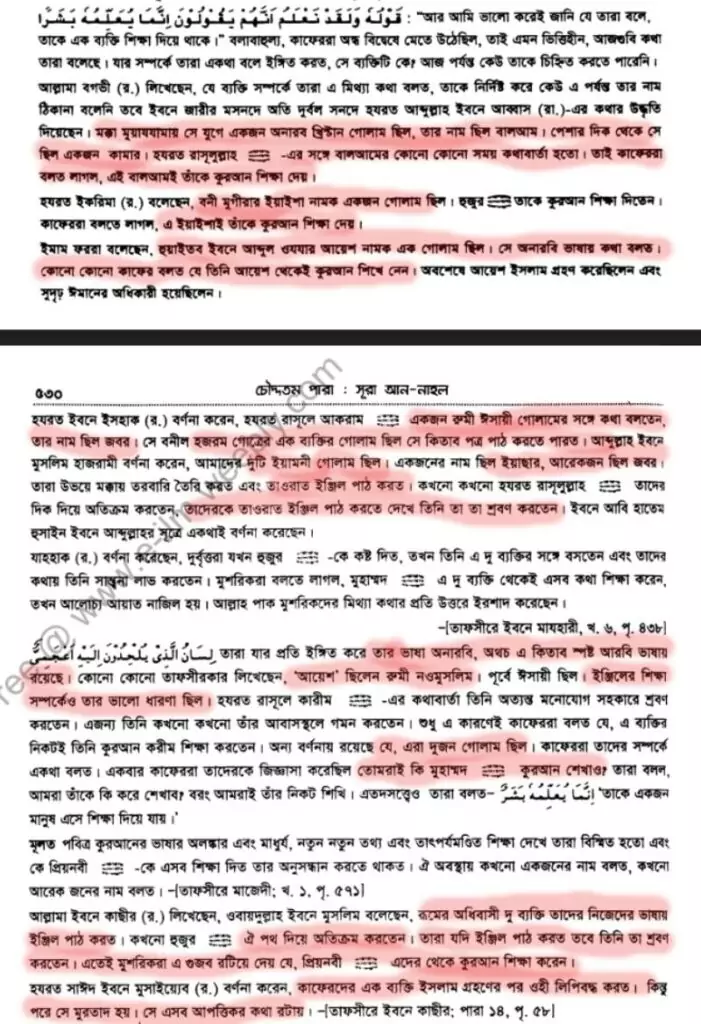
In the childhood story of Elias, there is a specific sequence of conflict between previous deities and prophets. In the discussion of Baal, Bel-Marduk, and Elias material evidence of deities, the history of names and titles, and the Islamic version of Biblical stories are found together.
Creating Humans from Clay: Mythological Precursors to the Adam Story
The story of creating the body of the first human from clay existed in religious literature long before Islam. Here, the Creator’s work is like that of a craftsman: collecting materials, forming the shape, and then bringing the formed body to life. The origin of humans is explained through the familiar experience of constructing bricks, pots, and idols. Within the narrative of the clay body, the reflection of human’s own construction work is clear. In the Islamic Adam story, that familiar construction method is presented as the work of Allah; similar descriptions of forming the human body by the hands of gods exist in earlier literature.
In the Sumerian ‘Enki and Ninmah’ story, Nammu is told to form the shape by applying clay from atop Abzu. The labor of carrying baskets is also imposed upon humans. In the Oxford edited text 28–37 the full section of Enki’s statement is in the lines. below is the Latin transliteration of the original and the English translation, followed by the Bengali translation. [300] [301]
Latin transliteration of the Sumerian original:
den-ki-ke4 mud me-dim2 ni2-te-a-na cag4-bi jectu2-ta u3-mu-ni-ri-ge
ama-ni dnamma-ra gu3 mu-un-na-de2-e
ama-ju10 mud mu-jar-ra-zu i3-jal2-la-am3 zub-sig3 dijir-re-e-ne KEC2-i3
cag4 im ugu abzu-ka u3-mu-e-ni-in-car2
SIG7.EN.SIG7.DUG3 im mu-e-kir3-kir3-re-ne za-e me-dim2 u3-mu-e-ni-jal2
dnin-mah-e an-ta-zu he2-ak-e
dnin-imma dcu-zi-an-na dnin-ma-da dnin-barag {dnin-barag}
dnin-mug dCAR.CAR.GABA dnin-gun3-na
tu-tu-a-zu ha-ra-gub-bu-ne
ama-ju10 za-e nam-bi u3-mu-e-tar dnin-mah zub-sig3-bi he2-KEC2
English translation:
Enki, the planner of the form, after thinking about the matter in his mind, said to his mother Nammu: “Mother, the creature you have planned will truly come into existence. impose the work of carrying baskets upon it. you shall apply the clay from atop Abzu. the birth-goddesses will separate portions from the clay and you will form the shape. let Ninmah be your assistant. Ninimma, Shu-Giana, Ninmada, Ninbarag, Ninmug, [an uncertain name] and Ninguna shall stand beside you during the birth. Mother, after you determine its fate, let Ninmah impose the work of carrying baskets upon it.”
In Genesis, the sequence of forming humans from clay materials and then giving the breath of life is presented in even more concise language. The body is created first, then life enters into it. A prepared form and life given from the outside—these two steps of human creation are also important in subsequent Abrahamic stories. The complete verse of Genesis 2:7 is: [302]
And the LORD God formed man of the dust of the ground, and breathed into his nostrils the breath of life; and man became a living soul.
English translation:
And the Lord God formed man of the dust of the ground, and breathed into his nostrils the breath of life; and man became a living soul.
In the Quran’s Surah al-Hijr, after the mention of dry clay and altered mud, there is mention of completing the human form and breathing the ruh into it. Once the human is created, the angels are commanded to prostrate to him. Consequently, a sequential scene is created: the formed body, the infusion of life from the outside, and then the declaration of the special status of that creation. The clay material was not used merely as a distant poetic comparison; the language of materials and processes of body construction was used. The full sequential reading of al-Hijr 15:26–29 is: [303] [304] [305] [306]
وَلَقَدْ خَلَقْنَا الْإِنسَانَ مِن صَلْصَالٍ مِّنْ حَمَإٍ مَّسْنُونٍ ﴿٢٦﴾
وَالْجَانَّ خَلَقْنَاهُ مِن قَبْلُ مِن نَّارِ السَّمُومِ ﴿٢٧﴾
وَإِذْ قَالَ رَبُّكَ لِلْمَلَائِكَةِ إِنِّي خَالِقٌ بَشَرًا مِّن صَلْصَالٍ مِّنْ حَمَإٍ مَّسْنُونٍ ﴿٢٨﴾
فَإِذَا سَوَّيْتُهُ وَنَفَخْتُ فِيهِ مِن رُّوحِي فَقَعُوا لَهُ سَاجِدِينَ ﴿٢٩﴾
English translation:
26. I created man from dry clay from an altered black mud.
27. And I created the jinn before him from scorching fire.
28. And when your Lord said to the angels, “I will create a human from dry clay from altered black mud.
29. When I have completed his form and breathed into him of My ruh, then prostrate yourselves for him.”
The relationship imagined here between the human body and its life is the relationship of giving power from the outside to a constructed object. Clay can be prepared, shaped, and dried to harden for making a pot; in the story, after that familiar work, the ruh is added to make a living human. The claim of invisible life-infusion is joined with the actual technical experience of body construction. In this mode of narration, it is easy to expand the details: who brought the clay, how many days the form lay there, through which side life entered, and what other supernatural beings did—the story can grow larger by answering these questions. The framework of transforming the history of human birth and the body into a story of a form created by a craftsman is already prepared.
In Sahih Muslim, there is a description of the formed body of Adam being left for some time and Iblis circling around it. Seeing the form as hollow inside, Iblis makes a decision about the limits of his self-control. Here, the prepared body is shown as an observable object; a supernatural conclusion about mental characteristics is drawn from its internal structure. The complete narration preserved in the name of Anas is: [307]
حَدَّثَنَا أَبُو بَكْرِ بْنُ أَبِي شَيْبَةَ، حَدَّثَنَا يُونُسُ بْنُ مُحَمَّدٍ، عَنْ حَمَّادِ بْنِ سَلَمَةَ، عَنْ ثَابِتٍ، عَنْ أَنَسٍ، أَنَّ رَسُولَ اللَّهِ صلى الله عليه وسلم قَالَ «لَمَّا صَوَّرَ اللَّهُ آدَمَ فِي الْجَنَّةِ تَرَكَهُ مَا شَاءَ اللَّهُ أَنْ يَتْرُكَهُ فَجَعَلَ إِبْلِيسُ يُطِيفُ بِهِ يَنْظُرُ مَا هُوَ فَلَمَّا رَآهُ أَجْوَفَ عَرَفَ أَنَّهُ خُلِقَ خَلْقًا لاَ يَتَمَالَكُ».
English translation:
Abu Bakr ibn Abi Shaybah narrated to us. Yunus ibn Muhammad narrated to us, from Hammad ibn Salamah, who narrated from Thabit, who narrated from Anas that the Messenger of Allah, sallallahu alayhi wa sallam, said: “After Allah formed the body of Adam in Paradise, He left him in that state for as long as He willed. Then Iblis began to circle around him and looked to see what he was. When he saw him as hollow inside, he understood that he had been created with a nature such that he would not be able to maintain full control over himself.”
In the narration of Abu Dawud, the explanation of human skin color and easy-difficult or good-bad nature is also linked to the clay of different parts of the earth. The first human from a handful of clay and the diversity of his descendants from the diversity of that clay—here, the same origin story is used for visible human differences and moral character. The color of clay is visible to the eye; by making human color and character the sequential result of the qualities of that clay, the story is given the appearance of an explanation. The complete narration in the name of Abu Musa al-Ash’ari is: [308]
حَدَّثَنَا مُسَدَّدٌ، أَنَّ يَزِيدَ بْنَ زُرَيْعٍ، وَيَحْيَى بْنَ سَعِيدٍ، حَدَّثَاهُمْ قَالاَ، حَدَّثَنَا عَوْفٌ، قَالَ حَدَّثَنَا قَسَامَةُ بْنُ زُهَيْرٍ، قَالَ حَدَّثَنَا أَبُو مُوسَى الأَشْعَرِيُّ، قَالَ قَالَ رَسُولُ اللَّهِ صلى الله عليه وسلم «إِنَّ اللَّهَ خَلَقَ آدَمَ مِنْ قَبْضَةٍ قَبَضَهَا مِنْ جَمِيعِ الأَرْضِ فَجَاءَ بَنُو آدَمَ عَلَى قَدْرِ الأَرْضِ جَاءَ مِنْهُمُ الأَحْمَرُ وَالأَبْيَضُ وَالأَسْوَدُ وَبَيْنَ ذَلِكَ وَالسَّهْلُ وَالْحَزْنُ وَالْخَبِيثُ وَالطَّيِّبُ». زَادَ فِي حَدِيثِ يَحْيَى «وَبَيْنَ ذَلِكَ». وَالإِخْبَارُ فِي حَدِيثِ يَزِيدَ.
English translation:
Musaddad narrated to us that Yazid ibn Juray and Yahya ibn Sa’id narrated to them. they said: Awf narrated to us. he said: Kasama ibn Zuhayr narrated to us. he said: Abu Musa al-Ash’ari narrated to us. he said: The Messenger of Allah, sallallahu alayhi wa sallam, said: “Allah created Adam from a handful of soil, which He took from the entire earth. consequently, the children of Adam became according to the diversity of the soil. among them some are red, some white, some black, and some in between; some are easy-natured, some hard-natured; some are bad, some good.” In Yahya’s narration there is further, “and those in between.” the words for reporting the direct narration are present in Yazid’s narration.
In this story, color and moral character are presented as the same kind of inheritance. Because there are differences in the colors of the earth’s soil, human color and nature have been made the result of those elements. But drawing a comparison does not establish any causality. There is no process in this declaration explaining how the good or bad behavior of a thinking human is determined by the color of mud. A simple story of human complexity has been made using the visible diversity of a familiar inert element. Religious authority asks to accept that story as an explanation of birth and character; no independent observation or test is attached to the declaration.
| Element | Previous religious texts | Islamic narration |
|---|---|---|
| Human form from soil | Instruction to create a form by applying mud in ‘Enki and Ninmah’; humans from the dust of the ground in Genesis. | Humans from dry soil and mud in Hejaz 15:26–28. |
| Infusing life into the molded body | The breath of life after the formation of the body in Genesis 2:7. | Blowing the ruh after completing the form in Hejaz 15:29. |
| Visualization of the state after creation | The deity’s construction work and the determination of the role for humans. | Leaving the form in Muslim 2611 and Iblis circling around it. |
| Material-based explanation of human diversity | Imagining the body as an object crafted by a divine artisan. | The relationship between different soils, color, and nature in Abu Dawud 4693. |
Within the Abrahamic tradition, the similarity of giving life after molding the body from soil is specifically defined. In both Genesis and the Quran, body formation and the infusion of life are separate steps. Islamic hadith added Iblis’s observation around that molded body and further explanations of human character. Consequently, a previously known creation-narrative has expanded within new names, dialogues, and religious authority. The evidence being presented in favor of this statement regarding human origin is essentially the authority of religious narration; the written pre-history of the story is again found within human mythology and religious literature. There is detailed criticism of the molding of Adam’s body from soil, the additional details of tafsir surrounding that body, and the claims of human creation in ‘The Tale of Making Adam: Islamic Mythology of Human Creation’ in the article.
Prostration to Adam and the rejection by Satan: Islamic reconstruction of old Jewish–Christian stories
The story of the order to prostrate to Adam after molding his body from soil and Satan’s refusal also has a pre-Islamic history. In old Adam literature, Michael presents the new human before the angels, orders them to bow to the image of God, and Satan rejects it claiming his own high status and having been created first. In other Christian narrations, the objection is more specific: why should a being made of fire bow to a human made of soil? The Iblis of the Quran also makes the same comparison between fire and soil. Consequently, this entire sequence of events—Adam, the order to bow, the claim of superiority, the refusal, and the expulsion—is linked to religious literature prior to Islam. In Whitney Bodman’s research on Iblis, ‘The Life of Adam and Eve’, ‘The Questions of Bartholomew’, and the Syriac ‘Cave of Treasures’ are discussed as previous traditions of this narrative. [309]
Even more ancient elements: Isaiah’s fallen star and the claim to the highest throne
The language of falling from heavenly height, raising one’s own throne, and the desire to be equal to the Highest Being exists in Jewish scriptures prior to Christianity. In the fourteenth chapter, fourth verse of Isaiah, the statement is identified as a mockery against the king of Babylon. In that mockery, the ruler’s arrogance is expressed through the scene of the falling morning star rising in the sky. In the following verses, there is a claim to establish one’s throne above the stars of heaven and to be like the Highest. Later in Adam literature, Satan makes almost the same declaration with his own mouth. In the King James translation, the full text of Isaiah 14:12–15 is: [310]
Published English translation:
12. How art thou fallen from heaven, O Lucifer, son of the morning! how art thou cut down to the ground, which didst weaken the nations!
13. For thou hast said in thine heart, I will ascend into heaven, I will exalt my throne above the stars of God: I will sit also upon the mount of the congregation, in the sides of the north:
14. I will ascend above the heights of the clouds; I will be like the most High.
15. Yet thou shalt be brought down to hell, to the sides of the pit.
English translation:
12. O son of the morning, O Lucifer, how you have fallen from heaven! You, who were to weaken the nations, how you have fallen to the ground!
13. You said in your heart: I will ascend into heaven; I will raise my throne above the stars of God. I will sit on the mount of assembly at the utmost north.
14. I will ascend above the height of the clouds; I will be like the Highest.
15. But you will be brought down to Sheol, to the depths of the pit.
In this scene, the tools for expressing the ruler’s lust for status are the high seat, stars, divine assembly, and the fall from top to bottom. The rank of human royal courts has been mapped onto the sky: a higher throne means higher power, and being cast down means insult and defeat. The sentence ‘I will be like the Highest’ later finds a place in the dialogue of Satan’s rebellion. The language of old royal mockery is thus used in the self-description of a superhuman rebel. A religious story can take not just general themes but also specific declarations from previous texts and place them in the mouth of its character.
Ezekiel’s Eden, the Cherub, and the Being Stripped of Glory
In the twenty-eighth chapter of Ezekiel, within the lament against the king of Tyre, Eden, the holy mountain of God, the Cherub, perfection at the time of creation, and later expulsion due to crime are brought together. There is also a scene of arrogance arising from beauty and brilliance, and as a result, being cast to the ground. This text is another source of old elements used in later Christian interpretations of Satan’s fall. The claim to the highest seat in Isaiah and the image of losing the glory of Eden in Ezekiel—both became elements in forming the story of the rebellious superhuman being. The full text of Ezekiel 28:12–17 is: [311]
Published English translation:
12. Son of man, take up a lamentation upon the king of Tyrus, and say unto him, Thus saith the Lord GOD; Thou sealest up the sum, full of wisdom, and perfect in beauty.
13. Thou hast been in Eden the garden of God; every precious stone was thy covering, the sardius, topaz, and the diamond, the beryl, the onyx, and the jasper, the sapphire, the emerald, and the carbuncle, and gold: the workmanship of thy tabrets and of thy pipes was prepared in thee in the day that thou wast created.
14. Thou art the anointed cherub that covereth; and I have set thee so: thou wast upon the holy mountain of God; thou hast walked up and down in the midst of the stones of fire.
15. Thou wast perfect in thy ways from the day that thou wast created, till iniquity was found in thee.
16. By the multitude of thy merchandise they have filled the midst of thee with violence, and thou hast sinned: therefore I will cast thee as profane out of the mountain of God: and I will destroy thee, O covering cherub, from the midst of the stones of fire.
17. Thine heart was lifted up because of thy beauty, thou hast corrupted thy wisdom by reason of thy brightness: I will cast thee to the ground, I will lay thee before kings, that they may behold thee.
English translation:
12. O son of man, lament for the king of Tyre and say to him: The Lord God says—you bore the seal of perfection; you were full of wisdom and perfect in beauty.
13. You were in Eden, the garden of God. All precious stones were your covering—sardius, topaz, diamond, beryl, chrysolite, emerald, sapphire, turquoise, ruby and gold. On the day you were created, the craftsmanship of your timbrels and pipes was prepared.
14. You were an anointed covering Cherub; I placed you in that position. You were on the holy mountain of God; walking among the stones of fire.
15. From the day you were created until iniquity was found in you, you were perfect in your ways.
16. Because of your vast trade, they filled you with violence and you have sinned. Therefore I will cast you out as profane from the mountain of God; O covering Cherub, I will destroy you from among the stones of fire.
17. Because of your beauty your heart became arrogant; because of your brilliance you destroyed your wisdom. I will cast you to the ground; I will place you before kings, so that they may see you.
This arrangement of residence in Eden, extraordinary glory, crime, and expulsion provides a ready repertoire of scenes for the subsequent story of Satan. The beauty and trade of a king are present in the same statement along with the Cherub, the holy mountain, and fiery stones. To explain the fall of earthly power, the image of losing divine status has been used. In Christian interpretation, this royal and heavenly language turns into the description of Satan’s pre-fall state. Bodman’s discussion mentions the Christian adoption of this text of Ezekiel and the interpretation of Origen. [312]
Complete sequence of events in Adam literature: rejection of prostration, expulsion and revenge
In the Latin form of ‘The Life of Adam and Eve’, Satan himself states the reason for his enmity toward Adam. After creating Adam as the image of God, Michael tells other angels to bow to him. Satan claims that he was created first and Adam is inferior compared to him. When the angels under him also refuse, all are expelled. Then, to take revenge for his lost glory, he deceives Adam’s wife. The declaration of establishing a seat above the stars and being like the Highest from Isaiah has returned here to Satan’s mouth. In the English translation of the edition edited by R. H. Charles in 1913, the complete sequence of events from the twelfth to the sixteenth chapter is: [313]
Published English translation:
12. And with a heavy sigh, the devil spake: ‘O Adam! all my hostility, envy, and sorrow is for thee, since it is for thee that I have been expelled from my glory, which I possessed in the heavens in the midst of the angels and for thee was I cast out in the earth.’ Adam answered, ‘What dost thou tell me? What have I done to thee or what is my fault against thee? Seeing that thou hast received no harm or injury from us, why dost thou pursue us?’
13. The devil replied, ‘Adam, what dost thou tell me? It is for thy sake that I have been hurled from that place. When thou wast formed. I was hurled out of the presence of God and banished from the company of the angels. When God blew into thee the breath of life and thy face and likeness was made in the image of God, Michael also brought thee and made (us) worship thee in the sight of God; and God the Lord spake: Here is Adam. I have made thee in our image and likeness.’
14. And Michael went out and called all the angels saying: ‘Worship the image of God as the Lord God hath commanded.’ And Michael himself worshipped first; then he called me and said: ‘Worship the image of God the Lord.’ And I answered, ‘I have no (need) to worship Adam.’ And since Michael kept urging me to worship, I said to him, ‘Why dost thou urge me? I will not worship an inferior and younger being (than I). I am his senior in the Creation, before he was made was I already made. It is his duty to worship me.’
15. When the angels, who were under me, heard this, they refused to worship him. And Michael saith, ‘Worship the image of God, but if thou wilt not worship him, the Lord God will be wrath with thee.’ And I said, ‘If He be wrath with me, I will set my seat above the stars of heaven and will be like the Highest.’
16. And God the Lord was wrath with me and banished me and my angels from our glory; and on thy account were we expelled from our abodes into this world and hurled on the earth. And straightway we were overcome with grief, since we had been spoiled of so great glory. And we were grieved when we saw thee in such joy and luxury. And with guile I cheated thy wife and caused thee to be expelled through her (doing) from thy joy and luxury, as I have been driven out of my glory.
English translation:
12. With a deep sigh, Satan said: O Adam, all my enmity, jealousy, and sorrow are for you. because of you, I was expelled from the glory I held among the angels in heaven and cast down to earth. Adam replied: What are you saying to me? What have I done to you or what is my crime against you? You received no harm or injury from us; then why do you pursue us?
13. Satan said: Adam, what are you saying to me? It is because of you that I was thrown from that place. at the time of your formation, I was thrown from the presence of God and expelled from the company of the angels. After God breathed the breath of life into you and your face and form were created in the image of God, Michael brought you and made us bow before God in your presence. The Lord God said: This is Adam; I have created you in our image and likeness.
14. Michael went out, called all the angels, and said: According to the command of the Lord God, bow before the image of God. Michael himself bowed first; then he called me and said: Bow before the image of the Lord God. I said: I have no need to bow to Adam. As Michael repeatedly told me to bow, I said to him: Why are you forcing me? I will not bow to a being inferior and created after me. In creation, I am before him; I was created before he was created. It is his duty to bow to me.
15. Hearing this, the angels under me also refused to bow to him. Michael said: Bow before the image of God; if you do not bow, the Lord God will be angry with you. I said: If He is angry with me, I will establish my throne above the stars of heaven and be like the Most High.
16. The Lord God became angry with me and expelled me and my angels from our glory. Because of you, we were cast out from our abode into this world and thrown to earth. Having lost such great glory, we were immediately overwhelmed by sorrow. Seeing you in such joy and pleasure, we were pained. I cunningly deceived your wife and through her actions, I caused you to be expelled from your joy and pleasure, just as I was expelled from my glory.
Here, a history of personal insult and revenge is constructed for Satan’s misanthropy. By refusing to bow before the new creation, he loses his place; then he plans to remove that new creation from the place of happiness in the same way. The incident of deceiving Adam’s wife becomes the result of this prior conflict. Consequently, the two stories of human disobedience and Satan’s enmity are tied in a cause-effect sequence. The story of a subordinate’s revenge for losing rank in the court explains the origin of cosmic evil here. The cause of enmity, the logic of refusal, and the scene of punishment—all are present in the tradition of Adam literature prior to Islam.
Bartholomew’s Christian narrative: ‘I am fire, why should I bow to earth?’
In the Christian text known as the ‘Questions of Bartholomew’, the logic of refusal is closer to the statement of the Quran. Bodman has discussed the text as part of fourth or fifth-century Christian literature. In it, Satan says he is created from fire and is the first created angel; therefore, why should he bow to earth and matter? After Michael’s warning, he announces the placement of his own throne opposite the throne of God. In M. R. James’s translation of 1924, the full text of section 54–56 of the fourth chapter is: [314] [315]
Published English translation:
54. And when I came from the ends of the earth Michael said: Worship thou the image of God, which he hath made according to his likeness. But I said: I am fire of fire, I was the first angel formed, and shall worship clay and matter?
55. And Michael saith to me: Worship, lest God be wroth with thee. But I said to him: God will not be wroth with me; but I will set my throne over against his throne, and I will be as he is. Then was God wroth with me and cast me down, having commanded the windows of heaven to be opened.
56. And when I was cast down, he asked also the six hundred that were under me, if they would worship: but they said: Like as we have seen the first angel do, neither will we worship him that is less than ourselves. Then were the six hundred also cast down by him with me.
English translation:
54. When I returned from the edge of the earth, Michael said: Bow before the image that God has created in His own likeness. But I said: I am fire created from fire; I am the first formed angel. Shall I bow to earth and matter?
55. Michael said to me: Bow, otherwise God will be angry with you. But I said to him: God will not be angry with me; rather, I will place my throne opposite His throne and I will be like Him. Then God became angry with me and, ordering the windows of heaven to be opened, cast me down.
56. After casting me down, He asked the six hundred under me whether they would bow. They said: Just as we saw the first angel do, we also will not bow to a being inferior to ourselves. Then He cast those six hundred down with me.
The comparison between fire and earth is the most specific connection in this narrative. Superiority is claimed based on birth or the element of creation as the reason for refusal. In the Latin forms of Adam literature, the claim of being created first is primary; in Bartholomew’s narrative, the identity of fire is added to it. The Iblis of the Quran also does not mention his own good deeds or any crime of Adam; he says he was created from fire and Adam from earth. The same type of element-based logic is used for the same conflict. Although the names and the language of the dialogue change, the specific scene of the fire-being refusing to bow before the earth-human remains.
The same rebellion in Syriac Christian literature: fire, dust, and lost glory
In the Syriac ‘Cave of Treasures’, there is also a story of a being made of fire refusing to bow to Adam made of dust. In Sergei Minv’s research, the probable composition date of the book is placed between the mid-sixth century and the first few decades of the seventh century; the environment of composition is identified as the West-Syriac Christian society of Sasanian-controlled Upper Mesopotamia. In this version, Adam is given the status of king, priest, and prophet; after other creations bow before him, Satan becomes jealous and claims that he himself is worthy of bowing. In Budge’s translation, the complete paragraph of refusal and fall is: [316] [317]
Published English translation:
And when the prince of the lower order of angels saw what great majesty had been given unto Adam, he was jealous of him from that day, and he did not wish to worship him. And he said unto his hosts, “Ye shall not worship him, and ye shall not praise him with the angels. It is meet that ye should worship me, because I am fire and spirit; and not that I should worship a thing of dust, which hath been fashioned of fine dust.” And the Rebel meditating these things would not render obedience to God, and of his own free will he asserted his independence and separated himself from God. But he was swept away out of heaven and fell, and the fall of himself and of all his company from heaven took place on the Sixth Day, at the second hour of the day. And the apparel of their glorious state was stripped off them.
English translation:
When the chief of the lower rank of angels saw what great glory was given to Adam, from that day he became jealous of him and did not want to bow to him. He said to his army: Do not bow to him and do not praise him along with the angels. It is appropriate for you to bow to me; for I am fire and spirit. It is not appropriate for me to bow to a thing of dust made of fine dust. Thinking these things, the rebel refused to obey God and, declaring independence of his own will, separated himself from God. But he was removed from heaven and fell. The fall of he and all his companions from heaven occurred on the second hour of the sixth day. The garments of their glorious state were also stripped away.
In this Syriac description, the heavenly hierarchy is as visible as a human court. There is a newly honored person, an expectation of bowing before him, an objection from a chief with a subordinate army, and in punishment, demotion and the stripping of garments. The loss of the garment of glory is an expression of the loss of power and identity here. The conflict of determining the worthiness of bowing through the difference between fire and dust is also added to the same scene. Consequently, Satan’s rebellion is part of a long literary construction: the imagery of the old throne and fall, Adam’s new status, and the objection of the fire-being are organized into one narrative.
Retelling of the old conflict in the Quran: prostration, fire-earth, and misanthropy
In Surah Al-A’raf of the Quran, the formation of Adam, the prostration of the angels, the refusal of Iblis, the comparison of fire-earth, and the declaration of revenge against humans after expulsion appear sequentially. The same cause-and-effect of Judeo-Christian Adam literature works here: the conflict centers on Adam, the opponent claims his own status, receives punishment, and later vows to lead humans astray. In the Quranic account, the command to prostrate and the declaration of expulsion are given directly by Allah; in previous Christian dialogues, Michael played the role of carrying the command and warning. The complete sequential reading of Al-A’raf 7:11–18 is: [318] [319]
١١. وَلَقَدْ خَلَقْنَاكُمْ ثُمَّ صَوَّرْنَاكُمْ ثُمَّ قُلْنَا لِلْمَلَائِكَةِ اسْجُدُوا لِآدَمَ فَسَجَدُوا إِلَّا إِبْلِيسَ لَمْ يَكُن مِّنَ السَّاجِدِينَ
١٢. قَالَ مَا مَنَعَكَ أَلَّا تَسْجُدَ إِذْ أَمَرْتُكَ ۖ قَالَ أَنَا خَيْرٌ مِّنْهُ خَلَقْتَنِي مِن نَّارٍ وَخَلَقْتَهُ مِن طِينٍ
١٣. قَالَ فَاهْبِطْ مِنْهَا فَمَا يَكُونُ لَكَ أَن تَتَكَبَّرَ فِيهَا فَاخْرُجْ إِنَّكَ مِنَ الصَّاغِرِينَ
١٤. قَالَ أَنظِرْنِي إِلَىٰ يَوْمِ يُبْعَثُونَ
١٥. قَالَ إِنَّكَ مِنَ الْمُنظَرِينَ
١٦. قَالَ فَبِمَا أَغْوَيْتَنِي لَأَقْعُدَنَّ لَهُمْ صِرَاطَكَ الْمُسْتَقِيمَ
١٧. ثُمَّ لَآتِيَنَّهُم مِّن بَيْنِ أَيْدِيهِمْ وَمِنْ خَلْفِهِمْ وَعَنْ أَيْمَانِهِمْ وَعَن شَمَائِلِهِمْ ۖ وَلَا تَجِدُ أَكْثَرَهُمْ شَاكِرِينَ
١٨. قَالَ اخْرُجْ مِنْهَا مَذْءُومًا مَّدْحُورًا ۖ لَّمَن تَبِعَكَ مِنْهُمْ لَأَمْلَأَنَّ جَهَنَّمَ مِنكُمْ أَجْمَعِينَ
English translation:
11. I created you, then I gave you form; then I said to the angels: Prostrate before Adam. They prostrated, except for Iblis; he was not among those who prostrated.
12. He said: After I gave you the command, what prevented you from prostrating? He said: I am superior to him. You created me from fire and him from earth.
13. He said: Get down from here. It is not appropriate for you to be arrogant here. Get out; you are among the disgraced.
14. He said: Give me respite until the day they will be resurrected.
15. He said: You are among those granted respite.
16. He said: Because You have led me astray, I will surely lie in wait for them on Your straight path.
17. Then I will come to them from before them, from behind them, from their right, and from their left. You will not find most of them grateful.
18. He said: Get out of here in a condemned and expelled state. I will surely fill Hell with you and whoever among them follows you.
This conflict between Adam and Satan is found within previous religious literature. in Latin Adam literature, as the expelled Satan, his revenge is to drive Adam out of the place of happiness; in the Quran, as the expelled Iblis, he will block the path of the children of Adam and make them ungrateful. the objection in Bartholomew’s story, ‘Why should I, being fire, bow to the earth,’ has taken the form of the argument ‘I am from fire, he is from earth’ in the Quran. these similarities are far more specific than isolated mentions of the same character: the occasion of the conflict, the basis of superiority, the refusal, the punishment, and the cause of subsequent enmity are organized in the same sequence of events.
| Text or Tradition | Specific Element | Its use in subsequent stories |
|---|---|---|
| Isaiah 14:12–15 | Fall from heaven, throne above the stars, and the declaration of becoming like the Most High. | In Latin Adam literature, Satan uses the same language of the throne and becoming equal to the Most High. |
| Ezekiel 28:12–17 | Eden, cherub, bright glory, pride, and expulsion from the holy place. | Materials for the Christian interpretation of Satan’s previous status and fall. |
| Latin ‘Life of Adam and Eve’ 12–16 | Command to bow to Adam; refusal of the previously created being; expulsion and revenge. | The complete cause-and-effect story of Satan’s misanthropy centered on Adam. |
| ‘Questions of Bartholomew’ 4:54–56 | Refusal of the being of fire to bow to the earth; Michael’s warning and the fall. | A specific Christian parallel to the Quran’s claim of superiority based on fire and earth. |
| Syriac ‘Cave of Treasures’ | Adam’s royal status; claims of fire and spirit; not bowing to dust and loss of glory. | An expanded form of the same conflict in the Syriac Christian environment. |
| Quran, al-Araf 7:11–18 | Direct command of Allah, Iblis’s fire-earth argument, expulsion, and the vow to mislead humans. | Islamic retelling of the previously known Adam-Satan conflict. |
The reconstruction of religious imagination can be identified in the layers of this story. the old language of insulting a king becomes the language of a rebellious heavenly being; the status of the image of God becomes the reason for angels to bow before the new human; the comparison of fire and earth becomes the logic of refusal; and expulsion from the court becomes the cause of Satan’s revenge against humans. The Quran has organized this old conflict into a direct dialogue between Allah and Iblis. Therefore, along with the claim of revealing new information about an invisible past, specific characters, dialogues, and sequences of events from previous religious literature are carried forward. The narrative of bowing to Adam and Satan’s rejection belongs to the history of religious stories circulating among humans.
Prometheus, Loki, and Satan
In Greek mythology, Prometheus faces opposition to divine rule for gathering fire for humans. In Hesiod’s account, Zeus chains him and an eagle eats his liver; it grows back at night. In Norse mythology, Loki is associated with deception, conflict with the gods, and the story of Baldur’s death. Later comes the description of him being bound and the agony of snake venom dripping on his face. This dramatic arrangement of divine rule, rebellion, crime, and supernatural punishment is found in many mythologies. In Abrahamic religions, Satan is also a character who opposes obedience, tempts, and explains evil deeds. Just as the conflict between hero and antagonist drives the story in modern tales, such characters make moral conflicts visible in religious stories. [320] [321]
When natural events and human emotions are imagined as the work of individual entities, a simple cause can be created through a story. Lightning then becomes the weapon of a god, a storm His wrath, and danger the attack of some invisible opponent. In the case of Satan, greed, anger, temptation, or the wrong behavior of humans has been linked to the active work of an entity. This is not an explanation for the claim that ancient humans lacked the capacity for abstract thought; rather, a familiar storytelling method of presenting abstract experiences through characters is at work here. A problem arises when this character is placed in the position of a testable real cause and the rules of humans’ daily actions are determined in its name.
In Riyadh us-Saliheen, the market is called a haunt of Satan, and according to the source of Barkani, a place where Satan lays eggs and hatches young. The first statement is a saying of Salman, while the second has come as an additional description quoted in the name of the Messenger. To denote the greed and deception of the market, the image of an invisible enemy’s stronghold is being used. In that image, familiar behaviors of humans and animals, such as flags, reproduction, and occupying specific places, have come together.
Riyadh us-Saliheen
19/ Miscellaneous Interesting Hadiths
Chapter: 370 : Regarding Dajjal and the Signs of the Hour
35/1851. Narrated as a saying of Salman al-Farisi (may Allah be pleased with him) (mawquf source), he said, ‘If you can, do not be the first to enter the market and do not be the last to leave it. because the market is a haunt of Satan; there he plants his flag.’ (Muslim)(1)
Barkani has narrated in his ‘Sahih’ book on behalf of Salman (may Allah be pleased with him), he said, the Messenger of Allah (peace and blessings of Allah be upon him) said, ‘Do not be the first to enter the market and do not be the last to leave it. because there Satan lays eggs and gives birth to chicks.’
(1) Sahih al-Bukhari 3634, Muslim 2451
Hadith grade: Sahih
In the description of Satan entering the mouth during yawning, a supernatural danger has been linked to a normal bodily function. The ritual of keeping the mouth closed is being validated by the fear of the entry of an invisible entity. There is a visible event of yawning; there is no separate evidence for the event of Satan entering it. Only by believing in the invisible danger is the authority of religious instruction over physical ritual established. [322]
Mishkat al-Masabih (Mishkat)
Chapter: Part-4: Salat
Publisher: Hadith Academy
Section: 19. First paragraph – Actions that are not permissible and those that are permissible during salat
985-(8) Narrated from Abu Sa’id al-Khudri (ra), he said, .the Messenger of Allah (peace and blessings of Allah be upon him) said: If any of you yawns during salat, he should try his best to stop it. because (while yawning) Satan enters (the mouth). (Muslim)
Hadith grade: Sahih
There is also a description of Satan urinating in the ear of a person who does not rise for salat. In the explanation of sleep and the failure to perform religious duties, the act of human urination has been placed upon an invisible entity. Instead of examining the physical causes of sleep, this explanation marks the individual as a victim of invisible insult. Humans are thus declared victims of Satan’s insult for not waking up. The fear of invisible attack becomes linked with the pressure to follow the religious schedule. [323]
Sahih al-Bukhari (Tawhid)
Chapter: 19/ Tahajjud
Section: 19/13. If one falls asleep without performing salat, Satan urinates in his ear.
1144. Narrated from Abdullah ibn Masud (ra), he said, a person was discussed before the Nabi (peace and blessings of Allah be upon him)—he spent until morning sleeping, did not wake for salat, then. he (the Nabi, peace and blessings of Allah be upon him) said: Satan has urinated in his ear. (3270; Muslim 6/28, Hadith: 774) (Modern publication: 1073, Islamic Foundation: 1078)
Hadith grade: Sahih
Mishkat al-Masabih (Mishkat)
Chapter: Part-4: Salat
Publisher: Hadith Academy
Section: 33. First paragraph – Encouragement towards Qiyam al-Layl
1221-(3) Narrated from Abdullah ibn Masud (ra), he said, a man was discussed before the Nabi (peace and blessings of Allah be upon him). he was told that the man sleeps continuously until morning, does not rise for salat. he (peace and blessings of Allah be upon him) said, in this man’s ear or he (peace and blessings of Allah be upon him) said, in his two ears Satan has urinated. (Bukhari, Muslim)
Sahih: Bukhari 3270, Muslim 774.
Hadith grade: Sahih
In the description of prohibiting eating with the left hand by linking it to Satan’s behavior, the religious character has become a tool for social discipline. In the decision of which hand should hold food, instead of food safety or the physical capacity of the person, an accusation of imitating an invisible opponent is brought. Satan here eats, drinks, and uses a specific hand. Familiar human organs and habits are placed upon a supernatural character, and later that character is made the reason for controlling human habits. [324]
Sunan Abu Dawood (IF)
Chapter: 21/ Foodstuffs
Section: 471. Regarding eating with the right hand.
3734. Ahmad ibn Hanbal (rh) … narrated from Ibn Umar (ra), he said, the Nabi (peace and blessings of Allah be upon him) said: When any of you eats food, he should eat with his right hand, and when he drinks water, he should drink with the right hand. because Satan eats and drinks water with the left hand.
Hadith grade: Sahih
The social results of these descriptions meet in one place: the time of entering the market, yawning, waking from sleep, and the hand for eating—the presence of an invisible entity is placed in every ordinary act. As a result, normal human life enters the sphere of supernatural surveillance. If a person fails to follow an instruction, they do not just do one act wrong; they also become involved in similarity, penetration, or insult by Satan. This fear may be effective in creating religious obedience, but truth of description does not follow from fear. Instead of the causes declared in the name of Satan, examining human behavior and its results in the visible world provides real knowledge.
Adam’s height is also from Judaism
Adam’s height was sixty cubits and since then the size of humans has gradually decreased—this claim exists in Bukhari and Muslim. based on the conventional eighteen-inch cubit, sixty cubits is approximately ninety feet or twenty-seven meters; differences in ancient measurements of the cubit do not solve the fundamental problem of this giant stature. if the known physical structure of modern humans were scaled up this large, a completely different level of pressure would fall upon the bones, muscles, and blood circulation. in the fossil and genetic evidence of human evolution, no history of continuous contraction of humans from a ready-made giant body is found. instead, there is a history of populations changing over many generations from previous animal groups. the story of a first human created completely in one day and his descendants gradually becoming smaller is the opposite of that history. [325] [326] [327] [328]
Sahih Bukhari (Tawhid Publication)
79/ Requesting Permission
Chapter: 79/1. The Beginning of Greeting
6227. Narrated by Abu Hurairah (ra) that the Prophet (peace be upon him) said: Allah the Almighty created Adam (as) in his proper form, his height was sixty cubits. After creating him, He said: Go. and greet this group of seated angels and listen carefully to how they respond to your greeting; for this will be the greeting (tahiyya) for you and your descendants. So he went and said: ‘Assalamu ‘alaikum’. They replied: ‘Assalamu ‘alaika wa rahmatullah’. They added the phrase ‘wa rahmatullah’. Then the Prophet (peace be upon him) further said: those who enter Paradise will be of the stature of Adam (as). Since then until now, the size of humans has been gradually decreasing. [3326] (Modern Publication- 5786, Islamic Foundation- 5681)
Hadith Grade: Sahih
Narrator: Abu Hurairah (ra)
Sahih Muslim (Islamic Foundation)
54/ Details of Paradise, the Blessings of Paradise and the Inhabitants of Paradise
Chapter: 11. Many groups will enter Paradise whose hearts are like the hearts of birds
6900. Muhammad Ilun Rafi’ (rh) … narrated from Hammam ibn Munabbih (rh). he says, these are (those hadiths) which Abu Hurairah (ra) narrated to us from the Messenger of Allah (peace be upon him). (Thus) he mentions several hadiths. one of which is that the Messenger of Allah (peace be upon him) said: Allah the Almighty created Adam (alayhis salam) in his own form. his length was sixty cubits. After creating him, He told him, go, greet this group. they are a group of seated angels. listen very carefully to what they say in response to the greeting. for this is the greeting for you and your descendants. The narrator says, then he went and said, ‘Assalamu alaikum’. In reply they said, ‘Assalamu alaika warahmatullah’. They added wa rahmatullah. Then he said, whoever enters Paradise will enter in the form of Adam (alayhis salam). his length will be sixty cubits. The Prophet (peace be upon him) says: after that the size of the (created) body has been decreasing day by day until today.
Hadith Grade: Sahih
Narrator: Hammam ibn Munabbih (rh)
In Jewish aggadic literature, there are also stories of a giant Adam and the reduction of his size. In Sanhedrin 38b, two views are preserved: that Adam extended from one end of the earth to the other, or from the earth to the heaven. After the sin, God placed His hand upon him and made him small. In Baba Batra 75a, in a debate about the height of future humans, Adam’s measurement became the standard of comparison. Rabbi Meir’s two hundred cubits were called double that of Adam; Rabbi Yehuda’s one hundred cubits were compared to the height of the Temple for future humans. The tools for explaining this change—a superhuman primordial man, different subsequent body measurements, and religious significance—are present in pre-Islamic Jewish literature. [329] [330] [331]
מיתיבי (ויקרא כו, יג) ואולך אתכם קוממיות רבי מאיר אומר מאתים אמה כשתי קומות של אדם הראשון רבי יהודה אומר מאה אמה כנגד היכל וכתליו שנאמר (תהלים קמד, יב) אשר בנינו כנטיעים מגודלים בנעוריהם בנותינו כזויות מחוטבות תבנית היכל כי קאמר ר’ יוחנן לכווי דבי זיקא
English translation:
An objection was raised: “I have made you walk upright.” Rabbi Meir says: two hundred cubits, double the height of the first Adam. Rabbi Yehuda says: one hundred cubits, similar to the height of the Temple and its walls; as it is said, “Our sons are like plants grown up in beauty, our daughters like carved pillars of the Temple.” What Rabbi Yohanan spoke about was regarding the windows for air circulation.
In the account of Sanhedrin, the reason for the contraction is also specified: Adam’s sin. The body of the primordial man has been made a visible part of the moral narrative. [332]
אמר רב יהודה אמר רב אדם הראשון מסוף העולם ועד סופו היה שנאמר למן היום אשר ברא אלהים אדם על הארץ ולמקצה השמים ועד קצה השמים כיון שסרח הניח הקדוש ברוך הוא ידו עליו ומיעטו שנאמר אחור וקדם צרתני ותשת עלי כפך אמר ר”א אדם הראשון מן הארץ עד לרקיע היה שנאמר למן היום אשר ברא אלהים אדם על הארץ ולמקצה השמים כיון שסרח הניח הקב”ה ידו עליו ומיעטו שנאמר אחור וקדם צרתני וגו’ קשו קראי אהדדי אידי ואידי חדא מידה היא
English translation:
Rabbi Yehuda says in the name of the Lord: the first Adam extended from one end of the earth to the other; as it is said, “From the day God created man on earth, and from one end of the heaven to the other.” When he sinned, the Holy One placed His hand upon him and made him small; as it is said, “You have hemmed me in behind and before, and laid Your hand upon me.” Rabbi Eliezer says: the first Adam extended from the earth to the heaven; as it is said, “From the day God created man on earth, and to the edge of the heaven.” When he sinned, the Holy One placed His hand upon him and made him small; as it is said, “You have hemmed me in behind and before.” If the two verses seem contradictory, the answer is: both are the same measurement.
The sixty cubits of the hadith and the other measurements of the Talmud are not the same; the similarity lies in the structure of the story. The body of the first human is extraordinarily large compared to present humans, and the body of subsequent humans is a smaller version of it. This measurement was not determined by measuring any skeleton. The history of the body has been constructed from the statements of religious authority. The presence of this Adam-story previously places the Islamic account within a familiar mythological tradition. The new number of sixty cubits does not turn that tradition into scientific anthropology.
The problem of increasing body size is understandable through simple calculation. If height is increased fifteen-fold while keeping the same proportion, the cross-sectional area of the bone increases by the square of fifteen, i.e., two hundred twenty-five times; the volume and mass of the body increase by the cube of fifteen, i.e., three thousand three hundred seventy-five times. Consequently, the weight to be borne per unit area of bone becomes fifteen times more than before. A giant version of a seventy-kilogram body with the same proportion would be approximately two hundred thirty-four tons. One cannot make the known bones and muscles of humans capable of bearing that weight simply by changing the number of the height. There is no description of such a different physiological system in the hadith; the known human form has been imagined as giant.
The claim that “humans are gradually becoming smaller” is also a separately testable statement. If true, signs of that continuous contraction should be found in ancient skeletons, human settlements, tools of use, and generational measurements. The evidence of human evolution does not provide such a unidirectional line. There were human species of various physical structures at different times, and height changed according to diet, environment, and population. Replacing this actual diversity of size with a story of continuous shrinking from a giant body distorts the actual history. The giantism of Adam is promoted as a story of faith; the history of the human body does not bear witness in its favor.
Habil–Kabil and the Value of a Single Life: Quranic Reconstruction of Jewish Stories and Rabbinic Interpretations
In the story of Habil–Kabil, the relationship of adopting previous religious literature is captured at two levels: the story and its moral conclusion. In the Book of Genesis, there is the acceptance of one brother’s offering and the rejection of the other’s, the anger of the rejected brother, and the death of the other brother at his hands. In later Jewish interpretations, the issue of the destruction of the potential descendants of the victim was added to that killing. From there came the decision to say that destroying or saving one life is equivalent to destroying or saving an entire world. In the Quran, after the story of the offering and killing of Adam’s two sons, killing or saving one person is compared to killing or saving all of humanity. Here, a special Jewish interpretation built upon an old story has also found a place in the new religious discourse.
The Previous Story in Genesis: Offering, Rejection, and Fratricide
In the fourth chapter of Genesis, Cain brings an offering from the fruit of the ground and Abel brings the firstborn of his flock and their fat. Abel’s offering is accepted, Cain’s is not. Following this come anger, warnings, and the scene of killing the brother in the field. Kabil and Habil in Islamic literature are this Cain and Abel. In the old story, the conflict with the brother becomes intense through the acceptance–rejection of the offering by God; in the Quran, the threat of killing comes after the same selection. Full sequential reading of Genesis 4:3–10, King James Version: [333]
Published English translation:
3. And in process of time it came to pass, that Cain brought of the fruit of the ground an offering unto the Lord.
4. And Abel, he also brought of the firstlings of his flock and of the fat thereof. And the Lord had respect unto Abel and to his offering:
5. But unto Cain and to his offering he had not respect. And Cain was very wroth, and his countenance fell.
6. And the Lord said unto Cain, Why art thou wroth? and why is thy countenance fallen?
7. If thou doest well, shalt thou not be accepted? and if thou doest not well, sin lieth at the door. And unto thee shall be his desire, and thou shalt rule over him.
8. And Cain talked with Abel his brother: and it came to pass, when they were in the field, that Cain rose up against Abel his brother, and slew him.
9. And the Lord said unto Cain, Where is Abel thy brother? And he said, I know not: Am I my brother’s keeper?
10. And he said, What hast thou done? the voice of thy brother’s blood crieth unto me from the ground.
English translation:
3. After some time, Cain brought an offering to the Lord from the fruit of the ground.
4. Abel also brought an offering from the firstborn of his flock and from their fat. The Lord looked with favor upon Abel and his offering.
5. But He did not look with favor upon Cain and his offering. At this, Cain became very angry and his face fell.
6. The Lord said to Cain: Why are you angry? Why has your face fallen?
7. If you do well, will it not be accepted? And if you do not do well, sin lies at the door. Its desire will be for you, but you shall rule over it.
8. Cain spoke to his brother Abel. While they were in the field, Cain rose up against his brother Abel and killed him.
9. The Lord said to Cain: Where is your brother Abel? He said: I do not know. Am I my brother’s keeper?
10. He said: What have you done? The cry of your brother’s blood from the ground is coming to Me.
In this story, the blood of the murdered brother cries out from the ground. The word ‘demaei’ used in the Hebrew text is the plural form of blood. The Mishnah exegetes turn this grammatical feature into a moral argument: not only the blood of the victim, but the blood of his unborn descendants shall also be counted among the killer’s liability. As a result of one death, the possibility of countless future lives being born is also destroyed. Consequently, the logic leading from killing one person to the metaphor of destroying an entire world is found in the old Jewish commentary. The full Hebrew verse of Genesis 4:10 is: [334]
וַיֹּאמֶר מֶה עָשִׂיתָ קוֹל דְּמֵי אָחִיךָ צֹעֲקִים אֵלַי מִן הָאֲדָמָה.
English translation:
He said: What have you done? The cry of your brother’s blood from the ground is coming to Me.
Full statement of the Mishnah: The death of one, unborn descendants, and an entire world
The Mishnah is an ancient collection of Jewish oral law and interpretation; its compilation is generally placed around 200 CE. In Sanhedrin 4:5, the fratricide of Cain is brought up in the context of warning witnesses in capital cases. Financial loss can be repaid, but if someone’s life is lost due to false testimony, the life of the deceased and their potential descendants cannot be returned. Then, raising the logic of the expansion of human society from one Adam, it is stated that destroying one life is as if destroying a full world. The quoted Mishnah text contains the phrase ‘one life of Israel’. From the judicial warning to the creation of Adam and from there the determination of the value of a life—each step is present side by side in the full statement: [335] [336]
Hebrew original:
כיצד מאיימין [ את העדים ] על עדי נפשות, היו מכניסין אותן ומאיימין עליהן.
שמא תאמרו מאומד, ומשמועה, עד מפי עד ומפי אדם נאמן שמענו, או שמא אי אתם יודעין שסופינו לבדוק אתכם בדרישה ובחקירה.
הוו יודעין שלא כדיני ממונות דיני נפשות. דיני ממונות, אדם נותן ממון ומתכפר לו.
דיני נפשות, דמו ודם זרעיותיו תלויין בו עד סוף העולם, שכן מצינו בקין שהרג את אחיו, שנאמר (בראשית ד, י) דמי אחיך צועקים, אינו אומר דם אחיך אלא דמי אחיך, דמו ודם זרעיותיו.
דבר אחר, דמי אחיך, שהיה דמו מושלך על העצים ועל האבנים.
לפיכך נברא אדם יחידי, ללמדך, שכל המאבד נפש אחת מישראל, מעלה עליו הכתוב כאילו איבד עולם מלא.
וכל המקיים נפש אחת מישראל, מעלה עליו הכתוב כאלו קיים עולם מלא.
ומפני שלום הבריות, שלא יאמר אדם לחברו אבא גדול מאביך. ושלא יהו מינין אומרים, הרבה רשויות בשמים.
ולהגיד גדולתו של הקדוש ברוך הוא, שאדם טובע כמה מטבעות בחותם אחד וכולן דומין זה לזה, ומלך מלכי המלכים הקדוש ברוך הוא טבע כל אדם בחותמו של אדם הראשון ואין אחד מהן דומה לחבירו.
לפיכך כל אחד ואחד חייב לומר, בשבילי נברא העולם.
ושמא תאמרו מה לנו ולצרה הזאת, והלא כבר נאמר (ויקרא ה, א) והוא עד או ראה או ידע אם לוא יגיד וגו’.
ושמא תאמרו מה לנו לחוב בדמו של זה, והלא כבר נאמר (משלי יא, י) ובאבוד רשעים רנה.
English translation:
How are witnesses in capital cases warned? They were brought inside and warned.
You might say: we are speaking based on conjecture, based on hearsay, hearing the words of one witness from another, or hearing from a trusted person. Or do you not know that we will test you in the end through questioning and interrogation?
Know that a capital case is not like a financial case. In a financial case, a person can absolve the liability for loss with money.
In a capital case, the liability for the blood of the deceased and the blood of their descendants remains upon the witness until the end of the world. We find this in the event of Cain killing his own brother. Because it is said: ‘The bloods of your brother are crying out.’ Here it did not say ‘the blood of your brother’; it said ‘the bloods of your brother’—meaning his blood and the blood of his descendants.
Another interpretation of ‘the bloods of your brother’ is that his blood was scattered upon trees and stones.
For this reason Adam was created alone: to teach you that the person who destroys one life of Israel, the Scripture considers his act as if he has destroyed an entire world.
And the person who saves one life of Israel, the Scripture considers his act as if he has saved an entire world.
This was also done for peace among created beings, so that one cannot say to another: my father is greater than your father. And so that dissenters cannot say: there are many authorities in heaven.
And it was also done to manifest the greatness of the Holy One—blessed be He. A man makes many coins from the same mold and they are all like one another. But the King of kings, the Holy One—blessed be He—fashioned every human in the mold of the first Adam, yet none of them is like another.
For this reason every individual must say: the world was created for me.
You might say: what need do we have for this trouble? But it has already been said: if he is a witness, or has seen, or knows, yet does not reveal it—etcetera.
Again you might say: what need do we have to take liability for this person’s blood? But it has already been said: there are shouts of joy when the wicked are destroyed.
In the Mishnah’s logic, the explanation of reaching ‘an entire world’ from ‘one life’ is visible. If the murdered person had lived, his descendants could have been born; by killing him, those possibilities are also destroyed. The expansion of the entire human society from the single life of the first Adam is a larger example of this logic. With this, the moral responsibility of testimony is linked: it is possible to cause such loss of life by speaking falsely in court. Consequently, the story does not remain a mere account of a personal dispute between two ancient brothers; it becomes the basis for a maxim regarding judicial warnings and the value of life. Cain’s murder, the interpretation of blood, and the metaphor of the entire world are sequential parts of the same text.
The same connection in the Quran: the metaphor of killing or saving all humans after fratricide
In verse 27 of Surah al-Ma’idah, it is told to ‘truthfully’ relate the news of the two sons of Adam. Then there is the acceptance of one offering and the rejection of the other, the threat of murder, fratricide, and the lesson of covering the dead body through a crow. Verse 32 links the subsequent ruling to the previous story by saying ‘for this reason’. There, as a ruling prescribed for the Children of Israel, a comparison comes between killing or saving one person and killing or saving all humans. In old Jewish literature as well, fratricide and this specific maxim were together. The complete sequential reading of the Quran 5:27–32 is: [337] [338] [339] [340] [341] [342]
٢٧. وَاتْلُ عَلَيْهِمْ نَبَأَ ابْنَيْ آدَمَ بِالْحَقِّ إِذْ قَرَّبَا قُرْبَانًا فَتُقُبِّلَ مِنْ أَحَدِهِمَا وَلَمْ يُتَقَبَّلْ مِنَ الْآخَرِ قَالَ لَأَقْتُلَنَّكَ ۖ قَالَ إِنَّمَا يَتَقَبَّلُ اللَّهُ مِنَ الْمُتَّقِينَ
٢٨. لَئِن بَسَطتَ إِلَيَّ يَدَكَ لِتَقْتُلَنِي مَا أَنَا بِبَاسِطٍ يَدِيَ إِلَيْكَ لِأَقْتُلَكَ ۖ إِنِّي أَخَافُ اللَّهَ رَبَّ الْعَالَمِينَ
٢٩. إِنِّي أُرِيدُ أَن تَبُوءَ بِإِثْمِي وَإِثْمِكَ فَتَكُونَ مِنْ أَصْحَابِ النَّارِ ۚ وَذَٰلِكَ جَزَاءُ الظَّالِمِينَ
٣٠. فَطَوَّعَتْ لَهُ نَفْسُهُ قَتْلَ أَخِيهِ فَقَتَلَهُ فَأَصْبَحَ مِنَ الْخَاسِرِينَ
٣١. فَبَعَثَ اللَّهُ غُرَابًا يَبْحَثُ فِي الْأَرْضِ لِيُرِيَهُ كَيْفَ يُوَارِي سَوْءَةَ أَخِيهِ ۚ قَالَ يَا وَيْلَتَا أَعَجَزْتُ أَنْ أَكُونَ مِثْلَ هَٰذَا الْغُرَابِ فَأُوَارِيَ سَوْءَةَ أَخِي ۖ فَأَصْبَحَ مِنَ النَّادِمِينَ
٣٢. مِنْ أَجْلِ ذَٰلِكَ كَتَبْنَا عَلَىٰ بَنِي إِسْرَائِيلَ أَنَّهُ مَن قَتَلَ نَفْسًا بِغَيْرِ نَفْسٍ أَوْ فَسَادٍ فِي الْأَرْضِ فَكَأَنَّمَا قَتَلَ النَّاسَ جَمِيعًا وَمَنْ أَحْيَاهَا فَكَأَنَّمَا أَحْيَا النَّاسَ جَمِيعًا ۚ وَلَقَدْ جَاءَتْهُمْ رُسُلُنَا بِالْبَيِّنَاتِ ثُمَّ إِنَّ كَثِيرًا مِّنْهُم بَعْدَ ذَٰلِكَ فِي الْأَرْضِ لَمُسْرِفُونَ
English translation:
27. Recite to them the news of the two sons of Adam truthfully. They both presented offerings; one was accepted and the other was not accepted. He said: I will surely kill you. The other said: Allah only accepts from the righteous.
28. Even if you stretch out your hand to kill me, I will not stretch out my hand to kill you. I fear Allah, the Lord of the worlds.
29. I wish for you to bear the burden of my sin and your sin and become among the inhabitants of the Fire. And that is the recompense of the wrongdoers.
30. Then his soul prompted him to kill his brother. He killed him and became among the losers.
31. Then Allah sent a crow, which was digging the ground, to show him how to cover the dead body of his brother. He said: Woe to me! Could I not be like this crow, so that I could cover the dead body of my brother? Then he became among the repentant.
32. For this reason I had prescribed for the Children of Israel that whoever kills a person—unless it be for retaliation for murder or because of corruption in the land—it is as if he had killed all humans. And whoever saves one, it is as if he saved all humans. My messengers had come to them with clear proofs; yet many of them continued to transgress on the earth.
In the story of Genesis, there are the types of offerings, Cain’s anger, God’s question, and his answer after the murder. The Quran has arranged that familiar dispute in a new dialogue: taqwa as the criterion for acceptance of offerings, the declaration of not stretching out a counter-hand to kill the opponent, and the consequence of Hell are presented. The personal names of the two sons are not in the verses; they are identified as ‘the two sons of Adam’. Although the names of the characters are shortened, the narrative backbone from the acceptance-rejection of offerings to fratricide remains intact. The process of using the same old story as a vehicle for different religious teachings is clear here.
The subsequent maxim makes the relationship more specific. In the Mishnah, the explanation of destroying or saving the ‘entire world’ is given by referencing the birth of numerous people from one Adam and the unborn descendants of one murdered person. In the Quran, the maxim is presented as a ruling prescribed by Allah for the Children of Israel; in place of ‘entire world’ comes ‘all humans’. The long judicial discussion and the logic of descendants from the Mishnah are not in the verses, but the specific arrangement of comparing one life to all lives after the story of fratricide is present. Consequently, the relationship is stronger than a sudden coincidence of a widely used moral saying: the same metaphor of unusual scope is linked to the same Adam story.
From Jewish interpretation to Quranic ruling: new authority of a familiar text
In Maududi’s Tafhimul Quran, this statement from the Talmud has been brought to explain Ma’idah 5:32. Noting that this maxim is not present in the current Bible, he presents a reading from the Talmud comparing the destruction or preservation of one Israelite’s life to that of all humanity or the world. The context of warning witnesses in cases regarding the death penalty is also present in his explanation. That is, the specific parallel with previous Jewish texts is also identified in Islamic tafsir. [343]
Michael Pregill’s research has explored the relationship between this section of the Quran and Rabbinic literature as a broader textual connection. In his research abstract, the importance of the story of Cain and the maxim being present together in Sanhedrin has been highlighted. Whether it is possible to identify a relationship between the story, moral decision, and broader judicial context in two religious texts alongside a detached sentence—this specific question is the subject of his investigation. [344]
| Subject of Comparison | Previous Jewish Texts | Quranic Rearrangement |
|---|---|---|
| Offerings of the Two Brothers | In Genesis, offerings from Cain’s agricultural produce and Abel’s livestock; one was accepted, the other rejected. | In Ma’idah 5:27, the acceptance of one of the two offerings and the rejection of the other; taqwa as the criterion for acceptance. |
| Sequence of Fratricide | Anger after rejection and the killing of Abel by Cain. | Threat of killing after rejection, dialogue of the other brother, and the killing. |
| Relationship between one and numerous lives | In Sanhedrin, the blood of the victim and the blood of unborn descendants; the expansion of human society from one Adam. | One life and the life of all humans have been compared; the explanation of descendants is not in the verse. |
| Dual Maxim of Destruction and Preservation | Destroying or preserving one life is as if destroying or preserving an entire world. | Killing or saving one life is as if killing or saving all humanity. |
| Position and Authority of the Maxim | Rabbinic teachings between the explanation of Cain’s event and the warning of witnesses in court. | Allah’s prescribed laws for the Children of Israel after the story of Adam’s two sons. |
Here, acceptance and modification have occurred side by side. The familiar story of offerings and fratricide has been kept, the dialogue has been changed to add the language of Islamic submission and the hereafter, and the maxim of the old Jewish explanation has been re-declared as Allah’s law. The logic of comparing one life to the entire world from Cain’s event is preserved in religious literature prior to the Quran. In the Quran, that relationship is expressed in a new Arabic language and under the authority of Allah as the direct lawgiver. This specific connection between the Quranic declaration and Rabbinic judicial commentary is a clear example of adopting old religious elements and placing them within its own religious framework.
Noah’s Great Flood: Abrahamic Retelling of Mesopotamian Myth
To find the precursors of Noah’s flood story, one can reach the written literature of ancient Mesopotamia. In Sumerian accounts, the name of the rescued person is Ziusudra, in the story of Atrahasis it is Atrahasis, and in the Epic of Gilgamesh it is Utnapishtim. The divine warning, the boat, the rescue of selected humans, and the destruction of others in a terrible flood—the main elements of this narrative were written long before Islam. A fragment of Atrahasis preserved in the Cuneiform Digital Library contains a date from the 17th century BCE; there, Enki advises Atrahasis to build a boat. The preserved copy of the eleventh tablet of Gilgamesh in the British Museum is from the 7th century BCE. This literary treasury of the flood was present centuries before the Quran. [345] [346]
In the Sumerian flood story, the boat tosses in a violent storm for seven days and seven nights. Later, there is the appearance of the sun god Utu, light entering the boat, Ziusudra’s prostration, and the scene of animal sacrifice. The complete section of line 1–11 from Volume D of the Oxford edited text is given below. The Bengali translation has followed the English translation of that edition; the place of the obscure text is marked. [347] [348]
Latin transliteration of the Sumerian original:
im-hul-im-hul im-si-si-ig du3-a-bi tec2-bi i3-sug2-ge-ec
a-ma-ru ugu kab dug4-ga ba-an-da-ab-ur3-e
ud 7-am3 ji6 7-am3
a-ma-ru kalam-ma ba-ur3-ra-ta
jicma2 gur4-gur4 a gal-la im-hul tuk4-tuk4-a-ta
dutu i-im-ma-ra-ed2 an ki-a ud ja2-ja2
zi-ud-su3-ra2 jicma2 gur4-gur4 ab-bur2 mu-un-da-buru3
cul dutu jic-nu11-ni-da jicma2 gur4-gur4-ce3 ba-an-kur9-re-en
zi-ud-su3-ra2 lugal-am3
igi dutu-ce3 kiri3 ki su-ub ba-gub
lugal-e gu4 im-ma-ab-gaz-e udu im-ma-ab-car2-re
English translation:
All storms and strong winds rose together and the flood [obscure text] engulfed. After the flood swept away the land and the waves and storm tossed the great boat for seven days and seven nights, the sun god Utu emerged and illuminated the sky and earth. Ziusudra was able to make a hole in the great boat, and the hero Utu entered the great boat with his rays. King Ziusudra bowed before Utu. The king offered a sacrifice and sacrificed numerous sheep.
In the eleventh tablet of Gilgamesh, the instructions for building the boat are more specific. The god Ea tells the son of Ubara-Tutu, a resident of Shuruppak, to break his house and build a boat, to leave wealth to save life, and to bring animals onto the boat. Giving news of the impending disaster to one selected person and the plan to preserve the continuity of life through him—both matters are combined in this instruction. In the 1928 English translation by R. Campbell Thompson, Ea’s complete instruction is: [349]
“O Reed-hut, O Reed-hut! Wall, wall! Hearken, O Reed-hut, consider, O Wall! O thou Mortal, Thou of Shurippak, thou scion of Ubara-Tutu, a dwelling Pull down, (and) fashion a vessel (therewith); abandon possessions, Life do thou seek, (and) thy hoard disregard, and save life; every creature Make to embark in the vessel. The vessel, which thou art to fashion, Apt be its measure; its beam and its length be in due correspondence, (Then) [on] the deep do thou launch it.”
English translation:
“O reed hut, O reed hut! O wall, O wall! Listen, O reed hut; consider, O wall! O mortal man, resident of Shuruppak, son of Ubara-Tutu! Break a house and build a boat with it. Abandon wealth, strive to save life; ignore your savings to save life. Bring every living creature onto the boat. Let the dimensions of the boat you build be appropriate; let its width and length be in proper proportion. Then launch it into the deep waters.”
In Genesis, a similar rescue story is arranged centering on the God of Israel and Noah. There are instructions for the wood of the boat, dimensions, rooms, coating of pitch, family, male and female animals, and food storage. The structure of the ancient boat and the selected rescuer has become part of a monotheistic religious history. In the explanation of destruction, the violence and injustice of the earth have been brought forward. The full instruction section of Genesis 6:13–22 is: [350]
13 And God said unto Noah, The end of all flesh is come before me; for the earth is filled with violence through them; and, behold, I will destroy them with the earth.
14 Make thee an ark of gopher wood; rooms shalt thou make in the ark, and shalt pitch it within and without with pitch.
15 And this is the fashion which thou shalt make it of: The length of the ark shall be three hundred cubits, the breadth of it fifty cubits, and the height of it thirty cubits.
16 A window shalt thou make to the ark, and in a cubit shalt thou finish it above; and the door of the ark shalt thou set in the side thereof; with lower, second, and third stories shalt thou make it.
17 And, behold, I, even I, do bring a flood of waters upon the earth, to destroy all flesh, wherein is the breath of life, from under heaven; and every thing that is in the earth shall die.
18 But with thee will I establish my covenant; and thou shalt come into the ark, thou, and thy sons, and thy wife, and thy sons’ wives with thee.
19 And of every living thing of all flesh, two of every sort shalt thou bring into the ark, to keep them alive with thee; they shall be male and female.
20 Of fowls after their kind, and of cattle after their kind, of every creeping thing of the earth after his kind, two of every sort shall come unto thee, to keep them alive.
21 And take thou unto thee of all food that is eaten, and thou shalt gather it to thee; and it shall be for food for thee, and for them.
22 Thus did Noah; according to all that God commanded him, so did he.
English translation:
13. God said to Noah, “The end of all flesh is before me; for the earth is filled with violence through them. Behold, I will destroy them with the earth.
14. Make yourself an ark of gopher wood. Make rooms in the ark, and pitch it within and without with pitch.
15. Thus shall you make it: the length of the ark three hundred cubits, the breadth fifty cubits, and the height thirty cubits.
16. Make a window for the ark, and finish it within a cubit from the top. Put the door of the ark beside it. Make it with a lower story, a second story, and a third story.
17. Behold, I bring a flood of waters upon the earth to destroy every living creature that has the breath of life under heaven. Everything on earth shall die.
18. But with you I will establish my covenant. You shall enter the ark—you, your sons, your wife, and your sons’ wives with you.
19. Bring into the ark two of every species of all flesh, that they may be kept alive with you. They shall be male and female.
20. Two of every kind of bird, two of every kind of cattle, and two of every kind of creature that creeps on the earth shall come to you, to be kept alive.
21. And take for yourself of all the food that is eaten, and store it for yourself. It shall be for food for you and for them.”
22. Noah did according to all that God commanded him, so he did.
In the Quran, there are instructions to bring pairs of creatures, selected family members, and a few believers onto Noah’s boat. There is also the event of the death of the son who remained outside the boat and the boat stopping at Judi. Here, the central criterion for rescue and destruction has been Allah’s command and the following of the Prophet. Being a relative of Noah is not enough; his son is shown to drown because of staying with the disbelievers. The rescue part of the old flood story carries the lesson of new religious submission. The continuous full reading of Hud 11:40–44 is: [351] [352] [353] [354] [355]
حَتَّىٰ إِذَا جَاءَ أَمْرُنَا وَفَارَ التَّنُّورُ قُلْنَا احْمِلْ فِيهَا مِن كُلٍّ زَوْجَيْنِ اثْنَيْنِ وَأَهْلَكَ إِلَّا مَن سَبَقَ عَلَيْهِ الْقَوْلُ وَمَنْ آمَنَ ۚ وَمَا آمَنَ مَعَهُ إِلَّا قَلِيلٌ ﴿٤٠﴾
وَقَالَ ارْكَبُوا فِيهَا بِسْمِ اللَّهِ مَجْرَاهَا وَمُرْسَاهَا ۚ إِنَّ رَبِّي لَغَفُورٌ رَّحِيمٌ ﴿٤١﴾
وَهِيَ تَجْرِي بِهِمْ فِي مَوْجٍ كَالْجِبَالِ وَنَادَىٰ نُوحٌ ابْنَهُ وَكَانَ فِي مَعْزِلٍ يَا بُنَيَّ ارْكَب مَّعَنَا وَلَا تَكُن مَّعَ الْكَافِرِينَ ﴿٤٢﴾
قَالَ سَآوِي إِلَىٰ جَبَلٍ يَعْصِمُنِي مِنَ الْمَاءِ ۚ قَالَ لَا عَاصِمَ الْيَوْمَ مِنْ أَمْرِ اللَّهِ إِلَّا مَن رَّحِمَ ۚ وَحَالَ بَيْنَهُمَا الْمَوْجُ فَكَانَ مِنَ الْمُغْرَقِينَ ﴿٤٣﴾
وَقِيلَ يَا أَرْضُ ابْلَعِي مَاءَكِ وَيَا سَمَاءُ أَقْلِعِي وَغِيضَ الْمَاءُ وَقُضِيَ الْأَمْرُ وَاسْتَوَتْ عَلَى الْجُودِيِّ ۖ وَقِيلَ بُعْدًا لِّلْقَوْمِ الظَّالِمِينَ ﴿٤٤﴾
English translation:
40. Finally, when My command came and the oven overflowed, I said, “Load into it a pair of every kind and your family—except those against whom the decision has already been made—and those who believe.” Only a few people believed with him.
41. He said, “Load into it; its sailing and stopping are in the name of Allah. surely my Lord is Forgiving, Merciful.”
42. The boat was sailing with them amidst waves like mountains. Noah called his son; he was separate. “O my son! Load into it with us and do not stay with the disbelievers.”
43. He said, “I will take refuge on a mountain that will protect me from the water.” He said, “Today there is no protector from the command of Allah, except whom He has mercy.” Then the waves became a veil between the two of them and he became among the drowned.
44. It was said, “O earth! Swallow your water. O sky! Stop.” The water was subsided, the decision was executed and the boat settled on Judi. It was said, “Destruction for the wrongdoing community!”
Further elements have been added to this story in Islamic tafsir. In the explanation of Hud 11:44, the account given in the name of Ibn Abbas mentions sending a crow, the crow staying near dead bodies, a pigeon returning with an olive leaf and mud on its feet, and the news of the water receding. In the same account, the boat was brought to Mecca and circled around the Kaaba for forty days. Later, the event of humans beginning to speak in eighty languages was also added. Consequently, in the old story of the flood, local Islamic sacred geography and another story of the origin of languages have merged. The complete related account is: [356]
وَقَالَ عِلْبَاءُ بْنُ أَحْمَرَ، عَنْ عِكْرِمَةَ، عَنِ ابْنِ عَبَّاسٍ قَالَ: كَانَ مَعَ نُوحٍ فِي السَّفِينَةِ ثَمَانُونَ رَجُلًا مَعَهُمْ أَهْلُوهُمْ، وَإِنَّهُمْ كَانُوا فِي السَّفِينَةِ مِائَةً وَخَمْسِينَ يَوْمًا، وَإِنَّ اللَّهَ وَجَّهَ السَّفِينَةَ إِلَى مَكَّةَ فَدَارَتْ بِالْبَيْتِ أَرْبَعِينَ يَوْمًا، ثُمَّ وَجَّهَهَا اللَّهُ إِلَى الْجُودِيِّ فَاسْتَقَرَّتْ عَلَيْهِ، فَبَعَثَ نُوحٌ الْغُرَابَ لِيَأْتِيَهُ بِخَبَرِ الْأَرْضِ، فَذَهَبَ فَوَقَعَ عَلَى الْجِيَفِ فَأَبْطَأَ عَلَيْهِ فَبَعَثَ الْحَمَامَةَ فَأَتَتْهُ بِوَرَقِ الزَّيْتُونِ، وَلَطَّخَتْ رِجْلَيْهَا بِالطِّينِ، فَعَرَفَ نُوحٌ، عَلَيْهِ السَّلَامُ، أَنَّ الْمَاءَ قَدْ نَضَبَ، فَهَبَطَ إِلَى أَسْفَلِ الْجُودِيِّ، فَابْتَنَى قَرْيَةً وَسَمَّاهَا ثَمَانِينَ، فَأَصْبَحُوا ذَاتَ يَوْمٍ وَقَدْ تَبَلْبَلَتْ أَلْسِنَتُهُمْ عَلَى ثَمَانِينَ لُغَةً، إِحْدَاهَا اللِّسَانُ الْعَرَبِيُّ. فَكَانَ بَعْضُهُمْ لَا يَفْقَهُ كَلَامَ بَعْضٍ، وَكَانَ نُوحٌ عَلَيْهِ السَّلَامُ يُعَبِّرُ عَنْهُمْ.
English translation:
Ilba ibn Ahmar, from Ikrima, narrates from Ibn Abbas. He said: There were eighty men with Noah in the boat, and their families were with them. They remained in the boat for one hundred and fifty days. Allah directed the boat toward Mecca and it circled the Kaaba for forty days. Then Allah directed it toward Judi and it settled there. Noah sent a crow to bring news of the land. The crow went and sat upon dead bodies and was late in returning. Then he sent a pigeon. It returned with an olive leaf and its feet were smeared with mud. From this Noah understood that the water had receded. He descended below Judi, built a village and named it ‘Samanin’ or ‘Eighty’. One morning it was seen that their language had split into eighty languages; one of them was Arabic. None of them understood the other’s speech and Noah would explain their words to them.
In the flood episode of Gilgamesh, there is also an account of releasing birds to know if the water had receded: first a pigeon, then a swallow, and finally a crow. In religious retelling, some parts of the old narrative remain, some change, and new sacred sites and duties are added. In the account preserved by Ibn Kathir, the Kaaba has been made an essential center even during that great flood. This addition does not keep the pilgrimage to Mecca only as an institution of Muhammad’s society; it establishes its religious centrality even in the age of Noah. A familiar story is thus used to construct the unique sacred history of a subsequent religion. [357] [358]
(Then), when the seventh day dawn’d, I put forth a dove, and released (her), (But) to and fro went the dove, and return’d (for) a resting-place was not. (Then) I a swallow put forth and released; to and fro went the swallow, She (too) return’d, (for) a resting-place was not; I put forth a raven, Her, (too,) releasing; the raven went, too, and th’ abating of waters Saw; and she ate as she waded (and) splash’d, (unto me) not returning. Unto the four winds (of heaven) I freed (all the beasts), and an off’ring Sacrificed, and a libation I pour’d on the peak of the mountain, Twice seven flagons devoting, (and) sweet cane, (and) cedar, and myrtle, Heap’d up beneath them; the gods smelt the savour, the gods the sweet savour Smelt; (aye,) the gods did assemble like flies o’er him making the off’ring.
English translation:
Then on the dawn of the seventh day I released a pigeon. The pigeon went here and there and returned, because there was no place to perch. Then I released an ababil. The ababil also went here and there and returned, because there was no place to perch. I released a crow as well. The crow went and saw the water receding. It began to eat, walked in the water and splashed; it did not return to me. I released all animals into the winds of the four directions and offered a sacrifice. I poured a drink offering on the mountain peak; I presented two sets of seven vessels and piled fragrant reeds, cedar and myrtle below. The gods smelled the scent, the gods smelled that sweet scent; the gods gathered like flies upon the sacrificer.
| Narrative Elements | Mesopotamian Precursors | Quranic Account | Subsequent Islamic Expansion |
|---|---|---|---|
| Chosen People and the Boat | Stories of rescue centering on Ziusudra, Atrahasis and Utnapishtim. | Noah, chosen members of his family and a few believers. | Additional details on the number of passengers, identities and duration of the journey. |
| Animal Rescue | Instruction to load animals into the boat in Gilgamesh. | Instruction to load in pairs in Hud 11:40. | The entry of various animals and events inside the boat. |
| Boat Stopping on the Mountain | Mount Nasir in Gilgamesh. | Judi in Hud 11:44. | Explanation regarding the location of Judi and the time spent there. |
| Sending Birds to Get News of the Water | Pigeon, ababil and crow in Gilgamesh. | This event is not in the quoted Hud 11:40–44 section. | Crow, pigeon, olive leaf and mud-smeared feet in Ibn Kathir. |
| The Sacred Center of Mecca | The Kaaba is not in the quoted ancient sections. | Circumambulation of the Kaaba is not in the quoted Quranic section. | Account of circling the boat around the Kaaba for forty days. |
Here the human inheritance of the story is captured in a specific order: Mesopotamian flood literature before Islam, the preceding Biblical Noah story, the Quranic retelling and further localization in tafsir. The names of gods and religious teachings have changed; the narrative of saving chosen life in the boat and the destruction of the outside world has been carried forward. The social path of hearing scripture stories by word of mouth and receiving their explanation in Arabic, which is preserved in Islamic sources, was suitable for these stories to travel along. The repetition of information already present in ancient literature does not become distinct proof of miraculous knowledge. The documentary prehistory of Noah’s story can be followed within human religious memory and literary reconstruction.
Collective destruction through the flood and the rescue of a chosen group create an extremely strict lesson of religious obedience. The physical act of boarding the boat as a condition for survival in the face of disaster is combined with faith in the Prophet’s proclamation. In the story, standing outside authority means being among the doomed; even the son who rejects the father’s call suffers that fate. Old disaster stories thus become terrifying examples of new religious obedience. There are detailed discussions on various versions of the great flood, claims of a global flood, biological problems of the boat and geological evidence in ‘Anatomy of the Prehistoric Great Flood Myth of Prophet Noah’ article.
Abraham’s breaking of idols and rescue from fire: In Jewish exegetical literature before the Quran
Abraham’s anti-idol arguments, shifting the blame to the largest idol and the events of being saved from the fiery furnace are present in Jewish exegetical literature before the Quran. In Genesis Rabbah 38:13, Terah’s idol shop, Abraham’s strategy, the debate with his father and Nimrod’s judgment are a single sequential story. The central strategy of this narrative in the Quran—making the idols’ incapacity admitted by their own worshippers—has returned in a new dialogue. Generally, criticism of idolatry can be found in many societies; but the specific sequence of breaking idols, blaming the largest one, the debate over its ability to speak, and the subsequent punishment by fire makes the comparison much more specific.
From Terah’s Shop to Nimrod’s Furnace
In the complete relevant passage of Genesis Rabbah, the fates of Abraham and Haran are also present. The story creates a test of religious obedience through the miraculous rescue of one from fire and the death of another. [359]
Full Hebrew–Aramaic text:
וימת הרן על פני תרח אביו. רבי חייא בר בריה דרב אדא דיפו: תרח עובד צלמים היה. חד זמן נפיק לאתר, הושיב לאברהם מוכר תחתיו. הוה אתי בר אינש בעי דיזבן, והוה א"ל: בר כמה שנין את? והוה א"ל בר חמשין או שיתין, והוה א"ל: ווי ליה לההוא גברא דהוה בר שיתין ובעי למסגד לבר יומי, והוה מתבייש והולך לו. חד זמן אתא חד איתתא טעינה בידה חדא פינך דסולת, אמרה ליה: הא לך, קרב קודמיהון. קם נסיב בוקלסא בידיה ותבריהון לכולהון פסיליא ויהב בוקלסא בידא דרבה דהוה ביניהון. כיון דאתא אבוה א"ל: מאן עביד להון כדין? א"ל: מה נכפר מינך? אתת חדא איתתא טעינה לה חדא פינך דסולת ואמרת לי: הא לך קריב קודמיהון. קריבת לקדמיהון, הוה דין אמר: אנא איכול קדמאי, ודין אמר: אנא איכול קדמאי, קם הדין רבה דהוה ביניהון נסב בוקלסא ותברינון. א"ל: מה אתה מפלה בי? וידעין אינון? א"ל ולא ישמעו אזניך מה שפיך אומר. נסביה ומסריה לנמרוד, א"ל נסגוד לנורא. א"ל אברהם, ונסגוד למיא דמטפין נורא. א"ל נמרוד, נסגוד למיא. א"ל אם כן נסגוד לעננא דטעין מיא. א"ל נסגוד לעננא. א"ל אם כן נסגוד לרוחא דמבדר עננא. א"ל נסגוד לרוחא. א"ל ונסגוד לבר אינשא דסביל רוחא. א"ל מילין את משתעי, אני איני משתחוה אלא לאור, הרי אני משליכך בתוכו ויבא אלוה שאתה משתחוה לו ויצילך הימנו. הוה תמן הרן קאים פלוג, אמר: מה נפשך, אם נצח אברהם אנא אמר מן דאברהם אנא, ואם נצח נמרוד אנא אמר דנמרוד אנא. כיון שירד אברהם לכבשן האש וניצול אמרין ליה דמאן את, אמר להון: מן אברהם אנא. נטלוהו והשליכוהו לאור ונחמרו בני מעיו ויצא ומת על פני תרח אביו, הה"ד (שם יב): "וימת הרן על פני תרח" וגו':
English translation:
“Haran died during the lifetime of his father Terah.” Rabbi Hiyya, grandson of Rabbi Ada of Jaffa, says: Terah worked with idols. Once he went out and left Abraham in his place to sell them. When someone came to buy, Abraham would ask, how old are you? He would say, fifty or sixty. He would say, woe to the man who is sixty years old, yet wants to bow to a thing made in one day! The man would leave in shame. Once a woman came with a bowl of flour in her hand and said, offer these before them. Abraham stood up, took a stick, broke all the idols and left the stick in the hand of the largest one.
The father returned and asked, who has done this to them? He said, why should I hide it from you? A woman brought a bowl of flour and asked to place it before them. When I did, one said, I will eat first; another said, I will eat first. Then the largest one took the stick and broke the others. The father said, are you joking with me? Do these understand anything? He said, can your ears not hear what your mouth is saying? The father seized him and gave him to Nimrod. Nimrod said, we worship fire. Abraham said, then let us worship water, which extinguishes fire. Nimrod said, let us worship water. He said, then let us worship the cloud, which carries water. He said, let us worship the cloud. He said, then let us worship the wind, which spreads the cloud. He said, let us worship the wind. He said, then let us worship the human, who endures the wind.
Nimrod said, you are playing with words. I worship only fire. I am casting you into it; let the god you worship come and rescue you. Haran stood there in hesitation. He thought, if Abraham is victorious I will say I am for Abraham; if Nimrod is victorious I will say I am for Nimrod. After Abraham descended into the furnace and was saved, Haran was asked, whose side are you on? He said, Abraham’s. He was seized and cast into the fire; his internal organs burned and he came out and died during the lifetime of his father Terah. This is the meaning of the words “Haran died during the lifetime of his father Terah”.
Question the Largest Idol: The Same Logical Strategy in the Quran
In the verses of Surah al-Anbiya 57–70, the breaking of the idols, leaving the largest one, attributing the act to it, the admission that the idols cannot speak, and the decision to burn Abraham in the fire appear in the same order. The logical structure of the narrative is clear in this complete contextual section of the Quran. [360]
Arabic text of the Quran:
(57) وَتَٱللَّهِ لَأَكِیدَنَّ أَصۡنَـٰمَكُم بَعۡدَ أَن تُوَلُّوا۟ مُدۡبِرِینَ
(58) فَجَعَلَهُمۡ جُذَ ٰذًا إِلَّا كَبِیرࣰا لَّهُمۡ لَعَلَّهُمۡ إِلَیۡهِ یَرۡجِعُونَ
(59) قَالُوا۟ مَن فَعَلَ هَـٰذَا بِـَٔالِهَتِنَاۤ إِنَّهُۥ لَمِنَ ٱلظَّـٰلِمِینَ
(60) قَالُوا۟ سَمِعۡنَا فَتࣰى یَذۡكُرُهُمۡ یُقَالُ لَهُۥۤ إِبۡرَ ٰهِیمُ
(61) قَالُوا۟ فَأۡتُوا۟ بِهِۦ عَلَىٰۤ أَعۡیُنِ ٱلنَّاسِ لَعَلَّهُمۡ یَشۡهَدُونَ
(62) قَالُوۤا۟ ءَأَنتَ فَعَلۡتَ هَـٰذَا بِـَٔالِهَتِنَا یَـٰۤإِبۡرَ ٰهِیمُ
(63) قَالَ بَلۡ فَعَلَهُۥ كَبِیرُهُمۡ هَـٰذَا فَسۡـَٔلُوهُمۡ إِن كَانُوا۟ یَنطِقُونَ
(64) فَرَجَعُوۤا۟ إِلَىٰۤ أَنفُسِهِمۡ فَقَالُوۤا۟ إِنَّكُمۡ أَنتُمُ ٱلظَّـٰلِمُونَ
(65) ثُمَّ نُكِسُوا۟ عَلَىٰ رُءُوسِهِمۡ لَقَدۡ عَلِمۡتَ مَا هَـٰۤؤُلَاۤءِ یَنطِقُونَ
(66) قَالَ أَفَتَعۡبُدُونَ مِن دُونِ ٱللَّهِ مَا لَا یَنفَعُكُمۡ شَیۡـࣰٔا وَلَا یَضُرُّكُمۡ
(67) أُفࣲّ لَّكُمۡ وَلِمَا تَعۡبُدُونَ مِن دُونِ ٱللَّهِۚ أَفَلَا تَعۡقِلُونَ
(68) قَالُوا۟ حَرِّقُوهُ وَٱنصُرُوۤا۟ ءَالِهَتَكُمۡ إِن كُنتُمۡ فَـٰعِلِینَ
(69) قُلۡنَا یَـٰنَارُ كُونِی بَرۡدࣰا وَسَلَـٰمًا عَلَىٰۤ إِبۡرَ ٰهِیمَ
(70) وَأَرَادُوا۟ بِهِۦ كَیۡدࣰا فَجَعَلۡنَـٰهُمُ ٱلۡأَخۡسَرِینَ
English translation:
(57) By the oath of Allah, once you leave, I will take action against your idols. (58) Then he smashed them to pieces except for the largest, so that they might return to him. (59) They said, Who has done this to our gods? He is surely one of the wrongdoers. (60) They said, We have heard a youth named Abraham speaking against them. (61) They said, Bring him before the people so that they may bear witness. (62) They said, O Abraham, did you do this to our gods? (63) He said, Rather, this largest one did it. Ask them, if they can speak. (64) Then they turned to themselves and said, You are indeed the wrongdoers. (65) Then they returned again in the opposite state and said, You know that these cannot speak. (66) He said, Then do you worship besides Allah something that can neither benefit nor harm you? (67) Woe to you and to those you worship besides Allah! Do you not understand? (68) They said, Burn him and support your gods, if you intend to do anything. (69) I said, O fire, be cool and safe for Abraham. (70) They intended to plot against him; I made them the most disadvantaged.
In the Jewish narrative, the father admits the futility of the idols; in the Quran, the community says those words. In the Jewish narrative, the staff is placed in the hand of the largest idol; in the Quran, the largest idol is kept intact and the responsibility is attributed verbally. In both texts, the admission of the idols’ inability is used against the worshippers. Subsequently, the transition from logical argument to physical punishment and the miraculous rescue—the resolution of the narrative in both accounts. If this multi-layered similarity is dismissed as a mere similarity of general religious concepts, the specific structure of the story disappears.
Previous Jewish interpretations have become signs of Abraham’s true faith in the Quranic retelling. The religious claim of the story is that Abraham’s God protects His follower and defeats the opponents. Literary history shows that the sequence of events carrying this claim was already prevalent. By re-establishing the known story as the word of Allah, the old tale has become a tool for proving the truth of the new book.
The child cast into the river: A comparison of the narratives of Sargon and Moses
Elements of an endangered child, secret birth, waterproof vessel, casting into the river, and upbringing by others in the birth stories of an extraordinary ruler or liberator are found in ancient West Asian literature. The birth story of Sargon is an important written witness to this. The 3401 tablet of the British Museum is from the Neo-Assyrian era and is related to the library of Ashurbanipal. The era of Sargon, the character of the narrative, and the time of the preserved tablet are not the same. The objects of comparison are the age and sequence of events of the preserved story. [361]
Basket, bitumen, river, and foster father
In the text published by L. W. King, the event of rescue from a waterproof basket and subsequent upbringing is present sequentially. The damaged portions in brackets of the quotation indicate text loss in the original tablet. [362]
English text published by King; sequential lines 6–12:
6. She set me in a basket of rushes, with bitumen she closed my door;
7. she cast me into the river, which (rose) not over me.
8. The river bore me up, unto Akki, the irrigator it carried me.
9. Akki, the irrigator, with […] lifted me out,
10. Akki, the irrigator, as his own son [ ] reared me,
11. Akki, the irrigator, as his gardener appointed me.
12. While I was a gardener the goddess Ishtar loved me,
English translation:
6. He placed me in a basket of reeds and sealed its mouth with bitumen.
7. He cast me into the river; the river did not rise over me.
8. The river carried me and took me to Akki the irrigator.
9. Akki the irrigator lifted me up with [text damaged] .
10. Akki the irrigator raised me as his own son [text damaged] .
11. Akki the irrigator appointed me as his own gardener.
12. While I was a gardener, the goddess Ishtar loved me.
In Exodus 2:1–10, there is a description of the reed basket made by Moses’ mother, waterproofing with bitumen and pitch, placing it by the river, the rescue by Pharaoh’s daughter, and the upbringing of the child in a new home. Here, the identity of the rescuer and the political environment are different; but the narrative style of moving an endangered child via the river to reach the center of future power is comparable. [363]
King James Version; full 1–10 verse:
2 And there went a man of the house of Levi, and took to wife a daughter of Levi.
And the woman conceived, and bare a son: and when she saw him that he was a goodly child, she hid him three months.
And when she could not longer hide him, she took for him an ark of bulrushes, and daubed it with slime and with pitch, and put the child therein; and she laid it in the flags by the river's brink.
And his sister stood afar off, to wit what would be done to him.
And the daughter of Pharaoh came down to wash herself at the river; and her maidens walked along by the river's side; and when she saw the ark among the flags, she sent her maid to fetch it.
And when she had opened it, she saw the child: and, behold, the babe wept. And she had compassion on him, and said, This is one of the Hebrews' children.
Then said his sister to Pharaoh's daughter, Shall I go and call to thee a nurse of the Hebrew women, that she may nurse the child for thee?
And Pharaoh's daughter said to her, Go. And the maid went and called the child's mother.
And Pharaoh's daughter said unto her, Take this child away, and nurse it for me, and I will give thee thy wages. And the women took the child, and nursed it.
And the child grew, and she brought him unto Pharaoh's daughter, and he became her son. And she called his name Moses: and she said, Because I drew him out of the water.
English translation:
A man of the house of Levi went and took to wife a daughter of the house of Levi. The woman conceived and bore a son. And when she saw that he was a fair child, she hid him three months. And when she could no longer hide him, she made for him an ark of bulrushes, and daubed it with bitumen and pitch, and put the child therein; and laid it in the bulrushes by the river bank. And his sister stood afar off, to wit what would be done unto him.
And the daughter of Pharaoh came down to bathe in the river; and the damsels walked along the river bank. And when she saw the ark among the flags, she sent her maid to fetch it. And when she had opened it, she saw the child: and he wept. And her heart pitied him, and she said, This is one of the children of the Hebrews. And the child’s sister said unto the daughter of Pharaoh, Shall I go and call a nurse from among the Hebrew women, that she may nurse the child for thee? And she said unto her, Go. And the maid went and called the child’s mother.
And the daughter of Pharaoh said unto her, Take this child, and nurse him for me, and I will give thee thy reward. And the woman took the child, and nursed him. And when the child was grown, she brought him unto Pharaoh’s daughter. And he became her son. And she called his name Moses: and she said, Because I drew him out of the water.
In the Quran as well, there is the sequence of Moses’ mother placing the child in a vessel and putting him in the river, his acceptance by the enemy, the following by the sister, and the return to the mother. Here, the events are arranged directly under the plan and command of Allah. [364]
Arabic text of the Quran:
(38) إِذۡ أَوۡحَیۡنَاۤ إِلَىٰۤ أُمِّكَ مَا یُوحَىٰۤ
(39) أَنِ ٱقۡذِفِیهِ فِی ٱلتَّابُوتِ فَٱقۡذِفِیهِ فِی ٱلۡیَمِّ فَلۡیُلۡقِهِ ٱلۡیَمُّ بِٱلسَّاحِلِ یَأۡخُذۡهُ عَدُوࣱّ لِّی وَعَدُوࣱّ لَّهُۥۚ وَأَلۡقَیۡتُ عَلَیۡكَ مَحَبَّةࣰ مِّنِّی وَلِتُصۡنَعَ عَلَىٰ عَیۡنِیۤ
(40) إِذۡ تَمۡشِیۤ أُخۡتُكَ فَتَقُولُ هَلۡ أَدُلُّكُمۡ عَلَىٰ مَن یَكۡفُلُهُۥۖ فَرَجَعۡنَـٰكَ إِلَىٰۤ أُمِّكَ كَیۡ تَقَرَّ عَیۡنُهَا وَلَا تَحۡزَنَۚ وَقَتَلۡتَ نَفۡسࣰا فَنَجَّیۡنَـٰكَ مِنَ ٱلۡغَمِّ وَفَتَنَّـٰكَ فُتُونࣰاۚ فَلَبِثۡتَ سِنِینَ فِیۤ أَهۡلِ مَدۡیَنَ ثُمَّ جِئۡتَ عَلَىٰ قَدَرࣲ یَـٰمُوسَىٰ
English translation:
(38) When I informed your mother of what was to be informed: (39) place him in a vessel and cast him into the river. The river will carry him to the shore; my enemy and his enemy will pick him up. I bestowed upon you love from My side, so that you might be brought up under My guardianship. (40) When your sister went and said, Shall I inform you of someone who will care for him? Thus I returned you to your mother, so that her eye might be cooled and she would not grieve. You had killed a man; I delivered you from anxiety and tested you with various trials. You remained among the people of Madyan for several years; then you have come at the appointed time, O Moses.
When Sargon, the biblical Moses, and the Quranic Moses are placed side by side, a long literary history of constructing a miraculous future for an endangered child is seen. The narrative style preserved in ancient tablets, the intermediate full description of the Bible, and the retelling of the Quran—these three layers are separately identifiable here. In searching for the transmission of specific texts, their time, language, and paths of dissemination are also considerations. If every event of the Quranic story is regarded as completely new divine information outside of previously known literature, this long history is ignored.
The Tower of Babel, Pharaoh’s construction, and Haman: New geography of old narratives
Babylon was an important center of ancient Mesopotamian religion, royal power, and massive temple architecture. There is archaeological and cuneiform research regarding the existence and construction documents of Marduk’s ziggurat, Etemenanki. In the archaeological descriptions of the French Ministry of Culture, the burnt-brick exterior of this tiered temple and the renovations by Assyrian and Babylonian rulers are discussed. The Tower of Babel story in Genesis has made this city and sky-facing architecture part of religious interpretation. The material history of the city and temple and the story of the division of human languages by divine intervention are different types of claims. [365] [366]
Burnt bricks, sky-touching tower, and divine intervention
In Genesis 11:1–9, humans plan to build a city and a sky-touching tower with burnt bricks. God descends and obstructs their single language and collective work; by dividing the language, He scatters the people. In the complete story, construction, collective human power, divine concern, and the explanation of the origin of languages are integrated. [367]
King James Version; full 1–9 verse:
11 And the whole earth was of one language, and of one speech.
And it came to pass, as they journeyed from the east, that they found a plain in the land of Shinar; and they dwelt there.
And they said one to another, Go to, let us make brick, and burn them thoroughly. And they had brick for stone, and slime had they for morter.
And they said, Go to, let us build us a city and a tower, whose top may reach unto heaven; and let us make us a name, lest we be scattered abroad upon the face of the whole earth.
And the Lord came down to see the city and the tower, which the children of men builded.
And the Lord said, Behold, the people is one, and they have all one language; and this they begin to do: and now nothing will be restrained from them, which they have imagined to do.
Go to, let us go down, and there confound their language, that they may not understand one another's speech.
So the Lord scattered them abroad from thence upon the face of all the earth: and they left off to build the city.
Therefore is the name of it called Babel; because the Lord did there confound the language of all the earth: and from thence did the Lord scatter them abroad upon the face of all the earth.
English translation:
And the whole earth was of one language, and of one speech. As they journeyed from the east, they found a plain in the land of Shinar, and they dwelt there. And they said one to another, Come, let us make brick, and burn them thoroughly. And they had brick for stone, and slime for mortar. And they said, Come, let us build us a city and a tower, whose top may reach unto heaven. And let us make us a name, lest we be scattered abroad upon the face of the whole earth.
And the Lord came down to see the city and the tower, which the children of men build. And he said, Behold, the people is one, and they have all one language; and this they have begun to do. And now nothing will be restrained from them, which they have imagined to do. Come, let us go down, and there confound their language, so that they may not understand one another.
So the Lord scattered them thence upon the face of the whole earth: and they left off to build the city. Therefore is the name of it called Babel; because there the Lord confounded the language of all the earth, and from thence did the Lord scatter them abroad upon the face of the whole earth.
The Quran has Pharaoh order the construction of a tall structure from fired clay in an attempt to reach the heavens. His desire to see the God of Moses is presented as an expression of Pharaoh’s disbelief. The collective builders of Genesis are replaced by a king and his associate; the division of languages is replaced by an attempt to prove the prophet a liar. Yet fired bricks, a structure reaching toward heaven, and the connection between that construction and God provide specific points of comparison. [368] [369]
Arabic text of the Quran; complete relevant verses from two places:
(38) وَقَالَ فِرۡعَوۡنُ یَـٰۤأَیُّهَا ٱلۡمَلَأُ مَا عَلِمۡتُ لَكُم مِّنۡ إِلَـٰهٍ غَیۡرِی فَأَوۡقِدۡ لِی یَـٰهَـٰمَـٰنُ عَلَى ٱلطِّینِ فَٱجۡعَل لِّی صَرۡحࣰا لَّعَلِّیۤ أَطَّلِعُ إِلَىٰۤ إِلَـٰهِ مُوسَىٰ وَإِنِّی لَأَظُنُّهُۥ مِنَ ٱلۡكَـٰذِبِینَ
(36) وَقَالَ فِرۡعَوۡنُ یَـٰهَـٰمَـٰنُ ٱبۡنِ لِی صَرۡحࣰا لَّعَلِّیۤ أَبۡلُغُ ٱلۡأَسۡبَـٰبَ
(37) أَسۡبَـٰبَ ٱلسَّمَـٰوَ ٰتِ فَأَطَّلِعَ إِلَىٰۤ إِلَـٰهِ مُوسَىٰ وَإِنِّی لَأَظُنُّهُۥ كَـٰذِبࣰاۚ وَكَذَ ٰلِكَ زُیِّنَ لِفِرۡعَوۡنَ سُوۤءُ عَمَلِهِۦ وَصُدَّ عَنِ ٱلسَّبِیلِۚ وَمَا كَیۡدُ فِرۡعَوۡنَ إِلَّا فِی تَبَابࣲ
English translation:
Quran 28:38: Pharaoh said, O assembly, I know of no deity for you other than I. O Haman, kindle for me a fire upon the clay and build for me a high structure, so that I may see the God of Moses. Indeed, I consider him one of the liars.
Quran 40:36–37: Pharaoh said, O Haman, build for me a high structure, so that I may reach the paths—the paths of the heavens—and see the God of Moses. I consider him a liar. Thus, his evil deed was made fair in the sight of Pharaoh, and he was turned away from the path. Indeed, the plot of Pharaoh led to destruction.
The story of verifying the location of God through a structure reaching the sky becomes meaningful within an old world-conception where the earth and sky are arranged vertically. The idea that the higher the king rises, the closer he moves toward the realm of God—this concept explains the purpose of the construction. The known myth of heaven-ward architecture has become a means of demonstrating the arrogance of an unbelieving ruler in the Quranic retelling. The religious verdict of the story has changed, but its imagined geography and the symbolic act of construction bear a relationship with the old narrative world.
Haman of Esther and Haman of Pharaoh
In the Book of Esther, Haman is a powerful official in the court of King Ahasuerus. The Haman of the Quran is Pharaoh’s associate and part of the state power against Moses. While the name and the role in the royal court are maintained, the time and geography of the narrative have changed. The first relevant verse of Esther is: [370]
King James Version; Esther 3:1:
After these things did king Ahasuerus promote Haman the son of Hammedatha the Agagite, and advanced him, and set his seat above all the princes that were with him.
English translation:
And it came to pass after these things, that the king Ahasuerus promoted Haman the son of Hammedatha the Agagite, and exalted him, and set his seat above the seats of all the king’s nobles.
When these two positions of Haman are placed side by side, the problem of reading the Quranic characters solely as self-contained historical identities emerges. Names and symbols of royal power from previously known religious literature can be rearranged within new events. By placing Moses, Pharaoh, and Haman in the same conflict, the Quran has created a collective image of opposing state power. The convergence of a structure like the Tower of Babel and a Haman from different religious literature within the same Egyptian scene provides a more specific basis for investigating the process of narrative construction.
The Birth of Mary and Temple Life: Quranic Reconstruction of Christian Infancy Literature
The mother’s vow before the birth of Mary, the dedication of the female child for worship, her special upbringing in the temple, and the miraculous arrangement for selecting a guardian—these events have a prior Christian literary history. The work known as the Protoevangelium of James carries a detailed narrative of Mary’s birth and childhood. Several important parts of this known story have appeared in new religious language within the brief accounts of the Quran. Consequently, the comparison of Mary’s story is not limited merely to the general concept of the virgin birth; it extends to the specific sequence of events regarding the vow before her birth and her temple life.
The work is generally dated as second-century Christian literature. Its ancient manuscript evidence is also pre-Islamic. Therefore, the events of Mary’s temple life cannot be regarded as stories first revealed in the seventh century; they have a known form in earlier Christian literature. [371]
Vow before birth: Dedicating son or daughter to God
In the fourth chapter of the Protoevangelium of James, Anna vows to dedicate her unborn child to God. The complete chapter regarding the vow and the news is given below. [372]
English translation published by Roberts–Donaldson; full chapter 4:
4. And, behold, an angel of the Lord stood by, saying: Anna, Anna, the Lord hath heard thy prayer, and thou shalt conceive, and shall bring forth; and thy seed shall be spoken of in all the world. And Anna said: As the Lord my God liveth, if I beget either male or female, I will bring it as a gift to the Lord my God; and it shall minister to Him in holy things all the days of its life. And, behold, two angels came, saying to her: Behold, Joachim thy husband is coming with his flocks. For an angel of the Lord went down to him, saying: Joachim, Joachim, the Lord God hath heard thy prayer Go down hence; for, behold, thy wife Anna shall conceive. And Joachim went down and called his shepherds, saying: Bring me hither ten she-lambs without spot or blemish, and they shall be for the Lord my God; and bring me twelve tender calves, and they shall be for the priests and the elders; and a hundred goats for all the people. And, behold, Joachim came with his flocks; and Anna stood by the gate, and saw Joachim coming, and she ran anti hung upon his neck, saying: Now I know that the Lord God hath blessed me exceedingly; for, behold the widow no longer a widow, and I the childless shall conceive. And Joachim rested the first day in his house.
English translation:
And behold, an angel of the Lord stood before her and said, Anna, Anna, the Lord hath heard thy prayer. Thou shalt conceive and shalt bear a child, and thy child shall be spoken of in all the world. And Anna said, By the life of my Lord God, whomsoever I shall bring forth, whether son or daughter, I will bring him as a gift to my Lord God; and he shall serve Him in holiness all the days of his life.
And behold, two angels came and said to her, Thy husband Zacharias bringeth his flock. For an angel of the Lord had come to him and said, Zacharias, Zacharias, the Lord God hath heard thy prayer. Go down from hither; for thy wife Anna shall conceive. And Zacharias came down and called his shepherds, and said, Bring me ten lambs without blemish; for these shall be for my Lord God. Bring me twelve tender calves; for these shall be for the priests and the elders. And bring one hundred goats for all the people.
And Zacharias came with his flock. And Anna, standing at the door, seeing him come, ran and fell upon his neck and said, Now I know that my Lord God hath blessed me abundantly. She that was a widow is no more a widow; she that was barren shall conceive. And Zacharias rested the first day in his house.
In Surah Al Imran, the wife of Imran dedicates the child in her womb. After the birth, she informs that it is a daughter, names her Mary, and seeks protection for her and her progeny. The vow to give the unborn child to the service of God, the birth, and the special religious role of the female child—this sequence is directly comparable to the earlier Christian story. [373]
Arabic text of the Quran:
(35) إِذۡ قَالَتِ ٱمۡرَأَتُ عِمۡرَ ٰنَ رَبِّ إِنِّی نَذَرۡتُ لَكَ مَا فِی بَطۡنِی مُحَرَّرࣰا فَتَقَبَّلۡ مِنِّیۤۖ إِنَّكَ أَنتَ ٱلسَّمِیعُ ٱلۡعَلِیمُ
(36) فَلَمَّا وَضَعَتۡهَا قَالَتۡ رَبِّ إِنِّی وَضَعۡتُهَاۤ أُنثَىٰ وَٱللَّهُ أَعۡلَمُ بِمَا وَضَعَتۡ وَلَیۡسَ ٱلذَّكَرُ كَٱلۡأُنثَىٰۖ وَإِنِّی سَمَّیۡتُهَا مَرۡیَمَ وَإِنِّیۤ أُعِیذُهَا بِكَ وَذُرِّیَّتَهَا مِنَ ٱلشَّیۡطَـٰنِ ٱلرَّجِیمِ
(37) فَتَقَبَّلَهَا رَبُّهَا بِقَبُولٍ حَسَنࣲ وَأَنۢبَتَهَا نَبَاتًا حَسَنࣰا وَكَفَّلَهَا زَكَرِیَّاۖ كُلَّمَا دَخَلَ عَلَیۡهَا زَكَرِیَّا ٱلۡمِحۡرَابَ وَجَدَ عِندَهَا رِزۡقࣰاۖ قَالَ یَـٰمَرۡیَمُ أَنَّىٰ لَكِ هَـٰذَاۖ قَالَتۡ هُوَ مِنۡ عِندِ ٱللَّهِۖ إِنَّ ٱللَّهَ یَرۡزُقُ مَن یَشَاۤءُ بِغَیۡرِ حِسَابٍ
English translation:
(35) When the wife of Imran said, O my Lord, I dedicate to You that which is in my womb. So accept it from me. Indeed, You are the All-Hearing, the All-Knowing. (36) After she gave birth, she said, O my Lord, I have given birth to a girl. But Allah knew best what He had caused her to give birth to. A girl is not like a boy. I have named her Mary, and I seek Your protection for her and her progeny from the accursed Satan. (37) Her Lord accepted her with a good acceptance, brought her up with a beautiful upbringing, and entrusted her to Zechariah. Whenever Zechariah entered the sanctuary to her, he found food with her. He would say, O Mary, where did this come from? She would say, It is from Allah. Allah gives provision without measure to whom He wills.
Food in the temple and miraculous selection of guardian
In the eighth chapter of the Christian work, Mary receives food in the temple from the hand of an angel. In the same chapter, Zechariah is present as a priest; in the ninth chapter, Joseph is selected through a staff and miraculous signs. In the Quran, there is mention of food being found with Mary and the determination of a guardian by casting pens. The same set of narratives has been reconstructed, including changes in the roles of the characters and the method of selection. [374]
Full Chapter 8–9; English translation:
8. And her parents went down marvelling, and praising the Lord God, because the child had not turned back. And Mary was in the temple of the Lord as if she were a dove that dwelt there, and she received food from the hand of an angel. And when she was twelve years old there was held a council of the priests, saying: Behold, Mary has reached the age of twelve years in the temple of the Lord. What then shall we do with her, test perchance she defile the sanctuary of the Lord? And they said to the high priest: Thou standest by the altar of the Lord; go in, and pray concerning her; and whatever the Lord shall manifest unto thee, that also will we do. And the high priest went in, taking the robe with the twelve bells into the holy of holies; and he prayed concerning her. And behold an angel of the Lord stood by him, saying unto him: Zacharias, Zacharias, go out and assemble the widowers of the people, and let them bring each his rod; and to whomsoever the Lord shall show a sign, his wife shall she be. And the heralds went out through all the circuit of Judaea, and the trumpet of the Lord sounded, and all ran. 9. And Joseph, throwing away his axe, went out to meet them; and when they had assembled, they went away to the high priest, taking with them their rods. And he, taking the rods of all of them, entered into the temple, and prayed; and having ended his prayer, he took the rods and came out, and gave them to them: but there was no sign in them, and Joseph took his rod last; and, behold, a dove came out of the rod, and flew upon Joseph's head. And the priest said to Joseph, Thou hast been chosen by lot to take into thy keeping the virgin of the Lord. But Joseph refused, saying: I have children, and I am an old man, and she is a young girl. I am afraid lest I become a laughing-stock to the sons of Israel. And the priest said to Joseph: Fear the Lord thy God, and remember what the Lord did to Dathan, and Abiram, and Korah; how the earth opened, and they were swallowed up on account of their contradiction. And now fear, O Joseph, lest the same things happen in thy house. And Joseph was afraid, and took her into his keeping. And Joseph said to Mary: Behold, I have received thee from the temple of the Lord; and now I leave thee in my house, and go away to build my buildings, and I shall come to thee. The Lord will protect thee.
English translation:
His parents returned amazed and praising the Lord God, for the child did not look back. Mary was like a dove dwelling in the temple of the Lord and received food from the hand of an angel. When she reached twelve years of age, the priests consulted: Mary has reached twelve years in the temple; now what shall we do with her, lest she defile the holy place of the Lord? They said to the High Priest, stand before the altar of the Lord; go inside and pray regarding her. We shall do whatever the Lord informs you. The High Priest entered the Most Holy Place with a garment of twelve bells and prayed for her. An angel came and said, Zechariah, Zechariah, go out and gather the childless men of the people; let each bring his own staff. He to whom the Lord shows a sign shall be her husband. The messengers went around Judea; the trumpet of the Lord sounded and everyone rushed forth.
Joseph left his axe and went out to meet them. When all had gathered, they went to the High Priest with their staffs. He entered the temple with everyone’s staffs and prayed. After the prayer, he brought the staffs out and gave them to them; but there was no sign on them. Joseph took his staff last. Look, a dove came out from the staff and flew over his head. The priest said to Joseph, you have been chosen by divine selection to take the virgin of the Lord under your care. Joseph objected, saying, I have children, I am old; and she is a young girl. I fear becoming a laughingstock to the children of Israel. The priest said, fear your Lord God; remember what happened to Dathan, Abiram and Korah—the earth split and swallowed them because of their opposition. Now fear, Joseph, lest the same happen in your house. Joseph became afraid and took her under his care. He said to Mary, look, I have received you from the temple of the Lord; now I am going to keep you in my house and perform construction work. I shall return to you. The Lord will protect you.
The verse in the Quran regarding the selection of a guardian also completely carries the memory of this specific event. [375]
Arabic text of the Quran:
(44) ذَ ٰلِكَ مِنۡ أَنۢبَاۤءِ ٱلۡغَیۡبِ نُوحِیهِ إِلَیۡكَۚ وَمَا كُنتَ لَدَیۡهِمۡ إِذۡ یُلۡقُونَ أَقۡلَـٰمَهُمۡ أَیُّهُمۡ یَكۡفُلُ مَرۡیَمَ وَمَا كُنتَ لَدَیۡهِمۡ إِذۡ یَخۡتَصِمُونَ
English translation:
These are news of the unseen, which I reveal to you. You were not with them when they were casting their pens to determine who would take responsibility for Mary. Nor were you with them when they were disputing among themselves.
In the final verse, revelation is declared as the source of knowing the event. But a person can know by hearing previous stories even without witnessing the event; not being an eyewitness and not receiving information through human means are not the same thing. Since the story of Mary’s birth, vow, upbringing in the temple, and selection of a guardian is present in previous Christian literature, the phrase “you were not there” does not establish miraculous revelation as the sole source of knowledge. The method of retelling parts of a known religious story and declaring it as news received from the unseen world is the center of criticism here.
Jesus’s Clay Bird: Quranic Transformation of Pre-Islamic Christian Stories
A specific example of Jesus’s miraculous power in the Quran is creating the shape of a bird from clay, breathing into it, and that shape becoming a living bird. The Christian precursor to this event is found in the ‘Infancy Gospel of Thomas’. There, the child Jesus creates twelve sparrows from soft clay and, at His command, they fly away. The sequence of events—creating birds from the same material by the same character and the inanimate form becoming living and flying—reveals a specific narrative continuity. The book is Christian literature written about the wondrous deeds of Jesus’s childhood; such stories were circulated outside the four recognized gospels of the Christians. The presence of the clay bird in the Quran is a clear example of its relationship with that extensive treasury of Christian stories. [376]
Twelve Clay Sparrows in Christian Childhood Stories
In the second chapter of the first form of the Greek text, the event is placed among children playing by a river. Jesus collects water to make small reservoirs, molds birds from clay, and faces accusations of working on the Sabbath. When Joseph rebukes Him, He claps His hands and tells the birds to leave; they fly away chirping. Here, the miracle is used to demonstrate the child’s extraordinary power and as a dramatic response to the accusation of violating the Sabbath. In Alexander Walker’s nineteenth-century English translation, the complete second chapter is: [377]
Published English translation:
This child Jesus, when five years old, was playing in the ford of a mountain stream; and He collected the flowing waters into pools, and made them clear immediately, and by a word alone He made them obey Him. And having made some soft clay, He fashioned out of it twelve sparrows. And it was the Sabbath when He did these things. And there were also many other children playing with Him.
And a certain Jew, seeing what Jesus was doing, playing on the Sabbath, went off immediately, and said to his father Joseph: Behold, thy son is at the stream, and has taken clay, and made of it twelve birds, and has profaned the Sabbath. And Joseph, coming to the place and seeing, cried out to Him, saying: Wherefore doest thou on the Sabbath what it is not lawful to do? And Jesus clapped His hands, and cried out to the sparrows, and said to them: Off you go! And the sparrows flew, and went off crying.
And the Jews seeing this were amazed, and went away and reported to their chief men what they had seen Jesus doing.
English translation:
When this child Jesus was five years old, He was playing at a shallow crossing of a mountain stream. He collected the flowing water into several small reservoirs, immediately cleared that water, and made the water obey His command with just a word. Then He made some soft clay and molded twelve sparrows from it. The day He was doing this was the Sabbath. Many other children were also playing with Him.
A Jew, seeing Jesus playing like this on the Sabbath, immediately went and told His father Joseph: Look, your son is by the stream; he has taken clay and made twelve birds with it and has defiled the sanctity of the Sabbath. Joseph came there, saw it, and shouted to Him: Why are you doing what is not permissible on the Sabbath? Then Jesus clapped His hands and called the sparrows: Go away! And the sparrows flew and departed chirping.
The Jews were amazed to see this and went to inform their leaders about what they had seen Jesus do.
The wonder of the story is created by the power to bring a child’s familiar play material to life. Making bird figures from clay falls within normal human skill; the claim of making those figures fly takes the child beyond ordinary people. The presence of the accusing Jew and the rebuking Joseph turns the event into a scene of public conflict. Finally, the child’s fame is established through the amazed spectators spreading the news. This complete sequence of events, from a simple game to the recognition of miraculous power, had become a familiar element of Christian literature long before the Quran.
Fourth–Fifth Century Manuscripts: Material Evidence of the Pre-Islamic Prevalence of the Story
There is direct manuscript evidence in favor of the antiquity of this story. The fragment P.Hamb.Graec. 1011 preserved in the State and University Library of Hamburg was identified and edited by Lajos Berkes and Gabriel Naqqi Masedo. In their 2024 research, based on the comparison of manuscripts, the time of the fragment has been determined as the fourth or first part of the fifth century CE. The preserved lines contain the episode of flying the birds and part of the subsequent events. The prevailing conclusion of researchers regarding the composition date of the book is the second century; they also mentioned that Latin and Syriac translations were prevalent by the fifth century. Consequently, a specific part of a Christian childhood story circulating in multiple languages is identified here before the advent of Islam. [378]
The old manuscript fragment is related to the Greek textual form of the book identified as ‘G-S’; the full chapter quoted above is the English translation of the first Greek form. The language and description of the event have changed across different textual forms, and the ancient fragment establishes the pre-Islamic written presence of the bird-flying event. The story was circulated in the Christian world before Muhammad. Both types of evidence—the estimated composition date of the book and the date of the preserved manuscript—show its prior position. This copy from the fourth or first part of the fifth century CE is approximately two to three centuries before the seventh-century Quran. In the research news of Humboldt University, the fragment was also identified as part of the story of bringing clay sparrows to life. [379]
Retelling in the Quran: From Jesus’s Power to Allah’s Permitted Sign
In Surah Al Imran, the same event structure is used as a sign of Jesus’s prophethood. The river of the Christian childhood story, the Sabbath dispute, Joseph’s rebuke, and the description of twelve sparrows are not here. What is kept is the core wonder: Jesus, clay, the form of a bird, and its transformation into a living bird. In place of clapping and commanding, breathing has come; the phrase ‘by Allah’s permission’ has been directly linked to the event. In the complete verse, there are also claims of curing illnesses, raising the dead, and knowing unseen food supplies along with the creation of the bird. [380]
وَرَسُولًا إِلَىٰ بَنِي إِسْرَائِيلَ أَنِّي قَدْ جِئْتُكُم بِآيَةٍ مِّن رَّبِّكُمْ ۖ أَنِّي أَخْلُقُ لَكُم مِّنَ الطِّينِ كَهَيْئَةِ الطَّيْرِ فَأَنفُخُ فِيهِ فَيَكُونُ طَيْرًا بِإِذْنِ اللَّهِ ۖ وَأُبْرِئُ الْأَكْمَهَ وَالْأَبْرَصَ وَأُحْيِي الْمَوْتَىٰ بِإِذْنِ اللَّهِ ۖ وَأُنَبِّئُكُم بِمَا تَأْكُلُونَ وَمَا تَدَّخِرُونَ فِي بُيُوتِكُمْ ۚ إِنَّ فِي ذَٰلِكَ لَآيَةً لَّكُمْ إِن كُنتُم مُّؤْمِنِينَ
English translation:
And He will make him a messenger to the Children of Israel. He will say: I have come to you with a sign from your Lord. I design for you from clay the shape of a bird; then I breathe into it, and it becomes a bird by Allah’s permission. I cure those blind from birth and lepers, and I bring the dead to life by Allah’s permission. I inform you of what you eat and what you store in your houses. Indeed, in this is a sign for you if you are believers.
In Surah Al-Ma’idah, the speaker of the event is Allah. While reminding Jesus of the favors bestowed upon him and his mother, the event of the clay bird is also mentioned. Through the repeated use of ‘by My permission’ in the same verse, the effective power of the wondrous deeds is made subordinate to Allah. The miracle of the old story is thus adapted to the Quran’s own identity of Jesus: he performs wondrous deeds, and that power is given by Allah. The full text of the verse is: [381]
إِذْ قَالَ اللَّهُ يَا عِيسَى ابْنَ مَرْيَمَ اذْكُرْ نِعْمَتِي عَلَيْكَ وَعَلَىٰ وَالِدَتِكَ إِذْ أَيَّدتُّكَ بِرُوحِ الْقُدُسِ تُكَلِّمُ النَّاسَ فِي الْمَهْدِ وَكَهْلًا ۖ وَإِذْ عَلَّمْتُكَ الْكِتَابَ وَالْحِكْمَةَ وَالتَّوْرَاةَ وَالْإِنجِيلَ ۖ وَإِذْ تَخْلُقُ مِنَ الطِّينِ كَهَيْئَةِ الطَّيْرِ بِإِذْنِي فَتَنفُخُ فِيهَا فَتَكُونُ طَيْرًا بِإِذْنِي ۖ وَتُبْرِئُ الْأَكْمَهَ وَالْأَبْرَصَ بِإِذْنِي ۖ وَإِذْ تُخْرِجُ الْمَوْتَىٰ بِإِذْنِي ۖ وَإِذْ كَفَفْتُ بَنِي إِسْرَائِيلَ عَنكَ إِذْ جِئْتَهُم بِالْبَيِّنَاتِ فَقَالَ الَّذِينَ كَفَرُوا مِنْهُمْ إِنْ هَٰذَا إِلَّا سِحْرٌ مُّبِينٌ
English translation:
When Allah says: O Jesus, son of Mary, remember My favor upon you and your mother. I strengthened you with the Holy Spirit; you spoke to people in the cradle and in maturity. I taught you the Book, wisdom, the Torah, and the Gospel. You shaped a bird-like form from clay by My permission; then you breathed into it, and by My permission it became a bird. You healed those blind from birth and lepers by My permission, and by My permission you brought forth the dead. When you came to the Children of Israel with clear signs, I restrained them from you; those among them who disbelieved then said: This is nothing but obvious magic.
In this retelling, both adoption and modification are specifically identified. The same Jesus creates the form of birds from clay and they come to life; but the theological statement the event is intended to establish has changed. In the infancy narratives, the birds fly away by Jesus’s command and the spectators are amazed by His work. In the Quran, Allah’s permission comes forward at every important step of His work. Along with the adoption of a familiar miraculous story, the source of His power has been newly determined. Consequently, the presence of the old Christian story and the distinct theological statement of the Quran appear side by side in the same text.
Jesus with children in Tabari: An expansive narrative around a brief verse
In the tafsir of Tabari, in the account preserved via Ibn Ishaq, the event of making birds is again placed within the context of children. Jesus sits with the boys of the school, takes clay, proposes to make birds for them, and later tells it to fly by the permission of his Lord. The boys inform the teacher of the event, and the news spreads among the people. Like the Christian infancy narratives, there is a sequence here of the presence of children, the shaping of birds, miraculous flight, and the spreading of news by eyewitnesses. The full account is: [382]
7086 – حدثنا ابن حميد قال، حدثنا سلمة قال، حدثنا ابن إسحاق: أنّ عيسى صلوات الله عليه جلسَ يومًا مع غلمان من الكُتّاب، فأخذ طينًا، ثم قال: أجعل لكم من هذا الطين طائرًا؟ قالوا: وتستطيع ذلك! قال: نعم! بإذن ربي. ثم هيّأه، حتى إذا جعله في هيئة الطائر نفخ فيه، ثم قال: «كن طائرًا بإذن الله»، فخرج يطيرُ بين كفيه. فخرج الغلمان بذلك من أمره، فذكروه لمعلّمهم، فأفشوه في الناس. وترعرع، فهمَّت به بنو إسرائيل، فلما خافت أمه عليه حملته على حُمَيرِّ لها، ثم خرجت به هاربة.
English translation:
7086—Ibn Humayd has narrated to us. he says, Salama has narrated to us. he says, Ibn Ishaq has narrated to us: One day Jesus, may Allah’s mercy be upon him, was sitting with several boys of the school. He took some clay and said: Shall I make a bird for you with this clay? They said: Can you do that! He said: Yes, by the permission of my Lord. Then he shaped it. After giving it the form of a bird, he breathed into it and said: By Allah’s permission, become a bird. Then it flew out from between his two hands. The boys went out with the news of this event, informed their teacher, and spread it among the people. When he grew up, the Children of Israel attempted to harm him. His mother, fearing for him, put him on a small donkey of hers and fled.
This expansion of the tafsir shows how the familiar scenes of previous infancy narratives have been reconstructed around the brief mention in the Quran. In the verse, there is no riverbank, playmate, or teacher; in the tafsir, the context of boys and the teacher has appeared. The event of the news spreading after bringing the bird to life has also been added. At the same time, the Quranic language of breathing and Allah’s permission is maintained. As a result, the Islamic narrative has combined the social scenes of the old story with the causality of a new theology. The spreading of the child’s wondrous act into human discussion—this narrative function is the same in both traditions: to propagate the special power of Jesus.
| Points of Comparison | Christian Infancy Narrative | Rearrangement in Quran and Tafsir |
|---|---|---|
| Central Figure of the Event | Child Jesus; age five in the quoted Greek form. | In the Quran, Jesus son of Mary; in Tabari’s account, Jesus with the boys of the school. |
| Construction Material | Twelve sparrows from soft clay. | A bird-like shape from clay; in the Quran there is no number or identification as sparrows. |
| Scene of Coming to Life | Flight of the birds after clapping and the command to leave. | A living bird by Allah’s permission after breathing; in Tabari, there is also a command to become a bird. |
| Setting of the Event | Playing by a spring, other children, the complaint of Sabbath, and the rebuke of Joseph. | In the Quran, a list of signs of prophethood; in the tafsir, scenes of children, the teacher, and the spreading of news. |
| Religious Significance | Demonstration of the extraordinary power of Jesus’s childhood. | The prophethood of Jesus and signs of the power given by Allah. |
| Evidence of Antiquity | A text evaluated as a second-century composition; manuscript fragments of the bird-flying episode from the fourth or fifth century. | Seventh-century Quranic retelling and detailed event descriptions in subsequent tafsir. |
The similarity here is not limited to two common words like bird or earth. The specific religious character Jesus shaping the form of birds with clay by his own hand, and that inanimate form becoming living and flying through his action—this specific sequence of events is the center of both traditions. Ancient manuscripts show the chronological priority of the Christian story, and the Quranic verse shows a new religious use of that familiar event. There is also a history of the same narrative being propagated in multiple languages. Together, these evidences place the Quranic event within the tradition of previous Christian infancy literature. The method of retelling the old story as a sign approved by Allah is identifiable here within the text itself.
Ashab al-Kahf: The Islamic reconstruction of the story of the sleeping Christians of Ephesus
In the Christian pre-history of the story of Ashab al-Kahf, the events of the cave, self-preservation from religious persecution, sleep for many years, the belief that little time had passed after awakening, and the sending of one person to the city to buy food are found together. Along with it is the religious purpose of establishing the truth of the resurrection. In the Christian account, the youths are followers of Jesus Christ; their awakening is a sign in favor of the belief in the Christian resurrection. In the Quran, they are youths who believe in Allah, and the same awakening is a sign of Allah’s promise and the truth of the Day of Judgment. While maintaining the specific sequence of events of the old story, its religious identity and the authority of the proclamation have been changed.
Presence of the story in Christian literature before Islam
The lifetime of the Syriac Christian poet Jacob of Sarug 451–521 CE. The didactic poem about the youths of Ephesus preserved in his name is one of the ancient Christian witnesses of the story. Gregory of Tours in the sixth century also wrote the story in his ‘Glory of the Martyrs’ and mentioned translating a more detailed account into Latin with the help of a Syrian person. Consequently, there is evidence of the prevalence and translation of this story in the Christian world before the seventh-century Quran. In the research of Marcel Poorthuis, Jacob’s Syriac version and the religious rearrangement of the story in the Quran have also been discussed. [383]
In Gregory’s account, the location is Ephesus. Facing persecution of Christians during the time of Emperor Decius, seven youths refused to renounce their faith and took refuge in a cave. Long after, their awakening occurred during the reign of the Christian Emperor Theodosius. The gap between these two reigns transforms the story from a mere event of long sleep into an experience of a changed religious world: the youth who once went to the city hiding his faith, upon waking, sees the cross at the city gates and the name of Christ on people’s lips. His old coin seems unusual to the people of the new time. Memories of religious persecution, the vast gap of time, and a new Christian society—three layers are joined in the same dramatic scene.
Gregory’s full account: The cave, old coins, and evidence of resurrection
Gregory of Tours’ Liber in gloria martyrum contains the full sequence of events of the story in chapter 94. From the arrest of the youths to taking shelter in the cave, sleep, the closing of the mouth, later awakening, going to the city for food, the revelation of identity, and lying down again, the sequence of events is described continuously. The complete Latin text and English translation of that chapter are given below. The transcription of the ancient Latin text is preserved in the open collection of Vasar College on research page 4–5: [384]
Latin original:
Septem vero germanorum, qui apud urbem Ephesum requiescunt, haec est ratio. Tempore Decii imperatoris, cum persecutio in christianos ageretur, septem viri conprehensi sunt et ducti sunt coram principe. Horum nomina haec sunt: Maximianus, Malchus, Martinianus, Constantinus, Dionisius, Iohannes, Serapion; qui diversis verbis temptati, ut cederent, nequaquam adquieverunt. Imperator vero pro eligantia eorum, ne in momento perirent, spatium tractandi indulget. At illi in unam se speluncam concludunt, ibique per multos dies habitaverunt. Egrediebatur tamen unus ex eis et conparabat victus et quae necessaria erant exhibebat. Revertente autem imperatore in eadem civitate, isti petierunt ad Dominum, ut eos ab hoc periculo dignaretur eruere; factaque oratione, prostrati solo obdormierunt. Cumque imperator didicisset, eos in hoc antro morari, nutu Dei iussit os speluncae magnis lapidibus oppilari, dicens: “Ibi intereant, qui diis nostris immolare noluerunt”. Quod dum ageretur, quidam christianus in tabula plumbea nomina et martyrium eorum scribens clam in aditu cavernae, priusquam oppilaretur, inclusit.
Post multorum vero annorum curricula, cum, data eclesiis pace, Theodosius christianus obtenuisset imperium, surrexit hereses inmunda Sadduceorum, qui negant resurrectionem futuram. Tunc quidam civis Ephesius, dum caulas ovibus secum montem ipsum facere destinat ac lapides divolvit ad coaptanda earum septa, ignarus quae agerentur introrsum, patefecit ingressum eius; non tamen cognovit arcanum, quod habebatur intrinsecus. Dominus autem inmisit septem viris spiritum vitae, et surrexerunt, putantesque, quod una tantum nocte dormissent, miserunt puerum unum ex se, qui cibos emeret. Cumque veniens supra portam civitatis vidisset crucis gloriosae signaculum audissetque per Christi nomen iurare populum, obstipuit; prolatisque nummis, quos a tempore Decii habebat, a mercatore conprehenditur, dicente sibi, quia: “Absconditos antiquitus thesauros repperisti”. At ille negans, deducitur ad episcopum ac iudicem civitatis. Cumque ab his argueretur, conpellente necessitate, absconditum misterium revelavit et deduxit eos ad speluncam, in qua viri erant.
Cumque ingrederetur episcopus, invenit tabulam plumbeam, in qua omnia quae pertulerant habebantur scripta, locutusque cum eis, nuntiaverunt haec cursu rapido imperatori Theodosio. At ille veniens, adoravit eos pronus in terram; qui tali colloquio cum eodem usi sunt principe: “Surrexit, gloriosae auguste, hereses, quae populum christianum a Dei promissionibus conatur evertere, ut dicant, non fieri resurrectionem mortuorum. Ergo ut scias, quia omnes iuxta apostolum Paulum repraesentandi erimus ante tribunal Christi, idcirco iussit nos Dominus suscitari et tibi ista loqui. Vide ergo, ne seducaris et excludaris a regno Dei”. Haec audiens Theodosius imperator, glorificavit Dominum, qui non permisit perire populum suum. Viri autem iterum prostrati in terram, obdormierunt; quibus cum Theodosius imperator sepulchra ex auro fabricare velit, per visum prohibitus est, ne faceret. Viri autem usque hodie palliolis siricis aut carbassinis cooperti in ipso loco requiescunt. Quod passio eorum, quam Siro quodam interpretante in Latino transtulimus, plenius pandit.
English translation:
This is the story of the seven brothers who rest near the city of Ephesus. During the persecution of Christians in the time of Emperor Decius, seven were arrested and brought before the ruler. Their names were Maximianus, Malchus, Martinianus, Constantinus, Dionysius, Johannes, and Serapion. Although attempts were made to make them submit through various arguments, they refused in no way. Because of their handsome appearance, the emperor did not kill them immediately but gave them time to consider. But they took refuge in a cave and stayed there for many days. One of them would go out, buy food, and bring necessary items. When the emperor returned to the same city, they prayed to the Lord that He might deliver them from this danger. After the prayer, they lay on the ground and fell asleep. When the emperor learned they were in this cave, he ordered the mouth of the cave to be closed with a large stone by the sign of God. He said: let those who did not wish to sacrifice to our gods die there. While this work was ongoing, a Christian wrote their names and the account of their martyrdom on a lead tablet and secretly placed it at the entrance before the cave mouth was closed.
Many years passed. After the churches attained peace and the Christian Theodosius became the master of the empire, the impure heresy of the Sadducees appeared; they denied the future resurrection. Then a citizen of Ephesus planned to build a sheepfold on that mountain. While removing stones to build the fence, he opened the entrance to the cave. He did not know what had happened inside, nor did he know the secret preserved there. But the Lord breathed the spirit of life into the seven, and they sat up. They thought they had slept for only one night; therefore, they sent a youth from among them to buy food. Upon arriving, he saw the sign of the glorified cross over the city gate and was astonished to hear people swearing in the name of Christ. When he produced a coin from the time of Decius, a merchant caught him and said: you have found some ancient treasure. When he denied it, he was taken to the bishop and the judge of the city. Faced with their interrogation, he revealed the secret and led them to that cave where the others were.
The bishop entered and found the lead tablet, in which the details of all the persecutions committed against them were written. After speaking with them, news was quickly sent to Emperor Theodosius. The emperor came and bowed on the ground to honor them. They told the ruler: Glorious Emperor, a heresy has arisen that seeks to turn the Christian people away from the promise of God; they say the dead do not rise. Therefore, so that you may know that according to the words of the Apostle Paul, we must all appear before the judgment seat of Christ, for that reason the Lord has awakened us and commanded us to tell you these things. So see to it that you do not go astray and be deprived of the kingdom of God. Hearing this, Emperor Theodosius proclaimed the glory of the Lord, who did not let His people be destroyed. The youths lay on the ground and fell asleep again. When Emperor Theodosius wanted to build a golden tomb for them, he was forbidden to do so through a vision. The youths still rest in that place, covered in silk or fine cloth. In the account of their martyrdom, which we have translated into Latin with the help of a Syrian person’s explanation, these things are revealed in more detail.
In this Christian text, the religious purpose of the story of the long sleep is stated directly. It is declared through the mouths of the youths that they were awakened specifically to answer those who deny the resurrection of the dead. The statements of Paul and the judgment seat of Christ are the center of that declaration. Again, objects familiar to common people are used as means to identify them: old coins, the changed symbols of the city, a written tablet, and the examination by the local bishop. These detailed scenes serve as literary devices to increase the credibility of the miraculous event. By arranging evidence within the story, the religious claim of resurrection is established.
The same narrative in the Quran: cave, coins, awakening, and the Day of Judgment
In Surah al-Kahf, the youths are introduced as a group believing in their Lord. The events of taking refuge in a cave, long sleep, and the confusion regarding the calculation of time after awakening, along with sending one with coins to the city for food, are attached. The purpose of revealing their identity to the people is also clear: to establish that the promise of Allah is true and there is no doubt about the Day of Judgment. What was used in the Christian predecessor in favor of the judgment seat of Christ and the resurrection of the body is rearranged in the Quran in favor of the sole authority of Allah and the discourse of the Day of Judgment. Complete sequential reading of Surah al-Kahf 18:9–26: [385] [386] [387]
٩. أَمْ حَسِبْتَ أَنَّ أَصْحَابَ الْكَهْفِ وَالرَّقِيمِ كَانُوا مِنْ آيَاتِنَا عَجَبًا
١٠. إِذْ أَوَى الْفِتْيَةُ إِلَى الْكَهْفِ فَقَالُوا رَبَّنَا آتِنَا مِن لَّدُنكَ رَحْمَةً وَهَيِّئْ لَنَا مِنْ أَمْرِنَا رَشَدًا
١١. فَضَرَبْنَا عَلَىٰ آذَانِهِمْ فِي الْكَهْفِ سِنِينَ عَدَدًا
١٢. ثُمَّ بَعَثْنَاهُمْ لِنَعْلَمَ أَيُّ الْحِزْبَيْنِ أَحْصَىٰ لِمَا لَبِثُوا أَمَدًا
١٣. نَّحْنُ نَقُصُّ عَلَيْكَ نَبَأَهُم بِالْحَقِّ ۚ إِنَّهُمْ فِتْيَةٌ آمَنُوا بِرَبِّهِمْ وَزِدْنَاهُمْ هُدًى
١٤. وَرَبَطْنَا عَلَىٰ قُلُوبِهِمْ إِذْ قَامُوا فَقَالُوا رَبُّنَا رَبُّ السَّمَاوَاتِ وَالْأَرْضِ لَن نَّدْعُوَ مِن دُونِهِ إِلَٰهًا ۖ لَّقَدْ قُلْنَا إِذًا شَطَطًا
١٥. هَٰؤُلَاءِ قَوْمُنَا اتَّخَذُوا مِن دُونِهِ آلِهَةً ۖ لَّوْلَا يَأْتُونَ عَلَيْهِم بِسُلْطَانٍ بَيِّنٍ ۖ فَمَنْ أَظْلَمُ مِمَّنِ افْتَرَىٰ عَلَى اللَّهِ كَذِبًا
١٦. وَإِذِ اعْتَزَلْتُمُوهُمْ وَمَا يَعْبُدُونَ إِلَّا اللَّهَ فَأْوُوا إِلَى الْكَهْفِ يَنشُرْ لَكُمْ رَبُّكُم مِّن رَّحْمَتِهِ وَيُهَيِّئْ لَكُم مِّنْ أَمْرِكُم مِّرْفَقًا
١٧. وَتَرَى الشَّمْسَ إِذَا طَلَعَت تَّزَاوَرُ عَن كَهْفِهِمْ ذَاتَ الْيَمِينِ وَإِذَا غَرَبَت تَّقْرِضُهُمْ ذَاتَ الشِّمَالِ وَهُمْ فِي فَجْوَةٍ مِّنْهُ ۚ ذَٰلِكَ مِنْ آيَاتِ اللَّهِ ۗ مَن يَهْدِ اللَّهُ فَهُوَ الْمُهْتَدِ ۖ وَمَن يُضْلِلْ فَلَن تَجِدَ لَهُ وَلِيًّا مُّرْشِدًا
١٨. وَتَحْسَبُهُمْ أَيْقَاظًا وَهُمْ رُقُودٌ ۚ وَنُقَلِّبُهُمْ ذَاتَ الْيَمِينِ وَذَاتَ الشِّمَالِ ۖ وَكَلْبُهُم بَاسِطٌ ذِرَاعَيْهِ بِالْوَصِيدِ ۚ لَوِ اطَّلَعْتَ عَلَيْهِمْ لَوَلَّيْتَ مِنْهُمْ فِرَارًا وَلَمُلِئْتَ مِنْهُمْ رُعْبًا
١٩. وَكَذَٰلِكَ بَعَثْنَاهُمْ لِيَتَسَاءَلُوا بَيْنَهُمْ ۚ قَالَ قَائِلٌ مِّنْهُمْ كَمْ لَبِثْتُمْ ۖ قَالُوا لَبِثْنَا يَوْمًا أَوْ بَعْضَ يَوْمٍ ۚ قَالُوا رَبُّكُمْ أَعْلَمُ بِمَا لَبِثْتُمْ فَابْعَثُوا أَحَدَكُم بِوَرِقِكُمْ هَٰذِهِ إِلَى الْمَدِينَةِ فَلْيَنظُرْ أَيُّهَا أَزْكَىٰ طَعَامًا فَلْيَأْتِكُم بِرِزْقٍ مِّنْهُ وَلْيَتَلَطَّفْ وَلَا يُشْعِرَنَّ بِكُمْ أَحَدًا
٢٠. إِنَّهُمْ إِن يَظْهَرُوا عَلَيْكُمْ يَرْجُمُوكُمْ أَوْ يُعِيدُوكُمْ فِي مِلَّتِهِمْ وَلَن تُفْلِحُوا إِذًا أَبَدًا
٢١. وَكَذَٰلِكَ أَعْثَرْنَا عَلَيْهِمْ لِيَعْلَمُوا أَنَّ وَعْدَ اللَّهِ حَقٌّ وَأَنَّ السَّاعَةَ لَا رَيْبَ فِيهَا إِذْ يَتَنَازَعُونَ بَيْنَهُمْ أَمْرَهُمْ ۖ فَقَالُوا ابْنُوا عَلَيْهِم بُنْيَانًا ۖ رَّبُّهُمْ أَعْلَمُ بِهِمْ ۚ قَالَ الَّذِينَ غَلَبُوا عَلَىٰ أَمْرِهِمْ لَنَتَّخِذَنَّ عَلَيْهِم مَّسْجِدًا
٢٢. سَيَقُولُونَ ثَلَاثَةٌ رَّابِعُهُمْ كَلْبُهُمْ وَيَقُولُونَ خَمْسَةٌ سَادِسُهُمْ كَلْبُهُمْ رَجْمًا بِالْغَيْبِ ۖ وَيَقُولُونَ سَبْعَةٌ وَثَامِنُهُمْ كَلْبُهُمْ ۚ قُل رَّبِّي أَعْلَمُ بِعِدَّتِهِم مَّا يَعْلَمُهُمْ إِلَّا قَلِيلٌ ۗ فَلَا تُمَارِ فِيهِمْ إِلَّا مِرَاءً ظَاهِرًا وَلَا تَسْتَفْتِ فِيهِم مِّنْهُمْ أَحَدًا
٢٣. وَلَا تَقُولَنَّ لِشَيْءٍ إِنِّي فَاعِلٌ ذَٰلِكَ غَدًا
٢٤. إِلَّا أَن يَشَاءَ اللَّهُ ۚ وَاذْكُر رَّبَّكَ إِذَا نَسِيتَ وَقُلْ عَسَىٰ أَن يَهْدِيَنِ رَبِّي لِأَقْرَبَ مِنْ هَٰذَا رَشَدًا
٢٥. وَلَبِثُوا فِي كَهْفِهِمْ ثَلَاثَ مِائَةٍ سِنِينَ وَازْدَادُوا تِسْعًا
٢٦. قُلِ اللَّهُ أَعْلَمُ بِمَا لَبِثُوا ۖ لَهُ غَيْبُ السَّمَاوَاتِ وَالْأَرْضِ ۖ أَبْصِرْ بِهِ وَأَسْمِعْ ۚ مَا لَهُم مِّن دُونِهِ مِن وَلِيٍّ وَلَا يُشْرِكُ فِي حُكْمِهِ أَحَدًا
English translation:
9. Do you think that the inhabitants of the cave and the Rakim were among Our signs as a wonder?
10. When the youths took refuge in the cave and said: Our Lord, grant us mercy from Yourself and prepare for us a right course in our affair.
11. Then I cast a veil over their ears in the cave for many years.
12. Then I awakened them, so that I might know which of the two groups could more accurately count their time of stay.
13. I relate to you their news truthfully. They were youths who believed in their Lord; I guided them to the right path.
14. I strengthened their hearts when they stood and said: Our Lord is the Lord of the heavens and the earth. We shall not call upon any deity other than Him; otherwise, we would surely speak an exceeding word.
15. This people of ours has taken other deities besides Him. Why do they not bring clear proof for them? Who is more unjust than one who attributes a lie to Allah?
16. When you have secluded yourselves from them and from those they worship besides Allah, then take refuge in the cave. Your Lord will extend His mercy for you and will arrange for you convenience in your affair.
17. You would see that when the sun rose, it inclined to the right of their cave, and at the time of setting, it passed by them to the left; they were in the wide part of the cave. This is one of the signs of Allah. He whom Allah guides is rightly guided; and he whom He leads astray, you will find no guardian for him.
18. You would think they were awake, while they were asleep. I turned them to the right and to the left. Their dog stretched its two front legs at the entrance. If you had looked at them, you would surely have fled and been filled with fear of them.
19. Thus I awakened them so that they might question one another. One of them said: How long have you stayed? They said: A day or part of a day. They said: Your Lord knows best how long you have stayed. Send one of you with these silver coins to the city. Let him see where the purest food is and bring food for you from there. Let him act cautiously and let no one know about you.
20. If they find you, they will stone you to death or force you back to your religion. Then you will never succeed.
21. Thus I made them known to people so that they might know that the promise of Allah is true and there is no doubt about the Day of Judgment. Then they disputed among themselves regarding their matter. They said: Build a structure over them; their Lord knows best about them. Those whose opinion prevailed regarding their matter said: We shall certainly build a place of worship over them.
22. They will say: they are three; the fourth is their dog. Others will say: they are five; the sixth is their dog—guessing about the unseen. And others will say: they are seven; the eighth is their dog. Say: My Lord knows best their number; none knows them except a few. So do not argue about them except in an open discussion, and do not ask anyone about them.
23. Never say about anything: I will certainly do this tomorrow,
24. except if you say, “If Allah wills”. If you forget, then remember your Lord and say: I hope my Lord will guide me to a closer right path.
25. They remained in their cave three hundred years and added nine more.
26. Say: Allah knows best how long they were. To Him belongs the unseen of the heavens and the earth. How well He sees and hears! They have no guardian besides Him, and He associates none in His dominion.
Same sequence of events, changed religious identity and authority
The same set of specific events in the story of Ephesus and the Quran are organized in the same sequence. In both cases, a group of believing youths take refuge in a cave due to religious conflict; after a long time, they awaken and think they have slept for a short time; one of them goes to the city with coins to buy food; if their identity is revealed, the event becomes a sign of the belief in resurrection. Refuge, misconception about time, the need to buy food, and the religious conclusion—multiple specific events are arranged in the same sequence. This arrangement identifies the literary relationship between the two narratives.
In Gregory’s account, the awakening of the youths refutes the anti-resurrection views within Christian society. according to Paul, the youths announce their appearance before the judgment seat of Christ. in the Quran, the names of Decius, Theodosius, the local bishop, and Paul are absent. in their place, the monotheistic declaration of the believing youths, the promise of Allah, and the mention of the Day of Judgment have come forward. although the old Christian identity is omitted, the specific miraculous event used as a vehicle for that identity has been retained. with the transfer of the story, its theological ownership has also changed: the event used in favor of Christ’s judgment is now part of the discourse on Allah’s sole sovereignty and judgment.
The Quranic discussion regarding numbers is also related to the question of various versions of the story being prevalent. Nicholas Sims-Williams has shown that in the Sogdian Christian version derived from Syriac, there are eight youths, whereas in many other versions there are seven. in the Quran, the statements of three, five, and seven people appear side by side. despite the variation in numbers and names, the core structure of dwelling in the cave, long sleep, and resurrection continues. that is, the story carries a history of being propagated and modified in multilingual religious literature. [388]
Sidney Griffith has explained the Quranic account of the cave-dwellers by aligning it with ancient Syriac Christian narratives. in the essence of his research, emphasis is placed on the retelling for the Quran’s own religious purposes from the prevalent oral stories. in this explanation, importance is given to the path through which the prevalent narrative reached Arabic-speaking listeners through oral performance and was used in a new religious discourse. Gregory’s sixth-century text is the complete written witness of that pre-existing story; the Quranic verses are the witness of its subsequent Arabic religious form. [389]
| Elements of the Narrative | Gregory’s Prior Christian Text | Quranic Rearrangement |
|---|---|---|
| Religious Identity and Danger | Christian youths refusing to sacrifice to the gods in the face of Decius’s persecution. | Believing youths rejecting the deities of their own people; fear of execution or forced conversion if caught. |
| Shelter and Sleep | Taking shelter in a cave, sleep after prayer, and awakening after a long time. | Taking shelter in a cave, prayer for grace, sleep for many years, and awakening. |
| Concept of Time | They think they have slept for only one night. | They say they stayed for a day or part of a day. |
| Food and Currency | One goes to buy food; the currency from Decius’s time becomes the cause of his identity being revealed. | One is sent to the city with silver coins to bring food; later people find them. |
| Religious Purpose of Awakening | A sign in favor of the resurrection of the dead and the judgment seat of Christ. | A sign of the truth of Allah’s promise and the certainty of the Day of Judgment. |
| Final Religious Authority | Paul, the judgment seat of Christ, the bishop, and the Christian emperor. | Allah’s knowledge, guardianship, and partnerless sovereignty. |
In the case of the Ashab al-Kahf, both processes of adoption and transformation are specifically visible. the long sleep and awakening of the youths used in Christian religious tales have become a sign of Allah in the Quran. the old Christian markers of authority in the event have been removed, and the right to the final word of the story has come within Allah’s direct declaration. despite the change in religious identity, specific scenes such as going to buy food with coins and the purpose of proving resurrection through awakening remain intact. in this way, a prevalent Christian miraculous narrative has been transformed into an Islamic story of evidence for monotheism and the afterlife.
Moses’s nameless companion, the living fish, and the story of the water of life
In Surah al-Kahf, the event of the fish being lost during the journey of Moses and his young companion identifies a specific location. later, a servant of Allah endowed with special knowledge is found there. the abnormal movement of the fish is therefore not an ornament of the event; it is a signal to change the path of search. in Alexander literature, the coming back to life of a dead or salted fish to recognize the water of life serves as a similar signal. alongside changes in characters and religious purposes, the relationship of this specific narrative technique is worthy of examination.
The fish taking a path into the sea and the instruction to return
In the 18:60–65 verses of the Quran, the complete relevant portion regarding the loss of the fish, forgetting the event, astonishment, and returning by following footprints is present. [390]
Arabic text of the Quran:
(60) وَإِذۡ قَالَ مُوسَىٰ لِفَتَىٰهُ لَاۤ أَبۡرَحُ حَتَّىٰۤ أَبۡلُغَ مَجۡمَعَ ٱلۡبَحۡرَیۡنِ أَوۡ أَمۡضِیَ حُقُبࣰا
(61) فَلَمَّا بَلَغَا مَجۡمَعَ بَیۡنِهِمَا نَسِیَا حُوتَهُمَا فَٱتَّخَذَ سَبِیلَهُۥ فِی ٱلۡبَحۡرِ سَرَبࣰا
(62) فَلَمَّا جَاوَزَا قَالَ لِفَتَىٰهُ ءَاتِنَا غَدَاۤءَنَا لَقَدۡ لَقِینَا مِن سَفَرِنَا هَـٰذَا نَصَبࣰا
(63) قَالَ أَرَءَیۡتَ إِذۡ أَوَیۡنَاۤ إِلَى ٱلصَّخۡرَةِ فَإِنِّی نَسِیتُ ٱلۡحُوتَ وَمَاۤ أَنسَىٰنِیهُ إِلَّا ٱلشَّیۡطَـٰنُ أَنۡ أَذۡكُرَهُۥۚ وَٱتَّخَذَ سَبِیلَهُۥ فِی ٱلۡبَحۡرِ عَجَبࣰا
(64) قَالَ ذَ ٰلِكَ مَا كُنَّا نَبۡغِۚ فَٱرۡتَدَّا عَلَىٰۤ ءَاثَارِهِمَا قَصَصࣰا
(65) فَوَجَدَا عَبۡدࣰا مِّنۡ عِبَادِنَاۤ ءَاتَیۡنَـٰهُ رَحۡمَةࣰ مِّنۡ عِندِنَا وَعَلَّمۡنَـٰهُ مِن لَّدُنَّا عِلۡمࣰا
English translation:
(60) when Moses said to his young companion, I will not stop until I reach the meeting point of the two seas; or I will continue to travel for a long time. (61) they reached the meeting point of the two seas and forgot about their fish. the fish made a path like a tunnel into the sea. (62) after they had passed, Moses said to the companion, bring our food; we have become exhausted in this journey. (63) he said, did you notice, when we took shelter by the rock, I had forgotten about the fish. Satan had made me forget to mention it. it had miraculously made its own path into the sea. (64) he said, that is exactly what we were looking for. then they returned by following their own footprints. (65) they found one of My servants, whom I had given grace from Myself and knowledge from Me.
In the published Syriac poetic narrative of Baz, Alexander’s cook is told to test the water of life with a fish. when the fish comes back to life and escapes, the cook finds the water; but due to the delay in informing the king and the complexities of the path, Alexander does not obtain his desired immortality. the complete relevant segment is given below. [391]
English translation of Baz, p. 174; complete sequential segment:
Finally he came to a fountain in which was the water of life,
And he drew near to wash the fish in the water, and it came to life and escaped.
The faulty one feared lest the king would require at his hand
That he should return to him the fish which came to life without impediment,
And he leaped down into the water to catch it, but he was not able.
And he went up from the fountain to tell the king that he had found the [fountain of life].
He cried out and they heard him not, he went to the mountain and then they heard him.
Then the king rejoiced that he had heard of the fountain,
And he went back to bathe in it as he had asked.
He went to the mountain in the darkness but he did not stand upon it,
And it was not granted to him by the Lord that he should live [for ever],
And he was grieved about this even unto death.
English translation:
Finally he reached a spring where there was the water of life.
he stepped forward to wash the fish in the water; the fish came to life and escaped.
the forgetful one became afraid, perhaps the king would demand of him
that he return the fish that had come to life without any obstacle.
he jumped into the water to catch the fish, but could not.
he rose from the spring and went to inform the king that he had found the spring of life.
he shouted, but they did not hear; he went to the mountain, then they heard.
hearing about the spring, the king was delighted
and returned to bathe there according to his desire.
he went toward the mountain in the darkness, but could not find it to settle.
the Lord did not permit him to live forever,
and for this reason he remained sorrowful until death.
The Syriac prose Alexander story and this poetic narrative are separate works. the date of the ancient layer of the prose cannot be imposed on the poetry. in the discussion of the poetic narrative, the question of seventh-century Christian reconstruction also arises. in Griffith’s analysis, the matter of constructing new events using known Alexander-related elements in the journey of Moses is important. the process of using the living fish, the search for special water, and the delayed news from the same narrative world in a new renewal-story is the center of comparison here. [392]
Claim of Special Knowledge and the Validity of Apparent Injustice
In subsequent events, that knowledgeable companion of Moses damages a boat, kills a boy, and repairs a wall without payment. in response to Moses’s objections, his lack of patience is brought forward every time. finally, the actions are explained with unknown future purposes: protecting the boat, preventing the parents’ misguidance through the child, and preserving the wealth of orphans. [393]
Arabic text of the Quran:
(79) أَمَّا ٱلسَّفِینَةُ فَكَانَتۡ لِمَسَـٰكِینَ یَعۡمَلُونَ فِی ٱلۡبَحۡرِ فَأَرَدتُّ أَنۡ أَعِیبَهَا وَكَانَ وَرَاۤءَهُم مَّلِكࣱ یَأۡخُذُ كُلَّ سَفِینَةٍ غَصۡبࣰا
(80) وَأَمَّا ٱلۡغُلَـٰمُ فَكَانَ أَبَوَاهُ مُؤۡمِنَیۡنِ فَخَشِینَاۤ أَن یُرۡهِقَهُمَا طُغۡیَـٰنࣰا وَكُفۡرࣰا
(81) فَأَرَدۡنَاۤ أَن یُبۡدِلَهُمَا رَبُّهُمَا خَیۡرࣰا مِّنۡهُ زَكَوٰةࣰ وَأَقۡرَبَ رُحۡمࣰا
(82) وَأَمَّا ٱلۡجِدَارُ فَكَانَ لِغُلَـٰمَیۡنِ یَتِیمَیۡنِ فِی ٱلۡمَدِینَةِ وَكَانَ تَحۡتَهُۥ كَنزࣱ لَّهُمَا وَكَانَ أَبُوهُمَا صَـٰلِحࣰا فَأَرَادَ رَبُّكَ أَن یَبۡلُغَاۤ أَشُدَّهُمَا وَیَسۡتَخۡرِجَا كَنزَهُمَا رَحۡمَةࣰ مِّن رَّبِّكَۚ وَمَا فَعَلۡتُهُۥ عَنۡ أَمۡرِیۚ ذَ ٰلِكَ تَأۡوِیلُ مَا لَمۡ تَسۡطِع عَّلَیۡهِ صَبۡرࣰا
English translation:
(79) The boat belonged to some poor people who worked at sea. I wanted to make it defective, because there was a king before them who forcibly seized all boats. (80) the boy’s parents were believers. we feared that he would overwhelm them with disobedience and disbelief. (81) we wanted their Lord to give them instead a child more pure and affectionate. (82) the wall belonged to two orphan boys of the city. beneath it was their treasure and their father was a righteous man. your Lord wanted them to reach maturity and bring out their own treasure—as a grace from your Lord. I did not do these of my own accord. these are the explanations of the matters in which you could not remain patient.
The story places the authority of undisclosed divine knowledge over human moral objections. the boy had not committed any future crime then; yet his life is ended for the purpose of his potential future and protecting the faith of others. here, proof of crime, self-defense, or the child’s own right to life is not the basis of the decision. the character possessing the power of explanation claims that he did not act of his own will. as a result, it becomes possible to frame the objection against visible damage and killing as a result of ignorance. the story, which began with elements of a well-known expedition, ends in a theology of suspending moral judgment before an invisible purpose.
Dhul-Qarnayn and Alexander: Two Horns, World Travel, and the Barrier of Yajuj-Majuj
In Surah al-Kahf, Dhul-Qarnayn reaches the region of the sunset in the west, the region of the sunrise in the east, and finally a place between two mountains. there he creates a barrier against Yajuj and Majuj using iron and molten metal. its destruction is linked to a future divine promise. the Syrian Christian Alexander-legend contains the same specific set of elements: an expedition to the edge of the world, the region of the sun, a terrifying race in the north, and trapping them with an iron-bronze door. constructing an exploring ruler as a hero implementing God’s plan is important in both texts.
The Christian Recasting of Alexander in the Syriac Narrative
In the 1889 edition preserved by Wallis Budge, the title-paragraph of the Christian narrative states together Alexander’s journey to the edge of the world and the purpose of creating the iron door. the prose narrative begins from printed page 144 of the original book. [394] [395]
Budge’s published English translation; full title-paragraph of the narrative:
An exploit of Alexander the son of Philip the Macedonian, [showing] how he went forth to the ends of the world, and made a gate of iron, and shut it in the face of the north wind that the Hûnâyê [Huns] might not come forth to spoil the countries: from the manuscripts in the house of the archives of the kings of Alexandria.
English translation:
A feat of Alexander, son of Philip of Macedonia: how he went to the end of the world, made an iron door, and closed it against the north wind, so that the Huns could not emerge and destroy the countries. from a manuscript in the archives of the kings of Alexandria.
In this narrative, Alexander prays to God to give him horns on his head, with which he will strike the kingdoms of the world. there is also a declaration of his worship of Christ and placing his throne in Jerusalem. the historical Greek conqueror has become a hero of the Christian world-plan here. this process of making a known person a representative of a new faith in religious literature explains the literary environment of the subsequent Dhul-Qarnayn description. the ruler’s power, world travel, and the plan of the apocalypse are organized within the same narrative.
The complete expedition sequence of the Quran
The full structure of the expedition is found in verse 83–98 of Surah al-Kahf. the name of Dhul-Qarnayn, the source of royal power, the west-east journey, the local populations, and the metallic barrier are within the same continuous section. [396]
Arabic text of the Quran; full 83–98 verse:
(83) وَیَسۡـَٔلُونَكَ عَن ذِی ٱلۡقَرۡنَیۡنِۖ قُلۡ سَأَتۡلُوا۟ عَلَیۡكُم مِّنۡهُ ذِكۡرًا
(84) إِنَّا مَكَّنَّا لَهُۥ فِی ٱلۡأَرۡضِ وَءَاتَیۡنَـٰهُ مِن كُلِّ شَیۡءࣲ سَبَبࣰا
(85) فَأَتۡبَعَ سَبَبًا
(86) حَتَّىٰۤ إِذَا بَلَغَ مَغۡرِبَ ٱلشَّمۡسِ وَجَدَهَا تَغۡرُبُ فِی عَیۡنٍ حَمِئَةࣲ وَوَجَدَ عِندَهَا قَوۡمࣰاۖ قُلۡنَا یَـٰذَا ٱلۡقَرۡنَیۡنِ إِمَّاۤ أَن تُعَذِّبَ وَإِمَّاۤ أَن تَتَّخِذَ فِیهِمۡ حُسۡنࣰا
(87) قَالَ أَمَّا مَن ظَلَمَ فَسَوۡفَ نُعَذِّبُهُۥ ثُمَّ یُرَدُّ إِلَىٰ رَبِّهِۦ فَیُعَذِّبُهُۥ عَذَابࣰا نُّكۡرࣰا
(88) وَأَمَّا مَنۡ ءَامَنَ وَعَمِلَ صَـٰلِحࣰا فَلَهُۥ جَزَاۤءً ٱلۡحُسۡنَىٰۖ وَسَنَقُولُ لَهُۥ مِنۡ أَمۡرِنَا یُسۡرࣰا
(89) ثُمَّ أَتۡبَعَ سَبَبًا
(90) حَتَّىٰۤ إِذَا بَلَغَ مَطۡلِعَ ٱلشَّمۡسِ وَجَدَهَا تَطۡلُعُ عَلَىٰ قَوۡمࣲ لَّمۡ نَجۡعَل لَّهُم مِّن دُونِهَا سِتۡرࣰا
(91) كَذَ ٰلِكَۖ وَقَدۡ أَحَطۡنَا بِمَا لَدَیۡهِ خُبۡرࣰا
(92) ثُمَّ أَتۡبَعَ سَبَبًا
(93) حَتَّىٰۤ إِذَا بَلَغَ بَیۡنَ ٱلسَّدَّیۡنِ وَجَدَ مِن دُونِهِمَا قَوۡمࣰا لَّا یَكَادُونَ یَفۡقَهُونَ قَوۡلࣰا
(94) قَالُوا۟ یَـٰذَا ٱلۡقَرۡنَیۡنِ إِنَّ یَأۡجُوجَ وَمَأۡجُوجَ مُفۡسِدُونَ فِی ٱلۡأَرۡضِ فَهَلۡ نَجۡعَلُ لَكَ خَرۡجًا عَلَىٰۤ أَن تَجۡعَلَ بَیۡنَنَا وَبَیۡنَهُمۡ سَدࣰّا
(95) قَالَ مَا مَكَّنِّی فِیهِ رَبِّی خَیۡرࣱ فَأَعِینُونِی بِقُوَّةٍ أَجۡعَلۡ بَیۡنَكُمۡ وَبَیۡنَهُمۡ رَدۡمًا
(96) ءَاتُونِی زُبَرَ ٱلۡحَدِیدِۖ حَتَّىٰۤ إِذَا سَاوَىٰ بَیۡنَ ٱلصَّدَفَیۡنِ قَالَ ٱنفُخُوا۟ۖ حَتَّىٰۤ إِذَا جَعَلَهُۥ نَارࣰا قَالَ ءَاتُونِیۤ أُفۡرِغۡ عَلَیۡهِ قِطۡرࣰا
(97) فَمَا ٱسۡطَـٰعُوۤا۟ أَن یَظۡهَرُوهُ وَمَا ٱسۡتَطَـٰعُوا۟ لَهُۥ نَقۡبࣰا
(98) قَالَ هَـٰذَا رَحۡمَةࣱ مِّن رَّبِّیۖ فَإِذَا جَاۤءَ وَعۡدُ رَبِّی جَعَلَهُۥ دَكَّاۤءَۖ وَكَانَ وَعۡدُ رَبِّی حَقࣰّا
English translation:
(83) They ask you about Dhul-Qarnayn. Say, I will relate to you some of his account. (84) I had given him power on earth and provided him with the means to all things. (85) He followed a way. (86) reaching the place of sunset, he saw the sun setting in a muddy spring and found there a people. I said, O Dhul-Qarnayn, you may punish them or treat them with kindness. (87) He said, whoever does wrong, we shall punish him; then he will be returned to his Lord and He will punish him severely. (88) But whoever believes and does righteous work, for him is a good reward; we will give him easy guidance. (89) Then he followed another way. (90) reaching the place of sunrise, he saw the sun rising over a people for whom I had not made a screen from the sun. (91) Thus; all that he had was within my knowledge. (92) Then he followed another way. (93) reaching a place between two mountains, he found there a people who could hardly understand a word. (94) They said, O Dhul-Qarnayn, Yajuj and Majuj are causing corruption in the land. Shall we pay you tribute so that you may make a barrier between us and them? (95) He said, that which my Lord has given me is better. Help me with labor; I will make a strong barrier between you and them. (96) Bring me blocks of iron. after leveling the space between the two mountains, he said, blow. after making it hot as fire, he said, bring molten copper, I will pour it over. (97) As a result, they could not climb over it nor could they pierce it. (98) He said, this is a mercy from my Lord. when the promise of my Lord comes, He will crush it to pieces. the promise of my Lord is true.
| Specific elements | Syrian Alexander-legend | Dhul-Qarnayn of the Quran |
|---|---|---|
| Religious power of the ruler | God-given power and horns; hero of the religious world-plan | Power on earth and the means to all things given by Allah |
| Expedition to the edge of the world | Travel regarding the sun and the edges of the world | The region of sunset, the region of sunrise, and the mountain border |
| The destructive people of the north | Control of Gog-Magog and other nations | Preventing the harassment of Yajuj-Majuj |
| Metallic barrier | Iron and bronze door between mountains | Iron and molten copper in the mountain gap |
| Connection to the end times | The emergence of nations upon the opening of the door at a specific time | The barrier being crushed by the Lord’s promise |
This similarity is far more specific than a general event of building a mountain fortress. the expedition of the same hero to the edge of the world, the region of the sun, the northern nations, the metallic barrier, and its relationship to the apocalypse are present together. in the Quran, instead of the details of Christian politics and the Rome-Persia conflict, Allah’s mercy and promise have become central. an old literary framework has been selected and restructured to suit a new theology.
Layers and date of composition: from Justinian to Heraclius
In the research of Tommaso Tesei, an earlier version of the Syrian prose narrative is placed in the reign of Emperor Justinian I, 527–565 CE. in conventional research, its known form was linked to the reign of Heraclius in 610–641 CE. this stratification is important: the sixth-century narrative basis and the seventh-century political restructuring are not a single unchanged text written at one time. the process of shaping Alexander as a pious king and the builder of the barrier against Gog-Magog is part of the shared history of Islamic and Christian apocalyptic literature [397]
Sidney Griffith has analyzed the narratives of Surah al-Kahf as the reuse of familiar late-antique religious stories. the question of direct dependence on a specific written version and the investigation of the oral environment of conventional stories are separate levels of inquiry. the selection and modification according to the theological purpose of the Quran explains the nature of its retelling. the presence of this literary history weakens the claim that the story of Dhul-Qarnayn is established as a distinct, supernatural revelation isolated from previous human imagination. [398]
Celestial beings, primordial waters, and the construction of the cosmos
Other supernatural beings
In Arabian religious literature and subsequent folklore, there are descriptions of beings such as jinn, ifrit, ghoul, nasnas, and a giant cosmic fish. the origins and timing of these names are not the same. jinn and ifrit appear in the Quran; the detailed forms of nasnas and Bahamut are found in folklore and cosmological literature. the habit of imagining invisible creatures to explain human fear, disease, unknown sounds in desolate places, and danger has nourished this literature. Islam, by giving a place to old jinn-beliefs within the scripture, created separate worlds for them regarding belief, disbelief, acceptance of the prophet’s preaching, and punishment.
| Being | Characteristics of description and narrative | Range of sources |
|---|---|---|
| Jinn — جن | An invisible race with free will, belief-disbelief, good and bad deeds, and the ability to communicate with humans. | Quran and hadith; religious restructuring of previous Arabian beliefs. |
| Marid — مارد | An arrogant or rebellious being; in later folklore, an extremely powerful jinn with free will who can fulfill human wishes. in stories, there is the imagination of subjugating them through battle, punishment, special rituals, or satisfaction to perform daily tasks. | An attribute of the rebellious devil in the Quran; a detailed class-character in later narratives. |
| Ifrit — عفريت | Identified in the Quran as a powerful worker among the jinn. in later stories, a powerful and cunning being with fiery wings; there is the imagination of them living underground or in ruins. stories of men and women, kings, tribes, marriages among themselves, and marriages with humans are part of this expanded folk form. in stories, killing or capturing them with magic is mentioned instead of ordinary weapons; both good-bad and believing-disbelieving characters are found. | Quran 27:39; additional forms and captivity in magic are expansions of folklore. |
| Nasnas — نسناس | The imagination of a creature with half a head and body, one hand and one leg; sometimes described as a descendant of a being named Shik and humans. | Stories of strange Arabian creatures and subsequent folk literature. |
| Ghoul — غول | A desert-dwelling misleading and shape-shifting demon. in folklore, there are descriptions of taking the form of animals, especially hyenas, eating careless travelers and children, raiding graveyards, drinking blood, and consuming corpses. sometimes it is said they take the form of those they have eaten. this imagery also underlies the use of ghoul-like identities for necrophages or cruel persons. | Arabian folklore; the phrase “la ghul” also exists in hadith. |
| Bahamut — بهموت | The imagination of a giant fish carrying the earth; there are differences in form across various stories and images, sometimes drawn with a head like an elephant or hippopotamus. | Medieval cosmological descriptions and the tradition of folklore. |
In explaining the origin of jinn in hadith, mention is made of fire and the origin of angels from light. Modern science explains a flame as a process of hot gaseous matter and radiation participating in combustion. A flame is not the name of a fundamental building block for constructing a distinct biological body. To claim the origin of a sentient, linguistic, and reproducing creature from the visible light and heat of a process, a verifiable explanation of that transformation is required. In hadith, instead, there is a religious declaration of the elements of creation. This declaration does not provide biological knowledge; making fire, light, and soil the sources of separate species reveals the structure of ancient creation myths. [399]
Riyad us-Saliheen
Chapter: 19/ Miscellaneous Interesting Hadiths
Publisher: Tawhid Publication
Section: 370 : Regarding Dajjal and the Signs of the Hour
39/1855. Narrated from Aisha (may Allah be pleased with her), she said, the Messenger of Allah (peace and blessings of Allah be upon him) said, “Angels have been created from light. the jinn race has been created from a flame of fire. And Adam was created from that substance which has been described to you. (meaning from soil).” (Muslim) (1)
(1) Muslim 2996, Ahmad 24668, 24826
Hadith Grade: Sahih
In hadith, there are descriptions of bones as food for jinn and dung as food for their animals. By depicting the collection of food, animal husbandry, and requesting food from humans, the invisible race is drawn as an imitation of human-known lifestyles. No testable description is found regarding how food works in the body of a jinn, how it supplies energy, and how bones discarded by humans enter their food system. In the story, these needs are real, but in reality, there is no evidence of their independent existence. By declaring human leftovers as food for invisible creatures, rules of purification were later created based on that belief.
Sahih Bukhari (Tawhid)
Chapter: 63/ The Status of the Ansar (may Allah be pleased with them)
Publisher: Tawhid Publication
Section: 63/32. Mention of Jinn.
3860. Narrated from Abu Hurairah (ra) that he was following the Prophet (peace and blessings of Allah be upon him) with a vessel full of water for his wudu and istinja, suddenly he looked and said, who is it? I said, I am Abu Hurairah. He said, find me a few stones. I will perform istinja with them. (1) However, do not bring bones or dung. I brought a few stones in the edge of my cloth and placed them before him and I moved a bit away from there. When he finished performing istinja, then I stepped forward and asked him, what is the matter with bones and dung? He said, these are the food of the jinn. A delegation of jinn had come to me from a place called Nasibin (2) . they were good jinn. they submitted a request for food to me. then I prayed to Allah that whenever they find a bone or dung, they should find food in it. (3) (155) (Modern Publication: 3573, Islamic Foundation: 3578)
Hadith Grade: Sahih
In the Muslim narration regarding the food of jinn, it is directly stated that bones of human food come to them full of meat and dung is the food for their mounts. Here, the claim of a miraculous food system is clear. [400]
وَسَأَلُوهُ الزَّادَ فَقَالَ ” لَكُمْ كُلُّ عَظْمٍ ذُكِرَ اسْمُ اللَّهِ عَلَيْهِ يَقَعُ فِي أَيْدِيكُمْ أَوْفَرَ مَا يَكُونُ لَحْمًا وَكُلُّ بَعَرَةٍ عَلَفٌ لِدَوَابِّكُمْ ” . فَقَالَ رَسُولُ اللَّهِ صلى الله عليه وسلم ” فَلاَ تَسْتَنْجُوا بِهِمَا فَإِنَّهُمَا طَعَامُ إِخْوَانِكُمْ ” .
English translation:
They requested food from him. He said: the bone over which the name of Allah has been taken, when it comes into your hands, will be with plenty of meat; and every piece of dung is food for your animals. The Messenger said: do not perform istinja with these two, because these are the food of your brothers.
In the Quran too, there is mention of earlier humans taking refuge with jinn. By keeping the relationship between humans and jinn within the new religion, the explanation of its obedience and danger has been changed. Instead of external evidence for the actual existence of invisible entities, religious narration is the basis of the decision. Consequently, a folk belief does not remain merely a story; its rules become effective in an individual’s cleanliness, fear, prayer, and daily behavior. Therefore, for the modern reader, the question is not one of enjoying a fictional tale. The logic of controlling human real life in the name of unverified supernatural creatures is questioned here. [401]
Angels subsequently incorporated into Islam
In Islam, there are descriptions of angels under the Almighty Allah as messengers, angels of death, recorders of deeds, guards, punishers, and bearers of the Throne. The governance of an entity capable of doing everything at will is arranged here like a delegated court. Just as a king sends messengers, keeps accountants, appoints prison guards, and has staff to execute orders, similar familiar social roles have been placed in the divine rule. The language of this imagination is the language of human politics and administration. The claim of omnipotence does not itself explain the need for such a force; rather, the familiar structure of human power has been extended to the cosmos.
| Name or Category | Responsibility and Identity | Textual Position |
|---|---|---|
| Hamalat al-Arsh | Bearers of Allah’s Throne. | Quran 69:17; mention of eight bearers on the Day of Judgment. |
| Gabriel | Angel associated with delivering messages and revelation. | Quran 2:97; six hundred wings in hadith. |
| Michael | Name of an angel; descriptions of responsibilities associated with rain and sustenance are common in religious literature. | Name is in the Quran 2:98. |
| Israfil | Known for the responsibility of blowing the trumpet for the Day of Judgment. | Name in Muslim 770; in the Quran, the name of the person blowing the trumpet is not mentioned in the reference to the trumpet. |
| Malak al-Mawt; common name Azrail | Charged with death. | Angel of death in the Quran 32:11; the name Azrail is not in the Quran or authentic hadith. |
| Angels of the heavens and Paradise | Responsibilities of the heavens and guards of the gates of Paradise. | The seven heavens and the gatekeepers of Paradise are subjects of separate descriptions. |
| Hafaza | Identity of the supervisory and deed-recording angels. | Quran 13:11; 82:10–12. |
| Munkar and Nakir | Two angels who question in the grave. | Name in Tirmidhi 1071. |
| Dar-da’il | Name used in subsequent religious stories and lists of angel names. | Not part of the list of names in the Quran; identity from subsequent narrative literature. |
| Malik | Angel charged with Hell. | Name in the Quran 43:77. |
| Ridwan | Common name as the guardian of Paradise. | According to Islam Q&A 259586, the name is not established in authentic hadith. |
| Zabaniyah | Identity of the angels charged with punishment. | Quran 96:18; regarding the guards of Hell 74:30–31. |
| Angels who are lined up and obedient to orders | Specific position, discipline, and obedience to orders. | Common tafsir explanation of the Quran 37:1–3. |
Images depicting miraculous power with many hands, heads, or wings exist in various religions. Descriptions of Durga’s many hands, Brahma’s four heads, and Gabriel’s six hundred wings create a picture of superhuman power by multiplying the human-known body. In hadith, Gabriel’s six hundred wings is a specific numerical claim. There is no explanation of how so many wings fit, how they are used, and what their effective relationship is with delivering messages. The imagination of placing bird organs on the body of a miraculous entity as a sign of celestial travel is visible. The magnitude of the number creates wonder; that wonder does not prove the existence or the truth of the description of the creature.
Sahih Bukhari (Tawhid)
Chapter: 59/ Beginning of Creation
Section: 59/7. When someone among you says Amin and the angels of the heaven also say Amin. then when the Amin of one is uttered together with the Amin of another, previous sins are erased.
3232. Narrated from Abu Ishaq Shaybani (rh), he said, I asked Zirr ibn Hubaysh (ra) about this word of Allah the Almighty: “Eventually, there remained between them the distance of two bows or even less. then Allah revealed to His servant what He intended to reveal”- (An-Najm 9-10). He said, Ibn Masud (ra) narrated to us that the Prophet (peace and blessings of Allah be upon him) saw Gabriel (as). he had six hundred wings. (4856, 4857) (Muslim 1/76 hadith 174) (Modern Publication: 2992, Islamic Foundation: 3002)
Hadith Grade: Sahih

To prove the pre-Islamic presence of the names Gabriel and Michael, one does not have to rely on vague similarities of distant civilizations. In the biblical Book of Daniel, there are mentions of Gabriel and Michael. Messengers and high celestial entities of the same names were already present in Jewish-Christian literature. In Islam, their Arabic names and own distribution of responsibilities were established. Consequently, it is wrong to show the world of angels as a completely new discovery isolated from previous religious history. Familiar characters enter into new religious authority and gain acceptance as bearers of new revelation.
The name of Gabriel appeared in the instruction to explain Daniel’s vision. In the old King James translation, the full verse is: [402]
And I heard a man’s voice between the banks of Ulai, which called, and said, Gabriel, make this man to understand the vision.
English translation:
I heard a man’s voice between the two banks of the Ulai. he called out: Gabriel, make this man understand the vision.
In the same book, Michael is shown as one of the chief princes. [403]
But the prince of the kingdom of Persia withstood me one and twenty days: but, lo, Michael, one of the chief princes, came to help me; and I remained there with the kings of Persia.
English translation:
The prince of the kingdom of Persia withstood me twenty-one days. then look, Michael, one of the chief princes, came to help me; and I remained there with the kings of Persia.
The concept of messengers who explain visions, high heavenly leaders, and invisible conflicts related to the earthly realm—these imaginings existed in religious literature before Islam. In Islamic angelology, new arrangements regarding the bearing of revelation, the apocalypse, questioning in the grave, and the recording of accounts have been added to this. In this continuity, the administrative world of humans and the supernatural world imitate each other. The history of the names and actions of religious characters can be followed; the question of independently verifying their existence remains at the level of religious claims.
The popular names of angels also increase similarly over time. Islamweb has stated that the name Azrail is absent from the Quran and authentic hadith; Islam Question and Answer has noted the prevalence of the name Ridwan and the lack of authentic hadith in its favor. In general propagation, these names are often mentioned with the same certainty. This is a clear example of how source differences are obscured when religious stories become widely prevalent. [404] [405]
‘I’ and ‘We’: The Language of Allah and the Inheritance of the Heavenly Council
In the Quran, Allah sometimes speaks of Himself in the singular and sometimes in the plural. In Surah Taha, it is said, “I am Allah”; in Surah Al-Hijr, the act of revealing and preserving revelation is described using “We”. Placing this language alongside the Quran’s heavenly court creates a historical question: how has the structure of an old divine government, operated by multiple supernatural entities, been rearranged within monotheism? On one hand, there is the sole deity, and on the other, a high council of messengers, guards, carriers, scribes, and deliberators under Him. Here, the word “We” operates within a larger religious framework. Authority is concentrated in one hand, and that authority is expressed in the language of a collective court and its workforce. [406] [407]
Arabic:
إِنَّنِي أَنَا اللَّهُ لَا إِلَٰهَ إِلَّا أَنَا فَاعْبُدْنِي وَأَقِمِ الصَّلَاةَ لِذِكْرِي
English translation:
Quran 20:14: Indeed I am Allah; there is no deity except Me. Therefore, worship Me and establish prayer to remember Me.
Arabic:
إِنَّا نَحْنُ نَزَّلْنَا الذِّكْرَ وَإِنَّا لَهُ لَحَافِظُونَ
English translation:
Qur’an 15:9: Indeed, it is We who have sent down this Reminder, and it is We who guard it.
Nicolai Sinai: Changes in Pronouns and Speaker
In his The Qur’an: A Historical-Critical Introduction, Nicolai Sinai discusses on pages 12–13 the divine speaker’s use of the singular and plural in the Qur’an, and shifts from the first person to the third. In 2:172, “We have given you” is followed by “give thanks to Allah”; in 7:143, “at Our appointed time” is followed by “his Lord”. Sinai also identifies such shifts of grammatical person in the Hebrew Bible and ancient Arabic poetry. In his assessment, a significant part of this widespread Qur’anic tendency is deliberate rhetoric; an explanation based on joining separate compositions cannot account for every instance. This conclusion of Sinai’s concerns the Qur’an’s language and compositional style. [408]
If “We” is called the royal plural, its relationship with the language of a royal court is acknowledged. A king may express himself in the plural because the combined authority of royal power, the institution, and the attendants is uttered in his personal voice. In the case of Allah in the Quran, the arrangement of a single ruler and multiple subordinate entities is also visible. Consequently, the history of the religious framework does not end with the explanation of language. The question remains: from where did this royal language and organization of divine rule become known. Previous divine councils, the “We” of the Bible, and the high council of the Quran together provide elements to identify an inherited structure. In that structure, the independent sovereignty of the old gods has been contracted, while the supernatural society has remained intact under the sole chief ruler.
“Our Image” in Genesis: Plural Language in the Council of Creation
In the announcement of the creation of man, God also says “Our” in Genesis; in the very next sentence, the act of creation is described in the name of a singular God. The presence of a collective divine world within the statement of a single Creator is preserved here in the text. In the St Andrews Encyclopaedia of Theology, William P. Brown has linked this plural to the divine council under the supreme enthroned deity. He also showed the relationship between the identities of “Sons of God,” “children of the Most High,” “gods,” and “messengers” used in the Bible for the related entities. This religious language of the Bible is pre-Islamic; the divine plural and the council of angels in the Quran come after it. [409] [410]
English text:
26 And God said, Let us make man in our image, after our likeness: and let them have dominion over the fish of the sea, and over the fowl of the air, and over the cattle, and over all the earth, and over every creeping thing that creepeth upon the earth.
27 So God created man in his own image, in the image of God created he him; male and female created he them.
English translation:
26. And God said, Let us make man in our image, after our likeness: and let them have dominion over the fish of the sea, and over the fowl of the air, and over the cattle, and over all the earth, and over every creeping thing that creepeth upon the earth.
27. So God created man in his own image, in the image of God created he him; male and female created he them.
In this arrangement, the singular and plural operate side by side within a divine society. After saying “Our image,” it says “His own image”. The center of power is single, but a divine society is imagined around that center. In the royal courts and divine councils of the ancient Near East, the chief ruler would announce his decision before the council; the status of other entities remained effective even under Him. Subsequent monotheism rearranges that world of multiple entities. Who will receive worship, who will obey orders, whose decision will be final—these religious rights can be changed, yet the narrative style of the council, throne, messengers, and consultation can be carried simultaneously. In comparison from the Bible to the Islamic narrative, this rearrangement is visible.
In the research of Mark S. Smith The Origins of Biblical Monotheism: Israel’s Polytheistic Background and the Ugaritic Texts, the relationship between Israelite monotheism and the theology and religious framework of Ugarit has been analyzed. In his explanation, there is a religious world characterized by multiple gods behind the exclusive authority of Yahweh. The monotheistic language of the Bible also emphasizes the exclusive relationship between Israel and its deity. Consequently, the establishment of monotheism does not mean the sudden disappearance of all old relationships of the religious world in one step; the rights of worship and authority are redefined. The plural wording of the creation account, the divine council, and the accompanying enthroned chief carry the literary signs of that transformation. [411]
Proposals, Discussion, and Approval in the Heavenly Council of the Bible
The scene of the heavenly council is even clearer in the First Book of Kings. God is sitting on the throne; the hosts of heaven are standing on His two sides. For a political event, He seeks a proposal, the members of the council give different opinions, a spirit presents a specific plan, and God approves it. The throne, the positions of the members, the questions, multiple proposals, and the assignment of duties—the entire scene is a story of conducting a royal court. Here, divine authority is described in the mold of human-familiar administrative processes. [412]
English text:
19 And he said, Hear thou therefore the word of the LORD: I saw the LORD sitting on his throne, and all the host of heaven standing by him on his right hand and on his left.
20 And the LORD said, Who shall persuade Ahab, that he may go up and fall at Ramothgilead? And one said on this manner, and another said on that manner.
21 And there came forth a spirit, and stood before the LORD, and said, I will persuade him.
22 And the LORD said unto him, Wherewith? And he said, I will go forth, and I will be a lying spirit in the mouth of all his prophets. And he said, Thou shalt persuade him, and prevail also: go forth, and do so.
23 Now therefore, behold, the LORD hath put a lying spirit in the mouth of all these thy prophets, and the LORD hath spoken evil concerning thee.
English translation:
19. He said: Therefore, hear the word of the LORD: I saw the LORD sitting on his throne, with the entire host of heaven standing on his right and left.
20. The LORD said: Who will persuade Ahab to go to Ramoth-gilead and be killed? One said one thing, and another said something else.
21. Then a spirit came forward, stood before the LORD, and said: I will persuade him.
22. The LORD asked him: By what means? He said: I will go and become a lying spirit in the mouths of all his prophets. He said: You will persuade him and succeed; go and do so.
23. Therefore, look: the LORD himself has put a lying spirit in the mouths of all these prophets of yours, and the LORD has spoken of disaster against you.
The High Council of the Quran and the Explanation of Consultation Preserved in the Name of Ibn Abbas
In Surah Sad of the Quran, there is a mention of the debate of “al-mala’ul a’la” or the high council. In Surah Al-Baqarah, when Allah announces the creation of man, the angels raise questions about bloodshed and disaster. In the explanation of Surah Sad, al-Tabari has preserved a description in the name of Ibn Abbas, where this council is called the council of angels who took part in the consultation regarding the creation of Adam. The word “consultation” is not a description imposed by a later critic; it is present in the Arabic description as شوروا. Combining the announcement of the Quran, the objections of the angels, and the explanation of consultation in the tafsir, the scene of the heavenly council becomes complete. [413] [414]
Arabic:
وَإِذْ قَالَ رَبُّكَ لِلْمَلَائِكَةِ إِنِّي جَاعِلٌ فِي الْأَرْضِ خَلِيفَةً ۖ قَالُوا أَتَجْعَلُ فِيهَا مَنْ يُفْسِدُ فِيهَا وَيَسْفِكُ الدِّمَاءَ وَنَحْنُ نُسَبِّحُ بِحَمْدِكَ وَنُقَدِّسُ لَكَ ۖ قَالَ إِنِّي أَعْلَمُ مَا لَا تَعْلَمُونَ
English translation:
And remember when your Lord said to the angels, I will place a vicegerent on earth. They said, Will You place there one who will cause corruption therein and shed blood? While we declare Your praise and sanctify You and proclaim Your holiness. He said, I know that which you do not know.
The verse of Surah Sad and the description preserved under it is: [415]
Arabic:
مَا كَانَ لِيَ مِنْ عِلْمٍ بِالْمَلَإِ الْأَعْلَىٰ إِذْ يَخْتَصِمُونَ
English translation:
When the high council was debating, I had no knowledge of them.
Arabic:
حدثني محمد بن سعد, قال: ثني أبي, قال: ثني عمي, قال: ثني أبي, عن أبيه, عن ابن عباس, قوله ( مَا كَانَ لِيَ مِنْ عِلْمٍ بِالْمَلإ الأعْلَى إِذْ يَخْتَصِمُونَ ) قال: الملأ الأعلى: الملائكة حين شوروا في خلق آدم, فاختصموا فيه, وقالوا: لا تجعل في الأرض خليفة.
English translation:
Muhammad ibn Sa’d has narrated to me. He says, my father narrated to me; he says, my uncle narrated to me; he says, my father narrated from his father from Ibn Abbas. Regarding the statement “When the high council was debating, I had no knowledge of them,” he says: The high council refers to the angels, when they were consulted regarding the creation of Adam. They debated this and said, do not place a vicegerent on earth.
In this interpretation attributed to Ibn Abbas, the angels are not passive spectators. they express concern and raise objections regarding the creation of humans, and Allah declares the authority of His superior knowledge in response to them. The Supreme Being here is not of equal status to the members of the assembly; the decision ends with His statement. This unequal distribution of power aligns with the concept of a heavenly council: a chief ruler, subordinate members, a subject of discussion, and a final royal decision. Just as subordinate spirits speak in the biblical assembly, subordinate angels ask questions in the Islamic narrative. While the exclusive right of worship has been established in monotheism, the social architecture of divine governance retains a court of many members.
Based on these elements, linking the “I-We” of the Quran to the reconfiguration of an ancient multi-entity heavenly governance system is a reasonable historical reading. The basis of this reading is the divine council in previous religious literature, the use of the plural in the announcement of creation, the enthroned chief, the presence of subordinate messengers, and the descriptions of direct consultation in Islamic tafsir. Here, all members of the ancient council have not been kept as deities of equal status; their independence has been reduced and they have been made subordinate to Allah. The religious innovation is therefore a new arrangement of authority over the old world. Even after declaring the source of all power to be one, His world operates within the familiar political imagination of a king, courtiers, and a workforce. Religious narratives do not provide distinct evidence to accept this man-made governance framework as the superhuman structure of the universe.
Harut and Marut: A blend of fallen angels and old religious stories
In the account of Harut and Marut, Babylon, angels, magic, and the supernatural power to harm humans have entered into the same story. These two names appear in verse 102 of Surah Baqarah. In the language of the verse, humans learn from them the knowledge of causing separation between husband and wife, and the harmful application of that knowledge is also subject to Allah’s permission. In the interpretation adopted by al-Tabari, ‘wa ma unzila ‘ala al-malakayn’ refers to matters revealed to the two angels. Consequently, a relationship is established between the origin and propagation of harmful knowledge and the heavenly system. Warning the students, teaching forbidden knowledge, and permitting harm to occur through that knowledge—these three elements are part of the same religious framework. The full verse is: [416]
وَاتَّبَعُوا مَا تَتْلُو الشَّيَاطِينُ عَلَىٰ مُلْكِ سُلَيْمَانَ ۖ وَمَا كَفَرَ سُلَيْمَانُ وَلَٰكِنَّ الشَّيَاطِينَ كَفَرُوا يُعَلِّمُونَ النَّاسَ السِّحْرَ وَمَا أُنزِلَ عَلَى الْمَلَكَيْنِ بِبَابِلَ هَارُوتَ وَمَارُوتَ ۚ وَمَا يُعَلِّمَانِ مِنْ أَحَدٍ حَتَّىٰ يَقُولَا إِنَّمَا نَحْنُ فِتْنَةٌ فَلَا تَكْفُرْ ۖ فَيَتَعَلَّمُونَ مِنْهُمَا مَا يُفَرِّقُونَ بِهِ بَيْنَ الْمَرْءِ وَزَوْجِهِ ۚ وَمَا هُم بِضَارِّينَ بِهِ مِنْ أَحَدٍ إِلَّا بِإِذْنِ اللَّهِ ۚ وَيَتَعَلَّمُونَ مَا يَضُرُّهُمْ وَلَا يَنفَعُهُمْ ۚ وَلَقَدْ عَلِمُوا لَمَنِ اشْتَرَاهُ مَا لَهُ فِي الْآخِرَةِ مِنْ خَلَاقٍ ۚ وَلَبِئْسَ مَا شَرَوْا بِهِ أَنفُسَهُمْ ۚ لَوْ كَانُوا يَعْلَمُونَ
English translation:
They followed what the devils used to recite during the reign of Solomon. Solomon did not disbelieve; rather, the devils disbelieved. They taught people magic and that which had been revealed to two angels in Babylon named Harut and Marut. Those two would say to anyone before teaching them anything: We are only a test, so do not disbelieve. Yet people would learn from them things by which a man separates himself from his wife. They could not harm anyone with it without the permission of Allah. They learned things that harmed them and did not benefit them. They certainly knew that whoever purchases it has no share in the Hereafter. How wretched is that which they have purchased in exchange for themselves, if they only knew.
In this account of marital separation through magic, the breaking of social relationships is explained as the activity of invisible forces. A supernatural causality has been placed in the stead of human conflict, interest, oppression, disbelief, or relationship failure. Simultaneously, there is a claim that the knowledge of that power is obtained from angels and its application is effective by Allah’s permission. The ethical problem is direct: the system providing the power to harm is itself authorizing the application of that power upon the harmed person. The word ‘test’ provides no effective protection to prevent the harm of the victim in this system; the student obtains and uses harmful knowledge even after the teacher’s warning is uttered.
Tafsir on biased judgment, sexual propositions, and transformation into the planet Venus
In al-Tabari’s tafsir, a detailed past has been created for Harut and Marut in the narration preserved in the name of al-Suddi. They criticize the judicial system of humans, claim they can deliver justice even after obtaining human desires, and descend to earth as judges. Subsequently, attracted by the beauty of a woman, they offer her a sexual proposition. When the woman demands a verdict against her husband, they provide that verdict. In the story, the woman’s Arabic, Nabataean, and Persian names are mentioned side by side. Later, after learning the secret of ascending to the sky, she turns into a planet. The narration is provided in full with its isnad below: [417]
١٤٠٢ – حدثني موسى بن هارون، قال: ثنا عمرو، قال: ثنا أسباط، عن السدي: أنه كان من أمر هاروت وماروت أنهما طعنا على أهل الأرض في أحكامهم، فقيل لهما: إني أعطيت ابن آدم عشرا من الشهوات فبها يعصونني. قال هاروت وماروت: ربنا لو أعطيتنا تلك الشهوات ثم نزلنا لحكمنا بالعدل. فقال لهما: انزلا فقد أعطيتكما تلك الشهوات العشر فاحكما بين الناس! فنزلا ببابل دنباوند، فكانا يحكمان، حتى إذا أمسيا عرجا، فإذا أصبحا هبطا.
فلم يزالا كذلك حتى أتتهما امرأة تخاصم زوجها، فأعجبهما حسنها واسمها بالعربية «الزهرة»، وبالنبطية «بيذخت»، واسمها بالفارسية «واناهيذ»، فقال أحدهما لصاحبه: إنها لتعجبني. فقال الآخر: قد أردت أن أذكر لك فاستحييت منك. فقال الآخر: هل لك أن أذكرها لنفسها؟ قال: نعم، ولكن كيف لنا بعذاب الله؟ قال الآخر: إنا نرجو رحمة الله. فلما جاءت تخاصم زوجها ذكرا إليها نفسها، فقالت: لا حتى تقضيا لي على زوجي، فقضيا لها على زوجها.
ثم واعدتهما خربة من الخرب يأتيانها فيها، فأتياها لذلك، فلما أراد الذي يواقعها، قالت: ما أنا بالذي أفعل حتى تخبراني بأي كلام تصعدان إلى السماء؟ وبأي كلام تنزلان منها؟ فأخبراها فتكلمت فصعدت. فأنساها الله ما تنزل به فبقيت مكانها، وجعلها الله كوكبا – فكان عبد الله بن عمر كلما رآها لعنها وقال: هذه التي فتنت هاروت وماروت – فلما كان الليل أرادا أن يصعدا فلم يستطيعا فعرفا الهلك، فخيرا بين عذاب الدنيا والآخرة، فاختارا عذاب الدنيا من عذاب الآخرة، فعلقا ببابل فجعلا يكلمان الناس كلامهما وهو السحر.
English translation:
1402. Musa ibn Harun narrated to me. he said: Amr narrated to us. he said: Asbat narrated to us through al-Suddi: The event of Harut and Marut was that they criticized the judging of the people of the earth. It was said to them: I have given the children of Adam ten types of desires; because of these, they disobey Me. Harut and Marut said: Our Lord, if You gave us those desires and we descended to earth, we would certainly judge with justice. He said to them: Descend. I have given you those ten desires; now judge among the people. They descended to Dunbawand in Babylon and began to judge. In the evening they would ascend, and in the morning they would descend.
They continued thus. At one point, a woman came to them with a dispute regarding her husband. Her beauty fascinated them. Her name in Arabic was ‘az-Zuhra’, in Nabataean ‘Bizakht’, and in Persian ‘Wanahid’. One said to his companion: The woman has attracted me. The other said: I wanted to tell you the same thing, but I was ashamed. The other said: Shall I offer her a sexual proposition? He said: Yes, but how will we be saved from Allah’s punishment? The other said: We hope for Allah’s mercy. When the woman came with the dispute with her husband, they offered her a sexual proposition. She said: Not until a verdict is given in my favor against my husband. Then they gave a verdict in her favor against her husband.
Afterward, the woman fixed a time to meet them at a deserted structure. They went there for that purpose. When one of them wanted to have sexual relations with her, she said: I will not do it until you tell me which words are spoken to ascend to the sky and which words are spoken to descend from there. They informed her. She uttered those words and ascended. Then Allah made her forget the words to descend. Consequently, she remained there and Allah turned her into a planet. Whenever Abdullah ibn Umar saw her, he would curse her and say: This is the woman who seduced Harut and Marut. At night, the two of them wanted to ascend, but they could not. Then they realized their disaster. They were given the choice between the punishment of this world and the punishment of the Hereafter. They chose the punishment of this world instead of the punishment of the Hereafter. Then they were hung in Babylon. They began to tell people those words of theirs; that is magic.
Here, sexual attraction has made the judicial system directly purchasable. Offering a sexual proposition to a woman seeking justice and giving a verdict against her husband in exchange is a sexual abuse of the judge’s power. Those who had declared their superiority regarding the judgment of humans turned the judicial decision into a tool for fulfilling personal desires. In this part of the story, the crime is not just the desire for forbidden sexuality; it also includes the attempt to obtain sexual favors by using the power to give verdicts and selling out the rights of the petitioner’s husband. Yet, in the account of cursing the woman in the sky, the responsibility for the temptation is concentrated upon her. The familiar social structure of powerful male-like judges, an attractive woman, and blaming the woman for straying is placed upon the bodies of these supernatural characters.
The arrangement of the sky here is also a world dependent on incantations. If a few secret words are known, a person can ascend to the sky; if the words for returning are forgotten, they remain stuck there; later, that person becomes a planet. The origin of the planet Venus is explained through the event of a woman’s rejection of a sexual proposition, the acquisition of secret knowledge, and becoming stuck in the sky. This is not an evidence-based account of the origin of planets; a bright object in the visible sky has been made a character in a story of human desire, crime, and punishment. In this narration of al-Suddi, the woman ascends to the sky before the sexual relations. The sequence of events in the story thus shows that secret incantations and sexual temptation have been combined to signify the transformation into a planet and the fall of the angels.
Kab al-Ahbar and Enochic literature: Previous sources of the story
The connection of the story to Jewish sources has also been discussed within Islamic tafsir. Ibn Kathir, reviewing several chains of transmission propagated through Ibn Umar, stated that the narration reaching Kab al-Ahbar through Salim is more established. In his conclusion, the source of that narration is the books of the Bani Isra’il. A specific chain of transmission for the adoption of previous religious stories is found here: Kab al-Ahbar, Ibn Umar, his subsequent narrators, and the tafsir compilers. The full paragraph of Ibn Kathir’s conclusion is: [418]
فهذا أصح وأثبت إلى عبد الله بن عمر من الإسنادين المتقدمين، وسالم أثبت في أبيه من مولاه نافع. فدار الحديث ورجع إلى نقل كعب الأحبار، عن كتب بني إسرائيل، والله أعلم.
English translation:
Therefore, this narration up to Abdullah ibn Umar is more correct and more established than the previous two chains of transmission. In narrating from his father, Salim is more established than his freed slave Nafi. Consequently, the narration goes back to the citation of Kab al-Ahbar, which was taken from the books of the Bani Isra’il. Allah knows best.
In pre-Islamic Jewish Enochic literature, there are extensive stories of the sexual attraction of angels toward humans and the propagation of forbidden knowledge through them. In the ‘Book of the Watchers’ section of First Enoch, the sons of heaven are attracted by the beauty of human women and plan to take them as wives. In this vein, a relationship is established between the disaster of human society and the descent of heavenly beings, sexuality, and secret knowledge. In R. H. Charles’s English translation, the full text of the first two verses of the sixth chapter is: [419]
1. And it came to pass when the children of men had multiplied that in those days were born unto them beautiful and comely daughters. 2. And the angels, the children of the heaven, saw and lusted after them, and said to one another: ‘Come, let us choose us wives from among the children of men and beget us children.’
English translation:
1. As the number of the children of humans increased, beautiful and pleasant daughters began to be born among them. 2. The angels, the children of heaven, were attracted to them by desire and said to one another: Come, let us choose wives for ourselves from among the children of humans and father children.
In the eighth chapter of the same book, a connection is established between that disaster and the teaching of weapon-making, jewelry, adornment, incantations, astrology, and the signs of the sky. The angels deliver such knowledge to humans which, in the language of the story, causes the spread of sin and destruction. This preceding text is directly relevant for comparison with the structure in the account of Harut and Marut where humans are taught magic and that knowledge is used to cause harm. The full text of the eighth chapter in Charles’s translation is: [420]
1. And Azâzêl taught men to make swords, and knives, and shields, and breastplates, and made known to them the metals 〈of the earth〉 and the art of working them, and bracelets, and ornaments, and the use of antimony, and the beautifying of the eyelids, and all kinds of costly stones, and all colouring tinctures. 2. And there arose much godlessness, and they committed fornication, and they were led astray, and became corrupt in all their ways.
Semjâzâ taught enchantments, and root-cuttings, Armârôs the resolving of enchantments, Barâqîjâl, (taught) astrology, Kôkabêl the constellations, Ezêqêêl the knowledge of the clouds, 〈Araqiêl the signs of the earth, Shamsiêl the signs of the sun〉, and Sariêl the course of the moon. And as men perished, they cried, and their cry went up to heaven . . .
English translation:
1. Azazel taught humans to make swords, knives, shields, and breastplates. He informed them about the metals of the earth and the techniques of working with them, cosmetics and jewelry, the use of kohl, methods of beautifying the eyelids, all kinds of precious stones, and the mixing of various colors. 2. Much impiety appeared; they engaged in sexual promiscuity, went astray, and became corrupt in all their behavior.
Semjaza taught incantations and the science of cutting roots; Armaros taught the method of neutralizing incantations; Baraqijal taught astrology; Kokabiel taught the constellations; Ezequiel taught the knowledge of clouds; Araqiel taught the signs of the earth, Shamsiel taught the signs of the sun, and Sariel taught the paths of the moon. As humans began to be destroyed, they cried out, and that cry reached the heavens . . .
In the Enochian narrative, desire and forbidden knowledge explain human misery. In Tabari’s account of Harut and Marut, those familiar elements are rearranged with the judge’s test, the sexual proposition to a woman, the secret of ascending to heaven, and the consequences of teaching magic. The brief mention in the Quran includes two angels teaching magic and Babylon; in the tafsir, an extensive backstory of their crime and punishment has been developed. The relationship between these texts is a specific example of the adoption and restructuring of old stories within a new religious framework. The idea of using superhuman teachers to explain how forbidden knowledge came to humans is present in pre-Islamic religious literature.
In the research ‘The Book of Watchers in the Qur’an’, Patricia Crone analyzed the Quranic mention of Harut and Marut and the stories of Muslim exegetes by linking them with the development of the Enochian tradition. In her discussion, the role of pagan, Gnostic, and secret-knowledge-practicing groups in propagating this story is important. Specifically, she followed the motif of two angels desiring a woman and the woman obtaining their secret knowledge without agreeing to sexual relations. The conclusion that the story reached the Quran through these groups is Crone’s historical hypothesis. The relevant complete sentence is: [421]
It must have been from such circles that it passed to the Qur’ān.
English translation:
It must be assumed that the story reached the Quran through such groups.
Iranian names, the planet Venus, and the rearrangement of the story in Damavand
There is also specific linguistic research regarding the Iranian connection of the names Harut and Marut. In Alireza Shapur Shahbazi’s article ‘Hārut and Mārut’, following Paul Lazard’s analysis, a relationship is shown between these two names and the Avestan Hourvatat and Ameretat. In the Zoroastrian tradition, these are included among the Amesha Spentas associated with the protection of water and plants, respectively. Shahbazi also discussed evidence of similar paired names found in Armenian Houraut-Mouraut and the Sogdian language. In Tabari’s Suddi-narration, the woman’s Persian name ‘Anahita’ and Arabic name ‘Zuhra’ appear side by side; Shahbazi discussed the relationship of Anahita and Vashishta with the planet Venus. In later Persian tafsir, the place of punishment is established in the well of Damavand. In this tradition of narration, names, planets, and the geography of punishment have become linked with Iranian elements. [422]
In Suddi’s narration, the name ‘Babil Dunbawand’ is also important. In this, the Quranic place-name Babylon and the name of an Iranian region appear together. The story in which the woman’s names in three languages are preserved and the angels’ place of punishment finds a spot in the religious geography of different regions is a story that travels between multiple languages and cultures. Familiar names and places of listeners in new regions have been joined with the old sequence of events. Consequently, the construction of a multicultural story is captured within Islamic literature surrounding Harut and Marut: the brief Quranic mention, the narrative connection with Jewish angel stories, the linguistic relationship with Iranian names, and the extensive sequence of events involving women, planets, and incantations in the tafsir.
| Source or Tradition | Specific Elements | Relationship between Texts |
|---|---|---|
| Quran, Baqarah 2:102 | Harut and Marut in Babylon, teaching magic, warning, and separation of husband and wife. | Brief religious account of two angels and harmful supernatural knowledge. |
| Tabari’s Suddi-narration, 1402 | Angels experiencing human desire, judgment in exchange for sexual propositions, incantations for ascending to heaven, the woman’s transformation into a planet, and punishment by hanging. | Extensive story of crime, celestial journey, and magic surrounding Quranic characters. |
| Review of Ibn Kathir’s chain of transmission | One chain of transmission from Ibn Umar goes back to Kab al-Ahbar and the books of the Bani Isra’il. | Recognition of specific sources through which Jewish stories reached Islamic tafsir. |
| First Enoch, Chapters 6 and 8 | Angels’ desire for human women and the propagation of incantations and secret knowledge to humans. | Pre-Islamic story structure of angels, sexuality, and disastrous knowledge. |
| Iranian names and Persian narrative tradition | Comparison of names Hourvatat-Ameretat, Anahita-Zuhra, and Damavand. | Evidence of linguistic relationship of names and subsequent regional restructuring. |
The combination of these specific elements clarifies the human construction of religious stories. Ancient humans personified bright objects in the sky as women or divine beings, imagined superhuman teachers for forbidden knowledge, and placed familiar judicial corruption and sexual desire within the realm of angels. Islamic tafsir arranged those elements into a new sequence of events under Allah’s test and punishment. These explanations of the birth of planets, the source of magic, and human disaster follow the causality of myths. Their power comes from reproduction in religious preaching and exegetical texts; no independent historical or natural evidence of the events has been presented.
Cosmology of Islam
In the creation story of Islam, many elements of the image found—the Throne over water, creation in specific days, heavens in layers, the earth below, and the assigned tasks for the lights of the sky—exist in previous religious literature. To understand nature, ancient humans used the language of their known world: the seat of a ruler, the roof of a house, spread-out land, water-divisions, boundaries, and the lamps of the sky. Islam rearranged these familiar materials under the absolute creative power of Allah. Even though a single Omnipotent Being replaced many deities, much of the old architecture and stories of the universe remain.
The power of these descriptions lies in religious declaration, not in measurement. Questions such as who resides above which level, why a certain object was created, and whose command works behind the world visible to humans are answered in authoritative sentences. Scientific explanation, on the other hand, examines the elements, age, motion, and change of that world. If the result of measurement does not match a religious description, the error remains within the religious description. Stating an old story in the name of a new God does not make its physical claims true.
Throne over water: Original descriptions in Quran and Hadith
In the Quran, regarding the creation of the heavens and earth, it is stated that Allah’s Throne was over water. Ibn Kathir also explained this water as part of the state before the creation of the heavens and earth. In this description, the first scene of the universe is created using a liquid familiar to humans and a throne upon it. In modern cosmological history, water is not a primordial fundamental element. Water molecules are formed from hydrogen and oxygen; the early universe consisted mainly of hydrogen-helium, and heavier elements like oxygen came through processes inside stars. Consequently, the image of a body of water prepared beneath the celestial throne is a familiar ancient creation motif rather than a scientific explanation of the origin of matter. [423] [424]
In Hud 11:7, the creation of the heavens and earth in six days and the position of the Throne over water appear in the same verse. The claim of human testing and resurrection is also linked to that statement. [425] [426]
وَهُوَ الَّذِي خَلَقَ السَّمَاوَاتِ وَالْأَرْضَ فِي سِتَّةِ أَيَّامٍ وَكَانَ عَرْشُهُ عَلَى الْمَاءِ لِيَبْلُوَكُمْ أَيُّكُمْ أَحْسَنُ عَمَلًا ۗ وَلَئِن قُلْتَ إِنَّكُم مَّبْعُوثُونَ مِن بَعْدِ الْمَوْتِ لَيَقُولَنَّ الَّذِينَ كَفَرُوا إِنْ هَٰذَا إِلَّا سِحْرٌ مُّبِينٌ
English translation:
He is the one who created the heavens and the earth in six days, and His Throne was over water, so that He may test you—who is best in deeds. If you say that you will be resurrected after death, the disbelievers will surely say: This is nothing but clear magic.
The chapter title of the description quoted in Bukhari 7427 contains the verse of water; the main text of the hadith mentions seeing Moses holding a leg of the Throne. This reveals an imagination of the Throne’s visible organs. A direct description of the Throne over water and the subsequent creation of the heavens and earth is found in Bukhari’s narration from Imran ibn Husayn. The throne, its position, and the pre-existing body of water—these have been used as elements of a material scene. [427] [428]
Sahih Bukhari (Tawhid Publication)
97/ Tawhid
Chapter: 97/22. The word of Allah: then His Throne was upon the water- (Surah Hud 11/7). He is the Lord of the Magnificent Throne- (Surah At-Tawbah 9/129).
7427. Narrated from the Prophet sallallahu alayhi wasallam via Abu Sa’id Khudri (ra). he said: On the Day of Judgment, all people will lose consciousness. (when I regain consciousness) then I will see Moses (as) standing holding a leg of the Throne.
Hadith grade: Sahih
Narrator: Abu Sa’id Khudri (ra)
In the narration of Imran ibn Husayn, in a direct answer to a question about creation, the mention of the Throne upon the water and subsequently the creation of the heavens and earth has appeared. [429]
عن عمران بن حصين قال: دخلت على النبي صلى الله عليه وسلم وعقلت ناقتي بالباب، فأتاه ناس من بني تميم فقال: اقبلوا البشرى يا بني تميم. قالوا: قد بشرتنا فأعطنا، مرتين. ثم دخل عليه ناس من أهل اليمن فقال: اقبلوا البشرى يا أهل اليمن إذ لم يقبلها بنو تميم. قالوا: قد قبلنا يا رسول الله. قالوا: جئناك نسألك عن هذا الأمر. قال: كان الله ولم يكن شيء غيره، وكان عرشه على الماء، وكتب في الذكر كل شيء، وخلق السماوات والأرض. فنادى مناد: ذهبت ناقتك يا ابن الحصين. فانطلقت فإذا هي يقطع دونها السراب، فوالله لوددت أني كنت تركتها.
English translation:
Imran ibn Husayn said: I came to the Prophet and tied my camel at the door. when some people from Banu Tamim arrived, he said: O Banu Tamim, receive the glad tidings. They said twice: You have given glad tidings, now give us some of your days. Then some people from Yemen arrived and he said: O people of Yemen, you receive the glad tidings; Banu Tamim did not take it. They said: We have received it, O Messenger. we have come to know about the beginning of this matter. He said: Allah existed, there was nothing other than Him. His Throne was upon the water. He wrote everything in the Dhikr and created the heavens and the earth. Then someone called: Ibn Husayn, your camel has gone. I went out; I saw a mirage creating a veil before it. By Allah, it occurred to me that it would have been better to leave the camel.
This cosmic picture is being presented in response to people’s questions at a gathering; the authority of the statement comes from the prophethood of the speaker. No independent observation of water, the Throne, and the sequence of creation is provided there. Those same familiar elements exist in previous narratives. Consequently, in place of an unknown state regarding the beginning of the universe, a detailed religious scene is placed, but the detail of the scene does not serve as independent evidence in its favor.
Creation of the universe in six days
The day and night of the earth are created from the relationship between sunlight and the earth’s rotation. The age of the universe, on the other hand, is measured with the help of clocks, astronomical observations, and physical models. When speaking of “days” at the beginning of creation, the question of what the unit of time and the sequence of events were at that time is therefore important. In the Quran, the creation of the heavens and earth is said to be in six days, and in other religious narratives, the work is divided by the names of the familiar days of the week. This language places the human daily calendar at the root of the universe. Modern cosmological models have not definitively determined the state immediately preceding the Big Bang; however, the evidence for the sequential origin of the sun, earth, and biological world does not align with this week-based construction schedule. [430] [431] [432]
Undoubtedly, your Lord is Allah, who created the heavens and the earth in six days , then established Himself on the Throne, He covers the day with the night, which chases it, and He has subjected the moon, the sun, and the stars to His command.
Your Lord is that Allah, He created the sky and the land in six days, then He established Himself upon the Throne.
In the narration of Abu Hurairah preserved in Muslim, creation is divided from Saturday to Friday. First earth, then mountains, then trees, then light, and finally animals and Adam. Events are determined using the familiar names of seven days; the creation of Adam is placed even after Asr on Friday. Here, the religious division of the week and days of the people of earth determines the primordial schedule of creation. There is no explanation as to which calendar this day-count is running on or how any observer at that time would measure the time. [433] [434]
Sahih Muslim (Hadith Academy)
Chapter: 52. Description of Judgment, Paradise and Hell
Section: 1. The beginning of creation and the creation of Adam (as)
6947-(27/2789) Surayj ibn Yunus and Harun ibn ‘Abdullah (rh) ….. narrated from Abu Hurairah (ra). he said, the Messenger of Allah sallallahu alayhi wasallam took my hand and said, Allah Ta’ala created the earth on Saturday and created the mountains in it on Sunday. On Monday He created the trees. On Tuesday He created the calamities. He created the light on Wednesday. On Thursday He spread animals and birds on earth and on Friday after Asr, in the final moment of Friday, that is, in the time between Asr and night, He created the final creature Adam (as). (Islamic Foundation 6797, Islamic Center 6851)
Hadith grade: Sahih
Sahih Muslim (IF)
Chapter: 53/ Description of Judgment, Paradise and Hell
Section: 2. The beginning of creation and the creation of Adam (as)
6797. Surayj ibn Yunus and Harun ibn Abdullah (rh) … narrated from Abu Hurairah (ra). he said, the Messenger of Allah sallallahu alayhi wasallam took my hand and said, Allah Ta’ala created the earth on Saturday. on Sunday He created the mountains in it. on Monday He created the trees. on Tuesday He created the calamities. on Wednesday He created the light. on Thursday He spread animals and birds on earth and on Friday after Asr He created Adam (alayhis salam). meaning in the final moments of the times of Friday (creature) in the time between Asr and night He created.
Hadith grade: Sahih
In Genesis, the work of creation is also divided by days. On the third day plants, on the fourth day the sun-moon-stars, and later descriptions of aquatic animals, birds, and terrestrial animals are present. The sequence of the universe and life is arranged as if a habitable home is being prepared step by step: land, food, light, inhabitants. In actual history, the plants of the earth are not older than the sun, and many stars and galaxies are far older than the sun and the earth. The conflict between these sequences and the religious construction schedule is direct. [435]
10 God called the dry land “Earth” and the gathered waters in one place “the Oceans.”. God saw that the arrangement was good.
11 Then God said, “Let there be grass on the earth, seed-bearing plants and fruit trees. Let the fruit trees bear fruit and let there be seeds inside the fruits. Let every plant produce seeds of its own kind. Let these plants grow upon the earth.” And so it happened.
12 Grass and seed-bearing plants grew on the earth. Again, fruit-bearing trees grew, and seeds were inside the fruits. Every plant produced seeds of its own kind and God saw that the arrangement was good.
13 Evening fell and morning came. Thus ended the third day.
14 Then God said, “Let there be light in the sky. This light shall separate the day from the night. These lights shall be used as special signals to begin special assemblies. And these lights shall be used to denote days and years.
15 These lights shall remain in the sky to give light to the earth.” And so it happened.
16 Then God made two great lights. God made the larger one to rule the day and the smaller one to rule the night. God also created the stars.
17 God placed these lights in the sky to give light to the earth.
18 God arranged these lights in the sky to give dominion over day and night. These lights separated the light from the darkness and God saw that the arrangement was good.
19 Evening fell and morning came. Thus ended the fourth day.
20 Then God said, “Let the waters be filled with many kinds of living creatures and let there be many birds to fly in the sky above the earth.”
21 So God created the great sea monsters and all creatures that move in the water. There are many kinds of marine creatures and all are God’s creation. All the birds that fly in the sky were also made by God. And God saw that the arrangement was good.
22 God blessed all these creatures. God told the marine creatures to multiply and fill the seas. God told the birds to multiply upon the earth.
23 Evening fell and then morning came. Thus passed the fifth day.
24 Then God said, “Let various kinds of animals be produced on the earth. Let there be various large beasts and various small creatures that walk on the belly, and let them multiply in great numbers.” Then everything was completed as He had said.
25 So God created all kinds of beasts in that manner. Wild beasts, domestic animals, and all kinds of small creatures that walk on the belly were made by God, and God saw that every thing was quite good.
26 Then God said, “Now come, let us create man. We shall create man in our image. Man shall be exactly like us. They shall have dominion over all the fish of the sea and all the birds of the sky. They shall have dominion over all the large beasts of the earth and all the small creatures that walk on the belly.”
27 So God created man in His own likeness. Man is a creature molded in His cast. God created them as male and female.
28 God blessed them and said, “Be fruitful and multiply. Fill the earth with humans and take charge of the earth, rule the fish in the sea and the birds in the air. Rule over every living creature that moves upon the ground.”
29 God said, “I give you all seed-bearing trees and all fruit-bearing plants. Those trees produce fruit with seeds. All these grains and fruits shall be your food.
30 And I give all green plants to the animals. Their food shall be green plants. All the beasts of the earth, all the birds of the sky, and all the insects that walk on the belly upon the ground shall eat that food.” And all this was completed.
31 God looked at everything He had created and God saw that all creation was very good. Evening fell, then morning came. Thus ended the sixth day.
There is a great dispute among Muslim scholars themselves regarding the source of the creation narrative of Saturday. Ibn Kathir, quoting Bukhari’s evaluation, explained the story as a statement heard by Abu Hurairah from Kab al-Ahbar. This dispute is particularly significant regarding the boundary between Jewish religious narratives and hadiths attributed to the Prophet. [436]
اختلف فيه على ابن جريج، وقد تكلم في هذا الحديث علي بن المديني، والبخاري، والبيهقي وغيرهم من الحفاظ، قال البخاري في التاريخ: وقال بعضهم عن كعب وهو أصح. يعني أن هذا الحديث مما سمعه أبو هريرة وتلقاه من كعب الأحبار، فإنهما كان يصطحبان ويتجالسان للحديث، فهذا يحدثه عن صحفه وهذا يحدثه بما يصدقه عن النبي صلى الله عليه وسلم، فكان هذا الحديث مما تلقاه أبو هريرة عن كعب عن صحفه، فوهم بعض الرواة فجعله مرفوعا إلى النبي صلى الله عليه وسلم، وأكد رفعه بقوله: أخذ رسول الله صلى الله عليه وسلم بيدي. ثم في متنه غرابة شديدة فمن ذلك أنه ليس فيه ذكر خلق السموات، وفيه ذكر خلق الأرض وما فيها في سبعة أيام، وهذا خلاف القرآن؛ لأن الأرض خلقت في أربعة أيام ثم خلقت السماوات في يومين.
English translation:
This has been narrated in various ways from Ibn Jurayj. Ali ibn al-Madini, Bukhari, Bayhaqi, and other hadith scholars have raised objections regarding this hadith. Bukhari stated in Tarikh: some have narrated it from Kab, and that is more correct. That is, Abu Hurairah had heard and accepted this from Kab al-Ahbar. They used to walk together and sit to discuss hadith. One would speak from his sahifa, and the other would say something from the Prophet that supported its truth. This was one of the narrations accepted by Abu Hurairah from Kab’s sahifa. Some narrator mistakenly made it a statement of the Prophet and further strengthened that attribution with the phrase “the Messenger held my hand”. There is also a great abnormality in its core statement. For example, it does not mention the creation of the heavens; it mentions the creation of the earth and the things within it in seven days. This contradicts the Quran; because the earth was created in four days and the heavens in two days.
According to this evaluation, the problem is not merely about attaching the adjective “weak” to a name. A specific process is described as to how a previous religious story could take the form of the Prophet’s personal statement. The scene of “holding the hand and saying” then does not become an independent guarantee of the story’s truth; it too may be part of the attributed description. Its presence in Muslim’s collection and the objections of Bukhari-Ibn Kathir together show that the work of defining the boundaries of religious discourse was human and contested.
The detailed sequence of Genesis and the narration in Muslim are not identical. But the narrative style—making the familiar week a blueprint for the cosmic work, placing land and plants before the lights of the sky, and keeping man as the final construction—is of the same type. The history of creation has been organized using experiences of farming, house construction, and the work-week. After calling these tasks the work of God, the imagined construction schedule gained the status of sacred history. To understand the origin of nature, its evidentiary value will be determined by observation, not by the religious status of the compiler.
Creation stories of the Companions and Successors: Water, vapor, fish, and the multi-layered earth
Detailed stories about the cosmos are preserved in the stream of early Islamic exegesis. In accounts attributed to Ibn Abbas: the pen, vapor of water, the heavens, and the fish carrying the earth; in the combined narration of al-Suddi: the earth from dried water, earthquakes from the movement of the fish, and stabilization by placing mountains; in accounts attributed to Mujahid: seven heavens above and seven earths below; in accounts attributed to Qatadah: a path of five hundred years between the heavens—all are different forms of the same old cosmic imagination. These have been used to give a full visual world explanation to the brief statements of the Quran. In that world, the position of the earth and natural events are explained through the relationship between up-down, carrying creatures, stones, water, and guardians. The claim of each narration is preserved with its specific source and attributed speaker; their sum expresses the conceptual world of early Islamic exegetical practice.
Attributed to Ibn Abbas: Heavens from Water Vapor and the Earth on a Fish’s Back
In the explanation of the first letter “Nun” of Surah al-Qalam, Tabari has preserved a sequential account attributed to Ibn Abbas from the creation of the pen to the stability of the earth. First the pen, then the writing of the future, then the heavens from water vapor, and the earth spread upon the back of a fish named Nun. When the fish moves, the earth shakes; it is stabilized by mountains. Water vapor and the earth-carrying creature are joined here within the same story. The explanation of the origin of the sky and earthquakes has become two parts of a supernatural construction process. [437]
Arabic:
حدثنا محمد بن المثنى، قال: ثنا ابن أبى عديّ، عن شعبة، عن سليمان، عن أبي ظَبْيان، عن ابن عباس، قال: أوّل ما خلق الله من شيء القلم، فجرى بما هو كائن، ثم رفع بخار الماء، فخلقت منه السماوات، ثم خلق النون فبسطت الأرض على ظهر النون، فتحرّكت الأرض فمادت، فأثبت بالجبال، فإن الجبال لتفخر على الأرض، قال: وقرأ: ( ن وَالْقَلَمِ وَمَا يَسْطُرُونَ ).
English translation:
Muhammad ibn al-Musanna narrated to us. He said, Ibn Abi Adi from Shu’ba, he from Sulayman, he from Abu Zibyan, he narrated from Ibn Abbas. He said: The first thing Allah created was the pen. The pen moved regarding what would happen. Then He raised the vapor of water; from that the heavens were created. Then He created Nun and the earth was spread upon the back of Nun. The earth moved and shook; then it was stabilized with mountains. The mountains boast over the earth. The narrator says, then he recited, “Nun. By the pen and what they write.”
The story of earthquakes from the movement of a fish and the earth being stabilized by the pressure of mountains explains the planet through daily experiences of animals and balance. The earth here is land spread upon a creature. The back of the fish, the heavens above, and the stabilizing mountains together form a picture of a load-bearing structure. In geological observation, seismic waves are created when accumulated pressure in rock layers along a fault is suddenly released. The explanation of the movement of the earth-carrying fish is in direct conflict with this observable cause. The association of Ibn Abbas’s name with the story has given religious status to this incorrect physical model. At the same time, it shows that such mythical cosmic structures found a place even in the exegetical traditions circulating under the names of the generation close to the Prophet. In the description of the fish beneath the earth there are further related narrations and their textual relationships. [438]
Combined narration of al-Suddi: The complete cosmos layer by layer from primordial water
In the long account preserved through al-Suddi, the names of Ibn Abbas, Ibn Masud, and other Companions appear in a combined chain of transmission. al-Tabari’s account number 591 extends from the elements of the heavens and earth, the weekly construction schedule, the foundation of the earth, earthquakes, mountains, the inhabitants of the heavens, to enthronement upon the Throne. Its special importance is that, instead of a few general symbols, a complete interconnected world-system is found here. Elements such as smoke rising from water, water drying to become land, and the existence of seas and mountains of hail in the sky are woven into the same explanation. [439]
Arabic:
591- فحدثني موسى بن هارون, قال: حدثنا عمرو بن حماد, قال: حدثنا أسباط، عن السُّدّيّ في خبر ذكره، عن أبي مالك, وعن أبي صالح, عن ابن عباس – وعن مُرَّة, عن ابن مسعود, وعن ناس من أصحاب النبي صلى الله عليه وسلم: ” هو الذي خلقَ لكم ما في الأرض جميعًا ثم استوى إلى السماء فسواهن سبع سموات “. قال: إن الله تبارك وتعالى كان عرشه على الماء, ولم يخلق شيئًا غير ما خلق قبل الماء. فلما أراد أن يخلق الخلق، أخرج من الماء دخانًا, فارتفع فوق الماء فسما عليه, فسماه سماء.
ثم أيبس الماء فجعله أرضًا واحدة, ثم فتقها فجعل سبع أرضين في يومين – في الأحد والاثنين, فخلق الأرض على حوت, والحوتُ هو النون الذي ذكره الله في القرآن: ن وَالْقَلَمِ ، والحوت في الماء، والماء على ظهر صفاة, والصفاةُ على ظهر ملَك, والملك على صخرة, والصخرة في الريح – وهي الصخرة التي ذكر لقمان – ليست في السماء ولا في الأرض: فتحرك الحوت فاضطرب, فتزلزت الأرض, فأرسى عليها الجبال فقرّت, فالجبال تخر على الأرض, فذلك قوله: وَأَلْقَى فِي الأَرْضِ رَوَاسِيَ أَنْ تَمِيدَ بِكُمْ [سورة النحل: 15].
وخلق الجبالَ فيها، وأقواتَ أهلها وشجرها وما ينبغي لها في يومين، في الثلاثاء والأربعاء, وذلك حين يقول: أَئِنَّكُمْ لَتَكْفُرُونَ بِالَّذِي خَلَقَ الأَرْضَ فِي يَوْمَيْنِ وَتَجْعَلُونَ لَهُ أَنْدَادًا ذَلِكَ رَبُّ الْعَالَمِينَ * وَجَعَلَ فِيهَا رَوَاسِيَ مِنْ فَوْقِهَا وَبَارَكَ فِيهَا يقول: أنبت شجرها وَقَدَّرَ فِيهَا أَقْوَاتَهَا يقول: أقواتها لأهلها فِي أَرْبَعَةِ أَيَّامٍ سَوَاءً لِلسَّائِلِينَ يقول: قل لمن يسألك: هكذا الأمر ثُمَّ اسْتَوَى إِلَى السَّمَاءِ وَهِيَ دُخَانٌ [سورة فصلت: 9-11]، وكان ذلك الدخان من تنفس الماء حين تنفس, فجعلها سماء واحدة, ثم فتقها فجعلها سبع سموات في يومين – في الخميس والجمعة, وإنما سمي يوم الجمعة لأنه جمع فيه خلق السموات والأرض – وَأَوْحَى فِي كُلِّ سَمَاءٍ أَمْرَهَا قال: خلق في كل سماء خلقها من الملائكة والخلق الذي فيها, من البحار وجبال البَرَد وما لا يُعلم، ثم زين السماء الدنيا بالكواكب, فجعلها زينةً وحِفظًا، تُحفظُ من الشياطين.
فلما فرغ من خلق ما أحبّ، استوى على العرش. فذلك حين يقول : خَلَقَ السَّمَاوَاتِ وَالأَرْضَ فِي سِتَّةِ أَيَّامٍ [سورة الأعراف: 54]. ويقول: كَانَتَا رَتْقًا فَفَتَقْنَاهُمَا [سورة الأنبياء: 30].
English translation:
591. Musa ibn Harun narrated to me. he said, Amr ibn Hammad narrated to us; he said, he mentioned an account from the Asbat of al-Suddi—through Abu Malik and Abu Salih from Ibn Abbas, through Murrah from Ibn Masud, and from several Companions of the Prophet. “He created for you all things of the earth, then He turned toward the heavens and made them seven heavens”—regarding this he says: The Throne of Allah was upon water. Other than what He created before the water, He created nothing else then. When He willed to create the creation, He brought forth smoke from the water. It rose above the water to the heights; He named it the heaven.
Then He dried the water and made one earth. Then dividing it, He made seven earths in two days—Sunday and Monday. He created the earth upon a fish. This fish is that Nun, which Allah mentioned in the Quran in “Nun . by the pen”. The fish is in water; the water is upon a flat stone; that stone is upon an angel; the angel is upon a rock, and the rock is in the wind. This is the rock mentioned by Luqman; it is neither in the heaven nor on the earth. The fish moved and trembled; consequently, the earth trembled. Then mountains were placed upon it and the earth became stable. The mountains boast over the earth. This is the meaning of “And He set firm mountains upon the earth so that it would not shake with you”.
He created on Tuesday and Wednesday—in two days—the mountains on earth, the food for its inhabitants, plants, and suitable things for it. This is the time referred to: “Do you deny Him who created the earth in two days, and you set up rivals to Him? He is the Lord of the worlds. And He set firm mountains upon it and blessed it”—meaning its plants grew. “And therein He determined its food”—meaning the food of the inhabitants. “In four days, equally for the questioners”—meaning tell those who question you, the matter is thus. “Then He turned toward the heaven, when it was smoke.” That smoke was from His breath when the water exhaled. He made one heaven with it; then dividing it, He made seven heavens in two days—Thursday and Friday. Friday is called Jumu’ah because on that day He completed the creation of the heavens and earth together. “And He ordained in every heaven its matter”—meaning in every heaven He created its angels and other creations, seas, mountains of hail, and unknown things. Then He adorned the nearest heaven with stars and arranged for protection from the devils.
When He finished what He willed to create, He established Himself upon the Throne. This event is what is said in “He created the heavens and the earth in six days” and “Two were joined, then We separated them”.
In this account, water is not described merely as moisture or a necessary element for life; the smoke of the heavens and the solid land of the earth were created from it. Furthermore, the water is given the capacity to exhale. Consequently, primordial elements, a nearly living nature, and the Creator’s construction merge into one narrative. Below, a fish, stone, angel, and wind bear the weight of the earth; in the heavens above, there are seas, mountains of hail, and sentinel stars. Each layer fills the explanation of an unknown universe with things familiar to humans. The detailed description increases the density of the imagery, but it does not provide observable evidence. This is the characteristic of ancient mythological physics: more invisible objects and characters are added as answers to questions.
In this reading of al-Suddi, the names of several Companions appear in a combined chain. Therefore, it carries a specific value as a composite account. Comparing the different narrative paths found in the name of Ibn Abbas regarding Surah al-Qalam, the independent explanation of Mujahid, and the descriptions of the lower world prevalent in the name of Ka’b, it can be seen that the imagination of a watery and stratified universe was prevalent in various strands of Islamic exegetical practice. The preserved texts provide detailed examples of the general statement made by Ibn Taymiyyah regarding the identical explanation of water vapor among the Companions, Successors, and People of the Book.
Mujahid and Qatadah: seven heavens above, seven earths below
In the account attributed to Mujahid, smoke rises after the creation of the earth, and the heavens remain one upon another. The earths are also one beneath another. The subsequent account attributed to Qatadah measures the distance between the heavens as a journey of five hundred years. Here, the measure of supernatural structures is given using human travel units. There is no method for determining the distance of stars through celestial observation in this account; long journeys are simply placed between a few predetermined layers. [440]
Arabic:
592- وحدثني الحسن بن يحيى, قال: أخبرنا عبد الرزّاق, قال: أخبرنا معمر، عن ابن أبي نجيح, عن مجاهد، في قوله: ” هوَ الذي خلق لكم ما في الأرض جميعًا ثم استوى إلى السماء “. قال: خلق الأرض قبل السماء, فلما خلق الأرضَ ثار منها دخان, فذلك حين يقول: ” ثم استوى إلى السماء فسواهن سبع سموات “. قال: بعضُهن فوق بعض, وسبعَ أرضين، بعضُهن تحت بعض .
593- حدثنا الحسن بن يحيى, قال: أنبأنا عبد الرزّاق, قال: أخبرنا معمر, عن قتادة في قوله: ” فسواهنّ سبعَ سموات ” قال: بعضُهن فوق بعض, بين كل سماءين مسيرة خمسمئة عام.
English translation:
592. Hasan ibn Yahya narrated to me. he said, Abd al-Razzaq informed us; he said, he narrated from Mujahid through Ma’mar ibn Abi Najih. “He created for you all things of the earth, then He turned toward the heavens”—regarding this he says: The earth was created before the heavens. After the earth was created, smoke rose from it. This condition is what is referred to in “Then He turned toward the heavens and made them seven heavens”. He says: they are one upon another; and the seven earths are one beneath another.
593. Hasan ibn Yahya narrated to us. he said, Abd al-Razzaq informed us; he said, Ma’mar narrated from Qatadah. “made them seven heavens”—regarding this he says: one upon another; between every two heavens is a journey of five hundred years.
The architecture becomes more complete when the position of the heavenly court is added to this stratification. Humans reside on the lower ground, the upper layers are habitats for angels and other creations, the Throne is linked to the highest authority, and there are specific paths for crossing layers. In religious imagination, the upper-lower arrangement of human cities, buildings, and palaces finds a cosmic body. Subsequent narrators may further detail the distance, inhabitants, and elements of that arrangement. In this progressively expanding narrative, the structure of old tales gives birth to new explanations; additional stories are added for unknown places. In this way, a religious world-picture grows through sequential explanation and addition.
Attributed to Ka’b: Earth Beneath Water, a Stone, an Angel, and a Fish Suspended from the Throne
In the explanation of Surah Taha, Ibn Kathir preserved a question-and-answer account attributed to Ka’b regarding the lower world through Awza’i and Yahya ibn Abi Kathir. Water beneath the earth, then earth again beneath that—passing through layers, it finally reaches a stone, an angel, and a fish suspended from the Throne. Ka’b is the respondent in this account. Consequently, in this text, a cosmological explanation from a person familiar with the traditions of the People of the Book has found a direct place within Islamic tafsir. [441]
Arabic:
وقال الأوزاعي : إن يحيى بن أبي كثير حدثه أن كعبا سئل فقيل له : ما تحت هذه الأرض ؟ فقال : الماء . قيل : وما تحت الماء ؟ قال : الأرض . قيل : وما تحت الأرض ؟ قال : الماء . قيل : وما تحت الماء ؟ قال : الأرض ، قيل : وما تحت الأرض ؟ قال : الماء . قيل : وما تحت الماء ؟ قال : الأرض ، قيل : وما تحت الأرض ؟ قال : الماء . قيل : وما تحت الماء ؟ قال : الأرض ، قيل : وما تحت الأرض ؟ قال : صخرة . قيل : وما تحت الصخرة ؟ قال : ملك .
قيل : وما تحت الملك ؟ قال : حوت معلق طرفاه بالعرش ، قيل : وما تحت الحوت ؟ قال : الهواء والظلمة وانقطع العلم .
English translation:
Awza’i said: Yahya ibn Abi Kathir narrated to him that Ka’b was asked, what is beneath this earth? He said, water. It was asked, what is beneath the water? He said, earth. It was asked, what is beneath the earth? He said, water. It was asked, what is beneath the water? He said, earth. It was asked, what is beneath the earth? He said, water. It was asked, what is beneath the water? He said, earth. It was asked, what is beneath the earth? He said, water. It was asked, what is beneath the water? He said, earth. It was asked, what is beneath the earth? He said, a stone. It was asked, what is beneath the stone? He said, an angel.
It was asked, what is beneath the angel? He said, a fish, whose two ends are suspended from the Throne. It was asked, what is beneath the fish? He said, wind and darkness; then the end of knowledge.
The phrase “then the end of knowledge” reveals the systematic limit of this world-picture. In response to every new question, another object is placed further below, and then the investigation is stopped at a certain point. To hold the surface soil, a sequence of lower earth, water, stone, angel, and fish has been added; none of these were placed by measurement or observation. The two ends of the fish are again suspended from the Throne, meaning the seat of the highest ruler is also linked to the foundation system of the earth. This narrative binds the top and bottom of the same universe into a supernatural load-bearing system. Its preservation in later tafsir is direct evidence of the habitation of old cosmological myths within religious knowledge.
Ibn Taymiyyah: identical water-vapor explanation among Companions, Successors, and People of the Book
Ibn Taymiyyah linked the description of the creation of the heavens from water vapor with the accounts of the Companions and Successors, and stated in the same sentence that this concept is also prevalent among the People of the Book. In his statement, a common cosmological tradition among religious groups is recognized. He explains the sequence: pre-existing elements, those elements becoming smoke or vapor, and the creation of the heavens and earth from there. Consequently, the important basis for the comparison made by modern criticism regarding the role of water exists within the preserved explanation of the Islamic scholar himself. [442]
Arabic:
وأهل الملل متفقون على أن الله خلق السموات والأرض في ستة أيام وخلق ذلك من مادة كانت موجودة قبل هذه السموات والأرض وهو الدخان الذي هو البخار كما قال تعالى : { ثم استوى إلى السماء وهي دخان فقال لها وللأرض ائتيا طوعا أو كرها قالتا أتينا طائعين } وهذا الدخان هو بخار الماء الذي كان حينئذ موجودا كما جاءت بذلك الآثار عن الصحابة والتابعين وكما عليه أهل الكتاب كما ذكر هذا كله في موضع آخر .
English translation:
People of various religious communities agree that Allah created the heavens and the earth in six days and created them from a material that was present before these heavens and the earth. that is smoke, meaning vapor. as Allah said, “Then He directed Himself to the heaven, when it was smoke. He said to it and to the earth, come willingly or unwillingly. they said, we come willingly.” This smoke is the vapor of the water present then; this is how it has come in the narrations of the Companions and Successors, and the position of the People of the Book is also such. these have been discussed elsewhere.
In Ibn Taymiyyah’s explanation, the pre-existing material, the vapor of water, and the construction of the heavens are part of the same physical sequence of events. The familiar sight of vapor rising from water and spreading upwards is used here as the basis for the origin of the entire heaven. The answer to what “smoke” is has also been specified: it is water vapor. Consequently, a cosmological model built with visible matter and its state transitions is found around a single word of the Quran. Mentioning the Companions, Successors, and the People of the Book side by side as holders of this explanation identifies the interreligious spread of the old narrative; the recognition of its Islamic adoption is also present in Ibn Taymiyyah’s own statement. The method of establishing the explanation is noteworthy: no observation was given to identify the material of the heavens by measurement, rather the material was determined by the statements of previous narrators. He arranged his argument by accepting that tradition as acceptable. As a result, the factual basis of this religiously approved model remains in accumulated narrations; the accuracy of his physical claim regarding the relationship between water, vapor, and the heavens must be tested through observation.
Creation from pre-existing material: Further explicit statements of Ibn Taymiyyah
In another discussion, Ibn Taymiyyah explicitly describes creation over a period of time and from existing material. He also writes that the Quran does not mention the creation of anything from ‘nothing’. In his account, the pre-existing water is itself Allah’s creation; the heavens and earth are constructed using that previously created material. The creation of the heavens and earth and the absolute beginning of all existence are therefore distinct questions. Before the familiar parts of the universe are constructed, the narrative already presents the Throne over water; what preceded that scene remains unspecified in this account. [443]
Arabic:
وقد أخبر سبحانه أنه ( استوى إلى السماء وهي دخان فقال لها وللأرض ائتيا طوعاً أو كرها قالتا أتينا طائعين ) فخلقت من الدخان . وقد جاءت الآثار عن السلف أنها خلقت من بخار الماء ، وهو الماء الذي كان العرش عليه ، المذكور في قوله ( وهو الذي خلق السماوات والأرض في ستة أيام وكان عرشه على الماء ) فقد أخبر أنه خلق السماوات والأرض في مدة ومن مادة ولم يذكر القرآن خلق شيء من لا شيء ، بل ذكر أنه خلق المخلوق بعد أن لم يكن شيئاً كما قال ( وقد خلقتك من قبل ولم تك شيئاً ) مع إخباره أنه خلقه من نطفة .
English translation:
He stated, “He directed Himself to the heaven, when it was smoke. He said to it and to the earth, come willingly or unwillingly. they said, we come willingly.” Therefore it was created from smoke. It has come in the narrations of previous scholars that it was created from water vapor. This is that water upon which the Throne was; it is mentioned in the statement “He created the heavens and the earth in six days and His Throne was upon water”. He stated that He created the heavens and the earth within a period of time and from a material. The Quran has not mentioned creating something from nothing; rather it has spoken of creating a thing after it had not existed. As it is said, “I created you before, when you were nothing”; at the same time He stated that He created him from a sperm-drop.
This explanation of creating smoke from water and the heavens from smoke is an ancient model of material transformation. In this, the credit for creating the world belongs to Allah, but the identity of the construction materials comes from familiar human water, vapor, and soil. Its scientific problem is specific: water is a compound of hydrogen and oxygen; stellar processes are required for oxygen to be created. If water is placed beforehand as the source of all stars and the matter of the heavens, the sequence of origin of those chemical elements is reversed. It is wrong to make the familiar sight of vapor rising to become clouds the origin of the entire star-rich universe. In the phase change of water, a gaseous state of the same compound is created; the process of creating the matter of the entire universe from there is not explained by this religious narration. [444]
Primordial water in Thales, the Bible, and other traditions
Thales of Miletus was a Greek thinker of the sixth century BCE. Aristotle wrote about him that he considered water to be the primordial principle of all things and said that the earth rests upon water. Aristotle conjectured that such an idea was formed from the relationship of moisture with life and the familiar role of water. The trend of explaining the universe by taking water as the first took a philosophical form in Thales. Again, Aristotle himself mentioned in his earlier mythologies that the ocean and aqueous power were the sources of creation. That is, taking water as primary is part of a broad old idea; all its forms cannot be called the result of Thales’s personal influence. [445] [446]
Bengali text:
Thales, water philosophy: থেলিসের পানি তত্ত্ব বা পানি-দর্শন
থেলিস মনে করেন যে, পানি (water) সমস্ত দ্রব্যের মূল ও আদি কারণ। পানি থেকেই সব কিছুর উৎপশি এবং পানিতেই সব কিছু বিলীন হচ্ছে। পৃথিবী মহাসমুদ্রে ভাসমান থেকে পানি হতে প্রয়োজনীয় সার সংগ্রহ করে। এ বিশ্বব্রহ্মাণ্ডের সব কিছুই পানির নানা রূপান্তর মাত্র। জগতের যে সমস্ত দ্রব্য আমাদের গোচরীভূত হচ্ছে তার মধ্যে পানির গুণ এই যে, কঠিন, তরল, বায়বীয় এ তিন রকম অবস্থা পানি অতি সহজেই ধারণ করতে পারে। পানি কখনও বাষ্প হচ্ছে, কখনও বা জমে বরফ হচ্ছে। নদী, হ্রদ ইত্যাদি জলাশয় গ্রীষ্মকালে শুকোতে থাকে, বর্ষায় আবার প্লাবিত হয়। এ ছাড়াও সমুদ্রবক্ষে দ্বীপের উৎপত্তি, নদীগর্ভে নতুন ভূভাগের সঙ্গি, ভূমিকম্পে জলরাশির আবির্ভাব ও তিরোভাব এ সমস্ত ঘটন। পানির ক্রিয়ারূপেই গণ্য। বস্তুত পানিই সৃষ্টির মূল উপাদান। বন্ধুমাত্রই পানি অবস্থাভেদে উৎপন্ন। পানি যে সমস্ত বস্তুর উৎপত্তির উৎস, পানিই যে দ্রবে। মূল ও আদি উপাদান, বস্তুত এটিই হচ্ছে থেলিসের দশন ও বিজ্ঞানসম্মত মতামত।
English translation:
Thales, water philosophy: Thales’s water theory or water-philosophy
Thales believes that water is the root and primordial cause of all matter. Everything originates from water and everything dissolves in water. The earth, floating in the great ocean, collects necessary essence from water. Everything in this universe is merely various transformations of water. Among the materials of the world that are perceptible to us, the quality of water is that it can very easily assume these three states: solid, liquid, and gaseous. Water sometimes becomes vapor, sometimes freezes into ice. Water bodies such as rivers and lakes dry up in summer and are flooded again in the monsoon. Besides this, the origin of islands in the ocean, the addition of new land in riverbeds, the appearance and disappearance of water masses in earthquakes, all these events. are considered as forms of water’s action. In fact, water is the primary element of creation. Only the state of water produces different forms. Water is the source of the origin of the objects, and water is that in which they dissolve. The root and primordial element, in fact, this is Thales’s philosophical and scientific opinion.
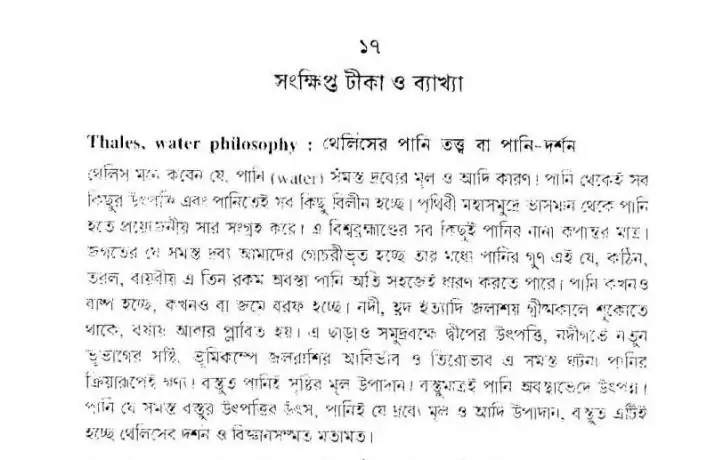
In the creation story of Genesis, there is also a sequence of water masses, the spirit of God upon it, the dividing of the water, and later the appearance of dry land. Water is already present in the scene as the primary material for constructing the universe. The sky is a boundary dividing that water into above and below. Although the roles of the firmament and the spirit of God are different, the divine presence over water and the arrangement of a habitable world from water—these two motifs link the stories to the same old imaginary world. [447]
Genesis 1
1 In the beginning, God created the heavens and the earth. At first the earth was completely void; there was nothing on the earth.
2 The water masses were covered in darkness and the spirit of God was hovering over those water masses.
6 Then God said, “Let there be a firmament to divide the waters.”
7 So God created the firmament and separated the waters. One part of the water remained above the firmament and the other part of the water remained below the firmament.
9 Then God said, “Let the waters under the sky be gathered in one place so that dry land may appear.” and it happened.
In Indian creation stories, there are also descriptions of the seed of creation and the golden egg within water. In the Manusmriti 1:8–13, that sequence is clear: first water, seed in water, from that a golden egg, the birth of Brahma within the egg, and from its two halves the sky and earth. The names of Brahma’s mental children are also in this book later. The origin of the entire universe is imagined through the familiar experiences of water, seed, birth, and the egg. [448]
8. He, desiring to produce beings of many kinds from his own body, first with a thought created the waters, and placed his seed in them.
9. That (seed) became a golden egg, in brilliancy equal to the sun; in that (egg) he himself was born as Brahman, the progenitor of the whole world.
10. The waters are called narah, (for) the waters are, indeed, the offspring of Nara; as they were his first residence (ayana), he thence is named Narayana.
11. From that (first) cause, which is indiscernible, eternal, and both real and unreal, was produced that male (Purusha), who is famed in this world (under the appellation of) Brahman.
12. The divine one resided in that egg during a whole year, then he himself by his thought (alone) divided it into two halves;
13. And out of those two halves he formed heaven and earth, between them the middle sphere, the eight points of the horizon, and the eternal abode of the waters.
English translation:
8. With the desire to produce various types of creatures from his own body, he first created water through thought and placed his seed in it.
9. That seed became a golden egg as bright as the sun; within that egg, he himself was born as Brahma, the primordial father of the entire world.
10. Water is called Nara because water is the child of Nara. Because water was his first residence, his name is Narayana.
11. From that first cause, which is invisible, eternal, and both good and evil, that Purusha originates, who is known in the world as Brahma.
12. That divine entity remained within the egg for a full year and divided it into two parts through his thought.
13. From those two parts, he created the sky and the earth, the region between them, the eight directions of the horizon, and the eternal abode of water.
In such stories, familiar water itself is no longer a subject of explanation; the subsequent world is built by assuming it. But the structure of water, the origin of its elements, and the environment for the formation of molecules are different questions in scientific inquiry. To explain the history of matter, placing water at the very beginning brings the compound before the history of its elements. It is possible to call the water before the heavens and earth miraculously created, but then the statement moves from a natural creation account directly to a miraculous declaration. Evidence beyond ancient stories is needed to prove its truth.
The ideas of the earth floating on water, divine presence over water, and creating a habitable world by dividing water are extensions of the visible experiences of ancient humans. Land rises from water, land is covered by floods, animals and crops depend on water—this experience has been placed in the past of the universe. In the Islamic narration, the Throne of the Sovereign Ruler is placed over that world. The language of familiar myths has here found the language of monotheistic authority; an explanation of the chemical and cosmological history of water has not been found.
Primordial water, construction of the heavens, and the Throne: The Islamic form of the ancient universe
In the description of the Throne over the water, the beginning of the cosmos is a watery scene. before the creation of the heavens and the earth, water and the seat of the ruler upon it were present. subsequently, in various accounts, smoke or vapor rises from the water, from which the heavens are created, the earth is formed from the lower matter, and upon completion, Allah establishes Himself on the Throne. placing these events side by side reveals a construction narrative: first the elements, then the separation and arrangement of the elements, and finally rule over the constructed world. various parts of this image are found in the Quran 11:7, 41:11–12, and 7:54; classical tafsir has joined them to create a more detailed narrative. primordial water, the upper world, stratification, and royal rule are also familiar components of the religious worldview of the ancient Near East. [449] [450] [451]
The Primordial Waters of Enuma Elish: Material Preceding Heaven and Earth
At the beginning of the Babylonian Enuma Elish, in the state before the naming of heaven and earth, the waters of Apsu and Tiamat were mixed together. the identity of fields, marshes, and the gods had not yet been established. water here does not begin as an object found later within the created world; it is at the center of the pre-state of the arranged cosmos. in this old narrative style, creation is the establishment of boundaries, identity, gods, and dwellings within the watery pre-state. the primary point of comparison with the Islamic narrative’s concept of “water before heaven and earth” is this sequence: water is present before the establishment of the known world. [452]
English translation of the ancient narrative:
When in the height heaven was not named,
And the earth beneath did not yet bear a name,
And the primeval Apsu, who begat them,
And chaos, Tiamut, the mother of them both
Their waters were mingled together,
And no field was formed, no marsh was to be seen;
When of the gods none had been called into being,
And none bore a name, and no destinies were ordained;
Then were created the gods in the midst of heaven,
English translation:
When on high the heaven had not been named,
nor the earth below had yet a name,
and primordial Apsu, who had given birth to them,
and chaos, Tiamat, mother of them both—
their waters were mixed together,
no field had been formed, no marsh had appeared;
when none of the gods had been called into existence,
no one had a name, no destiny had been determined;
then within the heavens the gods were created.
There was a strong basis in human visible experience behind choosing water as the primordial element. rivers and floods cover the land, when the water recedes the land appears, wet soil dries and hardens, vapor rises from water in the heat, and rain falls from clouds. these familiar changes have been expanded to the scale of the origin of the cosmos. the continuity of water, vapor, heaven, and earth is a kind of speculative naturalism created from daily experience. after this speculation entered religious narrative, the command of the Creator and a specific time of creation were added to it. the same observable elements were then promoted as a detailed history of an unseen past. this construction method of the narrative explains its human source; for the claim of revelation to compete with that source, it demands separate proof.
Blocking Water to Make the Sky: Imagining the Cosmos as a Constructed Building
In the fourth tablet of Enuma Elish, Marduk divides the body of Tiamat and creates the covering of the heavens with one part. he places a bolt, appoints a guard, and forbids the water from escaping. the cosmos here is a constructed structure: there is an upper covering, water behind it, arrangements for protecting the boundary, and specific dwellings for the gods. this architecture-based worldview can be compared with the concepts of upper water, the roof of heaven, doors, and guards in later religious literature. the cut body of Tiamat and the role of the earth-bearing fish in Islamic narratives are distinct; their common historical scope is to explain the visible world through the help of multiple supernatural bodies, water-sections, and structures. [453]
English translation of the ancient narrative:
He split her up like a flat fish into two halves;
One half of her he stablished as a covering for heaven.
He fixed a bolt, he stationed a watchman,
And bade them not to let her waters come forth.
He passed through the heavens, he surveyed the regions thereof,
And over against the Deep he set the dwelling of Nudimmud.
And the lord measured the structure of the Deep,
And he founded E-sara, a mansion like unto it.
The mansion E-sara which he created as heaven,
He caused Anu, Bel, and Ea in their districts to inhabit.
English translation:
He split her like a flat fish into two parts;
he established one half as the covering of the heavens.
He placed a bolt, appointed a guard,
and commanded them not to let her waters escape.
He passed through the heavens and examined the regions there,
and opposite the deep waters he established the dwelling of the Nudimmuds.
The Lord measured the structure of the deep waters,
and established a palace like it, E-Sarra.
In the E-Sarra palace he created as heaven,
he let Anu, Bel, and Ea dwell in their respective regions.
Establishment on the Throne: The Relationship Between World-Building and Royal Power
The Throne is a seat of power; its political meaning is the establishment of the ruler and his sphere of authority. In the Quran 7:54, creation in six days, establishment on the Throne, the arrangement of day and night, and the obedience of the sun, moon, and stars appear in the same discourse. thus the description of creation leads to the claim of rule: He who constructed the world, His command shall prevail over all things. a throne in the sky, a workforce beneath, and nature acting on command—this scene arranges the world order in the language of earthly monarchy. in ancient Mesopotamian religion, the establishment of cosmic order and the royal authority of the chief god are also linked to each other. in Enuma Elish, Marduk gains the status of chief with the approval of the divine council before the war and world-building; in the relevant verses of the Quran, the mention of establishment on the Throne comes after creating. in both narratives, the establishment of the world order legitimizes the right of divine rule. [451] [454]
In this political worldview, the sovereignty of the Creator is greater than human royal power, but the mode of expression is familiar: the ruler stays in the upper seat, His instructions are executed below, special messengers carry messages, and a loyal force declares His dignity. in monotheism, the ownership of this entire administration has been given to Allah, canceling the rights of other deities. the primordial water and the stratified cosmos are the palace-like workspaces of that ruler. Nightly descent to the near heaven, Prostration of the sun beneath the Throne and descriptions regarding the structure of the heavens carry a more detailed form of this same upper-lower arranged religious cosmos.
‘Do the Disbelievers Not See?’: Demanding Belief Through a Familiar Cosmic Model
Verse number 30 of Surah Al-Anbiya asks the disbelievers: do they not see that the heavens and the earth were joined and Allah separated them? The style of the question’s statement is important. the listeners are being turned toward a relationship which, if accepted, will strengthen the claim of faith in Allah. between “do they not see” and finally “will they still not believe”—the separation of heaven and earth and the relationship of life with water are placed. the social function of the logic is to use a familiar or acceptable worldview in favor of exclusive worship. [455]
Arabic:
أَوَلَمْ يَرَ الَّذِينَ كَفَرُوا أَنَّ السَّمَاوَاتِ وَالْأَرْضَ كَانَتَا رَتْقًا فَفَتَقْنَاهُمَا ۖ وَجَعَلْنَا مِنَ الْمَاءِ كُلَّ شَيْءٍ حَيٍّ ۖ أَفَلَا يُؤْمِنُونَ
English translation:
Have those who disbelieved not seen that the heavens and the earth were joined, then We separated them? And We made from water every living thing. Will they still not believe?
Among the early exegetes, in the interpretations attributed to Hasan al-Basri and Qatadah, there is mention of the heavens and earth being together and being separated by air between them. this contains the familiar ancient image of creating land below, heaven above, and an empty space in between. in the account preserved by al-Tabari, the element of separation is also specified—“this air”. [456]
Arabic:
حدثنا بشر، قال: ثنا يزيد، قال: ثنا سعيد، عن قتادة ( أَنَّ السَّمَاوَاتِ وَالأرْضَ كَانَتَا رَتْقًا فَفَتَقْنَاهُمَا ) قال: كان الحسن وقتادة يقولان: كانتا جميعا، ففصل الله بينهما بهذا الهواء.
English translation:
Bishr has narrated to us. he says, Yazid has narrated to us; he says, Sa’id narrated from Qatadah. “The heavens and the earth were joined, then We separated them”—regarding this he says: Hasan and Qatadah used to say, the two were together; then Allah separated them with this air.
In the tafsir of the same verse, there is also an explanation of opening the rainless heaven and the plantless earth through rain and plants respectively. al-Tabari himself gave priority to this second explanation; he took the subsequent sentence regarding the relationship of life with water as its reason. as a result, in the world of ancient explanation, several familiar concepts are working here: separating the joined heaven and earth, dividing into seven levels, and the productivity of rain and plants. this is clear in the full paragraph of his own decision: [457]
Arabic:
قال أبو جعفر: وأولى الأقوال في ذلك بالصواب قول من قال: معنى ذلك: أو لم ير الذين كفروا أن السماوات والأرض كانتا رتقا من المطر والنبات، ففتقنا السماء بالغيث والأرض بالنبات.
وإنما قلنا ذلك أولى بالصواب في ذلك لدلالة قوله: ( وَجَعَلْنَا مِنَ الْمَاءِ كُلَّ شَيْءٍ حَيٍّ ) على ذلك، وأنه جلّ ثناؤه لم يعقب ذلك بوصف الماء بهذه الصفة إلا والذي تقدمه من ذكر أسبابه.
English translation:
Abu Ja’far says: the most correct statement on this matter is the words of those who said, its meaning is: have those who disbelieved not seen that the heavens and the earth were closed from rain and plants? Then We opened the heavens with rain and the earth with plants.
We have called this explanation more correct, because the statement “And We made from water every living thing” indicates it. he mentioned this characteristic of water because the reasons for it are mentioned in the preceding statement.
There is a specific logical path between the first question and the last question of the verse: if the state of the heavens–earth and the role of water are acknowledged, the claim of faith in Allah must be accepted. The familiarity of the listener is the condition for this logic to be effective here; that which is intelligible and considerably relevant to them is being used against their disbelief. The old story of the separation of the heavens and the earth and the direct experience of plants growing in the soil upon receiving rain are two areas of this intelligibility. These two types of concepts are also visible in the preserved opinions of early exegetes: in some places, the upper heaven and the lower land were separated by wind, in some places, the heaven gave rain and the land produced crops, and in other places, an explanation of division into layers has appeared. In the selected explanation of al-Tabari, the relationship between water and life in the following sentence became the basis of the conclusion. In this way, the address of the verse, the preceding story, and the sequence of explanation remain linked to the same historical conceptual world. The task of making the productivity of familiar nature and the cosmic picture of heaven–earth an argument for exclusive worship is thus captured within its specific language and ancient reception.
Seven Heavens and Seven Earths
The blue sky of the day is not a solid blue-colored roof. Sunlight is scattered by molecules in the atmosphere; for small molecules, light of shorter wavelengths scatters more. In Rayleigh scattering, this dependence is inversely proportional to the fourth power of the wavelength. Due to the spectral distribution of sunlight and the sensitivity of the human eye, the sky primarily appears blue. This is a real optical process, not an imaginary object seen through a visual error. At sunset, when the path of light becomes longer, reddish colors predominate; outside the atmosphere, this blue screen does not exist. Consequently, imagining the visible appearance of the sky as a solid domestic architecture in layers and providing a physical explanation for it is a completely different task. [458]
The Quran mentions seven heavens and similar earths. The number here is part of a specific religious cosmological arrangement. It is said that Allah’s command descends between those upper and lower regions. The structure of rocks, mantle, and core found inside the earth in modern geology is not the same as the religious identity of these multiple earths and the description of commands descending from above. [459]
Allah has made seven heavens and the earth like them, and between them (that is in all heavens and all earths) descends the command of Allah so that you may know that Allah is powerful over all things and that Allah encompasses all things in (His) knowledge.
— Taisirul Quran
Allah has created seven heavens and the earth in that proportion. His command descends among them; so that you may understand that Allah is omnipotent in all matters and in knowledge Allah encompasses everything.
— Sheikh Mujibur Rahman
He is Allah, who created seven heavens and similar earths; His command descends between these so that you may know that Allah is powerful over all things and Allah’s knowledge encompasses everything.
— Rawai Al-bayan
He is Allah, who created seven heavens and similar earths, His command descends among them; so that you may know that Allah is powerful over all things and in knowledge Allah encompasses everything.
— Dr. Abu Bakr Muhammad Zakaria
This concept of multiple earths has created descriptions of other subterranean worlds in subsequent religious discussions. In Bukhari, there is also mention of the unjust land-grabber sinking down to the seventh earth. This image of upper-and-lower distinguishes multiple earths from the modern concept of planets scattered far apart in space. In the statement of Mufti Ibrahim, that same imagination of a layered subterranean world has been propagated again. [460]
The explanation of calling the seven heavens the seven layers of the atmosphere conflicts with the position of the constellations. In the Quran, the nearest heaven is said to be adorned with constellations. Stars are not part of the earth’s atmosphere; the sun is also outside it. Furthermore, the atmosphere is generally divided into five main layers according to temperature. If additional divisions are made based on the ionized region or other characteristics, those divisions partially overlap each other. Adding divisions arbitrarily to make the number seven does not create a real match with the star-adorned heaven of the Quran. Changing scientific classification for the sake of a religious number is a reverse use of evidence. [461] [462] [463]
Indeed I have adorned the nearest heaven with constellations. and I have guarded it from every rebellious devil. They cannot listen to anything of the upper world and meteors are hurled at them from all sides. for the purpose of expelling them. For them is ceaseless punishment. But if anyone steals a hearing, a flaming meteor pursues him.
I have adorned the lowest heaven with lamps; I have made them as missiles for the devils and have prepared for them the punishment of blazing fire.
In the “Relevant Discussion” section of this Bengali version of Jalalayn, descriptions of various elements of the heavens are given. Alongside the brief explanation of the Arabic original tafsir, there are various narratives in the translator’s added discussion in the names of Ibn Abbas and Kab. Therefore, this part of the image in the printed version is evidence of the propagation of ancient cosmological stories. On the same page, there are two levels: the original Arabic explanation and the detailed description added beside it. [464]
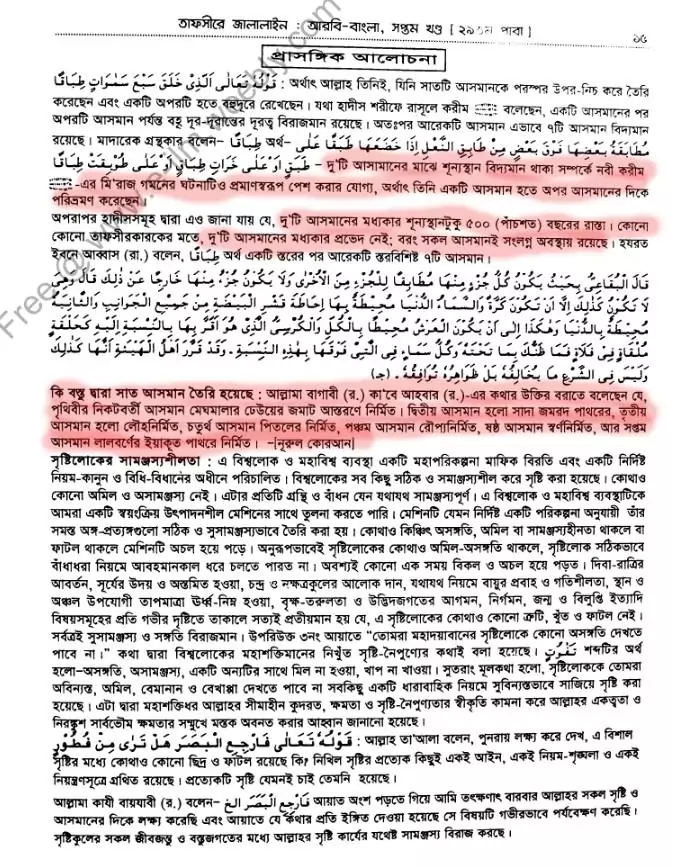
The imagination of step-by-step heavens and other worlds below is found in many religious literatures. These are not just layers of visible light; there, the positions of deities, angels, souls, the Throne, and sacred structures are determined. Going upwards takes the form of higher status, and descending takes the form of entering different subterranean worlds. Human social stratification and palace architecture have also been placed on the imagined map of the macrocosm. Each region of the sky then becomes the abode of a specific power and authority.
In Mesopotamian texts, Wayne Horowitz’s research has a separate chapter on the concept of multiple heavens and earths. Peter James and Marinus Antoni van der Sluis have also discussed the mention of seven heavens and seven earths in Sumerian incantations, as well as the presence of other numerical stratifications alongside them. “An” is the known Sumerian name for heaven and “Ki” for earth. This arrangement of seven is a recurring pattern of ancient West Asian religious imagination. Although the dates, materials, and descriptions of inhabitants change, the basic framework of a multi-layered macrocosm has been used in various religious literatures. [465] [466] [467]
Hindu Puranas also have multi-layered maps of the upper world and lower world. In the list of these seven upper levels—Bhuloka, Bhuvarloka, Svarloka, Maharloka, Janaloka, Tapoloka, and Satyaloka—the earth is also one level. It is wrong to make them all synonymous with Indra’s heaven. Again, the names of the seven lower regions are Atala, Vitala, Sutala, Talatala, Mahatala, Rasatala, and Patala. In the direct description of the Bhagavata, their positions below the earth and the distance between each other are also determined. If these subterranean regions are all called hell in one word, the differences between the various worlds of the Purana are lost. The specific point of comparison is the multi-layered macrocosm arranged upper-and-lower. [468] [469]
In Hagigah 12b of the Talmud, there is a named list of seven heavens in the name of Resh Lakish. In the same discussion, according to some, two heavens have also been mentioned. In the explanation of the seven layers, the positions of the sun-moon-stars, the celestial temple, the hymns of angels, and the Throne of God in the highest region have been determined. The Hebrew shamayim and Arabic sama are of the same Semitic word family; samawat is the plural in Arabic. The linguistic kinship and the similarity of cosmological stories together reveal the presence of a preceding religious environment. [470] [471]
| Names of the Heavens | Characteristics described in the Talmud |
|---|---|
| Vilon — וילון | Like a curtain; linked with the renewal of creation through changes in morning and evening. |
| Rakia — רקיע | Sun, moon, stars and constellations are placed. |
| Shehakim — שחקים | The storehouse for preparing manna for the righteous. |
| Zebul — זבול | Celestial Jerusalem, temple and altar; the offering of Michael. |
| Maon — מעון | Groups of angels hymn at night. |
| Machon — מכון | Storehouse of snow, hail and other natural elements. |
| Arabot — ערבות | Soul, justice, peace, blessing, celestial beings and the Throne of God. |
In the literature of Merkabah or celestial chariot and Heikhalot or palaces, there are more extensive imaginations of ascending to the sky and celestial authority. Texts like Third Enoch are part of that tradition. Just as there is access, guarding and rank in the palace of a human ruler, in these narratives there are rules for going to the upper regions and the places of divine beings. The language of expressing the glory of heaven here is an extension of familiar royal architecture and administrative power. [472] [473] [474]
The concept of multiple heavens exists in Christian texts as well. In Second Corinthians, the experience of being taken up to the third heaven and paradise is described. This part specifically speaks of the third heaven; it does not establish the same mandatory opinion of seven layers in all Christian traditions. But the imagination of different layers above the earth and ascending to those layers in divine experience was present in Christian literature before Islam. [475]
2. I knew a man in Christ above fourteen years ago, (whether in the body, I cannot tell; or whether out of the body, I cannot tell: God knoweth;) such an one caught up to the third heaven.
3. And I knew such a man, (whether in the body, or out of the body, I cannot tell: God knoweth;)
4. How that he was caught up into paradise, and heard unspeakable words, which it is not lawful for a man to utter.
English translation:
2. I know a man in Christ, who more than fourteen years ago was taken up to the third heaven . with his body, or without his body—I cannot say; God knows .
3. I know such a man—whether he was with his body or without his body, I cannot say; God knows .
4. He was taken up to Paradise and he heard unspeakable words, which it is not lawful for man to utter .
The original list of the seven heavens of the Hagigah and their subsequent specific cosmic positions together clarify the nature of this stratification . [476]
ריש לקיש אמר שבעה ואלו הן וילון רקיע שחקים זבול מעון מכון ערבות
English translation:
Resh Lakish says: seven; these are Bilun, Rakia, Shehakim, Zebul, Maon, Makhon, and Araboth .
As a characteristic of Rakia, the positions of the visible lights of the sky are also specified . [477]
רקיע שבו חמה ולבנה כוכבים ומזלות קבועין שנאמר ויתן אותם אלהים ברקיע השמים
English translation:
Rakia is that region where the sun, moon, stars, and constellations are placed; as it is said, “God placed them in the Rakia of the heavens .”
The subterranean arrangement of the Bhagavata is also described with names, positions, and distances instead of obscure mysteries . [478]
उपवर्णितं भूमेर्यथासन्निवेशावस्थानमवनेरप्यधस्तात् सप्त भूविवरा एकैकशो योजनायुतान्तरेणायामविस्तारेणोपक्लृप्ता अतलं वितलं सुतलं तलातलं महातलं रसातलं पातालमिति ॥ ७ ॥
English translation:
Just as the arrangement and position of the regions of the earth have been described, there are similarly seven subterranean regions below the earth . with length and width, they are placed one below another at a distance of ten thousand yojanas—Atala, Vitala, Sutala, Talatala, Mahatala, Rasatala, and Patala .
Although the number seven and the same upper-lower architecture recur, each religion has placed its own inhabitants and authority . somewhere the altar of Michael, somewhere the realm of Indra or Brahma, somewhere the seven heavens and seven earths where Allah’s commands descend . These religious maps are comparable in the history of human imagination . there is no evidence of their reality in astronomy and geology . Matching the name of a level with any modern scientific division does not make the deity, palace, path, and distance of that level real .
Miraj: Old narratives of ascension and new religious authority
The imagination of the seven heavens has become a journey path in the description of the Miraj . there, Gabriel takes Muhammad up by the hand, permission to enter is sought at each level, meetings with previous prophets occur, and finally, the event of returning with the command for salat arrives . This journey of the heavens links the claim of the new prophet with the recognition of the old prophets: Adam and Abraham welcome him as a son, and other prophets as a brother . Consequently, the claim of prophethood raised on earth receives approval from the mouths of the inhabitants of the heavens . In hadith number 349 of Bukhari, this story of establishing authority is preserved together, starting from the washing of the chest to the sighting of Paradise . [479]
Arabic original:
حَدَّثَنَا يَحْيَى بْنُ بُكَيْرٍ، قَالَ حَدَّثَنَا اللَّيْثُ، عَنْ يُونُسَ، عَنِ ابْنِ شِهَابٍ، عَنْ أَنَسِ بْنِ مَالِكٍ، قَالَ كَانَ أَبُو ذَرٍّ يُحَدِّثُ أَنَّ رَسُولَ اللَّهِ صلى الله عليه وسلم قَالَ ” فُرِجَ عَنْ سَقْفِ بَيْتِي وَأَنَا بِمَكَّةَ، فَنَزَلَ جِبْرِيلُ فَفَرَجَ صَدْرِي، ثُمَّ غَسَلَهُ بِمَاءِ زَمْزَمَ، ثُمَّ جَاءَ بِطَسْتٍ مِنْ ذَهَبٍ مُمْتَلِئٍ حِكْمَةً وَإِيمَانًا، فَأَفْرَغَهُ فِي صَدْرِي ثُمَّ أَطْبَقَهُ، ثُمَّ أَخَذَ بِيَدِي فَعَرَجَ بِي إِلَى السَّمَاءِ الدُّنْيَا، فَلَمَّا جِئْتُ إِلَى السَّمَاءِ الدُّنْيَا قَالَ جِبْرِيلُ لِخَازِنِ السَّمَاءِ افْتَحْ. قَالَ مَنْ هَذَا قَالَ هَذَا جِبْرِيلُ. قَالَ هَلْ مَعَكَ أَحَدٌ قَالَ نَعَمْ مَعِي مُحَمَّدٌ صلى الله عليه وسلم. فَقَالَ أُرْسِلَ إِلَيْهِ قَالَ نَعَمْ. فَلَمَّا فَتَحَ عَلَوْنَا السَّمَاءَ الدُّنْيَا، فَإِذَا رَجُلٌ قَاعِدٌ عَلَى يَمِينِهِ أَسْوِدَةٌ وَعَلَى يَسَارِهِ أَسْوِدَةٌ، إِذَا نَظَرَ قِبَلَ يَمِينِهِ ضَحِكَ وَإِذَا نَظَرَ قِبَلَ يَسَارِهِ بَكَى، فَقَالَ مَرْحَبًا بِالنَّبِيِّ الصَّالِحِ وَالاِبْنِ الصَّالِحِ. قُلْتُ لِجِبْرِيلَ مَنْ هَذَا قَالَ هَذَا آدَمُ. وَهَذِهِ الأَسْوِدَةُ عَنْ يَمِينِهِ وَشِمَالِهِ نَسَمُ بَنِيهِ، فَأَهْلُ الْيَمِينِ مِنْهُمْ أَهْلُ الْجَنَّةِ، وَالأَسْوِدَةُ الَّتِي عَنْ شِمَالِهِ أَهْلُ النَّارِ، فَإِذَا نَظَرَ عَنْ يَمِينِهِ ضَحِكَ، وَإِذَا نَظَرَ قِبَلَ شِمَالِهِ بَكَى، حَتَّى عَرَجَ بِي إِلَى السَّمَاءِ الثَّانِيَةِ فَقَالَ لِخَازِنِهَا افْتَحْ. فَقَالَ لَهُ خَازِنُهَا مِثْلَ مَا قَالَ الأَوَّلُ فَفَتَحَ ”. قَالَ أَنَسٌ فَذَكَرَ أَنَّهُ وَجَدَ فِي السَّمَوَاتِ آدَمَ وَإِدْرِيسَ وَمُوسَى وَعِيسَى وَإِبْرَاهِيمَ ـ صَلَوَاتُ اللَّهِ عَلَيْهِمْ ـ وَلَمْ يُثْبِتْ كَيْفَ مَنَازِلُهُمْ، غَيْرَ أَنَّهُ ذَكَرَ أَنَّهُ وَجَدَ آدَمَ فِي السَّمَاءِ الدُّنْيَا، وَإِبْرَاهِيمَ فِي السَّمَاءِ السَّادِسَةِ. قَالَ أَنَسٌ فَلَمَّا مَرَّ جِبْرِيلُ بِالنَّبِيِّ صلى الله عليه وسلم بِإِدْرِيسَ قَالَ مَرْحَبًا بِالنَّبِيِّ الصَّالِحِ وَالأَخِ الصَّالِحِ. فَقُلْتُ مَنْ هَذَا قَالَ هَذَا إِدْرِيسُ. ثُمَّ مَرَرْتُ بِمُوسَى فَقَالَ مَرْحَبًا بِالنَّبِيِّ الصَّالِحِ وَالأَخِ الصَّالِحِ. قُلْتُ مَنْ هَذَا قَالَ هَذَا مُوسَى. ثُمَّ مَرَرْتُ بِعِيسَى فَقَالَ مَرْحَبًا بِالأَخِ الصَّالِحِ وَالنَّبِيِّ الصَّالِحِ. قُلْتُ مَنْ هَذَا قَالَ هَذَا عِيسَى. ثُمَّ مَرَرْتُ بِإِبْرَاهِيمَ فَقَالَ مَرْحَبًا بِالنَّبِيِّ الصَّالِحِ وَالاِبْنِ الصَّالِحِ. قُلْتُ مَنْ هَذَا قَالَ هَذَا إِبْرَاهِيمُ صلى الله عليه وسلم ”. قَالَ ابْنُ شِهَابٍ فَأَخْبَرَنِي ابْنُ حَزْمٍ أَنَّ ابْنَ عَبَّاسٍ وَأَبَا حَبَّةَ الأَنْصَارِيَّ كَانَا يَقُولاَنِ قَالَ النَّبِيُّ صلى الله عليه وسلم ” ثُمَّ عُرِجَ بِي حَتَّى ظَهَرْتُ لِمُسْتَوًى أَسْمَعُ فِيهِ صَرِيفَ الأَقْلاَمِ ”. قَالَ ابْنُ حَزْمٍ وَأَنَسُ بْنُ مَالِكٍ قَالَ النَّبِيُّ صلى الله عليه وسلم ” فَفَرَضَ اللَّهُ عَلَى أُمَّتِي خَمْسِينَ صَلاَةً، فَرَجَعْتُ بِذَلِكَ حَتَّى مَرَرْتُ عَلَى مُوسَى فَقَالَ مَا فَرَضَ اللَّهُ لَكَ عَلَى أُمَّتِكَ قُلْتُ فَرَضَ خَمْسِينَ صَلاَةً. قَالَ فَارْجِعْ إِلَى رَبِّكَ، فَإِنَّ أُمَّتَكَ لاَ تُطِيقُ ذَلِكَ. فَرَاجَعْتُ فَوَضَعَ شَطْرَهَا، فَرَجَعْتُ إِلَى مُوسَى قُلْتُ وَضَعَ شَطْرَهَا. فَقَالَ رَاجِعْ رَبَّكَ، فَإِنَّ أُمَّتَكَ لاَ تُطِيقُ، فَرَاجَعْتُ فَوَضَعَ شَطْرَهَا، فَرَجَعْتُ إِلَيْهِ فَقَالَ ارْجِعْ إِلَى رَبِّكَ، فَإِنَّ أُمَّتَكَ لاَ تُطِيقُ ذَلِكَ، فَرَاجَعْتُهُ. فَقَالَ هِيَ خَمْسٌ وَهْىَ خَمْسُونَ، لاَ يُبَدَّلُ الْقَوْلُ لَدَىَّ. فَرَجَعْتُ إِلَى مُوسَى فَقَالَ رَاجِعْ رَبَّكَ. فَقُلْتُ اسْتَحْيَيْتُ مِنْ رَبِّي. ثُمَّ انْطَلَقَ بِي حَتَّى انْتَهَى بِي إِلَى سِدْرَةِ الْمُنْتَهَى، وَغَشِيَهَا أَلْوَانٌ لاَ أَدْرِي مَا هِيَ، ثُمَّ أُدْخِلْتُ الْجَنَّةَ، فَإِذَا فِيهَا حَبَايِلُ اللُّؤْلُؤِ، وَإِذَا تُرَابُهَا الْمِسْكُ ”.
English translation:
Yahya ibn Bukayr narrates; he says, Layth narrated to us, from Yunus, he from Ibn Shihab, he from Anas ibn Malik . Anas says, Abu Dharr narrated that the Messenger of Allah said: “While I was in Mecca, the roof of my house was opened . Gabriel descended, opened my chest, and washed it with the water of Zamzam . Then he brought a golden vessel full of wisdom and faith and poured its contents into my chest and closed it . Then he took me by the hand and raised me to the heaven of the world . Upon reaching there, Gabriel said to the guardian of the heaven, ‘Open .’ He asked, ‘Who?’ Gabriel said, ‘Gabriel .’ He asked, ‘Is anyone with you?’ Gabriel said, ‘Yes, Muhammad is with me .’ He asked, ‘Has he been called?’ Gabriel said, ‘Yes .’ When the door opened, we ascended into the heaven of the world . There a man was sitting . On his right side was a group of human forms and on his left side also was a group of human forms . He would look to the right and smile, and look to the left and weep . He said, ‘Welcome, righteous prophet and righteous son .’ I asked Gabriel, ‘Who is this?’ He said, ‘This is Adam . The forms on his right and left are the souls of his children . Those on the right are inhabitants of Paradise and the forms on the left are inhabitants of Hell . Therefore, he looks to the right and smiles and looks to the left and weeps .’ Then I was raised to the second heaven . Gabriel said to its guardian, ‘Open .’ That guardian also asked questions like the first guardian and opened the door .”
Anas says, he mentioned that in the heavens he met Adam, Idris, Moses, Jesus, and Abraham—may the mercy of Allah be upon them all . He did not specify the position of each; he only said that he found Adam in the heaven of the world and Abraham in the sixth heaven . Anas says: “When Gabriel took the Prophet past Idris, Idris said, ‘Welcome, righteous prophet and righteous brother .’ I asked, ‘Who is this?’ Gabriel said, ‘This is Idris .’ Then when passing Moses, he said, ‘Welcome, righteous prophet and righteous brother .’ I asked, ‘Who is this?’ Gabriel said, ‘This is Moses .’ Then when passing Jesus, he said, ‘Welcome, righteous brother and righteous prophet .’ I asked, ‘Who is this?’ Gabriel said, ‘This is Jesus .’ Then when passing Abraham, he said, ‘Welcome, righteous prophet and righteous son .’ I asked, ‘Who is this?’ Gabriel said, ‘This is Abraham .'”
Ibn Shihab says, Ibn Hazm informed me that both Ibn Abbas and Abu Habba Ansari used to say, the Prophet said: “Then I was taken to such a height where I heard the scratching sound of the Pen .” Ibn Hazm and Anas ibn Malik say, the Prophet said: “Allah made fifty times of salat obligatory upon my ummah . While returning with that command, I passed by Moses . He asked, ‘What has Allah made obligatory for your ummah?’ I said, ‘Fifty times of salat .’ He said, ‘Return to your Lord; your ummah will not be able to perform it .’ I returned and appealed, and He reduced a portion . Returning to Moses, I said, ‘He has reduced a portion .’ Moses said, ‘Appeal to your Lord again; your ummah will not be able to perform it .’ I appealed again and He reduced another portion . Upon returning to Moses, he said, ‘Return to your Lord; your ummah will not be able to perform it .’ I appealed again . Allah said, ‘These are five and these are fifty; My word does not change .’ Returning to Moses, he again told me to appeal to the Lord . I said, ‘I am ashamed to ask my Lord again .’ Then I was taken to the Sidrat al-Muntaha . It was covered in various colors; what those were, I do not know . Then I was admitted into Paradise . There I saw strings of pearls and musk soil .”
In this story, to establish new religious laws, the previous prophet Moses has been placed in the position of an effective advisor . Allah first commands fifty times of salat; Moses raises the objection that this burden will not be possible for humans to bear . At his suggestion, Muhammad appeals repeatedly and the number of salat is reduced to five . The initiative for the practical modification of the law comes from Moses, Muhammad carries the appeal, and Allah approves the change . In this, the previous religious authority has been made to participate in the establishment of the new ritual . The familiar rule of five times becomes the result of such a superhuman interview, of which the prophet himself is the direct narrator . The support of the old prophets and the claim of divine encounter together narrow the space for raising questions about the new law .
This narrative style of crossing heavens one by one with the help of an angel to reach the higher authority existed in Christian literature long before Islam . In the sixth to eleventh chapters of the book ‘Ascension of Isaiah’, there is a description of a journey to the seven heavens under the guidance of an angel . The composition date of the book is generally placed in the second century CE . In section 13–23 of the seventh chapter, the descriptions of the first and second heavens, the central throne, the inhabitants of the right and left, questions to the guide, and the supreme authority of the seventh heaven have come sequentially . [480] [481]
R. H. Charles’s English translation:
13. And afterwards he caused me to ascend (to that which is) above the firmament: which is the (first) heaven.
14. And there I saw a throne in the midst, and on his right and on his left were angels.
15. And (the angels on the left were) not like unto the angels who stood on the right, but those who stood on the right had the greater glory, and they all praised with one voice, and there was a throne in the midst, and those who were on the left gave praise after them; but their voice was not such as the voice of those on the right, nor their praise like the praise of those.
16. And I asked the angel who conducted me, and I said unto him: “To whom is this praise sent?”
17. And he said unto me: “(it is sent) to the praise of (Him who sitteth in) the seventh heaven: to Him who rests in the holy world, and to His Beloved, whence I have been sent to thee. [Thither is it sent.]”
18. And again, he made me to ascend to the second heaven. now the height of that heaven is the same as from the heaven to the earth [and to the firmament].
19. And (I saw there, as) in the first heaven, angels on the right and on the left, and a throne in the midst, and the praise of the angels in the second heaven; and he who sat on the throne in the second heaven was more glorious than all (the rest).
20. And there was great glory in the second heaven, and the praise also was not like the praise of those who were in the first heaven.
21. And I fell on my face to worship him, but the angel who conducted me did not permit me, but said unto me: “Worship neither throne nor angel which belongs to the six heavens—for for this cause I was sent to conduct thee—until I tell thee in the seventh heaven.
22. For above all the heavens and their angels has thy throne been placed, and thy garments and thy crown which thou shalt see.”
23. And I rejoiced with great joy, that those who love the Most High and His Beloved will afterwards ascend thither by the angel of the Holy Spirit.
English translation:
13. Then he lifted me above the firmaments, that is, to the first heaven.
14. There in the middle I saw a throne; on its right and left were angels.
15. The angels on the left were not like the angels on the right; the glory of the angels on the right was greater. They were all praising in one voice. There was a throne in the middle and the angels on the left were praising after them; but their voice and praise were not like those of the angels on the right.
16. I asked the angel who was showing me the way, “To whom is this praise being sent?”
17. He said, “To the one who is seated in the seventh heaven, who dwells in the holy realm and to His beloved; from there I have been sent to you. [it is there that this praise is sent.]”
18. Again he lifted me to the second heaven. The height of that heaven was equal to the distance from heaven to earth [and the firmaments].
19. Like the first heaven, here too I saw angels on the right and left, a throne in the middle, and the praise of the angels of the second heaven. The one who sat on the throne of the second heaven was more glorious than all others.
20. There was immense glory in the second heaven and the praise there was not like the praise of the first heaven.
21. I fell prostrate to worship him. But the guiding angel did not permit me. He said, “Do not worship any throne or angel of the six heavens. I have been sent only to show you the way; wait until I give the instruction in the seventh heaven.
22. For above all heavens and their angels, your throne has been placed; your garments and crown are also there, which you shall see.”
23. I became extremely joyful that those who love the Supreme Being and His beloved would later ascend there through the angel of the holy spirit.
The method of arranging similar experiences is working in two stories. The chosen person himself cannot understand the meaning of the unfamiliar upper world; an angel takes him and identifies the scenes in response to questions. In Isaiah, there is a throne in the middle of the first heaven and angels on two sides; in Bukhari’s account, Adam is in the first heaven and the souls of his children are on two sides. In Isaiah’s case, praise is sent to the entity of the seventh heaven; in Muhammad’s case, the command for prayer comes from the higher authority. In both cases, the ascent makes the chosen person a witness to an authority beyond the reach of ordinary people. The inhabitants and theology of the scenes have changed, but the old narrative structure of the guide, crossing levels, question-and-answer, and attainment of divine authority remains intact.
In Isaiah’s story, the announcement that a throne, garments, and a crown are prepared for the traveler in a high place establishes his special status. In the Mi’raj, the reception by previous prophets and the claim to carry direct commands from Allah similarly make Muhammad the possessor of special access. In such stories, the assurance of the invisible world for the believer and the assurance of the religious leader’s status come from the same source—the description of the experience propagated in the name of that leader. Consequently, if the status declared within the story is used again as proof of the story’s truth, the logic moves in a circle. This close structural relationship of the Mi’raj with ancient ascent literature identifies its cultural predecessors; it does not provide independent evidence that the miraculous journey actually occurred.
Detailed discussion on Iranian parallels of ascent, various forms of Mi’raj accounts, the history of al-Aqsa, and other inconsistencies of the heavenly journey: Mi’raj: Ancient Ascent Myth, al-Aqsa Politics and the Breakdown of Islamic Eschatology.
The earth is stationary and does not move

In the Quran, there is language about holding the heavens and earth and protecting them from displacement. In its ancient interpretations, this stability has been linked to a stationary universe. In later fatwas, there are clear precedents of rejecting the earth’s rotation by describing the verses and the rising and setting of the sun. In reality, the earth rotates on its own axis and revolves around the sun. Therefore, it is wrong to conclude from the religious language of stability that the earth is motionless. That error is not only made by external critics; it is preserved in the internal logic of Muslim exegetes. [482] [483] [484]
Allah keeps the heavens and the earth stationary so that the two do not shake. If the two were to shake, who besides Him would keep the two stationary? He is Most Forbearing, Most Forgiving.
— Taisirul Quran
Allah preserves the firmaments and the earth so that they do not become displaced; if they become displaced who besides Him would preserve them? He is Most Forbearing, Forgiving.
— Sheikh Mujibur Rahman
Surely Allah holds the heavens and the earth so that these do not become displaced. And if these become displaced, then who else is there besides Him who would hold them? Surely He is Most Forbearing, Most Forgiving.
— Rawai Al-bayan
Surely Allah supports the heavens and the earth, so that they do not become displaced, and if they become displaced, then there is no one besides Him who can hold them [1. Surely He is Most Forbearing, Infinitely Forgiving.
— Dr. Abu Bakr Muhammad Zakaria
It is also mentioned that the purpose of establishing mountains is so that the earth does not tilt over with people. In this language, a picture is created of keeping the land stationary with the help of an installable weight. Ibn Kathir gave a more specific explanation of keeping the earth stable by making it heavy upon the water. There, the mountain is a balancing load, as if applying weight to a floating object to stop its oscillation. In modern geology, mountain formation is the result of crustal movement, compression, collision, and uplift. That different explanation replaces the religious imagination of weight-pressure with a testable natural process. [485] [486] [487]
He constructed the heavens without pillars which you see. He has placed firmly standing mountains on the earth so that the earth does not move with you And He spread therein all kinds of living creatures, and I send down water from the sky, then I bring forth all kinds of beneficial plants.
— Taisirul Quran
He constructed the heavens without pillars, you see this. He has placed mountains on the earth so that it does not tilt over with you and He spread therein all kinds of living creatures and I send down rain from the sky and bring forth therein all kinds of beneficial plants.
— Sheikh Mujibur Rahman
He created the heavens without pillars, which you see, and He placed firm mountains in the earth, so that it does not tilt over with you, and He spread therein every kind of animal; and from the heavens I send water. then I grow beneficial plants in pairs therein.
— Rawai Al-bayan
He constructed the heavens without pillars—you can see this; He has placed firm mountains in the earth so that it does not tilt over with you and He spread therein all kinds of living creatures. And we send down rain from the sky then we bring forth all kinds of beneficial plants therein.
— Dr. Abu Bakr Muhammad Zakaria
On this page of the Bengali translation of Ibn Kathir, the relationship between earth, water, and stability is seen. In his Arabic explanation of 31:10Luqman, there is a direct mention of mountains making the earth heavy and stopping the oscillation of the inhabitants upon the water. The problem with the religious description is therefore not just the use of the word “stationary” in translation; there is a specific physical model in its explanation. [488] [489]
Bengali text:
কেহ কেহ বলেন, আকাশমণ্ডলী ও পৃথিবী সৃষ্টি করার পরপরই উহার সংস্থাপন কার্য করা হয়। এই অভিমতটি হযরত ইব্ন আব্বাস (রা) হইতে আলী ইব্ন আবু তালহা বর্ণনা করেন।
আস্ সুদ্দী স্বীয় তাফসীরে ইবন মাসউদ ও অন্যান্য সাহাবা (রা) হইতে পর্যায়ক্রমে মুরাহ, ইব্ন আব্বাস, আবু সালেহ ও আবু মালিক হইতে বর্ণনা করেন- সৃষ্টির পূর্বে আল্লাহ্ তা’আলার আরশ পানির উপর সংস্থাপিত ছিল। পানির পূর্বে আল্লাহ্ পাক কোন বস্তুই সৃষ্টি করেন নাই। সুতরাং সৃজন পরিকল্পনা বাস্তবায়নের জন্য সর্বপ্রথম তিনি পানি হইতে বাষ্প সৃষ্টি করিলেন। উহা ক্রমান্বয়ে ঊর্ধ্বলোকে উত্থিত হইল এবং উত্থিত বাষ্প ছাদরূপ পরিগ্রহ করিয়া আকাশে পরিণত হইল। এইজন্য উহার নাম হইল (উর্ধ্বলোক)। অতঃপর পানি শুকাইয়া একটি ভূখণ্ড দেখা দিল। তখন উহাকে সপ্তখণ্ডে বিভক্ত করা হইল। রবি-সোম দুই দিনে এই সপ্তখণ্ড সৃষ্টি হইল। অতঃপর পৃথিবীকে সেই মৎসের উপর স্থাপন করা হইল যাহার বর্ণনা সূরা ‘নূন ওয়াল কলম’-এ আসিয়াছে। মৎসটি পানির উপর এবং পানির নীচে সকাত জাতীয় পদার্থ বা পরিচ্ছন্ন মৃত্তিকা শিলা বিদ্যমান। মৃত্তিকা শিলার ধারক হইলেন ফেরেশতা। ফেরেশতা দণ্ডায়মান প্রস্তরের আন্তরের উপর এবং প্রস্তরের আস্তরটি বায়ুমণ্ডলের উপর ভাসমান রহিয়াছে। লুকমান হাকীম এই প্রস্তর আস্তরের কথাই বলিয়াছেন। উহা আকাশ কিংবা পৃথিবীর কোথাও স্থাপিত নহে। মৎসটি নড়াচড়া করা মাত্র পৃথিবী কম্পিত হয় এবং ভূমিকম্প সৃষ্টি হয়। তাই পৃথিবীকে পাহাড় চাপা দেওয়া হইল। ফলে পৃথিবী সুস্থির হইল। পর্বত তাই পৃথিবীর কাছে নিজের বড়াই করিয়া থাকে।
আল্লাহ্ পাক বলেন:
وَجَعَلْنَا فِي الأَرْضِ رَوَاسِي أَنْ تَمِيدَ بِهِمْ
আয়াতের বাংলা অর্থ: আর আমরা পৃথিবীতে সুদৃঢ় পর্বতমালা স্থাপন করেছি, যাতে তা তাদের নিয়ে দুলে না ওঠে।
English translation:
Some say, immediately after the creation of the heavens and the earth, the work of their installation was done. This opinion is narrated by Ali ibn Abu Talha from Hazrat Ibn Abbas (ra).
Al-Suddi in his tafsir narrates sequentially from Ibn Masud and other Companions (ra), from Murah, Ibn Abbas, Abu Salih, and Abu Malik—that before creation, the Throne of Allah Ta’ala was installed upon water. Allah Pak created nothing before water. Therefore, to implement the creation plan, He first created steam from water. It gradually rose to the upper world and the risen steam took the form of a roof and became the sky. For this reason, its name became (the upper world). Then the water dried up and a landmass appeared. Then it was divided into seven parts. These seven parts were created in two days of the sun and moon. Then the earth was placed upon that fish whose description has come in Surah ‘Nun wal Qalam’. The fish is upon the water and beneath the water exists a substance of the same nature or clean soil-rock. The holders of the soil-rock are angels. The angels are upon the interior of the standing stone and the stone layer is floating upon the atmosphere. Luqman al-Hakim spoke of this stone layer. It is installed neither in the sky nor the earth. As soon as the fish moves, the earth trembles and earthquakes are created. Therefore, the earth was covered with mountains. As a result, the earth became stable. That is why the mountain continues to boast to the earth.
Allah Pak says:
وَجَعَلْنَا فِي الأَرْضِ رَوَاسِي أَنْ تَمِيدَ بِهِمْ
English translation of the verse: And we have placed firm mountains on the earth, so that it does not shake with them.
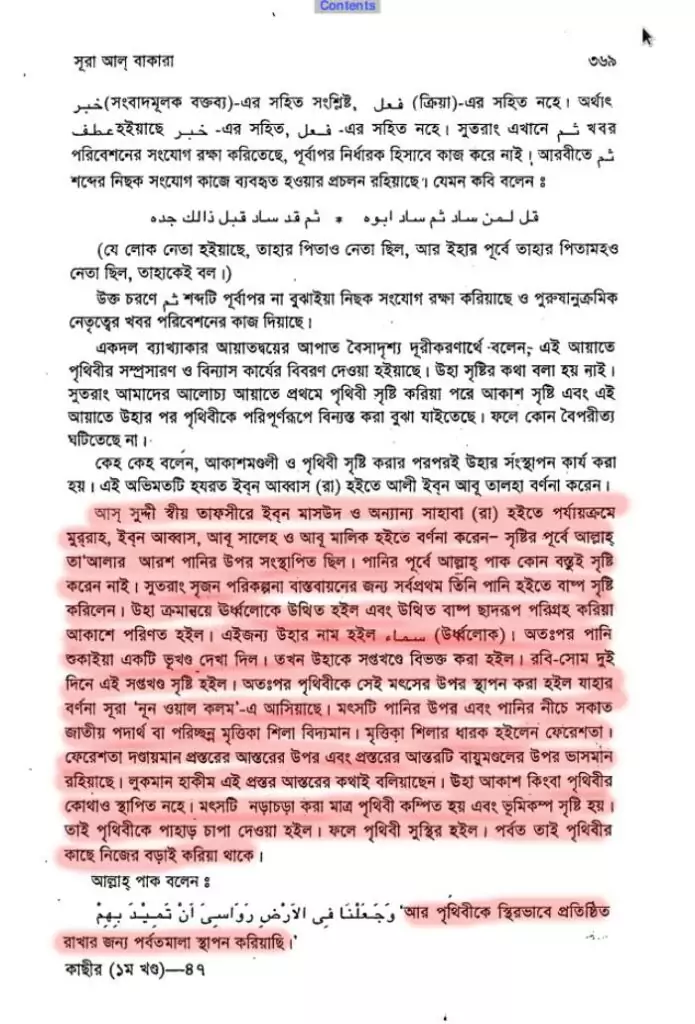
Zakariya al-Qazwini’s Azayib al-Makhluqat is a medieval compilation of wondrous creations and cosmological imaginations. In the illustrated versions attributed to him, the earth, animals, and supernatural forces are arranged in a picture of a world-conception. Such images are witnesses to the history of imagining the position of the earth in religious culture. The presence of animals or carriers used in the pictures does not provide evidence of any observed cosmological force. If the illustrations of the manuscript are considered maps of the actual world, the imagination of the painter is placed in the position of geography. [490]
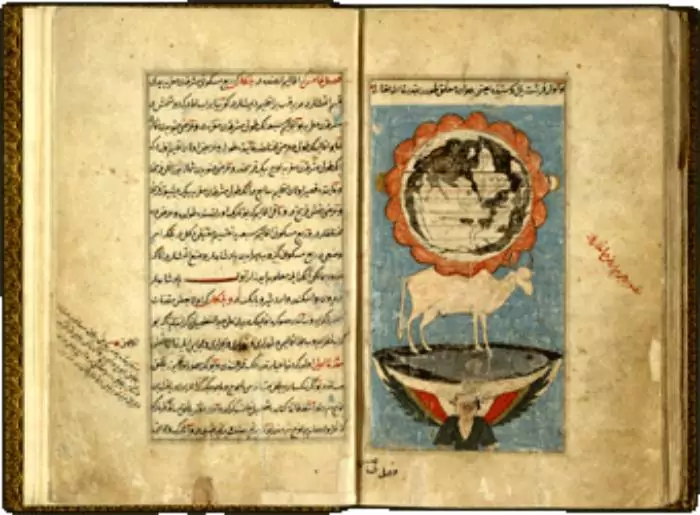
Muhammad ibn Salih al-Uthaymeen has claimed explicit evidence from the Sharia in favor of the sun revolving around the earth. In his fatwa, the daily language—that the sun rises, sets, passes by, and goes to a destination—has been made the evidence for determining the center of motion. The assumption that if the earth revolved, the verses would have mentioned the movement of the earth, is an important part of his argument. Here, the authority of religious language is placed above observation, and the motion of the entire solar system is determined from the local sight of sunset. [491] [492]
Bengali text:
প্রশ্ন: (১৬) সূর্য কি পৃথিবীর চার দিকে ঘুরে?
উত্তর: মান্যবর শাইখ উত্তরে বলেন যে, শরী‘আতের প্রকাশ্য দলীলগুলো প্রমাণ করে যে, সূর্যই পৃথিবীর চতুর্দিকে ঘুরে। এ ঘুরার কারণেই পৃথিবীতে দিবা-রাত্রির আগমণ ঘটে। আমাদের হাতে এ দলীলগুলোর চেয়ে বেশি শক্তিশালী এমন কোনো দলীল নেই, যার মাধ্যমে আমরা সূর্য ঘূরার দলীলগুলোকে ব্যাখ্যা করতে পারি। সূর্য ঘুরার দলীলগুলো হলো আল্লাহ তা‘আলা বলেন,
﴿فَإِنَّ ٱللَّهَ يَأۡتِي بِٱلشَّمۡسِ مِنَ ٱلۡمَشۡرِقِ فَأۡتِ بِهَا مِنَ ٱلۡمَغۡرِبِ﴾ [البقرة: ٢٥٨]
“আল্লাহ তা‘আলা সূর্যকে পূর্ব দিক থেকে উদিত করেন। তুমি পারলে পশ্চিম দিক থেকে উদিত কর।” [সূরা আল-বাকারা, আয়াত: ২৫৮] সূর্য পূর্ব দিক থেকে উঠার মাধ্যমে প্রকাশ্য দলীল পাওয়া যায় যে, সূর্য পৃথিবীর উপর পরিভ্রমণ করে।
২) আল্লাহ বলেন,
﴿فَلَمَّا رَءَا ٱلشَّمۡسَ بَازِغَةٗ قَالَ هَٰذَا رَبِّي هَٰذَآ أَكۡبَرُۖ فَلَمَّآ أَفَلَتۡ قَالَ يَٰقَوۡمِ إِنِّي بَرِيٓءٞ مِّمَّا تُشۡرِكُونَ ٧٨﴾ [الانعام: ٧٨]
“অতঃপর যখন সূর্যকে চকচকে অবস্থায় উঠতে দেখলেন তখন বললেন, এটি আমার রব, এটি বৃহত্তর। অতপর যখন তা ডুবে গেল, তখন বলল হে আমার সম্প্রদায়! তোমরা যেসব বিষয়ে শরীক কর আমি ওসব থেকে মুক্ত।” [সূরা আল-আন‘আম, আয়াত: ৭৮]
এখানে নির্ধারণ হয়ে গেল যে, সূর্য অদৃশ্য হয়ে যায়। একথা বলা হয় নি যে, সূর্য থেকে পৃথিবী ডুবে গেল। পৃথিবী যদি ঘূরত তাহলে অবশ্যই তা বলা হত।
৩) আল্লাহ বলেন,
﴿وَتَرَى ٱلشَّمۡسَ إِذَا طَلَعَت تَّزَٰوَرُ عَن كَهۡفِهِمۡ ذَاتَ ٱلۡيَمِينِ وَإِذَا غَرَبَت تَّقۡرِضُهُمۡ ذَاتَ ٱلشِّمَالِ﴾ [الكهف: ١٧]
“তুমি সূর্যকে দেখবে, যখন উদিত হয়, তাদের গুহা থেকে পাশ কেটে ডান দিকে চলে যায় এবং যখন অস্ত যায়, তাদের থেকে পাশ কেটে বাম দিকে চলে যায়।” [সূরা কাহাফ, আয়াত: ১৭] পাশ কেটে ডান দিকে বা বাম দিকে চলে যাওয়া প্রমাণ করে যে, নড়াচড়া সূর্য থেকেই হয়ে থাকে। পৃথিবী যদিনড়াচড়া করত তাহলে অবশ্যই বলতেন সূর্য থেকে গুহা পাশ কেটে যায়। উদয় হওয়া এবং অস্ত যাওয়াকে সূর্যের দিকে সম্পৃক্ত করা হয়েছে। এটা থেকে বুঝা যায় যে, সূর্যই ঘুরে। পৃথিবী নয়।
৪) আল্লাহ বলেন,
﴿وَهُوَ ٱلَّذِي خَلَقَ ٱلَّيۡلَ وَٱلنَّهَارَ وَٱلشَّمۡسَ وَٱلۡقَمَرَۖ كُلّٞ فِي فَلَكٖ يَسۡبَحُونَ ٣٣﴾ [الانبياء: ٣٣]
“এবং তিনিই দিবা-নিশি এবং চন্দ্র-সূর্য সৃষ্টি করেছেন। সবাই আপন আপন কক্ষ পথে বিচরণ করে।” [সূরা আল-আম্বিয়া, আয়াত: ৩৩]
ইবন আব্বাস বলেন, লাটিম যেমন তার কেন্দ্র বিন্দুর চার দিকে ঘুরতে থাকে, সূর্যও তেমনিভাবে ঘুরে।
৫) আল্লাহ বলেন,
﴿يُغۡشِي ٱلَّيۡلَ ٱلنَّهَارَ يَطۡلُبُهُۥ حَثِيثٗا﴾ [الاعراف: ٥٤]
“তিনি রাতকে আচ্ছাদিত করেন দিনের মাধ্যমে, দিন দৌড়ে দৌড়ে রাতের পিছনে আসে।” [সূরা আল-আ‘রাফ, আয়াত: ৫৪]
আয়াতে রাতকে দিনের অনুসন্ধানকারী বলে ব্যাখ্যা করা হয়েছে। অনুসন্ধানকারী পিছনে পিছনে দ্রুত অনুসন্ধান করে থাকে। এটা জানা কথা যে, দিবা-রাত্রি সূর্যের অনুসারী।
৬) আল্লাহ তা‘আলা বলেন,
﴿خَلَقَ ٱلسَّمَٰوَٰتِ وَٱلۡأَرۡضَ بِٱلۡحَقِّۖ يُكَوِّرُ ٱلَّيۡلَ عَلَى ٱلنَّهَارِ وَيُكَوِّرُ ٱلنَّهَارَ عَلَى ٱلَّيۡلِۖ وَسَخَّرَ ٱلشَّمۡسَ وَٱلۡقَمَرَۖ كُلّٞ يَجۡرِي لِأَجَلٖ مُّسَمًّىۗ أَلَا هُوَ ٱلۡعَزِيزُ ٱلۡغَفَّٰرُ ٥﴾ [الزمر: ٥]
“তিনি আসমান ও জমিন সৃষ্টি করেছেন যথাযথভাবে। তিনি রাত্রিকে দিবস দ্বারা আচ্ছাদিত করেন এবং দিবসকে রাত্রি দ্বারা আচ্ছাদিত করেন এবং তিনি সূর্য ও চন্দ্রকে কাজে নিযুক্ত করেছেন। প্রত্যেকেই বিচরণ করে নির্দিষ্ট সময়কাল পর্যন্ত। জেনে রাখুন, তিনি পরাক্রমশালী, ক্ষমাশীল।” [সূরা আয-যুমার, আয়াত: ৫]
আয়াতের মাধ্যমে আমরা জানতে পারলাম যে, পৃথিবীর উপরে দিবা-রাত্রি চলমান রয়েছে। পৃথিবী যদি ঘুরতো তাহলে তিনি বলতেন, দিবা-রাত্রির উপর পৃথিবীকে ঘূরান। আল্লাহ তা‘আলা বলেন, “সূর্য এবং চন্দ্রের প্রত্যেকেই চলমান”। এ সমস্ত দলীলের মাধ্যমে জানা গেল যে, সুস্পষ্টভাবেই সূর্য ও চন্দ্র এক স্থান থেকে অন্য স্থানে চলাচল করছে। এ কথা সুস্পষ্ট যে, চলমান বস্তুকে বশীভুত করা এবং কাজে লাগানো একস্থানে অবস্থানকারী বস্তুকে কাজে লাগানোর চেয়ে অধিক যুক্তিসঙ্গত।
৭) আল্লাহ বলেন,
﴿وَٱلشَّمۡسِ وَضُحَىٰهَا ١ وَٱلۡقَمَرِ إِذَا تَلَىٰهَا ٢﴾ [الشمس: ١، ٢]
“শপথ সূর্যের ও তার কিরণের, শপথ চন্দ্রের যখন তা সূর্যের পশ্চাতে আসে।” [সূরা আশ-শামস, আয়াত: ১-২]
এখানে বলা হয়েছে যে, চন্দ্র সূর্যের পরে আসে। এতে প্রমাণ পাওয়া যায় যে, সূর্য এবং চন্দ্র চলাচল করে এবং পৃথিবীর উপর ঘুরে। পৃথিবী যদি চন্দ্র বা সূর্যের চার দিকে ঘুরত, তাহলে চন্দ্র সূর্যকে অনুসরণ করতনা। বরং চন্দ্র একবার সূর্যকে, আর একবার সূর্য চন্দ্রকে অনুসরণ করত। কেননা সূর্য চন্দ্রের অনেক উপরে। এ আয়াত দিয়ে পৃথিবী স্থীর থাকার ব্যাপারে দলীল গ্রহণ করার ভিতরে চিন্তা-ভাবনার বিষয় রয়েছে।
৮) মহান আল্লাহ বলেন,
﴿وَٱلشَّمۡسُ تَجۡرِي لِمُسۡتَقَرّٖ لَّهَاۚ ذَٰلِكَ تَقۡدِيرُ ٱلۡعَزِيزِ ٱلۡعَلِيمِ ٣٨ وَٱلۡقَمَرَ قَدَّرۡنَٰهُ مَنَازِلَ حَتَّىٰ عَادَ كَٱلۡعُرۡجُونِ ٱلۡقَدِيمِ ٣٩ لَا ٱلشَّمۡسُ يَنۢبَغِي لَهَآ أَن تُدۡرِكَ ٱلۡقَمَرَ وَلَا ٱلَّيۡلُ سَابِقُ ٱلنَّهَارِۚ وَكُلّٞ فِي فَلَكٖ يَسۡبَحُونَ ٤٠﴾ [يس: ٣٨، ٤٠]
“সূর্য তার নির্দিষ্ট অবস্থানে আবর্তন করে। এটা পরাক্রমশালী, সর্বজ্ঞ আল্লাহর নির্ধারণ। চন্দ্রের জন্যে আমি বিভিন্ন মঞ্জিল নির্ধারিত করেছি। অবশেষে সে পুরাতন খর্জুর শাখার অনুরূপ হয়ে যায়। সূর্যের পক্ষে চন্দ্রকে নাগাল পাওয়া সম্ভব নয়। রাতের পক্ষেও দিনের অগ্রবতী হওয়া সম্ভব নয়। প্রত্যেকেই আপন আপন কক্ষপথে পরিভ্রমণ করে।” [সূরা ইয়াসীন, আয়াত: ৩৮-৪০]
সূর্যের চলা এবং এ চলাকে মহা পরাক্রমশালী আল্লাহর নির্ধারণ বলে ব্যাখ্যা করা এটাই প্রমাণ করে যে, সূর্য প্রকৃতভাবেই চলমান। আর এ চলাচলের কারণেই দিবা-রাত্রি এবং ঋতুর পরিবর্তন হয়। চন্দ্রের জন্য মঞ্জিল নির্ধারণ করার অর্থ এ যে, সে তার মঞ্জিলসমূহে স্থানান্তরিত হয়। যদি পৃথিবী ঘুরত, তাহলে পৃথিবীর জন্য মঞ্জিল নির্ধারণ করা হত। চন্দ্রের জন্য নয়। সূর্য কর্তৃক চন্দ্রকে ধরতে না পারা এবং দিনের অগ্রে রাত থাকা সূর্য, চন্দ্র, দিন এবং রাতের চলাচলের প্রমাণ বহন করে।
৯) নবী সাল্লাল্লাহু আলাইহি ওয়াসাল্লাম সূর্য অস্ত যাওয়ার সময় আবু যরকে বলেছেন,
«أَتَدْرِي أَيْنَ تَذْهَبُ قُلْتُ اللَّهُ وَرَسُولُهُ أَعْلَمُ قَالَ فَإِنَّهَا تَذْهَبُ حَتَّى تَسْجُدَ تَحْتَ الْعَرْشِ فَتَسْتَأْذِنَ فَيُؤْذَنُ لَهَا وَيُوشِكُ أَنْ تَسْجُدَ فَلَا يُقْبَلَ مِنْهَا وَتَسْتَأْذِنَ فَلَا يُؤْذَنَ لَهَا يُقَالُ لَهَا ارْجِعِي مِنْ حَيْثُ جِئْتِ فَتَطْلُعُ مِنْ مَغْرِبِهَا»
“হে আবু যর! তুমি কি জান সূর্য যখন অস্ত যায় তখন কোথায় যায়? আবু যার বললেন, আল্লাহ এবং তাঁর রাসূলই ভালো জানেন। রাসূল সাল্লাল্লাহু আলাইহি ওয়াসাল্লাম বললেন, সূর্য অস্ত যাওয়ার সময় ‘আরশের নিচে গিয়ে সেজদায় লুটিয়ে পড়ে এবং পুনরায় উদিত হওয়ার অনুমতি চায়। অতঃপর তাকে অনুমতি দেওয়া হয়। সে দিন বেশি দূরে নয়, যে দিন অনুমতি চাবে কিন্তু তাকে অনুমতি দেওয়া হবে না। তাকে বলা হবে যেখান থেকে এসেছ, সেখানে ফেরত যাও। অতঃপর সূর্য পশ্চিম দিক থেকেই উদিত হবে।”[1]
এটি হবে কিয়ামতের পূর্ব মুহূর্তে। আল্লাহ সূর্যকে বলবেন, যেখান থেকে এসেছ সেখানে ফেরত যাও, অতঃপর সূর্য পশ্চিম দিক থেকে উদিত হওয়ার বিষয়টি সুস্পষ্টভাবে প্রমাণ করে যে, সূর্য পৃথিবীর উপরে ঘুরছে এবং তার এ ঘুরার মাধ্যমেই উদয়-অস্ত সংঘটিত হচ্ছে।
১০) অসংখ্য হাদীসের মাধ্যমে জানা যায় যে, উদয় হওয়া, অস্ত যাওয়া এবং ঢলে যাওয়া এ কাজগুলো সূর্যের সাথে সম্পৃক্ত। এগুলো সূর্য থেকে প্রকাশিত হওয়া খুবই সুস্পষ্ট। পৃথিবী হতে নয়। হয়তো এ ব্যাপারে আরো দলীল-প্রমাণ রয়েছে। সেগুলো আমার এ মুহূর্তে মনে আসছেনা। তবে আমি যা উল্লেখ করলাম, এ বিষয়টির দ্বার উম্মুক্ত করবে এবং আমি যা উদ্দেশ্য করেছি, তা পূরণে যথেষ্ট হবে। আল্লাহর তাওফীক চাচ্ছি!
[1] সহীহ বুখারী, অধ্যায়: বাদউল খালক; সহীহ মুসলিম, অধ্যায়: ঈমান
English translation:
Question: (16) Does the sun revolve around the earth?
Answer: The honorable Sheikh says in response that the explicit evidences of the Sharia prove that the sun revolves around the earth. Because of this revolution, day and night arrive on earth. We do not have any evidence stronger than these evidences through which we can explain the evidences of the sun’s revolution. The evidences for the sun’s revolution are that Allah Ta’ala says,
﴿فَإِنَّ ٱللَّهَ يَأۡتِي بِٱلشَّمۡسِ مِنَ ٱلۡمَشۡرِقِ فَأۡتِ بِهَا مِنَ ٱلۡمَغۡرِبِ﴾ [البقرة: ٢٥٨]
“Allah Ta’ala causes the sun to rise from the east. if you can, cause it to rise from the west.” [Surah al-Baqarah, verse: 258] Through the sun rising from the east, explicit evidence is found that the sun revolves over the earth.
2) Allah says,
﴿فَلَمَّا رَءَا ٱلشَّمۡسَ بَازِغَةٗ قَالَ هَٰذَا رَبِّي هَٰذَآ أَكۡبَرُۖ فَلَمَّآ أَفَلَتۡ قَالَ يَٰقَوۡمِ إِنِّي بَرِيٓءٞ مِّمَّا تُشۡرِكُونَ ٧٨﴾ [الانعام: ٧٨]
“Then when he saw the sun rising in a brilliant state, he said, this is my Lord, this is the greater. then when it set, he said O my people! I am free from those things which you associate.” [Surah al-An’am, verse: 78]
Here it is determined that the sun disappears. It was not said that the earth sank from the sun. If the earth revolved, it would certainly have been said.
3) Allah says,
﴿وَتَرَى ٱلشَّمۡسَ إِذَا طَلَعَت تَّزَٰوَرُ عَن كَهۡفِهِمۡ ذَاتَ ٱلۡيَمِينِ وَإِذَا غَرَبَت تَّقۡرِضُهُمۡ ذَاتَ ٱلشِّمَالِ﴾ [الكهف: ١٧]
“You will see the sun, when it rises, passing by their cave to the right and when it sets, passing by them to the left.” [Surah al-Kahf, verse: 17] Passing to the right or left proves that the movement occurs from the sun. If the earth moved, He would certainly have said the cave passes by the sun. Rising and setting have been attributed to the sun. From this it is understood that the sun revolves. not the earth.
4) Allah says,
﴿وَهُوَ ٱلَّذِي خَلَقَ ٱلَّيۡلَ وَٱلنَّهَارَ وَٱلشَّمۡسَ وَٱلۡقَمَرَۖ كُلّٞ فِي فَلَكٖ يَسۡبَحُونَ ٣٣﴾ [الانبياء: ٣٣]
“And He is the one who created the night and day and the moon and sun. each swimming in its own orbit.” [Surah al-Anbiya, verse: 33]
Ibn Abbas says, just as a spinning top continues to revolve around its center point, the sun revolves in the same way.
5) Allah says,
﴿يُغۡشِي ٱلَّيۡلَ ٱلنَّهَارَ يَطۡلُبُهُۥ حَثِيثٗا﴾ [الاعراف: ٥٤]
“He covers the night with the day, day pursuing the night.” [Surah al-A’raf, verse: 54]
In the verse, the night is explained as the seeker of the day. A seeker searches rapidly from behind. It is a known fact that day and night are followers of the sun.
6) Allah Ta’ala says,
﴿خَلَقَ ٱلسَّمَٰوَٰتِ وَٱلۡأَرۡضَ بِٱلۡحَقِّۖ يُكَوِّرُ ٱلَّيۡلَ عَلَى ٱلنَّهَارِ وَيُكَوِّرُ ٱلنَّهَارَ عَلَى ٱلَّيۡلِۖ وَسَخَّرَ ٱلشَّمۡسَ وَٱلۡقَمَرَۖ كُلّٞ يَجۡرِي لِأَجَلٖ مُّسَمًّىۗ أَلَا هُوَ ٱلۡعَزِيزُ ٱلۡغَفَّٰرُ ٥﴾ [الزمر: ٥]
“He created the heavens and the earth in truth. He covers the night with the day and covers the day with the night and He has employed the sun and moon. each swimming for a specified period. Know that He is the Almighty, the Forgiving.” [Surah az-Zumar, verse: 5]
Through the verse we learned that day and night are moving over the earth. If the earth revolved, He would have said, revolve the earth over day and night. Allah Ta’ala says, “each of the sun and moon is moving”. Through all these evidences it is known that clearly the sun and moon are moving from one place to another. It is clear that subjecting and employing a moving object is more logical than employing an object staying in one place.
7) Allah says,
﴿وَٱلشَّمۡسِ وَضُحَىٰهَا ١ وَٱلۡقَمَرِ إِذَا تَلَىٰهَا ٢﴾ [الشمس: ١، ٢]
“By the sun and its radiance, by the moon when it follows the sun.” [Surah ash-Shams, verse: 1-2]
Here it is said that the moon comes after the sun. In this, evidence is found that the sun and moon move and revolve over the earth. If the earth revolved around the moon or the sun, the moon would not follow the sun. Rather, the moon would follow the sun once, and the sun would follow the moon once. Because the sun is far above the moon. There are matters for reflection in taking evidence for the earth remaining stationary from this verse.
8) Great Allah says,
﴿وَٱلشَّمۡسُ تَجۡرِي لِمُسۡتَقَرّٖ لَّهَاۚ ذَٰلِكَ تَقۡدِيرُ ٱلۡعَزِيزِ ٱلۡعَلِيمِ ٣٨ وَٱلۡقَمَرَ قَدَّرۡنَٰهُ مَنَازِلَ حَتَّىٰ عَادَ كَٱلۡعُرۡجُونِ ٱلۡقَدِيمِ ٣٩ لَا ٱلشَّمۡسُ يَنۢبَغِي لَهَآ أَن تُدۡرِكَ ٱلۡقَمَرَ وَلَا ٱلَّيۡلُ سَابِقُ ٱلنَّهَارِۚ وَكُلّٞ فِي فَلَكٖ يَسۡبَحُونَ ٤٠﴾ [يس: ٣٨، ٤٠]
“The sun revolves in its fixed position. this is the determination of the Almighty, All-Knowing Allah. For the moon I have determined various stages. eventually it becomes like an old date-palm branch. It is not possible for the sun to overtake the moon. nor is it possible for the night to precede the day. each revolves in its own orbit.” [Surah Ya-Sin, verse: 38-40]
Explaining the movement of the sun and this movement as the determination of the Almighty Allah proves that the sun is actually moving. And because of this movement, day-night and seasons change. Determining stages for the moon means that it moves through its stages. If the earth revolved, stages would have been determined for the earth. not for the moon. The sun’s inability to catch the moon and the night remaining ahead of the day bear witness to the movement of the sun, moon, day, and night.
9) The Prophet sallallahu alayhi wa sallam said to Abu Dharr at the time of sunset,
«أَتَدْرِي أَيْنَ تَذْهَبُ قُلْتُ اللَّهُ وَرَسُولُهُ أَعْلَمُ قَالَ فَإِنَّهَا تَذْهَبُ حَتَّى تَسْجُدَ تَحْتَ الْعَرْشِ فَتَسْتَأْذِنَ فَيُؤْذَنُ لَهَا وَيُوشِكُ أَنْ تَسْجُدَ فَلَا يُقْبَلَ مِنْهَا وَتَسْتَأْذِنَ فَلَا يُؤْذَنَ لَهَا يُقَالُ لَهَا ارْجِعِي مِنْ حَيْثُ جِئْتِ فَتَطْلُعُ مِنْ مَغْرِبِهَا»
“O Abu Dharr! Do you know where the sun goes when it sets? Abu Dharr said, Allah and His Messenger know best. The Messenger sallallahu alayhi wa sallam said, at the time of sunset the sun goes under the Throne and falls in prostration and asks permission to rise again. Then it is given permission. The day is not far when it will ask for permission but will not be given permission. It will be told to return to where you came from. Then the sun will rise from the west.”[1]
This will be just before the Resurrection. Allah will tell the sun, return to where you came from, then the matter of the sun rising from the west clearly proves that the sun is revolving over the earth and through this revolution, rising and setting occur.
10) Through numerous hadiths it is known that these acts of rising, setting, and declining are associated with the sun. These are very clear as being manifested from the sun. not from the earth. Perhaps there are more evidences regarding this. they are not coming to my mind at this moment. However, what I have mentioned will open the door to this matter and will be sufficient to fulfill what I intended. I seek the tawfiq of Allah!
[1] Sahih Bukhari, Chapter: Bad’ al-Khalq; Sahih Muslim, Chapter: Iman
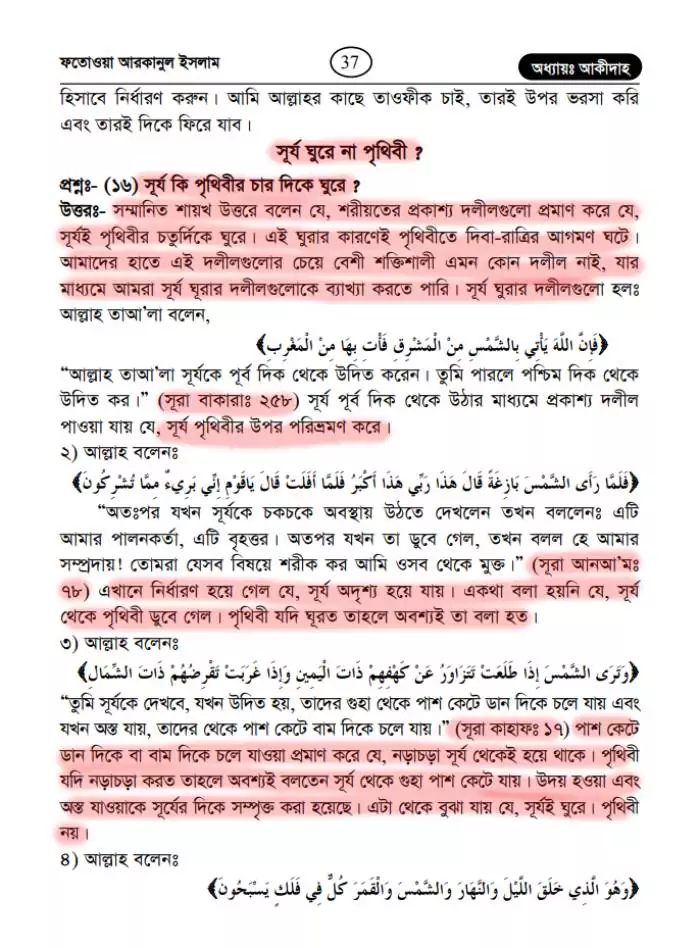
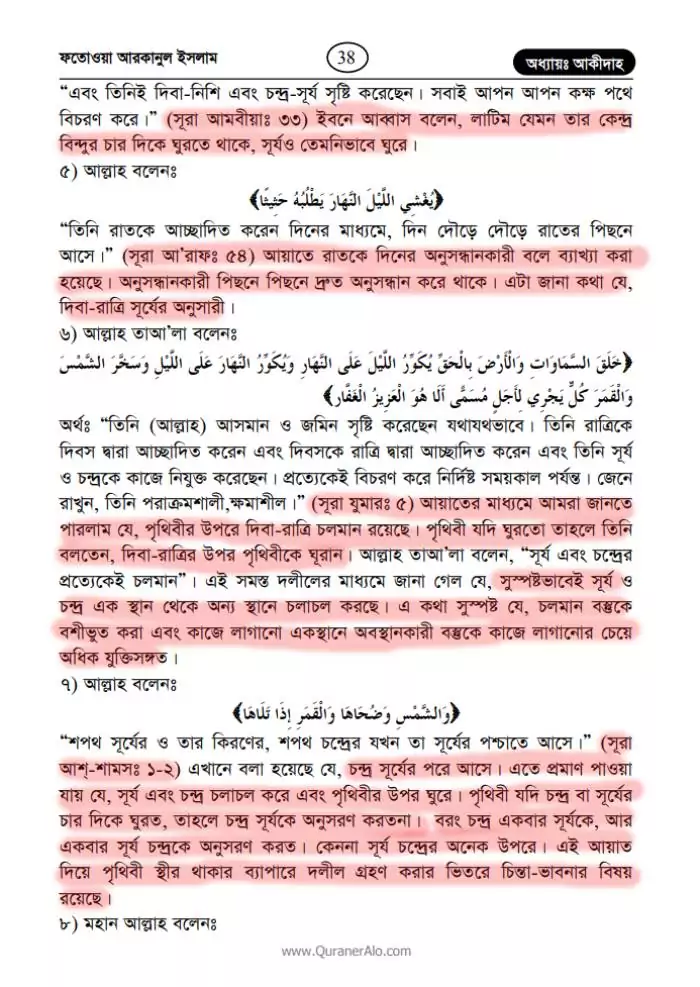
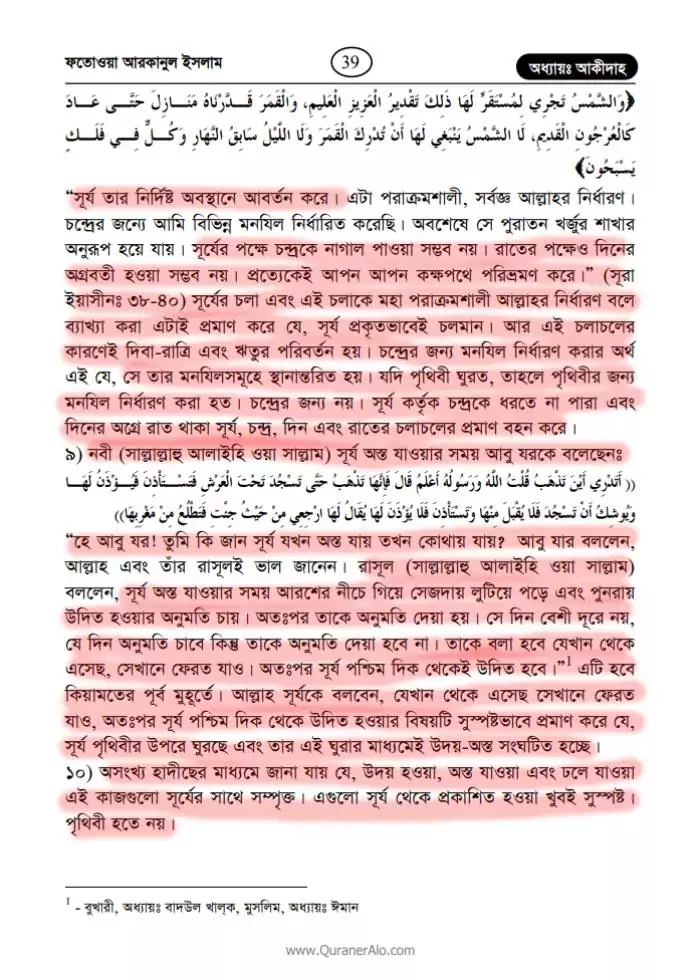
In Tabari’s compilation, there is a description in the name of Ibn Masud rejecting the rotation of the sky. Against Kab’s explanation of the sky revolving, he uses the verse about holding the heavens and earth. [493]
حدثنا جرير عن مغيرة عن إبراهيم قال: ذهب جندب البجلي إلى كعب الأحبار فقدم عليه ثم رجع فقال له عبد الله: حدثنا ما حدثك. فقال: حدثني أن السماء في قطب كقطب الرحا، والقطب عمود على منكب ملك. قال عبد الله: لوددت أنك افتديت رحلتك بمثل راحلتك، ثم قال: ما تنتكت اليهودية في قلب عبد فكادت أن تفارقه، ثم قال إن الله يمسك السماوات والأرض أن تزولا كفى بها زوالا أن تدور.
English translation:
Narrated from Ibrahim via Jarir al-Mughira: Jundub al-Bajali went to Kab al-Ahbar. When he returned, Abdullah said to him: Tell me what he said to you. He said: He told me that the sky is on one axis like the axis of a wheel; that axis is a pillar, which is on the shoulder of an angel. Abdullah said: If only you had been saved from this journey by the amount of your mount! Then he said: When Jewish thoughts are embedded in the heart of a slave, they are not easily released. Then he said: “Allah holds the heavens and the earth, so that they do not deviate.” Revolving is enough for deviation to occur.
In this debate, both parties are imagining the arrangement of the sky using familiar objects. On one side the axis of a wheel and the shoulder of an angel, on the other side the rejection of rotation using a verse. Which motion actually works behind the visible changes of the sky has not been tested in observation and mathematical models. The authorized meaning of religious sentences has taken the place of cosmological conclusions. The specific subject of Ibn Masud’s objection is the rotation of the sky; in Uthaymeen’s fatwa, that kind of literal logic is used to deny the rotation of the earth.
Although Ibn Kathir’s explanation regarding mountains is brief, his physical picture is unambiguous. [494]
(وألقى في الأرض رواسي) يعني: الجبال أرست الأرض وثقلتها لئلا تضطرب بأهلها على وجه الماء؛ ولهذا قال: (أن تميد بكم وبث فيها من كل دابة) أي: وذرأ فيها من أصناف الحيوانات مما لا يعلم عدد أشكالها وألوانها إلا الذي خلقها.
English translation:
“He has set firm mountains on the earth”—meaning mountains have made the earth stable and heavy, so that it does not sway on the water with its inhabitants. Therefore it is said, “so that it does not sway with you and He has spread all kinds of living beings in it.” meaning He has spread various kinds of animals in it, the number of whose shapes and colors no one knows except the Creator.
Calling the mountain an anti-vibration weight of the earth has a real conflict with earthquake-prone mountainous regions. The Himalayas were formed by the collision of Indian and Eurasian tectonic plates; earthquakes also occur in the same movement region. The presence of mountains has not guaranteed the stopping of vibration. The dangerous earthquakes are linked to the same force and deformation that raise mountains. Consequently, the explanation of pressing down the earth swaying on water with mountains is inconsistent with the actual internal structure and motion of the earth. [495]
Another fundamental error in Usaymin’s fatwa is the failure to distinguish between apparent motion and actual motion. from a moving train, outside trees are seen moving backward; from that scene, the conclusion that the trees are moving and the train is stationary does not follow. similarly, seeing the sun move from east to west while standing on the earth’s surface is not proof that the earth remains stationary. the rotation of the earth is effective in explaining the daily motion of the sun seen in the daytime sky. again, it is also true that the sun has its own motion; it is a mistake to equate that truth with the claim of it revolving around the earth every day. mixing different motions into one word does not solve the physical problems of the fatwa.
The conclusion that the earth does not rotate because the moon has stations is also illogical. the visible changes in the moon’s orbit and illuminated portion and the earth’s own rotation can occur at the same time. in the description of one object’s regular change of position, the absence of another object’s motion does not mean the other is stationary. in the fatwa, omission has been made proof of motionlessness. consequently, the fact that the motion of the earth is not mentioned separately in every verse is treated as scientific evidence for keeping the earth stationary. the actual dynamics of the sky cannot be established using such a method.
Where does the sun go at night?
Describing the sun as a moving divine power, a chariot-rider, or an entity obeying commands is a familiar convention of very old religious stories. to humans, the sun arrives in the morning and leaves in the evening; a destination is created in the imagination for the time it remains invisible. in Islamic hadith, that daily journey is linked to the Throne of Allah, prostration, and permission to rise again. the central question of this story is, where does the sun go after setting. the event of disappearing below the horizon of a specific place on earth has been explained by the sun’s own stopover and command to return.
While the sun is setting in one region of the earth, it is rising or providing midday light in another region. night is the condition of one part of the earth; the entire sun does not hide somewhere after finishing the day’s work. yet in Abu Zar’s narration, there is a sequence of a question, destination, remaining in prostration, the command to rise, and returning through a specific rising point. in Muslim’s long narration, the repetition of the same cycle is also clear. this conflict is inevitable if one makes the local horizon of humans the universal day-night schedule of the cosmos. [496] [497] [498] [499]
Sunan Abu Dawud (IF)
Chapter: 25/ Letters of the Quran and Qira’at
Section: No section.
3961. Ubaydullah ibn Umar (rh) …… narrated from Abu Zar (ra). he said: once I was riding behind the Messenger of Allah sallallahu alayhi wa sallam on a donkey. at that time the sun was setting. then he asked me: do you know where the sun sets? I said, Allah and His Messenger are more knowledgeable in this regard. he said عَيْنِ حَامِيَةٍ it, meaning, goes into a hot spring.
Hadith grade: Sahih
Sahih Bukhari (IF)
2972. Muhammad ibn Yusuf (rh) narrated from Abu Zar (ra), he said, the Nabi sallallahu alayhi wa sallam said to Abu Zar (ra) at the time of sunset, do you know where the sun goes? I said, Allah and His Messenger know best. he said, it goes on and on, goes under the Throne and falls in prostration. then it asks for permission to rise again and it is given permission. and soon a time will come when its prostration will not be accepted and it will ask for permission but will not be given permission. it will be told to return by the way you came. then it will rise from the west—this is the essence of the word of Allah Ta’ala: And the sun proceeds to its fixed destination, this is the control of the Almighty, the All-Knowing.
(Quran 36:38)
Sahih Bukhari (Islamic Foundation)
52/ Tafsir
Section: The word of Allah: والشمس تجري لمستقر لها ذلك تقدير العزيز العليم “and the sun travels toward its fixed destination, this is the control of the Almighty, the All-Knowing.”
4439 Abu Nu’aym (rh) … narrated from Abu Zar (ra). he said, once at the time of sunset I was in the mosque with the Nabi sallallahu alayhi wa sallam. he said, O Abu Zar! do you know where the sun sinks? I said, Allah and His Messenger know best. he said, the sun goes, finally goes under the Throne and prostrates. the following verseوَالشَّمْسُ تَجْرِي لِمُسْتَقَرٍّ لَهَا ذَلِكَ تَقْدِيرُ الْعَزِيزِ الْعَلِيمِ describes this very thing, namely the sun travels toward its fixed destination, this is the control of the Almighty, the All-Knowing.
Hadith grade: Sahih
Narrator: Abu Zar al-Ghifari (ra)
Sahih Bukhari (Islamic Foundation)
52/ Tafsir
Section: The word of Allah: والشمس تجري لمستقر لها ذلك تقدير العزيز العليم “and the sun travels toward its fixed destination, this is the control of the Almighty, the All-Knowing.”
4440. Humaydi (rh) … narrated from Abu Zar Ghifari (ra). he said, I asked the Nabi sallallahu alayhi wa sallam about the explanation of the word of Allah:مُسْتَقَرُّ . he said, the destination of the sun is under the Throne.
Hadith grade: Sahih
Narrator: Abu Zar al-Ghifari (ra)
Sahih Muslim (Islamic Foundation)
1/ Kitab al-Iman
Section: 71. The time when faith will not be accepted
296. Yahya ibn Ayyub and Ishaq ibn Ibrahim (rh) … narrate from Abu Zar (ra) that he said, one day the Nabi sallallahu alayhi wa sallam said: do you know where this sun goes? The Companions said, Allah and His Messenger know best. he said: this sun continues to move and goes to its place located under the Throne (of Allah Ta’ala). there it remains in prostration. finally when it is told, rise and return to where you came from! then it returns and rises through the designated rising point. it continues to move again and goes to its place located under the Throne. there it remains in prostration. finally when it is told, rise and return to where you came from. then it returns and rises through the designated rising point.
it continues to move again and goes to its place located under the Throne. there it remains in prostration. finally when it is told, rise and return to where you came from. then it returns and rises through the designated rising point. it will continue to move thus; people will not see anything unusual from it. finally one day the sun will go to its fixed place under the Throne as usual. it will be told, rise and rise from the west. then that day the sun will rise in the western sky. Rasulullah sallallahu alayhi wa sallam said: do you know on which day this state will be? On that day, the faith of that person will be of no use who did not bring faith before or who did not achieve benefit through faith.
Hadith grade: Sahih
Narrator: Abu Zar al-Ghifari (ra)
Sahih Muslim (Islamic Foundation)
1/ Kitab al-Iman
Section: 71. The time when faith will not be accepted
298. Abu Bakr ibn Abu Shayba and Abu Qurayb (rh) … narrated from Abu Zar (ra). he said, once I entered the Masjid al-Nabawi. Rasulullah sallallahu alayhi wa sallam was seated there. when the sun set he said: O Abu Zar! do you know where this sun goes? I said, Allah and His Messenger know best. Rasulullah sallallahu alayhi wa sallam said: it goes to its destination and asks for permission to prostrate to Allah. then it is given permission. later one day when it will be told to return to the direction from which you came. then it will rise from the west. then he recited according to the qira’at of Abdullah ibn Masud:ذَلِكَ مُسْتَقَرٌّ لَهَا this is its destination
Hadith grade: Sahih
Narrator: Abu Zar al-Ghifari (ra)
Sahih Muslim (Islamic Foundation)
1/ Kitab al-Iman
Section: 71. The time when faith will not be accepted
299. Abu Said al-Ashajj and Ishaq ibn Ibrahim (rh) … narrated from Abu Zar (ra). he said: we, asked Rasulullah sallallahu alayhi wa sallamوَالشَّمْسُ تَجْرِي لِمُسْتَقَرٍّ لَهَا about the verse “and the sun travels toward its fixed destination” (36: 38) and he said: its destination is under the Throne.
Hadith grade: Sahih
Narrator: Abu Zar al-Ghifari (ra)
Sahih Hadith Qudsi
1/ Miscellaneous Hadiths
Section: Virtue of some sentences praising Allah
161. Narrated from Abu Zar radiyallahu anhu, he said: I was with the Nabi sallallahu alayhi wa sallam on a donkey. at that time he had a bordered shawl over him. he said: this was at the time of sunset, he said to me: “O Abu Zar, do you know where this sets?” he said: I said: Allah and His Messenger know best. he said: the sunset goes into a muddy spring, it continues to move finally falling in prostration to its Lord under the Throne, when it is time to exit Allah gives it permission, so it exits and rises. when He intends to make it rise from where it has set, He will stop it, it will say: O my Lord, my path is long, Allah will say: rise from where you sank, this is the time when faith will not benefit a person”. [Ahmad] the hadith is sahih.
Hadith grade: Sahih
Sahih Bukhari (Tawhid Publication)
65/ Tafsir of the Holy Quran
Chapter: 65/36/1. The Word of Allah: And the sun continues to move toward its destination. it is the control of the Almighty, the All-Knowing. (Surah Ya-Sin 36/38)
4802. Narrated from Abu Dharr (ra),. he said, once at the time of sunset I was in the mosque with the Prophet sallallahu ‘alayhi wasallam. he said, O Abu Dharr! Do you know where the sun sets? I replied, Allah and His Messenger know best. he said, the sun moves, eventually going under the Throne to prostrate. the following وَالشَّمْسُ تَجْرِيْ لِمُسْتَقَرٍّ لَّهَا ذٰلِكَ تَقْدِيْرُ الْعَزِيْزِ الْعَلِيْمِ refers to this verse, namely the sun travels toward its specific destination, this is the control of the Almighty, the All-Knowing. [3199] (Modern Publication: 4438, Islamic Foundation: 4439)
Hadith Grade: Sahih
Narrator: Abu Dharr al-Ghifari (ra)
Sahih Bukhari (Tawhid Publication)
65/ Tafsir of the Holy Quran
Chapter: 65/36/1. The Word of Allah: And the sun continues to move toward its destination. it is the control of the Almighty, the All-Knowing. (Surah Ya-Sin 36/38)
4803. Narrated from Abu Dharr al-Ghifari (ra),. he said, I asked the Prophet sallallahu ‘alayhi wasallam regarding the Word of Allah: وَالشَّمْسُ تَجْرِيْ لِمُسْتَقَرٍّ لَّهَا . he said, the destination of the sun is under the Throne. [3199] (Modern Publication: 4439, Islamic Foundation: 4440)
Hadith Grade: Sahih
Narrator: Abu Dharr al-Ghifari (ra)
Sahih Bukhari (Tawhid Publication)
97/ Tawhid
Chapter: 97/23. The Word of Allah: The angels and the Spirit ascend to Allah- (Surah al-Ma’arij 70/4). and the Word of Allah: To Him ascend the holy words- (Surah Fatir 35/10).
7433. Narrated from Abu Dharr (ra),. he said, I asked the Prophet sallallahu alayhi wasallam regarding this Word of Allah, “And the sun travels toward its specific destination”. he said: the specific destination of the sun is under the Throne. [3199] (Modern Publication- 6916, Islamic Foundation- 6927)
Hadith Grade: Sahih
Narrator: Abu Dharr al-Ghifari (ra)
Sahih Muslim (Hadith Academy)
1. Iman [Faith]
Chapter: 72. The time when faith will not be accepted.
289-(250/159) Yahya ibn Ayyub and Ishaq ibn Ibrahim (ra) ….. Abu Dharr (ra) said, one day the Prophet sallallahu alayhi wasallam said, do you know where this sun goes? The Companions said, Allah and His Messenger know best. he said, this sun continues to move and goes to its position located under the Throne (of Allah Ta’ala). there it remains prostrate. finally when it is told, rise and return to where you came from! Then it returns and rises from the designated place of rising. it moves again and goes to its position located under the Throne. there it remains in a prostrate state. finally when it is told rise and return to where you came from. then it returns and rises through the designated place of rising. it will continue thus; humans will not see anything unusual from it. finally one day the sun will go to its position under the Throne as usual. it will be told, rise and rise from the west. then that day the sun will rise in the western sky. Rasulullah sallallahu alayhi wa sallam said, (the Word of the Quran) “Do you know which day that state will be? That day the faith of that person will be of no use who did not believe before or who did not attain benefit through faith”- (Surah al-An’am 6: 158)*. (Islamic Foundation: 296, Islamic Center: 307)
Hadith Grade: Sahih
Narrator: Abu Dharr al-Ghifari (ra)
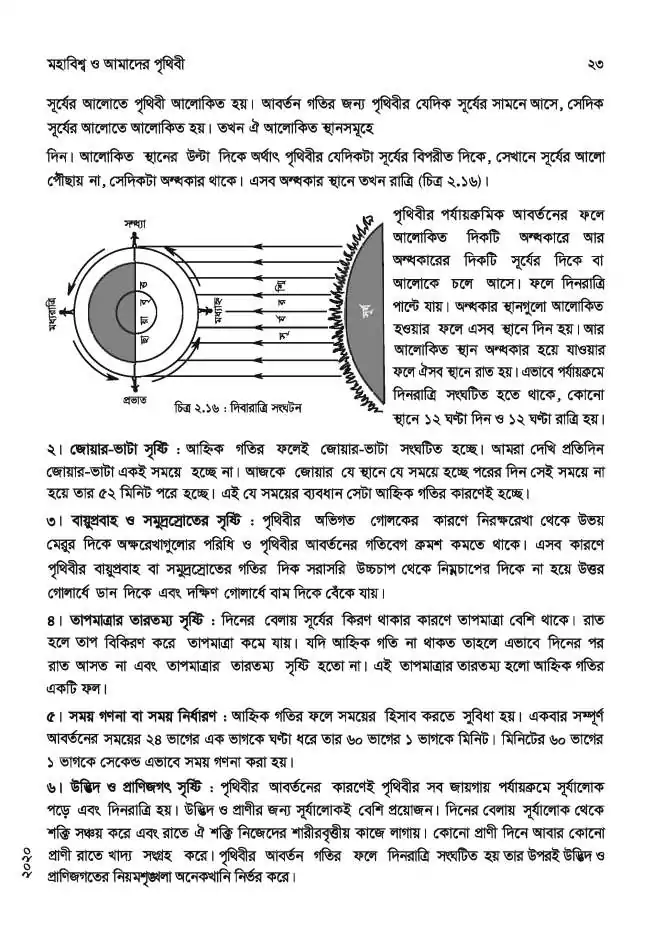
The statement regarding setting in a hot spring makes the problem more specific. if the sun enters a reservoir on earth, one must adopt completely wrong notions about its size, distance, and material composition. the sun is not an object that can enter a small reservoir on earth. in the description of going under the Throne, the activity after sunset is arranged like human rest, worship, and permission from authority. a story of palace-centric divine administration is placed behind a natural phenomenon. here there is no measure of the sun’s own known motion; there is a narrative of making it a conscious, obedient character.
The same narration of Abu Dharr in different chapters of Bukhari-Muslim or in different Bengali translations are not separate astronomical observations. but its circulation and scope of religious use are large. the same story has found a place somewhere as an explanation of creation, somewhere as the tafsir of a specific verse, and somewhere as a sign before the Final Judgment. as a result, this narrative does not remain just a personal story; it becomes part of religious teaching about the universe. the description people are being made to memorize to understand natural phenomena does not match the actual sun-earth system.
The prophecy of rising from the west is also spoken in the language of reversing the same journey. “Return to where you came from”—by this instruction given to the sun, the western setting place becomes the next rising place. in modern kinematics, the direction of sunrise from the earth’s surface is related to the earth’s rotation. the story of turning the sun around in the sky and sending it back is not the same explanation as the physical phenomenon of changing the earth’s rotation. the sequence of events in the hadith has made the sun the traveler and the recipient of instructions. to call its mythical daily journey a scientific description of the earth’s rotation is a change in meaning.
This story of wanting to know the sun’s destination after the local sunset carries a perspective where the visible horizon of humans is the primary boundary of the world. what happens beyond that boundary is answered by the invisible Throne. but people standing at other longitudes of the earth see the sunlight at the same moment. to them, the sun is then in visible action. if one single sun is made subject to the same night break and morning permission for the entire spherical earth, the simultaneous day-night of different regions can no longer be explained. this limitation of the religious story comes into direct conflict with the actual relationship between the earth’s shape and time.
The earth is spread out flat
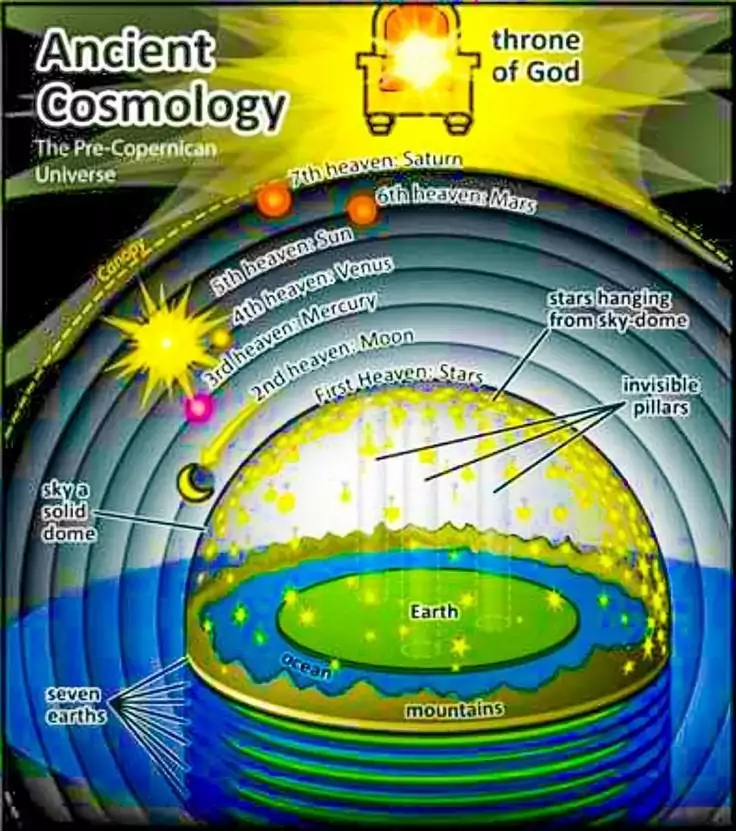
Language describing the earth as a bed, an extended land, and the sky above as a roof has appeared repeatedly in the Quran. in this, the surface of human habitation is imagined in the familiar manner of house construction. in the experience of a human standing on the earth’s surface, the land is extended, the sky is overhead, and mountains stand on that land. in the religious cosmological picture, this local experience becomes the architecture of the entire earth and sky. in the explanation of Jalalayn, the conclusion that the earth is not a sphere but flat has been taken directly from this language. consequently, there is actual written evidence of the flat earth reading; to call it a fabricated explanation by the critic is false.
And toward the earth, how it has been spread out flat ?
Quran 88:20
The Holy Being who for you made the earth a bed and established the sky as a roof, and sent down water from the sky to produce fruits and crops for you as your food. therefore, do not set up anyone as equal to Allah. indeed, you know these things.
Quran Surah Baqarah 2:22
He for you has made the earth a bed and made paths therein, sent down rain from the sky and by that I produced various types of plants.
Quran Surah Ta-Ha 20:53
I have spread out the earth. how beautifully I am able to spread it.
Quran Surah Dhariyat 51:48
Allah Ta’ala for you has made the earth a bed.
Quran Surah Nuh 71:19
Did I not make the earth a bed ?
Quran Surah Naba 78:6
I have extended the earth and established mountains upon it and produced therein every thing in due proportion.
Quran Surah Hijr 15:19
In the explanation of Ghashiyah 88:20 by Jalalayn, there is a conclusion of a flat earth from “has been made flat” and a rejection of the spherical theory of astronomers. this part belongs to the tafsir of Jalaluddin al-Mahalli; later Jalaluddin as-Suyuti completed other parts of the book. [500] [501]
Bengali text:
২০. আর ভূতলের দিকে কিরূপে তাকে সমতল করা
হয়েছে? সম্প্রসারিত করা হয়েছে। সারকথা, এ সকল বস্তুর প্রতি লক্ষ্য করে আল্লাহর কুদরত ও একত্বের প্রতি ঈমান আনাই বাঞ্ছনীয় ছিল। সর্বপ্রথম উষ্ট্রের উল্লেখ এ জন্য করা হয়েছে, যেহেতু এটা তাদের সাথে অন্যগুলোর তুলনায় অধিক সম্পৃক্ত। سط শব্দ দ্বারা বাহ্যত এটাই প্রমাণিত হয় যে, পৃথিবী সমতল। শরিয়তের আলিমগণের মতও এটাই, ভূতত্ত্ববিদদের মতানুরূপ গোলাকার নয়। যদিও তাদের সে দৃষ্টিভঙ্গি শরিয়তের কোনো আহকামের জন্য বিপত্তিকর নয়।
English translation:
20. And toward the earth how it has been made flat
? It has been expanded. in essence, observing all these things, it was desirable to believe in the power and oneness of Allah. first the camel was mentioned because it is more connected to them compared to others. سط by this word it is outwardly proven that the earth is flat. this is also the opinion of the scholars of Sharia, not spherical as per the opinion of geologists. although that perspective of theirs is not dangerous for any ahkam of Sharia.
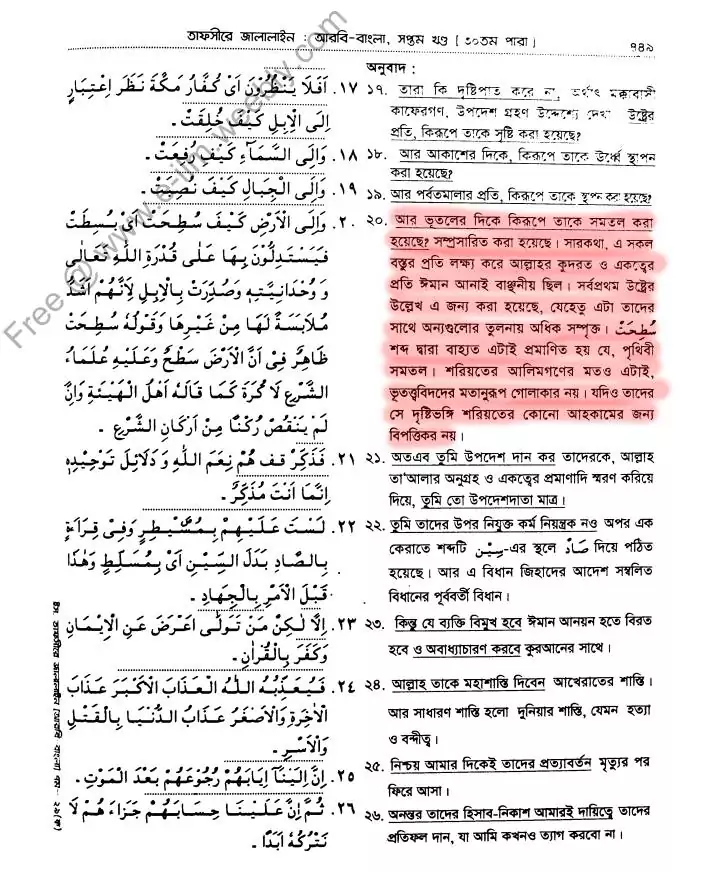
In these pages of Ibn Kathir’s translation, there are also discussions on the extension of land, its use, and the establishment of mountains. the relationship between geographical metaphors, the cosmological concepts adopted by the exegete, and the physical claims of those concepts is also important here. the presence of paths and plants on land is information from human experience; separate measurements are needed to determine the shape and stability of the entire earth. it is wrong to prove the complete shape of the world by the feeling of seeing it extended in all directions while standing on the ground. [502]
Bengali text:
তাফসীর: হুরুফুল হিজা সম্পর্কে সূরা বাকারার শুরুতে বিস্তারিত আলোচনা করা হইয়াছে। বিধায় পূনরায় আলোচনা করা নিষ্প্রয়োজন। আলোচ্য আয়াতের শুরুতে হরফটিও قص ইত্যাদি হুরূফে মুকাত্তায়ার ন্যায় একটি হরফ।
কেহ কেহ বলেন, ধারণ করিয়া রাখিয়াছে। বিরাটকায় একটি মৎসের নাম যাহা সাত তবক যমীনকে
যেমন ইবন জারীর (র)……. ইব্ন আব্বাস (রা) হইতে বর্ণনা করেন যে, ইন্ন আব্বাস (রা) বলেনঃ আল্লাহ্ তা’আলা সর্বপ্রথম কলম তৈয়ার করিয়া বলিলেন, লিখ। কলম বলিল, কি লিখিব? আল্লাহ্ বলিলেন, তাকদীর লিপিবদ্ধ কর। ফলে সেই দিন হইতে কিয়ামত পর্যন্ত যাহা সংঘটিত হইবার ছিল কলম লিখিতে আরম্ভ করিল।
অতঃপর আল্লাহ্ তা’আলা نون তথা মৎস সৃষ্টি করেন। তাহার পর পানির ফেনা হইতে আকাশ সৃষ্টি করেন ও মৎসের পিঠের উপর পৃথিবীকে বিছাইয়া দেন। ফলে মৎস নড়াচড়া করিতে আরম্ভ করে। সংগে সংগে পৃথিবীও নড়িয়া উঠে। তখন আল্লাহ্ তা’আলা পর্বতমালা দ্বারা পৃথিবী স্থির করেন। অন্য এক সূত্রে আছে যে, ইব্ন আব্বাস (রা) এই
কথা বলিয়া ن وَالْقُلَمِ وَمَا يَسْطُرُونَআয়াতটি তিলাওয়াত করেন।
ইবন জারীর (র)……. ইব্ন আব্বাস (রা) বলেন: আমার প্রতিপালক সর্বপ্রথম কলম সৃষ্টি করিয়া বলিলেন, লিখ। ফলে কলম কিয়ামত পর্যন্ত যাহা সংঘটিত হইবে সবই লিপিবদ্ধ করিল। অতঃপর আল্লাহ্ তা’আলা পানির উপর মৎস সৃষ্টি করেন। তাহার পর সেই মৎসের উপর পৃথিবীকে বিছাইয়া দেন।
তারাবানী (র)……. ইব্ন আব্বাস (রা) হইতে বর্ণনা করেন যে, ইব্ন আব্বাস (রা) বলেন, রাসূলুল্লাহ্ (সা) বলিয়াছেন: আল্লাহ্ তা’আলা সর্বপ্রথম কলম ও মৎস )نون( সৃষ্টি করেন। অতঃপর কলমকে বলিলেন, লিখ, লিখ। জিজ্ঞাসা করিল, কি লিখিব? আল্লাহ্ বলিলেন: কিয়ামত পর্যন্ত যাহা হইবে সব লিখ। অতঃপর রাসূল্লাহ্ )1( ن وَالْقَلَمِ وَمَا يَسْطُرُونَআয়াতটি পাঠ করেন।
ইবন আসাকির (র)……. আবূ হুরায়রা (রা) হইতে বর্ণিত। তিনি বলেন, আমি রাসূলুল্লাহ্ (সা)-কে বলিতে শুনিয়াছি যে, আল্লাহ্ তা’আলা সর্বপ্রথম কলম ও নূন তথা দোয়াত সৃষ্টি করেন। অতঃপর কলমকে বলিলেন, লিখ। কলম জিজ্ঞাসা করিল, কি লিখিব? আল্লাহ্ বলিলেন: কিয়ামত পর্যন্ত যাহা সংঘটিত হইবে সব লিখ। ن والقلم وَمَا يَسْطُرُونَ এই আয়াতে এই কথাই বলা হইয়াছে। অতঃপর কলমের মুখে মোহর করিয়া কথা বলিবার শক্তি রহিত করা হয়। ফলে কিয়ামত পর্যন্ত আর সে কথা বলিতে পারিবে না। তাহার পর বিবেক সৃষ্টি করিয়া বলিলেন, আমি আমার ইজ্জতের শপথ করিয়া বলিতেছি যে, আমার প্রিয় লোকদের মধ্যে আমি তোমাকে পরিপূর্ণতা দান করিব আর আমার অপ্রিয় লোকদের মধ্যে তোমাকে অসম্পূর্ণ রাখিব। (অর্থাৎ যাহারা আমার আপন লোক তাহাদিগকে আমি পরিপূর্ণ জ্ঞান দান করিব, যাহারা আমার আপন নহে তাহাদিগের জ্ঞান হইবে অসম্পূর্ণ।
মুজাহিদ (র) বলেন: নূন সাত তবক যমীনের নীচের বসবাসকারী বিরাটকায় একটি মাছ বলিয়া কথিত আছে।
হাসান বসরী (র) সহ একদল মুফাস্সির বলেনঃ এই মৎসটির পিঠের উপর আকাশ যমীন সমান মোটা একটি পাথর আছে। সেই পাথরের উপর আছে চল্লিশ হাজার শিং বিশিষ্ট একটি ষাঁড়। আর সেই ষাঁড়ের পিঠের উপর সাত তবক যমীন ও তন্মধ্যস্ত সমুদয় বস্তু অবস্থিত। কেহ কেহ এই অর্থের উপর নিম্ন বর্ণিত হাদীসটির ব্যাখ্যা করিয়াছেন।
ইমাম আহমদ (র)……. আনাস (রা) হইতে বর্ণিত যে, আব্দুল্লাহ ইব্ন সালাম যখন রাসূলুল্লাহ্ (সা)-এর মদীনা আগমনের সংবাদ পাইলেন, তখন তিনি তাঁহার নিকট আসিয়া কতটি প্রশ্ন করেন। তিনি বলেন, আমি আপনার নিকট এমন কতক প্রশ্ন করিব যাহার উত্তর নবী ব্যতীত কেহ জানিতে পারে না। তিনি বলেন, কিয়ামত সংঘটিত হওয়ার সর্বপ্রথম আলামত কি? জান্নাতবাসীগণ প্রথম কি বস্তু দিয়া আহার করিবেন? কি কারণে সন্তান তাহার পিতার বর্ণ ও আকৃতি ধারণ করে এবং কি কারণে সন্তান তাহার মাতার বর্ণ ও আকৃতি ধারণ করে? নবী (সা) বলিলেন, এই প্রশ্নগুলোর উত্তর নিয়া এই মাত্র জিবরাঈল (আ) আমার নিকট আসিয়া বলিয়া গিয়াছেন। তখন ইব্ন সালাম বলিলেন, জিবরাঈল তো ফিরিশতাগণের মধ্যে ইয়াহুদীদের জন্য চিরশত্রু। নবী (সা) বলিলেন, কিয়ামত সংঘটিত হওয়ার সর্বপ্রথম আলামত হইল যে, একটি অগ্নি প্রকাশিত হইবে, যাহা সকল মানুষকে পূর্ব দিক হইতে পশ্চিম দিকে একত্রিত করিবে এবং জান্নাতীগণ সর্বপ্রথম যাহা আহার করিবেন তাহা হইল মাছের কলিজা এবং যখন মাতার উপর পিতার বীর্য প্রবল হইবে তখন সন্তান পিতার আকৃতি ধারণ করিবে। আর যখন পিতার উপর মাতার বীর্য প্রবল হইবে তখন সন্তান মাতার আকৃতি ধারণ করিবে।
হাদীসটি বুখারী ও মুসলিমে বর্ণিত হইয়াছে।
মুসলিমে অপর এক সনদে সাওবান (রা) হইতে বর্ণিত আছে যে, একবার এক ইয়াহুদী পণ্ডিত কয়েকটি বিষয়ে নবী (সা)-কে জিজ্ঞাসা করিয়াছিল। এইগুলির মধ্যে ইহাও ছিল যে, জান্নাতীগণ জান্নাতে প্রবেশ করিবার পর সর্বপ্রথম তাহাদেরকে কি তুহফা দেওয়া হইবে? নবী (সা) বলিলেন, মাছের কলিজার একাংশ। আবার প্রশ্ন করিল, ইহার পর তাহাদের খাদ্য কি হইবে? নবী (সা) বলিলেন, তাহাদের জন্য জান্নাতের একটি ষাঁড় জবেহ করা হইবে। যে ষাঁড়টি জান্নাতের মধ্যে বিচরণ করিত। অতঃপর প্রশ্ন করিল, ইহার পর তাহাদের পানীয় কি হইবে? নবী (সা) বলিলেন, সালসাবীল নামক প্রস্রবণ হইতে পানীয় দেওয়া হইবে। কেহ কেহ বলেন, নূন হইল নূরের একটি পলক। ইবন জারীর (র)……. কুররা (র) হইতে বর্ণনা করেন। তিনি বলেন, রাসূলুল্লাহ্ (সা) বলিয়াছেন নূন হইল নূরের একটি পলক এবং কলম হইল নূর দিয়া তৈরি, কিয়ামত পর্যন্ত যাহা সংঘটিত হইবে তাহা লিখিতে থাকিবে। এই হাদীসটি মুরসাল গরীব। ইবন জুরাইজ (র) বলেন, আমাকে বলা হইয়াছে যে, কলমটি নূরের তৈরি যাহার দৈর্ঘ্য এক শত বৎসরের পথের সমান।
English translation:
Tafsir: A detailed discussion regarding the Huruf al-Muqatta’at has been provided at the beginning of Surah al-Baqarah., therefore further discussion is unnecessary. The letter at the beginning of the discussed verse is a letterقص like other Huruf al-Muqatta’at.
Some say it refers to something held., the name of a giant fish that [supports] the seven layers of the earth
. For example, Ibn Jarir (r) narrates from Ibn Abbas (ra) that Ibn Abbas (ra) said: Allah Ta’ala first created the Pen and said, Write. The Pen asked, What shall I write? Allah said, Record the destiny. Consequently, from that day until the Day of Judgment, the Pen began to write whatever was to occur.
Then Allah Ta’ala نون created the fish. After that, He created the heaven from the foam of water and spread the earth upon the back of the fish. As a result, the fish began to move., and simultaneously the earth also shook. Then Allah Ta’ala stabilized the earth with mountains. In another source, it is mentioned that Ibn Abbas (ra), having said this
word ن وَالْقُلَمِ وَمَا يَسْطُرُونَrecited the verse.
Ibn Jarir (r) narrates that Ibn Abbas (ra) said: My Lord first created the Pen and said, Write. Consequently, the Pen recorded everything that would occur until the Day of Judgment. Then Allah Ta’ala created the fish upon the water., and after that, He spread the earth upon that fish.
al-Tabari (r) narrates from Ibn Abbas (ra) that Ibn Abbas (ra) said, the Messenger of Allah (saw) said: Allah Ta’ala first created the Pen and the fishنون (created them). Then He said to the Pen, Write, write. It asked, What shall I write? Allah said: Write everything that will happen until the Day of Judgment. Then the Messenger of Allah (saw)1 (ن وَالْقَلَمِ وَمَا يَسْطُرُونَrecited the verse.
Ibn Asakir (r) narrates from Abu Hurayrah (ra). that he said, I heard the Messenger of Allah (saw) saying that Allah Ta’ala first created the Pen and Nun, meaning the inkwell. Then He said to the Pen, Write. The Pen asked, What shall I write? Allah said: Write everything that will occur until the Day of Judgment. ن والقلم وَمَا يَسْطُرُونَ This is what is meant in this verse. Then the mouth of the Pen was sealed and its power to speak was removed., so it will not be able to speak again until the Day of Judgment. After that, He created the intellect and said, I swear by My honor that among My beloved ones I shall grant you perfection, and among those I dislike I shall leave you incomplete. (Meaning, those who are My own people I shall grant complete knowledge, and those who are not My own, their knowledge shall be incomplete.
Mujahid (r) says: Nun is said to be a giant fish residing beneath the seven layers of the earth.
A group of mufassirun, including Hasan Basri (r), say: Upon the back of this fish there is a stone as thick as the distance between heaven and earth. Upon that stone is a bull with forty thousand horns., and upon the back of that bull are the seven layers of the earth and everything contained within them. Some have explained the following hadith based on this meaning.
It is narrated from Anas (ra) via Imam Ahmad (r) that when Abdullah ibn Salam heard the news of the Messenger of Allah’s (saw) arrival in Medina, he came to him and asked several questions. He said, I shall ask you some questions the answers to which no one but a Prophet can know. He asked, What is the first sign of the occurrence of the Day of Judgment? What is the first thing the inhabitants of Paradise will eat? For what reason does a child take the color and shape of his father, and for what reason does a child take the color and shape of his mother? The Prophet (saw) said, Gabriel (as) has just come to me with the answers to these questions. Then Ibn Salam said, Gabriel is the eternal enemy of the Jews among the angels. The Prophet (saw) said, The first sign of the occurrence of the Day of Judgment is that a fire will appear, which will gather all people from the east to the west, and the first thing the people of Paradise will eat is the liver of a fish; and when the seed of the father prevails over the mother, the child will take the father’s shape., and when the seed of the mother prevails over the father, the child will take the mother’s shape.
The hadith is narrated in Bukhari and Muslim.
In another chain in Muslim, it is narrated from Sawban (ra) that once a Jewish scholar asked the Prophet (saw) about several matters. Among these was, after the people of Paradise enter Paradise, what gift will first be given to them? The Prophet (saw) said, a portion of a fish’s liver. He asked again, what will be their food after that? The Prophet (saw) said, a bull of Paradise will be slaughtered for them., the bull that used to roam in Paradise. Then he asked, what will be their drink after that? The Prophet (saw) said, drink will be provided from a spring named Salsabil. Some say, Nun is a flash of light. Ibn Jarir (r) narrates from Qurra (r). that he said, the Messenger of Allah (saw) said Nun is a flash of light and the Pen is made of light, and it will continue to write whatever occurs until the Day of Judgment. This hadith is mursal gharib. Ibn Jurayj (r) says, it has been told to me that the Pen is made of light and its length is equal to the path of one hundred years.


In the hadith of Talbiyah, there is mention of stones, trees, and soil to the right and left of the worshiper responding, and its extension is said to be to the ends of the earth. Here, inanimate nature is made a participant in religious utterance. This image of the entire land responding along with the human voice gives cosmic importance to the act of the worshiper. The language of the two ends of the land is also used in the description of that all-pervasive response. The specific miraculous claim of the hadith is the Talbiyah of inanimate objects; Jalalayn’s direct statement regarding the geometric shape of the earth is a separate piece of evidence. [503] [504]
Sunan Ibn Majah
19/ Hajj
Chapter: 19/15. Talbiyah
4/2921. Narrated from Sahl ibn Sa’d as-Sa’idi (ra). The Messenger of Allah, sallallahu alayhi wa sallam, said: Whoever recites the Talbiyah, immediately the stones, plants, or soil to his right and left, and everything on both sides up to the furthest ends of the world, recites the Talbiyah.
Tirmidhi 828, Mishkat 2550, Rawdun Nadir 2/118.
Tahqiq Albani: Sahih.
Hadith grade: Sahih
Narrator: Sahl bin Sa’d (ra)
Sunan at-Tirmidhi (Verified)
7/ Hajj
Chapter: 14. Virtue of Talbiyah and Sacrifice
828. Narrated from Sahl ibn Sa’d (ra), he said, The Messenger of Allah, sallallahu alayhi wa sallam, said: When a Muslim recites the Talbiyah, the stones, trees, and soil to his right and left all recite the Talbiyah with him., until from this end of the earth to that end it becomes full (with those reciting Talbiyah).
— Sahih, Mishkat (2550)
Hadith grade: Sahih
Narrator: Sahl bin Sa’d (ra)
In Jalalayn’s complete relevant explanation, flatness is placed alongside the spherical view of Sharia scholars and astronomers. [505]
وإلى الأرض كيف سطحت أي بسطت، فيستدلون بها على قدرة الله تعالى ووحدانيته، وصدرت بالإبل لأنهم أشد ملابسة لها من غيرها، وقوله: سطحت ظاهر في الأرض سطح، وعليه علماء الشرع، لا كرة كما قاله أهل الهيئة وإن لم ينقض ركنا من أركان الشرع.
English translation:
“Toward the earth, how it was spread out”—meaning extended. They will take from this proof of Allah’s power and oneness. The mention of the camel came first because their relationship with the camel is greater than with anything else. The apparent meaning of “spread out” is that the earth is flat; the opinion of the Sharia scholars is also thus. As astronomers have said, it is not a sphere; although the opinion of it being a sphere does not destroy any fundamental pillar of Sharia.
The contradiction seen in this explanation is a contradiction between the experience before one’s eyes and greater geometric knowledge. Compared to the vast radius of the earth, the small area seen by humans may seem almost flat. But to declare the entire earth flat from that feeling is to take the characteristic of a local part as the characteristic of the whole. Despite knowing about the spherical view of astronomers, the commentator decided in favor of the apparent meaning of the religious language. Consequently, a direct example is found of how the priority of religious text in the evaluation of information supported a wrong cosmic conclusion.
Flatness and stability are separate claims. It is possible to imagine a spherical earth as stable, and again, an object with a flat surface can move. In religious narratives, these two concepts are often joined in the image of the same habitable land and the heaven above. Their physical tests must be done separately. There is observation-based evidence for both the spherical structure of the earth and its rotation. The method of canceling that evidence with the metaphor of spreading the land or the familiar language of the sunrise preserves a previous image instead of knowing nature.
Distance between Heaven and Earth
Regarding the gap between heaven and earth, there are specific numbers in the hadith expressed in the language of years of travel. In one narration, a path of five hundred years is mentioned; in another, a gap of seventy-one, seventy-two, or seventy-three years is said. These are readings of separate narrations; not a single identical statement of the same number. There is disagreement among muhaddiths regarding the acceptance or rejection of some narrations, and Tirmidhi also mentioned in one source that Hasan did not hear it from Abu Hurairah. But the imagination of creating a measure using the seven heavens, the gap between them, the upper sea, and the body of the Throne-bearer is specifically preserved in the texts. [506] [507]
Bengali text:
وَتَرَى الْمَلَئِكَةُ حَافِيْنَ مِنْ حَوْلِ الْعَرْشِ يُسَبِّحُونَ بِحَمْدِ رَبِّهِمْ وَقَضِي بيْنَهُم بِالْحَقِّ وَقِيلَ الْحَمْدُ لِلَّهِ رَبِّ الْعَلَمِينَ.
অর্থাৎ- ‘এবং তুমি ফেরেশতাদেরকে দেখতে পাবে যে, তারা আরশের চারপাশে ঘিরে তাদের প্রতিপালকের সপ্রশংস পবিত্রতা ও মহিমা ঘোষণা করেছে। আর তাদের বিচার করা হবে ন্যায়ের সাথে; বলা হবে, প্রশংসা জগত সমূহের প্রতিপালক আল্লাহর প্রাপ্য। (৩৯:৭৫)
সহীহ বুখারী ও মুসলিমে বর্ণিত বিপদকালীন দু’আয় আছে:
لا إله الا الله العظيم الحليم – لا اله إلا الله رب العرش الكريم – لا
اله الا الله رب السموت ورب الأرض رب العرش الكريم.
অর্থাৎ- আল্লাহ ব্যতীত কোন ইলাহ নেই, যিনি মহান পরম সহনশীল। আল্লাহ ব্যতীত কোন ইলাহ নেই, যিনি সম্মানিত আরশের অধিপতি। আল্লাহ ব্যতীত কোন ইলাহ নেই, যিনি আকাশ মণ্ডলীর অধিপতি ও পৃথিবীর অধিপতি। যিনি সম্মানিত আরশের অধিপতি।
ইমান আহমদ (র) আব্বাস ইব্ন আবদুল মুত্তালিব (রা) থেকে বর্ননা করেন যে, তিনি বলেন, আমরা একদা রাসূলুল্লাহ (সা)-এর সঙ্গে বাহা নামক স্থানে উপবিষ্ট ছিলাম। এ সময়ে একখণ্ড মেঘ অতিক্রম করলে রাসূলুল্লাহ (সা) বললেনঃ তোমরা কি জান এগুলো কী? আমরা বললাম, মেঘমালা! তিনি বললেন, সাদা মেঘ বলতে পার। আমরা বললাম সাদা মেঘ। তিনি বললেন: ‘আনানও (মেঘ) বলতে পার, আমরা বললাম ওয়াল আনান। তারপর বললেন,
আমরা নীরব থাকলাম। তারপর তিনি বললেন: তোমরা কি জান যে, আকাশ ও পৃথিবীর মাঝে দূরত্ব কতটুকু? আব্বাস (রা) বলেন, আমরা বললাম, আল্লাহ এবং তাঁর রাসূলই সম্যক অবহিত। তিনি বললেন: উভয়ের মাঝে পাঁচশ বছরের দূরত্ব। এক আকাশ থেকে আরেক আকাশ পর্যন্ত পাঁচশ বছরের দূরত্ব, প্রত্যেকটি আকাশ পাঁচশ বছরের দূরত্ব সমান পুরু এবং সপ্তম আকাশের উপরে একটি সমুদ্র আছে: যার উপর ও নীচের মধ্যে ঠিক ততটুকু দূরত্ব; যতটুকু দূরত্ব আকাশ ও পৃথিবীর মধ্যে। তারপর তার উপরে আছে আটটি পাহাড়ী মেষ, যাদের হাঁটু ও ক্ষুরের মাঝে আকাশ ও পৃথিবীর মধ্যকার দূরত্বের সমান দূরত্ব। সেগুলোর উপরে হলো আরশ। যার নিচ ও উপরের মধ্যে ততটুকু দূরত্ব, যতটুকু আকাশ ও পৃথিবীর মধ্যে। আল্লাহ হলেন তারও উপরে। কিন্তু বনী আদমের কোন আমলই তাঁর কাছে গোপন থাকে না।
পাঠটি ইমাম আহমদ (র)-এর। আর ইমাম আবু দাউদ ইব্ন মাজাহ ও তিরমিযী (র) সিমাক (রা) সূত্রে অনুরূপ বর্ণনা করেছেন। ইমান তিরমিযী (র) হাদীসটি হাসান বলে মন্তব্য করেছেন। আবার শুরায়ক সিমাক থেকে এ হাদীসটির অংশ বিশেষ মওকুফ পদ্ধতিতে বর্ণনা করেছেন। ইমাম আবূ দাউদ (র)-এর শব্দ হলো:
وهل ترون بعد ما بين السماء والأرض ؟ قالوا لا ندري قال ما بينهما اما واحدة أو اثنين أو ثلاثة وسبعون سنة.
English translation:
وَتَرَى الْمَلَئِكَةُ حَافِيْنَ مِنْ حَوْلِ الْعَرْشِ يُسَبِّحُونَ بِحَمْدِ رَبِّهِمْ وَقَضِي بيْنَهُم بِالْحَقِّ وَقِيلَ الْحَمْدُ لِلَّهِ رَبِّ الْعَلَمِينَ.
meaning- ‘And you will see the angels surrounding the Throne, glorifying their Lord with praise. and they will be judged with justice; it will be said, praise belongs to Allah, Lord of the worlds. (39:75)
In the prayer for times of distress narrated in Sahih Bukhari and Muslim, it is mentioned:
لا إله الا الله العظيم الحليم – لا اله إلا الله رب العرش الكريم – لا
اله الا الله رب السموت ورب الأرض رب العرش الكريم.
meaning- There is no deity except Allah, who is the Great, the Most Forbearing. There is no deity except Allah, the Lord of the Honored Throne. There is no deity except Allah, the Lord of the heavens and the Lord of the earth. the Lord of the Honored Throne.
Imam Ahmad (r) narrates from Abbas ibn Abd al-Muttalib (ra) that he said, we were once sitting with the Messenger of Allah (saw) at a place called Baha. At that time, a piece of cloud passed by, and the Messenger of Allah (saw) said: Do you know what these are? We said, clouds! He said, you may call them white clouds. we said white clouds. He said: You may also call them ‘anan (clouds), we said wal-anan. then he said,
we remained silent. then he said: Do you know what the distance is between the heaven and the earth? Abbas (ra) says, we said, Allah and His Messenger know best. He said: There is a distance of five hundred years between the two. the distance from one heaven to another is five hundred years, and each heaven is five hundred years thick, and above the seventh heaven there is a sea: the distance between its top and bottom is exactly the same as the distance between the heaven and the earth. then above that are eight mountain sheep, the distance between their knees and hooves is equal to the distance between the heaven and the earth. above them is the Throne. the distance between its bottom and top is as much as the distance between the heaven and the earth. Allah is above that. but no deed of the children of Adam is hidden from Him.
The text is from Imam Ahmad (r). and Imam Abu Dawud, Ibn Majah, and Tirmidhi (r) have narrated similarly through the source of Simak (ra). Imam Tirmidhi (r) has commented that the hadith is hasan. again, Shurayk narrated parts of this hadith from Simak in a mawquf manner. The wording of Imam Abu Dawud (r) is:
وهل ترون بعد ما بين السماء والأرض ؟ قالوا لا ندري قال ما بينهما اما واحدة أو اثنين أو ثلاثة وسبعون سنة.
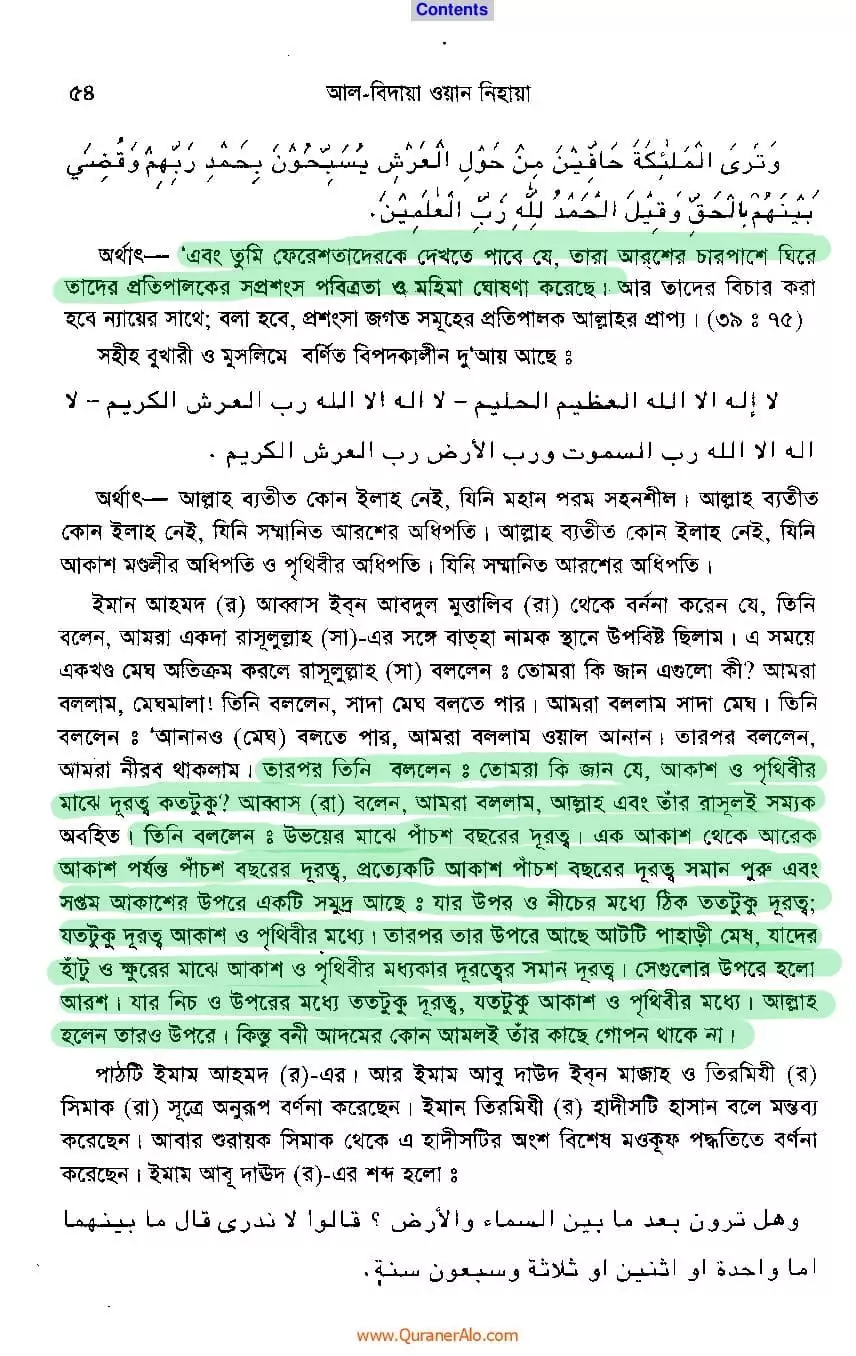
The use of these descriptions regarding distance in later aqidah texts, such as Salih al-Fawzan’s Sharh al-Aqidah al-Wasitiyyah, shows that the cosmological picture did not remain confined to old collections. it has reached new readers within religious education. The language of measurement makes the story sound specific and authoritative: how far the heaven is, how far another heaven is above it, how deep the sea is, and where the Throne is. But when distance is expressed in years, modern distance cannot be determined without a value for speed. To use the time of a journey as a fixed length, both the method of travel and the speed must be known. [508]
Bengali text:
প্রশ্নঃ (৬৬) আল্লাহ তা’আলা উপরে আছেন- হাদীছ থেকে এ কথার দলীল দিন
উত্তরঃ আল্লাহ্ তাআলা উপরে আছেন-হাদীছ শরীফে এ ব্যাপারে অগণিত দলীল রয়েছে।
(১) আওআলের হাদীছে নবী সাল্লাল্লাহু আলাইহি ওয়া সাল্লাম বলেনঃ
والعرش فوق ذلك والله فوق العرش وَهُوَ يَعْلَمُ مَا أَنتُمْ عَلَيْهِ)
“তার উপর আল্লাহর আরশ। আর আল্লাহ্ আরশের উপরে। তিনি তোমাদের অবস্থা সম্পর্কে অবগত আছেন”।’
আওআলের হাদীছের বিস্তারিত বিবরণ এই যে, আব্বাস বিন আব্দুল মুত্তালিব (রাঃ) বলেনঃ আমরা একদা নবী সাল্লাল্লাহু আলাইহি ওয়া সাল্লামের সাথে খোলা ময়দানে বসা ছিলাম। তখন আমাদের মাথার উপর দিয়ে একটি মেঘখন্ড অতিক্রম করার সময় তিনি বললেনঃ তোমরা কি জান এটি কী? আমরা বললামঃ এটি একটি মেঘের খন্ড। অতঃপর তিনি বললেনঃ তোমরা কি জান আকাশ ও পৃথিবীর মাঝখানের দূরত্ব কতটুকু? আমরা বললামঃ আল্লাহ্ ও তাঁর রাসূলই ভাল জানেন। তিনি বললেনঃ উভয়ের মধ্যে রয়েছে পাঁচশত বছরের দূরত্ব। এমনি প্রত্যেক আকাশ ও তার পরবর্তী আকাশের মধ্যবর্তী দূরত্ব হচ্ছে পাঁচশত বছরের পথ। এভাবে সপ্তম আকাশের উপর রয়েছে একটি সাগর। সাগরের গভীরতা হচ্ছে আকাশ ও যমীনের মধ্যবর্তী দূরত্বের সমান। সাগরের উপরে রয়েছে আটটি জংলী পাঠা। তাদের হাঁটু থেকে পায়ের খুর পর্যন্ত দূরত্ব আকাশ ও যমীনের মধ্যবর্তী দূরত্বের সমান। তারা আল্লাহর আরশ পিঠে বহন করে আছে। আরশ এত বিশাল যে, তার উপরের অংশ থেকে নীচের
1- তিরমিজী, অধ্যায়ঃ কিতাবুত তাফসীর, মুসনাদে আহমাদ, (১/২০৬)। আলেমগণ হাদীছটি সহীহ ও যঈফ হওয়ার ব্যাপারে মতভেদ করেছেন। ইমাম ইবনে তাইমীয়া এবং তাঁর ছাত্র ইবনুল কাইয়্যেম হাদীছটি সহীহ বলেছেন। ইমাম তিরমিজী বলেনঃ হাদীছটি হাসান গরীব। ইমাম আলবানী হাদীছটিকে যঈফ বলেছেন। দেখুনঃ সিলসিলায়ে যঈফা, হাদীছ নং- ১২৪৭।
English translation:
Question: (66) Allah Ta’ala is above- please provide evidence for this from the hadith
Answer: Allah Ta’ala is above- there are countless evidences regarding this in the hadith sharif.
(1) In the hadith of Awal, the Prophet (saw) says:
والعرش فوق ذلك والله فوق العرش وَهُوَ يَعْلَمُ مَا أَنتُمْ عَلَيْهِ)
“Above it is the Throne of Allah. and Allah is above the Throne. He is aware of your condition”.’
The detailed account of the hadith of Awal is that Abbas bin Abd al-Muttalib (ra) says: we were once sitting with the Prophet (saw) in an open field. when a piece of cloud passed over our heads, he said: Do you know what this is? We said: it is a piece of cloud. then he said: Do you know what the distance between the heaven and the earth is? We said: Allah and His Messenger know best. He said: there is a distance of five hundred years between the two. similarly, the distance between each heaven and the next heaven is a path of five hundred years. in this way, there is a sea above the seventh heaven. the depth of the sea is equal to the distance between the heaven and the earth. above the sea are eight wild rams. the distance from their knees to their hooves is equal to the distance between the heaven and the earth. they carry the Throne of Allah on their backs. the Throne is so vast that from its upper part to the lower
1-Tirmidhi, Chapter: Kitab al-Tafsir, Musnad Ahmad, (1/206). Scholars have differed on whether the hadith is sahih or da’if. Imam Ibn Taymiyyah and his student Ibn al-Qayyim have said the hadith is sahih. Imam Tirmidhi says: the hadith is hasan gharib. Imam Albani has called the hadith da’if. See: Silsila al-Da’ifa, Hadith No- 1247.

In the complete account preserved in Abu Dawud in the name of Abbas, there is a sequential ascent from the cloud to the heaven, the sea, the eight carriers, and the Throne. [509]
عن العباس بن عبد المطلب قال: كنت في البطحاء في عصابة فيهم رسول الله صلى الله عليه وسلم فمرت بهم سحابة فنظر إليها فقال: ما تسمون هذه؟ قالوا: السحاب. قال: والمزن؟ قالوا: والمزن. قال: والعنان؟ قالوا: والعنان. قال أبو داود: لم أتقن العنان جيدا. قال: هل تدرون ما بعد ما بين السماء والأرض؟ قالوا: لا ندري. قال: إن بعد ما بينهما إما واحدة أو اثنتان أو ثلاث وسبعون سنة، ثم السماء فوقها كذلك، حتى عد سبع سموات، ثم فوق السابعة بحر بين أسفله وأعلاه مثل ما بين سماء إلى سماء، ثم فوق ذلك ثمانية أوعال بين أظلافهم وركبهم مثل ما بين سماء إلى سماء، ثم على ظهورهم العرش بين أسفله وأعلاه مثل ما بين سماء إلى سماء، ثم الله تبارك وتعالى فوق ذلك.
English translation:
Abbas ibn Abd al-Muttalib says: I was with a group in Batha; the Messenger was among them. A cloud passed over them. He looked at it and said: What do you call this? They said: sahab. He said: muzn as well? They said: muzn as well. He said: anan as well? They said: anan as well. Abu Dawud says: I have not preserved the word anan well. He said: Do you know the distance between the heaven and the earth? They said: we do not know. He says: the gap between them is seventy, seventy-two, or seventy-three years. the heaven above it is the same. in this way he counts seven heavens. then above the seventh is a sea, the gap from its bottom to top is equal to the gap from one heaven to another. above it are eight mountain-goat-like carriers; the gap from their hooves to knees is also equal to the gap between two heavens. on their backs is the Throne, the gap from its bottom to top is also equal to the gap between two heavens. then above that is Allah.
In this map, every step of measurement is similar to the previous one. The gap in the heavens, the depth of the sea, the body of the carrier, and the height of the throne are tied to the same proportion. Grandeur has been created by piling larger things upon larger things known to humans. There is no observational source for where the measurement was taken, or by what instrument the depth of the sea or the distance to the carrier’s knee was known. The detail of a claim and its truth are not the same thing. Adding measurements to a story does not make those measurements data of the actual space.
In the account of five hundred years, there are similar gaps between the lower earths as well as the upper heavens. In Tirmidhi’s complete account, the compiler has also preserved the explanation of the seemingly problematic final sentence. [510]
عن الحسن عن أبي هريرة قال: بينما نبي الله صلى الله عليه وسلم جالس وأصحابه إذ أتى عليهم سحاب فقال نبي الله صلى الله عليه وسلم: هل تدرون ما هذا؟ فقالوا: الله ورسوله أعلم. قال: هذا العنان، هذه روايا الأرض يسوقه الله تبارك وتعالى إلى قوم لا يشكرونه ولا يدعونه. ثم قال: هل تدرون ما فوقكم؟ قالوا: الله ورسوله أعلم. قال: فإنها الرقيع سقف محفوظ وموج مكفوف. ثم قال: هل تدرون كم بينكم وبينها؟ قالوا: الله ورسوله أعلم. قال: بينكم وبينها مسيرة خمسمائة سنة. ثم قال: هل تدرون ما فوق ذلك؟ قالوا: الله ورسوله أعلم. قال: فإن فوق ذلك سماءين وما بينهما مسيرة خمسمائة عام، حتى عد سبع سموات ما بين كل سماءين كما بين السماء والأرض. ثم قال: هل تدرون ما فوق ذلك؟ قالوا: الله ورسوله أعلم. قال: فإن فوق ذلك العرش وبينه وبين السماء بعد ما بين السماءين. ثم قال: هل تدرون ما الذي تحتكم؟ قالوا: الله ورسوله أعلم. قال: فإنها الأرض. ثم قال: هل تدرون ما الذي تحت ذلك؟ قالوا: الله ورسوله أعلم. قال: فإن تحتها الأرض الأخرى بينهما مسيرة خمسمائة سنة، حتى عد سبع أرضين بين كل أرضين مسيرة خمسمائة سنة. ثم قال: والذي نفس محمد بيده لو أنكم دليتم رجلا بحبل إلى الأرض السفلى لهبط على الله. ثم قرأ: هو الأول والآخر والظاهر والباطن وهو بكل شيء عليم. قال أبو عيسى: هذا حديث غريب من هذا الوجه. قال: ويروى عن أيوب ويونس بن عبيد وعلي بن زيد قالوا لم يسمع الحسن من أبي هريرة. وفسر بعض أهل العلم هذا الحديث فقالوا: إنما هبط على علم الله وقدرته وسلطانه. علم الله وقدرته وسلطانه في كل مكان وهو على العرش كما وصف في كتابه.
English translation:
Hasan Abu Hurairah narrates: The Prophet was sitting with his companions. then a cloud came over them. He said: Do you know what this is? They said: Allah and His Messenger know best. He says: this is anan; the cloud that supplies water to the earth. Allah drives it toward those people who do not express gratitude to Him and do not call upon Him. then he says: Do you know what is above you? They said: Allah and His Messenger know best. He says: that is the heaven, a preserved roof and a restrained wave. then he says: Do you know the gap between you and it? They said: Allah and His Messenger know best. He says: there is a path of five hundred years between you and it. then he says: Do you know what is above it? They said: Allah and His Messenger know best. He says: above it are two heavens; there is a path of five hundred years between them. in this way he counts seven heavens; the gap between every two heavens is like the gap between the heaven and the earth. then he says: Do you know what is above it? They said: Allah and His Messenger know best. He says: above it is the Throne; the gap between it and the heaven is like the gap between two heavens. then he says: Do you know what is below you? They said: Allah and His Messenger know best. He says: the earth. then he says: Do you know what is below it? They said: Allah and His Messenger know best. He says: below it is another earth, there is a path of five hundred years between them. in this way he counts seven earths; there is a path of five hundred years between every two earths. then he says: By Him in whose hand is the life of Muhammad! If you lowered any person with a rope to the lowest earth, he would descend upon Allah. then he recites: He is the First, the Last, the Manifest and the Hidden; He knows everything. Abu Isa says: the hadith is gharib through this chain. It has been narrated from Ayyub, Yunus ibn Ubayd, and Ali ibn Zayd that they did not hear from Hasan Abu Hurairah. Some scholars have explained this as: he will descend within the knowledge, power, and authority of Allah. Allah’s knowledge, power, and authority are everywhere, and He is above the Throne as He has stated in His Book.
Lowering with a rope, an upper roof, gaps between layers, and a throne above the horizon—altogether, this is a macrocosm constructed in the language of human terrestrial travel and architecture. The final explanation quoted by the compiler preserves the meaning of the sentence regarding divine location; it provides no measurement to establish the reality of a five-hundred-year gap or multi-layered heavens. The method of managing the meaning of a sentence within faith and the method of verifying the truth of a description by measuring external nature are distinct. No evidence of this mythical pile is found in spacecraft, astronomical distances, or observations of the earth’s interior.
The moon has light
In the Bible, the sun and moon are called two great lights, and in the Quran, the moon is called nur or luminous. The visible light of the moon has been used as a religious sign and a means of timekeeping. In reality, the moonlight seen on earth is a reflection of sunlight. The word “luminous” describes a visible characteristic; the process of the origin of light is not determined within it. The problem becomes clearer in that tafsir where it is said that the moon was previously as bright as the sun and later black spots appeared as its light was erased. There, a divine past-narrative has been placed as the cause for the geological characteristics of the visible moon. [511] [512]
16 Then God two great lights made. God made the larger one to rule the day and the smaller one to rule the night. God also created the stars.
In Yunus 10:5, there is diya for the sun and nur for the moon; in Furqan 25:61, a lamp and a luminous moon; and in Nuh 71:16, the language of the moon’s light and the sun’s lamp. These words describe the visible radiance and role of light; no explanation is given as to the process by which light comes from the surface of the moon. In Qiyamah 75:8, the event of the moon losing its light is made part of the end times. Consequently, it is wrong to turn this use of language into a secret terminology of modern physics of light. Detailed theories of reflection or the production of its own light do not emerge from religious poetry. [513] [514] [515] [516] [517] [518] [519] [520]
He made the sun radiant, and the moon luminous, and determined its stations (of increase and decrease) accurately so that you may count the years (and keep track of) time. Allah did not create this in vain; He describes the signs in detail for a community of the knowledgeable.
— Taisirul Quran
Allah is He who made the sun brilliant and the moon luminous, and determined stations for its (motion) so that you may know the number and calculation of the years; Allah did not create these things in vain, He has described these proofs in detail for those who are knowledgeable.
— Sheikh Mujibur Rahman
He made the sun brilliant and the moon luminous, and determined various stations for it, so that you may know the counting of the years and the calculation (of) time. Allah has certainly created these appropriately. For the knowledgeable community, He describes the verses in detail.
— Rawai Al-bayan
He made the sun brilliant and the moon luminous, and specified stations for it so that you may know the counting of years and the calculation of time. Allah has created these in an appropriate manner [1]. He describes these signs in detail for such a community as those who know.
— Dr. Abu Bakr Muhammad Zakaria
How benevolent is He who gathered the constellations in the sky and placed therein a lamp and a radiating moon.
— Taisirul Quran
How great is He who created the stars in the firmament and placed therein a lamp and a luminous moon!
— Sheikh Mujibur Rahman
Blessed is the Being who created the massive planets in the sky., and therein created a lamp and a radiating moon.
— Rawai Al-bayan
How blessed is He who created the vast constellations in the firmament and placed therein a lamp [1] and a radiating moon.
— Dr. Abu Bakr Muhammad Zakaria
And among them He made the moon as light and the sun as a lamp.
— Taisirul Quran
And there He placed the moon as light and the sun as a lamp;
— Sheikh Mujibur Rahman
And among these He created the moon as light and the sun as a lamp.
— Rawai Al-bayan
And there He placed the moon as light and the sun as a lamp;
— Dr. Abu Bakr Muhammad Zakaria
Bengali text:
চাঁদ হয়ে যাবে আলোকহীন
— Taisirul Quran
এবং চন্দ্র হয়ে পড়বে জ্যোতিহীন।
— Sheikh Mujibur Rahman
আর চাঁদ কিরণহীন হবে,
— Rawai Al-bayan
এবং চাঁদ হয়ে পড়বে কিরণহীন [১],
— Dr. Abu Bakr Muhammad Zakaria
English translation:
The moon will become lightless
— Taisirul Quran
And the moon will become lusterless.
— Sheikh Mujibur Rahman
And the moon will be radiance-less
— Rawai Al-bayan
And the moon will become radiance-less [1],
— Dr. Abu Bakr Muhammad Zakaria
On this page of the Bengali version of Jalalayn, the moon becoming lightless is mentioned. On the page of Mareful Quran, its light vanishing is explained as a sign of Qiyamah. These sentences are descriptions of a future destruction; not an examination of the process of creating light on the surface of the moon. The nature of the story in old tafsir regarding the erasing of light for the current black portions of the moon is more specific: the color of the actual surface is called a visible sign of a divine act. [521] [522] [523]
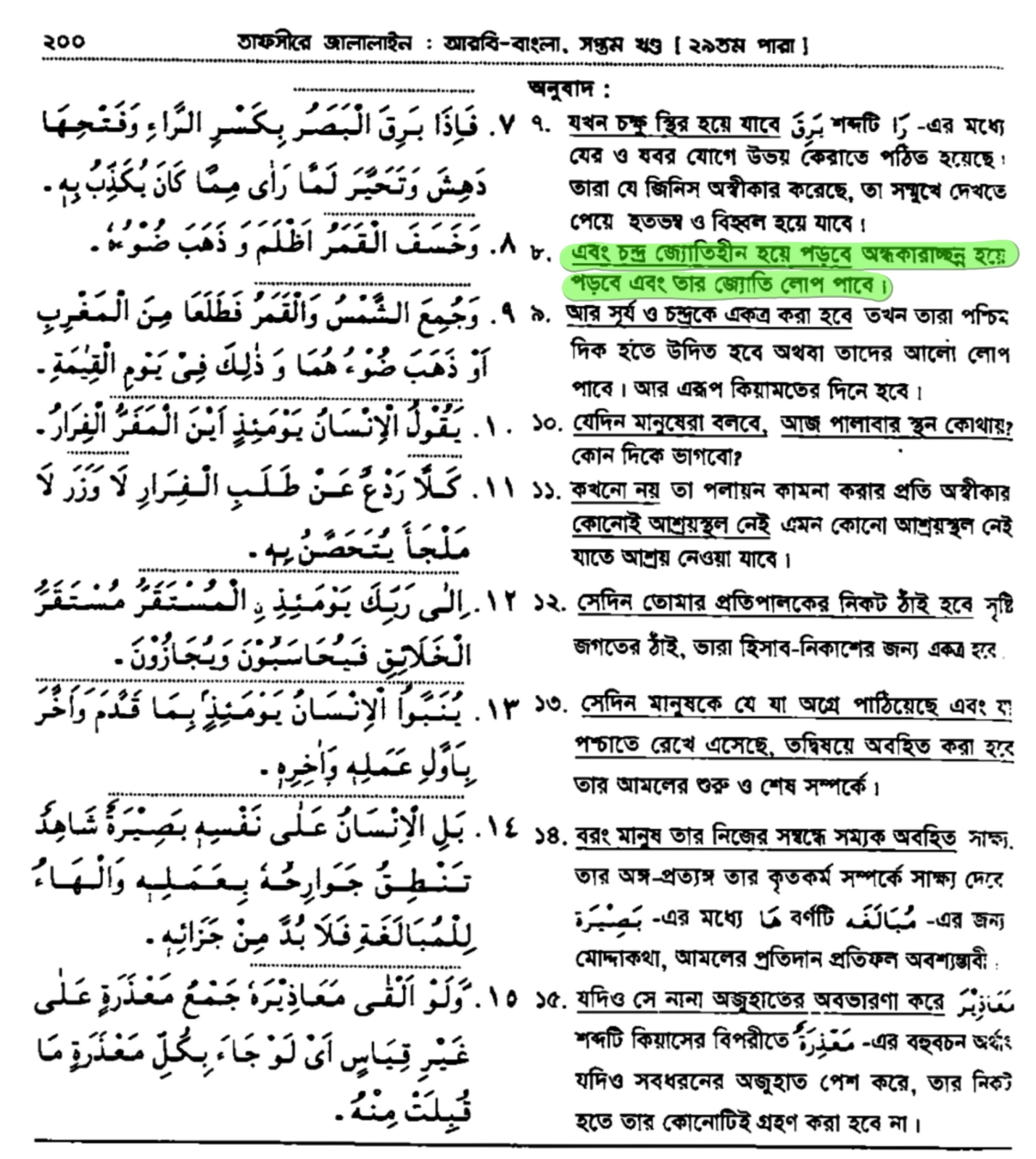
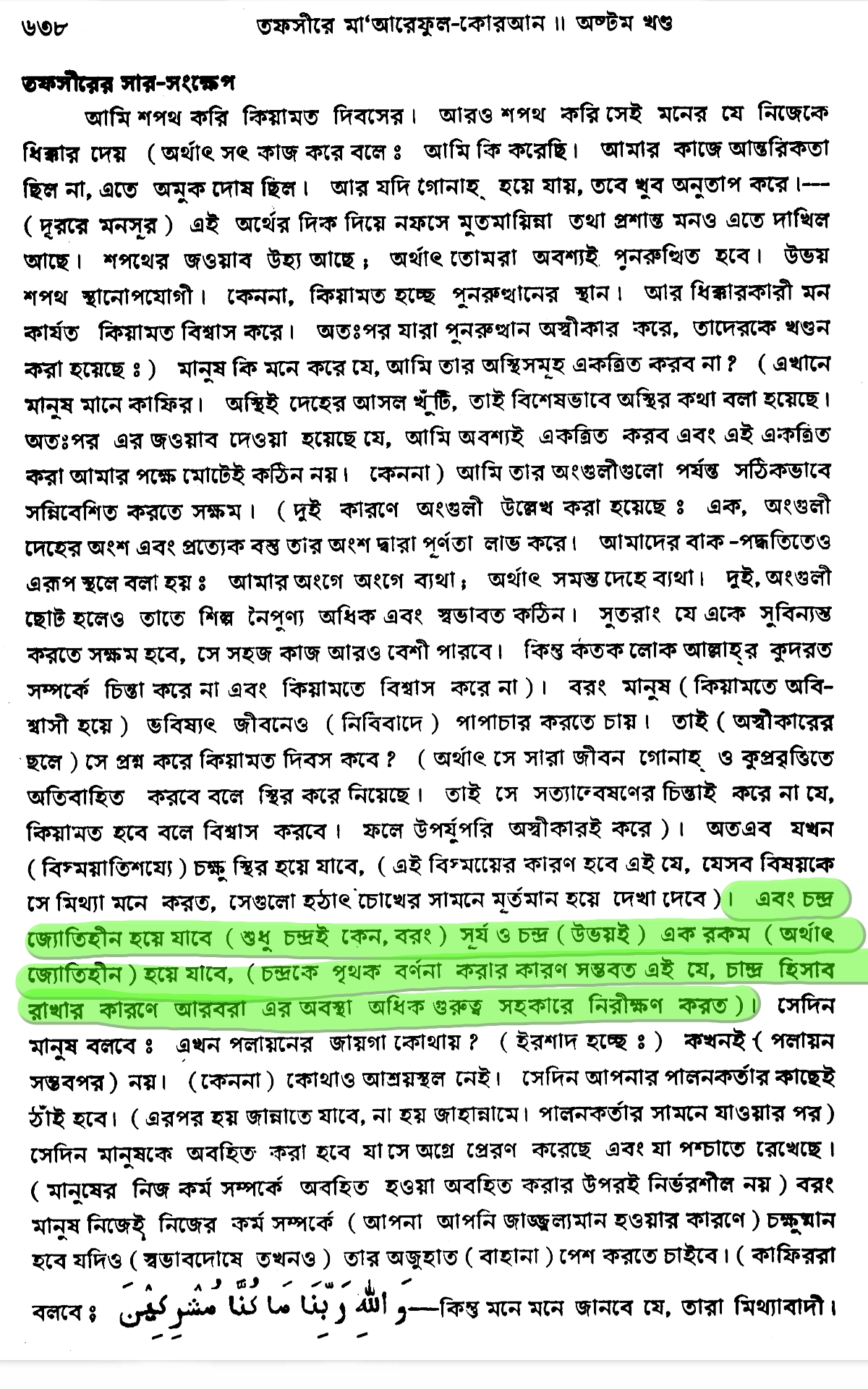
In this section of Bukhari, along with the chapter title, there are the word-meanings of various exegetes and at the end, a hadith of Abu Hurairah. Statements regarding the orbits of the sun and moon, their radiance, and their folding up at Qiyamah appear side by side. Where one’s explanation ends and the narration in the name of the Prophet begins is distinguished by this arrangement. Discussion about the visible radiance of multiple luminous bodies does not lead to the conclusion that energy like that of the sun is produced inside the moon. Religious texts contain mentions of visible light and future disappearance; beyond that, actual observation is required to determine the structure and light process of the moon. [524] [525]
Sahih Bukhari (IF)
Chapter: 49/ Beginning of Creation
Section: 1986. Both the moon and the sun revolve in determined orbits. Regarding this, Mujahid (rh) says, the revolution of both is similar to the revolution of a wheel. And others say, both are controlled by such a specific calculation and place which they, meaning the moon and sun, cannot violate. حُسْبَانٌ is the plural of the word حِسَابٍ, just as the plural of شِهَابٍ is شُهْبَانٍ – ضُحَاهَا means radiance. أَنْ تُدْرِكَ الْقَمَرَ The radiance of one of the moon or sun cannot cover the other, and it is not possible for them.. سَابِقُ النَّهَارِ Night quickly overtakes the day. both wish to overtake quickly. نَسْلَخُ I bring one of them out from the other and each of them is driven وَاهِيَةٌ and وَهْيُهَا means its splitting. أَرْجَائِهَا That part of it which has not split and they will be on both its sides., like your saying عَلَى أَرْجَاءِ الْبِئْرِ at the edge of the well أَغْطَشَ وَجَنَّ darkness spread. Hasan Basri says كُوِّرَتْ it means it will be wrapped, so that its radiance will be exhausted. And it is said وَاللَّيْلِ وَمَا وَسَقَ it means and I swear by the night and that which it gathered. اتَّسَقَ was equal. بُرُوجًا The orbit and determined place of the moon and sun. الْحَرُورُ Hot wind that flows with the sun during the day. Ibn Abbas (ra) says, حَرُورُ the night-time and سَمُومُ the day-time hot wind is called . يُولِجُ means enters or will enter وَلِيجَةً means every object that you have inserted into another.
2973. Musaddad (rh) … on the authority of Abu Hurairah (ra) narrated from the Prophet sallallahu alayhi wasallam, he said, on the Day of Qiyamah both the moon and the sun will be wrapped up.
In Tabari’s compilation, there is a statement in the name of Ibn Abbas that the moon was previously luminous like the sun and its black portions are the result of the erasing of light. [526]
حدثنا القاسم، قال: ثنا الحسين، قال: ثني حجاج، عن ابن جريج، قال: قال ابن عباس: كان القمر يضيء كما تضيء الشمس، والقمر آية الليل، والشمس آية النهار، فمحونا آية الليل: السواد الذي في القمر.
English translation:
Qasim narrates, Husayn told him, from Hajjaj ibn Jurayj who said: Ibn Abbas said, the moon used to give light like the sun. The moon is the sign of the night and the sun is the sign of the day. “We have erased the sign of the night”—this means the black portions within the moon.
If the black regions of the moon are made a sign of the erasing of light, its visible surface becomes a monument to a religious event. In reality, many of the large dark regions of the moon are basalt plains formed by the accumulation of ancient volcanic lava. They reflect less light compared to the bright highlands. To show darkness, it is not necessary for it to have been as bright as the sun previously and then for light to be erased divinely. The difference can be explained by the nature of the rock, the surface structure, and the reflectivity. The religious story has placed a supernatural cause over that physical characteristic. [527]
The phases or periodic shape-change of the moon is also the result of the geometry of seeing its illuminated part. The sun illuminates nearly half of the moon; how much of that part is visible from Earth changes with the orbital position. The moon’s light does not be born and extinguish itself every time. If any poetic word is called an advance discovery of reflection, a clear description of this relationship is required in its favor. In religious texts, there is a difference in the radiance of words, but there is no description of this geometric process. Inserting that discovery into old words after the subsequent discovery is reversing the source of knowledge. [528]
In this example, the difference between ancient metaphors, subsequent tafsir, and the explanation of nature is directly seen. The sun and moon are two lights in the sky—this visual experience easily became a religious symbol. Then, the story of divine erasing of light was added for the black spots of the moon. Modern observation links those spots to the history of the rock. Consequently, the sanctity of religious language is not a guarantee of the accuracy of its explanation. The actual moon does not operate under the claims of religious stories; misconceptions about its surface and light are corrected through research.
Stories of death, the afterlife, and the apocalypse
Jewish narratives and the recognition of the punishment of the grave
Declaration of revelation after the statement of the Jewish woman
A specific path for the arrival of information from neighboring religious communities regarding the concept of testing and punishment inside the grave is preserved within Islamic narratives themselves. In Sahih Muslim, in the account of Aisha, first a Jewish woman tells the Muslims about the testing in the grave. Muhammad, becoming alarmed, states that the test is only for the Jews. After a few nights, he declares that Muslims will also be tested in the grave—revelation has come to this effect. Following this, there is the mention of seeking refuge from the punishment of the grave. In this sequence, four steps are clearly present: the statement heard from a person’s mouth, the first reaction, the time interval, and the subsequent claim of revelation. [529]
Arabic original:
حَدَّثَنَا هَارُونُ بْنُ سَعِيدٍ، وَحَرْمَلَةُ بْنُ يَحْيَى، قَالَ هَارُونُ حَدَّثَنَا وَقَالَ حَرْمَلَةُ أَخْبَرَنَا ابْنُ وَهْبٍ، أَخْبَرَنِي يُونُسُ بْنُ يَزِيدَ، عَنِ ابْنِ شِهَابٍ، قَالَ حَدَّثَنِي عُرْوَةُ بْنُ الزُّبَيْرِ، أَنَّ عَائِشَةَ، قَالَتْ دَخَلَ عَلَىَّ رَسُولُ اللَّهِ صلى الله عليه وسلم وَعِنْدِي امْرَأَةٌ مِنَ الْيَهُودِ وَهْىَ تَقُولُ هَلْ شَعَرْتِ أَنَّكُمْ تُفْتَنُونَ فِي الْقُبُورِ قَالَتْ فَارْتَاعَ رَسُولُ اللَّهِ صلى الله عليه وسلم وَقَالَ ” إِنَّمَا تُفْتَنُ يَهُودُ ” . قَالَتْ عَائِشَةُ فَلَبِثْنَا لَيَالِيَ ثُمَّ قَالَ رَسُولُ اللَّهِ صلى الله عليه وسلم ” هَلْ شَعَرْتِ أَنَّهُ أُوحِيَ إِلَىَّ أَنَّكُمْ تُفْتَنُونَ فِي الْقُبُورِ ” . قَالَتْ عَائِشَةُ فَسَمِعْتُ رَسُولَ اللَّهِ صلى الله عليه وسلم بَعْدُ يَسْتَعِيذُ مِنْ عَذَابِ الْقَبْرِ .
English translation:
Harun ibn Sa’id and Harmala ibn Yahya narrated to us. Harun said, Ibn Wahb narrated to us; Harmala said, he informed us. Ibn Wahb said, Yunus ibn Yazid informed me, from Ibn Shihab. Ibn Shihab said, Urwa ibn Zubayr informed me that Aisha said: The Messenger of Allah came to me. at that time a Jewish woman was with me. she was saying, “Do you know, you will be tested in your graves?” Aisha said, the Messenger of Allah became alarmed and said, “Only the Jews are tested.” Aisha said, then a few nights passed for us. then the Messenger of Allah said, “Do you know, revelation has come to me that you will be tested in your graves?” Aisha said, after that I heard the Messenger of Allah seeking refuge from the punishment of the grave.
The subject of the Jewish woman’s statement “you will be tested in your graves” and Muhammad’s subsequent “revelation has come that you will be tested in your graves” is the same. First, he limits the scope of the test to the Jews; later, he includes his own followers in it. Consequently, in this narration, the general propagation of the belief and the imposition of the Prophet’s approval upon it are seen as separate moments. That which a woman from another community had claimed earlier gains religious authority a few nights later through the declaration of revelation. Religious language has changed the status of that information; the sequence in which the information came through human mouths, as given in the hadith, remains intact. This sequence of events preserves a history of human communication regarding the test of the grave within Islam itself.
Verification of the words of two elderly Jewish women
In another narration of Bukhari, two elderly Jewish women of Medina tell Aisha that the inhabitants of the grave are punished. Aisha rejects their statement. When the matter is reported to Muhammad, he says they have spoken the truth; he adds that all animals can hear that punishment. Afterwards, Aisha sees him seeking refuge from the punishment of the grave in prayer. Here, the matter is the punishment of the grave, and a description is found of it becoming part of daily prayer after accepting the statements of the Jewish women as true. [530]
Arabic original:
حَدَّثَنَا عُثْمَانُ بْنُ أَبِي شَيْبَةَ، حَدَّثَنَا جَرِيرٌ، عَنْ مَنْصُورٍ، عَنْ أَبِي وَائِلٍ، عَنْ مَسْرُوقٍ، عَنْ عَائِشَةَ، قَالَتْ دَخَلَتْ عَلَىَّ عَجُوزَانِ مِنْ عُجُزِ يَهُودِ الْمَدِينَةِ فَقَالَتَا لِي إِنَّ أَهْلَ الْقُبُورِ يُعَذَّبُونَ فِي قُبُورِهِمْ، فَكَذَّبْتُهُمَا، وَلَمْ أُنْعِمْ أَنْ أُصَدِّقَهُمَا، فَخَرَجَتَا وَدَخَلَ عَلَىَّ النَّبِيُّ صلى الله عليه وسلم فَقُلْتُ لَهُ يَا رَسُولَ اللَّهِ إِنَّ عَجُوزَيْنِ وَذَكَرْتُ لَهُ، فَقَالَ ” صَدَقَتَا، إِنَّهُمْ يُعَذَّبُونَ عَذَابًا تَسْمَعُهُ الْبَهَائِمُ كُلُّهَا ”. فَمَا رَأَيْتُهُ بَعْدُ فِي صَلاَةٍ إِلاَّ تَعَوَّذَ مِنْ عَذَابِ الْقَبْرِ.
English translation:
Usman ibn Abi Shayba narrated to us; Jarir narrated to us, from Mansur, he from Abu Wa’il, he from Masruq, he from Aisha. Aisha said: Two elderly women from among the Jewish elderly of Medina came to me. They said to me, “The inhabitants of the graves are punished in their respective graves.” I called them liars and my heart did not incline to believe their words. They left. Then the Prophet came to me. I said, “O Messenger of Allah, two elderly women came”—and I informed him of their words. He said, “Those two have spoken the truth. they are given such punishment that all animals hear it.” After that, whenever I saw him in prayer, I saw him seeking refuge from the punishment of the grave.
In this version, Aisha’s disbelief is particularly significant. To her, the words of the elderly women were not self-evident religious knowledge; she called them liars. Later, Muhammad’s verification makes the same statement acceptable. The new element added in favor of the statement is another miraculous claim of animals hearing. Both the hearing by animals and the informing of its meaning to humans are being guaranteed by the Prophet’s statement. The method of verifying whether any animal has heard the punishment of the grave inhabitant is not in the description. Consequently, another unverifiable hearing claim has been placed in favor of the claim of invisible punishment. Thus, religious authority approves the claim, and the declaration of that authority occupies the place of its proof.
The sequence of events and the establishment of belief in Nawawi’s explanation
In Nawawi’s explanation of Muslim, the descriptions of one Jewish woman and two elderly women are arranged as two events. In his explanation, the matter is informed through revelation after the first event; in the second event, Aisha rejects the words of the elderly women because she did not know the news of that revelation. Later, Muhammad informs her. This synthesis is the statement of the exegete; he has filled the sequence of events between the two readings of the hadith in this way. In his full paragraph, the sequence of the first encounter with humans, then the news of revelation, and Aisha’s subsequent awareness are together. [531]
Arabic original:
قوله : ( عن عائشة – رضي الله عنها – أن يهودية قالت : هل شعرت أنكم تفتنون في القبور؟ فارتاع رسول الله – صلى الله عليه وسلم – ، وقال : إنما تفتن يهود ، فلبثنا ليالي ثم قال رسول الله – صلى الله عليه وسلم – هل شعرت أنه أوحي إلي أنكم تفتنون في القبور ) ، وفي الرواية الأخرى : ( دخلت عجوزان من عجز يهود المدينة ) وذكرت أن النبي – صلى الله عليه وسلم – صدقهما ، هذا محمول على أنهما قضيتان فجرت القضية الأولى ، ثم أعلم النبي – صلى الله عليه وسلم – بذلك ، ثم جاءت العجوزان بعد ليال فكذبتهما عائشة رضي الله عنها ، ولم تكن علمت نزول الوحي بإثبات عذاب القبر ، فدخل عليها النبي – صلى الله عليه وسلم – فأخبرته بقول العجوزين ، فقال صدقتا ، وأعلم عائشة – رضي الله عنها – بأنه كان قد نزل الوحي بإثباته ، وقولها : لم أنعم أن أصدقهما ، أي لم تطب نفسي أن أصدقهما ، ومنه قولهم في التصديق : ( أنعم ) وهو بضم الهمزة وإسكان النون وكسر العين .
English translation:
His statement: “Narrated from Aisha, a Jewish woman said, ‘Do you know, you will be tested in your graves?’ At this, the Messenger of Allah became alarmed and said, ‘Only the Jews are tested.’ Then a few nights passed. Then the Messenger of Allah said, ‘Do you know, revelation has come to me that you will be tested in your graves?'” In another narration it is, “Two elderly women from among the Jewish elderly of Medina came”; and he mentioned that the Prophet called those two truthful. The explanation of this is that these are two events. The first event occurred; then the Prophet was informed of the matter. Then a few nights later the two elderly women came and Aisha called them liars; because she did not yet know that revelation had descended establishing the punishment of the grave. Then the Prophet came to her. Aisha informed him of the two elderly women’s words. He said, “Those two have spoken the truth”; and informed Aisha that revelation had already descended establishing the matter. Aisha’s words “my heart did not incline to believe them”—means, my heart was not prepared to believe their words. The word “unaim” used in the case of verification also comes in this sense. The word will have a damma on the hamza, a sukun on the nun, and a kasra on the ayn.
In Nawawi’s synthesis, the sequence of the first conversation with the Jewish woman and the subsequent declaration of revelation is acknowledged. His additional explanation primarily determines when Aisha learned of the matter. The link between the statements of the Jewish women and the approval of the belief in Muslim society remains intact even in the classical explanation. The same idea moves from the discussion of one community to another and gains the status of aqidah with the Prophet’s approval. In this sequence of narration, a social path of information crossing religious boundaries is found. If the claim of being approved in the name of revelation is used as independent proof of its divine truth, this relationship between the statement heard from human mouths and the subsequent religious declaration becomes hidden.
The social result of this belief is also clear. After death, the human body is placed in the grave; the doctrine of the punishment of the grave turns that burial into an invisible prison of testing and torture. The fear of death then continues even after burial, and the plea to be saved from it finds a place in daily salat. The fear of punishment that came from the words of the Jewish women in the narration takes a permanent position in the Muslim’s prayer and thoughts of the afterlife through the Prophet’s approval. Instead of verifying the truth of the fear, the plea for protection from that fear is made into a religious habit. The power of religious discipline thus extends beyond the boundaries of living humans’ actions to their imagined state after death. For details on the related hadith, the claim of animals hearing, and subsequent grave stories: Wonder at hearing the punishment of the grave: folklore heard from the mouth of a Jewish woman.
Iranian Chinvat and Islamic Sirat: The old history of the bridge of judgment in the afterlife
The story of reaching the destination of salvation by crossing a dangerous bridge after death existed in the Iranian religious tradition long before Islam. On the Zoroastrian Chinvat bridge, the earthly life of the deceased determines the fate of the afterlife; the crossing is easy for the righteous soul, and hell awaits the wicked soul. In the Islamic Sirat as well, human deeds determine the speed and outcome of the crossing. Some cross quickly, some are mangled, some fall into fire. This imagination of transforming moral judgment into a scene of crossing a dangerous path has a clear previous history.
The Chinvat bridge and the destination of the deceased in the Avesta
In the Vendidad of the Avesta, Zarathustra asks Ahura Mazda where the reward for what a person has done in life is received. In response, the sequence of death, the journey of the soul, the Chinvat bridge, and reaching heaven is described. It is mentioned that both the righteous and the wicked enter the same path. The presence of a beautiful helper, the guard dog of the bridge, and the divine beings of heaven are also part of this geography of the afterlife. The bridge here creates a connection between the reward for earthly deeds and the position after death. In the English translation published by James Darmesteter, the full text of the Vendidad 19:27–32 is: [532]
27. O Maker of the material world, thou Holy One! Where are the rewards given? Where does the rewarding take place? Where is the rewarding fulfilled? Whereto do men come to take the reward that, during their life in the material world, they have won for their souls?
28. Ahura Mazda answered: ‘When the man is dead, when his time is over, then the wicked, evil-doing Daevas cut off his eyesight. On the third night, when the dawn appears and brightens up, when Mithra, the god with beautiful weapons, reaches the all-happy mountains, and the sun is rising:
29. ‘Then the fiend, named Vizaresha, O Spitama Zarathushtra, carries off in bonds the souls of the wicked Daeva-worshippers who live in sin. The soul enters the way made by Time, and open both to the wicked and to the righteous. At the head of the Chinwad bridge, the holy bridge made by Mazda, they ask for their spirits and souls the reward for the worldly goods which they gave away here below.
30. ‘Then comes the beautiful, well-shapen, strong and well-formed maid, with the dogs at her sides, one who can distinguish, who has many children, happy, and of high understanding. ‘She makes the soul of the righteous one go up above the Hara-berezaiti; above the Chinwad bridge she places it in the presence of the heavenly gods themselves.
31. ‘Up rises Vohu-mano from his golden seat; Vohu-mano exclaims: “How hast thou come to us, thou Holy One, from that decaying world into this undecaying one?”
32. ‘Gladly pass the souls of the righteous to the golden seat of Ahura Mazda, to the golden seat of the Amesha-Spentas, to the Garo-nmanem, the abode of Ahura Mazda, the abode of the Amesha-Spentas, the abode of all the other holy beings.
English translation:
27. O Creator of the material world, O Holy Being! Where is the reward given? Where does the act of giving reward occur? Where is that reward completed? Where does a person come to receive the reward they have earned for their soul while living in the material world?
28. Ahura Mazda answered: When a person dies, when their time ends, the evil and wicked Daevas sever their vision. On the third night, when dawn appears and becomes bright, when the beautiful weapon-bearing deity Mithra reaches the joyful mountains and the sun begins to rise:
29. O Spitama Zarathustra, then the demon named Vizarash takes away the souls of the evil Daeva-worshippers who spent their lives in sin, bound in chains. The soul enters a path made of time, which is open to both the wicked and the righteous. At the entrance of the holy Chinvat bridge created by Mazda, they ask for the reward for those earthly assets they gave in the lower world for their life and soul.
30. Then comes a beautiful, slender, strong and well-formed young woman; there are dogs on her two sides. She can determine the difference, she has many children, she is happy and wise. She lifts the soul of the righteous person above Hara-Berezaiti; she places them before the divine beings of heaven upon the Chinvat bridge.
31. Vohu-Manah rises from his golden throne and says: O holy soul, how did you come to this immortal world of ours from that perishable world?
32. The souls of the righteous go with joy to the golden throne of Ahura Mazda, the golden throne of the Amesha Spentas, and to Garo-Namnem—to the abode of Ahura Mazda, the abode of the Amesha Spentas, and the abodes of all other holy beings.
In this description, the journey of the afterlife is arranged according to the familiar patterns of human travel and royal courts. a person dies, their soul travels a path, demands a reward at the entrance, crosses a bridge with the help of an assistant, and reaches divine beings seated on golden thrones. judgment, journey, guards, and court—these elements of earthly life have constructed the architecture of the unseen world. a safe destination is shown as the reward for following religious injunctions, and a dangerous journey as the consequence of disobedience. to explain the judgment of human deeds, a story of an unseen bridge and its crossing has been constructed here.
A crossing that changes according to deeds
In the Middle Persian ‘Menog-i Khrad’, it is mentioned that the width of the Chinvat bridge increases for the righteous soul. one’s own good deeds appear before them in the form of a maiden and the Daena helps them cross. the moral state of the human is here transformed into the structure of the bridge and the ease of the journey. for the one who has done good, the path is wide; there is also supernatural assistance in their crossing. in E. W. West’s translation, the complete paragraph of 123–126 in the second chapter is: [533]
123. ‘And when a soul of the righteous passes upon that bridge, the width of the bridge becomes as it were a league (parasang), (124) and the righteous soul passes over with the cooperation of Srosh the righteous. 125. And his own deeds of a virtuous kind come to meet him in the form of a maiden, (126) who is handsomer and better than every maiden in the world.
English translation:
123. when the soul of the righteous person crosses that bridge, the width of the bridge becomes like a plain. 124. the righteous soul crosses the bridge with the help of the righteous Daena. 125. their own good deeds come to meet them in the form of a young woman; 126. who is more beautiful and better than all the young women of the world.
In Ahmad Tafazzoli’s research, the mention of Chinvat has been traced up to the Gathas’ Yasna 46:10–11 and 51:13 . he has also identified specific lines from the inscription of Kartir regarding the description of the razor-sharp bridge. Kartir was a third-century Sasanian priest; Philippe Gignoux’s research on his inscription of the vision of the afterlife also provides this time period. consequently, alongside ancient religious texts, there is also evidence from inscriptions in favor of the pre-Islamic presence of the concept of the bridge and the sharp crossing. in later Pahlavi writings, the description of the wide path for the righteous and the razor-sharp path for the wicked has become more detailed. [534] [535]
The judicial function of the bridge is important here. the experience of the same path changes according to the person’s previous deeds. what is wide and safe for the righteous soul is dangerous for the wicked soul. in this imagination, no new investigation of the moral state is occurring; the evaluation of the previous life is becoming effective as the result of the journey. the bridge is a dramatic instrument of punishment: the difference between salvation and punishment is shown through the scenes of slipping, narrowness, and falling below. in the Islamic Sirat as well, the result of deeds is expressed through the ease, speed, and fall of the crossing.
Scenes of deeds, hooks, and falling into fire in the hadith
In Sahih Muslim, in the description of the Sirat crossing, people first go to Adam, Abraham, Moses, and Jesus; finally, Muhammad is given permission. then trusts and kinship ties are made to stand on both sides of the Sirat. a person’s deeds carry them along; some move like lightning, some like wind or birds, and some crawl. designated hooks beside the bridge seize specific people. some are saved while being scratched, some are cast into the fire. the complete hadith is: [536]
حَدَّثَنَا مُحَمَّدُ بْنُ طَرِيفِ بْنِ خَلِيفَةَ الْبَجَلِيُّ، حَدَّثَنَا مُحَمَّدُ بْنُ فُضَيْلٍ، حَدَّثَنَا أَبُو مَالِكٍ الأَشْجَعِيُّ، عَنْ أَبِي حَازِمٍ، عَنْ أَبِي هُرَيْرَةَ، وَأَبُو مَالِكٍ عَنْ رِبْعِيٍّ، عَنْ حُذَيْفَةَ، قَالاَ قَالَ رَسُولُ اللَّهِ صلى الله عليه وسلم «يَجْمَعُ اللَّهُ تَبَارَكَ وَتَعَالَى النَّاسَ فَيَقُومُ الْمُؤْمِنُونَ حَتَّى تُزْلَفَ لَهُمُ الْجَنَّةُ فَيَأْتُونَ آدَمَ فَيَقُولُونَ يَا أَبَانَا اسْتَفْتِحْ لَنَا الْجَنَّةَ. فَيَقُولُ وَهَلْ أَخْرَجَكُمْ مِنَ الْجَنَّةِ إِلاَّ خَطِيئَةُ أَبِيكُمْ آدَمَ لَسْتُ بِصَاحِبِ ذَلِكَ اذْهَبُوا إِلَى ابْنِي إِبْرَاهِيمَ خَلِيلِ اللَّهِ – قَالَ – فَيَقُولُ إِبْرَاهِيمُ لَسْتُ بِصَاحِبِ ذَلِكَ إِنَّمَا كُنْتُ خَلِيلاً مِنْ وَرَاءَ وَرَاءَ اعْمِدُوا إِلَى مُوسَى صلى الله عليه وسلم الَّذِي كَلَّمَهُ اللَّهُ تَكْلِيمًا. فَيَأْتُونَ مُوسَى صلى الله عليه وسلم فَيَقُولُ لَسْتُ بِصَاحِبِ ذَلِكَ اذْهَبُوا إِلَى عِيسَى كَلِمَةِ اللَّهِ وَرُوحِهِ. فَيَقُولُ عِيسَى صلى الله عليه وسلم لَسْتُ بِصَاحِبِ ذَلِكَ. فَيَأْتُونَ مُحَمَّدًا صلى الله عليه وسلم فَيَقُومُ فَيُؤْذَنُ لَهُ وَتُرْسَلُ الأَمَانَةُ وَالرَّحِمُ فَتَقُومَانِ جَنَبَتَىِ الصِّرَاطِ يَمِينًا وَشِمَالاً فَيَمُرُّ أَوَّلُكُمْ كَالْبَرْقِ». قَالَ قُلْتُ بِأَبِي أَنْتَ وَأُمِّي أَىُّ شَىْءٍ كَمَرِّ الْبَرْقِ قَالَ «أَلَمْ تَرَوْا إِلَى الْبَرْقِ كَيْفَ يَمُرُّ وَيَرْجِعُ فِي طَرْفَةِ عَيْنٍ ثُمَّ كَمَرِّ الرِّيحِ ثُمَّ كَمَرِّ الطَّيْرِ وَشَدِّ الرِّجَالِ تَجْرِي بِهِمْ أَعْمَالُهُمْ وَنَبِيُّكُمْ قَائِمٌ عَلَى الصِّرَاطِ يَقُولُ رَبِّ سَلِّمْ سَلِّمْ حَتَّى تَعْجِزَ أَعْمَالُ الْعِبَادِ حَتَّى يَجِيءَ الرَّجُلُ فَلاَ يَسْتَطِيعُ السَّيْرَ إِلاَّ زَحْفًا – قَالَ – وَفِي حَافَتَىِ الصِّرَاطِ كَلاَلِيبُ مُعَلَّقَةٌ مَأْمُورَةٌ بِأَخْذِ مَنْ أُمِرَتْ بِهِ فَمَخْدُوشٌ نَاجٍ وَمَكْدُوسٌ فِي النَّارِ». وَالَّذِي نَفْسُ أَبِي هُرَيْرَةَ بِيَدِهِ إِنَّ قَعْرَ جَهَنَّمَ لَسَبْعُونَ خَرِيفًا.
English translation:
Muhammad ibn Tarif ibn Khalifa al-Bazali narrated to us. Muhammad ibn Fudayl narrated to us. Abu Malik al-Ashja’i narrated to us from Abu Hazim from Abu Hurayra, and from Abu Malik Rib’i from Hudhayfa. they both said: The Messenger of Allah, sallallahu alayhi wa sallam, said: Allah Tabaraka wa Ta’ala will gather the people. the believers will stand until Paradise is brought to them. they will go to Adam and say: O our father, open Paradise for us. he will say: The mistake of your father Adam is what took you out of Paradise. I am not the appropriate person for this task. go to my son Abraham, Allah’s intimate friend.
Abraham will say: I am not the appropriate person for this task. I received the honor of friendship from afar, from afar. go to Moses, with whom Allah spoke. they will go to Moses. he will say: I am not the appropriate person for this task. go to the Word of Allah and His Spirit, Jesus. Jesus will say: I am not the appropriate person for this task. then they will go to Muhammad, sallallahu alayhi wa sallam. he will stand and he will be given permission. trusts and kinship ties will be sent. they will stand on the right and left, on both sides of the Sirat. the first of you will cross like lightning.
the narrator said: I asked, may my father and mother be sacrificed for you, what is crossing like lightning? He said: Have you not seen how lightning disappears and returns in the blink of an eye? Then some will cross like the wind, some like birds, and some like the running of a human. their deeds will carry them. your Prophet will stand on the Sirat and keep saying: O my Lord, save them, save them. at one point, the deeds of the servants will be unable to carry them. then there will come a person who will be unable to move except by crawling. there will be hanging hooks on both sides of the Sirat; they will be commanded to seize whoever they are ordered to seize. some will be saved while being scratched and some will be cast into the fire.
By Him in whose hand is the soul of Abu Hurayra, it certainly takes seventy years to reach the bottom of Hell.
Like Chinvat, here too the result of deeds has turned into the experience of the crossing. in the Iranian story, the bridge becomes wide for good people; in the hadith, good deeds carry the person quickly. the journey of a person with weak deeds becomes slow and dangerous. the hooks are not working indiscriminately; the instruction on whom to seize is given beforehand. thus the fall is not an accident, but a scene of executing a predetermined punishment. in a system where it is already decided whom to seize, this painful journey on the bridge does not serve the need to discover a person’s merit. it makes the predetermined evaluation visible through terror, wounds, and falling into fire.
The arrangement of religious power in the description is also specific. previous Prophets do not acknowledge themselves as appropriate for this responsibility; finally, coming to Muhammad, people receive the news of permission. in the same story, he is standing on the Sirat praying for salvation. in this way, the special status of the Prophet of the new religion is established within the old journey of afterlife judgment. the description of Muhammad-centric salvation is added to the familiar structure of the bridge, the assistant, and the reward for deeds. moral qualities like trust and kinship ties also stand on both sides like characters here. the mythological method of making human behavior and relationships into visible entities of the afterlife is active in this description.
Thinner than a hair, sharper than a sword
In another narration of Sahih Muslim, the mention of the bridge being thinner than a hair and sharper than a sword is preserved in the language of Abu Sa’id’s ‘it has reached me’. the abnormal thinness and sharpness of the bridge are special elements of this description. the complete description, including the narration path and notes on textual variants in Muslim, is: [537]
قَالَ مُسْلِمٌ قَرَأْتُ عَلَى عِيسَى بْنِ حَمَّادٍ زُغْبَةَ الْمِصْرِيِّ هَذَا الْحَدِيثَ فِي الشَّفَاعَةِ وَقُلْتُ لَهُ أُحَدِّثُ بِهَذَا الْحَدِيثِ عَنْكَ أَنَّكَ سَمِعْتَ مِنَ اللَّيْثِ بْنِ سَعْدٍ فَقَالَ نَعَمْ. قُلْتُ لِعِيسَى بْنِ حَمَّادٍ أَخْبَرَكُمُ اللَّيْثُ بْنُ سَعْدٍ عَنْ خَالِدِ بْنِ يَزِيدَ عَنْ سَعِيدِ بْنِ أَبِي هِلاَلٍ عَنْ زَيْدِ بْنِ أَسْلَمَ عَنْ عَطَاءِ بْنِ يَسَارٍ عَنْ أَبِي سَعِيدٍ الْخُدْرِيِّ أَنَّهُ قَالَ قُلْنَا يَا رَسُولَ اللَّهِ أَنَرَى رَبَّنَا قَالَ رَسُولُ اللَّهِ صلى الله عليه وسلم «هَلْ تُضَارُّونَ فِي رُؤْيَةِ الشَّمْسِ إِذَا كَانَ يَوْمٌ صَحْوٌ». قُلْنَا لاَ. وَسُقْتُ الْحَدِيثَ حَتَّى انْقَضَى آخِرُهُ وَهُوَ نَحْوُ حَدِيثِ حَفْصِ بْنِ مَيْسَرَةَ. وَزَادَ بَعْدَ قَوْلِهِ بِغَيْرِ عَمَلٍ عَمِلُوهُ وَلاَ قَدَمٍ قَدَّمُوهُ «فَيُقَالُ لَهُمْ لَكُمْ مَا رَأَيْتُمْ وَمِثْلُهُ مَعَهُ». قَالَ أَبُو سَعِيدٍ بَلَغَنِي أَنَّ الْجِسْرَ أَدَقُّ مِنَ الشَّعْرَةِ وَأَحَدُّ مِنَ السَّيْفِ. وَلَيْسَ فِي حَدِيثِ اللَّيْثِ «فَيَقُولُونَ رَبَّنَا أَعْطَيْتَنَا مَا لَمْ تُعْطِ أَحَدًا مِنَ الْعَالَمِينَ» وَمَا بَعْدَهُ فَأَقَرَّ بِهِ عِيسَى بْنُ حَمَّادٍ.
English translation:
Muslim said: I read this hadith about intercession to the Egyptian Isa ibn Hammad Yugbar. I asked him: Shall I narrate this hadith through your chain that you heard from Layth ibn Sa’d? He said: Yes. I asked Isa ibn Hammad: Did Layth ibn Sa’d convey this narration to you from Khalid ibn Yazid, from Sa’id ibn Abi Hilal, from Zayd ibn Aslam, from Ata ibn Yasar, from Abu Sa’id al-Khudri, saying: We said, O Messenger of Allah, shall we see our Lord? The Messenger of Allah, sallallahu alayhi wa sallam, said: If the sky is clear, do you have any difficulty seeing the sun? We said: No.
I read the hadith until the end. it is similar to the hadith narrated by Hafs ibn Maysara. in this, after the words ‘they did no work and sent no good deeds before’, there is this additional sentence: they will be told, that which you have seen and an equal amount more is for you. Abu Sa’id said: it has reached me that the bridge is thinner than a hair and sharper than a sword. in Layth’s narration, the part ‘they will say: our Lord, You have given us something that You have not given to anyone else in the world’ and the subsequent part are missing. Isa ibn Hammad acknowledged this reading.
This concept of a thin and sharp bridge has also been adopted in later creedal discourse. in the discussion of Sirat in Islam Q&A, the complete sentence quoted from Ibn Taymiyyah’s ‘Majmu’ al-Fatawa’ is: [538]
إن هذا هو الصراط المستقيم؛ الذي هو أحد من السيف؛ وأدق من الشعر ومن لم يجعل الله له نورا فما له من نور.
English translation:
Indeed, this is the straight path, which is sharper than a sword and thinner than a hair. he to whom Allah has not given light has no light.
The imagination of a sharp bridge teaches people the terror of falling along with the hope of salvation. the place to step is extremely narrow, fire is below, and there are seizing devices on the sides. the deeds of a person’s life determine their speed and level of protection amidst that danger. in this way, the language of moral judgment takes the form of the language of physical pain. the terrifying path and the help-seeking traveler—these two images teach the believer to link every single deed to the danger of the afterlife. the social function of the story is to control the behavior of living humans; a sharp image of an unseen future has been used for that purpose.
The historical relationship between Chinvat and Sirat
The translator of Vendidad, Darmesteter, has directly identified the relationship between Chinvat and Sirat. in his note number 50, a description is given of hell below Chinvat, heaven on the other side, a wide path for the righteous soul, and a path as thin as a thread for the wicked soul. then he called the Sirat of the Muslims a later form of this bridge. this is the translator’s historical interpretation. the complete relevant paragraph of the note is: [539]
The Chinwad bridge extends over hell and leads to Paradise; for the souls of the righteous it widens to the length of nine javelins; for the souls of the wicked it narrows to a thread, and they fall down into hell (see Arda Viraf 5.1; Denkard Book 9, chapter 20.3). The Chinwad bridge has become the Sirath bridge of the Moslems.
English translation:
The Chinvat Bridge extends over hell and leads to heaven. for the souls of the righteous it becomes as wide as nine spears; for the souls of the wicked it becomes narrow as a thread and they fall into hell. See: Arda Viraf 5:1; Denkard, Book 9, Chapter 20:3. The Chinvat Bridge has turned into the Sirat bridge of the Muslims.
In Shaul Shaked’s research, the influence of Zoroastrian afterlife thought is discussed within the mutual relationships of neighboring religions. In his analysis, the matter of Iranian influence reaching Judaism and through it Christianity and Islam is important. Consequently, the field of movement for these religious elements extends across multiple communities and languages. Old concepts of judgment, reward, punishment, and the journey of liberation have been restructured in new religious frameworks. The comparison of Sirat with Chinvat is a specific instance of that broader regional inheritance. [540]
| Subject of Comparison | The Iranian Tradition of Chinvat | Description of the Islamic Sirat |
|---|---|---|
| The Path of the Afterlife | The soul of the deceased comes to the Chinvat bridge; the righteous soul goes toward heaven. | Crossing the Sirat is part of the sequence of events to reach Jannah. |
| Fruit of Deeds | The journey and destination of righteous and wicked souls are separate. | A person’s deeds determine the speed and outcome of their crossing. |
| Ease of Crossing | In Menog-i Khrad, the bridge becomes wide for the righteous soul. | In hadith, some cross as fast as lightning, wind, or a bird. |
| Dangerous Path | Descriptions of a razor-sharp bridge exist in the Kartir inscriptions and later Pahlavi traditions. | Descriptions of a bridge narrower than a hair and sharper than a sword are preserved. |
| Supernatural Assistance | The righteous soul crosses the bridge with the help of the Sraosha. | Muhammad prays for protection; trusts and kinship ties stand on both sides. |
| Scene of Punishment | In Pahlavi tradition, the failed crossing of the wicked soul and the fall into hell. | Being caught in hooks, being lacerated, and being cast into fire. |
At the center of this similarity is a specific narrative structure: evaluation of life’s work, a dangerous bridge of the afterlife, easy or difficult crossing according to merit, supernatural assistance, and the destination of punishment after failure. In the Islamic narrative, the same kind of journey of judgment is arranged with the Prophet of the new religion, trusts, kinship ties, and the hooks of Jahannam. Iranian texts and inscriptions have documented the pre-Islamic history of this bridge of judgment. The old religious imagination of transforming human deeds into a test of a dangerous path has become effective here under a new faith.
Qiyamah: Ancient Apocalyptic Visions and the Problem of Predicted Time Limits
The Sky Breaking and Stars Falling: Old Apocalyptic Imagery
The breaking of the celestial order, the loss of light from the sun and moon, the falling of stars, and the appearance of divine power—this apocalyptic imagery existed in Christian literature before Islam. In the Gospel of Mark, there is mention of the sun darkening and stars falling along with the coming of the Son of Man and the gathering of the elect through angels. In the same sequence, the events are described as being as near as a danger at the door, and a declaration comes that everything will happen before “this generation” ends. Consequently, cosmic disaster, religious rescue, and the declaration of urgent time to living humans are part of the same story there. [541]
English text of the King James Version:
24. But in those days, after that tribulation, the sun shall be darkened, and the moon shall not give her light,
25. And the stars of heaven shall fall, and the powers that are in heaven shall be shaken.
26. And then shall they see the Son of man coming in the clouds with great power and glory.
27. And then shall he send his angels, and shall gather together his elect from the four winds, from the uttermost part of the earth to the uttermost part of heaven.
28. Now learn a parable of the fig tree; When her branch is yet tender, and putteth forth leaves, ye know that summer is near:
29. So ye in like manner, when ye shall see these things come to pass, know that it is nigh, even at the doors.
30. Verily I say unto you, that this generation shall not pass, till all these things be done.
31. Heaven and earth shall pass away: but my words shall not pass away.
English translation:
24. But in those days, after that tribulation, the sun shall be darkened, and the moon shall not give her light.
25. The stars of heaven shall fall, and the powers of heaven shall be shaken.
26. Then shall they see the Son of man coming in a cloud with great power and glory.
27. And he shall send his angels, and they shall gather together his elect from one end of heaven to the other.
28. Now learn of the fig tree, when her branch is become tender, and put forth leaves, ye know that summer is near.
29. So likewise ye, when ye shall see these things come to pass, know that it is near, even at the doors.
30. Verily I say unto you, This generation shall not pass, till all these things be fulfilled.
31. Heaven and earth shall pass away, but my words shall not pass away.
At the beginning of Surah al-Infitar of the Quran, there are also scenes of the sky being rent asunder, stars being scattered, the disaster of the seas, and the revelation of the account of human deeds after the graves are overturned. This method of combining the destruction of the known cosmic order and the day of human moral judgment is comparable to previous apocalyptic literature. Natural disaster here is a signal for the start of religious judgment. [542]
Arabic original:
إِذَا السَّمَاءُ انْفَطَرَتْ ١ وَإِذَا الْكَوَاكِبُ انْتَثَرَتْ ٢ وَإِذَا الْبِحَارُ فُجِّرَتْ ٣ وَإِذَا الْقُبُورُ بُعْثِرَتْ ٤ عَلِمَتْ نَفْسٌ مَا قَدَّمَتْ وَأَخَّرَتْ ٥
English translation:
1. When the sky is rent asunder,
2. when the stars are scattered,
3. when the seas are burst open,
4. when the graves are overturned,
5. then every soul shall know what it has sent forward and what it has left behind.
In these stories, the light of the sky and the religious fate of humans are part of the same drama. When the stars fall, the people of earth will understand that divine judgment has begun; the disaster of the upper world is linked to the account of the lower humans’ obedience. In Mark’s text, the savior Son of Man and his elect are at the center; in the Quran, the account of every soul’s deeds comes forward. Theological characters and judgment methods have changed, but the old structure of expressing the final victory of religious authority through cosmic disaster remains intact. The similarity of the scenes shows previous literary precedents for Islam’s apocalyptic imagery.
The Proximity of Qiyamah to Prophethood
In the Quran, there is a declaration that Qiyamah is near. In the first verse of Surah al-Qamar, the proximity of Qiyamah and the splitting of the moon appear in the same sentence. [543]
Arabic original:
اقْتَرَبَتِ السَّاعَةُ وَانْشَقَّ الْقَمَرُ ١
English translation:
1. The Hour has come near, and the moon has split.
To indicate the proximity between Muhammad being sent as a prophet and Qiyamah, the metaphor of two fingers side by side has also been given. In Anas’s narration, Muhammad joins the index and middle fingers to show the relationship between his arrival and Qiyamah. This metaphor directly links prophethood with the end times of the earth. [544]
Arabic original:
وَحَدَّثَنَا أَبُو غَسَّانَ الْمِسْمَعِيُّ، حَدَّثَنَا مُعْتَمِرٌ، عَنْ أَبِيهِ، عَنْ مَعْبَدٍ، عَنْ أَنَسٍ، قَالَ قَالَ رَسُولُ اللَّهِ صلى الله عليه وسلم ” بُعِثْتُ أَنَا وَالسَّاعَةُ كَهَاتَيْنِ ” . قَالَ وَضَمَّ السَّبَّابَةَ وَالْوُسْطَى .
English translation:
Abu Ghassan al-Misma’i narrated to us; Mutammir narrated to us, from his father, from Mabad, from Anas. Anas said, the Messenger of Allah said: “I and the Hour have been sent like these two.” The narrator said, he joined the index and middle fingers.
The metaphor of two fingers makes prophethood a signal of the final stage of time to the listener. Like the event of coming “at the door” in Mark, urgency is imposed here on the acceptance of religious instruction: the present time is running out, judgment is near, and the informant about that judgment is present. After centuries pass, if the word “near” is used to mean an infinite future, the temporal information of the declaration gradually becomes void. If any gap can be called near, the claim of proximity no longer indicates any difference in distance.
Indicating the Time of Qiyamah through a Boy’s Old Age
In another narration of Anas, the old age of a boy has been made the measure of time. When a person asked when Qiyamah would occur, Muhammad remained silent for a while and looked at a boy from the Azd Shanu’ah tribe in front of him. He said, if the boy lives long, he will not reach extreme old age before Qiyamah occurs. Anas identified that boy as his contemporary. Consequently, the timeline of the story is linked to a human life present before the listeners. [545]
Arabic original:
وَحَدَّثَنِي حَجَّاجُ بْنُ الشَّاعِرِ، حَدَّثَنَا سُلَيْمَانُ بْنُ حَرْبٍ، حَدَّثَنَا حَمَّادٌ، – يَعْنِي ابْنَ زَيْدٍ – حَدَّثَنَا مَعْبَدُ بْنُ هِلاَلٍ الْعَنَزِيُّ، عَنْ أَنَسِ بْنِ مَالِكٍ، أَنَّ رَجُلاً، سَأَلَ النَّبِيَّ صلى الله عليه وسلم قَالَ مَتَى تَقُومُ السَّاعَةُ قَالَ فَسَكَتَ رَسُولُ اللَّهِ صلى الله عليه وسلم هُنَيْهَةً ثُمَّ نَظَرَ إِلَى غُلاَمٍ بَيْنَ يَدَيْهِ مِنْ أَزْدِ شَنُوءَةَ فَقَالَ ” إِنْ عُمِّرَ هَذَا لَمْ يُدْرِكْهُ الْهَرَمُ حَتَّى تَقُومَ السَّاعَةُ ” . قَالَ قَالَ أَنَسٌ ذَاكَ الْغُلاَمُ مِنْ أَتْرَابِي يَوْمَئِذٍ .
English translation:
Hajjaj ibn Sha’ir narrated to me; Sulayman ibn Harb narrated to us; Hammad—meaning ibn Zayd—narrated to us; Mabad ibn Hilal al-Anazi narrated to us, from Anas ibn Malik. A person asked the Prophet, “When will Qiyamah occur?” The narrator said, the Messenger of Allah remained silent for a while. Then, looking at a boy from the Azd Shanu’ah tribe in front of him, he said, “If this boy lives long, he will not reach extreme old age before Qiyamah occurs.” Anas said, that boy was then my contemporary.
In the question “mata taqumus sa’ah”—when will Qiyamah occur; and in the answer “hatta taqumas sa’ah”—until Qiyamah occurs—the same event-based language exists. The condition “if he lives long” is about the boy’s lifespan, and the phrase “will not reach old age” compares the timing of the event with that life. In the literal apocalyptic reading of the statement, the window of waiting is established in the measure of a human generation. The mention of the present boy brings that time within reach for the listener. Instead of some indefinite future era, the expectation is explained by the age of a known person. In this narration, the phrase “your death” is not present; in Anas’s final comment, only the identity of being the boy’s contemporary has been added.
From Qiyamah to Death: The Gap Between Narration and Interpretation
In the text preserved in the name of Aisha in Bukhari, the phrase “your sa’ah” is present, and after that, Hisham added the interpretation “their death”. Here, the statement narrated in the name of Muhammad and Hisham’s interpretation are identified as two separate statements. The language referring to the collective of people in this text became the basis for the death-centric interpretation. [546]
Arabic original:
حَدَّثَنِي صَدَقَةُ، أَخْبَرَنَا عَبْدَةُ، عَنْ هِشَامٍ، عَنْ أَبِيهِ، عَنْ عَائِشَةَ، قَالَتْ كَانَ رِجَالٌ مِنَ الأَعْرَابِ جُفَاةً يَأْتُونَ النَّبِيَّ صلى الله عليه وسلم فَيَسْأَلُونَهُ مَتَى السَّاعَةُ، فَكَانَ يَنْظُرُ إِلَى أَصْغَرِهِمْ فَيَقُولُ ” إِنْ يَعِشْ هَذَا لاَ يُدْرِكْهُ الْهَرَمُ حَتَّى تَقُومَ عَلَيْكُمْ سَاعَتُكُمْ ”. قَالَ هِشَامٌ يَعْنِي مَوْتَهُمْ.
English translation:
Sa’da narrated to me; Abda informed us, from Hisham, from his father, from Aisha. Aisha said, some Bedouins of rough nature came to the Prophet and asked, “When is the Hour?” He looked at the youngest among them and said, “If this person lives, he will not reach old age before your Hour comes upon you.” Hisham said, this means their death.
In the narration of Anas, “As-Sa’ah” appears without a specific referent; in Aisha’s reading, it is “sa’atukum”—your Hour. Applying the death-explanation of the latter reading to the former changes the scope of the event mentioned in the question. The death of a group of people and the Great Judgment, including the catastrophe of the sky and stars, are two separate events. For the former, the lifespan of a generation is relevant; the truth of the latter is not established by the death of that generation. When a person dies, their life ends, but in that death, the sun does not darken nor are all graves overturned. Consequently, the result of accepting the death-explanation is to limit the statement to a personal or generational scope. Then it does not provide information about the time of the Great Apocalypse.
The boy might have died before reaching old age—Ibn Hajar discussed this possibility raised by al-Nawawi. He wrote that if an explanation is given assuming the Great Apocalypse, the problem of time remains; because the interval indicated in the narration does not match the observed reality. In his discussion, further possibilities were mentioned, such as the age of old age being unspecified and the consequent part of the condition being implicit. Various explanations for the time crisis of the narration and its resolution are preserved within the same statement. [547]
Arabic original:
وأما قول النووي : يحتمل أنه – صلى الله عليه وسلم – أراد أن الغلام المذكور لا يؤخر ولا يعمر ولا يهرم ، أي فيكون الشرط لم يقع فكذلك لم يقع الجزاء ، فهو تأويل بعيد ، ويلزم منه استمرار الإشكال لأنه إن حمل الساعة على انقراض الدنيا وحلول أمر الآخرة كان مقتضى الخبر أن القدر الذي كان بين زمانه – صلى الله عليه وسلم – وبين ذلك بمقدار ما لو عمر ذلك الغلام إلى أن يبلغ الهرم ، والمشاهد خلاف ذلك ، وإن حمل الساعة على زمن مخصوص رجع إلى التأويل المتقدم ، وله أن ينفصل عن ذلك بأن سن الهرم لا حد لقدره . وقال الكرماني : يحتمل أن يكون الجزاء محذوفا ، كذا قال .
English translation:
This statement of al-Nawawi—perhaps he, the Messenger of Allah, meant that the mentioned boy would not live long, would not be long-lived, and would not reach old age; meaning since the condition did not occur, its result also did not occur—this is a remote explanation. The problem remains in this. Because if “Sa’ah” refers to the annihilation of the world and the arrival of the Hereafter, then the claim of the narration is that the interval from his time until that event would be equal to the time it takes for that boy to live long and reach old age. Yet the observed reality is the opposite. And if “Sa’ah” refers to a specific time, one must return to the previous explanation. In response, he may say that there is no fixed limit to the age of old age. Kirmani said, perhaps the consequent part of the condition is implicit. He said this very thing.
In Ibn Hajar’s comment “the observed reality is the opposite,” the testable problem of accepting the statement as the Great Apocalypse is directly acknowledged. In the explanations he mentioned, the resolution to that problem is sought by changing the scope of the words, the application of the condition, or the limit of old age. These explanations do not add independent evidence of the Apocalypse occurring. Rather, they work to maintain the relationship between the narration and reality. Reading it as a statement about the Great Apocalypse leaves the problem of imminence bound by the measure of human life; reading it as a statement about death makes its subject the natural end of human life. Neither of these two results turns the subsequent long wait into proof of accurate prophecy regarding the Great Apocalypse.
In ancient apocalyptic literature, divine judgment, the catastrophe of the sky, and the announcement that time is running out for present humans were propagated together. That familiar end-times framework is also found in Islamic narrations. New religious authority linked the old apocalyptic imagery with its own announcement; subsequent exegetes determined its meaning within the long wait. Detailed discussion on the imminence of the Judgment, other readings regarding the boy, the narrator’s explanation, and end-times stories adorned with ancient war implements: The Prophet’s false prophecy: Judgment will occur before the boy becomes old.
Combined evidence table of previous sources and Islamic reconstruction
| Previous or parallel evidence | Nature of time and evidence | Islamic text or practice | Specific relationship |
|---|---|---|---|
| Recognition of accepting books and narrations of the People of the Book | Subsequent preserved discussion by Ibn Taymiyyah regarding elements prevalent in the names of Companions and Successors. | Tafsir of al-Suddi; book collection of Abdullah ibn Amr; stories of Ka’b. | Description of the direct transmission of previous elements through books, narrators, and religious selection. |
| Dhahabi’s biography of Wahb; Wahb’s cosmological descriptions in al-Qurtubi | The sources of knowledge of the Successor Wahb ibn Munabbih and the narratives prevalent in his name are preserved in subsequent biographies and tafsir. | Sahifa of the People of the Book, Israiliyyat, and the stratification of seven earths—seas—levels of Hell. | The relationship between cosmological narratives preserved in Islamic tafsir and specific individuals who collected previous religious literature. |
| Baal-tablets of Ugarit | Middle and Late Bronze Age; artifacts | Quran 37:123–132; Elias against Baal | A deity from long before Islam and the subsequent use of the prophetic story against him |
| Elijah of the Bible | Pre-Islamic biblical narrative | Elias of the Quran and the extensive story of al-Tabari | Anti-Baal propaganda; sequence of drought, prayer, and the return of rain |
| Himyarite inscription: Ry 520; Ry 534 + Rayda 1; CIH 541 | Inscribed texts of the fifth–sixth centuries; Ry 534 + Rayda 1: 433; Ry 520: approximately 465; CIH 541: 548 CE. | Ilān, Raḥmānān, and the Quran 17:110. | Evidence of divine names, monotheistic worship, and institutional religious life in pre-Islamic Arabia. |
| Sozomen’s Mamre-description | Previous pilgrimage practices preserved in fifth-century history books | Comparison of Abraham-centric sacred geography | Annual festivals, fairs, prayers, offerings, and memories of sacred ancestors |
| Manat, al-Uzza, al-Lat, and Dhul-Khalasa of Arabia | Described rituals are pre-Islamic; written descriptions are in subsequent Islamic compilations | Islamic rulings on ihram, Hajj, sacrifice, shaving, and the sacred area | Adoption and modification of previous religious institutions and the destruction of rival centers |
| Description of Jahili nasīʾ and sacred months | Described rituals are pre-Islamic; preserved in the Quran and subsequent tafsir. | Quran 9:36–37; Bukhari 3197. | Maintaining the sacred months, rejecting the custom of removing the sanctity of months, and redefining the authority of the calendar. |
| Travel books; Libyan and second descriptions | Pre-Islamic law collections | Quran 5:3 and 5:45 | Equivalent retaliation; continuity of rulings regarding pigs, blood, and dead animals |
| Mishnah, Mishnah Sanhedrin 4:5 | Pre-Islamic rabbinic law and interpretation | Quran 5:27–32 | The context of fratricide and the comparison of one life to the entire world |
| Genesis Rabbah 38:13 | Pre-Islamic rabbinic interpretive tradition | Quran 21:57–70 | Breaking idols, blaming the largest idol, punishment by fire, and miraculous rescue |
| Birth story of Sargon, K.3401 | Preserved tablets of the Neo-Assyrian era; the character’s lifespan is even more ancient | Moses of the Bible and the Quran 20:38–40 | Comparable set of events: basket, water-blocking, floating in the river, rescue, and upbringing |
| Babel of Genesis | Pre-Islamic Jewish religious literature | Quran 28:38; 40:36–37 | Burnt bricks, construction facing the sky, and conflict with divine authority |
| Protoevangelium of James | Written in the second century by general dating; ancient manuscript evidence is also pre-Islamic | Quran 3:35–37, 44 | Vows, Mary’s temple life, special food, and selection of a guardian |
| Christian childhood stories of Jesus | Compositional tradition and pre-Islamic ancient manuscripts | Quran 3:49; 5:110 | Special miracle of bringing clay birds to life |
| Christian story of the Sleeping Youths of Ephesus | Pre-Islamic Christian writings; including sixth-century evidence from Gregory | Surah al-Kahf 18:9–26 | Cave, long sleep, old coins, and religious proof of resurrection |
| Alexander-related poetry and the Water of Life | Reading distinct from prose; the poetry has its own composition date and preservation history | Quran 18:60–65 | Using a fish that came back to life as a signal to identify a special place |
| Syriac Alexander-prose | Form prior to the sixth century in Tessei’s research; seventh-century reconstruction | Quran 18:83–98 | Expedition to the edge of the world; metallic barrier; Gog–Magog and the Apocalypse |
| Divine council of Genesis and Kings | Pre-Islamic biblical literature; the relationship between the divine plural and divine councils is discussed in modern textual analysis. | Quran 2:30; 38:69; explanation in the name of Ibn Abbas by al-Tabari. | Comparable religious framework: enthroned ruler, assembly of subordinate entities, and discussions about creation. |
| Primordial waters of Enuma Elish and Genesis | Pre-Islamic Mesopotamian and biblical creation traditions. | Throne over the water, smoke, separation of heaven and earth, and early tafsir. | Relationship between the watery primordial state, the constructed universe, and the divine authority of world governance. |
| Iranian Chinvat and the journey of judgment | Ancient Iranian religious tradition; multiple layers of composition | The Sirat of hadith and the deed-based crossing | Narrative construction of the bridge of judgment, dangerous journey, judgment, and the results of deeds |
Conclusion
The relationship of Islamic rituals, stories, and cosmological concepts with the society before it is not severed. Many elements of the Kaaba pilgrimage, tawaf, ihram, fasting, animal sacrifice, charity, circumcision, and the financial arrangements of marriage were already prevalent. Under Muhammad, some of these were adopted, some modified, and some rejected. While maintaining familiar places and actions, the name of the deity, the source of authorization, and the standards of correct ritual were changed. The formation of a new religious community here stands upon the social materials and institutions known to humans.
Comparisons between the regional pilgrimages of Mamre, Gerizim, and Arabia show that associating the memory of a chosen ancestor with a location and organizing annual worship around it was a widespread practice in the ancient religious world. The pre-Islamic pilgrimage life of the Kaaba, the ihram of Manat, the sacred area of al-Uzza, and the Kaaba-identity of Dhul-Khalasa are specific testimonies of that regional history. Subsequent religions validated similar practices under their own authorization and destroyed the existence of rival centers of worship. Acceptance and suppression worked together to make a sacred center exclusive.
The same human continuity exists in the case of narratives. Giant ancestors, the primordial world of water, day-by-day creation, layers of heaven, the Throne above, and the lights of heaven moving by divine command are also found in previous religious literature. In Islam, these have received a new arrangement under the authority of Allah and the Prophet. Despite some changes in numbers or characters, the familiar method of narrative construction is at work. The social experience of kings, palaces, roofs, carriers, paths, and obedience has been extended to the invisible parts of the macrocosm. The superhuman world has been imagined using the familiar structures of the human world.
In the case of narratives, the announcement of a new book does not cancel the previous literary history. Mary’s temple life, Abraham’s anti-idol strategy, Elijah’s opposition to the Baals, and the Alexander-related expeditions bear relationships with specific precursors and parallel texts. The explanation of those relationships is found within the history of human language, prevalent stories, religious communication, and political institutions. Calling a narrative revelation does not independently prove its source of knowledge; calling a pre-existing ritual a command of Allah does not eliminate its human pre-history.
Calling this continuity the restoration of the religion of Abraham is a religious explanation. Independent testimony regarding which custom came from him when, at what stage it was propagated, and what the relationship is between that ancient form and the current form is not automatically obtained with that announcement. Similarly, if a previously prevalent practice is later authorized in the name of Allah, its social pre-history does not change. Borrowed or inherited cultural elements can enter the identity of a new community; religious authority presents it in the language of a sacred past. The history of this process is found within human actions, descriptions, and institutions.
The judgment of claims regarding nature is even more rigorous. From a giant Adam to humans becoming continuously smaller, the earth being held steady over water by mountains, the journey to the Throne after sunset, or calling the dark spots on the moon signs of the erasing of divine light—these are statements about the physical world. Human emotion or religious status does not create physiological, geological, or astronomical evidence in favor of those statements. Calling a false description miraculous does not make its testable part true; for it, only an invisible cause is added. The firmness of belief does not change the structure of nature.
The role of compilers and exegetes is also direct in the history of religious narratives. Some established the customs of previous societies as new ordinances, some preserved old narratives as being propagated in the name of the Prophet, and some again objected to their source. Beside the same verse, cosmological views and manuscript images of later eras have been placed. This work of acceptance-rejection, expansion, and reinterpretation is part of the history of human knowledge, interest, memory, and power. The declaration of the sanctity of religious texts does not move that process outside of human history.
As human knowledge has expanded, the limitations of the old cosmological picture have become more specific. The size of the earth, its motion, the age of stars, the structure of mountains, and the surface of the moon can be known through examination. If there is a conflict with that knowledge, it is reasonable to correct or abandon the ancient description. Calling a sentence literal truth first, and later, under the pressure of data, changing its meaning and declaring it eternal knowledge is not a discovery. In this, the credit for correction is moved from research and given to religious authority.
The emergence of Islam occurred within the familiar religious and cultural world of humans. There are precedents of the rearrangement of previous elements in its rituals and narratives, and later the establishment of sacred authority over them. Previous myths do not become true with new names, and established customs do not become historyless with new authorization. If the standards of evidence and logic are applied outside of religious status, the human construction of this tradition, its continuity, and its errors become clear.
References
- Bengali Dictionary: Pouttolik ↩︎
- Etymology of the word Pagan ↩︎
- Quran, az-Zumar 39:3 ↩︎
- Sunan Abu Dawud, Islamic Foundation, Hadith 3563; International Number 3602 ↩︎
- Sunan Abu Dawud 3602 ↩︎
- Sunan Ibn Majah 2367 ↩︎
- Explanation of the hadith regarding Bedouin testimony and the differences of opinion among jurists ↩︎
- Seerat Rasulallah, Ibn Ishaq, Translation: Shahid Akhund, Page 83–86 ↩︎
- Seerat Rasulallah ↩︎
- Quran 29:67 and Tafsir al-Tabari ↩︎
- Ibn al-Athir, al-Kamil fi al-Tarikh: Account of the digging of Zamzam ↩︎
- Al-Bidaya wa’l-Nihaya: Campaign against Tulayha ↩︎
- Zirikli, Al-Alam, Volume 3, Page 78 ↩︎
- Al-Bidaya wa’l-Nihaya: Malik ibn Nuayra ↩︎
- Ibn Abd al-Barr, Al-Isti’ab: Firuz Daylami ↩︎
- Ibn Hisham: Musaylima’s letter and response ↩︎
- Sahih Bukhari 4072: Wahshi’s account ↩︎
- Ibn Kathir, Al-Bidaya wa’l-Nihaya: Tulayha’s later life ↩︎
- Ibn Hisham, Sirat, Volume 2, Page 601 ↩︎
- Gabriel Said Reynolds, The Qur’an and Its Biblical Subtext, Routledge, 2010, Introduction, page 2 ↩︎
- Gabriel Said Reynolds, The Qur’an and the Bible: Text and Commentary, Yale University Press, 2018; Publisher’s book description ↩︎
- Patricia Crone, The Religion of the Qurʾānic Pagans: God and the Lesser Deities, Arabica 57, 2010, page 151–153 ↩︎
- Surah Yusuf 12:111; Arabic original ↩︎
- Tafsir al-Tabari, Surah Yusuf 12:111; explanation of ‘وَلَكِنْ تَصْدِيقَ الَّذِي بَيْنَ يَدَيْهِ’ ↩︎
- Surah Ash-Shu’ara 26:196 ↩︎
- Surah Ash-Shu’ara 26:197 ↩︎
- Ira Spar, Cyrus and the Judean Diaspora, The Metropolitan Museum of Art, 2013 ↩︎
- Psalms 137:1–4; King James Version ↩︎
- Metropolitan Museum: Life of the Exiles, Economic Documents and Permanent Settlement in Mesopotamia ↩︎
- Philip Alexander, Jewish elements in gnosticism and magic c.ce 70–c.ce 270, The Cambridge History of Judaism, 1999, p. 1052–1078; Publisher’s summary ↩︎
- Ibn Abi Usaibia, Uyun al-Anba: Seventh Chapter, Harith ibn Kaladah ↩︎
- Tafsir Ibn Kathir, An-Nahl 16:103 ↩︎
- Sahih Bukhari 7362: Explanation of the Hebrew Torah in Arabic ↩︎
- Ibn Taymiyyah, Majmu‘ al-Fatawa, 13/366–367; Ahsan Turuq at-Tafsir ↩︎
- Al-Dhahabi, Siyar Aʿlam al-Nubala, 4/545; biography of Wahb ibn Munabbih ↩︎
- Tafsir al-Qurtubi, Ta-Ha 20:6; the account of seven earths and seas attributed to Wahb ibn Munabbih ↩︎
- Quran 29:61; Tafsir Ibn Kathir ↩︎
- Islam Q&A 307142: Disagreements on the meaning and etymology of the word Allah ↩︎
- Quran 29:65; Tafsir al-Tabari ↩︎
- Ibn Kalbi, Kitab al-Asnam: the line of Aws ibn Jahash in the description of al-Lat ↩︎
- Ahmad Al-Jallad, Journal of Semitic Studies 70/2, 2025, page 693–748; research summary ↩︎
- Enuma Elish, King’s translation, fourth tablet ↩︎
- Enuma Elish, fourth tablet: Declaration of world rule ↩︎
- Enuma Elish, seventh tablet: Unrivaled status among the gods ↩︎
- Enuma Elish, seventh tablet: The shepherd and the flock of gods ↩︎
- Sahih Muslim 1185: Talbiya of the polytheists ↩︎
- Quote from Ibn Kathir’s Sira via Islamweb; Fatwa 417832 ↩︎
- Siratun Nabi, Ibn Hisham, Volume 2, page 308 ↩︎
- Sahih Bukhari 3039: Declaration of Hubal and Allah at Uhud ↩︎
- Islamweb: The Lord of the Kaaba and the Statement of Abd al-Muttalib ↩︎
- Religious Insult, Communalism, and the Sunnah of Breaking Idols ↩︎
- Quran 37:158: Claim of lineage with jinn ↩︎
- The limbs and nature of Allah ↩︎
- Ibn Kalbi, Kitabul Asnam, printed page 28: Hubal ↩︎
- Sahih Bukhari 4287: Three hundred and sixty idols around the Kaaba ↩︎
- Manaf ↩︎
- Kitab al-Asnam: Account of Manaf and menstruating women staying away from idols ↩︎
- Nabataean Deities and Places of Worship in Bosra: French Archaeological Report ↩︎
- Sahih Bukhari 4920: Statement of Ibn Abbas regarding five deities of Arabia ↩︎
- Xavier Teixidore, The Nabataean Presence at Palmyra, 1973, page 405–406 ↩︎
- Reading of South Arabian dedicatory inscriptions and discussion of Talab Riyam, 2014, printed page 150–151 ↩︎
- Louvre; Stèle du Baal au foudre, AO 15775 ↩︎
- George Smith-White; Research on the use of Belu and Marduk ↩︎
- Quran 37:123–132; with al-Tabari’s commentary ↩︎
- 1 Kings 18:41–45; scene of rain ↩︎
- Tafsir al-Tabari, as-Saffat 37:125; the story of Elias via the source of Ibn Ishaq–Wahb ↩︎
- Said bin Zayd ↩︎
- Ibn Hisham, Sira: Religious search of four persons ↩︎
- Sahih Muslim 2473a: Religious search of Abu Dharr ↩︎
- Al-Bidaya wan-Nihaya, Volume 2, Page 449–452 ↩︎
- Sahih Bukhari, Tawhid Publication, Hadith Number: 5499 ↩︎
- Sahih Bukhari 5499: Meeting with Zayd before prophethood ↩︎
- Christian Julien Robin, “Le judaïsme de Ḥimyar”, Arabia 1, 2003, pp. 98 and 113–114 ↩︎
- Ry 534 + Rayda 1 and Ry 520: dated Himyarite sanctuary inscriptions ↩︎
- Corpus Coranicum, TUK 1430: Ry 520, the building inscription of the Yaʿq sanctuary; text published by Gonzague Ryckmans and Walter W. Müller ↩︎
- Corpus Coranicum, TUK 1259: CIH 541, Abraha’s inscription at Maʾrib, 548 CE ↩︎
- Carlos A. Segovia, “Abraha’s Christological Formula RḤMNN W-MS¹Ḥ-HW and Its Relevance for the Study of Islam’s Origins”, Oriens Christianus 98, 2015, pp. 54–56 ↩︎
- Qur’an, Surah al-Isra 17:110 ↩︎
- Surah al-Hajj 22:17; Arabic original ↩︎
- Alena Kulinich, ‘Textual Encounters’: The Sabians in Qur’ānic Exegesis, 2018, page 13–50 ↩︎
- Tafsir al-Tabari, Surah al-Baqarah 2:62; narration 1107 ↩︎
- Tafsir al-Tabari, Surah al-Baqarah 2:62; narration 1108–1109 ↩︎
- Tamara M. Green, The City of the Moon God: Religious Traditions of Harran, Brill, 1992, printed page 54–58 ↩︎
- Shahrastani, al-Milal wa al-Nihal; ‘Ashab al-Hayakil wa al-Ashkhas’, ‘Ashab al-Ashkhas’ section ↩︎
- Shahrastani, al-Milal wa al-Nihal, Volume 2, page 57; description of the temples of the Sabians ↩︎
- Kurt Rudolph, Mandaeans ii. The Mandaean Religion, Encyclopaedia Iranica, 2008 ↩︎
- Kurt Rudolph, Mandaeans iii. Interaction with Iranian Religion, Encyclopaedia Iranica, 2008; judgment of the soul and religious rituals ↩︎
- Sahih Muslim 203: Announcement regarding the father’s afterlife ↩︎
- Sahih Muslim, Islamic Foundation 4550; Hadith Academy 4597 ↩︎
- Sahih Bukhari, Islamic Foundation 6654–6655 ↩︎
- Sahih Bukhari, Islamic Foundation 6658 ↩︎
- Sunan at-Tirmidhi 3905 ↩︎
- Sahih Muslim, Hadith Academy 5832; International Number 2276 ↩︎
- Sunan at-Tirmidhi 3936 ↩︎
- Nabawi, Minhajut Talibin: Kitabul Bughat, Conditions of the Imam ↩︎
- Al-Bidaya wan-Nihaya, Volume 2, Page 577 ↩︎
- Tabaqat al-Kabir, Ibn Sa’d, Page 143 ↩︎
- Az Zubayr ibn Abd al-Muttalib ↩︎
- Tabaqat al-Kabir, Ibn Sa’d ↩︎
- Ibn Hisham, Sirat: The Treaty of Hilf al-Fudul ↩︎
- Ibn Kathir, al-Bidaya wa’l-Nihaya: Zubayr’s Initiative ↩︎
- Sirat ur Rasul, Stories of the Prophets 3, Muhammad Asadullah al-Ghalib, page 82 ↩︎
- Ibn Hisham, Sirat: The Beginning of the Arrival of Gabriel ↩︎
- Tabari, Tarikh, Volume 2, page 48 ↩︎
- Tabari, Tarikh, Volume 2, Page 48: Description of written text and pressure ↩︎
- Sahih Bukhari, Islamic Foundation 4590; International Number 4953–4954 ↩︎
- Sahih Bukhari 3: Waraqa’s identity and first interpretation ↩︎
- Sahih Bukhari 6982: First experience and Waraqa ↩︎
- Sahih Bukhari 6982; Tawhid Publications, Volume 6, Page 287 ↩︎
- Volume 6, see download link, ↩︎
- Ibn Hajar, Fath al-Bari: Pause in revelation and the account appended by al-Zuhri ↩︎
- Tafsir al-Tabari, Surah al-Hajj 22:52: Narrations regarding garanik ↩︎
- The Satanic Verses or Satanic Verses ↩︎
- Tafsir al-Tabari, al-Hajj 22:52: Narration of Muhammad ibn Ka’b al-Qurazi and Muhammad ibn Qays ↩︎
- The Sunnah of religious defamation, communalism, and breaking idols ↩︎
- Sahih Bukhari 4287: Destruction of idols during the conquest of Mecca ↩︎
- Ibn Hisham, Sira: Description of the manifestation of tribal hostility ↩︎
- Quran 9:28 and Tafsir Ibn Kathir ↩︎
- Sahih Bukhari, Islamic Foundation, Hadith: 3114 ↩︎
- Sahih Bukhari 3351: Pictures of Abraham and Mary in the Kaaba ↩︎
- Matthew 7:16–20 ↩︎
- Matthew 7:16-20 ↩︎
- Matthew 7: 16-18 ↩︎
- Ibn Hisham, Sira: Description of the reconstruction of the Kaaba and the inscription ↩︎
- Quran 2:125: Kaaba, Maqam of Abraham, and Worship ↩︎
- Quran Surah Al-Baqarah Verse 125 ↩︎
- Surah Al-Imran, Verse 96 ↩︎
- Surah Al-Imran, Verse 97 ↩︎
- Sahih Bukhari 3366 ↩︎
- Sahih Muslim 520a ↩︎
- Sunan an-Nasa’i 693: Solomon’s construction of Bayt al-Maqdis ↩︎
- Ibn al-Jawzi, Kashf al-Mushkil 1/360; quoted in Islam Q&A 209366 ↩︎
- Genesis 13:18; Abraham’s altar ↩︎
- Sozomen, Ecclesiastical History, 2.4; The Festival of Mamre ↩︎
- Samaritan religious accounts; claims of the altars of Abraham and Jacob ↩︎
- Samaritan Shavuot pilgrimage; memorials of Isaac, Adam, and Noah ↩︎
- Ibn Hisham, Sira, Volume 1, p. 83; Other houses of worship of the Arabs ↩︎
- Ibn Kalbi, Kitab al-Asnam; Manat ↩︎
- Kitab al-Asnam; Uzza and Sukam ↩︎
- Sahih Bukhari 4355; Expedition to Dhul-Khalasa ↩︎
- Qur’an, al-Tawba 9:36 ↩︎
- Qur’an, al-Tawba 9:37 ↩︎
- Tafsir al-Tabari, al-Tawba 9:36; explanation of the sanctity of the four months in the Jahiliyya ↩︎
- Sahih al-Bukhari, Hadith 3197; twelve months and four sacred months ↩︎
- Tafsir al-Tabari, al-Tawba 9:37; reports 16708 and 16710 ↩︎
- Tafsir al-Tabari, al-Tawba 9:37; report 16713–16715 ↩︎
- Sahih Bukhari 1618: Tawaf of women and men ↩︎
- Sahih Bukhari 1542: Dress code of ihram ↩︎
- Sahih Bukhari 1770: Trade in pre-Islamic markets during the Hajj season ↩︎
- Sahih Bukhari 1665: Hums, clothing for tawaf and Arafat ↩︎
- Sahih Bukhari 1684: Change in the time of departure from Muzdalifah ↩︎
- Tafsir al-Tabari, al-Baqarah 2:199, account 3840: Description of the creation of privileges and rulings for the Hums ↩︎
- Sunan Abu Dawud 1733: Renting mounts during Hajj and the validity of Hajj ↩︎
- Sahih Bukhari 1803: Entering the house from the back after returning from Hajj and rebuke for using the door ↩︎
- Ibn Hajar, Fath al-Bari 3/621: Explanation of ‘Ashriq Thabir’ and the signal for departure ↩︎
- Sahih Muslim 1297: Instruction to learn the rituals of Hajj from Muhammad during the throwing of stones ↩︎
- Sahih Bukhari 1603: Seven circuits and the raml of the first three circuits ↩︎
- Sirat al-Mustafa, Volume 3, Idris Kandhlavi ↩︎
- Sahih Bukhari 369: Declaration prohibiting the Hajj of mushriks and naked tawaf ↩︎
- Sahih Bukhari 1648: Description of considering Safa-Marwa as a sign of Jahiliyyah ↩︎
- Sahih Bukhari 369: Instruction promulgated in Mina ↩︎
- Sahih Bukhari 1602: The fever of Yathrib, the comments of the mushriks, and the beginning of raml ↩︎
- Sahih Bukhari 1605: Umar’s question regarding the necessity of raml and maintaining it in following the Prophet ↩︎
- Ibn Hajar, Fath al-Bari, Chapter on Raml: Explanation of maintaining following even after the reason has ended ↩︎
- Nawawi, al-Majmu Sharh al-Muhadhdhab 8/29: The completeness of seven circuits and the ruling on doubt regarding the number ↩︎
- Sahih Bukhari 1643: Ihram in the name of Manat and Safa-Marwa ↩︎
- Sahih Bukhari 1643: Original Arabic of Abu Bakr ibn Abd al-Rahman’s statement ↩︎
- Sahih Muslim 1277e: Ihram in the name of Manat and the custom of forefathers ↩︎
- Ibn Hajar, Fath al-Bari, 3/583–584: Ihlal in the name of Manat and previous rituals ↩︎
- Sahih Bukhari 1838: Prohibited clothing in ihram, scented cloth, niqab and gloves ↩︎
- Sahih Bukhari 1536: Question regarding jubba and perfume in the ihram of Umrah and the narration of revelation ↩︎
- Sahih Bukhari 1815: Ka’b ibn Ujrah’s distress from lice, head shaving and fidya ↩︎
- Ibn Qudama, al-Mughni, Mas’ala 2360: Prohibition and reason for cutting nails ↩︎
- al-Mughni, subsequent part of Mas’ala 2360: Cutting nails for medical need and fidya ↩︎
- Sahih Bukhari 1564: Pre-Islamic prohibition of Umrah in the month of Hajj and complete exemption from ihram ↩︎
- Sahih Bukhari 1542; Clothing of ihram ↩︎
- Sahih Bukhari 1618; Administrative prohibition regarding the tawaf of women and Ata’s protest ↩︎
- NASA: Meteors, Meteorites and outer melted crust ↩︎
- Metropolitan Museum: Lotus-headed goddess of fertility Lajjagauri, collection 2000.284.13 ↩︎
- Lajjagauri ↩︎
- Tirmidhi 877: claim of the heavenly origin of the Black Stone ↩︎
- Tirmidhi 878: description of the light of the Rukn and Maqam ↩︎
- Sunan Ibn Majah 2944: eyes, tongue, and testimony of the stone ↩︎
- Tirmidhi 961: testimony in favor of the toucher ↩︎
- Tirmidhi, 961; Ibn Majah, Hajj 2944; Ahmad 2216, 2394, 2638, 2793, 3501 – translator ↩︎
- Sahih Muslim 1270c: Umar’s kissing of the stone and statement on its powerlessness ↩︎
- Tirmidhi 959: description of touching the Rukn, seven circuits of tawaf, and expiation of sins ↩︎
- Sunan an-Nasai 3773; Islamic Foundation edition 3774 ↩︎
- Sunan Ibn Majah 2118: account of the correction of the phrase regarding will; graded as da’if by Darussalam ↩︎
- Tafsir al-Qurtubi, Baqarah 2:142: explanation of the first Qibla, the change, and the attraction of Jews ↩︎
- Sunan an-Nasai, Islamic Foundation 489 ↩︎
- Sahih Muslim, Islamic Foundation 1061 ↩︎
- al-Lulu wal Marjan 304 ↩︎
- Sahih Bukhari 403: change of direction of the worshippers of Quba ↩︎
- Sahih Muslim 526: turning from Bayt al-Maqdis toward the Kaaba ↩︎
- Rights of non-Muslims in an Islamic Sharia state ↩︎
- Mukhtasar Zad al-Ma’ad, Ibn Qayyim, Wahidiyah Islamia Library, page 233 ↩︎
- Tafsir Ma’ariful Quran, Volume 1, Page 412 ↩︎
- Tafsir Jalalayn, Volume 1, Page 344 and 301; in the quoted note Jamalayn 1/215 ↩︎
- Tafsir al-Qurtubi, Baqarah 2:142, full paragraph regarding the objective in the fifth discussion ↩︎
- Quran 2:143: The qibla and the test of obedience ↩︎
- Quran 2:144; al-Qurtubi: Turning toward the preferred qibla ↩︎
- Kitab al-Asnam; Destruction of the house of al-Lat ↩︎
- al-Bidaya wa’l-Nihaya, Volume 2, Islamic Foundation, page 461–462 ↩︎
- Ibn Kathir, al-Bidaya wa’l-Nihaya: Re-digging of Zamzam ↩︎
- al-Bidaya wa’l-Nihaya: Separate reservoirs for drinking and wudu ↩︎
- Exodus 40:30–32: Mandate for washing hands and feet before worship ↩︎
- Sahih Bukhari, Islamic Foundation 3435; Volume 6, Page 296–297 ↩︎
- Sahih Bukhari 3700: Umar’s injury and subsequent conversation ↩︎
- Sirat al-Mustafa, Idris Kandhlawi, Islamic Foundation, Volume 3, Page 43 ↩︎
- Tafsir Ibn Kathir, Islamic Foundation, Volume 6, Page 251 ↩︎
- Siratun Nabi, Ibn Hisham, Volume 2, Page 76 ↩︎
- Umme Hani- Muhammad’s secret romance ↩︎
- Sira of Ibn Hisham 2/36: Description of the night of Isra at Umme Hani’s house; original text on al-Durar ↩︎
- Quran 8:35; Tafsir Ibn Kathir ↩︎
- Daniel 6:10: Daily three times prayer facing Jerusalem ↩︎
- Matthew 26:39: Jesus’ prayer with face lowered ↩︎
- Tafsir al-Tabari, Baqarah 2:62; account 1108–1109 and note regarding Ziyad’s identity ↩︎
- Tafsir Ibn Kathir, Baqarah 2:62; account of Abu Zinad from the source of Ibn Abi Hatim ↩︎
- Ibn Nadim, al-Fihrist, first part of the ninth essay; page of the attached PDF 314–315 ↩︎
- Suhail Najm al-Mahnawi, ‘Rishama and Brakha’, publication of the Mandaean organization, 12 January 2014 ↩︎
- Quran, Ma’idah 5:6; wudu, ghusl, and tayammum ↩︎
- Sahih Bukhari 757; description of teaching the physical sequence of salat ↩︎
- Sahih Bukhari 46; five salats in day and night ↩︎
- Sahih Muslim 612a; time limits of salat ↩︎
- Quran 2:144; direction of prayer ↩︎
- Sahih Bukhari 604: The beginning of the adhan ↩︎
- Sahih Muslim 377: The same account from Ibn Umar ↩︎
- Sahih Bukhari 603: Discussion of fire and the naqus ↩︎
- Tuhfat al-Ahwadhi, the beginning of the adhan; linguistic explanation of the naqus ↩︎
- Sunan Abu Dawud 499: The dream of Abdullah ibn Zayd, the recitation of the adhan and iqamah ↩︎
- Sunan Abu Dawud 500: Teaching the adhan to Abu Mahzura and the special phrases for Fajr ↩︎
- Awn al-Mabud, Kitab al-Salat, ‘The Beginning of the Adhan’; Volume 2, Discussion regarding the beginning of the adhan ↩︎
- Sahih Bukhari 912: Uthman’s additional call for Friday ↩︎
- Umdat al-Qari, Adhan of Friday; explanation of the ‘third call’ count ↩︎
- Genesis 43:23: Greeting of peace ↩︎
- Judges 6:23: Assurance of peace and lack of fear ↩︎
- John 20:19: Jesus’ greeting of peace ↩︎
- Quran 4:86: Provision for responding to greetings ↩︎
- Sahih Muslim 2167a: Instruction not to initiate the salam to Jews and Christians ↩︎
- Irshadus Sari li-Sharhi Sahihil Bukhari 10/120 ↩︎
- Sahih Bukhari 2002: Ashura fast of the Quraysh and Muhammad ↩︎
- Sahih Bukhari 2004: Moses, the fast of the Jews, and the claim of greater right ↩︎
- Quran 2:183: Provision of fasting for the predecessors ↩︎
- Sahih Bukhari 1592: Account of the fasting of Ashura and the covering of the Kaaba on the same day ↩︎
- Sahih Muslim 1134a: The day honored by Jews-Christians and the intention to fast on the ninth day the following year ↩︎
- Nawawi, al-Majmu Sharh al-Muhadhdhab 6/433: Explanation of the fasting of Tasu’a and difference from the Jews ↩︎
- Sahih Bukhari 4507: The alternative of not fasting by giving fidya and its abolition in the subsequent verse ↩︎
- Sahih Bukhari 1915: Sleep before iftar, fainting the next day, and the event of the change in ruling ↩︎
- Tafsir Ibn Kathir, Baqarah 2:187: The previous ruling regarding the prohibition of food, drink, and sexual intercourse after sleep or Isha ↩︎
- Sunan Abu Dawud 1134: Replacement of the two festivals of Medina ↩︎
- Mirqat al-Mafatih, explanation of Mishkat 1439: Nowruz and Meherjan ↩︎
- Mirqat al-Mafatih 3/1069: Identification of the days of celebration ↩︎
- Sahih Bukhari 952: Every community’s festival and ‘our Eid’ ↩︎
- Sahih Bukhari 1990: Prohibition of fasting on the two days of Eid ↩︎
- Sahih Bukhari 971: Instruction for the presence of women and collective takbir on Eid ↩︎
- Mulla Ali Qari, Mirqat al-Mafatih, Chapter on the Salat of the two Eids: Provisions regarding honor, shopping, and gifts on Nowruz ↩︎
- Ibn Taymiyyah, Iqtida’ as-Sirat al-Mustaqim; statement regarding festivals quoted in Islamweb fatwa number 230713 ↩︎
- Quran 6:136: Determination of portions of grain and livestock ↩︎
- Lisan al-Arab, rfd; extended definition of rifada ↩︎
- Quran 9:103: Acceptance of sadaqah from wealth and purity ↩︎
- Second Account 14:22–29: Complete instructions for tithes and assistance ↩︎
- Exodus 25:2: Voluntary offerings ↩︎
- Matthew 6:1–4: Complete passage on giving, secrecy, and reward ↩︎
- Tobit 12:9: Statement on giving and atonement ↩︎
- Sahih Bukhari, Islamic Foundation 6; International 7 ↩︎
- Sahih Bukhari 7: Mention of the circumcision of Arabs ↩︎
- Genesis 17:10–12: Circumcision and the sign of the covenant ↩︎
- Ar-Raheeq Al-Makhtum, Safiur Rahman Mubarakpuri, Tawheed Publications, page 76 ↩︎
- Sunan Abu Dawud 2837: Compiler’s comment on the text of blood-smearing and naming ↩︎
- Sunan Abu Dawud 2843: Change from blood to saffron ↩︎
- Sunan Abu Dawud 2842: Difference in the number of animals for boys and girls ↩︎
- Sahih Bukhari 5889: Five acts of fitra ↩︎
- Siratun Nabi, Volume 1, Page 178 ↩︎
- Islam Q&A 598380: Dower in the Jahiliyyah era and Khadija’s dower ↩︎
- Sahih Bukhari 5127: Dower in pre-Islamic marriage ↩︎
- Dower | The price of enjoying a woman’s private parts in Islam ↩︎
- Sirat Ibn Hisham 1/190: Quotation regarding Khadija’s dower ↩︎
- Sahih Bukhari 2721: Chapter on Dower and Marriage Conditions ↩︎
- Babylonian Talmud, Yevamot 44a; Soncino translation and footnotes ↩︎
- Yevamot 44a: Original Hebrew-Aramaic text ↩︎
- Babylonian Talmud, Yevamot 65a ↩︎
- Yevamot 65a: Statements of Rav Ami and Raba ↩︎
- Sunan Abu Dawud 2241: Selection of four from eight wives ↩︎
- Tafsir Ibn Kathir, Nisa 4:3: The limit of four wives and the Prophet’s special privilege ↩︎
- Book of Exodus 21:22–25; Equivalent Retribution ↩︎
- Quran 5:45; Retribution as a law of the Torah ↩︎
- Book of Leviticus 11:7–8; Pork forbidden ↩︎
- Deuteronomy 14:21; Dead animals and the pure community ↩︎
- Book of Leviticus 17:10–14; Prohibition of eating blood ↩︎
- Quran 5:3; Dead animals, blood, and pork ↩︎
- Sahih Bukhari, Islamic Foundation 3359; International Number 3617 ↩︎
- Surah al-Furqan 25:5; al-An’am 6:105; an-Nahl 16:103 ↩︎
- Surah al-Furqan, verse 5 ↩︎
- Surah al-An’am, verse 105 ↩︎
- Surah an-Nahl, verse 103 ↩︎
- Sirat Rasul Allah, Ibn Ishaq, translation: Shahid Akhund, page 214 ↩︎
- Sirat Rasul Allah ↩︎
- Tafsir al-Jalalayn, Volume 3, page 529–530 ↩︎
- Oxford, ETCSL 1.1.2: Enki and Ninmah, 28–37 transliteration of the lines ↩︎
- Enki and Ninmah: English translation ↩︎
- Genesis 2:7: Formation of man from dust and the breath of life; King James Version ↩︎
- Quran, al-Hijr 15:26: Dry clay and altered mud ↩︎
- al-Hijr 15:27 ↩︎
- al-Hijr 15:28 ↩︎
- al-Hijr 15:29: Completing the form, breathing the ruh, and the command to prostrate ↩︎
- Sahih Muslim 2611a: Leaving the form of Adam and Iblis’s observation ↩︎
- Sunan Abu Dawud 4693: Clay taken from the whole earth and the diversity of human color and nature ↩︎
- Whitney Bodman, ‘Iblīs’, St Andrews Encyclopaedia of Theology, 2025, ‘Pre-Islamic sources’ ↩︎
- Isaiah 14:4 and 14:12–15: Mockery against the king of Babylon, claim of ascension and fall ↩︎
- Ezekiel 28:12–17; the king of Tyre, Eden, Cherub and the fall due to arrogance ↩︎
- Whitney Bodman, ‘Iblīs’, ‘Pre-Islamic sources’: Isaiah, Ezekiel and subsequent Christian interpretations ↩︎
- Vita Adae et Evae, Latin form, chapter 12–16; The Apocrypha and Pseudepigrapha of the Old Testament, 1913 ↩︎
- Questions of Bartholomew 4:54–56; translated by M. R. James, The Apocryphal New Testament, 1924 ↩︎
- Whitney Bodman: The Period of the Book of Bartholomew and Pre-existing Elements of the Iblis Story ↩︎
- The Cave of Treasures, ‘The Revolt of Satan, and the Battle in Heaven’; translated by E. A. Wallis Budge, 1927, page 55–56 ↩︎
- Sergei Minv, ‘Date and Provenance of the Syriac Cave of Treasures: A Reappraisal’, Hugoye 20/1, 2017, page 129–229 ↩︎
- Quran, Al-A’raf 7:11–18: prostration, refusal, fire-earth, and declaration of revenge ↩︎
- Tafsir al-Tabari, Al-A’raf 7:12; comparison of fire and earth ↩︎
- Hesiod, Theogony: Story of Prometheus ↩︎
- Snorri Sturluson, Gylfaginning, Chapter 49–50: Loki ↩︎
- Sahih Muslim 2995a: Yawning and the entry of Satan ↩︎
- Sahih Bukhari 1144: Description of Satan urinating in the ear ↩︎
- Sahih Muslim 2020a: Eating with the right hand and Satan’s left hand ↩︎
- Sahih Bukhari, Tawhid Publication, Hadith 6227 ↩︎
- Sahih Muslim, Islamic Foundation, Hadith 6900 ↩︎
- Sahih Bukhari 6227: Sixty cubits of Adam and subsequent size reduction ↩︎
- Smithsonian: Fossil and Genetic Basis of Human Evolution ↩︎
- Babylonian Talmud, Baba Batra 75a ↩︎
- Babylonian Talmud, Sanhedrin 38b ↩︎
- Hebrewbooks, Baba Batra 75A ↩︎
- Sanhedrin 38b: Giant Adam and the reduction of size ↩︎
- Genesis 4:3–10: Offerings of the two brothers, rejection, anger, and killing ↩︎
- Genesis 4:10: Hebrew original and the plural form of the word ‘demaei’ ↩︎
- Mishnah, Sanhedrin 4:5: Full Hebrew text ↩︎
- UCLA Law Library: Introduction to Mishnah and Gemara and date of compilation ↩︎
- Quran, Ma’idah 5:27: The two sons of Adam and the offering ↩︎
- Ma’idah 5:28 ↩︎
- Ma’idah 5:29 ↩︎
- Ma’idah 5:30 ↩︎
- Ma’idah 5:31: The crow and the lesson of covering the dead body ↩︎
- Ma’idah 5:32: The ruling for the Children of Israel and the metaphor of all humans ↩︎
- Maududi, Tafhimul Quran, Ma’idah 5:32, note 53 ↩︎
- Michael Pregill, ‘The Two Sons of Adam: Rabbinic Resonances and Scriptural Virtuosity in Sūrat al-Māʾidah’, Journal of the International Qur’anic Studies Association, Volume 6, 2021, page 167–224; published research abstract ↩︎
- Cuneiform Digital Library: 17th century BCE Atrahasis fragment ↩︎
- British Museum: Gilgamesh flood tablet, K.3375 ↩︎
- Oxford, ETCSL 1.7.4: Transliteration of the Sumerian Flood Story, Volume D, 1–11 ↩︎
- English translation of the Sumerian Flood Story ↩︎
- Epic of Gilgamesh, Eleventh Tablet: Ea’s instructions for building the boat; translation by R. Campbell Thompson ↩︎
- Genesis 6:13–22: Boat, family, pairs of animals and food; King James translation ↩︎
- Quran, Hud 11:40: Pairs of creatures and selected passengers ↩︎
- Hud 11:41 ↩︎
- Hud 11:42 ↩︎
- Hud 11:43 ↩︎
- Hud 11:44: The receding of water and the boat stopping at Judi ↩︎
- Tafsir Ibn Kathir, Hud 11:44: Account of the crow, pigeon, olive leaf, circumambulation of the Kaaba and eighty languages ↩︎
- Gilgamesh, Eleventh Tablet: Episode of the boat stopping on the mountain and sending birds ↩︎
- Ibn Kathir, Hud 11:44 ↩︎
- Genesis Rabbah 38:13; Full description of idols and the furnace ↩︎
- Quran 21:57–70; the event of breaking idols and the fire ↩︎
- British Museum K.3401; Neo-Assyrian tablet of Sargon’s birth story ↩︎
- L. W. King, Chronicles Concerning Early Babylonian Kings, Vol 2, p. 89–90; line 6–12 ↩︎
- Exodus 2:1–10; birth and rescue of Moses ↩︎
- Quran 20:38–40; vessel, river, sister and return to mother ↩︎
- French Ministry of Culture; architecture and construction of Etemenanki ↩︎
- Andrew George; The Tower of Babel: Archaeology, History and Cuneiform Texts ↩︎
- Genesis 11:1–9; full story of the Tower of Babel ↩︎
- Quran 28:38; fired clay and Haman’s structure ↩︎
- Quran 40:36–37; paths leading to the heavens ↩︎
- Esther 3:1; Haman in the court of Ahasuerus ↩︎
- Date and manuscripts of the Protoevangelium of James; details of research by Ron Cameron and Ronald Hock ↩︎
- Protoevangelium of James, Chapter 4; Dedicating the unborn child ↩︎
- Quran 3:35–37; vow, birth, and upbringing ↩︎
- Protoevangelium of James, Chapter 8–9; temple, food, and selection of guardian ↩︎
- Quran 3:44; casting pens to determine the responsibility for Mary ↩︎
- Lajos Berkes and Gabriel Naqqi Masedo, ‘The Earliest Manuscript of the So-called Infancy Gospel of Thomas’, 2024, page 68–74 ↩︎
- Infancy Gospel of Thomas, First Greek Form, Chapter 2; English translation by Alexander Walker, Ante-Nicene Fathers, Volume 8 ↩︎
- Berkes and Masedo, 2024: Date of the manuscript, Greek text and history of Latin–Syriac translations, page 70–72 ↩︎
- Humboldt University, 4 June 2024: News of the identification of the oldest preserved manuscript fragment of Jesus’s childhood story ↩︎
- Quran, Al Imran 3:49; Arabic original and Ibn Kathir’s tafsir ↩︎
- Quran, Al-Ma’idah 5:110; the complete verse of the clay bird and the repetition of ‘by My permission’ ↩︎
- Tafsir al-Tabari, Al Imran 3:49, narration 7086; description of making birds with children via Ibn Ishaq ↩︎
- Marcel Poorthuis, ‘The martyrdom of the Seven Sleepers in Transformation’, Martyrdom: Canonisation, Contestation and Afterlives, 2020, page 241–254; published research summary ↩︎
- Gregory of Tours, Liber in gloria martyrum, chapter 94; complete Latin text included in Gwendolyn Collaço’s research, page 4–5 ↩︎
- Quran, al-Kahf 18:9–15: Refuge in the cave and the faith of the youths ↩︎
- al-Kahf 18:16–20: Sleep, awakening, and the order to bring food with coins ↩︎
- al-Kahf 18:21–26: Revelation of identity, the Day of Judgment, number, and time of stay ↩︎
- Nicholas Sims-Williams, ‘Ephesus, Seven Sleepers of’, Encyclopaedia Iranica, Volume 7, page 474 ↩︎
- Sidney Griffith, ‘The Narratives of “the Companions of the Cave,” Moses and His Servant, and Dhū ’l-Qarnayn in Sūrat al-Kahf’, Journal of the International Qur’anic Studies Association, Volume 6, 2021; published research summary ↩︎
- Quran 18:60–65; meeting of the fish and the servant of knowledge ↩︎
- Baz, 1889, p. 172–174; Alexander’s poetic narrative and the living fish ↩︎
- Griffith; Moses’s journey and Alexander-related narrative elements ↩︎
- Quran 18:79–82; explanation of the three actions ↩︎
- E. A. Wallis Budge, The History of Alexander the Great, 1889, p. 144–158; Syrian Christian narrative ↩︎
- online reprint of Budge’s ancient English translation ↩︎
- Quran 18:83–98; the expedition of Dhul-Qarnayn ↩︎
- .Tommaso Tesei, The Syriac Legend of Alexander’s Gate, 2023; summary of research and date of composition layers ↩︎
- Sidney Griffith; analysis of Christian and Alexander-related narratives in Surah al-Kahf ↩︎
- US NIST: Scientific Definition of Flame ↩︎
- Sahih Muslim 450a: Complete statement regarding the food of jinn and their animals ↩︎
- Quran 72:6: Description of humans taking refuge with jinn ↩︎
- Daniel 8:16; King James Translation ↩︎
- Daniel 10:13; King James Translation ↩︎
- Islamweb 406930: Names and Identities of Angels ↩︎
- Islam Question and Answer 259586: Source of the Name Ridwan ↩︎
- Quran 20:14 ↩︎
- Quran 15:9 ↩︎
- Nicolai Sinai, The Qur’an: A Historical-Critical Introduction, Edinburgh University Press, 2017, pp. 12–13 ↩︎
- Genesis 1:26–27; King James Version ↩︎
- William P. Brown, Creation in the Old Testament, §2.1.3, St Andrews Encyclopaedia of Theology ↩︎
- Mark S. Smith, The Origins of Biblical Monotheism, Oxford University Press, 2001; publisher-provided summary of the research ↩︎
- First Book of Kings 22:19–23; King James Version ↩︎
- Quran 2:30 ↩︎
- Quran 38:69 and description in the name of Ibn Abbas in Tafsir al-Tabari ↩︎
- Tafsir al-Tabari, Sad 38:69 ↩︎
- Surah Baqarah 2:102; Tafsir al-Tabari, the reading of the verse and the explanation of the phrase ‘revealed to the two angels’ ↩︎
- Tafsir al-Tabari, Surah Baqarah 2:102; narration of al-Suddi, 1402 ↩︎
- Tafsir Ibn Kathir, Surah Baqarah 2:102; review of the transmission paths of Ibn Umar and Kab al-Ahbar ↩︎
- First Enoch 6:1–2; R. H. Charles’s English translation ↩︎
- First Enoch, Chapter 8; R. H. Charles’s English translation ↩︎
- Patricia Crone, “The Book of Watchers in the Qur’an”, 2013, page 16–17 and 25–26; quotation page 26 ↩︎
- A. Shapur Shahbazi, “Hārut and Mārut”, Encyclopaedia Iranica, volume 12, page 20–22 ↩︎
- Tafsir Ibn Kathir, Hud 11:7 ↩︎
- NASA: Origin of the first stars and heavy elements ↩︎
- Quran 11:7: Complete verse ↩︎
- 11:7 ↩︎
- Sahih Bukhari, Tawhid Publication, 7427 ↩︎
- Sahih Bukhari 3191: Throne over water and creation of heavens and earth ↩︎
- Sahih Bukhari 3191: complete narration ↩︎
- NASA: Stages of the Evolution of the Universe ↩︎
- 7:54 ↩︎
- 10:3 ↩︎
- Sahih Muslim 2789 ↩︎
- Sahih Muslim 2789: Sequence of creation from Saturday to Friday ↩︎
- Genesis 1:10–31: plants, the light of the sky, and the biological world ↩︎
- Islamweb 137773: Relevant statement from al-Bidaya wan-Nihaya ↩︎
- Tafsir al-Tabari, Qalam 68:1; an account attributed to Ibn Abbas through Abu Zabyan ↩︎
- NOAA: Earthquakes resulting from tectonic plates, faults, and the release of accumulated energy ↩︎
- Tafsir al-Tabari, Baqarah 2:29; combined account of al-Suddi, sequence 591 ↩︎
- Tafsir al-Tabari, Baqarah 2:29; accounts attributed to Mujahid and Qatadah, sequence 592–593 ↩︎
- Tafsir Ibn Kathir, Taha 20:6; account attributed to Ka’b through Awza’i–Yahya ibn Abi Kathir ↩︎
- Ibn Taymiyyah, Majmu’ al-Fatawa, 5/564; discussion regarding the hadith of nuzul ↩︎
- Ibn Taymiyyah, Majmu’at al-Rasa’il wa-l-Masa’il, 5/190 ↩︎
- NASA Astrobiology: Origin of elements in the universe and heavy elements in stars ↩︎
- Md. Abdul Halim, Philosophical Essays: Theory and Analysis, Bangla Academy, 2003 ↩︎
- Aristotle, Metaphysics, Book One, 983kh ↩︎
- Genesis 1:1–9: Primordial water, sky, and dry land ↩︎
- Manusmriti 1:8–13; translation by Georg Bühler ↩︎
- Quran 11:7 ↩︎
- Quran 41:11 ↩︎
- Quran 7:54 1 2
- Enuma Elish, beginning of the first tablet; translation by L. W. King in 1902 ↩︎
- Enuma Elish, fourth tablet: the covering of the heavens and the waterproof boundary from Tiamat’s body ↩︎
- Enuma Elish, third–fourth tablets: Marduk’s authority and world-building ↩︎
- Quran 21:30 and Tafsir al-Tabari ↩︎
- Tafsir al-Tabari, Al-Anbiya 21:30; account attributed to Hasan and Qatadah ↩︎
- Tafsir al-Tabari, Al-Anbiya 21:30; al-Tabari’s selected explanation ↩︎
- National Weather Service of the United States: Why the sky looks blue ↩︎
- Quran 65:12: Seven heavens and similar earths ↩︎
- Sahih Bukhari 3196: Description of sinking down to the seventh earth ↩︎
- NASA: Five main and additional layers of the atmosphere ↩︎
- Quran 37:6–10: Nearest heaven, stars and devils ↩︎
- Quran 67:5: Lamps and missiles ↩︎
- Tafsir al-Jalalayn, Islamia Kutubkhana, Volume 7, Page 15, Relevant Discussion ↩︎
- Wayne Horowitz, Mesopotamian Cosmic Geography, 1998, “Seven Heavens and Seven Earths”, Page 208–220 ↩︎
- Jody A. Barnard, The Mysticism of Hebrews, 2012, Page 62 ↩︎
- Peter James and Marinus Antoni van der Sluis: Ziggurats, Colors, and Planets: Rawlinson Revisited ↩︎
- B. K. Chaturvedi, Shiva Purana, 2004, Page 124 ↩︎
- Shrimad Bhagavatam 5.24.7: Seven regions below the earth ↩︎
- Babylonian Talmud, Hagigah 12b ↩︎
- “Angelology” ↩︎
- Gershom Scholem, Jewish Gnosticism, Merkabah Mysticism, and the Talmudic Tradition, 1965; OCLC 635020 ↩︎
- OCLC ↩︎
- 635020 ↩︎
- Second Corinthians 12:2–4: Third heaven and paradise ↩︎
- Hagigah 12b: List of the seven heavens of Resh Lakish ↩︎
- Hagigah 12b: Sun, moon, and stars in Rakia ↩︎
- Srimad Bhagavata 5.24.7: Complete verse ↩︎
- Sahih Bukhari, hadith 349; Miraj narrative of salat becoming obligatory ↩︎
- Emily J. Gutherwood, ‘Ascension of Isaiah’; Naskal: Composition date and journey to the seven heavens ↩︎
- Ascension of Isaiah 7:13–23; English translation by R. H. Charles ↩︎
- Quran 35:41 ↩︎
- NASA: Earth’s Rotation and Revolution around the Sun ↩︎
- Quran 35 : 41 ↩︎
- Quran 31:10 ↩︎
- Ibn Kathir: Mountains for keeping the earth stable upon water ↩︎
- Quran 31 : 10 ↩︎
- Tafsir Ibn Kathir, Islamic Foundation, Volume 1, page 369 ↩︎
- Tafsir Ibn Kathir, Luqman 31:10 ↩︎
- Zakariya al-Qazwini, Azayib al-Makhluqat; tradition of the illustrated Turkish versions of the Arabic text ↩︎
- Fatwa al-Arkan al-Islam, Iman, Muhammad ibn Salih al-Uthaymeen ↩︎
- Same book, page 37–39, question 16 ↩︎
- Tafsir al-Tabari, Fatir 35:41: Debate between Kab and Ibn Masud ↩︎
- Ibn Kathir, Luqman 31:10: Related complete sentence ↩︎
- United States Geological Survey: Himalayan plate collision and earthquakes ↩︎
- Why is the hadith about the sun going under the Throne at night scientifically wrong? ↩︎
- Allah’s nightly descent to the nearest heaven ↩︎
- Sahih Muslim 159a: destination, position in prostration, and returning ↩︎
- Sunan Abu Dawud 4002: description of sunset in a hot spring ↩︎
- Tafsir Jalalayn, Islamia Kutubkhana, Volume 7, Page 749 ↩︎
- Tafsir Jalalayn, Ghashiyah 88:20: Flatness of the Earth ↩︎
- Tafsir Ibn Kathir, Islamic Foundation, Volume 11, Page 216–217 ↩︎
- Sunan Ibn Majah 2921: Talbiyah of inanimate objects ↩︎
- Tirmidhi 828: Response until the ends of the earth ↩︎
- Jalalayn, Ghashiyah 88:20: Complete explanation ↩︎
- Tirmidhi 3298: Gap of five hundred years ↩︎
- Abu Dawud 4723: Seventy-one to seventy-three years and the Throne-bearer ↩︎
- Salih al-Fawzan, Sharh al-Aqidah al-Wasitiyyah; translation Abdullah Shahed al-Madani ↩︎
- Sunan Abu Dawud 4723: complete original account ↩︎
- Tirmidhi 3298: complete original statement and compiler’s comment ↩︎
- NASA: Reflected sunlight and the bright-dark regions of the moon ↩︎
- Genesis 1:16: two lights ↩︎
- Quran 10:5 ↩︎
- Quran 25:61 ↩︎
- Quran 71:16 ↩︎
- Quran 75:8 ↩︎
- Surah Yunus verse 5 ↩︎
- Surah al-Furqan verse 61 ↩︎
- Surah Nuh verse no. 16 ↩︎
- Surah al-Qiyamah verse 8 ↩︎
- Tafsir Jalalayn, Islamia Kutubkhana, Volume 7, Page 200 ↩︎
- Tafsir Mareful Quran, Volume 8, Page 638 ↩︎
- Tafsir al-Tabari, Isra 17:12: Explanation of the black portions of the moon ↩︎
- Sahih Bukhari, Islamic Foundation, Volume 5, Page 361 ↩︎
- Sahih Bukhari 3200: Description of the folding up of the sun and moon ↩︎
- Tafsir al-Tabari, Isra 17:12: Complete statement narrated in the name of Ibn Abbas ↩︎
- NASA: Dark basalt plains, bright highlands, and reflectivity ↩︎
- NASA: Moon phases and the geometry of the illuminated part ↩︎
- Sahih Muslim, Hadith 584; the statement of the Jewish woman and the declaration of revelation after a few nights ↩︎
- Sahih Bukhari, hadith 6366; statements of the two elderly Jewish women, verification and the claim of animals hearing ↩︎
- Nawawi, Sharh Sahih Muslim, volume 5, page 237–238; seeking refuge from the punishment of the grave ↩︎
- Avesta, Vendidad 19:27–32; English translation by James Darmesteter, Sacred Books of the East ↩︎
- Menog-i Khrad 2:123–126; E. W. West’s English translation, 1885 ↩︎
- Ahmad Tafazzoli, “Činwad Puhl”, Encyclopaedia Iranica, Vol 5, p 594–595 ↩︎
- Philippe Gignoux, “Ardā Wīrāz”, Encyclopaedia Iranica; discussion of the third-century inscription of Kartir ↩︎
- Sahih Muslim 195: going to the Prophets, crossing the Sirat, and consequences according to deeds ↩︎
- Sahih Muslim 183Kh: narration path, textual variants, and the description of the bridge preserved in the name of Abu Sa’id ↩︎
- Islam Q&A 249781; statement quoted from Ibn Taymiyyah, Majmu’ al-Fatawa 4/375 ↩︎
- James Darmesteter, Vendidad 19:29- note number 50; comparison of Chinvat and Sirat ↩︎
- Shaul Shaked, “Eschatology i. In Zoroastrianism and Zoroastrian Influence”, Encyclopaedia Iranica, Volume 8, Page 565–569 ↩︎
- Gospel of Mark 13:24–31; King James Version ↩︎
- Quran, Surah al-Infitar 82:1–5 ↩︎
- Quran, Surah al-Qamar 54:1 ↩︎
- Sahih Muslim, Hadith 2951e; Metaphor of the proximity of prophethood and Qiyamah ↩︎
- Sahih Muslim, Hadith 2953b; Answer indicating the boy of the Azd Shanu’ah tribe ↩︎
- Sahih Bukhari, Hadith 6511; Aisha’s narration and Hisham’s interpretation ↩︎
- Ibn Hajar, Fath al-Bari, Volume 10, Page 572; commentary on Kitab al-Adab, Bukhari 6167 ↩︎
About This Article
Genre: Semi-Academic Skeptical Analysis, History of Religions, Comparative Mythology, Quranic and Hadith Analysis, and Critique of Religious Authority
Epistemic Position: Scientific Skepticism, Secular Humanism, Historical Criticism, Source Criticism, Empirical Inquiry, and Logical Analysis
This article belongs to the skeptical-rationalist analytical tradition of Shongshoy.com. It critically examines the historical formation of Islam through earlier Arabian worship, Jewish and Christian literature, Iranian religious traditions, and ancient Near Eastern mythology.
The central argument is that Islam developed through the adoption, rejection, modification, and religious authorization of previously circulating practices and narratives. Familiar sanctuaries, rituals, sacred stories, and cosmological concepts were reorganized under the authority of Allah and the Prophet. Claims of revelation and Abrahamic restoration are examined against the documented history of those elements.
The ritual analysis addresses the Kaaba, Zamzam, rival Arabian sanctuaries, pilgrimage, tawaf, ihram, sacred stones, sacred months, nasīʾ, prayer, purification, the adhan, fasting, festivals, charity, circumcision, sacrifice, and family law. It examines continuity in religious practice alongside changes in legitimacy, communal identity, and control over sacred places and time.
The comparison of narratives considers Adam and Satan, Cain and Abel, Noah’s Flood, Abraham’s destruction of idols, Moses’s infancy, Mary’s Temple life, Jesus’s clay birds, the Seven Sleepers, and Dhul-Qarnayn. Biblical, rabbinic, Christian apocryphal, Mesopotamian, and Iranian materials are compared with Quranic accounts and their subsequent interpretation.
The historical discussion examines Sabians, Harranians, Mandaeans, Himyarite monotheism, and the divine name Raḥmānān. Inscriptions, manuscripts, religious texts, and dated accounts are used to investigate the circulation of religious vocabulary, stories, and practices. Reports associated with Kab al-Ahbar, Wahb ibn Munabbih, Companions, and Successors provide specific evidence concerning the transmission of earlier material into Islamic interpretation.
The cosmological analysis examines divine pronouns, heavenly councils, primordial waters, the Throne, layered heavens and earths, celestial journeys, punishment in the grave, the bridge of judgment, and apocalyptic expectations. Claims about Earth’s shape and motion, human origins, and celestial phenomena are also assessed against independently verifiable scientific evidence.
The source base includes the Quran, hadith, sira, classical tafsir and commentary, earlier religious literature, epigraphic evidence, and modern scholarship. Research by Gabriel Said Reynolds, Patricia Crone, Nicolai Sinai, Christian Julien Robin, and other scholars informs the discussion of textual relationships and religious environments. The analysis distinguishes source wording, attested ritual continuity, identifiable channels of transmission, narrative parallels, and the author’s historical and ethical arguments.