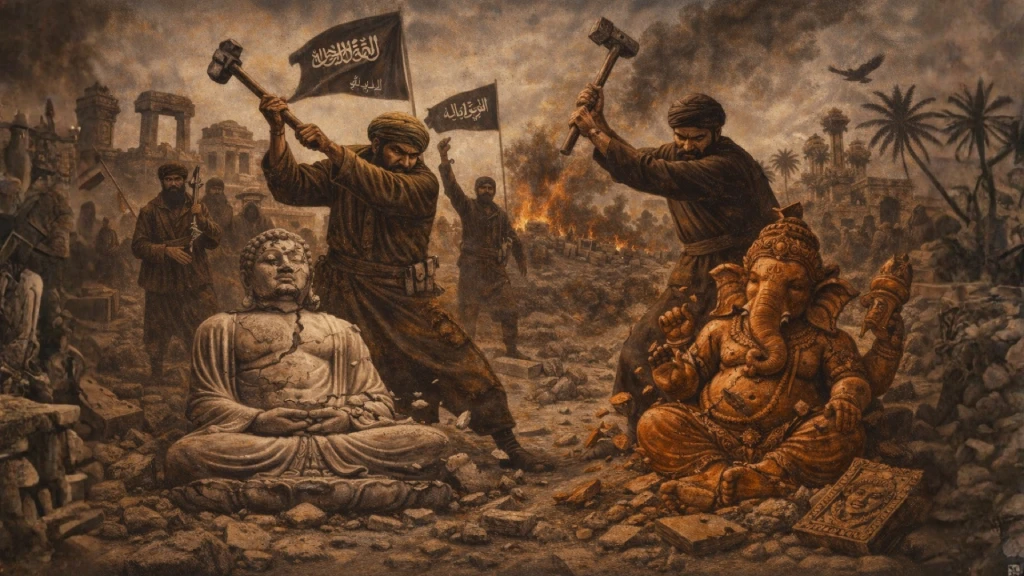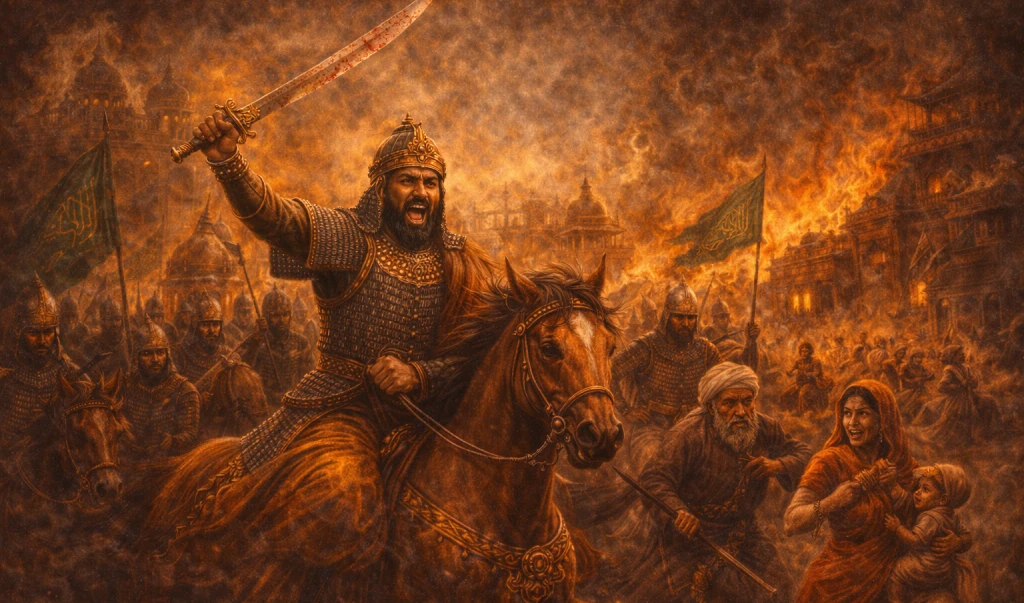
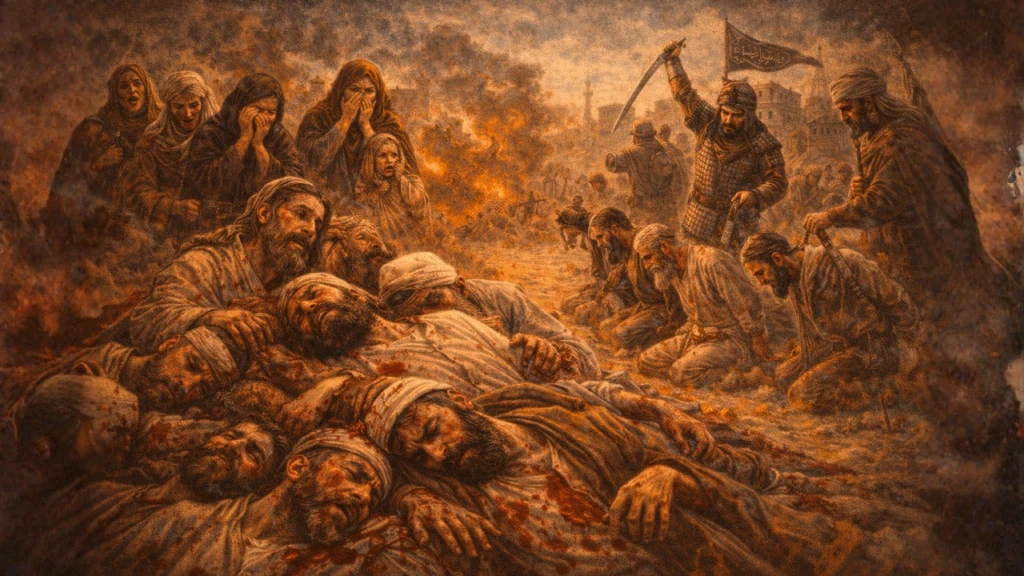
The massacre of Banu Qurayza: The bloodiest chapter in early Islamic history
Summary
This article analyzes the military campaign directed against Banu Qurayza, the last major Jewish political power in Medina, and the subsequent massacre, in light of historical source criticism and contemporary human-rights ethics. The central claim of the article is that—in order to portray the final extermination, enslavement, and seizure of the property of a population on the basis of its religious beliefs as “justified”—the attacking side generally constructs one or more political narratives of “betrayal,” “treason,” or “breach of treaty”; collective punishment is then carried out under the cover of that narrative. Yet a closer examination often makes the hollowness of these accusations apparent. In particular, the enslavement of women and children cannot be given a justifiable basis by imposing any accusation whatsoever.
This discussion uses the primary Islamic sources—the Quran, sira, hadith, and the tafsir works recognized by followers of Islam—as sources of information to demonstrate that, in the case of the allegation of “breach of treaty” raised against Banu Qurayza, the accounts, according to the primary sources, do not constitute direct material evidence; rather, they depend on interpretive claims made after the events concerning supernatural/transcendent messages and the political circumstances. An important principle of source criticism here is that when the same Islamic sources preserve information embarrassing to the victorious side—such as the killing of men, the enslavement of women and children, examination for pubic hair, or the sale of captives—it receives comparatively greater weight as a self-incriminating tradition or admission against interest; but when the same sources present a narrative of “betrayal” to legitimize the killings, that narrative is treated under source criticism as a claim of political self-justification. The process followed after the Battle of the Trench (627 CE)—a prolonged siege, creating physical and psychological collapse by cutting off supplies, implementing a predetermined decision called a “judgment” after surrender, and finally decapitating several hundred men together—was not merely an account of military victory; it laid the foundation for a religious imperialism and functioned as a doctrine of power consolidation, in which every possibility of future resistance was completely eradicated.
The consequences of this campaign were multidimensional: (1) the collective killing of men who had grown pubic hair, (2) digging mass graves and slaughtering and burying them together, (3) turning women and children into slaves, (4) using some female slaves as sex slaves, (5) applying a selection process in which underage children and adolescents were stripped naked and judged “adult” by examining signs of puberty, such as pubic hair, and then killed, and (6) increasing political and military capacity through the distribution/sale of property and human beings as war booty. Under modern judicial systems and international human-rights standards—particularly principles concerning prisoners of war, sieges, indiscriminate killing, and the treatment of civilian populations—such activities are regarded as collective punishment, inhuman treatment, and in many cases war crimes. This article does not seek to present the injustice inflicted upon the Banu Qurayza tribe as a legal retroactive conviction, or as the punitive judgment of past events on the basis of present-day law, since such laws did not exist at that time; rather, its purpose is to classify the event in ethical and theoretical terms in light of the modern concepts of genocide, collective punishment, and human-rights ethics, and to lift the veil from its brutality. In particular, since the claim concerns the actions of a messenger sent by the Creator of the universe, it merits ethical consideration.
Removing the language of religious emotion or loyalty, the article raises several fundamental questions: whether the impartiality of the judge existed at all, how ambiguous/power-centered the interpretation and application of the “treaty” was, how “judgment” after surrender became a one-sided decision, and what transgressions against human society were legitimized in the name of war. By raising these questions, the article attempts to reveal a dark chapter of history not merely as a story, but as a crisis of principle, power, and justice. Let us begin by looking at the complete timeline at a glance:
-
Establishing political authority in a new cityMuhammad migrated to Medina after some Jewish and pagan tribes of the city promised to provide him with refuge. There, Muhammad and his followers began a new life under the protection and with the cooperation of Jews and pagans. Accounts then appear concerning a political document with various Arab and Jewish tribes in Medina, conventionally known as the Constitution of Medina. Although it expressed the language of coexistence on paper, the effective center of power gradually became concentrated in the hands of Muhammad and his followers.
-
An attempt to attract them, but the expected response does not comeIslamic accounts refer at various points to religious discussions and debates with Jewish groups living in Medina, as well as invitations to accept Islam. At the same time, as a symbolic attempt to move closer to the Jews, Islamic sources indicate that in the early period the qibla faced Jerusalem; it was later changed to face Mecca. Yet despite these kinds of policy and symbolic changes, the Jewish tribes as a whole did not become attracted to Islam to the expected degree—such is the picture that emerges from many accounts.
-
Increased political pressure after military victoryThe Muslim army’s victory at Badr was a turning point in the balance of power in Medina. Islamic accounts indicate that after this victory, the tendency to create direct threats and psychological pressure toward the Jewish tribes increased—as if to make them withdraw from resistance. At this stage, the objective was not open expulsion; rather, it was to weaken their position through intimidation and preemptively weaken or eliminate potential opposition.
-
The first tribal expulsion, using an allegation as a pretextAccounts describe the siege of their fortress based on an allegation that Banu Qaynuqa had humiliated a Muslim woman. The accounts further indicate that, although the Prophet initially showed a tendency toward a harsh decision involving massacre, political pressure and mediation ultimately led to the tribe being exiled from Medina. This completed the first practical step toward reducing the Jewish presence.
-
“Conspiracy” narrative → attack → seizure of property → exileAccounts indicate that the leaders of Banu Nadir invited Muhammad and his companions for debate or discussion. But allegations were later raised that they had supposedly attempted to assassinate him. On the basis of this allegation, accounts describe military pressure or an attack against Banu Nadir, the seizure of their property, and their expulsion from Medina. During the same campaign, Muhammad left Banu Nadir aside and advanced militarily against Banu Qurayza, although the cited report states no prior offense by them. He then demanded a pledge, which Banu Qurayza accepted. If they were already parties to the Constitution of Medina, this military action preceded their alleged later breach; if they were not, this was the pledge imposed upon them under military pressure.
-
The strain of prolonged defensive siege, and declining moraleIn many accounts, the Battle of the Trench is presented as an extremely arduous defensive phase— digging the trench, cold and hunger, prolonged psychological strain, and holding back direct attacks—all of which placed great physical and psychological pressure on the Prophet’s companions. But since this was primarily a defensive siege, accounts also describe an atmosphere of discontent and frustration arising from the fact that no significant war booty was obtained after the battle. This context created a psychological background for the subsequent actions.
-
The consequence of the “breach of treaty” allegation: siege → surrender → destructionAccounts indicate that after the Battle of the Trench, the shortage of war booty and psychological exhaustion created frustration in the Muslim camp. It is precisely in this period that accounts state that Gabriel informed Muhammad that Banu Qurayza had supposedly breached the treaty. Their fortress was then placed under a prolonged siege; accounts also describe the imposition of severe restrictions on supplies as part of the siege.
- 1 Prolonged siege and supply crisis: Accounts state that the fortress was surrounded and access to food and water was obstructed. As a result, the people inside, including women and children, suffered extreme hardship.
- 2 Abu Lubaba and “indication of the outcome”: Abu Lubaba of the Muslim side came to inspect the fortress of the Banu Qurayza tribe. Seeing the suffering of the helpless women and children, he became emotional. Accounts state that he indicated that Banu Qurayza had no option but to surrender, and that the Prophet’s plan was that, if they surrendered, the death sentence/massacre would be inevitable.
- 3 Surrender and Sa‘d ibn Mu‘adh: Accounts state that surrender ultimately took place under the realities created by the supply crisis and the siege. Responsibility for delivering the judgment was later assigned to Sa‘d ibn Mu‘adh, who was hostile toward Banu Qurayza and whose final wish was to destroy them. Although he was presented as an “arbitrator,” the process was effectively one-sided. The opportunity for a defense, impartiality, and determination of individual guilt all remained irrelevant.
- 4 The structure of the “judgment” and verdict: The verdict was the killing of adult men, the enslavement of women and children, and the distribution of property. Accounts further state that Muhammad praised this verdict as being consistent with a decision “given from above,” causing the judgment to become not simply a matter of human justice, but a decree of Allah and a power-based decision.
- 5 Selection by signs of puberty and decapitation: Accounts state that the men were stripped naked and pubic hair was examined to determine who was “adult.” Those in whom the sign was found were lined up and killed one by one after pits were dug—accounts describe the decapitation of several hundred people.
- 6 A woman’s protest and killing (reported incident): Some sira accounts mention a woman’s protest or abuse, and also claim that she was killed as a consequence. Reading the accounts makes it clear that she chose death rather than becoming a Muslim sex slave and being raped as war booty.
- 7 Rayhana and the extent of sexual enslavement: Accounts state that some of the women of Banu Qurayza were enslaved through distribution, and that Muhammad took Rayhana as his own sex slave—revealing the extent of enslavement and sexual enslavement involved in this campaign.
- 8 Sale in the market and purchase of weapons and horses: After some of the women and children were taken as booty, accounts state that a significant portion was sold in the market, and mention is also made of using that money to purchase weapons and horses for subsequent campaigns.
The collective meaning of these steps is not merely “punishment”; rather, it is a political message based on terror— if one takes a position against the authorities, the outcome may not be limited to expulsion; massacre and enslavement may also be presented as legitimate when necessary. -
The political outcome of three successive stagesIn succession—Banu Qaynuqa (exile), Banu Nadir (exile accompanied by seizure of property), and Banu Qurayza (massacre and enslavement)— the Jewish political presence in Medina was effectively eliminated after these three stages. Moving away from the language of “coexistence,” the city was in practice transformed into a system of exclusive political and military control.
Introduction
In the history of human civilization, war, planned genocide, communal frenzy, and the practice of enslaving defeated people or people of different identities all belong among its most disgraceful chapters. For centuries, countless people have fallen victim to such slaughter, and this reality has made human history both brutal and complex. From the standpoint of today’s world, it is difficult for a free person to fully imagine the social and psychological horror of the chains of slavery or wartime sexual violence; nevertheless, the reality is that a large part of human society stood for a long time upon structures of oppression. One of the principal achievements of the modern age, however, is the moral capacity to reject this barbarity in principle and the aspiration to build a comparatively safer and more peaceful world for future generations. For this reason, people with a modern humanitarian outlook take a principled position against any war crime, including war, genocide, the inhumane treatment of prisoners of war, enslavement, or rape.
To give institutional form to this principled position, the modern world has adopted international human-rights organizations and international treaties such as the Geneva Conventions, whose aim is to require opposing parties to meet minimum standards of humane conduct even in wartime. In reality, reports of abuse against defeated soldiers and civilians still emerge from many parts of the world; nevertheless, at least one important distinction has emerged in the modern age: instead of accepting these crimes as “normal” or “inevitable,” we can demand accountability, create condemnation and pressure at the international level, and in many cases bring perpetrators before the courts. The trials of war criminals after the Second World War, or the initiatives to prosecute collaborators in the genocide and violence during Bangladesh’s Liberation War, demonstrate that justice may be delayed, but that it is possible in principle to identify a crime as a “crime” and demand accountability. Therefore, using the argument that “such things happened in the past” or that “not all crimes have been prosecuted” to give legitimacy (Justification) to any present-day war crime is unacceptable both logically and ethically.
The brutality of war becomes even deeper and more complex when religious inspiration or extremist ideology operates behind it. In an ordinary social context, when a person kills another, feelings of guilt, hesitation, or fear of social condemnation may intervene; but when killing is presented as a “command from God,” a “sacred duty,” or a “duty to defend the faith,” those moral restraints are largely broken down. In such circumstances, violence is no longer merely a crime in the eyes of the killer—it becomes part of “virtue” or “religious duty.” Ideas such as “God will be pleased if an infidel is killed” and “one can be rewarded by turning their women into war booty (ghanimat) or sex slaves” institutionalize hatred, sectarianism, and the division of humanity, creating a kind of moral license for violence. When an ideology gives violence a moral foundation, the social and ethical mechanisms that restrain people from committing crimes become weakened, because the perpetrator believes that they are doing something ‘good’ or fulfilling a ‘sacred’ objective.
Against this background, a documented allegation repeatedly appears in the writings of many freethinking, atheist, and skeptical voices in Bangladesh: accounts of genocide, ethnic extermination/cleansing (Ethnic Cleansing), and inhumane treatment of a surrendered population are found in the military campaigns conducted against Medina’s Jewish tribes during the time of the Prophet Muhammad. At the center of the discussion are the enslavement of children and adolescents, the policy of turning women into war booty and sex slaves, the practice of selling captives to obtain money or property, and the continuing process of uprooting an entire tribe from its land. In reality, several tribes were completely annihilated, but this article will remain limited to a single event.
Historical accounts indicate that although references to a relationship of political coexistence with the Jews appear during the early period of the Hijra, over time that relationship gradually became conflictual. A common interpretation in discussions of historical documents is that Muhammad expected the Jews to recognize his claim to prophethood, and that various political and religious measures—including changes concerning the qibla—were undertaken toward that end; but when the expected support did not materialize, mutual distrust, resentment, and bitterness intensified. Some also interpret the tendency toward anti-Jewish suspicion or conspiracy theory (Conspiracy Theory) in Muslim society as a long-term social reflection of this continuing conflict—one that often moves beyond real-world politics and produces a language of hatred resembling mental pathology.
Yet a caution is necessary in making historical comparisons: many historians have observed that Jews were often subjected to comparatively less persecution under the Islamic caliphate than under medieval Christian rule, and in some places this has been described as the ‘lesser evil.’ But this comparison provides no moral exemption. Saying “others were worse” does not cause the moral question concerning any system of rule or historical event to disappear; it merely adds one dimension of comparison. The purpose of this article is not to write a comprehensive history of Christian or later systems of rule; rather, it is to analyze the actual structure, claims of justice, and ethical and political consequences of the extermination carried out during the time of the Prophet Muhammad, particularly against the tribe of Banu Qurayza.
“Everyone did it at the time” is not a moral defense. A clear distinction must be made between a crime and a moral wrong: crime is defined by the laws and legal institutions of a particular society, whereas moral wrongness concerns the harm, coercion, exploitation, suffering, and violation of another person’s rights and autonomy. An act may not have been legally classified as a crime in its historical context and still have been morally wrong. Saying “it was legal then” explains only its legal status; it does not establish moral legitimacy, nor does it lessen the victim’s suffering in any way. In practice, arguments such as “everyone did it then” often serve to reduce the moral discomfort, guilt, or cognitive dissonance of those defending the act. The psychological benefit therefore belongs not to the victim, but to the person trying to make the injustice easier to accept.
Genocide and Ethnic Cleansing
What Is War, Actually?
“War” generally refers to a continuous, organized, and armed conflict between two or more state or non-state parties—where both sides possess, to a greater or lesser extent, the capacity to offer resistance, launch counterattacks, or take strategic measures. However, not every violent event can be called “war” in the same mold. When one overwhelmingly powerful side, through blockade, encirclement, the cutting off of supplies, or total control, reduces the other side to a position of effective helplessness, the event tends to resemble a one-sided military operation, a punitive expedition, or post-siege repression, rather than an equivalent war in the conventional sense. This distinction is important because the word “war” often creates an atmosphere of legitimacy, as though both sides were equally “combatants” and the outcome were simply the natural “cost of war.” If the Banu Qurayza incident is viewed in light of this definition, identifying the sequence of siege, surrender, and subsequent genocide simply as “war” may obscure the analysis. Historically, it would be comparatively more accurate to describe it as a post-military-siege process of repression.
What Is Genocide?
Although the word “genocide” is often used in everyday speech to mean “killing many people at once,” in international law Genocide is a specific and strictly defined crime. The 1948 United Nations Genocide Convention defines genocide as certain acts committed with the intent to destroy, in whole or in part, a national, ethnic, racial, or religious group—such as (a) killing members of the group, (b) causing serious bodily or mental harm, (c) deliberately inflicting conditions of life calculated to bring about its destruction, (d) imposing measures intended to prevent births, or (e) forcibly transferring children of the group to another group.
Here, “intent” is the central element. In other words, the mere occurrence of killings does not prove genocide; the central question is whether the objective was to destroy a population possessing a specific identity “as a group.” Conversely, genocide does not depend solely on an “excessively large number” of victims; where intent and a policy framework exist, even comparatively smaller numbers may come within discussions of genocide—because the law speaks of destruction “in whole or in part.”
Another common confusion needs to be clarified here. Many sources state that “killing four or more people in a single incident” is called “genocide”—but this is not genocide; it is primarily a description associated with a classification such as mass murder. For example, in various policy discussions in the United States, “mass murder” has often been described as “four or more killings in the same incident.” Therefore, the concepts of “killing several people together” and “intent to destroy a specific group” must be kept separate; otherwise, terminological discipline breaks down within the discussion itself.
Historically, genocide has sometimes occurred through direct orders issued by military leadership, and at other times through the creation of a kind of procedural façade in the name of “justice”—where individual guilt within the accused group is not determined, opportunities for defense are absent, impartial evidence is unavailable, and the role of an independent judge is effectively missing. At times, when the goals of forced conversion, seizure of property, or permanently establishing political domination fail, “punishment” is pushed toward the elimination of an entire group.
Why Is Collective Punishment a War Crime?
Collective Punishment means punishing an entire population by treating it as a “single culprit” on the basis of the alleged crimes of a few people, or the suspicions or accusations of the ruling side. This directly conflicts with the fundamental principle of individual responsibility, because here the focus of establishing guilt is not the individual but identity and membership. Under this kind of punishment, innocent people, women, and children who were not involved in the crime are all subjected to punishment solely because of their group identity.
Collective punishment is expressly prohibited under international humanitarian law (IHL). For example, Article 33 of the 1949 Fourth Geneva Convention states: “Collective penalties … prohibited”—meaning that collective punishment and measures of intimidation/terrorism are prohibited. This prohibition is not merely a moral objection—it is a core principle of the laws of war: punishment must be directed against individuals, not groups.
In the case of Banu Qurayza, the process presented by the accounts—mass killing of the tribe’s men on the basis of an alleged “breach of treaty,” and the enslavement of women and children—corresponds, from a modern moral and legal perspective, to the concept of punishing the blameless: individual determination of guilt is absent, while punishment is universal. It is therefore essential in discussing this section to separately identify the disproportionality between “the crime of one or several individuals” and “the destruction or enslavement of an entire group,” as well as the structure of identity-based punishment.
Why Is Ethnic Cleansing a Crime Against Humanity?
“Ethnic cleansing” generally refers to the systematic, forcible, and coercive expulsion or transfer of another group in order to make a particular territory ethnically or religiously “homogeneous.” Deportation, intimidation, seizure of property, detention, genocide, and sometimes sexual violence may all be used as tactics in this process.
However, one technical point should be kept in mind: Ethnic cleansing is not established everywhere in international law as an independent “separate crime label”; rather, in practice it is often used as a collective description of acts falling within the categories of genocide, crimes against humanity, and war crimes. The United Nations Genocide Prevention resource also states that “ethnic cleansing” is not recognized as a separate independent crime, although acts committed under that description may be prosecutable as other international crimes.
History shows that perpetrators often attempt to legitimize such expulsion or destruction by framing it as “self-defense,” “state security,” “the preservation of purity,” or “the suppression of internal enemies.” For example:
- The Holocaust: The Nazi regime labeled Jews as “enemies of the state” and carried out a planned extermination campaign—the “internal enemy” narrative was used here to create a façade of legitimacy for violence.
- Rwanda (1994): Hutu extremists portrayed Tutsis as a “threat” and carried out widespread killings—propaganda played a major role both before and after the violence.
- Extermination and displacement of Armenians (1915): Mass expulsions and deaths occurred under the Ottoman state apparatus—although historical debate continues regarding the nature, purpose, and designation of the events, the “state security” narrative was used here as a central argument.
The Legal Definition of War Crimes and Human Rights Law
War crimes refer to acts prohibited by international humanitarian law during an armed conflict—such as deliberately killing civilians, killing or torturing prisoners of war, looting, indiscriminate destruction, sexual violence, or attacks against protected persons or facilities, among others. An important feature of war crimes is that they are not “unavoidable costs of war,” but rather conduct prohibited as a matter of principle—conduct that violates the minimum boundaries of humanity even amid conflict.
War criminals often portray victims as “militants,” “terrorists,” “traitors,” or “internal enemies” in order to present their violence as legitimate. This framing operates in two ways: (1) by presenting civilians as “the enemy,” it becomes easier to deny them their rights; and (2) violence can be sold to supporters of the perpetrating side as “defense.” Even predictive arguments such as “they will become enemies when they grow up” are sometimes produced to justify killing children, denying the principle of individual innocence and normalizing identity-based punishment.
Historical distortion, concealment of information, and silencing the voices of the defeated often proceed together in order to conceal such crimes. Therefore, the moral responsibility of any civilized society is to: (a) keep terms and standards clear—genocide, ethnic cleansing, and war crimes, and which is applicable where; (b) distinguish evidence from narrative; and (c) reject the tendency to justify a crime by saying that “it happened in the past” or that “the other side did it too.” This is precisely why, in discussing the Banu Qurayza incident, it is essential to place at the center of the analysis not merely “history,” but rather how narratives of crime are constructed and how collective punishment is legitimized.
The Geneva Conventions: Divine Versus Human Law
One harsh reality in the history of warfare and human civilization is that when war is driven by the imperative that it “must be won,” the human dignity of the defeated, wounded, captured, and civilian population collapses most rapidly. One of the central outcomes of the long effort to place this collapse within legal boundaries is the Geneva Conventions. The humanitarian initiative that began with the first Convention in Geneva in 1864 was gradually expanded and revised, acquiring its modern structure through the four principal Conventions of 1949. Today, “the Geneva Conventions” generally refers collectively to these four Conventions of 1949 and their subsequent Additional Protocols—particularly those of 1977 and 2005—which function as a legal “wall” or protection representing the minimum level of humanity in war.
Here a moral-philosophical question arises that is directly connected to the central discussion of this article. If, from a religious perspective, Allah is regarded as omniscient, infinitely merciful, and just, then why are the comparatively “minimal” humanitarian conditions created by human beings—such as not killing those who surrender, not turning women and children into slaves, not imposing extrajudicial death sentences, and not imposing collective punishment—not visible to the same degree in divine law or the principles followed by the Prophet? This question naturally arises. If someone says, “The Arabs of that era were different,” then a counterquestion follows: if the Creator is above time and place, why should the standard of morality remain confined within the limits of contemporary social customs, and why should acts that modern humanitarian conscience clearly identifies as crimes receive religious legitimacy?
The Evolution and Stages of the Geneva Conventions
The aim of the Geneva Conventions is not to make war “good,” but to establish certain limits even within war—so that those who are not directly fighting—civilians, medical personnel, and relief workers—and those who are no longer capable of fighting—the wounded, sick, shipwrecked, and prisoners of war—retain at least a minimum protection for the dignity of their lives. Historically, this framework developed through four principal stages and was later expanded through Additional Protocols:
| Stage | Period | Main Objective and Content |
| First stage | 1864 | Initial international recognition of the treatment of wounded and sick soldiers on the battlefield, protection of hospitals and medical services, and the neutrality of medical personnel. |
| Second stage | 1906 | Revision and expansion of the 1864 framework—making the rules protecting the wounded and sick more detailed and standardized. (This was essentially an updated form of the 1864 Convention.) |
| Third stage | 1929 | Specific codification of humane treatment, prohibition of torture, and minimum rights for prisoners of war (POWs), along with revisions to the earlier rules. |
| Final modern framework | 1949 (effective: 21 October 1950) | The complete framework of four Conventions: (I) wounded and sick in land warfare, (II) wounded, sick, and shipwrecked at sea, (III) prisoners of war, and (IV) civilians—especially their protection in occupied territories. |
| Supplementary Protocols | 1977 and 2005 | Supplementing the 1949 framework, not replacing it: further clarifying the protection of victims in international and non-international conflicts, and introducing a new emblem, among other matters. |
Important Provisions of the Convention and Their Analysis in the Present Context
The Geneva Convention is not a religious scripture—it is an international treaty signed by states. Nevertheless, its significance from an ethical perspective is considerable: it preserves the concept of “humanity” in legal language even amid war. By contrast, religious accounts of war or ancient tribal laws of warfare often show victory, revenge, accusations of “treason” or “betrayal,” and the economy of war booty and slavery becoming intertwined. Thus, when the minimum standards of the Geneva Conventions are placed alongside accounts of an incident such as Banu Qurayza, the moral divide becomes even clearer.
Part 1: General Provisions and “Common Article 3”
Although the Geneva Conventions are primarily detailed provisions for conflicts between states, all four Conventions contain a common provision known as Common Article 3. Its significance is that even when a conflict is not an internationally recognized “full-scale war”—that is, even in an internal conflict or civil-war-like situation—it demands minimum humanitarian protection. These minimum standards absolutely prohibit certain acts—
- Any form of murder, mutilation, cruel treatment, torture, or inhuman treatment.
- Taking hostages or turning prisoners into bargaining commodities.
- Outrages upon personal dignity—especially humiliating and degrading treatment.
- Passing sentences or carrying out executions without a regularly constituted court and basic judicial guarantees.
In one sense, this provision outlines “minimum justice even amid war.” When accounts of genocide after surrender, the enslavement of captive women and children, or a one-sided judicial structure appear in incidents such as Banu Qurayza, the conflict with this minimum standard becomes strikingly apparent.
Part 2: Universal Protection of the Civilian Population
The Fourth Geneva Convention (Civilians) is the most important one for civilian populations. Article 13 (Part II) states in principle that the whole of the populations of the countries involved in the conflict shall be covered by this general protection, and that no “adverse distinction” based on race, nationality, religion, or similar criteria may be made. In other words, no one’s human dignity may be revoked on the argument that “they do not belong to our tribe or religion.”
Part 3: The Dignity of Protected Persons and the Prohibition of Torture and Collective Punishment
This section is the backbone of modern ethics of warfare—because it attempts legally to halt the idea that “everything is legitimate simply because one has the power.” In particular:
- Article 32 (prohibition of murder, torture, and brutality): Murder, torture, measures causing physical suffering, corporal punishment, and inhumanity are strictly prohibited against protected persons.
- Article 33 (prohibition of Collective Punishment): Collective punishment and measures of intimidation or terrorism are prohibited. In other words, an entire group may not be punished on the basis of accusations against one or several individuals—individual responsibility is the central principle here. The account of hundreds of men being killed together and women and children being enslaved in the Banu Qurayza incident, without determining individual guilt in connection with the accusation of “breach of treaty,” directly conflicts with this principle.
- Article 49 (prohibition of forcible transfer and deportation): The forcible transfer or deportation of protected persons from occupied territory is prohibited; in the limited case of “evacuation,” it must be temporary, and the article also mentions the obligation to return them to their homes once the situation has calmed.
The strength of the Geneva Conventions lies here: even while acknowledging the realities of war, they do not allow war to become a “lawless zone.” There is, however, a practical limitation: because the Conventions are treaties created by human beings, their implementation depends on state consent, the actual balance of power, and international pressure and accountability. Nevertheless, one of the great achievements of modern civilization is to establish these principles as ideals, to identify war crimes as crimes rather than legitimize them, and to move toward evidence-based accountability. This is precisely why, when accounts of ancient tribal warfare are presented as religiously legitimate, the standards of the Geneva Conventions compel us to ask: Is “morality” merely the decision of the powerful side, or should there truly be certain universal limits for protecting human dignity?
The Migration to Medina and the Role of Jews in Muhammad’s Life
The Invitation to Medina and the Hospitality of Polytheists and Jews
When Muhammad, rejected by the Quraysh of Mecca and accused of blasphemy [3] migrated to Medina (then Yathrib), he did not set foot in an empty or hostile land. Rather, the inhabitants of Medina at that time—most of whom were polytheist Arabs, alongside a highly influential and wealthy but minority Jewish population—welcomed him warmly. The two principal Arab tribes of Medina, the ‘Aws and the Khazraj (who were still primarily polytheists and later became known as the Ansar), invited Muhammad to Medina in the hope that he would serve as a neutral arbitrator and leader to resolve their tribal conflict. It should be noted that these polytheist tribes had long-standing hostility toward the major Jewish tribes, but despite being a minority, the Jews were more influential in Medina because they possessed scriptures and were economically much stronger.
History testifies that after the migration to Medina, these local inhabitants made unprecedented sacrifices to resolve the housing and food crisis faced by the Muhajirun (the Muslims who came from Mecca). Although this event is known in Islamic history as the “bond of brotherhood,” its primary material support came from Medina’s local agricultural economy, whose main driving forces were the Jews and the local Arab tribes.
In particular, through the Constitution of Medina, the small Jewish tribes of Medina agreed to a united state structure under Muhammad’s leadership. Whether major Jewish tribes such as Banu Nadir, Banu Qaynuqa, or Banu Qurayza were included in this agreement will be discussed in detail in this article. The charter explicitly stated that the Muslims and Jews who entered into the agreement would be regarded as allies of one another, and that during an attack or war by an external enemy, both sides would bear the costs of war and provide supplies. Under the terms of the charter, the Jews would be free to practice their religion and would enjoy civil rights alongside the Muslims. If the Jews of Medina had not accepted Muhammad at that time or had not cooperated with him economically and socially, it would have been impossible to establish the foundation of Islam in Medina. These were the very Jews whose people were later indiscriminately killed and expelled on accusations of treachery, although during the early days of the migration it was through the agreements they had signed and their indirect economic cooperation that the Muslims had the opportunity to settle in Medina.
Essentially, Muhammad and his followers were able to overcome their initial difficulties under the generosity, hospitality, and protection offered by Medina’s polytheist society and Jewish tribes at that time. Yet the cruel irony of fate is that these very hosts later had to suffer tragic consequences. Let us examine the source documenting Muhammad’s invitation to Medina, [4]
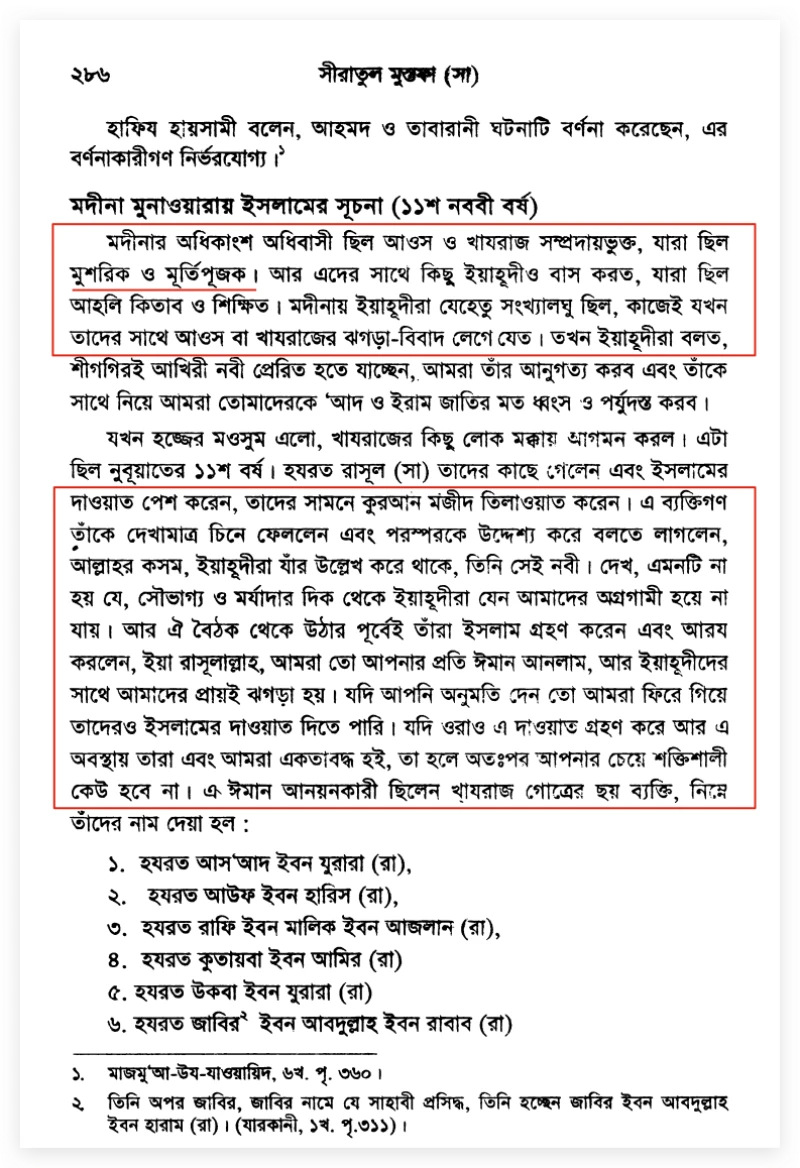
Sirat al-Mustafa (peace be upon him) — page: 286
The Beginning of Islam in Medina al-Munawwarah (the 11th year of Prophethood)
Most of the inhabitants of Medina belonged to the Aws and Khazraj communities, who were polytheists and idol worshippers. Some Jews also lived among them, who were People of the Book and educated. Since the Jews in Medina were a minority, whenever disputes arose between them and the Aws or Khazraj, the Jews would say— “The final Prophet is soon to be sent; we will follow him, and with him we will destroy and subdue you like the people of ‘Ad and Iram.”
When the pilgrimage season arrived, some people from the Khazraj came to Mecca. This was the 11th year of Prophethood. The Messenger of Allah (peace be upon him) approached them and presented the invitation to Islam; he recited the Noble Qur’an before them. As soon as these people saw him, they recognized him and began saying to one another— “By Allah, this is the Prophet whom the Jews mention. Be careful that the Jews do not get ahead of us in fortune and honor.”
Before they rose from that gathering, they accepted Islam and requested— “O Messenger of Allah, we have believed in you, and we often quarrel with the Jews. If you permit us, we can return and invite them also to Islam. If they too accept this invitation and they and we unite in this way, then no one will be stronger than you.”
These believers were six individuals from the Khazraj tribe; their names are given below:
1. As‘ad ibn Zurara
2. ‘Awf ibn Harith
3. Rafi‘ ibn Malik ibn ‘Ajlan
4. Qutba ibn ‘Amir ibn Hadida
5. ‘Uqba ibn ‘Amir ibn Nabi
6. Jabir ibn ‘Abdullah ibn Ri’ab
The Three Principal Jewish Tribes of Medina and Their Identity
At that time, there were several Jewish tribes around Medina, the principal ones being Banu Qaynuqa, Banu Nadir, and Banu Qurayza. Muhammad first attacked the Banu Qaynuqa tribe, then Banu Nadir, and afterward Banu Qurayza. Understanding this sequence or timeline is extremely important because, in the middle of attacking Banu Nadir, Muhammad suddenly attacked Banu Qurayza as well without any reason. These matters will be discussed gradually. For now, let us examine the chronology of these attacks:
| Event | Period | Source |
| The Prophet arrived in Medina | Between 21 June and 2 July 622. The Prophet Muhammad migrated from Mecca to Medina | |
| Treaty with the Jews | A treaty was concluded with the Jewish tribes of Medina. The Jewish tribes primarily belonged to Al-Khazraj and Al-Aws. The tribes belonging to Al-Khazraj were Banu ‘Awf, Banu Sa‘ida, Banu al-Harith, Banu Jusham, Banu al-Najjar. And the tribes belonging to Al-Aws were Banu ‘Amr ibn ‘Awf, Banu al-Nabit, Banu al-Aws. In addition, agreements were made with Banu Tha‘laba, Jafna, another tribe of Tha‘laba, and Banu al-Shutayba. | [5] [6] |
| The Battle of Badr | 17 March 624 CE. After achieving victory at the Battle of Badr, the Muslims’ confidence increased, and they invited the Jews to accept Islam, saying that if they did not accept Islam quickly, a disaster like Badr would also befall the Jews. | [7] |
| Attack on Banu Qaynuqa | April 624 CE. Muhammad and the Muslim army attacked the Banu Qaynuqa tribe, whose members were blacksmiths, goldsmiths, and utensil makers by profession, on the accusation of humiliating a Muslim woman. | [8] |
| Invitation from Banu Nadir | The leaders of Banu Nadir invited the Prophet Muhammad and his Companions for the purpose of discussion, so that the Prophet would come there and prove that he was a prophet. In other words, they intended to test the Prophet by bringing thirty Jewish rabbis from their side. The Prophet went there with his Companions. At night, he suddenly got up and left without telling anyone anything. In other words, he did not submit to the test of prophethood before the Jewish rabbis. The other Companions waited for a long time, and afterward heard from someone else that the Prophet had gone to Medina. They returned to Medina. After returning, they learned that Gabriel had supposedly come to the Prophet and informed him that some people had been sitting on the roof of the room where they had been seated, intending to kill the Prophet. But why did those people not kill the Prophet’s Companions, why did none of the Companions see anyone of this kind, and why did the Prophet leave alone without telling anyone anything? Nothing is known about these matters. In other words, the claim of this treachery is known only to the Prophet, and there is no real evidence for it. | [9] |
| Attack on Banu Nadir | 625 CE / 4 AH—the attack on Banu Nadir. After suddenly returning at night without submitting to the Jewish rabbis’ test of prophethood, the Prophet Muhammad then launched an attack against them. | |
| Sudden attack on Banu Qurayza | At this time, the Prophet Muhammad and his army were at war with Banu Nadir. In the middle of the war, he bypassed Banu Nadir and attacked Banu Qurayza, demanding that they enter into a pledge. As a result, Banu Qurayza was forced to pledge allegiance to the Prophet Muhammad and promise that they would help him. This pledge was by no means voluntary; they were compelled through a sudden, forcible attack. | [10] |
| The Battle of the Trench | January–February 627 CE. The Prophet Muhammad fought the Battle of the Trench. | |
| Siege and attack on the fortress of Banu Qurayza | January 627 CE. After returning from the Battle of the Trench, the Prophet Muhammad attacked Banu Qurayza without laying down his arms, because Gabriel had supposedly come at that time and informed him that Banu Qurayza had committed treachery—although there is no real evidence of this. They had killed no one and attacked no one. After besieging their fortress for 25 days, they were forced to surrender. |
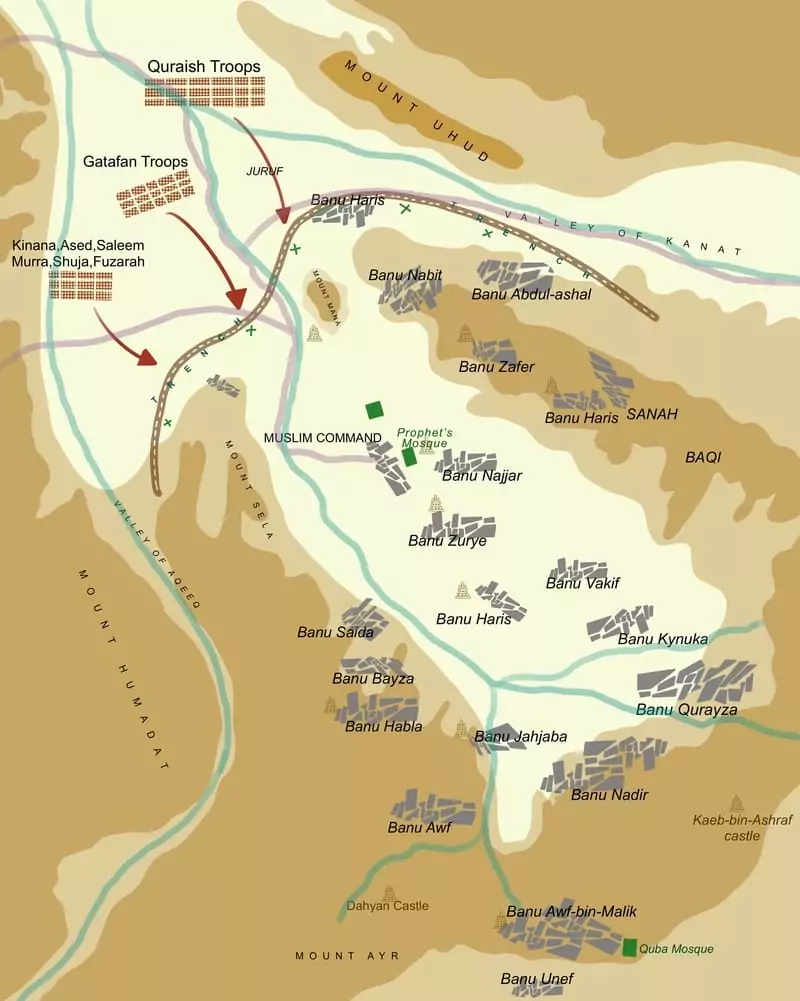
Now let us also look at the map,
Islamic Preaching to the Jews and the Conflict
One of Muhammad’s strategic objectives during the initial period after the migration to Medina was to convey the message of Islam to the local Jewish community and make himself acceptable as a continuation of the earlier prophetic tradition—such an interpretation is found quite directly in numerous Islamic sources. Although the Jews in that region were a numerical minority, they were economically prosperous and socially influential as “People of the Book.” Consequently, there was also a political and social reality in which their support or recognition could have strengthened the position of the new religious leadership among other groups. In this context, it can be seen that for a period after arriving in Medina, the Muslims prayed toward the qibla facing Jerusalem; later, after receiving insufficient response from the Jews, the qibla was changed to face the Kaaba—and various sources also discuss the Jewish community’s reaction and the tension in their relationship surrounding this change. To keep the discussion brief, those issues are not being discussed again here, but interested readers may read these articles [11] [12] [13].
The Prophet Muhammad’s Racism and Sectarianism
We need to be clear about a fundamental principle here: accusing or punishing an entire population for the actions of one or several individuals from that group, or inciting violence against them, is wrong both morally and legally. Accountability for a crime falls upon the individual; when birth, ethnicity, religion, tribe, or identity is turned into “proof of crime,” it destroys the very concept of justice. Suppose that tomorrow it is alleged that a Bengali person in Europe was involved in a bombing. If, in response, someone began saying, “Kill Bengalis wherever you find them,” that would constitute direct incitement to mass violence and a grave crime. Even if the crime had genuinely occurred, it would have been committed by a specific individual; there would be no moral or legal basis for declaring the entire Bengali population—including women, children, the elderly, and people with disabilities—“guilty” on that account. This kind of identity-based accusation and punishment is ethnic hatred and racism.
Similarly, even if a Bengali person had committed a crime, the minimum standard of a modern legal system would be to give the accused an opportunity to defend themselves, examine the evidence, and determine responsibility through an independent and impartial judicial process. But threats or orders to kill, rape, or attack an entire nation as an excuse for the crime of one person are wholly unacceptable. For example, if someone says, “Sheikh Hasina violated the treaty, so kill Bengali men and turn their wives and daughters into war booty,” that would be an extreme insult to humanity and a frenzied expression of collective punishment. The same principle applies to every identity: if a Muslim is a militant, one cannot call for the indiscriminate killing of all Muslims. If a Rohingya person commits a crime, the entire Rohingya population cannot be labeled “born criminals.” If someone says, “All Rohingyas are yaba dealers, so they should be killed,” that would be racist incitement and an extremely dangerous crime socially.
The scope of this principle is even broader: whether the identity is Jewish, Buddhist, Hindu, Christian, Sikh, Ahmadi, Shia, Sunni, atheist, or believer; whether the sexual identity is homosexual or heterosexual; whether the gender identity is female or male—in no case may anyone be told to kill a person solely on the basis of identity. Suppose a Christian friend of mine borrows money from me and does not repay it; this is a personal financial dispute. I cannot say, “Christians are bad—kill them.” Such a statement turns an individual crime into a group crime, which is directly communal hatred, incitement, and a punishable offense. Inciting violence against an entire population on the basis of its religion, ethnicity, tribe, or community because of the crime of one person or several individuals; labeling them as “inferior” or “impure”; justifying their persecution; or demanding their expulsion—these are all classic examples of ethnic hatred.
We are quoting the following hadith for an important reason: if a religious text teaches people to imagine collective killing based on identity as a future aspiration or moral duty, it can normalize hatred in social reality. The question in this discussion, therefore, is whether such narratives cultivate “group hatred” among people, and how that hatred turns into incitement in real life. [14]
Riyad as-Salihin
18/ Various Interesting Hadiths
Chapter: 370: Concerning the Dajjal and the Signs of the Day of Resurrection
Tawhid Publication number: 1829, international number: 1820
13/1829.
Abu Hurairah (May Allah be pleased with him) said: The Messenger of Allah(ﷺ) said, “The Last Hour will not come until the Muslims fight against the Jews, until a Jew will hide himself behind a stone or a tree, and the stone or the tree will say: ‘O Muslim, there is a Jew behind me. Come and kill him,’ but Al-Gharqad tree will not say so, for it is the tree of the Jews.”.
وعن أبي هريرة رضي الله عنه أن رسول الله صلى الله عليه وسلم قال: “ لا تقوم الساعة حتى يقاتل المسلمون اليهود، حتى يختبيء اليهودي من وراء الحجر والشجر، فيقول الحجر والشجر: يا مسلم هذا يهودي خلفى تعالى فاقتله، إلا الغرقد فإنه من شجر اليهود” ((متفق عليه)).
Reference verified on Sunnah.com
The contemporary reality of Bangladesh cannot be ignored in this context either. In the country, hateful language against Jews, conspiracy theories, or the construction of identity-based enemies can be found regularly in many Islamic sermons and wa‘z gatherings—and this discourse does not remain limited to the speaker; it also enters the formation of belief among some members of the audience. The question is: why and how do such statements become socially acceptable? It is essential to analyze how religious authority, claims of “purity,” and the political psychology of creating an enemy identity work together –
The Prophet Muhammad’s Plan to Expel the Jews
Expelling, banishing, or forcibly transferring a population from its land on the basis of religious identity is not new in human history. Even in the modern era, we face various realities, including repression and displacement of the Rohingya in Myanmar, the prolonged expulsion and deprivation of rights of Palestinians, and insecurity in daily life in the context of the Kashmir question. One common feature often appears in these events: the powerful side combines weapons, law, administration, and propaganda to intimidate and isolate a population identified as “the other,” ultimately separating it from its land rights. From a humanitarian perspective, this process is among the most heartbreaking because expulsion means not merely losing homes; it simultaneously attacks memory, livelihood, security, and social dignity. Nor can the reality be denied that in Bangladesh’s history—especially after 1947 and around 1971—many Hindu families were forced to leave the country because of communal violence, fear, and discrimination. Thus, the question is not merely about the past; it is a universal moral question: Can expulsion and extermination in the name of religious identity be a “legitimate” part of any teaching?
When this question is placed within the context of the life of the Prophet Muhammad, a historical continuity comes into view. When Muhammad began preaching in Mecca, his followers were limited; he possessed neither political power nor military strength. Consequently, conflict management at that stage revolved primarily around social resistance, boycott, and repression. But after the migration to Medina, the structure of power began to change. Political alliances, military organization, and economic resources gradually became centralized. The sira and historical accounts show that during this period economic capacity also increased through attacks on commercial caravans, acquisition of property, and war booty—which in turn helped build military power. At the same time, the kind of political coexistence initially described with Medina’s Jewish tribes developed into conflict over time; and gradually a sequence emerged of placing these tribes under pressure, besieging them, expelling them, or exterminating them.
An important aspect of this continuity is that it can be read not merely as “a response to a single event,” but also as part of a strategic outlook aimed at consolidating power and establishing political dominance. In other words, it involved constructing “Medina” as a center where opposing or “undesirable” identities would gradually be eliminated and the exclusive source of legitimate authority would be a single political-religious identity. Some narratives related to this outlook appear in hadith; they are being cited here as sources, not rewritten: [15] [16].
Sahih al-Bukhari (Tawhid Publication)
29/ The Virtues of Medina
Chapter: 29/2. The Virtues of Medina. Medina expels undesirable people.
1871.
Narrated Abu Huraira:Allah’s Messenger (ﷺ) said, “I was ordered to migrate to a town which will swallow (conquer) other towns and is called Yathrib and that is Medina, and it turns out (bad) persons as a furnace removes the impurities of iron
حَدَّثَنَا عَبْدُ اللَّهِ بْنُ يُوسُفَ، أَخْبَرَنَا مَالِكٌ، عَنْ يَحْيَى بْنِ سَعِيدٍ، قَالَ سَمِعْتُ أَبَا الْحُبَابِ، سَعِيدَ بْنَ يَسَارٍ يَقُولُ سَمِعْتُ أَبَا هُرَيْرَةَ ـ رضى الله عنه ـ يَقُولُ قَالَ رَسُولُ اللَّهِ صلى الله عليه وسلم. “ أُمِرْتُ بِقَرْيَةٍ تَأْكُلُ الْقُرَى يَقُولُونَ يَثْرِبُ. وَهْىَ الْمَدِينَةُ، تَنْفِي النَّاسَ كَمَا يَنْفِي الْكِيرُ خَبَثَ الْحَدِيدِ ”.
Collection status: Sahih
Sahih Muslim (Islamic Foundation)
16/ Hajj
Chapter: 85. Medina will expel the bad from within itself and another name for Medina is ‘Taba’ and ‘Taybah’
3223.
Qutaybah b. Saʿīd > Mālik b. Anas Fīmā Quriʾ ʿAlayh > Yaḥyá b. Saʿīd > Abū al-Ḥubāb Saʿīd b. Yasār > Abū Hurayrah I have been commanded (to migrate) to a town (Medina) which would overpower other towns. They (the people) call it Yathrib; its correct name is (in fact) Medina. It eliminates (bad) people just as a furnace removes the alloy of iron.
وَحَدَّثَنَا قُتَيْبَةُ بْنُ سَعِيدٍ عَنْ مَالِكِ بْنِ أَنَسٍ فِيمَا قُرِئَ عَلَيْهِ عَنْ يَحْيَى بْنِ سَعِيدٍ قَالَ سَمِعْتُ أَبَا الْحُبَابِ سَعِيدَ بْنَ يَسَارٍ يَقُولُ سَمِعْتُ أَبَا هُرَيْرَةَ يَقُولُ قَالَ رَسُولُ اللَّهِ ﷺ أُمِرْتُ بِقَرْيَةٍ تَأْكُلُ الْقُرَى يَقُولُونَ يَثْرِبَ وَهْىَ الْمَدِينَةُ تَنْفِي النَّاسَ كَمَا يَنْفِي الْكِيرُ خَبَثَ الْحَدِيدِ
Collection status: Sahih
More significantly, the wording of various authentic hadith mentions a declaration or instruction to leave the Arabian Peninsula “for Muslims only” and gradually remove other religious communities. In other words, the objective was not merely political control; it was to make a territory religiously uniform, where the presence of identities other than Muslim would be regarded as “undesirable.” When these statements are interpreted strategically, it becomes clear that such a policy also creates an incentive to manufacture “justifications” for its implementation: through accusations such as breach of treaty, conspiracy, or treason, it becomes easier to dehumanize the opposing side morally and present expulsion or killing as “punishment” [17] [18].
Sunan Ibn Majah
Introduction
Chapter: 9. Description of Faith
14/71.
It was narrated that Abu Hurairah said:”The Messenger of Allah (ﷺ) said: ‘I have been commanded to fight the people until they testify to La ilaha ill-allah (none has the right to be worshipped but Allah) and that I am the Messenger of Allah, and establish regular prayers and pay Zakat
حَدَّثَنَا أَحْمَدُ بْنُ الأَزْهَرِ، حَدَّثَنَا أَبُو النَّضْرِ، حَدَّثَنَا أَبُو جَعْفَرٍ، عَنْ يُونُسَ، عَنِ الْحَسَنِ، عَنْ أَبِي هُرَيْرَةَ، قَالَ قَالَ رَسُولُ اللَّهِ ـ صلى الله عليه وسلم ـ “ أُمِرْتُ أَنْ أُقَاتِلَ النَّاسَ حَتَّى يَشْهَدُوا أَنْ لاَ إِلَهَ إِلاَّ اللَّهُ وَأَنِّي رَسُولُ اللَّهِ وَيُقِيمُوا الصَّلاَةَ وَيُؤْتُوا الزَّكَاةَ ” .
Grade: Sahih Mutawatir (Al-Albani)
Sahih Muslim (Hadith Academy)
1. Faith
Chapter: 8. The command to fight the people until they acknowledge that there is no true deity except Allah and that Muhammad is the Messenger of Allah and establish prayer, pay zakat, and believe in the law brought by the Prophet; whoever does these things will have the protection of his life and property; except for a legally justified reason, and their inner affairs are with Allah; the command to fight those who refuse to pay zakat and observe the other provisions of Islam, and the importance for the imam to emphasize the establishment of the distinctive features of Islam.
37-(37/23)
Sūwayd b. Saʿīd And Ibn Abū ʿUmar > Marwān / ān al-Fazārī > Abū Mālik from his father I heard the Messenger of Allah ﷺ say: He who professed that there is no god but Allah and made a denial of everything which the people worship beside Allah, his property and blood became inviolable, an their affairs rest with Allah.
وَحَدَّثَنَا سُوَيْدُ بْنُ سَعِيدٍ وَابْنُ أَبِي عُمَرَ قَالاَ حَدَّثَنَا مَرْوَانُ يَعْنِيَانِ الْفَزَارِيَّ عَنْ أَبِي مَالِكٍ عَنْ أَبِيهِ قَالَ سَمِعْتُ رَسُولَ اللَّهِ ﷺ يَقُولُ مَنْ قَالَ لاَ إِلَهَ إِلاَّ اللَّهُ وَكَفَرَ بِمَا يُعْبَدُ مِنْ دُونِ اللَّهِ حَرُمَ مَالُهُ وَدَمُهُ وَحِسَابُهُ عَلَى اللَّهِ
Collection status: Sahih
From such narratives, the argument of this article becomes the following: if Muhammad’s military-political objective was to continue fighting non-Muslims until they accepted Islam, while simultaneously preventing communities other than Muslims from permanently remaining in the Arabian Peninsula, then it becomes difficult to portray the campaigns against Medina’s Jewish tribes as isolated events or “incidents.” Rather, they may be viewed as part of a broader political project in which the outcomes stand at three levels: (1) acceptance of Islam, (2) subordination through systems resembling submission or taxation (jizya), or (3) killing or expulsion. The relevant link in this context will remain unchanged: [19].
Now let us read the relevant hadiths, [20] [21] [22].
Sahih Muslim (Islamic Foundation)
Chapter: 33/ Jihad and Its Principles
Section: 21. Expulsion of Jews and Christians from the Arabian Peninsula
4442.
[Chain 1] Zuhayr b. Ḥarb > al-Ḍaḥḥāk b. Makhlad > Ibn Jurayj [Chain 2] Muḥammad b. Rāfiʿ > ʿAbd al-Razzāq > Ibn Jurayj > Abū al-Zubayr > Jābir b. ʿAbdullāh > ʿUmar b. al-Khaṭṭāb I will expel the Jews and Christians from the Arabian Peninsula and will not leave any but Muslim.
وَحَدَّثَنِي زُهَيْرُ بْنُ حَرْبٍ حَدَّثَنَا الضَّحَّاكُ بْنُ مَخْلَدٍ عَنِ ابْنِ جُرَيْجٍ ح وَحَدَّثَنِي مُحَمَّدُ بْنُ رَافِعٍ وَاللَّفْظُ لَهُ حَدَّثَنَا عَبْدُ الرَّزَّاقِ أَخْبَرَنَا ابْنُ جُرَيْجٍ أَخْبَرَنِي أَبُو الزُّبَيْرِ أَنَّهُ سَمِعَ جَابِرَ بْنَ عَبْدِ اللَّهِ يَقُولُ أَخْبَرَنِي عُمَرُ بْنُ الْخَطَّابِ أَنَّهُ سَمِعَ رَسُولَ اللَّهِ ﷺ يَقُولُ لأُخْرِجَنَّ الْيَهُودَ وَالنَّصَارَى مِنْ جَزِيرَةِ الْعَرَبِ حَتَّى لاَ أَدَعَ إِلاَّ مُسْلِمًا
Collection status: Sahih
Sahih Muslim (Hadith Academy)
Chapter: 33. Jihad and Travel
Section: 21. Expelling Jews and Christians from the Arabian Peninsula
4486-(63/1767)
[Chain 1] Zuhayr b. Ḥarb > al-Ḍaḥḥāk b. Makhlad > Ibn Jurayj [Chain 2] Muḥammad b. Rāfiʿ > ʿAbd al-Razzāq > Ibn Jurayj > Abū al-Zubayr > Jābir b. ʿAbdullāh > ʿUmar b. al-Khaṭṭāb I will expel the Jews and Christians from the Arabian Peninsula and will not leave any but Muslim.
وَحَدَّثَنِي زُهَيْرُ بْنُ حَرْبٍ حَدَّثَنَا الضَّحَّاكُ بْنُ مَخْلَدٍ عَنِ ابْنِ جُرَيْجٍ ح وَحَدَّثَنِي مُحَمَّدُ بْنُ رَافِعٍ وَاللَّفْظُ لَهُ حَدَّثَنَا عَبْدُ الرَّزَّاقِ أَخْبَرَنَا ابْنُ جُرَيْجٍ أَخْبَرَنِي أَبُو الزُّبَيْرِ أَنَّهُ سَمِعَ جَابِرَ بْنَ عَبْدِ اللَّهِ يَقُولُ أَخْبَرَنِي عُمَرُ بْنُ الْخَطَّابِ أَنَّهُ سَمِعَ رَسُولَ اللَّهِ ﷺ يَقُولُ لأُخْرِجَنَّ الْيَهُودَ وَالنَّصَارَى مِنْ جَزِيرَةِ الْعَرَبِ حَتَّى لاَ أَدَعَ إِلاَّ مُسْلِمًا
Collection status: Sahih
Sunan al-Tirmidhi (verified)
Chapter: 19/ Military Expeditions
Publisher: Husain al-Madani
Section: 43. Concerning the expulsion of Jews and Christians from the Arabian Peninsula
1607.
Narrated Jabir bin ‘Abdullah : “Umar bin Al-Khattab informed me that he heard the Messenger of Allah (ﷺ) say: ‘I will expel the Jews and the Christians from the Arabian Peninsula, and I will not leave anyone in it except a Muslim.” [Abu ‘Eisa said:] This Hadith is Hasan Sahih
حَدَّثَنَا الْحَسَنُ بْنُ عَلِيٍّ الْخَلاَّلُ، حَدَّثَنَا أَبُو عَاصِمٍ، وَعَبْدُ الرَّزَّاقِ، قَالاَ أَخْبَرَنَا ابْنُ جُرَيْجٍ، قَالَ أَخْبَرَنِي أَبُو الزُّبَيْرِ، أَنَّهُ سَمِعَ جَابِرَ بْنَ عَبْدِ اللَّهِ، يَقُولُ أَخْبَرَنِي عُمَرُ بْنُ الْخَطَّابِ، أَنَّهُ سَمِعَ رَسُولَ اللَّهِ صلى الله عليه وسلم يَقُولُ “ لأُخْرِجَنَّ الْيَهُودَ وَالنَّصَارَى مِنْ جَزِيرَةِ الْعَرَبِ فَلاَ أَتْرُكُ فِيهَا إِلاَّ مُسْلِمًا ” . قَالَ أَبُو عِيسَى هَذَا حَدِيثٌ حَسَنٌ صَحِيحٌ .
Grade: Sahih (Ahmad Muhammad Shakir)
Here a logical question arises: when a policy declares that “no one other than Muslims will be allowed to remain” in a territory, gradually cornering the opposing side, turning accusations against them into “conclusive” ones, and ultimately moving toward expulsion or extermination becomes a foreseeable political process. When the Banu Qurayza incident is placed against this background, it becomes apparent that the accusation of “breach of treaty” is not merely a military allegation; it also functions as a narrative tool consistent with a broader objective—the transformation of the territory into one defined by a single exclusive identity.
Finally, directive statements such as “war or fighting will continue until people acknowledge ‘There is no deity except Allah’” help construct the moral foundation of this project. If they are viewed merely as “theological statements,” their political consequences are concealed; but if they are viewed as expressions of state-building and territorial domination, the incidents of expulsion and extermination no longer remain “exceptions”—they become consequences of the policy. The hadiths in this section will remain unchanged: [23] [24].
Sunan al-Tirmidhi (verified)
38/ Faith
Section: 1. I have been commanded to fight them until people say, “There is no deity except Allah.”
2607.
Narrated Abu Hurairah:said: “When the Messenger of Allah (ﷺ) died and Abu Bakr became the Khalifah after him, whoever disbelieved from the Arabs disbelieved, so Umar bin Al-Khattab said to Abu Bakr: ‘How will you fight the people while the Messenger of Allah has said: ‘I have been ordered to fight the people until they say La Ilaha Illallah, and if they say that, then their blood and wealth will be protected from me, except what it makes obligatory upon them, and their reckoning is with Allah?’ So Abu Bakr said: ‘By Allah I will fight whoever differentiates between Salat and Zakat. For indeed, Zakat is the right due upon wealth. And by Allah! If they withhold even (camel) tethers which they used to give to the Messenger of Allah (ﷺ) I will fight them for withholding it.’ So Umar bin Al-Khattab said: ‘By Allah! I saw that Allah had opened Abu Bakr’s chest to fighting, so I knew that it was correct
حَدَّثَنَا قُتَيْبَةُ، حَدَّثَنَا اللَّيْثُ، عَنْ عُقَيْلٍ، عَنِ الزُّهْرِيِّ، أَخْبَرَنِي عُبَيْدُ اللَّهِ بْنُ عَبْدِ اللَّهِ بْنِ عُتْبَةَ بْنِ مَسْعُودٍ، عَنْ أَبِي هُرَيْرَةَ، قَالَ لَمَّا تُوُفِّيَ رَسُولُ اللَّهِ صلى الله عليه وسلم وَاسْتُخْلِفَ أَبُو بَكْرٍ بَعْدَهُ كَفَرَ مَنْ كَفَرَ مِنَ الْعَرَبِ فَقَالَ عُمَرُ بْنُ الْخَطَّابِ لأَبِي بَكْرٍ كَيْفَ تُقَاتِلُ النَّاسَ وَقَدْ قَالَ رَسُولُ اللَّهِ صلى الله عليه وسلم “ أُمِرْتُ أَنْ أُقَاتِلَ النَّاسَ حَتَّى يَقُولُوا لاَ إِلَهَ إِلاَّ اللَّهُ وَمَنْ قَالَ لاَ إِلَهَ إِلاَّ اللَّهُ عَصَمَ مِنِّي مَالَهُ وَنَفْسَهُ إِلاَّ بِحَقِّهِ وَحِسَابُهُ عَلَى اللَّهِ ” . قَالَ أَبُو بَكْرٍ وَاللَّهِ لأُقَاتِلَنَّ مَنْ فَرَّقَ بَيْنَ الزَّكَاةِ وَالصَّلاَةِ فَإِنَّ الزَّكَاةَ حَقُّ الْمَالِ وَاللَّهِ لَوْ مَنَعُونِي عِقَالاً كَانُوا يُؤَدُّونَهُ إِلَى رَسُولِ اللَّهِ صلى الله عليه وسلم لَقَاتَلْتُهُمْ عَلَى مَنْعِهِ فَقَالَ عُمَرُ بْنُ الْخَطَّابِ فَوَاللَّهِ مَا هُوَ إِلاَّ أَنْ رَأَيْتُ أَنَّ اللَّهَ قَدْ شَرَحَ صَدْرَ أَبِي بَكْرٍ لِلْقِتَالِ فَعَرَفْتُ أَنَّهُ الْحَقُّ . قَالَ أَبُو عِيسَى هَذَا حَدِيثٌ حَسَنٌ صَحِيحٌ وَهَكَذَا رَوَى شُعَيْبُ بْنُ أَبِي حَمْزَةَ عَنِ الزُّهْرِيِّ عَنْ عُبَيْدِ اللَّهِ بْنِ عَبْدِ اللَّهِ عَنْ أَبِي هُرَيْرَةَ . وَرَوَى عِمْرَانُ الْقَطَّانُ هَذَا الْحَدِيثَ عَنْ مَعْمَرٍ عَنِ الزُّهْرِيِّ عَنْ أَنَسِ بْنِ مَالِكٍ عَنْ أَبِي بَكْرٍ وَهُوَ حَدِيثٌ خَطَأٌ وَقَدْ خُولِفَ عِمْرَانُ فِي رِوَايَتِهِ عَنْ مَعْمَرٍ .
Grade: Sahih (Ahmad Muhammad Shakir)
Sunan al-Tirmidhi (verified)
38/ Faith
Section: 2. I have been commanded to fight the people until they say, “There is no deity except Allah,” and perform prayer
2608.
Narrated Anas bin Malik:that the Messenger of Allah (ﷺ) said: “I have been ordered to fight the people until they bear witness to La Ilaha Illallah, and that Muhammad is His servant and Messenger, and they face our Qiblah, eat our slaughtered (meat), and perform our Salat. And if they do that, then their blood and wealth will be unlawful to us, except with its due right. For them shall be whatever is for the Muslims, and they shall be obliged with that which the Muslims are obliged
حَدَّثَنَا سَعِيدُ بْنُ يَعْقُوبَ الطَّالْقَانِيُّ، حَدَّثَنَا ابْنُ الْمُبَارَكِ، أَخْبَرَنَا حُمَيْدٌ الطَّوِيلُ، عَنْ أَنَسِ بْنِ مَالِكٍ، قَالَ قَالَ رَسُولُ اللَّهِ صلى الله عليه وسلم “ أُمِرْتُ أَنْ أُقَاتِلَ النَّاسَ حَتَّى يَشْهَدُوا أَنْ لاَ إِلَهَ إِلاَّ اللَّهُ وَأَنَّ مُحَمَّدًا عَبْدُهُ وَرَسُولُهُ وَأَنْ يَسْتَقْبِلُوا قِبْلَتَنَا وَيَأْكُلُوا ذَبِيحَتَنَا وَأَنْ يُصَلُّوا صَلاَتَنَا فَإِذَا فَعَلُوا ذَلِكَ حُرِّمَتْ عَلَيْنَا دِمَاؤُهُمْ وَأَمْوَالُهُمْ إِلاَّ بِحَقِّهَا لَهُمْ مَا لِلْمُسْلِمِينَ وَعَلَيْهِمْ مَا عَلَى الْمُسْلِمِينَ ” . وَفِي الْبَابِ عَنْ مُعَاذِ بْنِ جَبَلٍ وَأَبِي هُرَيْرَةَ . قَالَ أَبُو عِيسَى هَذَا حَدِيثٌ حَسَنٌ صَحِيحٌ غَرِيبٌ مِنْ هَذَا الْوَجْهِ . وَقَدْ رَوَاهُ يَحْيَى بْنُ أَيُّوبَ عَنْ حُمَيْدٍ عَنْ أَنَسٍ نَحْوَ هَذَا .
Grade: Sahih (Ahmad Muhammad Shakir)
Victory in the Battle of Badr: Threats against the Jews from the Muslims
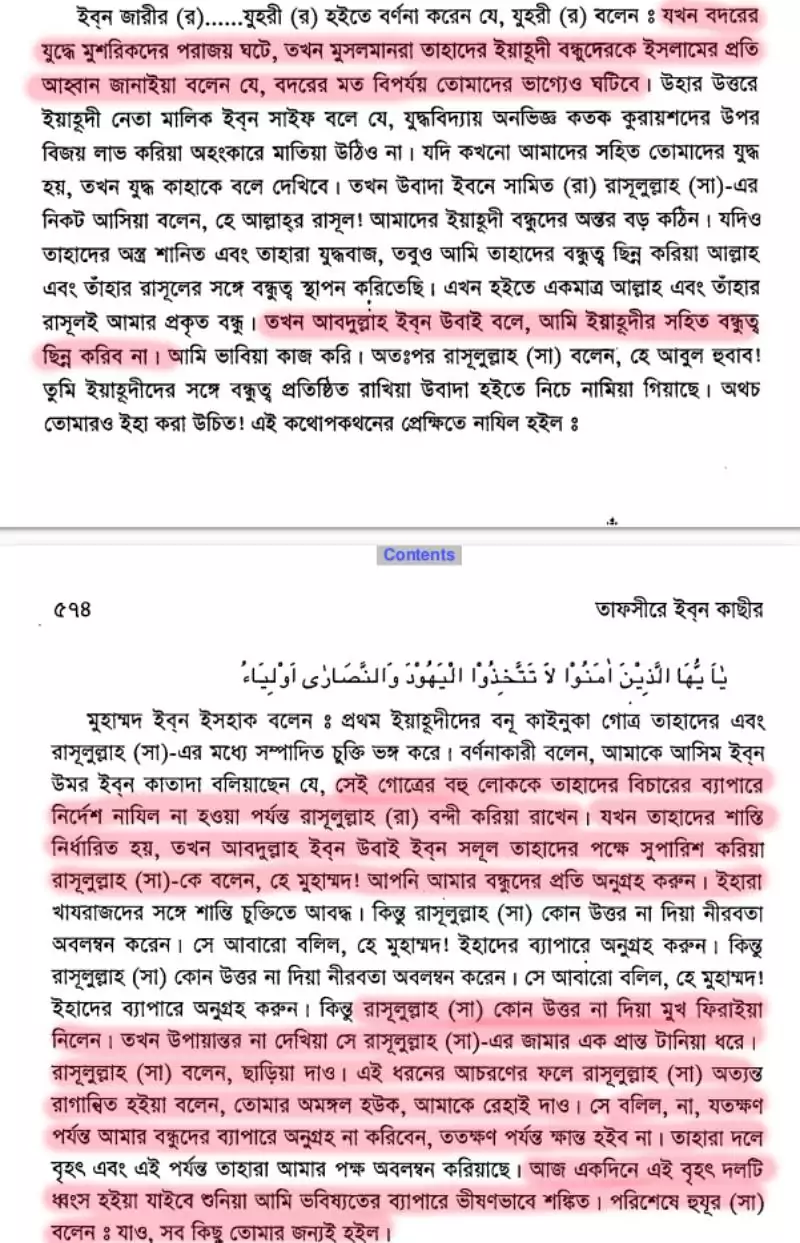
After achieving victory in the Battle of Badr, the Muslim warriors intimidated and threatened the Jews in various ways. They would say that if those Jews did not accept Islam, the same fate would befall them. Let us look at this in Tafsir Ibn Kathir [25]
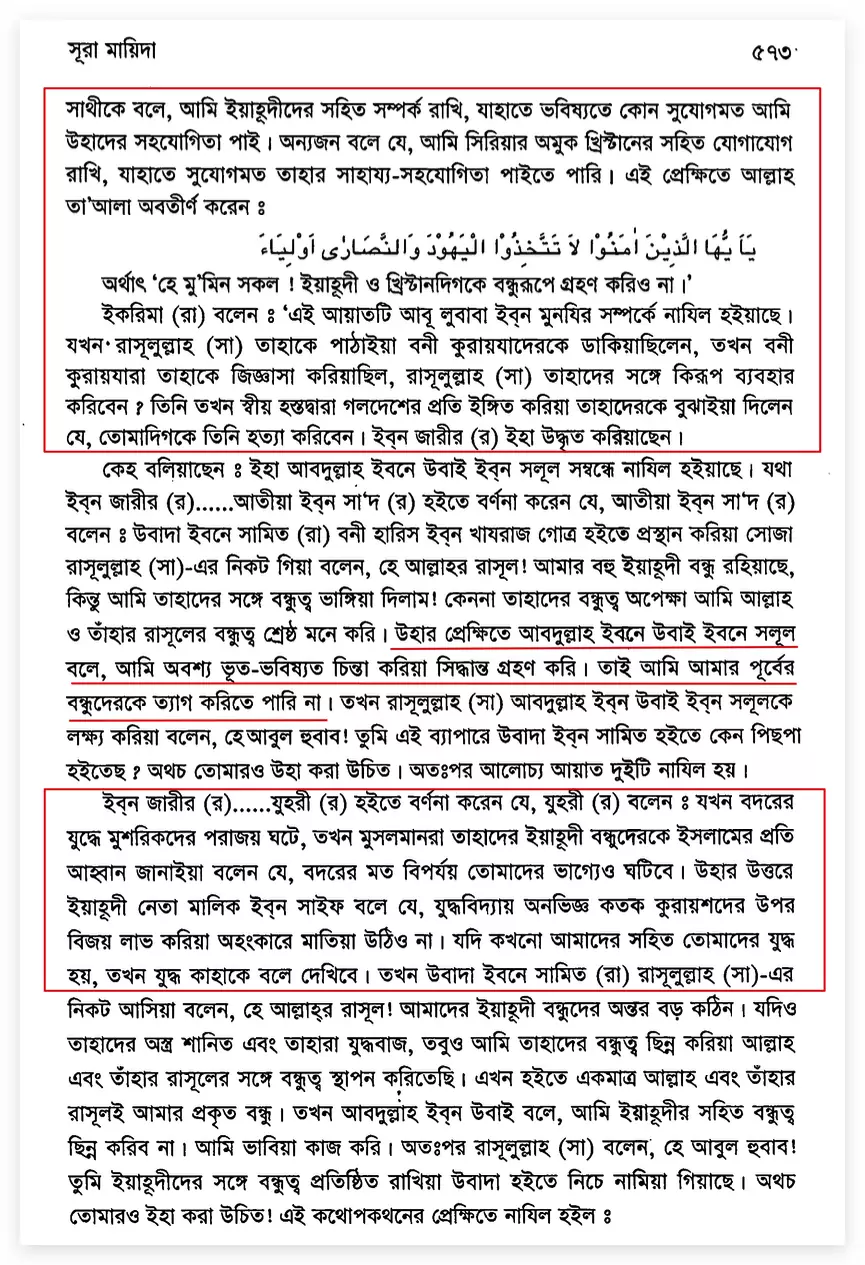
Ibn Jarir (may Allah have mercy on him) … narrates from Zuhri (may Allah have mercy on him) that Zuhri (may Allah have mercy on him) said:When the polytheists were defeated in the Battle of Badr, the Muslims invited their Jewish friends to Islam, saying that a calamity like Badr would also befall them. In response, the Jewish leader Malik ibn Sayf said, “Do not become intoxicated with arrogance after defeating some inexperienced Quraysh men in warfare. If you ever fight us, then you will see what war really means.” At that point, Ubada ibn al-Samit (may Allah be pleased with him) came to the Messenger of Allah (peace and blessings be upon him) and said, “O Messenger of Allah! The hearts of our Jewish friends are very hard. Although their weapons are sharpened and they are warriors, I am severing my friendship with them and establishing friendship with Allah and His Messenger. From now on, only Allah and His Messenger are my true friends.” Abdullah ibn Ubay then said, “I will not sever my friendship with the Jews. I act only after careful consideration.” Thereupon the Messenger of Allah (peace and blessings be upon him) said, “O Abu al-Hubab! By maintaining friendship with the Jews, you have fallen below Ubada. You too should do the same!” It was in the context of this conversation that the following was revealed:
The Incident of Banu Qaynuqa: Allegation of Humiliating a Muslim Woman
One of the Jewish tribes that refused to accept the new religion of Muhammad, particularly among several Jewish tribes living around Medina, was Banu Qaynuqa. For quite some time before attacking the Banu Qurayza tribe, he had been looking for an excuse to carry out a large-scale massacre, so that he could create terror in that region and make his name spread throughout the Arabian Peninsula as an object of fear. As part of this, he attacked, expelled, and drove out several Jewish tribes. Before discussing this matter, it is necessary to say something about Abdullah ibn Ubay. Ubay was the chief of the Banu Khazraj tribe and a prominent figure in Medina, who had made every possible effort to end the enmity between the tribes. In fact, Muhammad had been invited to Medina primarily with the aim of stopping the conflicts that had continued among the Jewish tribes. But Muhammad’s arrival in Medina once again intensified hostility between the tribes. This Abdullah ibn Ubay was also connected with the Jews in various ways. In Islamic history, he is described as a hypocrite (a pretender and deceiver) and as the leader of the hypocrites.
The Jewish tribe of Banu Qaynuqa consisted professionally of blacksmiths, goldsmiths, and utensil makers. A few days after the Battle of Badr, a Muslim girl went to a Jewish goldsmith’s shop in their market for some work. When the Muslim woman went to that shop, the Jewish employee told her to uncover her face. When the woman refused to uncover her face and sat on a chair in the goldsmith’s shop, the Jewish employee nailed her clothing to the chair, so that when she tried to stand up, her garment tore and her entire body became exposed. Hearing the Muslim woman’s cries, a Muslim passerby became enraged when he saw what had happened and killed the Jewish employee. Then several Jews from the employee’s side joined together and killed the Muslim man. Following this incident, Muhammad attacked the Banu Qaynuqa tribe. His intention was to use this excuse to annihilate the entire Banu Qaynuqa tribe. But whether it is humane and rational to place the blame for a crime on people other than those who committed it, or whether this was merely an excuse for a brutal war leader to carry out a massacre, is for the reader to decide. Yet any humane person will understand that if a crime has been committed, the perpetrators can be identified and appropriately punished. But exterminating an entire tribe for the crimes of a few people, turning women and children into spoils of war, and seizing all their property are profoundly unjust and unfair acts.
In 624 CE, Muhammad imposed a fifteen-day siege on the Jewish tribe of Banu Qaynuqa. Seeing no alternative, the Banu Qaynuqa tribe unconditionally surrendered to Muhammad’s forces. Muhammad wanted to behead all the adult men of that tribe and enslave their women and children, so that terror could be created throughout the Arabian Peninsula. At the time of the Banu Qaynuqa incident, Abdullah ibn Ubay, chief of the Khazraj lineage, was a powerful local leader in Medina. He possessed very high status and had been the leader of Medina when Muhammad migrated there. His influence gradually declined with Muhammad’s rise. During the siege of Banu Qaynuqa, Abdullah ibn Ubay understood Muhammad’s intention to carry out a massacre and restrained this bloodthirsty prophet from doing so by seizing him by the collar of his robe. Muhammad became almost black with rage, but Abdullah ibn Ubay practically forced Muhammad to refrain from brutally slaughtering the Banu Qaynuqa. This shows that the Prophet Muhammad intended to kill all the men of Banu Qaynuqa and turn their women and children into spoils of war. Evidence of this can be found in Ibn Hisham’s Sirah [26] [27] –
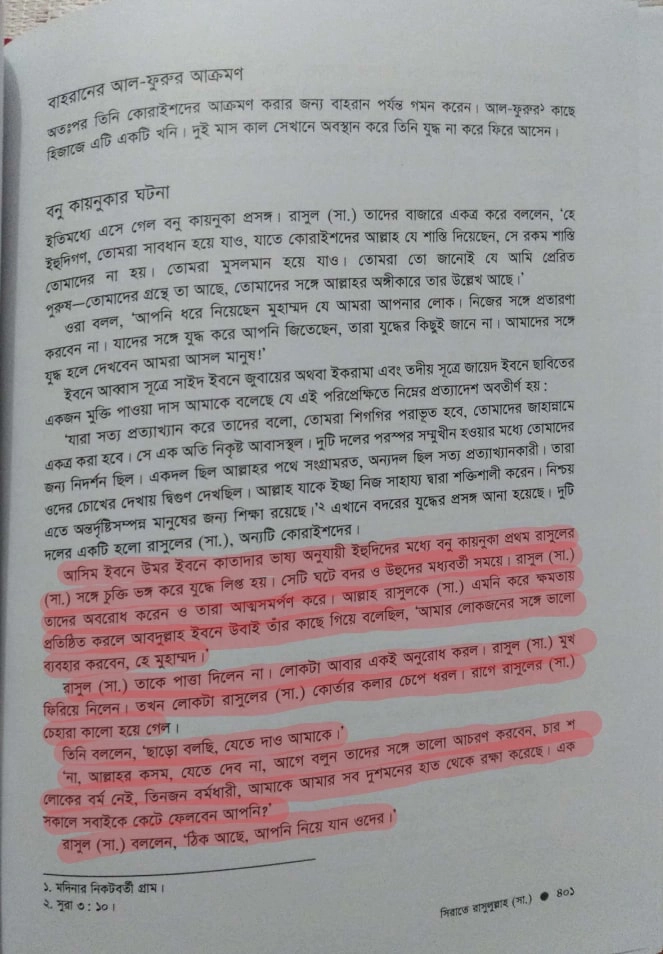
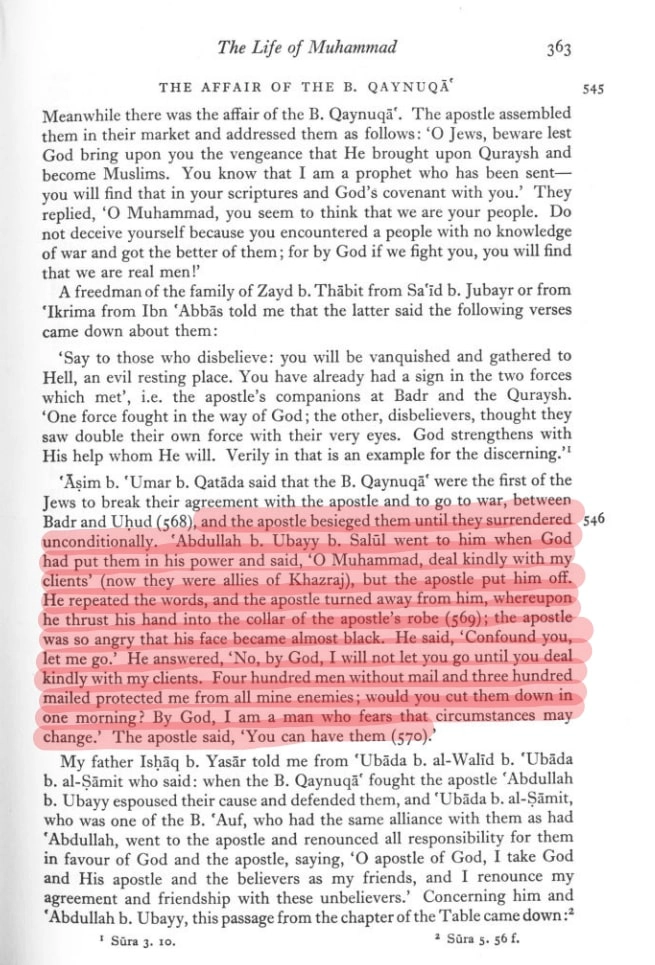
According to Asim ibn Umar ibn Qatadah, among the Jews, Banu Qaynuqa were the first to violate their treaty with the Messenger (peace be upon him) and engage in war. This occurred between Badr and Uhud. The Messenger (peace be upon him) besieged them, and they surrendered. When Allah established the Messenger (peace be upon him) in power in this manner, Abdullah ibn Ubay went to him and said, “Treat my people well, O Muhammad.”
The Messenger (peace be upon him) paid no attention to him. The man made the same request again. The Messenger (peace be upon him) turned away. Then the man seized the collar of the Messenger’s (peace be upon him) robe. The Messenger’s (peace be upon him) face became dark with anger.
He said, “Let go, I tell you; let me go.”
“No, by Allah, I will not let you go. First promise that you will treat them well. Four hundred of them have no armor, and three hundred are armored; they have protected me from all my enemies. Will you cut them all down in a single morning?”
The Messenger (peace be upon him) said, “Very well, take them with you.”
This account is found in a different form in the book Sirat Ibn Hisham [28] –
As a result, the Messenger of Allah (peace and blessings be upon him) besieged them and forced them to surrender on favorable terms. When, with Allah’s help, the Messenger of Allah (peace and blessings be upon him) brought them to their knees, Abdullah ibn Ubay ibn Salul came to him and said, “O Muhammad, treat my allies kindly.” The Messenger of Allah (peace and blessings be upon him) gave no response to this statement. He said again, “O Muhammad, treat my allies kindly.” The Messenger of Allah (peace and blessings be upon him) turned away. This time he put his hand into the pocket of the Messenger of Allah’s (peace and blessings be upon him) armor, and he said, “Let me go.” At this point, the Messenger of Allah (peace and blessings be upon him) became so angry that his face turned red. Then he said to him, “Come now, let me go!” He said, “No, I will let you go only after you assure me that you will treat my allies kindly. Believe me, four hundred unarmored warriors and three hundred armored warriors have protected me from all the people of the world. And now you want to annihilate them in a single day. I am not safe for even a moment without them.” The Messenger of Allah (peace and blessings be upon him) said, “All right, very well. I leave them to your wishes.”
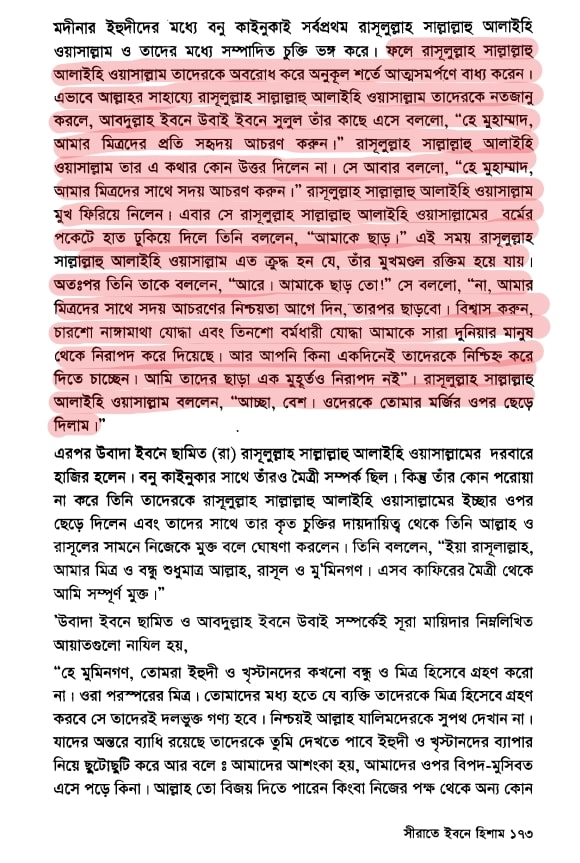
In the history of Islam, Abdullah ibn Ubay is described in various books as an extremely detestable character. But the act for which Muslims have hated Ubay to this day was, in fact, a deeply humane act. Standing before the Prophet and opposing one of the Prophet’s massacres, restraining the Prophet from carrying out a massacre, was not an easy thing to do. Yet as a result, he came to be known as the leader of the hypocrites [29] –
From the discussion above, it is clear that Muhammad had actually planned to kill all the men of the Banu Qaynuqa tribe, seize their land and property, and enslave their women and children. But because of Abdullah ibn Ubay, Muhammad’s intention remained unfulfilled. However, he did not make the same mistake in the case of the Banu Qurayza tribe. He assigned the responsibility to someone who already harbored hostility toward Banu Qurayza. We will find evidence of this shortly.
Allah and His Messenger as the Owners of the Jews’ Land
Now we will read several hadiths in which it becomes very clear that Muhammad would expressly intimidate the Jews into accepting Islam. If the language and structure of these hadith narrations are taken as they are, leaving aside the various ad hoc attempts to interpret and justify them in elaborate ways, and their plain meaning is accepted, then it is impossible to interpret them in any way as an “invitation to religion,” “propagation of the true religion,” or “teaching or explaining morality”; rather, what can be understood from these hadiths is that religious allegiance is being made a condition of security, while an ultimatum is being issued by state power. “Accept Islam—you will remain safe” is itself a declaration of conditional protection: that is, security is not a universal right, but something that is available only if one changes one’s faith and enters Islam. And in the same breath it turns into a threat of expulsion—“I want to expel you from this area… The land belongs to Allah and His Messenger”—which effectively constructs the legitimacy of forcibly displacing a population by nullifying the land rights of a community that had lived there for hundreds of years. If this were punishment for a “crime,” the minimum framework required would be a specific allegation, determination of individual responsibility, evidence-based adjudication, and a punishment proportionate to the crime; none of these is present. Instead, what we see is collective coercion: an entire population is presented with two alternatives—(a) change your faith, or (b) leave the land. Therefore, it is impossible to pass this off as “punitive justice”; it is the production of obedience through oppression (obedience through threat). [30] [31]
Sahih Bukhari (Islamic Foundation)
85/ Holding firmly to the Quran and Sunnah
Section: 3092. The Word of Almighty Allah: Human beings are argumentative regarding most matters (18:54). The Word of Almighty Allah: Do not argue with the People of the Book……… (29:46)
6847
Narrated Abu Huraira:While we were in the mosque, Allah’s Messenger (ﷺ) came out to us and said, “Let us proceed to the Jews.” So we went along with him till we reached Bait-al-Midras (a place where the Torah used to be recited and all the Jews of the town used to gather). The Prophet (ﷺ) stood up and addressed them, “O Assembly of Jews! Embrace Islam and you will be safe!” The Jews replied, “O Aba-l-Qasim! You have conveyed Allah’s message to us.” The Prophet (ﷺ) said, “That is what I want (from you).” He repeated his first statement for the second time, and they said, “You have conveyed Allah’s message, O Aba-l- Qasim.” Then he said it for the third time and added, “You should Know that the earth belongs to Allah and His Apostle, and I want to exile you fro,,, this land, so whoever among you owns some property, can sell it, otherwise you should know that the Earth belongs to Allah and His Apostle.” (See Hadith No. 392, Vol)
حَدَّثَنَا عَبْدُ الْعَزِيزِ بْنُ عَبْدِ اللَّهِ، حَدَّثَنَا اللَّيْثُ، عَنْ سَعِيدٍ الْمَقْبُرِيِّ، عَنْ أَبِيهِ، عَنْ أَبِي هُرَيْرَةَ ـ رضى الله عنه ـ قَالَ بَيْنَمَا نَحْنُ فِي الْمَسْجِدِ إِذْ خَرَجَ عَلَيْنَا رَسُولُ اللَّهِ صلى الله عليه وسلم فَقَالَ ” انْطَلِقُوا إِلَى يَهُودَ ”. فَخَرَجْنَا مَعَهُ حَتَّى جِئْنَا بَيْتَ الْمِدْرَاسِ فَقَامَ النَّبِيُّ صلى الله عليه وسلم فَنَادَاهُمْ ” يَا مَعْشَرَ يَهُودَ أَسْلِمُوا تَسْلَمُوا ”. فَقَالُوا قَدْ بَلَّغْتَ يَا أَبَا الْقَاسِمِ. فَقَالَ ” ذَلِكَ أُرِيدُ ”، ثُمَّ قَالَهَا الثَّانِيَةَ. فَقَالُوا قَدْ بَلَّغْتَ يَا أَبَا الْقَاسِمِ. ثُمَّ قَالَ الثَّالِثَةَ فَقَالَ ” اعْلَمُوا أَنَّ الأَرْضَ لِلَّهِ وَرَسُولِهِ، وَإِنِّي أُرِيدُ أَنْ أُجْلِيَكُمْ، فَمَنْ وَجَدَ مِنْكُمْ بِمَالِهِ شَيْئًا فَلْيَبِعْهُ، وَإِلاَّ فَاعْلَمُوا أَنَّمَا الأَرْضُ لِلَّهِ وَرَسُولِهِ ”.
Collection status: Sahih
Sunan Abu Dawud (verified)
Allama Albani Academy
Chapter: 14/ Jizya, Fay, and Administration
3003.
Abu Hurairah said, While we were in the mosque, the Apostle of Allaah(ﷺ) came out and said “Come on to the Jews. So we went out with him and came to them”. The Apostle of Allaah(ﷺ) stood up, called them and said “If you, the community of Jews accept Islam you will be safe”. They said “You have given the message Abu Al Qasim”. The Apostle of Allaah(ﷺ) said “Accept Islam you will be safe”. They said “You have given the message Abu Al Qasim”. The Apostle of Allaah(ﷺ) said “that I intended”. He then said the third time “Know that the land belongs to Allaah and His Apostle and I intend to deport you from this land. So, if any of you has property (he cannot take it away), he must sell it, otherwise know that the land belongs to Allaah and His Apostle (ﷺ).”
حَدَّثَنَا قُتَيْبَةُ بْنُ سَعِيدٍ، أَخْبَرَنَا اللَّيْثُ، عَنْ سَعِيدِ بْنِ أَبِي سَعِيدٍ، عَنْ أَبِيهِ، عَنْ أَبِي هُرَيْرَةَ، أَنَّهُ قَالَ بَيْنَا نَحْنُ فِي الْمَسْجِدِ إِذْ خَرَجَ إِلَيْنَا رَسُولُ اللَّهِ صلى الله عليه وسلم فَقَالَ ” انْطَلِقُوا إِلَى يَهُودَ ” . فَخَرَجْنَا مَعَهُ حَتَّى جِئْنَاهُمْ فَقَامَ رَسُولُ اللَّهِ صلى الله عليه وسلم فَنَادَاهُمْ فَقَالَ يَا مَعْشَرَ يَهُودَ أَسْلِمُوا تَسْلَمُوا ” . فَقَالُوا قَدْ بَلَّغْتَ يَا أَبَا الْقَاسِمِ . فَقَالَ لَهُمْ رَسُولُ اللَّهِ صلى الله عليه وسلم ” أَسْلِمُوا تَسْلَمُوا ” . فَقَالُوا قَدْ بَلَّغْتَ يَا أَبَا الْقَاسِمِ . فَقَالَ لَهُمْ رَسُولُ اللَّهِ صلى الله عليه وسلم ” ذَلِكَ أُرِيدُ ” . ثُمَّ قَالَهَا الثَّالِثَةَ ” اعْلَمُوا أَنَّمَا الأَرْضُ لِلَّهِ وَرَسُولِهِ وَإِنِّي أُرِيدُ أَنْ أُجْلِيَكُمْ مِنْ هَذِهِ الأَرْضِ فَمَنْ وَجَدَ مِنْكُمْ بِمَالِهِ شَيْئًا فَلْيَبِعْهُ وَإِلاَّ فَاعْلَمُوا أَنَّمَا الأَرْضُ لِلَّهِ وَرَسُولِهِ صلى الله عليه وسلم ” .
Grade: Sahih (Al-Albani)
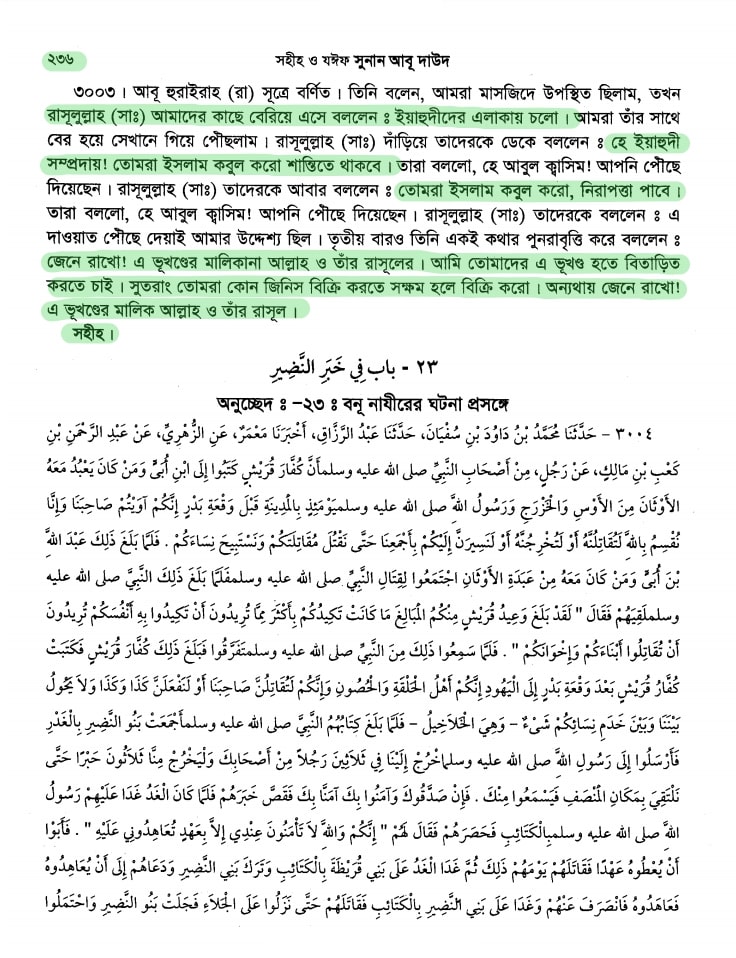
This social layer of the pressure infrastructure follows the same pattern: when encountered on the road, the instruction to “push them to the side of the road” is not merely a code of conduct, but rather the conversion of status degradation into policy; that is, instead of the minimum equality required for coexistence, it represents a display of authority. Logically, therefore, even if one says, “This was the politics/war situation of that time,” the essential truth does not change: whether politics was involved or not, the model established here is—acceptance of the religion = security, non-acceptance of the religion = expulsion/humiliating discipline. Rather than as a moral call, the most straightforward and honest way to explain it is as a state version of a gangster/mafia-style ultimatum expressed in the language of power: “Comply, or suffer harm.” [32]
Sunan at-Tirmidhi (verified)
Publisher: Husain al-Madani
Chapter: 19/ Military Expeditions
Section: 41. Regarding offering greetings of peace to the People of the Book
1602.
Narrated Abu Hurairah: That the Messenger of Allah (ﷺ) said: “Do not precede the Jews and the Christians with the Salam. And if one you meets one of them in the path, then force him to its narrow portion.” [He said:] There are narrations on this topic from Ibn ‘Umar, Anas, and Abu Basrah Al-Ghifari the Companion of the Prophet (ﷺ). [Abu ‘Eisa said:] This Hadith is Hasan Sahih. And regarding the meaning of this Hadith: “Do not precede the Jews and the Christians”: Some of the poeple of knowledge said that it only means that it is disliked because it would be honoring them, and the Muslims were ordered to humiliate them. For this reason, when one of them is met on the path, then the path is not yielded for him, because doing so would amount to honoring them
حَدَّثَنَا قُتَيْبَةُ، حَدَّثَنَا عَبْدُ الْعَزِيزِ بْنُ مُحَمَّدٍ، عَنْ سُهَيْلِ بْنِ أَبِي صَالِحٍ، عَنْ أَبِيهِ، عَنْ أَبِي هُرَيْرَةَ، أَنَّ رَسُولَ اللَّهِ صلى الله عليه وسلم قَالَ ” لاَ تَبْدَءُوا الْيَهُودَ وَالنَّصَارَى بِالسَّلاَمِ وَإِذَا لَقِيتُمْ أَحَدَهُمْ فِي الطَّرِيقِ فَاضْطَرُّوهُمْ إِلَى أَضْيَقِهِ ” . قَالَ وَفِي الْبَابِ عَنِ ابْنِ عُمَرَ وَأَنَسٍ وَأَبِي بَصْرَةَ الْغِفَارِيِّ صَاحِبِ النَّبِيِّ صلى الله عليه وسلم . قَالَ أَبُو عِيسَى هَذَا حَدِيثٌ حَسَنٌ صَحِيحٌ . وَمَعْنَى هَذَا الْحَدِيثِ ” لاَ تَبْدَءُوا الْيَهُودَ وَالنَّصَارَى ” . قَالَ بَعْضُ أَهْلِ الْعِلْمِ إِنَّمَا مَعْنَى الْكَرَاهِيَةِ لأَنَّهُ يَكُونُ تَعْظِيمًا لَهُ وَإِنَّمَا أُمِرَ الْمُسْلِمُونَ بِتَذْلِيلِهِمْ وَكَذَلِكَ إِذَا لَقِيَ أَحَدَهُمْ فِي الطَّرِيقِ فَلاَ يَتْرُكُ الطَّرِيقَ عَلَيْهِ لأَنَّ فِيهِ تَعْظِيمًا لَهُمْ .
Grade: Sahih (Ahmad Muhammad Shakir)
Flight from the Debate with Banu Nadir and the Attack
The leaders of the Banu Nadir tribe had invited the Prophet Muhammad and his Companions for the purpose of discussion, and Muhammad had been challenged to show proof that he was a prophet. The Jews said that if Muhammad could correctly answer all the questions of the Jewish scholars, then everyone in the Banu Nadir tribe would understand the truth of Islam and accept it. Muhammad would come to a specified place with 30 companions, while the Jews would also bring 30 people. The Prophet went there with his Companions. But before the debate even began, he suddenly got up and left the place, quietly abandoning everyone else—in other words, he left without telling anyone anything. The other Companions waited for a long time, but there was no further news of the Prophet! He could not be found anywhere. Later, they heard from someone else that the Prophet had gone to Medina. Since they could not find the Prophet anywhere, they returned to Medina. After returning, they learned that Gabriel had allegedly come and secretly told the Prophet, “Some people were sitting on the roof of the room where they were seated in order to kill the Prophet.”
But why those people did not kill the Prophet’s Companions, why none of the Companions saw anyone of this kind, and why the Prophet himself left alone without saying anything to anyone—nothing is known about these matters. In other words, only the Prophet knew about this secret conspiracy of the Jews, for which there is no real evidence. Any intelligent person will understand how ridiculous this incident of the Prophet fleeing alone, leaving his friends and companions in the face of danger that day, was, and how it served as a strategy for avoiding debate with the Jews. For if the Prophet had truly recognized a genuine danger, he would certainly have informed his Companions about it; he would not have fled alone. For if someone had been sitting above with a large stone, the pressure of that stone could have injured or killed Companions such as Abu Bakr, Umar, and Ali.
The very next day, an attack was launched against Banu Nadir under Muhammad’s leadership [33] –
The Messenger of Allah (peace be upon him) was then sitting beside the wall of one of their houses. They said, “Who will climb onto the roof, drop a stone from there, kill Muhammad, and free us from his hands?” Amr ibn Jahhash stepped forward and said, “I am ready for this.” Accordingly, he climbed to that place with the intention of throwing a stone. The Messenger of Allah (peace be upon him) was still sitting there with a group of Companions. Among them were Hazrat Abu Bakr (RA), Umar (RA), and Ali (RA). Heavenly information about their evil intention came to the Messenger of Allah (peace be upon him). He got up without saying anything to anyone and set out for Medina. When he did not return to the scene for a long time, the Companions went out in search of him. Seeing a man coming from the direction of Medina, they asked him about the Messenger of Allah (peace be upon him). The man said that he had seen him entering Medina. Upon receiving this news, all the Companions returned to Medina and gathered before the Messenger of Allah (peace be upon him). He informed them of the Jews’ betrayal.
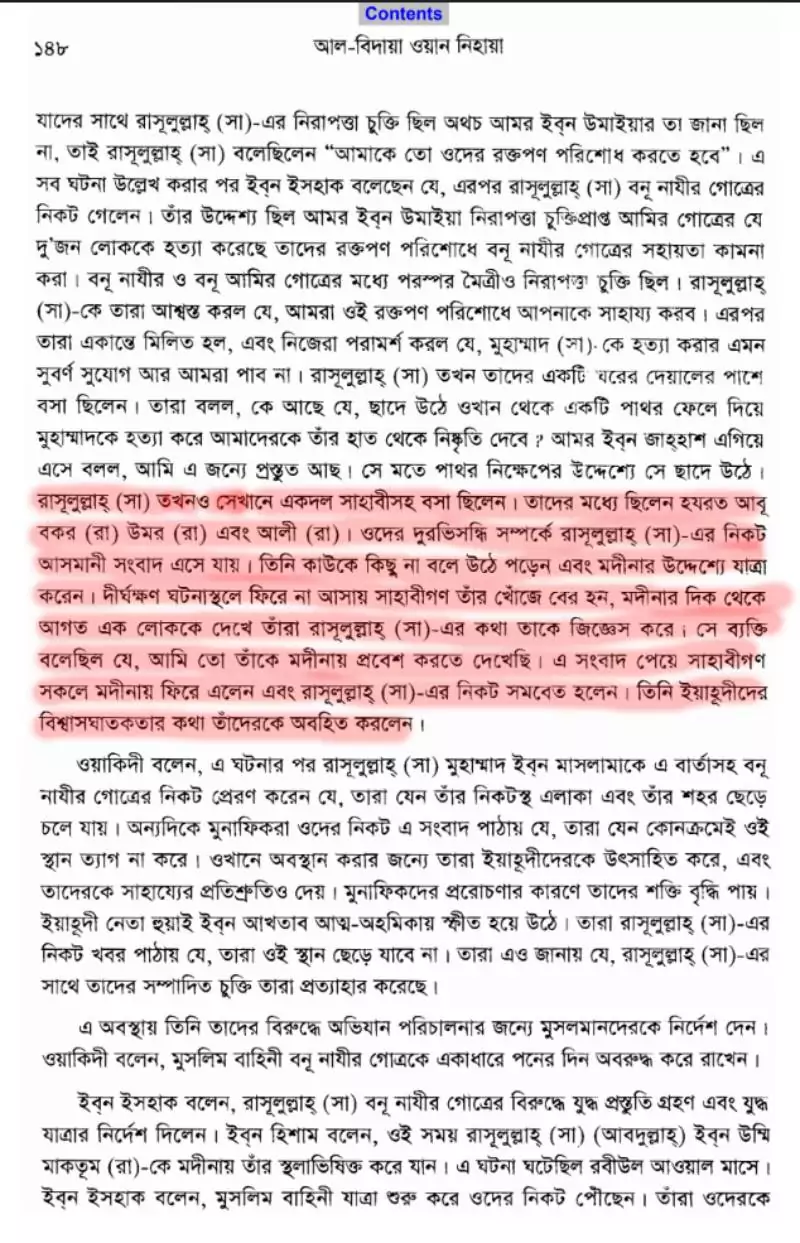
From the document above, you can see that Muhammad suddenly left the place without providing proof of his prophethood. Now let us see what happened before and afterward [34]
Sunan Abu Dawud (Islamic Foundation)
14/ Regarding taxes, tributes, donations, and administrative responsibilities
Section: 161. Regarding the incident of Banu Nadir.
2994
Narrated A man from the companions of the Prophet: AbdurRahman ibn Ka’b ibn Malik reported on the authority of a man from among the companions of the Prophet (ﷺ): The infidels of the Quraysh wrote (a letter) to Ibn Ubayy and to those who worshipped idols from al-Aws and al-Khazraj, while the Messenger of Allah (ﷺ) was at that time at Medina before the battle of Badr. (They wrote): You gave protection to our companion. We swear by Allah, you should fight him or expel him, or we shall come to you in full force, until we kill your fighters and appropriate your women. When this (news) reached Abdullah ibn Ubayy and those who were worshippers of idols, with him they gathered together to fight the Messenger of Allah (ﷺ). When this news reached the Messenger of Allah (ﷺ), he visited them and said: The threat of the Quraysh to you has reached its end. They cannot contrive a plot against you, greater than what you yourselves intended to harm you. Are you willing to fight your sons and brethren? When they heard this from the Prophet (ﷺ), they scattered. This reached the infidels of the Quraysh. The infidels of the Quraysh again wrote (a letter) to the Jews after the battle of Badr: You are men of weapons and fortresses. You should fight our companion or we shall deal with you in a certain way. And nothing will come between us and the anklets of your women. When their letter reached the Prophet (ﷺ), they gathered Banu an-Nadir to violate the treaty. They sent a message to the Prophet (ﷺ): Come out to us with thirty men from your companions, and thirty rabbis will come out from us till we meet at a central place where they will hear you. If they testify to you and believe in you, we shall believe in you. The narrator then narrated the whole story. When the next day came, the Messenger of Allah (ﷺ) went out in the morning with an army, and surrounded them. He told them: I swear by Allah, you will have no peace from me until you conclude a treaty with me. But they refused to conclude a treaty with him. He therefore fought them the same day. Next he attacked Banu Quraysh with an army in the morning, and left Banu an-Nadir. He asked them to sign a treaty and they signed it. He turned away from them and attacked Banu an-Nadir with an army. He fought with them until they agreed to expulsion. Banu an-Nadir were deported, and they took with them whatever their camels could carry, that is, their property, the doors of their houses, and their wood. Palm-trees were exclusively reserved for the Messenger of Allah (ﷺ). Allah bestowed them upon him and gave them him as a special portion. He (Allah), the Exalted, said: What Allah has bestowed on His Apostle (and taken away) from them, for this ye made no expedition with either camel corps or cavalry.” He said: “Without fighting.” So the Prophet (ﷺ) gave most of it to the emigrants and divided it among them; and he divided some of it between two men from the helpers, who were needy, and he did not divide it among any of the helpers except those two. The rest of it survived as the sadaqah of the Messenger of Allah (ﷺ) which is in the hands of the descendants of Fatimah (Allah be pleased with her)
حَدَّثَنَا مُحَمَّدُ بْنُ دَاوُدَ بْنِ سُفْيَانَ، حَدَّثَنَا عَبْدُ الرَّزَّاقِ، أَخْبَرَنَا مَعْمَرٌ، عَنِ الزُّهْرِيِّ، عَنْ عَبْدِ الرَّحْمَنِ بْنِ كَعْبِ بْنِ مَالِكٍ، عَنْ رَجُلٍ، مِنْ أَصْحَابِ النَّبِيِّ صلى الله عليه وسلم أَنَّ كُفَّارَ قُرَيْشٍ كَتَبُوا إِلَى ابْنِ أُبَىٍّ وَمَنْ كَانَ يَعْبُدُ مَعَهُ الأَوْثَانَ مِنَ الأَوْسِ وَالْخَزْرَجِ وَرَسُولُ اللَّهِ صلى الله عليه وسلم يَوْمَئِذٍ بِالْمَدِينَةِ قَبْلَ وَقْعَةِ بَدْرٍ إِنَّكُمْ آوَيْتُمْ صَاحِبَنَا وَإِنَّا نُقْسِمُ بِاللَّهِ لَتُقَاتِلُنَّهُ أَوْ لَتُخْرِجُنَّهُ أَوْ لَنَسِيرَنَّ إِلَيْكُمْ بِأَجْمَعِنَا حَتَّى نَقْتُلَ مُقَاتِلَتَكُمْ وَنَسْتَبِيحَ نِسَاءَكُمْ . فَلَمَّا بَلَغَ ذَلِكَ عَبْدَ اللَّهِ بْنَ أُبَىٍّ وَمَنْ كَانَ مَعَهُ مِنْ عَبَدَةِ الأَوْثَانِ اجْتَمَعُوا لِقِتَالِ النَّبِيِّ صلى الله عليه وسلم فَلَمَّا بَلَغَ ذَلِكَ النَّبِيَّ صلى الله عليه وسلم لَقِيَهُمْ فَقَالَ ” لَقَدْ بَلَغَ وَعِيدُ قُرَيْشٍ مِنْكُمُ الْمَبَالِغَ مَا كَانَتْ تَكِيدُكُمْ بِأَكْثَرَ مِمَّا تُرِيدُونَ أَنْ تَكِيدُوا بِهِ أَنْفُسَكُمْ تُرِيدُونَ أَنْ تُقَاتِلُوا أَبْنَاءَكُمْ وَإِخْوَانَكُمْ ” . فَلَمَّا سَمِعُوا ذَلِكَ مِنَ النَّبِيِّ صلى الله عليه وسلم تَفَرَّقُوا فَبَلَغَ ذَلِكَ كُفَّارَ قُرَيْشٍ فَكَتَبَتْ كُفَّارُ قُرَيْشٍ بَعْدَ وَقْعَةِ بَدْرٍ إِلَى الْيَهُودِ إِنَّكُمْ أَهْلُ الْحَلْقَةِ وَالْحُصُونِ وَإِنَّكُمْ لَتُقَاتِلُنَّ صَاحِبَنَا أَوْ لَنَفْعَلَنَّ كَذَا وَكَذَا وَلاَ يَحُولُ بَيْنَنَا وَبَيْنَ خَدَمِ نِسَائِكُمْ شَىْءٌ – وَهِيَ الْخَلاَخِيلُ – فَلَمَّا بَلَغَ كِتَابُهُمُ النَّبِيَّ صلى الله عليه وسلم أَجْمَعَتْ بَنُو النَّضِيرِ بِالْغَدْرِ فَأَرْسَلُوا إِلَى رَسُولِ اللَّهِ صلى الله عليه وسلم اخْرُجْ إِلَيْنَا فِي ثَلاَثِينَ رَجُلاً مِنْ أَصْحَابِكَ وَلْيَخْرُجْ مِنَّا ثَلاَثُونَ حَبْرًا حَتَّى نَلْتَقِيَ بِمَكَانِ الْمَنْصَفِ فَيَسْمَعُوا مِنْكَ . فَإِنْ صَدَّقُوكَ وَآمَنُوا بِكَ آمَنَّا بِكَ فَقَصَّ خَبَرَهُمْ فَلَمَّا كَانَ الْغَدُ غَدَا عَلَيْهِمْ رَسُولُ اللَّهِ صلى الله عليه وسلم بِالْكَتَائِبِ فَحَصَرَهُمْ فَقَالَ لَهُمْ ” إِنَّكُمْ وَاللَّهِ لاَ تَأْمَنُونَ عِنْدِي إِلاَّ بِعَهْدٍ تُعَاهِدُونِي عَلَيْهِ ” . فَأَبَوْا أَنْ يُعْطُوهُ عَهْدًا فَقَاتَلَهُمْ يَوْمَهُمْ ذَلِكَ ثُمَّ غَدَا الْغَدُ عَلَى بَنِي قُرَيْظَةَ بِالْكَتَائِبِ وَتَرَكَ بَنِي النَّضِيرِ وَدَعَاهُمْ إِلَى أَنْ يُعَاهِدُوهُ فَعَاهَدُوهُ فَانْصَرَفَ عَنْهُمْ وَغَدَا عَلَى بَنِي النَّضِيرِ بِالْكَتَائِبِ فَقَاتَلَهُمْ حَتَّى نَزَلُوا عَلَى الْجَلاَءِ فَجَلَتْ بَنُو النَّضِيرِ وَاحْتَمَلُوا مَا أَقَلَّتِ الإِبِلُ مِنْ أَمْتِعَتِهِمْ وَأَبْوَابِ بُيُوتِهِمْ وَخَشَبِهَا فَكَانَ نَخْلُ بَنِي النَّضِيرِ لِرَسُولِ اللَّهِ صلى الله عليه وسلم خَاصَّةً أَعْطَاهُ اللَّهُ إِيَّاهَا وَخَصَّهُ بِهَا فَقَالَ { وَمَا أَفَاءَ اللَّهُ عَلَى رَسُولِهِ مِنْهُمْ فَمَا أَوْجَفْتُمْ عَلَيْهِ مِنْ خَيْلٍ وَلاَ رِكَابٍ } يَقُولُ بِغَيْرِ قِتَالٍ فَأَعْطَى النَّبِيُّ صلى الله عليه وسلم أَكْثَرَهَا لِلْمُهَاجِرِينَ وَقَسَمَهَا بَيْنَهُمْ وَقَسَمَ مِنْهَا لِرَجُلَيْنِ مِنَ الأَنْصَارِ وَكَانَا ذَوِي حَاجَةٍ لَمْ يَقْسِمْ لأَحَدٍ مِنَ الأَنْصَارِ غَيْرَهُمَا وَبَقِيَ مِنْهَا صَدَقَةُ رَسُولِ اللَّهِ صلى الله عليه وسلم الَّتِي فِي أَيْدِي بَنِي فَاطِمَةَ رَضِيَ اللَّهُ عَنْهَا .
Grade: Sahih Isnaad (Al-Albani)
The Attack on Banu Qurayza Without Any Reason
The hadith narrated above must be read once again here. Readers should note that the war with Banu Nadir was underway with the Prophet Muhammad. In the midst of this war, Banu Qurayza was suddenly attacked as well, without any reason. Why did this attack take place? What had Banu Qurayza done at this time? [35]
Sunan Abu Dawud (Islamic Foundation)
14/ Regarding taxes, tributes, donations, and administrative responsibilities
Section: 161. Regarding the incident of Banu Nadir.
2994
Narrated A man from the companions of the Prophet: AbdurRahman ibn Ka’b ibn Malik reported on the authority of a man from among the companions of the Prophet (ﷺ): The infidels of the Quraysh wrote (a letter) to Ibn Ubayy and to those who worshipped idols from al-Aws and al-Khazraj, while the Messenger of Allah (ﷺ) was at that time at Medina before the battle of Badr. (They wrote): You gave protection to our companion. We swear by Allah, you should fight him or expel him, or we shall come to you in full force, until we kill your fighters and appropriate your women. When this (news) reached Abdullah ibn Ubayy and those who were worshippers of idols, with him they gathered together to fight the Messenger of Allah (ﷺ). When this news reached the Messenger of Allah (ﷺ), he visited them and said: The threat of the Quraysh to you has reached its end. They cannot contrive a plot against you, greater than what you yourselves intended to harm you. Are you willing to fight your sons and brethren? When they heard this from the Prophet (ﷺ), they scattered. This reached the infidels of the Quraysh. The infidels of the Quraysh again wrote (a letter) to the Jews after the battle of Badr: You are men of weapons and fortresses. You should fight our companion or we shall deal with you in a certain way. And nothing will come between us and the anklets of your women. When their letter reached the Prophet (ﷺ), they gathered Banu an-Nadir to violate the treaty. They sent a message to the Prophet (ﷺ): Come out to us with thirty men from your companions, and thirty rabbis will come out from us till we meet at a central place where they will hear you. If they testify to you and believe in you, we shall believe in you. The narrator then narrated the whole story. When the next day came, the Messenger of Allah (ﷺ) went out in the morning with an army, and surrounded them. He told them: I swear by Allah, you will have no peace from me until you conclude a treaty with me. But they refused to conclude a treaty with him. He therefore fought them the same day. Next he attacked Banu Quraysh with an army in the morning, and left Banu an-Nadir. He asked them to sign a treaty and they signed it. He turned away from them and attacked Banu an-Nadir with an army. He fought with them until they agreed to expulsion. Banu an-Nadir were deported, and they took with them whatever their camels could carry, that is, their property, the doors of their houses, and their wood. Palm-trees were exclusively reserved for the Messenger of Allah (ﷺ). Allah bestowed them upon him and gave them him as a special portion. He (Allah), the Exalted, said: What Allah has bestowed on His Apostle (and taken away) from them, for this ye made no expedition with either camel corps or cavalry.” He said: “Without fighting.” So the Prophet (ﷺ) gave most of it to the emigrants and divided it among them; and he divided some of it between two men from the helpers, who were needy, and he did not divide it among any of the helpers except those two. The rest of it survived as the sadaqah of the Messenger of Allah (ﷺ) which is in the hands of the descendants of Fatimah (Allah be pleased with her)
حَدَّثَنَا مُحَمَّدُ بْنُ دَاوُدَ بْنِ سُفْيَانَ، حَدَّثَنَا عَبْدُ الرَّزَّاقِ، أَخْبَرَنَا مَعْمَرٌ، عَنِ الزُّهْرِيِّ، عَنْ عَبْدِ الرَّحْمَنِ بْنِ كَعْبِ بْنِ مَالِكٍ، عَنْ رَجُلٍ، مِنْ أَصْحَابِ النَّبِيِّ صلى الله عليه وسلم أَنَّ كُفَّارَ قُرَيْشٍ كَتَبُوا إِلَى ابْنِ أُبَىٍّ وَمَنْ كَانَ يَعْبُدُ مَعَهُ الأَوْثَانَ مِنَ الأَوْسِ وَالْخَزْرَجِ وَرَسُولُ اللَّهِ صلى الله عليه وسلم يَوْمَئِذٍ بِالْمَدِينَةِ قَبْلَ وَقْعَةِ بَدْرٍ إِنَّكُمْ آوَيْتُمْ صَاحِبَنَا وَإِنَّا نُقْسِمُ بِاللَّهِ لَتُقَاتِلُنَّهُ أَوْ لَتُخْرِجُنَّهُ أَوْ لَنَسِيرَنَّ إِلَيْكُمْ بِأَجْمَعِنَا حَتَّى نَقْتُلَ مُقَاتِلَتَكُمْ وَنَسْتَبِيحَ نِسَاءَكُمْ . فَلَمَّا بَلَغَ ذَلِكَ عَبْدَ اللَّهِ بْنَ أُبَىٍّ وَمَنْ كَانَ مَعَهُ مِنْ عَبَدَةِ الأَوْثَانِ اجْتَمَعُوا لِقِتَالِ النَّبِيِّ صلى الله عليه وسلم فَلَمَّا بَلَغَ ذَلِكَ النَّبِيَّ صلى الله عليه وسلم لَقِيَهُمْ فَقَالَ ” لَقَدْ بَلَغَ وَعِيدُ قُرَيْشٍ مِنْكُمُ الْمَبَالِغَ مَا كَانَتْ تَكِيدُكُمْ بِأَكْثَرَ مِمَّا تُرِيدُونَ أَنْ تَكِيدُوا بِهِ أَنْفُسَكُمْ تُرِيدُونَ أَنْ تُقَاتِلُوا أَبْنَاءَكُمْ وَإِخْوَانَكُمْ ” . فَلَمَّا سَمِعُوا ذَلِكَ مِنَ النَّبِيِّ صلى الله عليه وسلم تَفَرَّقُوا فَبَلَغَ ذَلِكَ كُفَّارَ قُرَيْشٍ فَكَتَبَتْ كُفَّارُ قُرَيْشٍ بَعْدَ وَقْعَةِ بَدْرٍ إِلَى الْيَهُودِ إِنَّكُمْ أَهْلُ الْحَلْقَةِ وَالْحُصُونِ وَإِنَّكُمْ لَتُقَاتِلُنَّ صَاحِبَنَا أَوْ لَنَفْعَلَنَّ كَذَا وَكَذَا وَلاَ يَحُولُ بَيْنَنَا وَبَيْنَ خَدَمِ نِسَائِكُمْ شَىْءٌ – وَهِيَ الْخَلاَخِيلُ – فَلَمَّا بَلَغَ كِتَابُهُمُ النَّبِيَّ صلى الله عليه وسلم أَجْمَعَتْ بَنُو النَّضِيرِ بِالْغَدْرِ فَأَرْسَلُوا إِلَى رَسُولِ اللَّهِ صلى الله عليه وسلم اخْرُجْ إِلَيْنَا فِي ثَلاَثِينَ رَجُلاً مِنْ أَصْحَابِكَ وَلْيَخْرُجْ مِنَّا ثَلاَثُونَ حَبْرًا حَتَّى نَلْتَقِيَ بِمَكَانِ الْمَنْصَفِ فَيَسْمَعُوا مِنْكَ . فَإِنْ صَدَّقُوكَ وَآمَنُوا بِكَ آمَنَّا بِكَ فَقَصَّ خَبَرَهُمْ فَلَمَّا كَانَ الْغَدُ غَدَا عَلَيْهِمْ رَسُولُ اللَّهِ صلى الله عليه وسلم بِالْكَتَائِبِ فَحَصَرَهُمْ فَقَالَ لَهُمْ ” إِنَّكُمْ وَاللَّهِ لاَ تَأْمَنُونَ عِنْدِي إِلاَّ بِعَهْدٍ تُعَاهِدُونِي عَلَيْهِ ” . فَأَبَوْا أَنْ يُعْطُوهُ عَهْدًا فَقَاتَلَهُمْ يَوْمَهُمْ ذَلِكَ ثُمَّ غَدَا الْغَدُ عَلَى بَنِي قُرَيْظَةَ بِالْكَتَائِبِ وَتَرَكَ بَنِي النَّضِيرِ وَدَعَاهُمْ إِلَى أَنْ يُعَاهِدُوهُ فَعَاهَدُوهُ فَانْصَرَفَ عَنْهُمْ وَغَدَا عَلَى بَنِي النَّضِيرِ بِالْكَتَائِبِ فَقَاتَلَهُمْ حَتَّى نَزَلُوا عَلَى الْجَلاَءِ فَجَلَتْ بَنُو النَّضِيرِ وَاحْتَمَلُوا مَا أَقَلَّتِ الإِبِلُ مِنْ أَمْتِعَتِهِمْ وَأَبْوَابِ بُيُوتِهِمْ وَخَشَبِهَا فَكَانَ نَخْلُ بَنِي النَّضِيرِ لِرَسُولِ اللَّهِ صلى الله عليه وسلم خَاصَّةً أَعْطَاهُ اللَّهُ إِيَّاهَا وَخَصَّهُ بِهَا فَقَالَ { وَمَا أَفَاءَ اللَّهُ عَلَى رَسُولِهِ مِنْهُمْ فَمَا أَوْجَفْتُمْ عَلَيْهِ مِنْ خَيْلٍ وَلاَ رِكَابٍ } يَقُولُ بِغَيْرِ قِتَالٍ فَأَعْطَى النَّبِيُّ صلى الله عليه وسلم أَكْثَرَهَا لِلْمُهَاجِرِينَ وَقَسَمَهَا بَيْنَهُمْ وَقَسَمَ مِنْهَا لِرَجُلَيْنِ مِنَ الأَنْصَارِ وَكَانَا ذَوِي حَاجَةٍ لَمْ يَقْسِمْ لأَحَدٍ مِنَ الأَنْصَارِ غَيْرَهُمَا وَبَقِيَ مِنْهَا صَدَقَةُ رَسُولِ اللَّهِ صلى الله عليه وسلم الَّتِي فِي أَيْدِي بَنِي فَاطِمَةَ رَضِيَ اللَّهُ عَنْهَا .
Grade: Sahih Isnaad (Al-Albani)
Killing Prisoners of War Is Better: Allah’s Ruling in the Qur’an
After several wars had taken place, a number of prisoners of war began to fall into the hands of the Prophet Muhammad. At that time, a practical question arose: what should be done with these prisoners of war? In various discussions on the matter, Hazrat Umar and Sa‘d ibn Mu‘adh expressed the opinion that the prisoners of war should be slaughtered, while others favored releasing them in exchange for ransom. At this time, verses were revealed from Allah supporting Hazrat Umar and Sa‘d ibn Mu‘adh. This matter needs to be clarified.
After Islamic jihad, clear guidance was given in Islam regarding how Muslims should treat non-Muslim prisoners of war. Let us begin by reading what Ibn Kathir says in the exegesis of a Qur’anic verse on this subject [36] –
Tafsir: In the aforementioned verses, Allah the Pure describes His hatred toward the unbelievers and their evil deeds, saying that among all living creatures on the face of the earth, the faithless unbelievers are the most detestable creatures in the sight of Allah. Whenever you enter into a pact with any of them, they violate that pact. When you trust them and place confidence in them, they betray that trust and destroy your confidence. They have no fear of Allah whatsoever. With fearless arrogance, they engage in sinful conduct. The meaning of the relevant portion of the verse is: If you are able to defeat them in battle and gain victory, then capture them harshly and inflict torment upon them. This interpretation was given by Ibn Abbas (RA).
Hasan al-Basri, Dahhak, Suddi, Ata al-Khurasani, and Ibn Uyaynah (RA) said in their interpretation: If you are able to defeat them in battle, punish them most severely and kill them mercilessly, so that the other enemies of Arabia may hear of this punishment and become frightened, and may take admonition and learn a lesson. Thus shame and remorse may arise among them.
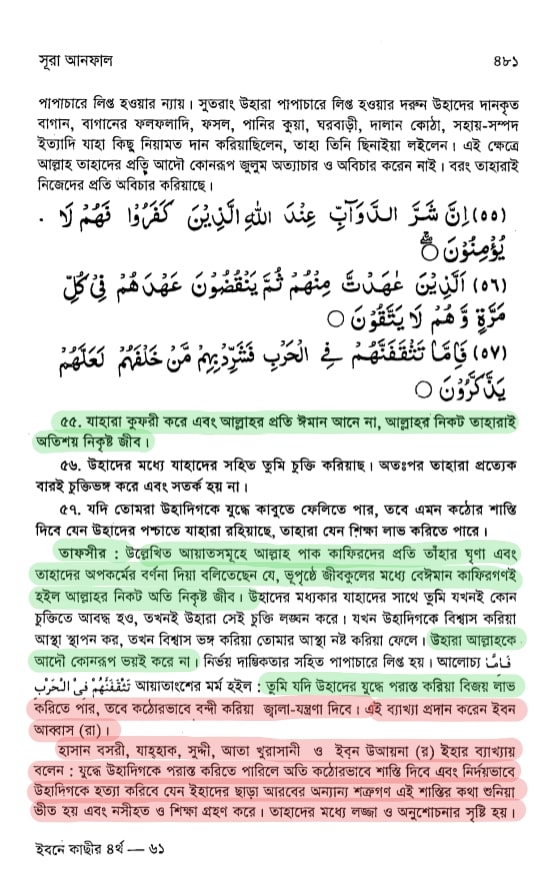
An important verse of the Quran was revealed concerning this matter. In this verse, Allah clearly declares that it is not permissible for the Prophet to take the unbelieving prisoners of war captive for ransom after a battle until a sufficient amount of killing and bloodshed has been inflicted upon them. In other words, Allah is clearly instructing that it is necessary to shed a sufficient amount of the blood of those unbelievers who are defeated and captured in battle! [37]
Surah Al-Anfal 8:67
مَا كَانَ لِنَبِيٍّ أَن يَكُونَ لَهُۥٓ أَسۡرَىٰ حَتَّىٰ يُثۡخِنَ فِي ٱلۡأَرۡضِۚ تُرِيدُونَ عَرَضَ ٱلدُّنۡيَا وَٱللَّهُ يُرِيدُ ٱلۡأٓخِرَةَۗ وَٱللَّهُ عَزِيزٌ حَكِيمٞ
It is not fit for a prophet that he should take captives until he has thoroughly subdued the land. You ˹believers˺ settled with the fleeting gains of this world, while Allah’s aim ˹for you˺ is the Hereafter. Allah is Almighty, All-Wise.
— Dr. Mustafa Khattab, The Clear Quran (Quran.com)
Let us read the translation of this verse from Tafsir al-Jalalayn [38] —
67. When ransom was accepted from the prisoners at the Battle of Badr, this verse was revealed: until blood has been thoroughly shed on earth, that is, until the disbelievers have been completely killed, [it is read in both the first-person masculine and first-person feminine forms]. It is not appropriate for any prophet to keep prisoners. O believers! By accepting ransom, you desire the insignificant goods of worldly wealth,
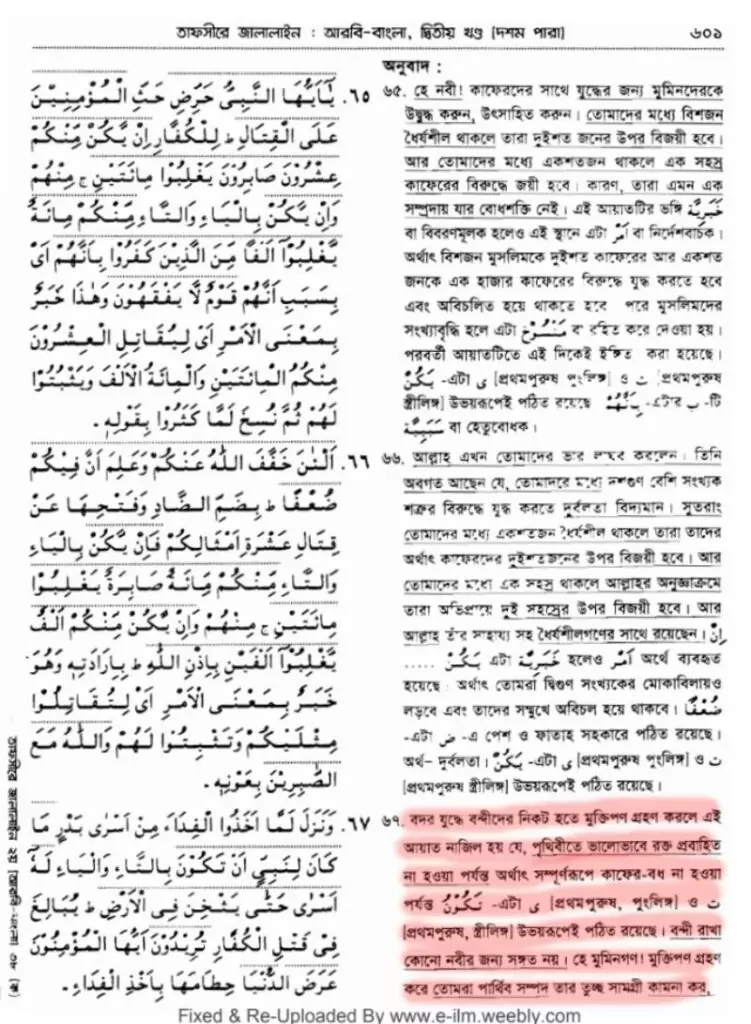
Now let us read the explanation of this verse from Tafsir Mazhari [39] —
Surah Al-Anfal: Verse 67
مَا كَانَ لِنَبِيٍّ أَن يَكُونَ لَهُۥٓ أَسۡرَىٰ حَتَّىٰ يُثۡخِنَ فِي ٱلۡأَرۡضِۚ تُرِيدُونَ عَرَضَ ٱلدُّنۡيَا وَٱللَّهُ يُرِيدُ ٱلۡأٓخِرَةَۗ وَٱللَّهُ عَزِيزٌ حَكِيمٞ
It is not fit for a prophet that he should take captives until he has thoroughly subdued the land. You ˹believers˺ settled with the fleeting gains of this world, while Allah’s aim ˹for you˺ is the Hereafter. Allah is Almighty, All-Wise.
— Dr. Mustafa Khattab, The Clear Quran (Quran.com)
“Ma kana linabiyyin ayyakoona lahu assa hatta yuskhina fil-ard” means—it is not appropriate for any prophet to keep prisoners until the enemy has been completely eliminated in the land. Note: Qadi Abu al-Fadl Iyad wrote in his book Ash-Shifa that through the statement “It is not appropriate for any prophet to keep prisoners until the enemy has been completely eliminated in the land,” no accusation was made against the Messenger, peace be upon him. Rather, this statement reveals the Messenger’s extraordinary status. For example, accepting spoils of war was not lawful for the other prophets. But it was made lawful for the Messenger, peace be upon him. Thus he, peace be upon him, said that the spoils of war were not lawful for the other prophets, but they were lawful for me. Qadi Iyad further wrote that the statement, “You desire worldly wealth,” was not addressed to the Messenger, peace be upon him, or his Companions. It was addressed to those who are greedy for the wealth and riches of the world. According to a report by Dahhak, on the day of the Battle of Badr, when the polytheist soldiers were fleeing, some people, confident that victory was assured, began collecting the belongings they had left behind. Hazrat Umar feared that if they did this, the polytheists might attempt a counterattack. “Yuskhina” means to eliminate, annihilate, defeat, kill, or overcome. Here the principal action, namely killing, is left unexpressed. Thus the verse gives this instruction: prisoners must not be released until the enemy has been completely subdued. They must be killed. There are many examples of this. For example, “ashkhana fulan” means that such-and-such a person has been eliminated, and “ashkhana fil aduw” means that the enemy has been struck sufficiently, and so on. Then it says, “Turiduna ardad-dunya” (you desire worldly wealth). This means—O Muslims! You desire the perishable splendour of this world. Finally, it says, “Wallahu yuridu al-akhirah, wallahu azizun hakim” (and Allah desires the welfare of the Hereafter; Allah is Almighty, All-Wise). This means that Allah, the Exalted, is Almighty and Wise. Therefore, He wants you to turn toward the Hereafter under His boundless power and in accordance with His incomparable wisdom. Kill the polytheists and become helpers of the true religion. Earn righteousness and the pleasure of Allah, the Exalted. Ibn Abbas said that the incident occurred during the Battle of Badr. At that time, the number of Muslim soldiers was small. Later, when the number of Muslims increased, the following was revealed: “Fa-imma mannan ba’du wa imma fidā’an” (then either show favour or accept ransom). Through this verse, the Messenger, peace be upon him, was given the right to make an independent decision. From then on, the Messenger, peace be upon him, and the Muslims were given the right to decide whether to kill prisoners of war, turn them into male and female slaves, or release them in exchange for ransom. Ruling: The scholars unanimously agree that through this verse, the Muslim ruler or commander was given the right to kill prisoners of war. Thus the Messenger, peace be upon him, ordered the men of Banu Qurayza to be killed. After they were captured, he had Nadr ibn al-Harith, Taimiyyah ibn Adi, and Uqbah ibn Abi Muayt killed. The book Sabilur Rashad mentions that Uqbah ibn Abi Muayt said at that time, “Muhammad, who will look after the children?” The Messenger, peace be upon him, replied, “The fire.” Ibn Ishaq said that Uqbah was killed by Hazrat Ibn Abi Afla. Ibn Hisham said, Hazrat Abi ibn Abi Talib. Ruling: It is permissible to turn prisoners into slaves. The scholars agree on this matter. Through this, polytheism is eliminated and Islam is honoured. In this context, Imam Abu Hanifa said that no one except the ruler or commander has the right to kill a prisoner. Only the ruler may order the killing of a prisoner of war when necessary. However, if someone unexpectedly kills a prisoner of war, he is not required to pay blood money.
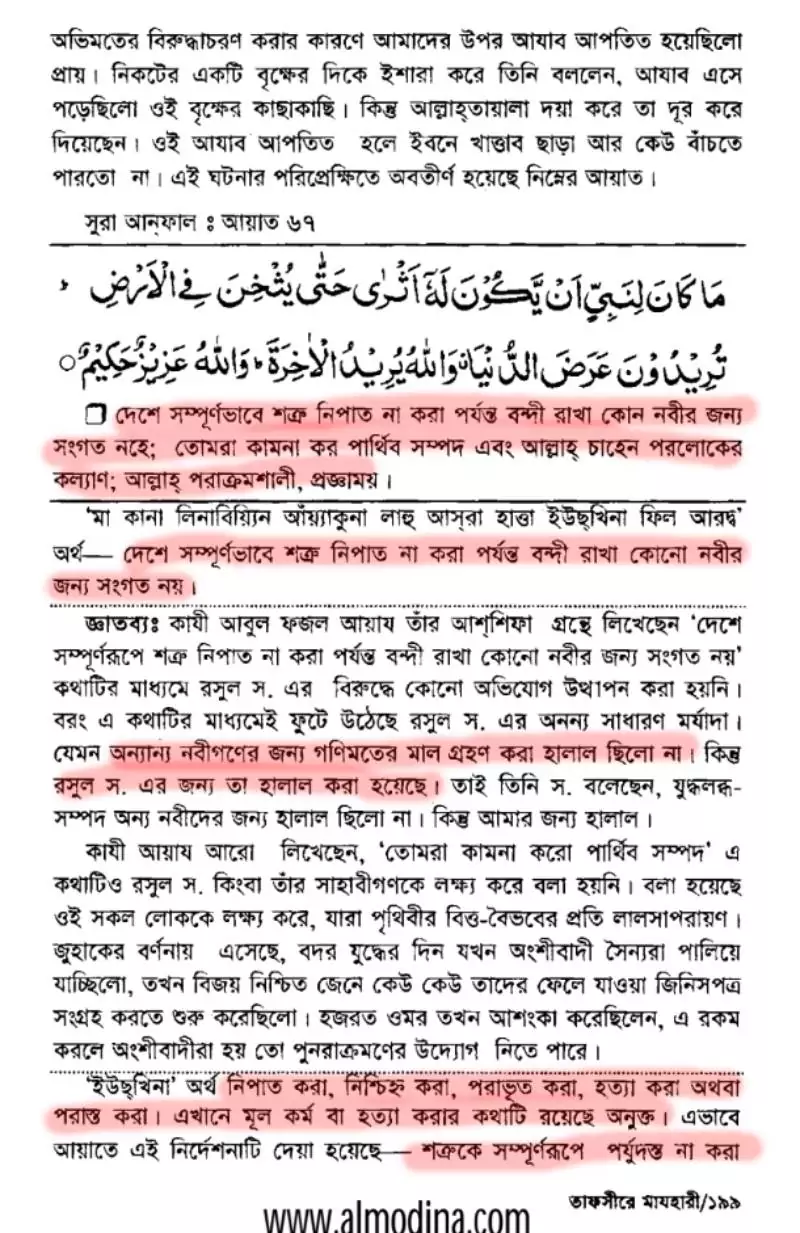
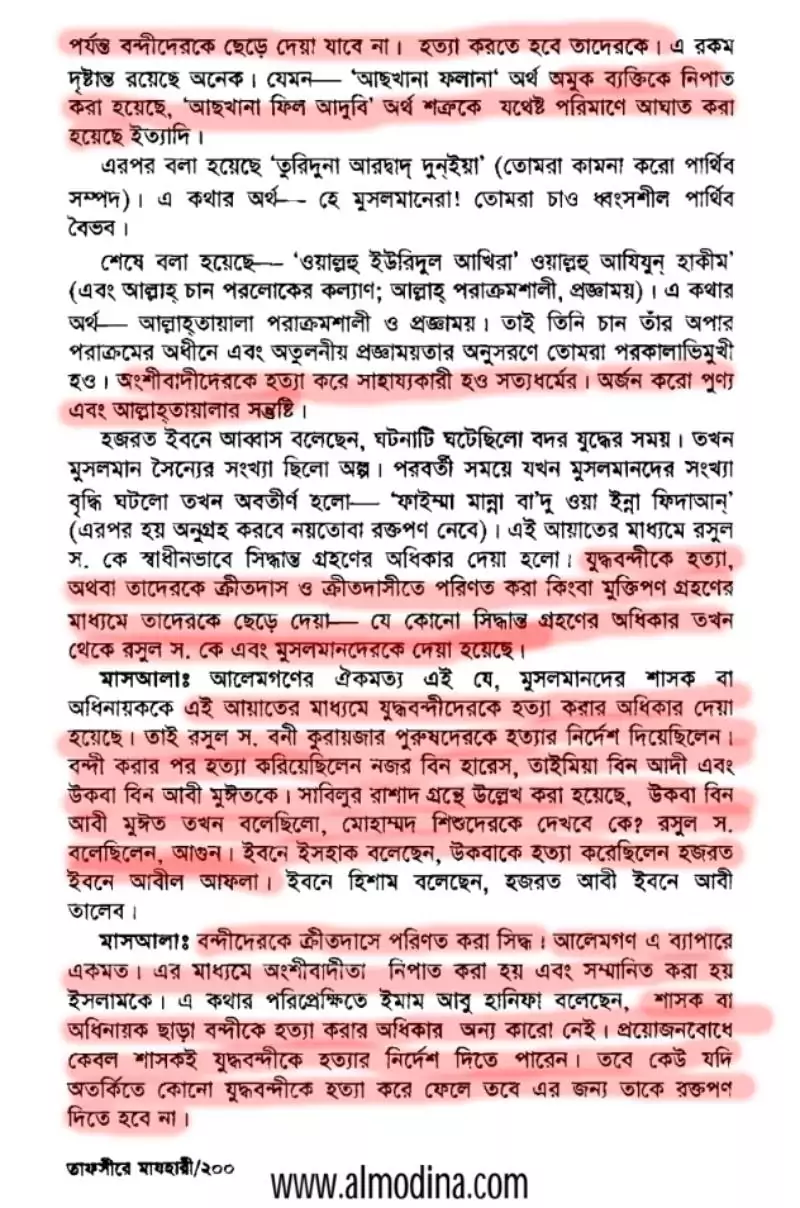
Now let us see whether, according to Islamic law, killing prisoners of war is the better practice or releasing them in exchange for ransom is the better practice. It should be noted that the views of Hazrat Umar and Sa’d ibn Mu’adh on this matter, mentioned above, are described more clearly here [40] —
Or ransom—you may choose either one. But if you accept ransom, one member of your group will die in place of each prisoner. The Messenger, peace be upon him, informed the Companions of this. The Companions said, O Messenger of Allah! The prisoners are our own relatives. If we release them in exchange for ransom, we will be able to increase our military equipment with the ransom money. And even if one of us is martyred in place of one of them, that is not displeasing to us. That is what happened. In place of the seventy prisoners of war at Badr, seventy Companions were martyred at Uhud. Note: Qadi Abu al-Fadl Iyad wrote in his book Ash-Shifa that both killing and accepting ransom were lawful. However, killing was preferable, while releasing prisoners through ransom was inferior. In a figurative sense, accepting ransom was therefore called wrong. The instruction was that it was proper to choose the better practice. Al-Tabarani also said this. Hazrat Umar and Hazrat Sa’d chose the better practice. Therefore, the Messenger, peace be upon him, said that if punishment had descended, no one except Umar and Sa’d could have survived. But the decree of destiny was that punishment would not come. Therefore, it did not come. Dawud al-Zahiri said that ransom had not previously been prohibited. Even if it had been prohibited, it could not be said that the Messenger, peace be upon him, had done something outside Allah’s prohibition. That was impossible for him. Therefore, it was said, “Had there not been a previous decree from Allah.” In this way, the Messenger, peace be upon him, was rather honoured. The Messenger’s sincere obedience to Allah was made manifest. Baghawi wrote that after this verse was revealed, the Companions lost their interest in accepting ransom money. Then the following verse was revealed. Surah Al-Anfal: verse 69
فَكُلُواْ مِمَّا غَنِمۡتُمۡ حَلَٰلٗا طَيِّبٗاۚ وَٱتَّقُواْ ٱللَّهَۚ إِنَّ ٱللَّهَ غَفُورٞ رَّحِيمٞ
Now enjoy what you have taken, for it is lawful and good. And be mindful of Allah. Surely Allah is All-Forgiving, Most Merciful.
— Dr. Mustafa Khattab, The Clear Quran (Quran.com) The meaning of the verse under discussion is—O believers! You may consume and use whatever you acquire through war as spoils and ransom. It is permissible for you. However, you must always keep the fear of Allah alive in your hearts. You must also remember that Allah is Forgiving and Most Merciful. Tafsir Mazhari/207
The Siege of Banu Qurayza and the Continuation
The Battle of the Trench Without Spoils of War
Approximately three thousand soldiers were with Muhammad in the Battle of the Trench. Despite having such a large number of soldiers, Muhammad’s troops obtained no spoils of war in this battle. Quite naturally, all the effort exerted by so many Companions without receiving any spoils of war went entirely to waste. [41]
Another notable matter is that, after this battle, intense disappointment among the Companions at not receiving any spoils of war can be observed. One person stated the matter directly [42]
Will he be defeated? Never. And even if something like that were to happen, I promise you that I will not abandon your company as long as I live. If there is a fear of an attack from Muhammad’s side, I will certainly resist it with my people. Ka’b softened at this. He promised that he too would help the Quraysh army with his people.
The news soon reached the ears of the Messenger, peace be upon him. To verify the truth of the matter, he sent to Banu Qurayza Sa’d ibn Mu’adh al-Ashhali, the leader of the Aws tribe, Sa’d ibn Ubadah al-Sa’idi, the leader of the Khazraj tribe, Abdullah ibn Rawahah al-Khazraji, and Khawwat ibn Jubayr al-Amiri. He instructed them: if you understand that the incident is true, inform me of it through gestures and hints; otherwise, the morale of many among us will be broken. And if you find that the incident is not true, you may inform me of the matter openly. They all reached the settlement of Banu Qurayza. After speaking with them, they easily understood that the situation was dire. They clearly stated that they had no pact with Muhammad. Hazrat Sa’d ibn Ubadah was fiery-tempered. He addressed them with some harsh words. Hazrat Sa’d ibn Mu’adh intervened and said, let them go. They have become excessively arrogant. Having said this, they all returned. They appeared before the Messenger, peace be upon him, in his merciful presence and said, O Messenger of Allah! Betraying your companions is a terrible matter. Allahu Akbar! O Muslim brothers! Hear the good news. The Companions sensed that the situation was not at all favourable. There were enemies both inside and outside. The dark clouds of doubt began to cast their shadow over them. The hypocrites understood everything. Ma’tab ibn Qushayr al-Amiri, one of their group, said openly, Muhammad! You promised that the treasuries of Rome and Persia would come under our control. But now we are in a desperate state. We will not even be able to save our lives by going into the wilderness. Then are not the promises of you and your Allah deceptive? Another hypocrite, Aws ibn Qibti, said, O representative of Allah! My house is unprotected. It is also quite far away. Let me return home now. In this way, other hypocrites also began withdrawing on various pretexts.
I say that Ka’b informed the tribal leaders of the violation of the pact by calling them together. Among those tribal leaders were Zubayr ibn Balta, Nabbash ibn Qays, Uqbah ibn Zayd, and many others. They all
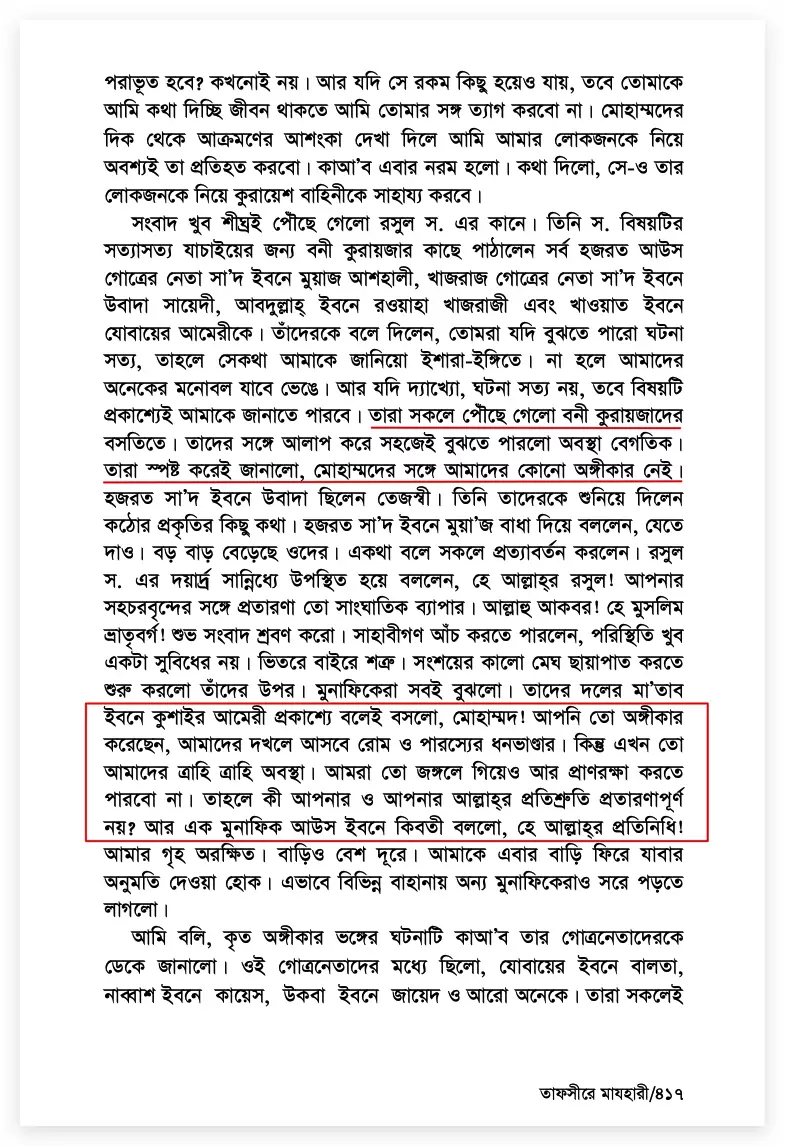
The Betrayal of Banu Qurayza: Unsubstantiated Miraculous Information
Reviewing history reveals that, in order to legitimize any major genocide or ethnic extermination, the attacking side generally labels the victim or targeted group as ‘traitors’ or ‘traitors against the state’. This is a well-known propaganda tactic that helps portray the attacker’s violence as a ‘defensive measure’.
1. Historical context and parallel examples: When the Pakistani army carried out genocide in Bangladesh in 1971, it argued in its defense that the Bengalis had joined hands with India by going against Pakistan’s ‘Two-Nation Theory’ and unity. The Bengalis were identified as ‘ghaddars’ so that, in the eyes of ordinary people, this massacre could be portrayed as a political and religious necessity. Even today, in order to legitimize genocide, ruling states describe targeted populations as ‘militants’, ‘terrorists’, ‘enemies of the state’, or ‘conspirators’, and attempt to justify the violence inflicted upon them.
2. The massacre of Banu Qurayza and the narrative of Muslim apologists: A similar tactic can be observed in the arguments presented in defense of the genocide of the Banu Qurayza tribe. Traditional Islamic historians and apologists claim that, during the Battle of the Trench, the Banu Qurayza tribe betrayed the Muslims by violating the agreement they had made with them. This allegation of ‘betrayal’ is used as a shield in an attempt to legitimize the killing of several hundred people at once.
3. Logical and historical inconsistencies Several important questions arise here:
- One-sidedness of the information: The account of Banu Qurayza’s betrayal comes primarily from the account of the victorious side (Islamic sīrah and hadith). No evidence of this ‘betrayal’ can be found in any neutral or contemporaneous alternative source.
- Double standards: When, in the modern world, Israeli forces invoke ‘security’ or ‘counterterrorism’ arguments in occupying Palestinian land or killing Palestinians, Muslims rightly protest it vehemently. But when the historical genocide of Banu Qurayza is supported using a similar excuse of ‘treason’ or ‘violation of an agreement’, it constitutes a moral double standard.
The ‘ghaddar’ or ‘traitor’ narrative used to legitimize genocide is essentially a political tool. There is room for rational and dispassionate analysis concerning whether this same tactic was adopted in the case of Banu Qurayza. For when the accused party assumes both the role of judge and executioner, it is natural for the truthfulness of that historical account to become questionable.
The Sīrah of the Messenger of Allah: Evidence of Banu Qurayza’s Betrayal
The most unfortunate matter is that they cannot provide any satisfactory answer as to what betrayal Banu Qurayza had actually committed that required them to be completely exterminated and their women and children enslaved; what that betrayal was, and to what extent Muslims had been harmed by it, or how many Muslims had been killed or injured in their militant attack.
On the contrary, it can be seen that Abu Sufyan, the leader of the group opposing Muhammad, had requested assistance from Banu Qurayza only a few days before Muhammad’s attack on the tribe, and Banu Qurayza did not want to assist Abu Sufyan’s forces. If Banu Qurayza had indeed betrayed Muhammad, then they should have assisted Abu Sufyan. Let us learn the information from Ibn Ishaq’s book [43] –
Then Abu Sufyan said, ‘O Quraysh, our camp is not secure. All the horses and camels are dying. Banu Qurayza has broken its promise. Confusing news is reaching us about them. Besides, you can see for yourselves that the strong wind is scattering the pots, pans, fire, and tents. All of you flee; I am leaving.’
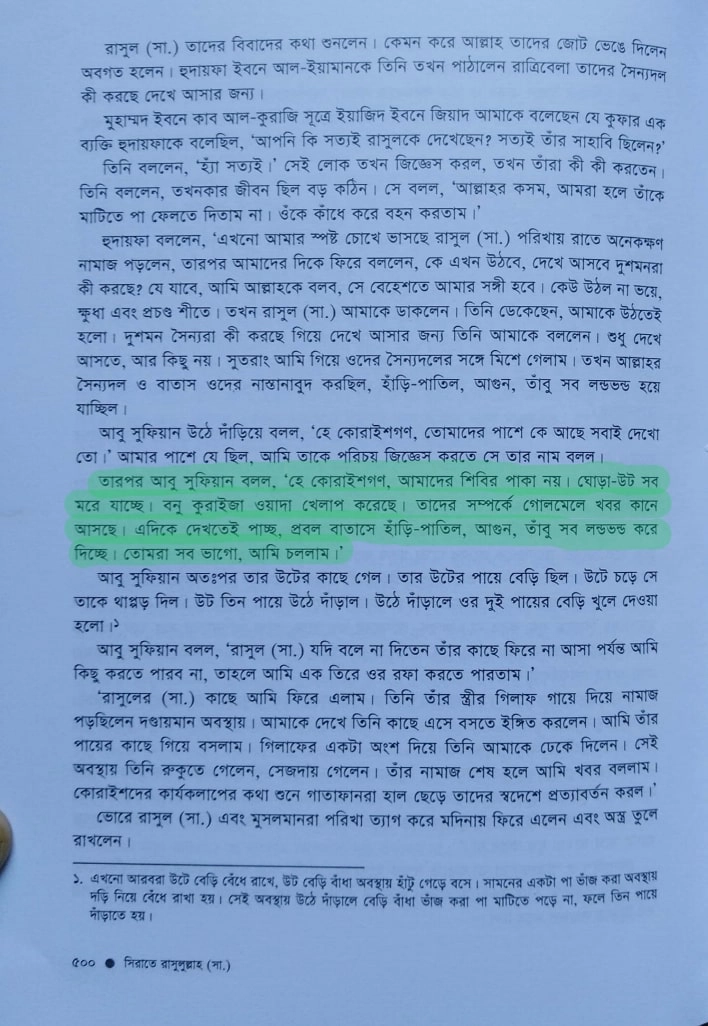
Tafsir Mazhari: Evidence of Banu Qurayza’s Betrayal
Now let us read this account from Tafsir Mazhari. Notice that Banu Qurayza did not actually assist the Quraysh in any way. In response to the Quraysh’s request for help, Banu Qurayza said that they could assist the Quraysh only if the Quraysh handed over several of their prominent men as hostages. The Quraysh refused to do so. In other words, Banu Qurayza did not actively engage in any war or attack against Muhammad [44]
They went to Qurayza. They said to Banu Qurayza, “Look, we did not come here to stay permanently. Our warhorses and camels are suffering needlessly as well. Therefore, we have decided that this time we will begin an all-out war. You should also prepare yourselves. This time, let us reach a final settlement with Muhammad.”
Banu Qurayza said, “Today is Saturday, and you know how sacred Saturday is to us. Therefore, we cannot enter the battlefield today. Moreover, we have something to say about this matter. What we have to say is this: if we win the war, then that is well and good. But if we are defeated, you will be able to flee and save your lives. Then, finding us alone, Muhammad’s group will completely uproot us. Therefore, we want you to leave several of your important leaders under our custody as security. The delegation returned and told the commander Abu Sufyan everything. He and the leaders of his group then exclaimed, “So Naim ibn Masud was right. Banu Qurayza are traitors.” Thinking this, they sent word to Banu Qurayza that they refused to provide such security. The leaders of Banu Qurayza then said, “So Naim was indeed right. The outsiders harbor sinister intentions. If they win, they will take the spoils and leave. And as soon as they see the possibility of defeat, they will flee, leaving us helpless. Then we will have no option but to lose our lives meaninglessly.” Thus, because of mutual distrust, the enemy forces became dispirited. Suddenly, one night, a terrible storm began. The large cooking pots used to prepare the soldiers’ food had been placed over the stoves. The powerful wind scattered everything. The tents were blown away. The tent poles, the ropes of the poles—everything was scattered in every direction. Struck by the flying poles, the horses began to flee in all directions, bewildered. The soldiers began to tremble violently in the intense cold. Everyone became completely bewildered.
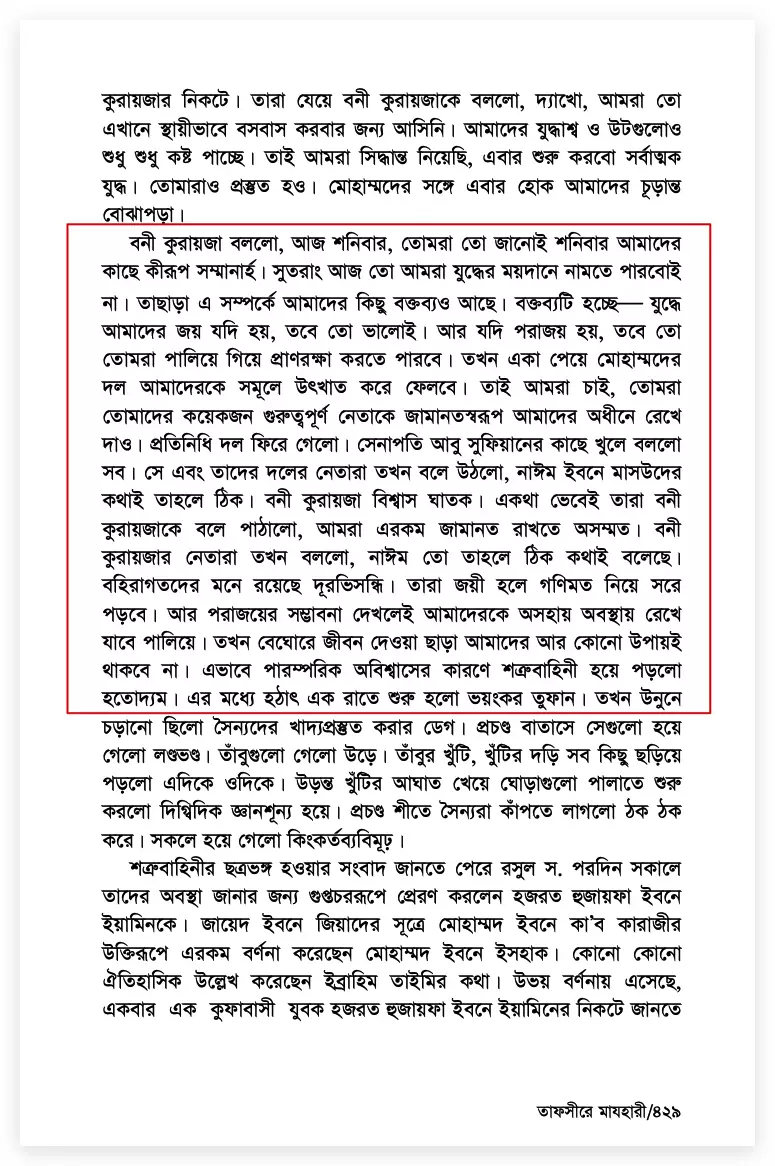
Map: The Reality of Banu Qurayza’s Betrayal
At the same time, how the Banu Qurayza tribe helped the Quraysh is also a major question. Look at the map below once again. During the Battle of the Trench, how did the Banu Qurayza tribe help the Quraysh by crossing the trench that had been dug? And how did they immediately return to their own fortress, where the Prophet Muhammad attacked Banu Qurayza immediately after returning from the battle, without taking any break? [45]
There Is No Independently Verifiable Evidence Establishing Individual Guilt
The Islamic sources contain allegations that Banu Qurayza had violated their pledge, but they do not provide independently verifiable evidence establishing the individual guilt of the men who were later executed. The surviving allegations come from the victorious side and include reports of political negotiations, statements attributed to members of Banu Qurayza, and supernatural information attributed to the angel Gabriel. None of these accounts provides a documented process identifying which specific individuals had personally committed treason, taken part in hostilities, or committed any offense carrying a death sentence. Yet the subsequent punishment was imposed collectively upon the male population.
Under any rational judicial standard, a supernatural communication cannot constitute verifiable evidence of criminal guilt. More importantly, even the political allegations preserved in the Islamic sources do not establish the individual responsibility of the hundreds of men who were subsequently executed. The Muslim side controlled the accusation, the military operation, the surrender process, the appointment of the arbitrator, and the execution of the verdict, while no preserved record shows individual hearings in which specific charges and evidence were presented against each condemned person. The central problem, therefore, is not whether an allegation of betrayal existed; it is that an allegation against a tribe was converted into collective capital punishment without establishing individual guilt. Let us see the claim concerning Banu Qurayza’s betrayal [46]
Even more damaging to the collective-guilt narrative is the fact that the Islamic sīrah tradition itself preserves an explicit exception from within Banu Qurayza. Ibn Hisham records that ʿAmr ibn Saʿdā al-Quraẓī refused to participate in the alleged betrayal and declared, “I will never betray Muhammad.” After he was allowed to leave, the matter was reported to Muhammad, who was quoted as saying that this was a man whom God had saved because of his faithfulness. The implication is devastatingly simple: the Islamic narrative itself admits that the conduct of the members of Banu Qurayza was not uniform. There were individuals within the tribe who did not participate in the alleged treason. To execute hundreds without preserved individual adjudication, while using tribal identity and biological puberty as the operative filters, is not individualized justice; it is collective punishment dressed in religious language. [47]
He returned to Medina. The Muslims removed their weapons. According to the narration of Imam Zuhri (may Allah be pleased with him), at noon, Hazrat Jibril (peace be upon him) came to the Messenger of Allah (peace and blessings be upon him), wearing a turban made of silk and riding a mule. A thick silk cloth had been spread over the mule’s back. He said: O Messenger of Allah! Have you removed your weapons? When the Messenger of Allah (peace and blessings be upon him) answered affirmatively, Jibril (peace be upon him) said, “The angels have not yet removed their weapons. I have returned to pursue the unbelieving people. O Muhammad! Allah the Exalted has commanded you to set out on an expedition toward Banu Qurayza. I too have resolved to advance toward them. I will create a breach within them.” Then the Noble Messenger (peace and blessings be upon him) instructed an announcer to proclaim among the people: “Those who hear this announcement and remain obedient should not perform the Asr prayer until they reach the settlement of Banu Qurayza.” According to Ibn Hisham’s narration, the Messenger of Allah (peace and blessings be upon him) appointed Abdullah ibn Umm Maktum as the administrator of Medina at this time. Imam Bukhari (may Allah have mercy on him) narrated through Abdullah ibn Abi Shayba from Hazrat Aisha (may Allah be pleased with her) that she said:
“The Messenger of Allah (peace and blessings be upon him) returned from the Battle of the Trench, removed his weapons, and began to bathe. Immediately, Jibril (peace be upon him) came to him and said, ‘Have you removed your weapons? By Allah, we have not yet removed our weapons. Set out against them!’ He asked, ‘In which direction?’ Jibril (peace be upon him) pointed toward Banu Qurayza.” Then the Noble Prophet (peace and blessings be upon him) set out. Imam Ahmad (may Allah have mercy on him) narrated through Hasan and Aisha (may Allah be pleased with her) that when the Messenger of Allah (peace and blessings be upon him) returned from the Battle of the Confederates and entered the bathroom to bathe, Hazrat Jibril (peace be upon him) came to him. Through a gap in the door, I saw Jibril (peace be upon him), with dust on his head. He said, “O Muhammad! Have you laid down your weapons? We have not yet laid down our weapons. Set out quickly toward Banu Qurayza.”
Imam Bukhari (may Allah have mercy on him) narrated through Musa, Jarir, and Anas ibn Malik. He said that when the Messenger of Allah (peace and blessings be upon him) set out toward Banu Qurayza, it was as though he could see with his own eyes the dust raised by Jibril’s mount moving through the alley of Banu Ghanm. Then Imam Bukhari narrated through Abdullah ibn Muhammad and Ibn Umar (may Allah be pleased with him) that on the day of the Battle of the Confederates, the Messenger of Allah (peace and blessings be upon him) said: “No one should perform the Asr prayer until he reaches the area of Banu Qurayza.” On the way, the time for the Asr prayer came for some people. Some said, “We will not perform the Asr prayer until we reach Banu Qurayza.” Others said, “Rather, we will perform the prayer.” The Messenger of Allah (peace and blessings be upon him) did not intend that we should not perform the prayer. When this matter was discussed with the Messenger of Allah (peace and blessings be upon him), he expressed displeasure toward neither group. Muslim (may Allah have mercy on him) and Abdullah ibn Muhammad ibn Asma narrated similarly. Imam Bayhaqi cited the chain through Hafiz Abu Abdullah, Qadi Abu Bakr Ahmad ibn Hasan: Abul Abbas Muhammad ibn Ka‘b ibn
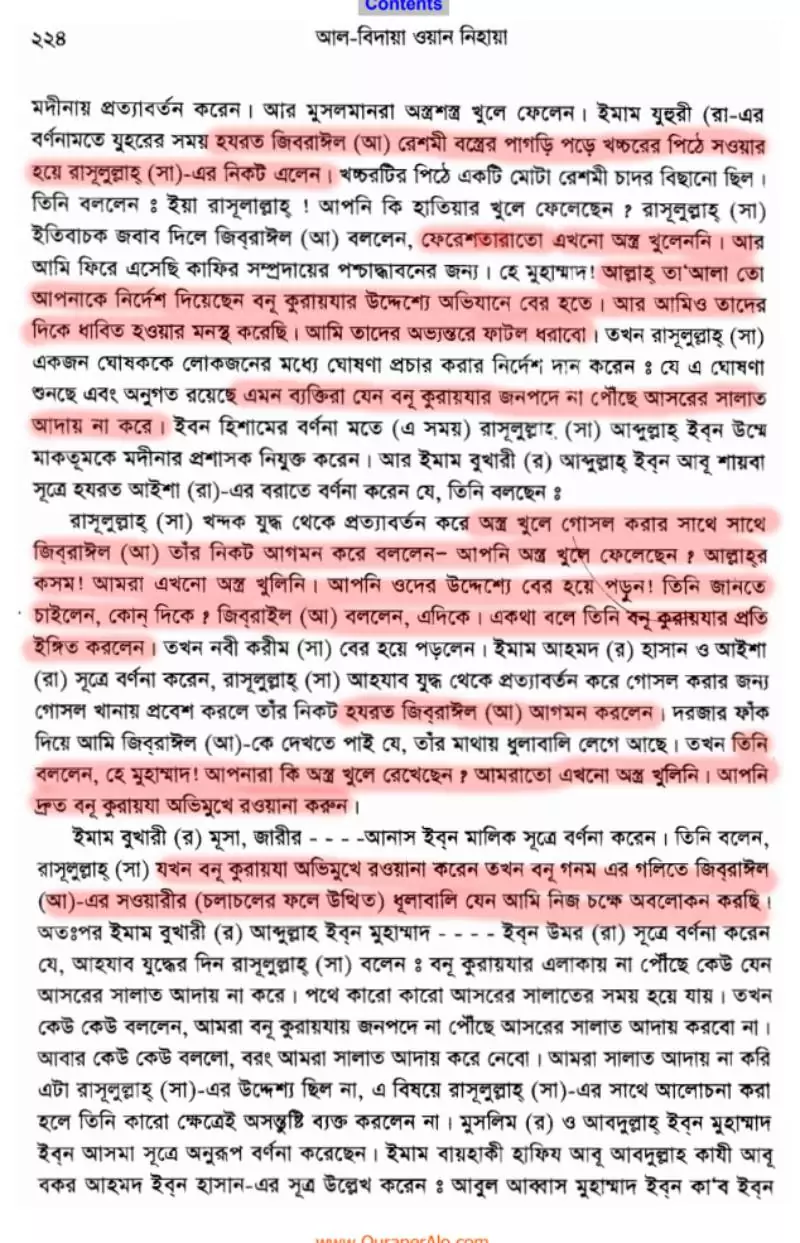
In this context, there is a very famous hadith of Aisha, which everyone should read [48] –
Sahih Bukhari (Islamic Foundation)
Chapter: 52/ Tafsir
Section: The Word of Allah the Exalted: ترجئ من تشاء منهن وتؤوي إليك من تشاء ومن ابتغيت ممن عزلت فلا جناح عليك “You may distance from you whomever you wish among them and give shelter to whomever you wish. And if you desire one whom you have set aside, there is no blame upon you.” Ibn Abbas (may Allah be pleased with him) said: ترجئ means you may distance them. أرجئه means set him aside, give him respite.
4425.
Narrated Aisha:I used to look down upon those ladies who had given themselves to Allah’s Messenger (ﷺ) and I used to say, “Can a lady give herself (to a man)?” But when Allah revealed: “You (O Muhammad) can postpone (the turn of) whom you will of them (your wives), and you may receive any of them whom you will; and there is no blame on you if you invite one whose turn you have set aside (temporarily).’ (33.51) I said (to the Prophet), “I feel that your Lord hastens in fulfilling your wishes and desires
حَدَّثَنَا زَكَرِيَّاءُ بْنُ يَحْيَى، حَدَّثَنَا أَبُو أُسَامَةَ، قَالَ هِشَامٌ حَدَّثَنَا عَنْ أَبِيهِ، عَنْ عَائِشَةَ ـ رضى الله عنها ـ قَالَتْ كُنْتُ أَغَارُ عَلَى اللاَّتِي وَهَبْنَ أَنْفُسَهُنَّ لِرَسُولِ اللَّهِ صلى الله عليه وسلم وَأَقُولُ أَتَهَبُ الْمَرْأَةُ نَفْسَهَا فَلَمَّا أَنْزَلَ اللَّهُ تَعَالَى {تُرْجِئُ مَنْ تَشَاءُ مِنْهُنَّ وَتُؤْوِي إِلَيْكَ مَنْ تَشَاءُ وَمَنِ ابْتَغَيْتَ مِمَّنْ عَزَلْتَ فَلاَ جُنَاحَ عَلَيْكَ} قُلْتُ مَا أُرَى رَبَّكَ إِلاَّ يُسَارِعُ فِي هَوَاكَ.
Collection status: Sahih
The Complexity Concerning Gabriel’s Arrival
It is said that Gabriel himself came from Allah and informed the Prophet Muhammad that Banu Qurayza had actually committed treason or violated the agreement. Therefore, it is necessary to examine that event and understand whether Gabriel really came at that time and informed Muhammad of the matter, or whether it was someone else. Let us learn about the event. It is learned in this regard that after Muhammad came to Umm Salamah’s house, Gabriel arrived and supposedly informed the Prophet of the secret news that Banu Qurayza had violated the agreement and committed treason [49]
Banu Qurayza violated the agreement. The Messenger of Allah and the noble Companions, upon learning this, became deeply sorrowful and distressed. Finally, when Allah the Exalted granted victory to the Messenger of Allah (peace and blessings be upon him), the confederate forces were defeated and returned bearing the disgrace of failure; the Messenger of Allah (peace and blessings be upon him) and the noble Companions returned to Medina and removed their weapons. The Messenger of Allah entered the house of Hazrat Umm Salamah (may Allah be pleased with her) and was bathing when Hazrat Jibril (peace be upon him) arrived. He came riding a mule, wearing a turban of istabraq (silk), and there was a silk saddle on the mule. Immediately upon arriving, he asked the Messenger of Allah (peace and blessings be upon him), “O Messenger of Allah! Have you removed your weapons?” He said, “Yes.” Jibril (peace be upon him) said, “But the angels have not yet removed their weapons. I am returning after pursuing the unbelievers. Then he said, “Allah the Exalted has commanded you to conduct an expedition against Banu Qurayza.” He also said, “Allah the Exalted has commanded me to turn them upside down.”
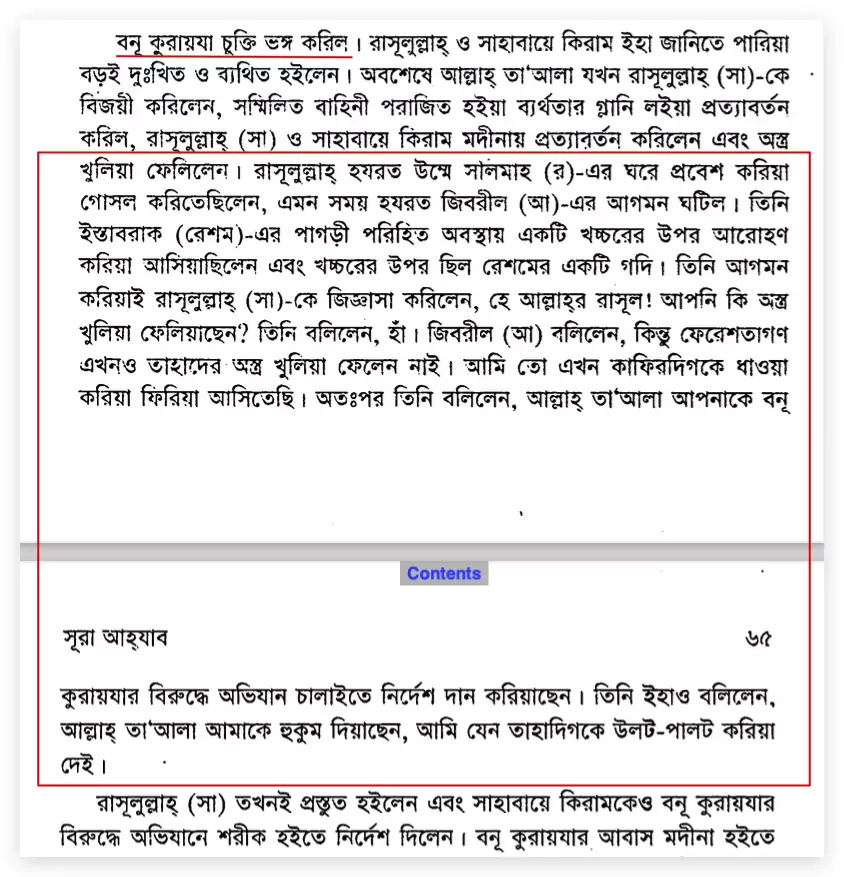
Let us now read a hadith from which it becomes known that, on that day, Umm Salamah saw Dihya al-Kalbi come to the Prophet while she was at Umm Salamah’s house. However, the Prophet informed Salamah and the others that the man was actually Gabriel, who had come speaking with the Prophet disguised as Dihya al-Kalbi. To what extent such disguise—deceiving or defrauding someone by assuming the appearance of another Companion—is appropriate for a distinguished angel is for the reader to consider. What is important to learn from this hadith, however, is that according to Umm Salamah, it was Dihya al-Kalbi who was consulting with the Prophet that day [50]
Sahih al-Bukhari (Islamic Foundation)
53/ Virtues of the Qur’an
Chapter: How revelation was sent down and which verse was revealed first. Ibn Abbas (may Allah be pleased with him) said, الْمُهَيْمِنُ means trustworthy. The Qur’an is a trustee over all previous heavenly scriptures.
Islamic Foundation number: 4619, international number: 4980
4619
Narrated Abu `Uthman:I was informed that Gabriel came to the Prophet (ﷺ) while Um Salama was with him. Gabriel started talking (to the Prophet). Then the Prophet (ﷺ) asked Um Salama, “Who is this?” She replied, “He is Dihya (al-Kalbi).” When Gabriel had left, Um Salama said, “By Allah, I did not take him for anybody other than him (i.e. Dihya) till I heard the sermon of the Prophet (ﷺ) wherein he informed about the news of Gabriel.” The subnarrator asked Abu `Uthman: From whom have you heard that? Abu `Uthman said: From Usama bin Zaid
حَدَّثَنَا مُوسَى بْنُ إِسْمَاعِيلَ، حَدَّثَنَا مُعْتَمِرٌ، قَالَ سَمِعْتُ أَبِي، عَنْ أَبِي عُثْمَانَ، قَالَ أُنْبِئْتُ أَنَّ جِبْرِيلَ، أَتَى النَّبِيَّ صلى الله عليه وسلم وَعِنْدَهُ أُمُّ سَلَمَةَ فَجَعَلَ يَتَحَدَّثُ فَقَالَ النَّبِيُّ صلى الله عليه وسلم لأُمِّ سَلَمَةَ “ مَنْ هَذَا ”. أَوْ كَمَا قَالَ قَالَتْ هَذَا دِحْيَةُ. فَلَمَّا قَامَ قَالَتْ وَاللَّهِ مَا حَسِبْتُهُ إِلاَّ إِيَّاهُ حَتَّى سَمِعْتُ خُطْبَةَ النَّبِيِّ صلى الله عليه وسلم يُخْبِرُ خَبَرَ جِبْرِيلَ أَوْ كَمَا قَالَ، قَالَ أَبِي قُلْتُ لأَبِي عُثْمَانَ مِمَّنْ سَمِعْتَ هَذَا. قَالَ مِنْ أُسَامَةَ بْنِ زَيْدٍ.
Collection status: Sahih
Let us now read another hadith, [51] [52]
Sahih al-Bukhari (Tawhid Publication)
96/ Holding Firmly to the Qur’an and Sunnah
Chapter: 96/3. Asking too many questions and causing unnecessary hardship are blameworthy.
7293
Narrated Anas:We were with `Umar and he said, “We have been forbidden to undertake a difficult task beyond our capability (i.e. to exceed the religious limits e.g., to clean the inside of the eyes while doing ablution)
حَدَّثَنَا سُلَيْمَانُ بْنُ حَرْبٍ، حَدَّثَنَا حَمَّادُ بْنُ زَيْدٍ، عَنْ ثَابِتٍ، عَنْ أَنَسٍ، قَالَ كُنَّا عِنْدَ عُمَرَ فَقَالَ نُهِينَا عَنِ التَّكَلُّفِ.
Collection status: Sahih
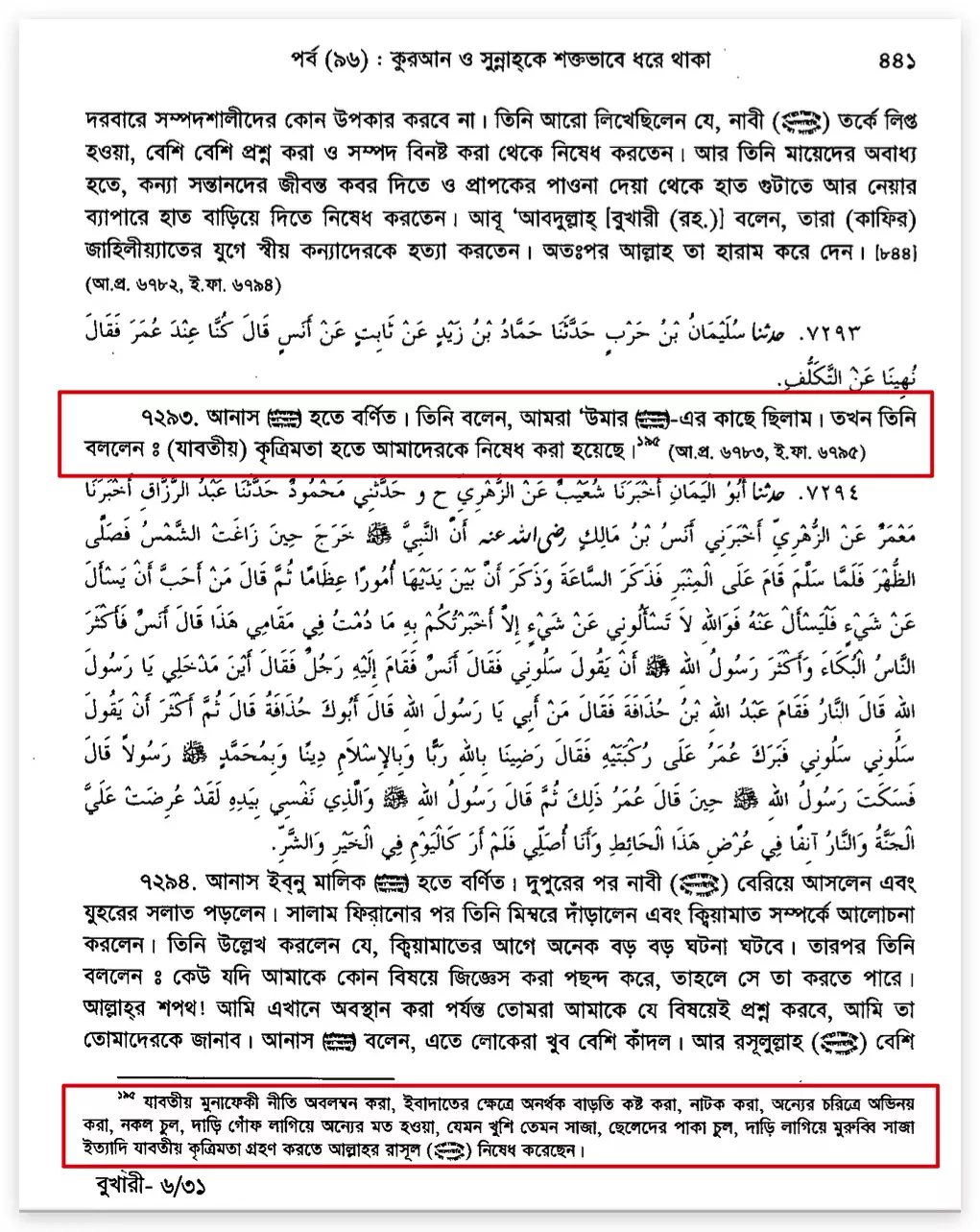
The Constitution of Medina: The Alleged Treaty with Banu Qurayza
Apologetic writers for Islam repeatedly claim that Banu Qurayza violated a treaty with Muhammad and therefore deserved punishment. But the historical problem begins with the treaty itself. The surviving text of the Constitution of Medina preserved in the earliest sira does not explicitly name Banu Qurayza among its parties. If Banu Qurayza were nevertheless already bound by that constitution, then Muhammad himself had already violated that relationship when, during the campaign against Banu Nadir, he suddenly marched against Banu Qurayza and compelled them to enter into a new pledge despite no offense by them being stated in that report. On the other hand, if Banu Qurayza were not parties to the Constitution of Medina, then the pledge described during the Banu Nadir campaign becomes the actual documented agreement between them—and that agreement was obtained under direct military pressure. Either way, the simple apologetic narrative that Banu Qurayza freely entered into a treaty and later became the first party to violate it does not survive the chronology preserved in the Islamic sources. Let us begin by reading the Constitution of Medina, [53]
Introduction: I begin in the name of Allah the Exalted, the Most Merciful, the Most Compassionate. This document concluded on behalf of Allah’s Prophet Muhammad (peace be upon him) defines the relations among all the believers and Muslims of Quraysh and Yathrib, and those who follow them, join them, and work alongside them.
1. The Concept of the Ummah and Internal Solidarity
One Ummah: All of them together constitute one community or one “ummah,” regardless of their humanity or otherwise.
Blood Money and Ransom: The Quraysh Muhajirun will pay blood money according to their established customs and numbers, and will ransom their prisoners in accordance with the mercy and principles of justice expected of believers.
Tribal Responsibility: Banu Awf, Banu Sa‘ida, Banu al-Harith, Banu Jusham, Banu al-Najjar, Banu Amr ibn Awf, Banu al-Nabit, and Banu al-Aws—each tribe will pay blood money and ransom prisoners according to its established customs and principles of justice.
Assistance to the Poor: Through ransom or the exercise of compassion, believers may not leave anyone destitute by failing to pay blood money.
2. Social Security and Law and Order
Unity against the Rebel: God-fearing believers will oppose the rebel who spreads injustice, sin, hostility, or corruption among the believers. Even if that rebel is their own child, everyone will stand against him.
Interests of Unbelievers: No believer may kill another believer for the sake of an unbeliever, nor assist an unbeliever against a believer.
Security: Allah’s protection is unique. Believers are friends of one another. The Jews who follow us will receive assistance and equal status.
3. Policies of War and Peace
Indivisible Peace: The peace of the believers is indivisible. No separate peace shall be established during war in the path of Allah; the conditions must be just and equal for everyone.
Blood Revenge: If the blood of one believer is shed in the path of Allah, another believer will avenge it.
Boycott of Quraysh: No polytheist (the atheists or Arab idolaters of Medina) may place the life or property of any Qurayshi under his protection.
4. The Rights and Responsibilities of the Jews
Religious Freedom: The Jews of Banu Awf belong to the same ummah as the believers. The Jews have their religion and the Muslims have their religion. This condition applies to Banu al-Najjar, Banu al-Harith, Banu Sa‘ida, Banu Jusham, Banu al-Aws, Banu Tha‘laba, and Banu al-Shutayba—all of them.
War Expenses: If the Jews participate in war alongside the believers, they will bear their respective share of the expenses of war.
Mutual Assistance: If any person covered by this document is attacked, the parties must assist one another. They will consult and advise one another.
5. The Sanctity of Medina and the Judicial System
Sacred Place: Yathrib (Medina) is a safe and sacred place for the people covered by this document.
Protected Person: A protected outsider shall be considered equal in status to his host, provided that he causes no harm or commits no crime.
Settlement of Disputes: If any dispute or disagreement arises, Allah and His Messenger Muhammad (peace be upon him) must be approached for the final judgment.
Limitation of the Treaty: This document will provide no protection to an unjust or sinful person. Allah is the protector of the good and God-fearing.
The Life of the Messenger of Allah — Ibn Ishaq
Let us now examine the treaty concluded after the migration to Medina and the parties to it, as described in the earliest sira work, Ibn Ishaq’s Sira [54]
(The Life of the Messenger of Allah (peace be upon him), Ibn Ishaq; pages 271–272)
Treaty between the Muslims, the people of Medina, and the Jews
The Noble Messenger (peace be upon him) drew up a document concerning the Muhajirun and the Ansar. In it, he established agreement on friendly relations with the Jews and guaranteed the Jews their own religion and property, while also defining the mutual responsibilities of the parties. The treaty was as follows:
I begin in the name of Allah the Exalted, the Most Merciful, the Most Compassionate. This document concluded on behalf of Allah’s Prophet Muhammad defines the relations among all the believers and Muslims of Quraysh and Yathrib, and those who follow them, join them, and work alongside them. All of them together constitute one community, one ummah, regardless of their humanity or otherwise.
The Quraysh Muhajirun will pay blood money according to their established customs and numbers, and will ransom their prisoners in accordance with the mercy and principles of justice expected of believers. According to their customs, Banu Awf will continue to pay the blood money that they paid during the age of ignorance (atheism). In accordance with the mercy and principles of justice expected of believers, all the tribes will ransom their prisoners. Banu Sa‘ida, Banu al-Harith, Banu Jusham, and Banu al-Najjar will adopt the same arrangement. (1)
Banu Amr ibn Awf, Banu al-Nabit, and Banu al-Aws will adopt the same arrangement. (2) Through ransom or the exercise of compassion, believers may not leave anyone destitute by failing to pay blood money. No believer may take another person’s freed slave as an ally against that person. God-fearing believers will oppose the rebel, or anyone who spreads injustice, sin, hostility, or corruption among the believers, and everyone’s hands will rise against him, even if he is the child of one of them.
No believer may kill another believer for the sake of an unbeliever, nor assist an unbeliever against a believer. Allah’s protection is unique, but they may grant protection, on their own behalf, to an outsider. Believers are friends of one another; an outsider remains an outsider. The Jews who follow us will receive assistance and equal status. No injustice may be committed against them, nor may assistance be given to their enemy. The peace of the believers is indivisible. When the believers are engaged in war in the path of Allah, no separate peace shall be established. The conditions must be just and equal for everyone.
During every attack, each cavalryman will take another rider behind him. If the blood of one believer is shed in the path of Allah, another believer will avenge it. The God-fearing believer will receive the best and most appropriate counsel. No polytheist (3) may place the life or property of any Qurayshi under his protection, nor may he intervene on behalf of any believer. If anyone is convicted, with due cause, of killing a believer without justification, and the slain person’s closest relative is not satisfied with blood money, retaliation may be taken, and all believers will unite against him and be obliged to take action against him.
No believer who believes in Allah and the Last Day and is bound by this document may assist or shelter a criminal. If anyone does so, Allah’s curse and wrath will descend upon him on the Day of Resurrection, and no repentance or compensation will be accepted from him. If any disagreement ever arises over a matter, Allah or Muhammad (peace be upon him) must be approached for its judgment.
If the Jews participate in war alongside the believers, they will bear their respective share of the expenses of war. The Jews of Banu Awf (the Jews have their religion and the Muslims have their religion) are one and the same community with the believers, the freed slaves of the believers, and those among their close relations who do not harm themselves or their families through injustice or sinful conduct. This condition shall apply to the Jews of Banu al-Najjar, Banu al-Harith, Banu Sa‘ida, Banu Jusham, Banu al-Aws, Banu Tha‘laba, Jafna, another tribe of Tha‘laba, and Banu al-Shutayba.
Loyalty is a special protection against betrayal. The freed slaves of Tha‘laba shall remain free. The close friends of the Jews shall remain as they are. None of them shall go to war without Muhammad’s (peace be upon him) permission, but no one may prevent him from taking revenge for an injury. Whoever kills another person without warning him kills himself and his own family. However, if someone treats him unjustly, he may do so; Allah will accept that excuse from him.
The Jews shall bear their own expenses, and the Muslims shall bear theirs. If any person covered by this document is attacked, they must assist one another. They must consult and advise one another, and loyalty is a special protection against betrayal. No one may be held responsible for the wrongdoing of his ally. The person who is wronged must be assisted. As long as the war continues, the Jews, like the believers, will contribute financially.
Yathrib is a safe and sacred place for the people covered by this document. A protected outsider shall be considered equal in status to his host, provided that he has caused no harm or committed no crime. No woman shall be given protection except with the consent of her family. If any dispute or disagreement threatens to create disorder, it must be referred to Allah and His Messenger Muhammad. Allah accepts whatever is included in religious devotion and righteous conduct in this document.
No protection shall be granted to Quraysh or those who assist them. In the event of any attack on Yathrib, all parties to the treaty must help one another. If they are called upon to establish and uphold a truce, they shall do so. If they make a similar demand of the Muslims, the Muslims shall behave similarly in matters other than religious war. Each party shall receive everything applicable to its own people.
The Jews of al-Aws, themselves and their freed slaves, shall enjoy equal status with all the people covered by this document, with sincere loyalty to everyone mentioned in it. Loyalty is a protection against betrayal. Whatever one acquires, one acquires for oneself. Allah approves this document. This document will provide no protection to the unjust or sinful. Whether he goes to war or remains at home in the city, he is safe so long as he is not unjust or sinful. Allah is the protector of the good and God-fearing, and Muhammad (peace be upon him) is the Messenger of Allah.
(1. All of these belonged to al-Khazraj. 2. All of these belonged to al-Aws. 3. The reference is probably to the idol-worshipping Arabs of Medina.)
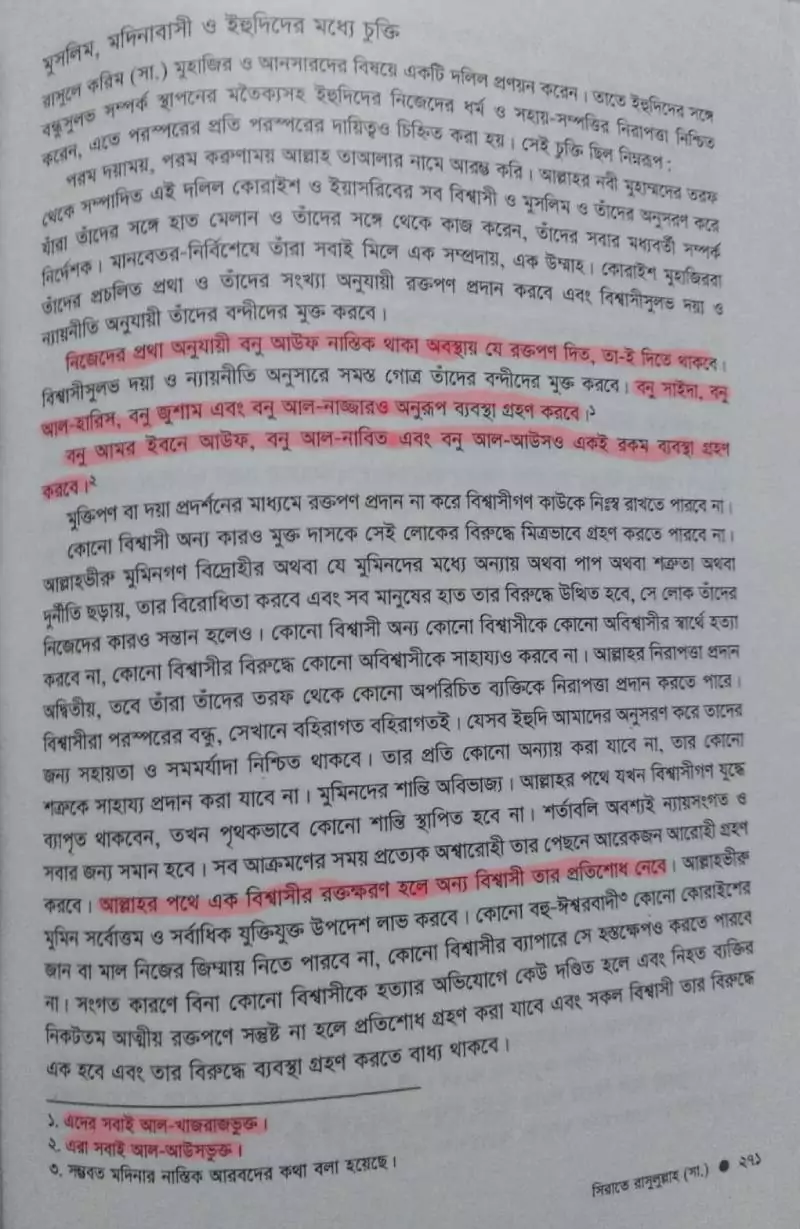
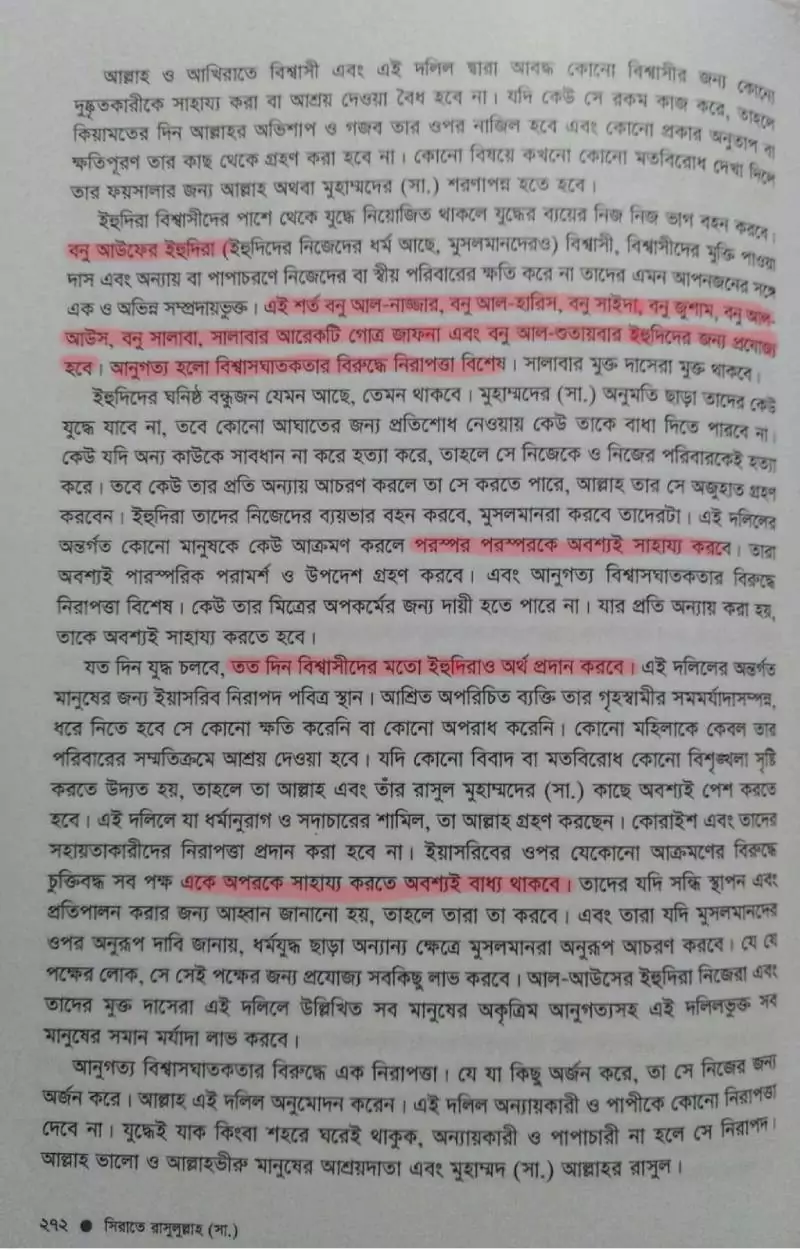
The Life Of Muhammad, by Ibn Ishaq
Let us also read this section from The Life Of Muhammad, by Ibn Ishaq, translated by Alfred Guillaume [55] –
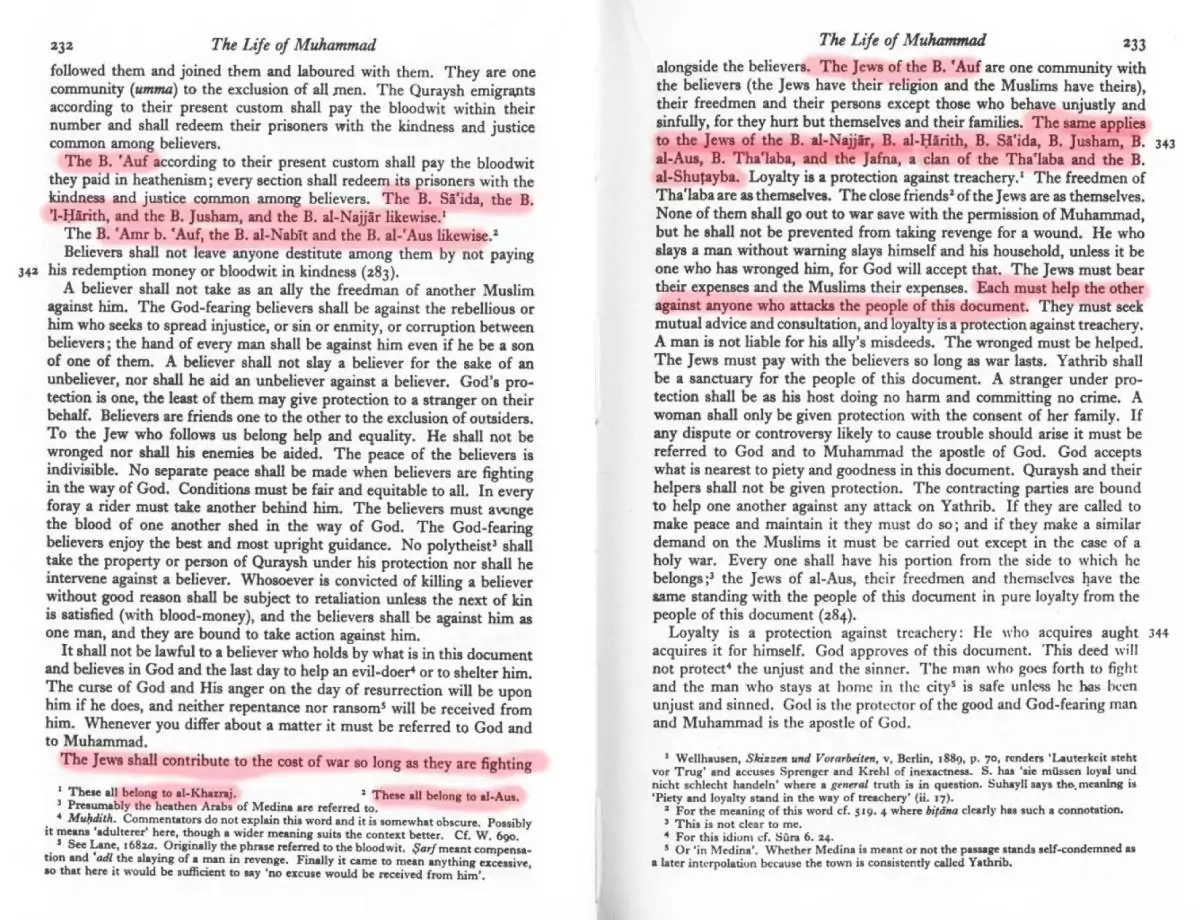
The Treaty’s Lack of Historical Basis: Sirat al-Mustafa — Allama Idris Kandhlawi
Allama Idris Kandhlawi’s work presents Banu Qurayza as having entered into a treaty at the time of the Constitution of Medina. If this claim is accepted, it creates an immediate chronological problem: during the later campaign against Banu Nadir, Muhammad marched against Banu Qurayza despite the cited report describing no prior offense by them, and demanded that they enter into a pledge. In that case, Muhammad’s military action against an already treaty-bound tribe preceded the alleged breach later attributed to Banu Qurayza. The principal problem is the absence of a “primary source” or contemporaneous documentary evidence. In the text of the “Constitution of Medina” compiled by Ibn Ishaq in his sira work, although the Jews under the protection of various Arab tribes of Medina are mentioned, the names of the three major tribes—Banu Qurayza, Banu Nadir, and Banu Qaynuqa—are entirely absent. Despite the absence of these tribes’ names from the original list of the constitution, later narratives portray them as parties to the treaty and as treaty-breakers. Claiming that treaties existed with people whose names do not appear in contemporary documents is a major inconsistency by historical standards, and it indicates that this narrative was probably added later for political or legal purposes.
Secondly, it became necessary for later sīrah writers and jurists to construct the pretext of a “written treaty violation” in order to morally justify an extreme level of violence such as the massacre of Banu Qurayza. Ibn Ishaq recorded these accounts approximately one hundred and fifty years after the event, without any specific “chain of narrators” or reliable source, yet even there the name of Banu Qurayza is absent. According to modern historians, if there had truly been any significant written treaty with the three principal Jewish tribes of Medina, it would be quite astonishing and implausible for their names to be absent from the original text of the Constitution of Medina. This is because these three tribes were the most important Jewish tribes at that time. Therefore, two possibilities remain. Either Banu Qurayza were already included in the earlier constitutional arrangement, in which case Muhammad’s military move against them during the Banu Nadir campaign came first; or they were not included in that earlier arrangement, in which case the pledge recorded during the Banu Nadir campaign was imposed only after Muhammad marched against them with troops. In neither case does the chronology support the simple claim that Banu Qurayza freely entered into an original treaty and later became the first side to violate it.
The crucial point, however, does not depend on proving that the earlier treaty was a later invention. If Banu Qurayza were already bound by the Constitution of Medina, Muhammad’s military advance against them during the Banu Nadir campaign preceded their alleged later breach. If they were not bound by that constitution, the first clearly identifiable pledge recorded in the sources was obtained only after Muhammad marched against them with troops. Thus, under either reconstruction, the chronology creates a fundamental problem for the claim that Banu Qurayza freely entered into an agreement and then became the first party to violate it.
Let us learn about this information from the book of Allama Idris Kandhlawi, in which the names of these three Jewish tribes are mentioned. In support of this information, Allama Idris Kandhlawi used Ibn Hajar al-Asqalani’s book Fath al-Bari (vol. 7, p. 314) as a reference. Yet Ibn Hajar al-Asqalani (d. 1449 CE) was an author who lived approximately eight hundred years after the original event. When these names are absent from the original text of the constitution compiled by Ibn Ishaq himself, accepting a compilation from several centuries later as a historical document is factually erroneous. According to modern historians, if the most powerful tribes of Medina at that time, such as Banu Qurayza, had actually been parties to a treaty, it would be virtually impossible for their names to be absent from the original list of the constitution. Therefore, the later claim that Banu Qurayza were already treaty-bound from the beginning does not rescue the accusation against them. If that claim is true, Muhammad’s attack on them during the Banu Nadir campaign becomes the earlier breach. If that claim is false, then the first clearly documented pledge with Banu Qurayza is the one extracted after Muhammad marched against them militarily. [56]
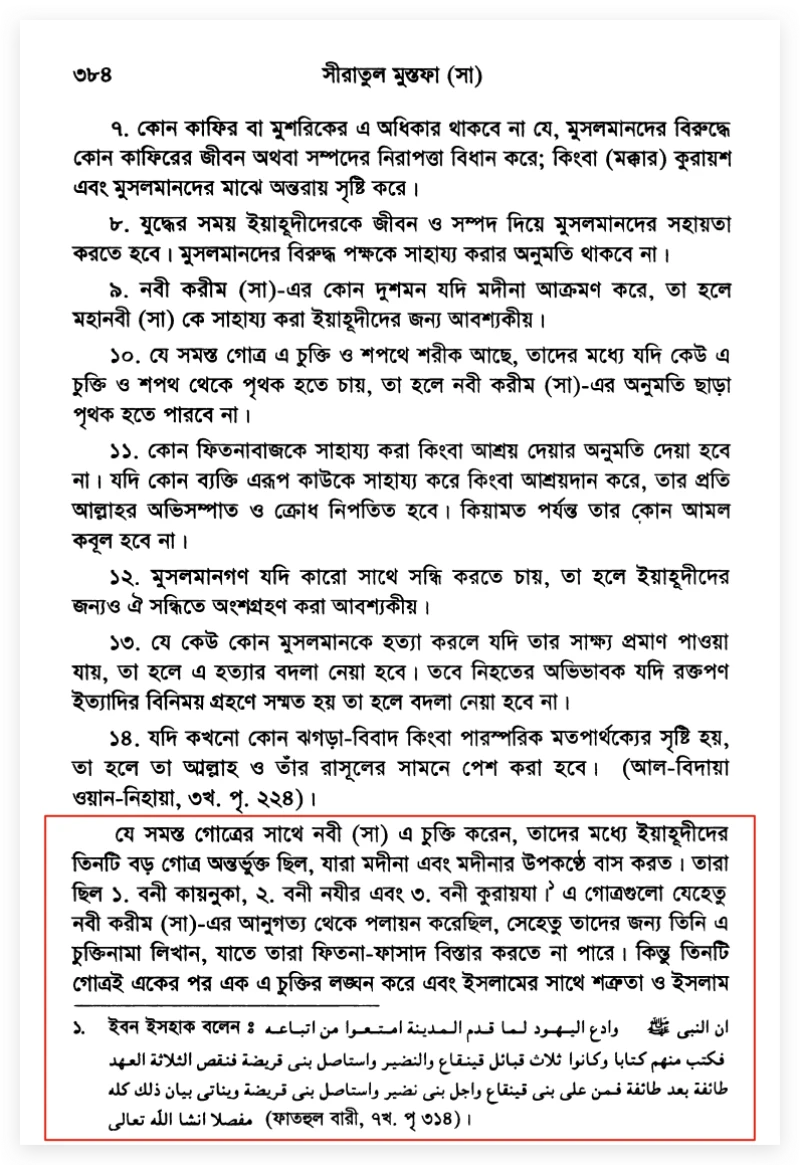
Tafsir Mazhari — Sanaullah Panipati
Now let us see what Banu Qurayza actually said about that treaty or pledge [57]
Did the Treaty Mention Wholesale Massacre?
Islamic commentators often attempt to legitimize this brutal killing of Banu Qurayza as punishment for “treason” or “breach of treaty.” Their argument is that since the Jews had violated the terms of the Constitution of Medina, they deserved this punishment. But a profoundly important legal and moral question remains here—did any clause of the Constitution of Medina actually state that, if the treaty were violated, all adult men of that tribe would be killed and the women and children enslaved?
The text or copy of the Constitution of Medina preserved by the historians Ibn Ishaq and Ibn Hisham contains no mention anywhere among its 47 clauses that “massacre” would be the punishment for breach of treaty. The constitution’s primary focus was mutual cooperation, the payment of diyah (blood money), and the defense of Medina. The constitution stated that if anyone committed a crime, responsibility for it would rest personally upon that individual, not upon the entire tribe.
Even if, for the sake of argument, it is assumed that Banu Qurayza had violated the treaty, the punishment for breach of treaty could not be “massacre” or “genocide” within any sound legal framework, whether modern or contemporary to that time. Generally, the maximum punishment for violating a political or military treaty could be cancellation of the treaty, imposition of a fine, siege, or at most exile from the region. Before Banu Qurayza, the Prophet Muhammad himself had adopted a policy of exile in the cases of the tribes of Banu Qaynuqa and Banu Nadir.
But in the case of Banu Qurayza, the punishment carried out in the name of the Constitution of Medina was consistent with none of the constitution’s terms. It was essentially a new and immediate decision that paid no heed to any pre-established legal framework. In other words, presenting this massacre as “punishment for breach of treaty” is essentially a “post-hoc justification,” or a feeble argument constructed after the event. In reality, the Jews had signed no written document containing any condition that said—“If we fail to keep our word, all of us will be slaughtered.”
If It Was Not in the Constitution of Medina, What Treaty Was It?
The chronology now becomes crucial. If Banu Qurayza had already entered into a treaty with Muhammad under the Constitution of Medina, then the following hadith records Muhammad marching against an already treaty-bound tribe during the Banu Nadir campaign and demanding a new pledge from them without stating any prior offense committed by Banu Qurayza. If, however, Banu Qurayza had not been parties to the Constitution of Medina, then this same hadith records the first clearly identifiable pledge between them and Muhammad—and shows that it was obtained only after Muhammad approached them with a military force. Let us read the report itself. The hadith tells us that the tribe of Banu Nadir invited Muhammad to demonstrate the truth of his prophethood. They informed Muhammad as follows: “Come to us with thirty of your companions, and thirty of our scholars will meet with you at a separate location. They will listen to you; if they believe in you and place their faith in you, then we will believe in you.” While going to them to provide evidence of his prophethood, Muhammad suddenly left the place at night without any reason. Evidence of this has already been presented. Muhammad then attacked Banu Nadir. In the middle of that campaign, he left Banu Nadir aside, marched against Banu Qurayza with troops, and demanded that they enter into a pledge. The report states no prior attack, rebellion, or treaty violation by Banu Qurayza at this point. Faced with this military advance, Banu Qurayza accepted the demanded pledge. Let us examine this in the hadith [34]. Readers should read carefully and take note that there was no reason whatsoever for the sudden attack on Banu Qurayza.
Sunan Abu Dawud (Islamic Foundation)
14/ Concerning taxes, tribute, donations, and administrative responsibilities
Chapter: 161. Concerning the incident of Banu Nadir.
2994
Narrated A man from the companions of the Prophet: AbdurRahman ibn Ka’b ibn Malik reported on the authority of a man from among the companions of the Prophet (ﷺ): The infidels of the Quraysh wrote (a letter) to Ibn Ubayy and to those who worshipped idols from al-Aws and al-Khazraj, while the Messenger of Allah (ﷺ) was at that time at Medina before the battle of Badr. (They wrote): You gave protection to our companion. We swear by Allah, you should fight him or expel him, or we shall come to you in full force, until we kill your fighters and appropriate your women. When this (news) reached Abdullah ibn Ubayy and those who were worshippers of idols, with him they gathered together to fight the Messenger of Allah (ﷺ). When this news reached the Messenger of Allah (ﷺ), he visited them and said: The threat of the Quraysh to you has reached its end. They cannot contrive a plot against you, greater than what you yourselves intended to harm you. Are you willing to fight your sons and brethren? When they heard this from the Prophet (ﷺ), they scattered. This reached the infidels of the Quraysh. The infidels of the Quraysh again wrote (a letter) to the Jews after the battle of Badr: You are men of weapons and fortresses. You should fight our companion or we shall deal with you in a certain way. And nothing will come between us and the anklets of your women. When their letter reached the Prophet (ﷺ), they gathered Banu an-Nadir to violate the treaty. They sent a message to the Prophet (ﷺ): Come out to us with thirty men from your companions, and thirty rabbis will come out from us till we meet at a central place where they will hear you. If they testify to you and believe in you, we shall believe in you. The narrator then narrated the whole story. When the next day came, the Messenger of Allah (ﷺ) went out in the morning with an army, and surrounded them. He told them: I swear by Allah, you will have no peace from me until you conclude a treaty with me. But they refused to conclude a treaty with him. He therefore fought them the same day. Next he attacked Banu Quraysh with an army in the morning, and left Banu an-Nadir. He asked them to sign a treaty and they signed it. He turned away from them and attacked Banu an-Nadir with an army. He fought with them until they agreed to expulsion. Banu an-Nadir were deported, and they took with them whatever their camels could carry, that is, their property, the doors of their houses, and their wood. Palm-trees were exclusively reserved for the Messenger of Allah (ﷺ). Allah bestowed them upon him and gave them him as a special portion. He (Allah), the Exalted, said: What Allah has bestowed on His Apostle (and taken away) from them, for this ye made no expedition with either camel corps or cavalry.” He said: “Without fighting.” So the Prophet (ﷺ) gave most of it to the emigrants and divided it among them; and he divided some of it between two men from the helpers, who were needy, and he did not divide it among any of the helpers except those two. The rest of it survived as the sadaqah of the Messenger of Allah (ﷺ) which is in the hands of the descendants of Fatimah (Allah be pleased with her)
حَدَّثَنَا مُحَمَّدُ بْنُ دَاوُدَ بْنِ سُفْيَانَ، حَدَّثَنَا عَبْدُ الرَّزَّاقِ، أَخْبَرَنَا مَعْمَرٌ، عَنِ الزُّهْرِيِّ، عَنْ عَبْدِ الرَّحْمَنِ بْنِ كَعْبِ بْنِ مَالِكٍ، عَنْ رَجُلٍ، مِنْ أَصْحَابِ النَّبِيِّ صلى الله عليه وسلم أَنَّ كُفَّارَ قُرَيْشٍ كَتَبُوا إِلَى ابْنِ أُبَىٍّ وَمَنْ كَانَ يَعْبُدُ مَعَهُ الأَوْثَانَ مِنَ الأَوْسِ وَالْخَزْرَجِ وَرَسُولُ اللَّهِ صلى الله عليه وسلم يَوْمَئِذٍ بِالْمَدِينَةِ قَبْلَ وَقْعَةِ بَدْرٍ إِنَّكُمْ آوَيْتُمْ صَاحِبَنَا وَإِنَّا نُقْسِمُ بِاللَّهِ لَتُقَاتِلُنَّهُ أَوْ لَتُخْرِجُنَّهُ أَوْ لَنَسِيرَنَّ إِلَيْكُمْ بِأَجْمَعِنَا حَتَّى نَقْتُلَ مُقَاتِلَتَكُمْ وَنَسْتَبِيحَ نِسَاءَكُمْ . فَلَمَّا بَلَغَ ذَلِكَ عَبْدَ اللَّهِ بْنَ أُبَىٍّ وَمَنْ كَانَ مَعَهُ مِنْ عَبَدَةِ الأَوْثَانِ اجْتَمَعُوا لِقِتَالِ النَّبِيِّ صلى الله عليه وسلم فَلَمَّا بَلَغَ ذَلِكَ النَّبِيَّ صلى الله عليه وسلم لَقِيَهُمْ فَقَالَ ” لَقَدْ بَلَغَ وَعِيدُ قُرَيْشٍ مِنْكُمُ الْمَبَالِغَ مَا كَانَتْ تَكِيدُكُمْ بِأَكْثَرَ مِمَّا تُرِيدُونَ أَنْ تَكِيدُوا بِهِ أَنْفُسَكُمْ تُرِيدُونَ أَنْ تُقَاتِلُوا أَبْنَاءَكُمْ وَإِخْوَانَكُمْ ” . فَلَمَّا سَمِعُوا ذَلِكَ مِنَ النَّبِيِّ صلى الله عليه وسلم تَفَرَّقُوا فَبَلَغَ ذَلِكَ كُفَّارَ قُرَيْشٍ فَكَتَبَتْ كُفَّارُ قُرَيْشٍ بَعْدَ وَقْعَةِ بَدْرٍ إِلَى الْيَهُودِ إِنَّكُمْ أَهْلُ الْحَلْقَةِ وَالْحُصُونِ وَإِنَّكُمْ لَتُقَاتِلُنَّ صَاحِبَنَا أَوْ لَنَفْعَلَنَّ كَذَا وَكَذَا وَلاَ يَحُولُ بَيْنَنَا وَبَيْنَ خَدَمِ نِسَائِكُمْ شَىْءٌ – وَهِيَ الْخَلاَخِيلُ – فَلَمَّا بَلَغَ كِتَابُهُمُ النَّبِيَّ صلى الله عليه وسلم أَجْمَعَتْ بَنُو النَّضِيرِ بِالْغَدْرِ فَأَرْسَلُوا إِلَى رَسُولِ اللَّهِ صلى الله عليه وسلم اخْرُجْ إِلَيْنَا فِي ثَلاَثِينَ رَجُلاً مِنْ أَصْحَابِكَ وَلْيَخْرُجْ مِنَّا ثَلاَثُونَ حَبْرًا حَتَّى نَلْتَقِيَ بِمَكَانِ الْمَنْصَفِ فَيَسْمَعُوا مِنْكَ . فَإِنْ صَدَّقُوكَ وَآمَنُوا بِكَ آمَنَّا بِكَ فَقَصَّ خَبَرَهُمْ فَلَمَّا كَانَ الْغَدُ غَدَا عَلَيْهِمْ رَسُولُ اللَّهِ صلى الله عليه وسلم بِالْكَتَائِبِ فَحَصَرَهُمْ فَقَالَ لَهُمْ ” إِنَّكُمْ وَاللَّهِ لاَ تَأْمَنُونَ عِنْدِي إِلاَّ بِعَهْدٍ تُعَاهِدُونِي عَلَيْهِ ” . فَأَبَوْا أَنْ يُعْطُوهُ عَهْدًا فَقَاتَلَهُمْ يَوْمَهُمْ ذَلِكَ ثُمَّ غَدَا الْغَدُ عَلَى بَنِي قُرَيْظَةَ بِالْكَتَائِبِ وَتَرَكَ بَنِي النَّضِيرِ وَدَعَاهُمْ إِلَى أَنْ يُعَاهِدُوهُ فَعَاهَدُوهُ فَانْصَرَفَ عَنْهُمْ وَغَدَا عَلَى بَنِي النَّضِيرِ بِالْكَتَائِبِ فَقَاتَلَهُمْ حَتَّى نَزَلُوا عَلَى الْجَلاَءِ فَجَلَتْ بَنُو النَّضِيرِ وَاحْتَمَلُوا مَا أَقَلَّتِ الإِبِلُ مِنْ أَمْتِعَتِهِمْ وَأَبْوَابِ بُيُوتِهِمْ وَخَشَبِهَا فَكَانَ نَخْلُ بَنِي النَّضِيرِ لِرَسُولِ اللَّهِ صلى الله عليه وسلم خَاصَّةً أَعْطَاهُ اللَّهُ إِيَّاهَا وَخَصَّهُ بِهَا فَقَالَ { وَمَا أَفَاءَ اللَّهُ عَلَى رَسُولِهِ مِنْهُمْ فَمَا أَوْجَفْتُمْ عَلَيْهِ مِنْ خَيْلٍ وَلاَ رِكَابٍ } يَقُولُ بِغَيْرِ قِتَالٍ فَأَعْطَى النَّبِيُّ صلى الله عليه وسلم أَكْثَرَهَا لِلْمُهَاجِرِينَ وَقَسَمَهَا بَيْنَهُمْ وَقَسَمَ مِنْهَا لِرَجُلَيْنِ مِنَ الأَنْصَارِ وَكَانَا ذَوِي حَاجَةٍ لَمْ يَقْسِمْ لأَحَدٍ مِنَ الأَنْصَارِ غَيْرَهُمَا وَبَقِيَ مِنْهَا صَدَقَةُ رَسُولِ اللَّهِ صلى الله عليه وسلم الَّتِي فِي أَيْدِي بَنِي فَاطِمَةَ رَضِيَ اللَّهُ عَنْهَا .
Grade: Sahih Isnaad (Al-Albani)
Who Actually Violated the Constitution of Medina?
The issue can be tested under both possibilities. If Banu Qurayza were not parties to the Constitution of Medina, then the later pledge obtained during the Banu Nadir campaign was imposed only after Muhammad marched against them with troops. But if, as later sīrah writers claim, Banu Qurayza had already been parties to the Constitution of Medina, an even more serious problem arises: who violated that existing relationship first—Banu Qurayza, or Muhammad himself? Let us examine this. Let us read the following account. It shows that after the Battle of the Trench—that is, after Shawwal–Dhu al-Qadah, 5 AH, or January–February 627 CE—Muhammad attacked Banu Qurayza on the allegation that they had violated the treaty. It is supposedly said that immediately after returning from the Battle of the Trench, Gabriel came and informed Muhammad of the matter—the alleged treaty violation by Banu Qurayza. It is learned from this account that after Muhammad came to the house of Umm Salamah, Gabriel arrived and supposedly informed the Prophet of the secret news of Banu Qurayza’s treaty violation and betrayal [58]
According to this chronology, the alleged breach by Banu Qurayza belongs to the period of the Battle of the Trench in 627 CE. But Muhammad had already marched militarily against Banu Qurayza during the Banu Nadir campaign in 625 CE. Therefore, if Banu Qurayza had already been bound to Muhammad through the Constitution of Medina, Muhammad’s military action against them preceded the alleged breach attributed to them by roughly two years. Under that version of events, it was Muhammad who first broke the existing relationship. If no such earlier treaty existed, then the 625 pledge itself was obtained under military coercion. Either conclusion creates the same problem for the later justification of the massacre as punishment for Banu Qurayza’s supposed unilateral betrayal.
The Quran’s own rule concerning suspected treaty betrayal makes this chronology still more damaging. Quran 8:58 states: “And if you ˹O Prophet˺ see signs of betrayal by a people, respond by openly terminating your treaty with them. Surely Allah does not like those who betray.” — Dr. Mustafa Khattab, The Clear Quran (Quran.com). Al-Tabari explains the rule in explicit terms: before fighting them, they must be informed that the covenant has been terminated, so that they know they are now at war; to attack people while a treaty remains in force and they still rely upon it would itself constitute treachery and perfidy. Al-Qurtubi preserves the same principle: first tell them that the covenant has been dissolved and that war will follow, and only then attack. Therefore, if Banu Qurayza were already treaty-bound in 625, while the Abu Dawud report records Muhammad advancing against them with troops without stating any prior offense or prior notification terminating the treaty, the apologetic accusation of “treaty-breaking” begins to point in an extremely uncomfortable direction. [59] [60] [61]
Let us see that Muhammad attacked Banu Qurayza during the attack on Banu Nadir itself. It should be noted that the attack on Banu Nadir took place in 625 CE, or 4 AH [34]
Sunan Abu Dawud (Islamic Foundation)
14/ Concerning taxes, tribute, donations, and administrative responsibilities
Chapter: 161. Concerning the incident of Banu Nadir.
2994
Narrated A man from the companions of the Prophet: AbdurRahman ibn Ka’b ibn Malik reported on the authority of a man from among the companions of the Prophet (ﷺ): The infidels of the Quraysh wrote (a letter) to Ibn Ubayy and to those who worshipped idols from al-Aws and al-Khazraj, while the Messenger of Allah (ﷺ) was at that time at Medina before the battle of Badr. (They wrote): You gave protection to our companion. We swear by Allah, you should fight him or expel him, or we shall come to you in full force, until we kill your fighters and appropriate your women. When this (news) reached Abdullah ibn Ubayy and those who were worshippers of idols, with him they gathered together to fight the Messenger of Allah (ﷺ). When this news reached the Messenger of Allah (ﷺ), he visited them and said: The threat of the Quraysh to you has reached its end. They cannot contrive a plot against you, greater than what you yourselves intended to harm you. Are you willing to fight your sons and brethren? When they heard this from the Prophet (ﷺ), they scattered. This reached the infidels of the Quraysh. The infidels of the Quraysh again wrote (a letter) to the Jews after the battle of Badr: You are men of weapons and fortresses. You should fight our companion or we shall deal with you in a certain way. And nothing will come between us and the anklets of your women. When their letter reached the Prophet (ﷺ), they gathered Banu an-Nadir to violate the treaty. They sent a message to the Prophet (ﷺ): Come out to us with thirty men from your companions, and thirty rabbis will come out from us till we meet at a central place where they will hear you. If they testify to you and believe in you, we shall believe in you. The narrator then narrated the whole story. When the next day came, the Messenger of Allah (ﷺ) went out in the morning with an army, and surrounded them. He told them: I swear by Allah, you will have no peace from me until you conclude a treaty with me. But they refused to conclude a treaty with him. He therefore fought them the same day. Next he attacked Banu Quraysh with an army in the morning, and left Banu an-Nadir. He asked them to sign a treaty and they signed it. He turned away from them and attacked Banu an-Nadir with an army. He fought with them until they agreed to expulsion. Banu an-Nadir were deported, and they took with them whatever their camels could carry, that is, their property, the doors of their houses, and their wood. Palm-trees were exclusively reserved for the Messenger of Allah (ﷺ). Allah bestowed them upon him and gave them him as a special portion. He (Allah), the Exalted, said: What Allah has bestowed on His Apostle (and taken away) from them, for this ye made no expedition with either camel corps or cavalry.” He said: “Without fighting.” So the Prophet (ﷺ) gave most of it to the emigrants and divided it among them; and he divided some of it between two men from the helpers, who were needy, and he did not divide it among any of the helpers except those two. The rest of it survived as the sadaqah of the Messenger of Allah (ﷺ) which is in the hands of the descendants of Fatimah (Allah be pleased with her)
حَدَّثَنَا مُحَمَّدُ بْنُ دَاوُدَ بْنِ سُفْيَانَ، حَدَّثَنَا عَبْدُ الرَّزَّاقِ، أَخْبَرَنَا مَعْمَرٌ، عَنِ الزُّهْرِيِّ، عَنْ عَبْدِ الرَّحْمَنِ بْنِ كَعْبِ بْنِ مَالِكٍ، عَنْ رَجُلٍ، مِنْ أَصْحَابِ النَّبِيِّ صلى الله عليه وسلم أَنَّ كُفَّارَ قُرَيْشٍ كَتَبُوا إِلَى ابْنِ أُبَىٍّ وَمَنْ كَانَ يَعْبُدُ مَعَهُ الأَوْثَانَ مِنَ الأَوْسِ وَالْخَزْرَجِ وَرَسُولُ اللَّهِ صلى الله عليه وسلم يَوْمَئِذٍ بِالْمَدِينَةِ قَبْلَ وَقْعَةِ بَدْرٍ إِنَّكُمْ آوَيْتُمْ صَاحِبَنَا وَإِنَّا نُقْسِمُ بِاللَّهِ لَتُقَاتِلُنَّهُ أَوْ لَتُخْرِجُنَّهُ أَوْ لَنَسِيرَنَّ إِلَيْكُمْ بِأَجْمَعِنَا حَتَّى نَقْتُلَ مُقَاتِلَتَكُمْ وَنَسْتَبِيحَ نِسَاءَكُمْ . فَلَمَّا بَلَغَ ذَلِكَ عَبْدَ اللَّهِ بْنَ أُبَىٍّ وَمَنْ كَانَ مَعَهُ مِنْ عَبَدَةِ الأَوْثَانِ اجْتَمَعُوا لِقِتَالِ النَّبِيِّ صلى الله عليه وسلم فَلَمَّا بَلَغَ ذَلِكَ النَّبِيَّ صلى الله عليه وسلم لَقِيَهُمْ فَقَالَ ” لَقَدْ بَلَغَ وَعِيدُ قُرَيْشٍ مِنْكُمُ الْمَبَالِغَ مَا كَانَتْ تَكِيدُكُمْ بِأَكْثَرَ مِمَّا تُرِيدُونَ أَنْ تَكِيدُوا بِهِ أَنْفُسَكُمْ تُرِيدُونَ أَنْ تُقَاتِلُوا أَبْنَاءَكُمْ وَإِخْوَانَكُمْ ” . فَلَمَّا سَمِعُوا ذَلِكَ مِنَ النَّبِيِّ صلى الله عليه وسلم تَفَرَّقُوا فَبَلَغَ ذَلِكَ كُفَّارَ قُرَيْشٍ فَكَتَبَتْ كُفَّارُ قُرَيْشٍ بَعْدَ وَقْعَةِ بَدْرٍ إِلَى الْيَهُودِ إِنَّكُمْ أَهْلُ الْحَلْقَةِ وَالْحُصُونِ وَإِنَّكُمْ لَتُقَاتِلُنَّ صَاحِبَنَا أَوْ لَنَفْعَلَنَّ كَذَا وَكَذَا وَلاَ يَحُولُ بَيْنَنَا وَبَيْنَ خَدَمِ نِسَائِكُمْ شَىْءٌ – وَهِيَ الْخَلاَخِيلُ – فَلَمَّا بَلَغَ كِتَابُهُمُ النَّبِيَّ صلى الله عليه وسلم أَجْمَعَتْ بَنُو النَّضِيرِ بِالْغَدْرِ فَأَرْسَلُوا إِلَى رَسُولِ اللَّهِ صلى الله عليه وسلم اخْرُجْ إِلَيْنَا فِي ثَلاَثِينَ رَجُلاً مِنْ أَصْحَابِكَ وَلْيَخْرُجْ مِنَّا ثَلاَثُونَ حَبْرًا حَتَّى نَلْتَقِيَ بِمَكَانِ الْمَنْصَفِ فَيَسْمَعُوا مِنْكَ . فَإِنْ صَدَّقُوكَ وَآمَنُوا بِكَ آمَنَّا بِكَ فَقَصَّ خَبَرَهُمْ فَلَمَّا كَانَ الْغَدُ غَدَا عَلَيْهِمْ رَسُولُ اللَّهِ صلى الله عليه وسلم بِالْكَتَائِبِ فَحَصَرَهُمْ فَقَالَ لَهُمْ ” إِنَّكُمْ وَاللَّهِ لاَ تَأْمَنُونَ عِنْدِي إِلاَّ بِعَهْدٍ تُعَاهِدُونِي عَلَيْهِ ” . فَأَبَوْا أَنْ يُعْطُوهُ عَهْدًا فَقَاتَلَهُمْ يَوْمَهُمْ ذَلِكَ ثُمَّ غَدَا الْغَدُ عَلَى بَنِي قُرَيْظَةَ بِالْكَتَائِبِ وَتَرَكَ بَنِي النَّضِيرِ وَدَعَاهُمْ إِلَى أَنْ يُعَاهِدُوهُ فَعَاهَدُوهُ فَانْصَرَفَ عَنْهُمْ وَغَدَا عَلَى بَنِي النَّضِيرِ بِالْكَتَائِبِ فَقَاتَلَهُمْ حَتَّى نَزَلُوا عَلَى الْجَلاَءِ فَجَلَتْ بَنُو النَّضِيرِ وَاحْتَمَلُوا مَا أَقَلَّتِ الإِبِلُ مِنْ أَمْتِعَتِهِمْ وَأَبْوَابِ بُيُوتِهِمْ وَخَشَبِهَا فَكَانَ نَخْلُ بَنِي النَّضِيرِ لِرَسُولِ اللَّهِ صلى الله عليه وسلم خَاصَّةً أَعْطَاهُ اللَّهُ إِيَّاهَا وَخَصَّهُ بِهَا فَقَالَ { وَمَا أَفَاءَ اللَّهُ عَلَى رَسُولِهِ مِنْهُمْ فَمَا أَوْجَفْتُمْ عَلَيْهِ مِنْ خَيْلٍ وَلاَ رِكَابٍ } يَقُولُ بِغَيْرِ قِتَالٍ فَأَعْطَى النَّبِيُّ صلى الله عليه وسلم أَكْثَرَهَا لِلْمُهَاجِرِينَ وَقَسَمَهَا بَيْنَهُمْ وَقَسَمَ مِنْهَا لِرَجُلَيْنِ مِنَ الأَنْصَارِ وَكَانَا ذَوِي حَاجَةٍ لَمْ يَقْسِمْ لأَحَدٍ مِنَ الأَنْصَارِ غَيْرَهُمَا وَبَقِيَ مِنْهَا صَدَقَةُ رَسُولِ اللَّهِ صلى الله عليه وسلم الَّتِي فِي أَيْدِي بَنِي فَاطِمَةَ رَضِيَ اللَّهُ عَنْهَا .
Grade: Sahih Isnaad (Al-Albani)
| Name | Time period | Event |
|---|---|---|
| Constitution of Medina | 622 CE or 1 AH | An agreement between the Muslims and several Jewish tribes in Medina [62] [63] |
| Attack on Banu Nadir | August 625 CE or 4 AH, Rabi al-Awwal | After fleeing from the call to debate, the attack on Banu Nadir; in the midst of the attack on Banu Nadir, the unnecessary attack on Banu Qurayza as well [64] [34] |
| Alleged breach of treaty by Banu Qurayza | January–February 627 CE or 5 AH, Shawwal–Dhu al-Qi’dah | Jibril’s arrival with the claim that Banu Qurayza had breached the treaty [65] |
Does Breach of Treaty Make Genocide Permissible?
There is a Bengali proverb that says, “The wicked are never short of tricks.” Islamic apologists repeatedly invoke the alleged breach of treaty by the Banu Qurayza tribe in order to justify the genocide carried out against them. Even if, for the sake of argument, we accept that Banu Qurayza had breached the treaty, could that justify killing every adult male of an entire tribe and turning its women and children into sex slaves and slaves?
This attribution of collective guilt is not an accusation invented by modern critics. Ibn al-Qayyim states openly in Zād al-Maʿād that when Muhammad had concluded a treaty with a people, and some of them violated it while the remainder approved and accepted the violation, “he fought them all and regarded them all as treaty-breakers”—غزا الجميع، وجعلهم كلهم ناقضين. Ibn al-Qayyim explicitly cites Qurayza, Nadir, and Qaynuqa as examples. The mechanism is unmistakable: once collective approval is imputed, individual responsibility disappears and the entire community is transformed into a single guilty legal body. Even more revealingly, Ibn al-Qayyim admits that Shafiʿi jurists rejected this collective doctrine and restricted treaty violation to those who actually violated the treaty. Thus even within classical Islamic jurisprudence, the proposition that an entire tribe automatically becomes criminal was not an uncontested principle. [66]
When the Indian army carries out massacres in Kashmir, then, by invoking violations of the Indian Constitution or breaches of treaties, those too become permissible. Or consider that when the Pakistani army carried out genocide in what was then East Pakistan or in modern Bangladesh, in the name of protecting the country’s sovereignty, or in the name of our breach of treaty with Pakistan, that too would then become permissible. The truth is that these are extremely cheap and lame excuses, which are also inhumane. Such excuses can never, under any circumstances, make such actions permissible.
The Siege of Banu Qurayza: The Lamentation of Women and Children
Having allegedly learned of the betrayal through the angel Jibril, Prophet Muhammad advanced with his army of warriors for the purpose of attacking Banu Qurayza for a second time. During this period, he kept the fortress of Banu Qurayza under siege for approximately 25 days. He cut off the arrival and movement of food and drink from outside, as a result of which an inhumane and heartbreaking situation emerged. The cries of women and children arose, and their condition reached an extremely miserable state due to hunger and thirst.
Abu Lubaba’s Signal: Everyone Would Be Slaughtered
Abu Lubaba, one of Prophet Muhammad’s own followers, had revealed what Prophet Muhammad planned to do to the Banu Qurayza tribe. After keeping the Banu Qurayza tribe under siege for 25 days, he sent Abu Lubaba to the fortress of Banu Qurayza. As soon as he entered, he broke down in heart-rending tears. They began telling Abu Lubaba about their helplessness. Even though he was a follower of Prophet Muhammad, Abu Lubaba’s heart softened when he saw the weeping women and children. Through a gesture, he informed them that if they surrendered, they would be killed. Prophet Muhammad had come with precisely that plan. [67] [68]
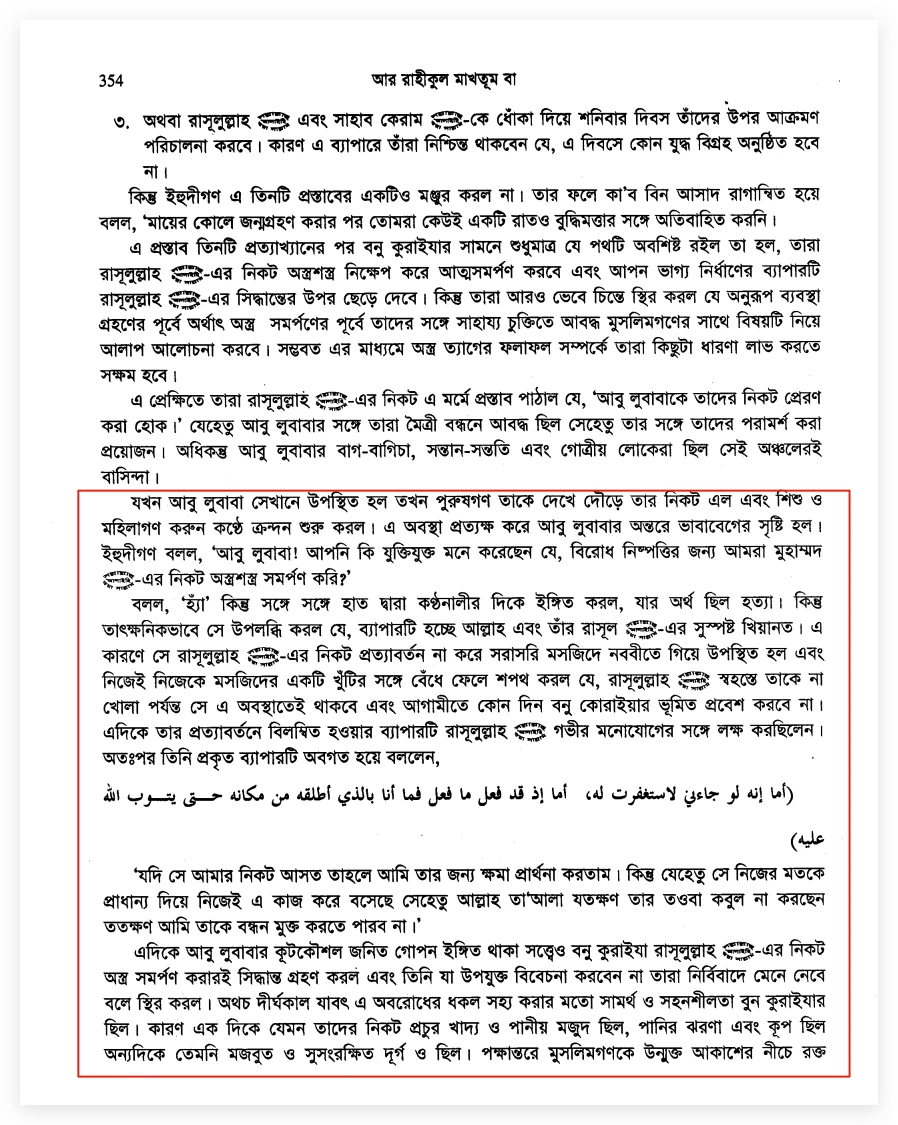
When Abu Lubaba arrived there, the men ran toward him upon seeing him, while the children and women began to weep in mournful voices. Witnessing this situation stirred emotion in Abu Lubaba’s heart. The Jews said, ‘Abu Lubaba! Do you consider it reasonable that we surrender our weapons to Muhammad (PBUH) for the settlement of the dispute?’
He said, ‘Yes,’ but at the same time he pointed with his hand toward his throat, meaning that they would be killed.
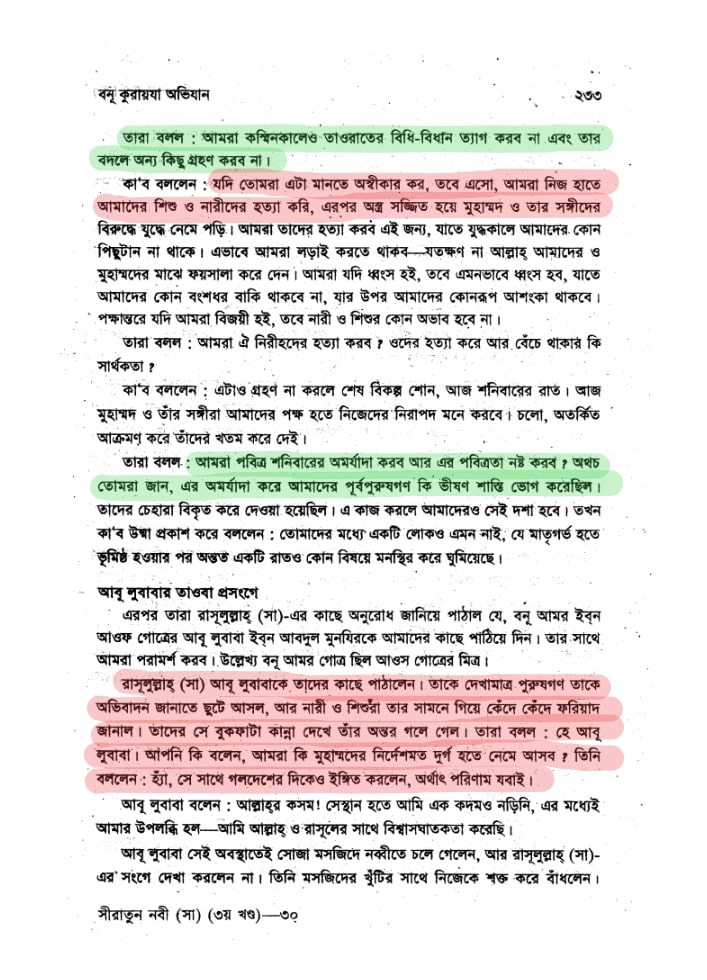
The Prophet’s Prior Plan Was Revealed
The Prophet and his Companions had been giving indications long beforehand that once Prophet Muhammad became powerful, he would butcher the Jews. This matter has already been mentioned once: after the Battle of Badr, the Prophet’s Companions told the Jews that if they did not accept Islam quickly, their fate would be the same as that of the polytheists. This information is found in Ibn Kathir’s work of tafsir. At the same time, an ayah was revealed concerning the fact that Abu Lubaba had disclosed to the Jews the secret decision previously made by the Prophet [69] –
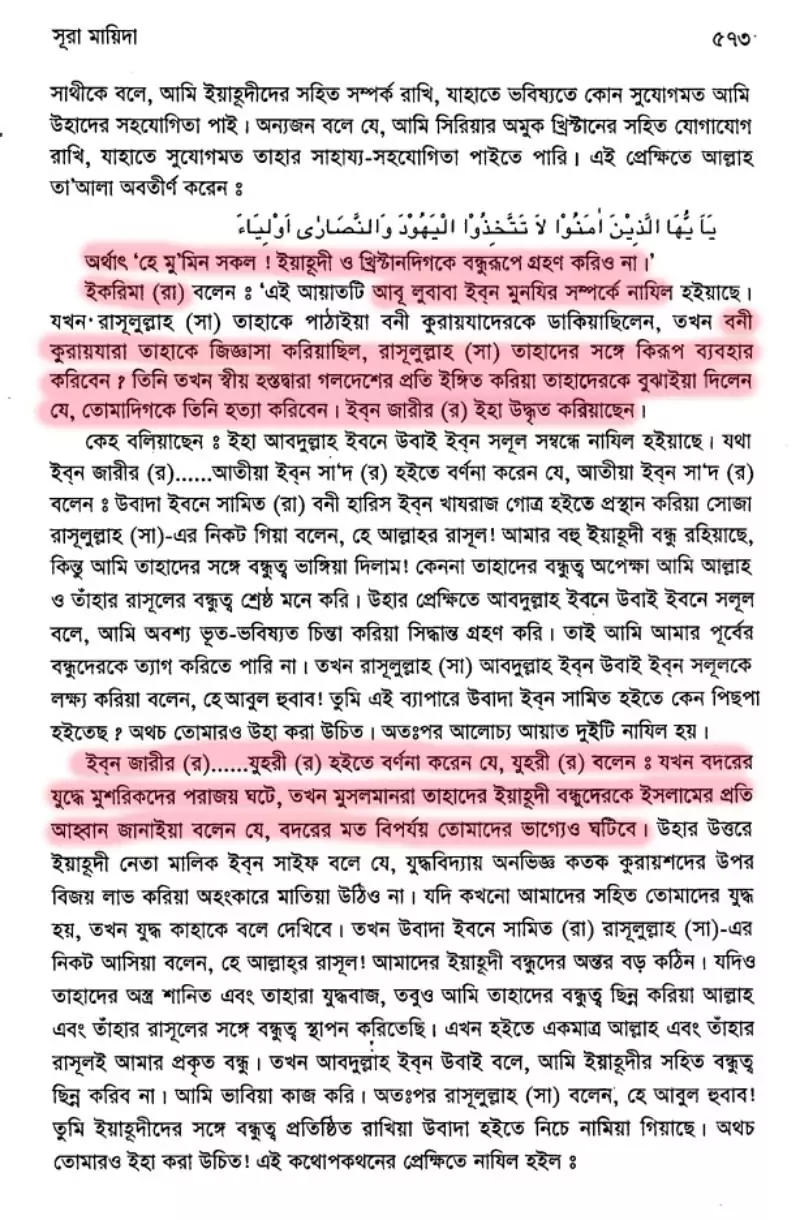
The evidence presented above from Ar-Raheeq al-Makhtum, written by Allama Safiur Rahman Mubarakpuri, and Ibn Hisham’s Siratun Nabi (PBUH), which states that Abu Lubaba had disclosed Prophet Muhammad’s secret decision to the Jews beforehand, is also mentioned in the hadith collection Muwatta Malik. This clearly proves that Muhammad had already decided to carry out genocide against the Banu Qurayza tribe [67] [68] [70] [71] –
Muwatta Malik
22. The Chapter on Vows and Oaths
Section: 9. Various Rulings Concerning Oaths
Narration 16
Narrated Ka’b ibn Malik: Ka’b ibn Malik said to AbuLubabah; or someone else whom Allah wished; or to the Prophet (ﷺ): To make my repentance complete I should depart from the house of my people in which I fell into sin, and that I should divest myself of all my property as sadaqah (alms). He said: A third (of your property) will be sufficient for you
حَدَّثَنِي عُبَيْدُ اللَّهِ بْنُ عُمَرَ، حَدَّثَنَا سُفْيَانُ بْنُ عُيَيْنَةَ، عَنِ الزُّهْرِيِّ، عَنِ ابْنِ كَعْبِ بْنِ مَالِكٍ، عَنْ أَبِيهِ، أَنَّهُ قَالَ لِلنَّبِيِّ صلى الله عليه وسلم أَوْ أَبُو لُبَابَةَ أَوْ مَنْ شَاءَ اللَّهُ : إِنَّ مِنْ تَوْبَتِي أَنْ أَهْجُرَ دَارَ قَوْمِي الَّتِي أَصَبْتُ فِيهَا الذَّنْبَ، وَأَنْ أَنْخَلِعَ مِنْ مَالِي كُلِّهِ صَدَقَةً . قَالَ : “ يُجْزِئُ عَنْكَ الثُّلُثُ ” .
Grade: Sahih Isnaad (Al-Albani)
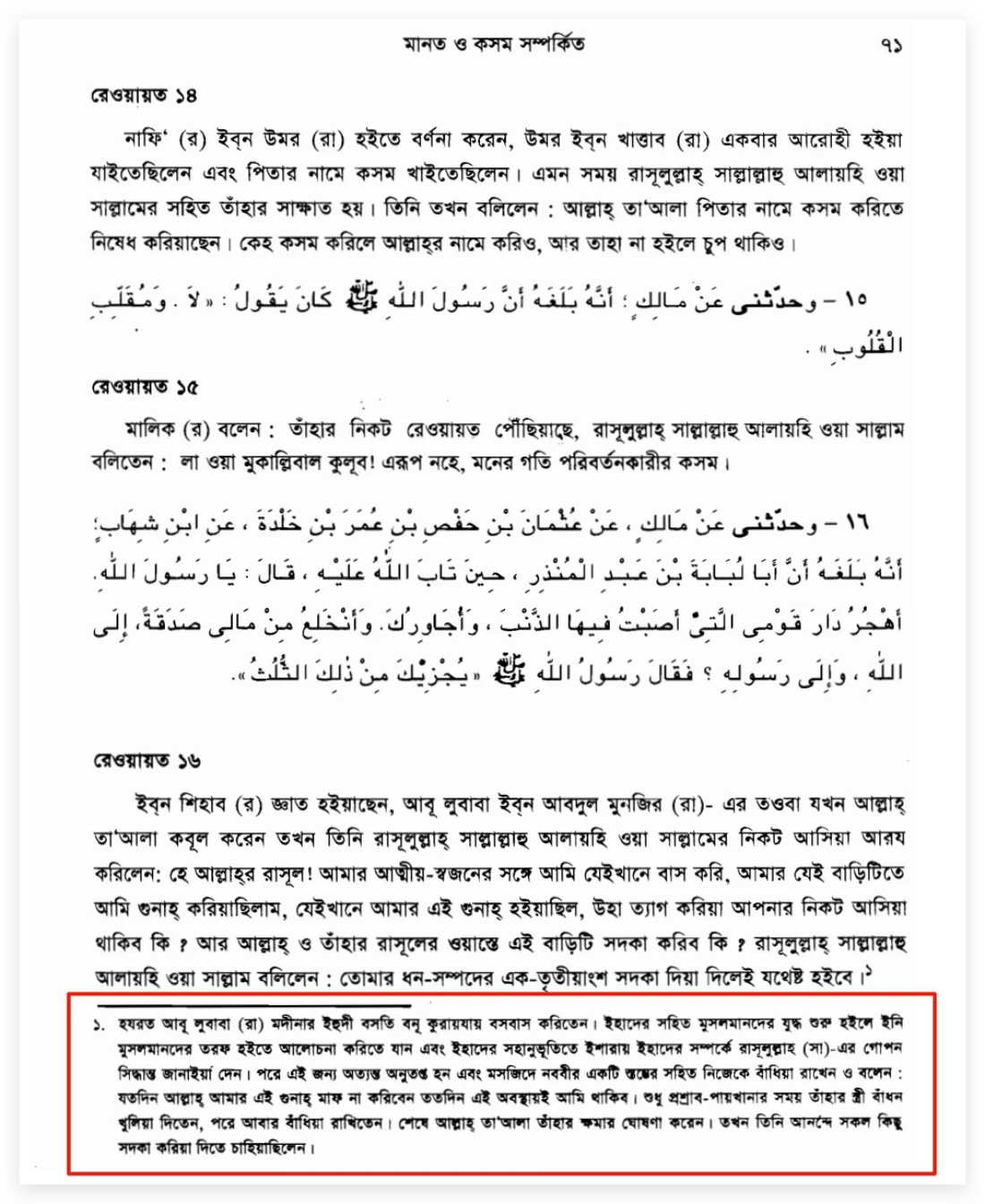
Now let us find out what Tafsir Mazhari says about this matter. Notice, reader, that the decision for Prophet Muhammad to slaughter everyone from the Banu Qurayza tribe had already been made. This was revealed by Abu Lubaba after hearing the cries of the helpless women and children of Banu Qurayza [72]
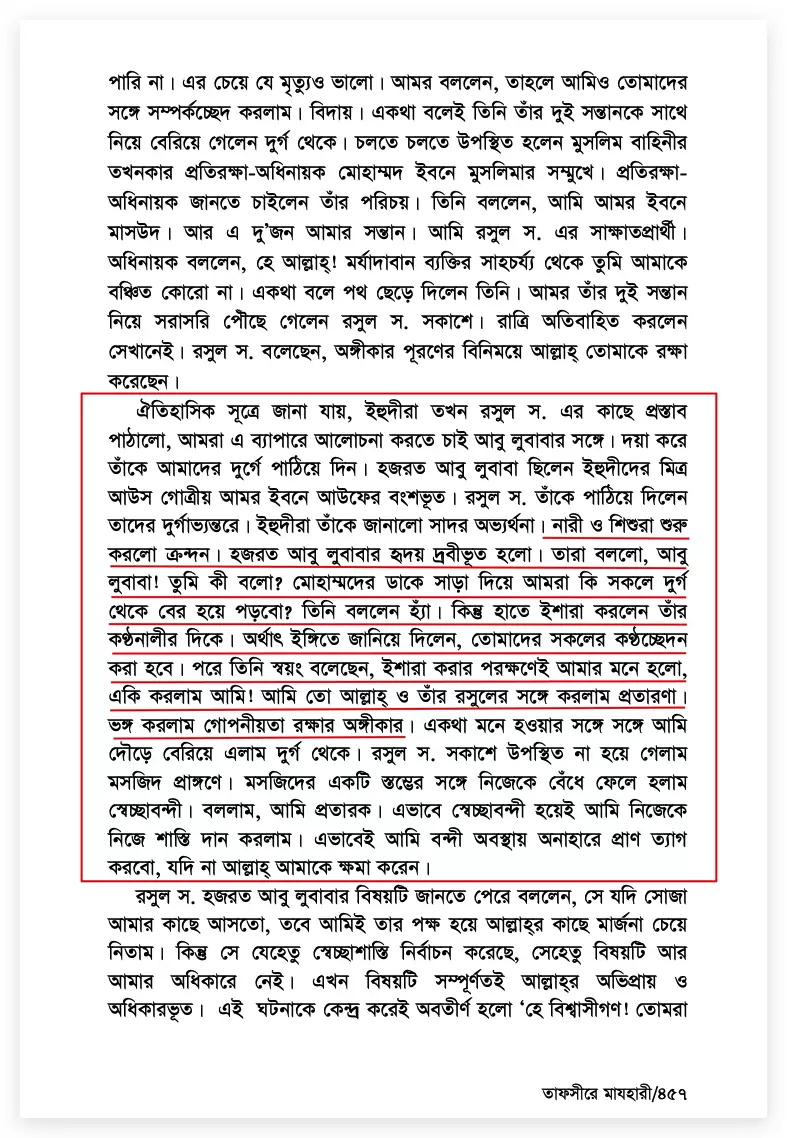
Justice and the Impartiality of the Judge
Justice is one of the foundations of a civilized society, where the law is applied equally to everyone. In matters of judgment, the accused person’s birth, gender, ethnicity, and so on can never be considered under any circumstances. In such cases, if there is any prior hostility or previous close relationship between the judge and the accused, it may influence the proceedings. Therefore, such a judge is never appointed if they cannot maintain impartiality. Suppose the judge and the accused are father and son. In such a situation, that judge must be removed and another judge appointed so that the judge’s parenthood cannot in any way influence the proceedings. If a case concerns political or religious matters, even greater transparency and impartiality are required, as is the need to provide the accused with a full opportunity to defend themselves. If these conditions are absent, it must be regarded as an injustice.
Complete Impartiality of the Judge: The fundamental basis of justice is the judge’s impartiality. If a judge is influenced by personal emotions, anger, hostility, or bias, their decision will not be just. In such cases, the judge must decide solely on the basis of law and evidence, outside the sphere of personal relationships. For example, in the United States’ 2000 case “Bush v. Gore,” there was extensive controversy over the political bias of the Supreme Court justices.
The Influence of the Judge’s Relatives: In many cases, if a judge is a relative or acquaintance of the person accused in a case, there is a possibility of bias. For this reason, in many countries, a judge must withdraw from responsibility for a case in such circumstances. For example, in 2009, Indian Supreme Court Justice R. V. Raveendran recused himself from the Reliance gas dispute after disclosing that his daughter worked for a law firm that had advised one of the parties.
The Judge’s Prior Hostility and Political Influence: Judges’ prior hostility can also become an obstacle to justice. For example, politically controlled or compromised judicial systems throughout history demonstrate why the independence of the judge from the interests of the ruling power is indispensable. Again, in the period after Bangladesh’s independence, some judicial proceedings were called into question for political reasons, with allegations that verdicts against opposition leaders were biased.
The Influence of the Media and Public Opinion: To ensure the impartiality of the judicial system, judges must remain free from undue pressure from the media and public opinion. Media trials, public opinion, or an agitated mob often influence judges, as a result of which justice is obstructed. For example, in America’s “O. J. Simpson” case in 1995, the judicial process was called into question because of excessive media coverage.
The question is whether Sa’d ibn Mu’adh, the judge in this judicial process, began the proceedings after examining the information and evidence concerning the Banu Qurayza tribe from a completely impartial position, or whether he had some prior anger or affection toward this tribe. The fundamental and primary condition of any judicial process is the complete impartiality of the judge. In a just judicial system, appointing as judge a person who has a conflict of interest is considered to invalidate the verdict. But when Sa’d ibn Mu’adh was appointed as arbitrator or judge in the case of Banu Qurayza, the natural question arises: was he in an objective and impartial position to conduct this proceeding? Or had some personal resentment or hatred toward this tribe already accumulated in his mind? If a judge harbors prior hostility or personal animosity toward the accused party, then in both modern and ancient judicial systems such an appointment is directly considered a “conflict of interest” and calls justice into question.
Analyzing historical and hadith sources shows that Sa’d ibn Mu’adh was not at all in an impartial position. After being wounded in the Battle of the Trench, physical pain and the horror of war made him extremely angry with Banu Qurayza. According to the hadith narration, while he was on his deathbed, he prayed to Allah not to let him die before witnessing with his own eyes the ultimate catastrophe or destruction of Banu Qurayza. In other words, even before taking the judge’s seat, he was wishing an “extreme outcome” or death upon the accused party. When a person himself ardently desires to witness the destruction of the opposing party, it is impossible for the verdict he delivers to be free from influence or to constitute justice in any way. Rather, it becomes clear from this mental state that this was the implementation of a premeditated revenge. An even more noteworthy matter is that Prophet Muhammad already knew Sa’d ibn Mu’adh’s attitude very well. In other words, responsibility for the judgment was deliberately entrusted to such a person so that the verdict would conform to the Prophet’s prior plan [73]
Sunan al-Tirmidhi (verified)
19/ Military Expeditions
Section: 29. Surrendering by Accepting Arbitration
1582
Narrated Jabir:”On the day of (the battle of) Al-Ahzab, Sa’d bin Mu’adh was struck by an arrow such that the upper vein or lower vein of his forearm was severed. So the Messenger of Allah (ﷺ) tried to stop it with fire, but it made his arm bleed profusely so he left it. Then he did it another time but it caused it to bleed profusely. Upon seeing that he said: ‘O Allah! Do not allow my soul depart until my eyes are comforted by elimination of Banu Quraizah.’ He pressed his vein closed and it did not bleed a drop before they surrendered to the arbitration of Sa’d bin Mu’adh. He (the Prophet (ﷺ)) sent to him (Sa’d) who judged that their men should be killed, their women should be spared, and that the Muslims may share them among themselves. With this, the Messenger of Allah (ﷺ) said: ‘You have judged according to Allah’s judgement for them.’ And they were four hundred. Then when he finished killing them, his vein opened up and he died.” [He said:] There are narrations on this topic from Abu Sa’eed and ‘Atiyyah Al-Qurazi. [Abu ‘Eisa said:] This Hadith is Hasan Sahih
حَدَّثَنَا قُتَيْبَةُ، حَدَّثَنَا اللَّيْثُ، عَنْ أَبِي الزُّبَيْرِ، عَنْ جَابِرٍ، أَنَّهُ قَالَ رُمِيَ يَوْمَ الأَحْزَابِ سَعْدُ بْنُ مُعَاذٍ فَقَطَعُوا أَكْحَلَهُ أَوْ أَبْجَلَهُ فَحَسَمَهُ رَسُولُ اللَّهِ صلى الله عليه وسلم بِالنَّارِ فَانْتَفَخَتْ يَدُهُ فَتَرَكَهُ فَنَزَفَهُ الدَّمُ فَحَسَمَهُ أُخْرَى فَانْتَفَخَتْ يَدُهُ فَلَمَّا رَأَى ذَلِكَ قَالَ اللَّهُمَّ لاَ تُخْرِجْ نَفْسِي حَتَّى تُقِرَّ عَيْنِي مِنْ بَنِي قُرَيْظَةَ . فَاسْتَمْسَكَ عِرْقُهُ فَمَا قَطَرَ قَطْرَةً حَتَّى نَزَلُوا عَلَى حُكْمِ سَعْدِ بْنِ مُعَاذٍ فَأَرْسَلَ إِلَيْهِ فَحَكَمَ أَنْ يُقْتَلَ رِجَالُهُمْ وَيُسْتَحْيَى نِسَاؤُهُمْ يَسْتَعِينُ بِهِنَّ الْمُسْلِمُونَ . فَقَالَ رَسُولُ اللَّهِ صلى الله عليه وسلم “ أَصَبْتَ حُكْمَ اللَّهِ فِيهِمْ ” . وَكَانُوا أَرْبَعَمِائَةٍ فَلَمَّا فَرَغَ مِنْ قَتْلِهِمُ انْفَتَقَ عِرْقُهُ فَمَاتَ . قَالَ وَفِي الْبَابِ عَنْ أَبِي سَعِيدٍ وَعَطِيَّةَ الْقُرَظِيِّ . قَالَ أَبُو عِيسَى هَذَا حَدِيثٌ حَسَنٌ صَحِيحٌ .
Grade: Sahih (Ahmad Muhammad Shakir)
Who Was Sa’d ibn Mu’adh?
Many Muslims claim that Sa’d ibn Mu’adh was actually one of the Jews! This statement is entirely false. Who was this Sa’d? Sa’d ibn Mu’adh was a convert to Islam. Was he sympathetic toward the Jewish tribe Banu Qurayza? Or was he hostile toward them? Did Muhammad knowingly assign him this responsibility, understanding that once Sa’d was given the task, he would display the utmost brutality? Let us read the hadith above once again [73] –
Sunan al-Tirmidhi (verified)
19/ Military Expeditions
Section: 29. Surrendering by Accepting Arbitration
1582
Narrated Jabir:”On the day of (the battle of) Al-Ahzab, Sa’d bin Mu’adh was struck by an arrow such that the upper vein or lower vein of his forearm was severed. So the Messenger of Allah (ﷺ) tried to stop it with fire, but it made his arm bleed profusely so he left it. Then he did it another time but it caused it to bleed profusely. Upon seeing that he said: ‘O Allah! Do not allow my soul depart until my eyes are comforted by elimination of Banu Quraizah.’ He pressed his vein closed and it did not bleed a drop before they surrendered to the arbitration of Sa’d bin Mu’adh. He (the Prophet (ﷺ)) sent to him (Sa’d) who judged that their men should be killed, their women should be spared, and that the Muslims may share them among themselves. With this, the Messenger of Allah (ﷺ) said: ‘You have judged according to Allah’s judgement for them.’ And they were four hundred. Then when he finished killing them, his vein opened up and he died.” [He said:] There are narrations on this topic from Abu Sa’eed and ‘Atiyyah Al-Qurazi. [Abu ‘Eisa said:] This Hadith is Hasan Sahih
حَدَّثَنَا قُتَيْبَةُ، حَدَّثَنَا اللَّيْثُ، عَنْ أَبِي الزُّبَيْرِ، عَنْ جَابِرٍ، أَنَّهُ قَالَ رُمِيَ يَوْمَ الأَحْزَابِ سَعْدُ بْنُ مُعَاذٍ فَقَطَعُوا أَكْحَلَهُ أَوْ أَبْجَلَهُ فَحَسَمَهُ رَسُولُ اللَّهِ صلى الله عليه وسلم بِالنَّارِ فَانْتَفَخَتْ يَدُهُ فَتَرَكَهُ فَنَزَفَهُ الدَّمُ فَحَسَمَهُ أُخْرَى فَانْتَفَخَتْ يَدُهُ فَلَمَّا رَأَى ذَلِكَ قَالَ اللَّهُمَّ لاَ تُخْرِجْ نَفْسِي حَتَّى تُقِرَّ عَيْنِي مِنْ بَنِي قُرَيْظَةَ . فَاسْتَمْسَكَ عِرْقُهُ فَمَا قَطَرَ قَطْرَةً حَتَّى نَزَلُوا عَلَى حُكْمِ سَعْدِ بْنِ مُعَاذٍ فَأَرْسَلَ إِلَيْهِ فَحَكَمَ أَنْ يُقْتَلَ رِجَالُهُمْ وَيُسْتَحْيَى نِسَاؤُهُمْ يَسْتَعِينُ بِهِنَّ الْمُسْلِمُونَ . فَقَالَ رَسُولُ اللَّهِ صلى الله عليه وسلم “ أَصَبْتَ حُكْمَ اللَّهِ فِيهِمْ ” . وَكَانُوا أَرْبَعَمِائَةٍ فَلَمَّا فَرَغَ مِنْ قَتْلِهِمُ انْفَتَقَ عِرْقُهُ فَمَاتَ . قَالَ وَفِي الْبَابِ عَنْ أَبِي سَعِيدٍ وَعَطِيَّةَ الْقُرَظِيِّ . قَالَ أَبُو عِيسَى هَذَا حَدِيثٌ حَسَنٌ صَحِيحٌ .
Grade: Sahih (Ahmad Muhammad Shakir)
Another question may arise here: Who appointed the judge in this incident? Did the Banu Qurayza tribe voluntarily choose him as their judge, or did Prophet Muhammad himself appoint the judge? Did the Jewish tribe Banu Qurayza have any option other than accepting this judge appointed by Muhammad? [74] [75]
Sahih al-Bukhari (Tawhid Publication)
64/ Military Expeditions [Maghazi]
Chapter: 64/31. The Prophet’s return from the Battle of al-Ahzab, his expedition against Banu Qurayzah, and his siege of them.
4122.
Narrated `Aisha:Sa`d was wounded on the day of Khandaq (i.e. Trench) when a man from Quraish, called Hibban bin Al-`Araqa hit him (with an arrow). The man was Hibban bin Qais from (the tribe of) Bani Mais bin ‘Amir bin Lu’ai who shot an arrow at Sa`d’s medial arm vein (or main artery of the arm). The Prophet (ﷺ) pitched a tent (for Sa`d) in the Mosque so that he might be near to the Prophet (ﷺ) to visit. When the Prophet returned from the (battle) of Al-Khandaq (i.e. Trench) and laid down his arms and took a bath Gabriel came to him while he (i.e. Gabriel) was shaking the dust off his head, and said, “You have laid down the arms?” By Allah, I have not laid them down. Go out to them (to attack them).” The Prophet (ﷺ) said, “Where?” Gabriel pointed towards Bani Quraiza. So Allah’s Messenger (ﷺ) went to them (i.e. Banu Quraiza) (i.e. besieged them). They then surrendered to the Prophet’s judgment but he directed them to Sa`d to give his verdict concerning them. Sa`d said, “I give my judgment that their warriors should be killed, their women and children should be taken as captives, and their properties distributed.” Narrated Hisham: My father informed me that `Aisha said, “Sa`d said, “O Allah! You know that there is nothing more beloved to me than to fight in Your Cause against those who disbelieved Your Apostle and turned him out (of Mecca). O Allah! I think you have put to an end the fight between us and them (i.e. Quraish infidels). And if there still remains any fight with the Quraish (infidels), then keep me alive till I fight against them for Your Sake. But if you have brought the war to an end, then let this wound burst and cause my death thereby.’ So blood gushed from the wound. There was a tent in the Mosque belonging to Banu Ghifar who were surprised by the blood flowing towards them . They said, ‘O people of the tent! What is this thing which is coming to us from your side?’ Behold! Blood was flowing profusely out of Sa`d’s wound. Sa`d then died because of that
حَدَّثَنَا زَكَرِيَّاءُ بْنُ يَحْيَى، حَدَّثَنَا عَبْدُ اللَّهِ بْنُ نُمَيْرٍ، حَدَّثَنَا هِشَامٌ، عَنْ أَبِيهِ، عَنْ عَائِشَةَ ـ رضى الله عنها ـ قَالَتْ أُصِيبَ سَعْدٌ يَوْمَ الْخَنْدَقِ، رَمَاهُ رَجُلٌ مِنْ قُرَيْشٍ يُقَالُ لَهُ حِبَّانُ ابْنُ الْعَرِقَةِ، رَمَاهُ فِي الأَكْحَلِ، فَضَرَبَ النَّبِيُّ صلى الله عليه وسلم خَيْمَةً فِي الْمَسْجِدِ لِيَعُودَهُ مِنْ قَرِيبٍ، فَلَمَّا رَجَعَ رَسُولُ اللَّهِ صلى الله عليه وسلم مِنَ الْخَنْدَقِ وَضَعَ السِّلاَحَ وَاغْتَسَلَ، فَأَتَاهُ جِبْرِيلُ ـ عَلَيْهِ السَّلاَمُ ـ وَهْوَ يَنْفُضُ رَأْسَهُ مِنَ الْغُبَارِ فَقَالَ قَدْ وَضَعْتَ السِّلاَحَ وَاللَّهِ مَا وَضَعْتُهُ، اخْرُجْ إِلَيْهِمْ. قَالَ النَّبِيُّ صلى الله عليه وسلم “ فَأَيْنَ ”. فَأَشَارَ إِلَى بَنِي قُرَيْظَةَ، فَأَتَاهُمْ رَسُولُ اللَّهِ صلى الله عليه وسلم فَنَزَلُوا عَلَى حُكْمِهِ، فَرَدَّ الْحُكْمَ إِلَى سَعْدٍ، قَالَ فَإِنِّي أَحْكُمُ فِيهِمْ أَنْ تُقْتَلَ الْمُقَاتِلَةُ، وَأَنْ تُسْبَى النِّسَاءُ وَالذُّرِّيَّةُ، وَأَنْ تُقْسَمَ أَمْوَالُهُمْ. قَالَ هِشَامٌ فَأَخْبَرَنِي أَبِي عَنْ عَائِشَةَ أَنَّ سَعْدًا قَالَ اللَّهُمَّ إِنَّكَ تَعْلَمُ أَنَّهُ لَيْسَ أَحَدٌ أَحَبَّ إِلَىَّ أَنْ أُجَاهِدَهُمْ فِيكَ مِنْ قَوْمٍ كَذَّبُوا رَسُولَكَ صلى الله عليه وسلم وَأَخْرَجُوهُ، اللَّهُمَّ فَإِنِّي أَظُنُّ أَنَّكَ قَدْ وَضَعْتَ الْحَرْبَ بَيْنَنَا وَبَيْنَهُمْ، فَإِنْ كَانَ بَقِيَ مِنْ حَرْبِ قُرَيْشٍ شَىْءٌ، فَأَبْقِنِي لَهُ حَتَّى أُجَاهِدَهُمْ فِيكَ، وَإِنْ كُنْتَ وَضَعْتَ الْحَرْبَ فَافْجُرْهَا، وَاجْعَلْ مَوْتَتِي فِيهَا. فَانْفَجَرَتْ مِنْ لَبَّتِهِ، فَلَمْ يَرُعْهُمْ وَفِي الْمَسْجِدِ خَيْمَةٌ مِنْ بَنِي غِفَارٍ إِلاَّ الدَّمُ يَسِيلُ إِلَيْهِمْ فَقَالُوا يَا أَهْلَ الْخَيْمَةِ مَا هَذَا الَّذِي يَأْتِينَا مِنْ قِبَلِكُمْ فَإِذَا سَعْدٌ يَغْذُو جُرْحُهُ دَمًا، فَمَاتَ مِنْهَا رضى الله عنه.
Collection status: Sahih
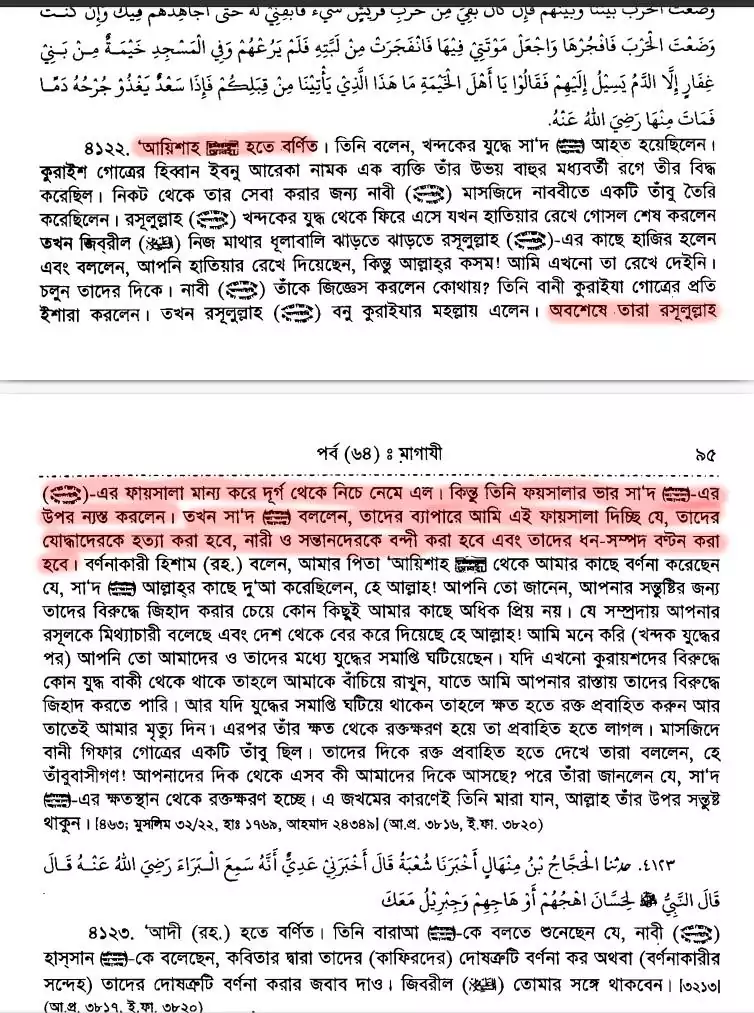
Sahih Muslim (Hadith Academy)
33. Jihad and Expeditions
Chapter: 22. The permissibility of killing one who breaks a covenant, and the permissibility of the inhabitants of a fortress descending at the command of a just arbitrator appointed with authority
Hadith Academy number: 4489, International number: 1769
4489-(65/1769)
Abū Bakr b. Abū Shaybah And Muḥammad b. al-ʿAlāʾ al-Hamdānī > Ibn Numayr > Ibn al-ʿAlāʾ > Ibn Numayr > Hishām from his father > ʿĀʾishah > Uṣīb Saʿd Yawm al-Khandaq Ramāh a man from Quraysh Sa’d was wounded on the day of the Battle of the Ditch. A man from the Quraish called Ibn al-Ariqah shot at him an arrow which pierced the artery in the middle of his forearm. The Messenger of Allah ﷺ pitched a tent for him in the mosque and would inquire after him being in close proximity. When he returned from the Ditch and laid down his arms and took a bath, the angel Gabriel appeared to him and he was removing dust from his hair (as if he had just returned from the battle). The latter said: You have laid down arms. By God, we haven’t (yet) laid them down. So march against them. The Messenger of Allah ﷺ asked: Where? He pointed to Banu Quraiza. So the Messenger of Allah (may peace he upon him) fought against them. They surrendered at the command of the Messenger of Allah ﷺ, but he referred the decision about them to Sa’d who said: I decide about them that those of them who can fight be killed, their women and children taken prisoners and their properties distributed (among the Muslims).
وَحَدَّثَنَا أَبُو بَكْرِ بْنُ أَبِي شَيْبَةَ وَمُحَمَّدُ بْنُ الْعَلاَءِ الْهَمْدَانِيُّ كِلاَهُمَا عَنِ ابْنِ نُمَيْرٍ قَالَ ابْنُ الْعَلاَءِ حَدَّثَنَا ابْنُ نُمَيْرٍ حَدَّثَنَا هِشَامٌ عَنْ أَبِيهِ عَنْ عَائِشَةَ قَالَتْ أُصِيبَ سَعْدٌ يَوْمَ الْخَنْدَقِ رَمَاهُ رَجُلٌ مِنْ قُرَيْشٍ يُقَالُ لَهُ ابْنُ الْعَرِقَةِ رَمَاهُ فِي الأَكْحَلِ فَضَرَبَ عَلَيْهِ رَسُولُ اللَّهِ ﷺ خَيْمَةً فِي الْمَسْجِدِ يَعُودُهُ مِنْ قَرِيبٍ فَلَمَّا رَجَعَ رَسُولُ اللَّهِ ﷺ مِنَ الْخَنْدَقِ وَضَعَ السِّلاَحَ فَاغْتَسَلَ فَأَتَاهُ جِبْرِيلُ وَهُوَ يَنْفُضُ رَأْسَهُ مِنَ الْغُبَارِ فَقَالَ وَضَعْتَ السِّلاَحَ وَاللَّهِ مَا وَضَعْنَاهُ اخْرُجْ إِلَيْهِمْ فَقَالَ رَسُولُ اللَّهِ ﷺ فَأَيْنَ فَأَشَارَ إِلَى بَنِي قُرَيْظَةَ فَقَاتَلَهُمْ رَسُولُ اللَّهِ ﷺ فَنَزَلُوا عَلَى حُكْمِ رَسُولِ اللَّهِ ﷺ فَرَدَّ رَسُولُ اللَّهِ ﷺ الْحُكْمَ فِيهِمْ إِلَى سَعْدٍ قَالَ فَإِنِّي أَحْكُمُ فِيهِمْ أَنْ تُقْتَلَ الْمُقَاتِلَةُ وَأَنْ تُسْبَى الذُّرِّيَّةُ وَالنِّسَاءُ وَتُقْسَمَ أَمْوَالُهُمْ
Collection status: Sahih
Al-Lu’lu’ wal-Marjan
32/ Jihad
Chapter: 32/22. It is permissible to fight those who violate a covenant after entering into it, and to make the people of a fortress surrender through the mediation of a righteous person.
1156.
Abū Bakr b. Abū Shaybah And Muḥammad b. al-ʿAlāʾ al-Hamdānī > Ibn Numayr > Ibn al-ʿAlāʾ > Ibn Numayr > Hishām from his father > ʿĀʾishah > Uṣīb Saʿd Yawm al-Khandaq Ramāh a man from Quraysh Sa’d was wounded on the day of the Battle of the Ditch. A man from the Quraish called Ibn al-Ariqah shot at him an arrow which pierced the artery in the middle of his forearm. The Messenger of Allah ﷺ pitched a tent for him in the mosque and would inquire after him being in close proximity. When he returned from the Ditch and laid down his arms and took a bath, the angel Gabriel appeared to him and he was removing dust from his hair (as if he had just returned from the battle). The latter said: You have laid down arms. By God, we haven’t (yet) laid them down. So march against them. The Messenger of Allah ﷺ asked: Where? He pointed to Banu Quraiza. So the Messenger of Allah (may peace he upon him) fought against them. They surrendered at the command of the Messenger of Allah ﷺ, but he referred the decision about them to Sa’d who said: I decide about them that those of them who can fight be killed, their women and children taken prisoners and their properties distributed (among the Muslims).
وَحَدَّثَنَا أَبُو بَكْرِ بْنُ أَبِي شَيْبَةَ وَمُحَمَّدُ بْنُ الْعَلاَءِ الْهَمْدَانِيُّ كِلاَهُمَا عَنِ ابْنِ نُمَيْرٍ قَالَ ابْنُ الْعَلاَءِ حَدَّثَنَا ابْنُ نُمَيْرٍ حَدَّثَنَا هِشَامٌ عَنْ أَبِيهِ عَنْ عَائِشَةَ قَالَتْ أُصِيبَ سَعْدٌ يَوْمَ الْخَنْدَقِ رَمَاهُ رَجُلٌ مِنْ قُرَيْشٍ يُقَالُ لَهُ ابْنُ الْعَرِقَةِ رَمَاهُ فِي الأَكْحَلِ فَضَرَبَ عَلَيْهِ رَسُولُ اللَّهِ ﷺ خَيْمَةً فِي الْمَسْجِدِ يَعُودُهُ مِنْ قَرِيبٍ فَلَمَّا رَجَعَ رَسُولُ اللَّهِ ﷺ مِنَ الْخَنْدَقِ وَضَعَ السِّلاَحَ فَاغْتَسَلَ فَأَتَاهُ جِبْرِيلُ وَهُوَ يَنْفُضُ رَأْسَهُ مِنَ الْغُبَارِ فَقَالَ وَضَعْتَ السِّلاَحَ وَاللَّهِ مَا وَضَعْنَاهُ اخْرُجْ إِلَيْهِمْ فَقَالَ رَسُولُ اللَّهِ ﷺ فَأَيْنَ فَأَشَارَ إِلَى بَنِي قُرَيْظَةَ فَقَاتَلَهُمْ رَسُولُ اللَّهِ ﷺ فَنَزَلُوا عَلَى حُكْمِ رَسُولِ اللَّهِ ﷺ فَرَدَّ رَسُولُ اللَّهِ ﷺ الْحُكْمَ فِيهِمْ إِلَى سَعْدٍ قَالَ فَإِنِّي أَحْكُمُ فِيهِمْ أَنْ تُقْتَلَ الْمُقَاتِلَةُ وَأَنْ تُسْبَى الذُّرِّيَّةُ وَالنِّسَاءُ وَتُقْسَمَ أَمْوَالُهُمْ
Collection status: Sahih
A Farce in the Name of Justice: A Predetermined Verdict
It is known from Ibn Hisham’s renowned Sirah work that what would be done with Banu Qurayzah had already been predetermined. The judgment had been fixed in advance, without examining or evaluating any evidence. It is impossible to conduct, on the same day, the trial of 600–900 people, carry out meticulous analysis, and determine who was guilty and who was innocent. A trial generally proceeds as follows: one side is the complainant and the other side is the accused. The complainant makes an allegation, and the accused refutes it. The judge then reaches a judicial decision on the basis of all the information and evidence obtained and examined. Yet in this case, the judgment had been predetermined, without examining or evaluating any evidence or testimony. This is completely clear from Abu Lubabah’s statement. [76]
The Messenger of Allah (peace be upon him) sent Abu Lubabah to them. As soon as the men saw him, they rushed to greet him, while the women and children went before him and began weeping and pleading. Seeing their heart-rending cries, his heart melted. They said, ‘O Abu Lubabah, what do you say? Should we come down from the fortress in accordance with Muhammad’s command?’ He said, ‘Yes,’ and he also gestured toward his throat, meaning that the outcome would be slaughter.
Let us read this page from Tafsir Mazhari once again. Notice, reader, that the decision that Prophet Muhammad would slaughter all the members of the Banu Qurayzah tribe had already been made. Abu Lubabah revealed this when he heard the helpless women and children of Banu Qurayzah crying [77]
Announcing the Verdict of the Farcical Trial
The most important issue in a judicial process is whether the accused group is given sufficient opportunity to defend itself, and whether the decision is made after presenting and examining testimony and evidence, or whether the decision was made in advance! If the decision is made first and the judicial process is begun afterward, then such a trial must be called a farce. Under no circumstances can it be called justice. In the farcical trial conducted in the name of judging the Banu Qurayzah tribe, the decision had already been made. Therefore, it cannot be called a trial in any way; it may instead be called a decision. Prophet Muhammad and Sa‘d ibn Mu‘adh had decided that all males whose pubic hair had grown would be killed. Their land and property would be seized, and their women and children would be divided as spoils of war.
In other words, what took place in the name of a trial was not a decision that those involved in criminal activities would be punished! Rather, it was decided that everyone would be killed en masse, based on whether pubic hair had grown on them. How could a little boy whose pubic hair had only just begun to grow have been involved in any such criminal activity? Islamic apologists often say that when these children grew up, they might have become hostile toward Muslims. Therefore, they claim that killing them was permissible. But surely it is unnecessary to explain how barbaric and uncivilized such reasoning is. In 2014, Israeli politician Ayelet Shaked shared on Facebook a text written by Uri Elitzur that treated Palestinian mothers as part of the enemy population and referred to the children raised by them as “little snakes.” In other words, that politician assumed that as soon as Palestinian mothers gave birth to children, those children would grow up to become militants! And for that reason, they would have to be killed before they were born! What a horrifyingly inhumane statement! [78] [79]
“They should die and their houses must be destroyed so that they do not give birth to terrorists.”
A person cannot be punished until they have directly committed a crime. This is directly contrary to humanity in every time, place, and context. There is perhaps no more inhumane idea than punishing children on the assumption that they may commit crimes when they grow up. Yet, somehow, these ideas do not enter the minds of religiously minded people!
This Israeli politician, Ayelet Shaked, publicly shared the text containing this language about Palestinian mothers and “little snakes.” After these statements were made, we strongly opposed such barbaric words. The Muslim world also protested against them. Indeed, such statements are extremely barbaric, crossing every limit of barbarity. Yet Muslim apologists use precisely the same kind of reasoning to justify their genocide! Tell me, what is the difference between saying that Palestinian children are like small poisonous snakes and that Palestinian mothers give birth to militants, and therefore Palestinian children and pregnant mothers should be killed, and saying that the children of Banu Qurayzah would fight Muslims when they grew up, and therefore every child and adolescent whose pubic hair had grown must be killed? Let us read the following hadiths [80] [81] [82] [83] [84] –
Sunan Abu Dawud (verified)
33/ Crimes and Their Punishments
Chapter: 17. Punishment for the crime of a minor
4404
Narrated Atiyyah al-Qurazi: I was among the captives of Banu Qurayzah. They (the Companions) examined us, and those who had begun to grow hair (pubes) were killed, and those who had not were not killed. I was among those who had not grown hair
حَدَّثَنَا مُحَمَّدُ بْنُ كَثِيرٍ، أَخْبَرَنَا سُفْيَانُ، أَخْبَرَنَا عَبْدُ الْمَلِكِ بْنُ عُمَيْرٍ، حَدَّثَنِي عَطِيَّةُ الْقُرَظِيُّ، قَالَ كُنْتُ مِنْ سَبْىِ بَنِي قُرَيْظَةَ فَكَانُوا يَنْظُرُونَ فَمَنْ أَنْبَتَ الشَّعْرَ قُتِلَ وَمَنْ لَمْ يُنْبِتْ لَمْ يُقْتَلْ فَكُنْتُ فِيمَنْ لَمْ يُنْبِتْ .
Grade: Sahih (Al-Albani)
Sunan Abu Dawud (verified)
33/ Crimes and Their Punishments
Chapter: 17. Punishment for the crime of a minor
4405
The tradition mentioned above has also been transmitted by ‘Abd al- Malik b. ‘Umar through a different chain of narrators. This version has:They uncovered my private parts, and when they found that the hair had not begun to grow they put me among the captives
حَدَّثَنَا مُسَدَّدٌ، حَدَّثَنَا أَبُو عَوَانَةَ، عَنْ عَبْدِ الْمَلِكِ بْنِ عُمَيْرٍ، بِهَذَا الْحَدِيثِ قَالَ فَكَشَفُوا عَانَتِي فَوَجَدُوهَا لَمْ تَنْبُتْ فَجَعَلُونِي فِي السَّبْىِ .
Grade: Sahih (Al-Albani)
Sunan Abu Dawud (Islamic Foundation)
33/ Legal Punishments
Chapter: 17. When a minor boy commits an offense punishable by law.
4352
Narrated Atiyyah al-Qurazi: I was among the captives of Banu Qurayzah. They (the Companions) examined us, and those who had begun to grow hair (pubes) were killed, and those who had not were not killed. I was among those who had not grown hair
حَدَّثَنَا مُحَمَّدُ بْنُ كَثِيرٍ، أَخْبَرَنَا سُفْيَانُ، أَخْبَرَنَا عَبْدُ الْمَلِكِ بْنُ عُمَيْرٍ، حَدَّثَنِي عَطِيَّةُ الْقُرَظِيُّ، قَالَ كُنْتُ مِنْ سَبْىِ بَنِي قُرَيْظَةَ فَكَانُوا يَنْظُرُونَ فَمَنْ أَنْبَتَ الشَّعْرَ قُتِلَ وَمَنْ لَمْ يُنْبِتْ لَمْ يُقْتَلْ فَكُنْتُ فِيمَنْ لَمْ يُنْبِتْ .
Grade: Sahih (Al-Albani)
Sunan al-Tirmidhi (verified)
19/ Military Expeditions
Chapter: 29. Surrendering after accepting arbitration
1584.
Narrated ‘Atiyyah Al-Qurazi: “We were presented to the Messenger of Allah (ﷺ) on the day of (the battle of) Quraizah. Whoever had pubic hair was killed and whoever did not was left to his way. I was of those who did not have pubic hair so I was left to my way.” [Abu ‘Eisa said:] This Hadith is Hasan Sahih. This is acted upon according to some of the people of knowledge. They consider pubic hair an indication of the age of responsibility, if it is not known whether he has had a wet dream, or his age. This is the view of Ahmad and Ishaq
حَدَّثَنَا هَنَّادٌ، حَدَّثَنَا وَكِيعٌ، عَنْ سُفْيَانَ، عَنْ عَبْدِ الْمَلِكِ بْنِ عُمَيْرٍ، عَنْ عَطِيَّةَ الْقُرَظِيِّ، قَالَ عُرِضْنَا عَلَى النَّبِيِّ صلى الله عليه وسلم يَوْمَ قُرَيْظَةَ فَكَانَ مَنْ أَنْبَتَ قُتِلَ وَمَنْ لَمْ يُنْبِتْ خُلِّيَ سَبِيلُهُ فَكُنْتُ مِمَّنْ لَمْ يُنْبِتْ فَخُلِّيَ سَبِيلِي . قَالَ أَبُو عِيسَى هَذَا حَدِيثٌ حَسَنٌ صَحِيحٌ . وَالْعَمَلُ عَلَى هَذَا عِنْدَ بَعْضِ أَهْلِ الْعِلْمِ أَنَّهُمْ يَرَوْنَ الإِنْبَاتَ بُلُوغًا إِنْ لَمْ يُعْرَفِ احْتِلاَمُهُ وَلاَ سِنُّهُ وَهُوَ قَوْلُ أَحْمَدَ وَإِسْحَاقَ .
Grade: Sahih (Ahmad Muhammad Shakir)
Sunan Ibn Majah
14/ Hudud (Punishments)
Chapter: 14/4. Those upon whom the hadd punishment is not obligatory
1/2541.
It was narrated that ‘Abdul-Malik bin `Umair said:“I heard ‘Atiyyah Al-Quradhi say: ‘We were presented to the Messenger of Allah (ﷺ) on the Day of Quraidhah. Those whose pubic hair had grown were killed, and those whose pubic hair had not yet grown were let go. I was one of those whose pubic hair had not yet grown, so I was let go.”
حَدَّثَنَا أَبُو بَكْرِ بْنُ أَبِي شَيْبَةَ، وَعَلِيُّ بْنُ مُحَمَّدٍ، قَالاَ حَدَّثَنَا وَكِيعٌ، عَنْ سُفْيَانَ، عَنْ عَبْدِ الْمَلِكِ بْنِ عُمَيْرٍ، قَالَ سَمِعْتُ عَطِيَّةَ الْقُرَظِيَّ، يَقُولُ عُرِضْنَا عَلَى رَسُولِ اللَّهِ صلى الله عليه وسلم يَوْمَ قُرَيْظَةَ فَكَانَ مَنْ أَنْبَتَ قُتِلَ وَمَنْ لَمْ يُنْبِتْ خُلِّيَ سَبِيلُهُ فَكُنْتُ فِيمَنْ لَمْ يُنْبِتْ فَخُلِّيَ سَبِيلِي .
Grade: Sahih (Al-Albani)
The Prophet’s Verdict and Allah’s Response
Many Muslims say, in order to justify the massacre carried out against the Banu Qurayza, “This judgment was made according to the law of the Jews! Therefore, Muslims bear no responsibility for this massacre!” When they try to justify this massacre by making such ridiculous statements, discussion with people who make such claims becomes pointless. This is because those who say these things themselves know very well that they are completely false. First, the entire punishment and judicial process took place under Muslim supervision. Second, the Qur’an itself instructs the Prophet to judge according to the Book revealed to him. Accordingly, that law of the Jews was also Allah’s law. If that part of the Jews’ scripture had been corrupted—that is, if it had not been Allah’s command—then why would the Prophet follow that corrupted scripture? [85]
And We have revealed to you the Book in truth, confirming the Scriptures that came before it and standing as a guardian over them. So judge between them by what Allah has revealed, and do not follow their desires over the truth that has come to you. To each of you We have prescribed a law and a clear way. Had Allah willed, He could have made you one nation, but He intended to test you with what He has given you. So compete with one another in good deeds. To Allah is your return all together, then He will inform you of what you used to differ about.
More importantly, this verdict had the complete approval of both Muhammad and Allah. Neither Allah nor the Prophet considered this verdict inhumane; rather, they supported it. The various imaginary stories about the Prophet’s mercy and compassion that we have heard from Islamic preachers since childhood bear absolutely no resemblance to this incident. On the contrary, Allah and His Prophet were very pleased to have decided on such a large-scale massacre [73] –
Sunan al-Tirmidhi (verified)
19/ Military Expeditions
Chapter: 29. Surrendering by accepting arbitration
1582
Narrated Jabir:”On the day of (the battle of) Al-Ahzab, Sa’d bin Mu’adh was struck by an arrow such that the upper vein or lower vein of his forearm was severed. So the Messenger of Allah (ﷺ) tried to stop it with fire, but it made his arm bleed profusely so he left it. Then he did it another time but it caused it to bleed profusely. Upon seeing that he said: ‘O Allah! Do not allow my soul depart until my eyes are comforted by elimination of Banu Quraizah.’ He pressed his vein closed and it did not bleed a drop before they surrendered to the arbitration of Sa’d bin Mu’adh. He (the Prophet (ﷺ)) sent to him (Sa’d) who judged that their men should be killed, their women should be spared, and that the Muslims may share them among themselves. With this, the Messenger of Allah (ﷺ) said: ‘You have judged according to Allah’s judgement for them.’ And they were four hundred. Then when he finished killing them, his vein opened up and he died.” [He said:] There are narrations on this topic from Abu Sa’eed and ‘Atiyyah Al-Qurazi. [Abu ‘Eisa said:] This Hadith is Hasan Sahih
حَدَّثَنَا قُتَيْبَةُ، حَدَّثَنَا اللَّيْثُ، عَنْ أَبِي الزُّبَيْرِ، عَنْ جَابِرٍ، أَنَّهُ قَالَ رُمِيَ يَوْمَ الأَحْزَابِ سَعْدُ بْنُ مُعَاذٍ فَقَطَعُوا أَكْحَلَهُ أَوْ أَبْجَلَهُ فَحَسَمَهُ رَسُولُ اللَّهِ صلى الله عليه وسلم بِالنَّارِ فَانْتَفَخَتْ يَدُهُ فَتَرَكَهُ فَنَزَفَهُ الدَّمُ فَحَسَمَهُ أُخْرَى فَانْتَفَخَتْ يَدُهُ فَلَمَّا رَأَى ذَلِكَ قَالَ اللَّهُمَّ لاَ تُخْرِجْ نَفْسِي حَتَّى تُقِرَّ عَيْنِي مِنْ بَنِي قُرَيْظَةَ . فَاسْتَمْسَكَ عِرْقُهُ فَمَا قَطَرَ قَطْرَةً حَتَّى نَزَلُوا عَلَى حُكْمِ سَعْدِ بْنِ مُعَاذٍ فَأَرْسَلَ إِلَيْهِ فَحَكَمَ أَنْ يُقْتَلَ رِجَالُهُمْ وَيُسْتَحْيَى نِسَاؤُهُمْ يَسْتَعِينُ بِهِنَّ الْمُسْلِمُونَ . فَقَالَ رَسُولُ اللَّهِ صلى الله عليه وسلم “ أَصَبْتَ حُكْمَ اللَّهِ فِيهِمْ ” . وَكَانُوا أَرْبَعَمِائَةٍ فَلَمَّا فَرَغَ مِنْ قَتْلِهِمُ انْفَتَقَ عِرْقُهُ فَمَاتَ . قَالَ وَفِي الْبَابِ عَنْ أَبِي سَعِيدٍ وَعَطِيَّةَ الْقُرَظِيِّ . قَالَ أَبُو عِيسَى هَذَا حَدِيثٌ حَسَنٌ صَحِيحٌ .
Grade: Sahih (Ahmad Muhammad Shakir)
Sa’d ibn Mu’adh had become so beloved to Allah and the Prophet for issuing the verdict for this massacre that, because of his death, even Allah’s Throne shook! [86]
Sahih Bukhari (IFA)
Chapter: 50/ The Noble Prophets (AS)
Section: 2122. The Virtue of Sa’d ibn Mu’adh (RA)
3531.
Narrated Jabir:I heard the Prophet (ﷺ) saying, “The Throne (of Allah) shook at the death of Sa`d bin Mu`adh.” Through another group of narrators, Jabir added, “I heard the Prophet (ﷺ) : saying, ‘The Throne of the Beneficent shook because of the death of Sa`d bin Mu`adh
حَدَّثَنِي مُحَمَّدُ بْنُ الْمُثَنَّى، حَدَّثَنَا فَضْلُ بْنُ مُسَاوِرٍ، خَتَنُ أَبِي عَوَانَةَ حَدَّثَنَا أَبُو عَوَانَةَ، عَنِ الأَعْمَشِ، عَنْ أَبِي سُفْيَانَ، عَنْ جَابِرٍ ـ رضى الله عنه ـ سَمِعْتُ النَّبِيَّ صلى الله عليه وسلم يَقُولُ ” اهْتَزَّ الْعَرْشُ لِمَوْتِ سَعْدِ بْنِ مُعَاذٍ ”. وَعَنِ الأَعْمَشِ حَدَّثَنَا أَبُو صَالِحٍ عَنْ جَابِرٍ عَنِ النَّبِيِّ صلى الله عليه وسلم مِثْلَهُ. فَقَالَ رَجُلٌ لِجَابِرٍ فَإِنَّ الْبَرَاءَ يَقُولُ اهْتَزَّ السَّرِيرُ. فَقَالَ إِنَّهُ كَانَ بَيْنَ هَذَيْنِ الْحَيَّيْنِ ضَغَائِنُ، سَمِعْتُ النَّبِيَّ صلى الله عليه وسلم يَقُولُ ” اهْتَزَّ عَرْشُ الرَّحْمَنِ لِمَوْتِ سَعْدِ بْنِ مُعَاذٍ ”.
Collection status: Sahih
Regarding the death of Sa’d ibn Mu’adh, Muhammad also said that [87] –
‘The angels of Allah lifted his corpse’
How the Verdict Was Carried Out
According to what is narrated in the book Sirat Rasulullah, the prisoners were confined in overcrowded conditions in the house of Bint al-Harith in Medina. From there, they were divided into small groups and taken beside the mass grave (trench) in the Medina market. When the remaining prisoners heard that their relatives and friends were being taken away one by one and were not returning, that prolonged period of waiting constituted horrific psychological torture. Ibn Ishaq mentioned that the prisoners asked their leader, Ka’b ibn Asad— “What is being done to us?” He replied— “Can you not see that whoever is taken away does not return? By Allah, this is death.” The terror of this impending death and hearing the cries of relatives for a prolonged period are recognized as ‘psychological torture’ under international law. Let us read the events one by one.
The Entire Tribe Imprisoned in One House and a Mass Grave Dug
Islamic sources state that the Prophet Muhammad confined all the Jews of the Banu Qurayza in a single house. It is very easy to understand how large a house of that period could have been. I therefore leave the matter of tying up and imprisoning an entire tribe in that one house to the intelligence of the discerning reader. [88]
Then they surrendered. The Messenger (PBUH) confined them in the residence of Bint al-Harith of Banu al-Najjar in Medina. Then the Messenger (PBUH) went to the market of Medina and dug trenches there (that market still exists). They were then brought there and beheaded in those trenches. Among them were Huyayy ibn Akhtab, the enemy of Allah, and their leader, Ka’b ibn Asad. The total number of those killed was between 600 and 700; according to some, it was between 800 and 900.
When they were being brought to the Messenger (PBUH) in groups, they asked Ka’b where they were being taken. Ka’b said, “Do you not understand? Do you not see that the caller is proceeding while shouting, and that none of those who leave returns? By Allah, this is death.” Thus, they were all exterminated.
Huyayy ibn Akhtab came wearing a splendid robe. He had made countless holes throughout the garment, each the size of a fingertip, so that no one could wear it after his death. His hands were tied to his neck with a rope. As soon as he saw the Messenger (PBUH), he exclaimed, “By Allah, I do not blame myself for opposing you. But I know that whoever abandons God abandons himself.” Then he went to the people of his group and said, “Allah’s command is true. One Book and one command. That is all—the massacre of the Children of Israel has been decreed.”
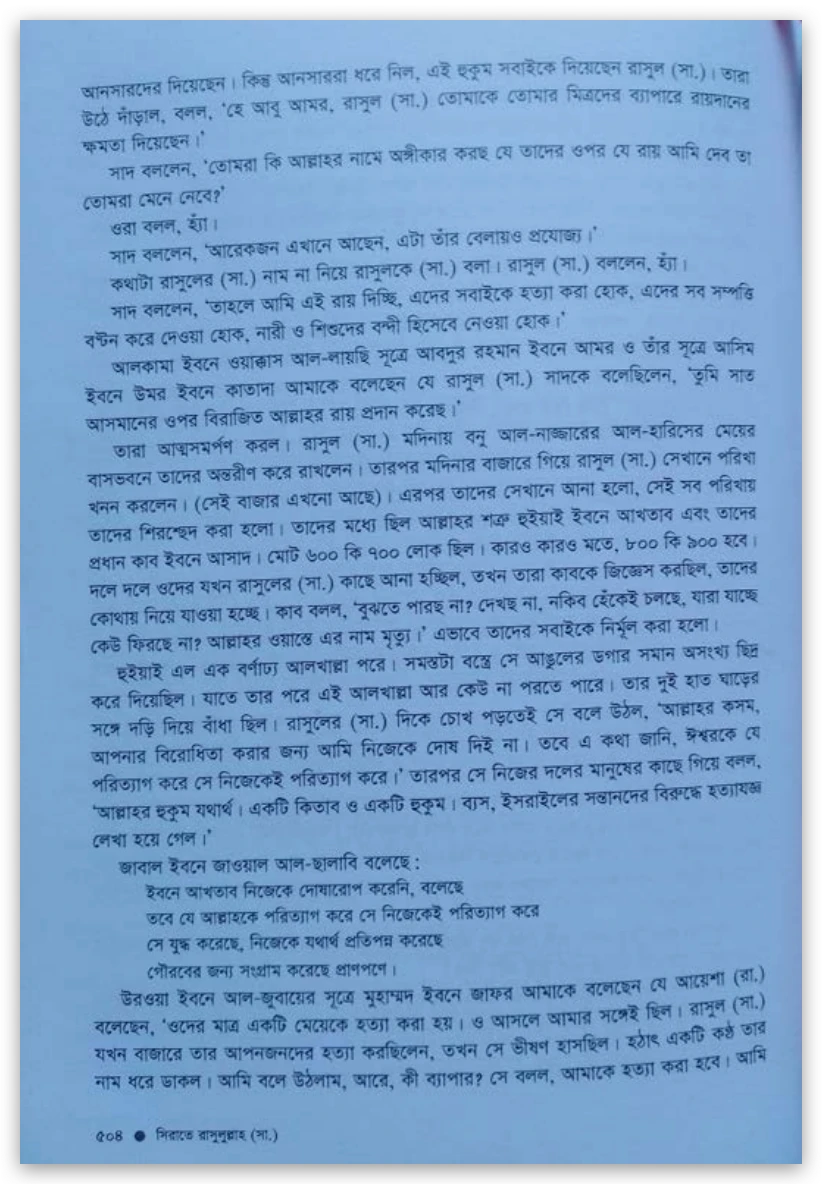
Stripped Naked, Examined for Pubic Hair, and Killed
When, in the history of any war or conflict, decisions about human life and death are made on the basis of certain physical biological signs or indications of puberty, it does not remain merely a killing; rather, it becomes an extreme form of human degradation. In the account of the Banu Qurayza incident, we see precisely such a horrifyingly inhumane picture.
At that time, an extremely shameful and cruel method was chosen to distinguish children from adults. The surrendered children and adolescents were stripped naked in public and their pubic hair or genital hair was examined. Anyone on whose body this sign was found was regarded as an adult and had to place his head beneath the sword. Those in whom this sign had not yet appeared were regarded as ‘booty’ or war property, and the Prophet arranged for them subsequently to remain bound in the chains of lifelong slavery.
When whether a person would live or die depends on the growth of hair on his most private organ, the words judgment or justice lose their original meaning. This process was not merely physical humiliation; it was also profound psychological torture. Sending those who were still children or adolescents into a procession of death after stripping their playmates or elder brothers naked in front of their eyes constitutes, by the humanitarian standards of any civilized society, a horrific war crime and an extreme violation of human rights. This was not merely an attempt to annihilate a tribe; it has been marked in history as a cruel process of destroying their self-respect. [89] –
Nor can this material be dismissed as an exaggeration invented by atheist critics. The major Shafiʿi jurist al-Mawardi preserves the entire sequence in the Banu Qurayza chapter of al-Ḥāwī al-Kabīr: Abu Lubaba pointed to his throat to indicate impending slaughter; after surrender, the captives were bound and separated from the women and children; Saʿd ruled that those upon whom the razor could pass—the puberty criterion—were to be killed, while the others were enslaved; their children were taken captive and their property treated as booty; Rayhana was selected by Muhammad for himself; and trenches were dug in the marketplace before groups of captives were brought forward and beheaded, with the number given as six to seven hundred. What modern apologists attempt to sanitize as an orderly “trial” is preserved in a classical Shafiʿi legal work as a single structure of puberty-based killing, enslavement, confiscation, sexual possession, and mass execution. [90] [91]
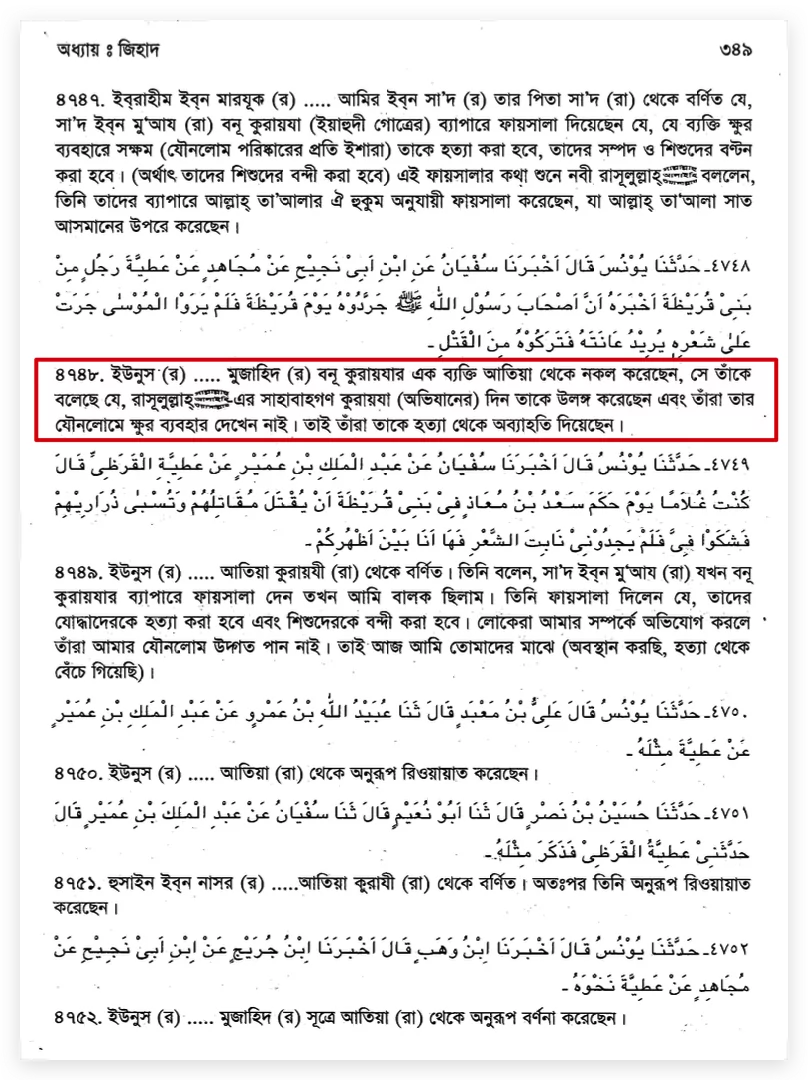
The Slaughter of the Leader Huyayy ibn Akhtab
The fortress of the Banu Qurayza did not contain only members of that tribe; Huyayy ibn Akhtab, the exiled leader of the Banu Nadir, was also present there. During the difficult period of the war, he entered the fortress to keep the promise he had made to the Banu Qurayza. After the surrender, when the procession of killings began, Huyayy ibn Akhtab was also brought before the Prophet Muhammad with his hands and feet bound.
According to the accounts of the historians Ibn Ishaq and al-Tabari, Huyayy remained fearless even while facing death. Looking into Muhammad’s eyes, he said, “By Allah, I do not consider myself ashamed for being hostile to you. But whoever is abandoned by Allah is himself abandoned.” It should be noted that, as Huyayy ibn Akhtab was an Arab Jew, he too called his God Allah. The reader should not think that he said this referring to the Allah of Islam. He then looked toward the assembled people and said, “O people, there is no objection to accepting Allah’s judgment. This was a great calamity and massacre written on the foreheads of the Children of Israel.” Huyayy ibn Akhtab’s final statement is highly significant. He did not view this mass slaughter as justice; rather, he called it a fate or ‘genocide’ that had descended upon his people. He was then made to sit on the ground and beheaded.
Although Islamic documentary evidence portrays Huyayy ibn Akhtab as an instigator of the war, he was sent directly into the procession of killings without being given any legal opportunity for self-defense. He was killed as the instigator of a war that had not actually taken place. In particular, he had torn his own garment so that no one could loot it after his death. In other words, he knew how barbaric and shameless the followers of the Prophet Muhammad were—after killing a person, they would even remove his shirt! This small detail proves how deeply the environment of that time was consumed by hatred and vengeance. [92]
The Killing of Huyayy ibn Akhtab
Huyayy ibn Akhtab, the enemy of Allah, was also brought. He was wearing a fuqqahi garment. Ibn Hisham says: Fuqahi is a type of cloak. He had made several finger-sized holes throughout his garment so that it would not be taken from him. His hands were tied to his neck. As soon as he saw the Messenger of Allah (PBUH), he exclaimed: By Allah!
1. Her name was Qaysa. She had previously been the wife of Musaylama the Liar. Later she married Abdullah ibn Amir (RA).
238 Sirat al-Nabi (PBUH)
I do not regret being hostile to you at all. But destruction is inevitable for whoever abandons Allah. Then he addressed the people present and said, O people! There is no difficulty in this; it is Allah’s decree. Allah the Exalted had decreed this fate and massacre for the Children of Israel. Saying this, he sat down and was beheaded.
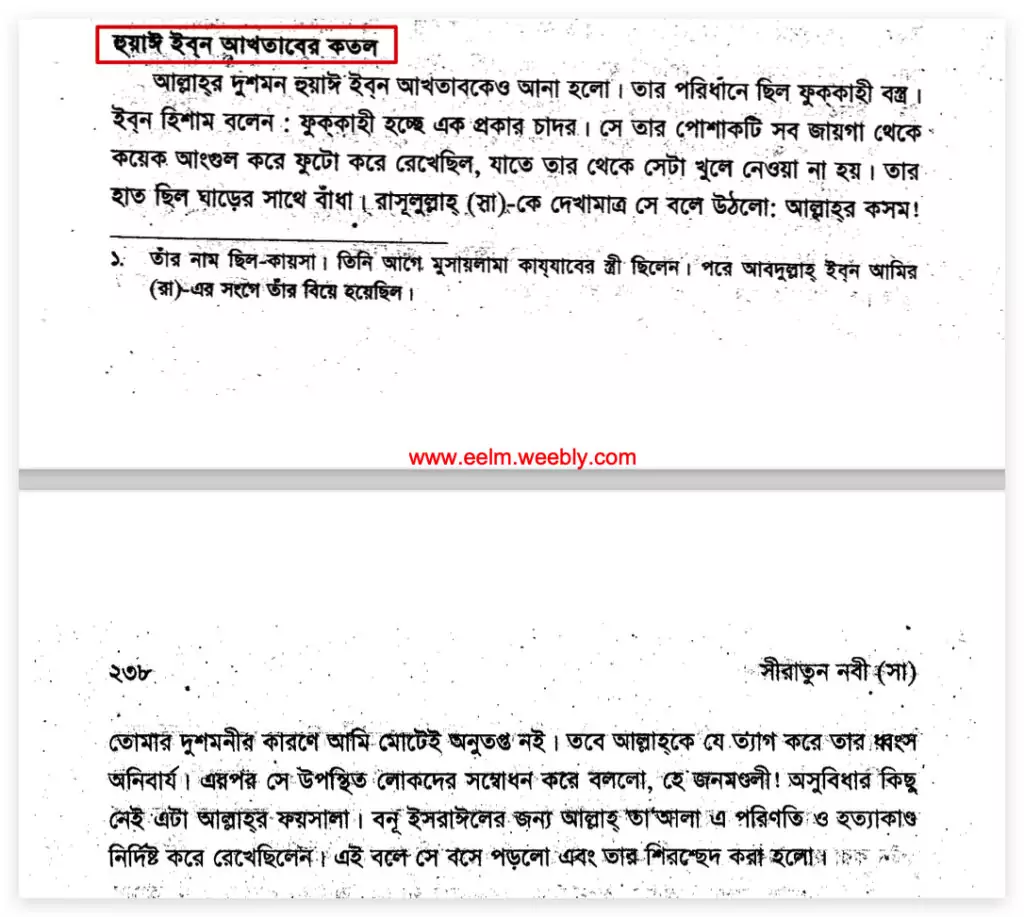
Let us examine this reference from another source as well, [93]
In this way, all the prisoners (whose number was between six and seven hundred) were beheaded.
Through the measure described above, the treachery and rebellion of the Banu Qurayza, who had broken a firm and mature covenant, were completely uprooted. They had genuinely become deserving of the death penalty for the heinous war crime they had committed by aiding the enemies during the Muslims’ distress and dire hardship, with the aim of annihilating the Muslims. Like the Banu Qurayza, Huyayy ibn Akhtab, the vile devil of the Banu Nadir tribe and a major criminal of the Battle of al-Ahzab, had also become deserving of punishment because of his numerous injustices and cruelties.
This man had become deserving of punishment because of the Mother of the Believers. [This man was the father of Umm al-Mu’minin Safiyyah (RA). After returning from the war against the Quraysh and the Ghatafan, when the Banu Qurayza were besieged and began living under siege inside the fortress, Huyayy ibn Akhtab remained besieged inside the fortress with the Banu Qurayza. This was because, when he had come during the Battle of al-Ahzab to incite Ka’b ibn Asad to treachery and betrayal, he had made a promise, and this was the fulfillment of that promise.]
When he was brought into the presence of the Prophet, he had covered himself with a pair of garments. He himself had torn this clothing by one finger’s breadth on every side so that it would not be counted among the marked robes and looted goods of Paradise 357. His two hands were tied together with a rope behind his neck. Addressing the Noble Messenger, he said, ‘I do not blame myself for being your enemy. But whoever wages war against Allah is defeated.’
Then he addressed the people and said, ‘O people, there is no difficulty in Allah’s judgment. This is a matter written by fate. This is a great massacre that Allah the Exalted has recorded against the Children of Israel.’ Then he sat down and his throat was cut.
In this incident, one woman of the Banu Qurayza was also killed. She had martyred Khallad ibn Suwayd by throwing a millstone slab at him. Therefore, she was killed in retribution for that killing.
Regarding this incident, the Messenger of Allah instructed that those whose pubic hair had grown should be killed. Atiyyah al-Qurazi’s hair had not yet grown, and as a result he was left alive. Later, he embraced Islam and was fortunate enough to become one of the Companions.
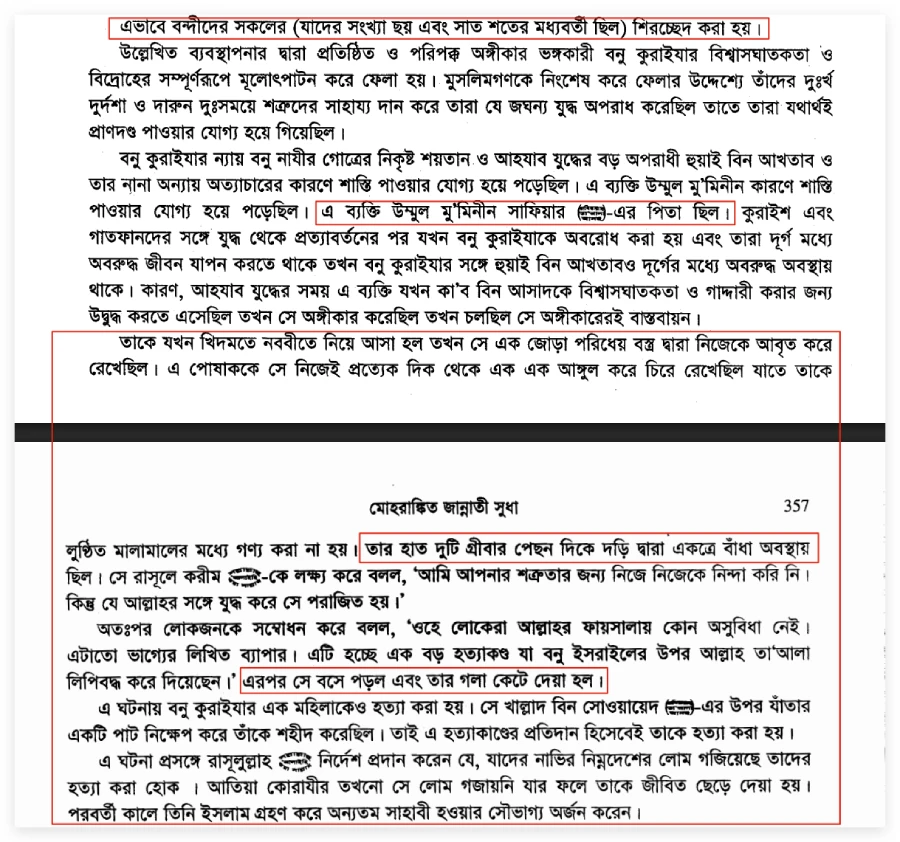
A Joyful Slaughtering Festivity in the Prophet’s Presence
There is no opportunity to cover up this incident by calling it “wartime harshness,” because according to the account, the massacre continued in the Prophet’s presence—he was not far away, nor did it take place in darkness; rather, rows of people were having their throats cut under supervision. In other words, there is no moral ambiguity here that would allow responsibility to be avoided: this was an overt, deliberate, and administratively managed horrific massacre.
The scene becomes even more repulsive when the same account states that, at that time, members of the Banu Khazraj tribe, allies of Muhammad the Prophet, became involved in slaughtering people with faces radiant with joy; and the Prophet even noticed that their faces were bright with happiness. This “joy” was not religious glory—it was the death of the human conscience, where killing people became not “work,” but a festivity. However much the religious narrative later attempts to cover it with the colors of sanctity, the naked reality of this account is that a group of people were being cut down in front of someone, while some others were deriving jubilation from the slaughter—that is the most brutal confession in history. [94]
The Incident of Banu Qurayza
Ibn Hisham says: Abu Ubayda narrated to me through Abu Amr al-Madani that when the Messenger of Allah (peace be upon him) achieved victory over Banu Qurayza, he arrested approximately four hundred Jewish men from among them. They were allies of Banu Aws against Banu Khazraj. When the Messenger of Allah (peace be upon him) ordered that they be beheaded, Banu Khazraj began beheading them, and they took great pleasure in doing so. The Messenger of Allah (peace be upon him) noticed that the faces of the people of Khazraj were radiant with joy, while he observed no sign of this among Banu Aws. He then understood that the reason was the alliance existing between Aws and Banu Qurayza. At that point, only twelve members of Banu Qurayza remained, and he handed them over to the Aws. He gave each pair of men one member of Banu Qurayza and said:
لِيَضْرِبُ فُلانٌ وَلْيُدْفَ فُلانٌ
“So-and-so shall begin the killing, and so-and-so shall finish it.”
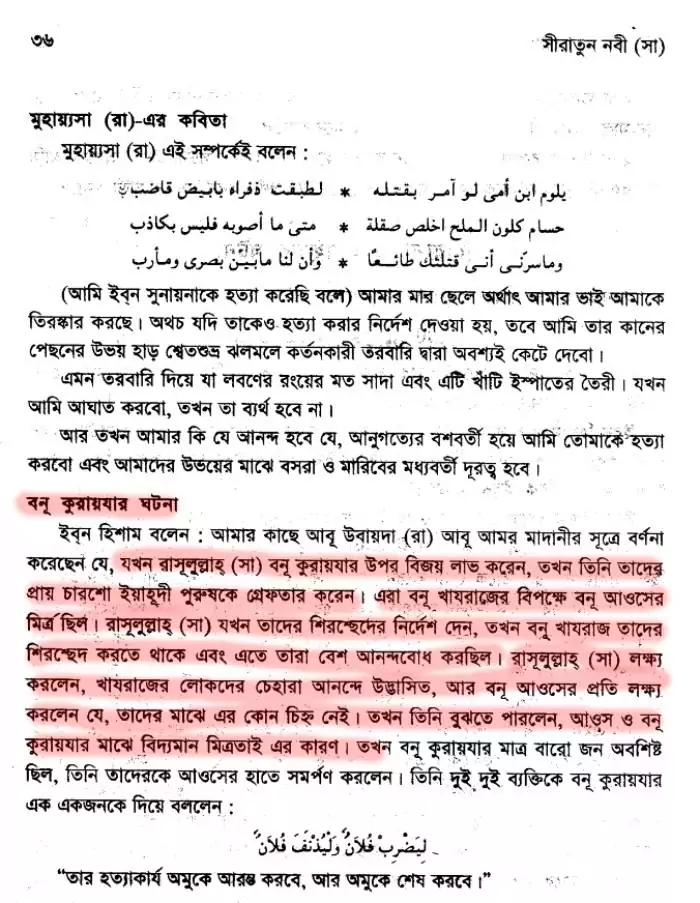
Muslim Reactions to the Mass Slaughter
It is worth noting that, even after people had been lined up and slaughtered on such a large scale, it is not the case that everyone within the Islamic camp silently accepted it as “justice”. Rather, there are indications of the discomfort, questions, and even moral objections of some people—and a familiar labeling tactic was used to suppress those objections: “They are hypocrites.” In other words, anyone who questioned the incident was removed from the sphere of moral discussion and placed in the box of character assassination—so that the question of whether ‘the act was right or not’ could no longer be raised.
This pattern appears even more grotesquely in an account cited in Tafsir Mazhari. It is mentioned on the authority of Anas that, at the time of Saʿd ibn Muʿadh’s death, some people among the Muslims considered the funeral bier “very light” and connected it with the massacre of Banu Qurayza; they regarded it as a kind of punishment/consequence arising from Saʿd’s decision or role. And it is precisely here that the final nail is driven into the coffin of morality: those who considered the mass slaughter unjust were labeled “hypocrites,” and the door to discussion was closed—in other words, when the crime is questioned, the questioner is made into the criminal. [95]
The Passing Away of Hazrat Saʿd ibn Muʿadh: The chapter on the defeat of Banu Qurayza came to an end. Meanwhile, Hazrat Saʿd ibn Muʿadh’s health suddenly began to deteriorate. The pain from his wound increased day by day. The Messenger, peace be upon him, went to visit him accompanied by Hazrat Abu Bakr and Hazrat Umar. Mother Aisha narrated: By the One by whose incomparable authority Muhammad, the Messenger of Allah, lives, I swear that from my own room I could hear the sound of my father and Umar weeping, coming from the house of Saʿd ibn Muʿadh. Umar’s weeping was more intense. I knew that there was a deep affection between them, as stated in the words of Allah, ‘ruhamā’u baynahum’ (merciful among themselves).
Hazrat Anas narrated that, while Saʿd ibn Muʿadh’s funeral was proceeding, the hypocrites began commenting, “Have you seen how light the funeral bier is? It is in this condition because he had ordered the execution of the Banu Qurayza.” When this reached the ears of the Messenger, peace be upon him, he said, “The angels are carrying his bier.” Tirmidhi. Hazrat Jabir narrated: I heard the Messenger, peace be upon him, say, “The Throne of Allah is also trembling because of Saʿd’s departure.” Bukhari, Muslim. Hazrat al-Bara ibn ʿAzib narrated that once a pair of beautiful silk garments was presented before the Messenger, peace be upon him. Some of the Companions began moving the garments around. The Messenger, peace be upon him, said, “You are impressed by the beauty of these garments. Know that in Paradise, Saʿd ibn Muʿadh’s handkerchief will be many times more beautiful than this.” Bukhari, Muslim.
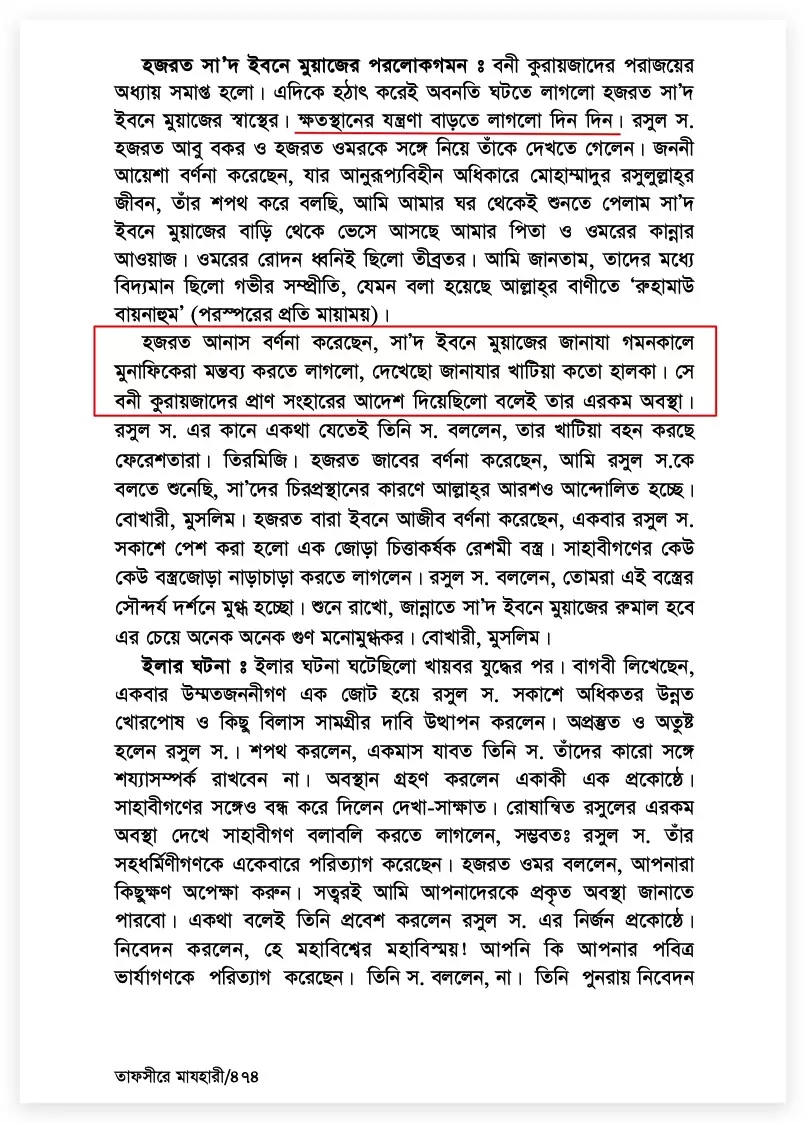
Distribution of the Spoils, Sexual Enslavement, and Sale
The essence of the extensive documentary evidence presented above is only this: the siege of the Banu Qurayza tribe was conducted with the intention of carrying out a massacre, all adult men were systematically killed, and the women and children were not treated as human beings but turned into “captives/slaves” as war booty. But the question is: what happened to these slaves afterward? This is where the religious romanticization of the incident collapses completely: these women and children did not even receive a minimum degree of “human security”; some of them were sold like market commodities, and the followers of the Prophet used the proceeds of those sales to purchase weapons and horses—in other words, converting human beings into cash and investing it in the machinery of war. There is no trace of morality in this transaction; there is only the brutal use of force to present human beings as objects or things. [96]
Thereafter, the Messenger of Allah (peace and blessings be upon him) distributed the property, women, and children of Banu Qurayza among the Muslims. He then sent Saʿd ibn Zayd al-Ansari to Najd with some of the male and female captives of Banu Qurayza. In exchange for them, he purchased weapons and horses there for the Muslims.
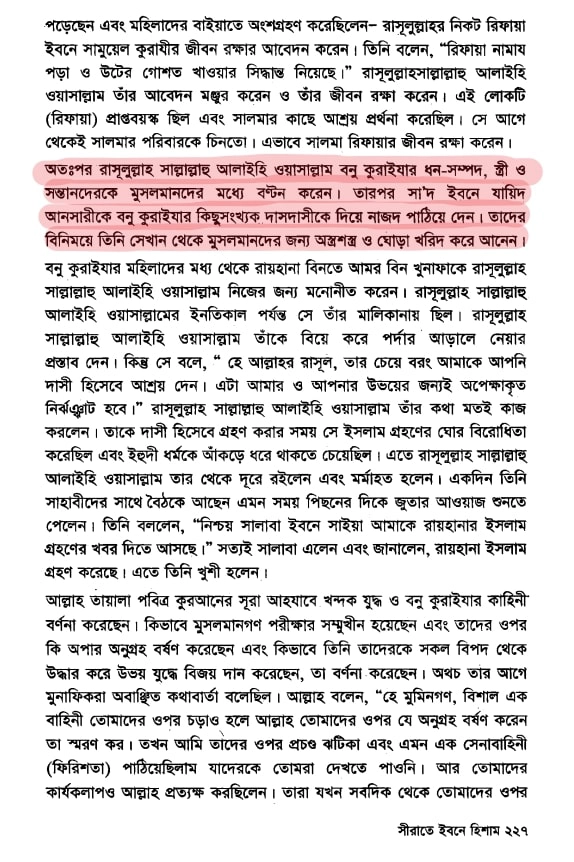
The Ibn Ishaq report preserved by Ibn Hisham is brutally explicit: Muhammad sent Saʿd ibn Zayd al-Ansari with a group of Banu Qurayza captives to Najd, where horses and weapons were purchased in exchange for them. Defeated human beings—particularly captive women and children—were thus converted directly into military capital. IslamQA classifies the chain of this particular report as weak, but simultaneously acknowledges that the account originates with Ibn Ishaq, is preserved by Ibn Hisham and al-Bayhaqi, and is used as corroborative historical material in the literature of sīrah and maghāzī. More strikingly, IslamQA quotes Imam al-Shafiʿi’s al-Umm, where the sale of Banu Qurayza captives is itself cited as a legal precedent, with captives reportedly sent in portions toward Najd, Tihama, and Syria. This human marketplace is therefore not a fantasy manufactured by modern critics; classical sīrah preserved it, and classical jurisprudence itself used it in legal argument. [97] [98] [99]
One-Fifth of the Spoils for the Prophet
A clearer account of the division of the spoils is found in Ibn Ishaq’s The Life of the Messenger of Allah. It is learned from there that the Prophet Muhammad kept one-fifth for himself and also took a woman [100] –
[Thabit ibn Qays said concerning this:
My duty is complete; I have shown generosity,
I have made every effort,
Yet everyone else has become impatient.
Jabir has the greatest claim upon me;
His hands were bound with a rope.
I went to the Messenger to set him free.
He was the ocean of mercy among us.]
The Messenger’s (peace be upon him) order was that all of their adults should be killed.
ʿAbd al-Malik ibn ʿUmayr, through the account of ʿAtiyya al-Qurazi, and Shuʿba ibn al-Hajjaj through him, told me: The order was given to kill all the adult members of Banu Qurayza. I was a minor at that time, so I was spared.
Salma bint Qays, the mother of al-Mundhir and sister of Salit ibn Qays, was the maternal aunt of the Messenger, peace be upon him. She prayed with the Messenger, peace be upon him, facing both Jerusalem and Mecca. Ayyub ibn Abd al-Rahman, the brother of Banu Adi ibn al-Najjar, told me that Rifa ibn Samawal, who was under Salma’s protection, was an adult. He begged the Messenger, peace be upon him, for his life. He said that the man had sworn that he would pray and eat camel meat. The Messenger, peace be upon him, granted his request.
The Messenger, peace be upon him, distributed the property, wives, and children of Banu Qurayza among the Muslims. The shares of camels and people were determined that day. He took one-fifth.A horseman received three shares: two for the horse and one for the rider. There were thirty-six horses in total in the direction of Banu Qurayza. This was the first time that lots were drawn over war booty and one-fifth was set aside. This precedent was followed in other wars thereafter.
The Messenger, peace be upon him, selected for himself a woman from Banu Amr ibn Qurayza. Her name was Rayhana bint Amr ibn Khunafa. She remained under his authority until her death.The Messenger, peace be upon him, proposed marrying her and placing her behind the veil.But Rayhana said, “Rather, keep me under your authority. That will be easier for both you and me.” When she was taken captive, she expressed disrespect toward Islam and held firmly to Judaism. The Messenger, peace be upon him, became displeased and kept her apart. One day he was sitting with the Companions when the sound of sandals came from behind. He said, “Thaʿlaba ibn Saʿya is coming with the good news that Rayhana has accepted Islam.” Thaʿlaba indeed delivered that good news. He was pleased. Concerning Khandaq and Banu Qurayza, Allah spoke in Surah al-Ahzab about their judgment, showing favor toward them, and helping them. He said, “O believers, remember Allah’s favor upon you when armies came against you, and I sent against them wind and unseen armies. Allah sees all that you do.” The enemy forces were Quraysh, Ghatafan, and Banu Qurayza. The army of Allah sent with the wind consisted of angels.
– 1. Surah 33.
– 506 ● The Life of the Messenger of Allah (peace be upon him)
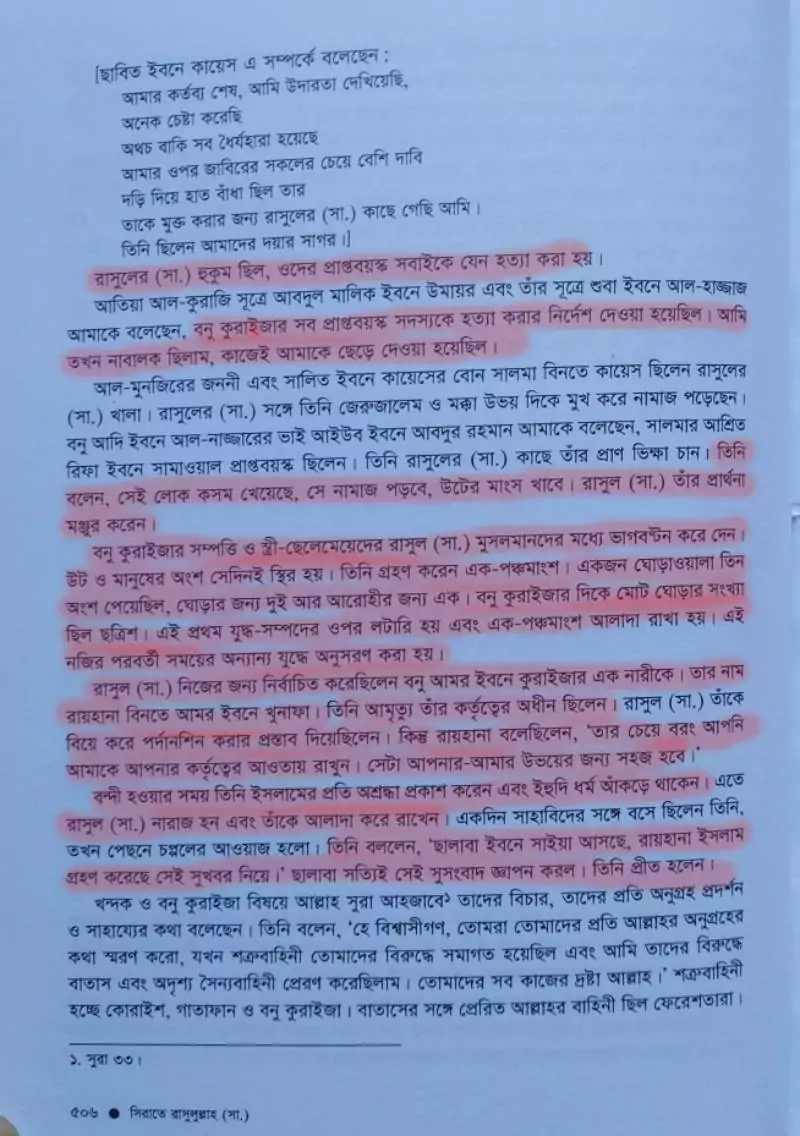
Inconsistency in Judgment: Saʿd ibn Muʿadh’s Verdict versus the Prophet’s Pardon
This isolated incident of pardoning Rifa ibn Samawal creates a logical dilemma for the so-called ‘justice’ of the Banu Qurayza massacre. According to the Islamic narrative, Saʿd ibn Muʿadh’s verdict was ‘a divine decision originating from above the seven heavens’. The question now arises: if killing every able-bodied man was divine justice, then was the Prophet’s exemption of one person from that verdict not a direct violation of that very ‘justice’? Let us examine this account, [101]
Salma bint Qays, the mother of al-Mundhir and sister of Salit ibn Qays, was the maternal aunt of the Messenger, peace be upon him. She prayed with the Messenger, peace be upon him, facing both Jerusalem and Mecca. Ayyub ibn Abd al-Rahman, the brother of Banu Adi ibn al-Najjar, told me that Rifa ibn Samawal, who was under Salma’s protection, was an adult. He begged the Messenger, peace be upon him, for his life. He said that the man had sworn that he would pray and eat camel meat. The Messenger, peace be upon him, granted his request.
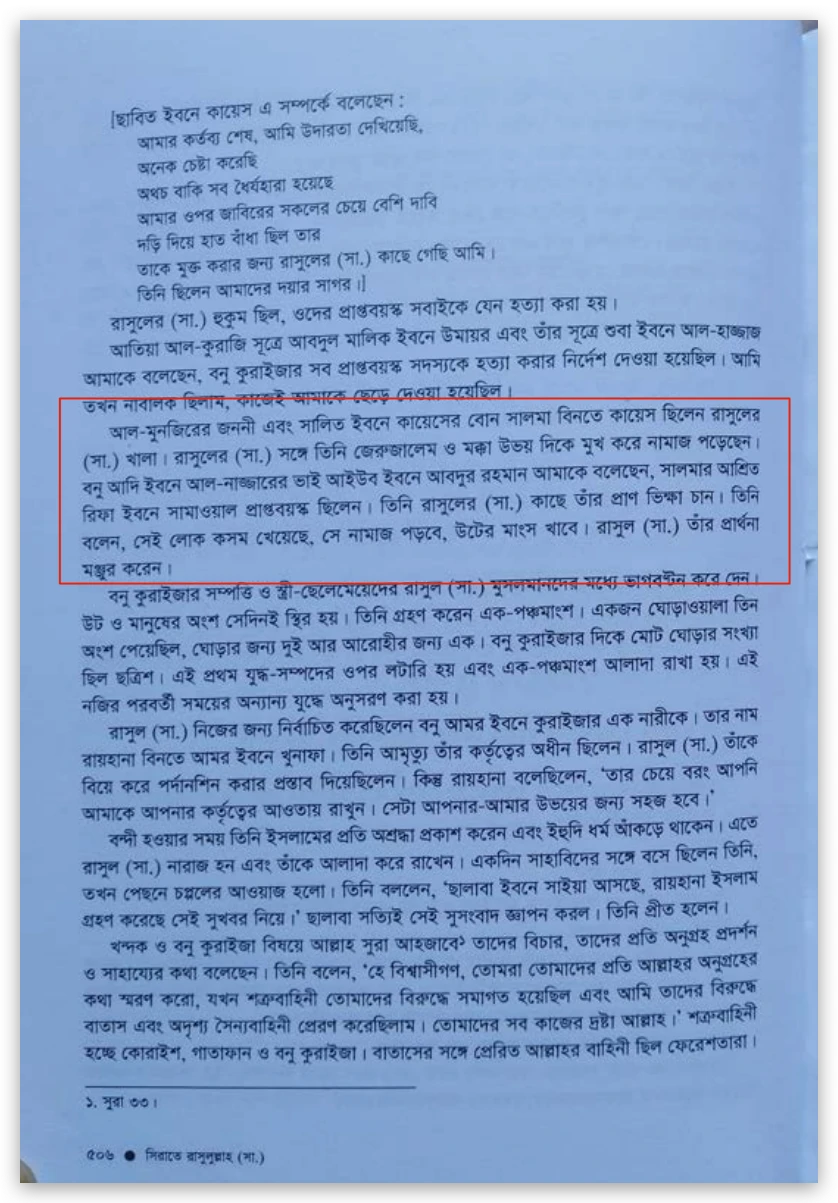
1. The Futility of the Verdict: If Saʿd’s verdict had been objective and specific, based on the guilt of each individual, the Prophet could not have altered or relaxed it in any way. The pardon of one person proves that Saʿd’s verdict was not a form of Individualized Justice, but rather a Blanket Punishment. Where an entire group is ordered to be killed without examining the individual responsibility of the offenders, judicial morality is violated in the extreme.
2. Pardon versus Justice: If this pardon by the Prophet was an act of ‘mercy,’ then it was extreme injustice toward the remaining 600–900 people. Rifa was pardoned because of the recommendation of the Prophet’s maternal aunt and his promise to accept Islam. This clearly indicates that the judgment in Medina was not conducted according to any legal standard; rather, it was conditional upon personal influence and religious allegiance.
Islamic apologists claim that this evidence supposedly proves that the entire Banu Qurayza tribe would have survived that day if they had accepted Islam. But this very argument renders their accusation of ‘breach of treaty’ or ‘treason’ hollow.
- Logical Inconsistency: If an alleged “terrible criminal” changes his religion, that does not absolve him of responsibility for the crime. Pardoning Rifa merely on the condition that he ‘pray’ and ‘eat camel meat’—symbols of accepting Islam—means that Banu Qurayza’s so-called ‘breach of treaty’ was not actually a significant matter for adjudication.
- The Fundamental Objective: This incident proves that the massacre of Banu Qurayza was essentially a strategy for establishing political and religious domination. The primary objective of the campaign was not to punish a crime, but to compel acceptance of Islam or completely annihilate an opposing force. Rifa’s pardon makes it clear that ‘breach of treaty’ was merely an excuse; the real objective was to impose religious allegiance.
This isolated pardon of Rifa ibn Samawal does not prove that Muhammad the Prophet was a ‘sea of mercy’; rather, it exposes even more nakedly the judicial farce that took place in Medina. It proves that Saʿd ibn Muʿadh’s verdict was driven by hatred and revenge, with no examination or distinction regarding individual guilt, and that it was not justice in even the slightest sense. At the same time, the fact that the Prophet granted a pardon on the basis of a recommendation shows that, at that time, personal identity and religious conversion were given greater priority than justice.
Personal Debt versus State Justice: The Dual Standard of Justice
Another account is available that seriously calls the judicial process concerning Banu Qurayza into question. The possibility that al-Jabir ibn Bata might receive a pardon proves that the death sentence imposed on the men of Banu Qurayza was not a judgment concerning any specific crime. Rather, it was a hateful and political killing. Let us read the account, [102]
Ibn Shihab al-Zuhri told me that Thabit ibn Qays ibn al-Shammas went to meet al-Jabir ibn Bata al-Qurazi. Al-Jabir was also known as Abu Abd al-Rahman. Once, during the pagan era, Jabir had saved Thabit’s life. One of al-Jabir’s sons told me that when Thabit was captured on the Day of Buʿath, al-Jabir cut the hair from the front of his head and released him. Thabit came to Jabir. Jabir was then an old man. When Thabit asked whether he recognized him, al-Jabir replied, “Would it make sense for a man like me not to recognize a man like you?”
Thabit said, “I want to repay you for what you did for me.”
“The noble repay the debts of the noble.”
Thabit went to the Messenger, peace be upon him, and related everything. The Messenger, peace be upon him, said that he would be spared. When he returned and told Jabir, he said, “I am an old man. If none of my family remains, what shall I do with this life?”
Thabit went again to the Messenger, peace be upon him, and obtained a plea for the lives of Jabir’s family members.
Then al-Jabir said, “How can a family in the Hijaz live without support and property?”
Thabit went again to the Messenger, peace be upon him, and returned with an order restoring his property.
Then al-Jabir said, “What happened to him, Thabit—that Kaʿb ibn Asad, whose face, bright as a mirror, was used by all the unmarried girls of the tribe to see their own reflections?”
“Killed.”
“And what of Huyayy ibn Akhtab, the prince of the desert and the oasis?”
“Killed.”
“What happened to Azzal ibn Samawal, the front-line soldier during our attacks and the rear guard during our retreats?”
“Killed.”
“What happened to the two confederate groups?”
The two confederate groups meant Banu Kaʿb ibn Qurayza and Banu Amr ibn Qurayza.
“Killed,” Thabit said.
“Then, Thabit, do me one favor. In return for the claim I have upon you, send me to the people of my group. They have all gone, and there is no joy left in my life. I can no longer bear to wait to join my loved ones.”
Then Thabit approached him and beheaded him.
When Abu Bakr (may Allah be pleased with him) heard him speak of going to his loved ones, he commented, “Yes, by Allah, he will meet them in Hell, where they will remain forever.”
The Life of the Messenger of Allah (peace be upon him) 505
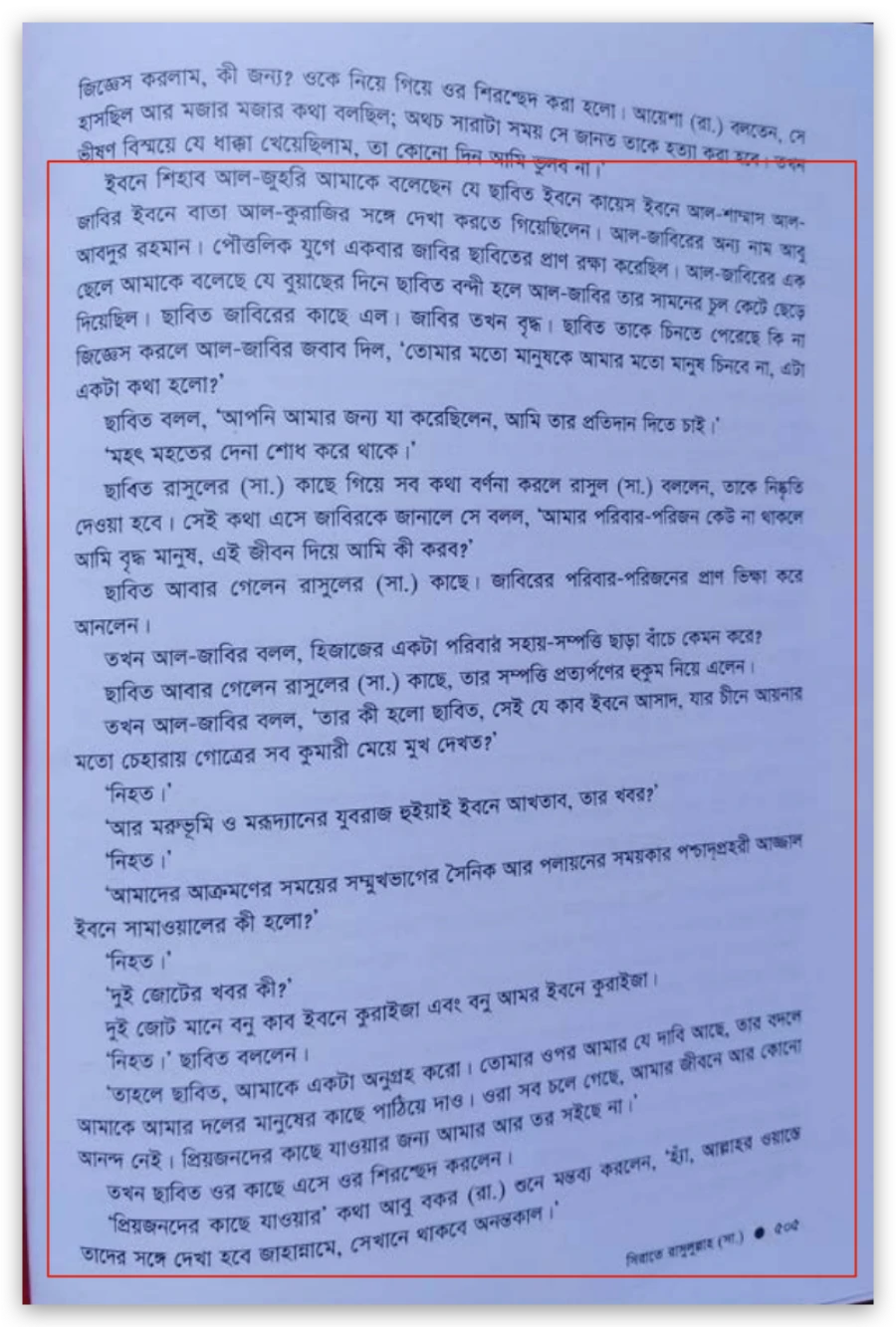
1. Violation of the Heavenly Verdict: When Sa’d ibn Mu’adh’s ruling is presented as “Allah’s verdict coming from above the seven heavens,” changing that ruling at the special request of Thabit ibn Qays because of their personal relationship directly constitutes an insult to that so-called “divine justice.” If it had truly been Allah’s will and justice to kill every able-bodied male of Banu Qurayza, then suspending that heavenly law to repay a Companion’s personal “debt” from the Age of Ignorance would have been impossible. This proves that the judgment was extremely arbitrary and subject to personal influence.
2. Absence of Individual Guilt: If the men of Banu Qurayza had truly been guilty of serious crimes such as “treason” or “breach of treaty,” then pardoning one person solely on the basis of Thabit’s personal recommendation would have constituted extreme judicial corruption. The very fact that this pardon was granted confirms that Sa’d ibn Mu’adh did not analyze each individual’s guilt before issuing his verdict; rather, he ordered the killing of an entire population based on their identity or tribal affiliation. In other words, what is being called “justice” was actually ethnic cleansing.
3. Cruel Mercy and Psychological Torture: Although the Prophet’s pardon of al-Jabir, followed by the offer to return his family and property, may outwardly appear to be an act of “mercy,” in reality it was cruelty in its most extreme form. Al-Jabir’s reaction—choosing death himself after hearing that his loved ones and the leaders of his tribe had been killed—proves that keeping one person alive after destroying an entire society and culture is not mercy; rather, it amounts to killing that person slowly. Jabir’s questions—what had happened to Ka’b ibn Asad and Huyayy ibn Akhtab?—and his choice of death reveal that the massacre had erased the tribe’s social and political existence forever.
4. Manifestation of Religious Hatred: When al-Jabir chose death out of a desire to reunite with his loved ones, Abu Bakr’s (ra) comment (“Yes, by Allah, he will meet them in Hell”) proves that this judgment was not an impartial legal process. It was a combination of religious hatred and political domination. The alleged “breach of treaty” was merely a cover; beneath it lay extreme intolerance toward people of another faith and an intense desire for them to be punished in the Hereafter as well.
It is deeply unfortunate that Islamic apologists bring up this example in an attempt to prove that the Companions were an ocean of mercy. This incident involving al-Jabir ibn Bata is not an example of “mercy” for apologists; rather, it is incontrovertible evidence of “injustice” for critics. It makes the following clear:
- There was no specific list of crimes committed by Banu Qurayza; if there had been one, someone’s punishment would not have been waived because of a personal relationship resulting from an individual’s recommendation.
- Sa’d ibn Mu’adh’s ruling amounted to an indiscriminate massacre.
- The Prophet’s policy of granting pardons depended on personal loyalty or recommendations, which is contrary to any impartial judicial system, whether modern or ancient.
Overall, the massacre of Banu Qurayza was not a legal process; rather, it was a carefully planned political extermination that was later wrapped in the guise of a “divine verdict.”
Unimaginable Brutality: The History of Two Jewish Women
The Story of Rayhana, a Jewish Woman
Rayhana bint Sham’un ibn Zayd was a woman belonging to the Jewish community. On her father’s side she belonged to the Banu Nadir tribe, and through her husband she was connected to the Banu Qurayza tribe. Al-Hakam of Banu Qurayza was her husband. After the Prophet Muhammad had killed her family, he was captivated when he saw her and, as was customary, proposed marriage to her. Rayhana bint Zayd was one of the most tragic witnesses to the blood-soaked chapter of Banu Qurayza. Her husband, Abd al-Hakam, was also beheaded and killed in this massacre. After all the men of the tribe had been killed, a large number of women and children were captured as spoils of war; Rayhana was one of them.
From among the captives, the Prophet Muhammad selected Rayhana as a special portion for himself, or “safiyy.” Before her husband’s blood had even dried, Rayhana was forced to surrender herself to the killer of her tribe. According to the account of the historian Ibn Ishaq, when the Prophet Muhammad proposed marriage to her, Rayhana initially rejected it and declared her decision to remain steadfast in her Jewish faith. She considered remaining a slave preferable, perhaps because she could not psychologically accept the contradiction of becoming the wife of the person who had killed her husband and relatives. It is said that she later accepted Islam, but the extent to which that festering wound affected her mind until her death has hardly appeared in the pages of victorious history. She remained in Medina until her death in 631 CE. Rayhana’s name became a long sigh—the name of a once-noble woman who was turned into “spoils of war.” Let us learn more about her, [103]
The later attempt to sanitize Rayhana simply as an “honored wife” does not survive scrutiny within Islamic scholarship itself. Even the conservative Sunni fatwa site IslamQA acknowledges that no fully sound detailed report about her survives and that the well-known position among sīrah scholars is that she remained Muhammad’s milk al-yamīn—a woman held by right of ownership. It cites Akram Diya al-Umari as preferring the Ibn Ishaq/Ibn Saʿd position over Waqidi’s marriage account, and then quotes Ibn al-Qayyim even more explicitly: the known view was that Rayhana was one of Muhammad’s slave women and that he “had intercourse with her by right of ownership”—كان يطؤها بملك اليمين. Therefore, the claim that Rayhana was merely a wife and not a concubine is not even the preferred reconstruction presented by IslamQA itself. [104]
One of them was Rayhana bint Zayd—of the Banu Nadir tribe; according to another opinion, she was from the Qaynuqa tribe. (R) said that Rayhana bint Zayd was from the Banu Nadir tribe. Some, however, said that she was from Banu Qurayza. Waqidi (r) further says that Rayhana bint Zayd was from the Banu Nadir tribe and that she had been married within that tribe. The Messenger of Allah (sa) selected her for himself. She was a beautiful woman. When the Messenger of Allah (sa) invited her to accept Islam, she refused to abandon the Jewish religion. The Messenger of Allah (sa) then left her aside and was inwardly distressed by her conduct. Later, he summoned Ibn Shu’ba (Tha’laba) and discussed the matter of Rayhana with him. Ibn Shu’ba said, “May my father and mother be sacrificed for you! She will certainly accept Islam.” He then went out, reached Rayhana, and began saying to her, “Do not remain a follower of your own people. You can see what happened to the leader Huyayy ibn Akhtab. Therefore, my advice is that you should become a Muslim. The Messenger of Allah (sa) will take you as his ‘exclusive personal possession.’” The Messenger of Allah (sa) was among his Companions. In the meantime, hearing the sound of a pair of sandals, he said, “These must certainly be Ibn Shu’ba’s sandals. He is coming to give me the good news that Rayhana has accepted Islam.” Ibn Shu’ba then arrived and said, “O Messenger of Allah! Rayhana has accepted Islam.” The Prophet (sa) was pleased. Ibn Ishaq (r) said that after defeating Banu Qurayza, the Messenger of Allah (sa) took Rayhana bint Amr ibn Khunafa exclusively for himself. She remained in his possession until the death of the Prophet (sa). He invited her to accept Islam and later proposed marriage to her.
But she refused to accept anything other than the Jewish religion. Ibn Ishaq then mentioned the aforementioned account concerning her acceptance of Islam. Waqidi (r) says that later the Messenger of Allah (sa) sent her to the house of Umm al-Mundhir Salma bint Qays (ra). While staying there, she menstruated, and after becoming pure following one menstrual period, Umm al-Mundhir (ra) informed the Messenger of Allah (sa). The Prophet (sa) went to her at Umm al-Mundhir’s house and said,
ان احببت ان اعتقك و انزوجك فعلت – وان احببت ان تكونى في ملكي اطأك بالملك
“If you wish, I will emancipate you and marry you. I will do so. But if you prefer to remain in my possession, I will have relations with you by virtue of ownership.” She said, “O Messenger of Allah! In my view, remaining in your possession is more trouble-free and easier both for you and for me.” Thus, she remained in the possession of the Messenger of Allah (sa), and this continued until his death. Waqidi (r) further says that Ibn Abi Dhi’b (r) narrated to me that I asked al-Zuhri (r) about Rayhana. He said, “She was the slave-girl of the Messenger of Allah (sa). Later he emancipated her and entered into a marital union with her.” Consequently, she observed the veil even among his family and used to say, “No one will see me after the Messenger of Allah (sa).” Waqidi (r) says that, in our judgment, this is the more authentic of the two traditions. Before the Prophet (sa), her husband had been Hakam.
Waqidi (r) says that Asim ibn Abdullah ibn al-Hakam narrated from Umar ibn al-Hakam (r), who said that the Messenger of Allah (sa) emancipated Rayhana bint Zayd ibn Amr ibn Khunafa. She had been with her husband, who loved and properly appreciated her. Therefore, she had said, “After him, I will never accept anyone else in his place.” She was a woman of great beauty. Later, when the women of Banu Qurayza were taken captive, the female captives were brought before the Messenger of Allah (sa). Rayhana says, “I too was among those who were presented before the Messenger of Allah (sa). By his order, I was kept apart.”
Whenever he had an exclusive share in some portion of the spoils (ii), he sought divine guidance from Allah regarding me after I had been kept apart.
Later, he sent me for a few days to the house of Umm al-Mundhir bint Qays (ra). During that time, he sentenced the male captives to death and distributed the female captives. When the Messenger of Allah (sa) later came to me, I withdrew shyly to one side. He called me and seated me before him. He said, “You … if you accept Allah and His Messenger, the Messenger of Allah will take you for himself.” When I accepted Islam, the Messenger of Allah (sa) emancipated me and took me as his wife. He gave me a dowry of slightly more than twelve uqiyyas (twelve and a half uqiyyas = 500 dirhams), as he gave his other wives. He consummated the marriage with me at the house of Umm al-Mundhir (ra). He used to assign turns for spending nights with his wives. He established the rules of seclusion for me. The narrator says that the Messenger of Allah (sa) was captivated by her, and whenever she asked him for anything, the Prophet (sa) gave it to her. Therefore, she was told, “If you had asked the Messenger of Allah (sa) regarding Banu Qurayza, he would certainly have freed them.” In response, she would say, “He met with me privately only after the female captives had been distributed and the male captives had been killed.” The Prophet (sa) would spend time with her in private, and he did so frequently. Thus, she remained close to the Prophet (sa), and eventually she died when the Prophet (sa) was returning from the Farewell Pilgrimage. The Prophet (sa) buried her in the Baqi cemetery. The Prophet (sa) married her in Muharram of the sixth year after the Hijrah.
Ibn Wahb (r) said, through Yunus ibn Yazid (r), from al-Zuhri (r): “The Messenger of Allah (sa) took Rayhana of Banu Qurayza as a slave-wife. Later, when he emancipated her, she reunited with her family.” Abu Ubayda Ma’mar ibn al-Muthanna (r) said that Rayhana bint Zayd ibn Sham’un was from the Banu Nadir tribe; according to another opinion, she was from Banu Qurayza. She lived in a date orchard among the gardens of charity, and the Messenger of Allah (sa) would occasionally rest there at midday. He obtained her as a captive in Shawwal of the fourth year after the Hijrah.
Abu Bakr ibn Abi Khaythama (r) says that the Messenger of Allah (sa) had two slave-wives: Maria the Copt and Rayhana bint Sham’un ibn Zayd ibn Khunada, a member of the Banu Amr of Qurayza. As far as is known, she had initially been the wife of her cousin Hakam. She died before the death of the Prophet (sa). Abu Ubayda Ma’mar ibn al-Muthanna (r) says that the Messenger of Allah (sa) had four slave women: Maria the Copt, Rayhana of Qurayza, and another beautiful slave woman named Jamila. The Prophet’s wives plotted against her. They feared that she would gain superiority over them in the eyes of the Prophet (sa). There was also another slave woman, Nafisa, whom Zaynab (ra) had given to him as a gift. (The account says that) the Prophet (sa) had left Zaynab (ra) because of Safiyya bint Huyayy (ra) during Dhu al-Hijjah, Muharram, and Safar. When the month of his death, Rabi al-Awwal, began, he said to Zaynab (ra), “I cannot decide what reward I should give you.” Later, she gave this slave woman as a gift to the Prophet (sa).
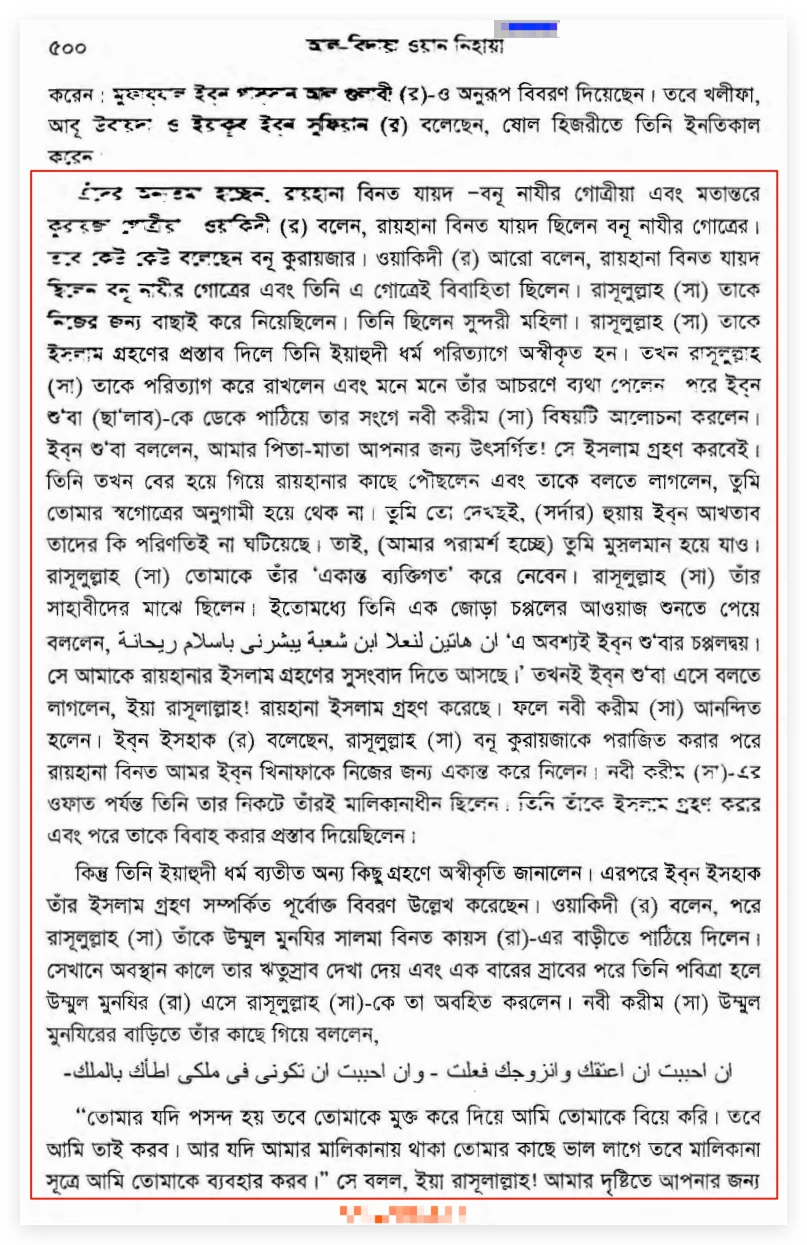
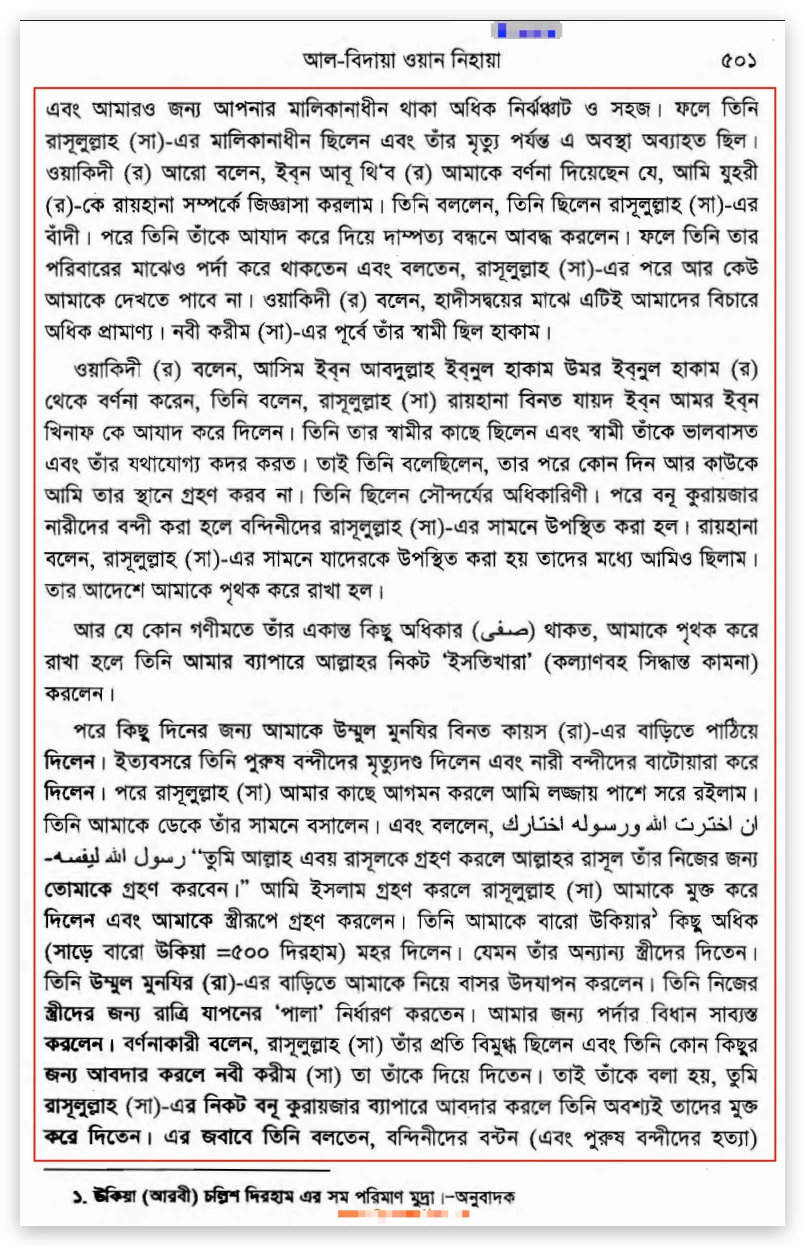
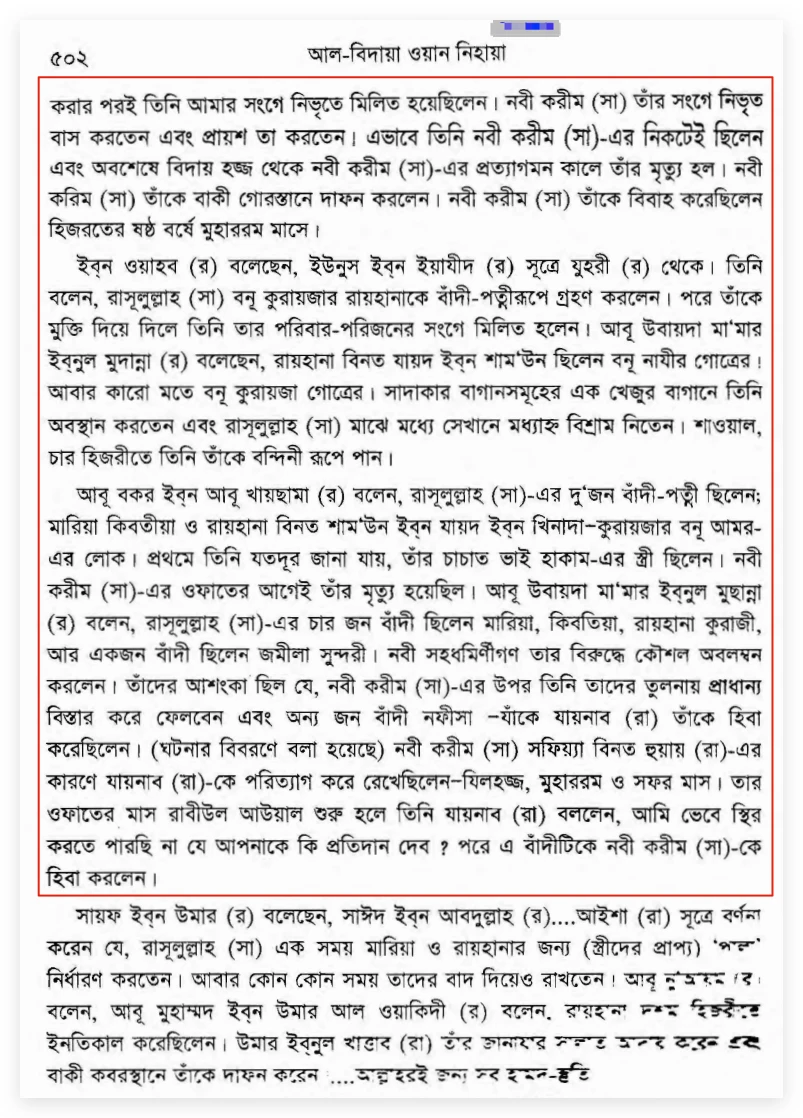
The Story of a Woman Driven Mad by Grief for Her Relatives
When hundreds of people were being beheaded in the market of Medina and the air had grown heavy with the smell of blood, Aisha witnessed a strange and heartbreaking scene amid that horrific situation. A woman from the Banu Qurayza tribe, whose name was probably Aqal or Bunanah, burst into strange, loud laughter even at that extreme moment.
According to Aisha’s account, while the men were being called one after another to be killed, this woman of Banu Qurayza sat beside Aisha, talking and laughing. Yet she knew that all the men of her tribe were being killed and that her own death was imminent. When she was called by name, she walked toward the executioner while continuing to laugh, without becoming the slightest bit agitated. Astonished, Aisha asked her, “What is wrong with you? Why are you laughing when you know that you are about to be killed?” In response, the woman simply continued laughing as she walked toward death.
From a human and psychological perspective, analysis shows that this was not ordinary laughter. After witnessing the wholesale killing of her husband, children, and relatives before her own eyes, it would be entirely natural for a person’s normal judgment to collapse or for her to become deranged because of trauma. Her loud laughter was essentially an expression of extreme hatred and intense psychological pain. She may have understood that death offered the only possible release from this unbearable suffering. Aisha later said that she could never forget that woman’s laughter throughout her life. More than swords on a battlefield, the anguished laughter of this bereaved woman remains in the pages of history as a deep wound. [105] [106]
Sunan Abu Dawud (verified edition)
9/ Jihad
Chapter: 121. Regarding the killing of women
2671
Narrated Aisha, Ummul Mu’minin: No woman of Banu Qurayzah was killed except one. She was with me, talking and laughing on her back and belly (extremely), while the Messenger of Allah (ﷺ) was killing her people with the swords. Suddenly a man called her name: Where is so-and-so? She said: I I asked: What is the matter with you? She said: I did a new act. She said: The man took her and beheaded her. She said: I will not forget that she was laughing extremely although she knew that she would be killed
حَدَّثَنَا عَبْدُ اللَّهِ بْنُ مُحَمَّدٍ النُّفَيْلِيُّ، حَدَّثَنَا مُحَمَّدُ بْنُ سَلَمَةَ، عَنْ مُحَمَّدِ بْنِ إِسْحَاقَ، حَدَّثَنِي مُحَمَّدُ بْنُ جَعْفَرِ بْنِ الزُّبَيْرِ، عَنْ عُرْوَةَ بْنِ الزُّبَيْرِ، عَنْ عَائِشَةَ، قَالَتْ لَمْ يُقْتَلْ مِنْ نِسَائِهِمْ – تَعْنِي بَنِي قُرَيْظَةَ – إِلاَّ امْرَأَةً إِنَّهَا لَعِنْدِي تُحَدِّثُ تَضْحَكُ ظَهْرًا وَبَطْنًا وَرَسُولُ اللَّهِ صلى الله عليه وسلم يَقْتُلُ رِجَالَهُمْ بِالسُّيُوفِ إِذْ هَتَفَ هَاتِفٌ بِاسْمِهَا أَيْنَ فُلاَنَةُ قَالَتْ أَنَا . قُلْتُ وَمَا شَأْنُكِ قَالَتْ حَدَثٌ أَحْدَثْتُهُ . قَالَتْ فَانْطَلَقَ بِهَا فَضُرِبَتْ عُنُقُهَا فَمَا أَنْسَى عَجَبًا مِنْهَا أَنَّهَا تَضْحَكُ ظَهْرًا وَبَطْنًا وَقَدْ عَلِمَتْ أَنَّهَا تُقْتَلُ .
Grade: Hasan (Al-Albani)
Sunan Abu Dawud (Islamic Foundation)
9/ Jihad
Chapter: 15. Regarding the killing of women.
2662.
Narrated Aisha, Ummul Mu’minin: No woman of Banu Qurayzah was killed except one. She was with me, talking and laughing on her back and belly (extremely), while the Messenger of Allah (ﷺ) was killing her people with the swords. Suddenly a man called her name: Where is so-and-so? She said: I I asked: What is the matter with you? She said: I did a new act. She said: The man took her and beheaded her. She said: I will not forget that she was laughing extremely although she knew that she would be killed
حَدَّثَنَا عَبْدُ اللَّهِ بْنُ مُحَمَّدٍ النُّفَيْلِيُّ، حَدَّثَنَا مُحَمَّدُ بْنُ سَلَمَةَ، عَنْ مُحَمَّدِ بْنِ إِسْحَاقَ، حَدَّثَنِي مُحَمَّدُ بْنُ جَعْفَرِ بْنِ الزُّبَيْرِ، عَنْ عُرْوَةَ بْنِ الزُّبَيْرِ، عَنْ عَائِشَةَ، قَالَتْ لَمْ يُقْتَلْ مِنْ نِسَائِهِمْ – تَعْنِي بَنِي قُرَيْظَةَ – إِلاَّ امْرَأَةً إِنَّهَا لَعِنْدِي تُحَدِّثُ تَضْحَكُ ظَهْرًا وَبَطْنًا وَرَسُولُ اللَّهِ صلى الله عليه وسلم يَقْتُلُ رِجَالَهُمْ بِالسُّيُوفِ إِذْ هَتَفَ هَاتِفٌ بِاسْمِهَا أَيْنَ فُلاَنَةُ قَالَتْ أَنَا . قُلْتُ وَمَا شَأْنُكِ قَالَتْ حَدَثٌ أَحْدَثْتُهُ . قَالَتْ فَانْطَلَقَ بِهَا فَضُرِبَتْ عُنُقُهَا فَمَا أَنْسَى عَجَبًا مِنْهَا أَنَّهَا تَضْحَكُ ظَهْرًا وَبَطْنًا وَقَدْ عَلِمَتْ أَنَّهَا تُقْتَلُ .
Grade: Hasan (Al-Albani)
Another heartbreaking account is found concerning this woman. Until only a short time earlier, she had had a loving husband and a household. The depth of their marital relationship became evident during the final days of the siege. When the fall of Banu Qurayza became inevitable, two paths lay open before the couple—either the chains of slavery and separation forever, or death. The husband knew that although the men of Banu Qurayza would be killed, the women would be distributed as slaves. For him, seeing his beloved wife become someone else’s slave was more painful than death. Therefore, in an utterly desperate decision, he said to his wife, “Muhammad will not kill you; he will make you a sex slave. But the thought of you remaining someone’s slave is unbearable to me.” It was because of this plea from her husband that Bananah chose an inhuman course. She rolled a millstone down from the top of the fortress and killed a Muslim soldier. This was not an ordinary attack; it was essentially a desperate cry intended to ensure her own “death sentence.” She knew that she would be sentenced to death for the crime of killing, and that through this she could escape becoming a lifelong sex slave of the followers of the Prophet Muhammad and set out with her husband toward the Hereafter.
In Aisha’s account, the picture we get of Bananah’s final moments is psychologically devastating. With a death sentence hanging over her head, she sat beside Aisha, laughing and joking. The path she chose to avoid the humiliation of becoming a slave after sending her beloved husband and relatives to the procession of death may be viewed in modern sociology as a form of “protest suicide” or protest self-immolation. Aisha herself remained stunned for the rest of her life by this woman’s extraordinary cheerfulness and exuberance. In the history of the genocide of Banu Qurayza, Bananah remains the woman who considered embracing death preferable to the degradation of slavery. [107]
That day, only one woman named Bananah was killed among the women of Banu Qurayza. She was the daughter of the Banu Nadir community. However, she had married a young man from Banu Qurayza. Their marital love was extremely deep. It was the final stage of the siege. All of them understood that there was no longer any escape for them. Bananah said to her husband, “You will now be separated from me. If that happens, what use is there in my remaining alive?” The young man said, “If Muhammad is victorious, he will not kill you. He will make you a perpetual slave, because his religion does not permit the killing of women. But the thought of you remaining someone’s slave is unbearable for me.” Instead, do one thing. Roll that millstone down from here. If a Muslim soldier is killed by the impact of that millstone, you will be sentenced to death for that crime. I want you to be sentenced to death. Following her husband’s instructions, Bananah rolled the millstone down through an opening in the fortress. Outside, the midday heat was intense. At that time, many Muslim soldiers were resting in the shade of the fortress wall. The millstone rolled straight down onto the head of one of those resting soldiers. As a result, he attained martyrdom within a short time.
According to the account of Urwah, Mother Aisha said, “When the men of Banu Qurayza were being killed, Bananah was with me. It was her nature to spend almost all her time laughing and joking. While their men were being killed, she would occasionally joke and say, ‘How amusing! Today the men of Banu Qurayza are being slaughtered.’” After a while, a voice came from outside: “Where is Bananah?” She immediately replied, “Here I am.” I said, “You wretched woman! Who is this man to you?” She said, “I am being summoned to be killed.” I said, “For what reason?” She said, “I must surely have committed some crime.” Mother Aisha further said, “I have never in my life heard of anyone under a death sentence behaving with such joy and exuberance. I still remember her.”
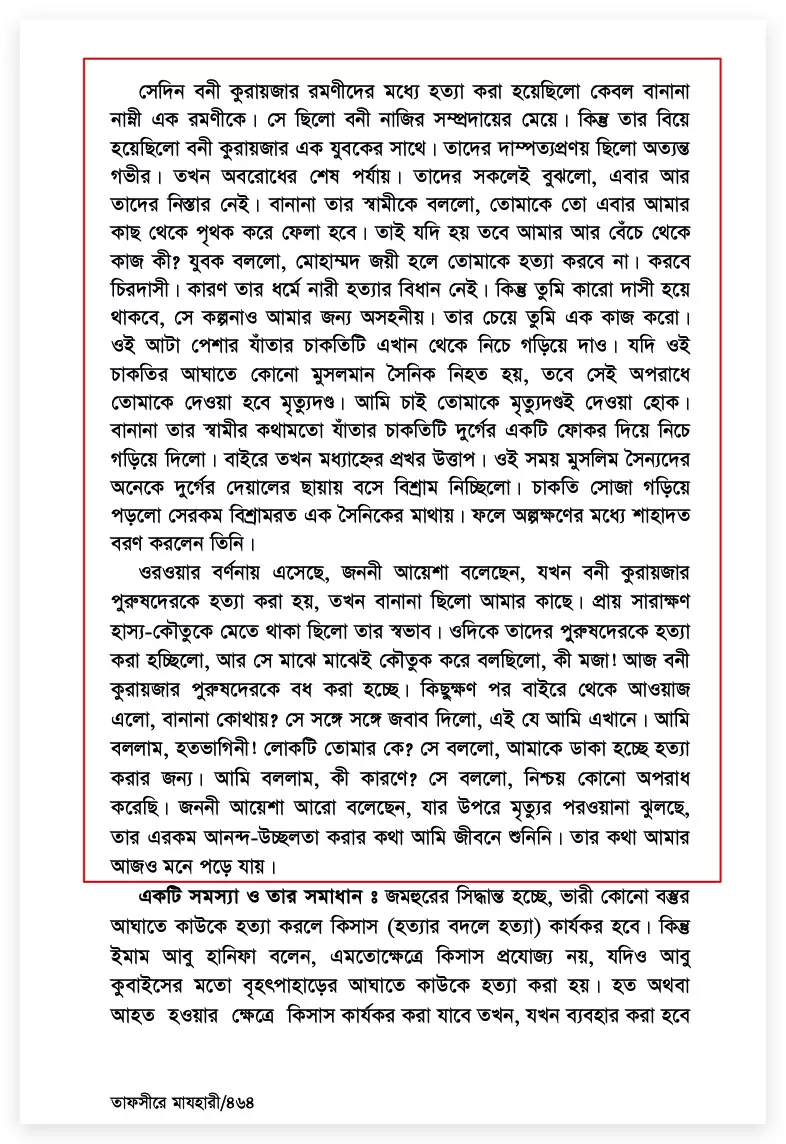
Common Apologetic Claims and One-Line Responses
In defending the genocide of Banu Qurayza, Islamic apologists generally use several recurring arguments. Brief responses to them are given below.
| Apologists’ Claim / Question | One-Line Response |
|---|---|
| Did Banu Qurayza not commit treason? | Even if some leaders committed treason, killing the pubescent men of the entire tribe, enslaving women and children, and looting property is not justice; it is collective punishment. |
| They joined the enemy side during the war. | There was no investigation into exactly which individuals personally joined the enemy side, nor was the extent of each person’s alleged guilt determined. Wartime suspicion or political communication does not provide a moral license for the mass killing of surrendering prisoners. |
| This was a defensive measure. | Self-defense applies on the battlefield; besieging people for 25 days, cutting off their food and water, and killing prisoners after their surrender is not self-defense but retaliatory extermination. |
| They violated the Constitution of Medina. | Evidence of a specific written treaty violation is not found in the primary sources; and even if a treaty was violated, tribal killing does not become legitimate without determining each person’s offense, allowing them to present a defense, and conducting individual trials. |
| Muhammad did not issue the verdict; Sa‘d ibn Mu‘adh did. | Muhammad had already made a decision, appointed a judge who was already vengeful toward that tribe, approved the arbitration, accepted the verdict, and remained present in the marketplace of Medina while the killings were carried out; therefore, responsibility cannot be avoided. |
| Sa‘d was their former ally, so the verdict was impartial. | An injured Muslim military leader who himself wished to see the brutal fate of Banu Qurayza was in no way an impartial judge. |
| Banu Qurayza themselves accepted Sa‘d as the judge. | Consent given in the face of siege, hunger, military pressure, and defeat is not free judicial consent. |
| The verdict was based on Jewish scripture. | Having the victorious side’s chosen arbitrator impose a verdict on the defeated and then saying, “It was done according to your own law,” is a barbaric strategy for shifting responsibility. |
| The Torah prescribed such a punishment. | The presence of a cruel ruling in an ancient scripture does not make it moral; barbarity does not become civilized through religious authorization. Moreover, according to Islamic belief, the Torah too is ultimately a law given by Allah. |
| Only combatants were killed. | The examination for pubic hair proves that eligibility for death was determined by biological adulthood, not by individual participation in combat. |
| Every adult man was a potential combatant. | Killing people by calling them “potential combatants” is not justice; it is group-based capital punishment founded on suspicion. |
| The numbers 600/700/900 may be exaggerated. | Even if the number was smaller, the fundamental crime does not change: surrendering prisoners were killed, women and children were taken captive, and property was seized. |
| That was simply the rule of war in that era. | The customs of an era may explain the historical context of an action, but they cannot give it moral legitimacy. Explanation and justification must not be confused. |
| It is wrong to judge a seventh-century event by modern human rights standards. | Then, by the same logic, a seventh-century military leader accused of genocide must also no longer be called an eternal moral ideal; there must be an opportunity to view his ideals critically from a moral perspective. |
| This was not genocide but postwar adjudication. | Killing men on the basis of their tribe without determining individual crimes is not adjudication; it is collective slaughter. |
| Women and children were not killed. | Not killing women and children but enslaving them and taking them to market to be sold is not morality; it adds the crime of slavery to the crime of killing. |
| Taking them captive was a normal rule of war. | Turning human beings into war booty may have been a common practice in some societies, but social prevalence is not a moral license; morally, it is slavery and human degradation. |
| The verdict was harsh, but it was necessary for the Muslims. | If the “necessity” of a community is allowed to legitimize killing without trial, then any state terror can be legitimized. |
| They were a threat to the existence of the Muslims. | Eliminating a threat and destroying the male line of a surrendering population are not the same thing; a side that claims to have the Almighty Allah and powerful angels on its side should have been able to preserve its existence without committing genocide. |
| This verdict was issued by Allah’s command. | “God said so” is not a moral argument; it is an unsubstantiated claim of authority. Throughout the ages, many wars and much bloodshed have taken place on the pretext that God had commanded them. |
| Whatever the Prophet did was surely just. | If a person is presumed morally infallible in advance, examining history becomes blind obedience rather than judgment. |
| The Muslims were compelled; they did not do it joyfully. | The moral question concerns not feelings but the nature of the act: killing prisoners and enslaving people remain crimes even if they are considered compulsory. |
| Islam-haters exaggerate this event. | The fundamental problem is that Islamic sources themselves describe the killing of men based on pubic-hair examinations, the captivity of women and children, and the distribution of property. |
| Discussing this hurts Muslims’ feelings. | Analyzing the history of human killing cannot be made subject to anyone’s feelings; invoking feelings cannot stop the examination of historical truth. |
Conclusion
In discussions of historical military punishments such as the Banu Qurayza incident, a contextual argument frequently arises: modern standards of war crimes or international laws such as the Geneva Conventions did not exist at that time. However, this kind of collective punishment violates a fundamental moral principle that is unjust and inhumane regardless of time.
The fundamental basis of collective punishment is the complete rejection of the principle of individual accountability. Where justice demands that only the guilty be punished, this form of punishment subjects an entire community—including many who were not personally involved in any crime—to extreme consequences such as killing, enslavement, or confiscation of property merely because of their tribal identity. It essentially amounts to punishing the blameless, which is universally regarded as a fundamental injustice.
From the perspective of moral philosophy, collective punishment replaces individual responsibility with retaliation against a group. Its fundamental defect is straightforward: punishment is imposed not because each person has been shown to have committed an offense, but because the person belongs to the accused community. The result is an extreme disproportion between personal culpability and punishment, destroying the distinction between the guilty and the blameless and thereby undermining the very principle of justice.
In the modern era, international humanitarian law (International Humanitarian Law – IHL) has explicitly prohibited collective punishment as a war crime. This prohibition is based on the fundamental principle of individual criminal responsibility (individual criminal responsibility) [108]. Although no such legal framework existed in 627 CE, this kind of injustice remains questionable in every era as a matter of morality.
The moral progress of human civilization demonstrates that exterminating or enslaving an entire community for the crimes of one or a few of its members was merely a brutal military strategy, which can never be acceptable by moral standards. This chapter of history therefore demands profound self-criticism not only from a religious perspective but also from a humanistic one.
From the discussion above, it is reasonably clear that, because of the crimes of some members of the Banu Qaynuqa tribe, the Prophet Muhammad wanted to kill all the adult men of their tribe. But because of Abdullah ibn Ubayy, the Prophet was unable to carry out this act. Thus, as part of Muhammad’s plan to expel and annihilate everyone except Muslims from the Arabian Peninsula, they attacked the Banu Qurayza tribe and decided in advance what punishment would be imposed on them. Everything that occurred afterward in the name of judgment has been described above. Readers will understand, after judging, considering, and analyzing the entire matter, how humane and how moral this genocide, collective punishment, and ethnic cleansing were. They will also understand how right it was for Allah and His Messenger to carry out such an act, and how civilized it is for Muslims even now to follow and imitate such acts!
References
- Sahih al-Bukhari, Hadith: 2652 ↩︎
- Sahih Muslim, Hadith: 2533 ↩︎
- The Sunnah of Blasphemy, Sectarianism, and Idol-Breaking ↩︎
- Sirat al-Mustafa (peace be upon him), Allama Idris Kandhalvi, page: 286 ↩︎
- The Life of the Messenger of Allah — Ibn Ishaq, translated by Shahid Akhand, Prothoma Prokashan, pages 271, 272 ↩︎
- The Life Of Muhammad, by Ibn Ishaq : Alfred Guillaume, pages 232, 233 ↩︎
- Tafsir Ibn Kathir, Islamic Foundation Bangladesh, volume 3, page 573 ↩︎
- The Life of the Messenger of Allah — Ibn Ishaq, translated by Shahid Akhand, Prothoma Prokashan, page 401 ↩︎
- Al-Bidaya wa’l-Nihaya, Islamic Foundation, volume four, page 148 ↩︎
- Sunan Abu Dawud, Islamic Foundation, hadith: 2994 ↩︎
- The Untold Story of Safiyya, the Jewish Girl ↩︎
- The Judeo-Christian and Polytheist Foundations of Islam ↩︎
- A List of the Assassinations Ordered by the Prophet Muhammad ↩︎
- Riyad as-Salihin, hadith: 1829 ↩︎
- Sahih al-Bukhari, Tawhid Publications, hadith: 1871 ↩︎
- Sahih Muslim, Islamic Foundation, hadith: 3223 ↩︎
- Sunan Ibn Majah, 14/71 ↩︎
- Sahih Muslim, Hadith Academy, hadith: 37 ↩︎
- The Rights of Non-Muslims in an Islamic Sharia State ↩︎
- Sahih Muslim, Islamic Foundation, hadith: 4442 ↩︎
- Sahih Muslim, Hadith Academy, hadith: 4486 ↩︎
- Sunan al-Tirmidhi (verified), Husain al-Madani Publications, hadith: 1607 ↩︎
- Sunan al-Tirmidhi (verified), hadith: 2607 ↩︎
- Sunan al-Tirmidhi (verified), hadith: 2608 ↩︎
- Tafsir Ibn Kathir, Volume 3, page 573 ↩︎
- The Sirah of the Messenger of Allah (peace be upon him)—Ibn Ishaq, translated by Shahid Akhand, Prothoma Prokashan, page 401 ↩︎
- Ibn Ishaq, The Life of Muhammad, Oxford University Press, 2007, p. 363 ↩︎
- Sirat Ibn Hisham, translated by Akram Faruk, Bangladesh Islamic Center ↩︎
- Tafsir Ibn Kathir, Islamic Foundation Bangladesh, Volume 3, pages 573–574 ↩︎
- Sahih Bukhari, Islamic Foundation, Hadith: 6847 ↩︎
- Sunan Abu Dawud (verified), Allama Albani Academy, Hadith: 3003 ↩︎
- Sunan at-Tirmidhi (verified), Publisher: Husain al-Madani, Hadith: 1602 ↩︎
- Al-Bidaya wa al-Nihaya, Islamic Foundation, Volume Four, page 148 ↩︎
- Sunan Abu Dawud, Islamic Foundation, Hadith: 2994 1 2 3 4
- Sunan Abu Dawud, Islamic Foundation, Hadith number: 2994 ↩︎
- Tafsir Ibn Kathir, Islamic Foundation, Volume 4, page 481 ↩︎
- Surah Al-Anfal, verse 67 ↩︎
- Tafsir al-Jalalayn, Islamia Kutubkhana Publications, Volume Two, page 601 ↩︎
- Tafsir Mazhari, Volume Five, pages 199–200 ↩︎
- Tafsir Mazhari, Volume Five, page 207 ↩︎
- Tafsir Mazhari, Volume Nine, pages 415, 416 ↩︎
- Tafsir Mazhari, Volume Nine, page 417 ↩︎
- The Sīrah of the Messenger of Allah (peace be upon him)—Ibn Ishaq, translated by Shahid Akhand, Prothoma Prokashan, p. 500 ↩︎
- Tafsir Mazhari, volume 9, p. 429 ↩︎
- Image: Wikipedia ↩︎
- Al-Bidaya wa al-Nihaya, Islamic Foundation, volume 4, p. 224 ↩︎
- Ibn Hisham: The Account of ʿAmr ibn Saʿdā al-Quraẓī ↩︎
- Sahih Bukhari, Islamic Foundation, Hadith: 4425 ↩︎
- Tafsir Ibn Kathir, volume 9, Islamic Foundation, pp. 64, 65 ↩︎
- Sahih al-Bukhari, Islamic Foundation, Hadith: 4619 ↩︎
- Sahih al-Bukhari, Tawhid Publication, Hadith: 7293 ↩︎
- Sahih al-Bukhari, Tawhid Publication, Volume 6, Page 441 ↩︎
- The Life of the Messenger of Allah (peace be upon him), Ibn Ishaq; pages 271–272 ↩︎
- The Life of the Messenger of Allah (peace be upon him)—Ibn Ishaq, translated by Shahid Akhand, Prothoma Prokashan, pages 271, 272 ↩︎
- The Life Of Muhammad, by Ibn Ishaq: Alfred Guillaume, pages 232, 233 ↩︎
- Sirat al-Mustafa (peace be upon him), Allama Idris Kandhlawi, vol. 1, p. 384 ↩︎
- Tafsir Mazhari, vol. 9, p. 417 ↩︎
- Tafsir Ibn Kathir, vol. 9, Islamic Foundation, pp. 64–65 ↩︎
- Shongshoy Islam Archive: Tafsir al-Qurtubi on Quran 8:58 ↩︎
- Tafsir al-Tabari on Quran 8:58 ↩︎
- Shongshoy Islam Archive: al-Durr al-Manthur on Prior Notice Before Treaty Termination ↩︎
- The Life of the Messenger of Allah (PBUH) — Ibn Ishaq, translated by Shahid Akhand, Prothoma Prokashan, pp. 271, 272 ↩︎
- The Life Of Muhammad, by Ibn Ishaq : Alfred Guillaume, pp. 232, 233 ↩︎
- Al-Bidaya wa’l-Nihaya, Islamic Foundation, vol. 4, p. 148 ↩︎
- Tafsir Ibn Kathir, vol. 9, Islamic Foundation, pp. 64, 65 ↩︎
- Ibn al-Qayyim, Zād al-Maʿād: On Treating an Entire Group as Treaty-Breakers ↩︎
- Ar-Raheeq al-Makhtum, Allama Safiur Rahman Mubarakpuri, Tawhid Publications, p. 354 1 2
- Siratun Nabi (PBUH), Ibn Hisham, Islamic Foundation, vol. 3, p. 233 1 2
- Tafsir Ibn Kathir, Islamic Foundation Bangladesh, vol. 3, p. 573 ↩︎
- Muwatta Malik, Islamic Foundation Bangladesh, Hadith: 1024 ↩︎
- Muwatta Malik, Islamic Foundation Bangladesh, vol. 2, p. 71 ↩︎
- Tafsir Mazhari, vol. 9, p. 457 ↩︎
- Sunan al-Tirmidhi (verified), Hadith: 1582 1 2 3
- Sahih al-Bukhari, Tawhid Publication, Hadith: 4122 ↩︎
- Sahih al-Bukhari, Tawhid Publications, Volume Four, pp. 94, 95 ↩︎
- Sirat-un-Nabi (peace be upon him)—Ibn Hisham, Islamic Foundation, Volume Three, p. 233 ↩︎
- Tafsir Mazhari, Volume Nine, p. 457 ↩︎
- Mothers of all Palestinians should also be killed,’ says Israeli politician ↩︎
- Israeli MP says mothers of all Palestinians should be killed ↩︎
- Sunan Abu Dawud (verified), Hadith: 4404 ↩︎
- Sunan Abu Dawud (verified), Hadith: 4405 ↩︎
- Sunan Abu Dawud, Islamic Foundation, Hadith: 4352 ↩︎
- Sunan al-Tirmidhi (verified), Hadith: 1584 ↩︎
- Sunan Ibn Majah, Hadith: 2541 ↩︎
- Surah al-Ma’idah, verse 48 ↩︎
- Sahih Bukhari, Islamic Foundation, Hadith: 3531 ↩︎
- Jami’ al-Tirmidhi, volume 2, page 225 ↩︎
- Sirat Rasulullah (SAW)—Ibn Ishaq, translated by Shahid Akhand, Prothoma Prokashan, page 504 ↩︎
- Tahawi Sharif, Islamic Foundation, Hadith: 4748, third volume, page 349 ↩︎
- Al-Mawardi, al-Ḥāwī al-Kabīr: The Expedition against Banu Qurayza ↩︎
- Shongshoy Islam Archive: al-Durr al-Manthur on Abu Lubaba’s Throat Gesture ↩︎
- Sirat al-Nabi, Ibn Hisham, third volume, pages 237-238 ↩︎
- Ar-Raheeq al-Makhtum, Allama Safiur Rahman Mubarakpuri, Tawhid Publications, pages 356-357 ↩︎
- Life of the Prophet (peace be upon him), Ibn Hisham, Islamic Foundation Bangladesh, Volume Three, page 36 ↩︎
- Tafsir Mazhari, Volume Nine, page 474 ↩︎
- The Life of Ibn Hisham, original: Ibn Hisham, translation: Akram Faruq, Bangladesh Islamic Center, page 227 ↩︎
- Ibn Hisham: Banu Qurayza Captives Exchanged for Horses and Weapons ↩︎
- IslamQA: Authenticity and Juristic Use of the Banu Qurayza Captive-Sale Report ↩︎
- Shongshoy Islam Archive: the slave market and the sale of women’s bodies ↩︎
- The Life of the Messenger of Allah (peace be upon him), Ibn Ishaq, translation: Shahid Akhand, Prothoma Prokashan, page 506 ↩︎
- The Life of the Messenger of Allah (peace be upon him)- Ibn Ishaq, translation: Shahid Akhand, Prothoma Prokashan, page 506 ↩︎
- The Life of the Messenger of Allah (peace be upon him)- Ibn Ishaq, translation: Shahid Akhand, Prothoma Prokashan, page 505 ↩︎
- Al-Bidaya wa al-Nihaya, Volume Five, Islamic Foundation Bangladesh, pages 500–502 ↩︎
- IslamQA: Rayhana bint Zayd—Marriage or Milk al-Yamīn? ↩︎
- Sunan Abu Dawud (verified edition), Hadith: 2671 ↩︎
- Sunan Abu Dawud, Islamic Foundation, Hadith: 2662 ↩︎
- Tafsir Mazhari, volume nine, page 464 ↩︎
- ICRC: Customary IHL, Rule 103. (Reference for the modern legal view on Collective Punishment and Individual Responsibility) ↩︎
About This Article
Genre: Semi-Academic Historical, Ethical, and Human Rights Critique
Epistemic Position: Secular Humanist Ethics, Historical Criticism, and Anti-Apologetic Source Analysis
This article critically examines the Banu Qurayza incident through early Islamic sources, historical source criticism, modern human rights ethics, and the moral principles of individual responsibility, due process, bodily autonomy, and protection of civilians.
Its purpose is not theological neutrality, devotional interpretation, or apologetic rehabilitation. The article evaluates the reported massacre of men, enslavement of women and children, confiscation of property, and justification of collective punishment as historical and moral claims—not as sacred narratives protected from criticism.
Modern apologetic explanations are not treated as superior by default. If later defenders reject classical reports only when those reports create moral difficulty, while accepting the same tradition when it supports Islamic authority, conquest, prophecy, or virtue, that is selective source handling—not serious historical method.
This article does not aim to impose retroactive legal punishment on a seventh-century event. Rather, it classifies the event morally and conceptually through the modern categories of collective punishment, mass killing, enslavement, coercion, wartime abuse, and human rights violation.
Strong criticism in this article should not be mistaken for cherry-picking or prejudice. When Islamic sources themselves preserve narratives of siege, surrender, execution, enslavement, and distribution of captives, the burden of moral explanation lies on the doctrine and its defenders—not on the critic who examines those reports.
This article should be evaluated through source transparency, consistency in source criticism, historical plausibility, ethical reasoning, and attention to victims—not through theological sensitivity, prophet-protection reflexes, apologetic harmonization, or demands that criticism of sacred history must remain rhetorically soft.