

Table of Contents
Introduction
According to Islamic belief, the first human being, Adam, was 60 cubits tall, or approximately 90 feet. This is a religious narrative that forms part of the belief system of many Muslims. From a scientific perspective, however, this claim is entirely impossible and false. When human anatomy, the fossil record, and the physical limitations of biological bodies are taken into account, it becomes clear that a 90-foot-tall human being could not have existed. This article discusses the fossil record, physical science, and the scaling law that demonstrate the scientific impossibility of this belief.
The Hadiths
Let us now examine the hadiths. [1] [2]
Sahih al-Bukhari
Book of Asking Permission
Chapter: The beginning of Salam
Sahih al-Bukhari 6227. Narrated Abu Huraira: The Prophet (ﷺ) said, “Allah created Adam in His picture, sixty cubits (about 30 meters) in height. When He created him, He said to him, ‘Go and greet that group of angels sitting there, and listen what they will say in reply to you, for that will be your greeting and the greeting of your offspring.’ Adam went and said, ‘As-Salamu alaikum.’ They replied, ‘As-Salamu Alaika wa Rahmatullah.’ So they increased ‘Wa Rahmatullah.’ The Prophet (ﷺ) added: ‘So whoever will enter Paradise, will be of the shape and picture of Adam. Since then the creation of Adam’s offspring, i.e., stature of human beings, has been diminishing continuously up to the present time.’
Grade: Sahih
Narrator: Abu Huraira
Sahih Muslim
The Book of Paradise, its Description, its Bounties and its Inhabitants
Chapter: People Will Enter Paradise Whose Hearts Are Like The Hearts Of Birds
Sahih Muslim 2841. Abu Huraira reported Allah’s Messenger (ﷺ) as saying: “Allah, the Exalted and Glorious, created Adam in His image with his length of sixty cubits, and as He created him He told him to greet that group, and that was a party of angels sitting there, and listen to the response that they give him, for it would form his greeting and that of his offspring. He then went away and said: Peace be upon you! They said: May there be peace upon you and the Mercy of Allah, and they made an addition of ‘Mercy of Allah.’ So he who would enter Paradise would get in the form of Adam, his length being sixty cubits; then the people who followed him continued to diminish in size up to this day.”
Grade: Sahih
Narrator: Abu Huraira
Now let us read a page from Bukhari Sharif. [3]

Manzur Ilahi on Adam’s Height
Let us now listen to the statement of Manzur Ilahi, a well-known Islamic scholar from Bangladesh.
The Gradual History of Human Height
Evidence from human evolution shows that the average height of human beings has changed gradually across different periods. In ancient times, the average human height was much lower. During the Paleolithic period, the average human height was approximately 5 feet, or about 152 centimeters. In the Neolithic Age, with the beginning of agriculture and improvements in nutrition, human height increased slightly, but it never reached anything close to an abnormal height such as 90 feet.
Today, average human height varies across different regions, but it generally remains within the range of 5 to 6 feet. Nutrition, health, and environmental factors play a role in determining height, but a height of 90 feet is in no way normal or biologically plausible for the structure of the human body.
The Scaling Law and the Square-Cube Law
According to the Square-Cube Law, when the size of a body increases, its volume and surface area do not increase at the same rate. In other words, if the height of an object or organism increases, its volume and mass increase many times more rapidly.
If Adam had been 90 feet tall, then his body mass would have increased at an enormous cubic rate. The bone structure of an ordinary human being can support the height and mass of a normal body, but for a human body 90 feet tall, it would be impossible for the bones, muscles, and connective tissues to support that amount of mass.
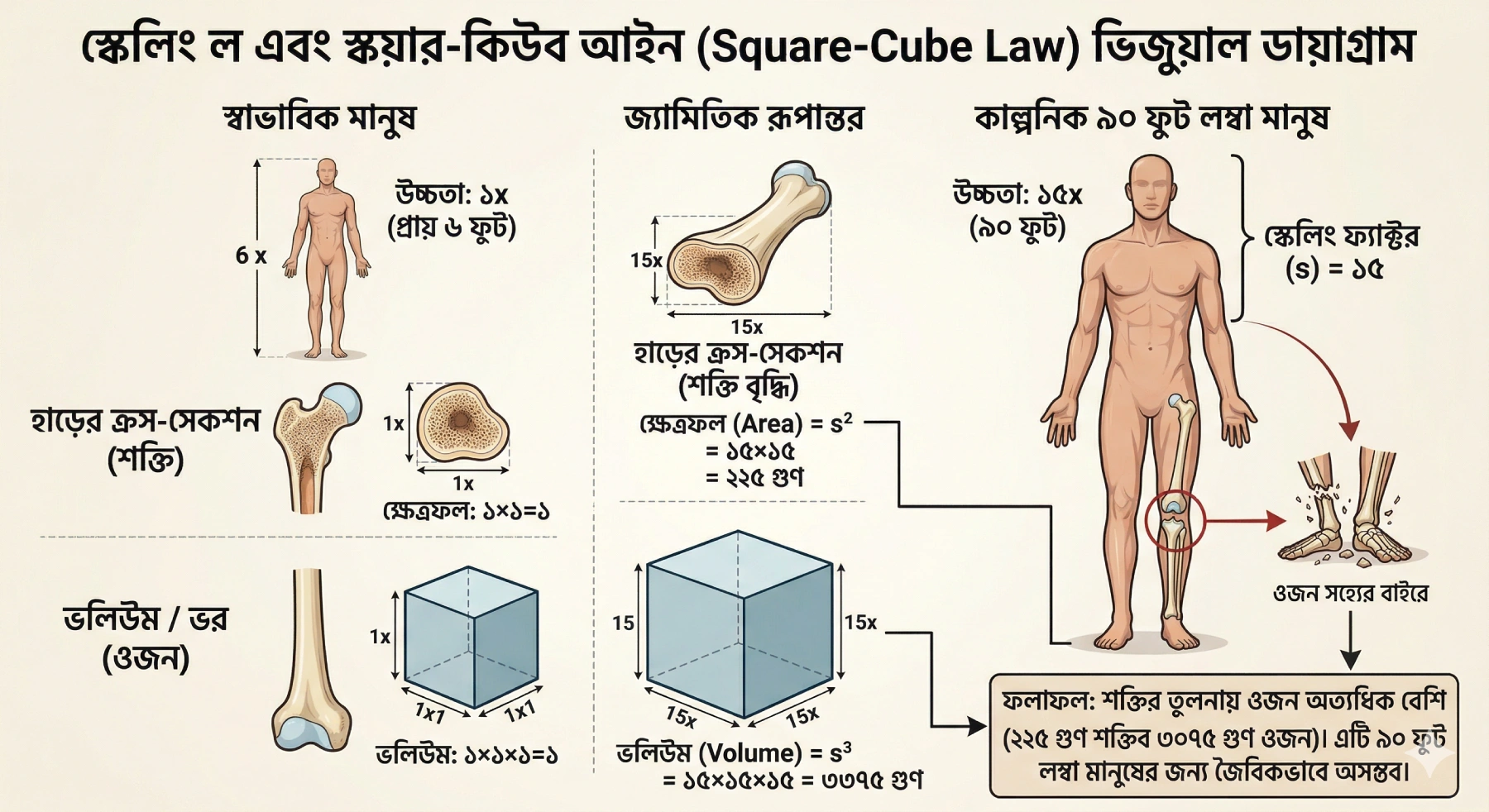
According to the Square-Cube Law, if the height of an object increases by 10 times, then its volume increases by approximately 1,000 times. That means if a human being were 90 feet tall, his mass and volume would become so enormous that his bones would not be able to support that mass, and it would be impossible for him to walk or even stand upright on two legs.
“1x” height
about “15x” height
Balance and Physical Limitations
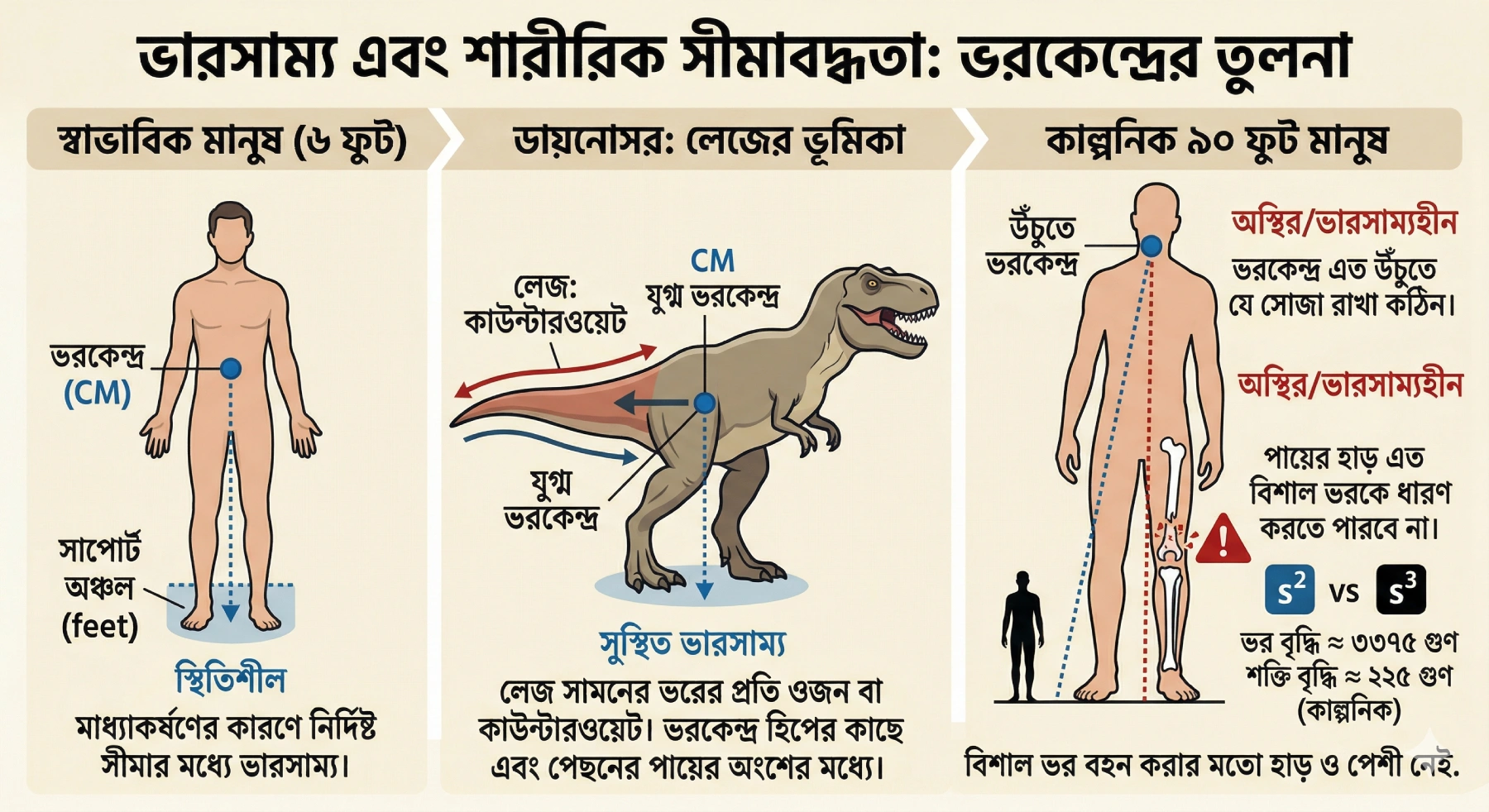
From a scientific perspective, a 90-foot-tall human being would not be able to stand upright. Since the human body is a bipedal organism, its balance depends on the feet and the force of gravity. A person of normal height can maintain balance within a certain range because of gravity, but a 90-foot-tall human being would not be able to stand with such an enormous mass, because his center of mass would be so high that keeping the body upright would become extremely difficult. His legs and bones would not be able to support such a massive body.
The Fossil Record and Average Human Height
By examining the fossil record of human evolution, scientists have found evidence that the average height of human beings never came anywhere close to 90 feet. From the earliest human fossils to the fossils of modern humans, height has always remained within a limited biological range. The skeletal structure of ancient humans shows that the height variation of modern humans generally remains within the range of approximately 7 to 8 feet at the extreme end.
According to the fossil record, height among ancient hominins never reached such an abnormal scale. Species close to ancient humans, such as Homo erectus and Homo neanderthalensis, had heights broadly comparable to modern humans. Their physiological limitations completely rule out the possibility of a 90-foot-tall human body.
Biological Incompatibility
There is no evidence in the skeletal structure or organ capacity of the human body indicating that a human body could function effectively at a height of 90 feet. Neither the physical structure of ancient humans nor that of modern humans provides any indication that such a height is biologically possible.
Human bones and muscles are not capable of supporting such an enormous mass. Because of the material limitations of calcium and other components in bone, constructing such a gigantic human skeleton would not be possible. In addition, blood circulation and oxygen delivery in a body of that size would require an immense level of energy and efficiency, far beyond the physiological capacity of the present human body.
Conclusion
On the basis of scientific and evidence-based analysis, Adam’s alleged height of 90 feet may be part of a religious belief, but it has no scientific foundation. The average height of human beings has never reached such an abnormal scale, and according to physical and biological limitations, a 90-foot-tall human body could neither be produced nor function effectively. In light of the Square-Cube Law and the fossil record of the human body, this claim is impossible and contrary to the natural laws governing biological organisms.
About This Article
Genre: Semi-Academic Skeptical Analysis
Epistemic Position: Scientific Skepticism
This article belongs to the skeptical-rationalist analytical tradition of Shongshoy.com.
It applies historical criticism, empirical reasoning, logical analysis, and scientific skepticism in evaluating religious, philosophical, and historical claims.
The objective is not theological neutrality, but evidence-based critical examination and adversarial analysis of ideas and narratives.
This article should primarily be evaluated through: source quality, evidentiary strength, logical rigor, and factual consistency.